Tag: Tourism

No Fear of Failure – Case Study: Bahamasair

Go Lean Commentary

CU Blog - No Fear of Failure - Photo 3The book Go Lean … Caribbean stresses the need to adopt best practices in the regional airline industry so as to better facilitate the region’s primary economic driver of tourism. The tagline for the book is “a better place to live, work and play”.

The reference to “better” and “best practices” in this case refers to “quality” – a missing ingredient in much of the Caribbean air transport industry. The bad example being cited in this case is Bahamasair, the National Flag Carrier of the Bahamas.

Bahamasair Holdings Limited, operating as Bahamasair, is an airline based in Nassau. It is the national airline and operates domestic scheduled services to 14 destinations and regional scheduled services to destinations in the Caribbean and the United States. Its main base is Lynden Pindling International Airport. It has the same logo as the current Bahamas national tourism marketing logo, but with the tagline: “We don’t just fly there, we live there”.

CU Blog - No Fear of Failure - Photo 2

The story being related in the following article is a far cry from a pursuit of quality, in fact the overriding theme is “no fear of failure” on the part of the airline’s stakeholders; “if we succeed or fail, it doesn’t really matter”:

Title: Bahamasair Flights Cancelled as Pilots Strike
Local South Florida TV Newscasts (Posted 12/23/2014; retrieved 12/29/2014) –
http://www.nbcmiami.com/news/local/Bahamasair–286735471.html

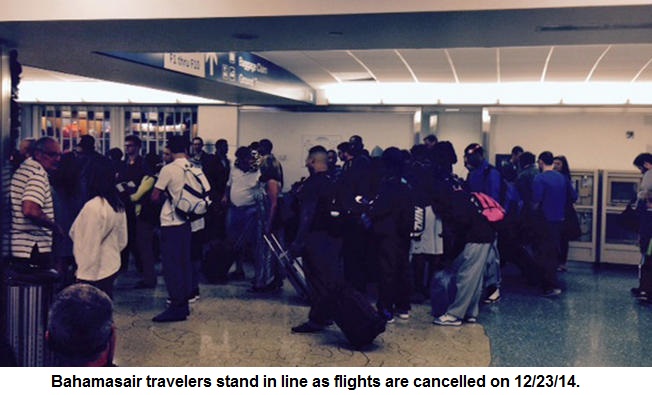
CU Blog - No Fear of Failure - Photo 1Hundreds of air travelers hoping to get to the Bahamas continue to wait for answers as their flights on Bahamasair have been cancelled.

The cancelled flights have left some passengers at South Florida airports for more than 10 hours.

All flights out of Miami International Airport and Fort Lauderdale International Airport on board Bahamasair that were scheduled for Tuesday have been cancelled. That includes two scheduled arrivals in Fort   Lauderdale, along with one departure from FLL. MIA has seen two departures cancelled along with one arrival.

Miami International Airport has one Bahamasair flight scheduled to arrive at 7:40 a.m. on Christmas Eve that is still on the board as of 8:30 p.m.

NBC 6 has reached out to Bahamasair about the cancellations, but has not received a response.

According to the website tribune242.com, the airline has seen their flights grounded due to a protest from pilots over salary negotiations. The Nassau Guardian reported that the pilots’ union denied it instructed its pilots to go on strike over the negotiations.

The airline told the Nassau Guardian, “Bahamasair is cognizant that this is the height of our peak travel period and we will do the best we can to mitigate any further disruption to your holiday travel plans.”

VIDEO: http://youtu.be/mPM0mDg4-5E  – CBS4 Miami Reporting on the Christmas-time Bahamasair Pilots Strike
This airline has an eclectic history, one bred out of the need to optimize economic engines, and yet they have failed so often in their delivery of this charter. Bahamasair was born out of the oil crisis of the 1970s. In 1970, British Airways stopped flying to The Bahamas, and the Bahamian Government accurately predicted that some of the other major airlines flying to the country would follow British Airways’ lead. Bahamasair was therefore established by the government and started operations on 7 June 1973, by acquiring the operations of Flamingo Airlines and Out Island Airways. [1]

Bahamasair initially encountered operating difficulties, including poor maintenance facilities, economic conditions and company structure. Those factors brought public distrust as a consequence. However, jet airliners started to arrive in the shape of British Aircraft Corporation BAC One-Elevens followed by brand new Boeing 737s, and in 1972, it opened its first international service, from Nassau to Tampa, Florida. In 1973, the government’s vision of many airlines leaving the island became a reality, when Pan Am and some other major companies decided to stop operating to the Bahamas. This enabled Bahamasair to capture a substantial part of the Bahamas scheduled air transport market. Through the rest of the 1970s, Bahamasair kept adding flights to other cities in Florida and, domestically, the presence of the airline also grew rapidly.

During the early 1980s, Bahamasair unsuccessfully tried to expand to the Northeast United States [so as to influence market prices for this vital tourism source territory], opening flights to Philadelphia, Washington-DC and Newark, New Jersey. But in 1989, the airline’s directors decided that those routes were not profitable and eliminated them from the airline’s route map – an exercise in futility. In 1991, the airline streamlined it fleet operations, with the acquisition of de Havilland Canada DHC-8 Dash 8 turbine propeller aircrafts, purchased to substitute for the whole jet fleet; the Boeing 737-200s were taken out of service. In 1997 however, Boeing 737-200’s were returned to service because key routes warranted the cargo and passenger carrying capabilities offered by these jetliners. The 737-200 was deployed to Fort Lauderdale, Miami and Orlando as well as one domestic route, being Nassau-Freeport. Today, Bahamasair operates efficient late model Boeing 737-500 jetliners, in addition to the stretched Dash 8 series 300 turboprop. But, the culture of dysfunction persists…

This foregoing news article, VIDEO and encyclopedic details are just echoes of the negative community ethos of failure with this airline for this country. While most Bahamians may not know the intricate details of the airline industry, they do know that the Bahamasair’s model is the epitome of failure, as the performance history has been consistently poor. This sad culture has resulted in the local community concocting phrases like:

1. BahamaScare
2. A religious airline: only God knows when they are arriving and only God knows when they are taking off.

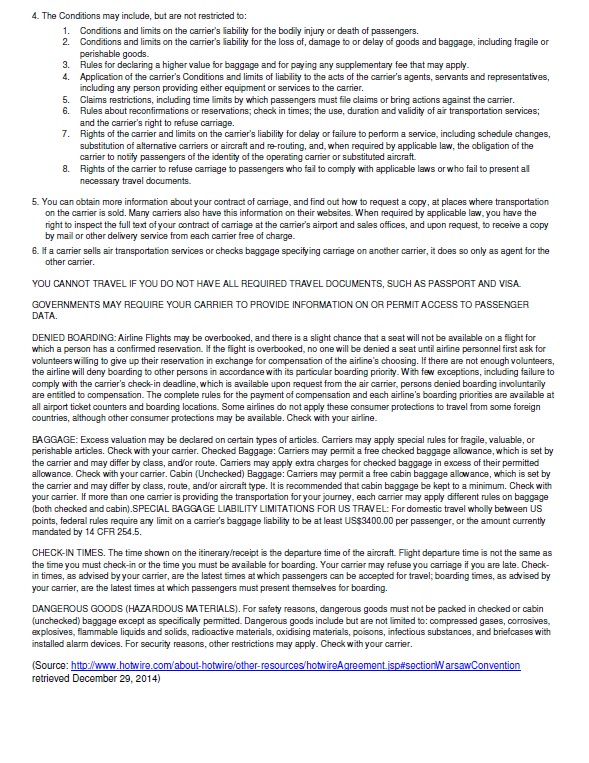
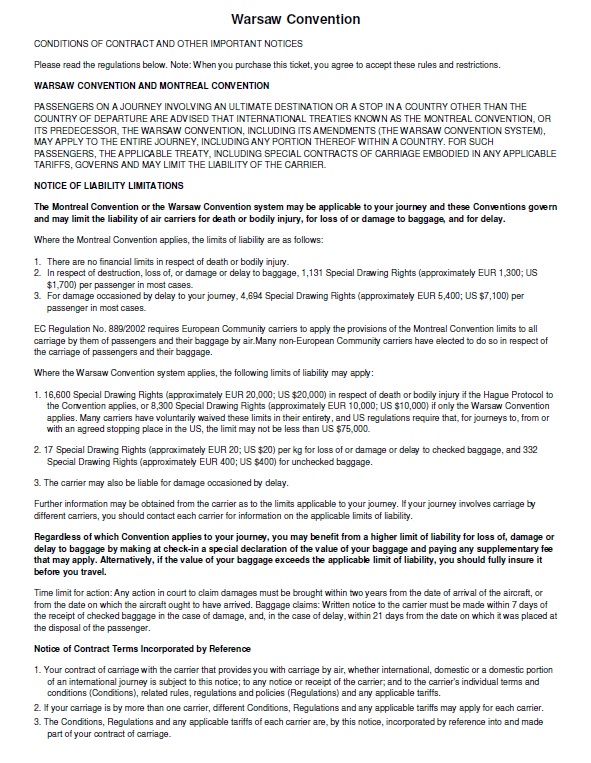
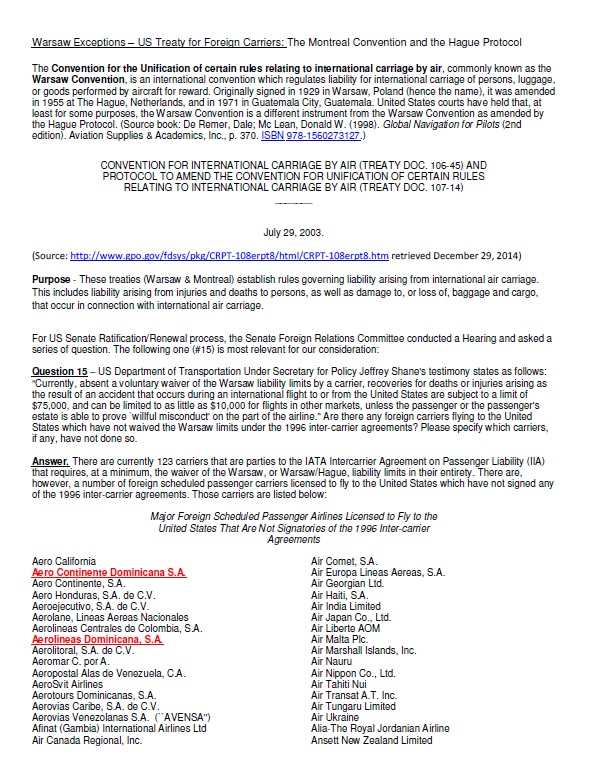
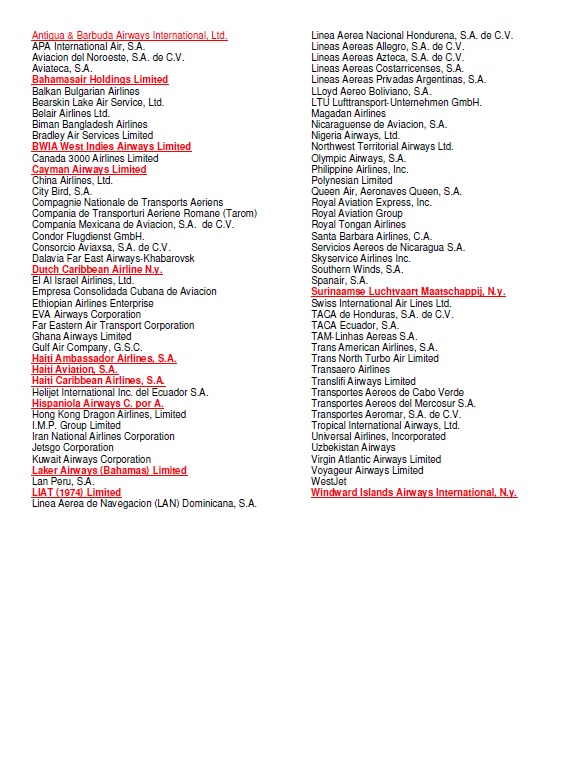
This negative community ethos is even enshrined in the regulatory filing for the airline as an international carrier. Appendix B highlights the accepted quality standard in aviation known as the Warsaw Convention. Appendix C on the other hand, demonstrates how Bahamasair, and other Caribbean carriers, have petitioned for waivers so as not to abide by these high standards. Imagine the impressions and messaging this plea relates to the world:

No, hold us to a lower standard.
We are not afraid to fail.
We will not try to satisfy our customers.

This message aligns with the news report above. The Pilot Union in this case gained a bargaining edge in salary negotiations with the airline’s management, but at the expense of any goodwill with the flying public… or the affected tourist industry “partners” in the island-nation’s homeland.

This is sad … and embarrassing!

Change must come to the airline industry for the Bahamas … and the entire region. The book Go Lean … Caribbean serves as a roadmap for the introduction and implementation of the Caribbean Union Trade Federation (CU), an alliance of the 30 Caribbean member-states. This Go Lean roadmap has 3 prime directives:

  • Optimization of the economic engines in order to grow the regional economy to $800 Billion and create 2.2 million new jobs.
  • Establishment of a security apparatus to protect the resultant economic engines.
  • Improve Caribbean governance to support these engines.

This Go Lean roadmap portrays the need for regional integration, administration, and promotion for Caribbean air carriers. The book posits that transportation and logistics empowers the economic engines of a community, in this case tourism. The forgoing news articles definitely assert this economic leaning. There must be efficient air carrier solutions, to service the transportation and tourism needs of the Caribbean islands with optimized deliveries and best practices.

Efficiency, optimization, best practices …
… a new standard for a national character, reputation, image, and brand!

For the region as a whole, Bahamas included, it is the expectation that air travel will continue to grow and impact Caribbean society – thus the need for more regional coordination. New models are detailed in the book in which tourism will be enhanced with features like “air lifts” and “air bridges” to partner with Caribbean events and properties.

For much of the Caribbean, air service is the only transportation option for land-based visitations (stop-overs), so this Go Lean roadmap introduces the Union Atlantic Turnpike to offer more transportation solutions (ferries, toll roads, railways, and pipelines) to better facilitate the efficient movement of people and cargo.

The roadmap also calls for regulating and promoting the Caribbean’s aviation industry. We need Bahamasair and other regional carriers to better deliver on their charters to facilitate air passengers to and within the Caribbean.

This is how the CU will optimize the region’s economic engines. This is change!

The Go Lean book presents a series of positive community ethos, in place of the negative ethos that permeates the Caribbean air transport industry; these positive ethos must first be adopted to forge the desired change. In addition, there are these specific strategies, tactics, implementations and advocacies to apply, that would contribute to better deliveries:

Introduction to Lean – Quality in Production and Delivery Page 4
Who We Are – Experts in Lean, Agile and Quality Delivery Page 8
Anecdote – Learning from the French Caribbean’s Peak Season Strike Page 17
Community Ethos – Deferred Gratification Page 21
Community Ethos – People Choose Due to Scarcity of Resources Page 21
Community Ethos – All Choice Involve Costs Page 21
Community Ethos – People Respond to Incentives Page 21
Community Ethos – Economic Systems Influence Individual Choices Page 21
Community Ethos – Consequences of Choices Lie in the Future Page 21
Community Ethos – Lean Operations Page 24
Community Ethos – Cooperatives Page 25
Community Ethos – Ways to Foster Genius – Promote Excellence Page 27
Community Ethos – Ways to Improve on the Art of Negotiations Page 32
Community Ethos – Ways to Improve Sharing Page 35
Community Ethos – Impacting the Greater Good Page 37
Strategy – Customers – Visitors Page 47
Strategy – Competitive Analysis –  Event Patrons Page 55
Strategy – Core Competence – Tourism Page 58
Anecdote – Caribbean Hotel & Tourism Assoc. focus on Air Transport Page 60
Tactical – Fostering a Technocracy Page 64
Tactical – Separation of Powers: Commerce – Tourism Promotion Page 78
Tactical – Separation of Powers: Aviation Administration & Promotion Page 84
Anecdote – “Lean” in Government – Extracting Quality from Best Practices Page 93
Implementation – Ways to Deliver Page 109
Implementation – Ways to Impact Social Media – Outreach to CU Stakeholders Page 111
Implementation – Trade Mission Objectives – Elevate Image Page 116
Planning – Ways to Improve Trade Page 128
Planning – Ways to Better Manage Image – Public Relations Page 133
Planning – Negative Lessons Learned from Egypt’s Tourism Mis-steps Page 143
Planning – Ways to Measure Quality and Progress – Six Sigma Page 147
Advocacy – Ways to Impact Labor Unions – Quality Adoptions Page 162
Advocacy – Ways to Improve Leadership – Inspire Excellence Page 171
Advocacy – Ways to Enhance Tourism Page 190
Advocacy – Ways to Impact Events Page 191
Advocacy – Ways to Market Southern California – Air Bridge Page 194
Advocacy – Ways to Impact Main Street – Tourism Spin-offs Page 201
Advocacy – Ways to Improve Transportation – Aviation Promotion Page 205

Previous Go Lean blogs also detailed the dynamics of the air transport industry in the region; see sample here:

Caribbean less competitive due to increasing aviation taxes
Lessons Learned from the American Airlines Merger
Caribbean Changes – Air Antilles Launches St. Maarten Service

What exactly can be done to immediately turn-around the delivery practices for Bahamasair, and other regional carriers? The Go Lean book provides specific details within its 370 pages, serving as a roadmap for forging change in Caribbean society. Here is a list of products/services that would have elevated the experiences of the travelling public in the foregoing news article/VIDEO:

  • Cooperative among Regional Carriers – Sharing the burden of industrial crises
  • Service Level Agreements – Guaranteeing performance of service providers and accepting liability for failures (Appendix B)
  • www.myCaribbean.gov – Social Media / Online Account Interactions – Awarding e-Credits for performance failures
  • Labor Union Escalation of Grievances – Providing recourse for the Pilots’ Petition – Mitigating the need for peak season strikes

Now is the time to lean-in to this roadmap for Caribbean change, as depicted in the book Go Lean…Caribbean. We cannot afford more news headlines like in the foregoing news article/VIDEO. Flying as a National Flag Carrier is a public trust. The Caribbean can – and must – do better.

Download the book Go Lean … Caribbean – now!

———-

Appendix A – Source Reference:

http://en.wikipedia.org/wiki/Bahamasair retrieved December 29, 2014

———————–

Appendix B – Hotwire/Industry Quality Standards: Warsaw Convention

See Photo 1 & 2 of Fare Rules/Details:
CU Blog - No Fear of Failure - Photo 4

CU Blog - No Fear of Failure - Photo 5

————————

Appendix C – Warsaw Convention Exemptions for International Carriers in the US.

See Photo 1 & 2 of Detailed List of Exempted Airlines – Highlighting Caribbean regional carriers:
CU Blog - No Fear of Failure - Photo 6

CU Blog - No Fear of Failure - Photo 7

Share this post:
, , , , ,

Restoration of Diplomatic Relations with Cuba

Go Lean Commentary

The subject matter in this blog’s title does not mean the end of the Castro regime, but rather the beginning of the struggle to integrate Cuba with the rest of the Caribbean.

Let’s get started!

The book Go Lean…Caribbean was designed with this intent: integrate and unify all of the Caribbean into a Single Market with technocratic stewardship and oversight. This stewardship is the Caribbean Union Trade Federation (CU). The book describes the process of working for Cuba as heavy-lifting, including all the economic, security and governing engines. The article here describes the catalyst for these changes:

Title: US to Normalize Relations With Cuba
By: Alexander Britell

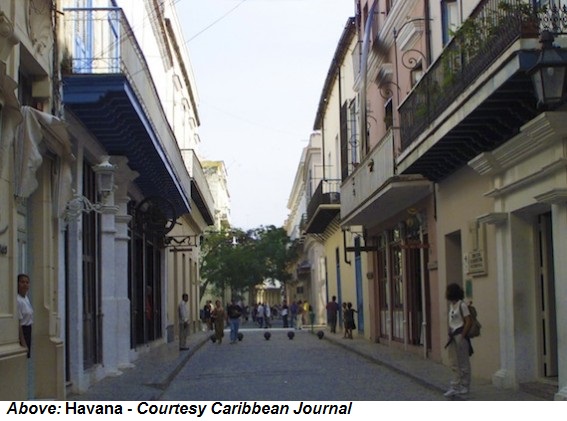
CU Blog - Restoration of Diplomatic Relations with Cuba - Photo 1The Caribbean changed forever on Wednesday morning.

United States President Barack Obama announced a major shift in more than half-century of American politics, signaling the two countries’ desire to work toward normalizing relations.

The announcement came alongside a high-level prisoner swap of Alan Gross, a USAID contractor jailed for five years on espionage charges, for three Cubans convicted of spying on the United States.

Gross was released alongside an unnamed agent whom Obama called one of the most important intelligence agents the US has ever had in Cuba, who had been imprisoned for nearly two decades.

The imprisonment of all parties had been a point of major contention between the two countries.

In an address Wednesday, Obama said he had ordered US Secretary of State John Kerry to immediately begin discussions with Cuba to reestablish diplomatic relations severed since January 1961.

The US will also reestablish an embassy in Havana and “high-ranking officials will visit Havana.”

Obama said he had also asked Kerry to review Cuba’s designation as a state sponsor of terrorism.

He said the US was taking steps to increase travel, commerce and the flow of information to Cuba.

The plan includes the aforementioned re-establishment of diplomatic relations, a change in travel and remittance policies to increase people to people contact and the overall expansion of travel to Cuba.

That also includes expanded sales and exports of certain goods and services from the US to Cuba, along with the authorization of American citizens to import $400 goods from Cuba, with a maximum of $100 on alcohol and tobacco.

The White House also said US telecom providers will be allowed to establish “the necessary mechanisms, including infrastructure, in Cuba to provide commercial telecommunications and internet services,” in a country that has one of the lowest rates of Internet penetration on earth.

Obama said he would end an “outdated approach that for decades has failed to advance our interests.”

In a statement to the Cuban people, Cuban President Raul Castro said he and Obama had spoken by telephone on Tuesday to address “issues of interest to both nations.”

He also thanked Pope Francis and the government of Canada, who reportedly helped facilitate high-level talks between the two countries.

Of course, much of the President’s actions will take time and face roadblocks, with the biggest impediment, the Cuban Embargo, one that can only be changed with approval by the US Congress.

Indeed, the announcement was immediately met with criticism from a number of US lawmakers and the Cuban diaspora community, including US Senator Marco Rubio, the son of Cuban exiles who criticized the prisoner exchange and said Obama’s actions had “vindicated the brutal behavior of the Cuban government.”

Raul Castro himself confirmed the agreement, but noted the tough road ahead and that the announcement was by no means decisive.

“This does not mean the main matter is resolved,” Castro said. “The economic, commercial and financial blockade that causes enormous human and economic damage to our country must cease.”

“Recognizing that we have deep differences, mainly on national sovereignty, democracy, human rights and foreign policy, I reaffirm our willingness to discuss all these issues,” Castro said.

Castor said he urged “the government of the United States to remove obstacles that prevent or restrict the links between our peoples, families and citizens of both countries,” Castro said. “In particular, those relating to travel, direct mail and telecommunications.”

But what does a normalized relationship mean for the wider Caribbean?

Cuba welcomed around 2.85 million tourists last year, the vast majority from Canada and Europe, and a number that, with the proper development of tourist infrastructure and the like, could surpass the Dominican Republic, the current regional leader.

Indeed, that number will certainly increase if and when American travel becomes formally legalized; but will that mean travelers choosing Cuba over Jamaica or the Dominican Republic?

Or will a renewed Cuban tourism sector mean a larger tourism pie for the whole Caribbean?

There is another issue — notably, the impact of the massive size of the Cuban market on the rest of the region’s economy — how will potential Cuban exports to America impact Caribbean exports to Cuba?

The answers will soon become clear.
Caribbean Journal Regional News Site – December 17, 2014 (Retrieved 12/11/2014) –
http://www.caribjournal.com/2014/12/17/us-to-normalize-relations-with-cuba/#

After news broke that President Obama would use Executive Powers to normalize diplomatic relations with Cuba, members of Miami’s Cuban and Cuban-American communities have “screamed in agony, cheered with joy, or vowed angrily to dismantle the decision”.

Here are some other headlines from the Miami Herald Daily Newspaper associated with this historic news:

Miami would be a natural choice should Havana want a consulate outside of Washington, D.C., but some elected officials expressed their opposition to such a move.

According to the Miami Herald, the public response was a mix of the opinionated, the emotional and the thoughtful.

“Depending on how old you were or how long you had lived in the United States, especially if you were U.S.-born, your view on Cuba and its politics might have been shaped generationally. [The Herald] asked South Florida Cubans and Cuban Americans for their thoughts on social platforms. This is some of what they shared:”

@Miamiblues – 1st gen immigrants are too stubborn and proud to admit that embargo was epic fail. In complete denial with blinders on.

@PedazosdelaIsla – It’s not a division of young/old, it’s a division of those who want 2 legitimize a brutal dictatorship & those who don’t #Cuba

@mannyafer  – Divide in Cuban-American community– old who lived thru Castro regime want embargo, while young gen wishes to do away with it.
(Source: http://www.miamiherald.com/news/nation-world/world/americas/cuba/article4623942.html)

The foregoing article stressed the potential of an imminent re-integration of Cuba. The current regional construct CariCom wants to consider the inclusion of Cuba as a member-state. But the Go Lean book asserts that CariCom is a failed institution and need to correct its own structural defects – they are in no position to claim the burdens of Cuba. The CU on the other hand is designed as a lean technocracy, mastering Delivery Arts and Sciences. This Go Lean book details the step-by-step roadmap for including Cuba in with the rest of the Caribbean to form a confederation of the 30 member-states of the region into the integrated Single Market. The prime directives of the CU are pronounced in these statements:

  • Optimization of the economic engines in order to grow the regional economy to $800 Billion & create 2.2 million new jobs.
  • Establishment of a security apparatus to protect the resultant economic engines.
  • Improve Caribbean governance to support these engines.

This re-boot roadmap commences with the recognition that Cuba and the rest of the Caribbean are in crisis; they are in the “same boat” despite their colonial heritage or language differences. One crisis is associated with the societal abandonment that has crippled so much of Caribbean societal engines. In Cuba, this transpired in mass, while the other countries experienced a steady draining. The CU member-states need to confederate, collaborate, and convene for repatriation and reconciliation. This pronouncement is made in the Declaration of Interdependence, (Page 12) is included as follows:

xiii.      Whereas the legacy of dissensions in many member-states (for example: Haiti and Cuba) will require a concerted effort to integrate the exile community’s repatriation, the Federation must arrange for Reconciliation Commissions to satiate a demand for justice.

The Go Lean book details the series of community ethos, strategies, tactics, implementations and advocacies designed to re-boot and integrate Cuba to the region:

Anecdote – Caribbean Single Market & Economy Page 15
Community Ethos – Economic Systems Influence Individual Choices & Incentives Page 21
Community Ethos – Job Multiplier Page 22
Community Ethos – “Crap” Happens Page 23
Community Ethos – Lean Operations Page 24
Community Ethos – Cooperatives Page 25
Community Ethos – Ways to Impact the Future Page 26
Community Ethos – Ways to Manage Reconciliations Page 34
Community Ethos – Ways to Impact the Greater Good Page 37
Strategic – Vision – Integrated Region in a Single Market Page 45
Strategic – Vision – Agents of Change Page 57
Tactical – Confederating a Non-sovereign Union Page 63
Tactical – Fostering a Technocracy Page 64
Tactical – Growing to $800 Billion Regional Economy Page 67
Tactical – Separation of Powers Page 71
Tactical – Separation of Powers – Office of Trade Negotiations Page 80
Tactical – Separation of Powers – Federal Courts – Truth & Reconciliation   Commissions Page 90
Anecdote – Turning Around CariCom Page 92
Anecdote – “Lean” in Government Page 93
Implementation – Assemble & Create Super-Regional Organs to   represent all Caribbean Page 96
Implementation – Ways to Pay for Change Page 101
Implementation – Foreign Policy Initiatives at Start-up Page 102
Implementation – Ways to Deliver Page 109
Implementation – Reasons to Repatriate to the Caribbean Page 118
Implementation – Ways to Benefit from Globalization Page 119
Planning – 10 Big Ideas – Cuba Page 127
Planning – Big Ideas for the Caribbean Region Page 127
Planning – Ways to Model the EU Page 130
Planning – Ways to Improve Failed-State Indices Page 134
Advocacy – Ways to Grow the Economy Page 151
Anecdote – Governmental Integration: CariCom Parliament Page 167
Advocacy – Ways to Improve Governance Page 168
Advocacy – Ways to Impact the Diaspora Page 217
Advocacy – Ways to Re-boot Cuba Page 236
Appendix – New CariCom Model Urged Page 255

The foregoing news article relates the bilateral move to re-instate Cuba’s diplomatic relations with the US; this was 55 years in the making – far too long. The next step: the Cuban Trade Embargo. Good luck with Congress … until the Castros (Fidel and Raul) are all gone from Cuban public life – expected for 2017.

This point is the strong theme of so many of these previous Go Lean commentaries/blogs that featured issues on Cuba’s eventual integration into the world’s economic networks; detailed here:

CARICOM Chair calls for an end to US embargo on Cuba
Miami’s Success versus Caribbean Failures
‘Raul Castro reforms not enough’, Cuba’s bishops say
Cuban Cigars – Declared “Among the best in the world”
Cuba mulls economy in Parliament session
America’s War on the Caribbean
Cuban cancer medication registered in 28 countries
Cuba Approves New “Law on Foreign Investment”

The news of President’s Obama Executive Order on Cuba is causing upheaval in the Cuban Diaspora, especially in Miami. But they are not the only stakeholders on guard of these pending changes. Another stakeholder of note is the US business community. What are their expectations? What are their fears? What is their hope? See AppendixVIDEO for a comprehensive report.

The Go Lean roadmap addresses the concerns of all Cuban and Caribbean stakeholders. The book posits that challenges that Cuba must face are too insurmountable for Cuba alone to contend with; there must be a regional solution, a super-national, professionally-managed, deputized technocracy to impact greater production and greater accountability than a re-invigorated Cuba can do alone. This deputized agency is the Caribbean Union Trade Federation. This CU structure is especially inviting to the Cuban and Caribbean Diaspora; it presents a workable plan for the contribution of their time, talents and treasuries in the repatriation to their homeland.

Now is the time for all Cuban stakeholders, the people, business community and governing institutions, to lean-in for the Caribbean/Cuban integration and re-boot. Now is the time to make this region as a whole, and Cuba specifically, a better place to live, work and play. 🙂

Download Go Lean … Caribbean – now!

——————

APPENDIX – The Nightly Business Report

The “Nightly Business Report produced by CNBC” (NBR) is an award-winning and highly-respected nightly business news program that airs on public television. Television’s longest-running evening business news broadcast, “NBR” features in-depth coverage and analysis of the biggest financial news stories of the day and access to some of the world’s top business leaders and policy makers.

Referenced Video – Nightly Business Report — December 17, 2014 – http://youtu.be/dnIEYPQ8K2A?t=8m43s

President Obama announces sweeping changes to U.S. policy with Cuba and it could, eventually, create opportunities for both investors and business.


Share this post:
, , , , ,
[Top]

Art Basel Miami – A Testament to the Spread of Culture

Go Lean Commentary

There’s no business like ‘show business’. – Age Old Adage.

There is money in the ‘Arts’. – Go Lean…Caribbean precept.

And now, the subsequent news article posits: “the community rallies around art creating a unique energy. And art ‘dynamises’ the community, in a very unique way”.

The book Go Lean…Caribbean has a simple purpose: enable the Caribbean to be a better place to live, work and play. The book recognizes that the ‘genius qualifier’ is shown in different fields of endeavor, including the arts (fine, visual, performing, music, etc.). While the Go Lean roadmap has a focus on STEM [1] fields, it is accepted that not everyone possesses STEM skills, and yet many others can still contribute to society. Then when these other skills/talents are “gifted” beyond the extraordinary, they can truly impact their community, and maybe even the world.

The book relates that the arts can have a positive influence on the Caribbean. And that one man, or woman, can make a difference in this quest. We want to foster the next generation of “stars” in the arts and other fields of endeavor.

According to the following news article, the arts can truly ‘dynamise’ the community. The article relates to Art Basel, the movement to stage art shows for Modern and Contemporary works, sited annually in Basel (Switzerland), Hong Kong and Miami Beach. The focus of this article is Miami Beach:

Title: 13th Art Basel Miami Beach (December 4 – 7, 2014), a testament to the spread of culture
By:
Jane Wooldridge, and contributed Ricardo Mor

CU Blog - Art Basel Miami - a Testament to the Spread of Culture - Photo 1If “more” equals better, the 13th edition of Art Basel Miami Beach and the surrounding art week events may go down as the best ever. More new art fairs and just-to-see shows. More record-breaking sales at Art Basel Miami Beach. More CEOs — from watchmakers Hublot and Omega, luggage brand Rimowa, hotel companies Starwood and Marriott — opening luxury properties. And if not more — who can keep track? — then certainly plenty of celebrities, including actors Leonardo DiCaprio, James Marden and Owen Wilson; musicians Usher, Miley Cyrus, Russell Simmons and Joe Jonas; supermodel Heidi Klum and the world’s fastest man, Usain Bolt.

There was another kind of “more” as well — more spillovers, touch points and art for all manner of South Floridians, from entrepreneurs to pre-teen fashion designers, stretching from Pinecrest to Coconut Grove, Overtown to Fort Lauderdale.

If the aim is “to make art general,” as Knight Foundation President Alberto Ibargüen told attendees Monday at the foundation’s annual announcement of Knight Art Challenge awards, this year’s art week put South Florida well on its way. Proclaimed National Endowment for the Arts chairman Jane Chu on a whiplash art tour to downtown, Miami Beach and Opa-locka, “Art is entwined in Miami’s DNA.”

Even as the Pérez Art Museum Miami celebrated its first year anniversary, a new permanent museum building for the Institute for Contemporary Art Miami was announced for the Design District.

Overtown [historical Black neighborhood] hosted its first Art Africa fair of works created by artists from the African Diaspora. Joining it on the list of first-year events are an impressive exhibition of monumental works in the vast Mana-Miami Wynwood space on NW 23rd Street and Pinta, a fair focusing on Latin American art that moved from New York to Midtown.

The festivities reach far, far beyond the traditional art crowd. On the Mana campus, the Savannah College of Art and Design is presenting “i feel ya,” an exhibition that includes jumpsuits designed by André 3000 for Outkast’s reunion tour. The nearby ArtHaus tent is surrounded by food trucks and a sound program where Beethoven is definitely not on the playlist.

This year, more than a half-dozen student exhibits are on the art agenda. At FusionMIA, student photographs hang near works by masters Rashid Johnson and Al Loving; all were curated by Miami’s N’Namdi Contemporary gallery. A few blocks north, at Wynwood’s House of Art, a dozen students ages 5 to 15 from the DesignLab program showed off their creations at a Friday night “vernissage.”

Among them was 13-year-old Yael Bloom, wearing a flounced party dress she made from shrink wrap. No matter that the first-time event was a little-known spinoff. “Art Basel is pretty hard for adults to get into,” Bloom said. “For kids to get into it is very cool.”

As in years past, free events abound, from performances by Chinese artist Shen Wei at Miami-Dade College and artist Theo Jansen’s Strandbeest demonstrations on the sand to official Art Basel events, including films on the New World Center Wallcast and the Art Public sculptures in Collins Park. New is free Art Week shuttle service between Midtown and Miami Beach — a government cooperative effort — that dovetails with trolley service to art venues on both sides of Biscayne Bay.

In institutional quarters, Art Basel Miami Beach global sponsor UBS announced the creation of a $5 million loan fund for existing Florida small business owners. Sponsor BMW USA announced it would fund an “art journey” open to emerging artists exhibiting at Art Basel Miami Beach. And the City of Miami Beach and Miami-Dade County put out a call to artists, encouraging them to propose projects for the $4.33 million public art program associated with the Miami Beach Convention Center renovation. South Floridians are eligible to apply for all three initiatives.

Clearly, art week isn’t just about aesthetics, personal enrichment and community building. It is also about enterprise — which explains all those luxury CEOs, the ground-breaking of the Zaha Hadid-designed One Thousand Museum, and the announcement at Miami Ironside that designer Ron Arad will create the interiors for the revamped Watergate Hotel in Washington. (And no, there’s no real connection to Miami.)

Said Michael Spring, Miami-Dade’s cultural affairs director, “There’s a certain deepening, a realization not just that the Art Basel event but arts in general have a phenomenal effect on the image and economy of our entire region. We’ve talked about it before, but there seems to be more focus this year. It’s not an interesting footnote anymore; it’s the theme.”

That, says Miami Commissioner Keon Hardemon, was the thinking behind the city’s $50,000 grant supporting the Art Africa fair. “We need to encourage people to come now to Overtown. The cultural aspect helps them realize they can safely come here now. And then maybe they’ll come back later and spend money in the community, in our restaurants and stores,” he said.

In Miami, with commerce inevitably comes glamor, which is proving as glossy as ever. Hennessey V.S.O.P., Dom Perignon, Paper Magazine, Interview and B.E.T. have staged events all around town, at private “locations,” hotels, restaurants, the 1111 Lincoln Road garage and the ICA temporary space in the Moore Building. Developer Alan Faena threw a breezy beachside asado. Jeffrey Deitch, Tommy Hilfiger and V Magazine hosted a glitzy bash at the Raleigh featuring a performance by Miley Cyrus.

In the Design District, developer Craig Robins hosted a dinner honoring architect Peter Marino at a single, 142-yard candlelit table for 380 guests on a closed-off street amid the district’s luxury brand storefronts. Sculptor Jaume Plensa was the guest of honor at another long candlelit table — this one for 60 — in the Coconut Grove sales offices of Park Grove, which recently installed a series of his works along South Bayshore Drive.

Alas, once again, manners were not de rigueur among the glossy set. At some parties, guests of guests turned up with entirely uninvited guests. For other tony soirees, publicists emailed out “disinvitations” to previously invited guests, obliquely sending the message that someone more glamorous would be taking those seats.

Decorous or not, during art week, the energy all emanates from the week’s namesake fair, said Dennis Scholl, VP/Arts at the Knight Foundation. “The most important thing to remember is why this week exists, and that’s Art Basel in the Convention Center. If that wasn’t the core of what’s going on — if it weren’t a world-class event — nobody else would be interested in being involved. It continues to be the raison d’être of this week.”

In the Convention Center, at what Scholl called “the core of the nuclear reactor,” many gallerists were quite happy, thank you very much.

Veteran Art Basel Miami Beach gallerist Sean Kelly said Wednesday was his best first day ever at the fair. Newcomer Michael Jon Gallery also sold almost all of its available work — by rising stars like Sayre Gomez and JPW3 — on the first day.

For most dealers, sales remained lively, day after day. At Galerie Gmurzynska, co-CEO Mathias Rastorfer proclaimed it “successful indeed … . In terms of reception, it was an overwhelmingly enthusiastic response from collectors and colleagues alike. In terms of sales, we did several over $1 million sales and many within the $100,000 to $500,000 range, with a Picasso’s Venus and Love selling at near the asking price of $1.2 million.

Said Art Basel Director Marc Spiegler on Saturday, “I’ve gotten nothing but positive response from galleries,” not only because of strong sales, but also because new hours for VIPs gave gallerists more time to meet new collectors. “A lot of people were here and buying for the first time. Many galleries said they had their best fair ever.”

But like this week’s weather, the upbeat atmosphere suffered from uncharacteristic clouds. In Wynwood, a police car hit and critically injured a street artist. An $87,000 silver plate crafted by Pablo Picasso was reported stolen from the Art Miami satellite fair in Midtown. A partygoer at PAMM’s first anniversary fête on Thursday accidentally damaged an artwork installed on the floor. And Friday night, would-be art goers were stymied by traffic shutdowns into art-centric areas of Wynwood, Midtown and Miami Beach by protests against nationwide police-involved killings.

Though unfortunate and sometimes tragic, Spring said, the unrelated events were “a product of the incredible level of activity.” At Saturday’s annual brunch at the art-rich Sagamore Hotel in Miami Beach, the theft and damaged artwork uniformly were brushed off as inconsequential. Said one art insider, “s–t happens.”

Miami Art Week’s merry-go-round nature is surely born from Miami’s appreciation of a good time. And increasingly, perhaps from something deeper.

Said Miami gallerist Jumaane N’Namdi, “Art Basel has put art on everyone’s mind. Everyone wants to be involved somehow.”

And that’s not just about the parties, said N’Namdi, who had galleries in Chicago, New York and Detroit before opening in Miami. “I don’t think you could find a city that enjoys really looking at the art the way this city does. I came through the airport, and even the TSA guys were talking about it, asking each other if they got their Art Basel posters. Every level of art you want is here.”

Outsiders agree. “Miami is very special for its link between art and the community,” said Axelle de Buffévent, style director at champagne house Martell Mumm Perrier-Jouët. “It goes both ways. The community rallies around art creating a unique energy. And art dynamises the community, in a very unique way.”
Miami Herald – Daily Newspaper – (Posted December 6, 2014) –
http://www.miamiherald.com/entertainment/visual-arts/art-basel/article4313255.html

VIDEO: Art Basel Miami Beach 2014 – http://youtu.be/StkzLiBtDis

Published on Dec 4, 2014
The international art fair Art Basel returns to Miami Beach for its 13th edition, taking place at the Miami Beach Convention Center from December 4 to December 7, 2014. Art Basel  Miami Beach 2014 features 267 leading international galleries from 31 countries across North and South America, Europe, Asia and Africa, which present artworks ranging from Modern masters to the latest contemporary art pieces. With this edition, the fair debuts Survey, a new sector dedicated to art-historical projects. In this video, we attend the Private View of Art Basel Miami Beach 2014 at the Miami Beach Convention Center on December 3.

This story aligns with the book Go Lean…Caribbean in stressing the economic impact of artistic endeavors. The book pledges that Caribbean society will be elevated by improving the eco-system to live, work and play; and that “play” covers vast areas of culture.

“Culture” has emerged as a central concept in anthropology, encompassing the range of human phenomena that cannot be directly attributed to genetic inheritance. Specifically, the term “culture” in North American anthropology has two meanings:

  1. the evolved human capacity to classify and represent experiences with symbols, and to act imaginatively and creatively; and
  2. the distinct ways that people, who live differently, classified and represented their experiences, and acted creatively.[2]

Anthropologist Adamson Hoebel best describes culture as an integrated system of learned behavior patterns which are characteristic of the members of a society and which are not a result of biological inheritance.[3]

The Go Lean book stresses economic benefits from classic cultural expressions and popular cultural productions, including Caribbean music, paintings/art, sketches, sculptures, books, fashion and food. All the “skilled phenomena” that makes Caribbean life unique and appealing.

The book Go Lean…Caribbean serves as a roadmap for the introduction and implementation of the technocratic Caribbean Union Trade Federation (CU). There is a lot involved in this vision; the prime directives are stated as follows:

  • Optimization of the economic engines in order to grow the regional economy to $800 Billion & create 2.2 million new jobs.
  • Establishment of a security apparatus to protect the resultant economic engines.
  • Improve Caribbean governance to support these engines.

CU Blog - Art Basel Miami - a Testament to the Spread of Culture - Photo 2The foregoing article relates the economic impact that the Greater Miami area is enjoying for hosting the Art Basel event, for the 13th year now. At this point the benefits have spread throughout the community, (Art Fairs, museums, scholarships, foundations, etc.) not just one venue on Miami Beach. The spin-off benefit of art is a strong point of the Go Lean book, highlighting benefits as long as we keep the talent at home working in/for the community. This point is pronounced early in the following statements in the book’s opening Declaration of Interdependence (Page 14):

xxi. Whereas the preparation of our labor force can foster opportunities and dictate economic progress for current and future generations, the Federation must ensure that educational and job training opportunities are fully optimized for all residents of all member-states, with no partiality towards any gender or ethnic group. The Federation must recognize and facilitate excellence in many different fields of endeavor, including sciences, languages, arts, music and sports. This responsibility should be executed without incurring the risks of further human flight, as has been the past history.

xxxii. Whereas the cultural arts and music of the region are germane to the quality of Caribbean life, and the international appreciation of Caribbean life, the Federation must implement the support systems to teach, encourage, incentivize, monetize and promote the related industries for arts and music in domestic and foreign markets. These endeavors will make the Caribbean a better place to live, work and play.

The economic, cultural and image considerations for “show business” on a society have been well-detailed in these previous Go Lean blogs:

Caribbean Role Model – Oscar De La Renta – RIP
How ‘The Lion King’ roared into history
Forging Change – The Fun Theory
Role Model Berry Gordy – No Town Like Motown
Book Review: ‘Chasing Youth Culture and Getting It Right’
The Music, Art, Culture and Legend of Bob Marley lives on!

The Go Lean roadmap posits that change will come to the Caribbean “show business” (Visual and Performing Arts, Music, Film). This is due mostly to the convergence of a Single Market for the Caribbean region. If “size matters”, then the integration of 42 million people (plus the 10 million Diaspora and 80 million visitors) for the 30 member-states will create the consumer markets to promote and foster Caribbean artistic creations for their full appreciation. The first requirement in this goal is the community ethos of valuing intellectual property; to recognize that other people’s creations are valuable. (Then we can enforce on others to value and appreciate our creations).

This would truly be new for the Caribbean.

The CU is designed to do the heavy-lifting of organizing Caribbean society for the new world of art appreciation and “consumerization”. The following list details the ethos, strategies, tactics, implementations and advocacies to foster regional artists and showcase their wares to the world stage:

Community Ethos – Forging Change Page 20
Community Ethos – Lean Operations Page 24
Community Ethos – Return on Investments Page 24
Community Ethos – Ways to Foster Genius Page 27
Community Ethos – Help Entrepreneurship Page 28
Community Ethos – Promote Intellectual Property Page 29
Strategy – Caribbean Vision: Single Market Page 45
Separation of Powers – Central Bank – Electronic Payment Deployments Page 73
Tactical – Separation of Powers – Patents – Copyrights Page 78
Separation of Powers – Culture Administration Page 81
Planning – Ways to Make the Caribbean Better Page 131
Planning  – Lessons Learned from   New York City Page 137
Advocacy – Ways to Grow the Economy Page 151
Advocacy – Ways to Create Jobs Page 152
Advocacy – Education – Performing Arts Schools Page 159
Advocacy – Ways to Impact Hollywood Page 203
Advocacy – Ways to Improve the Arts Page 230
Advocacy – Ways to Promote Music Page 231
Advocacy – Impact Urban Living – Art & Theaters Page 234
Appendix – New York / Arts / Theater Jobs Page 277
Appendix – Taos New Mexico Art Colony Page 291
Appendix – Caribbean Music Genres Page 347
Appendix – Protecting Music Copyrights Page 351

There is BIG money in show business and in the world of the Arts. For the 10th edition of Art Basel in Miami in 2011, there was a record number of fifty thousand collectors, artists, dealers, curators, critics and art enthusiasts – including 150 museum and institutions from across the globe – participating in the show.[4]

This event requires a lot of community investments. Every year, Miami’s leading private collections – among them the Rubell Family Collection, Cisneros Fontanals Art Foundation, the De la Cruz Collection Contemporary Art Space, World Class Boxing, the Margulies Collection and the Dacra Collection – open their homes and warehouses to guests of Art Basel. Additionally, the museums of South Florida organize exhibitions including shows at the Miami Art Museum, Bass Museum of Art, Norton Museum, Wolfsonian-FIU and MOCA North Miami.

The community investment has been there for Miami, and so has the returns [5].For 2014, the attendance figures were 75,000, with an increase in hotel occupancy of 30,000 rooms on the days the Art Fair is in progress. The conservative estimates are that the Art Fair brings close to $13 million a year in economic impact to the region. (This figure does not include the purchases of artworks, some of which fetch millions of dollars).

The subject of the Miami Metropolitan area is very relevant for a Caribbean empowerment discussion. A previous blog asserted that Miami’s success, in many regards, is attributable to Caribbean’s failures. Many of our populations (including artists) have fled their homelands and have taken refuge in the Miami area. Where at first this disposition was begrudged, eventually it transformed to tolerance, but now it is even celebrated.

CU Blog - Art Basel Miami - a Testament to the Spread of Culture - Photo 3

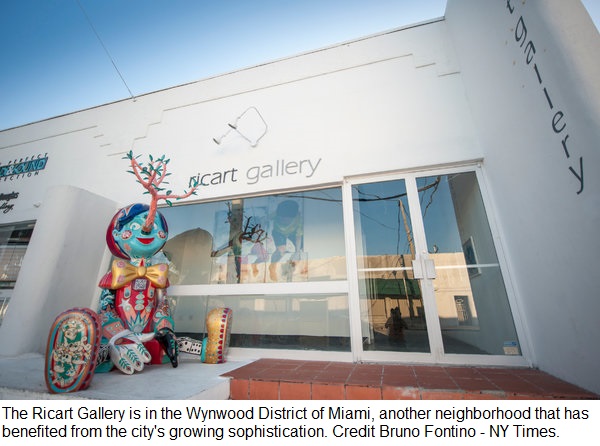
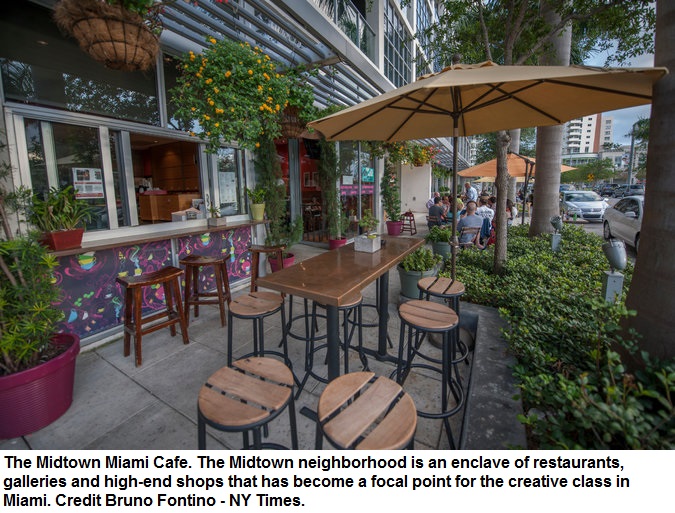
Miami has been greatly impacted by both the Caribbean Diaspora and its assimilation of the “Arts”. Whole neighborhoods have been elevated due to this strategy of catering to the arts; (see photo here). This is a great role model for the Caribbean to emulate; our whole society can be elevated.

The Go Lean/CU roadmap represents the empowerment for the Caribbean communities to elevate – we now want to keep our artists at home. The people, institutions and governance of the region are therefore urged to “lean-in” to this roadmap for change. 🙂

Download the book Go Lean … Caribbean – now!

——-

Appendix – Source References:

1. STEM = Science, Technology, Engineering and Mathematics.

2. “What is culture?”. Bodylanguagecards.com. Retreived 2013-03-29.

3. Hoebel, Adamson (1966). Anthropology: Study of Man. McGraw-Hill.

4. http://www.nytimes.com/2011/12/03/arts/design/art-basel-miami-beach-review.html?_r=1&pagewanted=all

5. http://www.nytimes.com/2014/12/04/arts/international/art-fair-energizes-economy-of-region.html?_r=0


Share this post:
, , , , ,
[Top]

Caribbean less competitive due to increasing aviation taxes

Go Lean Commentary

The book Go Lean … Caribbean relates the significance of supporting the airline industry so as to facilitate the region’s primary economic driver: Tourism.

Tourism is a leisure activity; many times participants in leisure are in no hurry to get to their destinations, they often drive. This relates to countries on a continental mainland; but for islands, not so much. For 27 of the 30 Caribbean member-states, island life is the reality. (Belize is in Central America; Guyana and Suriname are in South America).

If speed is not the requirement then boating should be an option. But the only boating/transport options for Caribbean tourists are cruise lines.

This following article relates the biggest threat to Caribbean tourism is Caribbean governments. These ones are authorized to assess taxes, but for far too often they have targeted airline tickets to generate needed revenues. This is such a flawed strategy, a betrayal of the public trust. They “cut off their nose to spite their face”, as the article here relates:

By: Ernie Seon, Caribbean-360 Contributor

CU Blog - Caribbean less competitive due to increasing aviation taxes - Photo 1ST. THOMAS, US Virgin Islands – The International Air Transportation Association (IATA) Tuesday urged regional aviation authorities to adhere to the key principles set out by International Civil Aviation Organization.

IATA’s regional vice president for the Americas, Peter Cerda said it is unfortunate that many governments had chosen to ignore the principles, a global issue that was particularly acute in the Caribbean.

Addressing tourism and industry officials gathered here on the occasion of World Aviation Day, Cerda noted that aviation taxes continue to increase the cost of travelling to the Caribbean. He said this made the region less competitive to other destinations.

“Taking the islands as a whole, each dollar of ticket tax could lead to over 40,000 fewer foreign passengers,” he said, adding that US$20 million of reduced tourist expenditure meant 1,200 fewer jobs across the region.

“Caribbean countries must therefore consider the aviation industry as a key element for tourism development,” he advised.

The IATA official noted that in terms of charges, two airports in the region, Montego Bay and Kingston, both in Jamaica, recently proposed airport tariff increases of over 100 per cent so as to attain a return of capital of around 20 per cent a year in US dollars.

He said that measures such as these do not encourage or support the development of the industry in the region.

“The regulators must act strongly and swiftly against such big increases. Governments have to foster positive business environments through consultation with the industry and transparency in order to ensure win-win situations for all,” he warned.

Cerda said the issue of taxes and charges in the region transcends the formal breaches of global standards and recommended practices and that the simple truth is that this region is a very expensive place for airlines to do business.

In the Caribbean, tourism and the aviation sector facilitate and support some 140,000 jobs and contribute US$3.12 billion, roughly 7.2 per cent of the Caribbean’s gross domestic product (GDP).

The airline industry is celebrating its 100th anniversary year in the black, according to industry figures released here. Globally, airlines are expected to earn a net profit of US$18 billion in 2014.

Cerda noted that while that might sound impressive, on revenues of US$746 billion, this is equivalent to a net profit margin of 2.4 per cent or US$5.42 per passenger carried.

“Looking only at Latin America and the Caribbean, the airlines in this region are expected to earn $1.1 billion.”This is a profit of US$4.21 per passenger and a net margin of three per cent. We are in a tough and very competitive business,” he added.

The aviation official said fuel expense across the Caribbean is estimated at 14 per cent higher than the world average, adding that this represents about a third of an airline’s operating costs.

He noted that in the case of the Dominican Republic, although fuel charges were recently reduced, tax on international jet fuel still remains high at 6.5 per cent.

“Another example is the Bahamas applying a seven per cent import duty on Jet fuel. Jet fuel supply is an issue in the region, the complexity of the fuel supply and the seasonal demand is costly and difficult, making fuel costs in the region a challenge for airlines.”

In addition, Cerda noted that airports are using the fuel concession fees as a source of revenue and they are still waiting to see any of these monies re-invested in improving fuel facilities.

On the issue of safety, he said that this has been in the spotlight in recent months, with July being an especially sad month for all involved with aviation.

However, Cerda said despite the recent tragedies, flying remains by far the safest mode of transportation.

“Every day, approximately 100,000 flights take to the sky and land without incident. Nonetheless, accidents do happen. Every life lost recommits us to improve on our safety performance.

“It is no secret that safety has been an issue in this region. Even though it is still under performing the global average, performance is improving,” he said.

The IATA official said that the aviation industry has come a long way since the very first flight from St. Petersburg to Tampa 100 years ago, turning this large planet into one small world.

He said through it all, one thing has remained constant: when governments support the conditions for a thriving industry the economic benefits are felt by all.

However Cerda cautioned that for the industry to deliver the most benefits to the citizens in the Caribbean and spur additional tourism and trade, “we need to be able to compete on a level playing field and have the infrastructure capacity needed to grow.”

He said he remains confident that if the Caribbean governments continue to strengthen their partnership with the aviation industry, “we will deliver the unique transformative economic growth only our industry can deliver, making the second century of aviation in this region even more beneficial than the first”.
Caribbean-360 Online News (Posted 09/17/2014; retrieved 12/06/2014) –
http://www.caribbean360.com/news/caribbean-less-competitive-due-to-increasing-aviation-taxes-iata-warns

This foregoing article highlights a defective premise, predatory taxing, and so thusly depicts the need for improved regional oversight of economic and governing engines.

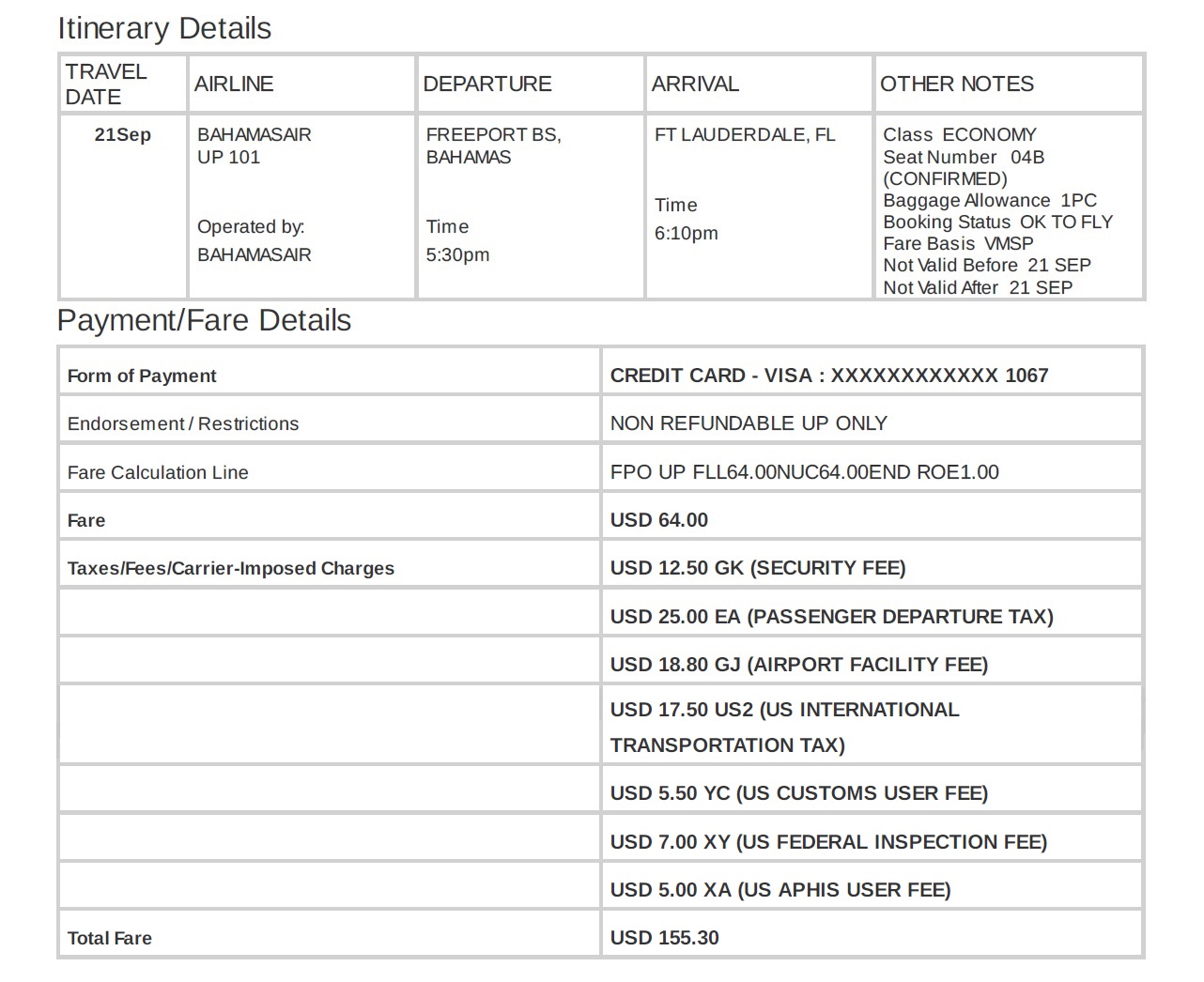
CU Blog - Caribbean less competitive due to increasing aviation taxes - Photo 2See this photo of a recent airline ticket (price breakdown), for one of the stakeholders in the Go Lean movement, who was travelling from a Caribbean island. The reality of these aviation taxes defies logic!

Yes, the governments need their revenues, but this should not be pursued at the expense of undermining viable economic engines; this is self-defeating. Likewise there was a recent conflict with British Aviation Authorities and their unilateral tax on Caribbean air transport. The solution there/then is the same as now: regional coordination and a heightened advocacy; see AppendixVIDEO.

Change has now come to the Caribbean. The book Go Lean … Caribbean serves as a roadmap for the introduction and implementation of the Caribbean Union Trade Federation (CU), an alliance of the 30 Caribbean member-states. This Go Lean roadmap has 3 prime directives:

  • Optimization of the economic engines in order to grow the regional economy to $800 Billion and create 2.2 million new jobs..
  • Establishment of a security apparatus to protect the resultant economic engines.
  • Improve Caribbean governance to support these engines.

The roadmap calls for the CU to navigate the changed landscape of the globalized air transport industry. There is the need for regional integration, administration, and promotion for Caribbean air travel among local and foreign carriers. The book posits that transportation and logistics empower the economic engines of a community. There must be air carrier solutions to service the transportation and tourism needs of the Caribbean islands. This point is fully appreciated by Caribbean tourism stakeholders; the book relates that the region’s Hotel and Tourism Association channel the vision of Robert Crandall, former Chairman of American Airlines, who remarked at a Caribbean Hotel and Tourism Investment Conference in May 2010 that the region is uniquely dependent on tourism:

“Everyone involved in travel and tourism knows that our [airline] industry is immensely important to the world economy, generating and supporting – either directly or indirectly – about one in eleven jobs worldwide. Here in the Caribbean, it is even more important. On a number of islands, travel and tourism accounts for more than 50% of all employment, and on some islands for more than 75%. Overall, about 20% of Caribbean employment is travel and tourism dependent – something on the order of 2.5 million jobs.” – Go Lean … Caribbean Page 60.

Go Lean asserts that air travel options must be optimized to impact Caribbean society – thus the need for more regional coordination, regulation and promotion of the Caribbean’s aviation industry. New models are detailed in the book in which tourism can be enhanced with “air lifts” to facilitate Caribbean events, and “Air Bridges” to allow for targeting High Net Worth markets. This roadmap also introduces the Union Atlantic Turnpike to offer more transportation solutions (ferries, toll roads, railways, and pipelines) to better facilitate the efficient movement of people and cargo.

This is one way the CU will empower the region’s economic engines. This is an example of the change that the CU technocracy will bring!

The Go Lean book presents a series of community ethos that must be adapted to forge this change. In addition, there are these specific strategies, tactics, implementation and advocacies to apply:

Community Ethos – Job Multiplier Page 22
Community Ethos – Lean Operations Page 24
Community Ethos – Cooperatives Page 25
Community Ethos – Ways to Improve Sharing Page 35
Community Ethos – Impacting the Greater Good Page 37
Strategy – Customers – Visitors Page 47
Strategy – Competitive Analysis – Event Patrons Page 55
Strategy – Core Competence – Tourism Page 58
Anecdote – Caribbean Hotel & Tourism Assoc. focus on Air Transport Page 60
Tactical – Fostering a Technocracy Page 64
Tactical – Commerce – Tourism Promotion Page 78
Tactical – Aviation Administration & Promotion Page 84
Implementation – Ways to Deliver Page 109
Implementation – Trade Mission Objectives Page 116
Planning – 10 Big Ideas for the Caribbean Region – #7: Virtual Turnpike Page 127
Planning – Ways to Improve Trade Page 128
Advocacy – Ways to Improve Governance Page 168
Advocacy – Ways to Optimize Government Revenue Sources Page 172
Advocacy – Ways to Enhance Tourism Page 190
Advocacy – Ways to Impact Events Page 191
Advocacy – Ways to Market Southern California – Air Bridge Page 194
Advocacy – Ways to Improve Transportation – Aviation Promotion Page 205
Appendix – Airport Cities – New Approach for Optimizing Business Model Page 287

This commentary posits that the status quo of Caribbean aviation taxes reflect a flawed economic policy, reflective of the dysfunction in the region. This commentary also relates to other lessons of economic optimizations and dysfunctions previously detailed in Go Lean blogs, as sampled here:

Caribbean must work together to address regional industry threats – Example of Rum Subsidies
A Lesson in Aviation History: Concorde SST and the Caribbean
New York-New Jersey Port Authority – Lessons from an Airport Landlord
Bahamas Re-organizing Government Revenues in 2015 with VAT Implementation
Lessons Learned from the American Airlines Merger
Book Review: ‘Wrong – Nine Economic Policy Disasters and What We Can Learn…’
Caribbean Changes – Air Antilles Launches St. Maarten Service
Tourism’s changing profile – Need for Competition and Comparative Analysis

The world loves the Caribbean; people want to come visit and enjoy our hospitality. It is better for them, and for us in the region that they come by air transport. But cruises are viable options, though the Caribbean communities get less benefits from cruise lines (Pages 61 & 193). We simply “fatten our frogs for snake”. The more dysfunction we create with air transport – like these excessive  aviation taxes – the more we push visitors to the cruise option; meaning less direct-indirect spending: hotels, taxis, restaurants, casinos, etc.

Now is the time to lean-in to this roadmap for Caribbean change, as depicted in the book Go Lean…Caribbean. We cannot afford to undermine our economic strengths with disabling tax policies. This is a public trust, betrayed. The Caribbean can – and must – do better.  🙂

Download the free e-Book of Go Lean … Caribbean – now!

APPENDIX Video: A Tax Too Far…? – http://youtu.be/Jbh8DJxUNC8

Uploaded on Oct 30, 2011 – A documentary on how the Air Passenger Duty instituted by the UK is affecting Caribbean Tourism, and the lobbying efforts of the Caribbean Tourism Organization to have it reduced, removed, or the Caribbean re-banded. Get more information about the APD on the CTO website: http://www.onecaribbean.org/our-work/advocacy/

Share this post:
, , , ,
[Top]

Disney World – Role Model for Self-Governing Entities

Go Lean Commentary

The Caribbean enjoys 80 million annual visitors, among its 30 member-states and vast cruise line industry. Impressive!

But one destination in Florida, Walt Disney World, hosted 47.5 million visitors (2009) … alone.[b]

There are lessons for the Caribbean to learn from this experience.

The book Go Lean…Caribbean serves as a roadmap for the introduction and implementation of the Caribbean Union Trade Federation (CU) to glean insight from the Walt Disney World history and experience. This is a huge subject in itself and is an appropriate topic for academic research, dissertations and business improvement books. But for this blog/commentary, there is a narrow focus, the special consideration of the “Self Governing Entity” that emerged from the Reedy Creek Improvement District that facilitated the construction and administration of the landmass that became the Walt Disney World Resort. The following encyclopedic details apply to this study:

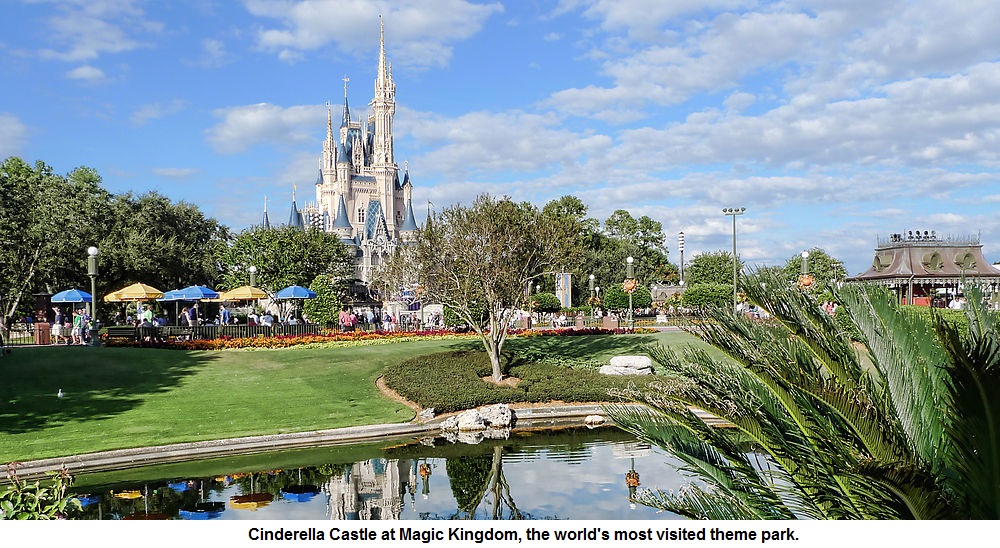
CU Blog - Disney World - Role Model for a Self Governing Entity - Photo 1The Walt Disney World Resort, informally known as Walt Disney World or simply Disney World, is an entertainment complex in Bay Lake, Florida (mailing address is Lake Buena Vista, Florida), near Orlando, Florida and is the flagship of Disney’s worldwide theme park empire. The resort opened on October 7, 1971 and, according to Forbes Magazine, is the most visited vacation resort in the world, with an attendance of 52.5 million annually. It is owned and operated by Walt Disney Parks and Resorts, a division of The Walt Disney Company. The property covers 27,258 acres (11,031 ha; 43 sq mi), in which it houses 27 themed resort hotels, four theme parks, two water parks, four golf courses, one camping resort, one residential area and additional recreational and entertainment venues. MagicKingdom was the first and original theme park to open in the complex followed by EPCOT, Disney’s Hollywood Studios, and Disney’s Animal Kingdom which opened later throughout the 1980s and 1990s.

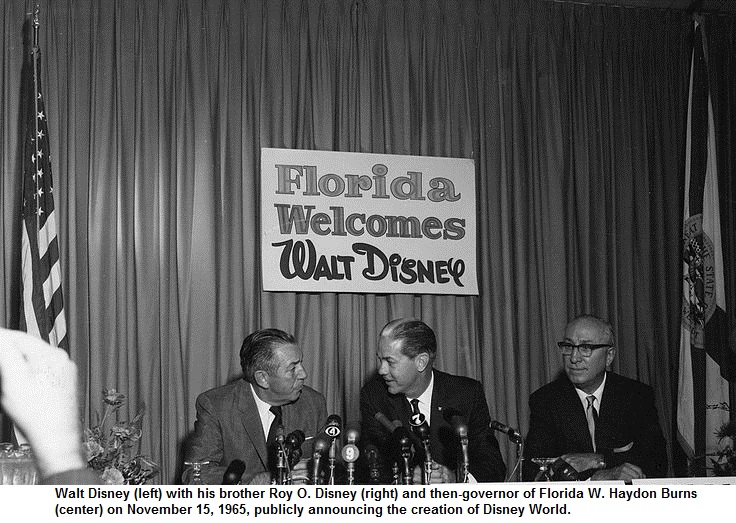
CU Blog - Disney World - Role Model for a Self Governing Entity - Photo 2Designed to supplement Disneyland in Anaheim, California, which had opened in 1955, the complex was developed by Walt Disney in the 1960s, though he died in 1966 before construction on “The Florida Project” began. After extensive lobbying, the Government of Florida created the Reedy Creek Improvement District, a special government district that essentially gave The Walt Disney Company the standard powers and autonomy of an incorporated city. Original plans called for the inclusion of an “Experimental Prototype Community of Tomorrow” (EPCOT), a planned city that would serve as a test bed for new innovations for city living.

The Reedy Creek Improvement District (RCID) is the immediate governing jurisdiction for the land of the Walt Disney World Resort. As of the late 1990s, it comprised an area of 38.6 sq mi (100 km2) within the outer limits of Orange and Osceola counties in Florida. The RCID includes the cities of BayLake and LakeBuena Vista, and unincorporated RCID land.CU Blog - Disney World - Role Model for a Self Governing Entity - Photo 3

After the success of Disneyland in California, Walt Disney began planning a second park on the East Coast. He disliked the businesses that had sprung up around Disneyland, and therefore wanted control of a much larger area of land for the new project. Walt Disney knew that his plans for the land would be easier to carry out with more independence. Among his ideas for his Florida project was his proposed EPCOT which was to be a futuristic planned city. He envisioned a real working city with both commercial and residential areas, but one that also continued to showcase and test new ideas and concepts for urban living.

Therefore, the Disney Company petitioned the Florida State Legislature for the creation of the Reedy Creek Improvement District, which would have almost total autonomy within its borders.
Wikipedia Online Encyclopedia  (Retrieved November 2, 2014) –
http://en.wikipedia.org/wiki/Walt_Disney_World

50 Year Historic Timeline:

1965

Walt Disney announces Florida Project

1966

Walt Disney dies of lung cancer at age 65

1967

Construction of Walt Disney World Resort begins

1971

MagicKingdom
Palm and Magnolia Golf Courses
Disney’s Contemporary Resort
Disney’s Polynesian Resort
Disney’s Fort    Wilderness Resort &   Campground
Roy O. Disney dies at age 78

1972

Disney’s Village Resort

1973

The Golf Resort

1974

DiscoveryIsland

1975

Walt Disney Village Marketplace

1976

Disney’s River Country

1980

Walt Disney World  ConferenceCenter

1982

Epcot

1986

The Disney Inn

1988

Disney’s Grand Floridian Resort & Spa
Disney’s Caribbean  Beach Resort

1989

Disney-MGM Studios
Disney’s Typhoon Lagoon
PleasureIsland

1990

Disney’s Yacht and Beach Club Resort
Walt Disney World Swan
Walt Disney World Dolphin

1991

Disney’s Port Orleans Resort French Quarter
Disney Vacation Club
Disney’s Old Key West Resort

1992

Disney’s Port Orleans Resort Riverside (Dixie Landings)
Bonnet Creek Golf Club

1994

Disney’s All-Star Sports Resort
Disney’s Wilderness Lodge
Shades of Green

1995

Disney’s All-Star Music Resort
Disney’s Blizzard Beach
Disney’s Fairy Tale Wedding Pavilion
Walt Disney World Speedway

1996

Disney Institute
Disney’s BoardWalk Inn and BoardWalk Villas

1997

Disney’s Coronado Springs Resort
Disney’s Wide World of Sports Complex
Downtown Disney West Side

1998

Disney’s Animal Kingdom
DisneyQuest

1999

Disney’s All-Star Movies Resort

2000

The Villas at Disney’s Wilderness Lodge

2001

Disney’s Animal Kingdom Lodge

2002

Disney’s Beach Club Villas

2003

Disney’s Pop Century Resort

2004

Disney’s Saratoga Springs Resort & Spa

2007

Disney’s Animal Kingdom Villas

2008

Disney-MGM Studios is renamed Disney’s Hollywood Studios

2009

Bay Lake Tower at Disney’s Contemporary Resort
Treehouse Villas

2011

Golden Oak at Walt Disney World Resort

2012

Disney’s Art of Animation Resort
Phase 1 of New Fantasyland

2013

The Villas at Disney’s Grand Floridian Resort & Spa

2014

Phase 2 of New Fantasyland

Wikipedia Online Encyclopedia (Retrieved November 2, 2014) –
http://en.wikipedia.org/wiki/Walt_Disney_World

The economic impact of Walt Disney World as a Self-Governing Entity (SGE) is undeniable. The resort is responsible for $18.2 billion in annual economic activity in Florida, said a study released by the theme park giant. The study found that Disney paid out nearly $1.8 billion in compensation to more than 59,000 workers in 2009.[a]

The Go Lean roadmap seek to emulate some of the strategies, tactics and implementation successes of the Walt Disney World as a SGE. This roadmap seeks to elevate the 30 Caribbean member-states with economic engines (direct and indirect spin-off activities), by assuming jurisdiction for Self-Governing Entities in the region and the Exclusive Economic Zone (EEZ) of the 1,063,000 square miles of the Caribbean Sea. This approach allows for initiation, cooperation and coordination of SGE’s (and the EEZ) to effectuate change in the region, allowing these 3 prime directives:

  • Optimization of the economic engines in order to grow the regional economy to $800 Billion GDP and create 2.2 million new jobs.
  • Establishment of a security apparatus to protect the resultant economic engines, specifically in SGE’s and the EEZ.
  • Improve Caribbean governance to support these engines.

Imagine many Disney World-style industrial developments, (not necessarily as touristic resorts), throughout the Caribbean region.

Wow! This is a game-changer.

The individual Walter Elias Disney (1901 – 1966) proved to be a game-changer. The Go Lean book posits that one person can make a difference and positively impact society; so the book advocates for a community ethos of investment in the “gifts” that individuals “bring to the table”. The book identifies the quality of geniuses and relates worthwhile returns from their investments. This mode of study allows us to consider this example of contributions from Walt Disney and his corporate/artistic creations:

 Video: The History of Walt Disney World – http://youtu.be/_6Kesbfg-Ok

The book Go Lean … Caribbean asserts that SGE’s and the EEZ can be strategic, tactical and operationally efficient for elevating Caribbean society. These points are pronounced early in the book with this Declaration of Interdependence (Pages 11 and 14), with these statements:

v.        Whereas the natural formation of our landmass and coastlines entail a large portion of waterscapes, the reality of management of our interior calls for extended oversight of the waterways between the islands. The internationally accepted 12-mile limits for national borders must be extended by International Tribunals to encompass the areas in between islands. The individual states must maintain their 12-mile borders while the sovereignty of this expanded area, the Exclusive Economic Zone, must be vested in the accedence of this Federation.

xxvi.      Whereas the Caribbean region must have new jobs to empower the engines of the economy and create the income sources for prosperity, and encourage the next generation to forge their dreams right at home, the Federation must therefore foster the development of new industries… In addition, the Federation must invigorate the enterprises related to existing industries like tourism … impacting the region with more jobs.

The subject of SGE’s has been directly addressed and further elaborated upon in these previous blog/commentaries:

https://goleancaribbean.com/blog/?p=2338 Using SGE’s to Welcome the Dreaded ‘Plutocracy’
https://goleancaribbean.com/blog/?p=2003 Where the Jobs Are – Ship-breaking under SGE Structure
https://goleancaribbean.com/blog/?p=1214 Fairgrounds as SGE and Landlords for Sports Leagues
https://goleancaribbean.com/blog/?p=286 Puerto Rico’s Comprehensive Cancer Center Project Breaks Ground – Model of Medical SGE

The Go Lean book itself details the economic principles and community ethos to adopt, plus the executions of strategies, tactics, implementations and advocacies to forge Self-Governing Entities and industrial growth in the Caribbean:

Economic Principles – People Choose because Resources are Limited Page 21
Economic Principles – All Choices Involve Costs Page 21
Economic Principles – People Respond to Incentives Page 21
Economic Principles – Economic Systems Influence Individual Choices Page 21
Economic Principles – Voluntary Trade Creates Wealth Page 21
Economic Principles – Consequences of Choices Lie in the Future Page 21
Community Ethos – Job Multiplier Page 22
Community Ethos – “Crap” Happens Page 23
Community Ethos – Lean Operations Page 24
Community Ethos – Return on Investments (ROI) Page 24
Community Ethos – Cooperatives Page 25
Community Ethos – Ways to Impact the Future Page 26
Community Ethos – Ways to Help Entrepreneurship Page 28
Community Ethos – Ways to Impact Research & Development Page 30
Community Ethos – Ways to Improve Negotiations Page 32
Community Ethos – Impact the Greater Good Page 37
Strategy – Vision – Confederating 30 Member-states in a Union Page 45
Strategy – Mission – Build   and Foster Local Economic Engines Page 45
Tactical – Fostering a Technocracy Page 64
Tactical – Growing Economy – New High Multiplier Industries Page 68
Separation of Powers – Department of State – Self-Governing Entities Page 80
Separation of Powers – Interior Department – Exclusive Economic Zone Page 82
Implementation – Ways to Pay for Change – SGE Licenses Page 101
Implementation – Steps to Implement Self-Governing Entities Page 103
Anecdote – French Guiana Space Agency – Example of a SGE Page 103
Implementation   – Benefits from the Exclusive Economic Zone Page 104
Planning – 10 Big Ideas – Self-Governing Entities Page 127
Planning – Ways to Improve Interstate Commerce Page 129
Planning – Lessons from New York City Page 137
Planning – Lessons from Omaha Page 138
Advocacy – Ways to Grow the Economy Page 151
Advocacy – Ways to Create Jobs Page 152
Advocacy – Ways to Better Manage Natural Resources – EEZ and SGE’s Page 183
Anecdote – Caribbean Industrialist & Entrepreneur Role Model Page 189
Advocacy – Ways to Promote Fairgrounds Page 192
Advocacy – Ways to Develop Ship-Building as SGE’s Page 209
Advocacy – Ways to Impact the Prison Industrial Complex as SGE’s Page 211
Advocacy – Ways to Impact the One Percent – Job Creators Inducements Page 224
Advocacy – Ways to Impact Urban Living – Self-Governing Entities Page 234
Advocacy – Ways to Impact Rural Living – Self-Governing Entities Page 235
Advocacy – Ways to Promote World-Heritage-Sites as SGE’s Page 248
Appendix – Airport Cities – Models for Self Governing Entities Page 287

There is a role for the contributions of one impactful person, or one impactful company, in this vision for the elevation and empowerment of the Caribbean homeland. The Go Lean … Caribbean roadmap invites these contributions. However, the roadmap also mitigates the threats of corporate abuse of a plutocracy. With the right applications from people, tools and techniques many SGE initiatives can have a positive impact in changing society, with minimal risks and threats of negative consequences. Walt Disney and the Reedy Creek Improvement District have demonstrated how successful SGE’s can be.

Thank you Walt Disney. Thanks for showing us the way, for providing a role model that we can emulate for our own success.

Change has come to the Caribbean. Everyone is hereby urged to lean-in to this roadmap to make the Caribbean a better place to live, work and play. 🙂

Download the book Go Lean … Caribbean – now!

——————

Appendix – Source References:

a. Retrieved November 3, 2014 from: http://www.bizjournals.com/orlando/news/2011/04/14/disneys-annual-economic-impact-182b.html

b. 2009 Attendance Walt Disney World’s 1. Magic Kingdom: 17.2 million 2. Epcot: 11.0 million 3. Disney’s Hollywood Studios: 9.7 million 4. Disney’s Animal Kingdom: 9.6 million. Retrieved November 3, 2014 from: http://www.themeparkinsider.com/flume/201004/1895/


Share this post:
, , , ,
[Top]

More Business Travelers Flock to Airbnb

Go Lean Commentary

The internet has changed everything.

…especially in the hospitality industry. (Remember Travel Agents?!)

The book and accompanying blog/commentaries for Go Lean…Caribbean posit that the Sharing Economy can emerge more fully in the Caribbean. The Internet & Communications Technology (ICT) provides the tools and techniques. Visitors/tourists will be able to easily search and book houses, condominiums and apartments by connecting directly to the homeowner. This will be a win-win for the homeowner and their guests.

CU Blog - More Business Travelers Flock to Airbnb - Photo

This change is ecstasy for some, but agony for others.

Navigating the world of change is a mission of the Go Lean book. The book posits that the Bed & Breakfast (B&B) industry has evolved with the emerging internet culture and now allow families to share their high-end homes with strangers (and business travelers), in lieu of resort properties (Page 35). This development, like many agents-of-change, brings winners and losers. Hotel room nights and collection of municipal hotel taxes can all be imperiled if this ICT-Sharing development proceeds unchecked. This is why Go Lean promotes “sharing” as a community ethos, so as to mitigate the perils of this industry. We need online sharing tools to target the Caribbean, especially during the peaks of event tourism (festivals, carnivals, fairs). But we need our hotel taxes too.

The challenge with the Sharing Economy, for room rentals and many other areas of life, is one-step forward-two steps-backwards.

See the foregoing news article and the following VIDEO, that depicts the emergence of the company Airbnb:

Video Source: NBC News TODAY Show (Retrieved October 8, 2014)

Corporate travelers are getting creative, using the Internet and home rental sites like Airbnb to find alternative housing rather than checking into hotels. NBC’s Joe Fryer reports. http://on.today.com/2x9Sicg

————–

Title: Democratizing the Sharing Economy – The Center for Popular Economics
By: Anders Fremstad

The internet has sharply reduced the cost of peer-to-peer transactions.  In the 1990s and 2000s, Craigslist and eBay made it much easier to buy and sell secondhand goods, and these sites now facilitate over a million transactions a day.  More recently, online platforms associated with the “sharing economy” are helping friends, neighbors, and even strangers borrow, lend, and rent goods.  Travellers can reserve a spare room through Airbnb or find a free place to crash on Couchsurfing.  People can find a ride on Uber or rent a neighbor’s car on RelayRides.  Neighbors can increasingly borrow tools, gear, and appliances free-of-charge on NeighborGoods, Sharetribe, and similar sites.

Most observers celebrate how the sharing economy lowers the cost of accessing goods, but there is a growing debate over how these online platforms should be regulated.  Unfortunately, this debate ignores how many of the fundamental problems with the sharing economy arise from its corporate nature.  The solution may not be to simply regulate the corporate sharing economy but to also democratize the sharing economy by empowering the people who use these platforms to determine how they work.

Source: http://www.populareconomics.org/democratizing-the-sharing-economy/  Posted 06-24-2014; retrieved 10-10-2014

The book serves as a roadmap for the introduction and implementation of the technocratic Caribbean Union Trade Federation (CU). The roadmap posits that many issues and challenges for a Sharing Economy can only be managed with feasible economies-of-scale. The CU market size of 30 member-states and 42 million people will allow for the leverage to consolidate, collaborate and confederate the organizational dynamics to tackle these issues.

The book Go Lean…Caribbean anticipates the compelling issues associated with room sharing in the emerging new economy.

The book asserts that before the strategies, tactics and implementations of the roadmap can be deployed, the affected communities must first embrace a progressive community ethos. The book defines this “community ethos” as the fundamental character or spirit of a culture; the underlying sentiment that informs the beliefs, customs, or practices of society; dominant assumptions of a people or period. The Go Lean book stresses that the current community ethos must change and the best way to motivate people to adapt their values and priorities is in response to a crisis. The roadmap recognizes this fact with the pronouncement that the Caribbean is in crisis, and that “a crisis is a terrible thing to waste”. The region is devastated from external factors: global economic recession, globalization and rapid technology changes.

Cause and effect!

The Go Lean roadmap promotes development activity for the new ICT global economy, first in the anticipation and then in response of the demands of the Sharing Economy. Even if there is no international trade realization, these developments are needed for the integrated domestic “Single Market”. The roadmap incubates these industrial initiatives to promote the practice:

  • Caribbean Cloud – The Go Lean roadmap calls for the establishment of the Caribbean Cloud, an online community and social media initiative dubbed as myCaribbean.gov. This effort will be exerted by the Caribbean Postal Union (CPU) so as to impact allCaribbean stakeholders: residents, businesses, Diaspora, trading partners, visitors – a universe of 150 million people. TheCaribbean region accommodates 80 million visitors every year. The strategy of maintaining contact with previous visitors steadily increases the universe … and potential customer-base.
  • Mobile Applications – The Go Lean roadmap defines the mastery of time-&-space as strategic for succeeding in mobile apps development and deployment for the region (Page 35). Products like AirBnB and competitors, master mobile apps so that dynamic decisions and impulse buying can be exploited on behalf of touristic properties. Imagine a customer seeing an advertising billboard for a Caribbean resort in a North American city, in the middle of a snow storm, at the moment the desire to partake of Caribbean hospitality may be a great inclination.

The book asserts that to adapt to the new Sharing Economy, there must be a new internal optimization of the region’s strengths. This is defined in the following statement of the opening Declaration of Interdependence (Page 14):

xxvii. Whereas the region has endured a spectator status during the Industrial Revolution, we cannot stand on the sidelines of this new economy, the Information Revolution. Rather, the Federation must embrace all the tenets of Internet Communications Technology (ICT) to serve as an equalizing element in competition with the rest of the world. The Federation must bridge the digital divide and promote the community ethos that research/development is valuable and must be promoted and incentivized for adoption.

Something old, something new, something borrowed, something blue – Old Adage regarding marriage and weddings.

The quest to elevate Caribbean society includes embracing the “New Economy” and also optimizing ongoing economic engines; in this case tourism. This can be likened to a marriage. The CU will employ technologically innovative products and services to marry the “New Economy” with the “Old Economy”. This impact is pronounced in the CU‘s prime directives, identified with the following 3 statements:

  • Optimization of the economic engines in order to grow the regional economy to $800 Billion & create 2.2 million new jobs.
  • Establishment of a security apparatus to protect the resultant economic engines.
  • Improve Caribbean governance to support these engines.

The subject in this blog/commentary, of focusing on the intersection of the “Old Economy” with the “New Economy”, the 100-year old tourism product with the brand new internet, is a big challenge, requiring brand new leadership. This Agent-of-Change is impacting all aspects of commerce in the modern world, including the tourism product.

This subject of “New Economy’s” shared hospitality services has been previously covered in these Go Lean blogs, highlighted here in the following samples:

https://goleancaribbean.com/blog/?p=1364 Car-Sharing Uber Demonstrations Snarl Traffic from London to Berlin
https://goleancaribbean.com/blog/?p=486 Incubator firm (Temasek) backs Southeast Asia cab booking app GrabTaxi

In line with the foregoing article and VIDEO, the Go Lean book details the applicable community ethos, strategies, tactics, implementation and advocacies as a roadmap to foster this change/empowerment in the region for the Sharing Economy and to impact the tourism product:

Community Ethos – Ways to Impact the Future Page 26
Community Ethos – Ways to Help Entrepreneurship Page 28
Community Ethos – Promote Intellectual Property Page 29
Community Ethos – Ways to Bridge the Digital Divide Page 31
Community Ethos – Ways to Improve Sharing Page 35
Strategy – Confederate 30 Caribbean Member-States Page 45
Strategy – Customers – Citizens, Diaspora and Visitors Page 47
Strategy – Agents of Change – Technology Page 57
Tactical – Separation of Powers – Caribbean Cloud Page 74
Tactical – Separation of Powers – Caribbean Postal Union   (CPU) Page 78
Implementation – Year 1 / Assemble Phase – Establish CPU Page 96
Implementation – 10 Trends in Implementing Data Centers Page 106
Implementation – Improve Mail Services – Electronic Supplements Page 108
Implementation – Ways to Impact Social Media Page 111
Advocacy – Ways to Benefit from Globalization – Level Playing Field with ICT Page 129
Advocacy – Ways to Grow the Economy Page 151
Advocacy – Ways to Create Jobs Page 152
Advocacy – Revenue Sources for Regional Administrations Page 172
Advocacy – Ways to Enhance Tourism Page 190
Advocacy – Ways to Impact Events Page 191
Advocacy – Ways to Market Southern California Page 194
Advocacy – Ways to Foster Technology Page 197
Advocacy – Ways to Foster e-Commerce Page 198
Advocacy – Ways to Impact Main Street Page 201
Advocacy – Ways to Promote Call Centers Page 212
Advocacy – Ways to Impact the Diaspora Page 217
Appendix – Urban Bicycle Sharing Model Page 352

The roadmap posits that the CU will foster and incubate the Shared Economy and the Mobile Apps industry, thereby forging entrepreneurial incentives and jobs. Under the right climate, innovations can thrive. We need that climate here in the Caribbean; we must remain competitive, as a people and as a tourism market. As related in the foregoing article and VIDEO, the general market is embracing the Shared Economy.

The world has changed!

This change can be good. We can make the Caribbean, a better place to live, work and play.

Download the book Go Lean … Caribbean – now!

Share this post:
, , ,
[Top]

Stopping Ebola

Go Lean Commentary

CU Blog - Stopping Ebola - Photo 1What a cute little boy in this photo…

Look at that sly look. It’s as if he just doesn’t understand why he is expected to believe the “nonsense”. He will not “drink the Kool-Aid”.

From the mouths of babes -The Bible; Matthew 21:16

The below article by the Editorial Board of the Miami Herald newspaper seems to indicate that someone has been “drinking the Kool-Aid”. Ebola is not an American problem. As of this moment the figures reported by the World Health Organization is that 2,300 people have died during this recent spread of Ebola in West Africa (Sierra Leone, Liberia, Guinea and other neighboring countries). What’s more, that number afflicted is expected to rise to 20,000 by the end of November. What’s worse, 70% of the afflicted are expected to die, if nothing is done.

There is the need for leadership.

This editorial article therefore petitions for American leadership in this Ebola threat:

By: Miami Herald Editorial Board

CU Blog - Stopping Ebola - Photo 2 Rarely has the idea of the global village and the mantra that the world is one big neighborhood seemed as real as in the frightening case of the raging Ebola epidemic in Africa.

There was a time, not so long ago, that an outbreak of disease anywhere in the Third World would have seemed far removed from the daily concerns of Americans and the nation’s foreign-policy agenda. Safely protected from foreign plagues by vast oceans, U.S. leaders would not have felt compelled to order a rapid response along the lines announced last week by President Obama as a matter of self-protection.

There might have been a tardy and symbolic response, if any at all, but certainly it would not have been treated as a priority demanding presidential action, complete with a significant military deployment.

What makes Ebola different is the realization that the world is indeed smaller, that modern modes of transportation — with busier travel patterns and habits — have lowered the barriers against infection. In places like Miami, a major port of entry for overseas visitors, the threat is very real, and Ebola is a particularly scary virus.

The disease kills between 50 percent and 90 percent of people infected with the virus, and there is as yet no specific and effective treatment available. No vaccine exists. Senior U.N. officials say cases are rising at an almost exponential level, with 5,000 reported by the end of August and many more expected.

Officials in Africa are plainly scared, and should be. Over the weekend, the government in Sierra Leone confined the country’s entire population, some 6 million people, to their homes for three days, an action that one news report called “the most sweeping lockdown against disease since the Middle Ages.”

Some experts estimate that as many as 20,000 people could become infected before the epidemic is under control. Others said the number would be several times higher by year’s end.

“We don’t know where the numbers are going,” said Dr. Bruce Aylward, assistant director general of the World Health Organization. He said the virus was spreading faster than the (belated) escalation of the response by the international community.

Indeed, the international community could have responded more quickly, and more effectively. A major outbreak was reported in Guinea in March by WHO, but it was not until last week that President Obama announced action commensurate with the nature of the threat.

He ordered a deployment of medicine, equipment and soldiers to Liberia and Senegal. A contingent of 3,000 military personnel will help build emergency treatment centers and establish what Pentagon officials call “command and control” assistance to coordinate the overall effort with other countries. According to the White House, the Centers for Disease Control and Prevention has committed more than $100 million to the fight since the outbreak started, but months were lost before the alarm was sounded outside the borders of the affected countries.

As Mr. Obama explained, as a virus multiplies, it also mutates to fight human immunology and counter-measures. That adds to the urgency of the crisis and makes it imperative for the United   States to coordinate an effort on a scale large enough to make a difference.
Miami Herald Daily Newspaper (Posted 09-21-2014) – http://www.miamiherald.com/opinion/editorials/article2180670.html

Ebola is not an American problem but when American citizens have been afflicted, the US response has been inspiringly genius, deploying a potential cure within a week. (See caption on above photo). This is not the resume of a global leader, this is the resume of a nation playing favorites.

CU Blog - Stopping Ebola - Photo 3

The book Go Lean…Caribbean posits that the Caribbean region must promote its own interest and protect its own citizens. We cannot count on the US to pursue the Greater Good for the whole world, or the Caribbean for that matter. Assuredly, we must have our own preparation and response vehicle.

This is the goal of the Go Lean…Caribbean book.

The book serves as a roadmap for the introduction and implementation of that regional sentinel, the Caribbean Union Trade Federation (CU). The complete prime directives of the CU:

  • Optimize the economic engines of the Caribbean to elevate the regional economy.
  • Establish a security apparatus to protect the resultant economic engines.
  • Improve Caribbean governance to support these engines.

This CU roadmap declares that “Crap happens” (Page 23). The Go Lean roadmap immediately calls for the establishment of a Homeland Security Department, with an agency to practice the arts and sciences of Emergency Management. The emergencies include more than natural disasters (hurricanes, earthquakes, tsunamis, volcanoes, flooding, forest fires, and droughts), they include the man-made variety (industrial accidents, oil spills, factory accidents, chemical spills, explosions, terroristic attacks, prison riots) and epidemic threats. Of course, these types of emergencies, described in the foregoing article, require professional expertise, a medical discipline. Stopping Ebola therefore would require a hybrid response of the Emergency Management agency and the CU’s Department of Health Disease Control & Management agency. This agency of Medical experts would help contend with systemic threats of epidemic illness and infectious diseases.

The Go Lean roadmap immediately calls for the coordination of security monitoring and mitigation in the Caribbean; this point is declared early in the Go Lean book with a pronouncement in the Declaration of Interdependence (Page 12), as follows:

xvi. Whereas security of our homeland is inextricably linked to prosperity of the homeland, the economic and security interest of the region needs to be aligned under the same governance. …[to ensure] the functioning of the wheels of commerce for all the citizenry, the accedence of this Federation must equip the security apparatus with the tools and techniques for predictive and proactive interdictions.

The Go Lean roadmap calls for the integration of the viral sentinel responsibility of the 30 Caribbean member-states, despite the 4 different languages and 5 colonial legacies (American, British, Dutch, French, Spanish) into a Trade Federation with the tools/techniques to bring immediate change to the region to benefit one and all member-states. This includes the monitoring and epidemiological defense of common and emerging viruses. This empowered CU agency will liaison with foreign entities with the same scope, like the World Health Organization (WHO), and the US’s Center for Disease Control (CDC). The need for this empowerment had previously been discussed in a similar blog/commentary regarding the Chikungunya virus.

Embedded YouTube Video: https://www.youtube.com/watch?v=Ui8wMZpwnp0

Since the CU roadmap leads with economic reform, the primary economic driver of the region (tourism) would be a constant concern. A lot is at stake if the Ebola threat comes to Caribbean shores. The realization, or even the unsubstantiated rumor, of viral outbreaks can imperil the tourism product. We must therefore take proactive steps to protect our economic engines. So there are heavy responsibilities for the stewardship of the Caribbean economy, security and governing engines; the goal is to impact the Greater Good of the entire Caribbean region. There is the need for a Caribbean-based agency to do the heavy-lifting of epidemiology for the region – no such entity exists today.  The emerging CU will invite this role and will promote it as a community ethos.

The book details the community ethos, plus the executions of the following strategies, tactics, implementations and advocacies to impact the region’s public health security in protection of the economy:

Community Ethos – Privacy versus Public Protection Page 23
Community Ethos – “Crap” Happens Page 23
Community Ethos – Lean Operations Page 24
Community Ethos – Cooperatives Page 24
Community Ethos – Non-Government Organizations Page 25
Community Ethos – Ways to Improve Sharing Page 35
Community Ethos – Impact the Greater Good Page 37
Strategy – Vision – Confederate a Non-Sovereign Single Market Entity Page 45
Strategy – Customers – Residents & Visitors Page 47
Strategy – Agents of Change – Globalization Page 57
Tactical – Confederating a Permanent Union Page 63
Tactical – Fostering a Technocracy Page 64
Separation of Powers – Emergency Management Page 76
Separation of Powers – Disease Control & Management Page 86
Implementation – Ways to Pay for Change Page 101
Implementation – Security Initiatives at Start-up Page 103
Implementation – Ways to Deliver Page 109
Implementation – Ways to Foster International Aid Page 115
Implementation – Ways to Benefit from Globalization Page 119
Planning – Ways to Improve Failed-State Indices Page 134
Planning – Ways to Measure Progress Page 148
Advocacy – Ways to Grow the Economy Page 151
Advocacy – Ways to Improve Healthcare Page 156
Advocacy – Ways to Improve Governance Page 168
Advocacy – Ways to Better Manage the Social Contract Page 170
Advocacy – Ways to Foster Cooperatives Page 176
Advocacy – Ways to Improve for Natural Disasters Page 184
Advocacy – Ways to Improve Emergency Management Page 196

The foregoing news editorial assumes the US will be altruistic and only pursue the Greater Good for the rest of the world.

LOL…

Recent Go Lean blogs have reported that the US is still not an equal society for its own citizens; forget those in foreign lands looking to the US for leadership. See sample list here:

https://goleancaribbean.com/blog/?p=2297 A Lesson in US Racial History – Booker T versus Du Bois
https://goleancaribbean.com/blog/?p=2259 The Criminalization of American Business
https://goleancaribbean.com/blog/?p=2251 What’s In A Name… (American Job Discrimination for Minorities)
https://goleancaribbean.com/blog/?p=2183 A Textbook Case of Price-gouging
https://goleancaribbean.com/blog/?p=1896 The Unbalanced Crisis in Black Homeownership
https://goleancaribbean.com/blog/?p=1832 Many drug inmates who get break under new plan to be deported
https://goleancaribbean.com/blog/?p=1674 Obama’s Plans for $3.7 Billion Immigration Crisis Funds
https://goleancaribbean.com/blog/?p=1143 Health-care fraud in America; criminals take $272 billion a year
https://goleancaribbean.com/blog/?p=789 America’s War on the Caribbean
https://goleancaribbean.com/blog/?p=546 Book Review: ‘The Divide’ – American Injustice in the Age of the Wealth Gap
https://goleancaribbean.com/blog/?p=341 Hypocritical US slams Caribbean human rights practices
https://goleancaribbean.com/blog/?p=273 10 Things We Don’t Want from the US: #7 – Discrimination of Immigrants

The change now being fostered by this Go Lean roadmap (and blogs) is focused on the Caribbean member-states, not on the United States of America. The US is out-of-scope; the Caribbean, on the other hand is our home. According to the old adage: “charity begins at home”.

The region is hereby urged to lean-in to this Go Lean roadmap, to fulfill the vision of making the Caribbean region a better place to live, work and play.

Share this post:
, , , , , , ,
[Top]

Hotels are making billions from added fees

Go Lean Commentary

CU Blog - Hotels are making billions from added fees - Photo 1

The attack on the middle class continues…

The foregoing news article/VIDEO relates to the middle class in the US. Normally this would not be an issue for the Caribbean to consider except this story is relating the pressures on the customer base that the region relies on for its primary economic driver: tourism.

Plus most Caribbean resorts also apply a “resort fee”.

By: NBC News – The Today Show
How hotels are making billions from added fees – http://www.today.com/video/today/55935286#55935286
Hotels are taking a page from the airline industry, and it’s costing consumers a lot more. The fees added up to $2.5 billion just last year. NBC’s Kerry Sanders reports.

This subject is pivotal in the roadmap for elevation of the Caribbean economy, which maintains that tourism will continue to be the primary economic driver in the region for the foreseeable future. The book Go Lean…Caribbean calls for the elevation of Caribbean society, to re-focus, re-boot, and optimize all the engines of commerce so as to make the Caribbean a better place to live, work and play. The Caribbean has become a playground for the US. So we cannot, indeed we must not ignore the middle class.

What is important in this discussion is the functionality of economic planning. Already the attacks on the middle class has shrunk their disposable income, retirement savings and buying power. We need to continue to monitor the progress of this economic group. This effort (the foregoing VIDEO and the Appendix) is an iteration in this monitoring charter.

The Great Recession came and went. The US lost $11 Trillion in the crisis, then gained $13.5 Trillion in the recovery (Go Lean book Page 69). Unfortunately the ones that lost are not the ones that gained. The world has changed; the middle class has shrunk, the poor has expanded, and the One Percent has expanded in affluence and influence.

So the markets that Caribbean tourism planners cater to have now changed. The Great Recession should have been a lesson enough for the Caribbean to develop a more resilient economy, to be nimble in strategies, tactics and implementation. Unfortunately, the experience (and the following list) shows that the planners are repeating the same mistakes and following the same bad American model. The following are resort fees of what are considered the best properties in the Caribbean, according to the US-based cable TV Travel Channel (http://www.travelchannel.com/interests/beaches/articles/top-10-caribbean-resorts):

Preface: Top 10 Caribbean Resorts

Welcome to paradise. We’re counting down Caribbean resorts with crystal-clear waters, powder-soft sands, sumptuous settings and world-class accommodations. These aren’t your average cookie-cutter beachfront hotels either. These Caribbean hot spots rank among the most luxurious and lavish in the world:

Resort Property

Resort Fee

1

Hyatt Regency, Aruba Resort & Casino

– $0.00 –

2

CaneelBay, St. John, US Virgin Island

10% Service Fee

3

Parrot Cay By Como, Providenciales, Turks and Caicos Islands

– $0.00 –

4

Little Dix Bay, Virgin Gorda, British Virgin Islands

$32.00

5

Beaches Turks & Caicos Resort and Spa, Providenciales

All   Inclusive

6

Ritz-Carlton St. Thomas, St. Thomas, US Virgin Islands

$62.00

7

Four Seasons Resort, Pinney’s Beach, Charlestown, Nevis

$33.85 + $20.00

8

Atlantis, ParadiseIsland, Nassau, Bahamas

$20.70 – $65.95

9

Sandy Lane, St. James, Barbados

– $0.00 –

10

Hotel Maroma, Cancun, Mexico St. Regis Bahia Beach Resort, Puerto Rico

$60.00

According to the foregoing VIDEO and article in the Appendix, there are major issues in the acceptance of hotel resort fees. In the US, complaints have been made to the Federal Trade Commission (FTC), the US watchdog for deceptive business practices. Despite some queries, there has been no definitive regulatory action.

CU Blog - Hotels are making billions from added fees - Photo 2We must do better in the Caribbean. The fear is that these practices may lead more to embrace “cruises” as their mode for enjoying Caribbean shores. This may be how the US middle class “plays” in the Caribbean.

What is wrong with cruises? Nothing … per se. We welcome all visitors that come to the region. As it is, the Go Lean book describes 80 million visitors annually. If there is a preference though, we would choose air-hotel packages as opposed to cruise options. The Go Lean book details that cruise passengers average $237/day in spending while on a cruise ship. Unfortunately, the majority (80%) of that money is spent with the foreign-based cruise line, not in the destination; the port cities get trinkets ($20 – $30 per day) in port-side souvenirs and tours.

Resort hotels in the Caribbean generate a lot of economic activities down the line: airports, taxis, restaurants, casinos, shopping, etc. The strategy employed by cruise lines is to embed most of all these activities on the ship. This difference is not ignored in the Go Lean consideration of Caribbean commerce (Page 61).

This book Go Lean… Caribbean, serves as a roadmap for the introduction and implementation of the technocratic Caribbean Union Trade Federation (CU). The CU/Go Lean roadmap has 3 prime directives:

  • Optimization of the economic engines in order to grow the regional economy to $800 Billion and create 2.2 million new jobs.
  • Establishment of a security apparatus to protect the resultant economic engines and marshal against economic crimes.
  • Improve Caribbean governance to support these engines.

Early in the book, the responsibility of monitoring and managing economic trends were identified as a crucial role of the CU; these statements were pronounced in the Declaration of Interdependence (Pages 13) as follows:

xxiv. Whereas a free market economy can be induced and spurred for continuous progress, the Federation must install the controls to better manage aspects of the economy: jobs, inflation, savings rate, investments and other economic principles. Thereby attracting direct foreign investment because of the stability and vibrancy of our economy.

xxv.  Whereas the legacy of international democracies had been imperiled due to a global financial crisis, the structure of the Federation must allow for financial stability and assurance of the Federation’s institutions. To mandate the economic vibrancy of the region, monetary and fiscal controls and policies must be incorporated as proactive and reactive measures. These measures must address threats against the financial integrity of the Federation and of the member-states.

The Caribbean tourism resort properties depend on their resort amenities. This commentary previously related details of the changing macro-economic factors (like demographics) that are currently affecting the region’s resorts, including amenities like golf and casinos:

https://goleancaribbean.com/blog/?p=1984 Casinos Changing/Failing Business Model
https://goleancaribbean.com/blog/?p=1943 The Future of Golf; Vital for   Tourism
https://goleancaribbean.com/blog/?p=782 Open/Review the Time Capsule: The Great Recession of 2008
https://goleancaribbean.com/blog/?p=273 10 Things We Want from the US and 10 Things We Don’t Want from the US – # 2: Tourists
https://goleancaribbean.com/blog/?p=242 The Erosion of the Middle Class
https://goleancaribbean.com/blog/?p=235 Tourism’s changing profile

Accordingly the tourist industry needs to be cognizant of the changing landscape in world economics; they need to minimize the downward pressure on their product. There needs to be a promoter for Caribbean commerce and a Sentinel for Caribbean image.

Who is up for this challenge? Not the FTC; despite having two Caribbean territories within its scope (Puerto Rico & US Virgin Islands), this agency has “fallen asleep at the switch” in its duty to regulate the markets and mandate a level-playing-field. For the Caribbean (region as a whole) we must perform this function on our own.

This roadmap posits that the Caribbean must not allow the US to lead for our own nation-building. We must step up and step forward for ourselves. We have the means and the methods to better ensure a quality experience to our hotel/resort visitors. The roadmap calls for oversight by an Interstate Commerce Administration within the Commerce Department of the CU. But there is no need for Caribbean hoteliers to fear! This agency will be more of a partner/promoter than that of a regulator. The plan is simple: require non-optional resort fee pricing to be fully disclosed as part of the base hotel rate. Then ensure a level-playing-field for all market participants.

This strategy, tactic and implementation features the heavy-lifting of Caribbean economic reform/reboot. Caribbean tourism is in need of this reform/reboot to attract and return visitors to our shores to enjoy our hospitality. But the interest of our visitors must also be protected, they are also stakeholders in the Caribbean reboot effort. The Go Lean… Caribbean book details the community ethos to adopt to proactively mitigate the dire effects of the changed demographic landscape, plus the executions of these additional strategies, tactics, implementations and advocacies:

Community Ethos – Economic Principle – People Respond to Incentives Page 21
Community Ethos – Economic Principle – Economic Systems Influence Individual Choices Page 21
Community Ethos – Job Multiplier Page 22
Community Ethos – Lean Operations Page 24
Community Ethos – Ways to Impact the Greater Good Page 37
Strategy – Vision – Best Address on the Planet Page 45
Tactical – Fostering a Technocracy Page 64
Tactical – Trade and Globalization Page 70
Separation of Powers – Sports and Culture Administration Page 81
Implementation – Ways to Pay for Change Page 101
Implementation – Ways to Deliver Page 109
Implementation – Ways to Impact Social Media Page 111
Implementation – Ways to Benefit from Globalization Page 119
Planning – Ways to Make the Caribbean Better Page 131
Planning – Lessons Learned from 2008 Page 136
Advocacy – Ways to Grow the Economy Page 151
Advocacy – Ways to Create Jobs Page 152
Anecdote – Butch   Stewart – Sandals Resorts Growth in   Tourism – Responding to  Guests Needs Page 189
Advocacy – Ways to Enhance Tourism Page 190
Advocacy – Ways to Impact Cruise Tourism Page 193
Advocacy – Ways to Foster Technology Page 197
Advocacy – Ways to Foster e-Commerce Page 198
Advocacy – Ways to Help the Middle Class Page 223
Advocacy – Ways to Impact the One Percent Page 224

The book Go Lean…Caribbean purports that the Caribbean is the greatest address in the world and sets on a roadmap to extend the invitation of Caribbean hospitality to not just Americans, but also the rest of the world. In order to appeal to the global market, this roadmap, posits that regional tourism stakeholders must traverse the changing landscape, in which some of the agents-of-change are technology and globalization.

The plan also calls for establishing Trade Mission Offices in divergent cities like Spain and Tokyo for outreach to Mid & Far Eastern markets.

The issues in the foregoing news stories emerged mostly because of the different experiences in booking hotel rooms online and then engaging the resort properties at check-in/check-out.  The roadmap advocates the art and science of using Internet & Communications Technologies and Social Media for bookings, and also for the advertising and selling of Caribbean culture and amenities. The plan is also to monitor and track comments/complaints from online postings – many have complained about being “nickeled-and-dimed” in hotels due to various resort/amenity fees.

With this roadmap, the people (and governing institutions) of the Caribbean step up and declare that we have learned from the lessons of the past; we have streamlined our products/services and we are ready to be the best address for the world to visit, even for those among the middle classes. The Caribbean therefore prepares for a better future, one in which the world recognizes that we are the best place to live, work and play.

Download the book Go Lean … Caribbean – now!

—————————————————————————

APPENDIX

Title: News Article: Resort Fees Explained: How to Spot (and Avoid) Them on Your Next Trip
Source: http://www.huffingtonpost.com/shermans-travel/resort-fees_b_4098716.html

Ah, those pesky resort fees. We’ve all encountered them in our travels, lurking on our hotel bills.

They’ve been around since the 1990s when they were generally utilized to pay for the upkeep of high-end facilities at upscale resorts; the beach clubs and tennis courts, for example. However, in the last five years or so, more and more hotels have been tacking on these annoying — and often spendy — extra charges for considerably lower-end facilities. For example, almost every explanation of these fees we’ve encountered includes such uninspiring “perks” as a newspaper and local phone calls.

According to research by Bjorn Hanson, divisional dean of the PrestonRobertTischCenter for Hospitality, Tourism, and Sports Management at New YorkUniversity, the U.S. hotel industry collected approximately $1.55 billion in fees and surcharges in 2009. Not all of which were resort fees, but you can see how fees and extras add up. Here’s a breakdown of these fees, how they work, when they’re charged, and how you can avoid them.

What is a Resort Fee?

A resort fee is a (usually unadvertised) mandatory fee tacked onto a nightly room rate. Fees can be as low as $3.50 per night at the Clarion Inn & Suites at International Drive, Orlando (they call this one a “safe fee”), to as much as $60 per night for the St. Regis Bahia Beach Resort, Puerto Rico.

A resort fee is almost always a fixed rate that is paid per room, per night, however some of the perks that come with the fee are only good for one person; like the one mai tai per day, per room offered by the Waikiki Beach Resort & Spa ($25 a day), or at Bally’s Las Vegas, where rooms sleep up to four people, but the $18 resort fee only allows two people access to the fitness center.

The things included in your fees run the gamut from the sublime ($25 resort fee applied towards some services at The Spa at the Trump Hotel, Las Vegas) to the ridiculous. Notary service at the Mirage Las Vegas ($25), anyone? But generally, the fee includes amenities such as WiFi, shuttle service, a newspaper, and the in-room phone.

Who Charges a Resort Fee?

You’ll find resort fees are most prevalent in a few specific destinations: Las Vegas, the Caribbean, Florida, and Hawaii. In Las Vegas, you’ll be hard pressed to find a hotel that does not charge a resort fee. The few that haven’t charged a fee in the past – such as Ceasar’s, which even launched a Facebook page at one point that asked visitors to “join the fight against Las Vegas resort fees” — are steadily jumping onto the resort fee bandwagon. From the point of view of the hotel, this is understandable. Why miss out on the extra cash that everyone else is already getting?

A few ski resorts also add resort fees, One   Ski Hill Place in Breckenridge, Colorado, for example, charges $30 a night, and the Viceroy Snowmass, also in Colorado, charges $16 a night.

How Do You Know if Your Hotel Charges a Resort Fee?

Read the fine print before you book. Resort fees tend to be hidden from advertised rates – the rationale presumably being that the site can lure guests in with low room rates before hitting them with an extra fee later. Say you’re searching for a hotel in Las Vegas on a third-party web site. You might see a good deal pop up like this one we found: The Palms Casino Resort for $67 on October 22. However, it’s not until you get to the booking page that you see the resort fee listed ($20 per night); bundled together with the taxes.

Several hotels hide the resort fee from their advertised room rates until you are ready to book; and even then they often do not include the fee in the reservation total, instead running a strip of (literally) fine print saying something like “rate and total room rates do not include the daily resort fee of $22 or applicable taxes.” (That’s taken from the Hard Rock Hotel and Casino, Las Vegas). You usually end up handing over the money at check-in or check-out.

While there’s often an element of surprise with resort fees, hotels have at least become more upfront about them since the FTC sent a letter to 22 hotel operators last year warning that their online rates may have been deceptive and in violation of FTC regulations. If you are still unsure, don’t hesitate to call the hotel before booking to ask exactly how much you will be paying, and for what.

Do You Have to Pay It?

The short answer is yes. There are a few resources available if you’re looking for more detail about resort fees. VegasChatter, for example, keeps an up-to-date list of Las Vegas hotels not charging resort fees (it contains only 11 hotels). There’s also no harm in trying to get the fees waived, especially if you advise management that you have no intention of using the facilities, or if you don’t want a newspaper or WiFi. This is more likely to be successful if you have status with the hotel’s loyalty program, which brings us to our final point…

Do You Earn Points on Resort Fees?

No. The extra money you are paying per night does not go toward your loyalty program status – even more reason to read the fine print, and keep yourself informed.

By
Karen Dion.

Share this post:
, , , ,
[Top]

Casinos Changing/Failing Business Model

Go Lean Commentary

Change has come to Atlantic City, New Jersey. Change has come to the world of casino gambling. For the US, there used to be a casino monopoly west of the Mississippi in Las Vegas, and another monopoly east of the Mississippi in Atlantic City.

No More!

Casinos have since popped up in many states (Pennsylvania, Florida, Connecticut, California, Louisiana, Mississippi, etc) all over the country, plus on many federally-legislated Indian Reservations. Additionally, there is the eco-system of casino riverboats and cruise ships leaving major US ports.

Now, the casino hot spots of Las Vegas and Atlantic City have to compete for their customers, and many times, they lose, as depicted in the foregoing news article, which reports that 2 casinos are closing in Atlantic City next month September.

“Who moved my cheese?”

Title: The Atlantic City’s Revel Casino to Close in September
Atlantic City, NJ – Aug 12, 2014, 3:42 PM ET
By: Wayne Parry, Associated Press

CU Blog - Atlantic City's Revel Casino to Close in September - Photo 1When it opened just over two years ago, many people hoped Revel would save Atlantic   City’s struggling casino industry, which has been bleeding money and jobs for years.

But now the $2.4 billion resort that was widely seen as the last, best chance for Atlantic City’s gambling market is shutting down, unable to find a buyer for even pennies on the dollar.

In addition to putting 3,100 people out of jobs and hurting state and local budgets, Revel’s demise shows just how cutthroat the East Coast casino market has become, and how difficult it is for even the newest and nicest gambling halls to survive in an oversaturated market.

Revel Entertainment said the casino and its 1,399 hotel rooms will close on Sept. 10, never having turned a profit.

“We regret the impact this decision has on our Revel employees who have worked so hard to maximize the potential of the property,” Revel said in a statement Tuesday. “We thank them for their professionalism and dedication; however we are faced with several unavoidable circumstances.

“Despite the effort to improve the financial performance of Revel, it has not proven to be enough to put the property on a stable financial footing,” the company wrote.

Revel’s most recent Chapter 11 filing listed assets of $486.9 million and liabilities of $476.1 million.

The company said its situation was compounded by a “considerable non-controllable expense structure” that financially burdened the property. It said it had no choice but “an orderly wind-down of the business at this time.”

Revel said it still hopes to find a buyer through the bankruptcy process. But it acknowledged that if that happened, it would be after the facility had already shut down.

Matthew Levinson, chairman of the New Jersey Casino Control Commission, called the closing “enormously disappointing,” but held out hope for a future sale.

“I sincerely hope that possibility materializes, especially for the employees who face the loss of their jobs,” he said.

Israel Posner, who runs a tourism and gambling study institute at RichardStocktonCollege, said he expects Revel to sell as a non-casino building.

“I still believe Revel will sell, for pennies on the dollar, to someone who will figure out that it is the most modern, beautiful structure that’s going to be built for generations to come,” he said.

The casino was due to be sold at a bankruptcy court auction last week, but that was postponed to allow casino officials to study bids that were received. After Revel’s board met on Monday, the decision was made to shutter the glittering glass-covered casino at the north end of the Boardwalk.

Revel opened in April 2012 as the first new casino in Atlantic City since the Borgata opened nine years earlier, and carried great hopes for many that it would be the catalyst to jolt what had been the nation’s second-largest gambling market back to life. Atlantic City has since slipped to third place behind Nevada and Pennsylvania, whose casinos touched off the New Jersey resort town’s revenue and employment plunge in 2007.

Since 2006, when the first Pennsylvania casino opened, Atlantic City’s casino revenue has fallen from $5.2 billion to $2.86 billion last year.

So far this year, the Atlantic Club closed in January, bought at a bankruptcy auction by the parent companies of Tropicana and Caesars and shuttered in the name of reducing competition. Caesars Entertainment will close the Showboat on Aug. 31, also to reduce the competition in Atlantic City, where it currently owns 4 of the 11 casinos. And TrumpPlaza is due to close Sept. 16.

CU Blog - Atlantic City's Revel Casino to Close in September - Photo 2Revel has ranked near the bottom of Atlantic City’s casinos in terms of the amount of money won from gamblers since the day it opened.

Its original owners envisioned it as a luxury resort that just happened to have a casino, and eschewed many staples of casino culture, including a buffet and bus trips for day-trippers. But that strategy — as well as the only overall smoking ban in Atlantic City — turned off customers, and Revel filed for bankruptcy in 2013, a little over a year after opening.

That led to new ownership and a “Gamblers Wanted” promotional campaign to emphasize the company’s new emphasis on its casino.

But despite some improvement, Revel’s finances never recovered enough, and it filed for bankruptcy a second time in June.
Associated Press News Source (Retrieved August 12, 2014) – http://abcnews.go.com/US/wireStory/atlantic-citys-revel-casino-close-september-24943242


CU Blog - Atlantic City's Revel Casino to Close in September - Photo 3

This article aligns with the book Go Lean…Caribbean, which calls for the elevation of Caribbean economics. The same challenges being experienced in Atlantic City are also affecting Caribbean casino resorts, especially since 2008. For example, the practice of Caribbean casino “junkets” is dead or dying [a].

The book posits that there is a need to re-focus, re-boot, and optimize the engines of commerce so as to make the Caribbean a better place to live, work and play. The tourism product, the mainstay of Caribbean economy, was accustomed to depending on certain amenities that have now come under attack by social change. Whereas golf was a popular day pastime for resort guests, and casino gambling was popular at night, both activities are experiencing decline and implosion in their individual industries. (See this previous blog commentary regarding the Future of Golf). The supply and demand of gambling/gaming options have equally encountered rapid evolutionary change, from lottery tickets, BINGO parlors, online poker,  area pari-mutuels (horse/dog racing, Jai-Alai) and Off-Track Betting.

If only there was an alternate roadmap to elevate Caribbean society without depending on the “games people play” to remain constant. Wait, there is! The book Go Lean… Caribbean, serves as a roadmap for the introduction and implementation of the technocratic Caribbean Union Trade Federation (CU) with the charter to effectuate change in the region with these 3 prime directives:

  • Optimization of the economic engines in order to grow the regional economy to $800 Billion and create 2.2 million new jobs.
  • Establishment of a security apparatus to protect the resultant economic engines and marshal against economic crimes.
  • Improve Caribbean governance to support these engines.

Early in the book, the responsibility to monitor, manage, and mitigate the risks and threats of job killing developments, (such as the reporting in the foregoing news article), were identified as an important function for the CU with this pronouncement in the Declaration of Interdependence (Pages 14):

xxvi.  Whereas the Caribbean region must have new jobs to empower the engines of the economy and create the income sources for prosperity, and encourage the next generation to forge their dreams right at home, the Federation must therefore foster the development of new industries… In addition, the Federation must invigorate the enterprises related to existing industries like tourism… – impacting the region with more jobs.

Many Caribbean tourism resort properties depend on casino gaming. The issue of declining growth or failing business models is an important discussion in the execution of this roadmap. This commentary previously related details of the changing macro-economic factors affecting the region’s economic engines. The following are samples of earlier Go Lean blogs:

https://goleancaribbean.com/blog/?p=1943 The Future of Golf; Vital for Tourism
https://goleancaribbean.com/blog/?p=841 Declining Economic Trends – Having Less Babies is Bad for the Economy
https://goleancaribbean.com/blog/?p=782 Open/Review the Time Capsule: The Great Recession of 2008
https://goleancaribbean.com/blog/?p=709 Econometric Analysis – Student debt holds back many would-be home buyers
https://goleancaribbean.com/blog/?p=356 Book Review: ‘How Numbers Rule the World’ – How Demographic Studies Dictate Policies
https://goleancaribbean.com/blog/?p=242 The Erosion of the Middle Class
https://goleancaribbean.com/blog/?p=235 Tourism’s changing profile

According to the foregoing article, the closing of this one property, the Revel, will directly impact 3,100 jobs. This article failed to mention however the effect on the local market with in-direct jobs. The Go Lean book details the principle of job multipliers, how certain industries are better than others for generating multiple indirect jobs down the line for each direct job on a company’s payroll. (The automotive manufacturing industry was a choice selection with a job-multiplier rate of 11.0 – Page 260)

The Caribbean must contend with many of these same issues as the city leaders of Atlantic City must now deal with. The State of New Jersey is one of the most prosperous in the US, so there’s the chance that many displaced workers can be absorbed into the regional economy. The Caribbean does not have this option – our situation is more dire, especially on self-contained islands. Our society is in desperate need of reform/reboot to insulate many of the macro-economic downward trends that are pending. On the one hand, we must double down on the tourism product. On the other hand, we must diversify our economy and avail other high job-multiplier industries, like automotive manufacturing. The Go Lean… Caribbean book details the community ethos to adopt to diversify our economy and proactively mitigate the dire effects of the changed demographic landscape, plus the executions of the following strategies, tactics, implementations and advocacies:

Community Ethos – Deferred Gratification Page 21
Community Ethos – Economic Principle – People Respond to Incentives Page 21
Community Ethos – Economic Principle – Consequences of Choices Lie in the Future Page 21
Community Ethos – Job Multiplier Page 22
Community Ethos – Lean Operations Page 24
Community Ethos   – Return on Investments (ROI) Page 24
Community Ethos – Ways to Impact the Future Page 26
Community Ethos – Ways to Foster Genius Page 27
Community Ethos – Ways to Help Entrepreneurship Page 28
Community Ethos – Ways to Promote Intellectual Property Page 29
Community Ethos – Ways to Impact Research & Development Page 30
Community Ethos – Ways to Bridge the Digital Divide Page 31
Community Ethos – Ways to Impact the Greater Good Page 37
Strategy – Integrate Region in a Single Market Page 45
Tactical – Fostering a Technocracy Page 64
Tactical – Tactics to Forge an $800 Billion Economy Page 67
Tactical – Separation of Powers Page 71
Implementation – Ways to Deliver Page 109
Planning – Ways to Make the Caribbean Better Page 131
Planning – Lessons Learned from 2008 Page 136
Advocacy – Ways to Grow the Economy Page 151
Advocacy – Ways to Create Jobs Page 152
Advocacy – Ways to Enhance Tourism Page 190
Advocacy – Ways to Impact Events Page 191
Advocacy – Ways to Foster Technology Page 197
Advocacy – Ways to Foster e-Commerce Page 198
Advocacy – Ways to Develop the Auto Industry Page 206
Advocacy – Ways to Help the Middle Class Page 223
Appendix – Job Multipliers Page 259

The CU will foster industrial developments to aid tourism, incorporate best practices and quality assurances to deliver the best hospitality in the world. But there is room for service improvement and enhancement of the regional tourism product.

This roadmap is not advocating the abandonment of casino gambling, though the practice is considered a vice. Rather, the community ethos being promoted is one of open competition and fostering world class deliveries in information technologies. The book posits that the tenets of Internet Communications Technology (ICT) is a great equalizer between large countries and smaller states. To reinforce this point, remember that Japan is far from being the largest population base in the world (only 126 million), yet they are the #3 economy worldwide. Size does not matter…as much, intelligent strategy and efficient delivery matters more.

This Japanese model is fully defined in the Go Lean roadmap, detailing their growth strategies (Page 69) and starting with this Declaration of Interdependence (Pages 14) statement, identified here:

xxxiii.  Whereas lessons can be learned and applied from the study of the recent history of other societies, the Federation must formalize statutes and organizational dimensions to avoid the pitfalls of [certain] communities… On the other hand, the Federation must also implement the good examples learned from developments/communities like … Japan.

The Caribbean can be a better place to live, work and play, perhaps even the best address on the planet.

Download the book Go Lean…Caribbean now!

————————————————————————————–

Appendix a:

Smart Gaming Magazine Article: INSIDE LOOK AT CASINO JUNKETS
By Henry Tamburin

Casino Junkets began in the mid-50’s as a way to entice players to Las Vegas to gamble. Junket programs in those days were pretty straightforward. Casino operators would hire junket reps to fill a plane with qualified gamblers. These players would get free airfare, free hotel accommodations, free meals, free shows (and just about anything else they wanted) in exchange for their commitment to gamble a specific number of hours per day at an explicit average bet size. The casinos of course were gambling that the players would lose more than their out of pocket expenses for bringing, housing and feeding them.

That was the past. To get a fresh look at how junkets operate in 2005 and what benefits they provide players, I interviewed junket rep Sandy Crammer, owner of S&S Casino Tours, and Jeffrey Hoss, Director of National Casino Marketing, for Harrah’s. What I learned about junkets might surprise you (it did me).

So let’s begin by defining what exactly does a Junket rep do?

Jeffrey Hoss: First off, in the Harrah’s organization we refer to our third party reps as Independent Agents rather than Junket Reps. Independent Agents send us customers (i.e. players) and in return they get a commission based on a player’s theoretical. We have about 185 Independent Agents representing 47 states and 5 international countries that have a specific territory that they can market and promote our properties to their customers. In total our Independent Agents have scheduled about 300,000 customer trips annually to Harrah’s properties.

Let me ask Sandy how she got started in this business.

Sandy Crammer: Before I started my own company, I ran a junket office as in-house employee for many years and I decided it was something I liked and wanted to try on my own. So my husband, Scott, and I started our own business and thankfully, Harrah’s decided to take a shot with us four years ago to represent them. We have three employees in our company and currently we are one of the top 5 Independent Agent producers for Harrah’s.
(Source: http://www.smartgaming.com/Articles/gambling_tips_inside_look_casino_junket.html)


Share this post:
, , , ,
[Top]

The Future of Golf; Vital for Tourism

Go Lean Commentary

The book Go Lean…Caribbean calls for the elevation of Caribbean society, to re-focus, re-boot, and optimize all the engines of commerce so as to make the Caribbean a better place to live, work and play.  “The games people play” therefore have relevance for our consideration. Golf is one of those games. But golf is more than just a game, it is an eco-system; but this eco-system is in peril.

“The financial bubble burst and the Tiger bubble burst as well”.
“Even as the economy recovered, golf is still in a nose dive”.
“Your house is on fire”.

These (above) are among the key phrases from the narration of the following HBO Real Sports documentary story:

Host Bryant Gumbel speaks with industry leaders, including Jack Nicklaus, the most accomplished golfer of all time, and executive Mark King about the state of the sport and what innovations should be embraced.

Full Length VIDEO:

YouTube Online Video Site (Published July 23, 2014; Retrieved August 9, 2014) –
https://www.youtube.com/watch?v=QFEYC4Z44v0

This subject is pivotal in the roadmap for elevation of the Caribbean economy, which maintains that tourism will continue to be the primary economic driver in the region for the foreseeable future. The game of “golf” plays a significant role in the business model of tourist resorts. The publisher of the book Go Lean…Caribbean posits that understanding the macro-economic patterns of the game/sport of golf is critical in the roadmap to grow the region’s GDP and creating jobs (2.2 million new jobs projected).

Also important in this discussion is the functionality of economic planning.

According to the foregoing VIDEO, there are major issues in the eco-system of golf. There are 4 major events during the year: The Masters, US Open, British Open and the PGA Championship. The viewership numbers for all 4 events have been declining in the last 7 years, since 2007, the eve of the Great Recession. Stakeholders in this industry cannot ignore this downward trend. For many, this discussion is not just about their past-time, but rather their livelihoods.

For the Caribbean perspective, the subject of golf encapsulates the activities of live, work and play. (Some of the most prime residential properties are on or overlooking golf courses).

Change is constant. Change can be lateral, forward and backwards too. Empires rise and fall, past-time activities change; new sports come into fashion, while others fade into obsolescence. (In the US, boxing is on the decline while Mixed Martial Arts are on the rise).

This book Go Lean… Caribbean, serves as a roadmap for the introduction and implementation of the technocratic Caribbean Union Trade Federation (CU). The CU/Go Lean roadmap has 3 prime directives:

  • Optimization of the economic engines in order to grow the regional economy to $800 Billion and create 2.2 million new jobs.
  • Establishment of a security apparatus to protect the resultant economic engines and marshal against economic crimes.
  • Improve Caribbean governance to support these engines.

Early in the book, the benefit of the “business of sports for community empowerment” is pronounced in the Declaration of Interdependence (Pages 13 & 14), with these opening statements:

xxvi.  Whereas the Caribbean region must have new jobs to empower the engines of the economy and create the income sources for prosperity, and encourage the next generation to forge their dreams right at home, the Federation must therefore foster the development of new industries… In addition, the Federation must invigorate the enterprises related to existing industries like tourism… – impacting the region with more jobs.

xxxi.  Whereas sports have been a source of great pride for the Caribbean region, the economic returns from these ventures have not been evenly distributed as in other societies. The Federation must therefore facilitate the eco-systems and vertical industries of sports as a business, recreation, national pastime and even sports tourism – modeling the Olympics.

CU Blog - The Future of Golf; Vital for Tourism - Photo 1The Caribbean tourism resort properties depend on golf amenities. Many times too, golf courses are built as municipal establishments, so as to benefit citizens through the Parks & Recreation infrastructure. The issues of sufficient returns on the public investments in golf is an important discussion in the execution of this roadmap.

This commentary previously related details of the changing macro-economic factors (like demographics) that affect the region’s economic engines. The following are samples of earlier Go Lean blogs:

https://goleancaribbean.com/blog/?p=1715 Lebronomy – Economic Impact of One Superstar on a Sport/Team’s Viability
https://goleancaribbean.com/blog/?p=1148 Sports Business and Sports Bubbles – Franchise values in basketball
https://goleancaribbean.com/blog/?p=841 Declining Economic Trends – Having Less Babies is Bad for the Economy
https://goleancaribbean.com/blog/?p=782 Open/Review the Time Capsule: The Great Recession of 2008
https://goleancaribbean.com/blog/?p=709 Econometric Analysis – Student debt holds back many would-be home buyers
https://goleancaribbean.com/blog/?p=498 Book Review: ‘The Sports Gene’ – Identifying and Fostering Sports Genius Abilities
https://goleancaribbean.com/blog/?p=356 Book Review: ‘How Numbers Rule the World’ – How Demographic Studies Dictate Policies
https://goleancaribbean.com/blog/?p=318 Empowering Collegiate Sports in the Caribbean
https://goleancaribbean.com/blog/?p=273 10 Things We Want from the US and 10 Things We Don’t Want from the US – # 2: Tourists
https://goleancaribbean.com/blog/?p=254 Air Transport Industry Changes – Air Antilles Launches St. Maarten Service
https://goleancaribbean.com/blog/?p=242 The Erosion of the Middle Class
https://goleancaribbean.com/blog/?p=235 Tourism’s changing profile

According to the foregoing VIDEO, the opulence of golf has not fared well in today’s real economy. The game costs too much, and takes too much time. There is a real chance that this sport will die off with older generations, unless reform can be incorporated to attract and retain younger generations to the sport. Many revisions have been tried – as depicted in the video – there is no tolerating the status quo.

The Caribbean must do the same. Our societies are also in need of reform/reboot to attract and retain the youth to consider their future in their Caribbean homelands. The homelands have been losing at this … badly. There are validated reports of over 70% of the college educated population fleeing the region (https://goleancaribbean.com/blog/?p=1433); this constitutes an undeniable brain drain. The Go Lean… Caribbean book details the community ethos to adopt to proactively mitigate the dire effects of the changed landscape, plus the executions of the following strategies, tactics, implementations and advocacies:

Community Ethos – Deferred Gratification Page 21
Community Ethos – Economic Principle – People Respond to Incentives Page 21
Community Ethos – Economic Principle – Consequences of Choices Lie in the Future Page 21
Community Ethos – Job Multiplier Page 22
Community Ethos – Lean Operations Page 24
Community Ethos – Return on Investments (ROI) Page 24
Community Ethos – Ways to Impact the Future Page 26
Community Ethos – Ways to Foster Genius Page 27
Community Ethos – Impact Research & Development Page 30
Community Ethos – Ways to Impact the Greater Good Page 37
Strategy – Integrate Region in a Single Market Page 45
Tactical – Fostering a Technocracy Page 64
Tactical – Trade and Globalization Page 70
Separation of Powers – Sports and Culture Administration Page 81
Planning – Ways to Make the Caribbean Better Page 131
Planning – Lessons Learned from 2008 Page 136
Advocacy – Ways to Grow the Economy Page 151
Advocacy – Ways to Create Jobs Page 152
Advocacy – Ways to Enhance Tourism Page 190
Advocacy – Ways to Preserve Caribbean Heritage Page 218
Advocacy – Ways to Impact the One Percent Page 224
Advocacy – Ways to Impact Youth Page 227
Advocacy – Ways to Improve Sports Page 229

The CU will foster industrial developments to aid and abet tourism. This is not planning for 1995, but rather 2015. The assumptions of the past, simply no longer apply today. It is what it is!

CU Blog - The Future of Golf; Vital for Tourism - Photo 2“Earlier this year, at the PGA Merchandise Show in Orlando, Mark King, the CEO of the company TaylorMade Golf announced the launch of Hack Golf, a TaylorMade-sponsored initiative that is, at heart, a worldwide call for fresh ideas. Over the next five years, operating in alliance with the Professional Golf Association (PGA) of America, King plans to pump $5 million of his company’s money into what amounts to a global brainstorm session. This constitutes a concerted effort to seek solutions to a demographic problem.” – (http://www.golf.com/tour-and-news/hack-golf-aims-grow-game-taylormade-sponsored-brainstorm-session)

Golf may have a future.

The 2014 PGA Championship was won by Rory McIlroy, a 25 year old golf “phenom”. After Tiger Woods, this sports needs all the young stars they can get a hold off. If only they can attract young viewers.

For the Caribbean, this issue is bigger than just the game of golf; this is life – Caribbean life. We must have a better future, inclusive of all of our young people. How? With the concerted effort as detailed in the 5 year Go Lean roadmap, this region can and will be a better place to live, work and play.

Download the free e-Book of Go Lean … Caribbean – now!

Share this post:
, , ,
[Top]