Tag: Civil Rights

‘Time to Go’ – Blacks get longer sentences from ‘Republican’ Judges

Go Lean Commentary

“Tell me who your friends are and I will tell you who you are” – Old Adage

This Old Adage was drummed in me as a youth; I may have wanted to question its validity, but time has proven its accuracy. As humans, we are affected by the people we associate with; their values, principles, character, aspirations – or lack thereof – will have an effect on us. This statement even harmonizes with the Bible scripture at 1 Corinthians 15:33, which states:

“Bad companions ruin good character.” – Today’s English Version

This commentary highlights a disturbing trend in American jurisprudence; it turns out that among judges that associates with the conservative political parties or the liberal political parties, one group consistently sentences Black defendants to longer prison sentences. This is indicative of more than just the tolerance of criminality; this shows some hidden bias, that severely endangers the Black populations in America. These judges, despite claims of non-partisanship, are affected by their party.

Say it ain’t so!

The party with the harsher sentences is the Republican Party or GOP (for Grand Old Party).

Sometimes, we need to step back and look at the whole picture before we can notice trends and leanings. This is the common sense in the old expression: “One cannot see the forest for the trees”. This was the purpose of a study on judicial bias; it looked at a range of 500,000 cases to summarize its findings. Intelligence and wisdom can be gleaned from this data.

The numbers – and conclusions – must not be ignored. See the full story here:

Title: Black Defendants Get Longer Sentences From Republican-Appointed Judges, Study Finds
By: Adam Liptak

WASHINGTON — Judges appointed by Republican presidents gave longer sentences to black defendants and shorter ones to women than judges appointed by Democrats, according to a new study that analyzed data on more than half a million defendants.

“Republican-appointed judges sentence black defendants to three more months than similar nonblacks and female defendants to two fewer months than similar males compared with Democratic-appointed judges,” the study found, adding, “These differences cannot be explained by other judge characteristics and grow substantially larger when judges are granted more discretion.”

The study was conducted by two professors at Harvard Law School, Alma Cohen and Crystal S. Yang. They examined the sentencing practices of about 1,400 federal trial judges over more than 15 years, relying on information from the Federal Judicial Center, the United States Sentencing Commission and the Transactional Records Access Clearinghouse at Syracuse University.

Douglas A. Berman, an authority on sentencing law at Ohio State University, said the study contained “amazing new empirical research.”

“It’s an extraordinarily important contribution to our statistical understanding of sentencing decision making in federal courts over the last two decades,” he said.

It has long been known that there is an overall racial sentencing gap, with judges of all political affiliations meting out longer sentences to black offenders. The new study confirmed this, finding that black defendants are sentenced to 4.8 months more than similar offenders of other races.

It was also well known, and perhaps not terribly surprising, that Republican appointees are tougher on crime over all, imposing sentences an average of 2.4 months longer than Democratic appointees.

But the study’s findings on how judges’ partisan affiliations affected the racial and gender gaps were new and startling.

“The racial gap by political affiliation is three months, approximately 65 percent of the baseline racial sentence gap,” the authors wrote. “We also find that Republican-appointed judges give female defendants two months less in prison than similar male defendants compared to Democratic-appointed judges, 17 percent of the baseline gender sentence gap.”

The two kinds of gaps appear to have slightly different explanations. “We find evidence that gender disparities by political affiliation are largely driven by violent offenses and drug offenses,” the study said. “We also find that racial disparities by political affiliation are largely driven by drug offenses.”

The authors of the study sounded a note of caution. “The precise reasons why these disparities by political affiliation exist remain unknown and we caution that our results cannot speak to whether the sentences imposed by Republican- or Democratic-appointed judges are warranted or ‘right,’” the authors wrote. “Our results, however, do suggest that Republican- and Democratic-appointed judges treat defendants differently on the basis of their race and gender given that we observe robust disparities despite the random assignment of cases to judges within the same court.”

The study is studded with fascinating tidbits. Black judges treat male and female offenders more equally than white judges do. Black judges appointed by Republicans treat black offenders more leniently than do other Republican appointees.

More experienced judges are less apt to treat black and female defendants differently. Judges in states with higher levels of racism, as measured by popular support for laws against interracial marriage, are more likely to treat black defendants more harshly than white ones.

The Trump administration has been quite successful in stocking the federal bench with its appointees, and by some estimates the share of Republican appointees on the federal district courts could rise to 50 percent in 2020, from 34 percent in early 2017.

The study said these trends were likely to widen the sentencing gaps.

“Our estimates suggest that a 10 percentage point increase in the share of Republican-appointed judges in each court would increase the racial sentencing gap by approximately 5 percent and the gender sentencing gap by roughly 2 percent,” the authors wrote. “During an average four-year term, a Republican president has the potential to alter the partisan composition of the district courts by over 15 percentage points, potentially increasing the racial and gender sentencing gap by 7.5 and 3 percent, respectively.”

There are a couple of reasons to question that prediction. The Trump administration has been more energetic in appointing appeals court judges than trial judges. And in recent years many conservatives have started to shift positions on sentencing policy. The very scope of the study, which considered sentences imposed from 1999 to 2015, could mask trends in the later years.

Supreme Court justices like to say that partisan affiliation plays no role in judicial decision making.

“There’s no such thing as a Republican judge or a Democratic judge,” Justice Neil M. Gorsuch, President Trump’s Supreme Court appointee, said at his confirmation hearing last year. “We just have judges in this country.”

Political scientists have disagreed, finding that Republican appointees are markedly more likely to vote in a conservative direction than Democratic ones. Senate Republicans, by refusing to hold hearings for Judge Merrick B. Garland, President Barack Obama’s Supreme Court nominee, seemed to agree.

So has Mr. Trump. “We need more Republicans in 2018 and must ALWAYS hold the Supreme Court!” he tweeted in March.

But judicial ideology is one thing. The race and gender gaps identified by the new study present a different and difficult set of questions.

Professor Berman said the study should prompt both research and reflection. “It only begins a conversation,” he said, “about what sets of factors really influence judges at sentencing in modern times.”

Follow Adam Liptak on Twitter: @adamliptak.

Source: New York Times – published May 28, 2018; retrieved June 26, 2018 from: https://www.nytimes.com/2018/05/28/us/politics/black-defendants-women-prison-terms-study.html

This article alludes to a stereotype; one where women are sentenced lighter, but Blacks harsher. This stereotype transcends the entire history of the United States … right up to this day. The more things change, the more they remain the same!

This commentary continues the series on Time to Go, considering the reality for life of the Caribbean’s Black-and-Brown population in the US. This entry is Number 10 in this series from the movement behind the book Go Lean … Caribbean which started in September 2016 with the first 6 issues. Now, this revisit, this commentary, examines a disturbing trend with the sentences of federal court judges; these ones are appointed by the President of the United States. Needless to say, Presidents appoint judges that reflect and respect their values – it’s a natural expectation that they would have the same (virtual) association. So “we” can tell a lot about federal judges, just by knowing which President appointed them.

These were the 2016 submissions in this series:

  1. Time to Go: Spot-on for Protest
  2. Time to Go: No Respect for our Hair
  3. Time to Go: Logic of Senior Immigration
  4. Time to Go: Marginalizing Our Vote
  5. Time to Go: American Vices; Don’t Follow
  6. Time to Go: Public Schools for Black-and-Brown

Now, we consider these 5 new entries along that same theme:

  1. Time to Go: Windrush – 70th Anniversary
  2. Time to Go: Mandatory Guns – Say it Ain’t So
  3. Time to Go: Racist History of Loitering
  4. Time to Go: Blacks Get Longer Sentences From ‘Republican’ Judges
  5. Time to Go: States must have Population Increases

All of these commentaries relate to Caribbean people and their disposition in foreign lands – in this case in the US – and why they need to Go Back Home. Surely, it is obvious and evident that institutional racism is “Alive & Well” in the US. We can and must do better at home. The Go Lean book – available to download for free – serves as a roadmap for the technocratic Caribbean Union Trade Federation (CU) to assuage the societal defects in this region. It is “out of scope” for our movement to fix America; our efforts to reform and transform is limited to the Caribbean.

‘Republican’ Judges???

This is as opposed to Democratic Judges! Yes, this is a reference to specific political parties in the US. Yet, we are not making these assessments with any political leaning. Rather, this movement behind the Go Lean book and blogs, the SFE Foundation, is an apolitical organization with no favoritism for one political party over the other. In fact, the first 6 commentaries in this Time to Go series were published during the presidential administration of Barack Obama, a Democrat.

The subject of Optimized Criminal Justice is a failing for all previous presidential administrations – though Blacks lean more to the Democrats – see/listen to the AUDIO-Podcast in the Appendix below. This is a familiar theme for this Go Lean commentary. This movement have consistently related the lack of respect for those in America fitting the Black-and-Brown description; consider these prior submissions:

https://goleancaribbean.com/blog/?p=14627 Cop-on-Black Shootings – In America’s DNA
https://goleancaribbean.com/blog/?p=14413 Repairing the Breach: Hurt People Hurt People
https://goleancaribbean.com/blog/?p=8202 Lessons Learned from American Dysfunctional Minority Relations
https://goleancaribbean.com/blog/?p=8200 Climate of Hate for American Minorities
https://goleancaribbean.com/blog/?p=7221 Street naming for Martin Luther King unveils the real America
https://goleancaribbean.com/blog/?p=5527 American Defects: Racism – Is It Over?
https://goleancaribbean.com/blog/?p=4863 Video of Police Shooting: Worth a Million Words
https://goleancaribbean.com/blog/?p=4447 Probe of Ferguson, Missouri shows cops & court bias
https://goleancaribbean.com/blog/?p=546 Book Review – ‘The Divide’ – Injustice in the Age of the Wealth Gap
https://goleancaribbean.com/blog/?p=341 Hypocritical US slams Caribbean human rights practices

It is a dangerous proposition to be Black in America. This is why this movement consistently urges the Black-and-Brown of the Caribbean to Stay Home! In fact, The Bahamas urged its majority Black population (and the young men) to exercise extreme caution when traveling to the US and dealing with police authorities. There is no doubt that the America of Old – would have been no place for Caribbean people to seek refuge. But now we are asserting that the disposition is still the same:

  • Our Black-and-Brown Diaspora should plan to repatriate back to the Caribbean
  • While our young people, in the homeland, should plan to prosper where planted rather than setting their sights on American shores.

Despite the fact that this society – modern America – is still no place for Black-and-Brown Caribbean people to seek refuge, all 30 member-states of the region continue to suffer from an abominable brain drain rate – one report proclaims 70 percent – in which so many Caribbean citizens have emigrated to the US (and other places). We must resist this bad trend! How?!

  • Good messaging
  • Heavy-lifting to reform and transform the societal engines

The Go Lean book identifies the reasons why people abandon their homeland as “push and pull”. While the “push” refers to the societal defects that people take refuge from, the “pull” is mostly due to messaging. Our people perceive that the US is better for them, and that landing in the US is the panacea – cure-all – for all societal short-comings. Good messaging will mitigate that trend. Yet, still, we must do the hard work for fixing our society.

The Go Lean book asserts that it is easier for the Black-and-Brown populations in the Caribbean to prosper where planted in the Caribbean, rather than in the United States. Plus, we need these people’s help to reform and transform our society. We need some to lead, and some just to follow. We need some to produce, and some just to consume. We need growth! So abandonment is counter-productive.

This is the quest of the Go Lean/CU roadmap. The book presents 370 pages of instructions for how to reform and transform our Caribbean member-states. It stresses the key community ethos that needs to be adopted, plus the strategies, tactics, implementations and advocacies necessary to optimize the societal engines in a community. The CU/Go Lean roadmap has these 3 prime directives for optimizing our societal engines:

As related in this blog series, it is Time to Go! We have a better chance of optimizing our society in the Caribbean for our Black-and-Brown majority populations than the US will do for our people; we can actually be better than America. Just look, their distinguished judges are still adjudicating like its 1868, and not 2018. America has gone “2 steps forward and 1 step backwards”.

Now is the Time to Go and now is the time to lean-in to this Go Lean/CU roadmap. This quest is conceivable, believable and achievable. Yes, we can … reform and transform our society. We can make our homeland a better place to live, work and play. 🙂

Download the free e-Book of Go Lean … Caribbean – now

Sign the petition to lean-in for this roadmap for the Caribbean Union Trade Federation.

————–

AUDIO Podcast – Why Did Black Voters Flee The Republican Party In The 1960s? – https://www.npr.org/sections/codeswitch/2014/07/14/331298996/why-did-black-voters-flee-the-republican-party-in-the-1960s


Posted July 14, 2014 – If you’d walked into a gathering of older black folks 100 years ago, you’d have found that most of them would have been Republican.

Wait… what?

Yep. Republican. Party of Lincoln. Party of the Emancipation. Party that pushed not only black votes but black politicians during that post-bellum period known as Reconstruction.

Today, it’s almost the exact opposite. That migration of black voters away from the GOP reached its last phase 50 years ago this week.

Share this post:
, , ,

‘Time to Go’ – Racist History of Loitering

Go Lean Commentary 

The cruel, inhumane institution of slavery finally ended in the United States … on which date?

This was not meant to be a multiple choice! But rather, these answers demonstrate the continuous flow of racist oppression that had befallen the African-American experience, despite these identifiable dates ending the practices and legacy of America’s Original Sin.

Why so lingering here, when the practice was so much more easily disbanded elsewhere; think British Empire in 1834.

This commentary asserts than the Southern United States – the former Confederate States/Slave States – never embraced the end of slavery because of this philosophical premise here:

“An empire toppled by its enemies can rise again, but one which crumbles from within, is dead forever. ” – Popular Quotation from the Character Baron Zemo in the Marvel film Captain America: Civil Wars

Say it ain’t so! The Confederate South was toppled by its enemies (the non-Slave Northern States), their same spirit of racial superiority rose again. If the South had evolved on their own to assuage their societal defects, things may have been different for the Black minority there among the White majority.

While racial disparity in the US is a national reality, attitudes in the Southern States continued to reflect blatant White Supremacy. Since this was tolerated in the South, there was spin-off in the rest of the country. Truthfully, oppression, suppression and repression of the African race became the community ethos in the whole country: blatant in the South; subtle in the North and in the West. Community ethos is defined as:

The fundamental character or spirit of a culture; the underlying sentiment that informs the beliefs, customs, or practices of a group or society; dominant assumptions of a people or period.

Considering the foregoing historic timeline, loitering laws against African-Americans, is the focus of this commentary. There have been a number of high profile cases of Blacks being discriminated against in general society. See related VIDEO‘s here:

VIDEO 1 – Racist History of Loitering – https://youtu.be/jQuT0gO2X0o


Splinter

Published on May 16, 2018 – What is the line between “loitering” and just “hanging out”? Turns out, the enforcement of loitering laws often has less to do with committing the act and more to do with the skin color of the person who does:

Subscribe to Splinter: https://goo.gl/BwuJiy

————-

VIDEO 2 – Somebody Called The Cops On Me In My Own Building – https://youtu.be/LzQsYc_k4Tk


HuffPost
Published on May 18, 2018 – Someone called the police on him for suspected armed robbery. The reality? He was moving into his New York City apartment.

Subscribe to HuffPost today: http://goo.gl/xW6HG

Get More HuffPost Read: https://www.huffingtonpost.com/

Racial disparity in the US is still a reality. As related in the above VIDEO‘s, “you’re already criminalized when you have Black skin”.

This commentary asserts that it is easier for the Black-and-Brown populations in the Caribbean to prosper where planted in the Caribbean, rather than emigrating to foreign countries, like the United States. So the urging is as follows:

All Black-and-Brown Caribbean people exiling in the US, we entreat you: It’s Time to Go!

All Black-and-Brown people in the Caribbean wanting to emigrate to the US, we entreat you to Stay Home!

This point aligns with the book Go Lean…Caribbean, which states that while the blatant racist attitudes and actions may now be considered politically incorrect, the foundations of institutional racism in the US are entrenched. The book supports the notion that the Caribbean can be an even better place to live for the Caribbean’s Black-and-Brown, once we make the homeland a better place to live, work and play. Our quest is to optimize the economic, security and economic engines in the Caribbean region so as to dissuade our people from leaving and encourage the Diaspora to repatriate.

This commentary – Number 9 – continues a series from the movement behind the book Go Lean … Caribbean, in consideration of the rationale to return back to the Caribbean homeland. The other commentaries – published in September 2016 and beyond – detailed in this series are as follows:

  1. Time to Go: Spot-on for Protest
  2. Time to Go: No Respect for our Hair
  3. Time to Go: Logic of Senior Immigration
  4. Time to Go: Marginalizing Our Vote
  5. Time to Go: American Vices; Don’t Follow
  6. Time to Go: Public Schools for Black-and-Brown

Now, we consider 5 new entries along that same theme; they are identified as follows:

  1. Time to Go: Windrush – 70th Anniversary
  2. Time to Go: Mandatory Guns – Say it Ain’t So
  3. Time to Go: Racist History of Loitering
  4. Time to Go: Blacks Get Longer Sentences From ‘Republican’ Judges
  5. Time to Go: States must have Population Increases

All of these commentaries in this series relate to the disposition of the Caribbean Diaspora in foreign countries; in the case of this one, the United States of America. The Go Lean book and movement serves as a roadmap for the introduction of the technocratic Caribbean Union Trade Federation (CU). The CU is set to optimize Caribbean society through economic, security and governing optimizations. Therefore the Go Lean roadmap has 3 prime directives:

  • Optimization of the economic engines in order to grow the regional economy to $800 Billion & create 2.2 million new jobs.
  • Establishment of a security apparatus to ensure public safety and protect the economic engines.
  • Improve Caribbean governance to support these engines.

The Go Lean roadmap posits that the Caribbean region is in crisis now, and so many are quick to flee for refuge in foreign countries. But the “grass is not necessarily greener on the other side”. Here in the Caribbean, Black-and-Brown people are not arrested for being Black-and-Brown – they are the majority population. But they are a minority in the US; and that society is definitely not optimized for Caribbean people.

The Go Lean book asserts that every community has bad actors. The Caribbean has bad actors; and the US has bad actors. But because of the obvious need for reform and to transform the region, it may be easier to effect change at home, than in the foreign country of the US. Besides, many (non-Black) people in the US, don’t even think they need to change anything. They think there is no problem – they are perfectly allowed to call the police because a Black person is in their presence … loitering, or drinking coffee, or studying, or moving.

African Americans may have no where else to go, but the Black-and-Brown of the Caribbean can go back to the Caribbean. This is the urging now: It’s Time to Go!

This was a motivation of the Go Lean roadmap, we have to prepare for the Diaspora’s return; we have to fix our defects and mitigate for our “bad actors”; bad actors always emerge. This point is pronounced early in the book with the Declaration of Interdependence (Page 12) that claims:

x. Whereas we are surrounded and allied to nations of larger proportions in land mass, populations, and treasuries, elements in their societies may have ill-intent in their pursuits, at the expense of the safety and security of our citizens. We must therefore appoint “new guards” to ensure our public safety and threats against our society, both domestic and foreign. The Federation must employ the latest advances and best practices of criminology and penology to assuage continuous threats against public safety. The Federation must allow for facilitations of detention for [domestic and foreign] convicted felons of federal crimes, and should over-build prisons to house trustees from other jurisdictions.

xvi. Whereas security of our homeland is inextricably linked to prosperity of the homeland, the economic and security interest of the region needs to be aligned under the same governance. Since economic crimes, including piracy and other forms of terrorism, can imperil the functioning of the wheels of commerce for all the citizenry, the accedence of this Federation must equip the security apparatus with the tools and techniques for predictive and proactive interdictions.

The Caribbean appointing “new guards”, or a security pact to ensure public safety and justice assurance is part of the comprehensive effort of reforming the societal engines in our region. Security lapses are among the reasons why people left – they were pushed to seek refuge. So better delivering on the Social Contract – citizens surrender some of their freedoms and submit to the authority of the State in exchange for protection of remaining natural and legal rights – sends the message that we are readying the homeland for our far-flung Diaspora to finally come home.

The Go Lean book provides 370-pages of turn-by-turn instructions on “how” to adopt new community ethos, plus the strategies, tactics, implementations and advocacies to execute so as to reform and transform the societal engines of Caribbean society. Accepting that we have been inadequate in delivering security needs to our citizens in the past, we must now do better, not just in security promises, but in security deliveries. In addition, the Go Lean movement have presented many previous blog-commentaries on regional security and the assurance of public safety; consider this sample here:

https://goleancaribbean.com/blog/?p=14482 International Women’s Day – Protecting Rural Women
https://goleancaribbean.com/blog/?p=14424 Repairing the Breach: Crime – Need, Greed, Justice & Honor
https://goleancaribbean.com/blog/?p=13664 Managing High Profile Sexual Harassment Accusations
https://goleancaribbean.com/blog/?p=13476 Future Focused – Policing the Police
https://goleancaribbean.com/blog/?p=13126 The Requirement for Better Security – ‘Must Love Dogs’
https://goleancaribbean.com/blog/?p=12400 Accede the Caribbean Regional Arrest Treaty
https://goleancaribbean.com/blog/?p=10959 See Something, Say Something … Do Something
https://goleancaribbean.com/blog/?p=10566 Funding the Caribbean Security Pact
https://goleancaribbean.com/blog/?p=10222 Waging a Successful War on ‘Terrorism’
https://goleancaribbean.com/blog/?p=9072 Securing the Homeland – A Series featuring “On the Ground, Air and Sea”
https://goleancaribbean.com/blog/?p=5002 Managing a ‘Clear and Present Danger’
https://goleancaribbean.com/blog/?p=4360 Dreading the American: ‘Caribbean Basin Security Initiative’
https://goleancaribbean.com/blog/?p=4308 911 – Improving Emergency Response

The Go Lean roadmap was composed with the community ethos of the Greater Good – the greatest good for the greatest number of people – Black, Brown, White, Yellow or Red. We advocate for a pluralistic democracy

… and justice for all.

While this is an American concept … in words only, we have the opportunity to manifest this in the Caribbean. America does many things right, but they feature a lot of societal defects still, so we have the opportunity to do a pluralistic democracy Better than America.

This is the quest of the Go Lean/CU roadmap. We urge all Caribbean stakeholders to lean-in to this roadmap to elevate the Caribbean; to make our homeland a better place to live, work and play. 🙂

Download the book Go Lean … Caribbean – now!

Sign the petition to lean-in for this roadmap for the Caribbean Union Trade Federation.

————

APPENDIX – The Bottom Line on Peonage – Book: Go Lean … Caribbean (Page 211)

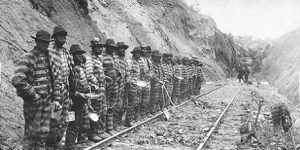
Peonage, involuntary servitude, existed historically during the colonial period, especially in Latin America and areas of Spanish rule, as well as in the Southern United States … after slavery was abolished. These States passed “Black Codes” to control the freed “Black” population. Peonage was essentially debt slavery, where a person was held against their will to work off an alleged debt to someone who had purchased them. This was the language, buying and selling, that was used for inmates purchased from county jails and state prison systems. They often declared as vagrant those who were [simply] unemployed.
Under such laws, local officials arbitrarily arrested tens of thousands, and charged them with fines and court costs. (By the beginning of the 20th century, 40% of blacks in the South were imprisoned in peonage). Merchants, farmers or business owners could pay their debts, and the prisoners had to work off the debt. Prisoners were “sold” or leased as forced laborers to operators of coal mines, lumber camps, brickyards, railroads, quarries and farm plantations, with the fees for their labor going to the States. Overseers often used severe deprivation, beatings and other abuses as “discipline”.

By 1942, the jail/prison peonage system came to an end with public exposure of the abuses and atrocities, advances of the American Communist movement, congressional hearings and public outcry.

Share this post:
, , ,
[Top]

‘Time to Go’ – Windrush: 70th Anniversary Today – ENCORE

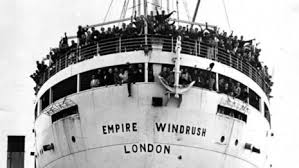
On 22 June 1948, the ship HMT Empire Windrush brought a group of 802 migrants to the port of Tilbury, near London, England. – Wikipedia

Thus started the drain! 

The Brain Drain that is. What started as a “drip has now turned into a drizzle”.  After 70 years exactly, the jury is now in. The verdict is emphatic:

Time to Go!

“Frankly, the Caribbean Diaspora … can now do better at home … in the Caribbean.” – This was the assertion from this previous blog-commentary from July 10, 2014. Today, on the 70th anniversary of the Windrush landing with its African Caribbean arrivals; it is time now to Encore that submission – see below.

African Caribbean people may not be so welcomed in the British Isles right now, anyway. See the latest on the Windrush Controversy in the Appendix VIDEO below.

This Encore continues a series from 2016, with these entries:

  1. Time to Go: Spot-on for Protest
  2. Time to Go: No Respect for our Hair
  3. Time to Go: Logic of Senior Immigration
  4. Time to Go: Marginalizing Our Vote
  5. Time to Go: American Vices; Don’t Follow
  6. Time to Go: Public Schools for Black-and-Brown

Now, we consider 5 new entries along that same theme; they are identified as follows:

  1. Time to Go: Windrush – 70th Anniversary
  2. Time to Go: Mandatory Guns – Say it Ain’t So
  3. Time to Go: Racist History of Loitering
  4. Time to Go: Blacks Get Longer Sentences From ‘Republican’ Judges
  5. Time to Go: States must have Population Increases

All of these commentaries relate to the Caribbean Diaspora’s disposition in foreign lands, asserting that it is Time to Go … home! See that Encore now:

———————

Go Lean Commentary – British public sector workers strike over ‘poverty pay’

The grass is not greener on the other side.

Go from being a big fish in small pond, to small fish in big pond.

These expressions are relevant in considering the fate of so many Caribbean Diaspora that had fled their Caribbean homelands over the past decades to take residence in Great Britain. Many of them sought refuge as career civil servants; (one reason [a] was the acute racism and intolerance encountered in private enterprises). These ones are faced with the harsh reality that pay scales in the public sector have not kept pace with inflation; they are now at poverty level. See the news article here:

By: Tess Little (Editing by Stephen Addison)

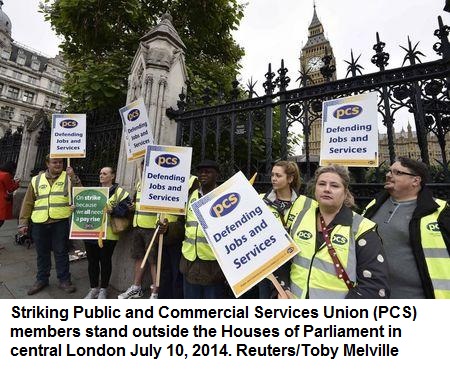
British strike 1LONDON (Reuters) – Hundreds of thousands of public sector workers including teachers, council workers and firefighters staged a 24-hour pay strike on Thursday in a stoppage that has prompted Prime Minister David Cameron to pledge a crackdown on union powers.

Protesters marched through the streets of many of Britain’s main cities in one of the biggest co-ordinated labour stoppages for three years.

Denouncing what they called “poverty pay,” they demanded an end to restrictions on wage rises that have been imposed by the government over the past four years in an effort to help reduce Britain’s huge budget deficit.

In London, demonstrators marched towards Trafalgar Square at midday, chanting “Low pay, no way, no slave labour” to the beat of a drum. A giant pair of inflatable scissors, carried by members of the National Union of Teachers (NUT), read “Education cuts never heal.”

Firefighter Simon Amos, 47, marched wearing his uniform behind a flashing fire engine parading members of the Fire Brigades Union (FBU). “The government [is] making us pay more for our pension for it to be worth the same, and making us work longer,” he said.

British strike 2The biggest public sector union involved, Unison, said early reports showed the strike had led to 3,225 school closures with more than 1,000 others partially closed.

Refuse collectors, school support staff, cleaners, street sweepers, care workers, nursery assistants and social workers were joining the strike, it added.

Hot spots, it said, included the North East, Wales and East Midlands where most council offices had closed, while more than 60 picket lines have closed most services in Newcastle.

“It is a massive decision by local government and school support workers to sacrifice a day’s pay by going on strike, but today they are saying enough is enough,” said Unison General Secretary, Dave Prentis in a statement.

Britain’s coalition government has enforced a policy of pay restraint for public sector workers since coming to power in 2010, imposing a pay freeze until 2012 and then a one percent pay rise cap, resulting in a fall in income in real terms [compared to inflation].

The Cabinet Office played down the impact of the strike, saying that most schools in England and Wales were open and that fire services were operating throughout the country.

British strike 3On Wednesday, Cameron told parliament he planned to limit unions’ powers to call strikes.

“How can it possibly be right for our children’s education to be disrupted by trade unions acting in this way” he said.

Tough new laws would be proposed in the Conservative manifesto for next year’s general election, he added.

These would include the introduction of a minimum threshold in the number of union members who need to take part in a strike ballot for it to be legal.

The manifesto could also back the introduction of a time limit on how long a vote in favour of industrial action would remain valid.

The NUT mandate for Thursday’s strike, for example, came from a 2012 strike ballot based on a turnout of just 27 percent, Cameron said.

The issue of minimum voting thresholds last arose three months ago when a strike by London Underground train drivers caused huge disruption in the capital, prompting Mayor Boris Johnson to demand that at least half of a union’s members should vote in favour for a strike to go ahead.
Source: Reuters News Service; retrieved 07/10/2014 from: http://news.yahoo.com/public-sector-workers-strike-over-poverty-pay-105040672.html

Frankly, the Caribbean Diaspora employed in the British public sector can now do better at home … in the Caribbean.

This is the assertion of the book Go Lean…Caribbean. That once the proposed empowerments are put in place, the Caribbean Diaspora should consider repatriating to their ancestral homelands.

Unfortunately for the Caribbean, this societal abandonment has continued, since the early days of the “Windrush Generation”[a] right up to now. In a recent blog post, this commentary related analysis by the Inter-American Development Bank that the Caribbean endures a brain drain of 70% among the college educated population; (https://goleancaribbean.com/blog/?p=1433).

Change has now come to the Caribbean.

The book Go Lean…Caribbean serves as a roadmap for the introduction and implementation of the technocratic Caribbean Union Trade Federation (CU). This roadmap will spearhead the elevation of Caribbean society. The prime directives of the CU are presented as the following 3 statements:

  • Optimization of the economic engines in order to grow the regional economy & create 2.2 million new jobs at home.
  • Establishment of a security apparatus to protect the resultant economic engines.
  • Improve Caribbean governance to support these engines.

The book posits that the improved conditions projected over the 5 years of the roadmap will neutralize the impetus for Caribbean citizens to flee, identified as “push and pull” factors. This point is stressed early in the book (Page 13) in the following pronouncements in the opening Declaration of Interdependence:

xix.   Whereas our legacy in recent times is one of societal abandonment, it is imperative that incentives and encouragement be put in place to first dissuade the human flight, and then entice and welcome the return of our Diaspora back to our shores. This repatriation should be effected with the appropriate guards so as not to imperil the lives and securities of the repatriated citizens or the communities they inhabit. The right of repatriation is to be extended to any natural born citizens despite any previous naturalization to foreign sovereignties.

xx.   Whereas the results of our decades of migration created a vibrant Diaspora in foreign lands, the Federation must organize interactions with this population into structured markets. Thus allowing foreign consumption of domestic products, services and media, which is a positive trade impact. These economic activities must not be exploited by others’ profiteering but rather harnessed by Federation resources for efficient repatriations.

This foregoing article highlights other issues that have been prominently addressed in the Go Lean book, namely that of the Civil Service and Labor Relations. There is the need for a professional staff in the Federal Civil Service. They require marketable benefits and compensation. There is also a role for Labor Unions to play in the elevation of Caribbean society. The Go Lean roadmap envisions an inclusionary attitude towards unions. The Go Lean community ethos is that of being partners with unions, not competitors. The book features specific tools and techniques that can enhance management-labor relationships.

These issues constitute heavy-lifting for the regional administration of the Caribbean:

  • fostering best practices for federal civil service and labor unions,
  • minimizing the brain drain, and
  • facilitating repatriation to the homeland.

These issues cannot be glossed over or handled lightly; this is why the Go Lean book contains 370 pages of finite details for managing change in the region. The book contains the following sample of community ethos, strategies, tactics, implementations and advocacies to impact the Caribbean homeland:

Community Ethos – Economic Systems Influence Choices & Incentives Page 21
Community Ethos – The Consequences of Choices Lie in the Future Page 21
Community Ethos – Job Multiplier Page 22
Community Ethos – Lean Operations Page 24
Community Ethos – Return on Investments Page 24
Community Ethos – Ways to Impact the Future Page 26
Community Ethos – Ways to Improve Negotiations Page 32
Strategy – Competition – Remain home   –vs- Emigrate Page 49
Strategy – Agents of Change – Aging Diaspora Page 57
Tactical – Separation of Powers – Versus Member-States Governments Page 71
Implementation – Year 1 / Assemble Phase – Establish Civil Service Page 96
Implementation – Ways to Deliver Page 109
Implementation – Trade Mission Objectives Page 116
Implementation – Reasons to Repatriate Page 118
Anecdote – Experiences of a Repatriated Resident Page 126
Planning  – 10 Big Ideas for the Caribbean Region Page 127
Advocacy – Ways to Create Jobs Page 152
Advocacy – Ways to Impact Labor Unions Page 164
Advocacy – Ways to Manage Federal Civil Service Page 173
Anecdote – Experiences of Diaspora Member Living Abroad Page 216
Advocacy – Ways to Impact the Diaspora Page 217

The Go Lean roadmap has simple motives: fix the problems in the homeland to make the Caribbean a better place to live, work, learn and play. There should be no need to go abroad and try to foster an existence in a foreign land. So for those of Caribbean heritage working in the British Civil Service, we hear your pleas. Our response: Come home; come in from the cold.

Now is the time for all of the Caribbean, the people residing in the homeland and those of the Diaspora, to lean-in for the empowerments described in the book Go Lean … Caribbean. This Big Idea for the region is a dramatic change; one that is overdue. The policies & practices of the past have failed Caribbean society. Too many people left, yet have little to show for it.

Caribbean music icon Bob Marley advocated this same charter for the Caribbean Diaspora. He sang to “come in from the cold” in the opening song of his last album Uprisings in 1980. How “spot-on’ were his words in the following music/video:

Download the free e-Book of Go Lean … Caribbean – now!

———————

Appendix – Cited Reference
a: “There was plenty of work in post-war Britain and industries such as British Rail, the National Health Service and public transport recruited almost exclusively from Jamaica and Barbados”. Retrieved July 10, 2014 from: http://en.wikipedia.org/wiki/British_African-Caribbean_people#The_.22Windrush_generation.22

——————–

Appendix VIDEO – How will the UK solve the Windrush controversy? | Inside Story – https://youtu.be/GYUag4XYhFo

Al Jazeera English

Published on Apr 17, 2018 – They are called the “Windrush generation”. That is a refefence to the ship, the Empire Windrush, that carried the first wave of immigrants from the West Indies to Britain in 1948. Many arrvied as children on their parents’ passports – and have lived in the UK for over 70 years, paying taxes and insurance, but never formally becoming British Citizens. Now, as the government tightens its immigration rules, those without the proper documents are being denied services and could even face deportation. Some are calling it ‘cruel and inhumane’ treatment. The government has apologised and it’s promsing an investigation. But will that be enough?
Presenter: Peter Dobbie Guests Sally Daghlian – CEO of Praxis, an organisation that provides assistance to people affected by the Windrush controversy. Clive Foster – member of the Nottingham Citizens Group.
Share this post:
, ,
[Top]

‘Loose Lips Sink Ships’ – Undermining College Enrollment

Go Lean Commentary 

Let’s go over this again…

As reported in a previous blog-commentary last year …

Loose lips sink ships …

… this is an American-English idiom meaning “beware of unguarded talk”. The phrase originated on propaganda posters during World War II.[4]  There are similar expressions in other cultures:
The British equivalent used “Careless Talk Costs Lives“, and variations on the phrase “Keep mum“,[5] while in neutral Sweden the State Information Board promoted the wordplay “en svensk tiger” (the Swedish word “tiger” means both “tiger” and “keeping silent”), and Germany used “Schäm Dich, Schwätzer!” (English: “Shame on you, blabbermouth!”).[6]
Source: Retrieved 04-07-2017 from: https://en.wikipedia.org/wiki/Loose_lips_sink_ships

Yes, inappropriate talk can undermine societal engines … and economic engines.

Universities, even not-for-profit ones, need to preserve their economic engines. They must have an influx of new students to replace the ones that graduate every year. Where do these students come from?

The economics of universities are simple, especially state-sponsored universities:

  • In-state students pay a per-credit fee for tuition, since state taxes subsidize schools
  • Out-of-state students pay a higher per-credit fee, sometimes double the in-state rate
  • Foreign students must pay out-of-state tuition every year; there is no in-state option for them
  • More revenues – and no financial aid or discounts – are associated with foreign students.

For many American universities, the appeal to lure international students is a “hen that lays golden eggs”. It will be unbecoming to compromise this business arrangement. Enter …

Donald J. Trump, 45th President of the United States

As reported in that previous blog-commentary, the “United States is suffering the dire consequence of ‘loose lips sinking ships’ right now. The new President – Donald Trump – has made disparaging remarks about certain foreign groups, and then introduced policies that reinforce his disdain for these foreigners”.

As a result, more and more foreign students are refusing to come to the US to matriculate. See the full article here and the Appendix VIDEO below:

Title: Trump blamed as U.S. colleges lure fewer foreign students
Sub-title: U.S. colleges blame the administration’s immigration policies as they fall behind foreign competitors in vying for international students.

American universities are losing out to colleges in other countries in the race to enroll international students, and they’re blaming President Donald Trump.

Foreign competitors are taking advantage of Trump’s anti-immigration rhetoric, aggressively recruiting the types of foreign students and faculty who would have typically come to the United States for their higher education. The data already show that U.S. colleges are falling behind foreign competitors during the Trump era.

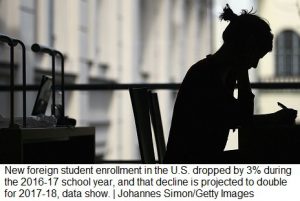
New foreign student enrollment in the U.S. dropped by 3 percent during the 2016-17 school year, and that decline is projected to double this school year, data show. At the same time, universities overseas are seeing increases as high as the double digits. The decline in foreign students enrolling in American colleges is just the latest evidence of Trump’s immigration policies shutting doors in America. The U.S. is also granting fewer visitor visas to people from around the world.

Trump is responsible for the decline in student enrollment, U.S. universities argue — especially his travel ban, which goes before the Supreme Court on Wednesday. Dozens of higher education groups wrote in an amicus brief for that case that Trump’s travel ban is a “clarion message of exclusion to millions” that harms universities’ ability to enroll international students and recruit top faculty.

Overseas, they’re gloating. “We don’t actually need to be negative about the American academy, as President Trump is doing more damage to ‘brand America’ on his own than any competitor country ever could,” Phil Honeywood, the CEO of Australia’s international education association, told POLITICO.

“There is no doubt that President Trump’s much-publicized antagonism toward Muslims and migrants has sent out negative messages to students who would otherwise have America at the top of their list as a study destination,” said Honeywood. Australia — long one of America’s top competitors — has seen big jumps in students enrolling from Muslim majority countries, such as Malaysia and Indonesia and in the Middle East, he said.

And it’s not just Australia, which saw a 12 percent increase in international students last year. Universities in Canada, China, New Zealand, Japan and Spain all posted double-digit increases in international enrollment, according to data from the nonprofit Institute of International Education.

Meanwhile, the U.S. decline tracked by the IIE was the first time that number had dropped in the 12 years the group collected such data. While the 2017-18 data are not yet available, the decline was projected to more than double, based on the findings of a separate online enrollment survey IIE conducted in October.

Universities say they need to continue to attract the world’s brightest students for America to maintain its scientific edge. They argue foreign students often become important economic drivers, pointing to famous foreign-born entrepreneurs like Elon Musk, who grew up in South Africa and graduated from the University of Pennsylvania. International students can also help with the bottom line, since they often pay full freight, and some universities charge them more to attend.

“Where the United States retreats, there’s a vacuum, and other countries will rush to fill it,” University of California President Janet Napolitano, who served as Homeland Security secretary in the Obama administration, told POLITICO. “American education has always led the world — and it still leads the world, and it should lead the world. But we are leading the world in an atmosphere where the White House, at least, is sending a very kind of ‘stay away’ message — and that’s a challenge.”

The university groups wrote in the Supreme Court brief that since Trump signed the travel ban, international students have expressed concerns about coming to the U.S. to study, while faculty have turned down jobs and foreign scholars have pulled out of American academic conferences.

“Foreign students, faculty and researchers come to this country because our institutions are rightly perceived as the destinations of choice compared to all others around the globe,” the brief said. The president’s proclamation “altered those positive perceptions with the stroke of a pen,” it said.

In the case, the Supreme Court will hear arguments that Trump overstepped his authority in issuing an order limiting visas to eight countries, six of which are majority Muslim. Among the questions the justices are expected to consider in the case, which was brought by the state of Hawaii and the leader of a Muslim group there, is whether the president’s order violated the Constitution’s ban on establishment of religion by targeting Muslims.

The administration has contended the travel ban is a necessary national-security step, and government attorneys have argued it’s not related to Trump’s vows on the campaign trail to institute a Muslim ban.

It’s not just the travel ban. The Trump administration is considering restricting visas for Chinese citizens, which could hurt Chinese students studying at American universities. Administration officials portray the possible restrictions, as well as steep tariffs, as a response to alleged intellectual property theft.

American colleges, meanwhile, have aggressively pushed for lawmakers to find a way to preserve the Obama-era Deferred Action for Childhood Arrivals program, which protected from deportation and gave work permits to undocumented individuals brought to the country as children. Trump scrapped the program.

Foreign universities have watched the political climate shift and are pouncing on the opportunity to lure away would-be students and faculty.

“At a time of closing borders and closing minds, students from around the world are choosing Canada,” a group of Canadian universities boasted late last year.

Canada saw an 18 percent jump in international enrollment in 2016. New Zealand saw the biggest boost — a 34 percent increase. International enrollment jumped 25 percent in Spain, 13 percent in Japan and 11 percent in China.

“Ten years ago, China wasn’t even on anyone’s radar screen as a competitor,” said Rachel Banks, director of public policy at NAFSA: Association of International Educators, America’s main international education lobbying group. “They were not active. They were not aggressive at all.”

China has set a goal of enrolling half a million students by the year 2020, and the nation is on a path to exceed that goal early, she said. International students have been a big part of that growth.

Many of these countries long have had aggressive strategies to recruit internationally and have built immigration policies around those efforts.

Australia, for example, allows foreign students to stick around for 18 months after graduation to gain experiential training. Graduates in high-need occupations are able to stay and work for as long as four years. And the country has a path to permanent residency for all foreign graduates.

And they’re not just targeting students.

French President Emmanuel Macron last year announced France would give four-year grants to professors, graduate students and other researchers willing to work on climate change research. Just last month, Canada announced its universities had successfully poached 24 faculty members from colleges in other nations. More than half of them came from American universities, including Harvard, Brown and Duke.

Canadian Prime Minister Justin Trudeau has been spending time in Silicon Valley, trying to convince startups there that Canada might be a more friendly place as the U.S. continues to restrict immigration, including through additional scrutiny of work visas.

“That’s pretty telling,” Banks said.

American universities have tried to counter the narrative. Colleges have written letters expressing their continued support for international education, and some have even offered assistance, such as additional housing, for international students. They’ve lobbied aggressively against restrictive immigration policies and entered court battles. The University of California is among the plaintiffs challenging Trump’s decision to scrap DACA.

“The key for us is to be able to still attract the best and the brightest from all over the world,” University of Southern California President C.L. Max Nikias told POLITICO. “That has been part of the strength of who we are as a country.”

Source: Politico – posted April 23, 2018; retrieved April 30, 2018 from: https://www.politico.com/story/2018/04/23/foreign-students-colleges-trump-544717

College is a big investment; yet nobody wants to spend their BIG money in a place where they are not welcomed.

This lesson must be learned in the Caribbean. We have the same threats afoot. But unlike the US, who has the leverage and surety of “richest Single Market economy in the world” to absorb any fall, our Caribbean member-states are mostly Third World and failing. This commentary has previous detailed how societal deficiency has resulted in a Brain Drain among the educated classes in the Caribbean homeland – all due to “push and pull” reasons. We persecute certain groups in our society; at times our community leaders are projecting “a climate of hate”.

In general, neutralizing a “hateful attitude” has been an ongoing theme for the movement behind the book Go Lean … Caribbean. The book presents the Caribbean region a roadmap to elevate all societal engines, including economics, homeland security and governance. In fact, the prime directives of the roadmap includes the following 3 statements:

  • Optimization of the economic engines in order to grow the regional economy to $800 Billion & create 2.2 million new jobs.
  • Establishment of a security apparatus to ensure public safety for all and protect the resultant economic engines.
  • Improve Caribbean governance for all people, even minority groups, to support these economic and security engines.

The Go Lean book introduces the Caribbean Union Trade Federation (CU) as an intergovernmental agency for 30 regional member-states, to provide a better – technocratic – stewardship for the regional economy. We need all community stakeholders to “not sink ships” with their unbridled hatred and disdain for people who may look, act and speak differently than them.

The movement behind the Go Lean book hereby makes this urging to the Caribbean political, social and religious leaders:

Learn from the fallacy of President Trump.

Now is the time for all of the Caribbean – the people and leaders – to lean-in for the empowerments described here-in and in the book Go Lean … Caribbean. This is about jobs and economic opportunities – education included; we need better engines to make our region more prosperous. We can elevate our communities through education!

It is conceivable, believable and achievable to make the Caribbean a better place to live, work, learn and play. 🙂

Sign the petition to lean-in for the roadmap for the Caribbean Union Trade Federation.

Download the free e-book of Go Lean … Caribbean – now!

———–

Appendix VIDEO – US universities experiencing massive drop in foreign students – https://youtu.be/uIVdCg5zm-4

Published Dec 7, 2017 – FRANCE 24 live news stream: all the latest news 24/7 http://f24.my/YTliveEN Decisions made by US President Donald Trump’s administration are having an effect on the number of foreign students coming to America to study.

A new report says dozens of campuses across the country have lost a big chunk of their foreign students and the drop in numbers means a drop in money as well. In the past school year, foreign students contributed some $37 billion to the US economy, and helped fund around 450,000 jobs. Our correspondents report from Indiana University. Also on the show: An Argentinian court has sentenced former military personnel for their involvement in crimes committed at a notorious torture center during the country’s so-called “Dirty War”, some four decades ago. Only a fraction of the estimated 5,000 anti-government activists who were sent there survived. And in Canada, the small town of Chruchill is the scene for a wintery spectacle every year. In October and November, polar bears travel through the town as part of their winter migration. The move is proving popular with tourists who hope to get close up to the furry, white giants. http://www.france24.com/en/taxonomy/e…

Share this post:
, , ,
[Top]

‘At the Table’ or ‘On the Menu’

Go Lean Commentary

There are those that reflect society and those that effect society.
Unfortunately, these may not be the same people.

While we are not impugning any bad motives to these men, we accept that in the United States, the leadership in the Republican Party – the party in power, also called the GOP, with control of the White House, the House of Representatives and the Senate – all reflect White Men over the age of 45. Clearly, not a Pluralistic Democracy!

At the same time this real census demographics apply for America today:

Race: 77.1% White; 13.3% Black; 5.6% Asian; 2.6% Other/multiracial; 1.2% Native; 0.2% Pacific Islander
Ethnicity: 17.6% Hispanic or Latino; 82.4% non-Hispanic or Latino
Age & Gender: Under 18 = 24%; 18 to 44 = 36.5%; 45 to 64 = 26.4%; Over 65 = 13%; Median age = 37.8
Female = 50.8; Male = 49.2

Change is hard! Reforming and transforming a community is heavy-lifting. A lot of societal reforms – human and civil rights – only come about as a result of advocates fighting for change … “at the top” or “from the bottom”. Changing “at the top” means conferring, convincing, consulting and cajoling leaders (political and business) to implement changes in policies and procedures; it means being “at the table”. Changing “from the bottom” means “taking to the streets” and rallying the masses to force governments and businesses – the establishment – to hear demands and make changes.

Truthfully, the former – Top-Down approach – is much easier than the latter – Bottoms-Up approach.

But, in order to confer, convince, consult and cajole, Change Advocates must have a seat “at the table”. When some interest group is absent in their representation, the possibility of disregard – and victimization – is highly possible.

“If You’re Not at the Table, You’re on the Menu”
This quote is believed to have originated around [the year] 2000 in Washington, DC, and is of unknown origin. Basically, it means that if you are not represented at the decision-making table, you are in a financially vulnerable position, you get left out, or, worse yet, you are on the menu.

See this fear manifested in the news-article-commentary here … and the Appendix VIDEO below:

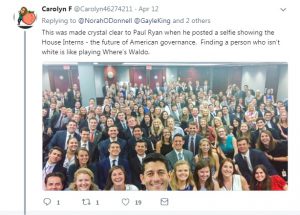
Title # 1: Ryan pressed on all-white, all-male GOP leadership

By: Juana Summers, CNN

Washington (CNN) House Speaker Paul Ryan acknowledged Thursday that the Republican Party needs more women and minorities, and pointed to Utah Rep. Mia Love — the only black Republican woman in Congress — as evidence that the party was making progress.

The discussion, with CBS News host Gayle King, was prompted by President Donald Trump’s tweet of a photo from a dinner he hosted at the White House for members of Republican leadership.

In the photo, which was tweeted Wednesday night, Trump and Vice President Mike Pence are surrounded by five members of congressional Republican leadership, including Ryan. All of the lawmakers included in that photo are white men.

“When I look at that picture, Mr. Speaker, I have to say, I don’t see anyone that looks like me in terms of color or gender,” CBS News host Gayle King told Ryan. “You were one of the main people who said you want to do more for the Republican Party to expand … Some say this President really doesn’t want to expand the base.”

“I don’t like the fact that you feel that way,” Ryan told King, adding that “we need more minorities, more women in our party and I’ve been focusing on that kind of recruitment.”

Ryan, who announced Wednesday that he would retire in January, then pointed to [Congresswoman Mia] Love, who he has mentored, as an example.

“She’s somebody I recruited in a primary to come to Congress. There are a lot of candidates like Mia that we’re recruiting all around the country,” he added, saying that even though he is retiring from Congress he was going to “keep being involved and focusing on inclusive, aspirational politics.”

While Congress has undoubtedly grown more diverse, the ranks of leadership in the Republican Party have not. Every member of Republican leadership on both sides of the Rotunda is white. There is one woman, Rep. Cathy McMorris Rodgers, in House Republican leadership. There are none in Senate Republican leadership.

Source: Posted April 12, 2018; retrieved April 15, 2018 from: https://www.cnn.com/2018/04/12/politics/paul-ryan-republican-diversity-photo/index.html

This American drama is more than just theoretical; there is an actual manifestation associated with it. There are real world consequences and it is all bad! And this is not only an American drama; it is a Caribbean concern as well. There are two American territories in the middle of the Caribbean; and guess what?

This same group of White Men – in the foregoing – effect the populations of Puerto Rico and the US Virgin Islands, though they do not reflect their populations.

Things are bad; consider this bad episode:

Title # 2: Here’s how an obscure tax change sank Puerto Rico’s economy

As GOP lawmakers and the White House put the finishing touches on a proposal to overhaul the American tax code, Congress and the Trump administration are also considering multiple options to help storm-ravaged Puerto Rico get back on its feet.

Even before the storm brought Puerto Rico to a near standstill, the government there already struggled with an economy in shambles and a default on billions of dollars of public debt.

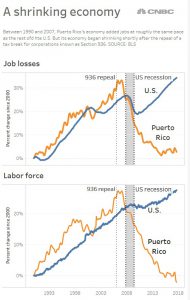
That fiscal mess, partly the result of a prolonged downturn that lingered long after the rest of the U.S. had recovered from the Great Recession, has its roots in the repeal of a controversial corporate tax break that helped spark an exodus from the island and sent its economy into reverse.

More than half a century ago, U.S. lawmakers sought to help Puerto Rico emerge from a colonial past, transforming its largely agrarian economy into a manufacturing powerhouse. The effort, known as Operation Bootstrap, began with a series of tax breaks designed to attract manufacturers who would provide steady factory jobs.

For a time the plan seemed to work, as standards of living in Puerto Rico rose. Between 1950 and 1980, per capita gross national product grew nearly tenfold in Puerto Rico, and disposable income and educational attainment rose sharply, according to the Center for a New Economy, a think tank based in San Juan, Puerto Rico.

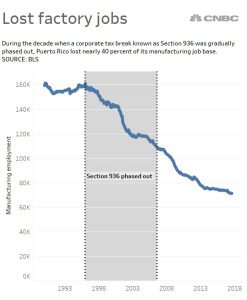
One of those tax breaks, enacted in 1976, allowed U.S. manufacturing companies to avoid corporate income taxes on profits made in U.S. territories, including Puerto Rico. Manufacturers, led by the pharmaceutical industry, flocked to the island.

But by the early 1990s, the provision faced growing opposition from critics who attacked the tax break as a form of corporate welfare. Much like the current debate over corporations parking profits offshore to avoid taxes, tax reformers saw the provision, known as Section 936, as too costly for the Treasury.

The tax break also had some unintended consequences, notably the unfair tax burden that fell to domestic Puerto Rican companies.

In 1996, President Bill Clinton signed the law that would phase out Section 936 over 10 years.

Plant closures and job losses followed. Ten years later, on the eve of the Great Recession, employment in Puerto Rico peaked. Left with a dwindling tax base, the Puerto Rican government borrowed heavily to replace the lost revenue.

Today, the U.S. territory has nearly $70 billion in debt, an unemployment rate 2.5 times the U.S. average, a 45 percent poverty rate, nearly insolvent pension systems and a chronically underfunded Medicaid insurance program for the poor.

Puerto Rico’s job base continues to shrink, taking its economy along with it. Since the recession ended, a lack of job prospects has sent many Puerto Ricans fleeing to the mainland, where the job market is much stronger.

The devastation brought by Hurricane Maria has accelerated the exodus, as families who have lost their homes seek shelter with relatives on the U.S. mainland. Many likely see the relocation as temporary. Others may find better opportunities in one of the 50 states, where the average weekly wage is nearly twice that of Puerto Rico.

It remains to be seen how many will return, leaving even fewer workers to rebuild the territory’s battered economy.

Source: Posted Sept 26, 2017; retrieved April 15, 2018 from: https://www.cnbc.com/2017/09/26/heres-how-an-obscure-tax-change-sank-puerto-ricos-economy.html

That GOP Leadership is very important now for Puerto Rico’s viability – and the USVI – and they have no vote, nor voice in Congress. They do not have a “seat at the table”. Unfortunately, the Washington experience for Puerto Rico has been out-of-sight and out-of-mind.

This commentary has previously asserted that Puerto Rico reflects a Failed-State status; see this direct quotation:

Puerto Rico can do “bad” all by itself; it does not need to be America’s Failed-State!

They do not need the American Hegemony to create an unbearable situation for them. This is NOT an assessment based on the fact that Donald Trump is in the White House now, no rather, this is a summary-analysis based on 120 years of US-PR history. Like many abusive marriages, the US has reserved its most abusive behavior for its own family member, the island territory of PR. This, despite the President or the administration.

No one should be expected to tolerate 2nd Class Citizenship status … for 120 years!

This commentary continues the assertion of the book Go Lean…Caribbean, that Caribbean territories should confederate with their actual Caribbean neighbors and seek their own self-determination. Puerto Rico needs their Caribbean neighbors and the neighbors need Puerto Rico. The effort to reboot the regional economy may be too big for Puerto Rico and the Virgin Islands alone; they need the leverage of the full Caribbean neighborhood – a Single Market of 42 million people in 30 member-states. The book – available to download for free – presents this roadmap for the introduction and implementation of the technocratic Caribbean Union Trade Federation (CU), for the elevation of Caribbean society – for all 30 member-states, American territories included. This CU/Go Lean roadmap has these 3 prime directives for regional integration:

For our Caribbean effort to reform and transform our society, we need “all hands on deck”. Not just Old White Men; no, we need Black and White, Male and Female, Young and Old, English speakers and Dutch, French and Spanish speakers. We need the stewards that shepherd our societal engines to reflect and effect all of the Caribbean.

The mandate to forge an optimized regional confederation – with full participation of people that reflect our Caribbean population – was pronounced early in the Go Lean book with this Declaration of Interdependence (Pages 12 – 14); demonstrated with these opening statements:

xi. Whereas all men are entitled to the benefits of good governance in a free society, “new guards” must be enacted to dissuade the emergence of incompetence, corruption, nepotism and cronyism at the peril of the people’s best interest. The Federation must guarantee the executions of a social contract between government and the governed.

xxi. Whereas the preparation of our labor force can foster opportunities and dictate economic progress for current and future generations, the Federation must ensure that educational and job training opportunities are fully optimized for all residents of all member-states, with no partiality towards any gender or ethnic group. The Federation must recognize and facilitate excellence in many different fields of endeavor, including sciences, languages, arts, music and sports. This responsibility should be executed without incurring the risks of further human flight, as has been the past history.

xxvi. Whereas the Caribbean region must have new jobs to empower the engines of the economy and create the income sources for prosperity, and encourage the next generation to forge their dreams right at home, the Federation must therefore foster the development of new industries …

The subject of fostering a Pluralistic Democracy with full gender equity, equal access and equal protections have been directly addressed and further elaborated upon in previous blog/commentaries; consider this sample:

https://goleancaribbean.com/blog/?p=14633 Nature or Nurture: Women Have Nurtured Change
https://goleancaribbean.com/blog/?p=13321 Making a ‘Pluralistic Democracy’ – Multilingual Realities
https://goleancaribbean.com/blog/?p=13063 Gender Equity without a ‘Battle of the Sexes’
https://goleancaribbean.com/blog/?p=12035 Lean-in for ‘Wonder Woman Day’
https://goleancaribbean.com/blog/?p=11812 State of Caribbean Union: Hope and Change
https://goleancaribbean.com/blog/?p=9216 ‘Time to Go’ – When there is ‘No Respect’ for our Hair
https://goleancaribbean.com/blog/?p=8306 Women Get Ready for New Lean-In Campaign
https://goleancaribbean.com/blog/?p=6937 Women in Politics – Yes, They Can!
https://goleancaribbean.com/blog/?p=6836 Role Model – #FatGirlsCan – Empowering Women
https://goleancaribbean.com/blog/?p=6434 ‘Good Hair’ and the Strong Black Woman
https://goleancaribbean.com/blog/?p=6422 Getting More Women Interested in Science/Technology Careers

The Go Lean book posits that people of all races, colors and creed have the right to work towards making their communities better places to live, work and play. This should be the default perception of our stewards and shepherds – there is strength in our diversity. Plus, we need all the help we can get. So the book provides 370-pages of turn-by-turn instructions on “how” to adopt new community ethos, plus the strategies, tactics, implementations and advocacies to execute so as to transition to a Pluralistic Democracy, one that better reflects and effects the full population of Caribbean people: Black or White, Men or Women.

This quest to elevate our regional society requires heavy-lifting! But this push towards a Pluralistic Democracy is conceivable, believable and achievable. We invite all peoples to devote their time, talent and treasuries to this cause. Yes, we can … succeed in this quest; yes, we can be a better society. 🙂

Download the free e-Book of Go Lean … Caribbean – now!

Sign the petition to lean-in for this roadmap for the Caribbean Union Trade Federation.

———-

Appendix VIDEO – Speaker Ryan Lamenting Lack of Diversity – https://twitter.com/NorahODonnell/status/984411160207388672

@GayleKing: “When I look at the picture, I don’t feel very celebratory. I feel very excluded.” @SpeakerRyan: “I don’t like that you feel that way. We need more minorities, more women in our party.” @CBSThisMorning

Share this post:
, , ,
[Top]

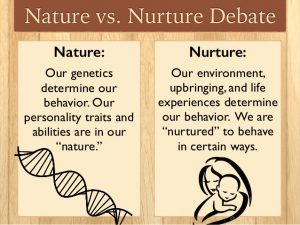
Nature or Nurture: UK City Still Paying Slavery Debt

Go Lean Commentary

Here’s a deep religious question for you:

Does God punish children for the sins of the Father?

The sense of justice we have – our basis for right and wrong – may dictate to us that we only be punished for our own crimes, not that of our parents. Considering that the laws of the land – throughout the New World – are based on Judeo-Christian principles, what does the Bible say?

“Fathers shall not be put to death because of their children, nor shall children be put to death because of their fathers. Each one shall be put to death for his own sin.” – The Bible ESV Deuteronomy 24:16

In contrast, the Bible also states – here – that there is a legacy price that children will pay for their forefathers’ actions-misdeeds:

Keeping steadfast love for thousands, forgiving iniquity and transgression and sin, but [God] who will by no means clear the guilty, visiting the iniquity of the fathers on the children and the children’s children, to the third and the fourth generation.” – Exodus 34:7 ESV or English Standard Version

Despite the opening religious question, this is NOT a religious discussion, but rather presented from a societal reform perspective. In summary, communities may be plagued to suffer punishment for generations due to the misdeeds of their forefathers.

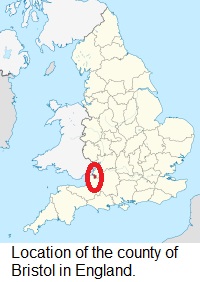
Indeed, this is true of the British city of Bristol, England. Until recently (2015), it was still paying off debts for the city’s prominent role in the African Slave Trade … that ended in 1807; the Abolition bill passed in Parliament in 1833 – requiring the need for a huge capital outlay, £20 million (US$28 million); Slavery ended in the British Empire in 1834. That’s 182 years later and sounds eerily familiar. It sounds like when a person pays only the monthly minimum on a credit card account. See more here:

A $2,000 credit balance with an 18% annual rate, with a minimum payment of 2% of the balance, or $10, whichever is greater, would take 370 months or just over 30 years to pay off . – MarketWatch.com

See the encyclopedic details on the Slave Trade activities by the City of Bristol in the Appendix below.

The Slave Trade did end, as a First Step to abolishing Slavery entirely. This was not easy and not automatic; it took strenuous effort on the part of advocates and activists, like William Wilberforce. See his portrayal in the Appendix VIDEO below.

See the news-commentary relating the continued Slavery Debt here:

Title: Slave owner compensation was still being paid off by British taxpayers in 2015

Bristol taxpayers in 2015 were still paying off debt borrowed by the government to “compensate” slave owners in 1833, the Treasury has revealed.

The revelations show that the £20 million (US$28 million) the government spent to reimburse the owners of slaves – who themselves were some of Britain’s richest businessmen – took the taxpayer 182 years to pay off. The descendants of slaves were never compensated, but it appears some would have been paying to compensation slave owners.

The information was revealed by the Treasury under a Freedom of Information (FoI) request, the Bristol Post reports. The Treasury tweeted: “Here’s today’s surprising #FridayFact. Millions of you helped end slave trade through your taxes.”

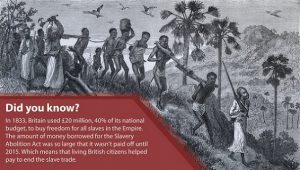
It added an infographic which said: “Did you know? In 1833, Britain used £20 million, 40 percent of its national budget, to buy freedom for all slaves in the Empire.

“The amount of money borrowed for the Slavery Abolition Act was so large that it wasn’t paid off until 2015. Which means living British citizens helped pay to end the slave trade.”

The tweet was quickly deleted after it sparked a backlash.

Historian David Olusoga, who has written about Bristol’s role in the slave trade, was one of several experts who questioned the tone of the Treasury’s tweet.

“The real question is why anyone thought this was ok?” he said, according to the newspaper. “I really do think we’re getting better at accepting the UK’s role in slavery and the slave trade, but things like this make me question my optimism.

“Also, just to compound the general level of ignorance, when HM Treasury reduce the complex story of the abolition of slavery to one of their fun ‘Friday Facts’ they use an irrelevant image of the slave trade – which was abolished three decades earlier.”

Bristol City councilor Cleo Lake said she was outraged. “I want my money back,” she tweeted. “I’m outraged. This messaging is so loaded.”

When the UK government abolished slavery and banned people from owning slaves in Britain and on Britain’s colonies anywhere in the world, those slave owners received compensation. Bristol had the highest concentration of people in Britain who owned slaves in 1833 outside of London.

The slaves themselves received nothing, and had to continue working for their masters for a number of years before they could consider being free.

Source: Posted February 15, 2018; retrieved April 10, 2018 from: https://www.rt.com/uk/418814-slave-compensation-bristol-taxpayer/

Imagine the outrage when city finances are strained – economic cycles of recessions and expansions are inevitable – and necessary expenditures – for example, public safety and education – have to be curtailed due to principal-and-interest payments for 200 year old debts. This seems to go against Nature. This commentary continues the 4-part series on Nature or Nurture for community ethos. This entry is 3 of 4 in this series from the movement behind the book Go Lean … Caribbean in consideration of root causes of some societal defects – specific examples in the US and UK – and how to overcome them. The other commentaries in the series are cataloged as follows:

  1. Nature or Nurture: Black Marchers see gun violence differently
  2. Nature or Nurture: Cop-on-Black Shootings – Embedded in America’s DNA; Whites Yawn
  3. Nature or Nurture: UK City of Bristol still paying off Slavery Debt
  4. Nature or Nurture: Nurturing comes from women; “they” impacted the Abolition of Slavery

In the first submission to this series, the history of Psychology was introduced, which quoted:

One of the oldest arguments in the history of psychology is the Nature vs Nurture debate. Each of these sides have good points that it’s really hard to decide whether a person’s development is predisposed in his DNA, or a majority of it is influenced by this life experiences and his environment. – https://explorable.com/nature-vs-nurture-debate

All of these commentaries relate to “why” communities – including the Caribbean – may have lingering societal defects and “how” the stewards for a new Caribbean can assuage these defects and the resultant failing dispositions. The term “lingering societal defects” have been addressed in the Go Lean book; there it is deemed “community ethos”; with this definition:

… the fundamental character or spirit of a culture; the underlying sentiment that informs the beliefs, customs, or practices of a group or society; dominant assumptions of a people or period. – Page 20

The UK County/City of Bristol had a bad community ethos. Obviously, a disregard for human rights was embedded in that community’s DNA. What’s more, the county-city-people had to pay for their forefathers’ bad community ethos … for 182 years. Sad!

How about the Caribbean? Are we paying for the sins of our fathers today?

Indeed, we have defects in our societal DNA, a bad Nature; and then we foster unbecoming traits by Nurturing unbecoming habits and practices.

The subject of societal defects is a familiar theme for this commentary, from the movement behind the book Go Lean…Caribbean – available to download for free. The book asserts that the colonial masters for the Caribbean did not endow this region with the organizational dynamics (attitudes or structures) that would lead to success. This society was built for leisure, pleasure and good times. Traits like industriousness, ingenuity and innovation was never encouraged nor fostered. As a result the vocations for the region always lean towards the illicit and the shadows – think: piracy, tax shelters, offshore banking, etc. –  as opposed to honest work for honest pay.

Regrettably, we are now paying for the sins of our fathers, as we have defects in all societal engines of our community.

We do not have the Nature to compete in the global marketplace! But change can be Nurtured.

The book Go Lean…Caribbean – available to download for free – serves as a roadmap for the introduction and implementation of the technocratic Caribbean Union Trade Federation (CU), for the elevation of Caribbean society – for all 30 member-states. This CU/Go Lean roadmap has these 3 prime directives for effecting change in our society:

  • Optimization of the economic engines in order to grow the regional economy to $800 Billion and create 2.2 million new jobs.
  • Establishment of a security apparatus to ensure public safety and protect the resultant economic engines.
  • Improve Caribbean governance to support these engines, including a separation-of-powers between the member-states and CU federal agencies.

The Go Lean book stresses that reforming and transforming the Caribbean societal engines must be a regional pursuit. This was an early motivation for the roadmap, as pronounced in the opening Declaration of Interdependence (Pages 12 – 13):

xi. Whereas all men are entitled to the benefits of good governance in a free society, “new guards” must be enacted to dissuade the emergence of incompetence, corruption, nepotism and cronyism at the peril of the people’s best interest. The Federation must guarantee the executions of a social contract between government and the governed.

xvi. Whereas security of our homeland is inextricably linked to prosperity of the homeland, the economic and security interest of the region needs to be aligned under the same governance. Since economic crimes … can imperil the functioning of the wheels of commerce for all the citizenry, the accedence of this Federation must equip the security apparatus with the tools and techniques for predictive and proactive interdictions.

xxiv. Whereas a free market economy can be induced and spurred for continuous progress, the Federation must install the controls to better manage aspects of the economy: jobs, inflation, savings rate, investments and other economic principles. Thereby attracting direct foreign investment because of the stability and vibrancy of our economy.

The Go Lean book provides 370-pages of turn-by-turn instructions on “how” to Nurture a new, better Caribbean society. It details the new community ethos that needs to be adopted, plus the strategies, tactics, implementations and advocacies to execute so as to reboot, reform and transform the societal engines of Caribbean society – economics, security and governance. In fact, the book (Page 131) provides one specific advocacy entitled 10 Ways to Make the Caribbean Better. This advocacy depicts the specific steps to Nurture the actions to better live, work and play.

Here are some samples, based on some previous blog-commentaries that doubled-down on this assertion that these societal engines – economics, security and governance – need redress:

Economics

The biggest Caribbean deficiency in this area is the lack of jobs, entrepreneurial opportunities and an industrial footprint. This sample of previous blog-commentaries asserted these points:

https://goleancaribbean.com/blog/?p=14242 Leading with Money Matters – Follow the Jobs
https://goleancaribbean.com/blog/?p=14191 The Dynamics of the ‘Gig Economy’ for New Job Options
https://goleancaribbean.com/blog/?p=13420 A Financing Model for Industrial Endeavors
https://goleancaribbean.com/blog/?p=13184 A Series on Rebooting the Industrial Landscape
https://goleancaribbean.com/blog/?p=8602 Big Infrastructure Projects Transforms Economic Engines
https://goleancaribbean.com/blog/?p=7977 Transformations: Perfecting Our Core Competence
https://goleancaribbean.com/blog/?p=6089 Where the Jobs Are – Greater than Minimum Wage
https://goleancaribbean.com/blog/?p=4037 Fostering the environment for Direct Foreign Investors
https://goleancaribbean.com/blog/?p=3152 Making a Great Place to Work®

Security

Security and economics must be inextricably linked to elevate prosperity in the homeland. People must be assured public safety and the economic engines must be protected. This theme was conveyed in this sample of previous blog-commentaries:

https://goleancaribbean.com/blog/?p=14556 Common Sense Policies with Guns
https://goleancaribbean.com/blog/?p=14211 Providing a safer environment for tourists and event participants
https://goleancaribbean.com/blog/?p=13746 Manifesting Caribbean Basin Security Dreams
https://goleancaribbean.com/blog/?p=13476 Policing the Police
https://goleancaribbean.com/blog/?p=12930 Managing Natural & Man-Made ‘Clear and Present Dangers’
https://goleancaribbean.com/blog/?p=12400 Acceding a Caribbean Regional Arrest Treaty
https://goleancaribbean.com/blog/?p=9072 Securing the Homeland – A Series
https://goleancaribbean.com/blog/?p=7896 The Logistics of Disaster Relief
https://goleancaribbean.com/blog/?p=7327 Preparing for Epidemics …Like Zika.
https://goleancaribbean.com/blog/?p=7119 Role Model for a Caribbean Regional Security Force

Governance

The colonial beginnings of the Caribbean have not been supplanted with more advanced systems of governance. This is the plan within the Go Lean roadmap. This plan was expanded in this sample of previous blog-commentaries:

https://goleancaribbean.com/blog/?p=14001 Transforming Mail Eco-System, Transforms Government & Society
https://goleancaribbean.com/blog/?p=13997 One Integration Effort – CariCom – Defective One-Man-One-Vote
https://goleancaribbean.com/blog/?p=13995 American Governing Defects – No Vote; No Voice in Congress
https://goleancaribbean.com/blog/?p=13993 Lessons Learned from the ‘Dignified and Efficient’ British Model
https://goleancaribbean.com/blog/?p=13749 Integrating Federal Governance: Assembling Regional Organizations
https://goleancaribbean.com/blog/?p=13744 The Quest for a ‘Single Currency’
https://goleancaribbean.com/blog/?p=13736 Failure to Launch: Past Failures for Caribbean Integration
https://goleancaribbean.com/blog/?p=13321 Making a ‘Pluralistic Democracy’ – Multilingual Realities

In summary, the Nature of the Caribbean – inherited from the Europeans – is not defaulted for governing efficiency. But, the regional governing entities can be Nurtured for an optimized delivery.

Yes, we can elevate our societal engines. We do not have to suffer and reap the whirlwind of the sins of our legacy members; we do not have to wait for punishment on the children for the sins of their Father. This quest is conceivable, believable and achievable. We can make our homeland a better place to live, work and play. 🙂

Download the free e-Book of Go Lean … Caribbean – now!

Sign the petition to lean-in for this roadmap for the Caribbean Union Trade Federation.

———–

Appendix – Bristol Slave Trade

Bristol is a city in the South West of England, on the River Avon which flows into the Severn Estuary. Because of Bristol’s position on the River Avon, it has been an important location for marine trade for centuries.[1] The city’s involvement with the slave trade peaked between 1730 and 1745, when it became the leading slaving port.[2]
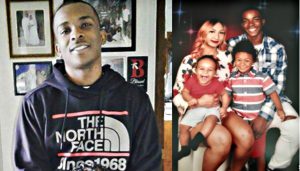
Bristol used its position on the Avon to trade all types of goods. Bristol’s port was the second largest in England after London. Countries that Bristol traded with included France, Spain, Ireland, Portugal, and North Africa’s Barbary Coast. Bristol’s main export was woollen cloth. Other exports included coal, lead, and animal hides. Imports into Bristol included wine, grain, slate, timber, and olive oil. Trading with the various colonies in the Caribbean and North America began to flourish during the Interregnum of Oliver Cromwell (1649–1660).

The Royal African Company, a London-based trading company, had control over all trade between countries in Britain and Africa before the year 1698[3] At this time, only ships owned by the Royal African Company could trade for anything, including slaves. Slaves were increasingly an important commodity at the time, since the British colonization in the Caribbean and the Americas in the 17th century. The Society of Merchant Venturers, an organization of elite merchants in Bristol [and synonymous with the government of Bristol], wanted to commence participation in the African slave trade, and after much pressure from them and other interested parties in and around Britain, the Royal African Company’s control over the slave trade was broken in 1698.

As soon as the monopoly was broken, what is thought to have been the first “legitimate” Bristol slave ship, the Beginning, owned by Stephen Barker, purchased a cargo of enslaved Africans and delivered them to the Caribbean. Some average slave prices were £20, £50, or £100. In her will of 1693, Jane Bridges, Widow of Leigh Upon Mendip bequeathes her interest of £130 in this very ship to her grandson Thomas Bridges and indicates that the vessel was owned by the City of Bristol. Business boomed; however, due to the over-crowding and harsh conditions on the ships, it is estimated that approximately half of each cargo of slaves did not survive the trip across the Atlantic.[4]

The triangular trade was a route taken by slave merchants during the years 1697 and 1807. The areas covered by the triangular trade was England, North West Africa and finally The Caribbean. Profits of 50-100% were made during the 18th century. Estimates vary about how many slaves were sold and transported by companies registered in Bristol. Over 3.4 million slaves were brought into slavery by these ships, representing one-fifth of the British slave trade during this time.[5][6] However, estimates of over 500,000 slaves were brought into slavery by these ships.[7][8]

Source: Retrieved April 10, 2018 from https://en.wikipedia.org/wiki/Bristol_slave_trade

———–

Appendix VIDEO – William Wilberforce & the End of the African Slave Trade – https://youtu.be/eLU182rj0pA


Rose Publishing

Published on Jul 26, 2012 – Learn how a young member of British Parliament followed his conviction to bring about the abolition of the African slave trade.

In this 12 Session DVD-based study, Dr. Timothy Paul Jones takes you through the most important events in Christian history from the time of the apostles to today. Click here to read more about this amazing Christian History Bible study series: https://www.hendricksonrose.com/chris…

To learn more about this DVD study visit www.christianhistorymadeeasy.com

  • Category: Education
  • License: Standard YouTube License
Share this post:
, ,
[Top]

Nature or Nurture: Cop-on-Black Shootings – Embedded in America’s DNA

Go Lean Commentary

It happens so often, it rarely gets attention anymore; Police-on-Black shootings that is!

It seems to be a constant feature of American life. See the latest high profile one – Stephon Clark – in the Appendix below.

What’s worse, when it happens, the White people in America, just yawns. Sad, but true!

Is this phenomenon the Nature of the United States of America, or is it Nurture?

The answer is complicated; the answer is both!

This commentary continues the 4-part series on Nature or Nurture for community ethos. This entry is 2 of 4 in this series from the movement behind the book Go Lean … Caribbean in consideration of root causes of some societal defects – specific examples in the US and UK – and how to overcome them. The other commentaries in the series are cataloged as follows:

  1. Nature or Nurture: Black Marchers see gun violence differently
  2. Nature or Nurture: Cop-on-Black Shootings – Embedded in America’s DNA; Whites Yawn
  3. Nature or Nurture: UK City of Bristol still paying off Slavery Debt
  4. Nature or Nurture: Nurturing comes from women; “they” impacted the Abolition of Slavery

In the first submission to this series, the history of Psychology was introduced, which quoted:

One of the oldest arguments in the history of psychology is the Nature vs Nurture debate. Each of these sides have good points that it’s really hard to decide whether a person’s development is predisposed in his DNA, or a majority of it is influenced by this life experiences and his environment. – https://explorable.com/nature-vs-nurture-debate

All of these commentaries relate to “why” the New World – including the US and the Caribbean – has the societal defects that are so prominent – and so illogical – and  “how” the stewards for a new Caribbean can assuage these defects and the resultant failing dispositions among Caribbean society. Though the traits may be consistent in the hemisphere, our efforts to reform and transform is limited to the Caribbean.

The subject of Police-On-Black shootings is a familiar theme for this commentary, from the movement behind the book Go Lean…Caribbean – available to download for free. The book asserts that there is a consistent lack of respect for those in America fitting a “Poor Black” attribute. In fact these prior blog-commentaries doubled-down on this assertion:

https://goleancaribbean.com/blog/?p=13081 America’s Race Relations – Spot-on for Protest
https://goleancaribbean.com/blog/?p=8202 Lessons Learned from American Dysfunctional Minority Relations
https://goleancaribbean.com/blog/?p=8200 Climate of Hate for American Minorities
https://goleancaribbean.com/blog/?p=7221 Street naming for Martin Luther King unveils the real America
https://goleancaribbean.com/blog/?p=5527 American Defects: Racism – Is It Over?
https://goleancaribbean.com/blog/?p=4863 Video of Police Shooting: Worth a Million Words
https://goleancaribbean.com/blog/?p=546 Book Review – ‘The Divide’ – Injustice in the Age of the Wealth Gap
https://goleancaribbean.com/blog/?p=341 Hypocritical US slams Caribbean human rights practices

Say it ain’t so … it is a dangerous proposition to be Black in America. In fact one Caribbean member-states – The Bahamas, a majority Black population – had urged their young men traveling to the US to exercise extreme caution when dealing with police authorities. This advice is Spot-on!

The Nature of the US is that Black people – especially men and boys – have always had to contend with an unjust society in terms of justice and the security apparatus. Since the subject of Nature assumes that racism is predisposed in a society’s DNA, despite the fact that formal slavery ended 150 years ago, it is no surprise that Blacks in America have seen a continuous suppression, repression and oppression of any justice requirements.

After all, this is the population that suffered so much of the indignity of lynching.

Yes, we are going there …

Despite the fact that African slaves were taken to all New World territories, the country with this acute practice was only the United States of America. Surely, this had a lingering effect on the culture and society. This effect was not only on the victims, but on society in general, and the law enforcement establishment.

Imagine people gathering in their Sunday Best Clothes to watch the lynching (murder) of a Black man with no trial or due process. Imagine the effect that would instill on that community? Would that forge concern and consideration for the targeted population?

Now imagine that drama repeated again and again … 4733 times.

According to a previous Go Lean commentary, 4,733 people were documented as being lynched. That’s a huge number. To think there would be no impact on the Nature of a society is inconceivable. This theme was also conveyed in the TV news magazine 60 Minutes. See the full story here:

VIDEO – Inside the memorial to victims of lynching https://www.cbsnews.com/video/inside-the-memorial-to-victims-of-lynching/

Posted April 8, 2018 – Oprah Winfrey reports on the Alabama memorial dedicated to thousands of African-American men, women and children lynched over a 70-year period following the Civil War.

Surely this country – the America of Old – would have been no place for Caribbean people to seek refuge. The Nuturing of American society continued to develop a nonchalance to injustice for the Black people of the US. This is where the Nature has been supplanted by the Nurture. This is why stories like Stephon Clark continue to emerge and why White America “continue to yawn”. Surely this society – modern America – is no place for Black-and-Brown Caribbean people to seek refuge.

Yet, the region – all 30 member-states – continue to suffer from an abominable brain drain rate in which so many Caribbean citizens have emigrated to the US, and other countries. (One reported has rated the brain drain rate of 70 percent).

The book Go Lean…Caribbean asserts that it is easier for the Black-and-Brown populations in the Caribbean to prosper where planted in the Caribbean, rather than emigrating to foreign countries, like the United States. If only we can reform and transform our own society so as to dissuade our people from leaving to seek refuge in the US. This is the quest of the Go Lean book, to serve as a roadmap for the introduction and implementation of the technocratic Caribbean Union Trade Federation (CU). The book presents 370 pages of instructions for how to reform and transform our Caribbean member-states. It stresses the key community ethos that needs to be adopted, plus the strategies, tactics, implementations and advocacies necessary to optimize the societal engines in a community.

The CU/Go Lean roadmap has these 3 prime directives for optimizing our societal engines:

As related in this blog series on Nature or Nurture, the Caribbean has the same Nature as our American counterparts, but not the same Nurture. Our majority Black-and-Brown populations have forged different societies than the baseline US. And we are not wanting to be like America …

we want to be better.

This is not just a dream; this is a roadmap that is conceivable, believable and achievable. Yes, we can … reform and transform our society. We can make our homeland a better place to live, work and play. 🙂

Download the free e-Book of Go Lean … Caribbean – now!

Sign the petition to lean-in for this roadmap for the Caribbean Union Trade Federation.

————

Appendix – Shooting of Stephon Clark

Stephon Clark was shot and killed on the evening of March 18, 2018, by two officers of the Sacramento Police Department in SacramentoCalifornia, United States. The officers were looking for a suspect who was breaking windows in the Meadowview neighborhood, and confronted Clark, an unarmed 22-year-old African-American man whom they found in the yard of his grandmother’s house, where he resided. Clark ran from the police in an encounter that was filmed by police video cameras. The officers stated that they shot Clark, firing 20 rounds, believing that he had pointed a gun at them. After the shooting, police reported that he was carrying only a cell phone. According to an independent autopsy, Clark was shot eight times including six times in the back.

The shooting caused large protests in Sacramento, and Clark’s family members have rejected the initial police description of the events leading to Clark’s death. The Sacramento Police Department placed the officers on paid administrative leave and opened a use of force investigation. Police have stated they are confident that Clark was the person responsible for breaking windows in the area prior to the encounter.

Shooting

The Sacramento Police Department stated that on Sunday, March 18 at 9:18 p.m., two officers were responding to a call that someone was breaking car windows.[3] In a media release after the shooting, police stated that they had been looking for a suspect hiding in a backyard. They said the suspect was a thin black man, 6 feet 1 inch (185 cm) in height, wearing darkly colored pants and a black hooded sweatshirt.[3] A sheriff’s helicopter spotted a man at 9:25 p.m. in a nearby backyard and told officers on the ground that he had shattered a window using a tool bar, run to the front of that house, and then looked in an adjacent car.[3]

Officers on the ground entered the front yard of Clark’s grandmother’s home, and saw Clark next to the home.[10][3] Vance Chandler, the Sacramento Police Department spokesman, said that Clark was the same man who had been breaking windows, and was tracked by police in helicopters.[3] Chandler said that when Clark was confronted and ordered to stop and show his hands, Clark fled to the back of the property.[3]

Police body camera footage from both of the officers who shot Clark recorded the incident, though the footage is dark and shaky.[10][11] In the videos, officers spot Clark in his grandmother’s driveway and shout “Hey, show me your hands. Stop. Stop.”[10] The video shows that the officers chased Clark into the backyard and an officer yells, “Show me your hands! Gun!” About three seconds elapse and then the officer yells, “Show me your hands! Gun, gun, gun”, before shooting Clark.[10][11]

According to the police, before being shot Clark turned and held an object that he “extended in front of him” while he moved towards the officers.[3] The officers said they believed that Clark was pointing a gun at them.[6] The police stated that the officers feared for their safety, and at 9:26 p.m., fired 20 rounds, hitting Clark multiple times.[6][3] According to an independent autopsy, Clark was shot eight times, including six times in the back.[1] The report found that one of the bullets to strike Clark from the front was likely fired while he was already on the ground.[1]

Body-cam footage shows that after shooting him, the officers continued to yell at him as one shined a flashlight at him and they kept their guns aimed at him. One officer stated in one of the body-cam videos, “He had something in hands, looked like a gun from our perspective.” Three minutes after the shooting, a female officer called to him and said “We need to know if you’re OK. We need to get you medics, so we can’t go over and get you help until we know you don’t have a weapon.”[12] They waited five minutes after shooting Clark before approaching and then handcuffing him.[13] Clark was found to have a white iPhone, and was unarmed.[6][4] Clark’s girlfriend later said the phone belonged to her.[14]

After more officers arrived, one officer said “Hey, mute”, and audio recording from the body camera was turned off.[10]

The Police Department stated on March 19, one day after the shooting, that Clark had been seen with a “tool bar”. On the evening of that day, police revised their statement to say that Clark was carrying a cell phone, and not a tool bar, when he was shot.[3] Police added that Clark might have used either a concrete block or an aluminum gutter railing to break a sliding glass door at the house next door to where he was shot, and that they believed Clark had broken windows from at least three vehicles in the area.[3]

Responses

Elected officials and political activists

Sacramento Mayor Darrell Steinberg, initially said he would not second-guess decisions made by officers on the ground. After a backlash, he said the videos of Clark’s shooting made him feel “really sick” and that the shooting was “wrong” but declined to comment whether the officers should be charged.[30] House Minority Leader Nancy Pelosi stated that Clark “should be alive today”.[31] [Civil Rights Activist] Reverend Al Sharpton stated that he was alarmed by the story, which he said had not received enough media attention.[32]

On March 26, White House spokesman Raj Shah stated that he was unaware of any comments from President Donald Trump regarding the incident.[31] Two days later, White House Press Secretary Sarah Huckabee Sanders stated that Trump is “very supportive of law enforcement” and that the incident was a “local matter” that should be dealt with by the local authorities.[33]

Clark family

Civil rights attorney Benjamin Crump, who represents the Clark family, stated that the autopsy finding was inconsistent with the official narrative that Clark was charging toward the police officers when they fired.[1] Clark’s family expressed skepticism of the police version of events. Clark’s brother, Stevante Clark, said of police statements: “They said he had a gun. Then they said he had a crowbar. Then they said he had a toolbar … If you lie to me once, I know you’ll lie to me again.”[10] Clark’s aunt Saquoia Durham said that police gave Clark no time to respond to their commands before shooting him.[34] According to Crump the officers did not identify themselves as police when they encountered Clark.[22] The police have stated that the officers who confronted Clark were wearing their uniforms at that time.[35]

Policing experts

University of South Carolina criminology professor Geoffrey Alpert stated that it might be hard for officers to justify their conclusion that Clark was armed, since they had been told he was carrying a toolbar.[36] Peter Moskos, assistant professor of Law and Police Science at John Jay College, said that the officers appeared to think they had been fired upon following the shooting.[37] Alpert, Clark’s family, and protesters questioned officers’ decisions to mute their microphones.[10][38] Police Chief Daniel Hahn said he was unable to explain the muting. Cedric Alexander, former police chief in Rochester, New York, and former president of the National Organization of Black Law Enforcement Executives, said that the muting did not appear to violate any policy, but looks bad. He also stated that it is not unusual for police to mute their body cams and that attorneys advise the police to mute conversations to prevent recording any comments that could be used in administrative or criminal proceedings. Many body cams are made with a mute button on them.[38]

Source: Wikipedia; retrieved April 9, 2018 from: https://en.wikipedia.org/wiki/Shooting_of_Stephon_Clark


Share this post:
, , ,
[Top]

Nature or Nurture: Change Still Possible

Go Lean Commentary

What is wrong … with America? Why are they so dysfunctional with … Guns, School ShootingsPolice-on-Black shootings?

Question: Is the American problem Nature … or it Nurture?

Answer: It’s American Psychology!

Psychology is not so new a science … it goes way back in history – i.e. Plato, Aristotle,  John Locke (1690), René Descartes (1637), etc..
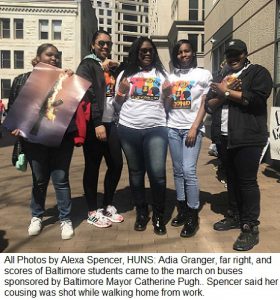
One of the oldest arguments in the history of psychology is the Nature vs Nurture debate. Each of these sides have good points that it’s really hard to decide whether a person’s development is predisposed in his DNA, or a majority of it is influenced by this life experiences and his environment. – https://explorable.com/nature-vs-nurture-debate

Which factor – Nature or Nurture – attributes to the development of Caribbean society?

VIDEO – Nature vs. Nurture – Psy 101 – https://youtu.be/chzDR3feSHY

PsychU
Published on Jul 10, 2015 – Does our personality and behavior come about from our upbringing and environment or do we have genetic predispositions that influence us to act a certain way? Let’s discuss how psychologists tackle the issue!

The book Go Lean…Caribbean – available to download for free – asserts that there are standard traits for Caribbean society and people – community ethos – that are so entrenched that they could be considered as embedded in the DNA. The Go Lean book defines community ethos as:

… the fundamental character or spirit of a culture; the underlying sentiment that informs the beliefs, customs, or practices of a group or society; dominant assumptions of a people or period. – Page 20

But alas, “community ethos” can be changed.

The Go Lean book prescribes how to recognize the ethos and most importantly: how to change ethos.

The Caribbean’s “community ethos” did not start in the Caribbean; alas, they started in Europe. So a study of the European ethos during the time of the discovery of the New World must be considered; we must learn from those lessons – we are directly affected.

In a previous Go Lean commentary, it was developed that the historicity of American and Caribbean society – make  that the whole New World – was premised on the European philosophy of White Supremacy; that it was acceptable for those peoples to exploit the native people of the New World – or the transplanted slaves – as long as they infused Christianity into these conquered people.

Such a fallacy!

So the Nature of the Caribbean refers to the normal assumption – community ethos – that inhabitants are Less Than and not equipped to foster a workable society. Alas, this Nature can be changed!

One way of changing that default Nature, is by Nurturing the needed values that the regional community needs to thrive as functioning societies. This destination is not automatic; it must be forged … with strenuous effort – heavy-lifting. This must be the new societal priority.

Underlying to Caribbean history is the Nature (DNA) of the New World colonizers; they brought Crony-Capitalism and White Supremacy – in this order – to their new lands of influence. This natural assumption that Europeans had the right to rule and exploit the land and dominate native people was an obvious attribute for hundreds of years (half a millennium).

Take for example this evidence in the history of discovery:

  • The New World was discovered in 1492, slavery started in 1600’s. What happened in 1500’s? Search for Gold. This is proof-positive that European Crony-Capitalism superseded all other community values in the New World colonization quest.
  • French Revolution brought equality and egalitarianism to the French world, but shortly thereafter, “they” wanted to re-install slavery in the French Caribbean, even in rebellious Haiti.

Where personal Nature is failing, the recompense must come from the process in Nurturing. (Consider the example of Crony-Capitalism; change can be forged by attacking the pocketbook through boycotts, embargo and blockades).

This commentary commences a 4-part series on Nature or Nurture for “community ethos”. This entry is 1 of 4 in this series from the movement behind the book Go Lean … Caribbean in consideration of root causes of some societal defects – specific examples in the US and UK – and how to overcome them. There is much that can be learned from history, good, bad and ugly. The other commentaries in the series are cataloged as follows:

  1. Nature or Nurture: Black Marchers see gun violence differently
  2. Nature or Nurture: Cop-on-Black Shootings – Embedded in America’s DNA; Whites Yawn>
  3. Nature or Nurture: UK City of Bristol still paying off Slavery Debt
  4. Nature or Nurture: Nurturing comes from women; “they” impacted the Abolition of Slavery

All of these commentaries relate to “why” the New World has the societal defects that are so prominent – and so illogical – and  “how” the stewards for a new Caribbean can assuage these defects and the resultant failing dispositions among Caribbean society. Though the traits may be consistent in the hemisphere, our efforts to reform and transform is limited to the Caribbean.

The subject of gun violence in America is truly one of those subjects, where a logical society seems to ignore logic. (America is the richest, most powerful society in the history of civilizations). It is outright stupidity! A previous blog-commentary related that stupidity persists when “someone is profiting”. (In a free society, special interest groups – who often have an economic motive – can conduct promotional campaigns to control public opinion).

So in America, it is a fact that different population groups have different experiences and values for guns. See this reality as portrayed in this news article, about Black protesters seeing gun violence differently than their White counterparts:

Title: Black Marchers See Gun Violence Differently
By: Alexa Spencer

WASHINGTON — Adia Granger knows gun violence intimately.  The 16-year-old lives in Baltimore, the city with the highest murder rate of any major city in America.
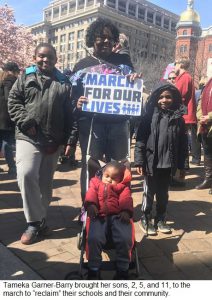
Of the 343 people killed in Baltimore last year, 295 died by gunfire, more than New York City or Los Angeles, cities with more than 10 times Baltimore’s population.  Gun-related deaths accounted for 88 percent of the city’s homicides.

Many of the victims were young.  Markel Scott, 19, shot six times. Steven Jackson, 18, shot in the head. Shaquan Raymone Trusty, 16, shot multiple times in the upper body. Tyrese Davis, 15, and  Jeffrey Quick, 15, shot in same neighborhood within blocks of one another.

Adia’s own cousin was shot while walking home from work.  Like her cousin, most all of them victims were black.

Their deaths were the reason she and a group of classmates from Western High School were among the more than 800,000 who rallied in the nation’s capital to demand more action to deal with gun violence.

“I came here to represent Baltimore,” Adia said.

Adia was among several bus loads of students sent to the march by Baltimore Mayor Catherine Pugh. For them, gun violence is not new. It is a longstanding issue.

Adia, a high school junior, joined the national movement for gun control sparked by the Parkland shooting by marching out of her school in March,   Like many other protestors,  she said she wanted the federal government should do more to address the issue.

“It’s unacceptable what is going on,” Adia said, “and Congress has not done anything about it.,”

Adia was among many black citizens that were present to protest not only against mass shootings, but also police brutality and gun violence that plagues neighborhoods of color.

Frederick Shelton, 43, stood aside the packed streets, holding a sign that read: If the opposite of pro is con…what is the opposite of progress?”

The message of his sign, Shelton said is “We’re not moving forward.”

“It’s just a matter of time before any of us get shot, because our federal government is not doing anything,” he said. “We’re all just sitting around waiting for the next mass shooting. It could be you. It could be me. And that’s a horrible way to live.”

Shelton teaches English as a second language to immigrant students in Washington.   He said his students are uniquely affected by gun laws and said he participated in the march to make their lives better. He suggested the federal government reserve guns for military personnel only.

“I believe that there is no place for guns in our society,” he said. “Guns are for the military.”

Tameka Garner-Barry, 38-year-old mother of three, brought her sons, 2, 5, and 11, to the march to “reclaim” their schools and their community. Her children, though young, have recognized the problem and wanted to be at the march to speak out.

“These are issues and concerns that they’ve had, so it’s only right that they come out and voice their opinions and let their voices be heard,” Garner-Barry said.

Standing at his mother’s hip, 5-year-old Bryson chipped in his feelings.

“I feel like people have to stop the violence,” he said, “because people are getting hurt.”

Garner-Barry said she wanted to see the removal of guns from the streets and heightened security in school.

“I want Congress to know that we do control the vote, and that we take these issues seriously,” she said, “and I want the NRA to be dismissed altogether,”

Nia Smith, 21, a graduating senior film production major at Howard University from Chicago, was also at the march.

Chicago had the highest number of murders two years in a row.    In 2016, 771 were killed.  The number declined to 650 murdered in 2017, still higher than the number of murders in Los Angeles and New York City combined.

“Gun violence has always been a part of my life,” Smith said. “I have had family members that I’ve lost to gun violence.”

Though the march addressed gun violence, including some speakers who tlked abut gun violence against African-American men and women, she said she felt as though certain forms of gun violence, such as police brutality, were overlooked by protesters because of class and race.

“They fail to see that gun violence is gun violence, period…the police and the perpetrators of the classroom shootings,” Smith said.

To fully combat the issue, there must be support across racial lines, she said.

“I don’t think they should be separated,” she said. “I think white people should march the way they marched today for the Black Lives Matter movement. They all died the same way. They all died by a bullet.”

Source: Howard University News Service; posted March 26, 2018; retrieved April 7, 2018 from: http://www.hunewsservice.com/news/view.php/1033085/Black-Marchers-See-Gun-Violence-Differen

A previous blog-commentary related how the 2nd Amendment originated during slavery so as to provide additional rights to the slave-owning populations to regulate (police) their slave majorities on plantations.

Despite the historic developments, the requirements for the Black American population appears to be different than for the White population; (this writer attended one of the “March For Our Lives” events on March 24, 2018). This is the manifestation of the Nature psychology.

While this is an American drama, there is much that the Caribbean can glean, in terms of lessons learned. The book Go Lean…Caribbean serves as a roadmap for the introduction and implementation of the technocratic Caribbean Union Trade Federation (CU), for the elevation of Caribbean society – for all member-states. The book presents 370 pages of instructions for how to reform and transform our Caribbean member-states. It stresses the key community ethos that needs to be adopted, plus the strategies, tactics, implementations and advocacies necessary to shepherd a better society.

The book stresses that reforming and transforming the Caribbean societal engines must be a regional pursuit. This was an early motivation for the roadmap, as pronounced in the opening Declaration of Interdependence (Pages 12 – 13):

xi. Whereas all men are entitled to the benefits of good governance in a free society, “new guards” must be enacted to dissuade the emergence of incompetence, corruption, nepotism and cronyism at the peril of the people’s best interest. The Federation must guarantee the executions of a social contract between government and the governed.

xvi. Whereas security of our homeland is inextricably linked to prosperity of the homeland, the economic and security interest of the region needs to be aligned under the same governance. Since economic crimes … can imperil the functioning of the wheels of commerce for all the citizenry, the accedence of this Federation must equip the security apparatus with the tools and techniques for predictive and proactive interdictions.

xxiv. Whereas a free market economy can be induced and spurred for continuous progress, the Federation must install the controls to better manage aspects of the economy: jobs, inflation, savings rate, investments and other economic principles. Thereby attracting direct foreign investment because of the stability and vibrancy of our economy.

The Go Lean book provides directions on “how” to adopt new community ethos, plus the strategies, tactics, implementations and advocacies to execute so as to reboot, reform and transform the societal engines of Caribbean society. Considering the failings in the US, the Go Lean roadmap calls for remediation and mitigation for gun control, despite the race issues. We want to elevate our society beyond the initial racial Nature in Caribbean history.

Change can be forged, by Nurturing a better community ethos. We have a long track record of advocates and activists working to change the default orthodoxy. They protest, campaign, speak out for a cause, lobby, cajole, take to the streets and march; they engage the voting process and support – or oppose – candidates in line, or out of line, with their cause. This is referred to as forging change from the Bottom-Up. They may even use Civil Disobedience tactics.

Have you been to jail for justice?

This is an important question and statement for forging change in society. See how this has been portrayed in this song-VIDEO recapping many of the causes during the hey-day of the Counter-Culture: Civil Rights, Women’s rights, Anti-War protests, etc.. The lyrics are included in the Appendix below.

VIDEO – Peter, Paul and Mary – Have You Been To Jail For Justice – https://youtu.be/rCbhOc1VZ6k
Kwan CS
Published on Sep 26, 2016 – Peter, Paul and Mary – Have You Been To Jail For Justice

For many of the Caribbean’s bad Nature, the Go Lean roadmap seeks to Nurture change with good messaging to the heart of the youth; this is one proven method for forging change among the next generation. Beyond that, meeting the needs of the population is important for optimizing the societal engines in a community. This is easier said than done, but this quest is the purpose of the CU/Go Lean roadmap; this roadmap has these 3 prime directives for optimizing our societal engines:

The Caribbean does not have the same population demographic as the neighboring American states. We can more easily distance ourselves from the racial dysfunction in American society. We have majority Black populations among 29 of the 30 member-states.  We only need to deliver best practices going forward; after formal reconciliation from our dysfunctional past.

Despite our differences, the Caribbean does need to reform and transform our society. We have many societal defects of our own. That cited song stressed this ethos:

The more you study history
The less you can deny it
A rotten law stays on the books
’til folks with guts defy it!

Yes, we can … exert the energy, display the guts and internal fortitude to change our society, to reform and transform. This is how we can make our homeland a better place to live, work and play. 🙂

Download the free e-Book of Go Lean … Caribbean – now!

Sign the petition to lean-in for this roadmap for the Caribbean Union Trade Federation.

———-

Appendix – Lyrics: Peter, Paul and Mary – Have You Been To Jail For Justice 

(Written by Anne Feeney)

Was it Cesar Chavez or Rosa Parks that day?
Some say Dr. King or Ghandi
Set them on their way
No matter who your mentors are
It’s pretty plain to see
That if you’ve been to jail for justice
You’re in good company

Have you been to jail for justice?
I want to shake your hand
‘Cause sitting in and laying down
Are ways to take a stand
Have you sung a song for freedom
Or marched that picket line?
Have you been to jail for justice?
Then you’re a friend of mine

You law abiding citizens
Come listen to this song
Laws are made by people
And people can be wrong
Once unions were against the law
But slavery was fine
Women were denied the vote
While children worked the mine
The more you study history
The less you can deny it
A rotten law stays on the books
’til folks with guts defy it!

Have you been to jail for justice?
I want to shake your hand
‘Cause sitting in and laying down
Are ways to take a stand
Have you sung a song for freedom
Or marched that picket line?
Have you been to jail for justice?
Then you’re a friend of mine

Well the law is supposed to serve us
And so are the police
When the system fails
It’s up to us to speak our piece
We must be ever vigilant
For justice to prevail
So get courage from your convictions
Let ’em haul you off to jail!

Have you been to jail for justice?
I want to shake your hand
‘Cause sitting in and laying down
Are ways to take a stand
Have you sung a song for freedom
Or marched that picket line?
Have you been to jail for justice?
Then you’re a friend of mine
Have you been to jail for justice
Then you’re a friend of mine

Source: Retrieved April 8, 2018 from: https://genius.com/Peter-paul-and-mary-have-you-been-to-jail-for-justice-lyrics

Share this post:
, , ,
[Top]

Change! Be the Change – Linda Brown, RIP

Go Lean Commentary

This could be just an empty platitude …

Be the Change you want to see in the world. 

… and then there are people who actually did it, not just say it!

Rest in Peace, Linda Brown.

The world is mourning the passing of Linda Brown, who died on Monday (March 26, 2018) at the age of 76. (See link to “Condolences” in Appendix B below). She was the little “Brown” in the landmark American legal case “Brown versus Board of Education”. On her behalf, the country changed! The US Supreme Court overturned the previous rulings maintaining the dignity-defying legacies of “Separate But Equal” and started the journey for full diversity in American society.

Rather that wishing for change, Linda Brown went on to Be The Change, as a Civil Rights icon.

As a little girl, Brown was at the center of the historic Brown vs. Board of Education case, which ultimately ended segregation in U.S. public schools. – Source: Huffington Post 

This actuality has been fittingly highlighted by the movement behind the book Go Lean … Caribbean. In a previous blog-commentary, it was detailed how the Supreme Court case “Brown vs. Board of Education” set a far-reaching precedence whose reverberations shook the whole world, even the Caribbean:

The issues pronounced here in the Go Lean book highlights an important factoid: de jure versus de facto

  • de jure = according to law
  • de facto = in reality

As a result of the 1954 Supreme Court’s decision, the de jure policy of the US was that of racial equality. But in reality, that decision didn’t manifest on the streets for the everyday man. The facts did not change the fiction, racism continued to dominate the American eco-system, even today. The aft-mentioned 20 million African-Americans in the US were viewed, treated and labeled as “Less Than“.

The case for little Linda Brown started the journey from de jure to de facto; eventually the de facto advanced closer to the de jure. We are here today, in a more racially-equitable America, because of that journey that was started for young Linda Brown. She will always be identified as an icon for constitutional progress – a constant feature of Constitutional History.
Now we say goodbye to Linda; but with a gracious heart full of gratitude for her accomplished life of “shifting the needle” towards a more harmonious society.

What a great role model, even for us in the Caribbean; of the 30 member-states that caucus as the political Caribbean, 29 have a non-White majority. Civil Rights matters here too! “We” all benefited from American progress as the regional hegemony. We all benefited from Linda Brown.

What a model she provided. We too, can Be the Change we want to see in the world.

Yes, this movement has consistently asserted that one man or one woman can make a difference in society. Linda Brown proved it! So too, can you, me or any Caribbean stakeholder. This is what the book Go Lean…Caribbean – available to download for free – have pronounced. The book posits that one person – advocating for progress – can make a difference (Page 122). It relates:

An advocacy is an act of pleading for, supporting, or recommending a cause or subject. For this book, it’s a situational analysis, strategy or tactic for dealing with a narrowly defined subject.

Advocacies are not uncommon in modern history. There are many that have defined generations and personalities. Consider these notable examples from the last two centuries in different locales around the world:

  • Frederick Douglas
  • Mohandas Gandhi
  • Martin Luther King
  • Nelson Mandela
  • Cesar Chavez – [American Farm Workers Advocate]
  • Candice Lightner – (Advocate for Mothers Against Drunk Driving]

The Go Lean book seeks to advocate for the Caribbean, not the US, and for the people who love our homeland. Yet still we can learn lessons from American Constitutional History (Page 145) – “separate but equal” was always a fallacy despite one Supreme Court ruling after another. We now hope to direct our regional stakeholders in our own Way Forward based on best-practices gleaned from America’s dysfunctional past. (Also see book’s Epilogue excerpt in the Appendix A below).

The book serves as a roadmap for the introduction and implementation of the technocratic Caribbean Union Trade Federation (CU), to reform and transform our communities, by elevating our societal engines – for all member-states. This CU/Go Lean roadmap has these 3 prime directives:

  • Optimization of the economic engines in order to grow the regional economy to $800 Billion and create 2.2 million new jobs.
  • Establishment of a security apparatus to ensure public safety and protect the resultant economic engines.
  • Improve Caribbean governance to support these engines, including a separation-of-powers between the member-states and CU federal agencies.

The Go Lean book stresses that reforming and transforming the Caribbean societal engines must be a regional pursuit – we must become a pluralistic democracy: Black, White, African-descended, European-descended, Asia-descended, Aboriginal, etc.. Our problems are too big for any one Caribbean member-state to contend with alone. This was an early motivation for the roadmap, as pronounced in the opening Declaration of Interdependence (Pages 12 – 14):

xi. Whereas all men are entitled to the benefits of good governance in a free society, “new guards” must be enacted to dissuade the emergence of incompetence, corruption, nepotism and cronyism at the peril of the people’s best interest. The Federation must guarantee the executions of a social contract between government and the governed.

xii. Whereas the legacy in recent times in individual states may be that of ineffectual governance with no redress to higher authority, the accedence of this Federation will ensure accountability and escalation of the human and civil rights of the people for good governance, justice assurances, due process and the rule of law. As such, any threats of a “failed state” status for any member state must enact emergency measures on behalf of the Federation to protect the human, civil and property rights of the citizens, residents, allies, trading partners, and visitors of the affected member state and the Federation as a whole.

xxxiii. Whereas lessons can be learned and applied from the study of the recent history of other societies, the Federation must formalize statutes and organizational dimensions to avoid the pitfalls of communities like East Germany, Detroit, Indian (Native American) Reservations, Egypt and the previous West Indies Federation. On the other hand, the Federation must also implement the good examples learned from developments / communities like New York City, Germany, Japan, Canada, the old American West and tenants of the US Constitution.

The Go Lean book provides 370-pages of turn-by-turn instructions on “how” to adopt new community ethos, plus the strategies, tactics, implementations and advocacies to execute so as to reboot, reform and transform the societal engines of Caribbean society. One entry is “10 Lessons from the US Constitution” (Page 145), detailing the adjustments and optimizing of the “living” document over the years:

The Bottom Line on Constitutional Law
The US Constitution was written in the late 18th Century, adopted on September 17, 1787, by the Constitutional Convention in Philadelphia, Pennsylvania, and ratified by conventions in 11 states. It went into effect on March 4, 1789. It was not the start, nor the end of the constitution theory process for the United States. But underlying to the codification on paper was the ideals verbalized in the Declaration of Independence of 1776, which defined that All Men Are Created Equal and Endowed by their Creator with Certain Unalienable Rights for Life, Liberty and the Pursuit of Happiness.

A nearly 250-year review of the process shows one consistent pattern, a desire to do better. While not perfect, the United States of America always tried to do better, from one generation to another. Whereas the Colonial/ Revolutionary America featured a country of great privileges for rich (land-owning) white Englishmen, a slow turn in societal evolution saw those privileges extended to the everyday white man, then to new immigrants, then to women, then to minorities, then to the disabled, and now to all, even those with alternative lifestyles.

The Go Lean movement calls on every man, woman and child in the Caribbean to be an advocate and a champion, or at least appreciate the championing efforts of previous advocates. Their examples can truly help us today with our passions and purpose. Consider this sample of prior blog/commentaries where advocates and role models have been elaborated upon:

https://goleancaribbean.com/blog/?p=14541 Viola Desmond – One Woman Made a Difference
https://goleancaribbean.com/blog/?p=14139 Carter Woodson – One Man Made a Difference … for Black History
https://goleancaribbean.com/blog/?p=10801 Caribbean Roots: John Carlos – The Man. The Moment. The Movement
https://goleancaribbean.com/blog/?p=10114 Caribbean Roots: Esther Rolle of ‘Good Times’
https://goleancaribbean.com/blog/?p=9300 Edward Snowden – One Person Making a Difference
https://goleancaribbean.com/blog/?p=8495 The NBA’s Tim Duncan – Champion On and Off the Court
https://goleancaribbean.com/blog/?p=8165 Role Model Muhammad Ali’s Greatest Fight
https://goleancaribbean.com/blog/?p=7682 Frederick Douglass: Role Model for Single Cause – Death or Diaspora
https://goleancaribbean.com/blog/?p=866 Role Model Bob Marley: The legend lives on!

Thank you Linda Brown, for your good role model … and Rest in Peace. See VIDEO below.

The movement behind Go Lean book, the planners of a new Caribbean, stresses that the same as change impacted the delivery of Civil Rights in America – which eventually transformed their society – a ‘change will also come’ to the Caribbean. This commentary continues this short 3-part series on “Change” in society. The full catalog of commentaries in this series are as follows:

  1. Change! Observing the Change – Student Marches for Gun Control Reform and Action
  2. Change! Be the Change – RIP Linda Brown; the little girl in “Brown vs Board of Education”
  3. Change! Forging Change – Citibank’s Model of “Corporate Vigilantism”

All of these commentaries give insights on “how” the planners of the new Caribbean can persuade people, establishments and institutions to forge change in their communities.

Remember the 5 L‘s. We want to learn from the US Constitutional History– the good, bad and ugly lessons. As planners for this new Caribbean, we have looked, listened, learned and lend-a-hand for the American experience; we are now ready to lead our own homeland to be a better place to live, work and play. 🙂

Download the free e-Book of Go Lean … Caribbean – now!

Sign the petition to lean-in for this roadmap for the Caribbean Union Trade Federation.

————–

Appendix A – Epilogue – Future Focus – Brown v. Board of Education (1954)

This was a landmark United States Supreme Court case in which the Court declared state laws establishing separate public schools for black and white students unconstitutional. The decision overturned the Plessy v. Ferguson decision of 1896, which allowed state-sponsored segregation, insofar as it applied to public education. Handed down on May 17, 1954, the Warren Court’s (between 1953 and 1969, when Earl Warren served as Chief Justice) unanimous decision (9–0) stated that “separate educational facilities are inherently unequal”. As a result, de jure racial segregation was ruled a violation of the Equal Protection Clause of the United States Constitution (Fourteenth Amendment). This ruling paved the way for integration and was a major victory of the civil rights movement.

This landmark ruling created chaos for nearly 60 years; the animosity created was real and every aspect of American society was affected. (Most legislative assemblies in the southern states passed resolutions and sanctions condemning the Supreme Court decision, though the federal law superseded all state legislations). Cities and urban areas suffered from white flight, where white Americans fled the cities to move out to the suburbs to avoid the integration of urban schools; with their flight went their capital and tax base. Many American cities have still not recovered, for example Detroit filed for Bankruptcy in July 2013 after suffering the pangs of distress from this white flight for 60 years.

So why would the learned men on the Supreme Court make this unanimous ruling and caused so much havoc on American life. Were they not wise, could they not “read the writing on the wall”? The answer is an emphatic No! They knew the real beneficiary of their judgment would come later. Their wisdom was strewn from the experience of modern society waging two world wars, the last of which was just concluded 9 years earlier. They saw the rampage, saw of devastation of 60 million deaths around the world and appreciated the wisdom that a downtrodden people would not stay down, that they would rise and revolt, that they would risk their lives and that of their children to pursue freedom. The Warren Court knew that the status quo of race inequality could not continue, but in order to effectuate that change would take writing-off an entire generation (or two). That time had come, the generation was now (1954); but the hope was with the next generation, and so the curative measures started with the children of that day, so that inevitably, future generations would inhabit an America that would not judge its people by the color of their skins, but rather the content of their character.

Source: Book Go Lean … Caribbean Page 251

————–

Appendix B – Condolences – Civil Rights Icon Linda Brown Remembered On Twitter: ‘Rest In Power’- https://www.huffingtonpost.com/entry/linda-brown-death-tributes_us_5ab9f841e4b054d118e65b09

“Generations stand on your shoulders.”

See the condolences, comments and tributes in the link here from many, public servants and private individuals, celebrities and commoners alike.

————–

Appendix C VIDEO – Remembering The Life Of Linda Brown | Morning Joe | MSNBChttps://youtu.be/MGefY55K8LM


MSNBC

Published on Mar 27, 2018 –
Linda Brown, the Kansas girl at the center of the 1954 Supreme Court ruling that struck down racial segregation in schools, has died at age 76.
» Subscribe to MSNBC: http://on.msnbc.com/SubscribeTomsnbc

About: MSNBC is the premier destination for in-depth analysis of daily headlines, insightful political commentary and informed perspectives. Reaching more than 95 million households worldwide, MSNBC offers a full schedule of live news coverage, political opinions and award-winning documentary programming — 24 hours a day, 7 days a week.

Share this post:
, , , ,
[Top]

Viola Desmond – One Woman Made a Difference

Go Lean Commentary

In North America, there is Black History Month and there is Women’s History Month …

This story – about Canadian Viola Desmond – is both!

Viola Desmond challenged racial segregation at a cinema in New Glasgow, Nova Scotia, in 1946. She refused to leave a whites-only area of the Roseland Theatre and was convicted of a minor tax violation for the one-cent tax difference between the seat she had paid for and the seat she used which was more expensive. Desmond’s case is one of the most publicized incidents of racial discrimination in Canadian history and helped start the modern civil rights movement in Canada.

In 2010, Viola Desmond was granted a posthumous pardon, the first to be granted in Canada.[2][3] The government of Nova Scotia also apologized for prosecuting her for tax evasion and acknowledged she was rightfully resisting racial discrimination.[4] … In late 2018 Desmond will be the first Canadian born woman to appear alone on a $10 bill which was unveiled by Finance Minister Bill Morneau and Bank of Canada governor Stephen Poloz during a ceremony at the Halifax Central Library on March 8, 2018.[5][6] Desmond was also named a National Historic Person in 2018.[7]

[Reverend] Dr. William Pearly Oliver – [a Social Justice Champion in the vein of Martin Luther King] – reflecting on the case 15 years later[21] stated regarding Desmond’s legacy:

    “… this meant something to our people. Neither before or since has there been such an aggressive effort to obtain rights. The people arose as one and with one voice. This positive stand enhanced the prestige of the Negro community throughout the Province. It is my conviction that much of the positive action that has since taken place stemmed from this …”.

Desmond is often compared to Rosa Parks, given they both challenged racism by taking seats in a Whites only section and contributed to the rise of the Civil Rights Movement.
Source: Retrieved March 14, 2018 from: https://en.wikipedia.org/wiki/Viola_Desmond

Yes, one woman, or one man, can make a difference in society. Viola Desmond proved it! Her commitment to justice and righteous principles compelled her community to take note and make a change.

“Wanna make the world a better place, take a look at yourself and make a change.” – Michael Jackson’s song: Man in the Mirror (1987).

Canada today is a very progressive society. From the Caribbean perspective, Canada is now a role model for a pluralistic democracy and Climate Change action. As is the experience, positive reform always starts with one person. In a previous blog-commentary, the movement behind the book Go Lean…Caribbean explained how immigrants to a new community (and minorities) normally go through a long train of abuse, then toleration, followed by acceptance and then finally celebration. Today, Canada is celebrating Viola Desmond; see the news article in the Appendix below.

The success of this community – Canada – has been hard fought, but they did the heavy-lifting and now are enjoying the fruitage of their labor. People from all over the world “are beating down the doors to get in”.

Poor Caribbean communities. We have NOT done the heavy-lifting and our people “are beating down the doors to get out”. (Many times, they flee to Canada for refuge).

This is what the book Go Lean…Caribbean – available to download for free – warned: “Push and Pull” factors are resulting in an abandonment of Caribbean homelands for foreign shores like Canada; (Page 3). Now to learn and apply this lesson.

The Viola Desmond story resonates with us in the Caribbean. Since she was a Black Woman and the majority population of 28 of the 30 Caribbean member-states is Black, we share the same ancestral heritage – Africa – colonial origins – slave trade – and history of oppression as Canadian Blacks. Plus a large number of our Caribbean Diaspora who fled their homeland lives in Canada – one estimate is near a million.

The Go Lean book posits that one person – an advocate like Desmond – can make a difference (Page 122). It relates:

An advocacy is an act of pleading for, supporting, or recommending a cause or subject. For this book, it’s a situational analysis, strategy or tactic for dealing with a narrowly defined subject.

Advocacies are not uncommon in modern history. There are many that have defined generations and personalities. Consider these notable examples from the last two centuries in different locales around the world:

  • Frederick Douglas
  • Mohandas Gandhi
  • Martin Luther King
  • Nelson Mandela
  • Cesar Chavez
  • Candice Lightner

The Go Lean book seeks to advocate and correct the Caribbean, not Canada, and the people who love our homeland. Yet still we can learn lessons from Canada’s history (Page 146) and direct our regional stakeholders to a Way Forward based on best-practices gleaned from Canada’s dysfunctional past. The book, in its 370 pages, serves as a roadmap for the introduction and implementation of the technocratic Caribbean Union Trade Federation (CU), to move our society to a brighter future, by elevating our societal engines – for all member-states. This CU/Go Lean roadmap has these 3 prime directives:

  • Optimization of the economic engines in order to grow the regional economy to $800 Billion and create 2.2 million new jobs.
  • Establishment of a security apparatus to ensure public safety and protect the resultant economic engines.
  • Improve Caribbean governance to support these engines, including a separation-of-powers between the member-states and CU federal agencies.

The book stresses that reforming and transforming the Caribbean societal engines must be a regional pursuit – we must become a pluralistic democracy: Black, White, Red and Yellow. Our problems are too big for any one Caribbean member-state to contend with alone. This was an early motivation for the roadmap, as pronounced in the opening Declaration of Interdependence (Pages 12 – 14):

xi. Whereas all men are entitled to the benefits of good governance in a free society, “new guards” must be enacted to dissuade the emergence of incompetence, corruption, nepotism and cronyism at the peril of the people’s best interest. The Federation must guarantee the executions of a social contract between government and the governed.

xix. Whereas our legacy in recent times is one of societal abandonment, it is imperative that incentives and encouragement be put in place to first dissuade the human flight, and then entice and welcome the return of our Diaspora …

xxxii. Whereas the cultural arts … of the region are germane to the quality of Caribbean life, and the international appreciation of Caribbean life, the Federation must implement the support systems to teach, encourage, incentivize, monetize and promote the related industries for arts … in domestic and foreign markets. These endeavors will make the Caribbean a better place to live, work and play.

xxxiii. Whereas lessons can be learned and applied from the study of the recent history of other societies, the Federation must formalize statutes and organizational dimensions to avoid the pitfalls of communities like East Germany, Detroit, Indian (Native American) Reservations, Egypt and the previous West Indies Federation. On the other hand, the Federation must also implement the good examples learned from developments/ communities …

The Go Lean book provides 370-pages of turn-by-turn instructions on “how” to adopt new community ethos, plus the strategies, tactics, implementations and advocacies to execute so as to reboot, reform and transform the societal engines of Caribbean society.

The Go Lean movement calls on every man, woman and child in the Caribbean to be an advocate and a champion, or at least appreciate the championing efforts of previous advocates. Their examples can truly help us today with our passions and purpose. Consider this sample of prior blog/commentaries where advocates and role models have been elaborated upon:

https://goleancaribbean.com/blog/?p=14139 Carter Woodson – One Man Made a Difference … for Black History
https://goleancaribbean.com/blog/?p=11963 Oscar López Rivera – The ‘Nelson Mandela’ of the Caribbean?
https://goleancaribbean.com/blog/?p=11442 Caribbean Roots: Al Roker – ‘Climate Change’ Defender
https://goleancaribbean.com/blog/?p=10801 Caribbean Roots: John Carlos – The Man. The Moment. The Movement
https://goleancaribbean.com/blog/?p=10114 Caribbean Roots: Esther Rolle of ‘Good Times’
https://goleancaribbean.com/blog/?p=9948 Caribbean Roots: Sammy Davis, Jr.
https://goleancaribbean.com/blog/?p=9300 Edward Snowden – One Person Making a Difference
https://goleancaribbean.com/blog/?p=8724 Remembering Marcus Garvey: Still Relevant Today
https://goleancaribbean.com/blog/?p=8495 The NBA’s Tim Duncan – Champion On and Off the Court
https://goleancaribbean.com/blog/?p=8328 YouTube Millionaire: ‘Tipsy Bartender’ Bahamas Origins
https://goleancaribbean.com/blog/?p=8165 Role Model Muhammad Ali’s Greatest Fight
https://goleancaribbean.com/blog/?p=7682 Frederick Douglass: Role Model for Single Cause – Death or Diaspora
https://goleancaribbean.com/blog/?p=866 Bob Marley: The Role Model and Legend … lives on!

Thank you Viola Desmond, for being a good role model, and a reminder: Black Girls Rock!

We conclude about Viola Desmond as we do about our own Caribbean champions and advocates; we said (Go Lean book Valedictions on Page 252):

Thank you for your service, love and commitment to all Caribbean people. We will take it from here.

The movement behind Go Lean book, the planners of a new Caribbean stresses that a ‘change is going to come’ our way. We have endured failure for far too long; we have seen what works and what does not. We want to learn from Canada’s History – the good, bad and ugly lessons.

There are the 5 L‘s. We have now Looked, Listened, Learned and Lend-a-hand; we are now ready to Lead our region to a better destination, to being a homeland that is better to live, work and play. Let’s move! 🙂

Download the free e-Book of Go Lean … Caribbean – now!

Sign the petition to lean-in for this roadmap for the Caribbean Union Trade Federation.

————

Appendix – Viola Desmond On New Canadian $10 Bill

March 12, 2018 – Canadian hero Viola Desmond is the face on the new $10 bill in Canada, which goes into circulation at the end of March.

Viola Desmond was thrown in jail in Nova Scotia in 1946 because, in a movie theatre, she wanted to sit downstairs where the white people were allowed to sit. She didn’t want to sit up in the balcony, where the black people had to sit. The police held her in jail overnight. The dignified and brave Desmond paid a fine of $20 the next day, even though she had done nothing wrong. Today, we think of her for being a brave advocate for the rights of African-Canadians and helping to inspire the human rights movement in Canada.

(Learn more about Desmond on Historica Canada’s Viola Desmond page.)

It is a great honour to have your face on a country’s money. This is the first time an African-Canadian woman has been featured on Canadian paper money. (Queen Elizabeth is featured on the $20 bill.)

There’s something else interesting about the new bill. For the first time, it is vertical, meaning it’s meant to be looked at up-and-down rather than horizontally (across).

The new bill also features a number of images that are reminders of human rights. For instance, there is an image of the Canadian Museum for Human Rights, in Winnipeg, Manitoba, where Desmond’s story is part of the permanent collection. There is an image of a feather, to recognize rights and freedoms for Canada’s Indigenous Peoples. And it features a paragraph from the Canadian Charter of Rights and Freedoms (section 15, which says, “Every individual is equal before and under the law.”

Viola Desmond’s sister, Wanda Robson, was one of the first people in Canada to receive a copy of the new $10 bill. In a Bank of Canada video (below), she said her sister’s photo on it is “so life-like. It’s as if she’s in this room!”

Source: Retrieved March 14, 2018 from http://teachingkidsnews.com/2018/03/12/viola-desmond-on-new-canadian-10-bill/

Related Videos
The video below (1:00) is a “Heritage Minute” produced by Historica Canada. It tells the story of Viola Desmond.

——–

VIDEO – Heritage Minutes: Viola Desmond – https://youtu.be/ie0xWYRSX7Y

Historica Canada
Published on Feb 2, 2016 – The story of Viola Desmond, an entrepreneur who challenged segregation in Nova Scotia in the 1940s. The 82nd Heritage Minute in Historica Canada’s collection. For more information about Viola Desmond, visit: http://www.thecanadianencyclopedia.ca…

——–

Additional Video: Wanda Robson sees Canada’s new $10 note featuring her sister (Viola Desmond) for the first time  – https://youtu.be/dfdlPrglcS8

Share this post:
, , , ,
[Top]