Tag: Tourism

Bad Tweet: Dutch airline angers Mexico soccer fans

Go Lean Commentary

“In 2 minutes a computer can make as many mistakes as 20 men in 20 years” – Murphy’s Law on Technology.

“Once posted, you can’t take it back” – Social Media Harsh Reality.

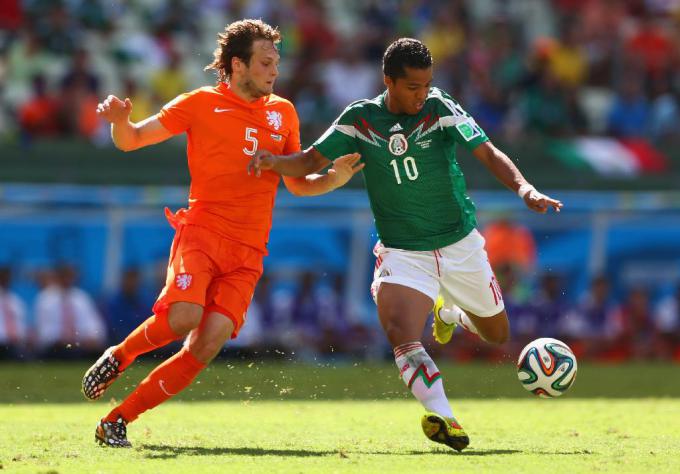
These two expressions are the new normal. Social media can be an effective communication tool to reach the general public and/or a dedicated controlled group. This can be a blessing and a curse. This fact was demonstrated after the recent World Cup Elimination Game between Mexico and The Netherlands. Mexico lost! In its haste to capitalize on all the fanfare, representatives at Dutch airline KLM committed this PR blunder of denigrating Mexican fans:

By: AP Writer Alan Clendenning
RIO DE JANEIRO (AP) — What was meant to be a joke has turned into a PR blunder for Dutch airline KLM after it angered Mexican soccer fans by taking to Twitter to celebrate the Netherlands’ dramatic comeback victory in the World Cup.

Netherlands v MexicoWithin minutes of the Netherlands’ 2-1 victory over the Tri, KLM let loose on its Twitter feed a picture of an airport departures sign under the heading “Adios Amigos!” Next to the word “Departures” is the image of a man with a mustache wearing a sombrero.

The post immediately went viral, with A-list Mexican actor Gael Garcia Bernal using not one but two expletives in a 140-character Tweet to tell his 2 million-plus followers that he’ll never fly the carrier again. Amid the widespread protest online, the post was pulled a half-hour later without an explanation.

“It was meant to be a joke,” KLM spokeswoman Lisette Ebeling Koning told The Associated Press, adding that the airline never intended to offend Mexicans, which it serves via a daily direct flight between Mexico City and Amsterdam. “But there was too much negative reaction.”

KLM issued a formal apology late Sunday.

“In the best of sportsmanship, we offer our heartfelt apologies to those who have been offended by the comment,” said Marnix Fruitema, director general of KLM in North America.

For its part, Mexican national carrier AeroMexico is also getting in on the fun, broadcasting on Twitter its support for the country’s soccer team under an arrivals sign.

“Thank you for this great championship,” AeroMexico said. “You’ve made us proud and we’re waiting for you at home.”
Associated Press (AP) News Wire Service (Retrieved 06/30/2014) –
http://news.yahoo.com/bad-tweet-dutch-airline-angers-mexico-soccer-fans-205929269.html
The expression “the post immediately went viral” could be a good thing or a bad thing. The book Go Lean…Caribbean posits that the power of social media must be harnessed strategically and tactically in order to explore all the benefits of Internet Communications Technologies. The book further asserts that the internet can be a great equalizer between large and small economy states, that talent and value can readily be searched and discovered.

The foregoing article depicts a Bad Tweet; then proceeds to describe how impactful response tweets can be, especially when wielded by an “Influencer” – a person with at least 100,000 followers – such as A-list Mexican celebrity Gael Garcia Bernal.

The book serves as a roadmap for the introduction and implementation of the technocratic Caribbean Union Trade Federation (CU). This effort will launch the Caribbean Postal Union to facilitate the region’s “mail” functionality. In 2014, the mail delivery cannot be seriously mentioned without considering electronic messaging options. Social media is an electronic messaging scheme. The CPU will administer the domain for www.myCaribbean.gov. The universe for this domain is scoped at 130 million unique users.

This strategy will elevate Caribbean society, and image. There is the need for a sentinel role for Caribbean image, as there are a lot of times that Caribbean life and people are denigrated in works of media arts: film, TV, books, magazines. Consider the example of Jamaican “Yardies”, or Dominican Cartels. The Go Lean roadmap calls for the CU to assume that role.

The CU, using cutting edge delivery of best practices, will employ strategies, tactics and implementations to impact its prime directives; identified with the following 3 statements:

  • Optimization of the economic engines in order to grow the regional economy to $800 Billion & create 2.2 million new jobs.
  • Establishment of a security apparatus to protect the resultant economic engines.
  • Improve Caribbean governance to support these engines.

Dutch KLM Photo

AeroMexico Photo

The Go Lean book speaks of a Caribbean crisis and posits that this crisis can be averted, the same way the non-malevolent jest on social media by KLM was quickly averted using stronger social media tactics. Considering the events in the foregoing article, an undeniable credo is reiterated that “a crisis is a terrible thing to waste”. The Go Lean roadmap seeks to optimize the entire Caribbean economic/security/governance eco-system. This vision is defined early in the book (Page 12 & 14) in the following pronouncements in the Declaration of Interdependence:

xv. Whereas the business of the Federation and the commercial interest in the region cannot prosper without an efficient facilitation of postal services, the Caribbean Union must allow for the integration of the existing mail operations of the governments of the member-states into a consolidated Caribbean Postal Union, allowing for the adoption of best practices and technical advances to deliver foreign/domestic mail in the region.

xxvii. Whereas the region has endured a spectator status during the Industrial Revolution, we cannot stand on the sidelines of this new economy, the Information Revolution. Rather, the Federation must embrace all the tenets of Internet Communications Technology (ICT) to serve as an equalizing element in competition with the rest of the world. The Federation must bridge the digital divide and promote the community ethos that research/development is valuable and must be promoted and incentivized for adoption.

xxx. Whereas the effects of globalization can be felt in every aspect of Caribbean life, from the acquisition of food and clothing, to the ubiquity of ICT, the region cannot only consume, it is imperative that our lands also produce and add to the international community, even if doing so requires some sacrifice and subsidy.

The Go Lean book details a lot more, a series of assessments, community ethos, strategies, tactics, implementations and advocacies to garner the benefits of ICT in the Caribbean region:

Community Ethos – Economic Systems Influence Choices & Incentives Page 21
Community Ethos – People Respond to Incentives Page 21
Community Ethos – Consequences of Choices Lie in the Future Page 21
Community Ethos – Return on Investments Page 24
Community Ethos – Ways to Impact the Future Page 26
Community Ethos – Ways to Foster Genius Page 27
Community Ethos – Ways to Impact Research & Development Page 30
Community Ethos – Ways to Bridge the Digital Divide Page 31
Community Ethos – Ways to Impact the Greater Good Page 37
Strategy – Vision – Confederating a Non-Sovereign Union Page 45
Tactical – Separation of Powers – Caribbean Postal Union Page 78
Implementation – Ways to Pay for Change Page 101
Implementation – Ways to Improve Mail   Services Page 108
Implementation – Ways to Deliver Page 109
Implementation – Ways to Impact Social   Media Page 111
Planning – Ways to Improve Image Page 133
Advocacy – Ways to Grow the Economy Page 151
Advocacy – Ways to Create Jobs Page 152
Advocacy – Ways to Foster Technology Page 197
Advocacy – Ways to Foster e-Commerce Page 198
Appendix – Measuring Media   Consumption Page 265

Now is the time for all of the Caribbean, the people and governing institutions, to lean-in for the empowerments described in the book Go Lean…Caribbean. There is reason to believe that these empowerment efforts can be successful. The Go Lean roadmap conveys how single causes/advocacies have successfully been forged throughout the world (Page 122 – Anatomy of Advocacies). With social media deployments, millions of people can be advocates. No defamation of Caribbean image will go unchallenged. We, in the Caribbean, can do the same as the Mexican power brokers when bad sportsmanship was displayed by the KLM airline.

The Caribbean can succeed in the advocacy to improve the Caribbean image and deployments of social media in the region. There are previous blog commentaries that delve into aspects of these same issues:

https://goleancaribbean.com/blog/?p=1416 Amazon’s new FIRE Smartphone
https://goleancaribbean.com/blog/?p=1404 Facebook goes down across multiple countries
https://goleancaribbean.com/blog/?p=857 Caribbean Image:   Dreadlocks

Congratulation to the Netherlands football/soccer national team in their pursuits of the FIFA World Cup. There is room for good sportsmanship for all.

Download the book Go Lean … Caribbean – now!

Share this post:
, , , , , ,

Marijuana in Jamaica – Puff Peace

Go Lean Commentary

Weed 1Come to Jamaica and feel alright! – Advertising tag line sampling Bob Marley’s song: One Love.

Marijuana decriminalization is not a Jamaican issue… alone. Other countries have already addressed this debate; like Latin America[a] and Europe; legal in The Netherlands & Portugal, and decriminalized in Norway. In the US, Colorado is about to be joined by the State of Washington in allowing recreational use of the cannabis plant.

While medical marijuana originated in Jamaica (1970’s), many jurisdictions now allow marijuana to be legally distributed by medical professionals, with a prescription. Life imitates art, art imitates life. Hollywood has lampooned this practice many times in movies, TV shows and commentary. In the State of California, it is common-place to get a prescription for marijuana for “dubious” ailments like insomnia, appetite abatement, non-clinical depression, even sneezing. Without a doubt in California, the whole process is a farce! (See Comedian Bill Maher’s tongue-in-cheek commentary in Referenced VIDEO below[c]).

The world has changed; the acceptance of marijuana is changing.

The following news article addresses the issue of Marijuana decriminalization, (more so than legalization):

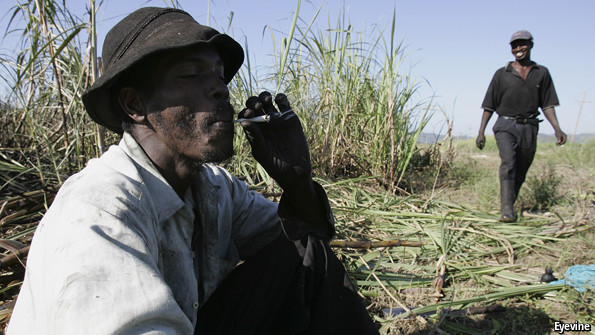
Port of Spain, Trinidad & Tobago – It would have seemed a lot more revolutionary just two years ago but for Jamaica, it is still a welcome whiff of sense. The island’s energy minister, Philip Paulwell, who also leads government business in parliament, has said he will find time this year to decriminalise possession of small amounts of marijuana. At a stroke, the move will cut the number of illicit smokes by as many as a million a week. It will also make a Jamaican break somewhat less nervy for ganja-puffing tourists.

Reform proposals have been knocking around for some time: a National Commission on Ganja recommended decriminalisation in 2001. But helped by moves towards legalisation in Uruguay and decriminalisation in the United States, momentum has been growing. A Cannabis Future Growers and Producers Association was launched last month, and a commercial company to support medical marijuana in December.

Selling for less than five dollars an ounce, ganja has a long history in Jamaica, going all the way back to 19th-century Indian immigrants. Cultivation and import have been illegal since 1913, but everyone’s granny remembers when the herb was quite openly on sale as a cure-all. Some of the early work on medicinal uses for marijuana was done in Jamaica in the 1970s and 1980s.

In practice, most small-time ganja users are not arrested or prosecuted. But for those who are, the consequences can be dire. A criminal record makes it hard to get a coveted American visa or to land jobs in Jamaica itself. For that reason alone, reform looks like a surefire vote-winner.

Decriminalisation will also unclog the courts and free up police time. But it won’t change the big picture. It will remain illegal to grow and trade marijuana in large quantities, something that suits the big players just fine. Full legalisation would knock the bottom out of the market, hurting the island’s powerful criminal gangs. It would also curtail the potential for extortion; seven police officers appeared in court this month to face allegations that they took a $2,750 bribe from a businessman in return for overlooking a ganja find on his premises.

Jamaicans are prone to waves of moral panic, but the proposal to decriminalise ganja has caused barely any waves. The foreign minister AJ Nicholson and the opposition leader, Andrew Holness, have expressed mild reservations; the vocal church lobby has been silent. Says a well-educated and dreadlocked Jamaican: “Most of them accept that there are people who do this, just like there are people who drink.” Such tolerant sentiments only go so far, however. The “abominable crime of buggery” carries a prison sentence of up to ten years, and the government has no plans to right that injustice.
The Economist Magazine; posted 06/13/2014; retrieved 06/18/2014 from: http://www.economist.com/blogs/americasview/2014/06/marijuana-jamaica?spc=scode&spv=xm&ah=9d7f7ab945510a56fa6d37c30b6f1709

Marijuana tourism or “ganja-puffing tourists” …
…these words jump off the page of this foregoing news article.

The book Go Lean…Caribbean anticipates the compelling issues associated with economic engines. The book serves as a roadmap for the introduction and implementation of the technocratic Caribbean Union Trade Federation (CU). This effort calls for the focus of the following 3 prime directives related to Trade:

  • Optimization of the economic engines in order to grow the regional economy to $800 Billion and create 2.2 million jobs.
  • Establishment of a security apparatus (including law enforcement enhancements) to protect the resultant economic engines.
  • Improve Caribbean governance to support these engines.

Weed 2But the subject of marijuana is bigger than Trade. There are moral, religious, legal and psychological (treatment) issues associated with this topic; and there is history – good and bad. Any jurisdiction decriminalizing the use of marijuana has to contend with the previous messaging to the community of: “Just say no to drugs”.

The book asserts that before the strategies, tactics, implementations and advocacies of a roadmap to elevate a society can be deployed, the affected society must first embrace a progressive community ethos. The book defines this “community ethos” as the fundamental character or spirit of a culture; the underlying sentiment that informs the beliefs, customs, or practices of society; dominant assumptions of a people or period. Think of the derivative term: “work ethic”.

Marijuana is a mood-altering drug; it has negative effects, one being preponderance for apathy, to tune out of any active engagement. In the US, even in the states where marijuana is legal, most firms/governments still screen staffers (new hires and veterans) and ban consumption of the drug. The reason is simple: Apathy does not make for industriousness. So this issue/drug presents a conundrum for the CU. The mission to grow the economy, promote industriousness, foster new jobs and new industries is pronounced early in the roadmap, detailed in the Declaration of Interdependence (Page 14) with this statement:

 xxvi.   Whereas the Caribbean region must have new jobs to empower the engines of the economy and create the income sources for prosperity, and encourage the next generation to forge their dreams right at home, the Federation must therefore foster the development of new industries … In addition, the Federation must invigorate the enterprises related to existing industries … impacting the region with more jobs.

According to the foregoing article, reconciling the history of marijuana/ganja will be a “tall order”:

ganja has a long history in Jamaica, going all the way back to 19th-century Indian immigrants.

The history of marijuana/ganja in the Caribbean in general and Jamaica in particular has generated a lot of proponents and opponents. Despite outlawing “the weed” for over 100 years, there is a vibrant black market economy associated with the drug. This reality challenges the security apparatus of the Caribbean’s legitimate governing entities. The Go Lean roadmap therefore features the necessary homeland security/law enforcement mitigations. This need was pronounced at the outset of the book (Page 12), recognizing that the problem of drug enforcement/interdiction may be too big for any one member-state alone:

xvi.   Whereas security of our homeland is inextricably linked to prosperity of the homeland, the economic and security interest of the region needs to be aligned under the same governance. Since economic crimes … can imperil the functioning of the wheels of commerce for all the citizenry, the accedence of this Federation must equip the security apparatus with the tools and techniques for predictive and proactive interdictions.

This issue of decriminalizing marijuana must now reconcile with the long history of criminal prosecutions, prison terms and probation/parole eco-system. Management of these attendant functions of criminology has been a consistent theme of the Go Lean roadmap, commencing with this statement in the same Declaration of Interdependence (Page 12):

x.   Whereas we are surrounded and allied to nations of larger proportions in land mass, populations, and treasuries, elements in their societies may have ill-intent in their pursuits, at the expense of the safety and security of our citizens. We must therefore appoint “new guards” to ensure our public safety and threats against our society, both domestic and foreign. The Federation must employ the latest advances and best practices of criminology and penology to assuage continuous threats against public safety. The Federation must allow for facilitations of detention for convicted felons of federal crimes, and should over-build prisons to house trustees from other jurisdictions.

The Go Lean book envisions the CU as a confederation of the 30 member-states of the Caribbean to do the heavy-lifting of empowering and elevating the Caribbean society by creating a “single market” for the region. Among the many benefits of this roadmap is the economies-of-scale for leveraging regional security solutions, like the upheavals of marijuana decriminalization.

Despite the many economic benefits researched for decriminalizing drugs, as measured in the mature market of the US [b], this roadmap and supporting blogs are NOT proposing this measure for the Caribbean … per se. This is presented here as a political issue; the CU strives to maintain an apolitical stance.

There is security risk on both sides of this issue. The book details the community ethos, strategies, tactics, implementations and advocacies to monitor, manage and mitigate the security risks to Caribbean society. The following is a sample list:

Community Ethos – Deferred Gratification Page 21
Community Ethos – Job Multiplier Page 22
Community Ethos – Privacy versus Public Protection Page 23
Community Ethos – Light Up the Dark Places Page 23
Community Ethos – Ways to Impact Research & Development Page 30
Community Ethos – Ways to Impact the Greater Good Page 37
Strategy – Vision – Integration of Single Market Economy Page 45
Strategy – Agents of Change – Globalization Page 57
Tactical – Fostering a Technocracy Page 64
Tactical – Separation of Powers – Homeland Security Page 75
Tactical – Separation of Powers – Justice Department Page 77
Implementation – Security Initiatives at Start-up Page 103
Advocacy – Ways to Grow the Economy Page 151
Advocacy – Ways to Ways to Mitigate Black Markets Page 165
Advocacy – Ways to Improve Governance Page 168
Advocacy – Ways to Better Manage the Social Contract Page 170
Advocacy – Ways to Impact Justice Page 177
Advocacy – Ways to Remediate and Mitigate Crime Page 178
Advocacy – Ways to Improve Homeland Security Page 180
Advocacy – Ways to Impact the Prison Industrial Complex Page 211

Now is the time for all of the Caribbean, the people and governing institutions, to lean-in for the empowerments described in the book Go Lean … Caribbean. For us to send the invitation to the wide-world to ”come to Caribbean and feel alright”, but we must first put “our house” in order.

The world’s acceptance of marijuana has changed. While this is true, this change has created opportunities and also challenges. There is plenty of work yet to be done; heavy-lifting.

Download the book Go Lean … Caribbean – now!

————————-

Referenced Citations:

a.  Marijuana is legal to some degree in 8 Latin America countries (Argentina, Brazil, Columbia, Costa Rica, Ecuador, Honduras, Mexico and Uruguay).

b.  A Harvard economist, Jeffery Miron, estimated that ending the war on drugs would inject 76.8 billion dollars into the US economy in 2010 alone.[1] He estimates that the government would save $41.3 billion for law enforcement and the government would gain up to $46.7 billion in tax revenue.[2] Since President Nixon began the war on drugs, the federal drug-fighting budget has increased from $100 million in 1970 to $15.1 billion in 2010, with a total cost estimated near 1 trillion dollars over 40 years.[3] In the same time period an estimated 37 million nonviolent drug offenders have been incarcerated. $121 billion was spent to arrest these offenders and $450 billion to incarcerate them.[3]

1.       Debusmann, Bernd (12/03/2008). “Einstein, Insanity and the War on Drugs”. Reuter. Retrieved 04/01/2012 from: http://blogs.reuters.com/great-debate/2008/12/03/einstein-insanity-and-the-war-on-drugs/.

2.       Miron, Jeffrey A.; Katherine Waldock. “The Budgetary Impact of Ending Drug Prohibition”. The Cato Institute.  Retrieved 05/03/2010 from: http://www.cato.org/publications/white-paper/budgetary-impact-ending-drug-prohibition

3.       The Associated Press (05/13/2010). “After 40 years, $1 trillion, US War on Drugs Has Failed to Meet Any of its Goals”. The Associated Press. Retrieved 04/01/2012 from: http://www.foxnews.com/world/2010/05/13/ap-impact-years-trillion-war-drugs-failed-meet-goals/.

c.  Referenced VIDEO:


On Friday night’s episode of “Real Time,” Bill Maher offered some advice to viewers and to the state of Colorado about how to use marijuana safely and effectively, which we need to do, he said, because “after all, we’re pretending it’s medicine…


Share this post:
, , , , , , ,
[Top]

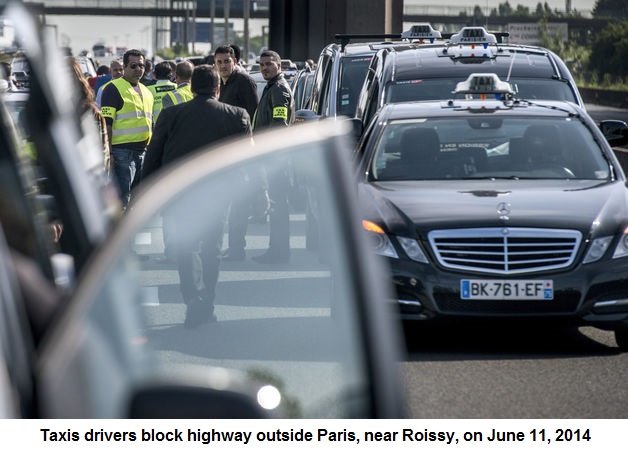
Uber Demonstrations Snarl Traffic from London to Berlin

Go Lean Commentary

Uber 1Old World [economy] meets New World [economy].

Taxi cabs go back to the days of horses and carriages; yet the industry has slowly adapted to all the evolutionary changes in technology and modernization. Today, in some jurisdictions, a taxi cab is a moving economic engine: a passenger sitting in the back gets access to streaming video, online browsing and advertising/booking options. While in the front, the driver gets access to advanced dispatch & logistical tools, security surveillance, credit card processing, traffic alerts, and more.

But the challenge with technology, for taxi cabs and many other areas of life, is one-step forward, two-steps backwards.

According to the below article, there is a new technological innovation that has rankled cabbies in the US, Europe and other global cities – 128 in total. This is the practice of car-sharing. The company featured in the foregoing article and VIDEO is Uber, but it could easily be any of the other entities in this emerging industry (ZipCar, Getaround, RelayRides, etc.):

By: Amy Thomson, Cornelius Rahn & Angelina Rascouet

Uber Technologies Inc., the car-sharing service that’s rankling cabbies across the U.S., is fighting its biggest protest from European drivers who say the smartphone application threatens their livelihoods.

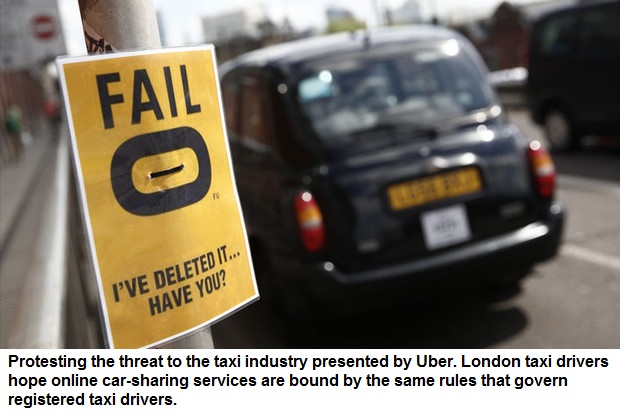
Traffic snarled in cities from London to Madrid and Berlin to Paris as strikes and gatherings by more than 30,000 taxi and limo drivers blocked tourist centers and shopping districts. They are asking regulators to apply tougher rules on San Francisco-based Uber, whose software allows customers to order a ride from drivers who don’t need licenses that can cost 200,000 euros ($270,000) apiece.

The biggest city-center protest was in London, where black-cab drivers were joined by private car services and trainees to protest what they saw as the government’s failure to hold Uber to the same standards as other car services and taxis. While similar demonstrations this year have led to smashed windshields and traffic chaos in Paris, a united front in Europe highlights the challenges for Uber’s expansion.

“A strike won’t work,” European Commission Vice President Neelie Kroes said in a statement today. “What we need is real dialogue where we talk about these disruptions caused by technology.”

A funding round last week values the company at $17 billion, almost five times the figure in an earlier round. Out of some 128 cities it serves, 20 are in Europe, including Manchester, Lyon and Zurich.

Tourist Hubs

In London, thousands of black cabs and private hire cars descended on the tourist hubs of Trafalgar Square and Parliament Square, blocking some of the city’s busiest streets. Scooter and motorbike riders studying for the cab-driver exam joined in, honking their horns as the police tried to regulate traffic.

London taxi drivers have said that the app’s fare calculator amounts to a meter, which aren’t allowed in hired cars that aren’t registered taxis. Last month, TFL asked the High Court to rule on whether the fare system was legal.

“We have to have a license to own a cab, we have to have a driver’s license, a cab driver’s license,” said Mark Haslam, a 58-year-old black-cab driver, who took part in the protest. “For some reason they seem to be outside the law.”

Another driver, John Maloney, 64, was standing on top of a black cab on the corner of Whitehall and Trafalgar Square with a sign saying “enforce the law.” He was dressed as a judge, wearing a white wig and black cape.

Arrest Warning

No major accidents or clashes were reported. The London police, saying organizers hadn’t asked for proper permission to assemble, had threatened to arrest protesters if they arrived before 2 p.m. and didn’t leave by 3 p.m.

London organizers had called on drivers to join the demonstrations with posters mimicking a World War I recruiting campaign, featuring military commander Horatio Kitchener and his characteristic handlebar mustache.

In Paris, drivers blocked the Charles de Gaulle and Orly airports this morning and prevented private-car services from picking up passengers, said Nadine Annet, vice president at the FNAT taxi association. Cabbies also slowed down traffic the A1 highway that circles Paris, leading to a 200-kilometer (120-mile) jam, local TV reported. The vast majority of France’s 55,000 professional taxis and Paris’s 15,000 cabs are on strike today, Annet said.

Kader Djielouli, a 44-year-old protester who’s been driving taxis in Paris for 15 years, said he’s lost 40 percent of his revenue since 2009 because of services like Uber.

Paris, Madrid

Private-car services “are taxis without being taxis,” he said at a cab stand near the Opera metro station in Paris. “We are against them. There need to be the same rules for all.”

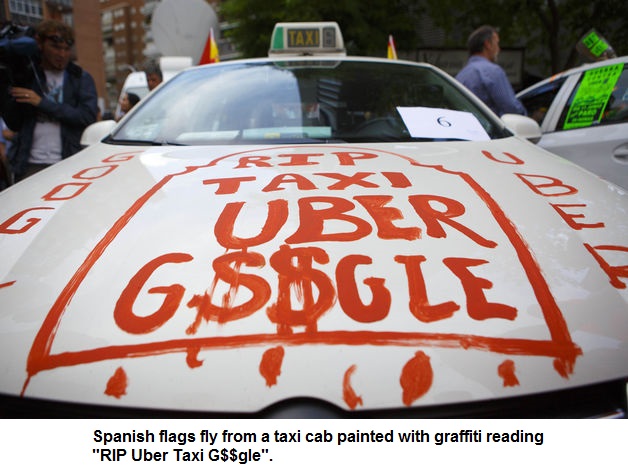
In Madrid, thousands of drivers marched to block the Paseo de la Castellana, one of the city’s main avenues, as police escorted the demonstration by cars, a helicopter and officers on foot. Protesters chanted insults targeted at Uber and chased taxis that weren’t taking part in the rally.

In Berlin, more than 500 taxis lined up in columns of 20 in the plaza stretching out from the Olympic stadium. Four youth chanting “friends of Uber” were escorted away by security under shouts of a few enraged drivers.

Berlin cabs earlier packed airports and the upscale Kurfuerstendamm shopping district. At the Tegel airport, one of the three starting locations for the Berlin demonstration, taxi driver Kubilay Sarikaya said this morning he was skeptical about the protests. While he’d been working since 3 a.m., he said he’ll go along if his friends do.

“While we are demonstrating, the other guys are hauling people around,” said Sarikaya, 33. “There have to be other ways. Ultimately I think folks know that they can always count on the good old cab to get them where they need to be.”

Berlin, Milan

Uber 2In Milan, no taxi was to be seen after about 5,000 drivers this morning went on a strike that is set to last until 10 p.m.

Uber took the demonstrations as an opportunity to promote its service, saying in a statement its teams across Europe will keep the cities moving today.

“While the taxi protests may seek to bring Europe to a standstill, we’ll be on hand to get our riders from A to B.”

Uber also chose this morning to open its service in London to black-cab drivers, describing its 5 percent commission as the lowest of all booking systems in the city. Uber has thus far offered luxury cars and cheaper rides in London, while excluding licensed black cabs. Later in the day, Uber said signups in London to its service today were 850 percent higher than last Wednesday, declining to give the actual number.

Internet Backlash

The protests have a deeper significance beyond the taxi industry. They underscore the growing backlash against the likes of room-booking service Airbnb Inc. and video-streaming provider Aereo Inc. as they clash with traditional industries arguing the competitors should be subject to the same regulations.

“European cities have tended to regulate taxi drivers much more than the U.S.,” said Charles Lichfield, an analyst at Eurasia Group in London. “I do think the protests have a better chance of succeeding.”

In the U.S., local taxi groups have also lobbied against Uber and similar services in cities such as Seattle. In Europe, regulators and courts are struggling with the disconnect between the desire to protect a regulated industry and the need for more technological innovation.

“For years the government has slapped new fees onto taxis and imposed more constraints — everything from car colors to, now, GPS tracking,” FNAT’s Annet said. “The least we’re asking for is that our competitors get the same tough love.”

French Court

Following complaints by Paris cab drivers, France this year imposed a rule on private services, requiring a minimum 15-minute wait between the time a car is booked and the passenger is picked up. The decree was later struck down by the country’s constitutional court.

Hamburg’s economy ministry on June 6 issued an order preventing Wundercar, a German peer of Uber, from operating in the city, saying that transporting people for profit and without a license is against the law. Berlin administrators are probing a similar move against Uber, spokeswoman Petra Rohland said. A Berlin court banned the Uber Black chauffeur service in April, although the injunction hasn’t been enforced.

The Spanish region of Catalonia said yesterday it will ask Uber — which is available in Barcelona — to immediately stop its activities in the area. The regional government is also telling security forces to increase control and detection of illegal taxi services.

European Regulation

“Consumers want to have these services. I’ve personally never sat in a run-down Uber car, but I’ve definitely experienced a lot of run-down taxis,” said Arndt Ellinghorst, head of automotive research at ISI Group in London. “It is a bit scary how protectionist Europe can be.”

Uber raised $1.2 billion in new financing led by Fidelity Investments last week, valuing the company at about $17 billion, before added investments. The company had earlier raised $307.5 million from investors including Google Ventures, TPG Capital and Menlo Ventures.

The company’s assets may be worth just $5.9 billion, Aswath Damodaran, a finance professor at New York University, wrote on his blog this week. He said the figure was based on optimistic assumptions about the taxi industry’s growth and Uber’s market share and profitability.

Lower Prices

Chief Executive Officer Travis Kalanick — who started Uber in 2009 after he and partner Garrett Camp couldn’t find a cab in Paris — has pushed the company into 37 countries. He said the low prices and ease of use that their drivers can offer will lead to a base of support from consumers that regulators won’t be able to ignore.

Uber 3A typical journey from Finsbury Square, near London’s financial district, and Paddington Station takes between 20 and 30 minutes by car to travel approximately four miles. Uber estimates that that journey would cost between 14 pounds ($24) and 16 pounds. London’s transportation authority estimates that the trip could cost between 15 pounds and 22 pounds.

The German market for taxis and rental cars was 4.3 billion euros last year, said Michael Mueller, the president of the German Association of Taxis and Rental Cars. It would shrink by 1 billion euros at the price levels Uber advocates, he said.

Job Creation

Uber said in its blog it’s responsible for 20,000 new jobs per month. The median income for drivers using the UberX platform, Uber’s low-cost service, is $90,000 per year in New York and more than $74,000 in San Francisco, the company said.

Uber advertises itself to prospective drivers as a way to start your own business, drawing users who aren’t professional chauffeurs. That’s different from apps such as Hailo, which recruit from the industry. Uber customers can tap the app on their smartphone and see the locations of taxis in real time, pay via a stored credit card and rate their driver.

“Citizens of these cities are getting around the cities much more cheaply,” Kalanick told Bloomberg TV in an interview this week. “How does a regulator or city official take that away from the population? Say that inexpensive transportation that’s high quality, you shouldn’t have?”

Bloomberg Business News Service (Posted 06/11/2014; retrieved 06/17/2014) –http://www.bloomberg.com/news/2014-06-10/uber-protests-spread-across-europe-as-taxi-app-backlash-grows.html

The book Go Lean…Caribbean anticipates the compelling issues associated with taxi cabs in the emerging new economy. The book serves as a roadmap for the introduction and implementation of the technocratic Caribbean Union Trade Federation (CU). This effort calls for the elevation of the Taxi & Limousine Commission to the regional/CU level. The roadmap posits that many issues and challenges for this industry can only be managed with feasible economies-of-scale. The CU market size of 42 million will allow for the leverage to consolidate, collaborate and confederate the organizational dynamics to tackle these issues.

The book presents solutions, but asserts that before the new strategies, tactics and implementations can be deployed, the affected communities must first embrace a progressive community ethos. The book defines this “community ethos” as the fundamental character or spirit of a culture; the underlying sentiment that informs the beliefs, customs, or practices of society; dominant assumptions of a people or period.

Progress cannot be accomplished by simply picketing at the airport that a new technological advance is impacting the taxi industry. Technological change can be likened to a charging bull; if someone gets in the way, they can be run over!

The foregoing news article, about car-sharing company Uber provides a glimpse of the inner-workings of these “business models” for these two industries:

  • Regional Taxi Administration – The Go Lean roadmap defines that taxis are the frontline of Caribbean hospitality; there is the need to compel the stakeholders to adapt  innovative products & services that impact the passenger and driver experience alike, such as mobile apps (Page 25).
  • Mobile Applications – The Go Lean roadmap defines the mastery of time-&-space as strategic for succeeding in mobile apps development and deployment for the region (Page 35). If products like Uber master mobile apps, then competitors, including old-guard taxi-cabs should also be able to master this field. Already apps like GrabTaxi have excelled at providing taxi cabs with viable solutions

The Go Lean book stresses that the current community ethos must change and the best way to motivate people to adapt their values and priorities is in response to a crisis. The roadmap recognizes this fact with the pronouncement that the Caribbean is in crisis, and that “a crisis is a terrible thing to waste”. The region is devastated from external factors: global economic recession, globalization and rapid technological advances. The book then asserts that to adapt, there must be a new internal optimization of the region’s strengths. This is defined in Verse XXVII (Page 14) of the Declaration of Interdependence:

Whereas the region has endured a spectator status during the Industrial Revolution, we cannot stand on the sidelines of this new economy, the Information Revolution. Rather, the Federation must embrace all the tenets of Internet Communications Technology (ICT) to serve as an equalizing element in competition with the rest of the world. The Federation must bridge the digital divide and promote the community ethos that research/development is valuable and must be promoted and incentivized for adoption.

This subject of taxi cab administration and promotion has been previously covered in these Go Lean blogs, highlighted here in the following samples:

a.       https://goleancaribbean.com/blog/?p=486 – Incubator firm (Temasek) backs Southeast Asia cab booking app GrabTaxi
b.      https://goleancaribbean.com/blog/?p=214 – Entrepreneur battling Least Common Denominator (LCD) Ethos

In line with the foregoing article, the Go Lean book details some applicable community ethos, and provides a roadmap to better foster these qualities and their resulting benefits:

  • Help for Entrepreneurship (Page 28)
  • Promotion of Intellectual Property (Page 29)
  • Impacting Research & Developments (Page 30)
  • Bridging the Digital Divide (Page 31)
  • Improve Sharing (Page 35)

The roadmap posits that the CU will incubate a Mobile Apps industry, forge entrepreneurial incentives and facilitate the infrastructure upgrades so that innovations can thrive. As related in the foregoing article, these efforts can mitigate against competitive/alternative pressures.

The world has changed!

Yet, still, success is within reach. We can, and must, make the the Caribbean a better place to live, work and play.

Share this post:
, , , , ,
[Top]

Jack M. Mintz: ‘All is not well in the sunny Caribbean’

Go Lean Commentary

Jack Mintz 1“All that glitters is not gold” – Old adage.

This is a similar expression as the title of the below commentary by Canadian Public Policy Professor Dr. Jack Mintz:

“All is not well in the sunny Caribbean”.

The opinions of Canadian stakeholders are and have always been important from a Caribbean perspective. “Look to the Northern Star!” – the book Go Lean…Caribbean relates the hope and refuge that Canada always provided to this region (Page 146).

This book purports that an examination of the history of Canada can be productive for the Caribbean. Despite the different geographic address, Canada has had to contend with a lot of challenges similar to the Caribbean; Canada has succeeded while the Caribbean has failed. Early in the book, the point of lessons from Canada is pronounced in the Declaration of Interdependence (Page 14), with these opening statements:

xxxiii.   Whereas lessons can be learned and applied from the study of the recent history of other societies, the Federation must formalize statutes and organizational dimensions … to implement the good examples learned from developments/ communities like … Canada.

Canada recognizes that the Caribbean is in crisis; and despite billions and billions ($$$) in Canadian investments, the region is still in crisis.

Commentary By: Dr. Jack M. Mintz
Economic problems in the Caribbean should be a wake-up call for governments and businesses operating there.

As a middling power, Canada has limited influence in most areas of the world — save for the Caribbean countries. To escape the winter, three million Canadians trek annually to one of the islands to enjoy the sun and relaxation. Roughly 600,000 Caribbean [expatriates] have migrated over the years to Canada, with the largest contingents coming from Jamaica, Guyana, Haiti and Trinidad.

Canada has also invested over $140-billion in capital in the Caribbean islands, especially in Bahamas, Barbados, Bermuda and Cayman Islands. Capital stock held in Barbados alone is over $60-billion, more than any other country except for the United States.  The money does not stay there but moves on to other countries so that Canadian multi-national companies can take advantage of the Canada-Barbados tax treaty to achieve lower global effective corporate tax rates through tax-efficient financial structures.

Jack Mintz 3So when Canadian Imperial Bank of Commerce announced a $420-million write-down in goodwill invested in CIBC FirstCaribbean, it should attract attention, given our deep ties to the region. All is not well in the Caribbean region with its bloated, over-indebted governments operating in slow-growth environments. The economic and fiscal problems in the region raise critical economic and security concerns for Canada.

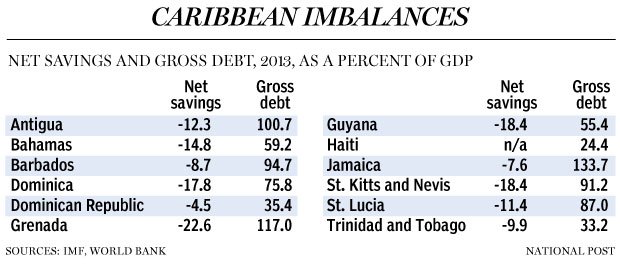
Many Caribbean governments face financial instability. Gross public debt has risen to over 80% of GDP in 2013 for Antigua, Barbados, Grenada, Jamaica, St. Kitts and Nevis, and St. Lucia. Many of these countries are also heavily exposed to global markets with the current account deficit over 20% of GDP in the Caribbean region. Foreign direct investment inflows are more than 8% of GDP for Antigua, Bahamas, Barbados, Grenada, Guyana, St. Kitts and Nevis, St. Lucia and Trinidad-Tobago.

At a flick of the switch, international lenders could turn off the spigots, resulting in a financial crisis and hefty devaluation of currencies. The implications of a severe economic contraction in the region would put the Caribbean countries in limbo and have important consequences to Canada, given our relationships in the region.

The outlook for the Caribbean countries is not exactly cheerful. Overall, economic growth has been poor, about 1.5% for the region, and close to stagnant for Bahamas, Barbados, Grenada and Jamaica. Many of the Caribbean countries face competitiveness problems with some of the highest electricity rates in the world, unionized wage costs and high real interest costs. The business climate is weak with poor regulatory practices, enforcement of contracts and crime.

With the global economic slowdown, tourism has been relatively flat, lagging most regions of the world in 2013. Tourism, after all, is not a necessity and more money is spent on it only when people are better off. The outlook is not looking much better in the near future with little income growth in North America and Europe. Should there ever be reconciliation between the United States and Cuba, U.S. tourism could significantly shift from other islands.

Nor are commodity prices expected to be booming as China and the rest of Asia slow down, with little take up from the rest of the world. Only oil and gas prices seem to be firm, which is good news for Trinidad and Tobago.

With the G20 and OECD countries focused on curbing tax evasion and avoidance, several Caribbean countries – Bermuda, Barbados and Cayman Islands – would be subject to a tightening tax noose. These countries could face a deceleration in economic activity if international tax structures are to be dismantled.

Thus, economic and fiscal problems in the Caribbean should be a wake-up call for governments and businesses operating there. The CIBC write-down is just the tip of the iceberg.

A financial crisis will heavily impact many Canadian businesses that have turned to the Caribbean islands to set up financing and insurance structures. A major economic slowdown in the Caribbean islands would also raise security issues for Canada as crime, including drug trade, could become more problematical to control.

The Canadian government should therefore work with other major countries and international organizations to stabilize Caribbean economies. Attempts to build capacity for good governance in the past years have not been easy but it cannot be abandoned. Some new initiatives should be considered that would help the Caribbean islands improve their fortunes.

Certainly, trying to harmonize policies and merge certain institutions to achieve economies-of-scale across the region would be a useful step. This includes post-secondary education, financial markets and transportation. A shift by Caribbean countries away from oil to natural gas from Trinidad-Tobago and North America would reduce their cost of oil imports.

At the same time, Canada and other Western countries should invest in improving the judiciary and security forces in the [Caribbean] region. The reduction in crime would also benefit our economies by reducing risks faced by tourists and investors. Drug trade with Canada would be curbed.

Debt relief for some of the countries would be appropriate so long as certain commitments are made to reform governance and economic policy. This has been the role of the IMF over the years but Canada should itself pay more attention to the region.

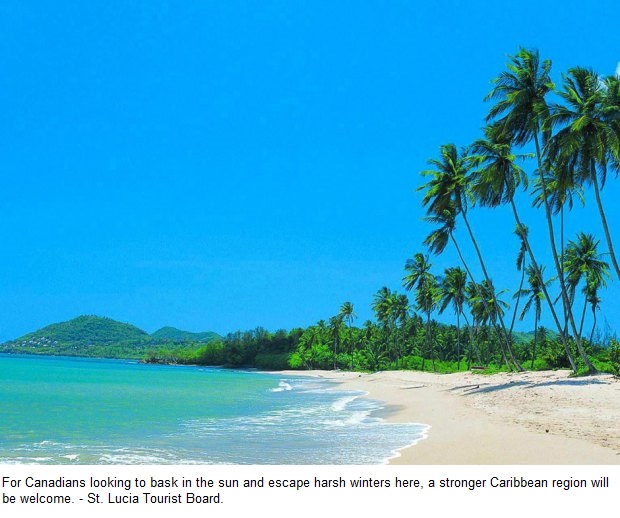
For Canadians looking to bask in the sun and escape harsh winters here, a stronger Caribbean region will be welcome.

Jack M. Mintz is the Palmer Chair, School of Public Policy, University of Calgary. Contact: policy@ucalgary.ca

Source: Financial Post – Canadian Daily; retrieved 05-23-2014 from: http://business.financialpost.com/2014/05/22/jack-m-mintz-all-is-not-well-in-the-sunny-caribbean/

Jack Mintz 2The underlying theme of Jack Mintz commentary is that Caribbean society needs a reboot. The book Go Lean… Caribbean serves as a roadmap for the introduction and implementation of Caribbean Union Trade Federation (CU), a reboot for Caribbean society with these 3 prime directives:

  • Optimize the economic engines of the Caribbean to grow the economy to $800 Billion and create 2.2 million new jobs.
  • Establish a security apparatus to protect the resultant economic engines and stakeholders.
  • Improve Caribbean governance with technocratic excellence.

The foregoing article highlights the mis-management of credit/debt of the governments of the region. The commentary specifically warns:

At a flick of the switch, international lenders could turn off the spigots, resulting in a financial crisis and hefty devaluation of currencies.

Why such poor financial planning? It is obvious that there is a lot of success missing in terms of fiscal expedience. It is not reasonable to expect that current administrations can solve Caribbean fiscal problems with the same tools and techniques of the present. The Go Lean roadmap calls for a different toolbox and different techniques.

If beauty is in the eye of the beholder, then perhaps this commentary is just one person’s assessment of ugly – just a perception. But unfortunately, the facts are the facts. Dr. Mintz relates ugly examples, such as the fact the region has the “highest electricity rates in the world”. There is no denying the “Amount Due” figures on actual electric utility bills.

This is the present, as perceived by Dr. Mintz. Plus, his assessment of the near future is even more “gloom-and-doom”.

True, there is work to be done. But not the job of a Calgary professor, or any other Canadian stakeholder, to do the heavy-lifting. No, this is the job of the Caribbean for the Caribbean. Who is up to the task?

The Caribbean Union Trade Federation hereby “reports for duty” for the job to forge this change.

The Go Lean book details that solutions must come from all aspects of society. There are community values/attitudes that must be in place to ensure that any quest for permanent change would have some measure of success. Those attitudes are referred to as community ethos. There must first be the adoption of many such ethos, followed by the executions of strategies, tactics, implementations and advocacies to impact the region’s prospects, as detailed here:

Community Ethos – Lean Operations Page 24
Community Ethos – Ways to Impact the Future Page 26
Community Ethos – Ways to Help Entrepreneurship Page 28
Anecdote – Entrepreneur’s Best Place To Live? Canada Page 39
Strategy – Vision – Integrate Region into Single Market Page 45
Strategy – Agents of Change – Globalization Page 57
Tactical – Confederating a Permanent Union Page 63
Tactical – Fostering a Technocracy Page 64
Separation of Powers – Banking Regulatory Authority Page 73
Separation of Powers – Justice Institutions Page 77
Implementation – Foreign Policy Initiatives at Start-up Page 102
Implementation – Security Initiatives at Start-up Page 103
Implementation – Ways to Deliver Page 109
Implementation – Ways to Improve Energy Usage Page 113
Implementation – Ways to Better Manage Debt Page 114
Implementation – Ways to Foster International Aid Page 115
Implementation – Ways to Benefit from Globalization Page 119
Planning – Lessons from Canada’s History Page 146
Advocacy – Ways to Grow the Economy Page 151
Advocacy – Ways to Better Manage ForEx Page 154
Advocacy – Ways to Improve Governance Page 168
Advocacy – Ways to Enhance Tourism Page 190
Advocacy – Reforms for Banking Regulations Page 199
Advocacy – Ways to Impact the Diaspora Page 217
Advocacy – Ways to Preserve Caribbean Heritage Page 218
Appendix – Offshore Tax & Financial Services Industry Developments Page 321

The Go Lean roadmap calls for a different entrepreneurial approach than some of the tax avoidance industries promoted in the past. These strategies have actually failed. Most offshore financial centers have modernized their lax laws to mitigate terrorism financing, thus lowering their attraction to tax evaders. The hold-outs, (Bermuda, Barbados and the Cayman Islands), are now being forced to cow-tail to the New World Order. The people of the Caribbean deserve better than waiting for “illicit bread to fall from the table” of rich nations (G-20). We have the world’s best address, for goodness sake, people should be beating a path to our doors (like the 3 million Canadians annually), not the 600,000 Caribbean citizens who have beaten down our doors to get out.

Time for change! The Go Lean roadmap is hereby presented.

The region is hereby urged to lean-in to this Go Lean roadmap, to fulfill the vision of making the Caribbean region a better place to live, work and play. 🙂

Download the book Go Lean … Caribbean – now!

Share this post:
, , , , ,
[Top]

Painful and rapid spread of new virus in Caribbean

Go Lean Commentary

“Crap happens”, declares the book Go Lean…Caribbean (Page 23).

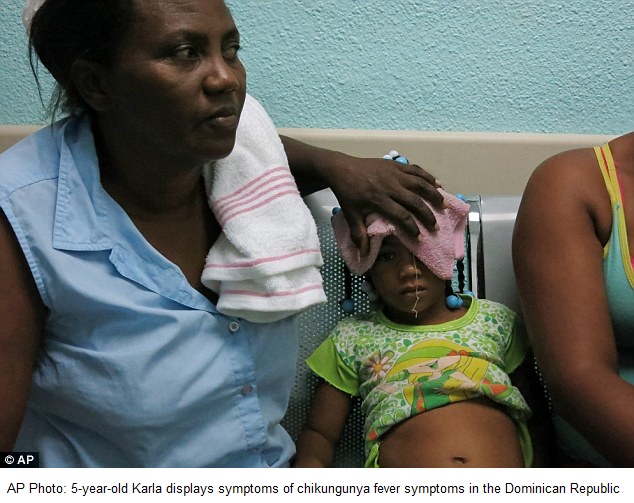
Virus 1The Chikungunya virus scare in the foregoing news article represents the sum of all fears for the Caribbean in terms of tourism and public health threats. This emphatically highlights the need for a regional security pact for Caribbean assurances.

The virus in this article has been identified in the Dominican Republic, Dominica, Saint Martin, and French Guiana; therefore, this is a cross-border threat. This re-enforces that there is a need for a super-national disease-medical sentinel in this security pact.

While other security pacts (for example NATO – North Atlantic Treaty Organization) may be based on defense against military aggression, the Caribbean security pact must focus more on public safety measures. This is one of the prime directives of the proposed Caribbean Union Trade Federation (CU). Naturally, the focus starts with economics, but the resultant engines can be seriously impacted by public safety/health threats. The book Go Lean… Caribbean, serves as a roadmap for the introduction and implementation of that regional sentinel, the CU. The complete prime directives are described as:

  • Optimize the economic engines of the Caribbean to elevate the regional economy.
  • Establish a security apparatus to protect the resultant economic engines.
  • Improve Caribbean governance to support these engines.

The Go Lean roadmap immediately calls for the establishment of a Homeland Security Department, with an agency to practice the arts and sciences of Emergency Management. The emergencies include natural disasters like hurricanes, earthquakes, tsunamis, volcanoes, flooding, forest fires, and droughts. Emergencies also include the man-made variety as in industrial accidents (oil spills, factory accidents and chemical spills), explosions, terroristic attacks and prison riots. The type of emergency described in the foregoing article requires a hybrid response of the Emergency Management agency and the CU’s Department of Health Disease Control & Management agency. Medical expertise would be required to contend with systemic threats of epidemic illness and infectious diseases.

The CU does not possess sovereignty for Caribbean member-states; so CU participation must be invited. This is why the CU is described as a deputized proxy organization. This invitation is equivalent to dialing “911”, a declaration of an emergency – thus granting a timed lease of limited authority to the CU agency, terminating with an “all clear” determination.

By: Ben Fox, AP

SAN CRISTOBAL, Dominican Republic (AP) — They suffer searing headaches, a burning fever and so much pain in their joints they can barely walk or use their hands. It’s like having a terrible flu combined with an abrupt case of arthritis.

Hospitals and clinics throughout the Caribbean are seeing thousands of people with the same symptoms, victims of a virus with a long and unfamiliar name that has been spread rapidly by mosquitoes across the islands after the first locally transmitted case was confirmed in December.

“You feel it in your bones, your fingers and your hands. It’s like everything is coming apart,” said 34-year-old Sahira Francisco as she and her daughter waited for treatment at a hospital in San Cristobal, a town in the southern Dominican Republic that has seen a surge of the cases in recent days.

The virus is chikungunya, derived from an African word that loosely translates as “contorted with pain.” People encountering it in the Caribbean for the first time say the description is fitting. While the virus is rarely fatal it is extremely debilitating.

“It is terrible, I have never in my life gotten such an illness,” said Maria Norde, a 66-year-old woman confined to bed at her home on the lush eastern Caribbean island of Dominica. “All my joints are in pain.”

Outbreaks of the virus have long made people miserable in Africa and Asia. But it is new to the Caribbean, with the first locally transmitted case documented in December in French St. Martin, likely brought in by an infected air traveler. Health officials are now working feverishly to educate the public about the illness, knock down the mosquito population, and deal with an onslaught of cases.

Authorities are attempting to control mosquitoes throughout the Caribbean, from dense urban neighborhoods to beach resorts. There have been no confirmed cases of local transmission of chikungunya on the U.S. mainland, but experts say the high number of travelers to the region means that could change as early as this summer.

So far, there are no signs the virus is keeping visitors away though some Caribbean officials warn it might if it is not controlled. “We need to come together and deal with this disease,” said Dominica Tourism Minister Ian Douglas.

One thing is certain: The virus has found fertile ground in the Caribbean. The Pan American Health Organization reports more than 55,000 suspected and confirmed cases since December throughout the islands. It has also reached French Guiana, the first confirmed transmission on the South American mainland.

The Pan American Health Organization says seven people in the Caribbean with chikungunya have died during the outbreak but they had underlying health issues that likely contributed to their death.

“It’s building up like a snowball because of the constant movement of people,” said Jacqueline Medina, a specialist at the Instituto Technologico university in the Dominican Republic, where some hospitals report more than 100 new cases per day.

Virus 3Chikungunya was identified in Africa in 1953 and is found throughout the tropics of the Eastern Hemisphere. It is spread by two species of mosquitoes, aedes aegypti and aedes albopictus. It’s also a traveler-borne virus under the right circumstances.

It can spread to a new area if someone has it circulating in their system during a relatively short period of time, roughly 2-3 days before the onset of symptoms to 5 days after, and then arrives to an area with the right kind of mosquitoes.

For years, there have been sporadic cases of travelers diagnosed with chikungunya but without local transmission. In 2007, there was an outbreak in northern Italy, so health authorities figured it was just a matter of time before it spread to the Western Hemisphere, said Dr. Roger Nasci, of the U.S. Centers for Disease Control and Prevention.

“With the increase in travelers the likelihood that something like this would happen goes up and eventually it did,” said Nasci, chief of a CDC branch that tracks insect-borne diseases. “We ended up with somebody at the right time and the right place infecting mosquitoes.”

The two species of mosquitoes that spread chikungunya are found in the southern and eastern United States and the first local transmissions could occur this summer given the large number of U.S. travelers to the Caribbean, Nasci said. Already, the Florida Department of Health has reported at least four imported cases from travelers to Haiti, the Dominican Republic and Dominica.

“What we’re seeing now is an increase in the number of infected travelers coming from the Caribbean, which is expected because there’s a lot of U.S. travel, a lot of vacation travel, a lot of work travel,” he said.

Around the Caribbean, local authorities have been spraying fogs of pesticides and urging people to remove standing pools of water where mosquitoes breed.

An estimated 60-90 percent of those infected show symptoms, compared to around 20 percent for dengue, which is common in the region. There is no vaccine and the only cure is treatment for the pain and fluid loss.

One consolation for those suffering from the illness is that unlike dengue, which has several variants, people only seem to get chikungunya once.

“The evidence suggests that once you get it and recover, once your immune system clears the virus you are immune for life,” Nasci said.

Associated Press writers Ben Fox in Miami; P. Solomon Banda in Fort Collins, Colorado; David McFadden in Kingston, Jamaica; and Carlisle Jno Baptiste in Roseau, Dominica, contributed to this report.

Associated Press News Wire (Retrieved 05-22-2014) –          http://news.yahoo.com/painful-rapid-spread-virus-caribbean-040106421.html

The Go Lean roadmap immediately calls for the coordination of security monitoring and mitigation in the Caribbean; referring to viruses as well. This point is declared early in the Go Lean book, commencing with this opening pronouncement in the Declaration of Interdependence (Page 12), as follows:

xvi. Whereas security of our homeland is inextricably linked to prosperity of the homeland, the economic and security interest of the region needs to be aligned under the same governance. …[to ensure] the functioning of the wheels of commerce for all the citizenry, the accedence of this Federation must equip the security apparatus with the tools and techniques for predictive and proactive interdictions.

Go Lean … Caribbean therefore constitutes a change for the Caribbean. This is a roadmap to consolidate 30 member-states of 4 different languages and 5 colonial legacies (American, British, Dutch, French, Spanish) into a Trade Federation with the tools/techniques to bring immediate change to the region to benefit one and all member-states. This includes the monitoring/tracking/studying the origins of common and emerging viruses. This empowered CU agency will liaison with foreign entities with the same scope, like the Pan American Health Organization, US’s Center for Disease Control (CDC) and the World Health Organization (WHO).

Virus 2A lot is at stake!

Tourism is the primary economic driver in the region. The realization, or even the unsubstantiated rumor, of viral outbreaks can imperil the tourism product. We must therefore take proactive steps to protect our economic engines. But, we must not curtail freedom of movement among our visitors. We are, in effect, extending an “Open House” to the world to come enjoy our hospitality. Come… they will. So there are additional responsibilities for the stewards of the Caribbean economy, to impact the Greater Good. The CU invites this role, to promote this community ethos.

The book details that there must first be adoption of such a community ethos, the appropriate attitude/spirit to forge change in the region. Go Lean details this and other ethos; plus the executions of the following strategies, tactics, implementations and advocacies to impact the region’s public health:

Community Ethos – Privacy versus Public Protection Page 23
Community Ethos – “Crap” Happens Page 23
Community Ethos – Lean Operations Page 24
Community Ethos – Cooperatives Page 24
Community Ethos – Non-Government Organizations Page 25
Community Ethos – Ways to Improve Sharing Page 35
Community Ethos – Impact the Greater Good Page 37
Strategy – Vision – Non-Sovereign “Unified” Proxy Entity Page 45
Strategy – Customers – Residents & Visitors Page 47
Strategy – Agents of Change – Globalization Page 57
Tactical – Confederating a Permanent Union Page 63
Tactical – Fostering a Technocracy Page 64
Separation of Powers – Emergency Management Page 76
Separation of Powers – Disease Control & Management Page 86
Implementation – Ways to Pay for Change Page 101
Implementation – Security Initiatives at Start-up Page 103
Implementation – Ways to Deliver Page 109
Implementation – Ways to Foster International Aid Page 115
Implementation – Ways to Benefit from Globalization Page 119
Planning – Ways to Improve Failed-State Indices Page 134
Planning – Ways to Measure Progress Page 148
Advocacy – Ways to Grow the Economy Page 151
Advocacy – Ways to Improve Healthcare Page 156
Advocacy – Ways to Improve Governance Page 168
Advocacy – Ways to Better Manage the Social Contract Page 170
Advocacy – Ways to Foster Cooperatives Page 176
Advocacy – Ways to Improve for Natural Disasters Page 184
Advocacy – Ways to Improve Emergency Management Page 196

The foregoing news article introduces the threats of the Chikungunya virus. This is today’s issue. New issues will emerge tomorrow and the days after. This establishes that there is need for a permanent union – a sentinel – to provide efficient stewardship for Caribbean economy, security and governing engine. Change has come to the region.

How would the region pay for this change, these elevations? The Caribbean Union Trade Federation hereby submits for this job, no payment necessary! The region is hereby urged to lean-in to this Go Lean roadmap, to fulfill the vision of making the Caribbean region a better place to live, work and play.

Download the Book- Go Lean…Caribbean Now!!!

Share this post:
, , , ,
[Top]

Lessons Learned from the American Airlines merger

Go Lean Commentary – Lessons on Delivery Arts & Sciences

Lessons Learned 1Tourism is the number one economic driver in the Caribbean region. But the eco-system has cracks …

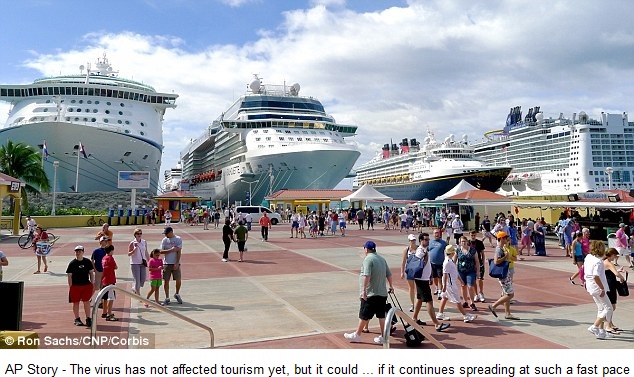
More and more tourists are travelling to the Caribbean…by cruise ships. Less and less are travelling to the region by airplane. Therefore no air-flights, no hotels, no restaurants, no taxi cabs, no job multipliers, and no full economic “chain-link”.

The 2008 financial crisis placed a heavy strain on the US’s largest carrier: American Airlines. On July 2, 2008, American announced furloughs of up to 950 flight attendants, in addition to the furlough of 20 MD-80 aircraft. American’s hub at Luiz Muñoz Marin Airport in San Juan, Puerto Rico (PR) was truncated from 38 to 18 daily inbound flights. The holding company, AMR Corporation, filed for Chapter 11 bankruptcy protection on November 29, 2011, and the airline made cuts in July 2012 due to the grounding of several aircraft associated with its bankruptcy and lack of pilots due to retirements. American Eagle, the regional carrier, (the Caribbean’s largest), was to retire 35 to 40 regional jets as well as its entire Saab turboprop fleet. [b] American Eagle PR ceased operation in March 2013. This status created dysfunction for the entire Eastern Caribbean region.

This dysfunction has created the urgency for permanent change. This is a prime directive of the book Go Lean … Caribbean, to optimize the region’s economic engines, including enhancements for Caribbean tourism, cruise and “long stay” visitors.

The delivery story continues…

By summer 2012, American Airlines considered merging with another airline as part of a restructuring plan.

On February 14, 2013, AMR Corporation and US Airways Group officially announced that the two companies would merge to form the largest airline (and airline holding company) in the world, with bondholders of American Airlines parent AMR owning 72% of the new company and US Airways shareholders owning the remaining 28%. The combined airline would carry the American Airlines name and branding, while US Airways’ management team, including CEO Doug Parker, would retain most operational management positions, and the headquarters would be consolidated at American’s current headquarters in Fort Worth, Texas. The merger would create the world’s largest airline, which, along with United and Delta Air Lines, would control three-quarters of the US market. US Federal Bankruptcy judge Sean Lane approved the merger in March 2013.

The United States Department of Justice filed a lawsuit in August 2013 seeking to block the merger, arguing that it would mean less competition and higher prices. On November 12, the airlines reached a settlement (eliminating certain routes and hubs) with the US Justice Department to settle the lawsuit and allow the merger to be finalized. Thus restoring the public “trusts”.

AMR and US Airways Group completed the merger on December 9, 2013, with the new holding company American Airlines Group, Inc. being listed on NASDAQ that day. [b]

In a January 2014 letter [a] to frequent flyers of both airlines, it was announced: “It’s an exciting time at American Airlines, and we’re kicking off the new year with you — our most loyal customers in mind. For now, we’ll continue to maintain our separate loyalty programs — Dividend Miles and AAdvantage® — with rules and benefits of each program still applying, but rest assured your mileage balance and elite status are safe, secure and will continue to be honored”.

There remains a lot of work to do as both airlines are combined, and since the close of the merger, the two airlines have been working to deliver the first phases of enhanced benefits to their customers … and communities. Here are some highlights:

1. Pick “low-hanging fruit”

Lessons Learned 2Earning and redeeming miles – Members can now earn and redeem Dividend Miles (US Airways) when flying on American or US Airways with their Dividend Miles number. All miles and segments earned when flying on either airline will count toward elite status qualification in the program of your choice.

Elite benefits – Elite members of each airline can now enjoy select reciprocal benefits when flying on either airline, including First and Business Class check-in, complimentary checked bags, priority security and boarding, and many more.

More lounge access – In addition to the US Airways Clubs, club members can now access 35 Admirals Club® locations in major airports worldwide.

2. Intermediate goals and plans

On March 30, US Airways exited the competing Star Alliance. The initiation with the oneworld® alliance started on March 31, giving customers opportunities to access the widest array of destinations around the globe. More and more benefits will emerge as the merger (and the oneworld alliance) consummates. Coming soon, customers will enjoy access to an enhanced network through the American/US Airways code-share, allowing for the seamlessly booking of travel on either airline.

3. Long-term objectives

The actual integration of the airlines under a single air operator’s certificate will not be completed until a much later date. The combined airline will carry the American Airlines name and branding, and will maintain the existing US Airways hubs in Charlotte, Philadelphia, Phoenix, and Washington DC for a period of at least five years under the terms of a settlement with the US Department of Justice.

4. End Game

The resultant single-branded airline will operate an extensive international and domestic network, with scheduled flights throughout North America, the Caribbean, South America, Europe, and Asia. Its route network will center around the five American “cornerstone” hubs in Dallas/Fort Worth, New York, Los Angeles, Miami, and Chicago; plus some US Airways hubs.

oneworld Alliance

What exactly is an airline alliance? It’s an agreement among multiple airlines to streamline, make customers travel experience more seamless. The oneworld alliance is particularly good at this. So much so that it’s been named the Best Airline Alliance by Global Traveler magazine’s 2013 Reader Survey for the fourth year in a row. A passenger can be checked (boarding passes and luggage) right through to the final destination when traveling on oneworld carriers. Other benefits include airport lounge access, priority check-in and priority boarding, and of course, a large number of destination choices.

The new alliance means more ways to get to top destinations. Here are the summary options…by the numbers:

981 destinations served
151 countries
14,244 daily departures
3,283 aircrafts in the fleet
474,825 million passengers flown annually

The oneworld Alliance Member Airlines:

Airline Base Country / Region
Airberlin Germany – Central Europe
American Airlines USA – North America
British Airways United Kingdom, Western Europe
Cathay Pacific Airways Hong Kong (China), Far East Asia
Finnair Finland – North Europe
Iberia Spain / Portugal – Southern Europe
Japan Airlines Japan – Far East Asia
LAN Airlines Chile/Peru – South America
Malaysia Airlines Malaysia – Southeast Asia
Qantas Australia – Austra-Asia
Qatar Airways Middle East
Royal Jordanian Middle East
S7 Airlines Russia – Siberia
TAM Airlines Brazil – South America
US Airways USA – North America

Go Lean Commentary … cont’d

Considering one specific country, there is now something wrong in Barbados. [d] In July 2013, Barbados recorded the lowest number of long stay visitors (47,953) during the same period for 13 consecutive years. This is thusly expected to affect the traffic for the annual festival of Crop Over (a traditional harvest celebration connected with Barbados sugar cane plantation culture) [e] for 2014. Long stay visitors usually travel by airplane. This is the issue; there is a supply problem with air travel in the Eastern Caribbean and there is a demand problem. The end result: airline dysfunction and higher prices.

The issue of declining tourism spending is tied to dysfunction in the airline industry. Has the Crop Over event become less attractive or is the blame on the higher airfares that has resulted due to the airline (American Airlines) dysfunction? The analytical conclusion is the problem is with the airline industry.

The 2008 Financial Crisis continues to wreak havoc on the economy of the Caribbean. This is a consistent theme in the book Go Lean … Caribbean; it serves as a roadmap for the introduction and implementation of the Caribbean Union Trade Federation (CU), an alliance of 30 Caribbean member-states.

The Go Lean roadmap calls for regulating and promoting the Caribbean’s aviation industry. We need American Airline and US Airways to deliver on their merger, and then deliver on facilitating air passengers to the Caribbean region.

This is how the CU will optimize the region’s economic engines. This is change!

The Go Lean book presents a series of community ethos that must be adapted to forge this change. In addition, there are these specific strategies, tactics, implementation and advocacies to apply:

Community Ethos – Job Multiplier Page 22
Community Ethos – Lean Operations Page 24
Community Ethos – Cooperatives Page 25
Community Ethos – Ways to Help Entrepreneurship Page 28
Community Ethos – Impacting the Greater Good Page 37
Strategy – Customers – Visitors Page 47
Strategy – Competitive Analysis –  Event Patrons Page 55
Strategy – Core Competence – Tourism Page 58
Strategy – Anecdote – Caribbean Hotel & Tourism Assoc. Page 60
Tactical – Fostering a Technocracy Page 64
Tactical – Commerce – Tourism Promotion Page 78
Tactical – Aviation Administration & Promotion Page 84
Implementation – Ways to Deliver Page 109
Implementation – Trade Mission Objectives Page 116
Planning – Ways to Improve Trade Page 128
Planning – Lessons Learned from 2008 Page 136
Planning – Lessons from Egypt Page 143
Advocacy – Ways to Enhance Tourism Page 190
Advocacy – Ways to Impact Events Page 191
Advocacy – Ways to Market Southern California Page 194
Advocacy – Ways to Promote World-Heritage-Sites Page 248

There are lessons from the evolution and delivery of the American Airlines / US Airways merger in considering the quest for Caribbean optimization:

• When possible, Caribbean solutions should come from the Caribbean.

• When not possible, Caribbean solutions should be serviced by alternate sources, with no one player holding more than 50% of market share.

• Many Caribbean islands have close proximity, so there must always be alternative transportation modes, like ferry-boats.

• Do not “bite the hand that feeds you”; the Caribbean region must protect the engines that drive the economy.

Now is the time to lean-in to this roadmap for Caribbean change, as depicted in the book Go Lean…Caribbean. We cannot afford another American corporate giant, (i.e. Lehman Brothers) mishandling their public trusts. The Caribbean can – and must – be less elastic to American woes.

The Caribbean should be less of an American parasite and more of a protégé.

Download the book Go Lean … Caribbean – now!

————————-

References:

a. Andrew Nocella, American Airlines Senior Vice President and Chief Marketing Officer. AAdvantage Frequent Flyer Status Email. Retrieved January 5, 2014.

b. Wikipedia treatment on American Airlines. Retrieved May 6, 2014 from: https://en.wikipedia.org/wiki/American_Airlines

c. Titcombe, Tara. “The World at your fingertips”. US Airways Magazine. Retrieved May 6, 2014 from: http://tjt0325no2pencil.files.wordpress.com/2014/04/aprilfeature_oneworld_final.pdf

d. “Commentary: Tourism Matters: A better analysis is needed”. Caribbean News Now Online Magazine. Retrieved May 6, 2014 from: http://www.caribbeannewsnow.com/topstory-Commentary%3A-Tourism-Matters%3A-A-better-analysis-is-needed-20985.html

e. Wikipedia treatment on American Airlines. Retrieved May 6, 2014 from: https https://en.wikipedia.org/wiki/Crop_Over


Share this post:
, , , , , , ,
[Top]

Open the Time Capsule: The Great Recession of 2008

Go Lean Commentary

Time Capsule Pic 1Picture this: one week after the greatest threats to the global financial system, since the Great Depression. You cut out and store – for safe keeping in a “virtual time capsule”, (see Appendix A) – a newspaper commentary and subsequent review/analysis of that crisis. It’s time now to open that capsule! Why so early? Why only after 6 years? So that this analysis would serve as a course correction. Those placing the time-capsule, hoped for a different result.

This is the scenario depicted in the foregoing news article. It was published on September 23 in 2008; 8 days after Lehman Brothers filed the largest Bankruptcy in world history – signaling the peak of the financial crisis, the precipice of a total system failure. The book Go Lean … Caribbean is based on that premise, declaring that a crisis is a terrible thing to waste”, quoting noted Economist Paul Romer’s assessment that the Great Recession would be a crisis for the modern world. The book posits that the Caribbean, with its parasite economy, is still in that crisis – no noticeable recovery.

A joke lampooning economists declares “that an economist is an expert who will know tomorrow why the things he predicted yesterday didn’t happen today”.CU Blog - Open the Time Capsule - The Great Recession of 2008 - Photo

So now, this review/analysis of a 6 year old newspaper editorial from a Guest Columnist, the focus of which was to an audience in the Bahamas; (but this is equally representative of the entire Caribbean):

It is the assessment by the publishers of Go Lean that the foregoing analysis was spot on!

It describes the new normal, a term cementing the truths that the economic realities that suddenly emerged in 2008 would thereafter remain as the norm. This has proven to be the case. The foregoing writer lamented that his government appeared to be using the same set of tools to fix a new vehicle with all different parts, and they pondered why the vehicle would not repair (recover) and get going. The writer concluded that the stewards of the economy needed to prepare a 20 year plan to navigate his country among the new realities facing the world. But he doubted that such a plan would emerge.

By: Craig Butler

I know what you must be thinking. ‘The new normal’, what in heaven’s name is he talking about? Well, the other day I was in Florida listening to talk radio.

There was a director from the International Monetary Fund, an economics professor, and a few others. They were talking about the global economy and what the future holds. The professor was the one who used the ‘new normal’ phrase and he did so in reference to the high prices that we are experiencing worldwide.

He said that, as he did not expect a significant strengthening of the dollar any time soon; coupled with the fact that the price of oil was likely to remain high and the war in Iraq was ongoing, he believed that the current high prices are going to be the norm.

Most of the panelists agreed that some experts have given folks a false sense of security by suggesting that prices will come back down once the price of oil drops. But all on the panel were of the view that the price of oil will never again be under $90 to $100 per barrel.

This was partly based on the weak dollar and partly on our dependency on fossil fuels and the lack of resolve shown by politicians to fully develop alternatives. They also noted that the oil lobby was one of the most powerful in Washington, which was a leading factor in the stalled development of renewable energy.

And the price of breadbasket items and other basics has not been helped by climatic change, which has led to falls in wheat and rice production over the last few years. Add to this the diversion of corn for use as a fuel (ethanol), and we have the new normal.

My views tend to be conservative so my first reaction was that these are some leftwing liberal nuts talking. However, on reflection much of what was said is correct.

Why should we expect to see a reduction in the price of oil? Producers are making so much money it’s not realistic to think they would relinquish that. And the high price affects so many other industries that have had to pass on these increases to the consumer. Just look at the airlines. And all the solutions being put forward to wean us off our dependency on oil will take at least five years to have any kind of impact.

The panel went on to say that there will be a widening of the income gap – something we are already seeing in the Bahamas. Many people who I know in the middle class are struggling so much that they can now be classified as the working poor.

I say that because they are now living from pay cheque to pay cheque. All their savings have been depleted; and things that they once could afford are out of the question now.

Think about it – how many of the people you know around you have their houses in foreclosure; have lost their car to the bank; have had to take their children out of private school; or have been unable to take a vacation this year?

Look in the newspaper this week and I’m sure one of the leading commercial banks will have a double page ad featuring distressed properties. The other week two banks had ads back to back.

I have written before about misguided priorities and how, despite all that is going on, we still prefer the materialistic rather than seek what is important.

I remember from my youth a song by Eddie Minnis called the ‘Finance Man’. I loved that song, and the words to one of the verses bears repeating: ‘See him there he poor as me and you but he driving round in Malibu. His car sleeps in the road at night, Lord you know that just ain’t right, He is living in the hands of the finance man…’

I apologize to brother Eddie if I did the lyrics an injustice. But it demonstrates how we have lived on credit for a long time. We have maintained a lifestyle well beyond our means without a thought as to what might happen in hard times.

As a lawyer I can see first hand what has happened to many in the middle class. You see, it was important for them to have the grand house with the two European cars parked in the garage, kids in the best schools and all the trappings that went along with it. And I will be the first to say that there is nothing wrong with wanting to attain your desires.

However, the bank loans were in many instances predicated on both the husband and wife maintaining $50,000 a year salaries, as well as some creative financing to help the couple get the loan.

Now that many offshore companies have closed or downsized, one of those pay cheques has disappeared and so has the dream, because the severance package is not going to last long and there is a distinct shortage of similar jobs available.

So what we are facing here is now being experienced all over the world. The radio panel noted that there will have to be a reclassification of the status of many people as the poor are going to be poorer, the middle class are going to be the new poor and only the very rich will be able to sustain themselves.

Dark days are ahead, and this means we need our politicians to get their collective heads out of their rear ends and devise a comprehensive plan for the next 25 years that takes all of the current factors into consideration and ensures our viability.

But there I go dreaming again – most of the time they can hardly get out of their own way let alone see past the next general election. So lets wait for the eventual anarchy that is to follow.

*****

Craig Butler studied law at the University of Wolverhampton, England, and at the Norman Manley Law School in Jamaica. He also has a degree in economics from Rollins College in Florida. Mr Butler’s column runs in the Nassau Guardian, the Bahamas, on Mondays and he also hosts a weekly political talk show on Bahamas’ Island FM.

He is the grandson of Sir Milo Butler, the first governor-general of an independent Bahamas. He blogs at Bahamapundit and can be reached at cfmilobutler@hotmail.com.

The New Black Magazine – Online Source – Tuesday, September 23, 2008 –http://www.thenewblackmagazine.com/view.aspx?index=1596 

Flash forward 6 years later; lo and behold, the book Go Lean … Caribbean is proffered as that plan, a roadmap to navigate today’s troubling economic waters and offer solutions. The book calls for the introduction and implementation of the Caribbean Union Trade Federation (CU), a super-national administration, for the 30 member-states that constitute the Caribbean region. The book posits that the problems of the Caribbean are too big for any one member-state to tackle alone. That rather, there needs to be a methodical leveraging of the 42 million people that populate these island/coastal states. With such numbers come economies-of-scale, and the benefits of these 3 prime directives:

• Optimization of the economic engines so as to grow the regional economy to $800 Billion and create 2.2 million new jobs.

• Establishment of a security apparatus (with prosecutorial powers for economic crimes) so as to mitigate the eventual emergence of “bad actors”.

• Improve Caribbean governance.

These prime directives recognize that the change the region needs starts first with re-thinking community ethos and economic engines. Early in the book, an economic interdependence is pronounced, (Declaration of Interdependence – Page 13) with these statements:

xxiv. Whereas a free market economy can be induced and spurred for continuous progress, the Federation must install the controls to better manage aspects of the economy: jobs, inflation, savings rate, investments and other economic principles. Thereby attracting direct foreign investment because of the stability and vibrancy of our economy.

xxv. Whereas the legacy of international democracies had been imperiled due to a global financial crisis, the structure of the Federation must allow for financial stability and assurance of the Federation’s institutions. To mandate the economic vibrancy of the region, monetary and fiscal controls and policies must be incorporated as proactive and reactive measures. These measures must address threats against the financial integrity of the Federation and of the member-states.

The book identifies a number of new community ethos to forge change in the region and to harvest the benefits of the new global marketplace. From the ethos, comes the solutions – for example, sharing!

Six years ago, the columnist in the foregoing article could only envision his country, Bahamas, seeking solutions alone. This roadmap, on the other hand, seeks solutions as a confederated region, a group of partners. This will mean speaking with one voice, acting together as the CU; the 30 member-states will have far greater weight and influence than acting individually. Benefits will flow from this economies-of-scale, like a Group Purchasing Organization (GPO) to negotiate value and savings.

The CU roadmap drives change among the economic, security and governing engines. These solutions are as new community ethos, strategies, tactics, implementations and advocates; as follows:

Community Ethos – Lean Operations – GPO’s Page 24
Community Ethos – Ways to Improve Negotiations Page 32
Community Ethos – Ways to Impact Turn-arounds Page 33
Community Ethos – Ways to Improve Sharing Page 35
Strategy – Agents of Change – Globalization Page 57
Strategy – Agents of Change – Climate Change Page 57
Tactical – Confederating a permanent union Page 63
Implementation – Ways to Pay for Change – GPO’s Page 101
Implementation – Foreign Policy Start-up Initiatives Page 102
Implementation – Ways to Improve Energy Usage Page 113
Implementation – Ways to Better Manage Debt Page 114
Implementation – Ways to Benefit from Globalization Page 119
Planning – Ways to Improve Trade – GPO’s Page 128
Planning – Lessons Learned from 2008 Page 136
Advocacy – Ways to Grow the Economy Page 151
Advocacy – Ways to Create Jobs Page 152
Advocacy – Ways to Control Inflation Page 153
Advocacy – Ways to Better Manage ForEx Page 154
Advocacy – Reforms for Banking Regulations Page 199
Advocacy – Battles in the War on Poverty Page 222
Advocacy – Ways to Help the Middle Class Page 223

Change has come to the Caribbean; the world is different. It’s not the world before 2008, but rather a new world shaped by 2008. This is illustrated as a moving freight train. It cannot – must not – be stopped. Everyone must get “on board”, or get “run over”.

Appendix A: How to Create a Time Capsule

A time capsule can be as simple as a shoe box full of items reserved (or even forgotten) somewhere. Other time capsules may need to last a very long time, in which case a strong stainless steel container is recommended, with a proper seal. Keep in mind that creating a capsule for unveiling at some future date is really a two sided adventure involving both you and those who will uncover it once again. Make sure that the items you select will add the element of surprise and discovery for those who open this curious treasure chest of history. Learn how to make a time capsule that will be sure to please and surprise whoever opens it. (http://www.wikihow.com/Create-a-Time-Capsule; retrieved May 5, 2014).

Download the book Go Lean … Caribbean – now!!!

Share this post:
, , , ,
[Top]

Why not … a profit center?

Go Lean Commentary

Most Caribbean countries have embassies, consular offices and/or trade mission offices in world capitals. These are normally cost centers, where the governments have to maintain the cost burden for these facilities. But why do they have to be cost centers, why not profit centers?

Why not … a profit center? As in one integrated, consolidated center on behalf of all the Caribbean member-states – a classic “cooperative” model. This strategy meets a basic requirement of retail design: traffic. All the embassy, consular and trade mission activities would create impactful retail traffic demands.

This vision comes into focus as a result of the emergence of the Caribbean Union Trade Federation (CU), and the news article[c] below. The book Go Lean…Caribbean serves as a roadmap for the introduction and implementation of the CU. The roadmap fully anticipated integrating and consolidating Trade Mission Offices (Page 116) to advance the causes of the Caribbean people in foreign countries; eight (8) cities are specified in details.

The resultant facility, and accompanying eco-system, would fulfill a CU mandate, global outreach to expand Caribbean trade within the source country, city and regional area.

From the outset of the roadmap, the intent to leverage Trade Mission Offices was pronounced in the Declaration of Interdependence (Page 13), as follows:

xix. Whereas our legacy in recent times is one of societal abandonment, it is imperative that incentives and encouragement be put in place to first dissuade the human flight, and then entice and welcome the return of our Diaspora back to our shores. … The right of repatriation is to be extended to any natural born citizens despite any previous naturalization to foreign sovereignties.

xx. Whereas the results of our decades of migration created a vibrant Diaspora in foreign lands, the Federation must organize interactions with this population into structured markets. Thus allowing foreign consumption of domestic products, services and media, which is a positive trade impact. These economic activities must not be exploited by others’ profiteering but rather harnessed by Federation resources for efficient repatriations.

The roadmap also urges the urban design approach for mixed-use developments; (Page 234). This dictates a structure designed as retail (ground floor), mezzanine for offices, and higher levels/floors for residences (apartments, condominiums, and hotels). See a sample site in a US Midwestern city here – Photos & VIDEO:

Why Not ... a profit center - Photo 1 (2)

Why Not ... a profit center - Photo 2

Why Not ... a profit center - Photo SPECIAL

VIDEO Midtown Crossing Commercial – https://youtu.be/3Ua3FjWLfKk

A model of a successful mixed-use development is the Omaha-Nebraska Midtown Crossing[a].

Consider New York City; it is one of 8 mission cities envisioned. This  map below and the Appendix Table lists all the addresses of the Caribbean embassies, consulates, and outreach offices in New York City[b] – all within a 5 mile radius. Imagine if all those facilities were in one property – a mixed-use development.

Why Not ... a profit center - Photo 4 (3)

Imagine too, a climate-controlled atrium with Caribbean fauna & flora; a food court showcasing cuisines from all the participating Caribbean countries, (up to 30); art galleries, convention/banquet facilities, exhibit halls, night clubs, performing arts theaters and maybe even an indoor entertainment center (for instance, modeling the legacy of Caribbean Pirates). This vision would generate multiple streams of revenue – a profit center as opposed to 30 cost centers.

This vision would benefit a lot of Caribbean stakeholders with support and outreach services – those desiring to live, work, learn, heal and play in the Caribbean. These stakeholders include:

  • Visitors
  • Caribbean Citizens (travelling abroad)
  • Diaspora
  • Foreign Direct Investors
  • Students

There is the need for this manifestation right now in London, England (another designated Trade Mission Office – Page 116 ); as depicted in this referenced news story[c]:

LONDON, England (May 1, 2014) — Overseas Territory representatives from the British Virgin Islands, Bermuda, Montserrat, the Cayman Islands and Anguilla met with United Kingdom business networking specialists, CaribDirect International Business Network (CIBN) in London last week, as the first networking session focusing on trade and investment gathers momentum.

These discussions, held at the offices of the Bermuda representative, focused on introducing the CaribDirect International Business Network (CIBN) concept; outlining its broad scope; revealing the economic and political opportunities available for the Caribbean Overseas Territories (OTs); and examining practical ways to work together for the benefit of the dependent territories of the Caribbean.

CIBN is an agency designed to facilitate and connect entrepreneurs and business people in the UK with Caribbean government and business representatives for trade and investment.

Representatives attending the meeting were Cayman Islands’ deputy director Charles Parchment, Montserrat director Janice Panton, BVI London Office director Kedrick Malone, Bermuda director Kimberley Durrant, CaribDirect director of policy Ron Belgrave and CaribDirect multi-media CEO David Roberts.

If only this profit center concept existed now … in London … and in New York.

The CU roadmap is designed to bring change to the Caribbean region. This commentary demonstrates that a lean, nimble organization structure can also be “at the corner of preparation and opportunity” and that opportunity can be made in turning a cost center into a profit center. This structure can optimize the Caribbean’s economic, security and governing engines – no matter the location. If the Trade Mission Offices were constituted as profit centers, the following details from the book Go Lean…Caribbean would manifest, with impacted community ethos, strategies, tactics, implementations and advocates; listed as follows:

Community Ethos – Lean Operations Page 24
Community Ethos – Cooperatives Page 25
Community Ethos – Ways to Improve Sharing Page 37
Strategy – Repatriating Caribbean Diaspora Page 47
Strategy – Inviting Foreign Direct Investments Page 48
Tactical – Separation of Powers – State Department Page 80
Tactical – Design Requirements for the Capital District Page 110
Implementation – Trade Mission Objectives Page 116
Implementation – Reasons to Repatriate Page 118
Implementation – Ways to Benefit from Globalization Page 119
Advocacy – Ways to Improve Trade Page 128
Advocacy – Lessons from New York City Page 137
Advocacy – Ways to Enhance Tourism Page 190
Advocacy – Impact the Diaspora Page 217
Advocacy – Ways to Impact Urban Living Page 234

The Go Lean roadmap will make the outreach, and foreign support, for Caribbean stakeholders more efficient and effective. This plan would impact and change the Caribbean and the foreign world we reach out to.

All Caribbean stakeholders – citizens, businesses and governments alike – are urged to lean-in to this Go Lean roadmap.

Download the free e-Book of Go Lean … Caribbean – now!

———————

Appendix – References

a. http://www.midtowncrossing.com/about/default.aspx
b. http://michaelbenjamin2012.com/2012/06/21/caribbean-region-consulates-in-nyc/
c. http://www.caribbeannewsnow.com/topstory-Caribbean-overseas-territories-meet-with-UK-networking-specialists-20934.html

———————

Appendix – TABLE – Caribbean States Mission Offices – New York City

Member-State

Address

Anguilla 845 Third Avenue, New York, NY 10022  Phone: 212-745-0277
Antigua & Barbuda 610 Fifth Avenue, Ste 311, New York, NY 10020  Phone: 212-541-4117
Aruba 666 Third Avenue, 19th floor, New York, NY 10017 Phone 877-388-2443
Bahamas 231 East 46th Street, New York, NY 10017  Phone: 212-421-6420
Barbados 820 Second Avenue, 5th Fl, New York, NY 10017  Phone: 212-551-4325
Belize 675 Third Avenue, Ste 1911, New York, NY 10017  Phone: 212-593-0999
Bermuda 845 Third Avenue, New York, NY 10022 Phone: 212-745-8272
British Virgin Islands 845 Third Avenue, New York, NY 10022 Phone: 212-745-8272
Cayman Islands 845 Third Avenue, New York, NY 10022 Phone: 212-745-8272
Cuba 315 Lexington Ave 38th Street New York, NY 10016 Ph. 212-689-7215
Dominica 800 Second Ave, Ste 400H, New York, NY 10017 Phone: 212-949-0853
Dominican Republic 1500 Broadway, Ste 410, New York, NY 10036  Phone: 212-768-2480
Grenada 800 Second Ave, Ste 400K, New York, NY 10017 Phone 212-599-0301
Guadeloupe 45 W 34th Street, Suite 703, New York, NY 10001 Phone  877-203-2551
Guyana 370 Seventh Avenue, 4th Fl, New York, NY 10001  Phone: 212-947-5110
Haiti 271 Madison Avenue, 17th Fl, New York, NY 10016 Phone: 212-967-9767
Jamaica 767 Third Avenue, New York, NY 10017  Phone: 212-935-9000
Martinique 444 Madison Avenue, 16th Fl, New York, NY 10022 Phone: 212-838-6887
Monserrat 845 Third Avenue, New York, NY 10022  Phone: 212-745-0200
Netherland Antilles:Bonaire, Curaçao, Sint Eustatius, Saba 1 Rockefeller Plaza 11th Floor, New York, NY 10020 212-246-1429
Puerto Rico 666 5th Avenue # 15l, New York, NY, 10103-1599. Phone: 212-333-0300
St. Barthelemy 934 Fifth Ave, New York, NY 10021 Phone: 212-606-3601
St. Kitts & Nevis 414 East 75th Street, New York, NY 10103 – 212-535-5521
St. Lucia 800 Second Avenue, 9th Fl, New York, NY 10017 – 212-697-9360
St. Maarten 675 Third Avenue, Ste 1807, New York, NY 10017 – 800-786-2278
St. Vincent & The Grenadines 801 Second Avenue, 21st Fl, New York, NY – 212-687-4490
Suriname 1 UN Plaza, 26th Fl, New York, NY 10017 – 212-826-0660
Trinidad & Tobago 125 Maiden Lane, Unit 4A, 4th Fl, New York, NY 10038 Ph. 212-682-7272
Turks & Caicos Island 845 Third Avenue, New York, NY 10022 Phone: 212-745-8272
US Virgin Islands 45 W 34th Street, Suite 703, New York, NY 10001 Phone 877-203-2551
Share this post:
, , , , , , , , ,
[Top]

PM Christie responds to critics of Bahamian ‘Carnival’

Go Lean Commentary

Carnival 1Head –> Heart –> Hands.

This is the physiological process to forge change, described in the book Go Lean … Caribbean (Page 20). As experienced on a daily basis by people attempting to “quit smoking”, change is near impossible without engaging those three body parts. The book, serving as a roadmap for the introduction and implementation of the Caribbean Union Trade Federation (CU) describes the linked application of those three symbolic body parts, as follows:

  • Head – Plans, Models and Strategies
  • Heart – Community Ethos
  • Hands – Actions, Implementations, Advocacies

According to the below news article, the Prime Minister of the Bahamas wants to forge change in his homeland. He wants to incorporate a new festival, based on the model of Carnival and Madri Gras, so as to glean some of the massive economic harvests around those events in the Caribbean and other Western Hemisphere destinations.

Since initiating this plan in Spring 2013, cyber-space and public commentary have been awash with feedback: some in favor; most opposed.

Albeit he is inspired by good motives, the publishers declare that something is missing in the Prime Minister’s plans: Best practices.

By: Erica Wells, Managing Editor
Prime Minister Perry Christie has assured critics of the Government’s plan to create a Bahamian Carnival or Mardi Gras that the festival will be “essentially” Bahamian and that a special committee will be appointed to prepare the country and the world for the initiative.

Addressing the MP’s in his 2013/2014 budget wrap up, Christie said many people rushed to judgement after he made the announcement last month. The week-long festival is slated for a 2015 start-up and the government will spend $1 million to help with its development, which may incorporate a cultural village, public processions and song and costume competition. The $1 million will be allocated to the festival next year and will be a joint effort between the public and private sector, he said.

The government, Christie says, sees the festival as both a major economic intervention and a cultural expansion.

“It will be essentially Bahamian but also include thousands of visitors who will be attracted by what will be an absolutely fabulous affair,” said Christie.

Anthropologist and author Dr. Nicolette Bethel, who is also a former director of culture, has been one of the biggest critics of the proposed festival.

Bethel told Guardian Arts&Culture before Christie’s communication earlier this week that she did not have a problem with the idea per se, and that it was long overdue, but the timing and title were both “awful”.

“As a result I don’t think it’s feasible,” she said. “I have no idea what consultation, if any, was done with the relevant community. It falls during the Junkanoo downtime and I do not think that the practitioners will seriously be able to prepare for it, and in fact many of the most serious (Junkanooers) are out of the country attending the real carnivals that take place all around our region at that time — New Orleans, Rio de Janeiro, and of course Port-of-Spain.”

Bethel said she did not see that it would have any real effect on the current Junkanoo parades.

She also criticized the government’s $1 million allocation to the festival.

“One million dollars according to our data is nowhere near enough money to fund something of this kind,” said Bethel. “Annual Junkanoo parades take up to $3 million of the government’s money — $2 million at least. If that money were invested in creating a Junkanoo festival at the normal Junkanoo time it would go far further, but I do not see any way that we can hope to compete with the real carnivals by introducing something fake like this. It’s a total waste of a good idea.”

Christie noted that many critics questioned why The Bahamas should copy Trinidad or Brazil, and why the country would move away from Junkanoo, which is “spectacularly Bahamian”.

“Let me say at the outset that prior to making my announcement, I consulted with several icons in the world of Junkanoo and without exception they were fully supportive of the idea and immediately confirmed their willingness to work with the committee, which will be appointed to prepare The Bahamas and the world for this new festival,” said the prime minister.

The government will shortly appoint the committee, said Christie.

Paul Major, a former banker and Junkanoo participant, has been invited to chair the committee. Robert Sands and Ed Fields, and other major figures in the cultural field — in painting, music, drama all of which are a part of this new enterprise — will also be invited to sit on the committee, he said.

“I expect the committee to hold full consultations with all of the major personalities of Junkanoo, and associates. “I will, for my part, advise the committee that I do not wish them to interfere with Junkanoo.

This is a separate and different activity,” Christie explained. He noted that the major Junkanoo groups and their leaders will be advised that the government does not propose to licence those groups, unless there is overwhelming evidence of general acceptance by the rank and file.

Prime Minister Christie said for the groups to be licensed, they would have to form themselves into a company and operate as a business.

“This is a massive undertaking which will receive very careful consideration of the government,” he said.

“This is very necessary as the corporate groups will be advertising abroad and inviting persons to purchase costumes online as well as from store fronts in a cultural village or elsewhere.”

The Prime Minister said the committee would ultimately move recommendations to the government for its consideration.

Christie also noted that he has met with Sarkis Izmirlian of Baha Mar and advised him that the festival was one of the major promotions the government was putting in place in view of his introducing 2,200 new hotel rooms in December 2014.

“He liked the idea. The committee will recommend whether there should be a preferred resort destination or leave it to the choice of visitors,” said Christie.

Carnival worldwide industry

The prime minister said carnival is part of a worldwide masquerade industry.

He said the industry has been successful in attracting costume makers, wire benders, painters, designers and performers at some of the largest festivals in the world.

“It has an export dimension. We know of major festivals in Trinidad, Brazil, Toronto, Barbados, New York, Miami and London. Carnival in the diaspora generates hundreds of millions of dollars and creates many jobs and entrepreneurial opportunities.

“It is big business and it requires business planning, management, marketing of products and organizational structure,” said Christie.

Prime Minister Christie said costumes from carnival inspired designers show up in New York, Toronto, Notting Hill, London, Miami and many other centers in the U.S.

“The committee will be briefed and have the opportunity to visit carnival enterprises in Brazil, Trinidad and even Toronto, where carnival has become arguably the largest festival in the world,” he said.
Source: The Nassau Guardian Online. Posted 06/22/2013. (Retrieved 04/24/2014) –http://www.thenassauguardian.com/index.phpoption=com_content&view=article&id=40021&Itemid=59

The Go Lean roadmap is different! It employs best practices for assessing, strategizing and implementing change. The book commences with the practice to assess current landscapes; this is what strategists call “Understand the market / Plan the business”. Page 44 presents these questions:

• Who are our customers and what exactly do they want?

• Who are our competitors; how do we stack up against them?

The book then proceeds to answer these and other strategy queries, accordingly.

carnival 2Events/festivals are paramount in the Go Lean roadmap: the optimization of existing events and the introduction of new events. This advocacy is detailed on Page 191 as being supplemental to the goal of enhancing tourism (Page 190).

What are the prospects for this new Bahamas Carnival/Lenten festival?

On the surface, it seems far-fetched, as the Bahamas does not have a Lenten ethos. All the competitive destinations (Rio De Janeiro, New Orleans and Trinidad) have elevated lent habits (Ash Wednesday to Good Friday), so that Mardi Gras/Fat Tuesday actually has significance in preparation of this hallowed Lenten season. Without this ethos, it is hard, though not impossible, to forge a new tradition, festival or business model. But the mediocre financial investment, announced in the foregoing article – $1 million as opposed to $3 million, makes the success of initiating and promoting a new event an insurmountable obstacle.

The publishers of the Go Lean roadmap wish the Prime Minister good fortune with his plans, but this execution does not appear to be lean, within “best practices”. More is needed; much more! There should be more focus on “Head, Heart & Hands” principles. As a contrast, notice the detailed strategies, tactics, actions and advocacies for new events in the Go Lean roadmap:

Community Ethos – Lean Operations Page 24
Community Ethos – Return on Investments Page 24
Community Ethos – Cooperatives Page 25
Community Ethos – Non Government Org’s. Page 25
Impact the Future Page 26
Foster Genius – Performance Excellence Page 27
Ways to Improve Sharing Page 35
Ways to Promote Happiness Page 36
Ways to Impact the Greater Good Page 37
Strategy – Customers – Business Community Page 47
Strategy – Customers – Visitors / Tourists Page 47
Strategy – Competitors – Event Patrons Page 55
Separation of Powers – Emergency Mgmt. Page 76
Separation of Powers – Tourism Promotion Page 78
Separation of Powers – Sports & Culture Page 81
Separation of Powers – Fairgrounds Admin. Page 83
Separation of Powers – Turnpike Operations Page 84
Steps to Implement Self-Governing Entities Page 105
Ways to Foster Cooperatives Page 176
Ways to Improve Intelligence Gathering Page 182
Ways to Improve [Service] Animal Husbandry Page 185
Ways to Enhance Tourism Page 190
Ways to Impact Events Page 191
Ways to Promote Fairgrounds Page 192
Ways to Improve Emergency Management Page 196
Ways to Impact Hollywood [& Media Industry] Page 203
Ways to Preserve Caribbean Heritage Page 218
Ways to Improve the Arts Page 230
Ways to Promote Music Page 231

In summary, festivals/events are important, so they require lean administration and executions. They empower economics and fortify cultural pride. In all, they make the Bahamas, by extension the entire Caribbean, a better place to live, work, and play.

Download the book Go Lean … Caribbean – now!

Share this post:
, , , , , ,
[Top]

Florida’s Snowbirds Chilly Welcome

Go Lean Commentary

Florida's Snowbird Chilly Welcome - PhotoTo the Canadian Snowbirds, looking for warm climates and a warm welcome, we say:

“Be our guest”.

To the Caribbean Diaspora, living in Canada and other northern countries, we say:

“Come in from the cold”.

The book Go Lean…Caribbean aligns with the news story in the below article. While the US may be retracting the Welcome Mats from Canadian snowbirds, after 180 days, the islands of the Caribbean extend the invitation for them to pass the wintry months here. They are invited to bring their time, talent and treasuries; (according to the article: billions of dollars).

  • Need an extra month? No problem.
  • Need access to cutting-edge medical treatment? Got it.
  • Need protection from crime and harassment? Got you covered.
  • Need video communications to interact with Embassy and government officials? Sure thing.
  • Need access to your Canadian dollar bank accounts? No problem.

The source news article is embedded here as follows:

Title: “Congress protects America from Canadian pensioners”
Gulfport, Florida – A chore combining carpentry with diplomacy awaits Gordon Bennett, a retired Canadian soldier, after his move to a larger mobile home near Florida’s Gulf coast. As commander of an overseas post of the Royal Canadian Legion, he likes to fly his national flag from a handy palm tree. But as a respectful guest—one of about half a million Canadian “snowbirds” who own winter homes in Florida, using special visas good for a total of 180 days in any 12-month period—he knows to follow strict protocol when mounting his flags, or face complaints from American neighbours. His Canadian flag cannot be flown on its own but must be paired with the Stars and Stripes (though never on the same pole). The American flag may not be smaller or fly lower, and must be flown in the position of honour (the right, as you emerge from a doorway).

Mr. Bennett, a genial octogenarian, does not resent the fussing. In his winter home of Pinellas County—an unflashy region of mobile home parks, “senior living” complexes, golf courses and strip malls—the welcome is mostly warm for Canadian snowbirds, who pump billions of dollars into Florida’s economy each year. His post shares premises with the American Legion, and has introduced local veterans to Moose Milk, a lethal Canuck eggnog-variant involving maple syrup. He routinely brings 50 or 60 Canadians to ex-servicemen’s parades, picnics or dinner-dances.

But once issues of sovereignty are raised, America’s welcome can chill. Visa rules force Canadian pensioners to count each day after they cross the border, typically in late October. They are enforced ferociously: overstayers may be barred from re-entry for five years. Some members of Congress have been trying to ease the rules for Canadian pensioners since the late 1990s. A law allowing Canadians over 55 to spend up to eight months in America each year, as long as they can show leases for property down south and do not work, passed the Senate in 2013 as part of a comprehensive immigration bill, but like the bigger bill, it has now stalled. In the House of Representatives an extension for Canadian snowbirds has been tucked into the JOLT Act, a tourism-promotion law introduced by Joe Heck, a Nevada Republican.

Canadian pensioners are not an obviously threatening group—few Americans report being mugged by elderly Ottawans armed with ice-hockey sticks. They pay property and sales taxes in America. They must cover their own health-care costs while down south, through the Canadian public health-care system and private top-up policies. If allowed to stay for eight months, most would stay only seven, predicts Dann Oliver, president of the Canadian Club of the Gulf Coast (staying longer would complicate their health cover and their tax status). They just want a few more weeks in the sun.

Yet even something this easy is proving hard. Mr. Heck is willing to tweak his bill to focus on two reforms: the Canadian extension and visa interviews by video-conference for Chinese, Brazilian and Indian would-be visitors, who currently face long journeys to American consulates. But many members of the House “are reluctant to do anything with the word immigration in it,” says Mr. Heck. Optimists hope the bill might come up for a vote this year. For Mr. Bennett and his wife, Evelyn, Canadians whose “bones ache” in their homeland’s cold, it can’t come too soon.
Source: The Economist (Retrieved 03/08/2014) –http://www.economist.com/news/united-states/21598680-congress-protects-america-canadian-pensioners-chilly-welcome

Florida's Snowbird Chilly Welcome - Photo 2The book, Go Lean…Caribbean, serves as a roadmap for the implementation of the Caribbean Union Trade Federation (CU) over a 5 year period. The book posits that tourism products can be further extended to attract, accommodate and harvest the market of Snowbirds. These ones bring more than they take, and therefore should be viewed as low-hanging fruit for tourism’s economic harvest. While some CU member-states may target a High-Net-Worth clientele, there is room too for the hordes of retirees who may seek more modest accommodations. In the end, billions of dollars of economic output from the Snowbird market are still … billions of dollars.

From the outset, the book defined that the purpose of the CU is to optimize economic, security and governing engines to impact Caribbean society, for residents and visitors. This was pronounced in Verse IV (Page 11) of the opening Declaration of Interdependence:

Whereas the natural formation of the landmass is in a tropical region, the flora and fauna allows for an inherent beauty that is enviable to peoples near and far. The structures must be strenuously guarded to protect and promote sustainable systems of commerce paramount to this reality.

In line with the foregoing article, the Go Lean book details some applicable infrastructure enhancements and advocacies to facilitate more Snowbird traffic:

  • Ferries – Union Atlantic Turnpike (Page 205)
  • Self-Governing Entities/Fairgrounds (Pages 105, 192)
  • Optimized Medical Deliveries (Page 156)
  • Marshalling Economic Crimes (Page 178)
  • Improve Elder-Care (Page 239)

The purpose of this roadmap is to make the Caribbean, a better place to live, work and play; for snowbirds too! This way we can benefit from their presence.

Download the book Go Lean … Caribbean – now!

Share this post:
, , , , ,
[Top]