Trinidad Muslims travel to Venezuela for jihadist training

Go Lean Commentary

BS 1The American War on Terror has come to the Caribbean. This is obvious with the news in the subsequenr news article. It is also obvious that with two member-states (Guyana & Trinidad) with large Islamic populations, their Muslim adherents may invariably side with some of their Middle Eastern brothers.

The United States of America is the Caribbean’s biggest trading partner and benefactor. But, the US has enemies. What’s more, many American activities enrage their enemies. Consider these known facts:

  • Unmanned Drone attacks in Pakistan/Afghanistan, with collateral damage of innocent women/children.
  • NSA spying on its own citizens, and those of foreign lands in their home country, including the Caribbean; (this was disclosed last week by NSA Leaker Edward Snowden – see https://goleancaribbean.com/blog/?p=960).
  • American “Vulture” Capitalism – painfully exploiting natural resources at the expense of indigenous people

American foreign policy is determined by the US government (White House & Congress). The needs of our small Caribbean states may not factor in US policy determinations. Even the US territories (Puerto Rico & US Virgin Islands) have little voice and no vote in the formation of policy. The Caribbean finds itself in the same role as the words (sang by Michael Jackson) of the Scarecrow in the 1977 movie The Wiz:

We can’t win,
We can’t break-even, and …
We can’t get out of the game.

The book Go Lean…Caribbean posits that we must maintain our own security apparatus against systemic threats, like terrorism, that can imperil our way of life. This goal is detailed in the book, serving as a roadmap for the introduction of the Caribbean Union Trade Federation (CU). This Go Lean roadmap has 3 prime directives:

  • Optimization of the economic engines in order to grow the regional economy to $800 Billion & create 2.2 million new jobs.
  • Establishment of a security apparatus to protect the resultant economic engines.
  • Improve Caribbean governance to support these engines.

The book contends that bad actors will emerge just as a result of economic successes in the region. Combine further, the alignments with the US, and we have to be prepared for even more “enemies at the gate”. The other European nations with Caribbean territories (Britain, France, and The Netherlands) also have to contend with terrorism activities. This point is pronounced early in the book with the Declaration of Interdependence (Page 13), and these claims:

x.   Whereas we are surrounded and allied to nations of larger proportions in land mass, populations, and treasuries, elements in their societies may have ill-intent in their pursuits, at the expense of the safety and security of our citizens. We must therefore appoint “new guards” to ensure our public safety and threats against our society, both domestic and foreign. The Federation must employ the latest advances and best practices … to assuage continuous threats against public safety.

xvi. Whereas security of our homeland is inextricably linked to prosperity of the homeland, the economic and security interest of the region needs to be aligned under the same governance. Since economic crimes, including piracy and other forms of terrorism, can imperil the functioning of the wheels of commerce for all the citizenry, the accedence of this Federation must equip the security apparatus with the tools and techniques for predictive and proactive interdictions.

Appointing “new guards” to ensure our public safety is not so new of an endeavor. This effort has commenced already. There is currently a security pact of 7 Eastern Caribbean member-states that was first consummated in 1982 – see the Regional Security System below. The roadmap calls for the expansion and professionalization of this security pact for all 30 member-states. It will be the responsibility of the CU to lead, fund and facilitate this pact.

Creating the CU security apparatus is “Step One, Day One” in the Go Lean roadmap. This implementation, with the appropriate funding mechanisms, is essential for success. In line with the foregoing news article, there is the absolute need for a Unified Command-and-Control (UCC), including intelligence gathering and analysis, to monitor and mitigate threats against the region.

By Caribbean News Now contributor

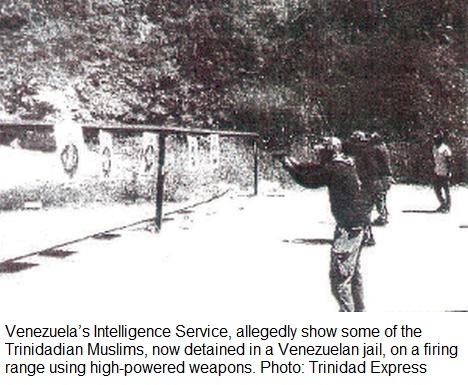
PORT OF SPAIN, Trinidad — Cellphone images seized by SEBIN, Venezuela’s intelligence service, allegedly show Trinidadian Muslims arrested in Venezuela engaging in what SEBIN described as “pre-jihad training” on a firing range using high-powered weapons, the Trinidad Express reported.

The images were reportedly extracted from the cellphones seized from some of the Muslims in a group that travelled to Venezuela from Trinidad and were later arrested in a raid at the Plaza Hotel in Caracas on March 19, together with women and children, who were later released.

The training resembled what takes place in the Middle East as Muslims prepare for what they term jihad, or holy war, an important religious duty for Muslims that includes armed struggle against persecution and oppression.

Intense military, arms and ammunition training is part and parcel of their routine and some of this kind of training, SEBIN alleged, was taking place in Venezuela by some of the Trinidadian Muslims.

In a top secret document prepared by SEBIN and sent to the Trinidad and Tobago government, the pictures in question were taken by three Venezuelan police officers who were later arrested. There are at least six photographs showing the men.

Eight Trinidadian Muslims are currently detained by Venezuelan authorities on suspicion of terrorist activities. The 14 women and children who were held with them at the Plaza Hotel in Caracas on March 19 were released some ten days later and sent back to Trinidad.

This followed a visit of a Trinidad and Tobago delegation headed by Rear Admiral Richard Kelshall who met with Venezuelan authorities two days prior to their release.

Out of that meeting emanated the top secret document given to the Trinidad and Tobago government, which the Trinidad Express reported exposes some alarming security concerns that the country’s security forces need to monitor closely.

The document outlines in detail the day the Trinidadian Muslims were held at the Plaza Hotel in Caracas and revelations about possible terrorist activities that can have far reaching consequences for Trinidad and Tobago.

Minister of National Security Gary Griffith spoke about the document in late April.

“A secret document has been given to me through the delegation from the Venezuelan authorities and this is obviously a sensitive document and I would not be able to actually state what is in the document, it is sensitive correspondence,” Griffith said.

In the top secret document, there are dates of the arrivals for all the Trinidadians who touched down at the Simon Bolivar International Airport in Venezuela between January and March this year.

The raid on the Trinidadian Muslims at the Plaza Hotel, authorities said, was brought to the attention of SEBIN “after a prolonged stay at the hotel” and the use of “cash to cover their bills”.

Further suspicion arose, SEBIN stated, when members of the group were reclusive, as more persons continued to arrive and bills continued “to be paid exclusively in cash”.

Cleaning staff at the hotel were even barred from entering the rooms, the report revealed.

SEBIN’s suspicion was compounded further as they “implemented surveillance on the group and observed that Dominic Pitilal [one of the group] was routinely changing large sums of US” currency.

BS #3It was then SEBIN decided to make their move, executing a search warrant in the rooms occupied by “Pitilal and associates” and reportedly discovered: two satellite phones, 20 mobile phones, two laptops, six tablets, army type uniforms, combat paraphernalia, firearm training paraphernalia, telephone video of several of the detained persons in firearms training in Caracas.

According to the Trinidad Express, the accusation of jihad is only the beginning of something more profoundly troubling.

Sources within the Muslim community in Trinidad told the Express they have received information about Trinidadian Muslims fighting in the Syrian civil war as part of the anti-Assad movement.

Sources said every individual is paid US$150,000 to come to Syria and fight.

The subject is rarely discussed in certain Muslim circles in Trinidad, some fearing if they say anything, their lives might be in jeopardy. It is also a case that Muslim women know about, but are not willing to inform on friends or family members.

Well-placed Muslim sources who met and spoke with the Express in the last few weeks on the condition of anonymity say some of the women and children who were detained in Venezuela were in transit to Syria.

Three well-placed sources say people had confided in them about how the operation would go down.

One said, “What they do is buy plane tickets showing travel from Venezuela to China in transit through Turkey. When the plane stops there they get off and cross the border into Syria, but many would be thinking they have gone on to China as the ticket states.”

Another indicated that a named Trinidadian Muslim now in Syria has been in contact with family members in Trinidad and is also in constant contact with another local Muslim man.

Intelligence sources said they have been monitoring the movements of certain people, but would not commit to a solid answer.

When asked about Trinidadians using Venezuela as a stepping stone to head to Syria to fight in the jihad, Griffith said, “We most definitely have intelligence of all matters of national security but pertaining to that quite obviously, I would not be able to actually state what intelligence that we have for obvious reasons.”

In the last three weeks, the UK Guardian has carried stories about Muslim men leaving the United Kingdom to fight the war in Syria with young women also trying to follow. When they return to their countries they could be a serious security risk and the Anti-Terrorism Unit in Britain is closely monitoring the situation.

CNN in a recent report online entitled “West’s biggest threat: Battle hardened homegrown terrorists”, warned about American Muslims leaving to fight in Syria and returning as a potential threat to the US.

Intelligence sources in Trinidad also said they are fearful that some of those fighting in Syria will return to Trinidad with the radical ability to carry out violent acts there.

In fact, SEBIN in its secret report made specific recommendations to Trinidad’s national security ministry indicating it should pay closer attention to particular mosques.

Concerns outlined in the report also included:

• The increase of illegal diesel trafficking.

• Increase of the volume and flow of narco-trafficking and arms and ammunition trafficking.

• Increase of persons from the Middle East entering and transiting Venezuela onward to Trinidad.

SEBIN also revealed to the Trinidad and Tobago government that “British and US sources have expressed through official channels that there is an uneasiness relative to chatter emanating from Trinidad and Tobago at this time.”

Griffith said, “When we get types of intelligence that can be perceived as individuals being enemies of the state or trying to have any plan to overthrow the government, or any democracy as we know it, we would have that pre-emptive strike. We would be aware of what is happening and we would ensure that we do it to them before they do it to us.”

Attempts to assess the level of US concern in relation to the security of the Caribbean generally – a region that is variously described as America’s “third border” and America’s “backyard” – by means of official comment have largely proven to be fruitless.

There has been the so-called Third Border Initiative (now apparently moribund) and the more recent Caribbean Basin Security Initiative but the latter has largely focused on maritime interdiction of drug traffickers while seemingly ignoring the fact that the vacuum left by US financial and political inattention has been quickly filled by the Chinese (economically), Venezuela (politically and economically) also acting as a proxy for Iran, and more recently by the Russians for their own reasons.

Apart from the fact that questionable individuals from these and other countries are using the economic citizenship programs of many of the small Caribbean countries to obscure their real nationality and background, there is the concern expressed by intelligence sources in Trinidad that some of their nationals fighting in Syria will return with the radical ability to carry out violent acts in that country – i.e. part of America’s “third border”.

The so far unanswered questions posed to various US House and Senate committees that ought to have an interest in this area have tried to address the apparent inattention to the situation in the region itself, thus allowing hostile elements virtual freedom of movement in an area up to the actual border when, with a fairly modest effort in the overall scheme of things, the situation could be dealt with much more effectively.

With all the ex post facto hand-wringing over events in Benghazi, an increased level of congressional interest and concern in working to prevent other potential problems closer to home might have been expected but is apparently thus far non-existent.

Caribbean News Now (Posted May 13, 2014; retrieved 05/29/2014) –http://www.caribbeannewsnow.com/topstory-Trinidad-Muslims-travel-to-Venezuela-for-jihadist-training-21089.html

The Go Lean book details a series of community ethos, strategies, tactics, implementations and advocacies to provide increased public safety & security in the Caribbean region:

Community Ethos – Privacy –vs- Public Protection Page 23
Community Ethos – Intelligence Gathering Page 23
Community Ethos – “Crap” Happens Page 23
Community Ethos – Cooperatives Page 25
Community Ethos – Ways to Improve Sharing Page 35
Strategy – Security Pact to defend the homeland Page 45
Tactical – Confederating a non-sovereign union Page 63
Tactical – Separation of Powers – Homeland Security Page 75
Implementation – Ways to Pay for Change Page 101
Implementation – Start-up Foreign Policy Initiatives Page 102
Implementation – Start-up Security Initiatives Page 103
Advocacy – Ways to Grow the Economy Page 151
Advocacy – Ways to Improve Governance Page 168
Advocacy – Improve Homeland Security Page 180
Advocacy – Mitigate Terrorism Page 181
Advocacy – Improve Intelligence Gathering/Analysis Page 182
Advocacy – Improve for Natural Disasters Page 184

Paramount to the prime directive of elevating the economics, security and governing engines of the region is the desire to make the Caribbean, a better place to live, work and play. This has been the hope for generations. Finally now, the CU is here to traverse this journey. All of the Caribbean institutions are hereby urged to lean-in to this roadmap, or better stated, to Go Lean.

Download the Book – Go Lean…Caribbean – Now!!!

Appendix – Regional Security System

(Retrieved 05/29/2014 from: http://en.wikipedia.org/wiki/Regional_Security_System)

The Regional Security System (RSS) is an international agreement for the defence and security of the eastern Caribbean region. The Regional Security System was created out of a need for collective response to security threats, which were impacting on the stability of the region in the late 1970s and early 1980s. On 29 October 1982 four members of the Organisation of Eastern Caribbean States—namely, Antigua & Barbuda, Dominica, St. Lucia, and St. Vincent & the Grenadines—signed a memorandum of understanding (MOU) with Barbados to provide for “mutual assistance on request”. The signatories agreed to prepare contingency plans and assist one another, on request, in national emergencies, prevention of smuggling, search and rescue, immigration control, fishery protection, customs and excise control, maritime policing duties, protection of off-shore installations, pollution control, national and other disasters and threats to national security.[1] CU Blog - Trinidad Muslims travel to Venezuela for jihadist training - Photo 2Saint Kitts and Nevis joined following independence in 1983, and Grenada followed two years later after Operation Urgent Fury, a combined U.S. and RSS invasion of the country. The MOU was updated in 1992 and the system acquired juridical status on 5 March 1996 under the Treaty which was signed at St. Georges, Grenada.
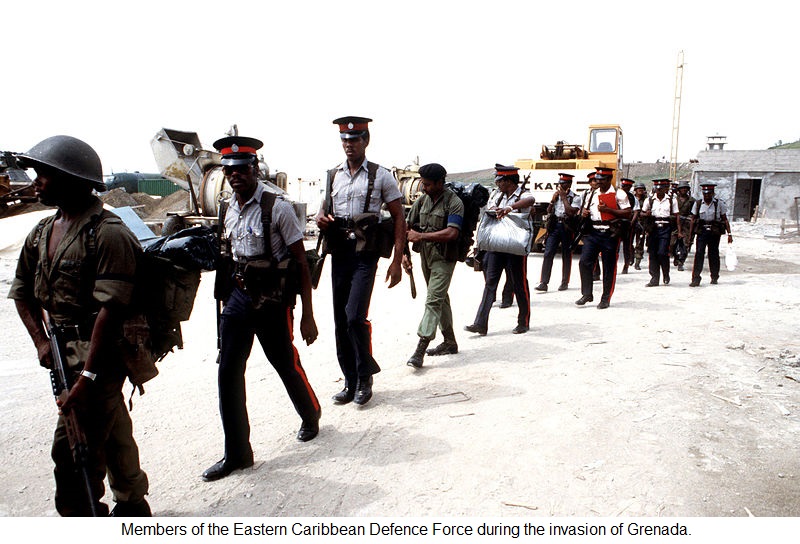
The RSS initially started as a U.S. instrument to combat the spread of Communism in the Caribbean region.[2][3] As of 2001, the RSS further cooperates with the CARICOM Regional Task Force on Crime and Security (CRTFCS).[4]

In June 2010, United States and Caribbean regional officials resumed a plan for close cooperation established under the former Partnership for Prosperity and Security in the Caribbean (PPS) from the Clinton era.[5] As part of the joint agreement the United States pledged assistance with the creation of an Eastern Caribbean Coast Guard unit among RSS countries.[6] The Coast Guard unit will underpin the wider US-Caribbean Basin Security Initiative (CBSI) which has deemed the RSS as “central to the CBSI’s success, given its reach across the Eastern Caribbean.”[6]

Subsequently, Canada also pledged collaboration with the RSS bloc.[7][8] to combat a threat of Central American criminal gangs from expanding into the English-speaking Caribbean region.[9]

The current member nations are:

Antigua and Barbuda (since 1982)
Barbados (since 1982)
Dominica (since 1982)
Grenada (since 1985)
Saint Kitts and Nevis (since 1983)
Saint Lucia (since 1982)
Saint Vincent and the Grenadines (since 1982)

Date

Operation name

Country

Reason

1983 Grenada Intervention Grenada Restore a government in Grenada
1989 Hugo Antigua, Montserrat and Saint Kitts and Nevis Assistance in aftermath of Hurricane Hugo
1990 Coup Trinidad and Tobago Aftermath of an attempted Coup d’état in Trinidad and Tobago
1994 Internal Security Saint Kitts and Nevis Prison riot
1995 Luis, Marilyn Antigua and Saint Kitts and Nevis Assistance in aftermath of Hurricane Luis and Hurricane Marilyn
1998 Georges Saint Kitts and Nevis Assistance in aftermath of Hurricane Georges
1998 Weedeater Saint Vincent and the Grenadines Eradication of cannabis
2003 Bordelais Saint Lucia Transfer prisoners to new prison facility
2004 Ivan Relief Efforts Grenada Assistance in aftermath of Hurricane Ivan
2006 Glendairy Barbados Prison uprising
2009 Operation VINCYPAC St Vincent and the Grenadines Eradication of Cannabis
2010 Haiti Haiti Assistance in aftermath of the Haiti 2010 Earthquake

Sources References:

  1. “APPROACHES ON SECURITY IN THE CARIBBEAN REGION: Statement by Ambassador Odeen Ishmael of Guyana at the Meeting of the Committee on Hemispheric Security of the OAS Washington DC, 29 October 2002”. Retrieved 17 December 2012 from: http://www.guyana.org/Speeches/ishmael_102902.html.
  2.  http://www.country-data.com/cgi-bin/query/r-3378.html
  3. Lewis, Patsy (2002). Surviving Small Size: Regional Integration in Caribbean Mini-states. Kingston, Jamaica: University of West Indies Press. ISBN 976-640-116-0.
  4. Regional Task Force, the Caribbean Community (CARICOM) Implementation Agency for Crime and Security (IMPACS). Retrieved from: http://www.caricomimpacs.org/index.php?option=com_content&task=view&id=5&Itemid=29
  5. Singh, Rickey (13 June 2010). “A USA-CARIBBEAN ‘RENEWAL’?”. Guyana Chronicle. Retrieved 17 September 2010.
  6. “CARIBBEAN SECURITY: United States to help upgrade Regional Security System”. Caribbean News Agency (CANA). Retrieved 17 September 2010 from: http://www.cananews.net/news/131/ARTICLE/48413/2010-04-17.html.
  7. “Security important to Canada”. The Barbados Today. Retrieved 17 September 2010 from: http://news.barbadostoday.bb/index.php?option=com_content&view=article&id=4431:Security-important-to-Canada&catid=1:latest-news.
  8. “Canada to boost help to region”. Nation Newspaper. Retrieved 5 July 2010 from: http://www.nationnews.com/index.php/articles/view/canada-to-boost-help-to-region/.
  9. H., J. (17 September 2010). “Region warned of displaced criminal elements”. The Barbados Advocate. Retrieved 17 September 2010 from: http://www.barbadosadvocate.com/newsitem.asp?more=local&NewsID=12798.
Share this post:
, , , ,

Humanities Advocate – Maya Angelou – R.I.P.

Go Lean Commentary

MA1“That a powerful play goes on, and you may contribute a verse” – poet Walt Whitman: “O Me! O Life!”

The world mourns the passing of Maya Angelou (1928 – 2014; age 86). She contributed more than a verse to the powerful play of modern life. She is known for her contribution to all of the humanities.

Humanities? That’s a different word; extraordinary in its use as a wide-angle view in the study of humankind. Extraordinary, “wide-angle view”, all fitting descriptors for the contributions of Maya Angelou – see the bibliography/filmography below. Here’s the text book definition of the word “humanities” (www.Dictionary.com):

noun, plural hu·man·i·ties.

1. all human beings collectively; the human race; humankind.

2. the quality or condition of being human; human nature.

3. the quality of being humane; kindness; benevolence.

4. the humanities.

a. the study of classical languages and classical literature.
b. the Latin and Greek classics as a field of study.
c. literature, [poetry], philosophy, art, etc., as distinguished from the natural sciences.
d. the study of literature, poetry, philosophy, art, etc.

Maya Angelou impacted the world of the humanities with her contributions. She was awarded over 30 honorary Doctor of Humanities degrees from diverse colleges and universities around the world. In addition to Dr. Angelou’s contribution to the humanities, she was also a strong proponent for empowerment. She spoke and wrote profound words/works on the need for people to empower themselves, to seek more out of life, to live more vibrant, fulfilled lives, to be critical thinkers and proactive doers in their journey for a more impactful life.

The publishers of the book Go Lean…Caribbean recognize the life contributions of Maya Angelou as an advocate, as many of her causes align with our quest for empowerment and elevation of Caribbean life and culture. The book serves as a roadmap for the introduction and implementation of the Caribbean Union Trade Federation (CU).

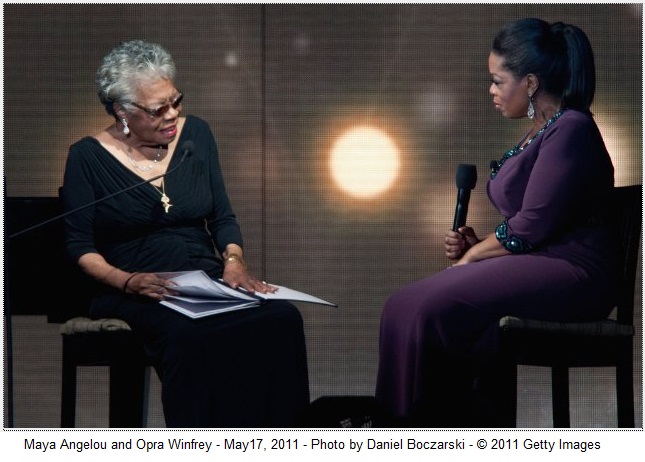
Maya 2The Go Lean/CU movement shares a linkage with this focus of Dr. Angelou. (She was due to appear at the Orpheum Theater in Omaha, Nebraska on June 9 – see photo – this writer was ticketed for attendance). The CU seeks to also empower the people of the Caribbean to lead more impactful lives in which they are better able to meet their needs and plan for a productive future. The Go Lean roadmap seeks to put Caribbean people in a place of better Command-and-Control of their circumstances, to develop the community ethos of assisting each other to advance in our own lives, in our individual communities and in the Caribbean as a whole. Like Dr. Angelou, we say with a collective voice “and still I rise” – (Published Random House 1978):

You may write me down in history
With your bitter, twisted lies,
You may tread me in the very dirt
But still, like dust, I’ll rise.

Does my sassiness upset you?
Why are you beset with gloom?
‘Cause I walk like I’ve got oil wells
Pumping in my living room.

Just like moons and like suns,
With the certainty of tides,
Just like hopes springing high,
Still I’ll rise.

Did you want to see me broken?
Bowed head and lowered eyes?
Shoulders falling down like teardrops.
Weakened by my soulful cries.

Does my haughtiness offend you?
Don’t you take it awful hard
‘Cause I laugh like I’ve got gold mines
Diggin’ in my own back yard.

You may shoot me with your words,
You may cut me with your eyes,
You may kill me with your hatefulness,
But still, like air, I’ll rise.

Does my sexiness upset you?
Does it come as a surprise
That I dance like I’ve got diamonds
At the meeting of my thighs?

Out of the huts of history’s shame
I rise
Up from a past that’s rooted in pain
I rise

I’m a black ocean, leaping and wide,
Welling and swelling I bear in the tide.
Leaving behind nights of terror and fear
I rise

Into a daybreak that’s wondrously clear
I rise
Bringing the gifts that my ancestors gave,
I am the dream and the hope of the slave.
I rise
I rise
I rise.

While the CU’s prime directive is the economics of the Caribbean region, there are peripheral areas of concern. While economics, security and governance are all important for the sustenance of Caribbean life, pursuits like poetry, art, and beauty are the reasons we want to live. Maya Angelou stood as a vanguard for many of these causes:

Minority rights, civil rights, women rights, quest for justice, art, music, film, and image.

The Go Lean book posits that one person can make a difference in the Caribbean, and its impact on the world; that there are many opportunities where one champion, one advocate, can elevate society. In fact the book is a collection of 144 different advocacies, so there is inspiration for the Maya Angelou’s of the region to make their mark in many different fields of endeavor.

The roadmap specifically encourages the region, to lean-in and foster the next generation of Maya Angelou’s with these specific community ethos, strategies, tactics, implementations and advocacies:

Community Ethos – Minority Equalization Page 24
Community Ethos – Ways to Foster Genius Page 27
Community Ethos – Ways to Promote Intellectual Property Page 31
Community Ethos – Ways to Promote Happiness Page 36
Community Ethos – Ways to Impact the Greater Good Page 37
Anatomy of Advocacies Page 122
Planning – Ways to Better Manage Image Page 129
Advocacy – Ways to Improve Education Page 159
Advocacy – Ways to Impact Justice Page 177
Advocacy – Ways to Impact Hollywood Page 203
Advocacy – Ways to Help Women Page 226
Advocacy – Ways to Improve the Arts Page 230
Advocacy – Ways to Promote Music Page 231

The Go Lean roadmap pronounces that with the participation of many advocates on many different paths for progress, the Caribbean can truly become a better place to live, work and play. We owe a debt to Dr. Angelou for leading us along this path.

The Bible book of Psalms Chapter 90 quotes:

10  In themselves the days of our years are 70 years.
And if because of special mightiness they are 80 years.
Yet their insistence is on trouble and hurtful things;
For it must quickly pass by, and away we fly.

12  Show us just how to count our days in such a way
That we may bring a heart of wisdom in.

Rest in Peace Maya Angelou. Thank you for showing us how to make our days count.

Download the free e-book of Go Lean … Caribbean – now!

—————————————————————————-

Appendix – Bibliography
Contributions Retrieved May 28, 2014 from: http://en.wikipedia.org/wiki/List_of_Maya_Angelou_works

Autobiographies

  • I Know Why the Caged Bird Sings (1969). New York: Random House. ISBN 978-0-375-50789-2
  • Gather Together in My Name (1974). New York: Random House. ISBN 978-0-394-48692-5
  • Singin’ and Swingin’ and Gettin’ Merry Like Christmas (1976). New York: Random House. ISBN 978-0-679-45777-0
  • The Heart of a Woman (1981). New York: Random House. ISBN 978-0-8129-8032-5
  • All God’s Children Need Traveling Shoes (1986). New York: Random House. ISBN 978-0-679-73404-8
  • A Song Flung Up to Heaven (2002). New York: Random House. ISBN 978-0-375-50747-2
  • I Know Why the Caged Bird Sings: The Collected Autobiographies of Maya Angelou (2004). New York: Modern Library. ISBN 978-0-679-64325-8
  • Mom & Me & Mom (2013). New York: Random House. ISBN 978-1-4000-6611-7

Maya 3Poetry

  • Just Give Me a Cool Drink of Water ‘fore I Diiie (1971). New York: Random House. ISBN 978-0-394-47142-6[14]
  • Oh Pray My Wings Are Gonna Fit Me Well (1975). New York: Random House. ISBN 0-679-45707-0
  • And Still I Rise (1978). New York: Random House. ISBN 978-0-394-50252-6[9]
  • Shaker, Why Don’t You Sing? (1983). New York: Random House. ISBN 0-394-52144-7[15][16]
  • Poems (1986). New York: Random House. ISBN 0-553-25576-2
  • Now Sheba Sings the Song (1987). New York: Plume Books. ISBN 0-452-27143-6
  • I Shall Not Be Moved (1990). New York: Bantam Books. ISBN 0-553-35458-2
  • “On the Pulse of Morning” (1993). New York: Random House. ISBN 0-679-74838-5[17]
  • The Complete Collected Poems of Maya Angelou (1994). New York: Random House. ISBN 0-679-42895-X
  • Phenomenal Woman: Four Poems Celebrating Women (1995). New York: Random House. ISBN 0-679-43924-2
  • A Brave and Startling Truth (1995). New York: Random House. ISBN 0-679-44904-3[18]
  • “From a Black Woman to a Black Man”, 1995
  • “Amazing Peace” (2005). New York: Random House. ISBN 1-4000-6558-5[16]
  • “Mother: A Cradle to Hold Me” (2006). New York: Random House. ISBN 1-4000-6601-8
  • “Celebrations, Rituals of Peace and Prayer” (2006). New York: Random House. ISBN 978-0-307-77792-8
  • Poetry for Young People (2007). Berkshire, U.K.: Sterling Books. ISBN 1-4027-2023-8
  • “We Had Him”, 2009
  • “His Day is Done”, 2012
  • Wouldn’t Take Nothing for My Journey Now (1993). New York: Random House. ISBN 0-553-56907-4
  • Even the Stars Look Lonesome (1997). New York: Random House. ISBN 0-375-50031-6
  • Letter to My Daughter (2008). New York: Random House. ISBN 1-4000-6612-3
  • Hallelujah! The Welcome Table: A Lifetime of Memories with Recipes (2004). New York: Random House. ISBN 1-4000-6289-6
  • Great Food, All Day Long: Cook Splendidly, Eat Smart (2010). New York: Random House. ISBN 1-4000-6844-4
  • Life Doesn’t Frighten Me (1993). New York: Stewart, Tabori, and Chang. ISBN 1-55670-288-4
  • My Painted House, My Friendly Chicken and Me (1994). New York: Knopf Books. ISBN 0-517-59667-9
  • Kofi and His Magic (1996). New York: Knopf Books. ISBN 0-517-59667-9
  • Maya’s World series (2004). New York: Random House:
    • Itak of Lapland, ISBN 0-375-92833-2
    • Angelina of Italy, ISBN 0-375-82832-X
    • Renée Marie of France ISBN 0-375-82834-6
    • Mikale of Hawaii ISBN 0-375-92835-9
  • Cabaret for Freedom (musical revue), with Godfrey Cambridge, 1960
  • The Least of These, 1966
  • The Best of These (drama), 1966
  • Gettin’ up Stayed on My Mind, 1967
  • Sophocles, Ajax (adaptation), 1974
  • And Still I Rise (writer/director), 1976

Personal essays

  • Wouldn’t Take Nothing for My Journey Now (1993). New York: Random House. ISBN 0-553-56907-4
  • Even the Stars Look Lonesome (1997). New York: Random House. ISBN 0-375-50031-6
  • Letter to My Daughter (2008). New York: Random House. ISBN 1-4000-6612-3

Cookbooks

  • Hallelujah! The Welcome Table: A Lifetime of Memories with Recipes (2004). New York: Random House. ISBN 1-4000-6289-6
  • Great Food, All Day Long: Cook Splendidly, Eat Smart (2010). New York: Random House. ISBN 1-4000-6844-4

Children’s books

  • Life Doesn’t Frighten Me (1993). New York: Stewart, Tabori, and Chang. ISBN 1-55670-288-4
  • My Painted House, My Friendly Chicken and Me (1994). New York: Knopf Books. ISBN 0-517-59667-9
  • Kofi and His Magic (1996). New York: Knopf Books. ISBN 0-517-59667-9
  • Maya’s World series (2004). New York: Random House:
    • Itak of Lapland, ISBN 0-375-92833-2
    • Angelina of Italy, ISBN 0-375-82832-X
    • Renée Marie of France ISBN 0-375-82834-6
    • Mikale of Hawaii ISBN 0-375-92835-9

Plays

  • Cabaret for Freedom (musical revue), with Godfrey Cambridge, 1960
  • The Least of These, 1966
  • The Best of These (drama), 1966
  • Gettin’ up Stayed on My Mind, 1967
  • Sophocles, Ajax (adaptation), 1974
  • And Still I Rise (writer/director), 1976

Filmography
Contributions – Retrieved May 28, 2014 from: http://www.imdb.com/name/nm0029723/?ref_=fn_al_nm_1

Actress (15 credits)

Year Movie/Show Character/Role
2006 Madea’s Family Reunion May
2001 Phenomenal Woman (Short) Phenomenal Woman
2000 The Runaway (TV Movie) Conjure Woman
2000 Happily Ever After: Fairy Tales for Every Child (TV Series) Fairy Godmother
2000 Rip Van Winkle (TV Series) Fairy Godmother (voice)
1997 Talking with David Frost (TV Series)
Colin Powell and Maya Angelou Narrator
1996 Elmo Saves Christmas (Video)
1995 Touched by an Angel (TV Series) Clarice Mitchell
Reunion (1995) Clarice Mitchell
1995 How to Make an American Quilt Anna
1995 The Journey of August King Narrator (voice)
1993 There Are No Children Here (TV Movie) Lelia Mae
1993 Poetic Justice Aunt June
1977 The Richard Pryor Special? (TV Movie) Willie’s Wife
1977 Roots (TV Mini-Series) Nyo Boto / Yaisa
Part II Nyo Boto
Part I Yaisa
1959  Porgy and Bess Dancer (uncredited)

Writer (7 credits)

Year Movie/Show
2008 The Black Candle (Documentary) (poetry written by)
1996 How Do You Spell God? (TV Movie)
1996 America‘s Dream (TV Movie) (story “The Reunion”)
1982 Sister, Sister (TV Movie)
1979  I Know Why the Caged Bird Sings (TV Movie) (book)
1977  The Richard Pryor Special? (TV Movie) (soliloquy)
1972 Georgia, Georgia

Soundtrack (4 credits)

Year Movie/Show
2010 Michael Feinstein’s American Songbook (TV Mini-Series documentary) (lyrics – 1 episode)
Best Band in the Land  (lyrics: “We Dreamed These Days”)
2001 The Mystic Masseur (performer: “Scandal in the Family”)
1968 For Love of Ivy (lyrics: “You Put It on Me”)
1957 Calypso Heat Wave (writer: “All That Happens in the Market Place”)

Director (2 credits)

Year Movie/Show
1998 Down in the Delta
1976 Visions (TV Series) (1 episode)
The Tapestry/Circles ()

Music department (1 credit)

Year Movie/Show
1972 Georgia, Georgia (composer: score)

Producer (1 credit)

Year Movie/Show
1982 Sister, Sister (TV Movie) (producer)

Miscellaneous Crew (1 credit)

Year Movie/Show
1993 Poetic Justice (poetry)
Share this post:
, , , , ,
[Top]

Sports Revolutionary: Advocate Jeffrey Webb

Go Lean Commentary

Sports Revolution 3The forgoing encyclopedia source focuses on the background person connected to an important issue in sports administration: blatant racism in European soccer.

Blatant racism is a scourge to the beautiful sport of football (soccer). Black players have to endure unspeakable acts of disrespect (cursing, spitting, monkey-chants, tossed bananas, etc). The international governing body for soccer/football, Fédération Internationale de Football Association (FIFA), wants to forge change among the game’s stakeholders. This issue relates to the Caribbean, in that the FIFA advocate in this cause is from the Cayman Islands.

This advocate, Jeffrey Webb, is featured in a current episode of a sports documentary television show in the US.

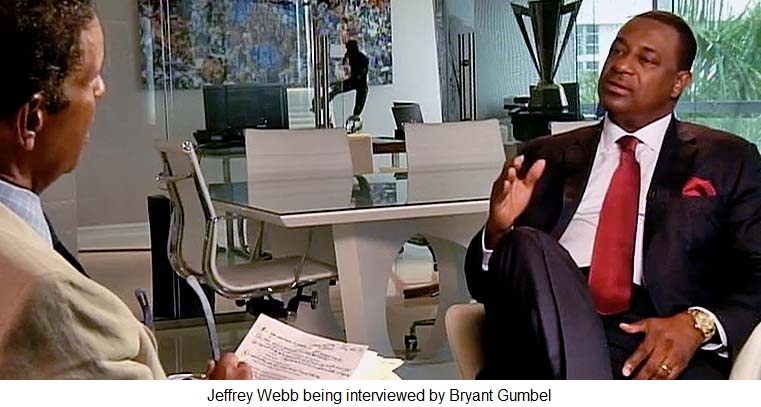
Sports Revolution 1MIAMI — CONCACAF President Jeffrey Webb, who is Chairman of FIFA¹s Anti-Racism and Discrimination Task Force, appeared Tuesday (May 20, 2014) on the acclaimed HBO program Real Sports with Bryant Gumbel, addressing FIFA’s strategy and efforts to eradicate racism from football.  He discussed the governing body’s responsibility in providing meaningful support for all players around the globe and implementing tougher sanctions to fortify the sport, so that focus can be placed on the game itself.

The Emmy-winning show also featured an interview with United States international striker Jozy Altidore, a member of FIFA’s anti-discrimination body.

HBO will re-air the episode between May 20 and June 21, 2014.

During the 63rd FIFA Congress last year in Mauritius, Member Associations approved the Anti-Racism and Discrimination resolutions proposed by the task force chaired by President Webb.  The application of these resolutions in every country where football is played will bring universality to the mechanisms that combat racism and discrimination.

(http://www.concacaf.com/article/president-webb-speaks-about-racism-on-real-sports-with-bryant-gumbel)

Many professional athletes participating in European soccer, are of Afro-Caribbean heritage. This should be a proud legacy, one to be protected and promoted. (This is also an issue in Brazil).

Jeffrey Webb (born 1964) [1], is the president of CONCACAF and the Cayman Islands Football Association (CIFA) and FIFA Vice President.

He was educated at HillsboroughCommunity College in the United States. His career in the football field spans almost three decades. He was appointed as President of the Cayman Islands Football Association in 1991.[2]

CIFA’s accomplishments under Webb’s administration and leadership were widely recognized and in 1994 he was co-opted as a member of the CFU Executive Committee, and member of FIFA’s Protocol Committee in 1995. Prior to his appointment to CIFA, Webb served as President of the local football club Strikers FC.

Moreover, within FIFA’s governing body, in 2002 Webb became Deputy Chairman of the FIFA Internal Audit Committee and subsequently Chairman in 2011. He is a former member of FIFA’s Transparency and Compliance Committee and, most recently, was appointed as member of FIFA’s Strategic, Finance, Organizing World Cup and Emergency Committees.

Sports Revolution 2Webb also took part of FIFA’s delegations to the World Cup including France (1998), U.S. Women’s World Cup (1999), Korea/Japan (2002), Germany (2006), and South Africa (2010).

Webb was a Business Development Manager at Fidelity Bank (Cayman) Limited, a subsidiary of Fidelity Bank & Trust International Limited, which is involved in retail banking, investment banking, corporate finance and asset management. Outside of banking, Webb co-owns a franchise of Burrell’s bakery chain “Captain’s Bakery” in the Cayman Islands.[3]

On May 23, 2012, in Budapest, Hungary, Webb was unanimously elected to lead the Confederation of North, Central America and the Caribbean Football Association (CONCACAF). He became the fourth President in the Confederation’s history and the youngest leader of any regional association within FIFA to reach this position. As CONCACAF President, his core focus is to restructure the Confederation by building solid foundations to manage, develop and promote the game with a resilient commitment to inclusiveness, accountability and transparency.

As President of CONCACAF, Webb also became FIFA Vice President and an official member of the governing body’s Executive Committee. Moreover, on March 2013 Webb was appointed by FIFA President Joseph Blatter as Chairman of the FIFA anti-discrimination task force, which will oversee all matters related to discrimination within global football.

At the time of his appointment, in 2012, Webb was President of the Cayman Islands Football Association (CIFA).

Webb appointed a new Miami-based General Secretary Enrique Sanz de Santamaría enabling the CONCACAF head office to relocate to Miami.[4]

Source References:

  1. “Jeffrey Webb profile”. FIFA.com. Retrieved 11 July 2013.
  2. “Jeff Webb profile”. Cayman Active. 6 January 2011. Retrieved 1 March 2012.
  3. Brown, Rudolph (9 February 2002). “Captain’s Bakery opens in Cayman”. Gleaner (Jamaica). Retrieved 1 March 2012.
  4. “CONCACAF appoints Enrique Sanz as General Secretary”. CONCACAF.com. 13 July 2012. Retrieved 14 July 2012.

Wikipedia Online Encyclopedia (Retrieved 05/25/2014)–http://en.wikipedia.org/wiki/Jeffrey_Webb

The book Go Lean … Caribbean recognizes that image is an important intangible factor that must be managed to optimize value of Caribbean contributions – more value should equal more pay – see Appendix A – Table. As such the book is submitted as a complete roadmap to advance the Caribbean economy/culture, at home, for Caribbean residents, and advance the Caribbean image throughout the world, to benefit residents and Diaspora alike – see Appendix B for book reference on Brazil footballers.

The book, Go Lean … Caribbean, serves as a roadmap for the introduction and implementation of the Caribbean Union Trade Federation (CU), as a sentinel for the Caribbean “image”. This subject of blatant racism in European soccer is in scope for the CU as this technocratic agency will assume oversight to optimize the region’s:

(1) economy,

(2) security apparatus, and

(3) governing engines.

The roadmap commences with a Declaration of Interdependence. In Verse XXXI (Page 14) it pronounces:

Whereas sports have been a source of great pride for the Caribbean region, the economic returns from these ventures have not been evenly distributed as in other societies. The Federation must therefore facilitate the eco-systems and vertical industries of sports as a business, recreation, national pastime and even sports tourism.

The book posits that one person can make a difference in the Caribbean, and its impact on the world; that there are many opportunities where one champion, one advocate, can elevate society. In fact the book is a collection of 144 different advocacies, so there is inspiration for the Jeffrey Webb’s of the region to make their mark in many different fields of endeavor.

The roadmap specifically encourages the region to foster the genius potential (Page 27) in their communities, forge leadership skills (Page 171), improve for sports (Page 229) and pursue the Greater Good (Page 37). With the participation of many advocates on many different paths for progress, the Caribbean can truly become a better place to live, work and play. We can, and must, promote positive images (Page 133).

Download the free e-Book of Go Lean … Caribbean – now!

————————-

Appendix A – Table: Lucky 18 – The World’s Highest Paid Black Athletes for 2011

Athlete Sport Heritage Contract $$$*
Tiger Woods Golf American $75 million
Kobe Bryant Basketball American $53 million
LeBron James Basketball American $48 million
Dwight Howard Basketball American $27.6 million
Dwayne Wade Basketball American $26.2 million
Carmelo Anthony Basketball American $25.1 million
Ronaldo de Assis Moreira aka “Ronaldinho” Football / Soccer Brazil $24.7 million
Amar’e Stoudemire Basketball American $24.5 million
Kevin Garnett Basketball American $23.8 million
CC Sabathia Baseball American $23.6 million
Vince Carter Basketball American $21.8 million
Tim Duncan Basketball US Virgin Islands $21.2 million
Chris Paul Basketball American $20.9 million
Ryan Howard Baseball American $20.8 million
Usain Bolt Track and Field Jamaican $20.3 million
Rashard Lewis Basketball American $20.1 million
Jahri Evans American Football American $19.1 million
Michael Redd Basketball American $18.8 million

Source: http://madamenoire.com/60523/lucky-17-the-worlds-highest-paid-black-athletes/; posted June 10, 2011; retrieved May 25, 2014.

* Salaries, bonuses, prize money, appearance fees, licensing & endorsement income in the 12 months ending May 1, 2011

————————————

Appendix B: Book Reference

The phrase ‘Brazilian soccer player’ is like the phrases ‘French chef’ or ‘Tibetan monk.’ The nationality expresses an authority, an innate vocation for the job – whatever the natural ability.

Original: Bellos, Alex (2003). Futebol: The Brazilian Way of Life: Bloomsbury Publishing Plc. Publication date: 5/02/2003 ISBN: 9780747561798

Revision: Bellos, Alex (2014). Futebol: The Brazilian Way of Life. Publisher: Bloomsbury USA. Publication date: 5/6/2014 ISBN: 9781620402443

Share this post:
, , , ,
[Top]

Jack M. Mintz: ‘All is not well in the sunny Caribbean’

Go Lean Commentary

Jack Mintz 1“All that glitters is not gold” – Old adage.

This is a similar expression as the title of the below commentary by Canadian Public Policy Professor Dr. Jack Mintz:

“All is not well in the sunny Caribbean”.

The opinions of Canadian stakeholders are and have always been important from a Caribbean perspective. “Look to the Northern Star!” – the book Go Lean…Caribbean relates the hope and refuge that Canada always provided to this region (Page 146).

This book purports that an examination of the history of Canada can be productive for the Caribbean. Despite the different geographic address, Canada has had to contend with a lot of challenges similar to the Caribbean; Canada has succeeded while the Caribbean has failed. Early in the book, the point of lessons from Canada is pronounced in the Declaration of Interdependence (Page 14), with these opening statements:

xxxiii.   Whereas lessons can be learned and applied from the study of the recent history of other societies, the Federation must formalize statutes and organizational dimensions … to implement the good examples learned from developments/ communities like … Canada.

Canada recognizes that the Caribbean is in crisis; and despite billions and billions ($$$) in Canadian investments, the region is still in crisis.

Commentary By: Dr. Jack M. Mintz
Economic problems in the Caribbean should be a wake-up call for governments and businesses operating there.

As a middling power, Canada has limited influence in most areas of the world — save for the Caribbean countries. To escape the winter, three million Canadians trek annually to one of the islands to enjoy the sun and relaxation. Roughly 600,000 Caribbean [expatriates] have migrated over the years to Canada, with the largest contingents coming from Jamaica, Guyana, Haiti and Trinidad.

Canada has also invested over $140-billion in capital in the Caribbean islands, especially in Bahamas, Barbados, Bermuda and Cayman Islands. Capital stock held in Barbados alone is over $60-billion, more than any other country except for the United States.  The money does not stay there but moves on to other countries so that Canadian multi-national companies can take advantage of the Canada-Barbados tax treaty to achieve lower global effective corporate tax rates through tax-efficient financial structures.

Jack Mintz 3So when Canadian Imperial Bank of Commerce announced a $420-million write-down in goodwill invested in CIBC FirstCaribbean, it should attract attention, given our deep ties to the region. All is not well in the Caribbean region with its bloated, over-indebted governments operating in slow-growth environments. The economic and fiscal problems in the region raise critical economic and security concerns for Canada.

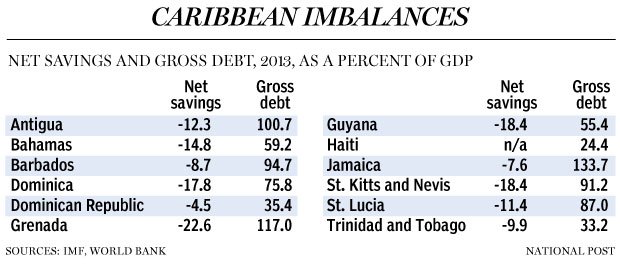
Many Caribbean governments face financial instability. Gross public debt has risen to over 80% of GDP in 2013 for Antigua, Barbados, Grenada, Jamaica, St. Kitts and Nevis, and St. Lucia. Many of these countries are also heavily exposed to global markets with the current account deficit over 20% of GDP in the Caribbean region. Foreign direct investment inflows are more than 8% of GDP for Antigua, Bahamas, Barbados, Grenada, Guyana, St. Kitts and Nevis, St. Lucia and Trinidad-Tobago.

At a flick of the switch, international lenders could turn off the spigots, resulting in a financial crisis and hefty devaluation of currencies. The implications of a severe economic contraction in the region would put the Caribbean countries in limbo and have important consequences to Canada, given our relationships in the region.

The outlook for the Caribbean countries is not exactly cheerful. Overall, economic growth has been poor, about 1.5% for the region, and close to stagnant for Bahamas, Barbados, Grenada and Jamaica. Many of the Caribbean countries face competitiveness problems with some of the highest electricity rates in the world, unionized wage costs and high real interest costs. The business climate is weak with poor regulatory practices, enforcement of contracts and crime.

With the global economic slowdown, tourism has been relatively flat, lagging most regions of the world in 2013. Tourism, after all, is not a necessity and more money is spent on it only when people are better off. The outlook is not looking much better in the near future with little income growth in North America and Europe. Should there ever be reconciliation between the United States and Cuba, U.S. tourism could significantly shift from other islands.

Nor are commodity prices expected to be booming as China and the rest of Asia slow down, with little take up from the rest of the world. Only oil and gas prices seem to be firm, which is good news for Trinidad and Tobago.

With the G20 and OECD countries focused on curbing tax evasion and avoidance, several Caribbean countries – Bermuda, Barbados and Cayman Islands – would be subject to a tightening tax noose. These countries could face a deceleration in economic activity if international tax structures are to be dismantled.

Thus, economic and fiscal problems in the Caribbean should be a wake-up call for governments and businesses operating there. The CIBC write-down is just the tip of the iceberg.

A financial crisis will heavily impact many Canadian businesses that have turned to the Caribbean islands to set up financing and insurance structures. A major economic slowdown in the Caribbean islands would also raise security issues for Canada as crime, including drug trade, could become more problematical to control.

The Canadian government should therefore work with other major countries and international organizations to stabilize Caribbean economies. Attempts to build capacity for good governance in the past years have not been easy but it cannot be abandoned. Some new initiatives should be considered that would help the Caribbean islands improve their fortunes.

Certainly, trying to harmonize policies and merge certain institutions to achieve economies-of-scale across the region would be a useful step. This includes post-secondary education, financial markets and transportation. A shift by Caribbean countries away from oil to natural gas from Trinidad-Tobago and North America would reduce their cost of oil imports.

At the same time, Canada and other Western countries should invest in improving the judiciary and security forces in the [Caribbean] region. The reduction in crime would also benefit our economies by reducing risks faced by tourists and investors. Drug trade with Canada would be curbed.

Debt relief for some of the countries would be appropriate so long as certain commitments are made to reform governance and economic policy. This has been the role of the IMF over the years but Canada should itself pay more attention to the region.

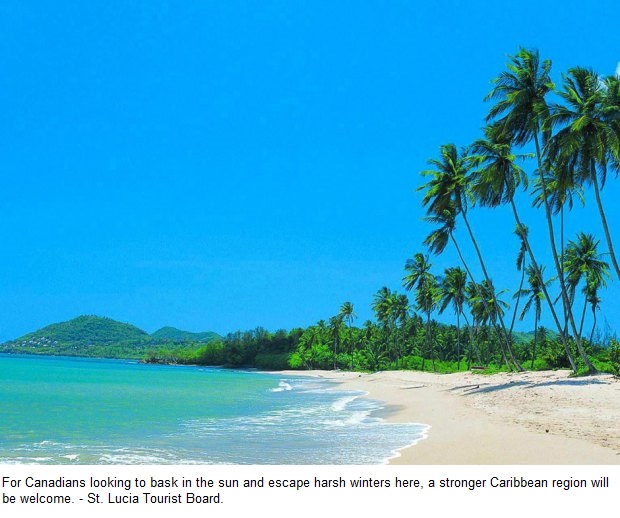
For Canadians looking to bask in the sun and escape harsh winters here, a stronger Caribbean region will be welcome.

Jack M. Mintz is the Palmer Chair, School of Public Policy, University of Calgary. Contact: policy@ucalgary.ca

Source: Financial Post – Canadian Daily; retrieved 05-23-2014 from: http://business.financialpost.com/2014/05/22/jack-m-mintz-all-is-not-well-in-the-sunny-caribbean/

Jack Mintz 2The underlying theme of Jack Mintz commentary is that Caribbean society needs a reboot. The book Go Lean… Caribbean serves as a roadmap for the introduction and implementation of Caribbean Union Trade Federation (CU), a reboot for Caribbean society with these 3 prime directives:

  • Optimize the economic engines of the Caribbean to grow the economy to $800 Billion and create 2.2 million new jobs.
  • Establish a security apparatus to protect the resultant economic engines and stakeholders.
  • Improve Caribbean governance with technocratic excellence.

The foregoing article highlights the mis-management of credit/debt of the governments of the region. The commentary specifically warns:

At a flick of the switch, international lenders could turn off the spigots, resulting in a financial crisis and hefty devaluation of currencies.

Why such poor financial planning? It is obvious that there is a lot of success missing in terms of fiscal expedience. It is not reasonable to expect that current administrations can solve Caribbean fiscal problems with the same tools and techniques of the present. The Go Lean roadmap calls for a different toolbox and different techniques.

If beauty is in the eye of the beholder, then perhaps this commentary is just one person’s assessment of ugly – just a perception. But unfortunately, the facts are the facts. Dr. Mintz relates ugly examples, such as the fact the region has the “highest electricity rates in the world”. There is no denying the “Amount Due” figures on actual electric utility bills.

This is the present, as perceived by Dr. Mintz. Plus, his assessment of the near future is even more “gloom-and-doom”.

True, there is work to be done. But not the job of a Calgary professor, or any other Canadian stakeholder, to do the heavy-lifting. No, this is the job of the Caribbean for the Caribbean. Who is up to the task?

The Caribbean Union Trade Federation hereby “reports for duty” for the job to forge this change.

The Go Lean book details that solutions must come from all aspects of society. There are community values/attitudes that must be in place to ensure that any quest for permanent change would have some measure of success. Those attitudes are referred to as community ethos. There must first be the adoption of many such ethos, followed by the executions of strategies, tactics, implementations and advocacies to impact the region’s prospects, as detailed here:

Community Ethos – Lean Operations Page 24
Community Ethos – Ways to Impact the Future Page 26
Community Ethos – Ways to Help Entrepreneurship Page 28
Anecdote – Entrepreneur’s Best Place To Live? Canada Page 39
Strategy – Vision – Integrate Region into Single Market Page 45
Strategy – Agents of Change – Globalization Page 57
Tactical – Confederating a Permanent Union Page 63
Tactical – Fostering a Technocracy Page 64
Separation of Powers – Banking Regulatory Authority Page 73
Separation of Powers – Justice Institutions Page 77
Implementation – Foreign Policy Initiatives at Start-up Page 102
Implementation – Security Initiatives at Start-up Page 103
Implementation – Ways to Deliver Page 109
Implementation – Ways to Improve Energy Usage Page 113
Implementation – Ways to Better Manage Debt Page 114
Implementation – Ways to Foster International Aid Page 115
Implementation – Ways to Benefit from Globalization Page 119
Planning – Lessons from Canada’s History Page 146
Advocacy – Ways to Grow the Economy Page 151
Advocacy – Ways to Better Manage ForEx Page 154
Advocacy – Ways to Improve Governance Page 168
Advocacy – Ways to Enhance Tourism Page 190
Advocacy – Reforms for Banking Regulations Page 199
Advocacy – Ways to Impact the Diaspora Page 217
Advocacy – Ways to Preserve Caribbean Heritage Page 218
Appendix – Offshore Tax & Financial Services Industry Developments Page 321

The Go Lean roadmap calls for a different entrepreneurial approach than some of the tax avoidance industries promoted in the past. These strategies have actually failed. Most offshore financial centers have modernized their lax laws to mitigate terrorism financing, thus lowering their attraction to tax evaders. The hold-outs, (Bermuda, Barbados and the Cayman Islands), are now being forced to cow-tail to the New World Order. The people of the Caribbean deserve better than waiting for “illicit bread to fall from the table” of rich nations (G-20). We have the world’s best address, for goodness sake, people should be beating a path to our doors (like the 3 million Canadians annually), not the 600,000 Caribbean citizens who have beaten down our doors to get out.

Time for change! The Go Lean roadmap is hereby presented.

The region is hereby urged to lean-in to this Go Lean roadmap, to fulfill the vision of making the Caribbean region a better place to live, work and play. 🙂

Download the book Go Lean … Caribbean – now!

Share this post:
, , , , ,
[Top]

Painful and rapid spread of new virus in Caribbean

Go Lean Commentary

“Crap happens”, declares the book Go Lean…Caribbean (Page 23).

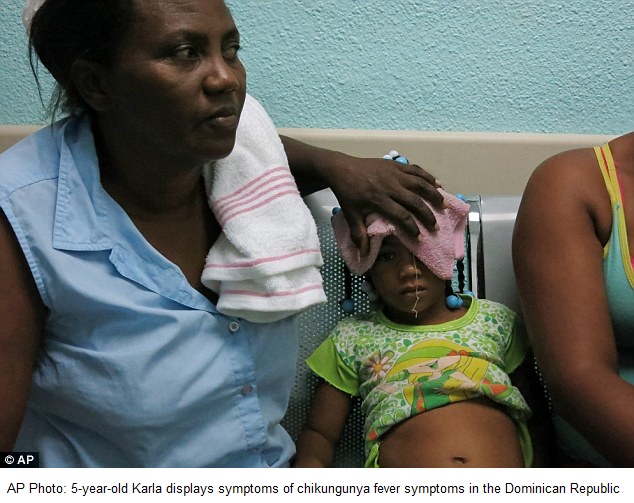
Virus 1The Chikungunya virus scare in the foregoing news article represents the sum of all fears for the Caribbean in terms of tourism and public health threats. This emphatically highlights the need for a regional security pact for Caribbean assurances.

The virus in this article has been identified in the Dominican Republic, Dominica, Saint Martin, and French Guiana; therefore, this is a cross-border threat. This re-enforces that there is a need for a super-national disease-medical sentinel in this security pact.

While other security pacts (for example NATO – North Atlantic Treaty Organization) may be based on defense against military aggression, the Caribbean security pact must focus more on public safety measures. This is one of the prime directives of the proposed Caribbean Union Trade Federation (CU). Naturally, the focus starts with economics, but the resultant engines can be seriously impacted by public safety/health threats. The book Go Lean… Caribbean, serves as a roadmap for the introduction and implementation of that regional sentinel, the CU. The complete prime directives are described as:

  • Optimize the economic engines of the Caribbean to elevate the regional economy.
  • Establish a security apparatus to protect the resultant economic engines.
  • Improve Caribbean governance to support these engines.

The Go Lean roadmap immediately calls for the establishment of a Homeland Security Department, with an agency to practice the arts and sciences of Emergency Management. The emergencies include natural disasters like hurricanes, earthquakes, tsunamis, volcanoes, flooding, forest fires, and droughts. Emergencies also include the man-made variety as in industrial accidents (oil spills, factory accidents and chemical spills), explosions, terroristic attacks and prison riots. The type of emergency described in the foregoing article requires a hybrid response of the Emergency Management agency and the CU’s Department of Health Disease Control & Management agency. Medical expertise would be required to contend with systemic threats of epidemic illness and infectious diseases.

The CU does not possess sovereignty for Caribbean member-states; so CU participation must be invited. This is why the CU is described as a deputized proxy organization. This invitation is equivalent to dialing “911”, a declaration of an emergency – thus granting a timed lease of limited authority to the CU agency, terminating with an “all clear” determination.

By: Ben Fox, AP

SAN CRISTOBAL, Dominican Republic (AP) — They suffer searing headaches, a burning fever and so much pain in their joints they can barely walk or use their hands. It’s like having a terrible flu combined with an abrupt case of arthritis.

Hospitals and clinics throughout the Caribbean are seeing thousands of people with the same symptoms, victims of a virus with a long and unfamiliar name that has been spread rapidly by mosquitoes across the islands after the first locally transmitted case was confirmed in December.

“You feel it in your bones, your fingers and your hands. It’s like everything is coming apart,” said 34-year-old Sahira Francisco as she and her daughter waited for treatment at a hospital in San Cristobal, a town in the southern Dominican Republic that has seen a surge of the cases in recent days.

The virus is chikungunya, derived from an African word that loosely translates as “contorted with pain.” People encountering it in the Caribbean for the first time say the description is fitting. While the virus is rarely fatal it is extremely debilitating.

“It is terrible, I have never in my life gotten such an illness,” said Maria Norde, a 66-year-old woman confined to bed at her home on the lush eastern Caribbean island of Dominica. “All my joints are in pain.”

Outbreaks of the virus have long made people miserable in Africa and Asia. But it is new to the Caribbean, with the first locally transmitted case documented in December in French St. Martin, likely brought in by an infected air traveler. Health officials are now working feverishly to educate the public about the illness, knock down the mosquito population, and deal with an onslaught of cases.

Authorities are attempting to control mosquitoes throughout the Caribbean, from dense urban neighborhoods to beach resorts. There have been no confirmed cases of local transmission of chikungunya on the U.S. mainland, but experts say the high number of travelers to the region means that could change as early as this summer.

So far, there are no signs the virus is keeping visitors away though some Caribbean officials warn it might if it is not controlled. “We need to come together and deal with this disease,” said Dominica Tourism Minister Ian Douglas.

One thing is certain: The virus has found fertile ground in the Caribbean. The Pan American Health Organization reports more than 55,000 suspected and confirmed cases since December throughout the islands. It has also reached French Guiana, the first confirmed transmission on the South American mainland.

The Pan American Health Organization says seven people in the Caribbean with chikungunya have died during the outbreak but they had underlying health issues that likely contributed to their death.

“It’s building up like a snowball because of the constant movement of people,” said Jacqueline Medina, a specialist at the Instituto Technologico university in the Dominican Republic, where some hospitals report more than 100 new cases per day.

Virus 3Chikungunya was identified in Africa in 1953 and is found throughout the tropics of the Eastern Hemisphere. It is spread by two species of mosquitoes, aedes aegypti and aedes albopictus. It’s also a traveler-borne virus under the right circumstances.

It can spread to a new area if someone has it circulating in their system during a relatively short period of time, roughly 2-3 days before the onset of symptoms to 5 days after, and then arrives to an area with the right kind of mosquitoes.

For years, there have been sporadic cases of travelers diagnosed with chikungunya but without local transmission. In 2007, there was an outbreak in northern Italy, so health authorities figured it was just a matter of time before it spread to the Western Hemisphere, said Dr. Roger Nasci, of the U.S. Centers for Disease Control and Prevention.

“With the increase in travelers the likelihood that something like this would happen goes up and eventually it did,” said Nasci, chief of a CDC branch that tracks insect-borne diseases. “We ended up with somebody at the right time and the right place infecting mosquitoes.”

The two species of mosquitoes that spread chikungunya are found in the southern and eastern United States and the first local transmissions could occur this summer given the large number of U.S. travelers to the Caribbean, Nasci said. Already, the Florida Department of Health has reported at least four imported cases from travelers to Haiti, the Dominican Republic and Dominica.

“What we’re seeing now is an increase in the number of infected travelers coming from the Caribbean, which is expected because there’s a lot of U.S. travel, a lot of vacation travel, a lot of work travel,” he said.

Around the Caribbean, local authorities have been spraying fogs of pesticides and urging people to remove standing pools of water where mosquitoes breed.

An estimated 60-90 percent of those infected show symptoms, compared to around 20 percent for dengue, which is common in the region. There is no vaccine and the only cure is treatment for the pain and fluid loss.

One consolation for those suffering from the illness is that unlike dengue, which has several variants, people only seem to get chikungunya once.

“The evidence suggests that once you get it and recover, once your immune system clears the virus you are immune for life,” Nasci said.

Associated Press writers Ben Fox in Miami; P. Solomon Banda in Fort Collins, Colorado; David McFadden in Kingston, Jamaica; and Carlisle Jno Baptiste in Roseau, Dominica, contributed to this report.

Associated Press News Wire (Retrieved 05-22-2014) –          http://news.yahoo.com/painful-rapid-spread-virus-caribbean-040106421.html

The Go Lean roadmap immediately calls for the coordination of security monitoring and mitigation in the Caribbean; referring to viruses as well. This point is declared early in the Go Lean book, commencing with this opening pronouncement in the Declaration of Interdependence (Page 12), as follows:

xvi. Whereas security of our homeland is inextricably linked to prosperity of the homeland, the economic and security interest of the region needs to be aligned under the same governance. …[to ensure] the functioning of the wheels of commerce for all the citizenry, the accedence of this Federation must equip the security apparatus with the tools and techniques for predictive and proactive interdictions.

Go Lean … Caribbean therefore constitutes a change for the Caribbean. This is a roadmap to consolidate 30 member-states of 4 different languages and 5 colonial legacies (American, British, Dutch, French, Spanish) into a Trade Federation with the tools/techniques to bring immediate change to the region to benefit one and all member-states. This includes the monitoring/tracking/studying the origins of common and emerging viruses. This empowered CU agency will liaison with foreign entities with the same scope, like the Pan American Health Organization, US’s Center for Disease Control (CDC) and the World Health Organization (WHO).

Virus 2A lot is at stake!

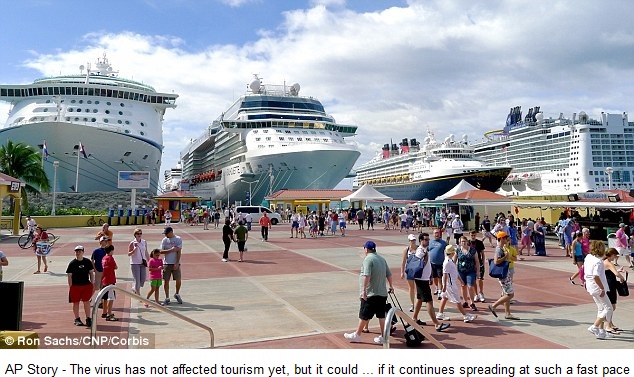
Tourism is the primary economic driver in the region. The realization, or even the unsubstantiated rumor, of viral outbreaks can imperil the tourism product. We must therefore take proactive steps to protect our economic engines. But, we must not curtail freedom of movement among our visitors. We are, in effect, extending an “Open House” to the world to come enjoy our hospitality. Come… they will. So there are additional responsibilities for the stewards of the Caribbean economy, to impact the Greater Good. The CU invites this role, to promote this community ethos.

The book details that there must first be adoption of such a community ethos, the appropriate attitude/spirit to forge change in the region. Go Lean details this and other ethos; plus the executions of the following strategies, tactics, implementations and advocacies to impact the region’s public health:

Community Ethos – Privacy versus Public Protection Page 23
Community Ethos – “Crap” Happens Page 23
Community Ethos – Lean Operations Page 24
Community Ethos – Cooperatives Page 24
Community Ethos – Non-Government Organizations Page 25
Community Ethos – Ways to Improve Sharing Page 35
Community Ethos – Impact the Greater Good Page 37
Strategy – Vision – Non-Sovereign “Unified” Proxy Entity Page 45
Strategy – Customers – Residents & Visitors Page 47
Strategy – Agents of Change – Globalization Page 57
Tactical – Confederating a Permanent Union Page 63
Tactical – Fostering a Technocracy Page 64
Separation of Powers – Emergency Management Page 76
Separation of Powers – Disease Control & Management Page 86
Implementation – Ways to Pay for Change Page 101
Implementation – Security Initiatives at Start-up Page 103
Implementation – Ways to Deliver Page 109
Implementation – Ways to Foster International Aid Page 115
Implementation – Ways to Benefit from Globalization Page 119
Planning – Ways to Improve Failed-State Indices Page 134
Planning – Ways to Measure Progress Page 148
Advocacy – Ways to Grow the Economy Page 151
Advocacy – Ways to Improve Healthcare Page 156
Advocacy – Ways to Improve Governance Page 168
Advocacy – Ways to Better Manage the Social Contract Page 170
Advocacy – Ways to Foster Cooperatives Page 176
Advocacy – Ways to Improve for Natural Disasters Page 184
Advocacy – Ways to Improve Emergency Management Page 196

The foregoing news article introduces the threats of the Chikungunya virus. This is today’s issue. New issues will emerge tomorrow and the days after. This establishes that there is need for a permanent union – a sentinel – to provide efficient stewardship for Caribbean economy, security and governing engine. Change has come to the region.

How would the region pay for this change, these elevations? The Caribbean Union Trade Federation hereby submits for this job, no payment necessary! The region is hereby urged to lean-in to this Go Lean roadmap, to fulfill the vision of making the Caribbean region a better place to live, work and play.

Download the Book- Go Lean…Caribbean Now!!!

Share this post:
, , , ,
[Top]

Bahamas rejects US trade demand

Go Lean Commentary

Q: Where does an 800-pound gorilla sleep? A: Anywhere it wants to.

Trade 1There is no doubt the United States is the 800 pound gorilla for trade in the Caribbean region. From a sheer negotiation tactic, there is no basis for respect and consideration for the needs and aspirations of the small Bahamas island nation. A lion share of trade in the Bahamas comes from the US. Also, a lion share of the Bahamas Government revenue comes from Customs duties. So in any stretch of the imagination, eliminating Customs duties from American imports would devastate the Bahamas Government’s treasuries.

Is this an over-simplification of the logical argument in the foregoing news article? No!

Rather, this is a consistent theme in the book Go Lean…Caribbean. The book posits that the objectives of American foreign, trade and security policy may not align with the priorities of the Caribbean. Even more, no Caribbean member-state has voting powers in the US Capitol where those policies might be codified. It is what it is!

The Bahamas is so small compared to the US that the ranting from Nassau would be inconsequential to the decision makers in Washington. The Bahamas and the US are not “brothers”; at best, the Bahamas can expect a “good neighbor” relationship with the US. But since “blood is thicker than water”, it is only to be expected that the US would prioritize the needs of its people ahead of Bahamians.

By: Alison Lowe, Nassau Guardian Business Editor

NASSAU, Bahamas — The United States has called for The Bahamas to immediately drop all of its duties on US products coming into this country on “day one” of The Bahamas’ accession to the World Trade Organization (WTO) – a request which the government has rejected on the basis that it could wipe out the domestic economy, according to the [Bahamas] Minister of Financial Services.

Disclosing some of the background to The Bahamas’ bilateral negotiations over the terms of its bid to join the WTO, [Minister] Ryan Pinder said that the US government has not been “amenable” to The Bahamas’ phasing in tariff reductions on US goods. “Phasing in” refers to the ability to reduce the duty rate levels over a number of years.

However, he suggested that the government has struck back on the issue, suggesting that a phased-in reduction of tariffs on US goods – the vast majority of all imported goods coming into The Bahamas – would be more appropriate.

He was speaking at a meeting on Wednesday between members of the Bahamas Chamber of Commerce and Employers Confederation and David Shark, deputy director general of the WTO, who is in the country to engage with stakeholders over The Bahamas’ accession process.

Among the requirements of joining the WTO is that The Bahamas lowers its duty rates on goods imported into the country. It is this requirement that contributes in part to the decision by the government to push ahead with introducing a new form of revenue collection in the form of value added tax (VAT), although the WTO deputy director said the WTO itself has no preference about what form of tax the government chooses to replace former duty taxes with.

In a question and answer session, Pinder said that how quickly and how low The Bahamas would have to reduce its duties is not a decision of the WTO, but one which is determined in bilateral negotiations with other WTO members.

Pinder said, “The EPA (Economic Partnership Agreement trade deal with Europe) is phased, and they phase to zero, so at some point in time there will be no duty paid on items sourced out of the EU, but it’s not a huge deal because I think there’s $8 million of revenue a year to the government on EU products.

“Now the US: day one that’s what they want. Imagine if they said let’s phase it to zero like the EPA, because that’s what they’ll use as a precedent: You negotiated the EPA, you phased, you phased to zero. So imagine if we phase to zero (on goods coming from the US – you would not have a domestic economy because you would not have 35 percent on readymade items anymore, you’d have zero. So you have to be careful what you push for at times.”

Trade 2He added: “Right now the US is taking the posture that they want on-day-one reductions. They’ve taken the posture they want cuts straight across the board. We’ve taken the position we’re not going to negotiate on that basis but we will negotiate trying to protect domestic industry.

“I think they got the point but there’ll be further negotiations on that. So they haven’t been too amenable to phasing. We anticipate that in some time in the future we will have to re-negotiate the Caribbean Basin Initiative on a bilateral basis which is a whole other issue with respect to the US and their trading regime,” said Pinder.

In terms of how the government would make up the lost revenue, the government has a plan of sorts in place in the form of the implementation of value added tax (VAT), or – if the private sector has its way — some other form of alternative taxation.

However, replacing the revenue lost to the government when duties are reduced under WTO accession does not address the challenge of how the reduction in duties would impact local manufacturers, who rely on the fact that the goods they produce have high rates of duty applied when they cross the border.

In this regard, seven months on from when he announced that the government would be undertaking a study to examine the “vulnerabilities and opportunities” that would arise for Bahamian businesses from joining the WTO, Pinder said on Wednesday that the government is now moving to shortlist who will conduct this study so the government will have a clearer picture of the impact on industry of acceding to the WTO.

At present, Pinder has stated a goal of December 2014 for The Bahamas to complete its lengthy accession process, but has also indicated that the process could well continue into 2015.

In an interview with Guardian Business on Wednesday, Shark touted the benefits of WTO accession. He said that WTO members have been seen to have recovered more quickly following the global economic downturn, as a result of having a more certain environment for investment.

“The Bahamas is already heavily integrated into the international trading system, so for a country that’s as deeply enmeshed in international trade as the Bahamas the better question is ‘Why not (join)?’

“As a member of the WTO, you get to level the playing field with some of your neighbours. You’re the only CARICOM member who’s not a member of the WTO, and when companies are trying to decide where to invest, being a member of the WTO provides assurances to investors of the conditions of their investment… and all of that matters a lot in terms of being a part of global supply chains.

“The rules of international trade, whether you are a member of the WTO or not, affect you, so why wouldn’t you want to be at the table in negotiating those rules?

“It’s protection against protectionism; if someone does something that causes you harm you can challenge them whether you are a large or small country, under the WTO system,” he added.

Caribbean News Now / Nassau Guardian (Posted 04-11-2014; retrieved 05-22-2014) –http://www.caribbeannewsnow.com/topstory-Bahamas-rejects-US-trade-demand-20677.html

Trade 3How to counteract and mitigate this undesirable negotiating quagmire? The answer is to join a bigger family! This requires lowering the volume on the cries of independence and then lean-in for interdependence: regional and WTO solutions. The book Go Lean… Caribbean, serves as a roadmap for the introduction and implementation of the Caribbean Union Trade Federation (CU). This represents a confederation, a brotherhood, of the 30 member-states of the Caribbean region, including Puerto Rico and the US Virgin Islands.  This CU/Go Lean roadmap extolls these 3 prime directives:

  • Optimize the economic engines of the Caribbean to grow the regional economy.
  • Establish a security apparatus to protect the resultant economic engines.
  • Improve Caribbean governance to support these engines.

Imagine the force of a single market of 42 million people as opposed to the minimal 320,000. Imagine too … the purchasing power of an $800 Billion economy as opposed to $9.2 Billion (2010). The roadmap immediately calls for the consolidation of trade negotiation of the Bahamas with the rest of the Caribbean. This point is echoed early, and often, in the Go Lean book, commencing with these opening pronouncements in the Declaration of Interdependence (Page 11/12), as follows:

 viii.   Whereas the population size is too small to foster good negotiations for products and commodities from international vendors, the Federation must allow the unification of the region as one purchasing agent, thereby garnering better terms and discounts.

 x.         Whereas we are surrounded and allied to nations of larger proportions in land mass, populations, and treasuries, elements in their societies may have ill-intent in their pursuits, at the expense of … our citizens. We must therefore appoint “new guards” to ensure … our society, both domestic and foreign.

The roadmap recognizes that this request to forge a confederated technocracy is atypical in Caribbean pursuits. Despite previous integration efforts, the most that has been accomplished is the recognition of the benefits of consolidation, but no real manifestation of an integrated society.

Go Lean … Caribbean therefore constitutes a change for the Caribbean. This is a roadmap to consolidate 30 member-states of 4 different languages and 5 colonial legacies (American, British, Dutch, French, Spanish) into a Trade Federation with the tools/techniques (but without sovereignty) to bring immediate change to the region to benefit one and all member-states. While this is an integration of region’s economic interest, there is no expectation of re-distributing existing wealth among the member-states.

Just how is this accomplished?

The book details that there must first be adoption of community ethos to forge such a change; plus the executions of the following strategies, tactics, implementations and advocacies to impact the regions prospects in negotiations and fulfilling the needs of Caribbean stakeholders:

Community Ethos – Deferred Gratification Page 21
Community Ethos – Minority Equalization Page 24
Community Ethos – Lean Operations Page 24
Community Ethos – Return on Investments Page 24
Community Ethos – Cooperatives Page 24
Community Ethos – Ways to Improve Negotiations Page 30
Community Ethos – Impact the Greater Good Page 37
Strategy – Unified Region in a Single Market Economy Page 45
Strategy – Customers – Foreign Direct Investors Page 48
Strategy – Agents of Change – Globalization Page 57
Tactical – Confederating a Permanent Union Page 63
Tactical – Fostering a Technocracy Page 64
Tactical – Growth Approach – Trade and Globalization Page 70
Separation of Powers – Interstate Commerce Admin Page 79
Separation of Powers – Office of Trade Negotiations Page 80
Implementation – Ways to Pay for Change Page 101
Implementation – Foreign Policy Initiatives at Start-up Page 102
Implementation – Ways to Deliver Page 109
Implementation – Trade Mission Office Objectives Page 116
Implementation – Ways to Benefit from Globalization Page 119
Planning – Ways to Improve Trade Page 128
Planning – Ways to Improve Interstate Commerce Page 129
Planning – Ways to Model the EU Page 130
Planning – Lessons from the West Indies Federation Page 135
Advocacy – Ways to Grow the Economy Page 151
Advocacy – Ways to Improve Governance Page 168
Advocacy – Ways to Better Manage the Social Contract Page 170
Advocacy – Ways to Improve Government Revenue Page 172
Advocacy – Ways to Foster Cooperatives Page 176
Advocacy – Ways to Impact Main Street Page 201

The foregoing news article uses language like “day one”, in that it reports that there are expectations for the immediate adjustments in the US-Bahamas trade dynamics with the inauguration of the WTO regime. This type of development is impractical and destructive for Bahamian society. The Go Lean roadmap therefore proposes an alternative implementation, with accelerations of progressive changes over a methodical 5 year period. This is thusly proposed to minimize the disruption to government revenue schemes.

The WTO has a Trade First mantra. While this is an advantageous goal, this book posits that trade must not be implemented at the expense of the societal safety nets that bind Bahamian society together. Go Lean … Caribbean is therefore a detailed turn-by-turn roadmap for how-when-why-where to apply the best-practices of trade-economic-security-government delivery options.

The Go Lean roadmap is therefore a complete solution for Caribbean elevation, considering the needs of all stakeholders: residents, trading partners, Diaspora and visitors. The region is hereby urged to lean-in to this roadmap, to fulfill the vision of making the Caribbean region a better place to live, work and play.

Download the Book- Go Lean…Caribbean Now!!!

Share this post:
, , , ,
[Top]

JP Morgan Chase $100 million Detroit investment not just for Press

Go Lean Commentary

This investment in the turn-around of Detroit is business, not charity. “We could make this our finest moment”.

This was the theme of the Today Show’s Matt Lauer interview with Jaime Dimon, CEO of the US’s largest Bank Holding Company – JP Morgan Chase – that investing in the turn-around and rebirth of distressed cities can be good business. The publisher of the book Go Lean…Caribbean echoes the same sentiments: Ditto!

The same as there is profit involved in destruction and construction, there is profit to be made in community redevelopment, within a city or even for a region.  The book posits that combining those two functions (destruction and construction) in an overall effort for rebirth, reboot and turn-around can be truly profitable, and also impact the Greater Good.

This book purports that an examination of the details of Detroit can be productive for the Caribbean; Detroit has a lot of urban blight – see photos here. Early in the book, the point of lessons from Detroit is pronounced in the Declaration of Interdependence (Page 14), with these opening statements:

xxxiii.   Whereas lessons can be learned and applied from the study of the recent history of other societies, the Federation must formalize statutes and organizational dimensions to avoid the pitfalls of communities like … Detroit…

The City of Detroit is in crisis. In July 2013, Detroit became the largest U.S. city to seek bankruptcy protection. It is currently $19 billion in debt and has an unemployment rate of about 14% – more than double the national average. This is why the study of Detroit is such an ideal model for the Caribbean. We have many communities within the Caribbean’s 30 member-states with similar unemployment, urban blight, brain drain, and acute hopelessness.

By: David Muller

DETROIT, MI – Last November, the U.S. Department of Justice fined JP Morgan Chase a record $13 billion as part of a settlement over misleading investors over toxic mortgage-backed securities.

In the largest settlement with an American entity in the history of the U.S.A., the Justice Department said that “JPMorgan acknowledged it made serious misrepresentations to the public – including the investing public – about numerous RMBS transactions. The resolution also requires JPMorgan to provide much needed relief to underwater homeowners and potential homebuyers, including those in distressed areas of the country.”

On Wednesday morning, Jamie Dimon, the Chairman and CEO of JP Morgan Chase, was on NBC’s “Today Show” to tout a $100 million investment in the city of Detroit. Later, at noon on Wednesday, he is scheduled to unveil details of the five-year financial infusion in the city over the next five years at Detroit’s Garden Theater with Gov. Rick Snyder and Mayor Mike Duggan.

Dimon told “Today Show” host Matt Lauer that the bank’s investment in Detroit is not a public relations stunt. From the “Today Show”:

“‘The cynic would be wrong,’ Dimon told Lauer when asked if the investment was in response to a $13 billion fine levied against the company in an exclusive interview.

‘We invest and develop communities around the world. And we’ve been doing this since our heritage started 200 years ago,’ said Dimon. ‘So that’s what banks do. They do it commercially. They do community development.'”

According to the Detroit Free Press, the investment by Chase includes $25 million for blight removal and home loans, $12.5 million for job training, $50 million for development projects, $7 million for small business loans and $5.5 million toward the M-1 Rail, the city’s streetcar which is being built on Woodward Avenue.

Detroit’s MLive Media Group (Posted and retrieved 05-21-2014) –http://www.mlive.com/business/detroit/index.ssf/2014/05/jp_morgan_chase_ceo_jamie_dimo.html

Visit NBCNews.com for breaking news, world news, and news about the economy

This book Go Lean… Caribbean, serves as a roadmap for the introduction and implementation of the Caribbean Union Trade Federation (CU). This represents change for the region. The CU/Go Lean roadmap has 3 prime directives:

  • Optimization of the economic engines in order to grow the regional economy.
  • Establishment of a security apparatus to protect the resultant economic engines.
  • Improve Caribbean governance to support these engines.

According to the foregoing article and VIDEO, the rebirth of Detroit will be financed, in part, with $100 million of community investment dollars from JP Morgan Chase. The Go Lean roadmap presents a plan to generate funding to Pay for Change (Page 101). Both the JP Morgan Chase/Detroit plan and the CU/Go Lean plan extend over a 5 year period. The Detroit plan is branded the “Motor City Makeover”; this branding and messaging is important for soliciting support and participation from the community in general. This parallels to the CU/Go Lean effort to foster the attitudes and motivations to forge change from Caribbean stakeholders. This is defined in the book as a community ethos. One such ethos is turn-around: a collective vision, succeeded by appropriate steps and actions, to reject the status quo and demand change.

Detroit 1

Detroit 2

Detroit 3

Detroit 4

Detroit 5

Detroit 6

The book details other ethos to adopt, plus the executions of the following strategies, tactics, implementations and advocacies to impact the rebirths, reboots and turn-arounds of Caribbean communities:

Community Ethos – Deferred Gratification Page 21
Community Ethos – People Respond to Incentives Page 21
Community Ethos – Job Multiplier Page 22
Community Ethos – Light Up the Dark Places Page 23
Community Ethos – “Crap” Happens Page 23
Community Ethos – Lean Operations Page 24
Community Ethos – Return on Investments (ROI) Page 24
Community Ethos – Ways to Impact the Future Page 26
Community Ethos – Ways to Help Entrepreneurship Page 28
Community Ethos – Ways to Impact a Turn-Around Page 33
Community Ethos – Impact the Greater Good Page 37
Strategy – Customers – Foreign Direct Investors Page 48
Tactical – Fostering a Technocracy Page 64
Tactical – Modeling Post WW II Germany – Marshall Plan Page 68
Tactical – Modeling Post WW II Japan – with no Marshall Plan Page 69
Separation of Powers – Public Works & Infrastructure Page 82
Separation of Powers – Housing and Urban Authority Page 83
Implementation – Ways to Pay for Change Page 101
Implementation – Ways to Re-boot Freeport – as a sample city Page 112
Planning – Ways to Improve Failed-State Indices Page 132
Planning – Lessons Learned from 2008 Page 136
Planning – Lessons from Detroit Page 140
Advocacy – Ways to Grow the Economy Page 151
Advocacy – Ways to Create Jobs Page 152
Advocacy – Ways to Improve Local Government Page 169
Advocacy – Ways to Better Manage the Social Contract Page 170
Advocacy – Ways to Preserve Caribbean Heritage Page 218
Advocacy – Ways to Promote World-Heritage-Sites Page 248

The foregoing news article relates that the benefactor, JP Morgan Chase, had been cited and fined ($13 Billion) for inequities associated with the housing bubble and subsequent meltdown. They have a motivation to “curry favor” with the public after their 2008 track record. But they claim that this is not a Public Relations (PR) stunt, and they are willing to put their “money where their mouth is”. There are not a lot of outside benefactors offering to help Detroit, so this city must embrace all the help being offered.

This is another parallel for the CU effort.

There are not a lot of solutions being proffered to the Caribbean region at this time. The Go Lean roadmap is a complete solution for Caribbean elevation. The region is hereby urged to lean-in to this roadmap. This should help the Caribbean to fulfill its vision and get to its desired destination: a better place to live, work and play.

Download the book Go Lean … Caribbean – now!


Share this post:
, ,
[Top]

NSA records all phone calls in Bahamas, according to Snowden

Go Lean Commentary

Phone tap 1So wait, according to the below news article, the US National Security Agency is gathering and analyzing mobile phone calls on Bahamians talking to Bahamians. This article raises so many questions for a Caribbean consideration:

  • Is this OK with the political/social leaders of the Bahamas?
  • Is this OK with the people of the Bahamas?
  • Why is this effort exerted by the US and not the Bahamas?
  • Could the local obstacle be the costs of the ICT investment?
  • Is there any value to this intelligence gathering? Have crimes and terroristic attacks been mitigated?

The book Go Lean…Caribbean identifies that intelligence gathering & analysis can be advantageous for the security of the member-states in the Caribbean region. Whatever your politics, you want a measure of peace-and-security in the region. Based on the foregoing article, there is some value to a cross-border, regional intelligence/security apparatus.

This book Go Lean… Caribbean, serves as a roadmap for the introduction and implementation of the Caribbean Union Trade Federation (CU). This Go Lean roadmap has 3 prime directives:

  • Optimization of the economic engines in order to grow the regional economy.
  • Establishment of a security apparatus to protect the resultant economic engines.
  • Improve Caribbean governance to support these engines.

This book posits that “bad actors” will always emerge to exploit successful economic models.  Early in the book, the pressing need to streamline security efforts is pronounced in the Declaration of Interdependence (Page 12), with these opening statements:

x. Whereas we are surrounded and allied to nations of larger proportions in land mass, populations, and treasuries, elements in their societies may have ill-intent in their pursuits, at the expense of the safety and security of our citizens. We must therefore appoint “new guards” to ensure our public safety and threats against our society, both domestic and foreign.

xvi. Whereas security of our homeland is inextricably linked to prosperity of the homeland, the economic and security interest of the region needs to be aligned under the same governance. Since economic crimes, including … forms of terrorism, can imperil the functioning of the wheels of commerce for all the citizenry, the accedence of this Federation must equip the security apparatus with the tools and techniques for predictive and proactive interdictions.

The curative measures for the Caribbean security requires a regional security pact. This is why the Go Lean roadmap advocates a Homeland Security Department at the cabinet level. The result is that the Caribbean can then take the lead for Caribbean problems. The CU is a proxy of that leadership.

By: Travis Cartwright-Carroll, Nassau Guardian Staff

NASSAU, Bahamas — The Bahamas government has sought an explanation from the United States government over claims the National Security Agency (NSA) is collecting, recording and archiving every cell phone conversation in The Bahamas, Minister of Foreign Affairs Fred Mitchell said.

The allegation stems from documents allegedly leaked by former NSA analyst Edward Snowden.

According to documents, the NSA is using a surveillance system called SOMALGET to collect and store “full-take audio” of every mobile call made in The Bahamas and storing it for up to 30 days.

The documents also list Kenya, Mexico, the Philippines and another country, whose name was redacted, as countries where the program exists.

Minister of National Security Dr Bernard Nottage would not comment on the matter on Monday, but promised to make inquiries into the allegations.

Snowden’s latest disclosures were published on The Intercept website and claim that the NSA used “access legally obtained in cooperation with the US Drug Enforcement Administration to open a backdoor to the country’s cellular telephone network”.

According to The Intercept’s website, it “provides a platform to report on the documents previously provided by NSA whistleblower Edward Snowden”.

The documents state that SOMALGET’s access to the “Bahamian GSM communications” has led to the discovery of international narcotics traffickers and special-interest alien smugglers.

The documents also list SOMALGET as part of a bigger program called MYSTIC, which is described as a program for “the collection and processing of wireless/mobile communication networks”.

“The overt purpose is for legitimate commercial services for the telcos themselves; our covert mission is the provision of SIGINT,” the document reads.

According to the NSA’s website, “SIGINT is intelligence derived from electronic signals and systems used by foreign targets, such as communications systems, radars and weapons systems.

“SIGINT provides a vital window for our nation (USA) into foreign adversaries’ capabilities, actions, and intentions.”

The document notes that MYSTIC’s use in The Bahamas is “being used as a test bed for system deployments, capabilities and improvements”.

The Washington Post explored the program MYSTIC back in March 2014, but at the request of US government officials, withheld details that could be used to identify the country where the system is being employed.

That story said the NSA had “built a surveillance system capable of recording 100 percent of a foreign country’s telephone calls”.

Contacted by The Nassau Guardian on Monday, the US Embassy in Nassau said it will not comment on “every specific alleged intelligence activity”.

“As a matter of policy, we have made clear that the United States gathers foreign intelligence of the type gathered by all nations,” said Neda Brown, US Embassy spokesperson.

“We value our cooperation with all countries on issues of mutual concern.

“The United States values its relationship with The Bahamas.

“The United States and The Bahamas share a long history of trade partnership and security cooperation.

“Our cooperation advances civilian security, promotes social equity and spurs economic development.”

The issue of spying has been in the public consciousness over the last two weeks.

But it was connected to claims that The Bahamas government may be spying on Bahamians.

Opposition Free National Movement (FNM) deputy leader Loretta Butler-Turner charged that the Bahamian government is using the National Intelligence Agency (NIA)  to “engage in domestic spying on the Bahamian people”.

Nottage has dismissed the claim as “foolish” and said the government is not spying on Bahamians.

Source: Caribbean News Now / Nassau Guardian Newspaper; posted and retrieved 05-20-2014 from: http://www.caribbeannewsnow.com/topstory-NSA-records-all-phone-calls-in-Bahamas%2C-according-to-Snowden-leak-21203.html

Phone tap 3The foregoing article also highlights the value of efficient and effective information & communications technology (ICT) deployments. This Go Lean roadmap posits that technological innovations are necessary for advancement of societal protections. This point is pronounced in the same Declaration of Interdependence (Page 14), with these statements:

xxvii. Whereas the region has endured a spectator status during the Industrial Revolution, we cannot stand on the sidelines of this new economy, the Information Revolution. Rather, the Federation must embrace all the tenets of Internet Communications Technology (ICT) to serve as an equalizing element in competition with the rest of the world. The Federation must bridge the digital divide and promote the community ethos that research/development is valuable and must be promoted and incentivized for adoption.

xxviii. Whereas intellectual property can easily traverse national borders, the rights and privileges of intellectual property must be respected at home and abroad. The Federation must install protections to ensure that no abuse of these rights go with impunity, and to ensure that foreign authorities enforce the rights of the intellectual property registered in our region.

The Go Lean roadmap rises above the petty politics that nationalistic purists will surely project. For these ones, national sovereignty is more important than national security. This attitude has resulted in the status quo of lax security provisions throughout the region, and a high rate of societal abandonment.  Go Lean pursues the Greater Good ahead of any claim for independence. This is defined as a community ethos for the region to adopt. Change has now come to the Caribbean.

The book details other ethos to adopt, plus the executions of the following strategies, tactics, implementations and advocacies to impact the CU security assurances:

Community Ethos – Privacy versus Public Protection Page 23
Community Ethos – Intelligence Gathering Page 23
Community Ethos – Light Up the Dark Places Page 23
Community Ethos – Lean Operations Page 24
Community Ethos – Cooperatives Page 25
Community Ethos – Ways to Bridge the Digital Divide Page 31
Community Ethos – Impact the Greater Good Page 37
Separation of Powers – Homeland Security Department Page 75
Separation of Powers – Cari-Pol Page 77
Implementation – Security Initiatives at Start-up Page 103
Implementation – Ways to Promote Independence Page 120
Advocacy – Ways to Manage the Social Contract Page 170
Advocacy – Ways to Impact Justice Page 177
Advocacy – Ways to Remediate and Mitigate Crime Page 178
Advocacy – Ways to Improve Homeland Security Page 180
Advocacy – Ways to Improve Intelligence Gathering/Analysis Page 182

Phone tap 2The foregoing news article does remind us of the need to take the lead for our own community security. Go Lean advocates taking this lead for economic security as well. It is true that the objectives of the US may not align with the priorities of the Caribbean. Also, no Caribbean member-state has voting powers in the US Capitol, so rather than being “brothers” with the US, we must accept that our relationship with the US, at best, can only be as “good” neighbors. Yes, “blood is thicker than water”, so the Caribbean must create Caribbean solutions – this is interdependence, more so than independence.

The motives of the Go lean/CU roadmapis not to voice complaint regarding an intrusive American privacy violation, (though a valid criticism), but rather to simply make our homeland safer – a better place to live, work and play.

Download the book Go Lean … Caribbean – now!


Share this post:
, , , ,
[Top]

Inflation Matters

Go Lean Commentary

Inflation 1Money matters in modern life.

So if money matters, then inflation is a consistent consideration for money matters. Think of a Union collective bargaining negotiations; it may be important to peg wage increases to the rate of inflation. The same consideration would apply to pensions and other national safety nets.

The book Go Lean… Caribbean, serves as a roadmap for the introduction and implementation of the Caribbean Union Trade Federation (CU). The CU is to take oversight of much of the region’s inflation monitoring/metering. In fact, Go Lean roadmap has 3 prime directives:

  • Optimization of the economic engines in order to grow the regional economy.
  • Establishment of a security apparatus to protect the resultant economic engines.
  • Improve Caribbean governance to support these engines.

This book is written with the approach that “we manage what we measure”. The CU will measure all aspects of Caribbean inflation and manage the consequential implications. According to the foregoing encyclopedia reference, the measurement method of a Consumer Price Index (CPI) needs a regional administrator, as there can be regional deviations from city-to-city, island-to-island. The CU oversight is a professional, technocratic administration of this important economic metric. This point is detailed in the Go Lean book (Page 153), identifying “Ways to Control Inflation”.

Encyclopedia Definition

In economics, inflation is a sustained increase in the general price level of goods and services in an economy over a period of time. When the general price level rises, each unit of currency buys fewer goods and services. Consequently, inflation reflects a reduction in the purchasing power per unit of money – a loss of real value in the medium of exchange and unit of account within the economy. A chief measure of price inflation is the inflation rate, the annualized percentage change in a general price index (normally the consumer price index) over time.[a]

Consumer Price Index

The consumer price index (CPI) measures changes in the price level of a market basket of consumer goods and services purchased by households. The CPI in the United States is defined by the Bureau of Labor Statistics (a unit of the Labor Department) as “a measure of the average change over time in the prices paid by urban consumers for a market basket of consumer goods and services.”[b]

The CPI is a statistical estimate constructed using the prices of a sample of representative items whose prices are collected periodically. Sub-indexes and sub-sub-indexes are computed for different categories and sub-categories of goods and services, being combined to produce the overall index with weights reflecting their shares in the total of the consumer expenditures covered by the index. It is one of several price indices calculated by most national statistical agencies. The annual percentage change in a CPI is used as a measure of inflation. A CPI can be used to index (i.e., adjust for the effect of inflation) the real value of wages, salaries, pensions, for regulating prices and for deflating monetary magnitudes to show changes in real values. In most countries, the CPI is, along with the population census and the USA National Income and Product Accounts, one of the most closely watched national economic statistics.

Is the CPI a cost-of-living index?

The CPI frequently is called a cost-of-living index, but it differs in important ways from a complete cost-of-living measure. BLS has for some time used a cost-of-living framework in making practical decisions about questions that arise in constructing the CPI. A cost-of-living index is a conceptual measurement goal, however, and not a straightforward alternative to the CPI. A cost-of-living index would measure changes over time in the amount that consumers need to spend to reach a certain utility level or standard of living. Both the CPI and a cost-of-living index would reflect changes in the prices of goods and services, such as food and clothing that are directly purchased in the marketplace; but a complete cost-of-living index would go beyond this role to also take into account changes in other governmental or environmental factors that affect consumers’ well-being. It is very difficult to determine the proper treatment of public goods, such as safety and education, and other broad concerns, such as health, water quality, and crime, that would constitute a complete cost-of-living framework.

What goods and services does the CPI cover?

Inflation 2The CPI represents all goods and services purchased for consumption by the reference population (U or W) BLS has classified all expenditure items into more than 200 categories, arranged into eight major groups. Major groups and examples of categories in each are as follows:

  • FOOD AND BEVERAGES (breakfast cereal, milk, coffee, chicken, wine, full service meals, snacks)
  • HOUSING (rent of primary residence, owners’ equivalent rent, fuel oil, bedroom furniture)
  • APPAREL (men’s shirts and sweaters, women’s dresses, jewelry)
  • TRANSPORTATION (new vehicles, airline fares, gasoline, motor vehicle insurance)
  • MEDICAL CARE (prescription drugs and medical supplies, physicians’ services, eyeglasses and eye care, hospital services)
  • RECREATION (televisions, toys, pets and pet products, sports equipment, admissions);
  • EDUCATION AND COMMUNICATION (college tuition, postage, telephone services, computer software and accessories);
  • OTHER GOODS AND SERVICES (tobacco and smoking products, haircuts and other personal services, funeral expenses).

Also included within these major groups are various government-charged user fees, such as water and sewerage charges, auto registration fees, and vehicle tolls. In addition, the CPI includes taxes (such as sales and excise taxes) that are directly associated with the prices of specific goods and services. However, the CPI excludes taxes (such as income and Social Security taxes) not directly associated with the purchase of consumer goods and services.

Chained CPI in the United States

In the United States, several different consumer price indices are routinely computed by the Bureau of Labor Statistics (BLS). These include the CPI-U (for all urban consumers), CPI-W (for Urban Wage Earners and Clerical Workers), CPI-E (for the elderly), and C-CPI-U (chained CPI for all urban consumers). These are all built in two stages. First, the BLS collects data to estimate 8,018 separate item-area indices reflecting the prices of 211 categories of consumption items in 38 geographical areas. In the second stage, weighted averages are computed of these 8,018 item-area indices. The different indices differ only in the weights applied to the different 8,018 item-area indices. The weights for CPI-U and CPI-W are held constant for 24 months, changing in January of even-numbered years.

The weights for C-CPI-U are updated each month to reflect changes in consumption patterns in the last month.

In January of each year, Social Security (America’s Old Age Pension) recipients receive a cost of living adjustment (COLA) “to ensure that the purchasing power of Social Security and Supplemental Security Income (SSI) benefits is not eroded by inflation. It is based on the percentage increase in the Consumer Price Index for Urban Wage Earners and Clerical Workers (CPI-W)”[f]. The use of CPI-W conflicts with this purpose, because the elderly consume substantially more health care goods and services than younger people. [d] In recent years, inflation in health care has substantially exceeded inflation in the rest of the economy. Since the weight on health care in CPI-W is much less than the consumption patterns of the elderly, this COLA does not adequately compensate them for the real increases in the costs of the items they buy. [g]

The BLS does track a consumer price index for the elderly (CPI-E). But it is not used, in part because the social security trust fund is forecasted to run out of money in roughly 40 years, and using the CPI-E instead of CPI-W would shorten that by roughly 5 years.[h]

Wikipedia Online Encyclopedia – Retrieved 05-20-2014 http://en.wikipedia.org/wiki/Inflation

Citation References:

a. Mankiw, N. Gregory (2002). Macroeconomics (5th Ed.). Worth Publications. ISBN 978-0716752370. Retrieved May 2014.

b. Consumer Price Index. Bureau of Labor Statistics. Retrieved September 10, 2010 from: http://www.bls.gov/cpi/cpifaq.htm.

c. Losey, Stephen (31 December 2012). “Chained CPI proposal off table for now, lawmakers say”. Federal Times. Retrieved 3 January 2013 from: http://www.federaltimes.com/article/20121231/BENEFITS02/312310001/Chained-CPI-proposal-off-table-now-lawmakers-say?odyssey=tab%7Ctopnews%7Ctext%7CCongress.

d. Robert, Reich (April 4, 2013). “What’s the ‘Chained CPI,’ Why It’s Bad for Social Security and Why the White House Shouldn’t Be Touting It (VIDEO)”. Huffington Post. Retrieved April 11, 2013: http://www.huffingtonpost.com/robert-reich/chained-cpi_b_3016471.html

e. Gibson, Ginger (April 9, 2013). “Republicans applaud chained CPI in Obama budget”. Politico. Retrieved April 11, 2013 from: http://www.politico.com/story/2013/04/republicans-applaud-chained-cpi-in-obama-budget-89831.html.

f. “Cost-Of-Living Adjustment (COLA) Information For 2013”. Cost-Of-Living Adjustment (Social Security Administration). Retrieved April 11, 2013 from: http://www.ssa.gov/cola/

g. Wikipedia treatment for the Consumer Price Index. Retrieved May 20, 2014 from: http://en.wikipedia.org/wiki/Consumer_price_index

h. Hobijn, Bart; Lagakos, David (May 2003). “Social Security and the Consumer Price Index for the Elderly”. Current Issues in Economics and Finance (Federal Reserve Bank of New York) 9 (5): 1–6. Retrieved April 11, 2013 from: http://www.newyorkfed.org/research/current_issues/ci9-5/ci9-5.html.

The approach of a CPI (or a Retail Price Index) is not exclusively American; other societies use the same methodology. But the American model is one from which the Caribbean should apply learned lessons; we would NOT want to fall into the American pitfalls of purposefully eliminating significant items from measurement because of political leanings. For example, the US does not include health care in the measurement of the official CPI, even though it may amount to 40% of some families’ spending. This point is highlighted in this article:

Former White House Chief of Staff Erskine Bowles and former U.S. Senator Alan K. Simpson suggested a transition to using a “chained CPI” in 2010, when they headed the White House’s deficit-reduction commission.[c] They stated that it was a more accurate measure of inflation than the current system and switching from the current system could save the government more than $290 billion over the decade following their report.[c] “The chained CPI is usually 0.25 to 0.30 percentage points lower each year, on average, than the standard CPI measurements.”[c]

However, the National Active and Retired Federal Employees Associations said that the chained CPI does not account for seniors citizens’ health care costs.[c] Robert Reich, former United States Secretary of Labor under President Clinton, noted that typical seniors spend between 20 and 40 percent of their income on health care, far more than most Americans. “Besides, Social Security isn’t in serious trouble. The Social Security trust fund is flush for at least two decades. If we want to ensure it’s there beyond that, there’s an easy fix – just lift the ceiling on income subject to Social Security taxes, which is now $113,700.”[d]

Replacing the current cost-of-living adjustment calculation with the chained CPI was considered, but not adopted, as part of a deficit-reduction proposal to avert the sequestration cuts, or fiscal cliff, in January 2013,[c] but President Obama included it in his April 2013 budget proposal.[e]

Go Lean … Caribbean introduces the CU to take oversight of much of the Caribbean economic, security and governing functionality, covering the realities of healthcare and inflation issues. In summary, this roadmap promotes the Caribbean as a better place to live, work and play for residents and retirees alike. In fact the Go Lean roadmap advocates inviting the aging Diaspora to return to the Caribbean for their “golden years”, this means proactively anticipating pension/medical needs of senior citizens.

Change has come to the Caribbean. The people, institutions and governance of the region are all urged to “lean-in” to this roadmap for change. We need to accurately measure inflation and the stressors that impact it. Rather than “hiding” the facts, as the Americans do, the CU will “manage what we measure”. There are effective tools available to mitigate the risks of inflation, and the integrity of social safety nets (like increasing retirement age or the income ceiling for pension taxes).

The benefits of this roadmap, emergence of an $800 Billion regional economy and 2.2 million new jobs, become imperiled if we ignore important economic indicators, and hide-away from effective solutions. Ignorance and avoidance are not traits of a solution-oriented ethos; they are not technocratic. On the other hand, the CU purports to be a true technocracy!

The following list details the strategies, tactics, implementations and advocacies to impact the CU technocracy:

Community Ethos – Lean Operations Page 24
Community Ethos – Impact the Greater Good Page 37
Strategy – Customers/Stakeholders – Diaspora Page 47
Strategy – Agents of Change – Aging Diaspora Page 57
Tactical – Fostering a Technocracy Page 64
Separation of Powers – Commerce Department Page 78
Separation of Powers – MediCare Administration Page 86
Advocacy – Ways to Measure Progress Page 133
Advocacy – Ways to Grow the Economy Page 151
Advocacy – Ways to Control Inflation Page 153
Advocacy – Ways to Improve Healthcare Page 156
Advocacy – Ways to Impact Entitlements Page 158
Advocacy – Ways to Improve Governance Page 168
Advocacy – Ways to Manage the Social Contract Page 170
Advocacy – Ways to Impact the Diaspora Page 217
Advocacy – Ways to Impact Retirement Page 221
Advocacy – Ways to Improve Elder-Care Page 225
Appendix – Controlling Inflation – Technical Details Page 318

The foregoing encyclopedic source conveys that much depends on accurate measurement of inflation indices. Inflation is what it is!  Measurement and management of inflation (and its effects) is an art and a science for the CU to master. The Go Lean roadmap “leaves no stone un-turned” for the optimization of the economic elevation of the Caribbean.

Inflation does matter! A prudent, lean, economic stewardship matters more!

Download the Book- Go lean…Caribbean Now!!!

Share this post:
, , ,
[Top]

How to Whitelist Blog Emails

Are you missing any Blogs?

WhotelistingYou use your Google Account to receive daily Blogs from Go Lean…Caribbean. You receive them Day 1, 2, and 3 but by Day 4 you all of a sudden stop getting them and don’t know why. You check your Spam/Bulk/Promotions Inbox/Folder and there they are; 4 days worth of blogs that you thought disappeared into thin air.

While this scenario is bad, SPAM filters are good. It is important to keep your SPAM filter active in order to wean out the emails that are truly SPAM-ish. But what about the legitimate emails that you truly want to receive? You will not want them caught in an overactive SPAM filter? In addition to a SPAM designation, they may be categorized in a different folder in your email system? This could cause you not to receive important emails daily, such as Go Lean…Caribbean blogs.

Whereas SPAM is considered Blacklist, you can add emails from trusted senders to your Whitelist so that they can pass easily through your spam filter (or junk folder) across the different email clients and internet security platforms. Whitelisting specifically allows emails from a specific source, such as Go Lean…Caribbean, to be allowed into your email inbox.

The following is a list of steps for programs and email in alphabetical order:

AOL 7.0 & 8.0

1.    Open a message from the Go Lean…Caribbean

2.    Click the Add Address icon on the right side of the window.

3.    Click the Save button

AOL 9.0 and Up

1.    Open a message from the Go Lean…Caribbean

2.    Click the Add Address icon on the right side of the window

3.    Click the OK button

AOL Mail

1.    Open a message from Go Lean…Caribbean

2.    Click Show Images: Go Lean…Caribbean

AT&T Webmail and BellSouth

1.    In your mailbox, click Options.

2.    Go to Mail Options, select Filters. Click Add Filter.

3.    Go to From Header and select Contains. Enter the trusted address or domain (email or website) in the box provided.

4.    Go to the drop down menu at the bottom with the option Move the message to. Select Inbox.

5.    Click Add Filter

Comcast SmartZone

1.    Click Address Book

2.    Click New. Select New Contact

3.    Add email address.

4.    Click Save

Cox Email

1.    Click Preferences.

2.    Go to General Email Preferences and click Blocked Senders.

3.    Type address or domain to add to the Exceptions list.

4.    Click Add. Click Save.

EarthLink

1.    Click on Address Book (it’s over on the left, below your Folders).

2.    When your Address Book opens, click the Add new contact.

3.    On the Add Contact screen, find the Internet Information box.

4.    Enter the Go Lean…Caribbean address into the top Email box.

5.    Click Save.

Earthlink Total Access

1.    Open a message from the Go Lean…Caribbean

2.    In the From field, right-click the email address

3.    Click the Add to Address Book link in the menu

4.    Click the Ok button

Gmail

1.    Open a message from Go Lean…Caribbean.

2.    Click Always display images from (senders address).

OR

1.    Open a message from Go Lean…Caribbean.

2.    Click the arrow next to reply on the top right.

3.    Click Add sender to contact list.

Hotmail

1.    Open a message from the Go Lean…Caribbean.

2.    Click Mark as safe next to the From name and address.

3.    Now click Add contact.

Mac Mail

1.    Open a message from the Go Lean…Caribbean

2.    Go to Message in the top tool bar

3.    Click Add Sender to Address Book from the drop-down menu

McAfee SpamKiller

1.    Go to Friends and click Add.

2.    Type the trusted address or domain in the space provided. Click OK.

MSN

1.    Click on Help & Settings

2.    Click Email Settings

3.    Click on Safe List

4.    In Add an item to this list, type the specific email address or use @xxxx.com to whitelist the domain (note: xxxx has to be replaced with the domain)

5.    Click Add

Thunderbird / Netscape 6 or 7

1.    Open a message from the Go Lean…Caribbean.

2.    In the From field, right-click the email address.

3.    Click the Add to Address Book link in the menu.

4.    Click the OK button.

NetZero

1.    Go to Options and click Safe List.

2.    Type the trusted domain or address in Add Address to Safe List.

3.    Click Add then click Save.

Norton AntiSpam

1.    Go to the Status & Settings tab and click AntiSpam.

2.    Click Configure and go to the Allowed List tab.

3.    Click Add and type the trusted address or domain in the Email Address box.

4.    Click OK.

Outlook 2003 – 2007

1.    Open a message from the Go Lean…Caribbean.

2.    Go to the Actions option in the top tool bar.

3.    Select Junk E-mail from the drop down menu.

4.    Select the Add Sender to Safe Senders List option.

Outlook 2000 / Outlook 11

1.    Open a message from the Go Lean…Caribbean

2.    In the From field, right-click the email address

3.    Click the Add to Contacts link in the menu

4.    Click the OK button

Outlook Express 6

1.    Open a message from the Go Lean…Caribbean

2.    In the From field, right-click the email address

3.    Click the Add to Address Book link in the menu

4.    Click the OK button

Road Runner

1.    Open Junk Mail folder.

2.    Select emails you wish to add to your whitelist.

3.    Click Mark as Not Spam.

Spam Assassin

1.    In your hard drive, find your Spam Assassin folder. Click the folder.

2.    Open the file named user_prefs with a text editor or Notepad. (If the file does not exist you can create it using the instructions on Spam Assassin’s website.)

3.    Make a new line with the text whitelist_from and the trusted address or domain you wish to add.

4.    Save the file and close it.

Verizon

1.    Go to Options and select Block Senders.

2.    In the Safe List, type your trusted address or domain.

3.    Click OK.

Windows Live

1.    Open a message from the Go Lean…Caribbean

2.    Click Mark as safe next to the From name and address

3.    Now click Add contact

Yahoo!

1.    Open a message from the Go Lean…Caribbean.

2.    Now click Add contact next to the From name and address.

Tutorial Source: http://www.whatcounts.com/how-to-whitelist-emails/- Retrieved 5/14/2014


 Don’t forget to add Go Lean…Caribbean to YOUR Whitelist!!!

Download the Book- Go Lean…Caribbean Now!!!

Share this post:
, ,
[Top]