Remembering and learning from Boston

Go Lean Commentary

Boston BombingApril 15, is the one year anniversary of the Boston Marathon bombing. 3 people died directly, and countless others were maimed and injured. From any perspective this was a tragedy! To the families that lost loved ones on that date, our deepest condolences.

There are many lessons for the Caribbean to learn from this experience.

The book Go Lean … Caribbean serves as a roadmap for the introduction and implementation of the Caribbean Union Trade Federation (CU). This CU is proffered to provide economic, security and governing solutions for the 30 member Caribbean states. This book posits that the Caribbean is not immune to similar experiences like Boston; that terrorism requires mitigation beyond the member-states; there needs to be a regional solution. The CU will furnish such a focus. There will be proactive and reactive measures to monitor, interdict, and marshal terroristic threats in the Caribbean. Most of the Caribbean has legacy affiliation with European/US countries that have been victims of terrorism. Though we have not had the tragedies of backpacks exploding at marathons, or chemical weapons used in subways, or airplanes crashing into our buildings, we must still hold a constant vigilance. The roadmap posits that “bad actors” always emerge where there is economic successes.  See a related news article here:

Title: Year after Boston bombing, it’s clear that threat of homegrown terrorism overhyped
By: David Schanzer and Charles Kurzman

In the aftermath of the Boston Marathon bombing one year ago Tuesday, many commentators and public officials called this tragedy a harbinger of more homegrown terrorist attacks to come.

“We’re going to see an explosion in this radicalization and recruitment,” predicted Congressman Frank Wolf. “We are less secure than we were 12 years ago,” claimed think-tank terrorism expert Michael Swetnam. Former Attorney General Michael Mukasey told Americans to “worry – a lot.

”To many, the Boston attack demonstrated the potency of the Islamist extremist ideology, the difficulty of detecting individuals radicalized through social media and the Internet, and the ease with which amateurs could cause massive harm in our open society. The Tsarnaev brothers, they claimed, had paved the way for more terrorism.

While only one year has passed, much of this concern appears to have been hyperbole.

No one has been killed by homegrown terrorists in the past year, and there have been no copycat attacks. To put this in context, over the same period there have been 14,000 murders in the United States, including 46 murders in Boston.

There also has been no epidemic of al-Qaida-inspired extremist behavior directed at American civilians. Our research shows that in the year since the marathon bombing, there have been 15 arrests of Muslim-Americans for terrorism-related offenses, below the average of 20 arrests per year since 9/11. Almost all of these arrests were for attempting to join a foreign terrorist organization abroad, not for planning attacks in the homeland, and were motivated by sympathies with rebels in Syria and elsewhere rather than by al-Qaida’s call for Muslims to attack the West.

Our law enforcement agencies have a far more balanced understanding of the nature of the extremist threat than many of those providing public commentary after the Boston attacks. A nationwide survey of law enforcement agencies we are conducting in collaboration with the Police Executive Research Forum shows that more than half of the agencies report little or no threat from al-Qaida-inspired extremism. Only 2 percent report the threat as “severe.” Agencies from large metropolitan areas reported somewhat higher levels of concern (27 percent reporting a low threat and 7 percent reporting a severe threat). Overall, law enforcement agencies are treating this as a serious, but manageable, issue rather than the existential crisis that many have feared.

Law enforcement agencies have embraced community outreach as an effective strategy to counter violent extremism. Almost every large metropolitan police force surveyed collaborates with Muslim-American communities that are targeted for recruitment by al-Qaida and related extremists. Most of these agencies report they have established a high level of trust with the community, and two-thirds say these relationships have helped develop actionable information. This track record contradicts claims by Congressman Peter King, a New York Republican, and others that Muslim-Americans have failed to cooperate with law enforcement.

One year after two individuals inflicted pain and suffering on the streets of Boston, we should not be overly fearful or cavalier about the threat of violent extremism. The low levels of violent conduct both before and after the Boston Marathon show that no matter how many extremist videos are posted on the Internet, the baseless ideas these videos propagate appeal to only a tiny fraction of our populace. Yet, since small numbers of people can do so much harm, law enforcement agencies and the communities they serve must be constantly vigilant and continue to work together to prevent the next atrocity.

David Schanzer is a Professor at Duke University’s Sanford School of Public Policy and Director of the Triangle Center on Terrorism and Homeland Security.

Charles Kurzman is a Professor of Sociology at the University of North Carolina, Chapel Hill.
Source: News Observer Newspaper – a Raleigh, North Carolina Daily – Retrieved 04/15/2014 from: http://www.newsobserver.com/2014/04/14/3784842/year-after-boston-bombing-its.html

How can we apply lessons from this foregoing article in the stewardship of the Caribbean Homeland Security?

We have the direct lessons of the scourge of piracy in the Caribbean for centuries. The “after-effects” of this legacy still remain, even today. As Caribbean society traversed over the centuries, the attitudes that tolerated piracy, described in the book as “community ethos”, evolved to tolerate, incubate and even promote other lawless activities; (shipwrecking, bootlegging, drug smuggling). So with this history in mind, and the prime directive to elevate Caribbean society, the Go Lean economic empowerment mission is coupled with appropriate security provisions. This mandate is detailed early on in the book’s Declaration of Interdependence, with the following pronouncements (Page 12):

x. Whereas we are surrounded and allied to nations of larger proportions in land mass, populations, and treasuries, elements in their societies may have ill-intent in their pursuits, at the expense of the safety and security of our citizens. We must therefore appoint “new guards” to ensure our public safety and threats against our society, both domestic and foreign. The Federation must employ the latest advances and best practices of criminology and penology to assuage continuous threats against public safety. The Federation must allow for facilitations of detention for convicted felons of federal crimes, and should over-build prisons to house trustees from other jurisdictions.

xvi. Whereas security of our homeland is inextricably linked to prosperity of the homeland, the economic and security interest of the region needs to be aligned under the same governance. Since economic crimes, including piracy and other forms of terrorism, can imperil the functioning of the wheels of commerce for all the citizenry, the accedence of this Federation must equip the security apparatus with the tools and techniques for predictive and proactive interdictions.

Gun ComicThere are many other lessons for us to learn from Boston. But there are other tragedies that appear to have gotten less attention in the past year since the marathon bombings. In Boston alone, there have been 46 murders since April 15, 2013. In total, there have been 14,000+ murders in the entire Unites States in that time. See the foregoing news article/commentary.

These have not gone unnoticed! Especially terrorism’s junior partner-in-crime, bullying; such incidents also call for mitigations.

The Go Lean roadmap therefore comes BIG, in its offering to effectuate change in the Caribbean. Notice these strategies, tactics, implementations, and advocacies detailed in the book related to Caribbean security:

10 Ways to Improve Sharing Page 35
10 Foreign Policy Initiatives at Start-up Page 102
10 Security Initiatives at Start-up Page 103
10 Ways to Impact Justice Page 177
10 Ways to Reduce Crime Page 178
10 Ways to Improve for Gun Control Page 179
10 Ways to Improve Homeland Security Page 180
10 Ways to Mitigate Terrorism Page 181
10 Ways to Improve Intelligence [Gathering] Page 182
10 Ways to Improve Animal Husbandry Page 185
10 Ways to Impact the Prison-Industrial Complex Page 211
10 Ways to Impact Youth Page 227

Further, the Go Lean roadmap portrays the need for public messaging to encourage adoption of better community ethos for the Greater Good (Page 37). We must not allow those innocent lives in Boston to pass without positive lessons for our society.

Download the book Go Lean … Caribbean – now!

Share this post:
, ,

Facebook plans to provide mobile payment services

Facebook PicGo Lean Commentary

The jockeying for position has begun!

The foregoing article highlights the planning, development and deployment activities around the issue of mobile payments. This is germane for the Caribbean, as the World Bank reports that this region is #1 for homeland remittances from expatriated citizens.

This is a matter of supply and demand. The Caribbean Diaspora demands to send money; tools like Western Union, MoneyGram and these new solutions, identified here, supply the services.

But change is coming!

Reuters: Soham Chatterjee & Abhirup Roy (Bangalore)

Facebook Inc. is preparing to join the mobile-payments race with remittances and electronic-money services on the social network, the Financial Times reported on Sunday, citing several people involved in the process.

The company is close to obtaining approval from the Central Bank of Ireland to start a service that would allow users to store money on Facebook and use it to pay and exchange with others, the people told the FT. See: http://link.reuters.com/dag58v

The Irish Central Bank declined to comment.

Facebook was not immediately available for comment.

The company has also had partnership talks with at least three London start-ups — TransferWise, Moni Technologies and Azimo — that offer online and mobile international money transfer services, three people involved in the discussions told FT.

Telecom groups, retailers and banks are all trying to secure a [slice of the pie] of global mobile payments, which is predicted to grow rapidly in the next few years.

Vodafone brought its mobile money transfer service M-Pesa to Romania last month, following its success in Africa, and is likely to expand the service in eastern and central Europe.

Facebook’s rival Google Inc.’s head of payments recently reiterated commitment to the struggling Google Wallet and mobile payments service. The company had allowed users to send money last year as an email attachment.

Related Articles:

Google Wallet now lets you send money as an attachment in Gmail: http://link.reuters.com/wyf58v

Google exec reiterates commitment to mobile payments: http://link.reuters.com/xyf58v

Apple Chief Executive Tim Cook said in January the company’s interest in mobile payments was a reason for creating the Touch ID fingerprint sensor in its iPhone 5S smartphone – http://link.reuters.com/sag58v

Piggie Bank PicGlobal mobile transactions are expected to grow at an average 35 percent per year between 2012 and 2017, according to a report by research firm Gartner. The June 2013 report forecast a $721 billion market with more than 450 million users by 2017 – http://link.reuters.com/nyf58v.

Yahoo Online News Source (Retrieved 04/14/2014) –http://news.yahoo.com/facebook-plans-mobile-payment-services-ft-133451646–sector.html

The book, Go Lean…Caribbean, serving as a roadmap for the introduction and implementation of the Caribbean Union Trade Federation (CU), identified that new methods are needed to facilitate remittances. A lot of money is remitted back to the Caribbean (over $9 Billion dollars in 2010; sometimes 10% of GDP), and too many foreign entities are profiting on the backs of hard-working Caribbean people. The book lists a series of new alternatives that will be pursued in the Go Lean roadmap, some of which are identified in the foregoing news article.

This article also raises other issues, such as globalization, ICT, Social Media and Mobile Application development. All of these are covered in exhaustive details in the Go Lean book.

The premise is that the CU is chartered so that the Caribbean can have a hand in its own self-determination. There should be home-grown (Caribbean-based) solutions for Caribbean problems.

This point is pronounced early in the book, in the opening Declaration of Interdependence – (Page 14):

xxvii. Whereas the region has endured a spectator status during the Industrial Revolution, we cannot stand on the sidelines of this new economy, the Information Revolution. Rather, the Federation must embrace all the tenets of Internet Communications Technology (ICT) to serve as an equalizing element in competition with the rest of the world. The Federation must bridge the digital divide and promote the community ethos that research/development is valuable and must be promoted and incentivized for adoption.

In line with the foregoing article, the Go Lean book advocates some infrastructural enhancements so that the region can play a role in the development/deployment of this important industry. The book references are as follows:

• Research & Development (Page 30)

• Caribbean Central Bank (Page 73)

• Impact Social Media (Page 111)

• Benefit from Globalization (Page 119)

• Fostering e-Commerce (Page 198)

• Banking Reforms (Page 199)

• Impacting the Diaspora (Page 217)

• Alternative Remittance Modes (Page 270)

Who will win the “space race” between all the big Information Technology providers (Facebook, Google, Apple or Vodafone as depicted in the foregoing articles)? It is not known yet! But for the Caribbean, we must not be spectators only. Not this time!

With the CU / Go Lean roadmap in place, we can declare: Change has come to the Caribbean.

Download the book – Go Lean…Caribbean Now!!!


Share this post:
, , , ,
[Top]

Financial Crisis Jokes

SmileThe book, Go Lean…Caribbean, serves as a roadmap for the implementation of the Caribbean Union Trade Federation (CU). This is a very sober and serious quest.

But it should be fun too!

This is embedded in the tagline for the CU: to make the Caribbean a better place to live, work and play.

In this vein, we present these Financial Crisis Jokes:

Q: How do you define optimism?

A: A banker who irons five shirts on a Sunday.

Q: What’s the difference between a banker and a large pizza?

A: The pizza can still feed a family of four.

As a surprise, a chief exec’s wife pops by his office. She finds him in an unorthodox position, with his secretary sitting in his lap. Without hesitation, he starts dictating: ‘. . . and in conclusion, gentlemen, credit crunch or no credit crunch, I cannot continue to operate this office with just one chair.’

Q: Why have real estate agents stopped looking out of the window in the morning?

A: Because otherwise they’d have nothing to do in the afternoon.

Q: What do you call five hedge fund managers at the bottom of the ocean?

A: A good start.

Q: What’s the difference between an investment banker and a pigeon?

A: The pigeon is still capable of putting down a deposit on a new Ferrari.

The credit crunch has helped me get back on my feet. The car’s been repossessed.

Q: What do you say to a hedge fund manager who can’t sell anything?

A: Quarter-pounder with fries, please.

Overheard in a NYC bar: ‘This credit crunch is worse than a divorce. I’ve lost half my net worth and I still have a wife.’

The bank returned a check to me this morning, stamped: ‘insufficient funds.’ Is it them or me?

A director decided to award a prize of $100 for the best idea of saving the company money during the credit crunch. It was won by a young executive who suggested reducing the prize money to $50.

Q: What’s the capital of Iceland?

A: About $3.50.

A man went to his bank manager and said: ‘I’d like to start a small business. How do I go about it?’ ‘Simple,’ said the bank manager. ‘Buy a big one and wait.’

Money talks. Trouble is, mine knows only one word: ‘Goodbye.’

A young man asked an elderly rich man how he made his money. ‘Well, son, it was 1932. The depth of the Great Depression. I was down to my last penny, so I invested that penny in an apple. I spent the entire day polishing the apple and, at the end of the day, I sold that apple for ten pennies. ‘The next morning I bought two apples, spent the day polishing them and sold them for 20 pennies. I continued this for a month, by which time I’d accumulated a fortune of $1.37. ‘Then my wife’s father died and left us $2 million.’

Q: What have an Icelandic bank and an Icelandic streaker got in common?

A: They both have frozen assets.

A reporter asked President Bush about his thoughts on the credit crunch. “Credit Crunch is ok”, he retorted, “but I really like Coco Puffs”.

If you don’t eat out as often as you used to it’s a recession. If you find yourself eating out more often, only it’s out of dumpsters, it’s a depression.

 Now Back to Work!!

Download the Book- Go Lean…Caribbean Now!!!

Share this post:
,
[Top]

What Usain Bolt can teach banks about financial risk

Go Lean Commentary

Runner GuyThere were 465 US bank failures between 2008 and 2012.[a]

Joke: “The bank returned a check to me this morning, stamped: ‘insufficient funds.’ Is it them or me?”

The foregoing article shows the type of functions that technocrats do: evaluating risk. Any risk that can imperil the complete financial system must be monitored and mitigated. The “extreme value theory” is a model for evaluating risk and predicting future performance; and while not perfect, it is better than doing nothing.

There was no one performing this role in the Caribbean in 2008.

The foregoing article and its reliance on calculus, quantitative methods and econometric modeling is an example of the required technocratic oversight in managing an economy. Usain Bolt is used here as an allegory, a fable. The Economist magazine thusly explains how complex issues can be taught with simplified analogies and illustrations. Banking is more complex than track-and-field; but the pursuit of excellence is similar. Just like any world-class athletic pursuit, this goal is hard to master.

The Economist explains…

THE banking industry did a bad job in the run-up to the financial crisis of assessing “tail risks”, extreme events that represent the least likely of a range of probable outcomes. The Basel Committee on Banking Supervision, which is the international standard-setter for bank capital, has proposed changes in the internal risk models that financial institutions use. In particular, it wants banks to shift from a technique called “value-at-risk” (VaR) to one called “expected shortfall” (ES).

VaR is a way of measuring a firm’s risk of suffering really big losses over a certain period (a day, a week, a month) to a certain level of “confidence”. A daily VaR of $1m at 1% probability means that there is a 99% chance that you will not lose more than $1 [million] on any one day. The problem is that if you have that one bad day in 100, the potential losses could go much higher than $1 [million]. VaR doesn’t have much to say about what those losses might be. The expected-shortfall approach is meant to provide an answer to that question. Instead of asking, “What are the chances that things get so bad that we lose $1 [million]?” it asks, “If things do get that bad, how much would we actually lose?”

To do this, it uses a statistical method called “extreme value theory”, which looks specifically at what happens in the tail of distributions. To take a more trivial example of where extreme-value theory has been used, a 2011 paper by two researchers at Tilburg University collected data on the personal bests of elite athletes between 1991 and 2008, in order to try and calculate the “ultimate world record” for 100m sprints—the absolute edge of human performance given the times, equipment and drugs-policies that then prevailed. For the 100[meter] for men, the boffins (British slang for technical expert) put the ultimate world record at 9.51 seconds, compared with the record that then prevailed of 9.72, and a current world best of 9.58, set by Usain Bolt in 2009. That looks pretty good: the model came up with a number that was well inside the mark that then prevailed, and is still a hefty improvement on the current record. If extreme-value theory is meant to help banks think through the extremes, this is encouraging.

But like every model in history, expected shortfall cannot predict the future. In an earlier 2006 paper, researchers from the same university tried to calculate ultimate world records for a wider range of events, including the men’s marathon. The researchers reckoned back in 2006 that the best possible running of that distance would yield a time of two hours, four minutes and six seconds. Yet the world record today stands at two hours, three minutes and 23 seconds (Wilson Kipsang in 2013). To be fair to the researchers, they did not claim that their ultimate record could not be broken. But whether bankers will remember that reality can be worse than expected is a different question. Expected shortfall is an improvement on VaR; it is not a crystal ball.
The Economist (Retrieved 04/09/2014) – http://www.economist.com/blogs/economist-explains/2014/04/economist-explains-4

EquasionThe book, Go Lean…Caribbean, serves as a roadmap for the implementation of the Caribbean Union Trade Federation (CU). The book presents the CU as a technocracy, to ensure economic failures of the past do not re-occur. From the outset, the book identified that the Caribbean is in crisis, with the pronouncement that a “crisis is a terrible thing to waste”. The prime directive of the CU is to optimize economic, security and governing engines to impact the Caribbean’s Greater Good, for residents … and bank depositors. This was pronounced in the Declaration of Interdependence – (Page 13):

xxv. Whereas the legacy of international democracies had been imperiled due to a global financial crisis, the structure of the Federation must allow for financial stability and assurance of the Federation’s institutions. To mandate the economic vibrancy of the region, monetary and fiscal controls and policies must be incorporated as proactive and reactive measures. These measures must address threats against the financial integrity of the CU and of the member-states.

In line with the foregoing article, the Go Lean book details some infrastructural enhancements/advocacies to the region’s financial eco-system; to facilitate efficient management of the economy:

  • Fostering a Technocracy (Page 64)
  • Caribbean Central Bank (Page 73)
  • Deposit Insurance Regulations (Page 73)
  • Securities Regulatory Authority (Page 74)
  • Modeling the European Union / Central Bank (Page 130)
  • Lessons from 2008 (Page 136)
  • Banking Reforms (Page 199)

The mis-management of the economy has led to many episodes of “fight-or-flight” among Caribbean society. For many member-states, their Diaspora is more than half their population; i.e. Jamaica and Puerto Rico.

While there is no crystal ball, according to the foregoing article, there is much that can be done. Now is the time for the CU!

The purpose of this roadmap is to make the Caribbean, a better place to live, work and play. No more flight! Now we stand and fight with these technocratic weapons of modern economics.

Download the book Go Lean … Caribbean – now!

———-

Appendix Reference:
[a]. https://news.yahoo.com/facts-numbers-us-bank-failures-183852568.html

Share this post:
, , , , ,
[Top]

Florida’s Snowbirds Chilly Welcome

Go Lean Commentary

Florida's Snowbird Chilly Welcome - PhotoTo the Canadian Snowbirds, looking for warm climates and a warm welcome, we say:

“Be our guest”.

To the Caribbean Diaspora, living in Canada and other northern countries, we say:

“Come in from the cold”.

The book Go Lean…Caribbean aligns with the news story in the below article. While the US may be retracting the Welcome Mats from Canadian snowbirds, after 180 days, the islands of the Caribbean extend the invitation for them to pass the wintry months here. They are invited to bring their time, talent and treasuries; (according to the article: billions of dollars).

  • Need an extra month? No problem.
  • Need access to cutting-edge medical treatment? Got it.
  • Need protection from crime and harassment? Got you covered.
  • Need video communications to interact with Embassy and government officials? Sure thing.
  • Need access to your Canadian dollar bank accounts? No problem.

The source news article is embedded here as follows:

Title: “Congress protects America from Canadian pensioners”
Gulfport, Florida – A chore combining carpentry with diplomacy awaits Gordon Bennett, a retired Canadian soldier, after his move to a larger mobile home near Florida’s Gulf coast. As commander of an overseas post of the Royal Canadian Legion, he likes to fly his national flag from a handy palm tree. But as a respectful guest—one of about half a million Canadian “snowbirds” who own winter homes in Florida, using special visas good for a total of 180 days in any 12-month period—he knows to follow strict protocol when mounting his flags, or face complaints from American neighbours. His Canadian flag cannot be flown on its own but must be paired with the Stars and Stripes (though never on the same pole). The American flag may not be smaller or fly lower, and must be flown in the position of honour (the right, as you emerge from a doorway).

Mr. Bennett, a genial octogenarian, does not resent the fussing. In his winter home of Pinellas County—an unflashy region of mobile home parks, “senior living” complexes, golf courses and strip malls—the welcome is mostly warm for Canadian snowbirds, who pump billions of dollars into Florida’s economy each year. His post shares premises with the American Legion, and has introduced local veterans to Moose Milk, a lethal Canuck eggnog-variant involving maple syrup. He routinely brings 50 or 60 Canadians to ex-servicemen’s parades, picnics or dinner-dances.

But once issues of sovereignty are raised, America’s welcome can chill. Visa rules force Canadian pensioners to count each day after they cross the border, typically in late October. They are enforced ferociously: overstayers may be barred from re-entry for five years. Some members of Congress have been trying to ease the rules for Canadian pensioners since the late 1990s. A law allowing Canadians over 55 to spend up to eight months in America each year, as long as they can show leases for property down south and do not work, passed the Senate in 2013 as part of a comprehensive immigration bill, but like the bigger bill, it has now stalled. In the House of Representatives an extension for Canadian snowbirds has been tucked into the JOLT Act, a tourism-promotion law introduced by Joe Heck, a Nevada Republican.

Canadian pensioners are not an obviously threatening group—few Americans report being mugged by elderly Ottawans armed with ice-hockey sticks. They pay property and sales taxes in America. They must cover their own health-care costs while down south, through the Canadian public health-care system and private top-up policies. If allowed to stay for eight months, most would stay only seven, predicts Dann Oliver, president of the Canadian Club of the Gulf Coast (staying longer would complicate their health cover and their tax status). They just want a few more weeks in the sun.

Yet even something this easy is proving hard. Mr. Heck is willing to tweak his bill to focus on two reforms: the Canadian extension and visa interviews by video-conference for Chinese, Brazilian and Indian would-be visitors, who currently face long journeys to American consulates. But many members of the House “are reluctant to do anything with the word immigration in it,” says Mr. Heck. Optimists hope the bill might come up for a vote this year. For Mr. Bennett and his wife, Evelyn, Canadians whose “bones ache” in their homeland’s cold, it can’t come too soon.
Source: The Economist (Retrieved 03/08/2014) –http://www.economist.com/news/united-states/21598680-congress-protects-america-canadian-pensioners-chilly-welcome

Florida's Snowbird Chilly Welcome - Photo 2The book, Go Lean…Caribbean, serves as a roadmap for the implementation of the Caribbean Union Trade Federation (CU) over a 5 year period. The book posits that tourism products can be further extended to attract, accommodate and harvest the market of Snowbirds. These ones bring more than they take, and therefore should be viewed as low-hanging fruit for tourism’s economic harvest. While some CU member-states may target a High-Net-Worth clientele, there is room too for the hordes of retirees who may seek more modest accommodations. In the end, billions of dollars of economic output from the Snowbird market are still … billions of dollars.

From the outset, the book defined that the purpose of the CU is to optimize economic, security and governing engines to impact Caribbean society, for residents and visitors. This was pronounced in Verse IV (Page 11) of the opening Declaration of Interdependence:

Whereas the natural formation of the landmass is in a tropical region, the flora and fauna allows for an inherent beauty that is enviable to peoples near and far. The structures must be strenuously guarded to protect and promote sustainable systems of commerce paramount to this reality.

In line with the foregoing article, the Go Lean book details some applicable infrastructure enhancements and advocacies to facilitate more Snowbird traffic:

  • Ferries – Union Atlantic Turnpike (Page 205)
  • Self-Governing Entities/Fairgrounds (Pages 105, 192)
  • Optimized Medical Deliveries (Page 156)
  • Marshalling Economic Crimes (Page 178)
  • Improve Elder-Care (Page 239)

The purpose of this roadmap is to make the Caribbean, a better place to live, work and play; for snowbirds too! This way we can benefit from their presence.

Download the book Go Lean … Caribbean – now!

Share this post:
, , , , ,
[Top]

Book Review: ‘The Sports Gene’

Go Lean Commentary

Evolution AthleteSuccess is found at the intersection between talent and practice. Or so it seems…

These words are appropriate in reviewing the new book by David Epstein, The Sports Gene. He asserts that certain ethnicities have advantages for excelling in certain sports, but they must still put in the work to excel. These words are equally appropriate for assessing Caribbean life, prospects and cultures.

The forgoing news article in the Washington Times is a Review of the above-cited book; it takes a physiological, cultural and sociological look at the subject of sports and the athletes more inclined to excel at it. In fact the back cover photo features Jamaican Sprinter Usain Bolt, and the book prominently features an anecdote about Bahamian High Jumper Donald Thomas. So this author recognizes that Caribbean people are identified with excellence in sports; maybe even defined as geniuses[a].

The world recognizes that the Caribbean has gifted athletes, but unfortunately these participants must leave their beloved homeland to maximize their talents and earn a living from them. (Even to matriculate as student-athletes)

Book Review: By Robert VerBruggen – Special to the Washington Times, August 26, 2013

Subject: ‘The Sports Gene’ by David Epstein
Why are some people more athletic than others? Why is it that many sports are dominated by players of specific ethnicities?

These are questions that occur to many of us, sports fans and non-fans alike. Unfortunately, academia and the media have stubbornly refused to deal with them in an honest manner, keeping to simple, feel-good answers.

David Epstein’s “The Sports Gene” is a welcome exception. While the book’s title is unfortunate — no single gene could explain something so complex as athleticism — Mr. Epstein provides a careful and nuanced discussion of how nature, nurture and sports interact.

Mr. Epstein proves that genes exert a powerful influence on athleticism, and that ethnic physical differences can affect performance in many sports. Yet he does not shortchange the effects of practice and culture. This is a significant accomplishment.

There’s been much discussion in the popular press about the “10,000-hour rule” — the argument, formulated by journalist Malcolm Gladwell, that one masters a task not by having the right genes, but simply by practicing it for a total of 10,000 hours. This theory does not survive a close inspection by Mr. Epstein.

For starters, the drive needed to practice something for 10,000 hours might itself be genetic. For example, it’s possible to breed dogs and mice that have an insatiable desire to run, and twin studies suggest that genes contribute to the amount of physical activity that people get.

More to the point, the “rule” is based on flawed statistical reasoning. Yes, on average, a person who achieves elite status in a field does so after practicing for about 10,000 hours — but an average is not a rule for individuals to follow. Some people achieve elite status in as little as 3,000 hours, while others take more than twice the average. Every one of these studies has found an immense amount of variation.

Mr. Epstein illustrates this concept by comparing two high jumpers. Stefan Holm of Sweden has had a lifelong love of the sport, and through training, he very gradually improved his performance. Donald Thomas of the Bahamas, meanwhile, managed to clear a seven-foot bar on his first day. At the 2007 World Championships, just a year-and-a-half after his first high jump, Mr. Thomas beat Mr. Holm.

Mr. Epstein details many of the physical differences that give some athletes an advantage. Mr. Thomas benefited from unusually spring-like Achilles tendons. Basketball players are tall and have wide wingspans. Baseball players, who must look at a ball leaving a pitcher’s hand at 90 mph and instantly know whether and how to swing, have amazing vision. And so on.

None of this means that training doesn’t matter. For example, in addition to having great vision, baseball players must build an elaborate mental database of how different pitches look. They’re useless without this database. In one anecdote, Mr. Epstein tells of a professional softball pitcher who easily struck out some of Major League Baseball’s finest hitters. All the time they’d spent watching overhand fastballs had not prepared them for an underhand pitch.

What this does mean is that genetic qualities matter in sports. Which raises a question: Are some of these qualities more common in some ethnic groups than in others?

Much of academia swears that the phenomenon we refer to as “race” is merely a “social construct” with no biological significance whatsoever, but actual genetic research reveals otherwise: As humans spread out across the globe and encountered widely varying environment, each population evolved a little differently.

One difference that emerged is body structure. For example, the Kalenjin — a Kenyan ethnic group that is dramatically over represented in long-distance running accomplishments — tend to have thin lower legs, which is an advantage because weight there dramatically reduces running efficiency.

Further, in general, Africans of a given height have longer limbs than Europeans, and also have a higher center of mass. There are differences in average height among ethnic groups as well.

As with Mr. Epstein’s arguments regarding individual athletic achievement, his arguments about racial differences don’t imply that environment and culture are irrelevant. As Mr. Epstein notes, sometimes an ethnic group can dominate simply because they care about the sport more than their competitors — see the (now fading) pre-eminence of Japanese sumo wrestlers, or the stellar German record in dressage. The Kalenjin, in addition to their physical advantages, are raised in an environment where constant running is the norm.

That is what makes “The Sports Gene” such a worthy read: While the book’s purpose is to push back against the widespread denial that genes matter, Mr. Epstein avoids taking too strident a stance in the opposite direction. Human reality, he explains, isn’t the result of nature or nurture. It’s the result of both.

Washington Times Online –Book Review – Retrieved 04-09-2014 –http://www.washingtontimes.com/news/2013/aug/26/book-review-the-sports-gene/#ixzz2yRDgikdC

Horseback ridingThis subject matter aligns with the publication Go Lean … Caribbean, which serves as a roadmap for the introduction and implementation of the Caribbean Union Trade Federation (CU). The Go Lean roadmap only has one interest in this subject of sports, fostering the economic opportunities that can be forged from it[b].

This Go Lean roadmap first assesses that the Caribbean is in crisis; among the issues: athletes with any ability must seek refuge and opportunities in foreign lands. So this roadmap provides solutions to optimize the region’s economic, security and governing engines. The roadmap provides the facilitation to grow a professional, collegiate and amateur sports eco-system. Many times, the missing ingredients for organized sports are the facilities: stadia, arenas and playing fields. A study of this void, is bigger than just sports, it is “life and death”. But the roadmap posits that sports, even though it is just “extra-curricular”, does bring benefits. In fact, Go Lean quotes the Bible scripture at 1 Timothy 4:8 “For bodily exercise is profitable for a little …”[c]

The source book by David Epstein asserts that the rule that anyone can excel at any sport endeavor with 10,000 hours of practice and nurturing is a fallacy. Consider sports like Sumo wrestling and jockeying a horse; there’s no doubt that nature or physiology plays a role for success in these activities, despite the amount of practice. (There’s no way, a jockey will beat a Sumo Wrestler or vice-versa). But most importantly, the source book empathetically establishes that genes alone will never yield the sought-after result, there is the need for skilled training, coaching with best-practices and an internal drive. In so many ways, this parallels the current effort to reboot the Caribbean economic engines: nature (birth-right) is critical, but training, experience, coaching and the technocratic application of best-practices are also needed to forge change. The most important ingredient though is the internal drive; first and foremost, this is identified in the roadmap as “community ethos”.

The Go Lean roadmap recognizes many different kinds of athletics, team sports and individual events. The unique “genius” qualifier is highlighted at the outset of the Go Lean book, in the Declaration of Interdependence (Page 13 – 14), as follows:

xxi. Whereas the preparation of our labor force can foster opportunities and dictate economic progress for current and future generations, the Federation must ensure that educational and job training opportunities are fully optimized for all residents of all member-states, with no partiality towards any gender or ethnic group. The Federation must recognize and facilitate excellence in many different fields of endeavor, including sciences, languages, arts, music and sports. This responsibility should be executed without incurring the risks of further human flight, as has been the past history.

xxxi. Whereas sports have been a source of great pride for the Caribbean region, the economic returns from these ventures have not been evenly distributed as in other societies. The Federation must therefore facilitate the eco-systems and vertical industries of sports as a business, recreation, national pastime and even sports tourism – modeling the Olympics.

Similar to the publication by David Epstein, Go Lean … Caribbean highlights lessons that are learned from flawed ideologies, as in the case that education (abroad) elevates a society. (The Caribbean experience is that of a brain drain). While Epstein’s book prescribed strategies, tactics and implementation to optimize sport performance, Go Lean performs the same exercise for Caribbean economic empowerment.

Now is the time for the Caribbean region to lean-in for the changes described in the book Go Lean … Caribbean. Success is to be found at the intersection between opportunity and preparation.

The benefits of this roadmap are too alluring to ignore: emergence of an $800 Billion economy, 2.2. million new jobs, new industries, services and opportunities for the sports-playing youth of the Caribbean and even an invitation to the Diaspora (and their legacies) to repatriate from North American and European countries so as to preserve Caribbean culture in the Caribbean[d].

Download the book Go Lean … Caribbean – now!

—————–

Appendix – ‘Go Lean’ Book References

a. 10 Ways to Foster Genius – Page 27
b. Separations of Powers – Sports & Culture – Page 81
c. 10 Ways to Improve Sports – Page 229
d. 10 Ways to Preserve Caribbean Heritage – Page 218

Share this post:
, , , ,
[Top]

How Nigeria’s economy grew by 89% overnight

Go Lean Commentary

Nigeria EconomyThese words jump off the page in reviewing the foregoing article:

Nigeria has a deserved reputation for corruption, so a skeptic might think the doubling of its economy a result of fiddling the numbers.

The publishers of the book Go Lean…Caribbean are among the skeptics.

The measurement of Gross Domestic Product (GDP) is a very important function for the governing authorities of any state. This point is strongly advocated in the Go Lean book, serving as a roadmap for the introduction and implementation of both the Caribbean Union Trade Federation (CU) and the independent, yet aligned Caribbean Central Bank (CCB). These institutions depend on (and will ensure) accurate GDP calculations.

What is so wrong with an 89% overnight GDP jump? Isn’t a jump in GDP indicative of successful economic policies for a country’s administration? Yes!

But 89% is beyond common sense and sensibilities! See the full news article, here:

ON SATURDAY, April 5th, South Africa was Africa’s largest economy. The IMF put its GDP at $354 billion last year, well ahead of its closest rival for the crown, Nigeria. By Sunday afternoon that had changed. Nigeria’s statistician-general announced that his country’s GDP for 2013 had been revised from 42.4 trillion naira to 80.2 trillion naira ($509 billion). The estimated income of the average Nigerian went from less than $1,500 a year to $2,688 in a trice. How can an economy grow by almost 90% overnight?

Nigeria has a deserved reputation for corruption, so a skeptic might think the doubling of its economy a result of fiddling the numbers. In fact it is the old numbers that are dodgy. An economy’s real growth rate is typically measured by reference to prices in a base year. In Nigeria the reference year for the old estimate of GDP was 1990. The IMF recommends that base years be updated at least every five years. Nigeria left it far too long; as a result, its old GDP figures were hopelessly inaccurate.

The new figures use 2010 as the base year. Why was the upgrade so big? To come up with an estimate of GDP, statisticians need to add together estimates of output from a sample of businesses in every part of the economy, from farming to service industries. The weight they give to each sector depends on its importance to the economy in the base year. A snapshot of Nigeria’s economy in 1990 gave little or no weight to fast-growing parts of the economy such as mobile telephony or the movie industry. At the time the state-owned telephone company had a few hundred thousand customers. Today the country has 120m mobile-phone subscriptions. On the old 1990 figures, the telecoms sector was less than 1% of GDP; it is now almost 9% of GDP. Motion pictures had not shown up at all in the old figures, but the industry’s size is now put at 1.4% of GDP. Nigeria’s number-crunchers have improved the gathering of statistics in other ways. The old GDP figures were based on an estimate of output. The new figures are cross-checked against separate surveys of spending and income. The sample on which the data are based has increased from around 85,000 establishments to 850,000. Only businesses with a fixed location are included: the traders who weave precariously between the traffic are not captured. Even so, many small businesses are now part of the GDP picture.

Of course, Nigerians are no richer than they were on Saturday night. The majority of the country’s 170m people live on less than a dollar a day. What the revised GDP figures show is that its economy is far more than just an oil enclave, exporting crude to pay for imported goods from richer countries. The oil industry’s share of GDP is now put at just 14%, compared with 33% according to the old figures. Manufacturing is much larger than previously thought. Services are booming. It is still a tough place in which to do business. But any company or investor who wants exposure to Africa’s fast-growing markets cannot afford to pass the continent’s largest economy by.
Source: The Economist Magazine – Retrieved 04/08/2014 from:  http://www.economist.com/blogs/economist-explains/2014/04/economist-explains-2

According to the foregoing article, the current GDP determination may be correct, while the previous GDP figures may be wrong. A better approach may have been to correct and methodically adjust the base year (1990) slowly over a period of some years.

Why is accurate GDP so important? The lessons from Greece (years: 2000-2010) are too vivid! GDP growth measures success in economic engines. From a Central Bank perspective, the measure of GDP contributes to the determination of the money supply (M0 and M1). Too much currency in circulation can result in devaluation. This fate has been the affliction for many Caribbean member-states. The book describes the dilemma of currency/economic mis-management and their impact on Caribbean society; this is one of the “push” factors contributing to human flight; (Anecdote 16 – Caribbean Currencies, Page 149). Assuaging further human flight/brain drain is a prime directive of the Go Lean roadmap for the CU. This point is pronounced in the opening Declaration of Interdependence – Page 13:

xxiv. Whereas a free market economy can be induced and spurred for continuous progress, the Federation must install the controls to better manage aspects of the economy: jobs, inflation, savings rate, investments and other economic principles. Thereby attracting direct foreign investment because of the stability and vibrancy of our economy.

The Go Lean roadmap calls for confederating all 30 member-states of the Caribbean, despite their language and legacy, into an integrated Single Market, with a unified currency, Caribbean Dollar (C$). The end result after 5 years, not overnight, would be the growth in GDP from $378 Billion (per 2010) to $800 Billion. This growth is based on new jobs, industrial output and lean operational efficiency, not fiddling with the accounting numbers.

The book posits that the adoption of electronic payment systems by the governing entities (e-Government – Page 168), and fostering Electronic Commerce (Page 198) will Mitigate Black Markets (Page 165), thus reducing the guesswork of statistical abstracts. Thus, the CU will be able to better Measure the Progress (Page 147) of the Go Lean roadmap, and make the required course correction; this is a path to indisputable success.

Download the free e-Book of Go Lean … Caribbean – now!

Share this post:
, ,
[Top]

Temasek firm backs Southeast Asia cab booking app

Go Lean Commentary

CU Blog - Temasek firm backs Southeast Asia cab booking app - Photo - CopySingapore has a public-private initiative to foster innovation, entrepreneurship and jobs. They use public monies to invest in private businesses that can generate future returns. This constitutes a progressive stewardship of a country’s economy; and a fine model for Caribbean empowerment objectives.

The book Go Lean…Caribbean makes similar claims as the news article below, that innovation and economic growth can result from a progressive community ethos. The book defines this “community ethos” as the fundamental character or spirit of a culture; the underlying sentiment that informs the beliefs, customs, or practices of society; dominant assumptions of a people or period.

By Andrew Toh

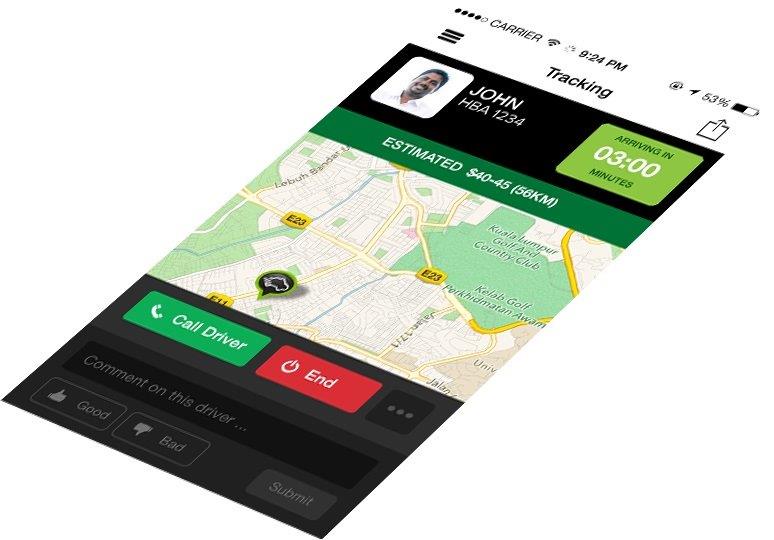
SINGAPORE (Reuters) – A unit of Singapore state investor Temasek Holdings is putting its substantial clout behind an app that eases the pain of booking taxis in Singapore and Malaysia, aiming to expand the service in other busy Southeast Asian cities.

Vertex Venture Holdings, a $1.2 billion venture capital firm that focuses on emerging companies and funds in Asia and the United States, said on Tuesday it was leading a group of mostly Malaysian investors putting an unspecified “eight-figure sum” into smartphone app company GrabTaxi.

The app, developed by two Harvard Business School graduates, was launched in Malaysia in 2012 as MyTeksi, and then expanded to Singapore a year later. It also operates in Thailand, Vietnam and the Philippines.

“We invest in potential champions which have developed new technology platforms or business models,” Vertex Venture CEO Chua Kee Lock told reporters. “We clearly see GrabTaxi as one such champion in the making.”

Booking a taxi is often an arduous task in Singapore, a city state with a population of around 5.4 million and just 28,000 cabs. Many people rely on taxis and public transport, as Singapore is one of the most expensive places in the world to own a private car, but finding a cab during peak hours, and the frequent tropical downpours, is often frustrating.

In other Southeast Asian cities like Manila and Kuala Lumpur, heavy traffic makes finding taxis equally difficult.

GrabTaxi competes in the region with an app from Hong-Kong based company Taxi Hero and Rocket Internet’s Easy Taxi app.

In Singapore, it is up against market leader Comfortdelgro Corp, which has its own booking app. GrabTaxi, however, offers commuters a choice from all the taxis that are closest to their location, regardless of which company operates them.

GrabTaxi founder and Chief Executive Anthony Tan said the app was the second most popular in Singapore after Comfortdelgro, and that it had been downloaded on to more than one million mobile devices in Southeast Asia.

He said the company was keen to expand outside Malaysia, because that is where he believed the biggest growth was happening.

“These markets have much bigger population sizes. They’re chewing up smart phones like no tomorrow,” he said. “I think jumping on this type of wave makes all the difference.”

The Vertex Venture-led investment will go into product innovation and building larger local teams to develop and market the app, Tan said. The app would rely on built-in traffic algorithms and feedback from users, he added.

Reuters News Source (Retrieved 04/08/2014) –http://news.yahoo.com/taxi-temasek-firm-backs-southeast-asia-cab-booking-102723508–sector.html

The foregoing news article, about Temasek & GrabTaxi, provides a number of other “fine models” for the Caribbean ethos:

  • Regional Taxi Administration – The Go Lean roadmap defines that taxis are the frontline of Caribbean hospitality; there is the need to compel the stakeholders to adapt innovative products & services like the mobile apps in this news article (Page 25).
  • Mobile Applications – The Go Lean roadmap defines the mastery of time-&-space as strategic for succeeding in mobile apps development and deployment for the region (Page 35).

CU Blog - Temasek 2nd PicThe book, Go Lean…Caribbean, serves as a roadmap for the introduction and implementation of the Caribbean Union Trade Federation (CU) over a 5 year period. The book stresses that the current community spirit/ethos must change. What can motivate people to change their values and priorities? Compelling external and internal drivers! The roadmap commences with the statement that the Caribbean is in crisis, and that “a crisis is a terrible thing to waste”. The region is devastated from external factors: global economic recession, globalization and rapid technology changes. The book then posits that to adapt, there must be a new internal optimization of the region’s strengths. This is defined in Verse XXVII (Page 14) of the Declaration of Interdependence:

Whereas the region has endured a spectator status during the Industrial Revolution, we cannot stand on the sidelines of this new economy, the Information Revolution. Rather, the Federation must embrace all the tenets of Internet Communications Technology (ICT) to serve as an equalizing element in competition with the rest of the world. The Federation must bridge the digital divide and promote the community ethos that research/development is valuable and must be promoted and incentivized for adoption.

In line with the foregoing article, the Go Lean book details some applicable community ethos, and provides a roadmap to better foster these qualities and their resulting benefits:

• Deferred Gratification (Page 21)

• Governing Principles – Return of Investments (Page 24)

• Help for Entrepreneurship (Page 28)

• Promotion of Intellectual Property (Page 29)

• Impacting Research & Developments (Page 30)

• Bridging the Digital Divide (Page 31)

The roadmap posits that the CU must incubate a Mobile Apps industry, forge entrepreneurial incentives and facilitate the infrastructure upgrades so that innovations can thrive. As related in the foregoing article, these efforts can help a region, in this case the Caribbean, to be a better place to live, work and play. 🙂

Download the free e-Book of Go Lean … Caribbean – now!

Share this post:
, , , , ,
[Top]

PetroCaribe press ahead with plan to eradicate hunger & poverty

Go Lean Commentary

Venezuela Oil“He who has the gold makes the rules”; this is considered the golden rule. Today, oil is considered Black Gold. This succinctly describes the status of PetroCaribe and its regional campaign.

The foregoing news article speaks of PetroCaribe and ALBA, two economic integration initiatives by Hugo Chavez (1954-2013), the late President of Venezuela. He proved to be impactful, yet polarizing. His advocacy of socialism often brought him at odds with other western democracies, especially the US. But still, Chavez and Venezuela as a whole wield great power in Latin America and the Caribbean due to their abundance of resources and oil reserves.

The publisher of the book Go Lean…Caribbean, SFE Foundation, is a Community Development Foundation, constituted with members of the Caribbean Diaspora. The book’s first chapter defines the character and objective:

The SFE Foundation is not a person; it’s an apolitical, religiously-neutral, economic-focused movement, initiated at the grass-root level to bring change back to the Caribbean homeland – no one Caribbean State is favored over another. The SFE Foundation is not affiliated with the CariCom or any of its agencies or institutions. This movement is not an attempt to re-boot the CariCom, but rather a plan to re-boot the Caribbean

The same as is said about CariCom, in the above text, can be applied to PetroCaribe and ALBA.

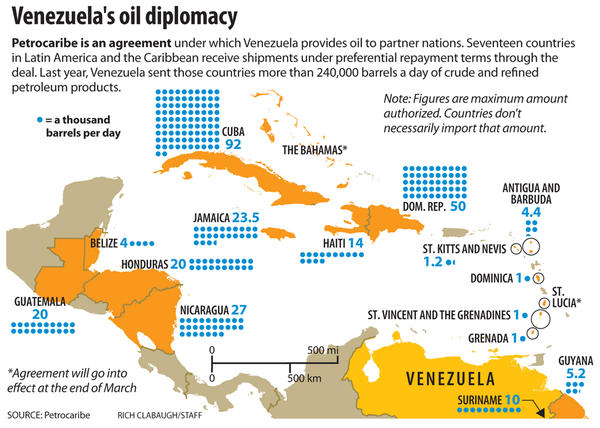
CARACAS, Venezuela — The action plan for the eradication of hunger and poverty in the economic zone of PetroCaribe is showing significant progress. In order to define the specific intervention initiatives for each country, representatives from 17 Caribbean and Central American nations met in Caracas, Venezuela on 3 and 4 April 2014.

The meeting was opened by the vice-president for social areas of Venezuela, Hector Rodriguez, who emphasized on the importance of PetroCaribe for the region, noting that “this is a proposal that seeks equality based on diversity”.

Referring to the results of the action plan for the eradication of hunger and poverty, he stated, “We have the strategic goal of making the Caribbean a hunger free region.”

On this occasion, countries presented their concrete initiatives to eradicate hunger and poverty locally. The Executive Secretariat of PetroCaribe, with technical assistance from Food and Agriculture Organization (FAO) of the United Nations, will evaluate the proposals based on the guidelines set out in the action plan, which were approved by all the countries in the region. Selected projects will receive implementation funding from PetroCaribe.

At the meeting, the president of PDV Caribe and ALBA executive secretary, Bernardo Alvarez, emphasized the efficient implementation of the action plan: “We must congratulate ourselves on the important progress we have made in implementing the action plan for the eradication of hunger and poverty.”

Alvarez highlighted the leadership of FAO director general, José Graziano da Silva, in the creation of this regional initiative to end hunger: “This would not be possible without the inspiration of the director general of FAO, who was the creator of the Zero Hunger program in Brazil during the government of President Lula.”

The FAO regional representative for Latin America and the Caribbean, Raúl Benítez, noted, “The action plan to eradicate hunger and poverty is an example for everyone. This initiative is a concrete response to the 47 million people who still suffer hunger in Latin America and the Caribbean.”

Benitez acknowledged the commitment of the countries of the region, and Venezuela in particular, in the fight against hunger: “Venezuela is not only an example of a country that managed to defeat undernourishment in its territory, but it is an example of solidarity with an entire region.”

Meanwhile, executive secretary of PetroCaribe, Asdrubal Chavez, expressed optimism about the results of the action plan. “We could even reach our goals sooner than planned,” Chavez said.

The action plan is part of the priorities of the Community of Latin American and Caribbean States (CELAC), and the Hunger-Free Latin America and the Caribbean Initiative, a commitment of 33 countries of the region to eradicate malnutrition by 2025. Its aim is to strengthen food and nutrition security of member states of the PetroCaribe and ALBA economic zone through national and regional hunger eradication projects.

The book Go Lean…Caribbean, serves as a roadmap for the introduction and implementation of the Caribbean Union Trade Federation (CU). This will serve as an integrated entity among Caribbean member-states; many of which are also members of PetroCaribe and ALBA; see Appendices below. So the advantageous characteristics of the SFE Foundation and the Caribbean Union as apolitical entities are manifested in this Go Lean effort.

According to the foregoing article, hunger and poverty are still major concerns in the Caribbean. The underlying motivation of the Go Lean book is brotherly love. Therefore who so ever, brings a solution to feed our hungry, poor brothers and sisters should be welcomed and embraced, despite their political affiliation. The roadmap is not “pro” or “con” American, but rather pro solutions; in fact the CU is described as a technocracy with a focus on delivery and merit, rather than ideologue or politics.

The Go Lean roadmap does align with many of the objectives of PetroCaribe as detailed in the foregoing article. The CU’s goal is to integrate the Caribbean member-states for permanent economic empowerment. As a result, many social benefits will flow. For example, the roadmap defines 10 [successful] Battles in the War Against Poverty (Page 222) and 10 Ways to Help the Middle Class (Page 223).

A basic economic principle is that education lifts people out of poverty. So the roadmap prioritizes education along with food, clothing, shelter, healthcare and energy as basic needs. The CU is to foster the eco-system to better deliver these basic needs of life for Caribbean people. In all, to make the Caribbean a better place to live work and play.

Download the book – Go Lean … Caribbean now!!!

———–

Appendix – PetroCaribe
PetroCaribe is an oil alliance with Venezuela which allows the purchase of oil on conditions of preferential payment. The alliance was launched on 29 June 2005 in Puerto La Cruz, Venezuela. In 2013 PetroCaribe agreed to links with the Bolivarian Alliance for the Americas (ALBA), and to go beyond oil and promote economic cooperation. It is now considered an “economic zone”.

The PetroCaribe agreement was initiated with the aim of having solidarity with other countries in accordance with ALBA. The payment system allows for purchase of oil on market value for 5%-50% up front with a grace period of one to two years; the remainder can be paid through a 17-25 year financing agreement with 1% interest if oil prices are above US$40 per barrel. The agreement builds on payment terms from the San Jose Agreement and the Caracas Energy Accord. Energy and Petroleum Minister and President of PDVSA Rafael Ramírez said of the deal that it seeks to cut out the middleman in such transactions: “We’re not talking about discounts…We’re talking about financial facilities, direct deliveries of products, [and] infrastructure.”

There are a total of 17 members, plus Venezuela; 12 of the members are from the 15 member CariCom (excluding, Barbados, Montserrat and Trinidad and Tobago). At the first summit, 14 countries joined the alliance. These were: Antigua and Barbuda, the Bahamas, Belize, Cuba, Dominica, Dominican Republic, Grenada, Guyana, Jamaica, St Lucia, St Kitts and Nevis, Saint Vincent and the Grenadines, Suriname and Venezuela. At the third summit, Haití and Nicaragua joined the union. Guatemala joined in July 2008 but left the organization in November 2013 stating that Venezuela had not provided them with the ultra-low financing rates that they had been promised.

Haiti finally joined the alliance in April 2006. Honduras became the 17th member of the alliance in December 2007, under President Manuel Zelaya. Belize set up the Belize Petroleum Energy Company to coordinate for the project.

Appendix – ALBA
The Bolivarian Alliance for the Americas (Spanish – ALBA: Alianza Bolivariana para los Pueblos de Nuestra América) is an intergovernmental organization based on the idea of the social, political and economic integration of the countries of Latin America and the Caribbean. The name “Bolivarian” refers to the ideology of Simón Bolívar, the 19th-century South American independence leader born in Caracas who wanted the continent to unite as a single “Great Nation.”

ALBA is associated with socialist and social democratic governments wishing to consolidate regional economic integration based on a vision of social welfare, bartering and mutual economic aid. ALBA nations may conduct trade using a virtual regional currency known as the SUCRE. Venezuela and Ecuador made the first bilateral trade deal using the Sucre, instead of the US dollar, on July 6, 2010.

ALBA members include Antigua & Barbuda, Bolivia, Cuba, Dominica, Ecuador, Nicaragua, Saint Vincent & the Grenadines, Venezuela, Saint Lucia, and Suriname.

Appendix – SUCRE
A regional currency to be used in commercial exchanges between members of the regional ALBA trade bloc, which was created as an alternative to the [proposed-but-never-ratified] Free Trade Agreement of the Americas (FTAA). The SUCRE is intended to replace the US dollar as a medium of exchange in order to decrease US control of Latin American economies and to increase stability of regional markets.

The acronym is in Spanish, as: Sistema Único de Compensación Regional. In English, this means: Unified System for Regional Compensation

International trade between member states in SUCRE exceeded $850 million in 2013.

Eventually, the plan is for the SUCRE to become a hard currency.

Appendix – Referenced Sources:

• “PetroCaribe Meets in Venezuela, Links with ALBA”. Retrieved 6 April 2013 from: http://venezuelanalysis.com/news/9087.

• “ALBA Summit Ratifies Regional Currency, Prepares for Trinidad”. Michael Fox, Venezuela Analysis. Retrieved 17 April 2009 from: http://venezuelanalysis.com/news/4373

• Wikipedia treatment for subject PetroCaribe. Retrieved April 7, 2014 from: http://en.wikipedia.org/wiki/Petrocaribe

• Wikipedia treatment for subject ALBA. Retrieved April 7, 2014 from: http://en.wikipedia.org/wiki/ALBA

• Wikipedia treatment for subject SUCRE. Retrieved April 7, 2014 from: http://en.wikipedia.org/wiki/SUCRE

Share this post:
, , , , , ,
[Top]

Grenada PM Urges CARICOM on ICT

Go Lean Commentary

CU Blog - Grenada PM Urges CARICOM on ICT - PhotoIt’s “Better in the Bahamas” – Tagline. But don’t bring your mobile phone!

The publisher of the book Go Lean…Caribbean, SFE Foundation, is a Think Tank/Community Development Foundation, constituted with members of the Caribbean Diaspora. They frequently travel throughout the region. The dilemma cited in the below news article, mobile roaming fees, has personal application for the SFE Foundation, (and all those who live, work and play in the Caribbean).

One director, while visiting the Bahamas, incurred mobile roaming charges in excess of $650 for doing … nothing; no phone calls, no text messages, no internet browsing. The reason was later explained by his US-based mobile carrier that the smart-phone was on! The pinging/synchronizing to the cellular towers generated those charges. So the subscriber got no benefit, but still incurred an exorbitant bill. This experience is not isolated; it has been reported time and again, especially by cruise ship passengers.

How’s that for extending hospitality to our guests and visitors?!

A mobile phone is ubiquitous in North America and Europe, the source of most Caribbean tourists. In addition, many people use their mobile devices for non-connected functions: camera, calendar, address book and even as a watch, to tell time. Imagine the shock and bad “after taste” for visiting the Caribbean and receiving a $600 phone bill for doing … nothing. See article here:

By: The Caribbean Journal Staff
Continuing his push for information and communication technology (ICT) development in the region, Grenada Prime Minister Dr. Keith Mitchell urged CARICOM heads of government to enhance the region’s ability to compete on the “global stage.”

Mitchell, addressing the CARICOM Heads of Government meeting at the Buccament Bay hotel in St Vincent, outlined a five-pronged plan for ICT development.

The Prime Minister’s five priority areas for ICT development included a single CARICOM ICT space; “bringing technology for the people,” cyber security, mobilization of resources and “developing the CARICOM digital agenda 2025.”

Mitchell holds the responsibility for ICT in CARICOM.

“Of course at the lowest denominator this must translate to job creation for a significant larger percentage of our citizens which ultimately will lead to a prosperous society with corresponding consequences of crime reduction and allow our citizens to live meaningful lives,” Mitchell said. “At the member state level, this requirement is well understood and there is sufficient evidence to support that leaders have positioned ICT as a development priority for their country.”

It’s the latest call for technological development in the region. Mitchell made headlines last year for urging the elimination of mobile roaming fees in the region, a call which was soon followed by Digicel’s announcement that it would be abolishing them.

“We observe that there exist intrinsic barriers to ICT infusion and adoption in countries referred to as Small Island Developing States (SIDS),” Mitchell said. “It would be terribly remiss if we do not amplify the ICT barriers as having equal, if not more urgency, than the environmental, economic and social vulnerabilities already identified and articulated for discussion.”
Source: Caribbean Journal – Regional Online News Source; retrieved 03/10/2014 from: http://www.caribjournal.com/2014/03/10/grenada-pm-urges-caricom-on-ict/

Regional coordination and promotion of Internet and Communications Technologies (ICT) is a critical mission and motivation of the Caribbean Union Trade Federation (CU). The book, Go Lean…Caribbean, serves as a roadmap for a methodical implementation of the CU over a 5 year time-span. The roadmap commences with a Declaration of Interdependence. In Verse XXVII (Page 14) it pronounces:

Whereas the region has endured a spectator status during the Industrial Revolution, we cannot stand on the sidelines of this new economy, the Information Revolution. Rather, the Federation must embrace all the tenets of Internet Communications Technology (ICT) to serve as an equalizing element in competition with the rest of the world. The Federation must bridge the digital divide and promote the community ethos that research/development is valuable and must be promoted and incentivized for adoption.

In line with the foregoing article, the Go Lean roadmap details many of the precepts of the Single ICT Space and the vision of the Grenada Prime Minister, the Committee Head for CARICOM Technology matters. The book features direct advocacies to:

• Help Entrepreneurship (Page 28)

• Promote Intellectual Property (Page 29)

• Bridge the Digital Divide (Page 31)

• Impact Social Media (Page 111)

• Foster Technology (Page 197)

• Foster Electronic Commerce (Page 198)

All in all, the roadmap posits that this plan can create 2.2 million new jobs.

How? When? “Go Lean…Caribbean” provides the turn-by-turn directions!

Single ICT Space

The initiative of a single ICT space for CARICOM calls the Caribbean member-states “to figure out how to leverage ICT as a platform for regional development” and that “the key recommendation of the Regional Digital Development Strategy is that we seek to transform ourselves from 15 sovereign states to a Single ICT Space.” – Grenada Prime Minister Dr. Keith Mitchell.

The Single ICT space initiative will aim to complement the flagship regional programme, the CARICOM Single Market and economy (CSME). Suggested characteristics of the Single ICT Space include: consistent rules across the Region, a single mobile numbering plan and consequent removal of roaming charges for intra-regional calls, and CARICOM Copyrights which could foster renewed entrepreneurship and innovation.

Considerable benefits are expected to be realised if a single ICT space can be established. In addition to improved economies of scale and scope, a single ICT space can lead to a more coherent approach in addressing a broad range of ICT-related issues in the region, which is urgently needed. More importantly, if done correctly, increased competitiveness and growth in the individual countries and the region as a whole could also eventuate.

At this 25th Inter-Sessional Meeting of the Conference in St. Vincent & the Grenadines, Dr. Ralph Gonsalves, Prime Minister of St. Vincent said that a Roadmap towards unveiling the Single Information Communication Technology ICT Space as the digital layer of the CARICOM Single Market and Economy (CSME) over the next two years would be developed and presented to the Heads of Government Meeting in July 2015. This roadmap would include elements such as spectrum management, bringing technology to the people and transforming them to digital citizens, diaspora re-engagement, cyber security and public-private partnerships. Developing a Single CARICOM ICT Space to enhance the environment for investment and production was identified as one of the key areas that the Community should undertake in the short-term to become competitive. As envisioned by its framers, the Single ICT Space will encompass the management of Regional information, human resources, legislation and infrastructure in the sector to elicit maximum benefit for the Region’s populace.

The Single ICT space and the Region’s Digital Agenda 2025 will be constructed on the foundation of the Regional Digital Development Strategy (RDDS) which was approved in 2013, and will also have inputs from the Commission on the Economy and the Post-2015 Agenda.

Download the book Go Lean … Caribbean now!

=================

Appendix – References:

• Caribbean Community Secretariat Press Release: http://www.caricom.org/jsp/pressreleases/press_releases_2014/pres49_14.jsp

• Wikipedia treatment for subject CariCom Single ICT space. Retrieved April 7, 2014 from: http://en.wikipedia.org/wiki/Caribbean_Community#Single_ICT_Space

Download the Book- Go Lean…Caribbean Now!!!


Share this post:
, ,
[Top]