Art Imitating Life – Was ‘Thanos’ Right?

Go Lean Commentary

The supposition is simple; if a society suffers from famine and poverty, then eliminate half of the population and there will be plenty of resources for all the remaining people.

But this is a fallacy, devoid of logic! This is not how economic systems work. The truth is: the more people, the better!

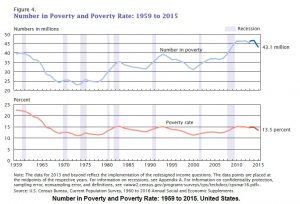
Consider the facts: the landmass of the United States has not changed since 1959; Alaska became the 49th state of the U.S. on January 3, 1959 and Hawaii received statehood on August 21, 1959. The US population in 1960 was 179,323,175; today the estimated US population is 325,719,178. Yet the 1960 poverty rate (19%) was atrocious; conditions are better today; though some poverty/hunger persists; due more to individual abuses; listen to the AUDIO-PODCAST in Appendix A below.

Why … was poverty alleviated? It’s the community education, science and technology, not the size of the population. “These ones” won the ‘War on Poverty’; see the formal details of the US Government’s War on Poverty in Appendix B.
This truly is logical!

Imagine the increased yields from “factory farms” and industrialized agriculture. The plains on the American continent are now considered the “bread basket” of the world.

Yet, believe it or not, that fallacious logic – also practiced by the Supervillain Thanos in the Marvel Cinematic Universe – is common thinking in the Caribbean.

Wait, who?

Thanos is the fictitious character in Marvel Comic books and related movies. He is a Supervillain in that he has ultimate abilities:

  • Superhuman strength, agility, durability, and longevity
  • Superhuman physiology of Eternals
  • Plasma energy projection

Thanos is all the rage right now in 2018. The current Number 1 movie at the box office is Avengers: Infinity War; this movie was the fastest film to ever reach $ 1 Billion in gross receipts. Wow!

Though the heroes of the film are the Avengers, the plotline of this movie really belongs to Thanos. The verbiage on the movie poster reveals:

The Avengers and their allies must be willing to sacrifice all in an attempt to defeat the powerful Thanos before his blitz of devastation and ruin puts an end to the universe.
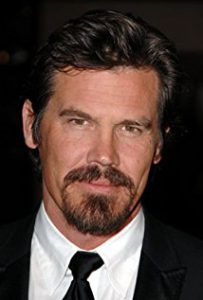
The main character Thanos is portrayed by the actor Josh Brolin. In the film, according to one summary, he seeks the six notorious Infinity Stones because he believes the Universe is overpopulated and wants to cull it by half so that those who remain may have a better quality of life.

The fallacy of Thanos’s reasoning is obvious, if a community loses half of the population – through death or abandonment – we lose the producers and consumers, so that means the nation builders, professional classes would be diminished as well.

This is not just a question for this movie, but for Caribbean life as well.

Through their words and actions (policies & procedures) the stakeholders of the Caribbean are behaving as if the countries in the region would be “better off” if there were less people; i.e. Puerto Rico is already at 50 percent of baseline numbers.

Could our society do a better job feeding (and other provisions) ourselves with only half of the population?

So the supposition in the Caribbean is that more and more people need to leave the islands so that there would finally be  just enough resources to provide for the remaining people; think fish stock. This is wrong thinking.

So sad! This commentary asserts that the answer to this supposition is: No!

A trusted source – The Bible – declares in Matthew 26:11 of the English Standard Version: “For you always have the poor with you …”. So poverty abounded in the past, now, and will most assuredly continue in the future.

The problem is not any excessive population, but rather the failure to embrace the art and science of sustenance. In fact, the quest of the movement behind the book Go Lean … Caribbean, is to urge the increase of the Caribbean population, not the decline. A better practice to balance the supply-demand  equation is to smartly grow the industrial landscape, to elevate the economic engines in the region. This will alleviate hunger; see this theme conveyed in these previous blog-commentaries:

https://goleancaribbean.com/blog/?p=13184 Industrial Reboot – Frozen Foods 101
https://goleancaribbean.com/blog/?p=10369 Science of Sustenance – Temperate Foods
https://goleancaribbean.com/blog/?p=5098 Forging Change: ‘Food’ for Thought
https://goleancaribbean.com/blog/?p=2276 Managing Climate Change Effect on the Food Supply

Though the US performs far better with hunger abatement among its population now than it did when the population was half, some degree of poverty and hunger still exists. The solution cannot be the numbers; it is the methods, the systems of sustenance. This is the theme in the reference article in Appendix B.

Yet still, so many in the Caribbean reflect the theme of Thanos. It seems that they would rather lose half of their population – with policies that encourage abandonment – than try to adopt the best practices for food acquisition and distribution. This commentary have consistently detailed the “push and pull” factors that lead to the human flight in this region. Consider this sample of previous blog-commentaries:

https://goleancaribbean.com/blog/?p=12879 Disaster Vulnerability: ‘Rinse and Repeat’
https://goleancaribbean.com/blog/?p=11048 Allowing the ‘Strong to Abuse the Weak’ – Lesson from Hammurabi
https://goleancaribbean.com/blog/?p=10367 The Lack of Systems to Sustain Caribbean Living
https://goleancaribbean.com/blog/?p=10220 Bad Habit of Rent-seeking
https://goleancaribbean.com/blog/?p=10216 Caribbean Orthodoxy Pushing Good People Away
https://goleancaribbean.com/blog/?p=8155 Gender Inequities lead to Brain Drain
https://goleancaribbean.com/blog/?p=5784 Blatant Human Rights Violations
https://goleancaribbean.com/blog/?p=915 Excessive Energy Costs – The Need To Go ‘Green

Though there may be no malicious intent, the absence of malice does not excuse the societal incompetence!

We must do better in our Caribbean homeland.

The political leaders in the Caribbean would rather have their Diaspora “dead to them” rather than invite their participation in the outworking of the Caribbean member-states. In proof, they do not allow their Diaspora to vote or participate in the democratic process.

While Thanos is not real … his persona is a work of art! His model can help us. So this is art imitating life.

The edict of “life imitating art and art imitating life” provides a lot of teaching moments for the world in general and the Caribbean in particular. There is a lot of influence to be gathered from the Avengers: Infinity War movie; this movie is successful and fulfilling. See here for the effect on the box office in the related VIDEO here:

VIDEO – Weekend Box Office May 11 – 13, 2018 – https://www.imdb.com/list/ls025720609/videoplayer/vi3098786585

There are so many points of consideration from this movie. This demonstrates the power of this art form. In a previous blog/commentary regarding Caribbean Diaspora member and Hollywood great, Sidney Poitier, it was declared that …

“Movies are an amazing business model. People give money to spend a couple of hours watching someone else’s creation and then leave the theater with nothing to show for the investment; except perhaps a different perspective”.

The quest of the Go Lean roadmap is to elevate the societal engines so that Caribbean people can prosper where planted here in the Caribbean. The fact that people are abandoning their Caribbean homeland is proof-positive that little prospering happens here – one report list 70 percent of the professional classes are gone.

Another lesson we glean from the fiction of Thanos, is that we need heroes. There is the need to impact our Caribbean society with new empowerments. We do not need a brand of Super Heroes, just people in the homeland, who would work together, like the Avengers. This level of commitment will help us to accomplish our goals.

The Go Lean movement seeks to engage Caribbean heroes; the book serves as a roadmap to introduce the technocratic Caribbean Union Trade Federation (CU) to elevate the region’s societal engines – economics, homeland security and governance – of the 30 Caribbean member-states. In fact, the prime directives of the roadmap includes the following 3 statements:

  • Optimize the economic engines in order to grow the regional economy to $800 Billion & create 2.2 million new jobs.
  • Establish a security apparatus to ensure public safety and protect the resultant economic.
  • Improve Caribbean governance to support these engines, including a separation-of-powers between the member-states and CU federal agencies.

The Go Lean book makes the point of the need for heroics early in a Declaration of Interdependence (Page 12) that claims:

x. Whereas we are surrounded and allied to nations of larger proportions in land mass, populations, and treasuries, elements in their societies may have ill-intent in their pursuits, at the expense of the safety and security of our citizens. We must therefore appoint “new guards” to ensure our public safety and threats against our society, both domestic and foreign. The Federation must employ the latest advances and best practices … to assuage continuous threats against public safety.

xi. Whereas all men are entitled to the benefits of good governance in a free society, “new guards” must be enacted to dissuade the emergence of incompetence, corruption, nepotism and cronyism at the peril of the people’s best interest. The Federation must guarantee the executions of a social contract between government and the governed.

xii. Whereas the legacy in recent times in individual states may be that of ineffectual governance with no redress to higher authority, the accedence of this Federation will ensure accountability and escalation of the human and civil rights of the people for good governance, justice assurances, due process and the rule of law. As such, any threats of a “failed state” status for any member state must enact emergency measures on behalf of the Federation to protect the human, civil and property rights of the citizens … of the affected member state and the Federation as a whole.

xvi. Whereas security of our homeland is inextricably linked to prosperity of the homeland, the economic and security interest of the region needs to be aligned under the same governance. Since economic crimes, including piracy and other forms of terrorism, can imperil the functioning of the wheels of commerce for all the citizenry, the accedence of this Federation must equip the security apparatus with the tools and techniques for predictive and proactive interdictions.

Let’s defeat the “Thanos” in our communities. (They are out there!)

Having fewer mouths to feed is not the strategy for the Caribbean success. In fact, having fewer mouths to feed is actually bad for the economy. People do more than just eat; they also work, build up their communities and help with nation-building. A lot of economic activity can be created just by living and being; this is true with all aspects of food provisioning; think agriculture and fisheries. Imagine a family garden, what is the practice with excess vegetables? Sell, trade, barter or gift them, right?! All these activities would be beneficial for society.

The Go Lean book provides 370 pages of details on the economic principles and community ethos to adopt, plus the executions of strategies, tactics, implementations and advocacies to better secure the Caribbean homeland. Just “how” can the Caribbean reboot, reform and transform their societal engines to help alleviate poverty. This is the actual title of one advocacy in the Go Lean book. Consider the specific plans, excerpts and headlines here from Page 222, entitled:

10 Battles in the War on Poverty

1 Lean-in for the Caribbean Single Market and Economy
This regional re-boot will allow for the unification of the region into one market, thereby creating a single economy of 30 member-states, 42 million people and a GDP of over $800 Billion. Following the model of the European Union, the CU will seek to streamline economic engines so as to increase jobs, standards of living and opportunities – increasing GDP. The CU will work to make the Caribbean a better place to live, work and play for all socio-economic classes.
2 Minimize Political Bureaucracy
3 Welfare versus “Work-fare”
Many economists have argued that the US “War Against Poverty” – Welfare first – policies, actually had a negative impact on the economy because of their interventionist nature. This school of thought is that the best way to fight poverty is not through government spending but through economic growth, thus “Work-fare” is a better solution. In 1996 the US implemented a Welfare-to-Work program that had almost immediate results – welfare and poverty rates both declined during the late-1990s, leading many commentators to declare that the legislation was a success. The CU takes a similar stance: lead with jobs!
4 Entrepreneurial Values
Job creators would be valued, promoted and heralded under the CU economic schemes. Venture Capitalists, small business loans and access to capital markets are measures designed to spur growth and attitudes in entrepreneurship.
5 Repatriation of Time, Talent and Treasuries
The CU will incentivize the Diaspora to repatriate to the Caribbean region, and protect them from victimization upon return. Where a physical return is not possible, other avenues of support will be promoted for an economic leap from this remote population: vacation homes, labor certification priority, and ease of funds transfer.
6 Family Planning
Third World countries usually have higher birth rates than Developed countries. While not discouraging individual rights, the CU will facilitate better education, women’s health resources and access to prenatal healthcare.
7 Education Goals in Balance
Education is considered a panacea to raise standard of living, but tertiary education in the CU region has resulted in a higher emigration pattern than should be tolerated. The CU will facilitate e-Learning solutions to retain the talent.
8 Proactive about Healthcare Realities
9 Aging Population

The CU will facilitate for the Caribbean Region to be the world’s best address for senior citizens. This will send the invitation to retirees (Caribbean Diaspora and foreign) to welcome their participation and contributions to CU society. The increase in the pool of participants and beneficiaries will extend added benefits to domestic seniors.

10 Raise Retirement Age

Abandoning wrong thinking about poverty in society and engaging a more positive approach may be considered heroic.

The Caribbean needs heroes, to make this difference. The Go Lean book describes the need for the Caribbean to appoint “new guards” to effect the necessary empowerments in the Caribbean. We need the “new guards” or a regional security pact to engage to better protect our homeland from threats and risks, foreign and domestic. So the purpose of the published strategies, tactics and implementations of this security pact is to ensure public safety as a comprehensive endeavor, encapsulating the needs of all Caribbean stakeholders: residents and institutions alike.

The edict of “life imitating art and art imitating life” can be applied in our everyday Caribbean life. Let’s lean-in for our own heroic cause. Yes, we can … collectively if not individually, be heroes and defeat the “Thanos” villainy in our midst. Let’s start by leaning-in for the empowerments described here in the book Go Lean…Caribbean.

Let’s do it! This plan, to make the Caribbean a better place to live, work and play is conceivable, believable and achievable. 🙂

Download the free e-book of Go Lean … Caribbean – now!

Sign the petition to lean-in for the roadmap for the Caribbean Union Trade Federation.

————

Appendix A AUDIO-PODCASTCity Limits: Why Reducing Poverty is Such an Elusive Goal – https://cpa.ds.npr.org/waer/audio/2018/01/city_limits-_what_is_poverty.mp3

Real Estate Investment

Posted December 13, 2017 – The statistics regarding the poverty rate in [the American city of] Syracuse are staggering. But what is poverty? And what can be done about it? [Public Radio station] WAER’s Chris Bolt talks with some of those living in poverty, to tackle these questions.

————

Appendix B – War on Poverty

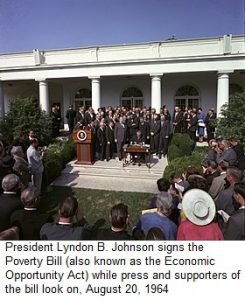
The War on Poverty is the unofficial name for legislation first introduced by United States President Lyndon B. Johnson during his State of the Union address on Wednesday, January 8, 1964. This legislation was proposed by Johnson in response to a national poverty rate of around nineteen percent. The speech led the United States Congress to pass the Economic Opportunity Act, which established the Office of Economic Opportunity (OEO) to administer the local application of federal funds targeted against poverty.

As a part of the Great Society, Johnson believed in expanding the federal government’s roles in education and health care as poverty reduction strategies.[1]
… 

The legacy of the War on Poverty policy initiative remains in the continued existence of such federal programs as Head StartVolunteers in Service to America (VISTA), TRiO, and Job Corps.

The popularity of a war on poverty waned after the 1960s. Deregulation, growing criticism of the welfare state, and an ideological shift to reducing federal aid to impoverished people in the 1980s and 1990s culminated in the Personal Responsibility and Work Opportunity Act of 1996, which President Bill Clinton claimed, “ended welfare as we know it.”

Major Initiatives

Source: Retrieved May 15, 2018 from: https://en.wikipedia.org/wiki/War_on_Poverty

 

Share this post:
, ,

Counter-culture: Pushing for Change

Go Lean Commentary

The Change Agent cometh; … they always come.

The only constant is change itself.

A primary motivation of the movement behind the book Go Lean…Caribbean is to better cope with societal change. The book asserted that the region had been “steamrolled” by dynamic Agents of Change; these 4 agents are full explored in the book (Page 57) with this introduction:

Shakespeare described change as “an undiscovered country”. No one knows exactly what will happen next and when. The best practice is to monitor the developments in the marketplace, adapt and adjust as soon as possible. This description of a nimble response is the purpose behind “Agile” project management and other Lean management methodologies. … Assuming a role to “understand the market and plan the business” requires looking at the business landscape today and planning the strategic, tactical, and operational changes to keep pace with the market and ahead of competitors. Strategic changes that must be accounted for now, includes:

  • Technology
  • Globalization
  • Climate Change
  • Aging Diaspora

This commentary – entry 4 of 4 – is the final submission in this series on the counter-culture of the 1960’s/1970’s. This series from the Go Lean movement considers the experiences of how people deviated from the mainstream society to forge change in their communities. The people – think: Hippies – were scorned and ridiculed, but they persisted … and eventually manifested change on … everything and everybody. The other commentaries in the series are cataloged as follows:

  1. Counter-culture: Embracing the Change – Battling against Orthodoxy
  2. Counter-culture: Manifesting Change – Environmentalism & ‘Climate Change’ abatement
  3. Counter-culture: Monetizing the Change – Education, Workplace, Healthcare & Retirement Mandates
  4. Counter-culture: Pushing for Change – Is Ganja here to stay?

Today, it is clear that mainstream society has been assimilated by the counter-culture revolution with previously debated New Morals. Some people even claim that this New Morality is the same Old Immorality. For instance, consider recreational drugs, marijuana in particular; counter-culturists have always “pushed” for the freedom of marijuana use; see the VIDEO in the Appendix below. Despite all the efforts to outlaw it, authority figures are now starting to just accept, tolerate and legitimize its usage. This last commentary in this series asked the pointed question:

Is Ganja here to stay?

(We use the Caribbean branding here for marijuana; known by many different names: weed, cannabis, pot or reefer).

Is this change here to stay? Is this just another victory from the counter-culturists from the 1960’s/1970’s? They are still pushing! Though it may not be the same people, it is still the same counter-revolutionary attitudes.

As related in the previous submissions – in this series – the champions of the counter-culture were able to claim some measure of victory in their efforts. Therefore, all of these commentaries have conveyed “how” the stewards for a new Caribbean can shepherd our society for smoother change management.

The marijuana reality is pressing down on us. Notice the imminence as conveyed in this news article here from St. Lucia:

Title # 1: Mondesir says ganja unstoppable, here to stay

Former Health Minister, Doctor Keith Mondesir, asserting that ganja is here to stay and is unstoppable, has come out in support of its legalisation.

“The entire first world, Europe , the USA, have tried hard to stop it. They have given up now realising this is here to stay. So  we as a people in the Caribbean, we have to determine what policies  do we have right now and what policies should we adopt,” Mondesir declared.

“Are we going to have open policy like Holland? Are we going to have it restricted like the US in certain places? But we know that the world is now accepting the smoking of marijuana,” the former minister observed.

He pointed to the example of Canada which is heading towards legalisation,  noting that farmers there are preparing to cash in on the herb.

“If anyone planting marijuana here has any intention of making money, they are missing the boat,” Mondesir remarked.

Just last week National Security Minister and former Deputy Police Commissioner, Hermangild Francis, expressed support for ‘relaxing’ current ganja laws in Saint Lucia.

But the Cannabis Movement, which has been in the forefront of the push to decriminalise or legalise marijuana ‘outright’, has accused the authorities  here of being split and possibly ‘two-faced’ on the issue.
Source: Retrieved May 12, 2018 from: https://stluciatimes.com/2018/04/23/mondesir-says-ganja-unstoppable-here-to-stay/

Were you alive in the 1960’s or 1970’s?

Can you believe now that we are talking about how we can co-exist with legal marijuana use in our communities?

Such talk would have been considered crazy, just a few years or a decade ago.

But crazy is as crazy does; consider these quotes from Advertising Executive Rob Siltanen:

  1. “The people who are crazy enough to think they can change the world are the ones who do.”
  2. “Here’s to the crazy ones. The misfits. The rebels. The troublemakers. The round pegs in the square holes. The ones who see things differently. They’re not fond of rules. And they have no respect for the status quo. You can quote them, disagree with them, glorify or vilify them. About the only thing you can’t do is ignore them. Because they change things. They push the human race forward. And while some may see them as the crazy ones, we see genius. Because the people who are crazy enough to think they can change the world, are the ones who do.”

The stewards for a new Caribbean regional administration – the movement behind the Go Lean book, a roadmap for the introduction and implementation of the technocratic Caribbean Union Trade Federation (CU) – are not crazy. We know the dangers, risks and threats of drugs in society, and yet accept that this counter-cultural change may also be inevitable. So rather that dreading or running from the eventuality of marijuana decriminalization, we seek to prepare for it, but on a regional, super-national level. Amazingly, this strategy also aligns with a former government Cabinet member in St. Lucia; “he” made this siren call:

Title # 2: ‘Musa’ wants united Caribbean approach to ganja decriminalisation

Former Agriculture Minister, Moses ‘Musa’ Jn Baptiste, has expressed the view that the Caribbean should approach the issue of decriminalising marijuana in a united way.

‘It is something that we have spoken about even when we were in government. I was minister of agriculture and that question came up many times,’ Jn Baptiste recalled.

‘We were always of the view that the Caribbean should approach this in a united way because if you have decriminalisation in various countries and not in others, especially in an OECS economic union, you can envisage the challenges,’ the former minister told reporters Thursday.

He asserted that the decriminalisation process and the decriminalisation movement in the region are moving in a ‘particular direction.’

‘I am sure that all governments in the sub-region will quickly realise that instead of everybody doing it on their own, that we  should move on this,’ Jn Baptiste declared.

He expressed the hope that there would be widespread consultation.

‘The whole society has to sit down and talk about this – but certainly, this is moving in a particular direction and we see what is happening in the United States, we see what is happening in certain states in the United States and  we just noticed what has happened in Antigua and definitely I am sure all governments and people in the region, especially the OECS economic union, will be taking this seriously,’ Jn Baptiste stated.
Source: Retrieved May 12, 2018 from: https://stluciatimes.com/2018/04/06/musa-wants-united-caribbean-approach-to-ganja-decriminalisation/

Imagine a regional Caribbean coordination for the drama of marijuana decriminalization. “Yes, we can”!

The Go Lean book provides 370-pages of turn-by-turn instructions on “how” to adopt a regional community ethos, plus the strategies, tactics, implementations and advocacies to execute so as to transform the societal engines of Caribbean society (economics, security and governance), regarding the whole drug eco-system. As related in a previous blog-commentary:

… the Go Lean book asserts that every community has bad actors, and with a more liberal-progressive attitude towards a once-illegal drug, community attitudes must be paramount. There must be “new guards” to assuage any threats from this practice on society. This point is pronounced early in the book with the Declaration of Interdependence (Pages 12 – 13) that claims:

x. Whereas we are surrounded and allied to nations of larger proportions in land mass, populations, and treasuries, elements in their societies may have ill-intent in their pursuits, at the expense of the safety and security of our citizens. We must therefore appoint new guards to ensure our public safety and threats against our society, both domestic and foreign. The Federation must employ the latest advances and best practices of criminology and penology to assuage continuous threats against public safety. The Federation must allow for facilitations of detention for [domestic and foreign] convicted felons of federal crimes, and should over-build prisons to house trustees from other jurisdictions.

xi. Whereas all men are entitled to the benefits of good governance in a free society, “new guards” must be enacted to dissuade the emergence of incompetence, corruption, nepotism and cronyism at the peril of the people’s best interest. The Federation must guarantee the executions of a social contract between government and the governed.

xvi. Whereas security of our homeland is inextricably linked to prosperity of the homeland, the economic and security interest of the region needs to be aligned under the same governance. Since economic crimes, including piracy and other forms of terrorism, can imperil the functioning of the wheels of commerce for all the citizenry, the accedence of this Federation must equip the security apparatus with the tools and techniques for predictive and proactive interdictions.

So legalizing marijuana … will be about more than just managing change, it will also be about managing risks. The Go Lean book relates that managing risk is more than just “One Act”, there is lengthy, engaged process (Page 76):

  • Education
  • Mentoring
  • Monitoring
  • Mitigation
  • Licensing
  • Coordination

For this delicate matter of marijuana decriminalization, issues abound, in all facets of society. There are economic, security and governing complexities that must be considered. In  fact, these issues were addressed in many previous Go Lean blog-commentaries. Consider this list here:

https://goleancaribbean.com/blog/?p=13882 Managing Legal Marijuana ‘Change’ in California
https://goleancaribbean.com/blog/?p=12703 Rocky Mountain High – Marijuana management in Colorado
https://goleancaribbean.com/blog/?p=9646 ‘Time to Go’ – American Vices, i.e. Marijuana. Don’t Follow!
https://goleancaribbean.com/blog/?p=1386 Marijuana in Jamaica – Puff Peace

The Go Lean book and roadmap stresses that preparing the Caribbean region for change is possible, but heavy-lifting. All the societal engines will have to be reformed and transformed. Yet still, this is conceivable, believable and achievable.

As related in the foregoing news articles, the First World or Advanced Democracies are advancing – pushing – towards legal or decriminalized marijuana use.

Ready or not, here they come!

    … vacationing  tourists …
    … cruise passengers.
    … students studying abroad.
    … repatriated citizens.
    … Ouch!

These descriptions – First World or Advanced Democracies – apply to the US, Canada and many Western European nations (think: England, The Netherlands, France, Germany, etc.), our tourism target markets. These descriptors do not apply to any Caribbean member-states. All 30 countries and territories (islands or coastal states) are flirting with Failed-State status. Adding recreational drug use into the Caribbean mix may only be a recipe for disaster. And yet, the change “cometh” anyway.

Let’s get ready! Let’s confederate, cooperate and collaborate to install the empowerments to allow us to better manage Caribbean affairs. We urge all Caribbean stakeholders to lean-in to this Go Lean roadmap. It is a viable plan to make our  homeland a better place to live, work and play. 🙂

Download the free e-Book of Go Lean … Caribbean – now!

Sign the petition to lean-in for this roadmap for the Caribbean Union Trade Federation.

———-

Appendix VIDEO – Rick James – Mary Jane – https://youtu.be/PrPNwLuk0zQ

Published on Oct 16, 2015

Rick James – Mary Jane (Video)


Share this post:
, ,
[Top]

Counter-culture: Monetizing the Change

Go Lean Commentary

“Put your money where your mouth is” – Popular Challenge

It is appropriate to look back 50 years at the height of the counter-culture – Hippie movement – and ask the question:

Were the counter-culturists willing to pay for the change they were demanding?

As asserted in the last submission of this series of commentaries on the counter-culture of the 1960’s/1970’s, the counter-culturists didn’t just go away, they won! They had some relative victory and transformed the mainstream values of society.

A counter-culture typically involves criticism or rejection of the status quo powerful institutions, with accompanying hope for a better life or a new society. There was a subsequent shift in the Social Contract deliveries after this counter revolution.

But how did the advocates pay for the change?

In the height of the 1960’s counter-culture movement, this question was asked – by the Number 1 English-speaking band, The Beatles – and the answers didn’t emerge for years, decades and generations.

The question was in the form of a song – You say you want a Revolution – see here (and the lyrics in Appendix A below):

VIDEO – The Beatles: Revolution (1968) – https://youtu.be/BGLGzRXY5Bw

The Beatles

Published on Oct 20, 2015 – The Beatles 1 Video Collection is Out Now. Get your copy here: http://thebeatles1.lnk.to/DeluxeBluRay

“When you talk about destruction, don’t you know that you can count me out”

“I did the slow version and I wanted it out as a single: as a statement of The Beatles’ position on Vietnam and The Beatles’ position on revolution. For years, on The Beatles’ tours, Brian Epstein had stopped us from saying anything about Vietnam or the war.” – John Lennon.

“Plugging directly into the Abbey Road desk and pushing the needles into the red achieved the fuzz-guitar sound. According to George Martin “We got into distortion on that, which we had a lot of complaints from the technical people about. But that was the idea: it was John’s song and the idea was to push it right to the limit. Well, we went to the limit and beyond.”

“Revolution” was directed by Michael Lindsay-Hogg, and filmed on the 4th September 1968 at Twickenham Film Studios. “Don’t you know it’s gonna be all right”

Music video by The Beatles performing Revolution. (C) 2015 Calderstone Productions Limited (a division of Universal Music Group) / Apple Films Ltd.

Only now, 50 years later, are we able to look (back), listen and learn the lessons from those times. (This exercise is part-and-parcel of the popular 5 L’s methodology: Look, Listen, Learn, Lend-a-hand and Lead). Monetizing the change is easier said than done!

The Beatles stated:

“But if you want money for people with minds that hate … All I can tell is brother you have to wait”

What did the counter-culture movement do so as to monetize the change that they were protesting for? As these groups assimilated their victories into mainstream society, they forced changes to the financial-economic systems as well. For example, one innovation that emerged in the US was moving away from institutional pensions to a new scheme of Individual Retirement Accounts or the 401(k). See more here on the US program, though this term 401K has been used in many other countries as a generic term for Individual Retirement Accounts:

Reference Title: 401(k)
In the United States, a 401(k) plan is the tax-qualified, defined-contribution pension account defined in subsection 401(k) of the Internal Revenue Code.[1] Under the plan, retirement savings contributions are provided (and sometimes proportionately matched) by an employer, deducted from the employee’s paycheck before taxation (therefore tax-deferred until withdrawn after retirement or as otherwise permitted by applicable law), and limited to a maximum pre-tax annual contribution of $18,500 (as of 2018).[2][3]
Other employer-provided defined-contribution plans include 403(b) plans for nonprofit institutions, 457(b) plans for governmental employers, and 401(a) plans. These plans may provide total annual addition of $55,000 (as of 2018) per plan participant, including both employee and employer contributions.

History
In the early 1970s a group of high earning individuals from Kodak approached Congress to allow a part of their salary to be invested in the stock market and thus be exempt from income taxes.[4] This resulted in section 401(k) being inserted in the then taxation regulations that allowed this to be done. The section of the Internal Revenue Code that made such 401(k) plans possible was enacted into law in 1978.[5] It was intended to allow taxpayers a break on taxes on deferred income. In 1980, a benefits consultant and attorney named Ted Benna took note of the previously obscure provision and figured out that it could be used to create a simple, tax-advantaged way to save for retirement. The client for whom he was working at the time chose not to create a 401(k) plan.[6] He later went on to install the first 401(k) plan at his own employer, the Johnson Companies[7] (today doing business as Johnson Kendall & Johnson).[8] At the time, employees could contribute 25% of their salary, up to $30,000 per year, to their employer’s 401(k) plan.[9]

Taxation
Income taxes on pre-tax contributions and investment earnings in the form of interest and dividends are tax deferred. The ability to defer income taxes to a period where one’s tax rates may be lower is a potential benefit of the 401(k) plan. The ability to defer income taxes has no benefit when the participant is subject to the same tax rates in retirement as when the original contributions were made or interest and dividends earned. Earnings from investments in a 401(k) account in the form of capital gains are not subject to capital gains taxes. This ability to avoid this second level of tax is a primary benefit of the 401(k) plan. Relative to investing outside of 401(k) plans, more income tax is paid but less taxes are paid overall with the 401(k) due to the ability to avoid taxes on capital gains.

For pre-tax contributions, the employee does not pay federal income tax on the amount of current income he or she defers to a 401(k) account, but does still pay the total 7.65% payroll taxes (social security and medicare).

Source: Retrieved May 10, 2018 from: https://en.wikipedia.org/wiki/401(k)

This commentary continues the series on the counter-culture of the 1960’s/1970’s. This series from the movement behind the book Go Lean … Caribbean considers the experiences of how people deviated from the mainstream society to forge change in their communities. The other commentaries in the series are cataloged as follows:

  1. Counter-culture: Embracing the Change – Battling against Orthodoxy
  2. Counter-culture: Manifesting Change – Environmentalism & ‘Climate Change’ abatement
  3. Counter-culture: Monetizing the Change – Education, Healthcare & Retirement Mandates
  4. Counter-culture: Pushing for Change – Is Ganja here to stay?

All of these commentaries convey “how” the stewards for a new Caribbean can forge a change culture when established institutions are dysfunctional and defective; the status quo must be protested. This entry – 3 of 4 – considers the financial and economic changes that emerged as a result of the 1960’s counter-culture movement; subsequently a more independent spirit emerged for planning retirement, education and healthcare. Today there are solutions that deviated from the previous broken institutional offering.

The affected countries – United States, Canada and Western Europe – are in better financial dispositions now than they were in the 1960’s. There are lessons for us to learn and apply here in the Caribbean.

The book Go Lean…Caribbean – available to download for free – serves as a roadmap for the introduction and implementation of the technocratic Caribbean Union Trade Federation (CU), for the elevation of Caribbean society – for all member-states. This CU/Go Lean roadmap has these 3 prime directives:

  • Optimization of the economic engines in order to grow the regional economy to $800 Billion and create 2.2 million new jobs. The deficient delivery of Caribbean Jobs is a sore subject regionally; this is responsible for so much abandonment.
  • Establishment of a security apparatus to ensure public safety and protect the resultant economic engines.
  • Improve Caribbean governance to support these engines, including a separation-of-powers between the member-states and CU federal agencies.

As the foregoing details, 401(k) Individual Retirement Accounts (IRA) brought a revolutionary shift in American society for Middle Class economic values. No longer where citizens dependent on broken institutions to deliver their financial solutions late in life. This spirit was also manifested in other areas of American financial life:

  • Education / College Planning – A 529 plan is a tax-advantaged savings plan designed to encourage saving for future college costs. 529 plans, legally known as “qualified tuition plans,” are sponsored by states, state agencies, or educational institutions and are authorized by Section 529 of the Internal Revenue Code – Source: SEC.gov.
  • Health Savings Accounts – HSA‘s are tax-advantaged medical savings accounts available to taxpayers in the United States who are enrolled in a high-deductible health plan (HDHP).[1][2] The funds contributed to an account are not subject to federal income tax at the time of deposit. HSA funds may currently be used to pay for qualified medical expenses at any time without federal tax liability or penalty. Beginning in early 2011 over-the-counter medications cannot be paid with an HSA without a doctor’s prescription.[3] Withdrawals for non-medical expenses are treated very similarly to those in an individual retirement account (IRA) in that they may provide tax advantages if taken after retirement age, and they incur penalties if taken earlier. The accounts are a component of consumer-driven health care. Source: Wikipedia.

All of these financial-economic empowerments enhanced the Middle Class eco-system for young men … and women. The counter-culture brought a lot of opportunities for women … finally. Women in the workplace! It was real thing!

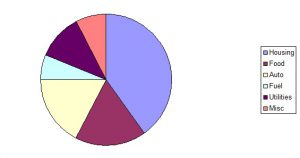
So society changed upwards … for the better by ushering in dual income households (DINC = Double Income No Children). Imagine all the additional capital added to the securities markets (Wall Street) because the Middle Class was now participating in deferred savings and investments schemes. Consider the Economic Study in Appendix B.

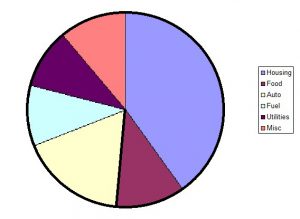
Household Budget Before the 1960’s Revolution.

Household Budget After the 1960’s Revolution; a Bigger Pie.

Society also changed downward … because less and less women were fulltime homemakers. Family harmony suffered!

Lessons abound by studying the pro’s and con’s of the after-effect of the counter-culture on Middle Class American life.

The Go Lean book stresses that quest to reform and transform Caribbean societal engines can benefit by looking, listening, learning about the American Middle Class experience; then the goal would be to lend-a-hand and lead with a regional focus. This was an early motivation for the roadmap, as pronounced in the opening Declaration of Interdependence (Pages 12 – 13):

xi. Whereas all men are entitled to the benefits of good governance in a free society, “new guards” must be enacted to dissuade the emergence of incompetence, corruption, nepotism and cronyism at the peril of the people’s best interest. The Federation must guarantee the executions of a social contract between government and the governed.

xxiv. Whereas a free market economy can be induced and spurred for continuous progress, the Federation must install the controls to better manage aspects of the economy: jobs, inflation, savings rate, investments and other economic principles. Thereby attracting direct foreign investment because of the stability and vibrancy of our economy.

The Go Lean book provides 370-pages of turn-by-turn instructions on “how” to adopt new community ethos, plus the strategies, tactics, implementations and advocacies to execute so as to reboot, reform and transform the societal engines of Caribbean society. Just “how” can the Caribbean region pay for our revolution, the empowerments to elevate our regional society. This is the actual title of one advocacy in the Go Lean book. Consider the specific plans, excerpts and headlines here from Page 101, entitled: “10 Ways to Pay for Change“. Consider the specific plans, excerpts and headlines here:

10 Ways to Pay for Change

1 Lean-in for the Caribbean Single Market
The [CU] treaty allows for the unification of the region into one market, expanding to an economy of 30 member-states of 42 million people, to impact a GDP of over $800 Billion. In order for the CU to reboot the economic engines of the region, the political entity of the unified Caribbean must be rebooted first. That entity is the CariCom. In a commissioned 159-page study, the Turning Around CariCom report published one recommendation after another, all with the same pre-amble: “the budget must be substantially increased”. The analysis of that report is a chicken-and-egg conundrum, the CariCom construct can effectively increase the economics of the region, IF the region increases the funding of the CariCom. The CU Trade Federation implodes that quandary, as the CU will generate its own initial funding, as listed here, below.
2 Spectrum Auctions
The CU will function as a government-owned multinational corporation to deliver services for an integrated Caribbean administration. Having the regional authority, the CU will hold auctions for the radio spectrum in the region. This will generate the CU’s own initial revenue stream, as only rights are being awarded; there is no performance – no fabrication of products or rendering of services. With this strategy, there will be revenues to return back to CU share-holders, member-states, even in the 1st year. (See Appendix IBPage 279 – for samples/examples).
3 SGE Licenses
4 GPO Logistic Fees
An important CU mission is the Group Purchasing Organization (GPO), an extension of the current Office of Trade Negotiations; but the CU will make purchases and fulfill delivery to member-states, for a handling fee.
5 Regional Lottery
6 EEZ Exploration Rights
7 Homeland Security – Private Protection Licensing
8 Homeland Security – Hurricane Insurance Fund
9 Warrants
Paying for Change first optimizes the payment terms. All CU payments to member-states will be in the form of warrants attached to bonds; this allows the CU to pay lower interest rates. These warrants make the bonds sellable to the public.
10 Foreign Aid & Grants including Non-Government Organizations (NGOs)

There have been a number of blog-commentaries by the Go Lean movement that highlighted the regional economic revolution; this is part-and-parcel to rebooting the Caribbean eco-system. See a sample list of those previous blogs-commentaries here:

https://goleancaribbean.com/blog/?p=13744 Caribbean Economics: The Quest for a ‘Single Currency’
https://goleancaribbean.com/blog/?p=13677 Economics of a Beach City: ‘South Beach’
https://goleancaribbean.com/blog/?p=10585 Two Pies: Economic Plan for a New Caribbean
https://goleancaribbean.com/blog/?p=6269 Education & Economics – Michigan Model
https://goleancaribbean.com/blog/?p=599 Ailing Puerto Rico open to radical economic fixes
https://goleancaribbean.com/blog/?p=242 The Erosion of the Middle Class

In summary, it is only logical that the stewards for a new Caribbean consider the practicalities of how to pay for or monetize “their revolution”. If we want to be serious about effecting change in our society – we do – then we must have a formidable strategic, tactical and operational plan. This is the modus operandi of the Go Lean roadmap: a plan that is conceivable, believable and achievable for making the Caribbean homeland a better place to live, work and play.

We urge all Caribbean stakeholders to lean-in to this roadmap. 🙂

Download the free e-Book of Go Lean … Caribbean – now!

Sign the petition to lean-in for this roadmap for the Caribbean Union Trade Federation.

————

Appendix A – Song Lyrics: Revolution (1968) by The Beatles

You say you want a revolution
Well, you know
We all want to change the world
You tell me that it’s evolution
Well, you know
We all want to change the world

But when you talk about destruction
Don’t you know that you can count me out
Don’t you know it’s gonna be
All right, all right, all right

You say you got a real solution
Well, you know
We’d all love to see the plan
You ask me for a contribution
Well, you know
We’re doing what we can

But if you want money for people with minds that hate
All I can tell is brother you have to wait
Don’t you know it’s gonna be
All right, all right, all right

You say you’ll change the constitution
Well, you know
We all want to change your head
You tell me it’s the institution
Well, you know
You better free you mind instead

But if you go carrying pictures of chairman Mao
You ain’t going to make it with anyone anyhow
Don’t you know it’s gonna be
All right, all right, all right
All right, all right

Songwriters: John Lennon / Paul Mccartney

Source: Retrieved May 10, 2018 from: http://www.lyricsfreak.com/b/beatles/revolution+1_10026331.html

————

Appendix B – The Effects of Pension Funds on Markets Performance: A Review

Abstract – The worldwide reforming process of pension systems triggered by the demographic transition and globalization has led several countries to implement multi‐pillar pension systems and enhance pension funds. For this reason the studies on the effects that pension funds exert on markets performance have been flourishing in the last decades. In this paper, we provide an updated review of the empirical advances in this field of study, with particular focus on the effects that pension funds produce on labour markets, financial markets and economic growth.

Read the full report at: https://doi.org/10.1111/joes.12085

Source: Posted August 22, 2014; retrieved May 10, 2018 Wiley Online Library

Share this post:
, , ,
[Top]

Counter-culture: Manifesting Change – Environmentalism

Go Lean Commentary

News Flash: The hippies of the 1960’s grew up! They became middle class suburbanites. They traded in their tie-dye T-shirts for Polo shirts; and their Volkswagen Beetles for ‘Soccer-Mom’ Minivans.

Did the revolution for the 60’s Hippies simply fail? Did they retreat into the mainstream?

No and No, they simply won, their fight; the changes the counter-culture demanded were manifested:

The counter-culture has been argued to have diminished in the early 1970s, and some have attributed two reasons for this. First, it has been suggested that the most popular of its political goals—civil rightscivil libertiesgender equalityenvironmentalism, and the end of the Vietnam War—were “accomplished” (to at least some degree); and also that its most popular social attributes—particularly a “live and let live” mentality in personal lifestyles (the “sexual revolution“)—were co-opted by mainstream society.[57][65] Second, a decline of idealism and hedonism occurred as many notable counter-culture figures died, the rest settled into mainstream society and started their own families, and the “magic economy” of the 1960s gave way to the stagflation of the 1970s[57]—the latter costing many in the middle-classes the luxury of being able to live outside conventional social institutions. The counter-culture, however, continues to influence social movements, art, music, and society in general, and the post-1973 mainstream society has been in many ways a hybrid of the 1960s establishment and counter-culture.[65]Wikipedia.

Wait, what?!

The fights for civil rights, civil liberties, gender equality, environmentalism, and the “end of the Vietnam War” was successful. The world – America and Western Europe – we live in today is radically different than the world before the 1960’s. So they – the counter-culturists – are able to declare some relative victory.

Unfortunately, while that success was only limited, the Caribbean was left out in this fight … and the victory tour.

For example, the mentality to “live and let live” which is present in the US and other countries is painfully absent in the Caribbean. Many Caribbean citizens have fled the Caribbean orthodoxy, many being “pushed”, to live in a society where they can “live and let live”.

Let’s consider one fight that was manifested by the counter-culture: environmentalism.
At its crux, environmentalism is an attempt to balance relations between humans and the various natural systems on which we depend in such a way that all the components are accorded a proper degree of sustainability. There was a relative success for environmentalism in the US with the creation and facilitation of the EPA (Environmental Protection Agency). This new independent federal agency was established by the 37th US President Richard Nixon in December 1970. The Administrator of the EPA is accorded Cabinet rank, so it wields power and authority to effect change in American society. In fact, under the 44th President, Barack Obama, the EPA began to impose regulations on carbon emissions from cars, power plants and other industries who contribute to Climate Change.

Despite all the accomplishments with environmental protection (land, air and water), there is still more work to do. In fact, Climate Change has been identified as one of the biggest threats for the Caribbean region. There is a need for our Caribbean communities to stand-up and fight for better Climate Change mitigations. This commentary asserts that there is the need to re-kindle that old counter-cultural vigor and vigilance.

This commentary – entry 2 of 4 – is a continuation in this series on the counter-culture of the 1960’s/1970’s. This series from the movement behind the book Go Lean … Caribbean considers the experiences of how people deviated from the mainstream society to forge change in their communities. The people – youth mostly – were scorned and ridiculed, but they persisted … and manifested the needed change. The other commentaries in the series are cataloged as follows:

  1. Counter-culture: Embracing the Change – Battling against Orthodoxy
  2. Counter-culture: Manifesting Change – Environmentalism & ‘Climate Change’ abatement
  3. Counter-culture: Monetizing the Change – Education, Workplace, Healthcare & Retirement Mandates
  4. Counter-culture: Pushing for Change – Is Ganja here to stay?

All of these commentaries convey “how” the stewards for a new Caribbean can take a “page from the counter-culture book” so as to shepherd societal change in this region.

Yes, we can!

We need that 1960’s vigor and vigilance in our efforts to abate Climate Change today. Remember the powerful anthem by R&B singer Marvin Gaye Mercy, Mercy Me! See the VIDEO here:

VIDEO-AUDIO – Marvin Gaye: Mercy, Mercy Me! (1971)https://youtu.be/U9BA6fFGMjI

Published on Aug 21, 2007
Marvin Gaye – Mercy, Mercy Me (the ecology); Rest in Peace Marvin

———–

VIDEO-AUDIO – Robert Palmer – Mercy Mercy Me/I Want You (1991)https://youtu.be/RMT-oiiY7DE

Published on Aug 20, 2006
A cover of two Marvin Gaye’s “Mercy Mercy Me” and “I Want You” singles from Robert Palmer (Rest in Peace).

  • Category: Music 
  • License: Standard YouTube License

The science has proven that Climate Change is man-made – it is not just Mother Nature – and so man can mitigate the risks and remediate the threats. While this is a global problem, one man, one community, one country and one region can make a difference. Since we are on the frontlines of this battle – due to our vulnerabilities with hurricanes (see Appendix A below) – we need to be front-and-center in the fight.

We have the successful track record of Acid Rain.

In a previous blog-commentary (October 13, 2016), it was related that previous fight against Acid Rain is a good model for Climate Change today. Consider this direct quote:

Remember Acid Rain?

That was a big deal in the 1970’s and 1980’s. It was a big environmental problem; the stakeholders came together – many kicking and screaming – to put in the remediation and mitigation and now the problem is greatly abated. See the encyclopedia details of the problem in the Appendix A below, where it is reported that Acid Rain levels have dropped 65% since 1976.

Climate Change is another area of atmospheric pollution that can also be abated with a lot of the same strategies, tactics and implementations as was employed to abate Acid Rain. But instead of the smoke stacks of factories and power plants, the problematic culprit this time is fossil fuels.

Fossil fuels and carbon emission = Climate Change!

Unlike Acid Rain, the “bad actors” for Climate Change are not just industrial installations; this time it is “almost everybody”. Cars are one of the biggest contributors. There is no denying this cause-effect any more. The problem is now globally acknowledged! There are new international agreements – Paris Conference of the Parties (COP) or COP21 – to curb fossil fuels / carbon dioxide emissions. 195 countries have signed on to these accords, including big polluters China (#1) and the US (#2).

The overall goal of these international accords is to achieve significant environmental benefits through reductions in emissions of greenhouse gases, the primary causes of Climate Change. The remediation and mitigations employ regulatory and market based approaches for controlling GHG [(Greenhouse Gases)] elements. It should be noted that the COP21 accord is a non-binding agreement, but the biggest contribution is that the community will is now entrenched.

The book Go Lean … Caribbean uses an alternate technical term for “community will”; it identifies “community ethos”, as “the fundamental character or spirit of a culture; the underlying sentiment that informs the beliefs, customs, or practices of a society” (Page 20). So, in everyday practical terms, it will now be politically incorrect to pursue policies in denial of Climate Change.

The Go Lean book presents a 370-page roadmap for rebooting, re-organizing and restructuring the economic, security and governmental institutions of the 30 member-states in the Caribbean region, especially in light of the realities of Climate Change. … We must “Go Green” to arrest our own carbon footprint, so that we may be less hypocritical – have moral authority – in calling for reform from the big polluting nations.

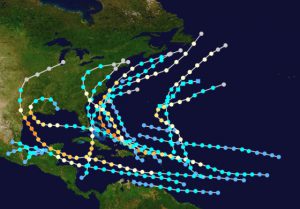
The timing for this commentary, and reminder, is crucial! We are on the threshold of the 2018 hurricane season and the scientists are expecting a catastrophic one … again. See the related article in Appendix A below.
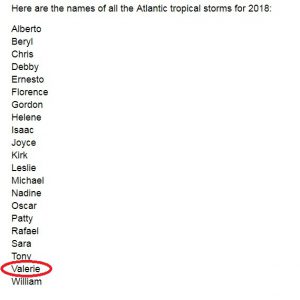
We must do better this year and in the future, compared to how we did last year. In 2017, 2 major storms impacted the Caribbean regions, leaving death, destruction, dysfunction and defection in their wake:

  • Irma – A Category 5 storm on September 4, 2017; this caused devastation in many islands, hitting Barbuda and the Virgin Islands especially hard.
  • Maria – A Category 5 storm on September 18, 2017; this caused devastation in many islands, hitting Puerto Rico and Dominica especially hard.

Remember that Hurricane Season is imminent.

Remember Acid Rain …

Remember the Hippies …

In the previous submission in this “counter-culture” series, it was asserted …

… the ‘Hippies’ stood in the track of an oncoming locomotive … and stopped the train!

We need to apply the lessons-learned from the counter-culture most urgently in getting our communities ready for Climate Change abatement.

The book Go Lean…Caribbean – available to download for free – serves as a roadmap for the introduction and implementation of the technocratic Caribbean Union Trade Federation (CU), to reform and transform all of Caribbean society – all 30 member-states. There is the need to shepherd our communities through major challenges, ones that are too big for any one member-state alone; we need to confederate. This CU/Go Lean roadmap has these 3 prime directives:

  • Optimization of the economic engines in order to grow the regional economy to $800 Billion & create 2.2 million new jobs.
  • Establishment of a security apparatus to ensure public safety and protect the resultant economic engines; including a disaster planning and response functionality.
  • Improve Caribbean governance to support these engines, including a separation-of-powers between the member-states and CU federal agencies.

The Caribbean needs the spirit of the previous counter-culture to “stop the train” that is on our track. Can we remember and role-model the previous rebels and revolutionaries who did not settle for the status quo? Yes, we can!

No we are not saying become hippies! Yes, we are saying to counter the status quo.

The movement behind the Go Lean book has previously detailed many related issues and advocacies for Climate Change awareness and abatement. Consider this sample of previous blog-commentaries:

https://goleancaribbean.com/blog/?p=14174 Canada says: “Follow-me” for Model on ‘Climate Change’ Action
https://goleancaribbean.com/blog/?p=13985 EU Assists Barbados to Go Green
https://goleancaribbean.com/blog/?p=11858 Looking and Learning from the Cautionary Tale of Kiribati
https://goleancaribbean.com/blog/?p=10367 The Science of Green Batteries
https://goleancaribbean.com/blog/?p=9455 Fix ‘Climate Change’ – Yes, We Can
https://goleancaribbean.com/blog/?p=7449 Due to Climate Change, ‘Crap Happens’ – So What Now?
https://goleancaribbean.com/blog/?p=7103 COP21 – ‘Climate Change’ Acknowledged
https://goleancaribbean.com/blog/?p=6893 A Meteorologist’s View On Climate Change
https://goleancaribbean.com/blog/?p=6016 ‘Hotter than July’ – Reality in the Caribbean
https://goleancaribbean.com/blog/?p=4673 Climate Change‘ Merchants of Doubt … to Preserve Profits!!
https://goleancaribbean.com/blog/?p=2465 Book: ‘This Changes Everything: Capitalism vs. the Climate’
https://goleancaribbean.com/blog/?p=2276 Climate Change May Affect Food Supply Within a Decade
https://goleancaribbean.com/blog/?p=1883 Climate Change May Bring More Kidney Stones
https://goleancaribbean.com/blog/?p=1817 Caribbean grapples with intense cycles of flooding & drought
https://goleancaribbean.com/blog/?p=915 Go ‘Green’ … Caribbean

The Go Lean book and roadmap stresses that reforming and transforming the Caribbean’s societal engines is possible; it is conceivable, believable and achievable. But changing society entails changing the people in society, their attitudes and values.

We saw change manifest with the counter-culture of the 1960’s/1970’s. As related above, “the post-1973 mainstream society has been in many ways a hybrid of the 1960s establishment and counter-culture”.

We now need to change our people, our Caribbean people. We need them committed, devoted and inspired to adopt the appropriate community ethos to derail the current trajectory – to doom – and move our countries in a new direction.

The Go Lean book provides 370-pages of turn-by-turn instructions on “how” to forge a counter-cultural revolution transition in the Caribbean; it details the new community ethos that needs to be adopted, plus the strategies, tactics, implementations and advocacies to execute so as to reboot, reform and transform the societal engines of Caribbean society.

We urge all Caribbean stakeholders to lean-in to this roadmap for change, to make our homeland a better place to live, work and play. 🙂

Download the free e-Book of Go Lean … Caribbean – now!

Sign the petition to lean-in for this roadmap for the Caribbean Union Trade Federation.

————-

Appendix – Grenada’s Forestry Department Concerned About ‘Climate Change’ And Its Effects On Hurricanes

By: Maryam J. Tawfiq-iLAND Resilience Project

With the announcement from Colorado State University hurricane researchers of their projections for the 2018 Atlantic Hurricane Season the forestry department of the ministry of agriculture in Grenada is concerned with the likely effects of this year’s storm and of them possibly intensifying.

The 14 named storms of the 2018 season will be slightly above-average, said a report from the university. It projects that seven of the storms will become hurricanes; three of them “major’’ hurricanes.

Ever more people around the world seem to be experiencing freak storms, floods and droughts — including catastrophes that devastate whole regions. The reasons for these complex weather events aren’t straightforward. Some say the crazy weather we’re experiencing is due to greenhouse gas emissions around the world; others disagree.

Anthony Jeremiah, acting chief forestry officer, said the ministry of agriculture is adopting “active preparedness measures’’, admitting that “we are very much concerned regarding the destruction that can arise from hurricanes’’.

During the 2017 Atlantic basin hurricane season, six major storms – all of which were Category 3 or higher – produced devastating human, material and financial losses across the southern United States and the Caribbean.

Last year’s above-average storm activity was foreseeable. Hurricane intensity ticked up in 2016 and scientists have predicted this trend will hold as global temperatures continue to rise.

Though the Caribbean is facing increasing vulnerability to hurricanes, many in the region hold very different opinions about the severity of climate change. According to results from the latest Vanderbilt University Americas Barometer survey, a strong majority of Caribbean residents perceive climate change as a “very serious” problem. In contrast, just 44 percent of the U.S. public does.

The 2018 Atlantic hurricane season runs from June 1 to Nov. 30.

Source: Posted May 5, 2018; retrieved May 8, 2018 from: https://stluciatimes.com/2018/05/05/grenadas-forestry-department-concerned-about-climate-change-and-its-effects-on-hurricanes/

Share this post:
, , ,
[Top]

Counter-culture: Embracing the Change

Go Lean Commentary

Children almost always rebel against their parental norms!

This is just a fact of life. Many times this actuality is a source of friction and frustration in families … and society in general. But many times, the rebellion can result in subsequent benefits to people and institutions in society; though this judgment may not be realized until a later time.

So a younger generation’s rebellion may be how whole communities are disciplined. This thought even aligns with the Bible’s counsel on discipline:

No discipline is enjoyable while it is happening – it’s painful! But afterward there will be a peaceful harvest of right living for those who are trained in this way. – Hebrews 12:11 New Living Translation

Just consider these quick examples of protest movements: slavery abolition, women’s suffrage, labor rights and civil rights. These changes upended – sometimes violently – societal norms. But now, our communities are better for having endured it.

With this premise, we are now able to better embrace the historicity of the “counter-culture” of the 1960’s. This is our most recent example of a subculture whose values and norms of behavior differed substantially from those of mainstream society. And this is not just an academic discussion, for this timeframe corresponds with the time of upheaval for Caribbean society; yet we have not fully applied the lessons-learned and benefits from the resultant societal discipline; see Appendix VIDEO.
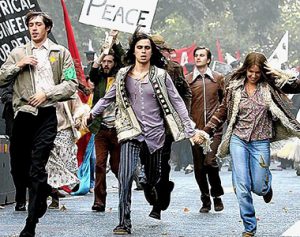
A counter-culture typically involves criticism or rejection of the status quo powerful institutions, with accompanying hope for a better life or a new society.

This is the focus of this series of commentaries on the counter-culture of the 1960’s. This first one – entry 1 of 4 in this series from the movement behind the book Go Lean … Caribbean – is in consideration of remaining societal defects in the Caribbean region. We did not reform or transform like other communities contending with the counter-culture. The other commentaries in the series are cataloged as follows:

  1. Counter-culture: Embracing the Change – Battling against Orthodoxy
  2. Counter-culture: Manifesting Change – Environmentalism & ‘Climate Change’
  3. Counter-culture: Monetizing the Change – Education, Workplace, Healthcare & Retirement
  4. Counter-culture: Pushing for Change – Is Ganja here to stay?

All of these commentaries relate to “how” the stewards for a new Caribbean can shepherd societal change in this region. We accept that with the counter-culture, young people can reject conventional social norms. This can be good when the “mainstream” culture reflects cultural standards that are defective. The counter-culturists of the 1960’s – think hippies – rejected the norms of their parents – from the 1950’s and before – especially with respect to:

  • Racial segregation – The US had a long, bad track record of enforcing a “separate but equal” standard. This was a sham! For the minority populations, they were separated but far from equal; they were oppressed, suppressed and repressed to ensure an inferior status. It took a counter-culture to press until change manifested; i.e. Linda Brown
  • Support for wars – The counter-culturists opposed military conscriptions with vocal protests, publications, demonstrations and acts of civil disobedience. In fact, not until the Military Draft ended in the US, did Caribbean people start to consider the prospect of emigrating to the US.
  • Women’s rights – These rights, like many other societal reforms, only come about as a result of advocates and activists fighting for change. But these battles were too important not to fight. Starting in the mid-19th Century, the 1960’s Civil and Gender Rights succeeded with the landmark 1972 Title IX US federal legislation.
  • Sexual mores – Many countries criminalize sexual acts between consenting adults of the same sex and other forms of sexual orientation, gender identity and expression. The counter-culturists did not stand still; they persisted and got the US to continue the national trend of more tolerance with every generation.
  • Traditional modes of authority – The counter-culturists conveyed to the world that Police authorities were far from perfect, and many times, not even in the right. Standards for mitigating and managing Police Abuse of Power emerged from this hard-fought counter-culture revolution.
  • A materialist interpretation of Middle Class values – While capitalism has won all debate for governing policy, the harsh profit-first priority of Crony-Capitalism has been debunked by counter-culturists. Now environmentalism, arts, humanitarianism has emerged as great candidates for a purpose-driven life.
  • Drug usage – The counter-culture normalized marijuana use and now … State authorities are enacting legislation to legitimize or decriminalize recreational marijuana use. This implementation will be heavy-lifting as there are many security and governing dynamics to manage.

Lessons abound … all of this above drama from the counter-culture is not just American drama. No, the 1960’s counter-culture movement was truly global. It also impacted our Caribbean homeland as well; see Appendix VIDEO.

All of the above issues had a Caribbean parallel.

Yes, the 1960’s counter-culturists triggered dramatic changes; but they were not the first in history, nor were they the last. See here:

Prominent examples of countercultures in Europe and North America include Romanticism (1790–1840), Bohemianism (1850–1910), the more fragmentary counterculture of the Beat Generation (1944–1964), followed by the globalized counter-culture of the 1960s (1964–1974), usually associated with the hippie subculture[3] and the diversified punk subculture of the 1970s and 1980s. – Wikipedia 

The book Go Lean…Caribbean – available to download for free – serves as a roadmap for the introduction and implementation of the technocratic Caribbean Union Trade Federation (CU), to reform and transform all of Caribbean society – all 30 member-states. This is counter to the existing culture. There is the need to shepherd our communities through major changes; we need to reboot our societal engines. This CU/Go Lean roadmap has these 3 prime directives:

  • Optimization of the economic engines in order to grow the regional economy to $800 Billion and create 2.2 million new jobs.
  • Establishment of a security apparatus to ensure public safety and protect the resultant economic engines.
  • Improve Caribbean governance to support these engines, including a separation-of-powers between the member-states and CU federal agencies.

The Caribbean needs a counter-culture revolution! We have defects we need to abandon and gaps that need to be filled.

We need our young people to reject conventional social norms. We need them to rebel and revile their parents … and other members of society that are backwards – trying to preserve defective “mainstream” cultural standards – then move forward.

The Go Lean book identifies and defines “mainstream” cultural standards as community ethos; with this direct quotation (Page 20 – 25):

The people of the Caribbean must change their feelings about elements of their society – elements that are in place and elements missing. This is referred to as “Community Ethos”, defined as:

noun – (www.Dictionary.com)

    1. the fundamental character or spirit of a culture; the underlying sentiment that informs the beliefs, customs, or practices of a group or society; dominant assumptions of a people or period.
    2. the character or disposition of a community, group, person, etc.

As such, some [missing] community ethos … have been identified as relevant for the Caribbean. They are as follows:

  • Deferred Gratification
  • Economic Principles
    • Money Multiplier
    • Job Multiplier
  • Security Principles
    • Privacy versus Public Protection
    • Whistleblower Protection
    • Witness Security & Protection
    • Anti-Bullying and Mitigation
    • Intelligence Gathering
    • Light Up the Dark Places
    • “Crap” Happens
  • Governing Principles
    • Minority Equalization
    • Lean Operations
    • Return on Investments
    • Cooperatives
    • Non-Government Organizations
  • Advocacies
    • Ways to Impact the Future
    • Ways to Foster Genius
    • Ways to Help Entrepreneurship
    • Ways to Promote Intellectual Property
    • Ways to Impact Research & Development
    • Ways to Bridge the Digital Divide
    • Ways to Improve Negotiations
    • Ways to Impact Turn-Arounds
    • Ways to Manage Reconciliations
    • Ways to Improve Sharing
    • Ways to Promote Happiness
    • Ways to Impact the Greater Good

The movement behind the Go Lean book have previously identified many defective “mainstream” cultural values in the Caribbean; consider this sample of previous blog-commentaries:

https://goleancaribbean.com/blog/?p=13974 Haiti – Earning its “Shit-Hole” Brand
https://goleancaribbean.com/blog/?p=13890 We Need to Talk – The Caribbean Disposition is Dire!
https://goleancaribbean.com/blog/?p=13321 Divided and Conquered – Too Much Pluralism – Us and Them
https://goleancaribbean.com/blog/?p=11244 Caribbean People Willing to “Live Too Fast and Die Too Young”
https://goleancaribbean.com/blog/?p=11048 Ignoring the Society Golden Rule – Protecting Weak from the Strong
https://goleancaribbean.com/blog/?p=8200 Promoting a ‘Climate of Hate’
https://goleancaribbean.com/blog/?p=7082 All Play, No Work – Only Known for Leisure
https://goleancaribbean.com/blog/?p=5784 “Say it ain’t so”! – Archaic Buggery Laws Still in Jamaica
https://goleancaribbean.com/blog/?p=4058 New York Times Maledictions on the Bahamas
https://goleancaribbean.com/blog/?p=2709 58% of Caribbean Boys Agree to Female Discipline
https://goleancaribbean.com/blog/?p=1386 Nonchalance About Impact of Drugs and De-Criminalization

There is so much to learn from the counter-culture movement of the 1960’s!

The ‘Hippies’ stood in the track of an oncoming locomotive … and stopped the train!

The counter-culture brought change, some good (ie: desegregation & anti-war protest) and some bad (ie: un-kept grooming & liberal drug use)! So the ‘Hippies’ are only to be emulated as a model for forging change, not necessarily what they change.

The Go Lean book and roadmap stresses that reforming and transforming the Caribbean’s societal engines is possible, but must be preceded with reforming and transforming Caribbean attitudes or community ethos. Despite the individual member-states, counter-cultural changes can be pushed regionally. This – regional push – was an early motivation for the roadmap, as pronounced in the opening Declaration of Interdependence (Pages 12 – 13):

xi. Whereas all men are entitled to the benefits of good governance in a free society, “new guards” must be enacted to dissuade the emergence of incompetence, corruption, nepotism and cronyism at the peril of the people’s best interest. The Federation must guarantee the executions of a social contract between government and the governed.

xvi.  Whereas security of our homeland is inextricably linked to prosperity of the homeland, the economic and security interest of the region needs to be aligned under the same governance. Since economic crimes … can imperil the functioning of the wheels of commerce for all the citizenry, the accedence of this Federation must equip the security apparatus with the tools and techniques for predictive and proactive interdictions.

xxiv. Whereas a free market economy can be induced and spurred for continuous progress, the Federation must install the controls to better manage aspects of the economy: jobs, inflation, savings rate, investments and other economic principles. Thereby attracting direct foreign investment because of the stability and vibrancy of our economy.

The Go Lean book provides 370-pages of turn-by-turn instructions on “how” to forge a counter-cultural revolution transition in the Caribbean; it details the new community ethos that needs to be adopted, plus the strategies, tactics, implementations and advocacies to execute so as to reboot, reform and transform the societal engines of Caribbean society.

We are not asking the Caribbean to be “hippies”, just learn from the “hippies” and reject the status quo and orthodoxy of the broken Caribbean eco-system.

Yes, we can foster change, a counter-culture even; we can make our homeland a better place to live, work and play. 🙂

Download the free e-Book of Go Lean … Caribbean – now!

Sign the petition to lean-in for this roadmap for the Caribbean Union Trade Federation.

—————

Appendix VIDEO-AUDIO – Eddie Minnis: “Ting an’ Ting Y2K” – https://youtu.be/oDF2cQsEURU

This is a Bahamian folk song by legend Eddie Minnis describing societal change in the capital city. ‘Ting and Ting’, the counter-culture had taken hold and everything changed … for good and bad:

  • “Nassau’s become such a funky town since “ting an’ ting” been going ’round.

EDDIE MINNIS – Topic

Published on Jul 20, 2015 – Provided to YouTube by CDBaby “Ting An’ Ting Y2k” (Granny and Fleabs Mix) · Eddie Minnis Tropical Waves ℗ 2012 Edward Minnis Released on: 2012-08-01 Auto-generated by YouTube.


Share this post:
, ,
[Top]

May Day! May Day! We Need Help With Jobs! – ENCORE

Today is May Day!

In many countries, this day is equivalent to Labor Day, a date set aside to honor and celebrate workers, or the movement to empower workers in society. Many of the historicity of these movements were tied to labor unions.

More than 80 countries celebrate International Workers’ Day on May 1 – the ancient European holiday of May Day.

All Caribbean member-states need help with our job-labor eco-system. Our societal engines are so dysfunctional that our people flee … abandoning the homeland in search of jobs.

There is this prospect for help. This previous blog-commentary from June 18, 2015, discussed the trends in the labor markets, which depict a decline in collective bargaining. This Encore of that commentary is presented here with a plan to assuage this bad trend and create 2.2 million new jobs:

==================

Title: Economic Principle: Wage-Seeking – Market Forces -vs- Collective Bargaining

Go Lean Commentary

The field of Economics is unique! We all practice it every day, no matter the level of skill or competence. There is even the subject area in basic education branded Home Economics, teaching the students the fundamentals of maintaining, supporting and optimizing a home environment. Most assuredly, economics is an art and a science, albeit a social science.

In a previous blog/commentary, Scotman’s Adam Smith was identified as the father of modern macro-economics. Though he lived from 1723 to 1790, his writings defined advanced economic concepts even in this 21st Century. His landmark book An Inquiry into the Nature and Causes of the Wealth of Nations qualified the divisions of income into these following categories: profit, wage, and rent.[4] We have previously explored profit-seeking (a positive ethos that needs to be fostered in the Caribbean region) and rent-seeking (a negative effort that proliferates in the Caribbean but needs to be mitigated), so now the focus of this commentary is on the activity of wage-seeking, and the concepts of governance and public choice theory to allow for maximum employment.

This is hard! Change has come to the world of wage-seekers – the middle classes are under attack; the labor-pool of most industrialized nations have endured decline, not in the numbers, but rather in prosperity. While wage-earners have not kept pace with inflation, top-earners (bonuses, commissions and business profits) have soared; (see Photo).

CU Blog - Economic Principles - Wage-Seeking - Market forces -vs- Collective Bargaining - Photo 2As a direct result, every Caribbean member-state struggles with employment issues in their homeland. In fact, this was an initial motivation for the book Go Lean…Caribbean, stemming from the fall-out of the 2008 Great Recession, this publication was presented as a roadmap for the introduction and implementation of the Caribbean Union Trade Federation (CU) to elevate the economic, security and governing engines of the Caribbean region to create 2.2 million new jobs, despite global challenges.

Needless to say, the global challenge is far more complex than Home Economics. The Go Lean book describes the effort as heavy-lifting; then proceeds to detail the turn-by-turn directions of a roadmap to remediate and mitigate wage-seeking.

The roadmap channels the Economic Principles and best-practices of technocrats like Adam Smith and 11 other named economists, many of them Nobel Laureates. A review of the work of these great men and woman constitute “Lessons in Economic Principles”. Why would these lessons matter in the oversight of Caribbean administration? Cause-and-effect!

Profit 4The root of the current challenge for wage-seekers is income equality; and this is bigger than just the Caribbean. It is tied to the global adoption of globalization and technology/ automation – a product of global Market Forces as opposed to previous Collective Bargaining factors. This relates back to the fundamental Economic Principle of “supply-and-demand”; but now the “supply” is global. This photo/”process flow” here depicts the ingredients of Market Forces. When there is the need for labor, the principle of comparative analysis is employed, and most times the conclusion is to “off-shore” the labor efforts, and then import the finished products. This is reversed of the colonialism that was advocated by Adam Smith; instead of the developed country providing factory labor for Third World consumption, the developed nation (i.e. United States) is now in the consumer-only role, with less and less production activities, for products fabricated in the Third World. This reality is not sustainable for providing prosperity to the middle classes, to the wage-seekers.

As a community, we may not like the laws of Economics, but we cannot ignore them. The Go Lean book explains the roles and significance of Economic Principles … with this excerpt (Page 21):

While money is not the most important factor in society, the lack of money and the struggle to acquire money creates challenges that cannot be ignored. The primary reason why the Caribbean has suffered so much human flight in the recent decades is the performance of the Caribbean economy. Though this book is not a study in economics, it recommends, applies and embraces these 6 core Economic Principles as sound and relevant to this roadmap:

  1. People Choose: We always want more than we can get and productive resources (human, natural, capital) are always limited. Therefore, because of this major economic problem of scarcity, we usually choose the alternative that provides the most benefits with the least cost.
  2. All Choices Involve Costs: The opportunity cost is the next best alternative you give up when you make a choice. When we choose one thing, we refuse something else at the same time.
  3. People Respond to Incentives in Predictable   Ways: Incentives are actions, awards, or rewards that determine the choices people make. Incentives can be positive or negative. When incentives change, people change their behaviors in predictable ways.
  4. Economic Systems Influence Individual Choices and Incentives: People cooperate and govern their actions through both written and unwritten rules that determine methods of allocating scarce resources. These rules determine what is produced, how it is produced, and for whom it is produced. As the rules change, so do individual choices, incentives, and behavior.
  5. Voluntary Trade Creates Wealth: People specialize in the production of certain goods and services because they expect to gain from it. People trade what they produce with other people when they think they can gain something from the exchange. Some benefits of voluntary trade include higher standards of living and broader choices of goods and services.
  6. The Consequences of Choices Lie in the Future: Economists believe that the cost and benefits of decision making appear in the future, since it is only the future that we can influence. Sometimes our choices can lead to unintended consequences.

Source: Handy Dandy Guide (HDC) by the National Council on Economic Education (2000)

The Go Lean book describes the end result of the application of best-practices in this field of economics over the course of a 5-year roadmap: the CU … as a hallmark of technocracy. But the purpose is not the edification of the region’s economists, rather to make the Caribbean homeland “better places to live, work and play” for its citizens. This branding therefore puts emphasis on the verb “work”; the nouns “jobs” and “wages” must thusly be a constant focus of the roadmap.

Brain Drain 70 percent ChartThis Go Lean book declares that the Caribbean eco-system for job-creation is in crisis … due to the same global dilemma. The roadmap describes the crisis as losing a war, the battle of globalization and technology. The consequence of the defeat is 2 undesirable conditions: income inequality and societal abandonment, citizens driven away to a life in the Diaspora. This assessment currently applies in all 30 Caribbean member-states, as every community has lost human capital to emigration. Some communities, like Puerto Rico and the US Virgin Islands have suffered with an abandonment rate of more than 50% and others have watched more than 70% of college-educated citizens flee their community for foreign shores. Even education is presented as failed investments as those educated in the region and leave to find work do not even return remittances in proportion to their costs of development. (See Table 4.1 in the Photo)

The Go Lean book therefore posits that there is a need to re-focus, re-boot, and optimize the labor/wage-seeking engines so as to create more jobs with livable wages. Alas, this is not just a Caribbean issue, but a global (i.e. American) one as well. See the following encyclopedic references for wage-seeking and Collective Bargaining to fully understand the complexities of these global issues:

Encyclopedia Reference #1: Wage-Seeking
(Source: https://en.wikipedia.org/wiki/Wage)

A wage is monetary compensation paid by an employer to an employee in exchange for work done. Payment may be calculated as a fixed amount for each task completed (a task wage or piece rate), or at an hourly or daily rate, or based on an easily measured quantity of work done.

Wages are an example of expenses that are involved in running a business.

Payment by wage contrasts with salaried work, in which the employer pays an arranged amount at steady intervals (such as a week or month) regardless of hours worked, with commission which conditions pay on individual performance, and with compensation based on the performance of the company as a whole. Waged employees may also receive tips or gratuity paid directly by clients and employee benefits which are non-monetary forms of compensation. Since wage labour is the predominant form of work, the term “wage” sometimes refers to all forms (or all monetary forms) of employee compensation.

Determinants of wage rates
Depending on the structure and traditions of different economies around the world, wage rates will be influenced by market forces (supply and demand), legislation, and tradition. Market forces are perhaps more dominant in the United States, while tradition, social structure and seniority, perhaps play a greater role in Japan.[6]

Wage Differences
Even in countries where market forces primarily set wage rates, studies show that there are still differences in remuneration for work based on sex and race. For example, according to the U.S. Bureau of Labor Statistics, in 2007 women of all races made approximately 80% of the median wage of their male counterparts. This is likely due to the supply and demand for women in the market because of family obligations. [7] Similarly, white men made about 84% the wage of Asian men, and black men 64%.[8] These are overall averages and are not adjusted for the type, amount, and quality of work done.

Real Wage
The term real wages refers to wages that have been adjusted for inflation, or, equivalently, wages in terms of the amount of goods and services that can be bought. This term is used in contrast to nominal wages or unadjusted wages. Because it has been adjusted to account for changes in the prices of goods and services, real wages provide a clearer representation of an individual’s wages in terms of what they can afford to buy with those wages – specifically, in terms of the amount of goods and services that can be bought.

See Table of European Model in the Appendix below. (The European Union is the model for the Caribbean Union).

———-

Encyclopedia Reference #2: Collective Bargaining
(Source: https://en.wikipedia.org/wiki/Collective_bargaining)

WPR: Marches & PicketsCollective Bargaining is a process of negotiation between employers and a group of employees aimed at reaching agreements to regulate working conditions. The interests of the employees are commonly presented by representatives of a trade union to which the employees belong. The collective agreements reached by these negotiations usually set out wage scales, working hours, training, health and safety, overtime, grievance mechanisms, and rights to participate in workplace or company affairs.[1]

The union may negotiate with a single employer (who is typically representing a company’s shareholders) or may negotiate with a group of businesses, depending on the country, to reach an industry wide agreement. A collective agreement functions as a labor contract between an employer and one or more unions.

The industrial revolution brought a swell of labor-organizing in [to many industrialized countries, like] the US. The American Federation of Labor (AFL) was formed in 1886, providing unprecedented bargaining powers for a variety of workers.[11] The Railway Labor Act (1926) required employers to bargain collectively with unions. While globally, International Labour Organization Conventions (ILO) were ratified in parallel to the United Nations efforts (i.e. Declaration of Human Rights, etc.). There were a total of eight ILO fundamental conventions [3] all ascending between 1930 and 1973, i.e. the Freedom of Association and Protection of the Right to Organise Convention (1949).

The Go Lean book presents a roadmap on how to benefit from the above Economic Principles – and how to empower communities anew – in the midst of tumultuous global challenges. This roadmap addresses more than economics, as there are other areas of societal concern. This is expressed in the CU charter; as defined by these 3 prime directives:

  • Optimization of economic engines in order to grow the regional economy to $800 Billion and create 2.2 million new jobs.
  • Establishment of a security apparatus to protect the resultant economic.
  • Improvement of Caribbean governance to support these engines.

Early in the Go Lean book, the responsibility to create jobs was identified as an important function for the CU with these pronouncements in the Declaration of Interdependence (Pages 14):

xix.  Whereas our legacy in recent times is one of societal abandonment, it is imperative that incentives and encouragement be put in place to first dissuade the human flight, and then entice and welcome the return of our Diaspora back to our shores.

xxi.  Whereas the preparation of our labor force can foster opportunities and dictate economic progress for current and future generations, the Federation must ensure that educational and job training opportunities are fully optimized for all residents of all member-states, with no partiality towards any gender or ethnic group. The Federation must recognize and facilitate excellence in many different fields of endeavor, including sciences, languages, arts, music and sports. This responsibility should be executed without incurring the risks of further human flight, as has been the past history.

xxiv. Whereas a free market economy can be induced and spurred for continuous progress, the Federation must install the controls to better manage aspects of the economy: jobs, inflation, savings rate, investments and other economic principles. Thereby attracting direct foreign investment because of the stability and vibrancy of our economy.

xxvi.  Whereas the Caribbean region must have new jobs to empower the engines of the economy and create the income sources for prosperity, and encourage the next generation to forge their dreams right at home, the Federation must therefore foster the development of new industries, like that of ship-building, automobile manufacturing, prefabricated housing, frozen foods, pipelines, call centers, and the prison industrial complex. In addition, the Federation must invigorate the enterprises related to existing industries tourism, fisheries and lotteries – impacting the region with more jobs.

According to an article from the Economic Policy Institute, entitled The Decline of Collective Bargaining and the Erosion of Middle-class Incomes in Michigan by Lawrence Mishel (September 25, 2012), the challenges to middle class income are indisputable, and the previous solution – Collective Bargaining – is no longer as effective as in the past. (The industrial landscape of Michigan had previously been identified as a model for the Caribbean to consider). See a summary of the article here (italics added) and VIDEO in the Appendix:

In Michigan between 1979 and 2007, the last year before the Great Recession, the state’s economy experienced substantial growth and incomes rose for high-income households. But middle-class incomes did not grow. The Michigan experience is slightly worse than but parallels that of the United States as a whole, where middle-class income gains were modest but still far less than the income gains at the top. What the experience of Michiganders and other Americans makes clear is that income inequality is rising, and it has prevented middle-class incomes from growing adequately in either Michigan or the nation.

The key dynamic driving this income disparity has been the divergence between the growth of productivity—the improvement in the output of goods and services produced per hour worked—and the growth of wages and benefits (compensation) for the typical worker. It has been amply documented that productivity and hourly compensation grew in tandem between the late 1940s and the late 1970s, but split apart radically after 1979. Nationwide, productivity grew by 69.1 percent between 1979 and 2011, but the hourly compensation of the median worker (who makes more than half the workforce but less than the other half) grew by just 9.6 percent (Mishel and Gee 2012; Mishel et al. 2012). In other words, since 1979 the typical worker has hardly benefited from improvements in the economy’s ability to raise living standards and, consequently, middle-class families’ living standards have barely budged since then. This phenomenon has occurred across the nation, including in Michigan.

This divergence between pay and productivity and the corresponding failure of middle-class incomes to grow is strongly related to the erosion of collective bargaining. And collective bargaining has eroded more in Michigan than in the rest of the nation, helping to explain Michigan’s more disappointing outcomes.

Research three decades ago by economist Richard Freeman (1980) showed that collective bargaining reduces wage inequality, and all the research since then (see Freeman 2005) has confirmed his finding. Collective bargaining reduces wage inequality for three reasons. The first is that wage setting in collective bargaining focuses on establishing “standard rates” for comparable work across business establishments and for particular occupations within establishments. The outcome is less differentiation of wages among workers and, correspondingly, less discrimination against women and minorities. A second reason is that wage gaps between occupations tend to be lower where there is collective bargaining, and so the wages in occupations that are typically low-paid tend to be higher under collective bargaining. A third reason is that collective bargaining has been most prevalent among middle-class workers, so it reduces the wage gaps between middle-class workers and high earners (who have tended not to benefit from collective bargaining).

Collective bargaining also reduces wage inequality in a less-direct way. Wage and benefit standards set by collective bargaining are often followed in workplaces not covered by collective bargaining, at least where there is extensive coverage by collective bargaining in particular occupations and industries. This spillover effect means that the impact of collective bargaining on the wages and benefits of middle-class workers extends far beyond those workers directly covered by an agreement.

Source: http://www.epi.org/publication/bp347-collective-bargaining/

The siren call went out 20 years ago, of the emergence of an “Apartheid” economy, a distinct separation between the classes: labor and management. Former US Secretary of Labor Robert Reich (1993 – 1997 during the Clinton Administration’s First Term) identified vividly, in this 1996 Harvard Business Review paper, that something was wrong with the U.S. economy then; (it is worst now):

CU Blog - Economic Principles - Wage-Seeking - Market forces -vs- Collective Bargaining - Photo 3That something is not the country’s productivity, technological leadership, or rate of economic growth, though there is room for improvement in all those areas. That something is an issue normally on the back burner in U.S. public discourse: the distribution of the fruits of economic progress. For many, the rise in AT&T’s stock after it announced plans [on January 3, 1996] to lay off 40,000 employees crystallized the picture of an economy gone haywire, with shareholders gaining and employees losing as a result of innovation and advances in productivity.

Has the distribution of the benefits of economic growth in the United States in fact gone awry? Is the nation heading toward an apartheid economy—one in which the wealthy and powerful prosper while the less well-off struggle? What are the facts? What do they mean? Are there real problems—and can they be solved?

Deploying solutions for the problem of income equality in the Caribbean is the quest of the Go Lean/CU roadmap. The book identified Agents of Change (Page 57) that is confronting the region, (America as well); they include: Globalization and Technology. A lot of the jobs that paid a “living wage” are now being shipped overseas to countries with lower wage levels, or neutralized by the advancement of technology. Yes, computers are reshaping the global job market, so even Collective Bargaining may fail to counter any eventual obsolescence of wage-earners, their valuation and appreciation; (see Encyclopedic Article # 2). The Go Lean book, and previous blog/commentaries, therefore detailed the campaign to not just consume technology, but to also innovate, produce and distribute the computer-enabled end-products. Therefore industries relating to STEM (Science, Technology, Engineering and Mathematics/Medicine) are critical in the roadmap. Not only do these careers yield good-paying direct jobs, but also factor in the indirect job market, and the job-multiplier rate (3.0 to 4.1) for down-the-line employment (Page 260) opportunities.

The Go Lean… Caribbean book details the creation of 2.2 million new jobs for the Caribbean region, many embracing ICT/STEM skill-sets. This is easier said than done, so how does Go Lean purpose to deliver on this quest? By the adoption of certain community ethos, plus the executions of key strategies, tactics, implementations and advocacies. The following is a sample from the book:

Assessment – Puerto Rico – Extreme Unemployment – The Greece of the Caribbean Page 18
Community Ethos – Deferred Gratification Page 21
Community Ethos – Job Multiplier Page 22
Community Ethos – Anti-Bullying and Mitigation Page 23
Community Ethos – Lean Operations Page 24
Community Ethos – Return on Investments Page 24
Community Ethos – Ways to Impact the Future Page 26
Community Ethos – Ways to Foster Genius Page 27
Community Ethos – Ways to Help Entrepreneurship Page 28
Community Ethos – Ways to Promote Intellectual Property – Key to ICT Careers Page 29
Community Ethos – Ways to Impact Research and Development – Germaine for STEM jobs Page 30
Community Ethos – Ways to Close the Digital Divide – Vital for fostering ICT careers Page 31
Strategy – Mission – Education Without Further Brain Drain Page 46
Strategy – Agents of Change – Technology Page 57
Strategy – Agents of Change – Globalization Page 57
Tactical – Fostering a Technocracy Page 64
Tactical – Tactics to Forge an $800 Billion Economy – East Asian Tigers Model Page 69
Tactical – Tactics to Forge an $800 Billion Economy – High Multiplier Industries Page 70
Tactical – Tactics to Forge an $800 Billion Economy – Trade and Globalization Page 70
Tactical – Separation of Powers – Commerce Department – Patents & Copyrights Page 78
Implementation – Steps to Implement Self-Governing Entities – As Job-creating Engines Page 105
Implementation – Ways to Benefit from Globalization – Technology: The Great Equalizer Page 119
Planning – Ways to Improve Trade Page 128
Planning – Ways to Model the EU Page 130
Planning – Lessons Learned from 2008 – Income Equality Now More Pronounced Page 136
Advocacy – Ways to Grow the Economy Page 151
Advocacy – Ways to Create Jobs Page 152
Advocacy – Ways to Improve Education – e-Learning Options Page 159
Advocacy – Ways to Impact Labor Markets and Unions – Collective Bargaining Best-Practices Page 164
Advocacy – Ways to Foster Empowering Immigration – STEM Resources Page 174
Advocacy – Ways to Foster Technology – Credits, Incentives and Investments Page 197
Advocacy – Ways to Foster e-Commerce – Optimize Remittance Methods Page 198
Advocacy – Ways to Help the Middle Class – Exploit Globalization Page 223
Appendix – Growing 2.2 Million Jobs in 5 Years Page 257
Appendix – Job Multipliers – Direct & Indirect Job Correlations Page 259
Appendix – Emigration Bad Example – Puerto Rican Population in the US Mainland Page 304

The CU will foster job-creating developments, incentivizing many high-tech start-ups and incubating viable companies. The primary ingredient for CU success will be Caribbean people, so we must foster and incite participation of many young people into fields currently sharing higher job demands, like ICT and STEM, so as to better impact their communities. A second ingredient will be the support of the community – the Go Lean movement recognizes the limitation that not everyone in the community can embrace the opportunity to lead in these endeavors. An apathetic disposition is fine-and-well; we simply must not allow that to be a hindrance to those wanting to progress – there are both direct jobs and indirect jobs connected with the embrace of ICT/STEM disciplines. The community ethos or national spirit, must encourage and spur “achievers” into roles where “they can be all they can be”. Go Lean asserts that one person can make a difference … to a community (Page 122).

Other subjects related to job empowerments for wage-seekers in the region have been blogged in other Go Lean…Caribbean commentaries, as sampled here:

https://goleancaribbean.com/blog/?p=4240 Immigration Policy Exacerbates Worker Productivity Crisis
https://goleancaribbean.com/blog/?p=3694 Jamaica-Canada employment programme pumps millions into local economy
https://goleancaribbean.com/blog/?p=3473 Haiti to Receive $70 Million Grant to Expand Caracol Industrial Park to Create Jobs and Benefit from Globalization
https://goleancaribbean.com/blog/?p=3446 Forecast for higher unemployment in Caribbean in 2015
https://goleancaribbean.com/blog/?p=3164 Michigan Unemployment Model – Then and Now
https://goleancaribbean.com/blog/?p=2857 Where the Jobs Are – Entrepreneurism in Junk
https://goleancaribbean.com/blog/?p=2800 The Geography of Joblessness
https://goleancaribbean.com/blog/?p=2750 Disney World’s example of Self Governing Entities and Economic Impacts of 70,000 jobs; 847,000+ Puerto Ricans now live in the vicinity.
https://goleancaribbean.com/blog/?p=2126 Where the Jobs Are – Computers Reshaping Global Job Market
https://goleancaribbean.com/blog/?p=2025 Where the Jobs Are – Attitudes & Images of the Caribbean Diaspora in US
https://goleancaribbean.com/blog/?p=2003 Where the Jobs Are – Ship-breaking under the SGE Structure
https://goleancaribbean.com/blog/?p=1698 Where the Jobs Are – STEM Jobs Are Filling Slowly
https://goleancaribbean.com/blog/?p=1683 Where the Jobs Were – British public sector now strike over ‘poverty pay’
https://goleancaribbean.com/blog/?p=1214 Where the Jobs Are – Fairgrounds as SGE & Landlords for Sports Leagues
https://goleancaribbean.com/blog/?p=273 10 Things We Don’t Want from the US – Job Discrimination of Immigrations

The Caribbean is arguably the best address on the planet, but “man cannot live on beauty alone”, there is the need for a livelihood as well. This is the challenge, considering the reality of unemployment in the region; the jobless rate among the youth is even higher.

The crisis of income inequality for the US is a direct result of free trade agreements, like NAFTA, and China’s Preferential Trading Status. Despite this status, we can benefit from the realities of globalization; jobs are being moved to conducive locations with lower labor costs.  We should invite these investors to look for cheaper labor options, here in the Caribbean region (Haiti, Dominican Republic, Jamaica, etc.). This is the same reality as in Europe with different wage levels for the different countries (see Appendix below); the Caribbean also has these wage differences.

The Go Lean roadmap seeks to foster higher-paying job options: Call Centers, Offshore Software Development Centers, R&D Medical campuses, light-manufacturing and assembly plants for “basic needs” products (food, clothing shelter, energy, and transportation) for Caribbean consumption. This is the successful model of Japan, China and the “East Asia Tigers” economies; these are manifestations of effective Economic Principles.

The Go Lean book therefore digs deeper, providing turn-by-turn directions to get to the desired Caribbean results: a better place to live, work and play. 🙂

Download the free e-Book of Go Lean … Caribbean – now!

————-

Appendix – List of European countries by average wage (USA & Japan added for comparison)

(Source: https://en.wikipedia.org/wiki/List_of_European_countries_by_average_wage)

2014 Annual values (in national currency) for a family with two children with one average salary, including tax credits and allowances.[1] Net amount is computed after Taxes, Social Security and Family Allowances; the result is provided in both the National Currency and the Euro, if different. The table, sorted from highest Net amount to the lowest, is presented as follows:

State Gross Net (Natl. Curr) Net (Euro)
Switzerland 90,521.98 86,731.20 71,407.21
Luxembourg 54,560.39 52,041.36 52,041.36
Norway 542,385.96 415,557.87 49.,741.20
Denmark 397,483.78 289,292.48 38,806.20
Iceland 6,856,099.69 5,872.114.66 37,865.07
UNITED STATES 56,067 45,582 37,671
Sweden 407,974.45 335,501.45 36,874.37
Netherlands 48,855.70 36,648.71 36,648.71
United Kingdom 35,632.64 28,960.38 35,925.65
Belgium 46,464.41 35,810.55 35,810.55
Italy 41,462.67 24,539.93 35,539.93
Germany 45,952.05 36,269.23 35,269.23
France 38,427.35 30,776.75 34,776.75
Ireland 34,465.85 34,382.63 34,382.63
Austria 42,573.25 33,666.04 33,666.04
Finland 42,909.72 32,386.59 32,386.59
JAPAN 4,881,994.24 4,132.432.02 29,452.16
Spain 26,161.81 22,129.78 22,129.78
Greece 24,201.50 17,250.24 17,250.24
Slovenia 17,851.28 15,882.53 15,882.53
Portugal 17,435.71 15,140.25 15,140.25
Estonia 12,435.95 11,176.87 11,176.87
Czech Republic 312,083.83 306,153.76 11,118.31
Slovakia 10,342.10 9,778.16 9,778.16
Poland 42,360.01 34,638.77 8,278.27
Hungary 3,009,283.93 2,530.280.97 8,196.30
Turkey 28,370.00 21,072.12 7,250.00

————-

Appendix VideoCollective Bargaining and Shared Prosperity: Michigan, 1979 – 2009 http://youtu.be/PcT4jK89JmE

Published on September 27, 2012 – This VIDEO depicts the positive effects of Collective Bargaining on the quest for income equality in the US State of Michigan; and the sad consequence of the widening income inequality when Collective Bargaining is less pervasive.
This reflect the “Observe and Report” functionality of the Go Lean…Caribbean promoters in the Greater Detroit-Michigan area.

Share this post:
, , , ,
[Top]

‘Loose Lips Sink Ships’ – Undermining College Enrollment

Go Lean Commentary 

Let’s go over this again…

As reported in a previous blog-commentary last year …

Loose lips sink ships …

… this is an American-English idiom meaning “beware of unguarded talk”. The phrase originated on propaganda posters during World War II.[4]  There are similar expressions in other cultures:
The British equivalent used “Careless Talk Costs Lives“, and variations on the phrase “Keep mum“,[5] while in neutral Sweden the State Information Board promoted the wordplay “en svensk tiger” (the Swedish word “tiger” means both “tiger” and “keeping silent”), and Germany used “Schäm Dich, Schwätzer!” (English: “Shame on you, blabbermouth!”).[6]
Source: Retrieved 04-07-2017 from: https://en.wikipedia.org/wiki/Loose_lips_sink_ships

Yes, inappropriate talk can undermine societal engines … and economic engines.

Universities, even not-for-profit ones, need to preserve their economic engines. They must have an influx of new students to replace the ones that graduate every year. Where do these students come from?

The economics of universities are simple, especially state-sponsored universities:

  • In-state students pay a per-credit fee for tuition, since state taxes subsidize schools
  • Out-of-state students pay a higher per-credit fee, sometimes double the in-state rate
  • Foreign students must pay out-of-state tuition every year; there is no in-state option for them
  • More revenues – and no financial aid or discounts – are associated with foreign students.

For many American universities, the appeal to lure international students is a “hen that lays golden eggs”. It will be unbecoming to compromise this business arrangement. Enter …

Donald J. Trump, 45th President of the United States

As reported in that previous blog-commentary, the “United States is suffering the dire consequence of ‘loose lips sinking ships’ right now. The new President – Donald Trump – has made disparaging remarks about certain foreign groups, and then introduced policies that reinforce his disdain for these foreigners”.

As a result, more and more foreign students are refusing to come to the US to matriculate. See the full article here and the Appendix VIDEO below:

Title: Trump blamed as U.S. colleges lure fewer foreign students
Sub-title: U.S. colleges blame the administration’s immigration policies as they fall behind foreign competitors in vying for international students.

American universities are losing out to colleges in other countries in the race to enroll international students, and they’re blaming President Donald Trump.
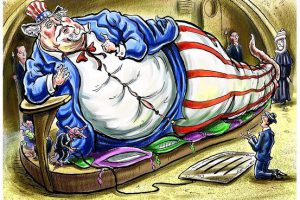
Foreign competitors are taking advantage of Trump’s anti-immigration rhetoric, aggressively recruiting the types of foreign students and faculty who would have typically come to the United States for their higher education. The data already show that U.S. colleges are falling behind foreign competitors during the Trump era.

New foreign student enrollment in the U.S. dropped by 3 percent during the 2016-17 school year, and that decline is projected to double this school year, data show. At the same time, universities overseas are seeing increases as high as the double digits. The decline in foreign students enrolling in American colleges is just the latest evidence of Trump’s immigration policies shutting doors in America. The U.S. is also granting fewer visitor visas to people from around the world.

Trump is responsible for the decline in student enrollment, U.S. universities argue — especially his travel ban, which goes before the Supreme Court on Wednesday. Dozens of higher education groups wrote in an amicus brief for that case that Trump’s travel ban is a “clarion message of exclusion to millions” that harms universities’ ability to enroll international students and recruit top faculty.

Overseas, they’re gloating. “We don’t actually need to be negative about the American academy, as President Trump is doing more damage to ‘brand America’ on his own than any competitor country ever could,” Phil Honeywood, the CEO of Australia’s international education association, told POLITICO.

“There is no doubt that President Trump’s much-publicized antagonism toward Muslims and migrants has sent out negative messages to students who would otherwise have America at the top of their list as a study destination,” said Honeywood. Australia — long one of America’s top competitors — has seen big jumps in students enrolling from Muslim majority countries, such as Malaysia and Indonesia and in the Middle East, he said.

And it’s not just Australia, which saw a 12 percent increase in international students last year. Universities in Canada, China, New Zealand, Japan and Spain all posted double-digit increases in international enrollment, according to data from the nonprofit Institute of International Education.

Meanwhile, the U.S. decline tracked by the IIE was the first time that number had dropped in the 12 years the group collected such data. While the 2017-18 data are not yet available, the decline was projected to more than double, based on the findings of a separate online enrollment survey IIE conducted in October.

Universities say they need to continue to attract the world’s brightest students for America to maintain its scientific edge. They argue foreign students often become important economic drivers, pointing to famous foreign-born entrepreneurs like Elon Musk, who grew up in South Africa and graduated from the University of Pennsylvania. International students can also help with the bottom line, since they often pay full freight, and some universities charge them more to attend.

“Where the United States retreats, there’s a vacuum, and other countries will rush to fill it,” University of California President Janet Napolitano, who served as Homeland Security secretary in the Obama administration, told POLITICO. “American education has always led the world — and it still leads the world, and it should lead the world. But we are leading the world in an atmosphere where the White House, at least, is sending a very kind of ‘stay away’ message — and that’s a challenge.”

The university groups wrote in the Supreme Court brief that since Trump signed the travel ban, international students have expressed concerns about coming to the U.S. to study, while faculty have turned down jobs and foreign scholars have pulled out of American academic conferences.

“Foreign students, faculty and researchers come to this country because our institutions are rightly perceived as the destinations of choice compared to all others around the globe,” the brief said. The president’s proclamation “altered those positive perceptions with the stroke of a pen,” it said.

In the case, the Supreme Court will hear arguments that Trump overstepped his authority in issuing an order limiting visas to eight countries, six of which are majority Muslim. Among the questions the justices are expected to consider in the case, which was brought by the state of Hawaii and the leader of a Muslim group there, is whether the president’s order violated the Constitution’s ban on establishment of religion by targeting Muslims.

The administration has contended the travel ban is a necessary national-security step, and government attorneys have argued it’s not related to Trump’s vows on the campaign trail to institute a Muslim ban.

It’s not just the travel ban. The Trump administration is considering restricting visas for Chinese citizens, which could hurt Chinese students studying at American universities. Administration officials portray the possible restrictions, as well as steep tariffs, as a response to alleged intellectual property theft.

American colleges, meanwhile, have aggressively pushed for lawmakers to find a way to preserve the Obama-era Deferred Action for Childhood Arrivals program, which protected from deportation and gave work permits to undocumented individuals brought to the country as children. Trump scrapped the program.

Foreign universities have watched the political climate shift and are pouncing on the opportunity to lure away would-be students and faculty.

“At a time of closing borders and closing minds, students from around the world are choosing Canada,” a group of Canadian universities boasted late last year.

Canada saw an 18 percent jump in international enrollment in 2016. New Zealand saw the biggest boost — a 34 percent increase. International enrollment jumped 25 percent in Spain, 13 percent in Japan and 11 percent in China.

“Ten years ago, China wasn’t even on anyone’s radar screen as a competitor,” said Rachel Banks, director of public policy at NAFSA: Association of International Educators, America’s main international education lobbying group. “They were not active. They were not aggressive at all.”

China has set a goal of enrolling half a million students by the year 2020, and the nation is on a path to exceed that goal early, she said. International students have been a big part of that growth.

Many of these countries long have had aggressive strategies to recruit internationally and have built immigration policies around those efforts.

Australia, for example, allows foreign students to stick around for 18 months after graduation to gain experiential training. Graduates in high-need occupations are able to stay and work for as long as four years. And the country has a path to permanent residency for all foreign graduates.

And they’re not just targeting students.

French President Emmanuel Macron last year announced France would give four-year grants to professors, graduate students and other researchers willing to work on climate change research. Just last month, Canada announced its universities had successfully poached 24 faculty members from colleges in other nations. More than half of them came from American universities, including Harvard, Brown and Duke.

Canadian Prime Minister Justin Trudeau has been spending time in Silicon Valley, trying to convince startups there that Canada might be a more friendly place as the U.S. continues to restrict immigration, including through additional scrutiny of work visas.

“That’s pretty telling,” Banks said.

American universities have tried to counter the narrative. Colleges have written letters expressing their continued support for international education, and some have even offered assistance, such as additional housing, for international students. They’ve lobbied aggressively against restrictive immigration policies and entered court battles. The University of California is among the plaintiffs challenging Trump’s decision to scrap DACA.

“The key for us is to be able to still attract the best and the brightest from all over the world,” University of Southern California President C.L. Max Nikias told POLITICO. “That has been part of the strength of who we are as a country.”

Source: Politico – posted April 23, 2018; retrieved April 30, 2018 from: https://www.politico.com/story/2018/04/23/foreign-students-colleges-trump-544717

College is a big investment; yet nobody wants to spend their BIG money in a place where they are not welcomed.

This lesson must be learned in the Caribbean. We have the same threats afoot. But unlike the US, who has the leverage and surety of “richest Single Market economy in the world” to absorb any fall, our Caribbean member-states are mostly Third World and failing. This commentary has previous detailed how societal deficiency has resulted in a Brain Drain among the educated classes in the Caribbean homeland – all due to “push and pull” reasons. We persecute certain groups in our society; at times our community leaders are projecting “a climate of hate”.

In general, neutralizing a “hateful attitude” has been an ongoing theme for the movement behind the book Go Lean … Caribbean. The book presents the Caribbean region a roadmap to elevate all societal engines, including economics, homeland security and governance. In fact, the prime directives of the roadmap includes the following 3 statements:

  • Optimization of the economic engines in order to grow the regional economy to $800 Billion & create 2.2 million new jobs.
  • Establishment of a security apparatus to ensure public safety for all and protect the resultant economic engines.
  • Improve Caribbean governance for all people, even minority groups, to support these economic and security engines.

The Go Lean book introduces the Caribbean Union Trade Federation (CU) as an intergovernmental agency for 30 regional member-states, to provide a better – technocratic – stewardship for the regional economy. We need all community stakeholders to “not sink ships” with their unbridled hatred and disdain for people who may look, act and speak differently than them.

The movement behind the Go Lean book hereby makes this urging to the Caribbean political, social and religious leaders:

Learn from the fallacy of President Trump.

Now is the time for all of the Caribbean – the people and leaders – to lean-in for the empowerments described here-in and in the book Go Lean … Caribbean. This is about jobs and economic opportunities – education included; we need better engines to make our region more prosperous. We can elevate our communities through education!

It is conceivable, believable and achievable to make the Caribbean a better place to live, work, learn and play. 🙂

Sign the petition to lean-in for the roadmap for the Caribbean Union Trade Federation.

Download the free e-book of Go Lean … Caribbean – now!

———–

Appendix VIDEO – US universities experiencing massive drop in foreign students – https://youtu.be/uIVdCg5zm-4

Published Dec 7, 2017 – FRANCE 24 live news stream: all the latest news 24/7 http://f24.my/YTliveEN Decisions made by US President Donald Trump’s administration are having an effect on the number of foreign students coming to America to study.

A new report says dozens of campuses across the country have lost a big chunk of their foreign students and the drop in numbers means a drop in money as well. In the past school year, foreign students contributed some $37 billion to the US economy, and helped fund around 450,000 jobs. Our correspondents report from Indiana University. Also on the show: An Argentinian court has sentenced former military personnel for their involvement in crimes committed at a notorious torture center during the country’s so-called “Dirty War”, some four decades ago. Only a fraction of the estimated 5,000 anti-government activists who were sent there survived. And in Canada, the small town of Chruchill is the scene for a wintery spectacle every year. In October and November, polar bears travel through the town as part of their winter migration. The move is proving popular with tourists who hope to get close up to the furry, white giants. http://www.france24.com/en/taxonomy/e…

Share this post:
, , ,
[Top]

Flying the Caribbean Skies – The Need to Manage Airspace

Go Lean Commentary

“America First!”

These words are a constant declaration from the American President Donald J. Trump. According to the Wall Street Journal, they summarize President Trump as follows:

“Mr. Trump is a brash nationalist contemptuous of global institutions and wary of foreign entanglements”.

To this we say: “When someone tells you who they are, believe them”.

This assessment is very important for us in the Caribbean. The US is the 800-pound gorilla in our neighborhood; they can go and stop anywhere they choose in this hemisphere. They will always be seeking American Self-Interest first, so do not think that the US may be putting their foreign neighbors first, especially us in the Caribbean. This assessment is also true when it comes to managing the Caribbean Airspace; if we leave it up to the US, we will always find ourselves subservient and in second place. So what do we do or have been doing? Leaving it up for the US to manage the Caribbean air traffic control has placed us in a secondary priority, even here in our own countries.
This is the focus of this series of commentaries on Flying the Caribbean Skies. This entry is 3 of 3 in this series from the movement behind the book Go Lean … Caribbean in consideration of societal defects in the region’s management of air travel. There is a need for Caribbean people to adopt a policy of Caribbean First when it comes to managing the Airspace in our own territory. There is a lot that needs to be done and it might mean “life and death”. The other commentaries in the series are cataloged as follows:

  1. Flying the Caribbean Skies: New Regional Options
  2. Flying the Caribbean Skies: ‘Shooting Ourselves in the Foot’ – ENCORE
  3. Flying the Caribbean Skies: The Need to Manage Airspace

All of these commentaries relate to “how” the stewards for a new Caribbean can empower regional commerce by optimizing the air travel eco-system, and the dependent industries. In truth, the Go Lean book asserts that a Caribbean First policy is needed to reboot all societal engines: economics, security and governance. Yet, the record clearly shows that despite the clear role model and cautionary warnings, the Caribbean member-states have operated as parasites of the American hegemony rather than protégés.

This indictment is especially evident in the matter of Air Traffic Control. (See the importance in the Appendix VIDEO below).

This was a source of concern in the motivation for the Go Lean book. The book – available to download for free – serves as a roadmap for the introduction and implementation of the technocratic Caribbean Union Trade Federation (CU), for the elevation of the full Caribbean society – for all member-states. This CU/Go Lean roadmap addresses all societal engines and has these 3 prime directives:

  • Optimization of the economic engines in order to grow the regional economy to $800 Billion and create 2.2 million new jobs.
  • Establishment of a security apparatus to ensure public safety and protect the resultant economic engines.
  • Improve Caribbean governance to support these engines, including a separation-of-powers between the member-states and CU federal agencies.

The topic of Air Traffic Control (ATC) overlaps economics (transportation solutions facilitate commerce), security and governance. Currently, there is a separation-of-powers in which many Caribbean member-states delegate their Air Traffic Control functionality to the American FAA (Federal Aviation Administration). So Caribbean aviators have to pay a fee to the US authorities. The quest here is to bring this ATC functionality back “home”, but to CU federal authorities. See this summary here from the book (Page 205):

Aviation Coordination, Promotion and Safety Regulations
The CU mandate is to facilitate the region’s economics through transportation solutions. Aviation plays a key role, and so there is the need for regional coordination and promotion of the region’s domestic and foreign air carriers. The CU will execute these functions along with Air Traffic Control and Safety regulations, thus mirroring both the FAA & National Transportation Safety Board (NTSB) in the US. The CU will be vested with subpoena and prosecutorial powers.

This need – to bring the ATC functionality home – has been vocalized in the Caribbean region. See here, a related news-article originated out of the Bahamas:

Title: Government ‘Aggressively’ Moving On Airspace Control Takeover

By: NATARIO McKENZIE

The Minister of Tourism and Aviation yesterday said the Government is “aggressively” moving to establish Bahamian airspace via a Flight Information Region (FIR).

The former Christie administration last January hailed as a “landmark accomplishment” its agreement with the Federal Aviation Administration (FAA), which will result in Bahamian aircraft operators no longer having to pay overflight fees to the US for domestic flights.

Dionisio D’Aguilar, though, said the previous government’s achievement was not as big as it had been made out to be.

“I don’t know what their landmark airspace deal was. All they did was get a concession for Bahamian airline companies to fly through Bahamian airspace and not pay a fee to do so,” he argued. “The Government is very aggressively pursuing the establishment of what is the Bahamian airspace, and I’m hoping that in the next six months we can be in a position where we can say this is our airspace.

“We can also hopefully begin the process of earning revenue from it, and also putting in a safety regime so that over time we can take control of our airspace and hire Bahamians to manage it.

“Right now the vast majority of our airspace is being managed by the Federal Aviation Administration. It’s a tedious and tiresome process, but I think we are close.”

Under international laws, countries require airlines and other aircraft to pay a fee for the right to fly over their airspace.

The administration of those rights in the Bahamas has been performed by the FAA since 1952, meaning Bahamasair and other Bahamian-owned carriers have had to pay the US for the privilege of flying over their own country.

Source: Posted January 17, 2018; retrieved April 22, 2018 from: http://www.tribune242.com/news/2018/jan/17/govt-aggressively-moving-on-airspace-control/

QQQ Just because the US is the “800-pound gorilla” in North America does not mean that they execute all regional administration in the most efficient and effective manner. In fact, this commentary has cited numerous American defects, such as dysfunctions with guns, school-shootings and Police-on-Black shootings. So the American way is not always the best way.

In fact, the US’s footprint for ATC, the FAA, is not known for embracing the latest cutting edge technologies. Consider this encyclopedic reference here:

Technology
Many technologies are used in air traffic control systems. Primary and secondary radar are used to enhance a controller’s situation awareness within his assigned airspace – all types of aircraft send back primary echoes of varying sizes to controllers’ screens as radar energy is bounced off their skins, and transponder-equipped aircraft reply to secondary radar interrogations by giving an ID (Mode A), an altitude (Mode C) and/or a unique callsign (Mode S). Certain types of weather may also register on the radar screen.
These inputs, added to data from other radars, are correlated to build the air situation. Some basic processing occurs on the radar tracks, such as calculating ground speed and magnetic headings.

Usually, a flight data processing system manages all the flight plan related data, incorporating – in a low or high degree – the information of the track once the correlation between them (flight plan and track) is established. All this information is distributed to modern operational display systems, making it available to controllers.

The FAA has spent over US$3 billion on software, but a fully automated system is still over the horizon. In 2002 the UK brought a new area control centre into service at the London Area Control Centre, Swanwick, Hampshire, relieving a busy suburban centre at West Drayton, Middlesex, north of London Heathrow Airport. Software from Lockheed-Martin predominates at the London Area Control Centre. However, the centre was initially troubled by software and communications problems causing delays and occasional shutdowns.[9]Wikipedia.

In summary, with the smart application of technology and best-practices, a technocratic CU will be able to do “more with less”.

How about the US Territories of Puerto Rico and the Virgin Islands?

One reason that the FAA manages the Airspace for many Caribbean member-states is because the FAA has the responsibility for these two territories. But the American stakeholders have a long history of “playing nice” with other Airspace domains – think: US Air Force and Naval bases in foreign countries, plus Canada and Mexico in North America.

The Airspace management for Puerto Rico and the USVI can legally be delegated to the CU.

There is also a movement to privatize or corporatize ATC’s. Proponents argue that moving ATC services to a private corporation could stabilize funding over the long term which will result in more predictable planning and rollout of new technology as well as training of personnel. This is the case in Canada[21]:

The Canadian system is the one most often used as a model by proponents of privatization. A privatization has been successful in Canada with the creation of Nav Canada, a private nonprofit organization which has reduced costs and has allowed new technologies to be deployed faster due to the elimination of much of the bureaucratic red tape. This has resulted in shorter flights and less fuel usage. It has also resulted in flights being safer due to new technology. Nav Canada is funded from fees that are collected from the airlines based on the weight of the aircraft and the distance flown.

The CU’s ATC effort – and other governing initiatives – is therefore proposed to reflect the cutting edge of operational best-practices. This is the nature of a technocracy! The Caribbean needs better governance and better Airspace management. This could enhance our economic lifeblood (better air travel eco-system means more air arrivals, more stay-overs, more hotels nights, restaurants, taxi cabs, etc.) and also affect life-and-death, as related to air traffic security. This is how we reform and transform Caribbean society.

The Go Lean roadmap originated to improve regional governance. This was pronounced in the opening Declaration of Interdependence (Pages 12 – 13):

xi. Whereas all men are entitled to the benefits of good governance in a free society, “new guards” must be enacted to dissuade the emergence of incompetence, corruption, nepotism and cronyism at the peril of the people’s best interest. The Federation must guarantee the executions of a social contract between government and the governed.

xii. Whereas the legacy in recent times in individual states may be that of ineffectual governance with no redress to higher authority, the accedence of this Federation will ensure accountability and escalation … for good governance …

xvi. Whereas security of our homeland is inextricably linked to prosperity of the homeland, the economic and security interest of the region needs to be aligned under the same governance. Since economic crimes … can imperil the functioning of the wheels of commerce for all the citizenry, the accedence of this Federation must equip the security apparatus with the tools and techniques for predictive and proactive interdictions.

xxiii. Whereas many countries in our region are dependent Overseas Territory of imperial powers, the systems of governance can be instituted on a regional and local basis, rather than requiring oversight or accountability from distant masters far removed from their subjects of administration. The Federation must facilitate success in autonomous rule by sharing tools, systems and teamwork within the geographical region.

xxiv. Whereas a free market economy can be induced and spurred for continuous progress, the Federation must install the controls to better manage aspects of the economy: jobs, inflation, savings rate, investments and other economic principles. Thereby attracting direct foreign investment because of the stability and vibrancy of our economy.

The Go Lean book provides 370-pages of turn-by-turn instructions on “how” to adopt new community ethos, plus the strategies, tactics, implementations and advocacies to execute so as to reboot, reform and transform our societal engines. The book details how society can be elevated by optimizing Airspace regulation, Air Traffic coordination and Air Safety.

This will help in our quest … to make our homeland a better place to live, work and play. 🙂

Download the free e-book of Go Lean … Caribbean – now!

Sign the petition to lean-in for this roadmap for the Caribbean Union Trade Federation.

————-

Appendix VIDEO – A Typical Day in America’s Airspace – https://youtu.be/8pYiC7bTUxQ


NASA Video

Published on May 20, 2013 – This series of simulations created using NASA’s FACET software shows the pattern of air traffic over the continental United States at various times, including Sept 11, 2001. It illustrates just how complex our air transportation system is and how challenging it is to make changes. This series was created several years ago with the National Air & Space Museum and continues to play at the “America by Air” exhibit in the museum on the Mall.


Share this post:
, , ,
[Top]

Flying the Caribbean Skies – ‘Shooting Ourselves in the Foot’ – ENCORE

We do not need to blame anyone else; we do bad all by ourselves.

This seems to be the indictment against the Caribbean for its deficient governing policies in managing air travel in the region. So many of the 30 member-states charge excessive aviation fees and airport taxes that they discourage, dis-invite and dissuade trading partners (and tourists) from consuming our shores and hospitality.

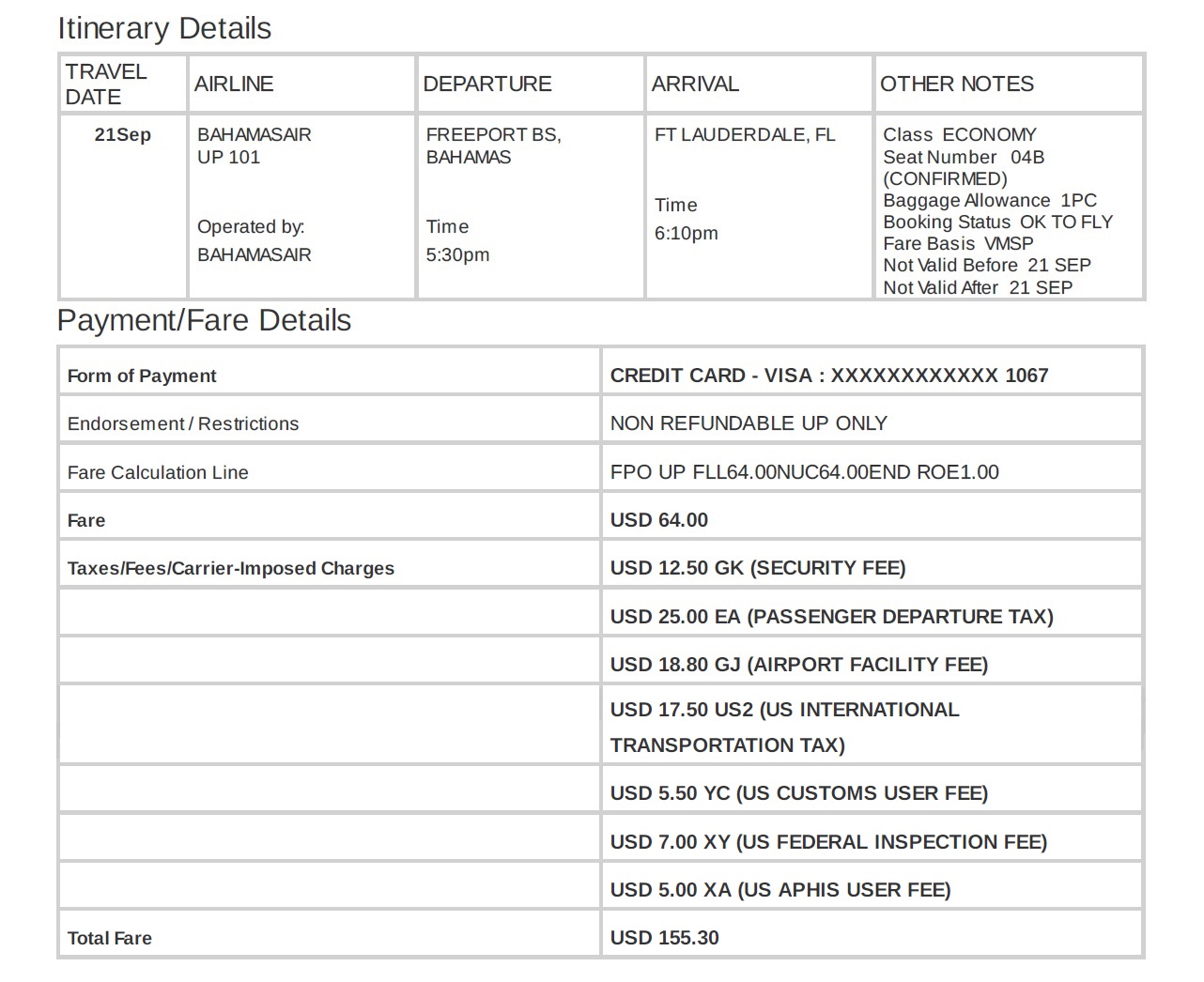

So the “defect is our own”. – The Bible

Shrewd management of taxes can encourage or discourage good or bad behavior. For example, high “sin” taxes on tobacco and alcohol tend to dissuade consumption; and tax cuts tend to incentivize investments. This is a known fact! And yet, many Caribbean member-state governments charge exorbitant fees and taxes for basic air travel – sometimes the fees are higher than the air fare themselves – see below.

This subject is part of the focus on the economic realities of “flying the Caribbean skies”. This commentary continues the 3-part series on Flying the Caribbean Skies. This entry is 2 of 3 in this series from the movement behind the book Go Lean … Caribbean in consideration of societal defects in the region’s management of air travel. These defects have awful-ized an already depressed economic situation in the Caribbean region. The other commentaries in the series are cataloged as follows:

  1. Flying the Caribbean Skies: New Regional Options
  2. Flying the Caribbean Skies: ‘Shooting Ourselves in the Foot’ – ENCORE
  3. Flying the Caribbean Skies: The Need to Manage Airspace

All of these commentaries relate to “how” the stewards for a new Caribbean can empower regional commerce by optimizing the air travel eco-system. This submission asserts that empowerment in this industry space can begin right at the front door, the portal to air travel, the airports. In a previous Go Lean commentary, this governing flaw was exposed. This commentary is an ENCORE of that previous blog from December 6, 2014.

See that submission here:

——————————-

Go Lean Commentary –  Caribbean less competitive due to increasing aviation taxes

The book Go Lean … Caribbean relates the significance of supporting the airline industry so as to facilitate the region’s primary economic driver: Tourism.

Tourism is a leisure activity; many times participants in leisure are in no hurry to get to their destinations, they often drive. This relates to countries on a continental mainland; but for islands, not so much. For 27 of the 30 Caribbean member-states, island life is the reality. (Belize is in Central America; Guyana and Suriname are in South America).

If speed is not the requirement then boating should be an option. But the only boating/transport options for Caribbean tourists are cruise lines.

This following article relates the biggest threat to Caribbean tourism is Caribbean governments. These ones are authorized to assess taxes, but for far too often they have targeted airline tickets to generate needed revenues. This is such a flawed strategy, a betrayal of the public trust. They “cut off their nose to spite their face”, as the article here relates:

By: Ernie Seon, Caribbean-360 Contributor

CU Blog - Caribbean less competitive due to increasing aviation taxes - Photo 1ST. THOMAS, US Virgin Islands – The International Air Transportation Association (IATA) Tuesday urged regional aviation authorities to adhere to the key principles set out by International Civil Aviation Organization.

IATA’s regional vice president for the Americas, Peter Cerda said it is unfortunate that many governments had chosen to ignore the principles, a global issue that was particularly acute in the Caribbean.

Addressing tourism and industry officials gathered here on the occasion of World Aviation Day, Cerda noted that aviation taxes continue to increase the cost of travelling to the Caribbean. He said this made the region less competitive to other destinations.

“Taking the islands as a whole, each dollar of ticket tax could lead to over 40,000 fewer foreign passengers,” he said, adding that US$20 million of reduced tourist expenditure meant 1,200 fewer jobs across the region.

“Caribbean countries must therefore consider the aviation industry as a key element for tourism development,” he advised.

The IATA official noted that in terms of charges, two airports in the region, Montego Bay and Kingston, both in Jamaica, recently proposed airport tariff increases of over 100 per cent so as to attain a return of capital of around 20 per cent a year in US dollars.

He said that measures such as these do not encourage or support the development of the industry in the region.

“The regulators must act strongly and swiftly against such big increases. Governments have to foster positive business environments through consultation with the industry and transparency in order to ensure win-win situations for all,” he warned.

Cerda said the issue of taxes and charges in the region transcends the formal breaches of global standards and recommended practices and that the simple truth is that this region is a very expensive place for airlines to do business.

In the Caribbean, tourism and the aviation sector facilitate and support some 140,000 jobs and contribute US$3.12 billion, roughly 7.2 per cent of the Caribbean’s gross domestic product (GDP).

The airline industry is celebrating its 100th anniversary year in the black, according to industry figures released here. Globally, airlines are expected to earn a net profit of US$18 billion in 2014.

Cerda noted that while that might sound impressive, on revenues of US$746 billion, this is equivalent to a net profit margin of 2.4 per cent or US$5.42 per passenger carried.

“Looking only at Latin America and the Caribbean, the airlines in this region are expected to earn $1.1 billion.”This is a profit of US$4.21 per passenger and a net margin of three per cent. We are in a tough and very competitive business,” he added.

The aviation official said fuel expense across the Caribbean is estimated at 14 per cent higher than the world average, adding that this represents about a third of an airline’s operating costs.

He noted that in the case of the Dominican Republic, although fuel charges were recently reduced, tax on international jet fuel still remains high at 6.5 per cent.

“Another example is the Bahamas applying a seven per cent import duty on Jet fuel. Jet fuel supply is an issue in the region, the complexity of the fuel supply and the seasonal demand is costly and difficult, making fuel costs in the region a challenge for airlines.”

In addition, Cerda noted that airports are using the fuel concession fees as a source of revenue and they are still waiting to see any of these monies re-invested in improving fuel facilities.

On the issue of safety, he said that this has been in the spotlight in recent months, with July being an especially sad month for all involved with aviation.

However, Cerda said despite the recent tragedies, flying remains by far the safest mode of transportation.

“Every day, approximately 100,000 flights take to the sky and land without incident. Nonetheless, accidents do happen. Every life lost recommits us to improve on our safety performance.

“It is no secret that safety has been an issue in this region. Even though it is still under performing the global average, performance is improving,” he said.

The IATA official said that the aviation industry has come a long way since the very first flight from St. Petersburg to Tampa 100 years ago, turning this large planet into one small world.

He said through it all, one thing has remained constant: when governments support the conditions for a thriving industry the economic benefits are felt by all.

However Cerda cautioned that for the industry to deliver the most benefits to the citizens in the Caribbean and spur additional tourism and trade, “we need to be able to compete on a level playing field and have the infrastructure capacity needed to grow.”

He said he remains confident that if the Caribbean governments continue to strengthen their partnership with the aviation industry, “we will deliver the unique transformative economic growth only our industry can deliver, making the second century of aviation in this region even more beneficial than the first”.
Caribbean-360 Online News (Posted 09/17/2014; retrieved 12/06/2014) –
http://www.caribbean360.com/news/caribbean-less-competitive-due-to-increasing-aviation-taxes-iata-warns

This foregoing article highlights a defective premise, predatory taxing, and so thusly depicts the need for improved regional oversight of economic and governing engines.

CU Blog - Caribbean less competitive due to increasing aviation taxes - Photo 2See this photo of a recent airline ticket (price breakdown), for one of the stakeholders in the Go Lean movement, who was travelling from a Caribbean island. The reality of these aviation taxes defies logic!

Yes, the governments need their revenues, but this should not be pursued at the expense of undermining viable economic engines; this is self-defeating. Likewise there was a recent conflict with British Aviation Authorities and their unilateral tax on Caribbean air transport. The solution there/then is the same as now: regional coordination and a heightened advocacy; see AppendixVIDEO.

Change has now come to the Caribbean. The book Go Lean … Caribbean serves as a roadmap for the introduction and implementation of the Caribbean Union Trade Federation (CU), an alliance of the 30 Caribbean member-states. This Go Lean roadmap has 3 prime directives:

  • Optimization of the economic engines in order to grow the regional economy to $800 Billion and create 2.2 million new jobs..
  • Establishment of a security apparatus to protect the resultant economic engines.
  • Improve Caribbean governance to support these engines.

The roadmap calls for the CU to navigate the changed landscape of the globalized air transport industry. There is the need for regional integration, administration, and promotion for Caribbean air travel among local and foreign carriers. The book posits that transportation and logistics empower the economic engines of a community. There must be air carrier solutions to service the transportation and tourism needs of the Caribbean islands. This point is fully appreciated by Caribbean tourism stakeholders; the book relates that the region’s Hotel and Tourism Association channel the vision of Robert Crandall, former Chairman of American Airlines, who remarked at a Caribbean Hotel and Tourism Investment Conference in May 2010 that the region is uniquely dependent on tourism:

“Everyone involved in travel and tourism knows that our [airline] industry is immensely important to the world economy, generating and supporting – either directly or indirectly – about one in eleven jobs worldwide. Here in the Caribbean, it is even more important. On a number of islands, travel and tourism accounts for more than 50% of all employment, and on some islands for more than 75%. Overall, about 20% of Caribbean employment is travel and tourism dependent – something on the order of 2.5 million jobs.” – Go Lean … Caribbean Page 60.

The Go Lean book asserts that air travel options must be optimized to impact Caribbean society – thus the need for more regional coordination, regulation and promotion of the Caribbean’s aviation industry. New models are detailed in the book in which tourism can be enhanced with “air lifts” to facilitate Caribbean events, and “Air Bridges” to allow for targeting High Net Worth markets. This roadmap also introduces the Union Atlantic Turnpike to offer more transportation solutions (ferries, toll roads, railways, and pipelines) to better facilitate the efficient movement of people and cargo.

This is one way the CU will empower the region’s economic engines. This is an example of the change that the CU technocracy will bring!

The Go Lean book presents a series of community ethos that must be adapted to forge this change. In addition, there are these specific strategies, tactics, implementation and advocacies to apply:

Community Ethos – Job Multiplier Page 22
Community Ethos – Lean Operations Page 24
Community Ethos – Cooperatives Page 25
Community Ethos – Ways to Improve Sharing Page 35
Community Ethos – Impacting the Greater Good Page 37
Strategy – Customers – Visitors Page 47
Strategy – Competitive Analysis – Event Patrons Page 55
Strategy – Core Competence – Tourism Page 58
Anecdote – Caribbean Hotel & Tourism Assoc. focus on Air Transport Page 60
Tactical – Fostering a Technocracy Page 64
Tactical – Commerce – Tourism Promotion Page 78
Tactical – Aviation Administration & Promotion Page 84
Implementation – Ways to Deliver Page 109
Implementation – Trade Mission Objectives Page 116
Planning – 10 Big Ideas for the Caribbean Region – #7: Virtual Turnpike Page 127
Planning – Ways to Improve Trade Page 128
Advocacy – Ways to Improve Governance Page 168
Advocacy – Ways to Optimize Government Revenue Sources Page 172
Advocacy – Ways to Enhance Tourism Page 190
Advocacy – Ways to Impact Events Page 191
Advocacy – Ways to Market Southern California – Air Bridge Page 194
Advocacy – Ways to Improve Transportation – Aviation Promotion Page 205
Appendix – Airport Cities – New Approach for Optimizing Business Model Page 287

This commentary posits that the status quo of Caribbean aviation taxes reflect a flawed economic policy, reflective of the dysfunction in the region. This commentary also relates to other lessons of economic optimizations and dysfunctions previously detailed in Go Lean blogs, as sampled here:

Caribbean must work together to address regional industry threats – Example of Rum Subsidies
A Lesson in Aviation History: Concorde SST and the Caribbean
New York-New Jersey Port Authority – Lessons from an Airport Landlord
Bahamas Re-organizing Government Revenues in 2015 with VAT Implementation
Lessons Learned from the American Airlines Merger
Book Review: ‘Wrong – Nine Economic Policy Disasters and What We Can Learn…’
Caribbean Changes – Air Antilles Launches St. Maarten Service
Tourism’s changing profile – Need for Competition and Comparative Analysis

The world loves the Caribbean; people want to come visit and enjoy our hospitality. It is better for them, and for us in the region that they come by air transport. But cruises are viable options, though the Caribbean communities get less benefits from cruise lines (Pages 61 & 193). We simply “fatten our frogs for snake”. The more dysfunction we create with air transport – like these excessive  aviation taxes – the more we push visitors to the cruise option; meaning less direct-indirect spending: hotels, taxis, restaurants, casinos, etc.

Now is the time to lean-in to this roadmap for Caribbean change, as depicted in the book Go Lean…Caribbean. We cannot afford to undermine our economic strengths with disabling tax policies. This is a public trust, betrayed. The Caribbean can – and must – do better.  🙂

Download the free e-Book of Go Lean … Caribbean – now!

Sign the petition to lean-in for this roadmap for the Caribbean Union Trade Federation.

————

APPENDIX Video: A Tax Too Far…? – http://youtu.be/Jbh8DJxUNC8

Uploaded on Oct 30, 2011 – A documentary on how the Air Passenger Duty instituted by the UK is affecting Caribbean Tourism, and the lobbying efforts of the Caribbean Tourism Organization to have it reduced, removed, or the Caribbean re-banded. Get more information about the APD on the CTO website: http://www.onecaribbean.org/our-work/advocacy/

Share this post:
, , , ,
[Top]

Flying the Caribbean Skies – New Regional Options

Go Lean Commentary

Look back at Economic History and we see a consistent lesson: nations that deploy efficient transportation systems always thrived as world powers. Consider these examples of the interchangeability of transportation and trade:

  • Romans built roads, facilitating trade and military advancement.
  • British, Dutch, French and Spanish empires thrived in trade due to their efficient shipbuilding and navigational artistry.
  • Railroad expansion across North America allowed the manifestation of the greatest industrial might in the history of mankind.
  • Banana boats created foreign markets for a tropical perishable produce, and originated cruise travelling.
  • Highway deployments allowed America to regroup and exceed competitors just as other nations where catching up with rail.
  • The “Jet Age” opened the Caribbean up to be the ideal winter tourism destination; “get there fast and then take it slow”.

This last one, is the focus of this series of commentaries; the economic realities of “flying the Caribbean skies”. This commentary commences a 3-part series on Flying the Caribbean Skies. This entry is 1 of 3 in this series from the movement behind the book Go Lean … Caribbean in consideration of societal defects in the region’s management of air travel. There is a lot wrong and a lot of remediation that needs to be done. The other commentaries in the series are cataloged as follows:

  1. Flying the Caribbean Skies: New Regional Options
  2. Flying the Caribbean Skies: ‘Shooting Ourselves in the Foot’ – ENCORE
  3. Flying the Caribbean Skies: The Need to Manage Airspace

All of these commentaries relate to “how” the stewards for a new Caribbean can empower regional commerce by optimizing the air travel eco-system, and the dependent industries. Our efforts to reform and transform the Caribbean economic engines would be incomplete without re-addressing air travel. Problems emerged in the last decade; there was one dominant airline that used to service most of the Caribbean member-states, and then they downsized their Caribbean footprint. That was American Airlines. In a previous Go Lean commentary, this debilitating history was related:

The 2008 financial crisis placed a heavy strain on the US’s largest carrier: American Airlines. On July 2, 2008, American announced furloughs of up to 950 flight attendants, in addition to the furlough of 20 MD-80 aircraft. American’s hub at Luiz Muñoz Marin Airport in San Juan, Puerto Rico (PR) was truncated from 38 to 18 daily inbound flights. The holding company, AMR Corporation, filed for Chapter 11 bankruptcy protection on November 29, 2011, and the airline made cuts in July 2012 due to the grounding of several aircraft associated with its bankruptcy and lack of pilots due to retirements. American Eagle, the regional carrier, (the Caribbean’s largest), was to retire 35 to 40 regional jets as well as its entire Saab turboprop fleet. [b] American Eagle PR ceased operation in March 2013. This status created dysfunction for the entire Eastern Caribbean region.

The stakeholders for American Airlines met and deliberated; then they made a decision and executed a plan that devastated Caribbean commerce. Caribbean stakeholders were “not at the table” but we were “on the menu”.

Now that American Airlines have downsized, the Caribbean has become totally dysfunctional with the air travel eco-system. A few other airlines, stepped into the void, but not at the same level and production; air travel options are now more limited, and expensive. So more and more tourists are travelling to the Caribbean by cruise ships. With less and less air travel fulfillments, that means less stay-overs, so less hotels, restaurants, taxi cabs, etc.. This type of dysfunction affects all “job multipliers” (indirect employment down the line) in the society.

No wonder our Caribbean member-states are nearing Failed-State status.

With cracks in the economic “chain-link”, the whole job creation utility becomes dysfunctional, and the Caribbean landscape for jobs is dire. We have some work to do, to fill the void.

If the one airline, the foreign American Airlines, is a primary culprit for Caribbean Airspace dysfunction, then facilitating a local airline solution would be moving in the right direction. See one news article here, identifying a new regional carrier:

Title #1: Saint Lucia welcomes new regional airline

Press Release: The inaugural flight of InterCaribbean Airways arrived at the George FL Charles Airport, on Thursday, March 22, at 6:55 pm, from the island of Dominica. The flight marks the commencement of a direct service, 3 times a week, between Saint Lucia’s George FL Charles Airport (SLU) and Dominica’s Douglas–Charles Airport (DOM).

Flight JY293 was welcomed by the Minister of Tourism, Information and Broadcasting the Hon. Dominic Fedee, Chairperson of the Saint Lucia Tourism Authority Agnes Francis, Airport Manager for George FL Charles Kirby Toussaint and other tourism officials. The honoured guests included airline Owner and Chairman Lyndon Gardiner along with CEO Trevor Sadler.  Guests were greeted with steel band music and welcome refreshments upon disembarking the aircraft.

The new route will be serviced by an Embraer EMB120, with a seating capacity of 30. The flights will arrive from DOM at 6:55 pm on Sunday, Monday and Thursday and depart from SLU at 9:00 am on Monday, Tuesday and Friday. The service provides onward connections to the northern Caribbean including the BVI reaching as far north as Havana with an additional direct service to Saint Croix commencing on April 12.

Speaking on the airlines role in regional travel Owner/Chairman Lyndon Gardiner stated, “Our dream is connecting the entire Caribbean, we feel that once we have better air connectivity we will be able to have better integration and be able to market the Caribbean as a single destination, offering more multi-destination vacations in our region”

The airport’s proximity to the island’s main business hub and largest cluster of hotels makes it the ideal point of entry for regional travel. In 2017 the Caribbean market overtook the United Kingdom as the second largest producer of stay-over arrivals, generating 76,349 or 19.8% of total stay-over arrivals to the destination.

Minister of Tourism, Information and Broadcasting the Hon. Dominic Fedee commented on the value of the increased airlift saying, “We look forward to the opportunities that this flight allows, which connects us to even more gateways across the Caribbean.”

Source: Retrieved April 21, 2018 from: https://stluciatimes.com/2018/03/30/saint-lucia-welcomes-new-regional-airline/

There is a heightened deficiency in the region today, and now only a small number of airline carriers have answered the call. This dysfunction has created the urgency for permanent change. This is a prime directive of the book Go Lean … Caribbean, to optimize the region’s economic engines, including enhancements for Caribbean tourism, cruise and “long stay” visitors.

The book Go Lean…Caribbean – available to download for free – serves as a roadmap for the introduction and implementation of the technocratic Caribbean Union Trade Federation (CU), for the elevation of Caribbean society – for all member-states. This CU/Go Lean roadmap fully has these 3 prime directives:

  • Optimization of the economic engines in order to grow the regional economy to $800 Billion and create 2.2 million new jobs.
  • Establishment of a security apparatus to ensure public safety and protect the resultant economic engines.
  • Improve Caribbean governance to support these engines, including a separation-of-powers between the member-states and CU federal agencies.

American Airlines is more than just a regional carrier; they are the world’s largest airline; see VIDEO in the Appendix below. In addition to their planes-flights, they also facilitate an alliance with other carriers around the world, to form the OneWorld Alliance. This alliance was detailed in that previous blog-commentary, listing this inventory as of May 2014:

Airline Base Country / Region
Airberlin Germany – Central Europe
American Airlines USA – North America
British Airways United Kingdom, Western Europe
Cathay Pacific Airways Hong Kong (China), Far East Asia
Finnair Finland – North Europe
Iberia Spain / Portugal – Southern Europe
Japan Airlines Japan – Far East Asia
LAN Airlines Chile/Peru – South America
Malaysia Airlines Malaysia – Southeast Asia
Qantas Australia – Austra-Asia
Qatar Airways Middle East
Royal Jordanian Middle East
S7 Airlines Russia – Siberia
TAM Airlines Brazil – South America
US Airways USA – North America

So the Caribbean took a beating, economically, because of the decline and failure of this one private American company.

You see it, right? You see the “too many vulnerable eggs in one basket”; this is called “country risk”:

Country risk also refers to the broader notion of the degree to which political and economic unrest affect the securities of issuers doing business in a particular country. – Source.

Yes, there is vulnerability of placing our own economic fortunes in the hands of just one foreign entity. This is a consistent complaint of the Go Lean movement against the Caribbean member-states:

We have subjected ourselves to be parasites, rather than protégés.

A more appropriate Caribbean solution would be to forge an equivalent multi-airline alliance. In fact, there is such an effort in place now, though limited. See the news article here identifying a new alliance in the Eastern Caribbean:

Title #2: Caribbean airline alliance promises lower fares

Barbados Nation – Three Caribbean airlines have formed an alliance which promises to make it easier and cheaper for travellers to move between 32 countries.

Antigua-based LIAT, Air Antilles of Guadeloupe and St Maarten’s Winair have joined forces under the CaribSKY project which is co-funded by the European Union’s INTERREG Caribbean programme to the tune of 4.7 million euros.

The details of the project were revealed on Tuesday during a media conference at La Creole Beach Hotel and Spa in Guadeloupe.

Air Antilles chief executive officer Serge Tsygalnitzky said CaribSKY would allow passengers to travel on any of the three airlines on one ticket. This will be facilitated through codeshares and interline agreements.

“Sometimes, a customer has to purchase two tickets, three tickets to get to a single place. Now, what we want you to be able to do is travel seamlessly anywhere you want to with a single ticket,” he told regional media.

Tsygalnitzky said passengers would benefit from more direct flights and connections, lower fares, a better airport experience and a loyalty programme.

At the same time, LIAT, Winair and Air Antilles will be able to share know-how, optimise schedules and bring their teams together while maintaining separate identities.

Together, it projected that the three airlines will operate 25 aircraft and transport 1 400 000 passengers annuals on 70 000 flights.

LIAT’s chief executive officer Julie Reifer-Jones said inter-regional travel was declining and it was hoped that CaribSKY will make it easier for passengers to move through the English, French, Spanish and Dutch-speaking territories.

In brief remarks, LIAT chairman Dr Jean Holder pointed out that the Caribbean was the most airline dependent region in the world and social, economic and cultural life depended on the extent to which there is connectivity.

St Maarten’s Minister of Tourism, Economic Affairs, Transportation and Telecommunications, Cornelius de Weever also highlighted the importance of CaribSKY.

He pointed out that it is often easier and cheaper to cross the Atlantic than to visit a Caribbean territory.

Source: Retrieved April 23, 2018 from: https://stluciatimes.com/2018/04/19/caribbean-airline-alliance-promises-lower-fares/

This too is a good start, though limited to the small Eastern Caribbean sub-region. The Go Lean movement presents the plan to forge an alliance of multiple parties throughout the whole Caribbean region, all 30 member-states in benefit to the 42 million people. The book stresses that regional alliances are the best ways to reform and transform the Caribbean societal engines. This was an early motivation for the roadmap, as pronounced in the opening Declaration of Interdependence (Pages 12 – 13):

viii. Whereas the population size is too small to foster good negotiations for products and commodities from international vendors, the Federation must allow the unification of the region as one … agent, thereby garnering better terms and discounts.

xvi. Whereas security of our homeland is inextricably linked to prosperity of the homeland, the economic and security interest of the region needs to be aligned under the same governance. Since economic crimes … can imperil the functioning of the wheels of commerce for all the citizenry, the accedence of this Federation must equip the security apparatus with the tools and techniques for predictive and proactive interdictions.

xxiv. Whereas a free market economy can be induced and spurred for continuous progress, the Federation must install the controls to better manage aspects of the economy: jobs, inflation, savings rate, investments and other economic principles. Thereby attracting direct foreign investment because of the stability and vibrancy of our economy.

The Go Lean book provides 370-pages of turn-by-turn instructions on “how” to adopt new community ethos, plus the strategies, tactics, implementations and advocacies to execute so as to reboot, reform and transform the societal engines of Caribbean society. One advocacy (Page 205) details the CU’s role in promotion activities for air travel, with this quotation:

Aviation plays a key role, and so there is the need for regional coordination and promotion of the region’s domestic and foreign air carriers.

Yes, we can better promote air travel in the Caribbean; we can make our homeland a better place to live, work, fly & play. 🙂

Download the free e-book of Go Lean … Caribbean – now!

Sign the petition to lean-in for this roadmap for the Caribbean Union Trade Federation.

————-

Appendix VIDEO – World’s largest airline fleet || American Airlines Current And Future Fleet – https://youtu.be/ULGL_yTORMs

Great Aviation
Published on Jan 23, 2018 – American Airlines current as well as the airplanes it has ordered. All the types as well as their seat configurations.


Share this post:
, , , ,
[Top]