‘Crap Happens’ – So What Now?

Go Lean Commentary

The peril of a hurricane is a constant threat for Caribbean life, for all 30 member-states. It is assured that some Caribbean location will be impacted every year. While there is no guarantee for a strike “here or there”, there is a guarantee that there will be a strike somewhere.

“Bad things happen to good people”.

11  I have seen something further under the sun, that the swift do not always win the race, nor do the mighty win the battle, nor do the wise always have the food, nor do the intelligent always have the riches, nor do those with knowledge always have success, because time and unexpected events overtake them all. 12  For man does not know his time. Just as fish are caught in an evil net and birds are caught in a trap, so the sons of men are ensnared in a time of disaster, when it suddenly overtakes them. – Ecclesiastes 9:11,12 NWT

There is concern for the whole region, and for individual communities. Let’s consider one example…

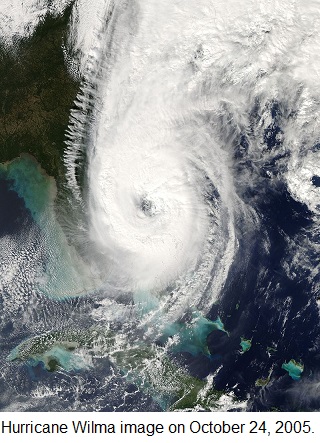
The people of Freeport, Grand Bahama, in the Bahamas are good people! The impact of Hurricane Wilma in October 2005 was a bad thing; (especially after 2 earlier storms in 2004). This is a classic example of “bad things happening to good people”.  See the article reference here:

Title: Effects of Hurricane Wilma in The Bahamas

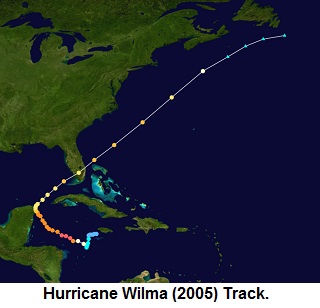
CU Blog - Crap Happens - So What Now - Photo 1The effects of Hurricane Wilma in The Bahamas were generally unexpected and primarily concentrated on the western portion of Grand Bahama. Hurricane Wilma developed on October 15, 2005 in the Caribbean Sea, and after initially organizing slowly it explosively deepened to reach peak winds of 185 mph (295 km/h) and a record-low pressure of 882 mbar (hPa). It weakened and struck eastern Mexico as a Category 4 hurricane on the Saffir-Simpson scale, and accelerated northeastward to make landfall on southwestern Florida on October 24. After crossing the state, Wilma briefly re-strengthened in the open Atlantic Ocean, moving north of The Bahamas before weakening and later becoming an extra-tropical cyclone.[1]

On October 24, Hurricane Wilma made its closest approach to The Bahamas, passing about 150 km (90 mi) north-northwest of Freeport.[1] While passing the archipelago, Wilma produced hurricane force winds and powerful storm surge, flooding southwestern coastal areas of Grand Bahama and destroying hundreds of buildings. Damage totaled about $100 million (2005 USD), almost entirely on the western half of the island. Central Grand Bahama, including the Freeport area, reported minor to moderate damage, while the eastern end received little to no damage. One child died on the island from the flooding.

Impact
On Grand Bahama Island, Wilma produced sustained winds of 155 km/h (95 mph) and a gust of 178 km/h (111 mph).[4] The hurricane also produced a storm surge of over 3.7 m (12 ft),[1] reportedly as high as 6.1 m (20 ft) along the southwestern portion of the island.[3] The surge, which moved about 305 m (1,000 ft) inland, caused large-scale flooding that washed away or destroyed about 800 homes.[5][6] Damage was estimated at $100 million (2005 USD) on the western portion of the island. Excluding the southwestern region of Grand Bahama, the majority of the island reported minor wind damage, and the eastern end of the island reported little, or no, damage.[5] Over 7,000 people on the island were directly affected by the hurricane, many of whom had not fully recovered from hurricanes Frances and Jeanne during the previous year.[3]

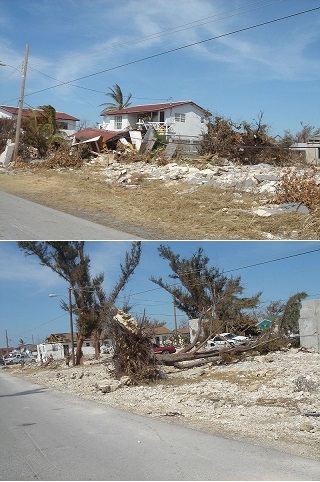
CU Blog - Crap Happens - So What Now - Photo 2Significant damage was reported in coastal areas of Grand Bahama Island, with widespread destruction of roofs and vehicles, along with downed poles and trees.[1] Power and telephone services were disrupted throughout the island.[3] A total of 400 structures sustained damage, of which about 200 commercial buildings were severely damaged and recommended by engineers not to be repaired.[5] Among the destroyed buildings were a police station on the western end and several buildings in Freeport.[7] More than 500 automobiles were flooded,[5] including five police cars.[7] The storm surge also raised 54 corpses in five graveyards on the island.[5] Several resorts were closed for an extended period of time,[5] all on the western portion of the island. One hotel, the Xanadu Beach and Marine Resort, reported about $3.5 million in damage (2005 USD), including numerous destroyed windows designed to withstand hurricane force winds.[8] Further to the east, numerous houses and commercial buildings lost their roofs in the city of Freeport. One serious traffic accident occurred when the winds overturned a bus, inflicting injuries on the driver. Several other traffic accidents were reported in the area, although none were severe. During the passage of the hurricane, five cases of looting were reported, of which one person was caught in the process.[7] Storm surge from the hurricane killed one child,[3] the only casualty directly related to Wilma in the archipelago.[1]

Aftermath
CU Blog - Crap Happens - So What Now - Photo 3By about two days after the passage of Hurricane Wilma, 800 residents on Grand Bahama remained in shelters,[3] including 65 families who lost their homes and stayed in a hotel set up as a government shelter in Freeport.[5] On Bimini, most residents who evacuated to shelters returned to their homes within two days of the hurricane.[3] The Bahamian Red Cross quickly assessed the damage on Grand Bahama and Bimini, and successfully requested to be included under the federation’s hurricane appeal for Central America. Local Red Cross chapters mobilized all available resources to assist the residents most affected. The Bahamian Red Cross began a three-month program to distribute food and other items to 1,000 of the 3,500 affected families, primarily on Grand Bahama; the remaining 2,500 families received assistance from the government and other organizations. Volunteers delivered building materials and provided water vouchers to those affected. In Nassau, the Red Cross disaster contingency stock sent a boat with food items, blankets, health kits, tarpaulins and water.[11] About a week after the hurricane, the United States Agency for International Development began providing $50,000 (2005 USD) to the Bahamian National Emergency Management Agency for the purchase and distribution of emergency supplies. The agency also provided $9,000 (2005 USD) for locally contracted helicopter assessments in the affected areas.[10] Red Cross agencies throughout the Caribbean Sea provided hygienic kits, plastic sheeting, blankets, and jerry cans.[11]

Electricians had power restored to the Freeport area by the day after the storm,[2] and had power restored to most of the western portion of the island within three weeks after the hurricane.[5] Work crews quickly removed road debris and tree limbs, and by the day after the passage of Wilma most roads were cleared. The passage of the hurricane left 1,000–4,000 people and hundreds of animals homeless. In response, the Grand Bahama Humane Society distributed about 340 kg (750 lb) of dog food and treated or euthanized injured animals, depending on their condition.[6] The earlier effects of Wilma on Mexico left many tourist areas in that country closed, leading to a 10% increase in tourism in the Bahamas in December 2005.[12] By about three weeks after the hurricane, the airport on Grand Bahama Island was reopened, and all but one resort were also reopened;[13] the remaining resort was reopened about two months after the hurricane.[14]
Source: Wikipedia Online Reference Source – Retrieved February 13, 2016 from: https://en.wikipedia.org/wiki/Effects_of_Hurricane_Wilma_in The Bahamas
The City of Freeport got special recognition in the book Go Lean … Caribbean. It was cited for this recognition as a token of what was wrong in the Caribbean, plus how to reform and transform the communities. So what lessons can we all learn from Hurricane Wilma’s rampage in Freeport in 2005?

This incident is an example that “Crap Happens”. This represented a ‘Clear and Present Danger’ to everyday life for the everyday man in the City of Freeport and surrounding areas. The lesson is not just for potential “911 dangers” in a community but rather for regional catastrophes, throughout the Caribbean. This includes natural disasters (hurricanes, earthquakes, volcanoes, floods, forest fires, etc.), industrial incidents (chemical & oil spills), bacterial & viral pandemics and terrorism-related events.

This discussion is presented in conjunction with the Go Lean book. It asserts that bad things (and bad actors) will always emerge to disrupt the peace and harmony in communities. All Caribbean member-states need to be on guard and prepared for this possibility.

The Go Lean book (Page 23) prepares for many modes of “bad things/actors”. It defines them as industrial mishaps, natural disasters and other “acts of God”. The book relates that these happenings are historical facts that are bound to be repeated, again and again.

So now that we accept the premise that “Crap Happens”, can we better prepare for the eventuality of bad things happening to good people?

“When we fail to plan, we plan to fail”.

This point is pronounced early in the book with the opening Declaration of Interdependence (Page 12) that claims:

i. Whereas the earth’s climate has undeniably changed resulting in more severe tropical weather storms, it is necessary to prepare to insure the safety and security of life, property and systems of commerce in our geographical region. As nature recognizes no borders in the target of its destruction, we also must set aside border considerations in the preparation and response to these weather challenges.

ii. Whereas the natural formation of the landmass for our lands constitutes some extreme seismic activity, it is our responsibility and ours alone to provide, protect and promote our society to coexist, prepare and recover from the realities of nature’s occurrences.

x. Whereas we are surrounded and allied to nations of larger proportions in land mass, populations, and treasuries, elements in their societies may have ill-intent in their pursuits, at the expense of the safety and security of our citizens. We must therefore appoint “new guards” to ensure our public safety and threats against our society, both domestic and foreign. The Federation must employ the latest advances and best practices … to assuage continuous threats against public safety.

xii. Whereas the legacy in recent times in individual states may be that of ineffectual governance with no redress to higher authority, the accedence of this Federation will ensure accountability and escalation of the human and civil rights of the people for good governance, justice assurances, due process and the rule of law. As such, any threats of a “failed state” status for any member state must enact emergency measures on behalf of the Federation to protect the human, civil and property rights of the citizens, residents, allies, trading partners, and visitors of the affected member state and the Federation as a whole.

xvi. Whereas security of our homeland is inextricably linked to prosperity of the homeland, the economic and security interest of the region needs to be aligned under the same governance. Since economic crimes, including piracy and other forms of terrorism, can imperil the functioning of the wheels of commerce for all the citizenry, the accedence of this Federation must equip the security apparatus with the tools and techniques for predictive and proactive interdictions.

So the Go Lean book relates that the Caribbean must appoint “new guards”, or a security apparatus, to ensure public safety and to include many strategies, tactics and implementations considered “best-practices” for Emergency Management (Preparation and Response). We must be on a constant vigil against these “bad actors”, man-made or natural. This indicates being pro-active in monitoring, mitigating and managing risks. Then when “crap” does happen, as it always will, the region’s “new guards” must be prepared for any “Clear and Present” danger.

The Go Lean book serves as a roadmap for the introduction and implementation of the technocratic Caribbean Union Trade Federation (CU). The CU would roll the charters of all Emergency Management agencies in the region into one initiative, not replacing the individual Emergency Management operations, but rather providing a Unified Command and Control for Emergency operations to share, leverage and collaborate their practice across the whole region. (A previous blog-commentary detailed the historicity – and failures of the current Caribbean Disaster Emergency Management Agency or CDEMA).

The Go Lean/CU roadmap has a focus of optimizing Caribbean society through economic empowerment, and homeland security. Emergency preparedness and response is paramount for this quest. In fact, the Go Lean roadmap has the following 3 prime directives:

  • Optimization of the economic engines in order to grow the regional economy to $800 Billion & create 2.2 million new jobs.
  • Establishment of a security apparatus to protect the resultant economic engines and the Caribbean homeland.
  • Improvement of Caribbean governance to support these engines.

The CU Homeland Security forces have to always be “on guard”, on alert for real or perceived threats. The legal concept is one of being deputized by the sovereign authority for a role/responsibility in the member-state. So when “crap” happens, these CU forces are expected to aid, assist, and support local resources in these member-states. The request is that all Caribbean member-states empower this Homeland Security force to execute this limited scope on their sovereign territories. The legal basis for this empowerment is a Status of Forces Agreement (SOFA), embedded in the CU treaty from Step One/Day One. This would authorize the CU for its role and responsibility for all the “crap” that could happen in jeopardizing the peace and prosperity of the Caribbean people. The CU Trade Federation would lead, fund and facilitate this Emergency Management functionality under the discretion of a regionally elected Commander-in-Chief for the CU.

CU Blog - Caribbean Ghost Towns - It Could Happen - Photo 5The foregoing article relates $100 million of economic impact of Hurricane Wilma on Freepot. Freeport could not afford that! Even now – 10 years later – the community is still reeling from that economic chaos. In some circles, Freeport is considered a “ghost town” – see photo here of the once bustling International Bazaar. So preparing effectively for disasters must include economic and financial solutions as well. The Go Lean roadmap details financial solutions, in preparing for the financial responsibility of the region’s disaster needs. Consider this quotation (Page 196) from the book:

There is also a financial battlefield for Emergency Management. Reinsurance “sidecars” allow investment bonds to be issued in the financial marketplaces to raise casualty insurance capital. The differences between premiums (plus reserves) and claims equal the profit to be shared with investors. The end result should be an insurance fund of last resort.

This reinsurance “sidecar” strategy is a win-win for communities, insurance companies and investors. (Imagine bonuses and dividend checks distributed every year on December 2, as the hurricane season ends on December 1). This type of solution aligns with the popular movement in many US States (and other democracies) that motorists provide financial solutions in face of the risks (to themselves and others) of operating motor vehicles. These provisions are defined as the ‘Financial Responsibility Law’. The technical definition of this provision is as follows:

A law which requires an individual to prove that he or she is able to pay for damages resulting from an accident. A financial responsibility law does not specifically require the individual to have insurance coverage; instead, the law requires the individual to be able to demonstrate the financial capacity to pay, even if the individual is not at fault. This type of law is commonly associated with automobiles.

… many states consider an individual with an insurance policy to be compliant with a financial responsibility law, since most insurance policies have a minimum coverage that meets the State’s standard.

Source: http://www.investopedia.com/terms/f/financial-responsibility-law.asp#ixzz40CobgMfg retrieved February 14, 2016.

Consider the VIDEO here of an American insurance company’s commercial advertising:

VIDEO: Liberty Mutual Insurance TV Commercial – Fully Replace Lost Propertyhttps://youtu.be/P7tkWIsr5zQ

TV Commercial – At Liberty Mutual Insurance, we pay to fully replace damaged property so you don’t have to touch your savings. Learn more here: https://www.libertymutual.com/

The Caribbean is arguably the “greatest address on the planet”, but there is risk associated with living deep in a tropical zone. With the reality of Climate Change, we must not be caught unprepared. We do not want our citizens fleeing their homeland … anymore; we want them to prosper where they are planted. So as a community, we must provide assurances. While this is a heavy-lifting task, this is the purpose of the Go Lean/CU roadmap. So the message is clear:

“We will have the finances to restore the economic engines after any natural disaster”.

The Go Lean book details the series of community ethos, strategies, tactics, implementations and advocacies to provide the proactive and reactive public safety/security in the Caribbean region:

Community Ethos – Economic Systems Influence Individual Choices Page 21
Community Ethos – Consequences of Choices Lie in Future Page 21
Community Ethos – “Crap” Happens Page 23
Community Ethos – Cooperatives Page 25
Community Ethos – Ways to Impact the Future Page 26
Community Ethos – Ways to Improve Sharing Page 35
Community Ethos – Ways to Promote Happiness Page 36
Community Ethos – Ways to Impact the Greater Good Page 37
Strategy – Vision – Confederating a non-sovereign permanent union Page 45
Strategy – Agents of Change – Climate Change Page 57
Tactical – Fostering a Technocracy Page 64
Tactical – How to Grow the Economy – Recover from Disasters Page 70
Tactical – Separation of Powers – Homeland Security Department Page 75
Tactical – Separation of Powers – Emergency Management Agency Page 76
Tactical – Separation of Powers – Meteorological and Geological Service Page 79
Implementation – Ways to Pay for Change Page 101
Implementation – Start-up Homeland Security Initiatives Page 103
Implementation – Ways to Re-boot Freeport Page 112
Implementation – Ways to Foster International Aid Page 115
Planning – 10 Big Ideas – #3: Consolidated Homeland Security Pact Page 130
Planning – Ways to Make the Caribbean Better Page 131
Planning – Ways to Improve Failed-State Indices – Escalation Role Page 134
Advocacy – Ways to Grow the Economy – Quick Disaster Recovery Page 151
Advocacy – Ways to Improve Governance Page 168
Advocacy – Ways to Better Manage the Social Contract Page 170
Advocacy – Ways to Improve Homeland Security Page 180
Advocacy – Ways to Improve Intelligence Gathering & Analysis Page 182
Advocacy – Ways to Improve for Natural Disasters Page 184
Advocacy – Ways to Improve for Emergency Management Page 196
Advocacy – Ways to Impact Wall Street – Adopt Advanced Reinsurance Products Page 200

Other subjects related to Emergency Management, Homeland Security and governing empowerments for the region have been blogged in other Go Lean…Caribbean commentaries, as sampled here:

https://goleancaribbean.com/blog/?p=7327 Zika – An Epidemiology Crisis – A 4-Letter Word
https://goleancaribbean.com/blog/?p=7235 Flint, Michigan – A Cautionary Tale
https://goleancaribbean.com/blog/?p=6893 A Meteorologist’s View On Climate Change
https://goleancaribbean.com/blog/?p=6563 Lessons from Iceland – Model of Recovery
https://goleancaribbean.com/blog/?p=6189 A Lesson in History – Hurricane ‘Katrina’ is helping today’s crises
https://goleancaribbean.com/blog/?p=6103 Sum of All Fears – ‘On Guard’ Against Deadly Threats
https://goleancaribbean.com/blog/?p=5002 Managing a ‘Clear and Present Danger’
https://goleancaribbean.com/blog/?p=4741 Vanuatu and Tuvalu Cyclone – Inadequate response to human suffering
https://goleancaribbean.com/blog/?p=4360 Dreading the ‘Caribbean Basin Security   Initiative’
https://goleancaribbean.com/blog/?p=4185 Caribbean Ghost Towns: It Could Happen…Again
https://goleancaribbean.com/blog/?p=2614 The ‘Great ShakeOut’ Earthquake Drill / Planning / Preparations
https://goleancaribbean.com/blog/?p=2397 Stopping a Clear and Present Danger: Ebola
https://goleancaribbean.com/blog/?p=1817 Caribbean grapples with intense new cycles of flooding & drought
https://goleancaribbean.com/blog/?p=87 Fact, not fiction: 6.5M Earthquake Shakes Eastern Caribbean

The Caribbean is on the frontlines of this Climate Change-induced storm battle! We are not the only ones; there are winners (consider northern cities with milder than normal winters) and losers. The Caribbean has found itself on the losing side; consider the experience of Freeport in the foregoing article. This could mean life-and-death for the people and the economic engines of Caribbean communities.

This reflects the change that the Caribbean region now has to endure. The book Go Lean…Caribbean posits that this “Agent of Change” is too big for just any one member-state to tackle alone, that there must be a regional solution; and presents this roadmap.

The people and institutions of the region are hereby urged to lean-in to this Go Lean roadmap; this plan is conceivable, believable and achievable. We can make the Caribbean a better place to live, work and play.  🙂
Download the book Go Lean … Caribbean – now!

Share this post:
, , ,

Brazilian Shrunken Head Babies: Zika or Tdap?

Go Lean Commentary:

CU Blog - Brazilian Shrunken Head Babies - Zika or Tdap - Photo 1“Call a spade a spade…”

… all of a sudden in 2014, Brazil signs a contract with Big Pharma to inoculate pregnant women with a TDAP booster and boom: a Microcephaly pandemic emerges.

Now “they” are banning pregnant women and all hoping to someday get pregnant from traveling to Latin America and the Caribbean…

… and this prohibition is in the middle of the Peak Winter tourist season.

Imagine the economic consequences. Imagine the public health and security consequences. Imagine the governmental complications.

This commentary urges the Caribbean to “call a spade a spade”, rather than blaming “it” all on mosquitoes. See the actual editorial article here:

Editorial Title: Brazilian Shrunken Head Babies: Zika or Tdap?

CU Blog - Zika - A 4-Letter Word - Photo 1In late 2014, the Ministry of Health of Brazil announced the introduction of the Tdap (Tetanus, diphtheria, and acellular pertussis) vaccine for all pregnant women in that country as part of its routine vaccination program. The move was aimed at trying to contain the resurgence of pertussis in Brazil.

In December 2015, the Brazilian government declared an emergency after 2,400 Brazilian babies were found to be born with shrunken heads (microcephaly) and damaged brains since October.

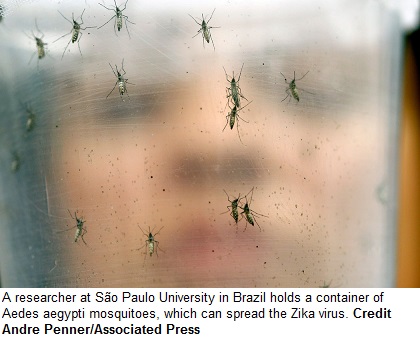
Brazilian public health officials don’t know what is causing the increase in microcephaly cases in babies born in Brazil, but they are theorizing that it may be caused by a virus known as “Zika,” which is spread by mosquitoes (Aedes aegypti)—in the same way as is the West Nile virus.

The theory is largely based on the fact that they found the Zika virus in a baby with microcephaly following an autopsy of the dead child. The virus was also found in the amniotic fluid of two mothers whose babies had the condition.

Note that Zika is not a new virus; it has been around for decades. No explanation has been given as to why suddenly it could be causing all these cases of microcephaly. No one is seriously asking the question, “What has changed?”

There is no theorizing about the possibility that the cases of microcephaly could be linked to the mandating of the Tdap vaccine for all pregnant women in Brazil about 10 months earlier. The government has “assumed” the cause is a virus.

FACT—Drug companies did not test the safety and effectiveness of giving Tdap vaccine to pregnant women before the vaccines were licensed in the U.S. and there is almost no data on inflammatory or other biological responses to this vaccine that could affect pregnancy and birth outcomes.

FACT—According to the U.S. Food and Drug Administration (FDA) adequate testing has not been done in humans to demonstrate safety for pregnant women and it is not known whether the vaccines can cause fetal harm or affect reproduction capacity. The manufacturers of the Tdap vaccine state that human toxicity and fertility studies are inadequate and warn that Tdap should “be given to a pregnant woman only if clearly needed.”

FACT—There are ingredients pertussis containing Tdap vaccine that have not been fully evaluated for potential genotoxic or other adverse effects on the human fetus developing in the womb that may negatively affect health after birth, including aluminum adjuvants, mercury containing (Thimerosal) preservatives and many more bioactive and potentially toxic ingredients.

FACT—There are serious problems with outdated testing procedures for determining the potency and toxicity of pertussis vaccines and some scientists are calling for limits to be established for specific toxin content of pertussis-containing vaccines.

FACT—There are no published biological mechanism studies that assess pre-vaccination health status and measure changes in brain and immune function and chromosomal integrity after vaccination of pregnant women or their babies developing in the womb.

FACT—Since licensure of Tdap vaccine in the U.S., there have been no well designed prospective case controlled studies comparing the health outcomes of large groups of women who get pertussis containing Tdap vaccine during pregnancy either separately or simultaneously compared to those who do not get the vaccines, and no similar health outcome comparisons of their newborns at birth or in the first year of life have been conducted. Safety and effectiveness evaluations that have been conducted are either small, retrospective, compare vaccinated women to vaccinated women or have been performed by drug company or government health officials using unpublished data.

FACTFACT—The FDA has licensed Tdap vaccines to be given once as a single dose pertussis booster shot to individuals over 10 or 11 years old. The CDC’s recommendation that doctors give every pregnant woman a Tdap vaccination during every pregnancy—regardless of whether a woman has already received one dose of Tdap—is an off-label use of the vaccine.

FACT—Injuries and deaths from pertussis-containing vaccines are the most compensated claims in the federal Vaccine Injury Compensation Program (VICP) and influenza vaccine injuries and deaths are the second most compensated claim.

FACT—A 2013 published study evaluating reports of acute disseminated encephalomyelitis (ADEM) following vaccination in the U. S. Vaccine Adverse Events Reporting System (VAERS) and in a European vaccine reaction reporting system found that pertussis containing DTaP was among the vaccines most frequently associated with brain inflammation in children between birth and age five.

Tdap is manufactured by two pharmaceutical companies: Sanofi Pasteur of France and GlaxoSmithKline (GSK) of the United Kingdom.

The Sanofi Pasteur product contains aluminum phosphate, residual formaldehyde, residual glutaraldehyde, and 2-phenoxyethanola, along with the following growth mediums and process ingredients: Stainer-Scholte medium, casamino acids, dimethyl-beta-cyclodextrin, glutaraldehyde, formaldehyde, aluminum phosphate, modified Mueller-Miller casamino acid medium without beef heart infusion, ammonium sulfate, 2-phenoxyethanol, water for injection.

The GSK product contains aluminum hydroxide, sodium chloride, residual formaldehyde, polysorbate 80 (Tween 80), along with the following growth mediums and process ingredients: modified Latham medium derived from bovine casein, Fenton medium containing bovine extract, formaldehyde, Stainer-Scholte liquid medium, glutaraldehyde, aluminum hydroxide.

Unsurprisingly, the Brazilian government announced on January 15, 2016 it will direct funds to a biomedical research center (Sao Paulo-based Butantan Institute) to help develop a vaccine against Zika. Development of the vaccine is expected to take 3-5 years. Again, no consideration to the irony that you may be developing a vaccine to address a problem that may have been CAUSED by a vaccine, and that that new vaccine may COMPOUND the problem No consideration to the possibility that the answer to the problem may not be to do MORE, but rather to do LESS (simply STOP giving Tdcap to pregnant women).

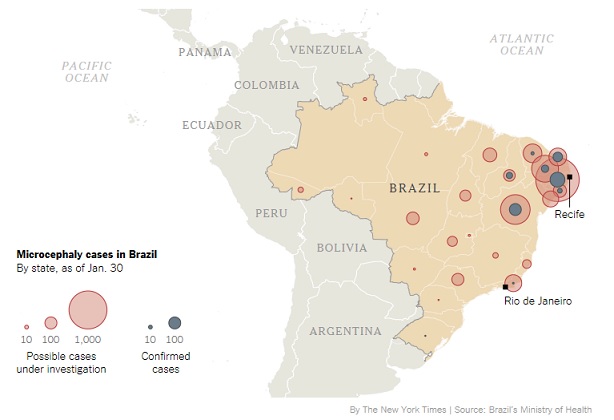
The number of cases of microcephaly in Brazil has grown to 3,530 babies, as of mid-January 2016. Fewer than 150 such cases were seen in all of 2014.

Most of the microcephaly cases have been concentrated in Brazil’s poor northeast, though cases in Rio de Janeiro and other big cities have also been on the rise, prompting people to stock up on mosquito repellent. Health officials are warning Brazilians—especially pregnant women—to stay inside when possible and wear plenty of bug spray if they have to go out.

Wanna look up the ingredients in mosquito spray? Oh, and what deadly insecticide do you reckon they’ll mass fumigate with? DDT perhaps?

(Note. Contains information pieced together—often copy and pasted—from newspaper articles and information from the NationalVaccineInformationCenter.)
Source: Anonymous Blog Entry – WordPress.com – Posted 02-04-2016; retrieved 02-08-2016 from: https://brazilianshrunkenheadbabies.wordpress.com/about/


Other Zika-related thinking to consider:

This commentary parallels with the book Go Lean … Caribbean in its quest to elevate societal life in the Caribbean. The book identifies that “bad actors” will always emerge to exploit the economic engines in the community. For the Zika virus, the “bad actor” was assumed to be mosquitoes; now it appears something more insidious is at work: This constitutes an accusation against Big Pharma. But that’s OK, this is not our first accusation and probably will not be the last. See here for previous blog/commentaries indicting Big Pharma’s cronyism:

Book Review – ‘Thimerosal: Let The Science Speak’
Judge to decide on Vaccination Amidst Autism Fears
Big Pharma & Criminalization of American Business
Climate Change May Bring More Kidney Stones
New Research and New Hope in the Fight against Alzheimer’s Disease
Health-care fraud in America; Criminals take $272 billion

These Go Lean commentaries are accusing Big Pharma of being willing to …

…Sacrifice children on the altar of corporate profits.

Yes, that is the accusation. In the case of Brazil’s Zika virus pandemic, the “bad actor” appears to be the Pharmaceutical companies and their consorts in the government’s public health agencies.

This all sounds familiar, as in the controversy with child immunizations and the public fear of a connection with Autism. Once these types of accusations are publicized, Big Pharma responds … by attacking and discrediting the accusers. So just wait: soon come the denials, defense and discrediting attacks for this allegation … any moment now.

This strategy is also consistent in the “play book” of climate change deniers and other Crony-Capitalistic enterprises (i.e. Big Tobacco).

This point is where this commentary relates to the overall plan to elevate Caribbean society: the book Go Lean…Caribbean. This book declares (Page 157) that Big Pharma may be more of an obstacle than a aid for effecting community health. They care more about profits than they do the well-being of the public, or the Greater Good. The Caribbean must therefore assume the leadership for its own destiny, and not be dependent on other parties. We must be protégés and not parasites.

Big Pharma is not the only stakeholders involved in this drama, as the directing organization is the World Health Organization. The WHO has altruistic motives in protecting the public health of the entire world, but at times their motives and executions can be flawed, biased and influenced by capitalistic forces. How much of these dynamics are at play now? Just consider the BIG economic issues attendant to this Zika viral outbreak:

  • Peak Winter Tourism Season in the Caribbean
  • Spring Break 2016 – Mexican and Caribbean locales are “hotspots”.
  • 2016 Olympics in Brazil
  • Future Public Health mandate to “force” TDAP immunization on pregnant women.

This champion for the Zika virus, the WHO, is not the WTO nor the World Bank; though they are all multilateral/UN agencies but with different specialties, scopes and charters. Here is the WHO’s declaration:

The World Health Organization has declared the Zika virus an international public health emergency, prompted by growing concern that it could cause birth defects. As many as four million people could be infected by the end of the year. Officials at the Centers for Disease Control and Prevention have urged pregnant women against travel to about two dozen countries, mostly in the Caribbean and Latin America, where the outbreak is growing. (Source: http://www.nytimes.com/interactive/2016/health/what-is-zika-virus.html retrieved 02-08-2016).

See VIDEO here!

VIDEO – Understanding Zika – http://www.nytimes.com/interactive/2016/health/what-is-zika-virus.html?_r=0

There it is … this declaration appears to be legitimately concerned about public health. But alas, the Zika virus has been around since 1947 and never related to microcephaly. Now all of sudden, there is this correlation. Something seems awry; mosquitoes have not evolved that much, that fast. This foregoing editorial article, therefore may not be so far-fetched.

The Caribbean needs to take its own lead for its own causes. The Go Lean book strategizes a roadmap for economic empowerment in the region, clearly relating that healthcare, and pharmaceutical acquisitions are important in the quest to make the Caribbean a better place to live, work, heal and play. At the outset of the Go Lean book, in the Declaration of Interdependence (Page 11), these points are pronounced:

viii. Whereas the population size is too small to foster good negotiations for products and commodities from international vendors, the Federation must allow the unification of the region as one purchasing agent, thereby garnering better terms and discounts.

ix. Whereas the realities of healthcare and an aging population cannot be ignored and cannot be afforded without some advanced mitigation, the Federation must arrange for health plans to consolidate premiums of both healthy and sickly people across the wider base of the entire Caribbean population. The mitigation should extend further to disease management

The Go Lean book serves as a roadmap for the implementation and introduction of the technocratic Caribbean Union Trade Federation (CU). The CU‘s prime directives are identified with the following 3 statements:

  • Optimization of the economic engines in order to grow the regional economy and create new jobs.
  • Establishment of a security apparatus to protect the resultant economic engines.
  • Improvement of Caribbean governance to support these engines.

The CU Trade Federation has the prime directive of optimizing the economic, security and governing engines of the Caribbean region. The foregoing editorial depicts that abuses have entered the quest for best practices in health management for the Brazilian public; and maybe other countries. We must learn from this cautionary tale and do better in the Caribbean.

The foregoing editorial presents perplexing questions about the legitimacy of the cause of the current crisis: Is the mosquito really to blame?

The Go Lean roadmap posits that more innovations need to emerge in the region, so as to take our own lead for our own needs. The CU needs a prioritization on science, technology, engineering and medical (STEM) activities so as to enable such leadership.

This is the manifestation and benefits of Research & Development (R&D) ethos in the Go Lean/CU roadmap. The roadmap describes the elevation on society from such a priority. The following list details additional ethos, strategies, tactics, implementations and advocacies to optimize the region’s health deliveries and R&D investments:

Community   Ethos – Deferred Gratification Page 21
Community   Ethos – Economic Systems Influence Individual Choices and Incentives Page 21
Community   Ethos – The Consequences of Choices Lie in the Future Page 21
Community   Ethos – Governing Principles – Return on Investments Page 24
Community   Ethos – Governing Principles – Cooperatives Page 25
Community   Ethos – Non-Government Organizations Page 25
Community   Ethos – Ways to Impact Research & Development (R&D) Page 30
Community   Ethos – 10 Ways to Promote Happiness Page 36
Community   Ethos – Ways to Impact the Greater Good Page 37
Strategy – Integrate and unify region in a Single Market Page 45
Strategy – Agents of Change – Globalization Page 57
Tactical – Fostering a Technocracy Page 64
Tactical – Separation of Powers – Health Department Page 86
Tactical – Separation of Powers – Drug Administration Page 87
Implementation – Ways to Pay for Change Page 101
Implementation – Ways to Implement   Self-Government Entities – R&D Campuses Page 105
Implementation – Ways to Deliver Page 109
Planning – Ways to Improve Trade Page 128
Planning – Ways to Make the Caribbean Better Page 131
Planning – Ways to Better Manage Image Page 133
Advocacy – Ways to Improve Healthcare Page 156
Advocacy – Ways to Better Manage the Social Contract Page 170
Advocacy – Ways Foster Cooperatives Page 176
Advocacy – Ways to Improve Emergency Management Page 196
Advocacy – Ways to Impact Foundations Page 219
Advocacy – Ways to Impact Persons with Disabilities Page 228
Appendix – Emergency Management – Medical Trauma Centers Page 336

The promoters of the Go Lean roadmap does not purport to be an authority on medical or Public Health best practices. But we are logical, like everyone else in society and we can see rubbish when presented:

You can fool all of the people some of the time.
… some of the people all of the time.
But you  cannot fool all of the people all of the time.

The Go Lean economic-security-governance empowerment roadmap advocates for medical professionals making medical decisions, not accountants and business marketers. This imagery is the manifestation of Crony-Capitalism. There are so many examples in the US, and other countries. Consider the case of how one pharmaceutical company has been assailed over the cancer drug, Gleevec. This case study clearly depicts how the industry prioritizes profit over people.

Crony-Capitalism on the one hand, the Greater Good. on the other hand. These choices dictate public policies for economic, security and governing engines. Good, bad and ugly examples abound. The Caribbean is urged to choose its course wisely.

This is the calling for the CU Trade Federation, to set our community ethos to impact the Greater Good. Only then will we make the Caribbean a better place to live, work, heal and play. 🙂

Download the book Go Lean … Caribbean – now!

Share this post:
, , , ,
[Top]

The Road to Restoring Cuba

Go Lean Commentary

CU Blog - The Road to Restoring Cuba - Photo 3In a visit to Jamaica and CariCom leaders in April 2015,  US President Barack Obama concluded that 55 years of indifference towards Cuba was long-enough and that as of December 17, 2014 he had “set the machinery in motion” to normalize relations with Cuba. This descriptor paints the picture of a journey, a marathon and not just a “100-yard dash”.

What is the status of that journey now?

Where are we in the process? How are the issues being addressed?

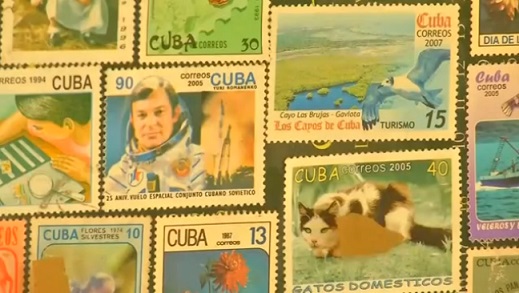
It turns out this is a weighty task (heavy-lifting), and while many of the issues are minor (i.e. Postal Mail), some are life-and-death (i.e. Human Trafficking).

Firstly, the current restoration of Cuban and American relations is strictly an act of Executive Orders – directives by the US President (currently of the Democratic Party) and not supported by his Republican legislature, the Congress. There is a definitive divide among these Democrats and Republicans in this regard. Here are some updates of those Executive Orders, since the December 2014 baseline:

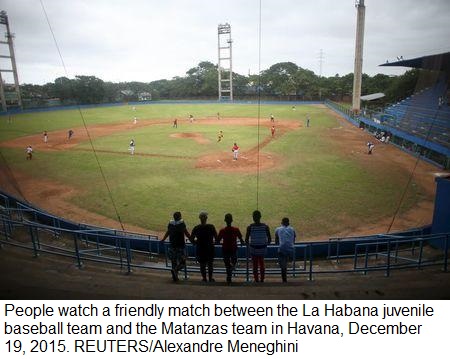
People watch a friendly match between the La Habana juvenile baseball team and the Matanzas team in Havana

People watch a friendly match between the La Habana juvenile baseball team and the Matanzas team in Havana

Cuba needs to have the American Trade Embargo officially lifted! This is a Congressional action and cannot be accomplished by Executive Orders alone.

The book Go Lean…Caribbean was designed with the intent of the eventual integration of Cuba in a Caribbean Single Market. This would allow for technocratic stewardship and oversight of the region’s economic, security and governing engines for all 30 Caribbean member-states. The book therefore serves as a roadmap for the introduction and implementation of the Caribbean Union Trade Federation (CU).

There is no minimizing of the risks and responsibility of Cuba in the Go Lean book. It is clearly recognized that integrating and restoring Cuba is a BIG deal; with heavy-lifting; and other reconciliation descriptors used to depict this monumental effort. See the relevant statement here from the opening Declaration of Interdependence (Page 12):

xiii. Whereas the legacy of dissensions in many member-states (for example: Haiti and Cuba) will require a concerted effort to integrate the exile community’s repatriation, the Federation must arrange for Reconciliation Commissions to satiate a demand for justice.

Though World War II was not directly waged in the Caribbean, the Go Lean/CU roadmap still prescribes a Marshall Plan strategy – a reference to the post-WWII European Rebuilding Plan – for re-building Cuba (and Haiti).

In truth, Cuba is the biggest market in the Caribbean. This one island has the largest landmass among the islands; (notwithstanding the landmasses of South America-situated CU member-states of Guyana and Suriname). They also have the largest population of 11,236,444 people (circa 2010) and the most agricultural output. Cuba needs the Caribbean; and the Caribbean needs Cuba. The entire region needs to act in unison as the challenges the region face are too big for any one country to tackle alone.

All in all, the book and accompanying blogs declare despite an absence of trade embargo in the other Caribbean member-states, that these countries have still failed to deliver to their citizens the standards assumed in any Social Contract. Some member-states are even flirting with Failed-State statuses. People in each Caribbean country are prone to flee the region, at every opportunity. The people of the region deserve better!

There is the need to re-boot … the entire region. This re-boot roadmap commences with the recognition that all the Caribbean is in crisis, and in the “same boat” despite the colonial heritage or language. All 30 geographical member-states need to confederate, collaborate, and convene for solutions. This is the purpose of the Go Lean/CU roadmap, as featured in this declaration of the Go Lean/CU prime directives:

  • Optimization of the economic engines in order to grow the regional economy to $800 Billion & create 2.2 million new jobs.
  • Establishment of a security apparatus to protect the resultant economic engines.
  • Improve Caribbean governance to support these engines.

Consider the start of the ill-fated Cuban-Communism Revolution in 1959, Cuba has lost 57 years in its maturation process. The Go Lean book’s opening Declaration of Interdependence (Page 11) also included this pronouncement that it is beyond time now for Caribbean success stories, rather than the continued Caribbean Failed-State stories:

While our rights to exercise good governance and promote a more perfect society are the natural assumptions among the powers of the earth, no one other than ourselves can be held accountable for our failure to succeed if we do not try to promote the opportunities that a democratic society fosters.

The Go Lean book therefore details the series of community ethos, strategies, tactics, implementations and advocacies to facilitate a re-boot in the region and to final manifest a quality delivery of a regional Social Contract:

Anecdote – Caribbean Single Market & Economy Page 15
Community Ethos – new Economic Principles Page 21
Community Ethos – new Security Principles Page 22
Community Ethos – new Governing Principles Page 24
Community Ethos – Ways to Impact the Future Page 26
Community Ethos – Ways to Manage Reconciliations – TRC Cuba Page 34
Community Ethos – Ways to Impact the Greater Good Page 37
Strategic – Vision – Integrated Region in a Single Market Page 45
Strategic – Vision – Core Competence – Specialty Agriculture Page 58
Tactical – Confederating a Non-sovereign Union Page 63
Tactical – Fostering a Technocracy Page 64
Tactical – CU Member-States   Facts & Figures Page 66
Tactical – Growing to $800 Billion Regional Economy – Marshall Plan Models Page 67
Tactical – Separation of Powers Page 71
Implementation – Ways to Pay for Change Page 101
Implementation – Foreign Policy Initiatives at Start-up Page 102
Implementation – Security Initiatives at Start-up Page 103
Implementation – Ways to Deliver Page 109
Implementation – Reasons to Repatriate Page 118
Planning – Big Ideas for the Caribbean Region – Marshall Plan for Cuba Page 127
Planning – Reasons Why the CU Will Succeed – Lessons from Unifying Germany Page 132
Planning – Ways to Improve Failed-State Indices Page 134
Planning – Lessons from East Germany – Post-Communism Integration Page 139
Planning – Ways to Model the EU – Immediate Integration after WWII Crisis Page 130
Advocacy – Ways to Grow the Economy Page 151
Advocacy – Ways to Improve Governance Page 168
Advocacy – Ways to Better Manage the Social Contract Page 176
Advocacy – Ways to Re-boot Cuba Page 236

The issue of Cuba’s eventual integration into the Caribbean brotherhood has previously been addressed in the following Go Lean commentary-blog entries:

https://goleancaribbean.com/blog/?p=6664 Cuba to Expand Internet Access
https://goleancaribbean.com/blog/?p=4506 Colorism in Cuba … and Beyond
https://goleancaribbean.com/blog/?p=3455 Restoration of Diplomatic Relations with Cuba
https://goleancaribbean.com/blog/?p=3354 CariCom Chairman calls for an end to US Embargo on Cuba
https://goleancaribbean.com/blog/?p=2330 ‘Raul Castro reforms not enough’, Cuba’s bishops say
https://goleancaribbean.com/blog/?p=1609 Cuba mulls economy in Parliament session
https://goleancaribbean.com/blog/?p=554 Cuban cancer medication registered in 28 countries
https://goleancaribbean.com/blog/?p=436 Cuba Approves New “Law on Foreign Investment”

For a long time people have hoped for a restored Cuba. This hope was shared by Cuban people on the island and in the Diaspora abroad. The hope is also shared by neighbors, tourists, trading-partners, and international stakeholders, alike. Maybe, just maybe with President Barack Obama’s Executive Orders, the journey down this road to restoration will be irreversible. (A new President of the US will be sworn-in on January 20, 2017; this one can reverse Obama’s Executive Orders).

The Go Lean roadmap for the CU strives to put the Command-and-Control of Caribbean affairs in the hands of Caribbean people. The book and accompanying blogs declare the desire for the Caribbean to no longer be a parasite of the US, but rather a protégé. This parasite status stems all the way back to the year 1898 – to the start of the Spanish – American War for Cuban Independence.

Enough already! Surely we have grown since 1898 or even since 1959.

The Go Lean…Caribbean movement turns the corner, and instead of an American dependence, or a nationalistic independence, it leads the region in a new direction: neighborly interdependence. The Go Lean…Caribbean book is a turn-by-turn guide (370 pages) for the region to dive deeper in an integrated Single Market.

Now is the time for all of the Caribbean, the people – residents and Diaspora – and governing institutions, to lean-in for this Caribbean and Cuban re-boot. Now is the time to make this region – all 30 countries – a better place to live, work and play.  🙂

Download the book Go Lean … Caribbean – now!

————

Appendix A VIDEO – US-Cuba direct mail services to resume – http://news.yahoo.com/video/us-cuba-direct-mail-services-155808360.html

Posted Dec 12, 2015 – Cuba and the United States are to resume direct postal services after half a century of having to send mail via a third country. Paul Chapman reports.

————

Appendix B – News Article: As MLB seeks legal entry to Cuba, Obama considers playing ball

By: Daniel Trotta, Reuters

HAVANA (Reuters) – Major League Baseball is asking the U.S. government for special permission to sign players in Cuba, handing the administration of U.S. President Barack Obama the opportunity to try some baseball diplomacy while dealing a setback to human traffickers.

The U.S. trade embargo generally bars MLB from any agreement directing money to the Cuban government, but the White House says baseball is one area where it can advance U.S. goals and the Treasury Department’s Office of Foreign Assets Control (OFAC) has authority to allow a deal.

MLB and Cuba are closer than at any time since the 1959 revolution, as evidenced by a goodwill tour last week in which big leaguers, including Cuban defectors, gave clinics to Cuban youth.

“Indeed, baseball has a unique cultural significance to both the United States and Cuba. It is therefore an area where we can further our goals of charting a new course in our relations with Cuba and further engaging and empowering the Cuban people,” a senior administration official told Reuters.

Since Obama and Cuban President Raul Castro broke with Cold War history and announced detente a year ago, Obama has asked Congress to repeal the embargo, but the Republican majority has resisted. Instead the administration has used other means to promote exchanges.

If MLB were able to sign players in Cuba, where baseball is the most popular sport, it could end a wave of defections in which Cuban ballplayers put themselves in the hands of human traffickers and risk their lives on illegal journeys at sea.

Some 130 ballplayers have defected this past year, according to Cuban journalists.

But the best players on the island remain off limits, and the Cuban government stops them from leaving without permission, leading those with big-league dreams to turn to smugglers. In some cases, organized crime rackets force players to sign over huge cuts of future earnings, threatening players and their families.

“It’s not an uncommon story,” said Paul Minoff, a lawyer who represents Leonys Martin, an outfielder now with the Seattle Mariners who earned $15.5 million over the past five seasons with the Texas Rangers.

After defecting, Martin was held by armed men in Mexico for months, and under duress agreed to pay his captors 35 percent of his salary, Minoff said. When Martin reached America, he fought back. The smugglers sued Martin but the suit was dismissed after U.S. prosecutors brought criminal charges against them.

Cuban players have mostly stuck to a code of silence about their defections, but some details emerge through court cases.

When Yasiel Puig of the Los Angeles Dodgers left Cuba in 2012, he soon found himself entangled with Mexico’s notorious Zetas crime organization, which threatened to chop off his arm if it failed to receive a promised $250,000 fee.

While Puig signed a $42 million contract, others are abandoned in foreign countries, never to hit paydirt.

SOLUTION SOUGHT

To normalize the transfer of players, Major League Baseball has asked the Treasury’s OFAC for a specific license. The office has wide latitude to grant such licenses and can issue regulations to approve activity otherwise proscribed by the embargo.

OFAC Acting Director John E. Smith said he could not comment on the baseball case, but in general his office “acts in consultation with the State Department and other relevant U.S. government agencies in determining whether (authorizing transactions) would be consistent with current policy.”

MLB applied for its OFAC license in early June, MLB Chief Legal Officer Dan Halem told Reuters. Halem declined to detail the request except to say it included signing players in Cuba, stressing that baseball’s priority was to provide a safe and legal path for Cuban players.

“There’s a willingness on the part of our government to end the trafficking. The White House has been very sympathetic to helping us end some of the abusive practices,” Halem said.

Legally, experts say, there is no impediment to granting MLB’s request. Politically, it may be tricky to explain a deal that provides revenue for the Cuban government while favoring MLB, a $10 billion industry. The administration’s stated preference is to support Cuba’s private sector.

RETURN OF THE DEFECTORS

Cuba made a significant gesture when it permitted once-shunned defectors to return for the goodwill tour, including Puig and Jose Abreu, who has a $68 million contract with the Chicago White Sox.

When they left Cuba, Puig and Abreu had little hope of returning soon. The trip allowed Abreu to reunite with his 5-year-old son and Puig with a half-brother.

“This demonstrates that Cuba is open to the world, that we are not closed, not even with our players who are playing in MLB,” Higinio Velez, president of the Cuban Baseball Federation, told Reuters.

Attempting to slow the defections, Cuba has increased pay and allowed more players to sign in Japan, Mexico and elsewhere. Those leagues pay Cuba a fee equivalent to 10 percent of the player’s salary, but Cuba is believed to want more from MLB.

“This is a vulnerable time. It’s a reality that the exodus has harmed the level of our baseball,” Heriberto Suarez, Cuba’s National Baseball Commissioner, told Reuters.

With an MLB deal, Cuba could regulate the egress of players and protect its professional league, the country’s greatest sporting attraction. Sixteen teams are the pride of each province, the games infused with a conga beat celebration.

Should legally emigrated stars begin playing in the United States, they would pay taxes to Cuba, which is also likely to seek compensation for player rights. Both measures would require OFAC permission and help preserve the Cuban league.

(Additional reporting by Jeff Mason in Washington)
Source: http://news.yahoo.com/mlb-seeks-legal-entry-cuba-obama-considers-playing-191751615–mlb.html; posted December 23, 2015; retrieved February 4, 2016.

Share this post:
, , , ,
[Top]

Oil Refineries – Strategy for Advanced Economics

Go Lean Commentary

Energy is a basic need. We need it for a functional life in modern society.

Behavioral Scientist & Psychologist Abraham Maslow provided the world with his definitive Hierarchy of Needs[a]; he identified a pyramid, where at the bottom, or base level, are basic survival elements (food, water, shelter, etc.). Rise above that level, the next need relates to security and/or safety. Any consideration of energy (fuel and oil) need to address it as a basic need. Then once our survival has been facilitated, we then need to elevate and focus more on energy security. At this level, energy (fuel and oil) is not so basic or simple; it becomes a subject of Advanced Economics.

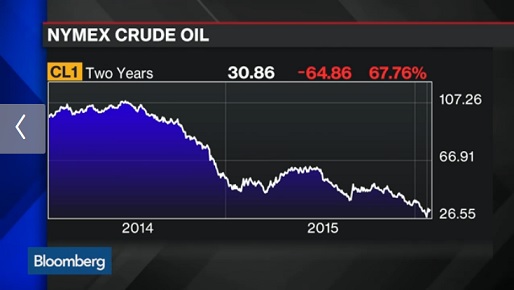
CU Blog - Oil Refineries - Strategic for Advanced Economics - Photo 3Today, gas prices have remained consistently low in the US for the past year and a half. The price per barrel had dipped as low as $30, (on the retail level prices have dropped below $2 per gallon), and now is hovering around $36.

This is good; this is bad. This is due to complexities within the Advanced Economics of crude oil supply-and-demand. Just recently, in 2008, retail gas prices where near $5 per gallon, while the wholesale price per barrel were straddling $130. This cyclical industry is amazingly complicated, and yet it so directly affects the everyday man, everyday. These “peaks and valleys” – “feasts and famine” – call for a more normalized system for oil producing/exporting countries. These cyclical extremes create crises and heighten the need for a more diversified economic system. See Appendix A regarding Saudi Arabia’s efforts to diversify. Now is the time too, for the Caribbean to plan for similar solutions.

The book Go Lean … Caribbean quotes noted Economist Paul Romer in his declaration that “a crisis is a terrible thing to waste”. We need to use the exigency of the current crisis to forge change in the Caribbean region. We can optimize the economic, security and governing engines of our Caribbean communities. There are a number of strategies for accomplishing this goal; one notable one is to apply lessons learned from other communities. We have such a role model in Saudi Arabia; they are known for their abundant oil wealth and yet the economic metrics are trending in the wrong direction:

Saudi Arabia’s reserves dropped to $611.9 billion at the end of 2015, the lowest level since 2011, down from $732 billion a year before, the Saudi Jadwa Investment said in an economic report.
Source: http://news.yahoo.com/saudi-fiscal-reserves-slide-4-low-weak-oil-104815796.html retrieved 02-02-2016.

Another strategy is maximizing the metrics of “supply-and-demand”. At its very heart, Economics is all about supply-and-demand. The more advanced the exercise in Economics, the more complex the dimensions of the supply-side and the demand-side of a commodity; in this case “oil”. There is BIG money in oil and assuredly too, BIG complications in the economic formulas. Yet still, there is more that the Caribbean community can do to optimize our demand and supply factors.

Previously, this commentary delved on the demand-side of the oil-for-energy eco-system; consider these blogs:

https://goleancaribbean.com/blog/?p=7056 Electric Cars: ‘Necessity is the Mother of Invention’
https://goleancaribbean.com/blog/?p=4587 Burlington, Vermont: First city to be powered 100% by renewables
https://goleancaribbean.com/blog/?p=915 Go Green Caribbean – Renewable energy pursuits in the region

Now we focus on the supply side. We can start first with bridging the gap between wholesale and retail prices. How? Oil refineries. There are a number of refineries in the region already. But obviously, not enough. See the list here:

Member-State

Plant

Legacy

Population Capacity – Barrels/day
Aruba

Aruba Refinery (Valero)

Dutch

106,000

275,000

Cuba

Nico López Refinery (Cupet or Cubapetroleo)

Spanish

11,236,444

122,000

Hermanos Díaz Refinery (Cupet)

102,500

Cienfuegos Refinery (Cupet)

76,000

Dominican Republic

Haina Refinery (REFIDOMSA)

Spanish

9,523,209

33,000

Jamaica

Kingston Refinery (PetroJam)

British

2,825,928

50,000

Martinique

Fort de France (SARA)

French

402,000

16,000

Netherlands Antilles

Dutch

231,834

Curaçao

Isla Refinery (PDVSA or Petróleos de Venezuela, S.A.)

320,000

Puerto Rico

Caribbean Petroleum Corporation oil refinery*

USA

3,994,259

0

Trinidad & Tobago

Pointe-à-Pierre Refinery (Petrotrin)

British

1,305,000

165,000

US Virgin Islands

St Croix Refinery (HOVENSA)

USA

108,848

494,000

TOTAL

42,198,874

979,000

* Shuttered in 2009 after a major fire-explosion; had a capacity of 48,000 barrels/day.
Source: Retrieved February 1, 2016 from https://en.wikipedia.org/wiki/List of oil refineries

The book Go Lean… Caribbean, a roadmap for the introduction and implementation of the Caribbean Union Trade Federation (CU), calls for confederating, collaborating and convening the 30 member-states of the region into a Single Market; and to one intergovernmental organization. The CU seeks to facilitate better strategies for Advanced Economics in the Caribbean region. This is part-and-parcel of the prime directives (3) of the CU/Go Lean roadmap:

  • Optimization of the economic engines – accepting that energy is as basic a need as food, clothing and shelter – in order to grow the regional economy to $800 Billion & create 2.2 million new jobs.
  • Establishment of a security apparatus, including energy security, to protect the resultant economic engines.
  • Improve Caribbean governance to support these engines.

By coordinating all the oil refineries in the region – a million barrels a day with the Puerto Rico option – in one concerted effort, there will be benefits for the wholesale and retail markets in the Caribbean. Why? Due to the realities of Advanced Economics.

In many Caribbean locales, gas is still priced near $5.00 per gallon, due to challenges in the supply-chain.

The initiatives addressed here will remediate challenges to the Caribbean energy supply. Then considering all the risk in the global markets, a closer, more technocratic delivery can also mitigate many risks. Consider a scenario of a retail price of $2 per gallon – highly probable as a result of this roadmap – and a wholesale crude price of $30 per barrel (1 barrel = 55 gallons), there is a definitive margin to still cover the cost of production (refinery) and distribution; ($110/barrel versus $30/barrel ). The more mature the eco-system for crude-to-gasoline production, the better the savings on the supply side. So when there are more local refinery capabilities, this leads to better cost dynamics (and profit) for fuel at the retail level.

The goal of the CU is to optimize Caribbean society in the dimensions of confederation, collaboration and consolidation. Consider these queries:

  • Can we deploy more oil refineries?
  • Can we provide more industrial financing for refinery expansion and upgrades?
  • Can we guarantee refineries the needed customers for their end-products?
  • Can we coordinate downtime among the array of refineries to allow for required maintenance windows?
  • Can we deploy pipelines to move crude or finished products from source location to destination?

The answers to all of these questions are “Yes, in the affirmative”. This is the power of the “collective” … for energy solutions. The Go Lean/CU roadmap calls for this type of cooperative effort, with the details of Purchasing Cooperatives and Utility Cooperatives, operating across national borders, within the region. The vision of a Single Market is a paradigm shift that forges benefits for all in the region: producers, wholesalers, retailers and consumers.

Pipelines will undoubtedly lower the cost of shipping fuel (crude or finished) among the island and coastal states.

Then too, consider the positive effects of developing a regional currency and capital market, as prescribed in the Go Lean roadmap. Trading in commodities, like crude oil, will be very viable for regional stakeholders. Local oil producers like Trinidad and Venezuela will be able to enter into commodities contracts to sell their crude oil, days, weeks, months and even years in advance. This too is the power of the “collective”, or Purchasing Cooperative, or Group Purchasing Organizations.

CU Blog - Oil Refineries - Strategic for Advanced Economics - Photo 4But there is a need for caution. The Go Lean/CU is not advocating “doubling down” on an oil-based economy. Rather, the strategy is just the opposite, to pursue the merits of diversification: energy diversity and economic diversity. There is too much pain associated with a mono-industrial economy. This is true for oil and true for tourism. There is always a need to “put the eggs in more than one basket”. But “it is what it is”. Oil is part of the energy solution today and this needs to be optimized. Oil dominated our past, and dominates our present, but hopefully there will be the need for less and less oil in the future. There is an urgency, in general, to wean-off from fossil fuels like oil to arrest Climate Change. The failure to do this has had dire consequences for our region – on the front-lines of global-warming-induced destructive hurricanes and rising sea levels.

The changes to lower the demand for oil needs to be planned and gradual. Sudden changes in the supply-chain creates economic shocks and devastating consequences to the economy. Just consider the impact on West Texas and North Dakota as depicted in this news VIDEO story here:

VIDEO:  The downsides of cheap oil – http://www.cbsnews.com/videos/is-cheap-gas-driving-the-oil-industry-broke

Posted January 31, 2015 – For people in the petroleum business, it’s a slippery slope: The plunge in oil prices that’s a boon for most of us [consumers] is a calamity for others. And it’s not just producers overseas taking the hit. Our Cover Story is reported here by Martha Teichner. (VIDEO plays best in Internet Explorer).

All of these empowerments on the macro-economy will surely make impact on the micro-economy: energy prices will decline and more jobs will emerge!

The Go Lean/CU roadmap proposes many solutions for the region to optimize energy generation, distribution and consumption. The book posits that the average costs of energy can be decreased from an average of US$0.35/kWh to US$0.088/kWh in the course of the 5-year term of this roadmap. This success will be a by-product of diversifying the energy eco-system with many alternative resources, like natural gas, solar, wind and tidal.

The Go Lean roadmap identifies 4,000 new jobs tied to cooperatives, 2,000 new jobs tied to Capital Markets and 2,000 new jobs tied to the Pipeline industry. In truth, these empowerments will impact every aspect of Caribbean life. The Caribbean homeland will then be better to compete globally and present more favorable options for our youth to stay home in the region. We fail miserably at this quest now!

The Go Lean book details a series of community ethos, strategies, tactics, implementations and advocacies to foster progress in the fields of energy generation, distribution, and consumption. The following list applies:

Community Ethos – Lean Operations – Group Purchasing Organizations (GPO) Page 24
Community Ethos – Return on Investments Page 24
Community Ethos – Cooperatives Page 25
Community Ethos – Regional Taxi Commissions – Ideal for Alternative Energy & GPO’s Page 25
Community Ethos – Non-Government Organizations Page 25
Community Ethos – Ways to Impact the Future Page 26
Community Ethos – Ways to Improve Negotiations Page 32
Anecdote – Pipeline Transport – Strategies, Tactics & Implementations Page 43
Strategy – Vision – Confederate to form a Single Market Page 45
Strategy – Mission –  Harness the power of the sun/winds Page 46
Tactical – Fostering a Technocracy Page 82
Tactical – Separation of Powers – Energy Commission Page 82
Anecdote – “Lean” in Government – Energy Permits Page 93
Anecdote – Caribbean Energy Grid Implementation Page 100
Implementation – Ways to Develop Pipeline   Industry Page 107
Implementation – Ways to Improve Energy Usage Page 113
Advocacy – Ways to Impact Public Works Page 175
Advocacy – Ways to Foster Cooperatives Page 176
Advocacy – Reforms for Banking – Create more working capital Page 199
Advocacy – Ways to Impact Wall   Street Page 200
Advocacy – Ways to Impact Monopolies – Utilities and State-owned Oil Companies Page 202
Advocacy – Ways to Improve Transportation Page 205
Advocacy – Ways to Develop the Auto Industry Page 206
Appendix – Sources of New Jobs Page 257

This commentary asserts that energy needs are undeniable. Options abound when the total Caribbean market is leveraged. This is the underlying strategy of the Caribbean Single Market. This point was pronounced from the outset of the Go Lean book in the opening Declaration of Interdependence (Page 11), with these statements as follows:

viii. Whereas the population size is too small to foster good negotiations for products and commodities from international vendors, the Federation must allow the unification of the region as one purchasing agent, thereby garnering better terms and discounts.

xxx. Whereas the effects of globalization can be felt in every aspect of Caribbean life, from the acquisition of food and clothing, to the ubiquity of ICT, the region cannot only consume, it is imperative that our lands also produce and add to the international community, even if doing so requires some sacrifice and subsidy.

The Go Lean/CU roadmap describes the execution of this roadmap as heavy-lifting.

So be it! Bring it on!

This “heavy-lifting” is the charter for the lean, agile operations of the CU technocracy.

Many of these heavy-lifting issues have been previously identified and detailed in prior Go Lean blog-commentaries. See here as some peripheral issues of energy supply-and-demand have been addressed:

https://goleancaribbean.com/blog/?p=6867 How to address high consumer prices – Fuel a BIG issue
https://goleancaribbean.com/blog/?p=6016 Hotter than July – The Need for Cooperative Refrigeration
https://goleancaribbean.com/blog/?p=5396 ‘Significant’ oil deposits found offshore Guyana
https://goleancaribbean.com/blog/?p=5155 Tesla unveils super-battery to power homes
https://goleancaribbean.com/blog/?p=4897 US Backs LNG Distribution Base in Jamaica
https://goleancaribbean.com/blog/?p=4587 Burlington, Vermont: First city to be powered 100% by renewables
https://goleancaribbean.com/blog/?p=926 Conservative heavyweights have solar industry in their sights in the US
https://goleancaribbean.com/blog/?p=915 Go Green Caribbean – Renewable energy pursuits in the region
https://goleancaribbean.com/blog/?p=273 10 Things We Want from the US – American Innovation

The message to the people of the Caribbean region is that there are solutions to these heady issues in the world energy markets. The Caribbean past is not to be the Caribbean future. Change is afoot!

Now is the time for all Caribbean stakeholders, to lean-in for the optimizations and empowerments described in the book Go Lean … Caribbean. Yes, we can make the region a better homeland to live, work and play.  🙂

Download the book Go Lean … Caribbean – now!

————-

Appendix A – Saudi Arabia to diversify economy away from oil

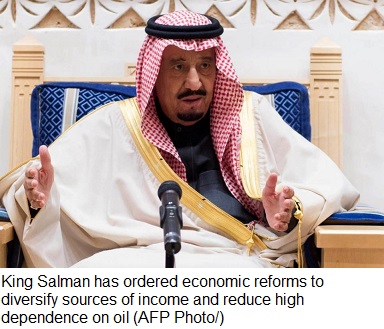
December 23, 2015 – Riyadh (AFP) – Saudi King Salman on Wednesday said he has ordered economic reforms to diversify sources of income and reduce high dependence on oil following a sharp drop in crude prices.

CU Blog - Oil Refineries - Strategic for Advanced Economics - Photo 1“Our vision for economic reform is to increase the efficiency of public spending, utilise economic resources and boost returns from state investment,” he said in an address to the Shura Council.

“I have directed the Council of Economic and Development Affairs to devise the necessary plans, policies and programmes to achieve that,” he told the consultative body, without elaborating.

Oil income accounts for more than 90 percent of public revenues in Saudi Arabia.

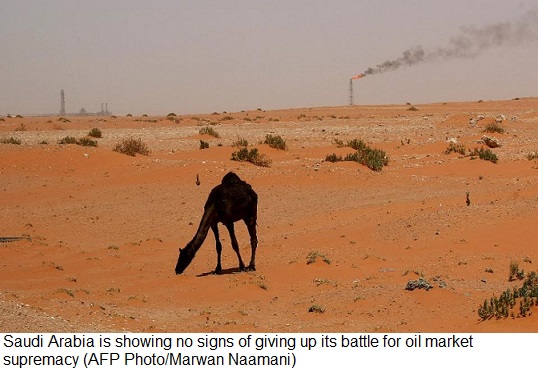
The world’s largest oil exporter, Saudi Arabia is facing an unprecedented budget crunch as the price of oil has dropped by more than 60 percent since mid-2014.

At midday Wednesday, benchmark Brent North Sea crude for delivery in February stood at $36.50 a barrel, hovering just above an 11-year low.

The king said Saudi Arabia carried out a large number of mega infrastructure projects and boosted its fiscal reserves in the past several years when oil prices were high.

The size of the fiscal buffers has enabled the kingdom to overcome the consequences from the sharp decline in oil revenues, said the king, adding that development projects have not been affected by the drop.

Saudi Arabia is projected to post a record budget deficit of around $130 billion for this year, the International Monetary Fund says.

CU Blog - Oil Refineries - Strategic for Advanced Economics - Photo 2The IMF has advised Riyadh to implement reforms, including expanding non-oil revenues, warning that failure to do so would deplete its foreign reserves.

The kingdom, which has been pumping around 10.4 million barrels a day, has withdrawn funds from its foreign reserves and also issued bonds to finance the budget deficit.

At the end of October, its reserves fell to $644 billion from $732 billion at the end of last year.

The finance ministry has issued bonds worth $20 billion for the domestic market.

In 2014, Saudi Arabia posted a budget deficit of $17.5 billion, only its second since 2002.

Source: http://news.yahoo.com/saudi-diversify-economy-away-oil-king-salman-151858656.html retrieved February 2, 2016.

————-

Appendix B – Citatation

a. Maslow, Abraham H. (1943). A Theory of Human Motivation. Psychological Review, 50(4), 370–96. Retrieved February 2, 2016.

Share this post:
, , , , ,
[Top]

ENCORE: Media Fantasies versus Weather Realities

Howell, Michigan@ Tuesday, February 2, 2016: Woody The Woodchuck dominates these parts while Punxsutawney Phil reigns supreme in Pennsylvania to the south. Different locales, different animals; same result: Media Fantasy! For 2016, Woody predicts a longer winter while Phil predicts a shortened winter.

LOL … These prognosticating rodents only boast a 39% success rate.

This ENCORE is re-distributed on the occasion of Groundhog Day 2016. Despite all the news of relevance and significance regarding the societal engines of economics, security and governance, the media outlets continue to prioritize their Breaking News declaring “Early Spring” and “Later Spring”. But we’ll see …

Go Lean Commentary

Dateline Monday, February 2, 2015: It’s Groundhog Day again…and again…and again…*

CU Blog - Media Fantasies Versus Weather Realities - Photo 3

The media swarms around this hibernating animal for prognosticating signs of what to expect for the rest of the winter weather season. This is a fantasy; an American media fantasy. On the other hand, there are many effective meteorological models that do an effective job of forecasting the weather, but many people think these are ignored in place of media hype; case in point: a Groundhog.

VIDEO – Punxsutawney Phil See His Shadow and Predicts 6 More Weeks of Winter – http://wapo.st/1BU7s23

A Groundhog?

Groundhogs, whistlepigs, woodchucks, all names for the same animal. Depending on where you live, you might have heard all three of these names; however, woodchuck is the scientifically accepted common name for the species, Marmota monax. As the first word suggests, the woodchuck is a marmot, a genus comprised of 15 species of medium-sized, ground-dwelling squirrels. Although woodchucks are generally solitary and live in lowland areas, most marmot species live in social groups in mountainous parts of Europe, Asia, and North America. (Source: http://blog.oup.com/2015/02/groundhog-day-urban-wildlife-institute/#sthash.c41AKDvb.dpuf)

The concept of weather forecasting requires hardware and software, not rodent animals. The Europeans have provided a good example for the Caribbean to model. Their hardware: satellites, are collaborative efforts to deploy, maintain and support, referred to as the European Organization for the Exploitation of Meteorological Satellites or EUMETSAT; see Appendix below.

The software for weather forecasting is the application of science and technology to predict the state of the atmosphere for a given location. These forecasts are made by collecting quantitative data about the current state of the atmosphere at a given place and using scientific understanding of atmospheric processes to project how the atmosphere will change. The chaotic nature of the atmosphere, the massive computational power required to solve the equations that describe the atmosphere, error involved in measuring the initial conditions, and an incomplete understanding of atmospheric processes mean that forecasts become less accurate as the time range of the forecast increases. The use of ensembles and model consensus help narrow the error and pick the most likely outcome.

A major part of modern weather forecasting is the severe weather alerts and advisories which a governmental weather service may issue when severe or hazardous weather is expected. This is done to protect life and property.[75] Some of the most commonly known severe weather advisories are the severe thunderstorm, tornado warnings, as well as the severe tornado watches. Other forms of these advisories include those for winter weather, high wind, flood, tropical hurricanes, and fog.[76] Severe weather advisories and alerts are broadcasted through the media, including radio, using emergency systems as the Emergency Alert System which break into regular TV and radio programming.[77]

Among the notable models for Caribbean consideration are:

  1. American Model: National Oceanic and Atmospheric Administration (NOAA)
  2. European Model: European Centre for Medium-Range Weather Forecasts (ECMRWF).

The scope of the American Model is weather affecting the American mainland and aligned territories. The European Model, on the other hand, has a similar scope for Europe, but starts their focus earlier with weather patterns in the Americas and Caribbean. (The “Jet Stream” brings weather from West to East across the US and then continues across the Atlantic on to the European continent).

The American and European models assume different strategies. The American model runs a short, mid and long range forecast. The European model considers mid-range only, running out only 10 to 15 days into the future.

This consideration aligns with the book Go Lean…Caribbean; this book serves as a roadmap for the introduction and implementation of the technocratic Caribbean Union Trade Federation (CU). This empowerment effort represents a change for the region, calling on all 30 member-states in the region to confederate and provide their own solutions in the areas of economics, security and governance. Weather, as depicted in the foregoing VIDEOS, relates to all three areas. The CU/Go Lean roadmap has these prime directives:

  • Optimization of the economic engines in order to grow the regional economy.
  • Establishment of a security apparatus to protect the resultant economic engines against “bad actors” and natural disasters.
  • Improve Caribbean governance to support these engines, with a separation-of-powers between federal and state agencies.

The purpose of this commentary is to draw reference to the European Model, ECMWF, at a time when the American eco-system appears to be dysfunctional and filled with bad intent.

ECMRWF is renowned worldwide as providing the most accurate medium-range global weather forecasts to 15 days and seasonal forecasts to 12 months.[2] Its products are provided to the European National Weather Services, as a complement to the national short-range and climatological activities. The National Meteorological Services of member-states use ECMWF’s products for their own national duties, in particular to give early warning of potentially damaging severe weather.

While many things the US do are good, there is also “bad intent” in the American eco-system, often associated with crony-capitalism. Many believe that media hype over weather forecasts spurs retail spending (surplus food, gasoline, generators, and firewood) to benefit the same companies that contract media purchases (advertising) with the media outlets. Consider the “blown out of proportion” sense in the following article:

About Juno: The how and why of a blown forecast http://www.mcall.com/news/breaking/mc-juno-snow-dud-lehigh-valley-20150127-story.html

January 27, 2015 – Those Lehigh Valley commuters dusting the powder off their windshields Tuesday morning undoubtedly cast their thoughts back a day and concluded something had gone amiss in all the weather laboratories.

Wasn’t it supposed to snow 14 inches? Or was it six? Or two to four? They said something about a European model…

Well, off to work.

The storm that might have been is now the storm that wasn’t and no one will mention it again, at least until the next big miss by the weather services.

CU Blog - Media Fantasies Versus Weather Realities - Photo 2“Mother nature humbled us,” the Eastern PA Weather Authority wrote in a mea culpa Facebook post after its final call of 9 to 14 inches fell roughly 9 to 14 inches short.

What happened? As always, forecasters looked at a variety of models — the European model, famed for its precise forecasting of Superstorm Sandy, and many domestic models — and made predictions based on the data.

Mitchell Gaines, a meteorologist with the National Weather Service in Mount Holly, N.J., said there are about 10 commonly used models that make use of weather observations gathered around the world from satellites, balloons, ground stations and ships.

“We blew the call, and everyone blew it,” the Eastern PA Weather Authority post said. “(A)mending or lowering your original call is not nailing it either. No one got this right, plain and simple.”

Not quite no one. Adam Joseph, a meteorologist at the ABC station in Philadelphia, had predicted an underwhelming storm for the Philadelphia# region from early on, saying on Sunday it had “high bust potential.”

New York Mayor Bill DeBlasio spent a couple of days making pronouncements so foreboding that he was parodied as an end-times prophet by [humor magazine] The Onion.

But instead of three feet of snow and blizzard winds, the city got about 8 inches of snow in Central Park. “Snore-easter,” the Daily News called it.

“This is an imprecise science,” New York# Governor Andrew Cuomo said at a news briefing early Tuesday when asked about the forecast. He noted that last November, a storm that officials had not expected to be severe dropped seven feet of snow on Buffalo, in the western part of the state.

In New Jersey#, Governor Chris Christie said it was better to err on the side of caution: “I was being told as late as 9 o’clock (Monday) night that we were looking at 20-inch accumulations in parts of New Jersey,” he said. “We were acting based on what we were being told.”

There was, too, something of a New York-centric slant in the media coverage. The storm was declared a “dud” because it largely spared Manhattan. But it slammed New England as advertised, with wind gusts approaching hurricane strength and smothering snow.

VIDEO MONSTER BLIZZARD OF 2015 | New York Snow Storm Juno Forecast was an EPIC FAILhttps://youtu.be/Je6zr_K966A

Published on Jan 28, 2015 – Jan. 27, 2015 will go down in the annals of history as the day New Jersey came to a standstill for a blizzard in another state. Blizzard warnings have been lifted in the Garden State, projected snow totals more than cut in half and forecasters have apologized for what they’re describing as “big forecast miss.”

Conspiracy, anyone?

The book Go Lean…Caribbean asserts that the Caribbean region must not allow the US to take the lead for our own nation-building, that American Crony-Capitalistic interest tends to hijack policies intended for the Greater Good. This assessment is logical considering that despite the reality of the 2008 Great Recession and the Wall Street complexity, no one has gone to jail! This despite the blatant “lying, cheating and stealing”, the millions of victims and $11 Trillion in economic setbacks.

Be kind, rewind …

In the fall of 2012, Super Storm Sandy devastated the Northeast American coast despite warnings and accurate forecasts from the European Model.

US vs. European hurricane model: Which is better?
By:
Tamara Lush; posted May 29, 2013; retrieved February 3, 2015 from:
http://news.yahoo.com/us-vs-european-hurricane-model-better-164750199.html

When forecasters from the National Weather Service track a hurricane, they use models from several different supercomputers located around the world to create their predictions.

Some of those models are more accurate than others. During Hurricane Sandy last October, for instance, the model from the EuropeanCenter for Medium-range Weather Forecasting in the United Kingdom predicted eight days before landfall that the large storm would hit the East Coast, while the American supercomputer model showed Sandy drifting out to sea.

The American model eventually predicted Sandy’s landfall four days before the storm hit — plenty of time for preparation — but revealed a potential weakness in the American computer compared to the European system. It left some meteorologists fuming.

“Let me be blunt: the state of operational U.S. numerical weather prediction is an embarrassment to the nation and it does not have to be this way,” wrote Cliff Maas, a professor of atmospheric sciences at the University of Washington.

Experts also say the quality of a nation’s computer capability [for modeling] is emblematic of its underlying commitment to research, science and innovation.

Many felt that “the powers that be” did not want to overly alarm American citizens and affect the turnout for the Presidential Elections days later.

The foregoing articles/VIDEOs look at the repetition of Weather Forecast Dysfunction in 2012 with Super Storm Sandy and again, just last week with Winter Storm Juno. Compare this to the over-blown media hype of a Groundhog in Punxsutawney, Pennsylvania…for weather prognostication.

Something is wrong with this portrayal. This is American crony-capitalism all over again. Like the Groundhog Day movie, the same patterns are repeating again, and again …

The Caribbean must do better!

This issue on weather is not the first instance of a “Big Bad American Bully” in the business world. This is just another reflection of American Crony Capitalism – where public policy is set to benefit private parties. Consider this chart from a previous blog:

Big Oil While lobbying for continuous tax subsidies, the industry have colluded to artificially keep prices high and garner rocket profits ($38+ Billion every quarter).
Big Box Retail chains impoverish small merchants on Main Street with Antitrust-like tactics, thusly impacting community jobs.
Big Pharma Chemo-therapy cost $20,000+/month; and the War against Cancer is imperiled due to industry profit insistence.
Big Tobacco Cigarettes are not natural tobacco but rather latent with chemicals to spruce addiction.
Big Agra Agribusiness concerns bully family farmers and crowd out the market; plus fight common sense food labeling efforts.
Big Data Brokers for internet and demographic data clearly have no regards to privacy confines
Big Media Hollywood insists on big tax breaks/ subsidies for on-location shooting; cable companies conspire to keep rates high; textbook publishers practice price gouging.
Big Banks Wall Street’s damage to housing and student loans are incontrovertible.
NEW ENTRY
Big Weather Overblown hype of “Weather Forecasts” to dictate commercial transactions.

The Go Lean book, and accompanying blog commentaries, go even deeper and hypothesize that beyond weather alerts, the American economic models are dysfunctional for the Caribbean perspective. The American wheels of commerce portray the Caribbean in a “parasite” role; imperiling regional industrialization even further. The US foreign policy for the Caribbean is to incentivize consumption of American products and media, and to ensure that no other European powers exert undue influence in the region – Monroe Doctrine and Pax Americana (Page 180).

The disposition of a “parasite” is not the only choice, for despite American pressure, countries like Japan and South Korea, despite being small population-size, have trade surpluses with the US. They are protégés, not parasites, and thusly provide a model for the Caribbean to emulate.

This broken system in America does not have to be modeled in the Caribbean. Change has now come. The driver of this change is technology and globalization. The Go Lean book posits that the governmental administrations must be open to full disclosure and accountability. The ubiquity of the internet has allowed whistleblowers to expose “shady” practices to the general public; think WikiLeaks.

The Go Lean roadmap provides turn-by-turn directions on how to forge this change in the region for a reboot of these Caribbean societal systems, including justice institutions. This roadmap is thusly viewed as more than just a planning tool, pronouncing this point early in the Declaration of Interdependence (Page 13) with these statements:

xvi. Whereas security [(Emergency/Disaster Management)] of our homeland is inextricably linked to prosperity of the homeland, the economic and security interest of the region needs to be aligned under the same governance. Since economic crimes…can imperil the functioning of the wheels of commerce for all the citizenry, the accedence of this Federation must equip the security apparatus with the tools and techniques for predictive and proactive interdictions.

The Go Lean book purports that the Caribbean can – and must – do better than our American counterparts. The vision of the CU is a confederation of the 30 member-states of the Caribbean to do the heavy-lifting of optimizing economic-security-governing engines. The book thusly details the policies and other community ethos to adopt, plus the executions of the following strategies, tactics, implementations and advocacies to protect Caribbean society with prudent weather forecasting:

Community Ethos – Deferred Gratification Page 21
Community Ethos – Consequences of Choices Lie in the Future Page 21
Community Ethos – Privacy versus Public Protection Page 23
Community Ethos – Whistleblower Protection Page 23
Community Ethos – Anti-Bullying and Mitigation Page 23
Community Ethos – Intelligence Gathering Page 23
Community Ethos – Lean Operations Page 24
Community Ethos – Ways to Impact the Greater Good Page 37
Strategy – Agents of Change – Technology Page 57
Strategy – Agents of Change – Globalization Page 57
Tactical – Separation of Powers – Emergency Management Page 76
Tactical – Separation of Powers – Meteorological and Geological Services Page 79
Implementation – Security Initiatives at Start-up Page 103
Implementation – Ways to Benefit from Globalization Page 119
Planning – Big Ideas – Integrating to a Single Market Page 127
Planning – Lessons Learned from 2008 Page 136
Advocacy – Ways to Grow the Economy Page 151
Advocacy – Ways to Create Jobs Page 152
Advocacy – Ways to Improve Governance Page 169
Advocacy – Ways to Better Manage the Social Contract Page 171
Advocacy – Ways to Improve Homeland Security Page 180
Advocacy – Ways to Improve Intelligence Gathering & Analysis Page 182
Advocacy – Ways to Improve for Natural Disasters Page 184
Advocacy – Ways to Improve Emergency Management Page 196

The foregoing article/VIDEO relates to topics that are of serious concern for Caribbean planners. While the US is the world’s largest Single Market economy, we want to only model some of the American example. We would rather foster a business climate to benefit the Greater Good, not just some special interest group.

The world is not fooled! “Tamarind, Sour Sap and Green Dilly, you musse think we silly” – Bahamian Folk Song

There are many Go Lean blog commentaries that have echoed this point, addressing the subject of the Caribbean avoiding American consequences. See sample here:

https://goleancaribbean.com/blog/?p=3397 A Christmas Present for the Banks from the Omnibus Bill
https://goleancaribbean.com/blog/?p=3326 Detroit’s M-1 Rail – Finally avoiding Plutocratic Auto Industry Solutions
https://goleancaribbean.com/blog/?p=2887 Caribbean must work together to address rum subsidies
https://goleancaribbean.com/blog/?p=2522 The Cost of Cancer Drugs
https://goleancaribbean.com/blog/?p=2465 Book Review: ‘This Changes Everything: Capitalism vs. the Climate’
https://goleancaribbean.com/blog/?p=2435 Korea’s Model – A dream for Latin America and the Caribbean
https://goleancaribbean.com/blog/?p=2338 How Caribbean can Mitigate the Dreaded ‘Plutocracy’
https://goleancaribbean.com/blog/?p=2259 The Criminalization of American Business
https://goleancaribbean.com/blog/?p=2183 A Textbook Case of Industry Price-gouging
https://goleancaribbean.com/blog/?p=1309 5 Steps to a Bubble
https://goleancaribbean.com/blog/?p=1256 Traditional 4-year Colleges – Terrible Investment for Region and Jobs
https://goleancaribbean.com/blog/?p=1143 Health-care fraud in America; Criminals take $272 billion a year
https://goleancaribbean.com/blog/?p=798 Lessons Learned from the American Airlines merger
https://goleancaribbean.com/blog/?p=789 America’s War on the Caribbean
https://goleancaribbean.com/blog/?p=782 Open the Time Capsule: The Great Recession of 2008
https://goleancaribbean.com/blog/?p=709 Student debt holds back many would-be home buyers
https://goleancaribbean.com/blog/?p=658 Indian Reservation Advocates Push for Junk-Food Tax
https://goleancaribbean.com/blog/?p=623 Book Review: “The Divide – American Injustice in the Age of the Wealth Gap”
https://goleancaribbean.com/blog/?p=353 Book Review: ‘Wrong – Nine Economic Policy Disasters and What We Can Learn…’
https://goleancaribbean.com/blog/?p=273 10 Things We Don’t Want from the US – #1: American Self-Interest Policies

The book Go Lean…Caribbean posits that many problems of the region are too big for any one member-state to solve alone, that there is the need for the technocracy of the Caribbean Union Trade Federation. The purpose of this Go Lean/CU roadmap is to make the Caribbean homeland, a better place to live, work, learn and play. This effort is more than academic; this involves many practical mitigations and heavy-lifting. While this charter is not easy, it is worth all effort.

Climate change is a reality … for the Caribbean; (despite many in denial, especially in the US).

In the Caribbean we need accurate weather forecasting and alerts. We need the public to respect these alerts and not question some commercial-profit ulterior motive. We need the European Model more so than the American one.

The Go Lean roadmap calls for some integration of the regional member-states, a strategy of confederation with a tactic of separating powers between CU federal agencies and member-states’ governments. The roadmap calls for the regional integration of all meteorological and geological professional services. The separation-of-powers tactic also calls for assumption of Emergency Management Agencies for the member-states. There is the need for weather and disaster preparation/response under the same umbrella, with a direct line of reporting. The roadmap posits that to succeed as a society, the Caribbean region must not only consume, (in this case weather forecasts), but also create, produce, and distribute intellectual products and services (property) to the rest of the world. We need our own Caribbean weather/forecast models, algorithms, calculations and formulas!

Now is the time for all of the Caribbean, the people and governing institutions, to lean-in for the changes and empowerments described in the book Go Lean … Caribbean.

🙂

Download the book Go Lean … Caribbean – now!

—————-

AppendixEUMETSAT: European Organization for the Exploitation of Meteorological Satellites

CU Blog - Media Fantasies versus Weather Realities - Photo 1EUMETSAT is an intergovernmental organization created through an international convention agreed by a current total of 30 European Member States: Austria, Belgium, Bulgaria, Croatia, the Czech Republic, Denmark, Estonia, Finland, France, Germany, Greece, Hungary, Ireland, Iceland, Italy, Latvia, Lithuania, Luxembourg, the Netherlands, Norway, Poland, Portugal, Romania, Slovakia, Slovenia, Spain, Serbia, Sweden, Switzerland, Turkey, and the United Kingdom. These States fund the EUMETSAT programs and are the principal users of the systems. The convention establishing EUMETSAT was opened for signature in 1983 and entered into force in 19 June 1986.

EUMETSAT’s primary objective is to establish, maintain and exploit European systems of operational meteorological satellites. EUMETSAT is responsible for the launch and operation of the satellites and for delivering satellite data to end-users as well as contributing to the operational monitoring of climate and the detection of global climate changes.

The activities of EUMETSAT contribute to a global meteorological satellite observing system coordinated with other space-faring nations.

Satellite observations are an essential input to numerical weather prediction systems and also assist the human forecaster in the diagnosis of potentially hazardous weather developments. Of growing importance is the capacity of weather satellites to gather long-term measurements from space in support of climate change studies.

EUMETSAT is not part of the European Union, but became a signatory to the International Charter on Space and Major Disasters in 2012, thus providing for the global charitable use of its space assets.[1]
Source Reference: 1. http://www.disasterscharter.org/c/document_library/get_file?p_l_id=23109&folderId=172718&name=DLFE-4704.pdf

—————-

Appendix – # Winter Storm Juno Overblown Preparations: http://youtu.be/ivK6jtWfX-U

Blizzard 2015 !!! Winter Storm Juno Forecast “Northeast Snowstorm Ramping Up ” !!! Amazing Video

Published on Jan 27, 2015 – More than 35 million people along the Philadelphia-to-Boston corridor rushed to get home and settle in Monday as a fearsome storm swirled in with the potential for hurricane-force winds and 1 to 3 feet of snow that could paralyze the Northeast for days.

—————-

Appendix – * Movie Reference: 1993 Movie Groundhog Day

http://www.imdb.com/title/tt0107048/?ref_=nv_sr_2

A weatherman finds himself living the same day over and over again.

Trailer: http://www.imdb.com/video/imdb/vi1957600025?ref_=tt_ov_vi

—————-

Appendix – @ Howell, Michigan

Howell is a city in the U.S. state of Michigan. As of the 2010 census, the city had a total population of 9,489. The city is 55 miles northwest of Detroit, at Exit 137 on Interstate 96.

Howell is home to many festivals celebrated through the year. Most notable for Februry, the Winter – Spring Forecast from “Woody The Woodchuck”.

Share this post:
, , , , ,
[Top]

ISIS reaches the Caribbean Region

Go Lean Caribbean

See, we told you … repeatedly … that this would happen.

But this is not about being right; this is about being prepared.

The movement behind the book Go Lean … Caribbean – and accompanying blogs – wants to reform and transform the societal engines of the Caribbean. This refers to economics, security and governing aspects in the homeland of the 30 member-states of the Caribbean region: all the Caribbean islands, plus the 2 member-states on the South American mainland (Guyana and Suriname) and 1 member-state on the Central American isthmus (Belize). Despite our difference, the Go Lean book posits that “we are all in the same boat” and need to “have each others’ back”.

The book further relates that once we remediate and mitigate our broken economic engines, we most assuredly will have security challenges to contend with. It turns out, according to the below news article, that we have those security concerns .. anyway; fix or no fix; prosperous or struggling. See the article here:

Title: ISIS reaches the Caribbean Region
Posted by on November 11, 2015; retrieved January 31, 2015.

Hayat Boumeddiene 'appears in Islamic State film' - 06 Feb 2015

ISTANBUL – Since its emergence in Syria and Iraq, the extremist group of Islamic State (ISIS) has been expanding to reach several countries including Egypt, Libya, Ethiopia, some of the former Soviet republics and recently the Caribbean Islands.

Pro-ISIS activists have recently circulated a video under the banner “Those who Believe and Made the Hijra”, showing a man beside his three children calling on Muslims in the idyllic islands of Trinidad and Tobago to rebel.

“I fled my homeland because Muslims in Trinidad and Tobago were restricted and oppressed,” Abu Zayd al-Muhajir said in the video clip.

“People were free to wear the hijab or other Islamic clothing, but Muslims could only practice what they were told,” he added.

“You cannot practice your true Islamic religion outright,” al-Muhajir said. “I insisted on leaving that land, because my children will grow up without knowing true Islam.”

He said that his three children are now learning English, Math, and Sharia at an ISIS-run school.

Another ISIS militant speaking in the video, identified as Abu Khalid, said he had converted to Islam because “Muslims’ family structure is much stronger”.

“The holy Quran taught me how to be determined to make jihad,” he added.

Abu Mansour al-Muhajir, another ISIS member from the twin island Caribbean country who appeared in the video, said he had travelled to Syria to fight allies of the devil (in reference to Syrian president’s allies, mainly Russia and Iran).

Al-Muhajir pointed out that Islam’s Prophet mentioned that there will come an era when all the nations of the world will gather around to wipe you out; “we the Muslims,” he said.

The man thanked God, saying “we will make jihad for this cause and to gain the reward of Allah.”

Last year, 30 citizens of Trinidad travelled to Syria to fight alongside the terror group, according to the republic’s former national security minister, Gary Griffith.

The United Nations has also warned the country is being a fertile environment for recruiting and training militants to carry out suicide operations.

CU Blog - ISIS reaches the Caribbean Region - Photo 2Earlier this year, an American senior official revealed that dozens of militants have already left Caribbean countries to fight for ISIS in Syria.

“Extremists could potentially get across the U.S. border when they return back home from the war-torn countries,” Marine Gen. John F Kelly, chief of the US Southern Command, has said.

Noteworthy, seventeen EU members including France, Germany, Britain and Belgium inked an international agreement Thursday designed lately to thwart the recruitment of “foreign terrorist fighters” who travel from Europe to conflict zones abroad.

Source: ARA News quoted here: http://www.caribemedianetwork.com/isis-reaches-the-caribbean-region/

This foregoing article speaks of “Jihad”; this has become a scary term in modern society – see Appendices. Since the publishers of this commentary seek a religiously neutral stance, there is not attempt to stereotype all terrorist activities as belonging to Islamic Extremists; (there are White Supremacists and many nationalistic groups that have practiced terrorism). But, the currency of suicide bombers loyal to Muslim groups like ISIS, Boko Haram, Hamas, Hezbollah, the Taliban and al-Qaeda is a real cause for concern around the planet and this reality cannot be ignored.

In a previous blog-commentary, the question was posed as to whether World War III had commenced, with the reality of terrorism campaigns being waged everywhere, around the globe. That assertion was determined to be a bit exaggerated, but still appropriately alarming.  These campaigns are being waged in almost every geographical theater except a few. The Caribbean was previously spared.

Now? According to the foregoing article, “not so much”.

Even if this position here is perceived as another exaggeration, it should be easily accepted that we, the Caribbean, have a lot at stake; we do have terrorist risks and threats; we have to be “on guard” for “bad actors” to emerge, maybe even from within our communities. (In addition to Trinidad & Tobago, Guyana has a large Muslim population).  It is truly time now for our region to “get real” in our preparation: both overtly and covertly!

Overt! And covert!

The book Go Lean … Caribbean addresses the overt and covert security needs for the region. It describes the security pact – Status of Forces Agreement – that must be instituted with the treaty for the Caribbean Union Trade Federation (CU). The CU would be established by the sovereign powers of the 30 Caribbean member-states to empower the region with this Security / Defense Pact (Armed Forces) with a fully-empowered Naval Force and adequately manned Expeditionary Marine Forces to facilitate the region’s security interest. For covert empowerments, the book details the width-and-breadth of an Intelligence Gathering & Analysis Apparatus to fully round-out the security efforts. The Go Lean book therefore serves as a roadmap for full Caribbean integration. This roadmap describes (Page 23) that peace, security and public safety must be tantamount to economic prosperity; that bad things will happen to good people and so the community needs to be prepared to contend with the risks that can imperil the homeland. This mandate is embedded in an advocacy for the Greater Good. In all, the Go Lean roadmap has these 3 prime directives:

  • Optimization of the economic engines in order to grow the regional economy and create new jobs.
  • Establishment of a security apparatus to ensure public safety and to protect the resultant economic engines of the Caribbean homeland.
  • Improvement of Caribbean governance to support these engines.

The priority on homeland security was pronounced early in the Go Lean book with the opening Declaration of Interdependence (Page 12) that claims:

x.   Whereas we are surrounded and allied to nations of larger proportions in land mass, populations, and treasuries, elements in their societies may have ill-intent in their pursuits, at the expense of the safety and security of our citizens. We must therefore appoint “new guards” to ensure our public safety and threats against our society, both domestic and foreign. The Federation must employ the latest advances and best practices … to assuage continuous threats against public safety.

xi. Whereas all men are entitled to the benefits of good governance in a free society, “new guards must be enacted to dissuade the emergence of incompetence, corruption, nepotism and cronyism at the peril of the people’s best interest. The Federation must guarantee the executions of a social contract between government and the governed.

xii. Whereas the legacy in recent times in individual states may be that of ineffectual governance with no redress to higher authority, the accedence of this Federation will ensure accountability and escalation of the human and civil rights of the people for good governance, justice assurances, due process and the rule of law. As such, any threats of a “failed state” status for any member state must enact emergency measures on behalf of the Federation to protect the human, civil and property rights of the citizens, residents, allies, trading partners, and visitors of the affected member state and the Federation as a whole.

xvi. Whereas security of our homeland is inextricably linked to prosperity of the homeland, the economic and security interest of the region needs to be aligned under the same governance. Since economic crimes, including piracy and other forms of terrorism, can imperil the functioning of the wheels of commerce for all the citizenry, the accedence of this Federation must equip the security apparatus with the tools and techniques for predictive and proactive interdictions.

The Caribbean appointing these “new guards” will include many strategies, tactics and implementations considered “best-practices” around the world to ward off “bad actors”. This does not only address the military dimensions, but also other exigent circumstances; the roadmap therefore features a Emergency Management functionality with the Unified Command and Control for Disaster Response, Industrial incidences, epidemiological episodes and anti-crime initiatives.

The Go Lean book details the series of community ethos, strategies, tactics, implementations and advocacies to provide the proactive and reactive public safety/security in the Caribbean region:

Community Ethos – Economic Systems Influence Individual Choices Page 21
Community Ethos – Consequences of Choices Lie in Future Page 21
Community Ethos – Privacy –vs- Public Protection Page 23
Community Ethos – Intelligence Gathering Page 23
Community Ethos – Whistleblower Protection Page 23
Community Ethos – “Crap” Happens Page 23
Community Ethos – Cooperatives Page 25
Community Ethos – Ways to Manage Reconciliations Page 34
Community Ethos – Ways to Improve Sharing Page 35
Community Ethos – Ways to Promote Happiness Page 36
Community Ethos – Ways to Impact the Greater Good Page 37
Strategy – Vision – Confederating a non-sovereign permanent union Page 45
Tactical – Fostering a Technocracy Page 64
Tactical – Separation of Powers – Coast Guard & Naval Authorities Page 75
Tactical – Separation of Powers – Ground Militia Forces Page 75
Tactical – Separation of Powers – Emergency Management Agency Page 76
Tactical – Separation of Powers – CariPol: Marshals & Investigations Page 75
Implementation – Ways to Pay for Change Page 101
Implementation – Start-up Foreign Policy Initiatives Page 102
Implementation – Start-up Security Initiatives Page 103
Implementation – Ways to Foster International Aid Page 115
Planning – 10 Big Ideas – #3: Consolidated Homeland Security Pact Page 130
Planning – Ways to Make the Caribbean Better Page 131
Planning – Ways to Improve Failed-State Indices – Escalation Role Page 134
Planning – Lessons from the American West – Needed Law & Order Page 142
Planning – Lessons from Egypt – Law & Order for Tourism Page 143
Advocacy – Ways to Grow the Economy – Quick Disaster Recovery Page 151
Advocacy – Ways to Improve Governance Page 168
Advocacy – Ways to Better Manage the Social Contract Page 170
Advocacy – Ways to Impact Justice – Policing the Police Page 177
Advocacy – Ways to Reduce Crime – Regional Security Intelligence Page 178
Advocacy – Ways to Improve Homeland Security Page 180
Advocacy – Ways to Mitigate Terrorism Page 181
Advocacy – Ways to Improve Intelligence Gathering & Analysis Page 182
Advocacy – Ways to Improve for Emergency Management Page 196
Advocacy – Ways to Protect Human Rights – Watchful World Page 220

Other subjects related to security and governing empowerments for the region’s defense have been blogged in other Go Lean…Caribbean commentaries, as sampled here:

https://goleancaribbean.com/blog/?p=7119 Security Role Model for the Caribbean: African Standby Force
https://goleancaribbean.com/blog/?p=6720 A Lesson in History – During the Civil War: Principle over Principal
https://goleancaribbean.com/blog/?p=6103 Sum of All Fears – ‘On Guard’ Against Deadly Threats
https://goleancaribbean.com/blog/?p=5183 A Lesson in History – Cinco De Mayo and Mexico’s Security Lapses
https://goleancaribbean.com/blog/?p=5002 Managing a ‘Clear and Present Danger’
https://goleancaribbean.com/blog/?p=4809 Americans arrest 2 would-be terrorists – a Clear and Present Danger
https://goleancaribbean.com/blog/?p=4360 Dreading the ‘Caribbean  Basin Security Initiative’
https://goleancaribbean.com/blog/?p=3881 Intelligence Agencies to Up Cyber Security Cooperation
https://goleancaribbean.com/blog/?p=1965 America’s Navy – 100 Percent – Model for Caribbean
https://goleancaribbean.com/blog/?p=1554 Status of Forces Agreement = Security Pact
https://goleancaribbean.com/blog/?p=1531 A Lesson in History: 100 Years Ago – Root Causes of World War I
https://goleancaribbean.com/blog/?p=1076 Trinidad Muslims travel to Venezuela for Jihadist training
https://goleancaribbean.com/blog/?p=809 Muslim officials condemn abductions of Nigerian girls
https://goleancaribbean.com/blog/?p=535 Remembering and learning from Boston
https://goleancaribbean.com/blog/?p=273 10 Things We Want from the US – #4: Pax Americana

An effort to provide a better security solutions in the Caribbean should be welcomed here. But some might argue: “We want to build up for peace not build up for war; the Caribbean should be all about ‘making love not making war'”. This is a valid argument, except that the appearance of peace is very tenuous. Just one incident of a terrorist attack and any pristine peaceful brand would be ruined … for a long time. This has been the case many times over; think Bali in Indonesia after their terrorist bombings in 2002 and again in 2005.

Let those with eyes … see.
Let those with ears … hear.

Our focus is only, to make the Caribbean homeland a better place to live, work and play. But this quest must not be “empty words alone”, there must be strong actions behind the words.

Everyone in the Caribbean – citizens, institutions and governments – are hereby urged to lean-in to this Go Lean roadmap to make the region a better, stronger and safer homeland.

🙂

Download the book Go Lean … Caribbean – now!

———–

Appendix – Jihad

Jihad is an Islamic term referring to the religious duty of Muslims to maintain the religion. In Arabic, the word jihād is a noun meaning the act of “striving, applying oneself, struggling, persevering”.[1] A person engaged in jihad is called a mujahid, the plural of which is mujahideen (مجاهدين). The word jihad appears frequently in the Quran,[2] often in the idiomatic expression “striving in the way of God (al-jihad fi sabil Allah)“, to refer to the act of striving to serve the purposes of God on this earth.[1][3][4][5]

Muslims[6] and scholars do not all agree on its definition. Many observers—both Muslim[7] and non-Muslim[8]—as well as the Dictionary of Islam,[3] talk of jihad having two meanings: an inner spiritual struggle (the “greater jihad”), and an outer physical struggle against the enemies of Islam (the “lesser jihad”)[3][9] which may take a violent or non-violent form.[1][10] Jihad is often translated as “Holy War”,[11][12][13] although this term is controversial.[14][15] According to orientalist Bernard Lewis, “the overwhelming majority of classical theologians, jurists”, and specialists in the hadith “understood the obligation of jihad in a military sense.”[16] Javed Ahmad Ghamidi states that there is consensus among Islamic scholars that the concept of jihad will always include armed struggle against wrong doers.[17]
Source: https://en.wikipedia.org/wiki/Jihad retrieved January 31, 2016.

———–

Appendix VIDEO – https://youtu.be/cD1HQFcav1M – Bill Maher Vs Brian Levin on “Real Time” – Islamophobia

playbutton-300x300

Published on Apr 21, 2013 – Bill Maher’s Debate with Brian Levin, the director of the Center for the Study of Hate & Extremism at California State University in San Bernardino on “Real Time” Friday night, arguing that in this day and age, Islam is more dangerous than other religions.
Share this post:
, ,
[Top]

Zika – A 4-Letter Word

Go Lean Commentary

If it isn’t one thing – pandemic wise – it’s another. Since the recent days of promoting the book Go Lean … Caribbean, and the accompanying blog-commentaries, there has been the issue of the Chikungunya virus and the Ebola virus. Now comes the Zika virus.

This virus is proving to be a “4-Letter” word. See VIDEO here:

VIDEO – U.S. doctors prepare as Zika virus spreads – http://www.cbsnews.com/videos/u-s-doctors-prepare-as-zika-virus-spreads/

January 27, 2016, 6:47pm – The Zika virus is continuing to spread and U.S. doctors are bracing for its arrival. Airlines are giving refunds to passengers who booked flights to infected countries where travel warning have now been issued. CBS Chief Medical Correspondent Dr. Jon LaPook breaks down the dangers — and precautions that can be taken. (VIDEO plays best in Internet Explorer).

The below article in the New York Times is demonstrating that the Zika virus is becoming a threat for all of the Americas. But some people are in a worst disposition than others:

Welcome to the Caribbean!

The Go Lean movement seeks to reform and transform the Caribbean societal engines:

  • Economics
  • Security
  • Governance

CU Blog - Zika - A 4-Letter Word - Photo 1

All of these engines come under attack with this virus:

  • Economics – Visitors who may be pregnant or considering pregnancy are advised to stay away from the affected states: including 11 Caribbean member-states. For tourism, our primary economic driver, expect a “hit”, as honeymooners and newly-weds will be dissuaded to vacation in our region.
  • Security – Viruses and other epidemiological episodes are among the “bad actors” that can endanger a community. Any proactive or re-active security apparatus is required to be “on guard” against these threats.
  • Governance – The governance in the affected countries are now urging citizens to delay pregnancies. This disruption in the natural cycle of human procreation is a violation of the assumed Social Contract between governments (the State) and the citizens. The citizens are expecting the State to protect them … and stay out of their bedrooms (family-planning decisions).

This Zika issue is a major issue that has now come under the attention of major “alphabet” stakeholders, like the WHO (World Health Organization) and the CDC (America’s Center for Disease Control). See the heightened threat as conveyed by the New York Times in this news article here and in the Appendix-VIDEO below:

Title: Zika Virus ‘Spreading Explosively’ in Americas, W.H.O. Says
By: Sabrina Tavernise, NY Times

Officials from the World Health Organization said on Thursday that the Zika virus was “spreading explosively” in the Americas and announced that they would convene an emergency meeting on Monday to decide whether to declare a public health emergency.

“The level of alarm is extremely high,” said Dr. Margaret Chan, the director general of the W.H.O., in a speech in Geneva.

As many as three to four million people in the Americas could be exposed to the virus in the next 12 months, said Dr. Sylvain Aldighieri, a unit chief for the Pan American Health Organization.

“As I told you, we have big gaps in terms of confirmation of the real situation,” he said. “These are estimates. These are mathematical estimations.”

Of particular concern, Dr. Chan said, are the cases of microcephaly, a rare condition in which infants are born with abnormally small heads that has been rising dramatically in Brazil as Zika spreads. Experts say it is too early to tell whether Zika is the cause of the condition, but there are some indications that the two are linked.

The health authorities in Brazil said on Wednesday that reported cases of microcephaly had climbed to 4,180 since October, a 7 percent increase from the previous tally last week. Before the epidemic, Brazil recorded only about 150 cases of microcephaly a year.

That has caused widespread alarm because researchers say the virus arrived in Brazil only recently, with the huge jump in microcephaly cases reported by doctors, hospitals and other medical officials following closely in its wake.

But proving that Zika is the cause has been elusive.

“It’s really important to understand the difference between associations and causations,” said Dr. Bruce Aylward, a W.H.O. assistant director general, noting that there are still many questions about whether the Zika virus and microcephaly are linked.

The Brazilian health ministry said Wednesday that it had examined more than 700 reported cases of microcephaly and found Zika in only six of the infants — though what that means exactly is unclear. Infectious disease specialists caution that Brazil’s testing methods are outdated and may miss many Zika cases. They also say that in some cases, the mother may have had Zika, causing microcephaly in her baby, even if the virus is never detected in the infant.

The virus has spread to more than 20 countries and territories in the region. Dr. Chan said she was “deeply concerned about this rapidly evolving situation.” She also raised an alarm about the potential for further international spread of the virus, given how ubiquitous the mosquitoes that carry it are and how few people have developed immunity to it. The virus, which first surfaced in Uganda in the 1940s, had rarely been seen in the Americas.

“The level of concern is high, as is the level of uncertainty,” she said. “Questions abound. We need to get some answers quickly.”

Dr. Chan struck a tone of deep concern, but Dr. Aylward appeared to play down some of the most dire predictions about the disease.

“‘Concerned’ is certainly the right language to be used,” he said. “ ‘Alarmed’ would definitely not be the right language.”

Asked whether the W.H.O. would advise people not to travel to Brazil for the Olympics, he replied, “I would think that would be very, very unlikely when you look at areas affected and the scope of this.”

Some experts had criticized Dr. Chan for not immediately convening a committee to advise on whether to declare Zika a public health emergency. On Wednesday in the journal JAMA, two experts called for an immediate meeting, saying the hesitation on the part of the W.H.O. echoed the agency’s slow reaction at the outset of the Ebola epidemic in 2014.

“The very process of convening the committee would catalyze international attention, funding and research,” they wrote.

On Thursday morning, one of the authors, Dr. Daniel Lucey, an expert on global viral outbreaks at Georgetown University School of Medicine, said of the announcement, “I’m very, very happy.”

Dr. Chan said she would be asking the committee for advice on the “the appropriate level of international concern” and for what measures the W.H.O. should advise affected countries to take. She said she would also ask the committee to identify research priorities

One worry, Dr. Chan noted, is that there is no vaccine against the virus or a rapid diagnostic test to determine whether someone has been infected. Dr. Anthony S. Fauci, director of the National Institute of Allergy and Infectious Diseases, said in an interview this week that scientists at the National Institutes of Health were working on both.

“We are already on our way on the first steps to developing a vaccine,” he said. “And we have started to work on a diagnostic to tell if someone’s been infected.”

Other related articles:

Short Answers to Hard Questions About Zika Virus

Reports of Zika-linked Birth Defect Rise in Brazil

Zika Testing Is Urged for Some Newborns

CU Blog - Zika - A 4-Letter Word - Photo 2

What countries should pregnant women avoid?

About two dozen destinations mostly in the Caribbean, Central America and South America.

The Pan American Health Organization believes that the virus will spread locally in every country in the Americas except Canada and Chile. Here is the C.D.C.’s current list of countries and territories in which Zika virus is circulating. (Caribbean countries in RED italics)

The Caribbean
United States Virgin Islands
Barbados
Dominican Republic
Guadeloupe
Haiti
Martinique
Saint Martin

South America
Bolivia
Brazil
Colombia
Ecuador
French Guiana
Guyana

Paraguay
Suriname
Venezuela

Find the latest Travel Advisory updates here.
Source: http://www.nytimes.com/interactive/2016/health/what-is-zika-virus.html

Is there a responsible party who would champion this issue for the Caribbean region?

No.

But there is the need to fill this void in the region; there is the need for Caribbean leadership to address the needs of the whole Caribbean economic, security and governing eco-system. While there is no current solution, other than the WHO’s address and that of individual member-states, there is now a plan – better still, a roadmap to address the deficiencies.

The book Go Lean…Caribbean serves as that roadmap; it posits that the Caribbean region must promote its own interest and protect its own citizens. We should not look to the WHO to micro-manage our day-to-day details; they have no concern for our touristic industry implications. It is not within their charter. Further, we should not count on the US to pursue the Greater Good for our Caribbean local, as their (CDC) travel advisory already endangers our economies, with no consultation with our tourism planners. (This is also not in the CDC’s charter). Assuredly, we must have our own preparation and response vehicle.

This is the charter of the Go Lean…Caribbean book.

The book urges the introduction and implementation of the Caribbean Union Trade Federation (CU), as a regional sentinel in the Caribbean, for the Caribbean. The complete prime directives of the CU is as follows:

  • Optimize the economic engines of the Caribbean to elevate the regional economy.
  • Establish a security apparatus for public safety assurances and to protect the economic engines.
  • Improve Caribbean governance to support these engines.

With issues like this, ugly elements of society always emerge: nationalistic self-interest, finger-pointing and bad politics. Talking-heads start to talk.

But this is a time for action, not talk. The biggest and best remediation is also a simple one: kill the affected mosquitoes.

This Go Lean/CU roadmap declares that “Crap happens” (Page 23). This immediately calls for the establishment of a Homeland Security Department, with an agency to practice the arts and sciences of Emergency Management. The emergencies include more than natural disasters (hurricanes, earthquakes, tsunamis, volcanoes, flooding, forest fires, and droughts), they include the man-made variety (industrial accidents, oil spills, factory accidents, chemical spills, explosions, terroristic attacks, prison riots) and epidemic threats. Of course, this type of emergency, the Zika virus, described in the foregoing VIDEO/article, requires professional expertise, a medical discipline. Stopping Zika therefore would require a hybrid response of the Emergency Management agency and the CU’s Department of Health Disease Control & Management agency. This agency of Medical experts would help contend with systemic threats of epidemic illness and infectious diseases.

These stakeholders would be expected to kill mosquitoes. (A coordinated Rapid Response Team, seeking out mosquitoes breading grounds – still waters – and deploying appropriate pesticides).

The Go Lean roadmap immediately calls for the coordination of security monitoring and mitigation in the Caribbean; this point is declared early in the Go Lean book with a pronouncement in the Declaration of Interdependence (Page 12), as follows:

xvi. Whereas security of our homeland is inextricably linked to prosperity of the homeland, the economic and security interest of the region needs to be aligned under the same governance. …[to ensure] the functioning of the wheels of commerce for all the citizenry, the accedence of this Federation must equip the security apparatus with the tools and techniques for predictive and proactive interdictions.

The Go Lean roadmap calls for the integration of the viral sentinel responsibility of the 30 Caribbean member-states, despite the 4 different languages and 5 colonial legacies (American, British, Dutch, French, Spanish) – notice the foregoing list of countries – into the CU Trade Federation with the tools/techniques to bring immediate change to the region to benefit one and all member-states. This includes the monitoring and epidemiology defense of common and emerging viruses. This empowered CU agency will liaison with foreign entities with the same scope, like the WHO, and the CDC.

Most importantly, the CU would coordinate the Caribbean brand and image promotion. The rest of the world need to know that we can kill mosquitoes, and cajoled our communities into action to mitigate all known threats; (i.e there is no travel advisory for Florida).

Since the CU roadmap leads with economic reforms, the primary economic driver of the region (tourism) would be a constant concern. The realization, or even the unsubstantiated rumor, of viral outbreaks can imperil the tourism product. We must therefore take proactive steps to protect our economic engines. So there are heavy responsibilities for the stewardship of the Caribbean economy, security and governing engines. The goal is to impact the Greater Good of the entire Caribbean region. The CU invites this role and promote it as a community ethos.

There should be no need for a travel advisory, or to ban pregnant women, or honeymooners or general vacationers.

We’ve got this!

The Go Lean book details the community ethos, plus the executions of the following strategies, tactics, implementations and advocacies to impact the region’s public health security in protection of the economy:

Community Ethos – Privacy versus Public Protection Page 23
Community Ethos – “Crap” Happens Page 23
Community Ethos – Lean Operations Page 24
Community Ethos – Cooperatives Page 24
Community Ethos – Non-Government Organizations Page 25
Community Ethos – Ways to Improve Sharing Page 35
Community Ethos – Impact the Greater Good Page 37
Strategy – Vision – Non-Sovereign “Unified” Proxy Entity Page 45
Strategy – Customers – Residents & Visitors Page 47
Strategy – Agents of Change – Globalization Page 57
Tactical – Confederating a Permanent Union Page 63
Tactical – Fostering a Technocracy Page 64
Separation of Powers – Emergency Management Page 76
Separation of Powers – Disease Control & Management Page 86
Implementation – Ways to Pay for Change Page 101
Implementation – Security Initiatives at Start-up Page 103
Implementation – Ways to Deliver Page 109
Implementation – Ways to Foster International Aid Page 115
Implementation – Ways to Benefit from Globalization Page 119
Planning – Ways to Better Manage Image Page 133
Planning – Ways to Improve Failed-State Indices Page 134
Advocacy – Ways to Grow the Economy Page 151
Advocacy – Ways to Improve Healthcare Page 156
Advocacy – Ways to Improve Governance Page 168
Advocacy – Ways to Better Manage the Social Contract Page 170
Advocacy – Ways to Foster Cooperatives Page 176
Advocacy – Ways to Improve for Natural Disasters Page 184
Advocacy – Ways to Improve Emergency Management Page 196

Previous Go Lean blog-commentaries have detailed the reality of viral management around the world, at different times in different locales. There is much for us to learn in the Caribbean. (As reported in the foregoing VIDEO, there are many similarities of Dengue, Yellow Fever and West Nile to this new Zika virus). See sample list here of previous blogs:

https://goleancaribbean.com/blog/?p=4720 A Lesson in History – SARS in Hong  Kong
https://goleancaribbean.com/blog/?p=4111 Detroit-area Judge to Decide if Kids Need Vaccines
https://goleancaribbean.com/blog/?p=2397 Stopping Ebola
https://goleancaribbean.com/blog/?p=1003 Painful and rapid spread of new virus – Chikungunya – in Caribbean

There have also been previous Go Lean blog-commentaries that have addressed the economic and governance deficiencies in the Caribbean region, as related to this Zika issue. See here for a sample list of these types of blogs:

https://goleancaribbean.com/blog/?p=6531 A Lesson in History – Book Review on ‘Exigent Circumstances’
https://goleancaribbean.com/blog/?p=6341 Tourism Stewardship — What’s Next?
https://goleancaribbean.com/blog/?p=5287 Book Review on Vaccines – ‘Thimerosal: Let The Science Speak’
https://goleancaribbean.com/blog/?p=5002 Managing a ‘Clear and Present Danger’
https://goleancaribbean.com/blog/?p=4360 Dreading the ‘Caribbean  Basin Security   Initiative’
https://goleancaribbean.com/blog/?p=2105 Recessions and Public Health

An underlying goal of the Go Lean movement is to make the Caribbean homeland, a better place to live, work and play. While this roadmap includes a heavy focus on economics, the other areas for societal harmony –  security and governance – must get due attention. Accepting the premise of “bad actors” inevitability means preparing counter-measures in earnest. We need a technocratic security apparatus for public safety and epidemiological crises. This is necessary to elevate our Caribbean homeland.

The entire region is hereby urged to lean-in to this Go Lean roadmap – the countries included on the above Travel Advisory list and the rest of the Caribbean – to fulfill the vision of securing our homeland. We can, and must do better.

We are bigger than mosquitoes, literally and figuratively.  🙂

Download the book Go Lean … Caribbean Now!

———-

Appendix – What is the Zika virus?

A tropical infection new to the Western Hemisphere.

The Zika virus is a mosquito-transmitted infection related to Dengue, Yellow Fever and West Nile virus. Although it was discovered in the Zika forest in Uganda in 1947 and is common in Africa and Asia, it did not begin spreading widely in the Western Hemisphere until last May, when an outbreak occurred in Brazil.

Until now, almost no one on this side of the world had been infected. Few of us have immune defenses against the virus, so it is spreading rapidly. Millions of people in tropical regions of the Americas may have had it.

———–

Appendix VIDEO – W.H.O. Speaks Out and Calls for A Conference – http://graphics8.nytimes.com/video/players/offsite/index.html?videoId=100000004173752

 Published January 28, 2016 – Officials from the World Health Organization warned that the Zika virus was spreading “explosively” and called for an emergency meeting to address it. – REUTERS.

Share this post:
, , , ,
[Top]

Death of the ‘Department Store’: Exaggerated or Eventual

Go Lean Commentary

The acceptance of modern technology has transformed so many aspects of Western society. Today’s technology adds a lot to our lives … and takes a lot away, (makes obsolete). Just consider:

Appliances: camera, watch, pager, map, address book, calculator, planning-calendar, payphones, books and more.

Industries: travel agencies, music producers/retailers, book retailers, newspapers, travel agencies, Big Box retailers, etc..

CU Blog - Aereo Founder and CEO Chet Kanojia on the future of TV - Photo 1

Take note – This, transformative change, is perhaps happening again, this time with Department Stores. They are on a death kneel, fighting for survival.

What went wrong? What hope for survival? Can this industry be saved: reformed and transformed?

VIDEO – Are we witnessing the death of the department store? – NBC News (Retrieved 01-21-2016) – http://www.today.com/video/are-we-witnessing-the-death-of-the-department-store-605812291802 – If you loathe a trip to the mall, you might not be alone. With the rise of online shopping, many experts are now suggesting that we’re witnessing the death of department stores. TODAY’s Sheinelle Jones reports:

Department Stores are not uniquely American, (for example, London, England has the renowned Harrods’s Department Store). But the focus of this commentary is a review of the American eco-system, past, present and future. The hypothesis is simple, the lessons learned and strategies developed for application in the US can be applied elsewhere, throughout the world, and even in the Caribbean.

CU Blog - Death of the Department Store - Photo 1

CU Blog - Death of the Department Store - Photo 1b

CU Blog - Death of the Department Store - Photo 5

This industry is confronted with a lot of modern challenges. But this commentary is not an obituary of the industry, but rather a prescription on how to correct (mitigate and remediate) the inherent defects. Defects?

  • Technology – Online retailers are able to better compete on price, brand and quality, as long as there is deferred gratification. This is the entire business model of electronic commerce – companies (and websites) like Amazon, eBay and Alibaba – where their market capitalization (value on Wall Street) is greater than traditional companies like Coca Cola.
  • Competition – Factory Outlets have become “all the rage”; these ones have bred new life to older-dying malls in the inter-city. Even the manufacturers can sell directly to consumers, bypassing Department Stores.
  • Changing social values – Americans have become increasingly casual in its fashion-taste. Few people dress-up for work, leisure activities or even Church these days. Blue Jeans are “standard uniform attire” for young and old, men and women, even celebrities; in addition, many men – “millennials” especially – do not even know how to tie a neck-tie.

CU Blog - Death of the Department Store - Photo 3 CU Blog - Death of the Department Store - Photo 2

CU Blog - Death of the Department Store - Photo 4b

CU Blog - Death of the Department Store - Photo 4

These are the agents-of-change that comprise the “present” of this Department Store industry. But if abated, the industry can boast a bright “future”. Take technology for example, the prospects of technology-aids for the retail industry are exciting. Imagine:

  • The “One-Two Punch” of cutting-edge e-Commerce – in the mode of Amazon – but with local store fulfillment; (i.e. order online, pick-up at the store).
  • Smart-phone Apps that find and reserve parking spots at the Department Store or the Shopping Mall in general.

The book Go Lean…Caribbean also focuses heavily on the future, and how to manage, monitor, and mitigate the changes that the future will bring. The acute industry transformations caused by technology, competition and “changing social values” do not have to be a death stroke for Department Stores. Change can be embraced, anticipated and cajoled.

Department Stores can easily be early adopters of innovation. (Though their prior stance was one of orthodoxy).

The Go Lean book posits that the Caribbean region must also be early adopters of innovation; that we cannot wait until our industries are at death’s door, before seeking change. This is the reality of technology; a community cannot only consume technology, but rather must create, develop and contribute to the world of innovation.

Being an early adopter of innovation can also mean jobs.

This point was pronounced early in the book with these visionary statements in the opening Declaration of Interdependence (Page 12 & 14):

xiii.   Whereas the preparation of our labor force can foster opportunities and dictate economic progress for current and future generations, the Federation must ensure that educational and job training opportunities are fully optimized for all residents of all member-states, with no partiality towards any gender or ethnic group. The Federation must recognize and facilitate excellence in many different fields of endeavor, including sciences, languages, arts, music and sports. This responsibility should be executed without incurring the risks of further human flight, as has been the past history.

xxvi.  Whereas the Caribbean region must have new jobs to empower the engines of the economy and create the income sources for prosperity, and encourage the next generation to forge their dreams right at home, the Federation must therefore foster the development of new industries, like that of ship-building, automobile manufacturing, prefabricated housing, frozen foods, pipelines, call centers, and the prison industrial complex. In addition, the Federation must invigorate the enterprises related to existing industries like tourism, fisheries and lotteries – impacting the region with more jobs.

xxvii. Whereas the region has endured a spectator status during the Industrial Revolution, we cannot stand on the sidelines of this new economy, the Information Revolution. Rather, the Federation must embrace all the tenets of Internet Communications Technology (ICT) to serve as an equalizing element in competition with the rest of the world. The Federation must bridge the digital divide and promote the community ethos that research/development is valuable and must be promoted and incentivized for adoption.

xxviii. Whereas intellectual property can easily traverse national borders, the rights and privileges of intellectual property must be respected at home and abroad. The Federation must install protections to ensure that no abuse of these rights go with impunity, and to ensure that foreign authorities enforce the rights of the intellectual property registered in our region.

xxx.   Whereas the effects of globalization can be felt in every aspect of Caribbean life, from the acquisition of food and clothing, to the ubiquity of ICT, the region cannot only consume, it is imperative that our lands also produce and add to the international community, even if doing so requires some sacrifice and subsidy.

The Go Lean book serves as a roadmap for the introduction and implementation of the Caribbean Union Trade Federation (CU), a technocratic federal government to administer and optimize the region’s eco-systems. In fact the book identifies the prime directives of the CU with these statements:

  • Optimization of the economic engines in order to grow the regional economy to $800 Billion & create 2.2 million new jobs.
  • Establishment of a security apparatus to protect the resultant economic engines.
  • Improvement of Caribbean governance to support these engines.

A technocratic framework is what is needed for Department Stores, and what is needed for the Caribbean. Consider how the exercise of technocratic efficiencies have been proven to help the Department Stores industry, in this research project, presented here:

Title: Can department stores compete again?
Research Project Name: Resurgence of the Department Store

WHAT WE DID
We undertook an investigation into the future of the department store under the premise that although we keep hearing about the imminent “death of department stores,” it hasn’t happened. To learn more, we spoke with industry leaders, visited successful stores around the world, and conducted research by scanning business and trade publications. What we concluded is that there are distinct advantages for department stores in today’s business and retail climate, but bold strategies are needed to regain the competitive advantages these businesses once held.

THE CONTEXT
Many department stores currently sit on a precipice: Sales are languishing, malls are struggling, and their future existence is in question. But it doesn’t have to be this way. Exciting new strategies are emerging that capitalize on changing shopping habits and advances in technology. Department stores are uniquely positioned to lead this paradigm shift in the retail experience, a shift that consumers are already demanding. By moving forward with a bold, no-holds-barred approach, and by leveraging what made them successful to begin with, department stores not only can survive, but can thrive— and rise to the top of the retail sector once again.

THE RESULTS
On closer examination, the deck is stacked in favor of department stores. At both the regional and the national levels, department stores have tremendous access to merchandise based on their buying power. They can utilize this power to demand exclusives from designers as limited-run collaborations, exclusive product offerings, or special events.

Department stores are also major stakeholders in malls, and they have the anchor clout to push the daily, weekly, and yearly programming that is vital to driving foot traffic. The specialty stores that are their mall neighbors offer opportunities to develop corporate relationships and forge strategic alliances that result in mutually beneficial synergies.

The fact that department stores often have a significant space advantage, plus they frequently own the buildings in which they sit, provides a real opportunity. Strategic planning of the available space—combined with technology-enhanced product displays, leveraging of websites, and stocking efficiencies enables by RFID (radio frequency identification)—can reduce the amount of physical area required to showcase pure product without reducing offerings. That surplus space can then be used to provide unique guest experiences. Enormous marketing budgets can also be better leveraged.

Budget and space allocations can be shifted from pure commercial advertising to training and community outreach, strengthening department stores’ connections to their local communities and investing in employees to enhance customer service.

And in the end, the one thing shoppers can’t buy is time, which they seem to have less and less of every day. The department store can look to its roots and provide a wide selection of relevant offerings to create one-stop shopping that has a curatorial edge.

WHAT THIS MEANS
Curate products and pursue synergies to deliver the unexpected. Department stores have the power to select and curate their selection of products, to demand exclusives from designers, and to drive the creation of new products. Use this power to develop new and unexpected product synergies. Get feedback by asking customers what they want and delivering what they ask for. And consider platforms that put the customers even more in control, allowing them to “create” their own collections or online stores.

Elevate the guest experience. Department stores need to unify the virtual and physical shopping experience and truly deliver something better. STEP 1: Consistent pricing. STEP 2: Go beyond that by connecting with local communities to deliver something unique and to better understand customers. STEP 3: Remember that the shopping experience always comes first. Technology is a powerful tool, but not an end in itself.

Create a culture of customer service. To get the guest experience right, a culture in which the customer comes first is key. Again, department stores have the advantage: They can use their scale to train staff, share best practices, and deliver service and experiences smaller specialty stores couldn’t dream of. This may require a rethinking of staffing priorities. Consider dropping commissions in favor of training as a long-term investment.

Be socially responsible. Customers want to give their money to companies whose culture they respect, companies they believe share their values, and companies they feel are positive contributors to the community. This sentiment seems to be even stronger in the BRIC countries (Brazil, Russia, India, and China) and in developing nations, where often cash-strapped consumers are making decisions based on what they think a company stands for. Partner with local communities to deliver value and invest in contributions to the community.

WHAT’S NEXT?
The opportunities for department stores to deliver differentiated products and experiences are plenty. The key is to think beyond the ordinary, to make the bold investment, and to gauge the results. But the true challenge will be to continually pursue daring innovations. A one-dimensional strategy isn’t going to cut it. A far-reaching, persistent, unexpected—even risky—strategy for success is what will push stores ahead of the pack. Making that push means daring to be great, and understanding that change must be constant.

The Go Lean book projects a technocratic solution for the Caribbean region: the CU Trade Federation. This CU/Go Lean roadmap estimates that the technology job-creating effect of innovative retail solutions  can amount to thousands of new direct and indirect technology/logistics jobs in the region. This is just one ethos. The Go Lean roadmap was constructed with more community ethos in mind to forge change and build anticipation and excitement for technological transformative changes. The book lists samples of the community ethos, plus the execution of related strategies, tactics, implementations and advocacies:

Community Ethos – Deferred Gratification Page 21
Community Ethos – Economic Principles – People Choose Page 21
Community Ethos – Economic Principles – People Respond to Incentives in Predictable Ways Page 21
Community Ethos – Economic Principles – The Consequences of Choices Lie in the Future Page 21
Community Ethos – Economic Principles – Job Multiplier Page 22
Community Ethos – Governing Principles – Lean Operations Page 24
Community Ethos – Ways to Impact the Future Page 26
Community Ethos – Ways to Foster Genius – Fashion and Art Page 27
Community Ethos – Ways to Promote Intellectual Property Page 29
Community Ethos – Ways to Impact Research & Development Page 30
Community Ethos – Ways to Bridge the Digital Divide Page 31
Community Ethos – Ways to Promote Happiness Page 36
Community Ethos – Ways to Impact the Greater Good Page 37
Strategy – Vision – Confederate 30 Member-States to Create Single Market Page 45
Strategy – Mission – Build and foster local economic engines Page 46
Strategy – Mission – Exploit the benefits and opportunities of globalization Page 46
Tactical – Confederating a Permanent Union Page 63
Tactical – Fostering a Technocracy Page 64
Implementation – Ways to Pay for Change Page 101
Implementation – Steps to Implement Self-Governing Entities Page 105
Implementation – Ways to Improve Mail Service – Caribbean Postal Union Page 108
Implementation – Trends in Implementing Data Centers – Creating the ‘Cloud’ Page 106
Implementation – Ways to Deliver Page 109
Implementation – Ways to Impact Social Media – Caribbean Cloud Page 111
Planning – 10 Big Ideas for the Caribbean Region – Cyber-Caribbean Page 127
Advocacy – Ways to Grow the Economy Page 151
Advocacy – Ways to Create Jobs Page 152
Advocacy – Ways to Better Provide Clothing – Improve Fashion Merchandising Page 163
Advocacy – Ways to Improve Governance – e-Government & e-Delivery Page 168
Advocacy – Ways to Foster Technology Page 197
Advocacy – Ways to Foster e-Commerce Page 198
Advocacy – Ways to Impact Main Street Page 201
Advocacy – Ways to Impact Urban Living Page 234
Appendix – CU Job Creations Page 257

This Go Lean roadmap calls for the heavy-lifting to transform Caribbean society. Technological change is coming … anyway; rather than fight or resist change, we all need to embrace it. The roadmap advocates getting ahead of the change, to shepherd and navigate important aspects of Caribbean life through the “seas of change”. These goals were previously featured in Go Lean blogs/commentaries, as sampled here:

https://goleancaribbean.com/blog/?p=6341 Tourism Stewardship — What’s Next? The need to Master e-Commerce
https://goleancaribbean.com/blog/?p=6151 3D Printing: Here Comes Change
https://goleancaribbean.com/blog/?p=5668 Move over   Mastercard/Visa – The emergence of Caribbean e-Payments
https://goleancaribbean.com/blog/?p=5435 China Internet Policing – Model for Transforming the Caribbean
https://goleancaribbean.com/blog/?p=5155 Transformative Tesla unveils super-battery to power homes
https://goleancaribbean.com/blog/?p=5034 Patents: The Guardians of Innovation
https://goleancaribbean.com/blog/?p=4425 Cash, Credit or iPhone – New Trends in Retail payments
https://goleancaribbean.com/blog/?p=4381 Net Neutrality – This Matters … For Transformation & Innovation
https://goleancaribbean.com/blog/?p=4793 Truth in Commerce – Learning from Yelp
https://goleancaribbean.com/blog/?p=3915 Change the way you see the world; you change the world you see
https://goleancaribbean.com/blog/?p=3490 How One Internet   Entrepreneur Can Rally a Whole Community
https://goleancaribbean.com/blog/?p=3187 Robots help Amazon tackle Cyber Monday
https://goleancaribbean.com/blog/?p=2488 Role Model Jack Ma brings Alibaba to America
https://goleancaribbean.com/blog/?p=1416 Amazon’s new FIRE Smartphone
https://goleancaribbean.com/blog/?p=1350 PayPal expands payment services to 10 markets
https://goleancaribbean.com/blog/?p=308 CARCIP Urges Greater Innovation

The Go Lean book focuses primarily on economic issues;  retail sales fit that distinction. As portrayed in the foregoing VIDEO, the future is bleak for Department Stores if they continue business-as-usual. They must reform and transform.

This analysis is a good study for the Caribbean. We, too, must reform and transform. Change has come; our business models are no longer as assured.

Who moved my cheese?
CU Blog - Death of the Department Store - Photo 6

The Go Lean book offers the turn-by-turn directions of strategies, tactics and implementations so that our communities may keep pace with the agents-of-change. This is not easy; this is heavy-lifting, but this is worth the effort. Everyone in the Caribbean, institutions and individuals alike, are urged to lean-in to this roadmap for empowerment of the region’s societal engines. 🙂

Download the book Go Lean…Caribbean now!

Share this post:
, , , , ,
[Top]

ENCORE: Levi’s® Stadium – SuperBowl Host – ‘Coming Out’ to the World

This ENCORE is re-distributed on the occasion of SuperBowl 50. The match-up is now set: Carolina Panthers -vs- Denver Broncos on Sunday, February 7, 2016 at the new Levi Stadium in Santa Clara, California. (The original commentary was published on December 16, 2014).

Go Lean Commentary

Sports business is big business. But still, even small communities can play in this game.

This is the experience of small Santa Clara, California, the new landlord of the San Francisco Forty-Niners (49-ers) of the National Football League (NFL). The city itself is home to only 116,468 residents, located 45 miles southeast of San Francisco, and yet they are able to leverage the sports entertainment needs for a metropolitan area of 7.44 million people in the San Francisco Bay statistical area[1].

s Stadium - A Team Effort - Photo 2

Where does such a small community get the clout to build a $1.2 Billion stadium? Wall Street. Or better stated one of the biggest, most influential power-brokers on Wall Street: Goldman Sachs Investment Bank. See their promotion VIDEO here of the stadium project.

VIDEO – Levi’s® Stadium: A Team Effort – https://youtu.be/n7KcF5DEbvs

When the San Francisco 49ers wanted to build a new stadium in Santa Clara, California, Goldman Sachs helped structure an innovative financing plan to make it happen. Levi’s® Stadium, one of the country’s most technologically advanced stadiums, opened in August 2014 and is helping to bring further economic development to the local economy in Santa Clara.

Goldman Sachs, in many quarters, has been portrayed as an “evil empire”. They are reflective of the Big Banks and Wall Street plutocracy. They have even been credited for being one of the “bad actors” causing the 2008 Great Recession financial crisis. And yet, they persist! Good, bad or ugly, Goldman Sachs provides a necessary function in modern society; in the case of the foregoing VIDEO, they facilitate municipal financing. They can contribute to the Greater Good.

This commentary promotes the book Go Lean…Caribbean. This publication serves as a roadmap for the introduction and implementation of the technocratic Caribbean Union Trade Federation (CU). While the CU is NOT a sports promotion entity, it does promote the important role of sports in the vision to make the Caribbean a better place to live, work and play. As an expression of this vision, “a mission of the CU is to forge industries and economic drivers around the individual and group activities of sports and culture” (Page 81).

“Build it and they will come” – The Go Lean roadmap encourages solid business plans to develop permanent sports stadia and arenas at CU-owned fairgrounds. This aligns with the Levi’s Stadium in the foregoing VIDEO, where they are now due to host many other events, in addition to being the landlord of the NFL team. This was not automatic; this was a journey (a roadmap), one that started with a solid business plan and community buy-in. This “community ethos” from Santa Clara teaches us so much.

In 2011, Santa Clara voters approved a plan to build the 68,500 seat stadium for the nearby San Francisco 49ers. The groundbreaking for the stadium occurred on April 19, 2012.[2] The official ribbon cutting took place on Thursday July 17, 2014. The first professional sporting event hosted at the stadium was a Major League Soccer (MLS) match between the San Jose Earthquakes and the Seattle Sounders on August 2, 2014. The first professional football event hosted at the stadium was a pre-season game between the 49ers and the Denver Broncos, played on August 17, 2014.

s Stadium - A Team Effort - Photo 1

Now the stage is set. The following is a sample of other events (source: http://en.wikipedia.org/wiki/Levi_Stadium) that are scheduled to start the return on Santa Clara’s community investment:

Super Bowl 50
On October 16, 2012, it was announced that Levi’s Stadium was one of two finalists to host Super Bowl 50 on February 7, 2016 (the other stadium finalist being Sun Life Stadium in Miami Gardens, Florida). On May 21, 2013, it was announced that the San Francisco Bay Area had defeated South Florida in a vote of NFL owners in its bid to host Super Bowl L (50).

College Football Post Season Bowl Game
The stadium will host its first Foster Farms Bowl Game on December 30, 2014 featuring the nearby Stanford University Cardinals and the Maryland Terrapins from the Big Ten Conference.

WrestleMania XXXI
Levi’s Stadium will host WWE’s WrestleMania XXXI on March 29, 2015. This will mark the first time WrestleMania is hosted in Northern California. The area will also host activities throughout the region for the week-long celebration leading up to WrestleMania itself.

Hockey
Levi’s Stadium will host the 2015 NHL Stadium Series’ February 21 game between the Los Angeles Kings and San Jose Sharks.

Soccer
On July 31, 2014, the San Jose Earthquakes agreed to play one match per year for five years at Levi’s Stadium. On September 6, 2014, an international friendly between Mexico and Chile was held.

Concerts

  • On October 23, 2014, it was announced that international pop group “One Direction” would bring their 2015 “On The Road Again” tour to Levi’s Stadium on July 11, 2015.
  • On October 30, 2014 Kenny Chesney announced that he would bring his “The Big Revival Tour” to Levi’s Stadium on May 2, 2015 with Jason Aldean co-headlining with Chesney. Jake Owen and Cole Swindell will open for the duo. It’s the first concert announced at the new home of the 49ers.
  • Taylor Swift set to perform on her fourth upcoming tour, “The 1989 World Tour” in the Levi’s Stadium on 14 & 15 August 2015.

Not every market, especially in the Caribbean, can support these types of high profile events/bookings. So the Go Lean roadmap invites an alternative landlord approach for the occasional or one-time events, that of temporary stadiums; this point was detailed in a previous blog submission.

Whether permanent stadiums or temporary stadiums, the point is echoed that sports entertainment is big business and the Caribbean region must not miss out on the community-building opportunities. This is heavy-lifting; the communities need the technocratic support of a business-mined landlord and creative financing options. This is the role the CU will execute.

The Go Lean vision is a confederation of the 30 member-states of the Caribbean forming the CU as a proxy organization to do the heavy-lighting of building, funding and maintaining sports venues. The strategy is for the CU to be the landlord, and super-regional regulatory agency, for sports leagues, federations and associations (amateur, collegiate, and professional). The foregoing VIDEO depicts how this strategy relates to a community.

The prime directives of the CU/Go Lean roadmap are described with these 3 statements:

  • Optimization of the economic engines in order to grow the regional economy to $800 Billion & create 2.2 million new jobs.
  • Establishment of a security apparatus to protect the resultant economic engines.
  • Improve Caribbean governance to support these engines.

This roadmap commences with the recognition that genius qualifiers can be found in many fields of endeavor, including sports. The roadmap pronounces the need for the region to confederate in order to invest in the facilitations for the Caribbean sports genius to soar. These pronouncements are made in the opening Declaration of Interdependence, (Pages 13 & 14) as follows:

xxi. Whereas the preparation of our labor force can foster opportunities and dictate economic progress for current and future generations, the Federation must ensure that educational and job training opportunities are fully optimized for all residents of all member-states, with no partiality towards any gender or ethnic group. The Federation must recognize and facilitate excellence in many different fields of endeavor, including … sports. This responsibility should be executed without incurring the risks of further human flight, as has been the past history.

xxii. Whereas sports have been a source of great pride for the Caribbean region, the economic returns from these ventures have not been evenly distributed as in other societies. The Federation must therefore facilitate the eco-systems and vertical industries of sports as a business, recreation, national pastime and even sports tourism…

The Go Lean book and accompanying blogs declare that the Caribbean needs to learn lessons from communities like Santa Clara and other sporting venues/administrations. So thusly this subject of the “business of sports” is a familiar topic for Go Lean blogs. The previous blogs were detailed:

https://goleancaribbean.com/blog/?p=3244 Sports Role Model – espnW.
https://goleancaribbean.com/blog/?p=2222 Sports Role Model – Playing For Pride … And More
https://goleancaribbean.com/blog/?p=2171 Sports Role Model – Turn On the SEC Network
https://goleancaribbean.com/blog/?p=2152 Sports Role Model – US versus the World
https://goleancaribbean.com/blog/?p=1715 Lebronomy – Economic Impact of the Return of the NBA Great
https://goleancaribbean.com/blog/?p=1446 Caribbean Players in the 2014 World Cup
https://goleancaribbean.com/blog/?p=1341 College World Series Time – Lessons from Omaha
https://goleancaribbean.com/blog/?p=1148 Sports Bubble – Franchise values in basketball
https://goleancaribbean.com/blog/?p=1020 Sports Revolutionary: Advocate Jeffrey Webb
https://goleancaribbean.com/blog/?p=498 Book Review: ‘The Sports Gene’
https://goleancaribbean.com/blog/?p=334 Bahamians Make Presence Felt In Libyan League
https://goleancaribbean.com/blog/?p=318 Collegiate Sports in the Caribbean
https://goleancaribbean.com/blog/?p=60 Could the Caribbean Host the Olympic Games?

This Go Lean roadmap is committed to availing the economic opportunities of all the Caribbean athletic abilities and the world’s thirst for this entertainment. The book details these series of community ethos, strategies, tactics, implementations and advocacies designed to deliver regional solutions:

Community Ethos – People Respond to Incentives in Predictable Ways Page 21
Community Ethos – Consequences of Choices Lie in the Future Page 21
Community Ethos – Lean Operations Page 24
Community Ethos – Return on Investments Page 25
Community Ethos – Ways to Foster Genius Page 27
Community Ethos – Ways to Impact the Greater Good Page 37
Strategic – Staffing – Sporting Events at Fairgrounds Page 55
Tactical – Fostering a Technocracy Page 64
Tactical – Separation of Powers – Sports & Culture Administration Page 81
Tactical – Separation of Powers – Fairgrounds Administration Page 83
Implementation – Steps to Implement Self-Governing Entities Page 105
Implementation – Ways to Deliver Page 109
Planning – Ways to Make the Caribbean Better Page 131
Advocacy – Ways to Grow the Economy Page 151
Advocacy – Ways to Improve Local Government – Parks & Recreation Page 169
Advocacy – Ways to Impact Public Works Page 175
Advocacy – Ways to Impact Events Page 191
Advocacy – Ways to Promote Fairgrounds Page 192
Advocacy – Ways to Improve Sports Page 229
Advocacy – Ways to Impact Urban Living – Sports Leagues Page 234

What is the end result for the Go Lean roadmap’s venture into the business of sports? For one … “jobs”; the Go Lean roadmap anticipates 21,000 direct jobs at fairgrounds and sports enterprises throughout the region. In addition there are leisure activities, event marketing, community pride, promotion of Caribbean athletes and cultural activities.

Overall, with these executions, the Caribbean region can be a better place to live, work and play. There is a lot of economic activity in the “play” element. Everyone, the athletes, promoters and spectators, are hereby urged to lean-in to this Go Lean roadmap.

Download the book Go Lean … Caribbean – now!

———-

Appendix – Source References:

s Stadium - A Team Effort - Photo 31. Home to approximately 7.44 million people, the nine-county Bay Area – Alameda, Contra Costa, Marin, Napa, San Francisco, San Mateo, Santa Clara, Solano, and Sonoma – contains many cities, towns, airports, and associated regional, state, and national parks, connected by a network of roads, highways, railroads, bridges, tunnels and commuter rail. Retrieved 12-16-2014 from: http://en.wikipedia.org/wiki/Portal:San_Francisco_Bay_Area

2. Video: 49ers’ groundbreaking ceremony for Santa Clara stadium – San Jose Mercury News. Mercurynews.com. Retrieved on 2013-07-29.

Share this post:
, , ,
[Top]

Detroit giving schools their ‘Worst Shot’

Go Lean Commentary

Want to give it ‘your best shot’ …

… then we strongly caution – anyone and everyone – against the practice of taking on debt. Many bad things happen when people depend on debt. A “slippery slope” can ensue … from dependence, to reliance, to requirement, to vital, … to debt slavery. The further one stays away from debt, the better.

Even the Bible admonishes:

“Let no debt remain outstanding, except the continuing debt to love one another…”. Romans 13:8 New International Version

Joe Louis Fist

The Fist – Detroit’s Tribute to Boxing Legend Joe Louis

The problem with debt is that it trades the future for the past! It gives the ‘worst shot’, not  the ‘best shot’. To continue the boxing analogy, debt burdens the boxer down with additional pounds and pressure; bad formula for success.

This is truly the experience in Detroit today. The City’s well-documented Failed-City status (and Bankruptcy) not only impacts its past, but apparently also it’s future – as in the education of its children. The schools in Detroit are below standard, below quality and below acceptability. This applies to their physical structure, budgets, teacher appreciation, student experience and student preparation.

Why?

Detroit, both the “City” and “School District” had been too indebted, so that the first priority of all revenues/funding has to go to debt servicing. This means other vital functioanlities (physical structure, teachers and students) must be de-prioritized or many times outright ignored.

The relevant stakeholders for Detroit Public Schools are truly giving the ‘worst shot’, not the ‘best shot’.

(For Detroit, the municipal City and the School District are separate legal entities. While the City of Detroit filed for Bankruptcy protection and re-organization in 2013, the School District has not).

This dire disposition is not exclusive to Detroit. Unfortunately, this applies to many other communities around the world (think Greece); and even in the Caribbean.

See the news article here conveying the harsh realities that many in the Detroit Public Schools are now faced with:

Title: Detroit school system wants judge to end teacher sickouts

An attorney for the Detroit Public Schools has asked a judge to issue a restraining order and preliminary injunction to force teachers to stop sickouts and return to work, according to court documents filed Wednesday.

The motion names the Detroit Federation of Teachers, interim teachers union president Ivy Bailey and 23 Detroit Public Schools teachers.

“DPS has requested the court’s intervention in addressing the ongoing teacher sickouts that are plaguing the district,” Michelle Zdrodowski, the spokeswoman for the Detroit Public Schools said in a statement.

CU Blog - Detroit Giving Their Schools Their Worst - Photo 3

CU Blog - Detroit Giving Their Schools Their Worst - Photo 1

CU Blog - Detroit Giving Their Schools Their Worst - Photo 2

The teachers union responded to the filing, noting “Detroit deserves better.”

“It is regrettable that the Detroit Public Schools seeks to punish those who speak out about the deplorable conditions in our schools,” Bailey said. “It would be so much more productive to actually do something to fix Detroit schools rather than file restraining orders against those who expose the miserable conditions.”

Nearly all Detroit’s public schools were closed Wednesday as many protesting teachers called in sick, turning what was supposed to be a day to celebrate into one shining a harsh spotlight on one of Michigan’s struggling cities.

President Barack Obama was in Detroit for the North American International Auto Show. He praised the American automotive industry’s resurgence, which many people view as a major victory for Detroit.

But those inside the city tell a sharply different story, one illustrated in leaflets showing pictures of dead rats found at public schools, mildew taking over ceilings and walls and damage to school buildings.

Detroit teachers have pressed their case against what they call deplorable conditions and inadequate funding. They’ve also decried decisions made by the school system’s emergency manager, who was appointed by Republican Gov. Rick Snyder — criticism that echoes complaints in Flint, a Michigan city mired in a water crisis after state officials largely took over because of budget troubles, just as they did in Detroit.

Detroit teachers have backed up their words with mass sickouts, starting January 11, when 62 schools closed as a result.

Bailey estimated the doors of “over 30 schools” ultimately would be affected.

Zdrodowski said there would be no class Wednesday in 88 schools, about 90% of those in the system.

But as of Wednesday night, the Detroit Public Schools’ Facebook page indicated all schools will be open Thursday. The announcement included a request for students and parents to check the page again for updates.

The speaker of the House in Michigan called for absentee teachers to be dismissed.

“These teachers deserve to be fired for turning their backs on the children in their care,” said Kevin Cotter, a Republican from Mount Pleasant. “Their actions also go against any possible resolution on potential (Detroit Public Schools) reforms, because any long-term agreement on Detroit schools has to put the kids first.”

Cotter said more than 700,000 instructional hours have been lost.

Budgets leave children by wayside in 2 Michigan cities

Obama meets with Detroit’s mayor

The timing — on the day of Obama’s visit to the Detroit auto show, with the national media attention that it brought — was no coincidence.

The Detroit Federation of Teachers indicated as much on its website, saying now is the time to “fight for Detroit kids (who) are struggling in schools with hazardous environmental and safety issues (and) educators have made significant sacrifices for the good of students.”

“As the city celebrates this ‘ultra-luxury’ automobile event,” the teachers union said, “Detroit’s public schools are in a state of crisis.”

Protesters planned to hand out fliers to car show attendees and urge them to sign a petition — which had over 11,000 signatures as of Wednesday morning — entitled “Our Kids Deserve Better.”

“Enough is enough!” the petition states. “… We demand real answers and fully funded schools.”

Obama had lunch with Detroit Mayor Mike Duggan. Before the meeting the White House said they would likely discuss the mass school closures as well as larger funding problems plaguing the city.

Duggan has “met with several teachers and understands what they’re going through,” his spokesman John Roach told CNN. But he doesn’t think that calling in sick is the right approach.

“(The mayor feels) the best thing for them to do is go back to school and teach,” Roach said.

Governor: ‘Time to act is now’

This isn’t just Detroit’s problem. It’s one for all of Michigan, which took control over much of the city’s government due to its well-documented financial woes.

One man who has been a frequent target of critics is Darnell Earley, appointed by Snyder a year ago to oversee Detroit Public Schools.

Michigan Senate Democrats took a swipe at him in a tweet: “Crumbling #DPS schools are a direct result of damage that can be done by unelected emergency managers.”

Bailey, the teachers union chief, piled on, saying, “If the goal was to destroy DPS, emergency management has done an excellent job.”

Before going to Detroit, Earley served as the emergency manager in Flint. He was in that position in April 2014 when Flint’s water supply switched from Lake Huron to the Flint River, a decision reversed more than a year later after reports of corroded pipes and elevated blood lead levels.

How tap water became toxic in Flint

Earley has said he was not responsible for the decision, only for implementing it after it was approved. Whoever was to blame, Flint still faces a serious health crisis and the costly, complicated task of cleaning up its water and possibly replacing damaged water pipes across the city.

Another person Detroit and Flint have in common is Snyder, the governor who sent Earley to both cities and who is officially in charge.

In his State of the State address Tuesday night, the governor called for money spent on debt service, close to $1,200 per student, to be shifted into classroom funding to give teachers what they need to do their jobs.

“(The) time to act is now,” he told lawmakers. “The Detroit schools are in need of a transformational change.

“The state needs to ensure that a complete failure to educate schoolchildren never again happens to this extent in one of Michigan’s districts.”

Governor’s outlook for school reforms

‘Teachers are fed up and have had enough’

A proposal introduced last week in the state Legislature would appear to find a way of doing that while handling the school system’s massive $515 million debt.

It would create a second school district within the city that assumes control over all of its schools and students, while leaving the current Detroit Public Schools system with only the district’s debt, said Republican state Sen. Goeff Hansen, author of the proposal.

“It’s a high priority. It’s an emergency situation,” Hansen said.

About $7,400 of school funding is allocated per student each year. But close to $1,200 of that goes to pay down debt and other costs, Hansen said.

Under the proposal, tax revenue would continue to pay off the debt isolated in the DPS system, but the state would gain room to inject additional funding into the new school system.

It has left many teachers worried that Detroit Public Schools will go out of existence, said Bailey, the teachers union leader. Under the current system, funding could run out by April.

Teachers feel pushed over the edge to protest against a litany of resulting troubles. There have been recent concessions. The school district agreed to demands on staff meetings, sick leave accrual and a labor-management committee on curriculum, the teachers union said.

And last week, Duggan ordered inspections of all the city’s public schools.

Duggan hopes to have the first 20 school buildings fully inspected by month’s end and all of them wrapped up in about three months, according to Roach, his spokesman.

Yet Bailey says a lot more still needs to be done.

“It’s because of the lack of respect that has been displayed toward teachers in this district, the hazardous working conditions, oversize classes, lost preparation periods, decrease in pay, increase in health care cost, uncertainty of their future,” she said.

“I could go on and on. Teachers are fed up and have had enough.”

Detroit teachers demand fix to ‘hazardous’ school

CNN’s Jean Casaraz, John Newsome, Dominique Debucquoy-Dodley, Phil Gast, Steve Almasy, Mallory Simon and Eliott C. McLaughlin contributed to this report.
Source: CNN – (Cable News Network); posted January 20, 2016 retrieved January 21, 2016 from: http://www.cnn.com/2016/01/20/us/detroit-public-schools-michigan-governor/index.html

———

Complimentary Story/VIDEO – Detroit’s Teachers Are Tired Of Their Schools  https://youtu.be/H-h0Db3P4ic

Published on Jan 20, 2016 – Teachers in Detroit have been protesting about their working conditions by taking to the internet. After a mass “sick out,” they’re now going on social media to share the daily difficulties they and their students face in schools.

CU Blog - Detroit Giving Their Schools Their Worst - Photo 4The petition for Judicial action was denied.

Good! Do not just “swipe these issues under the rug”. Deal with them!

A “crisis is a terrible thing to waste”. Detroit needs to use this crisis to re-boot its school eco-system.

First, the School District – see Appendix – needs to petition for its own Chapter 9 Bankruptcy. There is the need to write-off much of that previous debt; “pay pennies on the dollar”. That debt – from the past – is shortchanging the future for Detroit’s children. And since the City is smaller today, population-wise compared to decades ago, many more schools can be closed – sold to creditors – and consolidated to a smaller number (from the 97 today).

Jesus answered … you are anxious and troubled about many things, but only few things are needed… prepare the good part, and it will not be taken away. – Bible Luke 10:41-42 World English Bible paraphrase.

This strong prescription for Detroit Public Schools is a lesson learned from another crisis, the Great Recession of 2008. The events of September 15, 2008 parallel Detroit Public Schools today; this is when the American Investment Bank Lehman Brothers filed for bankruptcy. This action brought the US (and the world’s economy) to the brink of disaster. The ultimate solution for Lehman in 2008 was dissolution and a wind-down of those assets and excessive debt.

Death can sometimes bring peace!

The economy eventually re-bounded. The old debts are only in the past, no future considerations.

This 2008 consideration is part-and-parcel of the book Go Lean…Caribbean which serves as a roadmap for the introduction of the technocratic Caribbean Union Trade Federation (CU) to provide new oversight for the Caribbean region’s economic, security and governing engines. The book was conceived as a result of this 2008 crisis, by stakeholders intimate with the anatomy of the 2008 crisis – worked for Lehman Brothers – and composed a prescription for Caribbean turn-around.

The pretext of the Go Lean roadmap is simple, and applies equally to the Caribbean, and any other community:

Only at the precipice do they change!

The lessons learned, and codified, in the pages of the Go Lean book can now be enhanced with the examination of the realities of Detroit’s Public Schools. This examination considers the reality of the economic, security and governing aspects of this distressed community.

The publishers of the Go Lean book are here in Detroit to “observe and report” the turn-around and rebirth of the once-great-but-now-distressed City of Detroit and its metropolitan areas, including the even more dysfunctional community of Flint. There are so many lessons to learn from Michigan: good, bad and ugly.

Lessons learned from Michigan communities have been frequently conveyed in previous blogs/commentaries. Consider this sample here:

https://goleancaribbean.com/blog/?p=7235 Flint, Michigan – A Cautionary Tale
https://goleancaribbean.com/blog/?p=6609 Before and After Photos Showing Detroit’s Riverfront Transformation
https://goleancaribbean.com/blog/?p=6269 Education & Economics: Welcome to Detroit, Mr. President
https://goleancaribbean.com/blog/?p=6022 Caribbean Diaspora in Detroit … Celebrating Heritage
https://goleancaribbean.com/blog/?p=5597 The Dire Straits of the Unions and Collective   Bargaining
https://goleancaribbean.com/blog/?p=5055 A Lesson from an Empowering Family in Detroit
https://goleancaribbean.com/blog/?p=4913 Ann Arbor: Model for ‘Start-up’ Cities
https://goleancaribbean.com/blog/?p=4476 De-icing Detroit’s Winter Roads: Impetuous & Short Term
https://goleancaribbean.com/blog/?p=3713 NEXUS: Facilitating Detroit-Windsor Cross-Border Commerce
https://goleancaribbean.com/blog/?p=3326 M-1 Rail: Alternative Motion in the Motor City
https://goleancaribbean.com/blog/?p=3311 Detroit to exit historic bankruptcy
https://goleancaribbean.com/blog/?p=3164 Michigan Unemployment – Then and Now
https://goleancaribbean.com/blog/?p=2480 A Lesson in History: Community Ethos of WW II
https://goleancaribbean.com/blog/?p=1656 Blue is the New Green – Managing Detroit’s Water Resources
https://goleancaribbean.com/blog/?p=970 JP Morgan Chase $100 million Detroit investment not just for Press

The CU is designed to do the heavy-lifting of organizing Caribbean society to benefit from the lessons from Detroit and other Michigan communities. The Go Lean book details the community ethos to adopt, plus the executions of the following strategies, tactics, implementations and advocacies to impact the rebirths, reboots and turn-around of Caribbean communities:

Community Ethos – Deferred Gratification Page 21
Community Ethos – People Respond to Incentives Page 21
Community Ethos – “Crap” Happens Page 23
Community Ethos – Lean Operations Page 24
Community Ethos – Return on Investments (ROI) Page 24
Community Ethos – Ways to Impact the Future Page 26
Community Ethos – Ways to Help Entrepreneurship Page 28
Community Ethos – Ways to Impact a Turn-Around Page 33
Community Ethos – Impact the Greater Good Page 37
Strategy – Vision – Integrate a Single Market for more Financial Leverage Page 45
Tactical – Fostering a Technocracy Page 64
Tactical – Modeling Post WW II Recovery: Germany – Marshall Plan Page 68
Tactical – Modeling Post WW II Recovery: Japan – with no Marshall Plan Page 69
Separation of Powers – Public Works & Infrastructure Page 82
Separation of Powers – Housing and Urban Authority Page 83
Implementation – Ways to Pay for Change Page 101
Implementation – Ways to Re-boot Freeport – A Sample Caribbean city needing turn-around Page 112
Implementation – Ways to Better Manage Debt Page 114
Planning – Ways to Improve Failed-State   Indices Page 132
Planning – Lessons Learned from 2008 Page 136
Planning – Lessons Learned from Detroit Page 140
Advocacy – Ways to Grow the Economy Page 151
Advocacy – Ways to Improve Education Page 159
Advocacy – Ways to Improve Local Government Page 169
Advocacy – Ways to Better Manage the Social   Contract Page 170
Advocacy – Ways to Impact Urban Living Page 234
Advocacy – Ways to Re-boot Cuba Page 236
Advocacy – Ways to Re-boot Haiti Page 238
Appendix – American Student Debt Crisis “Ripping Off Young America” Page 286

The Go Lean roadmap posits that change is coming to Detroit, (many Go Lean blog-commentaries have even reported on the change that is now afoot) and also that changes need to come to the Caribbean. Though Detroit is out-of-scope for the Go Lean movement, we can observe-and-report; we can apply the lessons – the good, bad and ugly – for optimization in our Caribbean homeland under the scheme of a Single Market. With the integration of 42 million people in the 30 member-states we will be able to do so much more – effect more turn-around – than anyone member-state can accomplish alone.

The Go Lean book declares: “A crisis is a terrible thing to waste” – quoting noted Economist Paul Romer. The opportunity exists now to forge change in the economic, security and governing engines of the Caribbean, as this cautionary guidance is gleaned from the Detroit crisis.

The roadmap calls for a confederation of the 30 member-states of the Caribbean into a Single Market of 42 million people; thereby allow an adequate size to absorb economic shocks and downward trends. The Go Lean roadmap provides the details for the creation of 2.2 million new jobs and GDP growth to accumulate to $800 Billion. This vision is at the root of the Go Lean roadmap, embedded in the opening Declaration of Interdependence (Page 13):

xxiv.    Whereas a free market economy can be induced and spurred for continuous progress, the Federation must install the controls to better manage aspects of the economy: jobs, inflation, savings rate, investments and other economic principles. Thereby attracting direct foreign investment because of the stability and vibrancy of our economy.

xxv.    Whereas the legacy of international democracies had been imperiled due to a global financial crisis, the structure of the Federation must allow for financial stability and assurance of the Federation’s institutions. To mandate the economic vibrancy of the region, monetary and fiscal controls and policies must be incorporated as proactive and reactive measures. These measures must address threats against the financial integrity of the Federation and of the member-states.

xxxiii.   Whereas lessons can be learned and applied from the study of the recent history of other societies, the Federation must formalize statutes and organizational dimensions to avoid the pitfalls of communities like … Detroit …

Detroit Public Schools should recover…eventually! Their status will go from “bad-to-clean-to-better” but then they would have a reboot, much like many communities around the country and around the world – consider Iceland. This is an established best-practice; paralleling a forest fire in many ways; except these are human lives being impacted, not trees.

The Caribbean also has Failed-State issues to contend with. There are real-and-perceived Failed-States now (Haiti, Cuba, Dominican Republic, Jamaica and Puerto Rico) and many more that are almost there, so we have to master the art-and-science of turn-around strategies for our region.

The Go Lean roadmap declares that the responsibility for fixing the Caribbean though must fall first-and-foremost on the Caribbean, its people and institutions.

The Caribbean must also reboot and “bounce back”; to “step back from the precipice”. The effort is not easy; the Go Lean book describes it as heavy-lifting. We need to burn-off old debris and build new eco-systems. The returns – new Caribbean structures – will be worth the investments and sacrifices. This is true for Detroit … and the Caribbean.

This is the goal of the Go Lean roadmap: set aside the past, catalog the lessons, then forge the future. This is the only way to make the Caribbean a better place to live, work and play.  🙂
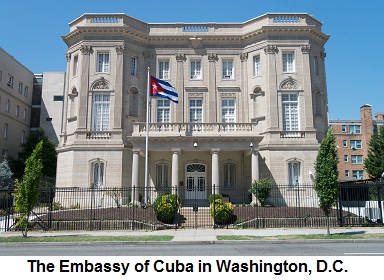
Download the book Go Lean … Caribbean – now!

———-

Appendix – Detroit School District

Detroit Public Schools (DPS) is a school district that covers all of the city of Detroit, Michigan, United States and high school students in the insular city of Highland Park. The district has its headquarters in the Fisher Building of the New Center area of Detroit.[6][7]

Students 47,959 (2014–15)
Teachers 3,235 (2012-13)
Staff 15,535 (2007)[3]

Besides DPS, the Education Achievement Authority (EAA) operates 15 of the district’s schools totalling 6,556 students as of the 2014-15 school year.

Emergency Financial Manager

The district is currently under a state of a financial emergency and is currently run by an emergency manager instead of the school board and superintendent.

Currently all matters are under the control of Emergency Manager Darnell Earley was appointed as the new emergency manager for the school district by Snyder, appointed by Governor Rick Snyder in January 2013.[4]

From 2009–2011, DPS finances were managed by Robert Bobb who was appointed by former Governor Jennifer Granholm[33] and from 2011 to January 2015, Roy Roberts who was appointed by Governor Snyder.

Source: https://en.wikipedia.org/wiki/Detroit_Public_Schools retrieved January 22, 2016.


Share this post:
, , , , , ,
[Top]