Category: Ethos

‘Time to Go’ – Blacks get longer sentences from ‘Republican’ Judges

Go Lean Commentary

“Tell me who your friends are and I will tell you who you are” – Old Adage

This Old Adage was drummed in me as a youth; I may have wanted to question its validity, but time has proven its accuracy. As humans, we are affected by the people we associate with; their values, principles, character, aspirations – or lack thereof – will have an effect on us. This statement even harmonizes with the Bible scripture at 1 Corinthians 15:33, which states:

“Bad companions ruin good character.” – Today’s English Version

This commentary highlights a disturbing trend in American jurisprudence; it turns out that among judges that associates with the conservative political parties or the liberal political parties, one group consistently sentences Black defendants to longer prison sentences. This is indicative of more than just the tolerance of criminality; this shows some hidden bias, that severely endangers the Black populations in America. These judges, despite claims of non-partisanship, are affected by their party.

Say it ain’t so!

The party with the harsher sentences is the Republican Party or GOP (for Grand Old Party).

Sometimes, we need to step back and look at the whole picture before we can notice trends and leanings. This is the common sense in the old expression: “One cannot see the forest for the trees”. This was the purpose of a study on judicial bias; it looked at a range of 500,000 cases to summarize its findings. Intelligence and wisdom can be gleaned from this data.

The numbers – and conclusions – must not be ignored. See the full story here:

Title: Black Defendants Get Longer Sentences From Republican-Appointed Judges, Study Finds
By: Adam Liptak

WASHINGTON — Judges appointed by Republican presidents gave longer sentences to black defendants and shorter ones to women than judges appointed by Democrats, according to a new study that analyzed data on more than half a million defendants.

“Republican-appointed judges sentence black defendants to three more months than similar nonblacks and female defendants to two fewer months than similar males compared with Democratic-appointed judges,” the study found, adding, “These differences cannot be explained by other judge characteristics and grow substantially larger when judges are granted more discretion.”

The study was conducted by two professors at Harvard Law School, Alma Cohen and Crystal S. Yang. They examined the sentencing practices of about 1,400 federal trial judges over more than 15 years, relying on information from the Federal Judicial Center, the United States Sentencing Commission and the Transactional Records Access Clearinghouse at Syracuse University.

Douglas A. Berman, an authority on sentencing law at Ohio State University, said the study contained “amazing new empirical research.”

“It’s an extraordinarily important contribution to our statistical understanding of sentencing decision making in federal courts over the last two decades,” he said.

It has long been known that there is an overall racial sentencing gap, with judges of all political affiliations meting out longer sentences to black offenders. The new study confirmed this, finding that black defendants are sentenced to 4.8 months more than similar offenders of other races.

It was also well known, and perhaps not terribly surprising, that Republican appointees are tougher on crime over all, imposing sentences an average of 2.4 months longer than Democratic appointees.

But the study’s findings on how judges’ partisan affiliations affected the racial and gender gaps were new and startling.

“The racial gap by political affiliation is three months, approximately 65 percent of the baseline racial sentence gap,” the authors wrote. “We also find that Republican-appointed judges give female defendants two months less in prison than similar male defendants compared to Democratic-appointed judges, 17 percent of the baseline gender sentence gap.”

The two kinds of gaps appear to have slightly different explanations. “We find evidence that gender disparities by political affiliation are largely driven by violent offenses and drug offenses,” the study said. “We also find that racial disparities by political affiliation are largely driven by drug offenses.”

The authors of the study sounded a note of caution. “The precise reasons why these disparities by political affiliation exist remain unknown and we caution that our results cannot speak to whether the sentences imposed by Republican- or Democratic-appointed judges are warranted or ‘right,’” the authors wrote. “Our results, however, do suggest that Republican- and Democratic-appointed judges treat defendants differently on the basis of their race and gender given that we observe robust disparities despite the random assignment of cases to judges within the same court.”

The study is studded with fascinating tidbits. Black judges treat male and female offenders more equally than white judges do. Black judges appointed by Republicans treat black offenders more leniently than do other Republican appointees.

More experienced judges are less apt to treat black and female defendants differently. Judges in states with higher levels of racism, as measured by popular support for laws against interracial marriage, are more likely to treat black defendants more harshly than white ones.

The Trump administration has been quite successful in stocking the federal bench with its appointees, and by some estimates the share of Republican appointees on the federal district courts could rise to 50 percent in 2020, from 34 percent in early 2017.

The study said these trends were likely to widen the sentencing gaps.

“Our estimates suggest that a 10 percentage point increase in the share of Republican-appointed judges in each court would increase the racial sentencing gap by approximately 5 percent and the gender sentencing gap by roughly 2 percent,” the authors wrote. “During an average four-year term, a Republican president has the potential to alter the partisan composition of the district courts by over 15 percentage points, potentially increasing the racial and gender sentencing gap by 7.5 and 3 percent, respectively.”

There are a couple of reasons to question that prediction. The Trump administration has been more energetic in appointing appeals court judges than trial judges. And in recent years many conservatives have started to shift positions on sentencing policy. The very scope of the study, which considered sentences imposed from 1999 to 2015, could mask trends in the later years.

Supreme Court justices like to say that partisan affiliation plays no role in judicial decision making.

“There’s no such thing as a Republican judge or a Democratic judge,” Justice Neil M. Gorsuch, President Trump’s Supreme Court appointee, said at his confirmation hearing last year. “We just have judges in this country.”

Political scientists have disagreed, finding that Republican appointees are markedly more likely to vote in a conservative direction than Democratic ones. Senate Republicans, by refusing to hold hearings for Judge Merrick B. Garland, President Barack Obama’s Supreme Court nominee, seemed to agree.

So has Mr. Trump. “We need more Republicans in 2018 and must ALWAYS hold the Supreme Court!” he tweeted in March.

But judicial ideology is one thing. The race and gender gaps identified by the new study present a different and difficult set of questions.

Professor Berman said the study should prompt both research and reflection. “It only begins a conversation,” he said, “about what sets of factors really influence judges at sentencing in modern times.”

Follow Adam Liptak on Twitter: @adamliptak.

Source: New York Times – published May 28, 2018; retrieved June 26, 2018 from: https://www.nytimes.com/2018/05/28/us/politics/black-defendants-women-prison-terms-study.html

This article alludes to a stereotype; one where women are sentenced lighter, but Blacks harsher. This stereotype transcends the entire history of the United States … right up to this day. The more things change, the more they remain the same!

This commentary continues the series on Time to Go, considering the reality for life of the Caribbean’s Black-and-Brown population in the US. This entry is Number 10 in this series from the movement behind the book Go Lean … Caribbean which started in September 2016 with the first 6 issues. Now, this revisit, this commentary, examines a disturbing trend with the sentences of federal court judges; these ones are appointed by the President of the United States. Needless to say, Presidents appoint judges that reflect and respect their values – it’s a natural expectation that they would have the same (virtual) association. So “we” can tell a lot about federal judges, just by knowing which President appointed them.

These were the 2016 submissions in this series:

  1. Time to Go: Spot-on for Protest
  2. Time to Go: No Respect for our Hair
  3. Time to Go: Logic of Senior Immigration
  4. Time to Go: Marginalizing Our Vote
  5. Time to Go: American Vices; Don’t Follow
  6. Time to Go: Public Schools for Black-and-Brown

Now, we consider these 5 new entries along that same theme:

  1. Time to Go: Windrush – 70th Anniversary
  2. Time to Go: Mandatory Guns – Say it Ain’t So
  3. Time to Go: Racist History of Loitering
  4. Time to Go: Blacks Get Longer Sentences From ‘Republican’ Judges
  5. Time to Go: States must have Population Increases

All of these commentaries relate to Caribbean people and their disposition in foreign lands – in this case in the US – and why they need to Go Back Home. Surely, it is obvious and evident that institutional racism is “Alive & Well” in the US. We can and must do better at home. The Go Lean book – available to download for free – serves as a roadmap for the technocratic Caribbean Union Trade Federation (CU) to assuage the societal defects in this region. It is “out of scope” for our movement to fix America; our efforts to reform and transform is limited to the Caribbean.

‘Republican’ Judges???

This is as opposed to Democratic Judges! Yes, this is a reference to specific political parties in the US. Yet, we are not making these assessments with any political leaning. Rather, this movement behind the Go Lean book and blogs, the SFE Foundation, is an apolitical organization with no favoritism for one political party over the other. In fact, the first 6 commentaries in this Time to Go series were published during the presidential administration of Barack Obama, a Democrat.

The subject of Optimized Criminal Justice is a failing for all previous presidential administrations – though Blacks lean more to the Democrats – see/listen to the AUDIO-Podcast in the Appendix below. This is a familiar theme for this Go Lean commentary. This movement have consistently related the lack of respect for those in America fitting the Black-and-Brown description; consider these prior submissions:

https://goleancaribbean.com/blog/?p=14627 Cop-on-Black Shootings – In America’s DNA
https://goleancaribbean.com/blog/?p=14413 Repairing the Breach: Hurt People Hurt People
https://goleancaribbean.com/blog/?p=8202 Lessons Learned from American Dysfunctional Minority Relations
https://goleancaribbean.com/blog/?p=8200 Climate of Hate for American Minorities
https://goleancaribbean.com/blog/?p=7221 Street naming for Martin Luther King unveils the real America
https://goleancaribbean.com/blog/?p=5527 American Defects: Racism – Is It Over?
https://goleancaribbean.com/blog/?p=4863 Video of Police Shooting: Worth a Million Words
https://goleancaribbean.com/blog/?p=4447 Probe of Ferguson, Missouri shows cops & court bias
https://goleancaribbean.com/blog/?p=546 Book Review – ‘The Divide’ – Injustice in the Age of the Wealth Gap
https://goleancaribbean.com/blog/?p=341 Hypocritical US slams Caribbean human rights practices

It is a dangerous proposition to be Black in America. This is why this movement consistently urges the Black-and-Brown of the Caribbean to Stay Home! In fact, The Bahamas urged its majority Black population (and the young men) to exercise extreme caution when traveling to the US and dealing with police authorities. There is no doubt that the America of Old – would have been no place for Caribbean people to seek refuge. But now we are asserting that the disposition is still the same:

  • Our Black-and-Brown Diaspora should plan to repatriate back to the Caribbean
  • While our young people, in the homeland, should plan to prosper where planted rather than setting their sights on American shores.

Despite the fact that this society – modern America – is still no place for Black-and-Brown Caribbean people to seek refuge, all 30 member-states of the region continue to suffer from an abominable brain drain rate – one report proclaims 70 percent – in which so many Caribbean citizens have emigrated to the US (and other places). We must resist this bad trend! How?!

  • Good messaging
  • Heavy-lifting to reform and transform the societal engines

The Go Lean book identifies the reasons why people abandon their homeland as “push and pull”. While the “push” refers to the societal defects that people take refuge from, the “pull” is mostly due to messaging. Our people perceive that the US is better for them, and that landing in the US is the panacea – cure-all – for all societal short-comings. Good messaging will mitigate that trend. Yet, still, we must do the hard work for fixing our society.

The Go Lean book asserts that it is easier for the Black-and-Brown populations in the Caribbean to prosper where planted in the Caribbean, rather than in the United States. Plus, we need these people’s help to reform and transform our society. We need some to lead, and some just to follow. We need some to produce, and some just to consume. We need growth! So abandonment is counter-productive.

This is the quest of the Go Lean/CU roadmap. The book presents 370 pages of instructions for how to reform and transform our Caribbean member-states. It stresses the key community ethos that needs to be adopted, plus the strategies, tactics, implementations and advocacies necessary to optimize the societal engines in a community. The CU/Go Lean roadmap has these 3 prime directives for optimizing our societal engines:

As related in this blog series, it is Time to Go! We have a better chance of optimizing our society in the Caribbean for our Black-and-Brown majority populations than the US will do for our people; we can actually be better than America. Just look, their distinguished judges are still adjudicating like its 1868, and not 2018. America has gone “2 steps forward and 1 step backwards”.

Now is the Time to Go and now is the time to lean-in to this Go Lean/CU roadmap. This quest is conceivable, believable and achievable. Yes, we can … reform and transform our society. We can make our homeland a better place to live, work and play. 🙂

Download the free e-Book of Go Lean … Caribbean – now

Sign the petition to lean-in for this roadmap for the Caribbean Union Trade Federation.

————–

AUDIO Podcast – Why Did Black Voters Flee The Republican Party In The 1960s? – https://www.npr.org/sections/codeswitch/2014/07/14/331298996/why-did-black-voters-flee-the-republican-party-in-the-1960s


Posted July 14, 2014 – If you’d walked into a gathering of older black folks 100 years ago, you’d have found that most of them would have been Republican.

Wait… what?

Yep. Republican. Party of Lincoln. Party of the Emancipation. Party that pushed not only black votes but black politicians during that post-bellum period known as Reconstruction.

Today, it’s almost the exact opposite. That migration of black voters away from the GOP reached its last phase 50 years ago this week.

Share this post:
, , ,

‘Time to Go’ – Racist History of Loitering

Go Lean Commentary 

The cruel, inhumane institution of slavery finally ended in the United States … on which date?

This was not meant to be a multiple choice! But rather, these answers demonstrate the continuous flow of racist oppression that had befallen the African-American experience, despite these identifiable dates ending the practices and legacy of America’s Original Sin.

Why so lingering here, when the practice was so much more easily disbanded elsewhere; think British Empire in 1834.

This commentary asserts than the Southern United States – the former Confederate States/Slave States – never embraced the end of slavery because of this philosophical premise here:

“An empire toppled by its enemies can rise again, but one which crumbles from within, is dead forever. ” – Popular Quotation from the Character Baron Zemo in the Marvel film Captain America: Civil Wars

Say it ain’t so! The Confederate South was toppled by its enemies (the non-Slave Northern States), their same spirit of racial superiority rose again. If the South had evolved on their own to assuage their societal defects, things may have been different for the Black minority there among the White majority.

While racial disparity in the US is a national reality, attitudes in the Southern States continued to reflect blatant White Supremacy. Since this was tolerated in the South, there was spin-off in the rest of the country. Truthfully, oppression, suppression and repression of the African race became the community ethos in the whole country: blatant in the South; subtle in the North and in the West. Community ethos is defined as:

The fundamental character or spirit of a culture; the underlying sentiment that informs the beliefs, customs, or practices of a group or society; dominant assumptions of a people or period.

Considering the foregoing historic timeline, loitering laws against African-Americans, is the focus of this commentary. There have been a number of high profile cases of Blacks being discriminated against in general society. See related VIDEO‘s here:

VIDEO 1 – Racist History of Loitering – https://youtu.be/jQuT0gO2X0o


Splinter

Published on May 16, 2018 – What is the line between “loitering” and just “hanging out”? Turns out, the enforcement of loitering laws often has less to do with committing the act and more to do with the skin color of the person who does:

Subscribe to Splinter: https://goo.gl/BwuJiy

————-

VIDEO 2 – Somebody Called The Cops On Me In My Own Building – https://youtu.be/LzQsYc_k4Tk


HuffPost
Published on May 18, 2018 – Someone called the police on him for suspected armed robbery. The reality? He was moving into his New York City apartment.

Subscribe to HuffPost today: http://goo.gl/xW6HG

Get More HuffPost Read: https://www.huffingtonpost.com/

Racial disparity in the US is still a reality. As related in the above VIDEO‘s, “you’re already criminalized when you have Black skin”.

This commentary asserts that it is easier for the Black-and-Brown populations in the Caribbean to prosper where planted in the Caribbean, rather than emigrating to foreign countries, like the United States. So the urging is as follows:

All Black-and-Brown Caribbean people exiling in the US, we entreat you: It’s Time to Go!

All Black-and-Brown people in the Caribbean wanting to emigrate to the US, we entreat you to Stay Home!

This point aligns with the book Go Lean…Caribbean, which states that while the blatant racist attitudes and actions may now be considered politically incorrect, the foundations of institutional racism in the US are entrenched. The book supports the notion that the Caribbean can be an even better place to live for the Caribbean’s Black-and-Brown, once we make the homeland a better place to live, work and play. Our quest is to optimize the economic, security and economic engines in the Caribbean region so as to dissuade our people from leaving and encourage the Diaspora to repatriate.

This commentary – Number 9 – continues a series from the movement behind the book Go Lean … Caribbean, in consideration of the rationale to return back to the Caribbean homeland. The other commentaries – published in September 2016 and beyond – detailed in this series are as follows:

  1. Time to Go: Spot-on for Protest
  2. Time to Go: No Respect for our Hair
  3. Time to Go: Logic of Senior Immigration
  4. Time to Go: Marginalizing Our Vote
  5. Time to Go: American Vices; Don’t Follow
  6. Time to Go: Public Schools for Black-and-Brown

Now, we consider 5 new entries along that same theme; they are identified as follows:

  1. Time to Go: Windrush – 70th Anniversary
  2. Time to Go: Mandatory Guns – Say it Ain’t So
  3. Time to Go: Racist History of Loitering
  4. Time to Go: Blacks Get Longer Sentences From ‘Republican’ Judges
  5. Time to Go: States must have Population Increases

All of these commentaries in this series relate to the disposition of the Caribbean Diaspora in foreign countries; in the case of this one, the United States of America. The Go Lean book and movement serves as a roadmap for the introduction of the technocratic Caribbean Union Trade Federation (CU). The CU is set to optimize Caribbean society through economic, security and governing optimizations. Therefore the Go Lean roadmap has 3 prime directives:

  • Optimization of the economic engines in order to grow the regional economy to $800 Billion & create 2.2 million new jobs.
  • Establishment of a security apparatus to ensure public safety and protect the economic engines.
  • Improve Caribbean governance to support these engines.

The Go Lean roadmap posits that the Caribbean region is in crisis now, and so many are quick to flee for refuge in foreign countries. But the “grass is not necessarily greener on the other side”. Here in the Caribbean, Black-and-Brown people are not arrested for being Black-and-Brown – they are the majority population. But they are a minority in the US; and that society is definitely not optimized for Caribbean people.

The Go Lean book asserts that every community has bad actors. The Caribbean has bad actors; and the US has bad actors. But because of the obvious need for reform and to transform the region, it may be easier to effect change at home, than in the foreign country of the US. Besides, many (non-Black) people in the US, don’t even think they need to change anything. They think there is no problem – they are perfectly allowed to call the police because a Black person is in their presence … loitering, or drinking coffee, or studying, or moving.

African Americans may have no where else to go, but the Black-and-Brown of the Caribbean can go back to the Caribbean. This is the urging now: It’s Time to Go!

This was a motivation of the Go Lean roadmap, we have to prepare for the Diaspora’s return; we have to fix our defects and mitigate for our “bad actors”; bad actors always emerge. This point is pronounced early in the book with the Declaration of Interdependence (Page 12) that claims:

x. Whereas we are surrounded and allied to nations of larger proportions in land mass, populations, and treasuries, elements in their societies may have ill-intent in their pursuits, at the expense of the safety and security of our citizens. We must therefore appoint “new guards” to ensure our public safety and threats against our society, both domestic and foreign. The Federation must employ the latest advances and best practices of criminology and penology to assuage continuous threats against public safety. The Federation must allow for facilitations of detention for [domestic and foreign] convicted felons of federal crimes, and should over-build prisons to house trustees from other jurisdictions.

xvi. Whereas security of our homeland is inextricably linked to prosperity of the homeland, the economic and security interest of the region needs to be aligned under the same governance. Since economic crimes, including piracy and other forms of terrorism, can imperil the functioning of the wheels of commerce for all the citizenry, the accedence of this Federation must equip the security apparatus with the tools and techniques for predictive and proactive interdictions.

The Caribbean appointing “new guards”, or a security pact to ensure public safety and justice assurance is part of the comprehensive effort of reforming the societal engines in our region. Security lapses are among the reasons why people left – they were pushed to seek refuge. So better delivering on the Social Contract – citizens surrender some of their freedoms and submit to the authority of the State in exchange for protection of remaining natural and legal rights – sends the message that we are readying the homeland for our far-flung Diaspora to finally come home.

The Go Lean book provides 370-pages of turn-by-turn instructions on “how” to adopt new community ethos, plus the strategies, tactics, implementations and advocacies to execute so as to reform and transform the societal engines of Caribbean society. Accepting that we have been inadequate in delivering security needs to our citizens in the past, we must now do better, not just in security promises, but in security deliveries. In addition, the Go Lean movement have presented many previous blog-commentaries on regional security and the assurance of public safety; consider this sample here:

https://goleancaribbean.com/blog/?p=14482 International Women’s Day – Protecting Rural Women
https://goleancaribbean.com/blog/?p=14424 Repairing the Breach: Crime – Need, Greed, Justice & Honor
https://goleancaribbean.com/blog/?p=13664 Managing High Profile Sexual Harassment Accusations
https://goleancaribbean.com/blog/?p=13476 Future Focused – Policing the Police
https://goleancaribbean.com/blog/?p=13126 The Requirement for Better Security – ‘Must Love Dogs’
https://goleancaribbean.com/blog/?p=12400 Accede the Caribbean Regional Arrest Treaty
https://goleancaribbean.com/blog/?p=10959 See Something, Say Something … Do Something
https://goleancaribbean.com/blog/?p=10566 Funding the Caribbean Security Pact
https://goleancaribbean.com/blog/?p=10222 Waging a Successful War on ‘Terrorism’
https://goleancaribbean.com/blog/?p=9072 Securing the Homeland – A Series featuring “On the Ground, Air and Sea”
https://goleancaribbean.com/blog/?p=5002 Managing a ‘Clear and Present Danger’
https://goleancaribbean.com/blog/?p=4360 Dreading the American: ‘Caribbean Basin Security Initiative’
https://goleancaribbean.com/blog/?p=4308 911 – Improving Emergency Response

The Go Lean roadmap was composed with the community ethos of the Greater Good – the greatest good for the greatest number of people – Black, Brown, White, Yellow or Red. We advocate for a pluralistic democracy

… and justice for all.

While this is an American concept … in words only, we have the opportunity to manifest this in the Caribbean. America does many things right, but they feature a lot of societal defects still, so we have the opportunity to do a pluralistic democracy Better than America.

This is the quest of the Go Lean/CU roadmap. We urge all Caribbean stakeholders to lean-in to this roadmap to elevate the Caribbean; to make our homeland a better place to live, work and play. 🙂

Download the book Go Lean … Caribbean – now!

Sign the petition to lean-in for this roadmap for the Caribbean Union Trade Federation.

————

APPENDIX – The Bottom Line on Peonage – Book: Go Lean … Caribbean (Page 211)

Peonage, involuntary servitude, existed historically during the colonial period, especially in Latin America and areas of Spanish rule, as well as in the Southern United States … after slavery was abolished. These States passed “Black Codes” to control the freed “Black” population. Peonage was essentially debt slavery, where a person was held against their will to work off an alleged debt to someone who had purchased them. This was the language, buying and selling, that was used for inmates purchased from county jails and state prison systems. They often declared as vagrant those who were [simply] unemployed.
Under such laws, local officials arbitrarily arrested tens of thousands, and charged them with fines and court costs. (By the beginning of the 20th century, 40% of blacks in the South were imprisoned in peonage). Merchants, farmers or business owners could pay their debts, and the prisoners had to work off the debt. Prisoners were “sold” or leased as forced laborers to operators of coal mines, lumber camps, brickyards, railroads, quarries and farm plantations, with the fees for their labor going to the States. Overseers often used severe deprivation, beatings and other abuses as “discipline”.

By 1942, the jail/prison peonage system came to an end with public exposure of the abuses and atrocities, advances of the American Communist movement, congressional hearings and public outcry.

Share this post:
, , ,
[Top]

‘Time to Go’ – Windrush: 70th Anniversary Today – ENCORE

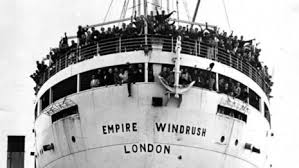
On 22 June 1948, the ship HMT Empire Windrush brought a group of 802 migrants to the port of Tilbury, near London, England. – Wikipedia

Thus started the drain! 

The Brain Drain that is. What started as a “drip has now turned into a drizzle”.  After 70 years exactly, the jury is now in. The verdict is emphatic:

Time to Go!

“Frankly, the Caribbean Diaspora … can now do better at home … in the Caribbean.” – This was the assertion from this previous blog-commentary from July 10, 2014. Today, on the 70th anniversary of the Windrush landing with its African Caribbean arrivals; it is time now to Encore that submission – see below.

African Caribbean people may not be so welcomed in the British Isles right now, anyway. See the latest on the Windrush Controversy in the Appendix VIDEO below.

This Encore continues a series from 2016, with these entries:

  1. Time to Go: Spot-on for Protest
  2. Time to Go: No Respect for our Hair
  3. Time to Go: Logic of Senior Immigration
  4. Time to Go: Marginalizing Our Vote
  5. Time to Go: American Vices; Don’t Follow
  6. Time to Go: Public Schools for Black-and-Brown

Now, we consider 5 new entries along that same theme; they are identified as follows:

  1. Time to Go: Windrush – 70th Anniversary
  2. Time to Go: Mandatory Guns – Say it Ain’t So
  3. Time to Go: Racist History of Loitering
  4. Time to Go: Blacks Get Longer Sentences From ‘Republican’ Judges
  5. Time to Go: States must have Population Increases

All of these commentaries relate to the Caribbean Diaspora’s disposition in foreign lands, asserting that it is Time to Go … home! See that Encore now:

———————

Go Lean Commentary – British public sector workers strike over ‘poverty pay’

The grass is not greener on the other side.

Go from being a big fish in small pond, to small fish in big pond.

These expressions are relevant in considering the fate of so many Caribbean Diaspora that had fled their Caribbean homelands over the past decades to take residence in Great Britain. Many of them sought refuge as career civil servants; (one reason [a] was the acute racism and intolerance encountered in private enterprises). These ones are faced with the harsh reality that pay scales in the public sector have not kept pace with inflation; they are now at poverty level. See the news article here:

By: Tess Little (Editing by Stephen Addison)

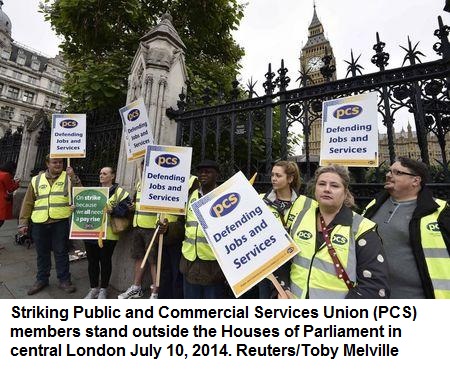
British strike 1LONDON (Reuters) – Hundreds of thousands of public sector workers including teachers, council workers and firefighters staged a 24-hour pay strike on Thursday in a stoppage that has prompted Prime Minister David Cameron to pledge a crackdown on union powers.

Protesters marched through the streets of many of Britain’s main cities in one of the biggest co-ordinated labour stoppages for three years.

Denouncing what they called “poverty pay,” they demanded an end to restrictions on wage rises that have been imposed by the government over the past four years in an effort to help reduce Britain’s huge budget deficit.

In London, demonstrators marched towards Trafalgar Square at midday, chanting “Low pay, no way, no slave labour” to the beat of a drum. A giant pair of inflatable scissors, carried by members of the National Union of Teachers (NUT), read “Education cuts never heal.”

Firefighter Simon Amos, 47, marched wearing his uniform behind a flashing fire engine parading members of the Fire Brigades Union (FBU). “The government [is] making us pay more for our pension for it to be worth the same, and making us work longer,” he said.

British strike 2The biggest public sector union involved, Unison, said early reports showed the strike had led to 3,225 school closures with more than 1,000 others partially closed.

Refuse collectors, school support staff, cleaners, street sweepers, care workers, nursery assistants and social workers were joining the strike, it added.

Hot spots, it said, included the North East, Wales and East Midlands where most council offices had closed, while more than 60 picket lines have closed most services in Newcastle.

“It is a massive decision by local government and school support workers to sacrifice a day’s pay by going on strike, but today they are saying enough is enough,” said Unison General Secretary, Dave Prentis in a statement.

Britain’s coalition government has enforced a policy of pay restraint for public sector workers since coming to power in 2010, imposing a pay freeze until 2012 and then a one percent pay rise cap, resulting in a fall in income in real terms [compared to inflation].

The Cabinet Office played down the impact of the strike, saying that most schools in England and Wales were open and that fire services were operating throughout the country.

British strike 3On Wednesday, Cameron told parliament he planned to limit unions’ powers to call strikes.

“How can it possibly be right for our children’s education to be disrupted by trade unions acting in this way” he said.

Tough new laws would be proposed in the Conservative manifesto for next year’s general election, he added.

These would include the introduction of a minimum threshold in the number of union members who need to take part in a strike ballot for it to be legal.

The manifesto could also back the introduction of a time limit on how long a vote in favour of industrial action would remain valid.

The NUT mandate for Thursday’s strike, for example, came from a 2012 strike ballot based on a turnout of just 27 percent, Cameron said.

The issue of minimum voting thresholds last arose three months ago when a strike by London Underground train drivers caused huge disruption in the capital, prompting Mayor Boris Johnson to demand that at least half of a union’s members should vote in favour for a strike to go ahead.
Source: Reuters News Service; retrieved 07/10/2014 from: http://news.yahoo.com/public-sector-workers-strike-over-poverty-pay-105040672.html

Frankly, the Caribbean Diaspora employed in the British public sector can now do better at home … in the Caribbean.

This is the assertion of the book Go Lean…Caribbean. That once the proposed empowerments are put in place, the Caribbean Diaspora should consider repatriating to their ancestral homelands.

Unfortunately for the Caribbean, this societal abandonment has continued, since the early days of the “Windrush Generation”[a] right up to now. In a recent blog post, this commentary related analysis by the Inter-American Development Bank that the Caribbean endures a brain drain of 70% among the college educated population; (https://goleancaribbean.com/blog/?p=1433).

Change has now come to the Caribbean.

The book Go Lean…Caribbean serves as a roadmap for the introduction and implementation of the technocratic Caribbean Union Trade Federation (CU). This roadmap will spearhead the elevation of Caribbean society. The prime directives of the CU are presented as the following 3 statements:

  • Optimization of the economic engines in order to grow the regional economy & create 2.2 million new jobs at home.
  • Establishment of a security apparatus to protect the resultant economic engines.
  • Improve Caribbean governance to support these engines.

The book posits that the improved conditions projected over the 5 years of the roadmap will neutralize the impetus for Caribbean citizens to flee, identified as “push and pull” factors. This point is stressed early in the book (Page 13) in the following pronouncements in the opening Declaration of Interdependence:

xix.   Whereas our legacy in recent times is one of societal abandonment, it is imperative that incentives and encouragement be put in place to first dissuade the human flight, and then entice and welcome the return of our Diaspora back to our shores. This repatriation should be effected with the appropriate guards so as not to imperil the lives and securities of the repatriated citizens or the communities they inhabit. The right of repatriation is to be extended to any natural born citizens despite any previous naturalization to foreign sovereignties.

xx.   Whereas the results of our decades of migration created a vibrant Diaspora in foreign lands, the Federation must organize interactions with this population into structured markets. Thus allowing foreign consumption of domestic products, services and media, which is a positive trade impact. These economic activities must not be exploited by others’ profiteering but rather harnessed by Federation resources for efficient repatriations.

This foregoing article highlights other issues that have been prominently addressed in the Go Lean book, namely that of the Civil Service and Labor Relations. There is the need for a professional staff in the Federal Civil Service. They require marketable benefits and compensation. There is also a role for Labor Unions to play in the elevation of Caribbean society. The Go Lean roadmap envisions an inclusionary attitude towards unions. The Go Lean community ethos is that of being partners with unions, not competitors. The book features specific tools and techniques that can enhance management-labor relationships.

These issues constitute heavy-lifting for the regional administration of the Caribbean:

  • fostering best practices for federal civil service and labor unions,
  • minimizing the brain drain, and
  • facilitating repatriation to the homeland.

These issues cannot be glossed over or handled lightly; this is why the Go Lean book contains 370 pages of finite details for managing change in the region. The book contains the following sample of community ethos, strategies, tactics, implementations and advocacies to impact the Caribbean homeland:

Community Ethos – Economic Systems Influence Choices & Incentives Page 21
Community Ethos – The Consequences of Choices Lie in the Future Page 21
Community Ethos – Job Multiplier Page 22
Community Ethos – Lean Operations Page 24
Community Ethos – Return on Investments Page 24
Community Ethos – Ways to Impact the Future Page 26
Community Ethos – Ways to Improve Negotiations Page 32
Strategy – Competition – Remain home   –vs- Emigrate Page 49
Strategy – Agents of Change – Aging Diaspora Page 57
Tactical – Separation of Powers – Versus Member-States Governments Page 71
Implementation – Year 1 / Assemble Phase – Establish Civil Service Page 96
Implementation – Ways to Deliver Page 109
Implementation – Trade Mission Objectives Page 116
Implementation – Reasons to Repatriate Page 118
Anecdote – Experiences of a Repatriated Resident Page 126
Planning  – 10 Big Ideas for the Caribbean Region Page 127
Advocacy – Ways to Create Jobs Page 152
Advocacy – Ways to Impact Labor Unions Page 164
Advocacy – Ways to Manage Federal Civil Service Page 173
Anecdote – Experiences of Diaspora Member Living Abroad Page 216
Advocacy – Ways to Impact the Diaspora Page 217

The Go Lean roadmap has simple motives: fix the problems in the homeland to make the Caribbean a better place to live, work, learn and play. There should be no need to go abroad and try to foster an existence in a foreign land. So for those of Caribbean heritage working in the British Civil Service, we hear your pleas. Our response: Come home; come in from the cold.

Now is the time for all of the Caribbean, the people residing in the homeland and those of the Diaspora, to lean-in for the empowerments described in the book Go Lean … Caribbean. This Big Idea for the region is a dramatic change; one that is overdue. The policies & practices of the past have failed Caribbean society. Too many people left, yet have little to show for it.

Caribbean music icon Bob Marley advocated this same charter for the Caribbean Diaspora. He sang to “come in from the cold” in the opening song of his last album Uprisings in 1980. How “spot-on’ were his words in the following music/video:

Download the free e-Book of Go Lean … Caribbean – now!

———————

Appendix – Cited Reference
a: “There was plenty of work in post-war Britain and industries such as British Rail, the National Health Service and public transport recruited almost exclusively from Jamaica and Barbados”. Retrieved July 10, 2014 from: http://en.wikipedia.org/wiki/British_African-Caribbean_people#The_.22Windrush_generation.22

——————–

Appendix VIDEO – How will the UK solve the Windrush controversy? | Inside Story – https://youtu.be/GYUag4XYhFo

Al Jazeera English

Published on Apr 17, 2018 – They are called the “Windrush generation”. That is a refefence to the ship, the Empire Windrush, that carried the first wave of immigrants from the West Indies to Britain in 1948. Many arrvied as children on their parents’ passports – and have lived in the UK for over 70 years, paying taxes and insurance, but never formally becoming British Citizens. Now, as the government tightens its immigration rules, those without the proper documents are being denied services and could even face deportation. Some are calling it ‘cruel and inhumane’ treatment. The government has apologised and it’s promsing an investigation. But will that be enough?
Presenter: Peter Dobbie Guests Sally Daghlian – CEO of Praxis, an organisation that provides assistance to people affected by the Windrush controversy. Clive Foster – member of the Nottingham Citizens Group.
Share this post:
, ,
[Top]

Regional Tourism Coordination – No Longer Optional

Go Lean Commentary

No one can hide anymore!

There are 30 different member-states, with 5 different colonial legacies and 4 different languages, and yet people around the world only considers our region as One Caribbean:

Event Consequence to Perception
Devastating hurricane Oops, the Caribbean is unable to function commercially
Devastating earthquake Oops, the Caribbean is unable to function commercially
Emergence of a pandemic Oops, the Caribbean is unable to function commercially

All of the Caribbean member-states are in this “same boat”, so this is a matter of image and geographic misconceptions, more so than it is about disasters.

So, good or bad, the fate of one Caribbean member-state is tied to the other member-states, when it comes to tourism. See this point conveyed in this news article here:

Title: Geographic misconceptions hurting Caribbean economies
By Sarah Peter

Nassau, Bahamas – The mistaken perception among many travelers of the complete devastation of the Caribbean in the wake of the 2017 hurricane season caused further economic destruction to the region’s economy.
That’s according to the Chair of the Caribbean Tourism Organization (CTO), Joy Jibrilu. She raised the concern amid staggering losses among countries which were not impacted by the 2017 Hurricane season.

Jibrilu says following the devastation caused by hurricanes Irma and Maria to some islands in the region, many travelers called and canceled for countries who were not impacted by the storm.

This resulted in a significant drop in hotel room demand across the entire Caribbean. In light of that another disaster, an economic storm, was created which resulted in great losses in tourism revenue and a challenge for tourism officials.

“All our travel partners, all of them without exception called and said that we have heard the Caribbean  is closed.”

She further added that  Caribbean islands irrespective of if they were not actually impacted by the storm were economically  affected.

We all lost when people were not sure if or when to book if they canceled. You saw a dip in bookings because people thought that the islands which were not impacted were. We must quantify the figures of lost business so we can share the story with the world to tell them how serious it is. “

The chair of the CTO says that over one billion US dollars in tourism revenue was lost in the wake of last year’s hurricane season, the costliest hurricane season on record.

Jibrilu, who is also the Director of Tourism for the island of Barbados says the region’s reconstruction and recovery effort has been estimated at close to  6 billion dollars.

“Tourism is the region’s greatest driver of foreign exchange tax revenue and reliable vehicle of poverty reduction and human capital development for the region’s small island developing states. The tragedy is that the dampening of demand occurred even among islands that were not in the path of the storm.  This contributes to  an economic disaster as tourism visitation dropped of resulting in significant losses in revenue.”

Jilbrilu blamed the international media for the problem. She says their reports describes the region as if it was one country as opposed to several different islands. The chairman of the CTO says this inaccurate reporting is costing a region millions and negatively impacting lives in the region.

“First of all if we look at international news reporters when they talk about a hurricane they say the “Caribbean” has been impacted. They generalize and say the entire Caribbean. As a result, people look at the Caribbean as a whole unit as oppose to all these different countries, thousands of miles away from each other. To put it in context the Bahamas alone from north to south covers one hundred thousand square miles that is further than the distance of  Toronto to New York.  So if a storm happens in New York no one would say I am not going to Toronto. They just would not, it just does not make sense but when people lump the Caribbean  together as just one region ( as if it was just one country ) it  is negative.”

Jilbrilu says the region’s economy and people lives depend on accurate reporting and think making the international media more aware of this matter is a matter of economic prosperity or suffering for the region’s people.

“What we have done is to educate people of the geography of the Caribbean, that the same time it takes to travel from the Bahamas to Barbados is the same as traveling from London in the UK to Rome, Italy. So what happens to the Bahamas does not impact Barbados and vice versa.  We really  want to get that message out.”

Jilbrilu made the disclosure at the 2018 annual Caribbean Aviation Meetup in the Bahamas. Dubbed as the Caribbean region’s largest aviation conference the annual event brings together major players from the aviation and tourism industries aimed at tackling problems faced by the  World and the Caribbean’s Tourism and Aviation industries.
Source: Posted and retrieved June 15, 2018 from: https://stluciatimes.com/2018/06/15/geographic-misconceptions-hurting-caribbean-economies/

As related in the foregoing, the whole world knew of the 2017 devastation from Hurricanes Irma and Maria. But the affected (wiped-out) islands were only Barbuda, Grenada and Puerto Rico. And yet:

… following the devastation caused by hurricanes Irma and Maria to some islands in the region, many travelers called and canceled for countries who were not impacted.

Again, this is a matter of image and geographic misconceptions, more so than it is about disasters or even tourism. The world is telling the Caribbean: Better band together to assuage your challenges. We are united in affliction, we might as well be united in solutions. Yes, it is no longer optional for our region to confederate as a Single Market. This, we must do!

Confederation is not a bad thing! In a previous blog-commentary, it was asserted that our Caribbean member-states all suffer from the same inadequate image, and thusly we can all benefit from a regional elevation. Yes, the effect of regional integration could be an Increased Caribbean Tourism Market Share. That commentary quoted:

It’s time to take inventory of Caribbean tourism:

It has been weighed in the balance; it has been measured …
It has been found wanting!

Tourism is the current dominant industry; the goal is to “stand on the shoulders” of previous accomplishments, add infrastructure not possible by just one member-state alone and then reap the benefits. Imagine this manifestation in just this one new strategy: inter-island ferries that connect all islands for people, cars and goods.

The movement behind the book Go Lean … Caribbean seeks to reboot the economic engines of the Caribbean member-states. So while tourism is the region’s primary economic driver, it is inadequate for providing the needs of the people in the region, and inadequate for dealing with the crisis of natural disasters. We must do better!

The Go Lean book serves as a roadmap for the introduction and implementation of the Caribbean Union Trade Federation (CU). The CU is designed to be a technocratic intergovernmental entity that shepherds economic growth for the Caribbean region and mitigate against all security-disaster challenges. The goal is to reboot and optimize the region’s economic, security and governing engines with a regional focus.

The Go Lean/CU roadmap will employ strategies, tactics and implementations to impact its prime directives; identified with the following 3 statements:

  • Optimization of the economic engines in order to grow the regional economy to $800 Billion & create 2.2 million new jobs.
  • Establishment of a security apparatus to ensure public safety and protect the resultant economic engines. This includes a professional disaster planning and response organization.
  • Improvement of Caribbean governance to support these engines, including a separation-of-powers between the member-states and CU federal agencies, as in Self-Governing Entities.

The Go Lean book provides 370-pages of turn-by-turn instructions on “how” to adopt new community ethos, plus the strategies, tactics, implementations and advocacies to execute so as to elevate Caribbean image in good times and bad. One advocacy seeks to optimize the Caribbean tourism brand throughout the world; consider some specific plans, excerpts and headlines from the book on Page 133 entitled:

10 Ways to Better Manage Image

1 Lean-in for the Caribbean Single Market
This will allow for the unification of the region into one market of 42 million people across 30 member-states, with a GDP of $800 Billion (according to 2010 figures). In addition, the treaty calls for collective bargaining with foreign countries and industry representatives for causes of significance to the Caribbean community. There are many times when the media portray a “negative” depiction of Caribbean life, culture and people. The CU will have the scale to effectuate negotiations to better manage the region’s image, and the means by which to enforce the tenets.
2 Media Industrial Complex
The Caribbean Central Bank will settle electronic payments transactions; this will allow electronic commerce to flourish in the region. With the payment mechanisms in place, music, movies, TV shows and other media (domestic and foreign) can be paid for and downloaded legally. For a population base of 42 million, this brings a huge economic clout.
3 Respect for Intellectual Property
4 Sentinel in Hollywood
5 Anti-Defamation League
This Pro-Jewish organization provides a great model for marshalling against negative stereotypes that can belittle a race. The CU will study, copy, and model a lot of the successes of the Anti-Defamation League. This organization can also be consulted with to coach the CU’s efforts. (Consider the example of Uptown Yardies Rasta Gang in the game Grand Theft Auto [206]).
6 Power of the Boycott
The CU is an economic negotiating bloc. The power to ban, boycott and censure trade in intellectual property is a powerful deterrent for producers to be balanced in their media portrayals. A CU federal agency will assume the role to rate pending moves, as performed by MPAA in the US. While the content may not be banned outright, placing a Rated R, NC-17 or X label to a film will affect the economic results from the box office. This is the “power of the purse”.
7 Freedom of the Press
8 Libel and Slander Litigation and Enforcement
9 Public Relations and Press Releases
To facilitate effective communications, the CU’s agencies will embrace the role of “Press Secretaries” to disseminateaccurate records, news and portrayals of Caribbean life. This role is Offensive rather than the above Defensive tactics.
10 Image Award Medals and Recognition
Following the model of the NAACP Image Awards, the CU will recognize and give accolades for individual and institutions that portray a positive “image” of Caribbean life and CU initiatives. This would be similar to the Presidential Medal of … / Congressional Medal of …

The likelihood of more hurricanes in the Caribbean is undeniable. This is further exacerbated with the reality of Climate Change. Our Caribbean region must be prepared to Rinse & Repeat. It is no longer an option to maybe manage our image on a regional level. The world must know that we are bigger than just whatever island has been recently impacted by a natural disaster. This challenge is heavy-lifting because, as a region, we rarely muster an adequate response to our natural disasters.

The Go Lean book explains further that the Caribbean region must install a security apparatus with the directive to prepare and respond to natural disasters. The efficiency and effectiveness of a Caribbean Emergency Management Agency must be streamlined to ensure the world of the business continuity of our systems of commerce. This quotation is derived from the book at Page 184:

Modeled after FEMA in the US, this agency will be charged with the preparation, response and reconstruction for the regions for the eventual manifestations of hurricanes, earthquakes, tsunamis, flooding and other declared disasters, natural and man-made like medical epidemic, drought, pollution, oil spills, terrorism, etc.

This is what it means to be a technocracy, to promote the best delivery arts and sciences, in this case for Professional Emergency Management; as explained further at Page 64:

The CU treaty calls for a collective security agreement for the Caribbean member-states to prepare-respond to natural disasters, emergency incidents and assuage against systemic threats against the homeland. The CU employs the professional arts and sciences of Emergency Management to spread the costs and risks across the entire region. Outside of hurricanes or earthquakes, the emergency scope includes medical trauma, pandemic incidents and industrial accidents (i.e. oil or chemical spills) – any scenario that can impact the continuity of the economic engines and/or community.

This above scenario describes the dynamics of regional tourism promotion and protection. Yes, managing regional tourism means optimizing the planning and response for natural disasters. This is no longer optional for this homeland. We are compelled to invest in this integration and collaboration. We must have the leverage to spread the costs, risks and premium base across the entire region. Only then will the rest of the world know that any hurricane in the Caribbean does not mean a shutdown of the entire Caribbean region. Our image will then be:

Be our guests … in rain and shine.

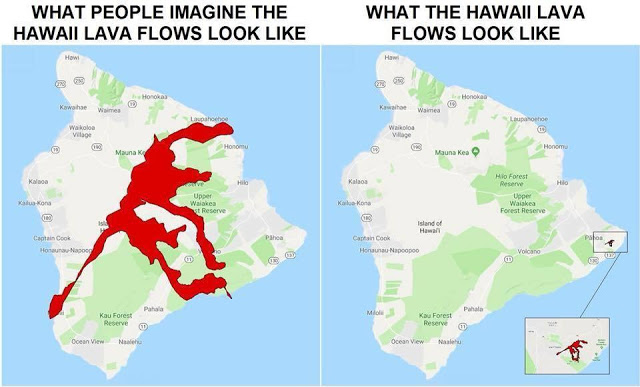
Consider this Hawaiian example; yes this problem of promoting tourism while contending with natural disasters is not just an issue for the Caribbean. Rather, the US State of Hawaii is contending with the same thing right now, with the active Kīlauea volcano. See related news VIDEO in the Appendix below.

There is the need for better stewardship of the economic engines on touristic islands, be it Hawaii or the Caribbean. It is what it is! And our situations will worsen; things will get worse before they get worst. This is due to the reality and eventuality of Climate Change. This need to assuage against the threats and realities of Climate Change was an original intent of the Go Lean roadmap. The opening Declaration of Interdependence stresses this (Page 11) in the first of many pronouncements:

i. Whereas the earth’s climate has undeniably changed resulting in more severe tropical weather storms, it is necessary to prepare to insure the safety and security of life, property and systems of commerce in our geographical region. As nature recognizes no borders in the target of its destruction, we also must set aside border considerations in the preparation and response to these weather challenges.

The Go Lean movement has previously detailed many related issues and advocacies for disaster awareness and abatement. Consider this sample of previous blog-commentaries:

https://goleancaribbean.com/blog/?p=15012 In Life or Death: No Love for Puerto Rico
https://goleancaribbean.com/blog/?p=14925 ‘Climate Change’ Reality!? Numbers Don’t Lie
https://goleancaribbean.com/blog/?p=14832 Example of Manifesting Environmental Change
https://goleancaribbean.com/blog/?p=13391 After Maria, Failed-State Indicators: Destruction and Defection for Puerto Rico
https://goleancaribbean.com/blog/?p=12996 After Irma, Failed State Indicators: Destruction and Defection
https://goleancaribbean.com/blog/?p=12977 After Irma, Barbuda Becomes a ‘Ghost Town’
https://goleancaribbean.com/blog/?p=12900 The Logistics of Disaster Relief
https://goleancaribbean.com/blog/?p=12879 Disaster Preparation: ‘Rinse and Repeat’
https://goleancaribbean.com/blog/?p=11858 Looking and Learning from the Cautionary Tale of Kiribati
https://goleancaribbean.com/blog/?p=9455 Fix ‘Climate Change’ – Yes, We Can
https://goleancaribbean.com/blog/?p=7103 COP21 – ‘Climate Change’ Acknowledged
https://goleancaribbean.com/blog/?p=6893 A Meteorologist’s View On Climate Change
https://goleancaribbean.com/blog/?p=4673 Climate Change‘ Merchants of Doubt … to Preserve Profits!!
https://goleancaribbean.com/blog/?p=2465 Book: ‘This Changes Everything: Capitalism vs. the Climate’
https://goleancaribbean.com/blog/?p=2276 Climate Change May Affect Food Supply Within a Decade
https://goleancaribbean.com/blog/?p=1883 Climate Change May Bring More Kidney Stones
https://goleancaribbean.com/blog/?p=1817 Caribbean grapples with intense cycles of flooding & drought

In summary, the issues in this commentary relate more to image and geographic misconceptions than they do tourism and natural disasters. Do we have the global reputation to “take a punch and stand back up”.

Unfortunately, no!

So we must reform and transform the Caribbean’s societal engines so as to assuage the dangers of Climate Change and natural disasters; pandemics too. This is the quest of the Go Lean roadmap, and this is not just a pipe dream; it is conceivable, believable and achievable for our regional stakeholders to do better and be better.

All Caribbean stakeholders – residents and tourists alike – are urged to lean-in to this roadmap for change … and empowerment. Yes, we can make the region a better place to live work and play. 🙂

Sign the petition to lean-in for this roadmap for the Caribbean Union Trade Federation.

—————-

Appendix VIDEO – Hawaii tourism hit hard by Kilauea volcano eruption – https://youtu.be/89ppKLS5ufI

CBS Evening News
Published on Jun 2, 2018 – As molten lava destroys more homes in Hawaii, police have been ordered to arrest people who refuse to evacuate. Thousands have already been forced to flee to safety. Now, dramatic images broadcast around the world are having another impact — on tourism. CBS News correspondent Carter Evans reports.

Share this post:
, , ,
[Top]

“Venezuela” – ‘On the Menu’ in California – ENCORE

“Gavin Newsom wants to turn this State into Venezuela” …
Republicans are always underdogs in [California] statewide contests, Nehring said, but he sees Newsom as vulnerable to the perception that he’s elitist and out of touch.

Still, Cox showed no signs of moderating the aggressive tone that generated excitement among conservatives, saying “Gavin Newsom wants to turn this state into Venezuela.”

… the aggressive tone of this accusation has generated a lot of excitement among conservatives. Here’s the background: Gavin Newsom is the Democratic Party’s nominee for Governor of California – the General Election will be November 6, 2018 – he is currently the Lieutenant Governor and also the former Mayor of San Francisco. He is a liberal icon in a liberal State.

Yet the one criticism that is sticking to candidate Newsom by Republican Party candidate John Cox is the fearful pattern of Venezuela.

Yes, Venezuela is “On the Menu” in California. But wait, that should be our ‘vantage point’ in the Caribbean!

… this was the theme of a previous blog-commentary from the movement behind the book Go Lean…Caribbean. Venezuela is in our neighborhood – with a long coastline on the Caribbean Sea – dysfunctions there spillover to our Caribbean member-states. It’s time to Encore that blog from May 31, 2016 . See the Encore as follows:

——————–

Go Lean Commentary – Venezuela: Watching a ‘Train Wreck in Slow Motion’>

Watching Venezuela now is like watching a “train wreck … in slow motion”.

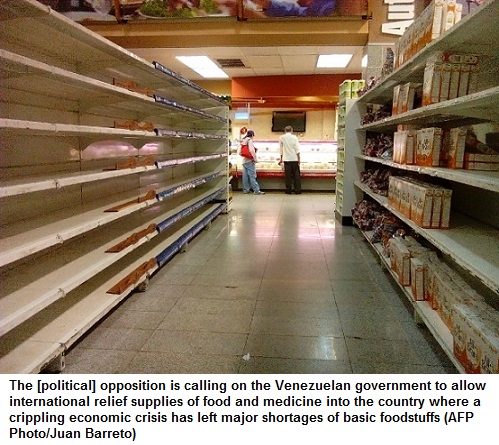
- Photo 1Didn’t we just see this recently … in a land far-far away – Greece? If the Venezuela parallel with Greece continues, we will be able to accurately predict that “things will get worse before it gets worse!”

This is not just an academic consideration for Caribbean stakeholders, as Venezuela boasts a vast coastline on the Caribbean Sea; they also share a border with one Caribbean member-state, Guyana, and supplies the region with a lot of its oil. And just recently with its PetroCaribe initiative, Venezuela was one hope to help eradicate poverty in the Caribbean. But now Venezuela is having a tough time protecting its own self from the pangs of poverty.

Many people are now waking up – inside and outside Venezuela – to the harsh realities that a Failed-State is emerging in our neighborhood, right in front of our eyes. Unfortunately, we – the Caribbean – are all too familiar. Consider here how Venezuela’s political institutions are crumbling:

  • The opposition parties refused to collaborate with the governing officials
  • Riots in the streets
  • Assassinations of government officials
  • Economy in shambles
  • Currency in disarray
  • Cupboards and store shelves are bare – see Photo above
  • Basic government services – social contract – are not being executed
  • External parties – UNASUR – are coming in to intercede

See the news article here conveying this harsh reality in Venezuela:

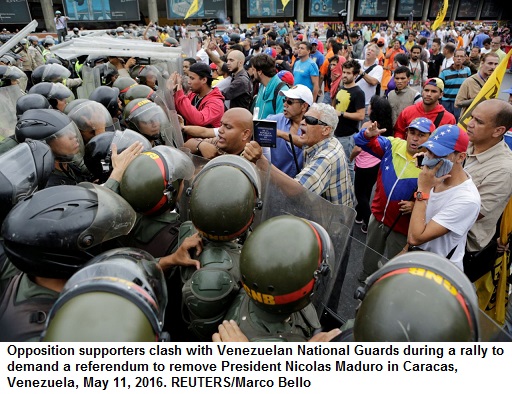
Title: Venezuelan officials, opposition meet mediators over standoff
By: Ernesto Tovar

- Photo 2Caracas (AFP) – Venezuelan officials and opposition foes have held separate secret meetings in the Dominican Republic with a group of ex-world leaders seeking a way out of political crisis, officials said, as an ex-military reserve leader was shot dead.

Representatives of both sides of Venezuela’s political standoff met former Spanish prime minister Jose Luis Rodriguez Zapatero, former Dominican president Leonel Fernandez and Panama’s ex-president Martin Torrijos “in recent days” under the auspices of the Union of South American Nations, UNASUR, to seek a “framework for a national dialogue,” the organization said in a statement.

The mediating former leaders found “a desire for dialogue on both sides,” for which new meetings were proposed to “agree on an agenda that meets the requirements of each party and a method for engaging in national dialogue,” the statement said.

The meetings were the initiative of President Nicolas Maduro, Venezuelan Foreign Minister Delcy Rodriguez tweeted, saying the effort “promotes peace, respect for the rule of law and the defense of sovereignty and territorial integrity.”

The main center-right opposition group Democratic Unity Roundtable (MUD) said in a statement that its conditions for the talks were the holding of a referendum over Maduro’s recall, freeing political prisoners, allowing exiles to return and “an end to prosecutions for political persecution.”

The opposition is also calling on the government to allow international relief supplies of food and medicine into the country and seek to end a crippling economic crisis “generated by official corruption and an economic model that is spreading misery.”

The three former leaders also held talks with Maduro and the opposition under UNASUR auspices in Caracas two weeks ago.

Publicly, the two sides could not be further apart.

MUD which blames Maduro for the economic crisis, accuses the electoral authorities of dragging their feet in processing their petition for a referendum on removing the socialist leader from office.

Although a survey last month showed 68 percent of Venezuelans want Maduro to leave office and to hold new elections, he has said the referendum drive has “very little support.”

Venezuela has the world’s largest oil reserves, but its economy is reeling from the collapse in global crude prices.

Venezuelans are experiencing severe food and medicine shortages compounded by the world’s highest inflation — almost 190 percent in 2015, which the International Monetary Fund predicts will balloon to 700 percent in 2016.
Source: Yahoo/AFP Online News – Retrieved May 29, 2016 from: https://www.yahoo.com/news/venezuelan-officials-opposition-meet-mediators-over-standoff-020940920.html?nhp=1

Yet still, there are a lot of lessons for the Caribbean to consider from this crisis – a “crisis is a terrible thing to waste” declares the book Go Lean … Caribbean (Page 8). As a region with past and present Failed-States, we must not fail to discern these lessons.

- Photo 6For starters, there is a super-national organization that Venezuelan stakeholders are able to escalate to for mediation, the Union of South American Nations – UNASUR according to the Spanish-language acronym. A super-national organization – for mediation and conflict resolution – is also the goal of the Caribbean Union Trade Federation (CU). In both cases, the goal is to model the European Union. See details and VIDEO of the UNASUR organization in the Appendices below:

The UNASUR organization, as described below, is part of the Latin American integration movement, combining the efforts of the Andean Community and the Southern Common Market (Mercosur). This should be the primary strategy for mitigating Failed-State status in South America. While Venezuela is a sovereign state, they can still be held accountable to their neighbors in UNASUR; this would be a product of peer pressure and the threat of sanctions. Too bad this integration movement is not complete in its construct, as this would have been most effective in stopping this “slow motion train wreck”.

In fact, in the 2004 South American Summit, representatives of these twelve South American nations participated:

1 These countries are also considered to be associate members of Mercosur.
2 These countries are also considered to be associate members of the Andean Community.
C Caribbean Community (CARICOM) member state
L Latin American Integration Association (ALADI) member state
M Accessing member to Mercosur
Source: Retrieved May 31, 2016 from: https://en.wikipedia.org/wiki/Union_of_South_American_Nations

The leaders of these countries announced the intention of modeling the new community in the mold of the European Union, including a unified passport, a parliament and, eventually, a single currency. The then Secretary General of the Andean Community – Allan Wagner – speculated at that time that the advanced union like the EU should be possible within the next fifteen years. Based on these experiences in Venezuela, this integration movement is a “day late and a dollar short”.

The actuality of Venezuela is more than just a cautionary tale for the Caribbean, it is also a Caribbean problem. In addition to the presence of Caribbean Community member-states of Guyana and Suriname, many aspects of Venezuelan life parallel those of the Caribbean in general and in specifics – see these previous blog-commentaries:

Mono-Industrial Economy

Majority of consumer goods imported and pricey

Close proximity with other countries, not suffering this failing status

Long legacy of bad community ethos regarding fiscal responsibilities

Validation of regional criticism

High societal abandonment rate

Large Diaspora abroad

Challenge of security / public safety

Incompetent governance

Being at the brink of disaster, at the precipice, is perhaps the only time communities are willing to reform and transform. This reality is what inspired the book Go Lean…Caribbean to serve as a roadmap for the introduction and implementation of the technocratic Caribbean Union Trade Federation (CU). The events of the 2008 Global Financial Crisis was the trigger for the composition of this book. Will Venezuela now use this crisis to forge change for its society?

Will the Caribbean forge change by just “observing and reporting” on Venezuela? There are many lessons to learn and the Caribbean community is urged not to ignore. The lessons learned, and codified in the pages of the Go Lean book can now be enhanced with the examination of the realities of Venezuela. This examination must consider the reality of the economic, security and governing aspects of Venezuelan society and the resultant consequences on their neighbors.

Like the UNASUR initiative, the Go Lean roadmap calls for a confederation of the 30 member-states of the Caribbean into a Single Market of 42 million people so as to leverage the governing burden across a separation-of-powers: a federal government and member-state government. This allows a new response to national crisis (economic, security and governance). This vision is at the root of the Go Lean roadmap, embedded in the opening Declaration of Interdependence (Page 12 – 13):

x. Whereas we are surrounded and allied to nations of larger proportions in land mass, populations, and treasuries, elements in their societies may have ill-intent in their pursuits, at the expense of the safety and security of our citizens. We must therefore appoint “new guards” to ensure our public safety and threats against our society, both domestic and foreign. The Federation must employ the latest advances and best practices … to assuage continuous threats against public safety.

xii. Whereas the legacy in recent times in individual states may be that of ineffectual governance with no redress to higher authority, the accedence of this Federation will ensure accountability and escalation of the human and civil rights of the people for good governance, justice assurances, due process and the rule of law. As such, any threats of a “failed state” status for any member state must enact emergency measures on behalf of the Federation to protect the human, civil and property rights of the citizens, residents, allies, trading partners, and visitors of the affected member state and the Federation as a whole.

xvi. Whereas security of our homeland is inextricably linked to prosperity of the homeland, the economic and security interest of the region needs to be aligned under the same governance. Since economic crimes, including piracy and other forms of terrorism, can imperil the functioning of the wheels of commerce for all the citizenry, the accedence of this Federation must equip the security apparatus with the tools and techniques for predictive and proactive interdictions.

xxiv. Whereas a free market economy can be induced and spurred for continuous progress, the Federation must install the controls to better manage aspects of the economy: jobs, inflation, savings rate, investments and other economic principles. Thereby attracting direct foreign investment because of the stability and vibrancy of our economy.

The following details from the book Go Lean … Caribbean are the community ethos, strategies, tactics, implementations and advocacies necessary to effect the turn-around of the Caribbean societal engines – to learn from failing communities (like Greece and Venezuela):

Community Ethos – Economic Systems Influence Individual Choices Page 21
Community Ethos – Economic Principles – Money Multiplier Page 21
Community Ethos – Governing Principles – Lean Operations Page 24
Community Ethos – Ways to Impact the Future Page 26
Community Ethos – Ways to Impact Turn-Arounds Page 33
Community Ethos – Ways to Impact the Greater Good Page 37
Strategy – Vision – Confederate all 30 Member-States into a Single Market Page 47
Strategy – Mission – Build and foster local economic engines Page 45
Strategy – Mission – Fortify the stability of our mediums of exchange Page 45
Strategy – Mission – Dissuade further Brain Drain Page 46
Tactical – Confederating a Permanent Union Page 63
Tactical – Fostering a Technocracy Page 64
Tactical – Separation of Powers – Federal Government versus Member-States Page 71
Implementation – Assemble all Member-States Page 96
Implementation – Ways to Pay for Change Page 101
Implementation – Foreign Policy Initiatives at Start-up – Relationship with Venezuela Page 102
Implementation – Ways to Foster International Aid Page 115
Planning – Ways to Model the European Union Page 130
Planning – Ways to Improve Failed-State Indices Page 134
Planning – Lessons Learned from 2008 – The Global Financial Crisis Page 136
Advocacy – Ways to Grow the Economy Page 151
Advocacy – Ways to Create Jobs Page 152
Advocacy – Better Manage the Social Contract Page 170
Advocacy – Ways to Preserve Caribbean Heritage Page 218
Advocacy – Ways to Protect Human Rights Page 218
Advocacy – Ways to Re-boot Cuba – Marshall Plan Tactic for Failed-States Page 236
Advocacy – Ways to Re-boot Haiti – Marshall Plan Tactic for Failed-States Page 238
Appendix – Caribbean Failed-State Indicators and Definitions Page 271

Unless mitigated, Venezuela will become a Failed-State. We hope that the country, and their South American neighbors can secure their society to assure peace and the protection of human rights.

We also have near Failed-States in the Caribbean: Think: Haiti, Puerto Rico and Cuba; plus a host of countries just slightly behind them. We have to foster our own turn-around strategies for our region.

Venezuela is out of scope for the Go Lean roadmap; our quest is to reform and transform the Caribbean. The roadmap declares that the responsibility for fixing the Caribbean though must fall first-and-foremost on the Caribbean, its people and institutions. The effort is not easy; the Go Lean book describes it as heavy-lifting. But the returns will be worth the investment. This is true for Venezuela … and the Caribbean.

This is the goal of the Go Lean roadmap: to make the Caribbean a better place to live, work and play. 🙂

———————-

Appendix – Union of South American Nations – UNASUR

- Photo 3The Union of South American Nations (USAN; Spanish: Unión de Naciones SuramericanasUNASUR; Portuguese: União de Nações Sul-Americanas,UNASUL; Dutch: Unie van Zuid-Amerikaanse NatiesUZAN) is an intergovernmental regional organization comprising 12 South American countries.

The UNASUR Constitutive Treaty was signed on 23 May 2008 – [legally completing the integration between the Andean Community and the Southern Common Market (Mercosur) nations] – at the Third Summit of Heads of State, held in Brasília, Brazil.[7] According to the Constitutive Treaty, the Union’s headquarters will be located in Quito, Ecuador.[2] On 1 December 2010, Uruguay became the ninth state to ratify the UNASUR treaty, thus giving the union full legality.[8][9] As the Constitutive Treaty entered into force on 11 March 2011, UNASUR became a legal entity during a meeting of Foreign Ministers in Mitad del Mundo, Ecuador, where they had laid the foundation stone for the Secretariat Headquarters.[10] The South American Parliament will be located in Cochabamba, Bolivia, while the headquarters of its bank, the Bank of the South are located in Caracas,Venezuela.[2]

On 4 May 2010, at a heads of state summit held in Campana, 47 miles north of Buenos Aires, former Argentine President Néstor Kirchner was unanimously elected the first Secretary General of UNASUR for a two-year term.

Structure

At the moment, the provisional structure of the UNASUR is as follows:

  • A permanent Secretariat is to be established in Quito, Ecuador. The Secretary General, with a two-year mandate, is to be elected on a consensual basis among the Heads of State of the member states. Former Argentine President Néstor Kirchner was designated the first Secretary General on 4 May 2010.[20]
  • The presidents of the member nations will have an annual meeting, which will have the superior political mandate. The first meeting was in Brasília (Brazil) on 29–30 September 2005. The second meeting was in Cochabamba (Bolivia) on 8–9 December 2006. The third meeting was held in Brasília on 23 May 2008.
  • - Photo 5The Presidency Pro Tempore, is exercised for a one-year period on a pro tempore basis by one of the heads of state of each UNASUR Member State, the succession following alphabetical order. The first leader to occupy this position was Chilean President Michelle Bachelet. According to Decisions Reached in the Political Dialogue[21] which was signed during the First South American Energy Summit.
  • The ministers of foreign affairs of each country will meet once every six months. They will formulate concrete proposals of action and of executive decision. The President of the Mercosur’s permanent representatives committee and the director of the Mercosur’s department, the Andean Community’s general secretary, the general secretary of the Latin American Integration Association (ALADI) and the permanent secretaries of any institution for regional cooperation and integration, Amazon Cooperation Treaty Organization among others, will also be present at these meetings.
  • Sectorial Ministers’ meeting will be called upon by the presidents. The meetings will be developed according to Mercosur’s and CAN’s mechanisms.
  • On 9 December 2005, a special commission was established in charge of advancing the process of South American Integration. It consists of 12 members, whose function is to elaborate proposals that will help the process of integration between the South American nations.

An Executive Commission, which was created by the II CSN meeting, was transformed in the Political Commission or Delegates Council, according to Decisions Reached in the Political Dialogue.[21]

- Photo 4
=============================

APPENDIX – VIDEO – UNASUR –  https://youtu.be/rNjkr7y8-Kc

Published on Apr 16, 2016 – The Union of South American Nations, or UNASUR, marks its ninth anniversary this Sunday, April 17 with a 12-kilometer race in Ecuador with the aim of “bringing the regional body closer to the people.” The UNASUR Secretary-General Ernesto Samper resumed in a few words what the bloc is all about: “To promote peace, democracy and respect of human rights, as well as a Latin American integration. http://multimedia.telesurtv.net/v/una…

Share this post:
, ,
[Top]

Art Imitating Life – Was ‘Thanos’ Right?

Go Lean Commentary

The supposition is simple; if a society suffers from famine and poverty, then eliminate half of the population and there will be plenty of resources for all the remaining people.

But this is a fallacy, devoid of logic! This is not how economic systems work. The truth is: the more people, the better!

Consider the facts: the landmass of the United States has not changed since 1959; Alaska became the 49th state of the U.S. on January 3, 1959 and Hawaii received statehood on August 21, 1959. The US population in 1960 was 179,323,175; today the estimated US population is 325,719,178. Yet the 1960 poverty rate (19%) was atrocious; conditions are better today; though some poverty/hunger persists; due more to individual abuses; listen to the AUDIO-PODCAST in Appendix A below.

Why … was poverty alleviated? It’s the community education, science and technology, not the size of the population. “These ones” won the ‘War on Poverty’; see the formal details of the US Government’s War on Poverty in Appendix B.

This truly is logical!

Imagine the increased yields from “factory farms” and industrialized agriculture. The plains on the American continent are now considered the “bread basket” of the world.

Yet, believe it or not, that fallacious logic – also practiced by the Supervillain Thanos in the Marvel Cinematic Universe – is common thinking in the Caribbean.

Wait, who?

Thanos is the fictitious character in Marvel Comic books and related movies. He is a Supervillain in that he has ultimate abilities:

  • Superhuman strength, agility, durability, and longevity
  • Superhuman physiology of Eternals
  • Plasma energy projection

Thanos is all the rage right now in 2018. The current Number 1 movie at the box office is Avengers: Infinity War; this movie was the fastest film to ever reach $ 1 Billion in gross receipts. Wow!

Though the heroes of the film are the Avengers, the plotline of this movie really belongs to Thanos. The verbiage on the movie poster reveals:

The Avengers and their allies must be willing to sacrifice all in an attempt to defeat the powerful Thanos before his blitz of devastation and ruin puts an end to the universe.

The main character Thanos is portrayed by the actor Josh Brolin. In the film, according to one summary, he seeks the six notorious Infinity Stones because he believes the Universe is overpopulated and wants to cull it by half so that those who remain may have a better quality of life.

The fallacy of Thanos’s reasoning is obvious, if a community loses half of the population – through death or abandonment – we lose the producers and consumers, so that means the nation builders, professional classes would be diminished as well.

This is not just a question for this movie, but for Caribbean life as well.

Through their words and actions (policies & procedures) the stakeholders of the Caribbean are behaving as if the countries in the region would be “better off” if there were less people; i.e. Puerto Rico is already at 50 percent of baseline numbers.

Could our society do a better job feeding (and other provisions) ourselves with only half of the population?

So the supposition in the Caribbean is that more and more people need to leave the islands so that there would finally be  just enough resources to provide for the remaining people; think fish stock. This is wrong thinking.

So sad! This commentary asserts that the answer to this supposition is: No!

A trusted source – The Bible – declares in Matthew 26:11 of the English Standard Version: “For you always have the poor with you …”. So poverty abounded in the past, now, and will most assuredly continue in the future.

The problem is not any excessive population, but rather the failure to embrace the art and science of sustenance. In fact, the quest of the movement behind the book Go Lean … Caribbean, is to urge the increase of the Caribbean population, not the decline. A better practice to balance the supply-demand  equation is to smartly grow the industrial landscape, to elevate the economic engines in the region. This will alleviate hunger; see this theme conveyed in these previous blog-commentaries:

https://goleancaribbean.com/blog/?p=13184 Industrial Reboot – Frozen Foods 101
https://goleancaribbean.com/blog/?p=10369 Science of Sustenance – Temperate Foods
https://goleancaribbean.com/blog/?p=5098 Forging Change: ‘Food’ for Thought
https://goleancaribbean.com/blog/?p=2276 Managing Climate Change Effect on the Food Supply

Though the US performs far better with hunger abatement among its population now than it did when the population was half, some degree of poverty and hunger still exists. The solution cannot be the numbers; it is the methods, the systems of sustenance. This is the theme in the reference article in Appendix B.

Yet still, so many in the Caribbean reflect the theme of Thanos. It seems that they would rather lose half of their population – with policies that encourage abandonment – than try to adopt the best practices for food acquisition and distribution. This commentary have consistently detailed the “push and pull” factors that lead to the human flight in this region. Consider this sample of previous blog-commentaries:

https://goleancaribbean.com/blog/?p=12879 Disaster Vulnerability: ‘Rinse and Repeat’
https://goleancaribbean.com/blog/?p=11048 Allowing the ‘Strong to Abuse the Weak’ – Lesson from Hammurabi
https://goleancaribbean.com/blog/?p=10367 The Lack of Systems to Sustain Caribbean Living
https://goleancaribbean.com/blog/?p=10220 Bad Habit of Rent-seeking
https://goleancaribbean.com/blog/?p=10216 Caribbean Orthodoxy Pushing Good People Away
https://goleancaribbean.com/blog/?p=8155 Gender Inequities lead to Brain Drain
https://goleancaribbean.com/blog/?p=5784 Blatant Human Rights Violations
https://goleancaribbean.com/blog/?p=915 Excessive Energy Costs – The Need To Go ‘Green

Though there may be no malicious intent, the absence of malice does not excuse the societal incompetence!

We must do better in our Caribbean homeland.

The political leaders in the Caribbean would rather have their Diaspora “dead to them” rather than invite their participation in the outworking of the Caribbean member-states. In proof, they do not allow their Diaspora to vote or participate in the democratic process.

While Thanos is not real … his persona is a work of art! His model can help us. So this is art imitating life.

The edict of “life imitating art and art imitating life” provides a lot of teaching moments for the world in general and the Caribbean in particular. There is a lot of influence to be gathered from the Avengers: Infinity War movie; this movie is successful and fulfilling. See here for the effect on the box office in the related VIDEO here:

VIDEO – Weekend Box Office May 11 – 13, 2018 – https://www.imdb.com/list/ls025720609/videoplayer/vi3098786585

There are so many points of consideration from this movie. This demonstrates the power of this art form. In a previous blog/commentary regarding Caribbean Diaspora member and Hollywood great, Sidney Poitier, it was declared that …

“Movies are an amazing business model. People give money to spend a couple of hours watching someone else’s creation and then leave the theater with nothing to show for the investment; except perhaps a different perspective”.

The quest of the Go Lean roadmap is to elevate the societal engines so that Caribbean people can prosper where planted here in the Caribbean. The fact that people are abandoning their Caribbean homeland is proof-positive that little prospering happens here – one report list 70 percent of the professional classes are gone.

Another lesson we glean from the fiction of Thanos, is that we need heroes. There is the need to impact our Caribbean society with new empowerments. We do not need a brand of Super Heroes, just people in the homeland, who would work together, like the Avengers. This level of commitment will help us to accomplish our goals.

The Go Lean movement seeks to engage Caribbean heroes; the book serves as a roadmap to introduce the technocratic Caribbean Union Trade Federation (CU) to elevate the region’s societal engines – economics, homeland security and governance – of the 30 Caribbean member-states. In fact, the prime directives of the roadmap includes the following 3 statements:

  • Optimize the economic engines in order to grow the regional economy to $800 Billion & create 2.2 million new jobs.
  • Establish a security apparatus to ensure public safety and protect the resultant economic.
  • Improve Caribbean governance to support these engines, including a separation-of-powers between the member-states and CU federal agencies.

The Go Lean book makes the point of the need for heroics early in a Declaration of Interdependence (Page 12) that claims:

x. Whereas we are surrounded and allied to nations of larger proportions in land mass, populations, and treasuries, elements in their societies may have ill-intent in their pursuits, at the expense of the safety and security of our citizens. We must therefore appoint “new guards” to ensure our public safety and threats against our society, both domestic and foreign. The Federation must employ the latest advances and best practices … to assuage continuous threats against public safety.

xi. Whereas all men are entitled to the benefits of good governance in a free society, “new guards” must be enacted to dissuade the emergence of incompetence, corruption, nepotism and cronyism at the peril of the people’s best interest. The Federation must guarantee the executions of a social contract between government and the governed.

xii. Whereas the legacy in recent times in individual states may be that of ineffectual governance with no redress to higher authority, the accedence of this Federation will ensure accountability and escalation of the human and civil rights of the people for good governance, justice assurances, due process and the rule of law. As such, any threats of a “failed state” status for any member state must enact emergency measures on behalf of the Federation to protect the human, civil and property rights of the citizens … of the affected member state and the Federation as a whole.

xvi. Whereas security of our homeland is inextricably linked to prosperity of the homeland, the economic and security interest of the region needs to be aligned under the same governance. Since economic crimes, including piracy and other forms of terrorism, can imperil the functioning of the wheels of commerce for all the citizenry, the accedence of this Federation must equip the security apparatus with the tools and techniques for predictive and proactive interdictions.

Let’s defeat the “Thanos” in our communities. (They are out there!)

Having fewer mouths to feed is not the strategy for the Caribbean success. In fact, having fewer mouths to feed is actually bad for the economy. People do more than just eat; they also work, build up their communities and help with nation-building. A lot of economic activity can be created just by living and being; this is true with all aspects of food provisioning; think agriculture and fisheries. Imagine a family garden, what is the practice with excess vegetables? Sell, trade, barter or gift them, right?! All these activities would be beneficial for society.

The Go Lean book provides 370 pages of details on the economic principles and community ethos to adopt, plus the executions of strategies, tactics, implementations and advocacies to better secure the Caribbean homeland. Just “how” can the Caribbean reboot, reform and transform their societal engines to help alleviate poverty. This is the actual title of one advocacy in the Go Lean book. Consider the specific plans, excerpts and headlines here from Page 222, entitled:

10 Battles in the War on Poverty

1 Lean-in for the Caribbean Single Market and Economy
This regional re-boot will allow for the unification of the region into one market, thereby creating a single economy of 30 member-states, 42 million people and a GDP of over $800 Billion. Following the model of the European Union, the CU will seek to streamline economic engines so as to increase jobs, standards of living and opportunities – increasing GDP. The CU will work to make the Caribbean a better place to live, work and play for all socio-economic classes.
2 Minimize Political Bureaucracy
3 Welfare versus “Work-fare”
Many economists have argued that the US “War Against Poverty” – Welfare first – policies, actually had a negative impact on the economy because of their interventionist nature. This school of thought is that the best way to fight poverty is not through government spending but through economic growth, thus “Work-fare” is a better solution. In 1996 the US implemented a Welfare-to-Work program that had almost immediate results – welfare and poverty rates both declined during the late-1990s, leading many commentators to declare that the legislation was a success. The CU takes a similar stance: lead with jobs!
4 Entrepreneurial Values
Job creators would be valued, promoted and heralded under the CU economic schemes. Venture Capitalists, small business loans and access to capital markets are measures designed to spur growth and attitudes in entrepreneurship.
5 Repatriation of Time, Talent and Treasuries
The CU will incentivize the Diaspora to repatriate to the Caribbean region, and protect them from victimization upon return. Where a physical return is not possible, other avenues of support will be promoted for an economic leap from this remote population: vacation homes, labor certification priority, and ease of funds transfer.
6 Family Planning
Third World countries usually have higher birth rates than Developed countries. While not discouraging individual rights, the CU will facilitate better education, women’s health resources and access to prenatal healthcare.
7 Education Goals in Balance
Education is considered a panacea to raise standard of living, but tertiary education in the CU region has resulted in a higher emigration pattern than should be tolerated. The CU will facilitate e-Learning solutions to retain the talent.
8 Proactive about Healthcare Realities
9 Aging Population

The CU will facilitate for the Caribbean Region to be the world’s best address for senior citizens. This will send the invitation to retirees (Caribbean Diaspora and foreign) to welcome their participation and contributions to CU society. The increase in the pool of participants and beneficiaries will extend added benefits to domestic seniors.

10 Raise Retirement Age

Abandoning wrong thinking about poverty in society and engaging a more positive approach may be considered heroic.

The Caribbean needs heroes, to make this difference. The Go Lean book describes the need for the Caribbean to appoint “new guards” to effect the necessary empowerments in the Caribbean. We need the “new guards” or a regional security pact to engage to better protect our homeland from threats and risks, foreign and domestic. So the purpose of the published strategies, tactics and implementations of this security pact is to ensure public safety as a comprehensive endeavor, encapsulating the needs of all Caribbean stakeholders: residents and institutions alike.

The edict of “life imitating art and art imitating life” can be applied in our everyday Caribbean life. Let’s lean-in for our own heroic cause. Yes, we can … collectively if not individually, be heroes and defeat the “Thanos” villainy in our midst. Let’s start by leaning-in for the empowerments described here in the book Go Lean…Caribbean.

Let’s do it! This plan, to make the Caribbean a better place to live, work and play is conceivable, believable and achievable. 🙂

Download the free e-book of Go Lean … Caribbean – now!

Sign the petition to lean-in for the roadmap for the Caribbean Union Trade Federation.

————

Appendix A AUDIO-PODCASTCity Limits: Why Reducing Poverty is Such an Elusive Goal – https://cpa.ds.npr.org/waer/audio/2018/01/city_limits-_what_is_poverty.mp3

Real Estate Investment

Posted December 13, 2017 – The statistics regarding the poverty rate in [the American city of] Syracuse are staggering. But what is poverty? And what can be done about it? [Public Radio station] WAER’s Chris Bolt talks with some of those living in poverty, to tackle these questions.

————

Appendix B – War on Poverty

The War on Poverty is the unofficial name for legislation first introduced by United States President Lyndon B. Johnson during his State of the Union address on Wednesday, January 8, 1964. This legislation was proposed by Johnson in response to a national poverty rate of around nineteen percent. The speech led the United States Congress to pass the Economic Opportunity Act, which established the Office of Economic Opportunity (OEO) to administer the local application of federal funds targeted against poverty.

As a part of the Great Society, Johnson believed in expanding the federal government’s roles in education and health care as poverty reduction strategies.[1]

… 

The legacy of the War on Poverty policy initiative remains in the continued existence of such federal programs as Head StartVolunteers in Service to America (VISTA), TRiO, and Job Corps.

The popularity of a war on poverty waned after the 1960s. Deregulation, growing criticism of the welfare state, and an ideological shift to reducing federal aid to impoverished people in the 1980s and 1990s culminated in the Personal Responsibility and Work Opportunity Act of 1996, which President Bill Clinton claimed, “ended welfare as we know it.”

Major Initiatives

Source: Retrieved May 15, 2018 from: https://en.wikipedia.org/wiki/War_on_Poverty


Share this post:
, ,
[Top]

Counter-culture: Pushing for Change

Go Lean Commentary

The Change Agent cometh; … they always come.

The only constant is change itself.

A primary motivation of the movement behind the book Go Lean…Caribbean is to better cope with societal change. The book asserted that the region had been “steamrolled” by dynamic Agents of Change; these 4 agents are full explored in the book (Page 57) with this introduction:

Shakespeare described change as “an undiscovered country”. No one knows exactly what will happen next and when. The best practice is to monitor the developments in the marketplace, adapt and adjust as soon as possible. This description of a nimble response is the purpose behind “Agile” project management and other Lean management methodologies. … Assuming a role to “understand the market and plan the business” requires looking at the business landscape today and planning the strategic, tactical, and operational changes to keep pace with the market and ahead of competitors. Strategic changes that must be accounted for now, includes:

  • Technology
  • Globalization
  • Climate Change
  • Aging Diaspora

This commentary – entry 4 of 4 – is the final submission in this series on the counter-culture of the 1960’s/1970’s. This series from the Go Lean movement considers the experiences of how people deviated from the mainstream society to forge change in their communities. The people – think: Hippies – were scorned and ridiculed, but they persisted … and eventually manifested change on … everything and everybody. The other commentaries in the series are cataloged as follows:

  1. Counter-culture: Embracing the Change – Battling against Orthodoxy
  2. Counter-culture: Manifesting Change – Environmentalism & ‘Climate Change’ abatement
  3. Counter-culture: Monetizing the Change – Education, Workplace, Healthcare & Retirement Mandates
  4. Counter-culture: Pushing for Change – Is Ganja here to stay?

Today, it is clear that mainstream society has been assimilated by the counter-culture revolution with previously debated New Morals. Some people even claim that this New Morality is the same Old Immorality. For instance, consider recreational drugs, marijuana in particular; counter-culturists have always “pushed” for the freedom of marijuana use; see the VIDEO in the Appendix below. Despite all the efforts to outlaw it, authority figures are now starting to just accept, tolerate and legitimize its usage. This last commentary in this series asked the pointed question:

Is Ganja here to stay?

(We use the Caribbean branding here for marijuana; known by many different names: weed, cannabis, pot or reefer).

Is this change here to stay? Is this just another victory from the counter-culturists from the 1960’s/1970’s? They are still pushing! Though it may not be the same people, it is still the same counter-revolutionary attitudes.

As related in the previous submissions – in this series – the champions of the counter-culture were able to claim some measure of victory in their efforts. Therefore, all of these commentaries have conveyed “how” the stewards for a new Caribbean can shepherd our society for smoother change management.

The marijuana reality is pressing down on us. Notice the imminence as conveyed in this news article here from St. Lucia:

Title # 1: Mondesir says ganja unstoppable, here to stay

Former Health Minister, Doctor Keith Mondesir, asserting that ganja is here to stay and is unstoppable, has come out in support of its legalisation.

“The entire first world, Europe , the USA, have tried hard to stop it. They have given up now realising this is here to stay. So  we as a people in the Caribbean, we have to determine what policies  do we have right now and what policies should we adopt,” Mondesir declared.

“Are we going to have open policy like Holland? Are we going to have it restricted like the US in certain places? But we know that the world is now accepting the smoking of marijuana,” the former minister observed.

He pointed to the example of Canada which is heading towards legalisation,  noting that farmers there are preparing to cash in on the herb.

“If anyone planting marijuana here has any intention of making money, they are missing the boat,” Mondesir remarked.

Just last week National Security Minister and former Deputy Police Commissioner, Hermangild Francis, expressed support for ‘relaxing’ current ganja laws in Saint Lucia.

But the Cannabis Movement, which has been in the forefront of the push to decriminalise or legalise marijuana ‘outright’, has accused the authorities  here of being split and possibly ‘two-faced’ on the issue.
Source: Retrieved May 12, 2018 from: https://stluciatimes.com/2018/04/23/mondesir-says-ganja-unstoppable-here-to-stay/

Were you alive in the 1960’s or 1970’s?
Can you believe now that we are talking about how we can co-exist with legal marijuana use in our communities?

Such talk would have been considered crazy, just a few years or a decade ago.

But crazy is as crazy does; consider these quotes from Advertising Executive Rob Siltanen:

  1. “The people who are crazy enough to think they can change the world are the ones who do.”
  2. “Here’s to the crazy ones. The misfits. The rebels. The troublemakers. The round pegs in the square holes. The ones who see things differently. They’re not fond of rules. And they have no respect for the status quo. You can quote them, disagree with them, glorify or vilify them. About the only thing you can’t do is ignore them. Because they change things. They push the human race forward. And while some may see them as the crazy ones, we see genius. Because the people who are crazy enough to think they can change the world, are the ones who do.”

The stewards for a new Caribbean regional administration – the movement behind the Go Lean book, a roadmap for the introduction and implementation of the technocratic Caribbean Union Trade Federation (CU) – are not crazy. We know the dangers, risks and threats of drugs in society, and yet accept that this counter-cultural change may also be inevitable. So rather that dreading or running from the eventuality of marijuana decriminalization, we seek to prepare for it, but on a regional, super-national level. Amazingly, this strategy also aligns with a former government Cabinet member in St. Lucia; “he” made this siren call:

Title # 2: ‘Musa’ wants united Caribbean approach to ganja decriminalisation

Former Agriculture Minister, Moses ‘Musa’ Jn Baptiste, has expressed the view that the Caribbean should approach the issue of decriminalising marijuana in a united way.

‘It is something that we have spoken about even when we were in government. I was minister of agriculture and that question came up many times,’ Jn Baptiste recalled.

‘We were always of the view that the Caribbean should approach this in a united way because if you have decriminalisation in various countries and not in others, especially in an OECS economic union, you can envisage the challenges,’ the former minister told reporters Thursday.

He asserted that the decriminalisation process and the decriminalisation movement in the region are moving in a ‘particular direction.’

‘I am sure that all governments in the sub-region will quickly realise that instead of everybody doing it on their own, that we  should move on this,’ Jn Baptiste declared.

He expressed the hope that there would be widespread consultation.

‘The whole society has to sit down and talk about this – but certainly, this is moving in a particular direction and we see what is happening in the United States, we see what is happening in certain states in the United States and  we just noticed what has happened in Antigua and definitely I am sure all governments and people in the region, especially the OECS economic union, will be taking this seriously,’ Jn Baptiste stated.
Source: Retrieved May 12, 2018 from: https://stluciatimes.com/2018/04/06/musa-wants-united-caribbean-approach-to-ganja-decriminalisation/

Imagine a regional Caribbean coordination for the drama of marijuana decriminalization. “Yes, we can”!

The Go Lean book provides 370-pages of turn-by-turn instructions on “how” to adopt a regional community ethos, plus the strategies, tactics, implementations and advocacies to execute so as to transform the societal engines of Caribbean society (economics, security and governance), regarding the whole drug eco-system. As related in a previous blog-commentary:

… the Go Lean book asserts that every community has bad actors, and with a more liberal-progressive attitude towards a once-illegal drug, community attitudes must be paramount. There must be “new guards” to assuage any threats from this practice on society. This point is pronounced early in the book with the Declaration of Interdependence (Pages 12 – 13) that claims:

x. Whereas we are surrounded and allied to nations of larger proportions in land mass, populations, and treasuries, elements in their societies may have ill-intent in their pursuits, at the expense of the safety and security of our citizens. We must therefore appoint new guards to ensure our public safety and threats against our society, both domestic and foreign. The Federation must employ the latest advances and best practices of criminology and penology to assuage continuous threats against public safety. The Federation must allow for facilitations of detention for [domestic and foreign] convicted felons of federal crimes, and should over-build prisons to house trustees from other jurisdictions.

xi. Whereas all men are entitled to the benefits of good governance in a free society, “new guards” must be enacted to dissuade the emergence of incompetence, corruption, nepotism and cronyism at the peril of the people’s best interest. The Federation must guarantee the executions of a social contract between government and the governed.

xvi. Whereas security of our homeland is inextricably linked to prosperity of the homeland, the economic and security interest of the region needs to be aligned under the same governance. Since economic crimes, including piracy and other forms of terrorism, can imperil the functioning of the wheels of commerce for all the citizenry, the accedence of this Federation must equip the security apparatus with the tools and techniques for predictive and proactive interdictions.

So legalizing marijuana … will be about more than just managing change, it will also be about managing risks. The Go Lean book relates that managing risk is more than just “One Act”, there is lengthy, engaged process (Page 76):

  • Education
  • Mentoring
  • Monitoring
  • Mitigation
  • Licensing
  • Coordination

For this delicate matter of marijuana decriminalization, issues abound, in all facets of society. There are economic, security and governing complexities that must be considered. In  fact, these issues were addressed in many previous Go Lean blog-commentaries. Consider this list here:

https://goleancaribbean.com/blog/?p=13882 Managing Legal Marijuana ‘Change’ in California
https://goleancaribbean.com/blog/?p=12703 Rocky Mountain High – Marijuana management in Colorado
https://goleancaribbean.com/blog/?p=9646 ‘Time to Go’ – American Vices, i.e. Marijuana. Don’t Follow!
https://goleancaribbean.com/blog/?p=1386 Marijuana in Jamaica – Puff Peace

The Go Lean book and roadmap stresses that preparing the Caribbean region for change is possible, but heavy-lifting. All the societal engines will have to be reformed and transformed. Yet still, this is conceivable, believable and achievable.

As related in the foregoing news articles, the First World or Advanced Democracies are advancing – pushing – towards legal or decriminalized marijuana use.

Ready or not, here they come!

    … vacationing  tourists …
    … cruise passengers.
    … students studying abroad.
    … repatriated citizens.
    … Ouch!

These descriptions – First World or Advanced Democracies – apply to the US, Canada and many Western European nations (think: England, The Netherlands, France, Germany, etc.), our tourism target markets. These descriptors do not apply to any Caribbean member-states. All 30 countries and territories (islands or coastal states) are flirting with Failed-State status. Adding recreational drug use into the Caribbean mix may only be a recipe for disaster. And yet, the change “cometh” anyway.

Let’s get ready! Let’s confederate, cooperate and collaborate to install the empowerments to allow us to better manage Caribbean affairs. We urge all Caribbean stakeholders to lean-in to this Go Lean roadmap. It is a viable plan to make our  homeland a better place to live, work and play. 🙂

Download the free e-Book of Go Lean … Caribbean – now!

Sign the petition to lean-in for this roadmap for the Caribbean Union Trade Federation.

———-

Appendix VIDEO – Rick James – Mary Jane – https://youtu.be/PrPNwLuk0zQ

Published on Oct 16, 2015

Rick James – Mary Jane (Video)


Share this post:
, ,
[Top]

Counter-culture: Monetizing the Change

Go Lean Commentary

“Put your money where your mouth is” – Popular Challenge

It is appropriate to look back 50 years at the height of the counter-culture – Hippie movement – and ask the question:

Were the counter-culturists willing to pay for the change they were demanding?

As asserted in the last submission of this series of commentaries on the counter-culture of the 1960’s/1970’s, the counter-culturists didn’t just go away, they won! They had some relative victory and transformed the mainstream values of society.

A counter-culture typically involves criticism or rejection of the status quo powerful institutions, with accompanying hope for a better life or a new society. There was a subsequent shift in the Social Contract deliveries after this counter revolution.

But how did the advocates pay for the change?

In the height of the 1960’s counter-culture movement, this question was asked – by the Number 1 English-speaking band, The Beatles – and the answers didn’t emerge for years, decades and generations.

The question was in the form of a song – You say you want a Revolution – see here (and the lyrics in Appendix A below):

VIDEO – The Beatles: Revolution (1968) – https://youtu.be/BGLGzRXY5Bw

The Beatles

Published on Oct 20, 2015 – The Beatles 1 Video Collection is Out Now. Get your copy here: http://thebeatles1.lnk.to/DeluxeBluRay

“When you talk about destruction, don’t you know that you can count me out”

“I did the slow version and I wanted it out as a single: as a statement of The Beatles’ position on Vietnam and The Beatles’ position on revolution. For years, on The Beatles’ tours, Brian Epstein had stopped us from saying anything about Vietnam or the war.” – John Lennon.

“Plugging directly into the Abbey Road desk and pushing the needles into the red achieved the fuzz-guitar sound. According to George Martin “We got into distortion on that, which we had a lot of complaints from the technical people about. But that was the idea: it was John’s song and the idea was to push it right to the limit. Well, we went to the limit and beyond.”

“Revolution” was directed by Michael Lindsay-Hogg, and filmed on the 4th September 1968 at Twickenham Film Studios. “Don’t you know it’s gonna be all right”

Music video by The Beatles performing Revolution. (C) 2015 Calderstone Productions Limited (a division of Universal Music Group) / Apple Films Ltd.

Only now, 50 years later, are we able to look (back), listen and learn the lessons from those times. (This exercise is part-and-parcel of the popular 5 L’s methodology: Look, Listen, Learn, Lend-a-hand and Lead). Monetizing the change is easier said than done!

The Beatles stated:

“But if you want money for people with minds that hate … All I can tell is brother you have to wait”

What did the counter-culture movement do so as to monetize the change that they were protesting for? As these groups assimilated their victories into mainstream society, they forced changes to the financial-economic systems as well. For example, one innovation that emerged in the US was moving away from institutional pensions to a new scheme of Individual Retirement Accounts or the 401(k). See more here on the US program, though this term 401K has been used in many other countries as a generic term for Individual Retirement Accounts:

Reference Title: 401(k)
In the United States, a 401(k) plan is the tax-qualified, defined-contribution pension account defined in subsection 401(k) of the Internal Revenue Code.[1] Under the plan, retirement savings contributions are provided (and sometimes proportionately matched) by an employer, deducted from the employee’s paycheck before taxation (therefore tax-deferred until withdrawn after retirement or as otherwise permitted by applicable law), and limited to a maximum pre-tax annual contribution of $18,500 (as of 2018).[2][3]
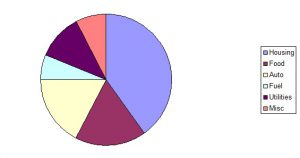
Other employer-provided defined-contribution plans include 403(b) plans for nonprofit institutions, 457(b) plans for governmental employers, and 401(a) plans. These plans may provide total annual addition of $55,000 (as of 2018) per plan participant, including both employee and employer contributions.

History
In the early 1970s a group of high earning individuals from Kodak approached Congress to allow a part of their salary to be invested in the stock market and thus be exempt from income taxes.[4] This resulted in section 401(k) being inserted in the then taxation regulations that allowed this to be done. The section of the Internal Revenue Code that made such 401(k) plans possible was enacted into law in 1978.[5] It was intended to allow taxpayers a break on taxes on deferred income. In 1980, a benefits consultant and attorney named Ted Benna took note of the previously obscure provision and figured out that it could be used to create a simple, tax-advantaged way to save for retirement. The client for whom he was working at the time chose not to create a 401(k) plan.[6] He later went on to install the first 401(k) plan at his own employer, the Johnson Companies[7] (today doing business as Johnson Kendall & Johnson).[8] At the time, employees could contribute 25% of their salary, up to $30,000 per year, to their employer’s 401(k) plan.[9]

Taxation
Income taxes on pre-tax contributions and investment earnings in the form of interest and dividends are tax deferred. The ability to defer income taxes to a period where one’s tax rates may be lower is a potential benefit of the 401(k) plan. The ability to defer income taxes has no benefit when the participant is subject to the same tax rates in retirement as when the original contributions were made or interest and dividends earned. Earnings from investments in a 401(k) account in the form of capital gains are not subject to capital gains taxes. This ability to avoid this second level of tax is a primary benefit of the 401(k) plan. Relative to investing outside of 401(k) plans, more income tax is paid but less taxes are paid overall with the 401(k) due to the ability to avoid taxes on capital gains.

For pre-tax contributions, the employee does not pay federal income tax on the amount of current income he or she defers to a 401(k) account, but does still pay the total 7.65% payroll taxes (social security and medicare).

Source: Retrieved May 10, 2018 from: https://en.wikipedia.org/wiki/401(k)

This commentary continues the series on the counter-culture of the 1960’s/1970’s. This series from the movement behind the book Go Lean … Caribbean considers the experiences of how people deviated from the mainstream society to forge change in their communities. The other commentaries in the series are cataloged as follows:

  1. Counter-culture: Embracing the Change – Battling against Orthodoxy
  2. Counter-culture: Manifesting Change – Environmentalism & ‘Climate Change’ abatement
  3. Counter-culture: Monetizing the Change – Education, Healthcare & Retirement Mandates
  4. Counter-culture: Pushing for Change – Is Ganja here to stay?

All of these commentaries convey “how” the stewards for a new Caribbean can forge a change culture when established institutions are dysfunctional and defective; the status quo must be protested. This entry – 3 of 4 – considers the financial and economic changes that emerged as a result of the 1960’s counter-culture movement; subsequently a more independent spirit emerged for planning retirement, education and healthcare. Today there are solutions that deviated from the previous broken institutional offering.

The affected countries – United States, Canada and Western Europe – are in better financial dispositions now than they were in the 1960’s. There are lessons for us to learn and apply here in the Caribbean.

The book Go Lean…Caribbean – available to download for free – serves as a roadmap for the introduction and implementation of the technocratic Caribbean Union Trade Federation (CU), for the elevation of Caribbean society – for all member-states. This CU/Go Lean roadmap has these 3 prime directives:

  • Optimization of the economic engines in order to grow the regional economy to $800 Billion and create 2.2 million new jobs. The deficient delivery of Caribbean Jobs is a sore subject regionally; this is responsible for so much abandonment.
  • Establishment of a security apparatus to ensure public safety and protect the resultant economic engines.
  • Improve Caribbean governance to support these engines, including a separation-of-powers between the member-states and CU federal agencies.

As the foregoing details, 401(k) Individual Retirement Accounts (IRA) brought a revolutionary shift in American society for Middle Class economic values. No longer where citizens dependent on broken institutions to deliver their financial solutions late in life. This spirit was also manifested in other areas of American financial life:

  • Education / College Planning – A 529 plan is a tax-advantaged savings plan designed to encourage saving for future college costs. 529 plans, legally known as “qualified tuition plans,” are sponsored by states, state agencies, or educational institutions and are authorized by Section 529 of the Internal Revenue Code – Source: SEC.gov.
  • Health Savings Accounts – HSA‘s are tax-advantaged medical savings accounts available to taxpayers in the United States who are enrolled in a high-deductible health plan (HDHP).[1][2] The funds contributed to an account are not subject to federal income tax at the time of deposit. HSA funds may currently be used to pay for qualified medical expenses at any time without federal tax liability or penalty. Beginning in early 2011 over-the-counter medications cannot be paid with an HSA without a doctor’s prescription.[3] Withdrawals for non-medical expenses are treated very similarly to those in an individual retirement account (IRA) in that they may provide tax advantages if taken after retirement age, and they incur penalties if taken earlier. The accounts are a component of consumer-driven health care. Source: Wikipedia.

All of these financial-economic empowerments enhanced the Middle Class eco-system for young men … and women. The counter-culture brought a lot of opportunities for women … finally. Women in the workplace! It was real thing!

So society changed upwards … for the better by ushering in dual income households (DINC = Double Income No Children). Imagine all the additional capital added to the securities markets (Wall Street) because the Middle Class was now participating in deferred savings and investments schemes. Consider the Economic Study in Appendix B.

Household Budget Before the 1960’s Revolution.

Household Budget After the 1960’s Revolution; a Bigger Pie.

Society also changed downward … because less and less women were fulltime homemakers. Family harmony suffered!

Lessons abound by studying the pro’s and con’s of the after-effect of the counter-culture on Middle Class American life.

The Go Lean book stresses that quest to reform and transform Caribbean societal engines can benefit by looking, listening, learning about the American Middle Class experience; then the goal would be to lend-a-hand and lead with a regional focus. This was an early motivation for the roadmap, as pronounced in the opening Declaration of Interdependence (Pages 12 – 13):

xi. Whereas all men are entitled to the benefits of good governance in a free society, “new guards” must be enacted to dissuade the emergence of incompetence, corruption, nepotism and cronyism at the peril of the people’s best interest. The Federation must guarantee the executions of a social contract between government and the governed.

xxiv. Whereas a free market economy can be induced and spurred for continuous progress, the Federation must install the controls to better manage aspects of the economy: jobs, inflation, savings rate, investments and other economic principles. Thereby attracting direct foreign investment because of the stability and vibrancy of our economy.

The Go Lean book provides 370-pages of turn-by-turn instructions on “how” to adopt new community ethos, plus the strategies, tactics, implementations and advocacies to execute so as to reboot, reform and transform the societal engines of Caribbean society. Just “how” can the Caribbean region pay for our revolution, the empowerments to elevate our regional society. This is the actual title of one advocacy in the Go Lean book. Consider the specific plans, excerpts and headlines here from Page 101, entitled: “10 Ways to Pay for Change“. Consider the specific plans, excerpts and headlines here:

10 Ways to Pay for Change

1 Lean-in for the Caribbean Single Market
The [CU] treaty allows for the unification of the region into one market, expanding to an economy of 30 member-states of 42 million people, to impact a GDP of over $800 Billion. In order for the CU to reboot the economic engines of the region, the political entity of the unified Caribbean must be rebooted first. That entity is the CariCom. In a commissioned 159-page study, the Turning Around CariCom report published one recommendation after another, all with the same pre-amble: “the budget must be substantially increased”. The analysis of that report is a chicken-and-egg conundrum, the CariCom construct can effectively increase the economics of the region, IF the region increases the funding of the CariCom. The CU Trade Federation implodes that quandary, as the CU will generate its own initial funding, as listed here, below.
2 Spectrum Auctions
The CU will function as a government-owned multinational corporation to deliver services for an integrated Caribbean administration. Having the regional authority, the CU will hold auctions for the radio spectrum in the region. This will generate the CU’s own initial revenue stream, as only rights are being awarded; there is no performance – no fabrication of products or rendering of services. With this strategy, there will be revenues to return back to CU share-holders, member-states, even in the 1st year. (See Appendix IBPage 279 – for samples/examples).
3 SGE Licenses
4 GPO Logistic Fees
An important CU mission is the Group Purchasing Organization (GPO), an extension of the current Office of Trade Negotiations; but the CU will make purchases and fulfill delivery to member-states, for a handling fee.
5 Regional Lottery
6 EEZ Exploration Rights
7 Homeland Security – Private Protection Licensing
8 Homeland Security – Hurricane Insurance Fund
9 Warrants
Paying for Change first optimizes the payment terms. All CU payments to member-states will be in the form of warrants attached to bonds; this allows the CU to pay lower interest rates. These warrants make the bonds sellable to the public.
10 Foreign Aid & Grants including Non-Government Organizations (NGOs)

There have been a number of blog-commentaries by the Go Lean movement that highlighted the regional economic revolution; this is part-and-parcel to rebooting the Caribbean eco-system. See a sample list of those previous blogs-commentaries here:

https://goleancaribbean.com/blog/?p=13744 Caribbean Economics: The Quest for a ‘Single Currency’
https://goleancaribbean.com/blog/?p=13677 Economics of a Beach City: ‘South Beach’
https://goleancaribbean.com/blog/?p=10585 Two Pies: Economic Plan for a New Caribbean
https://goleancaribbean.com/blog/?p=6269 Education & Economics – Michigan Model
https://goleancaribbean.com/blog/?p=599 Ailing Puerto Rico open to radical economic fixes
https://goleancaribbean.com/blog/?p=242 The Erosion of the Middle Class

In summary, it is only logical that the stewards for a new Caribbean consider the practicalities of how to pay for or monetize “their revolution”. If we want to be serious about effecting change in our society – we do – then we must have a formidable strategic, tactical and operational plan. This is the modus operandi of the Go Lean roadmap: a plan that is conceivable, believable and achievable for making the Caribbean homeland a better place to live, work and play.

We urge all Caribbean stakeholders to lean-in to this roadmap. 🙂

Download the free e-Book of Go Lean … Caribbean – now!

Sign the petition to lean-in for this roadmap for the Caribbean Union Trade Federation.

————

Appendix A – Song Lyrics: Revolution (1968) by The Beatles

You say you want a revolution
Well, you know
We all want to change the world
You tell me that it’s evolution
Well, you know
We all want to change the world

But when you talk about destruction
Don’t you know that you can count me out
Don’t you know it’s gonna be
All right, all right, all right

You say you got a real solution
Well, you know
We’d all love to see the plan
You ask me for a contribution
Well, you know
We’re doing what we can

But if you want money for people with minds that hate
All I can tell is brother you have to wait
Don’t you know it’s gonna be
All right, all right, all right

You say you’ll change the constitution
Well, you know
We all want to change your head
You tell me it’s the institution
Well, you know
You better free you mind instead

But if you go carrying pictures of chairman Mao
You ain’t going to make it with anyone anyhow
Don’t you know it’s gonna be
All right, all right, all right
All right, all right

Songwriters: John Lennon / Paul Mccartney

Source: Retrieved May 10, 2018 from: http://www.lyricsfreak.com/b/beatles/revolution+1_10026331.html

————

Appendix B – The Effects of Pension Funds on Markets Performance: A Review

Abstract – The worldwide reforming process of pension systems triggered by the demographic transition and globalization has led several countries to implement multi‐pillar pension systems and enhance pension funds. For this reason the studies on the effects that pension funds exert on markets performance have been flourishing in the last decades. In this paper, we provide an updated review of the empirical advances in this field of study, with particular focus on the effects that pension funds produce on labour markets, financial markets and economic growth.

Read the full report at: https://doi.org/10.1111/joes.12085

Source: Posted August 22, 2014; retrieved May 10, 2018 Wiley Online Library

Share this post:
, , ,
[Top]

Counter-culture: Manifesting Change – Environmentalism

Go Lean Commentary

News Flash: The hippies of the 1960’s grew up! They became middle class suburbanites. They traded in their tie-dye T-shirts for Polo shirts; and their Volkswagen Beetles for ‘Soccer-Mom’ Minivans.

Did the revolution for the 60’s Hippies simply fail? Did they retreat into the mainstream?

No and No, they simply won, their fight; the changes the counter-culture demanded were manifested:

The counter-culture has been argued to have diminished in the early 1970s, and some have attributed two reasons for this. First, it has been suggested that the most popular of its political goals—civil rightscivil libertiesgender equalityenvironmentalism, and the end of the Vietnam War—were “accomplished” (to at least some degree); and also that its most popular social attributes—particularly a “live and let live” mentality in personal lifestyles (the “sexual revolution“)—were co-opted by mainstream society.[57][65] Second, a decline of idealism and hedonism occurred as many notable counter-culture figures died, the rest settled into mainstream society and started their own families, and the “magic economy” of the 1960s gave way to the stagflation of the 1970s[57]—the latter costing many in the middle-classes the luxury of being able to live outside conventional social institutions. The counter-culture, however, continues to influence social movements, art, music, and society in general, and the post-1973 mainstream society has been in many ways a hybrid of the 1960s establishment and counter-culture.[65]Wikipedia.

Wait, what?!

The fights for civil rights, civil liberties, gender equality, environmentalism, and the “end of the Vietnam War” was successful. The world – America and Western Europe – we live in today is radically different than the world before the 1960’s. So they – the counter-culturists – are able to declare some relative victory.

Unfortunately, while that success was only limited, the Caribbean was left out in this fight … and the victory tour.

For example, the mentality to “live and let live” which is present in the US and other countries is painfully absent in the Caribbean. Many Caribbean citizens have fled the Caribbean orthodoxy, many being “pushed”, to live in a society where they can “live and let live”.

Let’s consider one fight that was manifested by the counter-culture: environmentalism.
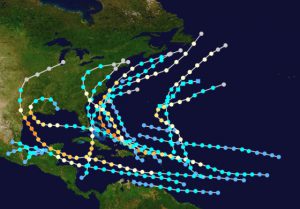
At its crux, environmentalism is an attempt to balance relations between humans and the various natural systems on which we depend in such a way that all the components are accorded a proper degree of sustainability. There was a relative success for environmentalism in the US with the creation and facilitation of the EPA (Environmental Protection Agency). This new independent federal agency was established by the 37th US President Richard Nixon in December 1970. The Administrator of the EPA is accorded Cabinet rank, so it wields power and authority to effect change in American society. In fact, under the 44th President, Barack Obama, the EPA began to impose regulations on carbon emissions from cars, power plants and other industries who contribute to Climate Change.

Despite all the accomplishments with environmental protection (land, air and water), there is still more work to do. In fact, Climate Change has been identified as one of the biggest threats for the Caribbean region. There is a need for our Caribbean communities to stand-up and fight for better Climate Change mitigations. This commentary asserts that there is the need to re-kindle that old counter-cultural vigor and vigilance.

This commentary – entry 2 of 4 – is a continuation in this series on the counter-culture of the 1960’s/1970’s. This series from the movement behind the book Go Lean … Caribbean considers the experiences of how people deviated from the mainstream society to forge change in their communities. The people – youth mostly – were scorned and ridiculed, but they persisted … and manifested the needed change. The other commentaries in the series are cataloged as follows:

  1. Counter-culture: Embracing the Change – Battling against Orthodoxy
  2. Counter-culture: Manifesting Change – Environmentalism & ‘Climate Change’ abatement
  3. Counter-culture: Monetizing the Change – Education, Workplace, Healthcare & Retirement Mandates
  4. Counter-culture: Pushing for Change – Is Ganja here to stay?

All of these commentaries convey “how” the stewards for a new Caribbean can take a “page from the counter-culture book” so as to shepherd societal change in this region.

Yes, we can!

We need that 1960’s vigor and vigilance in our efforts to abate Climate Change today. Remember the powerful anthem by R&B singer Marvin Gaye Mercy, Mercy Me! See the VIDEO here:

VIDEO-AUDIO – Marvin Gaye: Mercy, Mercy Me! (1971)https://youtu.be/U9BA6fFGMjI

Published on Aug 21, 2007
Marvin Gaye – Mercy, Mercy Me (the ecology); Rest in Peace Marvin

———–

VIDEO-AUDIO – Robert Palmer – Mercy Mercy Me/I Want You (1991)https://youtu.be/RMT-oiiY7DE

Published on Aug 20, 2006
A cover of two Marvin Gaye’s “Mercy Mercy Me” and “I Want You” singles from Robert Palmer (Rest in Peace).

  • Category: Music 
  • License: Standard YouTube License

The science has proven that Climate Change is man-made – it is not just Mother Nature – and so man can mitigate the risks and remediate the threats. While this is a global problem, one man, one community, one country and one region can make a difference. Since we are on the frontlines of this battle – due to our vulnerabilities with hurricanes (see Appendix A below) – we need to be front-and-center in the fight.

We have the successful track record of Acid Rain.

In a previous blog-commentary (October 13, 2016), it was related that previous fight against Acid Rain is a good model for Climate Change today. Consider this direct quote:

Remember Acid Rain?

That was a big deal in the 1970’s and 1980’s. It was a big environmental problem; the stakeholders came together – many kicking and screaming – to put in the remediation and mitigation and now the problem is greatly abated. See the encyclopedia details of the problem in the Appendix A below, where it is reported that Acid Rain levels have dropped 65% since 1976.

Climate Change is another area of atmospheric pollution that can also be abated with a lot of the same strategies, tactics and implementations as was employed to abate Acid Rain. But instead of the smoke stacks of factories and power plants, the problematic culprit this time is fossil fuels.

Fossil fuels and carbon emission = Climate Change!

Unlike Acid Rain, the “bad actors” for Climate Change are not just industrial installations; this time it is “almost everybody”. Cars are one of the biggest contributors. There is no denying this cause-effect any more. The problem is now globally acknowledged! There are new international agreements – Paris Conference of the Parties (COP) or COP21 – to curb fossil fuels / carbon dioxide emissions. 195 countries have signed on to these accords, including big polluters China (#1) and the US (#2).

The overall goal of these international accords is to achieve significant environmental benefits through reductions in emissions of greenhouse gases, the primary causes of Climate Change. The remediation and mitigations employ regulatory and market based approaches for controlling GHG [(Greenhouse Gases)] elements. It should be noted that the COP21 accord is a non-binding agreement, but the biggest contribution is that the community will is now entrenched.

The book Go Lean … Caribbean uses an alternate technical term for “community will”; it identifies “community ethos”, as “the fundamental character or spirit of a culture; the underlying sentiment that informs the beliefs, customs, or practices of a society” (Page 20). So, in everyday practical terms, it will now be politically incorrect to pursue policies in denial of Climate Change.

The Go Lean book presents a 370-page roadmap for rebooting, re-organizing and restructuring the economic, security and governmental institutions of the 30 member-states in the Caribbean region, especially in light of the realities of Climate Change. … We must “Go Green” to arrest our own carbon footprint, so that we may be less hypocritical – have moral authority – in calling for reform from the big polluting nations.

The timing for this commentary, and reminder, is crucial! We are on the threshold of the 2018 hurricane season and the scientists are expecting a catastrophic one … again. See the related article in Appendix A below.
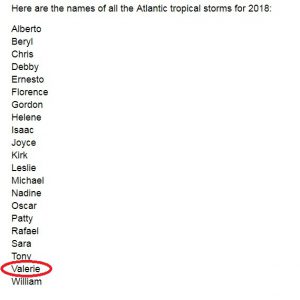
We must do better this year and in the future, compared to how we did last year. In 2017, 2 major storms impacted the Caribbean regions, leaving death, destruction, dysfunction and defection in their wake:

  • Irma – A Category 5 storm on September 4, 2017; this caused devastation in many islands, hitting Barbuda and the Virgin Islands especially hard.
  • Maria – A Category 5 storm on September 18, 2017; this caused devastation in many islands, hitting Puerto Rico and Dominica especially hard.

Remember that Hurricane Season is imminent.

Remember Acid Rain …

Remember the Hippies …

In the previous submission in this “counter-culture” series, it was asserted …

… the ‘Hippies’ stood in the track of an oncoming locomotive … and stopped the train!

We need to apply the lessons-learned from the counter-culture most urgently in getting our communities ready for Climate Change abatement.

The book Go Lean…Caribbean – available to download for free – serves as a roadmap for the introduction and implementation of the technocratic Caribbean Union Trade Federation (CU), to reform and transform all of Caribbean society – all 30 member-states. There is the need to shepherd our communities through major challenges, ones that are too big for any one member-state alone; we need to confederate. This CU/Go Lean roadmap has these 3 prime directives:

  • Optimization of the economic engines in order to grow the regional economy to $800 Billion & create 2.2 million new jobs.
  • Establishment of a security apparatus to ensure public safety and protect the resultant economic engines; including a disaster planning and response functionality.
  • Improve Caribbean governance to support these engines, including a separation-of-powers between the member-states and CU federal agencies.

The Caribbean needs the spirit of the previous counter-culture to “stop the train” that is on our track. Can we remember and role-model the previous rebels and revolutionaries who did not settle for the status quo? Yes, we can!

No we are not saying become hippies! Yes, we are saying to counter the status quo.

The movement behind the Go Lean book has previously detailed many related issues and advocacies for Climate Change awareness and abatement. Consider this sample of previous blog-commentaries:

https://goleancaribbean.com/blog/?p=14174 Canada says: “Follow-me” for Model on ‘Climate Change’ Action
https://goleancaribbean.com/blog/?p=13985 EU Assists Barbados to Go Green
https://goleancaribbean.com/blog/?p=11858 Looking and Learning from the Cautionary Tale of Kiribati
https://goleancaribbean.com/blog/?p=10367 The Science of Green Batteries
https://goleancaribbean.com/blog/?p=9455 Fix ‘Climate Change’ – Yes, We Can
https://goleancaribbean.com/blog/?p=7449 Due to Climate Change, ‘Crap Happens’ – So What Now?
https://goleancaribbean.com/blog/?p=7103 COP21 – ‘Climate Change’ Acknowledged
https://goleancaribbean.com/blog/?p=6893 A Meteorologist’s View On Climate Change
https://goleancaribbean.com/blog/?p=6016 ‘Hotter than July’ – Reality in the Caribbean
https://goleancaribbean.com/blog/?p=4673 Climate Change‘ Merchants of Doubt … to Preserve Profits!!
https://goleancaribbean.com/blog/?p=2465 Book: ‘This Changes Everything: Capitalism vs. the Climate’
https://goleancaribbean.com/blog/?p=2276 Climate Change May Affect Food Supply Within a Decade
https://goleancaribbean.com/blog/?p=1883 Climate Change May Bring More Kidney Stones
https://goleancaribbean.com/blog/?p=1817 Caribbean grapples with intense cycles of flooding & drought
https://goleancaribbean.com/blog/?p=915 Go ‘Green’ … Caribbean

The Go Lean book and roadmap stresses that reforming and transforming the Caribbean’s societal engines is possible; it is conceivable, believable and achievable. But changing society entails changing the people in society, their attitudes and values.

We saw change manifest with the counter-culture of the 1960’s/1970’s. As related above, “the post-1973 mainstream society has been in many ways a hybrid of the 1960s establishment and counter-culture”.

We now need to change our people, our Caribbean people. We need them committed, devoted and inspired to adopt the appropriate community ethos to derail the current trajectory – to doom – and move our countries in a new direction.

The Go Lean book provides 370-pages of turn-by-turn instructions on “how” to forge a counter-cultural revolution transition in the Caribbean; it details the new community ethos that needs to be adopted, plus the strategies, tactics, implementations and advocacies to execute so as to reboot, reform and transform the societal engines of Caribbean society.

We urge all Caribbean stakeholders to lean-in to this roadmap for change, to make our homeland a better place to live, work and play. 🙂

Download the free e-Book of Go Lean … Caribbean – now!

Sign the petition to lean-in for this roadmap for the Caribbean Union Trade Federation.

————-

Appendix – Grenada’s Forestry Department Concerned About ‘Climate Change’ And Its Effects On Hurricanes

By: Maryam J. Tawfiq-iLAND Resilience Project

With the announcement from Colorado State University hurricane researchers of their projections for the 2018 Atlantic Hurricane Season the forestry department of the ministry of agriculture in Grenada is concerned with the likely effects of this year’s storm and of them possibly intensifying.

The 14 named storms of the 2018 season will be slightly above-average, said a report from the university. It projects that seven of the storms will become hurricanes; three of them “major’’ hurricanes.

Ever more people around the world seem to be experiencing freak storms, floods and droughts — including catastrophes that devastate whole regions. The reasons for these complex weather events aren’t straightforward. Some say the crazy weather we’re experiencing is due to greenhouse gas emissions around the world; others disagree.

Anthony Jeremiah, acting chief forestry officer, said the ministry of agriculture is adopting “active preparedness measures’’, admitting that “we are very much concerned regarding the destruction that can arise from hurricanes’’.

During the 2017 Atlantic basin hurricane season, six major storms – all of which were Category 3 or higher – produced devastating human, material and financial losses across the southern United States and the Caribbean.

Last year’s above-average storm activity was foreseeable. Hurricane intensity ticked up in 2016 and scientists have predicted this trend will hold as global temperatures continue to rise.

Though the Caribbean is facing increasing vulnerability to hurricanes, many in the region hold very different opinions about the severity of climate change. According to results from the latest Vanderbilt University Americas Barometer survey, a strong majority of Caribbean residents perceive climate change as a “very serious” problem. In contrast, just 44 percent of the U.S. public does.

The 2018 Atlantic hurricane season runs from June 1 to Nov. 30.

Source: Posted May 5, 2018; retrieved May 8, 2018 from: https://stluciatimes.com/2018/05/05/grenadas-forestry-department-concerned-about-climate-change-and-its-effects-on-hurricanes/

Share this post:
, , ,
[Top]

Counter-culture: Embracing the Change

Go Lean Commentary

Children almost always rebel against their parental norms!

This is just a fact of life. Many times this actuality is a source of friction and frustration in families … and society in general. But many times, the rebellion can result in subsequent benefits to people and institutions in society; though this judgment may not be realized until a later time.

So a younger generation’s rebellion may be how whole communities are disciplined. This thought even aligns with the Bible’s counsel on discipline:

No discipline is enjoyable while it is happening – it’s painful! But afterward there will be a peaceful harvest of right living for those who are trained in this way. – Hebrews 12:11 New Living Translation

Just consider these quick examples of protest movements: slavery abolition, women’s suffrage, labor rights and civil rights. These changes upended – sometimes violently – societal norms. But now, our communities are better for having endured it.

With this premise, we are now able to better embrace the historicity of the “counter-culture” of the 1960’s. This is our most recent example of a subculture whose values and norms of behavior differed substantially from those of mainstream society. And this is not just an academic discussion, for this timeframe corresponds with the time of upheaval for Caribbean society; yet we have not fully applied the lessons-learned and benefits from the resultant societal discipline; see Appendix VIDEO.
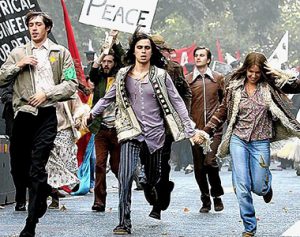
A counter-culture typically involves criticism or rejection of the status quo powerful institutions, with accompanying hope for a better life or a new society.

This is the focus of this series of commentaries on the counter-culture of the 1960’s. This first one – entry 1 of 4 in this series from the movement behind the book Go Lean … Caribbean – is in consideration of remaining societal defects in the Caribbean region. We did not reform or transform like other communities contending with the counter-culture. The other commentaries in the series are cataloged as follows:

  1. Counter-culture: Embracing the Change – Battling against Orthodoxy
  2. Counter-culture: Manifesting Change – Environmentalism & ‘Climate Change’
  3. Counter-culture: Monetizing the Change – Education, Workplace, Healthcare & Retirement
  4. Counter-culture: Pushing for Change – Is Ganja here to stay?

All of these commentaries relate to “how” the stewards for a new Caribbean can shepherd societal change in this region. We accept that with the counter-culture, young people can reject conventional social norms. This can be good when the “mainstream” culture reflects cultural standards that are defective. The counter-culturists of the 1960’s – think hippies – rejected the norms of their parents – from the 1950’s and before – especially with respect to:

  • Racial segregation – The US had a long, bad track record of enforcing a “separate but equal” standard. This was a sham! For the minority populations, they were separated but far from equal; they were oppressed, suppressed and repressed to ensure an inferior status. It took a counter-culture to press until change manifested; i.e. Linda Brown
  • Support for wars – The counter-culturists opposed military conscriptions with vocal protests, publications, demonstrations and acts of civil disobedience. In fact, not until the Military Draft ended in the US, did Caribbean people start to consider the prospect of emigrating to the US.
  • Women’s rights – These rights, like many other societal reforms, only come about as a result of advocates and activists fighting for change. But these battles were too important not to fight. Starting in the mid-19th Century, the 1960’s Civil and Gender Rights succeeded with the landmark 1972 Title IX US federal legislation.
  • Sexual mores – Many countries criminalize sexual acts between consenting adults of the same sex and other forms of sexual orientation, gender identity and expression. The counter-culturists did not stand still; they persisted and got the US to continue the national trend of more tolerance with every generation.
  • Traditional modes of authority – The counter-culturists conveyed to the world that Police authorities were far from perfect, and many times, not even in the right. Standards for mitigating and managing Police Abuse of Power emerged from this hard-fought counter-culture revolution.
  • A materialist interpretation of Middle Class values – While capitalism has won all debate for governing policy, the harsh profit-first priority of Crony-Capitalism has been debunked by counter-culturists. Now environmentalism, arts, humanitarianism has emerged as great candidates for a purpose-driven life.
  • Drug usage – The counter-culture normalized marijuana use and now … State authorities are enacting legislation to legitimize or decriminalize recreational marijuana use. This implementation will be heavy-lifting as there are many security and governing dynamics to manage.

Lessons abound … all of this above drama from the counter-culture is not just American drama. No, the 1960’s counter-culture movement was truly global. It also impacted our Caribbean homeland as well; see Appendix VIDEO.

All of the above issues had a Caribbean parallel.

Yes, the 1960’s counter-culturists triggered dramatic changes; but they were not the first in history, nor were they the last. See here:

Prominent examples of countercultures in Europe and North America include Romanticism (1790–1840), Bohemianism (1850–1910), the more fragmentary counterculture of the Beat Generation (1944–1964), followed by the globalized counter-culture of the 1960s (1964–1974), usually associated with the hippie subculture[3] and the diversified punk subculture of the 1970s and 1980s. – Wikipedia 

The book Go Lean…Caribbean – available to download for free – serves as a roadmap for the introduction and implementation of the technocratic Caribbean Union Trade Federation (CU), to reform and transform all of Caribbean society – all 30 member-states. This is counter to the existing culture. There is the need to shepherd our communities through major changes; we need to reboot our societal engines. This CU/Go Lean roadmap has these 3 prime directives:

  • Optimization of the economic engines in order to grow the regional economy to $800 Billion and create 2.2 million new jobs.
  • Establishment of a security apparatus to ensure public safety and protect the resultant economic engines.
  • Improve Caribbean governance to support these engines, including a separation-of-powers between the member-states and CU federal agencies.

The Caribbean needs a counter-culture revolution! We have defects we need to abandon and gaps that need to be filled.

We need our young people to reject conventional social norms. We need them to rebel and revile their parents … and other members of society that are backwards – trying to preserve defective “mainstream” cultural standards – then move forward.

The Go Lean book identifies and defines “mainstream” cultural standards as community ethos; with this direct quotation (Page 20 – 25):

The people of the Caribbean must change their feelings about elements of their society – elements that are in place and elements missing. This is referred to as “Community Ethos”, defined as:

noun – (www.Dictionary.com)

    1. the fundamental character or spirit of a culture; the underlying sentiment that informs the beliefs, customs, or practices of a group or society; dominant assumptions of a people or period.
    2. the character or disposition of a community, group, person, etc.

As such, some [missing] community ethos … have been identified as relevant for the Caribbean. They are as follows:

  • Deferred Gratification
  • Economic Principles
    • Money Multiplier
    • Job Multiplier
  • Security Principles
    • Privacy versus Public Protection
    • Whistleblower Protection
    • Witness Security & Protection
    • Anti-Bullying and Mitigation
    • Intelligence Gathering
    • Light Up the Dark Places
    • “Crap” Happens
  • Governing Principles
    • Minority Equalization
    • Lean Operations
    • Return on Investments
    • Cooperatives
    • Non-Government Organizations
  • Advocacies
    • Ways to Impact the Future
    • Ways to Foster Genius
    • Ways to Help Entrepreneurship
    • Ways to Promote Intellectual Property
    • Ways to Impact Research & Development
    • Ways to Bridge the Digital Divide
    • Ways to Improve Negotiations
    • Ways to Impact Turn-Arounds
    • Ways to Manage Reconciliations
    • Ways to Improve Sharing
    • Ways to Promote Happiness
    • Ways to Impact the Greater Good

The movement behind the Go Lean book have previously identified many defective “mainstream” cultural values in the Caribbean; consider this sample of previous blog-commentaries:

https://goleancaribbean.com/blog/?p=13974 Haiti – Earning its “Shit-Hole” Brand
https://goleancaribbean.com/blog/?p=13890 We Need to Talk – The Caribbean Disposition is Dire!
https://goleancaribbean.com/blog/?p=13321 Divided and Conquered – Too Much Pluralism – Us and Them
https://goleancaribbean.com/blog/?p=11244 Caribbean People Willing to “Live Too Fast and Die Too Young”
https://goleancaribbean.com/blog/?p=11048 Ignoring the Society Golden Rule – Protecting Weak from the Strong
https://goleancaribbean.com/blog/?p=8200 Promoting a ‘Climate of Hate’
https://goleancaribbean.com/blog/?p=7082 All Play, No Work – Only Known for Leisure
https://goleancaribbean.com/blog/?p=5784 “Say it ain’t so”! – Archaic Buggery Laws Still in Jamaica
https://goleancaribbean.com/blog/?p=4058 New York Times Maledictions on the Bahamas
https://goleancaribbean.com/blog/?p=2709 58% of Caribbean Boys Agree to Female Discipline
https://goleancaribbean.com/blog/?p=1386 Nonchalance About Impact of Drugs and De-Criminalization

There is so much to learn from the counter-culture movement of the 1960’s!

The ‘Hippies’ stood in the track of an oncoming locomotive … and stopped the train!

The counter-culture brought change, some good (ie: desegregation & anti-war protest) and some bad (ie: un-kept grooming & liberal drug use)! So the ‘Hippies’ are only to be emulated as a model for forging change, not necessarily what they change.

The Go Lean book and roadmap stresses that reforming and transforming the Caribbean’s societal engines is possible, but must be preceded with reforming and transforming Caribbean attitudes or community ethos. Despite the individual member-states, counter-cultural changes can be pushed regionally. This – regional push – was an early motivation for the roadmap, as pronounced in the opening Declaration of Interdependence (Pages 12 – 13):

xi. Whereas all men are entitled to the benefits of good governance in a free society, “new guards” must be enacted to dissuade the emergence of incompetence, corruption, nepotism and cronyism at the peril of the people’s best interest. The Federation must guarantee the executions of a social contract between government and the governed.

xvi.  Whereas security of our homeland is inextricably linked to prosperity of the homeland, the economic and security interest of the region needs to be aligned under the same governance. Since economic crimes … can imperil the functioning of the wheels of commerce for all the citizenry, the accedence of this Federation must equip the security apparatus with the tools and techniques for predictive and proactive interdictions.

xxiv. Whereas a free market economy can be induced and spurred for continuous progress, the Federation must install the controls to better manage aspects of the economy: jobs, inflation, savings rate, investments and other economic principles. Thereby attracting direct foreign investment because of the stability and vibrancy of our economy.

The Go Lean book provides 370-pages of turn-by-turn instructions on “how” to forge a counter-cultural revolution transition in the Caribbean; it details the new community ethos that needs to be adopted, plus the strategies, tactics, implementations and advocacies to execute so as to reboot, reform and transform the societal engines of Caribbean society.

We are not asking the Caribbean to be “hippies”, just learn from the “hippies” and reject the status quo and orthodoxy of the broken Caribbean eco-system.

Yes, we can foster change, a counter-culture even; we can make our homeland a better place to live, work and play. 🙂

Download the free e-Book of Go Lean … Caribbean – now!

Sign the petition to lean-in for this roadmap for the Caribbean Union Trade Federation.

—————

Appendix VIDEO-AUDIO – Eddie Minnis: “Ting an’ Ting Y2K” – https://youtu.be/oDF2cQsEURU

This is a Bahamian folk song by legend Eddie Minnis describing societal change in the capital city. ‘Ting and Ting’, the counter-culture had taken hold and everything changed … for good and bad:

  • “Nassau’s become such a funky town since “ting an’ ting” been going ’round.

EDDIE MINNIS – Topic

Published on Jul 20, 2015 – Provided to YouTube by CDBaby “Ting An’ Ting Y2k” (Granny and Fleabs Mix) · Eddie Minnis Tropical Waves ℗ 2012 Edward Minnis Released on: 2012-08-01 Auto-generated by YouTube.


Share this post:
, ,
[Top]