Category: Ethos

May Day! May Day! We Need Help With Jobs! – ENCORE

Today is May Day!

In many countries, this day is equivalent to Labor Day, a date set aside to honor and celebrate workers, or the movement to empower workers in society. Many of the historicity of these movements were tied to labor unions.

More than 80 countries celebrate International Workers’ Day on May 1 – the ancient European holiday of May Day.

All Caribbean member-states need help with our job-labor eco-system. Our societal engines are so dysfunctional that our people flee … abandoning the homeland in search of jobs.

There is this prospect for help. This previous blog-commentary from June 18, 2015, discussed the trends in the labor markets, which depict a decline in collective bargaining. This Encore of that commentary is presented here with a plan to assuage this bad trend and create 2.2 million new jobs:

==================

Title: Economic Principle: Wage-Seeking – Market Forces -vs- Collective Bargaining

Go Lean Commentary

The field of Economics is unique! We all practice it every day, no matter the level of skill or competence. There is even the subject area in basic education branded Home Economics, teaching the students the fundamentals of maintaining, supporting and optimizing a home environment. Most assuredly, economics is an art and a science, albeit a social science.

In a previous blog/commentary, Scotman’s Adam Smith was identified as the father of modern macro-economics. Though he lived from 1723 to 1790, his writings defined advanced economic concepts even in this 21st Century. His landmark book An Inquiry into the Nature and Causes of the Wealth of Nations qualified the divisions of income into these following categories: profit, wage, and rent.[4] We have previously explored profit-seeking (a positive ethos that needs to be fostered in the Caribbean region) and rent-seeking (a negative effort that proliferates in the Caribbean but needs to be mitigated), so now the focus of this commentary is on the activity of wage-seeking, and the concepts of governance and public choice theory to allow for maximum employment.

This is hard! Change has come to the world of wage-seekers – the middle classes are under attack; the labor-pool of most industrialized nations have endured decline, not in the numbers, but rather in prosperity. While wage-earners have not kept pace with inflation, top-earners (bonuses, commissions and business profits) have soared; (see Photo).
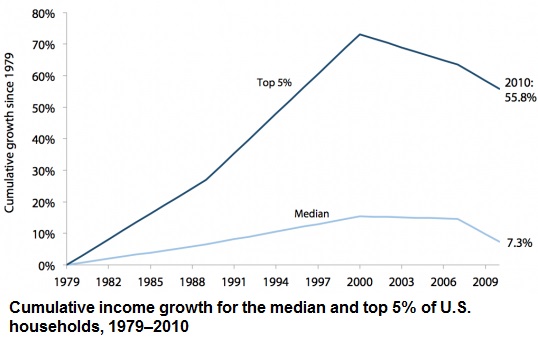
CU Blog - Economic Principles - Wage-Seeking - Market forces -vs- Collective Bargaining - Photo 2As a direct result, every Caribbean member-state struggles with employment issues in their homeland. In fact, this was an initial motivation for the book Go Lean…Caribbean, stemming from the fall-out of the 2008 Great Recession, this publication was presented as a roadmap for the introduction and implementation of the Caribbean Union Trade Federation (CU) to elevate the economic, security and governing engines of the Caribbean region to create 2.2 million new jobs, despite global challenges.

Needless to say, the global challenge is far more complex than Home Economics. The Go Lean book describes the effort as heavy-lifting; then proceeds to detail the turn-by-turn directions of a roadmap to remediate and mitigate wage-seeking.

The roadmap channels the Economic Principles and best-practices of technocrats like Adam Smith and 11 other named economists, many of them Nobel Laureates. A review of the work of these great men and woman constitute “Lessons in Economic Principles”. Why would these lessons matter in the oversight of Caribbean administration? Cause-and-effect!
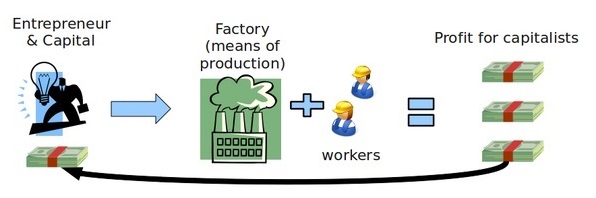
Profit 4The root of the current challenge for wage-seekers is income equality; and this is bigger than just the Caribbean. It is tied to the global adoption of globalization and technology/ automation – a product of global Market Forces as opposed to previous Collective Bargaining factors. This relates back to the fundamental Economic Principle of “supply-and-demand”; but now the “supply” is global. This photo/”process flow” here depicts the ingredients of Market Forces. When there is the need for labor, the principle of comparative analysis is employed, and most times the conclusion is to “off-shore” the labor efforts, and then import the finished products. This is reversed of the colonialism that was advocated by Adam Smith; instead of the developed country providing factory labor for Third World consumption, the developed nation (i.e. United States) is now in the consumer-only role, with less and less production activities, for products fabricated in the Third World. This reality is not sustainable for providing prosperity to the middle classes, to the wage-seekers.

As a community, we may not like the laws of Economics, but we cannot ignore them. The Go Lean book explains the roles and significance of Economic Principles … with this excerpt (Page 21):

While money is not the most important factor in society, the lack of money and the struggle to acquire money creates challenges that cannot be ignored. The primary reason why the Caribbean has suffered so much human flight in the recent decades is the performance of the Caribbean economy. Though this book is not a study in economics, it recommends, applies and embraces these 6 core Economic Principles as sound and relevant to this roadmap:

  1. People Choose: We always want more than we can get and productive resources (human, natural, capital) are always limited. Therefore, because of this major economic problem of scarcity, we usually choose the alternative that provides the most benefits with the least cost.
  2. All Choices Involve Costs: The opportunity cost is the next best alternative you give up when you make a choice. When we choose one thing, we refuse something else at the same time.
  3. People Respond to Incentives in Predictable   Ways: Incentives are actions, awards, or rewards that determine the choices people make. Incentives can be positive or negative. When incentives change, people change their behaviors in predictable ways.
  4. Economic Systems Influence Individual Choices and Incentives: People cooperate and govern their actions through both written and unwritten rules that determine methods of allocating scarce resources. These rules determine what is produced, how it is produced, and for whom it is produced. As the rules change, so do individual choices, incentives, and behavior.
  5. Voluntary Trade Creates Wealth: People specialize in the production of certain goods and services because they expect to gain from it. People trade what they produce with other people when they think they can gain something from the exchange. Some benefits of voluntary trade include higher standards of living and broader choices of goods and services.
  6. The Consequences of Choices Lie in the Future: Economists believe that the cost and benefits of decision making appear in the future, since it is only the future that we can influence. Sometimes our choices can lead to unintended consequences.

Source: Handy Dandy Guide (HDC) by the National Council on Economic Education (2000)

The Go Lean book describes the end result of the application of best-practices in this field of economics over the course of a 5-year roadmap: the CU … as a hallmark of technocracy. But the purpose is not the edification of the region’s economists, rather to make the Caribbean homeland “better places to live, work and play” for its citizens. This branding therefore puts emphasis on the verb “work”; the nouns “jobs” and “wages” must thusly be a constant focus of the roadmap.

Brain Drain 70 percent ChartThis Go Lean book declares that the Caribbean eco-system for job-creation is in crisis … due to the same global dilemma. The roadmap describes the crisis as losing a war, the battle of globalization and technology. The consequence of the defeat is 2 undesirable conditions: income inequality and societal abandonment, citizens driven away to a life in the Diaspora. This assessment currently applies in all 30 Caribbean member-states, as every community has lost human capital to emigration. Some communities, like Puerto Rico and the US Virgin Islands have suffered with an abandonment rate of more than 50% and others have watched more than 70% of college-educated citizens flee their community for foreign shores. Even education is presented as failed investments as those educated in the region and leave to find work do not even return remittances in proportion to their costs of development. (See Table 4.1 in the Photo)

The Go Lean book therefore posits that there is a need to re-focus, re-boot, and optimize the labor/wage-seeking engines so as to create more jobs with livable wages. Alas, this is not just a Caribbean issue, but a global (i.e. American) one as well. See the following encyclopedic references for wage-seeking and Collective Bargaining to fully understand the complexities of these global issues:

Encyclopedia Reference #1: Wage-Seeking
(Source: https://en.wikipedia.org/wiki/Wage)

A wage is monetary compensation paid by an employer to an employee in exchange for work done. Payment may be calculated as a fixed amount for each task completed (a task wage or piece rate), or at an hourly or daily rate, or based on an easily measured quantity of work done.

Wages are an example of expenses that are involved in running a business.

Payment by wage contrasts with salaried work, in which the employer pays an arranged amount at steady intervals (such as a week or month) regardless of hours worked, with commission which conditions pay on individual performance, and with compensation based on the performance of the company as a whole. Waged employees may also receive tips or gratuity paid directly by clients and employee benefits which are non-monetary forms of compensation. Since wage labour is the predominant form of work, the term “wage” sometimes refers to all forms (or all monetary forms) of employee compensation.

Determinants of wage rates
Depending on the structure and traditions of different economies around the world, wage rates will be influenced by market forces (supply and demand), legislation, and tradition. Market forces are perhaps more dominant in the United States, while tradition, social structure and seniority, perhaps play a greater role in Japan.[6]

Wage Differences
Even in countries where market forces primarily set wage rates, studies show that there are still differences in remuneration for work based on sex and race. For example, according to the U.S. Bureau of Labor Statistics, in 2007 women of all races made approximately 80% of the median wage of their male counterparts. This is likely due to the supply and demand for women in the market because of family obligations. [7] Similarly, white men made about 84% the wage of Asian men, and black men 64%.[8] These are overall averages and are not adjusted for the type, amount, and quality of work done.

Real Wage
The term real wages refers to wages that have been adjusted for inflation, or, equivalently, wages in terms of the amount of goods and services that can be bought. This term is used in contrast to nominal wages or unadjusted wages. Because it has been adjusted to account for changes in the prices of goods and services, real wages provide a clearer representation of an individual’s wages in terms of what they can afford to buy with those wages – specifically, in terms of the amount of goods and services that can be bought.

See Table of European Model in the Appendix below. (The European Union is the model for the Caribbean Union).

———-

Encyclopedia Reference #2: Collective Bargaining
(Source: https://en.wikipedia.org/wiki/Collective_bargaining)

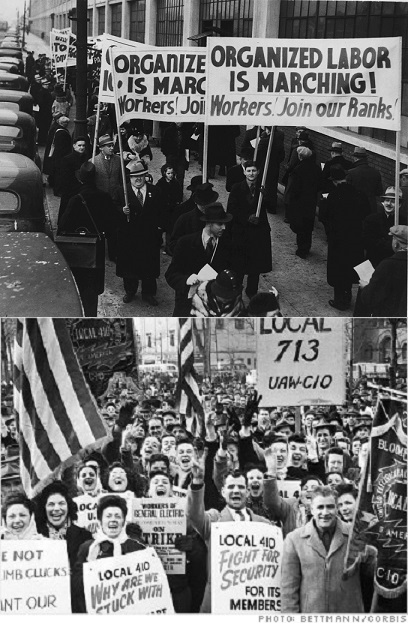
WPR: Marches & PicketsCollective Bargaining is a process of negotiation between employers and a group of employees aimed at reaching agreements to regulate working conditions. The interests of the employees are commonly presented by representatives of a trade union to which the employees belong. The collective agreements reached by these negotiations usually set out wage scales, working hours, training, health and safety, overtime, grievance mechanisms, and rights to participate in workplace or company affairs.[1]

The union may negotiate with a single employer (who is typically representing a company’s shareholders) or may negotiate with a group of businesses, depending on the country, to reach an industry wide agreement. A collective agreement functions as a labor contract between an employer and one or more unions.

The industrial revolution brought a swell of labor-organizing in [to many industrialized countries, like] the US. The American Federation of Labor (AFL) was formed in 1886, providing unprecedented bargaining powers for a variety of workers.[11] The Railway Labor Act (1926) required employers to bargain collectively with unions. While globally, International Labour Organization Conventions (ILO) were ratified in parallel to the United Nations efforts (i.e. Declaration of Human Rights, etc.). There were a total of eight ILO fundamental conventions [3] all ascending between 1930 and 1973, i.e. the Freedom of Association and Protection of the Right to Organise Convention (1949).
The Go Lean book presents a roadmap on how to benefit from the above Economic Principles – and how to empower communities anew – in the midst of tumultuous global challenges. This roadmap addresses more than economics, as there are other areas of societal concern. This is expressed in the CU charter; as defined by these 3 prime directives:

  • Optimization of economic engines in order to grow the regional economy to $800 Billion and create 2.2 million new jobs.
  • Establishment of a security apparatus to protect the resultant economic.
  • Improvement of Caribbean governance to support these engines.

Early in the Go Lean book, the responsibility to create jobs was identified as an important function for the CU with these pronouncements in the Declaration of Interdependence (Pages 14):

xix.  Whereas our legacy in recent times is one of societal abandonment, it is imperative that incentives and encouragement be put in place to first dissuade the human flight, and then entice and welcome the return of our Diaspora back to our shores.

xxi.  Whereas the preparation of our labor force can foster opportunities and dictate economic progress for current and future generations, the Federation must ensure that educational and job training opportunities are fully optimized for all residents of all member-states, with no partiality towards any gender or ethnic group. The Federation must recognize and facilitate excellence in many different fields of endeavor, including sciences, languages, arts, music and sports. This responsibility should be executed without incurring the risks of further human flight, as has been the past history.

xxiv. Whereas a free market economy can be induced and spurred for continuous progress, the Federation must install the controls to better manage aspects of the economy: jobs, inflation, savings rate, investments and other economic principles. Thereby attracting direct foreign investment because of the stability and vibrancy of our economy.

xxvi.  Whereas the Caribbean region must have new jobs to empower the engines of the economy and create the income sources for prosperity, and encourage the next generation to forge their dreams right at home, the Federation must therefore foster the development of new industries, like that of ship-building, automobile manufacturing, prefabricated housing, frozen foods, pipelines, call centers, and the prison industrial complex. In addition, the Federation must invigorate the enterprises related to existing industries tourism, fisheries and lotteries – impacting the region with more jobs.

According to an article from the Economic Policy Institute, entitled The Decline of Collective Bargaining and the Erosion of Middle-class Incomes in Michigan by Lawrence Mishel (September 25, 2012), the challenges to middle class income are indisputable, and the previous solution – Collective Bargaining – is no longer as effective as in the past. (The industrial landscape of Michigan had previously been identified as a model for the Caribbean to consider). See a summary of the article here (italics added) and VIDEO in the Appendix:

In Michigan between 1979 and 2007, the last year before the Great Recession, the state’s economy experienced substantial growth and incomes rose for high-income households. But middle-class incomes did not grow. The Michigan experience is slightly worse than but parallels that of the United States as a whole, where middle-class income gains were modest but still far less than the income gains at the top. What the experience of Michiganders and other Americans makes clear is that income inequality is rising, and it has prevented middle-class incomes from growing adequately in either Michigan or the nation.

The key dynamic driving this income disparity has been the divergence between the growth of productivity—the improvement in the output of goods and services produced per hour worked—and the growth of wages and benefits (compensation) for the typical worker. It has been amply documented that productivity and hourly compensation grew in tandem between the late 1940s and the late 1970s, but split apart radically after 1979. Nationwide, productivity grew by 69.1 percent between 1979 and 2011, but the hourly compensation of the median worker (who makes more than half the workforce but less than the other half) grew by just 9.6 percent (Mishel and Gee 2012; Mishel et al. 2012). In other words, since 1979 the typical worker has hardly benefited from improvements in the economy’s ability to raise living standards and, consequently, middle-class families’ living standards have barely budged since then. This phenomenon has occurred across the nation, including in Michigan.

This divergence between pay and productivity and the corresponding failure of middle-class incomes to grow is strongly related to the erosion of collective bargaining. And collective bargaining has eroded more in Michigan than in the rest of the nation, helping to explain Michigan’s more disappointing outcomes.

Research three decades ago by economist Richard Freeman (1980) showed that collective bargaining reduces wage inequality, and all the research since then (see Freeman 2005) has confirmed his finding. Collective bargaining reduces wage inequality for three reasons. The first is that wage setting in collective bargaining focuses on establishing “standard rates” for comparable work across business establishments and for particular occupations within establishments. The outcome is less differentiation of wages among workers and, correspondingly, less discrimination against women and minorities. A second reason is that wage gaps between occupations tend to be lower where there is collective bargaining, and so the wages in occupations that are typically low-paid tend to be higher under collective bargaining. A third reason is that collective bargaining has been most prevalent among middle-class workers, so it reduces the wage gaps between middle-class workers and high earners (who have tended not to benefit from collective bargaining).

Collective bargaining also reduces wage inequality in a less-direct way. Wage and benefit standards set by collective bargaining are often followed in workplaces not covered by collective bargaining, at least where there is extensive coverage by collective bargaining in particular occupations and industries. This spillover effect means that the impact of collective bargaining on the wages and benefits of middle-class workers extends far beyond those workers directly covered by an agreement.

Source: http://www.epi.org/publication/bp347-collective-bargaining/

The siren call went out 20 years ago, of the emergence of an “Apartheid” economy, a distinct separation between the classes: labor and management. Former US Secretary of Labor Robert Reich (1993 – 1997 during the Clinton Administration’s First Term) identified vividly, in this 1996 Harvard Business Review paper, that something was wrong with the U.S. economy then; (it is worst now):

CU Blog - Economic Principles - Wage-Seeking - Market forces -vs- Collective Bargaining - Photo 3That something is not the country’s productivity, technological leadership, or rate of economic growth, though there is room for improvement in all those areas. That something is an issue normally on the back burner in U.S. public discourse: the distribution of the fruits of economic progress. For many, the rise in AT&T’s stock after it announced plans [on January 3, 1996] to lay off 40,000 employees crystallized the picture of an economy gone haywire, with shareholders gaining and employees losing as a result of innovation and advances in productivity.

Has the distribution of the benefits of economic growth in the United States in fact gone awry? Is the nation heading toward an apartheid economy—one in which the wealthy and powerful prosper while the less well-off struggle? What are the facts? What do they mean? Are there real problems—and can they be solved?

Deploying solutions for the problem of income equality in the Caribbean is the quest of the Go Lean/CU roadmap. The book identified Agents of Change (Page 57) that is confronting the region, (America as well); they include: Globalization and Technology. A lot of the jobs that paid a “living wage” are now being shipped overseas to countries with lower wage levels, or neutralized by the advancement of technology. Yes, computers are reshaping the global job market, so even Collective Bargaining may fail to counter any eventual obsolescence of wage-earners, their valuation and appreciation; (see Encyclopedic Article # 2). The Go Lean book, and previous blog/commentaries, therefore detailed the campaign to not just consume technology, but to also innovate, produce and distribute the computer-enabled end-products. Therefore industries relating to STEM (Science, Technology, Engineering and Mathematics/Medicine) are critical in the roadmap. Not only do these careers yield good-paying direct jobs, but also factor in the indirect job market, and the job-multiplier rate (3.0 to 4.1) for down-the-line employment (Page 260) opportunities.

The Go Lean… Caribbean book details the creation of 2.2 million new jobs for the Caribbean region, many embracing ICT/STEM skill-sets. This is easier said than done, so how does Go Lean purpose to deliver on this quest? By the adoption of certain community ethos, plus the executions of key strategies, tactics, implementations and advocacies. The following is a sample from the book:

Assessment – Puerto Rico – Extreme Unemployment – The Greece of the Caribbean Page 18
Community Ethos – Deferred Gratification Page 21
Community Ethos – Job Multiplier Page 22
Community Ethos – Anti-Bullying and Mitigation Page 23
Community Ethos – Lean Operations Page 24
Community Ethos – Return on Investments Page 24
Community Ethos – Ways to Impact the Future Page 26
Community Ethos – Ways to Foster Genius Page 27
Community Ethos – Ways to Help Entrepreneurship Page 28
Community Ethos – Ways to Promote Intellectual Property – Key to ICT Careers Page 29
Community Ethos – Ways to Impact Research and Development – Germaine for STEM jobs Page 30
Community Ethos – Ways to Close the Digital Divide – Vital for fostering ICT careers Page 31
Strategy – Mission – Education Without Further Brain Drain Page 46
Strategy – Agents of Change – Technology Page 57
Strategy – Agents of Change – Globalization Page 57
Tactical – Fostering a Technocracy Page 64
Tactical – Tactics to Forge an $800 Billion Economy – East Asian Tigers Model Page 69
Tactical – Tactics to Forge an $800 Billion Economy – High Multiplier Industries Page 70
Tactical – Tactics to Forge an $800 Billion Economy – Trade and Globalization Page 70
Tactical – Separation of Powers – Commerce Department – Patents & Copyrights Page 78
Implementation – Steps to Implement Self-Governing Entities – As Job-creating Engines Page 105
Implementation – Ways to Benefit from Globalization – Technology: The Great Equalizer Page 119
Planning – Ways to Improve Trade Page 128
Planning – Ways to Model the EU Page 130
Planning – Lessons Learned from 2008 – Income Equality Now More Pronounced Page 136
Advocacy – Ways to Grow the Economy Page 151
Advocacy – Ways to Create Jobs Page 152
Advocacy – Ways to Improve Education – e-Learning Options Page 159
Advocacy – Ways to Impact Labor Markets and Unions – Collective Bargaining Best-Practices Page 164
Advocacy – Ways to Foster Empowering Immigration – STEM Resources Page 174
Advocacy – Ways to Foster Technology – Credits, Incentives and Investments Page 197
Advocacy – Ways to Foster e-Commerce – Optimize Remittance Methods Page 198
Advocacy – Ways to Help the Middle Class – Exploit Globalization Page 223
Appendix – Growing 2.2 Million Jobs in 5 Years Page 257
Appendix – Job Multipliers – Direct & Indirect Job Correlations Page 259
Appendix – Emigration Bad Example – Puerto Rican Population in the US Mainland Page 304

The CU will foster job-creating developments, incentivizing many high-tech start-ups and incubating viable companies. The primary ingredient for CU success will be Caribbean people, so we must foster and incite participation of many young people into fields currently sharing higher job demands, like ICT and STEM, so as to better impact their communities. A second ingredient will be the support of the community – the Go Lean movement recognizes the limitation that not everyone in the community can embrace the opportunity to lead in these endeavors. An apathetic disposition is fine-and-well; we simply must not allow that to be a hindrance to those wanting to progress – there are both direct jobs and indirect jobs connected with the embrace of ICT/STEM disciplines. The community ethos or national spirit, must encourage and spur “achievers” into roles where “they can be all they can be”. Go Lean asserts that one person can make a difference … to a community (Page 122).

Other subjects related to job empowerments for wage-seekers in the region have been blogged in other Go Lean…Caribbean commentaries, as sampled here:

https://goleancaribbean.com/blog/?p=4240 Immigration Policy Exacerbates Worker Productivity Crisis
https://goleancaribbean.com/blog/?p=3694 Jamaica-Canada employment programme pumps millions into local economy
https://goleancaribbean.com/blog/?p=3473 Haiti to Receive $70 Million Grant to Expand Caracol Industrial Park to Create Jobs and Benefit from Globalization
https://goleancaribbean.com/blog/?p=3446 Forecast for higher unemployment in Caribbean in 2015
https://goleancaribbean.com/blog/?p=3164 Michigan Unemployment Model – Then and Now
https://goleancaribbean.com/blog/?p=2857 Where the Jobs Are – Entrepreneurism in Junk
https://goleancaribbean.com/blog/?p=2800 The Geography of Joblessness
https://goleancaribbean.com/blog/?p=2750 Disney World’s example of Self Governing Entities and Economic Impacts of 70,000 jobs; 847,000+ Puerto Ricans now live in the vicinity.
https://goleancaribbean.com/blog/?p=2126 Where the Jobs Are – Computers Reshaping Global Job Market
https://goleancaribbean.com/blog/?p=2025 Where the Jobs Are – Attitudes & Images of the Caribbean Diaspora in US
https://goleancaribbean.com/blog/?p=2003 Where the Jobs Are – Ship-breaking under the SGE Structure
https://goleancaribbean.com/blog/?p=1698 Where the Jobs Are – STEM Jobs Are Filling Slowly
https://goleancaribbean.com/blog/?p=1683 Where the Jobs Were – British public sector now strike over ‘poverty pay’
https://goleancaribbean.com/blog/?p=1214 Where the Jobs Are – Fairgrounds as SGE & Landlords for Sports Leagues
https://goleancaribbean.com/blog/?p=273 10 Things We Don’t Want from the US – Job Discrimination of Immigrations

The Caribbean is arguably the best address on the planet, but “man cannot live on beauty alone”, there is the need for a livelihood as well. This is the challenge, considering the reality of unemployment in the region; the jobless rate among the youth is even higher.

The crisis of income inequality for the US is a direct result of free trade agreements, like NAFTA, and China’s Preferential Trading Status. Despite this status, we can benefit from the realities of globalization; jobs are being moved to conducive locations with lower labor costs.  We should invite these investors to look for cheaper labor options, here in the Caribbean region (Haiti, Dominican Republic, Jamaica, etc.). This is the same reality as in Europe with different wage levels for the different countries (see Appendix below); the Caribbean also has these wage differences.

The Go Lean roadmap seeks to foster higher-paying job options: Call Centers, Offshore Software Development Centers, R&D Medical campuses, light-manufacturing and assembly plants for “basic needs” products (food, clothing shelter, energy, and transportation) for Caribbean consumption. This is the successful model of Japan, China and the “East Asia Tigers” economies; these are manifestations of effective Economic Principles.

The Go Lean book therefore digs deeper, providing turn-by-turn directions to get to the desired Caribbean results: a better place to live, work and play. 🙂

Download the free e-Book of Go Lean … Caribbean – now!

————-

Appendix – List of European countries by average wage (USA & Japan added for comparison)

(Source: https://en.wikipedia.org/wiki/List_of_European_countries_by_average_wage)

2014 Annual values (in national currency) for a family with two children with one average salary, including tax credits and allowances.[1] Net amount is computed after Taxes, Social Security and Family Allowances; the result is provided in both the National Currency and the Euro, if different. The table, sorted from highest Net amount to the lowest, is presented as follows:

State Gross Net (Natl. Curr) Net (Euro)
Switzerland 90,521.98 86,731.20 71,407.21
Luxembourg 54,560.39 52,041.36 52,041.36
Norway 542,385.96 415,557.87 49.,741.20
Denmark 397,483.78 289,292.48 38,806.20
Iceland 6,856,099.69 5,872.114.66 37,865.07
UNITED STATES 56,067 45,582 37,671
Sweden 407,974.45 335,501.45 36,874.37
Netherlands 48,855.70 36,648.71 36,648.71
United Kingdom 35,632.64 28,960.38 35,925.65
Belgium 46,464.41 35,810.55 35,810.55
Italy 41,462.67 24,539.93 35,539.93
Germany 45,952.05 36,269.23 35,269.23
France 38,427.35 30,776.75 34,776.75
Ireland 34,465.85 34,382.63 34,382.63
Austria 42,573.25 33,666.04 33,666.04
Finland 42,909.72 32,386.59 32,386.59
JAPAN 4,881,994.24 4,132.432.02 29,452.16
Spain 26,161.81 22,129.78 22,129.78
Greece 24,201.50 17,250.24 17,250.24
Slovenia 17,851.28 15,882.53 15,882.53
Portugal 17,435.71 15,140.25 15,140.25
Estonia 12,435.95 11,176.87 11,176.87
Czech Republic 312,083.83 306,153.76 11,118.31
Slovakia 10,342.10 9,778.16 9,778.16
Poland 42,360.01 34,638.77 8,278.27
Hungary 3,009,283.93 2,530.280.97 8,196.30
Turkey 28,370.00 21,072.12 7,250.00

————-

Appendix VideoCollective Bargaining and Shared Prosperity: Michigan, 1979 – 2009 http://youtu.be/PcT4jK89JmE

Published on September 27, 2012 – This VIDEO depicts the positive effects of Collective Bargaining on the quest for income equality in the US State of Michigan; and the sad consequence of the widening income inequality when Collective Bargaining is less pervasive.
This reflect the “Observe and Report” functionality of the Go Lean…Caribbean promoters in the Greater Detroit-Michigan area.

Share this post:
, , , ,

Nature or Nurture: Women Have Nurtured Change

Go Lean Commentary

Here is valuable advice to young people … hoping to partner with a soul-mate:

Take time to know him/her … give it a full cycle of seasons: Summer and Winter.

There is the person’s Nature and also their Nurture-ing that must be taken to account:

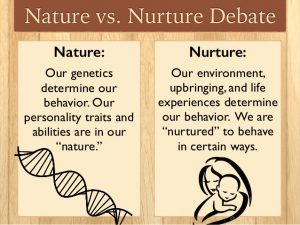
Nature – Genetics determine behavior; personality traits and abilities are in “nature”

Nurture – Environment, upbringing and life experiences determine behavior. Humans are “nurtured” to behave in certain ways.

So prospective marriage mates need to ascertain the Nature and Nurture of a potential partner.
If the potential mate does not measure up, my advice: do not bond, take your leave. Just do so BEFORE the wedding rehearsal – i.e. Runaway Brides – do not abandon all the stakeholders high-and-dry (“at the altar”), after they may have invested in catering, banquet halls, clothes, travel, etc.. Such a failure would just be pathetic!

This advice applies to individuals, yes, but not so much for communities, or societies. For the group dynamic, we simply have no choice; we must work to transform the attitudes, traits and practices in a community. The book Go Lean…Caribbean identified this subject as “community ethos”, with this definition:

… the fundamental character or spirit of a culture; the underlying sentiment that informs the beliefs, customs, or practices of a group or society; dominant assumptions of a people or period. – Page 20

If/When the community ethos is unbecoming for a society, citizens do not bond; they abandon! This is so pathetic, as the community too may have invested hugely in the individuals – think education, scholarships and student loans. The community is “left at the altar“.

But change is possible! Communities have forged change and been transformed .. in the past, in the present and I guarantee future communities will also forge change.
How is this possible? How to Nurture change despite “bad” Nature? Let’s consider a sample-example from the history of the UK; this is actually the history of the Caribbean as well, as it features the Abolition of Slavery in the British Empire in the year 1833 – the date that the measure passed the British Parliament.

There were a lot of advocates and activists that led the fight against … first the Slave Trade and then eventually the institution of Slavery itself; think William Wilberforce and Charles Spurgeon who argued for the abolition of slavery and advocated for women to have rights equal to that of men. Slavery and Women’s Rights became locked-in-step – see Appendix VIDEO. So a lot of the Nurturing for the abolition advocacy came from women of the British Empire. See this portrayed in the article here:

Title: Ending Slavery

For much of the 18th century few European or American people questioned slavery. Gradually on both sides of the Atlantic a few enlightened individuals, some of them Quakers, began to oppose it.

From the 1760s activists in London challenged the morality and legality of the slave trade. They included former slaves, like Olaudah Equiano and the abolitionist campaigners Granville Sharp and William Wilberforce.

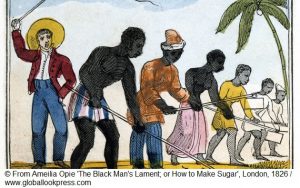
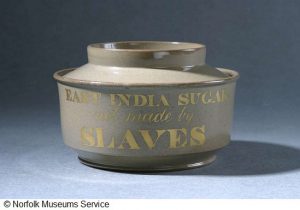
Women who opposed slavery took the lead in boycotts of slave-grown produce, particularly sugar. Slavery abolitionists used badges and iconic images to publicise their views, like the sugar bowl above made by Wedgewood. Enormous petitions opposing the slave trade were delivered to the House of Commons.

Women Against Slavery

It is only relatively recently that historians have explored the activities of women abolitionists. When looking at local provincial sources, autobiographies, historical objects and sites it becomes clear that women played a significant and, at times, pivotal role in the campaign to abolish slavery.

These women came from a range of backgrounds. The tactics they used – boycotting slave-produced sugar and other goods, organising mass petitions and addressing public meetings – proved highly effective.

Hannah Moore

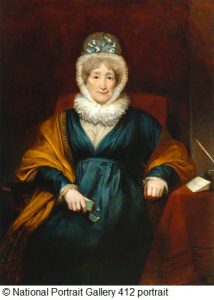
Hannah Moore (from 1745 to 1833) was an educator, writer and social reformer. Born in Bristol, she was strongly opposed to slavery throughout her life. She encouraged women to join the anti-slavery movement.

In 1787 she met John Newton and members of the Clapham Sect, including William Wilberforce with whom she formed a strong and lasting friendship. Moore was an active member of the Society for Effecting the Abolition of the African Slave Trade. Her writings reflected her opposition to slavery and “Slavery, a Poem” which she published in 1788 is regarded as one of the most important slavery poems of the period.
Ill health prevented Moore from taking an active role in the 1807 campaign to end the slave trade but she continued to write to Wilberforce and other campaigners.

She lived just long enough to see the act abolishing slavery passed. She died in September 1833 and is buried with her sisters in the south-east corner of All Saints’ Churchyard, Station Road, Wrington, Bristol, BS40.

Mary Prince

Mary Prince (from 1788 to around 1833) was the first black woman to publish her account of being an enslaved woman. She was born in Bermuda in 1788 and endured a life of violence and abuse through a succession of slave-owners.

Her owners, the Woods, brought Mary to England. To escape their cruelty she ran away to the Moravian Church in London’s Hatton Gardens. Members of the Anti-Slavery Society took up her case and they encouraged her to write her life story.

Published in 1831 as “The History of Mary Prince”, this extraordinary story describing ill treatment and survival was a rallying cry for emancipation. The book provoked two libel actions and had three editions in its year of publication.

In 2007 Camden Council and the Nubian Jak Community Trust placed a plaque near to the site where she lived at Senate House, Malet Street, London, WC1E 7HU.

Elizabeth Barrett Browning

The poet Elizabeth Barrett Browning (from 1806 to 1861) is commemorated with two plaques in Marylebone, London. A brown Society of Arts plaque is at the site of her former home at 50 Wimpole Street, London W1G 8SQ. There is a bronze plaque at 99, Gloucester Road, London W1U 6JG.

Barrett Browning’s father, Edward Barrett Moulton Barrett (from 1785 to 1857), inherited 10,000 acres of sugar plantations in Jamaica, with an annual income of £50,000. Her maternal grandfather John Graham-Clarke (from 1736 to 1818) was a Newcastle merchant who owned sugar plantations, trading ships and many more businesses associated with slavery. At his death his assets were equivalent to around £20 million today.

Barrett Browning was aware of the source of her family’s wealth:

  • I belong to a family of West Indian slave-owners and if I believe in curses, I should be afraid. – Letter from Elizabeth Barrett Browning to John Ruskin in 1855.

In 1849 she published an anti-slavery poem “The Runaway Slave at Pilgrim’s Point”. It portrayed a slave woman cursing her oppressor after she had been whipped, raped and impregnated.

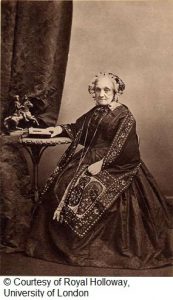
Elizabeth Jesser Reid

A social reformer and philanthropist, Elizabeth Jesser Reid (from 1789 to 1866) is best known for founding Bedford College for Women in London in 1849. The College is now part of Royal Holloway, University of London.
Jesser Reid was also an anti-slavery activist and she attended the Anti-Slavery Convention in 1840 and was a member of the Garrisonian London Emancipation Committee. A green plaque has been placed at her former home, 48 Bedford Square, London WC1B 3DR to commemorate Reid and the first site of the college.

While living at 48 Bedford Square, Reid entertained Harriet Beecher Stowe in 1853. She also shared her house with the African American abolitionist Sarah Parker Remond whilst she studied at the College between 1859 and 1861.

Sarah Parker Remond

Born in Salem, Massachusetts, Sarah Parker Remond (from 1826 to 1894) came from a family that was deeply involved in the abolitionist campaign in the United States. Her brother Charles Lenox Remond was the first black lecturer in the American Anti-Slavery Society.

Parker Remond was such an impressive speaker and fund-raiser for the abolitionist movement that she was invited to take the anti-slavery message to Britain. Soon after arriving here in 1859 she embarked upon a nationwide lecture tour. In 1866 she left London to study medicine in Italy. She practised as a doctor in Florence, where she settled.

—————————

Related Posts

Listen to our podcasts about women’s involvement in the abolition movement:

Source: Retrieved April 13, 2018 from: https://historicengland.org.uk/research/inclusive-heritage/the-slave-trade-and-abolition/sites-of-memory/ending-slavery/

Women applied pressure to all aspects of society – the engines of economics, security and governance – for the end of the Slave Trade; then they continued the pressure for the Abolition of Slavery itself. The Nurturing worked! It was not immediate, but eventual and evolutionary:

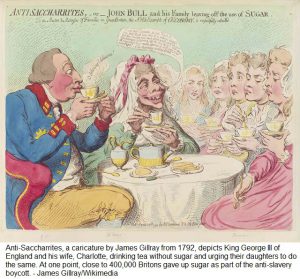
  • They impacted the economic cycles – boycotts & embargos. See the notes on the Anti-Saccharrittes in Appendix A.
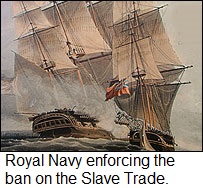
  • They compelled the Security engines – The Royal Navy was engaged to enforce the ban on the Slave Trade after 1807. (Between 1808 and 1860, the West Africa Squadron captured 1,600 slave ships and freed 150,000 Africans.[5]) See Appendix B below.
  • They engaged the related governance by entreating the political supporters, every year, to introduce and re-introduce the Abolition Bill.

Though the abolition of Slavery went against the Nature of the New World, these women and their Nurturing did not stop.  They persisted! This commentary concludes the 4-part series on Nature or Nurture for community ethos. This entry is 4 of 4 in this series from the movement behind the book Go Lean … Caribbean in consideration of the Nurturing by the mothers (women) of England who finally forge change in the British Empire.. The other commentaries in the series are cataloged as follows:

  1. Nature or Nurture: Black Marchers see gun violence differently
  2. Nature or Nurture: Cop-on-Black Shootings – Embedded in America’s DNA; Whites Yawn
  3. Nature or Nurture: UK City of Bristol still paying off Slavery Debt
  4. Nature or Nurture: Nurturing came from women to impact Abolition of Slavery

In the first submission to this series, the history of the Psychological battle between Nature and Nurture was introduced, which quoted:

One of the oldest arguments in the history of psychology is the Nature vs Nurture debate. Each of these sides have good points that it’s really hard to decide whether a person’s development is predisposed in his DNA, or a majority of it is influenced by this life experiences and his environment. – https://explorable.com/nature-vs-nurture-debate

All of these commentaries relate to “how” the stewards – including empowered women – for a new Caribbean can assuage societal defects despite the default Nature. Here-in, this example from England is a great role model for the Caribbean region. We too, need our women!

How about the Caribbean today? What bad Nature can women help to Nurture out of Caribbean society?

There are many!

The Lord giveth the word: The women that publish the tidings are a great host. – Psalms 68:11 American Standard Version

Our region is riddled with societal defects. In fact, the subject of societal defects is a familiar theme for this commentary, from the movement behind the book Go Lean…Caribbean. The book asserts that the British colonial masters for the Caribbean – 18 of the 30 member-states share this legacy – did not endow this region with the organizational dynamics (attitudes or structures) that would lead to societal success. The former slave populations became the majority in all these lands; when majority rule was compelled on the New World – post-World War II restructuring – the people were not ready. Looking at the dispositions in the region today, these are nearing Failed-State status – it is that bad!

The theme of Failing States has been detailed in previous blog-commentaries by the movement behind the Go Lean book. Consider this sample previous blogs:

https://goleancaribbean.com/blog/?p=13749 Failure to Launch – Governance: Assembling the Region’s Organizations
https://goleancaribbean.com/blog/?p=13746 Failure to Launch – Security: Caribbean Basin Security Dreams
https://goleancaribbean.com/blog/?p=13744 Failure to Launch – Economics: The Quest for a ‘Single Currency’
https://goleancaribbean.com/blog/?p=13391 After Maria, Puerto Rico Failed-State: Destruction and Defection
https://goleancaribbean.com/blog/?p=12996 After Irma, Many Caribbean Failed-States: Destruction and Defection
https://goleancaribbean.com/blog/?p=12098 Inaction: A Recipe for ‘Failed-State’ Status
https://goleancaribbean.com/blog/?p=10657 Outreach to the Diaspora – Doubling-down on Failure
https://goleancaribbean.com/blog/?p=2547 Miami’s Success versus Caribbean Failure

There is the need for the Caribbean member-states to reform and transform. We have some bad community ethos; we need “all hands on deck” to mitigate and remediate them. The book Go Lean…Caribbean – available to download for free – serves as a roadmap for the introduction and implementation of the technocratic Caribbean Union Trade Federation (CU), for the elevation of Caribbean society – for all 30 member-states. This CU/Go Lean roadmap has these 3 prime directives for effecting change in our society:

  • Optimization of the economic engines in order to grow the regional economy to $800 Billion and create 2.2 million new jobs.
  • Establishment of a security apparatus to ensure public safety and protect the resultant economic engines.
  • Improve Caribbean governance to support these engines, including a separation-of-powers between the member-states and CU federal agencies.

The same as the British Empire needed a “large host” of women to Nurture societal values, priorities, practices and laws to supplant the bad Nature of the British Slave economy, a “large host” of women will be needed to forge change in the British Caribbean and the full Caribbean – American, Dutch, French and Spanish legacies. This subject too, has been a consistent theme from the movement behind the Go Lean book. Consider this sample from these previous blog-commentaries:

https://goleancaribbean.com/blog/?p=14541 One Woman Made a Difference – Role Model: Viola Desmond
https://goleancaribbean.com/blog/?p=14482 International Women’s Day – Protecting Rural Women
https://goleancaribbean.com/blog/?p=13063 Getting Gender Equity without a ‘Battle of the Sexes’
https://goleancaribbean.com/blog/?p=12035 Lean-in for ‘Wonder Woman Day’
https://goleancaribbean.com/blog/?p=10124 The ‘Hidden Figures’ of Women Building-up Society – Art Imitating Life
https://goleancaribbean.com/blog/?p=8306 Women Get Ready for New “Lean-In” Campaign
https://goleancaribbean.com/blog/?p=6937 Women in Politics – Yes, They Can!
https://goleancaribbean.com/blog/?p=6836 Role Model – #FatGirlsCan
https://goleancaribbean.com/blog/?p=5648 One Woman – Taylor Swift – Changing Streaming Music Industry
https://goleancaribbean.com/blog/?p=3490 One Woman Entrepreneur Rallied and Change Her Whole Community

The Go Lean book provides 370-pages of turn-by-turn instructions on “how” to Nurture a better Caribbean society. It details the new community ethos that needs to be adopted so as to reboot, reform and transform the societal engines of Caribbean society – economics, security and governance. We want the women to help empower Caribbean society and so we want to empower women. In fact, the book (Page 226) details the bad community ethos that permeated the “Imperial” world during the times of Caribbean colonization. The advocacy entitled 10 Ways to Empower Women presented this encyclopedic reference on the Natural Law philosophy as follows:

The Bottom Line on Natural Law and Women’s Rights

17th century natural law philosophers in Britain and America, such as Thomas Hobbes, Jean-Jacques Rousseau and John Locke, developed the theory of natural rights in reference to ancient philosophers such as Aristotle and the Christian theologist Aquinas. Like the ancient philosophers, 17th century natural law philosophers defended slavery and an inferior status of women in law.

Relying on ancient Greek philosophers, natural law philosophers argued that natural rights where not derived from god, but were “universal, self-evident, and intuitive”, a law that could be found in nature. They believed that natural rights were self-evident to “civilized man” who lives “in the highest form of society”. Natural rights derived from human nature, a concept first established by the ancient Greek philosopher Zeno of Citium in Concerning Human Nature.

Zenon argued that each rational and civilized male Greek citizen had a “divine spark” or “soul” within him that existed independent of the body. Zeno founded the Stoic philosophy and the idea of a human nature was adopted by other Greek philosophers, and later natural law philosophers and western humanists. Aristotle developed the widely adopted idea of rationality, arguing that man was a “rational animal” and as such a natural power of reason.

Concepts of human nature in ancient Greece depended on gender, ethnic, and other qualifications and 17th century natural law philosophers came to regard women along with children, slaves and non-whites, as neither “rational” nor “civilized”. Natural law philosophers claimed the inferior status of women was “common sense” and a matter of “nature”. They believed that women could not be treated as equal due to their “inner nature”. The views of 17th century natural law philosophers were opposed in the 18th and 19th century by Evangelical natural theology philosophers such as William Wilberforce and Charles Spurgeon, who argued for the abolition of slavery and advocated for women to have rights equal to that of men. Modern natural law theorists, and advocates of natural rights, claimed that all people have a human nature, regardless of gender, ethnicity or other qualifications; therefore all people have natural rights.

These thoughts on Natural Law and Women’s Rights persist to this day, despite how archaic they may seem.

This flawed Natural Law philosophy accounts for the Nature of the Caribbean – this was inherited from the Imperial Europe (1600’s) – and never fully uprooted. This was the heavy-lifting that the foregoing women helped to Nurture out of Europe, and what we need continued help for today’s women to uproot.

In addition to the ethos discussion, the book presents the strategies, tactics, implementations and advocacies to execute change in the Caribbean region. This is how to Nurture a bad community (ethos) into a good community (ethos).

Yes, we can elevate our societal engines. We can do more than just study impactful women from the past, we can foster our own brand of impactful women. We need them!

We need all hands on deck to make our Caribbean homeland a better place to live, work and play. 🙂

Download the free e-Book of Go Lean … Caribbean – now!

Sign the petition to lean-in for this roadmap for the Caribbean Union Trade Federation.

————

Appendix A – Anti-Saccharrittes … in England


In 1791, … the abolitionist William Fox published his anti-sugar pamphlet, which called for a boycott of sugar grown by slaves working in inhuman conditions in the British-governed West Indies. “In every pound of sugar used, we may be considered as consuming two ounces of human flesh,” wrote Fox. So powerful was his appeal that close to 400,000 Britons gave up sugar.

The sugar boycott squarely affected that most beloved of English rituals: afternoon tea. As The Salt [Magazine] has reported, sugar was an integral reason why tea became an engrained habit of the British in the 1700s. But with the sugar boycott, offering or not offering sugar with tea became a highly political act.

Soon, grocers stopped selling West Indies sugar and began to sell “East Indies sugar” from India. Those who bought this sugar were careful to broadcast their virtue by serving it in bowls imprinted with the words “not made by slave labor,” in much the same way that coffee today is advertised as fair-trade, or eggs as free-range.

Source: Posted August 4, 2015; retrieved April 14, 2018 from: https://www.npr.org/sections/thesalt/2015/08/04/429363868/how-percy-shelley-stirred-his-politics-into-his-tea-cup

————

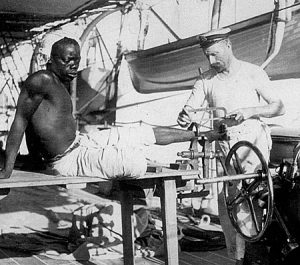
Appendix B – Rare ‘slave freeing’ photos on show

A set of rare photographs showing African slaves being freed by the Royal Navy have gone on show for the first time. They are part of an exhibition marking the bicentenary of the abolition of the slave trade.

A set of rare photographs showing African slaves being freed by the Royal Navy have gone on show for the first time.
Published April 28, 2007.
The photographs, on display at the Royal Naval Museum, Portsmouth, Hants, show a sailor removing the manacle from a newly-freed slave as well as the ship’s marines escorting captured slavers.

———-

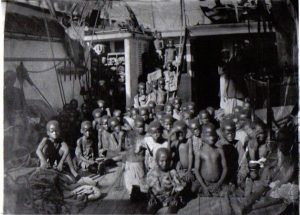
East African slaves aboard the HMS Daphne, a British Royal Navy vessel involved in anti-slave trade activities in the Indian Ocean,

Samuel Chidwick, 74, has donated the photographs taken by his father Able Seaman Joseph Chidwick, born in 1881, on board HMS Sphinx off the East African coast in about 1907.

The photographs, on display at the Royal Naval Museum, Portsmouth, Hants, show a sailor removing the manacle from a newly-freed slave as well as the ship’s marines escorting captured slavers.

Mr Chidwick, of Dover, Kent, said: “The pictures were taken by my father who was serving aboard HMS Sphinx while on armed patrol off the Zanzibar and Mozambique coast.

“They caught quite a few slavers and those particular slaves that are in the pictures happened while he was on watch. “That night a dhow sailed by and the slaves were all chained together. He raised the alarm and they got them on to the ship and got the chains knocked off them.

“They then questioned them and sent a party of marines ashore to try to track the slave traders down.

“They caught two of them and I believe they were of Arabic origin.

“My father thought the slave trade was a despicable thing that was going on, the slaves were treated very badly so when they got the slavers they didn’t give them a very nice time.”

Jacquie Shaw, spokeswoman for the Royal Naval Museum, said: “The museum and the Royal Navy are delighted to announce the donation of a nationally important collection of unique photographs taken by Able Seaman Joseph John Chidwick during his service on the Persian Gulf Station where the crew of HMS Sphinx were engaged in subduing the slave trade.

“The collection comprises a fascinating and important snapshot of life on anti-slavery duties off the coast of Africa.”

The exhibition, ‘Chasing Freedom -The Royal Navy and the suppression of the Transatlantic Slave Trade’, is being held until January next year to mark the 200th anniversary of the abolition of the slave trade.

The House of Commons passed a bill in 1805 making it unlawful for any British subject to capture and transport slaves but the measure was blocked by the House of Lords and did not come into force until March 25, 1807.

Mrs Shaw said that since the exhibition opened, members of the public had brought forward several historically-important items. She said: “As well as these amazing images, members of the public have brought many other unheard stories of the Royal Navy and the trade in enslaved Africans to the museum’s attention including the original ship’s log of the famed HMS Black Joke of the West Coast of Africa Station.”

Source: Posted 29 Apr 2007; retrieved April 14, 2018 from: http://metro.co.uk/2007/04/29/rare-slave-freeing-photos-on-show-331626/

————

Appendix C VIDEO – Abolition to Suffrage – https://youtu.be/WbLVp27cqZ8

Share this post:
, , ,
[Top]

Nature or Nurture: UK City Still Paying Slavery Debt

Go Lean Commentary

Here’s a deep religious question for you:

Does God punish children for the sins of the Father?

The sense of justice we have – our basis for right and wrong – may dictate to us that we only be punished for our own crimes, not that of our parents. Considering that the laws of the land – throughout the New World – are based on Judeo-Christian principles, what does the Bible say?

“Fathers shall not be put to death because of their children, nor shall children be put to death because of their fathers. Each one shall be put to death for his own sin.” – The Bible ESV Deuteronomy 24:16

In contrast, the Bible also states – here – that there is a legacy price that children will pay for their forefathers’ actions-misdeeds:

Keeping steadfast love for thousands, forgiving iniquity and transgression and sin, but [God] who will by no means clear the guilty, visiting the iniquity of the fathers on the children and the children’s children, to the third and the fourth generation.” – Exodus 34:7 ESV or English Standard Version

Despite the opening religious question, this is NOT a religious discussion, but rather presented from a societal reform perspective. In summary, communities may be plagued to suffer punishment for generations due to the misdeeds of their forefathers.

Indeed, this is true of the British city of Bristol, England. Until recently (2015), it was still paying off debts for the city’s prominent role in the African Slave Trade … that ended in 1807; the Abolition bill passed in Parliament in 1833 – requiring the need for a huge capital outlay, £20 million (US$28 million); Slavery ended in the British Empire in 1834. That’s 182 years later and sounds eerily familiar. It sounds like when a person pays only the monthly minimum on a credit card account. See more here:

A $2,000 credit balance with an 18% annual rate, with a minimum payment of 2% of the balance, or $10, whichever is greater, would take 370 months or just over 30 years to pay off . – MarketWatch.com

See the encyclopedic details on the Slave Trade activities by the City of Bristol in the Appendix below.

The Slave Trade did end, as a First Step to abolishing Slavery entirely. This was not easy and not automatic; it took strenuous effort on the part of advocates and activists, like William Wilberforce. See his portrayal in the Appendix VIDEO below.

See the news-commentary relating the continued Slavery Debt here:

Title: Slave owner compensation was still being paid off by British taxpayers in 2015

Bristol taxpayers in 2015 were still paying off debt borrowed by the government to “compensate” slave owners in 1833, the Treasury has revealed.

The revelations show that the £20 million (US$28 million) the government spent to reimburse the owners of slaves – who themselves were some of Britain’s richest businessmen – took the taxpayer 182 years to pay off. The descendants of slaves were never compensated, but it appears some would have been paying to compensation slave owners.

The information was revealed by the Treasury under a Freedom of Information (FoI) request, the Bristol Post reports. The Treasury tweeted: “Here’s today’s surprising #FridayFact. Millions of you helped end slave trade through your taxes.”

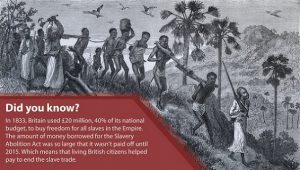
It added an infographic which said: “Did you know? In 1833, Britain used £20 million, 40 percent of its national budget, to buy freedom for all slaves in the Empire.

“The amount of money borrowed for the Slavery Abolition Act was so large that it wasn’t paid off until 2015. Which means living British citizens helped pay to end the slave trade.”

The tweet was quickly deleted after it sparked a backlash.

Historian David Olusoga, who has written about Bristol’s role in the slave trade, was one of several experts who questioned the tone of the Treasury’s tweet.

“The real question is why anyone thought this was ok?” he said, according to the newspaper. “I really do think we’re getting better at accepting the UK’s role in slavery and the slave trade, but things like this make me question my optimism.

“Also, just to compound the general level of ignorance, when HM Treasury reduce the complex story of the abolition of slavery to one of their fun ‘Friday Facts’ they use an irrelevant image of the slave trade – which was abolished three decades earlier.”

Bristol City councilor Cleo Lake said she was outraged. “I want my money back,” she tweeted. “I’m outraged. This messaging is so loaded.”

When the UK government abolished slavery and banned people from owning slaves in Britain and on Britain’s colonies anywhere in the world, those slave owners received compensation. Bristol had the highest concentration of people in Britain who owned slaves in 1833 outside of London.

The slaves themselves received nothing, and had to continue working for their masters for a number of years before they could consider being free.

Source: Posted February 15, 2018; retrieved April 10, 2018 from: https://www.rt.com/uk/418814-slave-compensation-bristol-taxpayer/

Imagine the outrage when city finances are strained – economic cycles of recessions and expansions are inevitable – and necessary expenditures – for example, public safety and education – have to be curtailed due to principal-and-interest payments for 200 year old debts. This seems to go against Nature. This commentary continues the 4-part series on Nature or Nurture for community ethos. This entry is 3 of 4 in this series from the movement behind the book Go Lean … Caribbean in consideration of root causes of some societal defects – specific examples in the US and UK – and how to overcome them. The other commentaries in the series are cataloged as follows:

  1. Nature or Nurture: Black Marchers see gun violence differently
  2. Nature or Nurture: Cop-on-Black Shootings – Embedded in America’s DNA; Whites Yawn
  3. Nature or Nurture: UK City of Bristol still paying off Slavery Debt
  4. Nature or Nurture: Nurturing comes from women; “they” impacted the Abolition of Slavery

In the first submission to this series, the history of Psychology was introduced, which quoted:

One of the oldest arguments in the history of psychology is the Nature vs Nurture debate. Each of these sides have good points that it’s really hard to decide whether a person’s development is predisposed in his DNA, or a majority of it is influenced by this life experiences and his environment. – https://explorable.com/nature-vs-nurture-debate

All of these commentaries relate to “why” communities – including the Caribbean – may have lingering societal defects and “how” the stewards for a new Caribbean can assuage these defects and the resultant failing dispositions. The term “lingering societal defects” have been addressed in the Go Lean book; there it is deemed “community ethos”; with this definition:

… the fundamental character or spirit of a culture; the underlying sentiment that informs the beliefs, customs, or practices of a group or society; dominant assumptions of a people or period. – Page 20

The UK County/City of Bristol had a bad community ethos. Obviously, a disregard for human rights was embedded in that community’s DNA. What’s more, the county-city-people had to pay for their forefathers’ bad community ethos … for 182 years. Sad!

How about the Caribbean? Are we paying for the sins of our fathers today?

Indeed, we have defects in our societal DNA, a bad Nature; and then we foster unbecoming traits by Nurturing unbecoming habits and practices.

The subject of societal defects is a familiar theme for this commentary, from the movement behind the book Go Lean…Caribbean – available to download for free. The book asserts that the colonial masters for the Caribbean did not endow this region with the organizational dynamics (attitudes or structures) that would lead to success. This society was built for leisure, pleasure and good times. Traits like industriousness, ingenuity and innovation was never encouraged nor fostered. As a result the vocations for the region always lean towards the illicit and the shadows – think: piracy, tax shelters, offshore banking, etc. –  as opposed to honest work for honest pay.

Regrettably, we are now paying for the sins of our fathers, as we have defects in all societal engines of our community.

We do not have the Nature to compete in the global marketplace! But change can be Nurtured.

The book Go Lean…Caribbean – available to download for free – serves as a roadmap for the introduction and implementation of the technocratic Caribbean Union Trade Federation (CU), for the elevation of Caribbean society – for all 30 member-states. This CU/Go Lean roadmap has these 3 prime directives for effecting change in our society:

  • Optimization of the economic engines in order to grow the regional economy to $800 Billion and create 2.2 million new jobs.
  • Establishment of a security apparatus to ensure public safety and protect the resultant economic engines.
  • Improve Caribbean governance to support these engines, including a separation-of-powers between the member-states and CU federal agencies.

The Go Lean book stresses that reforming and transforming the Caribbean societal engines must be a regional pursuit. This was an early motivation for the roadmap, as pronounced in the opening Declaration of Interdependence (Pages 12 – 13):

xi. Whereas all men are entitled to the benefits of good governance in a free society, “new guards” must be enacted to dissuade the emergence of incompetence, corruption, nepotism and cronyism at the peril of the people’s best interest. The Federation must guarantee the executions of a social contract between government and the governed.

xvi. Whereas security of our homeland is inextricably linked to prosperity of the homeland, the economic and security interest of the region needs to be aligned under the same governance. Since economic crimes … can imperil the functioning of the wheels of commerce for all the citizenry, the accedence of this Federation must equip the security apparatus with the tools and techniques for predictive and proactive interdictions.

xxiv. Whereas a free market economy can be induced and spurred for continuous progress, the Federation must install the controls to better manage aspects of the economy: jobs, inflation, savings rate, investments and other economic principles. Thereby attracting direct foreign investment because of the stability and vibrancy of our economy.

The Go Lean book provides 370-pages of turn-by-turn instructions on “how” to Nurture a new, better Caribbean society. It details the new community ethos that needs to be adopted, plus the strategies, tactics, implementations and advocacies to execute so as to reboot, reform and transform the societal engines of Caribbean society – economics, security and governance. In fact, the book (Page 131) provides one specific advocacy entitled 10 Ways to Make the Caribbean Better. This advocacy depicts the specific steps to Nurture the actions to better live, work and play.

Here are some samples, based on some previous blog-commentaries that doubled-down on this assertion that these societal engines – economics, security and governance – need redress:

Economics

The biggest Caribbean deficiency in this area is the lack of jobs, entrepreneurial opportunities and an industrial footprint. This sample of previous blog-commentaries asserted these points:

https://goleancaribbean.com/blog/?p=14242 Leading with Money Matters – Follow the Jobs
https://goleancaribbean.com/blog/?p=14191 The Dynamics of the ‘Gig Economy’ for New Job Options
https://goleancaribbean.com/blog/?p=13420 A Financing Model for Industrial Endeavors
https://goleancaribbean.com/blog/?p=13184 A Series on Rebooting the Industrial Landscape
https://goleancaribbean.com/blog/?p=8602 Big Infrastructure Projects Transforms Economic Engines
https://goleancaribbean.com/blog/?p=7977 Transformations: Perfecting Our Core Competence
https://goleancaribbean.com/blog/?p=6089 Where the Jobs Are – Greater than Minimum Wage
https://goleancaribbean.com/blog/?p=4037 Fostering the environment for Direct Foreign Investors
https://goleancaribbean.com/blog/?p=3152 Making a Great Place to Work®

Security

Security and economics must be inextricably linked to elevate prosperity in the homeland. People must be assured public safety and the economic engines must be protected. This theme was conveyed in this sample of previous blog-commentaries:

https://goleancaribbean.com/blog/?p=14556 Common Sense Policies with Guns
https://goleancaribbean.com/blog/?p=14211 Providing a safer environment for tourists and event participants
https://goleancaribbean.com/blog/?p=13746 Manifesting Caribbean Basin Security Dreams
https://goleancaribbean.com/blog/?p=13476 Policing the Police
https://goleancaribbean.com/blog/?p=12930 Managing Natural & Man-Made ‘Clear and Present Dangers’
https://goleancaribbean.com/blog/?p=12400 Acceding a Caribbean Regional Arrest Treaty
https://goleancaribbean.com/blog/?p=9072 Securing the Homeland – A Series
https://goleancaribbean.com/blog/?p=7896 The Logistics of Disaster Relief
https://goleancaribbean.com/blog/?p=7327 Preparing for Epidemics …Like Zika.
https://goleancaribbean.com/blog/?p=7119 Role Model for a Caribbean Regional Security Force

Governance

The colonial beginnings of the Caribbean have not been supplanted with more advanced systems of governance. This is the plan within the Go Lean roadmap. This plan was expanded in this sample of previous blog-commentaries:

https://goleancaribbean.com/blog/?p=14001 Transforming Mail Eco-System, Transforms Government & Society
https://goleancaribbean.com/blog/?p=13997 One Integration Effort – CariCom – Defective One-Man-One-Vote
https://goleancaribbean.com/blog/?p=13995 American Governing Defects – No Vote; No Voice in Congress
https://goleancaribbean.com/blog/?p=13993 Lessons Learned from the ‘Dignified and Efficient’ British Model
https://goleancaribbean.com/blog/?p=13749 Integrating Federal Governance: Assembling Regional Organizations
https://goleancaribbean.com/blog/?p=13744 The Quest for a ‘Single Currency’
https://goleancaribbean.com/blog/?p=13736 Failure to Launch: Past Failures for Caribbean Integration
https://goleancaribbean.com/blog/?p=13321 Making a ‘Pluralistic Democracy’ – Multilingual Realities

In summary, the Nature of the Caribbean – inherited from the Europeans – is not defaulted for governing efficiency. But, the regional governing entities can be Nurtured for an optimized delivery.

Yes, we can elevate our societal engines. We do not have to suffer and reap the whirlwind of the sins of our legacy members; we do not have to wait for punishment on the children for the sins of their Father. This quest is conceivable, believable and achievable. We can make our homeland a better place to live, work and play. 🙂

Download the free e-Book of Go Lean … Caribbean – now!

Sign the petition to lean-in for this roadmap for the Caribbean Union Trade Federation.

———–

Appendix – Bristol Slave Trade

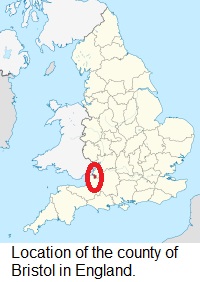
Bristol is a city in the South West of England, on the River Avon which flows into the Severn Estuary. Because of Bristol’s position on the River Avon, it has been an important location for marine trade for centuries.[1] The city’s involvement with the slave trade peaked between 1730 and 1745, when it became the leading slaving port.[2]
Bristol used its position on the Avon to trade all types of goods. Bristol’s port was the second largest in England after London. Countries that Bristol traded with included France, Spain, Ireland, Portugal, and North Africa’s Barbary Coast. Bristol’s main export was woollen cloth. Other exports included coal, lead, and animal hides. Imports into Bristol included wine, grain, slate, timber, and olive oil. Trading with the various colonies in the Caribbean and North America began to flourish during the Interregnum of Oliver Cromwell (1649–1660).

The Royal African Company, a London-based trading company, had control over all trade between countries in Britain and Africa before the year 1698[3] At this time, only ships owned by the Royal African Company could trade for anything, including slaves. Slaves were increasingly an important commodity at the time, since the British colonization in the Caribbean and the Americas in the 17th century. The Society of Merchant Venturers, an organization of elite merchants in Bristol [and synonymous with the government of Bristol], wanted to commence participation in the African slave trade, and after much pressure from them and other interested parties in and around Britain, the Royal African Company’s control over the slave trade was broken in 1698.

As soon as the monopoly was broken, what is thought to have been the first “legitimate” Bristol slave ship, the Beginning, owned by Stephen Barker, purchased a cargo of enslaved Africans and delivered them to the Caribbean. Some average slave prices were £20, £50, or £100. In her will of 1693, Jane Bridges, Widow of Leigh Upon Mendip bequeathes her interest of £130 in this very ship to her grandson Thomas Bridges and indicates that the vessel was owned by the City of Bristol. Business boomed; however, due to the over-crowding and harsh conditions on the ships, it is estimated that approximately half of each cargo of slaves did not survive the trip across the Atlantic.[4]

The triangular trade was a route taken by slave merchants during the years 1697 and 1807. The areas covered by the triangular trade was England, North West Africa and finally The Caribbean. Profits of 50-100% were made during the 18th century. Estimates vary about how many slaves were sold and transported by companies registered in Bristol. Over 3.4 million slaves were brought into slavery by these ships, representing one-fifth of the British slave trade during this time.[5][6] However, estimates of over 500,000 slaves were brought into slavery by these ships.[7][8]

Source: Retrieved April 10, 2018 from https://en.wikipedia.org/wiki/Bristol_slave_trade

———–

Appendix VIDEO – William Wilberforce & the End of the African Slave Trade – https://youtu.be/eLU182rj0pA


Rose Publishing

Published on Jul 26, 2012 – Learn how a young member of British Parliament followed his conviction to bring about the abolition of the African slave trade.

In this 12 Session DVD-based study, Dr. Timothy Paul Jones takes you through the most important events in Christian history from the time of the apostles to today. Click here to read more about this amazing Christian History Bible study series: https://www.hendricksonrose.com/chris…

To learn more about this DVD study visit www.christianhistorymadeeasy.com

  • Category: Education
  • License: Standard YouTube License
Share this post:
, ,
[Top]

Nature or Nurture: Cop-on-Black Shootings – Embedded in America’s DNA

Go Lean Commentary

It happens so often, it rarely gets attention anymore; Police-on-Black shootings that is!

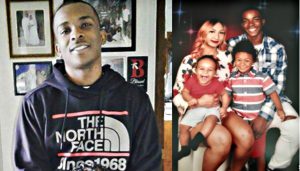
It seems to be a constant feature of American life. See the latest high profile one – Stephon Clark – in the Appendix below.

What’s worse, when it happens, the White people in America, just yawns. Sad, but true!

Is this phenomenon the Nature of the United States of America, or is it Nurture?

The answer is complicated; the answer is both!

This commentary continues the 4-part series on Nature or Nurture for community ethos. This entry is 2 of 4 in this series from the movement behind the book Go Lean … Caribbean in consideration of root causes of some societal defects – specific examples in the US and UK – and how to overcome them. The other commentaries in the series are cataloged as follows:

  1. Nature or Nurture: Black Marchers see gun violence differently
  2. Nature or Nurture: Cop-on-Black Shootings – Embedded in America’s DNA; Whites Yawn
  3. Nature or Nurture: UK City of Bristol still paying off Slavery Debt
  4. Nature or Nurture: Nurturing comes from women; “they” impacted the Abolition of Slavery

In the first submission to this series, the history of Psychology was introduced, which quoted:

One of the oldest arguments in the history of psychology is the Nature vs Nurture debate. Each of these sides have good points that it’s really hard to decide whether a person’s development is predisposed in his DNA, or a majority of it is influenced by this life experiences and his environment. – https://explorable.com/nature-vs-nurture-debate

All of these commentaries relate to “why” the New World – including the US and the Caribbean – has the societal defects that are so prominent – and so illogical – and  “how” the stewards for a new Caribbean can assuage these defects and the resultant failing dispositions among Caribbean society. Though the traits may be consistent in the hemisphere, our efforts to reform and transform is limited to the Caribbean.

The subject of Police-On-Black shootings is a familiar theme for this commentary, from the movement behind the book Go Lean…Caribbean – available to download for free. The book asserts that there is a consistent lack of respect for those in America fitting a “Poor Black” attribute. In fact these prior blog-commentaries doubled-down on this assertion:

https://goleancaribbean.com/blog/?p=13081 America’s Race Relations – Spot-on for Protest
https://goleancaribbean.com/blog/?p=8202 Lessons Learned from American Dysfunctional Minority Relations
https://goleancaribbean.com/blog/?p=8200 Climate of Hate for American Minorities
https://goleancaribbean.com/blog/?p=7221 Street naming for Martin Luther King unveils the real America
https://goleancaribbean.com/blog/?p=5527 American Defects: Racism – Is It Over?
https://goleancaribbean.com/blog/?p=4863 Video of Police Shooting: Worth a Million Words
https://goleancaribbean.com/blog/?p=546 Book Review – ‘The Divide’ – Injustice in the Age of the Wealth Gap
https://goleancaribbean.com/blog/?p=341 Hypocritical US slams Caribbean human rights practices

Say it ain’t so … it is a dangerous proposition to be Black in America. In fact one Caribbean member-states – The Bahamas, a majority Black population – had urged their young men traveling to the US to exercise extreme caution when dealing with police authorities. This advice is Spot-on!

The Nature of the US is that Black people – especially men and boys – have always had to contend with an unjust society in terms of justice and the security apparatus. Since the subject of Nature assumes that racism is predisposed in a society’s DNA, despite the fact that formal slavery ended 150 years ago, it is no surprise that Blacks in America have seen a continuous suppression, repression and oppression of any justice requirements.

After all, this is the population that suffered so much of the indignity of lynching.

Yes, we are going there …

Despite the fact that African slaves were taken to all New World territories, the country with this acute practice was only the United States of America. Surely, this had a lingering effect on the culture and society. This effect was not only on the victims, but on society in general, and the law enforcement establishment.

Imagine people gathering in their Sunday Best Clothes to watch the lynching (murder) of a Black man with no trial or due process. Imagine the effect that would instill on that community? Would that forge concern and consideration for the targeted population?

Now imagine that drama repeated again and again … 4733 times.

According to a previous Go Lean commentary, 4,733 people were documented as being lynched. That’s a huge number. To think there would be no impact on the Nature of a society is inconceivable. This theme was also conveyed in the TV news magazine 60 Minutes. See the full story here:

VIDEO – Inside the memorial to victims of lynching https://www.cbsnews.com/video/inside-the-memorial-to-victims-of-lynching/

Posted April 8, 2018 – Oprah Winfrey reports on the Alabama memorial dedicated to thousands of African-American men, women and children lynched over a 70-year period following the Civil War.

Surely this country – the America of Old – would have been no place for Caribbean people to seek refuge. The Nuturing of American society continued to develop a nonchalance to injustice for the Black people of the US. This is where the Nature has been supplanted by the Nurture. This is why stories like Stephon Clark continue to emerge and why White America “continue to yawn”. Surely this society – modern America – is no place for Black-and-Brown Caribbean people to seek refuge.

Yet, the region – all 30 member-states – continue to suffer from an abominable brain drain rate in which so many Caribbean citizens have emigrated to the US, and other countries. (One reported has rated the brain drain rate of 70 percent).

The book Go Lean…Caribbean asserts that it is easier for the Black-and-Brown populations in the Caribbean to prosper where planted in the Caribbean, rather than emigrating to foreign countries, like the United States. If only we can reform and transform our own society so as to dissuade our people from leaving to seek refuge in the US. This is the quest of the Go Lean book, to serve as a roadmap for the introduction and implementation of the technocratic Caribbean Union Trade Federation (CU). The book presents 370 pages of instructions for how to reform and transform our Caribbean member-states. It stresses the key community ethos that needs to be adopted, plus the strategies, tactics, implementations and advocacies necessary to optimize the societal engines in a community.

The CU/Go Lean roadmap has these 3 prime directives for optimizing our societal engines:

As related in this blog series on Nature or Nurture, the Caribbean has the same Nature as our American counterparts, but not the same Nurture. Our majority Black-and-Brown populations have forged different societies than the baseline US. And we are not wanting to be like America …

we want to be better.

This is not just a dream; this is a roadmap that is conceivable, believable and achievable. Yes, we can … reform and transform our society. We can make our homeland a better place to live, work and play. 🙂

Download the free e-Book of Go Lean … Caribbean – now!

Sign the petition to lean-in for this roadmap for the Caribbean Union Trade Federation.

————

Appendix – Shooting of Stephon Clark

Stephon Clark was shot and killed on the evening of March 18, 2018, by two officers of the Sacramento Police Department in SacramentoCalifornia, United States. The officers were looking for a suspect who was breaking windows in the Meadowview neighborhood, and confronted Clark, an unarmed 22-year-old African-American man whom they found in the yard of his grandmother’s house, where he resided. Clark ran from the police in an encounter that was filmed by police video cameras. The officers stated that they shot Clark, firing 20 rounds, believing that he had pointed a gun at them. After the shooting, police reported that he was carrying only a cell phone. According to an independent autopsy, Clark was shot eight times including six times in the back.

The shooting caused large protests in Sacramento, and Clark’s family members have rejected the initial police description of the events leading to Clark’s death. The Sacramento Police Department placed the officers on paid administrative leave and opened a use of force investigation. Police have stated they are confident that Clark was the person responsible for breaking windows in the area prior to the encounter.

Shooting

The Sacramento Police Department stated that on Sunday, March 18 at 9:18 p.m., two officers were responding to a call that someone was breaking car windows.[3] In a media release after the shooting, police stated that they had been looking for a suspect hiding in a backyard. They said the suspect was a thin black man, 6 feet 1 inch (185 cm) in height, wearing darkly colored pants and a black hooded sweatshirt.[3] A sheriff’s helicopter spotted a man at 9:25 p.m. in a nearby backyard and told officers on the ground that he had shattered a window using a tool bar, run to the front of that house, and then looked in an adjacent car.[3]

Officers on the ground entered the front yard of Clark’s grandmother’s home, and saw Clark next to the home.[10][3] Vance Chandler, the Sacramento Police Department spokesman, said that Clark was the same man who had been breaking windows, and was tracked by police in helicopters.[3] Chandler said that when Clark was confronted and ordered to stop and show his hands, Clark fled to the back of the property.[3]

Police body camera footage from both of the officers who shot Clark recorded the incident, though the footage is dark and shaky.[10][11] In the videos, officers spot Clark in his grandmother’s driveway and shout “Hey, show me your hands. Stop. Stop.”[10] The video shows that the officers chased Clark into the backyard and an officer yells, “Show me your hands! Gun!” About three seconds elapse and then the officer yells, “Show me your hands! Gun, gun, gun”, before shooting Clark.[10][11]

According to the police, before being shot Clark turned and held an object that he “extended in front of him” while he moved towards the officers.[3] The officers said they believed that Clark was pointing a gun at them.[6] The police stated that the officers feared for their safety, and at 9:26 p.m., fired 20 rounds, hitting Clark multiple times.[6][3] According to an independent autopsy, Clark was shot eight times, including six times in the back.[1] The report found that one of the bullets to strike Clark from the front was likely fired while he was already on the ground.[1]

Body-cam footage shows that after shooting him, the officers continued to yell at him as one shined a flashlight at him and they kept their guns aimed at him. One officer stated in one of the body-cam videos, “He had something in hands, looked like a gun from our perspective.” Three minutes after the shooting, a female officer called to him and said “We need to know if you’re OK. We need to get you medics, so we can’t go over and get you help until we know you don’t have a weapon.”[12] They waited five minutes after shooting Clark before approaching and then handcuffing him.[13] Clark was found to have a white iPhone, and was unarmed.[6][4] Clark’s girlfriend later said the phone belonged to her.[14]

After more officers arrived, one officer said “Hey, mute”, and audio recording from the body camera was turned off.[10]

The Police Department stated on March 19, one day after the shooting, that Clark had been seen with a “tool bar”. On the evening of that day, police revised their statement to say that Clark was carrying a cell phone, and not a tool bar, when he was shot.[3] Police added that Clark might have used either a concrete block or an aluminum gutter railing to break a sliding glass door at the house next door to where he was shot, and that they believed Clark had broken windows from at least three vehicles in the area.[3]

Responses

Elected officials and political activists

Sacramento Mayor Darrell Steinberg, initially said he would not second-guess decisions made by officers on the ground. After a backlash, he said the videos of Clark’s shooting made him feel “really sick” and that the shooting was “wrong” but declined to comment whether the officers should be charged.[30] House Minority Leader Nancy Pelosi stated that Clark “should be alive today”.[31] [Civil Rights Activist] Reverend Al Sharpton stated that he was alarmed by the story, which he said had not received enough media attention.[32]

On March 26, White House spokesman Raj Shah stated that he was unaware of any comments from President Donald Trump regarding the incident.[31] Two days later, White House Press Secretary Sarah Huckabee Sanders stated that Trump is “very supportive of law enforcement” and that the incident was a “local matter” that should be dealt with by the local authorities.[33]

Clark family

Civil rights attorney Benjamin Crump, who represents the Clark family, stated that the autopsy finding was inconsistent with the official narrative that Clark was charging toward the police officers when they fired.[1] Clark’s family expressed skepticism of the police version of events. Clark’s brother, Stevante Clark, said of police statements: “They said he had a gun. Then they said he had a crowbar. Then they said he had a toolbar … If you lie to me once, I know you’ll lie to me again.”[10] Clark’s aunt Saquoia Durham said that police gave Clark no time to respond to their commands before shooting him.[34] According to Crump the officers did not identify themselves as police when they encountered Clark.[22] The police have stated that the officers who confronted Clark were wearing their uniforms at that time.[35]

Policing experts

University of South Carolina criminology professor Geoffrey Alpert stated that it might be hard for officers to justify their conclusion that Clark was armed, since they had been told he was carrying a toolbar.[36] Peter Moskos, assistant professor of Law and Police Science at John Jay College, said that the officers appeared to think they had been fired upon following the shooting.[37] Alpert, Clark’s family, and protesters questioned officers’ decisions to mute their microphones.[10][38] Police Chief Daniel Hahn said he was unable to explain the muting. Cedric Alexander, former police chief in Rochester, New York, and former president of the National Organization of Black Law Enforcement Executives, said that the muting did not appear to violate any policy, but looks bad. He also stated that it is not unusual for police to mute their body cams and that attorneys advise the police to mute conversations to prevent recording any comments that could be used in administrative or criminal proceedings. Many body cams are made with a mute button on them.[38]

Source: Wikipedia; retrieved April 9, 2018 from: https://en.wikipedia.org/wiki/Shooting_of_Stephon_Clark


Share this post:
, , ,
[Top]

Nature or Nurture: Change Still Possible

Go Lean Commentary

What is wrong … with America? Why are they so dysfunctional with … Guns, School ShootingsPolice-on-Black shootings?

Question: Is the American problem Nature … or it Nurture?

Answer: It’s American Psychology!

Psychology is not so new a science … it goes way back in history – i.e. Plato, Aristotle,  John Locke (1690), René Descartes (1637), etc..
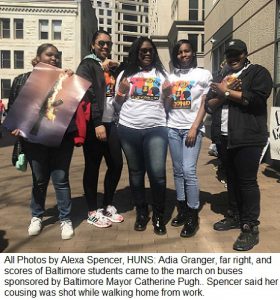
One of the oldest arguments in the history of psychology is the Nature vs Nurture debate. Each of these sides have good points that it’s really hard to decide whether a person’s development is predisposed in his DNA, or a majority of it is influenced by this life experiences and his environment. – https://explorable.com/nature-vs-nurture-debate

Which factor – Nature or Nurture – attributes to the development of Caribbean society?

VIDEO – Nature vs. Nurture – Psy 101 – https://youtu.be/chzDR3feSHY

PsychU
Published on Jul 10, 2015 – Does our personality and behavior come about from our upbringing and environment or do we have genetic predispositions that influence us to act a certain way? Let’s discuss how psychologists tackle the issue!

The book Go Lean…Caribbean – available to download for free – asserts that there are standard traits for Caribbean society and people – community ethos – that are so entrenched that they could be considered as embedded in the DNA. The Go Lean book defines community ethos as:

… the fundamental character or spirit of a culture; the underlying sentiment that informs the beliefs, customs, or practices of a group or society; dominant assumptions of a people or period. – Page 20

But alas, “community ethos” can be changed.

The Go Lean book prescribes how to recognize the ethos and most importantly: how to change ethos.

The Caribbean’s “community ethos” did not start in the Caribbean; alas, they started in Europe. So a study of the European ethos during the time of the discovery of the New World must be considered; we must learn from those lessons – we are directly affected.

In a previous Go Lean commentary, it was developed that the historicity of American and Caribbean society – make  that the whole New World – was premised on the European philosophy of White Supremacy; that it was acceptable for those peoples to exploit the native people of the New World – or the transplanted slaves – as long as they infused Christianity into these conquered people.

Such a fallacy!

So the Nature of the Caribbean refers to the normal assumption – community ethos – that inhabitants are Less Than and not equipped to foster a workable society. Alas, this Nature can be changed!

One way of changing that default Nature, is by Nurturing the needed values that the regional community needs to thrive as functioning societies. This destination is not automatic; it must be forged … with strenuous effort – heavy-lifting. This must be the new societal priority.

Underlying to Caribbean history is the Nature (DNA) of the New World colonizers; they brought Crony-Capitalism and White Supremacy – in this order – to their new lands of influence. This natural assumption that Europeans had the right to rule and exploit the land and dominate native people was an obvious attribute for hundreds of years (half a millennium).

Take for example this evidence in the history of discovery:

  • The New World was discovered in 1492, slavery started in 1600’s. What happened in 1500’s? Search for Gold. This is proof-positive that European Crony-Capitalism superseded all other community values in the New World colonization quest.
  • French Revolution brought equality and egalitarianism to the French world, but shortly thereafter, “they” wanted to re-install slavery in the French Caribbean, even in rebellious Haiti.

Where personal Nature is failing, the recompense must come from the process in Nurturing. (Consider the example of Crony-Capitalism; change can be forged by attacking the pocketbook through boycotts, embargo and blockades).

This commentary commences a 4-part series on Nature or Nurture for “community ethos”. This entry is 1 of 4 in this series from the movement behind the book Go Lean … Caribbean in consideration of root causes of some societal defects – specific examples in the US and UK – and how to overcome them. There is much that can be learned from history, good, bad and ugly. The other commentaries in the series are cataloged as follows:

  1. Nature or Nurture: Black Marchers see gun violence differently
  2. Nature or Nurture: Cop-on-Black Shootings – Embedded in America’s DNA; Whites Yawn>
  3. Nature or Nurture: UK City of Bristol still paying off Slavery Debt
  4. Nature or Nurture: Nurturing comes from women; “they” impacted the Abolition of Slavery

All of these commentaries relate to “why” the New World has the societal defects that are so prominent – and so illogical – and  “how” the stewards for a new Caribbean can assuage these defects and the resultant failing dispositions among Caribbean society. Though the traits may be consistent in the hemisphere, our efforts to reform and transform is limited to the Caribbean.

The subject of gun violence in America is truly one of those subjects, where a logical society seems to ignore logic. (America is the richest, most powerful society in the history of civilizations). It is outright stupidity! A previous blog-commentary related that stupidity persists when “someone is profiting”. (In a free society, special interest groups – who often have an economic motive – can conduct promotional campaigns to control public opinion).

So in America, it is a fact that different population groups have different experiences and values for guns. See this reality as portrayed in this news article, about Black protesters seeing gun violence differently than their White counterparts:

Title: Black Marchers See Gun Violence Differently
By: Alexa Spencer

WASHINGTON — Adia Granger knows gun violence intimately.  The 16-year-old lives in Baltimore, the city with the highest murder rate of any major city in America.
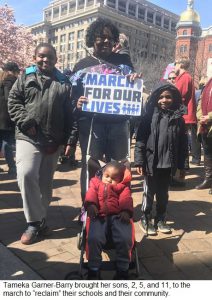
Of the 343 people killed in Baltimore last year, 295 died by gunfire, more than New York City or Los Angeles, cities with more than 10 times Baltimore’s population.  Gun-related deaths accounted for 88 percent of the city’s homicides.

Many of the victims were young.  Markel Scott, 19, shot six times. Steven Jackson, 18, shot in the head. Shaquan Raymone Trusty, 16, shot multiple times in the upper body. Tyrese Davis, 15, and  Jeffrey Quick, 15, shot in same neighborhood within blocks of one another.

Adia’s own cousin was shot while walking home from work.  Like her cousin, most all of them victims were black.

Their deaths were the reason she and a group of classmates from Western High School were among the more than 800,000 who rallied in the nation’s capital to demand more action to deal with gun violence.

“I came here to represent Baltimore,” Adia said.

Adia was among several bus loads of students sent to the march by Baltimore Mayor Catherine Pugh. For them, gun violence is not new. It is a longstanding issue.

Adia, a high school junior, joined the national movement for gun control sparked by the Parkland shooting by marching out of her school in March,   Like many other protestors,  she said she wanted the federal government should do more to address the issue.

“It’s unacceptable what is going on,” Adia said, “and Congress has not done anything about it.,”

Adia was among many black citizens that were present to protest not only against mass shootings, but also police brutality and gun violence that plagues neighborhoods of color.

Frederick Shelton, 43, stood aside the packed streets, holding a sign that read: If the opposite of pro is con…what is the opposite of progress?”

The message of his sign, Shelton said is “We’re not moving forward.”

“It’s just a matter of time before any of us get shot, because our federal government is not doing anything,” he said. “We’re all just sitting around waiting for the next mass shooting. It could be you. It could be me. And that’s a horrible way to live.”

Shelton teaches English as a second language to immigrant students in Washington.   He said his students are uniquely affected by gun laws and said he participated in the march to make their lives better. He suggested the federal government reserve guns for military personnel only.

“I believe that there is no place for guns in our society,” he said. “Guns are for the military.”

Tameka Garner-Barry, 38-year-old mother of three, brought her sons, 2, 5, and 11, to the march to “reclaim” their schools and their community. Her children, though young, have recognized the problem and wanted to be at the march to speak out.

“These are issues and concerns that they’ve had, so it’s only right that they come out and voice their opinions and let their voices be heard,” Garner-Barry said.

Standing at his mother’s hip, 5-year-old Bryson chipped in his feelings.

“I feel like people have to stop the violence,” he said, “because people are getting hurt.”

Garner-Barry said she wanted to see the removal of guns from the streets and heightened security in school.

“I want Congress to know that we do control the vote, and that we take these issues seriously,” she said, “and I want the NRA to be dismissed altogether,”

Nia Smith, 21, a graduating senior film production major at Howard University from Chicago, was also at the march.

Chicago had the highest number of murders two years in a row.    In 2016, 771 were killed.  The number declined to 650 murdered in 2017, still higher than the number of murders in Los Angeles and New York City combined.

“Gun violence has always been a part of my life,” Smith said. “I have had family members that I’ve lost to gun violence.”

Though the march addressed gun violence, including some speakers who tlked abut gun violence against African-American men and women, she said she felt as though certain forms of gun violence, such as police brutality, were overlooked by protesters because of class and race.

“They fail to see that gun violence is gun violence, period…the police and the perpetrators of the classroom shootings,” Smith said.

To fully combat the issue, there must be support across racial lines, she said.

“I don’t think they should be separated,” she said. “I think white people should march the way they marched today for the Black Lives Matter movement. They all died the same way. They all died by a bullet.”

Source: Howard University News Service; posted March 26, 2018; retrieved April 7, 2018 from: http://www.hunewsservice.com/news/view.php/1033085/Black-Marchers-See-Gun-Violence-Differen

A previous blog-commentary related how the 2nd Amendment originated during slavery so as to provide additional rights to the slave-owning populations to regulate (police) their slave majorities on plantations.

Despite the historic developments, the requirements for the Black American population appears to be different than for the White population; (this writer attended one of the “March For Our Lives” events on March 24, 2018). This is the manifestation of the Nature psychology.

While this is an American drama, there is much that the Caribbean can glean, in terms of lessons learned. The book Go Lean…Caribbean serves as a roadmap for the introduction and implementation of the technocratic Caribbean Union Trade Federation (CU), for the elevation of Caribbean society – for all member-states. The book presents 370 pages of instructions for how to reform and transform our Caribbean member-states. It stresses the key community ethos that needs to be adopted, plus the strategies, tactics, implementations and advocacies necessary to shepherd a better society.

The book stresses that reforming and transforming the Caribbean societal engines must be a regional pursuit. This was an early motivation for the roadmap, as pronounced in the opening Declaration of Interdependence (Pages 12 – 13):

xi. Whereas all men are entitled to the benefits of good governance in a free society, “new guards” must be enacted to dissuade the emergence of incompetence, corruption, nepotism and cronyism at the peril of the people’s best interest. The Federation must guarantee the executions of a social contract between government and the governed.

xvi. Whereas security of our homeland is inextricably linked to prosperity of the homeland, the economic and security interest of the region needs to be aligned under the same governance. Since economic crimes … can imperil the functioning of the wheels of commerce for all the citizenry, the accedence of this Federation must equip the security apparatus with the tools and techniques for predictive and proactive interdictions.

xxiv. Whereas a free market economy can be induced and spurred for continuous progress, the Federation must install the controls to better manage aspects of the economy: jobs, inflation, savings rate, investments and other economic principles. Thereby attracting direct foreign investment because of the stability and vibrancy of our economy.

The Go Lean book provides directions on “how” to adopt new community ethos, plus the strategies, tactics, implementations and advocacies to execute so as to reboot, reform and transform the societal engines of Caribbean society. Considering the failings in the US, the Go Lean roadmap calls for remediation and mitigation for gun control, despite the race issues. We want to elevate our society beyond the initial racial Nature in Caribbean history.

Change can be forged, by Nurturing a better community ethos. We have a long track record of advocates and activists working to change the default orthodoxy. They protest, campaign, speak out for a cause, lobby, cajole, take to the streets and march; they engage the voting process and support – or oppose – candidates in line, or out of line, with their cause. This is referred to as forging change from the Bottom-Up. They may even use Civil Disobedience tactics.

Have you been to jail for justice?

This is an important question and statement for forging change in society. See how this has been portrayed in this song-VIDEO recapping many of the causes during the hey-day of the Counter-Culture: Civil Rights, Women’s rights, Anti-War protests, etc.. The lyrics are included in the Appendix below.

VIDEO – Peter, Paul and Mary – Have You Been To Jail For Justice – https://youtu.be/rCbhOc1VZ6k
Kwan CS
Published on Sep 26, 2016 – Peter, Paul and Mary – Have You Been To Jail For Justice

For many of the Caribbean’s bad Nature, the Go Lean roadmap seeks to Nurture change with good messaging to the heart of the youth; this is one proven method for forging change among the next generation. Beyond that, meeting the needs of the population is important for optimizing the societal engines in a community. This is easier said than done, but this quest is the purpose of the CU/Go Lean roadmap; this roadmap has these 3 prime directives for optimizing our societal engines:

The Caribbean does not have the same population demographic as the neighboring American states. We can more easily distance ourselves from the racial dysfunction in American society. We have majority Black populations among 29 of the 30 member-states.  We only need to deliver best practices going forward; after formal reconciliation from our dysfunctional past.

Despite our differences, the Caribbean does need to reform and transform our society. We have many societal defects of our own. That cited song stressed this ethos:

The more you study history
The less you can deny it
A rotten law stays on the books
’til folks with guts defy it!

Yes, we can … exert the energy, display the guts and internal fortitude to change our society, to reform and transform. This is how we can make our homeland a better place to live, work and play. 🙂

Download the free e-Book of Go Lean … Caribbean – now!

Sign the petition to lean-in for this roadmap for the Caribbean Union Trade Federation.

———-

Appendix – Lyrics: Peter, Paul and Mary – Have You Been To Jail For Justice 

(Written by Anne Feeney)

Was it Cesar Chavez or Rosa Parks that day?
Some say Dr. King or Ghandi
Set them on their way
No matter who your mentors are
It’s pretty plain to see
That if you’ve been to jail for justice
You’re in good company

Have you been to jail for justice?
I want to shake your hand
‘Cause sitting in and laying down
Are ways to take a stand
Have you sung a song for freedom
Or marched that picket line?
Have you been to jail for justice?
Then you’re a friend of mine

You law abiding citizens
Come listen to this song
Laws are made by people
And people can be wrong
Once unions were against the law
But slavery was fine
Women were denied the vote
While children worked the mine
The more you study history
The less you can deny it
A rotten law stays on the books
’til folks with guts defy it!

Have you been to jail for justice?
I want to shake your hand
‘Cause sitting in and laying down
Are ways to take a stand
Have you sung a song for freedom
Or marched that picket line?
Have you been to jail for justice?
Then you’re a friend of mine

Well the law is supposed to serve us
And so are the police
When the system fails
It’s up to us to speak our piece
We must be ever vigilant
For justice to prevail
So get courage from your convictions
Let ’em haul you off to jail!

Have you been to jail for justice?
I want to shake your hand
‘Cause sitting in and laying down
Are ways to take a stand
Have you sung a song for freedom
Or marched that picket line?
Have you been to jail for justice?
Then you’re a friend of mine
Have you been to jail for justice
Then you’re a friend of mine

Source: Retrieved April 8, 2018 from: https://genius.com/Peter-paul-and-mary-have-you-been-to-jail-for-justice-lyrics

Share this post:
, , ,
[Top]

Change! Forging Change – Corporate Vigilantism

Go Lean Commentary

It’s the principle, not the money! – Common Expression

Normally the people who can afford to take a stand on principle rather than money are the people who do not need the money.

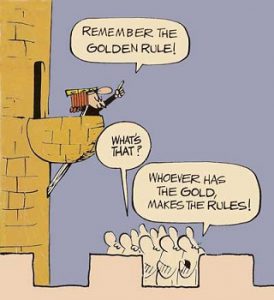

Who is that in our society?

Rich people, yes!

But try this … Banks!

Yes, one of the America’s biggest banks – Citigroup or Citibank – wants to reform and transform American society in regards to guns. They are putting their money where their mouth is. Or better still, they are “pulling” their money based on causes that their mouth is advocating. See VIDEO summary here:

VIDEO – Citigroup tells business partners to place restrictions on guns – https://youtu.be/JETUE8kZ1ks

Published on Mar 23, 2018 – [Citigroup] plans to prohibit retailers that are customers of the bank from offering bump stocks or selling guns to people who haven’t passed a background check or are younger than 21.

The bank is imposing the restrictions on companies that use it to issue store credit-cards or for lending and other services, according to a memo Thursday. The lender also barred the sale of high-capacity magazines.

“The policy was designed to respect the rights of responsible gun owners while helping to keep firearms out of the wrong hands,” Citigroup Chief Executive Officer Mike Corbat said in the memo to staff. “It is clear to me that most people believe there are areas of agreement and practical changes we can make to find common ground.” ...

Wow, this – corporate vigilantism – can be effective for forging change. Imagine the pressure: no credit line, mortgage, installment loan, credit card processing, nor check-cashing for the business. This can affect a company’s ability to meet payroll or operate as an ongoing concern. This is called controlling the purse strings.

And what is the bank asking for their continuation of business-as-usual?

Common sense gun sale regulations. See these 3 principles here from the Internal Staff Memo in Appendix A below:

(1) they don’t sell firearms to someone who hasn’t passed a background check …

(2) they restrict the sale of firearms for individuals under 21 years of age, and …

(3) they don’t sell bump stocks or high-capacity magazines.

This commentary is written by a Citibank-Staffer, but this information (memo) is not just internal; it is also published in a Press Release. See the New York Times version of the announcement in Appendix B.

The request from Citibank here does not seem like a huge hardship. It seems only reasonable; common sense! Benevolent!

Expect other banks to follow suit, as other companies have deployed new policies and business rules related to guns.

Is this soft power or hard power?

Hard power is the use of military and economic means to influence the behavior or interests of other political bodies. This form of political power is often aggressive (coercion), and is most effective when imposed by one political body upon another of lesser military and/or economic power.[1] Hard power contrasts with soft power, which comes from diplomacyculture and history.[1]Source: Wikipedia.

No doubt, this is hard power; this is corporate vigilantism. But this is an effective way to forge change in a society.

This commentary is about forging change, as demonstrated with the Hot Topic of Common Sense Gun Control. This entry also concludes a short 3-part series on “Change” in society. The full catalog of commentaries in this series are as follows:

  1. Change! Observing the Change – Student Marches for Gun Control Reform and Action
  2. Change! Be the Change – RIP Linda Brown; the little girl in “Brown vs Board of Education”
  3. Change! Forging Change – Citibank’s Model of “Corporate Vigilantism”

All of these commentaries give insights on “how” the stewards of a new Caribbean can persuade people, establishments and institutions to forge change in their communities. Of course, this should be for benevolent purposes.

This thought of ‘forging benevolent change’ is a common theme for the movement behind the book Go Lean … Caribbean for nearly 4 years. See the full catalog here of this one, plus the previous 11 blog-commentaries that detailed approaches for forging change (in reverse chronological order):

  1. Forging Change – Corporate Vigilantism (Today: March 28, 2018)
  2. Forging Change – Soft Power (February 21, 2018)
  3. Forging Change – Collective Bargaining (April 27, 2017)
  4. Forging Change – Addicted to Home (April 14, 2017)
  5. Forging Change – Arts & Artists (December 1, 2016)
  6. Forging Change – Panem et Circenses (November 15, 2016)
  7. Forging Change – Herd Mentality (October 11, 2016)
  8. Forging Change – ‘Something To Lose’ (November 18, 2015)
  9. Forging Change – ‘Food’ for Thought (April 29, 2015)
  10. Forging Change – Music Moves People (December 30, 2014)
  11. Forging Change – The Sales Process (December 22, 2014)
  12. Forging Change – The Fun Theory (September 9, 2014)

As related in these commentaries, forging change in the 3 societal engines of a community – economics, security and governance – is how the roadmap described in the Go Lean book will make our Caribbean homeland a better place to live, work and play.

The premise of this commentary is that it is easier to lead and get people to voluntarily follow – to lean-in – when there is control of the purse strings; this is economic hard power.

Hard power as expressed by Citibank will also have its critics. Who? Mostly those that do not want to be controlled. But there is a truism in business – and in life – satirically referred to as the Golden Rule. It relates:

He, who has the Gold, makes the rules.

The book Go Lean…Caribbean – available to download for free – serves as a roadmap for the introduction and implementation of the technocratic Caribbean Union Trade Federation (CU), to better wield economic power for the consolidated Caribbean region. This is accomplished by better leveraging the economic engines for all 30 member-states in the region. Plus, with the introduction and implementation of the accompanying Caribbean Central Bank (CCB), monetary control can also be wielded for the region, further maximizing benevolent hard power influence in communities. This CU/CCB/Go Lean roadmap describes this benevolence with the following 3 prime directives, as follows:

  • Optimization of the economic engines in order to grow the regional economy to $800 Billion and create 2.2 million new jobs.
  • Establishment of a security apparatus to ensure public safety and protect the resultant economic engines.
  • Improve Caribbean governance to support these engines, including a separation-of-powers between the member-states and CU federal agencies.

There are a lot of benefits to the people of the Caribbean with this roadmap. The Go Lean book stresses this point; that reforming and transforming the Caribbean societal engines is easier by leveraging the entire region; imagine 42 million people and a $800 Billion GDP economy; many regional solutions emerge. Consider these pronouncements from early in the book, embedded in the opening Declaration of Interdependence (Pages 12 – 13):

viii. Whereas the population size is too small to foster good negotiations for products and commodities from international vendors, the Federation must allow the unification of the region as one purchasing agent, thereby garnering better terms and discounts.

xi. Whereas all men are entitled to the benefits of good governance in a free society, “new guards” must be enacted to dissuade the emergence of incompetence, corruption, nepotism and cronyism at the peril of the people’s best interest. The Federation must guarantee the executions of a social contract between government and the governed.

xvi. Whereas security of our homeland is inextricably linked to prosperity of the homeland, the economic and security interest of the region needs to be aligned under the same governance. Since economic crimes … can imperil the functioning of the wheels of commerce for all the citizenry, the accedence of this Federation must equip the security apparatus with the tools and techniques for predictive and proactive interdictions.

xxiv. Whereas a free market economy can be induced and spurred for continuous progress, the Federation must install the controls to better manage aspects of the economy: jobs, inflation, savings rate, investments and other economic principles. Thereby attracting direct foreign investment because of the stability and vibrancy of our economy.

The Go Lean book provides 370-pages of turn-by-turn instructions on “how” to adopt new community ethos, plus the strategies, tactics, implementations and advocacies to execute so as to reboot, reform and transform the societal engines of Caribbean society.

Change will come; but it depends on who controls the purse strings that wields the influence – hard power. We urge everyone that lives in or loves our homeland to lean-in to this roadmap, so as to ensure that Caribbean stakeholders are the ones with the hard power for the Caribbean. This is how we forge change to make our homes better to live, work and play. 🙂

Download the free e-book of Go Lean … Caribbean – now!

Sign the petition to lean-in for this roadmap for the Caribbean Union Trade Federation.

————-

Appendix A – March 22, 2018 Staff Memo – Message From CEO Mike Corbat

Dear Colleagues,

Over the last several weeks, I have had many conversations with clients, colleagues and friends who hold a range of opinions on the regulation of firearms in the U.S. It is clear to me that most people believe there are areas of agreement and practical changes we can make to find common ground.

Citi is ready to do our part to help our country move in that direction. Today, I am proud to announce a new U.S. Commercial Firearms Policy that promotes the adoption of current best practices regarding the sale of firearms. The policy was designed to respect the rights of responsible gun owners while helping to keep firearms out of the wrong hands.

This policy will apply across the firm, including to small business, commercial and institutional clients, as well as credit card partners, whether co-brand or private label. Under the policy, we will require new retail sector clients or partners to adhere to these current best practices: (1) they don’t sell firearms to someone who hasn’t passed a background check, (2) they restrict the sale of firearms for individuals under 21 years of age, and (3) they don’t sell bump stocks or high-capacity magazines.

It is clear our current clients care about these issues as well, and we believe we can make meaningful progress together. We have already begun to engage with them in the hope that they will adopt these best practices over the coming months. If they opt not to, we will respect their decision and work with them to transition their business away from Citi.

We have few relationships with companies that manufacture firearms. For those that do, we will be initiating due diligence conversations to better understand the products they make, what markets and retailers they sell to, and the sales practices of those retailers to ensure adherence with the best practices outlined above. We will apply the same due diligence screening to potential clients going forward.

We know that our efforts cannot lead to real change unless we work with others. To that end, we are initiating a dialogue within the financial services industry and with other stakeholders to understand whether there are additional technology solutions or voluntary standards that can be enacted. We know a solution may not come quickly, but we are committed to the conversation.

As an avid outdoorsman and responsible gun owner, I know that some will find our policy too strict while others will find it too lenient. We don’t have the perfect solution to supporting our Constitution while keeping our children and grandchildren safe. Best practices are going to continue to change, and we understand the limitations of our efforts. But we shouldn’t let that stop us from doing our part.

– Mike

Source: Internal Citi Memo – Authorized for Public Disclosure

————-

Appendix B – Citigroup Sets Restrictions on Gun Sales by Business Partners
By:
 Tiffany Hsu

Citigroup is setting restrictions on the sale of firearms by its business customers, making it the first Wall Street bank to take a stance in the divisive nationwide gun control debate.

The new policy, announced Thursday, prohibits the sale of firearms to customers who have not passed a background check or who are younger than 21. It also bars the sale of bump stocks and high-capacity magazines. It would apply to clients who offer credit cards backed by Citigroup or borrow money, use banking services or raise capital through the company.

The rules, which the company described as “common-sense measures,” echo similar restrictions established by some major retailers, like Walmart. But they also represent the boldest such move to emerge from the banking sector.

Since the deadly school shooting in Parkland, Fla., last month, renewed calls for remedies to firearms violence have led to sweeping consumer boycotts and unprecedented moves by corporate America to distance itself from the powerful gun lobby.

But federal lawmakers have taken limited action, and President Trump quickly abandoned a promise to pursue gun control measures, instead promoting proposals backed by the National Rifle Association to arm teachers.

The financial services and investment community was even less engaged, staying mostly quiet on suggestions that it wield its considerable influence over gun merchants to encourage firearms-related changes.

Citigroup’s gun policy has “been a while coming,” its chief executive, Michael L. Corbat, told The New York Times Thursday. Mr. Corbat, who called himself “an avid outdoorsman and responsible gun owner,” acknowledged that “some will find our policy too strict while others will find it too lenient.”

“We don’t pretend that these answers are perfect, but as we looked at the things we thought we could influence, we felt that, working with our clients, we could make a difference,” he said. “Banks serve a societal purpose — we believe our investors want us to do this and be responsible corporate citizens.”

Citigroup said it had begun to inform existing small business and credit card clients and commercial and institutional partners of its plan and would screen future partners using the new requirements.

The bank said it has few gun manufacturing companies as clients, but those it does work with will be asked to provide details about their product and distribution networks.

If business customers decline Citigroup’s restrictions, the bank said it would work with them to “transition their business away.” The company declined to name clients or describe the extent of affected partnerships but said that “real revenue is at risk” if relationships fall through and customers protest. Some of Citigroup’s clients, like Walmart, already adhere to the new policies.

Citigroup said it did not have the technology nor the legal ability to monitor gun purchases at the payment-processing level, but said that the industry was discussing the possibility.

Edward Skyler, an executive vice president at Citigroup who helped craft the policy, wrote in a blog post that the company’s announcement “will invite passion on both sides.” But he stressed that the policies were “not centered on an ideological mission to rid the world of firearms.”

Following various mass shootings, “we have waited for our grief to turn into action and see our nation adopt common-sense measures that would help prevent firearms from getting into the wrong hands,” he wrote. “That action has sadly never come and as the weeks pass from the most recent mass shooting, it appears we remain in the same cycle of tragedy and inaction.”

The company said it would not enforce a specific deadline and instead hoped to have all of its clients on board with the gun restrictions within a few months. Members of its corporate citizenship group, which also monitors whether clients engaged in coal mining and oil drilling are adhering to Citigroup’s environmental standards, will check in regularly on partners’ gun-selling procedures, the company said.

The Citigroup board was supportive of the decision. Mr. Corbat said that, in many recent discussions about the new policy, “there hasn’t been a consensus, but we also haven’t come to this decision in a vacuum.”

Goldman Sachs, JPMorgan Chase, U.S. Bank and Bank of America declined to comment on whether they had similar plans in the works.

Alan Elias, a spokesman for Wells Fargo, said in a statement that “any solutions on how to address this epidemic will be complicated.”

“This is why our company believes the best way to make progress on these issues is through the political and legislative process,” he said. “We are engaging our customers that legally manufacture firearms and other stakeholders on what we can do together to promote better gun safety for our communities.”

Diane Zappas, a spokeswoman for PNC Financial Services Group, said that the company, which is “continuing to consider these issues,” had discouraged new loans to gun manufacturers since 2013 and had “very limited exposure” to clients that manufacture AR-15-style rifles like the kind used in the Parkland shooting.

Wall Street is deeply tied to the sprawling, opaque gun industry through pension funds that buy into public gun companies, private equity firms with firearms holdings and financial institutions that back sizable loans to handgun and rifle manufacturers.

In recent weeks, both Bank of America and the asset manager BlackRock said they had reached out to firearms manufacturers and distributors to ask about their responses to mass shootings, and strategies to stop them.

American Outdoor Brands, the parent company of the Smith & Wesson gun brand, replied to BlackRock in a public letter earlier this month, saying that it respects the national debate about gun safety and shares “the nation’s grief” over the Parkland killings and “the desire to make our communities safer.”

But American Outdoor, whose stock price has been more than halved since the 2016 election, stressed that “the solution is not to take a politically motivated action” that “results in no increase in public safety.”

Last month, the First National Bank of Omaha, which said it would not renew a contract with the National Rifle Association to issue an N.R.A.-branded Visa card, led a quick succession of companies to cut ties with the trade group.

The N.R.A. did not respond to requests for comment.

YouTube said this week that it would start removing videos next month that promote the sale or manufacture of firearms and accessories, especially those that allow simulated automatic firing, like bump stocks.

On March 12, the gun manufacturer Sturm Ruger addressed shareholder concerns in a letter that promised to continue manufacturing and selling semiautomatic firearms, or what the industry refers to as modern sporting rifles.

In the letter, the company said that “succumbing to political pressure to do what is expedient” would fly “in the face of our fiduciary responsibility as stewards of the company for the benefit of shareholders.”

Source: New York Times – Posted March 22, 2018; retrieved March 28, 2018 from: https://www.nytimes.com/2018/03/22/business/citigroup-gun-control-policy.html

Related Coverage:

  1. YouTube to Ban Videos Promoting Gun Sales – March 22, 2018
  2. Big Investors Have Clout. They Can Use It With Gun Makers – March 5, 2018
  3. ‘Our Values Are Not for Sale,’ Says Delta C.E.O. as Airline Considers Ending Divisive DiscountsMarch 2, 2018
  4. Walmart and Dick’s Raise Minimum Age for Gun Buyers to 21 – February 28, 2018
Share this post:
, ,
[Top]

Change! Be the Change – Linda Brown, RIP

Go Lean Commentary

This could be just an empty platitude …

Be the Change you want to see in the world. 

… and then there are people who actually did it, not just say it!

Rest in Peace, Linda Brown.

The world is mourning the passing of Linda Brown, who died on Monday (March 26, 2018) at the age of 76. (See link to “Condolences” in Appendix B below). She was the little “Brown” in the landmark American legal case “Brown versus Board of Education”. On her behalf, the country changed! The US Supreme Court overturned the previous rulings maintaining the dignity-defying legacies of “Separate But Equal” and started the journey for full diversity in American society.

Rather that wishing for change, Linda Brown went on to Be The Change, as a Civil Rights icon.

As a little girl, Brown was at the center of the historic Brown vs. Board of Education case, which ultimately ended segregation in U.S. public schools. – Source: Huffington Post 

This actuality has been fittingly highlighted by the movement behind the book Go Lean … Caribbean. In a previous blog-commentary, it was detailed how the Supreme Court case “Brown vs. Board of Education” set a far-reaching precedence whose reverberations shook the whole world, even the Caribbean:

The issues pronounced here in the Go Lean book highlights an important factoid: de jure versus de facto

  • de jure = according to law
  • de facto = in reality

As a result of the 1954 Supreme Court’s decision, the de jure policy of the US was that of racial equality. But in reality, that decision didn’t manifest on the streets for the everyday man. The facts did not change the fiction, racism continued to dominate the American eco-system, even today. The aft-mentioned 20 million African-Americans in the US were viewed, treated and labeled as “Less Than“.

The case for little Linda Brown started the journey from de jure to de facto; eventually the de facto advanced closer to the de jure. We are here today, in a more racially-equitable America, because of that journey that was started for young Linda Brown. She will always be identified as an icon for constitutional progress – a constant feature of Constitutional History.
Now we say goodbye to Linda; but with a gracious heart full of gratitude for her accomplished life of “shifting the needle” towards a more harmonious society.

What a great role model, even for us in the Caribbean; of the 30 member-states that caucus as the political Caribbean, 29 have a non-White majority. Civil Rights matters here too! “We” all benefited from American progress as the regional hegemony. We all benefited from Linda Brown.

What a model she provided. We too, can Be the Change we want to see in the world.

Yes, this movement has consistently asserted that one man or one woman can make a difference in society. Linda Brown proved it! So too, can you, me or any Caribbean stakeholder. This is what the book Go Lean…Caribbean – available to download for free – have pronounced. The book posits that one person – advocating for progress – can make a difference (Page 122). It relates:

An advocacy is an act of pleading for, supporting, or recommending a cause or subject. For this book, it’s a situational analysis, strategy or tactic for dealing with a narrowly defined subject.

Advocacies are not uncommon in modern history. There are many that have defined generations and personalities. Consider these notable examples from the last two centuries in different locales around the world:

  • Frederick Douglas
  • Mohandas Gandhi
  • Martin Luther King
  • Nelson Mandela
  • Cesar Chavez – [American Farm Workers Advocate]
  • Candice Lightner – (Advocate for Mothers Against Drunk Driving]

The Go Lean book seeks to advocate for the Caribbean, not the US, and for the people who love our homeland. Yet still we can learn lessons from American Constitutional History (Page 145) – “separate but equal” was always a fallacy despite one Supreme Court ruling after another. We now hope to direct our regional stakeholders in our own Way Forward based on best-practices gleaned from America’s dysfunctional past. (Also see book’s Epilogue excerpt in the Appendix A below).

The book serves as a roadmap for the introduction and implementation of the technocratic Caribbean Union Trade Federation (CU), to reform and transform our communities, by elevating our societal engines – for all member-states. This CU/Go Lean roadmap has these 3 prime directives:

  • Optimization of the economic engines in order to grow the regional economy to $800 Billion and create 2.2 million new jobs.
  • Establishment of a security apparatus to ensure public safety and protect the resultant economic engines.
  • Improve Caribbean governance to support these engines, including a separation-of-powers between the member-states and CU federal agencies.

The Go Lean book stresses that reforming and transforming the Caribbean societal engines must be a regional pursuit – we must become a pluralistic democracy: Black, White, African-descended, European-descended, Asia-descended, Aboriginal, etc.. Our problems are too big for any one Caribbean member-state to contend with alone. This was an early motivation for the roadmap, as pronounced in the opening Declaration of Interdependence (Pages 12 – 14):

xi. Whereas all men are entitled to the benefits of good governance in a free society, “new guards” must be enacted to dissuade the emergence of incompetence, corruption, nepotism and cronyism at the peril of the people’s best interest. The Federation must guarantee the executions of a social contract between government and the governed.

xii. Whereas the legacy in recent times in individual states may be that of ineffectual governance with no redress to higher authority, the accedence of this Federation will ensure accountability and escalation of the human and civil rights of the people for good governance, justice assurances, due process and the rule of law. As such, any threats of a “failed state” status for any member state must enact emergency measures on behalf of the Federation to protect the human, civil and property rights of the citizens, residents, allies, trading partners, and visitors of the affected member state and the Federation as a whole.

xxxiii. Whereas lessons can be learned and applied from the study of the recent history of other societies, the Federation must formalize statutes and organizational dimensions to avoid the pitfalls of communities like East Germany, Detroit, Indian (Native American) Reservations, Egypt and the previous West Indies Federation. On the other hand, the Federation must also implement the good examples learned from developments / communities like New York City, Germany, Japan, Canada, the old American West and tenants of the US Constitution.

The Go Lean book provides 370-pages of turn-by-turn instructions on “how” to adopt new community ethos, plus the strategies, tactics, implementations and advocacies to execute so as to reboot, reform and transform the societal engines of Caribbean society. One entry is “10 Lessons from the US Constitution” (Page 145), detailing the adjustments and optimizing of the “living” document over the years:

The Bottom Line on Constitutional Law
The US Constitution was written in the late 18th Century, adopted on September 17, 1787, by the Constitutional Convention in Philadelphia, Pennsylvania, and ratified by conventions in 11 states. It went into effect on March 4, 1789. It was not the start, nor the end of the constitution theory process for the United States. But underlying to the codification on paper was the ideals verbalized in the Declaration of Independence of 1776, which defined that All Men Are Created Equal and Endowed by their Creator with Certain Unalienable Rights for Life, Liberty and the Pursuit of Happiness.

A nearly 250-year review of the process shows one consistent pattern, a desire to do better. While not perfect, the United States of America always tried to do better, from one generation to another. Whereas the Colonial/ Revolutionary America featured a country of great privileges for rich (land-owning) white Englishmen, a slow turn in societal evolution saw those privileges extended to the everyday white man, then to new immigrants, then to women, then to minorities, then to the disabled, and now to all, even those with alternative lifestyles.

The Go Lean movement calls on every man, woman and child in the Caribbean to be an advocate and a champion, or at least appreciate the championing efforts of previous advocates. Their examples can truly help us today with our passions and purpose. Consider this sample of prior blog/commentaries where advocates and role models have been elaborated upon:

https://goleancaribbean.com/blog/?p=14541 Viola Desmond – One Woman Made a Difference
https://goleancaribbean.com/blog/?p=14139 Carter Woodson – One Man Made a Difference … for Black History
https://goleancaribbean.com/blog/?p=10801 Caribbean Roots: John Carlos – The Man. The Moment. The Movement
https://goleancaribbean.com/blog/?p=10114 Caribbean Roots: Esther Rolle of ‘Good Times’
https://goleancaribbean.com/blog/?p=9300 Edward Snowden – One Person Making a Difference
https://goleancaribbean.com/blog/?p=8495 The NBA’s Tim Duncan – Champion On and Off the Court
https://goleancaribbean.com/blog/?p=8165 Role Model Muhammad Ali’s Greatest Fight
https://goleancaribbean.com/blog/?p=7682 Frederick Douglass: Role Model for Single Cause – Death or Diaspora
https://goleancaribbean.com/blog/?p=866 Role Model Bob Marley: The legend lives on!

Thank you Linda Brown, for your good role model … and Rest in Peace. See VIDEO below.

The movement behind Go Lean book, the planners of a new Caribbean, stresses that the same as change impacted the delivery of Civil Rights in America – which eventually transformed their society – a ‘change will also come’ to the Caribbean. This commentary continues this short 3-part series on “Change” in society. The full catalog of commentaries in this series are as follows:

  1. Change! Observing the Change – Student Marches for Gun Control Reform and Action
  2. Change! Be the Change – RIP Linda Brown; the little girl in “Brown vs Board of Education”
  3. Change! Forging Change – Citibank’s Model of “Corporate Vigilantism”

All of these commentaries give insights on “how” the planners of the new Caribbean can persuade people, establishments and institutions to forge change in their communities.

Remember the 5 L‘s. We want to learn from the US Constitutional History– the good, bad and ugly lessons. As planners for this new Caribbean, we have looked, listened, learned and lend-a-hand for the American experience; we are now ready to lead our own homeland to be a better place to live, work and play. 🙂

Download the free e-Book of Go Lean … Caribbean – now!

Sign the petition to lean-in for this roadmap for the Caribbean Union Trade Federation.

————–

Appendix A – Epilogue – Future Focus – Brown v. Board of Education (1954)

This was a landmark United States Supreme Court case in which the Court declared state laws establishing separate public schools for black and white students unconstitutional. The decision overturned the Plessy v. Ferguson decision of 1896, which allowed state-sponsored segregation, insofar as it applied to public education. Handed down on May 17, 1954, the Warren Court’s (between 1953 and 1969, when Earl Warren served as Chief Justice) unanimous decision (9–0) stated that “separate educational facilities are inherently unequal”. As a result, de jure racial segregation was ruled a violation of the Equal Protection Clause of the United States Constitution (Fourteenth Amendment). This ruling paved the way for integration and was a major victory of the civil rights movement.

This landmark ruling created chaos for nearly 60 years; the animosity created was real and every aspect of American society was affected. (Most legislative assemblies in the southern states passed resolutions and sanctions condemning the Supreme Court decision, though the federal law superseded all state legislations). Cities and urban areas suffered from white flight, where white Americans fled the cities to move out to the suburbs to avoid the integration of urban schools; with their flight went their capital and tax base. Many American cities have still not recovered, for example Detroit filed for Bankruptcy in July 2013 after suffering the pangs of distress from this white flight for 60 years.

So why would the learned men on the Supreme Court make this unanimous ruling and caused so much havoc on American life. Were they not wise, could they not “read the writing on the wall”? The answer is an emphatic No! They knew the real beneficiary of their judgment would come later. Their wisdom was strewn from the experience of modern society waging two world wars, the last of which was just concluded 9 years earlier. They saw the rampage, saw of devastation of 60 million deaths around the world and appreciated the wisdom that a downtrodden people would not stay down, that they would rise and revolt, that they would risk their lives and that of their children to pursue freedom. The Warren Court knew that the status quo of race inequality could not continue, but in order to effectuate that change would take writing-off an entire generation (or two). That time had come, the generation was now (1954); but the hope was with the next generation, and so the curative measures started with the children of that day, so that inevitably, future generations would inhabit an America that would not judge its people by the color of their skins, but rather the content of their character.

Source: Book Go Lean … Caribbean Page 251

————–

Appendix B – Condolences – Civil Rights Icon Linda Brown Remembered On Twitter: ‘Rest In Power’- https://www.huffingtonpost.com/entry/linda-brown-death-tributes_us_5ab9f841e4b054d118e65b09

“Generations stand on your shoulders.”

See the condolences, comments and tributes in the link here from many, public servants and private individuals, celebrities and commoners alike.

————–

Appendix C VIDEO – Remembering The Life Of Linda Brown | Morning Joe | MSNBChttps://youtu.be/MGefY55K8LM


MSNBC

Published on Mar 27, 2018 –
Linda Brown, the Kansas girl at the center of the 1954 Supreme Court ruling that struck down racial segregation in schools, has died at age 76.
» Subscribe to MSNBC: http://on.msnbc.com/SubscribeTomsnbc

About: MSNBC is the premier destination for in-depth analysis of daily headlines, insightful political commentary and informed perspectives. Reaching more than 95 million households worldwide, MSNBC offers a full schedule of live news coverage, political opinions and award-winning documentary programming — 24 hours a day, 7 days a week.

Share this post:
, , , ,
[Top]

Change! Observing the Change … with Guns

Go Lean Commentary

Here’s is our assignment – the 5 L‘s – for the Caribbean Diaspora in the US hoping for change back in our beloved homeland:

Look, Listen, Learn for the societal defects in the American eco-system.

… and if you can: Lend-a-hand

… then go back home and Lead.

You see, we are not trying to be like America; we are trying to be better.

This is a Big Deal … right now. There was a school shooting in the US again; this time on February 14, 2018 in Parkland, Florida. 17 people were killed, 14 students and 3 staff members. Though the school, Marjory Stoneman Douglas High School, has 3100+ students, the survivors are not going away quietly; they are “mad as hell and not taking it anymore”; they are not satisfied with the status quo for gun control in this country and they are not going to settle for anything other than:


Change.

When asked about the #Enough hashtag – “hactivism” – these young ones responses has been consistent, summarized as:

America should have considered it “Enough” with Columbine (1999), Virginia Tech (2007), Aurora Theater (2008), SandyHook (2012), Pulse Nightclub (2016), Las Vegas Concert (2017), or any of the other 260 shootings since Columbine. The fact that these shootings have proliferated is proof that the adults have failed to protect their children. Now the children will not be satisfied until there is real reform, real change.

——–

VIDEO – Hundreds of thousands stand with March for Our Liveshttps://youtu.be/KYxIQ_FHPE4

Posted March 24, 2018 – From Washington D.C. to Paris, young voices resound in protest against gun violence.

The implementation of any reforms will surely be heavy-lifting.

For the Caribbean, let’s pay more than the usual attention for lessons learned for our own Big Deal implementation for change in our region. But let’s lend-a-hand here too. We do have our Caribbean Diaspora here, and students and visitors. These ones amount to millions. Any lack of reform can and do imperil our own loved ones. This is sad, but true – one of the 17 victims in Parkland, Helena Ramsay (Age 17), was of Caribbean (Jamaica/Trinidad) heritage. See story here:

Title: Student of Caribbean-American descent among 17 victims killed at Parkland high school

According to reports obtained by the Jamaican Consulate in Miami, one of the victims of the tragic mass shooting at the Marjory Stoneman Douglas High School in Parkland, Florida on Wednesday, February 14 was the child of Caribbean Americans parents.
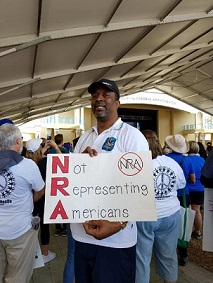
Helena Ramsay, 17, a student at the high school was confirmed by the Broward County Sheriff’s Office as one of the 17 killed by a 19-year old gunman who opened fire on students and school staff. Her mother is reported to be Jamaican and her father Trinidadian.

Source: Posted February 16, 2018; retrieved March 27, 2018 from: https://www.caribbeannationalweekly.com/caribbean-breaking-news-featured/student-caribbean-american-descent-among-17-victims-killed-parkland-high-school/

Again, the US is being urged to reform and transform its policies on guns and school safety, while the Caribbean needs to implement a roadmap to forge change in the societal engines (economics, security and governance) for the 30 member-states of our region.

The book Go Lean…Caribbean – available to download for free – serves as a roadmap for the introduction and implementation of the technocratic Caribbean Union Trade Federation (CU), for the elevation of Caribbean society – for all member-states. This CU/Go Lean roadmap has these 3 prime directives:

  • Optimization of the economic engines in order to grow the regional economy to $800 Billion and create 2.2 million new jobs.
  • Establishment of a security apparatus to ensure public safety and protect the resultant economic engines.
  • Improve Caribbean governance to support these engines, including a separation-of-powers between the member-states and CU federal agencies.

There will be a lot of security and governing dynamics associated with the topic of guns.

The Go Lean book provides 370-pages of turn-by-turn instructions on “how” to adopt new community ethos, plus the strategies, tactics, implementations and advocacies to execute so as to transform the societal engines of Caribbean society, regarding guns and gun control. In fact, there is 1 advocacy entitled “10 Ways to Improve Gun Control” (Page 179), with specific highlights, mitigations and solutions. There is also this encyclopedic reference to the US’s Second Amendment, here:

The Bottom Line on the 2nd Amendment

The Second Amendment to the United States Constitution is the part of the United States Bill of Rights that protects the right to keep and bear arms. It was adopted on December 15, 1791, along with the rest of the Bill of Rights.

In the 19th and 20th centuries, the Supreme Court ruled on several occasions that the amendment did not bar state regulation of firearms, considering the amendment to be “a limitation only upon the power of Congress and the National government and not upon that of the States.” Along with the incorporation of the Second Amendment in the 21st century, the Supreme Court ruled that the Second Amendment protects an individual right to possess and carry firearms. In 2008 and 2010, the Court issued these two landmark decisions to officially establish an “individual rights” interpretation of the Second Amendment:

a. In District of Columbia v. Heller (2008), the Court ruled that the Second Amendment protects an individual’s right to possess a firearm, unconnected to service in a militia and to use that arm for traditionally lawful purposes, such as self-defense within the home within many longstanding prohibitions and restrictions on firearms possession listed by the Court as being consistent with the Second Amendment.

b. In McDonald v. Chicago (2010), the Court ruled that the Second Amendment limits state and local governments to the same extent that it limits the federal government.

The US has the most liberal gun ownership laws in the western world, accompanied by highest gun crime and murder rate.

The Go Lean book asserts that every community has bad actors, and coupled with guns, a bad actor can do a lot of damage. The assumption in the Social Contract – where citizens surrender some of their freedoms and submit to the authority of the State in exchange for protection of remaining natural and legal rights – is for the State or governing entity to regulate weapons to ensure protections for all members of society. There must be “new guards” to assuage any gun risks and threats in Caribbean communities. This point is pronounced early in the book with the Declaration of Interdependence (Pages 12 – 13) that claims:

x. Whereas we are surrounded and allied to nations of larger proportions in land mass, populations, and treasuries, elements in their societies may have ill-intent in their pursuits, at the expense of the safety and security of our citizens. We must therefore appoint new guards to ensure our public safety and threats against our society, both domestic and foreign. The Federation must employ the latest advances and best practices of criminology and penology to assuage continuous threats against public safety.

xi. Whereas all men are entitled to the benefits of good governance in a free society, “new guards” must be enacted to dissuade the emergence of incompetence, corruption, nepotism and cronyism at the peril of the people’s best interest. The Federation must guarantee the executions of a social contract between government and the governed.

xvi. Whereas security of our homeland is inextricably linked to prosperity of the homeland, the economic and security interest of the region needs to be aligned under the same governance. Since economic crimes, including piracy and other forms of terrorism, can imperil the functioning of the wheels of commerce for all the citizenry, the accedence of this Federation must equip the security apparatus with the tools and techniques for predictive and proactive interdictions.

Reforming guns in the US is a BIG DEAL considering that many Caribbean people have emigrated to the US from their island homes. It is a frightening prospect that our people may have jumped from the “frying pan” of failing communities, “into the fire” of a gun-crazed society. This point was addressed recently in a previous blog-commentary entitled – ‘Pulled’ – Despite American Guns with this excerpt:

The repeated incidences of mass shootings – with no gun control remediation – makes American life defective

This commentary aligns with charter of the book Go Lean … Caribbean to make the countries of the Caribbean region better places to live, work and play. The goal is to be Better Than America; to be a protégé without the ignominious Second Amendment; to exercise better governance.

Let’s see how this process goes in the US. Guns are in the DNA of this country; the Second Amendment was ratified in 1791; the US has more gun ownership per capita than any other country in the world; more gun deaths too. Changing this culture will truly be a BIG DEAL!

This writer is doing more than just “look, see or observe”; I will lend-a-hand as well.

I have children and grandchildren in the US States of Florida and Arizona. Though my efforts are only in the scope of reforming and transforming the Caribbean, my heart does want to ensure change in the US regarding guns and school safety.

I would not want to sacrifice my children nor grandchildren to the American twisted perception of gun rights. No, and while I accept the premise that I cannot fix America, I can work to fix the Caribbean homelands to be better places to live, work and play. Hopefully then we can provide a model to the US on how to effect change.

Let’s observe-and-report on this American effort – these Parkland students – let’s observe their successes and their failures, while we hope for change.

Speaking of change, this commentary commences a short 3-part series on “Change” in society. The full catalog of commentaries in this series are as follows:

  1. Change! Observing the Change – Student Marches for Gun Control Reform and Action
  2. Change! Be the Change – RIP Linda Brown; the little girl in “Brown vs Board of Education”
  3. Change! Forging Change – Citibank’s Model of “Corporate Vigilantism”

All of these commentaries give insights on “how” the stewards of a new Caribbean can persuade people, establishments and institutions to forge change in their communities. 🙂

Download the free e-Book of Go Lean … Caribbean – now!

Sign the petition to lean-in for this roadmap for the Caribbean Union Trade Federation.

Share this post:
, , ,
[Top]

International Women’s Day – Protecting Rural Women – ENCORE

Can’t we all just get along?

The answer is “No”! Don’t be naïve!

The book Go Lean…Caribbean sought to reform and transform the societal engines of the 30 member-states that caucus as the political Caribbean. This region is in dire straits, with some countries flirting with Failed-State status. But all the problems here are not just economic. No, there are security deficiencies as well. Therefore the book declares (Page 23):

… “bad actors” will also emerge thereafter to exploit the opportunities, with good, bad and evil intent.

This movement behind the Go Lean book has therefore monitored security dynamics for the Caribbean homeland. The hope is to apply lessons-learn from other regions and ensure that we mitigate all threats and risks.

One such lesson is the security needs for our female population: Caribbean women and girls. There are many threats for women and girls that we need to be “on guard” for. Not all of our populations live in cities; no, many reside in rural areas or remote islands here in the tropics. According to the United Nations (UN) Commission on the Status of Women, there is the need to draw attention to the dilemma and challenges of rural women, who make up over a quarter of the world population, and are being left behind in every measure of development.

Today – March 8, 2018 – is International Women’s Day; the theme this year is “Time is Now: Rural and urban activists transforming women’s lives”. The UN says:

This year, International Women’s Day comes on the heels of unprecedented global movement for women’s rights, equality and justice. This has taken the form of global marches and campaigns, including #MeToo and #TimesUp in the United States of America and their counterparts in other countries, on issues ranging from sexual harassment and femicide to equal pay and women’s political representation.

Join us to transform the momentum into action, to empower women in all settings, rural and urban, and to celebrate the activists who are working relentlessly to claim women’s rights and realize their full potential.

The #TimeisNow.

————-

VIDEO – Time is Now: Rural and Urban Activists Transforming Women’s Lives – https://youtu.be/XgwlEWzXUrE

In her message for International Women’s Day on March 8 [2018], UN Women Executive Director Phumzile Mlambo-Ngcuka draws attention to the work of rural and urban activists who have fought for women’s rights and gender equality. Read the full message here.

Our Caribbean women require protections and public safety measures ideally suited for their exact needs. They need the fulfillment of the Social Contract on their behalf. This Social Contract is defined as:

… citizens surrender some of their freedoms and submit to the authority of the State in exchange for protection of remaining natural and legal rights.

Poor Nigeria; or better stated: poor rural Nigerian girls.

4 years ago, we reported on an abduction of 270 girls by terrorist group Boko Haram from a government school in the Nigerian State (Province) of Chibok; see the ENCORE of that blog-commentary below. Now we learn that it has happened again, 110 schoolgirls have been abducted in northern city of Dapchi (in the same province as Chibok). See news link here:

The recent Boko Haram abduction of 110 schoolgirls in Dapchi, Nigeria, drew immediate comparisons to the 2014 abduction of more than 270 girls from a school in Chibok. Beyond the media spotlight, what do we know about Boko Haram’s efforts to abduct — and recruit — women and girls?

The full Washington Post story-analysis can be found here: https://www.washingtonpost.com/news/monkey-cage/wp/2018/03/08/boko-haram-has-kidnapped-more-girls-heres-what-we-know/?utm_term=.a9801d06cec0

Where are the military-security forces, police, world enforcement agencies in this repeated drama?

Where is the outrage? Where is the New World Order? Where is the #MeToo movement and #TimesUp movement?

Is their absence tied to the fact that this is Africa – a Shit-hole country? Or the fact that these girls are all Black girls and Less Than – do Black Lives Matter?

The Caribbean societal elevation effort – Go Lean roadmap – is for the Caribbean only. Can we ensure that we have the necessary protections in place for our women and girls? Not just for those in the urban areas, but the rural communities as well. This seems to be the defect in Nigeria.

This is also the theme of this UN Special Commemoration, the International Women’s Day and the need to better protect, secure and empower women and girls in rural communities.

The truth is: We cannot all “just get along”. There must be the protections in Caribbean society to ensure that the Strong Do Not Abuse the Weak. This is the vision for a new Caribbean stewardship. See this point about abducted Nigerian girls developed in the previous blog-commentary below here:

————-

Go Lean Commentary – Muslim officials condemn abductions of Nigerian girls

Nigerian Girls

Abducting little girls from a boarding school in the middle of the night is just criminal! There is nothing religious or political about this action.

This is not just terrorism – in the classic sense – this is simply felonious behavior. This is evidenced further by the fact that the perpetrators have promised to sell the girls into slavery. The word “sell” has the connotation of obtaining money for this action. This is criminal and should therefore be condemned by every civilized society in the world.

Failure to marshal against these crimes is just failure – indicative of a Failed-State. Nigeria has a bad image of deceitful practices. So it is only appropriate to ask: is this truly a case of abduction, or could it all be one big Nigerian scam? Despite the obvious “cry wolf” reference, we must side with the innocent victims here. But, as is cited to in the foregoing news article, there are many people who feel that Nigeria hasn’t done enough for these girls. Only now that other countries have stepped up to assist/oversee has the government become more accountable.

Another group of victims in this drama are the peace-loving Islamic adherents. The actions of Boko Haram are casting dispersions on the whole religion. This terrorist group is not practicing the true teachings of Islam; in fact these actions are condemned as criminal even in the Muslim world.

AP*; Photo by: Manuel Balce Ceneta

The abduction three weeks ago of hundreds of schoolgirls in Nigeria by the Muslim extremist group Boko Haram is now generating worldwide attention and condemnation. Muslim leaders in various countries have criticized Boko Haram’s leader for using Islamic teachings as his justification for threatening to sell the girls into slavery. Others have focused on what they view as a slow response by Nigeria’s government to the crisis. The British and French governments announced Wednesday that they would send teams of experts to complement the U.S. team heading to Nigeria to help with the search for the girls, and Nigeria’s president said China has also offered assistance.

Some of the reactions to the crisis:

— EGYPT: Muslim religious officials strongly condemned Boko Haram. Religious Endowments Minister Mohammed Mohktar Gomaa said “the actions by Boko Haram are pure terrorism, with no relation to Islam, especially the kidnapping of the girls. These are criminal, terrorist acts.” According to the state news agency MENA, he said “these disasters come from cloaking political issues in the robes of religion and from peddling religion for secular interests, something we warn incessantly against.”

The sheik of the Cairo-based Al-Azhar, one of Sunni Islam’s most prestigious institutions, demanded the group release the girls, saying it “bears responsibility for any harm suffered by these girls.” The group’s actions “completely contradict Islam and its principles of tolerance,” Sheik Ahmed el-Tayeb said.

— PAKISTAN: Dawn, an English language newspaper in Pakistan, published an opinion piece that takes Nigeria to task for not moving against Boko Haram. “The popular upsurge in Nigeria in the wake of the latest unspeakable atrocity provides some scope for hoping that the state will finally act decisively to obliterate the growing menace,” wrote columnist Mahir Ali. “Naturally, the lives and welfare of the abducted girls must be an absolute priority. Looking back a few years hence, it would also provide a degree of satisfaction to be able to pinpoint the moment when Boko Haram sealed its own fate by going much too far.”

— INDONESIA: In the world’s most populous Muslim-majority country, the Jakarta Post published an editorial Wednesday condemning the Boko Haram leader for “wrongly” citing Islamic teaching as his excuse for selling the abducted girls into slavery. Recalling the Taliban’s shooting of 15-year-old Pakistani girl Malala Yousafzai in 2012 because of her outspokenness in defense of girls’ right to an education, the editorial said: “Malala’s message needs to be conveyed to all people who use their power to block children’s access to education. It is saddening that religion is misused to terrorize people and to kill the future leaders of the world.”

The newspaper also criticized Nigerian President Goodluck Jonathan, noting that “only after international condemnation and street demonstrations poured in did President Jonathan tell his nation that he would take all necessary actions to return the young women to their parents and schools, while also acknowledging that the whereabouts of the abductees remained unknown.”

— SWEDEN: In an editorial posted on the left-wing news website politism.se, blogger Nikita Feiz criticized the international community for its slow response and asked why the situation hadn’t triggered as loud a reaction as when Malala was shot in Pakistan. “Looking at the situation in Nigeria, Malala appears like a false promise from the West that it would stand up for girls’ rights to attend school without fear of being subjected to sexual exploitation and abuse,” she said. “It is difficult not to draw the conclusion that the West’s assurance to act for girls’ rights suddenly isn’t as natural when it comes to girls’ rights in a country in Africa.”

A Swedish women’s network called StreetGaris is planning a demonstration outside the Foreign Ministry on Friday to demand more action from the international community. Participants are encouraged to wear a head wrap or red clothes in solidarity with the girls and their relatives.

— UNITED STATES: The U.S. government is sending to Nigeria a team of technical experts, including American military and law enforcement personnel skilled in intelligence, investigations, hostage negotiating, information sharing and victim assistance, as well as officials with expertise in other areas — but not U.S. armed forces.

“In the short term our goal is obviously is to help the international community, and the Nigerian government, as a team to do everything we can to recover these young ladies,” President Barack Obama told NBC on Tuesday. “But we’re also going to have to deal with the broader problem of organizations like this that … can cause such havoc in people’s day-to-day lives.”

In an editorial, The New York Times faulted the Nigerian government for not aggressively responding to the abductions. “Mr. Jonathan, who leads a corrupt government that has little credibility, initially played down the group’s threat and claimed security forces were in control,” the newspaper said. “It wasn’t until Sunday, more than two weeks after the kidnappings, that he called a meeting of government officials, including the leader of the girls’ school, to discuss the incident.”

— BRITAIN: Prime Minister David Cameron’s office said Britain will send a small team of experts to complement the U.S. team being sent by Obama. The announcement was made Wednesday after Cameron spoke to the Nigerian president. The team will be sent as soon as possible and will include specialists from several departments. Experts have said special forces may be sent to the region. The issue has heated up in recent days with protests over the weekend outside the Nigerian Embassy in London and an increasing number of newspaper editorials calling for action to rescue the girls.

— FRANCE: Foreign Minister Laurent Fabius told lawmakers on Wednesday that France is ready to send a “specialized team … to help with the search and rescue” of the kidnapped girls. “In the face of such an appalling act, France, like other democratic nations, must react,” Fabius said. “This crime will not go unpunished.” Fabius gave no details of the team, except to say it’s among those already in the region. France has soldiers in Niger, Cameroon and Mali, where it is fighting Islamic insurgents, as well as in Central African Republic.

— CHINA: Chinese Premier Li Keqiang, arriving Wednesday in Nigeria for a state visit, did not specifically mention the abductions in a transcript of a joint press conference with Nigeria’s president, instead making only a general reference to the “need to work together to oppose and fight terrorism.” In his remarks, Jonathan said China “promised to assist Nigeria in our fight against terror especially in our commitment and effort to rescue the girls that were taken away from a secondary school.” He did not offer specifics.

— BRAZIL: The foreign ministry issued a statement Tuesday condemning the abductions. “In conveying the feelings of solidarity to the families of the victims and to the people and the Government of Nigeria, the Brazilian Government reiterates its strong condemnation of all acts of terrorism,” the statement said.

—-

* Associated Press correspondents Lee Keath in Cairo, Michelle Faul in Lagos, Nigeria, Gregory Katz in London, Malin Rising in Stockholm, Masha Macpherson in Paris and Stan Lehman in Sao Paulo, Brazil contributed to this report.

Associated Press – Online News – May 7, 2014 http://news.yahoo.com/muslim-officials-condemn-abductions-girls-160020053.html

This book Go Lean … Caribbean is a roadmap for the introduction and implementation of the Caribbean Union Trade Federation (CU), so as to elevate the delivery of economic and security solutions in the Caribbean. One specific mission is to manage against encroachments of the Failed-State index.

At the outset, the roadmap identified an urgent need to mitigate against organized crime & terrorism, and to ensure human rights protection. This is pronounced in this clause in the opening Declaration of Interdependence (Page 12)

xxi.   Whereas the legacy in recent times in individual states may be that of ineffectual governance with no redress to higher authority, the accedence of this Federation will ensure accountability and escalation of the human and civil rights of the people for good governance, justice assurances, due process and the rule of law. As such, any threats of a “failed state” status for any member state must enact emergency measures on behalf of the Federation to protect the human, civil and property rights of the citizens, residents, allies, trading partners, and visitors of the affected member state and the Federation as a whole.

The Go Lean roadmap projects that the CU will facilitate monitoring and accountability of regional law enforcement and homeland security institutions. This type of behavior will not be tolerated in the Caribbean. This CU effort will be coordinated in conjunction with and on behalf of the Caribbean member-states.

On that note, the Caribbean Union Trade Federation, if it was already in existence, would vociferously condemn the abduction of the Nigerian girls. Hence the CU would be added to the long list of condemnations in the foregoing article. But these would not be hollow words, but would be accompanied by the required actions to ensure that such a disposition could not thrive in the CU region. This commitment is detailed as these community ethos, strategies, tactics, implementations and advocates:

Community Ethos – Public Protection over Privacy Page 23
Community Ethos – Anti-Bullying and Mitigation Page 23
Community Ethos – Intelligence Gathering Page 23
Community Ethos – Minority Equalization Page 24
Community Ethos – Impact the Greater Good Page 37
Strategy – Placate & Pacify International Monitors Page 48
Separation of Powers – Homeland Security Page 75
Separation of Powers – Justice Department Page 77
Implementation –  Security Initiatives at Start-up Page 103
Planning – Ways to Improve Failed-State Indices Page 134
Advocacy – Manage the Social Contract Page 170
Advocacy – Ways to Impact Justice Page 177
Advocacy – Ways to Reduce Crime Page 178
Advocacy – Ways to Improve Homeland Security Page 180
Advocacy – Ways to Mitigate Terrorism Page 181
Advocacy –  Ways to Protect Human Rights Page 220
Advocacy –  Ways to Empower Women Page 226
Advocacy –  Ways to Impact Youth Page 227

In contrast with the events in Nigeria, local crimes against women, young or old will not be tolerated in the CU. Everyone, regardless of gender, will be guaranteed the right to life, liberty and the pursuit of happiness (and education for that matter). This will be standard, whether the world is watching or not.

However, we want the world to watch. We want to show how we feverishly protect our people, with assurance that the Caribbean is the world’s best address to live, work, learn and play. 🙂

Download the free e-Book of Go Lean … Caribbean – now!

Sign the petition to lean-in for this roadmap for the Caribbean Union Trade Federation. 

Share this post:
, , ,
[Top]

Repairing the Breach: Mental Health Realities

Go Lean Commentary

Who are the manliest of the manly men?

The Ballers!

No doubt! Talented, athletic and rich. All the men want to be them and all the women want to be with them.

And yet, these ones too have the need for Mental Health services.

If this is the truth for the “greatest of the greats”, how much more so for the “lesser of the Less Than‘s”?
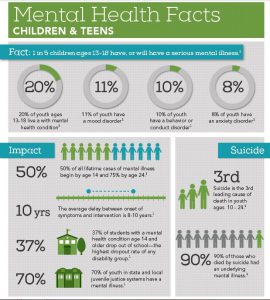
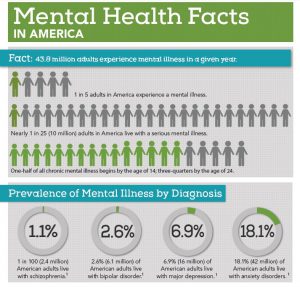
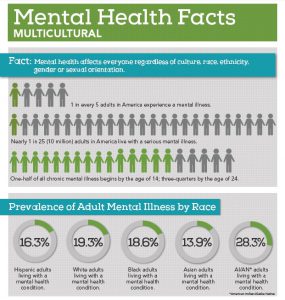
” Everyone is going through something that we can’t see ” – quote by Kevin Love: NBA All-Star and Cleveland Cavaliers Forward.

Kevin Love is in the news right now for something other than basketball, rather Mental Health requirements for men and boys. See the story here, as reported in this PODCAST from NPR’s daily show On-Point:

AUDIO-PODCAST: NPR On-Point: We Need to Talk About Mental Health of Men – https://www.npr.org/player/embed/591984234/591984273

Published March 8, 2018 – Basketball superstar Kevin Love opens up about his panic attacks. Are men getting the kind of Mental Health support they need?

The American experience in Mental Health should be a cautionary tale for neighboring countries. These statistics were related in a previous commentary by the movement behind the book Go Lean…Caribbean:

America is very much troubled with their management of [transactional and degenerative] mental weakness:

Mental Health is a real concern for the population in general and for men in particular. One of the biggest problems is that men rarely want to admit to any problems or seek any help. Yet, the evidence of dysfunction is there:

  • Substance Abuse (Drugs and Alcohol)
  • Suicide

Volumes have been written on the subject. One prominent book is mentioned in the foregoing PODCAST, with this quote:

“A man is as likely to ask for help with Mental Health as he is to ask for directions”. – Terry Real, Psychologist and Author of the book “I Don’t Want to Talk About It: Overcoming the Secret Legacy of Male Depression“. See the critical review in the Appendix below.

This is not just an American issue; where it is reported that 1 in 5 adults experience mental illness in a given year.

The Caribbean also has an atrocious record with Mental Health. If we measure Mental Health deficiencies by substance abuse and suicide, then we are in crisis. Recently (reported in a previous blog-commentary), one Caribbean member-state, Guyana, was rated Number One worldwide for suicides … per capita; Suriname was slightly behind at Number Six

There is a movement to effect change in the Caribbean, among our Black men and boys. We cannot seriously consider the needs of this population without considering the Mental Health realities in the region. We have a lot more information about America’s Mental Health dispositions than we do about the Caribbean’s – this is an expected consequence of Third World status. But we know that there are Mental Health inadequacies. We can glean some insights by analyzing the Mental Health indices from Caribbean-born immigrants in the US. A recent study published this summary:

… a national study found that the small number of Blacks of Caribbean ancestry included in the sample had higher levels of psychological stress compared with US born Blacks,24 and another national study found that persons of Black Caribbean ancestry had a lower frequency of heavy drinking compared with US Blacks in general.25
Footnotes:
24. Williams DR. Race, stress, and mental health: findings from the Commonwealth Minority Health Survey. In: Hogue C, Hargraves M, Scott-Collins K, eds. Minority Health in America: Findings and Policy Implication from the Commonwealth Fund Minority Health Survey. Baltimore, Md: Johns Hopkins University Press; 2000:209–243.

25. Dawson DA. Beyond black, white and Hispanic: race, ethnic origin and drinking patterns in the United States. J Subst Abuse. 1998;10:321–338.

Currently, there is no Caribbean governmental singularity. While there are some integration efforts by language groups (CariCom for English-speaking, Netherland Antilles, French Overseas territories, etc.), there is no one entity to tabulate consumption of Mental Health services in the full Caribbean region.

According to a White Paper by a Caribbean academician, Dr. Donald McCartney of the Bahamas, the Black men and boys of the Caribbean region is a dysfunctional population sub-group. This group is a “hurt people” that “hurt people”. These ones are victims and villains and have experienced a breach in good citizenship. The White Paper addresses the question: “How to repair this breach?”. See that full White Paper here, and an Excerpt as follows:

Repairing the Breach in the Caribbean – Excerpt

By: Donald M. McCartney, D.M., MPA, MSc.Ed. (Hons.), B.A., T.C.

On 16 April 1889, while speaking on the occasion of the 27th anniversary of the abolition of slavery, Frederick Douglass attempted to harness and clarify the defining questions that were of importance, at the time, with respect to Black men and boys. … He raised the following crucial and defining questions:

  1. How does one protect a group from public dissection as if it existed as a mere aberration in the society?
  2. How does one create for that group a group concept so that it is able to sustain itself as a self-respecting group within (the Caribbean) a society, which views it as an aberration?

The answers to these questions must be sought as we search for a way out of the morass in which we, as a people, find ourselves.

Questions, regarding Black men and boys, are being raised … these questions are being revived because many, too many Black men and boys are not a part of the economic structure or the body politic. Upon close examination, it becomes clear that many of them are not in community with their ethnic group.

For the most part, Black men and boys live in isolation, better yet, they are marginalized. They find it difficult to connect with society in general and the significant persons in their lives in particular.

Even though [this] question goes far beyond Black men and boys, it is directly related to our young men in particular and their inability to participate and develop within the body politic and the economic structure of the Caribbean:

How do we expect to engage Black men and boys in constructive dialogue and participation within Caribbean society? …

In order to accomplish the goal of creating a better society for all stakeholders, there must be an integrated plan of action.

See the full White Paper here: https://goleancaribbean.com/blog/?p=14392

Surely, part of the problem of Black men and boys must be related to Mental Health. There is the need for viable solutions for the Caribbean region to consider.

This commentary revisits the foregoing White Paper; even though there is no mention of Mental Health, this is a consideration of the full width-and-breadth of Caribbean dysfunction. This submission therefore supplements the recent 4-part series on Repairing the Breach; using the foregoing White Paper by Dr. McCartney as the premise. This entry is a Plus-One for the 4 parts of the series from the movement behind the book Go Lean … Caribbean in consideration of solutions – Way Forward – to assuage the plight of Black men and boys. The other commentaries in the series were cataloged as follows:

  1. Repairing the Breach: Hurt People Hurt People
  2. Repairing the Breach: Crime – Need, Greed, Justice & Honor
  3. Repairing the Breach: One Option – National Youth Service
  4. Repairing the Breach: Image Impacts Economics
    ———–
  5. Repairing the Breach: Mental Health Realities

While all of the previous commentaries related to “how” the stewards for a new Caribbean can assuage the failing dispositions of the Caribbean among our Black men and boys, this supplemental submission highlights the need for universal Mental Health offerings in this region. Think of universal Mental Health as a quilt, a web or fabric with additions and subtractions. All new triggers add to the quilt, all remediation and Mental Health provisions subtract from it. Caribbean communities are re-thinking their views on recreational drug use. There is a movement to legalize and de-criminalize marijuana in society; this was reported previously about Jamaica and see this breaking news here of new legal acceptance in the country of Antigua and Barbuda. With this reality, there is the need for Caribbean Mental Health stakeholders to double-down the outreach for supportive services.

This discussion is relevant for the movement behind the Go Lean book, which serves a roadmap for the introduction and implementation of the technocratic Caribbean Union Trade Federation (CU); there-in is an advocacy to “Improve Healthcare“ in general (Page 156), but It also delves into strategies, tactics and implementations to provide more Mental Health solutions in the Caribbean region. The book projects this regional-federal law that summarizes the need:

Caribbean (Persons) with Disabilities
Modeled after Americans with Disability Act, the Caribbean people with physical and mental disabilities should have equal rights and the provisions of “reasonable accommodations” by the institutions and establishments in the Caribbean. This move would extend a “welcome mat” to tourists, residents and repatriates alike, who may not be considered fully whole, but can still contribute to society and the economic engines, with small adjustments …

In fact, the prime directives of the Go Lean roadmap for the CU federal administration is described as follows:

We have considered a lot of lessons-learned in prior Go Lean commentaries that we glean by considering the US experiences. But the reality of the Black men and boys in the Caribbean is even worse than the disposition of African-Americans in the US (or other Diasporic countries). So we need Mental Health solutions front-and-center if we hope to Repair the Breach in this region. This has been a consistent subject in these previous blog-commentaries; consider this sample:

https://goleancaribbean.com/blog/?p=14087 Opioids Addiction and the FDA – ‘Fox guarding the Henhouse’

The American Opioid crisis is a self-made crisis due to the country’s blatant Crony-Capitalism. Big Pharma was allowed to peddle their addictive drugs on an unwitting public, and the regulator, the FDA, was complicit. This American model is a caution for us in the Caribbean.

https://goleancaribbean.com/blog/?p=11052 Managing the ‘Strong versus the Weak’ – Mental Disabilities

The creed to protect the Weak from being abused by the Strong is age-old as an honor code. All societies have those that are mentally weak; the Social Contract must allow for protection and remediation of these ones.

https://goleancaribbean.com/blog/?p=5901 The Demographic Theory of Elderly Suicide

Failures in Mental Health delivery results in suicides. Among senior citizens, this prevalence is due to the fact that they may not consider themselves as relevant in modern society. We can learn from others on Mental Health remediation and solutions for Caribbean senior citizens.

https://goleancaribbean.com/blog/?p=2633 Book Review: ‘The Protest Psychosis’

Advocates for change have often been labeled as insane for not accepting their status quo. This Protest Psychosis often is a distortion by the powerful to resist change and abuse those mandating improvement.

https://goleancaribbean.com/blog/?p=2602 Guyana and Suriname Wrestle With High Rates of Suicides

Failures in Mental Health delivery results in suicides and some Caribbean countries have it worse than anywhere else in the world. Sad!

https://goleancaribbean.com/blog/?p=2105 Recessions and Public Physical and Mental Health

Mental Health disorders can spark when the economy sours. Public Health officials need to be “on guard” for Mental Health fallout during periods of economic recession.

https://goleancaribbean.com/blog/?p=1751 New Hope in the Fight against Alzheimer’s Disease

Everyone ages, and so Alzheimer’s disease is a guaranteed risk in every community. This is a Mental Health reality that must be planned for, so as to ensure the best outcomes for communities.

As related above, men in general do not like to acknowledge the need for Mental Health services, so Caribbean stewards must do some heavy-lifting with its Black men and boys to Repair the Breach they present in this society. There is a Way-Forward for effecting change and elevation.

Repairing the Breach in the Caribbean means “fixing our defects” in the service and delivery of Mental Health remediation. But this challenge is too big for any one member-state alone; this is why we need the economies-of-scale and leverage of an integrated Single Market; the Caribbean region is comprised of 30 member-states and 42 million people. This point was pronounced early in the Go Lean book with the Declaration of Interdependence (Pages 11 – 13) with many statements that demonstrate the need to collaborate so as to optimize Caribbean communities and elevate our Social Contract services:

ix. Whereas the realities of healthcare and an aging population cannot be ignored and cannot be afforded without some advanced mitigation, the Federation must arrange for health plans to consolidate premiums of both healthy and sickly people across the wider base of the entire Caribbean population. The mitigation should extend further to disease management, wellness, mental health, obesity and smoking cessation programs. …

xi. Whereas all men are entitled to the benefits of good governance in a free society, “new guards” must be enacted to dissuade the emergence of incompetence, corruption, nepotism and cronyism at the peril of the people’s best interest. The Federation must guarantee the executions of a Social Contract between government and the governed.

xii. Whereas the legacy in recent times in individual states may be that of ineffectual governance with no redress to higher authority, the accedence of this Federation will ensure accountability and escalation of the human and civil rights of the people for good governance, justice assurances, due process and the rule of law. As such, any threats of a “failed state” status for any member state must enact emergency measures on behalf of the Federation to protect the human, civil and property rights of the citizens, residents, allies, trading partners, and visitors of the affected member state and the Federation as a whole.

The American role model for Mental Health care and support is not ideal; we must pay more than the usual attention and try to do better in the Caribbean. That should not be as hard, when the motive is the Greater Good. This would mean removing the institutional racism and Crony-Capitalism of American life.

The Go Lean book provides a roadmap for doing better, detailing 370-pages of turn-by-turn directions to better optimize the societal engines of economics, security and governance to better deliver on the Social Contract. All segments of the population need support with Mental Health concerns; Black men and boys need it especially, because “hurt people hurt people”.

Repairing the Breach for this population includes identifying, qualifying, proposing and delivering good Mental Health solutions. Only then can our homeland be a better place to live, work and play. 🙂

Download the free e-Book of Go Lean … Caribbean – now!

Sign the petition to lean-in for this roadmap for the Caribbean Union Trade Federation.

————

Appendix – Book Review: “I Don’t Want to Talk About It: Overcoming the Secret Legacy of Male Depression” (1998)

By: Terrence Real

A revolutionary and hopeful look at depression as a silent epidemic in men that manifests as workaholism, alcoholism, rage, difficulty with intimacy, and abusive behavior by the cofounder of Harvard’s Gender Research Project.

Twenty years of experience treating men and their families has convinced psychotherapist Terrence Real that depression is a silent epidemic in men—that men hide their condition from family, friends, and themselves to avoid the stigma of depression’s “un-manliness.” Problems that we think of as typically male—difficulty with intimacy, workaholism, alcoholism, abusive behavior, and rage—are really attempts to escape depression. And these escape attempts only hurt the people men love and pass their condition on to their children.

This groundbreaking book is the “pathway out of darkness” that these men and their families seek. Real reveals how men can unearth their pain, heal themselves, restore relationships, and break the legacy of abuse. He mixes penetrating analysis with compelling tales of his patients and even his own experiences with depression as the son of a violent, depressed father and the father of two young sons.

Source: Retrieved March 11, 2018 from: https://www.amazon.com/Dont-Want-Talk-About-Overcoming/dp/0684835398


Share this post:
, , ,
[Top]