Category: Ethos

Righting a Wrong: Puerto Rico’s Bankruptcy

Go Lean Commentary

How do you measure success … or failure?

In school, there is a simple measurement: there is the perfect “A”; everything else – B, C and D – was less desirable. But the actual grade “F” means you fail.

How can we measure success and failure for our community’s societal engines: economics, security and governance? There are so many approaches, but just like in school, there is a definitive “F” grade, a Failed-State status. In the case of a municipal entity, there is no doubt that a Bankruptcy filing is an “F”, a failure!

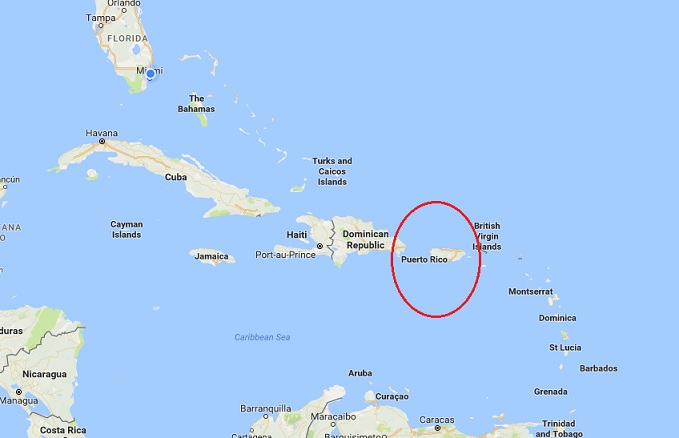
This is Puerto Rico today.
CU Blog - Righting a Wrong - Puerto Rico Bankruptcy - Photo 0

Their Governor, Ricky Rossellójust announced (May 3, 2017) that the US territory will invoke the bankruptcy-like powers that were extended to them by Congress last year. This was designed to bring an end to their intractable crisis, despite the assurances that they had given to investors that bankruptcy-style “haircuts” could not be considered. There are so many issues afoot with this move:

Can other American states/territories push lawmakers (Congress) for this same legal recourse – Chapter III of the Bankruptcy Code, the Promesa Provision – that has been ceded to Puerto Rico if they are ever at the end of their financial ropes?

(Chapter 9 Bankruptcies are allowed for municipalities, but not state governments).

This is a slippery slope!

“If Puerto Rico can achieve this level of debt relief through Promesa as the initial plan suggested, it will only make sense for Virgin Islands to attempt the same” – Wall Street Analyst

This commentary is 2 of 4 in a series considering how to “Right a Wrong”. Surely, reneging on a pledge to repay debts is a “Wrong”. This type of move could affect every other community seeking to raise funds on the capital markets (bonds). So there are lessons that we need to glean from the “Righting of these Wrongs”. The full series is as follows:

  1. Righting a Wrong: 2008 Housing Crisis
  2. Righting a Wrong: Puerto Rico’s Bankruptcy
  3. Righting a Wrong: Volkswagen Emissions Crisis
  4. Righting a Wrong: Takata Air-Bags

As related in the first submission in this series, these “Wrongs” relate to bad actions and inaction by different actors. The image and reputations of stakeholders “take a hit” while these issues are fresh. This is definitely the case for Puerto Rico right now. “Righting the Wrong” can override the bad image and the “comeback” or recovery could be the lasting legacy.

The book Go Lean…Caribbean addressed Puerto Rico from the beginning; starting with the opening assessment of the State of the Caribbean region. The book identified Puerto Rico on Page 18 as:

The Greece of the Caribbean
Puerto Rico’s population is declining. Faced with a deteriorating economy, increased poverty and a swelling crime rate, many citizens are fleeing the island for the U.S. mainland. …

Puerto Rico has been through austerity and made tough decisions: It has cut government jobs, privatized a couple of highways, and is in the process of privatizing the international airport. But unlike the case of Greece, the economic mess is on America’s hands. For U.S. citizens on the mainland who have a 401(k) account or pension for retirement, it’s possible that they have money invested in Puerto Rican bonds, which are now no longer worth much. So citizens in the states could feel the pain if Puerto Rico’s economy collapses.

This book was published in November 2013, projecting verbiage like “if Puerto Rico’s economy collapses”. According to the latest developments and this news article here (and VIDEO), that collapse is now a reality:

Title: Puerto Rico Declares a Form of Bankruptcy
By: Mary Williams Walsh

CU Blog - Righting a Wrong - Puerto Rico Bankruptcy - Photo 1

With its creditors at its heels and its coffers depleted, Puerto Rico sought what is essentially bankruptcy relief in federal court on Wednesday, the first time in history that an American state or territory had taken the extraordinary measure.

The action sent Puerto Rico, whose approximately $123 billion in debt and pension obligations far exceeds the $18 billion bankruptcy filed by Detroit in 2013, to uncharted ground.

While the court proceedings could eventually make the island solvent for the first time in decades, the more immediate repercussions will likely be grim: Government workers will forgo pension money, public health and infrastructure projects will go wanting, and the “brain drain” the island has been suffering as professionals move to the mainland could intensify.

Puerto Rico is “unable to provide its citizens effective services” because of the crushing weight of its debt, according to a filing on Wednesday by the federal board that has supervised the island’s financial affairs since last year.

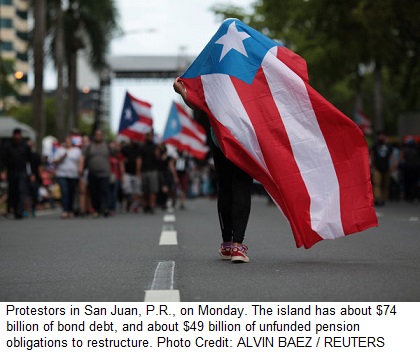
The total includes about $74 billion in bond debt and $49 million in unfunded pension obligations.

While many of Puerto Rico’s circumstances are unique, its case is also a warning sign for many American states and municipalities — such as Illinois and Philadelphia — that are facing some of the same strains, including rising pension costs, crumbling infrastructure, departing taxpayers and credit downgrades that make it more expensive to raise money. Historically, Puerto Rico was barred from declaring bankruptcy. In the end, however, financial reality trumped the statutes, and Congress enacted a law last year allowing bankruptcy-like proceedings.

Puerto Rico has been in a painful recession since 2006, and previous governments dug it deeper into debt by borrowing to pay operating expenses, year after year. For the last two years, officials have been seeking assistance from Washington, testifying before stern congressional committees and even making fast-track oral arguments before the United States Supreme Court.

At the same time, Puerto Rico’s efforts to coax its creditors to agree to concessions have gone nowhere. Now the coming court proceedings will give Puerto Rico extraordinary powers to impose losses on holdout creditors unilaterally.

The island’s many creditors — whose lawsuits filed against Puerto Rico on Tuesday prompted the island’s request for court relief on Wednesday — are likely to receive far less of their money back than they want. Their predicament may turn out to be a cautionary tale for bond holders of other troubled states and cities. Puerto Rico’s case could show public workers and retirees that seemingly inviolate pension systems can be changed, too.

The next step is for the Supreme Court — specifically, Chief Justice John G. Roberts Jr. — to designate a bankruptcy judge to handle the case.

The island’s lawyers may view some bankruptcy courts as more likely to be favorable to them than others. Some creditors fear Puerto Rico will seek to have the case handled in the Southern District of New York.

Puerto Rico’s governor, Ricardo Rosselló, issued a statement Wednesday aiming to offer some reassurance, even as he sought the federal court’s protection. “We remain committed to holding good-faith negotiations to reach agreements with our creditors,” he said, adding that he hoped the court proceedings would “accelerate the process.” He appeared to be referring to the extraordinary power Puerto Rico will now have in court to unilaterally impose big losses on creditors.

Some of those creditors are furious.

“The Commonwealth’s proposal is not a credible starting point for negotiations,” Andrew Rosenberg of Paul, Weiss, Rifkind, Wharton and Garrison, an adviser to the Ad Hoc Group of Puerto Rico General Obligation Bondholders, said in a statement. He said that moving the proceedings to bankruptcy court would put the situation in “free-fall.”

The creditors got a shock this year when Mr. Rosselló issued a five-year fiscal plan that allowed only about $800 million a year to pay principal and interest on Puerto Rico’s bond debt, far less than the roughly $3.5 billion a year it would cost to make those payments on time. The prospect of losses on that scale prompted some creditors to argue that most of the $800 million was rightfully theirs.

“That things are starting out in such a highly adversarial way strongly suggests this will be a long and contentious journey for Puerto Rico,” said Matt Fabian, a partner at Municipal Market Analytics who closely tracks activity in the municipal bond market.

Puerto Rico’s case will be the first ever heard under a federal law for insolvent territories, called Promesa, which was enacted last summer; the Obama administration had warned that a “humanitarian crisis” would ensue if Puerto Rico were not given extraordinary powers to abrogate debt. There is no existing body of court precedent for Promesa, but the island’s creditors — who range from hedge fund managers to mom-and-pop investors — are bracing for a titanic battle.

Despite the depth of the island’s troubles, many Republicans in Congress have opposed debt relief, saying that the island has long received big federal subsidies for its health system, public housing and other works. They said Puerto Rico should explain what it had done with that money before it got any more help.

Last week President Trump suddenly added fuel to those fires, saying on Twitter that there should be no “bailout” for Puerto Rico.

On the island, Washington is not seen as a helper but as an unsympathetic colonial overlord. The step toward bankruptcy-like proceedings, under a federal judge, intensified complaints that Puerto Rico has lost all control of its own future.

But at the same time, some Puerto Ricans say quietly that if the court proceedings really do allow their government to cancel debt, their island may finally get the fresh start it needs.

The coming court proceedings will not be formally called a bankruptcy, since Puerto Rico remains legally barred from using Chapter 9, the bankruptcy route normally taken by insolvent local governments. Instead, Mr. Rosselló petitioned for relief under Title III of the Promesa law, which contains certain Chapter 9 bankruptcy provisions but also recognizes that, unlike the cities and counties that use Chapter 9, Puerto Rico is not part of any state and must in some ways be treated as a sovereign.

Bankruptcy lawyers and public finance experts are watching Puerto Rico’s case closely, to see if it shows a path that financially distressed states like Illinois might also one day take. States, like United States territories, currently cannot declare bankruptcy.

The only creditors who reached an agreement with Puerto Rico were the holders of a class of bonds, about $9 billion worth, that were sold to raise money for the island’s public power utility. Those creditors gave concessions that the governor pointed to Wednesday as a good example for other creditors to follow.

The governor’s fiscal plan also calls for shifting all current government workers from pensions into 401(k)-style retirement plans. Current retirees will continue to receive their traditional monthly pensions, but the amounts are to be reduced by about 10 percent on average.

The governor’s hand was forced by the expiration on Monday, at midnight, of a court stay that had been keeping Puerto Rico’s creditors from suing. On Tuesday, as soon as the stay expired, bondholder groups and at least one bond insurer sued. Wednesday’s actions by the governor and the federal supervisory board effectively blocked the lawsuits from proceeding.
Source: Posted May 3, 2017; retrieved May 4, 2017 from: https://mobile.nytimes.com/2017/05/03/business/dealbook/puerto-rico-debt.html

————-

VIDEOMiller Buckfire MD Says Title III Will Help Puerto Ricohttps://www.bloomberg.com/news/videos/2017-05-04/miller-buckfire-md-title-iii-will-help-puerto-rico-video


Published on May 3, 2017 – Puerto Rico made the decision to use a U.S. court to escape from its debts. This casts a few ripples in the state and local bond market. But this action — once inconceivable for a territory that didn’t have authority to file for bankruptcy — sets a precedent that could resonate with struggling states in the decades ahead. See the full article here: https://www.bloomberg.com/news/articles/2017-05-04/puerto-rico-collapse-shows-debts-seen-as-iron-clad-may-not-be-so
What will Puerto Rico do now?

The recommendation of the movement behind the Go Lean book is to pay the debt … eventually. (Though bankruptcy filings usually involve “haircuts” where creditors will get “pennies on the dollar”).

CU Blog - Righting a Wrong - Puerto Rico Bankruptcy - Photo 2

This is the purpose of the book Go Lean…Caribbean, to help reform and transform the societal engines in the 30 member-states of the Caribbean region. The book serves as a roadmap for the introduction and implementation of the Caribbean Union Trade Federation (CU) and the Caribbean Central Bank (CCB). The Go Lean/CU/CCB roadmap applies best-practices for community empowerment and features these 3 prime directives, proclaimed as follows:

  • Optimization of the economic engines to grow the regional economy to $800 Billion & create 2.2 million new jobs.
  • Establishment of a security apparatus to protect public safety and ensure the economic engines of the region.
  • Improvement of Caribbean governance to support these engines.

Had the CU/CCB been in force now, we would not look to Washington for answers!

The Go Lean movement asserts that Caribbean communities need to resolve their challenges together. One Go Lean mission describes the process of consolidating legacy debt and refinancing them to ease the burden on local governmental finances. Imagine a personal household that just incurred a BIG BILL for repair – think a new roof. The best strategy is to refinance and add it to the 30-year mortgage, therefore only enduring “bite-size” payments for now. The book relates this:

10 Ways to Better Manage Debt  – Page 114

1 Lean-in for the Caribbean Single Market, Caribbean Dollar & Caribbean Central Bank.
This treaty allows for the unification of the region into one market, thereby creating a single economy of 30 member-states, 42 million people and a GDP of over $800 Billion, according to 2010 figures. The CU will reboot the economic engines of the region with investments in infra-structure and business inducements.Many times these projects require up-front capital but the returns will be garnered slowly over time. These projects therefore require debt, from the capital or lending markets. The issue of debt not only concerns governments, but individuals as well. The CU will impact this dynamic by mastering credit ratings and offering to buy back foreign debt for local C$ financing and CCB controls. This tactic lets the CCB function as a local IMF, fostering a new regime for the economy.
2 M1 & The Interest Economy
The CU seeks to consolidate the currency of each member-state around the Caribbean Dollar (C$); then by inducing more electronic transactions as opposed to paper currency, there will be more lendable funds in the money supply (M1). Plus having viable capital markets will allow governments, institutions and businesses to get the capital they need, and investors/lenders can garner interest income for the use of their funds. Most Pension funds depend on this model.
3 Public Financing
Every independent country in the Caribbean is a member of the IMF, only the OverseasTerritories are not engaged in this arrangement. Why not? Their host countries (US, UK, France and the Netherlands) provide the capital access that the island territories need. The CU quest is to shift this dependency to a Caribbean source, not European or American.
4 Bonds & Add-on’s (Warrants)
Rather than international loans, the CU strategizes bond issues in C$ capital markets for government financing. There are a number of ways to make bonds more attractive to investors, like adding warrants as “sweeteners” (premiums on sale price, leverage, expirations and exercise restrictions). Warrants are often detachable and tradable in markets.
5 CU Federal Bankruptcies
6 Credit Reporting – Sharpening the Tool
7 Retail Credit Reboot and New Engines
8 Student Loans Sensible Dynamics
9 Mortgage Loan Sensible Dynamics
10 Crowd Sourcing – Community Capital Sharing Mitigates Debt

The points of effective, technocratic stewardship of Public Debt have been elaborated upon in previous blog/commentaries. Consider this sample:

https://goleancaribbean.com/blog/?p=7989 Transformations: Money Matters – ‘Getting over’ with ‘free money’
https://goleancaribbean.com/blog/?p=7601 Beware of Vulture Capitalists
https://goleancaribbean.com/blog/?p=7268 Detroit’s ‘debt reality’ giving schools their ‘Worst Shot’
https://goleancaribbean.com/blog/?p=7235 Flint, Michigan – A Cautionary Tale for bad debt management
https://goleancaribbean.com/blog/?p=6563 Lessons from Iceland – Model of Recovery
https://goleancaribbean.com/blog/?p=5818 Greece: From Bad to Worse
https://goleancaribbean.com/blog/?p=5759 Pressed by Debt Crisis, Doctors Leave Greece in Droves
https://goleancaribbean.com/blog/?p=3582 For Canadian Banks: Caribbean is a ‘Bad Bet’
https://goleancaribbean.com/blog/?p=3311 Detroit’s Municipal Bankruptcy – Lessons Learned

Overall, the Go Lean book stresses the community ethos, strategies, tactics, implementations and advocacies to reform and transform the economic, security and governing engines of Caribbean society. This effort will be technocratic! It will make “sure all ends meet”. We must properly administer the finances of our communities. This vision was anticipated from the beginning of the Go Lean book, opening with these pronouncements in the Declaration of Interdependence (Page 12):

xi. Whereas all men are entitled to the benefits of good governance in a free society, “new guards” must be enacted to dissuade the emergence of incompetence, corruption, nepotism and cronyism at the peril of the people’s best interest.  The Federation must guarantee the executions of a social contract between government and the governed.

xii. Whereas the legacy in recent times in individual states may be that of ineffectual governance with no redress to higher authority, the accedence of this Federation will ensure accountability and escalation of the human and civil rights of the people for good governance, justice assurances, due process and the rule of law. As such, any threats of a “failed state” status for any member state must enact emergency measures on behalf of the Federation to protect the human, civil and property rights of the citizens, residents, allies, trading partners, and visitors of the affected member state and the Federation as a whole.

xiv. Whereas government services cannot be delivered without the appropriate funding mechanisms, “new guards” must be incorporated to assess, accrue, calculate and collect revenues, fees and other income sources for the Federation and member-states. The Federation can spur government revenues directly through cross-border services and indirectly by fostering industries and economic activities not possible without this Union.

xix. Whereas our legacy in recent times is one of societal abandonment, it is imperative that incentives and encouragement be put in place to first dissuade the human flight, and then entice and welcome the return of our Diaspora back to our shores. This repatriation should be effected with the appropriate guards so as not to imperil the lives and securities of the repatriated citizens or the communities they inhabit. The right of repatriation is to be extended to any natural born citizens despite any previous naturalization to foreign sovereignties.

xxiv. Whereas a free market economy can be induced and spurred for continuous progress, the Federation must install the controls to better manage aspects of the economy: jobs, inflation, savings rate, investments and other economic principles. Thereby attracting direct foreign investment because of the stability and vibrancy of our economy.

xxv. Whereas the legacy of international democracies had been imperiled due to a global financial crisis, the structure of the Federation must allow for financial stability and assurance of the Federation’s institutions. To mandate the economic vibrancy of the region, monetary and fiscal controls and policies must be incorporated as proactive and reactive measures. These measures must address threats against the financial integrity of the Federation and of the member-states.

Yes, the purpose of this commentary is to project the better plan for reforming and transforming Caribbean municipal financing. But it is also about reforming and transforming Puerto Rico. An agenda for Puerto Rico has always been a priority for the Go Lean roadmap. This island is just sitting there in the middle of the Caribbean region. No effort to reboot the Caribbean neighborhood could reasonably ignore this island.

“But they are an American Territory, a subset of the richest, most powerful nation on the planet”.

And yet … they are a Failed-State!

In a previous blog-commentary from the Go Lean movement, it was declared that “Puerto Rico needs the strategies, tactics, implementations and advocacies of the CU. [And] the CU needs Puerto Rico!” This is true now more than ever!

Now is the time for all stakeholders – state and municipal governments and their citizens – in the Caribbean to lean-in for the empowerments described here-in and in the book Go Lean … Caribbean. We must do better with public finance than our predecessors. They tried to “go for it alone” – this is why Puerto Rico always failed – let try this different approach of “going for it together”. This is guaranteed to make Puerto Rico and all of the Caribbean a better place to live, work and play. 🙂

Download the free e-Book of Go Lean … Caribbean – now!

Sign the petition to lean-in for the roadmap for the Caribbean Union Trade Federation.
Share this post:
, , , ,

Righting a Wrong: The 2008 Housing Crisis

Go Lean Commentary

Have you ever made a mistake?

“Let him that is without sin, cast the first stone” – Jesus Christ (The Bible @ John 8:7)

Since everyone makes mistakes, a good measure of a good character is how we “Right the Wrongs” that we may have caused to others. This could be the measurement of a good man (or woman), a good company and a good community. People want to be associated with goodness. They will travel great lengths and at great cost to associate with good people, affiliate with good companies and live in a good community.

CU Blog - Righting a Wrong - 2008 Housing Crisis - Photo 1

There are lessons to be learned when people, companies and communities make mistakes and then make concerted efforts to “Right the Wrongs”. These are lessons that can be applied right here in the Caribbean so as to supplement our efforts to elevate our society, to make the Caribbean homeland a better place to live, work and play.

This is more than just an academic discussion for the Caribbean; we are known to have our defects – we repeatedly make mistakes, we endanger people, oppress them, suppress their rights and then carry on unrepentant – this all results in “pushing” people away, causing societal abandonment. We must recognize these defects and repent, reconcile, reform and “Right the Wrongs” of our society.

This is the purpose of the book Go Lean…Caribbean, to help reform and transform the societal engines in the 30 member-states of the Caribbean region. The book serves as a roadmap for the introduction and implementation of the Caribbean Union Trade Federation (CU). The Go Lean/CU roadmap applies best-practices for community empowerment and features these 3 prime directives, proclaimed as follows:

  • Optimization of the economic engines to grow the regional economy to $800 Billion & create 2.2 million new jobs.
  • Establishment of a security apparatus to protect public safety and ensure the economic engines of the region.
  • Improvement of Caribbean governance to support these engines.

What “Wrongs” exactly can we consider to glean lessons-learned for our community empowerment? This commentary is 1 of 4 in a series considering how to “Right a Wrong”. The full series is as follows:

  1. Righting a Wrong: 2008 Housing Crisis
  2. Righting a Wrong: Puerto Rico’s Bankruptcy
  3. Righting a Wrong: Volkswagen Emissions Crisis
  4. Righting a Wrong: Takata Air-Bags

These “Wrongs” relate to bad actions and inaction by different actors. The image and reputations of stakeholders “take a hit” while the issue is fresh. But eventually the recovery – Righting the Wrong – can override and became the lasting legacy. This first wrong – 2008 Housing Crisis – was one of the episodes of the recent Great Recession. The Go Lean book sought to catalog the cause-and-effect of many 2008 developments from an inside perspective. The book identifies its authority to comment on these developments. See this “Who We Are” quotation (Page 8) and the VIDEO in the Appendix below:

This book is published by the SFE Foundation, a community development foundation chartered for the purpose of empowering and re-booting economic engines. …

2008 – The peak day of the recent global financial crisis was September 15, 2008. On this day, Wall Street giant Lehman Brothers filed for bankruptcy protection, and eventual dissolution, after succumbing to the weight of over-leverage in mortgage-backed securities. There is an old observation/expression that states that “there are 3 kinds of people in the world, those who make things happen, those who watch things happen and those who wonder ‘what happened?’“
Principals of the SFE Foundation were there in 2008 … engaged with Lehman Brothers; on the inside looking out, not the outside looking in. Understanding the anatomy of the modern macro economy, allows the dissection of the processes and the creation of viable solutions.

Omaha – The book was initially composed in Omaha, Nebraska, the home of one of the world’s richest men, Warren Buffet – the “Oracle of Omaha” – CEO of corporate giant Berkshire Hathaway. While the United States experienced boom and bust during the Great Recession, Omaha remained a stable, consistent model of prosperity (in March 2008 the unemployment rate in Omaha was 3.9 percent). This was no accident. This community embraces a certain ethos that is fundamental for stability and vibrancy: good corporate citizenship. Omaha is home to other corporate movers-shakers in addition to Berkshire Hathaway; (see Appendix A [on Page 254]). This community example is purported as a model for assimilation by the Caribbean region.

The Go Lean book, though composed in 2013, set the pattern for the Caribbean region to look-listen-learn from models, samples and examples like these. This allows for the regional stewards and administrators to structure policies and procedures so as to apply the lessons learned in their jurisdictions. This was an original intent. As a planning tool, the Go Lean book commenced with a Declaration of Interdependence, pronouncing the need for regional integration so as to improve our society based on lessons learned from other societies. See a stanza here (Page 14):

xxxiii. Whereas lessons can be learned and applied from the study of the recent history of other societies, the Federation must formalize statutes and organizational dimensions to avoid the pitfalls of communities like East Germany, Detroit, Indian (Native American) Reservations, Egypt and the previous West Indies Federation. On the other hand, the Federation must also implement the good examples learned from developments/communities like New York City, [Omaha,] Germany, Japan, Canada, the old American West and tenants of the US Constitution.

So here is the Wrong … and here is the “Righting of the Wrong” associated with the 2008 Housing Crisis:

The Wrong:
In 2008 a perfect storm of economic disasters hit the US and indeed the entire world. The most serious began with the collapse of housing bubbles in California and Florida, and the collapse of housing prices and the construction industries. Millions of mortgages (averaging about $200,000 each) had been bundled into securities called collateralized debt obligations that were re-sold worldwide. Many banks and hedge funds had borrowed hundreds of billions of dollars to buy these securities, which were now “toxic” because unknown values and no buying markets.

A series of the largest banks in the US and Europe collapsed; some went bankrupt, such as Lehman Brothers with $690 billion in assets; others such as Citigroup, the leading insurance company AIG, and the two largest mortgage companies (Fannie Mae, Freddie Mac) were bailed out by the US government. Congress voted $700 billion in bailout money, and the Treasury and Federal Reserve committed trillions of dollars to shoring up the financial system. But the measures did not reverse the declines – banks drastically tightened their lending policies, despite infusions of federal money. The government, for the first time, took major ownership positions in some banks. The stock market plunged 40%, wiping out tens of trillions of dollars in wealth (estimates tallying $11 Trillion); housing prices fell 20% nationwide wiping out trillions more. By late 2008 distress was spreading beyond the financial and housing sectors, especially as the “Big Three” of the automobile industry (General Motors, Ford and Chrysler) were on the verge of bankruptcy, and the retail sector showed major weaknesses. Critics of the $700 billion Troubled Assets Relief Program (TARP) expressed anger that much of the TARP money that had been distributed to banks was seemingly unaccounted for, with banks being secretive on the issue.[45] [See this portrayal in these photos or the VIDEO at https://youtu.be/N9YLta5Tr2A.]

CU Blog - Righting a Wrong - 2008 Housing Crisis - Photo 2

CU Blog - Righting a Wrong - 2008 Housing Crisis - Photo 3

CU Blog - Righting a Wrong - 2008 Housing Crisis - Photo 4

CU Blog - Righting a Wrong - 2008 Housing Crisis - Photo 5

Righting the Wrong:
In February 2009, [the newly inaugurated] President Barack Obama signed the American Recovery and Reinvestment Act; the bill provided $787 billion in stimulus through a combination of spending and tax cuts. The plan was largely based on the Keynesian theory that government spending should offset the fall in private spending during an economic downturn; otherwise the fall in private spending would perpetuate itself and productive resources, such as the labor hours of the unemployed, will be wasted.[46] Critics at the time claimed that government spending cannot offset a fall in private spending because government must borrow money from the private sector in order to add money to it. However, most economists do not think such “crowding out” is an issue when interest rates are near zero and the economy is stagnant.

The recession period officially expended only 6 quarters (Q4-2007 to Q1-2009), but the effects were longer lasting. This was deemed the Great Recession because of the fundamental shifts the economy made. For example, in the US, jobs paying between $14 and $21 per hour made up about 60% those lost during the recession, but such mid-wage jobs have comprised only about 27% of jobs gained during the recovery through mid-2012. In contrast, lower-paying jobs constituted about 58% of the jobs regained.

As of December 2012, the US Federal Reserve Bank reported that the net worth of US households recovered by $1.7 trillion to $65 trillion during Q3-2012. It was still below the record high of $67 trillion during Q3-2007, but up $13.5 trillion since its recent cyclical low during Q1-2009.[47]

Source: Book Go Lean…Caribbean Page 69 – 70

None of the Boom-and-Bust homes in this drama were in the Caribbean; (though Puerto Rico and US Virgin Islands are American territories and did have crises, their home pricing were only mildly affected, going up or going down only a little).

While this was a crisis for continental America, due to inaction on the part of Caribbean regional stewards, this 2008 crisis brought devastation to our region. In some cases, we are still reeling from it; they are near Failed-State status as a result.

There were bad actors in this crisis. They had their Day of Reckoning as well. See these previous blog-commentaries that detailed the aftershocks of the 2008 economic crisis:

https://goleancaribbean.com/blog/?p=10187 Day of Reckoning for NINJA Loans
https://goleancaribbean.com/blog/?p=8379 Economic Fallacy: Self-regulation of the Centers of Economic Activity
https://goleancaribbean.com/blog/?p=6531 A Lesson in History – Book Review of the ‘Exigency of 2008’
https://goleancaribbean.com/blog/?p=1896 The Crisis in Black Homeownership
https://goleancaribbean.com/blog/?p=1309 5 Steps of a Bubble
https://goleancaribbean.com/blog/?p=353 Book: Wrong Economic Policy Disasters and What We Can Learn

One mission of this Go Lean roadmap is to apply the lessons from this American Drama in the stewardship of our Caribbean homeland. Since we also had financial upheavals in our region, many things these were due to contagions of the American crisis. So we needed remediation of our financial institutions as well. This point was detailed in this previous blog-commentary from November 14, 2014:

‘Too Big To Fail’ – Caribbean Version

There were [financial] crises on 2 levels: the Global Financial Crisis of 2007 – 2009 and regional financial banking dysfunctions. See here:

Global – The banks labeled “Too Big To Fail” impacted the world’s economy during the Global Financial Crisis. Though the epi-center was on Wall Street, the Caribbean was not spared; it was deeply impacted with onslaughts to every aspect of Caribbean life (think: Tourism decline). In many ways, the crisis has still not passed.

Regional – The Caribbean region has not been front-and-center to many financial crises in the past, compared to the 465 US bank failures between 2008 and 2012. But over the past few decades, there have been some failures among local commercial banks and affiliated insurance companies where the institutions could not meet demands from depositors for withdrawal. Consider these examples from Jamaica and Trinidad:

  • There was a banking crisis in Jamaica in the 1990s. In January 1997, the decision was made to establish the Financial Sector Adjustment Company (FINSAC) with a mandate to take control and restructure the financial sector. FINSAC took control of 5 of the 9 commercial banks, 10 merchant banks, 21 insurance companies, 34 securities firms and 15 hotels. It was also involved in the re-capitalization and restructuring of 2 life insurance companies, with the requirement that they relinquish their shares in 2 commercial banks.[48]
  • For Trinidad, the notable failure was the holding company CL Financial, with subsidiaries Colonial Life Insurance Company and the CLICO Investment Bank (CIB). In mid-January 2009, this group approached the Central Bank of Trinidad and Tobago requesting financial assistance due to persistent liquidity problems. The global financial events of 2008 combined with other factors placed tremendous strain on the group’s Balance Sheet. The CL Financial lines of business ranged from the areas of finance and energy to manufacturing and real estate services. The group’s assets were estimated at US$16 billion at year-end 2007, and it had a presence in at least thirty countries worldwide, including Barbados. Most significantly, the company held investments in real estate in Trinidad and the United States of America, and in the world’s largest methanol plant prior to its difficulties.

Going forward, there needs to be a solution to mitigate systemic threats that may plague the Caribbean region.

This is the quest of the Go Lean roadmap. The book first presents the community ethos that the region needs to adopt; then it presents detailed strategies, tactics, implementations and advocacies for the economic stewards to deploy. These constitute Big Ideas for the Caribbean region.

For one, there is the plan for a Caribbean Central Bank!

Among the Big Ideas of the Caribbean Union Trade Federation is the introduction and assimilation of the Caribbean Central Bank (CCB) and the Caribbean Dollar. The CCB is actually a cooperative among the region’s Central Banks. All the existing Central Banks, at the time of ascension, will cede their monetary powers to the CCB and continue their participation using well-established cooperative principles. – Go Lean…Caribbean book Page 73

Secondly, there is the tactic of a separation-of-powers between the CU/CCB entities and the member-states in the region. This directive allows for the transfer of oversight and administration of certain state functions to the CU federal authorities. This is modeled after the European Union and the European Central Bank.

This is how the Go Lean roadmap proposes to “Right the Wrongs” of the recent financial crises: to incorporate the organizational structure with the mandate to administer and shepherd the region’s monetary and banking eco-system. This intent was pronounced at the outset, in the opening Declaration of Interdependence, enshrining the need for regional integration on monetary matters for Caribbean society. See the related stanzas here (Pages 12, 13):

xi. Whereas all men are entitled to the benefits of good governance in a free society, “new guards” must be enacted to dissuade the emergence of incompetence, corruption, nepotism and cronyism at the peril of the people’s best interest. The Federation must guarantee the executions of a social contract between government and the governed.

xxiv. Whereas a free market economy can be induced and spurred for continuous progress, the Federation must install the controls to better manage aspects of the economy: jobs, inflation, savings rate, investments and other economic principles. Thereby attracting direct foreign investment because of the stability and vibrancy of our economy.

xxv. Whereas the legacy of international democracies had been imperiled due to a global financial crisis, the structure of the Federation must allow for financial stability and assurance of the Federation’s institutions. To mandate the economic vibrancy of the region, monetary and fiscal controls and policies must be incorporated as proactive and reactive measures. These measures must address threats against the financial integrity of the Federation and of the member-states.

Now is the time for the Caribbean to embrace change. From an economic perspective, we have done wrong … in the past – at a minimum, we are guilty of inaction. We now need to “right those wrongs” or especially to develop the defenses to ensure no future damage to our economy by dysfunctional administration of the region’s monetary and economic engines. It is time for new stewards of the Caribbean economy, security and governing engines. It’s time for the CU/CCB. We must prove that we have learned from our past and that of our trading partners. We must do better and be better.

A lot is at stake: the hopes and dreams of our people, young and old. They all want; we all want a better Caribbean; better places to live, work and play. 🙂

Download the free e-Book of Go Lean … Caribbean – now!

Sign the petition to lean-in for the roadmap for the Caribbean Union Trade Federation.

————

Footnote References

45 – Holt, Jeff. “A Summary of the Primary Causes of the Housing Bubble and the Resulting Credit Crisis: A Non-Technical Paper”. 2009, 8, 1, 120-129. The Journal of Business Inquiry. Retrieved 15 February 2013.

46 – Congressional Budget Office – “Estimated Impact of the American Recovery and Reinvestment Act on Employment and Economic Output from October 2011 Through December 2011”. February 2012; retrieved June 2013.

47 – American Enterprise Institute – Retrieved December 2012 from: www.aei-ideas.org/…/u-s-net-worth-hasrecovered-13-5-trillion-but-still- below-2007-peak/

48 – Retrieved November 14, 2014 from: http://www.centralbank.org.bb/WEBCBB.nsf/WorkingPapers/DB0CF759B9E97FB9042579D70047F645/$FILE/Exploring%20Liquidity%20Linkages%20among%20CARICOM%20Banking%20Systems.pdf

————

Appendix VIDEOThe 2008 Financial Crisis: Crash Course Economicshttps://youtu.be/GPOv72Awo68

Published on Oct 21, 2015 – Today on Crash Course Economics, Adriene and Jacob talk about the 2008 financial crisis and the US Goverment’s response to the troubles. So, all this starts with home mortgages, and the use of mortgages as an investment instrument. For years, it seemed like the US housing market would go up and up. Like a bubble or something. It turns out it was a bubble. But not the good kind. And the government response was…interesting. Anyway, why are you reading this? Watch the video!
More Financial Crisis Resources:
Financial Crisis Inquiry Report: http://www.gpo.gov/fdsys/pkg/GPO-FCIC…
TAL: Giant Pool of Money: http://www.thisamericanlife.org/radio…
Timeline of the crisis: https://www.stlouisfed.org/financial-…
http://www.economist.com/news/schools…


Share this post:
, ,
[Top]

ENCORE: It’s Cinco De Mayo … again

This Go Lean blog-commentary from May 5, 2015 is re-distributed on this occasion of Cinco De Mayo 2017. As always, this year’s commemoration is a celebration of Mexican culture, more so than Mexican history.

CU Blog - Celebrating Mexican Culture - Photo 1

This is a great model for the Caribbean’s current effort to forge an international day of recognition: Caribbean Day for August 1 every year.  Yes, we can … develop a similar occasion to commemorate, celebrate and accentuate our Caribbean identity and culture.

But for now …

… Bienvenido Amigos, as we encore this submission on Cinco De Mayo, as follows:

————–

Go Lean Commentary – A Lesson in History: Cinco De Mayo

Today (May 5) is Cinco De Mayo – celebrating this is a move of solidarity with Mexico; its people and culture – Enjoy the festivities!

Enjoy the Mexican food, spirits, music and culture. The country and people of Mexico have so much to offer the world – see VIDEO below – this includes the Caribbean.

One thing more that they can offer us in our region: A Lesson in History!

The summary of this celebration is simple on the surface: Mexican forces commanded by General Ignacio Zaragoza defeated the French army in the Battle of Puebla on 5 May 1862. 4 days later, on 9 May 1862, The then-President Benito Juárez declared that the anniversary of the Battle of Puebla would be a national holiday,[14][15][16][17][18] regarded as “Battle of Puebla Day” or “Battle of Cinco de Mayo”. Although today it is recognized in some countries as a day of Mexican heritage celebration, it is not a federal holiday in Mexico.[19]

Considering the real history of Cinco De Mayo is a really big deal. For starters, while Mexico was not the aggressor in this war, they were not exactly blameless.

The 1858 – 1860 Mexican civil war known as The Reform War had caused distress throughout Mexico’s economy. When taking office as the newly-elected president of the Republic in 1861, Juárez was forced to suspend payments of interest on foreign debts for a period of two years. At the end of October 1861 diplomats from Spain, France, and Britain met in London to form the Tripartite Alliance, with the main purpose of launching an allied invasion of Mexico, taking control of Veracruz, its major port, and forcing the Mexican government to negotiate terms for repaying its debts and for reparations for alleged harm to foreign citizens in Mexico. In December 1861, Spanish troops landed in Veracruz; British and French followed in early January. The allied forces occupied Veracruz and advanced to Orizaba. However, the Tripartite Alliance fell apart by early April 1862, when it became clear the French wanted to impose harsh demands on the Juarez government and provoke a war. The British and Spanish withdrew, leaving the French to march alone on Mexico City. French Emperor-President Napoleon III – the first democratically elected French President – wanted to set up a puppet regime, the Mexican Empire.

Thus started this French Intervention in Mexico. The effects of these 5 years were far-reaching, even to this day – consider the similarities in flags for these countries.

CU Blog - A Lesson in History - Cinco De Mayo - Photo 1Title: French Intervention in Mexico 1862 – 1867
Emperor Napoleon III of France was the instigator, justifying military intervention by claiming a broad foreign policy of commitment to free trade. For him, a friendly government in Mexico would ensure European access to Latin American markets. Napoleon also wanted the silver that could be mined in Mexico to finance his empire. Napoleon built a coalition with Spain and Britain while the U.S. was deeply engaged in its own civil war from 1861 to 1865.

Here is the main timeline of this French Intervention period:

1. 1862: Arrival of the French
After the initial victory by the Mexicans at the Battle of Puebla, the war continued in a different direction. The pursuing Mexican army was contained by the French at Orizaba, Veracruz, on 14 June. More British troops arrived on 21 September, and General Bazaine arrived with French reinforcements on 16 October. The French occupied the port of Tamaulipas on 23 October, and unopposed by Mexican forces took control of Xalapa, Veracruz on 12 December.

2. 1863: The French take the capital
CU Blog - A Lesson in History - Cinco De Mayo - Photo 2The French army of General François Achille Bazaine defeated the Mexican army led by General Comonfort in its campaign to relieve the siege of Puebla, at San Lorenzo, to the south of Puebla. Puebla surrendered to the French shortly afterward, on 17 May. On 31 May, President Juárez fled the capital city (Mexico City) with his cabinet, retreating northward to Paso del Norte and later to Chihuahua. Having taken the treasure of the state with them, the government-in-exile remained in Chihuahua until 1867.

French troops under Bazaine entered Mexico City on 7 June 1863. The main army entered the city three days later, led by General Forey. General Almonte was appointed the provisional President of Mexico on 16 June, by the Superior Junta (which had been appointed by Forey). The Superior Junta with its 35 members met on 21 June, and proclaimed a Catholic Empire on 10 July. The crown was offered to Austrian Prince Archduke Ferdinand Maximilian, following pressures by Napoleon. Maximilian accepted the crown on 3 October.

3. 1864: Arrival of Maximilian
Further decisive French victories continued with the fall of Guadalajara, Zacatecas, Acapulco, Durango by 3 July, and the defeat of republicans in the states of Sinaloa and Jalisco in November.

Maximilian formally accepted the crown on 10 April, signing the Treaty of Miramar (between France and Mexico), and landed at Veracruz on 28 May. He was enthroned as Maximilian I, Emperor of Mexico, [under French occupation].

4. 1865: Beginning of Republican victories
CU Blog - A Lesson in History - Cinco De Mayo - Photo 3After many more French victories, finally on 11 April, republicans defeated Imperial forces at Tacámbaro in Michoacán. In April and May the republicans had many forces in the states of Sinaloa and Chihuahua. Most towns along the Rio Grande, [(the border with the US),] were also occupied by republicans.

The decree known as the “Black Decree” was issued by Maximilian on 3 October, which threatened any Mexican captured in the war with immediate execution.

5. 1859-1867: U.S. Diplomacy and Involvement
The United States did not condone the French occupation of Mexico but it had to use its resources for the American Civil War, which lasted 1861 to 1865. Then-President Abraham Lincoln expressed his sympathy to Latin American republics against any European attempt to establish a monarchy; and the Congress passed a resolution in disgust of these French actions. In 1865, The US supported the sale of Mexican bonds by Mexican agents in the US to fund the Juarez Administration, raising up to $18-million dollars for the purchase of American war material.[16] By 1867, American policy shifted from thinly veiled sympathy to the republican government of Juarez to open threat of war to induce a French withdrawal, invoking the Monroe Doctrine, a policy to thwart any aggression by European powers in the Americas.

6. 1866: French withdrawal and Republican victories
Choosing Franco-American relations over his Mexican monarchy ambitions, Napoleon III announced the withdrawal of French forces beginning 31 May. Taking advantage of the end of French military support to the Imperial troops, the Republicans won a series of crippling victories in Chihuahua on 25 March, Guadalajara, Matamoros, Tampico and Acapulco in July. Napoleon III urged Maximilian to abandon Mexico and evacuate with the French troops; [but he persisted]. The French evacuated Monterrey on 26 July, Saltillo on 5 August, and the whole state of Sonora in September. Maximilian’s French cabinet members resigned on 18 September. The Republicans defeated imperial troops in Oaxaca in October, occupying the whole of Oaxaca in November, as well as parts of Zacatecas, San Luis Potosí and Guanajuato.

7. 1867: Republicans take the capital
The Republicans occupied the rest of the states of Zacatecas, San Luis Potosí and Guanajuato in January. The French evacuated the capital on 5 February.

On 13 February 1867, Maximilian withdrew to Querétaro. The Republicans began a siege of the city on 9 March, and Mexico City on 12 April. On 11 May, Maximilian finally resolved to try to escape through the enemy lines. He was intercepted on 15 May. Following a court-martial, he was sentenced to death and executed on 19 June.
Source: http://en.wikipedia.org/wiki/French intervention_in_Mexico  

This subject has relevance for the Caribbean. Mexico is a stakeholder in Caribbean affairs. They have a vast coastline (Yucatan Peninsula) on the Caribbean Sea, plus a few Caribbean islands (Cozumel, Isla Mujeres, Isla Contoy, and Isla Blanca). This country is also a member of the ACS – Association of Caribbean States – one of the relevant entities that must be assembled for this regional integration movement championed in the book Go Lean…Caribbean.

The underlying theme of this Lesson in Mexican History is the lack of effective security for the people and societal engines of Mexico. Now, after 150 years, this historic pattern has continued; Mexico proceeded to endure one revolution-rebellion-overthrow-coup d’etat after another until recent times.

The Caribbean cannot afford this same disposition: the dread and damage endured from decades of dysfunction.

Today, Mexico is known as a lawless society in many pockets, especially along the US border. Considering the art and science of security, it is sad that they never got it right! They resemble a Failed-State in so many perspectives. This is where their history, especially those 5 years of the Franco-Mexican War, provides lessons for the Caribbean people and institutions. But this Go Lean movement does not seek to remediate Mexico; this is out of scope. Rather the focus is strictly on the 30 Caribbean member-states: islands of the Caribbean plus the Central & South American states that caucus with the Caribbean Community (Belize, Guyana and Suriname).

This effort to elevate Caribbean society fully recognizes that security mitigations must be prioritized equally with economic and governing remediation. This is an underlying theme of the book Go Lean…Caribbean. The book declares that the region is in crisis, at the precipice of Failed-State status. This is the assertion of the Go Lean book, that the region must prepare its own security apparatus for its own security needs.

This book serves as a roadmap for the introduction and implementation of the technocratic Caribbean Union Trade Federation (CU). So while the CU is set to optimize Caribbean society through economic empowerment, the security dynamics will be inextricably linked to this same endeavor. Therefore the Go Lean roadmap has 3 prime directives:

  • Optimization of the economic engines in order to grow the regional economy to $800 Billion & create 2.2 million new jobs.
  • Establishment of a security apparatus to protect the resultant economic engines.
  • Improvement of Caribbean governance to support these engines.

The book contends, just as the French proved to be a “bad actor” to Mexico in 1862, that new “bad actors” will emerge for the Caribbean to contend with. This will be as a by-product of new economic successes in the region. This point is pronounced early in the book with the Declaration of Interdependence (Page 12) that claims:

x.   Whereas we are surrounded and allied to nations of larger proportions in land mass, populations, and treasuries, elements in their societies may have ill-intent in their pursuits, at the expense of the safety and security of our citizens. We must therefore appoint “new guards” to ensure our public safety and threats against our society, both domestic and foreign. The Federation must employ the latest advances and best practices … to assuage continuous threats against public safety.

xvi. Whereas security of our homeland is inextricably linked to prosperity of the homeland, the economic and security interest of the region needs to be aligned under the same governance. Since economic crimes, including piracy and other forms of terrorism, can imperil the functioning of the wheels of commerce for all the citizenry, the accedence of this Federation must equip the security apparatus with the tools and techniques for predictive and proactive interdictions.

The need for the Caribbean to appoint “new guards” or a security pact to mitigate foreign and domestic threats in the region is the primary lesson to glean from the foregoing encyclopedic article – a consideration of the history of Cinco De Mayo. This security pact is to be legally constituted by a Status of Forces Agreement which would be enacted as a complement to the CU confederation treaty. The Go Lean roadmap provides 370-pages of turn-by-turn directions on how to deploy cutting-edge strategies, tactics and implementations to succeed in this goal.

In addition, there are other lessons – secondary – that we learn from this consideration of the history of Cinco De Mayo:

The Go Lean book details a roadmap with turn-by-turn directions for transforming the Caribbean homeland. The following is a sample of the community ethos, strategies, tactics, implementations and advocacies to impact the Caribbean region for this turnaround:

Community Ethos – Economic Principle – Economic Systems Influence Choices Page 21
Community Ethos – Economic Principle – Consequences of Choices Lie in the Future Page 21
Community Ethos – Anti-Bullying and Mitigation Page 23
Community Ethos – Minority Equalization Page 24
Community Ethos – Cooperatives Page 25
Community Ethos – Ways to Improve Sharing Page 35
Strategy – Vision – Confederating a Non-Sovereign Union Page 45
Strategy – Mission – Protect Economic Engines from threats Page 45
Tactical – Fostering a Technocracy Page 64
Tactical – Separation of Powers Page 71
Implementation – Start-up Foreign Policy Initiatives Page 102
Implementation – Security Initiatives at Start-up Page 103
Implementation – Ways to Deliver Page 109
Implementation – Ways to Better Manage Debt Page 118
Implementation – Ways to Promote Independence – Interdependence Page 120
Planning – 10 Big Ideas – Defense / Homeland Security Pact Page 127
Planning – Ways to Make the Caribbean Better Page 131
Planning – Ways to Better Manage Image Page 133
Planning – Ways to Improve Failed-State Indices Page 134
Planning – Lessons from the American West Page 142
Advocacy – Ways to Grow the Economy Page 151
Advocacy – Ways to Create Jobs Page 152
Advocacy – Ways to Improve Governance Page 168
Advocacy – Ways to Better Manage the Social Contract Page 170
Advocacy – Ways to Impact Justice Page 177
Advocacy – Ways to Improve Homeland Security Page 180
Advocacy – Ways to Mitigate Terrorism Page 181
Advocacy – Ways to Protect Human Rights Page 220

Mexico is a beautiful country, with a beautifully diverse population plus a lot of natural resources. They experience a vibrant tourism product where millions visit annually for Mexican hospitality – they are a fit competitor of Caribbean tourism, even for cruises. See VIDEO here:

VIDEO: Mexico: Live It to Believe It – Cultural Diversity 2015 – https://youtu.be/jciVmLL_UgY

Published on Feb 27, 2014 – A production of the Mexico Department of Tourism; commissioned for the Central American and Caribbean Games in Veracruz from November 14 to 30, 2014.

Many people visit Mexico, but few would consider moving there permanently. In fact just the opposite occurs, the societal abandonment problem in Mexico is very pronounced. Their northern neighbor, the United States, has constant security issues of illegal Mexican migrants. Mexico has been dysfunctional for their entire history as a Republic. They must do better! While this quest is out-of-scope for the CU/Go Lean roadmap, we can learn lessons from their actions and inactions.

The Go Lean book posits (Page 3) that the Caribbean islands are among the greatest addresses in the world. But like Mexico, instead of the world “beating a path” to our doors, the people of the Caribbean have “beat down their doors” to get out; despite the absence of any war or revolution … like our Mexican neighbors. Our abandonment is inexcusable.

May we learn from this history of Mexico! Mexican culture is great! Enjoy the festivities: their people, food, drink, music and dance. But let’s do better … than they have done. Let’s make the Caribbean even better, where our citizens can prosper where they are planted; let’s make our homeland better places to live, work and play.  🙂

Download the free e-Book of Go Lean … Caribbean – now!

Share this post:
, ,
[Top]

‘May the 4th Be With You’ – an ENCORE Plea to our Heroes to Return

It’s Life imitating Art; see this quotation:

CU Blog - May the 4th Be With You

Say “May the 4th Be With You” out loud …

… and you’ll hear the pun that Star Wars fans worldwide have turned into a rallying cry to proclaim their love of the saga. It’s the worldwide day to say “May the Force be with you” to all, and celebrate the beloved Star Wars story that binds our galaxy together.

One of the earliest known records of “May the 4th” used in popular culture is in 1979, as described here by author Alan Arnold while he was chronicling the making of The Empire Strikes Back for Lucasfilm:

    Friday, May 4, 1979 – “Margaret Thatcher has won the election and become Britain’s first woman prime minister. To celebrate their victory her party took a half page of advertising space in the London Evening News. This message, referring to the day of victory, was ‘May the Fourth Be With You, Maggie. Congratulations,’ further proof of the extent to which ‘Star Wars’  has influenced us all.”

Once the Internet allowed Star Wars fans around the world to connect with one another, May the 4th soon became a grassroots tradition each year, with fans online and offline proclaiming it “Star Wars Day.”

While the idea of May the 4th did not start with Lucasfilm, the film company that created Star Wars has fully embraced the spirit of fandom that makes the day so special. StarWars.com as well as the official Star Wars social media channels (hashtag #StarWarsDay) help spread the word and showcase fan activity. More and more official partners have offered sales, giveaways and exclusives, and have hosted parties and other activities to mark the day.

The lure of Star Wars was also embraced by the movement behind the book Go Lean … Caribbean. In a previous blog-commentary from December 22, 2015 when the movie Star Wars Episode 7 “The Force Awakens” was released, a parallel was shown between the standard Hero’s Journey dramatic path and what the Caribbean region needs:

Our heroes to return … to the homeland.

Here is an ENCORE of that previous blog-commentary on this occasion of ‘May the 4th’ 2017.

————-

Go Lean CommentaryThe Caribbean is Looking For Heroes … to Return

In the Caribbean, we need a hero, we need lots of heroes …

… need a hero
I’m holding out for a hero ’til the end of the night
He’s gotta be strong
And he’s gotta be fast
And he’s gotta be fresh from the fight
I need a hero
I’m holding out for a hero ’til the morning light
He’s gotta be sure
And it’s gotta be soon
And he’s gotta be larger than life
(Song by Bonnie Tyler 1984; see VIDEO & Lyrics at https://youtu.be/OBwS66EBUcY; see Appendix)

We must reform and transform our Caribbean society. We know that one person – a hero – can make a difference, and we need to encourage those contributions.

Heroes are not born, they are forged. According to noted Mythologist Joseph Campbell, hero candidates go through a consistent pattern of a journey to become bona-fide heroes.

CU Blog - The Caribbean is Looking for Heroes to Return - Photo 1Who is Joseph Campbell and why does his opinion matter? He is the inspiration behind the big hit movie franchise Star Wars. All things Star Wars are en vogue right now. According to IMDB.com, this movie which opened just days ago – Star Wars Episode 7 “The Force Awakens”; (see Appendix) – had the biggest US box office opening of any movie … ever. See the box office results here in the photo, retrieved December 22, 2015.

This is an amazing feat, considering that Joseph Campbell has been dead since 1987. But Star Wars creator, George Lucas drew his story-line from Joseph Campbell’s inspirations in the cataloging of the “Hero’s Journey” in his writings. See article here:

Title: Role Model Joseph Campbell
In 1949 Joseph Campbell (1904-1987) made a big splash in the field of mythology with his book The Hero With a Thousand Faces. This book built on the pioneering work of German anthropologist Adolph Bastian (1826-1905), who first proposed the idea that myths from all over the world seem to be built from the same “elementary ideas.” Swiss psychiatrist Carl Jung (1875-1961) named these elementary ideas “archetypes,” which he believed to be the building blocks not only of the unconscious mind, but of a collective unconscious. In other words, Jung believed that everyone in the world is born with the same basic subconscious model of what a “hero” is, or a “mentor” or a “quest,” and that’s why people who don’t even speak the same language can enjoy the same stories.

Jung developed his idea of archetypes mostly as a way of finding meaning within the dreams and visions of the mentally ill: if a person believes they are being followed by a giant apple pie, it’s difficult to make sense of how to help them. But if the giant apple pie can be understood to represent that person’s shadow, the embodiment of all their fears, then the psychotherapist can help guide them through that fear, just as Yoda guided Luke on Dagoba. If you think of a person as a computer and our bodies as “hardware,” language and culture seem to be the “software.” Deeper still, and apparently common to all homo sapians, is a sort of built-in “operating system” which interprets the world by sorting people, places, things and experiences into archetypes.

CU Blog - The Caribbean is Looking for Heroes to Return - Photo 2Campbell’s contribution was to take this idea of archetypes and use it to map out the common underlying structure behind religion and myth. He proposed this idea in The Hero With a Thousand Faces, which provides examples from cultures throughout history and all over the world. Campbell eloquently demonstrates that all stories are expressions of the same story-pattern, which he named the “Hero’s Journey,” or the “monomyth.” This sounds like a simple idea, but it suggests an incredible ramification, which Campbell summed up with his adage “All religions are true, but none are literal.” That is, he concluded that all religions are really containers for the same essential truth, and the trick is to avoid mistaking the wrappings for the diamond.

[Star Wars Creator George] Lucas had already written two drafts of Star Wars when he rediscovered Joseph Campbell’s The Hero With a Thousand Faces in 1975 (having read it years before in college). This blueprint for “The Hero’s Journey” gave Lucas the focus he needed to draw his sprawling imaginary universe into a single story.

Note that the Wachowski Brothers’ wonderful film The Matrix is carefully built on the same blueprint:

Campbell

Star Wars

The Matrix

I: Departure
The call to adventure Princess Leia’s message “Follow the white rabbit”
Refusal of the call Must help with the harvest Neo won’t climb out window
Supernatural aid Obi-wan rescues Luke from sandpeople Trinity extracts the “bug” from Neo
Crossing the first threshold Escaping Tatooine Neo is taken out of the Matrix for the first time
The belly of the whale Trash compactor Torture room
II: Initiation
The road of trials Lightsaber practice Sparring with Morpheus
The meeting with the goddess Princess Leia (wears white, in earlier     scripts was a “sister” of a mystic order) The Oracle
Temptation away from the true path1 Luke is tempted by the Dark Side Cypher (the failed messiah) is tempted by the world of comfortable illusions
Atonement with the Father Darth and Luke reconcile Neo rescues and comes to agree (that he’s The One) with his father-figure, Morpheus
Apotheosis (becoming god-like) Luke becomes a Jedi Neo becomes The One
The ultimate boon Death Star destroyed Humanity’s salvation now within reach
III: Return
Refusal of the return “Luke, come on!” Luke wants to     stay to avenge Obi-Wan Neo fights agent instead of running
The magic flight Millennium Falcon “Jacking in”
Rescue from without Han saves Luke from Darth Trinity saves Neo from agents
Crossing the return threshold Millennium Falcon destroys pursuing TIE fighters Neo fights Agent Smith
Master of the two worlds Victory ceremony Neo’s declares victory over machines in final phone call
Freedom to live Rebellion is victorious over Empire Humans are victorious over machines

Source: Fan Site for Obscure Star Wars Inspirations; retrieved December 20, 2015 from: http://www.moongadget.com/origins/myth.html

But one can argue, these are just movies, “make believe”; these are not real people nor real life. That would be a true statement of facts (there is no “Luke Skywalker” nor “Neo” as historical characters), but the principles of a “Hero’s Journey” is real, and present in real life. This is just another example of “life imitating art”. In a previous blog-commentary regarding Caribbean Diaspora member and Hollywood great, Sidney Poitier, it was declared that …

“Movies are an amazing business model. People give money to spend a couple of hours watching someone else’s creation and then leave the theater with nothing to show for the investment; except perhaps a different perspective”.

 CU Blog - The Caribbean is Looking for Heroes to Return - Photo 3
 CU Blog - The Caribbean is Looking for Heroes to Return - Photo 4

These movies do bring a different perspective. According to the foregoing, there are Three Acts to the “Hero’s Journey”:

I.   Departure
II.  Initiation
III. Return

The publishers of the book Go Lean…Caribbean recognize the one person can make positive, heroic contributions to his community; and that this role must be forged in society. The book serves as a roadmap for the introduction and implementation of the Caribbean Union Trade Federation (CU). The CU seeks to foster the genius qualifiers in Caribbean citizens. Not everyone can be heroes, but society must be structured to allow heroes to soar. Because …

… one man (or woman) can make a difference! Such a person can impact their community, country … and the whole world.

“The only thing necessary for the triumph of evil is for good men to do nothing” – Edmund Burke; 1729 – 1797; an Irish statesman, member of British Parliament and supporter of the American Revolution.

The Caribbean has fostered the hero process, but according to the Three Acts established by Joseph Campbell, our heroes stopped at Act II, they do not “Return”.

CU Blog - The Caribbean is Looking for Heroes to Return - Photo 5

They make their heroic contributions to other communities and not their homeland. The Caribbean, thusly “fattens frogs for snakes”. Consider the bad consequences of this reality, as in our brain drain among the college-educated population, which is up to a 70% rate within the entire region.

A quest of the Go Lean/CU roadmap is to lower the “Push and Pull” factors that causes so many Caribbean citizens to flee their beloved homeland. In addition, another quest is to incentivize the far-flung Diaspora to return to the Caribbean. Success in these quests will take a “Hero’s Journey”.

The villain in this real-life story is the poor performing Caribbean economy. So the prime directive of the Go Lean book is to elevate Caribbean society, and its societal engines … defined in these declarative statements, as follows:

  • Optimization of the economic engines in order to grow the regional economy and create 2.2 million new jobs.
  • Establishment of a security apparatus to protect the resultant societal engines again foreign and domestic threats.
  • Improvement Caribbean governance to support these engines.

The Go Lean book posits that one person, despite their field of endeavor, can make a difference in the Caribbean, and its impact on the world; that there are many opportunities where one advocate, one champion, one “hero” can elevate society. In this light, the book features 144 different advocacies, so there is inspiration for the “next hero” to emerge and excel right here at home in the Caribbean.

The roadmap specifically encourages the region to lean-in, to foster heroes and champions with these specific community ethos, strategies, tactics, implementations and advocacies:

Community Ethos – Forging Change Page 20
Community Ethos – People Respond to Incentives in Predictable Ways Page 21
Community Ethos – Economic Systems Influence Individual Choices Page 21
Community Ethos – Whistleblower Protection Page 23
Community Ethos – Anti-Bullying and Mitigation Page 23
Community Ethos – Minority Equalization Page 24
Community Ethos – Ways to Foster Genius Page 27
Community Ethos – Ways to Impact the Greater Good Page 37
Strategy – Mission – Dissuade Societal Abandonment Page 45
Strategy – Mission – Incentivize Repatriation Page 45
Strategy – Mission – Protect Repatriates with heightened   Public Safety Page 45
Anatomy of Advocacies – Examples of Individuals Who Made Impact Page 122
Planning – Ways to Make the Caribbean Better Page 131
Advocacy – Ways to Improve Governance Page 168
Advocacy – Ways to Better Manage the Social Contract Page 170
Advocacy – Ways to Improve Leadership Page 171
Advocacy – Ways to Impact Justice Page 177
Advocacy – Ways to Remediate and Mitigate Crime Page 178
Advocacy – Ways to Impact Hollywood – Global Box Office – Imitating Life Page 203
Advocacy – Ways to Preserve Caribbean Heritage Page 218
Advocacy – Ways to Improve the Arts Page 230

The Caribbean region wants a more optimized society.

This book posits that “bad actors” – even villains: the “Dark Side of the Force” – will emerge to exploit inefficient economic, security and governing models.  Early in the book, the pressing need to streamline protections – for citizens and institutions – was pronounced in the Declaration of Interdependence (Page 12), with these opening statements:

x. Whereas we are surrounded and allied to nations of larger proportions in land mass, populations, and treasuries, elements in their societies may have ill-intent in their pursuits, at the expense of the safety and security of our citizens. We must therefore appoint “new guards” to ensure our public safety and threats against our society, both domestic and foreign.

xi. Whereas all men are entitled to the benefits of good governance in a free society, “new guards” must be enacted to dissuade the emergence of incompetence, corruption, nepotism and cronyism at the peril of the people’s best interest. The Federation must guarantee the executions of a social contract between government and the governed.

xii. Whereas the legacy in recent times in individual states may be that of ineffectual governance with no redress to higher authority, the accedence of this Federation will ensure accountability and escalation of the human and civil rights of the people for good governance, justice assurances, due process and the rule of law. As such, any threats of a “failed state” status for any member state must enact emergency measures on behalf of the Federation to protect the human, civil and property rights of the citizens, residents, allies, trading partners, and visitors of the affected member state and the Federation as a whole.

xvi. Whereas security of our homeland is inextricably linked to prosperity of the homeland, the economic and security interest of the region needs to be aligned under the same governance. Since economic crimes, including … forms of terrorism, can imperil the functioning of the wheels of commerce for all the citizenry, the accedence of this Federation must equip the security apparatus with the tools and techniques for predictive and proactive interdictions.

The Go Lean book explicitly acknowledges that optimizing society is not easy; it requires strenuous, heroic efforts; heavy-lifting. That is the quest of the CU/Go Lean roadmap. Other subjects related to heroic efforts of role models have been blogged in other Go Lean…Caribbean commentaries, as sampled here:

https://goleancaribbean.com/blog/?p=5964 Movie Review: ‘Tomorrowland’ – ‘Feed the right wolf’ in Society
https://goleancaribbean.com/blog/?p=5648 Music Role Model Taylor Swift withholds Album from Apple Music
https://goleancaribbean.com/blog/?p=5506 Role Model: Edward Snowden – One Person Making a Difference
https://goleancaribbean.com/blog/?p=3490 How One Entrepreneur Can Rally a Whole Community
https://goleancaribbean.com/blog/?p=2726 Caribbean Role Model – Oscar De La Renta – RIP
https://goleancaribbean.com/blog/?p=1731 Role Model Warren Buffet – An Ode to Omaha
https://goleancaribbean.com/blog/?p=1596 Book Review: ‘Prosper Where You Are Planted’
https://goleancaribbean.com/blog/?p=866 Role Model Bob Marley: The Legend Lives On!
https://goleancaribbean.com/blog/?p=209 Role Model: Advocate Kevin Connolly

The Go Lean roadmap posits that the CU should foster the genius potential in Caribbean citizens and incubate their potential to maximum production. We should let “heroes be heroes” in their fields of endeavor here at home, no matter how diverse. Many Caribbean Diaspora has done this exactly, abroad in benefiting other communities, while their homelands languish.

They have departed – Act I.
They have initiated as heroes – Act II.
But, they have NOT returned – no Act III.

Enough already!

The roadmap pronounces that we need the participation of many advocates on many different paths for progress. By facilitating, fostering and furthering these initiative, we can have our heroes return to be heroic at home. Only then, will the Caribbean truly become a better place to live, work and play. 🙂

Download the free e-Book of Go Lean … Caribbean – now!

Sign the petition to lean-in for the roadmap for the Caribbean Union Trade Federation.

————

Appendix VIDEO – Bonnie Tyler – I Need a Hero (Lyrics) – https://youtu.be/OBwS66EBUcY

————

Appendix VIDEO – Star Wars: The Force Awakens Trailer (Official) – https://youtu.be/sGbxmsDFVnE

Published on Oct 19, 2015 – Watch the official trailer for Star Wars: The Force Awakens, [opened] in theaters December 18, 2015.

Share this post:
, ,
[Top]

Managing the ‘Strong versus the Weak’ – Lower Ed.

Go Lean Commentary

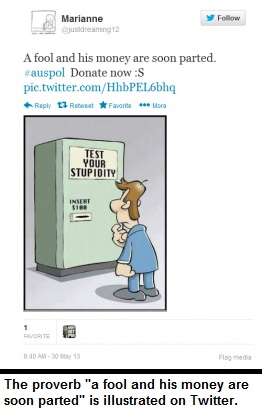
“A fool and his money are soon parted” – Ancient British proverb that gleans inspiration from The Bible book of Proverbs 26:1-11, with the meaning of:
1.   It is easy to get money from foolish people.
2.  It is difficult or unlikely that foolish people maintain their hold on acquired wealth.

Lower Ed - Photo 4

What’s ironic is there are similar colloquial expressions that are even more shocking for the prevalence of financial abuse of the unwise. Consider:

So who is more abominable? The fool who loses out on his new found fortune or the shrewd person that schemes to take advantage of that fool? (It should be noted in this case that the fortune is only rights and credits; every American citizen qualify for a need-based Student Loan from the federal government – that loan is non-dischargeable).

One commentator pushes this thesis even further, positing that:

“The ‘fools’ I think of are all rather harmless creatures, basically well-intentioned and innocent. All of them evoke a certain sense of pity, mixed with amusement.”

So imagine that one who exploits the “fool”! Imagine, if instead of an individual, it is a “system”, a government program, that does the exploiting. This is the actuality of Student Loan financing for Private, For-Profit Schools and Colleges in the US.

This is truly abominable; and yet this is the United States of America.

Say it ain’t so!

In a previous blog-commentary, the “abominable” judgment was even more direct:

The ‘Evil Empire‘ – For-Profit Educational firms and institutions – is finally facing resistance from governmental authorities. Companies in this industry have come under fire for their bad practices and abuse of their customers: young students.

… and now, today, ITT Educational Services, one of the largest operators of for-profit technical schools, ended operations at all of its ITT Technical Institutes.
Source: For-Profit Education – ‘Another one bites the dust’; posted September 6, 2016; retrieved April 26, 2017.

Lower Ed - Photo 3This commentary asserts that there is a need for the Caribbean communities to reform and transform our education deliveries, yet still, we do NOT want to model the American system. This point aligns with the book Go Lean…Caribbean, which seeks to reboot the 30 member-states of the Caribbean region, to ensure better stewardship of the Social Contract for all citizens in our homelands, strong and weak. The Go Lean book petitions the Caribbean region to do better! It describes the necessary empowerments to optimize the economic, security and governing engines of Caribbean society to ensure a better adherence to the principle of the Greater Good.

In a previous 5-part series of blog-commentaries on the “Strong versus the Weak”, the pattern from the Code of Hammurabi was detailed and presented as an Old World model that is being ignored in the US. The one place we would expect to find mitigations for foolishness – to turn the foolish one wise – would be the education arena. Yet this is where we are finding a consistent pattern of the “Strong abusing the Weak”.

This commentary is an addition submission to that already completed series; we are adding this 6th entry. The full series is now as follows:

  1.  Managing the Strong versus the Weak – Model of Hammurabi
  2.  Managing the Strong versus the Weak – Mental Disabilities
  3.  Managing the Strong versus the Weak – Bullying in Schools
  4.  Managing the Strong versus the Weak – Book Review: Sold-Out!
  5.  Managing the Strong versus the Weak – An American Sickness
  6.  Managing the Strong versus the Weak – Book Review: Lower Ed!

Lower Ed - Photo 1The need for this 6h entry was spurred by the release of this new book on February 28, 2017 entitled: Lower Ed – The Troubling Rise of For-Profit Colleges in the New Economy by Dr. Tressie McMillan Cottom (Ph.D. Sociology who teaches at Virginia Commonwealth University). It is ‘spot-on’ for the judgment of the pattern of abuse of the ‘Weak’ in American society who are innocently looking for “pull themselves up by the boot strap”. See the review-synopsis of this book here following by an PODCAST-interview with the Author:

Book Review: Lower Ed: The Troubling Rise of For-Profit Colleges in the New Economy
“With great compassion and analytical rigor, Cottom questions the fundamental narrative of American education policy, that a postsecondary degree always guarantees a better life.” – The New York Times Book Review

More than two million students are enrolled in for-profit colleges, from the small family-run operations to the behemoths brandished on billboards, subway ads, and late-night commercials. These schools have been around just as long as their bucolic not-for-profit counterparts, yet shockingly little is known about why they have expanded so rapidly in recent years —during the so-called Wall Street era of for-profit colleges.

In Lower Ed Tressie McMillan Cottom — a bold and rising public scholar, herself once a recruiter at two for-profit colleges—expertly parses the fraught dynamics of this big-money industry to show precisely how it is part and parcel of the growing inequality plaguing the country today. McMillan Cottom discloses the shrewd recruitment and marketing strategies that these schools deploy and explains how, despite the well-documented predatory practices of some and the campus closings of others, ending for-profit colleges won’t end the vulnerabilities that made them the fastest growing sector of higher education at the turn of the twenty-first century. And she doesn’t stop there.

With sharp insight and deliberate acumen, McMillan Cottom delivers a comprehensive view of post-secondary for-profit education by illuminating the experiences of the everyday people behind the shareholder earnings, congressional battles, and student debt disasters. The relatable human stories in Lower Ed—from mothers struggling to pay for beauty school to working class guys seeking “good jobs” to accomplished professionals pursuing doctoral degrees—illustrate that the growth of for-profit colleges is inextricably linked to larger questions of race, gender, work, and the promise of opportunity in America.

Drawing on more than one hundred interviews with students, employees, executives, and activists, Lower Ed tells the story of the benefits, pitfalls, and real costs of a for-profit education. It is a story about broken social contracts; about education transforming from a public interest to a private gain; and about all Americans and the challenges we face in our divided, unequal society.

Source: Posted and Retrieved 04-26-2017 from: https://www.amazon.com/Lower-Ed-Troubling-Profit-Colleges/dp/1620970600/

Lower Ed - Photo 2

————-

AUDIO Podcast – Terry Gross with Tressie McMillan Cottom – Heard on Fresh Air

Mental Photo 4March 27, 2017 – For-profit colleges have faced federal and state investigations in recent years for their aggressive recruiting tactics — accusations that come as no surprise to author Tressie McMillan Cottom.
Cottom worked as an enrollment officer at two different for-profit colleges, but quit because she felt uncomfortable selling students an education they couldn’t afford. Her new book, Lower Ed, argues that for-profit colleges exploit racial, gender and economic inequality.
Cottom tells Fresh Air’s Terry Gross that for-profit institutions tend to focus their recruiting on students who qualify for the maximum amount of student aid. “That happens to be the poorest among us,” she says. “And because of how our society is set up, the poorest among us tend to be women and people of color.”

Notice this small sample of the book’s revelations and disclosures, symptomatic of Crony-Capitalism:

  • A peer-reviewed analysis, with over 100 interviews – with students, employees, executives, and activists – the story is consistently reflective of a sad, abusive American eco-system.
  • Big-money industry using shrewd recruitment and marketing strategies to tempt the most vulnerable in society.
  • Despite well-documented predatory practices and some well-publicized campus closings, ending for-profit colleges won’t end the vulnerabilities that made them the fastest growing sector of higher education.
  • The weakest in American society – single mothers, systematically poor, underserved and under-privilege – are the ones targeted, exploited and abused – again and again.
  • The growth of for-profit colleges is inextricably linked to larger questions of race, gender, work, and the promise of opportunity in America.

This commentary and the previous 5 commentaries in this series all relate to nation-building, stressing the community ethos necessary to forge a society where all the people are protected all the time. Who really is the fool in these scenarios? The person being abused by the American eco-system or the ones abandoning home to join that society. The premise in the Go Lean book and subsequent blog-commentaries is that the people of the Caribbean can more easily “proper where planted” in their homeland than to emigrate to the American foreign shores for relief. It is foolish to think that America cares about “us”, when they undoubtedly do not care about the “weak” in their own society.

We need more education in our region; because we need economic growth. Economists have established the relationship between economic growth and education:

“For individuals this means that for every additional year of schooling they increase their earnings by about 10%. This is a very impressive rate of return.” (Go Lean book Page 258).

A lot of Caribbean students do matriculate in American colleges and universities. But this commentary is hereby declaring that we must assuredly look beyond the American model to fulfill our educational needs. According to the foregoing book and AUDIO Podcast, only a fool would invest in American For-Profit private educational institutions.

The word “invest” seems so misplaced. No wonder we have such a poor “Return on our Investment” from our Caribbean students studying abroad. (So many times, they do not even return “home”.)

This is already a familiar thesis for the Go Lean movement – a roadmap for the introduction and implementation of the Caribbean Union Trade Federation (CU) – as the Go Lean book advocates establishing local educational options mostly in response to the failings of the “study abroad model”. We have problems with the American quality education in the For-Profit institutions and we have problems with the threat of further brain-drain. See more details from the book here:

10 Ways to Improve Education – Page 159.
# 2 – Promote Industries for e-Learning
For 50 years the Caribbean has tolerated studying abroad; unfortunately many students never returned home. The CU’s focus will now be on facilitating learning without leaving. There have emerged many successful models for remote learning using electronic delivery or ICT. The CU will foster online/home school programs, for secondary education, to be licensed at the CU level so as to sanction, certify, and oversee the practice, especially for rural areas/islands. At  the tertiary level, the CU will sponsor College Fairs for domestic and foreign colleges that deliver online education options.

We need more e-Learning options in our Caribbean homeland, for all education levels: K-12 and college. There are many successful models and best practices to adopt. We are in position to pick, choose and refuse products and services from all our foreign trading partners, including from the US. (We must assuredly avoid their societal defects).

One successful model is “iReady” – see more in the Appendix below.

The US, despite its advanced democracy status, has definite societal defects in the education arena. Overcoming the defects – particularly Crony-Capitalism or exploiting public resources for private gains – make depending on American solutions, foolish.

The Go Lean roadmap seeks to transform the Caribbean education deliveries There are so many successful role models to emulate. Yet still, this will be hard. So many in our society hold the default view:

White is Right

Therefore these one may rather spend their education monies abroad in the US than to engage in a local empowerment plan. That is so foolish!

So yes, the transformation will be hard, heavy-lifting, but not foolish! It will engage all 3 societal engines: economic, security and governance. In fact, the prime directives of the Go Lean/CU roadmap includes the following 3 statements:

  • Optimization of the economic engines in order to grow the regional economy to $800 Billion & create 2.2 million new jobs.
  • Establishment of a security apparatus – including emergency management – to ensure public safety and protect the resultant economic.
  • Improve Caribbean governance for all people – with empowerments like education – to support these engines.

This comprehensive view – economics, security and governance – is the charge of the Go Lean roadmap, opening with these pro-education pronouncements in the Declaration of Interdependence (Page 13):

xix. Whereas our legacy in recent times is one of societal abandonment, it is imperative that incentives and encouragement be put in place to first dissuade the human flight, and then entice and welcome the return of our Diaspora back to our shores …

xxi. Whereas the preparation of our labor force can foster opportunities and dictate economic progress for current and future generations, the Federation must ensure that educational and job training opportunities are fully optimized for all residents of all member-states, with no partiality towards any gender or ethnic group… This responsibility should be executed without incurring the risks of further human flight, as has been the past history.

So any tertiary education plan for the Caribbean must address the preponderance to exacerbate the brain drain. Going to an American For-Profit institution would just be foolish. We, as a community, would be spending good money, but getting bad returns. What’s worst, imaging getting student loans to finance that education? How likely would there be a “Return on Investment”?

Overall, the Go Lean book stresses the community ethos, strategies, tactics, implementations and advocacies to reboot, reform and transform tertiary education delivery in the Caribbean; see this expressed in this one advocacy here:

10 Ways to Impact Student Loans – Page 160

1 Embrace the advent of the CU Single Market to leverage across the 42 million people in the 30 member-states.
2 Buy Existing Loans
3 Loan Forgiveness
4 Deferments / Postponements
5 Non-Dischargeable with Bankruptcy
6 Forgivable with Death and Organ Transplantation Dynamics
7 Diaspora Eligibility for CU Institutions
8 Grace Periods
9 Public – Private servicers
10 Lessons from Occupy Wall Street (OWS) The OWS protest movement highlighted some legitimate issues with the student loan industry. The US Federal government provides guarantees on student loans (direct and indirect), and the loans are non-dischargeable in any Bankruptcy process, so private loan issuers were assured a profit. The issuers would therefore drive the industry to lend more and more to less capable students at high interest rates. As a result of the protest, the Obama Administration eliminated the indirect channel for student loan, taking the profit motive out of the process; (See more in Appendix IH of the Go Lean book on Page 286). The CU [model] will only direct lend.

The points of effective, technocratic stewardship of tertiary education and student loans were further elaborated upon in previous blog/commentaries. Consider this sample:

https://goleancaribbean.com/blog/?p=9724 “Why”, “How”  and “When” to Transform Caribbean Universities
https://goleancaribbean.com/blog/?p=8669 A Model from Failing Detroit – Make Community Colleges free
https://goleancaribbean.com/blog/?p=8373 A Lesson in Economic Fallacies – Student Loans As Investments
https://goleancaribbean.com/blog/?p=5482 For-Profit Education: Plenty of Profit; Little Education
https://goleancaribbean.com/blog/?p=4487 FAMU – Finally, A Model for Facilitating Economic Opportunity
https://goleancaribbean.com/blog/?p=1256 Is a Traditional 4-year Degree a Terrible Investment?
https://goleancaribbean.com/blog/?p=709 Student debt holds back many would-be home buyers

There is an absolute abomination of the “strong abusing the weak” in the American eco-system. We must avoid this American pattern; it may even be necessary to avoid America when it comes to our tertiary education needs.

“We can do bad all by ourselves”.

We have so many options elsewhere. The Go Lean plan is to create the better options here in the Caribbean; if not in your homeland, then perhaps in the next one, to the left or to the right.

It is not hard to do better than the American For-Profit model. Since many times in the past American abuse has proliferated, for those weaker physically, mentally and economically. The movement behind the Go Lean/CU roadmap wants us, in the Caribbean, to do better. Yes, let’s be wise!

Education can be so beneficial to our communities. But let’s not be the fool! Let’s keep “it” here at home and let’s “weed out” any bad practices of Crony-Capitalism in our tertiary education delivery system. Let’s pursue the Greater Good (greatest good to the greatest number of people which is the measure of right and wrong).

Now is the time to lean-in to this Go Lean roadmap to reboot, reform and transform Caribbean education. If we do this, we will make the Caribbean a better place to live, work, learn and play. 🙂

Download the free e-book of Go Lean … Caribbean – now!

Sign the petition to lean-in for the roadmap for the Caribbean Union Trade Federation.

———–

Appendix VIDEO – Intro to/Login for iReady – https://youtu.be/rhNO2-DQMCU


Published December 15, 2016 – iReady Teacher providing instructions for logging on.
See Video recording of a sample lesson here: https://youtu.be/_xoxdLaudDY


Share this post:
, , , ,
[Top]

End of ‘The Greatest Show on Earth’

Go Lean Commentary

Come this May (2017), it will be ‘The Greatest Show on Earth’ … no more!

CU Blog - End of 'The Greatest Show on Earth' - Photo 1

CU Blog - End of 'The Greatest Show on Earth' - Photo 2

After 146 years, the Ringling Bros. and Barnum & Bailey Circus will close, shut down and come to an end for good. The Agents of Change in entertainment has been chasing this fabled institution, and time finally caught up with it.

Kenneth Feld, the Chairman and CEO of Feld Entertainment, the company that owns the circus, verbalizes the drama succinctly:

“The competitor in many ways was ‘time’.”

“It’s a different model that we can’t see how it works in today’s world to justify and maintain an affordable ticket price. So you’ve got all these things working against it.”

So now the legacy of exotic animals, flashy costumes, death-defying acrobats and clowns is over, under this model. The iconic American spectacle was felled by a variety of factors, company executives explained these contributing factors:

  • Changing public tastes
  • Declining attendance combined with high operating costs
  • Prolonged battles with animal rights groups

While this spells the end of the Ringling Bros. and Barnum & Bailey Circus, it is not the end of circuses in general or the company Feld Entertainment; they also own-operate other profitable shows that will continue; a sample include:

Monster Jam, Disney on Ice and Marvel Live, etc.

Still, in the end – starting next month – some 500 people who perform and work on the circus shows will be impacted. According to the news article here by the Associated Press, “a handful will be placed in positions with the company’s other profitable shows but most will be out of a job”. See the full article here:

Title: Ringling Bros. circus to close after 146 years
By: Tamara Lush
ELLENTON, Fla. (AP) — After 146 years, the curtain is coming down on “The Greatest Show on Earth.” The owner of the Ringling Bros. and Barnum & Bailey Circus told The Associated Press that the show will close forever in May.

The iconic American spectacle was felled by a variety of factors, company executives say. Declining attendance combined with high operating costs, along with changing public tastes and prolonged battles with animal rights groups all contributed to its demise.

CU Blog - End of 'The Greatest Show on Earth' - Photo 6“There isn’t any one thing,” said Kenneth Feld, chairman and CEO of Feld Entertainment. “This has been a very difficult decision for me and for the entire family.”

The company broke the news to circus employees Saturday night after shows in Orlando and Miami.

Ringling Bros. has two touring circuses this season and will perform 30 shows between now and May. Major stops include Atlanta, Washington, Philadelphia, Boston and Brooklyn. The final shows will be in Providence, Rhode Island, on May 7 and in Uniondale, New York, at the Nassau County Coliseum on May 21.

The circus, with its exotic animals, flashy costumes and death-defying acrobats, has been a staple of entertainment in the United States since the mid-1800s. Phineas Taylor Barnum made a traveling spectacle of animals and human oddities popular, while the five Ringling brothers performed juggling acts and skits from their home base in Wisconsin. Eventually, they merged and the modern circus was born. The sprawling troupes traveled around America by train, wowing audiences with the sheer scale of entertainment and exotic animals.

By midcentury, the circus was routine, wholesome family entertainment. But as the 20th century went on, kids became less and less enthralled. Movies, television, video games and the internet captured young minds. The circus didn’t have savvy product merchandising tie-ins or Saturday morning cartoons to shore up its image.

“The competitor in many ways is time,” said Feld, adding that transporting the show by rail and other circus quirks — such as providing a traveling school for performers’ children— are throwbacks to another era. “It’s a different model that we can’t see how it works in today’s world to justify and maintain an affordable ticket price. So you’ve got all these things working against it.”

The Feld family bought the Ringling circus in 1967. The show was just under 3 hours then. Today, the show is 2 hours and 7 minutes, with the longest segment — a tiger act — clocking in at 12 minutes.

CU Blog - End of 'The Greatest Show on Earth' - Photo 5

CU Blog - End of 'The Greatest Show on Earth' - Photo 4

“Try getting a 3- or 4-year-old today to sit for 12 minutes,” he said.

Feld and his daughter Juliette Feld, who is the company’s chief operating officer, acknowledged another reality that led to the closing, and it was the one thing that initially drew millions to the show: the animals. Ringling has been targeted by activists who say forcing animals to perform is cruel and unnecessary.

People for the Ethical Treatment of Animals, a longtime opponent of the circus, wasted no time in claiming victory.

“After 36 years of PETA protests, which have awoken the world to the plight of animals in captivity, PETA heralds the end of what has been the saddest show on earth for wild animals, and asks all other animal circuses to follow suit, as this is a sign of changing times,” Ingrid Newkirk, president of People for the Ethical Treatment of Animals, wrote in a statement.

Wayne Pacelle, president and CEO of The Humane Society of the United States, acknowledged the move was “bittersweet” for the Felds but said: “I applaud their decision to move away from an institution grounded on inherently inhumane wild animal acts.”

In May of 2016, after a long and costly legal battle, the company removed the elephants from the shows and sent the animals to live on a conservation farm in Central Florida. The animals had been the symbol of the circus since Barnum brought an Asian elephant named Jumbo to America in 1882. In 2014, Feld Entertainment won $25.2 million in settlements from groups including the Humane Society of the United States, ending a 14-year fight over allegations that circus employees mistreated elephants.

By the time the elephants were removed, public opinion had shifted somewhat. Los Angeles prohibited the use of bull-hooks by elephant trainers and handlers, as did Oakland, California. The city of Asheville, North Carolina nixed wild or exotic animals from performing in the municipally owned, 7,600-seat U.S. Cellular Center.

Attendance has been dropping for 10 years, said Juliette Feld, but when the elephants left, there was a “dramatic drop” in ticket sales. Paradoxically, while many said they didn’t want big animals to perform in circuses, many others refused to attend a circus without them.

“We know now that one of the major reasons people came to Ringling Bros. was getting to see elephants,” she said. “We stand by that decision. We know it was the right decision. This was what audiences wanted to see and it definitely played a major role.”

The Felds say their existing animals — lions, tigers, camels, donkeys, alpacas, kangaroos and llamas — will go to suitable homes. Juliette Feld says the company will continue operating the Center for Elephant Conservation.

Some 500 people perform and work on both touring shows. A handful will be placed in positions with the company’s other, profitable shows — it owns Monster Jam, Disney on Ice and Marvel Live, among other things — but most will be out of a job. Juliette Feld said the company will help employees with job placement and resumes. In some cases where a circus employee lives on the tour rail car (the circus travels by train), the company will also help with housing relocation.

Kenneth Feld became visibly emotional while discussing the decision with a reporter. He said over the next four months, fans will be able to say goodbye at the remaining shows.

CU Blog - End of 'The Greatest Show on Earth' - Photo 3In recent years, Ringling Bros. tried to remain relevant, hiring its first African American ringmaster, then its first female ringmaster, and also launching an interactive app. It added elements from its other, popular shows, such as motorbike daredevils and ice skaters. But it seemingly was no match for Pokemon Go and a generation of kids who desire familiar brands and YouTube celebrities.

“We tried all these different things to see what would work, and supported it with a lot of funding as well, and we weren’t successful in finding the solution,” said Kenneth Feld.
Source: Associated Press – Posted January 15, 2017; retrieved April 25, 2017 from: https://apnews.com/020bc7b2f16f4446ade338bcf4a500ed

While this is an American drama (consider the slice of Americana portrayed in the movie “The Greatest Show on Earth” highlighted in the Movie Trailer in the Appendix below), there is a lot of consideration in this news that relate to the Caribbean. There are lessons for us to learn and apply in the stewardship of Caribbean affairs. These points are being highlighted by the promoters of the book Go Lean…Caribbean; it presents a roadmap to elevate the 30 member-states in the Caribbean region through economic, security and governing empowerments. The book asserts that the entertainment industry can be a great economic contributor to Caribbean communities. Already, tourism is our primary economic driver, and so amusement and entertainment are closely linked.

There are changing trends in tourism, the same as there had been for circus appreciation. At many Caribbean resorts, the business models of casino gambling and golf resources simply do not have the same appeal as in previous days. There is the same factor that affected the circus: “changing public taste”.

So let’s consider the following lessons that the Caribbean is able to glean from experiences (good and bad) of the Ringling Brothers and Barnum & Bailey Circus:

  • There is a need to reconcile past abuses – The Circus had a checkered past of abuses; of the 3 separate circuses that merged over the 146 years, (Ringling Brothers, Barnum, Bailey), the Barnum entity – famed for P.T. Barnum – was known for its exploitation and displays of Freaks, people who were malformed or disabled in some way. This is a total disrespect to dignity and human rights. Lesson: Past sins must be repented and reconciled. (See Go Lean book Page 34: 10 Ways to Manage Reconciliations).
  • By extension, the abuse of animals was clearly documented by animal rights activists and advocates. The Circus should have just conceded this bad practices and worked to rectify. Instead, after decades of denials, when the irrefutable evidence were presented, the circus had no choice but to retire the Elephants and other exotic animals. There was no structured Change Management so as to prepare the public for the new absence of the elephants. The Circus attendance assuredly declined. Lesson: The Circus did have to answer to animal protection entities in the State and Federal governments; they should have negotiated with stakeholders – even opposers – like partners, not enemies. (See Go Lean book Page 32: 10 Ways to Improve Negotiations).
  • Circus performers are people too; they have families and children; many performers are children. Many media productions (i.e. documentaries) abound describing Carnie Life. There should have been more concerted effort to bring dignity to this travelling profession, like the travelling schools, without the need for the hard-fought labor rules and concessions. Carnies should have been viewed as indispensable partners. Lesson: The Caribbean can apply many lessons in the management and administration of Sports and Student Athletes; think Sports Academies. (See Go Lean book Page 229: 10 Ways to Improve Sports).
  • Circuses have excelled with their Transportation innovations – Ringling’s use of railroad tracks, trains and cars have been ingenious. They have also deployed residential cars for the cast and crew while they are on the road. Lesson: The Go Lean roadmap calls for deployment of innovative transportation solutions like ferries and the Union Atlantic Turnpike; logistics are necessary to empower communities. (See Go Lean book Page 205: 10 Ways to Improve Transportation).
  • Circuses have innovated and engineered amazing Event Centers – Tents and Temporary Stadiums. These have been advantageous since the circus only makes a temporary occupancy. Lesson: The strategies for Event Tourism in the Caribbean member-states require facilitations for stadiums and arenas. What we learn from the circus, is they do not have to be permanent structures. (See Go Lean book Page 191: 10 Ways to Impact Events).
  • Changing public tastes: – There is a need to understand the market and plan the business for the Caribbean economic engines. Lesson: In our region, casinos and golf are declining as hotel amenities, while Cruises Lines are transforming the public taste for how to consume the Caribbean. (See Go Lean book Page 193: 10 Ways to Impact Cruise Tourism).
  • Listen to the complaints – Ringling’s officials confess that “public opinion had shifted somewhat”. So in effect, the complainers (animal protesters for the circus; negative commentators for the Caribbean) represent the customers views.
  • Can’t beat them, join them – Ringling should have partnered with their stakeholders (Cities, Animal Advocates, “Carnies”) to develop a win-win product; but rather, for much of their 146-year history they were exploiters. Lesson: Lean Project Management methodologies, calls for “Plan, Do & Review”. Each year’s post-analysis goals should have been on finding solutions for the known challenges. (See Go Lean book Page 147: 10 Ways to Measure Progress).
  • Value the ‘Genius’ Factor – The Art & Science of circus must be fostered as an ongoing vocation. With their Clown College, Ringling made the proper effort to foster genius. Lesson: The Caribbean region must also foster those with genius qualifiers. (See Go Lean book Page 27: 10 Ways to Foster Genius).
  • Circus amusement is a leisure activity, 100% discretionary spending. The public can readily lower their spending. Lesson: The Caribbean cannot depend solely on Tourism, its a leisure activity; we need to trade in essentials. (See Go Lean book Page 195: 10 Ways to Impact Extractions).
  • Patriarchy & Orthodoxy must go – Diversity and Inclusion should not have been optional for the Ringling circus. Only in recent years, has the Ringling Circus even tried to remain relevant, hiring its first African American ringmaster, then its first female ringmaster, and also launching an interactive smart-phone app. Lesson: Institutions should reflect the better values of society, the Greater Good. (See Go Lean book Page 37: 10 Ways to Impact the Greater Good.).
  • The Ringling Circus will be missed – An absence of circuses hurts society. Circus amusement can be effective for influencing people: make people happy, feed them and entertain them, then heavy-lifting tasks can be pursued – see this point developed in this previous blog.

As alluded to earlier, there is a model for circus entertainment that works successfully in today’s economy:

Cirque Du Soleil

This model had previously (1984) rebooted, reformed and transformed circus entertainment, and now they are one of the most successful entertainment enterprises in North America – they continue to soar. This model features death-defying acrobats, costumes, and clowns; only no exotic animals. See the pricing here for their permanent show – Cirque du Soleil La Nouba – in Orlando’s Downtown Disney (Disney Springs) entertainment complex. The field of Economics teaches an important lesson here: Price is a measurement of demand.

Greatest Show - Photo 8

 Click to Enlarge

Lessons learned!

The Go Lean book presents a plan to reboot, reform and transform the regional economy and create the needed jobs and careers, some even in the amusement & entertainment industry. But, the Go Lean book asserts that this effort is too big a task for just for Caribbean member-state alone; all the 30 member-states must convene, confederate and collaborate in order to effect change. As such, the Go Lean book serves as a roadmap for the introduction and implementation of the technocratic Caribbean Union Trade Federation (CU), for the elevation of Caribbean society. This CU/Go Lean roadmap has these 3 prime directives:

The Go Lean book stresses that reforming and transforming management of Caribbean talent must be a regional pursuit, considering the genius-qualifier of show-business and sports. This was an early motivation for the roadmap as pronounced in the opening Declaration of Interdependence (Page 14):

xxxi. Whereas sports have been a source of great pride for the Caribbean region, the economic returns from these ventures have not been evenly distributed as in other societies. The Federation must therefore facilitate the eco-systems and vertical industries of sports as a business, recreation, national pastime and even sports tourism ….

xxxii. Whereas the cultural arts and music of the region are germane to the quality of Caribbean life, and the international appreciation of Caribbean life, the Federation must implement the support systems to teach, encourage, incentivize, monetize and promote the related industries for arts and music in domestic and foreign markets. These endeavors will make the Caribbean a better place to live, work and play.

This commentary previously related details of the subjects of talent management and fostering genius (including show-business and sports) that can be applied directly in the Caribbean. Here is a sample of previous blogs:

https://goleancaribbean.com/blog/?p=10351 ‘Culture Eats Strategy For Breakfast’
https://goleancaribbean.com/blog/?p=7866 Switching Allegiances: Jamaican sprinters represent other countries
https://goleancaribbean.com/blog/?p=2415 How ‘The Lion King’ roared into history
https://goleancaribbean.com/blog/?p=1446 Caribbean Players in the 2014 World Cup
https://goleancaribbean.com/blog/?p=1214 The Art & Science of Temporary Stadiums – No White Elephants
https://goleancaribbean.com/blog/?p=498 Book Review: ‘The Sports Gene’

The Go Lean book details the community ethos, strategies, tactics and operational advocacies to effectuate this goal of preparing the Caribbean for change. This 5-year roadmap does not want our economic engines to just stop, like the circus is about to do in the US in May 2017. There will still be the need for amusement, entertainment and fun, all such things associated with the circus and leisure travel. And just like the circus was branded “The Great Show on Earth”, our Caribbean destination have been branded, according to the Go Lean book (Page 251):

… the greatest address in the world …
… appreciated not only by the residents but also by the visitors to these shores – estimated at 80 million. But things are missing here. Since we cannot move the islands, the only solution is to fill the deficiency. … This is not the first time a society has had to institute change to adjust to the realities … Many examples abound; lessons can be applied from the success and failures of others.

In this vein, the Go Lean book identifies the Agents of Change affecting the Caribbean marketplace and then tries to prepare the region for its eventuality. The book describes some of these agents as:

  • Technology
  • Globalization
  • Climate Change

The book (and this commentary) concludes (Page 252):

Get moving … now is the time. Opportunities abound; … there is opportunity enough in the preparation for the coming change. So act now! Get moving to that place, the “corner” of preparation and opportunity.

🙂

Download the free e-book of Go Lean … Caribbean – now!

Sign the petition to lean-in for this roadmap for the Caribbean Union Trade Federation.

————-

Appendix – Movie Trailer VIDEO – The Greatest Show on Earth – https://youtu.be/2QswjButLfA

Published on Sep 10, 2012 – Charlton Heston stars as Brad Braden, the diehard circus manager who lives and breathes to keep the show rolling. With the Big Top about to hit rock bottom, Braden hires The Great Sebastian (Cornel Wilde), a daring trapeze legend, to revitalize the circus. His arrival sparks the rivalry and admiration of Holly (Betty Hutton), Braden’s girlfriend and trapeze star.

License: Standard YouTube License

CU Blog - End of 'The Greatest Show on Earth' - Photo 7

Share this post:
, , ,
[Top]

Caribbean Roots: Al Roker – ‘Climate Change’ Defender

Go Lean Commentary

Al Roker - Photo 1Make us proud ‘My Brother’; go fight our battles.

This is the message the Caribbean needs to send to one of its own, Al Roker, the on-air meteorologist for NBC and co-host of the morning newscast The Today Show.

Al Roker has Caribbean roots, as a legacy of parents from the Bahamas (and Jamaica; see Appendix A). He, himself has spent a lot of time there and reflect a lot of its values. Right now, he is being a Champion for a cause that is dear to the Bahamas, and all Caribbean for that matter:

Climate Change.

See how this Caribbean Champion battled prominent Climate Change deniers in this TV broadcast here. What’s sad is the actual denier in this case is Scott Pruitt, the Head of the American federal government environmental Watch-Dog, the EPA (Environmental Protection Agency).

America may have the luxury of “sticking its head in the sand” and not deal with Climate Change, but for those of us in the Caribbean, we do not have that luxury – we have a Clear-and-Present Danger right now.

See the news article and VIDEO of this champion’s defense:

Title: Al Roker Debunks EPA Head Scott Pruitt’s Stunning Denial On Human-Caused Climate Change
Sub-title: Roker: “No Credible Science Or Scientist” Would Support Pruitt’s Assertion CO2 Is Not A Primary Contributor To Global Warming
By: Media Matters Staff

NBC weatherman Al Roker debunked EPA head Scott Pruitt’s false claim that carbon dioxide is not a primary contributor to global warming during an appearance on MSNBC Live, explaining that there is “no credible science or scientist” to support Pruitt’s statement.

During the March 10 segment, Roker addressed Pruitt’s comments on the March 9 edition CNBC’s Squawk Box in which Pruitt said “I would not agree” that CO2 is “a primary contributor to the global warming that we see” — a statement completely at odds with the consensus among climate scientists that human activity is the primary cause of climate change.

To rebut Pruitt’s statements, Roker referenced an interview he recently conducted with climate scientist Dr. Marshall Shepherd, who explained that “greenhouse gases are in fact the primary forcing function on a warming climate system. … their fingerprint is there on our naturally varying climate in the same way steroids were on the naturally varying cycle of home runs during the Major League Baseball era.”

Roker also stated “there is no credible science or scientist” that would back up Pruitt’s assertion. Indeed, a number of climate scientists have weighed in on Pruitt’s statement, stating Pruitt’s denial “demonstrated that he is unqualified to run the EPA or any agency” and suggesting that Pruitt “talk with his own scientists and read the National Climate Assessment.”

Notably, however, NBC did not address Pruitt’s climate denial on the widely viewed Today show the same day, nor NBC Nightly News air a segment on Pruitt’s climate denial on March 9 — even though Pruitt’s denial received widespread attention across mainstream media.

————-

See full transcript of the interview between Al Roker and the MSNBC Host Katy Tur in Appendix B below.

————-

VIDEO – From the March 10 edition of MSNBC Livehttps://mediamatters.org/embed/clips/2017/03/10/52688/msnbc-msnbclive-20170310-alrokerpruitt

This issue of monitoring, messaging and managing the stakeholders for Climate Change is an important mission for the movement behind the book Go Lean … Caribbean. The book presents the Caribbean region a roadmap to elevate its societal engines – economics, security and governance – and to be prepared for the Agents of Change impacting daily life in the Caribbean homeland. In total, the book identified these 4 Change Agents:

  • Technology
  • Globalization
  • Aging Diaspora
  • Climate Change

As a region, we are able to employ mitigations and remediation for all of these agents except for Climate Change. We are all small countries, nowhere on the list of “Big Polluters”, like the US (#2) and China (#1). We have neither a voice nor a vote in those countries, yet we need them to take the issue of Climate Change remediation seriously. Messaging is key! We need people like “Al Roker” – daily audience of 4 to 9 million people – speaking truth to power … on our behalf.

This advocacy – to proclaim impending danger to life and limb – is part of a new effort to elevate the societal engines of the Caribbean. This started with the Go Lean…Caribbean book and is being followed up by this and many other blog-commentaries. See here a sample of previous submissions heralding the need for the Caribbean region to be “on guard” for the imminent threats from Climate Change:

https://goleancaribbean.com/blog/?p=9455 Fix ‘Climate Change’ – Yes, We Can
https://goleancaribbean.com/blog/?p=7103 COP21 – ‘Climate Change’ Acknowledged
https://goleancaribbean.com/blog/?p=6893 A Meteorologist’s View On Climate Change
https://goleancaribbean.com/blog/?p=4673 Merchants of Doubts – Dynamics of Climate Change Deniers
https://goleancaribbean.com/blog/?p=2465 Book Review: ‘This Changes Everything: Capitalism vs. the Climate’
https://goleancaribbean.com/blog/?p=2276 Climate Change May Affect Food Supply Within a Decade
https://goleancaribbean.com/blog/?p=2119 Cooling Effect – Oceans and the Climate
https://goleancaribbean.com/blog/?p=1883 Climate Change May Bring More Kidney Stones

The Go Lean book serves as a roadmap for the introduction and implementation of the Caribbean Union Trade Federation (CU) as an inter-government agency for 30 regional member-states. This confederation will provide a technocratic stewardship for all the societal engines in the Caribbean. In fact, the prime directives of the roadmap includes the following 3 statements:

  • Optimization of the economic engines in order to grow the regional economy to $800 Billion & create 2.2 million new jobs.
  • Establishment of a security apparatus to ensure public safety and to protect the resultant economic engines  – including an Emergency Management functionality.
  • Improve Caribbean governance to support these engines, including a separation-of-powers mantra between the member-states and CU federal agencies.

Overall, the Go Lean book stresses the community ethos, strategies, tactics, implementations and advocacies to reboot, reform and transform the economic engines of Caribbean society.

What do we do now?

While we hope, pray and lobby the big polluting nations to do more, we have to prepare our Caribbean communities for the imminent onslaughts.

In previous blogs, this commentary cautioned the stakeholders in the Caribbean region, as follows:

  • Crap Happens! Prepare – The peril of a Climate Change-fueled hurricane is now a constant threat for Caribbean life, for all 30 member-states. It is assured that some Caribbean location will be impacted every year. While there is no guarantee for a strike “here or there”, there is a guarantee that there will be a strike somewhere.
  • Do Not be Hypocritical – Go ‘Green’ – If excessive carbon in the atmosphere by the Big Polluters is the culprit for infusing Greenhouse Gases, then we, as a region of small countries, need to do our share and set a good example of lowering our carbon footprint. Though our numbers are too small to make an impact, it does send the message that we are willing to “swallow the hard pill/take the medicine” ourselves that we are asking the Big Polluting nations to endure.

The global crisis of Climate Change is impacting all aspects of Caribbean life: economics, security (disaster preparation and response) and governance. A comprehensive view of the challenges befalling our region is the charge of the Go Lean roadmap, opening with these pronouncements in the Declaration of Interdependence (Page 11 and 12):

i.  Whereas the earth’s climate has undeniably changed resulting in more severe tropical weather storms, it is necessary to prepare to insure the safety and security of life, property and systems of commerce in our geographical region. As nature recognizes no borders in the target of its destruction, we also must set aside border considerations in the preparation and response to these weather challenges.

viii. Whereas the population size is too small to foster good negotiations for products and commodities from international vendors, the Federation must allow the unification of the region as one purchasing agent, thereby garnering better terms and discounts.

x. Whereas we are surrounded and allied to nations of larger proportions in land mass, populations, and treasuries, elements in their societies may have ill-intent in their pursuits, at the expense of the safety and security of our citizens. We must therefore appoint “new guards” to ensure our public safety and threats against our society, both domestic and foreign. …

Now is the time for all stakeholders – residents, governments, Diaspora, scientists, disaster planners, etc. – in the Caribbean to lean-in for the empowerments described here-in and in the book Go Lean … Caribbean. Climate Change is the Number One threat for our society; for the whole world actually, but we are on the frontlines. “We must protect this house”. We must be better and do better and help to make our homelands better places to live, work and play. 🙂

Download the free e-book of Go Lean … Caribbean – now!

Sign the petition to lean-in for the roadmap for the Caribbean Union Trade Federation.

———-

Appendix A – Al Roker’s Earliy Life

Al Roker was born in Queens, New York,[4] the son of Isabel, of Jamaican descent, and Albert Lincoln Roker, Sr.,[5] a bus driver of Bahamian descent.[6] Roker initially wanted to be a cartoonist.[5] He was raised Catholic[5] (in the faith of his mother) and graduated from Xavier High School in Manhattan.[7] He worked on several projects as a member of the school’s Cartooning & Illustration Club. He attended the State University of New York at Oswego where he received a B.A. in communications in 1976.

According to the July 2011 issue of Us Weekly in “25 Things You Did Not Know About Me”, Roker is the first cousin once removed of the late actress Roxie Roker, who was most notable for her role as Helen Willis on the sitcom The Jeffersons and the mother of popular rock musician Lenny Kravitz. That makes Kravitz Roker’s second cousin.[8]
Source: Retrieved April 21, 2017 from: https://en.wikipedia.org/wiki/Al_Roker#Early_life

———-

Appendix B – Transcript: Al Roker Interview by Host Katy Tur

KATY TUR (HOST): The head of the Environment Protection Agency stunned many when he denied carbon dioxide is a primary contributor to global warming.

[…]

TUR: Today show host and weatherman, a man who needs no introduction, Al Roker joins me now. “Stunned many” is a bit of an understatement, said most almost all, gosh, CO2 is not a factor when it comes to climate change. Was all of the schooling that I had as a child and into my adult life completely wrong, Al Roker?

AL ROKER: No, it wasn’t wrong and there is no credible science or scientist who will tell you the contrary. The fact is, carbon dioxide, the greenhouse gases is responsible for climate change.

TUR: No scientist will say this, but we’re having the EPA head say this?

ROKER: Well, look, this is America and you can make whatever statements you want to, but everybody will pretty much agree — in fact, just about an hour ago I interviewed one of the leading climate scientists in this country, Dr. Marshall Shepherd, and here’s what he had to say about it.

[BEGIN VIDEO CLIP]

MARSHALL SHEPHERD (DIRECTOR FOR UNIVERSITY OF GEORGIA’S PROGRAM IN ATMOSPHERIC SCIENCES): The basic physics of the atmosphere suggest that greenhouse gases are in fact the primary forcing function on a warming climate system. Greenhouse gases and the impacts post-industrial age or –– industrial revolution are certainly — their fingerprint is there on our naturally varying climate in the same way steroids were on the naturally varying cycle of home runs during the Major League Bbaseball era.

[END VIDEO CLIP]

ROKER: I think that pretty much sums it it up.

TUR: Yeah, so where — if the EPA head is saying there needs to be more research, but the EPA is losing money to do research, give me the consequences. How important is it and how significant is it to have the EPA head deny something like this?

ROKER: Well I think hopefully cooler heads will prevail upon him to say we need to continue to research this. We need to continue what we’ve been doing because if you look, we’ve got a graphic that basically right around the industrial revolution, we had — there’s been no time in this history of our planet where CO2, even naturally occurring or not, was above 290 parts per million. Alright, now you look at the temperature, we put the temperature on top of that, you can see from the 1880s into the 1940s, temperatures are below average, below the global average, but once we really start to see that red line go up, as the CO2 starts to increase, you can see those average global temperatures continue to rise, and they peaked last year, the warmest temperature ever on record for this planet. So as we continue to add those greenhouse gases — now, that’s not to say that — the greenhouse gases allow us to live on this planet. Without them completely, we would freeze to death. At night we would die. So there has to be some small amount of greenhouse gases. We’re just adding too much.
Source: Retrieved 04-21-2017 from: https://mediamatters.org/blog/2017/03/10/al-roker-debunks-epa-head-scott-pruitt-s-stunning-denial-human-caused-climate-change/215635


Share this post:
, , , ,
[Top]

ENCORE: Boston Bombing Anniversary – Learning Lessons

Go Lean Commentary

It has been 4 years already! The hope now is for an incident-free Boston Marathon today, April 17, 2017.

But hope is not the only emotion at work in Boston. There is also fear, concern, anticipation and preparation. The City of Boston has learned important lessons from that terrible attack at the Patriots Day Marathon in 2013. See highlights from this VIDEO here:

VIDEO – New security plans in place for the Boston Marathon
– http://wwlp.com/2017/04/14/new-security-plans-in-place-for-the-boston-marathon/

How about the Caribbean? Have we learned lessons? Are we engaging the needed remediation and mitigation?

We have events – think Carnival in  the Caribbean member-states or in  the Diaspora – on our calendar that could also be victimized by attacks, assaults and incidents (terrorism or just plain street-crime). It is very important that we do better to present our participants, spectators, guests and tourists a more secure environment.

More than economic interests are at stake. It could be life-or-death.

Notice some of the headlines here describing the security dynamics of some Caribbean events (around the Caribbean and the world):

Also, see the Encore of the previous blog-commentary that considered lessons learned from the Boston Marathon terrorist attack; this review was published on the 1-year anniversary in 2014. See it again here-now:

—————–

ENCORE – Original Commentary: Remembering and learning from Boston

Boston BombingApril 15 [2014] is the one year anniversary of the Boston Marathon bombing. 3 people died directly, and countless others were maimed and injured. From any perspective this was a tragedy! To the families that lost loved ones on that date, our deepest condolences.

There are many lessons for the Caribbean to learn from this experience.

The book Go Lean … Caribbean serves as a roadmap for the introduction and implementation of the Caribbean Union Trade Federation (CU). This CU is proffered to provide economic, security and governing solutions for the 30 member Caribbean states. This book posits that the Caribbean is not immune to similar experiences like Boston; that terrorism requires mitigation beyond the member-states; there needs to be a regional solution. The CU will furnish such a focus. There will be proactive and reactive measures to monitor, interdict, and marshal terroristic threats in the Caribbean. Most of the Caribbean has legacy affiliation with European/US countries that have been victims of terrorism. Though we have not had the tragedies of backpacks exploding at marathons, or chemical weapons used in subways, or airplanes crashing into our buildings, we must still hold a constant vigilance. The roadmap posits that “bad actors” always emerge where there is economic successes. See a related news article here:

Title: Year after Boston bombing, it’s clear that threat of homegrown terrorism overhyped
By: David Schanzer and Charles Kurzman

In the aftermath of the Boston Marathon bombing one year ago Tuesday, many commentators and public officials called this tragedy a harbinger of more homegrown terrorist attacks to come.

“We’re going to see an explosion in this radicalization and recruitment,” predicted Congressman Frank Wolf. “We are less secure than we were 12 years ago,” claimed think-tank terrorism expert Michael Swetnam. Former Attorney General Michael Mukasey told Americans to “worry – a lot.

”To many, the Boston attack demonstrated the potency of the Islamist extremist ideology, the difficulty of detecting individuals radicalized through social media and the Internet, and the ease with which amateurs could cause massive harm in our open society. The Tsarnaev brothers, they claimed, had paved the way for more terrorism.

While only one year has passed, much of this concern appears to have been hyperbole.

No one has been killed by homegrown terrorists in the past year, and there have been no copycat attacks. To put this in context, over the same period there have been 14,000 murders in the United States, including 46 murders in Boston.

There also has been no epidemic of al-Qaida-inspired extremist behavior directed at American civilians. Our research shows that in the year since the marathon bombing, there have been 15 arrests of Muslim-Americans for terrorism-related offenses, below the average of 20 arrests per year since 9/11. Almost all of these arrests were for attempting to join a foreign terrorist organization abroad, not for planning attacks in the homeland, and were motivated by sympathies with rebels in Syria and elsewhere rather than by al-Qaida’s call for Muslims to attack the West.

Our law enforcement agencies have a far more balanced understanding of the nature of the extremist threat than many of those providing public commentary after the Boston attacks. A nationwide survey of law enforcement agencies we are conducting in collaboration with the Police Executive Research Forum shows that more than half of the agencies report little or no threat from al-Qaida-inspired extremism. Only 2 percent report the threat as “severe.” Agencies from large metropolitan areas reported somewhat higher levels of concern (27 percent reporting a low threat and 7 percent reporting a severe threat). Overall, law enforcement agencies are treating this as a serious, but manageable, issue rather than the existential crisis that many have feared.

Law enforcement agencies have embraced community outreach as an effective strategy to counter violent extremism. Almost every large metropolitan police force surveyed collaborates with Muslim-American communities that are targeted for recruitment by al-Qaida and related extremists. Most of these agencies report they have established a high level of trust with the community, and two-thirds say these relationships have helped develop actionable information. This track record contradicts claims by Congressman Peter King, a New York Republican, and others that Muslim-Americans have failed to cooperate with law enforcement.

One year after two individuals inflicted pain and suffering on the streets of Boston, we should not be overly fearful or cavalier about the threat of violent extremism. The low levels of violent conduct both before and after the Boston Marathon show that no matter how many extremist videos are posted on the Internet, the baseless ideas these videos propagate appeal to only a tiny fraction of our populace. Yet, since small numbers of people can do so much harm, law enforcement agencies and the communities they serve must be constantly vigilant and continue to work together to prevent the next atrocity.

David Schanzer is a Professor at Duke University’s Sanford School of Public Policy and Director of the Triangle Center on Terrorism and Homeland Security.

Charles Kurzman is a Professor of Sociology at the University of North Carolina, Chapel Hill.

Source: News Observer Newspaper – a Raleigh, North Carolina Daily – Retrieved 04/15/2014 from: http://www.newsobserver.com/2014/04/14/3784842/year-after-boston-bombing-its.html

How can we apply lessons from this foregoing article in the stewardship of the Caribbean Homeland Security?

First, we have the direct lessons of the scourge of piracy in the Caribbean for centuries. The “after-effects” of this legacy still remain, even today. As Caribbean society traversed over the centuries, the attitudes that tolerated piracy, described in the book as “community ethos”, evolved to tolerate, incubate and even promote other lawless activities; (shipwrecking, bootlegging, drug smuggling). So with this history in mind, and the prime directive to elevate Caribbean society, the Go Lean economic empowerment mission is coupled with appropriate security provisions. This mandate is detailed early on in the book’s Declaration of Interdependence, with the following pronouncements (Page 12):

x. Whereas we are surrounded and allied to nations of larger proportions in land mass, populations, and treasuries, elements in their societies may have ill-intent in their pursuits, at the expense of the safety and security of our citizens. We must therefore appoint “new guards” to ensure our public safety and threats against our society, both domestic and foreign. The Federation must employ the latest advances and best practices of criminology and penology to assuage continuous threats against public safety. The Federation must allow for facilitations of detention for convicted felons of federal crimes, and should over-build prisons to house trustees from other jurisdictions.

xvi. Whereas security of our homeland is inextricably linked to prosperity of the homeland, the economic and security interest of the region needs to be aligned under the same governance. Since economic crimes, including piracy and other forms of terrorism, can imperil the functioning of the wheels of commerce for all the citizenry, the accedence of this Federation must equip the security apparatus with the tools and techniques for predictive and proactive interdictions.

Gun ComicThere are many other lessons for us to learn from Boston. But there are other tragedies that appear to have gotten less attention in the past year since the marathon bombings. In Boston alone, there have been 46 murders since April 15, 2013. In total, there have been 14,000+ murders in the entire Unites States in that time. See the foregoing news article/commentary.

These have not gone unnoticed! Especially terrorism’s junior partner-in-crime, bullying; such incidents also call for mitigations.

The Go Lean roadmap therefore comes BIG, in its offering to effectuate change in the Caribbean. Notice these strategies, tactics, implementations, and advocacies detailed in the book related to Caribbean security:

10 Ways to Improve Sharing Page 35
10 Foreign Policy Initiatives at Start-up Page 102
10 Security Initiatives at Start-up Page 103
10 Ways to Impact Justice Page 177
10 Ways to Reduce Crime Page 178
10 Ways to Improve for Gun Control Page 179
10 Ways to Improve Homeland Security Page 180
10 Ways to Mitigate Terrorism Page 181
10 Ways to Improve Intelligence [Gathering] Page 182
10 Ways to Improve Animal Husbandry Page 185
10 Ways to Impact the Prison-Industrial Complex Page 211
10 Ways to Impact Youth Page 227

Further, the Go Lean roadmap portrays the need for public messaging to encourage adoption of better community ethos for the Greater Good (Page 37). We must not allow those innocent lives in Boston to pass without positive lessons for our society.

Download the book Go Lean … Caribbean – now!

Sign the petition to lean-in for the roadmap for the Caribbean Union Trade Federation.
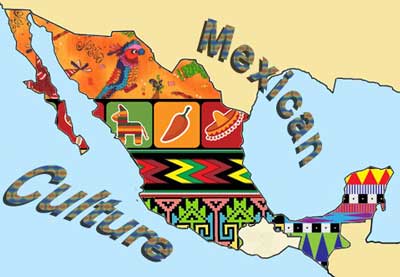
 

Share this post:
, ,
[Top]

‘To Live and Die in L.A.’ …

Go Lean Commentary

CU Blog - 'To Live and Die in L.A.' - Photo 1b

“… live so fast and die so young…”
“… it’s like a jungle, sometimes it makes me wonder how I keep from going under…” – Rap Song: The Message – Grandmaster Flash & The Furious Five

Considering the edict of “life imitating art and art imitating life”, this has always been a subject of sharp debate and contrast. Is it better to live “fast & furious”, even though there might be a shorter mortality, or is it better to go slow and last longer, as far away from risky propositions as possible?

Shockingly, this is also a Caribbean debate: is it better to emigrate to L.A., New York, Miami, Toronto, London, Paris or any other foreign destination for faster success, or prosper where planted in the Caribbean homeland?

From an American perspective, this debate is best personified with a comparison of California versus the rest of the US. Los Angeles (L.A.) is the principal metropolis of the State of California and all of the West Coast for that matter.

But this debate is bigger than just a consideration of L.A. or California – see Appendix below – it spans the test of time. Even ancient philosopher Aesop presented this dilemma in the fable of “The Tortoise and The Hare”, in which the nimble jack-rabbit lost out to the slow-and-methodical tortoise in a race – this fable is universally accepted as a metaphor for the race of life.

Poets, songwriters, historians, and philosophers have all chimed in on this profound debate. Some claim that it is better to “live large”, make the “world your oyster”, even if that means having a short lifespan than to live a quiet ignoble life where the joys of life are rationed out for longevity instead.

Whenever a celebrity dies young, this debate rages anew. Consider some of the philosophical headlines:

The book Go Lean … Caribbean discusses this contrast; it draws reference to the American Dream versus the California Dream. Consider this excerpt from Page 223:

The Bottom Line on the American Dream
The American Dream is a national ethos of the United States, a set of ideals in which freedom includes the opportunity for prosperity and success, and an upward social mobility achieved through hard work. This idea of the American Dream is rooted in the US Declaration of Independence which proclaims that “all men are created equal… endowed by their Creator with certain inalienable rights” including “Life, Liberty and the pursuit of Happiness.” The meaning of the “American Dream” has changed over history, and includes components as home-ownership and upward mobility. A lot of people followed the American Dream to achieve a greater chance of becoming rich. For example, the discovery of gold in California in 1849 brought in 100,000 men looking for their fortune overnight—and a few did find it. Thus was born the California Dream of instant success. Historian H. W. Brands noted that in the years after the Gold Rush, the California Dream spread across the nation:

  • “The old American Dream … was the dream of the Puritans, of Benjamin Franklin’s “Poor Richard” … of men and women content to accumulate their modest fortunes a little at a time, year by year by year. The new dream was the dream of instant wealth, won in a twinkling by audacity and good luck. [This] golden dream . . . became a prominent part of the American psyche”. Today, some posit that the ease of achieving this Dream changes with technological advances, available infrastructure, regulations, state of the economy, and the evolving cultural values of the US demographics.

The Go Lean book serves as a roadmap to introduce the technocratic Caribbean Union Trade Federation (CU) to elevate the region’s societal engines – economics, homeland security and governance – of the 30 Caribbean member-states. In fact, the prime directives of the roadmap includes the following 3 statements:

  • Optimization of the economic engines in order to grow the regional economy to $800 Billion & create 2.2 million new jobs.
  • Establishment of a security apparatus to ensure public safety and protect the resultant economic engines.
  • Improve Caribbean governance for all people, even visiting tourists, to support these engines.

CU Blog - 'To Live and Die in L.A.' - Photo 2The quest is to minimize the paradox of future-planning/decision-making for Caribbean citizens. We want to make the Caribbean region better places to live, work and play; this way our citizens would not have to leave … to ‘live and die in L.A., or NYC, or Miami, or any other American, Canadian or European city. The truth of the matter is people die more readily in America due to gun-violence, and automobile accidents than they die in the Caribbean.

No doubt!

  • Visualizing gun deaths: Comparing the U.S. to rest of the world
    Whenever a mass shooting occurs, a debate about gun violence ensues. An often-cited counter to the point about the United States’ high rates of gun homicides is that people in other countries kill one another at the same rate using different types of weapons. It’s not true.
    Compared to other countries with similar levels of development or socioeconomic status, the United States has exceptional homicide rates, and it’s driven by gun violence.
    CU Blog - 'To Live and Die in L.A.' - Photo 3
    Another issue that gets less attention is how many people die from firearms accidentally. Again, the U.S. has much higher rates of unintentional death from firearms compared to other countries.
    CU Blog - 'To Live and Die in L.A.' - Photo 4
  • U.S. has highest car crash death rate, despite progress, CDC says
    More people die in car crashes each year in the United States than in other high-income countries, the Centers for Disease Control and Prevention said in a report …
    In 2013, more than 32,000 people died on U.S. roads, roughly 90 fatalities a day, according to the CDC.
    The U.S. has seen a 31% reduction in its motor vehicle death rate per capita over the past 13 years. But compared with 19 other wealthy countries, which have declined an average of 56% during the same period, the U.S. has the slowest decrease.

A previous Go Lean blog-commentary highlighted other statistics of premature deaths (and disability) in the US due to societal defects:

But the truth is a two-sided coin …

… on the flipside, life in America is more prosperous than in any Caribbean member-state.

The Go Lean book introduces the Caribbean Union Trade Federation (CU) as an inter-governmental agency for the 30 member-states, to provide a better – technocratic – stewardship for Caribbean life, to make it more prosperous … at home. The book identifies that we have a crisis – our failing societal engines – but asserts that this crisis would be a terrible thing to waste. We can use the urgency to introduce and implement effective community ethos, strategies, tactics, implementations and advocacies to reboot, reform and transform the engines of Caribbean society.

We do not want our people to ‘live and die in L.A. …’. We want them to prosper right here in the Caribbean. How sad when our families do move to the US (and other countries) and fall victim to fatalities. Consider these headlines:

There are good and bad people everywhere. Bad things happen to good people … everywhere. The Bible declares that “time and unforeseen occurrences befall us all” (Ecclesiastes 9:11). Yet still, post-mortem analyses (crash investigations and autopsies) are always necessary to ascertain the root-causes and the lessons-learned:

What could have been done to prevent the loss of life?

This commentary is not asserting that Caribbean people will not be hurt if they remain in the Caribbean. There are car accidents, murders, robberies, rapes and other assaults in the 30 member-states as well.

But follow the numbers!

We are not #1 for either gun violence or auto deaths, like our American counterparts. This is just a matter odds, probabilities and trends; the preponderance for fatalities cannot be ignored.

The Go Lean book contends that as a people, we must be prepared for accidents, emergencies and security risks (Page 196). It asserts that bad actors will emerge just as a result of economic successes in the region. This point is pronounced early in the book with the Declaration of Interdependence (Page 12) that claims:

x. Whereas we are surrounded and allied to nations of larger proportions in land mass, populations, and treasuries, elements in their societies may have ill-intent in their pursuits, at the expense of the safety and security of our citizens. We must therefore appoint “new guards” to ensure our public safety and threats against our society, both domestic and foreign. The Federation must employ the latest advances and best practices … to assuage continuous threats against public safety.

xvi. Whereas security of our homeland is inextricably linked to prosperity of the homeland, the economic and security interest of the region needs to be aligned under the same governance. Since economic crimes, including piracy and other forms of terrorism, can imperil the functioning of the wheels of commerce for all the citizenry, the accedence of this Federation must equip the security apparatus with the tools and techniques for predictive and proactive interdictions.

There is this expression of wisdom, commonly referred to as the Serenity Prayer; it is a prayer written by the American theologian Reinhold Niebuhr[1][2] (1892–1971). The best-known form is:

  • God, grant me the serenity to accept the things I cannot change,
  • Courage to change the things I can,
  • And wisdom to know the difference.

The Go Lean book describes the need for the Caribbean to appoint “new guards” to apply this wisdom – to change the things we can change. The purpose of this security pact is to ensure public safety as a comprehensive endeavor, encapsulating the needs of all Caribbean stakeholders: residents and visitors alike.

We cannot impact Los Angeles, the US or any other foreign city, more than messaging to our Diaspora there. But we can forge change in our Caribbean homeland.

Applying the edict of “life imitating art and art imitating life”, let’s ‘live and die’ here in the Caribbean. Let’s apply the wisdom from the fictional character Spock (the Vulcan Commander on the TV Show/films Star Trek):

May we live long and prosper.

Now is the time for all of the Caribbean – the people and leaders – to lean-in for the empowerments described here in the book Go Lean…Caribbean. It is conceivable, believable and achievable to prosper where planted here in the region; to make the Caribbean a better place to live, work and play. 🙂

Download the free e-book of Go Lean … Caribbean – now!

Sign the petition to lean-in for the roadmap for the Caribbean Union Trade Federation.
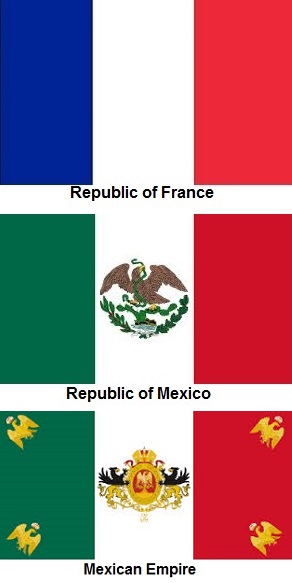
————-
Appendix Review – Book/Movie: To Live and Die in L.A.

Sub-title: A 1984 novel by former Secret Service agent Gerald Petievich is the basis for the 1985 movie of the same name.

CU Blog - 'To Live and Die in L.A.' - Photo 1

A harrowing tale of the dark underside of America’s West Coast metropolis. Two U.S. Treasury agents, partners and antagonists, are drawn into a matrix of violence and corruption, southern California-style, that becomes a journey through a sunlit hell – at the end of which they become experts on the thin line between what it takes to live – and die – in L.A. – Source: Retrieved 04-10-2017 from: https://www.amazon.com/Live-Die-L-A-Gerald-Petievich/dp/1466219645

The action thriller film was directed by William Friedkin and based on the novel by Petievich, and co-written by the both men. The film features William Petersen, Willem Dafoe and John Pankow among others. The film tells the story of the lengths to which two Secret Service agents go to arrest a counterfeiter. – Source: Retrieved 04-10-2017 from: https://en.wikipedia.org/wiki/To_Live_and_Die_in_L.A._(film)

See Trailer in the Appendix VIDEO below.

Storyline
Working largely in cases of counterfeiting, L.A. based Secret Service agent Richie Chance exhibits reckless behavior which according to his longtime and now former partner Jimmy Hart will probably land him in the morgue before he’s ready to retire. That need for the thrill manifests itself in his personal life by his love of base jumping. Professionally, it is demonstrated by the fact that he is sextorting a parolee named Ruth Lanier, who feeds him information in return for him not sending her back to prison for some trumped up parole violation. With his new partner John Vukovich, Chance is more determined than ever, based on recent circumstances, to nab known longtime counterfeiter Ric Masters, who is more than willing to use violence against and kill anyone who crosses him. Masters is well aware that the Secret Service is after him. Masters’ operation is somewhat outwardly in disarray, with Chance being able to nab his mule, Carl Cody, in the course of moving some of the fake money , and one of his associates, a lawyer named Max Waxman, probably stealing money from him. Partly with information from Ruth, Chance is trying to find and exploit the weaknesses in Masters’ operation. To accomplish his goal, Chance takes more and more unethical and illegal measures, which may be problematic for Vukovich, who comes from a family of police officers who are sworn to uphold the law. Written by Huggo

————-
VIDEO – To Live and Die in L.A. – http://www.imdb.com/videoplayer/vi1755645209

A fearless Secret Service agent will stop at nothing to bring down the counterfeiter who killed his partner.

Stars: William Petersen, Willem Dafoe, John Pankow


Share this post:
, ,
[Top]

‘Loose Lips Sink Ships’ – Leaders Undermine Tourism

Go Lean Commentary 

Loose Lips - Photo 2Loose lips sink ships …

… this is an American-English idiom meaning “beware of unguarded talk”. The phrase originated on propaganda posters during World War II.[4]  There are similar expressions in other cultures:

The British equivalent used “Careless Talk Costs Lives“, and variations on the phrase “Keep mum“,[5] while in neutral Sweden the State Information Board promoted the wordplay “en svensk tiger” (the Swedish word “tiger” means both “tiger” and “keeping silent”), and Germany used “Schäm Dich, Schwätzer!” (English: “Shame on you, blabbermouth!”).[6]
Source: Retrieved 04-07-2017 from: https://en.wikipedia.org/wiki/Loose_lips_sink_ships

Despite the land or the language, the thought is the same: Inappropriate talk can undermine societal engines.

Today, there is no war in the Caribbean, but we do have battles. We have trade wars and economic struggles to try and maintain our way of life and to improve it. For so many of our countries, tourism is the primary economic driver – our regional ship – we have to be on guard and aware of any kind of disparaging talk that can undermine the appeal of our destinations.

The United States is suffering the dire consequence of “loose lips sinking ships” right now. The new President – Donald Trump – has made disparaging remarks about certain foreign groups, and then introduced policies that reinforce his disdain for these foreigners.

As a result, more and more foreigners are refusing to come to the US for leisure travel. See the full article here:

Loose Lips - Photo 1

Title: NYC Expects fewer tourists, blames Trump

NYC & Company, New York’s tourism marketing organization, revised its 2017 travel forecast, stating that it expects 300,000 fewer international visitors than last year “in light of the recent travel ban and related rhetoric.”

“These updated figures take into account changing attitudes about travel and access to the U.S. since the previous forecast was announced in October 2016, prior to the new administration,” NYC & Company said in a statement issued on Tuesday. “This is the first drop in visitation since the start of the recession in 2008.”

The city anticipates that domestic visitation will remain strong, projected to increase to 49.3 million visitors this year, which would actually result in an overall visitor increase, from 60.7 million to 61.7 million.

“But, it’s important to note that it takes the spending power of four domestic visitors to equal what a single international visitor spends,” NYC & Company stated.

With the updated forecast, NYC & Company announced a new international communications and marketing campaign titled “New York City — Welcoming the World.” Beginning in March, the campaign will feature outdoor media valued at nearly $3 million targeting international source markets the United Kingdom, Mexico, Germany, and Spain, with more markets pending. International partners, including tour operators and airlines, are expected to help further the effort through their own channels and assets.

“The goal of the campaign is to reassure international travelers who may feel deterred about traveling to the U.S. and ensure them that New York City’s experiences and values remain the same and all are welcome,” the destination marketing organization stated.

The revised 2017 travel forecast was produced by the organization’s longtime data provider, Tourism Economics, an Oxford Economics Company.

USA
Interest in travel to the US has “fallen off a cliff” since Donald Trump’s election, according to travel companies who have reported a significant drop in flight searches and bookings since his inauguration and controversial travel ban.

Data released this week by travel search engine Kayak reported a 58% decline in searches for flights to Tampa and Orlando from the UK, and a 52% decline in searches for Miami. Searches for San Diego were also down 43%, Las Vegas by 36% and Los Angeles 32%.

Though flight prices are holding firm (they usually take weeks rather than days to adjust to consumer trends), Kayak has identified a knock-on effect on average hotel prices. It found prices in Las Vegas are down by 39% and New York City by 32%.
Source: Travel Trade Outbound Scandinavia; posted 03/05/2017; retrieved 04/07/2017 from: http://www.ttoscandinavia.com/expects-fewer-tourists-blames-trump/

————

See the related VIDEO in the Appendix below.

Nobody wants to spend their money in a place where they are not welcomed.

This lesson must be learned in the Caribbean. We have the same threats afoot. Unlike the US, who has the leverage and surety of “richest Single Market economy in the world” to absorb the fall, the Caribbean member-states are mostly Third World and failing. This movement has previous detailed how societal deficiency has resulted in a Brain Drain among the educated classes in the Caribbean homeland – all due to “push and pull” reasons. Yet, some leaders – Christian pastors in this case – have proclaimed, in a signed petition to this new American President, a heightened level of disdain for certain American tourists. They are protesting the US Human Rights agenda to seek relief for Caribbean populations with affinity for persons ascribing to the Lesbian, Gay, Bisexual and Trans-Gender (LGBT) lifestyles.

Rather than love and leisure … in the Caribbean, these community leaders are projecting “a climate of hate”.

So sad!

See the details on the signed petition in the Appendix below; advocating against liberal LGBT policies.

In general, neutralizing the anti-LGBT attitudes has been an ongoing theme for the movement behind the book Go Lean … Caribbean. The book presents the Caribbean region a roadmap to elevate all societal engines, including economics, homeland security and governance. In fact, the prime directives of the roadmap includes the following 3 statements:

  • Optimization of the economic engines in order to grow the regional economy to $800 Billion & create 2.2 million new jobs.
  • Establishment of a security apparatus to ensure public safety for all and protect the resultant economic engines.
  • Improve Caribbean governance for all people, even minority groups, to support these economic and security engines.

The Go Lean book introduces the Caribbean Union Trade Federation (CU) as an intergovernmental agency for 30 regional member-states, to provide a better – technocratic – stewardship for the regional economy.

But we need all community stakeholders to “not sink ships” with their unbridled hatred and disdain for people who may look, act and speak differently than them.

This is the hallmark of hospitality! See the full definition of “hospitality” here:

Etymology
Derives from the Latin hospes,[5] meaning “host”, “guest”, or “stranger”. Hospes is formed from hostis, which means “stranger” or “enemy” (the latter being where terms like “hostile” derive). By metonymy the Latin word ‘Hospital’ means a guest-chamber, guest’s lodging, an inn.[6] Hospes is thus the root for the English words “host” (where the p was dropped for convenience of pronunciation), hospitality, hospice, hostel and hotel.

Historical practice
In ancient cultures hospitality involved welcoming the stranger and offering him food, shelter, and safety.[7]
Source: Retrieved April 7, 2017 from https://en.wikipedia.org/wiki/Hospitality.

The Art and Science of Tourism – especially for American visitors – is very important to Caribbean communities. The related industrial activities bind all societal engines together. The Go Lean book explains (Page 190) that many enhancements are to be implemented under this roadmap:

10 Ways to Improve Tourism – Page 190

1 Lean-in for the CU to leverage a regional footprint for tourism promotion and infrastructure. The full scale of 30 member-states and 42 million people allows for expanded trade treaties with other countries and regional blocs to target markets and languages.
2 Special Festival Events
3 Fairgrounds/Amusement Parks Empowerment Zones
4 Dynamic Sea-lifts / Air lifts
5 Excess Inventory Auction
6 Medical Tourism
7 Eco-Tourism Promotions Board
8 Sports Tourism
9 Cruise Line Passenger Smart Card Currency
10 Tourist Hate Crime Sentence ExtenderAny crime against a tourist gets a “hate” crime designation that results in extended sentences. These types of crimes (petty misdemeanors to felonies like kidnapping) come under the category of economic crimes that are marshaled by the CU. (The 2005 Aruba case of Natalee Holloway shows the need for heightened attention. The investigation escalated to the Dutch National Police and the US FBI, but only after devastating effects on tourism bookings, for subsequent years).

Overall, the Go Lean book stresses the community ethos, strategies, tactics, implementations and advocacies to reboot, reform and transform the economic engines of Caribbean society.

There are a lot of new jobs that are at stake with the successful implementation of this Go Lean/CU roadmap. How many are projected?

In general the roadmap projects 2.2 million new jobs across the 30 Caribbean member states. But for the Tourism-related industries, the plan calls for:

Tourism – New markets, opening new opportunities and new traffic; sharing  –  30,000

Cruise Tourism – Jobs from increased functionality of e-Payments of cruise passengers  –  800

Events Tourism – Festivals and other event staff at CU Fairgrounds – 9,000

Fairgrounds – Direct & in-direct maintenance/support jobs at CU Fairgrounds – 10,000

World Heritage Sites/Eco-Tourism – Direct and indirect jobs for managing, promoting UNESCO sites   – 1,000

In total, the projection is for 50,800 new tourism-related jobs. This constitutes the “ship” that community leaders can “sink” with their “loose lips”.

The Go Lean book asserts that to thrive in the new global marketplace there must be an agile technocratic administration for the region’s tourism eco-systems; it will affect all aspects of Caribbean life. This comprehensive view – economics, security and governance – is the charge of the Go Lean roadmap, opening with these pronouncements in the Declaration of Interdependence (Page 11 – 13):

iv. Whereas the natural formation of the landmass is in a tropical region, the flora and fauna allows for an inherent beauty that is enviable to peoples near and far. The structures must be strenuously guarded to protect and promote sustainable systems of commerce paramount to this reality.

xii. Whereas the legacy in recent times in individual states may be that of ineffectual governance with no redress to higher authority, the accedence of this Federation will ensure accountability and escalation of the human and civil rights of the people for good governance, justice assurances, due process and the rule of law. As such, any threats of a “failed state” status for any member state must enact emergency measures on behalf of the Federation to protect the human, civil and property rights of the citizens, residents, allies, trading partners, and visitors of the affected member state and the Federation as a whole.

xxiv. Whereas a free market economy can be induced and spurred for continuous progress, the Federation must install the controls to better manage aspects of the economy: jobs, inflation, savings rate, investments and other economic principles. Thereby attracting direct foreign investment because of the stability and vibrancy of our economy.

The points of effective, technocratic stewardship of tourism were further elaborated upon in previous blog/commentaries. Consider this sample:

https://goleancaribbean.com/blog/?p=11208 Bahamas flawed model for Event Tourism – Junkanoo Carnival
https://goleancaribbean.com/blog/?p=11033 Dominican Republic’s flawed model for Medical Tourism
https://goleancaribbean.com/blog/?p=10585 Two Pies: Economic Plan for a New Caribbean
https://goleancaribbean.com/blog/?p=7977 Transformations: Perfecting Our Core Competence
https://goleancaribbean.com/blog/?p=7834 Martinique: Model for Sports Tourism
https://goleancaribbean.com/blog/?p=7628 ‘Make happy those who are near, and those who are far will come’
https://goleancaribbean.com/blog/?p=7327 Zika – A 4-Letter Word for Caribbean Tourism
https://goleancaribbean.com/blog/?p=7082 The Art and Science of ‘Play’
https://goleancaribbean.com/blog/?p=7034 The Future of Money for Tourism Commerce
https://goleancaribbean.com/blog/?p=6385 Wi-Fi Hot Spots Run By Hackers Are Targeting Tourists
https://goleancaribbean.com/blog/?p=6341 Tourism Commerce Administration and Coordination
https://goleancaribbean.com/blog/?p=5307 Crime Warnings for a Tourists to a Caribbean Member-State
https://goleancaribbean.com/blog/?p=5210 Cruise Ship Commerce – Getting Ready for Change
https://goleancaribbean.com/blog/?p=4145 Model of Monument and Eco-Tourism
https://goleancaribbean.com/blog/?p=4058 Bad Image in New York Times Hurts Caribbean Tourism
https://goleancaribbean.com/blog/?p=3225 Caribbean less competitive due to increasing aviation taxes
https://goleancaribbean.com/blog/?p=1984 Casinos Changing/Failing Business Model
https://goleancaribbean.com/blog/?p=235 Tourism’s changing profile

In a previous blog-commentary, the dynamic of Christian leadership in the Caribbean was fully explored:

Religious orthodoxy is responsible for a lot of harm in the world, and in the Caribbean. The Go Lean movement (book and blogs) have identified the foregoing defects, many bad values, attitudes and community ethos. The Caribbean region needs to desist and make amends of these practices. We need to pursue an alternative ethos, the Greater Good. The book defines this (Page 37) as follows:

    “It is the greatest good to the greatest number of people which is the measure of right and wrong”. –  Jeremy Bentham (1748-1832)

The Go Lean book (Page 20) and movement advocates the community ethos of the Greater Good for all of the Caribbean. The movement wants to help reform and transform the Caribbean. We see the defects; we recognize that status quo, including the root causes and orthodoxy of many of our influences; we perceive the harmful effects. Still, we don’t want to ban religion; we simply want a clear ‘Separation of Church and State’, because … we must not favor any one religion.

A “Separation of Church and State” is the standard in the advanced democracies; this is now embedded in the implied Social Contract. The Go Lean book defines (Page 170) the Social Contract as follows:

    “Citizens surrender some of their freedoms and submit to the authority of the State in exchange for protection of remaining natural and legal rights”.

The movement behind the Go Lean book hereby makes this urging to the Caribbean Pastors who signed the below petition to President Trump:

We urge you to follow the mandates of your founder and leader, Jesus Christ, when he urged the Apostle Simon-Peter:

  • Jesus asked a second time, “Simon son of John, do you love Me?” “Yes, Lord,” he answered, “You know I love You.” Jesus told him, “Shepherd My sheep”. – June 21:16 Berean Study Bible 

You are hereby admonished to support your flock that is in your care … and leave Foreign Policy alone. Your “going beyond the things that are written” actually hurts your flock by undermining their economic interests. Please, please “stay in your lane”.

Learn lessons from the  bad example of Donald Trump and American tourism … in the foregoing.

Now is the time for all of the Caribbean – the people and leaders – to lean-in for the empowerments described here-in and in the book Go Lean … Caribbean. This is about jobs and community welfare today and more so tomorrow; we need better engines to make our region more prosperous. We can elevate our communities and our tourism!

It is conceivable, believable and achievable to make the Caribbean a better place to live, work and play. 🙂

Sign the petition to lean-in for the roadmap for the Caribbean Union Trade Federation.
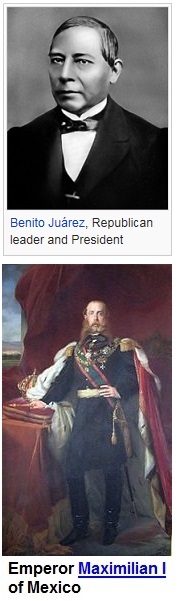
Download the free e-book of Go Lean … Caribbean – now!

———–

Appendix – Petition Letter to President Trump

Loose Lips - Photo 3

Click on the Photo to Enlarge

The full letter and petition signatures can be viewed here:

https://world.wng.org/sites/default/files/assets/Caribbean%20church%20leaders%20letter%20to%20President%20Trump.pdf

———–

Appendix VIDEO – Tourists Avoiding USA Because Of Donald Trump, Costing Us Billions – https://youtu.be/kHD73jSM5Rs

Published on Apr 3, 2017 – Experts had predicted that Trump’s Muslim Ban would cost the United States tons of money in declining tourism, but what they didn’t count on were the number of people who refuse to travel to the U.S. just because Trump is the new president.  As it turns out, nobody wants to visit a country that is ruled by a hatemonger, and analysts are now referring to the decline in travel to the U.S. as the “Trump Slump.” Ring of Fire’s Farron Cousins discusses this.
Link – https://www.salon.com/2017/03/31/trum…

Spread the word! LIKE and SHARE this video or leave a comment to help direct attention to the stories that matter. And SUBSCRIBE to stay connected with Ring of Fire’s video content!

Watch America’s Lawyer featuring Mike Papantonio on RT: https://www.rt.com/shows/americas-law…

Order Mike Papantonio’s novel Law and Disorder today: https://www.amazon.com/Law-Disorder-M…

Follow more of our stories at http://www.TROFIRE.com

Subscribe to our podcast: http://www.ROFPodcast.com

Support Ring of Fire by subscribing to our YouTube channel: https://www.youtube.com/user/golefttv…

Be sociable! Follow us on:
Facebook: http://www.facebook.com/RingofFireRadio
Twitter: http://www.twitter.com/RingofFireRadio
Google+: http://plus.google.com/11841583157319…
Instagram: https://www.instagram.com/ringoffiren…

Share this post:
, ,
[Top]