Nassau, Bahamas – This is a re-distribution of the blog-commentary published on August 31, 2015, now that the movie has been released on Christmas Day. The movie is in fact all that it purported to be.
Go Lean Commentary
“Are you ready for some football?” – Promotional song by Hank Williams, Jr. for Monday Night Football on ABC & ESPN networks for 22 years (1989 – 2011).
This iconic song (see Appendix) and catch-phrase is reflective of exactly how popular the National Football League (NFL) is in the US:
“They own an entire day of the week”.
So says the new movie ‘Concussions’, starring Will Smith, referring to the media domination of NFL Football on Sundays during the Autumn season. The movie’s script is along a line that resonates well in Hollywood’s Academy Award balloting: “David versus Goliath”; “a small man speaking truth to power”.
In the case of the NFL, it is not just about power, it is about money, prestige and protecting the status quo; the NFL is responsible for the livelihood of so many people. The book Go Lean … Caribbean recognized the importance of the NFL in the American lexicon of “live, work and play”; it featured a case study (Page 32) of the NFL and it’s collective bargaining successes (and failures) in 2011. An excerpt from the book is quoted as follows:
Football is big business in the US, $9 billion in revenue, and more than a business; emotions – civic pride, rivalries, and fanaticism – run high on both sides.
Previous Go Lean commentaries presents the socio-economic realities of much of the American football eco-system. Consider a sample here:
While football plays a big role in American life, so do movies. Their role is more unique; they are able to change society. In a previous blog / commentary regarding Caribbean Diaspora member and Hollywood great, Sidney Poitier, it was declared that …
“Movies are an amazing business model. People give money to spend a couple of hours watching someone else’s creation and then leave the theater with nothing to show for the investment; except perhaps a different perspective”.
Yes, movies help us to glean a better view of ourselves … and our failings; and many times, show us a way-forward.
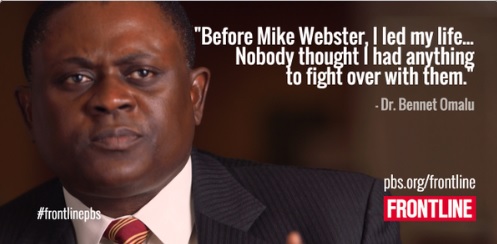
These descriptors actually describe the latest production from Hollywood icon Will Smith (the former Fresh Prince of Bel-Air). This movie, the film “Concussion”, in the following news article, relates the real life drama of one man, Dr. Bennet Omalu, a Nigerian-born medical doctor – a pathologist – who prepared autopsies of former players that suffered from football-related concussions. He did not buckle under the acute pressure to maintain the status quo, and now, he is celebrated for forging change in his adopted homeland. This one man made a difference. (The NFL is now credited for a Concussion awareness and prevention protocol so advanced that other levels of the sport – college, high schools and Youth – are being urged to emulate).
See news article here on the release of the movie:
Title: ‘Concussion’: 5 Take-a-ways From Will Smith’s New Film
Will Smith, 46, is definitely going to get a ton of Oscar buzz portraying Dr. Bennet Omalu in the new film “Concussion.” NFL columnist Peter King of Sports Illustrated got an exclusive first peek at the trailer and it has been widely shared on social media since. And it’s very chilling.
Here are five take-aways and background you need to know before checking out the clip:
1 – It’s Based on a True Story
Omalu is the forensic pathologist and neuropathologist who discovered chronic traumatic encephalopathy in football players who got hit in the head over and over again, according to the Washington Post.
In the clip, he says repetitive “head trauma chokes the brain.”
Omalu was one of the founding members of the Brain Injury Research Institute in 2002. He conducted the autopsy of Pittsburgh Steelers center Mike Webster, played by David Morse in the film, which led to this discovery.
2 – Smith’s Version of Omalu’s Accent Is Spot On
Omalu is from Nigeria and Smith has been known to transform completely for a role. He was nominated for an Oscar for 2011’s “Ali,” playing the legendary Muhammad Ali.
For comparison, here’s Omalu’s PBS interview from 2013.
3 – Smith Is a Reluctant Hero
“If you don’t speak for them, who will,” Gugu Mbatha-Raw, who plays Prema Mutiso in the film, tells Smith’s character.
He admits he idolized America growing up and “was the wrong person to have discovered this.”
“Concussion” brought in some heavyweights for this movie. Baldwin plays Dr. Julian Bailes, who advises Omalu, and Wilson, who will reportedly play NFL Commissioner Roger Goodell, according to IMDB. There’s no official word on this. He’s seen at a podium in the trailer, but doesn’t speak.
5 – “Tell the Truth”
Smith captures Omalu’s passion to have the truth told about this injury and disease.
“I was afraid of letting Mike [Webster] down. I was afraid. I don’t know. I was afraid I was going to fail,” Omalu told PBS a couple years back.
Will Smith stars in the incredible true David vs. Goliath story of Dr. Bennet Omalu, the brilliant forensic neuropathologist who made the first discovery of CTE, a football-related brain trauma, in a pro player.
The subject of concussions is serious – life and death. Just a few weeks ago (August 8), an NFL Hall-of-Fame inductee was honored for his play on the field during his 20-year professional career, but his family, his daughter in particular, is the one that made his acceptance / induction speech. He had died, in 2012; he committed suicide after apparently suffering from a brain disorder – chronic traumatic encephalopathy (CTE), a type of chronic brain damage that has also been found in other deceased former NFL players[4] – sustained from his years of brutal head contacts in organized football in high school, college and in his NFL career. This player was Junior Seau.
Why would there be a need for “David versus Goliath”; “a small man speaking truth to power”? Is not the actuality of an acclaimed football player committing suicide in this manner – he shot himself in the chest so as to preserve his brain for research – telling enough to drive home the message for reform?
No. Hardly. As previously discussed, there is too much money at stake.
These stakes bring out the Crony-capitalism in American society.
The book Go Lean…Caribbean (and subsequent blog/commentaries) relates many examples of cronyism in the American eco-system. There is a lot of money at stake. Those who want to preserve the status quo or not invest in the required mitigations to remediate concussions will fight back against any Advocate promoting the Greater Good. The profit motive is powerful. There are doubters and those who want to spurn doubt. “Concussions in Football”is not the first issue these “actors” have promoted doubt on. The efforts to downplay concussion alarmists are from a familiar playbook, used previously by Climate Change deniers, Big Tobacco, Toxic Waste, Acid Rain, and other dangerous chemicals.
This Go Lean book serves as a roadmap for the introduction and implementation of the technocratic Caribbean Union Trade Federation (CU). Sports are integral to the Go Lean/CU roadmap. While sports can be good and promote positives in society, even economically, the safety issues must be addressed upfront. This is a matter of community security. Thusly, the prime directives of the CU are described as:
Optimize the economic engines of the Caribbean to elevate the regional economy to grow to $800 Billion and create 2.2 million new jobs, including sports-related industries with a projection of 21,000 direct jobs at Fairgrounds and sports enterprises.
Establish a security apparatus to protect the people and economic engines.
Improvement of Caribbean governance to support these economic and security engines.
The CU/Go Lean sports mission is to harness the individual abilities of athletes to not just elevate their performance, but also to harness the economic impact for their communities. So modern sports endeavors cannot be analyzed without considering the impact on “dollars and cents” for stakeholders. This is a fact and should never be ignored. There is therefore the need to carefully assess and be on guard for crony-capitalistic influences entering the decision-making of sports stakeholders. The Go Lean book posits that with the emergence of new economic engines, “bad actors” will also emerge thereafter to exploit the opportunities, with good, bad and evil intent”. These points were pronounced early in the opening Declaration of Interdependence (Page 12 &14):
x. Whereas we are surrounded and allied to nations of larger proportions in land mass, populations, and treasuries, elements in their societies may have ill-intent in their pursuits, at the expense of the safety and security of our citizens. We must therefore appoint “new guards” to ensure our public safety and threats against our society, both domestic and foreign. The Federation must employ the latest advances and best practices of criminology and penology to assuage continuous threats against public safety. …
xi. Whereas all men are entitled to the benefits of good governance in a free society, “new guards” must be enacted to dissuade the emergence of incompetence, corruption, nepotism and cronyism at the peril of the people’s best interest. The Federation must guarantee the executions of a social contract between government and the governed.
xvi. Whereas security of our homeland is inextricably linked to prosperity of the homeland, the economic and security interests of the region needs to be aligned under the same governance. Since economic crimes … can imperil the functioning of the wheels of commerce for all the citizenry, the accedence of this Federation must equip the security apparatus with the tools and techniques for predictive and proactive interdictions.
xxxi. Whereas sports have been a source of great pride for the Caribbean region, the economic returns from these ventures have not been evenly distributed as in other societies. The Federation must therefore facilitate the eco-systems and vertical industries of sports as a business, recreation, national pastime and even sports tourism …
The Go Lean book envisions the CU – a confederation of the 30 member-states of the Caribbean chartered to do the heavy-lifting of empowering and elevating the Caribbean economy – as the landlord of many sports facilities (within the Self-Governing Entities design), and the regulator for inter-state sport federations. The book details the economic principles and community ethos to adopt, plus the executions of strategies, tactics, implementations and advocacies to optimize sports enterprises in the Caribbean:
Community Ethos – Deferred Gratification
Page 21
Economic Principles – People Respond to Incentives in Predictable Ways
Page 21
Economic Principles – Economic Systems Influence Individual Choices / Incentives
Page 21
Economic Principles – The Consequences of Choices Lie in the Future
Page 21
Economic Principles – Job Multiplier
Page 22
Community Ethos – Security Principles – Whistleblower Protection
Page 23
Community Ethos – Security Principles – Light-Up the Dark Places
Page 23
Community Ethos – Security Principles – “Crap” Happens
Page 23
Community Ethos – Governing Principles – Lean Operations
Page 24
Community Ethos – Ways to Impact the Future
Page 26
Community Ethos – Ways to Promote Happiness – Mitigate Suicide Threats
Page 36
Community Ethos – Impact the Greater Good
Page 37
Strategy – Vision – Confederating 30 Member-States into a Single Market
Page 45
Strategy – Vision – Foster Local Economic Engines for Basic Needs
Page 45
Strategy – Mission – Prepare for Natural Disasters
Page 45
Strategic – Staffing – Sporting Events at Fairgrounds
Page 55
Strategy – Agents of Change – Climate Change
Page 57
Strategy – Agents of Change – Globalization
Page 57
Tactical – Confederating a Permanent Union
Page 63
Tactical – Fostering a Technocracy
Page 64
Tactical – Separation of Powers – Sports & Culture Administration
Page 81
Tactical – Separation of Powers – Fairgrounds Administration
Page 83
Tactical – Separation of Powers – Health Department – Disease Management
Page 86
Implementation – Assemble Regional Organs into a Single Market Economy
Page 96
Implementation – Steps to Implement Self-Governing Entities – Sports Stadia
Page 105
Implementation – Security Initiatives at Start-up – Unified Command & Control
Page 103
Implementation – Industrial Policy for CU Self Governing Entities
Page 103
Implementation – Ways to Deliver – Project Management/Accountabilities
Page 109
Anatomy of Advocacies – Examples of Individuals Who Made Impact
Page 122
Planning – Ways to Make the Caribbean Better
Page 131
Advocacy – Ways to Grow the Economy
Page 151
Advocacy – Ways to Create Jobs
Page 152
Advocacy – Ways to Improve Governance
Page 168
Advocacy – Ways to Better Manage the Social Contract
Page 170
Advocacy – Ways to Promote Fairgrounds
Page 192
Advocacy – Ways to Improve Emergency Management – Trauma Arts & Sciences
Page 196
Advocacy – Ways to Improve Sports
Page 229
Advocacy – Ways to Impact Urban Living – Sports Leagues
Page 234
The Go Lean book and accompanying blogs declare that the Caribbean needs to learn lessons from other communities, especially when big money is involved in pursuits like sports. These activities should be beneficial to health, not detrimental. So the admonition is to be “on guard” against the “cronies”; they will always try to sacrifice public policy – the Greater Good – for private gain: profit.
The design of Self-Governing Entities allow for greater protections from Crony-Capitalistic abuses. While this roadmap is committed to availing the economic opportunities of sports and accompanying infrastructure, as demonstrated in the foregoing movie trailer, sport teams and owners can be plutocratic “animals” in their greed. We must learn to mitigate plutocratic abuses. While an optimized eco-system is good, there is always the need for an Advocate, one person to step up, blow the whistle and transform society. The Go Lean roadmap encourages these role models.
Bravo Dr. Bennet Omalu. Thank you for this example … and for being a role model for all of the Caribbean.
RIP Junior Seau.
Now is the time for all of the Caribbean, the people and governing institutions, to lean-in for the empowerments described in the book Go Lean … Caribbean. This roadmap will result in more positive socio-economic changes throughout the region; it will make the Caribbean a better place to live, work and play. 🙂
In the Caribbean, we need a hero, we need lots of heroes …
… need a hero
I’m holding out for a hero ’til the end of the night
He’s gotta be strong
And he’s gotta be fast
And he’s gotta be fresh from the fight
I need a hero
I’m holding out for a hero ’til the morning light
He’s gotta be sure
And it’s gotta be soon
And he’s gotta be larger than life
(Song by Bonnie Tyler 1984; see VIDEO & Lyrics at https://youtu.be/OBwS66EBUcY; see Appendix)
We must reform and transform our Caribbean society. We know that one person – a hero – can make a difference, and we need to encourage those contributions.
Heroes are not born, they are forged. According to noted Mythologist Joseph Campbell, hero candidates go through a consistent pattern of a journey to become bona-fide heroes.
Who is Joseph Campbell and why does his opinion matter? He is the inspiration behind the big hit movie franchise Star Wars. All things Star Wars are en vogue right now. According to IMDB.com, this movie which opened just days ago – Star Wars Episode 7 “The Force Awakens”; (see Appendix) – had the biggest US box office opening of any movie … ever. See the box office results here in the photo, retrieved December 22, 2015.
This is an amazing feat, considering that Joseph Campbell has been dead since 1987. But Star Wars creator, George Lucas drew his story-line from Joseph Campbell’s inspirations in the cataloging of the “Hero’s Journey” in his writings. See article here:
Title: Role Model Joseph Campbell In 1949 Joseph Campbell (1904-1987) made a big splash in the field of mythology with his book The Hero With a Thousand Faces. This book built on the pioneering work of German anthropologist Adolph Bastian (1826-1905), who first proposed the idea that myths from all over the world seem to be built from the same “elementary ideas.” Swiss psychiatrist Carl Jung (1875-1961) named these elementary ideas “archetypes,” which he believed to be the building blocks not only of the unconscious mind, but of a collective unconscious. In other words, Jung believed that everyone in the world is born with the same basic subconscious model of what a “hero” is, or a “mentor” or a “quest,” and that’s why people who don’t even speak the same language can enjoy the same stories.
Jung developed his idea of archetypes mostly as a way of finding meaning within the dreams and visions of the mentally ill: if a person believes they are being followed by a giant apple pie, it’s difficult to make sense of how to help them. But if the giant apple pie can be understood to represent that person’s shadow, the embodiment of all their fears, then the psychotherapist can help guide them through that fear, just as Yoda guided Luke on Dagoba. If you think of a person as a computer and our bodies as “hardware,” language and culture seem to be the “software.” Deeper still, and apparently common to all homo sapians, is a sort of built-in “operating system” which interprets the world by sorting people, places, things and experiences into archetypes.
Campbell’s contribution was to take this idea of archetypes and use it to map out the common underlying structure behind religion and myth. He proposed this idea in The Hero With a Thousand Faces, which provides examples from cultures throughout history and all over the world. Campbell eloquently demonstrates that all stories are expressions of the same story-pattern, which he named the “Hero’s Journey,” or the “monomyth.” This sounds like a simple idea, but it suggests an incredible ramification, which Campbell summed up with his adage “All religions are true, but none are literal.” That is, he concluded that all religions are really containers for the same essential truth, and the trick is to avoid mistaking the wrappings for the diamond.
[Star Wars Creator George] Lucas had already written two drafts of Star Wars when he rediscovered Joseph Campbell’s The Hero With a Thousand Faces in 1975 (having read it years before in college). This blueprint for “The Hero’s Journey” gave Lucas the focus he needed to draw his sprawling imaginary universe into a single story.
Note that the Wachowski Brothers’ wonderful film The Matrix is carefully built on the same blueprint:
Campbell
Star Wars
The Matrix
I: Departure
The call to adventure
Princess Leia’s message
“Follow the white rabbit”
Refusal of the call
Must help with the harvest
Neo won’t climb out window
Supernatural aid
Obi-wan rescues Luke from sandpeople
Trinity extracts the “bug” from Neo
Crossing the first threshold
Escaping Tatooine
Neo is taken out of the Matrix for the first time
The belly of the whale
Trash compactor
Torture room
II: Initiation
The road of trials
Lightsaber practice
Sparring with Morpheus
The meeting with the goddess
Princess Leia (wears white, in earlier scripts was a “sister” of a mystic order)
The Oracle
Temptation away from the true path1
Luke is tempted by the Dark Side
Cypher (the failed messiah) is tempted by the world of comfortable illusions
Atonement with the Father
Darth and Luke reconcile
Neo rescues and comes to agree (that he’s The One) with his father-figure, Morpheus
Apotheosis (becoming god-like)
Luke becomes a Jedi
Neo becomes The One
The ultimate boon
Death Star destroyed
Humanity’s salvation now within reach
III: Return
Refusal of the return
“Luke, come on!” Luke wants to stay to avenge Obi-Wan
Neo fights agent instead of running
The magic flight
Millennium Falcon
“Jacking in”
Rescue from without
Han saves Luke from Darth
Trinity saves Neo from agents
Crossing the return threshold
Millennium Falcon destroys pursuing TIE fighters
Neo fights Agent Smith
Master of the two worlds
Victory ceremony
Neo’s declares victory over machines in final phone call
But one can argue, these are just movies, “make believe”; these are not real people nor real life. That would be a true statement of facts (there is no “Luke Skywalker” nor “Neo” as historical characters), but the principles of a “Hero’s Journey” is real, and present in real life. This is just another example of “life imitating art”. In a previous blog-commentary regarding Caribbean Diaspora member and Hollywood great, Sidney Poitier, it was declared that …
“Movies are an amazing business model. People give money to spend a couple of hours watching someone else’s creation and then leave the theater with nothing to show for the investment; except perhaps a different perspective”.
These movies do bring a different perspective. According to the foregoing, there are Three Acts to the “Hero’s Journey”:
I. Departure II. Initiation III. Return
The publishers of the book Go Lean…Caribbean recognize the one person can make positive, heroic contributions to his community; and that this role must be forged in society. The book serves asa roadmap for the introduction and implementation of the Caribbean Union Trade Federation (CU). The CU seeks to foster the genius qualifiers in Caribbean citizens. Not everyone can be heroes, but society must be structured to allow heroes to soar. Because …
… one man (or woman) can make a difference! Such a person can impact their community, country … and the whole world.
“The only thing necessary for the triumph of evil is for good men to do nothing” – Edmund Burke; 1729 – 1797; an Irish statesman, member of British Parliament and supporter of the American Revolution.
The Caribbean has fostered the hero process, but according to the Three Acts established by Joseph Campbell, our heroes stopped at Act II, they do not “Return”.
They make their heroic contributions to other communities and not their homeland. The Caribbean, thusly “fattens frogs for snakes”. Consider the bad consequences of this reality, as in our brain drain among the college-educated population, which is up to a 70% rate within the entire region.
A quest of the Go Lean/CU roadmap is to lower the “Push and Pull” factors that causes so many Caribbean citizens to flee their beloved homeland. In addition, another quest is to incentivize the far-flung Diaspora to return to the Caribbean. Success in these quests will take a “Hero’s Journey”.
The villain in this real-life story is the poor performing Caribbean economy. So the prime directive of the Go Lean book is to elevate Caribbean society, and its societal engines … defined in these declarative statements, as follows:
Optimization of the economic engines in order to grow the regional economy and create 2.2 million new jobs.
Establishment of a security apparatus to protect the resultant societal engines again foreign and domestic threats.
Improvement Caribbean governance to support these engines.
The Go Lean book posits that one person, despite their field of endeavor, can make a difference in the Caribbean, and its impact on the world; that there are many opportunities where one advocate, one champion, one “hero” can elevate society. In this light, the book features 144 different advocacies, so there is inspiration for the “next hero” to emerge and excel right here at home in the Caribbean.
The roadmap specifically encourages the region to lean-in, to foster heroes and champions with these specific community ethos, strategies, tactics, implementations and advocacies:
Community Ethos – Forging Change
Page 20
Community Ethos – People Respond to Incentives in Predictable Ways
Page 21
Community Ethos – Economic Systems Influence Individual Choices
Strategy – Mission – Protect Repatriates with heightened Public Safety
Page 45
Anatomy of Advocacies – Examples of Individuals Who Made Impact
Page 122
Planning – Ways to Make the Caribbean Better
Page 131
Advocacy – Ways to Improve Governance
Page 168
Advocacy – Ways to Better Manage the Social Contract
Page 170
Advocacy – Ways to Improve Leadership
Page 171
Advocacy – Ways to Impact Justice
Page 177
Advocacy – Ways to Remediate and Mitigate Crime
Page 178
Advocacy – Ways to Impact Hollywood – Global Box Office – Imitating Life
Page 203
Advocacy – Ways to Preserve Caribbean Heritage
Page 218
Advocacy – Ways to Improve the Arts
Page 230
The Caribbean region wants a more optimized society.
This book posits that “bad actors” – even villains: the “Dark Side of the Force” – will emerge to exploit inefficient economic, security and governing models. Early in the book, the pressing need to streamline protections – for citizens and institutions – was pronounced in the Declaration of Interdependence (Page 12), with these opening statements:
x. Whereas we are surrounded and allied to nations of larger proportions in land mass, populations, and treasuries, elements in their societies may have ill-intent in their pursuits, at the expense of the safety and security of our citizens. We must therefore appoint “new guards” to ensure our public safety and threats against our society, both domestic and foreign.
xi. Whereas all men are entitled to the benefits of good governance in a free society, “new guards” must be enacted to dissuade the emergence of incompetence, corruption, nepotism and cronyism at the peril of the people’s best interest. The Federation must guarantee the executions of a social contract between government and the governed.
xii. Whereas the legacy in recent times in individual states may be that of ineffectual governance with no redress to higher authority, the accedence of this Federation will ensure accountability and escalation of the human and civil rights of the people for good governance, justice assurances, due process and the rule of law. As such, any threats of a “failed state” status for any member state must enact emergency measures on behalf of the Federation to protect the human, civil and property rights of the citizens, residents, allies, trading partners, and visitors of the affected member state and the Federation as a whole.
xvi. Whereas security of our homeland is inextricably linked to prosperity of the homeland, the economic and security interest of the region needs to be aligned under the same governance. Since economic crimes, including … forms of terrorism, can imperil the functioning of the wheels of commerce for all the citizenry, the accedence of this Federation must equip the security apparatus with the tools and techniques for predictive and proactive interdictions.
The Go Lean book explicitly acknowledges that optimizing society is not easy; it requires strenuous, heroic efforts; heavy-lifting. That is the quest of the CU/Go Lean roadmap. Other subjects related to heroic efforts of role models have been blogged in other Go Lean…Caribbean commentaries, as sampled here:
The Go Lean roadmap posits that the CU should foster the genius potential in Caribbean citizens and incubate their potential to maximum production. We should let “heroes be heroes” in their fields of endeavor here at home, no matter how diverse. Many Caribbean Diaspora has done this exactly, abroad in benefiting other communities, while their homelands languish.
They have departed – Act I.
They have initiated as heroes – Act II.
But, they have NOT returned – no Act III.
Enough already!
The roadmap pronounces that we need the participation of many advocates on many different paths for progress. By facilitating, fostering and furthering these initiatives, we can have our heroes return to be heroic at home. Only then, will the Caribbean truly become a better place to live, work and play. 🙂
“If at first you don’t succeed, try and try again” – Old Adage
Keep trying, maybe even up to 21 times.
This is the global experience for the advocacy to arrest greenhouse gases (GHG) in the environment. There have been many conventions and many accords – i.e. Kyoto in 1997 and Copenhagen in 2009 – but they never got the full participation of the world’s major stakeholders.
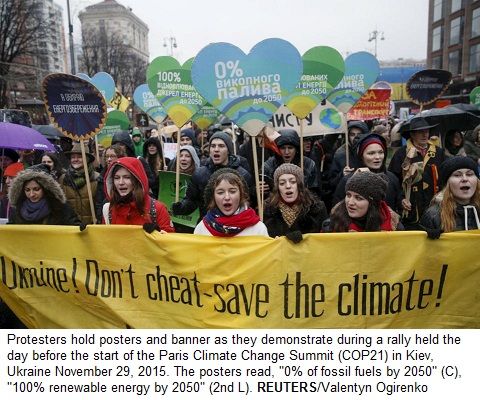
Now, only now at this 21st Conference of the Parties (COP) in Paris, has the accord come to fruition:
This conference had wide participation from rich nations – like big polluters China (#1) and the USA (#2) – and small nations alike; 195 in total. In fact, the requirements of the formal Small Islands Development States (SIDS) were front-and-center among the conference’s agenda. These islands are experiencing real problems from rising sea levels. This is not theory; this is fact! See Appendix relating the “canary in the coal mine” scenario with the Marshall Islands chain in the Pacific Ocean.
Fossil fuels and carbon emission = Climate Change! Acknowledged!
It looks now as if the international agreements to curb fossil fuels / carbon dioxide emissions will finally gain traction. It’s a non-binding agreement, but traction nonetheless. The fact that this agreement is non-binding may not even be an issue as now the “community ethos” has changed. This refers to …
… the fundamental character or spirit of a culture; the underlying sentiment that informs the beliefs, customs, or practices of a group or society; dominant assumptions of a people or period.
This is the technical definition of “community ethos”, as related in the book Go Lean … Caribbean (Page 20). In everyday practical terms, it will now be politically incorrect to pursue policies in denial of Climate Change.
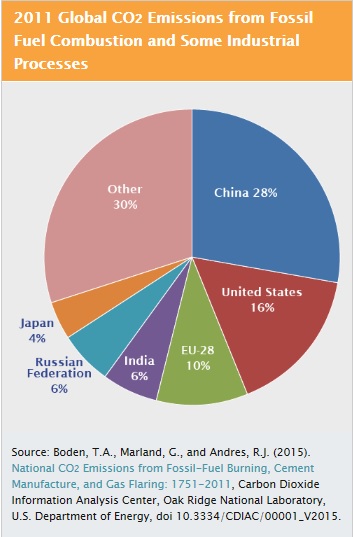
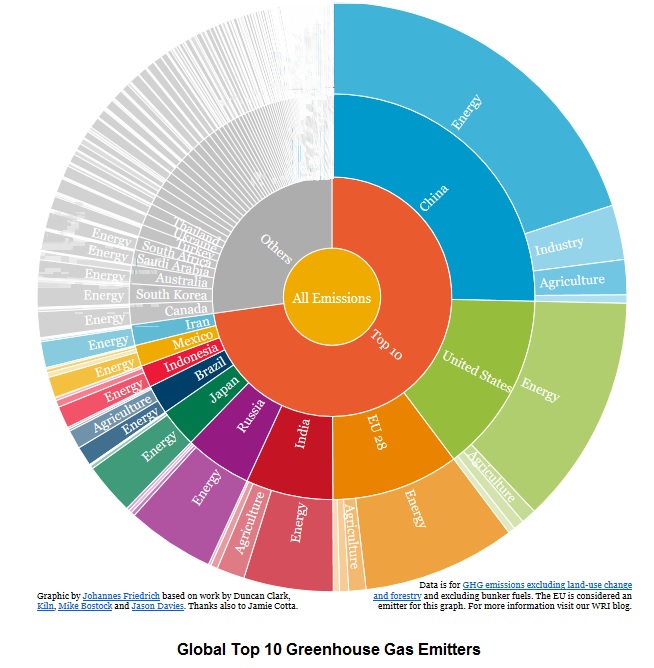
The Go Lean book presents a 370-page roadmap for re-booting, re-organizing and restructuring the economic, security and governmental institutions of the 30 member-states in the Caribbean region, especially in light of the realities of Climate Change. This is a global battle, and we in the Caribbean are on the front lines. Though we may not be the primary culprits – no Caribbean member-state appear high of the list of Green House Gases Emitters; see photos/charts here – we still must participate in the mitigations.
The Caribbean cannot expect others to do all the battling; we must fight our battles for ourselves. This has frequently been a prominent subject in previous Go Lean blog/commentaries. The assertion is that we must do our share to “Go Green” to arrest our own carbon footprint, so that we may be less hypocritical and have moral authority to call for reform from the big polluting nations. This sample – as follows – depicts previous blog-commentaries over the short timeframe since the publication of the Go Lean book:
In addition, there is the demand from the SIDS countries for financial remuneration from the big polluting countries. Its as if they are saying:
“You break it, you fix it”.
This seems to be the unspoken battle-cry / war-chant emanating from the Caribbean and other SIDS countries. See the news articles here relating these events:
News Title #1:With landmark climate accord, world marks turn from fossil fuels By: Alister Doyle and Barbara Lewis
PARIS (Reuters) – The global climate summit in Paris forged a landmark agreement on Saturday, setting the course for a historic transformation of the world’s fossil fuel-driven economy within decades in a bid to arrest global warming.
After four years of fraught U.N. talks often pitting the interests of rich nations against poor, imperiled island states against rising economic powerhouses, French Foreign Minister Laurent Fabius declared the pact adopted, to the standing applause and whistles of delegates from almost 200 nations.
“With a small hammer you can achieve great things,” Fabius said as he gaveled the agreement, capping two weeks of tense negotiations at the summit on the outskirts of the French capital.
Hailed as the first truly global climate deal, committing both rich and poor nations to reining in rising emissions blamed for warming the planet, it sets out a sweeping, long-term goal of eliminating net manmade greenhouse gas output this century.
“It is a victory for all of the planet and for future generations,” said U.S. Secretary of State John Kerry, who led the U.S. negotiations in Paris.
“We have set a course here. The world has come together around an agreement that will empower us to chart a new path for our planet, a smart and responsible path, a sustainable path.”
It also creates a system to encourage nations to step up voluntary domestic efforts to curb emissions, and provides billions more dollars to help poor nations cope with the transition to a greener economy powered by renewable energy.
Calling it “ambitious and balanced”, Fabius said the accord would mark a “historic turning point” in efforts to avert the potentially disastrous consequences of an overheated planet.
For U.S. President Barack Obama, it is a legacy-defining accomplishment that, he said at the White House, represents “the best chance we have to save the one planet that we’ve got.”
The final agreement was essentially unchanged from a draft unveiled earlier in the day, including a more ambitious objective of restraining the rise in temperatures to “well below” 2 degrees Celsius (3.6 degrees Fahrenheit) above pre-industrial levels, a mark scientists fear could be a tipping point for the climate. Until now the line was drawn only at 2 degrees.
In some ways, its success was assured before the summit began: 187 nations have submitted detailed national plans for how they will contain the rise in greenhouse gas emissions, commitments that are the core of the Paris deal.
While leaving each country to pursue those measures on its own, the agreement finally sets a common vision and course of action after years of bickering over how to move forward.
Officials hope a unified stance will be a powerful symbol for world citizens and a potent signal to the executives and investors they are counting on to spend trillions of dollars to replace coal-fired power with solar panels and windmills.
“This agreement establishes a clear path to decarbonize the global economy within the lifetimes of many people alive today,” said Paul Polman, the CEO of consumer goods maker Unilever and a leading advocate for sustainable business practices. Polman said it will “drive real change in the real economy”.
TOO MUCH, OR NOT ENOUGH? While some climate change activists and U.S. Republicans will likely find fault with the accord – either for failing to take sufficiently drastic action, or for overreacting to an uncertain threat – many of the estimated 30,000 officials, academics and campaigners who set up camp on the outskirts of Paris say they see it as a long-overdue turning point.
Six years after the previous climate summit in Copenhagen ended in failure and acrimony, the Paris pact appears to have rebuilt much of the trust required for a concerted global effort to combat climate change, delegates said.
“Whereas we left Copenhagen scared of what comes next, we’ll leave Paris inspired to keep fighting,” said David Turnbull of Oil Change International, a research and advocacy organization opposed to fossil fuel production.
Most climate activists reacted positively, encouraged by long-term targets that were more ambitious than they expected, while warning it was only the first step of many.
“Today we celebrate, tomorrow we have to work,” European Climate Commissioner Miguel Arias Canete said.
From the outset, some criticized the deal for setting too low a bar for success. Scientists warned that the envisaged national emissions cuts will not be enough to keep warming to less than 2 degrees Celsius.
Unlike the Kyoto Protocol, the last major climate deal reached in 1997, the Paris pact will also not be a fully legally binding treaty, something that would almost certainly fail to pass the U.S. Congress.
In the United States, many Republicans will see the pact as a dangerous endeavor that threatens to trade economic prosperity for an uncertain if greener future. Some officials fear U.S. progress could stall if a Republican is elected president next year, a concern Kerry brushed aside.
DESTINIES BOUND After talks that extended into early morning, the draft text showed how officials had resolved the stickiest points.
In a win for vulnerable low-lying nations who had portrayed the summit as the last chance to avoid the existential threat of rising seas, nations would “pursue efforts” to limit the rise in temperatures to 1.5 degrees Celsius (2.7 degrees Fahrenheit), as they had hoped.
“Our head is above water,” said Olai Uludong, ambassador on climate change for the Pacific island state of Palau.
While scientists say pledges thus far could see global temperatures rise by as much as 3.7 degrees Celsius (6.7 degrees Fahrenheit), the agreement also lays out a roadmap for checking up on progress. The first “stocktake” would occur in 2023, with further reviews every five years to steadily increase or “ratchet up” those measures.
It softened that requirement for countries with longer-term plans extending to 2030, such as China, which had resisted revisiting its goal before then.
And for the first time, the world has agreed on a longer-term aspiration for reaching a peak in greenhouse emissions “as soon as possible” and achieving a balance between output of manmade greenhouse gases and absorption – by forests or the oceans – by the second half of this century.
It also requires rich nations to maintain a $100 billion a year funding pledge beyond 2020, and use that figure as a “floor” for further support agreed by 2025, providing greater financial security to developing nations as they wean themselves away from coal-fired power.
(Reporting By Emmanuel Jarry, Bate Felix, Lesley Wroughton, Nina Chestney, Richard Valdmanis, Valerie Volcovici, Bruce Wallace and David Stanway; Editing by Jonathan Leff and Clelia Oziel)
PARIS, France, Friday, December 11, 2015 – CARICOM negotiators at the UN Climate Change conference (COP 21) are awaiting the penultimate draft of the Paris outcome agreement to assess the extent to which their key issues and concerns are represented.
Conference organizers on Wednesday released a preliminary draft which formed the basis for all night deliberations. The region’s negotiators reviewed the draft text and strategized for the remaining negotiations, as they expressed concerns on several key issues.
At the top of the list is the long-term temperature rise issue, with CARICOM stressing that the goal should be to hold temperature rises to less than 1.5 degrees Celsius and insisting that some of the alternatives proposed in the draft text were not acceptable. The region rejected, in particular, the option to hold temperature increases at two degrees Celsius, stating that it has been established by the Structured Expert Dialogue that figure is too high.
The region also noted the lack of agreement on recognition of the special circumstances of SmallIsland and low-lying Developing States (SIDS). The team has said that the special circumstances are real, have been recognized by the international community and world leaders, and are non-negotiable.
The CARICOM team also wants the text to recognize and respond to the fact that the SIDS, which bear the brunt of the adverse effects of climate change, have specific challenges with accessing finance especially for climate change adaptation and technology, given their capacity and scale of needs.
The team is also pressing for agreement on outstanding differences on the loss and damage effects of climate change, so that it can be a major feature of the outcome document. The negotiators were also concerned that the provisions in the text for compliance were very weak.
However, the CARICOM team has welcomed the provision in the text for five-year global cycles, and is recommending that this is linked to the renewal of mitigation commitments.
From these foregoing articles, we see the compelling need for a funding mechanism to mitigate Climate Change threats in the Caribbean and SIDS countries. But a degree of pragmatism is needed too. We cannot expect to get something for nothing from other people’s money. That is an unbecoming attitude of entitlement!
The Go Lean bookdelves into innovative ideas for funding Caribbean member-states for their empowerment efforts. The book serves as a roadmap for the introduction and implementation of the technocratic Caribbean Union Trade Federation (CU). The roadmap depicts how this federal government will “give, not take” for the treasuries of the SIDS of this region. There are many new funding options – economic leverage – that will only be possible with the integration and ratification of a regional Single Market. This vision is embedded in the opening Declaration of Interdependence, pronouncing as follows, (Page 12):
viii. Whereas the population size is too small to foster good negotiations for products and commodities from international vendors, the Federation must allow the unification of the region as one purchasing agent, thereby garnering better terms and discounts.
xiv. Whereas government services cannot be delivered without the appropriate funding mechanisms, “new guards” must be incorporated to assess, accrue, calculate and collect revenues, fees and other income sources for the Federation and member-states. The Federation can spur government revenues directly through cross-border services and indirectly by fostering industries and economic activities not possible without this Union.
The Go Lean book posits that the “whole is worth more than the sum of its parts”; that from this roadmap, Caribbean economies will grow individually and even more collectively as a Single Market. This roadmap advocates the optimization of the economic, security and governing engines and projects so that the region’s economy will grow from $378 Billion (2010) to $800 Billion in a 5 year time span. The international community would therefore have more respect and accountability to a regional Caribbean entity, rather than many individual (30) Small Island Development States.
Unite and take your stand!
As related in the roadmap, the 3 CU prime directives are described as follows:
Optimize the economic engines of the Caribbean to elevate the regional economy to grow to $800 Billion and create 2.2 million new jobs.
Establish a security apparatus to protect the people and property of the resultant economic engines.
Improve Caribbean governance to support these engines.
The Go Lean roadmap calls for the CU to serve as the regional administration to optimize economy, homeland security and governance engines for the Caribbean, especially in flight of Climate Change battleground frontline status. This is the first pronouncement (Page 11) of the same opening Declaration of Interdependence:
i. Whereas the earth’s climate has undeniably changed resulting in more severe tropical weather storms, it is necessary to prepare to insure the safety and security of life, property and systems of commerce in our geographical region. As nature recognizes no borders in the target of its destruction, we also must set aside border considerations in the preparation and response to these weather challenges.
The following details from the Go Lean…Caribbean book highlights the community ethos, strategies, tactics, implementation and advocacies necessary to elevate the regions stance in this global battle consequences on Climate Change:
Community Ethos – Deferred Gratification
Page 21
Community Ethos – Economic Systems Influence Individual Choices / Incentives
Page 21
Community Ethos – The Consequences of Choices Lie in the Future
Page 21
Community Ethos – “Crap” Happens
Page 23
Community Ethos – Lean Operations
Page 24
Community Ethos – Cooperatives
Page 24
Community Ethos – Non-Government Organizations
Page 25
Community Ethos – Ways to Impact the Future
Page 26
Community Ethos – Ways to Improve Sharing
Page 35
Community Ethos – Impact the Greater Good
Page 37
Strategy – Vision – Confederating 30 Member-States into a Single Market
Page 45
Strategy – Vision – Foster Local Economic Engines for Basic Needs
Page 45
Strategy – Mission – Prepare for Natural Disasters
Page 45
Strategy – Agents of Change – Climate Change
Page 57
Strategy – Agents of Change – Globalization
Page 57
Tactical – Confederating a Permanent Union
Page 63
Tactical – Fostering a Technocracy
Page 64
Separation of Powers – Emergency Management
Page 76
Separation of Powers – Interstate Commerce Administration
Page 79
Separation of Powers – Meteorological & Geological Service
Page 79
Separation of Powers – Fisheries and Agriculture Department
Page 88
Anecdote – “Lean” in Government
Page 93
Implementation – Assemble Regional Organs into a Single Market Economy
Page 96
Implementation – Ways to Pay for Change
Page 101
Implementation – Security Initiatives at Start-up – Unified Command & Control
Page 103
Implementation – Industrial Policy for CU Self-Governing Entities
Page 103
Implementation – Ways to Deliver
Page 109
Implementation – Ways to Foster International Aid
Page 115
Implementation – Ways to Benefit from Globalization
Page 119
Planning – Big Ideas for the Caribbean Region
Page 127
Planning – Ways to Make the Caribbean Better
Page 131
Advocacy – Ways to Grow the Economy
Page 151
Advocacy – Ways to Create Jobs
Page 152
Advocacy – Ways to Improve Governance
Page 168
Advocacy – Ways to Better Manage the Social Contract
We can …. no, we must hold the bigger, richer nations accountable for breaking/fixing the environment, in regards to greenhouse gases. But first, we must show some technocracy to arresting our own carbon footprint. We must Go Green in the Caribbean. Then and only then, can we, in good conscience, appeal to the Big Polluters for financial remunerations to fix what they have broken.
This is heavy-lifting.
Yet, this is the quest of the CU/Go Lean roadmap; to make the Caribbean region more self-reliant collectively; to act more proactively and reactively for our own emergencies and natural disaster events; and to be more efficient in our governance.
Change has come to the Caribbean region. If Climate Change is not arrested, then even more devastating consequences will emerge. There is the need for the region to establish a permanent union to provide efficient stewardship for our economic, security and governing engines. According to Paris-COP21, now is the time …
… now is the time for all of the Caribbean, the people and governing institutions, to lean-in to the empowerments described in the book Go Lean … Caribbean. This is the course we must pursue. The future of the islands – for our children – depend on it. We must not allow the region to continue on the existing path to doom and abandonment, but rather pursue this new course to a better destination: a better homeland to live, work and play. 🙂
Appendix – Marshall Islands – A case in point of a Small Island Development State coping/failing with the effects of Climate Change – posted September 17, 2014.
The book Go Lean…Caribbean calls for the elevation of Caribbean society, to re-focus, re-boot, and optimize all the engines of society so as to make the Caribbean a better place to live, work and play. The activities of “play” are of serious concern; they are Art and Science.
All work and no play, makes Jack a dull boy. All play and no work, makes Jack a dumb boy.
There is the need for balance.
Tourism activities and/or vacations, the primary economic driver in the Caribbean region, are grouped as a “play” activity.
The Go Lean book, serving as a roadmap, posits that tourism will continue to be the primary economic driver in the region for the foreseeable future. Considering the “bread and butter” of the region, it is obvious our “bread is buttered” with “play”. Understanding the science of “play” activities can therefore be critical in the roadmap to grow the region’s GDP and create jobs (2.2 million new jobs projected). There are many other activities considered “play”: sports, parks & recreation, art & culture, media (film, TV, online social networking, etc.) and also … animal companions. People love their pets and even treat them as part of the family. So to make the Caribbean a better place to live, work and play means considering the needs of the 42-million population and their animal companions.
A study of economics must consider the systems of survival, the quest for food, clothing and shelter. This is a science. Research by Behavioral Scientist & Psychologist Abraham Maslow with his Hierarchy of Needs[a], identifies needs as a pyramid, where at the bottom, or base level, are basic, survival elements (food, water, shelter and security/safety). As these are obtained, then there are natural urges for emotional stability (belongingness, self-esteem, social acceptance); accordingly, the top level of the pyramid was defined as complex understanding (beauty, justice, realizing one’s full potential). Where does “play” fit into this hierarchy? Other research now indicates that the need to play nullifies the hierarchy, people and animals seek play at all times and all circumstances, despite whether the other needs are fulfilled. See the example here …
… this VIDEO shows hungry polar bears in the Arctic region and what they do with dogs, despite a potential food source. See here:
Title: He Watched Helplessly As A Starving Bear Approached His Dogs. Then Something Amazing Happened.
Polar bears and dogs are natural enemies, and bears usually behave quite aggressively toward dogs. Polar bears are the largest land carnivore and are many times larger than even the largest of dogs, so when a hungry polar bear spots a dog, it usually ends very badly for the dog.
This, however, is truly unbelievable. Take a look at the photos and videos here.
Renowned nature photographer Norbert Rosing, whose work has appeared in National Geographic, visited Brian and his dogs on several occasions. Here are some of the incredible photos he took.
Here is some incredible footage of these unlikely friends playing together:
Mother nature never ceases to amaze. There’s so much we can learn from these unusual friends about tolerance.
Share this awesome friendship with others. They’ll never expect to see this!
… there is a lot that can be learned from the science of “play” by just examining dogs and other animals.
Everyone needs and wants to play … at all levels of the socio-economic ladder: rich, middle-class and poor. So “play” options should be provided in society so that everyone can partake. Since tourism is categorized as “play”. The Go Lean book posits that the region can experience even more growth in tourism than the estimated 80 million people that visit our shores annually, by facilitating more “play” options for all levels of society. (Cruise vacations are known for being more affordable to those with smaller budgets). The book proposes growth strategies/options, such as:
Inter-Island Ferries (Page 280)
Cruises options that can start/stop at different Caribbean ports (Page 193)
Features of the Sharing Economy (Car and Residence) for Cheaper Vacations (Page 35)
Sports eco-system for amateur, professional and inter-collegiate participation (Page 229)
Expansion of Parks Eco-system (Page 83)
Urban Bicycle Assimilation and Expansions of Bike Paths (Page 352)
The Go Lean book asserts that the requisite investment of the resources (time, talent, treasuries) for these societal elevation goal may be too big for any one Caribbean member-state alone. So the Go Lean book campaigns to shift the responsibility to a region-wide, professionally-managed, deputized technocracy, the Caribbean Union Trade Federation (CU). The book serves as a roadmap for the introduction and implementation of the CU.
The subject of animals and animal companionship is also pivotal in the roadmap for elevating Caribbean society, especially for the security engines. The Go Lean book posits (Page 185) that better command of Animal Husbandry can facilitate better security around the region’s economic engines. Dogs feel a lot less intrusive and less intimidating than formal security screening, or personnel patrolling with AK47 automatic rifles. Imagine a beautiful Caribbean beach scene with a plain clothes “officer” walking along with specialty dogs, or more exactly:
Drug Sniffing Dogs
Bomb Sniffing Dogs
Service/Therapy Dogs
The Go Lean book considers the Agent of Change (Page 57) of the “Aging Diaspora” and its effect on the Caribbean’s biggest economic driver: “tourism”. Many former Caribbean citizens left these shores for greater opportunities abroad, but now they are approaching retirement. These ones can be induced to return to the Caribbean … and bring their economic resources with them … provided that their needs are covered.
This includes the needs of their animal companions. (Currently, the requirements for transporting pets to “foreign” countries are exhaustive; they entail many standards and veterinarian assessments).
The goal of the CU is to bring the proper tools and techniques to the Caribbean region to optimize the stewardship of the economic, security and governing engines. The book posits that the economy can be induced and spurred for continuous progress, with technocratic management and stewardship of a Single Market. As conveyed here in this commentary, and in previous commentaries, this would be better than the status quo.
Change has come to the region. This book Go Lean… Caribbean provides the needed details on how to better manage the challenge of a changing world. Early in the book, the optimization and best-practices was highlighted as a reason the Caribbean region needed to unite, integrate and confederate to a Single Market. These pronouncements were included in the opening Declaration of Interdependence (Pages 11 – 14):
iv. Whereas the natural formation of the landmass is in a tropical region, the flora and fauna allows for an inherent beauty that is enviable to peoples near and far. The structures must be strenuously guarded to protect and promote sustainable systems of commerce paramount to this reality.
vi. Whereas the finite nature of the landmass of our lands limits the populations and markets of commerce, by extending the bonds of brotherhood to our geographic neighbors allows for extended opportunities and better execution of the kinetics of our economies through trade. This regional focus must foster and promote diverse economic stimuli.
xix. Whereas our legacy in recent times is one of societal abandonment, it is imperative that incentives and encouragement be put in place to first dissuade the human flight, and then entice and welcome the return of our Diaspora back to our shores. This repatriation should be effected with the appropriate guards so as not to imperil the lives and securities of the repatriated citizens or the communities they inhabit. The right of repatriation is to be extended to any natural born citizens despite any previous naturalization to foreign sovereignties.
xxiv. Whereas a free market economy can be induced and spurred for continuous progress, the Federation must install the controls to better manage aspects of the economy: jobs, inflation, savings rate, investments and other economic principles. Thereby attracting direct foreign investment because of the stability and vibrancy of our economy.
xxxii. Whereas the cultural arts and music of the region are germane to the quality of Caribbean life, and the international appreciation of Caribbean life, the Federation must implement the support systems to teach, encourage, incentivize, monetize and promote the related industries for arts and music in domestic and foreign markets. These endeavors will make the Caribbean a better place to live, work and play.
The Go Lean… Caribbean book wisely details the community ethos to adopt to proactively facilitate digital campaigns for the changed landscape; plus the executions of the following strategies, tactics, implementations and advocacies:
Community Ethos – Economic Principle – Economic Systems Influence Individual Choices & Incentives
Page 21
Community Ethos – Economic Principle – Consequences of Choices Lie in the Future
Page 21
Community Ethos – Lean Operations
Page 24
Community Ethos – Return on Investments (ROI)
Page 24
Community Ethos – Ways to Impact the Future
Page 26
Community Ethos – Ways to Foster Genius – Athletics, Literary, Art and Music in “Play” activities
Page 27
Community Ethos – Impact Research & Development – Including Animal Husbandry
Page 30
Community Ethos – Ways to Improve Sharing – Viable forService Animals
Page 35
Community Ethos – Ways to Impact the Greater Good
Page 37
Strategy – Vision – Integrate Region in a Single Market
Page 45
Strategy – Mission – Enhancing the Tourism Product
Page 45
Strategy – Agents of Change – Aging Diaspora
Page 57
Tactical – Fostering a Technocracy
Page 64
Tactical – Growing the Economy to $800 Billion – Trade and Globalization
Page 70
Tactical – Separation of Powers – Tourism Promotions and Administration
Page 78
Tactical – Separation of Powers – Fairgrounds Administration
Page 83
Tactical – Separation of Powers – Department of Health – Veterinarian Standards
Page 86
Implementation – Assembling Regional Organs
Page 96
Implementation – Ways to Deliver
Page 109
Planning – 10 Big Ideas – Single Market
Page 127
Planning – Ways to Make the Caribbean Better – “Play” activities for Rich, Middle Class, and the Poor
Page 131
Advocacy – Ways to Grow the Economy
Page 151
Advocacy – Ways to Create Jobs – Many from “Play” activities
Page 152
Advocacy – Ways to Foster Cooperatives – Ideal for Animal Husbandry
Page 176
Advocacy – Ways to Better Manage Natural Resources – Parks Administration
Page 183
Advocacy – Ways to Improve for Natural Disasters – Animal Partners & First Responders
Advocacy – Ways to Enhance Tourism – Expanding Solutions for “Snowbirds”
Page 190
Advocacy – Ways to Impact Events – Sharing Economy
Page 191
Advocacy – Ways to Promote Fairgrounds – Venues for “Play” activities
Page 192
Advocacy – Ways to Impact Cruise Tourism – Appealing for Budget Vacations
Page 193
Advocacy – Ways to Improve Transportation – Bicycle-Friendly Culture
Page 205
Advocacy – Ways to Improve Elder-Care – Planning for Storm Shelters
Page 225
Advocacy – Ways to Improve Sports – For Amateur and Professionals
Page 229
Advocacy – Ways to Promote Music – A significant role despite the level of need
Page 231
Advocacy – Ways to Impact Urban Living – Storm Shelters for Pets
Page 234
Advocacy – Ways to Promote World Heritage Sites – Low-cost Touristic Activities
Page 248
Appendix – Sample Inter-Island Ferry Scheme
Page 280
Appendix – Sample Urban Bicycle Sharing Scheme
Page 352
The CU seeks to foster play options to aid-and-abet tourism and other economic activities. This includes all supporting functions before, during and after visitors come to our shores. Consider the example of Hurricane preparation; there is the need to prepare storm shelters for residents in unsafe areas; these solutions MUST consider pet shelters as well; (Page 234).
In previous Go Lean blogs, related points of the innovative tourism marketing, Aging Diaspora and the need for efficient Animal Husbandry have been detailed; see sample here:
This commentary focuses on the core competence of the Caribbean Union Trade Federation, which is Trade. This refers to the ability to accentuate the economic activities of the region to make the homeland a better place to live, work and play. But this commentary also addresses a passion project: the love of dogs. See the related VIDEO in the Appendix below.
But the integration of core competence and passion can elevate a society. Dogs can definitely have that impact for the Caribbean.
The people and institutions of the Caribbean are urged to lean-in to these new business models to incentivize more tourism and “play” activities for all segments of society. The region is also urged to full employ working canines, as in embedding them with Military & Police units. This is win-win!
Let’s do it! This is the quest of the Go Lean roadmap: elevate the societal engines for all people … and their pet companions & helpers. With the empowerments and elevations portrayed in the roadmap we can succeed in making Caribbean region a better place for citizens and tourists alike to live, work and play. 🙂
Published on Aug 18, 2014 – “So God Made a Dog” a takeoff on the Paul Harvey “God made a Farmer”. They are, our friends and part of the family and often with us for to short a time …
This commentary – from December 9, 2014 – is hereby re-distributed on the occasion of the Art Basel Miami 2015. This year’s events are planned for December 3 – 6, with peripheral events starting from December 1.
Bienvenido a Miami!
———
There’s no business like ‘show business’. – Age Old Adage.
And now, the subsequent news article posits: “the community rallies around art creating a unique energy. And art ‘dynamises’ the community, in a very unique way”.
The book Go Lean…Caribbean has a simple purpose: enable the Caribbean to be a better place to live, work and play. The book recognizes that the ‘genius qualifier’ is shown in different fields of endeavor, including the arts (fine, visual, performing, music, etc.). While the Go Lean roadmap has a focus on STEM [1] fields, it is accepted that not everyone possesses STEM skills, and yet many others can still contribute to society. Then when these other skills/talents are “gifted” beyond the extraordinary, they can truly impact their community, and maybe even the world.
The book relates that the arts can have a positive influence on the Caribbean. And that one man, or woman, can make a difference in this quest. We want to foster the next generation of “stars” in the arts and other fields of endeavor.
According to the following news article, the arts can truly ‘dynamise’ the community. The article relates to Art Basel, the movement to stage art shows for Modern and Contemporary works, sited annually in Basel (Switzerland), Hong Kong and Miami Beach. The focus of this article is Miami Beach:
Title: 13th Art Basel Miami Beach (December 4 – 7, 2014), a testament to the spread of culture
By: Jane Wooldridge,and contributed Ricardo Mor
If “more” equals better, the 13th edition of Art Basel Miami Beach and the surrounding art week events may go down as the best ever. More new art fairs and just-to-see shows. More record-breaking sales at Art Basel Miami Beach. More CEOs — from watchmakers Hublot and Omega, luggage brand Rimowa, hotel companies Starwood and Marriott — opening luxury properties. And if not more — who can keep track? — then certainly plenty of celebrities, including actors Leonardo DiCaprio, James Marden and Owen Wilson; musicians Usher, Miley Cyrus, Russell Simmons and Joe Jonas; supermodel Heidi Klum and the world’s fastest man, Usain Bolt.
There was another kind of “more” as well — more spillovers, touch points and art for all manner of South Floridians, from entrepreneurs to pre-teen fashion designers, stretching from Pinecrest to Coconut Grove, Overtown to Fort Lauderdale.
If the aim is “to make art general,” as Knight Foundation President Alberto Ibargüen told attendees Monday at the foundation’s annual announcement of Knight Art Challenge awards, this year’s art week put South Florida well on its way. Proclaimed National Endowment for the Arts chairman Jane Chu on a whiplash art tour to downtown, Miami Beach and Opa-locka, “Art is entwined in Miami’s DNA.”
Even as the Pérez Art Museum Miami celebrated its first year anniversary, a new permanent museum building for the Institute for Contemporary Art Miami was announced for the Design District.
Overtown [historical Black neighborhood] hosted its first Art Africa fair of works created by artists from the African Diaspora. Joining it on the list of first-year events are an impressive exhibition of monumental works in the vast Mana-Miami Wynwood space on NW 23rd Street and Pinta, a fair focusing on Latin American art that moved from New York to Midtown.
The festivities reach far, far beyond the traditional art crowd. On the Mana campus, the Savannah College of Art and Design is presenting “i feel ya,” an exhibition that includes jumpsuits designed by André 3000 for Outkast’s reunion tour. The nearby ArtHaus tent is surrounded by food trucks and a sound program where Beethoven is definitely not on the playlist.
This year, more than a half-dozen student exhibits are on the art agenda. At FusionMIA, student photographs hang near works by masters Rashid Johnson and Al Loving; all were curated by Miami’s N’Namdi Contemporary gallery. A few blocks north, at Wynwood’s House of Art, a dozen students ages 5 to 15 from the DesignLab program showed off their creations at a Friday night “vernissage.”
Among them was 13-year-old Yael Bloom, wearing a flounced party dress she made from shrink wrap. No matter that the first-time event was a little-known spinoff. “Art Basel is pretty hard for adults to get into,” Bloom said. “For kids to get into it is very cool.”
As in years past, free events abound, from performances by Chinese artist Shen Wei at Miami-Dade College and artist Theo Jansen’s Strandbeest demonstrations on the sand to official Art Basel events, including films on the New World Center Wallcast and the Art Public sculptures in Collins Park. New is free Art Week shuttle service between Midtown and Miami Beach — a government cooperative effort — that dovetails with trolley service to art venues on both sides of Biscayne Bay.
In institutional quarters, Art Basel Miami Beach global sponsor UBS announced the creation of a $5 million loan fund for existing Florida small business owners. Sponsor BMW USA announced it would fund an “art journey” open to emerging artists exhibiting at Art Basel Miami Beach. And the City of Miami Beach and Miami-Dade County put out a call to artists, encouraging them to propose projects for the $4.33 million public art program associated with the Miami Beach Convention Center renovation. South Floridians are eligible to apply for all three initiatives.
Clearly, art week isn’t just about aesthetics, personal enrichment and community building. It is also about enterprise — which explains all those luxury CEOs, the ground-breaking of the Zaha Hadid-designed One Thousand Museum, and the announcement at Miami Ironside that designer Ron Arad will create the interiors for the revamped Watergate Hotel in Washington. (And no, there’s no real connection to Miami.)
Said Michael Spring, Miami-Dade’s cultural affairs director, “There’s a certain deepening, a realization not just that the Art Basel event but arts in general have a phenomenal effect on the image and economy of our entire region. We’ve talked about it before, but there seems to be more focus this year. It’s not an interesting footnote anymore; it’s the theme.”
That, says Miami Commissioner Keon Hardemon, was the thinking behind the city’s $50,000 grant supporting the Art Africa fair. “We need to encourage people to come now to Overtown. The cultural aspect helps them realize they can safely come here now. And then maybe they’ll come back later and spend money in the community, in our restaurants and stores,” he said.
In Miami, with commerce inevitably comes glamor, which is proving as glossy as ever. Hennessey V.S.O.P., Dom Perignon, Paper Magazine, Interview and B.E.T. have staged events all around town, at private “locations,” hotels, restaurants, the 1111 Lincoln Road garage and the ICA temporary space in the Moore Building. Developer Alan Faena threw a breezy beachside asado. Jeffrey Deitch, Tommy Hilfiger and V Magazine hosted a glitzy bash at the Raleigh featuring a performance by Miley Cyrus.
In the Design District, developer Craig Robins hosted a dinner honoring architect Peter Marino at a single, 142-yard candlelit table for 380 guests on a closed-off street amid the district’s luxury brand storefronts. Sculptor Jaume Plensa was the guest of honor at another long candlelit table — this one for 60 — in the Coconut Grove sales offices of Park Grove, which recently installed a series of his works along South Bayshore Drive.
Alas, once again, manners were not de rigueur among the glossy set. At some parties, guests of guests turned up with entirely uninvited guests. For other tony soirees, publicists emailed out “disinvitations” to previously invited guests, obliquely sending the message that someone more glamorous would be taking those seats.
Decorous or not, during art week, the energy all emanates from the week’s namesake fair, said Dennis Scholl, VP/Arts at the Knight Foundation. “The most important thing to remember is why this week exists, and that’s Art Basel in the Convention Center. If that wasn’t the core of what’s going on — if it weren’t a world-class event — nobody else would be interested in being involved. It continues to be the raison d’être of this week.”
In the Convention Center, at what Scholl called “the core of the nuclear reactor,” many gallerists were quite happy, thank you very much.
Veteran Art Basel Miami Beach gallerist Sean Kelly said Wednesday was his best first day ever at the fair. Newcomer Michael Jon Gallery also sold almost all of its available work — by rising stars like Sayre Gomez and JPW3 — on the first day.
For most dealers, sales remained lively, day after day. At Galerie Gmurzynska, co-CEO Mathias Rastorfer proclaimed it “successful indeed … . In terms of reception, it was an overwhelmingly enthusiastic response from collectors and colleagues alike. In terms of sales, we did several over $1 million sales and many within the $100,000 to $500,000 range, with a Picasso’s Venus and Love selling at near the asking price of $1.2 million.
Said Art Basel Director Marc Spiegler on Saturday, “I’ve gotten nothing but positive response from galleries,” not only because of strong sales, but also because new hours for VIPs gave gallerists more time to meet new collectors. “A lot of people were here and buying for the first time. Many galleries said they had their best fair ever.”
But like this week’s weather, the upbeat atmosphere suffered from uncharacteristic clouds. In Wynwood, a police car hit and critically injured a street artist. An $87,000 silver plate crafted by Pablo Picasso was reported stolen from the Art Miami satellite fair in Midtown. A partygoer at PAMM’s first anniversary fête on Thursday accidentally damaged an artwork installed on the floor. And Friday night, would-be art goers were stymied by traffic shutdowns into art-centric areas of Wynwood, Midtown and Miami Beach by protests against nationwide police-involved killings.
Though unfortunate and sometimes tragic, Spring said, the unrelated events were “a product of the incredible level of activity.” At Saturday’s annual brunch at the art-rich Sagamore Hotel in Miami Beach, the theft and damaged artwork uniformly were brushed off as inconsequential. Said one art insider, “s–t happens.”
Miami Art Week’s merry-go-round nature is surely born from Miami’s appreciation of a good time. And increasingly, perhaps from something deeper.
Said Miami gallerist Jumaane N’Namdi, “Art Basel has put art on everyone’s mind. Everyone wants to be involved somehow.”
And that’s not just about the parties, said N’Namdi, who had galleries in Chicago, New York and Detroit before opening in Miami. “I don’t think you could find a city that enjoys really looking at the art the way this city does. I came through the airport, and even the TSA guys were talking about it, asking each other if they got their Art Basel posters. Every level of art you want is here.”
Outsiders agree. “Miami is very special for its link between art and the community,” said Axelle de Buffévent, style director at champagne house Martell Mumm Perrier-Jouët. “It goes both ways. The community rallies around art creating a unique energy. And art dynamises the community, in a very unique way.” Miami Herald – Daily Newspaper – (Posted December 6,2014) – http://www.miamiherald.com/entertainment/visual-arts/art-basel/article4313255.html
Published on Dec 4, 2014 The international art fair Art Basel returns to Miami Beach for its 13th edition, taking place at the Miami Beach Convention Center from December 4 to December 7, 2014. Art Basel Miami Beach 2014 features 267 leading international galleries from 31 countries across North and South America, Europe, Asia and Africa, which present artworks ranging from Modern masters to the latest contemporary art pieces. With this edition, the fair debuts Survey, a new sector dedicated to art-historical projects. In this video, we attend the Private View of Art Basel Miami Beach 2014 at the Miami Beach Convention Center on December 3.
This story aligns with the book Go Lean…Caribbean in stressing the economic impact of artistic endeavors. The book pledges that Caribbean society will be elevated by improving the eco-system to live, work and play; and that “play” covers vast areas of culture.
“Culture” has emerged as a central concept in anthropology, encompassing the range of human phenomena that cannot be directly attributed to genetic inheritance. Specifically, the term “culture” in North American anthropology has two meanings:
the evolved human capacity to classify and represent experiences with symbols, and to act imaginatively and creatively; and
the distinct ways that people, who live differently, classified and represented their experiences, and acted creatively.[2]
Anthropologist Adamson Hoebel best describes culture as an integrated system of learned behavior patterns which are characteristic of the members of a society and which are not a result of biological inheritance.[3]
The Go Lean book stresses economic benefits from classic cultural expressions and popular cultural productions, including Caribbean music, paintings/art, sketches, sculptures, books, fashion and food. All the “skilled phenomena” that makes Caribbean life unique and appealing.
The book Go Lean…Caribbean serves as a roadmap for the introduction and implementation of the technocratic Caribbean Union Trade Federation (CU). There is a lot involved in this vision; the prime directives are stated as follows:
Optimization of the economic engines in order to grow the regional economy to $800 Billion & create 2.2 million new jobs.
Establishment of a security apparatus to protect the resultant economic engines.
Improve Caribbean governance to support these engines.
The foregoing article relates the economic impact that the Greater Miami area is enjoying for hosting the Art Basel event, for the 13th year now. At this point the benefits have spread throughout the community, (Art Fairs, museums, scholarships, foundations, etc.) not just one venue on Miami Beach. The spin-off benefit of art is a strong point of the Go Lean book, highlighting benefits as long as we keep the talent at home working in/for the community. This point is pronounced early in the following statements in the book’s opening Declaration of Interdependence(Page 14):
xxi. Whereas the preparation of our labor force can foster opportunities and dictate economic progress for current and future generations, the Federation must ensure that educational and job training opportunities are fully optimized for all residents of all member-states, with no partiality towards any gender or ethnic group. The Federation must recognize and facilitate excellence in many different fields of endeavor, including sciences, languages, arts, music and sports. This responsibility should be executed without incurring the risks of further human flight, as has been the past history.
xxxii. Whereas the cultural arts and music of the region are germane to the quality of Caribbean life, and the international appreciation of Caribbean life, the Federation must implement the support systems to teach, encourage, incentivize, monetize and promote the related industries for arts and music in domestic and foreign markets. These endeavors will make the Caribbean a better place to live, work and play.
The economic, cultural and image considerations for “show business” on a society have been well-detailed in these previous Go Lean blogs:
The Go Lean roadmap posits that change will come to the Caribbean “show business” (Visual and Performing Arts, Music, Film). This is due mostly to the convergence of a Single Market for the Caribbean region. If “size matters”, then the integration of 42 million people (plus the 10 million Diaspora and 80 million visitors) for the 30 member-states will create the consumer markets to promote and foster Caribbean artistic creations for their full appreciation. The first requirement in this goal is the community ethos of valuing intellectual property; to recognize that other people’s creations are valuable. (Then we can enforce on others to value and appreciate our creations).
This would truly be new for the Caribbean.
The CU is designed to do the heavy-lifting of organizing Caribbean society for the new world of art appreciation and “consumerization”. The following list details the ethos, strategies, tactics, implementations and advocacies to foster regional artists and showcase their wares to the world stage:
Community Ethos – Forging Change
Page 20
Community Ethos – Lean Operations
Page 24
Community Ethos – Return on Investments
Page 24
Community Ethos – Ways to Foster Genius
Page 27
Community Ethos – Help Entrepreneurship
Page 28
Community Ethos – Promote Intellectual Property
Page 29
Strategy – Caribbean Vision: Single Market
Page 45
Separation of Powers – Central Bank – Electronic Payment Deployments
Page 73
Tactical – Separation of Powers – Patents – Copyrights
Page 78
Separation of Powers – Culture Administration
Page 81
Planning – Ways to Make the Caribbean Better
Page 131
Planning – Lessons Learned from New York City
Page 137
Advocacy – Ways to Grow the Economy
Page 151
Advocacy – Ways to Create Jobs
Page 152
Advocacy – Education – Performing Arts Schools
Page 159
Advocacy – Ways to Impact Hollywood
Page 203
Advocacy – Ways to Improve the Arts
Page 230
Advocacy – Ways to Promote Music
Page 231
Advocacy – Impact Urban Living – Art & Theaters
Page 234
Appendix – New York / Arts / Theater Jobs
Page 277
Appendix – Taos New Mexico Art Colony
Page 291
Appendix – Caribbean Music Genres
Page 347
Appendix – Protecting Music Copyrights
Page 351
There is BIG money in show business and in the world of the Arts. For the 10th edition of Art Basel in Miami in 2011, there was a record number of fifty thousand collectors, artists, dealers, curators, critics and art enthusiasts – including 150 museum and institutions from across the globe – participating in the show.[4]
This event requires a lot of community investments. Every year, Miami’s leading private collections – among them the Rubell Family Collection, Cisneros Fontanals Art Foundation, the De la Cruz Collection Contemporary Art Space, World Class Boxing, the Margulies Collection and the Dacra Collection – open their homes and warehouses to guests of Art Basel. Additionally, the museums of South Florida organize exhibitions including shows at the Miami Art Museum, Bass Museum of Art, Norton Museum, Wolfsonian-FIU and MOCA North Miami.
The community investment has been there for Miami, and so has the returns [5].For 2014, the attendance figures were 75,000, with an increase in hotel occupancy of 30,000 rooms on the days the Art Fair is in progress. The conservative estimates are that the Art Fair brings close to $13 million a year in economic impact to the region. (This figure does not include the purchases of artworks, some of which fetch millions of dollars).
Miami has been greatly impacted by both the Caribbean Diaspora and its assimilation of the “Arts”. Whole neighborhoods have been elevated due to this strategy of catering to the arts; (see photo here). This is a great role model for the Caribbean to emulate; our whole society can be elevated.
The Go Lean/CU roadmap represents the empowerment for the Caribbean communities to elevate – we now want to keep our artists at home. The people, institutions and governance of the region are therefore urged to “lean-in” to this roadmap for change. 🙂
Economics, security and governance is presented in the book Go Lean … Caribbean as the “three-fold cord” for societal harmony; for any society anywhere. The Caribbean wants that societal harmony; we must therefore work to optimize all these three engines. But this is easier said than done. This heavy-lifting is described in the book as both an art and a science.
The focus in this commentary is on the societal engine of governance; previously, there was a series on economics and one on security lessons. This commentary focuses on assuaging the “abuse of power”. The Go Lean book posits that verily, bad actors will always emerge to exploit successful engines (in economics and governance). Therefore the checks-and-balances must be proactively embedded in any organizational structure so as to minimize the actuality of abuses by authority figures.
The American experience is important for this consideration. There is a lesson in governance here in examining the US; more exactly, examining the output from the Center for Public Integrity (CPI); see Appendix A below. This Non-Governmental Organization specifically evaluates/measures government misbehavior, structures and systems of oversight. It is an American NGO with an American focus; but we now need to focus on the Caribbean, measuring “best-practices” with this same American yardstick.
Warning!!! This is a LONG commentary … with the Appendices. Considering the grave subject matter; this length is unavoidable.
The work of the CPI is relevant in our consideration of the Caribbean. For the 30 Caribbean member-states, two are American territories (Puerto Rico and the US Virgin Islands), and a few member-states use the US Dollar as their official currency (British Virgin Islands, the Turks & Caicos Islands and the Dutch Caribbean Territories of Bonaire, Sint Eustatius and Saba). This is one reason why this review is important; the other, and most important reason is that our Caribbean people deserve the best-of-the-best of governmental processes. Power corrupts … everyone … everywhere.
The book Go Lean…Caribbean serves as a roadmap for the introduction and implementation of the technocratic Caribbean Union Trade Federation (CU) to elevate the economic, security and governance engines of the region’s 30 member-states. The roadmap features these 3 prime directives:
Optimization of the economic engines in order to grow the regional economy to $800 Billion & create 2.2 million new jobs.
Establishment of a security apparatus – with oversight over economic crimes and prosecutorial power for public officials – to protect the resultant economic engines.
Improvement of Caribbean governance to support these engines, including ranking and ratings of the mechanics of oversight.
The roadmap covers a 5 year period in which the societal engines will be optimized. The region’s GDP should increase from $278 Billion to $800 Billion. With this success, there will be a lot of opportunities for government administrators to acquire and wield power. The roadmap fully expects these corrupting effects of power to emerge in the Caribbean, as they have emerged in the US, according to the featured news article below (Appendix D):
Secret Deal-making – (S)
Corruption – (C)
Conflicts of Interest – (I)
Thusly, the CU/Go Lean roadmap embeds the required checks-and-balances from the outset to assuage these threats. This commentary considers the in-depth examination of the member-state governments in the US – by the Center for Public Integrity – and then proceeds with a rating/ranking of those 50 states using these 13 categories:
Public Access to Information (S)
Political Financing (I)
Electoral Oversight (C)
Executive Accountability (I)
Legislative Accountability (I)
Judicial Accountability (I)
State Budget Processes (S)
State Civil Service Management (I)
Procurement (C)
Internal Auditing (S)
Lobbying Disclosure (I)
Ethics Enforcement Agencies (C)
State Pension Fund Management (C)
Consider here, the actual VIDEO and news article (in Appendix D below) as reported in the national daily newspaper USA Today, published on November 9, 2015:
An investigation by the Center for Public Integrity and Global Integrity ranked all 50 states based on how ‘corrupt’ they were. The investigation looked at data in 13 different categories. USA TODAY
Well done, CPI. This assessment of the integrity status of the 50 American state governments is a great check-and-balance on those governmental powers.
See the overall rank of the 50 US states in Appendix B below and the separate ranking for each of the 13 criteria at this web address http://www.usatoday.com/story/news/2015/11/09/center-integrity-corruption-grades-interactive/75033060/. The grade of “C” is the highest grade – not good – but it is a benchmark; all the other states did even worse. The state that ranks the highest on the list is Alaska; in contrast, the state with the lowest score/rank is Michigan. (The principal city and economic engine in Michigan is Detroit. The publishers of the book Go Lean…Caribbean are here in Detroit to “observe and report” the turn-around and rebirth of the once-great-but-now-distressed City of Detroit and its metropolitan area).
The assertion of the Go Lean book is that the Caribbean region can benefit from this Good Governance objective in the Center for Public Integrity (CPI) mission. The Caribbean region can do the same as the CPI does for the US. The states are not accountable to the CPI; but they do have to answer to “the people”. Underlying to the CPI mission, is the tactic of “Freedom of Information” embedded in State and Federal laws. They are first and foremost a journalistic organization; they are an NGO, they do not possess any sovereignty or prosecutorial powers.
The model of the Caribbean Union Trade Federation (CU) is similar, in that the CU will not possess sovereignty over its member-states. (The CU treaty does vest prosecutorial and accountability powers to CU entities for corruption matters related to CU federal funds). In general, the CU is limited to the same “ratings and ranking” tools as the CPI. So we must proactively and reactively address public corruption. But doing so judiciously and with proper regard for personal sacrifice and volunteerism.
The Go Lean roadmap calls on citizens of the Caribbean member-states to lean-in to the empowerments of this elevation plan. This will require whole-souled commitments and sacrifice on the part of the people; a determination to pursue the needs of the public over the needs of just one person; many times at great sacrifice. This is good! To reach the goals of the community, or an entire nation, there must be a willingness to sacrifice – blood, sweat and tears. This is the community ethos – spirit that drives the people – that is necessary for the pursuit of the Greater Good as opposed to personal gains.
But … there is a need for balance here.
We want to invite public participation, but we do not want people to come to public service looking to profit themselves. On the one hand, we do not want to discourage volunteerism and National Sacrifice with excessive disclosures (see Bahamian satirical song in Appendix C lambasting the resistance when introducing a financial disclosure law), while on the other hand, we want to check and double-check the integrity in the governing process. We must ensure Good Governance.
That perfect balance is possible! The Center for Public Integrity provides its own roadmap for doing so in the US. For this, they are a role model for the Caribbean effort, the CU/Go Lean roadmap. This point was strongly urged in the Go Lean book, in the opening Declaration of Interdependence (Pages 10 & 12) with these pronouncements:
Preamble: … While our rights to exercise good governance and promote a more perfect society are the natural assumptions among the powers of the earth, no one other than ourselves can be held accountable for our failure to succeed if we do not try to promote the opportunities that a democratic society fosters.
As the history of our region and the oppression, suppression and repression of its indigenous people is duly documented, there is no one alive who can be held accountable for the prior actions, and so we must put aside the shackles of systems of repression to instead formulate efficient and effective systems to steer our own destiny.
xi. Whereas all men are entitled to the benefits of good governance in a free society, “new guards” must be enacted to dissuade the emergence of incompetence, corruption,
nepotism and cronyism at the peril of the people’s best interest. The Federation must guarantee the executions of a social contract between government and the governed.
xii. Whereas the legacy in recent times in individual states may be that of ineffectual governance with no redress to higher authority, the accedence of this Federation will ensure accountability and escalation of the human and civil rights of the people for good governance, justice assurances, due process and the rule of law. As such, any threats of a “failed state” status for any member state must enact emergency measures on behalf of the Federation to protect the human, civil and property rights of the citizens, residents, allies, trading partners, and visitors of the affected member state and the Federation as a whole.
The Go Lean book details all the community ethos to ensure the right attitudes and practices among those that submit to serve and protect Caribbean communities. Plus the book identifies the strategies, tactics, implementations and advocacies to ensure public integrity for the Caribbean region governing process:
Economic Principle – Economic Systems Influence Individual Choices
Page 21
Community Ethos – Security Principle – Privacy –vs- Public Protection
Page 23
Community Ethos – Security Principle – Whistleblower Protection
Page 23
Community Ethos – Security Principle – Witness Security & Protection
Page 23
Community Ethos – Security Principle – Intelligence Gathering
Page 23
Community Ethos – Security Principle – Light Up the Dark Places – Openness
Page 23
Community Ethos – Governing Principle – Minority Equalization
Page 24
Community Ethos – Governing Principle – Cooperatives and NGO’s
Page 25
Community Ethos – Ways to Manage Reconciliations – Case Study of South Africa’s Truth and Reconciliation Commission
Page 34
Community Ethos – Ways to Improve Sharing – Intelligence Gathering
Page 35
Community Ethos – Ways to Impact the Greater Good
Page 37
Tactical – Confederating a Non-Sovereign Union
Page 63
Tactical – Fostering a Technocracy
Page 64
Tactical – Separation of Powers – Justice Department – District Attorneys with Jurisdiction for Public Integrity cases.
Page 77
Tactical – Separation of Powers – Justice Department – CariPol – Policing the Police
Page 77
Tactical – Separation of Powers – Federal Courts – Truth and Reconciliation Commissions
Page 90
Implementation – Assemble “Organs” – including Regional Courts and Justice Institutions
Page 96
Implementation – Start-up Security Initiatives
Page 103
Planning – Ways to Make the Caribbean Better
Page 131
Planning – Ways to Improve Failed-State Indices – Accountability of Governing Officials
Page 134
Planning – Lessons from the US Constitution – Checks and Balances
Page 145
Advocacy – Ways to Grow the Economy
Page 151
Advocacy – Ways to Improve Governance – Right to Good Governance
Page 168
Advocacy – Ways to Better Manage the Social Contract
Page 170
Advocacy – Ways to Impact Justice – including White Collar & Government Integrity
Page 177
Advocacy – Ways to Improve Intelligence Gathering/Analysis
Page 182
Advocacy – Ways to Improve Communications – Long Form Journalism and Public Broadcasting
Page 186
Advocacy – Ways to Impact Wall Street – Ensure Corporate Governance
Page 200
Advocacy – Ways to Impact the Prison Industrial Complex – Learn from Past & Ensure Corporate Governance
Page 211
Advocacy – Ways to Protect Human Rights – Justice Focus and Good Governance
Page 220
Appendix – Lessons Learned in Open Government – Floating the Trinidad & Tobago Dollar (1993)
Page 316
Other subjects related to public integrity in the region (or the perception of deficient integrity) have been blogged in other Go Lean…Caribbean commentaries, as sampled here:
The goal of the Go Lean roadmap is to make the Caribbean homeland, a better place to live, work and play. We must lower the “push” factors that cause our citizens to flee their homeland for foreign (North American and European) shores. Among the many reasons people emigrate is the ineffectiveness of their homeland’s local government. We must therefore improve the governing process.
We must do better!
We know that “bad actors” will emerge, even in government institutions, so we must be “on guard” against corruptive threats, from internal (i.e. audits) and external (i.e. lobbyists) origins. We must maintain transparency, accountability, and constant commitments to due-process and the rule-of-law.
The Go Lean roadmap calls for the engagement and participation of everyone, the people (citizens), institutions and government officials alike. We encouraged all with benevolent motives to lean-in to this roadmap, to get involved, get busy and get going. But we caution all with malevolent motives – we will be watching, listening, checking and double-checking.
Our Caribbean subjects deserve only the best … for a change. 🙂
TheCPI is an American nonprofit investigative journalism organization whose stated mission is “to reveal abuses of power, corruption and dereliction of duty by powerful public and private institutions in order to cause them to operate with honesty, integrity, accountability and to put the public interest first.”[1] With over 50 staff members, CPI is one of the largest nonpartisan, nonprofit investigative centers in America.[2] It won the 2014 Pulitzer Prize for Investigative Reporting.[3]
CPI describes itself as an organization that is “nonpartisan and does no advocacy work.”[4] CPI has been characterized as “progressive”[5] “nonpartisan,”[6] “independent,”[7] and a “liberal group.”[8][9]
CPI releases its reports via its web site to media outlets throughout the U.S. and around the globe. In 2004, CPI’s The Buying of the President book was on the New York Times bestseller list for three months.[10]
In state after state, legislators and agency officials engage in [secrecy, corruption and] conflicts of interest. Here is the list of overall scores in ranking Good-to-Bad-to-Worse-to-Detroit (Michigan):
State
Score
Rank
Alaska
C
1
California
C-
2
Connecticut
C-
3
Hawaii
D+
4
Rhode Island
D+
5
Ohio
D+
6
Alabama
D+
7
Kentucky
D+
8
Nebraska
D+
9
Indiana
D-
10
Iowa
D+
10
Massachusetts
D+
11
Washington
D+
12
Colorado
D+
13
Illinois
D+
14
Tennessee
D
15
Virginia
D
16
West Virginia
D
17
North Carolina
D
18
New Jersey
D
19
Wisconsin
D
20
Montana
D
21
Arizona
D
22
Maryland
D
23
Georgia
D-
24
Utah
D-
25
Idaho
D-
26
Missouri
D-
27
Minnesota
D-
28
Florida
D-
30
New York
D-
31
Arkansas
D-
32
Mississippi
D-
33
New Hampshire
D-
34
New Mexico
D-
35
South Carolina
D-
36
North Dakota
D-
37
Texas
D-
38
Vermont
D-
39
Oklahoma
F
40
Louisiana
F
41
Kansas
F
42
Maine
F
43
Oregon
F
44
Pennsylvania
F
45
Nevada
F
46
South Dakota
F
47
Delaware
F
48
Wyoming
F
49
Michigan
F
50
———-
Appendix C VIDEO-AUDIO – Eddie Minnis – Show and Tell – https://youtu.be/9ERov4w7l78
Uploaded on Jun 16, 2011 – Artist: Eddie Minnis Song: Show & Tell Album: Greatest Hits!
In November 2014, Arkansas voters approved a ballot measure that, among other changes, barred the state’s elected officials from accepting lobbyists’ gifts. That hasn’t stopped influence peddlers from continuing to provide meals to lawmakers at the luxurious Capital Hotel or in top Little Rock eateries such as the Brave New Restaurant; the prohibition does not apply to “food or drink available at a planned activity to which a specific governmental body is invited,” so lobbyists can buy meals as long as they invite an entire legislative committee.
Such loopholes are a common part of statehouse culture nationwide, according to the 2015 State Integrity Investigation, a data-driven assessment of state government by the Center for Public Integrity and Global Integrity. The comprehensive probe found that in state after state, open records laws are laced with exemptions, and part-time legislators and agency officials engage in glaring conflicts of interests and cozy relationships with lobbyists while feckless, understaffed watchdogs struggle to enforce laws as porous as honeycombs.
Take the Missouri lawmaker who introduced a bill this year — which passed despite a veto by the governor — to prohibit cities from banning plastic bags at grocery stores. The state representative cited concern for shoppers, but he also happens to be state director of the Missouri Grocers Association and is one of several lawmakers in the state who pushed bills that synced with their private interests.
Or the lobbyist who, despite a $50 cap on gifts to Idaho state lawmakers, spent $2,250 in 2013 to host a state senator and his wife at the annual Governors Cup charity golf tournament in Sun Valley; the prohibition does not apply to such lobbying largess as long as the money is not spent “in return for action” on a particular bill.
In Delaware, the Public Integrity Commission, which oversees lobbying and ethics laws for the executive branch there, has just two full-time employees. A 2013 report by a special state prosecutor found that the agency was unable “to undertake any serious inquiry or investigation into potential wrongdoing.”
And in New Mexico, lawmakers passed a resolution in 2013 declaring that their emails are exempt from public records laws — a rule change that did not require the governor’s signature.
These are among the practices illuminated by the State Integrity Investigation, which measured hundreds of variables to compile transparency and accountability grades for all 50 states. The best grade in the nation, which went to Alaska, is just a C. Only two others earned better than a D+; 11 states received failing grades. The results may be deflating to the two-thirds of Americans who, according to a recent poll, look to the states for policy solutions as gridlock and partisanship has overtaken Washington.
The top of the pack includes bastions of liberal government, including California (ranked 2nd with a C), and states notorious for corrupt pasts (Connecticut, 3rd with a C-, and Rhode Island, 5th with a D+). In those New England states, scandals led to significant changes and relatively robust ethics laws, even if dubious dealings linger in the halls of government. The bottom includes many Western states that champion limited government, such as Nevada, South Dakota and Wyoming, but also others, such as Maine, Delaware and dead-last Michigan, that have not adopted the types of ethics and open records laws common in many other states.
The results are “disappointing but not surprising,” said Paula A. Franzese, an expert in state and local government ethics at Seton Hall University School of Law and former chairwoman of the New Jersey State Ethics Commission. Franzese said that as many states struggle financially, ethics oversight is among the last issues to receive funding. “It’s not the sort of issue that commands voters,” she said.
Aside from a few exceptions, there has been little progress on these issues since the State Integrity Investigation was first carried out in 2012. In fact, most scores have dropped since then, though some of that is attributable to changes made to improve and update the project and its methodology.
Since State Integrity’s first go-round, at least 12 states have seen their legislative leaders or top Cabinet-level officials charged, convicted or resign as a result of ethics or corruption-related scandal. Five House or Assembly leaders have fallen. No state has outdone New York, where 14 lawmakers have left office since the beginning of 2012 because of ethical or criminal issues, according to a count by Citizens Union, an advocacy group. That does not include the former leaders of both the Assembly and the Senate, who were charged in unrelated corruption schemes this year but remain in office while they await trial.
New York is not remarkable, however, in at least one regard: Only one of those 14 lawmakers has been sanctioned by the state’s ethics commission.
GRADING THE STATES
When first conducted in 2011-2012, the State Integrity Investigation was an unprecedented look at the systems that state governments use to prevent corruption and expose it when it does occur. Unlike many other examinations of the issue, the project does not attempt to measure corruption itself. The 2015 grades are based on 245 questions that ask about key indicators of transparency and accountability, looking not only at what the laws say, but also how well they’re enforced or implemented. The “indicators” are divided into 13 categories: public access to information, political financing, electoral oversight, executive accountability, legislative accountability, judicial accountability, state budget processes, state civil service management, procurement, internal auditing, lobbying disclosure, state pension fund management and ethics enforcement agencies.
Experienced journalists in each state undertook exhaustive research and reporting to score each of the questions, which ask, for example, whether lawmakers are required to file financial interest disclosures and whether they are complete and detailed. The results are both intuitive — an F for New York’s “three men in a room” budget process — and surprising — Illinois earned the best grade in the nation for its procurement practices. Altogether, the project presents a comprehensive look at transparency, accountability and ethics in state government. It’s not a pretty picture.
DOWNWARD TREND, BLIPS OF DAYLIGHT
Overall, states scored notably worse in this second round. Some of that decline is because of changes to the project, such as the addition of questions asking about “open data” policies, which call on governments to publish information online in formats that are easy to download and analyze. The drop also reflects moves toward greater secrecy in some states.
“Across the board, accessing government has always been, but is increasingly, a barrier to people from every reform angle,” said Jenny Rose Flanagan, vice president for state operations at Common Cause, a national advocacy group with chapters in most states.
No state saw its score fall further than New Jersey, which earned a B+, the best score in the nation, in 2012 — shocking just about anyone familiar with the state’s politics — thanks to tough ethics and anti-corruption laws that had been passed over the previous decade in response to a series of scandals.
None of that has changed. But journalists, advocates and academics have accused the Christie administration of fighting and delaying potentially damaging public records requests and meddling in the affairs of the State Ethics Commission. That’s on top of Bridgegate, the sprawling scandal that began as a traffic jam on the George Washington Bridge but has led to the indictments of one of the governor’s aides and two of his appointees — one of whom pleaded guilty to conspiracy charges — and even to the resignations of top executives at United Airlines.
Admittedly, it’s not all doom and gloom. Iowa created an independent board with authority to mediate disputes when agencies reject public records requests. Gov. Terry Branstad cited the state’s previous grade from the center when he signed the bill, and the move helped catapult Iowa to first in the nation in the category for access to information, with a C- grade (Iowa’s overall score actually dropped modestly).
In Georgia, good government groups latched on to the state’s worst-in-the-nation rank in 2012 to amplify their ongoing push for changes. The result was a modest law the following year that created a $75 cap on the value of lobbyists’ gifts to public officials. The change helped boost the state’s score in the category of legislative accountability to a C-, sixth-best in the nation.
Perhaps the most dramatic changes came in Virginia, where scandal engulfed the administration of outgoing Gov. Robert McDonnell in 2013 after it emerged that he and his family had accepted more than $170,000 in loans and gifts, much of it undisclosed, from a Virginia businessman. McDonnell and his wife were later convicted on federal corruption charges, but the case underscored the state’s woefully lax ethics laws and oversight regime; Virginia received an overall F grade in 2012. At the time, there was no limit on the value of gifts that public officials could accept, and they were not required to disclose gifts to their immediate family, a clause that McDonnell grasped at to argue that he had complied with state laws. (Appeals of the McDonnells’ convictions are pending.)
Over the next two years, newly elected Gov. Terry McAuliffe and lawmakers passed a series of executive actions and laws that led in 2015 to a $100 cap on gifts to public officials from lobbyists and people seeking state business. They created an ethics council that will advise lawmakers but will not have the power to issue sanctions. Advocates for ethics reform have said the changes, though significant, fall far short of what’s needed, particularly the creation of an ethics commission with enforcement powers.
States continued to score relatively well in the categories for auditing practices — 29 earned B- or better — and for budget transparency — 16 got a B- or above. (The category measures whether the budget process is transparent, with sufficient checks and balances, not whether it’s well-managed).
In Idaho, for example, which earned an A and the second best score for its budget process, the public is free to watch the Legislature’s joint budget committee meetings. Those not able to make it to Boise can watch by streaming video. Citizens can provide input during hearings and can view the full budget bill online.
New York earned the top score for its auditing practices — a B+ — because of its robustly funded state comptroller’s office, which is headed by an elected official who is largely protected from interference by the governor or Legislature. The office issues an annual report, which is publicly available, and has shown little hesitation to go after state agencies, such as in a recent audit that identified $500 million in waste in the state’s Medicaid program.
Unfortunately, such bright spots are the exceptions.
ACCESS DENIED
In 2013, George LeVines submitted a request for records to the Massachusetts State Police, asking for controlled substance seizure reports at state prisons dating back seven years. LeVines, who at the time was assistant editor at Muckrock, a news website and records-request repository, soon received a response from the agency saying he could have copies of the reports, but they would cost him $130,000. Though LeVines is quick to admit that his request was extremely broad, the figure shocked him nonetheless.
“I wouldn’t have ever expected getting that just scot-free, that does cost money,” he said. But $130,000? “It’s insane.”
The cost was prohibitive, and LeVines withdrew his request. Massachusetts State Police have become a notorious steel trap of information — they’ve charged tens of thousands of dollars or even, in one case, $2.7 million to produce documents — and were awarded this year with the tongue-in-cheek Golden Padlock award by a national journalism organization, which each year “honors” an agency or public official for their “abiding commitment to secrecy and impressive skill in information suppression.”
Dave Procopio, a spokesman for the State Police, said in an email that the department is committed to transparency but that its records are laced with sensitive information that’s exempt from disclosure and that reviewing the material is time-consuming and expensive. “While we most certainly agree that the public has a right to information not legally exempt from disclosure,” he wrote, “we will not cut corners for the purpose of expediency or economy if doing so means that private personal, medi[c]al, or criminal history information is inappropriately released.”
It’s not just the police. Both the Legislature and the judicial branch are at least partly exempt from Massachusetts’ public records law. Governors have cited a state Supreme Court ruling to argue that they, too, are exempt, though chief executives often comply with requests anyway. A review by The Boston Globe found that the secretary of State’s office, the first line of appeal for rejected requests, had ruled in favor of those seeking records in only one in five cases. Massachusetts earned an F in the category for public access to information. So did 43 other states, making this the worst-performing category in the State Integrity Investigation.
Though every state in the nation has open records and meetings laws, they’re typically shot through with holes and exemptions and usually have essentially no enforcement mechanisms, beyond the court system, when agencies refuse to comply. In most states, at least one entire branch of government or agency claims exemptions from the laws. Many agencies routinely fail to explain why they they’ve denied requests. Public officials charge excessive fees to discourage requestors. In the vast majority of states, citizens are unable to quickly and affordably resolve appeals when their records are denied. Only one state — Missouri — received a perfect score on a question asking whether citizens actually receive responses to their requests swiftly and at reasonable cost.
“We’re seeing increased secrecy throughout the country at the state and federal level,” said David Cuillier, director of the University of Arizona’s School of Journalism and an expert on open records laws. He said substantial research shows that the nation’s open records laws have been poked and prodded to include a sprawling list of exemptions and impediments and that public officials increasingly use those statutes to deny access to records. “It’s getting worse every year,” he said.
After a series of shootings by police officers in New Mexico, the Santa Fe New Mexican published a report about controversial changes made to the state-run training academy. When a reporter requested copies of the new curriculum, the program’s director refused, saying, “I’ll burn them before you get them.”
In January, The Wichita Eagle reported that Kansas Gov. Sam Brownback’s budget director had used his private email address to send details of a proposed budget to the private email accounts of fellow staff members and to a pair of lobbyists. He later said he did so only because he and the rest of the staff were home for the holidays. In May, Brownback acknowledged that he, too, used a private email account to communicate with staff, meaning his correspondence was not subject to the state’s public records laws. A state council is studying how to close the loophole. Court cases in California are examining a similar question.
Cuillier said that in most states, courts or others have determined that discussions of public business are subject to disclosure, no matter whether the email or phone used was public or private. But the debate is indicative of a larger problem, and it reveals public records laws as the crazy old uncle of government statutes: toothless, antiquated appendages of a bygone era.
WEAK ETHICS OVERSIGHT
Governments write ethics laws for a reason, presumably. Public officials can’t always be trusted to do the right thing; we need laws to make sure they do. The trouble is, a law is only as good as its enforcement, and the entities responsible for overseeing ethics are often impotent and ineffective.
In many states, a complex mix of legislative committees, stand-alone commissions and law enforcement agencies police the ethics laws. More often than not, the State Integrity Investigation shows, those entities are underfunded, subject to political interference or are simply unable or unwilling to initiate investigations and issue sanctions when rules are broken. Or at least that’s as far as the public can tell: Many of these bodies operate largely in secret.
The Tennessee Ethics Commission, for example, rose in 2006 out of the ashes of an FBI bribery probe that had burned four state lawmakers. In its decade of operation, the commission has never issued a penalty as a result of an ethics complaint against a public official (it did issue one to a lobbyist). That may seem surprising, but the dearth of actions is impossible to assess because the complaints become public only if four of six commissioners decide they warrant investigation. Of 17 complaints received in 2013 and 2014, only two are public.
“There just haven’t been that many valid complaints alleging wrongdoing,” said Drew Rawlins, executive director of the Bureau of Ethics and Campaign Finance, which includes the commission.
In 2013, in a case that did become public, the commission decided against issuing a fine to a powerful lobbyist and former adviser to Gov. Bill Haslam who had failed to disclose that he’d lobbied on behalf of a mining company seeking a state contract. The lobbyist maintained that his failure was simply an oversight, and only one commissioner voted to issue a penalty.
In Kansas, staff shortages mean the state’s Governmental Ethics Commission is unable to fully audit lawmakers’ financial disclosures, according to Executive Director Carol Williams. “We would love to be able to do more comprehensive audits,” Williams told the investigation’s Kansas reporter. Instead, she said, all her staff can do is make sure officials are filling out the forms. “Whether they are correct or not, we don’t know.” Only two states initiate comprehensive, independent audits of lawmakers’ asset disclosures on an annual basis.
The State Integrity Investigation found that in two-thirds of all states, ethics agencies or committees routinely fail to initiate investigations or impose sanctions when necessary, often because they’re unable to do so without first receiving a complaint.
“Many of these laws are out of date. They need to be revised,” said Robert Stern, who spent decades as president of the Center for Governmental Studies, which worked with local and state governments to improve ethics, campaign-finance and lobbying laws until it shut in 2011. Stern, who is helping to write a ballot initiative that would update California’s ethics statutes, said that although he thinks the State Integrity Investigation grades are unrealistically harsh, they do reflect the fact that state lawmakers have neglected their responsibilities when it comes to ethics and transparency. “It’s very, very difficult for legislatures to focus on these things and improve them because they don’t want these laws, they don’t want to enforce them, and they don’t want to fund the people enforcing them.”
In three in five states, the project found, ethics entities are inadequately funded, causing staff to be overloaded with work and occasionally forcing them to delay investigations.
The Oklahoma Ethics Commission is charged with overseeing ethics laws for the executive and legislative branches, lobbying activity and campaign finance. This year, the commission operated on a budget of $1 million. In 2014, the non-profit news site Oklahoma Watch reported that the commission had collected only 40% of all the late-filing penalties it had assessed to candidates, committees and other groups since it was created in 1990. Part of that failure was the result of a challenge to the commission’s rules, but Executive Director Lee Slater said much of it was simply due to a lack of resources.
“Until about a month ago, we had five employees in this office,” Slater said. “We’ve now got six. Try to do it with six employees.” Slater said the commission this year began collecting all fees it is owed, thanks to the sixth employee — whose salary is financed with fees — and new rules that clarify its authority. He said the agency simply does not have enough money to do what it ought to. “I’m not going to sit here and tell you that we do everything we should,” he said. “But I will tell you that we do the best that we can, whatever that is.”
Slater said he’s been told to expect a cut of 5% to 20% to the commission’s appropriations next year ($775,000 of the commission’s budget comes from appropriations.)
Oklahoma is hardly an outlier. “They don’t have the resources,” Stern said, speaking of similar agencies across the country. “That’s the problem.”
NEW FRONTIER POINTS TO OLD PROBLEM
Not long ago, journalists and citizen watchdogs were thrilled to get access to any type of information online. Standards have changed quickly, and many have come to expect government to not just publish data online but to do so in “open data” formats that allow users to download and analyze the information.
“The great benefit you get from making data available digitally is that it can then be very easily reused,” said Emily Shaw, deputy policy director at the Sunlight Foundation, an advocacy group. (Global Integrity consulted with the Sunlight Foundation when writing the open data questions for this project.)
Shaw said local governments are moving more aggressively than states toward putting data online in malleable formats. Only nine states have adopted open data measures, according to the Sunlight Foundation, some of which do little more than create an advisory panel to study the issue.
The 2015 State Integrity Investigation included questions in each category asking whether governments are meeting open data principles. The answer was almost always no. More than anything, these scores were responsible for dragging down the grades since the first round of the project.
Though open data principles are relatively new, the poor performance on these questions is indicative of the project’s findings as a whole. “If we really wanted to do it right, we’d just scrap it all and start from scratch,” said Cuillier of the University of Arizona, speaking of the broken state of open records and accessibility laws. That clearly is not going to happen, he said, so “we’re going to continue to have laws that are archaic and tinkered with, and usually in the wrong direction.”
This article draws on reporting from State Integrity Investigation reporters in all 50 states.
The Americans “got it bad!” They appear to be willing to ignore facts and deny science to continue their environmental unsound way of life, their eco-system. While Americans may have the right to their own opinions, they do not have the right to their own facts.
This is the summary from the below AUDIO PODCAST, that even the weather scientists, the meteorologists, are pressured to ignore the science or not sound the warning. This is their rationale for their non-stance:
The political climate is too heated.
Corporate ownership of TV stations don’t want to deal with Climate Change.
This is a bad model … for the rest of the world. According to the PODCAST, other countries – i.e. France – are not yielding to this American pressure; they recognize the need to sound a more accurate alarm. Listen to the PODCAST here/now (or read the transcript in the Appendix below):
Dave DeWitt reports on what North Carolina TV meteorologists think of climate change, and how one of them became a “convert.” North Carolina Public Radio – WUNC 91.5 – Posted Sunday October 29, 2015; retrieved November 5, 2015 http://wunc.org/post/meteorolgists-view-climate-change#stream/0
This silencing of the truth is troubling … for the Caribbean and the rest of the world. People turn to weather forecasters to forecast the weather. They need to be respected for announcing the truth: short-term, mid-term and long-term.
Theirs is a weighty responsibility!
This is remindful of the charge to the Watchman in the Holy Scriptures, in the Bible Book of Ezekiel (Chapter 33 verses 2 – 7); see here:
2 “Son of man, speak to the sons of your people, and say to them, “‘Suppose that I bring a sword upon a land, and all the people of that land take a man and make him their watchman, 3 and he sees the sword coming upon the land and blows the horn and warns the people. 4 If someone hears the sound of the horn but does not heed the warning and a sword comes and takes his life, his blood will be on his own head. 5 He heard the sound of the horn, but he did not heed the warning. His blood will be upon himself. If he had heeded the warning, his life would have been saved. 6 “‘But if the watchman sees the sword coming and he does not blow the horn and the people receive no warning and a sword comes and takes the life of one of them, that person will die for his own error, but I will ask his blood back from the watchman.’ 7 “As for you, son of man, I have appointed you as a watchman …
(New World Translation)
Yes, there are climate change deniers. It is a pity that these ones may hold positions of power and authority so as to subdue the proclamation of appropriate warnings.
This Climate Change is an important issue! It isconveyed in the book Go Lean … Caribbean as if a crisis. But the book goes on to declare that “a crisis is a terrible thing to waste”, calling for the establishment of a regional administration to monitor, mitigate and manage the threats of Climate Change. The Go Lean book posits that the Caribbean region is at the frontline of the battleground of Climate Change, that we do not have the luxury of denying the facts. (As this commentary is written, there is a tropical storm – Kate – threatening danger for the Bahamas). We need to commission a “watchman” to give fair warning of the imminent danger. The same as conveyed in the foregoing scriptural reference: blood is at stake for this issue of Climate Change: there is the need to save life-and-limb due to increased occurrences of devastating hurricanes, flooding, forest fires, droughts, rising sea levels, and even alterations in fish stock.
What could be the motivation for the denial of the warnings of the actuality of climate change? Only one factor: Profit.
This issue has previously been detailed in the following blog/commentaries:
Book Review: ‘This Changes Everything: Capitalism vs. the Climate’
This commentary therefore asserts that the Caribbean needs to not follow the American leadership in this regards; that we must forge our own future, seeing how pervasive the Crony-Capitalism elements are in the American eco-system. This Go Lean book serves as a roadmap for the introduction and implementation of the technocratic Caribbean Union Trade Federation (CU). The prime directives of this agency are described as:
Optimize the economic engines of the Caribbean to elevate the regional economy to grow to $800 Billion and create 2.2 million new jobs.
Establish a security apparatus to protect the resultant economic engines.
Improve Caribbean governance to support these engines.
The Go Lean roadmap calls for the CU to serve as the regional administration to optimize economy, homeland security and governance engines for the Caribbean, especially in flight of Climate Change battleground frontline status. This is the first pronouncement (Page 11) of the opening Declaration of Interdependence:
i. Whereas the earth’s climate has undeniably changed resulting in more severe tropical weather storms, it is necessary to prepare to insure the safety and security of life, property and systems of commerce in our geographical region. As nature recognizes no borders in the target of its destruction, we also must set aside border considerations in the preparation and response to these weather challenges.
The Go Lean roadmap fully details the reality of Climate Change in the region. There are many aspect of Caribbean life that will be affected; that have already been affected. These issues have also been repeatedly addressed and further elaborated upon in these previous blog/commentaries:
This Go Lean book declares that we must adopt the community ethos (the appropriate attitude/spirit), to forge change in our region; then details the executions of the following strategies, tactics, implementations and advocacies to better impact the region’s resources and eco-systems, in considering the preparations and responses for Climate Change. The following is a sample list:
Community Ethos – Deferred Gratification
Page 21
Community Ethos – Economic Systems Influence Individual Choices / Incentives
Page 21
Community Ethos – The Consequences of Choices Lie in the Future
Page 21
Community Ethos – “Crap” Happens
Page 23
Community Ethos – Lean Operations
Page 24
Community Ethos – Cooperatives
Page 24
Community Ethos – Non-Government Organizations
Page 25
Community Ethos – Ways to Impact the Future
Page 26
Community Ethos – Ways to Improve Sharing
Page 35
Community Ethos – Impact the Greater Good
Page 37
Strategy – Vision – Confederating 30 Member-States into a Single Market
Page 45
Strategy – Vision – Foster Local Economic Engines for Basic Needs
Page 45
Strategy – Mission – Prepare for Natural Disasters
Page 45
Strategy – Agents of Change – Climate Change
Page 57
Tactical – Confederating a Permanent Union
Page 63
Tactical – Fostering a Technocracy
Page 64
Separation of Powers – Emergency Management
Page 76
Separation of Powers – Interstate Commerce Administration
Page 79
Separation of Powers – Meteorological & Geological Service
Page 79
Implementation – Assemble Regional Organs into a Single Market Economy
Page 96
Implementation – Ways to Pay for Change
Page 101
Implementation – Security Initiatives at Start-up – Unified Command & Control
Page 103
Implementation – Ways to Deliver
Page 109
Implementation – Ways to Foster International Aid
Page 115
Implementation – Ways to Benefit from Globalization
Page 119
Planning – Big Ideas for the Caribbean Region
Page 127
Planning – Ways to Make the Caribbean Better
Page 131
Advocacy – Ways to Grow the Economy
Page 151
Advocacy – Ways to Create Jobs
Page 152
Advocacy – Ways to Improve Governance
Page 168
Advocacy – Ways to Better Manage the Social Contract
Page 170
Advocacy – Ways to Foster Cooperatives
Page 176
Advocacy – Ways to Improve for Natural Disasters
Page 184
Advocacy – Ways to Improve Communications
Page 186
Advocacy – Ways to Improve Emergency Management
Page 196
Advocacy – Ways to Improve Fisheries
Page 210
Appendix – History of Puerto Rican Migration to US & Effects of Hurricanes
Page 303
Appendix – US Virgin Islands Economic Timeline with Hurricane Impacts
Page 305
The foregoing AUDIO PODCAST sounds the alarm of the threats of Climate Change on the planet and declares that the Caribbean may not want to depend on American Media reporting of the Climate Change threats. But, we have encountered this issue before in our interaction with the American eco-system – we have previously discussed how the European Weather Forecasting Models may be better suited for the Caribbean Greater Good, because of the lesser Crony-Capitalistic influences, and lesser corporate ownership of media companies.
The Caribbean is on the frontlines of this battle! This is not just a preference for us, this may be life-and-death. We have no option to exit from any of these discussions; whether we want to or not.
Change must come to our region as more devastating effects of Climate Change are imminent. The book Go Lean…Caribbean posits that this “Agent of Change” is too big for just any one member-state to tackle alone, that there must be a regional solution. This multi-state technocratic administration of the CU is presented as that solution.
The people and institutions of the region are hereby urged to lean-in to this Go Lean roadmap, and heed the warnings from this Caribbean “Watchman”. Too much is at stake – the blood of the people. Despite the threats of Climate Change, we can still make the Caribbean a better homeland to live, work and play. 🙂
Download the book Go Lean … Caribbean – now!
———–
APPENDIX – Transcript: A Meteorolgist’s View On Climate Change
By: Dave DeWitt Broadcast meteorologists on local television have one job. It’s simple to express but difficult to do well. Predict the future, a few days at a time.
To be an effective forecaster, a broadcast meteorologist has to be a scientist. And because it’s TV, she or he also has to be likable and trustworthy.
Greg Fishel of WRAL is all of those things. He also used to be a global warming denier. Now, he admits he was wrong.
“I don’t see being wrong as being a scarlet letter,” Fishel says. “I think all of us have experiences in our life where we are wrong and we realize it was a good thing and we learn something from it.”
Fishel changed his mind about climate change after putting aside his politics and examining the science. Now, he’s an equally passionate convert, and recently expressed it again on Facebook.
Fishel is in a unique position among his colleagues in the weather forecasting business. He was one of the first broadcast meteorologists to push for certification in his profession. He’s also wildly popular and has worked for arguably the most successful family-owned local TV station in the country since 1981.
And that matters in the so-called climate change “debate.”
“Any time you have someone of high stature, high standing in the market, with a lot of credibility, it does speak volumes and it shows how important that the topic is,” says Sean Sublette, a former TV meteorologist in Roanoke who currently works forClimate Central in Princeton, New Jersey.
Not all broadcast meteorologists are in the same position—or think the same way.
WUNC Radio surveyed TV meteorologists in North Carolina. About three-quarters of those who responded agree or strongly agree that the planet is warming due to human activity. But fewer than half agreed it was part of their job to inform viewers about climate change.
Several expressed that the political debate was too heated or that corporate ownership of stations didn’t want to deal with the controversy.
Sublette says those results are not surprising.
“I know some that are very interested in the science, and I know some that are just not,” says Sublette. “They are just not as interested in talking about it, for whatever reason they may have.”
Even with the help, it can be very difficult to get climate information into a forecast. Lee Ringer at Time Warner Cable News does “Weather On The Ones,” so, six weathercasts an hour.
“And even though it seems like a lot of time, it’s limited what we can talk about,” Ringer says. “So our traditional weathercasts are really just going to be limited to the forecast for today and up through the next week.”
“I’m the scientist here at the station, along with our other team of meteorologists,” he says. “So we’re the folks a lot of our news reporters come to when there’s some type of science story, whether it’s directly related to the weather, whether it’s related to the environment, or related to meteorology.”
At WRAL, Fishel has taken that role as station scientist to a higher level. Earlier this year, he traveled to Alaska and Colorado to produce special climate change reportsand has brought leading scientists to town for discussions.
The other night, he says he got a call from a longtime friend and die-hard conservative. That friend said he is re-thinking his position on climate change because of Fishel’s reporting and social media outreach.
“If I had done this six months after I moved here and I was 22 years old and wet behind the ears, then people would have said ‘get that liberal out of here’,” says Fishel, laughing. “So it gets back to the whole thing, if there was ever a time when I could engage in this discussion, I feel like this is it.”
Fishel says he’ll keep engaging in that discussion—on-air and online—in the hope he can lead the conversation for viewers and fellow weather professionals.
This rule appears to be true not just for the individual, but for the community as well. According to this subsequent news article, communities suffer in their academic performance where a larger percentage of adolescents are obese or eat poorly. So this is not just a micro problem, but a macro one as well.
This is an important consideration, not just for health care or wellness, but for educational concerns and community competitiveness as well.
The publishers of the book Go Lean…Caribbean seeks to elevate Caribbean communities by optimizing the societal engines for economics, security and governance – these are identified as our prime directives. It has long been accepted that education reform – as a subset of economics – would be inclusive of this effort, but now it looks like optimizing the Caribbean diet must also be part-and-parcel of this quest.
It goes without saying that academic competitiveness would affect a community’s economic dispositions. But it may be judged as “a stretch” to liken food choices as an important economic concern, but if the above adage is to be considered factual, then yes, we are what we eat. According to the following story, the Western Diet – inclusive of the Caribbean – has a serious academic downside. See the full story here:
Title: The Academic Downside Of ‘Western’ Diets By: Sam P.K. Collins
Proponents of healthier school lunches have one more reason to frame the issue as a public health matter. A new study suggests that the “Western” diet — defined as selections of red meat, sugary desserts, high-calorie food, and refined grains — may be detrimental to a child’s cognitive development, ultimately hampering their academic performance.
Researchers polled more than 2,800 adolescents about their dietary choices and examined their standardized test scores. Once they controlled for variations in body mass index readings and physical activity levels, they found that students who ate mostly vegetables and whole grains scored an average of 7 percent higher in mathematics, writing, and reading compared to their counterparts who ate a “Western” diet.
“Adolescence is a sensitive period for brain development and a vulnerable time of life with respect to nutrition. Therefore, public health policies and health promotion programs should rigorously target the issue of food intake during this stage of individual development,” the study read. “To date, this is one of the few studies to report on the associations between dietary patterns and academic performance; therefore, more prospective studies are required to support our findings.”
The study, published in a recent issue of Nutrients journal, followed a separate experiment in which the same research group gave an older group of youth computerized cognitive exams. Teens who had a “Western” diet more than likely skipped breakfast frequently. Researchers said that doing so delayed development of reasoning and learning skills. Studies conducted in Canada, Sweden, and Iceland at the turn of the decade also linked fruits, vegetables, and milk to higher academic achievement among teens.
These findings come amid exploding rates of childhood obesity and increased scrutiny of the fast food industry. While the Centers for Disease Control and Prevention say that eating fast food sporadically doesn’t result in nutrition deficiency, the government agency warns the high-sugar, high-salt meals found at popular fast food franchises can cause memory loss and slow brain development in children. Those meals lack calcium, iron, Vitamin C, and zinc — nutrients that experts say help stimulate cognitive development.
The Healthy, Hunger-Free Kids Act, up for reauthorization this year, sets policy for the United States Department of Agriculture’s food programs. Since the law’s passage, more than $385 million in locally grown produce has entered the nation’s cafeterias. More than one million students across the country have benefited — eating not only healthy breakfasts and lunches, but also nutritious dinners, as part of an after-school snack component of the program.
Decades prior, the status quo disadvantaged children of color and those living in low-income areas with subpar education systems. Without nearby sources of healthy food, youngsters living in food deserts — urban enclaves where it’s difficult to purchase affordable or high-quality food — often depend on fast food and corner store offerings for sustenance. The fast food industry’s aggressive marketing tactics in those areas, as outlined in a recent Arizona State University study, don’t make it easier to encourage healthy food choices.
While opponents of Healthy, Hunger-Free Kids Act argue that students aren’t responding positively to menu changes, data compiled in the recent years paints a different picture. A 2014 Harvard survey, for example, found that students are eating 16 percent more vegetables and 23 percent more fruit with their lunch. The University of Connecticut’s Rudd Center for Food Policy & Obesity also found that students discarded their lunches less often under the new nutrition standards.
“We encourage Congress to reauthorize the Healthy, Hunger-Free Kids Act, which, since its implementation, has changed how school districts prepare foods ensuring that district funding for federal school meal and child nutrition programs meet more nutritious meal guidelines and restricts the serving of fatty and non-nutritious foods and beverages, including vending machines,” The Monitor’s editorial staff wrote on Tuesday.
“This measure, we believe, has dramatically altered the conversation about foods in American schools for the better. And we want to see this discussion continue in the right direction and not allow children to revert back to bad eating habits,” the editorial continued.
The controversy around the “Western” diet isn’t limited only to students’ academic performance. Earlier this year, scientists attributed those food choices to the development of colon cancer in a study where a group of African Americans and South Africans switched diets for 10 days. The experiment, in part, opened conversations about the potentially dire health effects of a high-fat, high sugar diet. Source: Think Progress Digital Magazine – (Posted 09/29/2015; retrieved 10/27/2015) – http://thinkprogress.org/health/2015/09/29/3706900/western-diet-low-cognition/
There are some strong points being made in this article:
Adolescence is a sensitive period for brain development and a vulnerable time of life with respect to nutrition.
… and …
We want to see this discussion continue in the right direction and not allow children to revert back to bad eating habits.
These points helps us to appreciate the gravity of this issue. This constitutes the heavy-lifting that the Go Lean book posits that is necessary to elevate Caribbean society.
Why so hard?
The Go Lean roadmap seeks to have the Caribbean do even better than the American model reported here. We do not want to follow the American food standards (Standard American Diet = SAD); we want to exceed it.
We recognize that it is a heavy-lifting task. There are so many societal defects in the region and we need effective strategies, tactics and implementation just to effect a turn-around. But now, to try and do even better than the American eco-system, when it comes to food seems like such a “tall order”.
It is not!
As previously discussed, the American eco-system is plagued with societal defects; one in particular: Crony-Capitalism. The Greater Good for so many aspects of American life has been hijacked for the private gains of special interest groups. In this case, the indictment is on Big Agra or more specifically, the agribusiness concerns as they fight common sense food labeling efforts, induce so much steroids in meat production and exacerbate greenhouse gases. These ones prove to be “bad actors” despite any promotion of up-building community values. They even bully family farmers to crowd out the wholesale markets for larger and larger shares, see VIDEO in the Appendix below. Lastly, they engage in abusive labor practices with large portions of their labor force – migrant workers.
The book Go Lean…Caribbean serves as a roadmap for the introduction and implementation of the Caribbean Union Trade Federation (CU), a confederation of all 30 member-states in the region. This effort is an initiative to bring change and empowerment to the Caribbean region, to make the region a better place to live, work, learn, heal and play even better than our American neighbors enjoy. The book recognized the significance of our culture. This is why a discussion on food choices and diet is such a significant topic. “We are what we eat” and food defines our culture. From the outset, the book reported this pronouncement in the opening Declaration of Interdependence (Page 14):
xxxii. Whereas the cultural arts … of the region are germane to the quality of Caribbean life, and the international appreciation of Caribbean life, the Federation must implement the support systems to teach, encourage, incentivize, monetize and promote the related industries … These endeavors will make the Caribbean a better place to live, work and play.
The book asserts that Crony-Capitalism is not the only option. We can enjoy the foods of our dynamic cultures and build up our economy at the same time. This is not a binary issue. We can have great food, healthy options and still support jobs and other economic activities. This fact was also pronounced in that opening Declaration of Interdependence (Page 14):
xxvi. Whereas the Caribbean region must have new jobs to empower the engines of the economy and create the income sources for prosperity, and encourage the next generation to forge their dreams right at home, the Federation must therefore foster the development of new industries, like that of … frozen foods … impacting the region with more jobs.
xxx. Whereas the effects of globalization can be felt in every aspect of Caribbean life, from the acquisition of food and clothing, to the ubiquity of ICT, the region cannot only consume, it is imperative that our lands also produce and add to the international community, even if doing so requires some sacrifice and subsidy.
The Go Lean movement, in presenting an empowerment roadmap for the region hereby examines the reality and consequences of food and diet in the day-to-day affairs of Caribbean people. While we do not want to endanger personal freedoms, there must be a set of community values that are promoted. These are defined in the underlying Go Lean book as “community ethos” or the fundamental character or spirit of a culture; the underlying sentiment that informs the beliefs, customs, or practices; dominant assumptions of a people.
This is the quest of the Go Lean roadmap; to impact the Caribbean region in a comprehensive manner, starting with the values, or what’s in our heart, and then to elevate society with the execution of our prime directives, defined with these 3 statements:
Optimization of the economic engines in order to grow the regional economy to $800 Billion GDP and create 2.2 million new jobs.
Establishment of a security apparatus to protect the resultant economic engines.
Improvement of Caribbean governance, including a separation-of-powers with the member-states, to support these engines.
The book describe the CU as a hallmark of a technocracy, a commitment to efficiency and effectiveness. Yet still there is the commitment to fun, happiness, beauty, art and self-actualization of our culture. The Go Lean roadmap was constructed with the community ethos in mind to forge change, plus the execution of related strategies, tactics, implementations and advocacies to make the change permanent. The following is a sample of these specific details from the book:
Community Ethos – Deferred Gratification
Page 21
Community Ethos – Economic Principles – People Choose
Page 21
Community Ethos – Economic Principles – People Respond to Incentives in Predictable Ways
Page 21
Community Ethos – Economic Principles – The Consequences of Choices Lie in the Future
Page 21
Community Ethos – Governing Principles – Lean Operations
Page 24
Community Ethos – Ways to Impact the Future
Page 26
Community Ethos – Ways to Impact Research & Development – Nouvelle Caribbean Cuisine
Page 30
Community Ethos – Ways to Impact Turn-Around
Page 33
Community Ethos – Ways to Promote Happiness – Promotion of Domestic Cultural Institutions
Page 36
Community Ethos – Ways to Impact the Greater Good
Page 37
Strategy – Mission – Build and foster local economic engines to satiate food needs
Page 45
Strategy – Mission – Celebrate the Culture and Cuisine of the Caribbean
Page 46
Strategy – Customers – Outreach to Caribbean Diaspora
Page 47
Strategy – Agents of Change – Globalization
Page 57
Tactical – Confederating a Permanent Union
Page 63
Tactical – Fostering a Technocracy
Page 64
Tactical – Creating $800 Billion Economy – New High Multiplier Industries – Frozen Foods
Page 70
Tactical – Separation of Powers – Department of State – Culture Administration
Page 81
Tactical – Separation of Powers – Department of Education – Regional Directives
Page 85
Tactical – Separation of Powers – Food / Nutritional Administrations
Implementation – Ways to Benefit from Globalization – Dynamics of Food Supply
Page 119
Implementation – Ways to Promote Independence – Food Interdependence
Page 119
Planning – 10 Big Ideas for the Caribbean Region – 4 Languages & Culture in Unison
Page 127
Planning – Ways to Improve Trade – Diaspora Marketing
Page 128
Planning – Ways to Make the Caribbean Better
Page 136
Advocacy – Ways to Grow the Economy
Page 151
Advocacy – Ways to Create Jobs
Page 152
Advocacy – Ways to Impact Cancer – Promote Wellness – Better Diets
Page 157
Advocacy – Ways to Better Manage Food Consumption
Page 162
Advocacy – Ways to Improve Communications – Public Broadcasting of “Sound-bites”
Page 186
Advocacy – Ways to Impact Events – Food Festivals
Page 191
Advocacy – Ways to Develop Frozen Foods
Page 208
Advocacy – Ways to Improve Fisheries
Page 210
Advocacy – Ways to Preserve Caribbean Heritage – Promote Culture
Page 218
Advocacy – Ways to Improve the Arts
Page 230
Advocacy – Ways to Impact Urban Living – Promotion of Farmers Markets
Page 234
Advocacy – Ways to Impact Rural Living – Agricultural Co-existence Mandate
Page 235
This roadmap wants to change the Caribbean diet plan, branded Nouvelle Caribbean Cuisine: more fiber, less fats; more green vegetables, less processed food; no more “SAD”. We must start this in the schools so as to effect the habits of our youth.
The hope is that when they grow-up they will not depart from those new values. This is a basic premise in Judeo-Christian religious doctrine; as stated here in the Bible:
Train up a child in the way he should go, And even when he is old he will not depart from it. – Proverbs 22:6 (ASV)
We have so many reasons to lean-in to the ethos, values and principles of this Go Lean roadmap. But according to the foregoing news article, we should also have academic motivations. Our children will not advance (academically) as well as they should, or as other regions do around the world.
Education is presented as a priority for every government in the Caribbean member-states; it is our only hope of competing on the world stage. (Globalization is presented in the Go Lean book as an agent-of-change, so we cannot opt-out of the competition). It is time to “put our money where our mouth is”; or better stated, “to put in our mouths where we hope to get our money”.
Education policy has been a prominent topic for the Go Lean movement. We have detailed education policies, strategies and tactics in many previous Go Lean blog/commentaries. See sample here:
Is a Traditional 4-year Degree a Terrible Investment?
As depicted by the S.A.D. references, the Go Lean expectation is not to allow the American eco-system to lead the Caribbean’s reform efforts. The plan is for more of the Caribbean food supply to originate locally and to institute some new standards: Nouvelle Caribbean Cuisine. The Caribbean succeeded before in forging great culinary traditions based on the best-practices of the time in the past, (think the abundance of seafood recipes), we can do this again with a focus on the future.
While this plan is conceivable, believable and achievable, it can also be delicious. 🙂
Everyone is urged to lean-in for the empowerments in the Go Lean roadmap.
Published on May 17, 2015 – John Oliver explains how chicken farming can be unfair, punishing, and inhumane. And not just for the chickens! Pardon the coarse language.
The subject of nationality is dominant in the news right now. This is due to many illegal migrants fleeing their homelands seeking a better life abroad, for themselves and/or their children, many times at great risk to their lives. The issue of “children of illegal immigrants” is where this simple desire becomes complicated politics, and draws on a complicated history.
Do children of illegal immigrants have the right to stay in their new country of birth or be deported back to the homelands of their parents? What if one parent is a citizen of the host country, should gender of the parent matter?
These questions so strongly parallel a different time and place: the Antebellum times (before the Civil War) of the United States of America.
The US confronted these issues in a comprehensive way, giving a full measure, and a complete lesson to a watching world. The country had a bad legacy with the issues of racism, racial supremacy and discrimination. Even the Supreme Court’s decision in Dred Scott v. Sandford (1857), asserted that Americans descended from African slaves could not be citizens of the United States. American society never accepted a common definition of human rights. As a result, African-Americans suffered in this country, first slavery, then even after the abolition of slavery the oppression, suppression and repression continued with a Peonage system, Jim Crow and blatant discrimination practices. This dread was manifested in the impassioned chant:
Injustice anywhere is injustice everywhere!
Since the early colonial period in America, slavery had been a part of the socio-economic system of British North America and was recognized in the Thirteen Colonies at the time of the United States‘ Declaration of Independence (1776). Since then, events and statements by politicians and others brought forth differences, tensions and divisions between the people of the slave states of the Southern United States and the people of the free states of the Northern United States (including Western states) over the topics of slavery. The issue and divisions of slavery became so irreconcilable and contentious [1] that only a violent clash – a war – would resolve. The war was a “Come to Jesus!” A Big Day of Reckoning!
Without a doubt, the Civil War was conclusive! The conflict transpired between 1861 and 1865; 625,000[5] Americans died…on both sides (365,000 total dead [4] on the Union side; 260,000 total dead on the Confederacy side). This blood should not be forgotten.
The LORD said, “What have you done? Listen! Your brother’s blood cries out to me from the ground. – Genesis 4:10 New International Version
This backdrop was the basis for the 14th Amendment of the Constitution. Consider the encyclopedic details here:
The Fourteenth Amendment (Amendment XIV) to the United States Constitution was adopted on July 9, 1868, as one of the Reconstruction Amendments. The amendment addresses citizenship rights and equal protection of the laws, and was proposed in response to issues related to former slaves following the American Civil War. The amendment was bitterly contested, particularly by Southern states, which were forced to ratify it in order for them to regain representation in Congress. The Fourteenth Amendment, particularly its first section, is one of the most litigated parts of the Constitution, forming the basis for landmark decisions such as Roe v. Wade (1973) regarding abortion, Bush v. Gore (2000) regarding the 2000 presidential election, and Obergefell v. Hodges (2015) regarding same-sex marriage. The amendment limits the actions of all state and local officials, including those acting on behalf of such an official.
The amendment’s first section includes several clauses: the Citizenship Clause, Privileges or Immunities Clause, Due Process Clause, and Equal Protection Clause. The Citizenship Clause provides a broad definition of citizenship, overruling the Supreme Court’s decision in Dred Scott v. Sandford (1857), which had held that Americans descended from African slaves could not be citizens of the United States. The Privileges or Immunities Clause has been interpreted in such a way that it does very little.
The Due Process Clause prohibits state and local government officials from depriving persons of life, liberty, or property without legislative authorization. This clause has also been used by the federal judiciary to make most of the Bill of Rights applicable to the states, as well as to recognize substantive and procedural requirements that state laws must satisfy.
The Equal Protection Clause requires each state to provide equal protection under the law to all people within its jurisdiction. This clause was the basis for Brown v. Board of Education (1954), the Supreme Court decision that precipitated the dismantling of racial segregation, and for many other decisions rejecting irrational or unnecessary discrimination against people belonging to various groups.
The second, third, and fourth sections of the amendment are seldom litigated. However, the second section’s reference to “rebellion and other crime” has been invoked as a constitutional ground for felony disenfranchisement. The fifth section gives Congress the power to enforce the amendment’s provisions by “appropriate legislation”. However, under City of Boerne v. Flores (1997), Congress’s enforcement power may not be used to contradict a Supreme Court interpretation of the amendment.
There are lessons from this history to be learned and applied in the Caribbean relating to nationality and immigration.
This commentary is 3 of 3 considering lessons that are especially apropos for application in the Caribbean region of 2015. The lessons are cataloged as follows:
After the War: Birth Right – Assigning Same Value to All Life
The Civil War is being commemorated now, at the 150th Anniversary of its conclusion. But there is no need for “pomp and circumstance” in acknowledging these events in the “rear view” mirror – this was an American crisis. There is only the need to look and learn, as there is such an important lesson for Caribbean nationality consideration.
The book Go Lean…Caribbean serves as a roadmap for elevating Caribbean society, for all 30 member-states, with the introduction and implementation of the Caribbean Union Trade Federation (CU). The book does not ignore the subject of citizenship and nationality. In fact the roadmap provides perhaps the ultimate resolution to this perplexing problem, that of a regional entity providing a regional solution.
According to the foregoing encyclopedic reference, the Fourteenth Amendment changed the American standard of citizenship and nationality. The US “Super Power” status now influences the “normalized” view for many people in the Caribbean neighborhood for what is right and what is wrong with nationality recognition. The 14th Amendment to the United States Constitution addressed citizenship rights and equal protection of the laws, and was proposed in response to issues related to former slaves following the Civil War. This lesson was harvested from the sowing in blood.
Can other communities benefit from this now simple definition of citizenship?
“all persons born or naturalized in the United States, and subject to the jurisdiction thereof, are citizens of the United States and of the State wherein they reside”[24]
This is in effect, a citizenship rendition of the acclaimed Declaration of Independence (1776):
“All men are created equal”.
Early in the Go Lean book, this need for careful review of history was acknowledged and then placed into perspective with this pronouncement in a similar Declaration of Interdependence (Page 10):
As the history of our region and the oppression, suppression and repression of its indigenous people is duly documented, there is no one alive who can be held accountable for the prior actions, and so we must put aside the shackles of systems of repression to instead formulate efficient and effective systems to steer our own destiny.
As the colonial history of our region was initiated to create economic expansion opportunities for our previous imperial masters, the structures of government instituted in their wake have not fostered the best systems for prosperity of the indigenous people.
The sensitivities of the issue of migration is so heightened now because countries in the Caribbean neighborhood have been harsh in their treatment of Cuban and Haitian refugees, many even considering changes to their constitutions in an effort to tighten immigration policies so as to end the automatic birthright citizenship for children of illegal immigrants.[12]
The Latin phrases, jus soli (‘right of the soil’) andjus sanguinis (‘right of blood’), explain the applicable legal concepts in our region. But Latin does not describe the pain and suffering the African Diaspora experienced over the centuries in the Americas. We need more than language.
To apply lessons from the painful Civil War, this commentary urges the jus soli standard for the Caribbean Union Trade Federation.
Caribbean member-states are badly in need of remediation, to lower the “push and pull” factors that drive so many to risk their ‘life and limb’, and those of their children, to take flight under dangerous circumstances to seek a better life.
This is not a problem just for Cuba, Haiti and the countries in the migrants’ path (Bahamas, Dominican Republic, Puerto Rico) to get to better living conditions. This is a problem for all the Caribbean. There is always someone doing better and someone doing worse.
The Go Lean book – and blogs – posits that the effort is less to cure the Caribbean homeland than to thrive as an alien in a foreign land. This is easier said than done! But this is the quest of the Go Lean roadmap, to make the Caribbean homeland a better place to live, work and play for its 42 million residents and 80 visitors, across the 30 member-states. The CU, applying best-practices for community empowerment has these 3 prime directives, proclaimed as follows:
Optimization of the economic engines in order to grow the regional economy to $800 Billion & create 2.2 million new jobs.
Establishment of a security apparatus to protect the resultant economic engines and ensure the respect of human rights and public safety.
Improve Caribbean governance to support these engines.
How exactly can the CU impact the most troubled countries that are the source of so many illegal migrants: Cuba and Haiti? The book relates the history of post-war Europe, where the Marshall Plan was instrumental in rebooting that continent, and also the Reconstruction Years for rebuilding the Southern US after the Civil War. The book Go Lean…Caribbean details a Marshall Plan-like / Reconstruction-like roadmap for Cuba and Haiti, and other failing Caribbean institutions.
The related subjects of economic, security and governing dysfunction among American, European and Caribbean communities have been a frequent topic for Go Lean blogs, as sampled below. These represent other lessons for the Caribbean to learn from considering history:
A Lesson in History – America’s War on the Caribbean
The Go Lean book details a series of community ethos, strategies, tactics, implementations and advocacies to elevate Caribbean society so as to optimize the “push/pull” factors that currently send Caribbean citizens to the High Seas to flee their homeland. See this sample list of details from the book:
Community Ethos – Economic Systems Influence Choices & Incentives
Page 21
Community Ethos – Consequences of Choices Lie in the Future
Page 21
Community Ethos – Anti-Bullying and Mitigation
Page 23
Community Ethos – Minority Equalization
Page 24
Community Ethos – Ways to Impact the Future
Page 26
Community Ethos – Ways to Manage Reconciliations
Page 34
Community Ethos – Ways to Impact the Greater Good
Page 37
Strategy – Vision – Integrate region into a Single Market Economy
Page 45
Strategy – Agents of Change – Globalization
Page 57
Tactical – Separation of Powers – Department of Homeland Security
Planning – 10 Big Ideas … in the Caribbean Region – # 10 Cuba & Haiti
Page 127
Planning – Ways to Ways to Model the EU – From Worst to First
Page 130
Planning – Reasons Why the CU Will Succeed – Germany Reconciliation Model
Page 132
Planning – Ways to Improve Failed-State Indices – Cuba & Haiti on the List
Page 134
Planning – Lessons from East Germany – European post-war rebuilding
Page 139
Planning – Lessons from the Detroit – Best Practices for Turn-Around
Page 140
Planning – Lessons from the Bible
Page 144
Planning – Lessons from the US Constitution
Page 145
Advocacy – Ways to Grow the Economy
Page 151
Advocacy – Ways to Create Jobs
Page 152
Advocacy – Ways to Foster Empowering Immigration – Case Study of Indian Migrants
Page 174
Advocacy – Ways to Impact Justice
Page 178
Advocacy – Ways to Impact the Diaspora
Page 217
Advocacy – Ways to Protect Human Rights
Page 220
Advocacy – Ways to Impact Youth – Citizenship Clarity
Page 227
Advocacy – Ways to Re-boot Cuba
Page 236
Advocacy – Ways to Impact the Dominican Republic
Page 237
Advocacy – Ways to Re-boot Haiti
Page 238
Advocacy – Ways to Impact Trinidad & Tobago – Indo versus Afro
Page 240
Advocacy – Ways to Impact Guyana – Indo versus Afro
Page 241
Advocacy – Ways to Impact US Territories – All is not well
Page 244
Appendix – Puerto Rico Migrations to New York
Page 303
All of the Caribbean needs to learn from the experiences of our neighbor, the United States during the Civil War. Too much blood – brother on brother – has been shed to ignore. As depicted in the Go Lean book, there is the need to minimize the push-pull factors that lead to our societal abandonment. Our citizens are dying in the waters trying to flee our homelands. The US learned its lessons from a Civil War (Page 145). As depicted in the foregoing encyclopedic reference, Reconstruction provisions can help to forge a New Society; see Appendix-VIDEO below.
Birth rights clarification is crucial for future progress.
If all in a community sacrifice, then all in the community should have the same rights and privileges. That is the very definition of birthrights.
When will we (in the Caribbean) learn? When is enough, enough?
The Go Lean/CU roadmap has proposed solutions: CU citizenship; and facilitating the Lex soli process at the CU level – thereby removing the subjectivity and bias to the nationality process. As depicting in a previous blog, fragments of this proposed system is already in place with the issuance of CariCom passports. The Go Lean roadmap calls for the assembling of CariCom organs into the CU Trade Federation, the Caribbean passport practice would therefore continue.
Now is the time for all of the Caribbean to learn the lessons from history of the American Civil War. Though not directly our homeland, we can still benefit from their bloodshed. We can hear the blood crying out to God for reckoning and reconciliation.
The Go Lean book posits that the Caribbean is in a serious crisis of its own, but asserts that this crisis would be a terrible thing to waste. The same as the blood of 625,000 Americans (Civil War dead) would have been a terrible thing to waste, we too can harvest progress from sacrifice. The people and governing institutions of the Caribbean region are hereby urged to lean-in for the empowerments described in this Go Lean roadmap.
This quest is conceivable, believable and achievable … without a war, nor bloodshed!
Where do you consider to be home? How far are you willing to go to protect/defend that home?
Dating back to the Magna Carta, a concept emerged in jurisprudence in which a man’s home was considered his castle, and should thusly be vigorously defended – Stand Your Ground. For this reason foreign occupying armies have always encountered vicious insurgencies from citizens of a homeland.
The movement and underlying book Go Lean … Caribbean posits that it is better to “prosper where planted“, that natives of a land are willing to shed blood, sweat and tears to sustain their homelands. This is one additional reason to discourage emigration, brain drain and societal abandonment.
Even the Bible speaks of this paradigm in the Gospel account by John in Chapter 10, verses 11 – 13 as follows:
11“I am the good shepherd; the good shepherd lays down His life for the sheep. 12“He who is a hired hand, and not a shepherd, who is not the owner of the sheep, sees the wolf coming, and leaves the sheep and flees, and the wolf snatches them and scatters them. 13“He flees because he is a hired hand and is not concerned about the sheep.…
There is an important lesson to learn in considering the history of the American Civil War. The war was fought over the issue of slavery. This was an ugly institution for those condemned as slaves. In the United States, that ugly disposition extended beyond the slaves themselves to the entire Black race. Though individuals could be set free, laws in the country could push them back into slavery without any due process. This was the case with the “Fugitive Slave Act of 1850”. Any Black person could be detained as a runaway slave and returned to any alleged Slave Master in the South; no matter any proof or the truth, or lack there of. In many jurisdictions, a Black man could not even testify against white people. (This was the basis for the autobiographical book – by Solomon Northup – and movie “12 Years A Slave” – see trailer in the Appendix-VIDEO A below).
To be Black in the America of those days, one “could not win, could not break-even and could not get out of the game”. There was no neutral destination in America. The optimal option was the only option, to work towards the end of slavery.
For this reason many Blacks joined the war effort, at great sacrifice to themselves and their community. This was a matter of principle! There is an important lesson for the Caribbean from this history:
The 54th Regiment Massachusetts Volunteer Infantry was an infantry regiment that saw extensive service in the Union Army during the American Civil War. The regiment was one of the first official African-American units in the United States during the Civil War.[1] The regiment was authorized in March 1863 by the Governor of Massachusetts, John A. Andrew. Commanded by Colonel Robert Gould Shaw, it was commissioned after the passage of the Emancipation Proclamation.[2] Secretary of War Edwin M. Stanton decided white officers would be in charge of all “colored” units.[3] Andrew selected Robert Gould Shaw to be the regiment’s colonel and Norwood Penrose Hallowell to be its lieutenant colonel.[2]– https://en.wikipedia.org/wiki/54th_Massachusetts_Infantry_Regiment retrieved October 14, 2015.
The Civil War was fought between 1861 and 1865; 625,000[5] Americans died…on both sides (365,000 total dead [4] on the Union side; 260,000 total dead on the Confederacy side). This spilled blood was a great sacrifice and should not be forgotten or undervalued. The vast majority of the deaths were White people. As many died, their surviving family members assigned blame to those of the Black community, as depicted here:
In July 13 – 16, 1863, African Americans on the New York City’s waterfront and Lower East Side were beaten, tortured, and lynched by white mobs angered over conscription for the Union war effort. [20] These mobs directed their animosity toward blacks because they felt the Civil War was caused by them. However, the bravery of the 54th would help to assuage anger of this kind…
The regiment gained recognition on July 18, 1863, when it spearheaded an assault on Fort Wagner near Charleston, South Carolina. 272 of the 600 men who charged Fort Wagner were “killed, wounded or captured.”[18] At this battle Colonel Shaw was killed, along with 29 of his men; 24 more later died of wounds, 15 were captured, 52 were missing in action and never accounted for, and 149 were wounded. The total regimental casualties of 272 would be the highest total for the 54th in a single engagement during the war. Although Union forces were not able to take and hold the fort (despite taking a portion of the walls in the initial assault), the 54th was widely acclaimed for its valor during the battle, and the event helped encourage the further enlistment and mobilization of African-American troops, a key development that President Abraham Lincoln once noted as helping to secure the final victory. This drama was portrayed in the 1989 Motion Picture “Glory“; see 2-minute clip in the VIDEO B below.
The Civil War is being commemorated now, at the 150th Anniversary of its conclusion. But there is no need for “pomp and circumstance” in acknowledging these events in the “rear view” mirror of history. There is only the need to look and learn, as there are lessons for the Caribbean to consider in its application of daily life. This commentary is 2 of 3 considering lessons that are especially apropos for application in the Caribbean region of 2015. The lessons are cataloged as follows:
During the Civil War, as in any war, soldiers get paid. But the societal defects of racism was so acute in the US that even this administrative action was fraught with dysfunction; the encyclopedic reference continues:
The enlisted men of the 54th were recruited on the promise of pay and allowances equal to their white counterparts. This was supposed to amount to subsistence and $14 a month.[22] Instead, they were informed upon arriving in South Carolina, the Department of the South would pay them only $7 per month ($10 with $3 withheld for clothing, while white soldiers did not pay for clothing at all).[23] Colonel Shaw and many others immediately began protesting the measure.[24] Although the state of Massachusetts offered to make up the difference in pay, on principle, a regiment-wide boycott of the pay tables on paydays became the norm.[25]
After Shaw’s death at Fort Wagner, Colonel Edward Needles Hallowell – his lieutenant and brother of the first Lieutenant Colonel Hallowell – took up the fight to get back full pay for the troops.[26]
Refusing their reduced pay became a point of honor [(principle)] for the men of the 54th. In fact, at the Battle of Olustee, when ordered forward to protect the retreat of the Union forces, the men moved forward shouting, “Massachusetts and Seven Dollars a Month!”[2]
The Congressional bill, enacted on June 16, 1864, authorized equal and full pay to those enlisted troops who had been free men as of April 19, 1861. Of course not all the troops qualified. Colonel Hallowell, a Quaker, rationalized that because he did not believe in slavery he could therefore have all the troops swear that they were free men on April 19, 1861. Before being given their back pay the entire regiment was administered what became known as “the Quaker oath.”[26] Colonel Hallowell skillfully crafted the oath to say: “You do solemnly swear that you owed no man unrequited labor on or before the 19th day of April 1861. So help you God.”[26][28]
The book Go Lean…Caribbean and accompanying blogs provide lessons from history in considering the American Civil War. The Caribbean region has a debilitating societal abandonment rate; (70 percent of college educated had fled for foreign shores). The region needs a National Sacrifice ethos, where their own citizens sacrifice blood, sweat and tears on behalf of their homelands. Only then will people be less prone to abandon their homes; they will stake claim to principle over principal (money).
Early in the Go Lean book, this need for careful review of the history of slavery was acknowledged and then placed into perspective with this pronouncement (Declaration of Interdependence –Page 10):
As the history of our region and the oppression, suppression and repression of its indigenous people is duly documented, there is no one alive who can be held accountable for the prior actions, and so we must put aside the shackles of systems of repression to instead formulate efficient and effective systems to steer our own destiny.
As the colonial history of our region was initiated to create economic expansion opportunities for our previous imperial masters, the structures of government instituted in their wake have not fostered the best systems for prosperity of the indigenous people.
So the consideration of the Go Lean book, is to identify and correct any bad community ethos (fundamental spirit of our culture) and to foster positive community ethos (such as National Sacrifice and “Principle over Principal”). This point was also pronounced in the opening Declaration of Interdependence (Page 12 – 13) with these statements:
xvi. Whereas security of our homeland is inextricably linked to prosperity of the homeland, the economic and security interest of the region needs to be aligned under the same governance. Since economic crimes, including piracy and other forms of terrorism, can imperil the functioning of the wheels of commerce for all the citizenry, the accedence of this Federation must equip the security apparatus with the tools and techniques for predictive and proactive interdictions.
xix. Whereas our legacy in recent times is one of societal abandonment, it is imperative that incentives and encouragement be put in place to first dissuade the human flight, and then entice and welcome the return of our Diaspora back to our shores. This repatriation should be effected with the appropriate guards so as not to imperil the lives and securities of the repatriated citizens or the communities they inhabit. The right of repatriation is to be extended to any natural born citizens despite any previous naturalization to foreign sovereignties.
This Declaration of Interdependence opens the Go Lean…Caribbean book. The book serves as a roadmap for the introduction and implementation of the technocratic Caribbean Union Trade Federation (CU) to spearhead the elevation of Caribbean society. The book advocates learning lessons from many events and concepts in history, from as far back as the patriarchal Bible times, to as recent as the Great Recession of 2008. The roadmap seeks to reboot the region’s economic, security and governing engines to ensure that all Caribbean stakeholders have the opportunity for life, liberty and the pursuit of happiness with no abusive exploitation of any ethnic group. There is room for all people in the region to elevate and be elevated.
In this vein, the Go Lean roadmap seeks to employ “best-practices” with entitlements, labor, human rights and social safety nets to impact the CU prime directives; identified with the following 3 statements:
Optimization of the economic engines in order to grow the regional economy to $800 Billion & create 2.2 million new jobs.
Establishment of a security apparatus to protect the resultant economic engines and ensure the respect of human rights and public safety.
Improve Caribbean governance to support these engines.
The Caribbean is in crisis!
Alas, the Go Lean book asserts that a “crisis is a terrible thing to waste” and thereafter stresses the community ethos, strategies, tactics, implementations and advocacies to reboot, transform and turn-around the eco-systems of Caribbean society. These points are detailed in the book as follows:
Community Ethos – Deferred Gratification
Page 21
Community Ethos – Economic Principles – People Choose
Page 21
Community Ethos – Economic Principles – People Respond to Incentives in Predictable Ways
Page 21
Community Ethos – Economic Principles – The Consequences of Choices Lie in the Future
Page 21
Community Ethos – Governing Principles – Lean Operations
Page 24
Community Ethos – Governing Principles – Cooperatives
Page 25
Community Ethos – Ways to Impact the Future
Page 26
Community Ethos – Ways to Impact a Turn-Around
Page 33
Community Ethos – Ways to Improve Sharing
Page 35
Community Ethos – Ways to Promote Happiness
Page 36
Community Ethos – Ways to Impact the Greater Good
Page 37
Strategy – Vision – Confederate 30 Member-States
Page 45
Strategy – Mission – Enact a Defense Pact to Defend the Homeland
Page 45
Strategy – Mission – Keep the next generation at home
Page 46
Tactical – Confederating a Permanent Union
Page 63
Tactical – Fostering a Technocracy
Page 64
Implementation – Assemble – Incorporating all the existing regional organizations
Page 96
Implementation – Ways to Pay for Change
Page 101
Implementation – Security Initiatives at Start-up
Page 103
Implementation – Ways to Deliver
Page 109
Implementation – Reasons to Repatriate to the Caribbean
Page 118
Planning – 10 Big Ideas for the Caribbean – Confederation Without Sovereignty
Page 127
Planning – Ways to Make the Caribbean Better
Page 131
Advocacy – Ways to Grow the Economy
Page 151
Advocacy – Ways to Create Jobs
Page 152
Advocacy – Ways to Better Manage the Social Contract
Page 170
Advocacy – Ways to Manage Federal Civil Service – Guaranteed Fair Treatment
Page 173
Advocacy – Ways to Improve Homeland Security
Page 181
Advocacy – Ways to Impact the Diaspora
Page 217
Advocacy – Ways to Preserve Caribbean Heritage
Page 218
Advocacy – Ways to Protect Human Rights
Page 220
Advocacy – Ways to Impact Youth – Incentivize Prosperity at Home
Page 227
There are other lessons for the Caribbean to learn from considering history; the following previous blog/commentaries have been detailed and considered:
A Lesson in History – America’s War on the Caribbean
The Go Lean roadmap seeks to empower and elevate Caribbean societal engines, identifying the required community ethos. The ethos associated with populations that have endured change – National Sacrifice – is an expression of deferred gratification, choosing to focus more on the future than on the present, or the past. We should show proper application for the sacrifices these ones have endured. Such gratitude makes our community better, more resilient and more long-suffering.
We need more of this Principle over Principal!
No appreciation, no sacrifice; no sacrifice, no victory. It is that simple!
Now is the time to lean-in to this roadmap for Caribbean change, as depicted in the book Go Lean…Caribbean. All the mitigations and empowerments in this roadmap require people to fight for their homeland. This ethos will help forge change for the Greater Good. We need sacrifice; we need victories!
(This commentary is not advocating sacrificing the Caribbean’s young men – and women – on the altar of some God of War. Nor is this a call for a revolt against the governments, agencies or institutions of the Caribbean region, but rather a petition to fight for change through the peaceful optimization of the economic, security and governing engines in the region).
Our quest is simple, learn from history and work to make the Caribbean region a better place to live, work and play. 🙂
Retrieved October 14, 2015 – In the antebellum United States, Solomon Northup, a free black man from upstate New York, is abducted and sold into slavery.
Retrieved October 14, 2015 – Robert Gould Shaw leads the US Civil War’s first all-black volunteer company, fighting prejudices of both his own Union army and the Confederates.
 So says the new movie ‘Concussions’, starring Will Smith, referring to the media domination of NFL Football on Sundays during the Autumn season. The movie’s script is along a line that resonates well in Hollywood’s Academy Award balloting: “David versus Goliath”; “a small man speaking truth to power”.