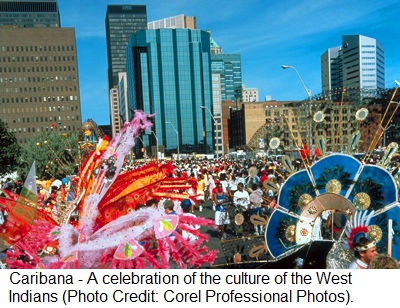
Category: Social

Lessons from Colorado: How the West Was Won

Go Lean Commentary

CU Blog - Lesson from Colorado - How the West Was Won - Photo 0

America – a large country that spans from sea to shiny sea –  is the richest, most powerful country in the world. That is today; but this was not always the case. In fact, when the country started in 1776, it only featured 13 colonies (States today) on the mid-coast of the Atlantic Ocean, from Georgia up to New Hampshire. There were no territories on the coast of the Gulf of Mexico nor near the western extremities of the Pacific Ocean.

Question: How and why did the expansion happen from East to West?

Answer: Its complicated!

It was a philosophy embedded in all societal engines of early America (economics, security and governance), branded Manifest Destiny – see the encyclopedic definition in the Appendix below.

The book Go Lean…Caribbean makes an important point about US history and its quest to expand across the North American continent. The book asserts that there are lessons for the Caribbean to glean and learn about nation-building. This is how the subject is addressed in the book: How the West Was Won. This declarative statement is presented as a question and an answer (Page 142) under this title:

10 Lessons from the American West

The Bottom Line on How the West Was Won

The concept of Cowboys (and Indians), riding off in the sunset is embedded into every American child’s DNA. The Old West has been a constant feature and inspiration in American literature, film and TV shows; the concept is enamored by readers and movie-goers around the world. In 1997 the film: How the West Was Won (1962) was selected for preservation in the US National Film Registry by the Library of Congress as being “culturally, historically, or aesthetically significant”. In addition to the film, this title is featured in a number of American media productions:

  • How the West Was Won (TV series), a 1970s television series loosely based on the film
  • How the West Was Won (Bing Crosby album) (1959)
  • How the West Was Won (Led Zeppelin album), a 2003 live album featuring the band live in 1972
  • How the West Was Won, a 2002 album by rapper Luni Coleone
  • How the West Was Won, a song by Laibach on the 1987 album Opus Dei

Despite the projected image, the America of Old was always a pluralistic democracy; there were Africans (slaves and their descendants), Native Americans, Asians (Chinese, Japanese, Pacific Islanders, etc.) and Eastern Europeans. Those that worked so hard to build America were men, women and children of many races and ethnicities. So the “concept of Cowboys riding off in the sunset [that] is embedded into every American child’s DNA” was inaccurately portrayed as only those of White Anglo-Saxon Protestant (WASP) persuasion.

Question: How the West Was Won?

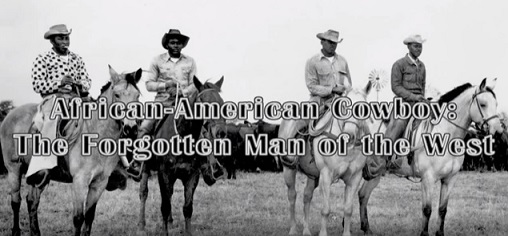
Answer: With the contributions of many different people. See VIDEO here:

VIDEO: African-American Cowboy – PART 1https://youtu.be/JAr2UzErToA

Published on Jun 9, 2010 – Documentary: “African-American Cowboy: The Forgotten Man of the West”. Had to break it into two parts due to YouTube requirements at the time. You can find the complete 14-minute documentary at https://www.youtube.com/watch?v=5jwlM….

PART II: https://youtu.be/kvgh7Pr8s-E

  • Category: Education
  • License: Standard YouTube License

Yes, there were Black Cowboys … the image and brand of those who “Won the West” needs to be pluralistic, not just WASP.

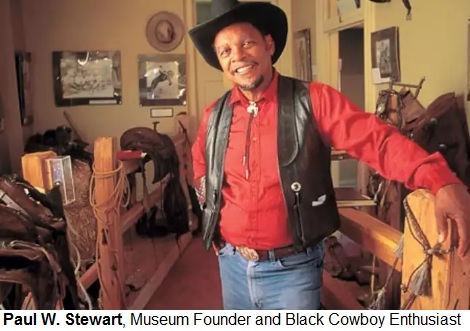
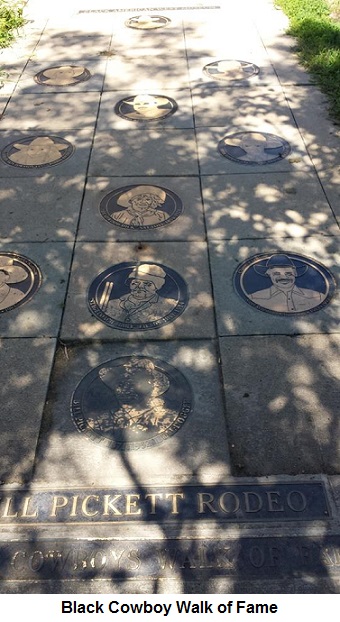
… this is the charter of the Black American West Museum and Heritage Center in Denver, Colorado. This site “preserves the history and culture of those African American men and women who helped settle and develop the American West. Located in the former home of Dr. Justina Ford, the first Black woman doctor in Denver. Exhibits on African American cowboys including Bill Pickett“.
CU Blog - Lesson from Colorado - How the West Was Won - Photo 3a

CU Blog - Lesson from Colorado - How the West Was Won - Photo 3b

African-American cowboys made up approximately 25% of the 35,000 cowboys in the Western Frontier during the 1870s and 1880s.

This is truly How the West Was Won.

This museum presents a unique collection of artifacts and profiles of people, things and equipment of Black Cowboys and their stories of contributions to the great American Western experience.

The emphasis of the museum’s collection is the contribution of black cowboys, ranchers, farmers, miners and buffalo soldiers on the development of the West . The artifacts are available to scholars with advance reservation.

CU Blog - Lesson from Colorado - How the West Was Won - Photo 1a

CU Blog - Lesson from Colorado - How the West Was Won - Photo 2

CU Blog - Lesson from Colorado - How the West Was Won - Photo 1b

Field Trips and Guided Tours
The museum offers students an educational and entertaining experience through guided tours or a self-directed outing. The museum tour meets the Colorado Model Content Standards and can be customized to your students’ educational needs.  – Source: BAWMHC.org

There are many lessons that Caribbean stakeholders can learn from developments in Denver and the State of Colorado. This is the theme of this series of commentaries on lessons that have been learned by Caribbean stakeholders visiting, observing and reporting on the US State of Colorado. (All non-encyclopedic photos in this commentary were snapped in Colorado by Bahamian student Camille Lorraine).

We have so much in common with this community. We have also built our Caribbean homelands with the blood, sweat and tears of many different contributors. In particular, Caribbean member-states have demographic compositions of Africans (29 of 30 territories have this majority), European, Amerindians and Asians (Indian, Chinese, etc.).

This commentary continues the 5-part series – this is entry 3 of 5 – on the subject of Lessons from Colorado. There are so many lessons that we must consider from this land-locked US State; good ones and bad ones. In fact, the full list of 5 entries are detailed as follows:

  1. Lessons from Colorado – Common Sense of Eco-Tourism
  2. Lessons from Colorado – Legalized Marijuana: Heavy-lifting!
  3. Lessons from Colorado – How the West Was Won
  4. Lessons from Colorado – Water Management Art & Science
  5. Lessons from Colorado – Black Ghost Towns – “Booker T. turning in his grave”

The book Go Lean…Caribbean calls for the elevation of Caribbean society, to re-focus, re-boot, and optimize all the societal engines so as to make the 30 member-states of the Caribbean a better place to live, work and play.  Thank you Colorado for this lesson from the past on how museums can play a vital role in disseminating truth and fostering reconciliation; these are necessary ingredients for nation-building of a multicultural society.

In a previous blog-commentary commemorating the opening of the new museum in Washington, DC – National Museum of African American History and Culture – it was highlighted how America featured some dark episodes in its history, but that the historic sacrifices of the African sons and daughters contributed greatly to the great society that America became:

This discussion of museums and reconciliations align with the objections of the book Go Lean…Caribbean, in that it serves as a roadmap for the introduction and implementation of the technocratic Caribbean Union Trade Federation (CU). The purpose of this roadmap is to elevate the economy in our Caribbean region, while harnessing the individual genius abilities – as in the arts. This Go Lean/CU roadmap employs strategies, tactics and implementations to impact its prime directives; identified with the following 3 statements:

  • Optimization of the economic engines in order to grow the regional economy to $800 Billion & create 2.2 million new jobs.
  • Establishment of a security apparatus to protect the resultant economic engines.
  • Improve Caribbean governance to support these engines.

While the Go Lean book is primarily an economic elevation roadmap for the Caribbean, it also details the eco-systems surrounding the business of the arts; there is consideration for jobs and entrepreneurship. The book declares (Page 230) that “art can be a business enabler, [while also serving as an] expression for civic pride and national identity”.

There is even a plan to foster museums that commemorate Caribbean history and culture in a new Caribbean Capital District. (The roadmap calls for a neutral location, among the 30 member-states, to host leaders of the Federation’s Executive, Legislative and Judicial branches of government). See the quotation here from the book (Page 230):

      CU Administered Museums
      Modeled after the Smithsonian, the CU “mother” (first-tier) museums will be placed in the Capital District. There will also be “child” museums scattered through out the regions with touring exhibitions.

The Go Lean book identified this vision of reconciliations-museums-art early in the book (Page 10 – 14), as implied in the following pronouncements in the opening Declaration of Interdependence:

      Preamble: As the history of our region and the oppression, suppression and repression of its indigenous people is duly documented, there is no one alive who can be held accountable for the prior actions, and so we must put aside the shackles of systems of repression to instead formulate efficient and effective systems to steer our own destiny.
      As the colonial history of our region was initiated to create economic expansion opportunities for our previous imperial masters, the structures of government instituted in their wake have not fostered the best systems for prosperity of the indigenous people.
      xxxii. Whereas the cultural arts and music of the region are germane  to the quality of Caribbean life, and the international appreciation of Caribbean life, the Federation must implement the support systems to teach, encourage, incentivize, monetize and promote the related industries for arts and music in domestic and foreign markets. These endeavors will make the Caribbean a better place to live, work and play.

In addition, there were other commentaries that also addressed the wisdom of museums-monuments and the business of the arts; see this sample here:

https://goleancaribbean.com/blog/?p=9897 Wynward’s Art Walk – The Energy of the Arts
https://goleancaribbean.com/blog/?p=4145 The African Monument in Dakar, Senegal, Africa
https://goleancaribbean.com/blog/?p=3292 Art Basel Miami – a Testament to the Spread of Art & Culture

There are lessons that the Caribbean today can learn from Colorado’s past. There are economic benefits – imagine art and monument tourism – to many stakeholders; the Go Lean roadmap calls for a federal museum in the CU‘s Capital District.

Most importantly, there are benefits from reconciling the past with the present; to tell the truth of How the West Was Won:

The Good Old Days weren’t always good and tomorrow isn’t as bad as it seems – Song Lyrics: “Keeping the Faith” by Billie Joel.

Now is the time for all of the Caribbean, the people (Cowboys & Indians) and societal leaders (business, security and government), to lean-in to this Go Lean roadmap. Caribbean causes can also be won! We can all work to make our homelands better places to live, work and play. 🙂

Download the book Go Lean … Caribbean – now!

Sign the petition to lean-in for this roadmap for the Caribbean Union Trade Federation.

————

Appendix – Manifest Destiny
CU Blog - Lesson from Colorado - How the West Was Won - Photo 4

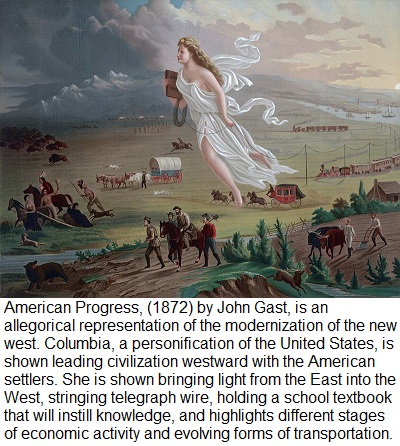
In the 19th century, manifest destiny was a widely held belief in the United States that its settlers were destined to expand across North America. There are three basic themes to manifest destiny:

  • The special virtues of the American people and their institutions
  • The mission of the United States to redeem and remake the west in the image of agrarian America
  • An irresistible destiny to accomplish this essential duty[3]

Historian Frederick Merk says this concept was born out of “a sense of mission to redeem the Old World by high example … generated by the potentialities of a new earth for building a new heaven”.[4]

Historians have emphasized that “manifest destiny” was a contested concept—pre-civil war Democrats endorsed the idea but many prominent Americans (such as Abraham Lincoln, Ulysses S. Grant, and most Whigs) rejected it. Historian Daniel Walker Howe writes, “American imperialism did not represent an American consensus; it provoked bitter dissent within the national polity … Whigs saw America’s moral mission as one of democratic example rather than one of conquest.”[5]

Newspaper editor John O’Sullivan is generally credited with coining the term manifest destiny in 1845 to describe the essence of this mindset, which was a rhetorical tone;[6] however, the unsigned editorial titled “Annexation” in which it first appeared was arguably written by journalist and annexation advocate Jane Cazneau.[7] The term was used by Democrats in the 1840s to justify the war with Mexico and it was also used to divide half of Oregon with the United Kingdom. But manifest destiny always limped along because of its internal limitations and the issue of slavery, says Merk. It never became a national priority. By 1843 John Quincy Adams, originally a major supporter of the concept underlying manifest destiny, had changed his mind and repudiated expansionism because it meant the expansion of slavery in Texas.[8]

Merk concluded:

From the outset Manifest Destiny—vast in program, in its sense of continentalism—was slight in support. It lacked national, sectional, or party following commensurate with its magnitude. The reason was it did not reflect the national spirit. The thesis that it embodied nationalism, found in much historical writing, is backed by little real supporting evidence.[9]

The day before finalizing the wording of the Declaration of Independence, John Adams wrote to his wife, Abigail “I am apt to believe that [Independence Day] will be celebrated, by succeeding Generations, as the great anniversary Festival. It ought to be commemorated, as the Day of Deliverance by solemn Acts of Devotion to God Almighty. It ought to be solemnized with Pomp and Parade, with shews, Games, Sports, Guns, Bells, Bonfires and Illuminations from one End of this Continent to the other from this Time forward forever more.”[10]

Source: Retrieved August 19, 2017 from: https://en.wikipedia.org/wiki/Manifest_destiny
Share this post:
, ,

‘If it is going to be, it starts with me’

Go Lean Commentary

“If it is going to be, it starts with me” – Self-Help Mantra

This has become a common rallying cry for Social Justice advocates – see Appendix A below. It is a very simple, yet powerful concept; it asserts:

Want to change the world, first change yourself, then work on changing your community and your country!

This theme is sang in songs – consider Appendix B and this song here by Michael Jackson, the Late-Great King of Pop. He said the same, but in a more melodious tune:

I’m starting with the man in the mirror. I’m asking him to change his ways; and no message could be any clearer: If you want to make the world a better place, take a look at yourself and make a change.

VIDEO – Michael Jackson – Man In The Mirror (Official Video) – https://youtu.be/PivWY9wn5ps

Published on Oct 2, 2009

In keeping with the lyrical message of “Man in the Mirror,” which was strongly identified with Michael Jackson and reflective of his own philosophies, the short film features powerful images of events and leaders whose work embodies the song’s message to”make that change.” Rolling Stone praised the short film in 2014 as “a powerful statement to deliver to personality-driven MTV.”

Written by Siedah Garrett and Glen Ballard
Produced by Quincy Jones for Quincy Jones Productions
Co-Produced by Michael Jackson for MJJ Productions, Inc.
From the album Bad, released August 31, 1987
Released as a single January 16, 1988

THE SHORT FILM
Director: Don Wilson

Michael Jackson’s short film for “Man in the Mirror” was the third of nine short films produced for recordings from Bad, one of the best-selling albums of all time. The “Man in the Mirror” single hit No. 1 in four countries in 1988, topping the charts in the United States, Italy, Belgium and Poland and reaching Top 5 in Canada, Ireland and New Zealand. In the U.S., “Man in the Mirror” was the fourth of five consecutive No. 1 singles from one album on the Billboard Hot 100-making Michael the first artist to achieve this milestone.

“Man in the Mirror,” written by Siedah Garrett (Michael’s duet partner on “I Just Can’t Stop Loving You”) and Glen Ballard, is one of only two songs on Bad not written by Michael Jackson and, even though it wasn’t a song he wrote himself, it was a message that was strongly identified with him and reflective of his own philosophies, as demonstrated through his actions and expressed in some of his own lyrics. “‘Man in the Mirror’ has a great message,” he wrote in his 1988 memoir Moonwalk. “I love that song. ..Start with yourself. Don’t be looking at all the other things. Start with you. That’s the truth.” A review of Bad in Rolling Stone in 1987 called the song “among the half dozen best things Jackson has done.”

In contrast to Michael’s other short films of the Bad era, “Man of the Mirror” tells a story not through performance, but through powerful images of oppression, homelessness, hunger, police brutality and other ills of the world, as well as events and leaders of the 20th century whose work is reflective of the song’s message to “make that change.”

Follow the Official Michael Jackson Accounts:
Facebook – http://smarturl.it/mj_facebook?IQid=y…
Twitter – http://smarturl.it/mj_twitter?IQid=yt…
Spotify – http://smarturl.it/mj_spotify?IQid=yt…
Newsletter – http://smarturl.it/mj_newsletter?IQid…
YouTube – http://smarturl.it/mj_youtube?IQid=yt…
Website – http://smarturl.it/mj_website?IQid=yt…

  • Category: Music
  • License: Standard YouTube License

Changing one-self; changing the community and changing the world; these are great aspirations! This is such a familiar theme for the movement behind the book Go Lean … Caribbean. In a previous blog-commentary, the point was elaborated that if you “change the way you see the world; you change the world you see”. But that thesis was related to technology and Augmented Reality Holograms; in this commentary however, the focus is strictly on Self-Help, for oneself and the community.

There is the need to help Caribbean communities.

The 30 member-states of the Caribbean region are all in dire straits; some are even flirting with Failed-States status – think: Puerto Rico Bankruptcy, Spanish Caribbean territorial abandonment, deficient Westminster structures, unstable volcanic states, etc.. Our communities are plagued with defects and dysfunctions in the economic, security and governing engines of society. But these can be remediated; the Go Lean movement posits that the entire region can be reformed and transformed, however that effort is described as heavy-lifting.

Yes, the societal defects of the Caribbean can be fixed – remediated and mitigated – but “if it is going to be, it starts with me”; it is necessary for all stakeholders to engage in the effort to turn-around the Caribbean. To forge change, the region must consider top-down and bottoms-up approaches, so we need the multitude of Caribbean people (bottoms-up) and politicians and community leaders (top-down) to lean-in to this quest to turn-around the community. Yes, it starts with “me”, as in everyone.

The quest to turn-around the Caribbean is detailed in the book Go Lean…Caribbean – available to download for free – which serves as a roadmap for the introduction and implementation of the technocratic Caribbean Union Trade Federation (CU), for the elevation of Caribbean society – for all 30 member-states. This CU/Go Lean roadmap has these 3 prime directives:

  • Optimization of the economic engines in order to grow the regional economy to $800 Billion and create 2.2 million new jobs.
  • Establishment of a security apparatus to ensure public safety and protect the resultant economic engines.
  • Improve Caribbean governance to support these engines, including a separation-of-powers between the member-states and CU federal agencies.

The book stresses that reforming and transforming the Caribbean societal engines must be a regional pursuit. This was an early motivation for the roadmap, as pronounced in the opening Declaration of Interdependence (Pages 12 – 13):

xi. Whereas all men are entitled to the benefits of good governance in a free society, “new guards” must be enacted to dissuade the emergence of incompetence, corruption, nepotism and cronyism at the peril of the people’s best interest. The Federation must guarantee the executions of a social contract between government and the governed.

xvi. Whereas security of our homeland is inextricably linked to prosperity of the homeland, the economic and security interest of the region needs to be aligned under the same governance. Since economic crimes … can imperil the functioning of the wheels of commerce for all the citizenry, the accedence of this Federation must equip the security apparatus with the tools and techniques for predictive and proactive interdictions.

xxiv. Whereas a free market economy can be induced and spurred for continuous progress, the Federation must install the controls to better manage aspects of the economy: jobs, inflation, savings rate, investments and other economic principles. Thereby attracting direct foreign investment because of the stability and vibrancy of our economy.

The Go Lean book provides 370-pages of turn-by-turn instructions on “how” to adopt new community ethos, plus the strategies, tactics, implementations and advocacies to execute so as to reboot, reform and transform the societal engines of Caribbean society.

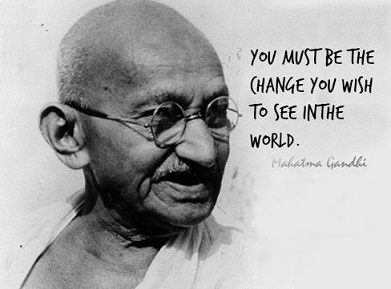
You must be the change you want to see in the world – Mahatma Gandhi.

CU Blog - 'If it is going to be it starts with me' - Photo 2

This quotation from Mahatma Gandhi relates to the theme of this commentary: “if it is going to be, it starts with me”.

Yes, the Revival the Caribbean needs must start with me! See song in Appendix B.

Other communities have successfully reformed and transformed; we can as well. This point has been conveyed in many previous blog-commentaries; consider this sample:

https://goleancaribbean.com/blog/?p=12322 Lesson from Canada – Ferries help Economics, Security & Governance
https://goleancaribbean.com/blog/?p=11386 Building Better Cities
https://goleancaribbean.com/blog/?p=10513 Lesson from India – Transforming ‘Money’ Countrywide
https://goleancaribbean.com/blog/?p=6563 Lessons from Iceland – Model of Recovery
https://goleancaribbean.com/blog/?p=4587 Burlington, Vermont: First city to be powered 100% by renewables
https://goleancaribbean.com/blog/?p=3490 How One Entrepreneur Can Rally a Whole Community
https://goleancaribbean.com/blog/?p=3326 M-1 Rail: Alternative Motion in the MotorCity
https://goleancaribbean.com/blog/?p=1918 Philadelphia Freedom – We can Look, Listen and Learn
https://goleancaribbean.com/blog/?p=1731 Lesson from Omaha – One Person Forging Change
https://goleancaribbean.com/blog/?p=1596 ‘Prospering Where … Planted’

This is not just idle talk. No, it is a viable plan – a roadmap – that is a conceivable, believable and achievable. The Go Lean book offers the turn-by-turn directions for strategies, tactics and implementations. So with the commitment of time, talent and treasuries of everyone in the Caribbean – or maybe just 1 person: “me” or “you” –  we can succeed in making our homeland a better place to live, work and play. 🙂

Download the free e-Book of Go Lean … Caribbean – now!

Sign the petition to lean-in for this roadmap for the Caribbean Union Trade Federation.

———-

Appendix A – PhD Dissertation

If It’s to Be, It Starts With Me!

The Bidirectional Relation between Goals and the Self

Inaugural-Dissertation

zur Erlangung der Doktorwürde der
Philosophischen Fakultät II

Der Julius-Maximilians – University of Würzburg

URL: https://opus.bibliothek.uni-wuerzburg.de/files/3501/PetraMarkelDissertation.pdf

———-

Appendix B VIDEO – Tim Timmons – Starts With Me – https://youtu.be/pslWA2VRmxg  

Published on Apr 29, 2013 – Download the song now: http://hyperurl.co/2fmddf

Subscribe: http://hyperurl.co/ilhqdq

Share this post:
, ,
[Top]

The Wait Ended – This Day Last Year – ENCORE

Time flies … when you’re having fun – Old Adage

This has been the case in the last 12 months. On  this day – July 27 – in 2016, the facility to download the book Go Lean … Caribbean finally became available.

Hip Hip Hooray!

We have not stood still since then. We have re-published the main Go Lean website into all 4 Caribbean languages – Dutch, English, French and Spanish – and published 180 more blog-commentaries.

Here below is an Encore of that original blog-commentary that announced the functionality to download the e-Book.

——————

Go Lean Commentary

“Now I tired waiting”.

Book CoverThe book Go Lean … Caribbean is now available to download as an e-Book … for free.

Get the e-Book here NOW!

What is the big deal?

Well, this book purports to be the answer … for what ails the Caribbean.

The book asserts that the Caribbean is in crisis; that the region of 42 million people in the 30 member-states is dysfunctional … to the point of flirting with Failed-State status. It is that serious!

The book posits that one identifying symptom is the high societal abandonment rate. The countries of the Caribbean region are experiencing a brain drain where 70 percent – on the average – of the tertiary-educated have fled for foreign shores.

70% …
… this is no way to nation-build.

Brain Drain 70 percent ChartThese alarming abandonment rates have been communicated to the governments and leaders of the region and yet still, the problem persists. They have not taken action to curb the problem.

Comes now the book Go Lean…Caribbean. This serves as a roadmap for the introduction and implementation of the technocratic Caribbean Union Trade Federation (CU). This 370-page publication presents the solutions for all the region, all the 4 language groups (Dutch, English, French and Spanish) by describing 144 different missions to elevate the economic, security and governing engines of the region. This is a serious answer to a serious crisis.

This book is published by a community development foundation made up of mostly Caribbean Diaspora. These ones have grown tired of waiting.

“Now I tired waiting”?
I’ve come to fix the …

This familiar refrain in the Caribbean has been repeated time and again, even sang in melody and rhyme. See/listen here, the classic Calypso song from the legendary Mighty Sparrow (and the lyrics in the Appendix below):

VIDEOMighty Sparrow – Mr. Walker – https://youtu.be/i5d9WzncTew

Published on Oct 22, 2012 – This song describes a frustrated man who was promised to marry a  “not so beautiful” woman, but who was more prosperous economically than himself. This is presented here as a metaphor, of the frustration of waiting for change and finally taking positive action to effect the change oneself.
Album : Party Classics. 1986
All ownership belong to the copyright holder. There is no assumption of infringement here.

The Caribbean Diaspora – living abroad in the US, Canada and Western Europe – were always taught to believe that the Caribbean is the greatest address on the planet, and yet it was essential that they leave to forge an existence elsewhere. They have endured in these foreign lands, but they are still only alien residents.  It is not home!

If only there were some solutions for their homeland?

Solutions for the Caribbean are the prime directives of the Go Lean/CU roadmap; just consider these:

  • Optimization of the economic engines in order to grow the regional economy to $800 Billion & create 2.2 million new jobs.
  • Establishment of a security apparatus to ensure public safety and protect the resultant economic engines.
  • Improve Caribbean governance to support these engines.

Puerto Rico Flag

The quest of the Go Lean/CU roadmap is direct: to make the Caribbean a better place to live, work and play. The book presents how this quest is conceivable, believable and achievable. It posits that the foundation is now in place, and we only need some technocratic deliveries to move the Caribbean member-states from the current status quo to the new destination: a better homeland. This presents a solution where our youth will no longer have to leave, and our older generations can relish a return back home.

“Now I tired waiting”, I come to fix … “the situation”. We now present you the “fix”!

🙂

Download the e-Book of Go Lean … Caribbean – free … now!

———–

Appendix – Lyrics: Mighty Sparrow – Mr. Walker

She ugly yes, but she wearing them expensive dress
The People say she ugly, but she father full a money
Oh Lord Mamma, woy woy

Good morning Mister Walker
I come to see your daughter
Oh, Mister Walker!
I come to see your daughter
Sweet Rosemarie, she promise she gone marry me
And now I tired waiting!
I come to fix the wedding

After the wedding day, I don’t care what nobody say
Everytime I take a good look at she face I see a bankbook
Oh Lord Mamma, woy woy

Good morning Mister Walker
I come to see your daughter
Hmm, Mister Walker!
I come to see your daughter
Sweet Rosemarie, she promise she gone marry me
And now I tired waiting!
I come to fix the wedding, woy

Apart from that, they say how she so big and fat
When she dress they tantalize she, saying monkey wearing mini
Oh Lord Mamma, woy woy

Good morning Mister Walker
I come to see your daughter
Oy, Mister Walker!
I come to see your daughter
Sweet Rosemarie, she promise she gone marry me
And now I tired waiting!
I come to fix the wedding, Hmm

All I know, is I don’t intend to let she go
Cause if she was a beauty, nothing like me could get she
Oh Lord Mamma, woy woy

Good morning Mister Walker
I come to see your daughter
Oy, Mister Walker!
I come to see your daughter
Sweet Rosemarie, she promise she gone marry me
And now I tired waiting!
I come to fix the wedding, oh

Source: Retrieved July 27, 2016 from: http://www.lyricsmode.com/lyrics/m/mighty_sparrow/mr_walker.html

Share this post:
, , , ,
[Top]

State of the Union – Annexation: French Guiana

Go Lean Commentary

CU Blog - State of the Union - Annexation - French Guiana - Photo 0

There is the Big Dogthe Alpha – and then there are the other dogs. While this is just nature, it also applies to the societal developments. In the Caribbean region, for example, there is the Big Dog of the United States of America dominating the region? Who is next? The British and …

The French.

This does not refer to just these French Caribbean islands, but rather the whole Republic of France, in which these Caribbean member-states are considered Overseas Departments (administrative sub-sets of the national government); see census numbers here:

Member –State Land Area (Mile2) Population GDP Millions GDP Per Capita
Guadeloupe 1,628 405,000 $6,169 $21,780
Martinique 1,128 402,000 $9,610 $24.118
Saint Barthélemy 21 8,938 $255 $37,000
Saint Martin 53 35,925 $599 $20,600
French Guiana 32,253 250,109 $4,900 $20,000
Republic of France 248,573 66,991,000 $2,833,000 $43,652

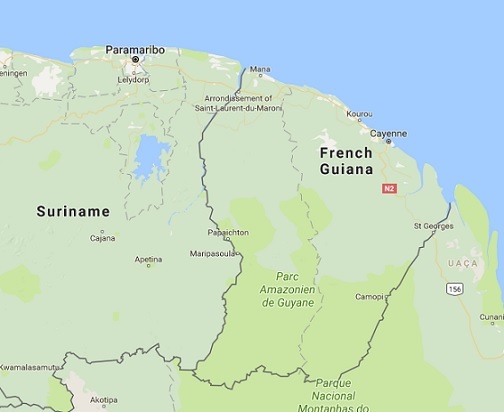
There is one French territory in this region that is NOT included in the roadmap for Caribbean confederation, as described in the book Go Lean … Caribbean. This refers to French Guiana, the territory on the mainland of South America, adjacent to Suriname; see photo above.

While the US is Number 1 in the world for Single Market economies, the French is shortly behind; (UK #9; France #10; The Netherlands #28). In the Caribbean, the French structure calls for the administrative designation of an overseas departments that have identical powers to those of the regions of metropolitan France. (This is different than overseas collectivities which is the particular status of Saint Barthélemy and Saint Martin). As integral parts of the French Republic, an overseas department is represented in the National AssemblySenate and Economic and Social Council, elect a Member of the European Parliament (MEP), and use the Euro as their currency.

So nowadays, Guiana is fully integrated in the French central state; they are even a part of the European Union, and its official currency is the Euro. The region is the most prosperous territory in all of South America with the highest GDP per capita.[2] A large part of Guiana’s economy derives from the presence of the Guiana Space Centre, now the European Space Agency‘s primary launch site near the equator. As elsewhere in France, the official language is French, but each ethnic community has its own language, of which Guianan Creole is the most widely spoken.

French Guiana and the European Space Agency were prominently featured in the Go Lean book – Page 105; see Appendix below – as a model for Self-Governing Entities (SGE). The hope – as expressed in the book – was that this territory would someday join the regional neighborhood.

French Guiana is complete administratively, but still features a lot of societal defects – not colonial de jure; but colonial de facto. It is the opinion of this Go Lean commentary, that this homeland needs … its neighbors: regional integration, which is the best strategy for anti-colonialism. See this VIDEO and news article here, highlighting the blatant discord there in that territory:

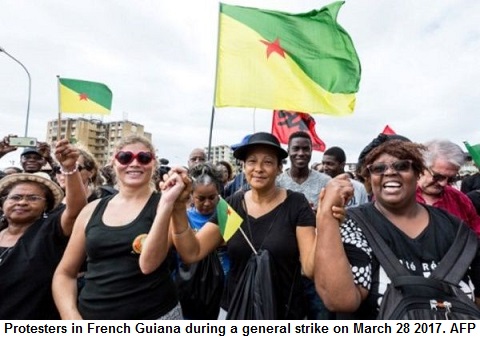
VIDEO – French Guiana Marches Against Colonialism – https://videosenglish.telesurtv.net/player/653436/french-guiana-marches-against-colonialism/?aspectratio=auto

General Strike and National Protest on March 28, 2017

———-

Opinion Article – How Racism Hampers Health Care in French Guiana
By: Estelle Carde

Limited access to health care is exacerbated by everyday discrimination based on ethnicity and national origin.
Oft-overlooked French Guiana, one of France’s five overseas departments, has suddenly captured international media attention. And the news from this small South American territory is not good.

Crime, overcrowding in schools and hospitals, unemployment, the cost of living and slums have reached alarming levels.

Citizen discontent led to a massive demonstration this March, the most intense such strike since 2009. Demonstrators are asking for a $US2.7 billion emergency aid package from the French government to assist in the territory’s social and economical crisis.

CU Blog - State of the Union - Annexation - French Guiana - Photo 2

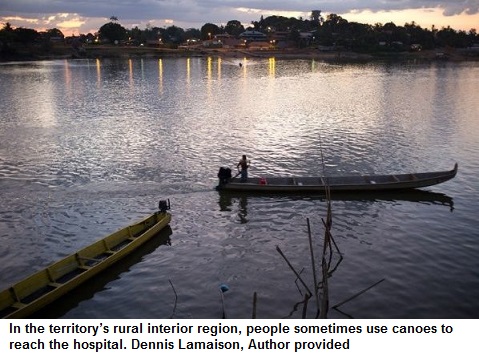
Health care is a particular concern in the former penal colony of 276,000 people. Hospitals are under-staffed and technical facilities are lacking. In some areas, the nearest hospital is a two-day canoe trip away.

CU Blog - State of the Union - Annexation - French Guiana - Photo 1

The recent deaths of five premature babies from infection at Cayenne hospital, in the capital, have heightened concerns.

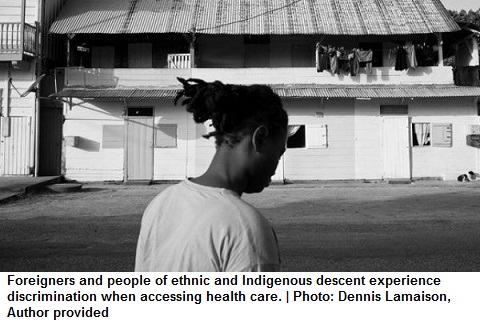
But there’s one critical health care-related issue that almost no one is talking about: racism. In a diverse territory comprised of people of European, African, Asian and Indigenous descent and a growing immigrant population, limited access to health care is exacerbated by everyday discrimination based on ethnicity and national origin.

Too many foreigners?
Foreign-born residents of French Guiana are among those impacted by discrimination in the health-care system.

Though socioeconomically the territory lags severely behind the rest of France, French Guiana constitutes a regional haven of wealth whose attractiveness has grown since the 1960s. Today, more than one in three inhabitants is born abroad. People from Suriname, Brazil and Haiti represent the largest immigrant groups.

This “tidal wave” of immigration is often cited as the main cause of French Guiana’s current socioeconomic crisis, even in some French political circles. The discriminatory behaviours that sometimes result from such widespread immigrant-blaming may be only thinly veiled.

State health office assistants might apply stricter conditions than legally necessary to those seeking medical benefits. Some, for instance might ask the foreign-born applicants to give proof of longer residency than required by law, thinking that it will discourage them from settling in the territory.

The same arguments are, in fact, used to justify similar discriminatory practices against immigrants in mainland France, too. But in Guiana they are more openly displayed.

Ethnic categorizations
Immigrants are not the only group that experiences discrimination in accessing health care in French Guiana. Members of minority populations, whether they are French or not, can also be affected.

This is partly because in French Guiana, people commonly use ethnicity to identify themselves and others. Creole, Maroon, Amerindian, Hmong, Chinese or French Métropolitains (mainlanders) are frequently invoked categories.

Under French law, the government cannot collect data or use it based on ethnicity. But in Guiana such usage goes back to the territory’s early times as a slave colony.

And, of course, each grouping comes with its stock of stereotypes: “Maroons are child-like”, for instance, or “Hmongs are disciplined” and “Amerindians drink their dole money”.

But these assumptions are not set in stone. Because they serve to justify power relations between groups, they tend to change with the ethnic identity of the speaker. This social dynamic plays out in French Guiana’s health-care system.

In Saint-Laurent-du-Maroni, French Guiana’s second largest city, Maroons – the descendants of escaped former slaves – are the majority population and therefore the largest group of health-care users. Health-care professionals, on the other hand, are primarily Creoles or French mainlanders.

CU Blog - State of the Union - Annexation - French Guiana - Photo 3

These professionals often point to the Maroon people’s history to explain certain patient behaviours. In the 18th and 19th centuries, slaves who escaped from plantations would hide in the forest, creating communities that remained more or less isolated from coastal Guianese society for almost 200 years.

In 1969, the large territory they still occupy – mainly tropical forests in the country’s interior – was finally integrated into the Department of Guiana. At that point, they began to gain access to French citizenship and public services such as education and health.

Doctors, nurses and other health professionals readily highlight these facts to explain Maroons’ difficulties in accessing treatment, inferring that they are not yet used to doing things “the Western way.”

‘Them’ and ‘us’
Such references to historical facts are charged with connotations. Some Creole professionals suggest that Maroon people are undeserving of care because they only had to “leave their forest” to access to such services. Contrasting that status with their own position as “Guianese taxpayers” who fund these services, some may use this as justification to refuse Maroon people help in accessing treatment.

This attitude can be better understood considering the Creole people’s own history in French Guiana. Their process of accessing civil rights was slow and gradual. Social empowerment came only at the tail end of a gradual Westernisation process that began with slavery in the 17th century.

After emancipation and the granting of French citizenship in 1848, this population slowly rose to local economic and political power, spurred along by Guiana’s transformation into a French department (1946) and a national policy of decentralisation (1982).

Now hard-won Creole dominance is threatened by Maroon people, who recently obtained the same civil rights as them, and whose numbers have surpassed their own numbers in the Western part of Guiana.

Health professionals from the French mainland, for their part, tend to emphasise the “cultural differences” of these “new citizens”. They cite, for example, the “traditional” way in which Maroons transmit information (watching without asking questions) and their way of “living in the moment” to explain their apparent inability to request health coverage prior to needing treatment.

This tendency to highlight cultural differences can also end up amounting to discrimination because it overshadows systemic failures that do impact access to health care, such as the lack of health coverage offices in the country’s rural inland regions. This tendency is more present among professionals who have been in Guiana for just a few months and who readily admit to being allured by the very different culture of this “exotic” overseas corner of France.

Discriminatory behaviours among health professionals therefore exacerbate the failures of the ailing health-care system now under protest by Guianese demonstrators. Foreigners and Maroon people are the first victims of administrative failures due to their vulnerable socioeconomic status. They are also worst hit by geographical obstacles because they represent a majority of inhabitants in the territory’s remote rural areas.

But this accumulation of racist, economic and geographical inequalities is no accident. It is the result of centuries of history of Guianese society.

Source: TeleSur Media Network – Published April 13, 2017; retrieved July 26, 2017 from: http://www.telesurtv.net/english/opinion/How-Racism-Hampers-Health-Care-in-French-Guiana-20170413-0007.html

——-

Translated from the French by Alice Heathwood for Fast for Word.

Estelle Carde is a professor of Sociology of Health at Université de Montréal.

This article was originally published on The Conversation. Read the original article.

RELATED:
Guiana Workers ‘Toughen Up’ Mobilizations Against French State 

This theme – “All is not well in the Caribbean” – aligns with the movement behind the book Go Lean … Caribbean, where the assertion is that the problems facing the Caribbean region are too big for any one member-state alone. There needs to be a regional solution. The book posits that shifting the help-seeking responsibility to a region-wide, professionally-managed, deputized technocracy will result in greater production and greater accountability. This deputized agency is the Caribbean Union Trade Federation (CU). The Go Lean book serves as a roadmap for the introduction and implementation of the CU.

This commentary is a follow-up to the 5-part series on the subject of the State of the Caribbean Union. Our Caribbean region is unique in that there are 4 different languages and 5 colonial legacies, spread across 30 member-states and 42 million people. The goal is to execute the 5-year plan of the roadmap and then add a 31st member: French Guiana. Based on the dispositions in the foregoing VIDEO and news-opinion article, French Guiana can use the Go Lean empowerments NOW! That land is suffering from many of the same dysfunctions that plague the rest of the Caribbean and the neighboring states of Suriname and Guyana. There might be the need to act NOW to seek refuge and relief.

The other 5 entries in the series are as follows:

Just the phraseology “Caribbean Union” assumes a collective collaboration of all the territories that identify with Caribbean culture; there is the need for better local stewardship. This Go Lean effort is a confederation of sovereign and non-sovereign territories, as is the case for French Guiana. There is no need for independence, as the authority of these territories can still be deputized into the CU as an umbrella intergovernmental organization. In total, the Go Lean/CU roadmap will employ strategies, tactics and implementations to impact its prime directives; identified with the following 3 statements:

  • Optimization of the economic engines in order to grow the regional economy to $800 Billion & create 2.2 million new jobs.
  • Improvement of Caribbean governance to support these engines, including a “Separation-of-Powers between CU federal agencies and Caribbean member-state governments”; so the limitations of national laws in a member-state does not have to override the CU. A CU constitution would apply to the installation – and continuation – of Exclusive Economic Zones (EEZ) and Self-Governing Entities (SGE) that operate in controlled bordered territories like campuses, industrial parks, research labs and industrial plants.

The Go Lean/CU roadmap always anticipated the French Caribbean territories. This theme was detailed in previous Go Lean blog-commentaries; consider this sample:

https://goleancaribbean.com/blog/?p=12466 Managing Volcanoes in the French Caribbean – Martinique and Guadeloupe
https://goleancaribbean.com/blog/?p=10554 Welcoming the French in Formal Integration Efforts
https://goleancaribbean.com/blog/?p=10043 Caribbean Integration Plan for Greater Prosperity
https://goleancaribbean.com/blog/?p=7834 French Caribbean ready for the Martinique Surf Pro
https://goleancaribbean.com/blog/?p=382 Guadeloupe, Martinique, St Maarten Join the Association of Caribbean States

Now the status of the French Caribbean is indistinguishable from colonial status. All authority still rest in Paris. But there is an opportunity for more (and better) autonomous governance in the region. As depicted in these previous commentaries, this opportunity is extended for the French Caribbean to align with the rest of the Caribbean region to adopt strategies, tactics and implementations to assuage the societal dysfunctions … together.

This quest of optimizing the entire Caribbean economic-security-governance eco-system is more than just a dream; this was the motivation for the origins of the Go Lean movement. This vision is defined early in the book (Pages 12 & 13) in the following pronouncements in the Declaration of Interdependence:

ix. Whereas the realities of healthcare and an aging population cannot be ignored and cannot be afforded without some advanced mitigation, the Federation must arrange for health plans to consolidate premiums of both healthy and sickly people across the wider base of the entire Caribbean population. The mitigation should extend further to disease management, wellness, mental health, obesity and smoking cessation programs. …

xi. Whereas all men are entitled to the benefits of good governance in a free society, “new guards” must be enacted to dissuade the emergence of incompetence, corruption, nepotism and cronyism at the peril of the people’s best interest. The Federation must guarantee the executions of a social contract between government and the governed.

xii. Whereas the legacy in recent times in individual states may be that of ineffectual governance with no redress to higher authority, the accedence of this Federation will ensure accountability and escalation of the human and civil rights of the people for good governance, justice assurances, due process and the rule of law. As such, any threats of a “failed state” status for any member state must enact emergency measures on behalf of the Federation to protect the human, civil and property rights of the citizens, residents, allies, trading partners, and visitors of the affected member state and the Federation as a whole.

xxii. Whereas the heritage of our lands share the distinction of cultural tutelage from European and American imperialists that forged their tongues upon our consciousness, it is imperative to form a society that is neutral and tolerant of the mother tongue influences of our people to foster efficient and effective communications among our citizens.

xxiii. Whereas many countries in our region are dependent Overseas Territory of imperial powers, the systems of governance can be instituted on a regional and local basis, rather than requiring oversight or accountability from distant masters far removed from their subjects of administration. The Federation must facilitate success in autonomous rule by sharing tools, systems and teamwork within the geographical region.

xxiv. Whereas a free market economy can be induced and spurred for continuous progress, the Federation must install the controls to better manage aspects of the economy: jobs, inflation, savings rate, investments and other economic principles. Thereby attracting direct foreign investment because of the stability and vibrancy of our economy.

The Go Lean book posits that the inefficient Caribbean communities – French Guiana included – can be reformed and transformed if they adopt the community ethos, strategies, tactics, implementations and advocacies as depicted in the Go Lean roadmap. The book provides 370-pages of turn-by-turn instructions on “how” so as to reboot, reform and transform the societal engines of Caribbean society. For one, the strategy calls for the implementation of Self-Governing Entities like the European Space Agencies and many more industrial sites – i.e. 10 Steps to Implement Self-Governing Entities on Page 105 of the book.

The effort of the Go Lean roadmap is not “stuck” on Caribbean geography; rather we are committed to Caribbean culture. As such we confederate with territories not only in the Caribbean Sea but also those in the Atlantic Ocean (Bahamas, Bermuda and the Turks & Caicos Islands), on the Central American mainland (Belize) and the South American mainland (Guyana, Suriname and now French Guiana). All of this constitutes the Caribbean homeland.

Together, Caribbean stakeholders can succeed in efforts to improve; to end the parasite status with European capitals (and Washington) and instead exert our autonomy as mature democracies. We can be protégés instead of parasites.

Yes, we can … reform and transform our homeland to make it a better place to live, work and play. 🙂

Download the book Go Lean … Caribbean – now!

Sign the petition to lean-in for this roadmap for the Caribbean Union Trade Federation.

———–

Appendix – The Bottom Line on the French Guiana Space Center

The European Space Agency (ESA) is an intergovernmental organization of 20 member states, dedicated to the exploration of space. Established in 1975 and headquartered in Paris, France, ESA has a staff of more than 2,000 with an annual budget of about US$5.51 billion (2013). ESA’s space flight program includes human spaceflight, mainly with the International Space Station program, the launch and operations of unmanned exploration missions to other planets and the Moon, Earth observation, science, telecommunication as well as maintaining a major spaceport, the Guiana Space Center (CSG) at Kourou, French Guiana, and designing launch vehicles. The main European launch vehicle, Ariane 5 is operated through Arianespace with ESA sharing in the costs and further developing this launch vehicle.

The CSG has been operational since 1968; it is particularly suitable as a location for a spaceport as it fulfills the two major geographical requirements:

• it is quite close to the equator, so that the spinning earth can impart some extra velocity to the rockets for free when launched eastward, and

• it has uninhabited territory (in this case, open sea) to the east, so that lower stages of rockets and debris from launch failures cannot fall on human habitations.

CSG is the spaceport used by the ESA to send supplies to the International Space Station using the Automated Transfer Vehicle. Commercial launches are bought also by non-European companies. ESA pays two thirds of the spaceport’s annual budget and has also financed the upgrades made during the development of the Ariane launchers.

Source: Go Lean … Caribbean book (Page 105).

Share this post:
, , , ,
[Top]

Transformation: Rock-n-Roll Dethroned by Hip-Hop

Go Lean Commentary

The only constant is change itself!

CU Blog - Rock-n-Roll Dethroned by Hip-Hop - Photo 1

There are champions and there are challengers. When an old champion is surpassed by a young challenger, it is only a matter of time for the young to become old and another generation of challengers appears on the scene.

Just wait!

This scenario has happened again; this time in the world of consumed music: Rock-n-Roll is King … no more. The young upstart that took the throne in 1964 has now been supplanted by the new upstart Hip-Hop or Rap music; see story in Appendix below. Now the declaration can be:

… rap music is here to stay.

The qualitative evidence of this fact has been obvious to me for at least 20 of the last 40 years.  But this study does more than just vindicate those of us who study rap music in the academy: it also validates the extraordinary cultural influence of what Bakari Kitwana has defined as the hip-hop generation: those of us born between the mid-1960s and the mid-1980s who have been wrestling with the rise of neoliberalism, the consequences of the prison-industrial complex and the withering effects of globalisation in the post-civil rights era. That struggle has, to some extent at least, has been articulated through rap music itself.

The key piece of information “discovered” by Mauch et al [(The Evolution of Popular Music: 1960-2010 by Matthias MauchRobert M. MacCallumMark LevyArmand M. Leroi)] is that there were three major influential shifts in popular music in that 50-year period. One, in 1964, related to the decline of popular jazz/blues forms and the rise of rock music; one in 1983, reflected the emergence of pop/stadium rock; the final, most pronounced shift came in 1991, with the popular emergence of rap music.  This final shift falls within the period known to scholars of hip-hop culture as the Golden Era; [where songs about fighting power structures could be as popular as songs that degrade women]. – The Guardian Newspaper posted May 8, 2015; retrieved July 25, 2017

CU Blog - Rock-n-Roll Dethroned by Hip-Hop - Photo 2

This development is presented by the movement behind the book Go Lean…Caribbean. The book – available to download for free – tracks the Agents of Change that have impacted the Caribbean region and declares that:

  • Change is Good
  • Change is Bad
  • Change is Constant

The book urges a Caribbean audience – in the homeland and in the Diaspora – to better prepare for change, to act and move to the corner where opportunity meets preparation. This is how to generate “luck”; this is how to get to the conclusion: “Change is Good”, as opposed to the disposition of “Change is Bad”. Unfortunately for the Caribbean, we have only experienced the bad consequences of change.

We have not been ready. Going forward … let’s do better.

The intersection of music and change is familiar to this Go Lean movement; consider these previous blog-commentaries:

https://goleancaribbean.com/blog/?p=8619 This Day In History: Jamaican Innovation for Hip-Hop
https://goleancaribbean.com/blog/?p=3568 Forging Change: Music Moves People

The Go Lean book provides turn-by-turn directions on “how” to do better in an atmosphere of intense change. It serves as a roadmap for the introduction and implementation of the technocratic Caribbean Union Trade Federation (CU), for the elevation of Caribbean society – for all member-states.

In a previous blog commentary from this Go Lean movement, it was reported that …

Over the past half century, the economic structures of many North American and Western European countries have changed dramatically, a mostly upward trajectory (growth) with occasional dips (recessions). During this same past half century, the economics of many Caribbean countries have also changed dramatically, but mostly towards poor or regressive conditions. This fact has forced a brain drain among many of the member-states’ professional classes.

As these changes took hold of society, the social effects on people, families, traditions, habits and values have been drastic; a lot has changed over the past decades.

So change has taken root! We see a parallel: Hip-Hop is now King, the reigning Champion in American music consumption (see sample in the VIDEO below) … while the Caribbean has been beset by these Agents of Change:

  • Globalization
  • Technology
  • Climate Change
  • Aging Diaspora

Music change; people change; values change; demographics change; society change!

Among the changes – to people, families, traditions, habits and values – is the effect on the Caribbean brain drain, estimated at 70% on the tertiary-educated population. This is a crisis for our region!

This is the consistent theme in the Go Lean book and blogs; they describe the “push and pull” factors of societal change; these sources posit that life in North American communities (and Western European) serve as a “pull” factor for many Caribbean communities. Plus, the resultant failing economic conditions in the homeland further “push” many citizens away. Bad changes create repercussions of more bad changes.

To alleviate this crisis, there is the need to counteract with purposeful change. The Go Lean book serves as a roadmap to elevate the economics of the region; and it clearly describes the impact on other societal engines: security and governance. The Go Lean/CU roadmap therefore has these 3 prime directives:

  • Optimization of the economic engines in order to grow the regional economy to $800 Billion and create 2.2 million new jobs.
  • Establishment of a security apparatus to ensure public safety and protect the resultant economic engines.
  • Improve Caribbean governance to support these engines, including a separation-of-powers between the member-states and CU federal agencies.

The Go Lean book stresses that reforming and transforming the Caribbean societal engines must be a regional pursuit. This goal was an early motivation for the roadmap, as pronounced in the opening Declaration of Interdependence (Pages 12 – 13):

xi. Whereas all men are entitled to the benefits of good governance in a free society, “new guards” must be enacted to dissuade the emergence of incompetence, corruption, nepotism and cronyism at the peril of the people’s best interest. The Federation must guarantee the executions of a social contract between government and the governed.

xvi. Whereas security of our homeland is inextricably linked to prosperity of the homeland, the economic and security interest of the region needs to be aligned under the same governance. Since economic crimes … can imperil the functioning of the wheels of commerce for all the citizenry, the accedence of this Federation must equip the security apparatus with the tools and techniques for predictive and proactive interdictions.

xxiv. Whereas a free market economy can be induced and spurred for continuous progress, the Federation must install the controls to better manage aspects of the economy: jobs, inflation, savings rate, investments and other economic principles. Thereby attracting direct foreign investment because of the stability and vibrancy of our economy.

Within these 370-pages of turn-by-turn instructions in the Go Lean book are the details of “how” to adopt new community ethos, plus “how” to execute new strategies, tactics, implementations and advocacies so as to reboot, reform and transform the societal engines of Caribbean communities. There is a parallel with the emergence of Hip-Hop and managing societal change:

Hip-hop and it don’t stop.

VIDEO – Rapper’s Delight – Sugarhill Gang – https://youtu.be/63Q6FO0CKT4

Published on Jun 14, 2014 – I said a hip hop / Hippie to the hippie / The hip, hip a hop, and you don’t stop, a rock it out / Bubba to the bang bang boogie, boobie to the boogie…

Rapper’s Delight” is a hip-hop song released in September 1979 by The Sugarhill Gang, and produced by ex-Mickey and Sylvia member Sylvia Robinson.

While it was not the first single to include rapping, it is generally considered to be the song that introduced hip hop music to audiences in the United States and around the world (and the very first full-length rap song, which featured rapping parts throughout the entire song, unlike the first single). And for that reason, many refer to Rapper’s Delight as the first official rap song regardless. The song is ranked number 251 on the Rolling Stone magazine’s list of The 500 Greatest Songs of All Time and number 2 on VH1‘s 100 Greatest Hip-Hop Songs. It is also included in NPR‘s list of the 100 most important American musical works of the 20th century. It was preserved into the National Recording Registry by the Library of Congress in 2011.[2] Songs on the National Recording Registry are “culturally, historically, or aesthetically significant.”[3]Source: Retrieved July 25, 2017 from: https://en.wikipedia.org/wiki/Rapper%27s_Delight

Change is like a bull; we have to “take the bull by the horn”. If Hip-Hop is not your favorite musical genre, it does not mean it will go away. This too is a constant! One generation never likes the music of the next generation:

“Turn off that noise”!

We can turn down, or turn off the music, but we cannot turn off Change. It’s a constant. We need to Rock with it! We must simply do the work – heavy-lifting as it might be – to adapt to change.

This Go Lean plan is conceivable, believable and achievable. We can transform … and make our homeland a better place to live, work and play. 🙂

Download the book Go Lean … Caribbean – now!

Sign the petition to lean-in for this roadmap for the Caribbean Union Trade Federation.

———–

Appendix – Hip hop dethrones rock as most consumed music genre in the U.S., Nielsen Music stats reveal

By: Veronica Harris , New York Daily News

Hip hop and it don’t stop.

For the first time ever, hip hop is the most consumed music genre in the U.S., Forbes reports, using numbers Nielsen Music recently released in a mid-year report.

While rock has long ruled, holding the top genre spot since Nielsen began to measure music consumption in the U.S. in 1991, the tables have turned, with R&B/hip hop now surpassing the popularity of rock and pop.

For the first six months of 2017, R&B/hip hop was responsible for 25.1% of all music consumption in the country, while rock claimed 23%. Hip hop also leads in digital song sales and on-demand streaming.

“It’s been an action-packed start to the year, with records broken, chart history made, and several categories growing quickly,” Nielsen stated.

Analysts at Forbes magazine believe the increasing popularity of R&B/hip hop is due to its influence on streaming services. The genre is as popular as rock and pop combined on Spotify and Apple Music.

Out of the 10 most consumed albums in the U.S. for the six-month period between January and June of this year, six were R&B/hip hop, according to Nielsen. Kendrick Lamar topped that list with his album, “DAMN.,” with nearly 1.8 million listeners. Drake’s record-breaking album, “More Life,” is the third most consumed album, with nearly 1.7 million listeners.

Hip hop was king of the song charts, too. Migos’ “Bad and Boujee” had the second-highest amount of streams in that six-month period, nearly 650 million. Seven other rap songs also made that list.

Source: Posted Tuesday, July 18, 2017; retrieved July 25, 2017 from: http://www.nydailynews.com/life-style/hip-hop-dethrones-rock-most-consumed-music-genre-u-s-article-1.3336085


Share this post:
, ,
[Top]

Book Review: ‘Oral History of Bob Marley’

Go Lean Commentary

Bob Marley was not a saint; but he was saintly. – Author Roger Steffens

Marley SmilingBob Marley was perhaps the most influential person of Caribbean heritage; arguably so. He died 36 years ago, after living only to the age of 36. We have doubled the years of his life …

36 years here … 36 years gone!

… but it seems as if he lived a life of achievement equaling two or 3 lifetimes.

He was more than just a musician or an entertainer, he was a revolutionary icon. Many of the advocacies that he championed have now come full circle; come to fruition and come to regret:

In fact, references to Bob Marley have been consistent for the movement behind the book Go Lean… Caribbean – a guide to confederate, collaborate and convene the 30 member-states of the Caribbean region into a Single Market – he is mentioned in the book (Pages 119, 133 & 218) and featured in multiple blog-commentaries:

https://goleancaribbean.com/blog/?p=7738 A Lesson in History from Bob Marley – Buffalo Soldiers
https://goleancaribbean.com/blog/?p=866 Bob Marley: The legend lives on!

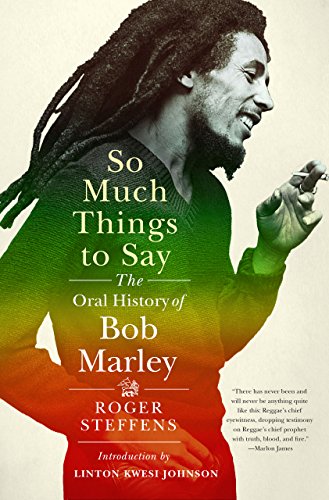
We now learn even more about Bob Marley in the new book by Reggae Archivist Roger Steffens, entitled: So Much Things to Say: The Oral History of Bob Marley. See a summary-review of that book here and listen to an AUDIO-Podcast interview with the Author:

Book Review for Book: So Much Things to Say: The Oral History of Bob Marley
By Roger Steffens 

Oral History of Marley 1

A revelatory, myth-shattering history of one of the most influential musicians of all time, told in the words of those who knew him best.

Roger Steffens is one of the world’s leading Bob Marley experts. He toured with the Wailers in the 1970s and was closely acquainted with Bunny Wailer, Peter Tosh and the rest of the band members. Over several decades he has interviewed more than seventy-five friends, business managers, relatives and confidants—many speaking publicly for the first time. Forty years in the making, So Much Things to Say weaves this rich testimony into a definitive telling of the life of the reggae king—the full, inside account of how a boy from the slums of Kingston, Jamaica, became a cultural icon and inspiration to millions around the world.

The intimacy of the voices and the frankness of their revelations will astonish even longtime Marley fans. Readers see the intense bonds of teenage friendship among Peter, Bunny and Bob, the vibrant early sessions with the original Wailers (as witnessed by members Junior Braithwaite, Beverley Kelso and Cherry Green) and the tumultuous relationships with Rita Marley and Cindy Breakspeare.

With unprecedented candor, these interviews tell dramatic, little-known stories, from the writing of some of Marley’s most beloved songs to the Wailers’ violent confrontation involving producer Lee “Scratch” Perry, Bob’s intensive musical training with star singer Johnny Nash and the harrowing assassination attempt at 56 Hope Road in Kingston, which led to Marley’s defiant performance two nights later with a bullet lodged in his arm.

Readers witness Marley’s rise to international fame in London, his triumphant visit to Zimbabwe to sing for freedom fighters inspired by his anthems and the devastating moment of his collapse while jogging in New York’s Central Park. Steffens masterfully conducts the story of Marley’s last months, as Marley poignantly sings “Another One Bites the Dust” during the sound check before his final concert in Pittsburgh, followed by his tragic death at the age of thirty-six.

So Much Things to Say explores major controversies, examining who actually ordered the shooting attack on Hope Road, scrutinizing claims of CIA involvement and investigating why Marley’s fatal cancer wasn’t diagnosed sooner. Featuring Steffens’s own candid photographs of Marley and his circle, this magisterial work preserves an invaluable, transformative slice of music history: the life of the legendary performer who brought reggae to the international stage.

Source: Amazon Online Bookstore-Portal; retrieved July 13, 2017 from: https://www.amazon.com/So-Much-Things-Say-History-ebook/dp/B01M68LN7U 

———-

AUDIO-PodcastBob Marley: Versions Of The Truth – https://the1a.org/segments/2017-07-10-oral-history-of-bob-marley/

Bob Marley: Versions Of The Truth

Published July 10, 2017 – Reggae historian Roger Steffens has written that “there are no facts in Jamaica, just versions” of the truth. That’s certainly the case with the star of Steffens’ latest book: Bob Marley.

Marley lived a life of art, inspiration and hard and fast adherence to his principles and spirituality. While he only lived to the age of 36, Marley and his music inspired a wave of devotees who fought for freedom, as well as a few enemies who wanted him dead.

But even though he was a global superstar, there are many mysteries and misconceptions about Marley.

Steffens new book, “So Much Things to Say: The Oral History of Bob Marley” gathers 40 years of interviews with those closest to Marley to separate truth from the various versions.

Host Joshua Johnson interviews guest Roger Steffens, reggae archivist and author of the book “So Much Things to Say: The Oral History of Bob Marley“.

We learn so much more about Bob Marley and Caribbean culture from these foregoing media productions. Marley was truly a musical genius who overcame obstacles and the challenge of a dysfunctional Jamaican society to soar and shine as a star in the world of music. This corresponds with a theme in the book Go Lean…Caribbean which relates that genius – in its many forms, be it music, arts, sciences, sports, etc. – can flourish in the Caribbean … with the proper fostering. The Go Lean book serves as a roadmap for the introduction and implementation of the Caribbean Union Trade Federation (CU). This would be an inter-governmental entity to promote a regional Single Market that covers the homelands of all 30 Caribbean member-states. This effort strives to advance Caribbean culture. The Go Lean/CU roadmap features this prime directive, as defined by these 3 statements:

  • Optimization of the economic engines to grow the regional economy to $800 Billion & create 2.2 million new jobs.
  • Establishment of a security apparatus to protect public safety and ensure the economic engines of the region, including the seas.
  • Improvement of Caribbean governance to support these engines, including a separation-of-powers between the member-states and CU federal agencies.

The Go Lean roadmap recognizes that a prerequisite for advancing society is a change in the Caribbean “community ethos”. This book opens early with the declaration that music can contribute to the fabric of society, but that society must contribute to the fostering of musicians. The book relates that such an attitude – community ethos or national spirit – can be forged in the entire region; see these statements in the Declaration of Interdependence (Pages 13 – 14):

xxi. Whereas the preparation of our labor force can foster opportunities and dictate economic progress for current and future generations, the Federation must ensure that educational and job training opportunities are fully optimized for all residents of all member-states, with no partiality towards any gender or ethnic group. The Federation must recognize and facilitate excellence in many different fields of endeavor, including sciences, languages, arts, music and sports. This responsibility should be executed without incurring the risks of further human flight, as has been the past history.

xxxii. Whereas the cultural arts and music of the region are germane to the quality of Caribbean life, and the international appreciation of Caribbean life, the Federation must implement the support systems to teach, encourage, incentivize, monetize and promote the related industries for arts and music in domestic and foreign markets. These endeavors will make the Caribbean a better place to live, work and play.

As related in a previous blog-commentary regarding Bob Marley …

“… he was the embodiment of all of these above values. He impacted the music, culture and economics of the region. He set a pathway for success for other generations of talented, inspirational and influential artists – musical geniuses – to follow. Other artists of Caribbean heritage are sure to emerge and “rock the world”; we are hereby “banking” on it, with these CU preparations.”

The CU presents that change has come to the Caribbean; with this Go Lean movement, there is a plan for new stewardship so that the Caribbean can better avail themselves of the benefits of music. So when we consider Bob Marley – as gleaned from the foregoing book by author Roger Steffens – we can assign all these descriptors and attributes to him:

  • Artist – Musician
  • Caribbean Ambassador
  • Inspirational Leader
  • Saintly, though not a saint.
  • Role Model for the Future

The world may never see another “star as bright” as Bob Marley; but we can still learn from his Role Model. The Go Lean book provides 370-pages of turn-by-turn instructions on “how” to adopt new community ethos, plus the strategies, tactics, implementations and advocacies to execute so as to reboot, reform and transform the societal engines of Caribbean society. Consider the sample from this list detailing this “how” for the Caribbean region to foster more musical geniuses:

Community Ethos – Ways to Foster Genius Page 27
Community Ethos –Promote Intellectual Property Page 29
Community Ethos – Ways to Promote Happiness Page 36
Community Ethos – Impact the Greater Good Page 37
Strategy – Vision – Celebrate the music, people and culture of the Caribbean Page 46
Tactical – Separation of Powers – Patents & Copyrights Page 78
Tactical – Separation of Powers – Culture Administration Page 81
Implementation – Ways to Benefit from Globalization Page 118
Advocacy – Ways to Make the Caribbean Better Page 131
Advocacy – Ways to Better Manage Image Page 133
Advocacy – Ways to Preserve Caribbean Heritage Page 218
Advocacy – Ways to Promote Music Page 231
Advocacy – Ways to Re-boot Jamaica – To make it less dysfunctional Page 239

Bob Marley – 36 years here … 36 years gone!

We urge all Caribbean stakeholders – governments and citizens alike – to learn the lessons from the life and legacy of Bob Marley, and then lean-in to this Go Lean roadmap to make the Caribbean homeland a better place to live, work and play. 🙂

Sign the petition to lean-in for this roadmap for the Caribbean Union Trade Federation.

Download the free e-Book of Go Lean … Caribbean – now!


Share this post:
, , ,
[Top]

Conscientizing on the Radio

Go Lean Commentary

CU Blog - Conscientizing on the Radio - July 9 - Photo 2Its Showtime!

Its time to get the message out; to “say it from the roof-top and say it from the steeple”*.

But to be truly modern, the electronic media must also be engaged. This is the current effort of the movement behind the book Go Lean … Caribbean. The goal is to message to the Caribbean homeland, Caribbean Diaspora and the rest of the world. In other words, this goal is to conscientize

Conscientize (verb) – to make somebody/yourself aware of important social or political issues. – Oxford Dictionary.

The message that this Go Lean movement wants to make people aware of is alarming:

There is something wrong in the Caribbean. It is the greatest address on the planet, but instead of the world “beating a path” to our doors, the people of the Caribbean have “beat down their doors” to get out. Our societal defects are so acute that our culture is in peril for future prospects.

This was the theme of the discussion on the Tampa Florida-based WMNF Radio Talk Show, The Sunday Forum, on July 9, 2017. The host, Walter Smith II#, invited a stakeholder from the Go Lean movement to conscientize the audience in their broadcast area about the perils of Caribbean life. The following AUDIO Podcast is the broadcast from that show:

Appendix AUDIO-VIDEO“Go Lean … Caribbean” Movement: Conscientizing on the Radio on July 9, 2017https://youtu.be/9XCYbIIYZio

Published on July 12, 2017 – The term “conscientize” means to make aware of important social or political issues. This AUDIO-VIDEO features stakeholders of the Go Lean movement conscientizing to make people more aware of the alarming situation in the homeland:

“that while the Caribbean is the greatest address on the planet, its people are “beating down the doors” to get out”.

This was the theme of the interview on the Tampa Florida-based WMNF Radio Talk Show, The Sunday Forum, on July 9, 2017 with host Walter L. Smith II.

CU Blog - Conscientizing on the Radio - July 9 - Photo 1The AUDIO Podcast concludes with a reference to the Go Lean book, directing the audience to this 370-page guide that serves as a roadmap for the introduction and implementation of the Caribbean Union Trade Federation (CU). This entity is presented as a technocratic federal government to administer and optimize the economic-security-governing engines of all 30 member-states. The quest is to provide a better direct stewardship, applying lessons-learned from global best practices.

There is the need for our region to elevate these societal engines of our communities. This quest is presented with these prime directives:

  • Optimize the economic engines in order to grow the regional economy; there is a potential to create 2.2 million new jobs and to grow the regional GDP to $800 Billion. The deficiency of jobs is one of the reasons that Caribbean people have emigrated.
  • Establishment of a security apparatus to ensure public safety and protect the resultant economic engines.
  • Improve Caribbean governance to support these above engines, including a separation-of-powers between member-state governments and CU federal agencies.

We – those who love the Caribbean – must do something and this roadmap for the CU – modeled after the European Union (EU) – has addressed the issues, strategies, tactics and implementations to reform and transform the region.

Many people love our tropical region – residents, Diaspora and visitors alike – and yet we understand why and how people have left. As related in the foregoing AUDIO Podcast, some Caribbean member-states now have a near-Failed-State status (Puerto Rico, Haiti, Jamaica, etc.). It is time now to work to elevate our communities, as our youth, the next generation for the Caribbean, may not be inspired to participate in the future workings of our communities.

The Go Lean movement – the book and all efforts to conscientize via traditional and electronic media – stresses that reforming and transforming the Caribbean societal engines must be a regional pursuit. This was an early motivation for the roadmap, as pronounced in the opening Declaration of Interdependence (Pages 12 – 13):

xi. Whereas all men are entitled to the benefits of good governance in a free society, “new guards” must be enacted to dissuade the emergence of incompetence, corruption, nepotism and cronyism at the peril of the people’s best interest. The Federation must guarantee the executions of a social contract between government and the governed.

xvi. Whereas security of our homeland is inextricably linked to prosperity of the homeland, the economic and security interest of the region needs to be aligned under the same governance. Since economic crimes … can imperil the functioning of the wheels of commerce for all the citizenry, the accedence of this Federation must equip the security apparatus with the tools and techniques for predictive and proactive interdictions.

xxiv. Whereas a free market economy can be induced and spurred for continuous progress, the Federation must install the controls to better manage aspects of the economy: jobs, inflation, savings rate, investments and other economic principles. Thereby attracting direct foreign investment because of the stability and vibrancy of our economy.

The Go Lean book provides 370-pages of turn-by-turn instructions on “how” to adopt new community ethos, plus the strategies, tactics, implementations and advocacies to execute so as to reboot, reform and transform the societal engines of Caribbean society.

The foregoing AUDIO Podcast stressed that these are desperate times in the Caribbean, calling for desperate measures. We hereby urge all Caribbean stakeholders to lean-in to this roadmap to introduce and implement the Caribbean Union Trade Federation (CU) among the 30 member-states of the region.

Our people – whether they are in the homeland or in the Diaspora – have a simple request, they simply want a better Caribbean; a better place to live, work and play. 🙂

Download the book Go Lean … Caribbean – now!

Sign the petition to lean-in for this roadmap for the Caribbean Union Trade Federation.

————–

Appendix – Footnotes:

* – “Sing it from the roof-top and sing it from the steeple” – Lyrics from the 1976 Song “People to People” by Bahamian Artist Eddie Minnis.

# – Walter L Smith II is the host of the weekly radio show The Sunday Forum. Walter II stems from a legacy of great public service; he is the son of a former President of Florida A & M University, Walter L. Smith Sr.. Walter II has dedicated his time, talents and treasuries to this commitment to impact his community with progressive causes and advocacies. In 2016, he ran for the Democratic nomination for the Florida House of Representatives District 61 in the State Legislature.

Official Podcast Source: http://sound.wmnf.org/sound/wmnf_170709_120618_sundayforum2_215.MP3

Share this post:
, ,
[Top]

Accede the Caribbean Arrest Treaty

Go Lean Commentary

CU Blog - Accede the Caribbean Arrest Treaty - Photo 1

The major problems in the Caribbean are not all due to external factors out of our control – i.e. global economy, international travel and tourism. No, we have some internal issues as well; for example, Crime.

Every Caribbean member-state has an atrocious crime problem that needs to be mitigated and remediated.

“We cannot control what other people do; but we can control how we react” – standard Common Sense wisdom.

“You can’t control other people’s behaviour, but you can control your responses to it.” ― Roberta CavaDealing with Difficult People – How to deal with nasty customers, demanding bosses and uncooperative colleagues – See Photo in the Appendix.

This assessment was paramount in the motivation for the 2013 book Go Lean…Caribbean. There was/is a need to consider strategies, tactics and implementations to address the region’s crime problems. This goal is detailed in the book as it serves as a roadmap for the introduction of the technocratic Caribbean Union Trade Federation (CU). While the CU is set to optimize Caribbean society through economic empowerment, we must accept the established truth that the security dynamics of the region are inextricably linked to economic endeavors. Therefore the Go Lean roadmap has these 3 prime directives:

All in all, the book recognizes that the quest of these prime directives involves heavy-lifting; they are not easy.

The Go Lean roadmap details a goal to confederate a unified security apparatus for the region’s crime-fighting stakeholders; this will empower a regional Homeland Security technocracy. But Homeland Security for the Caribbean has a different meaning than for our North American or European counterparts. As disclosed in a recent blog-commentary, while the security apparatus must be on defense against military intrusions like terrorism & piracy, it must mostly contend with “bad actors” and threats that may imperil the region’s economic engines. This includes concerns like narco-terrorism and enterprise corruption, plus natural and man-made disasters like hurricanes, earthquakes, oil/chemical spills, etc..

So the Go Lean security goal is mostly for public safety!

If/when a “bad actor” is arrested, there needs to be the full force of the law in enforcing the tenants of the arrest across member-states; (many Caribbean islands are short distances apart, island hopping is a viable option for suspects to avoid justice institutions). This is the point of the Caribbean Arrest Treaty. See more information in this news article here:

News Title: Saint Lucia signs Caribbean arrest treaty
ST. GEORGE’S, Grenada, July 7 – Saint Lucia is among five Caribbean Community (CARICOM) countries to have signed the Caribbean Arrest Treaty, one of the regional security instruments that was formulated to enhance cooperation between member states in the fight against crime.

Guyana, Dominica, Grenada, Guyana, St. Kitts-Nevis, and St. Lucia signed the accord at the 38th Heads of Government summit that ended here on Thursday night.

The objective of the treaty is to establish within the Caribbean Community a system of arrest and surrender of requested persons for the purposes of conducting a criminal prosecution for an applicable offence; or executing a custodial sentence where the requested persons have fled from justice after being sentenced for an applicable offence.

It was first presented in draft form in Guyana earlier this year when that country hosted the CARICOM Inter-Sessional summit in February.

The treaty is one of the regional security instruments that was formulated to enhance cooperation between member states in the fight against crime and to reduce the complexity, cost and delays in the existing extradition arrangements inherent in the region.

Source: Retrieved July 7, 2017 from The St. Lucia Times Daily Newspaper: https://stluciatimes.com/2017/07/07/saint-lucia-signs-caribbean-arrest-treaty

——-

VIDEO – CARICOM TO SET UP ARREST TREATY – https://youtu.be/O32MYfCVy7Q

Published on Jul 8, 2016 – Member-states have agreed to work much closer in the area of security, as part of that effort by CARICOM to introduce a regional arrest treaty. Dominica’s Prime Minister, Roosevelt Skeritt, when asked how this treaty would work; explained the process.

Mr. Roosevelt Skeritt told a media briefing on Wednesday evening that the treaty would enhance cooperation between and among law enforcement authorities in the community. Suriname has serious problems constitutionally, where this arrest treaty is concerned. Dominica’s Prime Minister Roosevelt Skeritt explains.

Know that the arrest warrant treaty when it is set up would enhance law enforcement ability to address matters of cross – border crimes. The issue of security held much interest during the life of the Conference because of the important role it played in protecting the society from danger. Mr. Skeritt said…

This foregoing article and VIDEO describes a treaty that will take more than just words to accede regionally; there will also have to be action, heavy-lifting action that would require a full measure of devotion and commitment; it will require time, talent and treasuries of the member-states.

The book Go Lean…Caribbean – available to download for free – details this commitment. It stresses that reforming and transforming the Caribbean societal engines must be a regional pursuit. This was an early motivation for the roadmap, as pronounced in the opening Declaration of Interdependence (Pages 12 – 13):

x.   Whereas we are surrounded and allied to nations of larger proportions in land mass, populations, and treasuries, elements in their societies may have ill-intent in their pursuits, at the expense of the safety and security of our citizens. We must therefore appoint “new guards” to ensure our public safety and threats against our society, both domestic and foreign. The Federation must employ the latest advances and best practices … to assuage continuous threats against public safety.

xi. Whereas all men are entitled to the benefits of good governance in a free society, “new guards” must be enacted to dissuade the emergence of incompetence, corruption, nepotism and cronyism at the peril of the people’s best interest. The Federation must guarantee the executions of a social contract between government and the governed.

xvi. Whereas security of our homeland is inextricably linked to prosperity of the homeland, the economic and security interest of the region needs to be aligned under the same governance. Since economic crimes … can imperil the functioning of the wheels of commerce for all the citizenry, the accedence of this Federation must equip the security apparatus with the tools and techniques for predictive and proactive interdictions.

The Go Lean book provides 370-pages of turn-by-turn instructions on “how” to adopt new community ethos, plus the strategies, tactics, implementations and advocacies to execute so as to reboot, reform and transform the societal engines of Caribbean society.

In addition to this regional treaty in the foregoing, there are these other treaties that are urged for promotion and accedence:

The Go Lean movement has previously described (in a commentary) the motivations for crime: 1. Need, 2. Greed and 3. Justice. That commentary related, as follows:

So the CU/Go Lean roadmap addresses the issue of more jobs; this will lower the “need” factor for crime; (there is no expectation that these efforts would fully eliminate violent crime; but this start will mitigate the risks). The book relates that with the emergence of new economic drivers, that “bad actors” will also emerge thereafter to exploit the opportunities, with good, bad and evil intent. The second factor, “greed” is tied to opportunities. The executions of the Go Lean roadmap (Page 23) are specifically designed to minimize opportunities for crime with these security mandates:

  • Adapt the Ethos: Public Protection over Privacy
  • Embrace Electronic Payment Systems – Carry less cash
  • Whistleblower Protection – Consider all allegation, anonymous and overt
  • Witness Security & Protection – Ensure Justice Process
  • Youth Crime Awareness & Prevention; Anti-Bullying and Mitigation – “Nip it in the bud
  • Intelligence Gathering – Universal Video Surveillance
  • Light Up the Dark Places – Eliminate the figurative and literal “shadows”
  • Prison Industrial Complex – Engage to reduce recidivism

The third contributor, justice, is tied to street riots, civil unrest and other outbursts against perceived injustices. The marching call of many of these movements is “No Justice; No Peace”.

There is therefore the need to do heavy-lifting to mitigate and remediate the Caribbean’s high crime rate. This has been a consistent theme for the Go Lean movement; consider these previous blogs-commentaries:

Want Better Security? ’Must Love Dogs’
Boston Bombing Anniversary – Learning Lessons
Managing the ‘Strong versus the Weak’ Series – Model of Hammurabi
Funding the Caribbean Security Pact
Security Intelligence Series – On the Ground, Sea and Air
Interpersonal Violence Series – Domestic and Honor Issues
Interpersonal Violence Series – Street Crimes
Ten Puerto Rico Police Accused of Criminal Network
Violent Crime Warnings to Tourists in the Bahamas
Justice Strategy: Special Prosecutors … et al
Role Model for Law, Order and Justice – The Pinkertons
Economic Crime Enforcement – The Criminalization of American Business
Jamaica to receive World Bank funds to help in crime fight
10 Things We Don’t Want from the US: #5 – Organized Crime

A regional treaty to enforce and apprehend suspects – those who evade arrest – among a few Eastern Caribbean member-states is a good start …

… the next step must be expanding this to a comprehensive treaty for a regional security apparatus for all 30 member-states; (including the plan to pay for it). This has been identified as a:

Bingo! There it is! This is how it is done! This is the comprehensive plan for the Go Lean roadmap, integrating and consolidating the stewardship for economics, security and governance.

Yes, we can make our homeland a better, safer, place to live, work and play. 🙂

Download the free e-book of Go Lean … Caribbean – now!

Sign the petition to lean-in for this roadmap for the Caribbean Union Trade Federation. 

——–

Appendix – Book Cover: Dealing with Difficult People – How to deal with nasty customers, demanding bosses and uncooperative colleagues

CU Blog - Accede the Caribbean Arrest Treaty - Photo 2


Share this post:
,
[Top]

A Lesson in History – ‘4th of July’ and Slavery

Go Lean Commentary 

CU Blog - A Lesson in History - Slavery and the 4th of July - Photo 1Today is a special day in the United States, it is the 241st anniversary of their Declaration of Independence from Great Britain on July 4, 1776. This day will be celebrated all over the country with parades, picnics, music and fireworks.

The celebrations of this day is a BIG deal!

What is buried in this annual celebration is the stark and sharp contrast on the different sides in the conflict of July 4, 1776. There were the British loyalists on one hand and those seeking freedom from the British, the patriots, on the other hand; see the opposing sides here:

Title #1: What two sides emerged in response to the Declaration of Independence? What did each side favor?

Answer:
The Patriots and Loyalists; Patriots favored independence and Loyalists favored staying as a British colony.

Explanation:
Tensions were simmering prior to the start of the Revolution, and the Declaration of Independence, signed in 1776 formally broadcasted to all that the United States was a new and independent nation. This led to two factions being formed: Patriots and Loyalists.

Patriots believed that the United States should be an independent nation separate from Britain. They felt that they were being treated unfairly as a colony and that their basic rights were being trampled upon. It was their view that the time for compromises was over and that the colonies needed to leave the British Empire.

Loyalists thought that the colonies were better off staying with England. Some did this out of loyalty for the king, but others feared instability and anarchy in the event of a change in government. In addition, many feared that the economic fallout with the mother country would destabilize the American economy.

All in all, these were the two groups that were formed, and as you know, the Patriots emerged as successful and formed a new nation.

Source: Retrieved July 4, 2017 from: https://socratic.org/questions/what-two-sides-emerged-in-response-to-the-declaration-of-independence-what-did-e

The patriots get to celebrate the 4th of July every year. But as there were 2 sides of this conflict, we sometimes forget the loyalists side of the conflict. They did not simply go away; they remained vocal and loyal to the Britain’s Crown.

The category of loyalists have a big bearing on the history of the Caribbean. Of the 30 member-states that caucus as the Caribbean, 18 of them have British heritage. Many of these were impacted by the American Declaration of Independence; many loyalists fled America and relocated to these British West Indies. Consider these notes:

When their cause was defeated, about 15% of the Loyalists (65,000–70,000 people) fled to other parts of the British Empire, to Britain itself, or to British North America (now Canada). …

CU Blog - A Lesson in History - Slavery and the 4th of July - Photo 3a

CU Blog - A Lesson in History - Slavery and the 4th of July - Photo 2a

CU Blog - A Lesson in History - Slavery and the 4th of July - Photo 2b

The wealthiest and most prominent Loyalist exiles went to Great Britain to rebuild their careers; many received pensions. Many Southern Loyalists, taking along their slaves, went to the West Indies and the Bahamas, particularly to the Abaco Islands. – Source: Wikipedia

CU Blog - A Lesson in History - Slavery and the 4th of July - Photo 3b

Great Britain also responded … formally. See details of the response here:

Title #2: The British Reply

When Great Britain first received the Declaration of Independence, the country was silent. To them, this was another annoyance from the colonies. The colonists had sent previous letters to King George III that had been ignored, but this was the first time that they had declared themselves free from Great Britain. You know how you feel when a little child continues to ask you for the same thing over and over again, and eventually, you stop listening? This was how King George III viewed the colonies. They were a nuisance, but relatively harmless. Or so he thought.

The government hired John Lind, an English politician and pamphleteer, to write a rebuttal to the declaration. He wrote Answer to the Declaration of the American Congress, a reply that tried to pick apart the Declaration of Independence. Lind focused on the issue of slavery, saying that the colonists were actually angry that King George III had offered freedom to the slaves. Lind even mocked the writers for stating, ‘All men are created equal…’, yet they allowed slavery. Of course, all of this was just a distraction. The colonists really paid no attention to the pamphlet.

Following this, King George III officially declared the colonies to be in a state of rebellion. By August of 1776, the King ordered troops to the colonies.

Once the Revolutionary War began, the citizens of Great Britain became more concerned about the colonies and their fight for independence. In October, King George III addressed Parliament, hoping to ease some of the concerns. He opened the address wishing that he could inform them that the troubles were at an end and that the people had ‘recovered from their delusion’ and ‘returned to their duty.’ However, the colonists continued to fight and even ‘openly renounced all allegiance to the Crown.’ King George III accused the colonists of treason, but reassured the Parliament that England was still united.

The King ended his address singing his own praises saying, ‘No people ever enjoyed more Happiness, or lived under a milder Government, then those now revolted Provinces.’ Everything that the colonies have—their land, sea, wealth, and strength—was because of him. His desire was to return the colonies as a part of the British Empire and end the war.

As we know, King George III’s desire to end the war and keep the colonies did not go as planned. The Revolutionary War, the war for American Independence, continued until 1783, ending with more than 50,000 deaths, and the colonies freed as a new country, the United States of America.

Source: Retrieved July 4, 2017 from: http://study.com/academy/lesson/british-reply-to-the-declaration-summary-analysis.html

As related, slavery was not the cause of the US War of Independence … entirely. But the notion that “all men are created equal” was a laughable American hypocrisy. The continuation of slavery in the wake of a trend of liberalism in England became a boiling point of contention. In fact as reported here, many African Americans – 12,000 or so – fled to the side of the British for the promise of freedom:

Title #3: Slavery and Black Loyalists

As a result of the looming crisis in 1775 the Royal Governor of Virginia, Lord Dunmoreissued a proclamation that promised freedom to servants and slaves who were able to bear arms and join his Loyalist Ethiopian Regiment. Many of the slaves in the South joined the Loyalists with intentions of gaining freedom and escaping the South. About 800 did so; some helped rout the Virginia militia at the Battle of Kemp’s Landing and fought in the Battle of Great Bridge on the Elizabeth River, wearing the motto “Liberty to Slaves”, but this time they were defeated. The remains of their regiment were then involved in the evacuation of Norfolk [(Virginia)], after which they served in the Chesapeake area. Eventually the camp that they had set up there suffered an outbreak of smallpox and other diseases. This took a heavy toll, putting many of them out of action for some time. There was a slave by the name of Boston King who joined the Loyalists and wound up catching smallpox. Boston King and other soldiers who were sick were relocated to a different part of the camp so that they did not contaminate the healthy soldiers. The survivors joined other British units and continued to serve throughout the war. Black colonials were often the first to come forward to volunteer and a total of 12,000 African Americans served with the British from 1775 to 1783. This factor had the effect of forcing the rebels to also offer freedom to those who would serve in the Continental Army; however, such promises were often reneged upon by both sides.[31]

African Americans who gained their freedom by fighting for the British became known as Black Loyalists. The British honored the pledge of freedom in New York City through the efforts of General Guy Carleton who recorded the names of African Americans who had supported the British in a document called the Book of Negroes which granted freedom to slaves who had escaped and assisted the British. About 4,000 Black Loyalists went to the British colonies of Nova Scotia and New Brunswick, where the British promised them land. They founded communities across the two provinces, many of which still exist today. Over 2,500 settled in Birchtown, Nova Scotia, instantly making it the largest free black community in North America. However, the inferior grants of land they were given and the prejudices of white Loyalists in nearby Shelburne who regularly harassed the settlement in events such as the Shelburne Riots in 1784, made life very difficult for the community.[32] In 1791 Britain’s Sierra Leone Company offered to transport dissatisfied black Loyalists to the British colony of Sierra Leone in Africa, with the promise of better land and more equality. About 1,200 left Nova Scotia for Sierra Leone, where they named the capital Freetown.[32] After 1787 they became Sierra Leone’s ruling elite. About 400 to 1,000 free blacks who joined the British side in the Revolution went to London and joined the free black community of about 10,000 there.

Source: Retrieved July 4, 2017 from: https://en.wikipedia.org/wiki/Loyalist_(American_Revolution)#Slavery_and_Black_Loyalists

Wow, what a notion! An argument can be made that for the Black population – the majority ethnicity for 29 of the 30 Caribbean member-states – their celebration of the 4th of July should have been … for the other side!

Intriguing!

This is the lesson in history for the Caribbean; American historic accomplishments are NOT historic accomplishments for the majority of Caribbean people. Poor race relations tarnished so much of American history, that the country continues with this societal defect … even to this day.

This lesson from America’s initiation is presented by the movement behind the book Go Lean…Caribbean – available to download for free – which serves as a roadmap for the introduction and implementation of the technocratic Caribbean Union Trade Federation (CU), for the elevation of Caribbean society – for all member-states. This book features a declaration of its own, a Declaration of Interdependence (Pages 10 – 13):

Preamble: When, in the course of human events, it becomes necessary for one people to unite with others so as to connect them together to collaborate, confederate and champion the challenges that face them, we the people of Caribbean democracies find it necessary to accede and form a confederated Union, the Caribbean Union Trade Federation, with our geographic neighbors of common interest.

While the laws of nature and of nature’s God entitle us to form a society and a brotherhood to foster manifestations of our hopes and aspirations and to forge solutions to the challenges that imperil us, decent respect to the opinions of mankind requires that we declare the causes which imperil us and incite us to unite to assuage our common threats.

And while our rights to exercise good governance and promote a more perfect society are the natural assumptions among the powers of the earth, no one other than ourselves can be held accountable for our failure to succeed if we do not try to promote the opportunities that a democratic society fosters.

As the history of our region and the oppression, suppression and repression of its indigenous people is duly documented, there is no one alive who can be held accountable for the prior actions, and so we must put aside the shackles of systems of repression to instead formulate efficient and effective systems to steer our own destiny. …

xi. Whereas all men are entitled to the benefits of good governance in a free society, “new guards” must be enacted to dissuade the emergence of incompetence, corruption, nepotism and cronyism at the peril of the people’s best interest. The Federation must guarantee the executions of a social contract between government and the governed.

xvi. Whereas security of our homeland is inextricably linked to prosperity of the homeland, the economic and security interest of the region needs to be aligned under the same governance. Since economic crimes … can imperil the functioning of the wheels of commerce for all the citizenry, the accedence of this Federation must equip the security apparatus with the tools and techniques for predictive and proactive interdictions.

xxiv. Whereas a free market economy can be induced and spurred for continuous progress, the Federation must install the controls to better manage aspects of the economy: jobs, inflation, savings rate, investments and other economic principles. Thereby attracting direct foreign investment because of the stability and vibrancy of our economy.

The Go Lean book provides 370-pages of turn-by-turn instructions on this roadmap, on “how” to adopt new community ethos, plus the strategies, tactics, implementations and advocacies to execute so as to reboot, reform and transform the societal engines of Caribbean society. This CU/Go Lean roadmap has these 3 prime directives:

  • Optimization of the economic engines in order to grow the regional economy to $800 Billion and create 2.2 million new jobs.
  • Establishment of a security apparatus to ensure public safety and protect the resultant economic engines.
  • Improve Caribbean governance to support these engines, including a separation-of-powers between the member-states and CU federal agencies.

“Lessons in History” are a familiar theme for these Go Lean blog-commentaries; consider this sample of previous submissions:

https://goleancaribbean.com/blog/?p=12274 A Lesson in History – Spanish Caribbean
https://goleancaribbean.com/blog/?p=11870 A Lesson in History – Indian Termination Policy
https://goleancaribbean.com/blog/?p=10933 A Lesson in History – White is Right – Not!
https://goleancaribbean.com/blog/?p=10733 150 Years of Historically Black Colleges & Universities
https://goleancaribbean.com/blog/?p=9151 The New Smithsonian African – American Museum
https://goleancaribbean.com/blog/?p=8767 A Lesson in History – Haiti 1804
https://goleancaribbean.com/blog/?p=7769 History’s Effect of the Current Caribbean Disposition
https://goleancaribbean.com/blog/?p=7738 A Lesson in History – Legacy of the Buffalo Soldiers
https://goleancaribbean.com/blog/?p=5695 A Lesson in History – Repenting, Forgiving and Reconciling the Past
https://goleancaribbean.com/blog/?p=4971 A Lesson in History – Royal Charters: Truth & Consequence
https://goleancaribbean.com/blog/?p=451 CariCom position on Slavery/Colonization Reparations

There are so many lessons that we, in the Caribbean, can learn from this history of the initiation of the United States; the role of slavery was integral to the whole fabric of American society. Repercussions and consequences of this societal defect reverberated from those events in July 1776 right down to our day. In many ways, these repercussions and consequences are responsible for our region’s poor performance in our economic, security and governing engines. Our society was created as parasites of the American- European (British) eco-system, rather than protégés  of these advanced economies.

It is time for this disposition to end! It is not 1776 anymore; we must make the societal progress that 241 years of lessons should have taught us. America has reformed and transformed … some, but still needs more progress. But our goal is not to reform and transform America; our target is the Caribbean … only. We hereby urge everyone in the region – people, institutions and governments – to lean-in to this Go Lean roadmap.

We can do this, we can declare our interdependence and make our homeland a better place to live, work and play. 🙂

Download the free e-Book of Go Lean … Caribbean – now!

Sign the petition to lean-in for this roadmap for the Caribbean Union Trade Federation.

Share this post:
, ,
[Top]

Canada @ 150 – Happy Canada Day – Encore

It’s July 1, Happy Canada Day.

150 years ago today, Canada – as a confederated country – got its start!

Canada Day (French: Fête du Canada) is the national day of Canada. A federal statutory holiday, it celebrates the anniversary of the July 1, 1867, enactment of the Constitution Act, 1867 (then called the British North America Act, 1867), which united the three separate colonies of CanadaNova Scotia, and New Brunswick into a single Dominion within the British Empire called Canada.[1][2][3] Originally called Dominion Day (French: Le Jour de la Confédération), the holiday was renamed in 1982, the year the Canada Act was passed. Canada Day celebrations take place throughout the country, as well as in various locations around the world, attended by Canadians living abroad. – Source: Wikipedia.

VIDEO – Happy Canada Day 150 Years 1867- 2017 – https://youtu.be/PPF9WQ7xRXw

Published on Jun 30, 2017 – Retrieved July 1, 2017 – Happy Canada Day 150

There are many Caribbean people in Canada; it is the Number 3 destination for our Diaspora (behind the US and the UK). So a celebration of Canada is relevant for this movement behind the book Go Lean … Caribbean; these ones are observing-reporting on the affairs of Canada, and its relevance to the Caribbean homeland. There are so many things we want from Canada, and so many things we do not want.

In fact, this was the actual title of a previous blog-commentary from October 14, 2016, encored here below.

=========

Go Lean Commentary – 10 Things We Want from Canada and 10 Things We Do Not Want

“The Caribbean is the greatest address in the world”…

… so argues the book Go Lean…Caribbean in it’s opening (Page 3). Yet, a large number of Caribbean people live abroad. They live in places like the US, Canada, the UK and Europe. This commentary is Part 2 of 4 in a series examining the destinations of the Caribbean Diaspora. The full series is as follows:

  1. 10 Things We Want from the US and 10 Things We Do Not Want
  2. 10 Things We Want from Canada and 10 Things We Do Not Want
  3. 10 Things We Want from the UK and 10 Things We Do Not Want
  4. 10 Things We Want from Europe and 10 Things We Do Not Want

So for Canada, we must ask the questions of our Diaspora there:

cu-blog-10-things-we-from-the-canada-photo-1

  • Why do they live in Canada and what can we learn from that experience?
  • What can we gather for the Pros and Cons of Canadian life?

There are “push and pull” reasons why Caribbean citizens have emigrated in the past – and continue to do so now – to places like Canada.

“In the 2006 census, 578,695 Canadians reported that they originated from the Caribbean, and the overwhelming majority of these people have immigrated to Canada since the 1970s. … the largest populations of Canadians of Caribbean origin were from Jamaica (231,110), followed by those from Haiti (102,430), Guyana (61,085) and Trinidad and Tobago (58,415).” – Historica Canada

To our chagrin, the extent of that societal abandonment is so acute that it is now at an atrocious 70% rate among the region’s college-educated classes. Yes, this is bad! The frank admission, in the Go Lean book, is that the Caribbean has societal defects … in the economic, security and governing engines of society.

In the course of these Go Lean blog-commentaries, we have looked inward and identified the defects of our society. Now we need to look at these refuge countries and glean the Good and Bad of those destinations. This can be considered a “competitive analysis” as the Caribbean region is competing with these foreign locales for the hopes and dreams of our young people. (See the full immersion of Caribbean culture in Toronto in the Appendix-VIDEO below).

Here is a laundry list of the Good and the Bad of Canada; and how the roadmap to elevate Caribbean society, the Go Lean book, describes how the lessons should be applied in the implementation of the Caribbean Union Trade Federation (CU):

Canadian Imports

10 GOOD Things We Want from Canada

10 BAD Things We Don’t Want from Canada

1

Free Market Economy Canada has always embraced Free Market capitalism; today, their brand is more Liberal Socialism than Conservative Republicanism. Many social programs are offered to Canadian residents as a result, so the government plays a BIG role in the lives of most citizens. The Go Lean roadmap promotes Free Market principles for the region’s industrial development. The structure of Self-Governing Entities allows for further Free Market expressions without local government constraints. Massive Tax Burdens Many Canadians complain of high taxes. The governments defend the policy as necessary to support the many social programs (healthcare, subsidized college education, advanced infrastructure, etc). The Go Lean roadmap advocates deploying balanced tax schemes that mostly “skim off the top”. The CU will deploy systems to help member-state governments do better at collecting their tax revenues. Overall the Caribbean tax burden will increase, but only marginally.

2

Universal Healthcare Canada is a great example of successful healthcare for all of its citizens. They ensure that everyone has access and quality delivery. This minimizes the expensive repercussions of indigent care. The Go Lean roadmap calls for schemes to mandate healthcare insurance for every adult. With the leverage across the 30 member-states and 42 million people, the wholesale cost could be reduced. Healthcare Egalitarianism The Canadian Health delivery is a Single Payer and not an insurance program. So everyone gets the same level of treatment. The realities of healthcare is that different people have different needs, so a “one size fits all” approach is not preferred. The Go Lean roadmap advocates for a mandated insurance solution. The key is that every adult will be required to select some insurance plan, of their choosing.

3

Weather – Cool Summers Climate Change is a reality. So the warm seasons in Canada now last longer, 8 months instead of 6 months. Summertime in Canadian cities is pleasant, without air-conditioning. The Go Lean roadmap promotes better infrastructure for Caribbean cities, developing refrigeration utilities for urban areas. This will leverage energy costs for cooling. Weather – Cold Winters Canadian winters are not preferred, especially the months of January and February. The Caribbean Diaspora dread life there for those months. The Go Lean roadmap details the invitation to Canadian senior citizens to be Snowbirds in the Caribbean for the whole season. The economic returns of this strategy are too appealing to ignore.

4

Tourists There is a lot of competition for Canadian tourists; the Caribbean continues to make the case that its region is the best tourist destination in the world. The region wants to continue to appeal to Canadians of all demographic persuasions to come visit the islands for stay-overs (land-based hotels) and/or cruise ships. We want to forge vacation options and traffic for the upper, middle and lower classes of Canadian society.The CU forges plans, advocacies and re-boots to further enhance the Caribbean tourism product array. Expatriate Workers During the early days of nation-building, many Canadians workers came to the English-speaking Caribbean to work jobs (teachers, nurses, bankers, etc.) that many locals could have done. This practice led to the ethos that “White” Canadians were “better” than local personnel. The Go Lean roadmap dictates a labor standard where local workers get priority for jobs, then regional citizens, then and only then foreign workers (like Canadians).The Single Market would have freedom of movement but with this labor-qualifying caveat.

5

Capital There is a long history of Canadian banks in the Caribbean region. (Think Scotiabank, Royal Bank of Canada, and the First Caribbean-CIBC (Canadian Imperial Bank of Commerce)). Despite recent losses for Canadian banks in the Caribbean region, there is still the need for these banks’ active participation in the region. The Go Lean roadmap calls for strenuous oversight for the Caribbean Dollar (C$) and regional banks participating in transactions using this currency. Devalued Currency The Canadian dollar was 1-to-1 with the US dollar in the 1970’s. The currency has since been devalued, but only a little; between $.95 and $1.08. When a Caribbean financial transaction is executed in US dollars, a Canadian customer has to endure higher prices. The C$ is not designed to be pegged to the US dollar, rather a basket of foreign currencies including the Euro, British Pounds and Japanese Yen. So Canadians doing business in the Caribbean will not be as vulnerable to US$ fluctuations.

 Canadian Imports (cont’d)

10 GOOD Things We Want from Canada

10 BAD Things We Don’t Want from Canada

6

Supportive Defense Canada is not a militarized state like their American neighbor, but they do feature a robust internationally respected Army, Navy, and Air Force in support of their homeland.The CU roadmap provide for a complete Homeland Security apparatus to defend the Caribbean region. In addition, there is a comprehensive Intelligence Gathering and Analysis functionality. Deportees Canada repatriates Caribbean citizens guilty of criminality on Canadian soil. So these one become the concern for Caribbean authorities once deported.The Go Lean roadmap calls for proactive mitigations for “bad actors” that might bring a lawless ethos to the homeland. We seek a treaty with Canada for full intelligence sharing for those affiliated with organized crime (gangs) and low-level felons.

7

Foreign Aid Canada was one of the only foreign supporters for the defunct West Indies Federation; they have always shown our region “love”. Plus they always step up to aid the Caribbean in their “time of need” after natural disasters (earthquakes and hurricanes). But they prefer to help as a regional bloc rather than country by country.The CU/Go Lean roadmap is designed to process all foreign aid from Canada; from both the Canadian government and NGO’s. Condition for Philanthropic Support Many Giving Organizations attach strings to their gifts. The burdens of compliance is so difficult that many times, public-private entities – think Red Cross – attach themselves to the gifts to ensure accountability. This adds an additional layer in administrative costs, and less funding goes to the beneficiaries.The CU envisions a federal agency for oversight of the NGO’s in the region. We must do the heavy-lifting ourselves, rather than submitting perils of “bad actors”.

8

‘First Nation’ Reconciliation Like other European settlers in the New World, Canada had a history of repression of the indigenous peoples, but this country has reconciled that bad history with many positive empowerments. The Go Lean roadmap calls for formal reconciliation commissions to settle a lot of bad treatment in the past. Virtual Segregation Canada has the same history of racial divide as many other American Northern cities. While not a legal segregation, there is a de facto segregation with many ethnic migrants living in pockets.
The CU proposes repatriation back to the Caribbean homeland. There is nothing like being home.

9

Bilingual Co-existence Canada is a bilingual society, with the majority French culture in Quebec Province. The English and French co-exist well and insist on bilingual media expressions. The Go Lean roadmap calls for multilingual media and government communications. There is also the need for Minority Equalization for different language groups. Quebec Pull for French Caribbean Migrants Many French-speaking Caribbean people target Quebec as the destination for their emigration. In the 2006 Census, there were 102,430 people of Haitian descent living in Canada. The CU/Go Lean roadmap calls for managing the country of Canada as a competitor for the hearts of our youth.

10

Professional Sports Role Model Despite the regional domination of continental sports (baseball, football, basketball) by Americans, Canadians still dominate in their own rite – they are usually among the best hockey players in the world. They nurture the skills from youth participation up to the professional levels. The Go Lean roadmap calls for empowering the sports eco-system in the region, allowing for more opportunities for amateur, collegiate and professional participation. Other benefits of the regional focus will include better oversight of sports academies, agents and leagues. Recruitment of Caribbean Athletes During the 2016 Rio Olympics, there were many Track and Field athletes representing Canada that were of Caribbean heritage. Canada extends a “welcome mat” to these ones, therefore encouraging more to naturalize and discouraging loyalty to the Caribbean homeland. The Go Lean roadmap seeks to reboot the Caribbean societal engines. This will lower the “push and pull” factors that cause citizens to flee to other countries and switch their allegiances. This will allow athletes to fully engage their professions without leaving home.

Canada has been a frequent topic for considerations from the Go Lean movement (book and blogs). The opening Declaration of Interdependence (Page 14) recognized that there is value in considering the Good and Bad examples of Canada, with this statement:

xxxiii. Whereas lessons can be learned and applied from the study of the recent history of other societies, the Federation must formalize statutes and organizational dimensions to avoid the pitfalls of communities … On the other hand, the Federation must also implement the good examples learned from developments/ communities like … Canada….

The book specifically addresses Canada with these direct references of community ethos, strategies, tactics, implementations and advocates:

Community Ethos – Deferred Gratification – Cold Weather Residents Must Wait Until Spring Page 21
Community Ethos – Economic Systems Influence Individual Choices Page 21
Community Ethos – Minority Equalizations – Model of Canada’s Territories Page 24
Community Ethos – Ways to Help Entrepreneurship Page 28
Strategy – Invite empowering immigrants – Like Canadians Snowbirds Page 46
Tactical – Separation of Powers – Secretary of State – Trade Mission Offices Page 80
Implementation – Reason to Repatriate – From Canada Page 118
Planning – Lessons Learned from the previous West Indies Federation –Canada’s Support Page 135
Planning – Lessons from Canada’s History Page 146
Advocacy – Ways to Better Manage the Social Contract Page 170
Advocacy – Ways to Impact the Diaspora – Toronto‘s Large Pocket Page 218
Advocacy – Ways to Impact Foundations – Many Canadians NGO’s Page 219
Advocacy – Ways to Protect Human Rights Page 220
Advocacy – Ways to Improve Elder-Care – Snowbirds Invitations Page 225
Advocacy – Ways to Empower Women – Canada‘s great example Page 226

In addition, previous Go Lean blog/commentaries addressed many issues in regards to Canada and the interactions of Caribbean people and Canada; see sample list here:

https://goleancaribbean.com/blog/?p=9179 First Day of Autumn – Time for Canadians to Head South
https://goleancaribbean.com/blog/?p=6937 Canada’s Great Example of Women in Politics
https://goleancaribbean.com/blog/?p=3694 Economic Help: Jamaica-Canada Employment Program
https://goleancaribbean.com/blog/?p=3582 For Canadian Banks: Caribbean is a ‘Bad Bet’
https://goleancaribbean.com/blog/?p=1014 A Canadian’s View: ‘All is not well in the sunny Caribbean’
https://goleancaribbean.com/blog/?p=732 Turks and Caicos Drama with Canadian Healthcare Contract
https://goleancaribbean.com/blog/?p=214 Canada: The Best Address/Destination … per this Bahamian

The Go Lean book serves as a roadmap for the introduction and implementation of the CU. Our scope is to impact the Caribbean’s economic, security and governing engines, not Canada’s. But we do hope to engage the Caribbean Diaspora living there.

There are Good lessons and Bad lessons that we can learned from Canada. So let’s pay more than the usual attention to these insights. Everyone is urged to lean-in to this Go Lean/CU roadmap for the Caribbean Union Trade Federation, to make our region a better place to live, work and play. 🙂

Download the book Go Lean … Caribbean – now!

———

Related Article: 10 Fast Facts About Caribbean Immigrants In Canada

———

Appendix VIDEO – Caribbean West Indian Street Food|Toronto  – https://youtu.be/8ECKojESpOs


Published on Jun 18, 2016 – If you never had West Indian/Trini/Caribbean food, you are seriously missing out. They might not be the healthiest foods out there but it is definitely hot and delicious. Their foods are pretty much like their people, warm and welcoming. I’ve had doubles once before and it made me realize what I have been missing out my entire life. The aloo pie with tamarind sauce gave me the exact same shiver. No fancy complexity, just simple west Indian food.

Share this post:
, ,
[Top]