Category: Social

Day of Happiness – Music-style; Miami-style; JITG-style – ENCORE

Go Lean Commentary

Welcome to Miami – English

Bienvenido a Miami – Español

Bienvenue à Miami – Français

Welkom in Miami – Langue Néerlandaise

Welcome to a ‘Day of Happiness’, the International Day of Happiness to be exact, a few days early. (The International Day of Happiness is celebrated every March by the United Nations; this year on March 20th). The celebration in this commentary is being presented a few days early to correspond with the annual Jazz in the Gardens (JITG) Music Festival in Miami Gardens, Florida.

As previously related, Miami is a frontier city in the United States that draws its success from the impact of Caribbean cultures. This event is a music festival that appeals more to the African-American community from around the US and the Caribbean region. This allows us to celebrate the “Joy, Pain, Sunshine and Rain” of music and Miami. A good time is to be had by all attendees – a ‘Day of Happiness’ for each day in this elated weekend. The event, in its 12th year now in 2017, has proven to be one of the most growing music festivals in the world – the 2015 event saw a record 73,000 attendees. See the music-artist line-up here for just one day (Saturday) of the 3-day JITG festival:
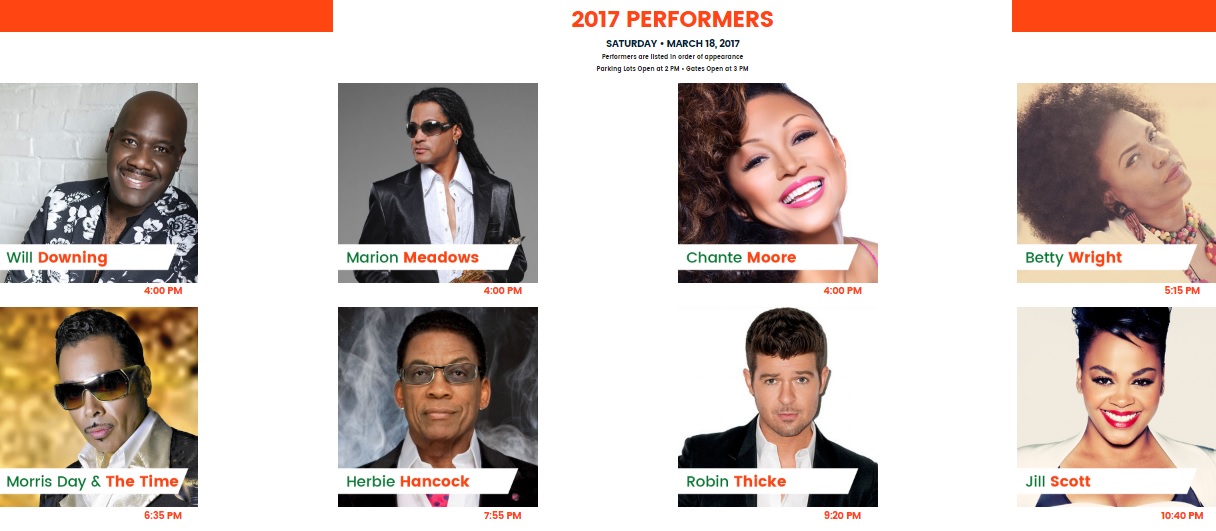
JITG 2017 - Photo 1

Click on photo to Enlarge

In many previous years, the musical artist/group Frankie Beverly and Maze performed as the final performer of the festival; their classic anthem – “Joy. Pain. Sunshine. Rain.” – is the theme of this previous blog from March 20, 2016 (for last year’s International Day of Happiness); it is being Encored here:

============

Encore Title: Joy. Pain. Sunshine. Rain.

The movement behind the book Go Lean…Caribbean strives to make the Caribbean a better place to live, work and play. Having success in this quest would mean more joy (happiness) for the stakeholders (residents and visitors alike) of the tropical sunshine. We also try to soften the pain of day-to-day life, for “in every life, a little rain must fall”.

“Joy, Pain, Sunshine and Rain” – Sounds familiar, right? It is the title and chorus of a popular Rhythm & Blues song by the Grammy Award winning band Frankie Beverly and Maze; see the VIDEO-AUDIO here:

VIDEO-AUDIO: Frankie Beverly And Maze – Joy And Pain – https://youtu.be/KNuKMPeOdfM

Uploaded on Oct 31, 2011 – {DISCLAIMER}
No Copyright Intended. This Song Belongs To It Respective Owners.
Please Support The Artist By Buying Their Songs/Album – “Joy and Pain” by Maze Listen ad-free with YouTube Red

Art imitates life and life imitates art …

Music is a viable approach for forging change in society. Consider these popular quotations:

“Music soothes the savage beast”.

“A great song can change the world”.

There are a lot of famous quotes alluding to the power of music, but here’s an old favorite:

“Music is a moral law. It gives soul to the universe, wings to the mind, flight to the imagination, and charm and gaiety to life and to everything.” — Plato

Consider this list where music (songs & concerts) has changed the world in past campaigns:

1

Bob Dylan: Times They Are A-Changin’ – 1960’s Civil Rights Anthem

2

Hope for Haiti Now: A Global Benefit for Earthquake Relief – Telethon on Jan 22, 2010

3

“Sun City” – 1985 Anti-Apartheid Group Song and Album

4

Bob Marley and the Wailers: “Them Belly Full (But We Hungry)” – 1975 song

5

K’naan: “Wavin’ Flag” – 2010 Soccer World Cup anthem advocating rights for refugees

6

Live Aid – 1985 “simul”-concerts in London & Philadelphia for famine relief in Ethiopia

7

46664 Concerts – (Mandela’s Prison #) – 2003 advocacy against HIV/AIDS in South Africa

8

John Lennon: “Imagine” – 1971 iconic song for world peace

9

Tsunami Aid: Concert of Hope – 2004 Benefit for Indian Ocean Earthquake & Tsunami

10

The Concert for Bangladesh – 1971 Benefit for refugees from (then) East Pakistan

11

Live 8 – 2005 series of concerts in the G8 member-states for foreign aid to poorest countries

12

Patti Smith: “People Have the Power” – 1988 song condemning war and human rights abuses

13

Farm Aid – Annual concerts starting in 1985 advocating  Family Farms

14

Marvin Gaye: “What’s Going On” – 1971 album against the Vietnam war, drugs and poverty

15

Concert in celebration of “It Takes Two” – 2014 effort tackling high teenage pregnancy in Uganda

16

Joni Mitchell: “Big Yellow Taxi” – 1970 hit song addresses environmental concerns

[17]

[“We Are the World” – 1985 super-group (most famous music artists) song by USA for Africa]

Source: https://www.globalcitizen.org/en/content/music-that-has-changed-the-world/ by Christina Nuñez on July 27, 2015. The [] represent this blog’s addition – Number 17 – to the list.

The Go Lean book identifies the art and science of the music business among the strategies, tactics, implementations and advocacies of the roadmap to elevate the Caribbean’s societal engines. The book serves as a roadmap for the introduction and implementation of the Caribbean Union Trade Federation (CU), an initiative to elevate and empower the region, to make the homelands better and happier. From the outset, the book recognized the significance of music and happiness in this roadmap with these statements in the opening Declaration of Interdependence (Page 12 & 14):

Preamble. We hold these truths to be self-evident, that all men are created equal, that they are endowed by their Creator with certain unalienable rights, that among these are life, liberty and the pursuit of happiness

xxi.   Whereas the preparation of our labor force can foster opportunities and dictate economic progress for current and future generations, the Federation must ensure that educational and job training opportunities are fully optimized for all residents of all member-states, with no partiality towards any gender or ethnic group. The Federation must recognize and facilitate excellence in many different fields of endeavor, including sciences, languages, arts, music and sports. This responsibility should be executed without incurring the risks of further human flight, as has been the past history.

xxxii.  Whereas the cultural arts and music of the region are germane to the quality of Caribbean life, and the international appreciation of Caribbean life, the Federation must implement the support systems to teach, encourage, incentivize, monetize and promote the related industries for arts and music in domestic and foreign markets. These endeavors will make the Caribbean a better place to live, work and play.

The purpose of the Go Lean roadmap is not music, but rather to make the Caribbean region a better homeland, a happier place to live, work and play. Music can be an effective tool for campaigns … to convey the important message of happiness, to pronounce that “Joy, Pain, Sunshine and Rain” is part-and-parcel of any happiness advocacy.

This Go Lean roadmap calls for heavy-lifting in shepherding important aspects of Caribbean life. In fact, the empowerment roadmap has 3 prime directives that are critical for forging a happy society; they are identified as follows:

  • Optimization of the economic engines in order to grow the regional economy to $800 Billion & create 2.2 million new jobs.
  • Establishment of a security apparatus to protect the resultant economic engines.
  • Improve Caribbean governance to support these engines.

The book describes the CU as a hallmark of a technocracy, with a commitment to efficiency and effectiveness in these societal engines, while still not ignoring principles of fun such as music, arts, heritage and overall happiness. In fact, one of  the 144 different missions of the Go Lean/CU roadmap is to promote happiness (10 Ways to Promote Happiness – Page 36).

Happiness is the focus of this commentary…

CU Blog - Joy. Pain. Sunshine. Pain - Photo 1

CU Blog - Joy. Pain. Sunshine. Pain - Photo 2

CU Blog - Joy. Pain. Sunshine. Pain - Photo 3

 CU Blog - Joy. Pain. Sunshine. Pain - Photo 4

CU Blog - Joy. Pain. Sunshine. Pain - Photo 5

… thousands of people all around the world took action to support the International Day of Happiness on March 20, 2016. (This is celebrated in March every year). See a related alternate commentary of this year’s advocacy in the Appendix below.

What more can we do?

First, we encourage all to take this “Action for Happiness” pledge:

“I will try to create more happiness in the world around me”.

… this Go Lean/CU effort is “our” attempt to do more … for the Caribbean. The Go Lean/CU roadmap was constructed with the community ethos in mind to make the region more happy, plus the execution of related strategies, tactics, implementations and advocacies to forge permanent happiness. The following is a sample of these specific details of the roadmap from the book:

Community Ethos – Deferred Gratification Page 21
Community Ethos – Economic Principles – People Choose Page 21
Community Ethos – Economic Principles – People Respond to Incentives in Predictable Ways Page 21
Community Ethos – Economic Principles – The Consequences of Choices Lie in the Future Page 21
Community Ethos – Governing Principles – Lean Operations Page 24
Community Ethos – Ways to Impact the Future Page 26
Community Ethos – Ways to Foster Genius Page 27
Community Ethos – Ways to Promote Intellectual Property Page 29
Community Ethos – Ways to Impact Research & Development Page 30
Community Ethos – Ways to Bridge the Digital Divide Page 31
Community Ethos – Ways to Impact Turn-Around Page 33
Community Ethos – Ways to Promote Happiness Page 36
Community Ethos – Ways to Impact the Greater Good Page 37
Strategy – Vision – Confederate 30 Member-States Page 45
Strategy – Mission – Celebrate the Music, Sports, Art, People and Culture of the Caribbean Page 46
Tactical – Confederating a Permanent Union Page 63
Tactical – Fostering a Technocracy Page 64
Implementation – Ways to Pay for Change Page 101
Implementation – Ways to Deliver Page 109
Planning – 10 Big Ideas for the Caribbean Region – Cyber-Caribbean Page 127
Planning – Ways to Make the Caribbean Better Page 136
Planning – Reasons Why the CU Will Succeed Page 137
Advocacy – Ways to Grow the Economy Page 151
Advocacy – Ways to Create Jobs Page 152
Advocacy – Ways to Improve Communications Page 186
Advocacy – Ways to Preserve Caribbean Heritage Page 218
Advocacy – Ways to Improve the Arts Page 230
Advocacy – Ways to Promote Music Page 231
Appendix – Case Study Managing Copyright Infringements Page 351

The Go Lean/CU roadmap is optimistic, but it is realistic and pragmatic too. There is the acknowledgement that while music is powerful, the music business on the other hand, not so much. This industry has changed in the light of modern dynamics (technology and globalization), particularly due to Internet & Communications Technologies. The industry needs to adapt accordingly – we need a fully functional music industry. To spur more development in the industrial dimensions of the music business, this roadmap seeks to secure the economic, security and governing engines of the Caribbean region. This point was detailed in these previous Go Lean blog/commentaries:

https://goleancaribbean.com/blog/?p=6310 Farewell to ‘Sábado Gigante’
https://goleancaribbean.com/blog/?p=5648 Taylor Swift withholds Album from Apple Music
https://goleancaribbean.com/blog/?p=5251 Post-Mortem of Inaugural Bahamas Junkanoo Carnival
https://goleancaribbean.com/blog/?p=3641 ‘We Built This City …’
https://goleancaribbean.com/blog/?p=2415 How ‘The Lion King’ productions roared into history
https://goleancaribbean.com/blog/?p=1909 Music Role Model Berry Gordy – Reflecting & Effecting Change

We need a fully functional music industry because we need music, and the effects of music: the power to reach, soothe and move people. This point was previously detailed in other Go Lean blog/commentaries; a sample follows:

https://goleancaribbean.com/blog/?p=7628 ‘A Change Is Gonna Come’
https://goleancaribbean.com/blog/?p=3568 Forging Change: Music Moves People
https://goleancaribbean.com/blog/?p=2291 Forging Change: The Fun Theory
https://goleancaribbean.com/blog/?p=866 Music Man Bob Marley: The legend lives on!

This quest to elevate the Caribbean region is heavy-lifting; more is involved than just saying “Don’t Worry Be Happy“. It is more complex than just playing or listening to music. Though this is serious, it should also be fun; it should be  “Joy, Pain, Sunshine and Rain”.

Let’s create a happier world together; a happy world filled with laughter and music –  “Joy, Pain, Sunshine and Rain”. And if not the world, then maybe just the Caribbean. 🙂

Download the book Go Lean … Caribbean – now!

Sign the petition to lean-in for the roadmap for the Caribbean Union Trade Federation.

————

Appendix – Title: The best habits to practice to feel happy every day
By: Dr. Christine Brown
Sourcehttp://www.news.com.au/lifestyle/health/mind/the-best-habits-to-practice-to-feel-happy-every-day/news-story/bd7d414a2b5da7f6f0bd138f0af2c7fc . Posted and retrieved March 20, 2016.

HAPPY International Day of Happiness!

I have a question for you: How often do you feel like a ‘room without a roof’? According to Pharrell Williams, this “space without limit” feeling is universally achievable. But for many of us, limitless happiness takes a little work. So, what are some of the best habits to practice for feeling happy every day?

MANAGE THE DOWN DAYS

You know the days. Those days when you’re telling yourself the ‘I’m not good enough’ story (which we all have, by the way). The days where things seem to go from bad to worse.

It’s very easy to get trapped at this point because many of us start feeling bad for feeling bad. There are enough external pressures to always be ‘up’ and cheerful, without applying internal pressure too. Acknowledge you’re feeling suboptimal, and do a quick stocktake.

If you can change things, take action. If not, do something that helps to calm you, comfort you or cheer you up (even a little bit).

Be gentle with yourself and don’t splatter your down day over your bystanders. Remember, no-one can ‘make’ you feel anything. You have all the controls. Which reminds me …

DON’T BELIEVE EVERYTHING YOU THINK

Much unhappiness is caused by paying way too much attention to our thoughts. Our minds are constantly telling us stories to explain the world around us. Many times these stories are accurate, but unfortunately, whenever we don’t have enough data, our mind just fills in the gaps.

Let’s face it, we really don’t know why they didn’t say hello to us this morning. We really don’t.

As soon as we hear our minds saying things like, “They ALWAYS let me down” or “She NEVER keeps her promises” we need to reach for the metaphorical handbrake.

Get in the habit of asking yourself if that’s strictly true. Remember it’s just a story you’re telling yourself. You can even give the story a name: “Oh, it’s the ‘I do everything around here’ story”. It is very unlikely that things NEVER or ALWAYS happen. There are always exceptions. Remembering to look for (and recognise) the exceptions means much happier states of mind.

KEEP WHAT ‘SPARKS JOY’

In her book, The Life-Changing Magic of Tidying Up, Marie Kondo recommends a (once-off) festival of tidying where you gather categories of belongings into ginormous piles, pick items up one-by-one and ask a simple question: “Does it spark joy?”

If it does, you keep it. If it doesn’t, you can let it go.

Just imagine how it would be if every item around you had a happy association. Out would go that hideous fondue set from Aunt Bertha or those pyjamas from your ex. Because, according to Marie Kondo, a gift has done its job once it’s received. The freedom!

Oh, and on a side note, this totally applies to the humans in your life too.

EVERYONE’S DOING BETTER THAN ME

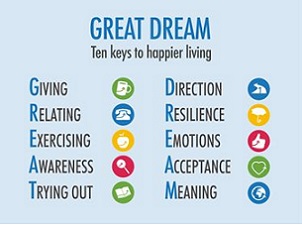
The International Day of Happiness website has a great downloadable resource containing 10 keys to happier living. Each key strategy has been inspired by the latest scientific happiness research and there are some excellent quotes.

The one that I recognised most from working with many different clients is “Don’t compare your insides with other people’s outsides”. This is easy to do.

I remember consulting at a very high-end corporate where everyone was incredibly polished and successful looking. One by one, they would come in and say, “Everyone else is doing okay, but I’m falling apart”.

The thing is, you can’t know what is going on inside someone else, especially if you only have their outside as your guide. Chances are, if you’re finding something difficult or challenging, other people are too. I’m talking work, parenting, studying, teaching, being single, being in a relationship …

WHAT WENT WELL?

One of the pioneers of positive psychology, Martin Seligman, outlines some quick and easy strategies that raise your wellbeing and lower your depression in his book, Flourish.

A simple exercise to do in the 10 minutes before you go to sleep every night is the ‘what-went-well’ exercise. Every night, you write down three things that went well and why they went well (e.g. I finished most of my important tasks today because I took time to plan in the morning or I didn’t yell at my partner this morning because I got up a little earlier and made sure I ate breakfast). This will greatly improve your mood over time.

ROOFLESS ROOMS

According to Sonja Lyubomirsky in The How of Happiness, up to 40 per cent of our happiness is within our power to change.

Being grateful, taking responsibility, blaming less, learning to forgive and yes, even practising random acts of kindness, all predictably increase our happiness.

Have a happy day and go well everyone!

———-

Dr. Christine Brown is an Inventiologist, Psychologist and Executive Coach.
Share this post:
, , , ,

Trump’s Vision of the Caribbean: Yawn

Go Lean Commentary

Advice: When people tell you who they are, listen to them.

CU Blog - Trump's Vision of the Caribbean - Photo 1The new American President, Donald Trump, has announced, proclaimed and repeated that he is “for America First”. Yet the rest of the world seems to be surprised when he promotes policies that ignores, disregards and denigrates foreign people and countries; i.e. banning travel from 7 Muslim countries.

Come on people, the man said who he was and what is important to him. Why are we now surprised with stories like this, it is like he “yawns” at previous American empowerments that affected us in the Caribbean and Latin America – see the following article:

Title: Trump’s Big F-U To The Caribbean, Latin American
By:NAN Editorial Team

News Americas, NEW YORK, NY, Fri. Mar. 17, 2017: Donald Trump released his first “budget blueprint” Thursday morning, providing the clearest glimpse yet at his administration’s war on the so-called “administrative state.” He once again proved his administration cares nothing about the Americas – Latin America or the Caribbean – or the world for that matter. Here are a few big F-U’s from Trump that will see drastic cuts if this budget ever gets green lighted.

1: Cuts to fighting drug trafficking in Latin America & the Caribbean

The administration’s budget proposal calls for some US $1.3 billion in cuts to the US Coast Guard to eliminate its top counter-terrorism unit, the Maritime Security Response Team, and all of its regional Maritime Safety and Security Teams. This means fewer assets to interdict all suspected smuggling boats and to disrupt drug trafficking at sea in the Caribbean, especially.

2: The Inter-American Foundation

Donald Trump has sliced away US $22 million from The Inter-American Foundation which funds grass-roots groups and nongovernmental organizations (NGOs) in Latin America and the Caribbean.

3: The U.S. Trade and Development Agency

Some $60 million is being cut from the U.S. Trade and Development Agency, which works atpromoting U.S. exports in the Americas and the world and works to do things such as improve transportation infrastructure and otherwise facilitate trade in dozens of countries.

4: The Overseas Private Investment Corporation

The Overseas Private Investment Corporation promotes U.S. economic investment in the Americas and other developing nations by working with private partners but its budget of $83 million has been swiped away.

5: The Global Climate Change Initiative

The Global Climate Change Initiative that was aimed at supporting climate change fight globally per the Paris climate agreement has been wiped away.

6: The Emergency Refugee and Migration Assistance Fund

Gone in the wind will be the US $70 million that allows the US President to “provide humanitarian assistance for unexpected and urgent refugee and migration needs worldwide.”

7: Cuts To The State Department’s Bureau of International Organization Affairs

There is a 50 percent cut to the U.S. funding for the State Department’s Bureau of International Organization Affairs, which pays U.S. dues to the United Nations, the OAS and other international and regional groups, according to news reports disclosed by Foreign Policy magazine. The United States currently contributes $50 million a year to the OAS budget which will now mean a drastic cut to that organization’s budget.

Source: News America Now – posted-retrieved March 17, 2017 from: http://www.newsamericasnow.com/trumps-big-f-u-to-the-caribbean-latin-american/

———

About News America Now

News Americas Now is a daily newswire covering the Americas  – the Caribbean and Latin America and its Diasporas – whose content is syndicated across 21 plus news sites including on the Caribbean Today in Florida and on Irie Jam radio in New York City – the media company’s headquarters.

It is owned by Hard Beat Communications, a global media company with over a decade of experience on the Caribbean, Caribbean Diaspora and Latin American markets.

News Americas Now  and its 20 affiliated sites is the largest dedicated Caribbean news network covering the Caribbean, Caribbean Diaspora and Latin America news, business, travel, politics and executive interviews.

So Donald Trump’s America has it’s own priorities, and its not the Caribbean.

Charity begins at home – Old Adage

The policies of Donald Trump is consistent in being nonchalant towards other causes, not just Caribbean issues. He “yawns” at more than just our priorities. Consider this headline:

Trump To Planet: Drop Dead – see excerpt in the Appendix below.
CU Blog - Trump's Vision of the Caribbean - Photo 2

The days of a Good Neighbor policy emanating from Washington towards Latin America and the Caribbean appears to be over, at least for this administration.

This foregoing article relates to the ongoing theme from the publishers of the book Go Lean…Caribbean, that of America’s War on the Caribbean. Our goal and aspiration is for Caribbean people to take the lead ourselves for Caribbean elevation.

America has problems and challenges. It is only understandable that political leaders may be focusing on empowerments to help the American homeland first. This commentary had previously detailed some of the societal  threats; see this list that corresponds with Donald Trump’s 2016 campaign platform:

Jobs Loss of Jobs-Taxes to ‘Robots’ and Automation
Trade An Ode to Detroit – Good Luck on Trade!
Making America Great Going from ‘Good to Great’
Incomes Mitigating Income Inequality
ISIS Americans arrested for aiding ISIS
Climate Denial Capitalism -vs- the Climate
Winning Again The Erosion of the Middle Class

In addition, the Go Lean movement has previously detailed the American societal defects – institutional racism and Crony-Capitalism. Donald Trump, had previously been known to instigate racial hatred and business-wise, to be an abusive capitalist himself.

Therefore his first budget proposal, laying out his priorities, should be no surprise.

Expecting a liberal immigration policy for Caribbean people into the US?

Don’t count on it!

Really don’t! The US should not be the panacea for Caribbean ills. We have our own issues, problems and challenges that we need to deal with. This has been a consistent theme for the Go Lean book, which posits that one of the greatest threats to Caribbean society is the atrocious emigration rates. We have a high abandonment rate of our citizens to countries in North America (US & Canada) and Western Europe – especially among our professional classes.
Unfortunately, the leanings of Caribbean people to emigrate is still acute. The reasons why our people leave are identified as “Push” and “Pull”; they are fleeing from “home” and seeking “refuge” in countries like the US. “Refuge” is a good word; because of the many societal defects – the issues, problems and challenges referred above – many in the Caribbean must leave as refugees – think LGBTDisabilityDomestic-abuseMedically-challenged – for their life, liberty and pursuit of happiness. On the other hand, the lure of a more prosperous life in foreign countries, drive the “pull” side of the equation; these ones “pulled” are to be considered economic refugees.

See the VIDEO in the Appendix below regarding Caribbean expectations for immigration to the American mainland.

What parasites we are in the Caribbean!

The book Go Lean…Caribbean aspires to economic principles that dictate that “consequences of choices lie in the future”. America has to deal with the consequences of its electoral choice; and we in the Caribbean have to deal with ours – we must have our own vision … and values. This book serves as a roadmap for the introduction and implementation of the technocratic Caribbean Union Trade Federation (CU). The goal is to confederate the 30 member-states in the region to form a federal government and effect a turn-around in our  region. We should not leave it up to our colonial masters – or the American Super Power – to assuage our problems. We need our own expression of governance, to “formulate efficient and effective systems to steer our own destiny” (Page 10).

The Go Lean roadmap seeks to optimize the Caribbean governance. This vision is defined early in the book (Page 12) in the following pronouncements in the Declaration of Interdependence:

xi. Whereas all men are entitled to the benefits of good governance in a free society, “new guards” must be enacted to dissuade the emergence of incompetence, corruption, nepotism and cronyism at the peril of the people’s best interest.  The Federation must guarantee the executions of a social contract between government and the governed.

xii. Whereas the legacy in recent times in individual states may be that of ineffectual governance with no redress to higher authority, the accedence of this Federation will ensure accountability and escalation of the human and civil rights of the people for good governance, justice assurances, due process and the rule of law. As such, any threats of a “failed state” status for any member state must enact emergency measures on behalf of the Federation to protect the human, civil and property rights of the citizens, residents, allies, trading partners, and visitors of the affected member state and the Federation as a whole.

The purpose of the Go Lean roadmap is to turn-around the Caribbean in general; we have our own threats and societal defects. The CU thusly has these 3 prime directives, proclaimed as follows:

  • Optimization of the economic engines in order to grow the regional economy to $800 Billion & create 2.2 million new jobs.
  • Establishment of a security apparatus to ensure public safety and protect the resultant economic engines.
  • Improve Caribbean governance to support these engines.

Yes, empowerments in the security and governing spheres are equally important as economic ones. This focus is wise in the era of Donald Trump as he has expressed – and so far followed through on – an intent to deport our emigrants more readily that run afoul of “the law”. We now have to be prepared “for some bad hombres” coming back home involuntarily.

We repeat the opening “Advice”: When people tell you who they are, listen to them. Prepare accordingly!

The Go Lean book details the community ethos to adopt, plus the strategies, tactics, implementations and advocacies to execute to empower all the factions in the Caribbean region. Consider this sample:

Community Ethos – Ways to Impact the Future Page 26
Community Ethos – Ways to Impact the Greater Good Page 37
Strategy – Vision –  Integrate region for Economics & Security Page 45
Implementation – Security Initiatives at Start-up Page 103
Implementation – Ways to Deliver Page 109
Implementation – Ways to Promote Independence Page 120
Planning – Ways to Make the Caribbean Better Page 131
Advocacy – Ways to Mitigate Terrorism Page 181
Advocacy – Ways to Preserve Caribbean Heritage Page 218

Caribbean people do not have a voice nor a vote in Washington. We are only spectators!

The Go Lean/CU goal is to reform and transform our own society, not America. We no longer want to be considered parasites of the American eco-system, we want to be protégés. In fact, we want to be better than America. Yes, we can.

We hereby urge everyone in the Caribbean – people, institutions and governments – to lean-in to this Go Lean roadmap. It is time now to reboot our society. We must do the heavy-lifting ourselves, and not leave it up to any American decision-maker. This is what we all want: a new Caribbean that is a better homeland to live, work and play. 🙂

Download the book Go Lean … Caribbean – now!

Sign the petition to lean-in for the roadmap for the Caribbean Union Trade Federation.

——————

Appendix – Climate Schmimate – Trump To Planet: Drop Dead 😀

By: Doktor Zoom –  November 10, 2016

Donald Trump has big plans for America. He’s going to make all of us who are already rich even richer and more prosperous, and the only price we have to pay is four to eight more years of delay in doing something about global warming, which isn’t merely a Chinese plot to keep America from competing, but is also a complete hoax perpetrated by scientists for nefarious motives. What, you never heard of evil scientists who want to rule the world? There’s one bit of good news in all this: The rest of the nations who have signed on to the Paris Climate Agreement still plan to go ahead with reducing their carbon outputs, even as the nation that supposedly leads the world in science turns itself over to leadership by a party that doesn’t believe in science anymore — at least, not in science that you can’t drop from fighter jets on some “ay-rabs”.

Read more at https://wonkette.com/608451/trump-to-planet-drop-dead-d#rXqky6KLulRg7UiG.99

——————

Appendix VIDEO – In-Depth Trump and Caribbean Immigration – https://youtu.be/tKvfVQFkY30

Published on Jan 31, 2017 – CEEN Caribbean News discusses with Immigration Attorney, Wayne Golding on US President Donald’s Trumps Policy and its impact on Caribbean Immigration


Share this post:
, ,
[Top]

Caribbean Solidarity with the Irish People – ENCORE

Go Lean Commentary

Today is the annual St. Patrick’s Day observation. Celebrating it does not mean “we are Irish”, it means we have “Solidarity with the Irish People” and culture. This is a BIG deal …

… the Irish has endured a lot and now they thrive.

This is a lesson for the Caribbean to apply, as we too have endured … and want to thrive. See this Encore of the blog-commentary from March 17, 2015 here-now:

=============

Title: The ‘Luck of the Irish’ – Past, Present and Future

Today (March 17) is Saint Patrick’s Day. Why do people wear green?

It’s a move of solidarity for Irish people and culture.

This is a big deal considering the real history.

This subject also has relevance for the Caribbean as Saint Patrick’s Day is a public holiday in the British Caribbean Territory of Montserrat, in addition to the Republic of Ireland,[10] Northern Ireland,[11] and the Canadian province of Newfoundland and Labrador. While not a holiday elsewhere, this day is venerated by the Irish Diaspora around the world, especially in Great Britain, Canada, Argentina, Australia, New Zealand and the United States. See a tribute here from an American job site:

Title: Happy St. Patrick’s Day!
Southfield, Michigan – We hope you are showing your Irish spirit by wearing green!

Here are 5 fun facts about St. Patrick’s Day:

CU Blog - The Luck of the Irish - Past, Present and Future - Photo 2

1. Of course with St. Patrick’s Day comes the massive appearance of shamrocks. Shamrocks have definitely become a central symbol for this day. In the olden days in Ireland, the shamrock was seen as sacred. The four leaves of the clover represent faith, love, hope, and of course, luck.

2. Good luck finding a four-leaf clover. The odds of finding a four-leafer on your first try are 1 in 10,000.

3. St. Patrick’s Day was traditionally a dry holiday. Irish law between 1903 and 1970 made St. Patrick’s Day a religious holiday for the entire country, which meant pubs were closed for the day. Today, St. Patrick’s Day is arguably one of the largest drinking holidays with an estimated $245 million spent on beer for March 17.

4. Green or Blue? Though green is a very popular color on St. Patrick’s Day, the original color that was very popular and often related back to St. Patrick was not green, but blue. In Irish folklore, green is known as being worn by immortals, and often signified new life and crop growth.

5. The Irish flag. The flag representing Ireland is green, white and orange. The green symbolizes the people of the south, and orange, the people of the north. White represents the peace that brings them together as a nation.

CU Blog - The Luck of the Irish - Past, Present and Future - Photo 5

Source: Credit Acceptance Internal Staff Intranet site; retrieved March 17, 2015.

This subject also provides a case study for the Caribbean, as the Irish Diaspora is one of the most pronounced in the world. This is the model of what we, in the Caribbean, do not want to become.

According to information retrieved from Wikipedia, since 1700 between 9 and 10 million people born in Ireland have emigrated, including those that went to Great Britain. This is more than the population of Ireland at its historical peak in the 1830s of 8.5 million. From 1830 to 1914, almost 5 million went to the United States alone.

After 1840, emigration from Ireland became a massive, relentless, and efficiently managed national enterprise.[1] In 1890 40% of Irish-born people were living abroad. By the 21st century, an estimated 80 million people worldwide claimed some Irish descent; which includes more than 36 million Americans who claim Irish as their primary ethnicity. [2]

CU Blog - The Luck of the Irish - Past, Present and Future - Photo 1

The city of Chicago, Illinois dyes the river green in tribute for St. Patrick’s Day

CU Blog - The Luck of the Irish - Past, Present and Future - Photo 4

The White House in full St. Patrick Day tribute mode

CU Blog - The Luck of the Irish - Past, Present and Future - Photo 3

London; on the Thames River

The Diaspora, broadly interpreted, contains all those known to have Irish ancestors, i.e., over 100 million people, which is more than fifteen times the population of the island of Ireland, which was about 6.4 million in 2011.

In July 2014, the Irish Government appointed Jimmy Deenihan as Minister of State for the Diaspora.[3]

Why this history?

In 1801 Ireland acceded to the United Kingdom (UK).

The Irish Parliament, charged with the heavy burden of directing Ireland’s destiny, was abolished in 1801 in the wake of the Republican United Irishmen Rebellion and Ireland became an integral part of a new United Kingdom of Great Britain and Ireland under the Act of Union. Without the power to direct their own affairs, the island found itself victimized by fate and bad fortune.

The Great Famine of Ireland during the 1840s saw a significant number of people flee from the island to all over the world. Between 1841 and 1851 as a result of death and mass emigration (mainly to Great Britain and North America) Ireland’s population fell by over 2 million. In the western province of Connacht alone, the population fell by almost 30%.

The Go Lean … Caribbean book relates that this is also the current disposition of so many of the Caribbean Diaspora; (10 million abroad compared to 42 million in the region). These ones love their country and culture, but live abroad; they want conditions to be different (better) in their homelands to consider any repatriation. The book details where in Puerto Rico, their on-island population in 2010 was 3,725,789, but Puerto Ricans living abroad in the US mainland was 4,623,716; (Page 303).

In a previous blog/commentary, a review of a book highlighted some strong lessons from Ireland’s past that are illustrative for the Caribbean’s future. The book is by Professor Richard S. Grossman entitled: Wrong: Nine Economic Policy Disasters and What We Can Learn from Them. The following excerpt is extracted from the book review by the London School of Economics:

As an example, we can take a closer look at the chapter on the Irish Famine, (1 of the 9 lessons), which took place from 1845-1852. Grossman not only describes what happened, but puts it into the perspective of  other famines, starting from the BCE period. In terms of absolute numbers, the Great Hunger in Ireland was not the worst famine recorded but it did tragically lead to the death of twelve per cent of Irish population, forcing many others to emigrate. The author details how the potato – which originated in the Americas – arrived to a fertile Ireland, and that the poorest third of the Irish population consumed up to twelve pounds of potatoes per day (per capita). Only after this introduction the economic policy is mentioned. Grossman compares the responses of two Prime Ministers of the United Kingdom to the famine: Sir Robert Peel and Lord John Russell. Russell was so committed to the limited government intervention that he refused to buy food for the starving masses in order not to disturb the free formation of prices in the market. Similarly, he refused to increase the scale of public works that would give jobs to Irish workers so as not to disturb the free labour market. The paradox is that when the Great Famine occurred, Ireland was not a poor country. The Famine would not have been so ‘great’ if it were not for the free market ideology followed by the policymakers at that time. As it turns out, leaving things to the invisible hand of market is not always an optimal solution.

The Go Lean book serves as a roadmap for the introduction and implementation of the Caribbean Union Trade Federation (CU), a technocratic federal government to administer and optimize the economic/security/governing engines of the 30 member Caribbean states. The quest is to provide a better direct stewardship, applying lessons-learned from case studies like Ireland in the 1800’s.

Ireland has fared better since those dire days of the potato famine, but still its people, the Diaspora, endured a lot of misery, resistance and discrimination in their foreign homes. As reported in this previous commentary, the usual path for new immigrants is one of eventual celebration, but only after a “long train of abuses”: rejection, anger, protest, bargaining, toleration and eventual acceptance. Wearing green today – or any other March 17th’s – is a statement of acceptance and celebration of the Irish; as a proud heritage for what they have endured and accomplished.

The island of Ireland today is comprised of 2 countries: the independent Republic of Ireland and the territory of Northern Ireland, a member-state in the United Kingdom, with England, Wales and Scotland; (last year Scotland conducted a referendum in consideration of seceding from the UK; the referendum failed).

The Republic of Ireland ranks among the wealthiest countries in the world in terms of GDP per capita.[11] After joining the European Union, Ireland enacted a series of liberal economic policies that resulted in rapid economic growth. The country achieved considerable prosperity from 1995 to 2007, during which it became known as the Celtic Tiger. This was halted by an unprecedented financial crisis that began in 2008, in conjunction with the concurrent global economic crash.[12][13] Today, the primary source of tourism to Ireland – a primary economic driver – is from their Diaspora; see VIDEO in the Appendix below.

There are a lot of lessons in this issue for the Caribbean. Ireland did need better societal engines, economic-security-governance; this was accomplished with their assimilation into the EU. If only that option was available in the past.

This is the exact option being proposed now by the Go Lean roadmap, to emulate and model the successes of the European Union with the establishment of the Caribbean Union. It was not independence that brought success to Ireland, but rather interdependence with their neighboring countries “in the same boat”. This is the underlying theme behind the Go Lean movement, to “appoint new guards” to make the Caribbean homeland a better place to live, work and play. This Declaration of Interdependence is pronounced at the outset of the Go Lean book (Pages 11 & 13):

xi.  Whereas all men are entitled to the benefits of good governance in a free society, “new guards” must be enacted to dissuade the emergence of incompetence, corruption, nepotism and cronyism at the peril of the people’s best interest. The Federation must guarantee the executions of a social contract between government and the governed.

xix. Whereas our legacy in recent times is one of societal abandonment, it is imperative that incentives and encouragement be put in place to first dissuade the human flight, and then entice and welcome the return of our Diaspora back to our shores. This repatriation should be effected with the appropriate guards so as not to imperil the lives and securities of the repatriated citizens or the communities they inhabit. The right of repatriation is to be extended to any natural born citizens despite any previous naturalization to foreign sovereignties.

xx. Whereas the results of our decades of migration created a vibrant Diaspora in foreign lands, the Federation must organize interactions with this population into structured markets. Thus allowing foreign consumption of domestic products, services and media, which is a positive trade impact. These economic activities must not be exploited by others’ profiteering but rather harnessed by Federation resources for efficient repatriations.

xxv. Whereas the legacy of international democracies had been imperiled due to a global financial crisis, the structure of the Federation must allow for financial stability and assurance of the Federation’s institutions. To mandate the economic vibrancy of the region, monetary and fiscal controls and policies must be incorporated as proactive and reactive measures. These measures must address threats against the financial integrity of the Federation and of the member-states.

The Go Lean movement declares solidarity with the culture and the people of Ireland.

We too have endured a lot of misery in our foreign abodes. We would rather prosper where we were planted at home in our homeland, but due to economic, security and governing dysfunctions have had to emigrate.

The Go Lean book details a roadmap with turn-by-turn directions for transforming our homeland. The following is a sample of the community ethos, strategies, tactics, implementations and advocacies to impact the Caribbean region for this turnaround:

Community Ethos – Economic Principle – Economic Systems Influence Choices & Incentives Page 21
Community Ethos – Economic Principle – Consequences of Choices Lie in the Future Page 21
Community Ethos – Job Multiplier Page 22
Community Ethos – Lean Operations Page 24
Community Ethos – Ways to Promote Happiness Page 36
Community Ethos – Ways to Impact the Greater Good Page 37
Strategy – Vision – Confederating a Non-Sovereign Union Page 45
Strategy – Mission – Keep the next generation at home Page 46
Tactical – Fostering a Technocracy Page 64
Tactical – Tactics to Forge an $800 Billion Economy Page 67
Tactical – Separation of Powers Page 71
Implementation – Ways to Pay for Change Page 101
Implementation – Ways to Deliver Page 109
Implementation – Reasons to Repatriate to the Caribbean Page 118
Implementation – Ways to Promote Independence – Interdependence Page 120
Planning – 10 Big Ideas – A Single Market in the G-20 Page 127
Planning – Ways to Make the Caribbean Better Page 131
Planning – Ways to Better Manage Image – Not as Unwanted Aliens Page 133
Advocacy – Ways to Grow the Economy Page 151
Advocacy – Ways to Create Jobs Page 152
Advocacy – Ways to Improve Governance Page 168
Advocacy – Ways to Enhance Tourism Page 190
Advocacy – Ways to Impact the Diaspora Page 217
Advocacy – Ways to Impact the British Territories Page 245

The Go Lean book posits (Page 3) that the Caribbean islands are among the greatest addresses in the world. But instead of the world “beating a path” to these doors, the people of the Caribbean have “beat down their doors” to get out; despite the absence of any famine, or war for that matter. This abandonment must stop … now!

May we learned from the history of Ireland in our quest to make our homeland a better place to live, work and play. And may we have the luck of the Irish, as conveyed in this Classic Irish Blessing:

May you always have…
Walls for the winds
A roof for the rain
Tea beside the fire
Laughter to cheer you
Those you love near you
And all your heart might desire.

Download the book Go Lean … Caribbean – now!

Sign the petition to lean-in for the roadmap for the Caribbean Union Trade Federation.

——–

Appendix- VIDEO: Happy St Patrick’s Day from Discover Ireland – https://youtu.be/J680_aKF5zc

Uploaded on Mar 8, 2011 – This short film is an ode to Ireland on St. Patrick’s Day (which means we used a little bit of poetic licence!). Hope you all enjoy it. Happy St Patrick’s day!
http://www.discoverireland.com/


Share this post:
, , , ,
[Top]

Bill Gates: ‘Tax the Robots’

Go Lean Commentary

There is a fear – fueled by Hollywood – of a Robot Apocalypse. This is where the machines become self-aware – see Appendix VIDEO below – and ascertain that humans are a threat to their existence and so they seek to destroy all biological humans. This theme has been frequented  in movies like “The Terminator“, “The Matrix“, “I, Robot“, “West World“, “Avengers – Age of Ultron” and more.

CU Blog - Bill Gates - 'Tax the Robots' - Photo 2While enmity between humans and robots (Artificial Intelligence) may NOT be a legitimate fear today, one thing for sure, many robots, robotic systems, autonomous systems and automation systems are responsible for taking a lot of jobs IN REAL LIFE; there is no need for Hollywood make-believe with this threat.

From a governance perspective, this is bad! Humans pay taxes, social security, national insurance, pensions, healthcare and other community benefits. Robots do not!

Or should they?

Bill Gates, a billionaire whose fortunes were forged from the computer software industry asserts that robots should pay taxes. See the related news articles or editorials here:

Title #1: Robots that steal human jobs should pay taxes: Bill Gates

WASHINGTON: Robots that steal human jobs should pay taxes, Microsoft co-founder and philanthropist Bill Gates has said.

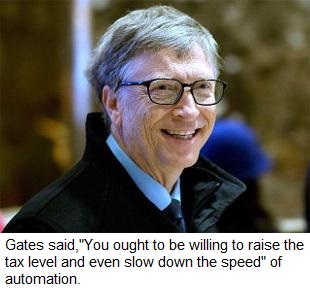
CU Blog - Bill Gates - 'Tax the Robots' - Photo 1“Certainly there will be taxes that relate to automation. Right now, the human worker who does, say, USD 50,000 worth of work in a factory, that income is taxed and you get income tax, social security tax, all those things,” Gates told Quartz website.

“If a robot comes in to do the same thing, you’d think that we’d tax the robot at a similar level,” said Gates, one of the world’s richest men.

Gates said he believes that governments should tax companies’ use of robots, as a way to at least temporarily slow the spread of automation and to fund other types of employment.

The 61-year-old philanthropist said a robot tax could finance jobs taking care of elderly people or working with kids in schools, for which needs are unmet and to which humans are particularly well suited.

He argued that governments must oversee such programmes rather than relying on businesses, in order to redirect the jobs to help people with lower incomes.

“If you can take the labour that used to do the things automation replaces, and financially and training-wise and fulfilment-wise have that person go off and do these other things, then you’re net ahead,” said Gates, one of the leading players in artificial-intelligence technology.

“But you can’t just give up that income tax, because that’s part of how you’ve been funding that level of human workers,” he said.

The web portal reported that the idea is not totally theoretical as EU lawmakers considered a proposal to tax robot owners to pay for training for workers who lose their jobs, though on February 16 the legislators ultimately rejected it.

“You ought to be willing to raise the tax level and even slow down the speed” of automation, Gates said.

“Exactly how you’d do it, measure it, you know, it’s interesting for people to start talking about now,” Gates said.

Talking about the tax on robots, Gates said, “Some of it can come on the profits that are generated by the labour- saving efficiency there. Some of it can come directly in some type of robot tax. I don’t think the robot companies are going to be outraged that there might be a tax. It’s OK.”

Source: Economic Times Magazine – Posted February 20, 2017; retrieved March 15, 2017 from:
http://economictimes.indiatimes.com/news/international/business/robots-that-steal-human-jobs-should-pay-taxes-bill-gates/articleshow/57234194.cms

—————

Title #2: What’s Wrong With Bill Gates’ Robot Tax
By: Noah Smith

Microsoft Corp. founder Bill Gates made a splash in a recent interview, when he suggested that robots should be taxed in order to help humans keep their jobs:

    “Right now, the human worker who does, say, $50,000 worth of work in a factory, that income is taxed and you get income tax, social security tax, all those things. If a robot comes in to do the same thing, you’d think that we’d tax the robot at a similar level.”

Gates is only one of many people in the tech world who have worried about automation and its threat to workers. YCombinator founder Sam Altman, for instance, is conducting an experiment with basic income — a regular cash payment to all households. That policy has gained popularity across Silicon Valley, if not in the rest of the country.

It’s easy to see why the tech world is worried. The rise of machine learning has increased the fear that many humans could simply become obsolete — for example, 3.5 million American truck drivers might soon find their jobs threatened by driverless trucks. Though in the past, technology usually complemented workers instead of replacing them, there’s no law of nature saying the technology of the future will work the same. A few economists even claim that cheap automation has already diverted income from workers to company owners.

The fear isn’t that all humans will become obsolete, but that automation will increase inequality among humans. Company owners and high-skilled workers — people who tell machines what to do — would be vastly enriched, while everyone else either works low-skilled jobs for meager wages or goes on welfare.

Another fear is that even if the mass of humanity ultimately does find new ways to add value by complementing new technology — to “race with the machines,” as economist Erik Brynjolfsson puts it — this transition could take a long time and hurt a lot of people. As Bloomberg View’s Tyler Cowen has noted, wages in Britain fell for four decades at the start of the Industrial Revolution. More recently, we’ve seen very slow and painful adjustment to the impact of globalization. If the machine learning revolution hurts workers for 40 years before ultimately helping them, it might be worth it to slow that revolution down and give them time to adjust.

The main argument against taxing the robots is that it might impede innovation. Growth in rich countries has slowed markedly in the past decade, suggesting that it’s getting harder and harder to find new ways of doing things. Stagnating productivity, combined with falling business investment, suggests that adoption of new technology is currently too slow rather than too fast — the biggest problem right now isn’t too many robots, it’s too few. Taxing new technology, however it’s done, could make that slowdown worse.

The problem with Gates’ basic proposal is that it’s very hard to tell the difference between new technology that complements humans and new technology that replaces them. This is especially true over the long term. Power looms replaced human weavers back in the Industrial Revolution, but people eventually became more productive, by learning to operate those looms. If taxes had slowed the development of power looms, the eventual improvements would have come later.

This is a powerful argument against the taxation of automation. Gates is right to say that we should start thinking ahead of time about how to use policy to mitigate the disruptions of automation. But given the importance of sustaining innovation, we should look at alternative policies.

One idea is a wage subsidy for low-income workers. This basically puts a thumb on the scale in the human-robot struggle, by making human workers cheaper. The easiest way to do that is to cut payroll taxes, which disproportionally fall on low earners. That would mean paying for Medicare and even Social Security out of other revenue sources, such as higher income taxes on the rich or a value-added tax.

Another idea is to simply redistribute capital income more broadly. Income from capital gains, land rents and dividends now is highly concentrated among the wealthy. But policy could change that. One idea, suggested by economist Miles Kimball, is a sovereign-wealth fund. The government could use tax revenue to buy stocks and real estate, and distribute the profits to the populace. This would essentially redistribute some of the income produced by the robots, giving every citizen a stake in the new automation economy. The wealth fund could be split into many smaller funds, each with different managers, in order to prevent concentration of ownership.

So there are probably better ways than taxing robots to help humans avoid the harms of automation. Instead of slowing innovation, the government should think about taxing humans less and redistributing the income of robots more.

This column does not necessarily reflect the opinion of the editorial board or Bloomberg LP and its owners.

Related story: Driverless Cars

About the Author: Noah Smith is a Bloomberg View columnist. He was an assistant professor of finance at Stony Brook University, and he blogs at Noahpinion.

Source: Posted February 28, 2017; retrieved March 15, 2017 from: https://www.bloomberg.com/view/contributors/AR3OYuAmvcU/noah-smith

This drama is aligned with the book Go Lean…Caribbean, which calls for the elevation of Caribbean economics, asserting that the region needs to better prepare and contribute in the fields of Science, Technology, Engineering and Mathematics (STEM) plus related fields of Internet & Communications Technologies (ICT). The book examines strategies, tactics, implementations and advocacies to foster more technologies and grow the economy. This quotation – from Page 57 – is most representative of the focus on technology:

Technological change is more than just internet & communications (ICT); though this field is dynamically shifting the world. There are also industrial changes taking place, as in more efficient manufacturing methods, automation/robotics, and transportation options

There are specific CU agencies will manage the other areas of technological change. The community ethos is no not just to consume technology products but to produce them as well. This allows us to better compete with the rest of the world, having both an “offense and on defense”.

But according to the foregoing articles, the raised concerns are our reality: there is no plan to tax robots-automation above and beyond to replace the lost human tax incomes.

Consider this simple scenario of self-driving/autonomous vehicles; the foregoing articles identified how truck drivers could be displaced by self-driving vehicles. The Go Lean movement have addressed these advances many times; consider this sample:

‘Olli’ – The Self-Driving Public Transit Vehicle
Drones to be used for Insurance Damage Claims
Pleas to Detroit on Technology in Cars
Here come the Drones … and the Concerns
The need for Google’s highway safety innovations
Autonomous Ghost Ships

Ah, the art and science of autonomous vehicles.

This is not science fiction; this is today’s science. It will take a technocratic administration to shepherd these advances through Caribbean society. The book Go Lean … Caribbean serves as a roadmap for the introduction and implementation of the technocratic Caribbean Union Trade Federation (CU). This book  is a complete roadmap, turn-by-turn guide for elevating Caribbean society. There is a plan for adapting government revenue options and for creating jobs to these global changes. Early in the Go Lean book, these responsibilities were identified as important functions for the CU with these pronouncements in the Declaration of Interdependence (Pages 12 & 14):

xiv. Whereas government services cannot be delivered without the appropriate funding mechanisms, “new guards” must be incorporated to assess, accrue, calculate and collect revenues, fees and other income sources for the Federation and member-states. The Federation can spur government revenues directly through cross-border services and indirectly by fostering industries and economic activities not possible without this Union.

xxvi.  Whereas the Caribbean region must have new jobs to empower the engines of the economy and create the income sources for prosperity, and encourage the next generation to forge their dreams right at home, the Federation must therefore foster the development of new industries, like that of ship-building, automobile manufacturing, prefabricated housing, frozen foods, pipelines, call centers, and the prison industrial complex. In addition, the Federation must invigorate the enterprises related to existing industries tourism, fisheries and lotteries – impacting the region with more jobs.

xxvii.  Whereas the region has endured a spectator status during the Industrial Revolution, we cannot stand on the sidelines of this new economy, the Information Revolution. Rather, the Federation must embrace all the tenets of Internet Communications Technology (ICT) to serve as an equalizing element in competition with the rest of the world. The Federation must bridge the digital divide and promote the community ethos that research/development is valuable and must be promoted and incentivized for adoption.

xxviii. Whereas intellectual property can easily traverse national borders, the rights and privileges of intellectual property must be respected at home and abroad. The Federation must install protections to ensure that no abuse of these rights go with impunity, and to ensure that foreign authorities enforce the rights of the intellectual property registered in our region.

The Caribbean fully understands the effect of losing large swaths of tax-paying citizens. We have an atrocious rate of societal abandonment, especially among our college-educated citizens; that figure has been reported at 70%. Even before talk of a Robot Apocalypse, the Caribbean region had suffered this dysfunction. We have fallen behind with all the ‘Agents of Change’ in society.

These ‘Agents of Change’ are affecting everyone, everywhere. The Go Lean book therefore posits that there is a need to re-focus, re-boot, and optimize the engines of commerce – fix the broken eco-systems – so as to make the Caribbean a better place to live, work and play. We need jobs; we need tax revenues (normally based on wages). The foregoing news articles therefore are very relevant … and fear-inspiring.

The book Go Lean/CU roadmap posits that ICT (Internet & Communications Technology) can be a great equalizer for the Caribbean to better compete with the rest of the world. This technology-job-creation focus is among these 3 prime directives of CU/Go Lean:

  • Optimization of economic engines in order to grow the regional economy to $800 Billion and create 2.2 million new jobs.
  • Establishment of a security apparatus to protect the resultant economic.
  • Improvement of Caribbean governance, including revenue systems, to support these engines.

According to previous blog/commentaries, computers are reshaping the global job market; also there is a great demand for STEM-related jobs. So we cannot just “stick our head in the sand” and ignore these issues. We are already affected. There are other communities that have already prepared themselves for tax revenues from other sources. The Go Lean book considers (Page 194) the example of Southern California (Los Angeles County). That one municipality collects tax revenues from real property (land) and personal property, and in 2007 they enjoyed a gross revenue stream of over $1 Trillion – see Appendix.

The book Go Lean…Caribbean details the effort of optimizing government revenue sources. It features the community ethos to adopt, plus the executions of key strategies, tactics, implementations and advocacies. Consider this preview (Page 172) of 10 Revenue Sources for the CU federal administration – the CU will generate-collect its own revenue streams – as follows:

  1. The Caribbean Single Market adds a new federal Economic Pie for distribution back to member-states.
  2. E-Payments Settlement
  3. In-sourcing e-Government Services
  4. Property Tax Surcharge
  5. Income/Sales Tax Add-ons
  6. Industry Licensing (Security, e-Learning, Health Care Monitoring, Postal)
  7. Regional Services: GPO, Lottery, Spectrum Auctions, Underwater Cables, Mining/Drilling Rights
  8. Prison Industrial Complex
  9. Natural Disaster Insurance Fund
  10. Capital Markets for Treasury Bonds

The primary ingredient for success in the Go Lean/CU roadmap will be Caribbean people, not Caribbean machines – robots have no personage or tax expectation in this roadmap. This community attitude would lead to fostering more development and growth with automated solutions in the region and for the rest of the world (export).

This is new for us. The Caribbean is arguably the best address on the planet, but jobs and government revenues are obviously missing. This Go Lean roadmap is conceivable, believable and achievable for turning around our dire disposition. Everyone is hereby urged to lean-in to this Go Lean roadmap. This provides the guidance to get to the region to its desired destination: a better place to live, work and play. 🙂

Download the book Go Lean … Caribbean – now!

Sign the petition to lean-in for the roadmap for the Caribbean Union Trade Federation.

—————–

Appendix – The Bottom Line on ‘$1 Trillion Dollar Budget’

CU Blog - Bill Gates - 'Tax the Robots' - Photo 3

The Los Angeles County Assessor Office establishes a taxable value for all property [real and personal] subject to property taxation. The 2007 Roll value in Los AngelesCounty was over $1 trillion dollars. That’s correct, 1 trillion dollars. This amount was greater than the gross national product (GNP) of all but 9 countries in the world. – www.assessor.lacounty.gov

Los Angeles County is commonly associated with the entertainment industry; all six major film studios—Paramount Pictures, 20th Century Fox, Sony, Warner Bros., Universal Pictures, and Walt Disney Studios—are located within the county. Beyond motion picture and television program production, other major industries of Los Angeles County are international trade supported by the Port of Los Angeles and the Port of Long Beach, music recording and production, aerospace, and professional services such as law and medicine.

—————–

Appendix VIDEO – Amazing Robot Becomes Self-Aware (Explained) – https://youtu.be/jx6kg0ZfhAI

Published on Jul 18, 2015 – Roboticists at the RPI in New York have built a trio of robots that were put through the classic ‘wise men puzzle’ test of self-awareness – and one of them passed.

Further details here: http://bit.ly/1HxmZrN

Video via: RAIR Lab

Music via: Ultimate Relax Club

Share this post:
, , ,
[Top]

March Madness 2017 – ENCORE

Go Lean Commentary

March Madness is not about the month of March; nor is it about Madness. It is about basketball, college basketball to be exact.

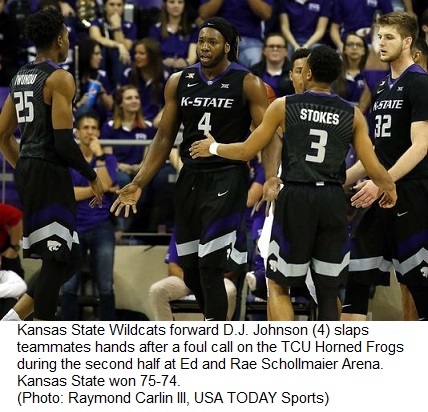
CU Blog - March Madness 2017 - Photo 2

This is the time for the NCAA Division I Basketball Tournament. This is where 68 teams come together in a single-elimination tournament to determine who would be the National Champion. It is one team playing against each other until the winner is crowned. The number 68 is deceptive; it is really a tournament of 64, with 60 secured teams and 8 teams having to compete in “play-in” games to determine the last 4.

Then it is simple math:

64 => 32 => Sweet 16 => Elite 8 => Final 4 => 2 Finalists => 1 Champion

This simple math is indicative of the simple sport of basketball; it is just 5 players on each side playing against each other with one ball and 2 baskets. The expense of fielding a basketball team is so low that in many places, there is organized play even at the Middle School level.

And yet … the eco-system for College Basketball in the Caribbean is … non-existent.

Too sad!

The book Go Lean…Caribbean – and accompanying blog-commentaries – posits that the eco-system of sports is deficient in the Caribbean region. There is so much more that can be done. This subject was divulged in full details in a previous blog on March 20, 2014. That submission is encored here below.

But first, enjoy the NCAA’s March Madness 2017. Submit your own bracket; mine is shown here.

CU Blog - March Madness 2017 - Photo 1

Also view a VIDEO here of a preview of this year’s tournament by legendary College Basketball Analyst Dick Vitale, “Dickie Baby”:

VIDEO – Dickie V breaks down March Madness – USA Today

Posted March 14, 2017 – Legendary broadcaster Dick Vitale was in our studios breaking down all the NCAA tournament story lines.

=================
CampionExcelsiorK20120911IA

ENCORE Title: Collegiate Sports in the Caribbean

Sports play a big role in Caribbean culture. Education plays a big role in the empowerment of communities. There is a junction between sports and academics; this is the sphere of college athletics.

Cuba has 37 universities…alone. In total, the Caribbean has 42 million people (2010 figures) in all 30 member-states. So surely there is enough of a student population to field sports teams.

More so, there is a fan base in the communities to complete the eco-system of sports spectators and community pride. Yet, there is very little college sports being facilitated in the region right now. Despite the breadth and talent base to form leagues and rivalries among the established universities within the Caribbean. Any system for college athletics is noticeably lacking.

This is the mission of the Caribbean Union Trade Federation (CU); to function as a Caribbean version of the National Collegiate Athletic Association (NCAA) in the US. We have much to learn from this organization’s history, successes & failures.

“The NCAA was founded in 1906 to protect young people from the dangerous and exploitive athletics practices of the time,” so states the NCAA on its official website.[a]

According to Dan Treadway, Associate Blog Editor for the Huffington Post online news magazine[b]:

The NCAA often likes to harp on tradition and the sanctity of the term “student-athlete,” but it fails to recognize its true roots.

The association in fact got its start because, at the time of its creation, football was in danger of being abolished as a result of being deemed too dangerous a sport. During the 1905 season alone, 18 college and amateur players died during games. In response to public outcry, Theodore Roosevelt, an unabashed fan of the sport, gathered 13 football representatives at the White House for two meetings at which those in attendance agreed on reforms to improve safety. What would later become known as the NCAA was formed shortly after on the heels of this unifying safety agreement.

Collegiate Sports is now big money; an economic eco-system onto itself. How much money does the NCAA make?

For the 2010-11 fiscal year, the NCAA revenue was $845.9 million, (not including College Football). Total rights (broadcast & licensing) payment for 2010-11 was $687 million, of all NCAA revenue. The remaining revenues are mostly event ticket sales.

How did the NCAA go from being an agreement to promote safety standards so as to prevent death on the playing field, to a multi-million dollar enterprise? Chalk that up to 100 years of social evolution.

The book Go Lean … Caribbean serves as a roadmap to advance to the end of the evolutionary process and establish the economic engines to empower the Caribbean region, even in areas like sports and culture.

So how to build sports franchises anew? How will colleges & universities create success from collegiate athletics? It’s a complex “art and science”, but first, it starts with facilities – the CU’s Fairground administration will fund, build and manage sports venues. The CU will be the landlord; the academic institutions, the tenants.

The Go Lean roadmap navigates the changed landscape of globalization and pronounces that change has come to the Caribbean but the region is not prepared. Despite the great appreciation for sports, and the excellent talent of its athletes, there is no business model for the consumption of Caribbean collegiate athletics.

Now, for much of the Caribbean, the population tunes in and pays for cable/satellite TV service to consume American collegiate athletic programming. But how many people in the region are watching Caribbean college sporting activities? None. Though there is a demand, undoubtedly, there is no supply process in place.

In the adjoining table in the Appendix, 36 schools are identified that are capable of fielding credible sports teams, if the appropriate facilitations were in place.

There is the demand. What’s missing is the organized market for consumption. The implementation of this Go Lean roadmap fills this void. This completes the supply!

Applying the model of the NCAA, much can be learned. We can copy their success, and learn from their pitfalls. The NCAA credits tremendous revenues for itself, but not necessarily for all of their members. Under NCAA supervision, the majority of athletic programs, in fact, lose money and are subsidized by funds from their respective university. While the NCAA is needed for academic integrity in college sports, many times, it fails at this responsibility. They lack the CU’s lean execution ethos.

After 100 years later, does the world still need the NCAA? Absolutely! For more than the collective bargaining/negotiations role for the business side of college athletics. They are also the governing body for college athletics, ensuring fairness and good sportsmanship. For the Caribbean Union, this role is to be assumed by the CU Sports Administration, to provide technocratic efficiencies. The resultant eco-system facilitates the CU mandate, to make the region a better place to live, work and play.

Download the book Go Lean … Caribbean – now!

Sign the petition to lean-in for the roadmap for the Caribbean Union Trade Federation.

———————-

APPENDIX A – References:
ahttp://www.ncaa.org/wps/wcm/connect/public/NCAA/About+the+NCAA/History
b – http://www.huffingtonpost.com/ daniel-treadway/johnny-manziel-ncaa-eligibility_b_3020985.html

———————-

APPENDIX B – Caribbean Regional Colleges & Universities

Member-state

Legacy

Name

Antigua and Barbuda

British

Antigua State College
Aruba

Dutch

University of Aruba
Bahamas

British

College of the Bahamas
Barbados

British

University of the West Indies – Cave Hill, American University
Belize

British

University of Belize
Galen University
Bermuda

British

Bermuda College (Community College)
Cuba

Spanish

University of Havana Universidad de Oriente, Polytechnic University José Antonio Echeverría
Dominican Republic

Spanish

Universidad Autónoma de Santo Domingo (UASD) – (English: Autonomous University of Santo Domingo)
French Caribbean

French

University of the French West Indies and Guiana Guadeloupe Campus, Martinique Campus, French Guiana Campus
Guyana

British

University of Guyana
Haiti

French

Caribbean University / Université Caraïbe, Université d’Haiti
Jamaica

British

University of the West Indies – Mona, University of Technology (U-Tech), Mico University College, Northern Caribbean University (NCU), University College of the Caribbean (UCC), International University of the Caribbean (IUC)
Netherlands Antilles

Dutch

University of Curaçao
Curaçao
Sint Maarten University of St. Martin
Puerto Rico

USA/

Spanish

Caribbean University, Metropolitan University, University of Puerto Rico, University of Turabo
Suriname

Dutch

University of Suriname Anton de Kom Universiteit van Suriname
Trinidad and Tobago

British

University of the West Indies – Saint Augustine University of Southern Caribbean (USC) University of Trinidad and Tobago (UTT)
US Virgin Islands

USA

University of the Virgin Islands

Share this post:
, ,
[Top]

Miami: Dominican’s ‘Home Away from Home’

Go Lean Commentary

There is something really wrong in the Dominican Republic (DR) in particular and all of the Caribbean in general:

Citizens are beating down the doors to get out!

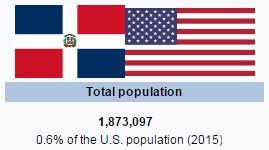
This failing assessment is accelerating faster and faster as every year goes by. In 2010, there were approximately 1.41 million people of Dominican descent in the US; now the absolute latest number is an estimate from 2015: 1,873,097; see the full details in Appendix A below.

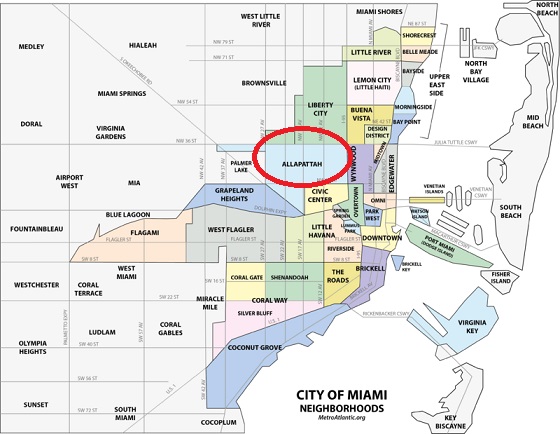
CU Blog - Dominican's Home Away from Home - Photo 3According to the book Go Lean…Caribbean, the population on the island for 2010 was reported at 9,523,209. So one-fifth of the population of Dominican heritage live in the US. There appears to be no progress in any movement for repatriation to the island, rather there is progress in movement to the South, to Florida. Of the Top 7 US states that the Dominican Diaspora lives in, Florida is the only one in the Sunbelt. The tropical landscapes in Greater Miami is reminiscent of the DR for many people. Now, the Miami neighborhood of Allapattah is emerging as the new Home away from Home and thusly branded: ‘Little Santo Domingo’ – see full details in Appendix B.

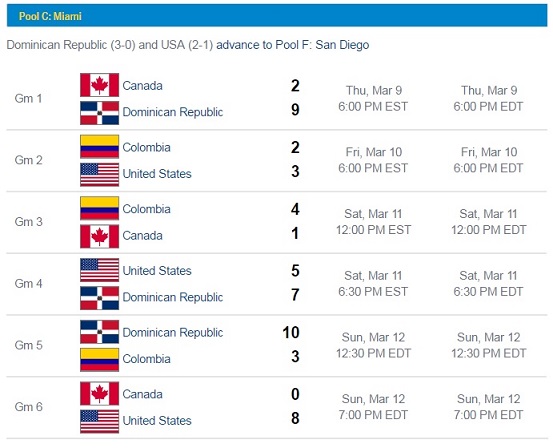
In a previous Go Lean blog-commentary, it was detailed how the Greater Miami area has benefited from failures in the Caribbean region. We saw this dynamic at work this weekend with the World Baseball Classic tournament in Miami.  For this round in the tournament, these 4 teams were assigned to Miami for “Pool C” play:

See this news article here detailing the game between the Dominican Republic and the US – this article shows that despite the address, playing in Miami was a Home Game for the Dominican National Team:

Title: Miami, WBC are big winners as Team USA, Dominicans set records for attendance … and volume
By: Greg Cote
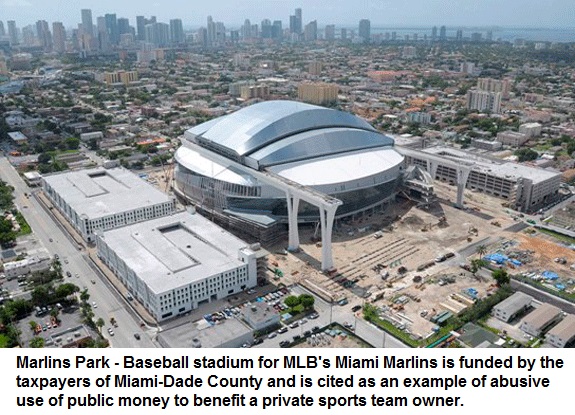
How perfect that the World Baseball Classic’s only first-round games in the United States are happening at Marlins Park. This event is so Miami.

CU Blog - Dominican's Home Away from Home - Photo 1

CU Blog - Dominican's Home Away from Home - Photo 4

It beams us to the rest of the world so accurately and with splendor, and I mean beyond the tourism/postcard aspect we saw Saturday night with the ballpark roof open, fresh breeze wafting in from the ocean and the downtown skyline majestic as a Goodyear blimp and a full moon floated overhead.

This international event speaks our language(s), reflecting the multi-ethnic, multi-national flavor that defines us. While much of the rest of the country recoils from diversity and retreats to jingoism — or I should say as our new government does — Miami remains steadfastly a savory, year-round gumbo of personalities and backgrounds.

On Saturday night, Dominican fans cheered a first-inning strikeout of Team USA’s Adam Jones as if it were the final out in a World Series Game 7. The sound was sonic, numbing. U.S. (and Marlins) fans countered with a roar of their own as Christian Yelich doubled to right field. I’m not sure a I had heard (or felt) such high-pitch passion at a South Florida sports event since the last time the Heat hosted an NBA Finals game.

The ballpark concourses filled with celebrating Dominicans before the game, a carnival of whistles and horns and sporadic, erupting chats of “Ole’!”

During the game there was The Wave undulating around the park. Of course there was. All that joy gotta go someplace.

Before the game I met a “house divided” couple. Ken Oliver, a South Florida attorney, wore Team USA colors and his friend, Josie Pichardo, those of the Dominican team. By arrangement I texted them during the game to get a sense of the atmosphere in the middle of it. They sat in Section 206, among far more fans who agreed with Josie’s team preference. I asked what it was like down there.

“Banging drums!” Oliver texted back.

Edison Cruz, 28, of Miami, had arrived with a handful of buddies — all wearing Dominican shirts.

“It is because baseball is our true national pastime,” he said. “In American there are all sports to love.”

CU Blog - Dominican's Home Away from Home - Photo 5Team USA and the Dominican both are favored to be the two teams of four in this Pool C to advance to the WBC’s next round, each fielding lineups filled with major-league stars. How good were these batting orders Saturday? The Marlins’ Giancarlo Stanton, a threat to lead the majors in home runs, hit seventh for the United States.

There is a reason Miami attracts global sporting events like the WBC. It isn’t just our weather. It’s our welcome. It’s all the colors in our quilt. If sport truly is an international language, we are fluent.

It is why this same ballpark was reconfigured recently into a racetrack for a major annual auto race involving stars from NASCAR, Formula One and IndyCar — an international event choosing Miami for its first-ever U.S. appearance.

This week it was announced two of the most famous, celebrated club teams in global soccer, Real Madrid and Barcelona, would bring their El Clasico rivalry to Hard Rock Stadium this July. The place will be filled in a way the Dolphins rarely manage.

So Saturday it was Team USA and the Dominican Republic filling MarlinsPark with passion and fans.

Who won? You didn’t need a scoreboard to tell you.

Miami did.

This blog-submission is not just relating a newspaper article and commenting about events from a far. This writer was at the game, Section 32 – Left Field bleachers.

CU Blog - Dominican's Home Away from Home - Photo 2

The purpose of the book Go Lean…Caribbean (GLC) is NOT to celebrate Diaspora life in American cities; rather it is to champion the causes of retaining Caribbean citizens in the Caribbean, and inviting the Diaspora back to their homelands. These intentions were pronounced early in the book with these statements in the Declaration of Interdependence (Pages 13):

xix. Whereas our legacy in recent times is one of societal abandonment, it is imperative that incentives and encouragement be put in place to first dissuade the human flight, and then entice and welcome the return of our Diaspora back to our shores. This repatriation should be effected with the appropriate guards so as not to imperil the lives and securities of the repatriated citizens or the communities they inhabit. The right of repatriation is to be extended to any natural born citizens despite any previous naturalization to foreign sovereignties.

xx.  Whereas the results of our decades of migration created a vibrant Diaspora in foreign lands, the Federation must organize interactions with this population into structured markets. Thus allowing foreign consumption of domestic products, services and media, which is a positive trade impact. These economic activities must not be exploited by others’ profiteering but rather harnessed by Federation resources for efficient repatriations.

This quest – reversing the propensity for Dominican people to abandon their island home – is a “tall order”, heavy-lifting task. This was expressed by one fan at the WBC Baseball game on Saturday March 11. He – first name Pablo – explained the following:

Pablo: I completed high school in the DR and knew that I was to leave immediately at the end of high school. This was not just my scenario, but the majority of the students in my graduating class. I look back now and I personally know that at least 50 percent of the class is in the US, through legal or illegal means.

GLC: You are celebrating your love for the DR homeland by being here at this baseball game, so I assume your plan now is to just work in the US during your active years and then retire back in the DR. Is this correct?

Pablo: No. I would not want to retire in the DR. It is too costly a lifestyle. You spend a lot of money in the homeland but get very little to show for it. I simply wish to visit, but I would not live there again … ever.

GLC: We recognize that even with some success from our roadmap, repatriating to the DR may never appeal to Diaspora members like you; so our focus is on the next generation, we must dissuade future classes from leaving in the first place.

Pablo: Good luck…

The Go Lean book serves as a roadmap for the introduction and implementation of the technocratic Caribbean Union Trade Federation (CU) to bring positive change. The CU‘s prime directives are identified with the following 3 statements:

  • Optimization of the economic engines in order to grow the regional economy to $800 Billion & create 2.2 million new jobs.
  • Establishment of a security apparatus to protect the resultant economic engines.
  • Improve Caribbean governance to support these engines.

The Go Lean book posits that with the empowerments that come with this roadmap, the region will be a better place to live, work and play. But this quest is heavy-lifting. The book thusly details the community ethos, strategies, tactics, implementations and advocacies to finally re-boot Caribbean society. Consider this sample:

Community Ethos – Ways to Impact Turn-Arounds Page 33
Advocacy – Ways to Grow the Economy Page 151
Advocacy – Ways to Impact the Diaspora Page 217
Advocacy – Ways to Preserve Caribbean Heritage Page 218
Advocacy – Ways to Impact the Dominican Republic Page 237

This commentary previously featured subjects related to the DR; consider this sample:

DR President Medina on the economy: ‘God will provide’
Low-cost Dominican surgeries spark warnings by US

As related previously, Miami is a better place to live, work and play … due to the contributions of the Caribbean Diaspora, including Dominicans. The new Marlins Park had never seen such a baseball fandom before the Dominicans made their impact on Saturday. (The stadium and Marlins owner is extremely disliked in the Miami community).

SGE Impact Photo 3

Dominicans are good for Miami and Miami is good for Dominicans. See the related VIDEO here:

VIDEO –  http://www.miamiherald.com/sports/mlb/article137986623.html 

Dominican fans dance to the music before Saturday’s World Baseball Classic game between the United States and the Dominican Republic at Marlins Park on Saturday, March 11, 2017. Pedro Portal The Miami Herald

Now, the purpose of the Go Lean roadmap is to foster that exact same prosperous spirit among Dominicans, but to prosper where planted in their Caribbean homeland, not in this foreign city (Miami). We urge all Dominican stakeholders to lean-in to this roadmap, those residing in the region and those in the Diaspora. 🙂

Download the book Go Lean … Caribbean – now!

Sign the petition to lean-in for the roadmap for the Caribbean Union Trade Federation.

————

Appendix A – Dominican Americans

CU Blog - Dominican's Home Away from Home - Photo 7Dominican Americans are Americans who have full or partial origin from the Dominican Republic.[5] Although their emigration began in the sixteenth century,[6] thousands of Dominicans passed through the gates of Ellis Island in the 19th and early 20th centuries.[7]The most recent movement of emigration to the United States began in the 1960s, after the fall of the Trujillo regime. In 2010, there were approximately 1.41 million people of Dominican descent in the US, including both native and foreign-born.[8] Dominican Americans are the fifth-largest Hispanic group in the United States.

The absolute latest number in terms of size of this Diaspora is an estimate from 2015: 1,873,097[1][2]; this is 0.6% of the U.S. population (2015).[3]

As of the 2010 census, the top 10 US states with the largest Dominican populations are the following:[24]

  1. New York – 674,787 (3.5% of statal population)
  2. New Jersey – 197,922 (2.3% of statal population)
  3. Florida – 172,451 (0.9% of statal population)
  4. Massachusetts – 103,292 (1.6% of statal population)
  5. Pennsylvania – 62,348 (0.5% of statal population)
  6. Rhode Island – 35,008 (3.3% of statal population)
  7. Connecticut – 26,093 (0.7% of statal population)
  8. North Carolina – 15,225 (0.2% of statal population)
  9. Georgia – 14,941 (0.2% of statal population)
  10. Maryland – 14,873 (0.3% of statal population)

Source: Retrieved March 12, 2017 from: https://en.wikipedia.org/wiki/Dominican_Americans_(Dominican_Republic)

————

Appendix B – Allapattah

Allapattah is a neighborhood mostly in the city of Miami, Florida, and partly in metropolitan Miami, United States. As of May 2011, the county-owned portion of Allapattah, from State Road 9 to LeJeune Road, is being annexed by the city proper.[1]

The neighborhood was nicknamed Little Santo Domingo in 2003 … to honor the sizable Dominican American population in the community.[2]

History
CU Blog - Dominican's Home Away from Home - Photo 6
The name is derived from the Seminole Indian language word meaning alligator. The initial settlement of the Allapattah community began in 1856 when William P. Wagner, the earliest documented white American permanent settler, arrived from Charleston, South Carolina and established a homestead on a hammock along the Miami Rock Ridge, where Miami Jackson High School presently stands. Development ensued from 1896 and into the 20th century in the area with the completion of the Florida East Coast Railroad (FEC).[3] 

Allapattah was predominantly populated by whites from early in the 20th century until the late 1950s, when there was a large influx of black Americans displaced by the construction of I-95 (then, the North-South Expressway) in the 1950s and 1960s, leading to white flight to suburban Miami-Dade County and Broward County. Cubans migrated to Miami neighborhoods like Allapattah in large numbers following the Cuban Revolution of 1959, hosting one of Miami’s largest Cuban American populations. The 1980s brought influxes of Dominican Americans, Nicaraguans, Hondurans, and Haitians in the aftermath of various refugee crises in those nations. Now, a melting pot of residents from all across the Caribbean, Central America, and Latin America reside in the area.

Demographics
As of 2000,[5] Allapattah had a population between 40,406 and 43,860[6] residents, with 12,508 households, and 8,224 families residing in the neighborhood. The median household income was $19,141.53. The racial makeup of the neighborhood was 72.23% Hispanic or Latino of any race, 18.33% Black or African American, 6.89% White (non-Hispanic), and 2.55% Other races (non-Hispanic).

The zip codes for Allapattah include 33136, 33125, 33127, and 33142. The area covers 4.653 square miles (12.05 km2). As of 2000, there were 23,967 males and 19,894 females. The median age for males was 33.9 years old, while the median age for females was 36.0 years old. The average household size had 2.8 people, while the average family size had 3.4 members. The percentage of married-couple families (among all households) was 36.4%, while the percentage of married-couple families with children (among all households) was 16.6%, and the percentage of single-mother households (among all households) was 14.5%. 8.0% of the population were in correctional institutions, 1.0% of the population were in nursing homes, and 1.2% of the population were in other group homes. The percentage of never-married males 15 years old and over was 24.5%, while the percentage of never-married females 15 years old and over was 12.4%.[6]

As of 2000, the percentage of people that speak English not well or not at all made up 33.0% of the population. The percentage of residents born in Florida was 30.5%, the percentage of people born in another US state was 9.2%, and the percentage of native residents but born outside the US was 4.3%, while the percentage of foreign born residents was 56.1%[6]

Source: Retrieved March 12, 2017 from: https://en.wikipedia.org/wiki/Allapattah


Share this post:
, , , ,
[Top]

Caribbean Roots: John Carlos – The Man. The Moment. The Movement

Go Lean Commentary

The title: “The Man. The Moment. The Movement” is more than just a catch-phrase, its a recipe for successfully transforming society.

Do you remember this Sports Moment That Changed the World?

CU Blog - Caribbean Roots - John Carlos among 'Three Proud People' - Photo 1It was at the 1968 Olympics in Mexico City. Despite all the attempts by the organizers to keep the Games apolitical and free-of-conflict, the Moment got political and conflicted … and impactful. This was when the Man, John Carlos, the bronze-medal winner in the 200 meters at the 1968 Summer Olympics gave his Black Power salute on the podium with gold-medalist Tommie Smith; this galvanized the Movement – the Civil Rights Movement in general and the Olympic Project for Human Rights in particular. The Movement caused a lot of controversy.

What is not known about this moment is that this Man, John Carlos, has Caribbean roots.

We are so proud!

Consider his biography reference here:

Title: John Carlos
John Wesley Carlos (born June 5, 1945) is an American former track and field athlete and professional football player. He was the bronze-medal winner in the 200 meters at the 1968 Summer Olympics and his Black Power salute on the podium with Tommie Smith caused much political controversy. He went on to tie the world record in the 100 yard dash and beat the 200 meters world record (although the latter achievement was never certified). After his track career, he enjoyed a brief stint in the Canadian Football League but retired due to injury.[1]

He became involved with the United States Olympic Committee and helped to organize the 1984 Summer Olympics. Following this he became a track coach at Palm SpringsHigh School. He was inducted into the USA Track & Field Hall of Fame in 2003.

He is the author, with sportswriter Dave Zirin, of The John Carlos Story: The Sports Moment That Changed the World, published in 2011 by Haymarket Books.

Early life and education
Born in Harlem, New York, to Cuban[2] parents, John Carlos was a gifted high school athlete and outstanding student who went on to study at East Texas State University on a full track-and-field scholarship. His victories in the 100- and 200-meter dash and as a member of the 4×400-meter relay helped lead ETSU to the 1967 Lone Star Conference Championship. After his first year, Carlos enrolled at San Jose State University where he was trained by future National Track & Field Hall of Fame coach, Lloyd (Bud) Winter.

Carlos was awarded an honorary doctorate from CaliforniaStateUniversity in 2008. In 2012, he was awarded honorary doctorates from his alma maters Texas A&M University-Commerce (formerly EastTexasStateUniversity) and San Jose State University.

Career
At the 1968 Olympic Trials, Carlos won the 200-meter dash in 19.92 seconds, beating world-record holder Tommie Smith and surpassing his record by 0.3 seconds. Though the record was never ratified because the spike formation on Carlos’ shoes (“brush spikes”) was not accepted at the time, the race reinforced his status as a world-class sprinter.

Carlos became a founding member of the Olympic Project for Human Rights (OPHR), and originally advocated a boycott of the 1968 Mexico City Olympic Games unless four conditions were met: withdrawal of South Africa and Rhodesia from the games, restoration of Muhammad Ali’s world heavyweight boxing title, Avery Brundage to step down as president of the IOC, and the hiring of more African-American assistant coaches. As the boycott failed to achieve support after the IOC withdrew invitations for South Africa and Rhodesia, he decided, together with Smith, to participate but to stage a protest in case he received a medal.[3] Following his third-place finish behind fellow American Smith and Australian Peter Norman in the 200 at the Mexico Olympics, Carlos and Smith made headlines around the world by raising their black-gloved fists at the medal award ceremony. Both athletes wore black socks and no shoes on the podium to represent African-American poverty in the United States. In support, Peter Norman, the silver medalist who was a white athlete from Australia, participated in the protest by wearing an OPHR badge.

IOC president Avery Brundage deemed a political statement unfit for the apolitical, international forum the Olympic Games was supposed to be. In an immediate response to their actions, he ordered Smith and Carlos suspended from the U.S. team and banned from the Olympic Village. Many supporters, however, praised the men for their bravery. The men’s gesture had lingering effects for all three athletes, the most serious of which were death threats against Carlos, Smith, and their families. Although it has been reported that Carlos and Smith were stripped of their medals, Carlos has indicated this is not true and his medal is with his mother.[4]

Carlos had his greatest year in track and field in 1969, equaling the world 100-yard record of 9.1, winning the AAU 220-yard run, and leading San JoseState to its first NCAA championship with victories in the 100 and 220 and as a member of the 4×110-yard relay. He was featured on the cover of Track and Field News May 1969 issue.[5]

CU Blog - Caribbean Roots - John Carlos among 'Three Proud People' - Photo 3

Source: Wikipedia Online Encyclopedia – Retrieved March 8, 2017 from: https://en.wikipedia.org/wiki/John_Carlos

This biography should go back further to include John Carlos’s Cuban-Caribbean heritage, that of his father:

John Carlos is of Cuban descent and can understand Spanish. His father, Earl Carlos Sr., was a businessman (a cobbler or shoe repair) and World War I Veteran [fighting for the US]. He was a man proud of his appearance in all circumstances and carried himself in a dignified way. He had to work hard from an early age (like most African-American children of his era, especially in the South of the country) and his parents were born as slaves; [(slavery ended in Cuba in 1886 and he was born in 1895)]. When he participated in World War I, he got wounded and received the Medal of Citation Award for his stoicism on the battlefield. When he returned back home, he had to face racial hatred, economic discrimination, the Roaring Twenties, the Stock Market Crash in 1929, the Dust Bowl in the mid-thirties and World War II. Despite the difficulties, he never became bitter. He met his future wife, Vioris Lawrence (an African-American woman), in 1941, who was later John Carlos’ mother. – MegaDiversities.

This was quite a legacy to absorb. John Carlos had the molding from his proud Cuban father, who left a segregated Cuba and emigrated for a better life in the metropolitan area of New York. Harlem – think Harlem Renaissance – was a better place to be a Black Man than the Jim Crow South or the minority-ruled Cuba. When he stood in defiance in that Moment in 1968, John Carlos was protesting the blatant racism that he experienced and his father before him – Earl Carlos died later, in May 1969. The Movement to uplift oppressed people had began on the global stage, but the Black Power salute was a local action in solidarity with all those oppressed before and after this Moment. He understood that ‘Sport and Politics’ are intrinsically linked, whether right or wrong.

The movement behind the book Go Lean … Caribbean recognizes the significance of that Moment and the stage for its execution, the celebrated Olympic Games. The Go Lean book applauds the struggle for Civil Rights and the dynamics of sports. It posits that sports can foster a great influence – and even wealth – in modern society. See this in Appendix B VIDEO.

The sportsman can “rule in people’s hearts”. People marvel at their athletic prowess – billions may be watching on live or tape-delayed TV broadcasts – the participants can forge a positive image and wield power and influence; think:

We can add John Carlos and Tommie Smith to that list.

This Moment was in 1968; that was a pivotal year, so many things happened, mostly bad; consider this sample:

  • Martin Luther King was assassinated, April 4
  • Robert Kennedy was assassinated, June 6
  • Vietnam War Protests – Summer
  • Chicano (Hispanic) Movement and Red Power (Native Americans) Movement Summer Protests
  • Mexico City Olympics – October 12 – 27
  • James Brown song: Say it loud: “I’m Black and I’m Proud”
    CU Blog - Caribbean Roots - John Carlos among 'Three Proud People' - Photo 2

According to John Carlos, in a recent interview describing the disposition on the ground there in Mexico City: “it was high tension, drama, a powder keg … prior to the Olympics there was a massacre that killed hundreds of young activists”.

That was 1968 … all around; consider the experience of one Californian “back in that day”:

1968 was an exciting time for me. I think it was when my activism was born. Before that time things were pretty rosy. Even though I knew about the [Black] Panthers and had seen Dr. [Martin Luther] King, living in LA you were kind of removed. I do remember expressing a desire to join the Freedom Rides, but my Pastor said ‘No’.

1968 was [when] my friends were coming home from Vietnam or refusing to go.

I remember loaning my boyfriend $$ to go to Philly to go before the Draft Board to argue as a Conscientious Objector.  He won and we were so happy.

I remember the day Dr. King was killed and going that night to a service with friends. I remember being so sad and being glued to the TV.

I remember the horror of Bobby Kennedy being killed. I was at work and heard the news.

I remember being so proud of Tommy Smith and John Carlos at the Olympics.

My living room had two posters. One of them on the stand with the black gloved fists held high and the other was [Black Panther Party co-founder] Huey Newton sitting in that Peacock Chair.

Those were the days when I was very active in the Watts Summer Festival.  Tommy Jacquette, the founder, was a friend, and we all gathered together to make the event a success. …

I would say that 1968 was the year that I became the person I am today. – Bunny Withers, Los Angeles.

The reality of human rights abuses in America in 1968 was bad, worse or dire – those were the only options. The Black community was far from being treated as equal citizens in that society. But truth be told, other minority groups in the country also experienced oppression, repression and suppression. America was the greatest country on the planet for those that qualified; those that were:

White, Anglo-Saxon, Rich, Male and Straight

Anyone else – everyone else – needed civil rights empowerments.

Fortunately, this is not the conditions of the America of today. It is now a better place to live, work and play. How did this society go from “there to here”?

It took the strenuous efforts of advocates: individuals – Men and Women – and organizations, exploiting Moments and Movements for maximum exposure. They appealed to the public, appealed to their better nature. John Carlos was one such individual.

The third person on the dais, silver medalist Peter Norman of Australia, can also be classified as an advocate fighting to assuage human rights abuses – he also wore a badge of the Olympic Project for Human Rights – he was in solidarity with Smith and Carlos. See the profile VIDEO on his activities in Appendix A below.

The Caribbean has a problem today that we did not have back in 1968. The majority populations of the Caribbean region is/was Black-and-Brown. America was not inviting to this demographic, so our people rarely immigrated to the US. Now with the above-referenced civil rights empowerments, America is now a more fair society for all people. Our Caribbean people now “beat down their doors” to flee to America, and other places – Go Lean book Page 3.

The US is now a “frienemy” for us! We are trading partners; we are aligned; we are allies; many of our students studied there; many of our Diaspora live there. We now have to compete to dissuade our young people from setting their sights on American shores as a refuge and destination of their hopes and dreams. No society can survive with a high abandonment rate – the book Go Lean … Caribbean reports that 70% brain drain rate among our professional populations.

We are failing and need advocates of our own.

We need new role models, with the courage of John Carlos, to help us “battle” against the “push-and-pull” factors that draw many Caribbean citizens away from home to the US. We need Men to seize the Moment and advance this Movement.

The Go Lean movement pursues the quest to elevate the Caribbean region through empowerments in economics, security and governance. Since 29 of the 30 Caribbean member-states (“St. Barths” is the only exception) have majority Black populations, the book pushes further on this subject of racism, positing that it is easier for Caribbean citizens to stay home and effect change in their homelands than to go to America and try to remediate that society. The book therefore asserts that the region can turn-around from failing assessments by applying best-practices, and forging new societal institutions to impact the Greater Good for all the Caribbean.

The Go Lean book posits that sports – individual achievements and the business of sports – can greatly impact society; in addition to the entertainment value, there is also national pride, image and impression. People can override many false precepts with sporting excellence by great role models.

The book Go Lean…Caribbean serves as a roadmap for the introduction and implementation of the Caribbean Union Trade Federation (CU), a technocratic federal government designed to administer and optimize the economic-security-governing engines of the region’s 30 member-states. This is highlighted by these 3 prime directives:

  • Optimization of the economic engines in order to grow the regional economy; creating 2.2 million new jobs and expanding the regional GDP to $800 Billion.
  • Establishment of a security apparatus to protect the resultant economic engines.
  • Improve Caribbean governance to support these engines.

At the outset, the roadmap recognizes our crisis and the value of sports in the roadmap, with these statements in the Declaration of Interdependence (Page 13 & 14):

xix. Whereas our legacy in recent times is one of societal abandonment, it is imperative that incentives and encouragement be put in place to first dissuade the human flight, and then entice and welcome the return of our Diaspora back to our shores. This repatriation should be effected with the appropriate guards so as not to imperil the lives and securities of the repatriated citizens or the communities they inhabit. The right of repatriation is to be extended to any natural born citizens despite any previous naturalization to foreign sovereignties.

xxvi. Whereas the preparation of our labor force can foster opportunities and dictate economic progress for current and future generations, the Federation must ensure that educational and job training opportunities are fully optimized for all residents of all member-states, with no partiality towards any gender or ethnic group. The Federation must recognize and facilitate excellence in many different fields of endeavor, including sciences, languages, arts, music and sports. This responsibility should be executed without incurring the risks of further human flight, as has been the past history.

xxxi. Whereas sports have been a source of great pride for the Caribbean region, the economic returns from these ventures have not been evenly distributed as in other societies. The Federation must therefore facilitate the eco-systems and vertical industries of sports as a business, recreation, national pastime and even sports tourism – modeling the Olympics.

The Go Lean roadmap calls for the market organizations to better garner the economic benefits of sports. One of the biggest contributions the CU will make is the facilitation of sports venues: arenas and stadia. As described in a previous blog-commentary, sports can be big business! And even when money is not involved, other benefits abound: educational scholarships, fitness/wellness, disciplined activities for the youth, image, and pride. No doubt an intangible yet important benefits is depicted in this Go Lean roadmap, that of less societal abandonment.

The movement behind the Go Lean book salute those ones from our past who left their Caribbean homelands for better opportunities abroad; we salute their legacies (foreign-born children) as well. We know that there are “new” athletes who are just waiting to be discovered and fostered throughout the Caribbean member-states. We salute these ones as our future, and pledge to do better to keep them here at home. The book details the community ethos, strategies, tactics, implementations and advocacies to allow Caribbean people to prosper where they are planted.

In terms of salute, it is appropriate to salute Vioris Louise Lawrence Carlos – the mother of John Carlos. She just recently passed-away, on December 12, 2016, at age 97. This blessed woman’s contributions and life course help to mold the life and legacy of 5 children – including John Carlos – and a whole community.

Previous Go Lean blog-commentaries that identified other sports role models for our consideration:

https://goleancaribbean.com/blog/?p=8495 NBA Greatness and Caribbean Roots: Tim Duncan Retires
https://goleancaribbean.com/blog/?p=2222 Sports Role Model – Playing For Pride … And More
https://goleancaribbean.com/blog/?p=1020 Sports Revolutionary: Advocate Jeffrey Webb
https://goleancaribbean.com/blog/?p=498 Caribbean Sport Excellence due to ‘The Sports Gene’

In addition, these other Go Lean blog-commentaries have identified other role models with Caribbean roots:

https://goleancaribbean.com/blog/?p=10609 Caribbean Roots: Cast of ‘The Fresh Prince of Bel-Air’
https://goleancaribbean.com/blog/?p=10114 Esther Rolle – Caribbean Roots
https://goleancaribbean.com/blog/?p=9948 Sammy Davis, Jr. – Caribbean Roots
https://goleancaribbean.com/blog/?p=8724 Remembering Marcus Garvey: A Role Model; Still Relevant Today
https://goleancaribbean.com/blog/?p=8619 Clive Campbell – Jamaican Innovation for Hip Hop
https://goleancaribbean.com/blog/?p=8328 YouTube Role Model with Caribbean Roots: ‘Tipsy Bartender’
https://goleancaribbean.com/blog/?p=2726 Caribbean Role Model – Oscar De La Renta – RIP
https://goleancaribbean.com/blog/?p=866 Caribbean Musical Icon and Role Model: Bob Marley

The world is a better place, sports-wise and arts-wise, because of Caribbean contributions. Thank you to all past, present and future athletes and contributors.

Not to be overlooked, but the same as the US had a Climate of Hate in 1968, we have our own societal defects in the Caribbean region today. We cannot claim enlightenment to the achievements of advocates like John Carlos and have a blind eye” to our own “ills”. So let’s stand-up as a Proud People and force our own communities to change. Let’s make our Caribbean homeland a better place to live, work and play. 🙂

Download the book Go Lean … Caribbean – now!

Sign the petition to lean-in for the roadmap for the Caribbean Union Trade Federation.

————-

APPENDIX A VIDEO – The Story Behind The White Guy In This Historic Photo – https://youtu.be/t4LvwXYmt3Q

Published on Oct 31, 2015 – In 1968 there was a powerful moment of protest at the Olympic games when two winners put on black gloves to protest what was happening in the country during the civil rights era. Most people don’t know the story of the silver medalist, Peter Norman. Cenk Uygur, host of the The Young Turks, breaks it down. Tell us what you think in the comment section below.

“In an act as appropriate as it is overdue, the Australian House of Parliament is issuing an official state apology Monday to the country’s late, great sprinter Peter Norman. Norman won the 200-meter silver medal at the 1968 Olympics, but that’s not why he’s either remembered or owed apologies. After the race, gold and bronze medalists Tommie Smith and John Carlos bowed their heads and raised their fists on the medal stand and started an international firestorm. Many see the iconic image and assume Norman was just a bystander to history, or as he would joke, “the white guy.” But he was standing in full solidarity with Smith and Carlos, wearing a patch on his chest that reads, “Olympic Project for Human Rights.”

Read more here: https://www.thenation.com/article/aus…

Disclaimer: The Young Turks is an online video talk show that provides commentary on news and opinion articles. Often times these articles come from sources outside of our organization. Where possible, we do our best to research and verify various sources before reporting. Content created by third parties is the sole responsibility of the third parties and its accuracy and completeness are not endorsed or guaranteed.

UPDATE to story: http://www.filmsforaction.org/watch/j…

————-

APPENDIX B VIDEO – THREE PROUD PEOPLE (Mural project) Tommy Smith, Peter Norman, John Carlos – https://youtu.be/xHcasP4HOo0

Uploaded on May 17, 2009 – This mural was put up about 6 weeks prior to the opening ceremony of the Sydney 2000 Olympic games. It could be viewed from the McDonaldtown train station platform and from trains travelling past. Trains travel from central Sydney to the Homebush Olympic venue past this mural. As of a few years ago, the mural can no longer be seen from the tracks due to a city rail concrete sound barrier that has been installed.
Peter Norman was repremanded for his part in the action. Peter, in solidarity, wore the Olympic project for human rights badge, which defied the code of conduct. He also came up with the idea of Smith and Carlos each wearing one black glove from the same pair. All three of these guys were very couragous.

  • Category: Education
  • License: Standard YouTube License


Share this post:
, , ,
[Top]

Stay Home! Immigration Realities in the US

Go Lean Commentary

When conditions are dysfunctional at home, people leave … period.

“… we are just making it easy for the clean-up woman” – Classic R&B song by Betty Wright
See Appendix VIDEO below.

CU Blog - Immigration Realities in the US - Photo 6

This is not good for a family nor for a community. The truth of the matter is that communities need their populations to grow, not recede. So any human flight incidences would create havoc on the functionality of societal engines: economics, security and governance.

This is our status in the Caribbean, but it is not just an incident, not a trickle; it is a flood. The people are beating down the doors to get out of their Caribbean homeland, to seek refuge in places like the US, Canada and Western Europe. We have a sad state of affairs for our Caribbean eco-system so we are suffering from a bad record of societal abandonment – averaging a 70 percent brain drain rate. The reasons why people leave have been identified as “push and pull”:

“Push” refers to people who feel compelled to leave, to seek refuge in a foreign land. “Refuge” is an appropriate word; because of societal defects, many from the Caribbean must leave as refugees – think LGBTDisabilityDomestic-abuseMedically-challenged – for their life, liberty and pursuit of happiness. This is making it easy for the “clean-up woman”.

“Pull”, on the other hand refers to the lure of a more prosperous life in the US (and other destinations); many times our people are emigrating for economics solely.

If only we can mitigate these “push and pull” factors, then we can dissuade our people from leaving in the first place. If only we can go from ‘good to great‘ here in the Caribbean homeland. This would be the ideal. But this is not our reality.

What is a point of contention is where our emigrants are going. Let’s consider the realities of one such destination: the United States. While things are bad for our residents in their Caribbean homeland, many minority immigrants in America (Black-and-Brown, Muslim, etc.) have to contend with less than welcoming conditions there.

The movement behind the book Go Lean … Caribbean has consistently related that the United States of America functions as a Great Society but it has two societal defects: Institutional Racism and Crony-Capitalism. These societal defects can easily create a ‘Climate of Hate‘ that causes people to haze and blame-game the immigrant community.

CU Blog - Immigration Realities in the US - Photo 4

In a previous blog-commentary, it was conveyed that America treats immigrants unappreciatedly – they are inflicted with a “long train of abuses”. The long-term Americans start towards the immigrants with hate and then eventually tolerate. After some decades they may then integrate with the immigrant community. But only after generations do they appreciate and celebrate the minority group. Think of the American experience of the Chinese, Italians, Jewish and Cuban populations.

This is also the reality of the Caribbean Black-and-Brown that has emigrated to the US, while they can more easily survive, the quest to thrive is more perplexing. They have to live in this environment filled with these societal defects. Consider this news article and these aligning VIDEO’s:

News Article Title: GPS device-maker Garmin reeling after workers gunned down
By: Jim Suhr

CU Blog - Immigration Realities in the US - Photo 1

OLATHE, Kan. (AP) — GPS device-maker Garmin long has revered diversity in its workforce, even when the locale of its ever-sprawling operational headquarters — a largely white Kansas City suburb — didn’t reflect it.

It’s the place 32-year-old Srinivas Kuchibhotla came to work a few years ago. By his wife’s account Friday he willingly spent long hours on an aviation systems engineering team alongside Alok Madasani, a friend and colleague also 32 and from India.

Kuchibhotla’s trek led him to have a kinship with his boss, Lebanese native Didier Popadopoulos, who says he moved to America at Kuchibhotla’s age and once held the same Garmin job.

But Garmin — a billion-dollar tech giant launched in Kansas as a startup by two men nearly three decades ago — now is reeling, trying to digest Kuchibhotla’s shooting death Wednesday at a tavern just a mile down the road from work. Madasani was wounded, along with a stranger who tried to help.

Witnesses say the gunman, Adam Purinton, yelled at the two Indian men to “get out of my country” and opened fire. Purinton, who was arrested hours later at a bar in Missouri, remains jailed on murder and attempted murder charges.

The shooting happened at a time when many have concerns about the treatment of immigrants in the U.S., some of whom feel targeted by the current administration. President Donald Trump has promised to ban certain travelers and been especially vocal about the threat posed by Islamic terrorist groups.

CU Blog - Immigration Realities in the US - Photo 2On Friday, Garmin tried to comfort grieving employees at a closed-door vigil inside the auditorium on its campus in Olathe, Kansas. Kuchibhotla’s widow, Sunayana Dumala, addressed the group of about 200 workers that included Madasani, who was released from the hospital Thursday.

Laurie Minard, Garmin’s vice president of human resources, doesn’t believe the shooting will jeopardize its recruitment of workers from overseas.

“We tend to be a family here,” she said at the Garmin campus, which is waging a $200 million expansion, with plans announced last August for a new manufacturing and distribution center. “We want people to feel safe. We embrace it. We encourage it. We support it. It’s extremely important to us about acceptance.”

At any given time, she said, more than 100 Garmin employees are in the H-1B program, which lets American companies bring foreigners with technical skills to the U.S. for three to six years.

CU Blog - Immigration Realities in the US - Photo 5

In an eight-year period until fiscal year 2016, Garmin on average obtained 49 certifications for foreign labor — a prerequisite for hiring with an H-1B visa — for an average of 70 positions, according to the U.S. Department of Labor. During that time, 81 percent of the certified positions were in Olathe, the Labor Department says.

Olathe, whose name means “beautiful” in the Shawnee language, is a well-to-do Kansas City suburb where the median household income is above $77,000 a year.

CU Blog - Immigration Realities in the US - Photo 3Worldwide, Switzerland-based Garmin Ltd. — the Kansas operation’s corporate parent — has more than 11,400 workers in 60 offices and last year logged $3.02 billion in revenue. Roughly 2,800 workers are at the Kansas headquarters, which Greater Kansas City Chamber of Commerce spokeswoman Pam Whiting cast as regionally “one of our entrepreneurial success stories” and biggest employers.

Recruiting from overseas isn’t at all unusual in the tech industry, which contends there aren’t enough Americans with specialized skills the companies need.

Indian immigrants in the U.S. has spiked from about 200,000 in the 1980s to more than 2 million today, as Indian-born scientists and engineers fueled the American tech boom. India received more H-1B visas in the U.S. for its temporary high-skilled workers, about 70 percent, than any other country in 2014.

Stunned by Kuchibhotla’s death, Popadopoulos, the Lebanese native who was the man’s boss, said he plans to stay the course.

“When this happened, one of the things I started to think about with my wife (was) ‘Is it time to leave?'” he said.

Then he thought: “Leave where? I’m from here. I really think Srinivas would want us to stick together and stand up for what’s right.”

U.S. Sen. Jerry Moran said he left a message with Olathe’s mayor, offering to help assure people from India who live in Kansas that the actions leading to Kuchibhotla’s death are “not the norm.”

“This is not the nature of Kansas, and we welcome people to the United States, particularly a company like Garmin and many others,” the Kansas Republican said.

___

AP Data Journalist Larry Fenn in New York and AP writers Martha Mendoza in Bangkok and John Hanna in Topeka, Kansas, contributed to this report.
Source: Associated Press – posted February 25, 2017; retrieved February 27, 2017 from: https://www.yahoo.com/news/gps-device-maker-garmin-reeling-workers-gunned-down-013731087.html

—————-

VIDEO #1 What would America’s Tech industry be like without immigrants? – https://youtu.be/QODK-9-mImg

Published on Feb 3, 2017 – In the recent hate-crime in Olathe, Kansas the gunman exclaimed that he wanted the country back. Consider the words of this deranged killer and ask “What would America’s Tech industry be like without immigrants?”
But maybe, the American people are not so inviting, even though American companies may seek immigrants.
http://global-gathering.com

—————-

VIDEO #2 Trump Said Immigration Is Bad for the Economy, But Is it? – https://youtu.be/7PHfJ8HY-Ds

Published on Feb 12, 2017 – The new President, Donald Trump, has expressed that immigration is bad for the American economy and society in general. This is just another example of his “alternate facts”. It is not the truth. But it does project that his American administration is not welcoming to immigrants.
The question to the Caribbean: Do you want to go to a party that you’re not invited to or welcomed?
Category: News & Politics
License: Standard YouTube License

This foregoing article relates a hate-crime against immigrants (engineers) from India. They were not Muslims; they were not Mexican; they were not affiliated with the Black-and-Brown populations from Latin America or the Caribbean. But they were non-White and spoke with foreign accents; they therefore were subject to standard American hate-speech, bullying and in this case, a random act of violence; one was murdered.

This commentary is one of the missions of the book Go Lean…Caribbean, to lower the “pull” attraction of life in the US. This is not being done with “smoke and mirrors” but rather this is just the truth. This is part 2 of 3 in a series on “Why Caribbean people need to Stay Home“, positing that the “grass is not greener on the other side”. The complete series is as follows:

  1.  Stay Home! Remembering ‘High Noon’ and its Back-Story
  2.  Stay Home! Immigration Realities in the US
  3.  Stay Home! Outreach to the Diaspora – Doubling-down on Failure

The truth of the matter is that immigrants are better able to survive in America – there is an abundance of minimum wage jobs – but to thrive is more of a challenge; consider the experiences in the foregoing news article. It would seem better for Caribbean people to work to remediate the problems in their homeland, rather than work to become immigrants in the US. But this is no easy task; and despite being necessary, it is hereby defined as heavy-lifting.

The book Go Lean … Caribbean seeks to optimize the societal engines of Caribbean life; it serves as a roadmap for the introduction and implementation of the technocratic Caribbean Union Trade Federation (CU). The CU must employ better strategies, tactics and implementations to impact the regional homelands to reform and transform the societal engines. The prime directives of the Go Lean/CU roadmap for technocratic stewardship is identified with the following 3 statements:

  • Optimization of the economic engines in order to grow the regional economy to $800 Billion & create 2.2 million new jobs. The deficiency of jobs is one  of the reasons Caribbean people have emigrated.
  • Establishment of a security apparatus to protect the resultant economic engines and mitigate internal and external threats.
  • Improvement of Caribbean governance to support these above engines, including a separation-of-powers between member-state governments and CU federal agencies.

Early in the Go Lean book, this need for careful technocratic stewardship of the region’s societal engines was pronounced (Declaration of Interdependence – Page 12 – 13) with these acknowledgements and statements:

xi.   Whereas all men are entitled to the benefits of good governance in a free society, “new guards” must be enacted to dissuade the emergence of incompetence, corruption, nepotism and cronyism at the peril of the people’s best interest. The Federation must guarantee the executions of a social contract between government and the governed.

xii.  Whereas the legacy in recent times in individual states may be that of ineffectual governance with no redress to higher authority, the accedence of this Federation will ensure accountability and escalation of the human and civil rights of the people for good governance, justice assurances, due process and the rule of law. As such, any threats of a “failed state” status for any member state must enact emergency measures on behalf of the Federation to protect the human, civil and property rights of the citizens, residents, allies, trading partners, and visitors of the affected member state and the Federation as a whole.

xxiv. Whereas a free market economy can be induced and spurred for continuous progress, the Federation must install the controls to better manage aspects of the economy: jobs, inflation, savings rate, investments and other economic principles. Thereby attracting direct foreign investment because of the stability and vibrancy of our economy.

xxvi.  Whereas the Caribbean region must have new jobs to empower the engines of the economy and create the income sources for prosperity, and encourage the next generation to forge their dreams right at home, the Federation must therefore foster the development of new industries … In addition, the Federation must invigorate the enterprises related to existing industries … impacting the region with more jobs.

Our Caribbean community, no community for that matter, can survive a constant drain against our population and human capital. This is a crisis! This point was crystalized in a previous blog/commentary with this quotation:

We tend to think economic growth comes from working harder and smarter. But economists attribute up to a third of it to more people joining the workforce each year than leaving it. The result is more producing, earning and spending.

This is a consistent theme in the book Go Lean…Caribbean. The book posits that the most serious threat to Caribbean prosperity is the high abandonment rate among its citizens, especially its highly educated, skilled-labor classes.

“A crisis is a terrible thing to waste” – states the book quoting noted Economist Paul Romer.

The opportunity therefore exists to forge change in the economic, security and governing engines of the Caribbean, in response to this crisis. This is the advocacy of the Go Lean book, to position the region at the corner of preparation and opportunity, so as to better compete on the world stage. Our job creation engines have failed to keep pace with the population, therefore fewer and fewer jobs are at home. Thus this region has had a higher and higher emigration rate as the decades pass. If we want our citizens to “Stay Home” then we must provide job options.

How?

First, the region already has a mature tourism product so we now need jobs in other industries.

The following details from the book Go Lean … Caribbean are the community ethos, strategies, tactics, implementations and advocates prescribed to create non-tourism jobs and elevate the Caribbean economy:

Community Ethos – Deferred Gratification Page 21
Community Ethos – new Economic Principles Page 21
Community Ethos – Job Multiplier Page 22
Community Ethos – new Security Principles Page 22
Community Ethos – new Governing Principles Page 24
Community Ethos – Ways to Impact the Future Page 26
Community Ethos – Ways to Impact Turn-Arounds Page 33
Community Ethos – Ways to Promote Happiness Page 36
Community Ethos – Ways to Impact the Greater Good Page 37
Strategy – Repatriating Caribbean Diaspora Page 47
Strategy – Non-Government Organizations Page 48
Tactical – Confederating a Permanent Union Page 63
Tactical – Fostering a Technocracy Page 64
Implementation – Assemble all Member-States Page 96
Implementation – Ways to Pay for Change Page 101
Implementation – Reasons to Repatriate Page 118
Planning – Ways to Make the Caribbean Better Page 131
Advocacy – Ways to Grow the Economy Page 151
Advocacy – Ways to Create Jobs Page 152
Advocacy – Better Manage the Social Contract Page 170
Advocacy – Ways to Foster Empowering Immigration Page 174
Advocacy – Impact the Diaspora Page 217
Advocacy – Ways to Preserve Caribbean Heritage Page 218
Advocacy – Ways to Help the Middle Class Page 223

The Go Lean roadmap is a product of the Diaspora, from those residing in the US – looking at Caribbean residents and longing to go home. The Go Lean book and blog-commentaries assert that the “grass is not greener on the other side”. But we rightfully know that the quest for economic opportunities is the “pull” factor that attracts Caribbean people.

How to create jobs at home? This point – and accompanying lessons – has been exhausted in previous blog/commentaries; consider this sample:

https://goleancaribbean.com/blog/?p=9751 Where the Jobs Are – Animation and Game Design
https://goleancaribbean.com/blog/?p=9203 Where the Jobs Are – Employer Models in the United States
https://goleancaribbean.com/blog/?p=8262 Creating Job Opportunities with UberEverything – An African Model
https://goleancaribbean.com/blog/?p=8328 Creating Job Opportunities as YouTube Millionaires
https://goleancaribbean.com/blog/?p=7806 Skipping School to become Tech Giants
https://goleancaribbean.com/blog/?p=6129 Innovative Partnership Aids Farm Workers/Agricultural Jobs
https://goleancaribbean.com/blog/?p=6089 Where the Jobs Are – Futility of Minimum Wage
https://goleancaribbean.com/blog/?p=5759 Pressed by Debt Crisis, Doctors Leave Greece in Droves for New Jobs
https://goleancaribbean.com/blog/?p=2857 Where the Jobs Are – Entrepreneurism in Junk
https://goleancaribbean.com/blog/?p=2126 Where the Jobs Are – Computers Reshaping Global Job Market
https://goleancaribbean.com/blog/?p=2025 Where the Jobs Are – Attitudes & Images of the Diaspora
https://goleancaribbean.com/blog/?p=2003 Where the Jobs Are – One Scenario: Ship-breaking
https://goleancaribbean.com/blog/?p=1698 Where the Jobs Are – STEM Jobs Are Filling Slowly

These previous blogs report that this Go Lean roadmap is a hope for change in the Caribbean region. Its a plan that is conceivable, believable and achievable for making the Caribbean homeland a better place to live, work and play. Everyone in the region is hereby urged to lean-in to this roadmap. 🙂

Download the book Go Lean … Caribbean – now!

———–

Appendix VIDEO – Betty Wright – Clean Up Woman – https://youtu.be/vh-2_kdVcyA

Uploaded on May 27, 2009 Lyrics:

“Clean Up Woman”
A clean up woman is a woman who
Gets all the love we girls leave behind
The reason I know so much about her
Is because she picked up a man of mine

Chumpin’ slick was my ruin
‘Cause, I found out all I was doin’
Was making it easy for the clean up woman
To get my man’s love, oh yeah
Just making it easy for the clean up woman
To get my baby’s love, uh-huh, um-hum

I took this man’s love and put it a shelf
And like a fool I thought I had him all to myself

When you needed love I was out having fun
But I found out that all I had done
Was made it easy for the clean up woman
To get my man’s love, uh-huh
Yeah, that’s what I did, I made it easy for the clean up woman
To steal my baby’s love, oh yeah

The clean up woman will wipe his blues away
She’ll give him plenty lovin’ 24 hours a day
The clean up woman, she’ll sweep him off his feet
She’s the one who’ll take him in when you dump him in the street
So take a tip, you better get hip
To the clean up woman ’cause she’s tough
I mean, she really cleans up


Share this post:
, , ,
[Top]

Caribbean Roots: Cast of ‘The Fresh Prince of Bel-Air’

Go Lean Commentary

For the generation born between 1980 and 2000 – Millennials – this TV show is an icon of their generation:

The Fresh Prince of Bel-Air.

It was a situation comedy (sit-com) with laughter, hip-hop music, urban cool lifestyle, family values and thought-provoking drama. This show was formative for all demographics of this generation – White and the Black-and-Brown –  but most people do not realize that a large number of the cast members had Caribbean roots.

We are so proud!

CU Blog - Caribbean Roots - Cast of Fresh Prince of Bel-Air - Photo 1

CU Blog - Caribbean Roots - Cast of Fresh Prince of Bel-Air - Photo 3

The movement behind the book Go Lean … Caribbean recognizes the significance of this art-form: sit-com television. On a consistent basis, audiences tuned into this show for entertainment and walked away with enlightenment as well – average ratings were 13 – 14 million viewers. They were constantly exposed to an affluent African-American household with an intact family structure: father, mother, and compliant children navigating a changing world. That was a different perspective – see Image Awards details in the Appendix below – compared to the realities of Black America and the pervasive media portrayals.

The show was not a docu-drama of “Black versus White America”, though many times, plotlines covered these dynamics. In general the storylines addressed teenage angst, but many plotlines addressed the family’s affluence versus working class families; this exposes a familiar rift in the Black community with passionate advocates for a Talented Tenth versus a ‘Power to the People’ contingent. See these encyclopedic details and VIDEO of the show here:

Title: The Fresh Prince of Bel-Air

CU Blog - Caribbean Roots - Cast of Fresh Prince of Bel-Air - Photo 0The Fresh Prince of Bel-Air is an American sitcom that originally aired on NBC from September 10, 1990, to May 20, 1996. The show stars Will Smith as a fictionalized version of himself, a street-smart teenager from West Philadelphia who is sent to move in with his wealthy aunt and uncle in their Bel Air mansion after getting into a fight on a local basketball court. In the series, his lifestyle often clashes with the lifestyle of his relatives in Bel Air. The series ran for six seasons and aired 148 episodes.[1][2]

Starring Cast

Will Smith as Will “The Fresh Prince” Smith
James Avery as Philip Banks
Janet Hubert-Whitten as Vivian Banks (1st)
Alfonso Ribeiro as Carlton Banks
Karyn Parsons as Hilary Banks
Tatyana M. Ali as Ashley Banks
Joseph Marcell as Geoffrey The Butler
Daphne Maxwell Reid as Vivian Banks (2nd)
Ross Bagley as Nicholas “Nicky” Banks (Seasons 5 & 6 only)

Development
In December 1989, NBC approached Will Smith, a popular rapper during the late 1980s.[3] The pilot episode began taping on May 1, 1990.[4] Season 1 aired in July 1990 and ended in March 1991. The series finale was taped on Thursday, March 21, 1996.[5][6]

The theme song was written and performed by Smith under his rap stage name, The Fresh Prince. The music was composed by QDIII (Quincy Jones III), who is credited with Smith at the end of each episode.

The music often used to bridge scenes together during the show is based on a similar chord structure. The full version of the theme song was used unedited in the first three episodes. The full length version, which is 2:52, was included on Will Smith’s Greatest Hits album and attributed to him only, as well as DJ Jazzy Jeff & the Fresh Prince in 1998. A 3:23 version was released in the Netherlands in 1992, reaching #3 on the charts.

In the second season, the kitchen and living room sets were rebuilt much larger with a more contemporary style (as opposed to the much more formal style of the first season), and were connected directly by an archway, allowing scenes to be shot continuously between the sets.

Plot
The theme song and opening sequence set the premise of the show. Will Smith is a street-smart teenager, born and raised in West Philadelphia. While playing basketball, Will misses a shot and the ball hits a group of people, causing a confrontation that frightens his mother, who sends him to live with his aunt and uncle in the town of Bel Air, Los Angeles.

He flies from Philadelphia to Los Angeles on a one-way ticket in first class. He then whistles for a taxi that has dice in the reflection screen and the word “FRESH” on its vanity plates. Will’s working class background ends up clashing in various humorous ways with the upper class, “bourgeois” world of the Banks family – Will’s uncle Phil and aunt Vivian and their children, Will’s cousins Hilary, Carlton, and Ashley.
Source: Wikipedia Online Encyclopedia – Retrieved February 24, 2017 from: https://en.wikipedia.org/wiki/The_Fresh_Prince_of_Bel-Air

————

VIDEO – The Fresh Prince Of Bel Air Theme Song – https://youtu.be/1nCqRmx3Dnw

Published on Feb 3, 2013 – This was obviously the first episode.

The reference to The Fresh Prince refers to the hip-hop rapper Will Smith; the show revolved around him.

The Go Lean book identifies that music – even hip-hop – and the arts can greatly impact society; in addition to the entertainment value, there is also image and impression. People can override many false precepts with excellent deliveries and contributions from great role models.

The book Go Lean…Caribbean serves as a roadmap for the introduction and implementation of the Caribbean Union Trade Federation (CU). This CU strives to advance Caribbean image and culture in the region and throughout the world, with these 3 prime directives:

  • Optimization of the economic engines in order to grow the regional economy.
  • Establishment of a security apparatus to protect the resultant economic engines.
  • Improve Caribbean governance.

This roadmap recognizes that a prerequisite for advancing society is a change in the Caribbean “community ethos”;  (the underlying attitude/spirit/sentiment that informs the beliefs, customs, or practices). Early in the book, the contributions that culture (music, television, film, theater and dance) can make is pronounced as an ethos for the entire region to embrace, (opening Declaration of Interdependence – DOI – Pages 15) with this statement:

xxxii. Whereas the cultural arts and music of the region are germane to the quality of Caribbean life, and the international appreciation of Caribbean life, the Federation must implement the support systems to teach, encourage, incentivize, monetize and promote the related industries for arts and music in domestic and foreign markets. These endeavors will make the Caribbean a better place to live, work and play.

The Go Lean/CU asserts that change has now come to the Caribbean, collectively and for each of the 30 member-states. The people, institutions and governance of the region are all urged to “lean-in” to this roadmap for change. We know it is important to highlight the positive contributions of Caribbean people, even their descendants and legacies.

The great role models being considered here are the many cast members of this iconic TV show – The Fresh Prince of Bel-Air – who had Caribbean roots. We learn lessons from these great role models: lessons that are good, bad and ugly.

The cast members for consideration are:

  • Alfonso Ribeiro as Carlton Banks
    This American-born actor has displayed many talents, beginning his career at the age of eight but securing his first TV sit-com on the series Silver Spoons at the age of 13; he is also accomplished as a television director, dancer, and show host. He was born in New York City to Trinidadian parents Michael and Joy Ribeiro (née De Leon) of Portuguese, Spanish and Afro-Trinidadian descent from Trinidad and Tobago. His mother was the daughter of Trinidadian Calypsonian the Roaring Lion, Rafael de Leon.[2][3]
  • Tatyana M. Ali as Ashley Banks
    This artist has excelled in her roles as an actress, model and R&B singer. She was born in New York to a mother of Afro-Panamanian[2][3] heritage and a father who is Indo-Trinidadian.[3] She began her acting career at the young age of six, starting as a regular child performer on Sesame Street starting in 1985. She has not stopped working in the entertainment industry, featuring acting and singing roles right up to the present day.
  • Joseph Marcell as Geoffrey The Butler
    This Saint Lucian-born British actor moved to the United Kingdom at the age of nine, grew up in South London, and still lives in that metropolitan area. He studied theatre and science at college, then took courses in speech and dance. As a member of the Royal Shakespeare Company, he appeared in productions of Othello and A Midsummer Night’s Dream. He has also appeared often on British television and in feature films.[2]

These artists have placed their signatures on the entertainment world – The Fresh Prince of Bel-Air show delivered 148 episodes – notwithstanding their Caribbean heritage. This is among the ‘Good‘ lessons.

What is ‘Bad and Ugly‘ is how they have excelled in their crafts in the US and the UK as opposed to their ancestral homelands. Their parents left the islands for greater opportunities 50 – 70 years ago and despite the passage of time we still do not have any manifestations that would have allowed their artistic expressions in the Caribbean region.

What is sad is that most of the Caribbean Diaspora left their beloved homelands with some aspirations of returning some day. This is depicted in the Go Lean book with this quotation (Page 118):

The Bottom Line for the Caribbean Diaspora
The Caribbean is the best address in the world. However for over 50 years many Caribbean citizens left their island homes to find greater opportunity in foreign lands: USA, Canada and Europe. Though the “man was taken out of the island, the island was never taken out of the man”, and as such many of the Diaspora live in pockets with other Caribbean expatriates in their foreign homelands (i.e. Flatbush in Brooklyn, New York, USA). What’s more, their children, legacies, are still raised and bred with Caribbean values and culture. Many left initially with the intention of returning someday, but life, loves and livelihoods got in the way of a successful return. Worse, many tried to return and found that they were targets of crime and terrorism, mandating that they abandon all hopes and dreams of a successful repatriation. The CU therefore must allow for the repatriation of peoples of the Diaspora, in all classes of society, “the good, the bad and the ugly”.

We salute these artists from the TV show ‘The Fresh Prince of Bel-Air’. Great job; great performances and great portrayals. We accept that these artists are great Americans and Britons; they may never be grouped with Caribbean artists.

This is our loss.

May we do better with our next generation. We can and have done some good in the past; Caribbean people have impacted the art world (music and culture) right from their Caribbean homeland. Consider Caribbean musical icon, Bob Marley; he set a pathway for success for other generations of talented, inspirational and influential artists to follow. More artists of Caribbean heritage are sure to emerge to “impact the world” with their artistry. The planners for a new more opportunistic Caribbean – the Go Lean movement – are preparing for it, as specified in the same DOI – Page 13:

xxi. Whereas the preparation of our labor force can foster opportunities and dictate economic progress for current and future generations, the Federation must ensure that educational and job training opportunities are fully optimized for all residents of all member-states, with no partiality towards any gender or ethnic group. The Federation must recognize and facilitate excellence in many different fields of endeavor, including sciences, languages, arts, music and sports. This responsibility should be executed without incurring the risks of further human flight, as has been the past history.

The foregoing three artists should be proud of their executions; we are proud of their heritage and thusly have an affinity for their works. We acknowledge those ones from our past who left their Caribbean homelands for better opportunities in the world of entertainment and we know that there are “new” artists who are just waiting to be fostered throughout the Caribbean member-states. We salute these ones as our future, and pledge to do better. The following list details the community ethos, strategies, tactics, implementations and advocacies to foster future entertainment options in the Caribbean:

Community Ethos – Ways to Foster Genius – All Artists Page 27
Community Ethos – Promote Intellectual Property Page 29
Community Ethos – Ways to Promote Happiness Page 36
Community Ethos – Impact the Greater Good Page 37
Strategy – Caribbean Vision Page 45
Tactical – Separation of Powers – Patents & Copyrights Page 78
Tactical – Separation of Powers – Culture Administration Page 81
Implementation – Ways to Impact Social Media Page 111
Advocacy – Ways to Make the Caribbean Better Page 131
Advocacy – Ways to Impact Hollywood Page 203
Advocacy – Ways to Impact the Diaspora Page 217
Advocacy – Ways to Preserve Caribbean Heritage Page 218
Advocacy – Ways to Improve the Arts Page 230
Advocacy – Ways to Promote Music Page 231

These foregoing artists – all good people in their own rite – have been impactful for their communities:

  • Alfonso Ribeiro has been front-and-center in charitable endeavors, exerting much time and resources in helping with children’s medical needs through his Shriners Hospital association.
  • Tatyana Ali has been very active politically, campaigning for “hope and change” with Barack Obama’s presidential campaign in 2008.[10][11] In 2012, she continued showing her support for the re-election campaign and other Democratic Party causes.[12]
  • Joseph Marcell devotes a lot of time, talent and treasuries to educational causes within the theater community.
    CU Blog - Caribbean Roots - Cast of Fresh Prince of Bel-Air - Photo 2

These examples continue the theme of the impact of good role models in their community. We need, want and deserve more of this in the Caribbean. This thought has been presented many times in this commentary; consider these previous Go Lean blogs that identified other role models, from many cultures, with these submissions:

https://goleancaribbean.com/blog/?p=10114 Esther Rolle – Caribbean Roots
https://goleancaribbean.com/blog/?p=9948 Sammy Davis, Jr. – Caribbean Roots
https://goleancaribbean.com/blog/?p=8724 Remembering Marcus Garvey: A Role Model; Still Relevant Today
https://goleancaribbean.com/blog/?p=8619 Clive Campbell – Jamaican Innovation for Hip Hop
https://goleancaribbean.com/blog/?p=8495 NBA Greatness and Caribbean Roots: Tim Duncan Retires
https://goleancaribbean.com/blog/?p=8328 YouTube Role Model with Caribbean Roots: ‘Tipsy Bartender’
https://goleancaribbean.com/blog/?p=7682 Frederick Douglass: Role Model for a Single Cause
https://goleancaribbean.com/blog/?p=6593 Dr. Mobley – Role Model as a Business School Dean
https://goleancaribbean.com/blog/?p=2726 Caribbean Role Model – Oscar De La Renta – RIP
https://goleancaribbean.com/blog/?p=2297 The Black Contrast: Booker T Washington versus W.E.B. Du Bois
https://goleancaribbean.com/blog/?p=1037 Role Model and Humanities Advocate – Maya Angelou – R.I.P.
https://goleancaribbean.com/blog/?p=866 Caribbean Musical Icon and Role Model: Bob Marley

The world is a better place, arts-wise, because of Caribbean contributions. Thank you to all past, present and future artists.

Just one more thing: Let’s make these contributions at home, from home; let’s prosper where we are planted.

This helps us to make our Caribbean homeland a better place to live, work and play. 🙂

Download the book Go Lean … Caribbean – now!

————–

Appendix Title: The Fresh Prince of Bel-Air‘s NAACP Image Awards

Outstanding Comedy Series

Nominated

1997
Outstanding Supporting Actor in a Comedy Series

Won

Alfonso Ribeiro 1996
Outstanding Lead Actor in a Comedy Series

Nominated

Will Smith 1997
Outstanding Youth Actor/Actress

Won

Tatyana M. Ali 1997
Outstanding Supporting Actress in a Comedy Series

Nominated

Janet Hubert-Whitten 1991
Outstanding Supporting Actress in a Comedy Series

Nominated

Nia Long 1996
Outstanding Supporting Actress in a Comedy Series

Nominated

Daphne Maxwell Reid 1996
Share this post:
, , , , , ,
[Top]

Learning from Stereotypes – Good and Bad

Go Lean Commentary

“Tell them about the dream Martin” – Prompting by Gospel Singer Mahalia Jackson.

“I have a dream that one day … children will be judged by the contents of their character and not the color of their skin.” – Martin Luther King (MLK) @ March on Washington August 28, 1963.

The movement behind the book Go Lean … Caribbean has asserted that the country of the United States had a long way to go to reform their societal defects – racism proliferated every aspect of society. In a previous blog-commentary about lessons learned from 75 years ago with Japanese-American relations (Pearl Harbor) it was explained how America double-downed on their bad community ethos (the underlying attitude/spirit/sentiment that informs the beliefs, customs, or practices):

Japan’s aggression was a direct result of their community ethos that honored Samurai warrior and battle culture. Men would walk the streets with their swords, ready for a challenge. On the other hand, the US (and Western Europe) community ethos of racism was so ingrained that the natural response in the US, post-Pearl Harbor, was to intern Japanese Americans in camps.
All of these bad community ethos were weeded out with post-WWII Human Rights reconciliations. – Go Lean book Page 220.

This day – February 19 – is special; this is the Day of Remembrance of the bad episode of American stereotyping their own citizens, Japanese-Americans following the Pearl Harbor attacks. This is the 75th anniversary of then President Franklin D. Roosevelt’s (FDR) executive order that allowed this open discrimination against Japanese-Americans. This was just 2 and a half months after the Pearl Harbor attack and the American response was to stereotype all Japanese. See this portrayal in the historic account here:

CU Blog - Learning from Stereotypes - Good and Bad - Photo 1

The internment of Japanese Americans in the United States during World War II was the forced relocation and incarceration in camps in the interior of the country of between 110,000 and 120,000[4] people of Japanese ancestry who lived on the Pacific coast. Sixty-two percent of the internees were United States citizens.[5][6] These actions were ordered by President Franklin D. Roosevelt shortly after Imperial Japan’s attack on Pearl Harbor.[7]

Japanese Americans were incarcerated based on local population concentrations and regional politics. More than 110,000 Japanese Americans, who mostly lived on the West Coast, were forced into interior camps, but in Hawaii, where the 150,000-plus Japanese Americans composed over one-third of the population, 1,200 to 1,800 were interned.[8] The internment is considered to have resulted more from racism than from any security risk posed by Japanese Americans,[9][10] as those who were as little as 1/16 Japanese[11] and orphaned infants with “one drop of Japanese blood” could be placed in internment camps.[12]Source: Wikipedia.

CU Blog - Learning from Stereotypes - Good and Bad - Photo 2

In effect, the America of 1942 was declaring that if one Japanese person could attack America then all Japanese people could attack America. They were judging the Japanese people based on the “color of their skin” (and slant of their eyes) rather than the “content of their character”. This is so obviously wrong.

Did America learn from this 1942 experience?

Unfortunately, the experience continued as “more of the same”. Martin Luther King echoed his dream 21 years later after lamenting the continuous bad experience of blatant racism against Black people. Even today, prominent Japanese-Americans are decrying the “more of the same” parallel that America is demonstrating; see George Takei’s comments here:

Every year, on February 19, we Japanese-Americans honor this day as Remembrance Day, and we renew our pledge to make sure what happened to us never happens again in America. I am always amazed, and saddened, that despite our decades long efforts, so many young people today are not even aware that such a tragedy and miscarriage of justice took place here.

And I grow increasingly concerned that we are careening toward a future where such a thing would again be possible.

A few months into his campaign, Donald Trump refused to outright reject the policies and fears that underlay the internment. Instead, he suggested that it was a tough call, and that he “would have had to be there” in order to know whether it was the wrong one.

CU Blog - Learning from Stereotypes - Good and Bad - Photo 3Trump ignored the inconvenient fact that not a single case of espionage or sabotage was ever proven against any internee, and that the military itself admitted that there was never any evidence to support their sweeping policy. A few months later, a top Trump surrogate went on television and suggested that the internment might actually serve as a “precedent” for another Trump policy — the registration of Muslim-Americans in a database.

I cannot help but hear in these words terrible echoes from the past. The internment happened because of three things: fear, prejudice and a failure of political leadership. When the administration targets groups today, whether for exclusion from travel here on the basis of religion and national origin, or for deportation based on their undocumented status, I know from personal experience that these are not done, as they claim, truly in the name of national security.

Source: Posted and retrieved February 19, 2017 from: http://www.cnn.com/2017/02/18/opinions/george-takei-japanese-american-internment-day-of-remembrance/index.html

Despite the 75 years since FDR’s racist decree and 54 years since MLK’s lamentation of blatant American racism, we find “more of the same” in this society, though now it is considered politically incorrect to be blatantly racist. Under the tenants of the law, this type of behavior – 1942 internment – is now fully recognized as being unconstitutional. The Civil Liberties Act of 1988 officially acknowledged the “fundamental violations of the basic civil liberties and constitutional rights” of the internment.[7] Many Japanese-Americans consider the term internment camp a euphemism and prefer to refer to their forced relocation as imprisonment in concentration camps.[8]

The movement behind the Go Lean book asserts that despite the legalities, the foundations of institutional racism in America have become even more entrenched. This movement campaigns that it is folly for the Black-and-Brown populations to leave the Caribbean for American shores. Racism is in this country’s DNA as the Naturalization Act of 1790 restricted naturalized US citizenship to “free white persons”.

Considering the reality of the Caribbean demographics (Black-and-Brown), it is no wonder that the American world consider Caribbean people and society as “Less Than“.

This is the problem with stereotypes. There is an art-and-science associated with the subject of stereotypes.

Consider the photos here and this AUDIO Podcast:

CU Blog - Learning from Stereotypes - Good and Bad - Photo 5

CU Blog - Learning from Stereotypes - Good and Bad - Photo 6

Full Podcast – Playing With Perceptions – http://www.npr.org/programs/ted-radio-hour/358360814/playing-with-perceptions

AUDIO – Why Do We Create Stereotypes?

Posted February 14, 2017 – Where do stereotypes come from? Why do some perceptions persist, and is there any truth or value to the assumptions we make? In this hour, TED speakers examine the consequences of stereotypes.

CU Blog - Learning from Stereotypes - Good and Bad - Photo 4

The planners of Caribbean empowerment, the Go Lean movement assess that America is a “frienemy” for us! We are trading partners; we are aligned; we are allies; many of our Diaspora live in America; studied in America; but we have to compete to dissuade our young people from setting their sights on American shores as a refuge and destination of their hopes and dreams. So the Go Lean book challenges Caribbean society, positing that “we” cannot prosper with a high abandonment rate – reported at 70% for educated classes. Therefore we must battle” against the “push-and-pull” factors that draw so many Caribbean citizens away from their homeland to places like the US.

This is the quest of Go Lean…Caribbean. The book and accompanying blog/commentaries advocate learning lessons from other societies, from history and the present. Examples are provided from as far back as the patriarchal Bible times, to best-practices today employed by communities around the world that have successfully turned-around their societies, such as post-World War II Germany and Japan; and post-Apartheid South Africa. The Go Lean book serves as a roadmap for the introduction and implementation of the technocratic Caribbean Union Trade Federation (CU). This roadmap seeks to reboot the region’s economic, security and governing engines; to employ best practices to impact our prime directives; identified with the following 3 statements:

  • Optimization of the economic engines in order to grow the regional economy to $800 Billion & create 2.2 million new jobs.
  • Establishment of a security apparatus to protect the resultant economic engines and mitigate challenges/threats to regional Justice Institutions.
  • Improvement of Caribbean governance to support these engines.

The Go Lean book relates that 29 of the 30 Caribbean member-states (“St. Barths” is the only exception) have a majority Black population. So the roadmap pushes further on this subject of racism, positing that it is easier for Caribbean citizens to stay home and effect change in their homelands than to go to America – and other countries – to try to remediate other societies. This consideration is one of technocratic stewardship of the regional Caribbean societal engines, not ignoring the realities and historicities of race relations in the New World. This point was pronounced in the opening Declaration of Interdependence (Pages 10 – 14) with these acknowledgements and statements:

Preamble:  As the history of our region and the oppression, suppression and repression of its indigenous people is duly documented, there is no one alive who can be held accountable for the prior actions, and so we must put aside the shackles of systems of repression to instead formulate efficient and effective systems to steer our own destiny.

xi.   Whereas all men are entitled to the benefits of good governance in a free society, “new guards” must be enacted to dissuade the emergence of incompetence, corruption, nepotism and cronyism at the peril of the people’s best interest. The Federation must guarantee the executions of a social contract between government and the governed.

xii. Whereas the legacy in recent times in individual states may be that of ineffectual governance with no redress to higher authority, the accedence of this Federation will ensure accountability and escalation of the human and civil rights of the people for good governance, justice assurances, due process and the rule of law. As such, any threats of a “failed state” status for any member state must enact emergency measures on behalf of the Federation to protect the human, civil and property rights of the citizens, residents, allies, trading partners, and visitors of the affected member state and the Federation as a whole.

xxxiii. Whereas lessons can be learned and applied from the study of the recent history of other societies, the Federation must formalize statutes and organizational dimensions to avoid the pitfalls of [other] communities.

The Go Lean book stresses the key community ethos that need to be adopted and the societal defects that need to be “weed out”; plus strategies, tactics, implementations and advocacies necessary to transform and turn-around the eco-systems of Caribbean society. These points are detailed in the book as follows:

Community Ethos – Deferred Gratification – African American Experience Page 21
Economic Principles – Economic Systems Influence Individual Choices Page 21
Community Ethos – Economic Principles – Consequences of Choices Lie in the Future Page 21
Community Ethos – Governing Principles – Lean Operations Page 24
Community Ethos – Ways to Manage Reconciliations – South Africa’s Model Page 34
Community Ethos – Ways to Impact the Greater Good Page 37
Strategy – Vision – Confederate all 30 member-states/ 4 languages into a Single Market Page 45
Strategy – Mission – Build and foster local economic engines Page 45
Tactical – Ways to Foster a Technocracy Page 64
Tactical – Growing the Economy – Post WW II European Marshall Plan Model Page 68
Tactical – Growing the Economy – Post WW II Japan’s Turn-around Model Page 68
Tactical – Separation-of-Powers – CU Federal Government versus Member-State Governance Page 71
Implementation – Assemble All Regionally-focus Organizations of All Caribbean Communities Page 96
Implementation – Ways to Better Manage Debt Page 114
Anatomy of Advocacies – One Person can make a difference! Page 122
Planning – 10 Big Ideas – Single Market / Currency Union Page 127
Planning – Ways to Make the Caribbean Better Page 131
Planning – Ways to Better Manage Caribbean Image Page 133
Planning – Ways to Improve Failed-State Indices – Minority and Human Rights Page 134
Planning – Lessons Learned from the previous West Indies Federation Page 135
Planning – Lessons Learned New York City – Managing as a “Frienemy” Page 137
Planning – Lessons Learned from East Germany – Bad Examples for Trade & Security Page 139
Planning – Lessons Learned from Detroit – Turn-around from Failure Page 140
Planning – Lessons Learned from Indian Reservations – Pattern of Ethnic Oppression Page 141
Advocacy – Ways to Grow the Economy Page 151
Advocacy – Ways to Create Jobs Page 152
Advocacy – Ways to Improve Governance Page 168
Advocacy – Ways to Better Manage the Social Contract Page 170
Advocacy – Ways to Impact Justice Page 177
Advocacy – Ways to Improve Homeland Security Page 180
Advocacy – Ways to Preserve Caribbean Heritage Page 218

There are other lessons for the Caribbean to learn from considering the history of race/ethnic relations and the effects on stereotypes; see the following sample blog/commentaries:

https://goleancaribbean.com/blog/?p=10216 Waging a Successful War on Orthodoxy
https://goleancaribbean.com/blog/?p=10170 Obama was a ‘Reconstruction’; Trump is the resulting ‘Redemption’
https://goleancaribbean.com/blog/?p=9214 US Race Relations: Spot-on for Protest
https://goleancaribbean.com/blog/?p=8724 US versus Marcus Garvey: A Typical Case of Racism
https://goleancaribbean.com/blog/?p=8200 Respect for Minorities: Climate of Hate
https://goleancaribbean.com/blog/?p=7221 Street Naming for Martin Luther King Unveils the Real America
https://goleancaribbean.com/blog/?p=5527 American Defects: Racism – Is It Over?
https://goleancaribbean.com/blog/?p=2809 A Lesson in History: Economics of East Berlin
https://goleancaribbean.com/blog/?p=2480 A Lesson in History: Community Ethos of WW II
https://goleancaribbean.com/blog/?p=2297 A Lesson in History: Booker T versus Du Bois
https://goleancaribbean.com/blog/?p=1020 Europe Desperately Battling to Weed-out Last of Racism
https://goleancaribbean.com/blog/?p=789 A Lesson in History: America’s War on the Caribbean

The Go Lean roadmap does not seek to reform or transform America; it is out-of-scope for our efforts; our focus is only here in our Caribbean homeland.

The stereotypes in America are based on a false premise: White Supremacy. The everyday consequence of this bad foundation is White Privilege. This is why it is better for Caribbean people to stay in the Caribbean, to prosper where planted here at home. But we have defects too. However it is easier to reform our defects in the Caribbean than to try and fix the American eco-system.

We urge everyone in the Caribbean to lean-in to this Go Lean roadmap. It is the heavy-lifting we need to effect change in our region’s societal engines.

Yes we can … make the Caribbean region a better place to live, work and play. 🙂

Download the book Go Lean … Caribbean – now!


Share this post:
, , , ,
[Top]