Category: Locations

The African Renaissance Monument

Go Lean Commentary

The commentaries of the Go Lean…Caribbean blogs have often addressed the Caribbean Diaspora. But for many people of Caribbean heritage, they are a member of a larger Diaspora, the African Diaspora. Every Caribbean member-state – except for the French Territory Saint Barthélemy and the new Indo-Guyanese immigrant reality – has a majority population of Black or African ethnicity. So most people of the region have been affected by events that took place in Western Africa during the Atlantic Slave Trade. Any symbolism or artistic expression commemorating this historic sacrifice of Africa to the Caribbean genome should be acknowledged, promoted and celebrated.

This prominent statue in Dakar, Senegal, the African Renaissance Monument, is the epitome of such a symbolism.

 CU Blog - The African Renaissance Monument - Photo 1

CU Blog - The African Renaissance Monument - Photo 2

CU Blog - The African Renaissance Monument - Photo 3

This monument should be a World Heritage Site.

This subject aligns with the book Go Lean…Caribbean which details a plan to promote World Heritage Sites (Page 248) in the Caribbean region. The book also asserts that there are good economic returns to be harnessed by communities investing in regional artists and the eco-systems surrounding the business of the arts.

This commentary continues that pattern, established in the book. The following encyclopedic details provides a role model for how the Caribbean can further develop this industry space:

Title: African Renaissance Monument – Source: Wikipedia Online Encyclopedia (Retrieved 02/08/2015 from: http://en.wikipedia.org/wiki/African_Renaissance_Monument)

The African Renaissance Monument is a 49m tall bronze statue located on top of one of the twin hills known as Collines des Mamelles, outside of Dakar, Senegal. Built overlooking the Atlantic Ocean in the Ouakam suburb, the statue was designed by the Senegalese architect Pierre Goudiaby after an idea presented by president Abdoulaye Wade (in office from year 2000 to 2012) and built by Mansudae Overseas Projects, a company from North Korea.[1] Site preparation on top of the 100-meter high hill began in 2006, and construction of the bronze statue began 3 April 2008.[2] Originally scheduled for completion in December 2009, delays stretched into early 2010, and the formal dedication occurred on 4 April 2010, Senegal’s “National Day”, commemorating the 50th anniversary of the country’s independence from France.[3] It is the tallest statue in Africa.

CU Blog - The African Renaissance Monument - Photo 4

CU Blog - The African Renaissance Monument - Photo 5

Construction

The monument is made of 3-centimetre thick metal sheets and depicts a family group emerging from a mountaintop: a full-length statue of a young woman, a man, and held aloft on the man’s raised left arm, a child resolutely pointing west towards the sea. Construction of the bronze statue group was carried out by the North Korean firm Mansudae Overseas Project Group of Companies.[4]

The project was launched by then Senegalese president Abdoulaye Wade who considered it part of Senegal’s prestige projects, aimed at providing monuments to herald a new era of African Renaissance.

Unveiling

On 3 April 2010, the African Renaissance Monument was unveiled in Dakar in front of 19 African heads of state, including President of Malawi and the African Union Bingu wa Mutharika, Jean Ping of the African Union Commission and the Presidents of Benin, Cape Verde, Republic of Congo, Ivory Coast, Gambia, Liberia, Mali, Mauritania and Zimbabwe, as well as representatives from North Korea, and Jesse Jackson and musician Akon, both from the United States.[3][5] Everyone was given a tour.[3][5]

President Wade said “It brings to life our common destiny. Africa has arrived in the 21st century standing tall and more ready than ever to take its destiny into its hands”.[6] President Bingu said “This monument does not belong to Senegal. It belongs to the African people wherever we are”.[7]

Criticism

Expense
Thousands of people protested against “all the failures of [President] Wade’s regime, the least of which is this horrible statue” on the city’s streets beforehand, with riot police deployed to maintain control.[3] Deputy leader of the opposition Ndeye Fatou Toure described the monument as an “economic monster and a financial scandal in the context of the current [economic] crisis”.

The colossal statue has been criticized for its cost at US$ 27 million (£16.6m).[1] The payment was made in kind, with 30 to 40 hectares of land that will be sponsored by a Senegalese businessman.[8]

Style
Senegalese opposition leaders have also questioned the style of the project, labelling it “Stalinist“, while art critics have pointed out that the body shapes are cartoon-like, with only vaguely African facial features.[1] It has also been suggested that the monument is a stark representation of the macho sexism of African authoritarian rulers.[9] The statue’s design has been derided internationally because of false claims of its Senegalese origin, actually having been designed by a Romanian architect and built by a North Korean sculpting company famous for various projects and large statues throughout Africa since the 1970s.[10] It was a poorly received piece by art critics around the world after its much-delayed unveiling in 2010, and has been compared by some to the infamous (and now-abandoned) Christopher Columbus statue project that was underway in Cataño, Puerto Rico in the late 1990s and early 2000s.[11] Local Imams (Islamic Spiritual Leaders) argue that a statue depicting a human figure is idolatrous, and object to the perceived immodesty of the semi-nude male and female figures.[12]

In December 2009, president Abdoulaye Wade apologised to Senegal’s Christian minority for comparing the statue to Jesus Christ.[1]

Revenue
The project has also attracted controversy due to Wade’s claim to the intellectual property rights of the statue, and insisting that he is entitled to 35 percent of the profits raised.[12] Opposition figures have sharply criticized Wade’s plan to claim intellectual property rights, insisting that the president cannot claim copyright over ideas conceived as a function of his public office.[13][1]

Local artists
Ousmane Sow, a world-renowned Senegalese sculptor, also objected to the use of North Korean builders, saying it was anything but a symbol of African Renaissance and nothing to do with art.[14]

The book Go Lean…Caribbean is a economic elevation roadmap for the Caribbean, not Africa. But there are many lessons for the Caribbean to glean from this African Renaissance Monument project: good, bad and ugly. Whereas, this monument project does not have the economic impact of the Statue of Liberty in New York Harbor, it has potential.

This discussion of “art in the public domain” is not just academic. Community pride, jobs, and the growth of the regional economy is involved. This point aligns with the objectives of the Go Lean book, in that it serves as a roadmap for the introduction and implementation of the technocratic Caribbean Union Trade Federation (CU). This effort will harness the individual genius abilities (micro) of artists so as to elevate the arts and the economic impact on their related communities (macros). To glean these economic benefits, the charter for the regional “art world” must be bigger than just sculpture; it must also include paintings, fashion, music, film and performing arts (dance & theater). The CU will employ strategies, tactics and implementations to impact its prime directives, defined with the following 3 statements:

  • Optimization of the economic engines in order to grow the regional economy to $800 Billion & create 2.2 million new jobs.
  • Establishment of a security apparatus to protect the resultant economic engines.
  • Improve Caribbean governance to support these engines.

The Go Lean book identified this vision early in the book (Page 13 & 14) in the following pronouncements in the Declaration of Interdependence:

Preamble: As the history of our region and the oppression, suppression and repression of its indigenous people is duly documented, there is no one alive who can be held accountable for the prior actions, and so we must put aside the shackles of systems of repression to instead formulate efficient and effective systems to steer our own destiny.
As the colonial history of our region was initiated to create economic expansion opportunities for our previous imperial masters, the structures of government instituted in their wake have not fostered the best systems for prosperity of the indigenous people.

xxi.      Whereas the preparation of our labor force can foster opportunities and dictate economic progress for current and future generations, the Federation must ensure that educational and job training opportunities are fully optimized for all residents of all member-states, with no partiality towards any gender or ethnic group. The Federation must recognize and facilitate excellence in many different fields of endeavor, including sciences, languages, arts, music and sports. This responsibility should be executed without incurring the risks of further human flight, as has been the past history.

xxxiii.      Whereas the cultural arts and music of the region are germane to the quality of Caribbean life, and the international appreciation of Caribbean life, the Federation must implement the support systems to teach, encourage, incentivize, monetize and promote the related industries for arts and music in domestic and foreign markets. These endeavors will make the Caribbean a better place to live, work and play.

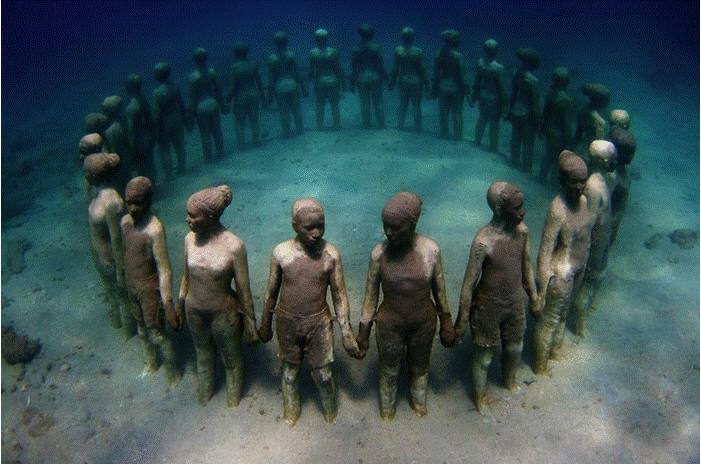
The foregoing African Renaissance Monument is on the Eastern side of the Atlantic; there is also a monument effort on the Western side of the Atlantic: the “Vicissitudes” and other features in the Moilinere Bay Underwater Sculpture Park in the waters off the Caribbean island of Grenada. The voyage across the Atlantic was referred to as the Middle Passage, a segment in the Slave Trade Triangle. Many victims, African captives designated to be sold in slavery, did not survive the Middle Passage. The Vicissitudes are in honor of the African Ancestors who were thrown overboard during the voyage; (retrieved from: http://en.wikipedia.org/wiki/Molinere_Underwater_Sculpture_Park).

1. “Vicissitudes” – According to the primary professional Artist, British Sculptor Jason de Caires Taylor:

“Vicissitudes depicts a circle of figures, all linked through holding hands. These are life-size casts taken from a group of children of diverse ethnic background. Circular in structure … the work both withstands strong currents and replicates one of the primary geometric shapes, evoking ideas of unity and continuum. … The sculpture proposes growth, chance, and natural transformation. It shows how time and environment impact on and shape the physical body. Children by nature are adaptive to their surroundings. Their use within the work highlights the importance of creating a sustainable and well-managed environment, a space for future generations.”

2. Amateur Projects – Cast student faces in the side of a large underwater stone: Theophilus Albert Marryshow Community College

In March 2007, a project was initiated with Helen Hayward of T.A. Marryshow Community College (Grenada) to produce a series of works for the Molinere sculpture park. Workshops were planned with A-level Art and Design students; (senior exams – General Certificate of Education or GCE – from the University of London). Each student was required to produce a life cast of their face, to form an installation two meters deep around the shoreline of Molinere Bay.

The project aimed to encourage local artists to contribute further works to the site and provide a arena for communities to appreciate and highlight the marine processes evident in their local environment.

The students were taught a range of skills including life-casting, cement casting and sculpting. The final pieces were installed by Jason [de Caires Taylor] on 25th April 2007.
CU Blog - The African Renaissance Monument - Photo 6

CU Blog - The African Renaissance Monument - Photo 7

The following news article relates the coverage received at the project’s implementation:

Title: Underwater Sculpture Park off Grenada is stunning and unique
Sub-title: Jason de Caires Taylor is an internationally recognized sculptor with a difference.
(Source: http://www.telegraph.co.uk/news/earth/environment/3538787/Underwater-sculpture-park-off-Grenada-is-stunning-and-unique.html)

December 1, 2008 – Instead of bleak urban backdrops for his creations, [artist Jason de Caires Taylor] has crafted a stunning and unique underwater sculpture park in the shallow waters off the West Indies island of Grenada.

His desire to create striking and meaningful art forms and his love of the underwater world led him to explore the intricate relationships between art and the environment.

For Grenada, this has resulted in a series of beautiful marine seascapes that have formed a series of artificial reefs, drawing new life into areas which have been damaged by nature’s raw power and mans intervention.

Jason discusses his work in a video interview with Miranda Krestovnikoff, one of the UK faces of a new global web TV channel, The Underwater Channel.

Miranda, also a BBC One Show / Coast presenter, explores Jason’s motivations and shows footage of his installations demonstrating the beauty of the structures and the way they interact with their environment. In some zones, the shifting sands of the ocean floor can change the whole viewing experience from moment to moment.

The sculptures are sited in clear, shallow waters to allow easy access by divers, snorkellers and those in glass-bottomed boats. Jason is keen to engage local people, particularly children, in his work to build a direct relationship with and understanding of their own precious natural resource.

The physical nature of the underwater world is vastly different from that of dry land. Objects appear 25 per cent larger underwater, and as a consequence they also appear closer. Colours alter as light is absorbed and reflected at different rates, with the depth of the water affecting this further.

The large number of angles and perspectives from which the sculptures can be viewed increase the unique experience of encountering the works.

His first work, Grace Reef, was built in a bay where the coral growth and natural habitat had been decimated by Hurricane Ivan. It comprises 16 statues, each cast from a local Grenadian woman.

Located across an expansive underwater area the work draws marine life to a zone that has suffered substantial and sustained storm damage. The direction and strengths of currents mean that entire sections of the work become covered, hidden and lost. At other times figures emerge and are fully visible.

Another major work is Vicissitudes comprising the extraordinary visual impact of a circle of 26 life-size children of diverse ethnic background, all holding hands and facing outwards.

The cement finish and chemical composition of Vicissitudes actively promotes the colonisation of coral and marine life. This natural process echoes the changes experienced through growing up and shows how time and environment impact on and shape the physical body.

Children by nature are adaptive to their surroundings and their use within the work highlights the importance of creating a sustainable and well-managed environment, a space for future generations.

“This piece took six months to create and weighs about 15 tons” Jason tells Miranda. “Consequently I had to install it in sections and it attracted quite a lot of local attention as parts of it sat outside the front of my house!”.

Un-Still life is a beautiful depiction of the essence of growth and change in the marine environment which mirrors the composition of still life tableaux.

On a table is an arrangement of cement objects; a vase, bowl and fruit. In contrast to established ideas of stasis the work is constantly changing, remaining a work in progress as living coral builds layers onto its surface and marine creatures take up residence in its tiny nooks and crannies.

This colonization becomes a physical equivalent to the conventional development of drawing and painting.

Jason currently has 65 stunning installations in place. The majority of his work is in Grenada, but he also has additional projects in the UK and Europe. Contracts have been agreed for the first phase of a new underwater project in Mexico, placed within the National Marine Park of Cancun, Isla Mujeres and Nisuc. Jason works out of his studio in London.

VIDEO: Grenada Underwater Sculpture Park, Molinere Bay, Marine Protected Area, Grenada, West Indies – http://youtu.be/Zmy0o7Zk4wg

Published by Louis Kahn (c) on Apr 1, 2012 – Video shot while scuba diving in Grenada at the Underwater Sculpture
Park.

The African Renaissance Monument in Senegal should be a World Heritage Site.

The stunning and unique Underwater Sculpture Park in Grenada should be a World Heritage Site; and similar expressions should be duplicated throughout the Caribbean region.

Imagine eco-tourism tours, SCUBA divers, glass-bottom boats and sub-marines, to this site and other monuments erected in kind.

Previous Go Lean blog/commentaries related artistic endeavors in the region and how they have impacted the communities; consider this sample as follows:

https://goleancaribbean.com/blog/?p=3999 Sir Sidney Poitier – ‘Breaking New Ground’ in the Film Arts
https://goleancaribbean.com/blog/?p=3641 ‘We Built This City …’ on Music and Show-business
https://goleancaribbean.com/blog/?p=3568 Forging Change: Music Moves People
https://goleancaribbean.com/blog/?p=3292 Art Basel Miami – a Testament to the Spread of Art & Culture
https://goleancaribbean.com/blog/?p=2726 Caribbean Role Model for the Arts/Fashion – Oscar De La Renta: RIP
https://goleancaribbean.com/blog/?p=2415 How ‘The Lion King’ roared into history
https://goleancaribbean.com/blog/?p=1909 Music Role Model Berry Gordy – No Town Like Motown
https://goleancaribbean.com/blog/?p=1037 Humanities Advocate – Maya Angelou: RIP
https://goleancaribbean.com/blog/?p=866 Caribbean Music Man: Bob Marley – The legend lives on!

The Slave Trade and Middle Passage victimized millions of innocent people. The world must never forget the travesty and sacrifice of the African people. The Bible makes a related statement at Isaiah 56:5 (NET Bible): “I will set up within my temple and my walls a monument that will be better than sons and daughters. I will set up a permanent monument for them that will remain”.

Now is the time for all of the Caribbean to lean-in to the following community ethos, strategies, tactics, implementations and advocacies detailed in the book Go Lean … Caribbean to foster remembrances and memorials in the region:

Community Ethos – Deferred Gratification – African Diaspora Experience Page 21
Community Ethos – People Respond to Incentives in Predictable Ways Page 21
Community Ethos – Consequences of Choices Lie in the Future Page 21
Community Ethos – Return on Investments Page 24
Community Ethos – Ways to Foster Genius – High Art Intelligence Page 27
Community Ethos – Ways to Promote Happiness Page 36
Community Ethos – Ways to Impact the Greater Good Page 37
Strategic – Vision – Integrating Region in to a Single Market Page 45
Strategic – Mission – Preserve Caribbean Ecology Page 46
Tactical – Fostering a Technocracy Page 64
Tactical – Separation of Powers – Culture Administration Page 81
Tactical – Separation of Powers – Fairgrounds Administration Page 83
Implementation – Steps to Implement Self-Governing Entities (SGE’s) Page 105
Implementation – Ways to Deliver Page 109
Planning – 10 Big Ideas for the Caribbean Region Page 127
Planning – Ways to Make the Caribbean Better Page 131
Planning – Ways to Better Manage Caribbean Image Page 133
Advocacy – Ways to Grow the Economy Page 151
Advocacy – Ways to Create Jobs Page 152
Advocacy – Ways to Improve Governance Page 168
Advocacy – Ways to Improve Libraries – Creative Exhibits & Archives Page 187
Advocacy – Ways to Enhance Tourism – Eco-Tourism Page 190
Advocacy – Ways to Promote Fairgrounds – Art Colonies as SGE’s Page 192
Advocacy – Ways to Impact Public Works – Aesthetic & Practical Page 175
Advocacy – Ways to Better Manage Natural Resources – World Heritage Sites Page 183
Advocacy – Ways to Impact the Diaspora Page 217
Advocacy – Ways to Preserve Caribbean Heritage Page 218
Advocacy – Ways to Improve the Arts Page 230
Advocacy – Ways to Impact Urban Living – Access to the Arts and Culture Page 234
Advocacy – Ways to Promote World-Heritage-Sites – Petition UNESCO for more… Page 248
Appendix – Taos (New Mexico) Artist Colony Page 291
Appendix – List of 21 World Heritage Sites in the Caribbean region Page 330

Now is the time for all of the Caribbean, the people and governing institutions, to lean-in for the empowerments described in the book Go Lean…Caribbean. This is a big deal for regional artists and art institutions. This book provides the turn-by-turn directions for how to monetize the arts and foster genius potential. By pursuing the strategies, tactics, and implementations of this roadmap, we do not only impact the artists; we also impact the whole world.

“Artists have a unique power to change minds and attitudes” – President Obama urging to the Grammy’s audience (musical artists) on February 8, 2015.

The Caribbean needs change…and empowerments (jobs, economic growth and brand/image enhancement); plus we need to always remember the great sacrifices of the others that came before us, and those that did not survive.

🙂

Download the book Go Lean … Caribbean – now!

Share this post:
, , , ,

New York Times Maledictions on The Bahamas

Go Lean Commentary

In this context, the word malediction simply means “bad” or “damning” words. It is not calling down a curse on a subject, but rather the reporting of an unbecoming characteristic. The Bahamas has done “bad” and the New York Times is telling the world.

But this is New York, not the Bahamas; why should this matter?

The New York Times is more than just the newspaper for the Tri-State metropolitan area surrounding New York City (35 million people); nicknamed for years as “The Gray Lady“, the New York Times is long regarded within the industry as a national “newspaper of record“.[6] The paper’s print version remains the largest metropolitan newspaper in the United States. Its motto is “All the News That’s Fit to Print”, which appears in the upper left-hand corner of the front page.CU Blog - NY Times Malecdiction on The Bahamas - Photo 7

If a student wants to do research on the 1892 American Recession for instance, (the paper has printed continuously since September 18, 1851), this one only has to retrieve the archives of the New York Times for that period.

Over its history, the New York Times has been awarded 114 different Pulitzer Prizes for Excellence in Journalism. Pulitzer Prizes have previously been awarded to journalists reporting on human trafficking and illegal migrations – See VIDEO below – it is an ignoble accomplishment to be put into this focus.

A front-page story, above the fold, about a small 320,000 populated nation in this paper is by all means an earth-shattering occurrence. Bahamas, you have done “bad” to garner this type of coverage, right in the middle of your #1 tourist market during the peak tourist season.

The article print date is Saturday January 31, only a few days after vicious Winter Storm Juno pelted the Northeast United States, (shutting down all of Manhattan), now to be followed by another (Artic Blast) storm currently lambasting the Mid-West (Chicago, Detroit, Cleveland, etc.) but heading eastward towards NYC. Drawing attention to a tropical resort destination like the Bahamas in the middle of such uninviting winter weather should be a bonus of free publicity. But alas, the New York Times article is a malediction!

This is also “on the heel” of a demand to “boycott Bahamas tourism” by certain fractions in Miami, Florida.

The purpose of this commentary is more than just newspapers and maledictions, but rather the acknowledgement that perhaps, the boycott-cause is gaining traction. Anyone from this Caribbean country, as is the case of this writer, may be timid with the characterization of supporting a cruel, inhumane – though legal – regime in his homeland. The constitution in the Bahamas do not award citizenship to babies born in the Bahamas to non-national parents. This is the standard – jus solis – in the US and in Canada. This standard obviously shades the American newspaper’s view of the Bahamas domestic policies.

There are so many issues with this New York Times story that aligns with the book Go Lean…Caribbean. The book serves as a roadmap for elevating Caribbean society and the economic, security and governing engines. The roadmap introduces the technocratic Caribbean Union Trade Federation (CU), asserting that the problems besetting the region are too big for any one Caribbean member-state to tackle alone. That rather, there is a need for a super-national solution. Considering the details of the following article, a number of countries have been struggling with this same issue: Bahamas, Turks & Caicos Island, Dominican Republic, etc. The actual New York Times story about Haitian immigrants is as follows:

Title 1: Immigration Rules in Bahamas Sweep Up Haitians
http://www.nytimes.com/2015/01/31/world/haitians-are-swept-up-as-bahamas-tightens-immigration-rules.html?mwrsm=Facebook&fb_ref=Default&_r=0
By: Frances Robles – January 30, 2015

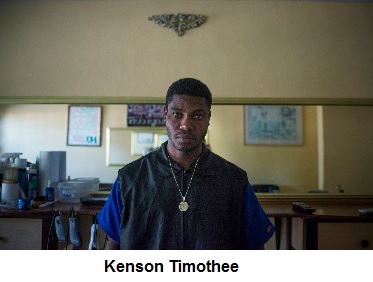
NASSAU, BahamasKenson Timothee was walking down the street when a uniformed officer asked him a question that sends Bahamians of Haitian descent like him into a panic these days: Do you have a passport?

Mr. Timothee, who was born in the Bahamas to illegal Haitian immigrants, wound up jailed in immigration detention for six weeks. He is one of hundreds of people swept up in a fiercely debated new immigration policy in the Bahamas requiring everyone to hold a passport, a rule that human rights groups say unfairly targets people of Haitian descent.

CU Blog - NY Times Malecdiction on The Bahamas - Photo 2Mr. Timothee had proof that he was born in the Bahamas, but because he had trouble obtaining his absentee father’s birth certificate, his application for Bahamian citizenship was never completed.

“I showed them that I had applied for citizenship, but they said that wasn’t good enough; as far as they are concerned, you are not Bahamian, you are Haitian, and you need to get deported,” Mr. Timothee said. “I don’t know anything about Haiti.”

On Thursday, the Bahamian government announced that the new policy would go a step further: By next Fall, schools will be asked to ensure that every child has a student permit. The annual $125 permit and a passport with a residency stamp will be required even of children born in the Bahamas who do not hold Bahamian citizenship.

The tough new policy echoes similar stances around the region, where new citizenship policies and anti-immigration measures have overwhelmingly affected Haitians, who are fleeing the hemisphere’s poorest country and are the most likely group to migrate illegally in great numbers. The top court in the Dominican Republic ruled in 2013 that the children of illegal immigrants, even if they are born in the country, did not have the right to citizenship.

Facing an international backlash, the Dominican government came up with a plan to prevent tens of thousands of people from becoming stateless, but months later, few people had managed to complete the process. With few successes to tout, in October the Dominican government extended the application period for another three months.

In Turks and Caicos, a top immigration official vowed early in 2013 to hunt down and capture Haitians illegally in the country, promising to make their lives “unbearable.” The country had already changed its immigration policies in 2012, making it harder for children of immigrants to obtain residency. Last year, Turks and Caicos said it would deploy drones to stop Haitian migration.

In Brazil, politicians considered closing a border with Peru last year to stem the tide of Haitians, and last month, Canada announced that it would resume deporting Haitians.

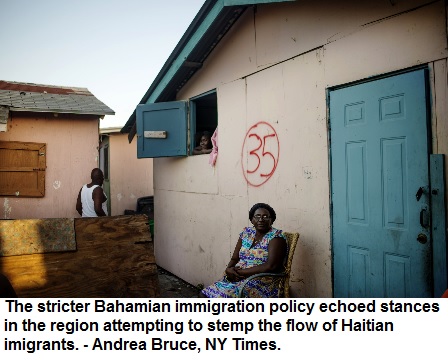
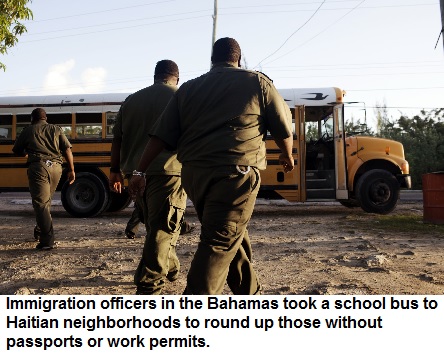
Here in the Bahamas, Mr. Timothee’s arrest coincided with stepped-up immigration raids in predominantly Haitian shantytowns, where people who lacked passports or work permits were apprehended. When illegal immigrants ran from officers, the agents knocked down doors and took their children, and the photos of toddlers being carried away circulated widely on social media.

Since the policy took effect November 1, children born in the Bahamas have been deported with their parents, and others with Haitian-sounding names have been pulled from school classrooms, human rights observers said. The government acknowledges that even Bahamian citizens with French surnames are frequently arrested by mistake. In September alone, 241 Haitians were deported, according to government figures.

Though 85 percent of Bahamians support the new policy according to one poll, it has set off a round of international condemnation. A Florida legislator called for a tourism boycott of the Bahamas and organized a protest at the nation’s Miami consulate. Citing some of the more alarming cases, including that of a pregnant Haitian woman who gave birth on an immigration detention center floor aided only by other detainees, several international groups have asked the Inter-American Commission on Human Rights to intervene.

Immigration officials in the Bahamas say their policies do not target any particular group, provide a better sense of who is living in their country, and could deter thousands of Haitian migrants from taking to the high seas each year in boats that often sink.

“We had situations where 100 people were showing up every day; that’s unsustainable,” said Frederick A. Mitchell, the Bahamian foreign minister. “That situation had spiraled out of control.”

Annette M. Martínez Orabona, director of the Caribbean Institute for Human Rights, said she recently visited the Bahamas to investigate the new policy, arguing that it fit into a broad context of immigration crackdowns in the region.

“It’s all guided by discriminatory practices toward persons of Haitian origin,” she said.

Children like Mr. Timothee’s 5-year-old daughter are in a particularly precarious legal situation, she said. If nationality is passed down by blood and Mr. Timothee has no citizenship, then what passport would his daughter get?

“The third generation is in a black hole,” Ms. Martínez said.

In the Bahamas, the Constitution says that people born there to parents who were not citizens have the right to apply for citizenship between their 18th and 19th birthdays. In a country where one in 10 Bahamians is of Haitian descent, many people never apply, and others face years of administrative delays, leaving an untold number of people in the country without documentation.CU Blog - NY Times Malecdiction on The Bahamas - Photo 5

The new policy forces them to apply for a passport from their parents’ country of origin. Americans who have children in the Bahamas regularly get United States passports for them, and this is no different, Mr. Mitchell said.

“There’s nothing wrong with being Haitian,” Mr. Mitchell said.

But the people affected by the new policy are leery of obtaining citizenship from Haiti, a country most of them have never visited.

“It’s a trick,” said Fred R. Smith, a civil rights lawyer in the Bahamas who has become the policy’s most vocal critic. “Once you apply for a Haitian passport, you’re already a citizen of another country, and you no longer fit into a category where the Bahamas is under an obligation to give you citizenship. You are no longer stateless.”

He said the government had routinely descended on an area, apprehended a few hundred people, and “hauled off” anyone who could not produce papers on the spot. The majority of detainees are released when their relatives or employers come to the detention center with their paperwork.

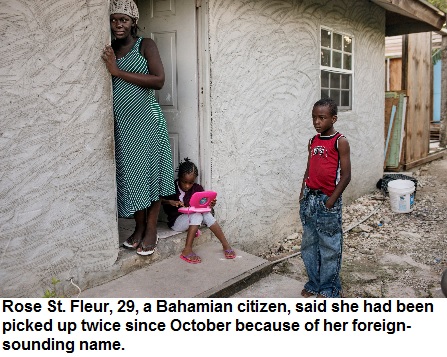
CU Blog - NY Times Malecdiction on The Bahamas - Photo 3Some people have been deported even though they were born in the Bahamas. People like Mr. Timothee, whose citizenship status is pending, wind up in limbo. Others, like Rose St. Fleur, have been sent home with an admonishment to carry their paperwork.

Ms. St. Fleur, a 29-year-old Bahamian citizen, said she had been picked up twice since October. She was 32 weeks pregnant when neighbors watched agents drag her down the street onto a bus, she and her neighbors said.

“When they asked me my name and I told them, they said, ‘That’s a foreign last name,’ ” Ms. St. Fleur said. “I told them, ‘Yes, but I am a Bahamian citizen.’ ” She said they replied, “You still have to come with us.”

Many people have not been able to obtain documents because the paperwork required, including certified copies of both parents’ birth certificates, is difficult to obtain. The Haitian government, itself crippled by political infighting and a halting recovery from the earthquake five years ago, has been unable to speedily produce records for the hundreds of thousands of people in the Dominican Republic and the Bahamas who are suddenly in need of decades-old birth records.

Because of delays in obtaining Haitian passports, thousands of Bahamians are now at risk of having no nationality at all.

“The person who may have a delay in getting papers is not stateless,” Dwight L. Beneby, the Bahamas’ assistant director of immigration. “It’s not that we’re trying to get rid of people or trying to get out of giving them citizenship. If you are here, let’s know who you are.”

Francois Guillaume II, who was Haiti’s minister of Haitians living abroad when the policy was announced, said the new policy came without warning.

CU Blog - NY Times Malecdiction on The Bahamas - Photo 6“It’s troubling when we have cases of people who have never lived in Haiti and are sent to a country that is completely foreign to them,” said Mr. Guillaume, who lost his position in a recent ministerial shuffle. “It must be traumatizing for them.”

Most of the Bahamian-born deportees were children, but one was 18 years old, and it was unclear why she was not given the opportunity to seek legal residency, he said.

“I don’t think there is an anti-Haitian sentiment in the area; I believe there are countries experiencing social pressure and are trying to look for solutions,” Mr. Guillaume said. “Some solutions are rash. Sometimes they are politically motivated. Nonetheless, we hope the solutions respect international norms.”

Though the Bahamas immigration/nationality enforcement is “legal” per the country’s constitution, not everyone in the homeland approves of this policy. Note to the  New York Times: “The round-up of Bahamian-born Haitians is not universally concurred in the country”. This is a policy of the current government administration. There are non-government organizations (NGOs) and elected opposition officials that are vocal in their disagreements of this enforcement. (This Go Lean commentary remains apolitical). See a news article (snippet) here in that vein:

Title 2: Call To Bring Immigration Legislation to Parliament –
(Retrieved 01/30/2015 from: http://www.tribune242.com/news/2015/jan/30/call-bring-immigration-legislation/)

ST ANNE’S MP Hubert Chipman yesterday renewed calls for legislation to be brought to Parliament to support the government’s new immigration policy.

Mr. Chipman, shadow minister for foreign affairs and immigration, said the only person who had a clear understanding of the policy was Immigration Minister Fred Mitchell, and questioned how the new policy has affected the department’s backlog of citizenship applications.

He said officials have put the “cart before the horse” by targeting migrant communities before modernizing infrastructure to process individuals.

These articles reflect the heavy-lifting burdens that the Caribbean member-states must address regarding nationality and immigration. Underlying to this issue among all the affected Caribbean member-states is the failing disposition of Haiti. The Go Lean…Caribbean book presents a Marshall Plan to re-boot Haiti. The consequence: a better Haiti to live, work and play. Only then will the citizens of Haiti, and the Caribbean as a whole, be less inclined to flee the homeland.

The Go Lean roadmap provides perhaps the ultimate resolution to this perplexing nationality processing problem, that of a regional entity, the CU, to streamline application processing. This would be an extension of the current CariCom passport process.

A key problem with this nationality issue is the current sensitivities of Jus soli (Latin: right of the soil) versus Jus sanguinis (Latin: right of blood). These points were detailed in a previous blog.

In the middle of the winter, the New York Times should be inciting its readers to flee the bitter cold and enjoy the hospitality of the Bahamas, Turks & Caicos and the Dominican Republic, yet instead the front page article is exposing the human rights shortcomings of these states’ nationality policies.

The Go Lean book and blogs addresses ways to better protect human rights. While this subject is not tried-and-true economics – the usual focus of this roadmap –  there is a correlation of satisfactory human rights records and American trade. The roadmap seeks to elevate all the engines of Caribbean society for a better homeland for the 42 million residents and 80 million visitors, across the 30 member-states. The CU, applying best-practices for community empowerment and human rights, has the following 3 prime directives:

  • Optimization of the economic engines in order to grow the regional economy to $800 Billion & create 2.2 million new jobs.
  • Establishment of a security apparatus to protect the resultant economic engines.
  • Improve Caribbean governance, with consideration for minority equalization, to support these engines.

The Go Lean book details a series of community ethos, strategies, tactics, implementations and advocacies to optimize the region’s economic landscape:

Community Ethos – Economic Systems Influence Choices & Incentives Page 21
Community Ethos – Consequences of Choices Lie in the Future Page 21
Community Ethos – Anti-Bullying and Mitigation Page 23
Community Ethos – Minority Equalization Page 24
Community Ethos – Ways to Impact the Future Page 26
Community Ethos – Ways to Manage Reconciliations Page 34
Community Ethos – Ways to Impact the Greater Good Page 37
Strategy – Vision –  Integrate region into a Single Market Economy Page 45
Strategy – Agents of Change – Globalization Page 57
Tactical – Separation of Powers – Department of   Homeland Security Page 75
Implementation – Ways to Foster   International Aid Page 115
Planning – 10 Big Ideas … in the Caribbean Region – Haiti & Cuba Page 127
Planning – Ways to Ways to Model the EU – From Worst to First Page 130
Planning – Reasons Why the CU Will Succeed – Germany Reconciliation Model Page 132
Planning – Ways to Improve Failed-State Indices – Cuba & Haiti on the List Page 134
Planning – Lessons from East Germany – European post-war rebuilding Page 139
Planning – Lessons from the US Constitution Page 145
Planning – Lessons from Canada’s History Page 146
Advocacy – Ways to Grow the Economy Page 151
Advocacy – Ways to Create Jobs Page 152
Advocacy – Ways to Foster Empowering Immigration – Case Study of Indian Migrants Page 174
Advocacy – Ways to Impact Justice Page 178
Advocacy – Ways to Impact the Diaspora Page 217
Advocacy – Ways to Protect Human Rights Page 220
Advocacy – Ways to Re-boot Cuba Page 237
Advocacy – Ways to Impact the Dominican Republic Page 237
Advocacy – Ways to Re-boot Haiti Page 238

The message to the Caribbean leaders and planners is straight-forward: The US, New York Times and all American media, are watching and judging, based on their own standards. The goal of the Go Lean roadmap is to formulate the Caribbean region to be better American neighbors, a protégé status rather than the current parasite status. There is the need to re-focus on our populations in general – majority, minority, Black, White, French, English, etc.. Countries like the Bahamas, and Haiti for that matter, need “all hands on deck”, not less hands. Economic growth requires a growing population; (a previous report disclosed 70,000 Bahamians living illegally in the US).

We do not want to encourage migration nor facilitate it. Just the opposite, we simply want to encourage and facilitate citizens staying and contributing to their native homelands. We do not want to “fatten frogs for snake”, we want to elevate our own communities to be better places to live, work and play.

Now is the time for all the Caribbean to lean-in to this Go Lean roadmap for Caribbean economic, security and governance elevation. Now is the time for all of the Caribbean to learn the lessons from other communities, (think Apartheid in South Africa). It is guaranteed: once the human rights issues are resolved, your society/community will soar.

🙂

Download the book Go Lean … Caribbean – now!

———

APPENDIX – VIDEO: Pulitzer Prizes on Human Trafficking

Direct Link: http://www.nytimes.com/video/multimedia/100000002825879/reuters-journalist-jason-szep-celebrates-pulitzer-prize.html


Share this post:
, , ,
[Top]

How to Train Your ‘Dragon’ – Freeport Version

Go Lean Commentary

The term ‘dragon’ has a deep and rich meaning in all of literature; see Appendix A for a list of different cultures with dragon mythologies.

CU Blog - Freeport Version - How to Train My Dragon - Photo 6

Needless to say, there is no such creature, apart from the adorable Komodo Dragon, a big lizard native to South Pacific and Australasia region.

Even in scripture, the great Enemy, Satan the Devil is depicted as a Dragon; (Revelation 12:9). This commentary is not labeling any one person as a “Dragon”, but rather assigning the term “Dragon” to a “Dependence on Foreign Investors” or DFI.

So figuratively, the term “dragon” refers to an adversarial creature. This is where the relevance is to this commentary for the promotion of the book Go Lean…Caribbean. The book calls for the elevation of Caribbean economics, security and governance. It assesses many “dragon-like” challenges that stand in the way of progress and have resulted in near wholesale abandonment of so many communities.

One city of focus for this commentary is the 2nd city in the Bahamas, Freeport/Lucaya. This town is now undergoing a crisis in all three challenge factors (economics, security, and governance), and yet the book maintains that this “dragon can be trained’ see VIDEO below. Part of this crisis is the fact the certain tax-free provisions, real property tax and Business License, of the Hawksbill Creek Agreement (that led to the private development of Freeport) will expire on August 4, 2015. The national government is pondering renewal and extension; the ongoing stalemate, exacerbates the municipal crisis.

The book opens with the declaration that a crisis is a terrible thing to waste. For the Caribbean region there is not just one issue, but rather many negative/downward triggers, all which are addressed in the Go Lean book. While these challenges abound through out the region, Freeport’s exposure to these following triggers are more heightened than elsewhere:

  • Climate Change and threats from natural disasters
  • Decline of the American Middle Class, since the 2008 financial crisis
  • Decimation of the tourism product – measured decline in amenities like Golf and Casino Gambling.
  • Failure to diversify the economy with any industrial base
  • Emergence of powerful elite, the One Percent.
  • Bureaucratic hindrance of Foreign Direct Investors
  • Security threats from border encroachments of illegal immigrants.
  • Security threats of immigrants assimilating their adopted societies.

Harsh realities have now come to fruition in the Caribbean, but the town of Freeport have been hard hit with the full force of all of these dynamics. The book therefore posits that there is a need to re-focus, re-boot, and optimize the engines of commerce so as to make all the Caribbean a better place to live, work and play. While all the Caribbean needs to create jobs, this town of Freeport, has a greater need, more so than others.

Ship-building, in its many genres, is being promoted for adoption and incubation. This is just one of the advocacies identified, qualified and proposed in the Go Lean book. In total, there are 144 advocacies, catalogued in the areas of Community Ethos, Strategy, Tactics, Implementations, Planning, Economics, Government, Industries, Social, and Locations.

Normally DFI refer to Direct Foreign Investment, but in this case the “Dependence on Foreign Investors” is portrayed as a negative factor or pest – a dragon –  unless “trained”, caroled and controlled to harness the energy in a positive way.

Consider these news articles that describe the business climate and players for the Freeport landscape:

1. Freeport Plutocratic Benefactor – Sir Jack Hayward:

CU Blog - Freeport Version - How to Train My Dragon - Photo 5Sir Jack Hayward, British Businessman, Property Developer, Philanthropist and Sports Team Owner was memorialized by fans of his football team Wolverhampton Wanderers F.C.. He passed away last week (January 13) at age 91. He was loved and hated in different circles, some even compared his racism to Adolf Hitler – perhaps a hyperbole. Sir Jack was also a principal owner in the Grand Bahama Port Authority*. So he wielded power as to the municipal affairs and economic development of this city.

http://www.birminghammail.co.uk/sport/wolves-football-pundit-barry-glendenning-8481522

2. Fleeing a “sinking ship”:

Sir Jack Hayward Jack arrived in Grand Bahama in 1956 to promote the development of Freeport and became a Vice-President of the Grand Bahama Port Authority; eventually he assumed the Chairmanship of the Board of Directors (after 2004). Until the convalescence before his death, he continued to play an active role in Freeport. Sir Jack was in negotiations to sell his family’s 50 per cent stake in the GBPA Group of Companies. Now that provisions of the Hawksbill Creek Agreement (HCA) need renewal from the national government, multiple “dragons” are now circling the City of Freeport.

http://www.tribune242.com/news/2015/jan/28/sir-jack-port-sale-talks-passing/

3. At the precipice:

Community leaders in Freeport have declared that it would be “disastrous” if the national government fail to pursue HCA extension and allow the levy of real property taxes on GBPA licensees; “this would be another nail in Freeport’s coffin”. Freeport is now at the precipice – dragons are circling.

http://www.tribune242.com/news/2015/jan/08/freeport-disaster-if-property-tax-imposed/

4. Roadmap for economic empowerments:

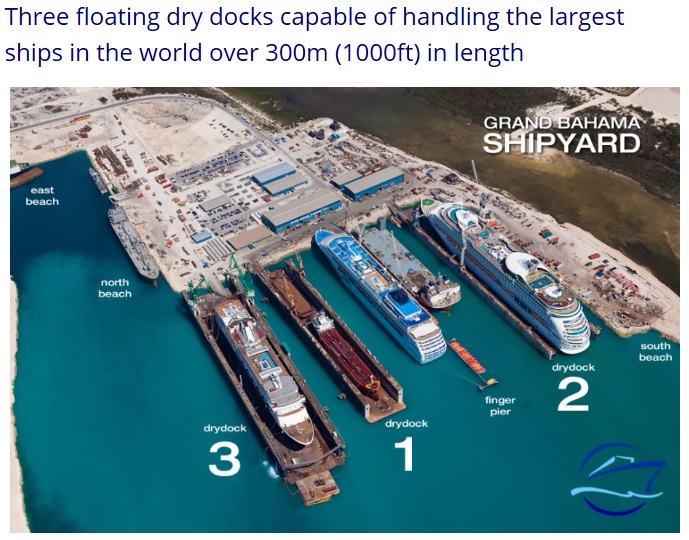
CU Blog - Freeport Version - How to Train My Dragon - Photo 4The Go Lean roadmap is not a work of fiction or mythology; it is based on the reality of the Caribbean disposition. It is what it is, the book declares. It is only by accepting reality that real solutions can be forged: discovered, designed and deployed.  The book, and accompanying blogs posit that “dragons can be trained”. The sad state of affairs in Freeport can be turned around by the embrace of a “double down” strategy on the island’s nascent ship-building industry.

http://grandbahamashipyard.com/facilities/drydocks/

The current disposition for Freeport, Grand Bahama is dire. But there is a glimmer of hope with this industrial development of ship-building. A previous blog/commentary pushed hard on the idea of ship-building/ship-breaking for the Caribbean region; now this commentary advocates adding ship-breaking to the ship-building model for Freeport, and then “double-down” on this industry space … with incubators, stimulus grants, angel investors, R&D and other initiatives. This is the heavy-lifting described in the Go Lean book.

In this vein, the book Go Lean… Caribbean, serves as a roadmap for the introduction and implementation of the technocratic Caribbean Union Trade Federation (CU) with the charter to facilitate jobs in the region. We want to explore all the strong benefits of the ship-building/ship-breaking industry. This aligns with the CU charter; as defined by these 3 prime directives:

  • Optimization of economic engines in order to grow the regional economy to $800 Billion and create 2.2 million new jobs.
  • Establishment of a security apparatus to protect the resultant economic.
  • Improvement of Caribbean governance to support these engines.

Early in the Go Lean book, the responsibility to create jobs was identified as an important function for the CU with this pronouncement in the Declaration of Interdependence (Pages 14):

xxvi.  Whereas the Caribbean region must have new jobs to empower the engines of the economy and create the income sources for prosperity, and encourage the next generation to forge their dreams right at home, the Federation must therefore foster the development of new industries, like that of ship-building, automobile manufacturing, prefabricated housing, frozen foods, pipelines, call centers, and the prison industrial complex. In addition, the Federation must invigorate the enterprises related to existing industries tourism, fisheries and lotteries – impacting the region with more jobs.

The CU will facilitate the region’s eco-system for Self-Governing Entities (SGE) for shipyards. This approach calls for the establishment of industrial parks, corporate campuses and research parks in bordered territories; these structures would be inviting to the super-rich (One-Percent) and their resources. These entities would be governed solely by the technocratic CU. The approach is not to punish the One-Percent for their success nor cower to any special interests group at the expense of the greater population.

This roadmap explains how all 30 Caribbean member-states can elevate the economic engines (direct and indirect spin-off activities), by allowing the CU to assume jurisdiction for SGE’s in the region and the Exclusive Economic Zone (the 1,063,000 square miles of the Caribbean Sea). Freeport is ideal for SGE’s for ship-building/ship-breaking yards, with its vast array of canals and waterways.

The Go Lean book also details the principle of job multipliers, how certain industries are better than others for generating multiple indirect jobs down the line for each direct job on a company’s payroll. The shipyard industry has a job-multiplier rate of 3.0. So the creation of 15,000 direct jobs for the shipyard industry in the Caribbean region can have the multiplier effect of 45,000 jobs. That economic impact is the result of “training the dragons”.

How would the Caribbean create 45,000 jobs in the course of the 5-year roadmap? By adoption of different community ethos, plus the executions of key strategies, tactics, implementations and advocacies. The following is a sample:

Community Ethos – Economic Principle – Economic Systems Influence Choices & Incentives Page 21
Community Ethos – Economic Principle – Voluntary Trade Creates Wealth Page 21
Community Ethos – Job Multiplier Page 22
Community Ethos – Lean Operations Page 24
Community Ethos – Ways to Impact the Future Page 26
Community Ethos – Ways to Help Entrepreneurship Page 28
Community Ethos – Ways to Impact Research & Development Page 30
Community Ethos – Ways to Impact Turn-Around – Recycling and Demolition Industries Page 33
Community Ethos – Ways to Impact the Greater Good Page 37
Strategy – Mission – Facilitate   a Shipbuilding Industry Page 46
Tactical – Fostering a Technocracy Page 64
Tactical – Tactics to Forge an $800 Billion Economy – High Multiplier Industries Page 70
Tactical – Separation of Powers – Self-Governing Entities Page 80
Implementation – Steps to Implement Self-Governing Entities Page 105
Implementation – Ways to Re-boot Freeport Page 112
Planning – Big Ideas – Confederation with Sovereignty Page 127
Advocacy – Ways to Grow the Economy Page 151
Advocacy – Ways to Create Jobs Page 152
Advocacy – Ways to Improve Emergency Management – Processes and Systems Page 196
Advocacy – Ways to Foster Technology Page 197
Advocacy – Ways to Develop/Grow a Ship-Building Industry Page 209
Appendix – Job Multipliers Page 259

The CU will foster industrial developments in support of alternative options to tourism. An important ingredient is the willingness of the people to engage. The CU/Go Lean will message to the Caribbean people, that the region is ready for this industrial challenge of ship-breaking.

The Caribbean is arguably the best address on the planet, but jobs are missing. With jobs, communities like the City of Freeport will be able to retain more of their citizens and suffer less abandonment. It’s all about people; Freeport has lost people and populations in the last few decades. The imagery of pests – dragons – come to mind that sneak away with young people during the night.

Time now for a change; time to train the dragons!

Whereas dragons are mythical, the Caribbean disposition, and Freeport’s, is no fairytale, no myth; this is real life. 🙂

Download the free e-Book of Go Lean … Caribbean – now!

————-

Appendix VIDEO: How To Train Your Dragon: “Official Trailer” – http://www.imdb.com/video/imdb/vi1158218777/

This commentary asserts that Freeport, Grand Bahama would be analogous to the fictitious Town of Berk in the movie.

This movie/snippet is owned by Dreamworks Entertainment. No copyright infringement intended. Apologies for the references to Nordic Culture, and any negative stereotypes projected.

Appendix A – Cultures with Dragon Mythology

Nordic (Viking)
Greek
Slavic (Romania, Russia)
Egypt
Ancient India
Persian
Jewish
Chinese dragon
Japanese
Korean
Bhutan
Manipur
Vietnam

CU Blog - Freeport Version - How to Train My Dragon - Photo 1

CU Blog - Freeport Version - How to Train My Dragon - Photo 2

CU Blog - Freeport Version - How to Train My Dragon - Photo 3

————–

Appendix B* Grand Bahama Port Authority (GBPA)

The Port Authority is a privately held corporation that acts as the municipal authority for Freeport, Grand Bahama Island, The Bahamas. The GBPA was created by the Hawksbill Creek Agreement of 1955. The GBPA is horizontally integrated with property development, municipal services, airport ( world’s largest privately owned airport), harbor operations, and shipyard concerns.

The Grand Bahama Port Authority is jointly owned by Sir Jack Hayward (50%) and the family of the late Edward St. George (1928 – 2004).The Ownership Structure also features a partnership with Hong Kong-based Hutchison Whampoa on the container port operations, and the resort area in the Lucaya section of the City.


Share this post:
, , , , , , ,
[Top]

Google and Mobile Phones – Here comes Change

Go Lean Commentary

The American company Google Inc. is shaking up the telecommunication industry … again. Whereas their structure originated as a software/Search Engine/ICT* company, they have since branched out into wireless/networking and mobile hardware.

Google Phone - Photo 1 JPEG

This is not surprising! Google has been a maverick from the beginning.

Their mission statement from the outset, according to Wikipedia, was …

“to organize the world’s information and make it universally accessible and useful,”[11] and its unofficial slogan was: “Don’t be evil.”[12][13] Rapid growth since incorporation in 1998 (as of January 2014, the market capitalization had grown to $397 billion[60]) has triggered a chain of products, acquisitions and partnerships beyond Google’s core search engine. It offers online productivity software including email (Gmail), a cloud storage service (Google Drive), YouTube video-sharing, an office suite (Google Docs) and a social networking service (Google+). Desktop products include applications for web browsing, organizing and editing photos, and instant messaging. The company leads the development of the Android mobile operating system and the browser-only Chrome OS[15] for a netbook known as a Chromebook. Google has moved increasingly into communications hardware: it partners with major electronics manufacturers [16] in the production of its “high-quality low-cost”[17] Nexus devices and acquired Motorola Mobility in May 2012.[18] Also in 2012, a fiber-optic infrastructure was installed in Kansas City to facilitate a Google Fiber broadband service.[19]

Despite American incorporation, headquarters and funding, Google has a R&D/QA# presence in the Caribbean (Puerto Rico). This is a good start for what the book Go Lean…Caribbean envisions for the Caribbean region. The book describes initiatives from top-to-bottom in the Information Technology/ICT industry space, asserting that the region cannot only consume, but must create, develop and produce as well. So Google is a good role model for the future – yet undefined – industrial expressions in this industry. The book Go Lean…Caribbean, serves as a roadmap for the introduction and implementation of the technocratic Caribbean Union Trade Federation (CU). This CU roadmap is designed to elevate the economic, security and governing engines of Caribbean society; this vision is defined early in the book (Page 14) with the opening Declaration of Interdependence:

xxvii. Whereas the region has endured a spectator status during the Industrial Revolution, we cannot stand on the sidelines of this new economy, the Information Revolution. Rather, the Federation must embrace all the tenets of Internet Communications Technology (ICT) to serve as an equalizing element in competition with the rest of the world. The Federation must bridge the digital divide and promote the community ethos that research/development is valuable and must be promoted and incentivized for adoption.

The Google QA activity is highlighted in the following news article:

Title #1: Google Is Testing Its New Modular Smartphone on this Caribbean Island
By: Caribbean Journal staff – Caribbean Journal – Regional News Site (Posted 01/14/2015; Retrieved 01/27/2015) – http://www.caribjournal.com/2015/01/14/google-is-testing-its-new-modular-smartphone-on-this-caribbean-island/#

Google Phone - Photo 3 NEW

Google’s revolutionary new smartphone project is getting its first test in the Caribbean.

The global tech giant will be launching the pilot test of its Project Ara smartphone in the Puerto Rico market, the company announced Wednesday.

Project Ara is a modular smartphone, which allows users to swap out individual components of the phone, from the camera to the speaker to the lights.

The aim is a totally customizable phone — almost turning the phone into a collection of “physical” apps.

“A phone is part of it. Part of it is a phone,” is how Project Ara describes it.

Project Ara is part of Google’s Advanced Technology and Projects Group. The phone will run the Android operating system.

Google Phone - Photo 1

Pricing is not yet known.

See more in the video below:

VIDEO: Project Ara: Part of it – http://youtu.be/intua_p4kE0 – Published on Jan 14, 2015

There is an obvious advantage to testing a revolutionary product in a place like Puerto Rico: it is homogenous. Everyone on the island meets a certain consistent profile, an adequate educational accomplishment, American cultural assimilation, bilingual efficiency. If the Google test is successful here, then the product will be proven for the entire Western Hemispheric market. This Google Ara phone should emerge from these tests as a “lean”-mean consumer machine, ready to shock the world of mobile communications – here comes change!

The concept of “lean” is very prominent in the Go Lean book (and movement), even adapting the title, Go Lean, for the quest for excellence in Caribbean economic empowerment and governing efforts. The label “lean” is indicative of this quest; the word is used as a noun, a verb and an adjective. This point is pronounced early in the book (Page 4) with these statements:

The CU will lean on, lean in, lean over backwards, and then lean towards…

The CU will embrace lean, agile, efficient organization structures – more virtual, less physical, more systems, less payroll.

This following news article demonstrates Google’s next strategic step, establishing more of a footprint in the North American mobile communications market. See story here:

Title # 2: Google Inc Could Wreak Havoc on Its New Wireless Partners
By: Adam Levy, January 27, 2015

Google Phone - Photo 4If you’re looking to switch wireless carriers, you may soon have another option.

Google is reportedly working on a mobile virtual private network, or MVNO, that uses access to the Sprint (NYSE: S ) and T-Mobile (NYSE: TMUS ) wireless networks. While the agreement with Google will generate additional revenue for the wireless carriers, it represents a serious threat to their core businesses.

With a price war already in full swing among the major industry players and the cost of airwave spectrum rising well above expectations, Google could cause more headaches for Sprint and T-Mobile than it’s worth.

Selling excess capacity
MVNO agreements are typically very valuable for carriers, as they can sell excess capacity and achieve high margins without the need to do any sales or marketing work — this Google deal is no exception. Macquarie Securities analyst Kevin Smithen believes the search giant could pay out $1 billion in service fees to the carriers in 2018.

Both companies have plenty of spare capacity, too. T-Mobile CTO Neville Ray told investors earlier this month that it has more spectrum per subscriber than both of its largest rivals. Sprint, however, has even more excess capacity, which leads Smithen to predict it will take about three-fourths of Google’s MVNO business.

Those revenues will allow Sprint and T-Mobile to reinvest in their networks, which will help attract new customers and prevent current customers from leaving. On the flip side, any improvements to their networks will also improve the Google service making it even more attractive.

And there lies the big risk
While Google’s plans are still extremely vague, it seems like the biggest goal is to make wireless data networks fast and cheap. To that end, it makes sense for Google to offer a high-value option through its MVNO, similar to what it has accomplished with the rollout of Google Fiber.

Google can afford to offer things like unlimited high-speed data at near cost — the company is expected to pay $2 per GB — because it makes money almost any time a smartphone user accesses the Web. Google took an estimated 37% of total mobile ad spending last year, so it stands to gain from making data access as inexpensive as possible.

While Sprint and T-Mobile have done a good job undercutting the competition on price, Google could do so even further.

The risk seems greater for Sprint, which appears to have little to compete on besides price. T-Mobile is more focused on providing a valuable customer experience for its subscribers with the Un-Carrier initiatives to differentiate itself. Of course, there is little holding Google back from offering similar perks as the Un-Carrier (potentially with a focus on Google services like YouTube and Google Play).

The Wall Street Journal reports that Sprint has put limits in place to prevent the Google MVNO from growing too large. That should be a smart move considering the carrier is likely to lose at least some customers to the new service. There is no indication, however, that such a stipulation exists in the T-Mobile agreement.

Still, if Google hits that volume trigger, there is little stopping the company from licensing capacity from another network. And there is no guarantee that if Google’s network coverage suffers, customers will leave for Sprint — the company is best off renegotiating at the best rate it can get at that point.

A prisoner’s dilemma
With significant risk involved in allowing Google into the wireless market, the only explanation for why Sprint or T-Mobile would agree to license their capacities is that Google played one off the other. Thinking it would be better to at least get something out of the deal than to just lose customers to another Google upstart, both companies agreed to a deal. The fact that Google will rely on their networks should neutralize most of the potential impact from the new service.

Source: Motley Fool Investor Advisory Site (Retrieved 01/27/2015) –
http://www.fool.com/investing/general/2015/01/27/google-inc-could-wreak-havoc-on-its-new-wireless-p.aspx

From being non-existent 20 years ago to now executing a strategy to dominate the mobile communication eco-system, shows how quickly a well-executed roadmap can impact the world.

This lends confidence to the viability of the revolutionary changes being proposed by the Go Lean roadmap. We can succeed in transforming our society in short order; the roadmap is a 5 year plan. Previous blogs/commentaries also exclaimed societal benefits from pursuits in the fields of Science, Technology, Engineering and Mathematics (STEM). Consider this sample of previous blogs:

https://goleancaribbean.com/blog/?p=3915 ‘Change the way you see the world; you change the world you see’
https://goleancaribbean.com/blog/?p=3889 RBC EZPay and other Banking Automations – Ready for Change
https://goleancaribbean.com/blog/?p=3490 How One STEM Entrepreneurial Start-up Can Rally a Whole Community
https://goleancaribbean.com/blog/?p=3276 STEM/Medical Role Model Shaking Up the World of Cancer
https://goleancaribbean.com/blog/?p=3187 Robots help Amazon tackle and dominate Cyber Monday
https://goleancaribbean.com/blog/?p=2488 Role Model Jack Ma brings Alibaba to America
https://goleancaribbean.com/blog/?p=2126 Where the Jobs Are – Computers Reshaping Global Job Market
https://goleancaribbean.com/blog/?p=1743 Google and Novartis to develop ‘smart’ contact lens
https://goleancaribbean.com/blog/?p=1698 STEM Jobs Are Filling Slowly
https://goleancaribbean.com/blog/?p=1416 Amazon’s new FIRE Smartphone
https://goleancaribbean.com/blog/?p=1277 The need for highway safety innovations –   here comes Google
https://goleancaribbean.com/blog/?p=888 Book Review: ‘Citizenville – Take the Town Square Digital & Reinvent Govt’
https://goleancaribbean.com/blog/?p=554 Cuban cancer medication registered in 28 countries
https://goleancaribbean.com/blog/?p=308 CARCIP Urges Greater Innovation

The Go Lean book posits that technology and ICT can level the playing field of competition and trade with the rest of the world. Surely this entire Google commentary demonstrates the advantage of leading with technological innovations. We do not have to be in Silicon Valley to have an impact. No, an innovator can be on a beach in the Caribbean homeland, with a great idea and support of his community. “Lightning in a bottle” is a valid analogy.

The Go Lean book details a series of community ethos, strategies, tactics, implementations and advocacies to foster great contributions from Caribbean technology innovators. The list is as follows:

Community Ethos – Deferred Gratification Page 21
Community Ethos – People Respond to Incentives Page 21
Community Ethos – Economic Systems Influence Individual Choices Page 21
Community Ethos – Consequences of Choices Lie in the Future Page 21
Community Ethos – Job Multiplier Page 22
Community Ethos – Governing Principle – Lean Operations Page 24
Community Ethos – Governing Principle – Return on Investments Page 24
Community Ethos – Ways to Impact the Future Page 26
Community Ethos – Ways to Foster Genius Page 27
Community Ethos – Ways to Help Entrepreneurship Page 28
Community Ethos – Promote Intellectual Property Page 29
Community Ethos – Ways to Impact Research & Development Page 30
Community Ethos – Ways to Bridge the Digital Divide Page 31
Community Ethos – Ways to Impact the Greater Good Page 37
Strategy – Mission – Exploit Globalization – Producers & Consumers Page 46
Strategy – Agents of Change – Technology Page 57
Strategy – Agents of Change – Globalization Page 57
Tactical – Fostering a Technocracy Page 64
Tactical – Separation of Powers Page 71
Implementation – Ways to Pay for Change Page 101
Implementation – Ways to Deliver Page 109
Implementation – Ways to Impact Social   Media Page 111
Planning – Big Ideas – Cyber Caribbean Page 127
Planning – Ways to Make the Caribbean Better Page 136
Advocacy – Ways to Grow the Economy Page 151
Advocacy – Ways to Create Jobs Page 152
Advocacy – Ways to Improve Education – STEM Promotion Page 159
Advocacy – Ways to Foster Technology Page 197
Advocacy – Ways to Foster e-Commerce Page 198
Advocacy – Ways to Impact Main Street – Mobile Apps: Time and Place Page 201
Advocacy – Ways to Impact Youth Page 227
Appendix – CU Job Creations Page 257
Appendix – Copyright Infringement – Protecting Intellectual Businesses Page 351

Now is the time for all of the Caribbean to lean-in for the empowerments in the book Go Lean … Caribbean. This is a big deal for the region. The benefits are simply too alluring to not commit to this cause:

  • Optimization of the economic engines; growing the regional economy to $800 Billion & creating 2.2 million new jobs.
  • Establishment of a security apparatus to protect the resultant economic engines.
  • Improvement of Caribbean governance to support these engines.

The region needs this delivery. Without the equalizing effects of technology/ICT, we will be rendered inconsequential on the world scene. No wait: we are already! For this reason, we cannot and have not been able to retain our young people to commit to their Caribbean homeland, but rather we are only “fattening frogs for snake”.

This roadmap declares: Enough already – time for a change!

Now is the time to deliver the Caribbean as a better place to live, work and play… for today and for the future. 🙂

Download the book Go Lean … Caribbean – now!

————

Source References:

* ICT = Internet Communications Technologies

# QA = Quality Assurance – the cycles and processing to testing the quality on hardware, software and services.

Share this post:
, ,
[Top]

Success Recipe: Add Bacon to Eggs

Go Lean Commentary

 CU Blog - Success Recipe - Add Bacon to Eggs - Photo 2

Question: In a bacon-and-egg breakfast, what’s the difference between the Chicken and the Pig?
Answer: The Chicken is involved, but the Pig is committed!

The book Go Lean…Caribbean opens (Page 5) with the acknowledgement that despite having the “greatest address in the world”… the people of the Caribbean have no commitment, shared or National Sacrifice in support of their beautiful homelands.

This term National Sacrifice was introduced in a previous blog, and defined as the willingness to die for a greater cause; think “King/Queen and Country”. The blog/commentary posits that this spirit is currently missing in the recipe for fomenting the Caribbean homeland. This despite the fact that no one is being called on to “die”, but rather to simply live-work-play in their homeland.

The publishers of the Go Lean book wants to forge change in the Caribbean; they want to change the attitude of commitment for the entire community, country and region. This is not a wild fantasy as this has been done before in the US during WW II. But the Caribbean region has an alarmingly high societal abandonment rate, where 70% of college educated population in the English states have left in a brain drain, while the US territories have lost more than 50% of their overall populations.

Surely there is no debate that Caribbean people’s commitment to their homeland is lacking. Consider more fully the Chicken-Pig fable here:

Encyclopedic Referenced Source
Title: The Chicken and the Pig
The fable of The Chicken and the Pig is about commitment to a project or cause. When producing a dish made of ham and eggs, the pig provides the ham which requires his sacrifice and the chicken provides the eggs which are not difficult to produce. Thus the pig is really committed in that dish while the chicken is only involved, yet both are needed to produce the dish.

The fable of the Chicken and the Pig is used to illustrate the differing levels of project stakeholders involved in a project. The basic fable runs:[1]

  • A Pig and a Chicken are walking down the road.
    The Chicken says: “Hey Pig, I was thinking we should open a restaurant!”
    Pig replies: “Hmmm, maybe, what would we call it?”
    The Chicken responds: “How about ‘ham-n-eggs’?”
    The Pig thinks for a moment and says: “No thanks. I’d be committed, but you’d only be involved!”

Logically, this story/fable is at times presented as a riddle.

Interpretation and lessons
The fable has been used mostly in contexts where a strong team is needed for success, like in sports or in “Agile Software Development”*.

Agile Project Management
The fable was[2] referenced to define two types of project members by the Scrum Agile Management System:[3] pigs, who are totally committed to the project and accountable for its outcome, and chickens, who consult on the project and are informed of its progress. By extension, a rooster or gamecock, can be defined as a person who struts around offering uninformed, unhelpful opinions. This analogy is based upon the pig being able to provide bacon (a sacrificial offering, for which the pig must die in order to provide) versus a chicken which provides eggs (non-sacrificial).

For a Scrum project the Scrum Master and Team are considered as people who are committed to the project while customers and executive management are considered as involved but not committed to the project.

As of 2011, the fable has been removed from the official Scrum process.[4]

Sports
The fable also is used as an analogy for levels of commitment to a game, team, etc. For example, variations of this quote have been attributed to football coach Mike Leach who said, on the officials in the 2007 Tech-Texas game in Austin: “It’s a little like breakfast; you eat ham and eggs. As coaches and players, we’re like the ham. You see, the chicken’s involved but the pig’s committed. We’re like the pig, they’re like the chicken. They’re involved, but everything we have rides on this.”[5]
Wikipedia Online Encyclopedia – Retrieved 01-25-2014 –
http://en.wikipedia.org/wiki/The_Chicken_and_the_Pig

———-

* Agile Software Development (Scrum) – a group of software development methods in which requirements and solutions evolve through collaboration between self-organizing, cross-functional teams. It promotes adaptive planning, evolutionary development, early delivery, continuous improvement, and encourages rapid and flexible response to change.

The book Go Lean…Caribbean serves as a roadmap for the introduction and implementation of the technocratic Caribbean Union Trade Federation (CU); a confederation to bring change and empowerment, to the Caribbean region; to make the region a better place to live, work and play for all stakeholders (residents, visitors, businesses, and institutions).

This quest relates a commitment so vital to a community that everyone should be willing to sacrifice and lean-in for the desired outcome. This shared sacrifice was previously advocated in Bermuda (one of the 30 member-states) in the following editorial/commentary:

News Article Title: The fallacy of Bermuda’s shared sacrifice
By: Anthony Richardson, Guest Columnist
Bacon and Egg in a Cast Iron Frying PanBermudians often latch on to catch phrases and before long there is a unique Bermudian variation or the phrase is taken out of context.  A recent incarnation is the notion of ‘shared sacrifice’.

To help explain the correct context, I had to search the recesses of my mind and ask several friends.  And then I found the answer… the fable of the Chicken and the Pig dating back to 1950.

If you think the sacrifice is shared, try asking the pigs after breakfast!!

As a typical Bermudian, I want to add my own variation to the fable:

  • There was a sick farmer who needed eggs, bacon and milk to survive.
    All the farm animals got the chance to decide whether or not the farmer would get his breakfast.
    The cows and chickens spoke first — milk and eggs… no problem.
    Then some of the other animals spoke – the farmer should try just eggs and milk.
    Others — what will happen if he dies?  The goats spoke — we will provide milk if needed.  The turkeys spoke — are we sure he is sick, did he get a second opinion, has he been sick before, what caused the sickness; provide the bacon so he can get better!!
    The donkeys tried to speak but were shouted down.
    Next the pigs spoke – we understand that the farmer is sick. How much bacon is needed? We will provide it if absolutely necessary.  Our only request is to meet privately to decide how we will provide the bacon!!
    Then the farmer spoke.  I am getting worse, please hurry up and decide.
    He noticed a small group of animals standing aside and asked what they thought. They were speaking quietly. Apparently brain storming, conducting focus groups, talking to the elder animals and doing some online research. After a brief pause, they said we have at least one ‘outside the box’ suggestion. Is turkey bacon an option!!
    The turkeys were completely stunned and ran for the barn.

Bermuda’s lessons:

• There is no dispute that the farmer is sick (Bermuda will run out of cash) but not unto death (Bermuda will not go bankrupt). Any new borrowing will be expensive.

• The proposed sacrifice for the pigs, chickens, cows and other animals are not shared equally (public service salaries, government programmes, parliamentary salaries and the private sector).

• Do not shout down the donkeys; listen to the quiet observers and consider all options — genuine shared sacrifices… involve the community in the solution (OBA, PLP, employers, grocers, IB, banks, BELCo etc).

• There are some turkeys amongst us (lots to say until we realize the need for personal sacrifices equal to the pigs).

• The farmer’s good health is critical to the survival of the farm.

What kind of animal are you?  Chicken, Cow, Pig, Goat, Donkey, Turkey or general farm animal?

I repeat my recommendation for Premier Cannonier and PLP Leader MP Bean to jointly chair the Tripartite Economic Committee (‘The TEC’) arising from Public Employees’ salary negotiations.

Turkey bacon anyone?!
Bermuda Sun Daily Newspaper – Posted 10-25-2013; Retrieved 01-25-2014 – http://bermudasun.bm/Content/OPINION/Opinion/Article/The-fallacy-of-Bermuda-s-shared-sacrifice/4/135/71440

This Go Lean roadmap is realistic as to reasons why people have left their homeland: the Caribbean is in crisis. The book details that there is something wrong in the homeland, that while it is the greatest address in the world, instead of the world “beating a path” to these doors, the people of the Caribbean have “beat down their doors” to get out, this is due mainly to the lack of economic opportunities. The Caribbean nations must expand and optimize their economic landscape to offer more opportunities to their citizens, especially the youth.

So the purpose of the Go Lean book/roadmap is more than just the embedding of new community ethos, but rather the elevation/empowerment of Caribbean society. In total, the Caribbean empowerment roadmap has 3 prime directives:

  • Optimization of the economic engines in order to grow the regional economy to $800 Billion & create 2.2 million new jobs.
  • Establishment of a security apparatus to protect the resultant economic engines.
  • Improve Caribbean governance and industrial policies to support these engines.

The roadmap details the following community ethos, plus the execution of these strategies, tactics, implementation and advocacies to forge permanent change of commitment and shared sacrifice for the homelands in the region:

Definition – Lean in Business / Production / Service Delivery Page 4
Community Ethos – Deferred Gratification Page 21
Community Ethos – Economic Principles – People Choose Page 21
Community Ethos – Economic   Principles – People Respond to Incentives in Predictable Ways Page 21
Community Ethos – Economic   Principles – The Consequences of Choices Lie in the Future Page 21
Community Ethos – Governing Principles – Lean Operations Page 24
Community Ethos – Governing Principles – Cooperatives Page 25
Community Ethos – Ways to Impact the Future Page 26
Community Ethos – Ways to Impact a Turn-Around Page 33
Community Ethos – Ways to Improve Sharing Page 35
Community Ethos – Ways to Promote Happiness Page 36
Community Ethos – Ways to Impact the Greater Good Page 37
Strategy – Vision – Confederate 30 Member-States Page 45
Strategy – Mission – Enact a Defense Pact to Defend the Homeland Page 45
Strategy – Mission – Keep the next generation at home Page 46
Tactical – Confederating a Permanent Union Page 63
Tactical – Fostering a Technocracy Page 64
Tactical – Separation-of-Powers Between CU & Member-States Governments Page 71
Anecdote – “Lean” in Government Improvement Process Page 93
Implementation – Assemble – Incorporating all the existing regional   organizations Page 96
Implementation – Ways to Pay for Change Page 101
Implementation – Security Initiatives at Start-up Page 103
Implementation – Ways to Deliver Page 109
Planning – 10 Big Ideas for the Caribbean – Confederation Without Sovereignty Page 127
Planning – Ways to Make the Caribbean Better Page 131
Planning – Lessons Learned from the West Indies Federation – Lack of Popular Support Page 135
Planning – Ways to Measure Progress and Correct Course – Six Sigma   Quality Delivery Process Page 147
Advocacy – Ways to Grow the Economy Page 151
Advocacy – Ways to Create Jobs Page 152
Advocacy – Ways to Better Manage the Social Contract Page 170
Advocacy – Ways to Improve Communications Page 186
Advocacy – Ways to Preserve Caribbean Heritage Page 218
Advocacy – Ways to Impact Youth Page 227
Advocacy – Ways to Improve Sports – Community Commitment and Oversight Page 229

Previously Go Lean blog/commentaries have considered repercussions and consequences of good and bad community ethos. The following sample applies:

https://goleancaribbean.com/blog/?p=3915 ‘Change the way you see the world; you change the world you see’
https://goleancaribbean.com/blog/?p=3780 National Sacrifice – The Missing Ingredient
https://goleancaribbean.com/blog/?p=3533 Bad Ethos: No Fear of Failure – Case Study: Bahamasair
https://goleancaribbean.com/blog/?p=2830 Bad Ethos: Jamaica’s Public Pension Under-funded
https://goleancaribbean.com/blog/?p=2809 A Lesson in Bad Community Ethos: East Berlin/Germany
https://goleancaribbean.com/blog/?p=2480 A Lesson in History: Community Ethos of WW II
https://goleancaribbean.com/blog/?p=2152 Sports Role Model – Fully Committed US versus the World
https://goleancaribbean.com/blog/?p=1918 Philadelphia Freedom – A Community Ethos
https://goleancaribbean.com/blog/?p=623 Only at the Precipice, Do Communities Change
https://goleancaribbean.com/blog/?p=353 Book Review: ‘Wrong – Nine Economic Policy Disasters and What We Can Learn…’
https://goleancaribbean.com/blog/?p=273 10 Things We Want from the US – # 10:   Sports Professionalism
https://goleancaribbean.com/blog/?p=228 Egalitarianism versus Anarchism – Community Ethos Debate

The purpose of this subject is more than sacrifice, it also relates to delivery. The Go Lean roadmap details the turn-by-turn deliveries over a 5-year period. The right people and process must be engaged to deliver on time, within budget and with a measurable quality. This area of technocratic delivery – project management – also requires a commitment from stakeholders and not just involvement. This point has been elaborated in this VIDEO here:

VIDEO 1: Commit Like a Pig – https://youtu.be/39O9y9g4CO8

[Edited Dec 6, 2016] Published on Jun 21, 2015 – Commitment and trust are the backbone of all organization. Commitment is like the bacon in an egg and bacon breakfast, the chicken was involved, but the pig was committed!

This commentary therefore also focuses on the art and science of Group Work. The Go Lean roadmap calls for the strategy of a confederation of all 30 Caribbean member-states. The structure allows for a full commitment by all states and communities. There is no re-distribution of the region’s economic pie, but rather the creation of a new pie, that is then shared and promoted for the Greater Good of all regional citizens. The tactical approach calls for 2 pies, a separation-of-powers between this CU Federal agencies – the new pie – and existing member-states. The roles/responsibilities assumed by the CU pose no conflict with the states; for example Air Traffic Control or Meteorological & Geological Administrations. This CU structure will require a commitment, shared and national sacrifice.

The lack of commitment/sacrifice was the flaw in the previous regional integration movement, in particular the West Indies Federation, circa 1958 – 1962. According to the Go Lean book (Page 135) that ill-fated Federation only had luke-warm acquiescence from it’s 10 member-states; no one wanted to sacrifice or dedicate their time, talent or treasuries to the cause of regional integration. As a result the West Indies nation-states carried on alone. Now after 50 years, the learned-lessons and conclusion is that the region could have been much more successful than the current failed or failing dispositions.

Is this too harsh a criticism? Refer back to the societal abandonment rate. Not only are West Indian people not willing to die for their country, they are not even willing to live for their country … or in their country.

Time now for a re-boot and remediation! Let’s try this (regional integration) again. This time, we try “pork-esque” commitments, rather than a “chicken-esque” involvement.

CU Blog - Success Recipe - Add Bacon to Eggs - Photo 3

All in all, there is a certain community ethos associated with populations that have endured change. That ethos involves commitment more so than involvement. As for the publishers of the Go Lean…Caribbean book and those inclusive in this movement, here is our declaration: “We are Pigs”!  For the chicken in that “bacon and eggs” fable, it only takes some involvement to just lay the eggs; but it takes total committment for the pig to provide bacon as there is no going back!

VIDEO 2: Chicken or Pig? A Self-Empowerment Story – http://youtu.be/O2JAQMahlBc

Published on Jun 4, 2012 – Self-empowerment equals success and to be fully self-empowered, you need to be fully committed to living your purpose. Discover the power of your purpose today and find out if you’re the chicken or the pig in your life story.

Now is the time to lean-in, full commitment and “present some bacon”, to this roadmap for Caribbean change, as depicted in the book Go Lean…Caribbean. All the mitigations and empowerments in this roadmap require people and institutions to fully commit.

Oink-oink 🙂

Download the book Go Lean … Caribbean – now!

Share this post:
,
[Top]

RBC EZPay – Ready for Change

Go Lean Commentary

It’s time to introduce the Caribbean Dollar (C$) as a regional currency. Though there will be coins and notes, the primary focus will be on electronic transactions. This is the future!

Electronic Payments schemes (card-based & internet) are very important in the strategy to elevate the Caribbean economy, bring change and empower people, process and profits.

According to the subsequent news article, the regional banks – in this case the Royal Bank of Canada (RBC) – are ready for this change.

CU Blog - RBC EZPay - Ready for Change - Photo 3Roseau, Dominica – RBC Royal Bank today unveiled its new RBC EZ Pay Wireless Terminals, a wireless device that can be used to complete credit card transactions anywhere where a cellular phone can be used.

“This product is ideal for car rental companies, as well as for use at restaurants, tour and taxi operators, local outdoor markets, trade shows and even community and festive events,” said Mr. Yuri Lazare, Country Head, Dominica. “We are proud to be the pioneers of this technology in Dominica, providing a payment solution that is limitless in terms of where it can be used; effortless in that it is so easy to set up and use; and completely wireless, allowing merchants to accept payments wherever their customers are.”

RBC is the first financial services company in Dominica to offer this innovative product, which has many features. RBC EZ Pay is a high-speed, cordless point-of-sale terminal with an integrated antenna and printer. It has the ability to process Visa, MasterCard, Diners Club and Discover credit cards. It also has a backlit display, a secure network and a rechargeable/removable battery.

CU Blog - RBC EZPay - Ready for Change - Photo 1“Retailers who have previewed the RBC EZ Pay Wireless Terminal like it because it provides flexibility to set up temporary payment locations, such as at sidewalk sales and special events. The device also gives restaurant owners the flexibility to take payment from their customers wherever they are seated, even on outdoor patios or bars,” said Dave Legge, Manager for Commercial Financial Services, Eastern Caribbean. “With this system, car rental companies and other on-the-go vendors can now accept credit payments, which can help expand their business.”

This new product launch continues the long tradition of leadership that RBC has displayed in Dominica.  “In March this year, RBC celebrated 95 continuous years of doing business in Dominica and we look forward to continuing this partnership for many years to come” said Mr. Yuri Lazare, Country Head Dominica. “We appreciate the many opportunities we have had to play a role in the national development of the country.  Today’s launch is historic and evidence of our dedication to delivering innovative product solutions that create an environment in which Dominicans can maximize their entrepreneurial potential.”

Business persons interested in learning more about this new product and obtaining pricing can visit our Roseau branch or call Ermine Darroux at 255 – 1803.
Dominica News Online – Website for Daily Newspaper- (Posted 06/11/2010; Retrieved 01/23/2015) –
http://dominicanewsonline.com/news/homepage/news/business/rbc-unveils-rbc-ez-pay-wireless-terminals/

This point is detailed in the book Go Lean…Caribbean, a roadmap for the introduction of the Caribbean Union Trade Federation (CU) and the Caribbean Central Bank (CCB). This Go Lean roadmap has 3 prime directives:

  • Optimization of the economic engines in order to grow the regional economy to $800 Billion & create 2.2 million new jobs.
  • Establishment of a security apparatus to protect the resultant economic engines.
  • Improve Caribbean governance to support these engines.

This Go Lean/CU/CCB roadmap looks to employ electronic payments schemes to impact the growth of the regional economy. There are two CU schemes that relate to this foregoing news story, as they require the demonstrated POS terminals:

  • Cruise Passenger Smartcards – The Go Lean roadmap posits that the cruise industry needs the Caribbean more than the Caribbean needs the industry. But the cruise lines have embedded rules/regulations designed to maximize their revenues at the expense of the port-side establishments. The CU solution is to deploy a scheme for smartcards that function on the ships and at the port cities.
  • e-Commerce Facilitation – The Go Lean roadmap defines that the Caribbean Dollar (C$) will be mostly cashless, an accounting currency. So the Caribbean Central Bank (CCB) will settle all C$ electronic transactions (MasterCard-Visa style or ACH style) and charge interchange/clearance fees. This scheme allows for the emergence of full-throttle e-Commerce activities.

The focus of these schemes is not technology, its economics.  These electronic payments provide the impetus for M1, the economic measurement of currency/money in circulation (M0) plus overnight bank deposits. As M1 values increase, there is a dynamic to create money “from thin-air”, called the money multiplier. The more money in the system, the more liquidity for investment and industrial expansion opportunities.

An additional economic benefit is the mitigation of Black Market “under-the-table” transactions that proliferate in a cash-only environment. These neutralize government revenue schemes: sales tax, VAT, etc.

CU Blog - RBC EZPay - Ready for Change - Photo 2Though the foregoing article refers to the Royal Bank of Canada, the currency in focus here is not the Canadian dollar, but rather the new Caribbean dollar. This Canadian bank, along with others – Bank of Nova Scotia, Canadian Imperial Bank of Commerce (CIBC) / FirstCaribbean – support local currencies, like the Bahamian dollars, Jamaican dollars, T&T dollars, etc. In fact, in whichever country RBC operates, they transact in local currency. The Go Lean roadmap calls for that same participation with the new C$ regional currency.

If the Caribbean member-states already have currencies, why is there the need to transform to a new currency regime?

The Go Lean book posits that the Caribbean is in crisis, and that this “crisis is a terrible thing to waste”. The region has been devastated by currency mis-management over the decades; (for example, the Jamaica dollar was trading 87-to-1 at the end of 2009 and conditions have only worsened since then). In most cases, local Caribbean currencies have been pegged to the US Dollar, but even American stewardship have hurt Caribbean fortunes, the dollar has lost value compared to other bread-basket currencies (Euros, British Pound Sterling, Swiss Franc, Japanese Yen, Chinese Yuan, etc.), meaning that the global buying power has dwindled more and more for the average Caribbean resident due to no fault of his own. These internal and external currency factors have contributed to the Caribbean economic crisis, and the urgent need for reform, re-boot and remediation.

The book posits that to adapt and thrive in the new global marketplace there must be more strenuous management, technocratic optimizations, of the region’s currencies. This is the charge of Go Lean roadmap, opening with the Declaration of Interdependence (Page 13) and these pronouncements:

xxiv.    Whereas a free market economy can be induced and spurred for continuous progress, the Federation must install the controls to better manage aspects of the economy: jobs, inflation, savings rate, investments and other economic principles. Thereby attracting direct foreign investment because of the stability and vibrancy of our economy.

xxv.    Whereas the legacy of international democracies had been imperiled due to a global financial crisis, the structure of the Federation must allow for financial stability and assurance of the Federation’s institutions. To mandate the economic vibrancy of the region, monetary and fiscal controls and policies must be incorporated as proactive and reactive measures. These measures must address threats against the financial integrity of the Federation and of the member-states.

Creating the CU/CCB governance is “Step One, Day One” in the Go Lean roadmap. The strategy is to implement the bank and C$ currency with the appropriate regulatory framework, tools and infrastructure, to facilitate the electronic schemes identified above.

The foregoing article, demonstrates that this regional bank (RBC) is ready for this change, but evidence abounds that the other banks are equally competitive. See VIDEO sample below for the bank-neutral “The Square Credit Card Reader”.

The Go Lean book details a series of community ethos, strategies, tactics, implementations and advocacies to foster the proper controls for electronic payments/virtual money in the Caribbean region:

Community Ethos – Economic Principles Page 21
Community Ethos – Money Multiplier Principle Page 22
Community Ethos – “Light Up the Dark Places” Page 23
Community Ethos – Lean Operations Page 24
Community Ethos – Cooperatives Page 25
Community Ethos – Ways to Impact the Future Page 26
Community Ethos – Promote Intellectual Property Page 29
Community Ethos – Ways to Bridge the Digital Divide Page 31
Tactical – Separation of Powers – Central Banking Page 73
Implementation – Assemble Central Bank Cooperative Page 96
Implementation – Ways to Deliver Page 109
Implementation – Ways to Impact Social Media Page 111
Planning – Ways to Better Manage Image Page 129
Anecdote – Caribbean Currencies Page 149
Advocacy – Ways to Mitigate Black Markets Page 165
Advocacy – Ways to Foster Cooperatives Page 176
Advocacy – Ways to Impact Cruise Tourism – Smartcard scheme Page 193
Advocacy – Ways to Foster Technology Page 197
Advocacy – Ways to Foster e-Commerce Page 198
Advocacy – Reforms for Banking Regulations Page 199
Appendix – Alternative Remittance Modes Page 270

The points of effective, technocratic banking/currency stewardship, were further elaborated upon in these previous blog/commentaries:

https://goleancaribbean.com/blog/?p=3814 Lessons from the Swiss unpegging the franc
https://goleancaribbean.com/blog/?p=3582 For Canadian Banks: Caribbean is a ‘Bad Bet’
https://goleancaribbean.com/blog/?p=3090 Lessons Learned – Europe Sovereign Debt Crisis of 2009
https://goleancaribbean.com/blog/?p=2930 ‘Too Big To Fail’ – Caribbean Version
https://goleancaribbean.com/blog/?p=2074 MetroCard – Model for the Caribbean Dollar
https://goleancaribbean.com/blog/?p=1350 PayPal expands payment services to 10 markets
https://goleancaribbean.com/blog/?p=906 Bitcoin virtual currency needs regulatory framework to change image
https://goleancaribbean.com/blog/?p=833 One currency, divergent economies

There are so many benefits to deploying the e-Payment functionality of the C$:

  • More Cruise Tourism Spending
  • Fostering e-Commerce
  • Increase of M1
  • Mitigation of Black Markets

Now is the time for all of the Caribbean, the people, the banking establishments and governing institutions, to lean-in for these empowerments described in the Go Lean/CU/CCB roadmap. The benefits are too alluring, and far overdue, a better place to live, work and play. 🙂

Download Go Lean … Caribbean – now!

——-

VIDEO – How To Use The Square Credit Card Reader With Your Phone. Get It For Free. http://youtu.be/-RtmHsLxcrA

Published on Jun 28, 2014 – Using The Reader. Take Credit Card Payments With Your Phone. Signing up, getting and how to use the Square credit card reader by Square Up with a Samsung Galaxy Note III. Tutorial. Great for small businesses.

Share this post:
, , , , ,
[Top]

Trinidad cuts 2015 budget as oil prices tumble

Go Lean Commentary

One man’s trash is another man’s treasure; on the other hand, one man’s windfall is another man’s shortfall. This parallel poetry is indicative of what is transpiring in the world market for producers and consumers of oil. Consumers are enjoying a windfall with sub-$2.00 pricing (per gallon) while petroleum producing nations are having to suffer and adapt to a shortfall of revenues.

For one oil-exporting country in the Caribbean, Trinidad and Tobago, this constitutes a crisis. The book Go Lean … Caribbean was written to address crises, declaring in the foreword that a “crisis is a terrible thing to waste”.

See news article here:

Title: Trinidad and Tobago cuts 2015 budget as oil prices tumble
By: Ria Taitt, Political Editor
CU Blog - Trinidad cuts 2015 budget as oil prices tumble - Photo 1PORT OF SPAIN, Trinidad — A $7.4 billion (US$1.16 billion) budget shortfall as a result of falling oil prices is what Trinidad and Tobago Prime Minister Kamla Persad-Bissessar identified on Thursday night.

The PM reaffirmed that the support grants, senior citizens’ pension, new minimum wage and baby grants will be untouched. But she provided no precise cost-cutting details or any sacrifices that the population might be called upon to make.

What the Prime Minister did announce was the government’s 2015 budget would now be pegged on a revised oil price of US$45 a barrel, a 44 percent reduction from the original benchmark of US$80 a barrel.

The natural gas price on which the budget is premised was also revised, from US$2.75 per mmbtu to $2.25 per mmbtu, she stated.

This points to a major realignment in Government revenue and therefore adjustments in spending.

However, delivering her address to the nation on the economic situation, in light of the new budgetary and fiscal situation, Persad-Bissessar identified savings in government expenditure from one source — $1.4 billion from a lower fuel subsidy outlay.

“What (areas) are we adjusting? In moving forward there’ll be areas where we must moderate or redirect our spending in order to manage the present situation, always making sure that we keep people and country first — reviews of our PSIP and current expenditure are ongoing, with the aim of identifying savings of approximately $4.5 billion,” the Prime Minister stated.

“Amongst the areas identified for re-directional spending and indeed in helping us to make up the shortfall of the $7.5 billion… these are the areas that we would consider — infrastructural projects for which funding has not yet been confirmed; lower expenditure on non-critical goods and services; and cuts in allocation in selective ministries by about 15 percent.

“Any additional shortfall will be met from revenues generated as a result of our continued public offering programme,” she added, referring to the IPO to be held for the public sale of shares in Phoenix Park Gas Processors Limited.
“This would be the first-ever listing of an energy stock on the local stock market, thereby giving the citizens a direct stake in our very important energy sector.”

The Prime Minister said the international credit rating agencies, Standard and Poor’s and Moody’s, have projected that oil will rebound to between US$62.7 and US$70 a barrel in the near to medium term.

However, she said, government decided to use the “more conservative assumptions” (of US$45 a barrel) for oil and gas.
“What this means is that the shortfall we may experience in Trinidad and Tobago would be in the region of TT$7.4 billion,” she said.

The price of oil has moved from a high of US$107 per barrel in June 2014 to US$48.65 at the close of business on Thursday, representing a 55 percent decline, Persad-Bissessar pointed out.

But in noting that the country had to adjust its spending, she committed her government to continue expenditure on “the things that matter most to you (the population)”.

Persad-Bissessar singled out the energy corridor — San Fernando to Mayaro highway, describing it as a “key investment”.
She also cited her government’s commitment to the “provision of protection to the vulnerable and disadvantaged; to ensuring the pace of business activity continues; to preserving jobs and personal incomes; to intensifying its efforts in making our nation safer; to maintaining successful investments in education; to making improvements in the quality of health care so urgently required; and to keeping our commitment to critical infrastructure projects, including schools, hospitals and the housing programme”.

The Prime Minister gave the assurance that her government will navigate safety through these turbulent times.
She pointed to the achievements of her government, stating that the economic fundamentals were stronger today than ever and that her government’s economic policies had halted the decline that it inherited.

Persad-Bissessar recalled that, when she was a member of the government in the 1990s the oil price fell to as low as US$9 a barrel, yet the economy was kept strong and investor confidence high and stability was maintained.

“I make this reference to reinforce the reference that Trinidad and   Tobago has been here before and was able to overcome the challenges faced. The population can feel confident that once again the nation is fortunate to have a government in place that has demonstrated responsible fiscal policies, that has balanced investment in social programmes and people-centred development whilst simultaneously turning the fragile economy we inherited in 2010 into the stable and strong one that it is today,” she said.

“The same prudence with which we managed the economy since 2010, to bring us to a position of resilience and stability, will be used in shifting our priorities and maintaining stability,” the Prime Minister stated.

“History will record this period as one of our finest when we stood strong, made the right choices, exercised the right amount of restraint, held the right course and indeed saw the right results,” Persad-Bissessar said.

Before delivering her address, the Prime Minister met with senior executives of the energy companies in the state sector and the Ministry of Energy and held another meeting of a sub-committee of the Cabinet.

Republished with permission of the Trinidad Express
Caribbean
News Now – Regional Online News Site (Posted 01-10-2015; retrieved 01-12-2015
http://www.caribbeannewsnow.com/headline-Trinidad-and-Tobago-cuts-2015-budget-as-oil-prices-tumble-24325.html

In 2008, a pivotal year in Go Lean consideration, prices for a gallon of gas reached $5.00 in some locations, (California for example). Now most locales in the US are enjoying sub $2.00/gallon prices. See this reporting in a previous blog.

There is no evil, no malice at work here; the fluctuations in oil prices is simply a product of economics, of supply-and-demand. Higher demand, lower supply equals to higher prices. While on the other hand, higher supply and lower demand equals lower prices. The forces pushing for higher prices (OPEC) are simply pursuing their stakeholders’ self-interest.

Trinidad, a non-OPEC country, is simply squeezed in the middle. The Go Lean book serves as a roadmap for the introduction and implementation of the Caribbean Union Trade Federation (CU). This federation is built on economic principles, designed to exploit the best practices of the social science of global economics. Instead of looking for ways to increase supply-demand of petroleum, the CU seeks to diversify: energy mix of the 30 Caribbean member-states and the revenue generators of the overall Caribbean economy. In fact, the CU/Go Lean roadmap has these 3 prime directives:

  • Optimization of the economic engines in order to grow the regional economy to $800 Billion & create 2.2 million new jobs.
  • Establishment of a security apparatus, including energy security, to protect the resultant economic engines.
  • Improve Caribbean governance to support these engines.

The goal of the CU is to optimize Caribbean society, allowing us to better compete globally and hopefully present more favorable options for our youth to prosper here at homeland, instead of fleeing the region as practiced by previous generations.

Considering the foregoing article, it is obvious that Trinidad’s economy is overly dependent on the oil market. An unsavory dip in oil prices is affecting all aspects of this country’s societal engines (economy, security and governance). This is not a formula for success. This describes a mono-industrial society; they ebb-and-flow with the fortunes of the one economic driver. This is also the case in many other Caribbean member-states with their mono-industrial expressions of tourism. The region needs to do better with the diversification quest. The Go Lean roadmap asserts many unrelated, disconnected, industries for job creation – a decades-old pursuit.

CU Blog - Trinidad cuts 2015 budget as oil prices tumble - Photo 2Despite an oil-producing country in the region, this Go Lean/CU roadmap pursues a viable mix of energy sources for Caribbean deployment. The book proposes solutions for the region to optimize energy generation, distribution and consumption. Some features include solar/wind/tidal power generation, a regional power grid, electric mass transit street cars, natural gas vehicles, electric-hybrid passenger cars, and the separation of power generating and power distribution utilities. The Go Lean posits that the average costs of energy can be lowered from an average of US$0.35/kWh to US$0.088/kWh with this roadmap. (Page 100).

Just how does energy affect our modern world? See VIDEO here depicting Exxon’s (known in the Caribbean as ESSO) strategic expressions in the world:

VIDEO: Energy lives here™ anthem – http://youtu.be/FZ3S2EOBbwE

Published on Nov 27, 2013 – If you could see energy, what would you see? It powers our lives. And no one applies more technology to produce American energy and refine it more efficiently than ExxonMobil.

The Go Lean roadmap details a series of community ethos, strategies, tactics, implementations and advocacies to foster the progress in the wide fields of the energy business: generation, distribution and consumption. The following list applies:

Community Ethos – Economic Principles – People Choose Page 21
Community Ethos – Economic Principles – All Choices Involve Costs Page 21
Community Ethos – Economic Principles – Economic Systems Influence Individual Choices Page 21
Community Ethos – Economic Principles – Voluntary Trade Creates Wealth Page 21
Community Ethos – Economic Principles – Consequences of Choices Lie in the Future Page 21
Community Ethos – Economic Principles – Job Multiplier Page 22
Community Ethos – Lean Operations Page 24
Community Ethos – Return on Investments Page 24
Community Ethos – Cooperatives Page 25
Community Ethos – Regional Taxi Commissions – for Regional Energy Compliance Shift Page 25
Community Ethos – Ways to Impact the Future Page 26
Community Ethos – Ways to Impact Research & Development Page 30
Anecdote – Pipeline Transport – Strategies, Tactics & Implementations Page 43
Strategy – Alternative Energy: Harness the   power of the sun, winds and tides Page 46
Strategy – Agents of Change – Technology Page 57
Strategy – Agents of Change – Globalization Page 57
Strategy – Agents of Change – Climate Change Page 57
Tactical – Fostering a Technocracy Page 82
Tactical – Separation of Powers – Energy Commission Page 82
Anecdote – “Lean” in Government – Energy Permits Page 93
Anecdote – Caribbean Energy Grid Implementation Page 100
Implementation – Ways to Develop Pipeline Industry Page 107
Implementation – Ways to Improve Energy Usage Page 113
Planning – Lessons Learned from 2008 Page 136
Advocacy – Ways to Impact Public Works Page 175
Advocacy – Ways to Foster Cooperatives Page 176
Advocacy – Ways to Impact Extractions – Oil Exploration & Mitigations Page 195
Advocacy – Ways to Improve Emergency Management Page 196
Advocacy – Ways to Impact Monopolies – Ratings and Rankings Page 202
Advocacy – Ways to Improve Transportation – More Fuel Efficiency Page 205
Advocacy – Ways to Develop a Local Auto Industry – Lead with Fuel Efficiency Page 206
Advocacy – Ways Impact Trinidad & Tobago – Oil Boom to Expire in 2018 Page 240
Appendix – North Dakota Oil Boom Economic-Societal Effects Page 334
Appendix – Off-Shore Wind Farm Sample/Model Page 335

This commentary asserts that the Caribbean energy needs are undeniable and that the oil-depended economy of Trinidad & Tobago needs to diversify. The CU/Go Lean roadmap is here to help Trinidad, and all of the Caribbean. On a “per capita” basis Trinidad is among the most affluent of the Caribbean independent member-states (Page 66), even higher than the US Territory of Puerto Rico. But Trinidad sorely needs the mitigations and empowerments in this roadmap; their status quo is unsustainable; too many of their human capital flee their homeland, just like many other Caribbean locations.

More changes are imminent for Trinidad. After the $5.00/gallon prices of 2008 the world has a new resolve, to be less-dependent on oil. That imminence has now materialized with the manifestation of more energy options and less demand for oil. Thusly, oil prices have declined. It is the expectation that more efficiency and diversity will emerge and assimilate the world economy. The CU/Go Lean roadmap is designed to bring that efficiency and diversity to the Caribbean region as well.

The Go Lean roadmap will prepare and mitigate Trinidad & Tobago, and the rest of the Caribbean for global changes.

Trinidad’s oil reserves are also depleting … fast (Page 240). The stakeholders of Trinidad’s economic, security and governing engines cannot “stick their heads in the sand” while these change dynamics emerge. There is the need for heavy-lifting.

Now is the time for all of the Caribbean, the people, business, institutions and governments, to lean-in for the efficiencies and diversities described in the book Go Lean … Caribbean.  🙂

Download the Book Go Lean … Caribbean – Now!

Share this post:
, , , , ,
[Top]

Jamaica-Canada employment programme pumps millions into local economy

Go Lean Commentary

“Where there is no vision the people perish” – Bible Quotation (Proverbs 29:18) posted in the book Go Lean … Caribbean (Page 125).

It is the assessment of this commentary that Jamaica’s Minister of Agriculture, Labour and Social Security, Derrick Kellier in the subsequent news article, is probably a man of goodwill. He only hopes to help his country and his people; he simply wants to fight for any opportunity. But this man is bringing “a knife to a gun fight”. As a result, his constituents suffer.

This is the assertion of the book Go Lean…Caribbean, and many aligned blog submissions, that the problems facing the Caribbean are too big for one member-state alone to address; there needs to be a regional solution. This book Go Lean…Caribbean serves as a roadmap for the introduction and implementation of the technocratic Caribbean Union Trade Federation (CU).

The Good Minister, in the following news article, is not advocating for a regional solution, only trying to facilitate another 7,952 low-skill, low-wage jobs for Jamaicans in 2015. The Go Lean roadmap on the other hand, strives to create 2.2 million new jobs, many in the highly paid, highly coveted STEM (Science, Technology, Engineering, Mathematics) category. The news article is listed here:

By: Alecia Smith-Edwards

CU Blog - Jamaica-Canada employment programme pumps millions into local economy - Photo 1KINGSTON, Jamaica (JIS) — Remittance inflows from the Jamaica-Canada employment programme contributed Cdn$15.5 million (approximately JA$1.7 billion) to the Jamaican economy during 2014.

This was disclosed by Minister of Agriculture, Labour and Social Security, Derrick Kellier, who noted that the programme, which is a vital source of foreign exchange remittances, “continues to be a beacon of hope and opportunity for thousands of Jamaicans.”

The minister was speaking at a send-off ceremony for the first batch of farm workers for 2015 under the ministry’s overseas employment programme in Kingston on Monday.

Kellier further noted that, during 2014, approximately 7,952 Jamaicans benefitted from employment opportunities in Canada.

“The farm work component accounted for 90 percent (7,156) of this number, while the others travelled under the low skill and skilled worker programmes,” he said.
A total of 340 workers, selected under the Canadian seasonal agricultural workers programme, were due to depart the island on Monday to take up employment opportunities on various farms in Ontario, Canada.
This batch of all males, most of whom will do eight-month stints, will be employed in greenhouse crop production, food processing, tobacco plants as well as nurseries which are involved in the cultivation of various vegetables. They will also be engaged in packaging tobacco and fruits for shipment.

The minister noted that 20 percent of the workers are new employees, while the remaining 80 percent are ‘returnees’ or requested workers, noting that “this is a testament to the hard and dedicated work provided by Jamaican workers abroad.”

He implored the new cohort to continue being professional while on the job, so that the programme can be expanded to provide opportunities for more unemployed Jamaicans.

“I am urging you too, to observe regulations as much as possible for your safety and health. I advise you all not to breach rules (such as absence without leave), which will disqualify you and other Jamaicans in the future,” he said.

The minister reminded the workers that the Overseas Employment Family Services Unit will continue to focus on the welfare of their families through a range of social interventions, including household visits, referrals for assistance, care for the sick and injured, care of children and self-empowerment programmes.
Caribbean News Now – Regional News Source (Retrieved 01/08/2015) –
http://www.caribbeannewsnow.com/topstory-Jamaica-Canada-employment-programme-pumps-millions-into-local-economy-24290.html

Jamaica has one of the highest rates of societal abandonment in the Caribbean. In a previous blog commentary, it was revealed that the Caribbean loses more than 70 percent of the tertiary educated to brain drain, but Jamaica’s rate is at 85%; (plus 35% of the secondary educated population leaves). This Foreign Guest Worker program, in the foregoing article, seems to be a “double down” on the itinerant Jamaican strategy. Imagine the analogy of a teenage runaway leaving his family behind; then when the parents finally discover that prodigal’s son’s whereabouts, they send another child to join them, rather than encourage a return home and a plea to prosper and be planted at home. The people of Jamaica deserves better.

As revealed in the foregoing article, the Government of Jamaica is counting on the short-term benefits, the remittances of these guest workers back to the homeland; they seem unaware and unconcerned for the mid-term and long-term well-being of Jamaica and Jamaicans. The fears and threats is that Guest Workers will mix-and-mingle with people in the host countries, establish new personal-family ties and relocate permanently, as legal migrants. In addition, there should be the concern that pregnant spouses left behind would travel to visit their husbands, just in time to give birthin Canada, availing the birth-right privileges of that country. Just that easily, one family’s next generation would not be Jamaica-based, but pursue a life in the Diaspora community instead, “fattening frogs for snake”.

The Caribbean Diaspora amounts to 10 million people, compared to 42 million residents in the region; Jamaica population is listed at 2,825,928 people (2010), but their Diaspora is estimated at follows (http://en.wikipedia.org/wiki/Jamaican_diaspora):

US:          740,000
Canada: 257,000
UK:         800,000
Total:    1,797,000

In addition, there is a report that there are 100,000 illegal Jamaicans in the US alone.

Legal or not legal, a great measurement of the economic activity of this diasporic population is their remittance activity. A previous blog reported that Jamaica has been experiencing 5.3% annual growth rate in the amount of remittances transferred to the island.

Change has come to the region! The forgoing article describes a negative ethos that the new Caribbean planners want to break from.

The Go Lean book describes that the CU will assume the role and responsibility to empower the regional economy and facilitate trade, not just “count the money” in remittance activity. The following 3 prime directives are explored in full details in the roadmap:

  • Optimization of the economic engines in order to grow the regional economy to $800 Billion & create 2.2 million new jobs.
  • Establishment of a security apparatus to protect the resultant economic engines.
  • Improve Caribbean governance to support these engines.

A mission of the CU is to minimize the need for the Caribbean labor force to migrate to foreign lands for work; and also to invite those that have left, the Diaspora, to repatriate. The Go Lean roadmap features a methodical implementation over a 5 year period, to create more and more local jobs.

Consider the employers described in the foregoing article. They need Guest Workers to facilitate their winter agricultural expressions: greenhouses and incubators. The Go Lean roadmap calls for expanding agricultural production in the Caribbean region – winter crops are opportunistic in their marketability – then exporting the produce to markets like Canada, utilizing strategic concepts for frozen food industries like refrigerated warehouses and refrigerated containers (reefers). Those Canadian stakeholders can be Direct Foreign Investors in the region rather than employers. This approach is better! We still profit more from trade, but keep our human capital at home. This is a win-win.

This sample business model reflects the technocratic approaches being advocated in the roadmap, from top to bottom. This commences with the recognition that all the Caribbean has defective business models, underemployment, and suffering on the wrong side of the globalization divide (producers versus consumers). These acknowledgements are pronounced in the Declaration of Interdependence, (Page 13 & 14). The statements are included as follows:

xix.  Whereas our legacy in recent times is one of societal abandonment, it is imperative that incentives and encouragement be put in place to first dissuade the human flight, and then entice and welcome the return of our Diaspora back to our shores. This repatriation should be effected with the appropriate guards so as not to imperil the lives and securities of the repatriated citizens or the communities they inhabit. The right of repatriation is to be extended to any natural born citizens despite any previous naturalization to foreign sovereignties.

xx.  Whereas the results of our decades of migration created a vibrant Diaspora in foreign lands, the Federation must organize interactions with this population into structured markets. Thus allowing foreign consumption of domestic products, services and media, which is a positive trade impact. These economic activities must not be exploited by others’ profiteering but rather harnessed by Federation resources for efficient repatriations.

xxi.  Whereas the preparation of our labor force can foster opportunities and dictate economic progress for current and future generations, the Federation must ensure that educational and job training opportunities are fully optimized for all residents of all member-states, with no partiality towards any gender or ethnic group. The Federation must recognize and facilitate excellence in many different fields of endeavor, including sciences, languages, arts, music and sports. This responsibility should be executed without incurring the risks of further human flight, as has been the past history.

xxiv.  Whereas a free market economy can be induced and spurred for continuous progress, the Federation must install the controls to better manage aspects of the economy: jobs, inflation, savings rate, investments and other economic principles. Thereby attracting direct foreign investment because of the stability and vibrancy of our economy.

xxv.  Whereas the Caribbean region must have new jobs to empower the engines of the economy and create the income sources for prosperity, and encourage the next generation to forge their dreams right at home, the Federation must therefore foster the development of new industries, like … frozen foods…  In addition, the Federation must invigorate the enterprises related to existing … – impacting the region with more jobs.

xxx.  Whereas the effects of globalization can be felt in every aspect of Caribbean life, from the acquisition of food and clothing, to the ubiquity of ICT, the region cannot only consume, it is imperative that our lands also produce and add to the international community, even if doing so requires some sacrifice and subsidy.

The message now being trumpeted to the Cabinet Member in the foregoing article: No more migrant culture! Already, a new Jamaican – American sub-culture has emerged and is now thriving; see Appendix for a sample of “Jamerican” music. (Once the “genie leaves the bottle”, there is no returning; the “Jamerican” legacies, though appreciative of their Jamaican influences, will perhaps never take up residence in Jamaica).

We want solutions built around staying home, not “renting” our young men to foreign shores. This is a vision for all the Caribbean to embrace, not just Jamaica; it entails confederating the 30 member-states into an integrated “single market”, thereby fostering economic growth to grow the regional economy to $800 Billion (from the 2010 base of $378 Billion). This growth would be the cause-and-effect of 2.2 million new jobs. The following list details the series of community ethos, strategies, tactics, implementations and advocacies necessary to effectuate these empowerments for the region to graduate from this migrant culture, described in the foregoing article:

Community Ethos – Economic Systems Influence Individual Choices Page 21
Community Ethos – Voluntary Trade Creates Local Wealth Page 21
Community Ethos – Consequences of Choices Lie in the Future Page 21
Community Ethos – Job Multiplier Page 22
Community Ethos – Lean Operations Page 24
Community Ethos – Return on Investments Page 24
Community Ethos – Ways to Impact the Future Page 26
Community Ethos – Ways to Help Entrepreneurship Page 28
Strategic – Vision – Integrated Region in a   Single Market Page 45
Strategic – Vision – Encourage Repatriation of   the Diaspora Page 46
Strategic – Vision – Agents of Change Page 57
Tactical – Fostering a Technocracy Page 64
Tactical – Growing to $800 Billion Regional Economy Page 67
Tactical – Separation of Powers Page 71
Tactical – Interstate Commerce Admin – Econometrics Data Analysis Page 79
Implementation – Ways to Pay for Change Page 101
Implementation – Ways to Deliver Page 109
Planning – Big Ideas for the Caribbean Region Page 127
Planning – Lessons Learned from 2008 Page 136
Planning – Ways to Measure Progress Page 147
Advocacy – Ways to Grow the Economy Page 151
Advocacy – Ways to Create Jobs – Feed Ourselves Page 152
Advocacy – Ways to Better Manage Foreign Exchange Page 154
Advocacy – Ways to Better Manage Food Consumption – Agri-Business Page 162
Advocacy – Ways to Improve Governance Page 168
Advocacy – Ways to Improve Leadership Page 171
Advocacy – Ways to Develop a Frozen Food Industry Page 208
Advocacy – Ways to Impact the Diaspora Page 217
Appendix – Job Multipliers Page 259
Appendix – Trade SHIELD – “Strategic“ planning & “Logistical” solutions Page 264

The people of the Caribbean deserve every opportunity to prosper where they are planted. If this is to be the quest, then the region’s leadership should lean-in to this roadmap. One person can make a difference; this fact has been demonstrated time and again. The Go Lean book provides the step-by-step instructions on how to move Caribbean society from the status quo to the desired destination: a better place to live, work and play.

The Go Lean roadmap calls for both “Top-Down” (leadership) and “Bottoms-Up” (popular) movements to effectuate this change. We need better leadership, yes. We also want the people, the common men and women on the streets to demand this change. They do not have to sit and watch their loved one leave their beloved homeland to make a living abroad. We can all prosper right here at home.

No more! Let’s change this culture. This means you Jamaica, and the rest of the Caribbean region.

Now is the time for all of the region, the people and governing institutions, to lean-in for the empowerments of the Caribbean Union Trade Federation. Now is the time for this viable plan to make our homeland the best address in the world.  🙂

Download the book Go Lean … Caribbean – now!

———–

Appendix: Reflection of the New Jamaican Diaspora Culture –  http://youtu.be/t4iRnETnmtw – Born Jamericans – Wherever We Go


Share this post:
, , ,
[Top]

Bahamas VAT Regime Barreling Towards Informal Economy

Go Lean Commentary

Those who refuse to learn from history are condemned to repeat it – Dire warning from all High School History Teachers.

The purpose of this commentary is not a lesson in history but rather a navigational guide for managing the change process. Other lands in the Caribbean have previously introduced Value Added Taxes (VAT) and/or Sales Taxes and learned bitter lessons; that the public shifts to the Informal Economy or Black Market. In particular, this was a hard lesson learned in Puerto Rico…

The Bahamas now attempts a VAT implemetation; it is feared that this country too, may barrel towards the Informal Economy/Black Market. See article here:

Title: PM says ‘We were right on VAT’ (Excerpt Only)
Subtitle: Christie Addressed nation on VAT, crime, immigration and economy
By: Royston Jones, Jr., Staff Reporter

CU Blog - VAT Regime Barreling Towards Informal Economy - Photo 2Prime Minister Perry Christie yesterday assured Bahamians that despite what will be “the inevitable growing pains that always attend the early days of important changes, the Bahamian people will see that we were right to introduce VAT (value-added tax) and do it when we did”.

Calling the controversial implementation of VAT on January 1 the “single most fundamental change to our public revenue system in the modern history of The Bahamas”, the prime minister used his New Year’s Day address to the nation to point out that while crime, unemployment and underemployment remain pressing challenges for The Bahamas, his administration has made what he termed “commendable progress in tackling a number of pressing issues”.

Focusing primarily on VAT, Christie said he viewed the new tax as a “necessary improvement”.

“It may not be the most popular move for a government to make but it is an absolutely necessary one,” Christie said. “We were right because VAT is going to expand the revenue base in a way that will enable the government to better meet the social and infrastructural needs of the Bahamian people, now and well into the future.

“Our obligations to build hospitals and clinics; to build schools and community development facilities; to provide critical funding support for our electricity, water and sewerage infrastructure; to provide relief to the elderly and indigent in our communities; to meet the costs of Family Island development; and to meet the costs of our public service bureaucracy – these obligations could simply not be met out of our traditional sources of public revenue any longer.

“VAT, therefore, is a necessary improvement and one that is destined, I am convinced, to bring brighter skies and clearer days for our country and its finances.”

The prime minister also focused on immigration reform

Christie also promised a renewed focus on crime in the New Year

With regard to the economy, Christie said 2015 will see major advances. “The multi-billion dollar Baha Mar project

———-

CU Blog - VAT Regime Barreling Towards Informal Economy - Photo 1

Other related local news articles reporting the challenges of VAT in this country:

VAT Price Hikes Fears Heightened

Mixed Reviews from Shoppers after VAT Implementation

Pain, confusion on VAT roll-out; Not yet applied on Gasoline

VAT Registration Process Simplified

No VAT On Tourism-specific transactions

Hotels Brace For 150% Vat Tax Burden Rise

White Paper: The Economic Consequences of the Value-Added – Market Response

White Paper: A Valued Add Tax Within A Reformed Tax System – Official Government Publication

Bahamas Official VAT Website: VAT Bahamas

CU Blog - VAT Regime Barreling Towards Informal Economy - Photo 3There are advanced lessons here for the Bahamas and all the Caribbean to learn.

The book Go Lean … Caribbean made an assessment of Puerto Rico and reported that much of that country’s spending is conducted in the Informal Economy/Black Market (Page 18). This is bad! There is a Social Contract between governments and their constituents. People need their government and governments need people … and their legitimate spending. With an informal economy (i.e. “under the table” retail transactions and bartering) much of the government’s deliverables are handicapped as governmental agencies do not get the needed revenues.

This issue is among the primary focus of the book, serving as a roadmap for the introduction and implementation of the technocratic Caribbean Union Trade Federation (CU). The following 3 prime directives are explored in full details:

  • Optimization of the economic engines in order to grow the regional economy to $800 Billion & create 2.2 million new jobs.
  • Establishment of a security apparatus to protect the resultant economic engines.
  • Improve Caribbean governance to support these engines.

As a planning tool, the Go Lean roadmap accepts the challenge to adapt for societal empowerments, such as tax regime changes. This point was pronounced in the opening Declaration of Interdependence (Page 12), with this statement as follows:

xiv. Whereas government services cannot be delivered without the appropriate funding mechanisms, “new guards” must be incorporated to assess, accrue, calculate and collect revenues, fees and other income sources for the Federation and member-states. The Federation can spur government revenues directly through cross-border services and indirectly by fostering industries and economic activities not possible without this Union.

The foregoing news articles highlight the issue of VAT implementation in the Bahamas. This government, and the people, are struggling with this roll-out – this change is hard and everyone is affected; see VIDEOs below. This issue had previously been addressed in Go Lean blogs:

CARICOM calls for innovative ideas to finance SIDS development
Bahamas Planning to Introduce 7.5 Percent VAT in 2015

The issues of government revenue reform, operational processing, and best practices for delivery are critical for the Caribbean region and for the CU to master. VAT is very much related, as it already applies in Barbados (17.5 percent), Guyana (16 percent) Saint Kitts & Nevis (17 percent) and Trinidad & Tobago (15 percent).

The Go Lean strategy is to confederate all the 30 member-states of the Caribbean, despite their language and legacy, into an integrated “single market”. Tactically, this will allow a separation-of-powers between the member-states governments and federal agencies, allowing for efficient economies-of-scale for revenue collection systems, processes and people. In total, the Go Lean book details a series of community ethos, plus strategies, tactics, implementations and advocacies to deliver better revenue solutions:

Anecdote Puerto Rico – The Greece of the Caribbean Page 18
Community Ethos – All Choices Involve Costs Page 21
Community Ethos – People Respond to Incentives in Predictable Ways Page 21
Community Ethos – Economic Systems Influence Individual Choices Page 21
Community Ethos – The Consequences of Choices Lie in the Future Page 21
Community Ethos – Lean Operations Page 24
Community Ethos – Cooperatives Page 25
Community Ethos – Ways to Improve Sharing Page 35
Strategic – Vision – Integrated region in a Single Market Page 45
Strategic – Vision – Agents of Change – Globalization Page 57
Tactical – Confederating a Non-sovereign Union Page 63
Tactical – Fostering a Technocracy Page 64
Tactical – Growing to $800 Billion – Trade & Globalization Page 70
Tactical – Separation of Powers – Union Revenue Administration Page 74
Anecdote – “Lean” in Government Page 93
Implementation – Ways to Pay for Change Page 101
Implementation – Ways to Deliver Page 109
Implementation – Ways to Better Manage Debt Page 114
Implementation – Ways to Benefit from Globalization – Reform Tax Systems Page 119
Advocacy – Ways to Grow the Economy Page 151
Advocacy – Ways to Ways to Mitigate Black Markets Page 165
Advocacy – Ways to Improve Governance Page 168
Advocacy – Ways to Improve Local Governments Page 169
Advocacy – Ways to Better Manage the Social Contract Page 170
Advocacy – Revenue Sources for Administration Page 172
Advocacy – Ways to Foster Cooperatives Page 176
Advocacy – Ways to Foster e-Commerce Page 198

The introduction of new taxes is a heavy-lifting activity. For every action, there will be reaction, consequences and repercussions. This commentary hereby warns the Bahamas tax planners regarding the emergence of Black Markets, as was experienced in other states, like Puerto Rico. The Go Lean book provides the remediation and mitigation plans for Black Markets (Page 165).

This process of implementing a new tax regime is a complex one. There are a lot of fears associated with the implementation, as this strategy can be counter-productive – one step forward, two steps backwards; (one Economic Impact Study predicts VAT adoption will lead to a $165 million decline in government revenues). An identified frightened scenario stems from a competition analysis with other tourism-based economies in the Caribbean that do not charge VAT taxes on the revenue of the wholesale tour operators/industrial-players. This is bad! This point was echoed by Mr. Stuart Bowe, the Bahamas Hotel and Tourism Association’s (BHTA) president with these words: ”… [tax regime] change “would have resulted in overseas wholesalers, tour operators, travel agencies and online travel agencies steering business away from the Bahamas“. The current VAT-assessing countries trail the Bahamas in tourism numbers – by far.

The publishers of the Go Lean book calls on the Government of the Bahamas to engage a Plan-Do-Review approach for VAT implementation:

1. Apply best-practices.
2. Be nimble and technocratic so as to adapt to new realities bred from this new tax regime.
3. Your goal should be a net gain of 15% more revenues (in the first year) compared to the old tax regime.
4. Be prepared to disband strategies and tactics that do not work as hoped.
5. Immediately adopt e-Government and e-Payment schemes.
6. Look out for the Black Market encroachment.

CU Blog - VAT Regime Barreling Towards Informal Economy - Photo 4

VAT should be more about the future than it is about the present. So the most important consideration should be that something better is on the way! This is also the thrust of the  Go Lean/CU roadmap.

Now is the time for the Bahamas, and all of the Caribbean – the people and governing institutions – to lean-in for the empowerments described in the book Go Lean … Caribbean. The local governments need this comprehensive roadmap; they need their revenues. They are part of the eco-system to elevate Caribbean life, culture and systems of commerce.

Download the free e-Book of Go Lean … Caribbean – now!

————-

Photo: Sample Receipt with VAT applied
CU Blog - VAT Regime Barreling Towards Informal Economy - Photo 5 Rotated

VIDEO # 1: http://youtu.be/SsgKkp2Dpxg – One Bahamian Man’s Random Thoughts on VAT

VIDEO # 2 – http://youtu.be/Qzzxq1mBbF4 – Economist – Is VAT Good for The Bahamas?

Published on Apr 1, 2014 – Royal Fidelity “Face Time” with CEO Tyler Cowen.
At Fidelity Bank’s Cayman Economic Outlook, Feb 2014, with author, economist, and professor at George Mason University, Tyler Cowen.
Share this post:
, ,
[Top]

Haiti to Receive $70 Million Grant to Expand Caracol Industrial Park

Go Lean Commentary

The book Go Lean … Caribbean introduces the terminology of Self-Governing Entities (SGE), but the concept already exists within the Caribbean. According to the following news article, these sites can be very impactful. In this case it is an industrial park in Haiti, but other versions exists:

Free Trade Zones
Technology Bases
Education and Research Campuses
Foreign Military Bases – i.e. Guantanamo Bay in Cuba; AUTEC in Andros, Bahamas
Aerotropolis
– Airport Cities – like the ones with US Pre-Clearance Facilities in Aruba, Bahamas and Bermuda

The book Go Lean…Caribbean serves as a roadmap for the introduction and implementation of the Caribbean Union Trade Federation (CU) to provide a structure for multiple versions of SGE’s throughout the region. The book describes how these bordered site-zone-park-base-campus locales can function as economic engines for their host communities by transcending local limitations and administration.

This approach (strategy, tactic and implementation) represents the basis for change in the region, similar to how the Caracol Industrial Park has impacted change in Cap Haitien (Northern Haiti). The story here speaks to expansions of the Caracol site:

By: The Caribbean Journal staff

CU Blog - Haiti to Expand Caracol Industrial Park - Photo 1Haiti will be receiving $70 million in grant funding to expand its business facilities at the Caracol Industrial Park in the north of the country.

The funding is coming in the amount of $55 million from the Inter-American Development Bank, co-financed by the US government to the tune of $15 million.

The aim of the funding is to expand facilities and “create above-board jobs” in northern Haiti.

The programme aims to create 6,800 jobs by 2018 in companies operating out of the industrial park, according to the IDB, with 65 percent held by women.

The focus of the financing will be on the construction of buildings and factories for industrial activities, the IDB said, along with the expansion of roads and public services.
Caribbean Journal Regional News Service  (Posted 12-12-2014; retrieved 12-18-2014) –
http://www.caribjournal.com/2014/12/12/haiti-to-receive-70-million-grant-to-expand-caracol-industrial-park/#

This Caracol project initiated with no help from the CU/Go Lean promoters, but the actuality of this project provided a lot of lessons learned … and a new commitment for best practices in these types of endeavors in the future; see “Highs and Lows of Caracol”  experiences in the Appendix below.

The economic impacts of SGE’s are undeniable. A previous Go Lean blog related how one SGE in Orlando Florida contributes $18.2 billion in annual economic activity to that State. The Go Lean roadmap seeks to now emulate the strategic, tacticals and implementation successes of SGE’s of other countries in the 30 Caribbean member-states. (The CU may have no jurisdictions of existing SGE-like facilities except for marshalling economic crimes for the region). The roadmap seeks to elevate the region with economic engines (direct and indirect spin-off activities), by assuming jurisdiction for new Self-Governing Entities in the region and the Exclusive Economic Zone (EEZ) of the 1,063,000 square miles of the Caribbean Sea. This approach allows for initiation, cooperation and coordination of SGE’s and the EEZ to effectuate change in the region, allowing these 3 prime directives:

  • Optimization of the economic engines in order to grow the regional economy to $800 Billion GDP and create 2.2 million new jobs.
  • Establishment of a security apparatus to protect the resultant economic engines, specifically in SGE’s and the EEZ.
  • Improve Caribbean governance to support these engines, with a separation-of-powers and SGE exclusivity.

Since the Go Lean book posits that one person can make a difference and positively impact society, the book advocates for a community ethos of investment in the “gifts” that individuals (domestic and foreign) “bring to the table”. The book identifies the quality of geniuses and relates worthwhile returns from their investments. This mode of study allows us to consider this example of contributions from many artists, scientists, industrialists and philanthropists around the world and their corporate/artistic creations. Re-consider this point from these previous Go Lean blog/commentaries:

https://goleancaribbean.com/blog/?p=3276 Role Model Shaking Up the World of Cancer; Perfect for SGE Application
https://goleancaribbean.com/blog/?p=2750 Disney World – Role Model for Self Governing Entities
https://goleancaribbean.com/blog/?p=2670 A Lesson in History: Rockefeller’s Pipeline – A Glimpse for SGEs
https://goleancaribbean.com/blog/?p=2338 Using SGE’s to Welcome the Dreaded ‘Plutocracy’
https://goleancaribbean.com/blog/?p=2003 Where the Jobs Are – Ship-breaking under SGE Structure
https://goleancaribbean.com/blog/?p=1214 Fairgrounds as SGEs and Landlords for Sports Leagues
https://goleancaribbean.com/blog/?p=286 Puerto Rico’s Comprehensive Cancer Center Project Breaks Ground – Model of Medical SGEs

The book Go Lean … Caribbean asserts that SGE’s and the EEZ can be strategic, tactical and operationally efficient for elevating Caribbean society. These points are pronounced early in the book with this Declaration of Interdependence (Pages 11 and 14), with these statements:

v.      Whereas the natural formation of our landmass and coastlines entail a large portion of waterscapes, the reality of management of our interior calls for extended oversight of the waterways between the islands. The internationally accepted 12-mile limits for national borders must be extended by International Tribunals to encompass the areas in between islands. The individual states must maintain their 12-mile borders while the sovereignty of this expanded area, the Exclusive Economic Zone, must be vested in the accedence of this Federation.

xxvi.    Whereas the Caribbean region must have new jobs to empower the engines of the economy and create the income sources for prosperity, and encourage the next generation to forge their dreams right at home, the Federation must therefore foster the development of new industries… In addition, the Federation must invigorate the enterprises related to existing industries like tourism … impacting the region with more jobs.

The Go Lean book itself details the economic principles and community ethos to adopt, plus the executions of strategies, tactics, implementations and advocacies to forge Self-Governing Entities and industrial growth in the Caribbean:

Economic Principles – People Choose because Resources are Limited Page 21
Economic Principles – All Choices Involve Costs Page 21
Economic Principles – People Respond to Incentives Page 21
Economic Principles – Economic Systems Influence Individual Choices Page 21
Economic Principles – Voluntary Trade Creates Wealth Page 21
Economic Principles – Consequences of Choices Lie in the Future Page 21
Community Ethos – Job Multiplier Page 22
Community Ethos – “Crap” Happens Page 23
Community Ethos – Lean Operations Page 24
Community Ethos – Return on Investments (ROI) Page 24
Community Ethos – Cooperatives Page 25
Community Ethos – Ways to Impact the Future Page 26
Community Ethos – Ways to Foster Genius Page 27
Community Ethos – Ways to Help Entrepreneurship Page 28
Community Ethos – Ways to Impact Research & Development Page 30
Community Ethos – Ways to Improve Negotiations Page 32
Community Ethos – Impact the Greater Good Page 37
Strategy – Vision – Confederating 30 Member-states in a Union Page 45
Strategy – Mission – Build and Foster Local Economic Engines Page 45
Tactical – Fostering a Technocracy Page 64
Tactical – Growing Economy – New High Multiplier Industries Page 68
Separation of Powers – Department of State – Self-Governing   Entities Page 80
Separation of Powers – Interior Department – Exclusive Economic Zone Page 82
Implementation – Ways to Pay for Change – SGE Licenses Page 101
Implementation – Steps to Implement Self-Governing Entities Page 103
Anecdote – French Guiana Space Agency – Example of a SGE Page 103
Implementation – Benefits from the Exclusive Economic Zone Page 104
Planning – 10 Big Ideas – Self-Governing Entities Page 127
Planning – Ways to Improve Trade Page 128
Advocacy – Ways to Grow the Economy Page 151
Advocacy – Ways to Create Jobs Page 152
Advocacy – Ways to Better Manage Natural Resources – EEZ and SGE’s Page 183
Anecdote – Caribbean Industrialist & Entrepreneur Role Model Page 189
Advocacy – Ways to Promote Fairgrounds Page 192
Advocacy – Ways to Develop Ship-Building as SGE’s Page 209
Advocacy – Ways to Impact the Prison Industrial Complex as SGE’s Page 211
Advocacy – Ways to Impact the One Percent – Job Creators Inducements Page 224
Advocacy – Ways to Impact Urban Living – Self-Governing Entities Page 234
Advocacy – Ways to Impact Rural Living – Self-Governing Entities Page 235
Advocacy – Ways to Promote World-Heritage-Sites as SGE’s Page 248
Appendix – Airport Cities – Models for Self Governing Entities Page 287

The Go Lean roadmap requires new SGE projects to be negotiated with local and national governments in the affected geographic areas. A project may, or may not, align with community values from one place to another. Does a community cling to egalitarian values or allow individual achiever to rise-and-shine? The Go Lean messaging is important in this regard. The quest of the roadmap is to elevate the entire Caribbean, but reality and history shows that some climb the social-economic ladder faster, and some slower, than others. One size does not fit all!

So the Go Lean ethos is clear: there is a role for the contributions of one impactful person, institution or company, in this vision for the elevation and empowerment of the Caribbean homeland. The Go Lean … Caribbean roadmap invites these contributions. See Appendix below of the historic details of the Caracol project; the “good, bad and ugly”; this experience shows how SGE’s can easily impact a community, economically – bring in a lot of jobs; but the experience also shows how there are security and governing issues associated with these projects as well. This is why the Go Lean roadmap posits that there is the need for technocratic oversight for SGE’s.

Will the CU approach eliminate all risks and problems with these type of SGE projects? Of course not; but the CU will facilitate the accountability factors to ensure best practices. Considering the experiences in the Appendix below, will the CU mitigate minimum wage job placements? Again, of course not; wages are a representation of market forces: supply and demand. Citizens in Caribbean communities will have a choice: step into SGE grounds and accept their employment conditions or decline. The demand may be for higher wages to attract a ready work force; or the SGE operator/facilitator may enable its own supply of direct workers; then the community is limited to only indirect/spin-off economic benefits. This is reality of shepherding the Caribbean in a globalized economy. This heavy-lifting is the role of the CU.

Change has come to the Caribbean. All Caribbean stakeholders are hereby urged to lean-in to this win-win roadmap to make the Caribbean a better place to live, work and play.  🙂

Download the book Go Lean…Caribbean now!

———-

Appendix – Caracol Industrial Park – Highs and Lows

Background: In 2012 the Caracol Industrial Park was built on a square mile, 600 acre, 246 hectare, site near Caracol. The $300 million project, which includes a 10-megawatt power plant, road, a water-treatment plant, worker housing in neighboring communities, and development of a port in nearby Fort-Liberté, was built with hurricane relief funds, a loan from the Inter-American Development Bank,[1] contributions by the United States government, and The Clinton Foundation. Bill Clinton and Hillary Clinton, United States Secretary of State, played central roles in supporting and promoting the project. The anchor tenant is SNH Global, S.A, a subsidiary of Sae-A Trading Co. Ltd, Sae-A, a global clothing manufacturer headquartered in South Korea.[2][3] It began operations in the fall of 2012 with an expected work force of 20,000[4]. The eventual workforce is projected to increase to near 65,000 and result in a expansion of population in the area. Social and environmental disruption is anticipated as the result of this hastily-planned project.[3][4]

Source References

  1. “Haiti and its partners lay the foundation stone for the Caracol Industrial Park” (Press release). Inter-American Development Bank. November 28, 2011. Retrieved July 6, 2012.
  2. “New industrial park in Haiti” (Slide 4 of slideshow). The Miami Herald. Retrieved July 6, 2012.
  3. Jacqueline Charles (June 4, 2012). “New industrial park in northern Haiti sparks controversy”. The Miami Herald. Retrieved July 6, 2012.
  4. Deborah Sontag (July 5, 2012). “Earthquake Relief Where Haiti Wasn’t Broken”. The New York Times. Retrieved July 6, 2012.

Highs: Secretary Clinton Delivers Remarks at the Caracol Industrial Park Opening Ceremony – http://youtu.be/lAeMKmo4NEs

Published on Oct 24, 2012 – U.S. Secretary of State Hillary Rodham Clinton delivers remarks at the Caracol Industrial Park Opening Ceremony in Cap Haitien, Haiti on October 22, 2012. [Go to http://video.state.gov for more video and text transcript.]

Lows: The Bill and Hillary Clinton Haiti Debacle: Growing anger over reconstruction efforts – http://youtu.be/_Y53HPzCCtE

Published on May 25, 2014 – The news website Tout Haiti reported last month that two prominent lawyers have petitioned Haiti’s Superior Court of Auditors and Administrative Disputes, demanding an audit of Bill Clinton’s management of the Interim Haiti Recovery Commission (IHRC). There are powerful interests that won’t want to see the petition succeed and it may go nowhere. But the sentiment it expresses is spreading fast. In the immortal words of Charlie Brown, Mr. Clinton has gone from hero to goat.

Four years after a magnitude 7.0 earthquake toppled the capital city of Port-au-Prince and heavily damaged other parts of the country, hundreds of millions of dollars from the State Department’s U.S. Agency for International Development (USAID), allocated to the IHRC, are gone. Hundreds of millions more to the IHRC from international donors have also been spent. Left behind is a mishmash of low quality, poorly thought-out development experiments and half-finished projects

A June 2013 Government Accountability Office report gave a barely passing grade to USAID’s Haiti reconstruction effort. It said $170 million was allocated to build a power plant and a port near the Caracol Industrial Park, not far from Cap-Haïtien. The two projects “are interdependent; each must be completed and remain viable for the other to succeed,” the GAO explained. The first phase of the power plant was completed on time and under budget. But the port construction was delayed by two years “due in part to a lack of USAID expertise in port planning in Haiti.” Projected costs, according to the report, say the estimated shortfall of $117 million to $189 million is larger than originally estimated. “It is unclear whether the Haitian government will be able to find a private sector company willing to finance the remainder of the project.”

(Consider the source: This video/commentary is from Fox News Channel, a notorious right-wing-leaning media source in the US; they have historically reported with an anti-Clinton slant).

Lows: Caracol: Haiti’s miracle of development turns into nightmare of exploitation – http://youtu.be/qg_DSVwmX6s

Published on Oct 22, 2012 – WORKERS AT NEW CARACOL INDUSTRIAL PARK NOT BEING PAID MINIMUM WAGE

Despite the inauguration for the Caracol industrial park happening today, October 22, 2012, the first factory at the new Caracol industrial park in northern Haiti, Sae-A, began operations months ago. The new workers are being paid only 150 gourdes, or $3.75 US (less than $.50 an hour) for nine hours of work.

For months now, several hundered people have been working in the industrial park before the official launch. The employees, the majority of whom are young women, come from all over the region to work. While Secretary of State Hillary Clinton, Haitian government officials and others come together to celebrate the opening of the industrial park, the women who have been working there are calling for just wages and better working conditions.

Share this post:
, , ,
[Top]