Category: Strategy

Tragic images show refugee crisis at a tipping point in Europe

Go Lean Commentary

You break it, you buy it!

Though this policy is not codified in law, this seems to be the de facto standard for handling other people’s property.

But the issue in this commentary is not property, it is people.
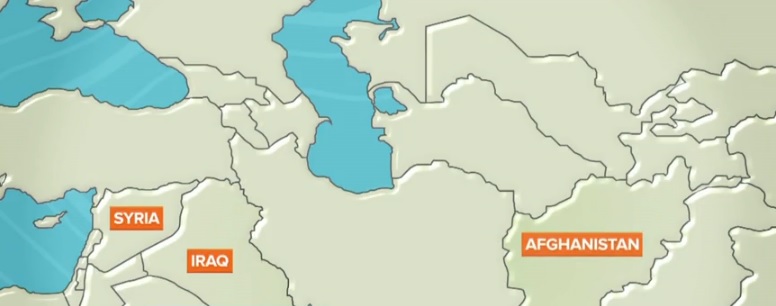
CU Blog - Tragic images show refugee crisis at a tipping point in Europe - Photo 3The people of the Failed-State countries of Syria, Iraq and Afghanistan are desperate and fleeing for their lives to get out of those war-torn countries to find relief. These ones risk their lives, and the lives of their children, to turn “sure defeat” into a fighting chance for life. It’s a bet – a gamble – and many times, these ones lose.

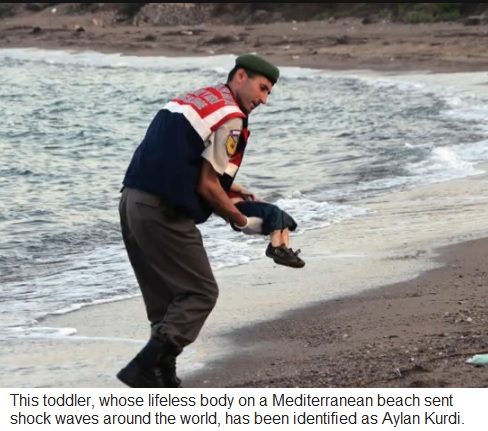
The name of a young toddler is now surfacing to give a name (and face) to his tragedy. Young Aylan Kurdi, a Syrian refugee, drowned in the waters of the Mediterranean Sea, trying to make it to shore with his parents. See the images here:

VIDEO: Tragic images show refugee crisis at a tipping point in Europe – http://www.today.com/video/tragic-images-show-refugee-crisis-at-a-tipping-point-in-europe-518578243727

Posted September 3, 2015 – Hundreds of thousands of refugees are risking their lives to reach Europe this year, 20,000 overwhelming a small Greek island in just the last week, with thousands drowning and dying in what’s become the biggest mass migration since WWII. NBC’s Bill Neely reports for TODAY.
CU Blog - Tragic images show refugee crisis at a tipping point in Europe - Photo 1

“There but for the Grace of God go I” – Old Expression

From the Caribbean perspective, we have seen this tragedy before, again and again. Just recently – in January – this commentary related the same tragedies in Caribbean member-states with refugees endangering their lives to leave places like Cuba, Haiti, Jamaica and the Dominican Republic. We understand the full breadth-and-width of Failed-States.

The toddler – Aylan Kurdi – in the foregoing photo deserves better. It is hoped that these images that were published Wednesday with his soaked red shirt, blue bottoms and tiny velcro-strap shoes that washed up on the beach in the Turkish resort of Bodrum, would ricochet across traditional and social media and be hailed as emblematic of the desperate and deadly refugee struggle to reach Europe.

These were plastered on international front pages on Thursday. This boy’s tragic life and death will not be in vain. CU Blog - Tragic images show refugee crisis at a tipping point in Europe - Photo 2The situation in these Failed-State countries (Syria, Iraq and Afghanistan) must be addressed. See Appendix below.

The book Go Lean…Caribbean serves as a roadmap for elevating the 30 member-states of the Caribbean, a few near Failed-State status. The book does not target Middle-East countries in its mitigation and remediation plans – Caribbean only – but we seek to learn lessons from the handling of this crisis.

The 5-Step leading-learning curve is normally:

1. Look, 2. Listen, 3. Learn, 4. Lend-a-hand and then 5. Lead.

We cannot lead in this case, but we can lend-a-hand, (contribute to any international relief campaign). We can also learn how to minimize Failed-State risks within our region.

So who should take the lead for fixing the Middle East Failed-State dysfunctions or the refugee crisis into Europe?

According to the opening quotation of this commentary: those who broke it. (Notice, in the foregoing VIDEO, that the refugees are targeting NATO countries).

The US and Western Europe are perhaps more directly responsible. They are the ones, in multi-national coalitions, that toppled the strong governments of Afghanistan and Iraq, then sat aside and allowed ISIS (Islamic State in Iraq and Syria) to form with the hope of overthrowing the oppressive regime of Bashar al-Assad in Syria. (So far, ISIS, has become its own “Frankenstein Monster”, to say the least, creating more distress and becoming its own threat). See Appendix below.

The Middle East is not easy!

In 2008 the newly elected US President, Barack Obama, vowed to exit US forces from Afghanistan and Iraq. He succeeded. The “laws of unintended consequences” may now have taken reign.

As for the Caribbean, we are on the periphery of this issue. Yes, we are allied to the United States and their enemies do tend to lash out at American allies. So we do have the “Sum of All Fears” that Al-Qaeda, ISIS or some other terrorist group would secure a “dirty bomb” nuclear device and detonate it in the Caribbean. But the biggest concern must be the slow creep of Failed-State status. This point was pronounced early in the Go Lean book as a motivation and a basis for confederation among Caribbean neighbors; there are the applicable statements in the opening Declaration of Interdependence (Page 12):

x.   Whereas we are surrounded and allied to nations of larger proportions in land mass, populations, and treasuries, elements in their societies may have ill-intent in their pursuits, at the expense of the safety and security of our citizens. We must therefore appoint “new guards” to ensure our public safety and threats against our society, both domestic and foreign. The Federation must employ the latest advances and best practices … to assuage continuous threats against public safety.

xi. Whereas all men are entitled to the benefits of good governance in a free society, “new guards” must be enacted to dissuade the emergence of incompetence, corruption, nepotism and cronyism at the peril of the people’s best interest. The Federation must guarantee the executions of a social contract between government and the governed.

xii. Whereas the legacy in recent times in individual states may be that of ineffectual governance with no redress to higher authority, the accedence of this Federation will ensure accountability and escalation of the human and civil rights of the people for good governance, justice assurances, due process and the rule of law. As such, any threats of a “failed-state” status for any member state must enact emergency measures on behalf of the Federation to protect the human, civil and property rights of the citizens, residents, allies, trading partners, and visitors of the affected member state and the Federation as a whole.

xiii. Whereas the legacy of dissensions in many member-states (for example: Haiti and Cuba) will require a concerted effort to integrate the exile community’s repatriation, the Federation must arrange for Reconciliation Commissions to satiate a demand for justice.

xvi. Whereas security of our homeland is inextricably linked to prosperity of the homeland, the economic and security interest of the region needs to be aligned under the same governance. Since economic crimes, including piracy and other forms of terrorism, can imperil the functioning of the wheels of commerce for all the citizenry, the accedence of this Federation must equip the security apparatus with the tools and techniques for predictive and proactive interdictions.

This Go Lean book serves as a roadmap for the introduction and implementation of the technocratic Caribbean Union Trade Federation (CU). With a branding name like Trade Federation, obviously the scope of elevating Caribbean society starts with economics. But the CU must seek to optimize the security dynamics in addition to economic empowerments. Therefore the Go Lean roadmap has these 3 prime directives:

  • Optimization of the economic engines in order to grow the regional economy and create 2.2 million new jobs.
  • Establishment of a security apparatus to protect the resultant economic engines and mitigate challenges/threats to ensure public safety for the region’s stakeholders.
  • Improvement of Caribbean governance to support these engines.

The book contends that though terrorism may not be a scourge on Caribbean life presently, new “bad actors” will eventually emerge to exploit the new economic successes envisioned in the Go Lean roadmap. The CU/Go Lean Strategy statement is quoted as follows (Page 46):

Fix the broken systems of governance in our region and deter against movements towards Failed-States, and any preying upon our people. We must protect the most vulnerable among us and guarantee the human/civil rights of our women and minorities.

The Go Lean book details a series of community ethos, strategies, tactics, implementations and advocacies to optimize the societal engines of the region, to stop any downward spiral into Failed-State status. See the lists here:

Community Ethos – Economic Systems Influence Choices & Incentives Page 21
Community Ethos – Consequences of Choices Lie in the Future Page 21
Community Ethos – Anti-Bullying and Mitigation Page 23
Community Ethos – Minority Equalization Page 24
Community Ethos – Ways to Impact the Future – Focus on Youth & Progress Page 26
Community Ethos – Ways to Manage Reconciliations Page 34
Community Ethos – Ways to Impact the Greater Good Page 37
Strategy – Vision –  Integrate region into a Single Market Economy Page 45
Strategy – Agents of Change – Globalization Page 57
Strategy – Agents of Change – Climate Change – Increase in Droughts and Floods Page 57
Tactical – Separation of Powers – Department of Homeland Security Page 75
Tactical – Separation of Powers – Federal Courts – Truth & Reconciliation Commissions Page 75
Implementation – Ways to Foster International Aid Page 115
Planning – 10 Big Ideas … in the Caribbean Region – Haiti & Cuba Page 127
Planning – Ways to Model the EU – From Worst to First Page 130
Planning – Reasons Why the CU Will Succeed – Germany Reconciliation Model Page 132
Planning – Ways to Improve Failed-State Indices – Cuba & Haiti on the List Page 134
Planning – Lessons from East Germany – European post-war rebuilding Page 139
Planning – Lessons from Egypt – Arab Spring Page 143
Planning – Lessons from the US Constitution – Gradual Optimization Page 145
Planning – Lessons from Canada’s History – Reconciliations with Indigenous Peoples Page 146
Advocacy – Ways to Grow the Economy Page 151
Advocacy – Ways to Create Jobs Page 152
Advocacy – Ways to Impact Justice Page 178
Advocacy – Ways to Impact the Diaspora Page 217
Advocacy – Ways to Protect Human Rights Page 220
Advocacy – Ways to Help Women Page 226
Advocacy – Ways to Impact Youth Page 227
Advocacy – Ways to Impact the Dominican Republic – Need for Reconciliations Page 237
Advocacy – Ways to Re-boot Haiti Page 238
Advocacy – Ways to Re-boot Jamaica – Mitigate Migrations & Brain Drain Page 239

In previous blog commentaries, the related issues of Caribbean migration and refugee-seeking were fully explored. See sample list here:

https://goleancaribbean.com/blog/?p=5759 Pressed by Debt Crisis, Doctors Leave Greece in Droves
https://goleancaribbean.com/blog/?p=4809 Americans arrested for aiding ISIS
https://goleancaribbean.com/blog/?p=3662 Migrant flow into US from Caribbean spikes
https://goleancaribbean.com/blog/?p=2907 Local Miami Haitian leaders protest Bahamian immigration policy
https://goleancaribbean.com/blog/?p=2809 A Lesson in History: Economics of East Germany
https://goleancaribbean.com/blog/?p=1531 A Lesson in History: World War I Ethnic Cleansing
https://goleancaribbean.com/blog/?p=1433 Caribbean loses over 70% of tertiary educated citizens to the   brain drain
https://goleancaribbean.com/blog/?p=623 Only at the precipice, do they change

All of the Caribbean needs to pay more-than-the-usual attention to the crisis with these Middle East Failed-States and the resultant refugee influx into Europe.

“There but for the Grace of God go I”

The remediation and mitigations in the Go Lean book are best-practices to minimize the push-pull factors for our own societal abandonment, and downward spirals into Failed-States. Now is the time for all of the Caribbean to lean-in this roadmap. Let’s show the world how to re-boot Failed-States and how to forge better conditions in a homeland. Let’s truly make the Caribbean better places to live, work, and play.  🙂

… and R.I.P. little Aylan Kurdi. We will not soon forget you. 🙁

Download the free e-Book of Go Lean … Caribbean – now!

——–

Appendix – Middle East Failed States

Afghanistan

A landlocked country, with a population of approximately 32 million people; it is located within South Asia and Central Asia between Iran and Pakistan. The recent history features a series of coups in the 1970s and was followed by a Soviet invasion and a series of civil wars that devastated much of Afghanistan.

The September 11 attacks on the United States were perpetrated by known terrorist Osama bin Laden and his al-Qaeda movement. The US demanded that the then-Taliban government hand him over.[122] After refusing to comply, the October 2001 Operation Enduring Freedom was launched by the US to topple the Taliban government. During the initial invasion, US and UK forces bombed al-Qaeda training camps. The United States began working with the Northern Alliance to remove the Taliban from power.[123] American forces remained until the official end of the war on December 28, 2014. However, thousands of US-led NATO troops have remained in the country to train and advise Afghan government forces.[138] The 2001-present war has resulted in between 185,000 and 249,000 deaths, which includes civilians, insurgents and government forces. A Taliban insurgency remains, to this day.

Iraq

This country is situated near the Arabian Peninsula and sits in between Saudi Arabia, Iran, Turkey, Jordan and Kuwait. The largest ethnic groups in Iraq are Arabs and Kurds. Other ethnic groups include Assyrians, Turkmen, Shabakis, Yazidis, Armenians, Mandeans, Circassians and Kawliya.[6] Around 95% of the country’s 36 million citizens are Shia or Sunni Muslims, with Christianity, Yarsan, Yezidism and Mandeanism also present.

Iraq was controlled by the Arab Socialist Ba’ath Party from 1968 until 2003. After an invasion by the United States and its allies in 2003, Saddam Hussein‘s Ba’ath Party was removed from power and multi-party parliamentary elections were held in 2005. The American presence in Iraq ended in 2011,[9] but the Iraqi insurgency continued and intensified as fighters from the Syrian Civil War spilled into the country. Civil strife continues to this day with conflicts among the ethnic and religious sects.

Syria

A country of 18 million people, on the coast of the Mediterranean; it is made up of fertile plains, high mountains, and deserts, it is home to diverse ethnic and religious groups, including Arabs, Greeks, Armenians, Assyrians, Kurds, Circassians,[8] Mandeans[9] and Turks. Religious groups include Sunnis, Christians, Alawites, Druze, Mandeans and Yazidis. Sunni Arabs make up the largest population group in Syria. Since March 2011, Syria has been embroiled in an uprising against Assad and the Ba’athist government as part of the Arab Spring, a crackdown which contributed to the Syrian Civil War and Syria becoming among the least peaceful countries in the world.[16]

Share this post:
, , , , ,

China’s Caribbean Playbook: America’s Script

Go Lean Commentary

China has invested heavily in the Caribbean, as of recent; see list here of selected announcements since January 2014:

 China Playbook 3

New $250 Million Hotel Project – The Pointe – Breaks Ground in Nassau

Big China-Bahamas project – Baha Mar – Still embroiled in legal wrangling

A New $2 Billion Caribbean Resort Project in Grenada

Is This Island – Puerto Rico – China’s Next Caribbean Investment Target?

The Caribbean’s Big New Canal Project – backed by China

Antigua and Barbuda Closer to Completion of New Airport Terminal – built by China Civil Engineering Construction Corporation

China to Build More Homes in Grenada

Dominica, China Sign Agreement on $16 Million in Projects

Barbados, China Talk Agriculture

Trinidad, China Talk Infrastructure

British Virgin Islands Signs Agreements With Delegations From China

China Playbook 2

Just what is China’s motive, their end game?

Should we be leery or should we just embrace [the badly needed] help from whatever sources?

How much of this questioning is influenced by a pro-American yearning? Pro-Christian yearning? Fear of strangers? Racist under-valuing of non-White/European races?

There is the need for the Caribbean to take stock of its thoughts-feelings-actions and give all of these questions serious deliberation.

If this Golden Rule is true: “he who has the gold makes the rules”, then we will be held to account to stakeholders in China, as their many state-own companies are definitely “bringing gold” to the table. This was vividly communicated in a previous (2014) China-Caribbean Trade/Business Summit:

“Latin America has much to gain from deepening its relationship with China, just as China has much to gain from our region,” said Luis Alberto Moreno, president of the Inter-American Development Bank (IDB). “For our governments, this is a strategic priority. But much of the day-to-day building of those links will fall on the private sector.”

China joined the IDB as a shareholder in 2009, and is now the top trade partner for several countries in the region, including Brazil and Chile.

Trade between Latin America and the Caribbean and China is expected to double in the next decade.

Source: http://caribjournal.com/2014/09/15/china-holds-business-summit-with-latin-america-caribbean/

The book Go Lean…Caribbean anticipates the participation of Direct Foreign Investments in the Caribbean community. The book serves as a roadmap for the introduction and implementation of the technocratic Caribbean Union Trade Federation (CU). The CU will serve as an integrated entity to shepherd progress and optimization among the region’s societal engines for economics, security and governance. This is to be likened to a Confederated Command of Allied Forces for battles in a “Trade War”.

This aligns with the CU/Go Lean roadmap, as the focus of CU is about Trade, not politics; thus the CU branding is Trade Federation. The experience and wisdom of this roadmap was derived from successes and failures in 2008 Trade Wars.

China is officially a Communist country. But these referenced headlines do not refer to politics nor any Chinese influence of the region’s politics; not even any pressure to lean politically. It is only about trade and succeeding in a global “Trade War”.

China, with its Communist leaning is also officially atheist but truthfully, their de facto policy is religious agnosticism; they simply tolerate them all. (Many religions abound in that 1.2 Billion population, consider: Buddhism, Taoism, Confucianism and the toleration of Western religions). The publisher of the book Go Lean…Caribbean, SFE Foundation, is a Community Development Foundation; it shares many of these same ideals. This was related in the book’s opening chapter with this Who We Are statement:

The SFE Foundation is not a person; it’s an apolitical, religiously-neutral, economic-focused movement, initiated at the grass-root level to bring change back to the Caribbean … There is an old observation/expression that states that “there are 3 kinds of people in the world, those who make things happen, those who watch things happen and those who wonder ‘what happened?’“ Principals of SFE Foundation were there in 2008 … on the inside looking out, not the outside looking in. Understanding the anatomy of the modern macro economy, allows the dissection of the processes and the creation of viable solutions.

This focus on trade is very familiar.

This is the same playbook of the United States of America in building the world’s largest Single Market economy. (Remember, with the Army Corp of Engineers, the US built the Panama Canal, but with more strings attached). China is simply following the same American script – minus the cronyism and militarism – of promoting trade of their products, services and capital.

Capital? Yes, many of the projects highlighted in the foregoing news articles are being financed by China’s state-owned banks and lending institutions. They are “putting their money, where their mouth is”. These are economic battles only! See US President Barack Obama’s comments on China’s Caribbean motives in the Appendix-VIDEO below.

As a region, with numerous Failed-States, can we really quiver over the nationality of our benefactors; can we question the ethnicity of the “Cavalry that has come to our rescue”? Hardly! We have to just manage with whatever refuge being offered, to allow us to better cover our basic needs.

For example, healthcare delivery is still a major concern in the Caribbean. According to the following article, the member-state of Jamaica needs to expand their number of hospital beds … and a China-backed project is facilitating this quest:

Title: China to Fund $511 Million Project at University of the West Indies
By: Dana Niland, Contributor, Caribbean Journal – Online News Source; (posted 08/28/2015; retrieved 09/02/2015 from:
http://caribjournal.com/2015/08/28/china-to-fund-511-million-project-at-university-of-the-west-indies/)

China Playbook

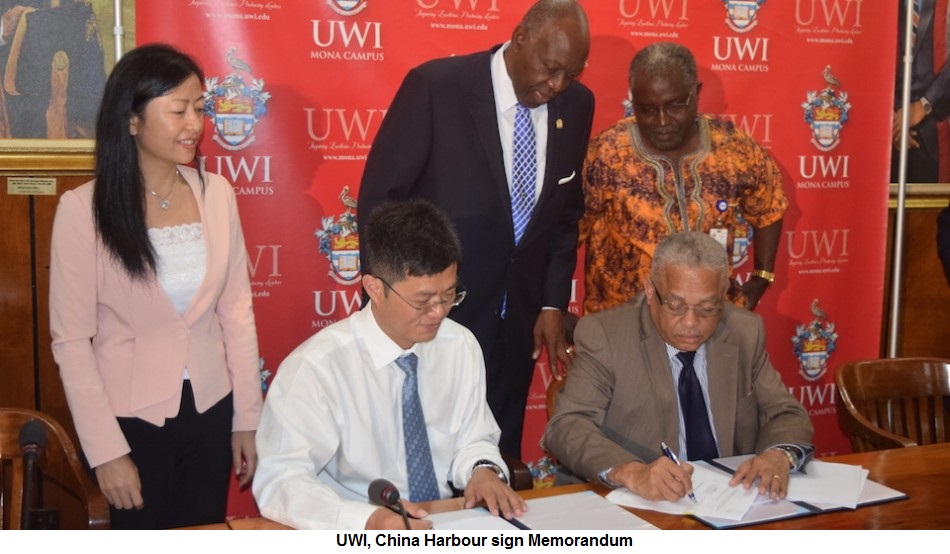
The University of the West Indies and China Harbour Engineering Company (see Appendix) have signed a Memorandum of Understanding for a $511 million USD development project.

The project will include the expansion of the University Hospital from 500 to 1,000 beds, an upgrade to the College Commons, the building of a 100-room hotel, and a new center for sporting activities.

The expansion will also include the addition of a cogeneration plant to supply electricity and to feed the cooling system for the campus.

Addressing the signing ceremony at the UWI Mona Campus, Professor Archibald McDonald said that the realignment of the hospital’s structure was necessary to promote efficiency and to put the institution in a position to serve the wider region.

“This will have all the modern facilities. The Government of Jamaica invests a large portion of its budget to the [UHWI]; therefore, the University Hospital has to give back to the people of Jamaica. It has to supplement the Government’s hospitals, and provide a higher level of care,” he said.

Jamaican Minister of Health, Dr. Fenton Ferguson also praised the arrangement.

“I am satisfied that the direction [in which] they are going will preserve and protect the most vulnerable within our society, and ensure that health care is not out of the reach of ordinary citizens,” Ferguson said.

The project in this article is not solely for Jamaica, but rather, it is within the charter of the University of the West Indies; so there is a regional focus.

The underlying motivation of the Go Lean book is brotherly love. Therefore who so ever, brings a solution to impact the Greater Good for the Caribbean people must be embraced, despite their political affiliations. The Go Lean roadmap is therefore not “pro” or “con” American, but rather pro solutions; in fact the CU is described as a technocracy with a focus on delivery and merit; this is the same charter as the Steering Committee of the Government of the Peoples Republic of China. This was related in the Go Lean book (Page 64) as follows:

Even the leaders of the Communist Party of China are mostly professional engineers. The Five-Year plans of the People’s Republic of China have enabled them to plan ahead in a technocratic fashion to build projects such as the National Trunk Highway System, the High-speed rail system, and the Three Gorges Dam.

A basic economic principle, subscribed in Go Lean (Page 21), is that “Economic Systems Influence Individual Choices and Incentives”. So the advanced field of economics hereby posits that Economic Systems, more so than political systems influence people’s choices and incentives. The CU seeks to optimize the region’s economic systems to better deliver on the prime directives of the Go Lean roadmap, pronounced as the following statements:

  • Optimization of the economic engines in order to grow the regional economy to $800 Billion & create 2.2 million new jobs.
  • Establishment of a security apparatus to protect the resultant economic engines and mitigate challenges/threats to ensure public safety for the region’s stakeholders.
  • Improvement of Caribbean governance, including a separation-of-powers with member-states, to support these economic/security engines.

So the CU vision is to provide the stewardship for the region’s economic engines, first, so as to succeed in the goals of the roadmap. This vision was pronounced at the outset of the book in the roadmap’s Declaration of Interdependence (Page 13):

xxiv.   Whereas a free market economy can be induced and spurred for continuous progress, the Federation must install the controls to better manage aspects of the economy: jobs, inflation, savings rate, investments and other economic principles. Thereby attracting direct foreign investment because of the stability and vibrancy of our economy.

The CU roadmap drives change among the region’s economic, security and governing engines. These solutions are as new community ethos, strategies, tactics, implementations and advocates; sampled as follows:

Who We Are – Veterans of 2008 “Wars” & Financial Crisis Page 8
Community Ethos – Voluntary Trade Creates Wealth Page 21
Community Ethos – Consequences of Choices Lie in the Future Page 21
Community Ethos – Job Multiplier Page 22
Community Ethos – Cooperatives Page 25
Community Ethos – Impact the Greater Good Page 37
Strategy – CU Vision and Mission Page 45
Strategy – Build and foster local economic engines Page 45
Strategy – Reform our HealthCare industries to better fulfill our health care needs Page 45
Tactical – Fostering a Technocracy – China’s Example Page 64
Tactical – $800 Billion Economy – How and When – Trade Page 67
Tactical – Recovering from Economic Bubbles Page 69
Tactical – Separation-of-Powers – Interstate Commerce & Trade Facilitation Page 79
Tactical – Separation-of-Powers – Office of Trade Negotiations Page 80
Implementation – Ways to Pay for Change Page 101
Implementation – Foreign Policy Initiatives at Start-up Page 102
Implementation – Trade Mission Objectives Page 117
Implementation – Ways to Benefit Globalization Page 119
Planning – Ways to Improve Trade Page 128
Planning – Ways to Improve Failed-State Indices Page 134
Planning – Lessons Learned from 2008 Page 136
Advocacy – Ways to Grow the Economy Page 151
Advocacy – Ways to Create Jobs Page 152
Advocacy – Ways to Improve Healthcare Page 156
Advocacy – Ways to Impact Public Works – US Army Corp of Engineers Model Page 175
Advocacy – Ways to Preserve Caribbean Heritage Page 218
Advocacy – Ways to Re-boot Jamaica Page 239
Appendix – Trade SHIELD Principles Page 264
Appendix – Caribbean Failed-States Indicators & Definitions Page 271

The Caribbean region needs help! We need the elevations of this Go Lean roadmap; we need the direct investments from China’s banks. We need the expertise and core competences of China’s many state-owned engineering and development companies. We simply cannot expect progress with a North American-only focus. We cannot only look North and West, we must also look East and South. The world is now flat; we must embrace globalization.

It is now a changed world. We must embrace China. Not as new colonizers, but as partners. There are opportunities for China to reap returns on their investments, with no exploitation of the Caribbean land or people.

The Caribbean is arguably the best address on the planet, but there are many deficiencies, as in jobs and economic empowerments. With the previous North & West focus we have suffered. Our deficiencies has led to societal abandonment so bad that the region has lost a large share of our human capital, one estimate of 70% of the college-educated population to the brain-drain.

No More! Our region can be and must be better.

The shepherding of the Caribbean economy now requires best-practices and technocratic executions; it requires those trained and accomplished from the battles of globalization and trade wars. This is the Go Lean roadmap.

Everyone, the people, businesses, institutions and trading partners are all hereby urged to lean-in to this roadmap to make the Caribbean a better place to live, work and play.  🙂

Download the book Go Lean … Caribbean – now!

———

Appendix – China Harbour Engineering Company, Ltd (CHEC) – https://en.wikipedia.org/wiki/China_Harbour_Engineering

CHEC is an engineering contractor and a subsidiary of CCCC (China Communications Construction Company), providing infrastructure construction, such as marine engineering, dredging and reclamation, road and bridge, railways, airports and plant construction.[1] As a dredger the company is the second largest in the world, carrying out contracts in Asia, Africa, and Europe.[2]

The company was established in December 2005 during the merger of China Harbour Engineering Company Group (founded 1980) with China Road and Bridge Corporation into CCCC.

CHEC has won large contracts for dredging, particularly in the Middle East and Asia.

———
Appendix – VIDEO – President Obama On China’s Influence In The Caribbean & Latin America https://youtu.be/vfve6V3zA08

Published on Apr 16, 2015 – President Obama on China’s growing influence in the Caribbean and Latin America at youth town hall meeting, Thursday April 9, 2015, University of the West Indies (Mona Campus), Kingston, Jamaica. Watch the full video here: https://www.youtube.com/watch?v=ftDpg…


Share this post:
, , , , ,
[Top]

Carnival to ban carry-on bottled beverages

Go Lean Commentary

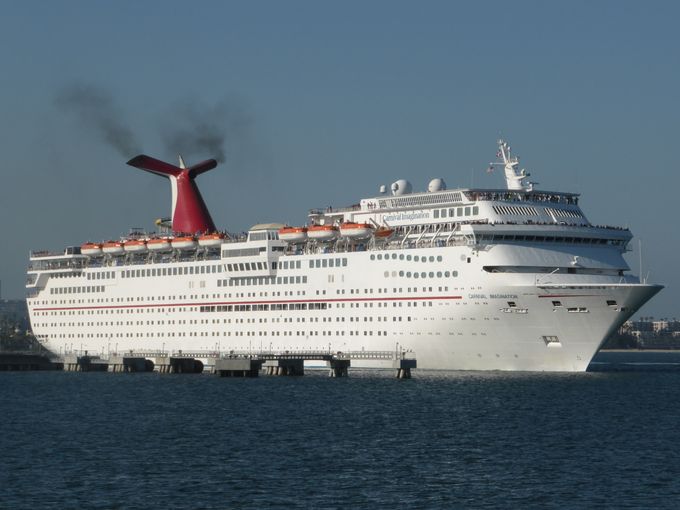
CU Blog - Carnival to ban carry-on bottled beverages - Photo 1According to the news article below, Carnival Cruise Lines is now banning carry-on bottled beverages on their ships. They claim that this move “is not intended to raise beverage revenues”.

Does anybody believe that?

Hardly!

This is the consistent theme in the book Go Lean…Caribbean; it posits that cruise lines have progressively tighten their practices and policies to ensure more revenues for them and less for the port cities (Page 32).

Scratch a liar, catch a thief!

Why so harsh a criticism? Simple: the dynamics of the Crony-Capitalistic cruise industry in the past, present and future.

The cruise line industry was not always as reflective of this Crony-Capitalism … as they are today. There was a time when passenger shipping companies submitted to the laws of the land – the home countries of the ship owners, i.e. US, England, Netherlands, Greece. This compliance dictated that the shipping lines conformed to labor, anti-trust and competition laws. Then the Crony-Capitalistic influence was embedded and the shipping lines started seeking ship-registry third-party countries that are agnostic to community best-practices (Liberia, etc.).

Today the Caribbean cruise industry is dominated by 3 cruise companies (with large percentages of the passenger traffic; Carnival alone had 52% global market share in early 2012), and the fast-growing Disney Cruise Line. These companies are now all publicly-traded on Wall Street – see stock-symbols listing as follows – so they now answer to new bosses, whose goal is singular: increase shareholder value:

Symbol Name

Price Today

CCL Carnival Corporation

51.87

RCL Royal Caribbean Cruise Line

83.20

NCLH Norwegian Cruise Line

59.81

DIS Disney (Cruise Line)

118.80

The “modus operandi” is no longer a matter of extending hospitality to their guests, but rather the business ethos – fundamental spirit that informs the beliefs, customs, or practices of an enterprise – is simply to maximize profits. This means increasing revenues while simultaneously lowering costs. (In a previous blog/commentary the full extent of the industries’ labor practices were detailed).

This is not a good trend!

The Go Lean book serves as a roadmap for the introduction and implementation of the technocratic Caribbean Union Trade Federation (CU). The CU is a confederation of 30 Caribbean member-states with the mission to form a unified negotiating front in bargaining with the cruise line industry. The CU goal is simple: integrate the region into a Single Market.

Why a Single Market?

The Go Lean book posits (Page 3) that the problems of the Caribbean, cruise industry manifestations included, are too big for any one member-state to tackle alone. Even though some cruise destinations, (like the Bahamas, Jamaica, Cayman Islands and St Martin) have demonstrated some success with this business model, the trend is for the opposite direction. (Wall Street firms try to improve profits more and more for each passing fiscal quarter). As demonstrated in the following news article, the trending is for this cruise industry to extract more and more passenger spending, not share. See the news article here:

Title: Carnival to ban carry-on bottled beverages
By: KDSK Reporting

Carnival Cruise Line is trying to put a stop to alcohol being smuggled aboard its ships disguised as bottled water.

Beginning July 9, Carnival will effectively ban beverages in bottles from being brought onboard at embarkation. The only exception is a single bottle of fine wine or champagne.

Otherwise, beverages must [be] packaged in unopened cans or cartons, including water, sodas and juices, with a maximum number of 12 packed in carry-on luggage.

CU Blog - Carnival to ban carry-on bottled beverages - Photo 2The change means passengers can no longer tag beverages for embarkation as checked luggage. In addition, Carnival will restrict the size of coolers brought aboard to those measuring 12x12x12 or less.

In a letter being sent to passengers, Carnival said bottled beverages have become a prime means of bringing unauthorized alcohol on cruises. The line claims inspecting a growing number of bottles was bogging down embarkation, and that episodes of bad behavior on ships often trace back to smuggled alcohol. The letter also explained that cruise personnel cannot effectively monitor consumption of alcohol that isn’t sold on the ships, it said.

“We sincerely apologize for any disappointment these changes may cause,” said the letter, signed by Arlene Marichal, senior director, solutions and special services. “However, we firmly believe this will result in a safer environment while also improving the embarkation process and the overall guest experience.”

Concurrent with the policy change, Carnival has lowered the price of bottled water to $2.99 for a 12-pack of 500 ML bottles, if purchased in advance of the cruise, or $4.99 onboard. Carnival said the move is not intended to raise beverage revenues.
Source: KSDK NewsChannel 5 – St. Louis, Missouri Local NBC Affiliate – Posted June 9, 2015; retrieved July 22, 2015 from: http://www.ksdk.com/story/news/nation-now/2015/06/09/carnival-to-ban-carry-on-bottled-beverages/28744127/

The goal of the Go Lean roadmap is the Greater Good. This includes applying strategies and tactics to incite more spending at Caribbean ports-of-call.

Singlehandedly, these port cities-member states cannot effect change on this cruise line industry. But together, as one unified front, the chances for success improve exponentially.

The cruise lines “ply their trade” in the Caribbean region (waters and ports-of-call); this is our marketplace so it would be expected that we would have some jurisdiction. After all, the Caribbean is the attraction for Caribbean cruises.

The confederacy goal of the CU entails accepting that there is interdependence among the Caribbean member-states. The Go Lean book initiates with this quest for regional integration with an opening Declaration of Interdependence (Pages 11 – 13); consider these pronouncements:

v. Whereas the natural formation of our landmass and coastlines entail a large portion of waterscapes, the reality of management of our interior calls for extended oversight of the waterways between the islands. The internationally accepted 12-mile limits for national borders must be extended by International Tribunals to encompass the areas in between islands. The individual states must maintain their 12-mile borders while the sovereignty of this expanded area, the Exclusive Economic Zone, must be vested in the accedence of this Federation.

vi. Whereas the finite nature of the landmass of our lands limits the populations and markets of commerce, by extending the bonds of brotherhood to our geographic neighbors allows for extended opportunities and better execution of the kinetics of our economies through trade. This regional focus must foster and promote diverse economic stimuli.

viii. Whereas the population size is too small to foster good negotiations for products and commodities from international vendors, the Federation must allow the unification of the region as one purchasing [or bargaining] agent, thereby garnering better terms and discounts.

x. Whereas we are surrounded and allied to nations of larger proportions in land mass, populations, and treasuries, elements in their societies may have ill-intent in their pursuits, at the expense of the safety and security of our citizens. We must therefore appoint “new guards” to ensure our public safety and threats against our society, both domestic and foreign. The Federation must employ the latest advances and best practices … to assuage continuous threats

xi. Whereas all men are entitled to the benefits of good governance in a free society, “new guards” must be enacted to dissuade the emergence of incompetence, corruption, nepotism and cronyism at the peril of the people’s best interest. The Federation must guarantee the executions of a social contract between government and the governed.

xii. Whereas the legacy in recent times in individual states may be that of ineffectual governance with no redress to higher authority, the accedence of this Federation will ensure accountability and escalation of the human and civil rights of the people for good governance, justice assurances, due process and the rule of law

xxiv. Whereas a free market economy can be induced and spurred for continuous progress, the Federation must install the controls to better manage aspects of the economy: jobs, inflation, savings rate, investments and other economic principles. Thereby attracting direct foreign investment because of the stability and vibrancy of our economy.

xxv. Whereas the legacy of international democracies had been imperiled due to a global financial crisis, the structure of the Federation must allow for financial stability and assurance of the Federation’s institutions. To mandate the economic vibrancy of the region, monetary and fiscal controls and policies must be incorporated as proactive and reactive measures.

This Go Lean roadmap represents change for the Caribbean and all of our stakeholders, including sailing/cruising and flying visitors. But our quest in the CU to elevate Caribbean society is not designed to antagonize cruise line operators. Just the opposite; we set out to be their able-bodied trading partners, not adversarial opponents. We seek the Greater Good for their interest as well, a win-win.

The CU/Go Lean prime directive is identified with the following 3 statements:

  • Optimization of the economic engines in order to grow the regional economy to $800 Billion & create 2.2 million new jobs.
  • Establishment of a security apparatus to protect the resultant economic engines, including maritime activities on the Caribbean Sea.
  • Improvement of Caribbean governance to support these engines.

Collective bargaining is the key.

The Go Lean book promotes collective bargaining as a community ethos, so as to mitigate the perils of “going at it alone”. The book details the applicable community ethos, strategies, tactics, implementation and advocacies to elevate the benefits of regional cruise line industry in the region:

Community Ethos – People Respond to Incentives in Predictable Ways Page 21
Community Ethos – Economic Systems Influence Individual Choices & Incentives Page 21
Community Ethos – Consequences of Choices Lie in the Future Page 21
Community Ethos – Governing Principles – Lean Operations Page 24
Community Ethos – Governing Principles – Return on Investments (ROI) Page 24
Community Ethos – Governing Principles – Cooperatives Page 25
Community Ethos – Ways to Improve Negotiations Page 32
Community Ethos – Ways to Improve Sharing Page 35
Community Ethos – Ways to Impact the Greater Good Page 37
Strategy – Confederate 30 Caribbean Member-States Page 45
Strategy – Customers / Stakeholders – Governments, Businesses, and Citizens Page 47
Strategy – Customers / Stakeholders – Cruise Passengers Page 48
Strategy – Competitors – Choices for Cruise Passengers: Pacific Coast, Mediterranean, etc. Page 55
Strategy – Agents of Change – Technology Page 57
Strategy – Agents of Change – Climate Change – More Intense Tropical Storms Disrupting Cruises Page 57
Anecdote – Carnival Cruise Lines Strategy Report Page 61
Tactical – Foster a Technocracy Page 64
Tactical – Separation of Powers – Shared Portal: www.myCaribbean.gov for Cruise Marketing Page 74
Tactical – Separation of Powers – Regional Tourism Coordination Page 7?
Implementation – Year 1 / Assemble Phase – Consolidate Organs into CU Page 96
Implementation – Foreign Policy Mandates at Start-up – Collective Bargain with other Cruise Destinations Page 105
Implementation – Security Provisions at Start-up Page 106
Planning – 10 Big Ideas – Shared/Single Currency – Cooperative Central Bank & Cruise Line Pay cards Page 127
Advocacy – Ways to Grow the Economy Page 151
Advocacy – Ways to Create Jobs Page 152
Advocacy – Ways to Improve Governance Page 168
Advocacy – Ways to Better Manage the Social Contract – Ensure level playing field Page 170
Advocacy – Ways to Foster Cooperatives Page 176
Advocacy – Improve Homeland Security – Emergency Management Readiness Page 180
Advocacy – Ways to Improve Tourism – Cruise Passenger Pay Card/Currency Page 190
Advocacy – Ways to Improve Cruise Tourism – Fostering more Port-side Commerce Page 194
Advocacy – Ways to Improve Emergency Management – Cruise Ship Incidence Readiness Page 198
Advocacy – Reforms for Bank Regulations – Cruise Passenger Pay cards Page 199
Advocacy – Ways to Develop Ship-Building – Cruise Ship Dry-Dock Maintenance – Deal-making Page 209

The issues raised in the foregoing article weigh heavy on a lot of Caribbean commerce. For example, we have a thriving rum industry in the region, with products deemed the best in the world. An objective of rum producers is to market their wares to the 10-million-plus cruise visitors. An unchallenged cruise line policy, dissuading onshore beverage purchases, would undermine this rum industry goal.

The cruise lines have invested heavily in new amenities and duty-free shopping options on board their newer ships. See photos and VIDEO here:

CU Blog - Carnival to ban carry-on bottled beverages - Photo 3OLYMPUS DIGITAL CAMERACU Blog - Carnival to ban carry-on bottled beverages - Photo 6CU Blog - Carnival to ban carry-on bottled beverages - Photo 5


VIDEO – Disney Fantasy Shopping Areas on the Disney Cruise Line – https://youtu.be/OvjxlzoetrY

Published on Apr 22, 2012 – A look at shopping on the Disney Fantasy including Sea Treasures, Mickey’s Mainsail, Bibbidi Bobbidi Boutique, and White Caps. Visit http://www.wdwinfo.com for more information on Disney Cruise Line.

While these onboard retailers may be in direct competition with port-cities, it is the Go Lean assertion that there is market enough for all these stakeholders; onboard and onshore. There is no need for anti-trust practices.

Consider these previous blog/commentaries that drilled deep on the Go Lean vision and opportunities for the cruise industry:

https://goleancaribbean.com/blog/?p=5210 Cruise Ship Commerce – Getting Ready for Change
https://goleancaribbean.com/blog/?p=4639 Tobago: A Model for Cruise Tourism
https://goleancaribbean.com/blog/?p=3956 Art and Science of Collaboration
https://goleancaribbean.com/blog/?p=5307 8th Violent Crime Warning to Bahamas Tourists (including Cruises)
https://goleancaribbean.com/blog/?p=3889 RBC EZPay – Ready for Change and Cruise Industry Pay Cards

Issues Creating New Cruise Industry Opportunities

https://goleancaribbean.com/blog/?p=3225 Caribbean less competitive due to increasing aviation taxes
https://goleancaribbean.com/blog/?p=2207 Hotels are making billions from added fees
https://goleancaribbean.com/blog/?p=242 The Erosion of the Middle Class

The Caribbean region and the cruise line industry must do better … and work together to grow this industry.

In the end, these changes will be for the better; for the Greater Good and to promote a better partnership for all cruise industry stakeholders.

We welcome the 10 million cruise visitors and the many cruise ship operators. Let’s work together … to make the Caribbean destination a better place to live, work and play.  🙂

Download the book Go Lean … Caribbean – now!

Share this post:
, , , , ,
[Top]

Movie Review: ‘Tomorrowland’ – ‘Feed the right wolf’

Go Lean Commentary

We are now mid-way through the 2015 Summer Movie Season. There have been some BIG ONES. The following is the highest Box Office performance of summer movies thus far in the US alone:

CU Blog - Feed the Right Wolf - Photo 2

Movie Opening Weekend US
Jurassic World $209 million
Avengers: Age of Ultron $191 million
Furious Seven $147 million
Minions $116 million
Inside Out $90 million
Pitch Perfect 2 $69 million
Ant-Man $57 million
Mission: Impossible – Rogue Nation $56 million
San Andreas $54 million
Insurgent $52 million
Mad Max: Fury Road $45 million
Ted 2 $34 million
Tomorrowland $33 million
Spy $29 million
Terminator Genisys $27 million
Fantastic Four $26 million
Magic Mike XXL $13 million
Entourage $10 million

Movies play a unique role in our lives.

In a previous blog/commentary regarding Caribbean Diaspora member and Hollywood great, Sidney Poitier, it was declared that …

“Movies are an amazing business model. People give money to spend a couple of hours watching someone else’s creation and then leave the theater with nothing to show for the investment; except perhaps a different perspective”.

This foregoing statement sets the foundation for appreciation of one movie in particular from the foregoing list, Disney’s Tomorrowland: A World Beyond which admonishes us to:

Feed the right wolf.
There are two wolves. One bright and hopeful and one dark and cynical. Which wolf wins? Whichever one you feed.

This quotation from the movie aligns with the reality of the Caribbean – art imitating life. The region is in crisis due to calamities and socio-economic changes in the region … and globally. The region has not even kept pace with the “push-and-pull” factors drawing many Caribbean citizens to flee…and abandon their beloved homelands. Already that brain drain among the college-educated population is up to a 70% rate among the entire region, with some communities experiencing alarmingly higher rates: Jamaica 85%; Guyana 89%.

The region is now at the cross-roads: maintain the status quo and watch the societal abandonment and decline continue (dark and cynical) … or … foster change and grant the Caribbean region a new (bright and hopeful) future.

Which wolf/future will win?

The book Go Lean … Caribbean asserts the option of fostering a bright and hopeful future. It provides turn-by-turn directions on how to arrest the societal abandonment and elevate the region’s economic, security and governing engines.

The book describes how/when/why to feed the right wolf!

This book serves as a roadmap for the introduction and implementation of the Caribbean Union Trade Federation (CU), a technocratic agency seen as the Caribbean’s best hope to avert the current path of disaster, human flight and brain drain, and grant the Caribbean a meaningful future for its youth.

This roadmap aligns with the movie plotlines:

Title: “Feed the right wolf.” Disney’s Tomorrowland (2015 film)
Reel Roy Reviews – Movie Review Site; posted May 23, 2015; retrieved 08-21-2015 from:
http://reelroyreviews.com/2015/05/23/feed-the-right-wolf-disneys-tomorrowland-2015-film/ 

CU Blog - Feed the Right Wolf - Photo 1

“Find the ones who haven’t given up. They are the future.” So says George Clooney at the end of Brad Bird’s latest Disney offering Tomorrowland, inspired as much by Disney’s ubiquitous theme parks (from which it derives its inspiration) as it does Ray Bradbury’s Fahrenheit 451, Jules Verne’s 20,000 Leagues Under the Sea, and … Al Gore’s An Inconvenient Truth.

In fact, this may be the first children’s film that directly addresses – so darkly, so interestingly, so strangely – global warming among other mankind-created global calamities. I can’t recall the last kiddie flick that depicted so darn many mushroom clouds, or had such a nihilistic sentiment at its gooey center. Good for Brad Bird.

Clearly a passion project for the director, the film suffers, alas, from a narrative lumpiness. It is composed almost like a junior novella, with very abrupt chapter breaks, and an unclear sense of the overall purpose until the crackerjack final act.

Regardless, the journey is an entertaining and worthwhile one, at least philosophically. As I find myself personally at a crossroads in life – looking back at what erroneously seemed an idyllic small-town, all-American way-of-life and now dreaming of a much-needed present/future state when we all can embrace empathy, kindness, and love, regardless our geographically defined boundaries – the film hit a raw nerve for me.

Ostensibly, the film is about Britt Robertson’s Casey Newton, a young, overeager space-loving kid horrified that America has given up on all dreams of galactic exploration. Casey discovers a magic pin that gives her glimpses of a sparkling utopia where we all live hand-in-hand, driving electric cars, zipping to-and-fro in bullet shaped sky-trains, and all wearing flowing garb designed in collaboration between Vera Wang and Judy Jetson (?). (Oh, and everybody in the future is fit. No fast food, no gluten, and, yeah, I bet vegan. Go figure.)

In truth? The film is really about George Clooney’s Frank Walker, a bright-eyed young boy born of nuclear optimism now a middle-aged sot calcified by millennial atrophy. He sees a world that he hoped would be (pushed to be), its limitless potential now squandered by petty greed and intentional hate. The classic baby boomer dilemma.

Casey sparks a reluctant optimism in Frank, as they meet cute, amidst a gaggle of murderous robots blowing up Frank’s steampunk farmhouse. They travel to Tomorrowland in hopes of preventing global catastrophe. Tomorrowland, you see, is an alternate dimension designed as a free-thinking societal construct, intended to gather humanity’s best and brightest in order to effect great change, but now turned to seed. Hugh Laurie, all glowering smarm, is its chief magistrate.

Robertson, who unfortunately has the acting range of a peanut, mugs and screams shamelessly, but Clooney with his oily charm is the perfect antidote. It takes quite a bit of screen time for him to finally emerge, but when he does the film starts firing on all cylinders.

Tomorrowland (the place … in the film) is a marvel of design, taking many cues from but never limited by the aesthetic of Disney’s theme park Tomorrowland(s) as well as the original designs for EPCOT – all swooping spirals, glittering towers, and burnished concrete.

As I understand it, Walt Disney and Ray Bradbury were pals, and they and their creative legacies share a similar take on the “future,” a concept as nebulous as it is thrilling. For these mid-century marvels, the future is a pearly veneer with a toxic venom ever curdling underneath. Both men telegraphed a healthy agnosticism and distrust of humanity – see Bambi, for one – with a deep desire to see us collectively rise above our own insularity and self-absorption … once and for all. Fat chance.

Brad Bird does a fine job capturing and forwarding this idea in Tomorrowland. The film is not perfect, a bit tedious at times, but it is a worthwhile summer blockbuster exercise in challenging how stunted we have become. At one point Casey says something to this effect: “There are two wolves. One bright and hopeful and one dark and cynical. Which wolf wins? Whichever one you feed. Feed the right wolf.”

Feed the right wolf.

————-

VIDEO – Trailer for Movie: Tomorrowland – http://www.imdb.com/video/imdb/vi4284068121/

The Go Lean roadmap synchronizes with the theme of the movie Tomorrowland. On Page 21, Go Lean presents a series of community ethos – the fundamental spirit that informs the beliefs, customs, or practices of a society – that must be adapted to forge change in the Caribbean; listed as follows:

  • Impact the Future (Page 26)
  • Impact the Greater Good (Page 37)

Life imitating art; art imitating life.

This is what movies help us to appreciate; many times, they allow us to look at ourselves and take a retrospective view. Which wolf are we feeding?

The CU/Go Lean roadmap seeks to forge change on Caribbean society with a new level of collaboration to contend with global/regional threats and to fix the defective societal engines. In fact, the prime directives of the CU/Go Lean roadmap are pronounced as these declarative statements:

  • Optimization of the economic engines in order to grow the economy to $800 Billion & create 2.2 million new jobs.
  • Establishment of a security apparatus to protect the resultant economic engines.
  • Improvement of Caribbean governance to support these engines.

The Go Lean book opens with a quest for regional integration, with the Declaration of Interdependence (Pages 11 – 14), including these pronouncements:

i. Whereas the earth’s climate has undeniably changed resulting in more severe tropical weather storms, it is necessary to prepare to insure the safety and security of life, property and systems of commerce in our geographical region. As nature recognizes no borders in the target of its destruction, we also must set aside border considerations in the preparation and response to these weather challenges.

xi. Whereas all men are entitled to the benefits of good governance in a free society, “new guards” must be enacted to dissuade the emergence of incompetence, corruption, nepotism and cronyism at the peril of the people’s best interest. The Federation must guarantee the executions of a social contract between government and the governed.

xii. Whereas the legacy in recent times in individual states may be that of ineffectual governance with no redress to higher authority, the accedence of this Federation will ensure accountability and escalation of the human and civil rights of the people for good governance, justice assurances, due process and the rule of law. As such, any threats of a “failed state” status for any member state must enact emergency measures on behalf of the Federation to protect the human, civil and property rights of the citizens, residents, allies, trading partners, and visitors of the affected member state and the Federation as a whole.

xxiv. Whereas a free market economy can be induced and spurred for continuous progress, the Federation must install the controls to better manage aspects of the economy: jobs, inflation, savings rate, investments and other economic principles. Thereby attracting direct foreign investment because of the stability and vibrancy of our economy.

xxvii. Whereas the region has endured a spectator status during the Industrial Revolution, we cannot stand on the sidelines of this new economy, the Information Revolution. Rather, the Federation must embrace all the tenets of Internet Communications Technology (ICT) to serve as an equalizing element in competition with the rest of the world. The Federation must bridge the digital divide and promote the community ethos that research/development is valuable and must be promoted and incentivized for adoption.

The Go Lean book accepts the premise that a crisis is a terrible thing to waste (Page 8), that these challenging circumstances allow people of goodwill – as conveyed in the foregoing movie review/article: “the ones who haven’t given up … they are the future”  – to emerge and forge the necessary improvements in society. These previous blog/commentaries have also drilled deeper on this vision and opportunity for change now. See the list here:

https://goleancaribbean.com/blog/?p=5733 Better than America? Yes, We Can!
https://goleancaribbean.com/blog/?p=5098 Forging Change – ‘Food’ for Thought
https://goleancaribbean.com/blog/?p=3956 Art and Science of Collaboration
https://goleancaribbean.com/blog/?p=3490 How One Entrepreneur Can Rally a Whole Community
https://goleancaribbean.com/blog/?p=1817 Caribbean grapples with intense new cycles of flooding & drought
https://goleancaribbean.com/blog/?p=1634 Book Review: ‘Chasing Youth Culture and Getting It Right’
https://goleancaribbean.com/blog/?p=1596 Book Review: ‘Prosper Where You Are Planted’
https://goleancaribbean.com/blog/?p=1014 All is not well in the sunny Caribbean
https://goleancaribbean.com/blog/?p=623 Only at the precipice, do they change
https://goleancaribbean.com/blog/?p=599 Ailing Caribbean island open to radical economic fixes

The Go Lean roadmap asserts that change must come to the Caribbean. But the book posits that this burden is too big for any one Caribbean member-state alone, and thus the collaboration efforts of the CU is necessary, as the strategy is to confederate all the 30 member-states of the Caribbean into an integrated “Single Market” – this is the only viable solution.

This is how we “feed the wolf” that is representing a bright and hopeful future.

The following list details the community ethos, strategies, tactics, implementations and advocacies to “feed the right wolf”:

Community Ethos – Forging Change Page 20
Community Ethos – Lean Operations Page 24
Community Ethos – Return on Investments Page 24
Strategy – Strategy – Caribbean Vision Page 45
Strategy – Agents of Change – Globalization Page 57
Tactical – Growing the Caribbean Economy to $800 Billion Page 67
Tactical – Separation of Powers – CU Agencies versus Member-States Page 71
Planning – 10 Big Ideas for the Caribbean Region Page 127
Planning – Ways to Make the Caribbean Better Page 131
Advocacy – Ways to Grow the Economy Page 151
Advocacy – Ways to Create Jobs Page 152
Advocacy – Was to Improve Governance Page 168
Advocacy – Ways to Impact Hollywood – Global Box Office – Imitating Life Page 203
Advocacy – Ways to Preserve Caribbean Heritage Page 218
Appendix – Hollywood Box Office Model Page 345

Considering the review of the movie in the foregoing article, we see that Caribbean “life can imitate art” of that movie. The moral of that story can be an inspiration for us all in the region. This vision is conceivable, believable and achievable!

The Go Lean roadmap has a simple motive: enable the Caribbean to be a better place to live, work and play. If not now then for the future, for our Tomorrowland.  🙂

Download the book Go Lean … Caribbean – now!

—————

Appendix VIDEO – Featurette: The Making of Tomorrowlandhttp://www.imdb.com/video/imdb/vi1390981145/

Share this post:
, , , , ,
[Top]

Better than America? Yes, We Can!

Go Lean Commentary

Is America the “Greatest Country in the World”?

Perhaps this was arguable in the past? Today? Hardly … see VIDEO here; (excuse the profanity):

VIDEO: America, the Greatest? –


Published on Oct 21, 2012 – Jeff Daniels, who portrays news anchor Will McAvoy in the HBO Series “The Newsroom”, delivered a stunning, hard-hitting, accurate, and intelligent monologue/response when asked why America is the greatest country in the world. A sobering outlook on the state of the USA. (CAUTION ON THE ADULT LANGUAGE).

Even in the past when the “Greatest” label was arguable, it didn’t apply to everyone! America was the Greatest Country, maybe, if you were:

White, Anglo-Saxon, Rich, Male and Straight

But if you were any of the following, then God help you:

Black
Brown – Hispanic
Native American
Jewish
Catholic
Woman
Gay
Persons with Disabilities (Physical or Mental)
Slavic – Eastern European
Muslim
Communists
Atheist
Poor

CU Blog - Better than America - Yes We Can - Photo 2Yes, building a multi-cultural society is not easy. The book Go Lean … Caribbean describes the challenge as heavy-lifting. America has failed at this challenge, hands-down. In previous blog- commentaries, many defects of American life were detailed, (including the propensity for Crony-Capitalism). See the list of defects here: Housing, education, job hunting, prisons, drug crime prosecutions, and racial profiling.

But despite this list and the reality of this subject, America tries …

This is an important consideration for the planners of Caribbean empowerment. The Caribbean, a region where unfortunately, we have NOT … tried.

The social science of Anthropology teaches that communities have two choices when confronted with endangering crises: fight or flight. The unfortunate reality is that we have chosen the option of flight; (we have no ethos for fighting for our homeland).

The book Go Lean … Caribbean asserts that no society can prosper with a high abandonment rate – reported at 70% for educated classes. The primary mission of the Go Lean book is to “battle” against the “push-and-pull” factors that draw so many of our Caribbean citizens away from their homelands to go to the US. While we cannot change/fix America, we can…

Lower the “push” factors!

The purpose of the Go Lean book is to fix the Caribbean, to be better than America. The Go Lean book serves as a roadmap for the introduction and implementation of the technocratic Caribbean Union Trade Federation (CU) to pursue the quest to elevate the Caribbean region through empowerments in economics, security and governance. It is the assertion that Caribbean citizens can stay home and effect change in their homelands more effectively than going to America to find the “Greatest Country in the World”. The book therefore asserts that the region can turn-around from failing assessments by applying best-practices, and forging new societal institutions to impact the Greater Good for all the Caribbean. This point was pronounced in the opening Declaration of Interdependence (Pages 10 – 14) with these acknowledgements and statements:

xi.   Whereas all men are entitled to the benefits of good governance in a free society, “new guards” must be enacted to dissuade the emergence of incompetence, corruption, nepotism and cronyism at the peril of the people’s best interest. The Federation must guarantee the executions of a social contract between government and the governed.

xii. Whereas the legacy in recent times in individual states may be that of ineffectual governance with no redress to higher authority, the accedence of this Federation will ensure accountability and escalation of the human and civil rights of the people for good governance, justice assurances, due process and the rule of law. As such, any threats of a “failed state” status for any member state must enact emergency measures on behalf of the Federation to protect the human, civil and property rights of the citizens, residents, allies, trading partners, and visitors of the affected member state and the Federation as a whole.

xxxiii. Whereas lessons can be learned and applied from the study of the recent history of other societies, the Federation must formalize statutes and organizational dimensions to avoid the pitfalls of communities like … Detroit, Indian (Native American) Reservations… On the other hand, the Federation must also implement the good examples learned from developments/ communities like New York City, … Canada, the old American West and tenants of the US Constitution.

This is the quest of Go Lean…Caribbean roadmap, to reboot the region’s societal engines; employing best-practices and better strategies, tactics and implementations to impact its prime directives; identified with the following 3 statements:

  • Optimization of the economic engines in order to grow the regional economy to $800 Billion & create 2.2 million new jobs.
  • Establishment of a security apparatus to protect the resultant economic engines and mitigate challenges/threats to the region’s public safety.
  • Improvement of Caribbean governance to support these engines.

The Go Lean book stresses key community ethos, strategies, tactics, implementations and advocacies necessary to transform and turn-around the eco-systems of Caribbean society. These points are detailed in the book as follows:

Community Ethos – Economic Principles – Economic Systems Influence Individual Choices Page 21
Community Ethos – Economic Principles – Consequences of Choices Lie in the Future Page 21
Community Ethos – Governing Principles – Lean Operations Page 24
Community Ethos – Ways to Impact the Future Page 26
Community Ethos – Ways to Promote Happiness Page 36
Community Ethos – Ways to Impact the Greater Good Page 37
Strategy – Vision – Confederate all 30 member-states/ 4 languages into a Single Market Page 45
Strategy – Mission – Build and foster local economic engines Page 45
Tactical – Ways to Foster a Technocracy Page 64
Tactical – Growing the Economy to $800 Billion GDP Page 68
Tactical – Separation-of-Powers – CU Federal Government versus Member-State Governance Page 71
Implementation – Assemble All Regionally-focus Organizations of All Caribbean Communities Page 96
Planning – 10 Big Ideas – American Model: Kennedy’s Quest for the Moon Page 127
Planning – Ways to Make the Caribbean Better Page 131
Planning – Lessons Learned New York City – Managing as a “Frienemy” Page 137
Planning – Lessons Learned from Detroit – Turn-around from Failure Page 140
Planning – Lessons Learned from Indian Reservations – Pattern of Ethnic Oppression Page 141
Planning – Lessons Learned from the American West – How to Win the Peace Page 142
Planning – Lessons Learned from the US Constitution – America Tries – Each Generation Improves Page 145
Advocacy – Ways to Grow the Economy Page 151
Advocacy – Ways to Create Jobs Page 152
Advocacy – Ways to Improve Governance Page 168
Advocacy – Ways to Better Manage the Social Contract Page 170
Advocacy – Ways to Impact Justice Page 177
Advocacy – Ways to Improve Homeland Security Page 180
Advocacy – Ways to Preserve Caribbean Heritage Page 218

The threats of the repressive American past have not always been domestic; there have been times when American dysfunction have reached across borders, including Caribbean countries, and disrupted the peace and progress. This is an important lessons for the Caribbean to learn from considering the history of “American Greatness”; the following previous blog/commentaries apply:

https://goleancaribbean.com/blog/?p=5506 Edward Snowden Case Study: One Person Making a Difference
https://goleancaribbean.com/blog/?p=4166 A Lesson in History: Panamanian Balboa
https://goleancaribbean.com/blog/?p=789 A Lesson in History: America’s War on the Caribbean

The Go Lean roadmap seeks to empower and elevate Caribbean societal engines to make us better than the American eco-system. Tall order?

Yes, we can!

According to the foregoing VIDEO (and the Appendix below), other communities have done it. Consider Europe, all grown up now.

We can apply these models and lessons from these societies to obtain success. This vision is conceivable, believable and achievable!

Yes we can … make the Caribbean region a better place to live, work and play.  🙂

Download the free e-Book of Go Lean … Caribbean – now!

———

Appendix VIDEO – Comedic Commentary – Bill Maher: America Isn’t #1 – https://youtu.be/T8UqdPKbpWM

Uploaded on Jul 11, 2009 – Bill Maher rants on America letting people know we need to reclaim that title and to quit replying on old adages.
Share this post:
, , , , , ,
[Top]

A Lesson in History – Royal Charter: Zimbabwe -vs- South Africa

Go Lean Commentary

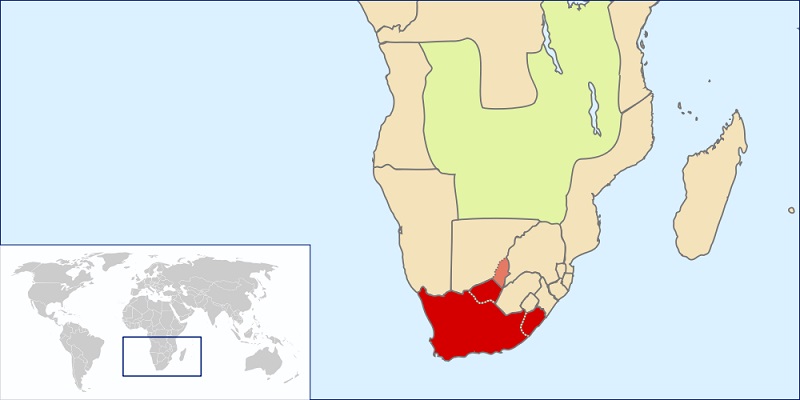
Zimbabwe - Photo 2If presented the choice, which would you rather be granted: riches or power?

Many would conclude riches, because of societal expressions like the “Golden Rule: He who has the Gold… rules”. Yet the truth is riches can be created and destroyed quickly. This was the experience just recently during the 2008 Great Recession, where people in the US – the richest country on the planet – lost $11 Trillion in net worth in short order.

On the other hand, there is power. History shows that with power, the rights to riches can be granted, exploited and passed on, from century to century, generation to generation. Consider for example the African continent (in particular the southern region) and the Royal Charters that granted abundant wealth to a privileged few:

The English had been the first to adopt the approach of bundling their resources into a monopoly enterprise, with the English East India Company in 1600. This threatened their Dutch competitors with ruin,[15] so in 1602 the Dutch monarchy followed suit and sponsored the creation of a single Dutch East Indies Company and granted it monopoly over the Asian trade. (Source: http://en.wikipedia.org/wiki/Dutch_East_India_Company#Formation_.281602.29)

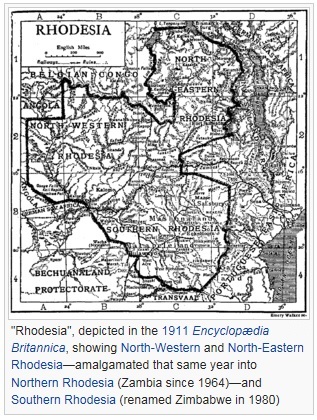
CU Blog - A Lesson in History - Royal Charter - Zimbabwe -vs- South Africa - Photo 1The British monarchy has issued over 980 Royal Charters.[1] (A formal document issued by a monarch as letters patent, granting a right or power to an individual or a body corporate). A specific charter was issued for the South African region.

The British South Africa Company (BSAC) was established following the amalgamation of Cecil Rhodes‘ Central Search Association and the London-based Exploring Company Ltd which had originally competed to exploit the expected mineral wealth of Mashonaland but united because of common economic interests and to secure British government backing. The company received a Royal Charter in 1889 modeled on that of the English East India Company. Its first directors included the Duke of Abercorn, Rhodes himself and the South African financier Alfred Beit. Rhodes hoped BSAC would promote colonisation and economic exploitation across much of south-central Africa, as part of the “Scramble for Africa“. However, his main focus was south of the Zambezi, in Mashonaland and the coastal areas to its east, from which he believed the Portuguese could be removed by payment or force, and in the Transvaal, which he hoped would return to British control.[1] (Source: http://en.wikipedia.org/wiki/British_South_Africa_Company)

This historic information is being considered in conjunction with the book Go Lean…Caribbean; a publication designed to elevate the region’s economic (create 2.2 million new jobs), security and governing engines. Why would this “Lesson in History” matter in assessing today’s Caribbean status and fate?

It is of utmost importance. This discussion reveals how to reconcile the injustices of the past, and still build a better future. We have good models to consider, in this case the countries of Zimbabwe and South Africa.

In a previous blog/commentary, the issue of the origin of colonial entitlements was detailed at full length. A direct quote relates:

The most iconic of all the Papal Bulls [-“letters patent” or charters issued by a Pope, the Head of the Roman Catholic Church -] was the Inter caetera, a Papal Bull by Pope Alexander VI on 4 May 1493, which set a demarcation between the New Lands to Portugal and Spain; this granted to Spain all lands to the “west and south” … of the islands of the Azores … and all new lands to the East of this pole remained assigned to Portugal.

Just before this world-changing decree, there was an earlier Papal Bull that sealed the fate and would prejudice the African Diaspora for 500 years. The African Slave Trade and institution of “Slavery” was legally predicated on a Papal Bull from Pope Innocent VIII (Giovanni Battista Cybo) in 1491; just months before Christopher Columbus’s historic first voyage

From the origins of slavery, [colonialism] traversed the historic curves of social revolution and evolution. In the 1500, the Protestant movement took hold. As other European powers deviated from Catholicism, Papal Bulls carried no significance to them and compliance was ignored. England and Holland established their own Protestant Churches with their own monarch as head of Church and State; Papal decrees were replaced with Royal Decrees and Charters. The intent and end-result was still the same: territories and lands awarded (colonized) with the stroke of a pen by one European power after another. The Royal Decrees and Charters were then reinforced with a strong military presence and many battles…

[The resultant] “oligarchy” … power effectively rested with a small number of people. These people could be distinguished by royalty, wealth, family ties, education, corporate, religious or military affiliation.

In this discussion of oligarchy, focus is given to powerful families. There are encyclopedic references that relate that oligarchy structures are often controlled by a few prominent families, who typically pass their influence/wealth from one generation to the next, even though inheritance alone is not a necessary condition for oligarchies to prevail…

This is the challenge that belies Caribbean society. Most of the property and indigenous wealth of the Caribbean region is concentrated amongst the rich, powerful and yet small elite; an oligarchy. Many times these families received their property, corporate rights and/or monopolies by Royal Charter from the European monarchs of ancient times. These charters thus lingered in legacy from one generation to another … until …

The form of rulership that dominated these times in history is that of Oligarchy; empowered by Royal Charters/Decrees. Today, oligarchy – rule by the rich[4] – is synonymous with another term commonly used, plutocracy.

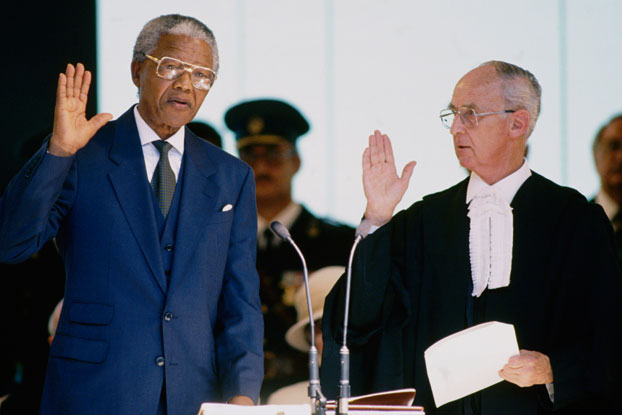
Zimbabwe Photo 3The subject of oligarchs is very familiar on the African continent. This has been a real issue there. In many countries after colonialism, like Zimbabwe (1980), the cure for the oligarch disease was nationalization – forfeiting and seizing commercial farms and mines. This turned out disastrously for this country; the cure was worse than the disease. But, next door in South Africa (14 years later), the strategy, tactics and implementation was different. This country did not ascend to majority-rule until 1994; the first majority-ruled President there, Nelson Mandela saw the futility of the nationalization strategy amongst the precedent independent African nations, so he pursued an alternate approach to assuage White Flight and keep the capital and skilled labor in the country. But the continuation of the oligarchs ill-gained, and public-perceived-stolen assets forged problems in the reality of economic/wealth inequality. Majority-rule therefore brought no revolutionary change for the average man.

All in all, change is not easy. It is heavy-lifting. This is abundantly clear in the examination of the independent majority-ruled Zimbabwe and majority-ruled South Africa. See Chart in the Appendix of the comparisons.

The details of the Republic of Zimbabwe (1980) evolution are as follows:

The British South Africa Company was a Royal Charter, to administer “North-Western Rhodesia” and “North-Eastern Rhodesia” for White settlement; it was not under those names, but the names of the geographic parts—”Mashonaland”, “Matabeleland”, “Barotseland”, and so on. The collective territories were initially referred to as “Zambesia” – the name origins of both Zambia and Zimbabwe – but became Rhodesia as an international brand. While the White minority community resisted the transition to black majority-rule, the change inevitably came, empowering revolutionary leader Robert Mugabe. The new regime – due to spite, revenge and broken promises – began confiscating White-owned farmlands. This is widely blamed for leading to the deterioration of the Zimbabwean economy (societal abandonment of human and financial capital); this has plagued the country even until this day.[113]

The details of the Republic of South Africa (1994) evolution are as follows:

The Cape Colony was a British colony in present-day South Africa and Namibia, named for the Cape of Good Hope. The British colony was preceded by an earlier Dutch colony of the same name, established in 1652 by the Dutch East India Company – granted by Royal Charter from the Dutch Monarchy. The Dutch lost the colony to Britain following the 1795 Battle of Muizenberg, but had it returned following the 1802 Peace Treaty of Amiens. It was re-occupied by the British following the Battle of Blaauwberg in 1806, and British possession affirmed with the Anglo-Dutch Treaty of 1814. The Cape Colony then remained in the British Empire, becoming self-governing in 1872, and uniting with three other colonies to form the Union of South Africa in 1910. Despite practicing racial segregation for most of its history, eventually integration and black majority-rule evolved in the Republic of South Africa. Despite their resistance to these changes, accommodations and reconciliations on the part of Nelson Mandela allowed for the continuation of the established societal engines; the minority White communities and business interests remained.

Zimbabwe - Photo 4Considering these case studies, the Failed-State status of Zimbabwe versus the economic successes of South Africa, we see a lesson in this history, an obvious appreciation for best-practices … for us to apply in the Caribbean. We can optimize these best-practices by applying regional strategies, tactics and implementations to benefit everyone – the Greater Good – and try not to disenfranchise any one group.

The masses of people in the democratic Caribbean now have the right to rule, not just some special group set aside by Royal Decree or granted power by a Royal Charter. Since there is the scientific fact that no one can go back in time and change history; we can only move forward, hopefully with wisdom from the lessons learned in history. The Go Lean book presents a roadmap on how to benefit from these lessons – good, bad and ugly – and how to empower communities anew; to use political power to impact the Greater Good. We therefore see a role for the Rich (One Percent – Page 224), the Poor (Page 222) and the Middle Classes (Page 223).

The consideration of the Go Lean book, as related to this subject is one of governance, the need for technocratic stewardship of the regional Caribbean society. This point was also pronounced in the opening Declaration of Interdependence (Page 12) with these acknowledgements and statements:

xi.   Whereas all men are entitled to the benefits of good governance in a free society, “new guards” must be enacted to dissuade the emergence of incompetence, corruption, nepotism and cronyism at the peril of the people’s best interest. The Federation must guarantee the executions of a social contract between government and the governed.

xii. Whereas the legacy in recent times in individual states may be that of ineffectual governance with no redress to higher authority, the accedence of this Federation will ensure accountability and escalation of the human and civil rights of the people for good governance, justice assurances, due process and the rule of law. As such, any threats of a “failed state” status for any member state must enact emergency measures on behalf of the Federation to protect the human, civil and property rights of the citizens, residents, allies, trading partners, and visitors of the affected member state and the Federation as a whole.

xiii. Whereas the legacy of dissensions in many member-states (for example: Haiti and Cuba) will require a concerted effort to integrate the exile community’s repatriation, the Federation must arrange for Reconciliation Commissions to satiate a demand for justice.

This Go Lean book serves as a roadmap for the introduction and implementation of the technocratic Caribbean Union Trade Federation (CU) to provide better stewardship for the 30 member-states of the Caribbean region, despite their European heritage. The book (and subsequent blog/commentaries) posits that we must not fashion ourselves as parasites of our previous European colonizers, but rather pursue a status as protégés.

Our past history feature much oppression and repression; European colonialism had been a villainous “dragon”. But we can train our dragons! We can make the most of previous bad history. This point was presented as a strategy for Direct Foreign Investments, asserting that we want to invite and attract investments. We can use their resources to elevate our own communities, while still providing a return/profit for the investors.

This is Pragmatism 101!

We, in the Caribbean, were not the only ones abused. Other indigenous people (Africans, Asians, Amerindians, etc.) also suffered, sometimes even more so. The goal should be to thrive despite the disabling legacy; (and if not for everyone, then make the most of the situation for the most number of people).

This is the community ethos of the Greater Good!

Globalization is now an ‘Agent of Change’ that we must contend with. We must “play nice in the sandbox” with people of other countries, especially those with capital resources. So if a minority group represents a faction that previously exploited our land and forefathers, we cannot expect to extract vengeance against them – Zimbabwe proved the futility of such a quest for justice and inequity. As related in the Go Lean book (Page 151), the best-practice for any governing entity to grow the economy is to protect all property rights; (real, personal or intellectual). This is the “new” New World; and the new formula for success.

Another formula, an economic principle, is that “voluntary trade creates wealth” (Page 21). This fact has often been overlooked in policy decisions for Africa. The following VIDEO portrays this dilemma, decrying the current migrant/refugee crisis in Europe, when the best-practice the continent can provide the African people is a more liberal trade policy, allowing markets for African agricultural produce. (Without this type of proactive strategies, the continent is being oppressed … all over again … by today’s Europe; this is a lesson learned from the Native American Reservations in the US).

VIDEO: UKIP Leader Nigel Farage Addressing European Parliament on African Culpability & Hyprocrisy – https://youtu.be/NTwOap7ohc4

Posted by Wednesday, April 29, 2015 – UKIP Leader Nigel Farage: speaks to the European Parliament on the EU suggestion that the continent should have a common asylum and migration policy. He felt it was important to represent the view that this is not just another attack on British sovereignty but also inherently dangerous.

In general, the Go Lean roadmap stresses key community ethos, strategies, tactics, implementations and advocacies necessary to transform and turn-around the eco-systems of Caribbean society. These points are detailed in the book as follows:

Community Ethos – Deferred Gratification Page 21
Community Ethos – Economic Principles – Economic Systems Influence   Individual Choices Page 21
Community Ethos – Economic Principles – Consequences of Choices Lie in   the Future Page 21
Community Ethos – Ways to Impact the Future Page 26
Community Ethos – Ways to Manage Reconciliations – South African Model Page 34
Community Ethos – Ways to Impact the Greater Good Page 37
Strategy – Vision – Confederate all 30 member-states/ 4 languages into a Single Market Page 45
Tactical – Separation-of-Powers – CU Federal Government versus Member-State Governance Page 71
Implementation – Ways to Pay for Change Page 101
Implementation – Ways to Foster International Aid Page 115
Planning – 10 Big Ideas – #4: Confederation Without Sovereignty Page 127
Planning – Ways to Improve Trade Page 128
Planning – Ways to Model the new European Union – Unified Economy Page 130
Planning – Ways to Make the Caribbean Better Page 131
Planning – Lessons Learned from 2008 Page 136
Planning – Lessons Learned from Indian Reservations – Audacity versus Absence of Hope Page 141
Advocacy – Ways to Grow the Economy – Protect Property Rights Page 151
Advocacy – Ways to Create Jobs Page 152
Advocacy – Ways to Improve Governance Page 168
Advocacy – Ways to Better Manage the Social Contract Page 170
Advocacy – Ways to Better Manage Natural Resources Page 183
Advocacy – Ways to Preserve Caribbean Heritage Page 218

In considering this history and re-addressing the opening question: given the choice between riches and power, we choose power!

With the proper stewardship, we can “create real money from thin air”; establish trade networks to grow the economy, educate our people to be global leaders, foster development of products and services that the world demands. The “world would beat a path to our doors”.

Adherence to these best-practices – gleaned from this lesson in history – would help us make our Caribbean community a better homeland to live, work and play.  🙂

Download the free e-Book of Go Lean … Caribbean – now!

———

Appendix – Comparative Analysis of Zimbabwe versus South Africa

Zimbabwe

South Africa

Economy – overview Zimbabwe’s economy is growing despite continuing political   uncertainty. Following a decade of contraction from 1998 to 2008, Zimbabwe’s   economy recorded real growth of roughly 10% per year in 2010-11, before   slowing in 2012-13 due poor harvests and low diamond revenues. The government   of Zimbabwe faces a number of difficult economic problems, including   infrastructure and regulatory deficiencies, ongoing indigenization pressure,   policy uncertainty, a large external debt burden, and insufficient formal   employment. Until early 2009, the Reserve Bank of Zimbabwe routinely printed money   to fund the budget deficit, causing hyperinflation. Dollarization in early   2009 – which allowed currencies such as the Botswana   pula, the South Africa   rand, and the US dollar to be used locally – ended hyperinflation and reduced   inflation below 10% per year, but exposed structural weaknesses that continue   to inhibit broad-based growth. South Africa is a middle-income, emerging market with an   abundant supply of natural resources; well-developed financial, legal,   communications, energy, and transport sectors and a stock exchange that is   the 16th largest in the world. Even though the country’s modern   infrastructure supports a relatively efficient distribution of goods to major   urban centers throughout the region, unstable electricity supplies retard   growth. The global financial crisis reduced commodity prices and world   demand. GDP fell nearly 2% in 2009 but has recovered since then, albeit   slowly with 2014 growth projected at about 2%. Unemployment, poverty, and   inequality – among the highest in the world – remain a challenge. Official   unemployment is at nearly 25% of the work force, and runs significantly   higher among black youth. Eskom, the state-run power company, has built two   new power stations and installed new power demand management programs to   improve power grid reliability. Construction delays at two additional plants,   however, mean South Africa   is operating on a razor thin margin; economists judge that growth cannot   exceed 3% until those plants come on line. South Africa’s economic policy   has focused on controlling inflation, however, the country has had   significant budget deficits that restrict its ability to deal with pressing   economic problems. The current government faces growing pressure from special   interest groups to use state-owned enterprises to deliver basic services to   low-income areas and to increase job growth.
Population 12,973,808 54,002,000
GDP (purchasing power parity) $7.496 billion (2013 est.) $595.7 billion (2013 est.)
$7.265 billion (2012 est.) $584 billion (2012 est.)
$6.957 billion (2011 est.) $569.5 billion (2011 est.)
note: data are in 2013 US dollars note: data are in 2013 US dollars
GDP – real growth rate 3.2% (2013 est.) 2% (2013 est.)
4.4% (2012 est.) 2.5% (2012 est.)
10.6% (2011 est.) 3.5% (2011 est.)
GDP – per capita (PPP) $600 (2013 est.) $11,500 (2013 est.)
$600 (2012 est.) $11,400 (2012 est.)
$500 (2011 est.) $11,300 (2011 est.)
note: data are in 2013 US dollars note: data are in 2013 US dollars
GDP – composition by sector agriculture: 20.1% agriculture: 2.6%
industry: 25.4% industry: 29%
services: 54.5% (2013 est.) services: 68.4% (2013 est.)
Population below poverty line 68% (2004) 31.3% (2009 est.)
Household income or consumption by   percentage share lowest 10%: 2% lowest 10%: 1.2%
highest 10%: 40.4% (1995) highest 10%: 51.7% (2009 est.)
Inflation rate (consumer prices) 8.5% (2013 est.) 5.8% (2013 est.)
8.2% (2012 est.) 5.7% (2012 est.)
Labor force 3.939 million (2013 est.) 18.54 million (2013 est.)
Labor force – by occupation agriculture: 66% agriculture: 9%
industry: 10% industry: 26%
services: 24% (1996) services: 65% (2007 est.)
Unemployment rate 95% (2009 est.) 24.9% (2013 est.)
80% (2005 est.) 25.1% (2012 est.)
note: figures include unemployment and underemployment;   true unemployment is unknown and, under current economic conditions,   unknowable
Distribution of family income – Gini   index 50.1 (2006) 63.1 (2005)
50.1 (1995) 59.3 (1994)
Budget revenues: $NA revenues: $88.53 billion
expenditures: $NA (2013 est.) expenditures: $105.5 billion (2013 est.)
Industries mining (coal, gold, platinum, copper,   nickel, tin, diamonds, clay, numerous metallic and nonmetallic ores), steel;   wood products, cement, chemicals, fertilizer, clothing and footwear, foodstuffs,   beverages mining (world’s largest producer of   platinum, gold, chromium), automobile assembly, metalworking, machinery,   textiles, iron and steel, chemicals, fertilizer, foodstuffs, commercial ship   repair
Industrial production growth rate 3.7% (2013 est.) 0.9% (2013 est.)
Agriculture – products corn, cotton, tobacco, wheat, coffee,   sugarcane, peanuts; sheep, goats, pigs corn, wheat, sugarcane, fruits,   vegetables; beef, poultry, mutton, wool, dairy products
Exports $3.144 billion (2013 est.) $91.05 billion (2013 est.)
$3.314 billion (2012 est.) $93.48 billion (2012 est.)
Exports – commodities platinum, cotton, tobacco, gold,   ferroalloys, textiles/clothing gold, diamonds, platinum, other metals   and minerals, machinery and equipment
Exports – partners China 21.1%, South Africa 15.1%,   Democratic Republic of the Congo 12.1%, Botswana 10.8%, Italy 4.6% (2012) China 11.8%, US 8.3%, Japan   6%, Germany 5.7%, India 4.2%   (2012)
Imports $4.571 billion (2013 est.) $99.55 billion (2013 est.)
$4.569 billion (2012 est.) $102.6 billion (2012 est.)
Imports – commodities machinery and transport equipment,   other manufactures, chemicals, fuels, food products machinery and equipment, chemicals,   petroleum products, scientific instruments, foodstuffs
Imports – partners South    Africa 51.9%, China 10%   (2012) China 14.4%, Germany   10.1%, Saudi Arabia 7.7%, US 7.4%, Japan   4.6%, India   4.5% (2012)
Debt – external $8.445 billion (31 December 2013 est.) $139 billion (31 December 2013 est.)
$8.765 billion (31 December 2012 est.) $130.4 billion (31 December 2012 est.)
Exchange rates Zimbabwean dollars (ZWD) per US dollar   – rand (ZAR) per US dollar –
234.25 (2010) 9.576 (2013 est.)
234.25 (2009) 8.2031 (2012 est.)
9,686.8 (2007) 7.3212 (2010 est.)
note: the dollar was adopted as a legal currency in 2009;   since then the Zimbabwean dollar has experienced hyperinflation and is   essentially worthless 8.42 (2009)
  7.9576 (2008)
Fiscal year calendar year 1 April – 31 March
Public debt 202.4% of GDP (2013 est.) 45.4% of GDP (2013 est.)
244.2% of GDP (2012 est.) 42.3% of GDP (2012 est.)
Reserves of foreign exchange and gold $437 million (31 December 2013 est.) $48.46 billion (31 December 2013 est.)
$575.6 million (31 December 2012 est.) $50.7 billion (31 December 2012 est.)
Current Account Balance -$576 million (2013 est.) -$23.78 billion (2013 est.)
-$416.5 million (2012 est.) -$24.07 billion (2012 est.)
GDP (official exchange rate) $10.48 billion (2013 est.) $353.9 billion (2013 est.)
Stock of direct foreign investment –   at home $NA $143.3 billion (31 December 2013 est.)


Share this post:
, , ,
[Top]

Forging Change: ‘Food’ for Thought

Go Lean Commentary

“The way to a man’s heart is through his stomach” – Old Adage.

Could it be that simple? Have we been laboring all the while, trying to forge change in the Caribbean region while missing out on the easiest driver: Food?

Seriously! We “gotta” eat!

While the publishers of the book Go Lean…Caribbean wants to forge change in the Caribbean, we recognize that it is a heavy-lifting task. There are so many societal defects in the region and we need effective strategies, tactics and implementation to effect turn-around. Despite all the advance research and academic exercises, we seem to have left off this simple yet effective model: Food.

This is the impression gleaned from this University of Pittsburgh (USA) study and VIDEO here:

Video: Study: Changing Diet May Affect Colon Cancer Risk – http://www.today.com/video/study-changing-diet-may-affect-colon-cancer-risk-436297283693

As the foregoing VIDEO depicts, change can be forged in as soon as 2 weeks. That simple! This is impactful enough for us to all lean-in to this guidance.

Cancer – this is the underlying threat being mitigated in the foregoing VIDEO. While this is a complicated medical issue – where many people have lost their lives – it is not oversimplifying to say that our food choices can endanger our overall health. While everything is not known about cancer – there is no actual cure, only treatments – it is the accepted wisdom that diet and exercise minimize the risk of affliction.

The subject of cancer is a community health crisis. But if we can forge change in this threatening area by our food choices, then we need to pay heed.

The book Go Lean…Caribbean serves as a roadmap for the introduction and implementation of the Caribbean Union Trade Federation (CU), a confederation of all 30 member-states in the region. This effort is an initiative to bring change and empowerment to the Caribbean region, to make the region a better place to live, work, heal and play. From the outset, the book recognized the significance of our culture, how food and diet plays a significant role in the Caribbean eco-system with these statements in the opening Declaration of Interdependence (Page 14):

xxvi.     Whereas the Caribbean region must have new jobs to empower the engines of the economy and create the income sources for prosperity, and encourage the next generation to forge their dreams right at home, the Federation must therefore foster the development of new industries, like that of … frozen foods … impacting the region with more jobs.

xxx.     Whereas the effects of globalization can be felt in every aspect of Caribbean life, from the acquisition of food and clothing, to the ubiquity of ICT, the region cannot only consume, it is imperative that our lands also produce and add to the international community, even if doing so requires some sacrifice and subsidy.

xxxii.    Whereas the cultural arts … of the region are germane to the quality of Caribbean life, and the international appreciation of Caribbean life, the Federation must implement the support systems to teach, encourage, incentivize, monetize and promote the related industries … These endeavors will make the Caribbean a better place to live, work and play.

The purpose of the Go Lean roadmap is societal change, not food; yet there is this acknowledgement that food can help forge change. This is against the backdrop that there are many threats to Caribbean life, liberty and the pursuit of happiness. Food choices affect these executions. Think: obesity, health care, cancer, poverty and jobs.

This Go Lean roadmap calls for the heavy-lifting in shepherding many important aspects of Caribbean life; these food-related issues included. This is not so simple anymore. For one, the book reports (Page 157) that in the United States “Cancer strikes nearly 1 in every 2 men and more than 1 in every 3 women” and then sounds the alarm that the Caribbean cannot be far behind. This may be considered a “Clear and Present Danger”. So there is the need for change in this important area.

The Go Lean book, as an empowerment roadmap, must therefore examine the reality and consequences of food, under the guise of this regional effort. This roadmap has 3 prime directives:

  • Optimization of the economic engines in order to grow the regional economy to $800 Billion GDP and create 2.2 million new jobs, many of which are projected for food-related and allied health industries (30,000 in direct agriculture; 20,000 in direct Health Care; 4000 in direct Fisheries; and 2000 related to Frozen Foods).
  • Establishment of a security apparatus to protect the resultant economic engines.
  • Improvement of Caribbean governance, including a separation-of-powers with the member-states, to support these engines.

The book is not a public health instruction manual. Nor is it is a book on science and nutrition. But it does describe the CU as a hallmark of a technocracy, a commitment to efficiency and effectiveness, but still with a commitment to concepts of culture, food, and fun – overall happiness. The Go Lean book declares that before any real change takes root in the Caribbean that we must reach the heart, that there must be an adoption of new community ethos, the national spirit that drives the character and identity of its people. We must therefore use effective and efficient drivers to touch the heart and forge this change. How? We know there is truth to the opening quotation: “through the stomach”.

The Go Lean roadmap was constructed with the community ethos in mind to forge change, plus the execution of related strategies, tactics, implementations and advocacies to make the change permanent. The following is a sample of these specific details from the book:

Community Ethos – Deferred Gratification Page 21
Community Ethos – Economic Principles – People Choose Page 21
Community Ethos – Economic Principles – People Respond to Incentives in Predictable Ways Page 21
Community Ethos – Economic Principles – The Consequences of Choices Lie in the Future Page 21
Community Ethos – Governing Principles – Lean Operations Page 24
Community Ethos – Ways to Impact the Future Page 26
Community Ethos – Ways to Impact Research & Development – Nouvelle Caribbean Cuisine Page 30
Community Ethos – Ways to Impact Turn-Around Page 33
Community Ethos – Ways to Promote Happiness – Promotion of Domestic Cultural Institutions Page 36
Community Ethos – Ways to Impact the Greater Good Page 37
Strategy – Mission – Build and foster local economic engines to satiate food   needs Page 45
Strategy – Mission – Celebrate the Culture and Cuisine of the Caribbean Page 46
Strategy – Customers – Outreach to Caribbean Diaspora Page 47
Strategy – Agents of Change – Globalization Page 57
Tactical – Confederating a Permanent Union Page 63
Tactical – Fostering a Technocracy Page 64
Tactical – Creating $800 Billion Economy – New High Multiplier Industries – Frozen Foods Page 70
Tactical – Separation of Powers – Department of State – Culture   Administration Page 81
Tactical – Separation of Powers – Food / Nutritional Administrations Page 87
Tactical – Separation of Powers – Agriculture & Fisheries Licensing – Inspections Page 88
Tactical – Separation of Powers – Farm & Marine Credit – Economic Influence Page 88
Implementation – Ways to Pay for Change Page 101
Implementation – Ways to Deliver Page 109
Implementation – Ways to Benefit from Globalization – Dynamics of Food Supply Page 119
Implementation – Ways to Promote Independence – Food Interdependence Page 119
Planning – 10 Big Ideas for the Caribbean Region – 4 Languages & Culture in Unison Page 127
Planning – Ways to Improve Trade – Diaspora Marketing Page 128
Planning – Ways to Make the Caribbean Better Page 136
Advocacy – Ways to Grow the Economy Page 151
Advocacy – Ways to Create Jobs Page 152
Advocacy – Ways to Impact  Cancer – Promote Wellness – Better Diets Page 157
Advocacy – Ways to Better Manage Food Consumption Page 162
Advocacy – Ways to Improve Communications – Public Broadcasting of “Sound-bites” Page 186
Advocacy – Ways to Impact Events – Food Festivals Page 191
Advocacy – Ways to Develop Frozen Foods Page 208
Advocacy – Ways to Improve Fisheries Page 210
Advocacy – Ways to Preserve Caribbean Heritage – Promote Culture Page 218
Advocacy – Ways to Improve the Arts Page 230
Advocacy – Ways to Impact Urban Living – Promotion of Farmers Markets Page 234
Advocacy – Ways to Impact Rural Living – Agricultural Co-existence Mandate Page 235

This roadmap wants to change the Caribbean diet plan, branded Nouvelle Caribbean Cuisine: more fiber, less fats; more green vegetables, less processed food; no more S.A.D., meaning Standard American Diet.

As depicted by the S.A.D. references, there is the expectation not to allow the American eco-system to lead in this sphere of influence. There was a time when much of the Caribbean food supply originated locally. That is not a difficult message to convey. Lesser developed countries, (think Africa), are more successful with local food production and consumption, the Caribbean can succeed. While this plan is optimistic, it is realistic too. People can and do change.

There is the acknowledgement that the business of food has changed in the light of modern dynamics, particularly due to globalization. To spur more local agricultural development, the economic engines of the food supply must be secured. This point was previously detailed in these Go Lean blog/commentaries:

https://goleancaribbean.com/blog/?p=3276 Role Model Shaking Up the World of Cancer
https://goleancaribbean.com/blog/?p=2522 The Cost of Cancer Drugs
https://goleancaribbean.com/blog/?p=2276 Climate Change May Affect Food Supply Within a Decade
https://goleancaribbean.com/blog/?p=1847 Cuban All Natural – Declared “the best in the world”
https://goleancaribbean.com/blog/?p=658 Wellness Advocates push for junk-food tax
https://goleancaribbean.com/blog/?p=554 Cuban cancer medication registered in 28 countries
https://goleancaribbean.com/blog/?p=286 PR’s Comprehensive Cancer Center Project Breaks Ground

“Do what you have always done, get what you’ve always got” – Old Adage.

The effort to forge change has also been stressed in previous Go Lean blog/commentaries, as detailed here:

https://goleancaribbean.com/blog/?p=3568 Forging Change: Music Moves People
https://goleancaribbean.com/blog/?p=3512 Forging Change: The Sales Process
https://goleancaribbean.com/blog/?p=2291 Forging Change: The Fun Theory
https://goleancaribbean.com/blog/?p=623 Only at the precipice, do they change

In the Caribbean, we need better food consumption habits. According to the foregoing VIDEO, it does not take a lot to change habits in this regard. We must simply push hard (messaging) on the needed changes, and then labor to get the community ethos to take hold. All the earnest effort will be a waste unless people are moved to change. So we must use all effective tools to forge the required change; food or the “stomach” is one of the best ways … to reach people.

Food - Photo 1

Food - Photo 4

Food - Photo 5

Food - Photo 2

Food - Photo 6

Food - Photo 3

This is serious; this is life-and-death.

The quest to change the Caribbean is more complex than just feeding people. But their food options can signal their willingness to change and assimilate the empowerments being advocated for the region. This is the mandate of the Go Lean roadmap: making the Caribbean a better place to live, work, heal and play.

We “gotta” eat …

So everyone is encouraged to lean-in for this change and the full Go Lean roadmap. 🙂

Download the book Go Lean … Caribbean – now!

Share this post:
, , , ,
[Top]

A Lesson in History – the ‘Grand Old Party’

Go Lean Commentary

The Caribbean Community (CariCom) in general and Jamaica in particular had the great privilege of hosting the United States President Barack Obama. He is the first Black Man to hold that esteemed office. In his visit, he was hailed as a conquering hero for agreeing to attend a regional meeting on Caribbean soil, thereby facilitating consultation and collaboration on regional issues between Caribbean government officials and the Chief Executive of the American Republic. Though the Caribbean member-states have no vote in the US Capitol of Washington DC, including the US Territories of Puerto Rico and the Virgin Island, we do have a voice. The Jamaica meeting allowed more audiences for those voices.

JAMAICA-US-OBAMA-CARICOM

The US is the world’s largest, and richest, single market economy – an economic and military Super Power – plus the largest trading partner for most Caribbean member-states. We are directly affected by the economic, security and governing policies emanating from the shores  of America. This focus aligns with the book Go Lean…Caribbean which seeks to elevate the Caribbean economic, security and governing engines. Begrudgingly, the book admits that the Caribbean is only a parasite of the American eco-system but presents a roadmap to elevate the region to a better status: protégé instead of parasite.

CU Blog - A Lesson in History - Grand Old Party - Photo 2Due to constitutionally mandated term limits, President Obama only has less than 2 years left in his administration. The focus now moves to his possible successor. The next presidential election in the US is set for November 2016. Despite being 18 months away, the jockeying has begun. Will the next president be a Democrat or a Republican? Will their policies be Pro-Caribbean, Anti-Caribbean or completely agnostic; indifferent to the Caribbean’s needs and issues? Agnosticism is not far-fetch as this is the observation given by President Obama. He concluded that 55 years of indifference towards Cuba was long-enough and he has “set the machinery in motion” to normalize relations with Cuba. Will this initiative continue with the new president? The world will have to wait-and-see.

As of this writing, 4 people have already officially declared and launched their campaigns, 1 Democrat (Hillary Clinton) and 3 Republicans (Ted Cruz, Rand Paul, and Marco Rubio). Most stakeholders in the Caribbean may think that the Democratic Party may be more conducive to Caribbean elevation. But still, the decision of American leadership is not ours to make nor influence. We must simply convene, consult and collaborate with whomever the elected official is, Democrat or Republican.

This commentary therefore asserts that we need to work to influence both sides of the American political divide; perhaps even more on the Republican side, since as of late, their policies are less empowering for African-American, and less empowering for the Caribbean. Therefore, there is the need for more mitigation and remediation for the Republican party … as of late.

As of late…
… because the Republican Party, commonly referred to as the GOP (abbreviation for Grand Old Party), was founded by anti-slavery activists in 1854. (The Caribbean and the United States share the same historic legacy of slavery and the slow drag throughout history to remediate the experiences and injustices for this Black-and-Brown population). The GOP dominated politics nationally and in most of the northern U.S. for most of the period between 1860 and 1932. There have been 18 Republican U.S. presidents, the first being Abraham Lincoln, who served from 1861 until his assassination in 1865, and the most recent being George W. Bush, who served two full four-year terms 2001 to 2009. The most recent Republican presidential nominee was former Massachusetts governor Mitt Romney who lost in 2012 to the incumbent president, Democrat Barack Obama. See the full 19th and 20th Century history of the GOP in the Appendix below.

Today, the party’s platform is generally based on American conservatism,[8][9][10] in contrast to the contemporary American liberalism of the rival Democratic Party. The Republican Party’s conservatism involves supporting free market capitalism, limited government, strong national defense, opposing regulation and labor unions, and supporting socially conservative policies.[2] Civil rights, or issues related to empowering minorities, are not identified with the Republican Party. What a change compared to the historic beginnings of this party.

In the current 114th U.S. Congress, the Republicans have their largest majority in the U.S. House of Representatives since the 1928 election; the GOP also holds a majority of seats in the Senate.[12] The party also holds a majority of governorships and state legislatures.[13]

It is what it is!

We must seek to engage Republicans. It is only the US Presidency that is missing in their echelon of American power.

There is expected to be a full corps of Republican presidential candidates for 2016. Some of the names that have expressed interest in running include the following, but these ones have not officially launched their federal campaigns … yet:

  • Jeb Bush – former 2-term Florida Governor
  • Mike Huckabee – former Arkansas Governor and 2008 presidential candidate
  • Chris Christie – Current Governor of New Jersey
  • Donald Trump – Popular Billionaire businessman and media personality
  • Ben Carson – Retired neurosurgeon and businessman; he happens to be an African-American; see article here:

Title: Will He Run? Ben Carson Set To Address Presidential Plans In May 4 Announcement

CU Blog - A Lesson in History - Grand Old Party - Photo 3He may announce his bid to run for president in 2016. He may not.

But whatever Ben Carson’s political aspirations are, we’ll all know when he makes them public in a May 4 announcement in Detroit, his team tells [news outlet] CNN.

The announcement, set to take place at the Detroit Music Hall Center for Performing Arts, is expected to be the launch for his presidential bid. Details, including ticketing and the subject of the announcement, however, have “yet to be hammered out,” Carson spokeswoman Deana Bass said.

“He will make an announcement. But he’s still very much in the exploratory phase, so he hasn’t made a decision yet,” she said.

From CNN:
The retired neurosurgeon has been traveling the nation over the past six months, giving paid speeches and meeting with supporters to gauge interest in a bid. He recently traveled to Iowa and New Hampshire, and spoke last weekend at the National Rifle Association’s meeting in Tennessee.  Carson’s relative political inexperience, however, hasn’t turned him away from the campaign — if he runs, he’ll look to make it an asset, framing himself as a common-sense alternative to the broken policies of Washington politicians.

So far, the presidential race has gained three GOP senators — Rand Paul of Kentucky, Ted Cruz of Texas, and Marco Rubio of Florida — but Carson’s green political experience (and the already full pot of GOP candidates) doesn’t seem to be a deterrent. And according to the Real Clear Politics average of polls, he may have a real shot.

From CNN:
Carson surveys right in the middle of the potential GOP field, ahead of more seasoned or better-known GOP contenders like former Arkansas Gov. Mike Huckabee or Rubio, and he took fifth place with 9% support in the last CNN/ORC survey, conducted in March.

Still, that’s a marked decline from late February, when he was polling in the top three of the pack, indicating he still has some work to do in proving his credibility with voters.

We’ll wait to see if Carson will join the Election 2016 club, but if May 4 turns out to be his bid announcement, will you vote for him?
Source: News One – Media Suite Targeting African-Americans – Posted 04/14/2015 from: http://newsone.com/3107603/ben-carson-set-to-address-presidential-plans-may-4-announcement/

Ben Carson is a retired neurosurgeon from Detroit. The publishers of the book Go Lean…Caribbean has come to this city to observe-and-report on the turn-around of this once great industrial city that is a national icon of urban dysfunction; (Page 140). There have been countless blog/commentaries that have described the Detroit (and surrounding Michigan) dynamics.

Is the United States ready for a second Black Man to assume the highest office in the land? Is Ben Carson ready? Is Black America ready for this Black Republican?

These are all appropriate questions. From the Caribbean perspective, we will observe-and-report on these developments.

The focus of the Go Lean book is not American politics, but rather the economic, security and governing engines of the Caribbean. Yet still, we need to have a productive relationship with the American federal government and whichever administration is in the White House. The book serves as a roadmap for the introduction and implementation of the Caribbean Union Trade Federation (CU); an initiative to bring “Hope and Change” to the Caribbean region; to make the region a better place to live, work and play. This Go Lean roadmap also has these 3 prime directives:

  • Optimization of the economic engines in order to grow the regional economy to $800 Billion & create 2.2 million new jobs.
  • Establishment of a security apparatus to protect the resultant economic engines.
  • Improvement of Caribbean governance to support these engines.

The book describes the CU as a technocratic administration with 144 different missions to elevate the Caribbean homeland. The underlying goal is stated early in the book with this pronouncement in the opening Declaration of Interdependence (Page 12):

xii. Whereas the legacy in recent times in individual states may be that of ineffectual governance with no redress to higher authority, the accedence of this Federation will ensure accountability and escalation of the human and civil rights of the people for good governance, justice assurances, due process and the rule of law…

The Go Lean roadmap represents “Hope and Change” for the Caribbean. In 2008, Barack Obama propelled forward into American conscience with that theme “Hope and Change“, now the effort is to propel an initiative for the Caribbean. We have some serious crises to contend with. We need hope and we need change…now.

This fact was enunciated by Obama in his visit to Jamaica. He explained how we have to better manage our interactions with Super Powers to ensure we are getting the sought-after benefits, and not being exploited for their self-interest. The President prescribed a formula for the Caribbean’s dealing with China … and also America itself.

VIDEO: President Barack Obama’s response on China’s involvement in Jamaica’s Development – https://youtu.be/rRaQjukEPOo

Published on 

Apr 22, 2015 — We are a movement of Jamaicans both at Home and Abroad who are willing to fight for real and lasting change. This isn’t for everyone — we’re Changing Jamaica Through Leadership, and we’re proud of it. If you’re someone who’d rather get involved than sit back, if you refuse to be cynical about what we can get done together, then you should be part of this at www.ourjamaicavote.org

The Go Lean roadmap was constructed with the following community ethos in mind, plus the execution of strategies, tactics, implementation and advocacies to elevate the Caribbean eco-system. The following is a sample of these specific details from the book:

Assessment – Caribbean Community’s stalled Single Market Initiative Page 15
Community Ethos – Economic Principles – People Choose Page 21
Community Ethos – Economic Principles – All Choices Involve Costs Page 21
Community Ethos – Economic Principles – People Respond to Incentives in Predictable Ways Page 21
Community Ethos – Economic Principles – Economic Systems Influence Individual Choices Page 21
Community Ethos – Economic Principles – The Consequences of Choices Lie in the Future Page 21
Community Ethos – Security Principles – “Crap” Happens Page 23
Community Ethos – Governing Principles – Minority Equalization Page 24
Community Ethos – Governing Principles – Lean Operations Page 24
Community Ethos – Ways to Impact the Future Page 26
Community Ethos – Ways to Foster Genius – Leadership Skills/Development Page 27
Community Ethos – Ways to Manage Reconciliations Page 34
Community Ethos – Ways to Impact the Greater Good Page 37
Strategy – Vision – Confederation of the 30 Caribbean Member-States into a Single Market Page 45
Strategy – Mission – Celebrate the Music, Sports, Art, People and Culture of the Caribbean Page 46
Tactical – Confederating a Permanent Union Page 63
Tactical – Fostering a Technocracy Page 64
Tactical – Separation of Powers: Federal Administration versus Member-States Governance Page 71
Implementation – Ways to Pay for Change Page 101
Implementation – Ways to Deliver Page 109
Planning – 10 Big Ideas for the Caribbean Region Page 127
Planning – Ways to Improve Trade Page 128
Planning – Ways to Make the Caribbean Better Page 131
Planning – Ways to Better Manage Image Page 133
Planning – Lessons Learned from Detroit Page 140
Advocacy – Ways to Grow the Economy Page 151
Advocacy – Ways to Create Jobs Page 152
Advocacy – Ways   to Improve Governance in the Caribbean Region Page 168
Advocacy – Ways to Better Manage the Social Contract Page 170
Advocacy – Ways to Improve Leadership Page 171
Advocacy – Ways to Improve Homeland Security Page 180
Advocacy – Ways to Improve Communications Page 186
Advocacy – Ways to Preserve Caribbean Heritage Page 218
Advocacy – Ways to Reboot Cuba Page 236

There is a consistency with this Go Lean commentary, applying lessons from a consideration of historic events and people. The premise is simple:

Those who refuse to learn from history are forced to repeat it.

The Go Lean book posits that the Caribbean has a dysfunctional history. Despite having the greatest address on the planet, the region suffers from an alarmingly high abandonment rate. We can… and must do better. By applying this lesson from history we should be able to better prosper where we’re planted here in the Caribbean.

There are other lessons for the Caribbean to learn from considering history; the following previous blog/commentaries apply:

https://goleancaribbean.com/blog/?p=4720 A Lesson in History: SARS in Hong Kong
https://goleancaribbean.com/blog/?p=4166 A Lesson in History: Panamanian Balboa
https://goleancaribbean.com/blog/?p=2809 A Lesson in History: Economics of East Berlin
https://goleancaribbean.com/blog/?p=2670 A Lesson in History: Rockefeller’s Pipeline
https://goleancaribbean.com/blog/?p=2585 A Lesson in History: Concorde SST
https://goleancaribbean.com/blog/?p=2480 A Lesson in History: Community Ethos of WW II
https://goleancaribbean.com/blog/?p=2297 A Lesson in History: Booker T versus Du Bois
https://goleancaribbean.com/blog/?p=1531 A Lesson in History: 100 Years Ago Today – World War I
https://goleancaribbean.com/blog/?p=789 A Lesson in History: America’s War on the Caribbean

The Go Lean roadmap seeks to empower and elevate Caribbean engines. It is out-of-scope to impact the US. That will be the campaign of the presidential candidates, perhaps also including Ben Carson. He would not be the first Black Republican presidential candidate; in fact in 2012 Herman Cain ran a substantial campaign for much of that “season” – a one-time front-runner. Further, in 2000, former ambassador Alan Keyes sought the Republican nomination for President.

Will “Ben Carson” campaign change the Republican party, making it more amiable to the Black Community? Did the previous candidates (Herman Cain & Alan Keyes) impact the party? It is only logical to conclude that each attempt by serious Black candidates will “crack the glass ceiling”; then eventually a substantial Black candidate will “break through”.

Will “Ben Carson” be that candidate? Let’s observe-and-report.

🙂

Download the free e-Book of Go Lean … Caribbean – now!

———-

APPENDIX – History of the Grand Old Party
(Source: Wikipedia Online Encyclopedia – Retrieved 04/19/2015 from: http://en.wikipedia.org/wiki/Republican_Party_(United_States) )

Founding and 19th century

CU Blog - A Lesson in History - Grand Old Party - Photo 4Founded in the Northern states in 1854 by anti-slavery activists, modernizers, ex-Whigs, and ex-Free Soilers, the Republican Party quickly became the principal opposition to the dominant Democratic Party and the briefly popular Know Nothing Party. The main cause was opposition to the Kansas–Nebraska Act, which repealed the Missouri Compromise by which slavery was kept out of Kansas. The Northern Republicans saw the expansion of slavery as a great evil. The first public meeting where the name “Republican” was suggested for a new anti-slavery party was held on March 20, 1854 in a schoolhouse in Ripon, Wisconsin.[14] The name was partly chosen to pay homage to Thomas Jefferson’s Republican Party.

The first official party convention was held on July 6, 1854, in Jackson, Michigan.[15] By 1858, the Republicans dominated nearly all Northern states. The Republican Party first came to power in 1860 with the election of Abraham Lincoln to the Presidency and Republicans in control of Congress and again, the Northern states. It oversaw the preserving of the union, the end of slavery, and the provision of equal rights to all men in the American Civil War and Reconstruction, 1861–1877.[16]

The Republicans’ initial base was in the Northeast and the upper Midwest [States].

Early Republican ideology was reflected in the 1856 slogan “free labor, free land, free men”, which had been coined by Salmon P. Chase, a Senator from Ohio (and future Secretary of the Treasury and Chief Justice of the United States).[17] “Free labor” referred to the Republican opposition to slave labor and belief in independent artisans and businessmen. “Free land” referred to Republican opposition to plantation system whereby slave-owners could buy up all the good farm land, leaving the yeoman independent farmers the leftovers. The Party strived to contain the expansion of slavery, which would cause the collapse of the slave power (“slaveocracy”) and the expansion of freedom.[18]

Lincoln, representing the fast-growing western states, won the Republican nomination in 1860 and subsequently won the presidency. The party took on the mission of preserving the Union and destroying slavery during the American Civil War and over Reconstruction. In the election of 1864, it united with War Democrats to nominate Lincoln on the National Union Party ticket.

The party’s success created factionalism within the party in the 1870s. Those who felt that Reconstruction had been accomplished and was continued mostly to promote the large-scale corruption tolerated by President Ulysses S. Grant ran Horace Greeley for the presidency. The Stalwarts defended Grant and the spoils system; the Half-Breeds pushed for reform of the civil service.

The GOP supported business generally, hard money (i.e., the gold standard), high tariffs to promote economic growth, high wages and high profits, generous pensions for Union veterans, and (after 1893) the annexation of Hawaii. The Republicans supported the pietistic Protestants who demanded Prohibition. As the northern post-bellum economy boomed with heavy and light industry, railroads, mines, fast-growing cities and prosperous agriculture, the Republicans took credit and promoted policies to sustain the fast growth.

Nevertheless, by 1890 the Republicans had agreed to the Sherman Antitrust Act and the Interstate Commerce Commission in response to complaints from owners of small businesses and farmers. The high McKinley Tariff of 1890 hurt the party and the Democrats swept to a landslide in the off-year elections, even defeating McKinley himself.

After the two terms of Democrat Grover Cleveland, the election of William McKinley in 1896 is widely seen as a resurgence of Republican dominance and is sometimes cited as a realigning election. McKinley promised that high tariffs would end the severe hardship caused by the [Economic] Panic of 1893, and that the GOP would guarantee a sort of pluralism in which all groups would benefit.

20th century

CU Blog - A Lesson in History - Grand Old Party - Photo 5The 1896 realignment cemented the GOP as the party of big business, while Theodore Roosevelt added more small business support by his embrace of trust busting. He handpicked his successor William Howard Taft in 1908, but they became enemies on economic issues. Defeated by Taft for the 1912 nomination, Roosevelt bolted the party and led the third party ticket of the Progressive Party. The party returned to the White House throughout the 1920s, running on platforms of normalcy, business-oriented efficiency, and high tariffs. The national party avoided the prohibition issue after it became law in 1920.

Warren G. Harding, Calvin Coolidge and Herbert Hoover were resoundingly elected in 1920, 1924, and 1928 respectively. The pro-business policies of the decade seemed to produce an unprecedented prosperity until the Wall Street Crash of 1929 heralded the Great Depression.

New Deal Era

CU Blog - A Lesson in History - Grand Old Party - Photo 6The New Deal coalition of Democrat Franklin D. Roosevelt controlled American politics for most of the next three decades, excepting the two-term presidency of Republican Dwight D. Eisenhower. Blacks moved into the Democratic Party during the New Deal era; they could vote in the North but not in the South. After Roosevelt took office in 1933, New Deal legislation sailed through Congress and the economy moved sharply upward from the nadir in early 1933. However long-term unemployment remained a drag until 1940. In the 1934 midterm elections, 10 Republican senators went down to defeat, leaving them with only 25 against 71 Democrats. The House of Representatives likewise had overwhelming Democratic majorities.

The GOP split into a majority “Old Right” (based in the Midwest) and a liberal wing based in the Northeast that supported much of the New Deal. The Old Right sharply attacked the “Second New Deal” and said it represented class warfare and socialism. Roosevelt was reelected in a landslide in 1936 but everything went awry in his second term, as the economy plunged, strikes soared, and FDR failed to take control of the Supreme Court or to purge the Southern conservatives in the Democratic party. The GOP made a major comeback in the 1938 elections, and had new rising stars such as Robert A. Taft of Ohio on the right and Thomas E. Dewey of New York on the left.[19] Southern conservatives joined with most Republicans to form the conservative coalition, which dominated domestic issues in Congress until 1964. Both parties split on foreign policy issues, with the anti-war isolationists dominant in the GOP and the interventionists who wanted to stop Hitler dominant in the Democratic party. Roosevelt won a third and fourth term in 1940 and 1944. Conservatives abolished most of the New Deal during the war, but did not attempt to reverse Social Security or the agencies that regulated business.

Historian George H. Nash argues:

Unlike the “moderate”, internationalist, largely eastern bloc of Republicans who accepted (or at least acquiesced in) some of the “Roosevelt Revolution” and the essential premises of President Truman’s foreign policy, the Republican Right at heart was counter-revolutionary, anti-collectivist, anti-Communist, anti-New Deal, passionately committed to limited government, free market economics, and congressional (as opposed to executive) prerogatives, the G.O.P. conservatives were obliged from the start to wage a constant two-front war: against liberal Democrats from without and “me-too” Republicans from within.[20]

The Democrats elected majorities to Congress almost continuously after 1932 (the GOP won only in 1946 and 1952), but the Conservative Coalition blocked practically all major liberal proposals in domestic policy. After 1945, the internationalist wing of the GOP cooperated with Harry Truman’s Cold War foreign policy, funded the Marshall Plan, and supported NATO, despite the continued isolationism of the Old Right.

CU Blog - A Lesson in History - Grand Old Party - Photo 7CU Blog - A Lesson in History - Grand Old Party - Photo 8The second half of the 20th century saw election or succession of Republican presidents Dwight D. Eisenhower, Richard Nixon, Gerald Ford, Ronald Reagan, George H. W. Bush and George W. Bush. Eisenhower had defeated conservative leader Senator Robert A. Taft for the 1952 nomination, but conservatives dominated the domestic policies of the Eisenhower Administration. Voters liked Ike much more than they liked the GOP, and he proved unable to shift the party to a more moderate position. After 1970, the liberal wing faded away.[21]

Ever since he left office in 1989, Reagan has been the iconic Republican; and Republican presidential candidates frequently claim to share his views and aim to establish themselves and their policies as the more appropriate heir to his legacy.[22] In 1994, the Party, led by House Minority Whip Newt Gingrich campaigning on the Contract with America, was elected to majorities to both houses of Congress in the Republican Revolution. However Gingrich was unable to deliver on most of its promises, and after the impeachment of President Bill Clinton in 1998 and subsequent Republican losses in the House, he resigned. Since Reagan’s day, presidential elections have been close. However, the Republican presidential candidate won a majority of the popular vote only in 2004, while coming in second in 1992, 1996, 2000, 2008 and 2012.

Share this post:
, , , ,
[Top]

Vanuatu and Tuvalu – Inadequate response to human suffering

Go Lean Commentary

“There but for fortune go I” – Sir Roland Sanders.

This commentator and author of the subsequent article, is spot on in this regards. Just last week (March 20) was the Spring Equinox in the Northern Hemisphere; so while hurricane season for the Caribbean is still months away, it is the “thick” of the season for the Southern Hemisphere right now; (equivalent to September for the Caribbean). Last week the Pacific island nations of Vanuatu and Tuvalu – see Appendices A, B & C – were devastated by the Category 5 Cyclone Pam. (Cyclones are the Pacific version of hurricanes).

Category 5!!!

Pacific or Caribbean; we both share this same reality. We have to contend with natural disasters, not of our making. This threat is heightened now with Climate Change. 9 of the 10 hottest years on record have now taken place since 2000.

The only exception to this trend was … 1998.

It is what it is!

Poor Vanuatu and Tuvalu… (see VIDEOs of the devastation in Appendix A below). They are not prepared for this “agent of change”; in fact their peoples are suffering right now; and they will suffer further trying to effectuate a recovery. See the full article here:

Title: Vanuatu and Tuvalu – Inadequate response to human suffering
By: Sir Roland Sanders – Caribbean/Commonwealth Commentator – Posted03-19-2015; retrieved 03-25-2015 from:
http://www.sirronaldsanders.com/viewarticle.aspx?ID=491

People on the East Coast of the United States of America (US) and the Caribbean should consider how best they might lend a helping hand to the people of the islands of Tuvalu and Vanuatu in the Pacific whose lives have been shattered by Cyclone Pam that struck them on the night of March 13.

In the case of the Caribbean islands, it is a matter of “there but for fortune go I”.

Vanuatu - Photo 2Category 5 Pam, ripped through both Vanuatu and Tuvalu – two archipelagic countries consisting of several small islands and atolls – creating widespread destruction.   Damage was so intense that all the inhabitants of one of the Tuvalu islands had to be evacuated.  They left behind everything they hold dear, and they now live in uncertainty about when they can return and how to start to reconstruct their lives.

The capacity of these countries to cope with ferocious cyclones, such as Pam, and the resilience to rebuild in the wake of huge damage, simply do not exist.   Both Vanuatu and Tuvalu are confronted with immediate humanitarian needs for food, shelter and fresh water.  Reports indicate that residents on some of the distant islands have resorted to drinking salt water.

The level of the immediate suffering can only be imagined by those who have not experienced the cruel conditions in which people are forced to live in the aftermath of natural disasters of this magnitude.

Vanuatu - Photo 1The governments of Australia and New Zealand, which are the two most developed Commonwealth countries in the area, have been quick to help with humanitarian assistance.  But, the islands in the two archipelagic countries are so scattered that distribution of supplies is severely constrained, particularly as many have no landing strips.  Britain, too, has offered help amounting to £1m.  That money will be made immediately available to UN organisations and international aid agencies already working in the region.

But the lack of aid co-ordination has resulted in uneven assistance to the people of the islands, and in some cases to no help at all.   At the time of writing, the government of Vanuatu announced that food will run out on some islands within a week. The deputy chair of the National Disaster Committee, Benjamin Shing, has said that while the country appreciated the aid, the initial response could have been handled better.  He claims that the aid agencies are working on their own rather than in co-operation with the government.  He added that “in nearly every country in the world where they go in they have their own operational systems, they have their own networks and they refuse to conform to government directives”. In the situation that Shing describes it is the already-suffering people who are hurt more as resources are duplicated or wasted in one area, and little or no help reaches others.

If, apart from Australia and New Zealand particularly, the response to the tragedy in Vanuatu and Tuvalu has not been impressive, the greater and more profound problem will be the rebuilding process.  These islands, like many in the Caribbean, do not have the capital formation in their own banking system to finance reconstruction.  They will have to turn to international financial institutions for help.   But, if the experience of the Caribbean is a measure of what they can expect, rebuilding will be a long and agonizing process.

Many Caribbean countries, such as Antigua and Barbuda, Grenada and Dominica, lost more than 3 years of gross domestic product (GDP) in 24 hours when hurricanes devastated them.  Anxious to rebuild in the wake of such massively destructive hurricanes, the governments of these countries were forced into the commercial market to secure financing to rebuild infrastructure, even while their revenues were declining from decreased production.  Hotels closed, agricultural production ceased and manufacturing halted.  The result was an increase in the national debt and uncomfortable levels of debt to GDP ratios of more than 100%.

These countries had no option.  They either had to borrow to rebuild and re-start their economies or face soaring unemployment, increase in poverty and inadequate investment in health and education services.

Right now, Vanuatu and Tuvalu are rightly focused on alleviating the suffering of their people.  But, the bigger and more fundamental problem of rebuilding – and how to pay for it – already looms large.   Australia’s Foreign Minister, Julie Bishop, has told the Tuvalu Prime Minister, Enele Sopoaga, that her government would support longer-term recovery and reconstruction efforts.   Vanuatu will also need that help.   Australia alone cannot provide it, nor should it be expected to.

As Richard Bourne of the Ramphal Institute observed recently, “with erratic climate events and sea level rise it is time for the global community to take more seriously the growing risks for island archipelagos, especially low-lying atoll states in the Pacific and Caribbean. In a single year a storm can knock 10 per cent off GDP, and certain communities are already being withdrawn from shorelines where ocean levels have risen. This is a particular challenge for the Commonwealth, where the Ramphal Institute estimates that there are some ten independent and dependent territories which might be under water in 2100”.

In its report to Commonwealth Heads of Government, “A Commonwealth of the People: Time for Urgent Reform”, the Eminent Persons Group of which I was a member had recommended that the 53-nation Commonwealth establish a disaster management capacity.  Unfortunately the recommendation was not implemented. The details of the mechanism are laid out in the report.  Suffice to say that the proposal sought to establish a rapid Commonwealth response to natural disasters; machinery for disaster preparation and mitigation; and the means to help mobilize concessionary financing for rebuilding.

Both Vanuatu and Tuvalu could have benefited enormously from such a disaster management capacity within the Commonwealth of which they are two of the smallest and most vulnerable of member states.  The Commonwealth Secretary-General, Kamalesh Sharma, called for Commonwealth help immediately after the destructive passage of Cyclone Pam, but the Commonwealth should be doing more at times of tragedy if it is to be relevant to the people of its member states.

Let us hope that the tragedy in Vanuatu and Tuvalu is a wake-up call.  Hurricanes in the Caribbean and cyclones in the Pacific are not going away.  They are clear and present dangers.

The commentator in this case, Sir Roland Sanders, is an honorable man. He has principles and passion for the Caribbean … and Commonwealth alike. But, the Commonwealth appears to be his profession – see Appendix D below – and his panacea. He is advocating for relief for Vanuatu and Tuvalu to come from their fellow member-states in the British Commonwealth. That is a tall order!

The Go Lean book relates that most former British colonies are members of the Commonwealth, a non-political, voluntary association of equal members. This entity has no power or resources. Any help extended to Vanuatu and Tuvalu will be strictly optional and extended from the member-states’ surpluses. The neighboring communities of Australia, New Zealand and Papua New Guinea maybe in better position to assist Vanuatu and Tuvalu; though it is not our place to lay claim to their budgets. It would be difficult, given the recent global financial difficulties to expect aid to come from the Caribbean or any Small Island Development States (SIDS).

On the other hand, the book Go Lean … Caribbean, calls for the region to adopt strategic, tactical and operational mitigations for hurricanes in the region. We cannot and must not be beggars on the international scene. These hurricanes and cyclones are no surprise; we know they are coming. So the book details advocacies to respond, rescue, repair, rebuild and restore the Caribbean eco-systems in the event of the now-heightened hurricane threats. These advocacies are designed to mitigate the challenges of Mother Nature, create jobs, secure the homeland and grow the economy at the same time.

This point is pronounced early in the book with this Declaration of Interdependence (Page 11), with the opening and subsequent statements:

i.    Whereas the earth’s climate has undeniably changed resulting in more severe tropical weather storms, it is necessary to prepare to insure the safety and security of life, property and systems of commerce in our geographical region. As nature recognizes no borders in the target of its destruction, we also must set aside border considerations in the preparation and response to these weather challenges.

vi.    Whereas the finite nature of the landmass of our lands limits the populations and markets of commerce, by extending the bonds of brotherhood to our geographic neighbors allows for extended opportunities and better execution of the kinetics of our economies through trade. This regional focus must foster and promote diverse economic stimuli.

viii.  Whereas the population size is too small to foster good negotiations for products and commodities from international vendors, the Federation must allow the unification of the region as one purchasing agent, thereby garnering better terms and discounts.

This book, Go Lean… Caribbean, serves as a roadmap for the introduction and implementation of a technocratic Caribbean Union Trade Federation (CU) to elevate society of the 30 Caribbean member-states. The 53-member Commonwealth is out of scope for this Go Lean effort; this is territorial and geographic in its focus. The CU effort is a confederation that includes the island-nations of the Caribbean Sea and the coastal states like Guyana, Suriname and Belize. These are all vulnerable to the hurricane threat.

As a Trade Federation, the CU would be able to establish a permanent sentinel to mitigate devastation that stems from storms like Cyclone Pam. We would be able to deploy implementations to aid our recovery, like regional power grid, pipelines, a, regional currency, leveraged casualty insurance plans, and a robust capitals market. In fact the CU/Go Lean roadmap has these 3 prime directives:

  • Optimization of the economic engines in order to grow the regional economy.
  • Establishment of a security apparatus to protect the resultant economic engines from man-made and natural threats.
  • Improvement of Caribbean governance to support these engines.

The Go Lean book details the economic principles and community ethos to adopt, plus the executions of strategies, tactics, implementations and advocacies to elevate the Caribbean to better manage the threats of Climate Change and natural disasters like hurricanes. We must forge solutions, in advance and in response. We must do these ourselves, primarily; we cannot be perennial beggars and expecting International Aid every time we have emergencies. We must grow up and grow into a mature role of self-sufficiency. Consider the detail list from the book as follows:

Economic Principles – People Choose because Resources are Limited Page 21
Economic Principles – All Choices Involve Costs Page 21
Economic Principles – People Respond to Incentives Page 21
Economic Principles – Economic Systems Influence Individual Choices Page 21
Economic Principles – Consequences of Choices Lie in the Future Page 21
Community Ethos – “Crap” Happens Page 23
Community Ethos – Lean Operations Page 24
Community Ethos – Return on Investments (ROI) Page 24
Community Ethos – Ways to Impact the Future Page 26
Community Ethos – Ways to Improve Sharing Page 35
Community Ethos – Impact the Greater Good Page 37
Anecdote – Pipeline Transport – Strategies, Tactics & Implementations Page 43
Strategy – Vision – Confederating 30 Member-states in a Permanent Union Page 45
Strategy – Agents of Change – Globalization Page 57
Strategy – Agents of Change – Climate Change Page 57
Tactical – Fostering a Technocracy Page 64
Tactical – Growing Economy – Marshall Plan-like campaigns Page 68
Tactical – Growing Economy – Surviving Bubbles Page 68
Separation of Powers – Securities Regulator for Reinsurance Products Page 74
Separation of Powers – Homeland Security – Emergency Management Page 76
Implementation – Assemble – Pipeline as a Focused  Activity Page 96
Implementation – Ways to Pay for Change – Hurricane Insurance Fund Page 101
Implementation – Ways to Develop a Pipeline Industry Page 107
Implementation – Ways to Deliver Page 109
Implementation – Ways to Improve Energy Usage – Regional Grid Storm Resets Page 113
Implementation – Ways to Foster   International Aid – Natural Disaster Relief Page 115
Implementation – Ways to Benefit from   Globalization – Act Locally, Think Globally Page 119
Implementation – Ways to Promote Independence – Disaster Self-Response Page 120
Planning – 10 Big Ideas – Homeland Security Pact Page 127
Advocacy – Ways to Grow the Economy Page 151
Advocacy – Ways to Improve Housing – Hurricane Risk Reinsurance Fund Page 161
Advocacy – Ways to Better Manage the Social Contract Page 170
Advocacy – Ways to Impact Public Works – Rebuild after Disasters Page 175
Advocacy – Ways to Improve Homeland Security – Assuage systemic threats Page 180
Advocacy – Ways to Better Manage Natural Resources Page 183
Advocacy – Ways to Improve for Natural Disasters Page 184
Advocacy – Ways to Impact Extractions – Pipeline Strategy Alignment Page 195
Advocacy – Ways to Improve Emergency   Management Page 196
Advocacy – Ways to Improve Monopolies – Foster Cooperatives Page 202
Advocacy – Ways to Improve Transportation – Pipeline Options Page 205
Advocacy – Ways to Impact Rural Living – Small Island Development Page 235
Advocacy – Ways to Impact British   Territories – Commonwealth Emergence Page 245
Appendix – Offshore Banking Developments – Financial Action Task Force Page 321

This commentary previously featured subjects related to preparing and responding to the devastating effects of Climate Change and natural disasters in the region:

https://goleancaribbean.com/blog/?p=4587 Climate Change Defense – First US city to be powered 100% by renewables
https://goleancaribbean.com/blog/?p=2465 Book Review: ‘This Changes Everything: Capitalism vs. the Climate’
https://goleancaribbean.com/blog/?p=2119 Cooling Effect – Oceans and the Climate
https://goleancaribbean.com/blog/?p=1817 Caribbean grapples with intense new cycles of flooding & drought
https://goleancaribbean.com/blog/?p=1516 Floods in Minnesota, Drought in California – Why Not Share?
https://goleancaribbean.com/blog/?p=915 Go ‘Green’ … Caribbean
https://goleancaribbean.com/blog/?p=87 Earthquakes & Hurricanes Shake Eastern Caribbean Region

This is a new day for the Caribbean! It’s time now for change in our response to the eventuality of Climate Change. The elevations that are identified, qualified and proposed in the book Go Lean…Caribbean are not just reactive, but also proactive. It’s time for the Caribbean to lean-in for these elevations. Once we demonstrate success, it will be our pleasure to export our methods and systems to other SIDS locales… and Commonwealth states.

They – SIDS locales and Commonwealth states – will be welcomed to consider the entire Go Lean roadmap for their societal elevation.

Download the free e-Book of Go Lean … Caribbean – now!

——–

Appendix A – VIDEO 1: Cyclone Pam Brings Massive Destruction to Vanuatu

Appendix A – VIDEO 2: Drone Flies Over Cyclone Pam Damage in Vanuatu

——–

Appendix B: Vanuatu

Vanuatu - Photo 3

This archipelago is officially the Republic of Vanuatu; it is an Oceanian island nation located in the South Pacific Ocean, 1,090 miles east of northern Australia. Though the islands were first inhabited by Melanesian people, it moved about European colonial hands of Spain, France and England. In the 1880s, France and the United Kingdom claimed parts of the country, and in 1906 they agreed on a framework for jointly managing the archipelago through a British–French Condominium. An independence movement arose in the 1970s, and the Republic of Vanuatu was founded in 1980.

Today, Vanuatu is a member of both la Francophonie and the Commonwealth of Nations. The island-nation has a population of 267,000 people; GDP of $1.204 Billion and per capita GDP of  $4,916[6].

Appendix C: Tuvalu

Vanuatu - Photo 4

This country is formerly known as the Ellice Islands; it is a Polynesian island nation located in the Pacific Ocean, midway between Hawaii and Australia. It comprises three reef islands and six true atolls. This is a small country, with a population of 10,837. The total land area of the islands of Tuvalu is 10 square miles.

The first inhabitants of Tuvalu were Polynesians, but the islands came under Britain’s sphere of influence in the late 19th century, when each of the Ellice Islands was declared a British Protectorate in 1892. The islands were administered as as part of the British Western Pacific Territories, and later as part of the Gilbert and Ellice Islands colony from 1916 to 1974. In December 1974 a referendum was held to determine whether the Gilbert Islands and Ellice Islands should each have their own administration. As a consequence of the referendum, the Gilbert and Ellice Islands colony ceased to exist on 1 January 1976 and the separate British colonies of Kiribati and Tuvalu came into existence. Tuvalu became fully independent and within the British Commonwealth on 1 October 1978.

The island-nation GDP is $36 million with a per capita of $3,400.

——–

Appendix D: Sir Ronald Michael Sanders KCMG

Vanuatu - Photo 5Sir Ronald Sanders is currently a Senior Research Fellow at the Institute of Commonwealth Studies, University of London in the UK. He is an International Consultant, Writer and former senior Caribbean Ambassador.

In the private sector he has served on the Board of Directors of Financial Institutions, Telecom Companies, Media Companies and a Sustainable Forestry Company in Antigua and Barbuda, Belize, Barbados, Guyana, and the US Virgin Islands.

In the public sector he has served as the elected Chairman of the Caribbean Financial Action Task Force against drug trafficking and money laundering (2003-2004). He also served on the Board of the International Programme for the Development of Communication at UNESCO (1983-1985) and as an elected member of the Executive Board of UNESCO (1985-1987).

His diplomatic career spanned two periods between 1982 to 1987 and 1996 to 2004. He was twice High Commissioner to the United Kingdom for Antigua and Barbuda and Ambassador to the World Trade Organisation (WTO). He had special responsibilities for negotiations on financial and trade matters in the WTO and with the International Monetary Fund and the Organization for Economic Cooperation and Development (OECD). He attended Commonwealth and CARICOM Foreign Ministers and Heads of Governments Conferences throughout his diplomatic career.

He served on numerous committees, task forces and advisory boards to formulate and implement policy for the Caribbean and the Commonwealth. He also has experience of dealing with regulatory bodies such as the FCC in the US, and he has led a successful complaint to an arbitration panel of the World Trade Organisation.

Share this post:
, , , ,
[Top]

Rare Earths: The new ‘Rush’

Go Lean Commentary

There’s “Gold in dem there hills” – Legendary exclamation of the discovery of gold in 1848/49 California – the “Forty-niners”.

Thus started the California Gold Rush. Now there is a new rush … or quest; this time for alternative minerals to be extracted from the earth – all over the planet – that are considered even more valuable than gold: Rare Earth.

CU Blog - Rare Earths - The new Rush - Photo 1

This class of minerals was recently depicted in an exposé  by the CBS News Magazine 60 Minutes:

Video Title: http://www.cbsnews.com/videos/modern-lifes-devices-under-chinas-grip – Modern life’s devices under China’s grip?


From smartphones to cars and defense missiles, modern U.S. life depends on rare earth elements but China dominates the industry. (VIDEO plays best in Internet Explorer).

The summary of the VIDEO portrays that the United States initially had the lead in this field of Rare Earth extraction and sourcing; but the US de-prioritized this substance, while China transcended it and now exploits the market to near-complete domination.

The urgency of Rare Earth is not so unfamiliar to this commentary. This point was declared emphatically in the book Go Lean … Caribbean in numerous references:

CU Blog - Rare Earths - The new Rush - Photo 2o Ways to Impact Extractions (Page 195) – There is a “rush”/quest to harvest rare earth elements. [159] These include lanthanide elements (fifteen metallic chemical elements with atomic numbers 57 through 71, from lanthanum through lutetium) for metals that are ferromagnetic, this means their magnetism only appear at low temperatures. Rare earth magnets are made from these compounds and are ideal in many high-tech products. The CU will foster the regional exploration and extraction of these pricey materials.

o Start-up Benefits from the EEZ (Page 104) – The new Exclusive Economic Zone (EEZ) powers allows for the administration of mineral extraction (mines) and oil/natural gas. Risk management and disaster mitigation plan must therefore be embedded into every drilling permit/license, as a CU mandate is to protect tourism product – a “bird in hand is better than two in the bush”. In addition, there is the harvest possibility of rare earth elements, like lanthanide and lutetium. Recently (2010), these minerals were priced even higher than gold at $2,200/kg.

o Reference footnote # 159 (Page 361) – The Economist Magazine. “The Difference Engine: More precious than gold”. Posted September 17, 2010; retrieved for the book in September 2013 from: http://www.economist.com/blogs/babbage/2010/09/rare-earth_metals. This news article stressed this point:

The foregoing VIDEO depicts the need for technocratic management of the extraction process for Rare Earths. There is now a great demand for these minerals; but the supply source is rather limited. Yet they are not so rare; they may even be found in the Caribbean region. Thus the need to explore these opportunities. The Go Lean book serves as a roadmap for the introduction and implementation of the technocratic Caribbean Union Trade Federation (CU), for the elevation of Caribbean society. This CU/Go Lean roadmap has these 3 prime directives:

  • Optimization of the economic engines in order to grow the regional economy to $800 Billion and create 2.2 million new jobs.
  • Establishment of a security apparatus to protect the resultant economic engines and the environment.
  • Improvement of Caribbean governance – including oversight of Self-Governing Entities and the Exclusive Economic Zone – to support these engines.

The Go Lean roadmap seeks to promote and oversee the effort for the exploration and extraction of these minerals, recognizing that modern life needs the efficiency that comes from science. The “brick-and-mortar” of a lot of today’s electronic equipment and computer components depend on the magnetic properties associated with Rare Earth minerals. The progress that the CU envisions in the fields of Science, Technology, Engineering and Medicine (STEM) will require engagements with the metallurgy of electronics. We need full exploration of the Caribbean homelands and waters for natural sources of these minerals. Plus with “prices higher than gold”, there is the economic incentive to push forth investments in this industry space.

Early in the book, the need is stressed to be on-the-look-out for opportunities to optimize the region’s economic-security-governing engines. These pronouncements are stated in the Declaration of Interdependence (Pages 11 & 13):

iv. Whereas the natural formation of the landmass is in a tropical region, the flora and fauna allows for an inherent beauty that is enviable to peoples near and far. The structures must be strenuously guarded to protect and promote sustainable systems of commerce paramount to this reality.

v. Whereas the natural formation of our landmass and coastlines entail a large portion of waterscapes, the reality of management of our interior calls for extended oversight of the waterways between the islands. The internationally accepted 12-mile limits for national borders must be extended by International Tribunals to encompass the areas in between islands. The individual states must maintain their 12-mile borders while the sovereignty of this expanded area, the Exclusive Economic Zone, must be vested in the accedence of this Federation.

xi. Whereas all men are entitled to the benefits of good governance in a free society, “new guards” must be enacted to dissuade the emergence of incompetence, corruption, nepotism and cronyism at the peril of the people’s best interest. The Federation must guarantee the executions of a social contract between government and the governed.

xxvii. Whereas the region has endured a spectator status during the Industrial Revolution, we cannot stand on the sidelines of this new economy, the Information Revolution. Rather, the Federation must embrace all the tenets of Internet Communications Technology (ICT) to serve as an equalizing element in competition with the rest of the world. The Federation must bridge the digital divide and promote the community ethos that research/development is valuable and must be promoted and incentivized for adoption.

This commentary previously discussed details of mineral/oil extractions in the Caribbean region. Here is a sample of earlier blogs:

https://goleancaribbean.com/blog/?p=4476 Lessons Learned from Big Salt mining
https://goleancaribbean.com/blog/?p=3743 Caribbean Oil Producer – Trinidad – cuts 2015 budget as oil prices tumble
https://goleancaribbean.com/blog/?p=3213 Gas Prices Drop Below $2 due to global extraction policy
https://goleancaribbean.com/blog/?p=2857 Recycling Rare Earths materials – Entrepreneurism in Junk

The Go Lean roadmap details a series of community ethos, strategies, tactics, implementations and advocacies to foster the progress in the wide fields of extractions for mining, materials and drilling administration. The following list applies:

Community Ethos – Lean Operations Page 24
Community Ethos – Return on Investments Page 24
Community Ethos – Cooperatives Page 25
Community Ethos – Ways to Impact the Future Page 26
Community Ethos – Ways to Improve Negotiations Page 32
Anecdote – Pipeline Transport – Strategies, Tactics & Implementations for minerals Page 43
Strategy – Mission – Regulatory powers mineral/oil exploration and extraction in the EEZ Page 45
Strategy – Competitive Analysis – Businesses – Emergency Planning –vs- Litigation Page 52
Tactical – Fostering a Technocracy Page 64
Tactical – Growing the Economy to $800 Billion – Industrial Extractions Driver Page 68
Tactical – Separation of Powers – Environmental Control & Regulatory Commission Page 83
Tactical – Separation of Powers – Extractions (Mining, Materials, Drilling) Administration Page 83
Tactical – Separation of Powers – Transportation – Turnpike Operations – Pipelines Page 84
Anecdote – “Lean” in Government Permitting Page 93
Anecdote – Caribbean Energy Grid Implementation Page 100
Implementation – Ways to Pay for Change Page 101
Implementation – Start-up Benefits from the EEZ Page 104
Implementation – Steps to Implement Self-Governing Entities – Ideal for mines Page 105
Implementation – Ways to Develop Pipeline Industry – For Rare Earth Transport Page 107
Advocacy – Ways to Impact Public Works Page 175
Advocacy – Ways to Foster Cooperatives Page 176
Advocacy – Ways to Impact Monopolies – Environmental concerns, systemic threats Page 202
Advocacy – Ways to Improve   Extractions – Mining, Materials, Drilling Optimization Page 205
Advocacy – Ways to Develop the Auto Industry Page 206
Appendix – North Dakota Extractions – Economic-Societal Effects of a Boom Page 334

This commentary asserts that the need is undeniable for mineral exploration and extraction. This can help to build-up the economy and command more respect in the world’s industrial landscape. Shepherding the Caribbean economy – for Rare Earths extractions – is the job for technocrats, trained and accomplished from the battles of globalization and trade wars.

Industrial policy is among the heavy-lifting tasks for the lean, agile operations of the CU technocracy. Everyone, the people, businesses and institutions are hereby urged to lean-in to this roadmap to make the Caribbean a better place to live, work and play. 🙂

Download the book Go Lean … Caribbean – now!

Share this post:
, , ,
[Top]