“Indeed, everyone to whom much was given, much will be demanded of him” – The Bible (Luke 12:48 – New World Translation)
When it comes to police officers, we (the community) do give them a lot (guns, authority to detain and punish), and we demand much in return (“serve and protect”). When that formula gets distorted, it is bad for the community and difficult to make progress.
The book Go Lean … Caribbean asserts that to elevate Caribbean society – to make progress – there must be a focus on the region’s economic, security and governing engines. While the book primarily targets strategies, tactics and implementations for economic empowerment (jobs, investments, education, entrepreneurship, etc.), it posits that security remediation must be front-and-center along with these other empowerment efforts.
The book directly relates (Page 23) that with the emergence of new economic drivers that “bad actors” – even within law enforcement – will also emerge thereafter to exploit the opportunities, with good, bad and evil intent. This is a historical fact, and is bound to repeat again and again. The below news article and VIDEO concurs this point.
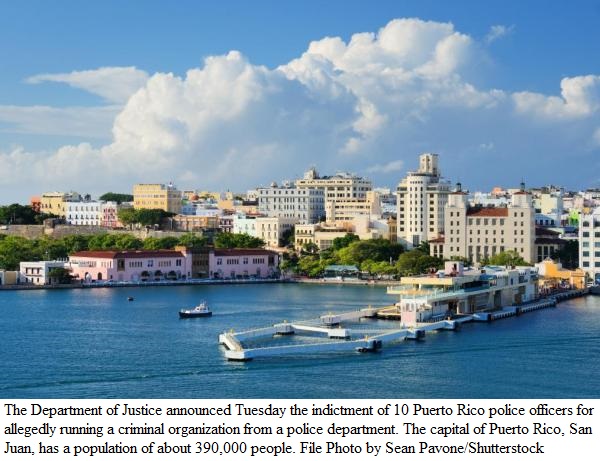
The following news article reports on corruption by police officials that have undermined Puerto Rico’s justice institutions; a surprising discovery as Puerto Rico is expected to already be an elevated society due to their US territorial status. This is far from the reality, as the stories here relate:
Miami (AFP) September 29, 2015 – Ten Puerto Rico officers have been charged with belonging to a criminal network within the police force, abusing their power to commit a long list of crimes, authorities said Tuesday.
The police used “their affiliation with law enforcement to make money through robbery, extortion, manipulating court records and selling illegal narcotics,” Rosa Emilia Rodriguez-Velez, a US attorney for the American territory, said in a statement.
The agents collaborated to conduct traffic stops and enter the homes of suspected criminals to steal money, property and drugs, according to the statement.
The officers also allegedly planted evidence and extorted weapons and drugs from individuals in exchange for their release.
In addition, they are accused of having manipulated court records and selling drugs outright.
“The criminal action today dismantles a network of officers who, we allege, used their badges and their guns not to uphold the law, but to break it,” said Rodriguez-Velez.
———-
This story represents a perennial threat in Puerto Rico. This has happened before, again and again; see here:
Published on Jul 11, 2012 – Read the New York Times article in the link below. Be sure to pay extra attention to paragraphs 3, 4 and 5. I urge all police officers to ask yourselves if you really believe Raymond Kelly and Michael Bloomberg are going to defend you when the FBI comes to arrest you for Constitutional rights violations and discrimination.
This Puerto Rico experience is not an exception to American historicity, but rather this is “par for the course”. There have always been threats to US law-and-order (homeland security) from foreign and domestic “actors”; think the Old West. This is the reality in the United States mainland and in the Caribbean territories (Puerto Rico and US Virgin Islands). These threats are also expected to materialize more in the Caribbean, as a direct product of success in elevating the region’s societal engines.
The book Go Lean…Caribbean serves as a roadmap for the introduction and implementation of the technocratic Caribbean Union Trade Federation (CU) to elevate the region’s economic, securing and governing engines. The roadmap expects to raise the region to a $800 Billion Single Market economy after a 5 year period; (from $278 Billion according to 2010 assessments). This roadmap fully expects the eventual corruption activities from those in power. The roadmap thusly embeds checks-and-balances from the outset of the plan.
This point is pronounced early in the book with the Declaration of Interdependence (Page 12) that claims:
x. Whereas we are surrounded and allied to nations of larger proportions in land mass, populations, and treasuries, elements in their societies may have ill-intent in their pursuits, at the expense of the safety and security of our citizens. We must therefore appoint “new guards” to ensure our public safety and threats against our society, both domestic and foreign. The Federation must employ the latest advances and best practices … to assuage continuous threats against public safety.
xii. Whereas the legacy in recent times in individual states may be that of ineffectual governance with no redress to higher authority, the accedence of this Federation will ensure accountability and escalation of the human and civil rights of the people for good governance, justice assurances, due process and the rule of law. As such, any threats of a “failed state” status for any member state must enact emergency measures on behalf of the Federation to protect the human, civil and property rights of the citizens, residents, allies, trading partners, and visitors of the affected member state and the Federation as a whole.
xvi. Whereas security of our homeland is inextricably linked to prosperity of the homeland, the economic and security interest of the region needs to be aligned under the same governance. Since economic crimes, including piracy and other forms of terrorism, can imperil the functioning of the wheels of commerce for all the citizenry, the accedence of this Federation must equip the security apparatus with the tools and techniques for predictive and proactive interdictions.
Why is the report of police corruption in Puerto Rico such a concern for the CU/Go Lean planners? The book asserts that with the close proximity of the islands, a security threat in any one island will be a threat to all islands.
But the US is the most powerful and richest Single Market economy in the world, surely they have the means by which to mitigate these threats on their own? This is true! And yet, the US does cooperate with other multilateral law enforcement agencies; think Interpol.
Despite the access to American justice institutions, this Go Lean book posits that Puerto Rico and the Caribbean region must prepare its own security apparatus for its own security needs. So the request is that all Caribbean member-states form and empower a security force and related justice institutions – CariPol – to execute a limited scope on these sovereign territories. Under US law, this arrangement will be instituted with an Interstate Compact, enacted in Congress. These compacts require an administering agency. This allows for the employment of the CU Trade Federation with scope for Puerto Rico (and the US Virgin Islands).
The goal of the CU/Go Lean roadmap is to confederate all of the Caribbean – all 30 member-states – under a unified entity to provide homeland security to the local region. But Homeland Security for the Caribbean has a different meaning than for our American counterparts. Yes, we must be on defense against military intrusions like terrorism and piracy, we mostly have to contend with threats that may imperil the region’s economic engines, and crime remediation and mitigation; this includes organized crime. The CU security goal is for public safety! The goal of the CU is set to optimize Caribbean society through economic empowerment, and also the security dynamics of the region, since these are inextricably linked to this same endeavor. Therefore the Go Lean roadmap has 3 prime directives:
Optimization of the economic engines in order to grow the regional economy to $800 Billion & create 2.2 million new jobs.
Establishment of a Security Apparatus to protect the resultant economic engines from economic crimes and cross-border threats.
Improvement of Caribbean governance to support these engines, including a separation-of-powers with member-states to mitigate regional threats and allowing for anti-corruption measures.
The Caribbean appointing “new guards”, or a security pact to ensure justice and public safety will include many strategies, tactics and implementations deemed “best-practice” over the years, including an advanced Intelligence Gathering & Analysis effort to draw out and interdict corruption that might emerge in the region. This Security Apparatusis “Step One, Day One” in the Go Lean roadmap, covering the approach for adequate funding, accountability and control. The Go Lean book details the series of community ethos, strategies, tactics, implementations and advocacies to provide increased public safety & security in the Caribbean region:
Assessment – Puerto Rico – The Greece of the Caribbean
Page 18
Community Ethos – Economic Systems Influence Individual Choices
Page 21
Community Ethos – Consequences of Choices Lie in Future
Page 21
Community Ethos – Privacy –vs- Public Protection
Page 23
Community Ethos – Intelligence Gathering
Page 23
Community Ethos – “Crap” Happens
Page 23
Community Ethos – Minority Equalization
Page 24
Community Ethos – Cooperatives
Page 25
Community Ethos – Ways to Manage Reconciliations
Page 34
Community Ethos – Ways to Improve Sharing
Page 35
Community Ethos – Ways to Impact the Greater Good
Page 37
Tactical – Vision – Forge a Single Market economy
Page 45
Tactical – Confederating a non-sovereign union
Page 63
Tactical – Fostering a Technocracy
Page 64
Tactical – Separation of Powers – Homeland Security
Page 75
Tactical – Separation of Powers – CariPol: Marshals & Investigations
Page 77
Implementation – Ways to Pay for Change
Page 101
Implementation – Start-up Foreign Policy Initiatives – With the US
Page 102
Implementation – Start-up Security Initiatives
Page 103
Implementation – Ways to Foster International Aid
Page 115
Implementation – Reasons to Repatriate
Page 118
Planning – Ways to Make the Caribbean Better
Page 131
Planning – Ways to Improve Failed-State Indices – Mitigate Organized Crime
Page 134
Planning – Lessons from the American West – Law & Order
Page 142
Planning – Lessons from Egypt – Lackluster Law & Order affects Economy
Page 143
Advocacy – Ways to Grow the Economy
Page 151
Advocacy – Ways to Improve Governance
Page 168
Advocacy – Ways to Better Manage the Social Contract
Page 170
Advocacy – Ways to Improve Leadership
Page 171
Advocacy – Ways to Impact Justice – Military Police Role
Page 177
Advocacy – Ways to Reduce Crime – Case Study on Organized Crime
Page 178
Advocacy – Ways to Improve for Gun Control
Page 179
Advocacy – Ways to Improve Homeland Security
Page 180
Advocacy – Ways to Mitigate Terrorism
Page 181
Advocacy – Ways to Improve Intelligence Gathering and Analysis
Page 182
Advocacy – Ways to Protect Human Rights
Page 220
Appendix – Trade SHIELD – E = Enforcement: Modeling Interpol
Page 264
Appendix – Interstate Compacts
Page 278
Other subjects related to justice and security empowerments for the region have been blogged in other Go Lean…Caribbean commentaries, as sampled here:
10 Things We Don’t Want from the US – #6: Criminal Organizations
The vision of the Go Lean roadmap is to make the Caribbean homeland, a better place to live, work and play. One of many missions, is to lower the “push” factors (from “push-and-pull” reference) so that our citizens are not led to flee their homeland for foreign (North American and European) shores. Among the many reasons people emigrate, are fear of corruption from police and political authority figures; these ones may be able to abuse power with impunity. There may be no sense of justice; “No Justice”, so “No Peace”.
We know that “bad actors” will emerge, from internal and external origins. We must be prepared and on-guard to defend our homeland against all threats, foreign and domestic. Yet we must maintain transparency, accountability, and constant commitment to due-process and the rule-of-law.
Everyone in the Caribbean, the people and institutions, are hereby urged to lean-in to this Go Lean roadmap for elevation of Caribbean society. The roadmap calls for the heavy-lifting so that the justice institutions of the CU can execute their role in a just manner, thus impacting the Greater Good. This produces the output of a technocratic system bent on efficiency and effectiveness. In practice, this would mean accountability, transparency, and checks-and-balances in the execution of the rule-of-law.
“Even a broken clock is right twice a day” – Old Adage.
This is the experience in Detroit today. This city has endured the worst-of-the-worst in urban dysfunction and yet, there are still a few things that they are doing right, that we in the Caribbean can benefit by studying their model, both the failures and successes.
The publishers of the book Go Lean…Caribbean are here to “observe and report” the turn-around and rebirth of the once-great but now distressed City of Detroit. The book posits that the Caribbean can learn a lot from the strategies, tactics and implementations to mitigate this community’s “failed-state” status. In the Caribbean region, we have a number of “failed-states”, real and presumed.
In a previous blog/commentary the unifying powers of art and culture were related; referring to Miami and the events associated with Art Basel. A direct quotation was:
“the community rallies around art creating a unique energy. And art ‘dynamises’ the community, in a very unique way”.
The book Go Lean…Caribbean stated the quest to make the Caribbean region a better place to live, work and play. It identified areas of paramount importance like economics, security and governance; then it drilled deeper to assert that pursuits like the arts (fine, visual, performing, music, sculptures, structures, etc.) and beauty can have a unifying effect on communities; see VIDEO below.
The book relates that the arts and beautification can have a positive influence on any community, including the Caribbean. It is no doubt that the tourism product in the region thrives because of the beauty of the islands; not just the natural or pristine beauty, but also the developments (resort hotels) and cultural icons. This is best demonstrated with the cruise industry, the ports-of-call in highest demand are the ones with the most culture to showcase passengers.
This is a parallel lesson being gleaned from Detroit.
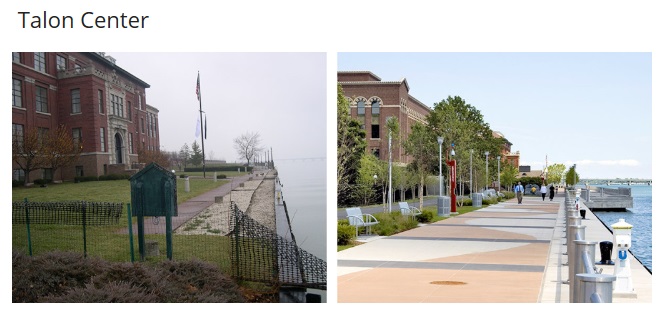
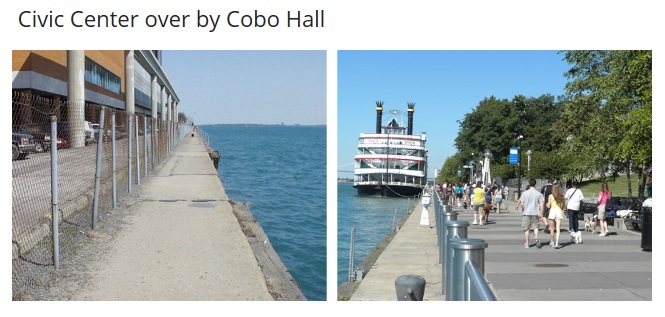
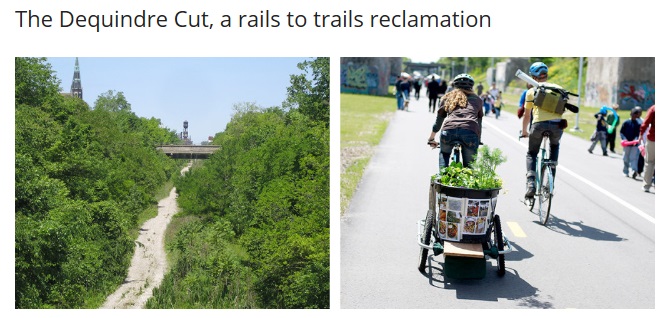
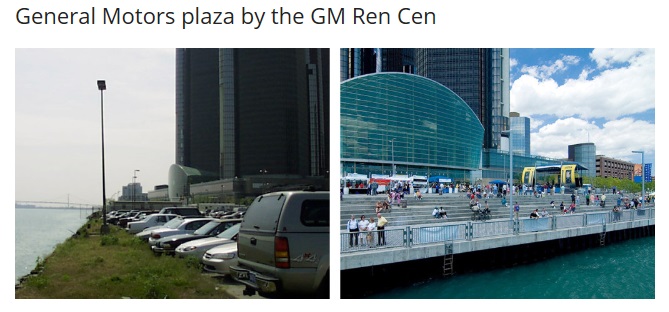
The City of Detroit is revitalizing its downtown riverfront, and the downtown riverfront is revitalizing Detroit. See the article and photos here:
Title: 6 Before And After Photos Show You Just How Far The Detroit Riverfront Has Come
We’re big fans of the Detroit RiverWalk. Whether it is walking our dogs, enjoying the boats or talking with the people, the Detroit riverfront is a gem that has been reclaimed from heavy industry that blocked access to one of the city’s greatest attractions, the river.
They’re taking the initiative west to Rosa Parks, and near these photos private development is picking up. It’s great to see so much green that everyone will be able to use in the city. Below are photos of what they have already done that gets us excited about the future, courtesy of the Detroit Riverfront Conservatory, and above and the last photo were views we took.
Also, The West RiverWalk is now open! It spans west of the Central Business District from near the Riverfront Apartments to Rosa Parks Boulevard. See here:
There’s still more work to do, obviously. Detroit is a city with a myriad of challenges that all of us are slogging through together. But sometimes it’s good to have perspective and remember just how far we’ve come.
Nobody has seen a greater community with such drive and determination. It (Detroit) has never been as bad as people always said. I’ve been downriver my whole life. I never gave up, as so many before, and hopefully, after me. The Motor City is a part of me, living proof that when rock bottom comes, we pull out. We survive. That little flower growing in the sidewalk crack, that many of our nation has forgotten years ago, has turned into a field, of hope, dreams, and prosperity. It’s been accomplished through us, of People, who stand today, and have stood together and pushed, pulled, fought and lost, but together as a community, we have told the world we are NOT gone, and do not plan on leaving anytime soon.
traceyOct 5, 2014 at 10:05 am Yes, I think planting flowers does, eventually, lead to ending violent crimes. It’s a start to bring more people, business, jobs, activity to the area. It’s a move in a positive direction, and people who have no hope or vision for Detroit should “pass”. Thanks for realizing that. Take your negativity elsewhere.
JeremyDec 31, 2014 at 10:19 am Its called the Broken Windows Theory. It states that maintaining the upkeep and appearance of an urban setting, and curtailing small crimes such as vandalism creates an atmosphere of order lawfulness that can discourage larger crimes from taking place. Basically, when things look like shit people treat them that way. But when things look like somebody cares about them, people are less likely to commit crimes in that place, because they believe that their wrongdoings are more likely to be noticed and confronted.
JessicaJan 16, 2015 at 3:40 pm Actually the violent crime was down 15% in 2014 according to an annual national study shown on Channel 4 news. I live in the heart of the city. It’s changed dramatically just in the past few years.
The City of Detroit is making progress, in one district at least. But the entire city is still in crisis, despite emerging from Bankruptcy on December 10, 2014, a process that started in July 2013. The city became the largest U.S. municipality to seek bankruptcy protection in the Federal Courts. The city’s financial dysfunction is equally matched with physical dysfunction as there is an abundance of urban blight and decay. The Go Lean book cited the example of this city as an exercise in futility – crying out for turn-around – with all the abandoned buildings. A direct quotation (Page 33) from the related chapter in the book stated:
The Bottom Line on Detroit Urban Decay For Detroit, a steady population collapse over 5 decades has resulted in large numbers of abandoned homes and commercial buildings, and areas of the city that has been hit hard by urban decay. In a New York Times Magazine article, published on November 9, 2012 it was disclosed that there were 70,000 abandoned buildings. Much of the recent attention being showered upon Detroit comes, in no small measure, is due to the city’s blight. For example, the Michigan Central Station is perhaps the best-known Detroit ruin — a towering 18-story Beaux-Arts train station with a lavish waiting room of terrazzo floors and 50-foot ceilings, built in 1913 by the same architectural firms that designed New York’s Grand Central — modeled after the Baths of Caracalla (Rome, Italy). After the station closed in 1988, a developer talked about turning the building into a casino; the current owner, proposed selling the station to the city in a plan to turn the place into police headquarters and police museum. Mostly, though, the owner has allowed the station to molder, sitting some 1.5 miles from the high-rises of downtown, Michigan Central looms like a Gothic castle over its humbler neighbors on Michigan Avenue. It’s hard not to think of it as an epic-scale disaster that seems engineered to illustrate man’s folly — as if the Titanic, after sinking, had washed ashore and been beached as a warning.
This urban dysfunction is just one of the reasons a study of Detroit is so cautionary for the Caribbean. We have many communities within the Caribbean’s 30 member-states with similar urban blight, societal abandonment and acute hopelessness. We must now echo this same retort:
According to the foregoing news article & photos, the limited area of Detroit’s Riverfront is crawling back from the precipice.
Hooray! (This appeals to tourists to the area; see VIDEO above).
This story aligns with the book Go Lean…Caribbean in stressing the economic benefits of employing a turn-around strategy.
“Out with the old; in with the new”
A renewed commitment to beautification and public art (structures, sculpture, etc.) can dynamise a community, even if just for a limited area.
The book Go Lean…Caribbean serves as a roadmap for the introduction and implementation of the technocratic Caribbean Union Trade Federation (CU). A mission of this Go Lean/CU roadmap is to promote a turn-around in many Caribbean communities. There should be a stark difference in comparing the Caribbean “before” and “after”.
How?
There is a lot involved in this quest. The book describes it as “heavy-lifting”. It involves rebooting the 3 main engines of Caribbean society; this is declared in the book as prime directives, detailed as follows:
Optimization of the economic engines in order to grow the regional economy to $800 Billion & create 2.2 million new jobs.
Establishment of a security apparatus to protect the resultant economic engines.
Improvement of Caribbean governance to support these engines.
These missions are pronounced early in the book as the necessary rationale for integrating the 30 member-states in the region into a Single Market. This need has been echoed throughout the Caribbean region. It is fully accepted that the member-states cannot endured the harsh challenges of nation-building alone. They need help! The Go Lean book asserts that the region needs to get the help from each other, pronouncing this Declaration of Interdependence(Page 10 – 14):
Preamble: While the laws of nature and of nature’s God entitle us to form a society and a brotherhood to foster manifestations of our hopes and aspirations and to forge solutions to the challenges that imperil us … no one other than ourselves can be held accountable for our failure to succeed if we do not try to promote the opportunities that a democratic society fosters.
xi. Whereas all men are entitled to the benefits of good governance in a free society, “new guards” must be enacted to dissuade the emergence of incompetence, corruption, nepotism and cronyism at the peril of the people’s best interest. The Federation must guarantee the executions of a social contract between government and the governed.
xii. Whereas the legacy in recent times in individual states may be that of ineffectual governance with no redress to higher authority, the accedence of this Federation will ensure accountability and escalation of the human and civil rights of the people for good governance, justice assurances, due process and the rule of law. As such, any threats of a “failed state” status for any member state must enact emergency measures on behalf of the Federation to protect the human, civil and property rights of the citizens, residents, allies, trading partners, and visitors of the affected member state and the Federation as a whole.
xxi. Whereas the preparation of our labor force can foster opportunities and dictate economic progress for current and future generations, the Federation must ensure that educational and job training opportunities are fully optimized for all residents of all member-states, with no partiality towards any gender or ethnic group. The Federation must recognize and facilitate excellence in many different fields of endeavor, including sciences, languages, arts, music and sports. This responsibility should be executed without incurring the risks of further human flight, as has been the past history.
xxxii. Whereas the cultural arts and music of the region are germane to the quality of Caribbean life, and the international appreciation of Caribbean life, the Federation must implement the support systems to teach, encourage, incentivize, monetize and promote the related industries for arts and music in domestic and foreign markets. These endeavors will make the Caribbean a better place to live, work and play.
xxxiii. Whereas lessons can be learned and applied from the study of the recent history of other societies, the Federation must formalize statutes and organizational dimensions to avoid the pitfalls of communities like … Detroit…
The promoters of the Go Lean book (and movement) have come to Detroit to observe-and-report on the progress of this metropolitan area. We want to learn from this city and enable better outcomes in the Caribbean. This point have been frequently conveyed in previous blogs/commentaries. Consider this sample here:
JPMorganChase’s $100 million Detroit investment is not just for Press/PR
The CU is designed to do the heavy-lifting of organizing Caribbean society to benefit from the lessons from Detroit. The Go Lean book details the community ethos to adopt, plus the executions of the following strategies, tactics, implementations and advocacies to impact the rebirths, reboots and turn-around of Caribbean communities:
Community Ethos – Deferred Gratification
Page 21
Community Ethos – People Respond to Incentives
Page 21
Community Ethos – Job Multiplier
Page 22
Community Ethos – Light Up the Dark Places
Page 23
Community Ethos – “Crap” Happens
Page 23
Community Ethos – Lean Operations
Page 24
Community Ethos – Return on Investments (ROI)
Page 24
Community Ethos – Ways to Impact the Future
Page 26
Community Ethos – Ways to Help Entrepreneurship
Page 28
Community Ethos – Ways to Impact a Turn-Around
Page 33
Community Ethos – Impact the Greater Good
Page 37
Strategy – Customers – Foreign Direct Investors
Page 48
Tactical – Fostering a Technocracy
Page 64
Tactical – Modeling Post WW II Germany – Marshall Plan
Page 68
Tactical – Modeling Post WW II Japan – with no Marshall Plan
Page 69
Separation of Powers – Public Works & Infrastructure
Page 82
Separation of Powers – Housing and Urban Authority
Page 83
Implementation – Ways to Pay for Change
Page 101
Implementation – Ways to Re-boot Freeport – A Sample Caribbean city needing turn-around
Page 112
Planning – Ways to Improve Failed-State Indices
Page 132
Planning – Lessons Learned from 2008
Page 136
Planning – Lessons Learned from Detroit
Page 140
Advocacy – Ways to Grow the Economy
Page 151
Advocacy – Ways to Create Jobs
Page 152
Advocacy – Ways to Improve Local Government
Page 169
Advocacy – Ways to Better Manage the Social Contract
Page 170
Advocacy – Ways to Better Manage Natural Resources
Page 183
Advocacy – Ways to Enhance Tourism
Page 190
Advocacy – Ways to Impact the Diaspora
Page 217
Advocacy –Ways to Preserve Caribbean Heritage
Page 218
Advocacy – Ways to Impact Urban Living
Page 234
This commentary posits that change will come to Detroit, (many previous Go Lean blog-commentaries have reported that the change is now afoot) and also that changes need to come to the Caribbean. We need to observe-and-report on Detroit; we can apply the lessons – the good, bad and ugly – for optimization in our Caribbean homeland, especially under the scheme of a Single Market. With the integration of 42 million people (10 million Diaspora and 80 million visitors) in the 30 member-states we will be able to do so much more than Detroit has ever accomplished.
Plus, our natural beauty is incomparable – “the best address on the planet”.
Let’s do this! Let’s make our homeland a better place to live, work and play.
Everyone in the region is urged – the people, institutions and governance – to “lean-in” to this roadmap for change. 🙂
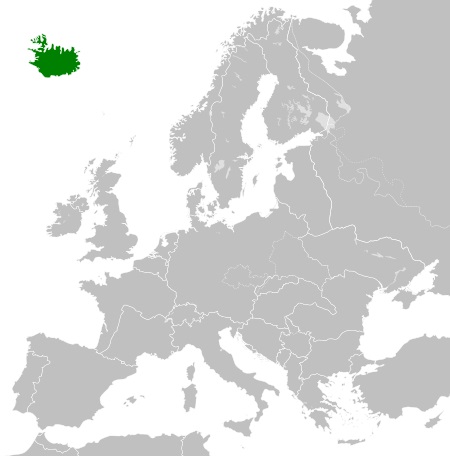
There are so many lessons the Caribbean region can learn from the island Republic of Iceland.
First, it’s an island, Duh!!!
Just like with the Caribbean, logistics of trade is more difficult as it must be based on naval and aeronautical solutions.
They have natural disasters … volcanoes as opposed to hurricanes or earthquakes.
The population is 320,000 … the range of many Caribbean countries; (i.e. Bahamas, Barbados, Belize, Guadeloupe (Fr.), Martinique (Fr.) and Suriname). Yet, it is not grouped with the formal Small Island Developing States (SIDS) as is all the sovereign Caribbean territories. The following defines the common traits:
Small Island Developing States are low-lying coastal [sovereign] countries that tend to share similar sustainable development challenges, including small but growing populations, limited resources, remoteness, susceptibility to natural disasters, vulnerability to external shocks, excessive dependence on international trade, and fragile environments. Their growth and development is also held back by high communication, energy and transportation costs, irregular international transport volumes, disproportionately expensive public administration and infrastructure due to their small size, and little to no opportunity to create economies-of-scale. – Source: https://en.wikipedia.org/wiki/Small_Island_Developing_States
Iceland has done many things well so that everyone in the Caribbean, all SIDS countries for that matter, need to take notice.
During the bad days of the Great Recession – at the precipice of disaster – the country deviated from other troubled regions …
Iceland let its banks fail in 2008 because they proved too big to save.
How does it relate to the Caribbean? The Caribbean is at the precipice … now; many of the member-states are near Failed-State status, while others are still hoping to recover from the devastating Great Recession of 2008. Turn-around should not take this long – 7 years. Strategies, tactics and implementations of best-practices to effect a turn-around must be pursued now.
Iceland has now recovered, and complaining about a 2% unemployment rate. What did they do that was so radically different than other locations? For one, they changed course regarding economics, security and governing policies. An ultra-capitalist movement had taken hold of the country and business communities; they pursued an aggressive “boom-or-bust” strategy, that ultimately “busted”, rather than continue on that road, the country – all aspects of society – altered course and returned to a path of sound fundamentals.
They rebooted and turned-around! Iceland embraced all aspects of turn-around strategies, mandating bankruptcies and “wind-downs” so that the economy – and society in general – could start anew.
This article is in consideration of the book Go Lean…Caribbean; it serves as a roadmap for the introduction and implementation of the technocratic Caribbean Union Trade Federation (CU) and Caribbean Central Bank (CCB) to provide better stewardship, to ensure that the economic/currency failures of the past, in the Caribbean and other regions, do not re-occur here in the homeland.
We can learn so much from this episode in Icelandic history, the good, the bad and the ugly. See the encyclopedic details here:
Reference Title: Iceland’s Economy and Recovery In 2007, Iceland was the seventh most productive country in the world per capita (US$54,858), and the fifth most productive by GDP at purchasing power parity ($40,112). About 85 percent of total primary energy supply in Iceland is derived from domestically produced renewable energy sources.[93] Utilization of abundant hydroelectric and geothermal power has made Iceland the world’s largest electricity producer per capita.[94] … Historically, Iceland’s economy depended heavily on fishing, which still provides 40% of export earnings and employs 7% of the work force.[49] The economy is vulnerable to declining fish stocks and drops in world prices for its main material exports: fish and fish products, aluminum, and ferrosilicon.
Iceland had been hit especially hard by the Great Recession that began in December 2007, because of the failure of its banking system and a subsequent economic crisis. Before the crash of the country’s three largest banks, Glitnir, Landsbanki and Kaupthing, their combined debt exceeded approximately six times the nation’s gross domestic product of €14 billion ($19 billion).[116][117] In October 2008, the Icelandic parliament passed emergency legislation to minimize the impact of the Financial crisis. The Financial Supervisory Authority of Iceland used permission granted by the emergency legislation to take over the domestic operations of the three largest banks.[118] Icelandic officials, including central bank governor Davíð Oddsson, stated that the state did not intend to take over any of the banks’ foreign debts or assets. Instead, new banks were established to take on the domestic operations of the banks, and the old banks will be run into bankruptcy.
On 28 October 2008, the Icelandic government raised interest rates to 18% (as of August 2010, it was 7%), a move which was forced in part by the terms of acquiring a loan from International Monetary Fund (IMF). After the rate hike, trading on the Icelandic króna finally resumed on the open market, with valuation at around 250 ISK per Euro, less than one-third the value of the 1:70 exchange rate during most of 2008, and a significant drop from the 1:150 exchange ratio of the week before.
On 20 November 2008, in an effort to stabilize the situation, the Icelandic government stated that all domestic deposits in Icelandic banks would be guaranteed, imposed strict capital controls to stabilize the value of the Icelandic króna, and secured a US$5.1bn sovereign debt package from the IMF and the Nordic countries – Denmark, Finland, Norway, and Sweden agreed to lend $2.5 billion. [119] – in order to finance a budget deficit and the restoration of the banking system. (The international bailout support program led by IMF officially ended on August 31, 2011, while the capital controls which were imposed in November 2008 are still in place only recently ended in the last few weeks).
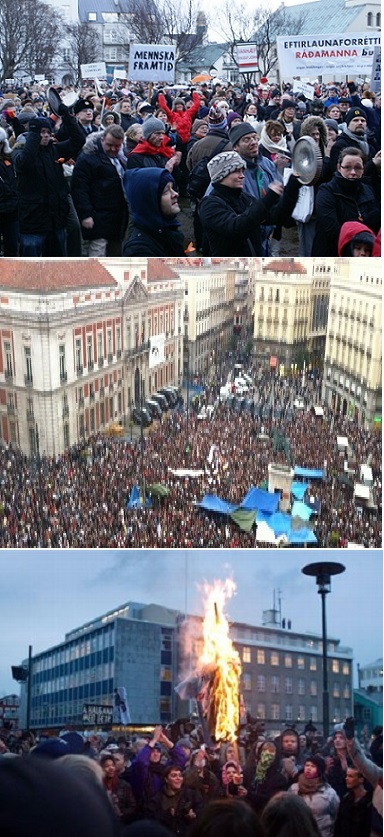
On 26 January 2009, the coalition government collapsed due to the public dissent over the handling of the financial crisis. A new left-wing government was formed a week later and immediately set about removing Central Bank governor Davíð Oddsson and his aides from the bank through changes in law. Davíð was removed on 26 February 2009 in the wake of protests outside the Central Bank.[120]
The financial crisis had a serious negative impact on the Icelandic economy. The national currency fell sharply in value, foreign currency transactions were virtually suspended for weeks, and the market capitalization of the Icelandic stock exchange fell by more than 90%. As a result of the crisis, Iceland underwent a severe economic depression; the country’s gross domestic product dropped by 10% in real terms between the third quarter of 2007 and the third quarter of 2010.[6] A new era with positive GDP growth started in 2011, and has helped foster a gradually declining trend for the unemployment rate. The government budget deficit has declined from 9.7% of GDP in 2009 and 2010 to 0.2% of GDP in 2014;[7] the central government gross debt-to-GDP ratio is expected to decline to less than 60% in 2018 from a maximum of 85% in 2011.[8]
[A post-mortem analysis helped to put the blame for Iceland’s crisis on a bad community ethos that had encapsulated the whole country related to debt]:
[Disregarding their] small domestic market, Iceland’s banks had financed their expansion with loans on the interbank lending market and, more recently, by deposits from outside Iceland (which are also a form of external debt). Households also took on a large amount of debt, equivalent to 213% of disposable income, which led to inflation.[117] This inflation was exacerbated by the practice of the Central Bank of Iceland issuing liquidity loans to banks on the basis of newly issued, uncovered bonds[118] – effectively, printing money on demand.
[Then the turn-around took hold …]
By mid-2012 Iceland was regarded as one of Europe’s recovery success stories. It has had two years of economic growth. Unemployment was down to 6.3% and Iceland was attracting immigrants to fill jobs. Currency devaluation effectively reduced wages by 50% making exports more competitive and imports more expensive. Ten-year government bonds were issued below 6%, lower than some of the PIIGS nations in the EU (Portugal, Italy, Ireland, Greece, and Spain). Tryggvi Thor Herbertsson, a member of parliament, noted that adjustments via currency devaluations are less painful than government labor policies and negotiations.
By June 2012, Landsbanki managed to repay about half of the Icesave debt.[124]
According to Bloomberg, Iceland was on the trajectory of 2% unemployment as a result of crisis-management decisions made back in 2008, including allowing the banks to fail.[125]. [Here are the highlighted bullets of this story posted January 27, 2014:]
Iceland let its banks fail in 2008 because they proved too big to save.
Now, the island is finding crisis-management decisions made half a decade ago have put it on a trajectory that’s turned 2 percent unemployment into a realistic goal.
While the Euro area grapples with record joblessness, led by more than 25 percent in Greece and Spain …
Published on Aug 28, 2015 – Central Bank of Iceland Governor Mar Gudmundsson talks with Brendan Greeley about Iceland’s capital controls and what Greece can learn from Iceland in handling its credit crisis. He speaks on “Bloomberg Markets.”
The lessons from Iceland really magnify in reflection of the Caribbean considering the community ethos or attitudes regarding “debt”. The book described community ethos as:
“the fundamental character or spirit of a culture; the underlying sentiment that informs the beliefs, customs, or practices of a group or society; dominant assumptions of a people or period; practices of a group or society; dominant assumptions of a people or period” – Go Lean…Caribbean Page 20.
While Iceland featured a negative community ethos in this case, their model demonstrates that the spirit-beliefs-customs-practices of a community can be altered.
Yes, Iceland fixed their heart … first; then the recovery of the community’s economic, security and governing engines took root. It is very important that the Caribbean learn this lesson and apply the corrections to our community ethos, and then to our systems of commerce and governance. The Go Lean book opened with this pronouncement (Page 10), gleaning insight from the US Declaration of Independence:
We hold these truths to be self-evident, that all men are created equal, that they are endowed by their Creator with certain unalienable rights, that among these are life, liberty and the pursuit of happiness; that to secure these rights, governments are instituted among men, deriving their just powers from the consent of the governed. That whenever any form of government becomes destructive to these ends, it is the right of the people to alter or to abolish it, and to institute new government, laying its foundation on such principles and organizing its powers in such form, as to them shall seem most likely to effect their safety and happiness.
The Go Lean roadmap calls for instituting the CU Trade Federation and the Caribbean Central Bank (CCB) to take the lead in forging the needed changes to the region’s economic and financial eco-systems. Firstly, there is the need to foster the best practices in the region regarding debt. The roadmap calls for a cooperative among Central Banks to form the CCB to foster interdependence, sharing, economies-of-scale and collaboration across the region despite the divergent politics, culture and languages. The premise is simple: while we are all different, we are all “in the same boat”. So the underlying principle of this motivation is the regional Greater Good.
The realities of the Great Recession, and Iceland’s troubles in the foregoing reference source, prove the interconnectivity of the financial systems; bank/currency troubles in one country easily become trouble for another country. A larger Single Market (42 million people in 30 member-states) for the Caribbean would provide less elasticity and more shock-absorption here from eruptions in the global financial markets. The Caribbean is never spared; in fact we are directly affected as tourism – our primary economic driver – depends on the disposable income from our trading partners, mostly North American and Western European countries. This is why our region was so devastated with the events, repercussions and consequences of 2008.
Considering the past, the Caribbean has had to learn hard lessons on economic booms … and busts. Any attempt to reboot Caribbean economic landscape must first start with a strenuous oversight of regional currencies. Thusly, the strategy is to integrate to the single currency, the Caribbean Dollar (C$). The tactical approach is to provide technocratic oversight with the CCB pursuing only the Greater Good, and no special group’s special interest.
Also in the opening of the Go Lean book, this need for regional stewardship of Caribbean currencies was pronounced in the Declaration of Interdependence(Page 12 & 13) with these statements:
xi. Whereas all men are entitled to the benefits of good governance in a free society, “new guards” must be enacted to dissuade the emergence of incompetence, corruption, nepotism and cronyism at the peril of the people’s best interest. The Federation must guarantee the executions of a social contract between government and the governed.
xii. Whereas the legacy in recent times in individual states may be that of ineffectual governance with no redress to higher authority, the accedence of this Federation will ensure accountability and escalation of the human and civil rights of the people for good governance, justice assurances, due process and the rule of law. As such, any threats of a “failed state” status for any member state must enact emergency measures on behalf of the Federation to protect the human, civil and property rights of the citizens, residents, allies, trading partners, and visitors of the affected member state and the Federation as a whole.
xxiv. Whereas a free market economy can be induced and spurred for continuous progress, the Federation must install the controls to better manage aspects of the economy: jobs, inflation, savings rate, investments and other economic principles. Thereby attracting direct foreign investment because of the stability and vibrancy of our economy.
xxv. Whereas the legacy of international democracies had been imperiled due to a global financial crisis, the structure of the Federation must allow for financial stability and assurance of the Federation’s institutions. To mandate the economic vibrancy of the region, monetary and fiscal controls and policies must be incorporated as proactive and reactive measures. These measures must address threats against the financial integrity of the Federation and of the member-states.
The Go Lean book, and previous blog/commentaries, stressed the key community ethos, strategies, tactics, implementations and advocacies necessary to appoint new stewards for the regional financial eco-system. These points are detailed in the book as follows:
Community Assessment – Puerto – The Greece of the Caribbean
Page 18
Community Ethos – Economic Principles – All Choices Involve Costs
Page 21
Community Ethos – Economic Principles – Economic Systems Influence Individual Choices
Page 21
Community Ethos – Economic Principles – Consequences of Choices Lie in the Future
Page 21
Community Ethos – Economic Principles – Money Multiplier
Page 23
Community Ethos – Governing Principles – Lean Operations
Page 24
Community Ethos – Governing Principles – Return on Investments
Page 24
Community Ethos – Governing Principles – Cooperatives
Page 25
Community Ethos – Ways to Impact the Future – Count on the Greedy to be Greedy
Page 26
Community Ethos – Ways to Impact Turn-Arounds – Bankruptcy Processing
Page 33
Community Ethos – Ways to Improve Sharing
Page 35
Community Ethos – Ways to Impact the Greater Good
Page 37
Strategy – Vision – Confederate the region into a Single Market
Page 45
Strategy – Mission – Fortify the Stability of the Securities Markets
Page 45
Strategy – Provide Proper Oversight and Support for the Depository Institutions
Page 46
Strategy – e-Payments and Card-based Transactions
Page 49
Tactical – Confederating a Permanent Union
Page 63
Tactical – Growing the Economy – Minimizing Bubbles
Anecdote – Turning Around CARICOM – Effects of 2008 Financial Crisis
Page 92
Implementation – Assemble Caribbean Central Bank as a Cooperative
Page 96
Implementation – Ways to Better Manage Debt
Page 114
Planning – 10 Big Ideas – Single Market / Currency Union
Page 127
Planning – Lessons Learned from 2008
Page 136
Planning – Lessons Learned from New York City – Wall Street
Page 137
Planning – Ways to Measure Progress
Page 147
Anecdote – Caribbean Currencies
Page 149
Advocacy – Ways to Grow the Economy
Page 151
Advocacy – Ways to Control Inflation
Page 153
Advocacy – Ways to Better Manage Foreign Exchange
Page 154
Advocacy – Ways to Improve Governance
Page 168
Advocacy – Ways to Better Manage the Social Contract
Page 170
Advocacy – Ways to Foster Cooperatives
Page 176
Advocacy – Ways to Foster Electronic Commerce
Page 198
Advocacy – Reforms for Banking Regulations
Page 199
Advocacy – Ways to Impact Wall Street
Page 200
Advocacy – Ways to Impact Main Street
Page 201
Appendix – Tool-kits for Capital Controls
Page 315
There is a lot to learn from the analysis of economic stewardship of other communities. The successes and failures of banking/economic stewardship were further elaborated upon in these previous blog-commentaries:
Analyzing the Data – What Banks learn about financial risks
According to the foregoing article, and VIDEO, the origin of Iceland’s crisis was greed; the banks assuming more risk, to garner more profit, and consumers borrowing more credit so as to … consume more.
Greed – it is what it is.
The Go Lean book declares to “count on greedy people to be greedy” (Page 26). This situation is manifested time and again, all over the world. The Go Lean book provides the roadmap to anticipate greed, monitor and mitigate it. The book declares (Page 23):
… “bad actors” will also emerge thereafter to exploit the opportunities, with good, bad and evil intent. A Bible verse declares: “What has been will be again, what has been done will be done again; there is nothing new under the sun” – Ecclesiastes 1:9 New International Version.
We have so many lessons to learn from the Great Recession, and the disposition of Iceland.
The Caribbean is hereby urged to lean-in to this Go Lean confederation roadmap. Everyone – people, businesses, banks and governments – can benefit from the consideration of this roadmap. As this roadmap is the “turn-by-turn directions”, the heavy-lifting, to move the region to its new destination: a better homeland to live, work and play. 🙂
“Exigent circumstances” call for extraordinary measures.
The textbook definition is a situation that demands prompt action or remedy; an emergency. On the other hand, the actual legal definition:
An exigent circumstance, in the criminal procedurelaw of the United States, allows law enforcement, under certain circumstances, to enter a structure without a search warrant or, if they have a “knock and announce” warrant, without knocking and waiting for refusal. It must be a situation where people are in imminent danger, evidence faces imminent destruction, or a suspect’s imminent escape. (Source:https://en.wikipedia.org/wiki/Exigent_circumstance)
What would constitute an “exigent circumstance” requiring national attention?
War (or any threat to national defense), of course …
… high-crime incidents and natural disasters.
These are all physicals circumstances. In American jurisprudence, physical threats are categorized as a ‘Clear and Present Danger’ where a potential danger must be assuaged otherwise it will likely cause a catastrophe. (This point was detailed in a previous blog-commentary).
But as for economic exigent circumstances, these can also be catastrophic!
The prominent economic exigent circumstance of recent history is the Great Recession of 2008 – see VIDEO here. (The whole world has been shaped by the events of 2008).
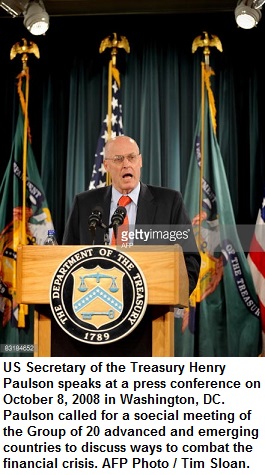
The US Secretary of the Treasury at that time, Henry Paulson, recognized the urgency and emergency of the financial crisis early in 2008 and asked the President (George W. Bush) for a War Powers Declaration; (Appendix A). This refers to the federal law intended to allow the US Congress to declare war, while the President executes the war as Commander-in-Chief.
In 2008 historicity, Congress did approve legislation to declare and fund a defense against the financial crisis; and the President did command a Bail-out strategy to restore the integrity of the economy.
This was economic war! Not just some normal market correction.
Were the radical steps taken by the Treasury Department and Federal Reserve to avert the financial crisis legal? When and why did political elites and the general public question the legitimacy of the government’s responses to the crisis?
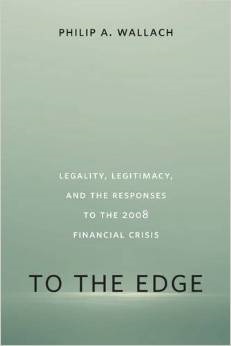
In [the book] To The Edge: Legality, Legitimacy, and the Responses to the 2008 Financial Crisis, Philip Wallach chronicles and examines the legal and political controversies surrounding the government’s responses to the recent financial crisis. The economic devastation left behind is well-known, but some allege that even more lasting harm was inflicted on America’s rule of law tradition and government legitimacy by the ambitious attempts to limit the fallout. In probing these claims, Wallach offers a searching inquiry into the meaning of the rule of law during crises.
The book provides a detailed analysis of the policies undertaken – from the rescue of Bear Stearns in March 2008 through the tumultuous events of September 2008, the passage of the TARP and its broad usage, the alphabet soup of emergency Federal Reserve programs, the bankruptcies of Chrysler and GM, and the extended public ownership of AIG, Fannie Mae, and Freddie Mac. Throughout, Wallach probes the legal bases of the government’s actions and explores why concerns about the legitimacy of government actions were only sporadically grounded in concerns about legality – and sometimes ran directly against them.
The public’s sense that government officials operated through ad hoc responses that favored powerful interests has helped bring the legitimacy of American governmental institutions to historic lows. Wallach’s book recommends constructive and sensible reforms policymakers should take to ensure accountability and legitimacy before the government faces another crisis.
The book Go Lean…Caribbean was written in the wake of this same 2008 Financial Crisis, but for the limited perspective for the Caribbean. Many lessons-learned from 2008 are considered and applied in appropriate strategies, tactics and implementations to re-boot the Caribbean region from the catastrophe of this crisis; many member-states of the region are still suffering; i.e. Puerto Rico. The foregoing Book Review highlights a publication that is a study of the depth-and-width of the legal maneuvering for the 2008 crisis; now the same writer, Philip Wallach, has composed a supplemental essay asserting a new label to the crisis “lawfare”; see Appendix B for definition and the essay in Appendix C below.
This lawfare consideration is presented in conjunction to mitigations and remediation for protecting the Caribbean homeland. The assertion in the book Go Lean … Caribbean (Page 23) is that with the emergence of new economic engines, “bad actors” will also emerge thereafter to exploit the opportunities, with good, bad and evil intent. But the book warns against more than just people, rather “bad or exigent circumstances”; thusly referring to corporate entities, natural disasters and other cross-border threats; 2008 would have fit this definition. The book relates that “bad actors” is a historical fact that will be repeated again and again.
This point is pronounced early in the book with the Declaration of Interdependence (Page 12) that claims:
i. Whereas the earth’s climate has undeniably changed resulting in more severe tropical weather storms, it is necessary to prepare to insure the safety and security of life, property and systems of commerce in our geographical region. As nature recognizes no borders in the target of its destruction, we also must set aside border considerations in the preparation and response to these weather challenges.
ii. Whereas the natural formation of the landmass for our lands constitutes some extreme seismic activity, it is our responsibility and ours alone to provide, protect and promote our society to coexist, prepare and recover from the realities of nature’s occurrences.
x. Whereas we are surrounded and allied to nations of larger proportions in land mass, populations, and treasuries, elements in their societies may have ill-intent in their pursuits, at the expense of the safety and security of our citizens. We must therefore appoint “new guards” to ensure our public safety and threats against our society, both domestic and foreign. The Federation must employ the latest advances and best practices … to assuage continuous threats against public safety.
xii. Whereas the legacy in recent times in individual states may be that of ineffectual governance with no redress to higher authority, the accedence of this Federation will ensure accountability and escalation of the human and civil rights of the people for good governance, justice assurances, due process and the rule of law…
xxv. Whereas the legacy of international democracies had been imperiled due to a global financial crisis, the structure of the Federation must allow for financial stability and assurance of the Federation’s institutions. To mandate the economic vibrancy of the region, monetary and fiscal controls and policies must be incorporated as proactive and reactive measures. These measures must address threats against the financial integrity of the Federation and of the member-states.
The Caribbean appointing “new guards” (security pact) to ensure public safety must include many strategies, tactics and implementations considered “best-practices” for economic crimes and systemic threats. We must be on a constant vigil against “exigence”, man-made, natural and economic. This indicates being pro-active in monitoring, mitigating and managing risks. Then when “crap” happens – economic crises – the “new guards” will be prepared for “exigent circumstances”.
The Go Lean book is a petition for change, serving as a roadmap for the introduction and implementation of the technocratic Caribbean Union Trade Federation (CU). The CU is set to optimize Caribbean society through economic empowerment, and also homeland security in the region, since these are inextricably linked to this same endeavor.
Therefore the Go Lean roadmap has 3 prime directives:
Optimization of the economic engines in order to grow the regional economy to $800 Billion & create 2.2 million new jobs.
Establishment of a security apparatus to protect the resultant economic engines and the Caribbean homeland.
Improvement of Caribbean governance to support these engines.
This is not just academic, as in the case of the foregoing Book Review and supplemental essay in Appendix C. Principals among Go Lean planners were there in 2008, engaged with major stakeholders of the Global Financial crisis: Lehman Brothers, BearStearns, JPMorganChase, CitiGroup, etc. This is real experience from the real crisis; see documentary VIDEO here:
This 1st of 4 parts documentary elapses 2 and half hours in total. It is recommended that this be consumed at some point as extra-credit to this discussion. Uploaded on Oct 13, 2011-In the first episode of Meltdown, we hear about four men who brought down the global economy: a billionaire mortgage-seller who fooled millions; a high-rolling banker with a fatal weakness; a ferocious Wall Street predator; and the power behind the throne.
The crash of September 2008 brought the largest bankruptcies in world history, pushing more than 30 million people into unemployment and bringing many countries to the edge of insolvency. Wall Street turned back the clock to 1929. But how did it all go so wrong?
Lack of government regulation; easy lending in the US housing market meant anyone could qualify for a home loan with no government regulations in place.
Also, London was competing with New York as the banking capital of the world. Gordon Brown, the British finance minister at the time, introduced ‘light touch regulation’ – giving bankers a free hand in the marketplace.
All this, and with key players making the wrong financial decisions, saw the world’s biggest financial collapse.
Planners of the Go Lean movement were there, on the inside looking out, not the outside looking in. They were among the movers-and-shakers of the macro economy, not just armchair “Monday-morning” quarterbacks.
Thusly the CU Trade Federation is set to be “on guard”, on alert for real or perceived economic threats. The legal concept is one of being deputized by the sovereign authority for a role/responsibility in the member-state. As a security apparatus, the CU must always be a sentinel to monitor known threats; this includes man-made, natural and economic threats. Many of these exigent circumstances would be designated as primarily assigned to the CU to assuage. And then the related CU agencies will be expected to aid, assist, and support local resources in the member-states.
This is more and better than the region’s prior response in 2008. “Step One, Day One” in the Go Lean roadmap is to assume this stewardship of the regional economy. The CU organizational structure must be empowered for proactive and reactive management of economic threats and exigent circumstances. The Go Lean book details this series of community ethos, strategies, tactics, implementations and advocacies to provide this better stewardship of the economic engines of the Caribbean region:
Who We Are – SFE Foundation – 2008 History
Page 8
Assessment – Puerto Rico – ‘The Greece of the Caribbean’
Page 18
Community Ethos – Economic Principles – People Respond to Incentives
Page 21
Community Ethos – Economic Principles – Economic Systems Influence Individual Choices
Page 21
Community Ethos – Economic Principles – Voluntary Trade Creates Wealth
Page 21
Community Ethos – Economic Principles – Consequences of Choices Lie in the Future
Page 21
Community Ethos – Economic Principles – Money Multiplier
Page 23
Community Ethos – Governing Principles – Lean Operations
Page 24
Community Ethos – Ways to Impact Turn-arounds
Page 33
Community Ethos – Ways to Improve Sharing
Page 35
Community Ethos – Ways to Impact the Greater Good
Page 37
Strategy – Mission – Fortify the Stability of the Banking Institutions
Page 45
Strategy – Provide Proper Oversight and Support for the Depository Institutions
Page 46
Strategy – Agents of Change – Globalization
Page 57
Tactical – Confederating a permanent union
Page 63
Tactical – Ways to Foster a Technocracy
Page 64
Tactical – Growing the Economy – Minimizing Bubbles
Page 69
Tactical – Separation-of-Powers – Caribbean Central Bank
Anecdote – Turning Around CARICOM – Effects of 2008 Financial Crisis
Page 92
Implementation – Assemble Caribbean Central Bank as a Cooperative
Page 96
Implementation – Ways to Pay for Change
Page 101
Implementation – Ways to Better Manage Debt
Page 114
Implementation – Ways to Benefit from Globalization
Page 119
Planning – 10 Big Ideas – #1: Single Market / Currency Union
Page 127
Planning – Ways to Improve Trade
Page 128
Planning – Lessons Learned from 2008
Page 136
Advocacy – Ways to Grow the Economy
Page 151
Advocacy – Ways to Create Jobs
Page 152
Advocacy – Ways to Control Inflation
Page 153
Advocacy – Ways to Better Manage ForEx
Page 154
Advocacy – Reforms for Banking Regulations
Page 199
Advocacy – Ways to Impact Wall Street
Page 200
Advocacy – Ways to Impact Main Street
Page 201
Advocacy – Battles in the War on Poverty
Page 222
Advocacy – Ways to Help the Middle Class
Page 223
Advocacy – Ways to Impact the One Percent
Page 224
This commentary has frequently focused on the lessons-learned from 2008. Some other blogs related to the challenge to Caribbean economic security and governance as a result of 2008 are listed here:
10 Things We Don’t Want from the US – #3: Americanized World Economy
According to the foregoing blog references, the Caribbean parasitic regional economy has not being gracious to its citizens, and other stakeholders (visitors, lenders, Direct Foreign Investors). We need the empowerments of the Go Lean roadmap for so many reasons; one strong motivation is to turn-around this status quo; another reason is to diversify our economy. All of this will fortify our economic security and improve our governance. Considering the history of these North American and Western European powers, we do not want to be their parasites, rather their protégé.
This is the purpose of the Go Lean roadmap, to provide a turn-by-turn direction to move the region to that destination. The advocacy here is to adopt the structure of an economic technocracy. The term technocracy is used to designate the application of the scientific method to solving social and economic problems. The CU must start off as such a technocracy, not grow into being a technocracy – too much is at stake.
All of the Caribbean is hereby urged to lean-in to this roadmap for a technocracy, to make the Caribbean a better place to live, work and play. 🙂
Download the book Go Lean…Caribbean now!
———
Appendix A: War Powers Declaration
Article I, Section 8, Clause 11 of the United States Constitution, sometimes referred to as the War Powers Clause, vests in the Congress the power to declare war, in the following wording:
[The Congress shall have Power…] To declare War, grant Letters of Marque and Reprisal, and make Rules concerning Captures on Land and Water;
A number of wars have been declared under the United States Constitution, although there is some controversy as to the exact number, as the Constitution does not specify the form of such a declaration.
(Source:https://en.wikipedia.org/wiki/War_Powers_Clause; retrieved September 22, 2015)
This name Lawfare refers both to the use of law as a weapon of conflict and, perhaps more importantly, to the depressing reality that America remains at war with itself over the law governing its warfare with others. (It could apply equally to any other country). This blog by Benjamin Wittes, Robert Chesney, and Jack Goldsmith is devoted to that nebulous zone in which actions taken or contemplated to protect a nation interact with the nation’s laws and legal institutions. In addition, this term refers to a nation’s use of legalized international institutions to achieve strategic ends, so in effect the “use of law as a weapon of war”. – Source: https://www.lawfareblog.com/about-lawfare-brief-history-term-and-site
According to Wikipedia, Lawfare is asserted by some to be the illegitimate use of domestic or international law with the intention of damaging an opponent, winning a public relations victory, financially crippling an opponent, or tying up the opponent’s time so that they cannot pursue other ventures such as running for public office,[1][2] similar to a SLAPP (strategic lawsuit against public participation) lawsuit.
———
Appendix C – Essay Title: Hard Financial Crisis Choices
Providing physical security to its citizens is undoubtedly the core function of the state. As readers of Lawfare well know, it is hard work to figure out how that security function should be reconciled with sometimes-conflicting imperatives of legal process, constitutional separation of powers, and transparent and accountable government. Especially challenging is the question of how much, and for how long, exigent circumstances should expand the sphere of legitimate government activities.
Not far behind physical security as a core function of the state is providing some baseline of financial stability and economic security, especially through the protection of a functional banking system and financial markets. Once again, it is hard to discern the appropriate relationship between this financial stability function and other mission-critical governmental activities. Because financial stability in a dynamic market economy includes the expectation that downturns are a healthy part of the process, it is often difficult to distinguish between a developing crisis and normal market corrections, making the balancing act between expedient action and a commitment to act through deliberate processes all the more difficult.
But while there are volumes enough on the question of why economies experience financial crises, and torrid debates on which responses are most effective, there is a striking absence of commentary about “hard financial crisis choices,” and especially their legal aspects. Applicable judicial precedents are few and far between, the Federal Reserve’s emergency decision-making processes are shrouded in mystery (in contrast to its monetary policy decisions), and the Treasury Department is accustomed to extraordinary deference. This vacuum has had some very unfortunate practical consequences for those who fashioned the responses to our financial crisis response, which I explain in my new book, To the Edge: Legality, Legitimacy, and the Responses to the 2008 Financial Crisis (Brookings Institution Press, 2015).
Why on earth should Lawfare readers care?
Treating national security as sui generis, while obviously appropriate in some contexts, unhelpfully narrows thinking in many others. If the question is how emergencies change the scope for government action, how legitimacy is achieved by crisis responders, or what the rule of law means in times of crisis, then adding financial crises to national security crises expands the material available for analysis. Doing so may also help clarify exactly what makes national security distinctive.
Some of my book’s analysis was directly inspired by Jack Goldsmith’s Power and Constraint. The latter explains how the government is actually empowered by various watchdogs and legal requirements that seem to constrain it, because they give it credibility and validation in a way that it could not otherwise produce. In the language of my book, such things provide legitimacy, which is often a necessary precondition for effective government action. If citizens had profound trust in their government (or a quasi-religious reverence for their leaders), legitimation might require very little other than some modicum of competence. But in the world of Snowden and Enron, Abu Ghraib and revolving doors, that trust is missing. Like Jack, I argue that accountability mechanisms provide at least a partial substitute by making citizens feel confident that leaders will be held to standards of reasonableness and propriety, if not immediately in the heat of a crisis response then at least afterwards, once the dust has settled.
American leaders once took this principle to its logical conclusion by openly acting extralegally and then seeking retroactive validation, either through a congressional indemnity or by appealing to a jury. The classic examples are antiques: Thomas Jefferson’s spending without appropriations in response to the HMS Leopard naval incident; General Andrew Jackson’s maintenance of martial law in New Orleans (vividly described in a classic article all Lawfare readers would enjoy); or Abraham Lincoln’s famous resort to constitutional dictatorship from March to July of 1861.
From the beginning of the twentieth century onward, Presidents and other crisis responders have unfailingly offered legal hooks for their emergency actions. Some academic theorists’ ambitions notwithstanding, openly extralegal declarations of prerogatives seem to have no place in our thoroughly legalized modern world (as Jack argues in a rather trenchant essay in this edited volume).
Instead of asking whether law will be the tool of legitimation, the question now becomes: just how reliable a check and a legitimator is the now-universally-obligatory exercise of legal justification? If justification is based on law that itself possesses no legitimacy, or if it misuses existing law, then it cannot provide much legitimacy. On the other hand, even in the era of ubiquitous legal justification, actions with poor legal pedigrees can be accepted as legitimate if they are acceptable to the public on other grounds. We can draw some useful analogies between national security and financial crises for both of these situations in which legality and legitimacy diverge.
Woodrow Wilson’s leadership during World War I provides an interesting instance in which poor legal justifications led to legitimacy problems. Congress gave Wilson’s administration unprecedented delegated powers through a number of enabling acts (the National Defense Act, Army Appropriations Act, Lever Act, and Overman Act), thus furnishing an easy way to legally justify most of his policies. But even in that context Wilson managed to push the envelope quite aggressively, both by using the vaguely defined powers as justifications for decisions that Congress refused to support (e.g., arming merchantmen, creating the Committee on Public Information—which was effectively a propaganda ministry—and censoring telegraphs) and by sustaining his wartime institutions past the end of the war against the desires of Congress. This willingness to aggressively wield emergency powers contributed to the public’s desire for a “return to normalcy” and Democrats’ resounding defeat in 1920.
Similarly, having the backing of an expansive enabling act—namely the Emergency Economic Stabilization Act of 2008, better known as TARP—proved no guarantee of legitimacy in recent years. The Act itself was bitterly contested, with bipartisan congressional leaders failing to persuade populist backbenchers of either party. (This made TARP different from most enabling acts; the September 2001 AUMF, passed nearly unanimously, is far more typical.) There was also a sense that TARP was dangerously free of actual guidance for the executive branch, providing only a panicked sanction for whatever the Treasury Department found necessary. Such criticisms were well-founded: TARP was used in ways that wildly diverged from its original stated purpose of purchasing troubled assets, eventually including loans to GM and Chrysler when Congress failed to provide a separate pot of money for them in December 2008. Of course bank bailouts will tend to be unpopular in ways that defending the homeland will not, but even so the sense that the executive branch was doing as it pleased—even after Congress had belatedly acted—contributed to the crisis responses’ legitimacy problems. Neither in Wilson’s case nor in TARP’s were qualms about improper legal justifications the driving force behind dissatisfaction, but they served to intensify existing concerns. (Coincidentally, TARP’s most fervent opponents also yearned for a return to the normalcy of federal government circa 1921…)
Conversely, legal flaws don’t always entail legitimacy problems. Franklin Roosevelt’s Destroyer Deal in 1940 was supported by an at-best tendentious memorandum from Attorney General Robert Jackson, but it was widely popular and never caused Roosevelt any real political problems. In the boldest maneuver of the 2008 Financial Crisis, the Treasury Department used the Exchange Stabilization Fund to guarantee money market funds in September of that year—with only a paper-thin legal justification and absolutely no precedent to support such a strange use of an authority nominally dedicated to stabilizing international currency markets. But it was a striking success, so much so that the program it supported actually brought fees into the Treasury without ever paying any money out. The weakness of its legal justification is already nearly forgotten, of interest only to the very small handful of people interested Lawfare-like subjects.
A similarity between the Destroyer Deal and the money market rescue is worth noting: both involved the federal government giving rather than taking, which limits popular opposition and also the pool of potential litigants who might have standing to challenge the action. Acting so as to only cost taxpayers generally, rather than rights-holders specifically, offers a way to avoid the determined pryings of lawyers and the unpredictable rulings of judges—harder to pull off in the national security realm, but not impossible. It is worth considering how this desire to push policymaking into less heavily lawyered areas might shape the evolution of security policy in years to come.
One last musing here (if you’re eager for more, please get yourself the book!) in the form of a question, which I’d be eager to get the Lawfare community’s thoughts on. Early on during the crisis, the well-known economist and blogger Mark Thoma suggested that economists thinking about the balance between facilitating timely responses to emergencies and the need to honor the democratic process should learn from the compromise embedded in the War Powers Resolution, in which expedient action is allowed but time-limited. Sounds like a good idea…except for the whole history of the War Powers Resolution, which as I understand it is none too encouraging.
Financial crisis responders also sometimes figured out ways to circumvent rather clear time limits. Support for Fannie Mae and Freddie Mac under the Housing and Economic Recovery Act of 2008 was supposed to be cut off at the end of 2009, but the Treasury interpreted that to mean nothing more than that its maximum level of support had to be specified by that time. As they understood them, the commitments put in place by then were effectively unlimited and indefinite guarantees of the two firms.
What is it that makes putting hard time limits on executive branch unilateral actions so difficult? The obvious generic answer is enforceability. An enforcer must be both willing and able to meet violations with serious consequences, and it is hard to find institutional actors who are both. Courts may sometimes be willing—their tendency to defer to the executive in troubled times has limits, as Lawfare’s contributors have explored many times—but with neither purse nor sword judges’ ability to stand in the way of a determined executive branch is quite modest. With its power to withdraw funding, Congress is potent enough to enforce the limits put in force by its previous incarnations, but it seems generally unwilling to exercise that power, as doing so offers no political gain and considerable political risks. Are there other possible enforcers for time limits built into grants of extraordinary executive power? Are there ways to make limits genuinely self-enforcing, such that inaction will not render the limits nugatory? Thoughts about the War Powers Resolution or about the problem more generally would be greatly appreciated, as these questions are not rhetorical. Phil Wallach is a Fellow in the Brookings Institution’s Governance Studies Program. Source:LawFare Legal Analysis Online Community; posted May 21, 2015; retrieved September 22, 2015 from: https://www.lawfareblog.com/hard-financial-crisis-choices
The airplane is not a new invention. It goes back to the days of the Wright Brothers of Dayton, Ohio – Orville and Wilbur – and their Kitty Hawk, North Carolina test flight on December 17, 1903. Yet, after 112 years, there is still room for a lot of invention and innovation in the field of aerospace. As the old adage relates “Necessity, is the ‘mother’ of invention”.
This commentary asserts that while the United States of America was front-and-center with the initial developments in man-flights, the Caribbean region now needs to be more prominent with the innovations of flight for this new century in aviation. Why?
Necessity, is STILL the ‘mother’ of invention.
There is the need for a lot more innovative airplane transportation solutions for any region featuring an archipelago – a chain of islands. This new product here – the ICON A5* – is perhaps an ideal solution for Caribbean deployment, as it can better reach the masses and become ubiquitous for private owners-operators; see the following VIDEO:
VIDEO Title: Private airplanes for all? One company hopes so
Private planes have long been the domain of the very rich, but now one company wants to change that. ICON wants to do for air travel what Apple did for computers – demystify and make them approachable. They see a future where lots of people like me and you are soaring through the sky in a plane like this. TODAY’s Craig Melvin reports.
This vision of ubiquitous owners-operators of amphibious airplanes – that can touchdown on land or water – portray a more efficient aviation environment for island-hoping; these vehicles would make island living more appealing to live, work and play. This commentary asserted that “our region must participate in these developments, not just spectate on them”. This aligns with the mandate for a more nimble environment to develop, test and deploy cutting-edge transportation solutions. This is the benefit of lean governmental coordination, to be able to launch initiatives like this as portrayed in the foregoing VIDEO.
Canada is a good model for the Caribbean to emulate in this regards. They have vast rural territories, not easily accessible by roads. In these far-out territories, seaplanes, floatplanes and bush planes proliferate. In addition, this ubiquity in Canada is not necessarily affiliated with the wealthy, but rather ordinary citizens; sometimes, these transportation options even become a small business opportunity.
Needless to say, a proliferation of small aircrafts raises a lot of security issues; think September 11, 2011 Terror Attacks on New York City. The aircraft in the above VIDEO, also feature the additional safety mitigation of a built-in parachute, to allow for an easy landing of any aircraft that may go into distress. (This safety feature is ingenious!).
The book, Go Lean … Caribbean, extols the principle that R&D (research and development) activities are necessary to profit from advantages in technology. We want to do R&D here in the Caribbean; manufacturing/assembly too. Since we have the demand; we should facilitate supply as well! This is a mandate for the Caribbean Union Trade Federation (CU). This book serves asa roadmap for the introduction and implementation of the CU. This technocracy will assume oversight to optimize the region in the areas of:
(1) economics
(2) security
(3) lean government
This ethos of adapting to change has now come to the Caribbean.
The status quo of the Caribbean’s transportation eco-systems is badly flawed. The region boasts transportation and fuel costs (including taxes) that are among the highest in the world.
The Go Lean strategy is to confederate the 30 member-states of the Caribbean region to form the technocratic CU Trade Federation. Tactically, the roadmap calls for a separation-of-powers, allowing the Caribbean member-states to deputize authority of the Caribbean airspace to the one unified CU agency. Operationally, there is the need to regulate these aircrafts and the owners-operators, for their monitoring, training, licensing, maintenance compliance, search-and-rescue, incident management and everyday functionality. (Consider the risk mitigation example in the Appendix VIDEO below).
Things will go wrong! Bad things do happen to good people.
This blog-commentary touches on many related issues and subjects that affect planning for Caribbean empowerment in the aviation and transportation industry-spaces. Many of these issues were elaborated upon in these previous blog-commentaries:
Though not written with this particular initiative in mind, the Go Lean roadmap anticipates the foregoing VIDEO‘s opportunities and challenges, as pronounced in the Declaration of Interdependence, (Pages 12 & 14):
xvi. Whereas security of our homeland is inextricably linked to prosperity of the homeland, the economic and security interest of the region needs to be aligned under the same governance. Since economic crimes … can imperil the functioning of the wheels of commerce for all the citizenry, the accedence of this Federation must equip the security apparatus with the tools and techniques for predictive and proactive interdictions.
xxvii. Whereas the region has endured a spectator status during the Industrial Revolution, we cannot stand on the sidelines of this new economy, the Information Revolution. Rather, the Federation must embrace all the tenets of Internet Communications Technology (ICT) to serve as an equalizing element in competition with the rest of the world. The Federation must bridge the digital divide and promote the community ethos that research/development is valuable and must be promoted and incentivized for adoption.
xxx. Whereas the effects of globalization can be felt in every aspect of Caribbean life, from the acquisition of food and clothing, to the ubiquity of ICT, the region cannot only consume, it is imperative that our lands also produce and add to the international community, even if doing so requires some sacrifice and subsidy.
The Go Lean book was written with the future of the Caribbean in mind. There was a certain anticipated future – with a proliferation of private aircraft owners-operators – that hasn’t really materialized … yet. But maybe now, finally, that future view is coming into focus. This is the direct quotation from the book (Page 26):
The Bottom Line on the Millennium In the words of Yogi Berra – iconic American Baseball Hall-of-Famer: “The future ain’t what it used to be”.
This is according to a 2007 news analysis by Michael Fitzpatrick, Science Writer for The Guardian (UK) newspaper:
No flying cars, no dinners in a pill, and certainly no cool rocketing off to space cities in the required outfit of the future. We seem to have failed the expectations of the most wild-eyed seers from the past – futurologists who were for the most part in love with a supercharged, technologically sexy future where science would free us from the daily grind, for holidays on the moon or underseas. But here we remain, plodding along … in a familiar world that is neither utopia nor dystopia. What the futurologists did get right were some of the more prosaic details such as mobile phones and digital technologies.
The aircraft depicted in the foregoing VIDEO (see Appendix below), feature functionality where every single-family home could have a plane in their garage – this is the ubiquity in the earlier references. North American society could now be that close to this future view. Better still, the Caribbean should be that close to this reality:
… planes being towed from home garages to boat ramps to launch flight. Then while in flight the aircraft cruises below 15,000 feet and operate at good speed, but slower than 150 miles an hour.
The CU mission is to implement the complete eco-system to deliver on market opportunities for these ubiquitous aircraft owners-operators. There are many strategies, tactics, implementations and advocacies in the book that will facilitate this readiness; a sample is detailed here:
Economic Principles – Economic Systems Influence Individual Choices
Page 21
Economic Principles – People Choose because Resources are Limited
Page 21
Economic Principles – All Choices Involve Costs
Page 21
Economic Principles – People Respond to Incentives
Page 21
Economic Principles – Economic Systems Influence Individual Choices
Page 21
Economic Principles – Consequences of Choices Lie in the Future
Page 21
Community Ethos – Money Multiplier
Page 22
Community Ethos – Job Multiplier
Page 22
Community Ethos – Lean Operations
Page 24
Community Ethos – Return on Investments
Page 24
Community Ethos – Ways to Impact the Future
Page 26
Community Ethos – Ways to Help Entrepreneurship
Page 28
Community Ethos – Ways to Promote Intellectual Property
Page 29
Community Ethos – Ways to Impact Research and Development
Page 30
Community Ethos – Ways to Ways to Improve Negotiations
Page 32
Tactical – Separation of Powers – Emergency Management
Page 76
Tactical – Separation of Powers – Department of Transportation – Aviation Regulator
Page 84
Implementation – Security Initiatives at Start-up – Command-and-Control
Page 103
Implementation – Start-up Benefits from the EEZ
Page 104
Implementation – Steps to Implement Self-Governing Entities
Page 105
Implementation – Ways to Improve Energy Usage – Electrified Buses/Trains
Page 113
Implementation – Ways to Benefit from Globalization
Page 119
Planning – Ways to Improve Trade
Page 128
Planning – Lessons Learned from Canada’s History
Page 146
Advocacy – Ways to Grow the Economy
Page 151
Advocacy – Ways to Create Jobs
Page 152
Advocacy – Ways to Improve Governance
Page 168
Advocacy – Ways to Better Manage the Social Contract – Technology and Efficiency
Page 170
Advocacy – Ways to Foster Empowering Immigration
Page 174
Advocacy – Ways to Improve Homeland Security
Page 180
Advocacy – Ways to Mitigate Terrorism
Page 181
Advocacy – Ways to Foster Technology
Page 197
Advocacy – Ways to Improve Transportation
Page 205
Advocacy – Ways to Impact Urban Living – Transit Options
Page 234
Advocacy – Ways to Impact Rural Living – Optimizing Transportation Options
Page 235
As described in the Go Lean book, change is imminent, for the world and for the Caribbean. The world is preparing for the change for more efficient transit options and also to deploy more autonomous systems to help owner-operators auto-pilot and navigate around the Caribbean region. This commentary calls for a new ethos … to prepare for change. This ethos has now come to the Caribbean, among the Go Lean/CU planners. The people of the region are urged to also “lean-in” to this empowerment. The benefits of this roadmap are very alluring: emergence of an $800 Billion single market economy and 2.2 million new jobs.
These developments are taking place … elsewhere. We need “in” on this.
We need this here, these types of innovative products, systems, companies and specialists to help us in our quest to make the Caribbean a better place to live, work and play. 🙂
This first ICON Aircraft’s model, the ICON A5, is an amphibious two-seat, light-sport aircraft to be priced at approximately $189,000. Its folding wings facilitate transportation and storage,[8] and it will have a range of approximately 300 nautical miles (560 km) and a top speed of 105 knots (120 mph).[18]
ICON Aircraft positions the A5 with a recreational focus, stating that the aircraft competes with powersports vehicles such as ATVs, motorcycles, watercraft, and snowmobiles, rather than other airplanes.
The company’s headquarters are located in Vacaville, California where all manufacturing, engineering, design, training, sales, and service functions are consolidated.[21]
Source:https://en.wikipedia.org/wiki/ICON_Aircraft; retrieved September 21, 2015.
Title: Creative Sea Plane Pilot Displays Incredible Take Off Technique From a Moving Truck Trailer – Published on May 8, 2013 – For licensing/usage please contact: licensing@liveleak.com.
Though not as widely used as they once were, seaplanes still serve a few key purposes today including providing access to roadless areas. But the downside of a seaplane is that it can’t land or take off on solid ground. Or can it? This video proves that only one of those disadvantages holds true (landing). As you will see in the video, with a truck moving fast enough, a seaplane can actually take off from an attached trailer.
As of this moment (August 28 – 29, 2015), there is a Tropical Storm – Erika – barreling through the Caribbean. So far, it has been deadly, with reports of fatalities in the islands of Dominica and Puerto Rico. See story/VIDEO here:
VIDEO 1:Tropical storm Erika nears US, destruction in its wake
The effects of tropical storm Erika are already being felt in Puerto Rico, after the storm left four people dead and more missing on the Caribbean island of Dominica. Janet Shamlian reports and TODAY’s Al Roker takes us through the storm’s projected path.
This storm is not done yet, more damage to persons and property is expected – it is expected to elevate to hurricane status by Sunday.
Welcome to the Caribbean 2015 …
… the greatest address on the planet?!?!
Why would anyone campaign to assume the stewardship of this archipelago of islands?
This is the “siren song” of the book Go Lean … Caribbean. The publishers and underlying Foundation are petitioning for a leadership role in the economic, security and governing engines of the region. Why?
There is no insanity! This is an expression of love for the homeland. The 30 member-states of the Caribbean are home to 42 million people, and a Diaspora of 10 million; plus 80 million visitors annually.
This is the greatest address on the planet!
Plus, everywhere has natural disasters to contend with. This fact relates to rich countries and poor alike. For example, take the United States; they are the richest Single Market economy in the world and yet their coastal city of New Orleans Louisiana (NOLA) was devastated by Hurricane Katrina 10 years ago … to the day (August 29, 2005). Their riches did not spare their devastation, nor did the riches facilitate best-practices in terms of response, relief and rebuilding. New Orleans is marking the anniversary of Katrina’s devastation and the lessons learned from the aftermath. See story/VIDEO here:
VIDEO 2: Both Progress and Stumbling Blocks Linger a Decade After Katrina
Ten years later, after Hurricane Katrina many of those who left have returned and while tourist sections of the city have been rebuilt, recovery in areas like the Lower Ninth ward is slow.
There is a lesson for the Caribbean in considering the history of ‘Katrina’: There is a parallel cause-and-effect to Tropical Storm Erika and all subsequent storms: Climate Change.
In the last few decades, major devastating storms have proliferated every year … somewhere … in the Northern Hemisphere. This commentary has detailed other cases; see sample here:
Caribbean grapples with intense new cycles of flooding & drought
These commentaries, and the Go Lean book, all assert that Climate Change cannot be ignored. Even though there be deniers of any man-made causes, the reality of these storms challenge the realities of Caribbean life.
It is what it is!
The region has been warned: Prepare!
The book Go Lean … Caribbean delved into details of the Katrina lessons in application to the Caribbean. This is an excerpt from Page 184:
The Bottom Line on Hurricane Katrina Katrina was the deadliest and most destructive hurricane of the 2005 Atlantic hurricane season. It was the costliest natural disaster, as well as one of the five deadliest hurricanes, in the history of the US. At least 1,833 people died in the hurricane and subsequent floods; total property damage was estimated at $81 billion. The hurricane strengthened to a Category 5 hurricane over the warm Gulf water, but weakened before making its landfall as a Category 3 hurricane on the morning of Monday, August 29 in southeast Louisiana. It caused severe destruction along the Gulf coast from central Florida to Texas, much of it due to the storm surge. The most significant number of deaths occurred in New Orleans, Louisiana, which flooded as the levee system catastrophically failed, 53 different breaches, in the hours after the storm had moved inland. Eventually 80% of the city and large tracts of neighboring parishes became flooded, and the floodwaters lingered for weeks.
The economic effects of the storm were far-reaching. The Administration of President George W. Bush sought $105 billion for repairs and reconstruction in the region, which did not account for damage to the economy caused by interruption of the oil & natural gas supply, destruction of the GulfCoast’s highway infrastructure, and exports of commodities such as forestry and grain. Plus, hundreds of thousands of local residents were left unemployed, Before the hurricane, the region supported over one million non-farm jobs, with 600,000 of them in New Orleans. It is estimated that the total economic impact in Louisiana and Mississippi exceeded $150 billion, as Katrina redistributed over one million people from the central Gulf coast elsewhere across the United States, which became the largest Diaspora in the history of the US.
Within days of Katrina’s August 29, 2005 landfall, public debate arose about the local, state and federal governments’ role in the preparations for and response to the hurricane. Criticism was initially prompted by televised images of visibly shaken and frustrated political leaders, and of residents who remained stranded by flood waters without water, food or shelter. Deaths from thirst, exhaustion, and violence, days after the storm had passed, fueled the criticism, as did the dilemma of the evacuees at ill-prepared shelter facilities (i.e. the Super Dome, LouisArmstrongInternationalAirport). Some alleged that race, class, and other factors could have contributed to delays in response. President Bush later called the criticism, directed towards him, (particularly by Hip-Hop recording artist Kanye West), the worst moment in his presidency, being unjustly accused of racism.
The Super Dome in New Orleans – The aftermath of Hurricane Katrina
This is the purpose of the Go Lean roadmap. It introduces the technocratic Caribbean Union Trade Federation (CU) to prepare Caribbean society for the eventual devastation of these Climate-Change-induced weather systems, such as Katrina was for New Orleans, Louisiana. We do not have the luxury of “sticking our head in the sand” and pretending that these problems will simply go away – the conclusion of many observers of the Katrina Crisis on NOLA. This point is pronounced early in the book with this Declaration of Interdependence (Page 11), with this opening statement:
i. Whereas the earth’s climate has undeniably changed resulting in more severe tropical weather storms, it is necessary to prepare to insure the safety and security of life, property and systems of commerce in our geographical region. As nature recognizes no borders in the target of its destruction, we also must set aside border considerations in the preparation and response to these weather challenges.
The CU will implement optimized Emergency Management schemes to provide better stewardship for the region’s preparation and response to natural disasters; (in addition to hurricanes, there is the need to monitor earthquakes, volcanoes, floods and droughts in the regions). In addition, the CU will assume jurisdiction for the Caribbean Sea, the 1,063,000 square-mile international waters, as an Exclusive Economic Zone. These preparations and mitigations will allow for better cooperation, collaboration and equalization in the region. The CU/Go Lean roadmap has these 3 prime directives:
Optimization of the economic engines in order to grow the regional economy to $800 Billion and create 2.2 million new jobs.
Establishment of a security apparatus to protect the resultant economic engines, including the Emergency Management apparatus.
Improvement of Caribbean governance to support these engines.
The Go Lean book details the community ethos, strategies, tactics, implementations and advocacies necessary to impact the homeland in this age of Climate Change. Consider the list as follows:
Profile – Who We Are: SFE Foundation
Page 8
Economic Principles – People Choose because Resources are Limited
Page 21
Economic Principles – All Choices Involve Costs
Page 21
Economic Principles – People Respond to Incentives
Page 21
Economic Principles – Economic Systems Influence Individual Choices
Page 21
Economic Principles – Consequences of Choices Lie in the Future
Page 21
Community Ethos – Job Multiplier
Page 22
Community Ethos – “Crap” Happens
Page 23
Community Ethos – Lean Operations
Page 24
Community Ethos – Return on Investments (ROI)
Page 24
Community Ethos – Ways to Impact the Future
Page 26
Community Ethos – Ways to Improve Sharing
Page 35
Community Ethos – Impact the Greater Good
Page 37
Anecdote – Pipeline Transport – Strategies, Tactics & Implementations
Page 43
Strategy – Vision – Confederating 30 Member-states in a Union
Page 45
Strategy – Agents of Change – Technology
Page 57
Strategy – Agents of Change – Globalization
Page 57
Strategy – Agents of Change – Climate Change
Page 57
Tactical – Fostering a Technocracy
Page 64
Tactical – Growing Economy – Quicker Recoveries; Less Economic Bubbles
Page 69
Separation of Powers – Homeland Security Department – Emergency Management Agency
Page 76
Separation of Powers – Interior Department – Exclusive Economic Zone
Advocacy – Ways to Ways to Improve Monopolies – Foster Cooperatives for Better Recoveries
Page 202
Advocacy – Ways to Improve Transportation – Pipeline Options
Page 205
It is time for change in the Caribbean! It is time to change our preparations and our responses to these natural disasters. The strategies, tactics and implementations proposed in the book Go Lean…Caribbean are conceivable, believable and achievable. We must do these! We must do better.
Everyone in the Caribbean are hereby urged to lean-in for this Go Lean roadmap. 🙂
Quick survey: 30 years ago – 1985 – did you have a smartphone or did you envision a smartphone – with such processing power, functionality and storage – being available to carry around in your pocket?
If your answer to this question is ”No”, then congratulations, you are an ordinary everyday “man/woman on the street”. You, like most people, didn’t envision that this technology would change “us” so dynamically that it would transform our lives and render obsolete, so many ordinary appliances (and industries); think: camera, watch, pager, map, address book, calculator, books, and more.
Take note:
This transformative change is about to happen again!
An acute transformation – major change in a short period of time – is about to occur again. This time with 3D Printing. This change will affect the fabrication of so many ‘chattel’ goods. Imagine fabricating your own car!
Consider first, what 3D Printing refers to:
3D Printing (also called additive manufacturing) is any of various processes used to make a three-dimensional object.[1] In 3D printing, additive processes are used, in which successive layers of material are laid down under computer control.[2] These objects can be of almost any shape or geometry, and are produced from a 3D model or other electronic data source. A 3D Printer is a type of industrial robot. 3D Printing in the term’s original sense refers to processes that sequentially deposit material onto a powder bed with inkjet printer heads. More recently the meaning of the term has expanded to encompass a wider variety of techniques such as extrusion and sintering based processes. Technical standards generally use the term additive manufacturing for this broader sense. (Source: https://en.wikipedia.org/wiki/3D_printing)
This VIDEO here depicts a simple 3D Printing demonstration:
VIDEO – Timelapse of Hyperboloid Print – https://youtu.be/1213kMys6e8
Time-lapse video of a hyperboloid object made of Polylactic Acid (PLA) using a RepRap “Prusa Mendel” 3 printer for molten polymer deposition.
The hypothesis in this commentary is not just theoretical; this acute transformation is happening in real life. Consider this story/VIDEO here of an actual car being made using the 3D Printing process (assembly methods and sourcing):
Published on Jun 24, 2015 – Meet Blade – a super-light sports car with a 3D printed chassis, designed as an alternative to traditional car manufacturing. Through 3D printing, entrepreneur Kevin Czinger has developed a radical new way to build cars with a much lighter footprint.
Read More On Forbes: http://onforb.es/1fBjCqt
Traditionally, fabrication methodologies involve subtraction. This strategy calls for starting with a block/lump of raw material (wood, stone, etc.) and cutting away excess materials to keep the desired structure. The alternate fabrication methodology involves molding pliable materials (iron/steel/aluminum) to a desired shape. 3D Printing or additive manufacturing (AM) is a game-changer! As the name suggests, the approach is to add, build up to the design/mold that is intended. The encyclopedic reference continues:
The umbrella term additive manufacturing gained wider currency in the decade of the 2000’s[12] as the various additive processes matured and it became clear that soon metal removal would no longer be the only metalworking process done under that type of control (a tool or head moving through a 3D work envelope transforming a mass of raw material into a desired shape layer by layer). It was during this decade that the term subtractive manufacturing appeared as a retronym (new name) for the large family of machining processes with metal removal as their common theme. However, at the time, the term 3D Printing still referred only to the polymer technologies in most minds, and the term AM was likelier to be used in metalworking contexts than among polymer/inkjet/stereolithography enthusiasts. The term subtractive has not replaced the term machining, instead complementing it when a term that covers any removal method is needed.
Based on the above descriptions, the term Printer is only vaguely similar to traditional printing of ink on to paper. The similar movement of inkjet print heads versus the “head” movement of 3D Printers is what dominates the branding, and thus for the foreseeable future, the fabrication devices would probably be called “printers”, for both industrial and consumer uses; (see Appendix – 3D Printers).
The new reality of 3D Printing is now changing business models. Imagine distributed manufacturing where the additive manufacturing process would be combined with cloud computing technologies to allow for decentralized and geographically independent distributed production.[74] For example, make a car, with parts sourced from different locations by different 3D Printers. Under this new scheme, the creation of chattel goods will be a product of intellectual property.
The future is exciting!
Here comes change! Consider the governmental consequences:
If Caribbean governments depend on ‘Customs Duties’ of manufactured goods for a revenue source, they are hereby put on notice that this revenue stream will dry up. In many countries, (the Bahamas for example), the duty rates for automobiles are on a sliding scale from the high of 85% down to 55%. With an average costs of US$25,000, that is a lot of lost revenue for a member-state to adjust to.
The future is scary!
The book Go Lean…Caribbean focuses heavily on the future, and how to manage, monitor, and mitigate the changes (good and bad) that the future will bring. This acute transformation of 3D Printing is a good model of the type of innovation the Go Lean book anticipates. The book posits that the Caribbean region must not only be on the consuming end of these developments; we must create, develop and contribute to the innovations. This means jobs!
The job-creating initiatives start by fostering genius in Caribbean stakeholders who demonstrate competence in Science, Technology, Engineering and Mathematics (STEM). This will eventually apply to government revenue officials, but initially the focus will be more on the youth markets, as these ones adapt more readily to acute transformations.
This vision was pronounced early in the book with these statements in the opening Declaration of Interdependence (Pages 12 – 14) about the need for the Caribbean Union Trade Federation:
xiv. Whereas government services cannot be delivered without the appropriate funding mechanisms, “new guards” must be incorporated to assess, accrue, calculate and collect revenues, fees and other income sources for the Federation and member-states. The Federation can spur government revenues directly through cross-border services and indirectly by fostering industries and economic activities not possible without this Union.
xxii. Whereas the preparation of our labor force can foster opportunities and dictate economic progress for current and future generations, the Federation must ensure that educational and job training opportunities are fully optimized for all residents of all member-states, with no partiality towards any gender or ethnic group. The Federation must recognize and facilitate excellence in many different fields of endeavor, including sciences, languages, arts, music and sports. This responsibility should be executed without incurring the risks of further human flight, as has been the past history.
xxvi. Whereas the Caribbean region must have new jobs to empower the engines of the economy and create the income sources for prosperity, and encourage the next generation to forge their dreams right at home, the Federation must therefore foster the development of new industries, like that of ship-building, automobile manufacturing, prefabricated housing, frozen foods, pipelines, call centers, and the prison industrial complex. In addition, the Federation must invigorate the enterprises related to existing industries like tourism, fisheries and lotteries – impacting the region with more jobs.
xxvii. Whereas the region has endured a spectator status during the Industrial Revolution, we cannot stand on the sidelines of this new economy, the Information Revolution. Rather, the Federation must embrace all the tenets of Internet Communications Technology (ICT) to serve as an equalizing element in competition with the rest of the world. The Federation must bridge the digital divide and promote the community ethos that research/development is valuable and must be promoted and incentivized for adoption.
xxviii. Whereas intellectual property can easily traverse national borders, the rights and privileges of intellectual property must be respected at home and abroad. The Federation must install protections to ensure that no abuse of these rights go with impunity, and to ensure that foreign authorities enforce the rights of the intellectual property registered in our region.
xxx. Whereas the effects of globalization can be felt in every aspect of Caribbean life, from the acquisition of food and clothing, to the ubiquity of ICT, the region cannot only consume, it is imperative that our lands also produce and add to the international community, even if doing so requires some sacrifice and subsidy.
The Go Lean book serves as a roadmap for the introduction and implementation of this Caribbean Union Trade Federation (CU), a technocratic federal government to administer and optimize the region’s eco-systems. In fact the book identifies the prime directives of the CU with these statements:
Optimization of the economic engines in order to grow the regional economy to $800 Billion & create 2.2 million new jobs.
Establishment of a security apparatus to protect the resultant economic engines.
Improvement of Caribbean governance to support these engines.
The CU strives to elevate all of Caribbean society and culture. A recommended community ethos for the region to adapt, “Return on Investments” (Page 24). This calls for embedding incentives and inducements to encourage students and apprenticeships in these STEM fields. These incentives can resemble forgive-able student loans, on-the-job training employment contracts, paid internships, signing bonuses, etc. This ethos also translates into governing principles for CU-sponsored business incubators, R&D initiatives, grants, entrepreneurship programs and the regional implementation of Self-Governing Entities (SGE).
The book estimates that the technology job-creating effect can amount to 64,000 new direct and indirect technology/software jobs in the region. This is just one ethos. The Go Lean roadmap was constructed with more community ethos in mind to forge change and build anticipation and excitement for technological transformative changes. The book lists the following samples, plus the execution of related strategies, tactics, implementations and advocacies:
Community Ethos – Deferred Gratification
Page 21
Community Ethos – Economic Principles – People Choose
Page 21
Community Ethos – Economic Principles – People Respond to Incentives in Predictable Ways
Page 21
Community Ethos – Economic Principles – The Consequences of Choices Lie in the Future
Page 21
Community Ethos – Economic Principles – Job Multiplier
Page 22
Community Ethos – Governing Principles – Lean Operations
Page 24
Community Ethos – Ways to Impact the Future
Page 26
Community Ethos – Ways to Foster Genius
Page 27
Community Ethos – Ways to Promote Intellectual Property
Page 29
Community Ethos – Ways to Impact Research & Development
Page 30
Community Ethos – Ways to Bridge the Digital Divide
Page 31
Community Ethos – Ways to Promote Happiness
Page 36
Community Ethos – Ways to Impact the Greater Good
Page 37
Strategy – Vision – Confederate 30 Member-States
Page 45
Strategy – Vision – Invite Diaspora Back to the Caribbean Homeland
Page 46
Strategy – Mission – Exploit the benefits and opportunities of globalization
Page 46
Tactical – Confederating a Permanent Union
Page 63
Tactical – Fostering a Technocracy
Page 64
Implementation – Ways to Pay for Change
Page 101
Implementation – Steps to Implement Self-Governing Entities
Page 105
Implementation – Trends in Implementing Data Centers – Creating the ‘Cloud’
Page 106
Implementation – Ways to Deliver
Page 109
Implementation – Ways to Impact Social Media – Caribbean Cloud
Page 111
Planning – 10 Big Ideas for the Caribbean Region – Cyber-Caribbean
Page 127
Planning – Ways to Make the Caribbean Better
Page 136
Advocacy – Ways to Grow the Economy
Page 151
Advocacy – Ways to Create Jobs
Page 152
Advocacy – Ways to Improve Education – STEM Promotion
Page 159
Advocacy – Ways to Improve Governance – Managing Changes of e-Government & e-Delivery
Page 168
Advocacy – Ways to Foster Technology
Page 197
Advocacy – Ways to Foster e-Commerce
Page 198
Advocacy – Ways to Develop the Automobile Industry
Page 206
Advocacy – Ways to Impact Youth
Page 227
Appendix – CU Job Creations
Page 257
This Go Lean roadmap calls for the heavy-lifting to transform Caribbean society. As conveyed in the foregoing VIDEOs, technological change is coming anyway; consider the imagery of a freight train coming down the track, the force and momentum cannot be stopped. The roadmap advocates getting ahead of the change, to shepherd and navigate important aspects of Caribbean life through these “seas of change”. These goals were previously featured in Go Lean blogs/commentaries, as sampled here:
The Go Lean book focuses primarily on economic issues, and it recognizes that computer hardware and software like 3D Printing systems – as portrayed in the foregoing VIDEOs – are the future direction for industrial developments. This is where the jobs are to be found. The Go Lean roadmap describes the heavy-lifting for people, organizations and governments to forge these innovations here at home in the Caribbean. The Caribbean consumes manufactured goods now. What an acute transformation that much of the manufacturing maybe here at “home”; not just in the homeland, but also in home garages, family rooms and study desks.
Do-It-Yourself manufacturing may be a reality! (See Appendix of 3D Printed Perpetual Engine).
No, this is now! This is conceivable, believable and achievable; consider the foregoing VIDEOs. The Go Lean book offers the turn-by-turn directions for strategies, tactics and implementations so that our communities may not only be consuming these innovations, but be innovators as well. With the right commitment of time, talent and treasuries, we can forge our own future of inclusion and progress. 🙂
Published on Jan 3, 2015 – This is a 3D printed EZ Spin Motor. It turned out being a very clean and nice running build. I also explain how to properly wire up an EZ Spin Motor. This thing would run for a very long time on a 5v super capacitor.
LaserSaber online store at: http://teslamaker.com/
———–
Appendix – 3D Printers
Industrial Use
As of May 2011, the company Ultimaker now sells additive manufacturing systems that range from $1,300 to $2,750 in price and are employed in several industries: aerospace, architecture, automotive, defense, and medical replacements, among many others. For example, General Electric uses the high-end model to build parts for turbines.[41]
Consumer Use
Several projects and companies are making efforts to develop affordable 3D printers for home desktop use. Much of this work has been driven by and targeted at Do-It-Yourself-(DIY)/enthusiast/early_adopter communities, with additional ties to the academic and hacker communities.[42]
RepRap is one of the longest running projects in the desktop category. The RepRap project aims to produce a free and open source hardware (FOSH) 3D printer, whose full specifications are released under the GNU General Public License, and which is capable of replicating itself by printing many of its own (plastic) parts to create more machines.[43][44] RepRaps have already been shown to be able to print circuit boards[45] and metal parts.[46][47]
Because of the FOSH aims of RepRap, many related projects have used their design for inspiration, creating an ecosystem of related or derivative 3D printers, most of which are also open source designs…
The cost of 3D printers has decreased dramatically since about 2010, with machines that used to cost $20,000 now costing less than $1,000.[50] For instance, as of 2013, several companies and individuals are selling parts to build various RepRap designs, with prices starting at about €400 / US$500.[51] The open source Fab@Home project[52] has developed printers for general use with anything that can be squirted through a nozzle, from chocolate to silicone sealant and chemical reactants. Printers following the project’s designs have been available from suppliers in kits or in pre-assembled form since 2012 at prices in the US$2000 range.[51] The Kickstarter funded Peachy Printer is designed to cost $100[53] and several other new 3D printers are aimed at the small, inexpensive market including the mUVe3D and Lumifold. Rapide 3D has designed a professional grade crowdsourced 3D-printer costing $1499 which has no fumes nor constant rattle during use.[54] The 3Doodler, “3D printing pen”, raised $2.3 million on Kickstarter with the pens selling at $99,[55] though the 3D Doodler has been criticised for being more of a crafting pen than a 3D printer.[56]
As the costs of 3D printers have come down they are becoming more appealing financially to use for self-manufacturing of personal products.[57] In addition, 3D printing products at home may reduce the environmental impacts of manufacturing by reducing material use and distribution impacts.[58]
“We used to own our slaves, now we just rent them” – Quotation from a farmer in 1960 CBS Documentary
This reminds us of a common expression:
The more things change, the more they remain the same.
In the landmark 1960 Documentary by famed TV Journalist Edward R. Morrow, the conclusion was that American Agricultural Interest would always seek some scheme for cheap labor. That even though slavery had been abolished for 100 years, there were still labor practices that were tantamount to modern-day slavery.
So sad! American society hadn’t reformed.
How about now, 55 years later?
Truthfully, despite this innovative partnership here to aid farm workers, there has only been small progress forward for a journey of thousands of miles. Just consider this latest CBS News story/VIDEO here:
August 9, 2015 – For decades, the tomato farms in South Florida have been known for their awful working conditions, but things are changing thanks to some unlikely partners. Mark Strassmann reports on how a coalition of migrant farm workers and some of the nation’s biggest tomato buyers are helping improve working conditions and raise pay. (VIDEO plays best in Internet Explorer).
Welcome to the America of 1865, 1960 and 2015.
Only now after decades, American society is finally reporting progress for the conditions of migrant farm workers. Too little, too late!
Perhaps the American shores should not be the destination for Latin American Migrant Farm Labor. This is definitely the position of the book Go Lean … Caribbean. The publishers of the Go Lean book campaign that it would be better for Caribbean citizens (subset of Latin America) to remain in their homeland and work to remediate conditions there, than to migrate to American destinations looking for better labor options. (Previously the same futility had been detailed regarding a Jamaican-Canadian Labor Exchange program). Considering the statistics and anecdotal evidence in the foregoing VIDEO, these 2 conclusions appear indisputable:
The reasons for this Caribbean crisis are identified as “push-and-pull”. Failures in our society are so acute that many feel compelled to seek their future abroad. While this is “push”, the “pull” refers to the propaganda and image that American life is better – the “place to be”.
Hopefully this commentary succeeds in dispelling this mis-information that life in the American Migrant Labor eco-system is better than enduring Caribbean society. This is one of the motives of this commentary; another motive is to highlight the success of Farm Labor Reform Advocates, in this case the #FairFoods movement; this innovative partnership to aid farm workers.
This cause and campaign is not unfamiliar to the Go Lean movement. The Go Lean book had identified another effective advocate in the farm labor movement: Cesar Chavez of the 1960’s/1970’s United Farm Workers Union movement. (In many ways, #FairFoods stands on the shoulders of the late-great Cesar Chavez). The book relates (Page 122) this summary of the historicity of Cesar Chavez:
Chavez (1927 – 1993) was an American farm worker, labor leader and civil rights activist, who co-founded the National Farm Workers Association (later the United Farm Workers Union (UFW)). He became the best known Latino American civil rights activist, and was strongly promoted by the American labor movement, which was eager to enroll Hispanic members. His public-relations approach to unionism and aggressive but nonviolent tactics made the farm workers’ struggle a moral cause with nationwide support. By the 1970s, his tactics had forced growers to grant respect to migrant workers, and recognize the UFW as the bargaining agent for 50,000 field workers in California & Florida.
There is now new update on the national appreciation and societal impact of Cesar Chavez:
Chavez is buried at the National Chavez Center, on the headquarters campus of the United Farm Workers of America at 29700 Woodford-Tehachapi Road in the Keene community of unincorporated Kern County, California.[36][37]He received belated full military honors from the US Navy at his graveside on April 23, 2015, the 22nd anniversary of his death.[38]
The efforts of this commentary is not to reform America, but to reform the Caribbean. The Go Lean book serves as a roadmap for the introduction and implementation of the technocratic Caribbean Union Trade Federation (CU). While the branding Trade connotes economics, the roadmap also addresses labor and justice assurances. In fact, the Go Lean roadmap has these 3 prime directives:
Optimization of the economic engines in order to grow the regional economy and create 2.2 million new jobs.
Establishment of a security apparatus to protect the resultant economic engines and the Caribbean homeland against abuse from “bad actors” in society.
Improvement of Caribbean governance to support these engines, including a separation-of-powers between CU agencies and member-state governments.
The goal of the Go Lean roadmap therefore is to forge a better society, to make the Caribbean a better place to live, work and play. By optimizing our justice and labor institutions, we would lower our own “push” factors. These requirements were pronounced at the outset of the Go Lean book, in the Declaration of Interdependence (Page 12) with these statements:
xi. Whereas all men are entitled to the benefits of good governance in a free society, “new guards” must be enacted to dissuade the emergence of incompetence, corruption, nepotism and cronyism at the peril of the people’s best interest. The Federation must guarantee the executions of a social contract between government and the governed.
xxi. Whereas the legacy in recent times in individual states may be that of ineffectual governance with no redress to higher authority, the accedence of this Federation will ensure accountability and escalation of the human and civil rights of the people for good governance, justice assurances, due process and the rule of law. As such, any threats of a “failed state” status for any member state must enact emergency measures on behalf of the Federation to protect the human, civil and property rights of the citizens, residents, allies, trading partners, and visitors of the affected member state and the Federation as a whole.
How can the Caribbean be different than the United States in the pursuit of labor justice?
The CU/Go Lean roadmap seeks to apply best-practices in labor regulations; we do not want to repeat America’s mistakes; we have enough “push” reasons to contend with already.
This review of American Farm Labor past-and-present also helps with the “pull factors. We see a more accurate portrayal of American values. The Go Lean book cites the historic example and abuses of the Peonage system that emerged in the Southern US after the Civil War (Page 211). It was obvious that many “bad actors” in American society wanted cheap labor even though slavery had just been outlawed in the country. With the realities of migrant farm workers and their need for civil rights, obviously, there remains factions in the American Agriculture eco-system that have not matured in their appreciation of the working classes. This class of people have still “not overcome”.
Welcome to America … a land of two destinations: richer or poorer.
To all those in the Caribbean desiring to emigrate to the US, we urge you to take heed: the “grass is not greener” on that other side! This point was highlighted in other Go Lean…Caribbean commentary, as sampled here:
Jamaica-Canada employment program try to pump millions into local economy
The book Go Lean … Caribbean details these strategies, tactics, implementations and advocacies to elevate Caribbean society, mitigating the “push” reasons:
Community Ethos – Deferred Gratification
Page 21
Community Ethos – Economic Principle – Economic Systems Influence Choices & Incentives
Page 21
Community Ethos – Consequences of Choices Lie in the Future
Page 21
Community Ethos – Job Multiplier
Page 22
Community Ethos – Whistleblower Protection
Page 23
Community Ethos – Anti-Bullying and Mitigation
Page 23
Community Ethos – Lean Operations
Page 24
Community Ethos – Cooperatives
Page 25
Community Ethos – Ways to Impact the Future
Page 26
Community Ethos – Ways to Foster Genius – Leadership Skills
Page 27
Community Ethos – Ways to Improve Negotiations
Page 32
Community Ethos – Ways to Impact the Greater Good
Page 37
Strategy – Mission – Education Without Further Brain Drain
Page 46
Tactical – Fostering a Technocracy
Page 64
Tactical – Tactics to Forge an $800 Billion Economy – High Multiplier Industries
Page 70
Tactical – Separation of Powers – Justice Department – Trade Anti-Trust Regulatory Commission
Page 77
Tactical – Separation of Powers – Labor Department – Labor Relations Board
Advocacy – Ways to Impact Labor Markets and Unions
Page 164
Advocacy – Ways to Improve Governance
Page 168
Advocacy – Ways to Better Manage the Social Contract
Page 170
Advocacy – Ways to Improve Leadership
Page 171
Advocacy – Ways to Foster Cooperatives
Page 176
Advocacy – Ways to Impact Justice
Page 177
Advocacy – Ways to Foster Technology
Page 197
Advocacy – Ways to Impact Foundations
Page 219
Advocacy – Ways to Battle Poverty – Third World Realities
Page 222
Advocacy – Ways to Help the Middle Class
Page 223
Advocacy – Ways to Impact Youth – Incentivizing STEM Careers
Page 227
Appendix – Growing 2.2 Million Jobs in 5 Years
Page 257
Appendix – Job Multipliers
Page 259
The Go Lean roadmap asserts to all those desiring to flee to the US: America is not so alluring … from a labor justice perspective, especially if you’re poor, Black-and-Brown. The admonition: Lower the “pull” factors for Coming to America.
There is the need for new jobs; exporting workers for seasonal agricultural harvests had been a popular strategy. This Go Lean roadmap though takes an alternate approach; it creates local jobs; high paying, career-enhancing ones. The Go Lean book pronounces this need in the opening Declaration of Interdependence (Page 14):
xxvi. Whereas the Caribbean region must have new jobs to empower the engines of the economy and create the income sources for prosperity, and encourage the next generation to forge their dreams right at home, the Federation must therefore foster the development of new industries … – impacting the region with more jobs.
More jobs would help to lower “push” factors. We must do this; address all possible “push” factors. The region must address its issues, as to why its population is so inclined to emigrate; this is the purpose of the Go Lean roadmap. It features the assessments, strategies, tactics and implementations to make the Caribbean a better place to live, work and play.
Now is the time for the Caribbean region to lean-in for the empowerments described in the book Go Lean … Caribbean. The benefits of this roadmap are too alluring to ignore: emergence of our own $800 Billion (GDP) economy, 2.2 million new jobs, new industries, new services and optimized justice institutions.
The end result of the Go Lean roadmap – after the defined 5 year plan – is to lower both the “push” and the “pull” factors. Instead we want to incentivize our citizens to remain home, participate in new job initiatives and to prosper here where we are planted. 🙂
Gravity is an absolute: what goes up must come down!
Minimum wage is a law, not an absolute.
The book Go Lean…Caribbean, which calls for the elevation of Caribbean economics, asserts that the Caribbean has to better managed the realities of minimum wage jobs. The book examined the anatomy of minimum wages (Page 152) and its effect on a community’s eco-system. This classic case study on this subject is quoted as flows:
A minimum wage is the lowest hourly, daily or monthly remuneration that employers may legally pay to workers. Equivalently, it is the lowest wage at which workers may sell their labor. Although minimum wage laws are in effect in many jurisdictions, differences of opinion exist about the benefits and drawbacks of a minimum wage.
The minimum wage is generally acknowledged to increase the standard of living of workers, reduces poverty, reduces inequality, boosts morale and forces businesses to be more efficient. Critics of the minimum wage, predominantly followers of neo-classical economic theory, contend that a minimum wage increases unemployment, particularly among workers with very low productivity due to inexperience or handicap, thereby harming less skilled workers and possibly excluding some groups from the labor market; additionally it may be less effective and more damaging to businesses than other methods of reducing poverty. Source: Black, John (September 18, 2003). Oxford Dictionary of Economics. OxfordUniversity Press. p. 300.
The reality of minimum wage, helping some workers while harming others, has been bantered about in the news as of late, consider the following news articles:
Title #1: Fast Food Workers Win A Historic Raise By: Cole Stangler, International Business Times
New York made shockwaves on Wednesday when a specially-convened state wage board called for a hike in the minimum pay for fast food workers to $15 an hour. Assuming it’s approved by Gov. Andrew Cuomo –and no signs suggest otherwise– the new rate will be, at once, a jaw-dropping victory for labor activists, a rare political setback for name-brand restaurant chains, and the latest piece of fodder for a national debate about the value of fair pay. It also can’t come soon enough for David Ramirez.
“We need that raise, my man,” says Ramirez, 52, an employee at the same Subway restaurant in midtown Manhattan for the past 10 years, where he earns the state minimum, now $8.75. “We bust our a– up in here.”
On most days, Ramirez wakes well before dawn in downtown Brooklyn, where he splits monthly rent of $1300 with his mother who receives Social Security benefits. He usually starts work at 5 in the morning. When his shift ends at 3 in the afternoon, he heads to a different Subway in Woodmere, Queens –about an hour and a half away by train– and works another 4 hours. It makes for an exhausting 60 hour work week. Since he divides the time over two jobs, neither tallying more than 40 hours per week, Ramirez doesn’t earn any overtime. In New York City, he says, those annual earnings of about $21,000 are hard to get by on. A raise of $6 would go a long way.
“It would make a big difference, not just to me,” he says, “but other families too.”
Unchartered Waters That was also the thinking of the Fast Food Wage Board, which voted unanimously in support of the $15 rate. The pay hike would apply to fast food chains with 30 or more locations nationwide, and be phased in over time, becoming mandatory in New York City by 2019, and the rest of the state by July 2021. Backed with enthusiasm by Gov. Cuomo, the raise can proceed without legislative approval: a New Deal era law allows state regulators to boost wages for specific industries and occupations where they deem pay “insufficient to provide for the life and health” of workers. The raise comes after two and a half years of high-visibility protests from the so-called Fight For 15, a movement of low-wage workers and labor activists backed by the powerful Service Employees International Union that demands higher wages in fast food and other low-paying sectors.
Amid pressure from these activists, other major cities have already approved $15 minimum wages –Seattle, San Francisco and both the city and county of Los Angeles– but New York’s looming pay hike is unique for a couple of reasons. For one, it’s the only one to apply to a single industry. It also would take effect across the entire state, whereas the other ambitious wage hikes have all been limited to cities.
Jay Holland, government affairs coordinator for the New York State Restaurant Association, blasted the state’s decision to single out the fast food industry. “This is an economic policy that’s never been tried before,” he says of the sector-wide wage. “The idea that an EMT worker or a home care aide should make less than a fast food worker flies in the face of reason.”
“Most restaurants operate under really thin margins,” he adds. “You’re gonna have to raise prices, lay people off or come up with some creative scheduling practices to save money.”
Anna agrees with Holland. She earns $9.75 an hour and works 32 hours a week, scrubbing tables and mopping floors at a McDonald’s in midtown Manhattan. Like many low-wage workers, she lacks job protections and did not provide her last name. “It sounds good,” she says of $15 an hour, “but you know they’re gonna cut hours. That’s what they’re already doing.”
James Sherk, labor policy expert at the conservative Heritage Foundation, says the pay mandates will accelerate the industry’s turn toward automation — self-service tablets, for example, that replace the need for cashiers. Such technologies are already being developed, but are not yet widely used.
“The main barrier to implementation is the up-front cost and then maintenance,” Sherk says. “But with the minimum wage going up it will make a lot more sense for McDonald’s to do this. It changes the financial calculus.”
Tsedeye Gebreselassie, staff attorney at the left-leaning National Employment Law Project, shrugs off the criticism. Businesses always tend to complain when the wage floor rises, she says, and this is no exception. Plus, the hike is staggered over time, giving the firms –which include some of the largest corporations in the nation– plenty of time to adjust.
The boost will also deliver broader benefits to the economy, as workers find themselves with more spending power than before. That bottom tier of the labor force is in despearate need of economic gains. “Part of why there has to be such a dramatic increase is that wages have fallen so dramatically,” Gebreselassie says. “This is about playing catch up.”
It’s also about setting high standards for an increasingly large part of the labor force, she says. More than 4 million people work in the fast food sector nationwide; 180,000 of them are in New York.
As the recovery continues to inch forward, lingering myths of fast food as a temporary gig for teens simply don’t reflect the new economic reality. A New York survey found 87.5 percent of the state’s fast food workers are aged 19 and older. “Because this is such a growing industry, more and more adults are going to be spending their careers in it,” she says. It makes sense that decent pay should follow.
Another benefit of the wage hike is that it remains largely immune to a common threat of employers confronted with mounting high labor costs: relocation. Unlike the sorts of manufacturing jobs that companies can easily ship to cheaper states or countries — say, General Electric’s ongoing relocation from a unionized capacitor plant in Fort Edward, New York to non-union Clearwater, Florida — fast food restaurants aren’t about to up and leave the state en masse. “You need to be where your customers are, where the demand is,” says Gebreselassie.
“Everything’s Rising Except For The Pay” For many workers, business concerns don’t change the fact that current pay practices verge on the nightmarish.
“Everything’s rising except for the pay — rents, food, transportation” says Filiberto Carrillo, who, like David Ramirez, has to work at two different New York City Subways to make ends meet. He’s worked at Subway for 6 years, he says, and earns $10 an hour. “Right now, when you ask for more pay, they just give you more hours.”
Physically, he cannot tolerate much more. Carrillo says he usually works 15 to 16 hour days, or 75 hours a week. A $15 wage would be a relief, he says, before going to fix coffee for an anxious customer in line.
Meanwhile, for David Ramirez, a pay raise might resolve his MetroCard dilemma. Right now, he uses a weekly pass. He knows it’s cheaper to get the monthly one, but it’s especially prone to malfunction if it bends a lot — it’s happened before and takes far too long to get fixed. The monthly cost difference between the two passes is about 7 dollars. He would rather not make such calculations.
Published on Jul 22, 2015 – New York City fast food workers are getting a pay raise after the state’s wage board approved a new minimum hourly pay of $15, up from $8.75 which would take effect by 2018 and 2021 for the rest of the state. The wage hike applies to fast food workers — whether at big corporations like McDonald’s (MCD) and Burger King …
Poor McDonalds!
No wait … the foregoing article highlights:
… the pay mandates will accelerate the industry’s turn toward automation — self-service tablets, for example, that replace the need for cashiers. Such technologies are already being developed, but are not yet widely used.
This is the theme of this commentary, minimum wage is a law, not an absolute; technology will simply be deployed to mitigate the high costs of labor. See this subsequent article, posted earlier, during the 4th Quarter of 2014:
Title #2: McDonald’s has joined the list of food chains looking to put more machines to work By: Patrick Thibodeau, ComputerWorld Magazine Contributor
Oct 24, 2014 – McDonald’s this week told financial analysts of its plans to install self-ordering kiosks and mobile ordering at its restaurants. It isn’t the only food chain doing this.
The company that owns Chili’s Grill & Bar also said this week it will complete a tablet ordering system rollout next month at its U.S. restaurants. Applebee’s announced last December that it would deliver tablets to 1,800 restaurants this year.
The pace of self-ordering system deployments appears to be gaining speed. But there’s a political element to this and it’s best to address it quickly.
The move toward more automation comes at the same time pressure to raise minimum wages is growing. A Wall Street Journal editorial this week, “Minimum Wage Backfire,” said that while it may be true for McDonald’s to say that its tech plans will improve customer experience, the move is also “a convenient way…to justify a reduction in the chain’s global workforce.”
The Journal faulted those who believe that raising fast food wages will boost stagnant incomes. “The result of their agitation will be more jobs for machines and fewer for the least skilled workers,” it wrote.
The elimination of jobs because of automation will happen anyway. Gartner says software and robots will replace one third of all workers by 2025, and that includes many high-skilled jobs, too.
Automation is hardly new to retail. Banks rely on ATMs, and grocery stores, including Walmart, have deployed self-service checkouts. But McDonald’s hasn’t changed its basic system of taking orders since its founding in the 1950s, said Darren Tristano, executive vice president of Technomic, a research group focused on the restaurant industry.
The move to kiosk and mobile ordering, said Tristano, is happening because it will improve order accuracy, speed up service and has the potential of reducing labor cost, which can account for about 30% of costs. But automated self-service is a convenience that’s now expected, particularly among younger customers, he said.
“It’s keeping up with the times, and the (McDonald’s) franchises are going to clamor for it,” said Tristano, who said any labor savings is actually at the bottom of the list of reasons restaurants are putting in these self-service systems.
McDonald’s is already deploying mobile ordering in other countries. In France, you can order a McDonald’s hamburger from a mobile device, tablet or desktop and pick it up later at a restaurant, said Thomas Husson, a Forrester analyst in a report.
“By reducing the stress of the ordering, McDonald’s has significantly increased the average revenue per order,” wrote Husson of the experience in France.
Chili’s has deployed some 45,000 tablets from Ziosk, which makes the system. Ziosk CEO Austen Mulinder says the tablets are used for ordering drinks, appetizers and desserts and for making payments, but they remain optional for customers. The waitstaff will take the first drink and entrée orders, which are often modified by people at the table.
Mulinder said there’s no capital cost to installation, and the multi-year subscription price for the system is more than offset by increased revenues it generates.
The tablet also includes games and an opportunity for people to give feedback, and to join a loyalty program. That creates the potential for increased sales, because customers aren’t necessarily waiting to catch an employee’s attention to refill a drink. It also avoids the frustration of waiting for the check, said Mulinder.
“Restaurants want to speak the language of the millennials and the language of millennials is digital,” said Mulinder.
Wyman Roberts, the CEO of Chili’s parent company, Brinker International, spoke to financial analysts this week in a conference call about the new system. “We’re excited about the potential this has to create a stronger connection and smarter interactivity between us and our guests,” said Roberts, according to a transcript by Seeking Alpha.
The current Federal minimum wage is $7.25/hour; a change to $15 is considered by some: Extreme!
Needless to say, this issue is highly charged politically.
There are forces on the “left” that want to elevate many in poverty by mandating a higher minimum wage, setting a higher entitlement benefit. Then there are forces on the “right” that want the Free Market to reign, despite any suffering by those at the lowest rungs of society’s economic ladder. Consider this right-leaning commentary here in the following article:
Title #3: McDonald’s Announces Its Answer to $15 an Hour Minimum Wage – Touch-Screen Cashiers By: Jim Hoft, June 15th, 2015
This is exactly what the left pushed for… Fast Food chains were never meant to be a place for someone to raise a family of 6, they were to be part time positions with some full-time advancements. Mostly the fast food restaurants were for school aged kids to learn how to interact with people, with a job, to offer spending money, and to begin responsibility learning for their future.
The part time position was not intended to pay for a house, it is a stepping stone to move on.
$15.00/hr x 8 hrs= $120/day x 5 days= $600/week x 52 weeks = $31,200/year!!
Of course when this happens, like it did today in Los Angeles, the poor and unskilled workers will go on Welfare, and cost American workers more to support them.
McDonald’s recently came out with their answer to those that want $15/hr pay:
From a Caribbean perspective, neither extreme – “left” nor “right” – is acceptable!
The $31,200 annual salary for New York proposed minimum wage is higher than the average income for all Caribbean member-states, except the states with bloated figures from residing expatriates and offshore banking activity (Bermuda, BVI, Caymans & St. Barths). This new $31,200 minimum wage development would therefore lure even more Caribbean citizens away, as those minimum wage jobs in New York would be higher than their normal income/experiences at home. The Caribbean crisis will therefore deepen.
These ‘Agents of Change’ (Technology and Globalization/Mobilization of Labor Force) align with the book Go Lean … Caribbean. The book calls for the elevation of Caribbean economics, asserting that the Caribbean region has been losing the battle of technology and globalization. The consequence of our defeat is the sacrifice of our most precious treasures: our people, especially our youth. The assessment of all 30 Caribbean member-states is that every community has lost human capital to emigration. Some communities, like Puerto Rico (and the US Virgin Islands) have suffered with an abandonment rates of more than 50% , thus the term “Nuyorican”. Other states have watched as more than 70% of their college-educated citizens flee their homelands for foreign shores.
These ‘Agents of Change’ are affecting everyone, everywhere. The Go Lean book therefore posits that there is a need to re-focus, re-boot, and optimize the engines of commerce – fix the broken eco-systems – so as to make the Caribbean a better place to live, work and play. We need jobs; though our focus is on higher-paying jobs, the minimum wage variety, must not be ignored. The foregoing news articles therefore are very relevant … and fear-inspiring.
The book Go Lean… Caribbean, serves as a roadmap for the introduction and implementation of the technocratic Caribbean Union Trade Federation (CU) with the charter to facilitate jobs in the region. The book posits that ICT (Internet & Communications Technology) can be a great equalizer for the Caribbean to better compete with the rest of the world. This job-creation focus is among these 3 prime directives of CU/Go Lean roadmap:
Optimization of economic engines in order to grow the regional economy to $800 Billion and create 2.2 million new jobs.
Establishment of a security apparatus to protect the resultant economic.
Improvement of Caribbean governance to support these engines.
Early in the Go Lean book, the responsibility to create jobs was identified as an important function for the CU with these pronouncements in the Declaration of Interdependence (Pages 14):
xxvi. Whereas the Caribbean region must have new jobs to empower the engines of the economy and create the income sources for prosperity, and encourage the next generation to forge their dreams right at home, the Federation must therefore foster the development of new industries, like that of ship-building, automobile manufacturing, prefabricated housing, frozen foods, pipelines, call centers, and the prison industrial complex. In addition, the Federation must invigorate the enterprises related to existing industries tourism, fisheries and lotteries – impacting the region with more jobs.
xxvii. Whereas the region has endured a spectator status during the Industrial Revolution, we cannot stand on the sidelines of this new economy, the Information Revolution. Rather, the Federation must embrace all the tenets of Internet Communications Technology (ICT) to serve as an equalizing element in competition with the rest of the world. The Federation must bridge the digital divide and promote the community ethos that research/development is valuable and must be promoted and incentivized for adoption.
xxviii. Whereas intellectual property can easily traverse national borders, the rights and privileges of intellectual property must be respected at home and abroad. The Federation must install protections to ensure that no abuse of these rights go with impunity, and to ensure that foreign authorities enforce the rights of the intellectual property registered in our region.
According to a previous blog/commentary, computers are reshaping the global job market; now the foregoing articles relate that the impact is also affecting the low-end Fast-Food industry’s jobs. Nothing is safe! Consider these other blog/commentaries related to the current state of the job market:
The book Go Lean…Caribbean details the creation of 2.2 million new jobs for the Caribbean region, many embracing ICT/STEM (Science, Technology, Engineering and Mathematics/Medicine) skill-sets. How? By adoption of certain community ethos, plus the executions of key strategies, tactics, implementations and advocacies. The following is a sample from the book:
Community Ethos – Deferred Gratification
Page 21
Community Ethos – Economic Principle – Economic Systems Influence Choices & Incentives
Page 21
Community Ethos – Consequences of Choices Lie in the Future
Page 21
Community Ethos – Job Multiplier
Page 22
Community Ethos – Lean Operations
Page 24
Community Ethos – Return on Investments
Page 24
Community Ethos – Ways to Impact the Future
Page 26
Community Ethos – Ways to Help Entrepreneurship
Page 28
Community Ethos – Ways to Promote Intellectual Property
Page 29
Community Ethos – Ways to Impact Research & Development
Page 30
Community Ethos – Ways to Bridge the Digital Divide
Page 31
Strategy – Mission – Education Without Further Brain Drain
Page 46
Tactical – Fostering a Technocracy
Page 64
Tactical – Tactics to Forge an $800 Billion Economy – High Multiplier Industries
Page 70
Tactical – Separation of Powers – Commerce Department – Patents & Copyrights
Page 78
Implementation – Ways to Pay for Change
Page 101
Implementation – Ways to Deliver
Page 109
Implementation – Ways to Impact ICT and Social Media
Page 111
Planning – Ways to Improve Trade
Page 128
Advocacy – Ways to Create Jobs
Page 152
Advocacy – Ways to Improve Education
Page 159
Advocacy – Ways to Better Manage Food Consumption – Reality of Quick Serve Restaurants
Page 162
Advocacy – Ways to Impact Labor Markets and Unions
Page 164
Advocacy – Ways to Foster Technology
Page 197
Advocacy – Ways to Foster e-Commerce
Page 198
Advocacy – Ways to Battle Poverty – Third World Realities
Page 222
Advocacy – Ways to Help the Middle Class
Page 223
Advocacy – Ways to Impact Youth – Usual Candidates for Fast-Food Jobs
Page 227
Appendix – Growing 2.2 Million Jobs in 5 Years
Page 257
Appendix – Job Multipliers
Page 259
Appendix – Nuyorican Movement
Page 303
The CU must foster job-creating developments for above minimum-wage jobs, by incentivizing many high-tech start-ups and incubating viable companies. The primary ingredient for CU success must be Caribbean people, so we must foster and incite participation of many young people into STEM fields.
The automation trend will continue. We cannot be on the receiving end of these monumental changes; we must help foster the change as well. These previous commentaries highlighted how the Go Lean roadmap is preparing the region for engagement with autonomous systems:
Ghost ships – Autonomous cargo vessels without a crew
The Caribbean must not be parasites, we must be protégés!
The Caribbean is arguably the best address on the planet, but jobs are obviously missing. Everyone is hereby urged to lean-in to this Go Lean roadmap, so that we can create the high-paying, community-impacting jobs. This roadmap provides the turn-by-turn directions to get the region to its desired destination: a better place to live, work and play. 🙂
“Anything that can go wrong, will go wrong” – Classic Murphy’s Law!
The age of technology has overcome us; computerized systems are impacting every aspect of modern life.
This is good!
This is bad!
The famous criminal Willie Sutton was once asked why he robbed banks, and his response was simple, eloquent, and humorous:
Because that’s where the money is.
The book Go Lean…Caribbean posits that wherever and whenever there is economic prosperity, “bad actors” will always emerge. This fact should be no surprise; it should be expected forthright. The book serves as a roadmap for the introduction and implementation of the technocratic Caribbean Union Trade Federation (CU). This CU would function as a facilitator for the 30 member-states of the Caribbean, charged to elevate the economic, security and governing engines of the region. There will be the need to facilitate the full breadth and depth of Information & Communications Technologies (ICT).
The “bad actors” or threats to societal engines could be intentional or accidental, man-made or natural. This is duly documented in the current news story of heightened computer glitches that have disrupted major players in the American business eco-system … on the same day.
This has disrupted the business as usual. Is it chance or is it choice?
This is yet to be ascertained; see the news article here:
Title: NYSE re-opens after trading stopped amid United Airlines, WSJ.com tech issues Reporting by: Kylie MacLellan; Editing by: Dominic Evans
Trading was halted for more than two hours on the New York Stock Exchange floor Wednesday after an internal technical issue was detected – which then set off speculation that a cyber-glitch at United Airlines and a temporary online outage at the Wall Street Journal newspaper were connected.
White House spokesman Josh Earnest said President Obama had been briefed on the glitch that took out trading on the floor of the NYSE by White House counterterrorism and homeland security adviser Lisa Monaco and chief of staff Denis McDonough.
He also said despite indications that it was not a cyber-breach, the administration was “keenly aware of the risk that exists in cyber space right now.”
Department of Homeland Security Secretary Jeh Johnson tried to allay fears, saying, “It appears from what we know at this stage that the malfunctions at United and at the stock exchange were not the result of any nefarious actor.”
He added, “We know less about the Wall Street Journal at this point except that their system is back up again as is the United Airline system.”
The CU/Go Lean roadmap provides for comprehensive oversight in this arena of ICT; to protect against bad actors and bad happenstance.
The overriding theme of the foregoing news article is that cyber-security is not automatic, and not easy; it takes heavy-lifting on behalf of skilled stakeholders to ensure the appropriate protections are in place. The Go Lean roadmap asserts that some empowerments for the Caribbean may be too big for any one member-state alone; that there will be the need for a deputized technocracy like the CU to provide the remediation and mitigations for regional progress. The roadmap calls for vesting the CU with the authority to establish and execute a comprehensive security apparatus that also covers cyber-threats and computer glitches.
The Go Lean book relates (Page 127) how ICT can be a great equalizer in competition with the rest of the world. This embrace of ICT must include e-Government (outsourcing and in-sourcing for member-states systems) and e-Delivery, Mobile, Social Media, Postal/Electronic Mail, e-Learning and wireline/wireless/satellite initiatives.
In fact, this the Go Lean book posits that mastery of these technology endeavors are necessary to fulfill the CU prime directives, defined by these 3 statements:
Optimization of the economic engines in order to grow the regional economy to $800 Billion & create 2.2 million new jobs.
Establishment of a security apparatus, authorized by a Status of Forces Agreement (SOFA), to protect the resultant economic engines.
Improvement of Caribbean governance, including a separation-of-powers between CU federal agencies and member-states governments, to support these engines.
The book contends, and this foregoing news report confirms, that bad actors and/or bad happenstance will always emerge to disrupt business as usual in the region. This point is pronounced early in the book with the Declaration of Interdependence (Page 12) that claims:
x. Whereas we are surrounded and allied to nations of larger proportions in land mass, populations, and treasuries, elements in their societies may have ill-intent in their pursuits, at the expense of the safety and security of our citizens. We must therefore appoint “new guards” to ensure our public safety and threats against our society, both domestic and foreign. The Federation must employ the latest advances and best practices … to assuage continuous threats against public safety.
xii. Whereas the legacy in recent times in individual states may be that of ineffectual governance with no redress to higher authority, the accedence of this Federation will ensure accountability and escalation of the human and civil rights of the people for good governance, justice assurances, due process and the rule of law. As such, any threats of a “failed state” status for any member state must enact emergency measures on behalf of the Federation to protect the human, civil and property rights of the citizens, residents, allies, trading partners, and visitors of the affected member state and the Federation as a whole.
xvi. Whereas security of our homeland is inextricably linked to prosperity of the homeland, the economic and security interest of the region needs to be aligned under the same governance. Since economic crimes, including piracy and other forms of terrorism, can imperil the functioning of the wheels of commerce for all the citizenry, the accedence of this Federation must equip the security apparatus with the tools and techniques for predictive and proactive interdictions.
So while the CU is set to optimize Caribbean society through economic empowerment, with a heavy emphasis of technology, the Go Lean roadmap posits that the security dynamics (and cyber-security) of the region must also be embedded with federal oversight.
The Go Lean strategy of confederating a unified entity made up of the Caribbean to provide homeland security and intelligence gathering-and-analysis for the Caribbean, allows for a one-stop solution for regional assurances. Homeland Security for our Caribbean homeland has a different scope than for our American counterparts. Though we must be on defense against military intrusions like terrorism & piracy, we mostly have had to contend with natural and man-made concerns like hurricanes, earthquakes, oil/chemical spills and narco-terrorism. But now we must also add these cyber-threats that may imperil the region’s economic engines, like tourism. These cyber-attacks and breaches can undermine the integrity of our institutions and establishments, as previously reported in this prior blog/commentary:
… imagine a “hack” that harvests credit card account numbers used at area hotels; if those fall into the wrong hands, the experience could tarnish the goodwill of the Caribbean brand.
Considering this threatening “what if” scenario described here or the actual incidences in the foregoing news article, there is the need to be on alert against this ‘Clear and Present Danger’.
The Caribbean appointing “new guards” – a security pact or Homeland Security Department – to ensure public safety includes many strategies, tactics and implementations considered “best-practices”. The Homeland Security Department must be on a constant vigil against “bad actors”, man-made or natural. This necessitate being pro-active in monitoring, mitigating and managing risks. Then when “crap” does happen, the “new guards” will be prepared for any “Clear and Present Danger“. The Go Lean book describes an organization structure with Emergency Management functionality, including Unified Command-and-Control for Caribbean Disaster Response, Anti-crime, enterprise corruption, corporate governance and military preparedness.
These incidences create the need for intelligence gathering and analysis to manage the right resource for the right time and right place. (The same as buildings with elevators must get and maintain appropriate “permits”, the Go Lean‘s corporate governance vision calls for IT and Data Center Best-Practice compliance). The Go Lean roadmap thusly calls for a permanent professional security force plus a robust intelligence (including cyber-security) agency. The CU Trade Federation will lead, fund and facilitate this security effort from “Step One, Day One” in the Go Lean roadmap, with the full facilitation and accountability.
This security effort is defined in the Go Lean book and blog commentaries as Unified Command-and-Control (UCC). The book details a series of community ethos, strategies, tactics, implementations and advocacies necessary to establish and succeed with Unified Command-and-Control in the Caribbean region:
Economic Principle – Economic Systems Influence Individual Choices and Incentives
Page 21
Community Ethos – Privacy –vs- Public Protection
Page 23
Community Ethos – Intelligence Gathering
Page 23
Community Ethos – “Crap” Happens
Page 23
Community Ethos – Cooperatives
Page 25
Community Ethos – Ways to Foster Genius
Page 27
Community Ethos – Ways to Improve Sharing
Page 35
Community Ethos – Ways to Impact the Greater Good
Page 37
Tactical – Confederating a Non-Sovereign Union
Page 63
Tactical – Fostering a Technocracy
Page 64
Tactical – Separation of Powers – Treasury Department – Publicly Traded Corporate Governance
Page 75
Tactical – Separation of Powers – Homeland Security – Unified Command & Control
Page 75
Tactical – Separation of Powers – Emergency Management
Implementation – 10 Trends in Implementing Data Centers
Page 106
Implementation – Ways to Impact Social Media – www.myCaribbean.gov
Page 111
Implementation – Ways to Foster International Aid – Aid to Security Apparatus
Page 115
Implementation – Ways to Benefit from Globalization
Page 119
Planning – 10 Big Ideas – #3: Homeland Security Pact
Page 127
Planning – 10 Big Ideas – #8: Cyber Caribbean Equalization
Page 127
Planning – Ways to Model the EU – Sharing
Page 130
Planning – Ways to Make the Caribbean Better
Page 131
Planning – Ways to Improve Failed-State Indices – Intelligence
Page 134
Planning – Lessons from East Germany – Regional Security
Page 139
Planning – Lessons from the American West – Law & Order Mitigated Wild-West
Page 142
Advocacy – Ways to Grow the Economy – Better Corporate Governance
Page 151
Advocacy – Ways to Improve Governance
Page 168
Advocacy – Ways to Better Manage the Social Contract
Page 170
Advocacy – Ways to Improve Leadership
Page 171
Advocacy – Ways to Impact Justice
Page 177
Advocacy – Ways to Reduce Crime
Page 178
Advocacy – Ways to Improve for Gun Control
Page 179
Advocacy – Ways to Improve Homeland Security
Page 180
Advocacy – Ways to Mitigate Terrorism
Page 181
Advocacy – Ways to Improve Intelligence Gathering/Analysis
Page 182
Advocacy – Ways to Improve for Natural Disasters
Page 184
Advocacy – Ways to Impact Wall Street – Ensure Better Corporate Governance
Page 200
Appendix – Model of Cutting-edge Data Center
Page 285
Appendix – Emergency Management for Information Technology Continuity
Page 338
Other subjects related to ICT, security empowerments and UCC for the region have been blogged in other Go Lean…Caribbean commentaries, as sampled here:
10 Things We Want from the US: #5 – Intelligence Gathering
Cyber-security is now a constant threat globally – see Appendix* below – with headlines emerging almost daily. There are also film and TV shows with plot-lines that parallel this commentary; “art is now imitating life”.
Since the threat of computer glitches can disrupt everyday life, this subject area must now be assumed in the Social Contract between Caribbean citizens and their governments. Cyber-security is too big for any one Caribbean member-state to tackle alone, so rather, shifting the responsibility to the region-wide, professionally-managed, deputized technocracy of the CU will result in greater production and greater accountability. This mission aligns with the quest to make the Caribbean homeland, a better place to live, work and play.
The Caribbean region cannot allow a few “bad actors”, high-tech or low-tech, to disrupt the peace and integrity of Caribbean institutions. Everyone – residents, Diaspora, visitors, businesses and governments – are hereby urged to lean-in to this plan for confederacy, collaboration and convention, the Go Lean roadmap. 🙂
The New York Stock Exchange came to a standstill for nearly four hours Wednesday and hours earlier, the computer system for United Airlines also froze. NBC’s Gabe Gutierrez reports.
The agents collaborated to conduct traffic stops and enter the homes of suspected criminals to steal money, property and drugs, according to the statement.