Category: Planning

EU willing to fund study on cost of not having CARICOM

Go Lean Commentary

What would be the opportunity cost of not having CariCom? EU fund CARICOM Study 2

Opportunity cost is defined as …

“the value of the best alternative forgone, in a situation in which a choice needs to be made between several mutually exclusive alternatives given limited resources. Assuming the best choice is made, it is the ‘cost’ incurred by not enjoying the benefit that would be had by taking the second best choice available”.[a]

See linked VIDEO below for sample/example.

VIDEO – Opportunity Cost explained [b]:

Real Estate InvestmentClick Photo to Play

The CariCom is viewed as a failure in many circles in the Caribbean and internationally!

  • Just what is the opportunity cost for all the time, talent and treasuries exerted into CariCom thus far?
  • Could those investments have generated a better return in other endeavors?
  • Has CariCom even measured … the opportunity cost?

This CariCom “wasted opportunity” stance is also declared in the book Go Lean…Caribbean, and all of its aligned blog submissions. This issue – CariCom mis-firings – had previously been addressed in many Go Lean blog-commentaries (to date):

a. https://goleancaribbean.com/blog/?p=816 – The Future of CariCom
b. https://goleancaribbean.com/blog/?p=476 – Grenada PM Urges CARICOM on ICT
c.  https://goleancaribbean.com/blog/?p=451 – CARICOM Chairman to deliver address on reparations
d. https://goleancaribbean.com/blog/?p=346 – Caribbean leaders convene for CARICOM summit in St Vincent

All in all, the book and accompanying blogs assert that the Caribbean Community construct is a failed manifestation of regional integration. CariCom has failed because it has only achieved so little of what it attempted, and only attempted so little of what’s possible – they have just stood by as “Rome burned”. Even CariCom themselves have acknowledged that their branded endeavor, CSME or Caribbean Single Market & Economy has sputtered, despite investing millions of Euros, according to this article:

ST GEORGE’S, Grenada — The European Union (EU) is willing to fund a study that would explore the opportunity costs of not having a Caribbean Community (CARICOM) in place.
Ewout Sandker, head of Cooperation, Delegation of the EU to Guyana, Suriname and Trinidad and Tobago and the Dutch Overseas Countries and Territories, made the announcement on Monday during the high level advocacy forum on statistics in Grenada.

As he underlined the importance of a solid data foundation for development in general, and regional integration in particular, Sandker posed some questions to the forum and made reference to the path the European Union took towards integration.

He told the gathering of senior government officials, statisticians, and representatives of international organisations that, in the 1980s, the EU conducted a study that calculated the opportunity cost of not having a fully integrated market in Europe. The results, he related, were “quite amazing”. They were an “enormous push” to regional integration and provided a good opportunity for mobilizing the private sector in Europe, which saw the benefits they were not getting by not having a fully integrated market, he said.

“Something like that could be done in the Caribbean as well, and we would be happy to provide funding for such a study (of) the cost of not having CARICOM,” Sandker said.
Over the past decade, the European Union has been providing support to the Community to strengthen regional statistics and to improve its use in policy-making. About €4M of the €57M Ninth European Development Fund (EDF) cycle to the Community was allotted to produce and disseminate economic statistics, to harmonise statistical structures across the region and to train staff to use the economic statistics to monitor the regional integration process.

The EU and the Caribbean Forum of African Caribbean and Pacific States (CARIFORUM) deepened support to the field of statistics under the 10th EDF to build on earlier achievements and to fill the gaps that remained.

From the €18M allocated to the CSME under the 10th EDF, about €2M was allocated to strengthen the intra-regional systems to produce and disseminate timely, high quality, harmonized statistics to monitor the CSME. The funding, Sandker said, was used to monitor regional integration, further develop merchandise trade statistics and to boost social and environmental statistics, among other areas.

Statistical monitoring of the integration movement, he said, was particularly close to his heart. “I’ve been working on it the first time I was in Guyana with the CARICOM Secretariat and I believe that monitoring of both compliance of regional integration commitments at the national level, and secondly, the impact of regional integration activities and processes are absolutely key to the success of the regional integration enterprise.

“If you can’t measure it; if you don’t know the compliance at national levels with different areas of integration, how can you allocate resources in a sensible way? If you don’t know, you cannot prioritise. If you don’t know what is the impact of the regional integration process, how can you argue that it is a good thing? How can you argue that you should go further and deeper,” he queried.

Source: Caribbean News Now – Regional News Source (Retrieved 05/31/2014) –
http://www.caribbeannewsnow.com/headline-EU-willing-to-fund-study-on-cost-of-not-having-CARICOM-21361.html

The people of the region deserve better!

This book Go Lean… Caribbean serves as a roadmap for the introduction and implementation of the technocratic Caribbean Union Trade Federation (CU), a graduated iteration of regional integration for the democracies and territories in and around the Caribbean Sea. The following 3 prime directives are explored in full details in the roadmap:

  • Optimization of the economic engines in order to grow the regional economy to $800 Billion & create 2.2 million new jobs.
  • Establishment of a security apparatus to protect the resultant economic engines.
  • Improve Caribbean governance to support these engines.
EU fund CARICOM Study 1This re-boot roadmap commences with the recognition that all the Caribbean is in crisis, and in the “same boat” despite their colonial heritage or language. All the geographical member-states, 30 in all, therefore need to confederate, collaborate, and convene for solutions. This pronouncement is made in the Declaration of Interdependence, (Page 10). This Preamble statement includes this verbiage:

While our rights to exercise good governance and promote a more perfect society are the natural assumptions among the powers of the earth, no one other than ourselves can be held accountable for our failure to succeed if we do not try to promote the opportunities that a democratic society fosters.

The vision of the CU is a confederation of the 30 member-states of the Caribbean into an integrated Single Market with a different brand name other than CSME, rather the Caribbean Union Trade Federation – and this time … we vest the entity with real roles/responsibilities and also include the Spanish, French and Dutch homelands from the outset. Tactically, the CU allows for a separation-of-powers between the member-state governments and the new federal agencies. The Go Lean book details these series of community ethos, strategies, tactics, implementations and advocacies designed to re-boot the delivery of the regional solutions, so badly needed and hoped for:

Anecdote –   Caribbean Single Market & Economy Page 15
Community   Ethos – Money Multiplier Page 22
Community   Ethos – Job Multiplier Page 22
Community   Ethos – “Crap” Happens Page 23
Community   Ethos – Lean Operations Page 24
Community   Ethos – Cooperatives Page 25
Community   Ethos – Ways to Impact the Future Page 26
Community   Ethos – Ways to Impact the Greater Good Page 37
Strategic   – Vision – Integrated Region in   a Single Market Page 45
Strategic   – Vision – Agents of Change Page 57
Tactical –   Confederating a Non-sovereign Union Page 63
Tactical –   Fostering a Technocracy Page 64
Tactical –   Growing to $800 Billion Regional Economy Page 67
Tactical –   Separation of Powers Page 71
Tactical –   Interstate Commerce Admin – Econometrics Data Analysis Page 79
Anecdote – Turning Around CariCom Page 92
Anecdote –   “Lean” in Government Page 93
Implementation – Ways to Pay for Change Page 101
Implementation – Foreign Policy Initiatives at Start-up Page 102
Implementation – Security Initiatives at Start-up Page 103
Implementation – Ways to Deliver Page 109
Planning – Big Ideas for the Caribbean   Region Page 127
Planning – Ways to Model the EU Page 130
Planning – Ways to Measure Progress Page 147
Advocacy – Ways to Grow the Economy Page 151
Anecdote – Governmental Integration: CariCom Parliament Page 167
Advocacy – Ways to Improve Governance Page 168
Advocacy – Ways to Foster Cooperatives Page 176
Advocacy – Ways to Improve Homeland Security Page 180
Appendix – Trade SHIELD – “Harvest“ Comprehensive Data Analysis Page 264
Econometrics ... measuring progress

Econometrics … measuring progress

The Go Lean roadmap for the CU stresses the importance of a solid data foundation to analyze and measure progress. This models the effort of the European Economic Community (EEC – predecessor to the EU) in the 1980s; they commissioned a study to calculate the opportunity cost of not having a fully integrated European market. The results of that study were compelling and propelled the completion of the regional integration effort. The foregoing article recommends a similar exercise for the Caribbean, so as to provide a good opportunity to mobilize the private and public sectors in the region to dive deeper in the integrated Single Market. The Go Lean…Caribbean roadmap (370 pages) is a Caribbean study in compliance with this recommendation.

Now is the time for all of the Caribbean, the people and governing institutions, to reject the CariCom status quo … then lean-in for this new integration re-boot … for the Caribbean Union Trade Federation. Now is the time to make this region a better place to live, work and play. 🙂
———–

Referenced Citations:

a. Investopedia online resource. Retrieved 2010-09-18 from: http://www.investopedia.com/terms/o/opportunitycost.asp.
b. Video link: http://www.investopedia.com/video/play/opportunity-cost/


Share this post:
, ,

Health-care fraud in America; criminals take $272 billion a year

Go Lean Commentary

Healthcare2Wherever there is vibrant economic activity, bad actors will emerge.

This is the claim of the book Go Lean…Caribbean, that the result of successful regional integration would be an elevated Caribbean economy, which consequently could result in increased felonious activities.

There is a lot of economic activity around health-care. According to a US News and World Report story, the US lacks health efficiencies, spending 20, 30, even 100 times as much on medical products and devices as what it would cost, at a typical big-box retailer like Wal-Mart. In a sample year (2012), the country spent over $2.8 trillion on health care, more than twice as much on a per-capita basis as other high-income countries such as England and France. [a]

The Caribbean wants to be a high-income country/region, but not in the model of the United States. We must be better; we must be lean!

The book, Go Lean … Caribbean, serves as a roadmap for the introduction and implementation of the Caribbean Union Trade Federation (CU), the next generation of integration for the region. This roadmap posits the eventual economic success will be quickly followed with the emergence of bad actors seeking to exploit the successes. So security/crime deterrents will not be an after-thought; no, rather the full crime-and-punishment eco-system (investigation, persecution, penology) is in scope for the CU as this technocratic agency will assume responsibility for economic crimes in the region. In effect, this roadmap has the prime directives to elevate the Caribbean’s:

(1) economy,

(2) security apparatus, and

(3) governing engines.

The Economist Magazine (Posted & Retrieved 05/31/2014) –
MEDICAL science is hazy about many things, but doctors agree that if a patient is losing pints of blood all over the carpet, it is a good idea to stanch his wounds. The same is true of a health-care system. If crooks are bleeding it of vast quantities of cash, it is time to tighten the safeguards.

In America the scale of medical embezzlement is extraordinary. According to Donald Berwick, the ex-boss of Medicare and Medicaid (the public health schemes for the old and poor), America lost between $82 billion and $272 billion in 2011 to medical fraud and abuse (see article). The higher figure is 10% of medical spending and a whopping 1.7% of GDP – as if robbers had made off with the entire output of Tennessee or nearly twice the budget of Britain’s National Health Service (NHS).

Crooks love American health care for two reasons. First, as Willie Sutton said of banks, it’s where the money is – no other country spends nearly as much on pills and procedures. Second, unlike a bank, it is barely guarded.

Some scams are simple. Patients claim benefits to which they are not entitled; suppliers charge Medicaid for non-existent services. One doctor was recently accused of fraudulently billing for 1,000 powered wheelchairs, for example. Fancier schemes involve syndicates of health workers and patients. Scammers scour nursing homes for old people willing, for a few hundred dollars, to let pharmacists supply their pills but bill Medicare for much costlier ones. Criminal gangs are switching from cocaine to prescription drugs – the rewards are as juicy, but with less risk of being shot or arrested. One clinic in New York allegedly wrote bogus prescriptions for more than 5m painkillers, which were then sold on the street for $30-90 each. Identity thieves have realised that medical records are more valuable than credit-card numbers. Steal a credit card and the victim quickly notices; photocopy a Medicare card and you can bill Uncle Sam for ages, undetected.

Healthcare1It is hard to make such a vast system secure: Medicare’s contractors process 4.5 [million] claims a day. But pointless complexity makes it even harder. Does Medicare really need 140,000 billing codes, as it will have next year, including ten for injuries that take place in mobile homes and nine for attacks by turtles? A toxic mix of incompetence and political gridlock has made matters worse. Medicare does not check new suppliers for links to firms that have previously been caught embezzling (though a new bill aims to fix this). Fraud experts have long begged the government to remove Social Security numbers from Medicare cards to deter identity thieves – to no avail.

Start by closing the safe door
One piece of the solution is obvious: crack down on the criminals. Obamacare, for all its flaws, includes some useful measures. Suppliers are better screened. And when Medicaid blackballs a dodgy provider, it now shares that information with Medicare – which previously it did not. For every dollar spent on probing health-care fraud, taxpayers recover eight. So the sleuths’ budgets should be boosted, not squeezed, as now.

But the broader point is that American health care needs to be simplified. Whatever its defects, Britain’s single-payer National Health Service is much simpler, much cheaper and relatively difficult to defraud. Doctors are paid to keep people well, not for every extra thing they do, so they don’t make more money by recommending unnecessary tests and operations – let alone billing for non-existent ones.

Too socialist for America? Then simplify what is left, scale back the health tax-perks for the rich and give people health accounts so they watch the dollars that are spent on their treatment. After all, Dr. Berwick’s study found that administrative complexity and unnecessary treatment waste even more health dollars than fraud does. Perhaps that is the real crime.
http://www.economist.com/news/leaders/21603026-how-hand-over-272-billion-year-criminals-thats-where-money?fsrc=nlw%7Chig%7C30-05-2014%7C53552127899249e1cc9ea210%7CNA

The Go Lean … Caribbean roadmap commences with the statement that the Caribbean is in crisis, and that this “crisis is a terrible thing to waste”. Later generations of Caribbean parents have had fewer children than their predecessors, 2.1 children per household, as opposed to the previous average of 5 – 6 children. Now, that older generation is aging, and the numbers do not lie, there are fewer children to care for their aging parents. What’s worse, many of the Caribbean labor pool had fled the region and emigrated to the US, Canada and Europe. Actuarially, we have a financial tsunami building and targeting the region. This crisis is identified early in the book, in the opening Declaration of Interdependence (Page 12), with this pronouncement:

ix.  Whereas the realities of healthcare and an aging population cannot be ignored and cannot be afforded without some advanced mitigation, the Federation must arrange for health plans to consolidate premiums of both healthy and sickly people across the wider base of the entire Caribbean population. The mitigation should extend further to disease management, wellness, obesity and smoking cessation programs. The Federation must proactively anticipate the demand and supply of organ transplantation as developing countries are often exploited by richer neighbors for illicit organ trade.

Creating the solution to mitigate health-care fraud (and other economic crimes) is “Step One, Day One” in the Go Lean roadmap. Implementing the appropriate regulatory framework, to marshal against the scenarios depicted in the foregoing news article, will allow for a “value exchange” for the vital investments the CU must make in the delivery of health-care solutions.

Health-care solutions also entail the astute application of information technology (IT). Agile IT systems, mobile and web applications can foster good value to health-care institutions and government payers. The book considers the Healthways model.

The Go Lean roadmap maintains that efficiency in health services delivery is not automatic, but rather must be forged and bred from experience, expertise, attitudes, training, and the quality application of delivery arts and sciences. The book details a series of community ethos, strategies, tactics, implementations and advocacies to foster the proper controls for health-care efficiency in the Caribbean region:

Community   Ethos – Economic Choices Involve Costs Page 21
Community   Ethos – Whistleblower Protection Page 23
Community   Ethos – Intelligence Gathering Page 23
Community   Ethos – Lean Operations Page 24
Community   Ethos – Impacting   Research & Development Page 30
Community   Ethos – Pursue the Greater Good Page 37
Strategic   – Agents of Change – Aging Diaspora Page 57
Tactical –   Fostering a Technocracy Page 64
Tactical –   Repatriation to Grow to a $800 Billion GDP Page 70
Tactical –   Separation of Powers – Medicare Admin. Page 86
Tactical –   Separation of Powers – Licensing/Standards Page 86
Anecdote – “Lean” in Government – Improve Process Page 93
Implementation – Ways to Pay for Change Page 101
Implementation – Security Initiatives at Start-up Page 103
Implementation – Ways to Deliver Page 109
Implementation – Reasons to Repatriate Page 118
Advocacy – Ways to Grow the Economy Page 151
Advocacy – Ways to Improve Healthcare Page 156
Advocacy –   Ways to Impact Entitlements Page 158
Advocacy –   Better Manage the Social Contract Page 170
Advocacy –   Ways to Remediate and Mitigate Crime Page 178
Advocacy –   Ways to Improve Emergency Management Page 196
Advocacy –   Ways to Foster Technology Page 197
Appendix –   Disease Management – Healthways   Model Page 300
Appendix –   Controlling Inflation – Healthcare Realities Page 320
Appendix –   TraumaCenter Realities Page 336

Change has come to the Caribbean. Costs dynamics are unavoidable with this impending change.

Now is the time for all of the Caribbean, the people and governing institutions, to lean-in for the changes described in the book Go Lean … Caribbean. The benefits are too alluring, a better place to live, work, heal and play.

Download the free e-Book of Go Lean … Caribbean – now!

Source Reference:

a. US News & World Report. “The High Cost of Staying Well – the U.S. gets poor bang for its medical buck”. Retrieved May 31, 2014 from: http://www.usnews.com/opinion/mzuckerman/articles/2013/10/22/why-health-care-costs-so-much-and-how-to-fix-it

Share this post:
, ,
[Top]

Humanities Advocate – Maya Angelou – R.I.P.

Go Lean Commentary

MA1“That a powerful play goes on, and you may contribute a verse” – poet Walt Whitman: “O Me! O Life!”

The world mourns the passing of Maya Angelou (1928 – 2014; age 86). She contributed more than a verse to the powerful play of modern life. She is known for her contribution to all of the humanities.

Humanities? That’s a different word; extraordinary in its use as a wide-angle view in the study of humankind. Extraordinary, “wide-angle view”, all fitting descriptors for the contributions of Maya Angelou – see the bibliography/filmography below. Here’s the text book definition of the word “humanities” (www.Dictionary.com):

noun, plural hu·man·i·ties.

1. all human beings collectively; the human race; humankind.

2. the quality or condition of being human; human nature.

3. the quality of being humane; kindness; benevolence.

4. the humanities.

a. the study of classical languages and classical literature.
b. the Latin and Greek classics as a field of study.
c. literature, [poetry], philosophy, art, etc., as distinguished from the natural sciences.
d. the study of literature, poetry, philosophy, art, etc.

Maya Angelou impacted the world of the humanities with her contributions. She was awarded over 30 honorary Doctor of Humanities degrees from diverse colleges and universities around the world. In addition to Dr. Angelou’s contribution to the humanities, she was also a strong proponent for empowerment. She spoke and wrote profound words/works on the need for people to empower themselves, to seek more out of life, to live more vibrant, fulfilled lives, to be critical thinkers and proactive doers in their journey for a more impactful life.

The publishers of the book Go Lean…Caribbean recognize the life contributions of Maya Angelou as an advocate, as many of her causes align with our quest for empowerment and elevation of Caribbean life and culture. The book serves as a roadmap for the introduction and implementation of the Caribbean Union Trade Federation (CU).

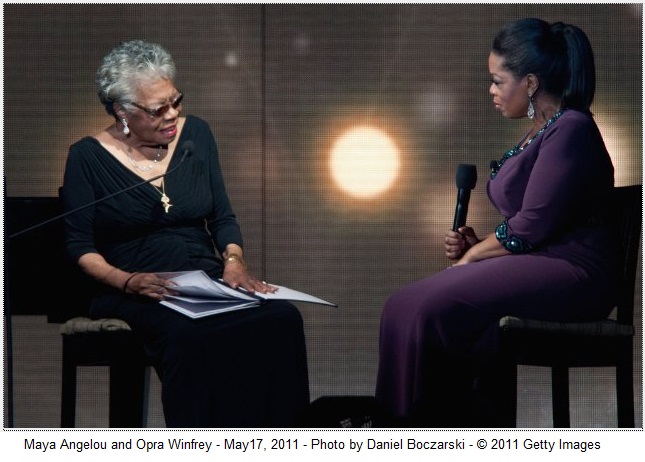
Maya 2The Go Lean/CU movement shares a linkage with this focus of Dr. Angelou. (She was due to appear at the Orpheum Theater in Omaha, Nebraska on June 9 – see photo – this writer was ticketed for attendance). The CU seeks to also empower the people of the Caribbean to lead more impactful lives in which they are better able to meet their needs and plan for a productive future. The Go Lean roadmap seeks to put Caribbean people in a place of better Command-and-Control of their circumstances, to develop the community ethos of assisting each other to advance in our own lives, in our individual communities and in the Caribbean as a whole. Like Dr. Angelou, we say with a collective voice “and still I rise” – (Published Random House 1978):

You may write me down in history
With your bitter, twisted lies,
You may tread me in the very dirt
But still, like dust, I’ll rise.

Does my sassiness upset you?
Why are you beset with gloom?
‘Cause I walk like I’ve got oil wells
Pumping in my living room.

Just like moons and like suns,
With the certainty of tides,
Just like hopes springing high,
Still I’ll rise.

Did you want to see me broken?
Bowed head and lowered eyes?
Shoulders falling down like teardrops.
Weakened by my soulful cries.

Does my haughtiness offend you?
Don’t you take it awful hard
‘Cause I laugh like I’ve got gold mines
Diggin’ in my own back yard.

You may shoot me with your words,
You may cut me with your eyes,
You may kill me with your hatefulness,
But still, like air, I’ll rise.

Does my sexiness upset you?
Does it come as a surprise
That I dance like I’ve got diamonds
At the meeting of my thighs?

Out of the huts of history’s shame
I rise
Up from a past that’s rooted in pain
I rise

I’m a black ocean, leaping and wide,
Welling and swelling I bear in the tide.
Leaving behind nights of terror and fear
I rise

Into a daybreak that’s wondrously clear
I rise
Bringing the gifts that my ancestors gave,
I am the dream and the hope of the slave.
I rise
I rise
I rise.

While the CU’s prime directive is the economics of the Caribbean region, there are peripheral areas of concern. While economics, security and governance are all important for the sustenance of Caribbean life, pursuits like poetry, art, and beauty are the reasons we want to live. Maya Angelou stood as a vanguard for many of these causes:

Minority rights, civil rights, women rights, quest for justice, art, music, film, and image.

The Go Lean book posits that one person can make a difference in the Caribbean, and its impact on the world; that there are many opportunities where one champion, one advocate, can elevate society. In fact the book is a collection of 144 different advocacies, so there is inspiration for the Maya Angelou’s of the region to make their mark in many different fields of endeavor.

The roadmap specifically encourages the region, to lean-in and foster the next generation of Maya Angelou’s with these specific community ethos, strategies, tactics, implementations and advocacies:

Community Ethos – Minority Equalization Page 24
Community Ethos – Ways to Foster Genius Page 27
Community Ethos – Ways to Promote Intellectual Property Page 31
Community Ethos – Ways to Promote Happiness Page 36
Community Ethos – Ways to Impact the Greater Good Page 37
Anatomy of Advocacies Page 122
Planning – Ways to Better Manage Image Page 129
Advocacy – Ways to Improve Education Page 159
Advocacy – Ways to Impact Justice Page 177
Advocacy – Ways to Impact Hollywood Page 203
Advocacy – Ways to Help Women Page 226
Advocacy – Ways to Improve the Arts Page 230
Advocacy – Ways to Promote Music Page 231

The Go Lean roadmap pronounces that with the participation of many advocates on many different paths for progress, the Caribbean can truly become a better place to live, work and play. We owe a debt to Dr. Angelou for leading us along this path.

The Bible book of Psalms Chapter 90 quotes:

10  In themselves the days of our years are 70 years.
And if because of special mightiness they are 80 years.
Yet their insistence is on trouble and hurtful things;
For it must quickly pass by, and away we fly.

12  Show us just how to count our days in such a way
That we may bring a heart of wisdom in.

Rest in Peace Maya Angelou. Thank you for showing us how to make our days count.

Download the free e-book of Go Lean … Caribbean – now!

—————————————————————————-

Appendix – Bibliography
Contributions Retrieved May 28, 2014 from: http://en.wikipedia.org/wiki/List_of_Maya_Angelou_works

Autobiographies

  • I Know Why the Caged Bird Sings (1969). New York: Random House. ISBN 978-0-375-50789-2
  • Gather Together in My Name (1974). New York: Random House. ISBN 978-0-394-48692-5
  • Singin’ and Swingin’ and Gettin’ Merry Like Christmas (1976). New York: Random House. ISBN 978-0-679-45777-0
  • The Heart of a Woman (1981). New York: Random House. ISBN 978-0-8129-8032-5
  • All God’s Children Need Traveling Shoes (1986). New York: Random House. ISBN 978-0-679-73404-8
  • A Song Flung Up to Heaven (2002). New York: Random House. ISBN 978-0-375-50747-2
  • I Know Why the Caged Bird Sings: The Collected Autobiographies of Maya Angelou (2004). New York: Modern Library. ISBN 978-0-679-64325-8
  • Mom & Me & Mom (2013). New York: Random House. ISBN 978-1-4000-6611-7

Maya 3Poetry

  • Just Give Me a Cool Drink of Water ‘fore I Diiie (1971). New York: Random House. ISBN 978-0-394-47142-6[14]
  • Oh Pray My Wings Are Gonna Fit Me Well (1975). New York: Random House. ISBN 0-679-45707-0
  • And Still I Rise (1978). New York: Random House. ISBN 978-0-394-50252-6[9]
  • Shaker, Why Don’t You Sing? (1983). New York: Random House. ISBN 0-394-52144-7[15][16]
  • Poems (1986). New York: Random House. ISBN 0-553-25576-2
  • Now Sheba Sings the Song (1987). New York: Plume Books. ISBN 0-452-27143-6
  • I Shall Not Be Moved (1990). New York: Bantam Books. ISBN 0-553-35458-2
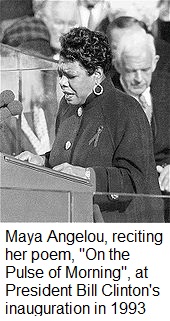
  • “On the Pulse of Morning” (1993). New York: Random House. ISBN 0-679-74838-5[17]
  • The Complete Collected Poems of Maya Angelou (1994). New York: Random House. ISBN 0-679-42895-X
  • Phenomenal Woman: Four Poems Celebrating Women (1995). New York: Random House. ISBN 0-679-43924-2
  • A Brave and Startling Truth (1995). New York: Random House. ISBN 0-679-44904-3[18]
  • “From a Black Woman to a Black Man”, 1995
  • “Amazing Peace” (2005). New York: Random House. ISBN 1-4000-6558-5[16]
  • “Mother: A Cradle to Hold Me” (2006). New York: Random House. ISBN 1-4000-6601-8
  • “Celebrations, Rituals of Peace and Prayer” (2006). New York: Random House. ISBN 978-0-307-77792-8
  • Poetry for Young People (2007). Berkshire, U.K.: Sterling Books. ISBN 1-4027-2023-8
  • “We Had Him”, 2009
  • “His Day is Done”, 2012
  • Wouldn’t Take Nothing for My Journey Now (1993). New York: Random House. ISBN 0-553-56907-4
  • Even the Stars Look Lonesome (1997). New York: Random House. ISBN 0-375-50031-6
  • Letter to My Daughter (2008). New York: Random House. ISBN 1-4000-6612-3
  • Hallelujah! The Welcome Table: A Lifetime of Memories with Recipes (2004). New York: Random House. ISBN 1-4000-6289-6
  • Great Food, All Day Long: Cook Splendidly, Eat Smart (2010). New York: Random House. ISBN 1-4000-6844-4
  • Life Doesn’t Frighten Me (1993). New York: Stewart, Tabori, and Chang. ISBN 1-55670-288-4
  • My Painted House, My Friendly Chicken and Me (1994). New York: Knopf Books. ISBN 0-517-59667-9
  • Kofi and His Magic (1996). New York: Knopf Books. ISBN 0-517-59667-9
  • Maya’s World series (2004). New York: Random House:
    • Itak of Lapland, ISBN 0-375-92833-2
    • Angelina of Italy, ISBN 0-375-82832-X
    • Renée Marie of France ISBN 0-375-82834-6
    • Mikale of Hawaii ISBN 0-375-92835-9
  • Cabaret for Freedom (musical revue), with Godfrey Cambridge, 1960
  • The Least of These, 1966
  • The Best of These (drama), 1966
  • Gettin’ up Stayed on My Mind, 1967
  • Sophocles, Ajax (adaptation), 1974
  • And Still I Rise (writer/director), 1976

Personal essays

  • Wouldn’t Take Nothing for My Journey Now (1993). New York: Random House. ISBN 0-553-56907-4
  • Even the Stars Look Lonesome (1997). New York: Random House. ISBN 0-375-50031-6
  • Letter to My Daughter (2008). New York: Random House. ISBN 1-4000-6612-3

Cookbooks

  • Hallelujah! The Welcome Table: A Lifetime of Memories with Recipes (2004). New York: Random House. ISBN 1-4000-6289-6
  • Great Food, All Day Long: Cook Splendidly, Eat Smart (2010). New York: Random House. ISBN 1-4000-6844-4

Children’s books

  • Life Doesn’t Frighten Me (1993). New York: Stewart, Tabori, and Chang. ISBN 1-55670-288-4
  • My Painted House, My Friendly Chicken and Me (1994). New York: Knopf Books. ISBN 0-517-59667-9
  • Kofi and His Magic (1996). New York: Knopf Books. ISBN 0-517-59667-9
  • Maya’s World series (2004). New York: Random House:
    • Itak of Lapland, ISBN 0-375-92833-2
    • Angelina of Italy, ISBN 0-375-82832-X
    • Renée Marie of France ISBN 0-375-82834-6
    • Mikale of Hawaii ISBN 0-375-92835-9

Plays

  • Cabaret for Freedom (musical revue), with Godfrey Cambridge, 1960
  • The Least of These, 1966
  • The Best of These (drama), 1966
  • Gettin’ up Stayed on My Mind, 1967
  • Sophocles, Ajax (adaptation), 1974
  • And Still I Rise (writer/director), 1976

Filmography
Contributions – Retrieved May 28, 2014 from: http://www.imdb.com/name/nm0029723/?ref_=fn_al_nm_1

Actress (15 credits)

Year Movie/Show Character/Role
2006 Madea’s Family Reunion May
2001 Phenomenal Woman (Short) Phenomenal Woman
2000 The Runaway (TV Movie) Conjure Woman
2000 Happily Ever After: Fairy Tales for Every Child (TV Series) Fairy Godmother
2000 Rip Van Winkle (TV Series) Fairy Godmother (voice)
1997 Talking with David Frost (TV Series)
Colin Powell and Maya Angelou Narrator
1996 Elmo Saves Christmas (Video)
1995 Touched by an Angel (TV Series) Clarice Mitchell
Reunion (1995) Clarice Mitchell
1995 How to Make an American Quilt Anna
1995 The Journey of August King Narrator (voice)
1993 There Are No Children Here (TV Movie) Lelia Mae
1993 Poetic Justice Aunt June
1977 The Richard Pryor Special? (TV Movie) Willie’s Wife
1977 Roots (TV Mini-Series) Nyo Boto / Yaisa
Part II Nyo Boto
Part I Yaisa
1959  Porgy and Bess Dancer (uncredited)

Writer (7 credits)

Year Movie/Show
2008 The Black Candle (Documentary) (poetry written by)
1996 How Do You Spell God? (TV Movie)
1996 America‘s Dream (TV Movie) (story “The Reunion”)
1982 Sister, Sister (TV Movie)
1979  I Know Why the Caged Bird Sings (TV Movie) (book)
1977  The Richard Pryor Special? (TV Movie) (soliloquy)
1972 Georgia, Georgia

Soundtrack (4 credits)

Year Movie/Show
2010 Michael Feinstein’s American Songbook (TV Mini-Series documentary) (lyrics – 1 episode)
Best Band in the Land  (lyrics: “We Dreamed These Days”)
2001 The Mystic Masseur (performer: “Scandal in the Family”)
1968 For Love of Ivy (lyrics: “You Put It on Me”)
1957 Calypso Heat Wave (writer: “All That Happens in the Market Place”)

Director (2 credits)

Year Movie/Show
1998 Down in the Delta
1976 Visions (TV Series) (1 episode)
The Tapestry/Circles ()

Music department (1 credit)

Year Movie/Show
1972 Georgia, Georgia (composer: score)

Producer (1 credit)

Year Movie/Show
1982 Sister, Sister (TV Movie) (producer)

Miscellaneous Crew (1 credit)

Year Movie/Show
1993 Poetic Justice (poetry)
Share this post:
, , , , ,
[Top]

Jack M. Mintz: ‘All is not well in the sunny Caribbean’

Go Lean Commentary

Jack Mintz 1“All that glitters is not gold” – Old adage.

This is a similar expression as the title of the below commentary by Canadian Public Policy Professor Dr. Jack Mintz:

“All is not well in the sunny Caribbean”.

The opinions of Canadian stakeholders are and have always been important from a Caribbean perspective. “Look to the Northern Star!” – the book Go Lean…Caribbean relates the hope and refuge that Canada always provided to this region (Page 146).

This book purports that an examination of the history of Canada can be productive for the Caribbean. Despite the different geographic address, Canada has had to contend with a lot of challenges similar to the Caribbean; Canada has succeeded while the Caribbean has failed. Early in the book, the point of lessons from Canada is pronounced in the Declaration of Interdependence (Page 14), with these opening statements:

xxxiii.   Whereas lessons can be learned and applied from the study of the recent history of other societies, the Federation must formalize statutes and organizational dimensions … to implement the good examples learned from developments/ communities like … Canada.

Canada recognizes that the Caribbean is in crisis; and despite billions and billions ($$$) in Canadian investments, the region is still in crisis.

Commentary By: Dr. Jack M. Mintz
Economic problems in the Caribbean should be a wake-up call for governments and businesses operating there.

As a middling power, Canada has limited influence in most areas of the world — save for the Caribbean countries. To escape the winter, three million Canadians trek annually to one of the islands to enjoy the sun and relaxation. Roughly 600,000 Caribbean [expatriates] have migrated over the years to Canada, with the largest contingents coming from Jamaica, Guyana, Haiti and Trinidad.

Canada has also invested over $140-billion in capital in the Caribbean islands, especially in Bahamas, Barbados, Bermuda and Cayman Islands. Capital stock held in Barbados alone is over $60-billion, more than any other country except for the United States.  The money does not stay there but moves on to other countries so that Canadian multi-national companies can take advantage of the Canada-Barbados tax treaty to achieve lower global effective corporate tax rates through tax-efficient financial structures.

Jack Mintz 3So when Canadian Imperial Bank of Commerce announced a $420-million write-down in goodwill invested in CIBC FirstCaribbean, it should attract attention, given our deep ties to the region. All is not well in the Caribbean region with its bloated, over-indebted governments operating in slow-growth environments. The economic and fiscal problems in the region raise critical economic and security concerns for Canada.

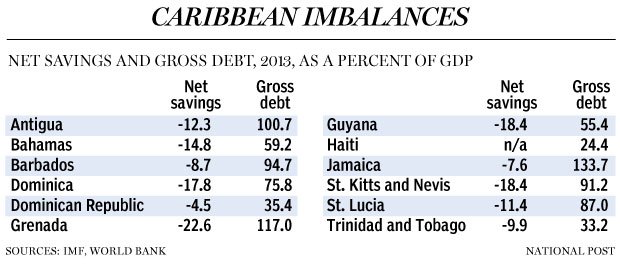
Many Caribbean governments face financial instability. Gross public debt has risen to over 80% of GDP in 2013 for Antigua, Barbados, Grenada, Jamaica, St. Kitts and Nevis, and St. Lucia. Many of these countries are also heavily exposed to global markets with the current account deficit over 20% of GDP in the Caribbean region. Foreign direct investment inflows are more than 8% of GDP for Antigua, Bahamas, Barbados, Grenada, Guyana, St. Kitts and Nevis, St. Lucia and Trinidad-Tobago.

At a flick of the switch, international lenders could turn off the spigots, resulting in a financial crisis and hefty devaluation of currencies. The implications of a severe economic contraction in the region would put the Caribbean countries in limbo and have important consequences to Canada, given our relationships in the region.

The outlook for the Caribbean countries is not exactly cheerful. Overall, economic growth has been poor, about 1.5% for the region, and close to stagnant for Bahamas, Barbados, Grenada and Jamaica. Many of the Caribbean countries face competitiveness problems with some of the highest electricity rates in the world, unionized wage costs and high real interest costs. The business climate is weak with poor regulatory practices, enforcement of contracts and crime.

With the global economic slowdown, tourism has been relatively flat, lagging most regions of the world in 2013. Tourism, after all, is not a necessity and more money is spent on it only when people are better off. The outlook is not looking much better in the near future with little income growth in North America and Europe. Should there ever be reconciliation between the United States and Cuba, U.S. tourism could significantly shift from other islands.

Nor are commodity prices expected to be booming as China and the rest of Asia slow down, with little take up from the rest of the world. Only oil and gas prices seem to be firm, which is good news for Trinidad and Tobago.

With the G20 and OECD countries focused on curbing tax evasion and avoidance, several Caribbean countries – Bermuda, Barbados and Cayman Islands – would be subject to a tightening tax noose. These countries could face a deceleration in economic activity if international tax structures are to be dismantled.

Thus, economic and fiscal problems in the Caribbean should be a wake-up call for governments and businesses operating there. The CIBC write-down is just the tip of the iceberg.

A financial crisis will heavily impact many Canadian businesses that have turned to the Caribbean islands to set up financing and insurance structures. A major economic slowdown in the Caribbean islands would also raise security issues for Canada as crime, including drug trade, could become more problematical to control.

The Canadian government should therefore work with other major countries and international organizations to stabilize Caribbean economies. Attempts to build capacity for good governance in the past years have not been easy but it cannot be abandoned. Some new initiatives should be considered that would help the Caribbean islands improve their fortunes.

Certainly, trying to harmonize policies and merge certain institutions to achieve economies-of-scale across the region would be a useful step. This includes post-secondary education, financial markets and transportation. A shift by Caribbean countries away from oil to natural gas from Trinidad-Tobago and North America would reduce their cost of oil imports.

At the same time, Canada and other Western countries should invest in improving the judiciary and security forces in the [Caribbean] region. The reduction in crime would also benefit our economies by reducing risks faced by tourists and investors. Drug trade with Canada would be curbed.

Debt relief for some of the countries would be appropriate so long as certain commitments are made to reform governance and economic policy. This has been the role of the IMF over the years but Canada should itself pay more attention to the region.

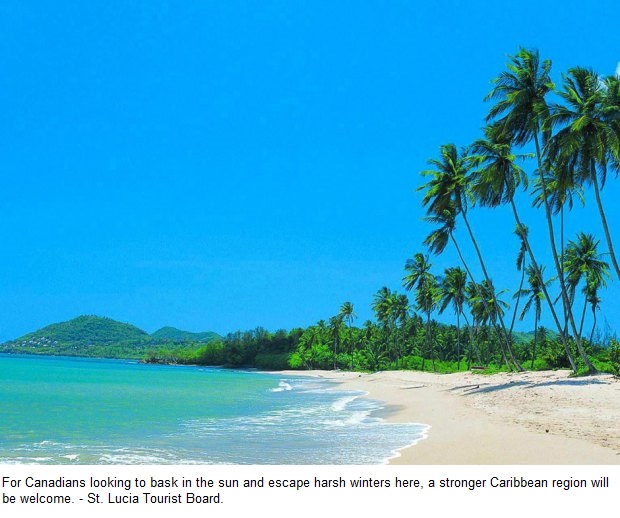
For Canadians looking to bask in the sun and escape harsh winters here, a stronger Caribbean region will be welcome.

Jack M. Mintz is the Palmer Chair, School of Public Policy, University of Calgary. Contact: policy@ucalgary.ca

Source: Financial Post – Canadian Daily; retrieved 05-23-2014 from: http://business.financialpost.com/2014/05/22/jack-m-mintz-all-is-not-well-in-the-sunny-caribbean/

Jack Mintz 2The underlying theme of Jack Mintz commentary is that Caribbean society needs a reboot. The book Go Lean… Caribbean serves as a roadmap for the introduction and implementation of Caribbean Union Trade Federation (CU), a reboot for Caribbean society with these 3 prime directives:

  • Optimize the economic engines of the Caribbean to grow the economy to $800 Billion and create 2.2 million new jobs.
  • Establish a security apparatus to protect the resultant economic engines and stakeholders.
  • Improve Caribbean governance with technocratic excellence.

The foregoing article highlights the mis-management of credit/debt of the governments of the region. The commentary specifically warns:

At a flick of the switch, international lenders could turn off the spigots, resulting in a financial crisis and hefty devaluation of currencies.

Why such poor financial planning? It is obvious that there is a lot of success missing in terms of fiscal expedience. It is not reasonable to expect that current administrations can solve Caribbean fiscal problems with the same tools and techniques of the present. The Go Lean roadmap calls for a different toolbox and different techniques.

If beauty is in the eye of the beholder, then perhaps this commentary is just one person’s assessment of ugly – just a perception. But unfortunately, the facts are the facts. Dr. Mintz relates ugly examples, such as the fact the region has the “highest electricity rates in the world”. There is no denying the “Amount Due” figures on actual electric utility bills.

This is the present, as perceived by Dr. Mintz. Plus, his assessment of the near future is even more “gloom-and-doom”.

True, there is work to be done. But not the job of a Calgary professor, or any other Canadian stakeholder, to do the heavy-lifting. No, this is the job of the Caribbean for the Caribbean. Who is up to the task?

The Caribbean Union Trade Federation hereby “reports for duty” for the job to forge this change.

The Go Lean book details that solutions must come from all aspects of society. There are community values/attitudes that must be in place to ensure that any quest for permanent change would have some measure of success. Those attitudes are referred to as community ethos. There must first be the adoption of many such ethos, followed by the executions of strategies, tactics, implementations and advocacies to impact the region’s prospects, as detailed here:

Community Ethos – Lean Operations Page 24
Community Ethos – Ways to Impact the Future Page 26
Community Ethos – Ways to Help Entrepreneurship Page 28
Anecdote – Entrepreneur’s Best Place To Live? Canada Page 39
Strategy – Vision – Integrate Region into Single Market Page 45
Strategy – Agents of Change – Globalization Page 57
Tactical – Confederating a Permanent Union Page 63
Tactical – Fostering a Technocracy Page 64
Separation of Powers – Banking Regulatory Authority Page 73
Separation of Powers – Justice Institutions Page 77
Implementation – Foreign Policy Initiatives at Start-up Page 102
Implementation – Security Initiatives at Start-up Page 103
Implementation – Ways to Deliver Page 109
Implementation – Ways to Improve Energy Usage Page 113
Implementation – Ways to Better Manage Debt Page 114
Implementation – Ways to Foster International Aid Page 115
Implementation – Ways to Benefit from Globalization Page 119
Planning – Lessons from Canada’s History Page 146
Advocacy – Ways to Grow the Economy Page 151
Advocacy – Ways to Better Manage ForEx Page 154
Advocacy – Ways to Improve Governance Page 168
Advocacy – Ways to Enhance Tourism Page 190
Advocacy – Reforms for Banking Regulations Page 199
Advocacy – Ways to Impact the Diaspora Page 217
Advocacy – Ways to Preserve Caribbean Heritage Page 218
Appendix – Offshore Tax & Financial Services Industry Developments Page 321

The Go Lean roadmap calls for a different entrepreneurial approach than some of the tax avoidance industries promoted in the past. These strategies have actually failed. Most offshore financial centers have modernized their lax laws to mitigate terrorism financing, thus lowering their attraction to tax evaders. The hold-outs, (Bermuda, Barbados and the Cayman Islands), are now being forced to cow-tail to the New World Order. The people of the Caribbean deserve better than waiting for “illicit bread to fall from the table” of rich nations (G-20). We have the world’s best address, for goodness sake, people should be beating a path to our doors (like the 3 million Canadians annually), not the 600,000 Caribbean citizens who have beaten down our doors to get out.

Time for change! The Go Lean roadmap is hereby presented.

The region is hereby urged to lean-in to this Go Lean roadmap, to fulfill the vision of making the Caribbean region a better place to live, work and play. 🙂

Download the book Go Lean … Caribbean – now!

Share this post:
, , , , ,
[Top]

JP Morgan Chase $100 million Detroit investment not just for Press

Go Lean Commentary

This investment in the turn-around of Detroit is business, not charity. “We could make this our finest moment”.

This was the theme of the Today Show’s Matt Lauer interview with Jaime Dimon, CEO of the US’s largest Bank Holding Company – JP Morgan Chase – that investing in the turn-around and rebirth of distressed cities can be good business. The publisher of the book Go Lean…Caribbean echoes the same sentiments: Ditto!

The same as there is profit involved in destruction and construction, there is profit to be made in community redevelopment, within a city or even for a region.  The book posits that combining those two functions (destruction and construction) in an overall effort for rebirth, reboot and turn-around can be truly profitable, and also impact the Greater Good.

This book purports that an examination of the details of Detroit can be productive for the Caribbean; Detroit has a lot of urban blight – see photos here. Early in the book, the point of lessons from Detroit is pronounced in the Declaration of Interdependence (Page 14), with these opening statements:

xxxiii.   Whereas lessons can be learned and applied from the study of the recent history of other societies, the Federation must formalize statutes and organizational dimensions to avoid the pitfalls of communities like … Detroit…

The City of Detroit is in crisis. In July 2013, Detroit became the largest U.S. city to seek bankruptcy protection. It is currently $19 billion in debt and has an unemployment rate of about 14% – more than double the national average. This is why the study of Detroit is such an ideal model for the Caribbean. We have many communities within the Caribbean’s 30 member-states with similar unemployment, urban blight, brain drain, and acute hopelessness.

By: David Muller

DETROIT, MI – Last November, the U.S. Department of Justice fined JP Morgan Chase a record $13 billion as part of a settlement over misleading investors over toxic mortgage-backed securities.

In the largest settlement with an American entity in the history of the U.S.A., the Justice Department said that “JPMorgan acknowledged it made serious misrepresentations to the public – including the investing public – about numerous RMBS transactions. The resolution also requires JPMorgan to provide much needed relief to underwater homeowners and potential homebuyers, including those in distressed areas of the country.”

On Wednesday morning, Jamie Dimon, the Chairman and CEO of JP Morgan Chase, was on NBC’s “Today Show” to tout a $100 million investment in the city of Detroit. Later, at noon on Wednesday, he is scheduled to unveil details of the five-year financial infusion in the city over the next five years at Detroit’s Garden Theater with Gov. Rick Snyder and Mayor Mike Duggan.

Dimon told “Today Show” host Matt Lauer that the bank’s investment in Detroit is not a public relations stunt. From the “Today Show”:

“‘The cynic would be wrong,’ Dimon told Lauer when asked if the investment was in response to a $13 billion fine levied against the company in an exclusive interview.

‘We invest and develop communities around the world. And we’ve been doing this since our heritage started 200 years ago,’ said Dimon. ‘So that’s what banks do. They do it commercially. They do community development.'”

According to the Detroit Free Press, the investment by Chase includes $25 million for blight removal and home loans, $12.5 million for job training, $50 million for development projects, $7 million for small business loans and $5.5 million toward the M-1 Rail, the city’s streetcar which is being built on Woodward Avenue.

Detroit’s MLive Media Group (Posted and retrieved 05-21-2014) –http://www.mlive.com/business/detroit/index.ssf/2014/05/jp_morgan_chase_ceo_jamie_dimo.html

Visit NBCNews.com for breaking news, world news, and news about the economy

This book Go Lean… Caribbean, serves as a roadmap for the introduction and implementation of the Caribbean Union Trade Federation (CU). This represents change for the region. The CU/Go Lean roadmap has 3 prime directives:

  • Optimization of the economic engines in order to grow the regional economy.
  • Establishment of a security apparatus to protect the resultant economic engines.
  • Improve Caribbean governance to support these engines.

According to the foregoing article and VIDEO, the rebirth of Detroit will be financed, in part, with $100 million of community investment dollars from JP Morgan Chase. The Go Lean roadmap presents a plan to generate funding to Pay for Change (Page 101). Both the JP Morgan Chase/Detroit plan and the CU/Go Lean plan extend over a 5 year period. The Detroit plan is branded the “Motor City Makeover”; this branding and messaging is important for soliciting support and participation from the community in general. This parallels to the CU/Go Lean effort to foster the attitudes and motivations to forge change from Caribbean stakeholders. This is defined in the book as a community ethos. One such ethos is turn-around: a collective vision, succeeded by appropriate steps and actions, to reject the status quo and demand change.

Detroit 1

Detroit 2

Detroit 3

Detroit 4

Detroit 5

Detroit 6

The book details other ethos to adopt, plus the executions of the following strategies, tactics, implementations and advocacies to impact the rebirths, reboots and turn-arounds of Caribbean communities:

Community Ethos – Deferred Gratification Page 21
Community Ethos – People Respond to Incentives Page 21
Community Ethos – Job Multiplier Page 22
Community Ethos – Light Up the Dark Places Page 23
Community Ethos – “Crap” Happens Page 23
Community Ethos – Lean Operations Page 24
Community Ethos – Return on Investments (ROI) Page 24
Community Ethos – Ways to Impact the Future Page 26
Community Ethos – Ways to Help Entrepreneurship Page 28
Community Ethos – Ways to Impact a Turn-Around Page 33
Community Ethos – Impact the Greater Good Page 37
Strategy – Customers – Foreign Direct Investors Page 48
Tactical – Fostering a Technocracy Page 64
Tactical – Modeling Post WW II Germany – Marshall Plan Page 68
Tactical – Modeling Post WW II Japan – with no Marshall Plan Page 69
Separation of Powers – Public Works & Infrastructure Page 82
Separation of Powers – Housing and Urban Authority Page 83
Implementation – Ways to Pay for Change Page 101
Implementation – Ways to Re-boot Freeport – as a sample city Page 112
Planning – Ways to Improve Failed-State Indices Page 132
Planning – Lessons Learned from 2008 Page 136
Planning – Lessons from Detroit Page 140
Advocacy – Ways to Grow the Economy Page 151
Advocacy – Ways to Create Jobs Page 152
Advocacy – Ways to Improve Local Government Page 169
Advocacy – Ways to Better Manage the Social Contract Page 170
Advocacy – Ways to Preserve Caribbean Heritage Page 218
Advocacy – Ways to Promote World-Heritage-Sites Page 248

The foregoing news article relates that the benefactor, JP Morgan Chase, had been cited and fined ($13 Billion) for inequities associated with the housing bubble and subsequent meltdown. They have a motivation to “curry favor” with the public after their 2008 track record. But they claim that this is not a Public Relations (PR) stunt, and they are willing to put their “money where their mouth is”. There are not a lot of outside benefactors offering to help Detroit, so this city must embrace all the help being offered.

This is another parallel for the CU effort.

There are not a lot of solutions being proffered to the Caribbean region at this time. The Go Lean roadmap is a complete solution for Caribbean elevation. The region is hereby urged to lean-in to this roadmap. This should help the Caribbean to fulfill its vision and get to its desired destination: a better place to live, work and play.

Download the book Go Lean … Caribbean – now!


Share this post:
, ,
[Top]

How to Whitelist Blog Emails

Are you missing any Blogs?

WhotelistingYou use your Google Account to receive daily Blogs from Go Lean…Caribbean. You receive them Day 1, 2, and 3 but by Day 4 you all of a sudden stop getting them and don’t know why. You check your Spam/Bulk/Promotions Inbox/Folder and there they are; 4 days worth of blogs that you thought disappeared into thin air.

While this scenario is bad, SPAM filters are good. It is important to keep your SPAM filter active in order to wean out the emails that are truly SPAM-ish. But what about the legitimate emails that you truly want to receive? You will not want them caught in an overactive SPAM filter? In addition to a SPAM designation, they may be categorized in a different folder in your email system? This could cause you not to receive important emails daily, such as Go Lean…Caribbean blogs.

Whereas SPAM is considered Blacklist, you can add emails from trusted senders to your Whitelist so that they can pass easily through your spam filter (or junk folder) across the different email clients and internet security platforms. Whitelisting specifically allows emails from a specific source, such as Go Lean…Caribbean, to be allowed into your email inbox.

The following is a list of steps for programs and email in alphabetical order:

AOL 7.0 & 8.0

1.    Open a message from the Go Lean…Caribbean

2.    Click the Add Address icon on the right side of the window.

3.    Click the Save button

AOL 9.0 and Up

1.    Open a message from the Go Lean…Caribbean

2.    Click the Add Address icon on the right side of the window

3.    Click the OK button

AOL Mail

1.    Open a message from Go Lean…Caribbean

2.    Click Show Images: Go Lean…Caribbean

AT&T Webmail and BellSouth

1.    In your mailbox, click Options.

2.    Go to Mail Options, select Filters. Click Add Filter.

3.    Go to From Header and select Contains. Enter the trusted address or domain (email or website) in the box provided.

4.    Go to the drop down menu at the bottom with the option Move the message to. Select Inbox.

5.    Click Add Filter

Comcast SmartZone

1.    Click Address Book

2.    Click New. Select New Contact

3.    Add email address.

4.    Click Save

Cox Email

1.    Click Preferences.

2.    Go to General Email Preferences and click Blocked Senders.

3.    Type address or domain to add to the Exceptions list.

4.    Click Add. Click Save.

EarthLink

1.    Click on Address Book (it’s over on the left, below your Folders).

2.    When your Address Book opens, click the Add new contact.

3.    On the Add Contact screen, find the Internet Information box.

4.    Enter the Go Lean…Caribbean address into the top Email box.

5.    Click Save.

Earthlink Total Access

1.    Open a message from the Go Lean…Caribbean

2.    In the From field, right-click the email address

3.    Click the Add to Address Book link in the menu

4.    Click the Ok button

Gmail

1.    Open a message from Go Lean…Caribbean.

2.    Click Always display images from (senders address).

OR

1.    Open a message from Go Lean…Caribbean.

2.    Click the arrow next to reply on the top right.

3.    Click Add sender to contact list.

Hotmail

1.    Open a message from the Go Lean…Caribbean.

2.    Click Mark as safe next to the From name and address.

3.    Now click Add contact.

Mac Mail

1.    Open a message from the Go Lean…Caribbean

2.    Go to Message in the top tool bar

3.    Click Add Sender to Address Book from the drop-down menu

McAfee SpamKiller

1.    Go to Friends and click Add.

2.    Type the trusted address or domain in the space provided. Click OK.

MSN

1.    Click on Help & Settings

2.    Click Email Settings

3.    Click on Safe List

4.    In Add an item to this list, type the specific email address or use @xxxx.com to whitelist the domain (note: xxxx has to be replaced with the domain)

5.    Click Add

Thunderbird / Netscape 6 or 7

1.    Open a message from the Go Lean…Caribbean.

2.    In the From field, right-click the email address.

3.    Click the Add to Address Book link in the menu.

4.    Click the OK button.

NetZero

1.    Go to Options and click Safe List.

2.    Type the trusted domain or address in Add Address to Safe List.

3.    Click Add then click Save.

Norton AntiSpam

1.    Go to the Status & Settings tab and click AntiSpam.

2.    Click Configure and go to the Allowed List tab.

3.    Click Add and type the trusted address or domain in the Email Address box.

4.    Click OK.

Outlook 2003 – 2007

1.    Open a message from the Go Lean…Caribbean.

2.    Go to the Actions option in the top tool bar.

3.    Select Junk E-mail from the drop down menu.

4.    Select the Add Sender to Safe Senders List option.

Outlook 2000 / Outlook 11

1.    Open a message from the Go Lean…Caribbean

2.    In the From field, right-click the email address

3.    Click the Add to Contacts link in the menu

4.    Click the OK button

Outlook Express 6

1.    Open a message from the Go Lean…Caribbean

2.    In the From field, right-click the email address

3.    Click the Add to Address Book link in the menu

4.    Click the OK button

Road Runner

1.    Open Junk Mail folder.

2.    Select emails you wish to add to your whitelist.

3.    Click Mark as Not Spam.

Spam Assassin

1.    In your hard drive, find your Spam Assassin folder. Click the folder.

2.    Open the file named user_prefs with a text editor or Notepad. (If the file does not exist you can create it using the instructions on Spam Assassin’s website.)

3.    Make a new line with the text whitelist_from and the trusted address or domain you wish to add.

4.    Save the file and close it.

Verizon

1.    Go to Options and select Block Senders.

2.    In the Safe List, type your trusted address or domain.

3.    Click OK.

Windows Live

1.    Open a message from the Go Lean…Caribbean

2.    Click Mark as safe next to the From name and address

3.    Now click Add contact

Yahoo!

1.    Open a message from the Go Lean…Caribbean.

2.    Now click Add contact next to the From name and address.

Tutorial Source: http://www.whatcounts.com/how-to-whitelist-emails/- Retrieved 5/14/2014


 Don’t forget to add Go Lean…Caribbean to YOUR Whitelist!!!

Download the Book- Go Lean…Caribbean Now!!!

Share this post:
, ,
[Top]

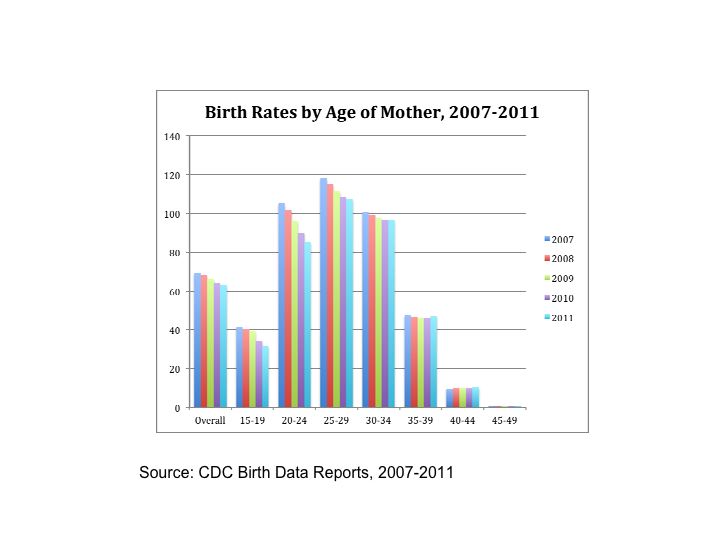
Having Less Babies is Bad for the Economy

Go Lean Commentary

Little GirlsMore fallout from the year 2008…

This is a consistent theme in the book Go Lean…Caribbean. The book posits that the events of that year were a crisis for the Caribbean, North America and the world economy as a whole. What’s worst is the Caribbean is still reeling from those events.

“A crisis is a terrible thing to waste”

… so states the book quoting noted Economist Paul Romer. The opportunity therefore exists to forge change in the economic, security and governing engines of the Caribbean, in response to this crisis.

The below news-story (or click on VIDEO icon below) shows that the rest of the world, those with astute eyes/ears to look, listen and learn, will be using this crisis to prepare for change. This is the advocacy of the Go Lean book, to position the region at the corner of preparation and opportunity, so as to benefit from change. The issue from the article is more pressing for the Caribbean than the rest of North America; this is because the region has a very high emigration rate (brain drain). This point is crystalized with this quotation:

We tend to think economic growth comes from working harder and smarter. But economists attribute up to a third of it to more people joining the workforce each year than leaving it. The result is more producing, earning and spending.

The book Go Lean…Caribbean serves as a roadmap for the introduction and implementation of the Caribbean Union Trade Federation (CU), a super-national institution with federal powers to forge change in the Caribbean community. One mission is incentivizing the return of the far-flung Caribbean Diaspora. Another mission is to dissuade further human flight/brain drain. The numbers don’t lie: we need population growth not population contraction.

NEW YORK (AP) — Nancy Strumwasser, a high school teacher from Mountain Lakes, New Jersey, always thought she’d have two children. But the layoffs that swept over the U.S. economy around the time her son was born six years ago helped change her mind. Though she and her husband, a market researcher, managed to keep their jobs, she fears they won’t be so fortunate next time.

“After we had a kid in 2009, I thought, ‘This is not happening again,'” says Strumwasser, 41, adding, “I never really felt comfortable about jobs, how solid they can be.”

The 2008 financial crisis did more than wipe out billions in wealth and millions of jobs. It also sent birth rates tumbling around the world as couples found themselves too short of money or too fearful about their finances to have children. Six years later, birth rates haven’t bounced back.

For those who fear an overcrowded planet, this is good news. For the economy, not so good.

We tend to think economic growth comes from working harder and smarter. But economists attribute up to a third of it to more people joining the workforce each year than leaving it. The result is more producing, earning and spending.

Now this secret fuel of the economy, rarely missing and little noticed, is running out.

“For the first time since World War II, we’re no longer getting a tailwind,” says Russ Koesterich, chief investment strategist at BlackRock, the world’s largest money manager. “You’re going to create fewer jobs. … All else equal, wage growth will be slower.”

Births are falling in China, Japan, the United States, Germany, Italy and nearly all other European countries. Studies have shown that births drop when unemployment rises, such as during the Great Depression of the 1930s. Birth rates have fallen the most in some regions that were hardest hit by the financial crisis.

In the United States, three-quarters of people surveyed by Gallup last year said the main reason couples weren’t having more children was a lack of money or fear of the economy.

The trend emerges as a gauge of future economic health — the growth in the pool of potential workers, ages 20-64 — is signaling trouble ahead. This labor pool had expanded for decades, thanks to the vast generation of baby boomers. Now the boomers are retiring, and there are barely enough new workers to replace them, let alone add to their numbers.

Growth in the working-age population has halted in developed countries overall. Even in France and the United Kingdom, with relatively healthy birth rates, growth in the labor pool has slowed dramatically. In Japan, Germany and Italy, the labor pool is shrinking.

“It’s like health — you only realize it exists until you don’t have it,” says Alejandro Macarron Larumbe of Demographic Renaissance, a think tank in Madrid.

The drop in birth rates is rooted in the 1960s, when many women entered the workforce for the first time and couples decided to have smaller families. Births did begin rising in many countries in the new millennium. But then the financial crisis struck. Stocks and home values plummeted, blowing a hole in household finances, and tens of millions of people lost jobs. Many couples delayed having children or decided to have none at all.

Couples in the world’s five biggest developed economies — the United States, Japan, Germany, France and the United Kingdom — had 350,000 fewer babies in 2012 than in 2008, a drop of nearly 5 percent. The United Nations forecasts that women in those countries will have an average 1.7 children in their lifetimes. Demographers say the fertility rate needs to reach 2.1 just to replace people dying and keep populations constant.

The effects on economies, personal wealth and living standards are far reaching:

— A return to “normal” growth is unlikely: Economic growth of 3 percent a year in developed countries, the average over four decades, had been considered a natural rate of expansion, sure to return once damage from the global downturn faded. But many economists argue that that pace can’t be sustained without a surge of new workers. The Congressional Budget Office has estimated that the U.S. economy will grow 3 percent or so in each of the next three years, then slow to an average 2.3 percent for next eight years. The main reason: Not enough new workers.

— Reduced pay and lifestyles: Slower economic growth will limit wage gains and make it difficult for middle-class families to raise their living standards, and for those in poverty to escape it. One measure of living standards is already signaling trouble: Gross domestic product per capita — the value of goods and services a country produces per person — fell 1 percent in the five biggest developed countries from the start of 2008 through 2012, according to the World Bank.

— A drag on household wealth: Slower economic growth means companies will generate lower profits, thereby weighing down stock prices. And the share of people in the population at the age when they tend to invest in stocks and homes is set to fall, too. All else equal, that implies stagnant or lower values. Homes are the biggest source of wealth for most middle-class families.

___

AP researcher Fu Ting in Shanghai and AP writers Frank Jordans in Berlin, Colleen Barry in Milan and Youkyung Lee in Seoul, South Korea, contributed to this report.

Huffington Post – Online News – May 8, 2014 http://www.huffingtonpost.com/2014/05/07/birth-rate-economy_n_5281597.html

The CU recognizes that the numbers must work in favor of societal progress. The next steps after Look-Listen-Learn is to Lend-a-hand and then Lead. (This is referred to as the 5 L Progression). So to lend-a-hand, the Go Lean roadmap advocates that population leveling can be accomplished with a regional integration. There are many social safety nets that depend of this actuarial exercise. Consider unemployment and pensions: for unemployment, workers pay into a fund and the temporarily unemployed file claims against that fund. Likewise with pensions: young workers pay into a fund, and the older-retired workers draw claims against that fund.

The CU is structured to lead … for the economic elevation of the region of 42 million people in the 30 member-states. The Go Lean roadmap provides the details for the creation of 2.2 million new jobs and GDP growth to accumulate to $800 Billion. This commission to lead is at the root of the Go Lean effort, embedded in the opening Declaration of Interdependence (Page 13):

xxiv. Whereas a free market economy can be induced and spurred for continuous progress, the Federation must install the controls to better manage aspects of the economy: jobs, inflation, savings rate, investments and other economic principles. Thereby attracting direct foreign investment because of the stability and vibrancy of our economy.

xxv. Whereas the legacy of international democracies had been imperiled due to a global financial crisis, the structure of the Federation must allow for financial stability and assurance of the Federation’s institutions. To mandate the economic vibrancy of the region, monetary and fiscal controls and policies must be incorporated as proactive and reactive measures. These measures must address threats against the financial integrity of the Federation and of the member-states.

Currency 2According to the foregoing article, America needs to have more babies. While this disposition varies from country to country, the Caribbean needs to furnish the environment for families to make their own family-planning decisions based on their own personal motivations, not economic realities. Broken economies can (and will) be fixed! Love for the Caribbean homeland should therefore be the primary motivation for the CU effort. From the cradle-to-the-grave, we need love to be the principal motivation, not fear or economic metrics, for making the Caribbean a better place to live, work and play.

Taking the lead for this goal takes real work, heavy-lifting on the part of the stewards of the Caribbean economy. This is the charter for the CU, as started in the Declaration of Interdependence (Page 13), a direct quotation from the US Declaration of Independence, as follows:

… that to secure these rights (life, liberty and the pursuit of happiness), governments are instituted among men, deriving their just powers from the consent of the governed. … [It] is the right of the people to … institute new government, laying its foundation on such principles and organizing its powers in such form, as to them shall seem most likely to effect their safety and happiness.

The following details from the book Go Lean … Caribbean are the community ethos, strategies, tactics, implementations and advocacies prescribed to manifest the elevation of Caribbean economy, society and life:

Who We Are – SFE Foundation Page 8
Community Ethos – Deferred Gratification Page 21
Community Ethos – new Economic Principles Page 21
Community Ethos – new Security Principles Page 22
Community Ethos – new Governing Principles Page 24
Community Ethos – Ways to Impact the Future Page 26
Community Ethos – Ways to Impact Turn-Arounds Page 33
Community Ethos – Ways to Promote Happiness Page 36
Community Ethos – Ways to Impact the Greater Good Page 37
Strategy – Repatriating Caribbean Diaspora Page 47
Strategy – Non-Government Organizations Page 48
Strategy – Agents of Change – Aging Diaspora Page 57
Tactical – Confederating a Permanent Union Page 63
Tactical – Fostering a Technocracy Page 64
Implementation – Assemble all Member-States Page 96
Implementation – Ways to Pay for Change Page 101
Implementation – Reasons to Repatriate Page 118
Planning – Lessons Learned from 2008 Page 136
Advocacy – Ways to Grow the Economy Page 151
Advocacy – Ways to Create Jobs Page 152
Advocacy – Better Manage the Social Contract Page 170
Advocacy – Ways to Foster Empowering Immigration Page 174
Advocacy – Impact the Diaspora Page 217
Advocacy – Ways to Preserve Caribbean Heritage Page 218
Advocacy – Ways to Impact Retirement Page 221
Advocacy – Ways to Help the Middle Class Page 223
Advocacy – Ways to Improve Elder-Care Page 225

The Go Lean roadmap is a product of 2008. From this fallout, this plan was composed, by individuals intimate with the details of the crisis … and its causes.

The goal is to learn from the Year 2008 and spread new benefits across the Caribbean region. This roadmap identifies where we are as a region currently, where we want to go, and most importantly, how we plan to get there (turn-by-turn directions). It is time for us to move now to that place, that corner of opportunity and preparation.

playbutton-300x300

Download the book Go Lean … Caribbean – now!

Share this post:
, , ,
[Top]

One currency, divergent economies

Go Lean Commentary

CurrencyThe global financial crisis is not over. Some countries, like in Europe, are doing better while some places are not. This quotation from the foregoing article stands out in significance:

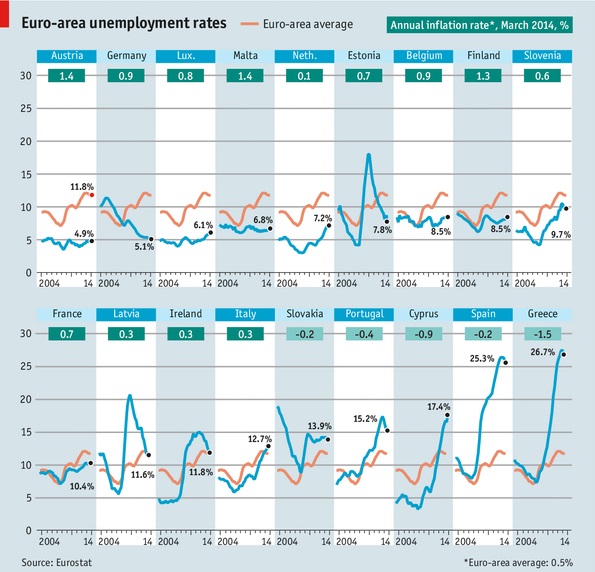
Whereas joblessness has fallen in Germany, from 10.1% to 5.1%, it has soared in Spain, from 11.1% to 25.3%.

The experiences have also been similar in the United States. In 2008, California’s unemployment rate exceeded 10%, while Nebraska enjoyed a 4% rate. Why do some member-states dive, some survive and others thrive? This is the scope of the social science of economics. But it is not a perfect science. A joke lampooning the folly of economists states that “an economist is an expert who will know tomorrow why the things he predicted yesterday didn’t happen today”.

By: Staff Reporting.

One thing that the European Central Bank (ECB) does not lack is advice on tackling low inflation. This week the OECD added its voice to that of the IMF in April in urging prompt action, calling for a cut in the bank’s main lending rate, from the already low 0.25% reached in November to zero. The ECB’s governing council, meeting on May 8th (after The Economist had gone to press), was not expected to respond to this plea any more than it did to the IMF’s.

The difficulty facing the 24-strong council is highlighted by the euro zone’s differing labour-market trajectories over the past decade (a period during which it expanded from 12 to 18 countries). Whereas joblessness has fallen in Germany, from 10.1% to 5.1%, it has soared in Spain, from 11.1% to 25.3%.

High unemployment has contributed to the onset of deflation in parts of southern Europe. But even in northern countries inflation is low, and though it has risen in the euro zone as a whole from 0.5% in March to 0.7% in April, that is still a long way off the ECB’s target of close to 2%. The main reasons why the council prefers to wait and see are that the recovery is strengthening and bond investors are falling over themselves to lend to southern Europe, even without any further policy stimulus.

The Economist Magazine – Online Edition – May 10th, 2014 http://www.economist.com/news/finance-and-economics/21601878-one- currency-divergent-economies

Europe’s and the US experience is different than that of the Caribbean. For us, it’s some countries are doing bad, others worse.

The best practice for effective stewards of an economy is the recovery, to bounce back quickly. In the US, the economy lost $11 Trillion in the 2008 Great Recession, but recovered $13.5 Trillion back a few years later, by December 2012 (Page 69).

Europe has the safety net of the economies-of-scale of 508 million people and a GDP of $15 Trillion in 28 member-states in the EU; (the Eurozone subset is 18 states, 333 million people and $13.1 Trillion GDP). The US has 50 states and 320 million people. Shocks and dips can therefore be absorbed and leveraged across the entire region .The EU is still the #1 economy in the world; the US is #2.

The Caribbean has no safety-net, no shock absorption, and no integration. This is the quest of the book Go Lean…Caribbean; it urges the introduction and implementation of the Caribbean Union Trade Federation. The book serves as a roadmap for this goal, with turn-by-turn directions to integrate the 30 member-states of the region and forge an $800 Billion economy.

This is a big idea for the small Caribbean!

At the outset, the roadmap identified an urgent need to contend with, since the Caribbean is still in the throes of the financial crisis (commenced in 2008). This is pronounced in this clause in the opening Declaration of Interdependence (Page 13):

xxv. Whereas the legacy of international democracies had been imperiled due to a global financial crisis, the structure of the Federation must allow for financial stability and assurance of the Federation’s institutions. To mandate the economic vibrancy of the region, monetary and fiscal controls and policies must be incorporated as proactive and reactive measures. These measures must address threats against the financial integrity of the Federation and of the member-states.

The Go Lean roadmap signals change for the region. It introduces new measures, new opportunities and new recoveries. Economies will rise and fall; the recovery is key. Prices will inflate and deflate; as depicted in the foregoing article, there are curative measures to manage these indices. The roadmap calls for the establishment of the allied Caribbean Central Bank (CCB) to manage the monetary affairs of this region. The book describes the breath-and-width of the CCB, modeled in many ways after the ECB.

The foregoing news article is short (3 paragraphs), but like most topics in economics, a quick phrase on the surface connotes a deep field of study underneath. This field of study in this article is inflation and deflation.

CU Blog - One curreny, divergent economies - Photo 2 (1)In economics, inflation is a sustained increase in the general price level of goods and services in an economy over a period of time. When the general price level rises, each unit of currency buys fewer goods and services. Consequently, inflation reflects a reduction in the purchasing power per unit of money – a loss of real value in the medium of exchange and unit of account within the economy. [a] Deflation is a decrease in the general price level of goods and services. Deflation occurs when the inflation rate falls below 0% (a negative inflation rate). [b]

Stewardship of the economy was envisioned and pronounced in the roadmap’s Declaration of Interdependence (Page 13):

xxiv. Whereas a free market economy can be induced and spurred for continuous progress, the Federation must install the controls to better manage aspects of the economy: jobs, inflation, savings rate, investments and other economic principles. Thereby attracting direct foreign investment because of the stability and vibrancy of our economy.

The role of central banking and commercial banking is pivotal to the CU roadmap. The Caribbean Central Bank will manage the monetary policy and reserves of the Caribbean Dollar single currency – shepherding inflation, deflation and foreign currency matters for the region. On the other hand, commercial banks operate with the simultaneous goal of providing credit/holding deposits for the public and maximizing shareholder value for their investors. A conflict of these two goals can endanger the macro-economy. The CU/CCB structure, a cooperative among existing member-state central banks, constitutes a new administration for the regional economy’s monetary and currency concerns.

If there is the need to spur or suppress inflation/deflation, the CCB will have the required tools. As depicted in the foregoing article, this can affect unemployment and the general performance of local economies.

We therefore need good stewards or shepherds.

The CU roadmap drives change among the economic, security and governing engines. These solutions are as new community ethos, strategies, tactics, implementations and advocacies; as follows:

Community Ethos – Money Multiplier Page 22
Community Ethos – Job Multiplier Page 22
Community Ethos – Cooperatives Page 25
Community Ethos – Impact the Greater Good Page 37
Strategy – CU Vision and Mission Page 45
Strategy – Recruiting Foreign Direct Investors Page 48
Tactical – Fostering a Technocracy Page 64
Tactical – $800 Billion Economy – How and When Page 67
Tactical – Recovering from Economic Bubbles Page 69
Tactical – Separation-of-Powers – Central Bank Page 73
Implementation – Assemble Caribbean Central Bank Page 96
Implementation – Ways to Better Manage Debt Page 114
Planning – Ways to Model the EU Page 119
Planning – Lessons Learned from 2008 Page 136
Anecdote – Caribbean Currencies Page 149
Advocacy – Ways to Grow the Economy Page 151
Advocacy – Ways to Create Jobs Page 152
Advocacy – Ways to Control Inflation Page 153
Advocacy – Ways to Better Manage Foreign Exchange Page 154
Advocacy – Reforms for Banking Regulations Page 199
Advocacy – Battles in the War on Poverty Page 222
Advocacy – Ways to Help the Middle Class Page 223
Appendix –  Optimizing Remittances Page 270

We must protect Caribbean value, monetarily and culturally, from past investments and for future prospects.

Shepherding the economy is no simple task. It requires the best practices of skilled technocrats…and a measure of luck. It’s time to get lucky! The CU roadmap equals preparation. That’s how luck is created, by preparation meeting opportunity.

References:

a. Paul H. Walgenbach, Norman E. Dittrich and Ernest I. Hanson, (1973), Financial Accounting, New York: Harcourt Brace Javonovich, Inc. Page 429.

b. Robert J. Barro and Vittorio Grilli (1994), European Macroeconomics, chap. 8, p. 142. ISBN 0-333-57764-7

 Download the Book- Go Lean…Caribbean Now!!!

Share this post:
, , ,
[Top]

The Future of CariCom

Go Lean Commentary

The Future of CARICOM - PhotoCariCom has been both a success and a failure!

CariCom has succeeded in bringing together most of the Caribbean and instilling the values of regional integration.

The CariCom has failed … with almost everything else!

CariCom = Successful Plan; Failed Execution.

The book Go Lean … Caribbean is a roadmap for the introduction and implementation of the Caribbean Union Trade Federation (CU), as the next phrase of regional integration. The roadmap has compiled the assessment of what is wrong with the Caribbean Community as a construct; (applying lessons learned from the previous failed integration effort – West Indies Federation). Then it proceeds to detail how-what-why to manifest the requested change, and to do it right this time. This roadmap is a GPS-style, turn-by-turn direction on how to get from the status quo to the desired destination.

The foregoing news article echoes many of the same sentiments about the CariCom’s failures and inadequacies.

By: Michael W Edghill*, CJ Contributor

Recently, noted columnist on Caribbean affairs, Sir Ronald Sanders, authored an article that appeared in numerous publications throughout the Caribbean.

The catalyst for his work appears to have been the remarks of Dr. Ralph Gonsalves, Prime Minister of St Vincent & the Grenadines. Dr. Gonsalves, never one to be accused of timidity, who commented in April on the failings of CariCom states to embrace the integration process.

Taking the lead from the Prime Minister, Sanders elaborated upon some of the difficulties that have inhibited the integration process and placed much of the blame for the shortcomings of the integration process squarely at the feet of the Heads of Government of the member states.

Their lack of initiative over the years, no doubt attributed to domestic political considerations, has left CariCom as more of a theoretical body as opposed to a functional body like that of the EU.

In April of 2011, the University of the West Indies Institute of International Relations issued a report on the status of Caribbean Regional Integration.

The comprehensive report identified a number of issues that have inhibited the integration process.

Among the contributing factors were the weakness of CariCom institutions and the difficulties of integrating economies of such divergent scales.

The report went on to make numerous suggestions on how to structurally change CariCom to create an effective body.

Rather than focusing on the detailed and complex suggestions (though wholly rational, reasonable, and worthy of a closer look) for moving the integration process forward, perhaps a few robust initiatives would provide the needed catalyst for advancing towards a functional CariCom.

Restructuring the CariCom governing body: This idea would necessitate the creation of a political study group to evaluate the failings of the current CariCom governing structure outside of the widely held view that the Heads of Government of member states hold too much power in CariCom as an institution.

There are assuredly other institutional weaknesses that prohibit the governing body of CariCom from being effective. Identifying those weakness and coming up with workable solutions based upon those elements of governance that are more successful in supranational bodies like the EU would go a long way in reestablishing a reorganized CariCom as a functional institution as opposed to a theoretical institution with limited success in Caribbean integration.

Full integration of the Dominican Republic into CariCom: For too long, CariCom has been mired in indecisiveness over the question of admitting the Dominican Republic into CariCom. The recent citizenship crisis between the DR and Haiti has not helped this issue. That being said, the time has come for CariCom to finalize this question and find a way to integrate the Dominican Republic into CariCom. One of the problems that CariCom has had with integration over the years is finding a way to fairly work within the varied economies of scale that exist within the body. The unstated reality is that Trinidad & Tobago has been unwilling to serve as an underwriter for regional economic stability in the way that Germany has for the EU. The integration of the Dominican Republic should serve as a catalyst for a renewed and extensive look at how to make this work in CariCom. The DR would

add another large and growing economy to CariCom thereby potentially alleviating any perceived economic burden that integration may impose. Perhaps the creation of a scaled system of economic contribution would be a simultaneous negotiation along with the integration of the Dominican Republic. While the various possibilities are numerous, the time has come for action on this issue. And depending on the results of the integration of the Dominican Republic into CariCom, a look at the relationship between Cuba and CariCom may be subsequently appropriate. (Although the country’s controversial citizenship ruling last year will remain an impediment).

Utilizing the “new” CariCom as a unified body in new trade/investment agreements: Much like the agreement between the EU and CariForum, a ‘new’ CariCom (as created by fulfilling the prior two suggestions) should have the ability to enter into new supranational trade agreements in a stronger position and with a unified voice.

Discussions of the validity and value of ‘free trade’ as a driver of upward economic mobility for all in society are valuable but cannot overcome the overwhelming evidence that creation of new ‘free trade’ zones is the current wave in international economic relations.

Having a stronger voice in these discussions is necessary for member states that hope to continue economic growth in the future.

The “new” CariCom would be primed for negotiations on how to engage with NAFTA to the benefit of its member states.

Likewise, a new CariCom has the potential to open up a whole new range of investment opportunities, especially for those interested in renewable energy investment. If there is one thing that the individual states of the Caribbean seem to be unified on currently, it is the need to address climate change and the creation of more renewable energy sources in the Caribbean.

The ability to explore those investment opportunities as a regional body as opposed in individual states appears, at least superficially, to be of great value to the CariCom member states.

These ideas are all simply possibilities, however, and will go nowhere without the political will of the current Heads of Government of CariCom member states.

As with any supranational organization, members have to be willing to give of their authority in the first place for any changes to take place. It is now a matter of whether member states are willing to concede that there is a pressing problem with full integration within CariCom and take the steps necessary to ensure a vibrant CariCom for the future.

* Michael W Edghill, a Caribbean Journal contributor, teaches courses in US Government & in Latin America & the Caribbean. His work has also appeared in the Yale Journal of International Affairs and Americas Quarterly.

Caribbean Journal Online News Source – May 6, 2014
http://www.caribjournal.com/2014/05/06/the-future-of-caricom/

The roadmap therefore does not focus on the CariCom but rather, focuses on the Caribbean; the 42 million people (per 2010 figures) within the 30 member-states of 4 different languages (Dutch, English, French, Spanish), and 5 different administrative legacies (American, British, Dutch, French, Spanish).

The roadmap thereby sets out to accomplish 3 prime directives:

1. Optimize the economic engines so as to grow the regional economy to $800 Billion and create 2.2 million new jobs.

2. Establish a security apparatus (including emergency management) around the economic engines so as to mitigate the eventual emergence of “bad actors”.

3. Improve Caribbean governance.

At the outset, the roadmap pronounces a preamble of this significance in the Declaration of Interdependence (Page 10):

When, in the course of human events, it becomes necessary for one people to unite with others so as to connect them together to collaborate, confederate and champion the challenges that face them, we the people of Caribbean democracies find it necessary to accede and form a confederated Union, the Caribbean Union Trade Federation, with our geographic neighbors of common interest.

This is a big change compared to what the CariCom purports to offer. The CU aspires to do the heavy-lifting to impact change to this region. This commitment is codified in this roadmap, with details of community ethos, strategies, tactics, implementations and advocates; as follows:

Community Ethos – Forging Change Page 20
Strategy – CU Vision and Mission Page 45
Tactical – Fostering a Technocracy Page 64
Tactical – Separation of Powers – Federal versus Page 71
Implementation –  A Detailed Five Year Plan Page 95
Implementation –  Assembling US Territories Page 96
Implementation –  Ways to Pay for Change Page 101
Planning – Ways to Model the EU Page 130
Planning – Lessons from the Previous Federation Page 135
Advocacy – Ways to Grow the Economy Page 151
Advocacy – Ways to Improve Governance Page 168
Advocacy – Ways to Improve Homeland Security Page 180
Advocacy –  Preserve Caribbean Heritage Page 218

In contrast with the CariCom, the CU aspires to elevate the entire Caribbean, with a mission to stop the gut-wrenching brain drain/human flight and encourage repatriation of the far-flung Caribbean Diaspora. These objectives are neither in the CariCom charter nor any of its executions.

The CU is structured, empowered, energized and funded to not just be a theoretical body but a functional body, primed to make the Caribbean a better place to live, work, learn and play. 🙂

Download the free e-book of Go Lean … Caribbean – now!

Share this post:
, , ,
[Top]

Muslim officials condemn abductions of Nigerian girls

Go Lean Commentary

Nigerian Girls

Abducting little girls from a boarding school in the middle of the night is just criminal! There is nothing religious or political about this action.

This is not just terrorism – in the classic sense – this is simply felonious behavior. This is evidenced further by the fact that the perpetrators have promised to sell the girls into slavery. The word “sell” has the connotation of obtaining money for this action. This is criminal and should therefore be condemned by every civilized society in the world.

Failure to marshal against these crimes is just failure – indicative of a Failed-State. Nigeria has a bad image of deceitful practices. So it is only appropriate to ask: is this truly a case of abduction, or could it all be one big Nigerian scam? Despite the obvious “cry wolf” reference, we must side with the innocent victims here. But, as is cited to in the foregoing news article, there are many people who feel that Nigeria hasn’t done enough for these girls. Only now that other countries have stepped up to assist/oversee has the government become more accountable.

Another group of victims in this drama are the peace-loving Islamic adherents. The actions of Boko Haram are casting dispersions on the whole religion. This terrorist group is not practicing the true teachings of Islam; in fact these actions are condemned as criminal even in the Muslim world.

AP*; Photo by: Manuel Balce Ceneta

The abduction three weeks ago of hundreds of schoolgirls in Nigeria by the Muslim extremist group Boko Haram is now generating worldwide attention and condemnation. Muslim leaders in various countries have criticized Boko Haram’s leader for using Islamic teachings as his justification for threatening to sell the girls into slavery. Others have focused on what they view as a slow response by Nigeria’s government to the crisis. The British and French governments announced Wednesday that they would send teams of experts to complement the U.S. team heading to Nigeria to help with the search for the girls, and Nigeria’s president said China has also offered assistance.

Some of the reactions to the crisis:

— EGYPT: Muslim religious officials strongly condemned Boko Haram. Religious Endowments Minister Mohammed Mohktar Gomaa said “the actions by Boko Haram are pure terrorism, with no relation to Islam, especially the kidnapping of the girls. These are criminal, terrorist acts.” According to the state news agency MENA, he said “these disasters come from cloaking political issues in the robes of religion and from peddling religion for secular interests, something we warn incessantly against.”

The sheik of the Cairo-based Al-Azhar, one of Sunni Islam’s most prestigious institutions, demanded the group release the girls, saying it “bears responsibility for any harm suffered by these girls.” The group’s actions “completely contradict Islam and its principles of tolerance,” Sheik Ahmed el-Tayeb said.

— PAKISTAN: Dawn, an English language newspaper in Pakistan, published an opinion piece that takes Nigeria to task for not moving against Boko Haram. “The popular upsurge in Nigeria in the wake of the latest unspeakable atrocity provides some scope for hoping that the state will finally act decisively to obliterate the growing menace,” wrote columnist Mahir Ali. “Naturally, the lives and welfare of the abducted girls must be an absolute priority. Looking back a few years hence, it would also provide a degree of satisfaction to be able to pinpoint the moment when Boko Haram sealed its own fate by going much too far.”

— INDONESIA: In the world’s most populous Muslim-majority country, the Jakarta Post published an editorial Wednesday condemning the Boko Haram leader for “wrongly” citing Islamic teaching as his excuse for selling the abducted girls into slavery. Recalling the Taliban’s shooting of 15-year-old Pakistani girl Malala Yousafzai in 2012 because of her outspokenness in defense of girls’ right to an education, the editorial said: “Malala’s message needs to be conveyed to all people who use their power to block children’s access to education. It is saddening that religion is misused to terrorize people and to kill the future leaders of the world.”

The newspaper also criticized Nigerian President Goodluck Jonathan, noting that “only after international condemnation and street demonstrations poured in did President Jonathan tell his nation that he would take all necessary actions to return the young women to their parents and schools, while also acknowledging that the whereabouts of the abductees remained unknown.”

— SWEDEN: In an editorial posted on the left-wing news website politism.se, blogger Nikita Feiz criticized the international community for its slow response and asked why the situation hadn’t triggered as loud a reaction as when Malala was shot in Pakistan. “Looking at the situation in Nigeria, Malala appears like a false promise from the West that it would stand up for girls’ rights to attend school without fear of being subjected to sexual exploitation and abuse,” she said. “It is difficult not to draw the conclusion that the West’s assurance to act for girls’ rights suddenly isn’t as natural when it comes to girls’ rights in a country in Africa.”

A Swedish women’s network called StreetGaris is planning a demonstration outside the Foreign Ministry on Friday to demand more action from the international community. Participants are encouraged to wear a head wrap or red clothes in solidarity with the girls and their relatives.

— UNITED STATES: The U.S. government is sending to Nigeria a team of technical experts, including American military and law enforcement personnel skilled in intelligence, investigations, hostage negotiating, information sharing and victim assistance, as well as officials with expertise in other areas — but not U.S. armed forces.

“In the short term our goal is obviously is to help the international community, and the Nigerian government, as a team to do everything we can to recover these young ladies,” President Barack Obama told NBC on Tuesday. “But we’re also going to have to deal with the broader problem of organizations like this that … can cause such havoc in people’s day-to-day lives.”

In an editorial, The New York Times faulted the Nigerian government for not aggressively responding to the abductions. “Mr. Jonathan, who leads a corrupt government that has little credibility, initially played down the group’s threat and claimed security forces were in control,” the newspaper said. “It wasn’t until Sunday, more than two weeks after the kidnappings, that he called a meeting of government officials, including the leader of the girls’ school, to discuss the incident.”

— BRITAIN: Prime Minister David Cameron’s office said Britain will send a small team of experts to complement the U.S. team being sent by Obama. The announcement was made Wednesday after Cameron spoke to the Nigerian president. The team will be sent as soon as possible and will include specialists from several departments. Experts have said special forces may be sent to the region. The issue has heated up in recent days with protests over the weekend outside the Nigerian Embassy in London and an increasing number of newspaper editorials calling for action to rescue the girls.

— FRANCE: Foreign Minister Laurent Fabius told lawmakers on Wednesday that France is ready to send a “specialized team … to help with the search and rescue” of the kidnapped girls. “In the face of such an appalling act, France, like other democratic nations, must react,” Fabius said. “This crime will not go unpunished.” Fabius gave no details of the team, except to say it’s among those already in the region. France has soldiers in Niger, Cameroon and Mali, where it is fighting Islamic insurgents, as well as in Central African Republic.

— CHINA: Chinese Premier Li Keqiang, arriving Wednesday in Nigeria for a state visit, did not specifically mention the abductions in a transcript of a joint press conference with Nigeria’s president, instead making only a general reference to the “need to work together to oppose and fight terrorism.” In his remarks, Jonathan said China “promised to assist Nigeria in our fight against terror especially in our commitment and effort to rescue the girls that were taken away from a secondary school.” He did not offer specifics.

— BRAZIL: The foreign ministry issued a statement Tuesday condemning the abductions. “In conveying the feelings of solidarity to the families of the victims and to the people and the Government of Nigeria, the Brazilian Government reiterates its strong condemnation of all acts of terrorism,” the statement said.

—-

* Associated Press correspondents Lee Keath in Cairo, Michelle Faul in Lagos, Nigeria, Gregory Katz in London, Malin Rising in Stockholm, Masha Macpherson in Paris and Stan Lehman in Sao Paulo, Brazil contributed to this report.

Associated Press – Online News – May 7, 2014 http://news.yahoo.com/muslim-officials-condemn-abductions-girls-160020053.html

This book Go Lean … Caribbean is a roadmap for the introduction and implementation of the Caribbean Union Trade Federation (CU), so as to elevate the delivery of economic and security solutions in the Caribbean. One specific mission is to manage against encroachments of the Failed-State index.

At the outset, the roadmap identified an urgent need to mitigate against organized crime & terrorism, and to ensure human rights protection. This is pronounced in this clause in the opening Declaration of Interdependence (Page 12)

xxi.   Whereas the legacy in recent times in individual states may be that of ineffectual governance with no redress to higher authority, the accedence of this Federation will ensure accountability and escalation of the human and civil rights of the people for good governance, justice assurances, due process and the rule of law. As such, any threats of a “failed state” status for any member state must enact emergency measures on behalf of the Federation to protect the human, civil and property rights of the citizens, residents, allies, trading partners, and visitors of the affected member state and the Federation as a whole.

The Go Lean roadmap projects that the CU will facilitate monitoring and accountability of regional law enforcement and homeland security institutions. This type of behavior will not be tolerated in the Caribbean. This CU effort will be coordinated in conjunction with and on behalf of the Caribbean member-states.

On that note, the Caribbean Union Trade Federation, if it was already in existence, would vociferously condemn the abduction of the Nigerian girls. Hence the CU would be added to the long list of condemnations in the foregoing article. But these would not be hollow words, but would be accompanied by the required actions to ensure that such a disposition could not thrive in the CU region. This commitment is detailed as these community ethos, strategies, tactics, implementations and advocates:

Community Ethos – Public Protection over Privacy Page 23
Community Ethos – Anti-Bullying and Mitigation Page 23
Community Ethos – Intelligence Gathering Page 23
Community Ethos – Minority Equalization Page 24
Community Ethos – Impact the Greater Good Page 37
Strategy – Placate & Pacify International Monitors Page 48
Separation of Powers – Homeland Security Page 75
Separation of Powers – Justice Department Page 77
Implementation –  Security Initiatives at Start-up Page 103
Planning – Ways to Improve Failed-State Indices Page 134
Advocacy – Manage the Social Contract Page 170
Advocacy – Ways to Impact Justice Page 177
Advocacy – Ways to Reduce Crime Page 178
Advocacy – Ways to Improve Homeland Security Page 180
Advocacy – Ways to Mitigate Terrorism Page 181
Advocacy –  Ways to Protect Human Rights Page 220
Advocacy –  Ways to Empower Women Page 226
Advocacy –  Ways to Impact Youth Page 227

In contrast with the events in Nigeria, local crimes against women, young or old will not be tolerated in the CU. Everyone, regardless of gender, will be guaranteed the right to life, liberty and the pursuit of happiness (and education for that matter). This will be standard, whether the world is watching or not.

However, we want the world to watch. We want to show how we feverishly protect our people, with assurance that the Caribbean is the world’s best address to live, work, learn and play.

Download the free e-Book of Go Lean … Caribbean – now!


Share this post:
, , ,
[Top]