Category: Planning

Continuity of Business: Learning from Instagram’s system failures

Go Lean Commentary

Spent time on Social Media lately? It’s all the rage!

Most Social Media sites – think: Twitter, Facebook and Instagram – allow consumer accounts for free. Their business model is to sell “eye balls”, advertisements based on a large (and growing) viewing audience. The goal of this business model is to fulfill the promise of being connected with friends (physical and virtual); following the sun … with 24-7-365 coverage.

(This writer, while living in North America, has actual friends on Facebook who live and work in India and Pakistan).

According to a previous blog-commentary, Continuity of Business (CoB) is the simple concept to ensure that if there are any extraordinary events – i.e. emergencies and natural disasters – that the tools and techniques are in place to pick-up and continue for business-as-usual. This is important for these Social Media business models.
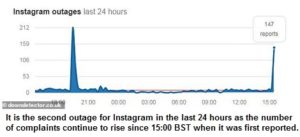
For these sites, if the promise of 24-7-365 is broken, then it is Big News. See the example here of the recent incident with Instagram and the related VIDEO (of an earlier outage in March):

Title: Instagram back online after a worldwide outage left irritated users complaining of being unable to load pictures on the site

  • The issue focused around new content on the site not loading correctly 
  • It appeared that existing and older content could still be seen and viewed  
  • The latest stories were also unable to be found or seen by users on the app  

By: Joe Pinkstone For Mailonline

Instagram crashed for some users around the world, with people complaining they were unable to load new pictures on the app.

Reports have now stopped coming in and it appears to be resolved, but there is no official word from the Facebook-owned site.

The home page was displaying older pictures but new content failed to appear, at least for some users.

The problem stretched to stories as well, although older stories could still be loaded and viewed.

The reason behind the issue remains unknown but the outage started around 3:37pm BST.

Affected areas included Europe, Australia, South America and the mainland US and a smattering of users complained of login and website trouble (seven and five per cent of complaints, respectively).

But the primary issue appeared to be with the news feed as 86 per cent of all issues centered around the lack of content loading, according to outage site “downdetector“.

This was the second outage of the last 24 hours for Instagram as a spike in user complaints was also seen around 8pm BST yesterday.

It comes exactly a month after the Mark Zuckerberg empire of Facebook, Instagram and WhatsApp was struck by a huge outage.

Facebook and Instagram were forced to apologise after users at this time were unable to load the sites and were faced with a ‘can’t be reached’ message for four hours.

Whatsapp, owned by Facebook, also suffered a four hour outage for some users internationally.

Downdetector.co.uk reported over 7,700 complaints that Facebook was down in the UK.

MailOnline has approached Instagram for comment.

Source: Published May 14, 2019  Retrieved May 23, 2019 from: https://www.dailymail.co.uk/sciencetech/article-7028163/Instagram-CRASHED-people-world.html

———-

VIDEO – Facebook was down for hours on Wednesday, including Instagram and Messenger – https://youtu.be/36z5hMH-2qk


CBS News
Published on Mar 13, 2019 –
Facebook was partially down in the United States on Wednesday. In many cases, the platform wasn’t working at all. BBC News’ Dave Lee reports from San Francisco.

Subscribe to the CBS News Channel HERE: http://youtube.com/cbsnews
Watch CBSN live HERE: http://cbsn.ws/1PlLpZ7
Follow CBS News on Instagram HERE: https://www.instagram.com/cbsnews/
Like CBS News on Facebook HERE: http://facebook.com/cbsnews
Follow CBS News on Twitter HERE: http://twitter.com/cbsnews
Get the latest news and best in original reporting from CBS News delivered to your inbox. Subscribe to newsletters HERE: http://cbsn.ws/1RqHw7T
Get your news on the go! Download CBS News mobile apps HERE: http://cbsn.ws/1Xb1WC8
Get new episodes of shows you love across devices the next day, stream CBSN and local news live, and watch full seasons of CBS fan favorites like Star Trek Discovery anytime, anywhere with CBS All Access. Try it free! http://bit.ly/1OQA29B

CBSN is the first digital streaming news network that will allow Internet-connected consumers to watch live, anchored news coverage on their connected TV and other devices. At launch, the network is available 24/7 and makes all of the resources of CBS News available directly on digital platforms with live, anchored coverage 15 hours each weekday. CBSN. Always On.

There is a plan for a home-grown Social Media site for the Caribbean, my.Caribbean.gov. This is embedded in the book Go Lean…Caribbean, which serves as a roadmap for the introduction and implementation of the technocratic Caribbean Union Trade Federation (CU). There will be the need to employ our own CoB strategies, tactics and implementations to ensure 24-7-365 compliance. This means learning lessons from other sites like Facebook and Instagram; (same company by the way). Our CoB plans must be “Step One, Day One” in the Go Lean roadmap.

The Go Lean book features one advocacy (Page 111) for fostering Social Media sites in the Caribbean. That advocacy is entitled: “10 Ways to Impact Social Media“. These “10 Ways” include the following highlights, headlines and excerpts:

1 Lean-in for the Caribbean Single Market – Ratify treaty for the CU.
This treaty allows for the unification of the region into one market, thereby expanding to an economy of 30 countries, 42 million people and GDP of over $800 Billion (circa 2010), thereby creating the economies of scale to deploy technology investments such as web portal www.myCaribbean.gov and e-Deliveries. The portal will grant free access, email, IM, and profile pages for CU stakeholders (resident, visitor & Diaspora). The CU will also facilitate deployments of Libraries through out the region. These edifices will serve as learning centers and arrange for the public’s access to the Internet.
2 CU Social Media Home Pages – Facebook & Twitter

The CU will use Facebook (FB) & Twitter for normalized communications with stakeholders. The CU will feature its own channel on Facebook and Twitter for publishing notices and accessing the www.myCaribbean.gov portal. CU users can even log-on to the portal with FB or Twitter user profiles. Trending data will be published and available for data-mining.

3 Hi Density Wi-Fi & Mobile
4 Diaspora Marketing & Tourism Outreach
5 CU Asian Outreach
6 Contact Center for e-Government Services
7 Contact Center for Tech Support
8 Reverse-911 Messaging
9 Postal Union Interface

The accedence of the CU will transfer jurisdiction of the region’s postal efforts to the Caribbean Postal Union. The CPU will employ hybrid e-mail/postal mail schemes (Last-leg, First-leg, FB/Twitter delivery notification) to facilitate efficiency.

10 Big Data Informatics

Internet & Communication Technologies are regarded as the “great equalizer”; it is where small states and large states are able to easily compete on the basis of merit, talent and competence, not just population size. The theme of doubling-down on the ICT & ‘Social Media’ landscape has been detailed in many previous Go Lean commentaries; consider this sample list here:

https://goleancaribbean.com/blog/?p=15075 e-Government 3.0 – Improved governance is the first benefactor of ICT & Social Media
https://goleancaribbean.com/blog/?p=11453 Location Matters – For location of Data Centers – even in a Virtual World
https://goleancaribbean.com/blog/?p=9839 Alibaba Cloud stretches global reach with four new Data Center facilities
https://goleancaribbean.com/blog/?p=8823 Lessons from China – WeChat: Model for Caribbean Social Media
https://goleancaribbean.com/blog/?p=4381 Net Neutrality and the innovation culture – It must matter here in the Caribbean

The Caribbean’s Social Media offering is just a subset of the overall Electronic Commerce (e-Commerce) landscape. This can lower the cost of living and doing business in the homeland. In order to furnish the prospects of e-Commerce, we need to have our Caribbean Cloud enabled all the time, the whole 24-7-365.

Will we suffer from the periodic outages as Instagram just reported?

The Go Lean roadmap prepared for this eventuality with its Data Center “Arts & Sciences”; notice this excerpt from Page 106:

High Availability (HA)
HA is a system design approach (hardware, software and networking) that ensures operational performance will be met, like parallel processing or mirroring. There are systems (i.e. hospitals, banking, electrical grid) that must maximize availability and minimize downtime. Recovery time or estimated time of repair is closely related to availability, optimizing the time to recover from planned or unplanned outages.
A CU mission is to facilitate quick recoveries after hurricanes [and other disasters].

ICT, Social Media and e-Commerce are positioned to impact Caribbean communities. Compared to our status quo, we must be better than the examples in the foregoing stories; we must sustain our systems and processes. This is how we will be a better homeland to live, work and play.  🙂

About the Book
The book Go Lean…Caribbean serves as a roadmap for the introduction and implementation of the technocratic Caribbean Union Trade Federation (CU), for the elevation of Caribbean society – for all member-states. This CU/Go Lean roadmap has these 3 prime directives:

  • Optimization of the economic engines in order to grow the regional economy to $800 Billion & create 2.2 million new jobs.
  • Establishment of a security apparatus to ensure public safety and protect the resultant economic engines.
  • Improve Caribbean governance to support these engines, including a separation-of-powers between the member-states and CU federal agencies.

The Go Lean book provides 370-pages of turn-by-turn instructions on “how” to adopt new community ethos, plus the strategies, tactics, implementations and advocacies to execute so as to reboot, reform and transform the societal engines of Caribbean society.

Download the free e-Book of Go Lean … Caribbean – now!

———

Who We Are
The movement behind the Go Lean book – a non-partisan, apolitical, religiously-neutral Community Development Foundation chartered for the purpose of empowering and re-booting economic engines – stresses that reforming and transforming the Caribbean societal engines must be a regional pursuit. This was an early motivation for the roadmap, as pronounced in the opening Declaration of Interdependence (Pages 12 – 13):

xi. Whereas all men are entitled to the benefits of good governance in a free society, “new guards” must be enacted to dissuade the emergence of incompetence, corruption, nepotism and cronyism at the peril of the people’s best interest. The Federation must guarantee the executions of a social contract between government and the governed.

xvi. Whereas security of our homeland is inextricably linked to prosperity of the homeland, the economic and security interest of the region needs to be aligned under the same governance. Since economic crimes … can imperil the functioning of the wheels of commerce for all the citizenry, the accedence of this Federation must equip the security apparatus with the tools and techniques for predictive and proactive interdictions.

xxiv. Whereas a free market economy can be induced and spurred for continuous progress, the Federation must install the controls to better manage aspects of the economy: jobs, inflation, savings rate, investments and other economic principles. Thereby attracting direct foreign investment because of the stability and vibrancy of our economy.

Sign the petition to lean-in for this roadmap for the Caribbean Union Trade Federation.

Share this post:
, ,

Marshall Plan – Cuba: An Imminent need for ‘Free Market’ Emergence

Go Lean Commentary

im·mi·nent
adjective  1. about to happen.
Sample use: “they were in imminent danger of being swept away”

synonyms: impending, at hand, close, near, approaching, fast approaching, coming, forthcoming, on the way, about to happen, upon us, in store, in the offing, in the pipeline, on the horizon, in the air, in the wind, brewing, looming, looming large; threatening, menacing; expected, anticipated;
informal sample: “in the cards”
“there was speculation that a ceasefire was imminent”

This is the assertion – and the whole world knows it – Cuba will imminently re-emerge as a ‘Free Market’ economy.
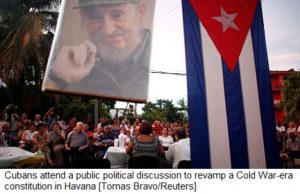
Cuba sera libre!

The book Go Lean…Caribbean asserts that the “sleeping giant” – that is the Cuban economy – will awaken. The book presents a roadmap in preparation for Cuba’s re-emergence as a ‘Free Market’ economy. (Their 60-year experiment with extreme Socialism is concluding and has yielded a verdict: Failure). The realities and possibilities of Cuba’s past and future are identified early in the Go Lean book, embedded in the opening Declaration of Interdependence, pronouncing a need for reconciliation efforts (Page 12):

xiii. Whereas the legacy of dissensions in many member-states (for example: Haiti and Cuba) will require a concerted effort to integrate the exile community’s repatriation, the Federation must arrange for Reconciliation Commissions to satiate a demand for justice.

Change is on the way for Cuba!

Already the Castro’s (Fidel & Raul) have moved on from the daily administration of the country; (Fidel has died and Raul has retired). See the related VIDEO in the Appendix below.

But 60 years is still 60 years; these Bad Old Days have created quite a legacy to overcome. This actuality “cries out” for a reboot and a turn-around. The 2013 Go Lean book anticipated as such and introduced the proposal for a Marshall Plan for Cuba in order to reform and transform that society. The country is a de facto Failed-State.

While the purpose of the Go Lean roadmap is NOT Cuba alone, we know that we cannot elevate the societal engines for all of the Caribbean while ignoring Cuba. It possesses 26% of the region’s population and a huge portion of the landmass. There is no Caribbean without Cuba.

So to repeat, if we can fix Cuba, we can fix the entire Caribbean region. This is the “Why’; but for the “How”; we need that Marshall Plan.

The focus of the Go Lean roadmap is the recognition that our region’s status quo is bad, critical and even to be considered “in crisis”. The book declares that “a crisis is a terrible thing to waste”, intimating that we must use crises as opportunities to forge change. This is the rationale for the Marshall Plan for Cuba. See the book’s proposal here (Page 236):

The Bottom Line on Marshall Plan
By the end of World War II much of Europe was devastated. The Marshall Plan, named after the then Secretary of State and retired general George Marshall, was the American program to aid Europe where the United States gave monetary support to help rebuild European economies after the end of the war. During the four years (1948 – 1952) that the plan was operational, US $13 billion in economic and technical assistance was given to help the recovery of the European countries. The plan looked to the future, and did not focus on the destruction caused by the war. Much more important were efforts to modernize European industrial and business practices using high-efficiency American models, reduce artificial trade barriers, and instill a sense of hope and self-reliance. This worked! By 1952 as the funding ended, the economy of every participant state had surpassed pre-war levels. Generally, economists agree that the Marshall Plan was one of the first elements of European integration, as it erased trade barriers and set up institutions to coordinate the economy on a regional level—today, the European Union, the latest successor of the integration effort, is the world largest integrated economy.

Will someone walk-up to Cuba and give them $13 Billion (or $91 Billion in today’s dollars) to reboot, recover and turn-around 60 years of dysfunction?

Probably, not!

It will be up to the Caribbean to solve the Caribbean’s problems. We have more than one Failed-State; think Haiti. We have many other member-states, just a few notches behind Cuba & Haiti on the Failed-State indices. The lyrics of this song – “Lean On Me” – nails it:

If there is a load you have to bear
That you can’t carry
I’m right up the road
I’ll share your load
If you just call me
Lean On Me; by Bill Withers (1971)

Cuba’s 60-year experiment with extreme Socialism is concluding with this Failed-State acknowledgement. Now, we must execute strategies, tactics, implementations and advocacies to effect the needed reboot, recovery and turn-around. Yes, we can succeed, the same as Europe succeeded with the 4-year execution of their Marshall Plan.
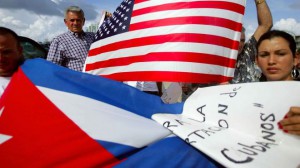
Yes, we can! The next step:

Invite Cuba to join the regional integration effort; such as the Caribbean Community (CariCom).

The book Go Lean … Caribbean, serves as a roadmap for the introduction and implementation of the technocratic Caribbean Union Trade Federation (CU). It provides this one advocacy for Cuba, entitled: “10 Ways to Re-boot Cuba“. These “10 Ways” include the following highlights, headlines and excerpts:

1 Lean-in for the Caribbean Single Market – Ratify treaty for the CU.

This regional re-boot will allow for the unification of the region into one market, thereby creating a single economy of 30 member-states, 42 million people and a GDP of over $800 Billion. Following the model of European integration, the CU will be the representative and negotiating body for Cuba and the entire region for all trade and security issues. This helps to assuage the political adversity expected from Anti-Castro [and Anti-Socialists] groups.

2 Political Neutrality of the Union

Cuba is the only Communist-led state in the CU region. Other states have multiple party systems: left-leaning or right-leaning governments; many have more than 2 parties. The CU is officially neutral! The election of the popular leaders of each country is up to that country. The Election functionality of member-states can be outsourced to the CU as the organization structure will provide the systems, processes and personnel to facilitate smooth and fair election.

3 US Trade Embargo By-Pass

The US embargo against Cuba is an economic, and financial embargo imposed in October 1960. It was designed to punish Cuba to dissuade communism and the nationalization of private property during the revolution. To date, there are judgments of up to $6 billion worth of claims against the Cuban government. Despite this US action, the rest of the Caribbean, Canada and Europe do trade with Cuba, with no repercussions in their relationship with the US. It is expected that after Fidel and Raul Castro, there will be greater liberalization of trade and diplomacy with the US.

4 Marshall Plan for Cuba

To reboot Cuba will require a mini-Marshall Plan. The infrastructure, for the most part, is still the same as in 1958. The engines of the CU will enable a rapid upgrade of the infra-structure and some “low hanging fruit” for returns on the investment. The US-based Cuba Policy Foundation estimates that the embargo costs the U.S. economy $3.6 billion per year in economic output. The vision is for the CU to be the benefactor of a re-booted Cuban economy, not the US.

5 Leap Frog Philosophy

There is no need to move Cuba’s 1950’s technology baseline to the 1960’s, then the 1970’s, and so on; rather, the vision is to leap-frog Cuba to where technology is going. This includes advance urban planning concepts like electrified light-rail, prefab house, alternative energies and e-delivery of governmental services and payment systems.

6 Repatriation and Reconciliation of the Cuban Diaspora
7 Access to Capital Markets
8 Optimization of Agricultural Exports
9 National Historic Places
10 World Heritage Sites

As of 2012, there are 9 World Heritage Sites in Cuba. The CU will promote these sites as tourist attractions for the domestic and foreign markets.

Now is the time to prepare the Marshall Plan to execute in Cuba.
Cuba needs the Caribbean and the Caribbean needs Cuba; the more people/places we can leverage, the better. This is entry 2-of-5 in this series of commentaries on the Marshall Plan, the historic European one and Caribbean versions. Here, as follows, is the full series being presented this month of May (2019):

  1. Marshall Plan: A Lesson in History
  2. Marshall Plan: Cuba – An Imminent need for ‘Free Market’ Emergence
  3. Marshall Plan: Haiti – Past time for Mitigation
  4. Marshall Plan: Funding – What Purse to Fund Our Plans?
  5. Marshall Plan: Is $91 Billion a Redux for Puerto Rico?

In this entry for this series we focus on Cuba, reforming and transforming that homeland. The theme of rebooting Cuba – the story arc and progress towards a ‘Free Market’ – has been detailed in many previous Go Lean commentaries; consider this sample list here:

https://goleancaribbean.com/blog/?p=16864 Cuba’s Progress: New Constitution with some ‘Free Market’ Guarantees
https://goleancaribbean.com/blog/?p=14732 ‘Red Letter Day’ for Cuba – Raul Castro Retires
https://goleancaribbean.com/blog/?p=7412 The Road to Restoring Cuba: Normalization of Travel, Mail, Internet, etc.
https://goleancaribbean.com/blog/?p=3455 Restoration of Diplomatic Relations Between Cuba and the USA
https://goleancaribbean.com/blog/?p=3354 CariCom Chairman calls for an end to US embargo on Cuba
https://goleancaribbean.com/blog/?p=2330 ‘Raul Castro reforms not enough’, Cuba’s in-country bishops declare
https://goleancaribbean.com/blog/?p=1609 Cuba’s Parliament mulls economy and some ‘Free Market’ changes
https://goleancaribbean.com/blog/?p=789 A Lesson in History – America’s War on the Caribbean
https://goleancaribbean.com/blog/?p=436 Cuba Approves New “Law on Foreign Investment” – a Start for Progress

The status quo for the Caribbean is deficient and defective. The status quo for Cuba is deficient and defective. This same assessment requires some of the same solutions. If/when we fix Cuba, we fix the entire region.

Cuba needs a Marshall Plan.

The entire Caribbean needs a Way Forward.

Our Way Forward for the entire Caribbean includes the entire Caribbean, with Cuba too. So we have prepared the region for this full inclusion of Cuba in the political, social, musical, athletic, security and economic fabric of the regional society. This is the Caribbean’s future … and Cuba’s future. This is how we intend to make our homeland, Cuba included, a better place to live, work and play. 🙂

About the Book
The book Go Lean…Caribbean serves as a roadmap for the introduction and implementation of the technocratic Caribbean Union Trade Federation (CU), for the elevation of Caribbean society – for all member-states. This CU/Go Lean roadmap has these 3 prime directives:

  • Optimization of the economic engines in order to grow the regional economy to $800 Billion and create 2.2 million new jobs.
  • Establishment of a security apparatus to ensure public safety and protect the resultant economic engines.
  • Improve Caribbean governance to support these engines, including a separation-of-powers between the member-states and CU federal agencies.

The Go Lean book provides 370-pages of turn-by-turn instructions on “how” to adopt new community ethos, plus the strategies, tactics, implementations and advocacies to execute so as to reboot, reform and transform the societal engines of Caribbean society.

Download the free e-Book of Go Lean … Caribbean – now!

——-

Who We Are
The movement behind the Go Lean book – a non-partisan, apolitical, religiously-neutral Community Development Foundation chartered for the purpose of empowering and re-booting economic engines – stresses that reforming and transforming the Caribbean societal engines must be a regional pursuit. This was an early motivation for the roadmap, as pronounced in the aforementioned Declaration of Interdependence (Pages 12 – 13):

xi. Whereas all men are entitled to the benefits of good governance in a free society, “new guards” must be enacted to dissuade the emergence of incompetence, corruption, nepotism and cronyism at the peril of the people’s best interest. The Federation must guarantee the executions of a social contract between government and the governed.

xvi. Whereas security of our homeland is inextricably linked to prosperity of the homeland, the economic and security interest of the region needs to be aligned under the same governance. Since economic crimes … can imperil the functioning of the wheels of commerce for all the citizenry, the accedence of this Federation must equip the security apparatus with the tools and techniques for predictive and proactive interdictions.

xxiv. Whereas a free market economy can be induced and spurred for continuous progress, the Federation must install the controls to better manage aspects of the economy: jobs, inflation, savings rate, investments and other economic principles. Thereby attracting direct foreign investment because of the stability and vibrancy of our economy.

Sign the petition to lean-in for this roadmap for the Caribbean Union Trade Federation.

————-

Appendix VIDEO – Cuba After Castros: Facing the future without Fidel and Raul Castro – https://youtu.be/0hJrXYnpqbE

TRT World
Published on Apr 15, 2018 – Cuba’s President Raul Castro will step down on Thursday. His departure will mean the end of almost 60 years of the Castro family’s dominance over the Carribbean island. In the second part of our series on Cuba, Giles Gibson reports on Raul Castro, who in 2008, took over from his more famous brother Fidel.

Subscribe: http://trt.world/subscribe
Livestream: http://trt.world/ytlive
Facebook: http://trt.world/facebook
Twitter: http://trt.world/twitter
Instagram: http://trt.world/instagram
Visit our website: http://trt.world

Share this post:
, , ,
[Top]

Marshall Plan – A Lesson in History

Go Lean Commentary

Fix Cuba & Haiti and we fix the entire region.

This is the assertion, that despite the fact there are 30 member-states that constitute the political Caribbean, 2 of them – Cuba & Haiti – constitute almost the majority of the population, and will require strenuous efforts to reform and transform. See the distribution here, based on 2010 numbers; (retrieved from the 2013 book Go Lean…Caribbean Page 66):

Population % of Whole
Cuba 11,236,444 26.63%
Haiti 9,035,536 21.41%
Cuba + Haiti 20,271,980 48.04%
Caribbean 42,198,874 100.00%

Yes, these two countries are heavily populated, but they have something else in common: they are de facto Failed-States.

So to repeat, if we can fix Cuba & Haiti, we can fix the entire region. How?

By executing strategies, tactics, implementations and advocacies proven to be effective in rebooting other societies, no better model than recovering Europe from their Bad Old Days – World War II (1939 – 1945); see Appendix VIDEO below.

Neither Cuba nor Haiti have experienced the required Turn-around from their Bad Old Days.

The book Go Lean … Caribbean, a roadmap for the introduction and implementation of the technocratic Caribbean Union Trade Federation (CU), identified one solution: a Caribbean version of the Marshall Plan – the European Recovery Program. It is important that we understand that “Plan” better, so that we can model it locally.

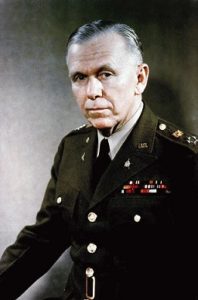
George Marshall,(1880-1959) pictured here as a General of the Army before he became the US Secretary of State. It was during his term as Secretary of State that he planned, campaigned for and carried out the Marshall Plan.

The Go Lean book (Page 68) introduces the Marshall Plan for Caribbean remediation. See this excerpt here (and the Appendix VIDEO below):

The Marshall Plan (officially the European Recovery Program, ERP) was the American program to aid Europe, in which the US gave economic support, amounting to $12.4 billion, to help rebuild European economies after the end of World War II (1948-1952).

The ERP addressed each of the obstacles to post-war recovery. The plan looked to the future, and did not focus on the destruction caused by the war. Much more important were efforts to modernize European industrial and business practices using high-efficiency American models, reducing artificial trade barriers, and instilling a sense of hope and self-reliance. By 1952, as the funding ended, the economy of every participant surpassed pre-war levels, with output in 1951 reaching 35% higher levels than in 1938. Then over the next two decades, Western Europe enjoyed unprecedented growth and prosperity.

In addition to money, the Marshall Plan extended a Technical Assistance Program. By implementing technological literature surveys and organized plant visits, American economists, statisticians, and engineers were able to optimize European manufacturers, increasing productivity and efficiency in all industries.

The years 1948 to 1952 saw the fastest period of growth in European history. West Germany embarked upon an unprecedented two decades of growth that saw standards of living increase dramatically. In 1973, while this country was home to 1.26% of the world’s population, it featured the world’s fourth largest GDP of $944 Billion (5.9% of the world total).

There is some debate among economic historians over how much this should be credited to the Marshall Plan. Most reject the idea that it alone miraculously revived Europe shows that a general recovery was already underway. But most believe that the Marshall Plan sped this recovery, but did not initiate it, asserting that recovery was a result of eliminating central planning and restoring a market economy to Europe, especially in those countries which had adopted more fascist and corporatist economic policies. Former US Chairman of the Federal Reserve Bank Alan Greenspan gives most credit to German Minister for Economy Ludwig Erhard for Europe’s economic recovery. Greenspan stated that it was Erhard’s economic policies and reductions in economic regulations that permitted Germany’s miraculous recovery. [Source: Cini, Michelle, in Schain, Martin, (ed.) “From the Marshall Plan to the EEC”, in The Marshall Plan: Fifty Years After, New York: Palgrave, 2001]

The Marshall Plan also played an important role in European integration. Many leaders felt that this was necessary to secure the peace and prosperity of Europe, and thus used the Marshall Plan guidelines to forge it. Institutions like the European Coal and Steel Community and the European Economic Community would eventually grow into the European Union.

The CU will implement a Caribbean-version Marshall Plan to reboot the economic engines of the region. These initiatives will entail funding (loans, grants, access to capital), technical assistance (coaching) and fostering a laissez-faire regulatory environment to institute pro-growth strategies.

There is so much that the Caribbean can benefit from in consideration of this historicity. This commentary commences a series on Lessons Learned from the Marshall Plan. Here for May 2019, we present a full series of commentaries related to Marshall Plans, the historic European one and the Caribbean versions. The full series is presented as follows:

  1. Marshall Plan: A Lesson in History.
  2. Marshall Plan: Cuba – An imminent need for ‘Free Market’ Emergence
  3. Marshall Plan: Haiti – Past time for Mitigation
  4. Marshall Plan: Funding – What Purse to Fund Our Plans?
  5. Marshall Plan: Is $91 Billion a Redux for Puerto Rico?

In this series, reference is made to the need for a comprehensive roadmap for elevating the societal engines of Cuba & Haiti, and by extension, all of the Caribbean. Of all the plans out there, this – roadmap presented in Go Lean…Caribbean – is the only one that double-downs on the prospect of regional interdependence.

We are all in the same boat, the book states; we need to work together. This is the best way to recover, reboot and turnaround.

The theme of societal recoveries have been detailed in previous Go Lean commentaries; consider this sample list here:

https://goleancaribbean.com/blog/?p=16192 How did China Recover from Poverty? Trade, Trade, Trade
https://goleancaribbean.com/blog/?p=15798 Lessons Learned from 2008: Still Recovering
https://goleancaribbean.com/blog/?p=12994 The Science of ‘Power Restoration’ After Hurricanes
https://goleancaribbean.com/blog/?p=11647 Righting a Wrong: Puerto Rico’s Bankruptcy
https://goleancaribbean.com/blog/?p=8370 A Lesson in Economic Fallacies – Austerity: Dangerous Idea
https://goleancaribbean.com/blog/?p=6563 Lessons from Iceland – Model of Recovery
https://goleancaribbean.com/blog/?p=3028 Recovery – Why India is doing better than most emerging markets
https://goleancaribbean.com/blog/?p=631 The Pope as a ‘Turnaround CEO’ – The Francis effect

This movement – behind the Go Lean book – just published a month-long series on the Way Forward. Some individual member-states and institutions were identified and qualified. Cuba & Haiti were not singled-out for any Way Forward consideration. The Go Lean book asserts that these two member-states are Special; they therefore need a Special Plan; this is the Marshall Plan. (They are not better nor worse than other Caribbean people; they just have a different history).

The Marshall Plan for Cuba and Haiti must do what the Post-WW-II Marshall Plan did for Western Europe.

No pressure!

But it is good to have a proven track record. We do not have to “re-invent the wheel”, only follow the well-traveled path of Best Practices. This is still not easy though, in fact, all communications from the Go Lean movement have consistently asserted that the effort to recover, reboot and turn-around the Caribbean member-states is:

Heavy-lifting!

We need all hands on deck! We will need all Caribbean hands just to impact Cuba & Haiti. But once we complete that, we actually would have impacted the entire Caribbean. So yes we can … make our homelands better places to live, work and play. 🙂

About the Book
The book Go Lean…Caribbean serves as a roadmap for the introduction and implementation of the technocratic Caribbean Union Trade Federation (CU), for the elevation of Caribbean society – for all member-states. This CU/Go Lean roadmap has these 3 prime directives:

  • Optimization of the economic engines in order to grow the regional economy to $800 Billion and create 2.2 million new jobs.
  • Establishment of a security apparatus to ensure public safety and protect the resultant economic engines.
  • Improve Caribbean governance to support these engines, including a separation-of-powers between the member-states and CU federal agencies.

The Go Lean book provides 370-pages of turn-by-turn instructions on “how” to adopt new community ethos, plus the strategies, tactics, implementations and advocacies to execute so as to reboot, reform and transform the societal engines of Caribbean society.

Download the free e-Book of Go Lean … Caribbean – now!

———

Who We Are
The movement behind the Go Lean book – a non-partisan, apolitical, religiously-neutral Community Development Foundation chartered for the purpose of empowering and re-booting economic engines – stresses that reforming and transforming the Caribbean societal engines must be a regional pursuit. This was an early motivation for the roadmap, as pronounced in the opening Declaration of Interdependence (Pages 12 – 13):

xi. Whereas all men are entitled to the benefits of good governance in a free society, “new guards” must be enacted to dissuade the emergence of incompetence, corruption, nepotism and cronyism at the peril of the people’s best interest. The Federation must guarantee the executions of a social contract between government and the governed.

xvi. Whereas security of our homeland is inextricably linked to prosperity of the homeland, the economic and security interest of the region needs to be aligned under the same governance. Since economic crimes … can imperil the functioning of the wheels of commerce for all the citizenry, the accedence of this Federation must equip the security apparatus with the tools and techniques for predictive and proactive interdictions.

xxiv. Whereas a free market economy can be induced and spurred for continuous progress, the Federation must install the controls to better manage aspects of the economy: jobs, inflation, savings rate, investments and other economic principles. Thereby attracting direct foreign investment because of the stability and vibrancy of our economy.

Sign the petition to lean-in for this roadmap for the Caribbean Union Trade Federation.

—————

Appendix VIDEO – The Cold War: The Marshall Plan (Episode 9) – https://youtu.be/ALcX2BlrxOE

I’m Stuck – GCSE and A-Level Revision
Published on Feb 20, 2018 – In this video, we look at the Marshall Plan which was implemented in Europe as a way of consolidating US power in the west. After a negative review of Europe by both Clayton and Acheson, the Marshall Plan was seen as an essential means of preventing communism in all of Europe.

My Twitter: https://twitter.com/ImStuckYoutube?la…

For information on the full “Cold War” series: http://imstuck.wix.com/imstuckgcserev…

——–

Other VIDEO‘s:

  1. https://youtu.be/IU_QQtPRhSU
  2. https://youtu.be/fAajKjLK0dM
Share this post:
, , ,
[Top]

Way Forward – Puerto Rico: Learns its status with America

Go Lean Commentary

You love America.
But does “she” love you back?

This is the reality of unrequited love. The people of the island of Puerto Rico love America – they give blood, sweat and tears. But America does not always love the island back. This has always been evident and obvious, but now even more so after Hurricane Maria devastated the island in 2017 and the US Federal Government lackluster response. Puerto Ricans, on the island and in the Diaspora, must accept that they are treated as the “ugly step-child”.

Today, we learn that the 45th President of the United States, Donald J. Trump, is now vocalizing that there is a fast approaching limit for gratitude towards Puerto Rico. See that story here:

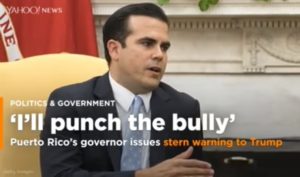
VIDEO – Puerto Rico’s governor sending warning to Trump – https://news.yahoo.com/puerto-ricos-governor-sending-warning-175145864.html

CNN – Posted March 28, 2019 – “If the bully gets close, I’ll punch the bully in the mouth,” Rosselló said when asked about a tense meeting Wednesday between members of the Trump administration and Puerto Rican officials. “It would be a mistake to confuse courtesy with [lack of] courage.”

———–

Title: Puerto Rico’s governor warns Trump: ‘If the bully gets close, I’ll punch the bully in the mouth’
By: David Knowles
Puerto Rico Gov. Ricardo Rosselló is through playing nice with President Trump.

After months of soft-pedaling his criticism of the president as Puerto Rico struggles to recover from Hurricane Maria in 2017, Rosselló voiced his frustration with the White House in a Thursday interview with CNN.

    “If the bully gets close, I’ll punch the bully in the mouth,” Rosselló said when asked about a tense meeting Wednesday between members of the Trump administration and Puerto Rican officials. “It would be a mistake to confuse courtesy with [lack of] courage.”

The Washington meeting — which was attended by White House trade adviser Peter Navarro and members of Rosselló’s government — was requested after reports that Trump was considering halting further disaster relief to the beleaguered U.S. territory.
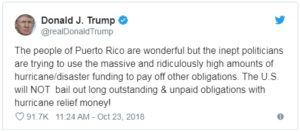
In a Wednesday meeting with Senate Republicans, Trump said the amount of aid Puerto Rico had so far received “is way out of proportion to what Texas and Florida and others have gotten,” according to Sen. Marco Rubio, R-Fla., who attended the meeting.

Though it has already slashed benefits, Puerto Rico faces a $600 million shortfall to administer food stamps. So far the U.S. government has spent more than $6 billion on disaster relief to Puerto Rico in the wake of Hurricane Maria, which was blamed for killing more than 3,000 people. In June, Texas received $5 billion in federal aid for housing and infrastructure repairs stemming from Hurricane Harvey, which left 103 people dead.

Rosselló, who avoided criticizing Trump in a 2018 interview with Yahoo News, lashed out at the president over his latest reported comments.

“He treats us as second-class citizens, that’s for sure,” Rosselló told CNN. “And my consideration is I just want the opportunity to explain to him why the data and information he’s getting is wrong. I don’t think getting into a kicking and screaming match with the president does any good. I don’t think anyone can beat the president in a kicking and screaming match. What I am aiming to do is make sure reason prevails, that empathy prevails, that equality prevails and that we can have a discussion.”

Trump, whose administration’s response to Maria was criticized as inadequate, has long been seen as reluctant to offer aid to Puerto Rico. In October the president again signaled his disapproval of giving aid that might be used to help alleviate the financial distress the island was experiencing even before Maria hit.

Source: Posted March 28, 2019; retrieved March 29, 2019 from: https://news.yahoo.com/puerto-ricos-governor-warns-trump-if-the-bully-gets-close-ill-punch-the-bully-in-the-mouth-162447705.html?.tsrc=notification-brknews

There is no love for Puerto Rico … within their American eco-system.

This theme aligns with previous commentaries from the movement behind the book Go Lean…Caribbean; see a sample list here:

https://goleancaribbean.com/blog/?p=15012 In Life or Death: No Love for Puerto Rico
https://goleancaribbean.com/blog/?p=14101 ‘We Are The World’ Style Campaign to Help Puerto Rico
https://goleancaribbean.com/blog/?p=13391 After Maria, Failed-State Indicators: Destruction and Defection for PR
https://goleancaribbean.com/blog/?p=11647 Righting a Wrong: Puerto Rico’s Bankruptcy
https://goleancaribbean.com/blog/?p=7963 ‘Like a Good Neighbor’ – Being there for Puerto Rico
https://goleancaribbean.com/blog/?p=6260 Puerto Rico Bondholders Coalition Launches Ad Campaign
https://goleancaribbean.com/blog/?p=599 Ailing Puerto Rico open to radical economic fixes

As related in this previous blog-commentary, Puerto Rico devotes more human capital – and sacrifice – to US military endeavors than any other state or territories per capita.

Never kill yourself for people who are willing to watch you die.

Way Forward
This consideration brings to mind, an overall discussion of the Way Forward for this country – Puerto Rico – and all Caribbean countries. Our current disposition is dire, a crisis, near-Failed-State status. Yet, the movement behind the Go Lean book posits that a “crisis is a terrible thing to waste”. Here for April 2019, we present a full series of commentaries related to the Way Forward for these 30 Caribbean member-states. The full series is presented as follows:

  1. Way Forward: Puerto Rico learns its “status” with America.
  2. Way Forward: Virgin Islands – America’s youngest colony
  3. Way Forward: ‘Solutions White Paper’ – An Inadequate Plan for the Bahamas

In this series – incomplete as of this date, many other national plans will follow – reference is made to the need for a more comprehensive roadmap for elevating the societal engines of Caribbean communities. Of all the plans out there, this – roadmap presented in Go Lean…Caribbean – is the only one that double-downs on the prospect of regional interdependence.

No man is an island; no island is an island.

Considering entry 1 of 3 of this series for April, what should be the Way Forward for Puerto Rico?

There are 3 options that have been detailed by this Go Lean movement. Here, again, with references to updated information:

Whatever the selection by the people of Puerto Rico – it should be their choice alone – the Go Lean movement still presents the strategies, tactics and implementations to make this island a better homeland to live, work and play. But, it is hardwork …

Actually, it is overdue work. It is the same “Growing Up“, “Managing Your Affairs“, “Taking Care of Business” that was always needed for this island nation.

Others (countries) have done “it” well – we can learn from them; i.e. consider the Iceland experience.

Some have done “it” bad – we must learn from that too; i.e. consider Republic of Venezuela.

With the proper guidance, blood, sweat and tears, it is conceivable, believable and achievable for this island to actualize and be recognized as one of the greatest address on the planet – not just some “ugly step-child”.  🙂

About the Book
The book Go Lean…Caribbean serves as a roadmap for the introduction and implementation of the technocratic Caribbean Union Trade Federation (CU), for the elevation of Caribbean society – for all member-states. This CU/Go Lean roadmap has these 3 prime directives:

  • Optimization of the economic engines in order to grow the regional economy to $800 Billion and create 2.2 million new jobs.
  • Establishment of a security apparatus to ensure public safety and protect the resultant economic engines.
  • Improve Caribbean governance to support these engines, including a separation-of-powers between the member-states and CU federal agencies.

The Go Lean book provides 370-pages of turn-by-turn instructions on “how” to adopt new community ethos, plus the strategies, tactics, implementations and advocacies to execute so as to reboot, reform and transform the societal engines of Caribbean society.

Download the free e-Book of Go Lean … Caribbean – now!

Who We Are
The movement behind the Go Lean book – a non-partisan, apolitical, religiously-neutral Community Development Foundation chartered for the purpose of empowering and re-booting economic engines – stresses that reforming and transforming the Caribbean societal engines must be a regional pursuit. This was an early motivation for the roadmap, as pronounced in the opening Declaration of Interdependence (Pages 12 – 13):

xi. Whereas all men are entitled to the benefits of good governance in a free society, “new guards” must be enacted to dissuade the emergence of incompetence, corruption, nepotism and cronyism at the peril of the people’s best interest. The Federation must guarantee the executions of a social contract between government and the governed.

xvi. Whereas security of our homeland is inextricably linked to prosperity of the homeland, the economic and security interest of the region needs to be aligned under the same governance. Since economic crimes … can imperil the functioning of the wheels of commerce for all the citizenry, the accedence of this Federation must equip the security apparatus with the tools and techniques for predictive and proactive interdictions.

xxiv. Whereas a free market economy can be induced and spurred for continuous progress, the Federation must install the controls to better manage aspects of the economy: jobs, inflation, savings rate, investments and other economic principles. Thereby attracting direct foreign investment because of the stability and vibrancy of our economy.

Sign the petition to lean-in for this roadmap for the Caribbean Union Trade Federation.

————–

Appendix A – Florida lawmaker introduces bill to make Puerto Rico 51st State

TAMPA, Fla. (WFLA) – A Florida congressman and Puerto Rico’s non-voting representative in Congress have introduced a bill that seeks to make the U.S. territory the 51st state.

The Puerto Rico Admission Act of 2019, which is sponsored by Rep. Darren Soto, D-Florida, and Puerto Rico Resident Commissioner Jenniffer González-Colón, would give the island statehood within 90 days of passage.

Our historic legislation will finally end over 120 years of colonialism and provide full rights and representation to over 3.2 million Americans.”

The legislation is partly in response to the Trump administration’s handling of Hurricane Maria relief efforts. According to reports, President Trump complained to Senate Republicans about the amount of disaster aid designated for Puerto Rico. He also asked why the island was given more money than some states affected by hurricanes.

“We have seen time and time again that colonial status is simply not working. Look no further than the abysmal Hurricane Maria recovery efforts and the draconian PROMESA law to prove this point all too well,” Soto added. “The Puerto Rican people have spoken. It’s time for Congress to finally make Puerto Rico a state!”

“From the day I was sworn in as Puerto Rico’s sole representative in Congress, and filed the Puerto Rico Admission Act, I stated very clearly that I would work different strategies, across all platforms to achieve the full equality for Puerto Rico, which can only be achieved through statehood, For more than a century the people of Puerto Rico have been U.S. citizens, but has been denied the right to vote for the President and members of Congress, leaving us without representation in the federal government, which enact the laws that rule the land. Democracy and equality for American citizens is an issue of justice and civil rights. Us, as American citizens, want to have the same benefits and duties, as all American citizens have in the states,” she continued.

Governor Ricardo Rossello was also in attendance and called on members of Congress to support the bill and “join in our quest to achieve equal treatment for the over 3 million U.S. citizens in Puerto Rico.”

Source: Posted March 30, 2019; retrieved April 2, 2019 from: https://www.wfla.com/news/florida/florida-lawmaker-introduces-bill-to-make-puerto-rico-51st-state/1888575456

Share this post:
,
[Top]

Women Empowerment – Captain Marvel: We need “Sheroes” in Facts and Fiction

Go Lean Commentary

A ‘Shero’ is quite simply a female hero. What is it that ‘Sheroes’ want?

A better life; better protections ; better promotion; better empowerment and also: Better Balance … or #BalanceforBetter.

This is important, today and beyond.

From empowerment seminars to street strikes, pop-up art shows to business master classes, female voices will echo across the globe Friday with a resounding message: Women want balance.

#BalanceforBetter is the theme for this year’s International Women’s Day, which is observed each year on March 8. The 2019 initiative is aimed at gender equality, a greater awareness of discrimination and a celebration of women’s achievements, according to the International Women’s Day website. That includes reducing the global pay gap between men and women and making sure all are equal – and balanced – in activist movements, boardrooms and beyond. – USA Today

Today, we acknowledge International Women’s Day 2019, as part of the consideration for Women’s History Month 2019. In addition to #BalanceforBetter in real life (facts), we also want to see more balance in our fiction (movies, novels and comic books).

Life imitating art; art imitating life.

In honor of International Women’s Day 2019, the media conglomerate Disney Pictures is releasing a new film Captain Marvel under their subsidiary Marvel Studios – Marvel Cinematic Universe (MCU). This live-action movie – see Trailer below – renders the comic book superhero Carol Danvers, aka Captain Marvel, in a powerful role where she has to overcome immense odds to protect, promote and empower balance and peace in the galaxy. Forgive the spoiler, but in the film, Carol Danvers begins fighting  for the Kree against the Skrulls, has to endure a hero’s journey in which she learns the truth of herself, her friends and her enemies. In the end, she helps and support the Skrulls; she fights for balance and in pursuit of the Greater Good!


The confluence of Marvel (MCU) and International Women’s Day is the theme of this feature article here:

Title: On International Women’s Day, we’re celebrating the women of Marvel, from Black Widow to Captain Marvel
Subtitle: For International Women’s Day and Month, women across CBS Interactive have teamed up to spotlight the fierce ladies pushing Marvel ahead, both on and off screen.
By: Rebecca Fleenor, Caitlin Petrakovitz

Black Widow takes out a room of men — while tied to a chair. Gamora wins an electric sword fight with her sister Nebula. Okoye points a spear at her own husband after he charges her down on a rhino. The women of Marvel, needless to say, are fearless.

CBS Interactive, which CNET is part of, is celebrating the March 8 release of Captain Marvel, and all of International Women’s Month, by highlighting the powerful women of Marvel movies and shows. We’re focusing not only on the incredible women of the MCU, but also on Marvel comics and their impact on pop culture.

Multiple CBS sites have come together to produce this special report on the women of the Marvel universe. CNET has a mega-bracket showdown of powerful womenEntertainment Tonight is profiling prominent women behind and in front of the camera; and TV Guide will look ahead at the future of Marvel’s strong characters on the small screen.

Highlighting the scope of talented women who work at CBS Interactive, women throughout the company wrote, edited and produced every article, gallery and video in this collection — from our long-running compendium of Marvel movies to our roundtable of women talking about more strong ladies and our Q&A with Danai Gurira, Black Panther’s General Okoye, for CNET Magazine.

Captain Marvel sets the stage
Brie Larson stars as Carol Danvers, aka Captain Marvel, the 21st MCU movie now open around the world. For anyone unfamiliar with Captain Marvel’s backstory, check out GameSpot’s comic book history of Captain Marvel. CNET’s Patricia Puentes called the film “two hours of pure female empowerment packaged with all the visual power you’d expect from a Marvel blockbuster.”

Additionally, Entertainment Tonight‘s Meredith B. Kile reviewed Captain Marvel, noting that its “origin-story-in-reverse structure allows Captain Marvel to do away with many of the more overdone origin story tropes.” As the film opens, GameSpot will feature more explainers, spoilers, and breakdowns of how Captain Marvel (and those post-credits scenes!) will tie into Avengers: Endgame.

International Women’s Month
The first National Women’s Day was observed in the United States all the way back in 1909, many years before we’d celebrate Women’s History Month. In 1980, President Jimmy Carter declared the week of March 8 to be National Women’s History Week, and by 1987, Congress had passed a statute designating March as Women’s History Month. We continue to celebrate International Women’s Day on March 8. Did we mention one or 100 times that’s the day Captain Marvel, the first female-led film in the entire MCU, comes out?

Since the ’90s, the United Nations has focused on an annual theme for International Women’s Day. This year’s theme is “Think equal, build smart, innovate for change.” That’s why it feels appropriate for us to look to the women of Marvel who’ve been working in innovative ways, both on screen and off screen, to get more seats at the franchise’s proverbial table.

Women of the MCU making magic 
Captain Marvel may be taking the lead right now, but many other women have been key to making magic happen in the Marvel universe. CNET’s Patricia Puentes talked to costume designer Ruth E. Carter, who just won an Oscar for costume design for Black Panther. Entertainment Tonight looks at the women of Wakanda, aka all the women behind Black Panther, making Oscar history. And there’ll be much, much more Marvel flying your way.

Source: C-NET.com – Posted and retrieved March 8, 2019 from: https://www.cnet.com/news/celebrating-the-women-of-marvel-from-black-widow-to-captain-marvel-international-womens-day/

This – relevance of fictional heroes impacting real life – is a familiar theme for the movement behind the book Go Lean … Caribbean. We have published a lot of media advocating for balance and the Greater Good. We have even published many previous Go Lean commentaries that reviewed superhero films; see a sample list here:

https://goleancaribbean.com/blog/?p=14911 Film: Avengers Infinity War
Art Imitating Life – Was ‘Thanos’ Right?
https://goleancaribbean.com/blog/?p=14359 Film: Black Panther
Wakanda Forever – Conceive, Believe and Achieve
https://goleancaribbean.com/blog/?p=13579 Film: Thor Ragnarok
Colonialism’s Bloody History Revisited
https://goleancaribbean.com/blog/?p=12035 Film: Wonder Woman
‘Wonder Woman’ Leaning-in Then (75 years) and Now
https://goleancaribbean.com/blog/?p=7151 Film: Star Wars – The Force Awakens
The Caribbean is Looking for Heroes … ‘to Return’
https://goleancaribbean.com/blog/?p=5964 Film: Tomorrowland
Feed the right wolf

These prior commentaries portray how the Caribbean also need heroes and sheroes to impact our real communities – the facts, not just the fiction. This means protecting, promoting and empowering the sisters, mothers and daughters in our society. Our status quo is lacking …
Without the appropriate female empowerment, many of our sisters, mothers and daughters leave the homeland to seek refuge else where – one reports states 70 percent of our tertiary educated citizens have already left and live abroad. It is understandable, justifiable and viable that they would have left; our governing engines continue to double-down of female-dishonoring policies.

We need to stop … and fight these bad orthodoxies. It is so heroic of our Caribbean women who have returned and those who contemplate doing so. We need them! We want them back!

Many women fight the bad orthodoxies in society; they challenge us to overcome obstacles and positively impact our communities. This is a continuation of this series of commentaries from the movement behind the book Go Lean … Caribbean. This is part 4 of 6 for Women History Month; this series addresses how one woman can make a difference in society; and how society can make a difference for women; other commentaries in this series include these entries:

  1. Women History Month 2019Thoughts, Feelings, Speech and Actions
  2. Women History Month 2019Viola Desmond – The Rosa Parks of Canada
  3. Women History Month 2019Kamala Harris – Caribbean Legacy to the White House?
  4. Women History Month 2019: Captain Marvel – We need “Sheroes”
  5. Women History Month 2019Ellevest CEO: Sallie Krawcheck
  6. Women History Month 2019: Accepting Black Women As Is

As related in the foregoing, the United Nations designates the annual theme for International Women’s Day. This year’s theme is “Think equal, build smart, innovate for change.” The foregoing article continues:

“That’s why it feels appropriate for us to look to the women of Marvel who’ve been working in innovative ways, both on screen and off screen, to get more seats at the franchise’s proverbial table”.

Ditto … for the Caribbean.

We need more heroes and sheroes … to help us make our homeland a better place to live, work and play. 🙂

About the Book
The book Go Lean…Caribbean serves as a roadmap for the introduction and implementation of the technocratic Caribbean Union Trade Federation (CU), for the elevation of Caribbean society – for all member-states. This CU/Go Lean roadmap has these 3 prime directives:

  • Optimization of the economic engines in order to grow the regional economy to $800 Billion and create 2.2 million new jobs.
  • Establishment of a security apparatus to ensure public safety and protect the resultant economic engines.
  • Improve Caribbean governance to support these engines, including a separation-of-powers between the member-states and CU federal agencies.

The Go Lean book provides 370-pages of turn-by-turn instructions on “how” to adopt new community ethos, plus the strategies, tactics, implementations and advocacies to execute so as to reboot, reform and transform the societal engines of Caribbean society.

Download the free e-Book of Go Lean … Caribbean – now!

Who We Are
The movement behind the Go Lean book – a non-partisan, apolitical, religiously-neutral Community Development Foundation chartered for the purpose of empowering and re-booting economic engines – stresses that reforming and transforming the Caribbean societal engines must be a regional pursuit. This was an early motivation for the roadmap, as pronounced in the opening Declaration of Interdependence (Pages 12 – 13):

xi. Whereas all men are entitled to the benefits of good governance in a free society, “new guards” must be enacted to dissuade the emergence of incompetence, corruption, nepotism and cronyism at the peril of the people’s best interest. The Federation must guarantee the executions of a social contract between government and the governed.

xvi. Whereas security of our homeland is inextricably linked to prosperity of the homeland, the economic and security interest of the region needs to be aligned under the same governance. Since economic crimes … can imperil the functioning of the wheels of commerce for all the citizenry, the accedence of this Federation must equip the security apparatus with the tools and techniques for predictive and proactive interdictions.

xxiv. Whereas a free market economy can be induced and spurred for continuous progress, the Federation must install the controls to better manage aspects of the economy: jobs, inflation, savings rate, investments and other economic principles. Thereby attracting direct foreign investment because of the stability and vibrancy of our economy.

Sign the petition to lean-in for this roadmap for the Caribbean Union Trade Federation.

—————–

Appendix VIDEO – TRAILER: Captain Marvel (2019)  – https://youtu.be/_tnGmshDB4I


FilmSelect Trailer

Published on Dec 3, 2018 – Trailer 2 for Marvel Studios CAPTAIN MARVEL

Release date: March 8, 2019

Category: Entertainment


Share this post:
, , , ,
[Top]

Role Models in Pan-Africana: Angela Davis – Hero or Villian?

Go Lean Commentary

He who does nothing makes no mistakes.

If this proverb is correct then the opposite must also have some merit: “those who are highly accomplished will make mistakes … and enemies along the way”. This can be said about most Civil Rights activists. In fact, the book Go Lean…Caribbean asserts that there must be effective advocates in society if change is to be forged; then the book lists some samples and examples like Mohandas Gandhi (India) and Dr. Martin Luther King (US Civil Rights). Both of these men were killed by assassins, their enemies.

The Caribbean wants change and progress; we want to reform and transform; we will also need advocates and sacrifice; (hopefully no assassinations). An earlier advocate Abolitionist Frederick Douglass is quoted as saying:

“Those who profess to favor freedom, yet deprecate agitation, are men who want crops without plowing up the ground. They want rain without thunder and lightening. They want the ocean without the awful roar of its many waters. This struggle may be a moral one; or it may be a physical one; or it may be both moral and physical; but it must be a struggle. Power concedes nothing without a demand. It never did and it never will.”
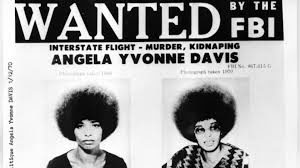
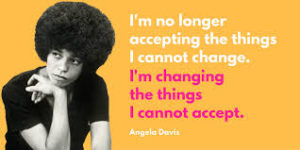
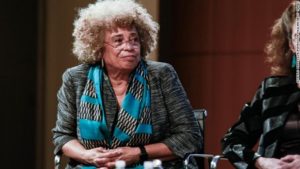
This is Black History Month; the encyclopedia is filled with biographies or men and women who have agitated, plowed, enticed thunder-lightening, roared and struggled; (we have address many in the postings of this commentary; see below). There is one more to consider; that of an American Civil Rights Activist with a long reach around the world, Dr. Angela Davis. Davis is associated with Good, Bad and Ugly; her biography features good deeds, bad deeds and some “ugly”.

Yes, Angela Davis’s resumé is not so straight-forward; to say she has “a controversial past” is kind of simplistic. Here are some highlights, according to the news article in Appendix A below:

  • Activism with the Black Panthers.
  • Running for Vice-President of the United States on the Communist party ticket.
  • Her role in a 1970 hostage situation in a California courtroom, where a judge and three others were killed. (She was accused of providing the weapons used in the attack and landed on the FBI Ten Most Wanted list, but was eventually acquitted).

This history is apropos to consider during this February, during Black History Month. This entry is 4 of 5 in this series from the movement behind the book Go Lean … Caribbean in consideration of the impact that Black people have had on the recent history of modern society.

The full list of commentaries in the series are cataloged as follows:

  1. Black History Month 2019: Dr. Bennet Omalu – Definer of Gladiator Sports
  2. Black History Month 2019: Marcus Garvey’s World View
  3. Black History Month 2019: Starting 75 years of Bob Marley’s legacy
  4. Black History Month 2019: Angela Davis – Hero or Villian?
  5. Black History Month 2019: WEB DuBois – Moved to Africa for Later Life

Though not of Caribbean heritage, this submission presents Dr. Angela Davis as a Role Model that has had an effect on our Caribbean people and culture. In the past, Davis has had direct relations with Caribbean affairs. Looking back – see Appendix B below – she has been Right and Wrong on Caribbean transformations:

  • Good: She has advocated for Majority Rule in this region, as most Caribbean lands – 29 of 30 – feature a majority Black-and-Brown population, but until the last 50 – 60 years, most only had ‘White Minority Rule“, while the Majority languished.
  • Bad: Embracing Angela Davis required a wide-eyed acceptance of her political leanings; she was a vocal and unapologetic Communist. She is known to have said: “only under socialism could the fight against racism be successfully executed”. This experimentation turned perilous for Cuba, Grenada and many other countries that toiled under this failed economic-political regime; (remember the USSR).
  • Ugly: The experimentations and sampling of cooperative-commune living turned deadly in Guyana in 1978 with the Jonestown Massacre where more than 900 people died. Though she was not there physically, many times she projected her presence there “virtually” with recordings, films and inspirational writings. It is difficult not to assign her some of the bloodguilt.

The Go Lean movement has presented many  previous commentaries that highlight the effectiveness of Role Models; consider this sample here:

https://goleancaribbean.com/blog/?p=14558 Be the Change – Model of Education Advocate: Linda Brown, RIP
https://goleancaribbean.com/blog/?p=14541 Viola Desmond – Canada’s Rosa Parks – She Made a Difference
https://goleancaribbean.com/blog/?p=13063 Learn from Billie Jean King – Get Gender Equity without a ‘Battle’
https://goleancaribbean.com/blog/?p=10124 Katherine Johnson – Rocket Scientist? Yes, We Can!

While many of these previous advocates and Role Models are dead-and-gone, Angela Davis is very much alive-and-well. She continues to give us her words (she has written a few books), her perspectives and her actions – she continues to advocate for Human Rights causes around the world. She has provided so much content for us to look, listen and learn lessons from.

We can truly summarize her biography with this assessment:

Her heart was in the right place.

This is what we should always expect from the February Black History Month exercises: education, inspiration, reflection, and a call to action.

Thank you Dr, Angela Davis, for all that you have done in trying to help the Caribbean and other victims of Human Rights and Civil Rights abuses around the world. We say to you as we concluded the epilogue of the Go Lean book (Page 252):

Thank you for your service. We’ll take it from here.

So thank for helping us to get one step closer to making our homelands, better places to live, work and play. 🙂

About the Book
The book Go Lean…Caribbean serves as a roadmap for the introduction and implementation of the technocratic Caribbean Union Trade Federation (CU), for the elevation of Caribbean society – for all member-states. This CU/Go Lean roadmap has these 3 prime directives:

  • Optimization of the economic engines in order to grow the regional economy to $800 Billion and create 2.2 million new jobs.
  • Establishment of a security apparatus to ensure public safety and protect the resultant economic engines.
  • Improve Caribbean governance to support these engines, including a separation-of-powers between the member-states and CU federal agencies.

The Go Lean book provides 370-pages of turn-by-turn instructions on “how” to adopt new community ethos, plus the strategies, tactics, implementations and advocacies to execute so as to reboot, reform and transform the societal engines of Caribbean society.

Download the free e-Book of Go Lean … Caribbean – now!

Who We Are
The movement behind the Go Lean book – a non-partisan, apolitical, religiously-neutral Community Development Foundation chartered for the purpose of empowering and re-booting economic engines – stresses that reforming and transforming the Caribbean societal engines must be a regional pursuit. This was an early motivation for the roadmap, as pronounced in the opening Declaration of Interdependence (Pages 12 – 13):

xi. Whereas all men are entitled to the benefits of good governance in a free society, “new guards” must be enacted to dissuade the emergence of incompetence, corruption, nepotism and cronyism at the peril of the people’s best interest. The Federation must guarantee the executions of a social contract between government and the governed.

xvi. Whereas security of our homeland is inextricably linked to prosperity of the homeland, the economic and security interest of the region needs to be aligned under the same governance. Since economic crimes … can imperil the functioning of the wheels of commerce for all the citizenry, the accedence of this Federation must equip the security apparatus with the tools and techniques for predictive and proactive interdictions.

xxiv. Whereas a free market economy can be induced and spurred for continuous progress, the Federation must install the controls to better manage aspects of the economy: jobs, inflation, savings rate, investments and other economic principles. Thereby attracting direct foreign investment because of the stability and vibrancy of our economy.

Sign the petition to lean-in for this roadmap for the Caribbean Union Trade Federation.

—————–

Appendix A – Title: Alabama group reverses course, wants to honor Angela Davis
By: Joe Sterling, CNN

An Alabama civil rights group that rescinded an award for political activist Angela Davis said it learned from its “mistakes” over the controversial move and asked the Birmingham native to accept the honor after all.

The move comes after the group’s board of directors last week issued a “public apology for its missteps in conferring, then rescinding, its nomination of Dr. Angela Y. Davis in early January ”

It is not known whether Davis will attend. CNN has reached out to her for comment.

Birmingham Civil Rights Institute President and CEO Andrea Taylor said in a statement. that “Dr. Angela Davis, a daughter of Birmingham, is highly regarded throughout the world as a human rights activist.

“In fact, the Schlesinger Library at Harvard University’s Radcliffe Institute of Advanced Study acquired her personal archives in 2018, recognizing her significance in the movement for human rights, her involvement in raising issues of feminism, as well as her leadership in the campaign against mass incarceration. Her credentials in championing human rights are noteworthy.”

The Birmingham Civil Rights Institute initially intended to honor her with its 2018 Reverend Fred L. Shuttlesworth Human Rights Award in February.

But the group earlier this month rescinded the honor following opposition.

Withdrawing the award came after “supporters and other concerned individuals and organizations, both inside and outside of our local community, began to make requests that we reconsider our decision,” the institute’s board said in a statement at the time.

“Upon closer examination of Ms. Davis’ statements and public record, we concluded that she unfortunately does not meet all of the criteria on which the award is based,” the statement said.

Mayor Randall Woodfin, who said he regretted the board’s move, said protests were made “by some members of the community, Jewish and otherwise.”

Reacting to the rescission, Davis said that “although the BCRI refused my requests to reveal the substantive reasons for this action, I later learned that my long-term support of justice for Palestine was at issue. ”

Davis, who is a critic of the Israeli policies in the Palestinian territories, said she was “stunned” by the move.

“I have devoted much of my own activism to international solidarity and, specifically, to linking struggles in other parts of the world to US grassroots campaigns against police violence, the prison industrial complex and racism more broadly. The rescinding of this invitation and the cancellation of the event where I was scheduled to speak was thus not primarily an attack against me but rather against the very spirit of the indivisibility of justice,” she said.

“Dissension” and “missteps”
The rescinding drew criticism from academics and the institute lost three board members who stepped down from their positions because they “regret the circumstances surrounding the selection process regarding the 2018 Reverend Fred L. Shuttlesworth Human Rights Award and the dissension this has caused.”

The institute’s board of directors on January 14 made a “public apology for its missteps in conferring, then rescinding, its nomination” of Davis.

“Immediately after that public apology, in keeping with its commitment to learning from its mistakes and in order to stay true to the BCRI’s founding mission, the board voted to reaffirm Dr. Davis as the recipient. Dr. Davis was immediately thereafter personally invited to reaccept the award,” the institute said.”

The Rev. Thomas L. Wilder, interim BCRI board chair, asked people to “partner with us to rebuild trust in the Institute and its important work.”

“At the end of the day, we stand for open and honest dialogue on issues. It is only through our ability to talk openly and honestly with one another that we can achieve true understanding and appreciation for one another’s perspectives. We look forward to continuing the institute’s legacy as we foster dialogue and open communications, improve our board governance and policies, and stay focused on our Vision 2020 strategic plan.”

In her reaction to the board’s initial rescinding, Davis said she was intent on planning an “alternative event organized by those who believe that the movement for civil rights in this moment must include a robust discussion of all of the injustices that surround us. ”

Other issues, not just Palestinians
Larry Brook, editor of Southern Jewish Life magazine, said it is incorrect that opposition to the Davis appearance was solely due to her stance on Israel and the Palestinians.

He wrote a story in December about Davis’ appearance but he said there wasn’t much talk about why the cancellation originally happened.

“In the absence of a concrete explanation, a narrative spread nationally and internationally that the event had been canceled because the Jewish community dislikes her views on the Middle East, with pro-Palestinian groups charging that the Jewish community is trying to ‘silence’ dissenting voices,” Brook said.

There were other issues, he said, and other recipients of the award had been tough on Israel, too.

“Davis also has a controversial past, through activism with the Black Panthers, running for vice president on the Communist party ticket, and her role in a 1970 hostage situation in a California courtroom, where a judge and three others were killed. She was accused of providing the weapons used in the attack and landed on the FBI Ten Most Wanted list, but was eventually acquitted,” Brook. wrote in his piece on Friday.

Brook said the latest development was unexpected.

“When they originally canceled the honor, I was surprised they’ve gone that far. Now that they’ve gone back and reestablished it? That also surprised me.”

Source: Posted January 25, 2019; retrieved February 6, 2019 from: https://www.cnn.com/2019/01/25/us/alabama-angela-davis-award/index.html

—————–

Appendix B – Reference: Angela Davis
Angela Yvonne Davis
 (born January 26, 1944) is an American political activist, academic, and author. She emerged as a prominent counterculture activist in the 1960s working with the Communist Party USA, of which she was a member until 1991, and was briefly involved in the Black Panther Party during the Civil Rights Movement.[4]

After Davis purchased firearms for personal security guards, those guards used them in the 1970 armed takeover of a Marin County, California courtroom, in which four people were killed. She was prosecuted for three capital felonies, including conspiracy to murder, but was acquitted of the charges.[5][6]

Davis is a professor emerita at the University of California, Santa Cruz, in its History of Consciousness Department. She is also a former director of the university’s Feminist Studies department.[7] Her research interests are feminism, African-American studiescritical theoryMarxismpopular musicsocial consciousness, and the philosophy and history of punishment and prisons. She co-founded Critical Resistance, an organization working to abolish the prison–industrial complex.

Davis’s membership in the Communist Party USA (CPUSA) led California Governor Ronald Reagan in 1969 to attempt to have her barred from teaching at any California university. She supported the governments of the Soviet Bloc for several decades. During the 1980s, she was twice a candidate for Vice President on the CPUSA ticket. She left the party in 1991.[8]

Source: Retrieved February 6, 2019 from: https://en.wikipedia.org/wiki/Angela_Davis

Share this post:
, , ,
[Top]

Remembering George H.W. Bush and ADA

Go Lean Commentary

Old age is justice; it is when able-bodied people and disabled people become equally disabled.

We are being reminded of this sad reality of aging by the life-and-death of the 41st President of United States of America. At the end of his life, this able-bodied man (former war hero) was bound to a wheelchair.
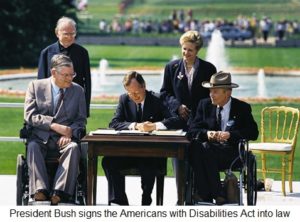

The United States is mourning the death of its ex-president (1989 – 1993), George H. W. Bush. Wednesday December 5, 2018 is set-aside as the National Day of Mourning.

“The best 1 term president in the history of the country” – as declared by George W. Bush, the eldest son and subsequent president (#43 2001 – 2009).

Who’s best? Who’s the greatest? These are all questions for historians to consider. But for one group of Americans – Persons with Disabilities – they will surely concur with the “best” and “greatest” tag to George H.W. Bush because of one reason, his passage of the Americans with Disabilities Act (ADA).

The book Go Lean…Caribbean – available to download for free – presents this landmark ADA legislation as a model for emulation and adoption in the Caribbean. The book provided this ADA summary (Page 228):

The Bottom Line on the American with Disabilities Act (ADA)
This Act is a law that was enacted by the U.S. Congress in 1990. It was signed into law on July 26, 1990, by President George H. W. Bush, and later amended with changes effective January 1, 2009. The ADA is a wide-ranging civil rights law that prohibits, under certain circumstances, discrimination based on disability. It affords similar protections against discrimination to Americans with disabilities as the Civil Rights Act of 1964, which made discrimination based on race, religion, sex, national origin, and other characteristics illegal. Disability is defined by the ADA as “…a physical or mental impairment that substantially limits a major life activity.” The determination of whether any particular condition is considered a disability is made on a case by case basis. Certain specific conditions are excluded as disabilities, such as current substance abuse and visual impairment that is correctable by prescription lenses. [ADA is based on the premise of] reasonable accommodation – an adjustment made in a system to “accommodate” or make fair the same system for an individual based on a proven need. Accommodations can be religious, academic, or employment related. This provision is also prominent in international law as the United Nations has codified the principle in the Convention on the Rights of Persons with Disabilities. [There are many international signatories to these principles and resolutions].

The ADA allows private plaintiffs to receive only injunctive relief (a court order requiring the public accommodation to remedy violations of the accessibility regulations) and attorneys’ fees, and does not provide monetary rewards to private plaintiffs who sue non-compliant businesses. Unless a state law provides for monetary damages to private plaintiffs, qualified claimants do not obtain direct financial benefits from suing entities that violate the ADA. [Thus, no “professional plaintiffs”!]

Listen to this relevant AUDIO Podcast from today (December 3, 2018):

AUDIO Podcast – Americans With Disabilities Act Signed By George H.W. Bush Expanded Rights Of Millions –  https://www.wbur.org/hereandnow/2018/12/03/americans-with-disabilities-george-hw-bush

Published December 3, 2018 – President George H.W. Bush signed the Americans with Disabilities Act into law in 1990. It was landmark legislation that expanded rights and protections for millions of people. Bush, who died Friday at age 94, played a key role in its passage.

Here & Now‘s Jeremy Hobson talks with Marian Vessels, director of the Mid-Atlantic ADA Center in Maryland, who was at the ADA’s signing.

Unfortunately, the Caribbean has a terrible track record for accommodating Persons with Disabilities. The Go Lean book serves as a roadmap for the introduction and implementation of the technocratic Caribbean Union Trade Federation (CU), for the elevation of Caribbean society – for all member-states. This CU/Go Lean roadmap has these 3 prime directives:

  • Optimization of the economic engines in order to grow the regional economy to $800 Billion and create 2.2 million new jobs.
  • Establishment of a security apparatus to ensure public safety and protect the resultant economic engines for all citizens and visitors.
  • Improve Caribbean governance to support these engines, including a separation-of-powers between the member-states and CU federal agencies.

The book stresses that reforming and transforming the Caribbean societal engines must be a regional pursuit. This was an early motivation for the roadmap, as pronounced in the opening Declaration of Interdependence (Pages 12 – 13):

ix. Whereas the realities of healthcare and an aging population cannot be ignored and cannot be afforded without some advanced mitigation, the Federation must arrange for health plans to consolidate premiums of both healthy and sickly people across the wider base of the entire Caribbean population. The mitigation should extend further to disease management, wellness, mental health, obesity and smoking cessation programs. …

xi. Whereas all men are entitled to the benefits of good governance in a free society, “new guards” must be enacted to dissuade the emergence of incompetence, corruption, nepotism and cronyism at the peril of the people’s best interest. The Federation must guarantee the executions of a social contract between government and the governed.

xviii. Whereas all citizens in the Federation member-states may not have the same physical abilities, reasonable accommodations must be made so that individuals with physical and mental disabilities can still access public and governmental services so as to foster a satisfactory pursuit of life’s liberties and opportunities for happiness.

The Go Lean book provides 370-pages of turn-by-turn instructions on “how” to adopt new community ethos, plus the strategies, tactics, implementations and advocacies to execute so as to reboot, reform and transform the societal engines of Caribbean society – to benefit all people, able-bodied and the disabled. One specific advocacy addresses the needs of Persons with Disabilities. See the sample plans, excerpts and headlines from the book on Page 228 entitled:

10 Ways to Impact Persons with Disabilities

1 Lean-in for Treaty for a Caribbean Single Market
This treaty allows for the unification of the region into one market, thereby expanding to an economy of 26 countries, 42 million people and a GDP of over $800 Billion (per 2010). The CU will empower and enhance the economic engines for the participation and benefit of all people; this includes the number of citizens that may have some physical (deaf, blind, lame, etc.) or mental challenges. The CU’s vision is that this sector represents a critical talent pool that is underserved and underutilized. They will be included in this CU movement, with a Caribbean [Persons] with Disabilities (CDA) provision embedded in the treaty. In addition, to the economic missions, the treaty also establishes a security pact, with the mission to fortify homeland security and to mitigate regional threats including a strategic gun control policy.
2 Cruise Ships and Disability Tourism
Since most western democracies have Reasonable Accommodation provisions for their citizenry, many disabled people in the US, Canada and EU countries live full-functioning lives with jobs, disposable income and the manifestation of vacation needs. The CU will incentivize the Cruise industry and tourism properties to make their own “reasonable accommodations” to cater to persons with disabilities. This also applies to the Elder-Care population.
3 Public Transportation and Public Accommodations – Assurance on CU facilities
4 Government Buildings and Proceedings
5 Mental Disabilities and Gun Control
6 Tele-type Call Center Access
The CU advocates e-Government and e-Delivery of government services, therefore call centers will be a primary feature for service delivery. To accommodate deaf residents, guests and trading partners, the CU call centers will be equipped with “Tele-type” terminals and agents with related certifiable skills (including 911).
7 Autism Awareness – Opt-Out Accommodations
8 Braille Websites
9 Closed Captioning … for Television
As the regulator for cross-border radio spectrum, the CU’s Media Regulatory Authority will mandate that all broadcasters provide a closed-captioning option on their channels. This enables the hearing-impaired to have full access.
10 Public Awareness Campaign – Improve Image

The Go Lean movement (book and blogs) have maintained that there must always be the empowerments for Persons with Disabilities. This cannot be left to chance; it must be enacted in law. Thank you for this model President George H.W. Bush. The need for Caribbean empowerments for Persons with Disabilities has been alluded to in many previous blog-commentaries; consider this sample:

https://goleancaribbean.com/blog/?p=14480 Repairing the Breach: Mental Health Realities

Mental Health is a real concern for the population in general and for men in particular. One of the biggest problems is that men rarely want to admit to any problems or seek any help. Yet, the evidence of dysfunction is there: 1. Substance Abuse (Drugs and Alcohol) 2. Suicide

https://goleancaribbean.com/blog/?p=11052 Managing the ‘Strong versus the Weak’ – Mental Disabilities

The creed to protect the Weak from being abused by the Strong is age-old as an honor code. All societies have those that are mentally weak; the Social Contract must allow for protection and remediation of these ones.

https://goleancaribbean.com/blog/?p=11048 Managing the ‘Strong versus the Weak’ – Model of Hammurabi

In every society, there are those that are able-bodied and those that are disabled. so there is the need for the authorities to ensure that the “strong should not harm the weak”. This is the legacy of the 3,800 year-old Hammurabi Code.

https://goleancaribbean.com/blog/?p=6836 Role Model – #FatGirlsCan

The Go Lean movement campaigns for reasonable accommodations so that persons in the Caribbean that are differently-abled can live a full and engaging life … and help to elevate their communities. This difference also includes those who are “fat”, overweight or obese.

https://goleancaribbean.com/blog/?p=5901 The Demographic Theory of Elderly Suicide

Failures in health delivery results in suicides. Among senior citizens, this prevalence is due to the fact that they may not consider themselves as relevant in modern society. We can learn from others on health remediation and solutions for Caribbean senior citizens.

https://goleancaribbean.com/blog/?p=5720 Role Model of a Disability Advocate: Reasonable Accommodations

With just a reasonable accommodation, persons with disabilities can live a full and engaging life … and help to elevate their communities and make “home” better places to live, work and play.

https://goleancaribbean.com/blog/?p=2105 Recessions and Public Physical and Mental Health

Mental Health disorders can spark when the economy sours. Public Health officials need to be “on guard” for Mental Health fallout during periods of economic recession.

https://goleancaribbean.com/blog/?p=1751 New Hope in the Fight against Alzheimer’s Disease

Everyone ages, and so Alzheimer’s disease is a guaranteed risk in every community. This is a Mental Health reality that must be planned for, so as to ensure the best outcomes for communities.

As related above, American society is at the matured level now in their Social Contract deliveries. They now expect the standard to be “reasonable accommodations” so that Persons with Disabilities can participate in and contribute to society. This was not always the case, and then George H.W. Bush came along and forge change in American society. This is not the standard in the Caribbean member-states … yet. But part of this reboot effort – the quest of the Go Lean roadmap – is to reform and transform the societal engines to benefit all members of the community, able-bodied or not.

President Bush’s motives with the ADA efforts where not selfish; his legacy of public service is being lauded today leading up to his National Hero’s Funeral. But lo and behold, at the end of his life, he needed the reasonable accommodations he enshrined into law.

In the Caribbean, we need to apply this same lesson: even able-bodied people become disabled; therefore reasonable accommodations need to be ensured in society. Yes, we can benefit ourselves from such empowerments. This will make our homeland a better place to live, work and play. 🙂

Download the free e-Book of Go Lean … Caribbean – now!

Sign the petition to lean-in for this roadmap for the Caribbean Union Trade Federation.

Share this post:
, , ,
[Top]

100 Years of Armistice Day – ENCORE

Today is the 11th day of the 11th month, November. For the last 100 years, this date has been commemorated and celebrated for marking the end of the Great War, later to be called World War I. This day has a lot of different names:
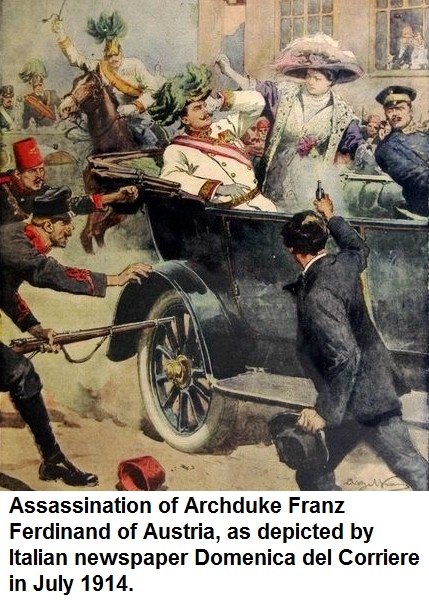
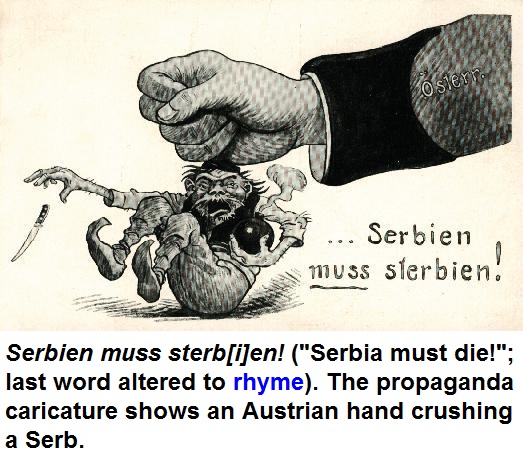
  • Armistice Day
  • Remembrance Day
  • Veterans Day (in the US)

This was one of the biggest moments in the entire 20th century. The cease-fire came into effect at 11am – the 11th hour. See the encyclopedic details here:

Title: Armistice of 11 November 1918
The Armistice of 11 November 1918 was the armistice that ended fighting on land, sea and air in World War I between the Allies and their opponent, Germany. Previous armistices had eliminated Bulgaria, the Ottoman Empire and the Austro-Hungarian Empire from the war. Also known as the Armistice of Compiègne from the place where it was signed, it came into force at 11 a.m. Paris time on 11 November 1918 (“the eleventh hour of the eleventh day of the eleventh month”) and marked a victory for the Allies and a defeat for Germany, although not formally a surrender.

The actual terms, largely written by the Allied Supreme Commander, Marshal Ferdinand Foch, included the cessation of hostilities, the withdrawal of German forces to behind the Rhine, Allied occupation of the Rhineland and bridgeheads further east, the preservation of infrastructure, the surrender of aircraft, warships, and military materiel, the release of Allied prisoners of war and interned civilians, eventual reparations, no release of German prisoners and no relaxation of the naval blockade of Germany.

See the remaining of the article here …
https://en.m.wikipedia.org/wiki/Armistice_of_11_November_1918 retrieved November 11, 2018.

This is more than just raw history. There is a lot of relevance for the Caribbean. At the time of this war (1914 – 1918) most of the 30 member-states of the political Caribbean were all under the domain of the following countries that participated in the World War:

  • Great Britain (owned 18 islands and coastal territories including today’s Belize & Guyana)
  • Denmark (owned the US Virgin Islands until 1917)
  • France (owned 4 islands)
  • Netherlands (owned 6 islands and Suriname)
  • United States of America (owned Puerto Rico and Protectorate of Cuba)
  • (Haiti and the Dominican Republic were independent and inconsequential to this war).

In fact, at the 100 year anniversary of the launch of the war, this commentary published a detail assessment on relevance to our modern life and lessons learned – 8 specific theses. Here is an Encore of that previous blog-commentary here-now:

===============================================

Go Lean Commentary – A Lesson in History: 100 Years Ago Today – World War I

The dominoes began to fall 100 years ago today.

Going backwards: The Caribbean is at the precipice of dysfunction due to a global financial crisis; the crisis is a by-product of an inter-connected world; the global unified economic systems (Bretton-Woods Accords [b]) and disbanding of the colonies of the Great Powers emerged for the rebuilding after World War II. Consequently, Word War II was a direct response to the unsatisfactory settlements from World War I and economic dysfunctions during the period between the World Wars. The first domino was therefore June 28, 1914.

1914 Photo 1On this date 100 years ago, Archduke Franz Ferdinand of Austria, heir presumptive to the Austro-Hungarian throne, and his wife, Sophie, Duchess of Hohenberg, were shot dead in Sarajevo by Serbian assassins. The political objective of the assassination was to break off Austria-Hungary’s south-Slav provinces so they could be combined into a Yugoslavia. The assassination led directly to the First World War when Austria-Hungary subsequently issued an ultimatum against Serbia, which was partially rejected. Austria-Hungary then declared war, marking the outbreak of the war. [a]

Multilateral military alliances abounded in that day among the Great Powers: Austria-Hungary with Germany (Triple Alliance of 1882) and Serbia with Russia and France (Triple Entente of 1907) and Britain. When war ensued later in August 1914, these were the sides. Many other military treaties were triggered thereby engaging empires/countries like Ottoman-Turks, Portugal, Japan and Italy, (The United States joined in 1917 allied with Britain). The resulting conflict was dubbed the Great War until subsequently rebranded World War I.

The review of the historic events of this day 100 years ago is more than just an academic discussion, the book Go Lean…Caribbean aspires to economic principles that dictate that “consequences of choices lie in the future”. The book serves as a roadmap for the introduction and implementation of the technocratic Caribbean Union Trade Federation (CU). This confederation effort aligns many former colonies of the same Great Powers that waged WW I; like Great Britain or the United Kingdom (UK) for example. The British Dominion experienced dire consequences and suffered greatly as a result of this war. In 1914 The British Dominion controlled over 25% of the world’s population; today the UK wields little political, military or economic power, including that of the Caribbean.

The people of the Caribbean understand societal decline and dysfunction all too well.

What have we learned in the 100 years since the events of June 28, 1914? How will these lessons help us today?

  • Minority Equalization – Bullying and terrorism must be mitigated at the earliest possible opportunity – the foregoing photo depicts the oppression the minority Balkan communities perceived in the Austria-Hungarian Empire. As a minority group they felt bullied in their own country; their Slavic culture and language set them apart, and their religious adherence led to even more dissension (Austria-Hungary: Catholic/Lutheran; Serbia: Eastern Orthodox and Bosnia- Herzegovina: Muslim) There were terrorist activities for decades before in the quest for independence. In the past 100 years, this same modus operandi has been repeated in countless locales around the world. The CU security pact must defend against regional threats, including domestic terrorism. This includes gangs and their junior counterparts, bullies. The CU plans for community messaging in the campaign to  mitigate bullying.

1914 Photo 2

  • Reconciliation of issues are not optional, more conflict will emerge otherwise – The issues that wedged the people of the Balkans were not resolved in World War I. More dissensions continued leading to World War II, and continued during the Cold War while most of the Balkans were under Soviets control. When the Soviet Union collapsed in 1991, civil war and ethnic cleansings proceeded in the Balkans. Their issues/differences had not been reconciled. A common practice after WW I & WW II was the prosecution of war crimes. But in South Africa an alternative justice approach was adopted, that of Truth & Reconciliation Commissions (TRC). These have become more successful as the emphasis is less on revenge and more on justice normalization. Many other countries have instituted similar TRC models. The CU plans for the TRC model for dealing with a lot of latent issues in the last Caribbean century (i.e. Cuba, Haiti, Dominican Republic, etc).
  • Self-determination of local currencies – in planning for postwar reconstruction, U.S. representatives with their British counterparts studied what had been lacking between the two world wars: a system of international payments that would allow trade to be conducted without fear of sudden currency depreciation or wild fluctuations in exchange rates—ailments that had nearly paralyzed world capitalism during the Great Depression. There is a multiplier associated with the currency in the money supply. Therefore the communities of the Caribbean must embrace its own currency, the Caribbean Dollar (managed by a technocratic Caribbean Central Bank), thereby bringing local benefits from local multipliers.
  • Security assurances must be enabled to complement economics objectives – A lot of dissension has resulted when economic engines become imperiled due to security conflicts. The instability then causes more economic dysfunction, which results in even more security threats – a downward spiral. The CU/Go Lean posits that security apparatus must be aligned with all economic empowerments. This is weaved throughout the roadmap.
  • Negotiate as partners not competitors – The end of World War I immediately set-up ripe conditions for WW II, because of the harsh terms in the Peace Treaties. The CU maintains that, negotiation is an art and a science. More can be accomplished by treating a negotiating counterpart as a partner, rather than not an adversary. (See VIDEO below).
  • Cooperatives and sharing schemes lighten burdens among neighbors – The Balkan conflict of 1914 resulted in a World War because of cooperative treaties with aligning nations. Despite this bad outcome, the practice of cooperatives and sharing still has more upside than downside. The CU will employ cooperatives and sharing schemes for limited scopes within the prime directives of optimizing the economic, security and governing engines.
  • Promote opportunities for the Pursuit of Happiness – A lot of terrorist activities are executed by “suicide” agents (i.e. suicide bombers). The Go Lean roadmap posits the when the following three fundamentals are in place, the risks of suicide is minimal: 1. something to do, 2. someone to love, 3. something to hope for. These are the things a man (or woman) needs to be happy.
  • Consider the Greater Good – Complying with this principle would have prevented a lot of conflict in the past century. The philosophy is directly quoted as: “It is the greatest good to the greatest number of people which is the measure of right and wrong”. The CU/Go Lean roadmap calls for a number of measures that strike directly at the Greater Good mandate: accountable justice institutions, economic empowerment for rich and poor, strategic education initiatives, proactive health/wellness, etc.

The related subjects of economic, security and governing dysfunction have been a frequent topic for blogging by the Go Lean promoters, as sampled here:

https://goleancaribbean.com/blog/?p=1433 Caribbean loses over 70% of tertiary educated citizens to the brain drain
https://goleancaribbean.com/blog/?p=1309 5 Steps of a Bubble
https://goleancaribbean.com/blog/?p=1014 All is not well in the sunny Caribbean
https://goleancaribbean.com/blog/?p=816 The Future of Caribbean Integration and CariCom
https://goleancaribbean.com/blog/?p=789 America’s War on the Caribbean
https://goleancaribbean.com/blog/?p=782 Open the Time Capsule: The Great Recession of 2008
https://goleancaribbean.com/blog/?p=623 Only at the precipice, do they change
https://goleancaribbean.com/blog/?p=599 Ailing Puerto Rico open to radical economic fixes
https://goleancaribbean.com/blog/?p=467 Barbados Central Bank records $3.7m loss in 2013
https://goleancaribbean.com/blog/?p=451 CariCom Chairman to deliver address on slavery/colonization reparations
https://goleancaribbean.com/blog/?p=353 Book Review: ‘Wrong – Nine Economic Policy Disasters and What We Can Learn…’

The purpose of the Go Lean roadmap is to turn-around the downward trends in the Caribbean today, to reverse course and elevate Caribbean society. The CU, applying lessons from the last 100 years, has prime directives proclaimed as follows:

  • Optimization of the economic engines in order to grow the regional economy to $800 Billion & create 2.2 million new jobs.
  • Establishment of a security apparatus to protect the resultant economic engines.
  • Improve Caribbean governance to support these engines.

The Go Lean book details a series of assessments, community ethos, strategies, tactics, implementations and advocacies to empower all the factions in the Caribbean region:

Community Ethos – Economic Systems Influence Choices & Incentives Page 21
Community Ethos – Consequences of Choices Lie in the Future Page 21
Community Ethos – Money Multiplier – Control of Local/Regional   Currency Page 22
Community Ethos – Anti-Bullying and Mitigation Page 23
Community Ethos – Intelligence Gathering Page 23
Community Ethos – “Crap” Happens Page 23
Community Ethos – Minority Equalization Page 24
Community Ethos – Ways to Impact the Future Page 26
Community Ethos – Ways to Improve Negotiations Page 32
Community Ethos – Ways to Manage Reconciliations Page 34
Community Ethos – Ways to Improve Sharing Page 35
Community Ethos – Ways to Promote Happiness Page 36
Community Ethos – Ways to Impact the Greater Good Page 37
Strategy – Vision –  Integrate Region into a Single Market Economy Page 45
Strategy – Agents of Change – Globalization Page 57
Tactical – Separation of Powers – Department of Homeland   Security Page 75
Tactical – Separation of Powers – Department of   Justice Page 77
Implementation – Assemble Existing Super-national Institutions Page 96
Implementation – Caribbean Central Bank (CCB) Cooperative Page 96
Implementation – Ways to Pay for Change Page 101
Implementation – Foreign Policy Initiatives   at Start-up Page 102
Implementation – Security Initiatives at   Start-up Page 103
Implementation – Ways to Deliver Page 109
Implementation – Ways to Promote Independence Page 120
Planning – Ways to Ways to Model the EU Page 130
Planning – Ways to Make the Caribbean Better Page 131
Planning – Ways to Improve Failed-State Indices Page 134
Planning – Lessons from East Germany Page 139
Advocacy – Ways to Grow the Economy Page 151
Advocacy – Ways to Create Jobs Page 152
Advocacy – Ways to Better Manage the Social Contract Page 170
Advocacy – Ways to Foster Cooperatives Page 176
Advocacy – Ways to Impact Justice Page 177
Advocacy – Ways to Improve Homeland Security Page 180
Advocacy – Ways to Mitigate Terrorism Page 181
Advocacy – Ways to Improve Intelligence Page 182
Advocacy – Banking Reforms – Caribbean Dollar Page 199
Advocacy – Ways to Protect Human Rights Page 220
Advocacy – Battles in the War on Poverty Page 222
Advocacy – Ways to Impact British Territories Page 245

The year 1914 is identified as a watershed year in the history of mankind. (There are even religious teachings that identify this year as the beginning of the Bible’s prophesied Last Days). No doubt there was a crisis, and it was wasted, even after losing 19 million people in the ensuing military conflict. The result was a 2nd World War that slaughtered 60 million more. Still all the divisions and animosities created during those conflicts forged even more conflicts (think: Middle East, Korea and Vietnam). In total, about 100 million people died in wars of the 20th Century.

See Comedian Bill Maher Commentary in the following VIDEO:

VIDEO – Real Time With Bill Maher: Sunni and Share (HBO) – 
https://youtu.be/Jz0YWIfBLa4


Real Time with Bill Maher
Published on Jul 1, 2014 – Bill Maher delivers his “New Rules” editorial on June 27, 2014.

  • Category: Entertainment

Now is the time for all of the Caribbean to learn the lessons from the last 100 years, and not waste our current crises. The book Go Lean … Caribbean posits that the Caribbean is in a serious crisis, but asserts that this crisis would be a terrible thing to waste. The people and governing institutions of the region are hereby urged to lean-in for the empowerments described in the book Go Lean … Caribbean.

This is a big deal for the region, the same way 1914 was a big year for our planet. While the planet is out-of-scope for this roadmap, a Caribbean neighborhood optimization is realistic and plausible. We can all work to make our homeland a better place to live, work, and play.

Download the free e-Book of Go Lean … Caribbean – now!

—————–

Referenced Sources:
a.     http://en.wikipedia.org/wiki/Assassination_of_Archduke_Franz_Ferdinand_of_Austria; retrieved June 28, 2014

b.     http://en.wikipedia.org/wiki/Bretton_Woods_system; retrieved June 28, 2014

Share this post:
, ,
[Top]

Guy Fawkes – A Lesson in History

Go Lean Commentary

“… Keep doing this, whenever you drink it, in remembrance of me.” For whenever you eat this loaf and drink this cup, you keep proclaiming  … – The Bible 1 Corinthians 11: 25, 26 NWT

Its a simple formula, keep doing things in remembrance … and you will remember.

Remember, remember the Fifth of November, 

The Gunpowder Treason and Plot,
I know of no reason
Why the Gunpowder Treason
Should ever be forgot.

See the full poem and all its variations in Appendix A below.

Throughout the British West Indies (18 of the 30 countries that comprise the political Caribbean), the night of November 5th was a Red Letter Day on the Calendar. It was Guy Fawkes / Bonfire Night. The tradition was to burn a stuffed dummy in effigy!

This was not our finest moment.

Without realizing it, we were fostering a Climate of Hate.

Surely, we have grown … since those Bad Old Days?!

Surely?!

Sorry! The answer is No! Those Bad Old Days was … 5 days ago.
This practice was/is bad … because we have not reformed and retrained our Community Ethos. This refers to:

The national spirit that drives the character and identity of its people.

In a lot of the Anglophone world, Guy Fawkes or Bonfire Night is a memorable Calendar event. Here are examples:

  1. Bahamas
    Though the Bahamas gained independence from England more than 40 years ago, a great deal of our culture remains steeped in the traditions of our British ancestors.
    One of these traditions is Guy Fawkes Night. …
    Today, nearly 250 years later, Guy Fawkes Night is still celebrated throughout the Bahamas. “Guys” are constructed using old clothing, newspapers and masks, and burned on giant bonfires.
    Green Turtle Cay’s Guy Fawkes Night is observed on the Saturday evening closest to November 5th. … – Source:https://littlehousebytheferry.com/2015/11/05/guy-fawkes-on-green-turtle-cay/
  2. Bermuda
    England celebrates this … Gun Powder Plot and every year his effigy is burned on a bonfire.
    Oh and there are fireworks! Well of course there are. No sense in just letting him burn in silence!
    In true Bermudian fashion we will be joining the Brits in their burning! Well at least the fireworks that is. Aptly placed our fireworks will be around an old Fort here, Fort St. Catherine! Source: https://robynskinner.wordpress.com/tag/guy-fawkes-day-in-bermuda/
  3. Jamaica
    Bonfire Night in Jamaica can be one of the most exciting nights of the year. There are loads of Guy Fawkes events in Jamaica and no matter what the weather’s like, you can always be sure a firework party in Jamaica will always draw in a big crowd. – Source: https://www.skiddle.com/cities/jamaica/bonfirenight.html
    See a relevant news article in Appendix B. 
  4. St. Kitts and Nevis
    This Caribbean islands knows how to party. Guy Fawkes is just another excuse to head down to the beach or attend a party where firework displays are the highlight of the night. – Source: https://www.onetravel.com/going-places/light-it-up-guy-fawkes-day-celebrations-around-the-world/ 
  5. St. Vincent and the Grenadines
    The former British colony in the Caribbean, Guy Fawkes Day is celebrated with English customs such as tea parties as well as the unique tradition of bamboo blowing, where heated kerosene is used to ignite an explosion in hollowed out bamboo cannons (to mimic the sound and fire of old cannons from the colonial days). In addition, there are fireworks displays on many beaches. – See Appendix C VIDEO below. 
  6. United Kingdom
    The British city of Lewes (a small market town in East Sussex) is legendary for their bonfire festivities: https://www.gapyear.com/articles/travel-ideas/the-most-mental-bonfire-night-in-the-world

This is not good!

Underlying to the Guy Fawkes remembrance is the enmity and animosity between England’s Protestants (Anglicans) and Roman Catholics – see Appendix A below. There was war; there was hatred; this was the climate for hundreds of years. Every time we consume Guy Fawkes festivities, we promote that Climate of Hate; we continue the bad community ethos. So instead of persecuted minorities – Protestants-hating-Catholics or Catholics-hating-Protestants – the recommended community ethos is:

Live and let live.

The opposite of persecuted minorities would be “Respect for Minorities”. This has been a familiar topic for the movement behind the book Go Lean…Caribbean. This movement has related the Climate of Hate in these scenarios:

These are lessons for us to learn and apply. The Caribbean member-states, collectively and individually, need to curb its Climate of Hate so we need to pay more attention to historic traditions; they furnish lessons we need to take to heart.

This is not just an issue of history, but one of currency for our economics, security, governance  and overall spirit in society. These are all important subjects for the book Go Lean…Caribbean. The book serves as a roadmap for elevating Caribbean society – for its 42 million residents and 80 million visitors, across all 30 member-states – by introducing and implementing the technocratic Caribbean Union Trade Federation (CU).

The quest of the Go Lean roadmap is to make the Caribbean homeland a better place to live, work and play. The CU, applying best-practices for community empowerment has these 3 prime directives, proclaimed as follows:

  • Optimization of the economic engines in order to grow the regional economy to $800 Billion & create 2.2 million new jobs.
  • Establishment of a security apparatus to protect the resultant economic engines and ensure the respect of human rights and public safety.
  • Improve Caribbean governance to support these engines.

We have a Climate of Hate in the Caribbean, the Go Lean book – within its 370 pages – therefore details a series of community ethos to adopt to overcome the bad attitudes plus the strategies, tactics, implementations and advocacies to execute to forge permanent change in the homeland. Fixing the Caribbean eco-system is the quest of the Go Lean roadmap. Our focus is fixing the Caribbean. Considering the acute and pronounced Climate of Hate, we have a lot of work to do to garner more respect for our minorities.

The Go Lean/CU roadmap specifies best practices to effect change in society, the attitudes and actions. Success in these efforts will reform and transform our climate, and assure public safety and justice for all. This quest is worth all our efforts.

When is the right time to start these efforts? Now!

Now … is the time for all of the Caribbean to lean-in to this roadmap and learn the lessons from history or other communities – successful, plus unsuccessful. The Go Lean book posits that the Caribbean is in a serious crisis, but asserts that this crisis would be a terrible thing to waste. The people and governing institutions of the Caribbean region are hereby urged to lean-in to this Go Lean roadmap to impact the whole Caribbean region,to benefit everyone … Protestants and Catholics.

If we remember to do good – on the Fifth of November and ever other day – we will have a great society.  🙂

Download the free e-book of Go Lean … Caribbean – now!

Sign the petition to lean-in for this roadmap for the Caribbean Union Trade Federation.

—————-

Appendix A – Gunpowder Plot in Popular Culture
Several traditional rhymes have accompanied the Guy Fawkes Night festivities. “God Save the King” can be replaced by “God save the Queen” depending on who is on the throne.

Remember, remember the Fifth of November,
The Gunpowder Treason and Plot,
I know of no reason
Why the Gunpowder Treason
Should ever be forgot.

Guy Fawkes, Guy Fawkes, t’was his intent
To blow up the King and Parli’ment.
Three-score barrels of powder below,
Poor old England to overthrow;
By God’s providence he was catch’d (or by God’s mercy*)
With a dark lantern and burning match.

Holla boys, Holla boys, let the bells ring.
Holloa boys, holloa boys, God save the King!
And what should we do with him? Burn him!

In more common use the “bonfire cry” is occasionally altered with the last three lines (after “burning match”) supplanted by the following;

A traitor to the Crown by his action,
No Parli’ment mercy from any faction,
His just end should’st be grim,
What should we do? Burn him!
Holler boys, holler boys, let the bells ring,
Holler boys, holler boys, God save the King!

Some of the Bonfire Societies in the town of Lewes use a second verse reflecting the struggle between Protestants and Roman Catholics. This was widely used, but due to its anti-Roman Catholic tone has fallen out of favour.

penny loaf to feed the Pope
A farthing o’ cheese to choke him.
A pint of beer to rinse it down.
A fagot of sticks to burn him.
Burn him in a tub of tar.
Burn him like a blazing star.
Burn his body from his head.
Then we’ll say ol’ Pope is dead.
Hip hip hoorah!
Hip hip hoorah hoorah!

Source: Retrieved 11/05/2018 from: https://en.wikipedia.org/wiki/Gunpowder_Plot_in_popular_culture

—————-

Appendix B – Is Guy Fawkes Day relevant to Jamaica?

By: Michael Burke

Today is the 410th anniversary of the ‘Gun Powder Plot’, the day when an attempt to bomb the parliament building in England with King James and the House of Lords present was foiled in 1605. Today is known as Guy Fawkes Day in England, but is sometimes called ‘Bonfire Night’. It is celebrated as a day of thanksgiving that the plot in 1605 was foiled and this is done by lighting bonfires and fireworks.

Is the Gun Powder Plot of 1605 in England relevant to Jamaica? Yes it is, in terms of its impact on Jamaica’s history. The ‘gun powder plotters’ were Roman Catholics who wanted to end the oppression of Roman Catholics in England by the restoration of Roman Catholicism there. The failed plan was to first assassinate the king and the lords by blowing up the parliament building and then install a puppet Roman Catholic monarch to restore the Roman Catholic Church.

Today in some places around the world Guy Fawkes is hailed as a revolutionary hero. But the Roman Catholic Church does not condone violence, so Guy Fawkes was not canonised as a saint. In any case, Guy Fawkes Day is a misnomer because the plot was actually hatched by Robert Catesby. But Fawkes was the hitman who was caught red-handed with 36 barrels of gunpowder in the parliament building.

The oppression of Roman Catholics in England started in 1534 when the pope excommunicated King Henry VIII for divorcing his wife. King Henry issued a decree to separate the Church of England (or Anglican Church) from the Roman Catholic Church and declared himself as the divinely appointed head of the Church of England.

A martyr of the schism was Sir Thomas More, the chancellor of the exchequer (or minister of finance), who was put to death in 1535 for refusing to denounce the pope, and 400 years later in 1935 was canonised as a saint of the Roman Catholic Church. St Thomas More Church and preparatory school in May Pen, Clarendon, are named in his honour.

Robert Catesby could not carry out the Gun Powder Plot all by himself, so he confided in 13 men, including the brother-in-law of a member of the House of Lords. As the bombing was to have taken place at the opening of parliament when the king and the House of Lords would be present, he revealed the plot to his brother-in-law who in turn ‘broadcasted’ it. Guy Fawkes was imprisoned in the Tower of London and was later put to death by hanging, drawing and quartering.

But the Gun Powder Plot of 1605 only made the oppression against Roman Catholics in England far more severe. Eventually, all Roman Catholic priests were imprisoned in England. Roman Catholics could not inherit land from anyone. Attending Roman Catholic mass was an offence punishable with imprisonment. And informers were paid one hundred pounds for reporting any Roman Catholic found attending mass.

The impact of the schism and Gun Powder Plot on Jamaica

Had the Gun Powder Plot succeeded, and England restored to Roman Catholicism, there might not have been friction between England and Spain, so the capture of Jamaica might not have happened. The then English dictator Oliver Cromwell dispatched Admiral Penn and General Venables with soldiers to capture Hispaniola but that attempt failed. Fearing the wrath of Cromwell, Penn and Venables captured nearby Jamaica instead. Had that not happened, Jamaica’s history would be very different in many ways, especially after 1655.

First, when the British captured Jamaica in 1655, the year of the 50th anniversary of the ‘Gunpowder Plot’ starring Robert Catesby, Guy Fawkes and 11 others, the Roman Catholic Church was banned in Jamaica. This was in keeping with the schism of 1534 that continued after the foiled Gun Powder Plot. The ban lasted for 136 years, from 1655 to 1791. The first priest-martyr in Jamaica was Father Gabriel de Barona, who was killed on the banks of the Black River, St Elizabeth, while urging the Spaniards to keep on fighting.

Second, without the English capture of Jamaica there would not have been English bondsmen coming here to serve six-year sentences at hard labour. And had they not come here they would not have stayed to become pirates and make Port Royal their headquarters. They plundered ships and stopped all trade between the Caribbean and Europeans as ship crews were afraid of pirates.

Third, the Treaty of Madrid obliged Britain to control piracy, and this led to the imprisonment of pirate captain Henry Morgan who was shipped by boat to the Tower of London. But only Morgan could control the pirates, and so King Charles II made him governor of Jamaica to do that. Morgan controlled piracy by selling land cheaply to the pirates and they became the aristocracy. This meant that the ex-pirates became owners of slaves and masters of corruption and criminality that affects many Jamaicans to this day.

Fourth, some time in either the 17th or 18th century, Roman Catholic African slaves of a Spanish colony were passengers on a boat en route to Cuba for them to do slave labour there. Pirates invaded the boat and stole the slaves who were transported to Jamaica at Castle Mines in St Mary. Had Jamaica remained under the Spanish rule, the Castle Mines slaves in St Mary would never have had a need to set up an underground Roman Catholic Church.

Long after the Catholic Church in Jamaica was restored in 1791, and some time after 1838 when slavery was fully abolished, the descendants of the Castle Mines slaves sought out a Roman Catholic priest and eventually a church was built at Preston Hill, St Mary.

Fifth, had the English not captured Jamaica from the Spaniards, there might never have been a change in the crops planted for export from tobacco to sugar cane, which required hundreds of thousands of workers. After Emancipation, the ex-slaves refused to work on the estates, so the landowners switched to less labour-intensive bananas, out of which came the tourist industry via the United Fruit Company Banana Boats to Port Antonio.

Source: Posted November 5, 2015; retrieved November 5, 2018 from: http://www.jamaicaobserver.com/columns/Is-Guy-Fawkes-Day-relevant-to-Jamaica_19236886

—————-

Appendix VIDEO – Bamboo (cannon) Blowing in St. Vincent and the grenadines (Mespo) – https://youtu.be/IUYEILYPza8

Published on Nov 2, 2013 – During the Guy Fawkes celebrations, persons make Bamboo cannons which they ignite using heated kerosene. The kerosene vapors ignite in the bamboo’s hallowed out interior and creates a loud explosion.

——-

See a related VIDEO about Lewes, UK here: https://www.newsflare.com/video/252900/other/firework-display-guy-fawkes-night

Share this post:
,
[Top]

Good Governance: The Kind of Society We Want

Go Lean Commentary

What kind of society do you want to live in?

This is important to consider. As a democracy – of the people, by the people, for the people – what is done by the government is done on the people’s behalf, in our name.

“This is on us”.

Frankly, I would not want to live in a society where the strong abuses the weak.

To the contrast, I would want to live in a society, where we protect the vulnerable ones among us. This is also a Biblical concept …

The form of worship* that is clean and undefiled from the standpoint of our God and Father is this: to look after orphans+ and widows+ in their tribulation,+ and to keep oneself without spot from the world.+James 1:27 NWT

This is a discussion about the modern plague of Human Trafficking.

Modern? Yes, there is “nothing new under the sun”. Human trafficking has always been a plight in the Caribbean; (see Appendix VIDEO below). Surely you recognize the parallels of this old practice of another name:

Slave Trade

Yes, Human Trafficking is the new brand for the old abominable practice of the slave trade. The Caribbean has a sad history with this practice – ancient and modern. Stories continue to emerge of contemporary occurrences. See this one here:

Title: Suspected Human Trafficking Victim Rescued In Castries

Crying young woman

A sixteen year old female, suspected to be a victim of human trafficking, was rescued Sunday in Castries and handed over to Saint Lucia Police, a senior law enforcement source has confirmed.

The teenager, originally from Venezuela but living in neighbouring Martinique for some time, ran to a complete stranger and begged for help, saying that she had been kidnapped and sexually abused, the source said.

According to the source, the young woman was partially naked and was complaining of intense pain.

“She said she was sedated by her captors and brought to Saint Lucia,” the source told St Lucia Times.

The stranger, a woman, to whom the teenager ran for help, took the girl to her home where she was given a meal and some clothing and later handed over to the Criminal Investigations Department of the Royal Saint Lucia Police Force (RSLPF), it was reported.

The law enforcement source told St Lucia Times that it appears that the teenager had been reported missing by officials in Martinique.

Investigations into the matter are continuing.

Source: Posted October 23, 2018; retrieved October 26, 2018 from https://stluciatimes.com/2018/10/23/suspected-human-trafficking-victim-rescued-in-castries/

As related here, this victim originated in Spanish-speaking Venezuela and has since been trafficked in the French Caribbean territory of Martinique and now the Anglophone country of St. Lucia.

This is more than just an academic discussion; this is a defining issue for the Caribbean and all of the New World territories in the Americas: What kind of society do we want to be?

My answer: one with Good Governance; one where we ensure that the strong do not abuse the weak and the vulnerable.

Human trafficking is a clear obvious violation of human rights of a weak subject; see the definition in the Appendix below.

In a previous Go Lean blog-commentary, the reference was made to a higher standard for governments and shepherds of society – the Code of Hammurabi – enacted within the ancient Babylonian Empire Super Power; it featured this statement:

“So that the strong should not harm the weak”

There is an obvious “ignorance or negligence of this [Old World] concept” in the New World. …

So the abuse of the “strong against the weak” is clearly an unabashed societal defect in the New World. History teaches that with the emergence of any new economic engines, “bad actors” will also emerge thereafter to exploit the opportunities – the weak – with good, bad and evil intent.

The New World needs to apply this lesson-learned from the “Old World of 1754 BC” to protect the “poor, sick and huddled masses yearning to be free”.

This lesson from history aligns with the book Go Lean…Caribbean, which seeks to reform and transform the 30 member-states of the Caribbean region; the book describes empowerments to target the economic, security and governing engines of society to ensure an adherence to the principle of the Greater Good. While we can observe-and-report on the other countries, we can only effect change here in our Caribbean homeland.

For the strong to protect the weak, the minimum expectation is an assumption of Good Governance. It is expected that someone-somewhere will step-in and step-up to police against human trafficking …

… failing this, we would have a Failed-State.

Unfortunately, according to the foregoing news article, this is the reality and actuality in the Caribbean. A Failed-State emerges when the governmental entities are not able to deliver on the Social Contract as defined here in a previous blog-commentary:

“Citizens surrender some of their freedoms and submit to the authority of the State in exchange for protection of remaining natural and legal rights”.

When a State fails on the delivery of the Social Contract; the most common consequence in society is human flight in search of refuge. This aligns with the societal abandonment reasons of “Push and Pull“:

  • Push – refers to the reasons people who feel compelled to leave, to seek refuge in a foreign land. “Refuge” is an appropriate word; because of societal defects – like the “strong abusing the weak” – many from the Caribbean must leave as refugees – think DisabilityDomestic-abuseMedically-challenged and LGBT – for their life, liberty and pursuit of happiness.
  • Pull – refers to the lure of a more safer life abroad; many times our people are emigrating to communities where there are protections for the “weak against the abusive strong”.

The kind of society we want is one where Human Traffickers do not find safe haven in our communities. We want Good Governance not Failed-States.

This commentary is the third of a 5-part series (3 of 5) from the movement behind the Go Lean book in consideration of the Good Governance needs for a new Caribbean regime. The other commentaries in the series are cataloged as follows:

  1. Good Governance: … Versus Partisan Politics
  2. Good GovernanceStepping Up in an Emergency
  3. Good Governance: The Kind of Society We Want
  4. Good GovernanceGetting ‘Out of the Way’ of Local Economic Empowerment
  5. Good GovernanceGood Corporate Compliance

This need for Good Governance and a Caribbean Regional Police – CariPol – is embedded in this plan to elevate Caribbean life, the Go Lean book serves as a roadmap for the introduction and implementation of the Caribbean Union Trade Federation (CU). The purpose of this roadmap is to transform the region’s societal engines, which includes economics, security and governance. This is stated as the prime directive of the CU/Go Lean roadmap, see here:

  • Optimization of the economic engines in order to grow the regional economy to $800 Billion & create 2.2 million new jobs.
  • Establishment of a regional security apparatus to ensure public safety and protect the resultant economic engines.
  • Improvement of Caribbean governance to support these engines, including a separation-of-powers between the member-states and CU federal agencies.

Good Governance, CariPol and Homeland Security are all part of the Go Lean book’s emphasis on New Guards. Notice these references in the opening Declaration of Interdependence (Pages 11 – 13):

x. Whereas we are surrounded and allied to nations of larger proportions in land mass, populations, and treasuries, elements in their societies may have ill-intent in their pursuits, at the expense of the safety and security of our citizens. We must therefore appoint “new guards” to ensure our public safety and threats against our society, both domestic and foreign. …

xi. Whereas all men are entitled to the benefits of good governance in a free society, “new guards” must be enacted to dissuade the emergence of incompetence, corruption, nepotism and cronyism at the peril of the people’s best interest. The Federation must guarantee the executions of a social contract between government and the governed.

xii. Whereas the legacy in recent times in individual states may be that of ineffectual governance with no redress to higher authority, the accedence of this Federation will ensure accountability and escalation of the human and civil rights of the people for good governance, justice assurances, due process and the rule of law. As such, any threats of a “failed state” status for any member state must enact emergency measures on behalf of the Federation to protect the human, civil and property rights of the citizens, residents, allies, trading partners, and visitors of the affected member state and the Federation as a whole.

xviii. Whereas all citizens in the Federation member-states may not have the same physical abilities, reasonable accommodations must be made so that individuals with physical and mental disabilities can still access public and governmental services so as to foster a satisfactory pursuit of life’s liberties and opportunities for happiness.

These  references to New Guards is a glimpse of a new Caribbean as envisioned in the Go Lean book. The Go Lean book provides 370-pages of turn-by-turn instructions on “how” to adopt new community ethos, plus the strategies, tactics, implementations and advocacies to execute so as to reboot, reform and transform the societal engines of Caribbean society. We need to avoid Failed-State statuses. In addition, there is one advocacy in the book for mitigating the downward trend to Failed-State status. This includes considerations for the delivery of the Social Contract. Notice the specific plans, excerpts and headlines from the book on Page 134 entitled:

10 Ways to Improve Failed-State Indices

1 Lean-in for the Caribbean Single Market
This will allow for the unification of the region into one market of 42 million people across 30 member-states, thereby creating an economic zone to protect the interest of the participant trading partner-member-states. The GDP of the region will amount to $800 Billion (circa 2010). In addition, the treaty calls for a collective security agreement of the member states so as to ensure homeland security and assuage against systemic threats. The CU will ensure that law-and-order persist during times of distress. When a member state declares a State of Emergency, due to natural disaster or civil unrest, this triggers an automatic CU response – this is equivalent to the governmental dialing 911.
2 Image and Defamation
3 Local Government and the Social Contract

The Social Contract is the concept that individuals have consented, either explicitly or tacitly, to surrender some of their freedoms and submit to the authority of the State in exchange for protection of their remaining rights (natural and legal). People therefore expect their government (national or municipal) to provide public safety, health, education and other services. The CU will facilitate overhead services for local governments and access to financial markets to fund capital infrastructure investments. The member-states will therefore have more accountability and reporting to CU institutions.

4 Law Enforcement Oversight

The CU will maintain jurisdiction for economic crimes and regional threats. Plus, the CU will collaborate and facilitate

local law enforcement with grants of equipment and training to better fulfill their roles. Lastly, the regional security treaty will grant the CU the audit and compliance responsibility for “use of force” investigations and internal affairs.

5 Military and Political Monitoring

The CU will carefully monitor the activities of the military units (Army, Navy and Coast Guard) – this accountability will be the by-product of increased CU funding. The CU will assume the Judge Advocate General role for military justice affairs. For cross border engagements, the National armed forces will be marshaled by the CU’s Commander-in-Chief.

6 Crime/Homeland Intelligence
The CU will install advanced systems, processes, and personnel for intelligence gathering and analysis to assist public safety institutions. This includes terrestrial and satellite surveillance systems, phone eavesdropping, data mining and predictive modeling. The findings will be used to mitigate risks and threats (gangs, anarchy, and organized crime).
7 Minority and Human Rights

The CU will protect the minority and human rights for the region’s population; this includes ethnic mixes of African, European, Amerindian, and Asian heritage; 4 languages, various religions, and 5 colonial legacies. The CU strategizes this diversity as an asset, rather than a source of contention, to be exploited as cultural exchanges in music, festivals, events, and food services. This will have a positive effect on tourism (foreign & domestic) and media initiatives.

8 Election Outsourcing
9 War Against Poverty
10 Big Data

This Go Lean book presents that the function and responsibility of assuaging Failed-State indices will be a priority on Day One / Step One of the Go Lean/CU roadmap. The point of Failed-State downward spirals has been elaborated on in previous blog-commentaries; consider this sample:

https://goleancaribbean.com/blog/?p=13391 After Maria, Failed-State Indicators: Destruction and Defection for PR
https://goleancaribbean.com/blog/?p=12996 After Irma, Failed-State Indicators: Destruction and Defection
https://goleancaribbean.com/blog/?p=12098 Inaction: A Recipe for ‘Failed-State’ Status in Venezuela
https://goleancaribbean.com/blog/?p=2547 Miami’s Success versus Caribbean Failure

We want the kind of society that looks after – protects – the vulnerable people in our community. This is what Good Governance should mean to us. So we must reform and transform our Caribbean governing engines to reach this goal. Let’s lean-in to this Go Lean roadmap to accomplish this.

A commitment for Good Governance is a commitment to fully deliver on the Social Contract. Succeeding, or trying to succeed is how to can make the Caribbean a better homeland to live, work and play. 🙂

Download the free e-Book of Go Lean … Caribbean – now!

Sign the petition to lean-in for this roadmap for the Caribbean Union Trade Federation.

—————-

Appendix – Human Trafficking

Human trafficking is the trade of humans for the purpose of forced laboursexual slavery, or commercial sexual exploitation for the trafficker or others.[1][2] This may encompass providing a spouse in the context of forced marriage,[3][4][5] or the extraction of organs or tissues,[6][7] including for surrogacy and ova removal.[8] Human trafficking can occur within a country or trans-nationally. Human trafficking is a crime against the person because of the violation of the victim’s rights of movement through coercion and because of their commercial exploitation.[9] Human trafficking is the trade in people, especially women and children, and does not necessarily involve the movement of the person from one place to another.[citation needed]

According to the International Labour Organization (ILO), forced labor alone (one component of human trafficking) generates an estimated $150 billion in profits per annum as of 2014.[10] In 2012, the ILO estimated that 21 million victims are trapped in modern-day slavery. Of these, 14.2 million (68%) were exploited for labor, 4.5 million (22%) were sexually exploited, and 2.2 million (10%) were exploited in state-imposed forced labor.[11]

Human trafficking is thought to be one of the fastest-growing activities of trans-national criminal organizations.[12]

Human trafficking is condemned as a violation of human rights by international conventions. In addition, human trafficking is subject to a directive in the European Union.[13] According to a report by the U.S. State Department, BelarusIranRussia, and Turkmenistan remain among the worst countries when it comes to providing protection against human trafficking and forced labor. [14]

Revenues

In 2014, the International Labour Organization estimated $150 billion in annual profit is generated from forced labor alone.[10]

The average cost of a human trafficking victim today is USD $90 whereas the average slave in 1800 America cost the equivalent of USD $40,000.[18]

(Human trafficking differs from people smuggling, which involves a person voluntarily requesting or hiring another individual to covertly transport them across an international border, usually because the smuggled person would be denied entry into a country by legal channels. )

Source: Retrieved from: https://en.wikipedia.org/wiki/Human_trafficking

—————–

Appendix VIDEO – Human Trafficking – Short Documentary in the Caribbean – https://youtu.be/Hy0uA-srXig

UK Foreign & Commonwealth Office
Published on Sep 24, 2013 – A short film to inform the public about human trafficking in the Caribbean and to raise awareness of this modern form of slavery.

Share this post:
, , ,
[Top]