Category: Economics

West African Case Study: ECOWAS to Launch ‘Single Currency’

Go Lean Commentary

The Caribbean has the poorest country in the Western Hemisphere: Haiti. But even that is not the poorest (least developed) country in the world; that distinction belongs to 34 countries in Africa; see the full list in the Appendix below.

Yet still, there are lessons that some countries in Africa can teach us here in the Caribbean. One such lesson – Case Study – is the Economic Community of West African States (ECOWAS); see the full news article here of the endeavor for a Single Currency:

Title: ECOWAS leaders agree on single currency by 2020
The 4th meeting of the Presidential Taskforce on a common currency for the West African Monetary Zone (WAMZ) has taken place in Niamey, the capital of Niger, with the firm commitment towards the acceleration of the processes leading to the use of the single currency by 2020.

The meeting was attended by the members of the Presidential Taskforce, namely the President of Ghana, Nana Addo Dankwa Akufo-Addo; the President of the Federal Republic of Nigeria, Muhammadu Buhari; the President of Cote d’Ivoire, Alassane Ouattara; and the host, Mahamadou Issoufou, President of Niger.

Chairperson of the Economic Community of West African States (ECOWAS), Faure Essozimna Gnassingbé, President of the Togolese Republic, was also present, and took part in the proceedings.

In a communiqué issued at the end of the 1-day meeting, on Tuesday, 24th October, 2017, the members of the Taskforce took note of the report of the Ministerial Committee meeting held earlier, and acknowledged the quality of the conclusions as well as the relevance of the recommendations made, whose substantive parts relate to the measures for the acceleration of the ECOWAS single currency programme.

The Taskforce appreciated the progress made by all ECOWAS institutions involved in the conduct of ECOWAS Single Currency Roadmap activities, and reaffirmed its commitment to the pursuit and the acceleration of the economic, financial and monetary integration agenda of ECOWAS.

In endorsing the main recommendations of the Ministerial Committee, the Taskforce urged Member States to pursue the structural reforms of their respective economies, to help them deal with fluctuations in the prices of raw materials, and enable their economies to be more resilient to exogenous shocks.

Additionally, the Taskforce urged Member States to take the necessary measures, including the attainment of the convergence criteria, necessary for the creation of the ECOWAS single currency by 2020.

The Communiqué noted that the Taskforce has “instructed the Ministerial committee to meet within three months to propose a new roadmap to accelerate the creation of the single currency by 2020. In this framework, a gradual approach can be undertaken, where a few countries, which are ready, can start the monetary union, whilst the other countries join later.”

The Presidential Task Force will hold their next meeting in Accra, in February 2018.

Background
It will be recalled that at the Extraordinary Summit of Heads of State and Government on 25th October, 2013, the Presidents of Ghana and Niger were appointed to oversee the creation of the single currency in a timely manner.

The two Presidents constituted a Task Force, whose membership included representatives of the President of Ghana and Niger; Ministers of Finance of Ghana and Niger; Governors of the eight Central Banks of ECOWAS member States; ECOWAS and UEMOA Commissions; West African Monetary Agency (WAMA) and the West African Monetary Institute, to advise them periodically on the monetary integration programme.

The membership of the taskforce was reviewed in 2015 to include the Presidents of Cote d’Ivoire and Nigeria, as well as the Ministers of Finance of the two countries.

The inaugural meeting of the Presidential Taskforce was held on 20th and 21st February, 2014 in Niamey. Subsequently, two other meetings were held in Accra on 7th and 8th July, 2014, with the last meeting held in Niamey from 4th to 6th February, 2015.

The main objectives of the third meeting were to examine the revised roadmap on the realisation of the ECOWAS single currency by 2020; a proposal from the ECOWAS Commission on the creation of an ECOWAS monetary Institute by 2018; and the concern raised by the WAMZ Convergence Council on the revised macroeconomic criteria adopted by the 45th Ordinary Summit of the Heads of State and Government held in Accra on 10th July, 2014.

After the third meeting, it was agreed, amongst others, that the Central Bank financing criterion be reclassified as a primary criterion because of its strategic importance to monetary and price stability. The revised roadmap on the realisation of the ECOWAS single currency by 2020 was to be costed, and sources of funding identified.
Source: Posted & retrieved on October 24, 2017 from: http://3news.com/ecowas-leaders-agree-single-currency-2020/
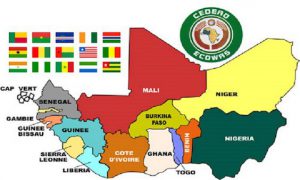
While ECOWAS has 15 member states, eight of these are French-speaking, five are English-speaking and two Portuguese-speaking – as of February 2017, not all are participating in this Single Currency endeavor … yet. (See Appendix VIDEO below on ECOWAS). The member-states that have pledged to launch this Single Currency in time for 2020 are as follows:

  • Ghana
  • Nigeria
  • Cote d’Ivoire
  • Togo

Why is this endeavor important and how can it guide the Caribbean? The foregoing article cited the rationale with this one quotation:

“enable their economies to be more resilient to exogenous shocks”.

This is a familiar advocacy for the movement behind the book Go Lean…Caribbean. In a previous blog-commentary from May 9, 2014 the merits of Single Market economic integration were related as follows:

Europe has the safety net of the economies-of-scale of 508 million people and a GDP of $15 Trillion in 28 member-states in the EU; (the Eurozone subset is 18 states, 333 million people and $13.1 Trillion GDP). The US has 50 states and 320 million people. Shocks and dips can therefore be absorbed and leveraged across the entire region .The EU is still the #1 economy in the world; the US is #2.

The Caribbean has no safety-net, no shock absorption, and no integration. This is the quest of the book Go Lean…Caribbean; it urges the introduction and implementation of the Caribbean Union Trade Federation (CU). The book serves as a roadmap for this goal, with turn-by-turn directions to integrate the 30 member-states of the region and forge an $800 Billion economy.

The Go Lean roadmap signals change for the region. It introduces new measures, new opportunities and new recoveries. Economies will rise and fall; the recovery is key. Prices will inflate and deflate; as depicted in the foregoing article, there are curative measures to manage these indices. The roadmap calls for the establishment of the allied Caribbean Central Bank (CCB) to manage the monetary affairs of this region. The book describes the breath-and-width of the CCB.

There are many benefits when multiple countries come together and form a Single Market economy. This is also the quest for the CU/Go Lean roadmap: to form a Single Market and make the Caribbean’s member-states “Pluralistic Democracies”. Pluralism – recognition and affirmation of diversity within a political body – applies in this West African Community as well; as these countries have a diverse mix of tribal affiliation, colonial legacy and language prioritization. These African developments are therefore fitting for a Case Study for the Caribbean to consider.

This CU/Go Lean roadmap therefore urges the same Single Market effort with these 3 prime directives:

  • Optimization of the economic engines in order to grow the regional economy and create 2.2 million new jobs.
  • Establishment of a security apparatus to ensure public safety and protect the resultant economic engines.
  • Improvement of Caribbean governance to support these engines, including a separation-of-powers between the member-states and CU federal agencies.

A Single Currency in West Africa – eventually: Eco – is not so unfamiliar. There are two current currencies that fit the mold:

The West Africa Monetary Zone – identified in the foregoing news article – attempts to establish a strong stable currency to rival the CFA franc, whose exchange rate is tied to that of the Euro and is guaranteed by the French Treasury. The eventual goal is for the CFA franc and “Eco” to merge, giving all of West and Central Africa a single, stable currency. The launch of the new currency – with a target date of 2020 – is being developed by the West African Monetary Institute based in Accra, Ghana.

Wow, for the BIG ideas… to elevate the economic engines for 155 million people in West Africa.

The Go Lean book also presents a BIG idea for reforming and transforming the economic engines of the 42 million people in our 30 Caribbean member-states; the book stresses that our effort must likewise be a regional pursuit, and it must also optimize our currency landscape. This was an early motivation for the roadmap, as pronounced in the opening Declaration of Interdependence (Pages 12 – 13):

xi. Whereas all men are entitled to the benefits of good governance in a free society, “new guards” must be enacted to dissuade the emergence of incompetence, corruption, nepotism and cronyism at the peril of the people’s best interest. The Federation must guarantee the executions of a social contract between government and the governed.

xvi. Whereas security of our homeland is inextricably linked to prosperity of the homeland, the economic and security interest of the region needs to be aligned under the same governance. Since economic crimes … can imperil the functioning of the wheels of commerce for all the citizenry, the accedence of this Federation must equip the security apparatus with the tools and techniques for predictive and proactive interdictions.

xxiv. Whereas a free market economy can be induced and spurred for continuous progress, the Federation must install the controls to better manage aspects of the economy: jobs, inflation, savings rate, investments and other economic principles. Thereby attracting direct foreign investment because of the stability and vibrancy of our economy.

The Go Lean book provides 370-pages of turn-by-turn instructions on “how” to adopt new community ethos, plus the strategies, tactics, implementations and advocacies to execute so as to reboot, reform and transform the societal engines of Caribbean society. There is a lot of consideration in the book for optimizing the currency and monetary eco-systems. Consider this excerpt detailing the Money Multiplier concept; from Page 22:

b-1. Money Multiplier

In monetary macroeconomics and banking, the money multiplier measures how much the money supply increases in response to a change in the monetary base. The multiplier may vary across countries, and will also vary depending on what measures of money are considered. For example, consider M1 as a measure of the U.S. money supply, and M0 as a measure of the U.S. monetary base. If a $1 increase in M0 by the Federal Reserve causes M1 to increase by $10, then the money multiplier is 10.

A money multiplier is one of various closely related ratios of commercial bank money to central bank money under a fractional-reserve banking system. Most often, it measures the maximum amount of commercial bank money that can be created by a given unit of central bank money. That is, in a fractional-reserve banking system, the total amount of loans that commercial banks are allowed to extend (the commercial bank money that they can legally create) is a multiple of reserves; this multiple is the reciprocal of the reserve ratio, and it is an economic multiplier.

Banks are allowed to lend out the monies on deposit up to some regulated maximum. If banks lend out close to that maximum allowed by their reserves, then the inequality becomes an approximate equality, and commercial bank money is central bank money times the multiplier. If banks instead lend less than the maximum, accumulating excess reserves, then commercial bank money will be less than central bank money times the theoretical multiplier.

As a formula and legal quantity, the money multiplier is neither complicated nor controversial – it is simply the maximum that commercial banks are allowed to lend out. However, there are various theories/tools/techniques concerning the mechanism of money creation in a fractional-reserve banking system, and they all have implications on monetary policy. As such this sphere of concern is normally managed by the professionals, classically-trained technocrats.

The conclusion of this consideration is straight forward – there is a multiplier associated with the currency in the money supply. Therefore it goes without saying that if the Caribbean member-states trade in US dollars, then the multiplier effect is extended to the United States of America. By contrast, if the Caribbean member-states trade in Euros, then the multiplier effect goes to the stakeholders of the European Central Bank – no Caribbean state. Therefore the communities of the Caribbean must embrace, as an ethos, its own currency, the Caribbean Dollar (managed by a technocratic Caribbean Central Bank), thereby bringing local benefits from local multipliers.

There have been a number of previous blog-commentaries by the Go Lean movement that have highlighted Case Studies on monetary and currency best practices. See a sample list here:

https://goleancaribbean.com/blog/?p=10513 Case Study from India: Transforming Money Countrywide
https://goleancaribbean.com/blog/?p=7140 Case Study from Azerbaijan: Setting its currency on free float
https://goleancaribbean.com/blog/?p=6800 Case Study from Venezuela: Suing Black Market currency website
https://goleancaribbean.com/blog/?p=4166 Case Study from Panama: History of the Balboa Currency
https://goleancaribbean.com/blog/?p=3858 Case Study from ECB: Unveiling 1 trillion Euro stimulus program
https://goleancaribbean.com/blog/?p=3814 Case Study from Switzerland: Unpegging the franc
https://goleancaribbean.com/blog/?p=360 Case Study on Central Banks: Creating Money from ‘Thin Air’
https://goleancaribbean.com/blog/?p=833 Case Study from the Euro: One Currency, Diverse Economies

In summary, shepherding the economy is no simple task. It requires the best practices of skilled technocrats. Hopefully these West African States will thrive with this new Single Currency effort as they embrace monetary best-practices.

We will be watching!

Hopefully too, the Single Currency efforts in our region – Caribbean Dollar – will manifest before 2020. The benefits are too alluring to ignore: growing the monetary supply, expanding the availability of investment capital and leveraging across a larger base to absorb the shocks naturally associated with a Free Market Economy. Wow; let’s get started.

We are past the time of needing Central Banking reform. We now need to Catch-Up and transform our own society to derive some of these benefits and innovations.

We urge all Caribbean stakeholders – government officials, bankers and ordinary citizens – to lean-in for the empowerments detailed in this Go Lean roadmap. These are best practices! These can make our homeland a better place to live, work and play. 🙂

Download the free e-book of Go Lean … Caribbean – now!

Sign the petition to lean-in for this roadmap for the Caribbean Union Trade Federation.

———–

Appendix – Current Least Developed Countries
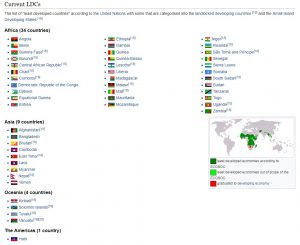
Click on Photo to Enlarge

Source: Retrieved Wikipedia Online Encyclopedia October 25, 2017 from: https://en.wikipedia.org/wiki/Least_Developed_Countries#Africa_.2834_countries.29  

———–

Appendix VIDEO – About ECOWAS – https://youtu.be/f2m2UCuEYAs

Published on Jan 29, 2016 – MULTI-MEDIA ECOWAS.COMMUNICATION

  • Category: Comedy
  • License: Standard YouTube License
Share this post:
, , ,

Making a ‘Pluralistic Democracy’ – Freedom of Movement

Go Lean Commentary

I have a personal confession!

At one point, recently, I had a California address, Michigan Drivers License and Florida car registration; all at the same time. This is demonstrative of a country – United States of America – where stakeholders have ‘Freedom of Movement’. This is a feature of a Single Market.
Live here … work there … play everywhere …

There are planners for a new Caribbean that wants a Single Market economy, where citizens have ‘Freedom of Movement’ from one member-state to another. This would be part-and-parcel of a “Pluralistic Democracy”, which means a society where the many different ethnic groups (or national origins) have respect, equal rights, equal privileges and equal protections under the law; where there are no superior rights to any majority and no special deprivations to any minority, despite the border or language consideration. This is pure Pluralism, whose legal definition of the political philosophy is as follows:

… the recognition and affirmation of diversity within a political body, which permits the peaceful coexistence of different interests, convictions and lifestyles.[1] While not all political pluralists advocate for a pluralist democracy, this is most common as democracy is often viewed as the most fair and effective way to moderate between the discrete values.[2]Wikipedia

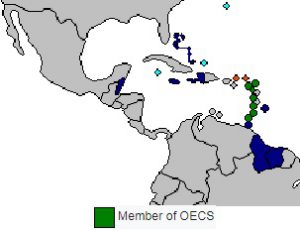
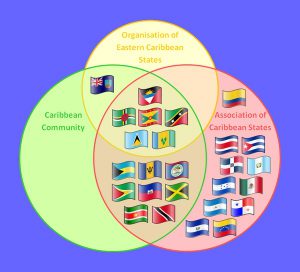
This vision of a Caribbean “Pluralistic Democracy” should be more than words, but action too. This need has manifested in recent days with the devastation of two Category 5 Hurricanes in the region: Irma and Maria. Consider the news article here depicting the post-hurricane ‘Freedom of Movement’ among the 6 OECS countries (Organization of Eastern Caribbean States: Antigua and Barbuda, Dominica, Grenada, St Kitts and Nevis, St Lucia, and St Vincent and the Grenadines):

Title – Antigua prepares for influx of Dominicans
Barbados Today – Antigua says it is anticipating an influx of Dominicans in the wake of catastrophic Hurricane Maria which has decimated that country.

Acting Prime Minister, Attorney General Steadroy Benjamin, on Saturday convened a meeting of the sub-committee of Cabinet responsible for managing the planning for natural disasters and their aftermath.

Government Chief of Staff Lionel Hurst described the meeting as “a proactive drive, intended to manage efficiently the anticipated flow of people from Dominica”.

Also in attendance where Ministers Molwyn Joseph, Asot Michael, Minister Melford Nicholas, Arthur Nibbs, the chief immigration officer and her deputy, law enforcement authorities, representative of the airlines association including LIAT, the head of the Red Cross, and officials from the ministry of social transformation.

The Acting Prime Minister directed the group to present a fixed set of policies that would apply to all those who are leaving Dominica for Antigua, and to plan the reception of those OECS/Dominican citizens who may choose Antigua.

It was agreed that there will be only two legitimate ports of entry – the V.C. Bird International Airport and the Montserrat Ferry Dock at Heritage Quay.

“The Coast Guard is to ensure that no vessel entering Antigua’s waters discharges its passengers at any other dock. Since no vegetables or other food items will be shipped from Dominica in the foreseeable future, all vessels must proceed to Heritage Quay,” Hurst said.

Citizens of Dominica have a right of entry into Antigua and other OECS countries and an automatic six-month stay and must present their passport, driver’s license or voter’s identification card to allow entry.

“A database of the Dominicans entering will be developed. Those citizens of Dominica who do not have any of the agreed identification will be permitted to enter Antigua, after completing a form which the Antigua and Barbuda Immigration Department has constructed specifically to meet the needs of those who have lost their documents in the hurricane. Those persons leaving Dominica who are not Dominican citizens must have onward tickets, or be prepared to purchase tickets for onward travel to their own countries,” Hurst said.

He added that the police and the ONDCP are to work closely to determine if any of the persons leaving Dominica are law-breakers. In this regard, the Dominica Police Force will also be asked to assist.

All Dominican citizens who enter Antigua will also be asked to provide certain health information so that continuing services can be provided or secured, in order to protect their health and the population’s.

“It is anticipated that women and children, the elderly of both genders and the infirm, are likely to be among the first wave of Dominican citizens to arrive [in] Antigua. It is also believed that many will choose to stay with family and friends, especially since a supportive group has already been formed. The entrants will be asked to provide names, addresses, telephone numbers and other contact information to the immigration authorities at both ports,” Hurst said.
He said consideration has been given to preparing shelters at various sites should the flow exceed the provision of housing by family and friends of the Dominicans who live on Antigua.

Hurst noted that the other four OECS countries – St Kitts and Nevis, St Lucia, St Vincent and the Grenadines and Grenada – are also likely to welcome Dominican citizens to their shores during this crisis.

Source: Posted September 24, 2017; retrieved October 22, 2017 from: https://stluciatimes.com/2017/09/24/antigua-prepares-influx-dominicans 

Normality is disrupted in Dominica  – due to Hurricane Maria – so the people, societal engines and systems of commerce have to transfer over to Antigua. While this is not good for Dominica’s economy, it is better than losing the population permanently to some foreign location – the Diaspora. The Dominican people going to Antigua for hurricane recovery is not the “One Way” societal abandonment, it is just ‘Freedom of Movement’.

The movement behind the book Go Lean…Caribbean has repeatedly related that there is a need for new stewardship of the Caribbean societal engines (economics, security and governance). The world has changed; the “World is Flat“! The Go Lean book considers these Agents of Change (Page 57) that have dynamically affected the Caribbean economic eco-systems:

  • Technology
  • Globalization
  • Aging Diaspora
  • Climate Change

The Agent of Change of Globalization implies that people can easily move from place-to-place to live, work or play; everywhere is “virtually” next door. Ours, in the Caribbean, is not the first region to contend with this ‘Freedom of Movement’ option. In fact, this practice for the OECS is modeled after the European Schengen Area – ‘Freedom of Movement’ of people, goods, services and capital across 26 European borders, not the USA. See more in the VIDEO here:

VIDEO – Schengen Area: History, Facts and Benefits – https://youtu.be/xffvPWmoWsQ

Europe Guide

Published on Apr 13, 2016 – Today, Schengen Area signifies a zone where the free movement of people, goods, services and capital between 26 European countries is not just a concept any longer. Watch this very interesting video about the chronological history of Schengen Area to learn about how the dream for a borderless Europe came true, leaving the opportunity for more than 400 million citizens to travel freely inside the Europe without any border check control.

Website: http://www.schengenvisainfo.com

Follow us on Facebook: http://smarturl.it/SchengenVisaInfoFCB

Subscribe to our YouTube channel: http://smarturl.it/EuropeGuideChannel

Imagine this Caribbean-wide version of the Schengen Area, for all 30 member-states, not just the 6 OECS countries. Imagine a Caribbean-wide Single Market. Imagine how beneficial before, during and after a natural disaster … like Maria.

The book Go Lean…Caribbean – available to download for free – serves as a roadmap for the introduction and implementation of the technocratic Caribbean Union Trade Federation (CU), for the elevation of Caribbean society in good times and bad – for all 30 member-states. This CU/Go Lean roadmap has these 3 prime directives:

  • Optimization of the economic engines in order to grow the regional economy to $800 Billion and create 2.2 million new jobs.
  • Establishment of a security apparatus to ensure public safety and protect the resultant economic engines.
  • Improve Caribbean governance to support these engines, including a separation-of-powers between the member-states and CU federal agencies.

The book stresses that reforming and transforming the Caribbean societal engines must be a regional pursuit, “all for one and one for all” member-state-wise. This was an early motivation for the roadmap, as pronounced in the opening Declaration of Interdependence (Pages 12 – 13):

xi. Whereas all men are entitled to the benefits of good governance in a free society, “new guards” must be enacted to dissuade the emergence of incompetence, corruption, nepotism and cronyism at the peril of the people’s best interest. The Federation must guarantee the executions of a social contract between government and the governed.

xvi. Whereas security of our homeland is inextricably linked to prosperity of the homeland, the economic and security interest of the region needs to be aligned under the same governance. Since economic crimes … can imperil the functioning of the wheels of commerce for all the citizenry, the accedence of this Federation must equip the security apparatus with the tools and techniques for predictive and proactive interdictions.

xxi. Whereas the preparation of our labor force can foster opportunities and dictate economic progress for current and future generations, the Federation must ensure that educational and job training opportunities are fully optimized for all residents of all member-states, with no partiality towards any gender or ethnic group. The Federation must recognize and facilitate excellence in many different fields of endeavor, including sciences, languages, arts, music and sports. This responsibility should be executed without incurring the risks of further human flight, as has been the past history.

xxiv. Whereas a free market economy can be induced and spurred for continuous progress, the Federation must install the controls to better manage aspects of the economy: jobs, inflation, savings rate, investments and other economic principles. Thereby attracting direct foreign investment because of the stability and vibrancy of our economy.

The Go Lean book provides 370-pages of turn-by-turn instructions on “how” to adopt new community ethos, plus the strategies, tactics, implementations and advocacies to execute so as to reboot, reform and transform the societal engines of Caribbean society. There is a lot of consideration in the book for the free movement of people, goods, services and capital in the Caribbean region. In fact, the organizational structure of the CU includes a “federal” Department of Labor with the charter to coordinate regional labor dimensions. Since one of the prime directives of the CU is the economic empowerment of the member-states – jobs – there are a lot of angles and views about delivering jobs that needs to be coordinated on a regional level. As such, there are proactive and reactive measures that this department will shepherd.

As related in the book (Page 89), this federal department also coordinates the activities for Labor Certifications in the region. This effort will be collaborated and in cooperation with the many member-state Labor Relations agencies. The CU‘s focus will be towards interstate activities and enterprises, as opposed to an intra-state focus. This Labor Certification is an important role for this agency as it requires monitoring the labor needs of the region to ascertain where skills are needed and where and who can supply the skills. The certification role involves rating the level of expertise needed for job and rating workers skill sets. (Consider a 10-point grading system for positions and personnel, where “apprentice” level ranges from 1 – 3, “journeyman” level ranges from 4 – 6, and “master” ranges from 7 – 10).

This certification role is vital to the strategy of preserving Caribbean human capital in the region, even if this involves some movement among the member-states. Notice these treatments from the book:

  • 10 Ways to Improve Interstate Commerce (Page 129)
    #8 – Labor Markets – Freedom of Movement
    The CU seeks to improve the transparency and mobility in the Caribbean labor markets to contend with the challenges of scarcity of skilled labor (openings can be staffed by any CU resident), innovation deficits (solutions come from a large educated market), and financial risks in social pension systems (need more young workers). The CU strives to offer an alternative Caribbean state to residents looking for a new address/dream. This will assuage risks of brain/capital drains.
  • 10 Ways to Model the EU (Page 130)
    #9 – Labor Issues
    The EU seeks to improve the transparency and mobility in European labor markets to contend with the challenges of an aging population, scarcity of skilled labor, innovation deficits, and financial risks in social security systems. The CU will have to contend with many of the same challenges plus the goal of repatriation. The EU model provides great lessons [for the Caribbean].
  • 10 Ways to Mitigate Black Markets (Page 165)
    #4 – Caribbean Dollar Realities
    The [CU] Federation plan … allows for mobility of labor from one Caribbean state to another. The CU will ensure protections for the work force (unemployment and health insurance benefits) thereby nullifying “black markets” for labor.
  • 10 Ways to Foster Empowering Immigration (Page 174)
    #1 – Lean-in for the Caribbean Single Market & Economy Initiative
    The Single Market structure allows for the controlled movement of labor from state to state, and the opportunity to correct actuarial imbalances. … The skills needed for today’s global economy may not be plentiful in the Caribbean and thus the need to invite empowering immigrants.
  • 10 Ways to Promote Contact Centers (Page 212)
    #6 – Capitalize on Multi-lingual Society
    With Dutch, English, French and Spanish speakers proliferating in the region, the CU will catalog bilingual (or multilingual) skills as an asset in the labor market. This will create more of a demand for this talent base as supply systems are implemented to showcase their skills. In macro-economics, the readiness of the labor market is called “capital”, and an offer (or fulfillment) of tele-services to foreign markets like Holland, France, Quebec (Canada), (Border States) and other former Dutch/French colonies will lead to growth of the industry and the CU’s GDP.
  • 10 Ways to Re-boot Haiti (Page 238)
    #8 – Labor, Immigration and Movement of People
    The recovery plan for Haiti would discourage the emigration of the population. Haiti has a population base (10 million) that can imperil other islands if too many Haitians relocate within the Caribbean. As a result, the CU will expend the resources and facilitate the campaign to dissuade relocation for the first 10 years of the ascension of the CU. During these first 10 years, Haitians visiting other CU member states, with Visa’s, with careful monitoring to ensure compliance.
  • 10 Ways to Impact The Guianas (Page 241)
    # 6 – Emigration Circuit Breaker
    Some chronic problems related to economic progress has been the shortage of skilled labor and a deficient infrastructure. The CU seeks to offer an alternative to citizens abandoning the region for EU or US shores. A diverse, well-managed economy of 42 million people, rather than the minimal 200,000 of Guyana alone and 160,000 of Suriname, offer more options to assuage pressures for Guianian talent fleeing. The whole CU can provide solutions to contend with the scarcity of skilled labor, innovation deficits, and financial risks in social pension systems.

The Go Lean…Caribbean roadmap presents the advocacy for Benefiting from Globalization (Page 119). Globalization has been exacerbated thanks to Free Trade Agreements – the CU Trade Federation is a Free Trade Agreement – so the goal is to master the art-and-science of Free Trade and the Free Movement of people, goods and capital. So these subjects are part-and-parcel of this comprehensive roadmap to elevate Caribbean society to be a better place to live, work and play..

Yes, this Go Lean roadmap considers the heavy-lifting of structuring Caribbean society to benefit more from Globalization. As individual member-states, there is no chance for success, but together, as a unified region, there is so much to leverage. The Go Lean roadmap seeks to unite the people of the entire Caribbean region (leveraging all 42 million people), diversify the regional economy (to create new 2.2 million jobs) and reverse the trend for our people to seek refuge in foreign lands. Let’s do better here at home. Let’s allow our citizens to prosper where planted here in the Caribbean.

Live here … work there … play everywhere …

Now is the time for all stakeholders in the Caribbean – governments and citizens – to lean-in to this Go Lean roadmap. We can do better and be better. This is part of our quest for a ‘Pluralistic Democracy’; this is Part 2 of a 3-Part series. The full collection is as follows:

  1. Making a ‘Pluralistic Democracy’ – Respect for Diwali
  2. Making a ‘Pluralistic Democracy’ – Freedom of Movement
  3. Making a ‘Pluralistic Democracy’ – Multilingual Realities

This ‘Pluralistic Democracy’ vision is a BIG deal, yet this is conceivable, believable and achievable. 🙂

Download the free e-book of Go Lean … Caribbean – now!

Sign the petition to lean-in for the roadmap for the Caribbean Union Trade Federation.

Share this post:
, , , ,
[Top]

ENCORE: It’s a FAMUly Affair

It’s Homecoming 2017 at Florida Agriculture & Mechanical University (FAMU). Time to reflect …

CU Blog - It's a FAMUly Affair - Photo 1

There have been many considerations of the FAMU eco-system, the FAMU Family or FAMUly. The university is a fine model for what the Caribbean needs to do to elevate our society, to facilitate social mobility. This is an ENCORE of a previous blog-commentary from March 6, 2015 highlighting the school’s contribution to American society.

FAMU was established as an educational institution in 1887, so this Homecoming is the 130th anniversary for the school. Over the years, there have been some excellent individual contributors; consider the following 2 obituaries of impactful influencers:

https://goleancaribbean.com/blog/?p=12542 Dr. Thomas W. Mason – FAMU Professor & STEM Influencer – RIPA computer scientist, who happened to be Black, he worked on the networking efforts that became today’s Internet. He passed on this vision and his passion to his students and the whole FAMUly.
https://goleancaribbean.com/blog/?p=6593 Dr. Sybil Mobley – FAMU’s Business School Dean – RIPThis Dean’s impact was that societal elevation with her mission to embed Black Americans in the conference rooms and board rooms of major corporations. She molded, prepared, energized and guided the best-of-the-best of Black America (many of Caribbean heritage as well; this writer included) and sent them off to impact the corporate world.

CU Blog - Its a FAMUly Affair - Photo 2

With the participation of these FAMU advocates – and others – the university has assumed it position at the pinnacle of Historically Black Colleges & Universities (HBCU). But the university  considers itself more than just an educational institution, but rather a family, the FAMUly. Keep in mind that the FAMU life is not only hard work, it is fun too. See the VIDEO here depicting the commitment, dedication, love and joyality of the FAMUly:

VIDEO – A FAMUly Reunion – Homecoming 2017 – https://youtu.be/J32plKqmqK8

Published on October 3, 2017


The FAMU experience is demonstrative to the Caribbean on how to optimize the effort to live, work, learn and play. Our Caribbean needs this role model example. See this portrayed in the ENCORE of the original blog-commentary here:

———–

Go Lean Commentary – FAMU is No. 3 for Facilitating Economic Opportunity

This commentary is a big proponent of a college education for Caribbean citizens.

This commentary is a big opponent of a college education for Caribbean citizens in American colleges and universities. The reason for the ambivalence on college education is consistent: the benefit of social mobility; facilitating new economic opportunities. We need this upward mobility for Caribbean citizens but in the Caribbean.

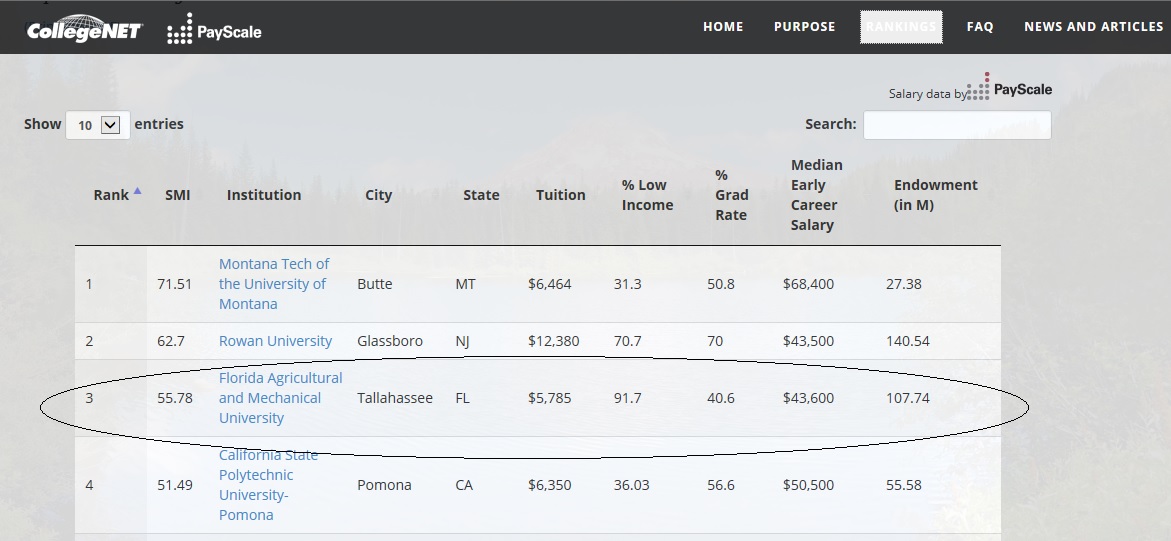
CU Blog - FAMU is No. 3 for Facilitating Economic Opportunity - Photo 1Some institutions are better at facilitating social mobility than others. On the National List of institutions, Florida Agriculture and Mechanical University (FAMU) stands out. It is #3 on the list.

In the interest of full disclosure, this writer is a Rattler, an alumnus of FAMU. (The mascot for FAMU athletics is ‘Rattlers’).

The chief goal of the Social Mobility Index (SMI), according to their website, is to stimulate policy changes within US higher education to help arrest the dangerous and growing economic divergence between rich and poor in the country. The gap in the US between rich and poor grew since the Great Recession, reaching proportions not seen since the period leading to and contributing to the onset of the Great Depression and two world wars. The common attributes include crumbling infrastructure, destroying asset values, and forcing high taxation to pay for war efforts.

If we learned anything from the global fallout of the Great Recession (in 2008 and beyond), it was that getting economic policy right in the US may be necessary for long-term world stability. So while the much publicized student debt overhang, now in excess of $1 trillion, imposes distress and financial burden on millions of students and families, it is a symptom of the much greater problem of economic and social divergence in the country. The good news is that colleges and universities carry great potential to powerfully address this problem.

Economist Thomas Piketty stated: “the principal force for convergence [reduction of inequality] – the diffusion of knowledge – …depends in large part on educational policies, access to training and to the acquisition of appropriate skills, and associated institutions.” – Capital in the 21st Century, pp. 21-2. The SMI asserts that if colleges can begin aggressively shifting policy towards increasing access to higher education, particularly for economically disadvantaged students and families, they will establish themselves as a key force for economic and social convergence.

FAMU has accomplished this feat; placing #3 on a ranking of universities pursuing this endeavor.

The full article of the recognition of FAMU’s SMI  is provided here:

Title: Social Mobility Index Ranks FAMU as No. 3 Institution in the Nation for Facilitating Economic Opportunity for Underserved Students
(Source: FAMU News and Events Site – Official Communications – Posted 11-01-2014; retrieved 03-05-2015 from http://www.famunews.com/?p=2153)
CU Blog - FAMU is No. 3 for Facilitating Economic Opportunity - Photo 3TALLAHASSEE, Fla. – The Social Mobility Index (SMI) has ranked Florida Agricultural and Mechanical University (FAMU) the No. 3 institution in the nation for facilitating economic opportunity for underserved students. The University outpaced the nation’s leading Ivy League institutions such as Princeton, Harvard and Yale, which placed 360th, 438th and 440th, respectively, on the rankings list.

The SMI is a new, data-driven ranking system, focused on the problem of economic mobility in the United   States. Rankings are based upon an institution’s tuition rate, student economic profile, graduation rate, average early career salary, and endowment.

According to SMI data analyses, FAMU ranks high in its contributions toward narrowing  socio-economic gaps by admitting and graduating more low-income students at lower tuition rates, yet with better economic outcomes following graduation. The University is noted on the SMI as having one of the lowest annual tuition rates in the nation.

“We are excited about the SMI recognition,” said President Elmira Mangum, Ph.D. “This new ranking speaks to FAMU’s 127-year legacy of providing access and opportunity to low-wealth citizens across the nation.”

“This ranking also speaks to our strong and unwavering commitment to economic empowerment. Many of our students come to FAMU with the odds stacked against them; however, they leave our institution with a high-quality education, a promising future, and the ability to be effective contributors to society, and, more specifically, to their families,” Dr. Mangum added.

Nearly 92 percent of FAMU students are considered low-income, according to SMI data. However, graduates are leaving the University earning an average salary of nearly $45,000 a year.

CU Blog - FAMU is No. 3 for Facilitating Economic Opportunity - Photo 2

For more information on the SMI ranking, visit: www.socialmobilityindex.org.

The book Go Lean…Caribbean posits, along with most economists, that education elevates individuals and entire communities. The book quotes that every year of additional community education raises GDP by 1 percent. Go Lean stakes the claim further that traditional college educated career paths have been disastrous policies for the Caribbean in whole, and for each specific country in particular, for the primary reason that so many students do not return home; or expatriate after returning for a short period. In fact, the World Bank has reported that the Caribbean has a 70% abandonment rate.

In line with the SMI ranking, the Go Lean book promotes education among the strategies to elevate Caribbean society. But this commentary previously asserted that college education has been a bad investment for the Caribbean.

From a strictly micro perspective, college education is great for the individual. The Go Lean book quotes proven economic studies showing the impact that every year of college education improves an individual’s earning power (Page 258). But from the macro perspective – the community – is different for the Caribbean; the region loses out because of an incontrovertible brain drain. Previously, the proverb was introduced of “fattening frogs for snake” referring to the preponderance for Caribbean college educated citizens to abandon their tropical homelands for foreign shores in the US, Canada and Europe, and take their Caribbean-funded education and skill-sets with them.

Change has now come. The driver of this change is technology and globalization. Under the tenants of globalization, institutions like FAMU are competing globally, and can rightly provide e-Learning and Distant Learning schemes. This ties to the other agent of change of technology. The internet allows for deliveries of education services anywhere around the world. The Go Lean book posits that small institutions and big institutions can complete equally on a global basis. If the regional education administrations could invest in more technological deliveries, it would be a win-win for all stakeholders. This type of impact would be more for the Greater Good.

The Go Lean roadmap provides turn-by-turn directions on how to reform the Caribbean tertiary education systems, economy, governance and Caribbean society as a whole. The roadmap commences with a Declaration of Interdependence, pronouncing the approach of regional integration (Page 12 & 14) as a viable solution to elevate the region’s educational opportunities:

xix. Whereas our legacy in recent times is one of societal abandonment, it is imperative that incentives and encouragement be put in place to first dissuade the human flight, and then entice and welcome the return of our Diaspora back to our shores

xxi. Whereas the preparation of our labor force can foster opportunities and dictate economic progress for current and future generations, the Federation must ensure that educational and job training opportunities are fully optimized for all residents of all member-states, with no partiality towards any gender or ethnic group. The Federation must recognize and facilitate excellence in many different fields of endeavor, including sciences, languages, arts, music and sports. This responsibility should be executed without incurring the risks of further human flight, as has been the past history.

xxvii. Whereas the region has endured a spectator status during the Industrial Revolution, we cannot stand on the sidelines of this new economy, the Information Revolution. Rather, the Federation must embrace all the tenets of Internet Communications Technology (ICT) to serve as an equalizing element in competition with the rest of the world. The Federation must bridge the digital divide and promote the community ethos that research/development is valuable and must be promoted and incentivized for adoption.

This book Go Lean… Caribbean, serves as a roadmap for the introduction and implementation of the Caribbean Union Trade Federation (CU). This represents change for the region. The CU/Go Lean roadmap has 3 prime directives:

  • Optimization of the economic engines in order to grow the regional economy.
  • Establishment of a security apparatus to protect the resultant economic engines.
  • Improve Caribbean governance to support these engines.

The Go Lean book details how education is a vital consideration for Caribbean economic empowerment, but with lessons-learned from all the flawed decision-making in the past, both individually and community-wise. The vision of the CU is a confederation of the 30 member-states of the Caribbean to do the heavy-lifting of championing better educational policies. No more government scholarships; forgive-able loans only from now on. The book details the policies; and other ethos to adopt, plus the executions of the following strategies, tactics, implementations and advocacies to deploy online education in the region:

Community Ethos – Deferred Gratification Page 21
Community Ethos – People Respond to Incentives Page 21
Community Ethos – Job Multiplier Page 22
Community Ethos – Lean Operations Page 24
Community Ethos – Return on Investments (ROI) Page 24
Community Ethos – Ways to Impact the Future Page 26
Community Ethos – Ways to Foster Genius Page 27
Community Ethos – Ways to Help Entrepreneurship Page 28
Strategy – Mission –   Facilitate Education without Risk of Abandonment Page 45
Tactical – Separation of Powers – Education Department Page 85
Tactical – Separation of Powers – Labor Department – Job   Training Page 89
Planning – Lessons Learned from 2008 Page 136
Advocacy – Ways to Grow the Economy Page 151
Advocacy – Ways to Create Jobs Page 152
Advocacy – Ways to Improve Education Page 159
Advocacy – Ways to Impact Student Loans Page 160
Advocacy – Ways to Improve Governance Page 168
Advocacy – Ways to Better Managed the Social Contract – Education Optimizations Page 170
Advocacy – Ways to Improve Libraries Page 187
Appendix – Education and Economic Growth Page 258
Appendix – Measuring Education Page 266
Appendix – Student Loan Crisis – Ripping Off America Page 286

FAMU is a model for the Caribbean tertiary educational endeavors.

FAMU has quite a reputation for other accomplishments as well – they are a great destination to live, work, learn and play. Their world famous band, the Marching 100 has been recognized as the “playingest band in the land”. They even shared the field with Prince as the Halftime performance for Super Bowl XLI in 2007 in Miami, Florida. See NewsVIDEO of their renown here; and also their 2011 Florida Classic Football Game Halftime Show in Orlando, Florida in the Appendix below.

VIDEOFAMU 2008 Segment on “CBS Evening News” – https://youtu.be/XqGvUg_rLNs


Posted November 27, 2008 – 2008 edition of the Marching 100… interview on Thanksgiving Night 2008 on CBS News… 11/27/08

Now is the time for all of the Caribbean, the people and governing institutions, to lean-in for the changes described in the book Go Lean … Caribbean. We welcome universities like FAMU in their desire to empower minorities in society; we only want that to be done in the Caribbean so as to mitigate societal abandonment. Suggestion: FAMU should develop a global campus presence, with satellite campuses and online matriculations.

Go Rattlers!!!

With the tune set by the Marching 100 band: “I’m so glad, I’m from FAMU”.

This is the win-win the Go Lean roadmap campaigns for. But it’s more than just talk; this is action too. The body part to focus on is not just the mouth; it is the heart – the seat of motivation. Without a doubt, the complete delivery for the Caribbean educational options would help to make the homeland a better place to live, work, learn and play. 🙂

Download the book Go Lean … Caribbean – now!

Appendix VIDEO – FAMU Marching 100 Halftime Show @ Florida Classic 2011 – http://youtu.be/FrviGJ1Dvvk

Uploaded on Nov 21, 2011 – The FAMU Marching 100 Halftime Performance at The 2011 Florida Classic. Definitely the best band in the land.

Share this post:
, , ,
[Top]

Funding Caribbean Risk

Go Lean Commentary

A penny saved is … a penny.

This is not exactly how the expression goes. It is supposed to refer to the good habit of “saving money”, which is a positive community ethos – underlying sentiment that informs the beliefs, customs, or practices. “Saving money” is a practice that the stewards of any society should advocate for its people. It’s a simple formula: Earn money; spend some; save some!

CU Blog - Funding Caribbean Risk - Photo 0This is easier said than done. A practice of saving money – for a rainy day or any catastrophe – takes discipline, the discipline not to spend. One tactic is to pay yourself first! Before paying other overhead expenses, the priority would be to set aside monies in a savings program or some insurance program. Yes, an insurance strategy could be even smarter for rainy days or catastrophes; it allows the hedging of risks by leveraging across a wider pool; more people – savers – put-in and only a few … or just one withdraws. This is also the approach of the thoughtful Caribbean Catastrophe Risk Insurance Fund (CCRIF).

It is very sad when communities are not able to save or insure a “Rainy Day” fund for when it rains, especially in the tropical region where it doesn’t just rain, but pours and storms.

What is sadder is when the heavy-lifting of “savings” or insurance is done, but the dollar amount is not enough; because a “penny saved is only just a penny”.

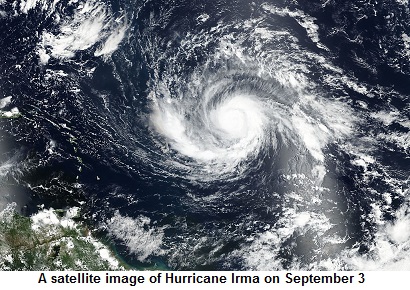
This is the Caribbean dilemma, today. We have just experienced 2 devastating hurricanes – Irma and Maria – that have wreaked havoc on our region. We now need to tap the “Rainy Day” fund and frankly, it is simply not enough!

See the actuality of this dilemma in the news article here and the related VIDEO on CCRIF:

Title: CCRIF to make payouts to countries affected by Hurricane Irma

The Caribbean Catastrophe Risk Insurance Facility (CCRIF SPC) will be making payouts totaling over US$15 million to three Caribbean countries affected by Hurricane Irma earlier this week.

“The CCRIF board and team offer condolences for the loss of life and hope these funds will provide some assistance. We stand ready to support the Government and people of these CCRIF countries as they recover from the effects of this devastating hurricane,” said CCRIF chief executive officer, Isaac Anthony.

Payments totaling US$15.2 million
The CCRIF plans to pay US$6.7 million to Antigua and Barbuda, US$6.5 million to Anguilla and US$2.2 million to St. Kitts-Nevis.

The storm has been blamed for at least 10 deaths and millions of dollars in property damages as it made its way through the Lesser Antilles this week.

In the case of Barbuda, Prime Minister Gaston Browne has ordered an immediate evacuation of some 1,800 people on the island. The government has also announced a state of emergency.

“Nothing is functional in Barbuda,” Browne said, adding that he has given instructions that ‘every single soul must be taken out of Barbuda”.

Verifying payouts
The CCRIF is verifying the payout calculations and is in discussion with the three governments about arrangements for the transfer of these funds. The transfer will be completed within 14 days after the storm, as mandated by CCRIF’s operational guidelines.

“Anguilla and St. Kitts & Nevis also have Excess Rainfall (XSR) policies and CCRIF is assessing if these policies were triggered by the rains from Hurricane Irma, which may possibly result in a second payout under those policies. The assessment under the XSR policies will be determined in the next few days,” the CCRIF added.

Segregated portfolio company
The CCRIF SPC is a segregated portfolio company, owned, operated and registered in the Caribbean. It limits the financial impact of catastrophic hurricanes, earthquakes and excess rainfall in the Caribbean and, since 2015, Central American governments by quickly providing short-term liquidity when a parametric insurance policy is triggered.

Since its inception in 2007, the facility has made 22 payouts for hurricanes, earthquakes and excess rainfall to 10-member governments totaling approximately US$69 million.

It said the new payments will bring the total payouts to approximately US$85 million. Last year CCRIF made payouts totaling US$29 million to four countries after Hurricane Matthew.

Source: Posted September 9, 2017; retrieved October 13, 2017 from: https://www.caribbeannationalweekly.com/caribbean-breaking-news-featured/ccrif-make-payouts-countries-affected-hurricane-irma/

———–

VIDEO – WorldBank CCRIF Caribbean Gold – https://youtu.be/IlZ56ON9KnI

CCRIF SPC

Published on Feb 28, 2017 – Working towards sovereign risk protection in the Caribbean and Central America.

We now know what CCRIF is; how it works; and who can engage this program in terms of investors and beneficiaries; see more encyclopedic details in the Appendix A below. But …

… it is the assessment of this commentary that CCRIF is flawed and inadequate for the Caribbean’s needs.

  • The CCRIF is designed for 1-in-15 year hurricane (Source: http://www.ccrif.org/content/rtfs-faqs). Truth be told, thanks to Climate Change we are seeing storms yearly.
  • There is a catastrophic trigger – complicated formula – which generates a “measly” payout for a hurricane or earthquake.
  • This is a sovereign fund only and the trigger level is dependent on the coverage purchased by individual countries.
  • The pool is too small. Member governments may purchase coverage which triggers for a ‘one-in-15-year’ hurricane and a ‘one-in-20-year’ earthquake, with maximum coverage of US$100M available for each peril. The cost of coverage is a direct function of the amount of risk being transferred, ensuring no cross-subsidisation of premiums and a level playing field for all participants.

This fund is “too little, too late” for what the region needs. But like all other Caribbean integration (CariCom) efforts, it is a good start! Still after 50 years of autonomous rule, the expectation is not just for a start, it is for solutions.

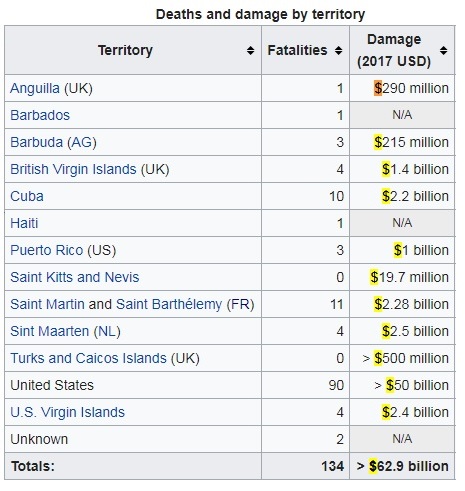
While the habit of “saving” or paying for insurance is a best-practice, the financial amount is important for the subjective assessment of success. The foregoing news article relates that $15.2 million will be paid-out to the affected countries. But this amount is so small, too small! Consider just for Hurricane Irma alone, the estimated damage amount has been tabulated at $62.87 billion. While $50 Billion of that amount relates to the US Mainland, the rest is the Caribbean. So the Caribbean’s share is $12.9 Billion; – see Chart here:

CU Blog - Funding Caribbean Risk - Photo 1

CU Blog - Funding Caribbean Risk - Photo 3

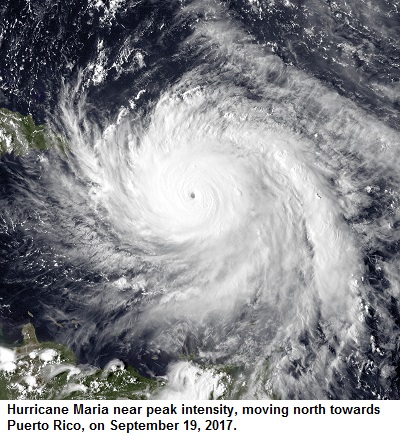
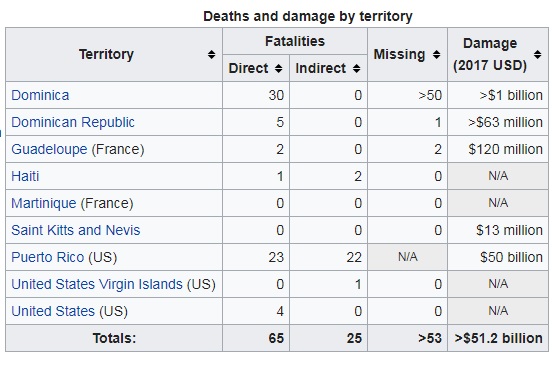
On the other hand. Hurricane Maria, has estimates for damages at $51.2 billion. None of that amount relates to the US Mainland, the amount is all Caribbean, considering Puerto Rico and the US Virgin Islands; see Chart here:

CU Blog - Funding Caribbean Risk - Photo 2

CU Blog - Funding Caribbean Risk - Photo 4

An immediate result of these storms on the Caribbean will probably be the defection of masses of people from the region. As of this date – October 12, 2017 – Puerto Rico is still not relieved nor recovered from Hurricane Maria. In fact 84% of the island still does not have power. Since Puerto Ricans are American citizens, they have freedom of movement from the island to the US Mainland. In addition, many of the other Caribbean islands will also suffer abandonment as the Diaspora is large in North America and Europe; so bonafide family connections will allow for their emigration. Expect more societal abandonment in the region!

The quest of the movement behind the book Go Lean…Caribbean – available to download for free – is to lower the abandonment rates of our Caribbean citizens fleeing the homeland. Our quest is conceivable, believable and achievable. But the status quo of the Caribbean Catastrophe Insurance Funds is inadequate; it must improve. It must reform and transform.

The Go Lean book describes a Way Forward. The book serves as a roadmap for the introduction and implementation of the technocratic Caribbean Union Trade Federation (CU), for the elevation of Caribbean society – for all member-states. This CU/Go Lean roadmap has these 3 prime directives:

  • Optimization of the economic engines in order to grow the regional economy to $800 Billion and create 2.2 million new jobs.
  • Establishment of a Homeland Security and Emergency Management apparatus to ensure public safety and protect the resultant economic engines.
  • Improve Caribbean governance to support these engines, including a separation-of-powers between the member-states and CU federal agencies.

The book stresses that reforming and transforming the Caribbean societal engines must be a regional pursuit. This was an early motivation for the roadmap, as pronounced in the opening Declaration of Interdependence (Pages 12 – 13):

xi. Whereas all men are entitled to the benefits of good governance in a free society, “new guards” must be enacted to dissuade the emergence of incompetence, corruption, nepotism and cronyism at the peril of the people’s best interest. The Federation must guarantee the executions of a social contract between government and the governed.

xvi. Whereas security of our homeland is inextricably linked to prosperity of the homeland, the economic and security interest of the region needs to be aligned under the same governance. Since economic crimes … can imperil the functioning of the wheels of commerce for all the citizenry, the accedence of this Federation must equip the security apparatus with the tools and techniques for predictive and proactive interdictions.

xxiv. Whereas a free market economy can be induced and spurred for continuous progress, the Federation must install the controls to better manage aspects of the economy: jobs, inflation, savings rate, investments and other economic principles. Thereby attracting direct foreign investment because of the stability and vibrancy of our economy.

Way Forward
The Go Lean book provides 370-pages of turn-by-turn instructions on “how” to adopt new community ethos, plus the strategies, tactics, implementations and advocacies to execute so as to reboot, reform and transform the societal engines of Caribbean society, despite the reality and risks of natural disasters. Accepting that the CCRIF is a government-member-state solution, the Go Lean book proposes a supplement of private solutions, instruments facilitated by the region’s Capital Markets – think the Caribbean version of Wall Street. The Go Lean book proposal is for region-wide (all 30 member-states; 4 language groups) private insurance companies and Re-insurance Side-cars traded on the Capital Markets.

Re-insurance Side-cars is a derivative product – see Appendix B below.

Consider these sample references to Re-insurance Side-cars in the book:

Tactical – Separation of Powers – Emergency Management Agency
There is also an economic/financial scope for this department. As the effort for a comprehensive property-casualty fund to cover the entire Caribbean region will also be coordinated by this agency. The classic solution is a large pool of premium payers and claims filed by the affected area. Beyond this model, there are also advanced products like re-issuance side-cars for market assimilation. The public can then invest and profit from the threat/realization of regional risks. This derivative product is a bet, a gamble, but in the end, the result is an insurance fund of last resort, much like the Joint Underwriters Agency (JUA) in Florida.
Page 76
Implementation – 10 Ways to Pay for Change
#8 Homeland Security – Hurricane Insurance Fund
The risk pool for a 42-million population is so much lower than each member-state’s sole mitigation efforts. The CU will establish (contract with a service provider) reinsurance funds (& sidecars) from Day One, and glean the excess premiums-over-claims as profit.
Page 101
Advocacy – Ways to Improve Housing
#7 Hurricane Risk Reinsurance Fund
This fund fits the Emergency Management objectives of rebuilding and restoring after disasters. This is similar to Florida’s Joint Underwriters Association but instead regulated at the CU so as to maximize the premium pool.
Page 161
Advocacy – 10 Revenue Sources
#9 Natural Disaster Insurance Fund
The CU’s Emergency Management Agency will maintain a regional reinsurance fund to offset the casualty coverage for insurance carriers in the region. The difference between premiums and claims constitute revenues for the CU.
Page 172
Advocacy – 10 Ways to Impact Public Works
#10 Capital Markets
A Single Market and currency union will allow for the emergence of viable capital markets for stocks and bonds (public and private), thereby creating the economic engine to fuel growth and development. This forges financial products for “pre” disaster project funding (drainage, levies, dykes, sea walls) and post disaster recovery (reinsurance sidecars).
Page 175
Advocacy – 10 Ways to Improve for Natural Disasters
#7 JUA-style Insurance Fund
The fiduciary management of premiums and claims to allow the immediate response for reconstruction after disasters. These financial services, sidecars traded in markets can be direct or indirect as in reinsurance or insurer-of-last-resort.
Page 184
Advocacy – 10 Ways to Improve for Emergency Management
#8 Casualty Insurance Plans – Reinsurance “Sidecars”
There is also a financial battlefield for Emergency Management. Reinsurance “sidecars” allow investment bonds to be issued in the financial marketplaces to raise casualty insurance capital. The differences between premiums and claims (plus reserves) equal the profit to be shared with investors. The end result should be an insurance fund of last resort.
Page 196
Advocacy – 10 Ways to Develop a Pre-Fab Housing Industry
#10 Homeowners Casualty Insurance
Pre-Fab-ulous houses will be built with the structural integrity to withstand typical tropical storms/hurricanes. The CU will facilitate the Property Casualty insurance industry by offering Reinsurance sidecar options on the capital markets.
Page 207
Advocacy – 10 Ways to Improve Fisheries
#7 Marine Financing
There is also a financial element to facilitating the Fisheries industry. Most fishing vessels require financing and insurance products. These areas have gotten more challenging with “climate change” and the higher propensity of hurricanes. The CU will adopt advanced financial products for the region’s capital-securities markets (i.e. Reinsurance sidecars), to offer the prospects of risk-and-reward to investors, thus inviting more capital to the fisheries marketplace.
Page 210
Advocacy – 10 Ways to Help the Middle Class
Prepare for Healthcare Realities
While a Middle Class family may obtain a degree of financial security, just one catastrophic illness or injury can wipe out a family’s fortunes overnight. This is the proper place for insurance programs, and reinsurance to hedge the risk for carriers. The CU will proactively institute the measures (industry) to protect Middle Class prospects from this real threat.
Page 223
Advocacy – 10 Ways to Impact The Guianas
#4 Disaster Planning, Preparation & Response
Hurricanes are not as dire a threat for The Guianas as the Caribbean islands, yet still there are many natural disasters for this region to contend with, namely floods and earthquakes. The CU will better plan-prepare-respond, with Public Works initiatives (dams, reservoirs) and a professional Emergency Management Agency to recover with elite financial products (i.e. reinsurance sidecars) powered by regional capital markets to restore economic engines in these Guiana states.
Page 241
Advocacy – 10 Ways to Impact Belize
#7 Disaster Planning, Preparation & Response
Mother Nature, and the reality of hurricanes, has been a source of contention in Belize’s history. The CU will better plan-prepare-respond with a professional Emergency Management Agency and recover with elite financial products (i.e. reinsurance sidecars) powered by capital markets so as to restore economic engines in Belize.
Page 243
Advocacy – 10 Ways to Impact US Territories
Advocacy – 10 Ways to Impact British Territories
Advocacy – 10 Ways to Impact Dutch Territories
Advocacy – 10 Ways to Impact French Territories
#4 Disaster Preparation & Response
Mother Nature, and the reality of hurricanes, plays no favorites for one island versus another due to political alliance. The CU will better plan-prepare-respond, with a professional Emergency Management Agency and recover with elite financial products (i.e. reinsurance sidecars) powered by regional capital markets to quickly restore economic engines in the islands.
Page 244
Page 245
Page 246
Page 247 

As an individual or community, to devote a lot of time, talent and treasury to the practice of saving for a rainy-day fund is a positive ethos. To only get a measly payoff – after all that effort – is a negative. The manifestation of this measly scenario calls into question the whole viability of the Caribbean “pooled” risk strategy.

We must do better! Solutions abound!

Engaging a bigger-better regional risk pool, makes our quest realistic: a better homeland to live, work and play.  We urge all Caribbean stakeholders – governments and citizens alike – to lean-in for the empowerments described here in the book Go Lean…Caribbean. 🙂

Download the free e-Book of Go Lean … Caribbean – now!

Sign the petition to lean-in for this roadmap for the Caribbean Union Trade Federation.

———

Appendix A – Caribbean Catastrophe Risk Insurance Facility Segregated Portfolio Company (CCRIF SPC)

[This CCRIF SPC] is an insurance company headquartered in the Cayman Islands.[1] The sixteen original member-countries of CCRIF included participants in CARICOM, and the membership of the Board of Directors is selected by CARICOM and by the Caribbean Development Bank.[2]

Founded in 2007,[3] CCRIF is the first multi-country risk pool in the world, and was the first insurance instrument to successfully develop parametric policies backed by both traditional and capital markets.[4] These parametric polices release funds based upon factors of a calamity such as rainfall or wind speed, which can speed up the payout of policies rather than after damages are assessed. Unused funds are kept as reserves for the CCRIF. The fund can also draw upon $140 million in funds underwritten by reinsurance.[5]

Other regions have since setup similar government disaster instance including in the African Union and the Pacific Islands Forum.[5]

Source: Retrieved October 13, 2017 from:  https://en.wikipedia.org/wiki/Caribbean_Catastrophe_Risk_Insurance_Facility_Segregated_Portfolio_Company

———

Appendix B – Reinsurance sidecars

Reinsurance sidecars, conventionally referred to as “sidecars”, are financial structures that are created to allow investors to take on the risk and return of a group of insurance policies (a “book of business”) written by an insurer or reinsurer (henceforth re/insurer) and earn the risk and return that arises from that business. A re/insurer will only pay (“cede”) the premiums associated with a book of business to such an entity if the investors place sufficient funds in the vehicle to ensure that it can meet claims if they arise. Typically, the liability of investors is limited to these funds. These structures have become quite prominent in the aftermath of Hurricane Katrina as a vehicle for re/insurers to add risk-bearing capacity, and for investors to participate in the potential profits resulting from sharp price increases in re/insurance over the four quarters following Katrina. An earlier and smaller generation of sidecars were created after 9/11 for the same purpose.

Market growth following 9-11 and Hurricane Katrina
In the years following 9-11, the idea of raising funds from capital markets investors in addition to re/insurers to support quota-shares arose and a handful of such ventures were consummated (Olympus, DaVinci, Rockridge). These were the first true sidecars, and were a natural outgrowth of the development of re/insurance as an asset class in the form of catastrophe bonds.

Following Hurricane Katrina, the sidecar idea became very prominent among investors because it was seen as a way to participate in the risk/return of the higher-priced (“hard”) reinsurance market without investing in either existing reinsurers (who might have liabilities from the past that would undermine returns) or new reinsurers (“newcos” that would have a lengthy and expensive “ramp up” period).

Source: Retrieved October 13, 2017 from: https://en.wikipedia.org/wiki/Reinsurance_sidecar


Share this post:
, ,
[Top]

Industrial Reboot – Frozen Foods 101

Go Lean Commentary

We gotta eat!

In that fact lies a key business model for growing the Caribbean industrial landscape: Jobs and entrepreneurial opportunities can be created by fostering peripheral industries for food distribution that is under-represented currently.

What kind of new jobs? What kind of new industries? Try:

Frozen Foods

CU Blog - Industrial Reboot - Frozen Food 101 - Photo 2c

CU Blog - Industrial Reboot - Frozen Food 101 - Photo 2d

CU Blog - Industrial Reboot - Frozen Food 101 - Photo 2a

CU Blog - Industrial Reboot - Frozen Food 101 - Photo 2b

The Bottom Line on Flash Freezing
Flash freezing (blast freezing) is used in the food industry to quickly freeze perishable food items. In this case, food items are subjected to temperatures well below water’s melting/freezing point (cryogenic temperatures), causing the water inside the foods to freeze in a very short period without forming large crystals, thus avoiding damage to cell membranes. Freezing food preserves it from the time it is prepared to the time it is eaten. CU Blog - Industrial Reboot - Frozen Food 101 - Photo 1This process slows down decomposition by turning residual moisture into ice, inhibiting the growth of most bacterial species. Frozen products do not require any added preservatives because microorganisms do not grow when the temperature of the food is below -9.5°C (14.9ºF); this is sufficient to prevent food spoilage. But Carboxymethyl-cellulose (CMC) or cellulose gum (a cellulose derivative) is often used as a viscosity modifier or thickener, and to stabilize emulsions in various products, including ice cream. It is often used as its sodium salt. CMC is a tasteless/odorless stabilizer, typically added to frozen food as it does not adulterate the quality.

American inventor Clarence Birdseye developed the quick freezing process of food preservation in the early 20th century. This process was further developed by American inventor Daniel Tippmann by producing a vacuum and drawing the cold air through palletized food. His process has been sold and installed under the trade name “Quick-Freeze” and enables blast freezing of palletized food in 35% less time than conventional blast freezing.
Source: Book Go Lean…Caribbean Page 208

A venture into Frozen Foods is about more than just food, it is about culture. Consider the proliferation of Frozen Foods in these cultures:

  • Italian
  • Mexican
  • Chinese

It is the assessment of this commentary that the Caribbean is the greatest destination on the planet; this applies to the terrain, fauna and flora; just think of our paradasaic beaches. Culturally, we have the best cuisinerumscigars and festivals. We also have the best in hospitality, just think of our luxurious hotel-resorts and cruise ships. Now to mix all of this greatness into a frozen entree and export it to the rest of the world. See here this VIDEO on the basics of Frozen Foods versus Fresh Food.

VIDEO – Fresh vs Frozen Food – https://youtu.be/zjsOOT347cA

AsapSCIENCE

Published on Nov 7, 2013 – Which is more nutritious – Fresh or Frozen?

Written and created by Mitchell Moffit (twitter @mitchellmoffit) and Gregory Brown (twitter @whalewatchmeplz).

Further Reading — Overview on Fresh vs Frozen: http://www.livestrong.com/article/710…

Comparing Multiple Nutrional Factors: http://onlinelibrary.wiley.com/doi/10…http://onlinelibrary.wiley.com/doi/10… Vitamin C Comparison: http://www.sciencedirect.com/science/… Antioxidant Content: http://www.sciencedirect.com/science/…

How do we go about doing this, developing a Frozen Foods industry so as to reboot the Caribbean industrial landscape and create the new jobs our region needs for future growth?

The movement behind the book Go Lean … Caribbean asserts that it is possible to reboot the business eco-system of the region so as to create jobs and has presented a roadmap for the goal of 2.2 million new jobs. But the book warns that this task is heavy-lifting to be successful. The entire industrial landscape must be rebooted. There is now a catalog for this Industrial Reboot 101. This commentary is 4 of 4 in the occasional series considering the Industrial Reboots. The full series is as follows:

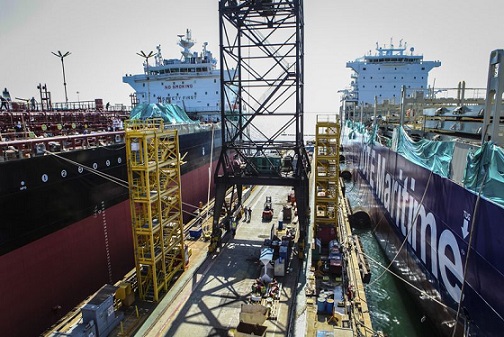
  1. Industrial Reboot – Ferries 101 – Published June 27, 2017
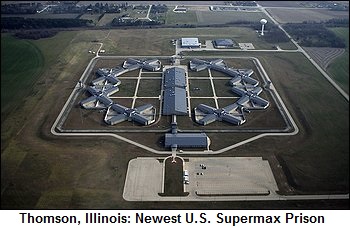
  2. Industrial Reboot – Prisons 101 – Published October 4, 2017
  3. Industrial Reboot – Pipeline 101 – Published October 6, 2017
  4. Industrial Reboot – Frozen Foods 101

In a previous blog-commentary, it detailed how diverse food delivery systems can contribute to the economy of a new Caribbean; many new jobs are to be created. The summarized quotation states:

This roadmap projected these jobs for food-related industries: 30,000 in direct agriculture; 4,000 in direct Fisheries; and 2,000 related to Frozen Foods.

Yes, fostering an industry for Frozen Foods can allow Caribbean stewards to reboot the industrial landscape. Imagine a network of self-regulated, resilient refrigerated warehouses.

But refrigeration requires steady-reliable power, right? Hurricanes are now more prevalent and more disruptive, right?

Since landfalls of hurricanes in a Caribbean island can easily wipe out electricity distribution systems – the 2 recent hurricanes of Irma and Maria in September 2017 caused total devastation in some member-states, i.e. Barbuda – it seems vain to introduce a Frozen Foods business eco-system …

… unless remediation and mitigation is first put in place to optimize power-energy solutions.

The Go Lean book presents a complex plan for energy optimizations. Many solutions were presented in these Go Lean blog-commentaries:

We need an inter-island power grid The Go Lean roadmap proposes many solutions for a regional grid to optimize energy:

  • generation – Green options (solar, wind turbines, hydro, tidal and natural gas)
  • distribution – Underwater cables to connect individual islands
We need alternative energy Rather than just limiting power to come from the grid, the Caribbean industrial landscape needs to embrace “Green” alternative on-site options (solar, wind and tidal), efficient battery back-ups, fuel cells and generators.
We need collective refrigeration This refers to the leveraging of a cooling/heating scheme that provides the needed refrigeration for a limited district, not just one building.
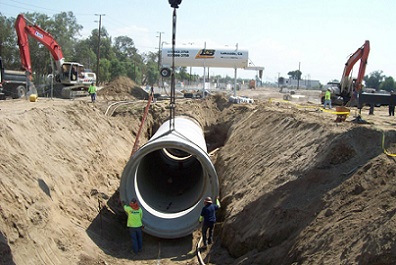
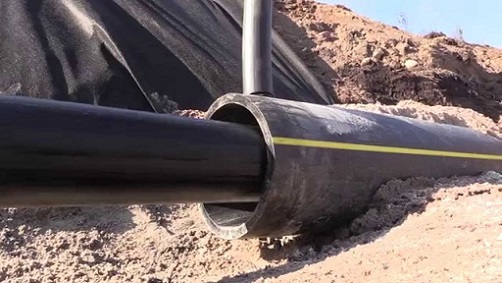
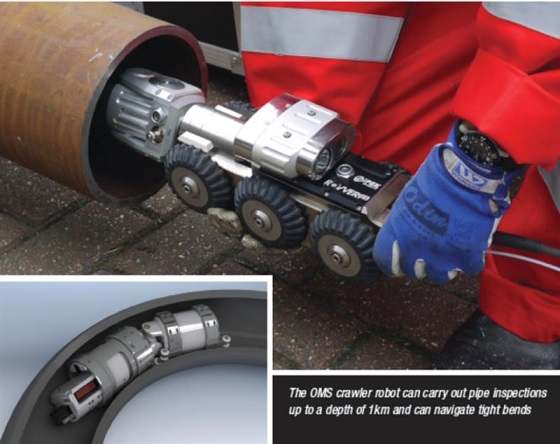
We need pipelines Over-ground, underground and underwater pipelines can help sustained refrigerated warehouses during natural disasters … and can help to quickly restore power and the systems of commerce.
We need cheaper energy costs The roadmap promotes natural gas as the preferred fuel for power generation; it is much cheaper than petroleum or coal options.
We need Self-Governing Entities SGE’s are bordered campuses that designates the exclusivity of the commercial, security and administration to federal governance, above-and-beyond the member-states.

The book Go Lean … Caribbean purports that a new technology-enhanced industrial revolution is emerging, in which there is more efficiency for power generation, distribution and storm recovery. This is a vision of economic resiliency. This vision was pronounced early in the book with this Declaration of Interdependence (Pages 11 – 14), with these statements:

i. Whereas the earth’s climate has undeniably changed resulting in more severe tropical weather storms, it is necessary to prepare to insure the safety and security of life, property and systems of commerce in our geographical region. As nature recognizes no borders in the target of its destruction, we also must set aside border considerations in the preparation and response to these weather challenges.

xxvi. Whereas the Caribbean region must have new jobs to empower the engines of the economy and create the income sources for prosperity, and encourage the next generation to forge their dreams right at home, the Federation must therefore foster the development of new industries, like that of … frozen foods … impacting the region with more jobs.

xxx. Whereas the effects of globalization can be felt in every aspect of Caribbean life, from the acquisition of food and clothing, to the ubiquity of ICT, the region cannot only consume, it is imperative that our lands also produce and add to the international community, even if doing so requires some sacrifice and subsidy.

xxxii. Whereas the cultural arts … of the region are germane to the quality of Caribbean life, and the international appreciation of Caribbean life, the Federation must implement the support systems to teach, encourage, incentivize, monetize and promote the related industries … These endeavors will make the Caribbean a better place to live, work and play.

This Go Lean book serves as a roadmap for the introduction and implementation of the technocratic Caribbean Union Trade Federation (CU) to elevate the 30 Caribbean member-states. This Federation will assume jurisdiction for the Exclusive Economic Zone (EEZ) and all Self-Governing Entities (SGE’s). This approach allows for effective and efficient management of bordered campuses where facilities can be deployed for refrigerated warehouses – with their own power-energy eco-systems. This CU/Go Lean roadmap has these 3 prime directives:

  • Optimization of the economic engines in order to grow the regional economy to $800 Billion and create 2.2 million new jobs.
  • Establishment of a security apparatus to ensure public safety and protect the resultant economic engines, even for emergencies.
  • Improvement of Caribbean governance to support these engines, including a separation-of-powers between the member-states and CU federal agencies.

The facilitations for Caribbean food can lead to a reboot of the industrial landscape. The above referenced 36,000 new jobs can lead to additional indirect jobs: 135,000. That makes for a total of 171,000 new jobs. We should all welcome this Industrial Reboot.

Bad Model: There is one Jamaican transnational company that distributes Frozen Foods, but all of their processes is done in their US home, in New Jersey. 🙁

The subject of Caribbean Food has also been addressed and further elaborated upon in these previous blog/commentaries:

https://goleancaribbean.com/blog/?p=10369 Science of Sustenance – Temperate Foods
https://goleancaribbean.com/blog/?p=8982 GraceKennedy: A Caribbean Transnational “Food” Company
https://goleancaribbean.com/blog/?p=5098 Forging Change: ‘Food’ for Thought
https://goleancaribbean.com/blog/?p=3594 Lessons Learned from Queen Conch – A Caribbean Delicacy

The Go Lean book provides 370 pages of details on the economic principles and community ethos to adopt, plus the executions of strategies, tactics, implementations and advocacies to develop this industry and product offering in the Caribbean. The economic principles of the Frozen Foods pipelines are sound.

How” would the Caribbean region reboot, reform and transform their societal engines to develop a Frozen Foods industry. This is the actual title of one advocacy in the Go Lean book. Consider the specific plans, excerpts and headlines here from Page 208, entitled:

10 Ways to Develop a Frozen Foods Industry

1

Lean-in for the Caribbean Single Market The CU will allow for the unification of the region into one market, thereby creating a single economy of 30 member-states, 42 million people (plus a Diaspora of 8 million) and a GDP of over $800 Billion. The CU will take the lead in facilitating the food supply and distribution systems to ensure the region can feed itself, more from local production and less from trade. Modeling Omaha-based ConAgra Foods, the CU will work to shift the Balance of Trade to where more food supplies are exported and less imported. Where as many North American and EU countries place restrictions on Caribbean fresh produce (for example, no citrus), if foods are already prepared and frozen (or canned), those restrictions no longer apply.

2

Adopt Co-ops for Freezer WarehousesThe CU will sponsor cooperatives and condominium associations to construct and maintain refrigerated warehouses, with power alternatives, to facilitate the logistics of frozen products – for trading partners in agriculture and fisheries.

3

Ensure Energy SecurityThe CU will deploy a regional power grid, which would not have been feasible without the unified market. This advance configuration will supply supplemental power to each member state, on demand as the need arises. This proliferation of energy will foster the business environment to promote and develop freezer warehouses, thereby mitigating risks.

4

Supply Needs for Fisheries

5

Encourage Incubators & EntrepreneurshipA lot of the infrastructure to supply the demand for Caribbean-flavored frozen foods does not currently exist. The CU will incentivize private enterprises to develop this industry. Business incubators, and entrepreneur development programs are sure-fire ways to build this industry, support their development through an array of support resources and services. The CU will spur interest with an appropriate tax policy, rebates, loans, and access to credit.

6

Capital Markets & IPOs

7

Nouvelle Caribbean CuisineThe Caribbean Cuisine is part of the charm of island life, but there is the need for reform to promote a healthier lifestyle and foster local economies. Frozen foods are effective for this strategy. There is minimal lost of freshness for the produce that is unique to the Caribbean (i.e. Ackee, Sugar-Apple). These foods, with lower fat/salt – from frozen sources – will be promoted in the local media for their benefits and adherence to Caribbean style, so as to grow the demand.

8

Food Shows – Creating Demand Locally and in the Diaspora

9

Diaspora Exports – Caribbean Fruits & VegetablesMany fruits and vegetables in the Caribbean are tropical and unique to the region. The far flung Diaspora maintains their taste and demand for Caribbean food products. By preparing and freezing foods it will bypass many of the agricultural restrictions that foreign governments impose. Exporting to the Diaspora market adds a sizeable volume.

10

Optimizing Imports – Labeling – RepackagingThe Frozen Foods strategy also has bearing on food imports. The CU labeling requirement may be different than the host country – the CU will mandate food labeling regulation to identify all active ingredients and their nutritional content. (The US plays “games”). The practice of blast freezing palletized foods may have to be used, for local re-packaging.

In summary, we need jobs; our Caribbean job creation dysfunction is acute. New jobs in the Frozen Foods industry can be stable, reliable and providential to facilitate growth in the economy. The infrastructural enhancements for refrigerated warehouses through out the Caribbean region would help us to expand our food exports and help us to expand our industrial landscape for other industries and other job-creating initiatives.

There is a viable export market for our Caribbean Frozen Food providers: 10 to 25 million Caribbean people in the Diaspora.

Yes, we can … reboot our industrial landscape and expand our food productions and exports. We can create new jobs – and other economic opportunities – that the Caribbean region needs. We urge all Caribbean stakeholders – governments, companies and consumers – to lean-in to this roadmap for economic empowerment. We can make all of the Caribbean homeland better places to live, work and play. 🙂

Download the free e-Book of Go Lean … Caribbean – now!

Sign the petition to lean-in for this roadmap for the Caribbean Union Trade Federation.

Share this post:
, , , ,
[Top]

Industrial Reboot – Pipelines 101

Go Lean Commentary 

CU Blog - Industrial Reboot - Pipelines 101 - Photo 0There is the need to create jobs in the Caribbean. Where and how do we proceed?

First, we must reboot our industrial landscape; and the “art and science” of pipelines can be pivotal, especially in light of the recent eruptions in natural disasters. There were 2 major hurricanes in September 2017 – Irma and Maria – and the devastation in some member-states has been almost complete – i.e. remember Barbuda. A great benefit of over-ground, underground and underwater pipelines is that they can be sustained during hurricanes…and can help to quickly restore power and the systems of commerce.

The movement behind the book Go Lean … Caribbean posits that it is possible to create the required jobs that we need and has presented a roadmap for 2.2 million jobs. But the book warns that for this task to be successful, it is heavy-lifting. The entire industrial landscape must be rebooted. There is now a full catalog for this Industrial Reboot 101 effort and this commentary is 3 of 4 in this occasional series. The full series is as follows:

  1. Industrial Reboot – Ferries 101
  2. Industrial Reboot – Prisons 101
  3. Industrial Reboot – Pipelines 101
  4. Industrial Reboot – Frozen Foods 101

Continuing with pipelines, a recent blog-commentary detailed how diverse pipeline technologies can help restore post-storm normality in quick order:

  • Flood Control drainage pipelines
    CU Blog - Industrial Reboot - Pipelines 101 - Photo 3b
    CU Blog - Industrial Reboot - Pipelines 101 - Photo 3a
    CU Blog - Industrial Reboot - Pipelines 101 - Photo 3c
  • Underground-piped and underwater-piped electrical cables – see specifications sample in Appendix A
    CU Blog - After Irma, the Science of Power Restoration - Photo 1

CU Blog - Industrial Reboot - Pipelines 101 - Photo 4The book Go Lean … Caribbean details more; it asserts that pipelines can be strategic, tactical and operationally efficient for building community wealth in the Caribbean region. Yes, they can mitigate challenges from Mother Nature, create jobs and grow the economy at the same time. The book purports that a new technology-enhanced industrial revolution is emerging, in which there is more efficiency for installing-monitoring-maintaining pipelines. Caribbean society must participate in these developments, in order to “survive with the fittest”. This point is pronounced early in the book with this Declaration of Interdependence (Page 14), with these statements:

xxvi. Whereas the Caribbean region must have new jobs to empower the engines of the economy and create the income sources for prosperity, and encourage the next generation to forge their dreams right at home, the Federation must therefore foster the development of new industries, like that of … pipelines

xxvii. Whereas the region has endured a spectator status during the Industrial Revolution, we cannot stand on the sidelines of this new economy, the Information Revolution. Rather, the Federation must embrace all the tenets of Internet Communications Technology (ICT) to serve as an equalizing element in competition with the rest of the world. The Federation must bridge the digital divide and promote the community ethos that research/development is valuable and must be promoted and incentivized for adoption.

This Go Lean book serves as a roadmap for the introduction and implementation of the technocratic Caribbean Union Trade Federation (CU) to elevate the 30 Caribbean member-states. This Federation will assume jurisdiction for the 1,063,000 square-mile Caribbean Sea, in an Exclusive Economic Zone (EEZ). This approach allows for cooperation and coordination for pipelines among the member-states, The Go Lean book specifically identifies that pipelines can impact these societal engines (Page 96):

  • Economics – Pipelines bring resources from the source to the destination in a steady consistency, thereby fulfilling the economic supply-demand conundrum. This is vital for resources like water, energy elements (oil, gas, & minerals) – see Appendix B –  electricity, and telecommunications lines. There are newer innovations planned for pipelines, like Pneumatic Capsules, to allow for the transport of cargo, and even the far-reaching testing for high-speed passenger travel.
  • Governance – Administration to include a separation-of-powers between the member-states and CU federal agencies.
  • Security – This category does not refer to some military application, but rather public safety/security provisions. Pipelines can be erected in web design formations to allow transport from source to destination via alternate routes if ever extraordinary conditions (storms) impact normal flow – see model in Appendix C – this is modeled after the internet’s worldwide-web. There is also an element of economic security with the emergence of pipeline maintenance jobs to engineer, maintain and monitor installations.
    • Emergency – Tourism is the region’s primary industry driver so pipeline spills/accidents may have a major impact on the fauna/flora of the islands. But there are “best practices” to apply to mitigate the risks associated with pipelines. The web design approach also facilitates a recovery plan for emergencies. So when a Hurricane Watch is declared anywhere in the region, (normal 3 days from landfall), the mandate is that all pipeline flow must cease.

The subject of pipelines has also been addressed and further elaborated upon in these previous blog/commentaries:

https://goleancaribbean.com/blog/?p=6867 Pipelines can address high consumer prices
https://goleancaribbean.com/blog/?p=2670 A Lesson in History – Rockefeller’s Pipeline
https://goleancaribbean.com/blog/?p=1817 Caribbean grapples with intense new cycles of flooding & drought
https://goleancaribbean.com/blog/?p=1516 Floods in Minnesota, Drought in California – Why Not Share?

The Go Lean book provides 370 pages of details on the economic principles and community ethos to adopt, plus the executions of strategies, tactics, implementations and advocacies to forge pipelines and industrial growth in the Caribbean:

Economic Principles – Economic Systems Influence Individual Choices Page 21
Community Ethos – Job Multiplier Page 22
Community Ethos – “Crap” Happens – So we must be prepared Page 23
Community Ethos – Lean Operations Page 24
Community Ethos – Return on Investments (ROI) Page 24
Community Ethos – Cooperatives Page 25
Community Ethos – Ways to Impact the Future Page 26
Community Ethos – Ways to Help Entrepreneurship Page 28
Community Ethos – Ways to Promote Intellectual Property Page 29
Community Ethos – Ways to Impact Research & Development Page 30
Community Ethos – Ways to Improve Sharing Page 35
Community Ethos – Impact the Greater Good Page 37
Anecdote – Pipeline Transport – Strategies, Tactics & Implementations Page 43
Strategy – Agents of Change – Technology Page 57
Tactical – Fostering a Technocracy Page 64
Tactical – Growing Economy – New High Multiplier Industries Page 68
Separation of Powers – Interstate Commerce Administration Page 79
Separation of Powers – Interior Department – Exclusive Economic Zone Page 82
Implementation – Assemble – Pipeline as a Focused Activity Page 96
Implementation – Ways to Pay for Change Page 101
Implementation – Benefits from the Exclusive Economic Zone Page 104
Implementation – Ways to Develop a Pipeline Industry Page 107
Implementation – Ways to Deliver Page 109
Planning – 10 Big Ideas – Pipeline Projects Page 127
Planning – Ways to Improve Interstate Commerce Page 129
Planning – Lessons from New York City Page 137
Planning – Lessons from Omaha Page 138
Advocacy – Ways to Grow the Economy Page 151
Advocacy – Ways to Create Jobs Page 152
Advocacy – Ways to Better Manage the Social Contract – Infrastructure Page 170
Advocacy – Ways to Ways to Impact Public Works – Ideal for Pipelines Page 175
Advocacy – Ways to Foster Cooperatives Page 176
Advocacy – Ways to Better Manage Natural Resources – Water Resources Page 183
Anecdote – Caribbean Industrialist & Entrepreneur Role Model Page 189
Advocacy – Ways to Impact Extractions – Pipeline Strategy Alignment Page 195
Advocacy – Ways to Improve Emergency Management Page 196
Advocacy – Ways to Foster Technology Page 197
Advocacy – Ways to Improve Monopolies – Foster Cooperatives Page 202
Advocacy – Ways to Improve Transportation – Pipeline Options Page 205
Appendix – Interstate Compacts – Needed for Pipelines in US Territories Page 278
Appendix – Pipeline Maintenance Robots Page 283
Appendix – North Dakota Example – Oil Drilling Economic-Societal Effects Page 334

The economic principles of pipelines are sound.

The Go Lean book details that the Caribbean can create …

2,000 direct jobs building/maintaining pipelines, tunnels, and the regional power grid

These are direct jobs; there is also the reality of indirect jobs – unrelated service and attendant functions – at a 3.75 multiplier rate would add another 7,500 jobs. That makes a total of 9,500 jobs.

Hurricanes are so dire and disruptive that they need to be mitigated. We need pipelines and we need them NOW!

How” would the Caribbean region reboot, reform and transform their societal engines to develop a Pipeline industry. This is the actual title of one advocacy in the Go Lean book. Consider the specific plans, excerpts and headlines here from Page 107, entitled:

10 Ways to Develop a Pipeline Industry

1

Lean-in for the Caribbean Single Market
The CU will allow for the unification of the region into one market, thereby creating a single economy of 30 member-states, 42 million people and a GDP of over $800 Billion. The CU envisions applications to connect the member states with a network of pipelines/tunnels/cables; facilitated at the federal level due to cross-border implications and oversight of the region’s energy/environment missions. Another dimension that aligns with the CU is fostering hi-technology jobs.

2

Pneumatic Cargo TubesThe CU is ideal for the implementation of PCP systems to handle containers and trailers through underwater, underground and above-ground pipelines powered by magnetic levitation systems (ILM). There are some pre-defined sites well-fitted for PCP: 7 miles between Venezuela & Trinidad; Nassau’s cruise/cargo port to an intermodal exchange site, etc..

3

Underwater Tunnels

4

Underwater Pipes and CablesThe CU will employ the best practices, arts and sciences to install underwater pipelines and underwater cables. (Cables are flexible and can be inserted in/out of pipes). All pipes can be treated with an epoxy to withstand salt-water erosion.

5

Fresh WaterSome CU islands have water resource challenges (i.e. Antigua). They installed desalination as a solution. An alternate solution is now water pipelines. The CU will install the infrastructure to transport water from source to target via pipelines.

6

Oil-to-Oil RefineryThere are oil-producing states with the CU. (Plus, a lot of oil explorations engagements). There are also a number of oil refineries. The CU envisions above-ground/undersea pipelines to connect refineries to oil sources/shipping terminals.

7

High Intensity Power LinesThe CU will deploy a regional power grid, which is now feasible with the unified market. With the reality of island chains, and the reality of new technologies (like HVDC), the high intensity power lines can be mounted underground or underwater, (see Appendix below), in a solo fashion or in other CU built/maintained tunnels/pipelines.

8

Natural Gas on Land

9

Emergency ManagementThe CU treaty grants jurisdiction of strategic pipelines to federal governing authorities. The CU will apply the world’s best-in-breed tools, best-practice techniques and systems for ensuring the viability and integrity of pipelines:

  • Maintenance – The CU will engage pipe crawlers (robots) for inspections to assuage pipeline risks (Appendix IF).
  • Incidents – Every incident must be rated for severity: Stratification 1 (leakage); “Strat” 2 (shutdown). While all incidents will be reported and published on the CU portal, Strat 3 (property damage) and 4 (loss of life) must have public hearings.
  • Disasters – The CU region have seasonal threats of hurricanes, and these dictate extraordinary measures and disaster recovery plans for Emergency Managers. The CU will mandate remediation & pipeline shutdown during storm warnings.

10

Tourism / Eco ImpactThe primary economic engine for the Caribbean is tourism. The CU will always promote and protect this industry. But pipelines can co-exist, and the natural/pristine environs can be protected! The CU envisions underground pipeline in urban/suburban areas, above ground pipelines in rural areas and underwater pipeline to connect the islands.

In summary, we need jobs; our Caribbean job creation dysfunction is acute. Jobs in the Pipeline industry are stable, reliable and providential to facilitate growth in other industries and to assure business continuity. These infrastructural enhancements would help us to make our homeland a better place to live, work and play.

Pipeline = Infrastructure! A region-wide pipeline deployment = Industrial Reboot!

CU Blog - Industrial Reboot - Pipelines 101 - Photo 1

Yes, we can … reboot our industrial landscape and deploy our own web of pipelines; consider the US model in Appendix C. We can create new jobs – and other economic opportunities – that the Caribbean region needs. We urge all Caribbean stakeholders – governments and citizens – to lean-in to this roadmap for economic empowerment. We can make all of the Caribbean homeland better places to live, work and play. 🙂

Download the free e-Book of Go Lean … Caribbean – now!

Sign the petition to lean-in for this roadmap for the Caribbean Union Trade Federation.

———–

Appendix A Title: Underwater High Intensity Power Lines

High-Voltage Direct Current (HVDC) Light technology is designed to transmit power over long distances in both underground and under-water settings. HVDC Light technology, offered by ABB – the German Industrial powerhouse, leading in the development and implementation of HVDC technology.

Buried HVDC is a feasible technology for the Caribbean Union Regional Power Grid. Its feasibility is based upon several factors that include it being a time-tested technology, having suitable cable capacity, utilizing efficient and small footprint converter stations.

A classical HVDC transmission has a power of more than 100 Megawatts (MW) and many are in the 1,000 – 3,000 MW range. There are classical HVDC transmissions that use overhead lines (OHL) and some that use undersea (and underground) cables (or combinations of cables and lines). ABB’s HVDC Light technology uses underground or submarine cables with an economical upper power range now reaching 1,200 MW and ±500 kV.

HVDC can be used to span OHL routes with a length of 1,000 km (about 600 miles) or more and undersea routes (submarine cables) from a length of 60 km (about 40 miles) upwards more economically than with alternating current (AC). Direct current has the advantage over alternating current that it does not cause eddy currents and can thus make use of the full cross section of the cable. Heat losses are lower because of the lower resistance for the same cross-section. Incidentally: Power losses with AC voltage are higher under water than in the air or underground because with deep sea cables it is not possible to use compensating elements (coils, capacitors) against inductive and capacitive losses.

The modern form of HVDC transmission uses technology developed extensively in the 1930s in Sweden at ASEA (a founding company of ABB). More specific to this document, buried HVDC has been employed in land and submarine transmission settings for many decades. This technology has been used most extensively in Europe, and is now being proposed for long distance high-voltage transmission lines in the northeast and eastern areas of the USA. The Champlain Hudson Power Express, a 333 mile-long transmission line from the U.S. – Canadian border to New York City, is currently in the EIS preparation stage. The transmission system will consist of two 5 inch diameter cables to be laid under water and on land. The proposed route will start at the U.S. – Canadian border, travel south through Lake Champlain and along railroad right of ways, and then enter the Hudson River south of Albany. The power will ultimately go to a converter station in Astoria Queens.

Working examples of HVDC buried land and underwater lines include: Cross Sound, across 42 kilometers of the Long Island Sound (New York); the Trans-Bay HVDC cable project under construction in California connecting Pittsburg in East Bay to San Francisco; a large number of working HVDC submarine cables transporting power between Europe and Scandinavia, between the UK and France, between the islands of New Zealand, and between Italy and Greece.

HVDC requires terminals, or converter stations, at the line ends. A significant feature of the HVDC Light transmission system is that an HVDC Light converter station has a much smaller size than even a classical HVDC converter station, and certainly is much smaller in size than an AC substation. A significant characteristic of HVDC Light cable is its excellent ability to stabilize AC voltage at the terminals. This is especially important for wind parks, where the variation in wind speed can cause severe voltage fluctuations. Additional technical aspects of this cable include: 1) if the cable is damaged, HVDC protection reduces the current and voltage to zero in a fraction of a second so there is no possibility of damage to persons and infrastructure, 2) the HVDC transmission system uses underwater and underground cables that are solid, are made from non-flammable materials, are well insulated, and contain no liquids or gels.

The burial of HVDC Light cable is similar to that of fiber-optic cables because the equipment used for trenching and the depths at which the cables are laid are comparable (1 to 1.5 m below the surface). In some relevant projects, underground cables are installed using modified pipeline installation equipment. The strength and flexibility of HVDC Light cables make them suitable for submarine use. They can be laid in deeper waters and on rough bottoms.

CU Blog - Industrial Reboot - Pipelines 101 - Photo 2

Source: ABB Technical Specification documents

———–

Appendix B VIDEO – Key US gasoline pipeline now ready to carry more fuel, just days after Harvey – https://youtu.be/NOG4j6PHv10

CBS North Carolina
Published on Aug 31, 2017 – Key US gasoline pipeline aims to carry more fuel by Sunday; Cooper urges caution.

———–

Appendix C VIDEO – Animated map of the major oil and gas pipelines in the US – https://youtu.be/MEIerHQ9IAw

Business Insider
Published on Dec 31, 2015 – The United States is the world’s largest consumer of oil, using over 19 million barrels a day in 2014. This high level of consumption wouldn’t be possible without the 2.5 million mile network of pipeline used to transport the fuel from its source to the market.

Business Insider is the fastest growing business news site in the US. Our mission: to tell you all you need to know about the big world around you. The BI Video team focuses on technology, strategy and science with an emphasis on unique storytelling and data that appeals to the next generation of leaders – the digital generation.

See a related VIDEO here at https://youtu.be/JXRFIqtCMzM that showcases pipeline safety, disaster and recovery dimensions.


Share this post:
, , ,
[Top]

Industrial Reboot – Prisons 101

Go Lean Commentary

Want to create jobs? “Go to jail; go directly to jail”.

The book Go Lean … Caribbean (Page 23) makes this realistic disclosure:

“Bad Actors” will [always] emerge … to exploit the opportunities, with good, bad and evil intent.

The book continues this theme and relates that there can be economic benefits if communities foster the industries around prisons – consider the SuperMax in the Appendix below – and incarcerating “bad actors”, especially “bad actors” that are the responsibility of other jurisdictions. This is a business model, a Prison Industrial Complex, in which the landlord-host gets paid from the responsible jurisdictions. Business model refers to jobs, entrepreneurial opportunities, trade transactions, etc.

CU Blog - Industrial Reboot - Prisons 101 - Photo 1The Go Lean book details that the Caribbean can create …

12,000 direct jobs for prison guards, administrators, supply logistics, and private protection

While these are direct jobs, there is also the reality of indirect jobs – unrelated service and attendant functions – that at a 3.75 multiplier rate would add another 45,000 jobs.

The book Go Lean…Caribbean – available to download for free – serves as a roadmap for the introduction and implementation of the technocratic Caribbean Union Trade Federation (CU); this is a confederation of all 30 member-states to execute a reboot of the Caribbean eco-system. This CU/Go Lean roadmap has these 3 prime directives:

  • Optimization of the economic engines in order to grow the regional economy to $800 Billion and create 2.2 million new jobs.
  • Establishment of a security apparatus to ensure public safety and protect the resultant economic engines.
  • Improvement of Caribbean governance to support these engines, including a separation-of-powers between the member-states and CU federal agencies.

There is the need for this reboot right now! In the last weeks – September 2017 – the Caribbean region has been beset by 2 major hurricanes, Irma and Maria. The devastation in some member-states has been so complete – i.e. remember Barbuda – that they have had to send their prisoners to foreign facilities, (still within the Caribbean). Consider the news article here, relating this actuality:

Title: St Lucia willing to accept up to 40 foreign prisoners: National Security Minister

CU Blog - Industrial Reboot - Prisons 101 - Photo 2The National Security Minister, Senator Hermangild Francis has sought to downplay reports that the prisoners brought to St Lucia from the hurricane-ravaged Caribbean islands are high risk.

“People are saying high risk. I have not seen anything indicating that they are high risk. All I’ve been told is that they’re prisoners that needs shelter. So we have accepted to house as many as we could,” Francis asserted.

Seven prisoners from the British Virgin Islands arrived in St Lucia Tuesday along with three others from the Turks and Caicos Islands, bringing to 17 the total number of criminals currently being jailed on the island from the BritishOverseasTerritories, the National Security Minister confirmed.

The first group of seven prisoners arrived at the HewanorraInternationalAirport onboard a British military aircraft on Monday.

It’s unclear what crimes the prisoners were convicted of in their countries or how long will they be kept in St Lucia.

Francis could not confirm whether that would be the final batch.

He said St Lucia is willing to accommodate up to 40 prisoners given that the current low occupancy level at Bordelais Correctional Facility.

The National Security Minister said Tuesday’s transfer of prisoners was carried out “better” than the day before.

The men are being housed in a segregated unit of the Bordelais Correctional Facility, away from local prisoners, Francis said.

The Minister said he plans to visit the prison on Friday.

Source: Posted September 27, 2017; retrieved October 3, 2017 from: https://stluciatimes.com/2017/09/27/st-lucia-willing-accept-40-foreign-prisoners-national-security-minister

Related Story: “Most dangerous” BVI prisoners transferred to St Lucia; reports – Posted September 29, 2017; retrieved October 3, 2017 from: https://stluciatimes.com/2017/09/29/dangerous-bvi-prisoners-transferred-st-lucia-reports

CU Blog - Industrial Reboot - Prisons 101 - Photo 3

Hurricanes are “bad actors” too.

Having a Caribbean Prison Industrial Complex fully functional at this time would have impacted the region’s societal engines: economic, security apparatus and governing administrations. We need this Go Lean/CU roadmap NOW!

The Go Lean book stresses that reforming and transforming the Caribbean societal engines must be a regional pursuit. This was an early motivation for the roadmap, as pronounced in the opening Declaration of Interdependence (Pages 12 – 13):

x. Whereas we are surrounded and allied to nations of larger proportions in land mass, populations, and treasuries, elements in their societies may have ill-intent in their pursuits, at the expense of the safety and security of our citizens. We must therefore appoint “new guards” to ensure our public safety and threats against our society, both domestic and foreign. The Federation must employ the latest advances and best practices of criminology and penology to assuage continuous threats against public safety. The Federation must allow for facilitations of detention for convicted felons of federal crimes, and should over-build prisons to house trustees from other jurisdictions.

xi. Whereas all men are entitled to the benefits of good governance in a free society, “new guards” must be enacted to dissuade the emergence of incompetence, corruption, nepotism and cronyism at the peril of the people’s best interest. The Federation must guarantee the executions of a social contract between government and the governed.

xvi. Whereas security of our homeland is inextricably linked to prosperity of the homeland, the economic and security interest of the region needs to be aligned under the same governance. Since economic crimes … can imperil the functioning of the wheels of commerce for all the citizenry, the accedence of this Federation must equip the security apparatus with the tools and techniques for predictive and proactive interdictions.

xxiv.  Whereas a free market economy can be induced and spurred for continuous progress, the Federation must install the controls to better manage aspects of the economy: jobs, inflation, savings rate, investments and other economic principles. Thereby attracting direct foreign investment because of the stability and vibrancy of our economy.

xxvi.  Whereas the Caribbean region must have new jobs to empower the engines of the economy and create the income sources for prosperity, and encourage the next generation to forge their dreams right at home, the Federation must therefore foster the development of new industries, like that of … the prison industrial complex. In addition, the Federation must invigorate the enterprises related to existing industries like tourism, fisheries and lotteries – impacting the region with more jobs.

Accordingly, the CU will facilitate the eco-system for Self-Governing Entities (SGE), an ideal concept for prisons, with its exclusive federal regulation/promotion activities. Imagine a bordered campus – with a combination of fencing, walls and/or moats/canals – that designates the exclusivity of the commercial, security and administration to superlative governance above the member-states. With an approved “Action Plan”, the comings-and-goings would not be up to debate of local authorities.

The Go Lean movement (book and blogs) details the principles of SGE’s and job multipliers, how certain industries are better than others for generating multiple indirect jobs down the line (or off-campus) for each direct job on the SGE’s payroll. In a previous blog-commentary, it was related how one industry – shipbuilding – was perfectly suited for the Caribbean, as long as the structure was an independent “Shipyard”/SGE. That commentary asserted how 60,000 new jobs can easily be facilitated.

This is transforming! This is the vision of an industrial reboot! This is where and how the jobs are to be created.

But do the exploitations of the Prison Industrial Complex put security at risk for Caribbean communities?

No. Not if the deployments are done right!
(See the reality of “Life in a SuperMax” Prison facility in the Appendix VIDEO below).

The Go Lean book provides 370-pages of turn-by-turn instructions on “how” to adopt new community ethos, plus the strategies, tactics, implementations and advocacies to execute so as to reboot, reform and transform the societal engines of Caribbean society. One advocacy in rebooting the industrial landscape is to foster a Prison Industrial Complex; consider the  specific plans, excerpts and headlines from the book on Page 211 entitled:

10 Ways to Impact the Prison Industrial Complex

1

Lean-in for the Caribbean Single Market
This will allow for the unification of the region into one market of 42 million people across 30 member-states with a GDP of $800 Billion (2010 figures). In addition, the treaty calls for a collective security pact allowing the implementation of a prison system to detain convicts of CU federal offenses (i.e. economic and military crimes). The CU will over-build these facilities for more than just federal prisoners, but also to house inmates for other jurisdictions. Directly, there is a huge economic impact, starting with jobs (law enforcement and support personnel), and the construction industry to build the prisons. Indirectly, the spin-off in the local communities has a multiplier effect. This industry will generate direct income for the CU.

2

Invite and Repatriate Prisoners
The CU will petition host countries to return incarcerated members of the Caribbean Diaspora – for a fee – since they are guilty of crimes committed in those host countries. But the cost of incarceration can be lower in the CU region compared to North American and European venues, because of the ideal weather. The next leap is to offer to house other prisoners in an outsourcing arrangement for the foreign host countries – this is classic Prison Industrial Complex.

3

Impact Rural Communities

4

In-source for Local Governments
The member-states can embrace the CU’s Prison Industrial Complex to satisfy their own needs, both penal and labor. With economies-of-scale, they can out-source their own trustees to the CU to minimize their direct costs. In addition, the CU will manage the process of providing prison labor for public endeavors, i.e. license plates and document scanning.

5

Supply Prison Labor Needs

6

Build Employable Skill-Sets

7

Reduce Recidivism

8

Gathering Intelligence on Probation Trustees and Parolees

9

Prepare for Escalations and Emergencies
The security needs of the region are paramount, even in the case of emergencies. The CU region must allow for the systemic risks of natural disasters (hurricanes and earthquakes) in the vicinity of maximum security prisons. The risk mitigation plan must allow for tactical response/SWAT units, riot squads, and military readiness to suppress uprisings.

10

Learn from Peonage Past and Ensure Corporate Governance

There have been a number of blog-commentaries by the Go Lean movement that highlighted economic opportunities embedded in regional homeland security initiatives. See a sample list here:

https://goleancaribbean.com/blog/?p=13126 “Must Love Dogs”  – Providing K9 Solutions for Better Security
https://goleancaribbean.com/blog/?p=12400 Accede the Caribbean Arrest Treaty
https://goleancaribbean.com/blog/?p=9072 Model: Shots-Fired Monitoring – Securing the Homeland on the Ground
https://goleancaribbean.com/blog/?p=2782 Model: ‘Red Light Traffic Cameras’ for Public Safety & Profits
https://goleancaribbean.com/blog/?p=1832 Model: Opportunities as US Deports More Drug-arrested Inmates
https://goleancaribbean.com/blog/?p=1674 Model: $3.7 Billion for US Detention Centers

In summary, we need jobs; our Caribbean job creation dysfunction is acute. While not glamorous, Prison Industrial Complex jobs are stable, reliable and providential. They would help us to make our homeland a better place to live, work and play.

But this is only 57,000 (12,000 + 45,000) jobs. The Go Lean/CU vision is for 2.2 million new jobs. Where and how can this new technocracy expect to create those jobs, while the existing regimes of the Caribbean region cannot accomplish this now?

Industrial Reboot!

But the Go Lean book describes the process as “difficult”, no ABC-123. Rather it is heavy-lifting! Yet there are some basics that must be embraced; these basics can be catalogued as an “Industrial Reboot 101”. This commentary is 2 of 4 in an occasional series considering Industrial Reboots. The full series is as follows:

  1. Industrial Reboot – Ferries 101
  2. Industrial Reboot – Prisons 101
  3. Industrial Reboot – Pipeline 101
  4. Industrial Reboot – Frozen Foods 101

Yes, we can … reboot our industrial landscape. It is possible to create the new jobs – and other economic opportunities – that the Caribbean region needs. We urge all Caribbean stakeholders – governments and citizens – to lean-in to this roadmap for economic empowerment. We can make all of the Caribbean homeland better places to live, work and play. 🙂

Download the free e-book of Go Lean … Caribbean – now!

Sign the petition to lean-in for this roadmap for the Caribbean Union Trade Federation.

————

Appendix Title: SuperMax Prison

Supermax (short for: super-maximum security) is a primarily U.S. English term used to describe “control-unit” prisons, or units within prisons, which represent the most secure levels of custody in the prison systems of certain countries. The objective is to provide long-term, segregated housing for inmates classified as the highest security risks in the prison system—the “worst of the worst” criminals—and those who pose a threat to both national and global security.[1]

CU Blog - Industrial Reboot - Prisons 101 - Photo 4a

CU Blog - Industrial Reboot - Prisons 101 - Photo 4b

History
CU Blog - Industrial Reboot - Prisons 101 - Photo 5
The United States Penitentiary Alcatraz Island, opened in 1934, has been considered a prototype and early standard for a supermax prison.[5]

An early form of supermax-style prison unit appeared in Australia in 1975, when “Katingal” was built inside the Long Bay Correctional Centre in Sydney. Dubbed the “electronic zoo” by inmates, Katingal was a super-maximum security prison block with 40 prison cells having electronically operated doors, surveillance cameras, and no windows. It was closed down two years later over human rights concerns.[6] Since then, some maximum-security prisons have gone to full lockdown as well, while others have been built and dedicated to the supermax standard.

Supermax prisons began to proliferate within the United States after 1984. Prior to 1984 only one prison in the U.S. met “supermax” standards: the Federal Penitentiary in Marion, Illinois. By 1999, the United States contained at least 57 supermax facilities, spread across 30–34 states.[3] The push for this type of prison came after two correctional officers at Marion, Merle Clutts and Robert Hoffman, were stabbed to death in two separate incidents by …. This prompted Norman Carlson, director of the Federal Bureau of Prisons, to call for a new type of prison to isolate uncontrollable inmates. In Carlson’s view, such a prison was the only way to deal with inmates who “show absolutely no concern for human life”.[7]

Source: Retrieved from Wikipedia October 4, 2017 from: https://en.wikipedia.org/wiki/Supermax_prison

See related Appendix VIDEO of Life in a SuperMax Prison below.

————

Appendix VIDEO – Life in a SuperMax Prison – CNN Video – http://www.cnn.com/videos/us/2015/05/13/inside-supermax-prison-orig.cnn/video/playlists/inside-prison-cells/

Published May 143, 2015 – Life in a SuperMax Prison

If [Boston Marathon Bomber] Dzhokhar Tsarnaev is sent to the United States Penitentiary Administrative-Maximum Facility in Florence, Colorado, he’ll be cut off from the world. See what life is like for inmates inside a Supermax prison. Source: CNN


Share this post:
, , ,
[Top]

Amazon Opens Search for HQ2

Go Lean Commentary

Amazon 2Amazon is not just a giant on the internet, in the areas of electronic commerce. No they are emerging as a giant in the real world as well. The company has over 380,000 employees worldwide and 40,000+ at their Seattle, Washington USA headquarters. That is a BIG corporate presence. In fact, economic analysts had tabulated Amazon’s Gross Domestic Product (GDP) contribution to Seattle at $US 38 Billion. Wow!

Now, the company has decided to open a new supplemental headquarters facility – with the promise of another 50,000 job opportunities. Where will they place this second HQ facility – HQ2? They are open to offers.

Let the bidding begin …

See the Press Release in the Appendix below and the related VIDEO here:

VIDEO – American cities vie to be site of Amazon’s second headquarters – https://www.today.com/video/american-cities-vie-to-be-site-of-amazon-s-second-headquarters-1055053379904

Many U.S cities are competing fiercely to show Amazon why they should become home to the online giant’s second headquarters. NBC business correspondent Jo Ling Kent reports for TODAY from one of them: Los Angeles.

As related in this VIDEO, Amazon HQ2 would be a “serious jolt to any local economy”. Consider these prospective cities that are lining up:

Atlanta El Paso, TX Nashville, TN
Baltimore Gary, Indiana Pittsburgh, PA
Birmingham, AL Houston, TX Phoenix, AZ
Boston, MA Las Vegas, NV Portland, OR
Chicago Los Angeles St Louis, MO
Cincinnati, OH Miami, FL Toronto, Canada
Denver, CO Minneapolis, MN Tucson, AZ

The Caribbean is not represented on that list; notwithstanding the frontier city of Miami. (Miami thrives due to the presence of the Caribbean Diaspora).

But that’s OK…this time. We have our own plans.

CU Blog - Amazon Opens Search for for HQ2 - Photo 1As related in previous blog-commentaries by the movement behind the book Go Lean … Caribbean, Amazon is a model for the Caribbean’s own venture into electronic commerce. We have the design for www.myCaribbean.gov web-portal and the Caribbean Postal Union to perform a lot of the same functionality that Amazon does in the USA.

The book Go Lean…Caribbean serves as a roadmap for the introduction and implementation of the technocratic Caribbean Union Trade Federation (CU) and the Caribbean Postal Union (CPU). These entities are designed to address the “Agents of Change“ in modern society, but for a Caribbean scope only.  The “Agents of Change” at play in the foregoing news source are as follows:

  • Technology
  • Globalization

As related in the foregoing VIDEO, the business dynamics of Amazon will have a huge impact on some local community. That American city that lands HQ2 will have a lot to celebrate, as their societal engines will be elevated. An enterprise that can create that many high-paying direct jobs – 50,000 – will have a stimulating effect on the rest of the economy. This too is a feature of Amazon that “we” want to model in the Caribbean. The Go Lean/CU roadmap is designed to elevate the Caribbean’s societal engines starting first with economics (jobs, industrial development and entrepreneurial opportunities). In fact, the following 3 statements are identified as the prime directives of the CU:

  • Optimization of the economic engines in order to grow the regional economy to $800 Billion & create 2.2 million new jobs.
  • Establishment of a security apparatus to protect the resultant economic engines.
  • Improve Caribbean governance to support these other engines. Governance will not grow the economy, commerce will.

One addition feature of Amazon that bears disclosing is their effect on stimulating other businesses. According to these words from the Press Release below, the home community of Amazon’s current headquarters – Seattle, Washington – has incubated many other Fortune 500 companies in the wake of Amazon’s rise and dominance:

Increase in Fortune 500 companies with engineering/R&D centers in Seattle: From 7 in 2010 to 31 in 2017

Incubation is a primary tactic addressed in the Go Lean book. It is explained (Page 28) as follows:

The Bottom Line on Incubators
Business incubators are programs designed to support the successful development of entrepreneurial companies through an array of business support resources and services, developed and orchestrated by incubator management. Incubators vary in the way they deliver their services, in their organizational structure, and in the types of clients they serve. Successful completion of a business incubation program increases the likelihood that a startup company will stay in business for the long term: studies found 87% of incubator graduates stayed in business, in contrast to 44% of all firms. [Incubators are common in the US, Canada and Europe]. In 2005 alone, North American incubation programs assisted more than 27,000 firms that provided employment for more than 100,000 workers and generated annual revenues of $17 billion.

Incubators differ from research and technology parks in their dedication to startup and early-stage companies. Incubators also differ from the U.S. Small Business Administration’s Small Business Development Centers in that they serve only selected clients. Most common incubators provide these services:

1. Help with business basics

2. Networking activities

3. Marketing assistance

4. Help with accounting/financial management

5. Access to bank loans, loan funds and guarantee programs

6. Help with presentation skills

7. Links to higher education resources

8. Links to strategic partners

9. Access to angel investors or venture capital

10. Advisory boards and mentors

11. Technology commercialization assistance

12. Help with regulatory compliance

13. Intellectual property management.

CU Blog - Retail Enemy - Amazon - Photo 1Amazon’s modus operandi is not to be an incubator, though they have invested in many other tech-related companies. No, the Seattle incubation resulted from more community synergy than direct planning. This is what is defined in the Go Lean book as “community ethos”:

1. The fundamental character or spirit of a culture; the underlying sentiment that informs the beliefs, customs, or practices of a group or society; dominant assumptions of a people or period.

2. The character or disposition of a community, group, person, etc.

We need this community ethos in the Caribbean!

Overall, in its 370-pages, the Go Lean book stresses the community ethos, strategies, tactics, implementations and advocacies to reform and transform the economic engines of Caribbean society. The required technocratic stewardship for the region’s economic engines was presented early in the book with these opening pronouncements in the Declaration of Interdependence (Page 13 and 14):

xxiv. Whereas a free market economy can be induced and spurred for continuous progress, the Federation must install the controls to better manage aspects of the economy: jobs, inflation, savings rate, investments and other economic principles. Thereby attracting direct foreign investment because of the stability and vibrancy of our economy.

xxvii. Whereas the region has endured a spectator status during the Industrial Revolution, we cannot stand on the sidelines of this new economy, the Information Revolution. Rather, the Federation must embrace all the tenets of Internet Communications Technology (ICT) to serve as an equalizing element in competition with the rest of the world. The Federation must bridge the digital divide and promote the community ethos that research/development is valuable and must be promoted and incentivized for adoption.

The points of effective, technocratic stewardship were further elaborated upon in previous blog-commentaries. Consider this sample:

https://goleancaribbean.com/blog/?p=12291 Amazon – The Retailers’ Enemy
https://goleancaribbean.com/blog/?p=8823 Lessons from China – WeChat: Model for Caribbean Social Media
https://goleancaribbean.com/blog/?p=7991 Transformations: Caribbean Postal Union – Delivering the Future
https://goleancaribbean.com/blog/?p=3187 Robots help Amazon tackle Cyber Monday
https://goleancaribbean.com/blog/?p=2488 Model of an E-Commerce Fulfillment Company: Alibaba
https://goleancaribbean.com/blog/?p=1416 Model of an E-Commerce Fulfillment Company: Amazon
https://goleancaribbean.com/blog/?p=528 Facebook’s advances for e-Commerce payments

Congratulation to the selected city – whoever is selected – for Amazon’s HQ2.

For the Caribbean, let’s pay attention to this bidding process. Let’s lean-in and learn how the economic incentives were structured by the winning city to attract this “whale” of a corporate investor – Amazon commits to spending $5 Billion to enhance local infrastructure in the selected city. This chosen city will make great progress in their attempts to elevate their city … to live, work and play.

The lessons learned can help the Caribbean in our solicitations of Direct Foreign Investors. We can learn so much from this process, since it is also our desire to make our homelands better places to live, work and play. 🙂

Download the free e-book of Go Lean … Caribbean – now!

Sign the petition to lean-in for the roadmap for the Caribbean Union Trade Federation.

————-

Appendix Title: Amazon Opens Search for Amazon HQ2 A Second Headquarters City in North America

New headquarters will be a full equal to Amazon’s headquarters in Seattle, and is expected to grow to 50,000 employees as part of the company’s ongoing job creation

Amazon plans to invest over $5 billion in construction and operation of Amazon HQ2

In addition to Amazon’s direct hiring and investment, construction and operation of Amazon HQ2 is expected to create tens of thousands of jobs in construction and related industries, and generate tens of billions of dollars in additional investment in the city where Amazon HQ2 is located

SEATTLE — (BUSINESS WIRE)

(NASDAQ: AMZN) — Amazon today announced plans to open Amazon HQ2, a second company headquarters in North America. Amazon expects to invest over $5 billion in construction and grow this second headquarters to include as many as 50,000 high-paying jobs. In addition to Amazon’s direct hiring and investment, construction and ongoing operation of Amazon HQ2 is expected to create tens of thousands of additional jobs and tens of billions of dollars in additional investment in the surrounding community. Amazon is opening the Amazon HQ2 Request for Proposal (“RFP”) now, and local and state government leaders interested in learning more about how they can bring Amazon to their community can visit www.amazon.com/amazonHQ2.

Amazon estimates its investments in Seattle from 2010 through 2016 resulted in an additional $38 billion to the city’s economy – every dollar invested by Amazon in Seattle generated an additional 1.4 dollars for the city’s economy overall.

Details of Amazon’s Seattle Headquarters:

Direct1 Number of buildings 33
Square feet 8.1 million
Local retail within Amazon headquarters 24 restaurants/cafes + 8 other services
Amazon employees 40,000+
Capital investment (buildings & infrastructure) $3.7 billion
Operational expenditures (utilities & maintenance) $1.4 billion
Compensation to employees $25.7 billion
Number of annual hotel nights by visiting Amazonians and guests 233,000 (2016)
Amount paid into the city’s public transportation system as employees’ transportation benefit $43 million
Indirect2 Additional jobs created in the city as a result of Amazon’s direct investments 53,000
Additional investments in the local economy as a result of Amazon’s direct investments $38 billion
Increase in personal income by non-Amazon employees as a result of Amazon’s direct investments $17 billion
Other Increase in Fortune 500 companies with engineering/R&D centers in Seattle From 7 in 2010 to 31 in 2017

1 From 2010 (when Amazon moved its headquarters to downtown Seattle) to June 2017.

2 From 2010-2016. Calculated using Input-Output methodology and multipliers developed by the U.S. Bureau of Economic Analysis.

With more than 380,000 employees worldwide, Amazon ranks #1 on Fast Company’s Most Innovative Companies, #2 on Fortune’s World’s Most Admired Companies, #1 on The Harris Poll’s Corporate Reputation survey, and #2 on LinkedIn’s U.S. most desirable companies list. Amazon was also recently included in the Military Times’ Best for Vets list of companies committed to providing opportunities for military veterans.

“We expect HQ2 to be a full equal to our Seattle headquarters,” said Jeff Bezos, Amazon founder and CEO. “Amazon HQ2 will bring billions of dollars in up-front and ongoing investments, and tens of thousands of high-paying jobs. We’re excited to find a second home.”

In choosing the location for HQ2, Amazon has a preference for:

  • Metropolitan areas with more than one million people
  • A stable and business-friendly environment
  • Urban or suburban locations with the potential to attract and retain strong technical talent
  • Communities that think big and creatively when considering locations and real estate options

HQ2 could be, but does not have to be:

  • An urban or downtown campus
  • A similar layout to Amazon’s Seattle campus
  • A development-prepped site. We want to encourage states and communities to think creatively for viable real estate options, while not negatively affecting our preferred timeline.

Amazon HQ2 will be a complete headquarters for Amazon – not a satellite office. Amazon expects to hire new teams and executives in HQ2, and will also let existing senior leaders across the company decide whether to locate their teams in HQ1, HQ2 or both. The company expects that employees who are currently working in HQ1 can choose to continue working there, or they could have an opportunity to move if they would prefer to be located in HQ2.

To learn more about Amazon’s current Seattle headquarters, plans for Amazon HQ2, and to submit a proposal, visit www.amazon.com/amazonHQ2.

———-

About Amazon

Amazon is guided by four principles: customer obsession rather than competitor focus, passion for invention, commitment to operational excellence, and long-term thinking. Customer reviews, 1-Click shopping, personalized recommendations, Prime, Fulfillment by Amazon, AWS, Kindle Direct Publishing, Kindle, Fire tablets, Fire TV, Amazon Echo, and Alexa are some of the products and services pioneered by Amazon. For more information, visit www.amazon.com/about and follow @AmazonNews.

Forward-Looking Statements

This press release contains forward-looking statements that are inherently difficult to predict. Actual results could differ materially for a variety of reasons, including, in addition to the factors discussed above, the amount that Amazon.com invests in new business opportunities and the timing of those investments, the mix of products and services sold to customers, the mix of net sales derived from products as compared with services, the extent to which we owe income taxes, competition, management of growth, potential fluctuations in operating results, international growth and expansion, the outcomes of legal proceedings and claims, fulfillment, sortation, delivery, and data center optimization, risks of inventory management, seasonality, the degree to which the Company enters into, maintains, and develops commercial agreements, acquisitions and strategic transactions, payments risks, and risks of fulfillment throughput and productivity. Other risks and uncertainties include, among others, risks related to new products, services, and technologies, system interruptions, government regulation and taxation, and fraud. In addition, the current global economic climate amplifies many of these risks. More information about factors that potentially could affect Amazon.com’s financial results is included in Amazon.com’s filings with the Securities and Exchange Commission (“SEC”), including its most recent Annual Report on Form 10-K and subsequent filings.

———-

View source version on businesswire.com: http://www.businesswire.com/news/home/20170907005717/en/

Amazon.com, Inc.
Media Hotline
Amazon-pr@amazon.com
www.amazon.com/pr

Copyright Business Wire 2017

———-

Source: Posted September 7, 2017; retrieved September 26, 2017 from: http://www.nbc-2.com/story/36308962/amazon-opens-search-for-amazon-hq2-a-second-headquarters-city-in-north-america

Share this post:
, , , , ,
[Top]

After Irma, America Should Scrap the ‘Jones Act’

Go Lean Commentary

The Caribbean has just been devastated by Hurricane Irma – the longest Category 5 storm recorded in modern times – it wreaked catastrophic havoc in BarbudaSaint BarthélemySaint MartinAnguilla, Puerto Rico and the Virgin Islands as a Category 5 hurricane[4][5] .

CU Blog - After Irma, America Should Scrap the Jones Act - Photo 2

There is the need for relief, recovery and rebuilding!

This title, “After Irma, America Should Scrap the Jones Act” – in the news article in the below Appendix referring to the temporary waiver of the law – is also a familiar advocacy from this commentary, from the movement behind the book Go Lean…Caribbean – available to download for free. A previous blog-commentary declared:

Stupidity of the Jones Act
The Jones Act mandates that for a ship to go from one US port to another US port it must be American-made and American flagged. Also, for foreign ships to trade in US Territories, they must first journey to a foreign port before they could journey to another American port to transport goods. This seems “stupid”; but the adherence to this law keeps American maritime commerce options afloat; this means someone is getting paid; … a distortion in the reality of Puerto Rico-[Virgin Islands]-to-US Mainland trade.

The Go Lean movement asserts that the US Territories in the Caribbean deserve better; they deserve the full exercise of the free market, not just now for the hurricane relief-recovery-rebuilding but all the time. This is why we call the ‘Jones Act’ stupid and strongly urge for its repeal. These US Territories – make that colonies – are pressed between a rock and a hard place, their best hope for survival and prosperity is to grow-up from their American neo-colonial status.

What? How? When? Where? All these questions and more are answered in the Go Lean book. The book serves as a roadmap for the introduction and implementation of the technocratic Caribbean Union Trade Federation (CU), for the elevation of Caribbean society – for all member-states. This CU/Go Lean roadmap has these 3 prime directives:

  • Optimization of the economic engines in order to grow the regional economy to $800 Billion and create 2.2 million new jobs.
  • Establishment of a security apparatus to ensure public safety and protect the resultant economic engines.
  • Improve Caribbean governance to support these engines, including a separation-of-powers between the member-states and CU federal agencies.

The Go Lean book posits that devastating hurricanes – like Irma – will now be the norm. This problem is too big for any one Caribbean member-state alone to contend with. The book therefore stresses that reforming and transforming the Caribbean societal engines must be a regional pursuit. This was an early motivation for the roadmap, as pronounced in the opening Declaration of Interdependence (Pages 12 – 13):
i. Whereas the earth’s climate has undeniably changed resulting in more severe tropical weather storms, it is necessary to prepare to insure the safety and security of life, property and systems of commerce in our geographical region. As nature recognizes no borders in the target of its destruction, we also must set aside border considerations in the preparation and response to these weather challenges.

xi. Whereas all men are entitled to the benefits of good governance in a free society, “new guards” must be enacted to dissuade the emergence of incompetence, corruption, nepotism and cronyism at the peril of the people’s best interest. The Federation must guarantee the executions of a social contract between government and the governed.

xvi. Whereas security of our homeland is inextricably linked to prosperity of the homeland, the economic and security interest of the region needs to be aligned under the same governance. Since economic crimes … can imperil the functioning of the wheels of commerce for all the citizenry, the accedence of this Federation must equip the security apparatus with the tools and techniques for predictive and proactive interdictions.

xxiii. Whereas many countries in our region are dependent OverseasTerritory of imperial powers, the systems of governance can be instituted on a regional and local basis, rather than requiring oversight or accountability from distant masters far removed from their subjects of administration. The Federation must facilitate success in autonomous rule by sharing tools, systems and teamwork within the geographical region.

xxiv. Whereas a free market economy can be induced and spurred for continuous progress, the Federation must install the controls to better manage aspects of the economy: jobs, inflation, savings rate, investments and other economic principles. Thereby attracting direct foreign investment because of the stability and vibrancy of our economy.

The Go Lean book provides 370-pages of turn-by-turn instructions on “how” to adopt new community ethos, plus the strategies, tactics, implementations and advocacies to execute so as to reboot, reform and transform the societal engines of the American Caribbean Territories and all of Caribbean society. Puerto Rico and the USVI had problems before Irma; their daily life is filled with troubles and strife. While they need the ‘Jones Act’ to be waived for this hurricane relief-recovery-rebuilding effort, even more they need the ‘Jones Act’ repealed for everyday life.

This is not just our opinion alone, as attested by the Editorial – in the Appendix below – from Bloomberg News. This media organization is not just criticizing from afar; they truly care about the Greater Good of the US Territories; see Appendix VIDEO below.

This commentary commences a 4-part series on the Aftermath of Hurricane Irma. This storm was devastating to the Atlantic tropical region, the Caribbean and US State of Florida. There are a lot of mitigation and remediation efforts that can be done to lessen the impact of storms. There are lessons that we must consider; there are changes we must make; there are problems we must solve. The full list of the 4 entries in this series are detailed as follows:

  1. Aftermath of Hurricane Irma – America Should Scrap the ‘Jones Act’
  2. Aftermath of Hurricane Irma – Barbuda Becomes a ‘Ghost Town’
  3. Aftermath of Hurricane Irma – The Science of Power Restoration
  4. Aftermath of Hurricane Irma – Failed State Indicators: Destruction and Defection

Yes, we can do better in the future, even after devastating hurricanes; we can make all of the Caribbean homeland better places to live, work and play. 🙂

Download the free e-book of Go Lean … Caribbean – now!

Sign the petition to lean-in for this roadmap for the Caribbean Union Trade Federation. 

———–

Appendix – Title: After Irma, America Should Scrap the Jones Act
Sub-Title: The century-old law restricting trade between U.S. ports is a costly failure.

CU Blog - After Irma, America Should Scrap the Jones Act - Photo 1Another big hurricane, another temporary waiver of the Jones Act — the 1920 law mandating that goods and passengers shipped between U.S. ports be carried in U.S.-flagged ships, constructed primarily in the U.S., owned by U.S. citizens, and crewed by them or by U.S. legal permanent residents.

Circumstances did indeed demand a new stay on this dumb law — but it would be better to get rid of it altogether, as Senator John McCain and others have argued.

The Jones Act was meant to ensure that the U.S. has a reliable merchant marine during times of national emergency. It has devolved into a classic protectionist racket that benefits a handful of shipbuilders and a dwindling number of U.S. mariners. It causes higher shipping costs that percolate throughout the economy, especially penalizing the people of Alaska, Guam, Hawaii and Puerto Rico.

Despite the law, the U.S. merchant fleet has continued to shrink. Today there are only about 100 large ships that meet its requirements — and many of them are past their best. In part because of the high cost of using Jones Act vessels, coastal shipping has steadily declined, even though it would otherwise be more efficient in many cases than trucks and railroads. The act distorts trade flows, giving imports carried by foreign ships an edge over goods shipped from within the U.S. Proposed extensions of the law could threaten the development of offshore energy resources as well as exports of U.S. oil and natural gas.

Defenders of the law say its effects are uncertain because there’s too little data. The Federal Reserve Bank of New York suggests a way to put that right: Give a five-year Jones Act waiver to Puerto Rico. That would provide data for a more rigorous analysis while giving the island’s battered economy a lift. Short of outright repeal, Congress could also revisit the law’s ancient, burdensome rules on crew sizes and much else. If the law remains, its focus should be on restoring the vibrancy of coastal maritime commerce, not on counting ships and sailors.

Economics aside, one might ask, isn’t the Jones Act vital for national security? Hardly. Much of the U.S. Ready Reserve Fleet is foreign-built. Very few Jones Act ships are the roll-on, roll-off kind that the military wants. To be sure, the U.S. has sound strategic reasons for maintaining some shipbuilding capability — but smarter support narrowly directed to that purpose would be cheaper and fairer than a trade law that does so much pointless collateral harm.

The latest waiver is slated to expire this week. Modernizing the law would be a step forward. But the best thing to do with the Jones Act is scrap it.

To contact the senior editor responsible for Bloomberg View’s editorials: David Shipley at davidshipley@bloomberg.net .

Source: Posted September 13, 2017 from Bloomberg News Service; retrieved September 14, 2017 from: https://www.bloomberg.com/view/articles/2017-09-13/after-irma-america-should-scrap-the-jones-act

———–

Appendix VIDEO – After Irma, Bloomberg Helps With Recovery In U.S. Virgin Islands http://www.msnbc.com/mtp-daily/watch/after-irma-bloomberg-helps-with-recovery-in-u-s-virgin-islands-1047755843759

Posted September 15, 2017 – Chuck Todd traveled to the U.S. Virgin Islands to interview Fmr. New York City Mayor Michael Bloomberg and NBA All-Star Tim Duncan, who are both helping with the recovery effort after Hurricane Irma.

Share this post:
, , , , ,
[Top]

Lessons from Colorado: Black Ghost Towns – “Booker T. turning in his grave”

Go Lean Commentary

CU Blog - Lessons from Colorado - Black Ghost Towns - Photo 0This precept is straight-forward, natural and moral:

Whatever a man sows, that he will also reap. – The Bible – Galatians 6:7

Or stated otherwise:

If you sow wheat, you will reap wheat … during the harvest.

Barring any extra-natural intervention, a roadmap that is based on this natural law should indeed experience success. And yet, Booker T. Washington – one of the most influential African-American leaders in the history of the country – is probably “turning in his grave”, when considering the actuality of so many Black townships that were formed in his wake.

The book Go Lean…Caribbean makes an important point about the African experience in the US; it is one of deferred gratification, not to expect an immediate return, result and consequence; the reap-what-you-sow mantra had been irrelevant.

There is a Lesson in History that Caribbean communities must consider. One commentator, activist and comedian summarized it as the “home court advantage”:

The world is mourning the passing of this comedian, Dick Gregory at age 84 (October 12, 1932 – August 19, 2017). Among the many accomplishments in his full life was this one declaration – quoted in a previous Go Lean commentary – on November 27, 1963 when President Lyndon Johnson announced at a Joint-Session of Congress that he would continue with the recently assassinated John Kennedy’s Civil Rights agenda:

“Twenty million American Negroes unpacked”.

He thereby acknowledged that until that moment – in the 1960’s – the United States of America was really not home for the minority African-American populations. No, White America had the “home-court advantage”.

This “home-court advantage” is in contrast with the straight-forward, natural and moral precept … mentioned at the outset. That precept was vocalized by Booker T. Washington. He advocated an economic empowerment plan to “prosper where planted”. This was sound, if not for the actuality of White Supremacy in early 20th Century America.

The details of Booker T.’s advocacy was fully detailed in a previous Go Lean blog-commentary:

A Lesson in History – Booker T versus Du Bois

Booker T. Washington and W.E.B. Du Bois … were [both] very important in the history of civil rights for African-Americans. They both wanted the same elevation of their community – [the “Way Forward”] – in American society, but they both had different strategies, tactics and implementations.

CU Blog - A Lesson in History - Booker T versus DuBois - Photo Combined

Washington’s biggest legacy is the Tuskegee University (Tuskegee Institute in his day). Du Bois’s legacy stems from his co-founding the NAACP (National Association for the Advancement of Colored People).

The conclusion … is that the journey for full citizenship for African-Americans took 100 years from the time of the Washington / Du Bois chasm. No matter the detailed approach, 100 years is still 100 years.

From the point of view of the Caribbean and the publishers of Go Lean…Caribbean, we side with both civil rights leaders in aspirations, but lean towards Booker T. Washington in strategies. Underlying to Mr. Washington’s advocacy, was for the Black Man to remain in the South, find a way to reconcile with his White neighbors and to prosper where he was planted.

The point from a Caribbean perspective is “the more things change, the more they remain the same”. We have problems in the Caribbean to contend with, many of which we are failing miserably. But our biggest crisis stems from the fact that so many of our citizens have fled their Caribbean homelands for foreign (including American) shores.

The purpose of this commentary is not to fix America, it is to fix the Caribbean. But the push-and-pull factors are too strong coming from the US. We must lower the glimmering light, the “pull factors”, that so many Caribbean residents perceive of the “Welcome” sign hanging at American ports-of-entry. A consideration of this commentary helps us to understand the DNA of American society: un-reconciled race relations in which Black-and-Brown are still not respected.

The logical conclusion: stay home in the Caribbean and work toward improving the homeland. The US should not be the panacea of Caribbean hopes and dreams.

Booker T. Washington advocated this strategy: prosper where you’re planted.

After 100 years, and despite an African-American President, we must say to Mr. Booker T. Washington: We concur!

The history and legacy of one of the Booker T’s inspired Black townships – Dearfield, Colorado – is commemorated in the Black American West Museum and Heritage Center in Denver, Colorado. This historicity – see encyclopedic details here – is one of the lessons learned from developments in Denver and the State of Colorado. This is the theme of this series of commentaries on lessons that have been learned by Caribbean stakeholders visiting, observing and reporting on this US State of Colorado.

Reference – Dearfield, Colorado

CU Blog - Lessons from Colorado - Black Ghost Towns - Photo 1

Dearfield is a “ghost town” and a historically black majority settlement in Weld County, Colorado, United States. It is 30 miles (48 km) east of Greeley. The town was formed by Oliver T. Jackson who desired to create a colony for African Americans; [he was inspired by the ideals set forth in Booker T. Washington’s book “Up from Slavery”; see Appendix below]. In 1910, Jackson, a successful businessman from Boulder, filed on the homestead that later became the town and began to advertise for “colonists.” The name Dearfield was suggested by one of the town’s citizens, Dr. J.H.P. Westbrook who was from Denver. The word dear was chosen as the foundation for the town’s name due to the precious value of the land and community to the town’s settlers.[2]

The first settlers of Dearfield had great difficulty farming the surrounding pasture and endured several harsh seasons. However, by 1921, 700 people lived in Dearfield. The town’s net worth was appraised at $1,075,000. After several prosperous years, the Great Depression arrived and the town’s agricultural success significantly declined. Settlers began to leave Dearfield in order to find better opportunities. By 1940, the town population had decreased to 12, only 2% of the town’s 1921 population. Jackson desperately attempted to spur interest in the town, even offering it for sale. However, there was little interest in Dearfield. Jackson died on February 18, 1948.

CU Blog - Lessons from Colorado - Black Ghost Towns - Photo 2

CU Blog - Lessons from Colorado - Black Ghost Towns - Photo 2b

CU Blog - Lessons from Colorado - Black Ghost Towns - Photo 2c

A few deserted buildings remain in Dearfield: a gas station, a diner, and the founder’s home. In 1998, the Black American West Museum in Denver began to make attempts to preserve the town’s site. It is a Colorado Registered Historic Landmark. A 2010 monument next to one of the remaining buildings contains information about the history of the site.

A 2001 state historical marker [3] at U.S. Route 85 mile marker 264 near Evans, Colorado, includes a panel with the history of Dearfield.
Source: Retrieved August 20, 2017 from: https://en.wikipedia.org/wiki/Dearfield,_Colorado

There were other Black townships as well; consider: Allensworth, California, Boley, Oklahoma, and Nicodemus, Kansas.

What befell these towns?

Agents of Change

This is a strong point of contention in the Go Lean book (Page 45). It asserts that the modern world does NOT stand-still; change is ever-present. The Agents of Change that befell the Black townships of that era were mostly:

  • Geo-political – An early round of globalization where focus, investments and jobs  shifted away from the farms to the factories in the cities.
  • Technology – Agricultural science and methods changed; i.e. fertilizers, seeds, etc.
  • Climate Change – In the early 1930’s, a pervasive drought afflicted the High Plains of the Mid-West United States, creating the Dust Bowl; this was exacerbated by bad farming practices, that cause the disaster to linger longer than best-practices dictated.
    CU Blog - Lessons from Colorado - Black Ghost Towns - Photo 3
  • Racism and White Supremacy could have been considered among these Agents of Change, though this societal defect remained unresolved and un-reconciled in American society, no matter the location, North-South or Urban-Rural. Whenever Black townships made progress, malicious acts from the White Majority curtailed any advances. See here:
    VIDEO – How Black Communities Were Destroyed | Sincere History – https://youtu.be/jRZ6o0W_pHI
    Published on Dec 21, 2015 – A hundred years ago, in communities across the U.S., white residents forced thousands of black families to flee their homes. Even a century later, these towns remain almost entirely white. BANISHED tells the story of three of these communities and their black descendants, who return to learn their shocking histories.”
    Reason TV: Urban Renewal – https://www.youtube.com/watch?v=mWGws…
    For more, go to http://sincereignorance.com/2014/08/0…
    Sincere Ignorance Social Media
    Facebook: https://www.facebook.com/sincereignor…
    Twitter: https://twitter.com/sincereignorant

In the Caribbean, we have so much in common and so much in contrast with this community of Dearfield, and the other towns who suffered the same Ghost Town fate. For starters, we have our own Ghost Towns. We also have Agents of Change (Globalization, Technology, Climate Change and the Aging Diaspora) to contend with. So we have to build-up our Caribbean homeland so that our people can “prosper where planted”. But we do have a home-court advantage that Dearfield et al never enjoyed; we have a majority Black population.

This commentary completes the 5-part series on the subject of Lessons from Colorado. There are so many lessons that we have considered from this land-locked US State; good ones and bad ones. In fact, the full list of 5 entries are detailed as follows:

  1. Lessons from Colorado – Common Sense of Eco-Tourism
  2. Lessons from Colorado – Legalized Marijuana: Heavy-lifting!
  3. Lessons from Colorado – How the West Was Won
  4. Lessons from Colorado – Water Management Art and Science
  5. Lessons from Colorado – Black Ghost Towns

This book Go Lean… Caribbean, serves as a roadmap for the introduction and implementation of the Caribbean Union Trade Federation (CU), which represents change for the region. The CU/Go Lean roadmap has 3 prime directives:

  • Optimization of the economic engines in order to grow the regional economy and create 2.2 million new jobs.
  • Establishment of a security apparatus to ensure public safety and protect the resultant economic engines.
  • Improve Caribbean governance – including best practices in town planning and agricultture – to support these engines.

The Go Lean roadmap provides turn-by-turn directions on how to forge this change in the region for a reboot of the Caribbean societal engines: economy, security and governance. This roadmap is presented as a planning tool, pronouncing this point early in the Declaration of Interdependence with these statements: (Pages 12 – 13):

xi. Whereas all men are entitled to the benefits of good governance in a free society, “new guards” must be enacted to dissuade the emergence of incompetence, corruption, nepotism and cronyism at the peril of the people’s best interest. The Federation must guarantee the executions of a social contract between government and the governed.

xvi. Whereas security of our homeland is inextricably linked to prosperity of the homeland, the economic and security interest of the region needs to be aligned under the same governance. Since economic crimes … can imperil the functioning of the wheels of commerce for all the citizenry, the accedence of this Federation must equip the security apparatus with the tools and techniques for predictive and proactive interdictions.

xxiv.  Whereas a free market economy can be induced and spurred for continuous progress, the Federation must install the controls to better manage aspects of the economy: jobs, inflation, savings rate, investments and other economic principles. Thereby attracting direct foreign investment because of the stability and vibrancy of our economy.

The Go Lean book calls for the elevation of Caribbean society, to re-focus, re-boot, and optimize all the societal engines so as to make the 30 member-states of the Caribbean a better place to live, work and play.  Thank you Colorado for these lessons from your past, present and future on how we can better shepherd our society.

Your land is a great place to visit, but it is not our home. But still, you have shown us that nation-building is heavy-lifting and that we need good role models to follow.

There have been other Go Lean blog-commentaries that presented good role models for nation-building, especially in the light of societal defects; see this sample here:

https://goleancaribbean.com/blog/?p=12369 Happy Canada Day 150 to a Pluralistic Democracy
https://goleancaribbean.com/blog/?p=11386 Building Better Cities
https://goleancaribbean.com/blog/?p=10513 Transforming ‘Money’ Countrywide
https://goleancaribbean.com/blog/?p=6563 Lessons from Iceland – Model of Recovery

If we do not learn from history, we are forced to repeat it.

This also applies to other people’s history. There are so many lessons that the Caribbean can learn from other communities: best practices and bad practices. Let’s pay more than the usual attention to these lessons.

We need all the help we can get. The bad old days of Caribbean dysfunction must end. We must work to do better, to be better.

These lands are our home! (Unlike our African-American brothers and sisters of olden times, we have the home-court advantage):

This is my island in the sun
Where my people have toiled since time begun
I may sail on many a sea
Her shores will always be home to me

Song: Island in the Sun by Harry Belafonte

Yes, we can! We can make our homelands better places to live, work and play. 🙂

… and RIP Dick Gregory.

Download the book Go Lean … Caribbean – now!

Sign the petition to lean-in for this roadmap for the Caribbean Union Trade Federation.

———–

Book Review: Up from Slavery 

CU Blog - Lessons from Colorado - Black Ghost Towns - Photo 4Up from Slavery is the 1901 autobiography of Booker T. Washington sharing his personal experience of having to work to rise up from the position of a slave child during the Civil War, to the difficulties and obstacles he overcame to get an education at the new Hampton Institute, to his work establishing vocational schools—most notably the Tuskegee Institute in Alabama—to help black people and other disadvantaged minorities learn useful, marketable skills and work to pull themselves, as a race, up by the bootstraps. He reflects on the generosity of both teachers and philanthropists who helped in educating blacks and Native Americans. He describes his efforts to instill manners, breeding, health and a feeling of dignity to students. His educational philosophy stresses combining academic subjects with learning a trade (something which is reminiscent of the educational theories of John Ruskin). Washington explained that the integration of practical subjects is partly designed to reassure the white community as to the usefulness of educating black people.

This book was first released as a serialized work in 1900 through The Outlook, a Christian newspaper of New York. This work was serialized because this meant that during the writing process, Washington was able to hear critiques and requests from his audience and could more easily adapt his paper to his diverse audience.[1]

Washington was a controversial figure in his own lifetime, and W. E. B. Du Bois, among others, criticized some of his views. The book was, however, a best-seller, and remained the most popular African American autobiography until that of Malcolm X.[2] In 1998, the Modern Librarylisted the book at No. 3 on its list of the 100 best nonfiction books of the 20th century, and in 1999 it was also listed by the conservative Intercollegiate Review as one of the “50 Best Books of the Twentieth Century”.[3]

Plot summary

Up from Slavery chronicles more than forty years of Washington’s life: from slave to schoolmaster to the face of southern race relations. In this text, Washington climbs the social ladder through hard, manual labor, a decent education, and relationships with great people. Throughout the text, he stresses the importance of education for the black population as a reasonable tactic to ease race relations in the South (particularly in the context of Reconstruction).

Source: Retrieved August 21, 2017 from: https://en.wikipedia.org/wiki/Up_from_Slavery

Share this post:
, , , , ,
[Top]