Category: Economics

Google and Novartis to develop ‘smart’ contact lens

Go Lean Commentary

This foregoing article presses the point about innovation in diabetes care and maintenance – qualifying the great need that we have in the Caribbean.

CU Blog - Novartis and Google to develop 'smart' contact lens - Photo 1 By: Caroline Copley, Kate Kelland in London and by Katharina Bart and Paul Arnold in Zurich

ZURICH (Reuters) – Swiss drug-maker Novartis has struck an agreement with Google to develop “smart” contact lenses that would help diabetics track their blood glucose levels or restore the eye’s ability to focus.

The device for diabetics would measure glucose in tear fluid and send the data wirelessly to a mobile device, Novartis said. The technology is potentially life-changing for many diabetics, who prick their fingers as many as 10 times daily to check their body’s production of the sugar.

Success would allow Novartis to compete in a global blood-sugar tracking market that is expected to be worth over $12 billion by 2017, according to research firm GlobalData. Diabetes afflicts an estimated 382 million people worldwide.

The second approach is for presbyopia, in which aging eyes have trouble focusing on close objects. Novartis hopes the lens technology will help restore the eye’s ability to focus, almost like the autofocus on a camera.

Non-invasive sensors, microchips and other miniaturized electronics would be embedded into the contact lenses.

Under the deal with Google, Novartis’s Alcon eye-care unit will further develop and commercialize the lens technologies designed by Google[x], the American company’s development team.

Financial details were not disclosed.

The alliance comes as drug-makers explore ways for technology to reshape healthcare, helping patients monitor their own health and lowering the costs of managing chronic diseases.

In turn, technology firms such as Apple Inc, Samsung Electronics Co and Google are trying to find health-related applications for wearable devices.

CU Blog - Novartis and Google to develop 'smart' contact lens - Photo 2Novartis Chief Executive Joe Jimenez said he hoped a product could be on the market in about five years’ time.

“This really brings high-technology and combines it with biology and that’s a very exciting combination for us,” Jimenez told Reuters.

“I think you’re going to see more and more areas of unmet medical need where companies like Novartis are going to take a non-traditional approach to addressing those unmet needs.”

Although the licensing deal is just for the eye, Jimenez said the drug-maker was also thinking about how technology could be applied in other areas, such as remote patient monitoring in heart failure.
Reuters News Wire (Retrieved 07-15-2014) –
http://news.yahoo.com/novartis-hopes-commercialise-smart-lens-within-five-years-091941956–finance.html

There is a high rate of occurrence of diabetes in the Caribbean region – it is one of the primary causes of death – one in five people are afflicted. This is a crisis, and a crisis is a terrible thing to waste! This is the declaration of the book Go Lean…Caribbean.

There is also a race to create technological solutions in response to dealing with this crisis. This book’s assertion is that innovations will spurn new economic activity.

While the Go Lean book is not a Medical Journal, (see Medical Journal Article Summary below [Appendix]), it does advocate for a culture of innovation and a solution-minded focus. This is described in the book as community ethos. The book then strategizes a roadmap for economic empowerment, it clearly relates that healthcare and disease management are germane to the Caribbean quest for health, wealth and happiness.

This book purports that a new industrial revolution is emerging in which the Caribbean people and society must engage. This is  pronounced at the outset of the Go Lean book in the Declaration of Interdependence (Pages 12 & 14), with these opening statements:

ix.   Whereas the realities of healthcare and an aging population cannot be ignored and cannot be afforded without some advanced mitigation, the Federation must arrange for health plans to consolidate premiums of both healthy and sickly people across the wider base of the entire Caribbean population. The mitigation should extend further to disease management, wellness, obesity and smoking cessation programs.

xxvii.   Whereas the region has endured a spectator status during the Industrial Revolution, we cannot stand on the sidelines of this new economy, the Information Revolution. Rather, the Federation must embrace all the tenets of Internet Communications Technology (ICT) to serve as an equalizing element in competition with the rest of the world. The Federation must bridge the digital divide and promote the community ethos that research/development is valuable and must be promoted and incentivized for adoption.

This book Go Lean… Caribbean, serves as a roadmap for the introduction and implementation of the technocratic Caribbean Union Trade Federation (CU). This effort will marshal the region to avail the opportunities associated with technology and healthcare. There is the need to better care for our citizens and a plan to foster a local disease management industry, so that we may invite the aging Diaspora back to their ancestral homelands. In fact The CU/Go Lean roadmap has these 3 prime directives:

  • Optimization of the economic engines in order to grow the regional economy.
  • Establishment of a security apparatus to protect the resultant economic engines.
  • Improve Caribbean governance to support these engines.

There is a lot at stake for the Caribbean in considering this subject area. According to the foregoing article diabetes afflicts an estimated 382 million people worldwide. Those who live-work-and-play in the Caribbean have crossed paths with many afflicted ones. Many of these are loved ones (young and old) and we would want to do anything/everything to help them. The Go Lean book dictates that an “anything/everything” attitude should be reflected in our Research-and-Development community ethos. In a previous blog entry (https://goleancaribbean.com/blog/?p=554  “Cuban cancer/diabetes medication registered in 28 countries”), some great R&D progress from Cuba was highlighted. We are urged to do more than just mourn the passing of our loved ones, but also foster the climate, environment and atmosphere to forge change in healthcare deliveries. Engaging this ethos early can result in many new jobs, and most importantly, many new opportunities to save lives and impact the Greater Good.

The book details other ethos to adopt, plus the executions of the following strategies, tactics, implementations and advocacies to forge research-and-development and industrial growth in Caribbean communities:

Community Ethos – Deferred Gratification Page 21
Community Ethos – People Respond to Incentives Page 21
Community Ethos – Job Multiplier Page 22
Community Ethos – “Crap” Happens Page 23
Community Ethos – Lean Operations Page 24
Community Ethos – Return on Investments (ROI) Page 24
Community Ethos – Ways to Impact the Future Page 26
Community Ethos – Ways to Help Entrepreneurship Page 28
Community Ethos – Ways to Impact Research & Development Page 30
Community Ethos – Impact the Greater Good Page 37
Strategy – Agents of Change – Technology Page 57
Strategy – Agents of Change – Aging Diaspora Page 57
Tactical – Fostering a Technocracy Page 64
Tactical – Growing Economy – New High Multiplier Industries Page 68
Separation of Powers – Patent, Standards, & Copyrights Office Page 82
Separation of Powers – Health Department Page 86
Separation of Powers – Drug [and Medical Devices] Administration Page 87
Implementation – Ways to Pay for Change Page 101
Ways to   Implement Self-Government Entities Page 105
Implementation – Ways to Deliver Page 109
Advocacy – Ways to Grow the Economy Page 151
Advocacy – Ways to Create Jobs Page 152
Advocacy – Ways   to Improve Healthcare Page 156
Advocacy – Ways to Impact Entitlements Page 158
Advocacy – Ways to Foster Technology Page 197
Advocacy – Ways to Improve Elder-Care Page 225
Appendix – Healthways Model – Disease Management Page 300

Historically, the Caribbean is quick to adapt to technological ubiquity – cable TV, internet and mobile phones proliferate in the region. But this is only true for consumption, not creation. So the management of change in the Caribbean now must include the attitude that we must also “contribute a verse” to the ongoing stage play that is modern life.

Some communities in the Caribbean have started, like Cuba discussed in the previously cited blog.

We now entreat the rest of the Caribbean to join in, to lean-in.

Download the book Go Lean…Caribbean now!

—————————————————————————————————————————-

APPENDIX – Medical Journal Article Summary: Diabetes in a Caribbean population: epidemiological profile and implications

By: Anselm Hennis [a][b][c],  Suh-Yuh Wu [c], Barbara Nemesure [c], Xiaowei Li [c], M Cristina Leske [c] and for The Barbados Eye Studies Group [b][c][d],

Published: International Journal of Epidemiology (2002) Volume 31 – 01

Accepted: July 11, 2001.

Objective: To examine the distribution and impact of diabetes, glycaemic status, and related factors, in a predominantly black adult Caribbean population.

Methods: The study included 4709 people, or 84% of a simple random sample of Barbadian-born citizens aged 40–84 years, examined between 1988 and 1992 and re-assessed 4 years later. Diabetes was evaluated according to physician-diagnosis and glycosylated haemoglobin (GHb). Associations were assessed by logistic regression analyses, cumulative mortality by product-limit methods and death-rate ratios by Cox proportional hazards regression.

Results: Among the 4314 black participants, the prevalence of known diabetes, predominantly type 2, was 9.1% at 40–49 years of age and increased to 24.0% at 70–79 years. The overall prevalence was 17.5%, while it was 12.5% in mixed (black/ white; n = 184) and 6.0% in white/other participants (n = 133), only 0.3% had younger-onset. Additionally, 2% had GHb >10% (>2 SD over the mean) without diabetes history. Sulphonylureas were the most frequent treatment, while insulin use was infrequent. In black participants, diabetes was positively associated with age (OR = 1.03 per year; 95% CI : 1.02–1.04), diabetes family history (OR = 2.85, 95% CI : 2.39–3.40), hypertension (OR = 1.71, 95% CI : 1.42–2.05), obesity (BMI ≥25 kg/m2; OR = 1.74, 95% CI : 1.44–2.10), and high waist-hip ratio (WHR ≥0.92; OR = 1.29, 95% CI : 1.09–1.53). Ocular co-morbidities were increased among people with diabetes, as was 4-year-mortality (death rate ratio = 1.42, 95% CI : 1.10–1.83). There was a 9% increase in mortality for each 1% increase in GHb (death rate ratio = 1.09, 95% CI : 1.04–1.15).

Conclusions: A markedly high prevalence of diabetes existed in the adult black population, affecting almost one in five people and increasing morbidity and mortality. Prevention strategies are urgently needed to reduce the adverse implications of diabetes in this and similar populations.

Download the entire Medical Journal article here: http://ije.oxfordjournals.org/content/31/1/234.full.pdf+html

Citation Sources:

a. School of Clinical Medicine & Research, University of the West Indies.

b. Ministry of Health, Barbados, West Indies.

c. University Medical Center at Stony Brook, Stony Brook, NY, USA.

M Cristina Leske, Department of Preventive Medicine, University Medical Center at Stony Brook, HSC L3 086, Stony Brook, NY 11794–8036, USA. E-mail: cleske@notes.cc.sunysb.edu

d. The Johns Hopkins University School of Medicine, Baltimore, MD, USA.

Share this post:
, , ,

Lebronomy – Economic Impact of the Return of the NBA Great

Go Lean Commentary

The commentaries of the Go Lean…Caribbean blogs have often addressed sports issues. But mostly from the point-of-view as the business of sports, and its impact on the communities’ economic engines.

This commentary continues that pattern, plus it couples one more assignment: Mea Culpa.

CU Blog - Lebronomy - Economic Impact of the Return of the NBA GreatWe were wrong! The publishers of the Go Lean book (dated November 2013) included an anecdote on the Miami Heat (Page 42), stressing the “Not one, not two, not three, not four…” quotation from superstar free agent LeBron James when he joined the team in 2010. The Mea Culpa, (Latin verbiage for “My Bad”), obviously applies in that, there would only be 2 championships. Everything else of that anecdote applies, but a technocratic approach, different than previous Caribbean administrations, requires that we learn lessons from successes and failures. Already this commentary has congratulated the 2014 winner of the NBA Finals, San Antonio Spurs, who went on to beat the Miami Heat; as follows:

https://goleancaribbean.com/blog/?p=1508 St   Croix’s Tim Duncan to Return to Spurs For Another Season

What are the lessons that we learn from our failure to prognosticate the winning basketball team? Number one: Don’t bet!

The Bible words are correct: “Time and unforeseen occurrences befall us all” (Ecclesiastes 9:11). That’s what we got wrong, but what we got right is so much more impactful, the economic impact of sports on the local community:

By: ABC News

Title: Lebronomy: Economic Impact of the Return of NBA Great LeBron James

A ticket to the Cleveland Cavalier’s season opener used to go for $40, now goes for as much as $600.

Yahoo Video Sharing Site (Retrieved 07/14/2014) –
http://news.yahoo.com/video/lebronomy-economic-impact-return-nba-030818278.html

This discussion of sports and the basketball team in Cleveland is not just academic. Community pride, jobs, and the growth of the regional economy is involved; the foregoing VIDEO summarized that LeBron James’ absence was worth $50 million a season for this metropolitan area. This point aligns with the objections of the book Go Lean…Caribbean. This book serves as a roadmap for the introduction and implementation of the technocratic Caribbean Union Trade Federation (CU). This effort harnessed the individual abilities so as to elevate the athletes (micro) and also economic impact for their related communities (macros). Modern sports cannot be analyzed without considering the impact on “dollars and cents” for the community. In his essay to the people of Cleveland, announcing his return, after taking his talents to South Beach, this was the exact point LeBron James made:

“My relationship with Northeast Ohio is bigger than basketball. I didn’t realize that four years ago. I do now.”

“Before anyone ever cared where I would play basketball, I was a kid from Northeast Ohio. It’s where I walked,” James told SI (Sports Illustrated). “It’s where I ran. It’s where I cried. It’s where I bled. It holds a special place in my heart. People there have seen me grow up. I sometimes feel like I’m their son. Their passion can be overwhelming. But it drives me.

“I want to give them hope when I can. I want to inspire them when I can.”
(http://www.journalgazette.net/article/20140711/SPORTS20/140719891/-1/sports12)

These words in this eloquently written essay could have been concurred by so many of the Caribbean Diaspora that had taken their talents to “South Beach, South Toronto or South London”. The economic impact of their absence has been duly noted in research and analysis and the conclusion is bad:

https://goleancaribbean.com/blog/?p=1433 Caribbean loses over 70% of tertiary educated citizens to the   brain drain

The Go Lean roadmap attempts to impact change in the region, by elevating Caribbean society. The CU, using all the economic benefit that can be derived from sports in the region, will pursue a charter that is bigger than basketball, football, baseball or any other sport. Rather the CU will employ strategies, tactics and implementations to impact its prime directives; identified with the following 3 statements:

  • Optimization of the economic engines in order to grow the regional economy to $800 Billion & create 2.2 million new jobs.
  • Establishment of a security apparatus to protect the resultant economic engines.
  • Improve Caribbean governance to support these engines.

The Go Lean book identified this vision early in the book (Page 13 & 14) in the following pronouncements in the Declaration of Interdependence:

xix.   Whereas our legacy in recent times is one of societal abandonment, it is imperative that incentives and encouragement be put in place to first dissuade the human flight, and then entice and welcome the return of our Diaspora back to our shores…

xxi.   Whereas the preparation of our labor force can foster opportunities and dictate economic progress for current and future generations, the Federation must ensure that educational and job training opportunities are fully optimized for all residents of all member-states, with no partiality towards any gender or ethnic group. The Federation must recognize and facilitate excellence in many different fields of endeavor, including sciences, languages, arts, music and sports. This responsibility should be executed without incurring the risks of further human flight, as has been the past history.

xxxi.   Whereas sports have been a source of great pride for the Caribbean region, the economic returns from these ventures have not been evenly distributed as in other societies. The Federation must therefore facilitate the eco-systems and vertical industries of sports as a business, recreation, national pastime and even sports tourism – modeling the Olympics.

Now is the time for all of the Caribbean to lean-in to the following community ethos, strategies, tactics, implementations and advocacies detailed in the book Go Lean … Caribbean to foster the elevation and industrialization of sports in the Caribbean region:

Community   Ethos – People Respond to Incentives in Predictable Ways Page 21
Community   Ethos – Return on Investments Page 24
Community   Ethos – Ways to Foster Genius Page 27
Community   Ethos – Ways to Promote Happiness Page 36
Community   Ethos – Ways to Impact the Greater Good Page 37
Strategic   – Vision – Integrating Region in to a Single Market Page 45
Strategic   – Staffing – Sporting Events at Fairgrounds Page 55
Tactical   – Fostering a Technocracy Page 64
Tactical   – Separation of Powers – Sports & Culture Administration Page 81
Tactical   – Separation of Powers – Fairgrounds Administration Page 83
Implementation   – Steps to Implement Self-Governing Entities (Fairgrounds) Page 105
Implementation   – Ways to Deliver Page 109
Planning   – 10 Big Ideas for the Caribbean Region Page 127
Planning   – Ways to Make the Caribbean Better Page 131
Advocacy   – Ways to Grow the Economy Page 151
Advocacy   – Ways to Create Jobs Page 152
Advocacy   – Ways to Improve Local Government – Parks & Recreation Page 169
Advocacy   – Ways to Impact Events Page 191
Advocacy   – Ways to Promote Fairgrounds Page 192
Advocacy   – Ways to Foster Technology Expositions Page 197
Advocacy   – Ways to Improve Sports Page 229
Advocacy   – Ways to Impact Urban Living – Sports Leagues Page 234

Now is the time for all of the Caribbean, the people and governing institutions, to lean-in for the empowerments described in the book Go Lean…Caribbean. This is a big deal for regional sports. This book provides the turn-by-turn directions for how to get from Point A, where we can only hope and dream about foreign sports stars, to Point B, where we can finally celebrate our own sports stars.

Download the book Go Lean … Caribbean – now!

Share this post:
, , , ,
[Top]

STEM Jobs Are Filling Slowly

Go Lean Commentary

Here comes more “pull pressure” on the Caribbean work force.

According to the foregoing article, there is a greater demand for STEM (Science, Technology, Engineering and Mathematics) workers in the United States. According to US Government immigration policies, employers can search outside the borders to find job applicants to fill roles that are hard to place. This constitutes additional demand for individuals in the Caribbean work force with this skill-set to avail themselves of opportunities in the US. This article depicted here, constitutes an additional “pull” factor:

By: Justin Kim
Money Economics – Finance e-Zine (Posted 07/01/2014; Retrieved 07/11/2014 from:
http://www.moneyeconomics.com/headlines/stem-jobs-are-filling-slowly/

CU Blog - STEM Jobs Are Filling Slowly - Photo 1According to a new study by Brookings Institution, there is a clear evidence of a skills gap in the US. The report stated that a high school graduate with a Science, Technology, Engineering, and Math (STEM) background seems to be in higher demand than a person with an undergraduate degree not in a STEM background. The study looked at all job openings which were advertised on the companies’ websites totaling 52,000 companies in Q1 2013. Jobs in healthcare sector that require technical skills such as positions for doctors, nurses, and radiologists, filled at the slowest rate. To fill those jobs, the advertisement lasted an average of 47 days with the next being architectural and engineering openings that took an average of 41 days to fill. Computer and math jobs did relatively better in 39 days. On the other hand, jobs that do necessarily require higher education—installation, maintenance and repair—were filled more rapidly as the opening averaged 33 days of advertisement. Some of the fastest-filling jobs were office and administrative support, manufacturing, and construction type of jobs that took about 24 to 28 days to fill up. The study also breaks down the rate into different geographic regions and showed that jobs in San Francisco and San Jose, right in the vicinity of Silicon Valley, were the hardest to fill.

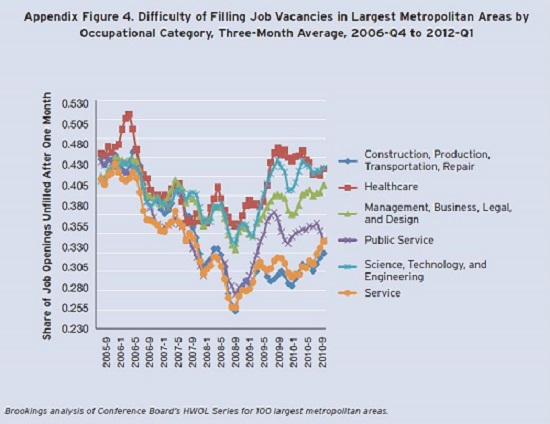
CU Blog - STEM Jobs Are Filling Slowly - Photo 2This graph depicts the percentage of jobs that remain unfilled after a month of advertising in the major sectors. It displays the skill gap in which healthcare and STEM sectors have a much harder time filling their positions than construction, production, transport, repair as well as public service sectors. Some analysts have argued in the past that due to the skill gap, the unemployment rate will be slow to fall. The author states that such gap will increase as this survey results show earnings and unemployment rate for STEM and non-STEM workers will be enlarged.

The book Go Lean…Caribbean posits that the reasons why the Caribbean brain drain is so acute, reported at exceeding 70%, are “push and pull” factors. That North American, and European countries can appeal to Caribbean educated workers more enticingly that their homeland. This is the pull factor. In addition the economic, security and governing deficiencies in the Caribbean “push” the native workers to consider expatriating. This can be likened to casting a ballot. The well-educated, skilled STEM worker in the Caribbean can simply choose to vote for “none of the above”; they vote with their feet and their wallet and simply flee the region. Today, that pace is 70%. Since the Caribbean has its own needs for the STEM work force, these numbers cannot be ignored.

The Caribbean is in crisis. The book Go Lean…Caribbean serves as a roadmap for the introduction and implementation of the technocratic Caribbean Union Trade Federation (CU). The roadmap declares that a crisis is a terrible thing to waste, and thus will respond to minimize “push” factors while also creating more competitive environments to dampen the pull factors.

The roadmap, in total will elevate Caribbean society. The prime directives of the CU are presented as the following 3 statements:

  • Optimization of the economic engines in order to grow the regional economy to $800 Billion & create 2.2 million new jobs.
  • Establishment of a security apparatus to protect the resultant economic engines.
  • Improve Caribbean governance to support these engines.

The book posits that all of the Caribbean is in crisis with this brain drain problem, while at the same time we have the same urgent need for STEM talent. This point is stressed early in the book (Page 13) in the following pronouncements in the Declaration of Interdependence:

xix.   Whereas our legacy in recent times is one of societal abandonment, it is imperative that incentives and encouragement be put in place to first dissuade the human flight, and then entice and welcome the return of our Diaspora back to our shores. This repatriation should be effected with the appropriate guards so as not to imperil the lives and securities of the repatriated citizens or the communities they inhabit. The right of repatriation is to be extended to any natural born citizens despite any previous naturalization to foreign sovereignties.

xxi.   Whereas the preparation of our labor force can foster opportunities and dictate economic progress for current and future generations, the Federation must ensure that educational and job training opportunities are fully optimized for all residents of all member-states, with no partiality towards any gender or ethnic group. The Federation must recognize and facilitate excellence in many different fields of endeavor, including sciences, languages, arts, music and sports. This responsibility should be executed without incurring the risks of further human flight, as has been the past history.

This blog relates to the challenge of mitigating the brain drain. This has been a frequent topic for these Go Lean blogs, highlighted here in the following samples:

a. https://goleancaribbean.com/blog/?p=1683 Caribbean Diaspora subject to ‘poverty pay’ in Britain
b. https://goleancaribbean.com/blog/?p=1674 Obama’s Plans for $3.7 Billion Immigration Crisis Funds, stressing the need for reform in the US.
c. https://goleancaribbean.com/blog/?p=1596 Book Review: ‘Prosper Where You Are Planted’ – the antithesis of emigration
d. https://goleancaribbean.com/blog/?p=1470 College of the Bahamas Master Plan 2025 – Lacking response for brain drain
e. https://goleancaribbean.com/blog/?p=1433 Caribbean loses more than 70 percent of tertiary educated to brain drain
f. https://goleancaribbean.com/blog/?p=1296 Remittances from Diaspora to Caribbean Increased By 3 Percent in 2013
g. https://goleancaribbean.com/blog/?p=1256 Is a Traditional 4-year College Degree a Terrible Investment? Yes, for Caribbean students studying abroad.

The Go Lean roadmap is based on sound economic principles, of which a basic concept is supply-and-demand. For the US, according to the foregoing article, there are more demand than supply for STEM workers, In the past, demand-supply gaps have been filled with a liberal immigration policy, but there is no stomach for that in today’s political climate. So the family re-unification approach is the likely strategy to be employed imminently – ethnicities with larger immigrant populations already in the US will have an advantage but their homelands will have more brain drain.

This is the premise for this commentary, that more pressure will be created for Caribbean citizens with STEM skill-sets to consider relocation, by connecting with their vibrant diaspora and family members for applying for entry into the US.

This means war.

Actually, war has already ensued; this issue is just the latest battle in this trade war.

To assuage these fears, and counteract the Caribbean losing dispositions in this trade war, the Go Lean book details a series of community ethos, strategies, tactics, implementations and advocacies to foster the best practices to mitigate further brain drain for the Caribbean region:

Community Ethos – Deferred Gratification Page 21
Community Ethos – Economic Systems Influence Choices & Incentives Page 21
Community Ethos – Job Multiplier Page 22
Community Ethos – Anti-Bullying and Mitigation Page 23
Community Ethos – Minority Equalization Page 24
Community Ethos – Return on Investments Page 24
Community Ethos – Ways to Impact the Future Page 27
Community Ethos – Ways to Foster Genius Page 26
Community Ethos – Ways to Help Entrepreneurship Page 28
Community Ethos – Promote Intellectual Property Page 29
Community Ethos – Ways to Impact Research & Development Page 30
Community Ethos – Ways to Close the Digital Divide Page 31
Community Ethos – Ways to Impact the Greater Good Page 37
Anecdote – Valedictorian and Caribbean Diaspora Member Page 38
Strategy – Customers – Citizens, Business   Community & Diaspora Page 47
Strategy – Meeting Region’s Needs Today, Preparing For Future Page 58
Tactical – Separation of Powers – Patent,   Standards, & Copyrights Page 78
Tactical – Separation of Powers – Education   Department Page 85
Implementation – Assemble all   Super-Regional Governing Entities Page 96
Implementation – Trends in Implementing   Data Centers Page 106
Implementation – Ways to Deliver Page 109
Implementation – Better Manage Debt –   Better Student Loans Dynamics Page 114
Planning – Ways to Improve Trade Page 128
Planning – Ways to Make the Caribbean Better Page 131
Advocacy – Ways to Grow the Economy Page 151
Advocacy – Ways to Create Jobs Page 152
Advocacy – Ways to Improve Education Page 159
Advocacy – Ways to Impact Student Loans – Forgivable Provisions Page 160
Advocacy – Ways to Foster Empowering Immigration – STEM Professionals Page 174
Advocacy – Ways to Foster Technology Page 197
Advocacy – Ways to Impact the Diaspora Page 217

Now is the time for all of the Caribbean, the people and governing (education) institutions, to lean-in for the elevations described in the book Go Lean … Caribbean. This is a big deal for the region. This roadmap is not just a plan; it is also the delivery of the hopes and dreams of generations of Caribbean residents to finally assuage the brain drain.

The region needs the deliveries, described in the Go Lean roadmap. Otherwise, we have no hope to incite and retain our young people, especially those with STEM skill-sets. As a region, we would be condemned to a future of the status quo, or worse, simply “fattening frogs for snakes”. This roadmap therefore is vital in the quest to make the Caribbean a better place to live, work, learn and play.

Download the book Go Lean … Caribbean – now!

Share this post:
, , ,
[Top]

Obama’s Plans for $3.7 Billion Immigration Crisis Funds

Go Lean Commentary

If only we were ready now!

$3.7 Billion in new spending in communities that really do not want the activity.

This, according to the below article, is the ground situation regarding the current immigration crisis on the US-Mexico border with children from Guatemala, El Salvador and Honduras. The US government, Obama Administration, is requesting additional funding from Congress of $3.7 Billion to better interdict and respond during this crisis. The biggest part of the expense will be the detention functionality for the apprehended trustees.

This is a crisis … and this crisis is a terrible thing to waste!

By: Mary Bruce

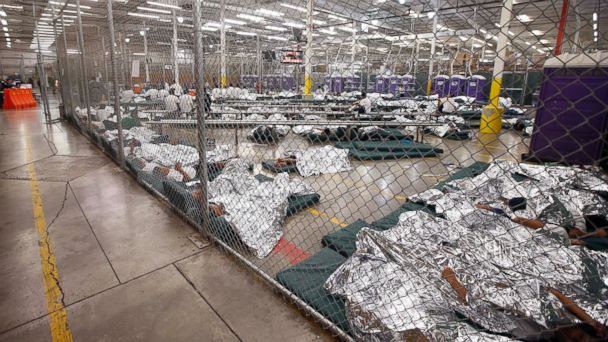
Detainees sleep and watch television in a holding cell where hundreds of mostly Central American immigrant children are being processed and held at the U.S. Customs and Border Protection Nogales Placement Center on June 18, 2014, in Nogales, Arizona. Ross D. Franklin-Pool/Getty Images

Detainees sleep and watch television in a holding cell where hundreds of mostly Central American immigrant children are being processed and held at the U.S. Customs and Border Protection Nogales Placement Center on June 18, 2014, in Nogales, Arizona. Ross D. Franklin-Pool/Getty Images

President Obama today is requesting $3.7 billion to cope with the humanitarian crisis on the border and the spike in illegal crossings by unaccompanied minors from Central America.

Roughly half of the funding would go to the Department of Health and Human Services to provide care for the surge of children crossing the border, including additional beds.

The rest would be split between several departments to tackle the issue on both sides of the border, including $1.6 billion to the Departments of Homeland Security and Justice to boost law enforcement at the Southwest border and pay for additional immigration judge teams, among other things, and $300 million to the State Department to tackle the root causes of this crisis and to send a clear message to these countries not to send children illegally to the U.S.

Today’s funding request is separate from policy changes that the administration is also seeking to speed up the deportation of the children, most of whom are from Guatemala, El Salvador and Honduras. The White House sent a letter to Congressional leadership last week requesting the legal changes to make it easier to send them home.

According to a White House official, greater administrative authority as well as the additional resources will help make it more efficient and expeditious to process and return the children.

What remains unclear is how much faster this additional funding would make the process to send children back to their home countries. White House officials today declined to speculate on such timing, but the administration has said that most of the unaccompanied minors will likely be “sent home.”

“Based on what we know about these cases, it is unlikely that most of these kids will qualify for humanitarian relief. And what that means is it means that they will not have a legal basis for remaining in this country and will be returned,” White House Press Secretary Josh Earnest said Monday.

The White House has yet to say how many of the roughly 52,000 children that have been apprehended this year have been sent back to Central America. Today, officials offered only the total figure, including adults. So far this year, Immigration and Customs Enforcement has removed almost 233,000, that includes over 87,000 to Central American countries.

Here’s a detailed look at some of the ways the president wants to spend $3.7 billion to deal with the influx of unaccompanied minors, according to the White House.

$364 MILLION:

To pay for operational costs of responding to the significant rise in apprehensions of unaccompanied children and families, including overtime and temporary duty costs for Border Patrol agents, contract services and facility costs to care for children while in CBP custody, and medical and transportation service arrangement.

$39.4 MILLION:

To increase air surveillance capabilities that would support 16,526 additional flight hours for border surveillance and 16 additional crews for unmanned aerial systems to improve detection and interdiction of illegal activity.

$109 MILLION:

To provide for immigration and customs enforcement efforts, including expanding the Border Enforcement Security Task Force program, doubling the size of vetted units in El Salvador, Guatemala, and Honduras, and expanding investigatory activities by ICE Homeland Security Investigations.

$879 MILLION:

To pay for detention and removal of apprehended undocumented adults traveling with children, expansion of alternatives to detention programs for these individuals, and additional prosecution capacity for adults with children who cross the border unlawfully.

$45.4 MILLION:

To hire approximately 40 additional immigration judge teams, including those anticipated to be hired on a temporary basis. This funding would also expand courtroom capacity including additional video conferencing and other equipment in support of the additional immigration judge teams. These additional resources, when combined with the FY 2015 Budget request for 35 additional teams, would provide sufficient capacity to process an additional 55,000 to 75,000 cases annually.
ABC News Online News Video Source (Retrieved 07/08/2014) – http://abcnews.go.com/blogs/politics/2014/07/obamas-plans-for-3-7-billion-immigration-crisis-funds/

ABC News | ABC Sports News

The overriding theme of the foregoing news article is the need for professional detention capabilities. Within this crisis, the publishers of the book Go Lean…Caribbean see opportunities for commerce.

The book posits that the region must prepare its own security apparatus for its own security needs. But while we are building facilities (prisons, jails, detention centers, etc) for our own needs, we can employ the strategy of over-building and insourcing for other jurisdictions. Had we been ready now, with this Go Lean plan, we would have been able to embrace the opportunities presented by this Central American Children Crisis. This point is pronounced early in the book with the Declaration of Interdependence (Page 12) that claims:

x.   Whereas we are surrounded and allied to nations of larger proportions in land mass, populations, and treasuries, elements in their societies may have ill-intent in their pursuits, at the expense of the safety and security of our citizens. We must therefore appoint “new guards” to ensure our public safety and threats against our society, both domestic and foreign. The Federation must employ the latest advances and best practices of criminology and penology to assuage continuous threats against public safety. The Federation must allow for facilitations of detention for convicted felons of federal crimes, and should over-build prisons to house trustees from other jurisdictions.

xvi. Whereas security of our homeland is inextricably linked to prosperity of the homeland, the economic and security interest of the region needs to be aligned under the same governance. Since economic crimes … can imperil the functioning of the wheels of commerce for all the citizenry, the accedence of this Federation must equip the security apparatus with the tools and techniques for predictive and proactive interdictions.

The Go Lean roadmap facilitates the introduction and implementation of the technocratic Caribbean Union Trade Federation (CU). With 2 American territories in the Caribbean (Puerto Rico & the US Virgin Islands), it would be a simple proposal to Washington to offer to house these Central American Children in a Caribbean detention center, until some disposition is finalized regarding their individual cases. Then portions of that $3.7 Billion could be earned here, in the Caribbean.

The book asserts that the CU can copy the model of the small Pacific island country of Nauru (Page 290).  As of July 2013 the detention center there was holding 545 asylum seekers on behalf of Australia … for a fee, assuaging an immigration crisis for Australia.

In addition to government spending, there will be the bonus of private spending from the visitors and family members of the detainees.

Just like that: Commerce!

This is the goal of Go Lean…Caribbean, to confederate under a unified entity made up of all 30 Caribbean member-states. Then provide homeland security for “our neighborhood”, contending with man-made and natural threats. The CU security goal is for public safety! The CU is set to optimize Caribbean society through a number of missions. The Go Lean roadmap has 3 prime directives:

  • Optimization of the economic engines in order to grow the regional economy to $800 Billion & create 2.2 million new jobs.
  • Establishment of a security apparatus to protect the resultant economic engines.
  • Improve Caribbean governance to support these engines.

In recent blog submissions, this commentary highlighted the security provisions that must be enacted to improve homeland security, as soon as possible:

https://goleancaribbean.com/blog/?p=1554 Status of Forces Agreement = Security Pact
https://goleancaribbean.com/blog/?p=1076 References to the Caribbean Regional Security System

If only those provisions were in place already!

We console with the communities dealing with this crisis; already there have been protests from townspeople where the existing American detention facilities are located. We also console with the refugees fleeing the crime, violence and despair in their homeland; this Go Lean roadmap is the Caribbean’s aspiration to mitigate against a similar Failed-State status (Page 134).

Underlying to the prime directive of elevating the economics, security and governing engines of the Caribbean is the desire to make the Caribbean homeland, a better place to live, work and play (Page 131) and to impact the Greater Good (Page 37) because “the needs of the many should outweigh the needs of the few”.

Download the free e-Book of Go Lean … Caribbean – now!

Share this post:
, , , , ,
[Top]

Blue is the New Green

Go Lean Commentary

First we said to “Go Green!”

Now we are saying to “Go Blue”, because Blue is the new Green. While ‘Green’ is indicative for all-things-environmental, ‘Blue’ refers specifically to Water.

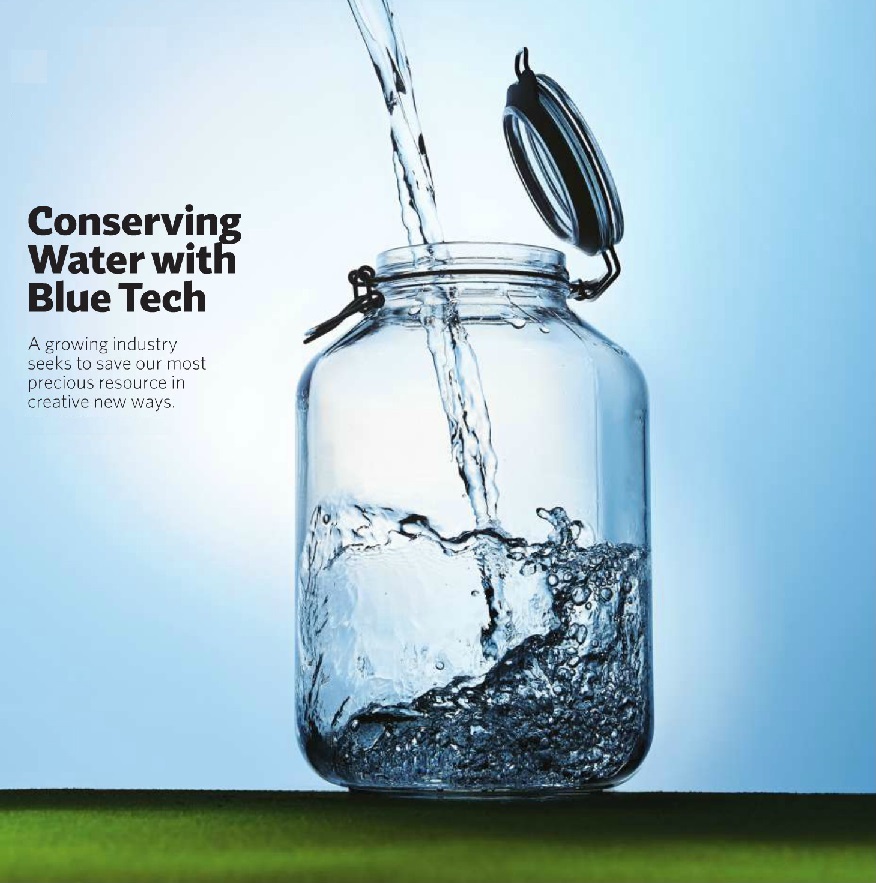
There is money in Green; there is money in Blue too! The references to Blue waters apply equally to fCU Blog - Blue is the New Green - Photoresh water and seawater. When we consider all the waterscapes in the Caribbean, (1,063,000 square-miles of the Caribbean seas and thousands of islands in the archipelago – The Bahamas has over 700 alone), we realize how much opportunity exists.

This is the time to be proactive; and to facilitate the intersection of preparation and opportunity. (This is one definition of luck. This is how to create one’s own luck).

Considering all the opportunities, how can the Caribbean prepare its economic engines to harvest all the fruitage from these Blue market conditions? This is the theme of the book Go Lean…Caribbean, that the world is struggling to contend with monumental changes related to technology, globalization and most importantly Climate Change.

Early in the book, the pressing need to be aware and to adapt to Climate Change is pronounced in the Declaration of Interdependence (Page 11), with these words:

i. Whereas the earth’s climate has undeniably changed resulting in more severe tropical weather storms, it is necessary to prepare to insure the safety and security of life, property and systems of commerce in our geographical region. As nature recognizes no borders in the target of its destruction, we also must set aside border considerations in the preparation and response to these weather challenges.

The Caribbean needs Blue Technology solutions to sustain our own lives, liberties and systems of commerce. But the Go Lean book posits that we cannot just consume, we must also create, produce, and foster. So we must foster industrial solutions for the rest of the world. This subsequent magazine-article-summary highlights the progression in this new Blue Technology industry-space in these areas:
Sourcing
Treating
Storing
Conserving
Keeping it Clean
————-

VIDEO – The Blue Economy – https://youtu.be/7NqhVbCtqNk

Published on Jul 3, 2012 – The oceans have long been the centre of economic activity. People have been living near the sea, feeding themselves by fishing and making their livelihoods on the coast for thousands of years. The challenge today is harnessing the potential of this Blue Economy.

————-

Excerpts of Article by: Adam Bluestein

Forget for a moment about carbon emissions. The world is facing a more immediate crisis — it is running out of clean water. The prospect of widespread shortages is creating a new kind of new economy. Featured here are a number of entrepreneurial firms who are ahead of the curve, finding opportunity in the largest emerging market the world has seen in some time.

Analysts estimate that the world will need to invest as much as $1 trillion a year on [water] conservation technologies, infrastructure, and sanitation to meet demand through 2030. As in the past, most of the large capital-intensive projects will be done by the usual multinational corporations and engineering firms. But the extent of the problem and the demand for new technology to address it present — pardon the metaphor — a kind of perfect storm for entrepreneurs. “Small companies with intellectual property, significant know-how, and a product that’s scalable can stake out a niche below the radar of the large companies,” says Laura Shenkar, a water expert and consultant in San Francisco. “This is an opportunity that will generate Googles.”

There are a number of business roles that emerge from seizing the opportunities to develop solutions to water challenges:

Sourcing – Increasing the Supply

The well-documented experience around the world is that poverty comes from inadequate access to fundamental resources, like water. To assuage this threat, there are solutions in place now to deliver added fresh water by many means: irrigation canals, pipelines and tanker trucks/tanker ships (i.e. tanker ships between France and Algeria; Turkey and Israel). An emerging solution operated in the Middle East and India is small-scale barge-based desalination systems. These systems play an important role in increasing the supply of freshwater, especially after a natural disaster (storm or earthquake) when normal infrastructure may be crippled.

In general, desalination is an expensive option. Desalination, of course, is well-and-good for communities close to the ocean/seas and that can afford relatively expensive water. For everyone else, exploring inland pumping solutions is essential. An innovation comes from Deerfield Beach, Florida-based company Moving Water Industries. They produce SolarPedalFlo, a solar and pedal-powered pump that can singly provide filtered and chlorinated water for thousands of people every day.

Treating It

As the gold standard of disinfection for more than 100 years, chlorine kills bacteria, viruses, and other pathogens, and it has played a key role in eliminating diseases such as typhoid and cholera in the U.S. Chlorine’s benefits in water are twofold: it not only disinfects but also remains at a residual level in the water, preventing reinfection by viruses or bacteria during transport, storage, and distribution.

Water treatment is just a basic fact. While moving water is very power intensive, a huge energy user that it doesn’t make sense to continue to treat it one place, pump it, live with “losses and degradation”, and move it someplace else to dispose of it. This is depicted with a swimming pool. One would not fill it up and dump it out every time it is used. This defies logic.

But safety and security issues abound with Chlorine solutions, as it is a hazardous material to transport. An emerging solution is a compact generator, by MIOX, an Albuquerque, New Mexico-based outfit founded in 1994. Their equipment allows water treatment facilities to produce liquid chlorine on site. This solution uses only water, salt, and electricity, thus eliminating the need to store or transport hazardous chemicals.

In a developing country, the ability to treat one’s own water at home can be a matter of life and death. Those with limited means often purify water by boiling it or mixing it with iodine tablets. Those who can afford it use home water-purification systems. One of the companies capitalizing on demand for such systems is Eureka Forbes, India’s largest manufacturer of home water-purification systems. They have profited from their effort to make home water-purification systems much more affordable.

Storing It

It’s nice to imagine that water flows magically from a pristine reservoir or spring to your home faucet, but that’s simply not the case. As we have seen, it is disinfected and pumped along through a sprawling network of water mains and pipes. The U.S. water network (including Puerto Rico and the US Virgin Islands), much of it built in the 1950s and ’60s, will require some $277 billion worth of construction, upgrades, and replacement in the next 20 years, according to EPA (Environmental Protection Agency) estimates. With scarcity driving water agencies to fix leaks — by some estimates, about six billion gallons per day in the U.S. are lost through literal cracks in the system — companies making high-tech metering and leak-detection technologies are doing well for themselves.

Water Storage Tanks – After being treated, drinking water can spend as long as 100 days in the distribution system before reaching an end user. That’s not necessarily a bad thing, but when water sits in a tank too long, it begins to stagnate and settle into layers of different temperatures, as in a lake. In warmer layers at the top, the disinfectants used in treatment are burned off, which increases the potential for contamination. Even when the water is being used, poor tank design can create an uneven distribution of disinfectant and encourage uneven aging, allowing water at the bottom of a tank to be replenished more quickly than water at the top.

The traditional solution is to dump more disinfecting chemicals into the holding system, leading to the formation of chemical byproducts. Another solution is to use energy-intensive “operational cycling” – basically pumping moving water around from tank to tank.

An energy-efficient, inexpensive, and elegant solution is called the Lily Impeller (by San Rafael, California-based PAX Water Technologies, founded in 2006). It’s a spiral propeller that’s installed on the bottom of a storage tank; it can mix up to seven million gallons of water while drawing the same amount of energy as three 100-watt light bulbs.

Another solution is a floating solar-powered impeller, which could improve surface water to be treated for drinking or even provide basic wastewater remediation.

Conserving It

A basic example of water conservation is a water recycling system that would take used water from the bathroom sink, disinfect it, and reroute it to the toilet tank for flushing.

One option: The AQUS System uses standard plumbing parts and can be installed by a professional plumber in about two hours. Priced at $395 (before rebates), it can save up to 6,000 gallons of water a year in a two-person household.

Another option: water-free urinals – biodegradable liquid with a specific gravity lighter than water.

Utilities have found that offering customers rebates for things such as low-flow showerheads and toilets and efficient front-loading clothes washers has been a reliable and cost-effective way to curb water use, and the cost of energy to supply and treat water.

A final option: WeatherTRAK irrigation controllers – a (software-based) system that uses live weather data, rather than preset timers, to tell sprinklers when and how much to water crops, lawns, and commercial landscapes.

Keeping It Clean

Though drought is one of the more obvious consequences of Climate Change, water experts are equally worried about the problems caused by extreme storms and flooding that many, if not most, scientists believe are another consequence of global warming. Storm-water runoff has become a concern for its effect on surface and ground water, as well as the additional burden that it puts on already creaky wastewater treatment facilities.

One solution: Scottsdale, Arizona-based AbTech Industries, first used their Smart Sponges — made from a synthetic polymer — in 1997 to clean up oil spills from tankers at sea. In 1999, when they turned their attention to storm water, most regulation was focused on runoff from new construction. But billions of gallons of rain that come down on the roads and go into our flood-control devices could be contaminated on the way through. This company molds their sponge material into different shapes that would fit into street-level storm drains and catch basins, soaking up oil and debris and letting clean water pass through. They also developed a way to coat the sponges with an antimicrobial agent so they would disinfect water as well. Their next iteration, add the ability to capture heavy metals, herbicides, and pesticides.

Another solution for eliminating challenging pollutants from water, compared to the traditional approach using mechanical filters or chemicals, researchers have experimented with using genetically modified organisms to degrade water pollutants. This new technological solution, being commercialized by companies like Overland Park, Kansas-based Microvi Biotech (founded in 2004), is literally eating these pollutants up. Their company verbiage explains: “The idea of using biotechnology — using concepts from nature — to clean up water has proven very appealing”.

—-

Adam Bluestein is a Burlington, Vermont-based freelance writer.
INC Magazine for Entrepreneurs (Article posted November 1 2008; retrieved 07/07/2014) – http://www.inc.com/magazine/20081101/blue-is-the-new-green.html

The topics in this commentary are relevant and familiar. Prudent water management is vital for Caribbean life, our public safety and commerce systems. Tourism continues to be the primary economic driver in the region. While the motivation behind the Caribbean “Lean” is to diversify the economy, prudence dictates that we do not undermine current successful tourism engines. Since tourists come to the region for sand, surf and sun, there must be a “quality” sentinel for Caribbean water works, waterscapes and water eco-systems.

This point is detailed in the book Go Lean…Caribbean, a roadmap for the introduction and implementation of the technocratic Caribbean Union Trade Federation (CU). This roadmap has 3 prime directives:

  • Optimization of the economic engines in order to grow the regional economy.
  • Establishment of a security apparatus to protect the homeland and related economic engines.
  • Improve Caribbean governance to support these engines.

This Go Lean commentary delved into related subjects in these previous blogs:

https://goleancaribbean.com/blog/?p=1516 Floods in Minnesota, Drought in California – Why Not Share?
https://goleancaribbean.com/blog/?p=915 Go ‘Green’… Caribbean

Water is not cheap. It is only free when it rains. The effort to source, treat, store, conserve and keep water clean takes a big investment on the part of community and governmental institutions. While we commend and applaud the regional executions thus far, the Go Lean book recognizing that there is more heavy-lifting to do. Help is on the way! The Go Lean roadmap details a series of community ethos, strategies, tactics, implementations and advocacies to foster the progress in the wide field of Blue technology. The following list applies:

Community Ethos – Lean Operations Page 24
Community Ethos – Return on Investments Page 24
Community Ethos – Cooperatives Page 25
Community Ethos – Non-Government Organizations Page 25
Community Ethos – Ways to Impact the Future Page 26
Community Ethos – Impact the Greater Good Page 37
Anecdote – Pipeline Transport – Strategies, Tactics &   Implementations Page 43
Strategy – Build and foster local economic engines Page 45
Tactical – Fostering a Technocracy Page 82
Tactical – Separation of Powers – Public Works Page 82
Anecdote – “Lean” Environmental Quality Process Page 93
Implementation – Ways to Develop Pipeline Industry Page 107
Advocacy – Ways to Impact Public Works Page 175
Advocacy – Ways to Foster Cooperatives Page 176
Advocacy – Ways to Better Manage Natural Resources – Water   Resources Page 182
Advocacy – Ways to   Foster Technology Page 197
Advocacy – Ways to Impact Monopolies Page 202
Advocacy – Ways to Impact   Rural Living – Minimize Irrigation Downsides Page   235
Appendix – Pipeline   Maintenance Robots Page   283

Water needs are undeniable.

Fulfilling those needs is a great target for lean, agile operations, perfect for the CU technocracy. While its “good to be green”, being “blue” is not an option we can choose to ignore, as the Caribbean is mostly made up of islands – surrounded by water.

Go Blue. Go Green. Go Lean.

Now is the time for all of the Caribbean, the people, entrepreneurs, institutions and governments, to lean-in for the optimizations and opportunities described in the book Go Lean … Caribbean.

Download the book Go Lean … Caribbean – now!


Share this post:
, , , , ,
[Top]

Book Review: ‘Chasing Youth Culture and Getting It Right’

Go Lean Commentary

One mission of the book Go Lean…Caribbean is to sell the youth of the region on future prospects in the Caribbean.

The publishers of this book therefore must assume the role of Marketing Brand Managers.

Why is this important?

  • 65% of Caribbean population is under the age of 30[b][c]; 30% under the age of 15.[c]
  • 70% percent of Caribbean tertiary educated abandon their homeland and migrate to foreign shores.[d]

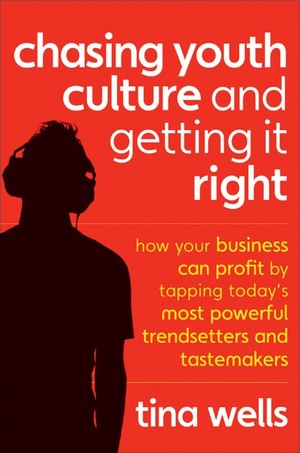
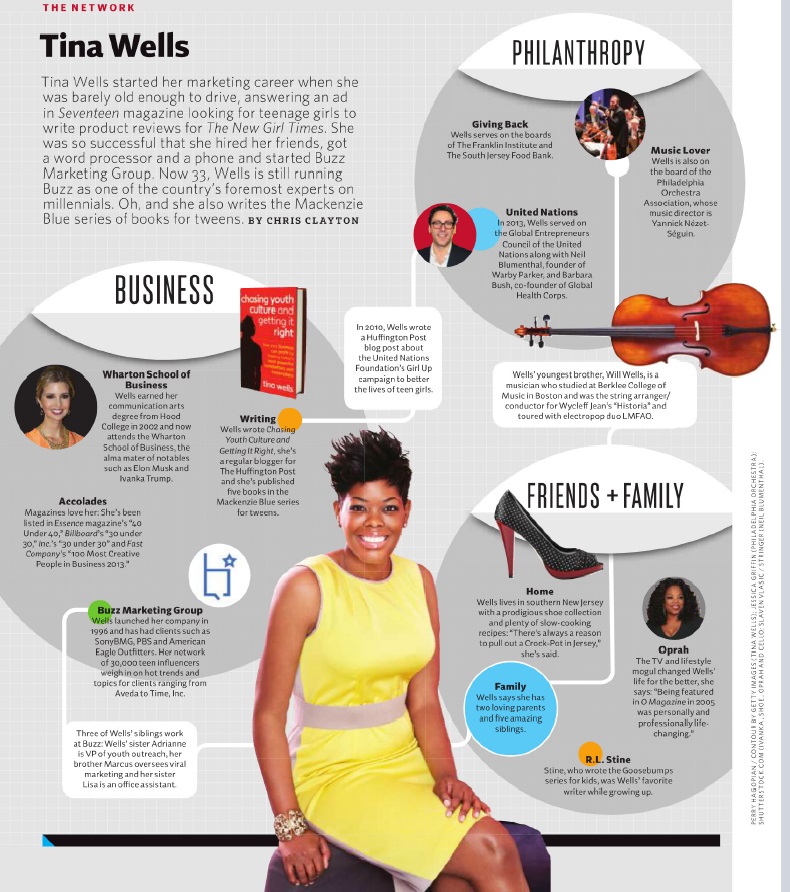
The job description for the publishers of the Go Lean book therefore become part-Marketer, part-Demographer, part-Drum Major; much like theCU Blog - Book Review - Chasing Youth Culture and Getting It Right - Photo 1 resource in this article here, Tina Wells, a writer, blogger and marketing firm founder:

By Alfred Edmond, Jr.

Black Enterprise Magazine – Book Review – April 19, 2011; Retrieved 07-06-2014 – http://www.blackenterprise.com/small-business/book-review-chasing-youth-culture-and-getting-it-right/

Subject: Buzz Marketing Group CEO Tina Wells urges you to market to teens, tweens and young adults not by age alone, but by tribe

In her new book Chasing Youth Culture and Getting It Right: How Your Business Can Profit by Tapping Today’s Most Powerful Trendsetters and Tastemakers, Buzz Marketing Group (Wiley, $16). Buzz Marketing CEO Tina Wells urges you to market to teens, tweens and young adults not by age alone, but by “tribe.” Citing her company’s research, as well as the success and failures of company’s marketing their goods and services to young consumers, Wells identifies four primary tribes:

  • The Wired Techie, driven by the need to be the first to discover, use and recommend new tech devices and gadgets.
  • The Conformist Yet Somewhat Paradoxical Preppy, traditional yet trendy buyers who are driven to want to fit in and belong.
  • The Always Mellow Alternative, who deviate from mainstream buying habits in order to pursue and support causes they believe in.
  • The Cutting Edge Independent, who deviate from the mainstream just for the sake of it.

While it’s difficult to accept that Wells’ tribes truly represent the totality of the thinking of tweens, teens and young adults, her book underscores an important reality of sales and marketing in the age of The Long Tail: Why The Future of Business is Selling Less of More ($10, Hyperion)–Chris Anderson’s must-read book about the changing nature of consumer choice and tastes in a largely digital marketplace: targeting consumers by age, race, gender and other traditional demographic markers alone is no longer enough for a business to be effective and, ultimately, profitable.

When it comes to marketing to youth, [Tina Wells] comes with unimpeachable bona fides. Already a 15-year veteran in the marketing business, she started Buzz Marketing as an 18-year-old, quickly carving out a niche and establishing a knack for understanding the trends, tastes and influences driving young consumers. Eventually graduating with honors with a B.A. in communication art from Hood College in 2002, and currently earning a marketing management degree at the Wharton School of Business, Wells creates marketing strategies for clients in the beauty, entertainment, fashion, financial and lifestyle sectors. Her clients have ranged from Sesame Street Workshop and PBS to American Eagle Outfitters and SonyBMG. Today, Wells, an expert contributor on entrepreneurship to BlackEnterprise.com, is well established as one of America’s most honored and celebrated young entrepreneurs.

So it’s no surprise that Wells brings and authoritative voice to Chasing Youth Culture and Getting It Right, confidently explaining the diverse world views of young consumers while smartly taking into account parents, as both their primary financial resource and the people with the most influence on their values. Wells also breezily illustrates, using vignettes of real young people who were subjects of her company’s survey, the impact of social media, globalization and the Great Recession on the “new millennials”. She also courageously weighs in on how young consumers feel about everything from environmentalism and corporate America to hypersexual content and America’s two-party political system.

In fact, sometimes Wells is over confident, making bold, sweeping overstatements about this or that aspect of the way young people think. For example, her description of “Global Mobiles” —young people who “live in a world without geographic or cultural boundaries” —is a stretch, conveniently overlooking the millions of young people, particularly low-income rural and urban Americans, who are hardly conscious of how people live on the other side of the tracks, much less the other side of the world. (Think Shawn Carter in the Brooklyn’s Marcy Projects before he became Jay-Z, the mogul and global citizen). While global mobiles absolutely exist, it’s too early to categorize them as a dominant factor in marketing.

The other major weakness of the book is [the] many examples of companies’ failed and/or successful efforts to market to youth culture; Wells ends up quickly glossing over most of them, causing them to lose some of their illustrative impact. I wish she’d used fewer examples, which would have allowed her to more effectively use those that remained as more enlightening and instructive case studies.

That said, if you’re a marketer or entrepreneur who wants to tap into the spending power of the generations of consumers who will drive the national and global economies over the next several decades (and come on, who doesn’t?), then you cannot afford to not read Chasing Youth Culture and Getting It Right. The book is both confirmation of Well’s formidable track record as an expert on the trends and tastes of young people, and powerful evidence of her prowess at using her immersion in her chosen area of expertise to peer around the corner into a future consumer marketplace, one that is evolving as unpredictably as it is quickly. Chasing Youth Culture and Getting It Right does solve all of the mysteries of marketing to young consumers, but it most certainly provides the most necessary, fascinating and useful clues.

——

Tina Wells is CEO of Buzz Marketing Group and is a columnist for BlackEnterprise.com [and Huffington Post]. Follow her on Twitter at @tinacwells and check out her new book, Chasing Youth Culture and Getting It Right, available now on amazon.com. (See Photo here).
CU Blog - Book Review - Chasing Youth Culture and Getting It Right - Photo 2
——

About the Review Author:

Alfred Edmond Jr. is SVP/Editor-at-large of BLACK ENTERPRISE. He is a content leader, brand representative and expert resource for all media platforms under the BLACK ENTERPRISE brand, including the magazine, television shows, web site, social media and live networking events. From 2008 through 2010, Edmond was SVP/Editor-in-chief of BlackEnterprise.com, helping to lead the transition of BLACK ENTERPRISE from single-magazine publisher to digital-first multimedia company. From 1995 through 2008, Edmond was chief editor of BLACK ENTERPRISE magazine. He also hosts The Urban Business Roundtable on WVON-AM in Chicago and Money Matters, a syndicated radio feature of American Urban Radio Networks.

Follow him on Twitter: alfrededmondjr; Facebook: http://facebook.com/alfrededmondjr; BE Insider: http://beinsider.ning.com/profile/Alfred

VIDEO: Inc. Magazine Entrepreneurial Reference Source  – http://videos.inc.com/index.php/kwidget/wid/1_5jek9891/uiconf_id/22577421

The book  Go Lean…Caribbean, parallels Chasing Youth Culture as it serves as a roadmap for the introduction and implementation of the Caribbean Union Trade Federation (CU) to elevate Caribbean society and culture. The idea of the CU must be marketed and sold to Caribbean stakeholders, young and old. The CU has 3 prime directives:

  • Optimization of the economic engines in order to grow the regional economy to $800 Billion and create 2.2 million new jobs.
  • Establishment of a security apparatus to protect the resultant economic engines.
  • Improve Caribbean governance to support these engines.

The Go Lean/CU effort is that of the legendary “Piped Piper”, in reverse to lead the children back home.

From the outset of the book, in the Introduction, the Go Lean roadmap (Page 10) posits that a target for the CU’s empowerments is Caribbean youth:

Our youth, the next generation, may not be inspired to participate in the future workings of their country; they may measure success only by their exodus from their Caribbean homelands.

Thusly, the CU must channel its inner “Tina Wells” to reach, engage, and sell to this youthful market.

There are other pronouncements that bear a direct reference to this foregoing article and source book, included here on Pages 11 & 13 of the Declaration of Interdependence:

vii. Whereas our landmass is finite and therefore limited as to population growth potential, it is imperative that prudent growth management be practiced so as to protect our legacy and still foster future opportunities for the hopes and fulfillment of a prosperous future for our children.

xix. Whereas our legacy in recent times is one of societal abandonment, it is imperative that incentives and encouragement be put in place to first dissuade the human flight, and then entice and welcome the return of our Diaspora back to our shores…

xxi. Whereas the preparation of our labor force can foster opportunities and dictate economic progress for current and future generations, the Federation must ensure that educational and job training opportunities are fully optimized for all residents of all member-states, with no partiality towards any gender or ethnic group. The Federation must recognize and facilitate excellence in many different fields of endeavor, including sciences, languages, arts, music and sports. This responsibility should be executed without incurring the risks of further human flight, as has been the past history.

The source book, Chasing Youth Culture and Getting It Right identifies the target demographic of millennials. This subset of youth population is identified as those born between the decades of the 1980’s and 2000’s[a]. Why so special? While every age group has always contended with a generation gap (Depression-era, Baby Boomers, Generation X), this current millennial generation is at the frontline of the current Caribbean battles, of which the region is sorely losing. The issues/crises dumbfounding Caribbean governance include: the impact of social media, globalization and the Great Recession.

Go Lean…Caribbean trumpets a call to the world of technology to impact Caribbean life. In addition to economic and security empowerments, this roadmap advocates the launch of a social media site – www.myCaribbean.gov – for all Caribbean stakeholders (residents, Diaspora, young students, business entities, and even visitors). This can create a universe of over 160 million unique profiles. The Go Lean roadmap is to deliver many government services via electronic modes, including public safety fulfillments, like Reverse 911 and Emergency Alert messaging.

The following lists details from the book Go Lean…Caribbean that parallels the advocacies of the source book Chasing Youth Culture and Getting It Right:

Community Ethos – Lean Operations Page 24
Community Ethos – Cooperatives Page 25
Community Ethos – Ways to Impact the Future Page 26
Community Ethos – Ways to Bridge the Digital Divide Page 31
Community Ethos – Impact the Greater Good Page 37
Strategy – Customers – Member-State Governments Page 51
Strategy – Agents of Change – Technology Page 57
Strategy – Agents of Change – Globalization Page 57
Strategy – Agents of Change – Aging Diaspora Page 57
Tactical – Fostering a Technocracy Page 64
Tactical – Separation of Powers – Postal Union Page 78
Anecdote – Turning Around the CARICOM governance Page 92
Anecdote – “Lean” in Government Page 93
Implementation – Ways to Pay for Change Page 101
Implementation – Ways to Deliver Page 109
Implementation – Ways to Impact Social   Media Page 111
Implementation – Reasons to Repatriate Page 118
Advocacy – Ways to Improve Governance Page 168
Advocacy – Ways to Better Manage the Social Contract Page 170
Advocacy – Ways to Foster Technology Page 197
Advocacy – Ways to Foster e-Commerce Page 198
Advocacy – Ways to Impact the Diaspora Page 217

The source book Chasing Youth Culture and Getting It Right is a great guidebook for developing participatory, agile institutions, enabled by advanced technology – a recipe for the CU. The Go Lean roadmap is also a great guidebook!

Now is the time for all of the Caribbean, the people (teenagers, adults & senior citizens) and governing institutions, to lean-in for the empowerments described in the book Go Lean…Caribbean. We cannot expect the youth to take their own lead; they must be led, but they will only respond to a certain style of leadership. Understanding that dynamic is the heavy-lifting involved in impacting change in the Caribbean region.

This is an art and a science!

There will be costs to incur for this advocacy, yes, but there are a lot of benefits too. The benefits are far too alluring to ignore: dawn of a new economy and new opportunities to preserve Caribbean culture for the Caribbean youth … and future generations.

🙂

Download the free e-Book of Go Lean … Caribbean – now!

———————

Appendix – Cited References:
a. Millennials (also known as the Millennial Generation or Generation Y) are the demographic cohort following Generation X. There are no precise dates when the generation starts and ends. Researchers and commentators use birth years ranging from the early 1980s to the early 2000s.
b. Example of Haiti; retrieved from http://populationaction.org/wp-content/uploads/2011/12/Haiti_Summary.pdf
c. Latin America & Caribbean Population 2005 retrieved from: http://www.eclac.cl/celade/noticias/documentosdetrabajo/6/48786/ Demographic_Trends_in_LAC_PAULO_SAAD_ED_12_7_09.pdf
d. Inter-American Bank report featured in CU Blog; retrieved from: https://goleancaribbean.com/blog/?p=1433


Share this post:
, , , , , ,
[Top]

Cuba mulls economy in Parliament session

Go Lean Commentary

Cuba is the largest population base in the Caribbean, with 11,236,444 people as of 2010. So any empowerment effort for the region cannot ignore this big landmass in the middle of the Caribbean and not this many people; (more than 26% of the region’s 42 million).

The book Go Lean…Caribbean does not ignore the island, but rather declares an interdependence with Cuba.

The book serves as a roadmap for the introduction and implementation of the Caribbean Union Trade Federation (CU), a technocratic federal government to administer and optimize the economic/security/ governing engines of the region’s 30 member-states – including Cuba. The premise for this inclusion is the pronouncement as reported here, in the foregoing article, of Cuba’s desire to be included in the international community:

Castro and other officials say they are not embracing capitalism but rather updating Cuba’s socialist model to survive in the 21st century global economy.

The entire article is listed as follows:

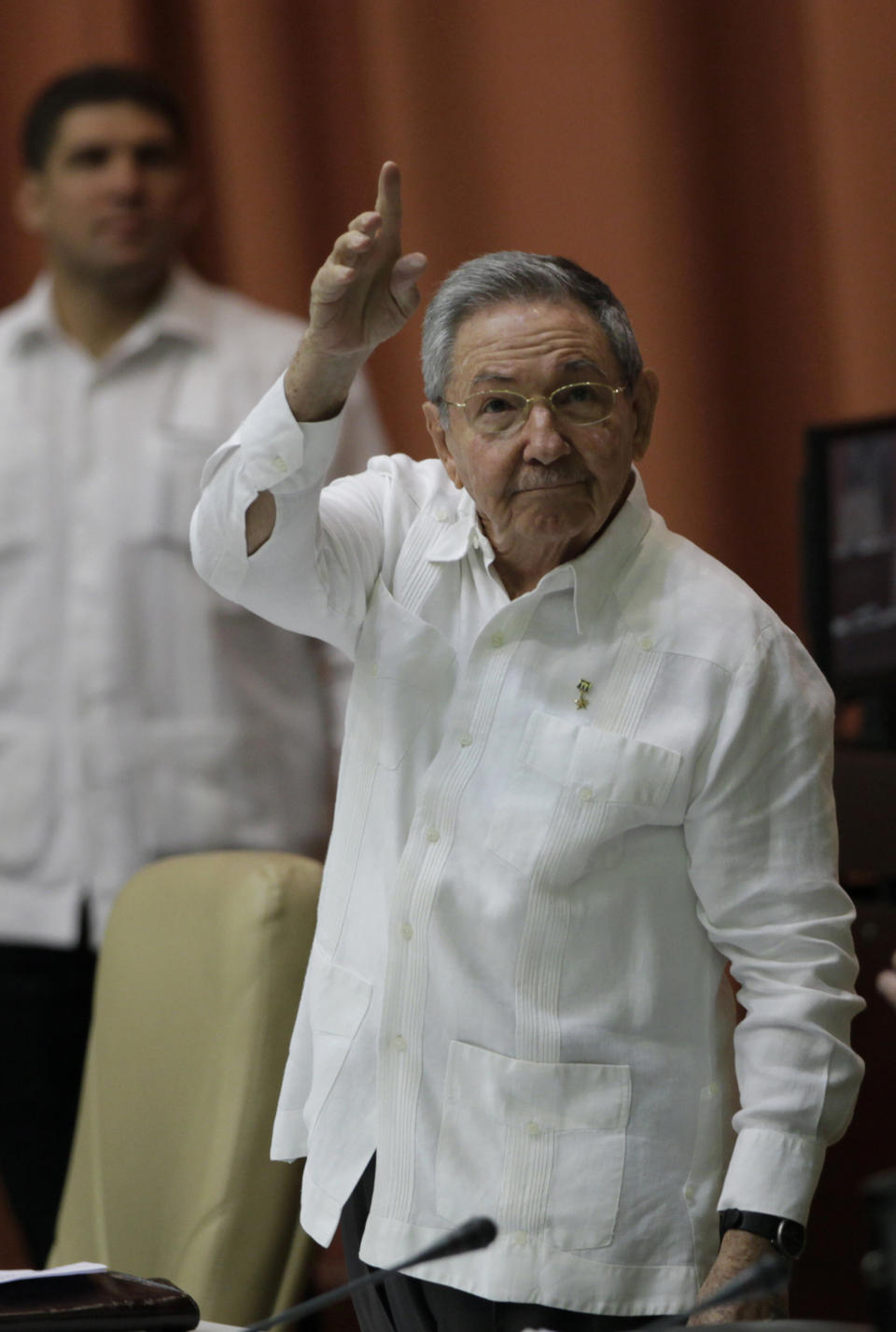
Cuba's President Raul Castro greets members of Parliament at the opening of the third regular session of the eighth legislature, at the National Assembly in Havana, Cuba, Saturday, July 5, 2014. (AP Photo/Ismael Francisco, Cubadebate)

Cuba’s President Raul Castro greets members of Parliament at the opening of the third regular session of the eighth legislature, at the National Assembly in Havana, Cuba, Saturday, July 5, 2014. (AP Photo/Ismael Francisco, Cubadebate)

HAVANA (AP)annual sessions, with the country’s limping economy and the 2014 budget foremost on the agenda.Government-run website Cubadebate published pictures of President Raul Castro presiding over the assembly with Vice President Miguel Diaz-Canel at his side.
Foreign journalists were not allowed access to the gathering at a convention center in western Havana.
Cuba recently downgraded its 2014 economic growth forecast to 1.4 percent, nearly a point lower than previous projections of 2.2 percent.
The government reported 2.7 GDP expansion the previous year.
Castro’s government is in the middle of a package of reforms that officials hope will improve economic performance.
Cuba has decentralized state-owned enterprises, legalized home and used car sales, and let hundreds of thousands of people open or work for small businesses in the private sector.
Castro and other officials say they are not embracing capitalism but rather updating Cuba’s socialist model to survive in the 21st century global economy.
Parliament was also expected to consider a report from the comptroller’s office on its attempts to root out corruption.
Lawmakers met earlier this week in committee to discuss matters including the biotechnology and agriculture.
Official media reported that Agriculture Minister Gustavo Rodriguez said Cuba’s food imports have reached $2 billion a year, but the country believes it could produce 60 percent of that domestically.
Associated Press Online News Source (Posted 07-05.2014) – http://news.yahoo.com/cuba-mulls-economy-graft-parliament-session-150935232.html

Go Lean…Caribbean is not a dream; it clearly recognizes the historicity of Cuba in the North American lexicon. There is a current trade embargo with the US and there are US$ 6 Billion of unsettled civil judgments against the Cuban government. The book posits that confederating with Cuba is a “Big Idea” for the Caribbean. This roadmap therefore, is a detailed, turn-by-turn plan for reconciling the 55 year-old rift in US-Cuban relations.

Cuban President Raul Castro has announced that he will retire in 2017 and now there is this declared intent above for Cuba to compete in the global economy, so now is the time to execute this Go Lean plan.

This commentary previously featured articles on the subjects of Cuba’s eventual integration into the Caribbean brotherhood, as sampled here:

https://goleancaribbean.com/blog/?p=789 America’s War on the Caribbean
https://goleancaribbean.com/blog/?p=554 Cuban cancer medication registered in 28 countries
https://goleancaribbean.com/blog/?p=436 Cuba Approves New “Law on Foreign Investment”

At the outset, the Go Lean roadmap recognizes the value of significance of Cuban reconciliation into any Caribbean integration with this statement in the Declaration of Interdependence (Page 12):

xiii. Whereas the legacy of dissensions in many member-states (for example: Haiti and Cuba) will require a concerted effort to integrate the exile community’s repatriation, the Federation must arrange for Reconciliation Commissions to satiate a demand for justice.

The Go Lean roadmap is not all “give” with no “take” for Cuba. There is heavy-lifting on their part in submitting to regional authority in matters of the CU scope: economic engines, security apparatus and governing support. This intent was also pronounced early in the same Declaration of Interdependence (Page 12):

xii. Whereas the legacy in recent times in individual states may be that of ineffectual governance with no redress to higher authority, the accedence of this Federation will ensure accountability and escalation of the human and civil rights of the people for good governance, justice assurances, due process and the rule of law. As such, any threats of a “failed state” status for any member state must enact emergency measures on behalf of the Federation to protect the human, civil and property rights of the citizens, residents, allies, trading partners, and visitors of the affected member state and the Federation as a whole.

It is commonly accepted that just the presence of anyone named “Castro” in administering Cuba would be a guaranteed deterrent for success in confederating Cuba with the rest of the Caribbean. But 2017 is not far away. So the planning must start now. The Caribbean is hereby urged to lean-in to the following community ethos, strategies, tactics, implementations and advocacies to re-boot Cuba; as detailed in the book Go Lean…Caribbean sampled here:

Community Ethos – Economic Systems Influence Individual Choices & Incentives Page 21
Community Ethos – Voluntary Trade Creates Wealth Page 21
Community Ethos – Lean Operations Page 24
Community Ethos – Return on Investments Page 24
Community Ethos – Ways to Manage Reconciliations Page 34
Community Ethos – Ways to Impact the Greater Good Page 37
Strategic – Vision – Integrating Region in to a Single Market Page 45
Strategic – Core Competence – Specialty Agriculture Page 58
Tactical – Fostering a Technocracy Page 64
Tactical – Separation of Powers – Office of Trade Negotiations Page 80
Tactical – Separation of Powers – Federal Courts – Truth & Reconciliation Commissions Page 90
Implementation – Assemble & Create Super-Regional Organs to represent all Caribbean Page 96
Implementation – Ways to Pay for Change Page 101
Implementation – Foreign Policy Initiatives at Start-up Page 102
Implementation – Ways to Deliver Page 109
Implementation – Ways to Benefit from Globalization Page 119
Planning – 10 Big Ideas for the Caribbean – Cuba Page 127
Advocacy – Ways to Grow the Economy Page 151
Advocacy – Ways to Re-boot Cuba Page 236

The foregoing article addresses the issue of economic expansion strategies, tactics and implementations, but the book focuses on much more than just money issues; it features the more important issue of societal elevation. The Go Lean roadmap addresses cultural issues such as music, sports, art, education, repatriation and heritage. The book declares how unfortunate that most of Cuba’s history has been neutralized due to the 1959 revolution, expansion of communism, trade embargo and 50 years of isolation.

But this is a new day! It’s time now for change; not just change for change sake, but the elevations that were identified, qualified and proposed in the book Go Lean…Caribbean.

Cuba será libre!

Cuba can … and must become a better place to live, work and play.

Download the free e-Book Go Lean … Caribbean – now!

Share this post:
, ,
[Top]

COB Master Plan 2025 – Reach for the Lamp-Post

Go Lean Commentary

“Keep your feet on the ground and keep reaching for the stars” – Casey Kasem (1932 – 2014).

The world lost another icon of Rock-n-Roll last week with news of the passing of renowned DJ and Media Host Casey Kasem. He was well known for his closing salutation quoted above.

“Reaching for the stars” should be more than a radio catch phrase; it should be a community ethos. This is noticeably missing in the 2025 Master Plan for the University of the Bahamas. They appear to be striving for the cutting edge of 1985; they are not reaching for the stars, they are reaching for the lamp-post.

Title: College of The Bahamas Master Plan 2014-2024
The College’s plan to accommodate growth in programs and to improve campus life through the creation of a more beautiful and cohesive campus.

“Twenty-five percent growth in student enrollment is what the Master Plan for the University of the Bahamas seeks to accommodate”. Visit the link… to view this newly produced infomercial on the blueprint for the physical growth that will undergird the impending University.
Vimeo – Video Sharing Site (Retrieved 06/23/2014) – http://vimeo.com/98270213

College of The Bahamas Master Plan 2014-2024 from The College of The Bahamas on Vimeo.

Make no mistake; it is a good thing that the College of the Bahamas (COB) is graduating to the University of the Bahamas (in 2015). It is also incontrovertible that COB is inadequate in meeting tertiary education needs of Bahamians, not to think of the rest of the world. Don’t agree? Consider how many Bahamian students matriculate abroad; now consider how many foreign students matriculate at COB.

Debate over!

This is more than just an academic discussion, as the subject of Caribbean students abandoning their homeland for foreign shores is a motivator for the book Go Lean…Caribbean. The book serves as a roadmap for the introduction and implementation of the technocratic Caribbean Union Trade Federation (CU). This effort mitigates published reports that the Caribbean loses over 70% of tertiary educated citizens due to brain drain; (https://goleancaribbean.com/blog/?p=1433).

COB PhotoSo as the sole tertiary education institution in the Bahamas, it would be expected that a Master Plan would “dream a little dream” and strive to counter the negative realities of students matriculating abroad. Instead COB delivered a plan that only inches forward – only reaching for the lamp-post. The inadequacy in the Master Plan highlights the need for the Go Lean roadmap for elevating Caribbean society. The CU, using cutting edge delivery of best practices, will employ strategies, tactics and implementations to impact its prime directives; identified with the following 3 statements:

  • Optimization of the economic engines in order to grow the regional economy to $800 Billion & create 2.2 million new jobs.
  • Establishment of a security apparatus to protect the resultant economic engines.
  • Improvement of Caribbean governance to support these engines.

The Go Lean book posits that the Caribbean is in crisis, with the debilitating brain drain/societal abandonment rate, but that this crisis can be a useful because a “crisis is a terrible thing to waste”. Therefore the roadmap seeks to change the entire eco-system of Caribbean education and learning solutions. This vision is defined early in the book (Page 13 & 14) in the following pronouncements in the Declaration of Interdependence:

xix.   Whereas our legacy in recent times is one of societal abandonment, it is imperative that incentives and encouragement be put in place to first dissuade the human flight, and then entice and welcome the return of our Diaspora back to our shores…

xxi.   Whereas the preparation of our labor force can foster opportunities and dictate economic progress for current and future generations, the Federation must ensure that educational and job training opportunities are fully optimized for all residents of all member-states, with no partiality towards any gender or ethnic group. The Federation must recognize and facilitate excellence in many different fields of endeavor, including sciences, languages, arts, music and sports. This responsibility should be executed without incurring the risks of further human flight, as has been the past history.

xxvii.   Whereas the region has endured a spectator status during the Industrial Revolution, we cannot stand on the sidelines of this new economy, the Information Revolution. Rather, the Federation must embrace all the tenets of Internet Communications Technology (ICT) to serve as an equalizing element in competition with the rest of the world. The Federation must bridge the digital divide and promote the community ethos that research/development is valuable and must be promoted and incentivized for adoption.

So what (also how/when) should be featured in a Master Plan/roadmap for effectuating change in the tertiary education landscape for the Bahamas and the rest of the Caribbean?

The answer is not as simple as A-B-C-1-2-3. The answer requires heavy-lifting, a long reach, and a consideration of the economic realities of the region. Thus the Casey Kasem axiom is so applicable:

“Keep your feet on the ground and keep reaching for the stars”.

“Reaching for the stars” would include fostering Research & Development (R&D) on our college campuses. Also, the deployment of cutting-edge technologies to avail the benefits of e-Learning would deter the trend (and necessity) of young students studying abroad; thus minimizing the temptations to remain abroad or to subsequently emigrate. This would mean staying grounded!

The Go Lean book details a lot more, a series of assessments, community ethos, strategies, tactics, implementations and advocacies to foster the elevation of college education in the Caribbean region:

Community Ethos – Economic Systems Influence Choices & Incentives Page 21
Community Ethos – People Respond to Incentives Page 21
Community Ethos – Consequences of Choices Lie in the Future Page 21
Community Ethos – Return on Investments Page 24
Community Ethos – Ways to Impact the Future Page 26
Community Ethos – Ways to Foster Genius Page 27
Community Ethos – Ways to Impact Research & Development Page 30
Community Ethos – Ways to Bridge the Digital Divide Page 31
Community Ethos – Ways to Impact the Greater Good Page 37
Anecdote – Valedictorian Now Diaspora Member Page 38
Strategy – Vision – Realistic, Achievable, Demanding, & Inspirational Goal Page 45
Strategy – Mission – Local Education to Compete with the Best in the World Page 46
Tactical – Separation of Powers – Education Department – University Admin Page 85
Tactical – Separation of Powers – Labor Department – On-the-Job Training Page 89
Implementation – Ways to Pay for Change Page 101
Implementation – Steps to Implement Campuses   as Self-Governing Entities Page 105
Implementation – Ways to Deliver Page 109
Advocacy – Ways to Grow the Economy Page 151
Advocacy – Ways to Create Jobs Page 152
Advocacy – Ways to Improve Education Page 159
Advocacy – Ways to Impact Student Loans Page 160
Advocacy – Ways to Improve Libraries Page 187
Advocacy – Ways to Foster Technology Page 197
Advocacy – Ways to Impact Youth Page 227
Appendix – Education & Economic Growth Page 258
Appendix – Measuring Education Page 266

Now is the time for all of the Caribbean, the people and governing institutions, to lean-in for the empowerments described in the book Go Lean … Caribbean. This is a big deal for the region. This book is not just a Master Plan; it is roadmap with turn-by-turn directions of how to get from Point A, where we can only hope to dream of reaching the lamp-post, to Point B, where we can finally dream about reaching the stars.

The Bahamas in particular, and the Caribbean region as a whole needs the deliveries of Go Lean … Caribbean. Otherwise, we have no hope to incite/retain our young people to work towards promoting a better future for the Caribbean, and making it a better place to live, work, learn and play.

Thank you Casey Kasem, for reminding us, (with song, great-story-telling and a heartfelt out-reach), what it means to keep our feet on the ground while continuing to reach for the stars. Rest in Peace!

Download the book Go Lean … Caribbean – now!

Share this post:
, , , , , ,
[Top]

PayPal expands payment services to 10 markets

PayPal PhotoGo Lean Commentary

PayPal [a], the subject of the below news article, is an electronic payment company and this industry of electronic payments has become very important in the strategy for elevating the Caribbean economy. This is digital currency and not “hard money”, so there are no paper stock or coinage issues to be managed with this approach, but there are numerous risk and fraud issues. PayPal is starting to do business in some of the world’s most challenging markets, like Nigeria; this is a good resume for the Caribbean deployment of electronic payment systems.

By: Eric Auchard and Jason Neely

LONDON (Reuters) – PayPal is entering 10 new countries this week, including Nigeria, providing online payment alternatives for consumers via mobile phones or PCs in markets often blighted by financial fraud.

Rupert Keeley, the executive in charge of the EMEA region of PayPal, the payments unit of eBay Inc., said in an interview on Monday the expansion would bring the number of countries it serves to 203.

Starting on Tuesday, consumers in Nigeria, which has 60 million users and has Africa’s largest population, along with nine other markets in sub-Saharan Africa, Eastern Europe and Latin America will be able to make payments through PayPal.

“PayPal has been going through a period of reinvention, refreshing many of its services to make them easier to use on mobile (phones), allowing us to expand into fast-developing markets,” Keeley said.

Once the services go live, customers in the 10 countries with access to the Web and a bank card authorized for Internet transactions will be able to register for a PayPal account and make payments to millions of sites worldwide.

Initially, PayPal is only offering “send money” services for consumers to pay for goods and services at PayPal-enabled merchant sites while safeguarding their financial details. This is free to consumers and covered by fees it charges merchants.

“We think we can give our sellers selling into this market a great deal of reassurance,” said Keeley, a former regional banking executive with Standard Chartered Plc and senior executive with payment card company Visa Inc .

PayPal does not yet cover peer-to-peer transactions, which allow consumers to send money to other consumers. It has not yet enabled local merchants in the new markets to receive payments, nor is it offering other forms of banking services, he said.

A 2013 survey of 200 UK ecommerce sites by Visa’s CyberSource unit estimated that 1.26 percent of online orders are fraudulent and that 85 percent of merchants expected fraud to increase or remain static last year.

CyberSource also estimated that suspicion of fraudulent transactions result in 8.2 percent of online orders in Latin America being rejected by merchants, compared with 5.5 percent in Europe and 2.7 percent in the United States and Canada.

Such fraud can include ID theft, social engineering, phishing and automated harvesting of customer financial data via botnets, or networks of computers controlled by hackers.

A total of 80 million Internet users stand to gain access to PayPal global services this week, including those in five European markets – Belarus, Macedonia, Moldova, Monaco and Montenegro, four in the African nations of Nigeria, Cameroon, Ivory Coast, and Zimbabwe, as well as Paraguay. Internet usage figures are based on research by Euromonitor International.

PayPal counts 148 million active accounts worldwide.

Last week, MasterCard Inc , the world’s second-largest debit and credit card company, and a PayPal rival in payment processing, said it was working with the Nigerian government on a pilot to overlay payment technology on a new national identity card.

PayPal has operated in 190 markets since 2007 and added three countries – Egypt, Georgia and Serbia last year. Roughly a quarter of the $52 billion in payment volumes PayPal reported in the first quarter of 2014 were for cross-border transactions. PayPal reported $1.8 billion in revenue during the period.
Reuters News Service (Retrieved 06/16/2014) –
http://news.yahoo.com/paypal-expands-payment-services-nigeria-9-other-markets-141457269–sector.html

Central Banks print currency notes and determine the quantity, measured as M0. But there is no need for that activity with digital money, yet still, there is a big role for a Central Bank with command-and-control of the economy. This relates to M1 monetary supply. M1 refers to the measurement of the total of currency/money in circulation (M0) plus overnight bank deposits (like demand deposits, travelers’ checks & other checkable deposits). So when digital currencies are factored in, though there is no M0, there is still an increase in M1 nonetheless. As M1 values increase, there is a dynamic to create money “from thin-air”, called the money multiplier. The more money in the system, the more liquidity for investment and development opportunities.

Digital currencies are “reaping” the benefits of monetary supply without “sowing” the hard work of actual money/stock/coinage management!

This subject is detailed in the book Go Lean…Caribbean, which serves as a roadmap for the introduction of the Caribbean Union Trade Federation (CU) and the Caribbean Central Bank (CCB). This Go Lean roadmap has 3 prime directives:

  • Optimization of the economic engines in order to grow the regional economy to $800 Billion & create 2.2 million new jobs.
  • Establishment of a security apparatus to protect the resultant economic engines.
  • Improve Caribbean governance to support these engines.

This subject of electronic payment systems has been previously covered in these Go Lean blogs, highlighted here in the following samples:

a.     https://goleancaribbean.com/blog/?p=906 – Bitcoin needs regulatory framework to change ‘risky’ image
b.     https://goleancaribbean.com/blog/?p=528 – Facebook plans to provide mobile payment services
c.      https://goleancaribbean.com/blog/?p=360 – How to Create Money from Thin Air

This Go Lean/CU/CCB roadmap looks to employ electronic/digital currency schemes to impact the growth of the regional economy. This is defined early in the book in Verse XXIV (Page 13) of the Declaration of Interdependence, with these words:

Whereas a free market economy can be induced and spurred for continuous progress, the Federation must install the controls to better manage aspects of the economy: jobs, inflation, savings rate, investments and other economic principles…

Creating the CU/CCB governance is “Step One, Day One” in the Go Lean roadmap. Implementing this framework for electronic payments allows for emergence of the regional currency of the Caribbean Dollar. This currency emergence allows for the foundation, so that the regional society can be elevated, economically and governmentally.

The Go Lean posits that the business model of PayPal can be fully deployed in the region. Even though PayPal transacts in every CU member-state, except Cuba and Haiti [b], they have provided an example of how to develop an online electronic payment scheme. There is also the need to model other electronic schemes like Visa/MasterCard and Smart Cards (for Cruise Tourism).

The Go Lean book details a series of community ethos, strategies, tactics, implementations and advocacies to foster the proper controls for electronic payments in the Caribbean region:

Community Ethos – Money Multiplier Principle Page 22
Community Ethos – Lean Operations Page 24
Community Ethos – Cooperatives Page 25
Community Ethos – Promote Intellectual Property Page 29
Community Ethos – Ways to Bridge the Digital Divide Page 31
Strategy – Vision of Caribbean Single Market Page 45
Tactical – Separation of Powers – Central Banking Page 73
Implementation – Assemble Central Bank   Cooperative Page 93
Implementation – Ways to Deliver Page 109
Implementation – Ways to Impact Social   Media Page 111
Planning – Ways to Better Manage Image Page 129
Anecdote – Caribbean Currencies Page 149
Advocacy – Ways to Mitigate Black Markets Page 165
Advocacy – Ways to Foster Cooperatives Page 176
Advocacy – Ways to Impact Cruise Tourism Page 193
Advocacy – Ways to Foster Technology Page 197
Advocacy – Ways to Foster e-Commerce Page 198
Advocacy – Reforms for Banking Regulations Page 199
Appendix – Alternative Remittance Modes Page 270

Now is the time for all of the Caribbean, the people and governing institutions, to lean-in for the empowerments described in the book Go Lean … Caribbean. This is the basis for the CU vision, a better place to live, work and play.

Download the book Go Lean … Caribbean – now!

————————-

Appendix – Cited References:

a.   PayPal

PayPal is an international e-commerce business allowing payments and money transfers to be made through the Internet. Online money transfers serve as electronic alternatives to paying with traditional paper methods, such as checks and money orders. It is subject to the US economic sanction list and subject to other rules and interventions required by US laws or government.

PayPal is an acquirer, performing payment processing for online vendors, auction sites, and other commercial users, for which it charges a fee. The fee depends on what currency or payments the seller is using. In addition, eBay purchases made by credit card through PayPal may incur extra fees if the buyer and seller use different currencies.

On October 3, 2002, PayPal became a wholly owned subsidiary of eBay. Its corporate headquarters are in San Jose, California, United States at eBay’s North First Street satellite office campus. The company also has significant operations in Omaha, Scottsdale, Charlotte, Boston, Baltimore and Austin in the United States; Chennai and Bangalore in India; Dublin and Dundalk in Ireland; Kleinmachnow in Germany; and Tel Aviv in Israel. Since July 2007, PayPal has operated across the European Union as a Luxembourg-based bank.

Source: Retrieved June 16, 2014 from: http://en.wikipedia.org/wiki/PayPal

b.   PayPal Countries

PayPal’s tagline: We get where you’re coming from. We are available in 193 markets and 26 currencies. Spend and receive safely over borders and language barriers. We’re here for you, wherever you are.

Anguilla Haiti
Antigua and Barbuda Jamaica
Aruba Martinique
Bahamas Montserrat
Barbados Netherlands Antilles
Belize Puerto Rico (USA)
Bermuda Saint Barthélemy (France)
British Virgin Islands Saint Kitts and Nevis
Cayman Islands Saint Lucia
Dominica Saint Martin (France / The Netherlands)
Dominican Republic Saint Vincent and the Grenadines
French Guiana Suriname
Grenada Trinidad and Tobago
Guadeloupe Turks and Caicos
Guyana Virgin Islands (USA)


Share this post:
, , , ,
[Top]

Blog # 100 – College World Series Time

Go Lean Commentary

The sports world is all abuzz this weekend: World Cup in Brazil, NBA Finals, US Open Golf tournament, and the NCAA College World Series (CWS) baseball championship tournament.

History happens here!

History happens here!

This last event, CWS, is the subject of this blog, a milestone, the 100th in the series promoting the book Go Lean…Caribbean. This book serves as a roadmap for the introduction and implementation of the technocratic Caribbean Union Trade Federation (CU). While the CU is NOT a sports promotion entity, it does present an important role for sports in the vision to make the Caribbean a better place to live, work and play. As an expression of this vision Page 81 states:

“a mission of the CU is to forge industries and economic drivers around the individual and group activities of sports and culture”.

The Go Lean vision is a confederation of the 30 member-states of the Caribbean forming a proxy organization to do the heavy-lighting of building, funding and maintaining sports venues. The strategy is for the CU to be the landlord, and super-regional regulatory agency, for sports leagues, federations and associations (amateur, collegiate, and professional). This strategy relates to the College World Series model. The CWS tournament opened this weekend (June 14/15) in Omaha, Nebraska USA; this is the 65th straight tournament in the same city. This is an anomaly for American sports, as every year most big sporting events (Super Bowl, US Open Golf, NCAA Final Four, BCS Football Championship) rotate/move to different cities. Consider 2014 thus far:

Sport 2014 Host 2013 Host 2012 Host
Super Bowl New York City New Orleans, Louisiana Indianapolis, Indiana
US Open Golf Pinehurst, North Carolina Ardmore (Philadelphia), Pennsylvania San Francisco, California
NCAA Basketball Final Four Dallas, Texas Atlanta, Georgia New Orleans, Louisiana
BCS College Football Pasadena, California Miami, Florida New Orleans, Louisiana

But since 1950, the 12-day College World Series, college baseball championship, has been held in the City of Omaha. It was held at Rosenblatt Stadium from 1950 through 2010; starting in 2011, it has been moved to the new ultra-modern TD Ameritrade Park downtown. The 2013 attendance of 341,483 belies the economic benefits.

CWS Photo 2

CWS Photo 3

These facts reinforce the marketing tag line of CWS Omaha, Inc., (a Nebraska technocracy):

History Happens Here.

The prime directives of the CU/Go Lean roadmap are described with these 3 statements:

  • Optimization of the economic engines in order to grow the regional economy to $800 Billion & create 2.2 million new jobs.
  • Establishment of a security apparatus to protect the resultant economic engines.
  • Improve Caribbean governance to support these engines.

This roadmap commences with the recognition that genius qualifiers can be found in many fields of endeavor, including sports. The roadmap pronounces the need for the region to confederate in order to invest in the facilitations for the Caribbean sports genius to soar. These pronouncements are made in the Declaration of Interdependence, (Pages 13 & 14) as follows:

xxi. Whereas the preparation of our labor force can foster opportunities and dictate economic progress for current and future generations, the Federation must ensure that educational and job training opportunities are fully optimized for all residents of all member-states, with no partiality towards any gender or ethnic group. The Federation must recognize and facilitate excellence in many different fields of endeavor, including … sports. This responsibility should be executed without incurring the risks of further human flight, as has been the past history.

xxii. Whereas sports have been a source of great pride for the Caribbean region, the economic returns from these ventures have not been evenly distributed as in other societies. The Federation must therefore facilitate the eco-systems and vertical industries of sports as a business, recreation, national pastime and even sports tourism – modeling the Olympics.

All in all, the Go Lean book and accompanying blogs declare that the Caribbean needs to learn lessons from CWS-Omaha and other sporting venues/administrations. And thus this subject of the “business of sports” is a familiar topic for Go Lean blogs. The previous blogs as follows, and this one, constitutes 8 of the first 100 entries:

a. https://goleancaribbean.com/blog/?p=1214 The Art & Science of Temporary Stadiums – No White Elephants
b. https://goleancaribbean.com/blog/?p=1148 Sports Bubble – Franchise values in basketball
c. https://goleancaribbean.com/blog/?p=1020 Sports Revolutionary: Advocate Jeffrey Webb
d. https://goleancaribbean.com/blog/?p=498 Book Review: ‘The Sports Gene’
e. https://goleancaribbean.com/blog/?p=334 Bahamians Make Presence Felt In Libyan League
f. https://goleancaribbean.com/blog/?p=318 Collegiate Sports in the Caribbean
g. https://goleancaribbean.com/blog/?p=60 Could the Caribbean Host the Olympic Games?

This Go Lean roadmap is committed to availing the economic opportunities of all the Caribbean athletic abilities. The book details these series of community ethos, strategies, tactics, implementations and advocacies designed to deliver regional solutions:

Community Ethos – Return on Investments Page 24
Community Ethos – Ways to Foster Genius Page 27
Community Ethos – Ways to Impact the Greater Good Page 37
Strategic – Staffing – Sporting Events at Fairgrounds Page 55
Tactical – Fostering a Technocracy Page 64
Tactical – Separation of Powers – Sports & Culture Administration Page 81
Tactical – Separation of Powers – Fairgrounds Administration Page 83
Implementation – Steps to Implement   Self-Governing Entities Page 105
Implementation – Ways to Deliver Page 109
Planning – Ways to Make the Caribbean   Better Page 131
Advocacy – Ways to Grow the Economy Page 151
Advocacy – Ways to Improve Local Government – Parks & Recreation Page 169
Advocacy – Ways to Impact Events Page 191
Advocacy – Ways to Promote Fairgrounds Page 192
Advocacy – Ways to Improve Sports Page 229
Advocacy – Ways to Impact Urban Living – Sports Leagues Page 234

The Go Lean roadmap encourages solid business plans to develop sports stadia and arenas at CU-owned fairgrounds. Where appropriate, there should be the deployment of temporary bleacher seats/grandstands and structures (think: golf tournaments and Beach Volleyball). There is an obvious economic impact from deployments of Sports Tourism in areas like jobs, ticket sales, hotel bookings and other community spin-off spending.

The following 8 teams in this year’s tournament are indicative of the need for hospitality as they are from cities all around the country:

UC Irvine Texas Tech
Texas TCU
Louisville Ole Miss
Vanderbilt Virginia

There are obvious community benefits from this business model. In fact, the Go Lean roadmap anticipates 21,000 direct jobs at fairgrounds and sports enterprises throughout the region. This is not bad for lessons learned from the College World Series in Omaha.

Now is the time for all of the Caribbean, the people and governing institutions, to lean-in for the empowerments of the Caribbean Union Trade Federation, as prescribed by the Go Lean…Caribbean roadmap.

Share this post:
, , , ,
[Top]