Category: Government

Disaster Preparation: ‘Rinse and Repeat’

Go Lean Commentary

The reality of Caribbean life: we must contend with natural disasters, not of our making, “again and again”. The situation can be described as “Rinse and Repeat“.

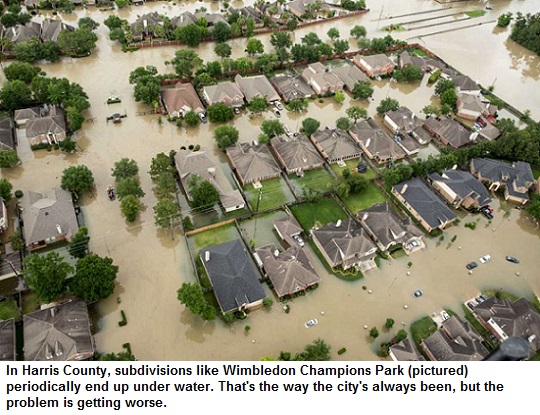
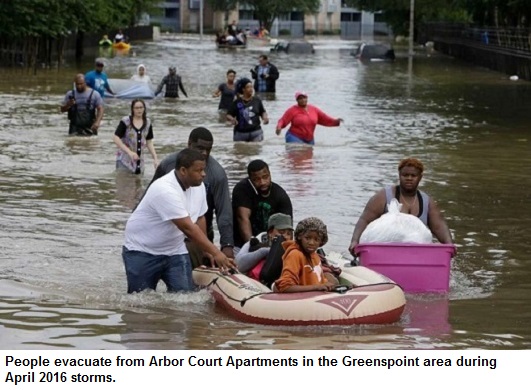
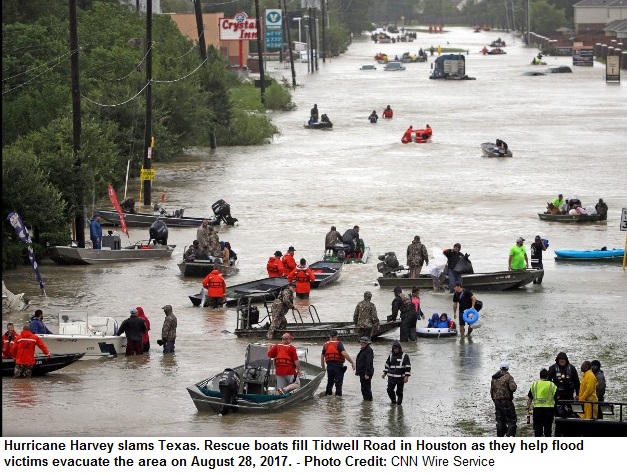
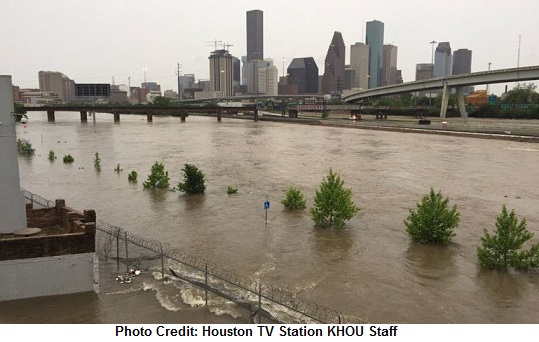
Climate Change is not of our making, but it is our problem. Truth be told, it is not just our problem alone; the whole planet is affected. Right now this moment, the Greater Metropolitan area of Houston, Texas USA is suffering “pangs of distress”; see the VIDEO in the Appendix below. CU Blog - Disaster Preparation - Rinse and Repeat - Photo 1
It is what it is!

Some communities have done a better job than others in preparing for the unavoidable:

“Some communities”? “Better job“? That is not us … in the Caribbean!

As related in a previous Go Lean commentary, our Caribbean region has failed … in our managing this Agent-of-Change:

… we do not have the luxury of “sticking our head in the sand” and pretending that these problems will simply go away. The region has been devastated with this dysfunction and mis-management. Some 70% of Caribbean college-educated citizens have already fled their homelands in an undisputed brain drain. It’s time now to manage change differently than the Caribbean has done as of late. It’s time now to “Go Lean”.

The book Go Lean…Caribbean – available to download for free – serves as a roadmap for the introduction and implementation of the technocratic Caribbean Union Trade Federation (CU), for the elevation of Caribbean society – for all member-states. This CU/Go Lean roadmap has these 3 prime directives for us to do a better job:

  • Optimization of the economic engines in order to grow the regional economy to $800 Billion and create 2.2 million new jobs. This includes an efficient Emergency Management apparatus to ensure business continuity.
  • Establishment of a security apparatus to ensure public safety and protect the resultant economic engines.
  • Improve Caribbean governance to support these engines, including a separation-of-powers between the member-states and CU federal agencies. We can “move” member-state governments simply through funding, rankings and ratings.

The book stresses that reforming and transforming the Caribbean societal engines must be a regional pursuit. This was an early motivation for the roadmap, as pronounced in the opening Declaration of Interdependence (Pages 12 – 13):

i. Whereas the earth’s climate has undeniably changed resulting in more severe tropical weather storms, it is necessary to prepare to insure the safety and security of life, property and systems of commerce in our geographical region. As nature recognizes no borders in the target of its destruction, we also must set aside border considerations in the preparation and response to these weather challenges.

xi. Whereas all men are entitled to the benefits of good governance in a free society, “new guards” must be enacted to dissuade the emergence of incompetence, corruption, nepotism and cronyism at the peril of the people’s best interest. The Federation must guarantee the executions of a social contract between government and the governed.

xvi. Whereas security of our homeland is inextricably linked to prosperity of the homeland, the economic and security interest of the region needs to be aligned under the same governance. Since economic crimes … can imperil the functioning of the wheels of commerce for all the citizenry, the accedence of this Federation must equip the security apparatus with the tools and techniques for predictive and proactive interdictions.

xxiv. Whereas a free market economy can be induced and spurred for continuous progress, the Federation must install the controls to better manage aspects of the economy: jobs, inflation, savings rate, investments and other economic principles. Thereby attracting direct foreign investment because of the stability and vibrancy of our economy.

The Go Lean book provides 370-pages of turn-by-turn instructions on “how” to adopt new community ethos, plus the strategies, tactics, implementations and advocacies to execute so as to reboot, reform and transform the societal engines of Caribbean society, for better preparation for natural disasters. Consider the Chapter excerpts and headlines here from this sample on Page 184 entitled:

10 Ways to Improve for Natural Disasters

1

Emergence of the Caribbean Union
Lean-in for the Caribbean Single Market & Economy initiative as the Caribbean Union Trade Federation. This allows for the unification of the 30 member-states into one market, thereby spreading the risk and premium base across a market of 42 million people. The Caribbean member-states have Hurricane Katrina styled disasters (relatively speaking) every year.

2

Caribbean Emergency Management Agency – Federal Disaster Declarations
Modeled after FEMA in the US, this agency will be charged with the preparation, response and reconstruction for the regions for the eventual manifestations of hurricanes, earthquakes, tsunamis, flooding and other declared disasters, natural and man-made like medical epidemic, drought, pollution, oil spills, terrorism, etc.

3

Support Services for First Responders
Training, licensing and standards for Emergency Managers, Paramedics, Firefighters, Search and Rescue resources. For major disasters, some of these resources will come from international origins; they will need the support services (language translation, guides, maps, etc.) and coordination to maximize their results.

4

Animal Partner Training and Development
Maintain plantations for the training, development and boarding of “search & rescue” dogs, cadavers dogs and other service animals (horses, mules, pigs, etc.) so that there will be local resources within the region. (We cannot always depend on international responses in light of other regions experiencing their own disasters). These animals need not be owned by any one member-state, they can be on loan from CU resources.

5

Siren Warnings & Notifications
The CU will install tornado-style alarms/sirens in all major municipalities. In addition, the CU will implement tsunami warning messaging (emails/text) in coastal areas & seismic meters throughout the region in the affected “fault-line” areas.

6

Airlift & Sealift Authorizations
The CU Emergency Management Agency can license, regulate and authorize (air & sea) vessels and vehicles for emergency deployment in a disaster zone, before during and after the disastrous event.

7

JUA-style Insurance Fund
The fiduciary management of premiums and claims to allow the immediate response for reconstruction after disasters. These financial services, sidecars traded in markets can be direct or indirect as in reinsurance or insurer-of-last-resort.

8

Economic Crime Enforcement During and After Disasters
The CU will police, investigate and prosecute price gouging, insurance red lining and other economic crimes of both the “white collar” and “blue collar” variety. Once a CU-member-state declares a Disaster Emergency, new rules (quasi-Marshall Law) goes into effect. The CU will review and prosecute the actions of civilians and institutions alike.

9

Disaster Declaration Loans
Once there’s a Federal Disaster Declaration, the CU will make funds available for low-interest loans for communities to fund reconstructions. With tourism as a major “cash crop” the goal will be to restore the locality as a tourist destination as soon as possible, as even the perception of prolonged disaster damage can affect future bookings and travel plans.

10

Building Codes and Standards
Through peer review, the CU will regionalize the standards of building codes to assuage the threat of hurricanes and earthquakes, ensuring a higher survivability rate in the Caribbean islands. Due to economic pressures, when buildings and homes cannot be retrofitted, they will be rated for evacuation during hurricane warnings, or earthquake after-shocks.

The Caribbean must foster a better disaster preparation and response apparatus. We must do it now! Lives are at stake.

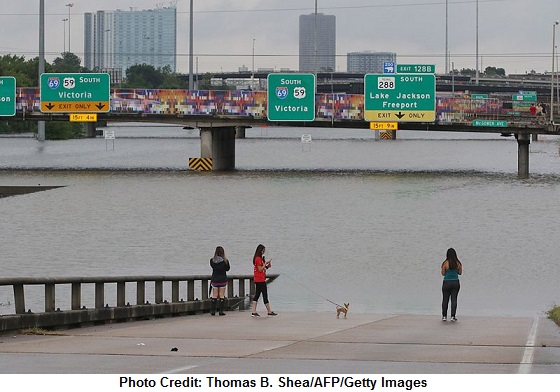
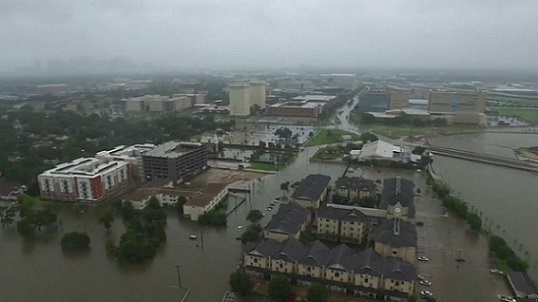
Just look at our American neighbors – they are suffering right now in the Greater Metropolitan area of Houston, Texas.
CU Blog - Hurricane Flooding - Who Knew - Photo 1b

While Climate Change is the underlying Agent-of-Change, it is outside of our control. This does not imply that there is no remediation for Climate Change; there is. In fact …

Fix ‘Climate Change’ – Yes, We Can

CU Blog - Disaster Preparation - Rinse and Repeat - Photo 2

We do not have the resources (time, talent and treasuries) to fix Climate Change for the planet ourselves, but we can fix it in our Caribbean region. This is a “Lesson in History” that our community has learned … from back in 1863:

There is an important lesson to learn in considering the history of the American Civil War. The war was fought over the issue of slavery. This was an ugly institution for those condemned as slaves. In the United States, that ugly disposition extended beyond the slaves themselves to the entire Black race. Though individuals could be set free, laws in the country could push them back into slavery without any due process. This was the case with the “Fugitive Slave Act of 1850″. Any Black person could be detained as a runaway slave and returned to any alleged Slave Master in the South; no matter any proof or the truth, or lack there-of. In many jurisdictions, a Black man could not even testify against white people. (This was the basis for the autobiographical book – by Solomon Northup – and movie “12 Years A Slave”).

To be Black in the America of those days, one “could not win, could not break-even and could not get out of the game”. There was no neutral destination in America. The optimal option was the only option, to work towards the end of slavery.

For this reason many Blacks joined the war effort, at great sacrifice to themselves and their community. This was a matter of principle! There is an important lesson for the Caribbean from this history[1] :

    The 54th Regiment Massachusetts Volunteer Infantry was an infantry regiment that saw extensive service in the Union Army during the American Civil War. The regiment was one of the first official African-American units in the United States during the Civil War.
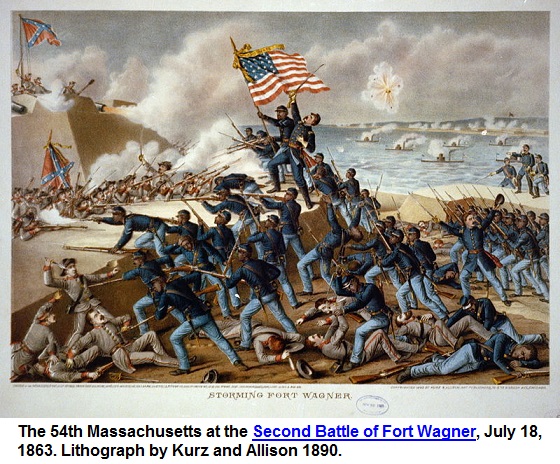
CU Blog - A Lesson in History - During the Civil War - Principle not Principal - Photo 1

Remediating and mitigating Climate Change will be a battle. We need our own “Voluntary Infantry“ in this fight.

“We have a dog in this fight” – English language slang.

In the Caribbean, we must confederate and implement the institutions to work to remediate and mitigate Climate Change. We must “join in this fight”; we must Go Green and we must Go Blue. We have to be prepared for natural disasters – they will come … assuredly every season, some Caribbean destination will be impacted. We must be prepared to:

Rinse and Repeat.

If we are ready, to quickly respond, offer relief and rebuild – so as to guarantee the business continuity – we would then do a better job in our quest to make our homeland a better place to live, work and play. 🙂

Download the free e-Book of Go Lean … Caribbean – now!

Sign the petition to lean-in for this roadmap for the Caribbean Union Trade Federation.

———–

Appendix VIDEO – Historic flooding inundates Texas, hampering rescue efforts – https://youtu.be/Da-VS39gdfQ

PBS NewsHour

Published on Aug 27, 2017 – Houston’s mayor on Sunday urged his constituents in the nation’s fourth-largest city to stay off roadways as the state of Texas continues to contend with unprecedented flooding from Hurricane Harvey, now classified as a tropical storm. Officials said rising waters would reach catastrophic proportions, with more than 2,500 emergency calls made overnight in Houston alone. Hari Sreenivasan has more.

Share this post:
, , , ,

Hurricane Flooding – ‘Who Knew?’

Go Lean Commentary

“Just keep living” – Old Wives’ Tale by “my late Mother-in-law”

Those 3 words reflected the wisdom of an 80 year-old woman. It simply meant:

If you do not see the logic, common sense or best-practice of some advice, just keep living and life will eventually convince you.

This sage advice is presented in contrast to the new President of the United States, Donald J. Trump, who in the first 100 days of his administration encountered a failure with trying to introduce new Health Care legislation. His response was:

Who knew “Health Care” was so complicated. – CNN

This is not a commentary about Health Care, but rather Hurricane Flooding preparation, response and mitigation. Once again, the American President has proven that he has not learned that wisdom exhibited by my now-deceased Mother-in-Law. On this occasion of a Category 4 storm – see photos and VIDEO’s of Hurricane Harvey in the Appendix below – drowning Southeast Texas with volumes and volumes of water (surge, rain and river flooding) – he exclaimed that this flooding was “unexpected”:

He told rescue organizers: “This was of epic proportion, nobody has ever seen anything like this.” – Sky News 29AUG17 19:23 GMT

CU Blog - Hurricane Flooding - Who Knew - Photo 1b

With all due respect Mr. President, it is the same with “Hurricane Flooding” as it was with Health Care:

Who Knew? Everybody – paying attention – knew!

Yes, this is “throwing shade” at President Trump, but this is a fair judgement as he made a cardinal mistake when assessing the seriousness of hurricanes and tropical storms; he is a Climate Change denier. This commentary previously related how this President declared – on June 1: the start of Hurricane Season – that he is withdrawing the US from the one international effort designed to abate Climate Change: the Paris Accord. That blog-commentary warned:

This is a matter of security; perhaps we [(Caribbean)] should not look to the US to take the lead for our own fate. This is so familiar … and a Hot Topic today as European member-states are contemplating how much they can look to the US for leadership for their security needs.

This was the assertion of the book Go Lean…Caribbean; available to download for free. It serves as a roadmap for the introduction and implementation of the technocratic Caribbean Union Trade Federation (CU), for the elevation of Caribbean society – for all member-states. The quest is that the Caribbean region convenes, collaborates and confederates to take their own lead – collectively – for their own fate. This CU/Go Lean roadmap has these 3 prime directives:

The book stresses that American self-interest is not necessarily the Caribbean’s best interest, even though there are two American territories (Puerto Rico & the Virgin Islands) in the Caribbean region. No, we must reform and transform our societal engines on our own. But this charter is too big for any one Caribbean member-state alone; there must be a regional effort. This was an early motivation for the roadmap, as pronounced in the opening Declaration of Interdependence(Pages 12 – 13):

i. Whereas the earth’s climate has undeniably changed resulting in more severe tropical weather storms, it is necessary to prepare to insure the safety and security of life, property and systems of commerce in our geographical region. As nature recognizes no borders in the target of its destruction, we also must set aside border considerations in the preparation and response to these weather challenges.

xi. Whereas all men are entitled to the benefits of good governance in a free society, “new guards” must be enacted to dissuade the emergence of incompetence, corruption, nepotism and cronyism at the peril of the people’s best interest. The Federation must guarantee the executions of a social contract between government and the governed.

xvi. Whereas security of our homeland is inextricably linked to prosperity of the homeland, the economic and security interest of the region needs to be aligned under the same governance. Since economic crimes … can imperil the functioning of the wheels of commerce for all the citizenry, the accedence of this Federation must equip the security apparatus with the tools and techniques for predictive and proactive interdictions.

xxiv. Whereas a free market economy can be induced and spurred for continuous progress, the Federation must install the controls to better manage aspects of the economy: jobs, inflation, savings rate, investments and other economic principles. Thereby attracting direct foreign investment because of the stability and vibrancy of our economy.

The Go Lean book provides 370-pages of turn-by-turn instructions on “how” to adopt new community ethos, plus the strategies, tactics, implementations and advocacies to execute so as to reboot, reform and transform the societal engines of Caribbean society; to better respond, relieve and rebuild from devastating hurricanes in all the 30 member-states in the region.

That previous blog-commentary declared:

The issue of Hurricane Season 2017 is bigger than initial appearances – there are BIG  issues afoot. …

The Caribbean status quo is unsustainable under the real threats of Climate Change. The region must reboot, reform and transform. We must do the heavy-lifting ourselves; we cannot expect relief and refuge from others, like the American Super-Power. We must find and “sail” under our own power.

The Go Lean book – and this commentary – calls on the region to master the art and science of water management.

We are saddened by all the death and destruction in Houston today; see Appendix. (Flooding is familiar in Houston, though more disastrous as of late). But believe it or not, there is a thesis that flooding could be prevented. Yes, indeed! This is the experience and historicity of the Dutch people, the European country of the Netherlands or Holland. See how their mitigations are portrayed in the news magazine here – an American news magazine:

VIDEO  – Sea change: How the Dutch confront the rise of the oceans – https://youtu.be/3J5ZoPFhSGM

Posted August 27, 2017 – Windmills are more than just a traditional part of the Dutch landscape; they have played a key role in the war the Dutch have been waging against the ocean for the past thousand years. Our Cover Story is reported by Martha Teichner. (This story was previously broadcast on May 21, 2017.)

The VIDEO’s transcript could be reviewed here: https://www.cbsnews.com/news/sea-change-how-the-dutch-confront-the-rise-of-the-oceans-2/

In addition, this commentary has visited the subject of water-flood management on many occasions; consider this sample of previous blogs:

https://goleancaribbean.com/blog/?p=12834 Hurricane Andrew – 25 Years of Hoopla in Water Management
https://goleancaribbean.com/blog/?p=12724 Lessons from Colorado: Water Management Arts & Sciences
https://goleancaribbean.com/blog/?p=12230 Managing Beach Erosion and Flooding Realities
https://goleancaribbean.com/blog/?p=7235 Flint, Michigan – A Cautionary Tale in Water Management
https://goleancaribbean.com/blog/?p=1656 Blue – Water Management – is the New Green
https://goleancaribbean.com/blog/?p=1817 Caribbean grapples with intense new cycles of flooding & drought
https://goleancaribbean.com/blog/?p=1516 Floods in Minnesota, Drought in California – Why Not Share?

The United States of America provides so many examples for the Caribbean: good, bad and ugly.

But we must make a separation between American power and American people.

To those of the American people languishing in the communities of Houston, Texas we send you our prayers and compassion and urge you to hold-on; it gets better.

To those American power brokers who continue to deny the obvious, we urge you to just keep living. You will soon realize the undeniable consequences of Climate Change:

Those who fail to plan; plan to fail!

CU Blog - Hurricane Flooding - Who Knew - Photo 2c

CU Blog - Hurricane Flooding - Who Knew - Photo 1c

In the Caribbean, we must be better and do better. This is our quest, to better serve the needs of our Caribbean people. Reforming and transforming America is out-of-scope for our efforts; we have our own storms to prepare and respond to. May we never “stick our head in the sand” and deny the obvious. No, rather, let’s always do the heavy-lifting to make our homelands better places to live, work and play. 🙂

Download the free e-Book of Go Lean … Caribbean – now!

Sign the petition to lean-in for this roadmap for the Caribbean Union Trade Federation. 

———–

Appendix VIDEO – Houston’s Flooding Crisis – https://youtu.be/uKAv_8lfjUw

Posted August 29, 2017 – Emergency responders in Houston have now rescued more than 6,000 people from Hurricane Harvey’s flooding. Harvey is still a tropical storm spinning off the Gulf Coast. It could make a second landfall Wednesday east of Houston. Mark Strassmann reports on rescue efforts.

Subscribe to the “CBS This Morning” Channel HERE: http://bit.ly/1Q0v2hE
Watch “CBS This Morning  – hosted by Charlie Rose, Norah O’Donnell and Gayle King” HERE: http://bit.ly/1T88yAR

———–

Hurricane Harvey – Houston August 2017 Photos

CU Blog - Hurricane Flooding - Who Knew - Photo 1a

CU Blog - Hurricane Flooding - Who Knew - Photo 2b

Epic Flooding Inundates Houston After Hurricane Harvey

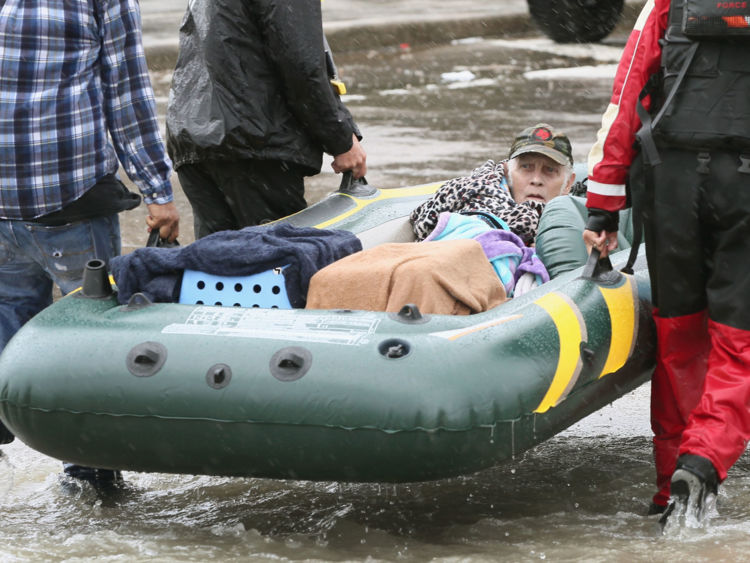
An evacuee holding two dogs reacts after his rescue by Texas National Guardsmen from severe flooding due to Hurricane Harvey in Cypress Creek

Epic Flooding Inundates Houston After Hurricane Harvey


Share this post:
, , ,
[Top]

Hurricane Andrew – 25 Years of Hoopla

Go Lean Commentary

Want to rumble? Want a piece of this?

Surely anyone vying for a leadership role in the Caribbean must be prepared for a fight. A fight with “Mother Nature”.

Expect to lose!

CU Blog - Hurricane Andrew - 25 Years of Hoopla - Photo 1

CU Blog - Hurricane Andrew - 25 Years of Hoopla - Photo 2

This was the contention from this previous blog-commentary on August 28, 2015, on the 10th anniversary commemorating 2005’s Hurricane Katrina:

Title: A Lesson in History – ‘Katrina’ is helping today’s crises
Welcome to the Caribbean  …

… the greatest address on the planet?!?!

Why would anyone campaign to assume the stewardship of this archipelago of islands?

This is the “siren song” of the book Go Lean … Caribbean. The publishers … are petitioning for a leadership role in the economic, security and governing engines of the region. Why?

There is no insanity! This is an expression of love for the homeland. The 30 member-states of the Caribbean are home to 42 million people, and a Diaspora of 10 million; plus 80 million visitors annually.

This is the greatest address on the planet!

Plus, everywhere has natural disasters to contend with. This fact relates to rich countries and poor alike. For example, take the United States; they are the richest Single Market economy in the world and yet their coastal city of New Orleans Louisiana (NOLA) was devastated by Hurricane Katrina 10 years ago … to the day (August 29, 2005). Their riches did not spare their devastation, nor did the riches facilitate best-practices in terms of response, relief and rebuilding. New Orleans is marking the anniversary of Katrina’s devastation and the lessons learned from the aftermath.

Remembering Hurricane Andrew

Now it is the time to remember a different, earlier storm, as it is the 25th anniversary of August 24, 1992 when Hurricane Andrew devastated the Caribbean region and the Greater Miami area; think almost $30 Billion in damages after 65 fatalities in the region. (This writer endured Andrew as a Miami resident). There are even more lessons to consider, contemplate and correlate to Caribbean stakeholders. As previously detailed, Miami has a pivotal connection with the Caribbean; as our member-states fail more and more, Miami becomes the beneficiary of our human and capital flight:

Miami’s Success versus Caribbean Failure

The “hoopla“ – historicity and actuality – of storms like Hurricane Andrew and Katrina reminds us …

… that Climate Change cannot be ignored. Even though there are deniers of any man-made causes, the reality of these storms challenge the realities of Caribbean life.

See this theme portrayed here in this current news article from USA Today, an American daily newspaper:

Title: In booming South Florida, another Hurricane Andrew could be a $300 billion catastrophe

CU Blog - Hurricane Andrew - 25 Years of Hoopla - Photo 3MIAMI — Twenty-five years ago this month, Hurricane Andrew unleashed its Category 5 wrath on South Florida, sending a catastrophic reminder about the dangers of living in the heart of “hurricane alley.”

But drive along any coastline in Florida today and you’ll find construction cranes as plentiful as palm trees as developers rush to build high-rises in the most beautiful, and vulnerable, corners of the state.

Florida has improved standards for new construction to prevent the level of damage wrought by hurricanes, but an Andrew-like storm hitting downtown Miami and its ever-growing collection of sparkling skyscrapers could exact a hefty price: $300 billion, according to one insurance underwriter.

“And that number doesn’t include loss of taxes or tourism,” said Monica Ningen, chief property underwriter for the U.S. and Canada for Swiss Re, one of the largest reinsurance companies in the world.

In the 25 years since Andrew made landfall on Aug. 24, 1992, nearly 1 in 10 homes built in the United States were built in Florida, according to an analysis of building permits conducted for USA TODAY by the real estate web site Trulia. That’s second only to Texas.

The trend is even more pronounced for larger condo buildings. Florida accounts for 11.5% of new residential buildings with at least five residences over the past 25 years, trailing only Texas’ 12.7%, according to the Trulia analysis.

“We’re like lemmings going to the sea, except that we build condos, hotels, and houses,” said Richard Olson, director of the International Hurricane Research Center at Florida International University.

The dangers of Florida’s post-Andrew growth is clearly illustrated in a report from Swiss Re that examined Florida’s vulnerability to hurricanes.

Andrew caused $24.5 billion in insured property damage when it hit the working class suburb of Homestead about 20 miles south of downtown Miami, becoming the most expensive catastrophe in U.S. history. Since then, Miami-Dade County’s population has increased by more than a third. Now, if a similar storm hit the same spot, Swiss Re estimates it would cause closer to $60 billion in insured damage.

High-rise condos could be Florida’s weak spot

Part of the reason for those massive numbers is the explosion of high-rise condos throughout the state.

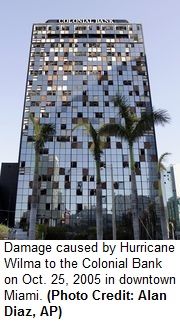
Florida toughened up its building codes after Andrew and saw good results with the spate of four hurricanes that struck the state in 2004. But in 2005, Hurricane Wilma revealed a glaring weakness.

Wilma, as a Category 2 hurricane, was far weaker than Andrew when it crossed over Miami, but its 100 mph winds shattered windows throughout downtown. One reason: Wind speeds grow drastically the higher you go.

Wilma’s 75 mph winds on the ground grew to 115 mph on the 30th floor, according to a hurricane wind model created by Florida International University in Miami. No condos collapsed, but the window failures caused massive damage.

“The structure looks great from the outside, and yet, the building has to be gutted because of the water damage inside,” said Shahid Hamid, director of the Laboratory for Insurance, Financial and Economic Research at FIU.

Price of paradise

So with a catastrophic risk looming, why do Floridians continue to build such high structures right on the coast?

For developers, the answer is simple.

“Anybody that owns a piece of property should be able to do what they like with it, as long as they’re complying with the laws,” said Jeremy Stewart, a Crestview, Fla., developer and chairman of the Florida Home Builders Association.

CU Blog - Hurricane Andrew - 25 Years of Hoopla - Photo 4But developers aren’t just interested in the principles of individual freedom or property rights, says Craig Fugate, the former head of the Federal Emergency Management Agency. It comes down to money, Fugate says.

With each new glass-covered skyscraper that goes up along Florida’s coasts, developers reap a windfall of profits. The money drives businesses and puts taxes into government coffers.

Real estate attorneys, realtors, agents, architects, and contractors all get a piece. Every new condo that goes up in Pensacola or Tampa or Jacksonville means more tax revenues for those city governments. Florida is one of seven states that doesn’t collect personal income tax, so real estate taxes and fees included in every home purchase are critical to keep the state’s finances afloat.

Fugate said that has created a “vicious cycle” of transactions that the state has grown to rely on.

“Our economy is building houses, apparently,” said Fugate, who lives in northern Florida and used to run the state’s emergency management division before heading up FEMA. “Our bias now seems to be to the benefit of the transaction, not the homeowner.”

Some city leaders say it’s not that nefarious. In Miami Beach, the tourist mecca that is at the front line of Florida’s battles against climate change, leaders say the tax revenues from new developments are the only way they can afford to make the long-term improvements to gird the barrier island from rising water.

The city is in the midst of a $500 million project to raise roads, raise seawalls and install 80 pumps to push out floods that occur even on sunny days.

New York and New Jersey received billions in federal funding following Superstorm Sandy, just as New Orleans did following Hurricane Katrina. But since a hurricane hasn’t hit Miami and Miami Beach directly in decades, they are left to improve their infrastructure mostly on their own.

“On the one hand, we have to be responsible with our development,” said Miami Beach City Manager Jimmy Morales. “But on the other hand, we need that revenue. We’ve got to figure out how to pay for all that.”

Then there’s the way residents ponder the question. Ask Floridians why they’re willing to endure the threat of hurricanes and they’ll usually give some version of the same answer: They raise their arms and say, “Look around.”

Maria Lopez, 38, moved out of her home in Little Havana just outside downtown Miami 10 years ago as the rent increased and the neighborhood endured more and more flooding. Lopez said she never even considered leaving the city or the state, opting instead to find a home in nearby Liberty City that was elevated to avoid flooding and built to hurricane-proof building codes.

Lopez, a customs broker with two young sons, loves “the food, the culture, the climate.” But, she says, “You just have to know that a hurricane can hit.”

James Murley, the chief resilience officer for Miami-Dade County, agreed, saying the dangers of hurricanes and sea level rise are simply the price of living in paradise, just as Californians are willing to deal with the occasional earthquake.

“You have to live with the risk,” he said. “Why are they still building in San Francisco? Why are they still building in Los Angeles? They’re on established fault lines. Communities that have a history, they’re going to grow one way or the other.”

Grow smarter or inland?

With no slowdown in sight, experts say Florida has two remaining choices: grow farther from the coast or grow smarter.

Jean-Pierre Bardet, dean of the college of engineering at the University of Miami, said the only way that developers will stop building skyscrapers right along the water will come down to money.

Florida’s building codes have made construction more expensive over the years. And some developers have gone beyond those codes to create safer, and costlier, buildings.

For example, many new high-rises in Florida don’t have a street-level entrance for pedestrians. They begin with several floors of parking on the ground floors, then a lobby higher up, topped off by apartments or offices. That means only cars parked at those levels will be damaged if a hurricane pushes in storm surge or rising sea levels create more regular flooding.

Those kinds of measures are expensive, though, and Bardet said their prices will only increase as the projects become harder to engineer.

“The economic consideration will be what puts the brakes on this expansion,” he said.

Some cities and counties, including St. Petersburg, Palm Beach County and Miami, are taking a “smart growth” approach by hiring “resilience officers” or “sustainability managers” who devise growth plans that account for the potential environmental impacts of climate change.

James Cloar, an urban development consultant and former chairman of the Urban Land Institute Tampa Bay, said the people in those positions need broad power to control how a city grows.

“These offices are being created with good intentions, but I don’t think universally they’re at the level that they need to be,” he said.

Jane Gilbert, who became the city of Miami’s first chief resilience officer in 2015, said it’s been tough to persuade everyone of the value of such planning, but some government officials and private developers do see a long-term benefit.

“Luckily we have some progressively-minded developers, architects and land-use attorneys that get it,” she said. “(They understand) that if we don’t start building with a long term view, their investments are at risk.”

More: As Hurricane Andrew memories fade, Florida weakens building codes

More: ‘Extremely active’ hurricane season now likely, federal forecasters say

Source: Retrieved August 24, 2017 from: https://www.usatoday.com/story/news/2017/08/22/hurricane-cost-florida/560846001/

———-

VIDEO – Hurricane Season is getting more intense – https://usat.ly/2utG8JA

Posted August 22, 2017 – Forecasters at the National Oceanic and Atmospheric Administration have upped their predictions of the number of and severity of upcoming storms during hurricane season. Newslook.

The book Go Lean…Caribbean – available to download for free – serves as a roadmap for the introduction and implementation of the technocratic Caribbean Union Trade Federation (CU), for the elevation of Caribbean society, to better respond, relieve and rebuild from devastating hurricanes in all the 30 member-states in the region.

Remember? We cannot win in a battle with “Mother Nature”; we can only respond, relieve and rebuild.

This CU/Go Lean roadmap therefore has these 3 prime directives:

  • Optimization of the economic engines in order to grow the regional economy to $800 Billion and create 2.2 million new jobs.
  • Establishment of a security apparatus to ensure public safety and protect the resultant economic engines.
  • Improve Caribbean governance to support these engines, including a separation-of-powers between the member-states and CU federal agencies.

The book stresses that the problems of the Caribbean are too big for any one member-state alone to contend with, that reforming and transforming the Caribbean societal engines – to mitigate the risks of disasters – must be a regional pursuit. This was an early motivation for the roadmap, as pronounced in the opening Declaration of Interdependence (Pages 12 – 13):

i.  Whereas the earth’s climate has undeniably changed resulting in more severe tropical weather storms, it is necessary to prepare to insure the safety and security of life, property and systems of commerce in our geographical region. As nature recognizes no borders in the target of its destruction, we also must set aside border considerations in the preparation and response to these weather challenges.

xi. Whereas all men are entitled to the benefits of good governance in a free society, “new guards” must be enacted to dissuade the emergence of incompetence, corruption, nepotism and cronyism at the peril of the people’s best interest. The Federation must guarantee the executions of a social contract between government and the governed.

xvi. Whereas security of our homeland is inextricably linked to prosperity of the homeland, the economic and security interest of the region needs to be aligned under the same governance. Since economic crimes … can imperil the functioning of the wheels of commerce for all the citizenry, the accedence of this Federation must equip the security apparatus with the tools and techniques for predictive and proactive interdictions.

xxiv. Whereas a free market economy can be induced and spurred for continuous progress, the Federation must install the controls to better manage aspects of the economy: jobs, inflation, savings rate, investments and other economic principles. Thereby attracting direct foreign investment because of the stability and vibrancy of our economy.

The Go Lean book provides 370-pages of turn-by-turn instructions on “how” to adopt new community ethos, plus the strategies, tactics, implementations and advocacies to execute so as to reboot, reform and transform the societal engines of Caribbean society. The book details that the CU will implement an optimized Emergency Management scheme to provide better stewardship for the region’s preparation and response to natural disasters; (in addition to hurricanes, there is the need to monitor and manage earthquakesvolcanoes, floods and droughts in the regions).  In addition, the CU will assume jurisdiction for the Caribbean Sea, the 1,063,000 square-mile international waters, as an Exclusive Economic Zone. These preparations and mitigations will allow for better cooperation, collaboration and equalization in the region.

This commentary has previously detailed other discussions related to managing Caribbean society’s preparation and response to hurricanes; see sample here:

https://goleancaribbean.com/blog/?p=12068 Trump Denies ‘Climate Change’ and Ends Federal Abatements
https://goleancaribbean.com/blog/?p=11442 Caribbean Roots: Al Roker – ‘Climate Change’ Defender
https://goleancaribbean.com/blog/?p=9455 Fix ‘Climate Change’ – Yes, We Can
https://goleancaribbean.com/blog/?p=9334 Hurricane Categories – The Science
https://goleancaribbean.com/blog/?p=7896 The Logistics of Disaster Relief
https://goleancaribbean.com/blog/?p=7449 ‘Crap Happens’ – So What Now?
https://goleancaribbean.com/blog/?p=4741 Vanuatu and Tuvalu – Inadequate response to post-storm suffering
https://goleancaribbean.com/blog/?p=2465 Book Review: ‘This Changes Everything: Capitalism vs. the Climate’
https://goleancaribbean.com/blog/?p=1817 Caribbean grapples with intense new cycles of flooding & drought

Hurricane Andrew was not the first, nor the last hurricane to devastate the tropical region. Truth be told, this is a product of Climate Change. Though there are deniers of any man-made causes, the actuality of these storms is the new Caribbean reality.

It is what it is!

Yet still, with better stewardship and shepherding, our communities can be better and do better. We urge all Caribbean stakeholders to lean-in to this Go Lean roadmap to make our homeland a better place to live, work and play. 🙂

Download the free e-Book of Go Lean … Caribbean – now!

Sign the petition to lean-in for this roadmap for the Caribbean Union Trade Federation.

Share this post:
, , , ,
[Top]

Lessons from Colorado: Black Ghost Towns – “Booker T. turning in his grave”

Go Lean Commentary

CU Blog - Lessons from Colorado - Black Ghost Towns - Photo 0This precept is straight-forward, natural and moral:

Whatever a man sows, that he will also reap. – The Bible – Galatians 6:7

Or stated otherwise:

If you sow wheat, you will reap wheat … during the harvest.

Barring any extra-natural intervention, a roadmap that is based on this natural law should indeed experience success. And yet, Booker T. Washington – one of the most influential African-American leaders in the history of the country – is probably “turning in his grave”, when considering the actuality of so many Black townships that were formed in his wake.

The book Go Lean…Caribbean makes an important point about the African experience in the US; it is one of deferred gratification, not to expect an immediate return, result and consequence; the reap-what-you-sow mantra had been irrelevant.

There is a Lesson in History that Caribbean communities must consider. One commentator, activist and comedian summarized it as the “home court advantage”:

The world is mourning the passing of this comedian, Dick Gregory at age 84 (October 12, 1932 – August 19, 2017). Among the many accomplishments in his full life was this one declaration – quoted in a previous Go Lean commentary – on November 27, 1963 when President Lyndon Johnson announced at a Joint-Session of Congress that he would continue with the recently assassinated John Kennedy’s Civil Rights agenda:

“Twenty million American Negroes unpacked”.

He thereby acknowledged that until that moment – in the 1960’s – the United States of America was really not home for the minority African-American populations. No, White America had the “home-court advantage”.

This “home-court advantage” is in contrast with the straight-forward, natural and moral precept … mentioned at the outset. That precept was vocalized by Booker T. Washington. He advocated an economic empowerment plan to “prosper where planted”. This was sound, if not for the actuality of White Supremacy in early 20th Century America.

The details of Booker T.’s advocacy was fully detailed in a previous Go Lean blog-commentary:

A Lesson in History – Booker T versus Du Bois

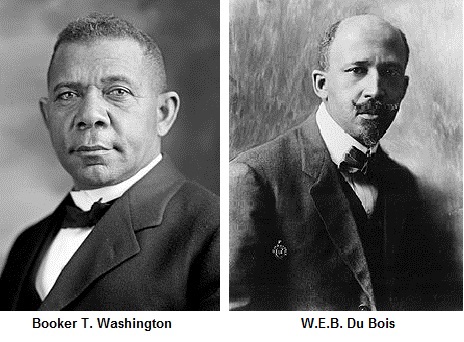
Booker T. Washington and W.E.B. Du Bois … were [both] very important in the history of civil rights for African-Americans. They both wanted the same elevation of their community – [the “Way Forward”] – in American society, but they both had different strategies, tactics and implementations.

CU Blog - A Lesson in History - Booker T versus DuBois - Photo Combined

Washington’s biggest legacy is the Tuskegee University (Tuskegee Institute in his day). Du Bois’s legacy stems from his co-founding the NAACP (National Association for the Advancement of Colored People).

The conclusion … is that the journey for full citizenship for African-Americans took 100 years from the time of the Washington / Du Bois chasm. No matter the detailed approach, 100 years is still 100 years.

From the point of view of the Caribbean and the publishers of Go Lean…Caribbean, we side with both civil rights leaders in aspirations, but lean towards Booker T. Washington in strategies. Underlying to Mr. Washington’s advocacy, was for the Black Man to remain in the South, find a way to reconcile with his White neighbors and to prosper where he was planted.

The point from a Caribbean perspective is “the more things change, the more they remain the same”. We have problems in the Caribbean to contend with, many of which we are failing miserably. But our biggest crisis stems from the fact that so many of our citizens have fled their Caribbean homelands for foreign (including American) shores.

The purpose of this commentary is not to fix America, it is to fix the Caribbean. But the push-and-pull factors are too strong coming from the US. We must lower the glimmering light, the “pull factors”, that so many Caribbean residents perceive of the “Welcome” sign hanging at American ports-of-entry. A consideration of this commentary helps us to understand the DNA of American society: un-reconciled race relations in which Black-and-Brown are still not respected.

The logical conclusion: stay home in the Caribbean and work toward improving the homeland. The US should not be the panacea of Caribbean hopes and dreams.

Booker T. Washington advocated this strategy: prosper where you’re planted.

After 100 years, and despite an African-American President, we must say to Mr. Booker T. Washington: We concur!

The history and legacy of one of the Booker T’s inspired Black townships – Dearfield, Colorado – is commemorated in the Black American West Museum and Heritage Center in Denver, Colorado. This historicity – see encyclopedic details here – is one of the lessons learned from developments in Denver and the State of Colorado. This is the theme of this series of commentaries on lessons that have been learned by Caribbean stakeholders visiting, observing and reporting on this US State of Colorado.

Reference – Dearfield, Colorado

CU Blog - Lessons from Colorado - Black Ghost Towns - Photo 1

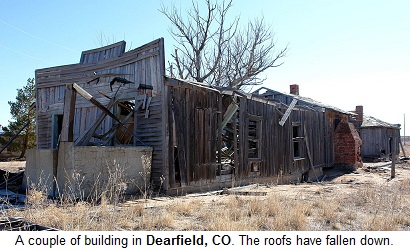
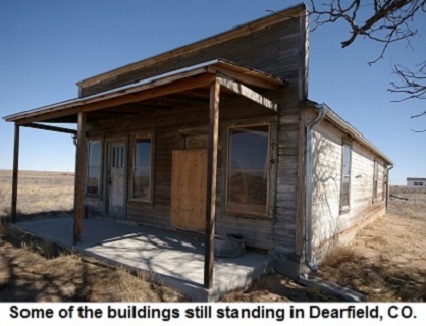
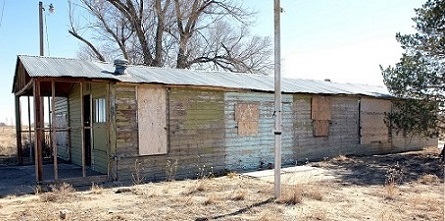
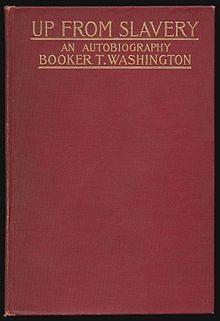
Dearfield is a “ghost town” and a historically black majority settlement in Weld County, Colorado, United States. It is 30 miles (48 km) east of Greeley. The town was formed by Oliver T. Jackson who desired to create a colony for African Americans; [he was inspired by the ideals set forth in Booker T. Washington’s book “Up from Slavery”; see Appendix below]. In 1910, Jackson, a successful businessman from Boulder, filed on the homestead that later became the town and began to advertise for “colonists.” The name Dearfield was suggested by one of the town’s citizens, Dr. J.H.P. Westbrook who was from Denver. The word dear was chosen as the foundation for the town’s name due to the precious value of the land and community to the town’s settlers.[2]

The first settlers of Dearfield had great difficulty farming the surrounding pasture and endured several harsh seasons. However, by 1921, 700 people lived in Dearfield. The town’s net worth was appraised at $1,075,000. After several prosperous years, the Great Depression arrived and the town’s agricultural success significantly declined. Settlers began to leave Dearfield in order to find better opportunities. By 1940, the town population had decreased to 12, only 2% of the town’s 1921 population. Jackson desperately attempted to spur interest in the town, even offering it for sale. However, there was little interest in Dearfield. Jackson died on February 18, 1948.

CU Blog - Lessons from Colorado - Black Ghost Towns - Photo 2

CU Blog - Lessons from Colorado - Black Ghost Towns - Photo 2b

CU Blog - Lessons from Colorado - Black Ghost Towns - Photo 2c

A few deserted buildings remain in Dearfield: a gas station, a diner, and the founder’s home. In 1998, the Black American West Museum in Denver began to make attempts to preserve the town’s site. It is a Colorado Registered Historic Landmark. A 2010 monument next to one of the remaining buildings contains information about the history of the site.

A 2001 state historical marker [3] at U.S. Route 85 mile marker 264 near Evans, Colorado, includes a panel with the history of Dearfield.
Source: Retrieved August 20, 2017 from: https://en.wikipedia.org/wiki/Dearfield,_Colorado

There were other Black townships as well; consider: Allensworth, California, Boley, Oklahoma, and Nicodemus, Kansas.

What befell these towns?

Agents of Change

This is a strong point of contention in the Go Lean book (Page 45). It asserts that the modern world does NOT stand-still; change is ever-present. The Agents of Change that befell the Black townships of that era were mostly:

  • Geo-political – An early round of globalization where focus, investments and jobs  shifted away from the farms to the factories in the cities.
  • Technology – Agricultural science and methods changed; i.e. fertilizers, seeds, etc.
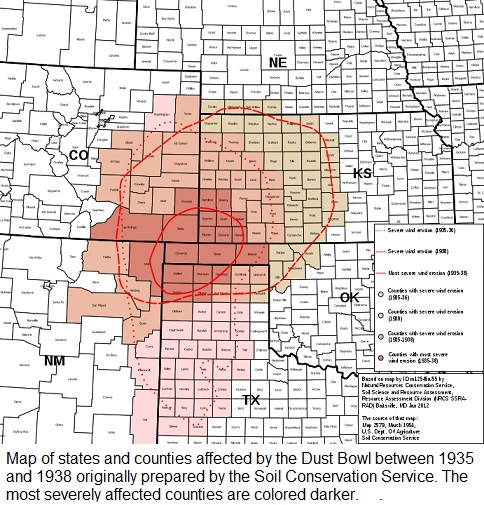
  • Climate Change – In the early 1930’s, a pervasive drought afflicted the High Plains of the Mid-West United States, creating the Dust Bowl; this was exacerbated by bad farming practices, that cause the disaster to linger longer than best-practices dictated.
    CU Blog - Lessons from Colorado - Black Ghost Towns - Photo 3
  • Racism and White Supremacy could have been considered among these Agents of Change, though this societal defect remained unresolved and un-reconciled in American society, no matter the location, North-South or Urban-Rural. Whenever Black townships made progress, malicious acts from the White Majority curtailed any advances. See here:
    VIDEO – How Black Communities Were Destroyed | Sincere History – https://youtu.be/jRZ6o0W_pHI
    Published on Dec 21, 2015 – A hundred years ago, in communities across the U.S., white residents forced thousands of black families to flee their homes. Even a century later, these towns remain almost entirely white. BANISHED tells the story of three of these communities and their black descendants, who return to learn their shocking histories.”
    Reason TV: Urban Renewal – https://www.youtube.com/watch?v=mWGws…
    For more, go to http://sincereignorance.com/2014/08/0…
    Sincere Ignorance Social Media
    Facebook: https://www.facebook.com/sincereignor…
    Twitter: https://twitter.com/sincereignorant

In the Caribbean, we have so much in common and so much in contrast with this community of Dearfield, and the other towns who suffered the same Ghost Town fate. For starters, we have our own Ghost Towns. We also have Agents of Change (Globalization, Technology, Climate Change and the Aging Diaspora) to contend with. So we have to build-up our Caribbean homeland so that our people can “prosper where planted”. But we do have a home-court advantage that Dearfield et al never enjoyed; we have a majority Black population.

This commentary completes the 5-part series on the subject of Lessons from Colorado. There are so many lessons that we have considered from this land-locked US State; good ones and bad ones. In fact, the full list of 5 entries are detailed as follows:

  1. Lessons from Colorado – Common Sense of Eco-Tourism
  2. Lessons from Colorado – Legalized Marijuana: Heavy-lifting!
  3. Lessons from Colorado – How the West Was Won
  4. Lessons from Colorado – Water Management Art and Science
  5. Lessons from Colorado – Black Ghost Towns

This book Go Lean… Caribbean, serves as a roadmap for the introduction and implementation of the Caribbean Union Trade Federation (CU), which represents change for the region. The CU/Go Lean roadmap has 3 prime directives:

  • Optimization of the economic engines in order to grow the regional economy and create 2.2 million new jobs.
  • Establishment of a security apparatus to ensure public safety and protect the resultant economic engines.
  • Improve Caribbean governance – including best practices in town planning and agricultture – to support these engines.

The Go Lean roadmap provides turn-by-turn directions on how to forge this change in the region for a reboot of the Caribbean societal engines: economy, security and governance. This roadmap is presented as a planning tool, pronouncing this point early in the Declaration of Interdependence with these statements: (Pages 12 – 13):

xi. Whereas all men are entitled to the benefits of good governance in a free society, “new guards” must be enacted to dissuade the emergence of incompetence, corruption, nepotism and cronyism at the peril of the people’s best interest. The Federation must guarantee the executions of a social contract between government and the governed.

xvi. Whereas security of our homeland is inextricably linked to prosperity of the homeland, the economic and security interest of the region needs to be aligned under the same governance. Since economic crimes … can imperil the functioning of the wheels of commerce for all the citizenry, the accedence of this Federation must equip the security apparatus with the tools and techniques for predictive and proactive interdictions.

xxiv.  Whereas a free market economy can be induced and spurred for continuous progress, the Federation must install the controls to better manage aspects of the economy: jobs, inflation, savings rate, investments and other economic principles. Thereby attracting direct foreign investment because of the stability and vibrancy of our economy.

The Go Lean book calls for the elevation of Caribbean society, to re-focus, re-boot, and optimize all the societal engines so as to make the 30 member-states of the Caribbean a better place to live, work and play.  Thank you Colorado for these lessons from your past, present and future on how we can better shepherd our society.

Your land is a great place to visit, but it is not our home. But still, you have shown us that nation-building is heavy-lifting and that we need good role models to follow.

There have been other Go Lean blog-commentaries that presented good role models for nation-building, especially in the light of societal defects; see this sample here:

https://goleancaribbean.com/blog/?p=12369 Happy Canada Day 150 to a Pluralistic Democracy
https://goleancaribbean.com/blog/?p=11386 Building Better Cities
https://goleancaribbean.com/blog/?p=10513 Transforming ‘Money’ Countrywide
https://goleancaribbean.com/blog/?p=6563 Lessons from Iceland – Model of Recovery

If we do not learn from history, we are forced to repeat it.

This also applies to other people’s history. There are so many lessons that the Caribbean can learn from other communities: best practices and bad practices. Let’s pay more than the usual attention to these lessons.

We need all the help we can get. The bad old days of Caribbean dysfunction must end. We must work to do better, to be better.

These lands are our home! (Unlike our African-American brothers and sisters of olden times, we have the home-court advantage):

This is my island in the sun
Where my people have toiled since time begun
I may sail on many a sea
Her shores will always be home to me

Song: Island in the Sun by Harry Belafonte

Yes, we can! We can make our homelands better places to live, work and play. 🙂

… and RIP Dick Gregory.

Download the book Go Lean … Caribbean – now!

Sign the petition to lean-in for this roadmap for the Caribbean Union Trade Federation.

———–

Book Review: Up from Slavery 

CU Blog - Lessons from Colorado - Black Ghost Towns - Photo 4Up from Slavery is the 1901 autobiography of Booker T. Washington sharing his personal experience of having to work to rise up from the position of a slave child during the Civil War, to the difficulties and obstacles he overcame to get an education at the new Hampton Institute, to his work establishing vocational schools—most notably the Tuskegee Institute in Alabama—to help black people and other disadvantaged minorities learn useful, marketable skills and work to pull themselves, as a race, up by the bootstraps. He reflects on the generosity of both teachers and philanthropists who helped in educating blacks and Native Americans. He describes his efforts to instill manners, breeding, health and a feeling of dignity to students. His educational philosophy stresses combining academic subjects with learning a trade (something which is reminiscent of the educational theories of John Ruskin). Washington explained that the integration of practical subjects is partly designed to reassure the white community as to the usefulness of educating black people.

This book was first released as a serialized work in 1900 through The Outlook, a Christian newspaper of New York. This work was serialized because this meant that during the writing process, Washington was able to hear critiques and requests from his audience and could more easily adapt his paper to his diverse audience.[1]

Washington was a controversial figure in his own lifetime, and W. E. B. Du Bois, among others, criticized some of his views. The book was, however, a best-seller, and remained the most popular African American autobiography until that of Malcolm X.[2] In 1998, the Modern Librarylisted the book at No. 3 on its list of the 100 best nonfiction books of the 20th century, and in 1999 it was also listed by the conservative Intercollegiate Review as one of the “50 Best Books of the Twentieth Century”.[3]

Plot summary

Up from Slavery chronicles more than forty years of Washington’s life: from slave to schoolmaster to the face of southern race relations. In this text, Washington climbs the social ladder through hard, manual labor, a decent education, and relationships with great people. Throughout the text, he stresses the importance of education for the black population as a reasonable tactic to ease race relations in the South (particularly in the context of Reconstruction).

Source: Retrieved August 21, 2017 from: https://en.wikipedia.org/wiki/Up_from_Slavery

Share this post:
, , , , ,
[Top]

Lessons from Colorado: Water Management Arts & Sciences

Go Lean Commentary

CU Blog - Lessons from Colorado - Water Management Art and Science - Photo 4Water is vital for the sustenance of life. So if you’re surrounded by water, then the assumption would be that you have an abundance of life?

Assumption?! The reality in the Caribbean … is just the opposite.

While it should be so easy – 27 of the 30 member-states are islands and the other 3 coastal states are embedded with rainforests – the actuality is the water management in the Caribbean is deficient and dysfunctional.

Say it ain’t so!

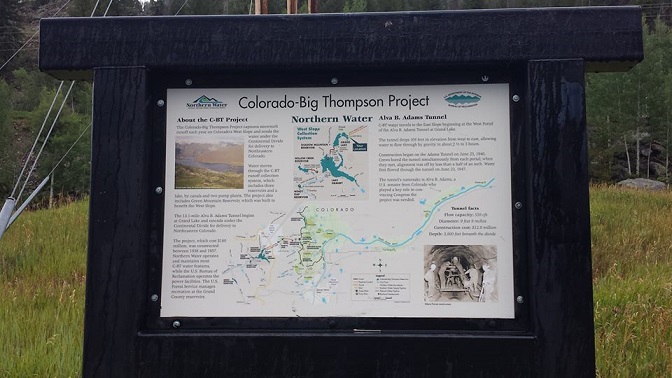
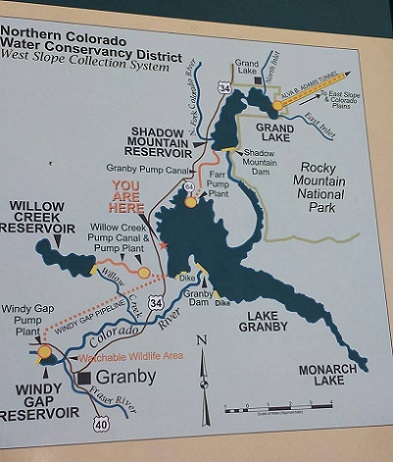
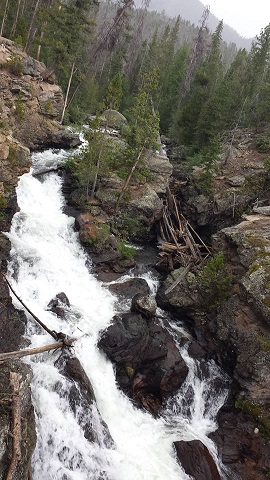
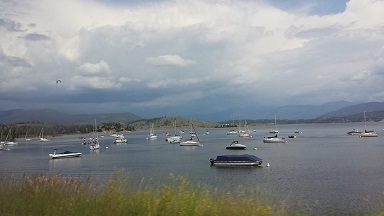
There are lessons to be learned by visiting, observing and reporting on other communities that do water management better. This commentary reflects that activity; some Caribbean stakeholders explored the US State of Colorado and discovered that we have so much to learn about how to facilitate the infrastructure of an optimized society. We have seen how water management is an art and a science. (All non-encyclopedic photos in this commentary were snapped in Colorado by Bahamian student Camille Lorraine).

CU Blog - Lessons from Colorado - Water Management Art and Science - Photo 1a

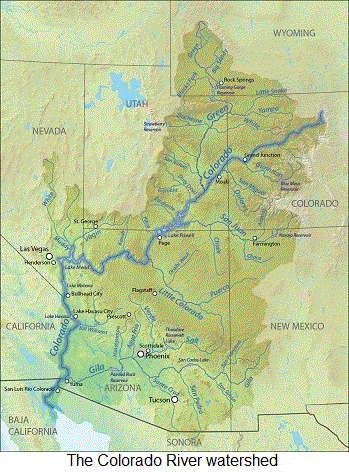
As reported previously, the Caribbean has so much in common and so much in contrast with Colorado. One contrast to consider is how Colorado’s lakes, rivers and waterways are structured to sustain the lives and systems of commerce of that State and … 6 other States plus 2 States in the foreign country of Mexico.

CU Blog - Lessons from Colorado - Water Management Art and Science - Photo 7

The 2013 book Go Lean…Caribbean visited Colorado’s water management. It detailed the strategies, tactics and implementation of the Colorado River Interstate Compact (an agreement between two or more states). This is reported on Page 278 of the book:

The Colorado River Compact is a 1922 agreement among seven US states (upper division: Colorado, New Mexico, Utah and Wyoming; lower division: (Nevada, Arizona and California) in the basin of the Colorado River in the American Southwest governing the allocation of the water rights to the river’s water among the parties of the interstate compact. The agreement was signed at a meeting at Bishop’s Lodge, near Santa Fe, New Mexico, by representatives of the seven states the Colorado river and its tributaries pass through on the way to Mexico.

The compact requires the UpperBasin states not to deplete the flow of the river below 7,500,000 acre feet during any period of ten consecutive years. Based on rainfall patterns observed in the years before the treaty’s signing in 1922, the amount specified in the compact was assumed to allow a roughly equal division of water between the two regions. The states within each basin were required to divide their 7,500,000-acre foot per year share allotment among themselves. In addition to this, 1,500,000-acre-foot per year of Colorado River water is allocated to Mexico, pursuant to the treaty relating to the use of waters of the Colorado and Tijuana rivers and of the Rio Grande, signed February 3, 1944, and its supplementary protocol signed November 14, 1944.

The compact enabled the widespread irrigation of the Southwest, as well as the subsequent development of state and federal water works projects under the United States Bureau of Reclamation. Such projects included the Hoover Dam, Lake Mead and Lake Powell, the 1st and 2nd largest man-made reservoirs in the US.

CU Blog - Lessons from Colorado - Water Management Art and Science - Photo 3

The headwaters of the Colorado River originate … in Colorado. This is the source.

CU Blog - Lessons from Colorado - Water Management Art and Science - Photo 6

CU Blog - Lessons from Colorado - Water Management Art and Science - Photo 5

CU Blog - Lessons from Colorado - Water Management Art and Science - Photo 2

CU Blog - Lessons from Colorado - Water Management Art and Science - Photo 8

This commentary continues the 5-part series – this is 4 of 5 – on the subject of Lessons from Colorado. There are so many lessons that we must consider from this land-locked US State; good ones and bad ones. In fact, the full list of 5 entries are detailed as follows:

  1. Lessons from Colorado – Common Sense of Eco-Tourism
  2. Lessons from Colorado – Legalized Marijuana – Heavy-lifting!
  3. Lessons from Colorado – How the West Was Won
  4. Lessons from Colorado – Water Management Art & Science
  5. Lessons from Colorado – Black Ghost Towns – “Booker T. turning in his grave”

The book Go Lean…Caribbean calls for the elevation of Caribbean society, to re-focus, re-boot, and optimize all the societal engines (economics, security and governance) so as to make the Caribbean a better place to live, work and play.  Water is connected to each of these facets of society. The purpose of Water Management is to ensure that the supply of fresh, clean water is steady and inexpensive.

This is an art and a science.

There is even a designating color that is used to brand this science: Blue. This point was identified and qualified in a previous Go Lean commentary, entitled “Blue is the new Green“. There, it stated:

First we said to “Go Green!” Now we are saying to “Go Blue”, because Blue is the new Green. While ‘Green’ is motivated for all-things-environmental, ‘Blue’ refers specifically to Water Conservation.

There is money in Green; there is money in Blue too! The references to Blue waters apply equally to fresh water and seawater. When we consider all the waterscapes in the Caribbean, (1,063,000 square-miles of the Caribbean seas and thousands of islands in the archipelago – The Bahamas has over 700 alone), we realize how much opportunity exists.

There is the chance to get lucky; where luck is defined as the intersection of preparation and opportunity.

Considering all the opportunities, how can the Caribbean prepare its economic engines to harvest all the fruitage from these Blue market conditions? This is the theme of the book Go Lean…Caribbean, that the world is struggling to contend with monumental changes related to technology, globalization and most importantly Climate Change.

Early in the book, the pressing need to be aware of climate change is pronounced in the Declaration of Interdependence (Page 11), with these words, (the first of many “causes of complaints”):

    i. Whereas the earth’s climate has undeniably changed resulting in more severe tropical weather storms, it is necessary to prepare to insure the safety and security of life, property and systems of commerce in our geographical region. As nature recognizes no borders in the target of its destruction, we also must set aside border considerations in the preparation and response to these weather challenges.

The Caribbean needs Blue Technology solutions to sustain our own lives, liberties and systems of commerce. But the Go Lean book posits that we cannot just consume, we must also create, produce, and foster. So we must foster industrial solutions for the rest of the world. This foregoing [embedded] magazine article summary highlighted the progression in this new Blue Technology industry-space in these areas:

  • Sourcing
  • Treating
  • Storing
  • Conserving
  • Keeping it Clean

So a study of Colorado allows us, in the Caribbean, the opportunity to see Blue Technology solutions at work, in motion and at success in sustaining millions of lives and their dependent systems of commerce. A specific lesson from Colorado is that the responsible parties for the mastery of this “art and science” in Colorado is not Colorado, but rather the US Federal government agency referred to as the United States Bureau of Reclamation (USBR). This agency …

… oversees water resource management, specifically as it applies to the oversight and operation of the diversion, delivery, and storage projects that it has built throughout the western United States for irrigation, water supply, and attendant hydroelectric power generation. Currently the USBR is the largest wholesaler of water in the country, bringing water to more than 31 million people, and providing one in five Western farmers with irrigation water for 10 million acres of farmland, which produce 60% of the nation’s vegetables and 25% of its fruits and nuts. The USBR is also the second largest producer of hydroelectric power in the western United States.[4] – Source: Wikipedia.

CU Blog - Lessons from Colorado - Water Management Art and Science - Photo 1b

The book Go Lean…Caribbean – available to download for free – serves as a roadmap for the introduction and implementation of the technocratic Caribbean Union Trade Federation (CU), for the elevation of Caribbean society – for all member-states. The CU would serve the Caribbean role of the USBR, the “new guards” of Caribbean Common Pool Resources; it would be staffed with water management professionals and scientists with the authority – vested by the CU treaty – to execute a master plan that facilitates water efficiencies in the region.

There are lives involved, as water is essential for life. There are also jobs involved, and societal efficiency. The lack of efficiency in the Caribbean status quo –  “push” and “pull” factors – is what is responsible for so much abandonment. (In fact, it has been reported that the professional classes of people in the region have abandoned their communities at a rate of 70 percent). So this CU/Go Lean roadmap seeks to reform and transform this bad trending; it has these 3 prime directives:

  • Optimization of the economic engines in order to grow the regional economy to $800 Billion and create 2.2 million new jobs.
  • Establishment of a security apparatus to ensure public safety and protect the resultant economic engines.
  • Improve Caribbean governance to support these engines, including a separation-of-powers between the member-states and CU federal agencies.

The book stresses that reforming and transforming the Caribbean societal engines must be a regional pursuit, at a federal level; (CU Federation = federal). This was an early motivation for the roadmap, as pronounced in the opening Declaration of Interdependence (Pages 12 – 13):

iii. Whereas the natural formation of the landmass for our society is that of an archipelago of islands, inherent to this nature is the limitation of terrain and the natural resources there in. We must therefore provide “new guards” and protections to ensure the efficient and effective management of these resources.

v. Whereas the natural formation of our landmass and coastlines entail a large portion of waterscapes, the reality of management of our interior calls for extended oversight of the waterways between the islands. The internationally accepted 12-mile limits for national borders must be extended by International Tribunals to encompass the areas in between islands. The individual states must maintain their 12-mile borders while the sovereignty of this expanded area, the Exclusive Economic Zone, must be vested in the accedence of this Federation.

vi. Whereas the finite nature of the landmass of our lands limits the populations and markets of commerce, by extending the bonds of brotherhood to our geographic neighbors allows for extended opportunities and better execution of the kinetics of our economies through trade. This regional focus must foster and promote diverse economic stimuli.

xi. Whereas all men are entitled to the benefits of good governance in a free society, “new guards” must be enacted to dissuade the emergence of incompetence, corruption, nepotism and cronyism at the peril of the people’s best interest. The Federation must guarantee the executions of a social contract between government and the governed.

xvi. Whereas security of our homeland is inextricably linked to prosperity of the homeland, the economic and security interest of the region needs to be aligned under the same governance. Since economic crimes … can imperil the functioning of the wheels of commerce for all the citizenry, the accedence of this Federation must equip the security apparatus with the tools and techniques for predictive and proactive interdictions.

xxiv. Whereas a free market economy can be induced and spurred for continuous progress, the Federation must install the controls to better manage aspects of the economy: jobs, inflation, savings rate, investments and other economic principles. Thereby attracting direct foreign investment because of the stability and vibrancy of our economy.

The Go Lean book provides 370-pages of turn-by-turn instructions on “how” to adopt new community ethos, plus the strategies, tactics, implementations and advocacies to execute so as to reboot, reform and transform the societal engines of Caribbean society.

Water management is not just vital for basic needs – quenching thirsts – it is also needed to advance the economy. Resorts (tourism) and factories alike, all depend on good water management. Imagine:

As previously detailed, water resources are not cheap. It is only free when it rains. The effort to source, treat, store, conserve and keep water clean takes a big investment on the part of community and governmental institutions.

Thank you Colorado – and your management of this principal river of the Southwestern United States and northern Mexico (the other one is the Rio Grande). This 1,450-mile-long river is the hardest working river in North America, as it sustains an arid watershed – (the western US states are considered desert wilderness) – that encompasses parts of 7 US States and 2 Mexican States (Sonora and Baja California). This great river gets its start in the central Rocky Mountains, in the heart of Colorado. See this VIDEO here:

VIDEO – Colorado River – I Am Red – https://youtu.be/mqYcC7jEe44

Published on Apr 16, 2013 – The Colorado River is a lifeline in the desert, its water sustaining tens of millions of people in seven states, as well as endangered fish and wildlife. However, demand on the river’s water now exceeds its supply, leaving the river so over-tapped that it no longer flows to the sea. (Video by Pete McBride. Flights by Lighthawk, Ecoflight.)

Learn more and be part of the solution: www.AmericanRivers.org/Colorado

Colorado is showing us in the Caribbean how hard work pays off; (all photos in this commentary here are from Colorado, and not the Caribbean, despite any leanings). We now know where we can find “best practices” to model effective and efficient water management. The successful application of this lesson from Colorado can help us to make our Caribbean homelands and waterways better places to live, work and play. 🙂

Download the free e-Book of Go Lean … Caribbean – now!

Sign the petition to lean-in for this roadmap for the Caribbean Union Trade Federation.

Share this post:
, ,
[Top]

Lessons from Colorado: Legalized Marijuana – Heavy-lifting!

Go Lean Commentary

“Rocky Mountain High … Colorado” – Song verbiage from John Denver’s Rocky Mountain High – see Appendix A

CU Blog - Lesson from Colorado - Legalized Marijuana - Photo 1

This is a familiar refrain from a familiar song; a folk rock song written by John Denver and Mike Taylor about Colorado, and is one of the two official state songs of Colorado;[1] recorded by Denver in 1972, it went to #9 on the US Hot 100 in 1973; (source: Wikipedia). The song also made #3 on the Easy Listening chart …

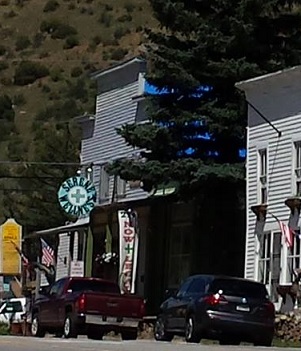
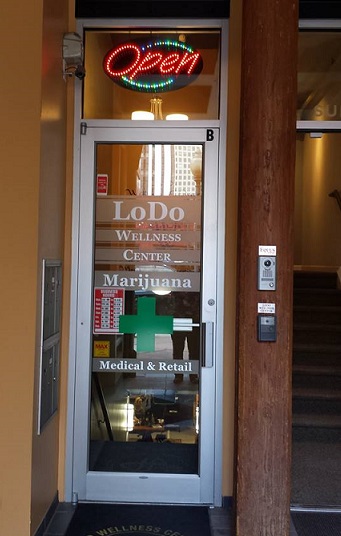
But in 2017, the phrase “Rocky Mountain High” has a total different meaning, because the State of Colorado has since legalized recreational use of marijuana.

This is not an easy topic; this is heavy …

There are so many lessons we can learn from the debate, legalization, implementation, regulation and societal repercussions of this product in this State. All in all, it is heavy-lifting. This is the theme of this series of commentaries of lessons that have been learned by Caribbean stakeholders visiting, observing and reporting on the US State of Colorado. (All non-encyclopedic photos in this commentary were snapped in Colorado by Bahamian student Camille Lorraine).

We have so much in common and so much in contrast. One commonality to consider is how Colorado is now associated with marijuana consumption. See Appendix B VIDEO below.

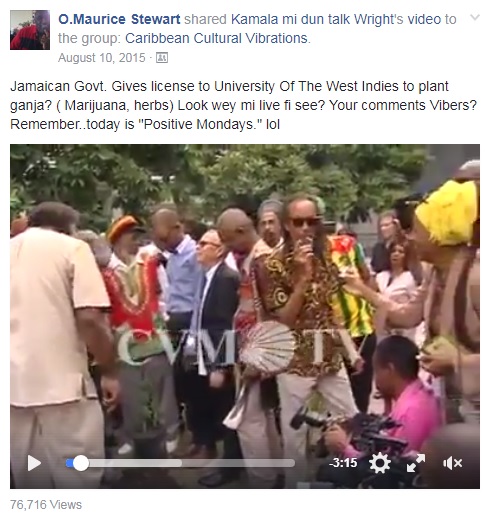
“Welcome to our club”! This has always been the image of Caribbean people and culture – think: Rasta Man smoking Ganja; (marijuana is called ganja in Sanskrit and other modern Indo-Aryan languages.[173]).

Don’t like the imagery, reputation or sullied practice? Then welcome to societal development 2017; welcome to heavy-lifting.

This commentary continues the 5-part series on the subject of Lessons from Colorado. There are so many lessons that we must consider from this land-locked US State; good ones and bad ones. In fact, the full list of 5 entries are detailed as follows:

  1. Lessons from Colorado – Common Sense of Eco-Tourism
  2. Lessons from Colorado – Legalized Marijuana: Heavy-lifting!
  3. Lessons from Colorado – How the West Was Won
  4. Lessons from Colorado – Water Management Art & Science
  5. Lessons from Colorado – Black Ghost Towns – “Booker T. turning in his grave”

The book Go Lean…Caribbean calls for the elevation of Caribbean society, to re-focus, re-boot, and optimize all the societal engines so as to make the Caribbean a better place to live, work and play.  The movement behind this book wants to do the heavy-lifting to reform and transform Caribbean society. So we must tackle these “heavy” issues that others may just want to brush aside. As goes Colorado, soon the rest of the US – 4 states currently support recreational use of marijuana; many others support medical marijuana; in total 28 states will have some kind of legalization on the books).

“Marijuana legalization is now the norm for 40 percent of the American population.”

It is only a matter of time – considering American tourism, trade and Caribbean students matriculating in the US – when this debate comes to our door in the Caribbean.

Oops, too late!

According to social media sites, there is already an outcry for regional leaders to consider some form of legalization or decriminalization in the Caribbean.

CU Blog - Lesson from Colorado - Legalized Marijuana - Photo 0

This issue has previously been addressed by planners of a new Caribbean stewardship – see here:

https://goleancaribbean.com/blog/?p=9646 ‘Time to Go’ – American Vices, i.e. Marijuana. Don’t Follow!
https://goleancaribbean.com/blog/?p=1386 Puff Peace – The Debate  for Marijuana in Jamaica

The book Go Lean…Caribbean – available to download for free – serves as a roadmap for the introduction and implementation of the technocratic Caribbean Union Trade Federation (CU), for the elevation of Caribbean society – for all member-states. This CU/Go Lean roadmap has these 3 prime directives:

  • Optimization of the economic engines in order to grow the regional economy to $800 Billion and create 2.2 million new jobs.
  • Establishment of a security apparatus to ensure public safety and protect the resultant economic engines.
  • Improve Caribbean governance to support these engines, including a separation-of-powers between the member-states and CU federal agencies.

The book stresses that reforming and transforming the Caribbean societal engines must be a regional pursuit. This was an early motivation for the roadmap, as pronounced in the opening Declaration of Interdependence (Pages 12 – 13):

xi. Whereas all men are entitled to the benefits of good governance in a free society, “new guards” must be enacted to dissuade the emergence of incompetence, corruption, nepotism and cronyism at the peril of the people’s best interest. The Federation must guarantee the executions of a social contract between government and the governed.

xvi. Whereas security of our homeland is inextricably linked to prosperity of the homeland, the economic and security interest of the region needs to be aligned under the same governance. Since economic crimes … can imperil the functioning of the wheels of commerce for all the citizenry, the accedence of this Federation must equip the security apparatus with the tools and techniques for predictive and proactive interdictions.

xxiv. Whereas a free market economy can be induced and spurred for continuous progress, the Federation must install the controls to better manage aspects of the economy: jobs, inflation, savings rate, investments and other economic principles. Thereby attracting direct foreign investment because of the stability and vibrancy of our economy.

The Go Lean book provides 370-pages of turn-by-turn instructions on “how” to adopt new community ethos, plus the strategies, tactics, implementations and advocacies to execute so as to reboot, reform and transform the societal engines of Caribbean society. According to that previous blog-commentary:

There are moral, religious, legal and psychological (treatment) issues associated with this topic; and there is history – good and bad. Any jurisdiction decriminalizing the use of marijuana has to contend with the previous messaging to the community of: “Just say no to drugs”.

The [Go Lean] book asserts that before the strategies, tactics, implementations and advocacies of a roadmap to elevate a society can be deployed, the affected society must first embrace a progressive community ethos. The book defines this “community ethos” as the fundamental character or spirit of a culture; the underlying sentiment that informs the beliefs, customs, or practices of society; dominant assumptions of a people or period. Think of the derivative term: “work ethic”.

Marijuana is a mood-altering drug; it has negative effects, one being preponderance for apathy, to tune out of any active engagement. In the US, even in the states where marijuana is legal, most firms/governments still screen staffers (new hires and veterans) and ban consumption of the drug. The reason is simple: Apathy does not make for industriousness. So this issue/drug presents a conundrum for the CU. The mission to grow the economy, promote industriousness, foster new jobs and new industries is pronounced early in the roadmap, detailed in the Declaration of Interdependence (Page 14) with this statement:

    xxvi. Whereas the Caribbean region must have new jobs to empower the engines of the economy and create the income sources for prosperity, and encourage the next generation to forge their dreams right at home, the Federation must therefore foster the development of new industries … In addition, the Federation must invigorate the enterprises related to existing industries … impacting the region with more jobs.

So to all you Caribbean stakeholders clamoring to follow Colorado’s lead … into the heavy-lifting of legalized marijuana use, we ask this one question:

Are you ready for this?

CU Blog - Lesson from Colorado - Legalized Marijuana - Photo 2

CU Blog - Lesson from Colorado - Legalized Marijuana - Photo 3

Thank you Colorado, for your fine role model. You have provided guidelines and learned-lessons that we can apply in our own jurisdictions. We learn that there are “pros” and “cons” to this controversial issue. Colorado authorities report that for 2016, they transacted over $1.1 Billion in marijuana sales for recreational and medicinal purposes; the State have collected $141 million in taxes, licenses and fees. The repercussions and consequences of legalized marijuana have not just been economic benefits, there have been public safety (security) incidents as well. Consider these headlines:

The Go Lean movement, as stewards of a new Caribbean, must answer the same question:

Are we ready?

No, our communities and societal engines (economics, security and governance) are NOT ready!

Yes, we accept the challenge; we hereby urge all Caribbean stakeholders – governments, law enforcement agencies, social and civic agencies – to lean-in to this Go Lean roadmap for how to make our Caribbean homeland a better place to live, work and play.

Our judgment now is that the Caribbean is not ready to sanction recreational marijuana use, but still …

… it is what it is.

We must be prepared and “on guard” for “bad actors” (and foreigners) to exploit the demand for this activity in our community. We are not trying to be Colorado, or to be America; no, we are trying to be better. 🙂

Download the free e-Book of Go Lean … Caribbean – now!

Sign the petition to lean-in for this roadmap for the Caribbean Union Trade Federation.

—————–

Appendix A – John Denver – Rocky Mountain High – https://youtu.be/eOB4VdlkzO4


Published on Apr 5, 2013 – John Denver’s official audio for ‘Rocky Mountain High’. Click to listen to John Denver on Spotify: http://smarturl.it/JohnDenverSpotify?…

As featured on The Essential John Denver. Click to buy the track or album via iTunes: http://smarturl.it/EssentialJD?IQid=J…
Google Play: http://smarturl.it/RMHGPlay?IQid=John…
Amazon: http://smarturl.it/EJDAmazon?IQid=Joh…

More from John Denver
Take Me Home, Country Roads: https://youtu.be/1vrEljMfXYo
Leaving On A Jet Plane: https://youtu.be/SneCkM0bJq0
Sunshine On My Shoulders: https://youtu.be/diwuu_r6GJE

More great 70s videos here: http://smarturl.it/Ultimate70?IQid=Jo…

Follow John Denver
Website: http://johndenver.com/
Facebook: https://www.facebook.com/JohnDenver
Twitter: https://twitter.com/johndenvermusic
Subscribe to John Denver on YouTube: http://smarturl.it/JohnDenverSub?IQid…
———
Lyrics:
He was born in the summer of his 27th year, coming home to a place he’d never been before.
He left yesterday behind him, you might say he was born again,
you might say he found a key for every door.
When he first came to the mountains, his life was far away on the road and hanging by a song.
But the string’s already broken and he doesn’t really care,
it keeps changing fast, and it don’t last for long.

And the Colorado Rocky Mountain high, I’ve seen it raining fire in the sky.
The shadows from the starlight are softer than a lullaby.
Rocky Mountain high, Colorado. Rocky Mountain high.

  • Category: Music
  • License: Standard YouTube License
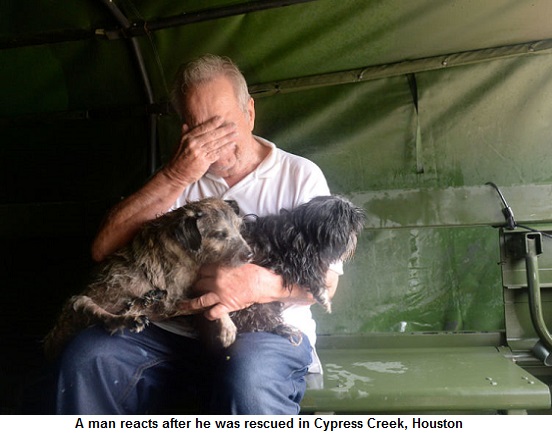
—————–

Appendix B – Legalized: A Year In The Life Of Colorado’s Legal Weed Experiment | NBC News – https://youtu.be/B1cyfObqehI

Published on Nov 9, 2016 – Election night 2016 was a big night for the marijuana legalization movement as multiple states passed measures including recreations initiatives in California and Massachusetts. This piece documented the first year of Colorado’s legal weed experiment.

» Subscribe to NBC News: http://nbcnews.to/SubscribeToNBC
» Watch more NBC video: http://bit.ly/MoreNBCNews

NBC News is a leading source of global news and information. Here you will find clips from NBC Nightly News, Meet The Press, and our original series Debunker, Flashback, Nerdwatch, and Show Me. Subscribe to our channel for news stories, technology, politics, health, entertainment, science, business, and exclusive NBC investigations.

Connect with NBC News Online!
Visit NBCNews.Com: http://nbcnews.to/ReadNBC
Find NBC News on Facebook: http://nbcnews.to/LikeNBC
Follow NBC News on Twitter: http://nbcnews.to/FollowNBC
Follow NBC News on Google+: http://nbcnews.to/PlusNBC
Follow NBC News on Instagram: http://nbcnews.to/InstaNBC
Follow NBC News on Pinterest: http://nbcnews.to/PinNBC

Legalized: A Year In The Life Of Colorado’s Legal Weed Experiment | NBC News

Share this post:
, ,
[Top]

‘If it is going to be, it starts with me’

Go Lean Commentary

“If it is going to be, it starts with me” – Self-Help Mantra

This has become a common rallying cry for Social Justice advocates – see Appendix A below. It is a very simple, yet powerful concept; it asserts:

Want to change the world, first change yourself, then work on changing your community and your country!

This theme is sang in songs – consider Appendix B and this song here by Michael Jackson, the Late-Great King of Pop. He said the same, but in a more melodious tune:

I’m starting with the man in the mirror. I’m asking him to change his ways; and no message could be any clearer: If you want to make the world a better place, take a look at yourself and make a change.

VIDEO – Michael Jackson – Man In The Mirror (Official Video) – https://youtu.be/PivWY9wn5ps

Published on Oct 2, 2009

In keeping with the lyrical message of “Man in the Mirror,” which was strongly identified with Michael Jackson and reflective of his own philosophies, the short film features powerful images of events and leaders whose work embodies the song’s message to”make that change.” Rolling Stone praised the short film in 2014 as “a powerful statement to deliver to personality-driven MTV.”

Written by Siedah Garrett and Glen Ballard
Produced by Quincy Jones for Quincy Jones Productions
Co-Produced by Michael Jackson for MJJ Productions, Inc.
From the album Bad, released August 31, 1987
Released as a single January 16, 1988

THE SHORT FILM
Director: Don Wilson

Michael Jackson’s short film for “Man in the Mirror” was the third of nine short films produced for recordings from Bad, one of the best-selling albums of all time. The “Man in the Mirror” single hit No. 1 in four countries in 1988, topping the charts in the United States, Italy, Belgium and Poland and reaching Top 5 in Canada, Ireland and New Zealand. In the U.S., “Man in the Mirror” was the fourth of five consecutive No. 1 singles from one album on the Billboard Hot 100-making Michael the first artist to achieve this milestone.

“Man in the Mirror,” written by Siedah Garrett (Michael’s duet partner on “I Just Can’t Stop Loving You”) and Glen Ballard, is one of only two songs on Bad not written by Michael Jackson and, even though it wasn’t a song he wrote himself, it was a message that was strongly identified with him and reflective of his own philosophies, as demonstrated through his actions and expressed in some of his own lyrics. “‘Man in the Mirror’ has a great message,” he wrote in his 1988 memoir Moonwalk. “I love that song. ..Start with yourself. Don’t be looking at all the other things. Start with you. That’s the truth.” A review of Bad in Rolling Stone in 1987 called the song “among the half dozen best things Jackson has done.”

In contrast to Michael’s other short films of the Bad era, “Man of the Mirror” tells a story not through performance, but through powerful images of oppression, homelessness, hunger, police brutality and other ills of the world, as well as events and leaders of the 20th century whose work is reflective of the song’s message to “make that change.”

Follow the Official Michael Jackson Accounts:
Facebook – http://smarturl.it/mj_facebook?IQid=y…
Twitter – http://smarturl.it/mj_twitter?IQid=yt…
Spotify – http://smarturl.it/mj_spotify?IQid=yt…
Newsletter – http://smarturl.it/mj_newsletter?IQid…
YouTube – http://smarturl.it/mj_youtube?IQid=yt…
Website – http://smarturl.it/mj_website?IQid=yt…

  • Category: Music
  • License: Standard YouTube License
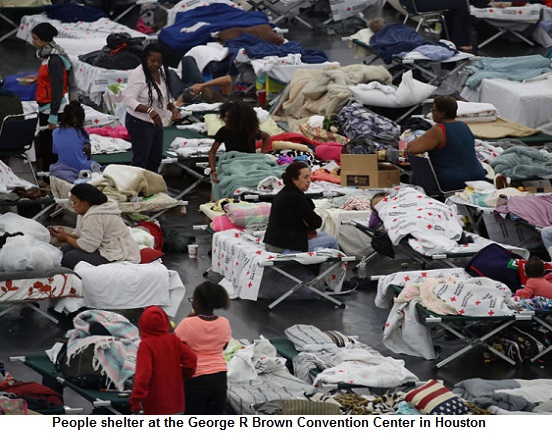
Changing one-self; changing the community and changing the world; these are great aspirations! This is such a familiar theme for the movement behind the book Go Lean … Caribbean. In a previous blog-commentary, the point was elaborated that if you “change the way you see the world; you change the world you see”. But that thesis was related to technology and Augmented Reality Holograms; in this commentary however, the focus is strictly on Self-Help, for oneself and the community.

There is the need to help Caribbean communities.

The 30 member-states of the Caribbean region are all in dire straits; some are even flirting with Failed-States status – think: Puerto Rico Bankruptcy, Spanish Caribbean territorial abandonment, deficient Westminster structures, unstable volcanic states, etc.. Our communities are plagued with defects and dysfunctions in the economic, security and governing engines of society. But these can be remediated; the Go Lean movement posits that the entire region can be reformed and transformed, however that effort is described as heavy-lifting.

Yes, the societal defects of the Caribbean can be fixed – remediated and mitigated – but “if it is going to be, it starts with me”; it is necessary for all stakeholders to engage in the effort to turn-around the Caribbean. To forge change, the region must consider top-down and bottoms-up approaches, so we need the multitude of Caribbean people (bottoms-up) and politicians and community leaders (top-down) to lean-in to this quest to turn-around the community. Yes, it starts with “me”, as in everyone.

The quest to turn-around the Caribbean is detailed in the book Go Lean…Caribbean – available to download for free – which serves as a roadmap for the introduction and implementation of the technocratic Caribbean Union Trade Federation (CU), for the elevation of Caribbean society – for all 30 member-states. This CU/Go Lean roadmap has these 3 prime directives:

  • Optimization of the economic engines in order to grow the regional economy to $800 Billion and create 2.2 million new jobs.
  • Establishment of a security apparatus to ensure public safety and protect the resultant economic engines.
  • Improve Caribbean governance to support these engines, including a separation-of-powers between the member-states and CU federal agencies.

The book stresses that reforming and transforming the Caribbean societal engines must be a regional pursuit. This was an early motivation for the roadmap, as pronounced in the opening Declaration of Interdependence (Pages 12 – 13):

xi. Whereas all men are entitled to the benefits of good governance in a free society, “new guards” must be enacted to dissuade the emergence of incompetence, corruption, nepotism and cronyism at the peril of the people’s best interest. The Federation must guarantee the executions of a social contract between government and the governed.

xvi. Whereas security of our homeland is inextricably linked to prosperity of the homeland, the economic and security interest of the region needs to be aligned under the same governance. Since economic crimes … can imperil the functioning of the wheels of commerce for all the citizenry, the accedence of this Federation must equip the security apparatus with the tools and techniques for predictive and proactive interdictions.

xxiv. Whereas a free market economy can be induced and spurred for continuous progress, the Federation must install the controls to better manage aspects of the economy: jobs, inflation, savings rate, investments and other economic principles. Thereby attracting direct foreign investment because of the stability and vibrancy of our economy.

The Go Lean book provides 370-pages of turn-by-turn instructions on “how” to adopt new community ethos, plus the strategies, tactics, implementations and advocacies to execute so as to reboot, reform and transform the societal engines of Caribbean society.

You must be the change you want to see in the world – Mahatma Gandhi.

CU Blog - 'If it is going to be it starts with me' - Photo 2

This quotation from Mahatma Gandhi relates to the theme of this commentary: “if it is going to be, it starts with me”.

Yes, the Revival the Caribbean needs must start with me! See song in Appendix B.

Other communities have successfully reformed and transformed; we can as well. This point has been conveyed in many previous blog-commentaries; consider this sample:

https://goleancaribbean.com/blog/?p=12322 Lesson from Canada – Ferries help Economics, Security & Governance
https://goleancaribbean.com/blog/?p=11386 Building Better Cities
https://goleancaribbean.com/blog/?p=10513 Lesson from India – Transforming ‘Money’ Countrywide
https://goleancaribbean.com/blog/?p=6563 Lessons from Iceland – Model of Recovery
https://goleancaribbean.com/blog/?p=4587 Burlington, Vermont: First city to be powered 100% by renewables
https://goleancaribbean.com/blog/?p=3490 How One Entrepreneur Can Rally a Whole Community
https://goleancaribbean.com/blog/?p=3326 M-1 Rail: Alternative Motion in the MotorCity
https://goleancaribbean.com/blog/?p=1918 Philadelphia Freedom – We can Look, Listen and Learn
https://goleancaribbean.com/blog/?p=1731 Lesson from Omaha – One Person Forging Change
https://goleancaribbean.com/blog/?p=1596 ‘Prospering Where … Planted’

This is not just idle talk. No, it is a viable plan – a roadmap – that is a conceivable, believable and achievable. The Go Lean book offers the turn-by-turn directions for strategies, tactics and implementations. So with the commitment of time, talent and treasuries of everyone in the Caribbean – or maybe just 1 person: “me” or “you” –  we can succeed in making our homeland a better place to live, work and play. 🙂

Download the free e-Book of Go Lean … Caribbean – now!

Sign the petition to lean-in for this roadmap for the Caribbean Union Trade Federation.

———-

Appendix A – PhD Dissertation

If It’s to Be, It Starts With Me!

The Bidirectional Relation between Goals and the Self

Inaugural-Dissertation

zur Erlangung der Doktorwürde der
Philosophischen Fakultät II

Der Julius-Maximilians – University of Würzburg

URL: https://opus.bibliothek.uni-wuerzburg.de/files/3501/PetraMarkelDissertation.pdf

———-

Appendix B VIDEO – Tim Timmons – Starts With Me – https://youtu.be/pslWA2VRmxg  

Published on Apr 29, 2013 – Download the song now: http://hyperurl.co/2fmddf

Subscribe: http://hyperurl.co/ilhqdq

Share this post:
, ,
[Top]

State of the Union – Annexation: French Guiana

Go Lean Commentary

CU Blog - State of the Union - Annexation - French Guiana - Photo 0

There is the Big Dogthe Alpha – and then there are the other dogs. While this is just nature, it also applies to the societal developments. In the Caribbean region, for example, there is the Big Dog of the United States of America dominating the region? Who is next? The British and …

The French.

This does not refer to just these French Caribbean islands, but rather the whole Republic of France, in which these Caribbean member-states are considered Overseas Departments (administrative sub-sets of the national government); see census numbers here:

Member –State Land Area (Mile2) Population GDP Millions GDP Per Capita
Guadeloupe 1,628 405,000 $6,169 $21,780
Martinique 1,128 402,000 $9,610 $24.118
Saint Barthélemy 21 8,938 $255 $37,000
Saint Martin 53 35,925 $599 $20,600
French Guiana 32,253 250,109 $4,900 $20,000
Republic of France 248,573 66,991,000 $2,833,000 $43,652

There is one French territory in this region that is NOT included in the roadmap for Caribbean confederation, as described in the book Go Lean … Caribbean. This refers to French Guiana, the territory on the mainland of South America, adjacent to Suriname; see photo above.

While the US is Number 1 in the world for Single Market economies, the French is shortly behind; (UK #9; France #10; The Netherlands #28). In the Caribbean, the French structure calls for the administrative designation of an overseas departments that have identical powers to those of the regions of metropolitan France. (This is different than overseas collectivities which is the particular status of Saint Barthélemy and Saint Martin). As integral parts of the French Republic, an overseas department is represented in the National AssemblySenate and Economic and Social Council, elect a Member of the European Parliament (MEP), and use the Euro as their currency.

So nowadays, Guiana is fully integrated in the French central state; they are even a part of the European Union, and its official currency is the Euro. The region is the most prosperous territory in all of South America with the highest GDP per capita.[2] A large part of Guiana’s economy derives from the presence of the Guiana Space Centre, now the European Space Agency‘s primary launch site near the equator. As elsewhere in France, the official language is French, but each ethnic community has its own language, of which Guianan Creole is the most widely spoken.

French Guiana and the European Space Agency were prominently featured in the Go Lean book – Page 105; see Appendix below – as a model for Self-Governing Entities (SGE). The hope – as expressed in the book – was that this territory would someday join the regional neighborhood.

French Guiana is complete administratively, but still features a lot of societal defects – not colonial de jure; but colonial de facto. It is the opinion of this Go Lean commentary, that this homeland needs … its neighbors: regional integration, which is the best strategy for anti-colonialism. See this VIDEO and news article here, highlighting the blatant discord there in that territory:

VIDEO – French Guiana Marches Against Colonialism – https://videosenglish.telesurtv.net/player/653436/french-guiana-marches-against-colonialism/?aspectratio=auto

General Strike and National Protest on March 28, 2017

———-

Opinion Article – How Racism Hampers Health Care in French Guiana
By: Estelle Carde

Limited access to health care is exacerbated by everyday discrimination based on ethnicity and national origin.
Oft-overlooked French Guiana, one of France’s five overseas departments, has suddenly captured international media attention. And the news from this small South American territory is not good.

Crime, overcrowding in schools and hospitals, unemployment, the cost of living and slums have reached alarming levels.

Citizen discontent led to a massive demonstration this March, the most intense such strike since 2009. Demonstrators are asking for a $US2.7 billion emergency aid package from the French government to assist in the territory’s social and economical crisis.

CU Blog - State of the Union - Annexation - French Guiana - Photo 2

Health care is a particular concern in the former penal colony of 276,000 people. Hospitals are under-staffed and technical facilities are lacking. In some areas, the nearest hospital is a two-day canoe trip away.

CU Blog - State of the Union - Annexation - French Guiana - Photo 1

The recent deaths of five premature babies from infection at Cayenne hospital, in the capital, have heightened concerns.

But there’s one critical health care-related issue that almost no one is talking about: racism. In a diverse territory comprised of people of European, African, Asian and Indigenous descent and a growing immigrant population, limited access to health care is exacerbated by everyday discrimination based on ethnicity and national origin.

Too many foreigners?
Foreign-born residents of French Guiana are among those impacted by discrimination in the health-care system.

Though socioeconomically the territory lags severely behind the rest of France, French Guiana constitutes a regional haven of wealth whose attractiveness has grown since the 1960s. Today, more than one in three inhabitants is born abroad. People from Suriname, Brazil and Haiti represent the largest immigrant groups.

This “tidal wave” of immigration is often cited as the main cause of French Guiana’s current socioeconomic crisis, even in some French political circles. The discriminatory behaviours that sometimes result from such widespread immigrant-blaming may be only thinly veiled.

State health office assistants might apply stricter conditions than legally necessary to those seeking medical benefits. Some, for instance might ask the foreign-born applicants to give proof of longer residency than required by law, thinking that it will discourage them from settling in the territory.

The same arguments are, in fact, used to justify similar discriminatory practices against immigrants in mainland France, too. But in Guiana they are more openly displayed.

Ethnic categorizations
Immigrants are not the only group that experiences discrimination in accessing health care in French Guiana. Members of minority populations, whether they are French or not, can also be affected.

This is partly because in French Guiana, people commonly use ethnicity to identify themselves and others. Creole, Maroon, Amerindian, Hmong, Chinese or French Métropolitains (mainlanders) are frequently invoked categories.

Under French law, the government cannot collect data or use it based on ethnicity. But in Guiana such usage goes back to the territory’s early times as a slave colony.

And, of course, each grouping comes with its stock of stereotypes: “Maroons are child-like”, for instance, or “Hmongs are disciplined” and “Amerindians drink their dole money”.

But these assumptions are not set in stone. Because they serve to justify power relations between groups, they tend to change with the ethnic identity of the speaker. This social dynamic plays out in French Guiana’s health-care system.

In Saint-Laurent-du-Maroni, French Guiana’s second largest city, Maroons – the descendants of escaped former slaves – are the majority population and therefore the largest group of health-care users. Health-care professionals, on the other hand, are primarily Creoles or French mainlanders.

CU Blog - State of the Union - Annexation - French Guiana - Photo 3

These professionals often point to the Maroon people’s history to explain certain patient behaviours. In the 18th and 19th centuries, slaves who escaped from plantations would hide in the forest, creating communities that remained more or less isolated from coastal Guianese society for almost 200 years.

In 1969, the large territory they still occupy – mainly tropical forests in the country’s interior – was finally integrated into the Department of Guiana. At that point, they began to gain access to French citizenship and public services such as education and health.

Doctors, nurses and other health professionals readily highlight these facts to explain Maroons’ difficulties in accessing treatment, inferring that they are not yet used to doing things “the Western way.”

‘Them’ and ‘us’
Such references to historical facts are charged with connotations. Some Creole professionals suggest that Maroon people are undeserving of care because they only had to “leave their forest” to access to such services. Contrasting that status with their own position as “Guianese taxpayers” who fund these services, some may use this as justification to refuse Maroon people help in accessing treatment.

This attitude can be better understood considering the Creole people’s own history in French Guiana. Their process of accessing civil rights was slow and gradual. Social empowerment came only at the tail end of a gradual Westernisation process that began with slavery in the 17th century.

After emancipation and the granting of French citizenship in 1848, this population slowly rose to local economic and political power, spurred along by Guiana’s transformation into a French department (1946) and a national policy of decentralisation (1982).

Now hard-won Creole dominance is threatened by Maroon people, who recently obtained the same civil rights as them, and whose numbers have surpassed their own numbers in the Western part of Guiana.

Health professionals from the French mainland, for their part, tend to emphasise the “cultural differences” of these “new citizens”. They cite, for example, the “traditional” way in which Maroons transmit information (watching without asking questions) and their way of “living in the moment” to explain their apparent inability to request health coverage prior to needing treatment.

This tendency to highlight cultural differences can also end up amounting to discrimination because it overshadows systemic failures that do impact access to health care, such as the lack of health coverage offices in the country’s rural inland regions. This tendency is more present among professionals who have been in Guiana for just a few months and who readily admit to being allured by the very different culture of this “exotic” overseas corner of France.

Discriminatory behaviours among health professionals therefore exacerbate the failures of the ailing health-care system now under protest by Guianese demonstrators. Foreigners and Maroon people are the first victims of administrative failures due to their vulnerable socioeconomic status. They are also worst hit by geographical obstacles because they represent a majority of inhabitants in the territory’s remote rural areas.

But this accumulation of racist, economic and geographical inequalities is no accident. It is the result of centuries of history of Guianese society.

Source: TeleSur Media Network – Published April 13, 2017; retrieved July 26, 2017 from: http://www.telesurtv.net/english/opinion/How-Racism-Hampers-Health-Care-in-French-Guiana-20170413-0007.html

——-

Translated from the French by Alice Heathwood for Fast for Word.

Estelle Carde is a professor of Sociology of Health at Université de Montréal.

This article was originally published on The Conversation. Read the original article.

RELATED:
Guiana Workers ‘Toughen Up’ Mobilizations Against French State 

This theme – “All is not well in the Caribbean” – aligns with the movement behind the book Go Lean … Caribbean, where the assertion is that the problems facing the Caribbean region are too big for any one member-state alone. There needs to be a regional solution. The book posits that shifting the help-seeking responsibility to a region-wide, professionally-managed, deputized technocracy will result in greater production and greater accountability. This deputized agency is the Caribbean Union Trade Federation (CU). The Go Lean book serves as a roadmap for the introduction and implementation of the CU.

This commentary is a follow-up to the 5-part series on the subject of the State of the Caribbean Union. Our Caribbean region is unique in that there are 4 different languages and 5 colonial legacies, spread across 30 member-states and 42 million people. The goal is to execute the 5-year plan of the roadmap and then add a 31st member: French Guiana. Based on the dispositions in the foregoing VIDEO and news-opinion article, French Guiana can use the Go Lean empowerments NOW! That land is suffering from many of the same dysfunctions that plague the rest of the Caribbean and the neighboring states of Suriname and Guyana. There might be the need to act NOW to seek refuge and relief.

The other 5 entries in the series are as follows:

Just the phraseology “Caribbean Union” assumes a collective collaboration of all the territories that identify with Caribbean culture; there is the need for better local stewardship. This Go Lean effort is a confederation of sovereign and non-sovereign territories, as is the case for French Guiana. There is no need for independence, as the authority of these territories can still be deputized into the CU as an umbrella intergovernmental organization. In total, the Go Lean/CU roadmap will employ strategies, tactics and implementations to impact its prime directives; identified with the following 3 statements:

  • Optimization of the economic engines in order to grow the regional economy to $800 Billion & create 2.2 million new jobs.
  • Improvement of Caribbean governance to support these engines, including a “Separation-of-Powers between CU federal agencies and Caribbean member-state governments”; so the limitations of national laws in a member-state does not have to override the CU. A CU constitution would apply to the installation – and continuation – of Exclusive Economic Zones (EEZ) and Self-Governing Entities (SGE) that operate in controlled bordered territories like campuses, industrial parks, research labs and industrial plants.

The Go Lean/CU roadmap always anticipated the French Caribbean territories. This theme was detailed in previous Go Lean blog-commentaries; consider this sample:

https://goleancaribbean.com/blog/?p=12466 Managing Volcanoes in the French Caribbean – Martinique and Guadeloupe
https://goleancaribbean.com/blog/?p=10554 Welcoming the French in Formal Integration Efforts
https://goleancaribbean.com/blog/?p=10043 Caribbean Integration Plan for Greater Prosperity
https://goleancaribbean.com/blog/?p=7834 French Caribbean ready for the Martinique Surf Pro
https://goleancaribbean.com/blog/?p=382 Guadeloupe, Martinique, St Maarten Join the Association of Caribbean States

Now the status of the French Caribbean is indistinguishable from colonial status. All authority still rest in Paris. But there is an opportunity for more (and better) autonomous governance in the region. As depicted in these previous commentaries, this opportunity is extended for the French Caribbean to align with the rest of the Caribbean region to adopt strategies, tactics and implementations to assuage the societal dysfunctions … together.

This quest of optimizing the entire Caribbean economic-security-governance eco-system is more than just a dream; this was the motivation for the origins of the Go Lean movement. This vision is defined early in the book (Pages 12 & 13) in the following pronouncements in the Declaration of Interdependence:

ix. Whereas the realities of healthcare and an aging population cannot be ignored and cannot be afforded without some advanced mitigation, the Federation must arrange for health plans to consolidate premiums of both healthy and sickly people across the wider base of the entire Caribbean population. The mitigation should extend further to disease management, wellness, mental health, obesity and smoking cessation programs. …

xi. Whereas all men are entitled to the benefits of good governance in a free society, “new guards” must be enacted to dissuade the emergence of incompetence, corruption, nepotism and cronyism at the peril of the people’s best interest. The Federation must guarantee the executions of a social contract between government and the governed.

xii. Whereas the legacy in recent times in individual states may be that of ineffectual governance with no redress to higher authority, the accedence of this Federation will ensure accountability and escalation of the human and civil rights of the people for good governance, justice assurances, due process and the rule of law. As such, any threats of a “failed state” status for any member state must enact emergency measures on behalf of the Federation to protect the human, civil and property rights of the citizens, residents, allies, trading partners, and visitors of the affected member state and the Federation as a whole.

xxii. Whereas the heritage of our lands share the distinction of cultural tutelage from European and American imperialists that forged their tongues upon our consciousness, it is imperative to form a society that is neutral and tolerant of the mother tongue influences of our people to foster efficient and effective communications among our citizens.

xxiii. Whereas many countries in our region are dependent Overseas Territory of imperial powers, the systems of governance can be instituted on a regional and local basis, rather than requiring oversight or accountability from distant masters far removed from their subjects of administration. The Federation must facilitate success in autonomous rule by sharing tools, systems and teamwork within the geographical region.

xxiv. Whereas a free market economy can be induced and spurred for continuous progress, the Federation must install the controls to better manage aspects of the economy: jobs, inflation, savings rate, investments and other economic principles. Thereby attracting direct foreign investment because of the stability and vibrancy of our economy.

The Go Lean book posits that the inefficient Caribbean communities – French Guiana included – can be reformed and transformed if they adopt the community ethos, strategies, tactics, implementations and advocacies as depicted in the Go Lean roadmap. The book provides 370-pages of turn-by-turn instructions on “how” so as to reboot, reform and transform the societal engines of Caribbean society. For one, the strategy calls for the implementation of Self-Governing Entities like the European Space Agencies and many more industrial sites – i.e. 10 Steps to Implement Self-Governing Entities on Page 105 of the book.

The effort of the Go Lean roadmap is not “stuck” on Caribbean geography; rather we are committed to Caribbean culture. As such we confederate with territories not only in the Caribbean Sea but also those in the Atlantic Ocean (Bahamas, Bermuda and the Turks & Caicos Islands), on the Central American mainland (Belize) and the South American mainland (Guyana, Suriname and now French Guiana). All of this constitutes the Caribbean homeland.

Together, Caribbean stakeholders can succeed in efforts to improve; to end the parasite status with European capitals (and Washington) and instead exert our autonomy as mature democracies. We can be protégés instead of parasites.

Yes, we can … reform and transform our homeland to make it a better place to live, work and play. 🙂

Download the book Go Lean … Caribbean – now!

Sign the petition to lean-in for this roadmap for the Caribbean Union Trade Federation.

———–

Appendix – The Bottom Line on the French Guiana Space Center

The European Space Agency (ESA) is an intergovernmental organization of 20 member states, dedicated to the exploration of space. Established in 1975 and headquartered in Paris, France, ESA has a staff of more than 2,000 with an annual budget of about US$5.51 billion (2013). ESA’s space flight program includes human spaceflight, mainly with the International Space Station program, the launch and operations of unmanned exploration missions to other planets and the Moon, Earth observation, science, telecommunication as well as maintaining a major spaceport, the Guiana Space Center (CSG) at Kourou, French Guiana, and designing launch vehicles. The main European launch vehicle, Ariane 5 is operated through Arianespace with ESA sharing in the costs and further developing this launch vehicle.

The CSG has been operational since 1968; it is particularly suitable as a location for a spaceport as it fulfills the two major geographical requirements:

• it is quite close to the equator, so that the spinning earth can impart some extra velocity to the rockets for free when launched eastward, and

• it has uninhabited territory (in this case, open sea) to the east, so that lower stages of rockets and debris from launch failures cannot fall on human habitations.

CSG is the spaceport used by the ESA to send supplies to the International Space Station using the Automated Transfer Vehicle. Commercial launches are bought also by non-European companies. ESA pays two thirds of the spaceport’s annual budget and has also financed the upgrades made during the development of the Ariane launchers.

Source: Go Lean … Caribbean book (Page 105).

Share this post:
, , , ,
[Top]

State of the Union: Self-Interest of ‘Americana’

Go Lean Commentary

CU Blog - State of the Union - Americana - Photo 0

Question: “Where does an 800-pound gorilla sleep? Answer: Anywhere he wants!”

The United States of America is the “800-pound gorilla” or the BIG DOG of the Western Hemisphere; (in fact, the US is the last Super Power in the world).

  • There are two US Territories in our Caribbean: Puerto Rico and the Virgin Islands.
  • The US is the Number 1 Single Market economy in the world
  • The US is the Number 1 military (in terms of troop size, armament and defense spending).
  • The US is also the Number 1 destination for the Caribbean Diaspora.

We cannot avoid the influence of the American system – Americana – on our Caribbean region…

“Resistance is futile!”

As the 800-pound gorilla, the US can “sleep wherever it wants” and take whatever it wants. They can … and do. Despite the appearance of benevolence and the “rule of law”, the US does at times emerge as a “Bad Actor”. They may at times use their influence and domination of the hemisphere to effectuate policies not always in the Caribbean’s best interest. The influence of Americana affects different aspects of Caribbean society; it affects our …

  • Economics – with the domination of US dollar
  • Security dynamics – with the reality of Pax Americana
  • Governance – the President of the US is considered the Leader of the Free World.

This theme aligns with the movement behind the book Go Lean … Caribbean, where the assertion is that while America is dominant in the hemisphere, we must fight-resist to not be parasites of this BIG DOG American host; rather we must strive to be protégés. The Go Lean book serves as a roadmap for the introduction and implementation of the technocratic Caribbean Union Trade Federation (CU). As a protégé, our quest is not to be America; our goal is to be better!

How?

First we start by recognizing our status quo-disposition and then to recognize American motivation and influences. This – completing our assessment – is an important first step in reforming and transforming our regional society. This is commentary 5 of 5 from the movement behind the Go Lean book on the subject of the State of the Caribbean Union. Our dire disposition has been assessed in the Go Lean book and many technocratic solutions provided there-in. The full entries of all the blog-commentaries in this series is as follows:

The Caribbean has a universal problem with every member-state throughout the region; there is a propensity for our people – especially the youth – to leave the Caribbean homeland; they abandon their ancestral countries and flee to foreign shores; the Number 1 destination is the US.  As related in the first submission in this blog-commentary series, the young people in the region need the vision of “something better” or Hope and Change in order to be inspired to participate in the future of their homeland. We cannot have a future without these young people, so these solutions – strategies, tactics and implementations – are not optional.

These commentaries draw reference to the Go Lean book, as it details the quest to transform the Caribbean; it features a how-to guide and roadmap for elevating the region to be an American protégé rather than a parasite; so as to optimize our societal engines for economics, security and governance. But there are stakeholders in the Caribbean that would like to be more independent and agnostic of the American influence – consider the current Venezuela crisis and the response of the St. Vincent Prime Minister wanting full autonomy separate from the US. This is wishful … and ignorant of history – “those who refuse to learn from history are doomed to repeat it”. This was the case of …

Despite the passage of time, the US will not compromise on being the only BIG DOG-Alpha Male in this hemisphere. This is referred to as the Monroe Doctrine. See more here:

Reference Title – Monroe Doctrine
CU Blog - State of the Union - Americana - Photo 1
The Monroe Doctrine was a United States policy of opposing European colonialism in The Americas beginning in 1823. It stated that further efforts by European nations to take control of any independent state in North or South America would be viewed as “the manifestation of an unfriendly disposition toward the United States.”[1] At the same time, the doctrine noted that the U.S. would recognize and not interfere with existing European colonies nor meddle in the internal concerns of European countries. The Doctrine was issued in 1823 at a time when nearly all Latin American colonies of Spain and Portugal had achieved or were at the point of gaining independence from the Portuguese and Spanish Empires.

President James Monroe first stated the doctrine during his seventh annual State of the Union Address to Congress. The term “Monroe Doctrine” itself was coined in 1850.[2] By the end of the 19th century, Monroe’s declaration was seen as a defining moment in the foreign policy of the United States and one of its longest-standing tenets. It would be invoked by many U.S. statesmen and several U.S. presidents, including Ulysses S. GrantTheodore RooseveltJohn F. Kennedy, and Ronald Reagan. The intent and impact of the Monroe Doctrine persisted with only minor variations for more than a century. Its stated objective was to free the newly independent colonies of Latin America from European intervention and avoid situations which could make the New World a battleground for the Old World powers, so that the U.S. could exert its own influence undisturbed. The doctrine asserted that the New World and the Old World were to remain distinctly separate spheres of influence, for they were composed of entirely separate and independent nations.[3]

After 1898, Latin American lawyers and intellectuals reinterpreted the Monroe doctrine in terms of multilateralism and non-intervention. In 1933, under President Franklin D. Roosevelt, the U.S. went along with the new reinterpretation, especially in terms of the Organization of American States.[4]

Source: Retrieved July 19, 2017 from: https://en.wikipedia.org/wiki/Monroe_Doctrine

——

Reference Title Organization of American States
The Organization of American States (SpanishOrganización de los Estados AmericanosPortugueseOrganização dos Estados AmericanosFrenchOrganisation des États américains), or the OAS or OEA, is a continental organization founded on 30 April 1948, for the purposes of regional solidarity and cooperation among its member states. Headquartered in the US Capital of] Washington, D.C.,[1] the OAS’s members are the 35 independent states of the Americas.

CU Blog - State of the Union - Americana - Photo 2

CU Blog - State of the Union - Americana - Photo 3

As of 26 May 2015, the Secretary General of OAS is Luis Almagro.[2]

The member-states are as follows:

Antigua Argentina Bahamas Barbados Belize
Bolivia Brazil Canada Chile Colombia
Costa Rica Cuba (Suspended) Dominica Dominican Republic Ecuador
El Salvador Grenada Guatemala Guyana Haiti
Honduras Jamaica Mexico Nicaragua Panama
Paraguay Peru St. Kitts St. Lucia St. Vincent
Suriname Trinidad United States Uruguay Venezuela (Withdrew)

Source: Retrieved July 19, 2017 from: https://en.wikipedia.org/wiki/Organization_of_American_States

As depicted in the foregoing, the Monroe Doctrine is alive and well. Today, it is expressed through the American tutelage for the modern expression of multilateralism with the “Organization of the American States” (OAS). Since the purpose of the OAS is regional solidarity and cooperation, it automatically assumes a defensive posture. There is no active cross-border war in the Americas at this time; (there was only a Civil War / Domestic Terrorism campaign in Colombia). The US is using its BIG DOG status to force international peace in this hemisphere. This exercise of the American security mandates is casually referred to as “Pax Americana”.

But, the reality of living in the shadows of America means that we have to be aware of American self-interest and what it means to our hemispheric community – Resistance is Futile. Scanning the landscape of the region’s economic, security and governing engines, we see these obvious expressions of American self-interest … conveyed in previous blog-commentaries:

Economics

According to the Go Lean book, the CU is designed to be a technocratic intergovernmental entity that shepherds the Caribbean region’s economic interest. As the “800-pound gorilla” in the hemisphere, the evidence of American self-interest cannot be ignored. Notice the samples-examples in these scenarios:

Security

Depending on Pax Americana means ignoring many security best practices in the region. The US works to ensure security on their homeland, while ignoring the Caribbean. See how this thesis is presented in these sample blog-commentaries here:

Governance

There are a lot of expressions of American governance that is evident that American self-interest overrides common sense and the Greater Good. Consider these samples-examples:

———-

The movement behind the Go Lean book wants to help reform and transform the Caribbean. But we recognize that there will be no chance for success in the Caribbean region if our efforts go against American economic/security/foreign-policy interest.

The Go Lean/CU roadmap employs a tactic of a “Separation-of-Powers between CU federal agencies and Caribbean member-state governments”; so the limitations of national laws in a member-state does not have to override the CU. The CU constitution would apply to the installation of Exclusive Economic Zones (EEZ) and Self-Governing Entities (SGE) that operate in controlled bordered territories like campuses, industrial parks, research labs and industrial plants. Lastly, there is the power of “peer pressure” where progress by one Caribbean state would incline others to follow suit. In total, the Go Lean/CU roadmap will employ strategies, tactics and implementations to impact its prime directives; identified with the following 3 statements:

The Go Lean roadmap seeks to prepare the Caribbean region to be a protégé of Americana, not a parasite. While this is easier said than done, it is conceivable, believable and achievable. This quest, optimizing the entire Caribbean economic/security/governance eco-system, was the motivation of the Go Lean movement. This vision is defined early in the book (Page 12) in the following pronouncements in the Declaration of Interdependence:

x. Whereas we are surrounded and allied to nations of larger proportions in land mass, populations, and treasuries, elements in their societies may have ill-intent in their pursuits, at the expense of the safety and security of our citizens. We must therefore appoint “new guards” to ensure our public safety and threats against our society, both domestic and foreign. The Federation must employ the latest advances and best practices of criminology and penology to assuage continuous threats against public safety. …

xi. Whereas all men are entitled to the benefits of good governance in a free society, “new guards” must be enacted to dissuade the emergence of incompetence, corruption, nepotism and cronyism at the peril of the people’s best interest. The Federation must guarantee the executions of a social contract between government and the governed.

xii. Whereas the legacy in recent times in individual states may be that of ineffectual governance with no redress to higher authority, the accedence of this Federation will ensure accountability and escalation of the human and civil rights of the people for good governance, justice assurances, due process and the rule of law. As such, any threats of a “failed state” status for any member state must enact emergency measures on behalf of the Federation to protect the human, civil and property rights of the citizens, residents, allies, trading partners, and visitors of the affected member state and the Federation as a whole.

The Go Lean book posits that dysfunctional Caribbean communities can be reformed and transformed if they adopt the community ethos, strategies, tactics, implementations and advocacies as depicted in the Go Lean roadmap. The book provides 370-pages of turn-by-turn instructions on “how” so as to turnaround the societal engines of Caribbean society. For one, the recommendation is to reform and transform Caribbean foreign-policy – i.e. 10 Foreign Policy Initiatives at Start-up on Page 102 of the book. – from parasite to protégé.

The Caribbean can succeed in our efforts to improve our dependence of Americana. Consider this sample of previous blog-commentaries that delve into aspects of transforming the Caribbean region to a protégé status, away from a parasite status:

https://goleancaribbean.com/blog/?p=11759 Understand the Market, Plan the … Change
https://goleancaribbean.com/blog/?p=10216 Waging A Successful War Against Societal Defects – A Series
https://goleancaribbean.com/blog/?p=10043 Integration Plan for Greater Caribbean Prosperity
https://goleancaribbean.com/blog/?p=9595 Vision and Values for a ‘New’ Caribbean
https://goleancaribbean.com/blog/?p=7646 Going from ‘Good to Great’
https://goleancaribbean.com/blog/?p=7628 ‘A Change Is Gonna Come’
https://goleancaribbean.com/blog/?p=6993 Forging Change: ‘Something to Lose’
https://goleancaribbean.com/blog/?p=1596 Transforming to where we can ‘Prosper where Planted’

This commentary completes the 5-part series on the subject of the State of the Caribbean Union, (notwithstanding future sequels). Our region is really hurting! We are near-Failed-State status now. Our societal defects abound, whether we are among the big islands (Cuba, D.R. and/or P.R.) with the big populations, or whether we are among the small volcano islands, waiting for the next eruption. All in all, the Caribbean status quo is not successful and what little societal cohesion we have cannot be sustained, alone … for long. We must act now and seek refuge, but that refuge is not Americana, as our Caribbean interest is not American interest. 🙁

The reality of Americana is that “there will always be winners and losers” … in their society.

This sounds so familiar! This was the lyrics of the Rock-n-Roll song – Pink Houses  – by John Cougar Mellancamp, where he scorched the hypocrisy of the American eco-system – see VIDEO and Song Lyrics in the Appendices below; with this sample here:

And there’s winners and there’s losers
But they ain’t no big deal
‘Cause the simple man, baby
Pays for thrills
The bills the pills that kill

American self-interest dictates making the winners from some American special interest groups, at the expense of the Greater Good. It is hard for the winners to be foreigners, or the Black-and-Brown of the Caribbean. No, the American “game is rigged”; the winners represent the Crony-Capitalists in American society. In the Caribbean, we can … and must do better. We urge all Caribbean stakeholders – governments, citizens, residents and Diaspora – and all those who love the Caribbean region to lean-in to this vision described within this Go Lean roadmap.

The vision for a new Caribbean is one that is not a parasite of the US; but rather a protégé!

Yes, we can … stand tall and make our homeland a better place to live, work and play. 🙂

Download the free e-Book of Go Lean … Caribbean – now!

Sign the petition to lean-in for this roadmap for the Caribbean Union Trade Federation.

————-

Appendix VIDEO  – John Mellencamp – Pink Houses – https://youtu.be/qOfkpu6749w

Published on Oct 5, 2009 – Music video by John Mellencamp performing Pink Houses. (C) 1983 John Mellencamp under exclusive license to the Island Def Jam Music Group.

  • Category: Music
  • License: Standard YouTube License
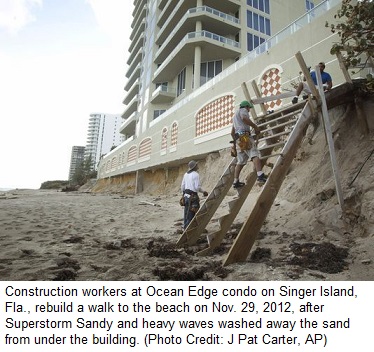
————-

Appendix – John Mellencamp – “Pink Houses” Lyrics

There’s a black man with a black cat
Livin’ in a black neighborhood
He’s got an interstate
Runnin’ through his front yard
You know he thinks that he’s got it so good
And there’s a woman in the kitchen
Cleanin’ up the evenin’ slop
And he looks at her and says, hey darlin’
I can remember when you could stop a clock

CHORUS:
Oh, but ain’t that America
For you and me
Ain’t that America
Something to see, baby
Ain’t that America
Home of the free, yeah
Little pink houses
For you and me
Oooh, yeah
For you and me

Well, there’s a young man in a t-shirt
Listenin’ to a rockin’ rollin’ station
He’s got greasy hair, greasy smile
He says, Lord this must be my destination
‘Cause they told me when I was younger
Said boy, you’re gonna be president
But just like everything else
Those old crazy dreams
Just kinda came and went

[CHORUS]

[Instrumental Interlude]

Well, there’s people and more people
What do they know, know, know
Go to work in some high rise
And vacation down at the Gulf of Mexico
Ooh, yeah
And there’s winners and there’s losers
But they ain’t no big deal
‘Cause the simple man, baby
Pays for thrills
The bills the pills that kill

[CHORUS]
Ooooh, yeah…

Source: Retrieved July 19, 2019 from: http://www.azlyrics.com/lyrics/johnmellencamp/pinkhouses.html

Share this post:
, , ,
[Top]

State of the Union: Unstable ‘Volcano States’

Go Lean Commentary

Picture this …

… a duck swimming on a tranquil pond; calm and peaceful on the surface, but underneath the duck is paddling ferociously. Tranquility above; eruption below.

This visual also describes life in many Caribbean member-states – stable above; unstable below. Among the Lesser Antillean islands, the natural beauty is idyllic, while under the surface there are bubbling volcanoes, that periodically result in raging eruptions – see Appendix below.

CU Blog - State of the Union - Volcano States - Photo 1
These Lesser Antilles are the group of islands edging the Caribbean Sea. Most form a long, partly volcanic island arc between the Greater Antilles to the north-west and the continent of South America.[1] The islands form the eastern boundary of the Caribbean Sea with the Atlantic Ocean. Together, the Lesser Antilles and the Greater Antilles compose the Antilles (or the Caribbean in its narrowest definition). 

The Lesser Antilles region is a volcano zone – this is not just academic theory; this is a fact – most of the islands are of volcanic origins with extremely rich soil; this is the good history of the region’s volcanic past. There is bad history too; there have been devastating volcanic eruptions in the past – in modern times – and some volcanoes are active … now; think Montserrat where 2/3 of the island is now an Exclusion Zone.

There are volcanic activities on other islands as well; some are dormant; some are active, in particular on Martinique and St. Vincent. Will they erupt in the next few …?

The surety of an imminent volcano eruption is not known; but it is among the seismic threats – volcanoes, earthquakes and tsunamis – that must be accounted for. Economic engines can be disrupted with these seismic activities; even the threat of volcano can compromise economic security. This is the unstable reality; this is the State of the Union, for the following Caribbean islands; (click on any name for encyclopedic details of that island):

CU Blog - State of the Union - Volcano States - Photo 2

Dominica Guadeloupe Jamaica Martinique Montserrat Nevis
Providencia Saba St. Eustatius St. Kitts St. Lucia St. Vincent

This discussion aligns with the book Go Lean…Caribbean. The book presents a roadmap to optimize the region’s security apparatus in conjunction with economic and governmental empowerments. This assertion – that regional stakeholders must be ready for any emergency – is introduced in the Go Lean book as follows under the title of “Crap Happens” (Page 23):

Economic security is tied to the community quest to reboot the Caribbean region to ensure a better place to live, work and play. To ensure economic security, the economic engines must be protected to ensure their continuous operations despite natural or man-made deterrents. Bad things do happen to good people, so we cannot be caught unprepared. We must institute the process and provisions to respond, react, restore and recover. Any and everyone may need to dial “911”.

The Caribbean community ethos is to consider the facts and realities:

  1. climate change cannot be dismissed – tropical storms are now more common and more ferocious;
  2. there are two geologic fault-lines that run through the Caribbean region;
  3. there is an active volcano on Montserrat.

It is not a matter of “if” but “when” emergencies will strike. The security principle therefore is to be prepared for all incidents, big and small, that involve all aspects of society: islands, institutions, companies, families and individuals.

The subject of emergency management is analyzed in the Go Lean book; this is presented as a required function of a technocratic governmental administration. This book – available to download for free – serves as a roadmap for the introduction and implementation of the technocratic Caribbean Union Trade Federation (CU), for the elevation of Caribbean society – for all member-states. This CU/Go Lean roadmap endorses a system of better stewardship, with these 3 prime directives:

  • Optimization of economic engines in order to grow the regional economy to $800 Billion and create 2.2 million new jobs.
  • Establishment of a security-disaster apparatus to ensure public safety and protect the resultant economic engines.
  • Improve Caribbean governance to support these engines, including a true separation-of-powers between the member-states and CU federal agencies. This dictates a regional response for natural disaster emergencies.

The book stresses that reforming and transforming the Caribbean societal engines must be a regional pursuit. This was an early motivation for the roadmap, as pronounced in the opening Declaration of Interdependence (Pages 11 – 13):

ii. Whereas the natural formation of the landmass for our lands constitutes some extreme seismic activity, it is our responsibility and ours alone to provide, protect and promote our society to coexist, prepare and recover from the realities of nature’s occurrences.

xi. Whereas all men are entitled to the benefits of good governance in a free society, “new guards” must be enacted to dissuade the emergence of incompetence, corruption, nepotism and cronyism at the peril of the people’s best interest. The Federation must guarantee the executions of a social contract between government and the governed.

xvi. Whereas security of our homeland is inextricably linked to prosperity of the homeland, the economic and security interest of the region needs to be aligned under the same governance. Since economic crimes … can imperil the functioning of the wheels of commerce for all the citizenry, the accedence of this Federation must equip the security apparatus with the tools and techniques for predictive and proactive interdictions.

xxiv. Whereas a free market economy can be induced and spurred for continuous progress, the Federation must install the controls to better manage aspects of the economy: jobs, inflation, savings rate, investments and other economic principles. Thereby attracting direct foreign investment because of the stability and vibrancy of our economy.

This commentary is 4 of 5 in an occasional series on the State of the Caribbean Union. Surely, a volcano subduction zone throughout the Lesser Antilles must have a common sense of urgency. This threat has been assessed in the Go Lean book and the technocratic solutions provided there-in. The full entries of all the blog-commentaries in this series is as follows:
  1. State of the Caribbean Union – Lacking Hope and Change
  2. State of the Caribbean Union – Dysfunctional Spanish Caribbean
  3. State of the Caribbean Union – Deficient Westminster States
  4. State of the Caribbean Union – Unstable Volcano States
  5. State of the Caribbean Union – Self-Interest of Americana

As related in the first submission in this series, the young people in the region need the vision of “something better” or Hope and Change in order to be inspired to participate in the future of this homeland. We cannot have a future without these young people, so these solutions – strategies, tactics and implementations – are not optional.

Remember Montserrat? It is hard to have “hope for the future” if you live there; (2/3 of the island is now an Exclusion Zone). The reality of threatening conditions is a consistent theme from the Go Lean movement. Consider these previous blog-commentaries chronicling the pain and suffering of natural disasters in the region:

https://goleancaribbean.com/blog/?p=7449 ‘Crap Happens’ – So What Now?
https://goleancaribbean.com/blog/?p=6189 A Lesson in History – ‘Hurricane Katrina’ is helping today’s crises
https://goleancaribbean.com/blog/?p=5002 Managing a ‘Clear and Present Danger’
https://goleancaribbean.com/blog/?p=4360 Dreading the Inadequate ‘Caribbean Basin Security Initiative’
https://goleancaribbean.com/blog/?p=4185 Montserrat – A Post Volcano Ghost Town
https://goleancaribbean.com/blog/?p=2614 The ‘Great ShakeOut’ Earthquake Drill / Planning / Preparations
https://goleancaribbean.com/blog/?p=87 6.5M Earthquake Shakes Eastern Caribbean

The Go Lean book provides 370-pages of turn-by-turn instructions on “how” to adopt new community ethos, plus the strategies, tactics, implementations and advocacies to execute so as to reboot, reform and transform the societal engines of Caribbean society. For one, the recommendation is to reform and transform Caribbean governance, to better manage disaster-emergency situations – i.e. 10 Ways to Improve Emergency Management on Page 196 of the book.

Yes, there is the Caribbean Disaster Emergency Management Agency (CDEMA) already established in the region, and this organization represents a “good start” for a collaborative effort to monitor, mitigate and manage disaster situations. But CDEMA is undermanned, underfunded and under-appreciated. Embedding a security-disaster apparatus into a regional empowerment roadmap along with economic efforts allows the right people, right tools and right techniques for mitigating the threats of volcanoes … and earthquakes.

Many times, the same geological phenomena that fosters earthquakes – a constant threat in the Caribbean – also drives volcanoes. Considering  that “art imitates life”, see the fictionalized account of volcanoes and emergency management response in this Movie Trailer, in this related VIDEO:
VIDEO – Movie: Volcano – “The Coast is Toast” (1997) – https://youtu.be/QhS9X8H51A8  

CU Blog - State of the Union - Volcano States - Photo 3Published on Mar 8, 2008 – When a massive earthquake rocks the city of Los Angeles, Emergency Management department head Mike Roark (Tommy Lee Jones) returns from his vacation to help with the city’s response. After geologist Dr. Amy Barnes (Anne Heche) warns that a volcano may be forming in sewer tunnels, another severe earthquake unleashes the lava flowing underfoot, threatening to destroy the whole city. As the fiery molten rock runs through the streets, Roark and Barnes must figure out how to divert it.

Release dateApril 25, 1997 (USA)
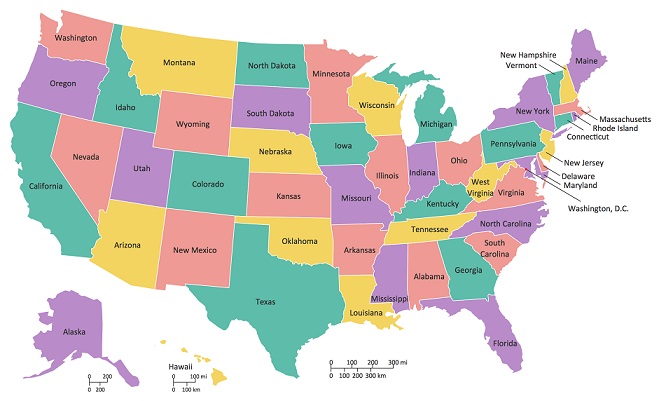
DirectorMick Jackson
Budget90 million USD
Box office122.8 million USD

In the Appendix below, within the encyclopedia “scientific” data, it was asserted that …
“… typically the islanders [of these volcanic member-states] do not have access to scientific journals and international meetings. The data included here is of value to them in understanding their islands and the volcanic hazards present on them.”

This assertion is true … and sad! The Go Lean movement declares “Enough already!” No more immature administration of our homeland! It is time; actually it is past time to grow-up and optimize the stewardship of these unstable islands.

For the Caribbean’s future, we must do better! Our youth deserves every opportunity to live at home in a technocratic society, in communities where we monitor, mitigate and manage the risks of known threats. We encourage all regional stakeholders to lean-in to this Go Lean roadmap – the strategies, tactics and implementation – to make the Caribbean homeland, even the Volcano States, better places to live, work and play. 🙂

Download the free e-Book of Go Lean … Caribbean – now!

Sign the petition to lean-in for this roadmap for the Caribbean Union Trade Federation.

—————

Appendix – A [Scientific] Study of the Volcanoes of the Caribbean

Radar TopographyIn [the year] 2000 radar data was acquired by the space shuttle which enabled virtually complete mapping of the Earth’s topography to be achieved between latitudes 56 o S to 60 o N. A nominal 30 m grid was obtained at an absolute accuracy of 16m, although in flat non-vegetated areas the vertical accuracy may approach 3 m. While data at the full resolution is available in some regions, such as North America , elsewhere the Shuttle Radar Topography Mission (SRTM) data is only provided on an approximately 90m grid, obtained by averaging the 30 m grid data. The new data is a vast improvement in resolution and accuracy over previous global topographic models, such as ETOPO30, and provides a significant new amount of information of use in geological and other studies.

For the Caribbean islands the SRTM data which is available on a geographic grid at a nominal 90-m cell size was converted to a UTM grid in Zone 20, using the WGS84 spheroid. A grid interval of 50 m was used to retain as much detail as possible, and minor gaps in the data were filled in using special routines. The data were fenced using coastline data obtained from NOAA, and it should be noted that the coastline data set for each island was displaced by up to a kilometre from its location relative to the SRTM grid. This is a reflection on the accuracy of the original geographic information and resulting data sets rather than that of the SRTM data, which is extremely accurately located. Hence the coastline for each island was bulk shifted until it appeared to fit the SRTM data, and was then used to create the final outline shown in these plots. The positions of the coastlines are probably accurate to within about 100 m. The SRTM grids are shown as raster images, with artificial shading by illumination from the northeast, and both UTM and geographic coordinates are included. Non-linear colour scales are used for optimum colour stretch, where low values are purple and high values are red.

Green Volcanoes – Green tropical jungle-covered volcanoes standing out of warm blue seas in balmy Trade Winds, surrounded by palm-lined white coral sand beaches and reefs may be the ideal of the tourist trade and the eco-tourist seeking unspoiled tropical rain forest, but they can be a headache for the geologist looking for rocks. In a review of the geology and hazards of the Commonwealth of Dominica, in the center of the Lesser Antilles volcanic arc we encountered this problem. The two volcanoes that make up the northern end of the island – Morne aux Diables in the far north, and to its south Morne Diablotins (1421m the highest point on the island) – are both very green. Exposures in the sea cliffs and along the coastal roads show that both volcanoes are made up of older foundations (3.7 to 1.8 million years for Morne Diablotins and 2.0 to 1.7 million years for Morne aux Diables) that have been deeply dissected by erosion. Both are capped by very young deposits that were probably erupted in the past 100,000 years, which overlie the older deposits on the coasts. …

About Caribbean Volcanoes This website on Caribbean volcanoes represents the cooperative work of the two authors over thirty years, [John Roobol and Alan Smith, two geologists both from South Wales in the UK who following Ph.D. studies at the Universities of London and California met on Mt. Pelee, Martinique in 1971 and have since worked together on most Caribbean volcanoes]. The views expressed and almost all of the photographs are those of the authors and do not necessarily agree with the views of other scientists. The site is aimed foremost at the populations and administrations of the volcanic islands. Typically the islanders do not have access to scientific journals and international meetings. The data included here is of value to them in understanding their islands and the volcanic hazards present on them. …

CU Blog - State of the Union - Volcano States - Photo 4

(Click to Enlarge)

Source: Retrieved July 18, 2017 from: http://caribbeanvolcanoes.com/

———

Additional Scientific VIDEO:

VIDEO – NatGeo Wild: A Volcanic Surprise | Caribbean’s Deadly Underworld  – https://youtu.be/5yuBSb7wPQE


Share this post:
, , , ,
[Top]