Category: Government

‘Too Big To Fail’ – Caribbean Version

Go Lean Commentary

The book Go Lean…Caribbean serves as a roadmap to implement the technocratic Caribbean Union Trade Federation (CU) and Caribbean Central Bank (CCB) to provide better stewardship, to ensure that the economic failures of the past do not re-occur.

What economic failures?

There were crises on 2 levels: the Global Financial Crisis of 2007 – 2009 and regional financial banking dysfunctions.

Global – The banks labeled “Too Big To Fail” impacted the world’s economy during the Global Financial Crisis. (See the VIDEO below on the anatomy and consequence of the Credit Crisis). Though the epi-center was on Wall Street, the Caribbean was not spared; it was deeply impacted with onslaughts to every aspect of Caribbean life (think: Tourism decline). In many ways, the crisis has still not passed.

Regional – The Caribbean region has not been front-and-center to many financial crises in the past, compared to the 465 US bank failures between 2008 and 2012.[a] But over the past few decades, there have been some failures among local commercial banks and affiliated insurance companies where the institutions could not meet demands from depositors for withdrawal. Consider these examples from Jamaica and Trinidad:

  • There was a  banking crisis in Jamaica in the 1990s. In January 1997, the decision was made to establish the Financial Sector Adjustment Company (FINSAC) with a mandate to take control and restructure the financial sector. FINSAC took control of 5 of the 9 commercial banks, 10 merchant banks, 21 insurance companies, 34 securities firms and 15 hotels. It was also involved in the re-capitalization and restructuring of 2 life insurance companies, with the requirement that they relinquish their shares in 2 commercial banks.[b]
  • For Trinidad, the notable failure was the holding company CL Financial, with subsidiaries Colonial Life Insurance Company and the CLICO Investment Bank (CIB). In mid-January 2009, this group approached the Central Bank of Trinidad and   Tobago requesting financial assistance due to persistent liquidity problems. The global financial events of 2008 combined with other factors placed tremendous strain on the group’s Balance Sheet. The CL Financial lines of business ranged from the areas of finance and energy to manufacturing and real estate services. The group’s assets were estimated at US$16 billion at year-end 2007, and it had a presence in at least thirty countries worldwide, including Barbados. Most significantly, the company held investments in real estate in Trinidad and the United States of America, and in the world’s largest methanol plant prior to its difficulties.

Welcome to the new Caribbean economy.

With the advent of the CARICOM Single Market & Economy (CSME), a more integrated region is expected to lead to greater linkages among the member-states of this existing economic union. The Go Lean roadmap calls for the deployment of the Caribbean Central Bank. So the issue of financial contagions will now have to be a constant concern for this regional sentinel.

The biggest threat of global financial contagions for this region has been dilution of net worth for the citizens of the US, Canada and Western Europe, the primary source of Caribbean tourists.

The prime directive of the CU is to optimize economic, security and governing engines to impact the Caribbean’s Greater Good, for all stakeholders: residents, visitors, bank depositors and mortgage-holders. This need was pronounced early in the Go Lean book, in the Declaration of Interdependence – (Page 13):

xxv.      Whereas the legacy of international democracies had been imperiled due to a global financial crisis, the structure of the Federation must allow for financial stability and assurance of the Federation’s institutions. To mandate the economic vibrancy of the region, monetary and fiscal controls and policies must be incorporated as proactive and reactive measures. These measures must address threats against the financial integrity of the CU and of the member-states.

The foregoing news articles shows the type of functions executed by technocracies: monitoring risks, assessing risk factors, managing leverage and regulating industry performances. This first article considers and welcomes new stewardship for the global “too big to fail” banks:

Title #1: New bank rules proposed to end ‘too big to fail’
By: Joshua Franklin and Huw Jones

CU Blog - Too Big To Fail - Caribbean Version - Photo 1BASEL, Switzerland/LONDON (Reuters) – Banks may have to scrap dividends and rein in bonuses if they breach new rules designed to ensure that creditors rather than taxpayers pick up the bill when big lenders collapse.

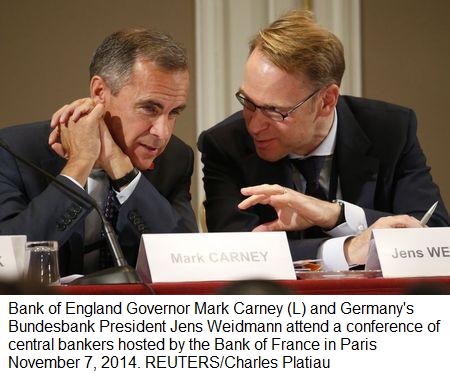
Mark Carney, chairman of the Financial Stability Board and Bank of England governor, said the rules, proposed on Monday, marked a watershed in putting an end to taxpayer bailouts of banks considered too big to fail.

“Once implemented, these agreements will play important roles in enabling globally systemic banks to be resolved (wound down) without recourse to public subsidy and without disruption to the wider financial system,” Carney said in a statement.

After the financial crisis in 2007-2009, governments had to spend billions of dollars of taxpayer money to rescue banks that ran into trouble and could have threatened the global financial system if allowed to go under.

Since then, regulators from the Group of 20 economies have been trying to find ways to prevent this happening again.

The plans envisage that global banks like Goldman Sachs and HSBC should have a buffer of bonds or equity equivalent to at least 16 to 20 percent of their risk-weighted assets, such as loans, from January 2019.

These bonds would be converted to equity to help shore up a stricken bank. The banks’ total buffer would include the minimum mandatory core capital requirements banks must already hold to bolster their defences against future crises.

The new rule will apply to 30 banks the regulators have deemed to be globally “systemically important,” though initially three from China on that list of 30 would be exempt.

G2O leaders are expected to back the proposal later this week in Australia. It is being put out to public consultation until Feb. 2, 2015.

David Ereira, a partner at law firm Linklaters, said that on its own the new rule as proposed would not end “too big to fail” banks and that politically tricky details still had to be settled.

BASELTOWER

Carney was confident the new rule would be applied as central banks and governments had a hand in drafting them.

“This isn’t something that we cooked up in Basel tower and are just presenting to everybody,” he told a news conference, referring to the FSB’s headquarters in Switzerland.

Most of the banks would need to sell more bonds to comply with the new rules, the FSB said. Some bonds, known as “senior debt” that banks have already sold to investors, would need restructuring.

Senior debt was largely protected during the financial crisis, which meant investors did not lose their money. But Carney said it in future these bonds might have to bear losses if allowed under national rules and if investors were warned in advance.

The new buffer, formally known as total loss absorbing capacity or TLAC, must be at least twice a bank’s leverage ratio, a separate measure of capital to total assets regardless of the level of risk.

Globally, the leverage ratio has been set provisionally at 3 percent but it could be higher when finalised in 2015.

Some of the buffer must be held at major overseas subsidiaries to reassure regulators outside a bank’s home country. Banks may have to hold more than the minimum because of “add-ons” due to specific business models, Carney said.

Elke Koenig, president of German regulator Bafin, said supervisors should orient themselves more toward the upper end of the 16-20 percent range, though banks may be given more time to comply.

Fitch ratings agency said banks might end up with a buffer equivalent to as much as a quarter of their risk-weighted assets once other capital requirements were included. Analysts have estimated this could run to billions of dollars.

Analysts at Citi estimated the new rule could cost European banks up to 3 percent of profits in 2016.

Citi said European banks would be required to issue the biggest chunk of new bonds, including BNP Paribas , Deutsche Bank , BBVA and UniCredit , with Swiss and British banks the least affected in Europe.

(Additional reporting by Alexander Huebner in Bonn, Editing by Keiron Henderson and Jane Merriman)
Reuters Newswire Service – Online Site (Posted 11/10/2014; retrieved 11/13/2014) –
http://news.yahoo.com/g20-proposes-buffer-end-too-big-fail-banks-061252790–sector.html
Within the region, this second article considers the stewardship of one Caribbean financial institution in Jamaica and their lending practices:

Title #2: VMBS sees dramatic fall in foreclosures

CU Blog - Too Big To Fail - Caribbean Version - Photo 2VICTORIA Mutual Building Society (VMBS) recorded a three-quarters drop in property foreclosures last year.

It signals greater resilience by homeowners during an austere economy affected by heavy currency depreciation.

“The building society also enabled more members who were facing financial difficulties to retain ownership of their homes,” said VMBS in a statement about its year ended December 31, 2013. “Foreclosures on properties totalled 10 last year, compared to 37 the year before.”

Its non-performing loans, or loans unserviced for over 90 days, moved from 6.9 per cent at the beginning of the year to 5.6 per cent at the end.

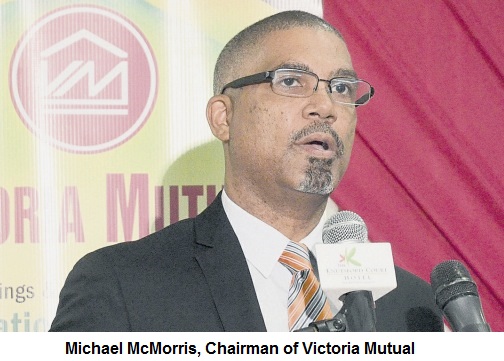
“This improvement was the result of the continued drive to engage members who were having difficulty meeting their monthly mortgage payments, and working with them collaboratively, with the aim of helping them to bring their accounts current and retain ownership of their homes,” said Michael McMorris, chairman of Victoria Mutual, in his report for the group’s 135th annual general meeting held last month.

Greater focus was also placed on sales and services with mortgage disbursements up 133 per cent to $3.3 billion last year, the company indicated.

The Victoria Mutual Group, an amalgam of various financial, mortgage and insurance entities, made less after-tax surplus at $965.8 million for 2013 compared with $1 billion a year earlier.

The group’s pre-tax surplus actually increased year on year but its after-tax surplus dipped 4.2 per cent to $965.8 million as it was “adversely affected by the imposition of an asset tax on regulated financial institutions, which applied to both VMBS and VM Wealth Management,” stated the company.

The VM Group said that it aims to keep mortgage rates low by reducing administration costs, which augurs well for prospective homeowners.

Stated McMorris: “Internally, the year 2014 will see a continuation of a number of projects and initiatives geared towards improving efficiency and service delivery throughout the group.”

VM Group will seek to improve its financial advisory and brokerage services by growing the assets it manages on behalf of clients.

“To do this, Victoria Mutual Wealth Management Limited (VMWM) is working on new products to allow clients to customise their investment portfolios,” stated McMorris.

VMBS Money Transfer Services Limited (VMTS) plans to expand its services, both locally and overseas. The remittance company became profitable two years ago, and saw earnings grow by 61 per cent last year, due largely to an increase in fees, the company stated. VMTS also benefited from a 28 per cent increase in foreign exchange trading gains.

“Better gains on foreign exchange in part reflected a more challenging business environment last year, when depreciation of the Jamaican dollar was higher than 12 per cent,” stated the company.

VMBS allows its debit card holders free withdrawals at any of its teller machine or point-of-sale terminals.
Jamaica Observer Daily Newspaper – Online Site (Posted 08/20/2014; retrieved 11/13/2014) – http://www.jamaicaobserver.com/business/VMBS-sees-dramatic-fall-in-foreclosures_17381839
The related subjects of banking oversight and optimizing  financial governance have been a frequent topic for blogging by the Go Lean promoters, as sampled here:

5 Steps of a Bubble – Learning to make a resilient economy
Canadian Imperial Bank of Commerce failing investment in FirstCaribbean Bank
Bitcoin needs regulatory framework to change ‘risky’ image
Open the Time Capsule: The Great Recession of 2008
What Usain Bolt can teach banks about financial risk
Barbados Central Bank records $3.7m loss in 2013
US Federal Reserve Releases Transcripts from 2008 Meetings
Dominica raises EC$20 million on regional securities market
Fractional Banking System – How to Create Money from Thin Air
Book Review: ‘Wrong – Nine Economic Policy Disasters and What We Can Learn…’
10 Things We Want from the US – # 2: American Capital
The Erosion of the Middle Class

All Caribbean countries have experienced economic dysfunction: English, Dutch, French and Spanish territories. In line with the foregoing articles, the Go Lean book details many infrastructural enhancements/advocacies to the region’s financial eco-system; to facilitate efficient management of the economy … going forward:

Ethos-Strategy-Tactics-Implementation-Advocacy

Page

Anecdote – Caribbean Single Market & Economy

15

Anecdote – Puerto Rico – The Caribbean’s Greece

18

Economic Systems Influence Individual Choices

21

Improve Sharing

35

Confederating Non-Sovereignty

45

Facilitate Currency Union/Co-op of Caribbean Dollar

45

Fostering a Technocracy

64

Caribbean Central Bank

73

Deposit Insurance Regulations

73

Securities Regulatory Authority

74

Modeling the European Union / Central Bank

130

Lessons from 2008

136

Anecdote – Caribbean Currencies

149

Growing the Economy

151

Creating Jobs

152

Better Manage Foreign Exchange

154

Improve Credit Ratings

155

Foster Cooperatives

176

Banking Reforms

199

Wall Street – Capital/Securities Market

200

Impact the Diaspora

219

Impact Retirement – Need for Savings

221

Help the Middle Class

223

Re-boot Jamaica

239

Appendix – Alternative Remittance Modes

270

There is no doubt that there has been mis-management of the Caribbean economy in the past. Consider the example of Jamaica; their currency has suffered from many de-valuations and depreciations; an average amount of $2.50 a year since the 1970’s; trading at 87-to-1 US Dollar; (at the time that Go Lean was composed – November 2013). Social Anthropologist posit that when societies come under duress, the communities have 2 choices: ‘Fight” or “Flight”. How have the countries responded that are cited in this commentary? They have chosen “flight”. A previous blog reported an average of 70 percent brain-drain rate across the region; with Jamaica at 85% and Trinidad at 79%.

Now is the time for change; time for new stewards of the Caribbean economy, security and governing engines. It’s time for the CU/CCB. We must prove that we have learned from the past. See the VIDEO below on the anatomy and consequence of the Credit Crisis.

The purpose of this roadmap is to provide that new stewardship. A lot is at stake: the destination for the hopes and dreams of the Caribbean youth. No more flight! We must act now and make the Caribbean, a better place to live, work and play. 🙂

———-

Appendix Video: – The Short and Simple Story of the Credit Crisis – http://youtu.be/bx_LWm6_6tA

Source References:

[a]. https://news.yahoo.com/facts-numbers-us-bank-failures-183852568.html

[b]. http://www.centralbank.org.bb/WEBCBB.nsf/WorkingPapers/DB0CF759B9E97FB9042579D70047F645/$FILE/Exploring%20Liquidity%20Linkages%20among%20CARICOM%20Banking%20Systems.pdf

Share this post:
, , , , ,

A Lesson in History – Economics of East Berlin

Go Lean Commentary

The book Go Lean…Caribbean serves as a roadmap for elevating Caribbean society; the book posits that the history of East Germany is a tutorial to the Caribbean effort. As such there are direct references in the book of the failed Communist State (Pages 132 & 139).

On this date 25 years ago, the “walls came tumbling down”, quickening the reunification of the nations of West Germany and East Germany. That is the headline, but beneath the surface, the German Democratic Republic (GDR or East Germany) was also rife with some other ugly truths.

In summary, the City of “East” Berlin was a maximum security prison in the heart of Europe. (This refers to City of East Berlin, not the whole country of East Germany).

Title: 25 Years Ago – The Berlin Wall Crumbled

CU Blog - A Lesson in History - Economics of East Berlin - Photo 1On the night of November 9, 1989, the Berlin Wall came down. East German authorities opened the border between East and West Berlin and the door to the fall of tyranny.

The wall went up in the early morning darkness of August 13, 1961, to keep millions of people from fleeing communist East Germany after World War II. It fell as suddenly as it had been built. For 28 years, Germany was a country divided not only by ideology but by stone, barbed wire and deadly force. The Berlin Wall — die Mauer — stood as a testament to the eternal struggle between open and closed societies. For all its might, the wall could not stop the free flow of news into East Berlin.

The West side of the wall became a stage for politicians and a canvas for artists. The East side grew grimmer, as social and economic problems worsened. In the end, people rose in protest. When the wall finally crumbled, there was dancing and celebration. But the wall’s toll could not be forgotten: Nearly 200 people died trying to escape; more than 30,000 political prisoners were jailed.

Today, the fallen wall is a memorial to their sacrifice, one of the world’s great symbols of the victory of freedom over oppression. The eight, 12-foot-high segments of the Berlin Wall in the Newseum’s Berlin Wall Gallery weigh 2.5 tons each and came from throughout Berlin. The Newseum acquired the pieces in 1993, along with the three-story East German guard tower that stood near Checkpoint Charlie.

Newseum Institute – Archives and Exhibit of News Artifacts
http://www.newseum.org/2014/11/06/25-years-ago-the-berlin-wall-crumbled/

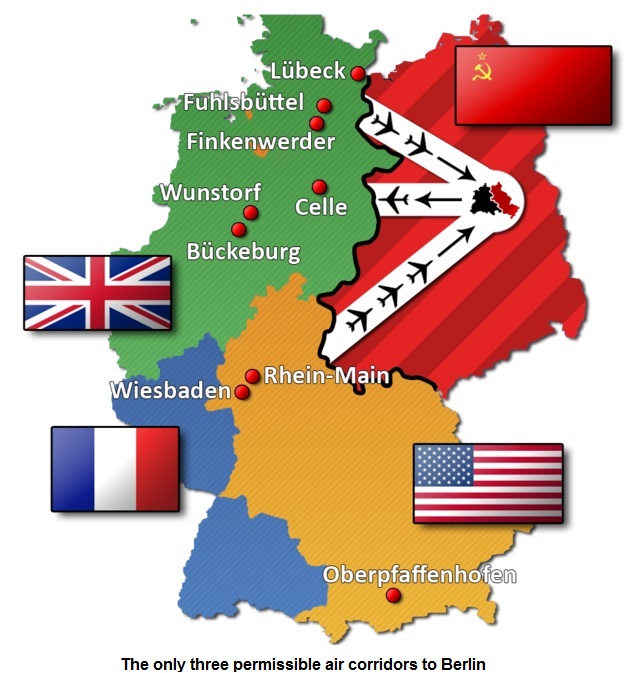
CU Blog - A Lesson in History - Economics of East Berlin - Photo 2This is more than just dry history. No, this is a lesson plan for the Caribbean empowerment effort. That effort is part-and-parcel of the Go Lean…Caribbean movement, this refers to the book and accompanying blog/commentaries. The book posits that the experiences of East Germany and the reunification with the Federal Republic of Germany (FRG or West Germany) provide a fitting example for the Caribbean people and institutions. What most people in the Caribbean may not realize, due to the far distance of a continent away, is that the national border for West and East Germany did not traverse through the City of Berlin, but rather 100 miles to the west of Berlin; (see map here). So the City of Berlin stood as an “island” within the country of East Germany, with that island itself split into West and East territories. (This is so similar to many Caribbean locales). The Western portion of Berlin belonged to West Germany; the residents had travel access via “air bridge” to other ports in the Federal Republic of Germany, while East Berliners were restricted – imprisoned in their own country, despite committing no offenses. This is classic human rights violation.

East Berlin, and by extension East Germany was a definitive Failed-State.

This audio-podcast here relates a practice of East Germany selling prisoners to the West for hard currency, so as to remediate the government’s economic deficiencies:

Video: Public Radio International East Germany Prisoner Ransom … http://youtu.be/FjozYlAlMew

The narratives described in this audio-podcast constitutes state-sponsored human trafficking.

This is abominable!

The German Reunification was not a merger, rather it was a repossession. East Germany was at the precipice of a Failed-State. The Caribbean today is at a similar precipice of dysfunction. This status is not due to the failure of communism (though one Caribbean member-state – Cuba – does feature a failed communist society), but rather the global financial crisis. Cuba also parallels East Germany with a human trafficking crisis; many citizens are desperate to leave the island and families pay huge “ransoms” to extract them.

The review of the historic events of this day regarding the Berlin Wall 25 years ago is more than just an academic discussion, the book Go Lean…Caribbean aspires to economic principles that dictate that “consequences of choices lie in the future”. The book serves as a roadmap for the introduction and implementation of the technocratic Caribbean Union Trade Federation (CU). The people of the Caribbean may not know the intimate details of East Germany, but we do understand societal decline and dysfunction all too well.

What have we learned from the East/West Germany experiences? How will those lessons help us today?

  • Brain Drain is unrecoverable – East Germany learned quickly that they had to keep their talented citizens by any means necessary, and thus the wall. The CU/Go Lean roadmap places priority on the atmosphere for the Caribbean talent to want to stay in the homeland and for the Diaspora to repatriate..
  • Most valuable resource – East German sold their human resources to the West; (over 300,000 people according to the above audio-podcast/VIDEO). This was their best marketable resource. The Go Lean roadmap posits that one person can make a difference and impact the economic engines in the fields of endeavor. Rather than one, the CU/Go Lean effort strives to foster the masses for their collective and individual contributions.
  • Promote opportunities for the Pursuit of Happiness – People in the West were NOT trying to sneak into the East. Basic needs were not fully satisfied there, so higher level needs were rarely pursued. The Go Lean roadmap posits that when the basic needs are in place, only then can the pursuit of happiness be tackled.
  • Consider the Greater Good – Complying with this Greater Good principle would have prevented a lot of the conflict during the 28-year East-West segregation. This philosophy is directly quoted in the book as: “it is the greatest good to the greatest number of people which is the measure of right and wrong”. The CU/Go Lean roadmap calls for a number of measures that strike directly at the Greater Good mandate: accountable justice institutions, economic empowerment for rich and poor, strategic education initiatives, proactive health/wellness, etc.
  • Quit on “failed” policies  – With the Soviet Union and Eastern European trading partners collapsing, the East German currency, the Mark, had become worthless outside of the GDR, creating the acute need to merge the two German economies. The GDR did not try to prop up the failing currency beyond 1989, instead they transferred its financial & monetary policy to the stewards of the stronger West Germany currency. The Go Lean roadmap will employ a technocratic Caribbean Central Bank and Caribbean Dollar so as to shore up the currency and economic engines in the region.
  • Negotiating as partners not competitors – Considering the German reunification models, consolidating millions of people with divergent politics and cultures into one Federation requires toleration and adjustments by all stakeholders. Success is possible only when all sides are willing to negotiate as partners not competitors. The CU requires negotiations and treaty considerations for economics, security and governing solutions. So the Go Lean roadmap adopts negotiations as a community ethos.
  • Reconciliation of issues is not optional, more conflict will emerge otherwise – There was loss of life and many human rights abuses in the history of the East-West schism, and there must be accountability. The CU plans for Truth & Reconciliation Commissions for dealing with a lot of latent issues in the last Caribbean century (i.e. Cuba, Haiti, Dominican Republic, etc).

The related subjects of economic, security and governing dysfunction have been a frequent topic for blogging by the Go Lean promoters, as sampled here:

https://goleancaribbean.com/blog/?p=2585 A Lesson in History: Concorde SST
https://goleancaribbean.com/blog/?p=2480 A Lesson in History: Community Ethos of WW II
https://goleancaribbean.com/blog/?p=2359 CariCom calls for innovative ideas to finance SIDS development
https://goleancaribbean.com/blog/?p=2330 ‘Raul Castro reforms not enough’, Cuba’s bishops say
https://goleancaribbean.com/blog/?p=2297 A Lesson in History: Booker T versus Du Bois
https://goleancaribbean.com/blog/?p=1531 A Lesson in History: 100 Years Ago Today – World War I
https://goleancaribbean.com/blog/?p=1433 Caribbean loses over 70% of tertiary educated citizens to the brain drain
https://goleancaribbean.com/blog/?p=1309 5 Steps of a Bubble – Learning from the past and mitigating negatives
https://goleancaribbean.com/blog/?p=1014 All is not well in the sunny Caribbean
https://goleancaribbean.com/blog/?p=816 The Future of Caribbean Integration and CariCom
https://goleancaribbean.com/blog/?p=782 Open the Time Capsule: The Great Recession of 2008
https://goleancaribbean.com/blog/?p=623 Only at the precipice, do they change
https://goleancaribbean.com/blog/?p=599 Ailing Puerto Rico open to radical economic fixes
https://goleancaribbean.com/blog/?p=451 CariCom Chairman to deliver address on slavery/colonization reparations
https://goleancaribbean.com/blog/?p=353 Book Review: ‘Wrong – Nine Economic Policy Disasters and What We Can Learn…’

The purpose of the Go Lean roadmap is to turn-around the downward trends in the Caribbean today, to reverse course and elevate Caribbean society. This CU/Go Lean roadmap, applying lessons from the last 25 years of German history, has developed these prime directives, pronounced as follows:

  • Optimization of the economic engines in order to grow the regional economy to $800 Billion & create 2.2 million new jobs.
  • Establishment of a security apparatus to protect the resultant economic engines.
  • Improve Caribbean governance to support these engines.

The Go Lean book details a series of assessments, community ethos, strategies, tactics, implementations and advocacies to empower all the factions in the Caribbean region:

Community Ethos – Economic Systems Influence Choices & Incentives Page 21
Community Ethos – Consequences of Choices Lie in the Future Page 21
Community Ethos – Money Multiplier – Control of Local/Regional Currency Page 22
Community Ethos – Anti-Bullying and Mitigation Page 23
Community Ethos – Intelligence Gathering Page 23
Community Ethos – “Crap” Happens Page 23
Community Ethos – Minority Equalization Page 24
Community Ethos – Ways to Impact the Future Page 26
Community Ethos – Ways to Improve Negotiations Page 32
Community Ethos – Ways to Manage Reconciliations Page 34
Community Ethos – Ways to Improve Sharing Page 35
Community Ethos – Ways to Promote Happiness Page 36
Community Ethos – Ways to Impact the Greater Good Page 37
Strategy – Vision –  Integrate Region into a Single Market Economy Page 45
Strategy – Agents of Change – Globalization Page 57
Tactical – Separation of Powers – Department of Homeland Security Page 75
Implementation – Assemble Existing Super-national Institutions Page 96
Implementation – Ways to Pay for Change Page 101
Implementation – Foreign Policy Initiatives at Start-up Page 102
Implementation – Security Initiatives at Start-up Page 103
Implementation – Ways to Deliver Page 109
Planning – Ways to Ways to Model the EU Page 130
Planning – Ways to Make the Caribbean Better Page 131
Planning – Reasons Why the CU Will Succeed – Germany Reunification Model Page 132
Planning – Ways to Improve Failed-State Indices Page 134
Planning – Lessons from East Germany Page 139
Advocacy – Ways to Grow the Economy Page 151
Advocacy – Ways to Create Jobs Page 152
Advocacy – Ways to Better Manage the Social Contract Page 170
Advocacy – Ways to Foster Cooperatives Page 176
Advocacy – Ways to Impact Justice Page 177
Advocacy – Ways to Improve Homeland Security Page 180
Advocacy – Ways to Improve Intelligence Gathering and Analysis Page 182
Advocacy – Ways to Protect Human Rights Page 220

1989 was pivotal in the history of modern Germany. Today the unified country is the Number One Economy in Europe and a role model for the Caribbean.

Now is the time for all of the Caribbean to learn the lessons from East Germany’s failed economy. The book Go Lean … Caribbean posits that the Caribbean is in a serious crisis, but asserts that this crisis would be a terrible thing to waste. The people and governing institutions of the region are hereby urged to lean-in for the empowerments described in the book Go Lean … Caribbean. This is a big deal for the region, the same way 1989 was a big year for Germany. While “impacting Germany” is out-of-scope for this CU roadmap, applying effective turn-around strategies (as in emerging from communism in Cuba) and elevating the Caribbean neighborhood is realistic and plausible. We can make our Caribbean homeland a better place to live, work, and play. 🙂

Download the book Go Lean … Caribbean – now!

Share this post:
, , , ,
[Top]

Suit Over Red Light Traffic Cameras Could Impact Millions

Go Lean Commentary

Change is coming to the Caribbean … and economic prosperity will undoubtedly follow:

“Happy Days Are Here Again” – familiar feel-good song during American political conventions.

CU Blog - Suit Over Red Light Traffic Cameras Could Impact Millions - Photo 1The book Go Lean…Caribbean posits that “bad actors” will always emerge in times of economic prosperity to exploit opportunities, with bad or evil intent. The book therefore serves as a roadmap for the introduction and implementation of the technocratic Caribbean Union Trade Federation (CU) as a regional entity projected to forge security and public safety solutions for the entire Caribbean region.

The heavy-lifting activities to ensure security by this CU technocracy include deploying a wide network of closed-circuit and traffic cameras. This could be beneficial and advantageous, but it appears that there are some perils too. Considering the lessons learned from the US in this following VIDEO, there is the need to protect citizens and their “Due Process” rights:

VIDEO – NBC News TODAY Show – November 5, 2014 – A new lawsuit is challenging the popular cameras at intersections, and could lead to millions of busted drivers across the U.S. getting their money back. NBC’s Kerry Sanders reports.

http://www.today.com/video/today/56366199

The book Go Lean … Caribbean underpins the movement for traffic cameras throughout the Caribbean region, copying the model of the 3rd party company in the foregoing VIDEO, Arizona-based American Traffic Solutions, Inc. (see Appendix below). But rather than a profit motive, the CU‘s motive is the optimization of Caribbean society. Just imagine, receiving a traffic ticket “in the mail” for running a traffic light in some Caribbean member-state.

“In the mail” – This phrase in itself reflects the reform needed for the Caribbean governmental eco-system.

The CU would be set to optimize all aspects of Caribbean society through economic empowerment, and the aligning security dynamics. In fact, the Go Lean roadmap has these 3 prime directives:

  • Optimization of the economic engines in order to grow the regional economy to $800 Billion & create 2.2 million new jobs.
  • Establishment of a security apparatus to protect the resultant economic engines, including road traffic stakeholders like motorists and pedestrians.
  • Improve Caribbean governance, with a separation-of-powers between member-state administrations and the CU federal government (Executive facilitations, Legislative oversight and Judicial prudence) to support these economic/security engines.

Closed-circuit and traffic cameras are designed to impact society in the same above 3 areas: they can generate revenues/jobs, provide public safety / homeland security protections and streamline governmental processes. At the outset of the book (Page 12), these public safeguards are identified as prime directives in the Declaration of Interdependence:

x.      Whereas we are surrounded and allied to nations of larger proportions in land mass, populations, and treasuries, elements in their societies may have ill-intent in their pursuits, at the expense of the safety and security of our citizens. We must therefore appoint “new guards” to ensure our public safety and threats against our society, both domestic and foreign. The Federation must employ the latest advances and best practices of criminology and penology to assuage continuous threats against public safety.

xvi.      Whereas security of our homeland is inextricably linked to prosperity of the homeland, the economic and security interest of the region needs to be aligned under the same governance. Since economic crimes … can imperil the functioning of the wheels of commerce for all the citizenry, the accedence of this Federation must equip the security apparatus with the tools and techniques for predictive and proactive interdictions.

CU Blog - Suit Over Red Light Traffic Cameras Could Impact Millions - Photo 2Unified command-and-control is identified as a major function of the CU security / law enforcement apparatus. This includes all intelligence gathering and analysis activities for overt and covert purposes. The effectiveness of these tactics (advanced monitoring, satellite surveillance, electronic eavesdropping, closed-circuit, and traffic cameras) has been proven for crime remediation and investigations. In addition to crime, the Go Lean roadmap targets delivery of government services, identifying best practices in agile methodologies to guarantee fewer defects and more efficiency; (Pages 109 & 147). In fact, the name Go Lean refers to the commitment to lean project management methodologies in the structure of the CU (Page 4).

All of this technocratic efficiency should at least allow for direct home mail delivery. Also at the outset of the book (Page 12), the need to reboot postal operations is detailed in the Declaration of Interdependence:

xv.  Whereas the business of the Federation and the commercial interest in the region cannot prosper without an efficient facilitation of postal services, the Caribbean Union must allow for the integration of the existing mail operations of the governments of the member-states into a consolidated Caribbean Postal Union, allowing for the adoption of best practices and technical advances to deliver foreign/domestic mail in the region.

The installation of the unified command-and-control security structure would be “Step One, Day One” in the Go Lean roadmap. Secondarily, the roadmap must enhance the postal operations in the region to ensure that government mail can be efficiently delivered to citizens, car drivers and registered car owners – the roadmap proposes a Caribbean Postal Union (CPU). The Go Lean book therefore details a series of community ethos, strategies, tactics, implementations and advocacies to provide increased public safety, mail operations and government services in the Caribbean region:

Economic Principle – Consequences of Choices Lie in Future Page 21
Community Ethos – Privacy –vs- Public Protection Page 23
Community Ethos – Intelligence Gathering Page 23
Community Ethos – “Crap” Happens Page 23
Community Ethos – Cooperatives Page 25
Community Ethos – Ways to Improve Sharing Page 35
Community Ethos – Ways to Impact the Greater Good Page 37
Tactical – Confederating a Non-sovereign Union Page 63
Tactical – Fostering a Technocracy Page 64
Tactical – Separation of Powers – Homeland Security Page 75
Tactical – Separation of Powers – CariPol: Marshals and Investigations Page 77
Implementation – Assemble Regional Mail Operations into a CPU Page 96
Anecdote – Implementation Plan – US Failing Mail Services Page 99
Implementation – Ways to Pay for Change Page 101
Implementation – Start-up Security Initiatives Page 103
Implementation – Ways to Improve Mail Service Page 108
Implementation – Ways to Deliver Page 109
Planning – Ways to Make the Caribbean Better Page 131
Planning – Ways to Improve Failed-State Indices Page 134
Advocacy – Ways to Grow the Economy Page 151
Advocacy – Ways to Improve Governance Page 168
Advocacy – Ways to Better Manage the Social Contract Page 170
Advocacy – Ways to Improve Leadership Page 171
Advocacy – Ways to Impact   Justice Page 177
Advocacy – Ways to Reduce Crime Page 178
Advocacy – Ways to Improve for Gun Control Page 179
Advocacy – Ways to Improve Homeland Security Page 180
Advocacy – Ways to Mitigate Terrorism Page 181
Advocacy – Ways to Improve Intelligence Gathering/Analysis Page 182
Advocacy – Ways to Impact Events – Mitigating Security Threats Page 191
Advocacy – Ways to Impact the Prison Industrial Complex – Tracking Felons Page 211
Advocacy – Ways to Protect Human Rights Page 220
Appendix – Prison Industrial Complex – Nauru DetentionCenter Page 327

Other subjects related to public safety empowerments for the region have been blogged in other Go Lean…Caribbean commentaries, as sampled here:

https://goleancaribbean.com/blog/?p=1554 Security Pact from the Status of Forces Agreement
https://goleancaribbean.com/blog/?p=1487 Here come the Surveillance Drones … and the Concerns
https://goleancaribbean.com/blog/?p=960 NSA records all phone calls in Bahamas, according to Snowden
https://goleancaribbean.com/blog/?p=392 Jamaica to receive World Bank funds to help in crime fight

Bad actors will always emerge…

Accepting this premise means preparing the necessary counter-measures. The model of the company American Traffic Solutions gives the Caribbean a template of “how, what, when and why” for traffic cameras. Individual “Due Process” rights do not have to be trampled on in the course of this roadmap. The policing authorities in the region can simply deputize CU resources for law-and-order enforcements in member-states. This deputization strategy/process of member-states authority being vested to CU agencies is front-and-center in the Go Lean roadmap.

Public safety is necessary to make the Caribbean homeland, a better place to live, work and play. Caribbean people need these assurances.

Download the book Go Lean … Caribbean – now!

————–

Appendix – American Traffic Solutions, Inc. (ATS) – http://www.atsol.com/

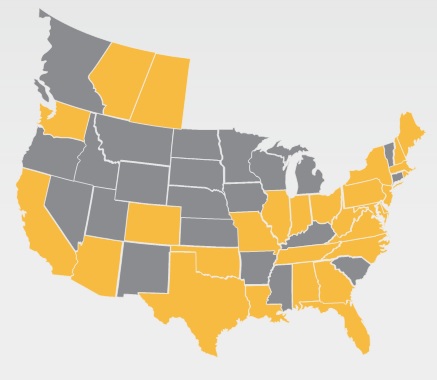
ATS is the leading provider of traffic safety, mobility and compliance solutions for state & local governments, commercial fleets and rental car companies. With nearly 300 customers and more than 3,500 Road Safety Camera Systems installed and operating throughout the United States  and Canada (yellow in the below map), ATS is the market leader for Red-Light, Speed and School Bus Stop-Arm Safety Cameras.

CU Blog - Suit Over Red Light Traffic Cameras Could Impact Millions - Photo 3

ATS is also the industry leader in toll and violation management for fleets and rental companies.  PlatePass® coverage blankets all major toll regions in North America, complying with in-vehicle transponder and license-plate (video) toll recognition systems throughout the United States and Canada.

Share this post:
, , , ,
[Top]

Disney World – Role Model for Self-Governing Entities

Go Lean Commentary

The Caribbean enjoys 80 million annual visitors, among its 30 member-states and vast cruise line industry. Impressive!

But one destination in Florida, Walt Disney World, hosted 47.5 million visitors (2009) … alone.[b]

There are lessons for the Caribbean to learn from this experience.

The book Go Lean…Caribbean serves as a roadmap for the introduction and implementation of the Caribbean Union Trade Federation (CU) to glean insight from the Walt Disney World history and experience. This is a huge subject in itself and is an appropriate topic for academic research, dissertations and business improvement books. But for this blog/commentary, there is a narrow focus, the special consideration of the “Self Governing Entity” that emerged from the Reedy Creek Improvement District that facilitated the construction and administration of the landmass that became the Walt Disney World Resort. The following encyclopedic details apply to this study:

CU Blog - Disney World - Role Model for a Self Governing Entity - Photo 1The Walt Disney World Resort, informally known as Walt Disney World or simply Disney World, is an entertainment complex in Bay Lake, Florida (mailing address is Lake Buena Vista, Florida), near Orlando, Florida and is the flagship of Disney’s worldwide theme park empire. The resort opened on October 7, 1971 and, according to Forbes Magazine, is the most visited vacation resort in the world, with an attendance of 52.5 million annually. It is owned and operated by Walt Disney Parks and Resorts, a division of The Walt Disney Company. The property covers 27,258 acres (11,031 ha; 43 sq mi), in which it houses 27 themed resort hotels, four theme parks, two water parks, four golf courses, one camping resort, one residential area and additional recreational and entertainment venues. MagicKingdom was the first and original theme park to open in the complex followed by EPCOT, Disney’s Hollywood Studios, and Disney’s Animal Kingdom which opened later throughout the 1980s and 1990s.

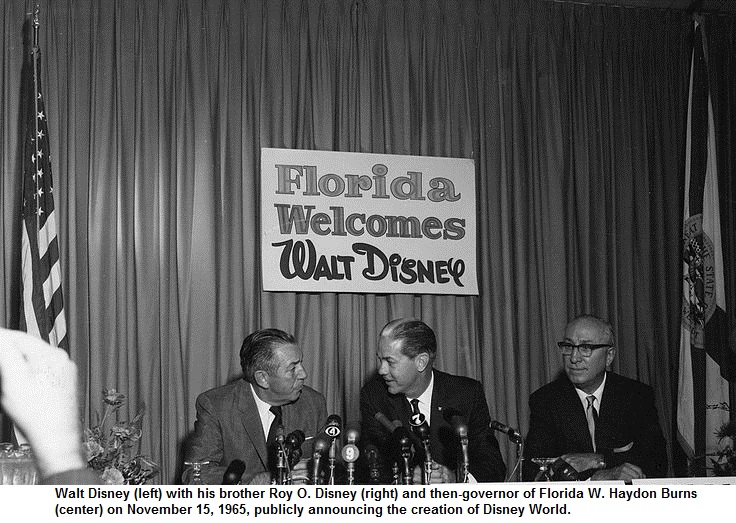
CU Blog - Disney World - Role Model for a Self Governing Entity - Photo 2Designed to supplement Disneyland in Anaheim, California, which had opened in 1955, the complex was developed by Walt Disney in the 1960s, though he died in 1966 before construction on “The Florida Project” began. After extensive lobbying, the Government of Florida created the Reedy Creek Improvement District, a special government district that essentially gave The Walt Disney Company the standard powers and autonomy of an incorporated city. Original plans called for the inclusion of an “Experimental Prototype Community of Tomorrow” (EPCOT), a planned city that would serve as a test bed for new innovations for city living.

The Reedy Creek Improvement District (RCID) is the immediate governing jurisdiction for the land of the Walt Disney World Resort. As of the late 1990s, it comprised an area of 38.6 sq mi (100 km2) within the outer limits of Orange and Osceola counties in Florida. The RCID includes the cities of BayLake and LakeBuena Vista, and unincorporated RCID land.CU Blog - Disney World - Role Model for a Self Governing Entity - Photo 3

After the success of Disneyland in California, Walt Disney began planning a second park on the East Coast. He disliked the businesses that had sprung up around Disneyland, and therefore wanted control of a much larger area of land for the new project. Walt Disney knew that his plans for the land would be easier to carry out with more independence. Among his ideas for his Florida project was his proposed EPCOT which was to be a futuristic planned city. He envisioned a real working city with both commercial and residential areas, but one that also continued to showcase and test new ideas and concepts for urban living.

Therefore, the Disney Company petitioned the Florida State Legislature for the creation of the Reedy Creek Improvement District, which would have almost total autonomy within its borders.
Wikipedia Online Encyclopedia  (Retrieved November 2, 2014) –
http://en.wikipedia.org/wiki/Walt_Disney_World

50 Year Historic Timeline:

1965

Walt Disney announces Florida Project

1966

Walt Disney dies of lung cancer at age 65

1967

Construction of Walt Disney World Resort begins

1971

MagicKingdom
Palm and Magnolia Golf Courses
Disney’s Contemporary Resort
Disney’s Polynesian Resort
Disney’s Fort    Wilderness Resort &   Campground
Roy O. Disney dies at age 78

1972

Disney’s Village Resort

1973

The Golf Resort

1974

DiscoveryIsland

1975

Walt Disney Village Marketplace

1976

Disney’s River Country

1980

Walt Disney World  ConferenceCenter

1982

Epcot

1986

The Disney Inn

1988

Disney’s Grand Floridian Resort & Spa
Disney’s Caribbean  Beach Resort

1989

Disney-MGM Studios
Disney’s Typhoon Lagoon
PleasureIsland

1990

Disney’s Yacht and Beach Club Resort
Walt Disney World Swan
Walt Disney World Dolphin

1991

Disney’s Port Orleans Resort French Quarter
Disney Vacation Club
Disney’s Old Key West Resort

1992

Disney’s Port Orleans Resort Riverside (Dixie Landings)
Bonnet Creek Golf Club

1994

Disney’s All-Star Sports Resort
Disney’s Wilderness Lodge
Shades of Green

1995

Disney’s All-Star Music Resort
Disney’s Blizzard Beach
Disney’s Fairy Tale Wedding Pavilion
Walt Disney World Speedway

1996

Disney Institute
Disney’s BoardWalk Inn and BoardWalk Villas

1997

Disney’s Coronado Springs Resort
Disney’s Wide World of Sports Complex
Downtown Disney West Side

1998

Disney’s Animal Kingdom
DisneyQuest

1999

Disney’s All-Star Movies Resort

2000

The Villas at Disney’s Wilderness Lodge

2001

Disney’s Animal Kingdom Lodge

2002

Disney’s Beach Club Villas

2003

Disney’s Pop Century Resort

2004

Disney’s Saratoga Springs Resort & Spa

2007

Disney’s Animal Kingdom Villas

2008

Disney-MGM Studios is renamed Disney’s Hollywood Studios

2009

Bay Lake Tower at Disney’s Contemporary Resort
Treehouse Villas

2011

Golden Oak at Walt Disney World Resort

2012

Disney’s Art of Animation Resort
Phase 1 of New Fantasyland

2013

The Villas at Disney’s Grand Floridian Resort & Spa

2014

Phase 2 of New Fantasyland

Wikipedia Online Encyclopedia (Retrieved November 2, 2014) –
http://en.wikipedia.org/wiki/Walt_Disney_World

The economic impact of Walt Disney World as a Self-Governing Entity (SGE) is undeniable. The resort is responsible for $18.2 billion in annual economic activity in Florida, said a study released by the theme park giant. The study found that Disney paid out nearly $1.8 billion in compensation to more than 59,000 workers in 2009.[a]

The Go Lean roadmap seek to emulate some of the strategies, tactics and implementation successes of the Walt Disney World as a SGE. This roadmap seeks to elevate the 30 Caribbean member-states with economic engines (direct and indirect spin-off activities), by assuming jurisdiction for Self-Governing Entities in the region and the Exclusive Economic Zone (EEZ) of the 1,063,000 square miles of the Caribbean Sea. This approach allows for initiation, cooperation and coordination of SGE’s (and the EEZ) to effectuate change in the region, allowing these 3 prime directives:

  • Optimization of the economic engines in order to grow the regional economy to $800 Billion GDP and create 2.2 million new jobs.
  • Establishment of a security apparatus to protect the resultant economic engines, specifically in SGE’s and the EEZ.
  • Improve Caribbean governance to support these engines.

Imagine many Disney World-style industrial developments, (not necessarily as touristic resorts), throughout the Caribbean region.

Wow! This is a game-changer.

The individual Walter Elias Disney (1901 – 1966) proved to be a game-changer. The Go Lean book posits that one person can make a difference and positively impact society; so the book advocates for a community ethos of investment in the “gifts” that individuals “bring to the table”. The book identifies the quality of geniuses and relates worthwhile returns from their investments. This mode of study allows us to consider this example of contributions from Walt Disney and his corporate/artistic creations:

 Video: The History of Walt Disney World – http://youtu.be/_6Kesbfg-Ok

The book Go Lean … Caribbean asserts that SGE’s and the EEZ can be strategic, tactical and operationally efficient for elevating Caribbean society. These points are pronounced early in the book with this Declaration of Interdependence (Pages 11 and 14), with these statements:

v.        Whereas the natural formation of our landmass and coastlines entail a large portion of waterscapes, the reality of management of our interior calls for extended oversight of the waterways between the islands. The internationally accepted 12-mile limits for national borders must be extended by International Tribunals to encompass the areas in between islands. The individual states must maintain their 12-mile borders while the sovereignty of this expanded area, the Exclusive Economic Zone, must be vested in the accedence of this Federation.

xxvi.      Whereas the Caribbean region must have new jobs to empower the engines of the economy and create the income sources for prosperity, and encourage the next generation to forge their dreams right at home, the Federation must therefore foster the development of new industries… In addition, the Federation must invigorate the enterprises related to existing industries like tourism … impacting the region with more jobs.

The subject of SGE’s has been directly addressed and further elaborated upon in these previous blog/commentaries:

https://goleancaribbean.com/blog/?p=2338 Using SGE’s to Welcome the Dreaded ‘Plutocracy’
https://goleancaribbean.com/blog/?p=2003 Where the Jobs Are – Ship-breaking under SGE Structure
https://goleancaribbean.com/blog/?p=1214 Fairgrounds as SGE and Landlords for Sports Leagues
https://goleancaribbean.com/blog/?p=286 Puerto Rico’s Comprehensive Cancer Center Project Breaks Ground – Model of Medical SGE

The Go Lean book itself details the economic principles and community ethos to adopt, plus the executions of strategies, tactics, implementations and advocacies to forge Self-Governing Entities and industrial growth in the Caribbean:

Economic Principles – People Choose because Resources are Limited Page 21
Economic Principles – All Choices Involve Costs Page 21
Economic Principles – People Respond to Incentives Page 21
Economic Principles – Economic Systems Influence Individual Choices Page 21
Economic Principles – Voluntary Trade Creates Wealth Page 21
Economic Principles – Consequences of Choices Lie in the Future Page 21
Community Ethos – Job Multiplier Page 22
Community Ethos – “Crap” Happens Page 23
Community Ethos – Lean Operations Page 24
Community Ethos – Return on Investments (ROI) Page 24
Community Ethos – Cooperatives Page 25
Community Ethos – Ways to Impact the Future Page 26
Community Ethos – Ways to Help Entrepreneurship Page 28
Community Ethos – Ways to Impact Research & Development Page 30
Community Ethos – Ways to Improve Negotiations Page 32
Community Ethos – Impact the Greater Good Page 37
Strategy – Vision – Confederating 30 Member-states in a Union Page 45
Strategy – Mission – Build   and Foster Local Economic Engines Page 45
Tactical – Fostering a Technocracy Page 64
Tactical – Growing Economy – New High Multiplier Industries Page 68
Separation of Powers – Department of State – Self-Governing Entities Page 80
Separation of Powers – Interior Department – Exclusive Economic Zone Page 82
Implementation – Ways to Pay for Change – SGE Licenses Page 101
Implementation – Steps to Implement Self-Governing Entities Page 103
Anecdote – French Guiana Space Agency – Example of a SGE Page 103
Implementation   – Benefits from the Exclusive Economic Zone Page 104
Planning – 10 Big Ideas – Self-Governing Entities Page 127
Planning – Ways to Improve Interstate Commerce Page 129
Planning – Lessons from New York City Page 137
Planning – Lessons from Omaha Page 138
Advocacy – Ways to Grow the Economy Page 151
Advocacy – Ways to Create Jobs Page 152
Advocacy – Ways to Better Manage Natural Resources – EEZ and SGE’s Page 183
Anecdote – Caribbean Industrialist & Entrepreneur Role Model Page 189
Advocacy – Ways to Promote Fairgrounds Page 192
Advocacy – Ways to Develop Ship-Building as SGE’s Page 209
Advocacy – Ways to Impact the Prison Industrial Complex as SGE’s Page 211
Advocacy – Ways to Impact the One Percent – Job Creators Inducements Page 224
Advocacy – Ways to Impact Urban Living – Self-Governing Entities Page 234
Advocacy – Ways to Impact Rural Living – Self-Governing Entities Page 235
Advocacy – Ways to Promote World-Heritage-Sites as SGE’s Page 248
Appendix – Airport Cities – Models for Self Governing Entities Page 287

There is a role for the contributions of one impactful person, or one impactful company, in this vision for the elevation and empowerment of the Caribbean homeland. The Go Lean … Caribbean roadmap invites these contributions. However, the roadmap also mitigates the threats of corporate abuse of a plutocracy. With the right applications from people, tools and techniques many SGE initiatives can have a positive impact in changing society, with minimal risks and threats of negative consequences. Walt Disney and the Reedy Creek Improvement District have demonstrated how successful SGE’s can be.

Thank you Walt Disney. Thanks for showing us the way, for providing a role model that we can emulate for our own success.

Change has come to the Caribbean. Everyone is hereby urged to lean-in to this roadmap to make the Caribbean a better place to live, work and play. 🙂

Download the book Go Lean … Caribbean – now!

——————

Appendix – Source References:

a. Retrieved November 3, 2014 from: http://www.bizjournals.com/orlando/news/2011/04/14/disneys-annual-economic-impact-182b.html

b. 2009 Attendance Walt Disney World’s 1. Magic Kingdom: 17.2 million 2. Epcot: 11.0 million 3. Disney’s Hollywood Studios: 9.7 million 4. Disney’s Animal Kingdom: 9.6 million. Retrieved November 3, 2014 from: http://www.themeparkinsider.com/flume/201004/1895/


Share this post:
, , , ,
[Top]

Role Model for Justice – The Pinkertons

Go Lean Commentary

How do we learn from other people? By their precepts and by their examples.

Sometimes the lessons are from good, sometimes from bad and yes, sometimes from ugly examples. This commentary on the legendary Private Security firm “The Pinkertons” demonstrates the need to ensure economic engines have a security apparatus. This commentary also provides a cautionary tale of how excessive force can lead to abuse.

No Justice – No Peace!

This discussion harmonizes with the book Go Lean…Caribbean which posits that “bad actors” will always emerge to exploit opportunities in times of economic prosperity, with bad or evil intent. The book relates a number of related episodes from world history, such as the Pirates of the Caribbean (Page 181) and the Old American West (Page 142).

If only life could be so simple and we all “just get along”. However there is the reality! When the primary economic driver is tourism, the strategy is to market an image of “pleasure and paradise”. Pirates and Old West Outlaws do not fit into that image. Mitigation efforts must be exerted to ensure that chaos does not reign supreme.

This is where we learn so much from The Pinkertons, of old (though the company continues today). The historic details are as follows:

 CU Blog - Role Model for Justice - The Pinkertons - Photo 1

“We Never Sleep” – Company Motto

Pinkerton, founded as the Pinkerton National Detective Agency, is a private security guard and detective agency established in the United States by Allan Pinkerton in 1850 and currently a subsidiary of Securitas AB.[1]

Pinkerton became famous when he claimed to have foiled a plot to assassinate president-elect Abraham Lincoln, who later hired Pinkerton agents for his personal security during the Civil War.[2] Pinkerton’s agents performed services ranging from security guarding to private military contracting work. Pinkerton was the largest private law enforcement organization in the world at the height of its power.[3] By the early 1890s, the Pinkerton National Detective Agency employed more agents than there were members of the standing army of the United States of America.

During the labor strikes of the late 19th and early 20th centuries, businessmen hired the Pinkerton Agency to infiltrate unions, supply guards, keep strikers and suspected unionists out of factories, as well as recruiting “goon squads” to intimidate workers. One such confrontation was the Homestead Strike of 1892, in which Pinkerton agents were called in to reinforce the strikebreaking measures of industrialist Henry Clay Frick, acting on behalf of Andrew Carnegie. The ensuing battle between Pinkerton agents and striking workers led to the deaths of seven Pinkerton agents and nine steelworkers.[4]

The Pinkertons were also used as guards in coal, iron, and lumber disputes in Illinois, Michigan, New York, Pennsylvania, and West Virginia as well as the Great Railroad Strike of 1877 and the Battle of Blair Mountain in 1921. The organization was pejoratively called the “Pinks” by its opponents.

CU Blog - Role Model for Justice - The Pinkertons - Photo 3

The company now operates as “Pinkerton Consulting & Investigations, Inc. d.b.a. Pinkerton Corporate Risk Management”, a division of the Swedish security company SecuritasAB. The former Government Services division, PGS, now operates as Securitas Critical Infrastructure Services, Inc.[5]

At one point, the good, bad and ugly track record of The Pinkertons heightened to the point that the US Federal Government passed a landmark legislation called the Anti-Pinkerton Act in 1893. The following details apply:

The Anti-Pinkerton Act was a law passed by the U.S. Congress in 1893 to limit the government’s ability to hire strikebreakers. It is contained within 5 U.S.C. 3108 and specifically restricts the government (and Federal Territories) from hiring employees of The Pinkerton Agency or similar organizations.

So much of American history and media productions reference The Pinkertons:

  • The Pinkertons have been mentioned in season 1 and featured in seasons 2 and 3 of the HBO series “Deadwood“, and also the 1980 movie “The Long Riders,” where Pinkerton agents are depicted investigating criminal activity of the James brothers.
  • In the fourth season episode “Havre de Grace” of “Boardwalk Empire“, the character Roy Phillips is revealed to be a detective working for the agency.
  • The protagonist of the video game BioShock Infinite, Booker DeWitt, is an ex-Pinkerton, known for his violent methods in controlling strikes.
  • The character Captain Homer Jackson in the BBC series Ripper Street is also revealed as an ex-Pinkerton agent in series one.
  • Two Pinkerton Agents were featured in the movie “Legend Of Zorro”.
  • The Pinkertons are featured in the “3:10 to Yuma” remake featuring Russel Crowe and Christian Bale.
  • In Ian Fleming’s James Bond 007 Novels Felix Leiter worked for Pinkertons.
  • Three Pinkerton Agents were featured in the first season episode “Husbands & Fathers”, of the BBC America show Copper (TV series).
  • In 1966 Irwin Allen series The Time Tunnel on episode 12 “The Death Trap”, Mr. Pinkerton, with the help of the two main characters, saved President Lincoln.
  • In the Sherlock Holmes novel The Valley of Fear, Birdy Edwards is a Pinkerton agent.
  • In Cable TV network Showtime’s Penny Dreadful Season 1-Episode 8 “Grand Guignol” Ethan Chandler is confronted by 2 Pinkerton agents in a bar as his past catches up with him.
  • The song “Book, Saddle, And Go” on the 2013 album Earth Rocker from musical group “Clutch” references ‘Pinkerton Man’ – “Pinkerton man, murdering bastard, I’m gonna get even, get even with you, Get even with you”.
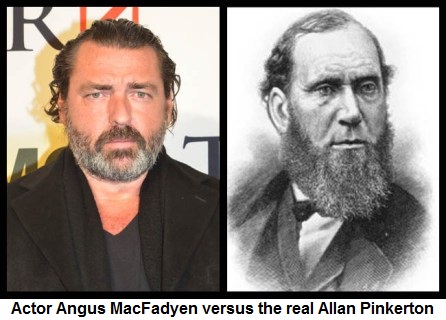
  • The Pinkertons, a scripted one-hour syndicated show starring Angus MacFadyen as Allan Pinkerton, debuted in 2014.[22][23]
    Actor Angus MacFadyen is set for one of the lead roles in The Pinkertons, Canadian companies Rosetta Media and Buffalo Gal Pictures’ upcoming 22-episode action-adventure detective series that is set to premiere in first-run syndication in the U.S. this fall. It has been cleared in more than 85% of the country by Rohrs Media Group on station groups including Tribune, Weigel, Hearst, LIN, Meredith, Cox and the CW PLUS. Drawing on the real cases of The Pinkerton Detective Agency, The Pinkertons follows founder Allan Pinkerton (MacFadyen), his son, William, and America’s first female detective, Kate Warne, as they solve crimes throughout the “Wild West” of the 1860s (Pinkerton is known for revolutionizing detective work by developing use of surveillance, undercover work and the mug shot). In part because of his commitment to AMC drama Turn, on which he is a regular, MacFadyen is will be a recurring guest star on The Pinkertons, not appearing in all episodes.[23]

CU Blog - Role Model for Justice - The Pinkertons - Photo 2
Promotional Video for the TV Series: The Pinkertons  https://www.youtube.com/watch?v=5Nhl9A5smo0

The security goal of Go Lean…Caribbean is for public safety! This is not the first (newly integrated) society needing public safety mitigations. The role model and history of The Pinkertons provides great insight. In 1871, Congress appropriated $50,000 to the new Department of Justice (DOJ) to form a sub-organization devoted to “the detection and prosecution of those guilty of violating federal law”. The amount was insufficient for the DOJ to fashion an integral investigating unit, so the DOJ contracted out the services to The Pinkerton National Detective Agency.[10] This is the biggest lesson for the Caribbean role model. The Pinkerton Agency had a nation-wide footprint and expedience in protecting economic engines – the US Federal government needed that expertise.

The Go Lean book calls for the establishment of “Justice Institutions” within the Caribbean at the outset of the roadmap. These institutions, similar to The Pinkertons, will have the broad scope for jurisdiction and prosecution of economic crimes throughout the entire region. In addition to economic crimes, there is the need for a military establishment in the region. Execution of the roadmap integrates and consolidates a regional naval force, escalated expeditionary forces, unified command-and-control and an intelligence gathering & analysis apparatus. But unlike The Pinkerton agency, the Caribbean’s public safety entities (law enforcement and security forces) will not be accountable to private or corporate interest, but rather accountable to a technocratic Caribbean governance.

This goal is detailed in the Go Lean book as it serves as a roadmap for the introduction and implementation of the technocratic Caribbean Union Trade Federation (CU). The CU would be set to optimize Caribbean society through economic empowerment, and the aligning security dynamics. In fact, the Go Lean roadmap has 3 prime directives:

  • Optimization of the economic engines in order to grow the regional economy to $800 Billion & create 2.2 million new jobs.
  • Establishment of a security apparatus to protect the resultant economic engines.
  • Improve Caribbean governance, (with Executive, Legislative and Judicial branches) to support these engines.

The security apparatus within this Go Lean roadmap asserts that the region (and member-states) must prepare for its own security needs. So the vision is that all Caribbean member-states authorize regional “Justice Institutions” and delegate jurisdiction to marshal and prosecute economic crimes. This delegation, or separation-of-powers, will cover law enforcement and regional defense, all encompassed in the book’s Homeland Security roadmap.

There is the need to ensure law-and-order in all 30 Caribbean member-states and the Exclusive Economic Zone (EEZ) of the Caribbean Sea. This point is pronounced early in the book with the Declaration of Interdependence (Page 12) that claims:

x.   Whereas we are surrounded and allied to nations of larger proportions in land mass, populations, and treasuries, elements in their societies may have ill-intent in their pursuits, at the expense of the safety and security of our citizens. We must therefore appoint “new guards” to ensure our public safety and threats against our society, both domestic and foreign. The Federation must employ the latest advances and best practices … to assuage continuous threats against public safety.

xvi. Whereas security of our homeland is inextricably linked to prosperity of the homeland, the economic and security interest of the region needs to be aligned under the same governance. Since economic crimes, including piracy and other forms of terrorism, can imperil the functioning of the wheels of commerce for all the citizenry, the accedence of this Federation must equip the security apparatus with the tools and techniques for predictive and proactive interdictions.

The Caribbean appointing “new guards”, or a security pact to ensure public safety has been previously detailed in these blogs/ commentaries:

https://goleancaribbean.com/blog/?p=2259 Economic Crime Enforcement – The Criminalization of American Business
https://goleancaribbean.com/blog/?p=1965 America’s Navy – 100 Percent – Model for Caribbean
https://goleancaribbean.com/blog/?p=1531 A Lesson in History: 100 Years Ago – World War I
https://goleancaribbean.com/blog/?p=1487 Here come the Drones … and the Concerns
https://goleancaribbean.com/blog/?p=1076 Caribbean “Terrorists” travel   to Venezuela for jihadist training
https://goleancaribbean.com/blog/?p=392 Jamaica to receive World Bank funds to help in crime fight
https://goleancaribbean.com/blog/?p=341 US slams Caribbean human rights practices
https://goleancaribbean.com/blog/?p=273 10 Things We Want from the US and 10 Things We Don’t Want …

The treaty to establish the “new guards”, the Homeland Security Force and Federal Justice Department within the Caribbean Union Trade Federation gets legal authorization from a Status of Forces Agreement with the initiation of the confederation. This process would be “Step One, Day One” in the Go Lean roadmap. The Go Lean book also details a series of community ethos, strategies, tactics, implementations and advocacies to provide increased public safety & security in the Caribbean region:

Community Ethos – Economic Principle – Consequences of Choices Lie in Future Page 21
Community Ethos – Security Principle – Privacy –vs- Public Protection Page 23
Community Ethos – Security Principle – Intelligence Gathering Page 23
Community Ethos – Security Principle – Crap” Happens Page 23
Community Ethos – Governing Principle – Lean Operations Page 24
Community Ethos – Governing Principle – Cooperatives Page 25
Community Ethos – Ways to Improve Sharing Page 35
Community Ethos – Ways to Impact the Greater Good Page 37
Strategy – Vision – Trade Federation with Proxy Powers of a Confederacy Page 45
Strategy – Vision – Defense Pact to Defend Against Systemic Threats Page 45
Tactical – Confederating a Non-Sovereign Union Page 63
Tactical – Fostering a Technocracy Page 64
Tactical – Separation of Powers – Homeland Security Page 75
Tactical – Separation of Powers – Justice Department – CariPol: Marshals and Investigations Page 77
Tactical – Separation of Powers – Justice Department – Witness Protection Page 77
Implementation – Ways to Pay for Change Page 101
Implementation – Start-up Security Initiatives Page 103
Implementation – Start-up Benefits from the EEZ – Security – Interdictions & Piracy Page 104
Implementation – Steps to Implement Self-Governing Entities – Security and Justice Page 105
Implementation – Ways to Foster International Aid – Military Aid Page 115
Planning – Ways to Make the Caribbean Better Page 131
Planning – Ways to Improve Failed-State Indices – Law Enforcement Oversight Page 134
Planning – Lessons Learned from the West Indies (WI) Federation – WI Regiment Page 135
Planning – Lessons from the American West – Law & Order Page 139
Advocacy – Ways to Grow the Economy Page 151
Advocacy – Ways to Improve Governance Page 168
Advocacy – Ways to Better Manage the Social Contract Page 170
Advocacy – Ways to Improve Leadership – Art of War Applications Page 171
Advocacy – Ways to Impact Justice Page 177
Advocacy – Ways to Reduce Crime Page 178
Advocacy – Ways to Improve for Gun Control Page 179
Advocacy – Ways to Improve Homeland Security Page 180
Advocacy – Ways to Mitigate Terrorism Page 181
Advocacy – Ways to Improve Intelligence Gathering & Analysis Page 182
Advocacy – Ways to Protect Human Rights Page 220
Appendix – Art of War Chapters – Chapter 7 – Engaging The Security Force Page 327

The history of The Pinkertons depicts honorable men (and women) engaging an honorable cause (law and order), but not always in an honorable manner. Their motto was “we never sleep” but their ethos appeared to be “by any means necessary”. Yes, bad actors will always emerge, but people of goodwill do not need to use bad behavior to stop bad things from happening – two wrongs don’t make a right.

The Go Lean roadmap calls for justice institutions of the CU to execute their role in a just manner, to impact the Greater Good. This does not happen accidently, this must be the output of a technocratic system bent on efficiency and effectiveness. The Go Lean roadmap ensures accountability, transparency, checks-and-balances in the execution of the rule-of-law. This is the change for the Caribbean. Public Safety, Law Enforcement and Homeland Security is necessary to make the Caribbean a better place to live, work and play. Everyone in the Caribbean, the people and institutions, are hereby urged to lean-in to this elevation of society.

Download the e-Book of Go Lean … Caribbean – free … now!

————————————

Source References:
1. “Pinkerton Government Services, Inc.: Private Company Information – Businessweek”. investing.businessweek.com. Retrieved 24 September 2012.
2. Green, James (2006). Death in the Haymarket: A Story of Chicago, the First Labor Movement, and the Bombing that Divided Gilded Age America. Pantheon Books.  Page 43
3. TM Becker (1974). “The place of private police in society: An area of research for the Social Sciences”. Social Problems (Social Problems) 21 (3): 438–453. doi:10.1525/sp.1974.21.3.03a00110. JSTOR 799910.
4. Krause, Paul (1992). The Battle for Homestead, 1890-1892: Politics, Culture, and Steel. University of Pittsburgh Press.  Page 20-21
5. http://www.linkedin.com/company/pinkerton-government-services
10. Churchill, Ward (Spring 2004). “From the Pinkertons to the PATRIOT Act: The Trajectory of Political Policing in the United States, 1870 to the Present”. The New Centennial Review 4 (1): 1–72. doi:10.1353/ncr.2004.0016. Archived from the original on 2009-07-29.
22. “The Pinkertons TV Series”. Rosetta Media and Buffalo Gal Pictures. Retrieved 2014-10-11.
23. Andreeva, Nellie (July 23, 2014). “Angus MacFadyen Set To Play Allan Pinkerton In Syndicated Drama Series ‘The Pinkertons’”. Deadline Hollywood (Penske Business Media, LLC). Retrieved 2014-10-11.

Share this post:
, , , ,
[Top]

Book Review: ‘This Changes Everything: Capitalism vs. the Climate’

Go Lean Commentary

The biggest threat to the Caribbean’s future maybe the biggest threat to the planet: Climate Change. How is it possible that anyone would deny this?

Maslow’s “Hierarchy of Needs” may help us to understand the dissenters viewpoint. The Maslow Hierarchy identifies these 8 levels of needs:

Level 1 – Biological and Physiological needs
Level 2 – Security/Safety needs
Level 3 – Belongingness and Love needs
Level 4 – Esteem needs
Level 5 – Cognitive needs
Level 6 – Aesthetic needs
Level 7 – Self-Actualization needs
Level 8 – Transcendence needs

In addition to the abundance of published materials on Maslow, the book Go Lean…Caribbean qualifies the same 8 levels of needs (Page 231). This definition of needs also applies to the subject of Climate Change and the foregoing Book Review of the new publication by author Naomi Klein entitled This Changes Everything: Capitalism vs. the Climate. This source book relates that the systems of capitalism run conflict with the ideals of fighting Climate Change. This commentary asserts that those who dissent are limiting their advent of Maslow’s Hierarchy to Level 1 and/or 2, while advocates to cure/mitigate Climate Change are navigating above Level 3, all the way to Level 8.

The profit motive is powerful; according to the foregoing article/book review, the practice of capitalism dictates seeking the shortest path to profit. Many are spellbound by profit, to make millions or simply to maintain jobs, to the point that they will sacrifice the higher level needs to only ensure Basic (Level 1) and Security/Safety (Level 2) needs.

This short-sighted view “cuts off the nose to spite the face”; it sacrifices the long-term for the sake of the short-term.

The book review follows:

Book Review: Heather Mallick, Columnist
Title: Naomi Klein has written the book of the modern era
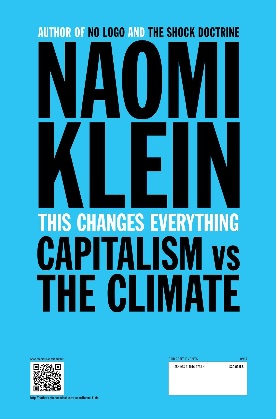
This Changes Everything: Capitalism vs. the Climate – gives the reader the tools to discuss the coming disaster intelligently.

Capitalism vs the Climate 2The planet is headed for a climate catastrophe, and soon. Make that now. Your reaction will be either a quick calculation as to whether you’ll be able to die in time to skip the whole thing, or an appalled realization that your children are in for pain and your grandchildren for a terrible fate.

But your starter task should be reading Naomi Klein’s This Changes Everything: Capitalism vs. the Climate. Meticulously researched and briskly rational in tone, her just-published book is one of the basic texts of the modern era, by which I mean since the Scotsman James Watt invented the coal-fired steam engine in 1776. Hasn’t perdition come quickly on its wee cloven hooves?

Until then power came from water wheels. With Watt’s device, owners could build factories near the urban poor, hire cheaply, cut prices and stabilize production that used to depend on the whims of weather. Ironically it’s weather that will finish us off now. Capitalism is magical until it isn’t. Skip ahead 240 years and here we are, basically doomed by its profit formula.

Klein’s book is an essential purchase in that it tells you precisely what you need to know to discuss the climate dilemma intelligently: it covers historical context, environmental science, fossil fuel finance, our current version of capitalism, political history, climate change denial, environmentalism’s failures, suggested quack-scientific remedies that will “block” the sun, green energy and how people are working locally to blockade carbon extraction because nothing else is being done. It is factual rather than emotive.

Fascinatingly, it portrays fossil fuel corporations as victims of their own nature. Programmed like computers, they could not reverse themselves even if they wished to. Only governments can do it. Even then, international free-trade agreements allow corporations to sue nations to stop this, the very reason smart Germany has just objected to Canada’s new European trade deal. Stephen Harper knuckled under to corporations but the Germans are smarter than that.

This magnificent textbook has already been attacked by people who didn’t read it, apparently for the high school reason that Klein is too famous, or that the book is too hard on the West. But science has spoken. There are 2,795 gigatons (a gigaton is 1 billion metric tons) of fossil fuel reserves already claimed by industry that will be extracted and burned. “We know how much more carbon can be burned between now and 2050 and still leave us a solid chance (roughly 80 per cent) of keeping warming below 2 degrees Celsius,” writes Klein. “That amount is 565 gigatons.”

That’s 2,795 vs. 565, not even faintly close, and humans haven’t agreed even in principle to slow down. “2 degrees now looks like a utopian dream,” Klein writes, and 4 degrees is reliably said to be “incompatible with any reasonable characterization of an organized, equitable and civilized global community,” a.k.a. life as we sort of know it. Many experts say we’ll go far beyond 4 degrees.

The joy and genius of capitalism is how it takes the shortest path to profit, but it is as bad as communism at trashing earth, water and air. Something has to reshape capitalism or we are fried. Humans want to fob the problem off on other humans, which is not how it works on this pretty blue ball spinning through the sky. We may not suffer equally but we’ll all suffer.

A big wheel is already rolling. There is produce we can’t buy as drought crisps farmland in California, a state that hasn’t even banned private swimming pools. We are seeing the hottest summers on record and abnormally harsh winters, violent storms, more smog alerts, nations like the U.K. and cities like New York hit by flooding, Brazil hit by drought.

Author: Naomi Klein

Author: Naomi Klein

We may blame China and India, accusing them of blithely polluting as we claim to virtuously filter North American effluent. But we outsourced our pollution to Asia. As Klein reports, “The rise in emissions from goods produced in developing countries but consumed in industrialized ones was six times greater than the emissions savings of industrialized countries.” China will stop polluting when we stop buying their cheap stuff. Are you going to stop? Are you?

Klein’s question is this: do you go along to get along or do you fight back? This Changes Everything is basic reading and no one will take you seriously until you’ve read every single page.

Heather Mallick’s column appears Monday and Wednesday on the op-ed page and Saturday in News. hmallick@thestar.ca
The Star
– Toronto’s Daily Newspaper – Book Review – Sunday September 28, 2014
http://www.thestar.com/opinion/commentary/2014/09/28/naomi_klein_has_written_the_book_of_the_modern_era_mallick.html

Video: This Changes Everything: Capitalism vs the Climate – Book Trailer – https://www.youtube.com/watch?v=WPQI1Lui42c

The Go Lean book also details the impending crisis of Climate Change and then declares that “a crisis is a terrible thing to waste”, calling for the establishment of a regional administration to monitor, mitigate and manage the threats of Climate Change. The Go Lean book posits that the Caribbean region is at the frontline of the battleground of Climate Change, and that there is the need to save life-and-limb due to increased occurrences of devastating hurricanes, flooding, forest fires, droughts, rising sea levels, and alterations in fish stock.

This Go Lean book serves as a roadmap for the introduction and implementation of the technocratic Caribbean Union Trade Federation (CU). The prime directives of this agency are described as:

  • Optimize the economic engines of the Caribbean to elevate the regional economy to grow to $800 Billion and create 2.2 million new jobs.
  • Establish a security apparatus to protect the resultant economic engines.
  • Improve Caribbean governance and industrial policies to support these engines.

The Go Lean roadmap calls for the CU to serve as the regional administration to optimize economy, homeland security and governance engines for the Caribbean, especially in the fight of Climate Change battleground frontline status. But the needs of the economy, capitalistic principles and Climate Change mitigations do not have to clash/conflict; they can co-exist.

This is the first pronouncement (Page 11) of the opening Declaration of Interdependence that bears a direct reference to this foregoing article and source book:

i. Whereas the earth’s climate has undeniably changed resulting in more severe tropical weather storms, it is necessary to prepare to insure the safety and security of life, property and systems of commerce in our geographical region. As nature recognizes no borders in the target of its destruction, we also must set aside border considerations in the preparation and response to these weather challenges.

The source book also relates to the concepts of capitalism. Though it is the surviving system from the 20th Century debate versus Communism, it is far from being a perfect commerce system. But it can be managed and manipulated for the Greater Good. This point was also pronounced  on Page 13 of the Declaration of Interdependence in the Go Lean book:

xxiv. Whereas a free market economy can be induced and spurred for continuous progress, the Federation must install the controls to better manage aspects of the economy: jobs, inflation, savings rate, investments and other economic principles. Thereby attracting direct foreign investment because of the stability and vibrancy of our economy.

The Go Lean roadmap is designed to deliver many empowerment activities to elevate Caribbean society. These activities will carefully balance the needs of the Caribbean and the needs of the planet: we need jobs, yes, but we do not need to increase our carbon footprint.

The issues of Climate Change have been repeatedly addressed and further elaborated upon in these previous blog/commentaries:

https://goleancaribbean.com/blog/?p=2276 Climate Change May Affect Food Supply Within a Decade
https://goleancaribbean.com/blog/?p=2119 Cooling Effect – Oceans and the Climate
https://goleancaribbean.com/blog/?p=1883 Climate Change May Bring More Kidney Stones
https://goleancaribbean.com/blog/?p=1817 Caribbean grapples with intense new cycles of flooding & drought
https://goleancaribbean.com/blog/?p=1516 Floods in Minnesota, Drought in California – Why Not Share?
https://goleancaribbean.com/blog/?p=926 Conservative heavyweights have solar industry in their sights
https://goleancaribbean.com/blog/?p=915 Go ‘Green’ … Caribbean

The Go Lean book declares that we must adopt a community ethos, the appropriate attitude/spirit, to forge change in our region; then details the executions of the following strategies, tactics, implementations and advocacies to better impact the region’s resources and eco-systems, especially in considering the preparations and consequences of Climate Change:

Community Ethos – Deferred Gratification Page 21
Community Ethos – Economic Systems Influence Individual Choices / Incentives Page 21
Community Ethos – The Consequences of Choices Lie in the Future Page 21
Community Ethos – “Crap” Happens Page 23
Community Ethos – Lean Operations Page 24
Community Ethos – Cooperatives Page 24
Community Ethos – Non-Government Organizations Page 25
Community Ethos – Ways to Impact the Future Page 26
Community Ethos – Ways to Improve Sharing Page 35
Community Ethos – Impact the Greater Good Page 37
Strategy – Vision – Confederating 30 Member-States into a Single Market Page 45
Strategy – Vision – Foster Local Economic Engines for Basic Needs Page 45
Strategy – Mission – Prepare   for Natural Disasters Page 45
Strategy – Agents of Change – Climate Change Page 57
Strategy – Agents of Change – Globalization Page 57
Tactical – Confederating a Permanent Union Page 63
Tactical – Fostering a Technocracy Page 64
Separation of Powers – Emergency Management Page 76
Separation of Powers – Interstate Commerce Administration Page 79
Separation of Powers – Meteorological & Geological Service Page 79
Separation of Powers – Fisheries and Agriculture Department Page 88
Implementation – Assemble Regional Organs into a Single Market Economy Page 96
Implementation – Ways to Pay for Change Page 101
Implementation – Security Initiatives at Start-up – Unified Command & Control Page 103
Implementation – Industrial Policy for CU Self   Governing Entities Page 103
Implementation – Ways to Deliver Page 109
Implementation – Ways to Foster International Aid Page 115
Implementation – Ways to Benefit from Globalization Page 119
Planning – Big Ideas for the Caribbean Region Page 127
Planning – Ways to Make the Caribbean Better Page 131
Advocacy – Ways to Grow the Economy Page 151
Advocacy – Ways to Create Jobs Page 152
Advocacy – Ways to Improve Governance Page 168
Advocacy – Ways to Better Manage the Social Contract Page 170
Advocacy – Ways to Impact Public Works Page 175
Advocacy – Ways to Foster Cooperatives Page 176
Advocacy – Ways to Improve for Natural Disasters Page 184
Advocacy – Ways to Improve Emergency Management Page 196
Advocacy – Ways to Impact Wall Street Page 200
Advocacy – Ways to Impact Main Street Page 201
Advocacy – Ways to Improve Fisheries Page 210
Appendix – History of Puerto Rican Migration to US & Effects of   Hurricanes Page 303
Appendix – US Virgin Islands Economic Timeline with Hurricane Impacts Page 305

The foregoing book review and the source book discusses the threats of Climate Change on the planet. We have no option to ignore these debates. We are involved whether we want to be or not – we are on the frontlines of this battle. Apathy is not an option!

Change has come to our region; more devastating change is imminent. There is the need for a permanent union to provide efficient stewardship for Caribbean economy, security and governing engines. There must be that constant balancing act between capitalism and the planet. The Go Lean…Caribbean posits that these problems, these agents of change, are too big for just any one member-state to tackle alone, there must be a regional solution. This multi-state technocratic administration of the CU may be our best option.

The people and institutions of the region are hereby urged to lean-in to this Go Lean roadmap, to embrace the mitigations for the impending changes to the planet due to Climate Change. We can still make the Caribbean a better homeland to live, work and play. 🙂

Download the book Go Lean … Caribbean – now!

———-

Video: Bill Maher Interviews Naomi Klein on Climate Change Issues (Posted 09-26-14) – https://www.youtube.com/watch?v=nI1DoZBohyE

Share this post:
, ,
[Top]

Stopping Ebola

Go Lean Commentary

CU Blog - Stopping Ebola - Photo 1What a cute little boy in this photo…

Look at that sly look. It’s as if he just doesn’t understand why he is expected to believe the “nonsense”. He will not “drink the Kool-Aid”.

From the mouths of babes -The Bible; Matthew 21:16

The below article by the Editorial Board of the Miami Herald newspaper seems to indicate that someone has been “drinking the Kool-Aid”. Ebola is not an American problem. As of this moment the figures reported by the World Health Organization is that 2,300 people have died during this recent spread of Ebola in West Africa (Sierra Leone, Liberia, Guinea and other neighboring countries). What’s more, that number afflicted is expected to rise to 20,000 by the end of November. What’s worse, 70% of the afflicted are expected to die, if nothing is done.

There is the need for leadership.

This editorial article therefore petitions for American leadership in this Ebola threat:

By: Miami Herald Editorial Board

CU Blog - Stopping Ebola - Photo 2 Rarely has the idea of the global village and the mantra that the world is one big neighborhood seemed as real as in the frightening case of the raging Ebola epidemic in Africa.

There was a time, not so long ago, that an outbreak of disease anywhere in the Third World would have seemed far removed from the daily concerns of Americans and the nation’s foreign-policy agenda. Safely protected from foreign plagues by vast oceans, U.S. leaders would not have felt compelled to order a rapid response along the lines announced last week by President Obama as a matter of self-protection.

There might have been a tardy and symbolic response, if any at all, but certainly it would not have been treated as a priority demanding presidential action, complete with a significant military deployment.

What makes Ebola different is the realization that the world is indeed smaller, that modern modes of transportation — with busier travel patterns and habits — have lowered the barriers against infection. In places like Miami, a major port of entry for overseas visitors, the threat is very real, and Ebola is a particularly scary virus.

The disease kills between 50 percent and 90 percent of people infected with the virus, and there is as yet no specific and effective treatment available. No vaccine exists. Senior U.N. officials say cases are rising at an almost exponential level, with 5,000 reported by the end of August and many more expected.

Officials in Africa are plainly scared, and should be. Over the weekend, the government in Sierra Leone confined the country’s entire population, some 6 million people, to their homes for three days, an action that one news report called “the most sweeping lockdown against disease since the Middle Ages.”

Some experts estimate that as many as 20,000 people could become infected before the epidemic is under control. Others said the number would be several times higher by year’s end.

“We don’t know where the numbers are going,” said Dr. Bruce Aylward, assistant director general of the World Health Organization. He said the virus was spreading faster than the (belated) escalation of the response by the international community.

Indeed, the international community could have responded more quickly, and more effectively. A major outbreak was reported in Guinea in March by WHO, but it was not until last week that President Obama announced action commensurate with the nature of the threat.

He ordered a deployment of medicine, equipment and soldiers to Liberia and Senegal. A contingent of 3,000 military personnel will help build emergency treatment centers and establish what Pentagon officials call “command and control” assistance to coordinate the overall effort with other countries. According to the White House, the Centers for Disease Control and Prevention has committed more than $100 million to the fight since the outbreak started, but months were lost before the alarm was sounded outside the borders of the affected countries.

As Mr. Obama explained, as a virus multiplies, it also mutates to fight human immunology and counter-measures. That adds to the urgency of the crisis and makes it imperative for the United   States to coordinate an effort on a scale large enough to make a difference.
Miami Herald Daily Newspaper (Posted 09-21-2014) – http://www.miamiherald.com/opinion/editorials/article2180670.html

Ebola is not an American problem but when American citizens have been afflicted, the US response has been inspiringly genius, deploying a potential cure within a week. (See caption on above photo). This is not the resume of a global leader, this is the resume of a nation playing favorites.

CU Blog - Stopping Ebola - Photo 3

The book Go Lean…Caribbean posits that the Caribbean region must promote its own interest and protect its own citizens. We cannot count on the US to pursue the Greater Good for the whole world, or the Caribbean for that matter. Assuredly, we must have our own preparation and response vehicle.

This is the goal of the Go Lean…Caribbean book.

The book serves as a roadmap for the introduction and implementation of that regional sentinel, the Caribbean Union Trade Federation (CU). The complete prime directives of the CU:

  • Optimize the economic engines of the Caribbean to elevate the regional economy.
  • Establish a security apparatus to protect the resultant economic engines.
  • Improve Caribbean governance to support these engines.

This CU roadmap declares that “Crap happens” (Page 23). The Go Lean roadmap immediately calls for the establishment of a Homeland Security Department, with an agency to practice the arts and sciences of Emergency Management. The emergencies include more than natural disasters (hurricanes, earthquakes, tsunamis, volcanoes, flooding, forest fires, and droughts), they include the man-made variety (industrial accidents, oil spills, factory accidents, chemical spills, explosions, terroristic attacks, prison riots) and epidemic threats. Of course, these types of emergencies, described in the foregoing article, require professional expertise, a medical discipline. Stopping Ebola therefore would require a hybrid response of the Emergency Management agency and the CU’s Department of Health Disease Control & Management agency. This agency of Medical experts would help contend with systemic threats of epidemic illness and infectious diseases.

The Go Lean roadmap immediately calls for the coordination of security monitoring and mitigation in the Caribbean; this point is declared early in the Go Lean book with a pronouncement in the Declaration of Interdependence (Page 12), as follows:

xvi. Whereas security of our homeland is inextricably linked to prosperity of the homeland, the economic and security interest of the region needs to be aligned under the same governance. …[to ensure] the functioning of the wheels of commerce for all the citizenry, the accedence of this Federation must equip the security apparatus with the tools and techniques for predictive and proactive interdictions.

The Go Lean roadmap calls for the integration of the viral sentinel responsibility of the 30 Caribbean member-states, despite the 4 different languages and 5 colonial legacies (American, British, Dutch, French, Spanish) into a Trade Federation with the tools/techniques to bring immediate change to the region to benefit one and all member-states. This includes the monitoring and epidemiological defense of common and emerging viruses. This empowered CU agency will liaison with foreign entities with the same scope, like the World Health Organization (WHO), and the US’s Center for Disease Control (CDC). The need for this empowerment had previously been discussed in a similar blog/commentary regarding the Chikungunya virus.

Embedded YouTube Video: https://www.youtube.com/watch?v=Ui8wMZpwnp0

Since the CU roadmap leads with economic reform, the primary economic driver of the region (tourism) would be a constant concern. A lot is at stake if the Ebola threat comes to Caribbean shores. The realization, or even the unsubstantiated rumor, of viral outbreaks can imperil the tourism product. We must therefore take proactive steps to protect our economic engines. So there are heavy responsibilities for the stewardship of the Caribbean economy, security and governing engines; the goal is to impact the Greater Good of the entire Caribbean region. There is the need for a Caribbean-based agency to do the heavy-lifting of epidemiology for the region – no such entity exists today.  The emerging CU will invite this role and will promote it as a community ethos.

The book details the community ethos, plus the executions of the following strategies, tactics, implementations and advocacies to impact the region’s public health security in protection of the economy:

Community Ethos – Privacy versus Public Protection Page 23
Community Ethos – “Crap” Happens Page 23
Community Ethos – Lean Operations Page 24
Community Ethos – Cooperatives Page 24
Community Ethos – Non-Government Organizations Page 25
Community Ethos – Ways to Improve Sharing Page 35
Community Ethos – Impact the Greater Good Page 37
Strategy – Vision – Confederate a Non-Sovereign Single Market Entity Page 45
Strategy – Customers – Residents & Visitors Page 47
Strategy – Agents of Change – Globalization Page 57
Tactical – Confederating a Permanent Union Page 63
Tactical – Fostering a Technocracy Page 64
Separation of Powers – Emergency Management Page 76
Separation of Powers – Disease Control & Management Page 86
Implementation – Ways to Pay for Change Page 101
Implementation – Security Initiatives at Start-up Page 103
Implementation – Ways to Deliver Page 109
Implementation – Ways to Foster International Aid Page 115
Implementation – Ways to Benefit from Globalization Page 119
Planning – Ways to Improve Failed-State Indices Page 134
Planning – Ways to Measure Progress Page 148
Advocacy – Ways to Grow the Economy Page 151
Advocacy – Ways to Improve Healthcare Page 156
Advocacy – Ways to Improve Governance Page 168
Advocacy – Ways to Better Manage the Social Contract Page 170
Advocacy – Ways to Foster Cooperatives Page 176
Advocacy – Ways to Improve for Natural Disasters Page 184
Advocacy – Ways to Improve Emergency Management Page 196

The foregoing news editorial assumes the US will be altruistic and only pursue the Greater Good for the rest of the world.

LOL…

Recent Go Lean blogs have reported that the US is still not an equal society for its own citizens; forget those in foreign lands looking to the US for leadership. See sample list here:

https://goleancaribbean.com/blog/?p=2297 A Lesson in US Racial History – Booker T versus Du Bois
https://goleancaribbean.com/blog/?p=2259 The Criminalization of American Business
https://goleancaribbean.com/blog/?p=2251 What’s In A Name… (American Job Discrimination for Minorities)
https://goleancaribbean.com/blog/?p=2183 A Textbook Case of Price-gouging
https://goleancaribbean.com/blog/?p=1896 The Unbalanced Crisis in Black Homeownership
https://goleancaribbean.com/blog/?p=1832 Many drug inmates who get break under new plan to be deported
https://goleancaribbean.com/blog/?p=1674 Obama’s Plans for $3.7 Billion Immigration Crisis Funds
https://goleancaribbean.com/blog/?p=1143 Health-care fraud in America; criminals take $272 billion a year
https://goleancaribbean.com/blog/?p=789 America’s War on the Caribbean
https://goleancaribbean.com/blog/?p=546 Book Review: ‘The Divide’ – American Injustice in the Age of the Wealth Gap
https://goleancaribbean.com/blog/?p=341 Hypocritical US slams Caribbean human rights practices
https://goleancaribbean.com/blog/?p=273 10 Things We Don’t Want from the US: #7 – Discrimination of Immigrants

The change now being fostered by this Go Lean roadmap (and blogs) is focused on the Caribbean member-states, not on the United States of America. The US is out-of-scope; the Caribbean, on the other hand is our home. According to the old adage: “charity begins at home”.

The region is hereby urged to lean-in to this Go Lean roadmap, to fulfill the vision of making the Caribbean region a better place to live, work and play.

Share this post:
, , , , , , ,
[Top]

CARICOM calls for innovative ideas to finance SIDS development

Go Lean Commentary

“The pot calling the kettle black” – Old adage

It seems so out of place for Irwin LaRocque, the CEO of the Caribbean Community (CariCom) to lecture other nation-states on how they should restructure their finances, considering the fact that the CariCom organization admits that their own finances are ‘in shambles’.

But still, the purpose of this commentary is to first applaud Mr. LaRocque for identifying better options (in the news article here), and then to direct his attention (and by extension, the entire Caribbean and the rest of the world) to a published ‘better option’ for SIDS financing: the book Go Lean … Caribbean.

Title: CARICOM Secretary-General calls for innovative alternatives to finance SIDS development

SIDS Photo 1APIA, Samoa — Even as the Small Island Developing States (SIDS) examined the issue of financing sustainable development for SIDS in Apia, Samoa, CARICOM secretary-general Irwin LaRocque has suggested the need for new and innovative alternatives.

Moderating a side event titled “Financing for Sustainable Development in SIDS”, during the four-day international conference on Small Island Developing States, LaRocque said there may be a role for innovative public and private financial instruments such as counter-cyclical loans, which temporarily halt existing debt service payments when shocks strike.

He highlighted financing instruments such as the Caribbean Catastrophe Risk Insurance Facility (CCRIF) that provide cash flow support immediately following an insured catastrophe, as well as financing opportunities presented by the recent rise in South-South cooperation.

He stated: “Emerging donors have become increasingly important sources of both aid and loan finance for many Small Island Developing States. This development — which looks set to continue — provides SIDS with important opportunities to secure new and additional sources of development finance, as well as opportunities to learn from other countries’ recent development experiences.”

“It is important to foster greater transparency in such flows, and to ensure that debt sustainability concerns are also kept in view,” the Secretary-General cautioned however.

Continuing on the issue of resource mobilization, LaRocque acknowledged that improving domestic resource mobilization capacities was also important. He informed that several SIDS have established special funds or programmes to channel more domestic resources to environmental and conservation programmes but, despite progress, challenges remain, and for many SIDS, domestic investment will need to be supplemented by international funding given the high up-front costs of many investments.

According to the Secretary-General, financing for development to reach set multilateral development goals required innovating instruments to mobilise domestic and international development funding that involve traditional and non-traditional donors, so as to increase private sector investment and public-private capital flows in support of development.

Noting that the overall financing needs for SIDS were not only large, but were also “very difficult” to quantify based on their level of vulnerability and exposure to external shocks, the CARICOM Secretary-General said that the Caribbean had been plagued with losses equivalent to over one percent of GDP to natural disasters since the early 1960s. He referenced Saint Lucia, St Vincent and the Grenadines, and Dominica in which losses were estimated at US$108 million for St Vincent and the Grenadines and US$99 million for Saint   Lucia in December 2013.

He added that while Official Development Assistance (ODA) and climate finance were important sources of funds for many Small Island Developing States, the proportion of overall aid allocated to SIDS was small, on the decline and heavily concentrated in just a few countries. .

“Suffice it to say, more financing will be needed to support not only countries’ long-term development, but also to address sudden major shocks such as the extreme weather events,” he said.

The Secretary-General stressed that the debt challenges facing many SIDS were compounded by the stance of the multilateral financial institutions regarding access to concessional resources by those states classified as middle income developing countries.

“The use of the narrow criteria of per capita gross national income in excess of US$1,035 (in 2013) to confer ‘middle income status’ on developing countries does not take into account the peculiar vulnerabilities, economic fragilities and lack of resilience of many SIDS including those in the Caribbean,” LaRocque also said.

The Caribbean Community had a high-level delegation at the conference which included Freundel Stuart, Prime Minister of Barbados; Dr Keith Mitchell, Prime Minister of Grenada; Dr Denzil Douglas, Prime Minister of St Kitts and Nevis, and ministers of government of CARICOM member states.
———————
The Strategic Plan for Caribbean Community (2015-2019) can be found here: http://caricom.org/jsp/secretariat/caribbean-community-strategic-plan.jsp

Family Photo of the Third International Conference on Small Island Developing States

The foregoing news article strongly identified the need for public and private financial instruments which are innovative compared to the status quo. This point aligns with the book Go Lean … Caribbean that presents a 370-page roadmap for re-booting, re-organizing and restructuring the economic, homeland security and governmental institutions in the Caribbean region. Government revenue/finance issues are covered in great details in the roadmap; the following is just a sample of some of the innovative government funding/revenue products featured in the book:

Re-insurance sidecars
Marketable Warrants
Tax Liens

The ‘shambled’ state of CariCom has frequently been featured in previous Go Lean blog/commentaries. As sampled here:

https://goleancaribbean.com/blog/?p=1193 EU willing to fund study on cost of not having CARICOM
https://goleancaribbean.com/blog/?p=1014 Jack M. Mintz: All is not well in the sunny Caribbean
https://goleancaribbean.com/blog/?p=816 The Future of CariCom
https://goleancaribbean.com/blog/?p=451 CARICOM Chairman to deliver address on reparations
https://goleancaribbean.com/blog/?p=346 Caribbean leaders convene for CARICOM summit in St Vincent
https://goleancaribbean.com/blog/?p=308 CariCom Agency CARCIP Urges Greater Innovation

The Go Lean book delves into innovative ideas for funding member-states’ treasuries. The book serves as a roadmap for the introduction and implementation of the technocratic Caribbean Union Trade Federation (CU). While federal governments normally bring a new level of governmental overhead and thus a new thirst for public finances, this one is different. The CU pledges to “give, not take”. This pledge is embedded in the Declaration of Interdependence, pronouncing as follows, (Page 12):

xiv. Whereas government services cannot be delivered without the appropriate funding mechanisms, “new guards” must be incorporated to assess, accrue, calculate and collect revenues, fees and other income sources for the Federation and member-states. The Federation can spur government revenues directly through cross-border services and indirectly by fostering industries and economic activities not possible without this Union.

The Go Lean book posits that the “whole is worth more than the sum of its parts”, that from this roadmap Caribbean economies will grow individually and even more collectively as a Single Market. This roadmap advocates the optimization of the economic and security engines and projects that the region’s economy will grow from $378 Billion (2010) to $800 Billion in a 5 year time span. The natural result of this effort is that government revenues can and will grow.

As related in the roadmap, the 3 CU prime directives include the optimization of the economic engines, establishment of a security apparatus to protect the resultant economic engines, and also the improvement of Caribbean governance to support these new engines.

The Go Lean roadmap therefore accepts a mission to re-structure facets of Caribbean governance with these pronouncements at the outset of the book, in the Declaration of Interdependence, as follows (Page 12):

xiii. Whereas all men are entitled to the benefits of good governance in a free society, “new guards” must be enacted to dissuade the emergence of incompetence, corruption, nepotism and cronyism at the peril of the people’s best interest. The Federation must guarantee the executions of a social contract between government and the governed.

The book purports that many of the revenues systems (such as identified above) are too complex for many individual Small Island Development States (SIDS) alone, and so the CU would be better suited to provide the economies-of-scale necessary for efficient deployment. This is part-and-parcel of the technocracy of the CU.

The following details from Go Lean…Caribbean the community ethos, strategies, tactics, implementation and advocacies to deploy efficient and effective government revenue options:

Community   Ethos – Lean Operations Page 24
Community   Ethos – Cooperatives Page 25
Community   Ethos – Ways to Improve Sharing Page 35
Strategy –   Customers – Member-State Governments Page 51
Strategy –   Agents of Change – Technology Page 57
Tactical –   Fostering a Technocracy Page 64
Anecdote –   Turning Around the CARICOM construct Page 92
Anecdote –   “Lean” in Government Page 93
Implementation   – Ways to Pay for Change Page 101
Implementation   – Ways to Deliver Page 109
Implementation   – Ways to Foster International Aid Page 117
Advocacy –   Ways to Improve Governance Page 168
Advocacy –   Better Manage the Social Contract Page 170
Advocacy –   Revenue Sources … for Administration Page 172
Advocacy –   Ways to Foster Technology Page 197
Advocacy –   Ways to Foster e-Commerce Page 198

According to the foregoing news article, there is a preponderance of SIDS to look to the international community for aid. The Go Lean book describes this dependent attitude as “parasite” and instead advocates for change: a more “protégé” approach.

The Go Lean book calls on the Caribbean region to be collectively self-reliant, to act more proactively and responsively for our own emergencies and natural disaster events. This means better, more efficient governance.  A previous Go Lean commentary demonstrated how governments can be transformed through technology and efficient deliveries, by highlighting a review of the relevant book by the California Lieutenant Governor and former Mayor of San Francisco Gavin Newsom: Citizenville – How to Take the Town Square Digital and Reinvent Government.

Now is the time for all of the Caribbean, the people and governing institutions, to lean-in for these types of innovative changes described in the book Go Lean … Caribbean. The benefits are too alluring to ignore: dawn of new governing and economic engines… and dawn of new opportunities. With some success, this would simply mean: a better place to live, work and play. 🙂

Download the book Go Lean … Caribbean – now!


Share this post:
, ,
[Top]

The Criminalization of American Business

Go Lean Commentary

Criminal Business

“Don’t throw out the baby with the bath water” – Old Adage

This old adage never encouraged infant abuse, but rather it illustrated the point that sometimes the whole eco-system can be preserved despite the extraction of bad actors.

After some decades of applying this strategy in the US Justice System, as regards to Big Business, it is the conclusion of this commentary that “No, this is wrong!”

In the words of Forrest Gump “stupid is as stupid does”.

The foregoing article/VIDEO looks at the trend of this double standard of the US Justice System as it applies to criminology of American business. The stakeholders in the Justice Department and the Securities & Exchange Commission (SEC) seems to have forgotten that we have seen this all before, just recently as the cause of the Great Recession, where the global economy was brought to the precipice (2008) due to defective oversight with American home mortgage financing and servicing. Now, the foregoing VIDEO alludes that the regulators and prosecutors have promoted  a “leaving the fox in the hen house” scenario under the guise of not curtailing industrial growth.

Subtitle: Companies must be punished when they do wrong, but the legal system has become an extortion racket


Who runs the world’s most lucrative shakedown operation? The Sicilian mafia? The People’s Liberation Army in China? The kleptocracy in the Kremlin? If you are a big business, all these are less grasping than America’s regulatory system. The formula is simple: find a large company that may (or may not) have done something wrong; threaten its managers with commercial ruin, preferably with criminal charges; force them to use their shareholders’ money to pay an enormous fine to drop the charges in a secret settlement (so nobody can check the details). Then repeat with another large company.

The amounts are mind-boggling. So far this year, Bank of America, JPMorgan Chase, Citigroup, Goldman Sachs and other banks have coughed up close to $50 billion for supposedly misleading investors in mortgage-backed bonds. BNP Paribas is paying $9 billion over breaches of American sanctions against Sudan and Iran. Credit Suisse, UBS, Barclays and others have settled for billions more, over various accusations. And that is just the financial institutions. Add BP’s $13 billion in settlements since the Deepwater Horizon oil spill, Toyota’s $1.2 billion settlement over alleged faults in some cars, and many more.

In many cases, the companies deserved some form of punishment: BNP Paribas disgustingly abetted genocide, American banks fleeced customers with toxic investments and BP despoiled the Gulf of Mexico. But justice should not be based on extortion behind closed doors. The increasing criminalisation of corporate behaviour in America is bad for the rule of law and for capitalism [a].

No soul, no body? No problem

Until just over a century ago, the idea that a company could be a criminal was alien to American law. The prevailing assumption was, as Edward Thurlow, an 18th-century Lord Chancellor of England, had put it, that corporations had neither bodies to be punished nor souls to be condemned, and thus were incapable of being “guilty”. But a case against a railway in 1909, for disobeying price controls, established the principle that companies were responsible for their employees’ actions, and America now has several hundred thousand rules that carry some form of criminal penalty. Meanwhile, ever since the 1960s, civil “class-action suits” have taught managers the wisdom of seeking rapid, discreet settlements to avoid long, expensive and embarrassing trials.

The drawbacks of America’s civil tort system are well known. What is new is the way that regulators and prosecutors are in effect conducting closed-door trials. For all the talk of public-spiritedness, the agencies that pocket the fines have become profit centres: Rhode Island’s bureaucrats have been on a spending spree courtesy of a $500m payout by Google, while New York’s governor and attorney-general have squabbled over a $613m settlement from JPMorgan. And their power far exceeds that of trial lawyers. Not only are regulators in effect judge and jury as well as plaintiff in the cases they bring; they can also use the threat of the criminal law.

Financial firms rarely survive being indicted on criminal charges. Few want to go the way of Drexel Burnham Lambert or E.F. Hutton. For their managers, the threat of personal criminal charges is career-ending ruin. Unsurprisingly, it is easier to empty their shareholders’ wallets. To anyone who asks, “Surely these big firms wouldn’t pay out if they knew they were innocent?”, the answer is: oddly enough, they might.

Perhaps the most destructive part of it all is the secrecy and opacity. The public never finds out the full facts of the case, nor discovers which specific people—with souls and bodies—were to blame. Since the cases never go to court, precedent is not established, so it is unclear what exactly is illegal. That enables future shakedowns, but hurts the rule of law and imposes enormous costs. Nor is it clear how the regulatory booty is being carved up. Andrew Cuomo, the governor of New York, who is up for re-election, reportedly intervened to increase the state coffers’ share of BNP’s settlement by $1 billion, threatening to wield his powers to withdraw the French bank’s licence to operate on Wall Street. Why a state government should get any share at all of a French firm’s fine for defying the federal government’s foreign policy is not clear.

I’ll see you in court—in another life

The best thing would be for at least some of these cases to go to proper trial: then a few of the facts would spill out. That is hardly in the interests of the regulators or their managerial prey, but shareholders at least should push for that. Two senators, Elizabeth Warren and Tom Coburn, have put forward a bill to make the terms of such settlements public, which would be a start. Prosecutors and regulators should also be required to publish the reasons why, given the gravity of their initial accusations, they did not take the matter all the way to court.

In the longer term, two changes are needed to the legal system. The first is a much clearer division between the civil and criminal law when it comes to companies. Most cases of corporate malfeasance are to do with money and belong in civil courts. If in the course of those cases it emerges that individual managers have broken the criminal law, they can be charged.

The second is a severe pruning of the legal system. When America was founded, there were only three specified federal crimes—treason, counterfeiting and piracy. Now there are too many to count. In the most recent estimate, in the early 1990s, a law professor reckoned there were perhaps 300,000 regulatory statutes carrying criminal penalties—a number that can only have grown since then. For financial firms especially, there are now so many laws, and they are so complex (witness the thousands of pages of new rules resulting from the Dodd-Frank reforms), that enforcing them is becoming discretionary.

This undermines the predictability and clarity that serve as the foundations for the rule of law, and risks the prospect of a selective—and potentially corrupt—system of justice in which everybody is guilty of something and punishment is determined by political deals . America can hardly tut-tut at the way China’s justice system applies the law to companies in such an arbitrary manner when at times it seems almost as bad itself.
The Economist Magazine (Posted 08-30-2014; retrieved 09-04-2014) –
http://www.economist.com/news/leaders/21614138-companies-must-be-punished-when-they-do-wrong-legal-system-has-become-extortion?fsrc=nlw|hig|28-08-2014|53552127899249e1cc9ea210|NA

The issue in this foregoing article/VIDEO is another reflection of American Crony Capitalism – where public policy is set to benefit private parties. Consider:

Big Oil While lobbying for continuous tax subsidies, the industry have colluded to artificially keep prices high and garner rocket profits ($38+ Billion every quarter).
Big Box Retail chains impoverish small merchants on Main Street with Antitrust-like tactics, thusly impacting community jobs.
Big Pharma Chemo-therapy cost $20,000+/month; and the War against Cancer is imperiled due to industry profit insistence.
Big Tobacco Cigarettes are not natural tobacco but rather latent with chemicals to spruce addiction.
Big Agra Agribusiness concerns bully family farmers and crowd out the market; plus fight common sense food labeling efforts.
Big Data Brokers for internet and demographic data clearly have no regards to privacy confines
Big Media Hollywood insists on big tax breaks/ subsidies   for on-location shooting; cable companies conspire to keep rates high; textbook publishers practice price gouging.
Big Banks Wall Street’s damage to the housing and student loan markets are incontrovertible.

The book Go Lean…Caribbean asserts that the Caribbean region must not allow the US to take the lead for our own nation-building, that American capitalistic interest tends to hijack policies intended for the Greater Good. This assessment is logical considering that despite the reality of the 2008 Great Recession and the Wall Street complexity, no one has gone to jail, even now 6 years later! The “land of the free and home of the brave” is now too coward to prosecute Wall Street for “lying, cheating and stealing”, despite the millions of victims and $11 Trillion in economic setbacks.

According to the foregoing article/VIDEO, the Justice Department strategizes settlements, rather than convictions. This is American neo-Justice 2014, where the government is in cahoots with Big Business, maintaining a dual standard of justice for corporate criminals versus ordinary felons. The foregoing article posits that the practices of the US Federal Justice Department is representative of a lucrative shakedown operation, actions akin to organized crime and racketeering.

No wonder critics and advocates point to American Justice as divided: one standard for the rich and one for the poor.

The Go Lean book, and accompanying blog commentaries, go even deeper and hypothesize that beyond justice, the American economic models are dysfunctional for the Caribbean perspective. The American wheels of commerce stages the Caribbean in a “parasite” role; imperiling regional industrialization even further. This is due to globalization, in which the US is one of the biggest proponents; this policy trumpets free trade and assessing opportunity costs (through comparative analysis). Under this model the exporter benefits while the importer suffers; trade surpluses – good; trade deficits – bad. The US foreign policy for the Caribbean is to incentivize consumption of American imports, and to ensure that no other European powers exert undo influence in the region – Monroe Doctrine and Pax Americana (Page 180).

The disposition of a “parasite” is not the only choice, for despite American pressure, countries like Japan and South Korea have trade surpluses with the US. They are protégés, not parasites, and thusly provide a model for the Caribbean to emulate.

This broken system in America does not have to be modeled in the Caribbean. Change has now come. The driver of this change is technology and globalization. The Go Lean book posits that the governmental administrations must be open to full disclosure and accountability. The ubiquity of the internet has allowed whistleblowers to expose “shady” practices to the general public; think WikiLeaks.

This book Go Lean… Caribbean, serves as a roadmap for the introduction and implementation of the technocratic Caribbean Union Trade Federation (CU), which represents change for the region. The CU/Go Lean roadmap has 3 prime directives:

  • Optimization of the economic engines in order to grow the regional economy.
  • Establishment of a security apparatus to protect the resultant economic engines against “bad actors”.
  • Improve Caribbean governance to support these engines.

The Go Lean roadmap provides turn-by-turn directions on how to forge this change in the region for a reboot of these Caribbean societal systems, including justice institutions. This roadmap is thusly viewed as more than just a planning tool, pronouncing this point early in the Declaration of Interdependence (Page 13) with these statements:

xvi.    Whereas security of our homeland is inextricably linked to prosperity of the homeland, the economic and security interest of the region needs to be aligned under the same governance. Since economic crimes…can imperil the functioning of the wheels of commerce for all the citizenry, the accedence of this Federation must equip the security apparatus with the tools and techniques for predictive and proactive interdictions.

xxiv.  Whereas a free market economy can be induced and spurred for continuous progress, the Federation must install the controls to better manage aspects of the economy: jobs, inflation, savings rate, investments and other economic principles. Thereby attracting direct foreign investment because of the stability and vibrancy of our economy.

xxv.   Whereas the legacy of international democracies had been imperiled due to a global financial crisis, the structure of the Federation must allow for financial stability and assurance of the Federation’s institutions. To mandate the economic vibrancy of the region, monetary and fiscal controls and policies must be incorporated as proactive and reactive measures. These measures must address threats against the financial integrity of the Federation and of the member-states.

The Go Lean book purports that the Caribbean can – and must – do better. The vision of the CU is a confederation of the 30 member-states of the Caribbean to do the heavy-lifting of optimizing economic-security-governing engines. The Go Lean book details the policies and other community ethos to adopt, plus the executions of the following strategies, tactics, implementations and advocacies to elevate Caribbean society, and still mandate “justice for all”:

Community Ethos – Deferred Gratification Page 21
Community Ethos – Consequences of Choices Lie in the Future Page 21
Community Ethos – Privacy versus Public   Protection Page 23
Community Ethos – Whistleblower Protection Page 23
Community Ethos – Witness Security & Protection Page 23
Community Ethos – Anti-Bullying and Mitigation Page 23
Community Ethos – Intelligence Gathering Page 23
Community Ethos – Lean Operations Page 24
Community Ethos – Ways to Manage Reconciliations Page 34
Community Ethos – Ways to Impact the Greater Good Page 37
Strategy – Agents of Change – Technology Page 57
Strategy – Agents of Change – Globalization Page 57
Tactical – Separation of Powers – Homeland Security Page 75
Tactical – Separation of Powers – Justice Department Page 77
Implementation – Security Initiatives at Start-up Page 103
Implementation – Ways to Benefit from Globalization Page 119
Planning – Ways to Improve Failed-State Indices Page 134
Planning – Lessons Learned from 2008 Page 136
Advocacy – Ways to Grow the Economy Page 151
Advocacy – Ways to Create Jobs Page 152
Advocacy – Ways to Impact Student Loans Page 160
Advocacy – Ways to Improve Housing Page 161
Advocacy – Ways to Improve Governance Page 169
Advocacy – Ways to Better Manage the Social Contract Page 171
Advocacy – Ways to Impact Justice Page 177
Advocacy – Ways to Improve Homeland Security Page 180
Advocacy – Ways to Improve Intelligence Gathering & Analysis Page 182
Advocacy – Ways to Impact Main Street Page 201
Advocacy – Ways to Ways to Protect Human Rights Page 220
Appendix – Credit Ratings Agencies in 2008 Page 276
Appendix – New Student Loan Scandal – Rolling Stone Magazine Page 286

The foregoing article/VIDEO relates to topics that are of serious concern for Caribbean planners. While the US is the world’s largest Single Market economy, we want to only model some of the American example. We would rather foster a business climate to benefit the Greater Good, not just some special interest group.

The world is not fooled! “Tamarind, Sour Sap and Green Dilly, you mussee think we silly” – Bahamian Folk Song

There are many Go Lean blog commentaries that have echoed this point, addressing the subject of the Caribbean avoiding American consequences. See sample here:

https://goleancaribbean.com/blog/?p=2183 A Textbook Case of Industry Price-gouging
https://goleancaribbean.com/blog/?p=2126 Where the Jobs Are – Computers Reshaping Global Job Market
https://goleancaribbean.com/blog/?p=2003 Where the Jobs Are – One Scenario
https://goleancaribbean.com/blog/?p=1433 Caribbean loses more than 70 percent of tertiary educated to brain drain
https://goleancaribbean.com/blog/?p=1309 5 Steps to a Bubble
https://goleancaribbean.com/blog/?p=1256 Traditional 4-year Colleges – Terrible Investment for Region and Jobs
https://goleancaribbean.com/blog/?p=1143 Health-care fraud in America; Criminals take $272 billion a year
https://goleancaribbean.com/blog/?p=1092 Aereo Founder on the future of TV – Fight Against Big Media
https://goleancaribbean.com/blog/?p=798 Lessons Learned from the American Airlines merger
https://goleancaribbean.com/blog/?p=789 America’s War on the Caribbean
https://goleancaribbean.com/blog/?p=782 Open the Time Capsule: The Great Recession of 2008
https://goleancaribbean.com/blog/?p=709 Student debt holds back many would-be home buyers
https://goleancaribbean.com/blog/?p=658 Indian Reservation Advocates Push for Junk-Food Tax
https://goleancaribbean.com/blog/?p=623 Book Review: “The Divide – American Injustice in the Age of the Wealth Gap”
https://goleancaribbean.com/blog/?p=378 Fed Releases Transcripts from 2008   Meetings to Save Big Banks
https://goleancaribbean.com/blog/?p=353 Book Review: ‘Wrong – Nine Economic Policy Disasters and What We Can Learn…’
https://goleancaribbean.com/blog/?p=273 10 Things We Don’t Want from the US – American Self-Interest Policies

The book Go Lean…Caribbean posits that many problems of the region are too big for any one member-state to solve alone, that there is the need for the technocracy of the Caribbean Union Trade Federation. The purpose of this Go Lean/CU roadmap is to make the Caribbean homeland, a better place to live, work, learn and play. This effort is more than academic, this involves many practical mitigations and heavy-lifting. While this charter is not easy, it is worth all effort.

In the Caribbean we need jobs; we need entrepreneurship; we need the business climate to grow the economy; we need to be able to compete with the rest of the world. We therefore need a level playing field. Go Lean is a different approach, especially from the foregoing American experiences. The roadmap posits that to succeed in the global marketplace, the Caribbean region must not only consume but rather also create, produce, and export/distribute domestics products (including intellectual property) and services to the rest of the world.

Optimized justice systems are not optional, as the Go Lean roadmap posits that “bad actors” will surely emerge to exploit the new Caribbean economic engines. The CU institutions must surely anticipate these scenarios and respond proactively and reactively. The charter is to marshal and prosecute all economic crimes at the federal (CU) level. There can be no “divide”, no compromise on right-and-wrong.

No justice, no peace!

Now is the time for all of the Caribbean, the people and governing institutions, to lean-in for the changes described in the book Go Lean … Caribbean.

Download the book Go Lean…Caribbean now!

——————-

Cited Reference:

a. “A mammoth guilt trip – Corporate America is finding it ever harder to stay on the right side of the law”. The Economist Magazine; posted August 30, 2014; retrieved September 4, 2014 from: http://www.economist.com/news/briefing/21614101-corporate-america-finding-it-ever-harder-stay-right-side-law-mammoth-guilt


Share this post:
,
[Top]

Sports Role Model – Turn On the SEC Network

Go Lean Commentary

There is a new religion in the South (United States). It is SEC football. For many in the South, football is life, “everything else is details”. Now, (starting August 28) the SEC adherents can worship 7-24-365 on the SEC Network cable channel. This is a melding of sports, television, southern culture and economics – this is big business – and a religious-like devotion.

The SEC (South East Conference) is the Number 1 (American) football conference in the National Collegiate Athletic Association (NCAA). Their revenues, attendance, championships, NFL draft picks and TV ratings are the best-of-the-best of all other conferences. This last subject is the focus of this commentary: TV ratings and broadcast rights.

Title: Turn On the SEC
By: Jon Saraceno

CU Blog - Sports Role Model - Turn On the SEC - Photo 1In a melding of two powerful sports brands, cable-television behemoth ESPN and the football-crazed Southeastern Conference have joined forces to form the SEC Network, debuting August 14. ESPN Radio host Paul Finebaum, a veteran observer of all things SEC, believes ­audience response will be rabid. That view seems particularly valid given that college football is the unquestioned autumnal king of the South.

“SEC fans are an interesting bunch,” Finebaum observes. “They don’t like being subjected to other leagues [that have TV networks], like the Big Ten or the Pac-12. Now they can say, ‘Nothing else exists but us — the rest of the world can vaporize, for all we care.’ It is as irritating to non-SEC fans as it is pleasing to a son of the South.”

CU Blog - Sports Role Model - Turn On the SEC - Photo 3Finebaum understands the parochialism. The Memphis, Tenn., native worked for three decades in Birmingham, Ala., before relocating to Charlotte, N.C., as the SEC Network’s first on-air hire when ESPN announced the formation of the network last year. The network launches with a well-timed countdown to the start of the 2014 football season. Blastoff is Aug. 28, when Texas A&M travels to South Carolina. Brent Musburger, one of several marquee on-air hires, will call the game. But the SEC Network’s most popular personality might be former Florida Gators quarterback Tim Tebow.

Programming for the 24/7 multiplatform channel will be highlighted by 45 SEC football games. The network also will showcase men’s basketball (an estimated 100 games), women’s basketball (60 games) and baseball (75 games), along with select coverage from the league’s 21 sports. In all, more than 1,000 events will be aired across the network’s digital platform.

Following ESPN’s time-tested formula of bracketing programming and analysis around live events, the SEC Network will televise studio shows and live-event days such as spring football games and national signing day for college-football recruits.

Beyond content, the marriage between ESPN and the conference should be a match made in financial heaven. Disney-owned ESPN expects to reap untold hundreds of millions in advertising revenue during the 20-year deal. Increased exposure and lucrative media rights bode well for all 14 SEC schools.
American Way August 2014 – American Airlines Inflight Magazine –
http://hub.aa.com/en/aw/turn-on-the-sec

CU Blog - Sports Role Model - Turn On the SEC - Photo 2

The Caribbean does not currently have an eco-system for intercollegiate athletics. The book Go Lean…Caribbean, and aligning blog commentaries, asserts that the region can be a better place to live, work and play; that the economy can be grown methodically by embracing progressive strategies in sports at all levels: professional, amateur and intercollegiate.

While the Caribbean may not have the sports business eco-system, we do have the underlying assets: the athletes. The Caribbean supply the world, including the NCAA, with the best-of-the-best in the sports genres of basketball, track-and-field, soccer-FIFA-football and other endeavors. The Go Lean book recognizes and fosters the genius qualifiers of many Caribbean athletes.

The goal now is foster the local eco-system in the homeland so that  those with talent would not have to flee the region to garner the business returns on their athletic investments.

The Go Lean book serves as a roadmap for the introduction and implementation of the Caribbean Union Trade Federation (CU), a technocratic federal government to administer and optimize the economic/security/ governing engines of the region’s 30 member-states. At the outset, the roadmap recognizes the value of sports in the roadmap with these statements in the Declaration of Interdependence (Page 13 & 14):

xxvi. Whereas the preparation of our labor force can foster opportunities and dictate economic progress for current and future generations, the Federation must ensure that educational and job training opportunities are fully optimized for all residents of all member-states, with no partiality towards any gender or ethnic group. The Federation must recognize and facilitate excellence in many different fields of endeavor, including sciences, languages, arts, music and sports. This responsibility should be executed without incurring the risks of further human flight, as has been the past history.

xxxi. Whereas sports have been a source of great pride for the Caribbean region, the economic returns from these ventures have not been evenly distributed as in other societies. The Federation must therefore facilitate the eco-systems and vertical industries of sports as a business, recreation, national pastime and even sports tourism – modeling the Olympics.

The Go Lean roadmap calls for the market organizations to better garner the economic benefits of sports. One of the biggest contribution the CU will make is the facilitation of sports venues: arenas and stadia. Sports can be big business! But even when money is not involved, other benefits abound: educational scholarships, image, national pride, and something more, something non-tangible yet of utmost importance for the Go Lean roadmap: less societal abandonment. A mission of the CU is to reduce the brain drain and incentivize repatriation of the Diaspora.

Another area of the Go Lean economic empowerment roadmap that relates to the foregoing article is the strategy is to create a Single (Media) Market to leverage the value of broadcast rights for the region, the resultant consolidated market would cover 30 member-states, 4 languages and 42 million people. The successful execution of this strategy will elevate the art, science and genius of sport enterprises in the region. Now is the time for all of the Caribbean to lean-in to the following community ethos, strategies, tactics, implementations and advocacies detailed in the book Go Lean … Caribbean to re-boot the delivery of the regional solutions to elevate the Caribbean region through sports:

Community Ethos – People Respond to Incentives in Predictable Ways Page 21
Community Ethos – Return on Investments Page 24
Community Ethos – Ways to Foster Genius Page 27
Community Ethos – Ways to Improve Negotiations Page 32
Community Ethos – Ways to Promote Happiness Page 36
Strategic – Vision – Consolidating the Region in to a Single Market Page 45
Strategic – Staffing – Sporting Events at Fairgrounds Page 55
Tactical – Fostering a Technocracy Page 64
Tactical – Separation of Powers – Sports & Culture Administration Page 81
Tactical – Separation of Powers – Fairgrounds Administration Page 83
Implementation – Steps to Implement Self-Governing Entities (Fairgrounds) Page 105
Implementation – Ways to Deliver Page 109
Planning – Ways to Make the Caribbean Better Page 131
Advocacy – Ways to Grow the Economy Page 151
Advocacy – Ways to Create Jobs Page 152
Advocacy – Ways to Improve Education – Reduce Brain Drain Page 159
Advocacy – Ways to Improve Local Government – Parks & Recreation Page 169
Advocacy – Ways to Impact Events Page 191
Advocacy – Ways to Promote Fairgrounds Page 192
Advocacy – Ways to Foster Technology Expositions Page 197
Advocacy – Ways to Impact Youth Page 227
Advocacy – Ways to Improve Sports Page 229
Advocacy – Ways to Impact Urban Living – Sports Leagues Page 234

The Caribbean is the best-of-the-best address on the planet, but there are certain missing features, such as intercollegiate athletics… and jobs. The foregoing article aligns with this Go Lean…Caribbean roadmap to fill these voids. This effort is bigger than sports; this is about Caribbean life; we must elevate our own society. The CU is the vehicle for this goal, this is detailed by the following 3 prime directives:

  • Optimization of the economic engines in order to grow the regional economy to $800 Billion & create 2.2 million new jobs.
  • Establishment of a security apparatus to protect the resultant economic engines.
  • Improve Caribbean governance to support these engines.

The Go Lean roadmap anticipates 21,000 direct jobs at fairgrounds and sport venues throughout the region; plus 40,000 new jobs by re-optimizing the region’s educational engines, including colleges & universities.

Now is the time for all of the Caribbean, the people and governing institutions, to lean-in for the empowerments of the Caribbean Union Trade Federation. Now is the time to make this region a better place to live, work and play.

Download the book Go Lean…Caribbean now!

APPENDIX – SEC Conference Schools/Teams

CU Blog - Sports Role Model - Turn On the SEC - Photo 4

Share this post:
, , , , ,
[Top]