Category: Industries

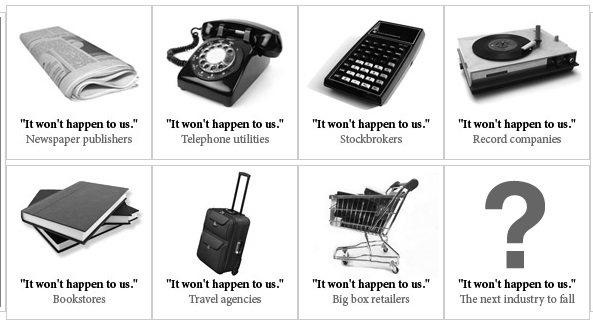
Less and Less People Reading Newspapers

Go Lean Commentary

The Fourth Estate is under attack … by Free Market forces and technology. We should all be alarmed!

The Fourth Estate (or fourth power)… most commonly refers to the news media, especially print journalism or “the press”. The term makes implicit reference to the earlier division of the three Estates of the Realm: the clergy, the nobility, and the commoners. – Wikipedia.

This title is a reference to a societal-political force or institution whose influence is undeniable though it may not be consistently or officially recognized. In the US and other countries, there is constitutional protections for Freedom of the Press.

The First Amendment of the United States Constitution states:

  • Congress shall make no law respecting an establishment of religion, or prohibiting the free exercise thereof; or abridging the freedom of speech, or of the press; or the right of the people peaceably to assemble, and to petition the government for a redress of grievances.

The United Nations‘ 1948 Universal Declaration of Human Rights states:

  • “Everyone has the right to freedom of opinion and expression; this right includes freedom to hold opinions without interference, and impart information and ideas through any media regardless of frontiers”.

A free press is important for modern societies. Despite all the news and information, it can also be an important sentinel against “bad actors” – yes, “bad actors” will always emerge. But this freedom is a two-edge sword: free to succeed and free to fail. So the entities of the Fourth Estate must adapt, like everyone else, to global changes and competitive shifts, otherwise they die.

In a previous blog-commentary, the following observance was made:

“Print is not dead… yet? I almost didn’t notice!”

“If print is not dead yet, does that mean it is going to put up a fight? Will it make a comback? I say “No”. It is just a matter of time. Print might experience only a slow death, but die … it will.”

Continuing the count, if there is a Fourth Estate, then to no one’s surprise, there is also a Fifth Estate:

The Fifth Estate is a socio-cultural reference to groupings of outlier viewpoints in contemporary society, and is most associated with bloggers, journalists publishing in non-mainstream media outlets, and the social media or “social license” . The “Fifth” Estate extends the sequence of the three classical Estates of the Realm and the preceding Fourth Estate, essentially the mainstream press. The use of “Fifth Estate” dates to the 1960s counterculture, and in particular the influential The Fifth Estate, an underground newspaper first published in Detroit in 1965. Web-based technologies have enhanced the scope and power of the Fifth Estate far beyond the modest and boutique[1] conditions of its beginnings. – Wikipedia

This commentary is a blog, thus representative of the Fifth Estate. This continues a long series on the theme of New Media:

https://goleancaribbean.com/blog/?p=10052 Fake News? Welcome to America
https://goleancaribbean.com/blog/?p=5353 POTUS and the Internet
https://goleancaribbean.com/blog/?p=4076 American Media Fantasies -vs- Weather Realities
https://goleancaribbean.com/blog/?p=3974 Google and Mobile Phones – Here comes Change
https://goleancaribbean.com/blog/?p=273 10 Things We Don’t Want from the US – #9: American Media Domination
https://goleancaribbean.com/blog/?p=248 Print is not dead yet

Welcome to the future. Say “Goodbye” to yesterday. Newspapers are representative of that yesterday. The daily newspaper in most communities are getting thinner, smaller in size, distribution and influence. This fact is born out in this news article:

Study: Less Than A Quarter Of Americans Read Newspapers
(CBS HOUSTON) — The number of Americans reading print newspapers, magazines and books is in rapid decline.

Only 29 percent of Americans now say they read a newspaper yesterday – with just 23 percent reading a print newspaper. Over the past decade, the percentage reading a print newspaper the previous day has fallen by 18 points (from 41 percent to 23 percent). Somewhat more (38 percent) say they regularly read a daily newspaper, although this percentage also has declined, from 54 percent in 2004.

Also according to the recent Pew Research Center poll, Americans enjoy reading as much as ever – 51 percent say they enjoy reading a lot. This is little changed over the past two decades, but a declining proportion gets news or reads other material on paper on a typical day. Many readers are now shifting to digital platforms to read the papers.

Substantial percentages of the regular readers of leading newspapers now read them digitally. Currently, 55 percent of regular New York Times readers say they read the paper mostly on a computer or mobile device, as do 48 percent of regular USA Today and 44 percent of Wall Street Journal readers.

Over the past decade, there have been smaller declines in the percentages of Americans reading a magazine or book in print (six points and four points, respectively) than for newspapers.

Print magazine reading is down by 7 percent from 2006, and book reading is down by 8 percent since 2006. Also, the percentage of people who wrote or received a personal letter declined 8 percent from 20 to 12 in the last six years.

And television viewership may be on the decline next.

While print sources have suffered readership losses in recent years, television news viewership has remained more stable. Currently, 55 percent say they watched the news or a news program on television yesterday, little changed from recent years. But there are signs this may also change. Only about a third (34 percent) of those younger than 30 say they watched TV news yesterday; in 2006, nearly half of young people (49 percent) said they watched TV news the prior day.

Among older age groups, the percentages saying they watched TV yesterday has not changed significantly over this period.

Source: CBS News; posted October 15, 2012; retrieved 03/05/2017 from: http://houston.cbslocal.com/2012/10/15/study-less-than-a-quarter-of-americans-read-newspapers/

The foregoing article is from 2012, but in the most recent episode of CBS Sunday Morning News Magazine (March 5, 2017), there was this “Pulse Poll”:
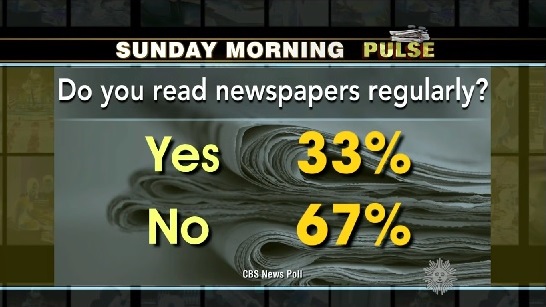
CU Blog - Less and Less People Reading Newspapers - Photo 1

CU Blog - Aereo Founder and CEO Chet Kanojia on the future of TV - Photo 1Many newspapers in major cities are “taking a hit”: circulation is down, advertising is down, the number of pages is down, but retail prices are up. The digital transformation is afoot. Consider the experience of the Miami Herald, in the Appendix below; (regrettably, a very long article).

So instead of newspapers, there is more reliance now on electronic media for news, information, and entertainment. The reference to electronic media does not only mean TV or radio, but rather, it includes the internet. A lot of consumers still read, just not in print, they now use internet websites, social media, e-Readers, blogs and email. This transformation does not only feature computer terminals and monitors, but smaller screens as well, as in mobile telephones or smart phones.

The change from the Fourth to the Fifth Estate is also affecting the legacy electronic media: TV and radio. These institutions are finding competition because of the internet.

As reported in that previous blog, “in the TV industry, more people are abandoning cable contracts for subscriptions services like Netflix and Hulu; they are still able to enjoy their favorite programming, just delivered by alternate means. For radio, the audience is shrinking due to the proliferation of mobile music options like Pandora, Rhapsody, Jango, Slacker, Roxio, etc.”

Are these future prospects true for the Caribbean as well?

The book Go Lean…Caribbean asserts that the “world is flat” and that globalization and technology has taken its toll on all aspects of Caribbean life. How are our media outlets doing in the region?

At first glance, the newspapers still thrive:

  • Circulation remain strong.
  • There are just as many pages – per section – compared to 10, 20 or 30 years ago.
  • The pages are still filled with advertising.
  • Retail prices has increased beyond inflation, close to $1 in equivalent US dollars.

This disposition is simply because there is less electronic delivery in the Caribbean. Alas, the same technology changes affecting the rest of the modern world will surely impact the Caribbean. Mobile-smartphone devices are becoming more ubiquitous, even in the Caribbean region in the countries normally considered Third World. The newspaper industry  in the region will be imperiled if there are no mitigations. The Go Lean book presents that mitigation.

The book Go Lean…Caribbean serves as a roadmap for the introduction and implementation of the technocratic Caribbean Union Trade Federation (CU). This empowerment effort is designed to move the region forward, to the corner of opportunity and preparation. This roadmap calls for confederating the 30 member-states in the region to provide optimization solutions in the areas of economics, security and governance. The Fourth Estate relates to all three areas. The CU/Go Lean roadmap has these prime directives:

  • Optimization of the economic engines in order to grow the regional economy and create 2.2 million new jobs.
  • Establishment of a security apparatus to enhance public safety and protect the economic engines against “bad actors”.
  • Improvement of Caribbean governance to support these engines.

There is no doubt, the Print-Journalism industry is in decline. In conflict with the medium over elements of truth, the new American President, Donald Trump, pejoratively refers to the New York Times as the failing New York Times.

The Go Lean book purports that the Caribbean must do better. The Go Lean book details the policies and other community ethos to adopt, plus the executions of strategies, tactics, implementations and advocacies to elevate Caribbean society, and protect the media industry. The book details how to Bridge the Digital Divide (Page 31), deploy a customized Social Media network  (Page 111) branded as www.myCaribbean.gov with tentacles in mobile technologies – and Ways to Foster e-Commerce (Page 198).

All in all, the Go Lean roadmap posits that as a region, we cannot only expect to consume, but that we must create/compose as well. The end result of this roadmap is a complete eco-system to foster a viable electronic media industry.

Download the book Go Lean … Caribbean – now!

Sign the petition to lean-in for the roadmap for the Caribbean Union Trade Federation.

————

Appendix – How The Miami Herald is getting to know its audience again

By: Kristen Hare

MIAMI — On the outside, the headquarters of the Miami Herald looks like any building in any part of town filled with wide warehouses, beige office plazas and chain restaurants. Inside, though, the values of the Herald are written on the walls.

Really.

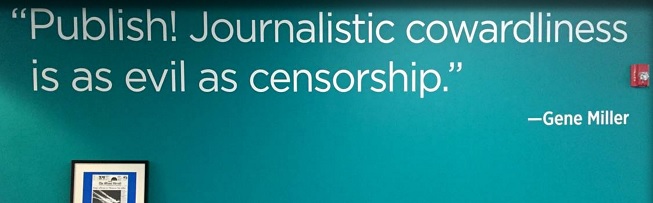
On one teal green wall in slim white letters:

“Publish! Journalistic cowardliness is as evil as censorship.” — Gene Miller
CU Blog - Less and Less People Reading Newspapers - Photo 2

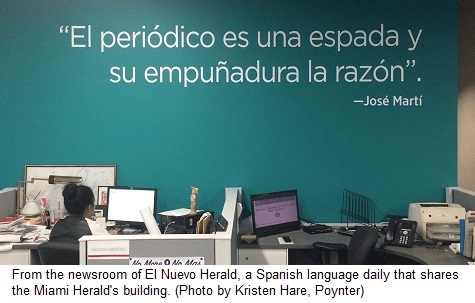
On another (from the adjacent newsroom of the Spanish daily El Nuevo Herald):

“El periódico es una espada y su empuñadura la razón.” — José Martí
CU Blog - Less and Less People Reading Newspapers - Photo 3

A few months ago, something new appeared on the big screen TVs hanging from cobalt blue walls in the middle of the newsroom: Chartbeat.

Newsrooms and journalists around the country have had access to real-time analytics for years. In March, the Herald joined in and gave everyone access to Chartbeat.

Then, every reporter was asked to raise total traffic to their stories by 7.5 percent. They got training in headline writing and search engine optimization. They started forming teams to function like startups, responsible for covering subjects such as Cuba, local government and food.

Change didn’t hit the newspaper industry in one big wallop. It has come, instead, in relentless small ones. The Herald didn’t just start making changes to adapt to digital, either. But for Aminda Marqués Gonzalez, the Herald’s executive editor and vice president, this year’s about accelerating those changes.

All of the shifts have one thing in common: They require everyone at the Herald to pay attention to its audience.

WELCOME TO MIAMI

In the middle of the newsroom, the big screens with Chartbeat tick along like departure boards at a train station. They serve a similar function, too. This story’s stalling, this one’s taking off, this one needs fuel.

The Herald is one of four legacy newspapers in the Knight-Temple Table Stakes Project, a $1.3 million initiative aimed at pushing regional news organizations toward the digital future. Here, analytics have been integral to that process.

But the Herald (and other McClatchy papers) didn’t wait until Table Stakes came along to get started. The company began working with the American Press Institute almost a year ago to try and get to know its audience better.

The institute’s Metrics for News program helps newsrooms figure out where their journalists are spending time, where their audiences are spending time and how to get the two to align more closely. Contrary to the typical notions of clickbait and virality, API has discovered that readers value actual reporting — enterprise work, local crime reporting and long-form journalism, among other things.

The Herald, for example, has found a strong and engaged audience for its local government coverage. But not every story resonates.

“It’s wonderful to say, we value enterprise, our focus is on enterprise, but if you’re a beat reporter, hey you make sources by going to meetings,” said Rick Hirsch, the Herald’s managing editor. “Part of this work is showing up.”

Add to this that Miami-Dade County has more than 30 municipalities, plus a big county and city government, and the Herald’s five local government reporters can’t possibly cover them all, even with a stable of freelancers. The challenge: How can the Herald structure coverage to build sources, keep track of what’s happening and make sure people find and read it?

In part, it’s about being less city-specific and focusing on topics everyone in the area cares about, Hirsch said. Should one reporter cover six cities, or should that reporter focus on transportation issues across them all? Should another focus on corruption? Another on spending and accountability?

“Are there ways to approach local government coverage that looks across city lines?” Hirsch asked. “I think there are, but it requires a little bit of a change in how we go about doing what we do, and it certainly means more of a team approach than we’ve had before.”

In the last few months, editors at the Herald began to see a way they just might be able make that happen.

MIAMI, INC

The Herald has launched several initiatives as part of the Table Stakes project. But one in particular ties in with all the rest: the formulation of “INCs,” (short for incorporated.) Basically, they’re meant to be self-contained startups within the newsroom.

“It’s a really different way of working,” Hirsch said. “The idea behind it is to develop a team approach with a leader who’s responsible to really focus on audience, to work with a team to develop coverage that responds to areas where we know there’s high engagement and at the same time look at other ways to reach people that aren’t just writing stories.”
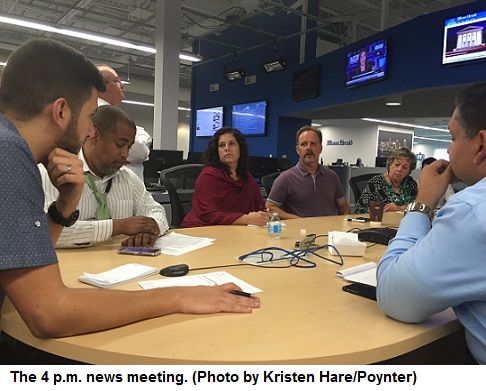
CU Blog - Less and Less People Reading Newspapers - Photo 4

The people running INCs aren’t just in charge of coverage, but also getting that coverage to spread on social media. And that means thinking digitally.

So far, INCs include Spanish and English coverage of Cuba and the Herald’s food coverage. Other areas that will become INCs are crime and courts, local government, entertainment and coverage of sports that appeals to the Herald’s local and international readers.

Carlos Frías, food editor, is a one-man INC.

It took awhile for him to realize that it’s all about workflow. Now, he aggregates. He works on getting headlines and social media language right. He spends his time on in-depth features. And when Frías sees a story he can’t get to, he reaches out to other departments. Could a suburban reporter cover it? Someone in sports? He’s curating work from the rest of the Herald that makes sense for his audience.

“Before, I was kind of just shoveling coal, but now I’m at the point that I realize that the beauty of this INC idea is you can leverage the resources that you have at the paper,” he said.

In the past, for instance, a story about National Doughnut Day that wasn’t ready for the print edition wouldn’t have been published at all. But when Frías heard about a new doughnut shop, he contacted a suburban reporter and editor, published the story online that day and promoted it heavily on social media. It ended up running in the newspaper on Sunday. A story that previously had limited reach instead got the star treatment with an audience that loves food.

Not all the INCs are as clear or as straightforward, however. In Cuba Today is one of those. The Herald and El Nuevo Herald’s coverage of Cuba has readership in English and Spanish, and became a standalone site in each language in December, before the INCs debuted.

Now, it’s gone from a vertical to a startup within the newsroom.

The team, led by editor Nancy San Martin, has four staffers devoted to coverage of Cuba. Two are reporters, two are producers and translators. The audience for both sites are heavily bilingual. Original content does best.

The challenge, San Martin said, is maintaining two sites in two different languages as well as providing coverage for the Miami Herald and El Nuevo Herald in print and for digital. She’s considering combining them into one Spanglish site (using a mix of English and Spanish).

Fundamentally, INCs aren’t meant to be verticals but to harness the Herald’s audience, Marqués said. They start by figuring out who the audience is, how to reach it and how to help it grow. They all include aggregation and a strong focus on social media. They also all ask — what else? Beyond advertising, is there anything to monetize? Events? A custom database? A newsletter?

As with real startups, though, each INC has different needs, different expectations and different possibilities. Just like there’s really not one audience, there’s not one formula for reaching them.

NOT THE HUNGER GAMES

When Nicholas Nehamas started at the Herald two years ago, reporters weren’t paying attention to what people were reading, where they were reading it or for how long.

“Now, two years later, I look up and there’s a big monitor with Chartbeat on it,” said Nehamas, who covers real estate, which will eventually become an INC. “And that makes a big difference in the way we think about our coverage and the stories we write, so that’s been a big impact, I think.”

That’s also resulted in something a lot of newsrooms are already doing — deciding what they’ll stop covering. In the past, the business desk covered quarterly earnings reports from banks. No longer.

“There are things you have to cover, even if not many people read them, but this is not one of them,” he said.

Saying no to those reports means more time for enterprise. For Nehamas, that enterprise included being part of the team that investigated the Panama Papers.

One of his fears, when reporters were asked to figure out how readers were responding, was that their efforts would all boil down to clicks. And sure, if he spent all his time writing about J-Lo’s latest home sale, he could meet his traffic goals. But that’s not what’s happened.

“I think reporters are seeing that it’s not going to be ‘The Hunger Games,'” he said. “We’re not going to be out there finding the grossest stories we can to report. We’re still fulfilling the old mission.”

Marqués agreed.

“Listening to your readers doesn’t mean that you lose your journalism values,” she said.

It does mean making lots of adjustments, however. Here are some other changes happening at the Herald that focus on audience:

The morning breaking news team started working a digital schedule

“It sounds basic, but you can’t have a morning breaking news effort without moving people to the morning,” said Jeff Kleinman, day news editor.

Now, the team works from 7 a.m. to 4 p.m., (and their work includes a daily Facebook Live morning update.) They’re not thinking about print packages or print space, but updating stories as more information comes in. When a reporter recently asked Kleinman how long a story should be, it took him a minute to answer.

“I’m not thinking length first thing in the morning,” he said. “I’m thinking speed and video and how this story can develop.”

They’re trying to detach themselves from the print monster, he added, “and it’s a monster that we all love and that’s baked into our newsroom, but it sometimes can hold you back.”

They’re experimenting

The Herald’s sports desk is toying with the idea that its vast out-of-market readership will read coverage of sports in Spanglish. Instead of launching it as an INC or starting a new vertical, however, they’re testing to see if there’s an audience for it by using a Facebook group.

They’re betting all these changes will bring a valuable audience

Marqués started at the Herald as an intern in 1986. In 2002, she left to work as an editor at People Magazine. There, she found an industry very tuned in to its audience. Editors knew what stories readers responded to. They tested covers. It was still a print-centric business, but it was also an audience-centric one.

When she returned to the Herald in 2007, Marqués started asking questions about readers. Now, she has tools to answer those questions and to show how readers are responding.

For instance, in June of last year, the Herald had 5.6 million total unique visitors. This June, they hit 10.8 million.

And as the Herald’s newsroom has transformed during the last year or so, its advertising side has as well, said Orlando Comas, McClatchy’s director of sales.

“It’s really less about ‘we’re just a newspaper company’ and more that we are connecting to our local audiences and our local businesses,” he said.

Higher pageviews translate directly into increased revenue from display ads. Indirectly, he said, higher engagement turns into revenue by creating a local audience that stays around and is more valuable to advertisers.

Print is still a focus, and it still brings in money, Marqués said. But the future is digital, “so that’s where we have to be hyper-focused.”

“We say in shorthand, ‘audience first,'” said Suzanne Levinson, who worked for the Herald for more that 30 years and is now head of digital news at McClatchy. “It’s really about adjusting how we do journalism.”

Marqués agreed.

“It’s a new medium. It’s not just a new platform,” she said. “And for too long we all treated it like just another platform.”

TOWARD THE SUMMIT

At its biggest, the Miami Herald had a newsroom of about 435. Now, it’s about 115. The cuts here, like at other newspapers, have been as relentless as the industry changes.

Over the years, the Herald has been sluggish in response to shifts in the news business, said David Neal, a breaking news reporter who has been at the Herald for 27 years.

“I feel like we were like the entire industry,” he said, “we were slow to respond to a lot of changes that you could see coming on the horizon even 20 years ago.”

Chartbeat is great, Neal said. It’s a good tool to see how your work is doing. But, for him, it still comes back to instincts.

“You can still figure out what’s gonna hit: sports, animals, pets of sports stars, a sex cruise.”

Because of all the changes the newsroom has weathered, morale’s not great, Neal said, “but there are still a lot of people here doing good work who are still energized and inspired and doing their best.”

Nehamas, who’s been here for a few years, sees a newsroom more open to change than when he started, and one that’s producing high-quality local journalism.

To him, morale seems very strong right now.

Frías is fairly new to the Herald, so he’s not sure what it was like before Chartbeat and INCs were part of life here. There’s a fear that the newsroom is no longer capable of tackling the kind of journalism the Herald produced 15 or 20 years ago, he said.

“It’s just not true,” Frías said. “It’s just you have to pick and choose your spots.”

San Martin can’t speak for the whole newsroom, but on the Cuba INC, things are working.

“We’ve created a family-style camaraderie and thoroughly enjoy the challenge of going after an increasing and diversified audience,” she said. “There is great satisfaction in knowing that we are attracting national and international visitors to our Cuba sites, including those living on the island.”

They’re seeing more retweets, likes, comments, mentions and aggregations of their work, and that’s satisfying. That doesn’t mean it’s easy, though.

“For us, the future is like climbing a mountain that we know will provide a breathtaking view,” she said. “We just keep working hard to reach the summit.”

FOLLOWING THE SIGNS

The biggest challenges facing the Herald now aren’t really about what’s happening with its audience. Instead, Hirsch said, they’re about time, culture and focus.

“I think this is a hard shift,” he said, “and it is uncomfortable, and so part of the change that people have to make is working differently, and that’s really hard…We’re taking folks who have a lot of muscle memory and working a certain way and saying, let’s do this differently.”

Because of that, all the changes the Herald is pursuing are, for now and probably for good, a work in progress. And that’s tough for people used to waiting to publish, print and share big things until they’re just about perfect.

“I wish it was in our DNA,” Hirsch said, “but it’s going to have to be a learned skill for us.”

When the Herald first relocated to Doral from downtown Miami in 2013, the inside of its new home was one of cold gray walls, countless hallways and turns. Along with the bright colors and fortifying quotes (which, yes, are just paint and words,) the newsroom installed street signs. They hang from many corners.

Palmetto. Miracle Mile. Calle Ocho.

Now, everyone knows their way around. But early on, those signs reminded them of where they’d been and helped them figure out where they were going. It’s not exactly like figuring out a path into a digital future. But it’s not all that different, either.

Source: Posted July 11, 2016; retrieved March 6, 2017 from: https://www.poynter.org/2016/how-the-miami-herald-is-getting-to-know-its-audience-again/414525/

————

See the VIDEO of the Miami Herald Digital Edition here:

VIDEO – Miami Herald Digital Newspaper – https://youtu.be/01GWq9mZsMg

Published on Sep 17, 2012 – Learn about the Miami Herald Digital Newspaper. The Miami Herald Digital Newspaper is an exact replica of the daily paper, available on PC, Mac, iPad, iPhone, Android and most tablets. You’ll love the convenience, at home or on the go.
Features include:
– Easy to use and navigate
– Available anywhere in the world with data access
– Share via email, Facebook & Twitter
– Searchable 30 day archive
– Quick links to advertiser websites

http://www.miamiherald.com/digital

Share this post:
, , ,

Stay Home! Remembering ‘High Noon’ and its Back-Story

Go Lean Commentary

When there is a ‘Climate of Hate’, conditions in society can easily go from bad to worse. We have a lot of lessons from history that supplant this assertion. Consider this lesson from America in the 1950’s.

CU Blog - Remembering 'High Noon' and its Back Story - Photo 2

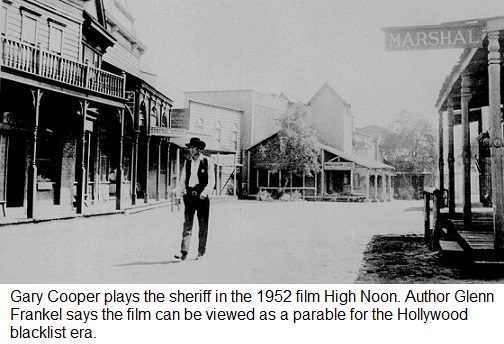
A revealing new book High Noon: The Hollywood Blacklist and the Making of an American Classic uncovers the back-story of the classic Western movie ‘High Noon’; it details the grim time in American history, when a bad community ethos permeated, McCarthyism and the resultant blacklist. “These events from the 1950’s have a special resonance today.”

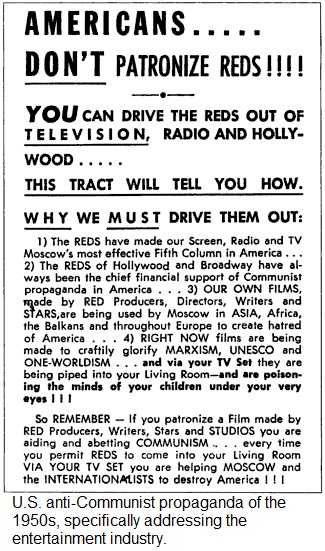
The movement behind the book Go Lean … Caribbean has consistently related that the United States function as a Great Society but it has two societal defects: Institutional Racism and Crony-Capitalism. These societal defects can easily create a ‘Climate of Hate‘ and in the 1950’s, the US had it bad … with their stereotyping and “witch hunts” of McCarthyism.

McCarthyism include the speeches, investigations, and hearings of Wisconsin Senator Joseph McCarthy (in office 1947 –1957); the Hollywood blacklist, associated with hearings conducted by the House Un-American Activities Committee (HUAC); and the various anti-communist activities of the Federal Bureau of Investigation (FBI) under Director J. Edgar Hoover. McCarthyism was a widespread social and cultural phenomenon that affected all levels of society and was the source of a great deal of debate and conflict in the United States.

CU Blog - Remembering 'High Noon' and its Back Story - Photo 3McCarthyism was the practice of making accusations of subversion or treason without proper regard for evidence.[1] It also means “the practice of making unfair allegations or using unfair investigative techniques, especially in order to restrict dissent or political criticism.”[2] The term has its origins in the period in the United States known as the Second Red Scare, lasting roughly from 1947 to 1956 and characterized by heightened political repression as well as a campaign spreading fear of influence on American institutions and of espionage by Soviet agents.

McCarthyism soon took on a broader meaning, describing the excesses of similar efforts. The term is also now used more generally to describe reckless, unsubstantiated accusations, as well as demagogic attacks on the character or patriotism of political adversaries. During the McCarthy era, thousands of Americans were accused of being communists or communist sympathizers and became the subject of aggressive investigations and questioning before government or private-industry panels, committees and agencies. The primary targets of such suspicions were government employees, those in the entertainment industry, educators and union activists. Suspicions were often given credence despite inconclusive or questionable evidence, and the level of threat posed by a person’s real or supposed leftist associations or beliefs was often greatly exaggerated. Many people suffered loss of employment and/or destruction of their careers; some even suffered imprisonment. Most of these punishments came about through trial verdicts later overturned,[4] laws that were later declared unconstitutional,[5] dismissals for reasons later declared illegal[6] or actionable,[7] or extra-legal procedures that would come into general disrepute.
Source: Wikipedia Online Encyclopedia; retrieved February 26, 2017 from: https://en.wikipedia.org/wiki/McCarthyism

As related in the foregoing, “many people suffered loss of employment and/or destruction of their careers”; this was definitely the case in Hollywood. Consider the experience of the screenwriter Carl Foreman, best known for the film classic Western ‘High Noon’. See the Book Review and related AUDIO-Podcast here:

Book Title: High Noon: The Hollywood Blacklist and the Making of an American Classic
By:  Glenn Frankel
From the New York Times-bestselling author of The Searchers, the revelatory story behind the classic movie High Noon and the toxic political climate in which it was created.

CU Blog - Remembering 'High Noon' and its Back Story - Photo 1It’s one of the most revered movies of Hollywood’s golden era. Starring screen legend Gary Cooper and Grace Kelly in her first significant film role, High Noon was shot on a lean budget over just thirty-two days but achieved instant box-office and critical success. It won four Academy Awards in 1953, including a best actor win for Cooper. And it became a cultural touchstone, often cited by politicians as a favorite film, celebrating moral fortitude.

Yet what has been often overlooked is that High Noon was made during the height of the Hollywood blacklist, a time of political inquisition and personal betrayal. In the middle of the film shoot, screenwriter Carl Foreman was forced to testify before the House Committee on Un-American Activities about his former membership in the Communist Party. Refusing to name names, he was eventually blacklisted and fled the United States. (His co-authored screenplay for another classic, The Bridge on the River Kwai, went uncredited in 1957.) Examined in light of Foreman’s testimony, High Noon‘s emphasis on courage and loyalty takes on deeper meaning and importance.

In this book, Pulitzer Prize-winning journalist Glenn Frankel tells the story of the making of a great American Western, exploring how Carl Foreman’s concept of High Noon evolved from idea to first draft to final script, taking on allegorical weight. Both the classic film and its turbulent political times emerge newly illuminated.

———

AUDIO-PODCASTWhat A Classic ’50s Western Can Teach Us About The Hollywood Blacklist – http://www.npr.org/2017/02/21/516427212/what-a-classic-50s-western-can-teach-us-about-the-hollywood-blacklist

Posted on February 21, 2017 – Author Glenn Frankel tells Fresh Air‘s Terry Gross that the government was “looking to see or to prove that there had been communist infiltration in Hollywood, that this was part of a mass plot engineered by Moscow to take over our cultural institutions.”

Many who appeared before the House Un-American Activities Committee were put on a blacklist that made it impossible for them to work in show business. Among the blacklisted was screenwriter Carl Foreman, whose 1952 classic western High Noon is seen as a parable about the toxic political climate of the time.

This history highlights the bad consequence of societal defects; they can easily be exploited and society further hijacked with blatant malice (bad motives, bad messages and bad actions). This aligns with the Go Lean book’s definition of “community ethos”:

the underlying attitude/spirit/sentiment that informs the beliefs, customs, or practices of a group or society.

The bad ethos of McCarthyism became a “widespread social and cultural phenomenon that affected all levels of America”. The US would not have been a welcoming society for those on the wrong side of this targeting. This truly demonstrates how a ‘Climate of Hate’ exacerbates societal defects, conditions easily go from bad to worse.

America is not much different today … in 2017 compared to the 1950’s. Yes, the laws of the land has been updated, but the attitudes of the people are still intact towards a ‘Climate of Hate’. There is the continuous need for vigilance and truth. The truth of the matter is that America has a lot of work to do to be the Great Society they project to the world. This country should not be the panacea of Caribbean ills. This commentary has consistently asserted that it is easier for the Caribbean member-states to reform and transform its own society than to flee to find refuge in America.

According to the foregoing, the American government turned on some of its most talented and productive citizens during the bad days of McCarthyism. This turned out to be just another extension of the country’s ‘Climate of Hate’. This commentary maintains that hate is in the American DNA.

Too strong?!

Just consider the experience of the nation’s Black-and-Brown populations. This has been duly documented and lamented.

Too old?!

If it is the contention that this is an indictment of the America of old, then consider the fresh experience of Muslim immigrants.

And yet … the people in the Caribbean – mostly Black-and-Brown – are beating down the doors to get out of their Caribbean homeland, to seek refuge in places like the US; (a smaller faction emigrate to Canada and Western Europe). This really conveys the sad state of affairs for the Caribbean eco-system. While things are bad for minorities in America (Black-and-Brown, Muslim, etc.), more Black people want to come in, instead of working to remediate the problems in their own homeland.

This is the reality of the Caribbean disposition: the region suffers from a bad record of societal abandonment. The reasons why people leave have been identified as “push and pull”:

“Push” refers to people who feel compelled to leave, to seek refuge in a foreign land. “Refuge” is an appropriate word; because of societal defects, many from the Caribbean must leave as refugees – think LGBTDisabilityDomestic-abuseMedically-challenged – for their life, liberty and pursuit of happiness.

“Pull”, on the other hand refers to the lure of a more prosperous life in the US (and other destinations); many times our people are emigrating for economics solely.

If only we can mitigate these “push and pull” factors, then we can dissuade our people from leaving in the first place. We CAN go from ‘good to great‘ here in the homeland. This is no easy task; and despite being necessary, it is hereby defined as heavy-lifting. This is the purpose of this commentary; this is part 1 of 3 in a series on “Why Caribbean people need to Stay Home“, positing that the “grass is not greener on the other side”. The complete series is as follows:

  1.  Stay Home! Remembering ‘High Noon’ and its Back-Story
  2.  Stay Home! Immigration Realities in the US
  3.  Stay Home! Outreach to the Diaspora – Doubling-down on Failure

The book Go Lean … Caribbean seeks to optimize the societal engines of Caribbean life; it serves as a roadmap for the introduction and implementation of the technocratic Caribbean Union Trade Federation (CU). The CU must employ better strategies, tactics and implementations to impact its prime directives; identified with the following 3 statements:

  • Optimization of the economic engines in order to grow the regional economy to $800 Billion & create 2.2 million new jobs.
  • Establishment of a security apparatus to protect the resultant economic engines and mitigate internal and external threats.
  • Improvement of Caribbean governance to support these above engines, including a separation-of-powers between member-state governments and CU federal agencies.

Early in the Go Lean book, this need for careful technocratic stewardship of the region’s societal engines was pronounced (Declaration of Interdependence – Page 12 – 13) with these acknowledgements and statements:

xi.   Whereas all men are entitled to the benefits of good governance in a free society, “new guards” must be enacted to dissuade the emergence of incompetence, corruption, nepotism and cronyism at the peril of the people’s best interest. The Federation must guarantee the executions of a social contract between government and the governed.

xii.  Whereas the legacy in recent times in individual states may be that of ineffectual governance with no redress to higher authority, the accedence of this Federation will ensure accountability and escalation of the human and civil rights of the people for good governance, justice assurances, due process and the rule of law. As such, any threats of a “failed state” status for any member state must enact emergency measures on behalf of the Federation to protect the human, civil and property rights of the citizens, residents, allies, trading partners, and visitors of the affected member state and the Federation as a whole.

xxiv. Whereas a free market economy can be induced and spurred for continuous progress, the Federation must install the controls to better manage aspects of the economy: jobs, inflation, savings rate, investments and other economic principles. Thereby attracting direct foreign investment because of the stability and vibrancy of our economy.

This is movie season … and movies are an art form that imitates life, while life also imitates movies.

… The 89th Academy Awards ceremony, presented by the Academy of Motion Picture Arts and Sciences, honored the best films of 2016, and took place on February 26, 2017, at the Dolby Theatre in Hollywood, Los Angeles, 5:30 p.m. PST. – Wikipedia

The lesson we learn from the back-story of the movie ‘High Noon’ and the foregoing Book Review, is that we have to ‘stand our ground’ to reform and transform our communities in the Caribbean; we have our own ‘Climate of Hate’. So the Go Lean book therefore details this series of community ethos to adopt, plus the strategies, tactics, implementations and advocacies to execute to forge a permanent transformation in the homeland:

Community Ethos – Economic Systems Influence Choices & Incentives Page 21
Community Ethos – Consequences of Choices Lie in the Future Page 21
Community Ethos – Anti-Bullying and Mitigation Page 23
Community Ethos – Minority Equalization Page 24
Community Ethos – Ways to Impact the Future Page 26
Community Ethos – Ways to Manage Reconciliations Page 34
Community Ethos – Ways to Impact the Greater Good Page 37
Strategy – Vision –  Integrate region into a Single Market Economy Page 45
Strategy – Agents of Change – Globalization Page 57
Tactical – Separation of Powers – Department of Homeland Security Page 75
Implementation – Ways to Foster International Aid Page 115
Planning – 10 Big Ideas … in the Caribbean Region – Haiti & Cuba Page 127
Planning – Ways to Improve Failed-State Indices Page 134
Planning – Lessons from East Germany – European Post-War Rebuilding – Attitudes Page 139
Planning – Lessons from the US Constitution – Progressive &  Evolutionary Page 145
Advocacy – Ways to Grow the Economy Page 151
Advocacy – Ways to Create Jobs Page 152
Advocacy – Ways to Foster Empowering Immigration – Case Study of Indian Migrants Page 174
Advocacy – Ways to Impact Justice Page 177
Advocacy – Ways to Remediate and Mitigate Crime Page 178
Advocacy – Ways to Improve Gun Control Page 179
Advocacy – Ways to Improve Homeland Security Page 180
Advocacy – Ways to Mitigate Terrorism – and Bullying Page 181
Advocacy – Ways to Improve Intelligence Gathering & Analysis Page 182
Advocacy – Ways to Protect Human Rights Page 220
Advocacy – Ways to Help Women – Mitigate Gender-based Violence Page 226
Advocacy – Ways to Impact Youth – Message new Community Ethos – Inclusion Page 227
Advocacy – Ways to Impact Hollywood – Power of Film Page 203
Advocacy – Ways to Impact the Dominican Republic – Reconciling Neighboring Hate Page 237
Advocacy – Ways to Re-boot Haiti – Regional Climate of Hate against Haiti Page 238
Advocacy – Ways to Impact Trinidad & Tobago – Indo versus Afro Climate Page 240
Advocacy – Ways to Impact Guyana – Indo versus Afro Climate Page 241
Advocacy – Ways to Impact Belize – Cross Border Climate with Guatemala Page 242
Advocacy – Ways to Impact US Territories – Interracial Climate Page 244

Underlying the back-story in the foregoing Book Review is the classic Western film: High Noon. See the Appendix VIDEO.

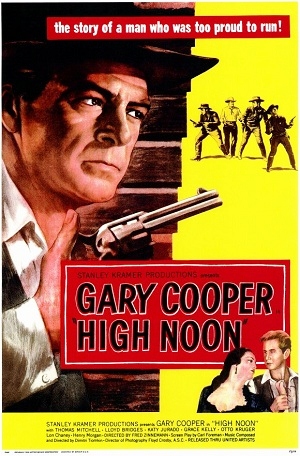
That was a great movie about a man when faced with the choice of ‘fight or flight’, chose to stay and fight rather than fleeing for his own refuge. This film was thought-provoking and impactful … and celebrated. In fact, the film …

… was nominated for seven Academy Awards, and won four (Actor, Editing, Music-Score, and Music-Song)[3] as well as four Golden Globe Awards (Actor, Supporting Actress, Score, and Cinematography-Black and White).[4] In 1989, this movie was selected for preservation in the United States National Film Registry by the Library of Congress as “culturally, historically, or aesthetically significant”. – Wikipedia.

CU Blog - Remembering 'High Noon' and its Back Story - Photo 4

Movies are important in the roadmap to impact the Caribbean; a previous blog/commentary regarding Caribbean Diaspora member and Hollywood great, Sidney Poitier, declared that …

… “movies are an amazing business model. People give money to spend a couple of hours watching someone else’s creation and then leave the theater with nothing to show for the investment; except perhaps a different perspective”.

The contention is that we can do better in the Caribbean. This is based on one premise: it is easier to reform and transform the Caribbean that it is to reform and transform America. Yes, we can …

The points of effective, technocratic stewardship of the Caribbean have been detailed in these previous blog/commentaries:

https://goleancaribbean.com/blog/?p=10532 Learning from Stereotypes – Good and Bad
https://goleancaribbean.com/blog/?p=9595 Vision and Values for a ‘New’ Caribbean
https://goleancaribbean.com/blog/?p=9214 Time To Go: A 6-part series for the Diaspora in the US
https://goleancaribbean.com/blog/?p=8200 Respect for Minorities: Climate of Hate
https://goleancaribbean.com/blog/?p=7646 Going from ‘Good to Great’
https://goleancaribbean.com/blog/?p=7221 Street naming for Martin Luther King unveils a ‘Climate of Hate’
https://goleancaribbean.com/blog/?p=5733 Better than America? Yes, We Can!
https://goleancaribbean.com/blog/?p=5527 American Defects: Racism – Is It Over?
https://goleancaribbean.com/blog/?p=1596 ‘Prosper where Planted’ in the Caribbean

The issues addressed in this commentary are not related to America alone. We have our own ‘Climate of Hate’ in the Caribbean. While we can learn lessons from the American past and present, we still must do the required heavy-lifting ourselves.

The Go Lean book reports that the Caribbean is in crisis. Too many people leave … due to “push and pull” reasons. Thusly, the region is suffering a debilitating brain-drain estimated at 70% with some countries reporting up to 81%.

The Go Lean roadmap declares that we must, and can, do better. Truth be told, it is easier for the average person to remediate and mitigate defects in the Caribbean homeland than to prosper in foreign lands like the US. This message , while repeated here, must be loudly proclaimed and echoed throughout our Caribbean region.

Every stakeholder, everyone who live, work and play in the Caribbean are urged to lean-in to this Go Lean roadmap to turn-around the region. The strategies, tactics and implementations proposed in the Go Lean book are conceivable, believable and achievable. 🙂

————-

Appendix VIDEO – High Noon (1952) Official Trailer – https://youtu.be/g9CR_tib0CA

Uploaded on Dec 12, 2011 – Classic Western movie starring Gary Cooper and Grace Kelly.

Share this post:
, , , , ,
[Top]

Caribbean Roots: Cast of ‘The Fresh Prince of Bel-Air’

Go Lean Commentary

For the generation born between 1980 and 2000 – Millennials – this TV show is an icon of their generation:

The Fresh Prince of Bel-Air.

It was a situation comedy (sit-com) with laughter, hip-hop music, urban cool lifestyle, family values and thought-provoking drama. This show was formative for all demographics of this generation – White and the Black-and-Brown –  but most people do not realize that a large number of the cast members had Caribbean roots.

We are so proud!

CU Blog - Caribbean Roots - Cast of Fresh Prince of Bel-Air - Photo 1

CU Blog - Caribbean Roots - Cast of Fresh Prince of Bel-Air - Photo 3

The movement behind the book Go Lean … Caribbean recognizes the significance of this art-form: sit-com television. On a consistent basis, audiences tuned into this show for entertainment and walked away with enlightenment as well – average ratings were 13 – 14 million viewers. They were constantly exposed to an affluent African-American household with an intact family structure: father, mother, and compliant children navigating a changing world. That was a different perspective – see Image Awards details in the Appendix below – compared to the realities of Black America and the pervasive media portrayals.

The show was not a docu-drama of “Black versus White America”, though many times, plotlines covered these dynamics. In general the storylines addressed teenage angst, but many plotlines addressed the family’s affluence versus working class families; this exposes a familiar rift in the Black community with passionate advocates for a Talented Tenth versus a ‘Power to the People’ contingent. See these encyclopedic details and VIDEO of the show here:

Title: The Fresh Prince of Bel-Air

CU Blog - Caribbean Roots - Cast of Fresh Prince of Bel-Air - Photo 0The Fresh Prince of Bel-Air is an American sitcom that originally aired on NBC from September 10, 1990, to May 20, 1996. The show stars Will Smith as a fictionalized version of himself, a street-smart teenager from West Philadelphia who is sent to move in with his wealthy aunt and uncle in their Bel Air mansion after getting into a fight on a local basketball court. In the series, his lifestyle often clashes with the lifestyle of his relatives in Bel Air. The series ran for six seasons and aired 148 episodes.[1][2]

Starring Cast

Will Smith as Will “The Fresh Prince” Smith
James Avery as Philip Banks
Janet Hubert-Whitten as Vivian Banks (1st)
Alfonso Ribeiro as Carlton Banks
Karyn Parsons as Hilary Banks
Tatyana M. Ali as Ashley Banks
Joseph Marcell as Geoffrey The Butler
Daphne Maxwell Reid as Vivian Banks (2nd)
Ross Bagley as Nicholas “Nicky” Banks (Seasons 5 & 6 only)

Development
In December 1989, NBC approached Will Smith, a popular rapper during the late 1980s.[3] The pilot episode began taping on May 1, 1990.[4] Season 1 aired in July 1990 and ended in March 1991. The series finale was taped on Thursday, March 21, 1996.[5][6]

The theme song was written and performed by Smith under his rap stage name, The Fresh Prince. The music was composed by QDIII (Quincy Jones III), who is credited with Smith at the end of each episode.

The music often used to bridge scenes together during the show is based on a similar chord structure. The full version of the theme song was used unedited in the first three episodes. The full length version, which is 2:52, was included on Will Smith’s Greatest Hits album and attributed to him only, as well as DJ Jazzy Jeff & the Fresh Prince in 1998. A 3:23 version was released in the Netherlands in 1992, reaching #3 on the charts.

In the second season, the kitchen and living room sets were rebuilt much larger with a more contemporary style (as opposed to the much more formal style of the first season), and were connected directly by an archway, allowing scenes to be shot continuously between the sets.

Plot
The theme song and opening sequence set the premise of the show. Will Smith is a street-smart teenager, born and raised in West Philadelphia. While playing basketball, Will misses a shot and the ball hits a group of people, causing a confrontation that frightens his mother, who sends him to live with his aunt and uncle in the town of Bel Air, Los Angeles.

He flies from Philadelphia to Los Angeles on a one-way ticket in first class. He then whistles for a taxi that has dice in the reflection screen and the word “FRESH” on its vanity plates. Will’s working class background ends up clashing in various humorous ways with the upper class, “bourgeois” world of the Banks family – Will’s uncle Phil and aunt Vivian and their children, Will’s cousins Hilary, Carlton, and Ashley.
Source: Wikipedia Online Encyclopedia – Retrieved February 24, 2017 from: https://en.wikipedia.org/wiki/The_Fresh_Prince_of_Bel-Air

————

VIDEO – The Fresh Prince Of Bel Air Theme Song – https://youtu.be/1nCqRmx3Dnw

Published on Feb 3, 2013 – This was obviously the first episode.

The reference to The Fresh Prince refers to the hip-hop rapper Will Smith; the show revolved around him.

The Go Lean book identifies that music – even hip-hop – and the arts can greatly impact society; in addition to the entertainment value, there is also image and impression. People can override many false precepts with excellent deliveries and contributions from great role models.

The book Go Lean…Caribbean serves as a roadmap for the introduction and implementation of the Caribbean Union Trade Federation (CU). This CU strives to advance Caribbean image and culture in the region and throughout the world, with these 3 prime directives:

  • Optimization of the economic engines in order to grow the regional economy.
  • Establishment of a security apparatus to protect the resultant economic engines.
  • Improve Caribbean governance.

This roadmap recognizes that a prerequisite for advancing society is a change in the Caribbean “community ethos”;  (the underlying attitude/spirit/sentiment that informs the beliefs, customs, or practices). Early in the book, the contributions that culture (music, television, film, theater and dance) can make is pronounced as an ethos for the entire region to embrace, (opening Declaration of Interdependence – DOI – Pages 15) with this statement:

xxxii. Whereas the cultural arts and music of the region are germane to the quality of Caribbean life, and the international appreciation of Caribbean life, the Federation must implement the support systems to teach, encourage, incentivize, monetize and promote the related industries for arts and music in domestic and foreign markets. These endeavors will make the Caribbean a better place to live, work and play.

The Go Lean/CU asserts that change has now come to the Caribbean, collectively and for each of the 30 member-states. The people, institutions and governance of the region are all urged to “lean-in” to this roadmap for change. We know it is important to highlight the positive contributions of Caribbean people, even their descendants and legacies.

The great role models being considered here are the many cast members of this iconic TV show – The Fresh Prince of Bel-Air – who had Caribbean roots. We learn lessons from these great role models: lessons that are good, bad and ugly.

The cast members for consideration are:

  • Alfonso Ribeiro as Carlton Banks
    This American-born actor has displayed many talents, beginning his career at the age of eight but securing his first TV sit-com on the series Silver Spoons at the age of 13; he is also accomplished as a television director, dancer, and show host. He was born in New York City to Trinidadian parents Michael and Joy Ribeiro (née De Leon) of Portuguese, Spanish and Afro-Trinidadian descent from Trinidad and Tobago. His mother was the daughter of Trinidadian Calypsonian the Roaring Lion, Rafael de Leon.[2][3]
  • Tatyana M. Ali as Ashley Banks
    This artist has excelled in her roles as an actress, model and R&B singer. She was born in New York to a mother of Afro-Panamanian[2][3] heritage and a father who is Indo-Trinidadian.[3] She began her acting career at the young age of six, starting as a regular child performer on Sesame Street starting in 1985. She has not stopped working in the entertainment industry, featuring acting and singing roles right up to the present day.
  • Joseph Marcell as Geoffrey The Butler
    This Saint Lucian-born British actor moved to the United Kingdom at the age of nine, grew up in South London, and still lives in that metropolitan area. He studied theatre and science at college, then took courses in speech and dance. As a member of the Royal Shakespeare Company, he appeared in productions of Othello and A Midsummer Night’s Dream. He has also appeared often on British television and in feature films.[2]

These artists have placed their signatures on the entertainment world – The Fresh Prince of Bel-Air show delivered 148 episodes – notwithstanding their Caribbean heritage. This is among the ‘Good‘ lessons.

What is ‘Bad and Ugly‘ is how they have excelled in their crafts in the US and the UK as opposed to their ancestral homelands. Their parents left the islands for greater opportunities 50 – 70 years ago and despite the passage of time we still do not have any manifestations that would have allowed their artistic expressions in the Caribbean region.

What is sad is that most of the Caribbean Diaspora left their beloved homelands with some aspirations of returning some day. This is depicted in the Go Lean book with this quotation (Page 118):

The Bottom Line for the Caribbean Diaspora
The Caribbean is the best address in the world. However for over 50 years many Caribbean citizens left their island homes to find greater opportunity in foreign lands: USA, Canada and Europe. Though the “man was taken out of the island, the island was never taken out of the man”, and as such many of the Diaspora live in pockets with other Caribbean expatriates in their foreign homelands (i.e. Flatbush in Brooklyn, New York, USA). What’s more, their children, legacies, are still raised and bred with Caribbean values and culture. Many left initially with the intention of returning someday, but life, loves and livelihoods got in the way of a successful return. Worse, many tried to return and found that they were targets of crime and terrorism, mandating that they abandon all hopes and dreams of a successful repatriation. The CU therefore must allow for the repatriation of peoples of the Diaspora, in all classes of society, “the good, the bad and the ugly”.

We salute these artists from the TV show ‘The Fresh Prince of Bel-Air’. Great job; great performances and great portrayals. We accept that these artists are great Americans and Britons; they may never be grouped with Caribbean artists.

This is our loss.

May we do better with our next generation. We can and have done some good in the past; Caribbean people have impacted the art world (music and culture) right from their Caribbean homeland. Consider Caribbean musical icon, Bob Marley; he set a pathway for success for other generations of talented, inspirational and influential artists to follow. More artists of Caribbean heritage are sure to emerge to “impact the world” with their artistry. The planners for a new more opportunistic Caribbean – the Go Lean movement – are preparing for it, as specified in the same DOI – Page 13:

xxi. Whereas the preparation of our labor force can foster opportunities and dictate economic progress for current and future generations, the Federation must ensure that educational and job training opportunities are fully optimized for all residents of all member-states, with no partiality towards any gender or ethnic group. The Federation must recognize and facilitate excellence in many different fields of endeavor, including sciences, languages, arts, music and sports. This responsibility should be executed without incurring the risks of further human flight, as has been the past history.

The foregoing three artists should be proud of their executions; we are proud of their heritage and thusly have an affinity for their works. We acknowledge those ones from our past who left their Caribbean homelands for better opportunities in the world of entertainment and we know that there are “new” artists who are just waiting to be fostered throughout the Caribbean member-states. We salute these ones as our future, and pledge to do better. The following list details the community ethos, strategies, tactics, implementations and advocacies to foster future entertainment options in the Caribbean:

Community Ethos – Ways to Foster Genius – All Artists Page 27
Community Ethos – Promote Intellectual Property Page 29
Community Ethos – Ways to Promote Happiness Page 36
Community Ethos – Impact the Greater Good Page 37
Strategy – Caribbean Vision Page 45
Tactical – Separation of Powers – Patents & Copyrights Page 78
Tactical – Separation of Powers – Culture Administration Page 81
Implementation – Ways to Impact Social Media Page 111
Advocacy – Ways to Make the Caribbean Better Page 131
Advocacy – Ways to Impact Hollywood Page 203
Advocacy – Ways to Impact the Diaspora Page 217
Advocacy – Ways to Preserve Caribbean Heritage Page 218
Advocacy – Ways to Improve the Arts Page 230
Advocacy – Ways to Promote Music Page 231

These foregoing artists – all good people in their own rite – have been impactful for their communities:

  • Alfonso Ribeiro has been front-and-center in charitable endeavors, exerting much time and resources in helping with children’s medical needs through his Shriners Hospital association.
  • Tatyana Ali has been very active politically, campaigning for “hope and change” with Barack Obama’s presidential campaign in 2008.[10][11] In 2012, she continued showing her support for the re-election campaign and other Democratic Party causes.[12]
  • Joseph Marcell devotes a lot of time, talent and treasuries to educational causes within the theater community.
    CU Blog - Caribbean Roots - Cast of Fresh Prince of Bel-Air - Photo 2

These examples continue the theme of the impact of good role models in their community. We need, want and deserve more of this in the Caribbean. This thought has been presented many times in this commentary; consider these previous Go Lean blogs that identified other role models, from many cultures, with these submissions:

https://goleancaribbean.com/blog/?p=10114 Esther Rolle – Caribbean Roots
https://goleancaribbean.com/blog/?p=9948 Sammy Davis, Jr. – Caribbean Roots
https://goleancaribbean.com/blog/?p=8724 Remembering Marcus Garvey: A Role Model; Still Relevant Today
https://goleancaribbean.com/blog/?p=8619 Clive Campbell – Jamaican Innovation for Hip Hop
https://goleancaribbean.com/blog/?p=8495 NBA Greatness and Caribbean Roots: Tim Duncan Retires
https://goleancaribbean.com/blog/?p=8328 YouTube Role Model with Caribbean Roots: ‘Tipsy Bartender’
https://goleancaribbean.com/blog/?p=7682 Frederick Douglass: Role Model for a Single Cause
https://goleancaribbean.com/blog/?p=6593 Dr. Mobley – Role Model as a Business School Dean
https://goleancaribbean.com/blog/?p=2726 Caribbean Role Model – Oscar De La Renta – RIP
https://goleancaribbean.com/blog/?p=2297 The Black Contrast: Booker T Washington versus W.E.B. Du Bois
https://goleancaribbean.com/blog/?p=1037 Role Model and Humanities Advocate – Maya Angelou – R.I.P.
https://goleancaribbean.com/blog/?p=866 Caribbean Musical Icon and Role Model: Bob Marley

The world is a better place, arts-wise, because of Caribbean contributions. Thank you to all past, present and future artists.

Just one more thing: Let’s make these contributions at home, from home; let’s prosper where we are planted.

This helps us to make our Caribbean homeland a better place to live, work and play. 🙂

Download the book Go Lean … Caribbean – now!

————–

Appendix Title: The Fresh Prince of Bel-Air‘s NAACP Image Awards

Outstanding Comedy Series

Nominated

1997
Outstanding Supporting Actor in a Comedy Series

Won

Alfonso Ribeiro 1996
Outstanding Lead Actor in a Comedy Series

Nominated

Will Smith 1997
Outstanding Youth Actor/Actress

Won

Tatyana M. Ali 1997
Outstanding Supporting Actress in a Comedy Series

Nominated

Janet Hubert-Whitten 1991
Outstanding Supporting Actress in a Comedy Series

Nominated

Nia Long 1996
Outstanding Supporting Actress in a Comedy Series

Nominated

Daphne Maxwell Reid 1996
Share this post:
, , , , , ,
[Top]

More ‘Bad News’ for Freeport

Go Lean Commentary

Change has come to tropical resorts – hotels with casinos. They do not seem to work anymore. It is a failing business model. This is Bad News for some communities.

CU Blog - Sunwing vacates Memories Grand Bahama - Photo 4

CU Blog - Sunwing vacates Memories Grand Bahama - Photo 5

Casinos are especially failing. Why so?  Well, for the many resort guests that come from North America (US & Canada), they now have abundant access to gambling – lotteries, casinos and pari-mutuel betting (horse racing, greyhound racing and Jai Alai). These establishments, especially casinos as of late, have popped up in many cities all over the region, plus on many Native American reservations. Plus there is the eco-system of Casino Riverboats and Cruise Ships leaving major US ports; many of them heading to the Caribbean.

Lastly, the ubiquity of the internet has furnished endless online gambling options.

The previous casino hot spots of Las Vegas and Atlantic City have thusly had to reform and transform their product offering.

Somehow, the Caribbean region “has not gotten the memo”.

This is sad, as one community after another in the Caribbean are having to endure the “bumps and bruises” of a failing economic engine in their neighborhood.

“It’s a beautiful day in the neighborhood …” NOT!

See this reality – Bad News for one city – in this Press Release statement here:

Corporate Statement: Sunwing vacates Memories Grand Bahama 

CU Blog - Sunwing vacates Memories Grand Bahama - Photo 1

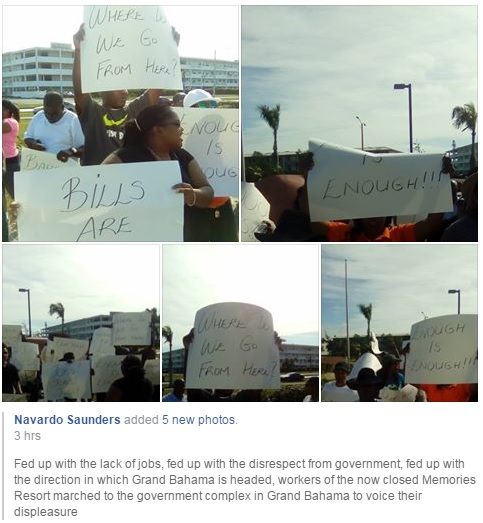
February 1, 2017 – In 2013, the Sunwing Travel Group forged a partnership with the Government of The Bahamas and in 2014 began to operate the Memories Grand Bahama Beach & Casino Resort on Grand Bahama Island. Concurrently with Sunwing’s opening of the Memories Resort, Sunwing began weekly flight service from eight cities in Canada and daily flights from a variety of U.S. cities in the ensuing summer. The opening of the 492-room Resort coupled with Sunwing’s tour operator and airlift support, led to the revitalization of the Grand Bahama tourist economy, over 100,000 incremental tourists annually arriving on new flying programs from Canada and the Eastern United States, the creation of over 1500 jobs on the Island, and an annual economic contribution exceeding US $140 Million.

On October 6th of 2016, Hurricane Matthew caused significant damage to the Memories Resort and forced its closure. Despite an immediate response from Sunwing Travel Group and the Government of The Bahamas to secure alternative accommodations, protect flying, and expedite the necessary repairs, the Hotel’s owner, Hong Kong-based Hutchison Whampoa, did not agree to requests to restore the Memories.

Since this event, the Sunwing Travel Group has taken on the significant financial burden of compensating and re-protecting customers as well as running an air program with limited accommodation options as a demonstration of goodwill and commitment to the people of Grand Bahama Island.

In January, it was reported in the Bahamian press that the Government and Sunwing had agreed to co-invest sums to restore the Memories and secure its earliest reopening. Sunwing sought the hotel Owner’s consent for such restoration but regrettably, the Owner attempted to impose exorbitant conditions that were totally unacceptable to Sunwing and would be to any other potential tenant.

The Sunwing Travel Group is very proud of the partnership it has forged with the Government and the people of Grand Bahama and very saddened to report that we were required to vacate the Memories Resort premises on January 29, 2017. Accordingly, we are making arrangements to pay out applicable redundancy pay for our employees and will be reaching out to our employees in the coming days.

Sunwing intends to continue supporting Grand Bahama Island and its tourism economy, including its hotels, through its tour operators, Sunwing Vacations and US-based Vacation Express as well as by continuing its airlift programs from Canada and from the United States in the summer, subject to conditions we are discussing with Government.

We are also pleased to advise that as part of our ongoing commitment to Grand Bahama and its people, we are already developing plans in concert with the Government to return to Grand Bahama Island as a hotel operator and are optimistic that we will be in a position to announce details shortly.

We are very appreciative for the support we’ve received from the Government and the wonderful people of Grand Bahama. Thank you for your continued support and understanding,

Sunwing Travel Group.

————-

Source: The “Bahamas Weekly” News Source; posted Feb 3, 2017; retrieved Feb 8, 2017 from: http://www.thebahamasweekly.com/publish/grand-bahama-bahamas/Sunwing_vacates_Memories_Grand_Bahama52338.shtml

CU Blog - Sunwing vacates Memories Grand Bahama - Photo 2

CU Blog - Sunwing vacates Memories Grand Bahama - Photo 3

————-

VIDEO – Memories Grand Bahama Beach & Casino Resort – Grand Bahama, The Bahamas | Sunwing.ca – https://youtu.be/qLo3puqnIis

Published on Apr 15, 2014 – Memories Grand Bahama Beach and Casino Resort offers the perfect vacation escape for all types of travelers. Guests can indulge in a variety of first-class amenities, gourmet dining, unlimited beverages, onsite golf and non-stop activities.

The foregoing press release – about Freeport, the 2nd city in the Bahamas – aligns with the book Go Lean…Caribbean, which calls for the elevation of Caribbean economics. This quest means first accepting the reality of the current assessments; then forging the necessary change.

What is the assessment? The region is in crisis!

Alas, the Go Lean book declares “a crisis is a terrible thing to waste”. It serves as a roadmap for the introduction and implementation of the technocratic Caribbean Union Trade Federation (CU) with the charter to effectuate change in the region with these 3 prime directives:

  • Optimization of the economic engines in order to grow the regional economy to $800 Billion and create 2.2 million new jobs.
  • Establishment of a security apparatus to protect the resultant economic engines and marshal against economic crimes.
  • Improve Caribbean governance to support these engines.

Looking at the foregoing news story, Freeport has a crisis. There is a need to re-focus, re-boot, and optimize the engines of commerce so as to make Freeport, Grand Bahama, the whole Bahamas and the entire Caribbean, better places to live, work and play. This news story relates that the tourism product in Freeport, the mainstay of Caribbean economy, is in turmoil. The Go Lean book asserts that this is where the region must start in the effort for turn-around: the region can no longer afford to be a “one-trick pony”. The opening page of the book states:

The Caribbean has tried, strenuously, over the decades, to diversify their economy away from the mono-industrial trappings of tourism, and yet tourism is still the primary driver of the economy. Prudence dictates that the Caribbean nations expand and optimize their tourism products, but also look for other opportunities for economic expansion. The requisite investment of the resources (time, talent, treasuries) for this goal may be too big for any one Caribbean member-state. Rather, shifting the responsibility to a region-wide, professionally-managed, deputized technocracy will result in greater production and greater accountability. This deputized agency is the … CU.

The CU Trade Federation is a technocracy, empowered to reboot the economic engines of the member-states, by fostering new industries (new “purse”) across the entire region and deploying solutions to better exploit the opportunities of the global trade market. Thus generating all new revenues; with no need to re-distribute any existing “purse” among the member-states.

There is an apropos proverb: “if you fail to plan, you plan to fail”. Starting here and now, the Caribbean starts its planning for success; to snatch “victory out of the jaws of defeat”. Failure is just too familiar. Already we have member-states … on the verge of a Failed-State status… These states are not contending with the challenges of modern life: changing weather patterns, ever-pervasive technology, and the “flat world” of globalization. To reverse the fortunes of these failing states, and guide others in the opposite direction to a destination of prosperity, the Caribbean must re-boot the regional economy and systems of commerce.

Early in this book, the responsibility to monitor, manage, and mitigate the risks and threats of job killing developments, (such as the reporting in the foregoing press release), was identified as an important function for the CU with this pronouncement in the Declaration of Interdependence (Pages 13):

xxvi.  Whereas the Caribbean region must have new jobs to empower the engines of the economy and create the income sources for prosperity, and encourage the next generation to forge their dreams right at home, the Federation must therefore foster the development of new industries… In addition, the Federation must invigorate the enterprises related to existing industries like tourism… – impacting the region with more jobs.

So what is next for Freeport?

CU Blog - Sunwing vacates Memories Grand Bahama - Photo 6

The urging to this community is to “be afraid; be very afraid of maintaining the status quo”. It is past time to reboot Freeport. (See the foregoing VIDEO advertising the Memories Grand Bahama Resort).

This commentary previously related details of the status quo for Freeport and the strong recommendations to forge change. Consider this list of previous blogs:

https://goleancaribbean.com/blog/?p=10309 Time to consider “Secession”
https://goleancaribbean.com/blog/?p=10140 Lessons Learned from Detroit: Demolish abandoned structures!
https://goleancaribbean.com/blog/?p=7528 A Vision of Freeport as a Self-Governing Entity
https://goleancaribbean.com/blog/?p=7449 ‘Crap Happens’ – So What Now?
https://goleancaribbean.com/blog/?p=5542 Freeport’s Bad Ethos of Rent-Seeking
https://goleancaribbean.com/blog/?p=4185 Freeport: A Ghost Town Happening
https://goleancaribbean.com/blog/?p=4037 How to Train Your ‘Dragon’ – Freeport Version
https://goleancaribbean.com/blog/?p=3641 Freeport’s Musical Roots: A City ‘Built on Rock-n-Roll’
https://goleancaribbean.com/blog/?p=2585 Parallel of Freeport’s History: Concorde Supersonic Transport
https://goleancaribbean.com/blog/?p=300 Freeport’s Failing Status: ’10,000 Bahamians Living in Darkness’

The problems in Freeport are indicative of many other failing Caribbean communities, especially those overly dependent on tourism. Tourism can be a great economic engine, if managed properly … and diversified to hedge risk.

But, the executions have been faulty. Many communities have been plagued with “economic sores” for inadequate management of their tourism products. The issue of declining growth or failing business models is an important discussion for this roadmap. This commentary previously related details of these dysfunctions in these earlier Go Lean blogs:

https://goleancaribbean.com/blog/?p=8381 A Lesson in Economic Fallacies – Casino Currencies
https://goleancaribbean.com/blog/?p=7082 The Art and Science of ‘Play’
https://goleancaribbean.com/blog/?p=6680 Vegas Casinos Place Bets on Video Games
https://goleancaribbean.com/blog/?p=6341 Tourism Dysfunctional Stewardship — What’s Next?
https://goleancaribbean.com/blog/?p=4145 A Better Model for ‘Art’ Tourism
https://goleancaribbean.com/blog/?p=3225 Caribbean tourism less competitive due to increasing aviation taxes
https://goleancaribbean.com/blog/?p=2571 Sharing Economy: There is a winning model for Caribbean Tourism
https://goleancaribbean.com/blog/?p=2207 Hotels are making billions from Resort Fees; Bad Model for Caribbean
https://goleancaribbean.com/blog/?p=1984 Casinos Failing Business Model
https://goleancaribbean.com/blog/?p=1943 The Fading Future of Golf; Vital for Tourism?
https://goleancaribbean.com/blog/?p=798 Lessons Learned from the American Airlines Delivery Arts & Sciences
https://goleancaribbean.com/blog/?p=235 Tourism’s changing profile

According to the foregoing press release, the closing of this one property, Memories Grand Bahama, will directly impact over 600 jobs. In economics, there is the study of in-direct jobs that are facilitated by an economic engine. The Go Lean book details (Page 260) the principle of job multipliers, how certain industries are better than others for generating multiple indirect jobs down the line for each direct job on a company’s payroll. (Tourism’s job multiplier may be in the 2.0 to 3.0 range, while other industries, like automotive manufacturing, have a job-multiplier rate of 11.0)

The closing of this one property is more dire for Freeport; it’s an island with only few other non-tourism economic options. This city should be desperate to reform/reboot. Their economy needs to diversify … to industries with high job-multiplier ratios. (The Go Lean book suggest an automotive manufacturing business model for some communities in the Caribbean region; and a shipbuilding focus for Freeport). In order to “dream such a dream”, there must first be the adoption of specific community ethos to diversify the economy. (This is defined as the underlying spirit-attitude-sentiment that informs the beliefs, customs, or practices of society).

Is Freeport ready to start the journey for a new destiny with the adoption of the new community ethos? How about the rest of the Caribbean?

The book details the community ethos, plus the strategies, tactics, implementations and advocacies to foster a diversified economy:

Community Ethos – Deferred Gratification Page 21
Community Ethos – Economic Principle – People Respond to Incentives Page 21
Community Ethos – Economic Principle – Economic Systems Influence Individual Choices Page 21
Community Ethos – Economic Principle – Voluntary Trade Creates Wealth Page 21
Community Ethos – Economic Principle – Consequences of Choices Lie in the Future Page 21
Community Ethos – Job Multiplier Page 22
Community Ethos – “Crap” Happens – Anticipate Natural Disasters Page 23
Community Ethos – Lean Operations Page 24
Community Ethos – Return on Investments (ROI) Page 24
Community Ethos – Ways to Impact the Future Page 26
Community Ethos – Ways to Foster Genius Page 27
Community Ethos – Ways to Help Entrepreneurship Page 28
Community Ethos – Ways to Impact Research & Development Page 30
Community Ethos – Ways to Improve Sharing Page 35
Community Ethos – Ways to Impact the Greater Good Page 37
Strategy – Integrate Region in a Single Market Page 45
Tactical – Fostering a Technocracy Page 64
Tactical – Tactics to Forge an $800 Billion Economy Page 67
Tactical – Separation of Powers – Regional Tourism Promotion Page 78
Implementation – Ways to Deliver Page 109
Implementation – Ways to Reboot Freeport – Only City identified in Roadmap Page 112
Planning – Ways to Make the Caribbean Better – Better Job Options Page 131
Planning – Lessons Learned from Detroit – Example of a Failing City Page 140
Advocacy – Ways to Grow the Economy Page 151
Advocacy – Ways to Create Jobs Page 152
Advocacy – Ways to Improve Governance Page 169
Advocacy – Ways to Better Manage the Social Contract Page 170
Advocacy – Ways to Enhance Tourism Page 190
Advocacy – Ways to Help the Middle Class Page 223
Advocacy – Ways to Impact Urban Living Page 234

The Go Lean/CU roadmap is designed to foster industrial developments to diversify communities from tourism. We do not want to “abandon” tourism, just diversify it.

“Abandon” is a good word, because abandonment is what is happening in these failing Caribbean communities that have not diversified nor grown their economies. The disposition is so bad that the region sports a 70 percent abandonment rate among the educated classes.

This is truly a crisis; but one not to be wasted. All Caribbean stakeholders in the region – residents, institutions, businesses, Diaspora and trading partners – are urged to lean-in to this Go Lean roadmap. This plan is conceivable, believable and achievable.

Yes, we can … make the Caribbean a better place to live, work and play. 🙂

Download the book Go Lean … Caribbean – now!


Share this post:
, , , , ,
[Top]

Science of Sustenance – CLT Housing

Go Lean Commentary

Believe it or not, the Caribbean is the “best of times and the worst of times”. – Charles Dickens.

We have the greatest address on the planet – in terms of terrain, fauna/flora, hospitality, festivities, food, rum and cigars – but we have near-Failed-States as well, to the point that 70 percent of the educated classes have fled the region. The above Dickensian quote emerges as a strong parallel:

This phrase has been taken from the famous opening paragraph of Charles Dickens’ novel, A Tale of Two Cities. The novel opens as, “It was the best of times, it was the worst of times, it was the age of wisdom, it was the age of foolishness, it was the epoch of belief, it was the epoch of incredulity. – LiteraryDevices.com

This age of radical opposites in the Caribbean must be assuaged. But how? How do we implement a reboot and turn-around?

The book Go Lean … Caribbean asserts that we re-focus on basic needs – food, clothing, shelter and energy – and their required delivery systems. The book quotes that we must:

  • Feed Ourselves
  • Clothe Ourselves
  • House Ourselves – in the US, the National Association of Realtors® trumpets that “housing creates jobs”.

A consideration of the science of housing solutions, is therefore important and apropos for rebooting societal engines as housing requires local jobs and building materials. So it is a study in economics, security and governance.

But rebooting the delivery of housing in this year 2017 must dictate at least one additional criteria:

Adherence to Green principles.

Enter CLT for meeting housing- shelter needs; CLT = Cross Latinate Timber. Green building practices have helped CLT’s popularity, with its combination of environmental performance, sustainability, design flexibility, cost-competitiveness and structural integrity.

CU Blog - Science of Sustenance - CLT Housing - Photo 7

CU Blog - Science of Sustenance - CLT Housing - Photo 6

The Timber label discloses that the based material is wood; naturally grown on trees. This is as green as green gets; every tree cut down can be replaced with seedling for a new tree. But CLT is driven by forces in emerging science – see Appendix.

This is the focus of this commentary: science for rebooting the delivery of basic needs. This is 4 of 4 in this series covering: energy, food, clothing and shelter-housing. It is possible to deliver all basic needs without science. But for our modern world, the advances of science make a positive impact on daily life. So the full series for our consideration follows this pattern:

  1.    Science of Sustenance: Energy
  2.    Science of Sustenance: Food
  3.    Science of Sustenance: Clothing
  4.    Science of Sustenance: Shelter

The book Go Lean…Caribbean promotes advanced science and technology for Caribbean housing solutions, specifically trumpeting Smart Homes – home automation for security, communications, energy optimization, and house work.

CLT is also a Smart Home option, in that its a smart building material. It is strong, safe and flexible. With CLT as building blocks, structures can actually be built tall … maybe even  skyscrapers. See a related new article here:

Title: Why a Wooden Office Tower may Symbolize the Future of Multi Story Construction
By: Patrick Sisson

CU Blog - Science of Sustenance - CLT Housing - Photo 1

“Office building goes up in Minneapolis” isn’t exactly a headline built to blow up Twitter. But the seven-story, 210,000-square-foot T3 commercial structure that broke ground at the end of July in the city’s North Loop neighborhood isn’t just any office.  A new home for the Hines development firm, T3 (Timber, Technology and Transit) will be the first tall-timber building of its type in the United States, a new spin on architecture utilizing a material that’s been a bedrock of construction for millennia. According to architect Michael Green, when it’s finished in late 2016, T3 will challenge assumptions many hold about wooden structures, and represent a massive technological leap beyond the old-school timber warehouses that surround it. Green, one of a number of architects worldwide specializing in tall-timber construction, sees buildings like this as part of a vanguard of sustainable construction technology that will be called upon to create taller and taller buildings going forward. With so much of our energy footprint going towards constructing and maintaining buildings, it only makes sense to move away from resource-intensive steel.

“It’s the beauty of what we’re doing here, incorporating modern technology with good, old ideas,” he says. “We’re not reinventing the wheel, we’re bringing back a very good wheel.

CU Blog - Science of Sustenance - CLT Housing - Photo 2

CU Blog - Science of Sustenance - CLT Housing - Photo 3

Green’s eponymous Canadian firm is perhaps best known for the seven-story Wood Innovation and Design Centre in Prince George, British Columbia, currently the tallest timber building in North America. For the T3 project, he’s been forced to start with a concrete foundation to meet code requirements, and the skeleton will be steel, but the vast majority of the structure will be wood sourced from the West Coast. The core and floorplates will be made from huge panels of engineered lumber that have been nailed and glued together, with support provided by engineered wooden columns (pressed together to replicate the load-bearing abilities previously provided by massive beams cut from old growth timber). The panels’ density actually means they won’t burn through completely, instead forming a protective layer of charcoal. It’s a marriage of old and new techniques, he says, that will provide a much more energy-efficient building due to the natural source materials. And, as opposed to concrete-and-steel structures that often draw in the cold, this wooden structure will provide insulation, a godsend in a cold climate such as Minneapolis.

While Europe has traditionally been the leader in re-developing timber as a building material for tall structures—The Stadthaus, a nine-story building in London built in 2008 with cross-laminated timber, was one of the forerunners of the modern wooden building boom—Green feels North America is starting to catch up.

“Height is happening, but it’s a slow process,” he says.  “There are a few projects in the U.S. being considered, and you’re starting to see innovation creep up.”

CU Blog - Science of Sustenance - CLT Housing - Photo 4

CU Blog - Science of Sustenance - CLT Housing - Photo 5

While there are scores of projects utilizing cross-laminated timber and heavy wood construction, one of the projects Green is most excited about is the recent $60M forestry school expansion at Oregon State University dedicated to advancing the technology behind timber construction. The concept reinforces the main ecological and economical advantages of the practice, the ability to harvest renewable resources for construction while concurrently redeveloping rural economies. As timber buildings get higher in cities across the country, different areas, such as the seismic West Coast or windy Midwest, will require unique systems and designs to start rising above 20 floors. Developing and sharing regional knowledge between builders, regulators and architects will be key to future acceptance, still a barrier to more widespread adoption.

“The U.S. government investment in building science technology represents .0001 percent of total innovation investment,” he says. “That’s a statistic that needs to be shouted from the roof tops.”

While the industry is just starting to get off the ground here, Green and his firm are aiming skyward. A perfect example is their recent proposal for a 35-story tower in Paris. Set to be submitted after the contentious battle over the Herzog & de Meuron tower, the first tall building of any type approved in Paris in decades, the MGA plan was abandoned. But that was because it was tall and in Paris, not tall and made of wood.

“We have a new means of building that can help us realize a new era of architecture, a post-climate era,” he says. “As this develops, we’ll see how this changes the look of our cities and buildings.

Related stories:

Source: Curbed.com – Urban Design Online Site – (Posted 08-12-2017; retrieved 02-02-2017) from: http://www.curbed.com/2015/8/12/9931212/minneapolis-t3-timber-construction-michael-green

———-

Appendix – About Curbed.com

Since 2004, Curbed has been an integral part of the online housing industry, and by providing analysis, coverage, and insight, we apply an editorial lens to the onslaught of information. Unlike a glossy shelter magazine, we see homes, architecture, interior design, cities, neighborhoods, and properties for sale as related points on a spectrum. An artfully styled home shoot isn’t the be-all-end-of-all in the life of a residence: It’s one station along a continuously evolving timeline.
Source: Retrieved February 3, 2017 from http://www.curbed.com/pages/about-curbed

A consideration of CLT raises a lot of questions:

  • What would CLT Housing mean for the Caribbean region?
  • Are CLT-made homes strong-safe for the tropical zone’s threat of hurricanes?
  • Are they strong-safe for earthquake threats?
  • Do they fit in with the traditional decor of Caribbean neighborhoods?

Answers:

  • CLT Housing in the Caribbean – This region is not known for tall skyscrapers, so 20 – 30 maximum stories would be ideal for urban areas.
  • Strong-safe for hurricanes – The options for 3, 5 or 7 layered timber blocks are just as strong as concrete and steel. These structures have been tested and graded for Category 4 storms.
  • Strong-safe for earthquakes – Wood is energy-absorbent; this flexibility allows buildings to withstand quakes better than concrete, brick or steel.
  • Traditional Caribbean Decor – The classic-colonial look of the region featured wooded homes and sharp colors; this is ideal for CLT.

The book Go Lean … Caribbean serves as a roadmap for the introduction and implementation of the technocratic Caribbean Union Trade Federation (CU), with a charter to elevate Caribbean society by optimizing the delivery of the region’s basic needs. With 144 missions, the dynamics of housing is identified specifically as one of the missions for the Go Lean/CU roadmap; so too the quest for Pre-Fab housing. The book highlights the CU’s prime directives, as described by these statements:

  • Optimization of the economic engines – including housing solutions – in order to grow the regional economy to $800 Billion & create 2.2 million new jobs.
  • Establishment of a security apparatus to protect the resultant economic engines.
  • Improvement of Caribbean governance to support these engines.

There are a lot of economic issues associated with the subject of building materials; this subject reflects heavily on the local availability of natural resources. The Caribbean member-states – many of them small islands – do not have a lot of iron ore for steel and limited quarry areas for concrete-cement. But trees are an inexhaustible resource. So a confederated union in the region or a cooperative could be a good solution for installing a factory to produce CLT products. See the manufacturing process  in the Appendix VIDEO below.

The Go Lean roadmap, and the foregoing article, calls for the region to double-down its efforts to ensure a quality delivery for housing and building materials. This need was identified early in the Go Lean book, in the opening pronouncement in the Declaration of Interdependence (Page 14), as follows:

xxvi. Whereas the Caribbean region must have new jobs to empower the engines of the economy and create the income sources for prosperity, and encourage the next generation to forge their dreams right at home, the Federation must therefore foster the development of new industries, like prefabricated housing .

The Go Lean … Caribbean roadmap constitutes a change for the region, a plan to consolidate 30 member-states into a Trade Federation with the tools/techniques to bring immediate change to the region to benefit one and all member-states. The roadmap calls for collaboration of the region’s housing needs at a CU federal agency. Though there is a separation-of-powers mandate between the member-states and federal agencies, the CU can still wield influence in this area by consolidating the purchasing of raw materials and equipment – think Group Purchasing Organizations. The CU empowerments would also allow for better coordination with commercial entities, non-governmental organizations (NGOs) and international stakeholders.

The book details the community ethos needed to effect change in this area, plus the executions of the following strategies, tactics, implementations and advocacies to impact the region’s housing solutions:

Community Ethos – Deferred Gratification Page 21
Community Ethos – People Choose For Greatest Benefits Despite Scarcity Page 21
Community Ethos – All Choices Involve Costs Page 21
Community Ethos – Economic Systems Influence Individual Choices Page 21
Community Ethos – Voluntary Trade Creates Wealth Page 21
Community Ethos – Lean Operations – Group Purchase Organization Page 24
Strategy – Vision – Confederate 30 Member-States Page 45
Strategy – Mission – Build and foster local economic engines Page 45
Strategy – Mission – Embrace the advances of technology Page 46
Strategy – Agents of Change – Globalization Page 57
Tactical – Fostering a Technocracy Page 64
Separation of Powers – Department of Housing and Urban Authority Page 83
Implementation – Ways to Deliver Page 109
Planning – Ways to Make the Caribbean Better – Housing solutions Page 131
Planning – Ways to Mitigate Failed-States Page 134
Advocacy – Ways to Create Jobs Page 152
Advocacy – Ways to Improve Housing – Smart Homes Page 161
Advocacy – Ways to Better Manage the Social Contract Page 170
Advocacy – Ways to Foster Cooperatives Page 176
Advocacy – Ways to Better Manage Natural Resources Page 183
Advocacy – Ways to Foster Technology Page 197
Advocacy – Ways to Develop a Pre-Fab Housing Industry Page 207
Appendix – Housing Solution: Pre-Fab Homes Page 289

This Go Lean book asserts that there is a direct correlation between housing and the economy. This viewpoint has been previously detailed in Go Lean blog/commentaries, as sampled here:

https://goleancaribbean.com/blog/?p=10140 Lessons Learned: Detroit demolishes thousands of structures
https://goleancaribbean.com/blog/?p=7659 Pre-Fab Housing and Elder-Care Conjunction
https://goleancaribbean.com/blog/?p=5155 Tesla unveils super-battery to power homes
https://goleancaribbean.com/blog/?p=4337 Study: Homes Marketed via the MLS Sell for More
https://goleancaribbean.com/blog/?p=1896 The Crisis in Black Homeownership
https://goleancaribbean.com/blog/?p=709 Student debt holds back many would-be home buyers

CLT methodology is a scientific advance for green building materials. Green is important for the Caribbean region. Among the benefits are the consequences, the mitigations for Climate Change. Some of the threats for this region are hurricanes; as of late, with global warming the storms have been more destructive. A 1 to 2 degree difference in ocean temperature can mean the difference of a Category 2 storm versus Category 3. So CLT buildings will help to assuage greenhouse gases and protect the homes from destructive storms. These are better protections for earthquakes too.

Win – Win! This is the effect of advancing the science of sustenance, for all our basic needs: energy, food, clothing & shelter.

All of these scientific solutions are the new best-practices. They make this Go Lean/CU roadmap conceivable, believable and achievable.

Everyone in Caribbean – residents, homeowners, home-builders, governments – are hereby urged to lean-in to the Go Lean roadmap for regional, societal empowerment. 🙂

Download the book Go Lean … Caribbean – now!

————

Appendix VIDEO – CLT production line from Kallesoe Machinery – https://youtu.be/BikISh6F1wo

Published on Apr 15, 2015 – This massive high frequency press from Kallesoe Machinery represents the most efficient installation on the marked for the production of CLT elements. The press is a highly efficient production unit with high capacity and very short pressing times.

This CLT press can press endless CLT elements up to 20 meters long and 3.2 meters wide.

  • Category – Science & Technology
  • License – Standard YouTube License
Share this post:
, , , ,
[Top]

Science of Sustenance – Temperate Foods

Go Lean Commentary

The “bread basket” of _________ …

CU Blog - Science of Sustenance - Temperate Foods - Photo 0You can fill in the blanks with different regions around the world:

  • “Central Valley”, the bread basket of California
  • “Kansas”, the bread basket of America
  • “Alberta”, the bread basket of Canada
  • “Ukraine”, the bread basket of Eastern Europe

So who or where is the bread basket of the Caribbean?

Do we have an answer? Do we have a bread basket? Do we even have an organized region so as to collaborate on the responsibility of feeding our people?

No, No, and No!

This commentary is important for the Caribbean to contemplate. Every human in every land must arrange for the delivery of basic needs – “we gotta eat” and so food supply is paramount. Scientific developments have always been a major consideration for food supply, ever since the days of hunting-and gathering. Modern society is built on the premise that we would employ scientific best practices to harvest our food, or trade with people who employ these best practices.

The book Go Lean…Caribbean declares “enough already” with the trade; it is time to produce our own.

This was the original motivation for the publishing of this Go Lean book: to optimize the 30 Caribbean member-states into a Single Market so that we can be structured to do better in providing our basic needs. That structure would be the technocratic Caribbean Union Trade Federation (CU). The opening pages of the book feature this quotation (Page 3):

The CU should better provide for the region’s basic needs (food, clothing, energy and shelter), and then be in position to help supply the rest of the world. Previous Caribbean societies lived off the land and the sea; but today, the region depends extensively on imports, even acquiring large quantities of seafood, despite the 1,063,000 square miles of  the Caribbean Sea.

The CU Trade Federation is a technocracy, empowered to reboot the economic engines of the member-states, by fostering new industries (new “purse”) across the entire region and deploying solutions to better exploit the opportunities of the global trade market.

The Caribbean is in crisis for their dysfunctions in  delivering their own basic needs. This is the focus of this commentary; it is 2 of 4 in a series on the modern advances in science for delivering basic needs: energy, food, clothing and shelter. It is possible to deliver all these basic needs without science. But for our modern world, the advances of science make a positive impact on daily life. So the full series for our consideration follows this pattern:

  1.    Science of Sustenance: Energy
  2.    Science of Sustenance: Food
  3.    Science of Sustenance: Clothing
  4.    Science of Sustenance: Shelter

The book Go Lean…Caribbean asserts that “a crisis is a terrible thing to waste”. We must use our inadequate disposition to motivate stakeholders to forge change on our society; to implement the food supply solutions to do better at facilitating our own needs.

We are in the tropics…

… but science and technology allows us to deliver agricultural solutions for temperate produce (fruit and vegetables). Think:

  • Strawberries
  • Peaches
  • Apples
  • Spinach
  • Greens (Mustard, Collard, Kale, etc.)

Temperate produce need cooler temperatures to thrive. So the key is utilization of greenhouses, climate-controlled greenhouses. These allow for consistent temperatures of 20 to 30 degrees lower than the outside atmosphere. See a reference article on this subject here:

ARTICLE Grower 101: Using Evaporative Cooling, Part I
By John W. Bartok, Jr.
Find out what to use to keep your greenhouse ventilated and cool in the hot, humid summer.

On a bright, sunny summer day, a 30- x 100-foot greenhouse will gather about 32 million British Thermal Units (Btus) of heat. This is equivalent to burning 32 gallons of fuel oil or 320 therms of natural gas. If the greenhouse is full of plants, about one-half of this heat is used for transpiration and evaporation. The remainder of the cooling has to be conducted through ventilation. If the greenhouse is empty and closed, the temperature can exceed 150° F.

Understanding the basics
Shade on the outside of the greenhouse will keep some of the heat out. Shade on the inside, if it contains aluminum foil, will reflect some of the heat back out. Ventilation, either natural or fan, will remove a considerable amount of the heat that is collected. Still, on summer days, the temperature may exceed the desired level that promotes good plant growth by 10-20ºF. Excessive temperature results in delayed flowering and internode stretching. Evaporative cooling may be the best choice under these conditions.

Evaporative cooling, which uses the heat in the air to evaporate water from leaves and other wetted surfaces, can cool the greenhouse to 10-20° F below outside temperature. It takes one Btu of heat to raise the temperature of one pound of water 1° F, but it takes 1,060 Btus of heat to change the same amount of water to a vapor.

With an evaporated cooling system, humid air containing the heat that it picked up within the greenhouse is exhausted out through the vents or fans, and cooler, drier air is brought in. Evaporative cooling works best when the humidity of the outside air is low. For example, in Reno, Nev., the average summer dry bulb temperature is 96º F and the wet bulb is 61ºF. With an evaporative cooler having an efficiency of 80 percent, the temperature would be cooled to about 68° F. These conditions are most common in the dry Southwest, but even in the more humid sections of the United States, significant evaporative cooling can occur most days in the summer. In humid New Orleans, where the average summer dry bulb temperature is 93° F and the wet bulb is 78° F, the cooled air would be about 81° F, acceptable for the production of most plants.

Fan and pad system
Several evaporative cooling systems work well in commercial greenhouses. The most common is the fan and pad system. It contains a cellulose pad, overhead water supply pipe, gutter to collect excess water, a sump tank, pump, piping and control.

The 4- or 6-inch-thick pad is treated with anti-rot salts and stiffening and wetting agents. Pads are normally installed continuously along the side or end of the wall opposite the fans. The amount of pad area needed is calcuis the utillated by multiplying the floor area by 8 feet and dividing by 250 for a 4-inch pad or 400 for a 6-inch pad. For example, a 30- x 100-foot greenhouse with a 4-inch pad would require 96 sq. ft. of pads (30 x 100 x 8÷ 250 = 96 sq. ft.)

The overhead water supply pipe should distribute the water so the pad is wet uniformly. The minimum water flow rate is 0.5 gpm per sq. ft. for a 4-inch pad and 0.8 gpm per sq. ft. for a 6-inch pad.

Excess water is collected below the pad in a gutter and piped to a sump tank. Tank capacity needs to be 0.8 gallon per sq. ft. of pad for 4-inch pads and 1.0 gallon per sq. ft. for 6-inch pads. Water returning to the sump should be filtered to remove any debris. A make-up water supply and float valve keep the water level constant. In areas having water with a high mineral content, it is advisable to bleed 3-5 percent of the water to minimize salt buildup. Algae growth in the re-circulated water can be controlled with abiocide.

Modular pad systems of 5 and 6 feet are now available. These are self-contained and come completely assembled and ready to bolt to the wall. Installation time is reduced considerably. Only water and electrical connections have to be attached.

Next month, find out about swamp coolers, mist and fog systems and fan-generated fog and how they can work for you.

Source: Posted March 2003 from trade journal Greenhouse Product News; retrieved February 8, 2017 from: http://www.gpnmag.com/article/grower-101-using-evaporative-cooling-part-i/

CU Blog - Science of Sustenance - Temperate Foods - Photo 2

————-

VIDEO # 1 Best Thermal Cooled Greenhouse – https://youtu.be/HWXJ1ukEXa0

His Thermal Cooled Greenhouse in 1985 ran for 7 years, cooled itself day and night with 3 small Aquarium pumps, no fans or blowers; 14′ X 36′ ran on pennies a day – this worked!!! Now building a larger 24′ X 54′ Thermal Cooled Greenhouse. This works DAY OR NIGHT. Watch VIDEO !!!

  • Category – Science & Technology
  • License – Standard YouTube License

The science of greenhouses allows for temperate foods (fruit and vegetables) to be grown in a tropical zone – cold adds sweetness. This is what we want, what we need to fulfill our own basic needs. Other communities are doing this and we can as well. We have the role model of countries with colder climates supplying tropical fruit. Surely the reverse can be deployed as well, with strategic and tactical greenhouses.
Greenhouses allow for greater control over the growing environment of plants. Depending upon the technical specification of a greenhouse, key factors which may be controlled include temperature, levels of light and shade, irrigation, fertilizer application, and atmospheric humidity. Greenhouses may be used to overcome shortcomings in the growing qualities of a piece of land, such as a short growing season or poor light levels, and they can thereby improve food production in marginal environments. Greenhouses in hot, dry climates used specifically to provide shade are sometimes called “shadehouses”.[42][43]

As they may enable certain crops to be grown throughout the year, greenhouses are increasingly important in the food supply of high-latitude countries. One of the largest complexes in the world is in Almería, Andalucía, Spain, where greenhouses cover almost 49,000 acres.
Source:
Retrieved February 8, 2017 from: https://en.wikipedia.org/wiki/Greenhouse
CU Blog - Science of Sustenance - Temperate Foods - Photo 3

The Caribbean is in crisis … we are not able to feed ourselves from the current food supply systems. We therefore have to expend foreign reserves to acquire food from foreign locations. This applies to food that, with the proper empowerments, can be grown locally in the Caribbean region.

This Go Lean book serves as a roadmap for the introduction and implementation of the technocratic Caribbean Union Trade Federation (CU). The goal is that the CU would adopt these food supply best practices to better delivery this basic need for the region. In fact, the prime directives of the CU are described as:

  • Optimize the economic engines – including food supply solutions – to elevate the regional economy to grow to $800 Billion and create 2.2 million new jobs.
  • Establish a security apparatus to protect the resultant economic engines.
  • Improve Caribbean governance to support these engines.

The Go Lean roadmap calls for the immediate adoption of best practices in food supply science (agriculture) and infrastructure. We do not have to re-invent the wheel in this quest; other communities are doing it already. Consider the photos here of giant greenhouses in The Netherlands:

CU Blog - Science of Sustenance - Temperate Foods - Photo 1

CU Blog - Science of Sustenance - Temperate Foods - Photo 1d

CU Blog - Science of Sustenance - Temperate Foods - Photo 1c

CU Blog - Science of Sustenance - Temperate Foods - Photo 1b

This vision of temperature controlled greenhouses in the Caribbean assumes a supply of energy for cooling and ventilation. See more here on ventilation:

Ventilation is one of the most important components in a successful greenhouse, specially in hot and humid tropical climate condition.[18] If there is no proper ventilation, greenhouses and their growing plants can become prone to problems. The main purposes of ventilation are to regulate the temperature, humidity and vapor pressure deficit [19] to the optimal level, and to ensure movement of air and thus prevent build-up of plant pathogens (such as Botrytis cinerea) that prefer still air conditions. Ventilation also ensures a supply of fresh air for photosynthesis and plant respiration, and may enable important pollinators to access the greenhouse crop.

Ventilation can be achieved via use of vents – often controlled automatically via a computer – and recirculation fans.
Source: Retrieved February 8, 2017 from: https://en.wikipedia.org/wiki/Greenhouse

All in all, the Go Lean book declares that “a crisis is a terrible thing to waste”. This siren call is for the establishment of a regional technocracy to facilitate the delivery of the region’s basic needs.  According to the foregoing articles/references, we can grow temperate foods in the tropical zone without exhausting foreign currency.

The vision here of climate-controlled greenhouses requires heavy-lifting on the part of Caribbean stakeholders (governments and business communities). We need this heavy-lifting. A lot is at stake: our ability to feed our populations. The Go Lean roadmap calls for a separation-of-powers between CU federal agencies and the member-state governments. The CU presents Cabinet departments for Agriculture, Fisheries and Health (Food/Nutrition). These departments will have to collaborate with parallel departments at the member-state level.

This was the original motivation of the Go Lean roadmap, an interdependence of the 30 member-states of the Caribbean to offset the effects of globalization. This was pronounced early in the book in the Declaration of Interdependence (Page 14), with this statement:

xxx. Whereas the effects of globalization can be felt in every aspect of Caribbean life, from the acquisition of food and clothing, to the ubiquity of ICT, the region cannot only consume, it is imperative that our lands also produce and add to the international community, even if doing so requires some sacrifice and subsidy.

The roadmap also calls for the installations of Exclusive Economic Zones (EEZ) and Self-Governing Entities (SGE) that operate in controlled bordered territories like campuses, industrial parks, research labs and industrial plants. These can be a target for the climate-controlled greenhouses.

The Go Lean book declares that we must adopt a community ethos, the appropriate attitude/spirit to forge change in our region; then details the executions of the following strategies, tactics, implementations and advocacies to better impact the region’s preparation for food resources. See this sample here:

Community Ethos – Deferred Gratification Page 21
Community Ethos – Economic Systems Influence Individual Choices / Incentives Page 21
Community Ethos – The Consequences of Choices Lie in the Future Page 21
Community Ethos – Lean Operations Page 24
Community Ethos – Cooperatives Page 24
Community Ethos – Non-Government Organizations Page 25
Community Ethos – Ways to Impact the Future Page 26
Community Ethos – Ways to Improve Sharing Page 35
Community Ethos – Impact the Greater Good Page 37
Strategy – Vision – Confederating 30 Member-States into a Single Market Page 45
Strategy – Vision – Foster Local Economic Engines Food, Clothing & Shelter Page 45
Strategy – Mission – Prepare for Natural Disasters Page 45
Strategy – Mission – Exploit the Benefits and Opportunities of Globalization Page 46
Strategy – Agents of Change – Climate Change Page 57
Strategy – Agents of Change – Globalization Page 57
Tactical – Confederating a Permanent Union Page 63
Tactical – Fostering a Technocracy Page 64
Separation of Powers – Food & Nutritional Administration Page 87
Separation of Powers – Agriculture and Fisheries Department Page 88
Implementation – Ways to Pay for Change Page 101
Implementation – Start-up Benefits from the EEZ Page 104
Implementation – Steps to Implement Self-Governing Entities Page 105
Implementation – Ways to Deliver Page 109
Implementation – Ways to Foster International Aid Page 115
Implementation – Ways to Benefit from Globalization Page 119
Planning – Ways to Make the Caribbean Better Page 131
Advocacy – Ways to Grow the Economy Page 151
Advocacy – Ways to Better Manage Food Page 162
Advocacy – Ways to Improve Governance Page 168
Advocacy – Ways to Better Manage the Social Contract Page 170
Advocacy – Ways to Foster Cooperatives Page 176
Advocacy – Ways to Improve for Natural Disasters Page 184
Advocacy – Ways to Improve Emergency Management Page 196
Advocacy – Ways to Improve Fisheries Page 210
Advocacy – Ways to Impact Rural Living – Agricultural eco-systems Page 235

There are a lot of models of agricultural and infrastructural delivery that the Caribbean can learn from foreign shores. Previous Go Lean blog-commentaries have cited these models, samples and examples:

https://goleancaribbean.com/blog/?p=8982 GraceKennedy: A Caribbean Transnational tackles Food Supply
https://goleancaribbean.com/blog/?p=6867 How to address high consumer prices
https://goleancaribbean.com/blog/?p=6819 Supplying Foods for ‘Western’ Diets – We can do better!
https://goleancaribbean.com/blog/?p=6016 Hotter than July – An Appeal for Cooperative Refrigeration
https://goleancaribbean.com/blog/?p=5098 Forging Change in Society Through Food
https://goleancaribbean.com/blog/?p=3594 Lessons Learned from Queen Conch – A Caribbean Food
https://goleancaribbean.com/blog/?p=2276 Climate Change May Affect Food Supply Within a Decade

Who or where will be the bread basket of the Caribbean? With the empowerments in this commentary, it could be all 30 member-states.

Change has come to the world of agricultural systems and sciences and change must come to the Caribbean region; we must be able to feed ourselves. We need to convene, collaborate and cooperate to satisfy our most basic needs. Yes, we can …

… come together to make the Caribbean a better homeland to live, work and play.

The people and institutions of the region are hereby urged to lean-in to this Go Lean roadmap, to embrace the empowerments to reboot and turn-around our region. 🙂

Download the book Go Lean … Caribbean – now!


Share this post:
,
[Top]

ENCORE: Time to Watch the SuperBowl Commercials … again

Go Lean Commentary

It’s SuperBowl time again. This year the BIG game is being played on February 5, 2017 in Houston, Texas between the New England Patriots and the Atlanta Falcons. Below is an ENCORE of the blog-commentary from January 29, 2015 detailing the economic impact of SuperBowl commercials. The business model is still the same, so we can expect that the TV spots will try even harder to solicit and entertain us this year … again.

————

CU Blog - Watch the SuperBowl ... Commercials - Photo 2The publishers of the book Go Lean…Caribbean encourages you to watch the Big Game on Sunday (February 1, 2015), Super Bowl XLIX from Phoenix –area, Arizona, between the New England Patriots and the Seattle Seahawks. Pull for your favorite team and enjoy the half-time show (Katy Perry). It’s all free! It’s being paid for by the advertisers.

So as to complete the full economic cycle, be sure to watch the commercials; because this is Big Money; Big Stakes and a Big Deal. The 2014 version, Super Bowl XLVIII on FOX Broadcast Network was the most watched television program in US history with 111.5 million viewers.[15][16] The Super Bowl half-time show featuring Bruno Mars was the most watched ever with 115.3 million viewers.[15][16] Now, it’s not just TV, but “second- screen” (computers, tablets & mobile devices) as well; this is now tweet-along-with-us programming; notice the #BestBuds Twitter identifier in the following Ad:

VIDEO http://youtu.be/EIUSkKTUftU  – 2015 Budweiser Clydesdale Beer Run

Published on Jan 23, 2015 – It’s time for your Super Bowl beer run. Don’t disappoint a Clydesdale. Choose Budweiser for you and your #BestBuds on epic Super Bowl weekend!

For $4.5 million per 30 second ad, an advertiser had better get the “maximum bang for the buck”; but 30 seconds is still only 30 seconds. Enter the “second-screen”; now advertisers can stretch the attention of their audience by directing them to internet websites, Twitter followings and even YouTube videos and Facebook videos.

See these related stories, (sourced mostly from Variety.com – Hollywood & Entertainment Business Magazine; (retrieved 01-29-2015):

1. WATCH: Super Bowl 2015 Commercials

Audiences no longer need to wait until the Big Game to watch Super Bowl commercials, with an increasing number of marketers opting to release their spots days before kickoff. This year is no different, with Budweiser, Budweiser, Bud Light, Kia, Mercedes-Benz USA, T-Mobile, Victoria’s Secret, BMW, even Paramount with “Hot Tub Time Machine 2,” among those having already posted their ads online [on sites like YouTube].

The reason? The high cost to play the Super Bowl promo blitz is one. At around $4.5 million per 30 second ad, buying time during the match up between the Seattle Seahawks and New England Patriots is at record levels. NBC is airing the game February 1.

2. Super Bowl Ads: NBC Turns to Tumblr to Post Spots After They Air on TV

NBC Sports has launched a new Super Bowl page on Yahoo’s [social media site] Tumblr that the programmer will use to feature Super Bowl XLIX’s TV ads immediately after they air on NBC on Sunday, February 1.

The new NBC Sports Tumblr page, accessible via NBCSports.com/Ads, will be populated with original content ahead of Super Bowl Sunday created by the NBC Sports’ marketing media team, as well as from re-blogging NFL-related Tumblr posts. On game day, the page will convert into a hub for Super Bowl TV ads.

3. NBCU Will Use Super Bowl XLIX Free Live-Stream to Promote Pay-TV Online Services

NBCUniversal will launch an 11-hour free digital video stream — centered around live coverage of this year’s Super Bowl — in a bid to get users to log in to its “TV Everywhere” (TVE) services across its broadcast and cable portfolio the rest of the year.

The Peacock’s “Super Stream Sunday” event will include NBC’s presentation of the Super Bowl, as well as the halftime show toplined by Katy Perry. The live-stream will kick off at 12 p.m. ET on Feb. 1 with NBC’s pregame coverage and concludes with an airing of a new episode of primetime drama “The Blacklist” at approximately 10 p.m. ET.

Ordinarily, access to the NBC Sports Live Extra and NBC.com content requires users to log in using credentials from participating [Pay] TV providers. The free promo is aimed at driving usage of TVE, to ensure those subscribers keep paying for television service.

“We are leveraging the massive digital reach of the Super Bowl to help raise overall awareness of TV Everywhere by allowing consumers to explore our vast TVE offering with this special one-day-only access,” said Alison Moore, GM and Exec VP of TV Everywhere for NBCU.

NBC does not have NFL live-streaming rights on smartphone devices, which the league has granted exclusively to Verizon Wireless. As such, the “Super Stream Sunday” content will be available on tablets and desktop computers.

4. Facebook may be the big winner of this year’s Super Bowl

For  retailer Freshpet, a new ad campaign video was released to both YouTube and Facebook this past December. It quickly went viral. That wasn’t that surprising. The surprising part was the disparity between views on YouTube compared to Facebook.  On YouTube, the video has racked up around 7.5 million views so far. On Facebook, the figure is 20 million. “It was fairly eye-opening,” he says. “Things are evolving really quickly.”

With stats like that, this might be the first year in which views of Super Bowl ads on Facebook eclipse those of YouTube.

No wonder then that many advertisers in the big game are looking to go Facebook native.

Show-business has changed. Sports has changed. TV has changed…

… there is now time-shifted viewing (DVR) and on-demand platforms offering an alphabetical menu of shows.

These changes are where this commentary relates to the Caribbean. The changing TV landscape affects the Caribbean region as well, or at least it should. This book Go Lean… Caribbean, serves as a roadmap for the introduction and implementation of the technocratic Caribbean Union Trade Federation (CU). The roadmap has 3 prime directives:

  • Optimization of economic engines in order to grow the regional economy to $800 Billion and create 2.2 million new jobs.
  • Establishment of a security apparatus to protect the resultant economic engines and marshal against economic crimes.
  • Improve Caribbean governance to support these engines.

CU Blog - Watch the SuperBowl ... Commercials - Photo 1The roadmap recognizes and fosters more sports business in the region. The genius qualifiers – athletic talent – of many Caribbean men and women are already heightened. The goal now is foster the local eco-system in the homeland so that those with talent would not have to flee the region to garner the business returns on their athletic investments. This Go Lean economic empowerment roadmap strategizes to create a Single Media Market to leverage the value of broadcast rights for the entire region, utilizing all the advantages of cutting edge ICT offerings. The result: an audience of 42 million people across 30 member-states and 4 languages, facilitating television, cable, satellite and internet streaming wherever economically viable.

Early in the book, the benefits of sports and technology empowerment is pronounced in the Declaration of Interdependence (Page 13 & 14), with these opening statements:

xiii.      Whereas the preparation of our labor force can foster opportunities and dictate economic progress for current and future generations, the Federation must ensure that educational and job training opportunities are fully optimized for all residents of all member-states, with no partiality towards any gender or ethnic group. The Federation must recognize and facilitate excellence in many different fields of endeavor, including sciences, languages, arts, music and sports. This responsibility should be executed without incurring the risks of further human flight, as has been the past history.

xiv.      Whereas the region has endured a spectator status during the Industrial Revolution, we cannot stand on the sidelines of this new economy, the Information Revolution. Rather, the Federation must embrace all the tenets of Internet Communications Technology (ICT) to serve as an equalizing element in competition with the rest of the world. The Federation must bridge the digital divide and promote the community ethos that research/development is valuable and must be promoted and incentivized for adoption.

xv.      Whereas intellectual property can easily traverse national borders, the rights and privileges of intellectual property must be respected at home and abroad. The Federation must install protections to ensure that no abuse of these rights go with impunity, and to ensure that foreign authorities enforce the rights of the intellectual property registered in our region.

xxxi.      Whereas sports have been a source of great pride for the Caribbean region, the economic returns from these ventures have not been evenly distributed as in other societies. The Federation must therefore facilitate the eco-systems and vertical industries of sports as a business, recreation, national pastime and even sports tourism – modeling the Olympics.

The region has the eco-system of free broadcast television, and the infrastructure for internet streaming. So the issues being tracked for this year’s Super Bowl have bearing in the execution of this roadmap.

The Go Lean roadmap was developed with the community ethos in mind to forge change and build up the communities around the sports world, plus the execution of related strategies, tactics, implementations and advocacies to make the change permanent. The following is a sample of these specific details from the book:

Community Ethos – People Respond to Incentives in Predictable Ways Page 21
Community Ethos – Return on Investments Page 24
Community Ethos – Ways to Foster Genius Page 27
Community Ethos – Promote Intellectual Property Page 29
Community Ethos – Ways to Promote Happiness Page 36
Community Ethos – Ways to Impact the Greater Good Page 37
Strategic – Vision – Consolidating the Region in to a   Single Market Page 45
Strategic – Staffing – Sporting Events at Fairgrounds Page 55
Tactical – Fostering a Technocracy Page 64
Tactical – Separation of Powers – Sports & Culture Administration Page 81
Tactical – Separation of Powers – Fairgrounds Administration Page 83
Implementation – Steps to Implement Self-Governing Entities – Fairgrounds Page 105
Implementation – Ways to Deliver Page 109
Planning – 10 Big Ideas – #5 Four Languages in Unison / #8 Cyber Caribbean Page 127
Planning – Ways to Make the Caribbean Better Page 131
Advocacy – Ways to Grow the Economy Page 151
Advocacy – Ways to Create Jobs Page 152
Advocacy – Ways to Improve Education – Sports Academies to Foster Talent Page 159
Advocacy – Ways to Improve Local Government – Parks & Recreation Page 169
Advocacy – Ways to Impact Events Page 191
Advocacy – Ways to Promote Fairgrounds Page 192
Advocacy – Ways to Foster Technology – Intellectual Property Protections Page 197
Advocacy – Ways to Empower Women Page 226
Advocacy – Ways to Impact Youth Page 227
Advocacy – Ways to Improve Sports Page 229
Advocacy – Ways to Impact Urban Living – Sports Leagues Page 234

This commentary previously featured subjects related to developing the eco-systems of the sports business, as sampled here:

https://goleancaribbean.com/blog/?p=3999 Breaking New Ground in the Changing Show-business Eco-System
https://goleancaribbean.com/blog/?p=3641 ‘We Built This City on ‘ …Show-business
https://goleancaribbean.com/blog/?p=3414 Levi’s® Stadium: A Team Effort for the Big Business of Sports
https://goleancaribbean.com/blog/?p=3244 Sports Role Model – Broadcasting / Internet Streaming: espnW.
https://goleancaribbean.com/blog/?p=2222 Sports Role Model – Playing For Pride … And More
https://goleancaribbean.com/blog/?p=2171 Sports Role Model – Turn On the SEC Network
https://goleancaribbean.com/blog/?p=2152 Sports Role Model – US versus the World
https://goleancaribbean.com/blog/?p=1446 Caribbean Players in the 2014 World Cup
https://goleancaribbean.com/blog/?p=1341 Sports Role Model – College World Series Time
https://goleancaribbean.com/blog/?p=1148 Sports Bubble – Franchise values in basketball
https://goleancaribbean.com/blog/?p=1092 Aereo – Model for the Future of TV Blending with the Internet
https://goleancaribbean.com/blog/?p=1020 Sports Revolutionary: Advocate Jeffrey Webb
https://goleancaribbean.com/blog/?p=318 Collegiate Sports in the Caribbean
https://goleancaribbean.com/blog/?p=273 10 Things We Want from the US – # 10: Sports Professionalism
https://goleancaribbean.com/blog/?p=60 Could the Caribbean Host the Olympic Games?

The Go Lean book focuses primarily on economic issues, but it recognizes that sports and its attendant functions can build up a community, nation and region. But the quest to re-build, re-boot and re-tool the Caribbean will be more than just kids-play, it must model the Super Bowl and act like a Big Business.

The Go Lean roadmap describes the heavy-lifting activities for the many people, organizations and governments to accomplish this goal. But the goal is conceivable, believable and achievable. We can make the region a better place to live, work and play.

🙂

Download the book Go Lean…Caribbean now!

Share this post:
, , , , ,
[Top]

Caribbean Roots: Esther Rolle of ‘Good Times’

Go Lean Commentary

The movement behind the book Go Lean … Caribbean recognizes the significance of the TV Show “Good Times”, 1974 – 1979.

cu-blog-esther-rolle-caribbean-roots-photo-3The show – the first episode titled Too Old Blues aired on February 8, 1974 – was a situation comedy about the African-American Evans Family; led by father James, mother Florida or “Flo”, sons J.J. and Michael and daughter Thelma. There were other supporting characters as well, like Willona Woods and her adopted daughter Penny. (Penny was the first acting role for music superstar Janet Jackson, the youngest sister of Michael Jackson of the Jackson 5 fame).

The show was produced by legendary TV producer Norman Lear and recorded on a “sound stage” in Hollywood, California. (There was no “live studio audience”).

What made “Good Times” notable was the ensemble cast of African American actors. But what kept viewers tuning in was the recognition of themselves in the faces on the screen. During the tough economic struggles of the seventies, many families struggled like the Evans family to put food on the table and a roof over their heads. While the subject matter was often bleak, the family had a way of making viewers forget their own troubles for at least 30 minutes.

Despite the canned laugh tracks, we fell in love with the characters. More importantly, we fell in love with the actors and actresses who brought the show to life. Forty years after the show ended, we are just as interested in the actors as we were when the show was on the air. Chances are good that another 40 years can pass and the show will still hold interest. The actors who brought the show to life may leave this world but their characters will live in our memories and on our television screens for decades to come. It is rare for a show to last longer than a few seasons; [this show lasted 6 seasons]. It is rarer still for a show to generate new fans decades after it went off the air. For whatever reason, “Good Times” accomplished that rare feat, and the actors who starred in the show will always have us wondering -where are they now? – Depost.com Ad-supported Website

The focus of this show for the Go Lean movement is the composition of its cast, and the Caribbean roots of one of the main characters, Esther Rolle. The full cast is as follows:

BernNadette Stanis  Thelma Evans / … (133 episodes, 1974-1979)
Jimmie Walker  James ‘J.J.’ Evans, Jr. (133 episodes, 1974-1979)
Ralph Carter  Michael Evans (132 episodes, 1974-1979)
Ja’net DuBois  Willona Woods (124 episodes, 1974-1979)
Esther Rolle  Florida Evans (108 episodes, 1974-1979)
John Amos  James Evans, Sr. (59 episodes, 1974-1976)
Johnny Brown  Nathan Bookman (57 episodes, 1975-1979)

The  Go Lean book identifies that film, television, theater and the arts can greatly impact society; in addition to the entertainment value, there is also image and impression. People can override many false precepts with excellent deliveries and contributions of great role models. This show, “Good Times”, was frequently recognized for a positive Black image.

So this great American TV show also had a great Caribbean contributor, Bahamas-bred Esther Rolle. Wow!

Esther Rolle became the first woman to receive the NAACP Chairman’s Civil Rights Leadership Award.

See the encyclopedic details here:

Title: Esther Rolle as Florida Evans in “Good Times”

cu-blog-esther-rolle-caribbean-roots-photo-1

You may remember Esther Rolle for her portrayal as the loving but strict mother of three children in the hit television show “Good Times.” Rolle was born 10th in a family of 18 children whom all dreamed of becoming actors and actresses. She began her career as a dancer and played many of her earliest roles on stage. Fans of the hit television show “Maude” may remember her introduction as Findlay’s housekeeper, which is how the popular spin-off show “Good Times” was introduced.

As the show progressed, Rolle became unhappy with the writer’s creative direction and felt that Jimmie Walker’s character was frivolous. Fans of the show might remember her heartbreaking performance as Florida Evans when she received news that her husband had died in a tragic car accident. The series went on with Rolle as a single mother struggling to make ends meet without his income, insurance, or support.

After her contract had ended, Rolle quit the show, and moved on to win an Emmy for her performance as a maid in the 1979 television movie “Summer of My German Soldier.” Her successful return to the stage also included a role in “A Raisin in the Sun,” and “Down in the Delta,” which was directed by Maya Angelou. She gained notoriety once again for another Maya Angelou classic, “I Know Why the Caged Bird Sings.”

Esther Rolle’s later works included film work in “Driving Miss Daisy,” in 1990, and “Rosewood” in 1997.  She was recognized as the first woman to receive the NAACP Civil Rights Leadership Award for raising the image of African Americans through her work on stage, television, and film. The same year, Rolle fell ill and was placed on kidney dialysis. She passed away, on November 17, 1998, shortly after her 78th birthday, from complications of diabetes. Rolle was married once but had no children.
Source: Retrieved December 30, 2016 from: http://deposts.com/cast-good-times-now/3/

———–

Early Life Biography:
Esther Rolle was born in Pompano Beach, Florida, to Bahamian immigrants Jonathan Rolle (1883–1953),[2] a farmer, and Elizabeth Iris Rolle (née Dames; 1893–1981).[3] Her parents were both born and raised in Nassau, New Providence, The Bahamas[4][5][6] and moved to Florida some time after their marriage. She was the tenth of 18 children (children who included siblings and fellow actresses Estelle Evans and Rosanna Carter).[7] Rolle graduated from Blanche Ely High School in Pompano Beach, Florida.[8] She initially studied at Spelman College in Atlanta, but she moved to New York City.[8] While in New York, she attended Hunter College. Rolle transferred to The New School and, finally, Yale University in New Haven, Connecticut.”[9] For many years, Rolle worked in a traditional day job in New York City’s garment district.[10]
Source: Retrieved December 30, 2016 from: https://en.wikipedia.org/wiki/Esther_Rolle#Early_life

Though she died over 18 years ago, on November 17, 1998, we still feel her impact. She proved to be an iconic TV character for 20th Century America; she fomented and fostered a great image not just for Americans or Bahamians or Caribbean people, but for the entire African-descended race, for their entertainers. For this reason, she received the first ever NAACP Civil Rights Leadership Award given to a woman.

Caribbean Girls rock!

As specified in a recent blog-commentary and in the Go Lean book, the American Civil Rights agency, the National Association for the Advancement for Colored People (NAACP), was established in 1915 and immediately campaigned to elevate the status and image of Black people in America and beyond.  This “image” precept is also an important factor in the roadmap to elevate Caribbean society. So the Go Lean book details a plan to monitor defamations against the Caribbean image; this includes recognition and appreciation for Caribbean achievement as well. As  follows, this excerpt (Page 133) from Go Lean book highlights this “Image Quest”:

The majority of the Caribbean population descends from an African ancestry – a legacy of slavery from previous centuries. Despite the differences in nationality, culture and language, the image of the African Diaspora is all linked hand-in-hand. And thus, when Martin Luther King, Malcolm X, Nelson Mandela, Muhammad Ali and Bob Marley impacted the world with their contributions, the reverberations were felt globally, not just in their homelands. It is hard for one segment of the black world to advance when other segments have a negative global image. This is exemplified with the election of Barack Obama as US President; his election was viewed as an ascent for the entire Black race.

Over 100 years ago, the NAACP came to understand the power and influence of the then new medium of film and added the mandate to their charter to confront the misuse of media to influence negative public attitudes toward race. … Today, the NAACP Hollywood Bureau continues to monitor the industry for offensive and defamatory images in film and television. It also sponsors the Image Awards Show to honor outstanding people of color in film, television, music, and literature, as well as those individuals or groups who promote social justice through their creative endeavors.

The book Go Lean…Caribbean serves as a roadmap for the introduction and implementation of the Caribbean Union Trade Federation (CU). This CU strives to advance Caribbean image and culture with these 3 prime directives:

  • Optimization of the economic engines in order to grow the regional economy.
  • Establishment of a security apparatus to protect the resultant economic engines.
  • Improve Caribbean governance.

This roadmap recognizes that a prerequisite for advancing society is a change in the Caribbean community ethos. Early in the book, the contributions that culture (music, film, theater, dance and artistic expressions) can make is pronounced as an ethos for the entire region to embrace, (opening Declaration of Interdependence – DOI – Pages 15) with these statements:

xxxii. Whereas the cultural arts and music of the region are germane to the quality of Caribbean life, and the international appreciation of Caribbean life, the Federation must implement the support systems to teach, encourage, incentivize, monetize and promote the related industries for arts and music in domestic and foreign markets. These endeavors will make the Caribbean a better place to live, work and play.

Esther Rolle – an American of Caribbean descent – was the embodiment of all of these above values. She impacted the image and culture of African Americans in her country, and thusly  impacted the Black image to the rest of the world. Like another Caribbean musical icon, Bob Marley, Esther Rolle set a pathway for success for other generations of talented, inspirational and influential artists to follow. Other artists of Caribbean heritage are sure to emerge and “impact the world”. We are preparing for it, as specified in the same DOI – Page 13:

xxi. Whereas the preparation of our labor force can foster opportunities and dictate economic progress for current and future generations, the Federation must ensure that educational and job training opportunities are fully optimized for all residents of all member-states, with no partiality towards any gender or ethnic group. The Federation must recognize and facilitate excellence in many different fields of endeavor, including sciences, languages, arts, music and sports. This responsibility should be executed without incurring the risks of further human flight, as has been the past history.

The CU represents the change that has come to the Caribbean. The people, institutions and governance of the region are all urged to “lean-in” to this roadmap for change. We know it is important to highlight the positive contributions of Caribbean people, even their descendants and legacies.

We salute those ones from our past, people like Esther Rolle whose parents left their Bahamas home for job opportunities in the agricultural fields of Florida. We know there are “new” Esther Rolle-types throughout Caribbean member-states, waiting to be fostered. We salute them as our future and pledge to create the local-domestic opportunities … without leaving home.

The following list details the community ethos, strategies, tactics, implementations and advocacies to foster future entertainers in the Caribbean:

Community Ethos – Ways to Foster Genius Page 27
Community Ethos – Promote Intellectual Property Page 29
Community Ethos – Ways to Promote Happiness Page 36
Community Ethos – Impact the Greater Good Page 37
Strategy – Caribbean Vision Page 45
Tactical – Separation of Powers – Patents & Copyrights Page 78
Tactical – Separation of Powers – Culture Administration Page 81
Implementation – Ways to Impact Social Media Page 111
Advocacy – Ways to Make the Caribbean Better Page 131
Advocacy – Ways to Impact Hollywood Page 203
Advocacy – Ways to Improve the Arts Page 230
Advocacy – Ways to Promote Music Page 231

Esther Rolle also impacted the world as a role model for Senior Citizens. In her last movie, Down in the Delta, she played the role of an aging wife-mother who suffered from Alzheimer’s Dementia. She played that role with dignity; she showcased to the world the challenge  and honor associated with families fulfilling their obligations to their aging parents and spouses. This movie was written and directed by famed African-American poet Maya Angelou; (also a familiar role model for the Caribbean). See the highlights of the movie here:

VIDEO – Down in the Delta TRAILER – https://youtu.be/IOij6VZrBWE

Published on Jul 19, 2013 – Sometimes The Best Place To Be…Is The Place You Least Expected. Down In The Delta brings together an outstanding cast of stars in an uplifting story of family, community and friendship! In a desperate attempt to change her life, Loretta a troubled single mother from a tough Chicago neighborhood – is sent to spend a summer at her family’s ancestral home in rural Mississippi. In The Delta, with the support and wisdom of her hardworking uncle Earl, Loretta finally begins to see a way to provide for her young children and reverse the downward slide of her life!

Esther Rolle also provided a fine example of retirement and estate planning:

cu-blog-esther-rolle-caribbean-roots-photo-2

When she died in 1998 – at age 78 – she left an estate valued in excess of $1.7 million including $200,000 in cash a $400,000 home, $1,072,000 in treasuries. In addition, she owned 1,000 shares of Bethdames Corporation, several Mutual Funds, and 2% interest in El Toro (Restaurants), Ltd.. – Source: IMDB.com.

Esther Rolle came, saw and conquered! The same was said of Sammy Davis Jr. in the previous blog. See an interview in the Appendix below between Davis and Rolle. They both fit the definition of role models – as defined here by Booker T Washington – where they overcame obstacles and made an impact to benefit more than just themselves.

“I have learned that success is to be measured not so much by the position that one has reached in life as by the obstacles which he has had to overcome while trying to succeed.”[B].

Previously, this blog-commentary identified other role models in these obituary submissions:

https://goleancaribbean.com/blog/?p=10015 E. R. Braithwaite, Author of ‘To Sir, With Love’ – RIP
https://goleancaribbean.com/blog/?p=9948 Role Model and Caribbean Roots of Sammy Davis, Jr.
https://goleancaribbean.com/blog/?p=8724 Remembering Marcus Garvey: A Role Model; Still Relevant Today
https://goleancaribbean.com/blog/?p=7682 Frederick Douglass: Role Model for a Single Cause
https://goleancaribbean.com/blog/?p=6593 Dr. Mobley – Role Model as a BusinessSchool Dean
https://goleancaribbean.com/blog/?p=2726 Caribbean Role Model – Oscar De La Renta – RIP
https://goleancaribbean.com/blog/?p=2297 Role Models in Contrast: Booker T Washington -vs- W.E.B. Du Bois
https://goleancaribbean.com/blog/?p=1037 Role Model and Humanities Advocate – Maya Angelou – R.I.P.
https://goleancaribbean.com/blog/?p=866 Caribbean Musical Icon and Role Model: Bob Marley

The world is a better place because of Esther Rolle. Her contribution were on the stage and the screen; as an actress she was known for her dramatic roles and stage presence; but she had great “comedic chops” as well. Her days were truly “Good Times”, as her TV show portrayed.

She died 18 years ago; that’s a long time as celebrities die every year – 2016 has been an especially bad year; see list here – and yet we are remembering this one from 1998; this is because of her Caribbean roots. She helped to elevate the Caribbean image; to reinforce the message that we are just as good as anyone else; or maybe even better with our diverse passions. We carry on without her but we are better off for her role model; and forever impacted by her legacy. We urged all Caribbean stakeholders to lean-in to the Go Lean … Caribbean roadmap and the fine role model-example of Esther Rolle. 🙂

Download the book Go Lean … Caribbean – now!

———-

Appendix VIDEO – Sammy Davis Jr. Interviews Esther Rolle – https://youtu.be/npHzc6CBGp8

Uploaded November 4, 2010 – Clip from the 1970’s Variety-Talk Show: “Sammy & Company”

Share this post:
, , , , ,
[Top]

Caribbean Roots: Sammy Davis, Jr.

Go Lean Commentary

cu-blog-sammy-davis-jr-caribbean-roots-photo-1The movement behind the book Go Lean … Caribbean recognizes the significance of this day, December 8th as the 91st birthday of the late great American entertainer Sammy Davis, Jr..

The Go Lean book identifies that music and the arts can greatly impact society; in addition to the entertainment value, there is also image, impression and advocacy – music can move people to change. People can override many false precepts with excellent deliveries and contributions of great role models, despite any handicaps.

“Talk about handicap. I’m a one-eyed Negro Jew.” – Sammy Davis Jr. Quote

Here’s a little known Black History fact:

The mother of Sammy Davis Jr., Elvera Sanchez, was an Afro-Cuban tap dancer.[A]

So this great American entertainer actually had Caribbean roots. Wow! See the encyclopedic details here:

Title: Elvera Sanchez
Elvera Sanchez (September 1, 1905 – September 2, 2000) was an American dancer and the mother of Sammy Davis Jr..

During his lifetime, Davis Jr. stated that his mother was Puerto Rican and born in San Juan; however, in the 2003 biography In Black and White, author Wil Haygood wrote that Davis’ mother was born in New York City, of Afro-Cuban descent, and that Davis claimed she was Puerto Rican because he feared anti-Cuban backlash would hurt his record sales.
———-
Title: Sammy Davis Jr.
Samuel George “Sammy” Davis Jr. (December 8, 1925 – May 16, 1990) was an American entertainer. Primarily a dancer and singer, he was also an actor of stage and screen, comedian, musician, and impressionist, noted for his impersonations of actors, musicians and other celebrities. At the age of 3, Davis began his career in vaudeville with his father and Will Mastin as the Will Mastin Trio, which toured nationally. After military service, Davis returned to the trio. Davis became an overnight sensation following a nightclub performance at Ciro’s (in West Hollywood) after the 1951 Academy Awards. With the trio, he became a recording artist. In 1954, he lost his left eye in a car accident, and several years later, he converted to Judaism.

Davis’s film career began as a child in 1933. In 1960, he appeared in the Rat Pack film Ocean’s 11. After a starring role on Broadway in 1956’s Mr Wonderful, he returned to the stage in 1964’s Golden Boy. In 1966 he had his own TV variety show, titled The Sammy Davis Jr. Show. Davis’s career slowed in the late 1960s, but he had a hit record with “The Candy Man” in 1972 and became a star in Las Vegas, earning him the nickname “Mister Show Business”.

Davis was a victim of racism throughout his life, particularly during the pre-Civil Rights era, and was a large financial supporter of the Civil Rights movement. Davis had a complex relationship with the black community, and drew criticism after physically embracing President Richard Nixon in 1972. One day on a golf course with Jack Benny, he was asked what his handicap was. “Handicap?” he asked. “Talk about handicap. I’m a one-eyed Negro Jew.” This was to become a signature comment, recounted in his autobiography, and in countless articles.

After reuniting with Sinatra and Dean Martin in 1987, Davis toured with them and Liza Minnelli internationally, before he died of throat cancer in 1990. He died in debt to the Internal Revenue Service,[9] and his estate was the subject of legal battles.

Davis was awarded the Spingarn Medal by the NAACP and was nominated for a Golden Globe Award and an Emmy Award for his television performances. He was the recipient of the Kennedy Center Honors in 1987, and in 2001, he was posthumously awarded the Grammy Lifetime Achievement Award.
Source: Wikipedia Online Encyclopedia – Retrieved December 6, 2016 from: https://en.wikipedia.org/wiki/Sammy_Davis_Jr.

cu-blog-sammy-davis-jr-caribbean-roots-photo-3Though he died over 26 years ago, we still feel his impact. Sammy Davis Jr. was one of the most iconic characters in the American 20th Century. But his shadow spread across the entire African-descended world, not just America. He fomented and fostered a great image for African-descended entertainers. For this reason, the annual Soul Train Award for Best Entertainer of the Year has been renamed the Sammy Davis Jr. Award. (Soul Train refers to the weekly 1-hour TV program showcasing African-American Musicians and Dancers).

Since its inception in 1915, the American Civil Rights agency, the National Association for the Advancement for Colored People (NAACP), campaigned to elevate the status and image of Black people in America and beyond.  This “image” precept is also an important factor in the roadmap to elevate Caribbean society. So the Go Lean book details a plan to monitor for defamations against the Caribbean image; this includes recognition and appreciation for Caribbean achievement as well. As  follows, this excerpt (Page 133) from Go Lean book highlights this “Image Quest”:

The majority of the Caribbean population descends from an African ancestry – a legacy of slavery from previous centuries. Despite the differences in nationality, culture and language, the image of the African Diaspora is all linked hand-in-hand. And thus, when Martin Luther King, Malcolm X, Nelson Mandela, Muhammad Ali and Bob Marley impacted the world with their contributions, the reverberations were felt globally, not just in their homelands. It is hard for one segment of the black world to advance when other segments have a negative global image. This is exemplified with the election of Barack Obama as US President; his election was viewed as an ascent for the entire Black race.

Over 100 years ago, the NAACP came to understand the power and influence of the then new medium of film and added the mandate to their charter to confront the misuse of media to influence negative public attitudes toward race. … Today, the NAACP Hollywood Bureau continues to monitor the industry for offensive and defamatory images in film and television. It also sponsors the Image Awards Show to honor outstanding people of color in film, television, music, and literature, as well as those individuals or groups who promote social justice through their creative endeavors.

Sammy Davis, Jr. was awarded the NAACP Image Award in 1989.

The book Go Lean…Caribbean serves as a roadmap for the introduction and implementation of the Caribbean Union Trade Federation (CU). This CU strives to advance Caribbean image and culture with these 3 prime directives:

  • Optimization of the economic engines in order to grow the regional economy.
  • Establishment of a security apparatus to protect the resultant economic engines.
  • Improve Caribbean governance.

This roadmap recognizes that a prerequisite for advancing society is a change in the Caribbean community ethos. Early in the book, the contributions that culture (music, film, theater, dance and artistic expressions) can make is pronounced as an ethos for the entire region to embrace, (opening Declaration of Interdependence – DOI – Pages 15) with these statements:

xxxii. Whereas the cultural arts and music of the region are germane to the quality of Caribbean life, and the international appreciation of Caribbean life, the Federation must implement the support systems to teach, encourage, incentivize, monetize and promote the related industries for arts and music in domestic and foreign markets. These endeavors will make the Caribbean a better place to live, work and play.

Sammy Davis Jr. – an American of Caribbean descent – was the embodiment of all of these above values. He impacted the music, culture and image of African American in his country, and thusly impacted the Black image for the rest of the world. Like Caribbean musical icon, Bob Marley, Sammy Davis Jr. set a pathway for success for other generations of talented, inspirational and influential artists to follow. Other artists of Caribbean heritage are sure to emerge and “impact the world”. We are preparing for it, as specified in the same DOI – Page 13:

xxi. Whereas the preparation of our labor force can foster opportunities and dictate economic progress for current and future generations, the Federation must ensure that educational and job training opportunities are fully optimized for all residents of all member-states, with no partiality towards any gender or ethnic group. The Federation must recognize and facilitate excellence in many different fields of endeavor, including sciences, languages, arts, music and sports. This responsibility should be executed without incurring the risks of further human flight, as has been the past history.

The CU represents the change that has come to the Caribbean. The people, institutions and governance of region are all urged to “lean-in” to this roadmap for change. We know it is important to highlight the positive contributions of Caribbean people, even their descendants and legacies.

We salute those ones from our past, people like Elvera Sanchez who left Cuba as a youth for opportunities in the world of entertainment. We know there are “new” Elvera Sanchez-types and “new” Sammy Davis-types throughout Caribbean member-states, waiting to be fostered. We salute them as our future.

The following list details the community ethos, strategies, tactics, implementations and advocacies to foster future entertainers in the Caribbean:

Community Ethos – Ways to Foster Genius Page 27
Community Ethos – Promote Intellectual Property Page 29
Community Ethos – Ways to Promote Happiness Page 36
Community Ethos – Impact the Greater Good Page 37
Strategy – Caribbean Vision Page 45
Tactical – Separation of Powers – Patents & Copyrights Page 78
Tactical – Separation of Powers – Culture Administration Page 81
Implementation – Ways to Impact Social Media Page 111
Advocacy – Ways to Make the Caribbean Better Page 131
Advocacy – Ways to Better Manage Image Page 133
Advocacy – Ways to Impact Hollywood Page 203
Advocacy – Ways to Improve the Arts Page 230
Advocacy – Ways to Promote Music Page 231

Sammy Davis, Jr. also impacted the world of politics and civil rights. See here:

cu-blog-sammy-davis-jr-caribbean-roots-photo-2

Davis was a registered Democrat – [as most African Americans] – and supported John F. Kennedy’s 1960 election campaign as well as Robert F. Kennedy’s 1968 campaign.[43]

However, he became a close friend to President Richard Nixon and publicly endorsed him at the 1972 Republican National Convention.[43] Davis also made a USO tour to South Vietnam – during the Vietnam War – at Nixon’s request. Previously, Davis had won Nixon’s respect with his participation in the Civil Rights Movement. Nixon invited Davis and his wife, Altovise, to sleep in the White House in 1973, the first time African Americans were invited to do so. The Davises spent the night in the Queens’ Bedroom.[44]

Davis was a long-time donor to the Reverend Jesse Jackson‘s Operation PUSH organization. Jackson also performed Davis’s wedding.[45]

cu-blog-sammy-davis-jr-caribbean-roots-photo-4

Sammy Davis Jr. came, saw and conquered! He fit the definition of a role model, where he overcame obstacles and made an impact to benefit more than just himself.

“I have learned that success is to be measured not so much by the position that one has reached in life as by the obstacles which he has had to overcome while trying to succeed.”[B]Booker T Washington.

Previously, this blog-commentary identified other role models in these submissions:

https://goleancaribbean.com/blog/?p=8724 Remembering Marcus Garvey: A Role Model; Still Relevant Today
https://goleancaribbean.com/blog/?p=8495 NBA Greatness and Caribbean Roots: Tim Duncan Retires
https://goleancaribbean.com/blog/?p=8328 YouTube Role Model with Caribbean Roots: ‘Tipsy Bartender’
https://goleancaribbean.com/blog/?p=7682 Frederick Douglass: Role Model for a Single Cause
https://goleancaribbean.com/blog/?p=6593 Dr. Mobley – Role Model as a Business School Dean
https://goleancaribbean.com/blog/?p=2726 Caribbean Role Model – Oscar De La Renta – RIP
https://goleancaribbean.com/blog/?p=2297 Role Models in Contrast: Booker T Washington versus W.E.B. Du Bois
https://goleancaribbean.com/blog/?p=1037 Role Model and Humanities Advocate – Maya Angelou – R.I.P.
https://goleancaribbean.com/blog/?p=866 Caribbean Musical Icon and Role Model: Bob Marley

The world is a better place because of Sammy Davis Jr.  being born on this day in 1925. Thank you “Candy Man” for all the love you showed for your craft, your country and your people. See the VIDEO here of his 1987 Kennedy Center Induction:

VIDEO – Sammy Davis, JR. “Honoree” – 10th Kennedy Center Honors, 1987 – https://youtu.be/ii3XpjCOlXo

Published on Jan 20, 2015 – LUCILLE BALL introduces honoree SAMMY DAVIS, JR. Excellent performances for Sammy by RAY CHARLES “Birth Of The Blues” & tap dancers, in order of appearance onto stage: 1 & 2) The NICOLAS BROTHERS (HAROLD & FAYARD), 3) CHUCK GREEN, 4) JIMMY SLYDE, and 5) ‘SANDMAN’ SIMS.

We carry on without Sammy Davis Jr., but we are better off for his role model and forever impacted by his legacy. 🙂

Download the book Go Lean … Caribbean – now!

————-

Appendix Reference A

“Elvera Sanchez Davis, obituary, September 8, 2000”The New York Times. September 8, 2000. Retrieved September 18, 2009.

————-

Appendix Reference B

Harlan, Louis R (1972), Booker T. Washington: volume 1: The Making of a Black Leader, 1856–1901. The major scholarly biography.

Share this post:
, , , , ,
[Top]

ENCORE: First Day of Autumn – Time to Head South

cu-blog-securing-the-homeland-from-the-seas-photo-5

Go Lean Commentary

Imagine a world – the new Caribbean – where every year at this time, the first day of Autumn, the efforts begin to move “snowbirds” down south, to the Caribbean to pass the winter months.

We welcome this!

This is the business model envisioned in the book Go Lean … Caribbean. It asserts that with the right guidance, investments and the adoption of best practices that the Caribbean region can give refuge to northern snowbirds for the winter, and profit our communities at the same time. One required investment would be a complete network of Island-hopping ferries, as depicted here.

Imagine the scenario – in the VIDEO here – but a ferry of cars and RV’s (Recreation Vehicles) arriving in one Caribbean port after another:

VIDEO – RVing on the Gulf Coast Ferry System – https://youtu.be/XlTYa83EoTM
Published on Mar 6, 2013 –  … On a recent trip from New Orleans, LA to Galveston Island, TX, both Google Maps and our GPS suggested that we drive inland, along interstate 10. Since we prefer to stay on more scenic local roads whenever possible (and we were also eager to take the RV on the ferry ride to Galveston Island) we stayed along the coast instead. As a bonus, we drove through peaceful and scenic marshland and got some views of the Gulf of Mexico as well.
While researching our route, we discovered that there would be an additional water crossing required, on the Cameron-Holly Beach ferry. We weren’t sure if a large motorhome would be able to make the crossing. Were large vehicles allowed? Was there a problem with low tide causing steep approach or departure angles? A little online research showed that it wouldn’t be a problem, although we’d recommend that anyone planning to follow this route check for any updates or changes to ferry policies or conditions. The Cameron-Holly Beach ferry trip is laughably short… only 1/4 mile and about 3 1/2 minutes. …
When we arrived in Port Bolivar, TX to catch the ferry to Galveston Island, we were pleased to find that the trip was free for all ages! During the crossing we saw dolphins riding in our bow wave and were lucky enough to catch one of them on video, as you can see. Next time you’re RVing along the Gulf Coast, get off the Interstate and head out onto the water. It’s a great way to travel by RV!

Consider the original blog-commentary here from April 11, 2014. It is being ENCORED for this first day of Autumn 2016:

============

Title: Florida’s Snowbirds Chilly Welcome

Florida's Snowbird Chilly Welcome - PhotoTo the Canadian Snowbirds, looking for warm climates and a warm welcome, we say:

“Be our guest”.

To the Caribbean Diaspora, living in Canada and other northern countries, we say:

“Come in from the cold”.

The book Go Lean…Caribbean aligns with the news story in the foregoing article. While the US may be retracting the Welcome Mats from Canadian snowbirds, after 180 days, the islands of the Caribbean extend the invitation for them to pass the wintry months here. They are invited to bring their time, talent and treasuries; (according to the foregoing article: billions of dollars).

  • Need an extra month? No problem.
  • Need access to cutting-edge medical treatment? Got it.
  • Need protection from crime and harassment? Got you covered.
  • Need video communications to interact with Embassy and government officials? Sure thing.
  • Need access to your Canadian dollar bank accounts? No problem.

The source news article is embedded here as follows:

Title: “Congress protects America from Canadian pensioners”
Gulfport, Florida – A chore combining carpentry with diplomacy awaits Gordon Bennett, a retired Canadian soldier, after his move to a larger mobile home near Florida’s Gulf coast. As commander of an overseas post of the Royal Canadian Legion, he likes to fly his national flag from a handy palm tree. But as a respectful guest—one of about half a million Canadian “snowbirds” who own winter homes in Florida, using special visas good for a total of 180 days in any 12-month period—he knows to follow strict protocol when mounting his flags, or face complaints from American neighbours. His Canadian flag cannot be flown on its own but must be paired with the Stars and Stripes (though never on the same pole). The American flag may not be smaller or fly lower, and must be flown in the position of honour (the right, as you emerge from a doorway).

Mr. Bennett, a genial octogenarian, does not resent the fussing. In his winter home of Pinellas County—an unflashy region of mobile home parks, “senior living” complexes, golf courses and strip malls—the welcome is mostly warm for Canadian snowbirds, who pump billions of dollars into Florida’s economy each year. His post shares premises with the American Legion, and has introduced local veterans to Moose Milk, a lethal Canuck eggnog-variant involving maple syrup. He routinely brings 50 or 60 Canadians to ex-servicemen’s parades, picnics or dinner-dances.

But once issues of sovereignty are raised, America’s welcome can chill. Visa rules force Canadian pensioners to count each day after they cross the border, typically in late October. They are enforced ferociously: overstayers may be barred from re-entry for five years. Some members of Congress have been trying to ease the rules for Canadian pensioners since the late 1990s. A law allowing Canadians over 55 to spend up to eight months in America each year, as long as they can show leases for property down south and do not work, passed the Senate in 2013 as part of a comprehensive immigration bill, but like the bigger bill, it has now stalled. In the House of Representatives an extension for Canadian snowbirds has been tucked into the JOLT Act, a tourism-promotion law introduced by Joe Heck, a Nevada Republican.

Canadian pensioners are not an obviously threatening group—few Americans report being mugged by elderly Ottawans armed with ice-hockey sticks. They pay property and sales taxes in America. They must cover their own health-care costs while down south, through the Canadian public health-care system and private top-up policies. If allowed to stay for eight months, most would stay only seven, predicts Dann Oliver, president of the Canadian Club of the Gulf Coast (staying longer would complicate their health cover and their tax status). They just want a few more weeks in the sun.

Yet even something this easy is proving hard. Mr. Heck is willing to tweak his bill to focus on two reforms: the Canadian extension and visa interviews by video-conference for Chinese, Brazilian and Indian would-be visitors, who currently face long journeys to American consulates. But many members of the House “are reluctant to do anything with the word immigration in it,” says Mr. Heck. Optimists hope the bill might come up for a vote this year. For Mr. Bennett and his wife, Evelyn, Canadians whose “bones ache” in their homeland’s cold, it can’t come too soon.
Source: The Economist (Retrieved 03/08/2014) –http://www.economist.com/news/united-states/21598680-congress-protects-america-canadian-pensioners-chilly-welcome

Florida's Snowbird Chilly Welcome - Photo 2The book, Go Lean…Caribbean, serves as a roadmap for the implementation of the Caribbean Union Trade Federation (CU) over a 5 year period. The book posits that tourism products can be further extended to attract, accommodate and harvest the market of Snowbirds. These ones bring more than they take, and therefore should be viewed as low-hanging fruit for tourism’s economic harvest. While some CU member-states may target a High-Net-Worth clientele, there is room too for the hordes of retirees who may seek more modest accommodations. In the end, billions of dollars of economic output from the Snowbird market are still … billions of dollars.

From the outset, the book defined that the purpose of the CU is to optimize economic, security and governing engines to impact Caribbean society, for residents and visitors. This was pronounced in Verse IV (Page 11) of the opening Declaration of Interdependence:

Whereas the natural formation of the landmass is in a tropical region, the flora and fauna allows for an inherent beauty that is enviable to peoples near and far. The structures must be strenuously guarded to protect and promote sustainable systems of commerce paramount to this reality.

In line with the foregoing article, the Go Lean book details some applicable infrastructure enhancements and advocacies to facilitate more Snowbird traffic:

  • Ferries – Union Atlantic Turnpike (Page 205)
  • Self-Governing Entities/Fairgrounds (Pages 105, 192)
  • Optimized Medical Deliveries (Page 156)
  • Marshalling Economic Crimes (Page 178)
  • Improve Elder-Care (Page 239)

The purpose of this roadmap is to make the Caribbean, a better place to live, work and play; for snowbirds too! This way we can benefit from their presence.

Download the book Go Lean … Caribbean – now!

Share this post:
, , , ,
[Top]