Category: Industries

American Defects: Inventory of Crony-Capitalism

Go Lean Commentary

The American Dream: You have to be asleep to believe it!

Thus the conclusion of famed comedian and society commentator, the late George Carlin*; see VIDEO in the Appendix below; (excuse the graphic profanity).

This conclusion also aligns with the familiar consideration of the planners for a new Caribbean society, the movement behind the book Go Lean … Caribbean and accompanying blogs.

CU Blog - American Defects - Inventory of Crony-Capitalism - Photo 1

The American Dream tends to be a nightmare for Caribbean citizens of Black and Brown ethnic persuasions that emigrate there. And yet, the Go Lean book relates that these people of the Caribbean have “beat down their doors” to get out of their beautiful homelands to live, work and play in America.

The book relates the reason for this societal abandonment as “push-and-pull”:

“pull factors” – alluring economic opportunities awaiting a life in America
“push factors” – lack of economic prospects in the Caribbean homeland.

The mission of the Go Lean movement is to minimize these “push and “pull” factors. This commentary today is one of two considerations on the folly of leaving the Caribbean for American shores.

The Go Lean book serves as a roadmap for the introduction and implementation of the technocratic Caribbean Union Trade Federation (CU). This roadmap seeks to reboot the region’s economic, security and governing engines; employing better strategies, tactics and implementations to impact its prime directives; identified with the following 3 statements:

  • Optimization of the economic engines in order to grow the regional economy to $800 Billion & create 2.2 million new jobs.
  • Establishment of a security apparatus to protect the resultant economic engines.
  • Improvement of Caribbean governance to support these engines.

Previous blog/commentaries have asserted that the American Dream is a nightmare for Americans as well. That this “Land of the Free and Home of the Brave” is often a sandbox for the rich and the powerful. This is qualified in the manifested threat of Crony-Capitalism.

This commentary therefore is a running inventory list of all the Crony-Capitalism models that proliferate in the Unites States of America:

 Models of American Crony-Capitalism detailed in Go Lean…Caribbean blog/commentaries:

Big Defense Many theorists indicate that the “follow the money” approach reveals the Military Industrial Complex work to undermine peace, so as to increase   defense spending for military equipment, systems and weapons.
Big Media Cable companies conspire to keep rates high; kill net neutrality; textbook publishers practice price gouging; Hollywood insists on big tax breaks/ subsidies for on-location shooting.
Big Doubters There are professionals who work to undermine the Greater Good by spewing doubt on scientifically-established causes; consider Climate Change, Tobacco and Concussions.
Big Oil While lobbying for continuous tax subsidies, the industry have colluded to artificially keep prices high and garner record profits ($38+ Billion every quarter).
Big Box Retail chains impoverish small merchants on Main Street with Antitrust-like tactics, thusly impacting community jobs. e-Commerce, an area of many   future prospects, is the best hope of countering these bad business tactics.
Big Pharma Chemo-therapy cost $20,000+/month; and the War against Cancer is imperiled due to industry profit insistence.
Big Tobacco Cigarettes are not natural tobacco but rather latent with chemicals to spruce addiction.
Big Agra Agribusiness concerns exacerbate greenhouse gases, bully family farmers and crowd out the market. Plus they fight common sense food labeling efforts and engage in abusive labor practices with migrant workers.
Big Data Brokers for internet and demographic data clearly have no regards to privacy concerns.
Big Banks Wall Street’s damage to housing and student loans are incontrovertible.
Big Weather Overblown hype of “Weather Forecasts” to dictate commercial transactions, while ignoring the responsibilities and realities of Climate Change.
Big Real Estate Preserving MLS for Real Estate brokers only, forcing 6% commission rates, when the buyers and sellers can meet without them.
Big Salt Despite the corrosiveness of salt on roads and the environment, it is the only tactic used to de-ice roads. Immediately after the weather warms, the roads must be re-constructed, thus ensuring a continuous economic cycle.
Big Energy The For-Profit utility companies always lobby against regulations to “clean-up” fossil-fuel (coal) power plants or block small “Green” start-ups from sending excess power to the National Grid. Their motive is to preserve their century-long monopoly and their profits.
Big Legal Even though it is evident that the promotion of Intellectual Property can help grow economies, the emergence of Patent Trolling parties (mostly   lawyers) is squashing innovation. These ones are not focused on future innovations, rather just litigation. They go out and buy patents, then look for anyone that may consume any concepts close to those patents, then sue for settlements, quick gains.
Big Cruise Cruise ships are the last bastion of segregation with descriptors   like “modern-day-slavery” and “sweat-ships”. Working conditions are poor and wages are far below anyone’s standards of minimum. Many   ship-domestic staff are “tip earners”, paid only about US$50 a month and expected to survive on the generosity of the passengers’ gratuity. The industry staff with personnel from Third World countries, exploiting those with desperate demands. Nowhere else in the modern world is this kind of job discrimination encouraged, accepted or tolerated.
Big Jails The private prison industry seem motivated more by profit than by public safety. They attempt to sue state governments when their occupancy levels go too low; a reduction in crime is bad for business.
Big Auto Automakers, like General Motors (GM), conspired with oil and tire companies to eliminate streetcars in cities all across America. The conspiracy was to create an inferior urban transportation (bus) system that would drive the demand for automobiles. The end result was a guarantee of sales of tires, gasoline for these industry stakeholders
Big Housing The American legacy is one of the institutional segregation in American cities. The practice was administered by real estate agents and housing   officials executing policies to elevate property values and generational wealth for White families at the expense of a life of squalor for Non-Whites.
Big Charities Big Not-For-Profit organizations that fleece the public under the guise of charities but retain vast majorities of the funding as administrative costs, thusly benefiting mostly the charities’ executives and staff rather than the intended benefactors.
Big Education For-Profit schools make a lot of profit while providing very little education to its customers: students. They charge tuition amounts higher than public colleges, while providing educational programs of little value and repute. The issue underpinning this dilemma is the easy availability of guaranteed student loans from the US federal government. The Crony in this case is a direct consequence of a rich pool of federal monies.
Big Music The music business is a bad business. Many in the industry exploit artists for their genius but fail to pay for their talent via legal loopholes. The latest case is that of Apple Music launching a new streaming service, where they choose to not bill the end-customer during the 3-month trial period so they also choose not to pay the artists. This is a clear disrespect of intellectual property, as if the music creation has no value.
Big Interchange The Mastercard/Visa interchange is a monopolistic collusion that ensures transaction fees remain high with no competitive downward pressure. They get a slice of every Mastercard/Visa debit and credit transaction.
Big Sports Public financing of sports stadiums to benefit private owners of sport teams many times abuses the finances of communities, who may then struggle or shortchange vital services in order to service the debt/bond obligations for the stadiums.
Big Hair The media has dictated what is beautiful in America and is making women comply…at all cost. Systematic messaging that Black Hair is less than preferred has resulted in a US$9 Billion industry for Black Women and their fake hair, weaves and chemical products.
Big Lobby Big Business lobby with their money to dictate their priorities, despite conflicts-of-interest for elected officials, at the expense of the Greater Good.
Big Labor The H-1B program allows for foreign workers to be imported only if no local resources are available. This process is so corrupted! American corporations bring in STEM resources from countries like India and pay them less, after having American workers train them. Both the American and foreign workers are abused in the process.
Big Shipping Jones Act mandates that for a ship to go from one US port to another US port it must be American-made and American flagged. This protectionism guarantees excessive shipbuilding profits and a small number of shipping options for US Territories, so high consumer prices.

Follow the money …

The Caribbean must do better! And we must dissuade our citizens from emigrating to this broken American eco-system.

The Go Lean roadmap provides turn-by-turn directions on rebooting Caribbean society, the economic, security, and governing engines for each member-state and the region as a whole. (America is out-of-scope for our efforts). The roadmap features mitigations and remediation to lower the “push” factors so that Caribbean citizens do not feel the need to flee their homelands.

This is easier said than done. As a planning tool, the roadmap commences with a Declaration of Interdependence, pronouncing the dread of threats of the Caribbean Brain Drain (Page 13):

xix.    Whereas our legacy in recent times is one of societal abandonment, it is imperative that incentives and encouragement be put in place to first dissuade the human flight, and then entice and welcome the return of our Diaspora back to our shores.

The book also acknowledges that all the reasons for societal flight may not be economic; sometimes there are security concerns as well. So this consideration, plus an aversion to local Crony-Capitalistic practices, is front-and-center in the same Declaration of Interdependence (Page 12):

xvi.    Whereas security of our homeland is inextricably linked to prosperity of the homeland, the economic and security interest of the region needs to be aligned under the same governance. Since economic crimes … can imperil the functioning of the wheels of commerce for all the citizenry, the accedence of this Federation must equip the security apparatus with the tools and techniques for predictive and proactive interdictions.

Even a benign reason like education is factored in the Go Lean roadmap, recognizing that educational engagements may send good students/citizens to a “land of no return”. The opening Declaration of Interdependence therefore pronounces this requirement on Page 13:

xxi.    Whereas the preparation of our labor force can foster opportunities and dictate economic progress for current and future generations, the Federation must ensure that educational and job training opportunities are fully optimized for all residents of all member-states, with no partiality towards any gender or ethnic group This responsibility should be executed without incurring the risks of further human flight, as has been the past history.

The Caribbean is urged to do better. We can reboot and reform our society. We can succeed in elevating our communities and dissuading our most precious resources – our people – from abandoning our beautiful homeland.

The “grass is not greener on the other side”; America should not be the destination of our hopes and dreams. We can work on our Caribbean Dreams right here at home.

The people and governing institutions in the region are all urged to lean-in for the empowerments described in the book Go Lean … Caribbean. Let us all work to make our homeland better places to live, work, and play. 🙂

Download the book Go Lean … Caribbean – now!

————

Appendix * – George Denis Patrick Carlin[1] (May 12, 1937 – June 22, 2008)

He was an American comedian, social critic, actor, and author. Carlin was noted for his “black comedy” and his thoughts on politics, the English language, psychology, religion, and various taboo subjects. Carlin and his “Seven dirty words” comedy routine were central to the 1978 U.S. Supreme Court case F.C.C. v. Pacifica Foundation, in which a 5–4 decision affirmed the government’s power to regulate indecent material on the public airwaves.

He is widely regarded as one of the most important and influential stand-up comedians: One newspaper called Carlin “the dean of counterculture comedians.”[2] In 2004, Carlin was placed second on the Comedy Central [Cable Network] list of the 100 greatest stand-up comedians, ahead of Lenny Bruce and behind Richard Pryor.[3] The first of his 14 stand-up comedy specials for [cable channel] HBO was filmed in 1977. From the late 1980s, Carlin’s routines focused on sociocultural criticism of modern American society. He often commented on contemporary political issues in the United States and satirized the excesses of American culture. He was a frequent performer and guest host on [TV show] The Tonight Show during the three-decade Johnny Carson era, and hosted the first episode of [sketch-comedy show] Saturday Night Live for broadcast network NBC]. His final HBO special, “It’s Bad for Ya”, was filmed less than four months before his death. In 2008, he was posthumously awarded the Mark Twain Prize for American Humor.

Source: http://en.wikipedia.org/wiki/George_Carlin

————

Appendix VIDEO – George Carlin ~ The American Dream- https://youtu.be/acLW1vFO-2Q

Excuse the profanity!

Share this post:
, , ,

For-Profit Education: Plenty of Profit; Little Education

Go Lean Commentary

Follow the money…

This is a familiar plot-line in Hollywood Police dramas. Its “life imitating art” because this is the same eventuality for the American For-Profit education industry. There is a lot of money available in the US for post-secondary education of American students. Federal Student Loans are available to any American citizen regardless of credit or income. This constitutes a fertile ground for abuse.

According to the following news article, this one education company Corinthian College – see Appendix A below – is a bad example of For-Profit schools making a lot of profit but providing very little education to its customers: students.

“Scratch a liar, catch a thief”.

The article is presented here:

1. Title: My college degree is worthless
CU Blog - For-Profit Education - Plenty of Profit; Little Education - Photo 1
Sub-title:
Students across the country are shelling out tens of thousands of dollars for degrees that end up being completely worthless.

CU Blog - For-Profit Education - Plenty of Profit; Little Education - Photo 2Rosalyn Harris, an unemployed single mother who had never gone to college, thought getting a degree would be the ticket to a new life. So at age 23, she enrolled in a two-year criminal justice program at for-profit Everest College in Chesapeake, Va.

But the wealth of job opportunities the school had touted never transpired, and all she ended up with was more than $22,000 in student loan debt. She said classes were terrible, she didn’t receive any of the training she needed, and as a result, she spent months after graduation searching for criminal justice jobs without ever getting a call back.

Desperate to start paying some of her bills, Harris eventually applied for any entry-level job she could find. A full year after she graduated, she finally found a minimum wage job stocking shelves at Victoria’s Secret.

“My sole purpose of going to school was bettering my life for me and my son,” she said. “But now I wish I had never gone.”

Everest is a member of for-profit behemoth Corinthian Colleges, which has been accused by federal agencies of operating a predatory lending scheme, preying on low-income students and falsely inflating job placement numbers. Corinthian is currently closing and selling its schools, leaving thousands of graduates on the hook for loans they took out.

A Corinthian spokesman confirmed that Harris graduated in good standing, but it was unable to place her in a job. He said the school did provide her with career assistance and claims the criminal justice program has a 75% job placement rate, which he said is “a strong outcome for any educational program.”

He also disputed the allegations against the school, noting that Corinthian’s student loan default rate (of up to 27% for its EverestCollege campuses) is lower than other community colleges and its graduation and job placement rates are higher.

And while Corinthian has a particularly bad reputation, the for-profit college industry as a whole is often criticized for luring low-income students with false promises and failing to provide educations that qualify students for jobs.

Not only that but for-profit schools are generally double or triple the cost of public institutions like community colleges, and the default rate (19% last year) was the highest of all sectors.

CU Blog - For-Profit Education - Plenty of Profit; Little Education - Photo 3Vantrell Echols, a 36-year-old from Georgia, wishes he never received a phone call from for-profit Lincoln College of Technology back in 2008. He said the school spent six months convincing him to enroll — promising to provide all the training and help he needed to find a high-paying computer science job. He had been unemployed for more than a year and he was desperate, so he gave it a shot.

But upon enrolling in the computer science program, he said the quality of education “was a complete joke” and job assistance was nonexistent.

“They sold many of us dreams about helping us, getting us qualified to work, to help us with jobs, [but] I had to ask fellow students to help me because the teachers wouldn’t. Many of us graduated with honors but didn’t learn anything in our fields,” he said.

Lincoln Educational Services president Scott Shaw defended the school’s reputation to CNNMoney, touting its 75% job placement rate and pointing to examples of successful graduates like the CEO of VMWare (who graduated in 1979).

But Echols said that after accumulating more than $20,000 in debt to attend the one-year program, he wasn’t able to find a single job in computer science. He’s still unemployed, is now homeless — and he is convinced he’d be better off without the degree even listed on his resume.

He says multiple employers have told him that they don’t view his degree as credible because of the for-profit industry’s reputation and because other people they’ve hired from the school haven’t had the necessary skills for the job.

“They’ve ruined my life and the lives of many of my classmates,” he said.

Shaw said extensive career assistance was provided to Echols and that he isn’t sure why Echols couldn’t find a job. “There’s only so much we can do — at some point the student has to partake,” he said.

But these kinds of stories are popping up so often that even the Obama Administration took action this week. Going forward, for-profit colleges will risk losing federal student aid if average loan payments of graduates exceed 20% of discretionary income or 8% of total earnings.

“Too many hard-working students find themselves buried in debt with little to show for it,” Secretary of Education Arne Duncan said in a statement.

Senators Jeff Merkley of Oregon and Tom Harkin of Iowa are pushing for legislation that goes a step further. They argue that a loophole in federal laws allow some institutions to offer programs that aren’t licensed or accredited at the state or federal level. That means graduates end up with degrees that may sound legitimate but are meaningless to many employers.

The two senators introduced legislation last month aimed at cracking down on these “worthless degrees.” The legislation would require courses to be licensed before allowing schools to accept federal money like student loan dollars or financial aid.

“Passing this bill will ensure that a college can no longer charge thousands of dollars for a degree that does not prepare them to work in the field they were promised‎,” according to a statement about the bill.

Related: U.S. sues Corinthian Colleges
2. Title: Embattled for-profit education behemoth Corinthian Colleges is facing yet another legal fight: This time, from the Consumer Financial Protection Bureau.

The consumer agency announced Tuesday it is suing Corinthian for “illegal predatory lending” and is demanding that the school forgive more than $500 million in private loans it has given to students since July of 2011.

According to the CFPB’s complaint, Corinthian convinced students to enroll in the school by inflating its job placement rates. It even paid employers to hire graduates for at least one day in order to boost its numbers.

Meanwhile, Corinthian’s tuition and fees — which can climb to as high as $75,000 for a bachelor’s degree — are higher than what federal loans generally cover, forcing many students to take out private loans from the school. These loans, called “Genesis loans,” came with origination fees of 6% and interest rates of around 15% as of 2011 — much higher than the 3% and 7% charged on federal loans.

CNNMoney (New York); posted September 16, 2014 from: http://money.cnn.com/2014/09/16/pf/college/cfpb-corinthian-lawsuit/index.html?iid=EL

The references to “low-income students” in the foregoing article are most commonly the “Black and Brown” of the American population. This is a frequent demographic for victimization in American life.

This issue in the article is just another example of Crony-Capitalism and institutional racism. The book Go Lean…Caribbean and subsequent blogs posit that the Caribbean must not be vulnerable to these negative American forces.

The dread of Crony-Capitalism and institutional racism have been highlighted and detailed in many previous blog commentaries; see the many Crony-Capitalism models in Appendix B below. Now we have to add the reality of Big Education to the discussion. The issue underpinning this dilemma is the easy availability of guaranteed student loans from the US federal government. Unfortunately this is not just an issue for For-Profit institutions, many not-for-profit colleges and university also exploit the federal student loan funds to garner revenues at the expense of innocent students. The Crony in this case is a direct consequence of a rich pool of federal monies.

Rich pool? This brings to mind the visual of an isolated pool/pond on the African Plain, a watering hole on the Serengeti where many animals seek hydration and refuge, but the terrain is endangered with predators: lions, crocodiles, hyenas, cheetahs, etc.. Yes, in the American commercial eco-system, “follow the money”, and you will find many “bad actors” looking to exploit the situation for unfair gain and quick profits.
CU Blog - For-Profit Education - Plenty of Profit; Little Education - Photo 4

VIDEO – Is the cost of college crippling? – http://money.cnn.com/video/news/2013/09/03/n-cost-of-college-rising-education-middle-class-jobs.cnnmoney/


The Caribbean must do better! We must also dissuade our citizens from emigrating to this American eco-system.

The consideration of Crony-Capitalism in the For-Profit Education industry aligns with the book Go Lean…Caribbean, a roadmap to elevate the economic, security and governing engines of the Caribbean. The Caribbean wants to model many of the good examples of the United States, and learn from the many bad models. Education is one such model. While optimization of education can systemically raise a country’s economy, the Caribbean experience has been more negative than positive. Too many of our students have left … to study abroad; then refused to return home, taking with them the return on community investments and repayment of their student loans. The Go Lean book has reported in detail on how traditional college career paths have been disastrous policies for the Caribbean in whole, and each specific country in particular.

This Go Lean book serves as a roadmap for the introduction and implementation of the technocratic Caribbean Union Trade Federation (CU). The CU has a complete education agenda, applying lessons learned from the consideration of the American models. This roadmap represents a big change for the region. The CU/Go Lean roadmap has 3 prime directives:

  • Optimization of the economic engines in order to grow the regional economy to $800 Billion & create 2.2 million new jobs..
  • Establishment of a security apparatus to police “bad actors” and protect the resultant economic engines.
  • Improvement of Caribbean governance, including a separation-of-powers, to support these engines.

The Go Lean roadmap provides turn-by-turn directions on how to reform the Caribbean tertiary education systems, economy, governance and Caribbean society as a whole. There is a plan for a regional student loan pool, where we mitigate the dangers that are so evident in the American eco-system. Our primary threat now is the constant abandonment rate among the college-educated populations. So as a planning tool, the roadmap commences with a Declaration of Interdependence, pronouncing the dread of societal threats and the Caribbean brain drain (Page 12):

xvi.  Whereas security of our homeland is inextricably linked to prosperity of the homeland, the economic and security interest of the region needs to be aligned under the same governance. Since economic crimes … can imperil the functioning of the wheels of commerce for all the citizenry, the accedence of this Federation must equip the security apparatus with the tools and techniques for predictive and proactive interdictions.

xix.  Whereas our legacy in recent times is one of societal abandonment, it is imperative that incentives and encouragement be put in place to first dissuade the human flight, and then entice and welcome the return of our Diaspora back to our shores

xxi.  Whereas the preparation of our labor force can foster opportunities and dictate economic progress for current and future generations, the Federation must ensure that educational and job training opportunities are fully optimized for all residents of all member-states, with no partiality towards any gender or ethnic group This responsibility should be executed without incurring the risks of further human flight, as has been the past history.

The Go Lean book posits that education is a vital consideration for Caribbean economic empowerment. The vision of the CU is a confederation of the 30 member-states of the Caribbean to do the heavy-lifting of championing better educational policies.  The book details those policies; and other ethos to adopt, plus the executions of the following strategies, tactics, implementations and advocacies to impact tertiary education in the region:

Community Ethos – Deferred Gratification Page 21
Community Ethos – Economic Systems Influence Individual Choices and Incentives Page 21
Community Ethos – Job Multiplier Page 22
Community Ethos – Lean Operations Page 24
Community Ethos – Return on Investments (ROI) Page 24
Community Ethos – Ways to Impact the Future – Apply Lessons of American Lax Oversight Page 26
Community Ethos – Ways to Foster Genius Page 27
Community Ethos – Ways to Help Entrepreneurship – Training & Mentoring Page 28
Tactical – Separation of Powers – Education Department Page 85
Tactical – Separation of Powers – Labor Department – On-the-Job-Training Regulator Page 89
Implementation – Ways to Better Manage Debt – Lessons of American Student Loan Crisis Page 114
Advocacy – Ways to Grow the Economy – Essential Role of Tertiary Education Page 151
Advocacy – Ways to Create Jobs – Vital Need for Better STEM Education Empowerments Page 152
Advocacy – Ways to Improve Education – Mitigating the Brain Drain Page 159
Advocacy – Ways to Impact Student Loans – Regional Pools for Cross-Border Enforcements Page 160
Advocacy – Ways to Improve Governance Page 169
Appendix – Education and Economic Growth Page 258
Appendix – Measuring Education Progress and Success Criteria Page 266
Appendix – New American Student Loan Debt Crisis – Now Over $1 Trillion in Debt Page 286

The American Tertiary Education Student Loan eco-system is badly broken; (tuition has increased 500% since 1985). The large pools of money has attracted “bad actors” or predators. The party in the foregoing news article – Corinthian Colleges – has been charged and adjudicated with predatory lending violations. Their victims: poor students who would have to repay these non-dischargeable federally-insured student loans. How sad? All of that time, talent and treasury and nothing to show for it. No wonder the economic effects of this affected population are now showing in other aspects of the economy, such as retarded home-buying output among the younger generations.

The Caribbean is urged to do better.

The people, educational and governing institutions in the region are urged to lean-in for the empowerments described in the book Go Lean … Caribbean. Education reform can suceed in elevating Caribbean society; we can make our Caribbean homeland a better place to live, work, learn and play. 🙂

Download the free e-Book of Go Lean … Caribbean – now!

———-

Appendix A – Corinthian Colleges, Inc.
(Source: http://en.wikipedia.org/wiki/Corinthian_Colleges)

Corinthian Colleges, Inc. (CCi) was a large for-profit post-secondary education company in North America. Its subsidiaries offered career-oriented diploma and degree programs in health care, business, criminal justice, transportation technology and maintenance, construction trades, and information technology.[1]

At its largest, CCi had over 100 Everest, Heald and WyoTech campuses throughout the United States and Canada.[2]

Corinthian’s campuses in Canada closed on February 19, 2015 after the Ontario government suspended their operation license. After a series of legal challenges by state and federal agencies, on April 26, 2015 Corinthian Colleges announced that they would cease operations at all remaining US locations effective April 27, 2015. The closure affected more than 16,000 students and employees.

Corinthian Colleges was founded in February 1995.[3] The five founders — David Moore, Paul   St. Pierre, Frank McCord, Dennis Devereux, and Lloyd Holland — were executives at National Education Centers, Inc. (NECI), a for-profit operator of vocational schools based in Irvine, California. The founders planned to acquire schools that were fundamentally sound, but which for one reason or another were performing below their potential.[4]

Historically, CCi grew rapidly through acquisitions and through organic growth, including opening new branch campuses, remodeling, expanding or relocating existing campuses, and adopting curricula into existing colleges.[3]

Acquired Schools
The following institutes and colleges were acquired [through the years]:[5]

  • American Motorcycle Institute
  • AshmeadCollege
  • Blair College
  • Bryman College
  • Bryman Institute
  • Duff’s Business Institute
  • Florida Metropolitan University
  • Georgia Medical Institute
  • Kee Business College
  • Las Vegas College
  • National Institute of Technology
  • National School of Technology
  • Olympia Career Training Institute
  • Olympia College
  • Parks College
  • Rochester Business Institute
  • Tampa College
  • Western Business College

Corinthian Colleges faced numerous investigations and lawsuits, including a federal criminal investigation.[6]

Financial Aid Financing
The Higher Education Act provides that a private, for-profit institution, such as CCi’s institutions, may derive no more than 90% of its revenue from the Title IV federal student aid programs.[39] In 2010, CCi reported that it received 81.9% of revenue from Title IV federal student aid programs. [40] Corinthian Colleges (CCI) acquired QuickStart Intelligence in summer 2012, an Irvine, California-based, privately held technology training company. As a B2B revenue stream; CCI acquired QuickStart Intelligence to leverage the 10%, non-government funding essential to back the additional student loans for CCi’s core adult learning programs.

Student Loan Default Rate
A significant requirement imposed by Congress is a limitation on participation in Title IV programs by institutions whose former students default on the repayment of federal student loans in excess of specified rates (“Cohort Default Rates”).[41] On March 25, 2013, CCi received a draft three-year Cohort Default Rates from the U.S. Department of Education for students who entered repayment during the federal fiscal year ending September 30, 2010 (the “2010 Cohort”), measured over three federal fiscal years of borrower repayment. The weighted average of CCi’s institutions was 19.0%, a 9.0 percentage point decrease from the 28.0% weighted average for the three-year cohort default rate for students who entered repayment during the prior fiscal year.[42] For the 2010 Cohort, none of CCi’s institutions exceeded the default threshold set by the U.S. Department of Education.[42]

———-

Appendix B – Models of American Crony-Capitalism

Big Defense Many theorists indicate that the “follow the money” approach reveals the Military Industrial Complex work to undermine peace, so as to increase defense spending for military equipment, systems and weapons.
Big Media Cable companies conspire to keep rates high; kill net neutrality; textbook publishers practice price gouging; Hollywood insists on big tax breaks/ subsidies for on-location shooting.
Big Oil While lobbying for continuous tax subsidies, the industry have colluded to artificially keep prices high and garner rocket profits ($38+ Billion every quarter).
Big Box Retail chains impoverish small merchants on Main Street with Antitrust-like tactics, thusly impacting community jobs. e-Commerce, an area of many future prospects, is the best hope of countering these bad business tactics.
Big Pharma Chemo-therapy cost $20,000+/month; and the War against Cancer is imperiled due to industry profit insistence.
Big Tobacco Cigarettes are not natural tobacco but rather latent with chemicals to spruce addiction.
Big Agra Agribusiness concerns bully family farmers and crowd out the market; plus fight common sense food labeling efforts.
Big Data Brokers for internet and demographic data clearly have no regards to privacy concerns.
Big Banks Wall Street’s damage to housing and student loans are incontrovertible.
Big Weather Overblown hype of “Weather Forecasts” to dictate commercial transactions.
Big Real Estate Preserving MLS for Real Estate brokers only, forcing 6% commission rates, when the buyers and sellers can meet without them.
Big Salt Despite the corrosiveness of salt on roads and the environment, it is the only tactic   used to de-ice roads. Immediately after the weather warms, the roads must be re-constructed, thus ensuring a continuous economic cycle.
Big Energy The For-Profit utility companies always lobby against regulations to “clean-up” fossil-fuel (coal) power plants or block small “Green” start-ups from sending excess power to the National Grid. Their motive is to preserve their century-long monopoly and their profits.
Big Legal Even though it is evident that the promotion of Intellectual Property can help   grow economies, the emergence of Patent Trolling parties (mostly lawyers) is squashing innovation. These ones are not focused on future innovations, rather just litigation. They go out and buy patents, then look for anyone that may consume any concepts close to those patents, then sue for settlements, quick gains.
Big Cruise Cruise ships are the last bastion of segregation with descriptors like “modern-day-slavery” and “sweat-ships”. Working conditions are poor and wages are far below anyone’s standards of minimum. Many ship-domestic staff are “tip earners”, paid only about US$50 a month and expected to survive on the generosity of the passengers’ gratuity. The industry staff with personnel from Third World countries, exploiting those with desperate demands. Nowhere else in the modern world is this kind of job discrimination encouraged, accepted or tolerated.
Big Jails The private prison industry seem motivated more by profit than by public safety. They attempt to sue state governments when their occupancy levels go too low; a reduction in crime is bad for business.
Big Housing The American legacy is one of the institutional segregation in American cities. The practice was administered by real estate agents and housing officials executing policies to elevate property values and generational wealth for White families at the expense of a life of squalor for Non-Whites.
Big Charities Big Not-For-Profit organizations that fleece the public under the guise of charities but retain vast majorities of the funding as administrative costs, thusly benefiting mostly the charities’ executives and staff rather than the intended benefactors.
Share this post:
, , , ,
[Top]

China Internet Policing – Model for Caribbean

Go Lean Commentary

Is anyone watching the store in the Caribbean? The e-Store that is! Are there open sales for illegal narcotics, weapons and paraphernalia on Caribbean-area web domains? How about stolen credit cards, or movies, or music?

China Internet Policing 2Just because these commercial transactions are on the internet, and may be electronically advanced, these facts do not make them benevolent. Rather, there is a lot of malevolence on the world-wide-web (WWW). Sometimes the moniker WWW is derisively dubbed the Wild-Wild-West; thusly referring to the olden days of the American West – in the 19th century – when law-and-order was many times absent from society; outlaws, duels and revenge-seeking were prevalent. The theme of the marketplace then was: “Let the buyer beware”.

The thinking is that we have now advanced a long way from those bad old days.

But yet, have you ever gotten an email from some Nigerian Tribal Chief … or Nigerian widow (or a Nigerian job; see Appendix VIDEO), who needs you to facilitate some financial transaction, using your money in the process but boasting how you will profit big in the end? Have you gotten one of these…lately? No; just check your Spam e-Mail folder; there are probably a few there now.

There is a Murphy’s Law on Technology that is apropos to this discussion:

A computer can make as many mistakes in 2 seconds as 20 men in 20 years.

A need therefore exists to regulate man and machine when it comes to technology-driven commerce:

o  There is the need for someone to watch the e-Store.

o  There is also the other extreme: freedom of speech
… it should not be curtailed by web censors.

But can the freedoms go too far; and conversely, can censorship go too far?

Can companies protect their reputation online from defamation? Or how about cyber-bullying by irate customers or some competitive agent? These are all real concerns and real threats. This following news article conveys that China recognizes the need for some policing in the internet marketplace:

Title: China’s ‘Internet police’ open a window on Web censorship

BEIJING (Reuters) – The branch of China’s police in charge of censoring “illegal and harmful” online information will make its efforts more visible to the public from Monday with the launch of their own social media accounts, the Ministry of Public Security said.

China Internet Policing – Model for Caribbean - Photo 1The Chinese government aggressively censors the Internet, blocking many sites it deems could challenge the rule of the Communist Party or threaten stability, including popular Western sites like YouTube, Instagram and Facebook, as well as Google Inc.’s main search engine and Gmail service.

Police in some 50 areas, from metropolises like Beijing and Shanghai to more obscure cities like Xuzhou in Jiangsu province, will open accounts on sites including Weibo, China’s answer to Twitter, the ministry said late on Sunday.

The move is a response to public concern about problems like online gambling and pornography and is aimed at increasing the visibility of the police presence online to “create a harmonious, cultured, clear and bright Internet”, it said.

“The Internet police are coming out to the front stage from behind the curtains, beginning regular open inspection and law enforcement efforts, raising the visibility of the police online, working hard to increase a joint feeling of public safety for the online community and satisfy the public,” the ministry said.

The cyber police are working to root out “illegal and harmful information on the Internet, deter and prevent cyber-crimes and improper words and deeds online, publish case reports and handle public tip-offs”, it said.

Problems such as fraud, defamation, gambling, the sale of drugs and guns, and “picking quarrels and provoking trouble” – a charge often used to lock up dissidents – have angered people and created a serious challenge to an orderly Internet, it said.

The police would issue warnings to those involved in minor offences and go after more serious cases.

“Just like in the real world, law violations in cyberspace will not go unaccounted for,” it said.

The government has already deleted some 758,000 pieces of “illegal and criminal information” from the Internet and investigated more than 70,000 cyber-crime cases since the start of this year, the ministry said.

(Reporting by Ben Blanchard; Editing by Paul Tait)
Reuters News Wire – Published May 31, 2015; retrieved June 2, 2015 from:
http://news.yahoo.com/chinas-internet-police-open-window-censorship-023422128–finance.html

Where do we stand in the Caribbean?

For starters, there is no call for censorship. But there is a need for responsible internet messaging.

China Internet Policing 3Electronic Commerce is now all the rage in North America, Europe and certain key Asian markets (i.e. China, Japan, Indonesia, etc.). While the Caribbean has not fully embraced the world of e-Commerce, the internet via broadband, Wi-Fi and mobile has been fully assimilated – most adults have a mobile phone. So planners for Caribbean economic empowerments have contemplated the infrastructural deficiencies and proposed the remediation to better govern e-Commerce in this region. This is the assertion in the book Go Lean…Caribbean; it is the contemplation, proposal and remediation plan to reboot Caribbean economics, security and governance. This Go Lean book serves as a roadmap for the introduction and implementation of the technocratic Caribbean Union Trade Federation (CU) to facilitate the growth, promotion and regulatory oversight of electronic commerce in a regional Single Market.

The book posits that some issues are too big for any one Caribbean member-state to manage alone, that there are times when there must be a cross-border, multilateral coordination. The strategy is to confederate all 30 Caribbean member-states and appoint the CU as a deputized agency to oversee this important activity. In addition, attendant functions are included in the roadmap to facilitate e-Commerce: Central Bank adoption of Electronic Payment schemes and Postal Integration/Optimization. Without these functionalities, internet commerce would remain stagnant!

On the other hand, with the expected surge in this sphere of activity, many other challenges will come. In previous blogs, the following issues were detailed:

https://goleancaribbean.com/blog/?p=5353 US Presidential Politics and the Internet
https://goleancaribbean.com/blog/?p=4793 Online reviews – like Yelp and Angie’s List – can wield great power for services marketed, solicited and contracted online.
https://goleancaribbean.com/blog/?p=4381 Net Neutrality – The need for Caribbean Administration of the Issue.
https://goleancaribbean.com/blog/?p=4337 Crony-Capitalism Among the Online Real Estate Markets
https://goleancaribbean.com/blog/?p=3881 European and North American Intelligence Agencies to Ramp-up Cyber Security Cooperation
https://goleancaribbean.com/blog/?p=906 Bitcoin e-Payments needs regulatory framework to manage ‘risky’ image
https://goleancaribbean.com/blog/?p=308 Caribbean Communications Infrastructure Program (CARCIP) and the Caribbean Telecommunications Union (CTU) urges greater innovation and protection.

These commentaries demonstrate that there is the need for a governing body to better oversee and police Caribbean society to mitigate cyber-crimes and illicit activities initiated and/or continued in the online world. Policing the internet is too big for any one Caribbean member-state to manage alone. Too much is at stake.

Providing regional oversight for the Caribbean Single Market – a lean technocracy – for cross-border electronic media, governance of the Information Technology Arts and Sciences and Grievance Officiating are among the missions of Go Lean roadmap. The CU’s prime directives are identified with the following 3 statements:

  • Optimization of the economic engines in order to grow the regional economy to $800 Billion & create 2.2 million new jobs.
  • Establishment of a security apparatus to protect the people and processes (economic engines) of the region from threats and attacks (physical and electronic) that may originate from foreign or domestic sources.
  • Improvement of Caribbean governance to support these engines.

These prime directives will elevate Caribbean society. With this success comes the emergence of bad actors – foreign and domestic. The goal of preparing the appropriate security apparatus was envision in the Go Lean roadmap from the beginning; this was defined early in the book (Page 12 & 14) in the following pronouncements in the Declaration of Interdependence:

x.  Whereas we are surrounded and allied to nations of larger proportions in land mass, populations, and treasuries, elements in their societies may have ill-intent in their pursuits, at the expense of the safety and security of our citizens. We must therefore appoint “new guards” to ensure our public safety and threats against our society, both domestic and foreign. The Federation must employ the latest advances and best practices … to assuage continuous threats against public safety.

xv. Whereas the business of the Federation and the commercial interest in the region cannot prosper without an efficient facilitation of postal services, the Caribbean Union must allow for the integration of the existing mail operations of the governments of the member-states into a consolidated Caribbean Postal Union, allowing for the adoption of best practices and technical advances to deliver foreign/domestic mail in the region.

xvi. Whereas security of our homeland is inextricably linked to prosperity of the homeland, the economic and security interest of the region needs to be aligned under the same governance. Since economic crimes, including piracy and other forms of terrorism, can imperil the functioning of the wheels of commerce for all the citizenry, the accedence of this Federation must equip the security apparatus with the tools and techniques for predictive and proactive interdictions.

xxvii. Whereas the region has endured a spectator status during the Industrial Revolution, we cannot stand on the sidelines of this new economy, the Information Revolution. Rather, the Federation must embrace all the tenets of Internet Communications Technology (ICT) to serve as an equalizing element in competition with the rest of the world. The Federation must bridge the digital divide and promote the community ethos that research/development is valuable and must be promoted and incentivized for adoption.

The subjects of cyber-crimes and electronic commerce integrity feature economic, security and governing concerns. These fields will escalate in importance with the Go Lean roadmap as there is the call for deployment of a Social Media / Electronic Commerce offering for all Caribbean member-states, branded www.myCaribbean.gov. This Caribbean Cloud initiative is projected in the Go Lean book as a subset of the integrated postal operations, the Caribbean Postal Union.

China Internet Policing 4China is an emerging economy. Their economic growth has been impressive in the last 30 years. Despite their official Communism adherence, they model technocratic governmental administrations. There is much for the Caribbean region to learn from their model.

Of course the Caribbean will not boast the 1.3 Billion-population that China holds, but the same as we’re able to model the American example, there is much to consider from our Asian (Chinese) trading partners. The wisdom the Go Lean book gleans from these models is presented as a series of community ethos, strategies, tactics, implementations and advocacies; as highlighted in the following sample:

Community Ethos – Deferred Gratification Page 21
Community Ethos – People Choose Page 21
Community Ethos – People Respond to Incentives Page 21
Community Ethos – Economic Systems Influence Individual Choices Page 21
Community Ethos – Job Multiplier Page 22
Community Ethos – Privacy versus Public Protection Page 23
Community Ethos – Whistleblower Protection Page 23
Community Ethos – Lean Operations Page 24
Community Ethos – Ways to Help Entrepreneurship Page 28
Community Ethos – Promote Intellectual Property Page 29
Community Ethos – Ways to Bridge the Digital Divide Page 31
Community Ethos – Ways to Improve Sharing Page 35
Community Ethos – Ways to Impact the Greater Good Page 37
Strategy – Vision – Integrate a Single Market of entire region Page 45
Tactical – Fostering a Technocracy Page 64
Tactical – Separation of Powers – Caribbean Postal Union (CPU) Page 78
Tactical – Separation of Powers – Interstate Commerce Administration Page 79
Tactical – Separation of Powers – Communications and Media Authority Page 79
Implementation – Year 1 / Assemble Phase – Establish CPU Page 96
Anecdote – Implementation Plan – Mail Services – US Dilemma Page 99
Implementation – Improve Mail Services – Electronic Supplements Page 108
Implementation – Ways to Deliver Page 109
Implementation – Ways to Impact Social Media – Weibo Volumes Page 111
Planning – 10 Big Ideas for the Caribbean Region – Cyber Caribbean Page 127
Advocacy – Ways to Improve Interstate Commerce Page 129
Advocacy – Ways to Grow the Economy Page 151
Advocacy – Ways to Create Jobs Page 152
Advocacy –Ways to Improve Governance Page 168
Advocacy – Ways to Foster Technology Page 197
Advocacy – Ways to Foster e-Commerce Page 198
Advocacy – Ways to Impact Main Street – Wifi & Mobile Apps Page 201
Advocacy – Ways to Impact Urban Living Page 234

This commentary is not intended to make disparaging remarks about Nigeria. Also, this commentary is not intended to make disparaging remarks about Communist China. Rather, the Go Lean book asserts (Page 23) that there is good and bad in every country; no matter the time or place, bad actors will always emerge to exploit economic successes.

That place is now extended to cyber-space.

We, the Caribbean collectively and individually, must police cyber-space as well.

To keep pace with the latest and greatest cyber-criminals will require an advanced level of interdiction and technical competence. It is the assertion here that this is heavy-lifting and too much for any one Caribbean member-state alone. No, the Caribbean needs the effectiveness and efficiencies proposed in Go Lean…Caribbean. The Caribbean needs this technocracy!

This is a lesson we can learn … and apply from China, in our application and pursuit of the Greater Good.

🙂

Download the book Go Lean … Caribbean – now!

————–

Appendix – VIDEO: Nigerian Scammers Impersonate FBI Agent in Work-from-Home Scam – https://youtu.be/D82MzqwyK8A

Published on Mar 13, 2012 – The FBI’s Special Agent Tom Simon is warning about a new scam targeting Hawaii residents, which offers them a work-from-home position, but the company they reportedly will work for, and the financial transactions they are asked to perform, are fake.


Share this post:
, , , ,
[Top]

Drones to be used for Insurance Damage Claims

Go Lean Commentary

CU Blog - Drones to be used for Insurance Damage Claims - Photo 1What have you done for “me” lately?

So now that we’ve been awed and entertained with drones, frankly we need something more. We need to put them to work. What can drones do for us … in our quest to elevate Caribbean societal engines?

The answer is “Plenty”!

For starters, an insurance company had sought and is now approved to use drones for disaster claims processing.

This is BIG!

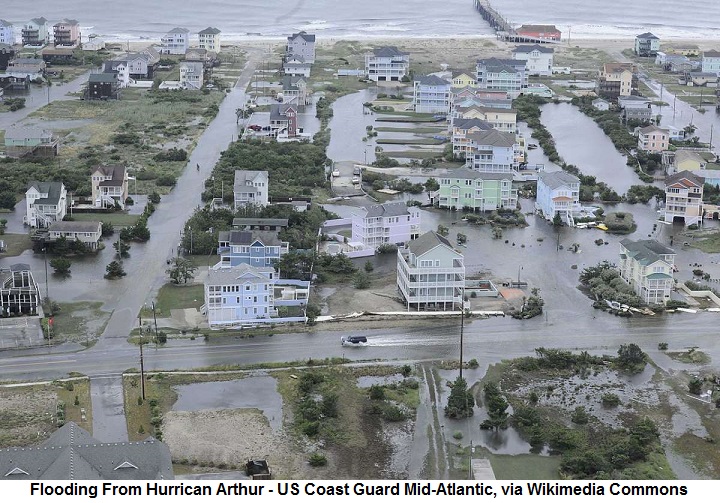
In a few days, the annual hurricane season will begin … in earnest; (this year was an aberration with the first Tropical Depression – Ana – making landfall early on May 10 in South Carolina, USA).

“Ana” is the first of what is forecasted to be a busy season. The names for the 2015 season are already pre-determined as:

Ana, Bill, Claudette, Danny, Erika, Fred, Grace, Henri, Ida, Joaquin, Kate, Larry, Mindy, Nicholas, Odette, Peter, Rose, Sam, Teresa, Victor and Wanda.

The source news article follows:

Title: FAA Gives USAA The A-OKAY To Test Damage Claims Drones
By:
Kelsey D. Atherton

Source: Popular Science Magazine posted April 7, 2015; retrieved 05-21-2015 from:
http://www.popsci.com/faa-gives-usaa-okay-drone

After the disaster come the accountants. Major tornadoes, earthquakes, tsunamis, and the like do dollar amounts of damage, sometimes in the billions. That number comes from the nitty-gritty of insurance valuations and payouts, a wholly human assessment of the ruins from natural forces. Now, thanks to FAA approval, robots may start to get in on the action.

Yesterday, insurance giant USAA announced, as follows, that the FAA approved their request to test drones as a way to more quickly process insurance claims after disasters:

FAA Approves USAA Request for Drone Research

April 6, 2015 –The Federal Aviation Administration has approved USAA’s request to test how unmanned aircraft systems, also known as drones, could help speed review of insurance claims from its members following natural disasters. USAA is one of the first insurers to be granted the approval for such testing.

“Our members have grown accustomed to seeing us pave the way for innovative solutions that streamline the claims process,” said Alan Krapf, president, USAA Property and Casualty Insurance Group.

In October 2014, USAA filed for an exemption under Section 333 of the FAA Modernization and Reform Act of 2012 to enable more efficient testing of small drones. Exempt from select FAA regulations, USAA can now fly drones, made by U.S.-based PrecisionHawk, during the day within line-of-sight of a trained pilot and air crew. Prior to the approval, USAA test flights could only take place at FAA-approved sites. No aircraft will exceed an altitude of 400 feet, and all flights will continue to be reported to the FAA prior to takeoff.

With FAA approval, USAA will work with PrecisionHawk [(see VIDEO here)] to efficiently research and develop best practices, safety and privacy protocols and procedures as it further develops plans for operational use.

USAA also filed for an additional FAA exemption in November that will enhance USAA’s ability to use drones in catastrophes. That exemption petition is pending approval, and a decision is expected soon.

“We’re proud to be among the first insurers approved to test this technology,” Krapf said. “It’s our responsibility to explore every option to improve our members’ experience.”

About USAA
The USAA family of companies provides insurance, banking, investments, retirement products and advice to 10.7 million current and former members of the U.S. military and their families. Known for its legendary commitment to its members, USAA is consistently recognized for outstanding service, employee well-being and financial strength. USAA membership is open to all who are serving our nation in the U.S. military or have received a discharge type of Honorable – and their eligible family members. Founded in 1922, USAA is headquartered in San Antonio. For more information about USAA, follow us on Facebook or Twitter (@USAA), or visit usaa.com.
(Source: https://communities.usaa.com/t5/Press-Releases/FAA-Approves-USAA-Request-for-Drone-Research/ba-p/62019)

USAA applied for the exemption in October. In their application, they noted that USAA employees were invited to Oso, Washington, after a mudslide to assist local officials with aerial surveys.

Drones are a great tool for examining natural disasters, because they can safely fly over areas where the ground may still be hazardous for humans. Visual assessment and mapping tools give rescue workers a way to understand the newly-changed terrain, and they can also let insurance agents see which claims are justified.

In the best case scenario, using drones to evaluate claims means that victims of disasters will get the resources they need to get back on their feet faster. All told, that’s pretty great. There are certainly far worse things that could happen when a robot shows up after a disaster.

CU Blog - Drones to be used for Insurance Damage Claims - Photo 4

CU Blog - Drones to be used for Insurance Damage Claims - Photo 5

The subject of unmanned aircrafts are just another area of autonomous vehicles that the Go Lean … Caribbean movement (book and aligning blogs) has highlighted as being a focused subject for the region. This subject will impact jobs and security measures. Consider these previous blog/commentaries:

https://goleancaribbean.com/blog/?p=1487 Here come the Drones … and the Concerns
https://goleancaribbean.com/blog/?p=1277 The need for highway safety innovations – here comes Google
https://goleancaribbean.com/blog/?p=673 Ghost ships – Autonomous cargo vessels without a crew

A lot of activity with autonomous aircrafts have been the product of Radio Controlled craft hobbyists; see Appendix C VIDEO. But now, practical applications are being promoted, especially for commercial photographers. This is science, not science fiction; see VIDEO in Appendix B. There is the need for high-end photography solutions to process claims after natural disasters. According to the foregoing news article, the US regulators are now allowing the testing of drones for post-hurricane (and other natural disasters) claims processing. This aligns with the Go Lean book, to optimize natural disaster response AND to provide oversight for the regional aviation space. This book serves as a roadmap for the introduction and implementation of the technocratic Caribbean Union Trade Federation (CU). The CU/Go Lean roadmap describes CU agencies in the role of the Federal Aviation Administration (FAA) performs for the US in the foregoing article. So the parallel is strong, as there is the need to plan for natural disasters in the Caribbean – more and more – in partnership with the CU‘s Emergency Management agencies.

CU Blog - Drones to be used for Insurance Damage Claims - Photo 3

CU Blog - Drones to be used for Insurance Damage Claims - Photo 2

The Go Lean book purports that this type of industrial revolutions emerging with drones are more and more critical for Caribbean society. The risks and threats from storms will only intensify. In the previous blog about the rise of drones, this commentary asserted that “our region must participate in these developments, not just spectate on them”. These points are  also pronounced early in the book in the opening Declaration of Interdependence (Page 14), with these statements:

i.   Whereas the earth’s climate has undeniably changed resulting in more severe tropical weather storms, it is necessary to prepare to insure the safety and security of life, property and systems of commerce in our geographical region. As nature recognizes no borders in the target of its destruction, we also must set aside border considerations in the preparation and response to these weather challenges.

xxvi.  Whereas theCaribbean region must have new jobs to empower the engines of the economy and create the income sources for prosperity, and encourage the next generation to forge their dreams right at home, the Federation must therefore foster the development of new industries… In addition, the Federation must invigorate the enterprises related to existing industries like tourism…– impacting the region with more jobs.

xxvii.  Whereas the region has endured a spectator status during the Industrial Revolution, we cannot stand on the sidelines of this new economy, the Information Revolution. Rather, the Federation must embrace all the tenets of Internet Communications Technology (ICT) to serve as an equalizing element in competition with the rest of the world. The Federation must bridge the digital divide and promote the community ethos that research/development is valuable and must be promoted and incentivized for adoption.

This Go Lean book and accompanying blogs champion the cause of deploying technology to make the Caribbean a better homeland to live, work and play. The assertion is that innovative developments like camera-mounted unmanned aerial vehicles (drones) should be readily deployed after emergencies and disasters – from hurricanes to industrial accidents – to quickly assess the damage: life and property; see Appendix A VIDEO. There is the need to gather intelligence for where to direct First Responders (as in 911 emergencies); and even before people in the affected areas may call out for help.

While the focus of the Go Lean movement is primarily towards economics, it is the premise of this roadmap that security efforts must be coupled with the region’s economic empowerments. The premise is simple! The economic engines must be protected and preserved; this subject of “Insurance Company Disaster-Claim Assessing Drones” is therefore within scope for the Trade Federation. In fact, the CU/Go Lean roadmap has defined these 3 prime directives:

  • Optimization of the economic engines in order to grow the regional economy to $800 Billion and create 2.2 million jobs.
  • Establishment of a security apparatus to protect the resultant economic engines.
  • Improvement of Caribbean governance to support these engines.

While there may be proponents and opponents (privacy advocates) of unmanned aviation, no one would object to aggressive efforts to locate people in danger or quickly restore communities to normal operations after a storm. There is an overriding need, as many times tourist-based industries need to project the confidence to the watching world that Caribbean winter destinations will be ready, willing and able to extend hospitality to visitors … in short order.

The message and image must be consistent for the region’s primary economic driver, even after a natural disaster: Be our guest!

The Go Lean strategy is to confederate the 30 member-states of the Caribbean region to form the technocratic CU Trade Federation. Tactically, the roadmap calls for a separation-of-powers, allowing the Caribbean member-states to deputize authority of the Caribbean airspace to the one unified CU agency. Operationally, there is the need for these drones in critical times and also for everyday scenarios. (Many times, watercrafts become imperiled in the region’s waters; the scanning & diagnostic capabilities on drones would far-exceed human-eye capability for search-and-rescue).

The book details community ethos to adopt, plus the executions of the following strategies, tactics, implementations and advocacies to foster innovative solutions in Caribbean communities, so as to positively impact the societal economic, security and governing engines:

Community Ethos – Deferred Gratification Page 21
Community Ethos – All Choices Involve Costs Page 21
Community Ethos – Job   Multiplier Page 22
Community Ethos – Public Protection Over Privacy Concerns Page 23
Community Ethos – “Crap” Happens Page 23
Community Ethos – Lean Operations Page 24
Community Ethos – Return on Investments (ROI) Page 24
Community Ethos – Ways to Impact the Future Page 26
Community Ethos – Ways to Help Entrepreneurship Page 28
Community Ethos – Ways to Impact Research & Development Page 30
Community Ethos – Impact the Greater Good Page 37
Strategy – Vision – Confederating 30 Member-states in a Union Page 45
Strategy – Agents of Change – Technology Page 57
Strategy – Agents of Change – Aging Diaspora Page 57
Strategy – Agents of Change – Globalization Page 57
Strategy – Agents of Change – Climate Change Page 57
Tactical – Fostering a Technocracy Page 64
Tactical – Growing Economy – New High Multiplier Industries Page 68
Separation of Powers – Self Governing Entities Page 80
Separation of Powers – Aviation Administration and Promotion Page 84
Implementation – Ways to Pay for Change – Hurricane Reinsurance Funds Page 101
Implementation – Benefits from the Exclusive Economic Zone Page 104
Implementation – Steps to Implement Self-Governing Entities Page 105
Implementation – Ways to Deliver Page 109
Planning – 10 Big Ideas – Homeland Security Innovations Page 127
Advocacy – Ways to Grow the Economy Page 151
Advocacy – Ways to Create Jobs Page 152
Advocacy – Ways to Improve Housing – Hurricane Risk Reinsurance Funds Page 161
Advocacy – Revenues Sources for Caribbean Administration – Reinsurance Funds Page 172
Advocacy – Ways to Improve Homeland Security Page 180
Advocacy – Ways to Improve Intelligence Gathering & Analysis Page 182
Advocacy – Ways to Improve for Natural Disasters Page 184
Advocacy – Ways to Improve Emergency Management Page 196
Advocacy – Ways to Foster Technology Page 197
Advocacy – Ways to Impact Wall Street – Adopt Advanced Products: “Reinsurance” Page 197
Advocacy – Ways to Improve Transportation – Aviation Oversight Page 205
Advocacy – Ways to Improve Fisheries – Search & Rescue Page 210
Advocacy – Ways to Impact Urban Living Page 238
Advocacy – Ways to Impact Rural Living Page 239

The foregoing news story relates to threats and consequences of hurricanes. While hurricanes present a Clear and Present Danger to “life and limb”, the focus of this commentary is on property. While the sense of urgency may appear to be lower, there is still the need to impact the region’s Greater Good. The advocacy in this case is to be an early adopter of technology to optimize the administration of Caribbean economic engines.

This is heavy-lifting. The buy-in from community stakeholders will not be easy; there will be the need for collaboration, compromise and consensus-building for the full adoption of unmanned aviation.

The insights from the foregoing articles and embedded videos help us to appreciate that the future for unmanned aviation is now! We must therefore lean-in for these empowerments now.

In fact the region is urged to lean-in for the entire roadmap of Go Lean … Caribbean. The benefits are too alluring. Protection of people, properties and processes. This is the Greater Good. This roadmap allows for that quest: to make the Caribbean a better homeland to live, work and play. 🙂

Download the book Go Lean…Caribbean now!

————

Appendix A VIDEODrone Footage from Inside Corvette Museum Sinkholehttps://youtu.be/vkEDwOidW_Q


Published on Feb 12, 2014 – University of Western Kentucky’s Engineering Department sent a drone helicopter into the sinkhole at the National Corvette Museum that swallowed eight vintage Corvettes.

————

Appendix B VIDEO – Sprite Unmanned Aerial Vehicle –  https://youtu.be/-w9YTJjGaEg


Published on May 13, 2015 – Meet Sprite, the most portable, most durable small unmanned aerial vehicle in the world. Powerful, yet simple to fly. Visit us at www.ascentaerosystems.com for more information! Pre-order at https://www.kickstarter.com/projects/…

————

Appendix C VIDEO – Top 10 Drones 2015 – https://youtu.be/sq2n4TMC1XU


Published on Nov 14, 2014 – More Info & Pics: https://ezvid.com/top-ten-drones


Share this post:
, , , , ,
[Top]

Prisoners for Profit – #ManifestJustice

Go Lean Commentary

“And justice for all” – ending verse in the American Pledge of Allegiance*

But the evidence is that these are more so just words than the actuality. Consider this article:

Title: White-owned Private Prisons are suing States for millions if they don’t stay full
Sub-title: Low crime rates bad for business for white-owned private prisons; they demand States keep them full
Source posted: May 3, 2015 – Retrieved May 12, 2015 from: http://earhustle411.com/white-owned-private-prisons-are-suing-states-for-millions-if-they-dont-stay-full/

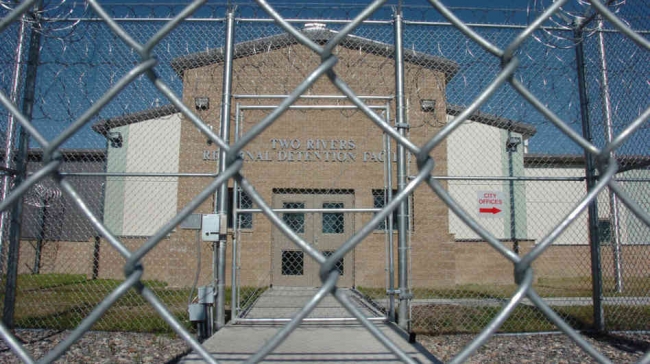
CU Blog - #ManifestJustice - Prisoners -vs- Co-eds - Photo 2The prison-industrial complex is so out of control that private prisons have the sheer audacity to order states to keep beds full or face their wrath with stiff financial penalties, according to reports. Private prisons in some states have language in their contracts that state if they fall below a certain percentage of capacity that the states must pay the private prisons millions of dollars, lest they face a lawsuit for millions more.

And guess what? The private prisons, which are holding cash-starved states hostage, are getting away with it, says advocacy group, “In the Public Interest”.

“In the Public Interest” has reviewed more than 60 contracts between private prison companies and state and local governments across the country, and found language mentioning “quotas” for prisoners in nearly two-thirds of those contracts reviewed. Those quotas can range from a mandatory occupancy of, for example, 70 percent occupancy in California to up to 100 percent in some prisons in Arizona.

It is very interesting and telling that so few major national news organization are willing to report on the monstrous, ravenous and criminal system that is devouring hundreds of thousands of black and brown boys. Even those who do not subscribe to conspiracy theories have looked askance at this shocking report.

Welcome to the greatest manifestation of modern-day slavery, ladies and gentlemen.

One of those private prisons, The Corrections Corporation of America, made an offer last year to the governors of 48 states to operate their prisons on 20-year contracts, according to “In the Public Interest”.

What makes these deals so odious and unscrupulous? Take a look:

1)  The offer included a demand that those prisons remain 90 percent full for the duration of the operating agreement. You know what that means: if there are not enough prisoners then there will be an unspoken push for police to arrest more people and to have the courts send more to prison for petty, frivolous and nonviolent crimes. There will also be a “nudge” for judges to hand down longer or maximum sentences to satisfy this “quota.”

2)  Private prison companies have also backed measures such as “three-strike” laws to maintain high prison occupancy.

3)  When the crime rate drops so low that the occupancy requirements can’t be met, taxpayers are left footing the bill for unused facilities.

The report found that 41 of 62 contracts reviewed contained occupancy requirements, with the highest occupancy rates found in Arizona, Oklahoma and Virginia.

In Colorado, Democratic Gov. John Hinklooper agreed to close down five state-run prisons and instead send inmates to CCA’s three corrections facilities. That cost taxpayers at least $2 million to maintain the unused facilities.

It is getting more difficult to rationalize the societal cost of keeping prisons full just to satisfy private investors who treat prisoners as commodity and cattle .
Source: Rolling Out

Welcome to America…

While at the same time, the eco-systems of Caribbean society are failing; many Caribbean citizens long for the opportunity to emigrate to the United States. There have been many that have taken to the seas on risky vessels to reach the land of their dreams. Many times these ones are interdicted and immediately returned. Sometimes even worse; the boats go “down”, with tragic consequences.

The reasons for emigration are “push-and-pull”. Failures in our society have compelled many to seek refuge abroad; that’s the “push”!

Propaganda in the media and community gossip within the region pronounces that American life is better – the “place to be”. This is the “pull”.

This commentary posits that “all that glitters is not gold”.

The publishers of the book Go Lean … Caribbean campaign that it would be better for Caribbean citizens to remain in their homeland and work to remediate conditions there. Considering the statistics and anecdotal evidence published in the embedded features/articles here, there are reasons why American life should be less than ideal for Caribbean people:

  • Crony Capitalism – America has a disease where much of its public policy is set based on some special interest benefiting from public resources. This is Crony Capitalism and it is defined as public interest being hijacked for private gain.
  • Institutional Racism – Racial discrimination still permeates much of American society, though not always blatant. Statistics and anecdotes prove that employment, housing and educational disenfranchisements still abound in many institutions, despite surpassing 150 years after the Civil War (1861 – 1865) and 50 years after the “bad old days” of the 100-year legal segregation policy; (think Jim Crow).

This foregoing article quotes dollar amounts that are so big that the malevolence of Crony-Capitalism cannot be ignored. It can be argued that this is actually the primary driver in the above average prison population per capita (compared to other industrialized countries, the US is Number 1 by a far margin). This commentary thereby asserts that there is a nefarious Big Business agenda in motion here. Many States have outsourced prison management to private companies. It is in those companies’ best interest to keep prison populations high.

A reduction in crime is bad for business.

This “Prison Industrial Complex” is compelled to lobby, cheerlead and tease both sides of any political divide to keep public policy focused on “being tough on crime / hard on criminals” so as to keep their prisons filled. There is too much money involved. The “bad actors” in this case would readily short-change the Greater Good for immediate gains or profits.

It is obvious from this review that one consequence of Crony-Capitalism is that it short-changes the future for immediate gains, or profits.

In the Caribbean, we hope to minimize the “push-and-pull” factors that draw our Caribbean youth away; and away from that American reality. This dilemma is not just due to the fact that the US population has increased or that crime has increased. No, just the opposite. This point was related in a previous Go Lean blog/commentary, that served as a review for a book by writer and Rolling Stone Magazine contributor Matt Taibbi entitled: “The Divide – American Injustice in the Age of the Wealth Gap“. The actual book quotation is:

Violent crime has fallen by 44 percent in America over the past two decades, but during that same period the prison population has more than doubled, skewing heavily black and poor.

This subject matter – and foregoing news article – align with the publication Go Lean … Caribbean, which serves as a roadmap for the introduction and implementation of the technocratic Caribbean Union Trade Federation (CU). The Go Lean roadmap calls for the optimization of Caribbean society by rebooting the eco-systems with prime directives for the region’s economic, security and governing engines.

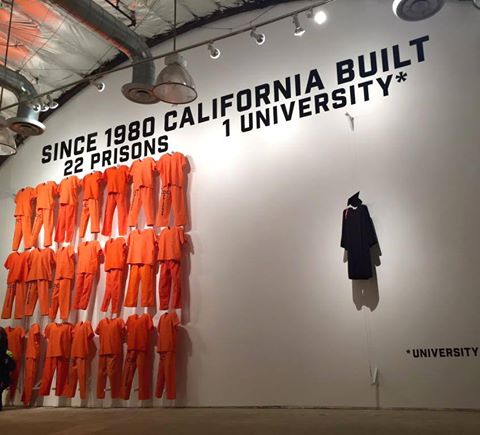
We want a society based on sound justice, not the fake American model. We do not want to sacrifice our young people on the altar of corporate profits. We’d rather invest in them rather than sacrifice them; this means investing in (early) education and universities rather than prisons.

CU Blog - #ManifestJustice - Prisoners -vs- Co-eds - Photo 1

Title: #ManifestJustice Art Exhibit in Los Angeles
By:
Alexander Aplerku, AfroPunk Contributor
Source: AfroPunk Blog Site – Retrieved 05-12-2015 – http://www.afropunk.com/profiles/blogs/feature-manifestjustice-art-exhibit-in-los-angeles

“Enough is enough. We demand more empathy, more accountability, more economic opportunity, more compassion, more dignity, more power and more opportunity for all. We demand healthier communities, which means more from each other; more from our school systems and more from our judicial systems.” Those are the words of Manifest Justice, the creative community exhibition. The Exhibit, which took place last week [(May 2nd – 10)] – in Los Angeles’ gang affected Baldwin Village – featured protest posters, paintings, and three-dimensional works. Mostly focused on police brutality, the exhibition also touched on issues like education, racial justice, and LGBT rights. Programme coordinator Nijeul Porter says, “The idea is that art is at the center of social change”.

Related:
http://manifestjustice.org  (See VIDEO Below)
https://www.facebook.com/pages/Manifest-Exhibit-Manifest-Justice

This Go Lean roadmap first openly confesses that the Caribbean is in crisis, that we are not able to retain our young people. Many member-states (St Vincent, Puerto Rico, US Virgin Islands, etc.) have lost more than half of their populations to foreign shores. While others have lost more than 70 percent of their college educated populations. For many, the destination of choice is the United States. The situation is so impactful that now 1 out of 11 Black persons in the US is now of Caribbean (or African) descent, and these numbers are only expected to grow.

The goal of Go Lean is to forge a better society, to make the Caribbean a better place to live, work and play. This means optimizing our own justice institutions. We want to lower the “push” factors. These requirement were pronounced at the outset of the Go Lean book, in the Declaration of Interdependence (Page 12) with these statements:

xi.   Whereas all men are entitled to the benefits of good governance in a free society, “new guards” must be enacted to dissuade the emergence of incompetence, corruption, nepotism and cronyism at the peril of the people’s best interest. The Federation must guarantee the executions of a social contract between government and the governed.

xxi.    Whereas the legacy in recent times in individual states may be that of ineffectual governance with no redress to higher authority, the accedence of this Federation will ensure accountability and escalation of the human and civil rights of the people for good governance, justice assurances, due process and the rule of law. As such, any threats of a “failed state” status for any member state must enact emergency measures on behalf of the Federation to protect the human, civil and property rights of the citizens, residents, allies, trading partners, and visitors of the affected member state and the Federation as a whole.

How should the Caribbean be different than the United States in the pursuit of justice?

The Go Lean roadmap cautions that we do not want to repeat America’s mistakes in criminal justice; there are many. But rather we want to learn from history; the book cites the example and abuses of the Peonage system that emerged in the Southern US after the Civil War (Page 211). Without being considered a conspiracy theorist, it is obvious that many “bad actors” in American society wanted cheap labor even though slavery had just been outlawed in the country.

That was 1865; this is 2015 – 150 years later. Surely American society has transformed … finally. Yet there are vast reports of a continued Great Divide in the US Criminal Justice system, where those of Black-and-Brown heritage (including those from the Caribbean) get sentenced to long prison engagements while “White Collar” offenders get little-to-no jail time at all.

American “White Collar” offenders have perhaps caused more damage in the US than the other “Blue Collar” types. This is especially the case for cross-border criminal conduct in the US. In truth, the Caribbean – and other parts of the world – are still reeling from the effects of the Global Financial Crisis of 2008; spurned from financial mis-adventures on Wall Street.

What is worse, the US has…

“hardly marshaled any persecutions against the culprits and perpetrators of the mortgage fraud that de-stabilized the American securities markets and the world economy” (Matt Taibbi’s “The Divide – American Injustice in the Age of the Wealth Gap“).

To all those in the Caribbean desiring to emigrate to the US, take heed: the “grass is not greener” on that other side!

The book Go Lean … Caribbean, on the other hand, details strategies, tactics, implementations and advocacies to elevate Caribbean society, mitigating the “push” reasons:

Community Ethos – People Respond to Incentives in Predictable Ways Page 21
Community Ethos – Economic Systems Influence Individual Choices Page 21
Community Ethos – Anti-Bullying and Mitigation Page 23
Community Ethos – Governing Principles – Lean Operations Page 24
10 Ways to Manage Reconciliations Page 34
10 Ways to Impact the Greater   Good Page 37
Separation of Powers – Homeland Security Department – Bureau of Prisons Page 76
Separation of Powers – Justice Department Page 77
Separation of Powers – Judicial Branch Page 90
10 Steps to Implement Self-Governing Entities – Prisons as SGEs Page 103
10 Ways to Improve Failed-State Indices – Security Deficiencies Page 134
10 Ways to Improve Education – Promote Industries for e-Learning & Prisons Page 159
10 Ways to Impact Justice Page 177
10 Ways to Reduce Crime Page 178
10 Ways to Ways to Improve Homeland Security – CU Prisons Page 180
10 Ways to Mitigate Terrorism – Fight Narco-Terrorism Page 181
10 Ways to Improve Intelligence Gathering & Analysis – Probation and Parole Page 182
10 Ways to Impact Wall Street – Mitigate Economic Crimes Page 200
10 Ways to Impact Prison-Industrial Complex – Case Study on Peonage Page 211
10 Ways to Protect Human Rights – Mitigate Bad Prison Practices Page 220
10 Ways to Impact Youth – Deploy Crime Diversion Programs Page 227

This Go Lean roadmap asserts to all those desiring to flee to the US. That country is not so alluring … from a justice perspective, especially if you’re poor, Black-and-Brown. The admonition: Lower the “pull” factor for Coming to America.

There is another dimension of the prison industrial complex considered in the Go Lean book: the economic returns of a proper practice of this social responsibility of crime and punishment:

xxvi.  Whereas the Caribbean region must have new jobs to empower the engines of the economy and create the income sources for prosperity, and encourage the next generation to forge their dreams right at home, the Federation must therefore foster the development of new industries, like that of … the prison industrial complex… – impacting the region with more jobs.

It is the vision of this roadmap that modern-technocratic CU prisons can be located in appropriate rural communities and create a viable economic “through put” (jobs); especially when the CU facilities house prisoners for other jurisdictions. The CU would emerge as a benevolent player in the prison-industrial complex. But instead of profits, our motive would be the Greater Good.

More jobs would help to lower the “push” factor. We must do this; address all possible “push” factors. The region must address its issues, as to why its population is so inclined to emigrate. This is the purpose of the Go Lean roadmap. It features the assessments, strategies, tactics and implementations to make the Caribbean a better place to live, work and play.

Now is the time for the Caribbean region to lean-in for the empowerments described in the book Go Lean … Caribbean. The benefits of this roadmap are too alluring to ignore: emergence of our own $800 Billion (GDP) economy, 2.2 million new jobs, new industries (like our own prison industrial complex), services and optimized justice institutions.

The end result of the Go Lean roadmap – after the defined 5 year plan – is to lower both the “push-and-pull” factors. Instead we want to incentive our citizens to prosper where planted. 🙂

Download the free e-book of Go Lean … Caribbean – now!

————–

Appendix – *Pledge of Allegiance

I pledge allegiance to the Flag of the United States of America, and to the Republic for which it stands, one Nation under God, indivisible, with liberty and justice for all.

Originally composed by Francis Bellamy in 1892 and formally adopted by the US Congress as the official pledge in 1942.[1]

————–

Appendix – VIDEO – #ManifestJustice Art Show – https://youtu.be/Pyxqo4TBCFU

Published on May 7, 2015 – http://on.fb.me/URBN247 – Become a Fan! http://youtube.com/URBN247 – Click to Subscribe! http://Twitter.com/URBN247 – Follow Us!
Share this post:
, , , ,
[Top]

Tesla unveils super-battery to power homes

Go Lean Commentary

Necessity is the ‘mother’ of invention – Old Wives Tale

Caribbean energy costs are among the highest in the world. The book Go Lean…Caribbean relates (Page 100) that the Caribbean has among the most expensive energy costs in the world, despite having abundant alternative energy natural resources (solar, wind, tidal, and geo-thermal). The Caribbean eco-system focuses on imported petroleum to provide energy options and as a result retail electricity rates in the Caribbean average US$0.35/kWh, when instead it could be down to US$0.088/kWh.

There is definitely the need for invention. Now, along comes Tesla*
… with this “inventive” solution.
… with this Powerwall product, launched last week by Tesla Chief Executive Officer Elon Musk; it is designed to allow homeowners to store electricity generated by green energy options – solar panels and wind turbines – during the peak of the day, then use it at other times when electricity consumption is higher.

CU Blog - Tesla unveils super-battery to power homes - Photo 1

CU Blog - Tesla unveils super-battery to power homes - Photo 3

VIDEO 1 – Tesla unveils super-battery to power homes –  http://www.cbsnews.com/videos/tesla-unveils-super-battery-to-power-homes/

May 2, 2015 – The electronic car maker has come up with large, high-tech batteries to power your home even after the sun goes down. Telsa’s founder, Elon Musk, says they will let homeowners store solar power during the day and keep using it at night. CNET.com’s senior editor Bridget Carey joins “CBS This Morning: Saturday” to discuss how this could open a whole new way to use clean energy and to save money. (VIDEO plays best in Internet Explorer).

According to Elon Musk, this is “a fundamental transformation of how the world works”.

VIDEO 2 – Elon Musk unveils Powerwall, a battery pack for buildings (TomoNews) – https://youtu.be/NvCIhn7_FXI

Published on May 5, 2015 – Tesla Motors on Thursday, April 30 unveiled Tesla Energy, storage systems or batteries designed for homes and businesses.

Elon Musk, the company CEO, introduced the products to a crowd of business experts and journalists at a Tesla facility close to Los Angeles.

CU Blog - Tesla unveils super-battery to power homes - Photo 4Tesla did not invent the original battery, nor solar power panels. These technologies had pre-existed before this new development. But the problem has always been availability of the green energy option during uninviting conditions: solar – night time or cloud covered days; wind – still days.

This was the problem: Energy needs are undeniable 24-7-365; all the time. Energy delivery must cover all of those times.

The delivery or fulfilling those needs is a great target for lean, agile operations. It will save a lot of money for the people and institutions of the Caribbean.

This is the economic dynamic; there is also the matter of burning fossil fuels (oil, coal, wood pulp) and contributing to global warming and climate change. The Go Lean book posits that the embrace of alternative energy generation sources to be more impactful on the quest to minimize the threats on the environment. Early in the book, the pressing need to be aware of climate change is pronounced in the Declaration of Interdependence (Page 11), with these words, (the first of many “causes of complaints”):

i.  Whereas the earth’s climate has undeniably changed resulting in more severe tropical weather storms, it is necessary to prepare to insure the safety and security of life, property and systems of commerce in our geographical region. As nature recognizes no borders in the target of its destruction, we also must set aside border considerations in the preparation and response to these weather challenges.

Now, with this innovative offering from Tesla, the quest to adapt to more clean/green energy options can be practical and more cost effective. Power generation from the sun or wind (free & renewable sources) is far cheaper that generation based on fossil fuels.

Money! Environment! These two constitute reasons enough to pursue strategies, tactics and implementations of renewable energy with battery back-ups. But there is a third motivation behind the Go Lean…Caribbean movement; that is love of the homeland. Many people find the current lack of energy options unbearable for a normal life in their Caribbean ancestral homeland – imagine not being able to turn on air conditioning during the summer due to excessive costs – so they flee the region for foreign shores … in North America and Europe.

This new innovative product by Tesla…changes everything!

The book Go Lean… Caribbean serves as a roadmap for the introduction and implementation of the Caribbean Union Trade Federation (CU). This roadmap has 3 prime directives:

  • Optimization of the economic engines in order to grow the regional economy to $800 Billion GDP and create 2.2 million new jobs.
  • Establishment of a security apparatus to protect the resultant economic engines.
  • Improvement of Caribbean governance to support these engines.

CU Blog - Tesla unveils super-battery to power homes - Photo 5This Go Lean/CU roadmap recognizes that modern life has expanded the definition of basic needs to now include food, clothing, shelter and energy. And thusly the book proposes many solutions for the region to optimize energy delivery:

  • generation
  • distribution
  • consumption

Home-based solar panels or home-based wind turbines with battery back-ups would optimize all these three areas of focus. We applaud Tesla and the success of their transformational product.

To the Caribbean we declare: More help is on the way! The Go Lean book posits that with the adoptions of the strategies, tactics and implementations in the roadmap that average costs of energy can be decreased from an average of US$0.35/kWh to US$0.088/kWh in the course of the 5-year term of this roadmap. (Page 100). That is a 75% savings.

The Go Lean roadmap details a series of community ethos, strategies, tactics, implementations and advocacies to be early adopters of these cutting-edge energy systems. The following list applies:

Community Ethos – Deferred Gratification Page 21
Community Ethos – Lean Operations Page 24
Community Ethos – Return on Investments Page 24
Community Ethos – Cooperatives Page 25
Community Ethos – Ways to Impact the Future Page 26
Community Ethos – Ways to Impact the Greater Good Page 37
Strategy – Harness the power of the sun/winds Page 46
Tactical – Fostering a Technocracy Page 82
Tactical – Separation of Powers – Energy Commission Page 82
Anecdote – “Lean” in Government – Energy Permits Page 93
Anecdote – Caribbean Energy Grid Implementation Page 100
Implementation – Ways to Develop Pipeline Industry Page 107
Implementation – Ways to Improve Energy Usage Page 113
Advocacy – Ways to Impact Public Works Page 175
Advocacy – Ways to Foster Cooperatives Page 176
Advocacy – Ways to Impact Monopolies Page 202

This Tesla battery system – Powerwall – offers independence from utility grids. It is not from an energy company, but rather from a technology company; (see Appendix). Stay tuned, opposition will emerge; it always does…especially in the US. The For-Profit utility companies always lobby against regulations to “clean-up” fossil-fuel (coal) power plants or block small “Green” start-ups from sending excess power to the National Grid. Their motive is to preserve their century-long monopoly. See related article here:

Title: Is America’s electrical grid fading to black?
By: Bruce Kennedy – MoneyWatch – April 8, 2015

Are you prepared to live “off the grid,” independent of major electric utilities? Many people who live in Washington, D.C., may be ready for a change — after widespread power outages in the region on Tuesday, due to a problem in a utility company transmission line.

While the term may sound like something out of a novel, a growing number of U.S. consumers and businesses are actually expected to be living “off the grid” over the next several decades – to the point where some of the big utilities may find themselves in a new financial reality.

According to a new report by Rocky Mountain Institute (RMI) and HOMER Energy, a firm that designs remote microgrids, the development of practical and efficient solar-plus battery systems is an economic and cultural game-changer.

The report looked at median commercial and residential electrical customers in five very different metro areas – Louisville, Kentucky, Westchester County, New York, San Antonio, Texas, Los Angeles, California, and Honolulu, Hawaii – and evaluated their local economics through to 2050.

And their findings were startling. “Over time, as retail electricity prices from the grid increase and solar and battery costs decrease,” said the report’s executive summary, “customers logically reduce their grid purchases until the grid takes a backup-only role.”

For example, according to RMI’s analysis, the New York suburb of Westchester Country could see utility grid’s supply to overall electric power for commercial customers in the region shrink from 100 percent today to around 25 percent by 2030 – and to less than five percent by 2050.

“These findings should be compelling for customers and technology providers,” RMI principal and report author James Mandel said in a press statement. “No matter how expensive retail electricity gets in the future, customers that invest in these grid-connected systems can contain their electricity costs at or below a ‘peak price,’ yielding significant savings on their monthly utility bill.”

More choices for consumers of electricity also means major changes for the big utilities, even if only a fraction of their current customers end up adopting the new-tech systems. The report says that in the northeastern United States, commercial load “defections” away from the traditional utility grid could total 140 million megawatt hours by 2030, or around $35 billion in annual electrical costs.

But RMI manager and report coauthor Leia Guccione says the changes aren’t necessarily adversarial, pitting the old-school utilities against the new technology.

“Because these solar-plus-battery systems are grid-connected,” she notes, “they can offer value and services back to the grid. We need not see them only as a threat.”

© 2015 CBS Interactive Inc.. All Rights Reserved.
Retrieved from CBS News Online Site (Posted May 2, 2015) from: http://www.cbsnews.com/news/is-americas-electrical-grid-fading-to-black/

This will be a choice for America to make: immediate profits or the Greater Good. Choose well, America!

The Go Lean movement (book and blogs) asserts that we should not look to American Big Energy for answers to our own Caribbean dilemmas. American leadership has often times been motivated by crony-capitalistic intentions. This point had been further elaborated upon in these previous blog/commentaries:

https://goleancaribbean.com/blog/?p=4897 US Backs Natural Gas (LNG) Distribution Base in Jamaica
https://goleancaribbean.com/blog/?p=4294 Ambassadors to Caribbean discuss PetroCaribe-Energy, Security
https://goleancaribbean.com/blog/?p=2465 Book Review: ‘This Changes Everything: Capitalism vs. the Climate’
https://goleancaribbean.com/blog/?p=2338 Lessons: How Best to Welcome the Dreaded American ‘Plutocracy’
https://goleancaribbean.com/blog/?p=926 Conservative heavyweights have solar industry in their ‘kill’ sights
https://goleancaribbean.com/blog/?p=273 10 Things We Don’t Want from the US – #1: American Self-Interest

Fulfilling energy needs is a great target for lean, agile operations, perfect for the CU technocracy.

We need innovative products, systems, companies and people to help us in our quest to make the Caribbean a better place to live, work and play.

Let’s get started. Now is the time for all of the Caribbean, the people, businesses, institutions and governments, to lean-in for the optimizations and opportunities described in the book Go Lean … Caribbean.  🙂

Download the book Go Lean … Caribbean – now!

————-

Appendix – * TeslaCU Blog - Tesla unveils super-battery to power homes - Photo 2

Tesla Motors, Inc. is an American company that designs, manufactures, and sells electric cars and electric vehicle powertrain components.[4] Tesla Motors is a public company that trades on the NASDAQ stock exchange under the symbol TSLA.[5] In the first quarter of 2013, Tesla posted profits for the first time in its history.[6]

Tesla first gained widespread attention following their production of the Tesla Roadster, the first fully electric sports car.[7] The company’s second vehicle is the Model S, a fully electric luxury sedan, and its next two vehicles are the Models X and 3.[8] As of March 2015, Tesla Motors has delivered about 70,000 electric cars since 2008.[9]

Tesla also markets electric powertrain components, including lithium-ion battery packs to automakers including Daimler and Toyota.[10] Its CEO, Elon Musk, has said that he envisions Tesla Motors as an independent automaker,[11] aimed at eventually offering electric cars at prices affordable to the average consumer.[12][13] Pricing for the Tesla Model 3 is expected to start at US$35,000 before any government incentives and deliveries are expected to begin by 2017.[14][15] On April 30, 2015, Tesla announced the Powerwall, a battery product for home use. (Source: http://en.wikipedia.org/wiki/Tesla_Motors)

The company is named after famous inventor and innovator, Nikola Tesla (1856 –1943). He was a Serbian American[2][3][4], electrical engineer, mechanical engineer, physicist, and futurist. He is best known for his contributions to the design of the modern alternating current (AC) electricity supply system.[5]

Nicola Tesla gained experience in telephony and electrical engineering before immigrating to the United States in 1884 to work for Thomas Edison in New York City. He soon struck out on his own with financial backers, setting up laboratories and companies to develop a range of electrical devices. His patented AC induction motor and transformer were licensed by George Westinghouse, who also hired Tesla for a short time as a consultant. His work in the formative years of electric power development was involved in a corporate alternating current/direct current “War of Currents” as well as various patent battles. Tesla went on to pursue his ideas of wireless lighting and electricity distribution in his high-voltage, high-frequency power experiments in New York and Colorado Springs and made early (1893) pronouncements on the possibility of wireless communication with his devices. He tried to put these ideas to practical use in his ill-fated attempt at intercontinental wireless transmission. He was ahead of his time, as we only now have some semblance of these systems in place today. (Source: http://en.wikipedia.org/wiki/Nikola_Tesla).

Share this post:
, ,
[Top]

Truth in Commerce – Learning from Yelp

Go Lean Commentary

Small businesses are the backbone of Caribbean economies; same too in North America and Europe. Imagine then, small business owners doing everything just right, applying all best-practices and then boom, someone comes along with mis-truths and completely undermines their quality work. This is villainous!

This has happened, time and again; and now with the internet culture, the villains do not have to try too hard.

Consider this experience from the San Francisco Bay Area, with a Chinese-Hunan Restaurant in Millbrae, California named “Wonderful”:

CU Blog - Truth in Commerce - Learning from Yelp - Photo 1At Wonderful, perhaps the best of the Bay Area’s new Hunan restaurants, dishes are riddled with pickled peppers and fermented black beans, and the menu is stocked with the steamed dishes, smoked meats and dry hot pots that define the regional cuisine to many Chinese eaters.

Owner Junsong Xue moved to the Bay Area from China 18 years ago to pursue a business master’s at Cal State Hayward. His twin brother stayed in Beijing, where he built a Hunan restaurant empire called Cai Xiang Gen.

After managing Mimi’s Cafe in San Mateo for 11 years, Junsong persuaded his twin to open a California branch of Cai Xiang Gen in Millbrae. It took the Xue family two years to build out the space, installing wood-framed booths, birdcage lights and a large television playing documentaries about Hunan cuisine. They opened the restaurant in April, with chefs from the chain’s Chinese branches circulating through the kitchen, training cooks and ensuring quality. – Restaurant Review posted January 19, 2015 by the San Francisco Chronicle’s online site “SF Gate”; retrieved April 1, 2015 from:

http://www.sfgate.com/restaurants/article/Hunan-s-second-heat-wave-introduces-classics-of-6019006.php#photo-7383515

CU Blog - Truth in Commerce - Learning from Yelp - Photo 2

CU Blog - Truth in Commerce - Learning from Yelp - Photo 3

This is best-practices personified…

… and then:

A Yelp* reviewer named Dan W. recently went to Wonderful in Millbrae and found the experience less than satisfactory. He gave the Hunan restaurant a “one star” and stated, “I was flying solo that night, after a particularly challenging day. The waiter came up and asked how many. I said one, I had planned to sit at the bar or get the food to go. She said “one? no, one?” and then ran off. I waited a minute at the door, and then left. They were busy and potentially understaffed. It’s not that classy of a place, but they refused to seat me.”

Basically, Dan W. claimed Wonderful wouldn’t seat a party of one, even though he was having a challenging day. The folks at Wonderful found Dan’s account of events challenging to believe, so they reviewed some surveillance footage. The restaurant figured out who Dan W. was and found him entering the restaurant, indeed solo (and after a challenging day.) Dan W. never spoke to anyone, took a look around, and promptly left. Wonderful responded with a dramatic and lengthy response to Dan with their video evidence.

Dan deleted his review, and their Yelp page is now [only] awash in 5-star reviews.

Here is Wonderful’s response to Dan W., complete with video evidence:

“Do Not Mess With Wonderful”. Claim the management, “Dan, we didn’t refuse to seat you. You refused to wait in line like everyone else. You thought you were special, so special that you don’t have to follow the rules. That’s not true, we caught you. You are prohibited from returning to Wonderful. If we catch you, you will be arrested for trespassing.” – Posted March 26, 2015 from: http://blog.sfgate.com/stew/2015/03/26/bay-area-restaurant-finds-video-proves-negative-yelp-review-a-lie/

VIDEO: Lying Yelp Reviewer Caught by Wonderful Chinese Restaurant – Side Camera  – https://youtu.be/i7XDtmu-MdI

Published on Mar 24, 2015 – Yelp Reviewer Dan W from San Bruno, Ca. left a review about a restaurant called Wonderful Chinese in Milbrae, Ca. and the restaurant exposed his lies.

What were the motives of the character Dan W.? It is not known here, but the cause-and-effect is villainous. Just a little comment could have ruined the reputation, brand and image of that restaurant and all the hard work/investment to build it up. On the one hand, Dan W. may simply claim “Freedom of Speech” but on the other hand, there must be some limits to speech. In truth, speech is not free! One cannot run into a crowded theater and erroneously shout “Fire, Fire” without consequences. The resultant stampede is prosecutable in most jurisdictions, as manslaughter or “depraved indifference”.

In addition to the Yelp incident, the American referral site Angie’s List has also “come under fire” for allowing non-credible reviews of businesses and service providers. This case seemed more benign, just a disagreement of levels of quality for a subjective service. Yet still, these incidences must be anticipated.

Based on the foregoing news articles, this issue is a hot topic right now.

The Empire Strikes Back…
Electronic Commerce is now all the rage. Many retail services are marketed, solicited and contracted online, so online reviews (like Yelp and Angie’s List) wield a lot of power; a bad review can truncate growth for a small business. Planners for economic empowerments must therefore consider governance of e-Commerce communications in its oversight. This is the assertion in the book Go Lean…Caribbean, that governance must be in place to ensure integrity of the region’s information super-highway (Page 79), across broadband and wireless deliveries. Too much is at stake. The book posits that some issues are too big for any one Caribbean member-state to manage alone – especially with close proximities where radio spectrum can bleed from one country to another. The book maintains that there are times when there must be a cross-border, multilateral coordination. This Go Lean book serves as a roadmap for the introduction and implementation of the technocratic Caribbean Union Trade Federation (CU) to facilitate the growth, promotion and regulatory oversight of this Internet Communications Technology (ICT) industry space in a regional Single Market.

The Asian country of India has provided a good model for communication governance in the era of internet communications.

In September 2013, a petition was made to an Indian Court which claimed, amongst other things, that several public officials were using private email services (like Gmail, Yahoo, Hotmail, etc.) for official communication. Legal Counsel for the petitioner had argued that this imperiled national security and violated sections of the country’s Public Records Act, 1993, which mandates that all public records be maintained by the government within Indian territory. The Court found a breach in information security best-practices and ordered remedies accordingly. In response and in pursuit of compliance the government submitted a set of guidelines to the Court to approve for implementation. The guidelines concern many matters of data security; the fairly wide ranging Court Order made foreign sites like Google and Facebook establish grievance officers to report integrity problems within the country.

This Indian model mirrors the proposed Go Lean solution. It demands a lean technocratic efficiency to ensure that there is accountability and transparency in the governance of the Information Technology Arts and Sciences. We need a Grievance Officer for the Caribbean Single Market.

This is among the missions of Go Lean roadmap, to elevate the economic engines and accompanying electronic commerce eco-system of the Caribbean region. The region needs jobs, so we need job creators: small businesses. The CU’s prime directives are identified with the following 3 statements:

  • Optimization of the economic engines in order to grow the regional economy to $800 Billion & create 2.2 million new jobs.
  • Establishment of a security apparatus to protect the resultant economic engines.
  • Improvement of Caribbean governance to support these engines.

The subject of electronic commerce integrity features economic, security and governing concerns. The Go Lean roadmap calls for the deployment of a custom Social Media / Electronic Commerce offering for all Caribbean member-states, branded www.myCaribbean.gov. This Caribbean Cloud initiative is projected in the Go Lean book as a subset of the integrated postal operations, the Caribbean Postal Union. Commerce, whether Main Street or “E-Street”, must be facilitated with technocratic efficiency, accountability and commercial “fair play”. The vision to elevate these aspects of Caribbean society was defined early in the book (Page 12 & 14) in the following pronouncements in the Declaration of Interdependence:

xv. Whereas the business of the Federation and the commercial interest in the region cannot prosper without an efficient facilitation of postal services, the Caribbean Union must allow for the integration of the existing mail operations of the governments of the member-states into a consolidated Caribbean Postal Union, allowing for the adoption of best practices and technical advances to deliver foreign/domestic mail in the region.

xxvii. Whereas the region has endured a spectator status during the Industrial Revolution, we cannot stand on the sidelines of this new economy, the Information Revolution. Rather, the Federation must embrace all the tenets of Internet Communications Technology (ICT) to serve as an equalizing element in competition with the rest of the world. The Federation must bridge the digital divide and promote the community ethos that research/development is valuable and must be promoted and incentivized for adoption.

The Caribbean biggest neighbor, the United States, is also struggling with the dynamics of this electronic commerce industry and the oversight of online reviews.

Some companies there had adopted new policies forbidding negative reviews on online sites. See excerpts of this September 14, 2014 news article here:

Title: Can a company stop you from writing a negative online review? Not if Congress passes this bill
By: Herb Weisbaum, NBC News Contributor

CU Blog - Truth in Commerce - Learning from Yelp - Photo 4You’re entitled to your opinion – just be prepared for possible legal consequences if you share it online.

A growing number of companies now have “non-disparagement clauses” in their contracts or terms of use. They limit a customer’s right to comment on social media sites such as Yelp about the product or service they purchased – even if that comment or review is truthful and accurate.

A non-disparagement clause might look something like this:

  • Any disputes between the parties remain confidential. Customers shall not make or encourage others to make any public statement that is intended to, or reasonably could be foreseen to, embarrass or criticize the company or its employees, without obtaining prior written approval from the company.

“Non-disparagement clauses have the potential to create a profound chilling effect,” said Andy Sellars with the Harvard Law School’s Cyberlaw Clinic. “Their mere existence may scare consumers from writing a review in the first place.”

The Consumer Review Freedom Act, introduced in Congress last week by two Democratic representatives from California, Rep. Eric Swalwell and Rep. Brad Sherman, would make it illegal for businesses to have non-disparagement clauses in their contacts that prohibit consumers from posting negative online reviews.

Read the full article: http://www.today.com/money/congress-wants-you-be-able-criticize-companies-2D80168557

There are so many best practices around the world for the Caribbean region to study for insights and wisdom. The successful application of this roadmap will foster such best practices for the delivery of home-grown electronic commerce and social media in the Caribbean. The wisdom the Go Lean book gleans from this global study is presented as a series of community ethos, strategies, tactics, implementations and advocacies; a detailed sample is listed as follows:

Community Ethos – Deferred Gratification Page 21
Community Ethos – People Choose Page 21
Community Ethos – People Respond to Incentives Page 21
Community Ethos – Economic Systems Influence Individual Choices Page 21
Community Ethos – Job Multiplier Page 22
Community Ethos – Privacy versus Public Protection Page 23
Community Ethos – Whistleblower Protection Page 23
Community Ethos – Lean Operations Page 24
Community Ethos – Ways to Help Entrepreneurship Page 28
Community Ethos – Promote Intellectual Property Page 29
Community Ethos – Ways to Bridge the Digital Divide Page 31
Community Ethos – Ways to Improve Sharing Page 35
Community Ethos – Ways to Impact the Greater Good Page 37
Strategy – Vision – Integrate a Single Market of entire region Page 45
Tactical – Fostering a Technocracy Page 64
Tactical – Separation of Powers – Postal Services Page 78
Tactical – Separation of Powers – Interstate Commerce Administration Page 79
Tactical – Separation of Powers – Communications and Media Authority Page 79
Implementation – Year 1 / Assemble Phase – Establish CPU Page 96
Anecdote – Implementation Plan – Mail Services – US Dilemma Page 99
Implementation – Improve Mail Services – Electronic Supplements Page 108
Implementation – Ways to Deliver Page 109
Planning – 10 Big Ideas for the Caribbean Region – Cyber Caribbean Page 127
Advocacy – Ways to Improve Interstate Commerce Page 129
Advocacy – Ways to Grow the Economy Page 151
Advocacy – Ways to Create Jobs Page 152
Advocacy –Ways to Improve Governance Page 168
Advocacy – Ways to Foster Technology Page 197
Advocacy – Ways to Foster e-Commerce Page 198
Advocacy – Ways to Impact Main Street – Wifi & Mobile Apps Page 201
Advocacy – Ways to Improve Monopolies – Utilities to Oversee ICT Page 202
Advocacy – Ways to Impact Urban Living Page 234

This commentary therefore features the subjects of commerce, electronic commerce and entrepreneurship. The Caribbean can learn from the Americans and emulate the Indian model.

The biggest consideration should be “technocracy”, the ability to assess market conditions and structure viable solutions; driven by the community ethos of the Greater Good. The book defines that the term technocracy was originally used to designate the application of the scientific method to solving social & economic problems, in counter distinction to the traditional political or philosophic approaches. The CU will start as a technocratic confederation – a Trade Federation – rather than evolving to this eventuality. So technology governance and postal consolidations are planned for Day One of the CU roadmap.

Now is the time for all of the Caribbean, the people, businesses and governing institutions, to lean-in for the empowerments in the book Go Lean … Caribbean. This Big Idea for the region, Cyber Caribbean, can truly impact the region. It can make the Caribbean a better place to live, work and play.  🙂

——-

AppendixSource Reference:
* Yelp, Yelp.com and the Yelp mobile app, publishes crowd-sourced reviews about local businesses.


Share this post:
, ,
[Top]

Rare Earths: The new ‘Rush’

Go Lean Commentary

There’s “Gold in dem there hills” – Legendary exclamation of the discovery of gold in 1848/49 California – the “Forty-niners”.

Thus started the California Gold Rush. Now there is a new rush … or quest; this time for alternative minerals to be extracted from the earth – all over the planet – that are considered even more valuable than gold: Rare Earth.

CU Blog - Rare Earths - The new Rush - Photo 1

This class of minerals was recently depicted in an exposé  by the CBS News Magazine 60 Minutes:

Video Title: http://www.cbsnews.com/videos/modern-lifes-devices-under-chinas-grip – Modern life’s devices under China’s grip?


From smartphones to cars and defense missiles, modern U.S. life depends on rare earth elements but China dominates the industry. (VIDEO plays best in Internet Explorer).

The summary of the VIDEO portrays that the United States initially had the lead in this field of Rare Earth extraction and sourcing; but the US de-prioritized this substance, while China transcended it and now exploits the market to near-complete domination.

The urgency of Rare Earth is not so unfamiliar to this commentary. This point was declared emphatically in the book Go Lean … Caribbean in numerous references:

CU Blog - Rare Earths - The new Rush - Photo 2o Ways to Impact Extractions (Page 195) – There is a “rush”/quest to harvest rare earth elements. [159] These include lanthanide elements (fifteen metallic chemical elements with atomic numbers 57 through 71, from lanthanum through lutetium) for metals that are ferromagnetic, this means their magnetism only appear at low temperatures. Rare earth magnets are made from these compounds and are ideal in many high-tech products. The CU will foster the regional exploration and extraction of these pricey materials.

o Start-up Benefits from the EEZ (Page 104) – The new Exclusive Economic Zone (EEZ) powers allows for the administration of mineral extraction (mines) and oil/natural gas. Risk management and disaster mitigation plan must therefore be embedded into every drilling permit/license, as a CU mandate is to protect tourism product – a “bird in hand is better than two in the bush”. In addition, there is the harvest possibility of rare earth elements, like lanthanide and lutetium. Recently (2010), these minerals were priced even higher than gold at $2,200/kg.

o Reference footnote # 159 (Page 361) – The Economist Magazine. “The Difference Engine: More precious than gold”. Posted September 17, 2010; retrieved for the book in September 2013 from: http://www.economist.com/blogs/babbage/2010/09/rare-earth_metals. This news article stressed this point:

The foregoing VIDEO depicts the need for technocratic management of the extraction process for Rare Earths. There is now a great demand for these minerals; but the supply source is rather limited. Yet they are not so rare; they may even be found in the Caribbean region. Thus the need to explore these opportunities. The Go Lean book serves as a roadmap for the introduction and implementation of the technocratic Caribbean Union Trade Federation (CU), for the elevation of Caribbean society. This CU/Go Lean roadmap has these 3 prime directives:

  • Optimization of the economic engines in order to grow the regional economy to $800 Billion and create 2.2 million new jobs.
  • Establishment of a security apparatus to protect the resultant economic engines and the environment.
  • Improvement of Caribbean governance – including oversight of Self-Governing Entities and the Exclusive Economic Zone – to support these engines.

The Go Lean roadmap seeks to promote and oversee the effort for the exploration and extraction of these minerals, recognizing that modern life needs the efficiency that comes from science. The “brick-and-mortar” of a lot of today’s electronic equipment and computer components depend on the magnetic properties associated with Rare Earth minerals. The progress that the CU envisions in the fields of Science, Technology, Engineering and Medicine (STEM) will require engagements with the metallurgy of electronics. We need full exploration of the Caribbean homelands and waters for natural sources of these minerals. Plus with “prices higher than gold”, there is the economic incentive to push forth investments in this industry space.

Early in the book, the need is stressed to be on-the-look-out for opportunities to optimize the region’s economic-security-governing engines. These pronouncements are stated in the Declaration of Interdependence (Pages 11 & 13):

iv. Whereas the natural formation of the landmass is in a tropical region, the flora and fauna allows for an inherent beauty that is enviable to peoples near and far. The structures must be strenuously guarded to protect and promote sustainable systems of commerce paramount to this reality.

v. Whereas the natural formation of our landmass and coastlines entail a large portion of waterscapes, the reality of management of our interior calls for extended oversight of the waterways between the islands. The internationally accepted 12-mile limits for national borders must be extended by International Tribunals to encompass the areas in between islands. The individual states must maintain their 12-mile borders while the sovereignty of this expanded area, the Exclusive Economic Zone, must be vested in the accedence of this Federation.

xi. Whereas all men are entitled to the benefits of good governance in a free society, “new guards” must be enacted to dissuade the emergence of incompetence, corruption, nepotism and cronyism at the peril of the people’s best interest. The Federation must guarantee the executions of a social contract between government and the governed.

xxvii. Whereas the region has endured a spectator status during the Industrial Revolution, we cannot stand on the sidelines of this new economy, the Information Revolution. Rather, the Federation must embrace all the tenets of Internet Communications Technology (ICT) to serve as an equalizing element in competition with the rest of the world. The Federation must bridge the digital divide and promote the community ethos that research/development is valuable and must be promoted and incentivized for adoption.

This commentary previously discussed details of mineral/oil extractions in the Caribbean region. Here is a sample of earlier blogs:

https://goleancaribbean.com/blog/?p=4476 Lessons Learned from Big Salt mining
https://goleancaribbean.com/blog/?p=3743 Caribbean Oil Producer – Trinidad – cuts 2015 budget as oil prices tumble
https://goleancaribbean.com/blog/?p=3213 Gas Prices Drop Below $2 due to global extraction policy
https://goleancaribbean.com/blog/?p=2857 Recycling Rare Earths materials – Entrepreneurism in Junk

The Go Lean roadmap details a series of community ethos, strategies, tactics, implementations and advocacies to foster the progress in the wide fields of extractions for mining, materials and drilling administration. The following list applies:

Community Ethos – Lean Operations Page 24
Community Ethos – Return on Investments Page 24
Community Ethos – Cooperatives Page 25
Community Ethos – Ways to Impact the Future Page 26
Community Ethos – Ways to Improve Negotiations Page 32
Anecdote – Pipeline Transport – Strategies, Tactics & Implementations for minerals Page 43
Strategy – Mission – Regulatory powers mineral/oil exploration and extraction in the EEZ Page 45
Strategy – Competitive Analysis – Businesses – Emergency Planning –vs- Litigation Page 52
Tactical – Fostering a Technocracy Page 64
Tactical – Growing the Economy to $800 Billion – Industrial Extractions Driver Page 68
Tactical – Separation of Powers – Environmental Control & Regulatory Commission Page 83
Tactical – Separation of Powers – Extractions (Mining, Materials, Drilling) Administration Page 83
Tactical – Separation of Powers – Transportation – Turnpike Operations – Pipelines Page 84
Anecdote – “Lean” in Government Permitting Page 93
Anecdote – Caribbean Energy Grid Implementation Page 100
Implementation – Ways to Pay for Change Page 101
Implementation – Start-up Benefits from the EEZ Page 104
Implementation – Steps to Implement Self-Governing Entities – Ideal for mines Page 105
Implementation – Ways to Develop Pipeline Industry – For Rare Earth Transport Page 107
Advocacy – Ways to Impact Public Works Page 175
Advocacy – Ways to Foster Cooperatives Page 176
Advocacy – Ways to Impact Monopolies – Environmental concerns, systemic threats Page 202
Advocacy – Ways to Improve   Extractions – Mining, Materials, Drilling Optimization Page 205
Advocacy – Ways to Develop the Auto Industry Page 206
Appendix – North Dakota Extractions – Economic-Societal Effects of a Boom Page 334

This commentary asserts that the need is undeniable for mineral exploration and extraction. This can help to build-up the economy and command more respect in the world’s industrial landscape. Shepherding the Caribbean economy – for Rare Earths extractions – is the job for technocrats, trained and accomplished from the battles of globalization and trade wars.

Industrial policy is among the heavy-lifting tasks for the lean, agile operations of the CU technocracy. Everyone, the people, businesses and institutions are hereby urged to lean-in to this roadmap to make the Caribbean a better place to live, work and play. 🙂

Download the book Go Lean … Caribbean – now!

Share this post:
, , ,
[Top]

Big Salt: Short-term Benefit; Long-term Damage

Go Lean Commentary

“What good is a birthright when I’m starving now?” – Bible Drama of Esau and Jacob; Genesis 25: 19 – 34.

A subject like snow removal should have no significance in the tropical climate of the Caribbean. Right?

Yet, this commentary is more attuned to Big Business than it is related to snow removal. The subject of impetuous governance is of extreme importance to the Caribbean. For this reason, the art and science of snow removal teaches a lot of lessons for tropical destinations.

During winter months in northern climates, snow is the reality. The snow (and ice) must be managed and removed. Roads and pavements will ice over, making them slippery and dangerous to drive and walk on. So local authorities will often remove snow/ice from major roads, by plowing and de-icing. The most common de-icer is rock salt.

Halite, the most common form of rock salt, is a brittle, isotropic sediment that can be found in evaporated piles left in lake beds, playas, seas, oceans, and mined from underground. It forms cubic crystals that can be broken up and refined for numerous purposes, though one of the most common is for its use as a de-icing agent. Rock salt is relatively inexpensive, abundant, and mostly for these reasons is used extensively by local authorities to de-ice the roads. In Detroit-USA, locally mined rock salt is Big Business.

When rock salt is placed in snow, or on top of ice, it will naturally form a bond and become brine, a mixture of water and salt. Brine has a lower freezing point than water, meaning the mixture will melt and remain unfrozen, an effect called freezing point depression, unless the temperature drops significantly.

While the freezing point for water is 32 °F (0 °C), the freezing point for salt is −6.02 °F (−21.12 °C).

Another good reason that rock salt is used to clear roads is to improve traction for road vehicles. Rock salt is grainy and therefore allows the tire tread of vehicles to get a better grip on the road surface.

These are all short-term benefits. The list of long-term damage is extensive; see the following blog/article here:

1. Title: Worries on the use of rock salt as a winter de-icer (One Blogger’s Views)
(Retrieved 03-05-2015: http://www.rocksalt-alternative.com/2014/02/my-worries-on-the-use-of-rock-salt-as-a-winter-de-icer/)

CU Blog - Big Salt - Short-term Benefit; Long-term Damage - Photo 1

The spreading of rock salt as a de-icer for our roads is something that has been undertaken every year in the UK for as long as I can remember. Local authorities up and down the country have a responsibility to keep our roads clear of ice and snow, as much as is practically possible. It was obviously decided some time ago that this was the most cost effective method of doing so.

False economy
CU Blog - Big Salt - Short-term Benefit; Long-term Damage - Photo 2As a pure costing method measured solely against the alternatives this probably was the best way to ensure value for money for tax payers but there would seem to have been no account taken of the substantive consequential costs that come with using a toxic and corrosive substance on our roads. Rock salt consists primarily of sodium chloride (salt) and it is the sodium and the chloride that cause the problems.

The real costs
The major problem in my view is the damage salt can cause to our water sources and water based eco systems. When the snow and ice melts the sodium chloride in the rock salt doesn’t just disappear, it contaminates water supplies whether by direct run-off into surface water drains or by moving through the soil and groundwater into streams and other natural water locations. To put the contamination in perspective, just one teaspoonful of rock salt will permanently contaminate five gallons of water and once it is in the water it cannot be removed unless by expensive methods. The rock salt therefore can eventually damage our drinking water and affects aquatic life and other organisms that have not adapted to living in salt water.

A problem that is close to my heart in relation to the use of rock salt is the risk to pets. Rock salt can cause severe irritation and inflammation to pets’ paws and when the natural reaction of your pet is to lick the affected area then this can cause sickness and other related problems. If the rock salt is directly ingested, and this can easily happen from a build-up of residue at the side of roads, then this is highly toxic and can lead to severe reactions and even death.

Another significant problem with rock salt is the corrosive nature of salt and the effects it has on cars and the under carriage components of cars such as brake pipes are well known to motorists. This damage also applies to road structures such concrete and metal structures such as bridges. Rock salt causes ongoing damage in these areas the cost of which can only be substantive.

If you have ever put salt down to kill weeds then you will fully understand the damage it must be doing to plants, vegetation and the soil itself of all areas adjacent to roadways. It is also harmful to insects and small animals that inhabit the roadway eco systems.

Spread the word, not the salt
If the real cost of using rock salt was to be determined I am sure it would cease immediately as the costs would far outweigh the benefits and an alternative would be used. The point is that there are alternatives to rock salt; we just need to make the authorities aware of this. If you want to check out one source for an alternative you can visit www.rocksalt-alternative.com.

——-

2. Encyclopedia Reference for Snow/Surface Treatment
(Source: http://en.wikipedia.org/wiki/Snow_removal)

For snow removal, roads are also treated by spreading various materials on the surface. These materials generally fall into two categories: chemical and inert. Chemical (including salt) distribution induces freezing-point depression, causing ice and snow to melt at a lower temperature. Chemical treatment can be applied as a preventive measure and/or after snowfall. Inert materials (i.e. sand, brash, slag) make the surface irregular to improve traction. Both types can be applied together, but the inert materials tend to lower traction once snow/ice has melted.

Chemical treatment materials include:

In the European Union, 98% of chemical treatment materials used in 2000 were sodium chloride in various forms. For colder temperatures, calcium chloride (CaCl2) is added to NaCl in some countries, but deployment is limited as it costs about 6 times as much as sodium chloride. Other substances were used rarely and experimentally. Alternative substances (urea, alcohols, glycols) are often used at airports.[23] In recent years, Geomelt, a combination of salt brine and beet juice that is otherwise considered a waste product has been used for pretreatment.[24]

Inert spreadings can be:

The choice of treatment may include consideration of the effect on vegetation, pets and other animals, the local watershed, and effectiveness with regard to speed and temperature. Some chemicals can degrade concrete, metals, and other materials. The resulting meltwater and slush can cause frost heaving if it re-freezes, which can also damage pavement. Inert materials can damage vehicles and create dust.

As an example, in the Czech Republic during the winter season of 2000/2001, net material expenditure for road treatment was: 168,000 tonnes of salt (mostly NaCl), 348 000 tonnes of sand and crushed stone and 91 000 tonnes of other materials like slag. In Ireland, the annual expenditure of salt was 30 000 tonnes. Switzerland reports their annual expenditure as 600 grammes of salt to every square metre of roads on average.[23]

Side effects
De-icing chemicals and inert materials need to be selected and applied with care.

Chemicals may react with infrastructure, the environment, and vehicles. Chlorides corrode steel and aluminum in reinforced concrete, structures and vehicles. Acetates can cause asphalt stripping, weakening the bond between asphalt binder and aggregate. Sand and grit can clog pavement joints and cracks, preventing pavement from expanding in the summer and increasing stress in the pavement.[25]

Salts can be toxic to plants and aquatic life. Sand can alter aquatic habitats where roads are near streams and lakes. Acetates can reduce oxygen levels in smaller water bodies, stressing aquatic animal life. Sand can be ground by tires into very fine particulate matter and become airborne, contributing to air pollution.[26][27]

While this may appear to be an issue of local roads, and subsequent damage – see VIDEO in the Appendix as it relates to damages to cars – it can be argued that actually this is an issue of Crony-Capitalism.

One consequence of Crony-Capitalism is that it short-changes the future for immediate gains, or profits. This paradox has been a constant concern of this commentary. Like Esau in the Bible drama above, many impetuously ignore their birthright – or the birthrights of their children – for immediate benefits.

CU Blog - Big Salt - Short-term Benefit; Long-term Damage - Photo 3Sometimes too, the immediate benefits are no benefit at all. Consider again the Detroit scenario. Their roads are in total disarray; (the whole State of Michigan for that matter). Use of rock salt causes direct (and almost immediate) damage to roads. Solutions are being sought to assuage the challenge, but relief must come on the backs of the everyday man: increases to gas taxes and the issuance of new bonds.

(In North Texas, the transportation officials do not use salt to de-ice their roads and highways. They use sand only.)

This consideration aligns with the book Go Lean … Caribbean; this book serves as a roadmap for the introduction and implementation of the technocratic Caribbean Union Trade Federation (CU). This empowerment effort represents a change for the region, calling on all 30 member-state governments in the region to confederate and provide their own solutions in the areas of economics, security and governance. The book directly advocates for lean facilitation of infrastructural needs. The subject for roads and bridges fit under the category of Public Works for the Greater Good; so decisions in this regards should never be based on short-term benefits only or lining someone’s pocket.

The CU/Go Lean roadmap defines these 3 prime directives as follows:

  • Optimization of the economic engines in order to grow the regional economy.
  • Establishment of a security apparatus to protect the resultant economic engines against “bad actors”.
  • Improvement of Caribbean governance to support these engines.

The purpose of this commentary is to draw reference to the governing principles used in northern communities regarding snow removal and how best-practices are ignored just to placate some immediate need; and immediate profits. Considering the long-term effects on the environment, the next generations’ birthright is being sold for a “bowl of soup”.

This is not an issue of “snow”; this is an issue of ethos.

Just who is the influence behind the “salt” decisions? Big Mining operations and Road Construction companies. This group can collectively be referred to as Big Salt. This is just another example of Crony-Capitalism, where public-long term benefits are shortchanged for private-short-term gains. Is Big Salt a conspiracy or just a coincidental fact of modern life in colder climates? While it is only honorable to give Big Salt the benefit of any doubt, the anecdotal account is consistent in one big American, Canadian and European city after another.

Consider the issues being debated in Michigan at this time. The State (plus counties and cities) must find new monies to pay for the overdue maintenance on the roads, tunnels and bridges. The infrastructure is collapsing.

Just “follow the money” is a constant refrain among conspiracy theorists.  Besides, many sources – including this Go Lean book and accompanying blogs – have reported on the “bad intent” in the American eco-system, associated with Crony-Capitalism. (Though the use of rock salt is not just an American issue).

This negative community ethos is an example for the Caribbean to avoid in emulating American society.

The book Go Lean…Caribbean asserts that the Caribbean region must do better; we must not allow the US to take the lead for our own nation-building, that American capitalistic interest tends to hijack policies intended for the Greater Good. This assessment is logical considering the realities of so many of these “Big Corporate Bullies” where public policy is set to benefit private parties. The subject of Big Salt is just another example. Consider this chart of well-documented cases of bad corporate behavior:

Big Media Cable companies conspire to keep rates high; kill net neutrality; textbook publishers practice price gouging; Hollywood insists on big tax breaks/subsidies for on-location shooting.
Big Oil While lobbying for continuous tax subsidies, the industry have colluded to artificially keep prices high and garner rocket profits ($38+ Billion   every quarter).
Big Box Retail   chains impoverish small merchants on Main Street with Antitrust-like tactics, thusly impacting community jobs.
Big Pharma Chemo-therapy cost $20,000+/month; and the War against Cancer is imperiled due to industry profit insistence.
Big Tobacco Cigarettes are not natural tobacco but rather latent with chemicals to spruce addiction.
Big Agra Agribusiness concerns bully family farmers and crowd out the market; plus fight common sense food labeling efforts.
Big Data Brokers for internet and demographic data clearly have no regards to privacy concerns.
Big Banks Wall Street’s damage to housing and student loans are incontrovertible.
Big Weather Overblown hype of “Weather Forecasts” to dictate commercial transactions.
Big Real Estate Preserving MLS for Real Estate brokers only, forcing 6% commission rates, when the buyers and sellers can meet without them.

The Go Lean book, and accompanying blog commentaries, go even deeper and hypothesize that American economic models are dysfunctional from the Caribbean perspective. The American wheels of commerce stages the Caribbean in a “parasite” role; imperiling regional industrialization even further. The US foreign policy for the Caribbean is to incentivize consumption of American products, and serve as a playground for their leisure.

The Go Lean roadmap provides turn-by-turn directions on how to forge the elevation of the Caribbean region from parasite to the preferred role of protégé. This point is made early in the Declaration of Interdependence (Page 11) with these statements:

iii.    Whereas the natural formation of the landmass for our society is that of an archipelago of islands, inherent to this nature is the limitation of terrain and the natural resources there in. We must therefore provide “new guards” and protections to ensure the efficient and effective management of these resources.

vi.    Whereas the finite nature of the landmass of our lands limits the populations and markets of commerce, by extending the bonds of brotherhood to our geographic neighbors allows for extended opportunities and better execution of the kinetics of our economies through trade. This regional focus must foster and promote diverse economic stimuli.

The Go Lean book purports that the Caribbean can – and must – do better than Crony-Capitalism. The vision of the CU is a confederation of the 30 member-states of the Caribbean to do the heavy-lifting of optimizing economic-security-governing engines. We can weld more power and influence collaborating and consolidating Public Works projects. The
 Go Lean book details the community ethos to adopt, plus the executions of the following strategies, tactics, implementations and advocacies to elevate Caribbean society, and make our homeland a better place to live, work, play:

Community Ethos – Deferred Gratification Page 21
Community Ethos – Consequences of Choices Lie in the Future Page 21
Community Ethos – Privacy   versus Public Protection Page 23
Community Ethos – Anti-Bullying and Mitigation Page 23
Community Ethos – Lean Operations Page 24
Community Ethos – Ways to Improve Sharing Page 36
Community Ethos – Ways to Impact the Greater Good Page 37
Strategy – Vision – Unified and Integrated Single Market Page 45
Strategy – Mission – Prepare for the Eventuality   of Natural Disasters Page 45
Strategy – Mission – Protect the Homeland’s Natural   Resources Page 45
Tactical – Separation of Powers – Emergency Management Page 75
Tactical – Separation of Powers – Public Works & Infrastructure Oversight Page 82
Implementation – Ways to Pay for Change Page 101
Implementation – Ways to Benefit from   Globalization – Interdependence Page 119
Advocacy – Ways to Grow the Economy Page 151
Advocacy – Ways to Create Jobs Page 152
Advocacy – Ways to Improve Governance Page 169
Advocacy – Ways to Better Manage the Social Contract Page 171
Advocacy – Ways to Impact Public Works Page 177
Advocacy – Ways to Improve for Natural Disasters Page 184
Advocacy – Ways to Impact Wall Street – Finance Public Works Page 200
Advocacy – Ways to Impact Main Street Page 201
Advocacy – Ways to Impact Urban Living Page 234
Appendix – Caribbean (Puerto Rico) Diaspora in Northern States Page 304

The cited news article about Michigan struggles to find money to repair its salt-damaged roads is a topic of serious concern for Caribbean planners. This is another example of the benefit of observing and reporting on the turn-around of the once great City of Detroit.

While the US is the world’s largest Single Market economy, we want to only model some of the American example. We would rather foster a business climate to benefit the Greater Good, not just some special interest group. There are many Go Lean blog commentaries that have echoed this point, addressing the subject of the Caribbean avoiding American consequences. See sample here:

https://goleancaribbean.com/blog/?p=4381 Net Neutrality: It Matters Here …
https://goleancaribbean.com/blog/?p=4337 American Study: Homes Marketed via the MLS Sell for More
https://goleancaribbean.com/blog/?p=4076 American Media Fantasies versus Weather Realities
https://goleancaribbean.com/blog/?p=3397 A Christmas Present for the Banks from the Omnibus Bill
https://goleancaribbean.com/blog/?p=3326 Detroit’s M-1 Rail – Finally avoiding Plutocratic Auto Industry Solutions
https://goleancaribbean.com/blog/?p=2522 The Cost of Cancer Drugs
https://goleancaribbean.com/blog/?p=2465 Book Review: ‘This Changes Everything: Capitalism vs. the Climate’
https://goleancaribbean.com/blog/?p=2259 The Criminalization of American Business
https://goleancaribbean.com/blog/?p=2183 A Textbook Case of Industry Price-gouging
https://goleancaribbean.com/blog/?p=1143 Health-care fraud in America; Criminals take $272 billion a year
https://goleancaribbean.com/blog/?p=798 Lessons Learned from the American Airlines merger
https://goleancaribbean.com/blog/?p=709 Student debt holds back many would-be home buyers
https://goleancaribbean.com/blog/?p=273 10 Things We Don’t Want from the US – American Self-Interest Policies

While the Caribbean region does not have to contend with snow removal tactics, we do have to manage the edicts associated with infrastructure (road) maintenance, industrial waste and environmental by-products. It’s important that we always consider the long view.

The book Go Lean…Caribbean posits that many problems of the region are too big for any one member-state to solve alone, that there is the need for the technocracy of the Caribbean Union Trade Federation. The purpose of this Go Lean/CU roadmap is to conquer the problems/challenges of modern day life and make the Caribbean homeland, a better place to live, work, and play.

Climate change is one such challenge.

We know that the short-term actions we do now, have long-term consequences. So we must act right!

Though we are on the frontline of the onslaughts of climate change weather challenges – think, hurricanes – we must demonstrate best-practices to manage our environment well and send the world the right message of prudence.

The Go Lean roadmap calls for some integration of the regional member-states, a strategy of confederation with a tactic of separation-of-powers between CU federal agencies and member-states’ governments. The roadmap calls for the integrated role for infrastructure planning, financing and maintenance. Surely there will be many maintenance decision where the short-term “pro and con” will have to be weighed against the long-term “pro and con” It is hoped we will always consider the long-term and not “sell out our birthright”.

The people and governing institutions of the Caribbean are hereby urged to take heed the exhortations in this commentary; and also to learn more, and do more, by leaning-in to this Go Lean roadmap for Caribbean empowerment.

🙂

Download the book Go Lean…Caribbean now!

———

Appendix – Road salt damages car undercarriage – http://youtu.be/EBw1JhccgCU

Published on Jan 9, 2014 – A simple substance that is supposed to protect you while driving in a winter storm could actually be costing you money. Reported for Omaha’s KETV NewsWatch 7.

Share this post:
, , ,
[Top]

Cash, Credit or iPhone …

Go Lean Commentary

Caribbean society is advancing; moving forward…

A previous blog/commentary demonstrated that the region’s banks are ready to accept electronic payments transactions, that their deployment of credit card terminals allow the introduction of the Caribbean Dollar (C$) as a regional currency. This is a good start!

But the world has already moved forward from that standard. The future of the credit card, debit card and payment card is missing … the card! Yet, still the Caribbean region must be ready.

Getting the region ready is the mission of the book Go Lean … Caribbean, a roadmap for the introduction and implementation of the Caribbean Union Trade Federation (CU) and the Caribbean Central Bank (CCB). This Go Lean roadmap depicts these entities as hallmarks of technocratic efficiency; therefore the agility will be part of the institutions’ DNA to not just keep pace with technology and market changes but also to drive change as well. In fact, these 3 statements are identified as prime directives for the CU/CCB effort:

  • Optimization of the economic engines in order to grow the regional economy to $800 Billion & create 2.2 million new jobs.
  • Establishment of a security apparatus to protect the resultant economic engines.
  • Improvement of Caribbean governance to support these engines.

So the electronic payment schemes being considered by the rest of the world, in the following article, must also be envisioned for deployment in the Caribbean region:

Title: Cash, Credit or iPhone?
By: Chris Clayton, Special Contributor

If one word summed the future of how we pay for things, it certainly wouldn’t be “plastics”. Mobile payments are emerging as the ultimate disrupter of cash and credit cards, with Apple Pay, Google Wallet and others competing in an ever crowded market.

By nearly every psychographic measure, Elliot Payne is the ideal Apple customer. He lives in a hip city (Minneapolis), has a creative job (designer as a digital ad agency), moonlights as a DJ, blogs about tech and – most importantly – is a proud early adopter. So when Apple released its new mobile payment service on iPhone 6 in October, guess who tried it out at Whole Foods on the first day it was available? At checkout, Payne placed his thumb on his phone’s touch ID sensor, waved it in front of a reader on the payment terminal, and before he could say “expensive organic groceries,” he had used his fingerprint and smartphone to buy expensive organic groceries.

Not that swiping plastic is any more time-consuming than holding up your phone, but Payne argues that convenience isn’t Apple Pay’s main selling point. “Its more about security,” he says. Apple Pay uses something called “tokenization,” which replaces the card info stored on your phone with a special number used to make payments. That number is translated only when it reaches your credit card network, meaning the merchants never sees your financial information. It is not foolproof, but it’s a lot safer than swiping plastic, which leaves your identity exposed to hackers.

Innovations such as tokenization in the mobile space are slowly but surely pushing consumers away from cash, checks and physical cards

CU Blog - Cash, Credit or iPhone - Photo 1

According to a 2014 Business Insider report, in-store mobile payments in the United States (that is, using your phone to pay for goods rather than cash, check or plastic card) will grow by 153 percent from $1.8 billion in 2013 to $190 billion in 2018. Pair that with data from a 2014 Forrester Research eCommerce forecast predicting online retail sales to jump from $294 billion in 2014 to $414 billion in 2018, and its clear that our our growing love of smartphones and tablets is impacting how and where we shop. Predictably, banks, credit card networks, retailers and tech companies are clamoring to invent bells and whistles to make mobile payments easier, more secure, and – to borrow a phrase from a Square spokesperson when we asked how the merchant services outfit planned on winning at the point of sale – more “magical.”

Excerpt from: Delta SKY In-flight Magazine January 2015; retrieved from: http://msp.imirus.com/Mpowered/book/vds2015/i1/p70

———

Another article/VIDEO relating the Apple Pay innovation: Huntington Bank joins Key, PNC, US Bank and Chase with Apple Pay Deployment.

VIDEO – Apple Pay Demo  – http://youtu.be/4I9MbIrlEUw

Published on Sep 9, 2014 – Apple has revealed its mobile payments play, and it features NFC and Touch ID, as many expected. Essentially, with the new iPhones, a user holds their phone near a payment terminal, and the payment card they’ve set as a default is called up, prompting a Touch ID action where the user authenticates their transaction.

———

Apple Pay is not the only Mobile Payment Solution. Other options have emerged:

The Go Lean book posits that electronic payment schemes (card-based, NFC and internet) are very important in this strategy to elevating the Caribbean economy, security and governing engines.

This Go Lean/CU/CCB roadmap looks to employ electronic payments schemes to impact the growth of the regional economy in tourism and other domestic endeavors. One CU scheme is directly targeted to impact one segment of tourism eco-system: Cruise line passengers:

  • The cruise industry needs the Caribbean more than the Caribbean needs the industry. But the cruise lines have embedded rules/regulations designed to maximize their revenues at the expense of the port-side establishments. The CU solution is to deploy a scheme for smartcards (or smartphone applications) that function on the ships and at the port cities. This scheme will also employ NFC technology – (Near Field Communications; defined fully at Page 192 – so as to glean the additional security benefits of shielding private financial data of the guest and passengers.

The goal of electronic payments is to facilitate more electronic commerce (or e-Commerce). The Go Lean roadmap defines that the Caribbean Dollar (C$) will be mostly cashless, an accounting currency. So the CCB will settle all C$ electronic transactions (MasterCard-Visa style or ACH style) and charge interchange/clearance fees. Apple Pay is not a “free” service; card issuers have to pay about 15 basis points (.15%) to Apple, and merchants pay about 3% interchange fees for the e-Payment transaction (MC/Visa/AmEx) itself. Acquirers (sales and consolidation organizations) must be in place. So this scheme allows for the full emergence of the e-Commerce eco-system.

The benefits of these technologies, as related in the foregoing articles, cannot be ignored for their security benefits. Previously this commentary explored the perplexing issues associate with cyber-security in this internet age. We cannot invite millions of visitors to the Caribbean region and then show disregard for their protections; including information security.

In terms of governance, there is the urgent need for regional coordination of the Caribbean radio spectrum. This regulates mobile phones, Wifi and satellite communications. Again, we cannot invite millions of guests and then exploit them with roaming charges the moment they turned on their smartphones to complete a payment transaction. This issue was also raised and explored in a previous Go Lean blog commentary. This is why the Go Lean roadmap calls for a consolidated Communications and Media Authority, operating under the CU’s Department of Commerce, to lead the oversight of these attendant telecommunication endeavors. The consequences of mis-management in this regards are dire. Soon and very soon, we will have tourists arriving on our shores with no credit cards; armed only with their smartphones; ready to tap unquenchable sums of discretionary monies for their enjoyment of Caribbean hospitality.

Still yet, the greatest benefit of marshaling electronic payments systems is not governance, nor security, nor technology; it is economics.  These electronic payment schemes allow for more M1 in the regional economy; this is the measurement of currency/money in circulation (M0) plus overnight bank deposits. As M1 values increase, there is a dynamic to create money “from thin-air”, called the money multiplier. The more money in the system, the more liquidity for investment and industrial expansion opportunities. Lastly, there will be the additional economic benefit of mitigating Black Market “under-the-table” transactions, as all these electronic transactions must be processed through some clearing house, in the case of the Go Lean roadmap, this will be the role of the CCB, a cooperative of the region’s central banks.

The Go Lean book and accompanying blogs posit that the Caribbean is in crisis, and that this crisis will only worsen without some technocratic efficiency with currency and money supply (M1). The world is moving very fast, embracing one technological advancement after another; we cannot only consume these innovations, we must produce and guide advancements for ourselves:

The Best Way to Predict the Future is to Create it - Photo 1

The book posits that to adapt and thrive in the new global marketplace there must be more strenuous management and technocratic oversight of the region’s currencies, telecommunications (information security & spectrum) and governance. This is the charge of Go Lean roadmap, opening with these pronouncements; Declaration of Interdependence (Page 13 and 14):

xxiv.    Whereas a free market economy can be induced and spurred for continuous progress, the Federation must install the controls to better manage aspects of the economy: jobs, inflation, savings rate, investments and other economic principles. Thereby attracting direct foreign investment because of the stability and vibrancy of our economy.

xxv.    Whereas the legacy of international democracies had been imperiled due to a global financial crisis, the structure of the Federation must allow for financial stability and assurance of the Federation’s institutions. To mandate the economic vibrancy of the region, monetary and fiscal controls and policies must be incorporated as proactive and reactive measures. These measures must address threats against the financial integrity of the Federation and of the member-states.

xxvii. Whereas the region has endured a spectator status during the Industrial Revolution, we cannot stand on the sidelines of this new economy, the Information Revolution. Rather, the Federation must embrace all the tenets of Internet Communications Technology (ICT) to serve as an equalizing element in competition with the rest of the world. The Federation must bridge the digital divide and promote the community ethos that research/development is valuable and must be promoted and incentivized for adoption.

xxviii. Whereas intellectual property can easily traverse national borders, the rights and privileges of intellectual property must be respected at home and abroad. The Federation must install protections to ensure that no abuse of these rights go with impunity, and to ensure that foreign authorities enforce the rights of the intellectual property registered in our region.

xxx. Whereas the effects of globalization can be felt in every aspect of Caribbean life, from the acquisition of food and clothing, to the ubiquity of ICT, the region cannot only consume, it is imperative that our lands also produce and add to the international community, even if doing so requires some sacrifice and subsidy.

“Step One, Day One” in the Go Lean roadmap is the assembly of existing Caribbean organs under the regional administration of the CU. This includes the Caribbean Telecommunications Union (CTU), and the CCB governance; as a cooperative of existing central banks. The strategy is to implement the bank and C$ currency with the appropriate regulatory framework, tools and infrastructure, to facilitates the electronic schemes identified above.

The Go Lean book details a series of community ethos, strategies, tactics, implementations and advocacies to foster the proper controls for electronic/mobile payments in the Caribbean region:

Community Ethos – Economic Principles Page 21
Community Ethos – Money Multiplier Principle Page 22
Community Ethos – Security Principles – Privacy versus Public Protection Page 23
Community Ethos – Governing Principles – Lean Operations Page 24
Community Ethos – Governing Principles – Cooperatives Page 25
Community Ethos – Promote Intellectual Property Page 29
Community Ethos – Ways to Bridge the Digital Divide Page 31
Community Ethos – Ways to Improve Sharing Page 25
Strategy – Mission – Fortify the monetary needs through a Currency Union Page 45
Tactical – Separation of Powers – Central Banking Page 73
Implementation – Assemble Central Bank Cooperative Page 96
Implementation – Assemble Caribbean Regional Organs – like CTU Page 96
Implementation – Ways to Deliver Page 109
Implementation – Ways to Impact Social Media Page 111
Planning – 10 Big Ideas – #2: Currency Union / Single Currency Page 127
Anecdote – Caribbean Currencies Page 149
Advocacy – Ways to Grow the Economy Page 151
Advocacy – Ways to Create Jobs Page 152
Advocacy – Ways to Mitigate Black Markets Page 165
Advocacy – Ways to Foster Cooperatives Page 176
Advocacy – Ways to Impact Cruise Tourism – Smartcard scheme Page 193
Advocacy – Ways to Foster Technology Page 197
Advocacy – Ways to Foster e-Commerce Page 198
Advocacy – Reforms for Banking Regulations – Central Banking Efficiencies Page 199
Advocacy – Ways to Impact Main Street – Downtown Wi-Fi – Time and Place Page 201
Appendix – Assembling the Caribbean Telecommunications Union Page 256

The points of effective, technocratic banking/currency stewardship and dynamic change in the mobile communications space were further elaborated upon in these previous blog/commentaries:

https://goleancaribbean.com/blog/?p=4381 Net Neutrality: It Matters in the Caribbean
https://goleancaribbean.com/blog/?p=4308 Systems for Emergency Telephone Numbers in Crisis; need for Mobile App for Emergencies
https://goleancaribbean.com/blog/?p=3974 Google and Mobile Phones – Here comes Change
https://goleancaribbean.com/blog/?p=3814 Lessons from the Swiss unpegging the franc
https://goleancaribbean.com/blog/?p=3889 RBC EZPay – Ready for Change
https://goleancaribbean.com/blog/?p=3881 The Need for Regional Cooperation to Up Cyber-Security
https://goleancaribbean.com/blog/?p=3617 Bahamas roll-out of VAT leading more to Black Markets
https://goleancaribbean.com/blog/?p=3582 For Canadian Banks: Caribbean is a ‘Bad Bet’
https://goleancaribbean.com/blog/?p=2074 MetroCard – Model for the Caribbean Dollar
https://goleancaribbean.com/blog/?p=1350 PayPal expands payment services to 10 markets
https://goleancaribbean.com/blog/?p=906 Bitcoin virtual currency needs regulatory framework to change image
https://goleancaribbean.com/blog/?p=833 One currency, divergent economies
https://goleancaribbean.com/blog/?p=476 CARICOM urged on ICT, e-Commerce and e-Payments

The Caribbean ought to participate in more mobile smartphone development. There are so many benefits from efficient regional oversight of this technology: more cruise tourism spending, fostering more e-Commerce, increasing regional M1, mitigation of Black Markets, growing the economy, creating jobs, enhancing security and optimizing governance. Mobile smartphones are the future, and that future is now! (We, the Caribbean, have to play catch-up).

Now is the time for all stakeholders of the Caribbean – residents, visitors, bankers and governing institutions – to lean-in for the empowerments described in the book Go Lean … Caribbean. The benefits are many; but most important, the success of the roadmap can make the Caribbean a better place to live, work and play.  🙂

Download Go Lean … Caribbean – now!

Share this post:
, , , ,
[Top]