Category: Industries

Daktronics – Keeping score on the world’s largest video displays

Go Lean Commentary

The book Go Lean…Caribbean asserts (Page 20) that elevating Caribbean society has to be a total commitment, involving “Head, Heart, Hands”, in full measure. Head refers to visions, roadmaps and strategies; heart refers to the community ethos, the motivation and spirit that drives the community; hands refer to the industrious energy to do the heavy-lifting to make progress.

s largest video displays - Photo 1The Go Lean book, and accompanying blog/commentaries,  frequently focuses on the subject of models and lessons from companies and institutions that exemplify these above values.

One such company stemmed from humble beginnings, in a small town, with the motive to retain local talent in the local area; to give people the opportunity to prosper where they are planted. The firm is Daktronics, founded in 1968 by Drs. Aelred Kurtenbach and Duane Sander, professors of electrical engineering at South Dakota State University in Brookings, SD. The company began with the design and manufacture of electronic voting systems for state legislatures.

In 1971, Daktronics developed the patented Matside® wrestling scoreboard, the first product in the company’s growing and evolving line. Then in 1994, Daktronics continued growth allowed them to become a publicly traded company, offering shares under the symbol DAKT on the NASDAQ National Market Exchange.

s largest video displays - Photo 6Today, Daktronics has grown from a small company operating out of a garage to the world leader, offering the most complete product lineup in the display industry. The company’s vision is to be the world leader at informing and entertaining audiences through dynamic audio-visual communications systems. Their mission statement details a commitment to:

  • Deliver industry leading value to customers
  • Engage employees through challenging and rewarding opportunities
  • Develop strategic partnerships with suppliers
  • Leverage their strengths in product innovation, manufacturing, and service
  • Contribute to the betterment of their communities
  • Generate an attractive return for investors

The book Go Lean…Caribbean boasts a similar vision and mission for the Caribbean Union Trade Federation (CU), to impact the Caribbean region. The book describes initiatives from top-to-bottom in the Information Technology/ICT industry space, asserting that the region should not only consume, but should create, develop and produce as well. So Daktronics is a good role model for Caribbean initiatives. The book serves as a roadmap for the introduction and implementation of the technocratic CU. This CU roadmap is designed to elevate the economic, security and governing engines of Caribbean society; this vision is defined early in the book (Page 14) with these statements in the opening Declaration of Interdependence:

xxvii. Whereas the region has endured a spectator status during the Industrial Revolution, we cannot stand on the sidelines of this new economy, the Information Revolution. Rather, the Federation must embrace all the tenets of Internet Communications Technology (ICT) to serve as an equalizing element in competition with the rest of the world. The Federation must bridge the digital divide and promote the community ethos that research/development is valuable and must be promoted and incentivized for adoption.

xxxiii. Whereas lessons can be learned and applied from the study of the recent history of other societies, the Federation must formalize statutes and organizational dimensions to … implement the good examples learned from developments/communities like New York City, Germany, Japan, Canada, the old American West and tenants of the US Constitution.

Daktronics has found its niche, especially in the market of giant scoreboards at sports stadiums; consider their activities as highlighted in the following VIDEO; (or the written narrative below):

VIDEO: Daktronics Featured on CBS Sunday Morninghttp://youtu.be/KY9SS2jMVUo –

Published on February 1, 2015 – How did a small Midwest company, Daktronics of Brookings-South Dakota, operating out of a garage end up as the leading provider of professional sports scoreboards? CBS News national correspondent Lee Cowan spent three days at company headquarters to find out.

These Go Lean blogs have previously detailed the economic and civic advantages of sports enterprises. Now we can consider how opportunities have been exploited in the attendant functions of sports, scoreboard systems (then spinning-off to Main Street):

The Daktronics difference is obvious from local high school scoreboards to “giant-esque” video systems in major league stadiums; from roadside LED signs to “Gee-Whiz” digital signage in iconic sites like Times Square (New York) and Piccadilly Circus (London) – see sample of non-sports installations in the Appendix below. There is a good chance one can see Daktronics products every day as their range of products make them the most experienced digital display manufacturer in the industry.
s largest video displays - Photo 2From the “comfy confines” of rural South Dakota, this electronics company (Dak + tronics) has shocked the world; proving that change can emerge from anywhere, even remote locales. This provides great inspiration for any island in the Caribbean! Daktronics’ contribution to the world is their focus on efficiency, quality and agility. This is what the Go Lean book refers to as “lean”.

The concept of “lean” is very prominent in the book (and movement), even adapting the title, Go Lean, for the quest for excellence in Caribbean economic empowerment and governing efforts. The label “lean” is indicative of this quest; the word is used as a noun, a verb and an adjective. This point is pronounced early in the book (Page 4) with these statements:

The CU will lean on, lean in, lean over backwards, and then lean towards…
The CU will embrace lean, agile, efficient organizational structures – more virtual, less physical, more systems, less payroll.

The Daktronics experience lends confidence to the viability of the revolutionary changes being proposed by the Go Lean roadmap, that we can succeed in transforming our society through innovative technology. Previous blogs/commentaries also exclaimed societal benefits from pursuits in the fields of Science, Technology, Engineering and Mathematics (STEM). Consider this sample of previous blogs:

https://goleancaribbean.com/blog/?p=3974 Google and Mobile Phones – Here comes Change
https://goleancaribbean.com/blog/?p=3915 Microsoft Holograms Transforming How We See the World
https://goleancaribbean.com/blog/?p=3889 RBC EZPay and other Banking Automations – Ready for Change
https://goleancaribbean.com/blog/?p=3490 How One STEM Entrepreneurial Start-up Can Rally a Whole Community
https://goleancaribbean.com/blog/?p=3276 STEM/Medical Role Model Shaking Up the World of Cancer
https://goleancaribbean.com/blog/?p=3187 Robots help Amazon tackle and dominate Cyber Monday
https://goleancaribbean.com/blog/?p=2488 Role Model Jack Ma brings Alibaba to America
https://goleancaribbean.com/blog/?p=2126 Where the Jobs Are – Computers Reshaping Global Job Market
https://goleancaribbean.com/blog/?p=1743 Google and Novartis to develop ‘smart’ contact lens
https://goleancaribbean.com/blog/?p=1698 STEM Jobs Are Filling Slowly
https://goleancaribbean.com/blog/?p=1416 Amazon’s new FIRE Smartphone
https://goleancaribbean.com/blog/?p=1277 The need for highway safety innovations – here comes Google
https://goleancaribbean.com/blog/?p=888 Book Review: ‘Citizenville – Take the Town Square Digital & Reinvent Govt’
https://goleancaribbean.com/blog/?p=554 Cuban cancer medication registered in 28 countries
https://goleancaribbean.com/blog/?p=308 CARCIP Urges Greater Innovation

The Go Lean book posits that technology and ICT can level the playing field of competition and trade with the rest of the world. Surely this entire Daktronics commentary demonstrates the advantage of leading with technological innovations. We do not have to be in Silicon Valley to have an impact. Daktronics was foundered and remains based in a Midwest rural city (Brookings, SD) of only 22,000 people. Yes, an innovator can also be on a beach in the Caribbean homeland, with a great idea and support of his community.

The Go Lean book details a series of community ethos, strategies, tactics, implementations and advocacies to foster great contributions from Caribbean technology innovators. The list is as follows:

Community Ethos – Deferred Gratification Page 21
Community Ethos – People Respond to Incentives Page 21
Community Ethos – Economic Systems Influence Individual Choices Page 21
Community Ethos – Consequences of Choices Lie in the Future Page 21
Community Ethos – Job Multiplier Page 22
Community Ethos – Governing Principle – Lean Operations Page 24
Community Ethos – Governing Principle – Return on Investments Page 24
Community Ethos – Ways to Impact the Future Page 26
Community Ethos – Ways to Help Entrepreneurship Page 28
Community Ethos – Promote Intellectual Property Page 29
Community Ethos – Ways to Impact Research & Development Page 30
Community Ethos – Ways to Bridge the Digital Divide Page 31
Community Ethos – Ways to Impact the Greater Good Page 37
Strategy – Mission – Exploit Globalization – Producers & Consumers Page 46
Strategy – Agents of Change – Technology Page 57
Strategy – Agents of Change – Globalization Page 57
Tactical – Fostering a Technocracy Page 64
Tactical – Growing to $800 Billion GDP – East Asian Tigers Lesson Page 69
Tactical – Separation of Powers Page 71
Implementation – Ways to Pay for Change Page 101
Implementation – Ways to Deliver Page 109
Implementation – Ways to Impact Social   Media Page 111
Planning – Big Ideas – Cyber Caribbean Page 127
Planning – Ways to Make the Caribbean Better Page 136
Advocacy – Ways to Grow the Economy Page 151
Advocacy – Ways to Create Jobs Page 152
Advocacy – Ways to Improve Education – STEM Promotion Page 159
Advocacy – Ways to Foster Technology Page 197
Advocacy – Ways to Foster e-Commerce Page 198
Advocacy – Ways to Impact Main Street Page 201
Advocacy – Ways to Impact Youth Page 227
Appendix – CU Job Creations Page 257
Appendix – Copyright Infringement – Protecting Intellectual Businesses Page 351

Now is the time for all of the Caribbean to lean-in for the empowerments in the book Go Lean … Caribbean. This is a big deal for the region. The benefits are simply too alluring to not commit to this cause:

  • Optimization of the economic engines; growing the regional economy to $800 Billion & creating 2.2 million new jobs.
  • Establishment of a security apparatus to protect the resultant economic engines.
  • Improvement of Caribbean governance to support these engines.

The region needs this delivery. Without the equalizing effects of technology/ICT, we will continue to be rendered inconsequential on the world scene. This was the motivation of Drs. Aelred Kurtenbach and Duane Sander, founders of Daktronics. We can channel their resolve and commitment to retain our young people to remain in their homeland. We can do for the Caribbean what they have done for rural South Dakota.

Now is the time to deliver the Caribbean as a better place to live, work and play… for today and for the future. 🙂

Download the book Go Lean … Caribbean – now!

———-

Appendix – Daktronics Sample Non-Sports Client Installations

s largest video displays - Photo 4

s largest video displays - Photo 3

s largest video displays - Photo 5

———-
Appendix VIDEO Narrative:

Title: Keeping score on the world’s largest video displays
By: Lee Cowan, CBS News National Correspondent; Posted February 1, 2015 from:
http://www.cbsnews.com/news/keeping-score-on-the-worlds-largest-video-displays/

Here on the plains of South Dakota, being a football fan can be a bit lonely. The closest NFL team is a four-hour drive from here.

And yet, the town of Brookings, South Dakota, has a big stake in tonight’s Super Bowl — because this is where the NFL goes up in lights.

The town is the home of a company called Daktronics, which, in the late 1990s, entered what’s become an arms race to build the biggest and most vivid video scoreboards in football … including one that will be used at tonight’s big game in Arizona.

If you’re surprised that something that big comes from such a small place, don’t worry — Daktronics CEO Reece Kurtenbach is pretty used to that. He says it’s one of the “mental hurdles” they’ve had to overcome: “We’re here in South Dakota, we have a high-tech company – ‘Where’s South Dakota?'” he laughed. “And you have to kind of position it on the map for some people, even in the U.S.!”

It all started back in 1968 on the campus of South Dakota State University with two friendly engineering professors.

Al Kurtenbach (Reece’s father) and fellow professor Duane Sander were looking for a way to help their students find local jobs.

“We were seeing our students leaving the state and thought we should try to do something to keep our students here,” said Sander.

They rented space in a tire repair shop just off Main Street in Brookings, and never really planned to leave.

“When you talk to startup companies, talk to venture capitalists, those kind of people, they always talk about the exit strategy — ‘What’s your exit strategy?'” said Al Kurtenbach. “And my exit strategy for the company was no exit!”

His first hire was a graduate student named Jim Morgan. He went on to become Daktronics’ CEO years later, but back in those days he didn’t even know what the company was supposed to make.

“Basically, we really didn’t have a product when we started,” said Morgan, “so every accomplishment you celebrated in those days!”

They finally put their engineering minds together to build a scoreboard for wrestling matches. It may look simple, but at the time it was revolutionary.

And they’ve never looked back since.

“If somebody was interested in having us build another scoreboard, we were willing to do that,” said Sander.

They were soon building scoreboards for high schools, colleges, you name it.

In 1980 Daktronics was even asked to ply their trade at the Winter Olympics in Lake Placid. It was a turning point for them, to have a worldwide audience for what they were building in Brookings. “Yeah, it was fairly good advertising!” laughed Sander.

Back then, they were timing world records. Today, they’re making them. Daktronics holds the distinction of building the largest video displays in sports, installed at the home of the Jacksonville Jaguars.

Each is bigger than the field the Jags plays on — 362 feet long, six stories high.

And with a price-tag to match. The scoreboards come in at nearly $9 million a piece.

To really appreciate their size, you’ve got to see them in person. There’s almost 22,000 square feet of screen. With Cowan’s face displayed, that makes Lee’s face big enough to be on Mount Rushmore. His eyeballs are about 11 feet across.

The NFL is counting on bigger being better, a way to entice fans off their comfy couches to buy tickets to see the spectacle in person.

“You have many great reasons to stay home,” said Larry Rosen, executive producer of the Jaguars’ big screen entertainment. “You have your 62-inch HD in your man cave or whatever. Those are great reasons to stay home. I need to provide you with a different kind of experience that you can only get in a venue.”

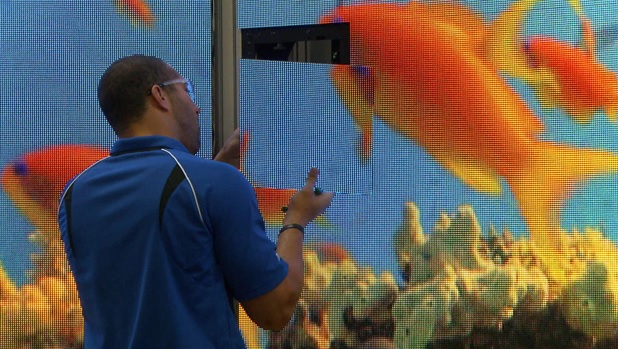
The resolution is four times better than what one could get at home. The screens are a constellation of millions of LEDs — about the size of a small thumb tack — spaced about a half an inch apart. Standing near them, it’s hard to actually picture a picture; all your eyes focus on are clusters of red, blue and green lights.

But back away . . . and those clusters miraculously blend together into a portrait in vivid detail.

The panels undergo brutal testing to make sure they can withstand the elements — everything from the steamy heat of Sun Life Stadium in Miami, to the pounding rain and snow of Chicago’s Soldier Field. Some are even submerged in water.

But perhaps the biggest test for Daktronics has been the students at SDSU, where Al Kurtenbach — long since retired as a professor — still rarely misses a Jackrabbits game (under HIS scoreboard, of course).

In the early ’80s, only 22 percent of Engineering graduates here actually found work near Brookings, S.D. Today, that number is closer to 62 percent. Many of Daktronics’ would-be employees now attend class in the university’s Daktronics Engineering Hall.

“I felt we always had to show them exciting work, demonstrate that there was exciting work right here in Brookings,” said Kurtenbach.

Daktronics, of course, isn’t the only manufacturer of stadium big screens. Mitsubishi turned heads years ago with a massive display at the home of the Dallas Cowboys.

But it’s Daktronics that has just been awarded the contract to build the biggest scoreboard to date. Called a “Halo Board,” it will ring the top of the new Atlanta Stadium. The only way for this screen to get any bigger is for the stadium itself to grow.

“How big can these displays get?” asked Cowan. “I mean, are we approaching sort of the biggest they’re gonna be?”

“I think it depends on how large the checkbook is,” said Kurtenbach. “That would certainly be a factor. If the checkbook is larger, we’ll sure try to build it!”

And we, undoubtedly, will watch.

 

Share this post:
, , , ,

Detroit-area Judge to Decide if Kids Need Vaccines

Go Lean Commentary

“What a tangled web we weave when first we practice to deceive” – Novelist and Poet Sir Walter Scott.

The viral debate regarding some parents refusal to vaccinate their children is not one that can be simply reduced to bad parenting; there are some heavy issues surrounding this topic. This is not 1950, where there were only 3 vaccines; the number has now grown voluminously. Consider the US standards:

Vaccination of 14 diseases by two years of age…
U.S. children receive as many as 24 vaccine injections …

Then in the 1990’s, a new deterrent arose, the sudden rise in the cases of Autism among children; 1 in every 160.

No wonder a growing number of parents apply for exemptions from vaccinating their kids; (see Forbes Magazine article below). It almost seems logical.

Though there is no conclusive evidence that Autism may be linked to vaccinations, the occurrence rate is ungodly, 1 in 160. This alarming Autism rate seemed to exceed any risk of exposure to “wild” pathogens targeted by vaccinations – until the Disneyland outbreak recently. It was hard to ignore these numbers, thusly parents were trying to protect their children from the cure, not the disease, and refusing to vaccinate their children. Consider this story from Metropolitan Detroit:

VIDEO – Oakland County judge to decide if 4 kids need vaccines – http://www.clickondetroit.com/news/oakland-county-judge-to-decide-if-4-kids-need-vaccines/31099632

While this may appear to be an issue of Public Health policy, it can be argued that actually this is an issue of capitalism.

The vaccine, the medicine comes from Pharmaceutical companies. When new drugs are introduced and then compelled for the entire population, it is a boon for the drug company. This is the kinetics of capitalism at full hilt. The below encyclopedic reference (Appendix #1) help us to appreciate the background of the economic dynamics of this issue.

This consideration aligns with the book Go Lean…Caribbean; this book serves as a roadmap for the introduction and implementation of the technocratic Caribbean Union Trade Federation (CU). This empowerment effort represents a change for the region, calling on all 30 member-state governments in the region to confederate and provide their own solutions – together – in the areas of economics, security and governance. The book directly advocates for a Group Purchasing Organization to facilitate better pricing and delivery options for Public Health medications – the vaccines that must be administered. This issue therefore relates to all three areas (economics, security and governance). The CU/Go Lean roadmap defines these 3 prime directives as follows:

  • Optimization of the economic engines in order to grow the regional economy.
  • Establishment of a security apparatus to protect the resultant economic engines against “bad actors”.
  • Improve Caribbean governance to support these engines.

The purpose of this commentary is to draw reference to the different governing bodies regulating these policies around the world, or at least in countries within scope of a Caribbean focus. The Center for Disease Control (CDC) in the US, European Medicines Agency (EMA) in Europe and the UN’s World Health Organization (WHO) hold sway over this issue.

Just what influence does the Pharmaceutical industry have in lobbying these agencies to steadily increase the vaccination requirements? This industry is pejoratively referred as Big Pharma. Why the negative reference?

More and more parents have not trusted Big Pharma’s assertions, motives and sponsored research into side-effects and repercussions of vaccinations. There is no doubt that this industry would have a profit motive to protect and deflect any criticism of their Public Health policies. The charges of Autism fit this mode. See Autism Reference in the Appendix #2 below.

Is there a conspiracy? While it would only be honorable to give Big Pharma the benefit of any doubt, odds like 1-in-160 is very hard to ignore. Besides, many sources, including this Go Lean book and accompanying blogs have reported on the “bad intent” in the American eco-system associated with crony-capitalism.

But vaccination is an honorable cause. Many of these “now” preventable diseases wreaked havoc on human society until the vaccines were developed and distributed. The sustainability of modern life has actually improved due to immunizations. This fact was re-affirmed with the recent Disneyland measles outbreak. See article here:

Title: Is The Disneyland Measles Outbreak A Turning Point In The Vaccine Wars?
By: Matthew Herper, Forbes Staff – February 4, 2015 Retrieved from: http://www.forbes.com/sites/matthewherper/2015/02/04/the-disneyland-measles-outbreak-is-a-turning-point-in-the-vaccine-wars/

“In an hour, she was unconscious. In twelve hours she was dead. The measles had turned into a terrible thing called measles encephalitis and there was nothing the doctors could do to save her.”

Those words were written by Roald Dahl, the author of Charlie and The Chocolate Factory and James the Giant Peach, about his seven-year-old daughter who died in 1962. In 1986, when he wrote them in an entreaty to his fellow Britons to vaccinate their children so that his little girl would not have died in vain, Dahl followed up with a taunt that played on his readers’ sense of national pride. “In America,” he wrote, “where measles immunization is compulsory, measles like smallpox, has been virtually wiped out.”

I saw Dahl’s 621-word pamphlet shared dozens of times this weekend, on sites like Io9 and DailyKos and by friends on Facebook who are frustrated and upset that Dahl’s statement is no longer true – that America, which led the eradication of smallpox, has snatched defeat from the jaws of victory. As a result of the growing number of parents who are applying for exemptions from vaccinating their kids, an outbreak that started in Disneyland in California has now spread. There have been 102 cases of measles reported in 14 states since January 1, more than in all of 2012.

What’s different now – and this is a reason for hope, even celebration – is that people are angry. This was clear Monday when Chris Christie, the New Jersey governor and likely Republican presidential candidate, when he told an MSNBC reporter that he vaccinates his own kids, but that “I also understand that parents need to have some measure of choice in things as well, so that’s the balance that the government has to decide.” The backlash was so fast and fierce that an hour-and-a-half later Christie’s office was walking the statement back, saying that “with a disease like measles there is no question kids should be vaccinated.”

CU Blog - Detroit-area Judge to Decide if Kids Need Vaccines - Photo 4Turning Walt Disney’s Happiest Place on Earth into the measles kingdom flipped a switch in our collective brain. The thought that thousands of people could have been exposed to a virus that was declared eliminated in the U.S. a decade-and-a-half-ago is scary. And it drives home the reality that vaccines only fully protect us if almost everyone uses them.

Between CNN’s tale of an infant quarantined due to measles and NPR’s profile of a little boy named Rhett who’d battled leukemia and whose father was angrily campaigning to require schoolmates to be vaccinated, we remembered that even amazingly powerful vaccines aren’t perfect, and that people with measles can spread the disease for four days before symptoms occur, and that at least 5 out of 100 vaccinated people will still catch measles if exposed to it.

Up until now, politicians frequently at least gave lip service to the very small but very vocal group of parents who believe that vaccines are harmful and that they should be able to opt-out. California Governor Jerry Brown, a Democrat, did more than that in 2012, signing a law that loosened vaccine exemptions, allowing parents who claim a religious reason for not vaccinating to leave a doctor’s office without even mandatory counseling. The reaction was subdued.

Now a few Republicans, including Kentucky Senator Rand Paul and Wisconsin Representative Sean Duffy, are arguing that vaccines should be voluntary. The nine out of ten of American parents who vaccinate their children should let their elected officials know that this isn’t acceptable – that we want the rules about vaccine exemptions tightened. We don’t need draconian measures (I’ve seen arguments that parents who don’t vaccinate should be jailed or sued, which is impractical and harsh) just the same fair rules we’ve had for years. Want to send your kid to school? Make sure he gets his shots, or have a very, very, very good reason not to have.

Measles is still a small problem. Even if there are 1,000 cases this year, it remains so. The high vaccination rates through most of the country mean it will burn out. But we’re also likely to face 28,000 cases of whooping cough, another vaccine-preventable illness that has been on the rise not so much because of patients who don’t get vaccinated but also because the new vaccine adopted in the 1990s is less effective than the old one. And every year there are between 3,000 to 49,000 deaths due to influenza; even though the flu vaccine is one of the least effective we have, if everyone got it each year it would reduce that number.

In a Roald Dahl story, a big friendly giant could visit people who choose not to vaccinate and give them nightmares of measles encephalitis. But this is the real world. The way for people to keep vaccine rates up is to write their elected representatives, and to be very public about the benefits of vaccines. Mention in conversations the way that vaccines have changed the world. Or get your flu shot, and brag about it as if you just shaved a ten seconds off the time it takes you to run a mile. That’s the way to turn the anger that’s been produced by the news about Disneyland into a happier world for everyone.

The book Go Lean…Caribbean asserts that the Caribbean Public Health must be strenuously protected. Like Disneyland, the Caribbean economic engines are based on extending hospitality to visitors; so (preventable) infectious diseases undermine the attractiveness of the destination.

So all stakeholders need to employ best-practices. Citizens need to embrace immunizations and Pharmaceutical companies need to “play nice” and not excessively pile on the vaccination formulas. The region must do better; we must not allow the US, or Big Pharma, to take the lead for our own nation-building. In America, capitalistic interest tends to hijack policies intended for the Greater Good. This assessment is logical considering the realities of so many of these Big Corporate Bullies, as follows, where public policy is set to benefit private parties:

Big Oil While lobbying for continuous tax subsidies, the industry have colluded to artificially keep prices high and garner rocket profits ($38+ Billion every quarter).
Big Box Retail chains impoverish small merchants on Main Street   with Antitrust-like tactics, thusly impacting community jobs.
Big Pharma Chemo-therapy cost $20,000+/month; and the War against Cancer is imperiled due to industry profit insistence.
Big Tobacco Cigarettes are not natural tobacco but rather latent with chemicals to spruce addiction.
Big Agra Agribusiness concerns bully family farmers and crowd out the market; plus fight common sense food labeling efforts.
Big Data Brokers for internet and demographic data clearly have no regards to privacy confines
Big Media Hollywood insists on big tax breaks/subsidies for on-location shooting; cable companies conspire to keep rates high; textbook publishers practice price gouging.
Big Banks Wall Street’s damage to housing and student loans in 2008 are incontrovertible.
Big Weather Overblown hype of “Weather Forecasts” to dictate commercial transactions.

The Go Lean book, and accompanying blog commentaries, go even deeper and hypothesize that American economic models are not always suitable for long-term Caribbean benefits. The American wheels of commerce stages the Caribbean in a “parasite” role; imperiling regional industrialization even further. The US foreign policy for the Caribbean is to incentivize consumption of American products, and serve as a playground for their leisure.

The book and blogs assert that this disposition of a “parasite” is not the only choice. Other communities have demonstrated how to forge a protégé relationship with the US.  Japan and South Korea, despite American pressure and having a small population-size, are examples of countries having trade surpluses for the US. They are protégés, not parasites, and thusly provide a role model for the Caribbean to emulate.

The broken Pharma eco-system in the US does not have to be modeled in the Caribbean. Parents should not have to demand exemptions from mandatory immunizations, nor should corporations be allowed to bully Public Health demands. Change has now come to the region. The Go Lean book posits that the governmental administrations must be open to full disclosure and accountability. Any encroachment into bullying should be easily detected and censured. Plus the ubiquity of the internet allows whistleblowers to expose “shady” practices to the general public; (WikiLeaks and Edward Snowden provide great examples).

The Go Lean roadmap provides turn-by-turn directions for forging change to reboot Caribbean societal engines. This roadmap is thusly viewed as more than just planning; this is pronounced early in the Declaration of Interdependence (Page 11 – 12):

viii.   Whereas the population size is too small to foster good negotiations for products and commodities from international vendors, the Federation must allow the unification of the region as one purchasing agent, thereby garnering better terms and discounts.

xvi.   Whereas security of our homeland is inextricably linked to prosperity of the homeland, the economic and security interest of the region needs to be aligned under the same governance. Since economic crimes…can imperil the functioning of the wheels of commerce for all the citizenry, the accedence of this Federation must equip the security apparatus with the tools and techniques for predictive and proactive interdictions.

The Go Lean book purports that the Caribbean can – and must – do better. The vision of the CU is a confederation of the 30 member-states of the Caribbean doing the heavy-lifting of optimizing economic-security-governing engines. We can weld more power and influence collaborating and consolidating Public Health acquisitions. The Go Lean book details the policies and other community ethos to adopt, plus the executions of the following strategies, tactics, implementations and advocacies to elevate Caribbean society, and make it a better place to live, work, play and heal:

Community Ethos – Deferred Gratification Page 21
Community Ethos – Economic Principles – People Choose Page 21
Community Ethos – Economic Principles – Choices Involve Costs: Page 21
Community Ethos – Economic Principles – People Respond to Incentives Page 21
Community Ethos – Economic Principles – Economic Systems Influence Individual Choices Page 21
Community Ethos – Economic Principles – Consequences of Choices Lie in the Future Page 21
Community Ethos – Privacy versus Public   Protection Page 23
Community Ethos – Whistleblower Protection Page 23
Community Ethos – Witness Security & Protection Page 23
Community Ethos – Anti-Bullying and Mitigation Page 23
Community Ethos – Intelligence Gathering Page 23
Community Ethos – Lean Operations – Group Purchasing Organization Page 24
Community Ethos – Ways to Manage Reconciliations Page 34
Community Ethos – Ways to Improve Sharing Page 35
Community Ethos – Ways to Impact the Greater Good Page 37
Strategy – Agents of Change – Technology Page 57
Strategy – Agents of Change – Globalization Page 57
Tactical – Separation of Powers – Emergency Management Page 76
Tactical – Separation of Powers – Justice Department – Trade/Antitrust Page 77
Tactical – Separation of Powers – Health Department – Disease Control Page 86
Tactical – Separation of Powers – Health Department – Drug Administration Page 86
Implementation – Ways to Pay for Change – GPO Logistic   Fees Page 101
Implementation – Security Initiatives at Start-up – Big Data Analysis Page 103
Implementation – Ways to Benefit from Globalization Page 119
Planning – Ways to Improve Failed-State Indices Page 134
Planning – Lessons Learned from 2008 Page 136
Advocacy – Ways to Measure Progress Page 147
Advocacy – Ways to Grow the Economy Page 151
Advocacy – Ways to Create Jobs Page 152
Advocacy – Ways to Improve Healthcare – Public Health Extension Page 156
Advocacy – Ways to Improve Governance Page 169
Advocacy – Ways to Better Manage the Social Contract Page 171
Advocacy – Ways to Impact Justice – Truth & Reconciliation Commissions Page 177
Advocacy – Ways to Improve Homeland Security Page 180
Advocacy – Ways to Improve Intelligence Gathering & Analysis Page 182
Advocacy – Ways to Ways to Protect Human Rights Page 220

The foregoing article/VIDEO relates to topics that are of serious concern, even for Caribbean communities. While the US is the world’s largest Single Market economy, we want to only model some of the American example. Instead we would rather foster a business climate to benefit the Greater Good, not just some special interest group.

There are many Go Lean blog commentaries that have echoed this point, addressing the subject of the Caribbean avoiding American crony-capitalism consequences. See sample here:

https://goleancaribbean.com/blog/?p=3760 Concerns about ‘Citizenship By Investment Programs’
https://goleancaribbean.com/blog/?p=3397 A Christmas Present for the Banks from the Omnibus Bill
https://goleancaribbean.com/blog/?p=3326 Detroit’s M-1 Rail – Finally avoiding Plutocratic Auto Industry Solutions
https://goleancaribbean.com/blog/?p=2887 Caribbean must work together to address rum subsidies
https://goleancaribbean.com/blog/?p=2522 The Cost of Cancer Drugs
https://goleancaribbean.com/blog/?p=2465 Book Review: ‘This Changes Everything: Capitalism vs. the Climate’
https://goleancaribbean.com/blog/?p=2435 Korea’s   Model – A dream for Latin America and the Caribbean
https://goleancaribbean.com/blog/?p=2338 How Caribbean can Mitigate the Dreaded ‘Plutocracy’
https://goleancaribbean.com/blog/?p=2259 The Criminalization of American Business
https://goleancaribbean.com/blog/?p=2183 A Textbook Case of Industry Price-gouging
https://goleancaribbean.com/blog/?p=1309 5 Steps to a Bubble
https://goleancaribbean.com/blog/?p=1256 Traditional 4-year Colleges – Terrible Investment for Region and Jobs
https://goleancaribbean.com/blog/?p=1143 Health-care fraud in America; Criminals take $272 billion a year
https://goleancaribbean.com/blog/?p=798 Lessons Learned from the American Airlines merger
https://goleancaribbean.com/blog/?p=709 Student debt holds back many would-be home buyers
https://goleancaribbean.com/blog/?p=658 Indian Reservation Advocates Push for Junk-Food Tax
https://goleancaribbean.com/blog/?p=353 Book Review: ‘Wrong – Nine Economic Policy Disasters and What We Can Learn…’
https://goleancaribbean.com/blog/?p=273 10 Things We Don’t Want from the US – American Self-Interest Policies

“Measles” is a serious, painful disease; death can result as well. This disease does not make an inviting call for our guests to visit the Caribbean destination for vacations and festivals. Not just the manifestation of measles but also any unsubstantiated rumors can curtail economic activity in the CU regional area.

What is the connection with vaccinations and Autism? Currently, a connection is not definitive; more research is needed. Autism must be monitored, tracked and catalogued. There is no cure; but the conditions can be managed as an chronic ailment…

The book Go Lean…Caribbean posits that many problems of the region are too big for any one member-state to solve alone; there is the need for the technocracy of the Caribbean Union Trade Federation. The purpose of this Go Lean/CU roadmap is to elevate the Caribbean homeland; and improve the lives for Caribbean citizens. We want our people to prosper where they are planted in the Caribbean.

The Go Lean roadmap calls for integration of the regional member-states drug acquisition and regulatory oversight. Further, the roadmap posits that to succeed as a society, the Caribbean region must not only consume, but also create, produce, and distribute intellectual property products (like medical innovations) to the rest of the world. We need our own Caribbean solutions.

Now is the time for all of the Caribbean, the people and governing institutions, to lean-in for the changes/empowerments described in the book Go Lean … Caribbean.

🙂

Download the free e-book of Go Lean … Caribbean – now!

———–

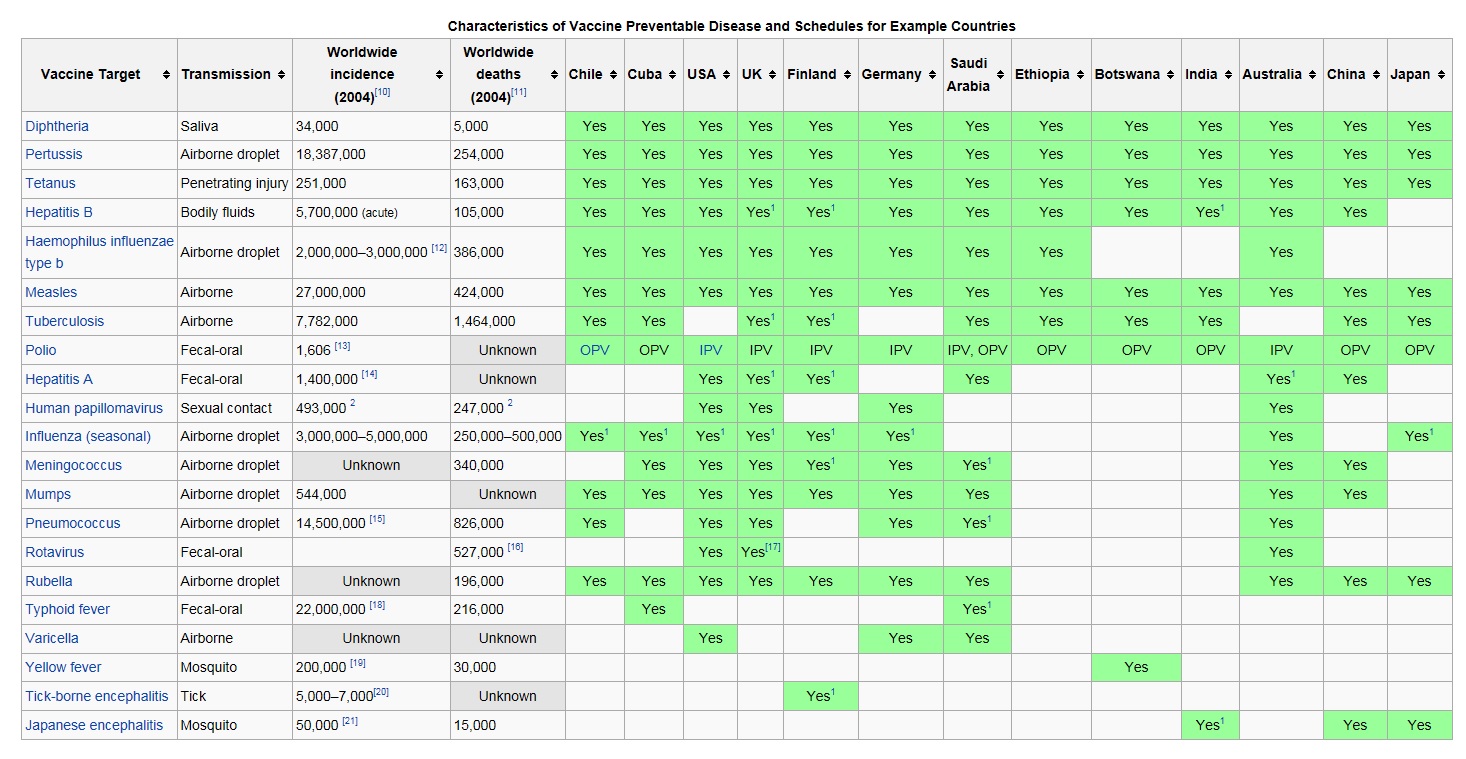
1. Appendix – Vaccination Schedule (http://en.wikipedia.org/wiki/Vaccination_schedule)

CU Blog - Detroit-area Judge to Decide if Kids Need Vaccines - Photo 1

(Click Photo to Enlarge)

A vaccination schedule is a series of vaccinations, including the timing of all doses, which may be either recommended or compulsory, depending on the country of residence.

A vaccine is an antigenic preparation used to produce active immunity to a disease, in order to prevent or reduce the effects of infection by any natural or “wild” pathogen.[1] Many vaccines require multiple doses for maximum effectiveness, either to produce sufficient initial immune response or to boost response that fades over time. For example, tetanus vaccine boosters are often recommended every 10 years.[2] Vaccine schedules are developed by governmental agencies or physicians groups to achieve maximum effectiveness using required and recommended vaccines for a locality while minimizing the number of health care system interactions. Over the past two decades, the recommended vaccination schedule has grown rapidly and become more complicated as many new vaccines have been developed.[3]

CU Blog - Detroit-area Judge to Decide if Kids Need Vaccines - Photo 2Some vaccines are recommended only in certain areas (countries, subnational areas, or at-risk populations) where a disease is common. For instance, yellow fever vaccination is on the routine vaccine schedule of French Guiana, is recommended in certain regions of Brazil but in the United States is only given to travelers heading to countries with a history of the disease.[4] In developing countries, vaccine recommendations also take into account the level of health care access, the cost of vaccines and issues with vaccine availability and storage. Sample vaccinations schedules discussed by the World Health Organization show a developed country using a schedule which extends over the first five years of a child’s life and uses vaccines which cost over $700 including administration costs while a developing country uses a schedule providing vaccines in the first 9 months of life and costing only $25.[5] This difference is due to the lower cost of health care, the lower cost of many vaccines provided to developing nations, and that more expensive vaccines, often for less common diseases, are not utilized.

In 1900, the smallpox vaccine was the only one administered to children. By the early 1950s, children routinely received three vaccines, for protection against (diphtheria, pertussis, tetanus and smallpox), and as many as five shots by two years of age.[3] Since the mid-1980s, many vaccines have been added to the schedule. As of 2009[update], the US Centers for Disease Control and Prevention (CDC) now recommends vaccination against at least fourteen diseases. By two years of age, U.S. children receive as many as 24 vaccine injections, and might receive up to five shots during one visit to the doctor.[3] The use of combination vaccine products means that, as of 2013[update], the United Kingdom’s immunization program consists of 10 injections by the age of two, rather than 25 if vaccination for each disease was given as a separate injection.[6]

2. Appendix – Autism Causes (http://en.wikipedia.org/wiki/Autism)

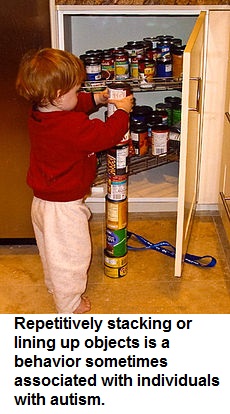
CU Blog - Detroit-area Judge to Decide if Kids Need Vaccines - Photo 3Autism is a neurodevelopmental disorder characterized by impaired social interaction, verbal and non-verbal communication, and restricted and repetitive behavior. Parents usually notice signs in the first two years of their child’s life.[2] The signs typically develop gradually, but some children with autism will reach their developmental milestones at a normal pace and then regress.[3]

It has long been presumed that the cause of Autism is genetic. But now environmental factors that have been claimed to contribute to or exacerbate autism, or may be important in future research, include certain foods, air pollution, infectious diseases, solvents, diesel exhaust, PCBs, phthalates and phenols used in plastic products, pesticides, brominated flame retardants, alcohol, smoking, illicit drugs, and … vaccines [19].

Controversies surround many of these environmental causes;[6] for example, medical stakeholders posit that the vaccine hypotheses are biologically implausible and have been disproven in scientific studies.


Share this post:
, , , ,
[Top]

How to Train Your ‘Dragon’ – Freeport Version

Go Lean Commentary

The term ‘dragon’ has a deep and rich meaning in all of literature; see Appendix A for a list of different cultures with dragon mythologies.

CU Blog - Freeport Version - How to Train My Dragon - Photo 6

Needless to say, there is no such creature, apart from the adorable Komodo Dragon, a big lizard native to South Pacific and Australasia region.

Even in scripture, the great Enemy, Satan the Devil is depicted as a Dragon; (Revelation 12:9). This commentary is not labeling any one person as a “Dragon”, but rather assigning the term “Dragon” to a “Dependence on Foreign Investors” or DFI.

So figuratively, the term “dragon” refers to an adversarial creature. This is where the relevance is to this commentary for the promotion of the book Go Lean…Caribbean. The book calls for the elevation of Caribbean economics, security and governance. It assesses many “dragon-like” challenges that stand in the way of progress and have resulted in near wholesale abandonment of so many communities.

One city of focus for this commentary is the 2nd city in the Bahamas, Freeport/Lucaya. This town is now undergoing a crisis in all three challenge factors (economics, security, and governance), and yet the book maintains that this “dragon can be trained’ see VIDEO below. Part of this crisis is the fact the certain tax-free provisions, real property tax and Business License, of the Hawksbill Creek Agreement (that led to the private development of Freeport) will expire on August 4, 2015. The national government is pondering renewal and extension; the ongoing stalemate, exacerbates the municipal crisis.

The book opens with the declaration that a crisis is a terrible thing to waste. For the Caribbean region there is not just one issue, but rather many negative/downward triggers, all which are addressed in the Go Lean book. While these challenges abound through out the region, Freeport’s exposure to these following triggers are more heightened than elsewhere:

  • Climate Change and threats from natural disasters
  • Decline of the American Middle Class, since the 2008 financial crisis
  • Decimation of the tourism product – measured decline in amenities like Golf and Casino Gambling.
  • Failure to diversify the economy with any industrial base
  • Emergence of powerful elite, the One Percent.
  • Bureaucratic hindrance of Foreign Direct Investors
  • Security threats from border encroachments of illegal immigrants.
  • Security threats of immigrants assimilating their adopted societies.

Harsh realities have now come to fruition in the Caribbean, but the town of Freeport have been hard hit with the full force of all of these dynamics. The book therefore posits that there is a need to re-focus, re-boot, and optimize the engines of commerce so as to make all the Caribbean a better place to live, work and play. While all the Caribbean needs to create jobs, this town of Freeport, has a greater need, more so than others.

Ship-building, in its many genres, is being promoted for adoption and incubation. This is just one of the advocacies identified, qualified and proposed in the Go Lean book. In total, there are 144 advocacies, catalogued in the areas of Community Ethos, Strategy, Tactics, Implementations, Planning, Economics, Government, Industries, Social, and Locations.

Normally DFI refer to Direct Foreign Investment, but in this case the “Dependence on Foreign Investors” is portrayed as a negative factor or pest – a dragon –  unless “trained”, caroled and controlled to harness the energy in a positive way.

Consider these news articles that describe the business climate and players for the Freeport landscape:

1. Freeport Plutocratic Benefactor – Sir Jack Hayward:

CU Blog - Freeport Version - How to Train My Dragon - Photo 5Sir Jack Hayward, British Businessman, Property Developer, Philanthropist and Sports Team Owner was memorialized by fans of his football team Wolverhampton Wanderers F.C.. He passed away last week (January 13) at age 91. He was loved and hated in different circles, some even compared his racism to Adolf Hitler – perhaps a hyperbole. Sir Jack was also a principal owner in the Grand Bahama Port Authority*. So he wielded power as to the municipal affairs and economic development of this city.

http://www.birminghammail.co.uk/sport/wolves-football-pundit-barry-glendenning-8481522

2. Fleeing a “sinking ship”:

Sir Jack Hayward Jack arrived in Grand Bahama in 1956 to promote the development of Freeport and became a Vice-President of the Grand Bahama Port Authority; eventually he assumed the Chairmanship of the Board of Directors (after 2004). Until the convalescence before his death, he continued to play an active role in Freeport. Sir Jack was in negotiations to sell his family’s 50 per cent stake in the GBPA Group of Companies. Now that provisions of the Hawksbill Creek Agreement (HCA) need renewal from the national government, multiple “dragons” are now circling the City of Freeport.

http://www.tribune242.com/news/2015/jan/28/sir-jack-port-sale-talks-passing/

3. At the precipice:

Community leaders in Freeport have declared that it would be “disastrous” if the national government fail to pursue HCA extension and allow the levy of real property taxes on GBPA licensees; “this would be another nail in Freeport’s coffin”. Freeport is now at the precipice – dragons are circling.

http://www.tribune242.com/news/2015/jan/08/freeport-disaster-if-property-tax-imposed/

4. Roadmap for economic empowerments:

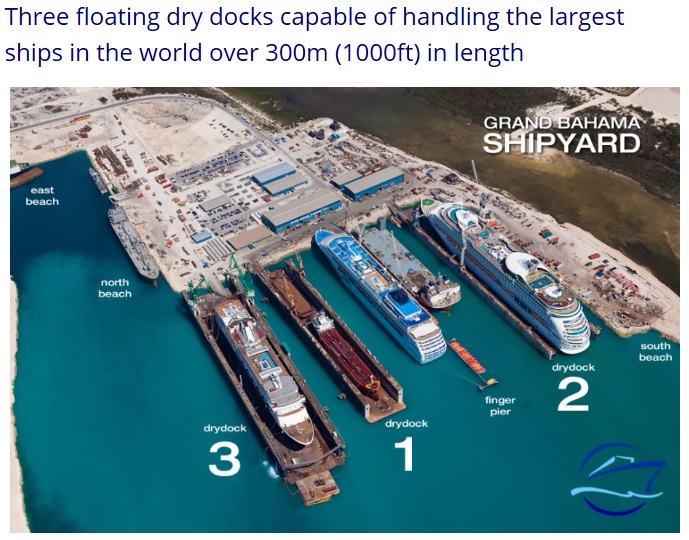
CU Blog - Freeport Version - How to Train My Dragon - Photo 4The Go Lean roadmap is not a work of fiction or mythology; it is based on the reality of the Caribbean disposition. It is what it is, the book declares. It is only by accepting reality that real solutions can be forged: discovered, designed and deployed.  The book, and accompanying blogs posit that “dragons can be trained”. The sad state of affairs in Freeport can be turned around by the embrace of a “double down” strategy on the island’s nascent ship-building industry.

http://grandbahamashipyard.com/facilities/drydocks/

The current disposition for Freeport, Grand Bahama is dire. But there is a glimmer of hope with this industrial development of ship-building. A previous blog/commentary pushed hard on the idea of ship-building/ship-breaking for the Caribbean region; now this commentary advocates adding ship-breaking to the ship-building model for Freeport, and then “double-down” on this industry space … with incubators, stimulus grants, angel investors, R&D and other initiatives. This is the heavy-lifting described in the Go Lean book.

In this vein, the book Go Lean… Caribbean, serves as a roadmap for the introduction and implementation of the technocratic Caribbean Union Trade Federation (CU) with the charter to facilitate jobs in the region. We want to explore all the strong benefits of the ship-building/ship-breaking industry. This aligns with the CU charter; as defined by these 3 prime directives:

  • Optimization of economic engines in order to grow the regional economy to $800 Billion and create 2.2 million new jobs.
  • Establishment of a security apparatus to protect the resultant economic.
  • Improvement of Caribbean governance to support these engines.

Early in the Go Lean book, the responsibility to create jobs was identified as an important function for the CU with this pronouncement in the Declaration of Interdependence (Pages 14):

xxvi.  Whereas the Caribbean region must have new jobs to empower the engines of the economy and create the income sources for prosperity, and encourage the next generation to forge their dreams right at home, the Federation must therefore foster the development of new industries, like that of ship-building, automobile manufacturing, prefabricated housing, frozen foods, pipelines, call centers, and the prison industrial complex. In addition, the Federation must invigorate the enterprises related to existing industries tourism, fisheries and lotteries – impacting the region with more jobs.

The CU will facilitate the region’s eco-system for Self-Governing Entities (SGE) for shipyards. This approach calls for the establishment of industrial parks, corporate campuses and research parks in bordered territories; these structures would be inviting to the super-rich (One-Percent) and their resources. These entities would be governed solely by the technocratic CU. The approach is not to punish the One-Percent for their success nor cower to any special interests group at the expense of the greater population.

This roadmap explains how all 30 Caribbean member-states can elevate the economic engines (direct and indirect spin-off activities), by allowing the CU to assume jurisdiction for SGE’s in the region and the Exclusive Economic Zone (the 1,063,000 square miles of the Caribbean Sea). Freeport is ideal for SGE’s for ship-building/ship-breaking yards, with its vast array of canals and waterways.

The Go Lean book also details the principle of job multipliers, how certain industries are better than others for generating multiple indirect jobs down the line for each direct job on a company’s payroll. The shipyard industry has a job-multiplier rate of 3.0. So the creation of 15,000 direct jobs for the shipyard industry in the Caribbean region can have the multiplier effect of 45,000 jobs. That economic impact is the result of “training the dragons”.

How would the Caribbean create 45,000 jobs in the course of the 5-year roadmap? By adoption of different community ethos, plus the executions of key strategies, tactics, implementations and advocacies. The following is a sample:

Community Ethos – Economic Principle – Economic Systems Influence Choices & Incentives Page 21
Community Ethos – Economic Principle – Voluntary Trade Creates Wealth Page 21
Community Ethos – Job Multiplier Page 22
Community Ethos – Lean Operations Page 24
Community Ethos – Ways to Impact the Future Page 26
Community Ethos – Ways to Help Entrepreneurship Page 28
Community Ethos – Ways to Impact Research & Development Page 30
Community Ethos – Ways to Impact Turn-Around – Recycling and Demolition Industries Page 33
Community Ethos – Ways to Impact the Greater Good Page 37
Strategy – Mission – Facilitate   a Shipbuilding Industry Page 46
Tactical – Fostering a Technocracy Page 64
Tactical – Tactics to Forge an $800 Billion Economy – High Multiplier Industries Page 70
Tactical – Separation of Powers – Self-Governing Entities Page 80
Implementation – Steps to Implement Self-Governing Entities Page 105
Implementation – Ways to Re-boot Freeport Page 112
Planning – Big Ideas – Confederation with Sovereignty Page 127
Advocacy – Ways to Grow the Economy Page 151
Advocacy – Ways to Create Jobs Page 152
Advocacy – Ways to Improve Emergency Management – Processes and Systems Page 196
Advocacy – Ways to Foster Technology Page 197
Advocacy – Ways to Develop/Grow a Ship-Building Industry Page 209
Appendix – Job Multipliers Page 259

The CU will foster industrial developments in support of alternative options to tourism. An important ingredient is the willingness of the people to engage. The CU/Go Lean will message to the Caribbean people, that the region is ready for this industrial challenge of ship-breaking.

The Caribbean is arguably the best address on the planet, but jobs are missing. With jobs, communities like the City of Freeport will be able to retain more of their citizens and suffer less abandonment. It’s all about people; Freeport has lost people and populations in the last few decades. The imagery of pests – dragons – come to mind that sneak away with young people during the night.

Time now for a change; time to train the dragons!

Whereas dragons are mythical, the Caribbean disposition, and Freeport’s, is no fairytale, no myth; this is real life. 🙂

Download the free e-Book of Go Lean … Caribbean – now!

————-

Appendix VIDEO: How To Train Your Dragon: “Official Trailer” – http://www.imdb.com/video/imdb/vi1158218777/

This commentary asserts that Freeport, Grand Bahama would be analogous to the fictitious Town of Berk in the movie.

This movie/snippet is owned by Dreamworks Entertainment. No copyright infringement intended. Apologies for the references to Nordic Culture, and any negative stereotypes projected.

Appendix A – Cultures with Dragon Mythology

Nordic (Viking)
Greek
Slavic (Romania, Russia)
Egypt
Ancient India
Persian
Jewish
Chinese dragon
Japanese
Korean
Bhutan
Manipur
Vietnam

CU Blog - Freeport Version - How to Train My Dragon - Photo 1

CU Blog - Freeport Version - How to Train My Dragon - Photo 2

CU Blog - Freeport Version - How to Train My Dragon - Photo 3

————–

Appendix B* Grand Bahama Port Authority (GBPA)

The Port Authority is a privately held corporation that acts as the municipal authority for Freeport, Grand Bahama Island, The Bahamas. The GBPA was created by the Hawksbill Creek Agreement of 1955. The GBPA is horizontally integrated with property development, municipal services, airport ( world’s largest privately owned airport), harbor operations, and shipyard concerns.

The Grand Bahama Port Authority is jointly owned by Sir Jack Hayward (50%) and the family of the late Edward St. George (1928 – 2004).The Ownership Structure also features a partnership with Hong Kong-based Hutchison Whampoa on the container port operations, and the resort area in the Lucaya section of the City.


Share this post:
, , , , , , ,
[Top]

Watch the Super Bowl … Commercials

Go Lean Commentary

CU Blog - Watch the SuperBowl ... Commercials - Photo 2The publishers of the book Go Lean…Caribbean encourages you to watch the Big Game on Sunday (February 1, 2015), Super Bowl XLIX from Phoenix –area, Arizona, between the New England Patriots and the Seattle Seahawks. Pull for your favorite team and enjoy the half-time show (Katy Perry). It’s all free! It’s being paid for by the advertisers.

So as to complete the full economic cycle, be sure to watch the commercials; because this is Big Money; Big Stakes and a Big Deal. The 2014 version, Super Bowl XLVIII on FOX Broadcast Network was the most watched television program in US history with 111.5 million viewers.[15][16] The Super Bowl half-time show featuring Bruno Mars was the most watched ever with 115.3 million viewers.[15][16] Now, it’s not just TV, but “second- screen” (computers, tablets & mobile devices) as well; this is now tweet-along-with-us programming; notice the #BestBuds Twitter identifier in the following Ad:

VIDEO http://youtu.be/EIUSkKTUftU  – 2015 Budweiser Clydesdale Beer Run

Published on Jan 23, 2015 – It’s time for your Super Bowl beer run. Don’t disappoint a Clydesdale. Choose Budweiser for you and your #BestBuds on epic Super Bowl weekend!

For $4.5 million per 30 second ad, an advertiser had better get the “maximum bang for the buck”; but 30 seconds is still only 30 seconds. Enter the “second-screen”; now advertisers can stretch the attention of their audience by directing them to internet websites, Twitter followings and even YouTube videos and Facebook videos.

See these related stories, (sourced mostly from Variety.com – Hollywood & Entertainment Business Magazine; (retrieved 01-29-2015):

1. WATCH: Super Bowl 2015 Commercials

Audiences no longer need to wait until the Big Game to watch Super Bowl commercials, with an increasing number of marketers opting to release their spots days before kickoff. This year is no different, with Budweiser, Budweiser, Bud Light, Kia, Mercedes-Benz USA, T-Mobile, Victoria’s Secret, BMW, even Paramount with “Hot Tub Time Machine 2,” among those having already posted their ads online [on sites like YouTube].

The reason? The high cost to play the Super Bowl promo blitz is one. At around $4.5 million per 30 second ad, buying time during the match up between the Seattle Seahawks and New England Patriots is at record levels. NBC is airing the game February 1.

2. Super Bowl Ads: NBC Turns to Tumblr to Post Spots After They Air on TV

NBC Sports has launched a new Super Bowl page on Yahoo’s [social media site] Tumblr that the programmer will use to feature Super Bowl XLIX’s TV ads immediately after they air on NBC on Sunday, February 1.

The new NBC Sports Tumblr page, accessible via NBCSports.com/Ads, will be populated with original content ahead of Super Bowl Sunday created by the NBC Sports’ marketing media team, as well as from re-blogging NFL-related Tumblr posts. On game day, the page will convert into a hub for Super Bowl TV ads.

3. NBCU Will Use Super Bowl XLIX Free Live-Stream to Promote Pay-TV Online Services

NBCUniversal will launch an 11-hour free digital video stream — centered around live coverage of this year’s Super Bowl — in a bid to get users to log in to its “TV Everywhere” (TVE) services across its broadcast and cable portfolio the rest of the year.

The Peacock’s “Super Stream Sunday” event will include NBC’s presentation of the Super Bowl, as well as the halftime show toplined by Katy Perry. The live-stream will kick off at 12 p.m. ET on Feb. 1 with NBC’s pregame coverage and concludes with an airing of a new episode of primetime drama “The Blacklist” at approximately 10 p.m. ET.

Ordinarily, access to the NBC Sports Live Extra and NBC.com content requires users to log in using credentials from participating [Pay] TV providers. The free promo is aimed at driving usage of TVE, to ensure those subscribers keep paying for television service.

“We are leveraging the massive digital reach of the Super Bowl to help raise overall awareness of TV Everywhere by allowing consumers to explore our vast TVE offering with this special one-day-only access,” said Alison Moore, GM and Exec VP of TV Everywhere for NBCU.

NBC does not have NFL live-streaming rights on smartphone devices, which the league has granted exclusively to Verizon Wireless. As such, the “Super Stream Sunday” content will be available on tablets and desktop computers.

4. Facebook may be the big winner of this year’s Super Bowl

For  retailer Freshpet, a new ad campaign video was released to both YouTube and Facebook this past December. It quickly went viral. That wasn’t that surprising. The surprising part was the disparity between views on YouTube compared to Facebook.  On YouTube, the video has racked up around 7.5 million views so far. On Facebook, the figure is 20 million. “It was fairly eye-opening,” he says. “Things are evolving really quickly.”

With stats like that, this might be the first year in which views of Super Bowl ads on Facebook eclipse those of YouTube.

No wonder then that many advertisers in the big game are looking to go Facebook native.

Show-business has changed. Sports has changed. TV has changed…

… there is now time-shifted viewing (DVR) and on-demand platforms offering an alphabetical menu of shows.

These changes are where this commentary relates to the Caribbean. The changing TV landscape affects the Caribbean region as well, or at least it should. This book Go Lean… Caribbean, serves as a roadmap for the introduction and implementation of the technocratic Caribbean Union Trade Federation (CU). The roadmap has 3 prime directives:

  • Optimization of economic engines in order to grow the regional economy to $800 Billion and create 2.2 million new jobs.
  • Establishment of a security apparatus to protect the resultant economic engines and marshal against economic crimes.
  • Improve Caribbean governance to support these engines.

CU Blog - Watch the SuperBowl ... Commercials - Photo 1The roadmap recognizes and fosters more sports business in the region. The genius qualifiers – athletic talent – of many Caribbean men and women are already heightened. The goal now is foster the local eco-system in the homeland so that those with talent would not have to flee the region to garner the business returns on their athletic investments. This Go Lean economic empowerment roadmap strategizes to create a Single Media Market to leverage the value of broadcast rights for the entire region, utilizing all the advantages of cutting edge ICT offerings. The result: an audience of 42 million people across 30 member-states and 4 languages, facilitating television, cable, satellite and internet streaming wherever economically viable.

Early in the book, the benefits of sports and technology empowerment is pronounced in the Declaration of Interdependence (Page 13 & 14), with these opening statements:

xiii.      Whereas the preparation of our labor force can foster opportunities and dictate economic progress for current and future generations, the Federation must ensure that educational and job training opportunities are fully optimized for all residents of all member-states, with no partiality towards any gender or ethnic group. The Federation must recognize and facilitate excellence in many different fields of endeavor, including sciences, languages, arts, music and sports. This responsibility should be executed without incurring the risks of further human flight, as has been the past history.

xiv.      Whereas the region has endured a spectator status during the Industrial Revolution, we cannot stand on the sidelines of this new economy, the Information Revolution. Rather, the Federation must embrace all the tenets of Internet Communications Technology (ICT) to serve as an equalizing element in competition with the rest of the world. The Federation must bridge the digital divide and promote the community ethos that research/development is valuable and must be promoted and incentivized for adoption.

xv.      Whereas intellectual property can easily traverse national borders, the rights and privileges of intellectual property must be respected at home and abroad. The Federation must install protections to ensure that no abuse of these rights go with impunity, and to ensure that foreign authorities enforce the rights of the intellectual property registered in our region.

xxxi.      Whereas sports have been a source of great pride for the Caribbean region, the economic returns from these ventures have not been evenly distributed as in other societies. The Federation must therefore facilitate the eco-systems and vertical industries of sports as a business, recreation, national pastime and even sports tourism – modeling the Olympics.

The region has the eco-system of free broadcast television, and the infrastructure for internet streaming. So the issues being tracked for this year’s Super Bowl have bearing in the execution of this roadmap.

The Go Lean roadmap was developed with the community ethos in mind to forge change and build up the communities around the sports world, plus the execution of related strategies, tactics, implementations and advocacies to make the change permanent. The following is a sample of these specific details from the book:

Community Ethos – People Respond to Incentives in Predictable Ways Page 21
Community Ethos – Return on Investments Page 24
Community Ethos – Ways to Foster Genius Page 27
Community Ethos – Promote Intellectual Property Page 29
Community Ethos – Ways to Promote Happiness Page 36
Community Ethos – Ways to Impact the Greater Good Page 37
Strategic – Vision – Consolidating the Region in to a   Single Market Page 45
Strategic – Staffing – Sporting Events at Fairgrounds Page 55
Tactical – Fostering a Technocracy Page 64
Tactical – Separation of Powers – Sports & Culture Administration Page 81
Tactical – Separation of Powers – Fairgrounds Administration Page 83
Implementation – Steps to Implement Self-Governing Entities – Fairgrounds Page 105
Implementation – Ways to Deliver Page 109
Planning – 10 Big Ideas – #5 Four Languages in Unison / #8 Cyber Caribbean Page 127
Planning – Ways to Make the Caribbean Better Page 131
Advocacy – Ways to Grow the Economy Page 151
Advocacy – Ways to Create Jobs Page 152
Advocacy – Ways to Improve Education – Sports Academies to Foster Talent Page 159
Advocacy – Ways to Improve Local Government – Parks & Recreation Page 169
Advocacy – Ways to Impact Events Page 191
Advocacy – Ways to Promote Fairgrounds Page 192
Advocacy – Ways to Foster Technology – Intellectual Property Protections Page 197
Advocacy – Ways to Empower Women Page 226
Advocacy – Ways to Impact Youth Page 227
Advocacy – Ways to Improve Sports Page 229
Advocacy – Ways to Impact Urban Living – Sports Leagues Page 234

This commentary previously featured subjects related to developing the eco-systems of the sports business, as sampled here:

https://goleancaribbean.com/blog/?p=3999 Breaking New Ground in the Changing Show-business Eco-System
https://goleancaribbean.com/blog/?p=3641 ‘We Built This City on ‘ …Show-business
https://goleancaribbean.com/blog/?p=3414 Levi’s® Stadium: A Team Effort for the Big Business of Sports
https://goleancaribbean.com/blog/?p=3244 Sports Role Model – Broadcasting / Internet Streaming: espnW.
https://goleancaribbean.com/blog/?p=2222 Sports Role Model – Playing For Pride … And More
https://goleancaribbean.com/blog/?p=2171 Sports Role Model – Turn On the SEC Network
https://goleancaribbean.com/blog/?p=2152 Sports Role Model – US versus the World
https://goleancaribbean.com/blog/?p=1446 Caribbean Players in the 2014 World Cup
https://goleancaribbean.com/blog/?p=1341 Sports Role Model – College World Series Time
https://goleancaribbean.com/blog/?p=1148 Sports Bubble – Franchise values in basketball
https://goleancaribbean.com/blog/?p=1092 Aereo – Model for the Future of TV Blending with the Internet
https://goleancaribbean.com/blog/?p=1020 Sports Revolutionary: Advocate Jeffrey Webb
https://goleancaribbean.com/blog/?p=318 Collegiate Sports in the Caribbean
https://goleancaribbean.com/blog/?p=273 10 Things We Want from the US – # 10: Sports Professionalism
https://goleancaribbean.com/blog/?p=60 Could the Caribbean Host the Olympic Games?

The Go Lean book focuses primarily on economic issues, but it recognizes that sports and its attendant functions can build up a community, nation and region. But the quest to re-build, re-boot and re-tool the Caribbean will be more than just kids-play, it must model the Super Bowl and act like a Big Business.

The Go Lean roadmap describes the heavy-lifting activities for the many people, organizations and governments to accomplish this goal. But the goal is conceivable, believable and achievable. We can make the region a better place to live, work and play.

🙂

Download the free e-book of Go Lean … Caribbean – now!

Share this post:
, , , , ,
[Top]

Sir Sidney Poitier – ‘Breaking New Ground’

Go Lean Commentary

CU Blog - Downtime with Sir Sidney Poitier - Photo 1Movies are an amazing business model. People give money to spend a couple of hours watching someone else’s creation and then leave the theater with nothing to show for the investment; except perhaps a different perspective. That is all!

But no one wants to live in a world without this art-form, without movies. Those few hours can entertain, engage and transform; sometimes even “break new ground” and change the world. So movies and movie stars can be extremely influential in modern society. This is the power of the arts, and this art-form in particular.

The book Go Lean…Caribbean stresses the arts as equally as it does the sciences, for empowering and transforming Caribbean society. While the Caribbean may not have any Nobel Prize winning scientist, we do have an Academy Award winning artist/actor, Sidney Poitier from the Bahamas. He has been able to capitalize on the influence of this art-form for over 65 years and pursued the Greater Good. So his accomplishments transcend the movie screen and impacts real-life.

CU Blog - Downtime with Sir Sidney Poitier - Photo 3For this accomplishment, he has been honored and knighted by British Monarch Queen Elizabeth II as a “Commander of the Order of the British Empire (KBE)”. We thusly refer to him now as Sir Sidney Poitier.

He has also received a similar accolade from the US President, the highest civilian honor: the Presidential Medal of Freedom*.

He has received many more honors and awards; see Appendix A for a sample list of Top Honors.

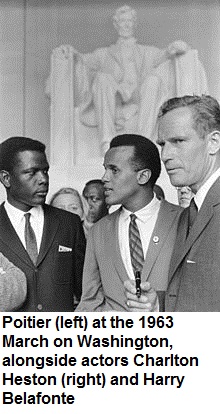
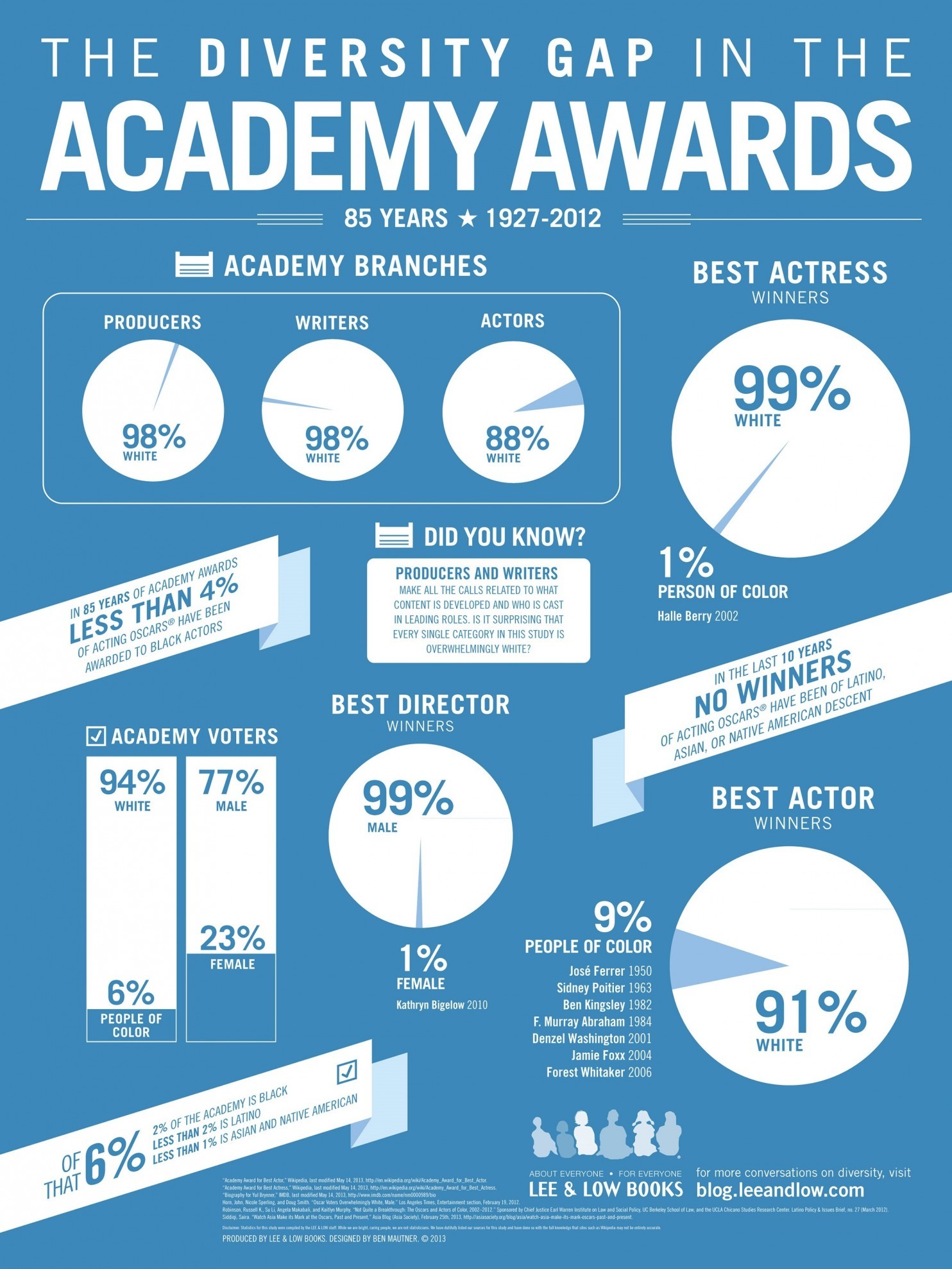
In focus for this commentary is his 1964 Oscar win for the 1963 movie Lilies of the Field. This was a big deal for Sir Sidney and the entire African Diaspora – people of color. Or as the BBC reported then: “he broke new ground”.

No new ground is being broken in Hollywood this year. The biggest stunner of the 2015 Academy Award nominations for films released in 2014 was that not a single actor of color or female director was included, sparking immediate criticism about Hollywood’s failure to include minorities in its most elite ranks. While this is a valid criticism, Hollywood may actually mirror society in general, where minority participation may be lacking in so many attendant functions – senior positions – of this business eco-system.

CU Blog - Downtime with Sir Sidney Poitier - Photo 2

(Click on the Photo to Enlarge)

While there may be some catch-up that this industry must still make, there are times when the movie-business will “boldly go where no one has gone before”. The Sir Sidney 1964 break-through was one such moment.

With a date-of-birth of February 20, 1927 (age 88 on his next birthday), what does this screen legend do on his downtime? In addition to serving as patriarch of his family of 6 daughters and 6 granddaughters, he summons world leaders to him for consultation. (Sir Sidney serves as the Bahamas non-residential Ambassador to Japan). See this VIDEO here of his entertaining the Prime Minister of the Bahamas in a recent visit.

VIDEO – Downtime with Sir Sidney Poitier – http://youtu.be/xYv5QUT_zKI

Published on Jan 21, 2015 – In a special interview with ZNS News, legendary actor Sir Sidney Poitier challenged Bahamian political leaders to take the country to the next level.

The publishers of the book Go Lean…Caribbean recognizes the life contributions of Sir Sidney as an role model for excellence in the arts and also as an advocate of civil rights and social justice. He definitely demonstrates a love for his Caribbean (Bahamas) homeland and seeks to impact its development on the world scene. Though not a direct quotation, he has called for the elevation of Caribbean life and culture. This book serves as a roadmap for the introduction and implementation of the technocratic Caribbean Union Trade Federation (CU) to help the region become a better place to live, work and play. There is a role for the arts (including film-making) in this empowerment roadmap.

Unlike the current dread of “Black and Brown” among the Oscar nominees, the Go Lean roadmap seeks to put Caribbean people in a place of better command-and-control of their circumstances, to develop the community ethos of assisting each other to advance in our own lives, in our individual communities and in the Caribbean as a whole. The book posits that a unified Caribbean Single Market of 42 million people and a GDP of $800 Billion can foster a “domestic” film industry, much like the formations of Bollywood in India (Page 346) and Nollywood in Nigeria. Deeper exploration of this amazing business model (movies/show-business) can create jobs and garner local returns from the necessary investments.

These previous blog/commentaries drilled deeper on this quest to better foster show-business; below are some examples:

https://goleancaribbean.com/blog/?p=3641 ‘We Built This City …’ on Music and Show-business
https://goleancaribbean.com/blog/?p=3568 Forging Change: Music Moves People
https://goleancaribbean.com/blog/?p=3292 Art Basel Miami – a Testament to the Spread of Culture
https://goleancaribbean.com/blog/?p=3078 Bill Cosby – Sir Sidney’s Frequent Co-Star – Accusations abound
https://goleancaribbean.com/blog/?p=2726 Caribbean Role Model for the Arts/Fashion – Oscar De La Renta: RIP
https://goleancaribbean.com/blog/?p=2415 How ‘The Lion King’ roared into history
https://goleancaribbean.com/blog/?p=1909 Role Model Berry Gordy – No Town Like Motown
https://goleancaribbean.com/blog/?p=1037 Humanities Advocate – Maya Angelou: RIP
https://goleancaribbean.com/blog/?p=866 Caribbean Music Man: Bob Marley – The legend lives on!

The quest is to elevate Caribbean society with many industrial developments, including the arts. This was stressed in the opening Declaration of Interdependence (Page 13) with this statement:

xxi. Whereas the preparation of our labor force can foster opportunities and dictate economic progress for current and future generations, the Federation must ensure that educational and job training opportunities are fully optimized for all residents of all member-states, with no partiality towards any gender or ethnic group. The Federation must recognize and facilitate excellence in many different fields of endeavor, including sciences, languages, arts, music and sports. This responsibility should be executed without incurring the risks of further human flight, as has been the past history.

This impact and overall benefit of this roadmap is pronounced in the CU‘s prime directives, identified with these 3 statements:

  • Optimization of the economic engines in order to grow the regional economy to $800 Billion & create 2.2 million new jobs.
  • Establishment of a security apparatus to protect the resultant economic engines.
  • Improvement of Caribbean governance to support these engines.

The roadmap specifically encourages the region, to lean-in and foster the next generation of Sidney Poitier’s with these specific community ethos, strategies, tactics, implementations and advocacies:

Community Ethos – Consequences of Choices Lie in the Future Page 24
Community Ethos – Minority Equalization Page 24
Community Ethos – Cooperatives Page 25
Community Ethos – Ways to Foster Genius Page 27
Community Ethos – Ways to Promote Intellectual Property Page 31
Community Ethos – Ways to Improve Sharing Page 35
Community Ethos – Ways to Promote Happiness Page 36
Community Ethos – Ways to Impact the Greater Good Page 37
Strategy – Celebrate the arts, people and culture of the Caribbean Page 46
Tactical – Separation-of-Powers – Tourism and Film Promotion & Administration Page 78
Implementation – Integration of Region in Single Market of 42 million people Page 95
Anatomy of Advocacies – Ability to Change the World Page 122
Planning – 10 Big Ideas – Caribbean Single Market Page 127
Planning – Ways to Better Manage Image Page 129
Advocacy – Ways to Improve Education – Foster Performing Arts Page 159
Advocacy – Ways to Foster Cooperatives Page 176
Advocacy – Ways to Impact Justice Page 177
Advocacy – Ways to Impact Hollywood Page 203
Advocacy – Ways to Preserve Caribbean Heritage Page 222
Advocacy – Ways to Impact Youth Page 225
Advocacy – Ways to Improve the Arts Page 230
Appendix –  A Summary of Bollywood Movies Page 346

The Go Lean posits that the CU should foster the genius potential in Caribbean artists and incubate the related industries of show-business. The roadmap pronounces that with the participation of many advocates on many different paths for progress, the Caribbean can truly become a better place to live, work and play. We, along with the whole world, owe a debt to Sir Sidney for leading us along this path.

Yes, Hollywood must change and acknowledge more  diversity; but this is out-of-scope for this roadmap. The Caribbean must change … to adapt to a changing world. This is within our scope. While no Caribbean member-state may be able to compete and excel alone, together and collaboratively, we can stand up proud and present the world the beautiful contributions of Caribbean people and art. 🙂

Download the book Go Lean … Caribbean – now!

———

APPENDIX A – Sidney Poitier Honors & Awards

  • 1958 British Academy Film Award for Best Foreign Actor for The Defiant Ones
  • 1958 Silver Bear for Best Actor (8th Berlin Film Festival) for The Defiant Ones[39]
  • 1963 Academy Award (Oscar) for Best Actor in a Leading Role for Lilies of the Field
  • 1963 Golden Globe Award for Best Actor in a Motion Picture Drama for Lilies of the Field
  • 1963 Silver Bear for Best Actor (13th Berlin Film Festival) for Lilies of the Field [40]
  • 1974 Knight Commander of the Order of the British Empire (KBE)
  • 1982 Golden Globe Cecil B. DeMille Award [41]
  • 1992 AFI Life Achievement Award
  • 1995 Kennedy Center Honors
  • 1997 Appointed non-resident Bahamian Ambassador to Japan
  • 1999 SAG Life Achievement Award
  • 2000 NAACP Image Award for Outstanding Actor in a Television Movie, Mini-Series or Dramatic Special for The Simple Life of Noah Dearborn
  • 2001 NAACP Image Award – Hall of Fame Award
  • 2001 Grammy Award for Best Spoken Word Album – Rick Harris, John Runnette (producers) and Sidney Poitier for The Measure of a Man
  • 2002 Honorary Oscar – “For his extraordinary performances and unique presence on the screen and for representing the industry with dignity, style and intelligence”
  • 2009 Presidential Medal of Freedom[42]
  • 2011 Film Society of Lincoln Center Gala Tribute[43] honoring his life and careers

——–

APPENDIX B – * Presidential Medal of Freedom CU Blog - Downtime with Sir Sidney Poitier - Photo 4

This award is bestowed by the President of the United States and is — along with the comparable Congressional Gold Medal, bestowed by an act of U.S. Congress—the highest civilian award of the United States. It recognizes those individuals who have made “an especially meritorious contribution to the security or national interests of the United States, world peace, cultural or other significant public or private endeavors”.[3] (Source:http://en.wikipedia.org/wiki/Presidential_Medal_of_Freedom)


Share this post:
, , ,
[Top]

Google and Mobile Phones – Here comes Change

Go Lean Commentary

The American company Google Inc. is shaking up the telecommunication industry … again. Whereas their structure originated as a software/Search Engine/ICT* company, they have since branched out into wireless/networking and mobile hardware.

Google Phone - Photo 1 JPEG

This is not surprising! Google has been a maverick from the beginning.

Their mission statement from the outset, according to Wikipedia, was …

“to organize the world’s information and make it universally accessible and useful,”[11] and its unofficial slogan was: “Don’t be evil.”[12][13] Rapid growth since incorporation in 1998 (as of January 2014, the market capitalization had grown to $397 billion[60]) has triggered a chain of products, acquisitions and partnerships beyond Google’s core search engine. It offers online productivity software including email (Gmail), a cloud storage service (Google Drive), YouTube video-sharing, an office suite (Google Docs) and a social networking service (Google+). Desktop products include applications for web browsing, organizing and editing photos, and instant messaging. The company leads the development of the Android mobile operating system and the browser-only Chrome OS[15] for a netbook known as a Chromebook. Google has moved increasingly into communications hardware: it partners with major electronics manufacturers [16] in the production of its “high-quality low-cost”[17] Nexus devices and acquired Motorola Mobility in May 2012.[18] Also in 2012, a fiber-optic infrastructure was installed in Kansas City to facilitate a Google Fiber broadband service.[19]

Despite American incorporation, headquarters and funding, Google has a R&D/QA# presence in the Caribbean (Puerto Rico). This is a good start for what the book Go Lean…Caribbean envisions for the Caribbean region. The book describes initiatives from top-to-bottom in the Information Technology/ICT industry space, asserting that the region cannot only consume, but must create, develop and produce as well. So Google is a good role model for the future – yet undefined – industrial expressions in this industry. The book Go Lean…Caribbean, serves as a roadmap for the introduction and implementation of the technocratic Caribbean Union Trade Federation (CU). This CU roadmap is designed to elevate the economic, security and governing engines of Caribbean society; this vision is defined early in the book (Page 14) with the opening Declaration of Interdependence:

xxvii. Whereas the region has endured a spectator status during the Industrial Revolution, we cannot stand on the sidelines of this new economy, the Information Revolution. Rather, the Federation must embrace all the tenets of Internet Communications Technology (ICT) to serve as an equalizing element in competition with the rest of the world. The Federation must bridge the digital divide and promote the community ethos that research/development is valuable and must be promoted and incentivized for adoption.

The Google QA activity is highlighted in the following news article:

Title #1: Google Is Testing Its New Modular Smartphone on this Caribbean Island
By: Caribbean Journal staff – Caribbean Journal – Regional News Site (Posted 01/14/2015; Retrieved 01/27/2015) – http://www.caribjournal.com/2015/01/14/google-is-testing-its-new-modular-smartphone-on-this-caribbean-island/#

Google Phone - Photo 3 NEW

Google’s revolutionary new smartphone project is getting its first test in the Caribbean.

The global tech giant will be launching the pilot test of its Project Ara smartphone in the Puerto Rico market, the company announced Wednesday.

Project Ara is a modular smartphone, which allows users to swap out individual components of the phone, from the camera to the speaker to the lights.

The aim is a totally customizable phone — almost turning the phone into a collection of “physical” apps.

“A phone is part of it. Part of it is a phone,” is how Project Ara describes it.

Project Ara is part of Google’s Advanced Technology and Projects Group. The phone will run the Android operating system.

Google Phone - Photo 1

Pricing is not yet known.

See more in the video below:

VIDEO: Project Ara: Part of it – http://youtu.be/intua_p4kE0 – Published on Jan 14, 2015

There is an obvious advantage to testing a revolutionary product in a place like Puerto Rico: it is homogenous. Everyone on the island meets a certain consistent profile, an adequate educational accomplishment, American cultural assimilation, bilingual efficiency. If the Google test is successful here, then the product will be proven for the entire Western Hemispheric market. This Google Ara phone should emerge from these tests as a “lean”-mean consumer machine, ready to shock the world of mobile communications – here comes change!

The concept of “lean” is very prominent in the Go Lean book (and movement), even adapting the title, Go Lean, for the quest for excellence in Caribbean economic empowerment and governing efforts. The label “lean” is indicative of this quest; the word is used as a noun, a verb and an adjective. This point is pronounced early in the book (Page 4) with these statements:

The CU will lean on, lean in, lean over backwards, and then lean towards…

The CU will embrace lean, agile, efficient organization structures – more virtual, less physical, more systems, less payroll.

This following news article demonstrates Google’s next strategic step, establishing more of a footprint in the North American mobile communications market. See story here:

Title # 2: Google Inc Could Wreak Havoc on Its New Wireless Partners
By: Adam Levy, January 27, 2015

Google Phone - Photo 4If you’re looking to switch wireless carriers, you may soon have another option.

Google is reportedly working on a mobile virtual private network, or MVNO, that uses access to the Sprint (NYSE: S ) and T-Mobile (NYSE: TMUS ) wireless networks. While the agreement with Google will generate additional revenue for the wireless carriers, it represents a serious threat to their core businesses.

With a price war already in full swing among the major industry players and the cost of airwave spectrum rising well above expectations, Google could cause more headaches for Sprint and T-Mobile than it’s worth.

Selling excess capacity
MVNO agreements are typically very valuable for carriers, as they can sell excess capacity and achieve high margins without the need to do any sales or marketing work — this Google deal is no exception. Macquarie Securities analyst Kevin Smithen believes the search giant could pay out $1 billion in service fees to the carriers in 2018.

Both companies have plenty of spare capacity, too. T-Mobile CTO Neville Ray told investors earlier this month that it has more spectrum per subscriber than both of its largest rivals. Sprint, however, has even more excess capacity, which leads Smithen to predict it will take about three-fourths of Google’s MVNO business.

Those revenues will allow Sprint and T-Mobile to reinvest in their networks, which will help attract new customers and prevent current customers from leaving. On the flip side, any improvements to their networks will also improve the Google service making it even more attractive.

And there lies the big risk
While Google’s plans are still extremely vague, it seems like the biggest goal is to make wireless data networks fast and cheap. To that end, it makes sense for Google to offer a high-value option through its MVNO, similar to what it has accomplished with the rollout of Google Fiber.

Google can afford to offer things like unlimited high-speed data at near cost — the company is expected to pay $2 per GB — because it makes money almost any time a smartphone user accesses the Web. Google took an estimated 37% of total mobile ad spending last year, so it stands to gain from making data access as inexpensive as possible.

While Sprint and T-Mobile have done a good job undercutting the competition on price, Google could do so even further.

The risk seems greater for Sprint, which appears to have little to compete on besides price. T-Mobile is more focused on providing a valuable customer experience for its subscribers with the Un-Carrier initiatives to differentiate itself. Of course, there is little holding Google back from offering similar perks as the Un-Carrier (potentially with a focus on Google services like YouTube and Google Play).

The Wall Street Journal reports that Sprint has put limits in place to prevent the Google MVNO from growing too large. That should be a smart move considering the carrier is likely to lose at least some customers to the new service. There is no indication, however, that such a stipulation exists in the T-Mobile agreement.

Still, if Google hits that volume trigger, there is little stopping the company from licensing capacity from another network. And there is no guarantee that if Google’s network coverage suffers, customers will leave for Sprint — the company is best off renegotiating at the best rate it can get at that point.

A prisoner’s dilemma
With significant risk involved in allowing Google into the wireless market, the only explanation for why Sprint or T-Mobile would agree to license their capacities is that Google played one off the other. Thinking it would be better to at least get something out of the deal than to just lose customers to another Google upstart, both companies agreed to a deal. The fact that Google will rely on their networks should neutralize most of the potential impact from the new service.

Source: Motley Fool Investor Advisory Site (Retrieved 01/27/2015) –
http://www.fool.com/investing/general/2015/01/27/google-inc-could-wreak-havoc-on-its-new-wireless-p.aspx

From being non-existent 20 years ago to now executing a strategy to dominate the mobile communication eco-system, shows how quickly a well-executed roadmap can impact the world.

This lends confidence to the viability of the revolutionary changes being proposed by the Go Lean roadmap. We can succeed in transforming our society in short order; the roadmap is a 5 year plan. Previous blogs/commentaries also exclaimed societal benefits from pursuits in the fields of Science, Technology, Engineering and Mathematics (STEM). Consider this sample of previous blogs:

https://goleancaribbean.com/blog/?p=3915 ‘Change the way you see the world; you change the world you see’
https://goleancaribbean.com/blog/?p=3889 RBC EZPay and other Banking Automations – Ready for Change
https://goleancaribbean.com/blog/?p=3490 How One STEM Entrepreneurial Start-up Can Rally a Whole Community
https://goleancaribbean.com/blog/?p=3276 STEM/Medical Role Model Shaking Up the World of Cancer
https://goleancaribbean.com/blog/?p=3187 Robots help Amazon tackle and dominate Cyber Monday
https://goleancaribbean.com/blog/?p=2488 Role Model Jack Ma brings Alibaba to America
https://goleancaribbean.com/blog/?p=2126 Where the Jobs Are – Computers Reshaping Global Job Market
https://goleancaribbean.com/blog/?p=1743 Google and Novartis to develop ‘smart’ contact lens
https://goleancaribbean.com/blog/?p=1698 STEM Jobs Are Filling Slowly
https://goleancaribbean.com/blog/?p=1416 Amazon’s new FIRE Smartphone
https://goleancaribbean.com/blog/?p=1277 The need for highway safety innovations –   here comes Google
https://goleancaribbean.com/blog/?p=888 Book Review: ‘Citizenville – Take the Town Square Digital & Reinvent Govt’
https://goleancaribbean.com/blog/?p=554 Cuban cancer medication registered in 28 countries
https://goleancaribbean.com/blog/?p=308 CARCIP Urges Greater Innovation

The Go Lean book posits that technology and ICT can level the playing field of competition and trade with the rest of the world. Surely this entire Google commentary demonstrates the advantage of leading with technological innovations. We do not have to be in Silicon Valley to have an impact. No, an innovator can be on a beach in the Caribbean homeland, with a great idea and support of his community. “Lightning in a bottle” is a valid analogy.

The Go Lean book details a series of community ethos, strategies, tactics, implementations and advocacies to foster great contributions from Caribbean technology innovators. The list is as follows:

Community Ethos – Deferred Gratification Page 21
Community Ethos – People Respond to Incentives Page 21
Community Ethos – Economic Systems Influence Individual Choices Page 21
Community Ethos – Consequences of Choices Lie in the Future Page 21
Community Ethos – Job Multiplier Page 22
Community Ethos – Governing Principle – Lean Operations Page 24
Community Ethos – Governing Principle – Return on Investments Page 24
Community Ethos – Ways to Impact the Future Page 26
Community Ethos – Ways to Foster Genius Page 27
Community Ethos – Ways to Help Entrepreneurship Page 28
Community Ethos – Promote Intellectual Property Page 29
Community Ethos – Ways to Impact Research & Development Page 30
Community Ethos – Ways to Bridge the Digital Divide Page 31
Community Ethos – Ways to Impact the Greater Good Page 37
Strategy – Mission – Exploit Globalization – Producers & Consumers Page 46
Strategy – Agents of Change – Technology Page 57
Strategy – Agents of Change – Globalization Page 57
Tactical – Fostering a Technocracy Page 64
Tactical – Separation of Powers Page 71
Implementation – Ways to Pay for Change Page 101
Implementation – Ways to Deliver Page 109
Implementation – Ways to Impact Social   Media Page 111
Planning – Big Ideas – Cyber Caribbean Page 127
Planning – Ways to Make the Caribbean Better Page 136
Advocacy – Ways to Grow the Economy Page 151
Advocacy – Ways to Create Jobs Page 152
Advocacy – Ways to Improve Education – STEM Promotion Page 159
Advocacy – Ways to Foster Technology Page 197
Advocacy – Ways to Foster e-Commerce Page 198
Advocacy – Ways to Impact Main Street – Mobile Apps: Time and Place Page 201
Advocacy – Ways to Impact Youth Page 227
Appendix – CU Job Creations Page 257
Appendix – Copyright Infringement – Protecting Intellectual Businesses Page 351

Now is the time for all of the Caribbean to lean-in for the empowerments in the book Go Lean … Caribbean. This is a big deal for the region. The benefits are simply too alluring to not commit to this cause:

  • Optimization of the economic engines; growing the regional economy to $800 Billion & creating 2.2 million new jobs.
  • Establishment of a security apparatus to protect the resultant economic engines.
  • Improvement of Caribbean governance to support these engines.

The region needs this delivery. Without the equalizing effects of technology/ICT, we will be rendered inconsequential on the world scene. No wait: we are already! For this reason, we cannot and have not been able to retain our young people to commit to their Caribbean homeland, but rather we are only “fattening frogs for snake”.

This roadmap declares: Enough already – time for a change!

Now is the time to deliver the Caribbean as a better place to live, work and play… for today and for the future. 🙂

Download the book Go Lean … Caribbean – now!

————

Source References:

* ICT = Internet Communications Technologies

# QA = Quality Assurance – the cycles and processing to testing the quality on hardware, software and services.

Share this post:
, ,
[Top]

‘Change the way you see the world; you change the world you see’

Go Lean Commentary

- Photo 1

Drawing reference to this quotation:

“No flying cars, no dinners in a pill, and certainly no cool rocketing off to space cities in the required outfit of the future. We seem to have failed the expectations of the most wild-eyed seers from the past – futurologists who were for the most part in love with a supercharged, technologically sexy future where science would free us from the daily grind, for holidays on the moon or underseas. But here we remain, plodding along … in a familiar world that is neither utopia nor dystopia.” – Go Lean…Caribbean (Page 26)

As evident in the above quotation, the Go Lean book focuses heavily on the future. But now that it is 2015, many people are disappointed that the future they had envisioned has not materialized. “The future ain’t what it used to be” – the book quotes this phrase as originating from Yogi Berra, the iconic Baseball Hall-of-Famer known for his eclectic phraseology.

There are many organizations that are focusing on future innovations, one of them is computer software giant Microsoft. As follows is a VIDEO featuring the company’s new hologram offering. This will change the way we see the world and with it we can change the world we see.

This quest aligns with the Go Lean book, in its mission to change the Caribbean, to elevate its society by optimizing the economic, security and governing engines. See this related VIDEO:

VIDEO – Microsoft HoloLens Review, mind blowing Augmented Reality! – https://youtu.be/ihKUoZxNClA

Published on Jul 21, 2016 – Microsoft HoloLens review, AR- mind blowing! By James Mackey!

My expectations were already high, but when I tried the HoloLens, my mind was blown at how outrageously good it is.

I show you Microsoft Office 365 running through my HoloLens, accessing Excel and Word as Holograms. I then access Microsoft Edge for web browsing plus YouTube, just incredible; AR for business.

I run some extremely cool HoloLens apps such as LSrD (wow, imagine the DMT trips you could simulate on this!) and then Galaxy Explorer to see our Solar System including the Sun and Saturn at very close up range.

I then run a Beta 3D simulation of a shark, once again, absolutely incredible. I zoom into the shark hologram whilst it’s swimming around my living room.

It’s without doubt the hand gestures need some work as it’s hard to manipulate objects when at a distance. The only other problem is the field of view is small, but once this has been resolved through future iterations of the HoloLens, AR is set to change the world.

Then, to go a step further with my futurist hat on, consider the Softcell Lens (AR in a contact Lens) and the EyeTap and the future really looks exciting, I see AR impacting every part of our lives. If we want it to of course.

I also link to my blog in the video where I discuss AR street dating, volumetrically captured video conferencing, AR shopping, facial and emotion recognition, and much more; http://www.mackie.xyz/james-mackie-pu…

I discuss emails, text messages and phone calls delivered through AR, the replacement / death of mobile phones and the personal computer. Death of the mouse & keyboard, eye-tracking, field of view, Adaptive Focus (Magic Leap) and even, imaginary friends!

AR | HoloLens | Microsoft HoloLens | Augmented Reality | futurist

The book Go Lean…Caribbean champions the cause of building and optimizing the Caribbean eco-system. There are a lot of expectations for technology in the region, to aid and assist with all aspects of the Go Lean prime directives, defined as follows:

  • Optimization of the economic engines in order to grow the regional economy to $800 Billion & create 2.2 million new jobs.
  • Establishment of a security apparatus to protect the resultant economic engines.
  • Improve Caribbean governance to support these engines.

The book serves as a roadmap for the introduction and implementation of the Caribbean Union Trade Federation (CU), a technocratic federal government to administer and optimize the economic/security/governing engines in the homeland of the region’s 30 member-states. The CU strives to elevate all of Caribbean society and culture. The Go Lean…Caribbean clearly recognizes that holograms will contribute to cultural development of any society. The Caribbean does not only want to be on the consuming end of these developments; we want to create, develop and contribute to the innovations. This starts by fostering genius in Caribbean stakeholders who demonstrate competence in Science, Technology, Engineering and Mathematics (STEM). This may apply more to the youth markets.

At the outset, the Go Lean roadmap recognizes the value of harnessing STEM career options. This intent was pronounced early in the book with these statements in the Declaration of Interdependence (Page 12 & 14):

xiii.   Whereas the preparation of our labor force can foster opportunities and dictate economic progress for current and future generations, the Federation must ensure that educational and job training opportunities are fully optimized for all residents of all member-states, with no partiality towards any gender or ethnic group. The Federation must recognize and facilitate excellence in many different fields of endeavor, including sciences, languages, arts, music and sports. This responsibility should be executed without incurring the risks of further human flight, as has been the past history.

xxvi.  Whereas the Caribbean region must have new jobs to empower the engines of the economy and create the income sources for prosperity, and encourage the next generation to forge their dreams right at home, the Federation must therefore foster the development of new industries, like that of ship-building, automobile manufacturing, prefabricated housing, frozen foods, pipelines, call centers, and the prison industrial complex. In addition, the Federation must invigorate the enterprises related to existing industries like tourism, fisheries and lotteries – impacting the region with more jobs.

xxvii. Whereas the region has endured a spectator status during the Industrial Revolution, we cannot stand on the sidelines of this new economy, the Information Revolution. Rather, the Federation must embrace all the tenets of Internet Communications Technology (ICT) to serve as an equalizing element in competition with the rest of the world. The Federation must bridge the digital divide and promote the community ethos that research/development is valuable and must be promoted and incentivized for adoption.

xxviii. Whereas intellectual property can easily traverse national borders, the rights and privileges of intellectual property must be respected at home and abroad. The Federation must install protections to ensure that no abuse of these rights go with impunity, and to ensure that foreign authorities enforce the rights of the intellectual property registered in our region.

xxx.   Whereas the effects of globalization can be felt in every aspect of Caribbean life, from the acquisition of food and clothing, to the ubiquity of ICT, the region cannot only consume, it is imperative that our lands also produce and add to the international community, even if doing so requires some sacrifice and subsidy.

The hologram system in the foregoing VIDEO is a combination of hardware and software, an appliance from Microsoft. But according to their press release, Independent Software Vendors will be partnering with Microsoft to develop and deploy software solutions. The Go Lean roadmap posits that the Caribbean must contribute software solutions for applications in this industry space. We cannot only consume; so a recommended community ethos for the region to adapt, “Return on Investments” (Page 24), calls for embedding incentives and inducements to encourage students and apprenticeships in this field. Imagine forgive-able student loans, on-the-job training employment contracts, paid internships, signing bonuses, etc. This ethos also translates into governing principles for federally sponsored business incubators, R&D initiatives, grants, entrepreneurship programs and the regional implementation of Self-Governing Entities (SGE).

The book estimates 64,000 new direct and indirect technology/software jobs in the Caribbean marketplace.

The Go Lean roadmap was constructed with the community ethos in mind to forge change and build up communities, plus the execution of related strategies, tactics, implementations and advocacies to make the change permanent. The following is a sample of these specific details from the book:

Community Ethos – Deferred Gratification Page 21
Community Ethos – Economic Principles – People Choose Page 21
Community Ethos – Economic Principles – People Respond to Incentives in Predictable Ways Page 21
Community Ethos – Economic Principles – The Consequences of Choices Lie in the Future Page 21
Community Ethos – Economic Principles – Job Multiplier Page 22
Community Ethos – Governing Principles – Lean Operations Page 24
Community Ethos – Ways to Impact the Future Page 26
Community Ethos – Ways to Foster Genius Page 27
Community Ethos – Ways to Promote Intellectual Property Page 29
Community Ethos – Ways to Impact Research & Development Page 30
Community Ethos – Ways to Bridge the Digital Divide Page 31
Community Ethos – Ways to Impact Turn-Around Page 33
Community Ethos – Ways to Promote Happiness Page 36
Community Ethos – Ways to Impact the Greater Good Page 37
Strategy – Vision – Confederate 30 Member-States Page 45
Strategy – Vision – Invite Diaspora Back to the Caribbean Homeland Page 46
Strategy – Mission – Exploit the benefits and opportunities of globalization Page 46
Tactical – Confederating a Permanent Union Page 63
Tactical – Fostering a Technocracy Page 64
Implementation – Ways to Pay for Change Page 101
Implementation – Steps to Implement Self-Governing Entities Page 105
Implementation – Trends in Implementing Data Centers – Creating the ‘Cloud’ Page 106
Implementation – Ways to Deliver Page 109
Implementation – Ways to Impact Social Media – Caribbean Cloud Page 111
Implementation – Reasons to Repatriate to the Caribbean Page 118
Planning – 10 Big Ideas for the Caribbean Region – Cyber-Caribbean Page 127
Planning – Ways to Make the Caribbean Better Page 136
Advocacy – Ways to Grow the Economy Page 151
Advocacy – Ways to Create Jobs Page 152
Advocacy – Ways to Improve Education – STEM Promotion Page 159
Advocacy – Ways to Improve Governance – e-Government & e-Delivery Page 168
Advocacy – Ways to Improve Communications Page 186
Advocacy – Ways to Enhance Tourism – Internet Marketing Page 190
Advocacy – Ways to Foster Technology Page 197
Advocacy – Ways to Foster e-Commerce Page 198
Advocacy – Ways to Impact Main Street Page 201
Advocacy – Ways to Impact Youth Page 227
Advocacy – Ways to Improve the Arts Page 230
Appendix – CU Job Creations Page 257
Appendix – Copyright Infringement – Protecting Intellectual Businesses Page 351

This Go Lean roadmap calls for the heavy-lifting to build-up Caribbean communities, to shepherd important aspects of Caribbean life, so as to better prepare for the future, dissuade emigration and encourage repatriation.

These goals were previously featured in Go Lean blogs/commentaries, as sampled here:

https://goleancaribbean.com/blog/?p=3641 ‘We Built This City … on Music, Entertainment and Leisure Businesses’
https://goleancaribbean.com/blog/?p=3490 How One Internet Entrepreneur Can Rally a Whole Community
https://goleancaribbean.com/blog/?p=3384 Plea to Detroit: Less Tech, Please
https://goleancaribbean.com/blog/?p=3187 Robots help Amazon tackle Cyber Monday
https://goleancaribbean.com/blog/?p=2953 Funding Caribbean Entrepreneurs – The ‘Crowdfunding’ Way
https://goleancaribbean.com/blog/?p=2126 Where the Jobs Are – Computers Reshaping Global Job Market
https://goleancaribbean.com/blog/?p=1698 STEM Jobs Are Filling Slowly
https://goleancaribbean.com/blog/?p=1487 Here come the Drones … and the Concerns
https://goleancaribbean.com/blog/?p=1416 Amazon’s new FIRE Smartphone
https://goleancaribbean.com/blog/?p=1277 The need for highway safety innovations – here comes Google
https://goleancaribbean.com/blog/?p=673 Ghost Ships Emergence – Autonomous cargo vessels without a crew
https://goleancaribbean.com/blog/?p=308 CARCIP Urges Greater Innovation

The Go Lean book focuses primarily on economic issues, and it recognizes that computer hardware, software and appliances, like the hologram system in the foregoing VIDEO, is the future direction for industrial developments. This is where the jobs are to be found. The Go Lean roadmap describes the heavy-lifting for people, organizations and governments to forge these innovations here at home in the Caribbean. The Caribbean is no Silicon Valley nor Silicon Beach, but a nascent industry can still be fostered and nurtured into fruition.

A Big Dream? No, this is a conceivable, believable and achievable business plan. The Go Lean book offers the turn-by-turn directions for strategies, tactics and implementations. With the right commitment of time, talent and treasuries, we can make the region a better place to live, work and play. 🙂

Download the free e-Book of Go Lean … Caribbean – now!

Share this post:
, , , , ,
[Top]

RBC EZPay – Ready for Change

Go Lean Commentary

It’s time to introduce the Caribbean Dollar (C$) as a regional currency. Though there will be coins and notes, the primary focus will be on electronic transactions. This is the future!

Electronic Payments schemes (card-based & internet) are very important in the strategy to elevate the Caribbean economy, bring change and empower people, process and profits.

According to the subsequent news article, the regional banks – in this case the Royal Bank of Canada (RBC) – are ready for this change.

CU Blog - RBC EZPay - Ready for Change - Photo 3Roseau, Dominica – RBC Royal Bank today unveiled its new RBC EZ Pay Wireless Terminals, a wireless device that can be used to complete credit card transactions anywhere where a cellular phone can be used.

“This product is ideal for car rental companies, as well as for use at restaurants, tour and taxi operators, local outdoor markets, trade shows and even community and festive events,” said Mr. Yuri Lazare, Country Head, Dominica. “We are proud to be the pioneers of this technology in Dominica, providing a payment solution that is limitless in terms of where it can be used; effortless in that it is so easy to set up and use; and completely wireless, allowing merchants to accept payments wherever their customers are.”

RBC is the first financial services company in Dominica to offer this innovative product, which has many features. RBC EZ Pay is a high-speed, cordless point-of-sale terminal with an integrated antenna and printer. It has the ability to process Visa, MasterCard, Diners Club and Discover credit cards. It also has a backlit display, a secure network and a rechargeable/removable battery.

CU Blog - RBC EZPay - Ready for Change - Photo 1“Retailers who have previewed the RBC EZ Pay Wireless Terminal like it because it provides flexibility to set up temporary payment locations, such as at sidewalk sales and special events. The device also gives restaurant owners the flexibility to take payment from their customers wherever they are seated, even on outdoor patios or bars,” said Dave Legge, Manager for Commercial Financial Services, Eastern Caribbean. “With this system, car rental companies and other on-the-go vendors can now accept credit payments, which can help expand their business.”

This new product launch continues the long tradition of leadership that RBC has displayed in Dominica.  “In March this year, RBC celebrated 95 continuous years of doing business in Dominica and we look forward to continuing this partnership for many years to come” said Mr. Yuri Lazare, Country Head Dominica. “We appreciate the many opportunities we have had to play a role in the national development of the country.  Today’s launch is historic and evidence of our dedication to delivering innovative product solutions that create an environment in which Dominicans can maximize their entrepreneurial potential.”

Business persons interested in learning more about this new product and obtaining pricing can visit our Roseau branch or call Ermine Darroux at 255 – 1803.
Dominica News Online – Website for Daily Newspaper- (Posted 06/11/2010; Retrieved 01/23/2015) –
http://dominicanewsonline.com/news/homepage/news/business/rbc-unveils-rbc-ez-pay-wireless-terminals/

This point is detailed in the book Go Lean…Caribbean, a roadmap for the introduction of the Caribbean Union Trade Federation (CU) and the Caribbean Central Bank (CCB). This Go Lean roadmap has 3 prime directives:

  • Optimization of the economic engines in order to grow the regional economy to $800 Billion & create 2.2 million new jobs.
  • Establishment of a security apparatus to protect the resultant economic engines.
  • Improve Caribbean governance to support these engines.

This Go Lean/CU/CCB roadmap looks to employ electronic payments schemes to impact the growth of the regional economy. There are two CU schemes that relate to this foregoing news story, as they require the demonstrated POS terminals:

  • Cruise Passenger Smartcards – The Go Lean roadmap posits that the cruise industry needs the Caribbean more than the Caribbean needs the industry. But the cruise lines have embedded rules/regulations designed to maximize their revenues at the expense of the port-side establishments. The CU solution is to deploy a scheme for smartcards that function on the ships and at the port cities.
  • e-Commerce Facilitation – The Go Lean roadmap defines that the Caribbean Dollar (C$) will be mostly cashless, an accounting currency. So the Caribbean Central Bank (CCB) will settle all C$ electronic transactions (MasterCard-Visa style or ACH style) and charge interchange/clearance fees. This scheme allows for the emergence of full-throttle e-Commerce activities.

The focus of these schemes is not technology, its economics.  These electronic payments provide the impetus for M1, the economic measurement of currency/money in circulation (M0) plus overnight bank deposits. As M1 values increase, there is a dynamic to create money “from thin-air”, called the money multiplier. The more money in the system, the more liquidity for investment and industrial expansion opportunities.

An additional economic benefit is the mitigation of Black Market “under-the-table” transactions that proliferate in a cash-only environment. These neutralize government revenue schemes: sales tax, VAT, etc.

CU Blog - RBC EZPay - Ready for Change - Photo 2Though the foregoing article refers to the Royal Bank of Canada, the currency in focus here is not the Canadian dollar, but rather the new Caribbean dollar. This Canadian bank, along with others – Bank of Nova Scotia, Canadian Imperial Bank of Commerce (CIBC) / FirstCaribbean – support local currencies, like the Bahamian dollars, Jamaican dollars, T&T dollars, etc. In fact, in whichever country RBC operates, they transact in local currency. The Go Lean roadmap calls for that same participation with the new C$ regional currency.

If the Caribbean member-states already have currencies, why is there the need to transform to a new currency regime?

The Go Lean book posits that the Caribbean is in crisis, and that this “crisis is a terrible thing to waste”. The region has been devastated by currency mis-management over the decades; (for example, the Jamaica dollar was trading 87-to-1 at the end of 2009 and conditions have only worsened since then). In most cases, local Caribbean currencies have been pegged to the US Dollar, but even American stewardship have hurt Caribbean fortunes, the dollar has lost value compared to other bread-basket currencies (Euros, British Pound Sterling, Swiss Franc, Japanese Yen, Chinese Yuan, etc.), meaning that the global buying power has dwindled more and more for the average Caribbean resident due to no fault of his own. These internal and external currency factors have contributed to the Caribbean economic crisis, and the urgent need for reform, re-boot and remediation.

The book posits that to adapt and thrive in the new global marketplace there must be more strenuous management, technocratic optimizations, of the region’s currencies. This is the charge of Go Lean roadmap, opening with the Declaration of Interdependence (Page 13) and these pronouncements:

xxiv.    Whereas a free market economy can be induced and spurred for continuous progress, the Federation must install the controls to better manage aspects of the economy: jobs, inflation, savings rate, investments and other economic principles. Thereby attracting direct foreign investment because of the stability and vibrancy of our economy.

xxv.    Whereas the legacy of international democracies had been imperiled due to a global financial crisis, the structure of the Federation must allow for financial stability and assurance of the Federation’s institutions. To mandate the economic vibrancy of the region, monetary and fiscal controls and policies must be incorporated as proactive and reactive measures. These measures must address threats against the financial integrity of the Federation and of the member-states.

Creating the CU/CCB governance is “Step One, Day One” in the Go Lean roadmap. The strategy is to implement the bank and C$ currency with the appropriate regulatory framework, tools and infrastructure, to facilitate the electronic schemes identified above.

The foregoing article, demonstrates that this regional bank (RBC) is ready for this change, but evidence abounds that the other banks are equally competitive. See VIDEO sample below for the bank-neutral “The Square Credit Card Reader”.

The Go Lean book details a series of community ethos, strategies, tactics, implementations and advocacies to foster the proper controls for electronic payments/virtual money in the Caribbean region:

Community Ethos – Economic Principles Page 21
Community Ethos – Money Multiplier Principle Page 22
Community Ethos – “Light Up the Dark Places” Page 23
Community Ethos – Lean Operations Page 24
Community Ethos – Cooperatives Page 25
Community Ethos – Ways to Impact the Future Page 26
Community Ethos – Promote Intellectual Property Page 29
Community Ethos – Ways to Bridge the Digital Divide Page 31
Tactical – Separation of Powers – Central Banking Page 73
Implementation – Assemble Central Bank Cooperative Page 96
Implementation – Ways to Deliver Page 109
Implementation – Ways to Impact Social Media Page 111
Planning – Ways to Better Manage Image Page 129
Anecdote – Caribbean Currencies Page 149
Advocacy – Ways to Mitigate Black Markets Page 165
Advocacy – Ways to Foster Cooperatives Page 176
Advocacy – Ways to Impact Cruise Tourism – Smartcard scheme Page 193
Advocacy – Ways to Foster Technology Page 197
Advocacy – Ways to Foster e-Commerce Page 198
Advocacy – Reforms for Banking Regulations Page 199
Appendix – Alternative Remittance Modes Page 270

The points of effective, technocratic banking/currency stewardship, were further elaborated upon in these previous blog/commentaries:

https://goleancaribbean.com/blog/?p=3814 Lessons from the Swiss unpegging the franc
https://goleancaribbean.com/blog/?p=3582 For Canadian Banks: Caribbean is a ‘Bad Bet’
https://goleancaribbean.com/blog/?p=3090 Lessons Learned – Europe Sovereign Debt Crisis of 2009
https://goleancaribbean.com/blog/?p=2930 ‘Too Big To Fail’ – Caribbean Version
https://goleancaribbean.com/blog/?p=2074 MetroCard – Model for the Caribbean Dollar
https://goleancaribbean.com/blog/?p=1350 PayPal expands payment services to 10 markets
https://goleancaribbean.com/blog/?p=906 Bitcoin virtual currency needs regulatory framework to change image
https://goleancaribbean.com/blog/?p=833 One currency, divergent economies

There are so many benefits to deploying the e-Payment functionality of the C$:

  • More Cruise Tourism Spending
  • Fostering e-Commerce
  • Increase of M1
  • Mitigation of Black Markets

Now is the time for all of the Caribbean, the people, the banking establishments and governing institutions, to lean-in for these empowerments described in the Go Lean/CU/CCB roadmap. The benefits are too alluring, and far overdue, a better place to live, work and play. 🙂

Download Go Lean … Caribbean – now!

——-

VIDEO – How To Use The Square Credit Card Reader With Your Phone. Get It For Free. http://youtu.be/-RtmHsLxcrA

Published on Jun 28, 2014 – Using The Reader. Take Credit Card Payments With Your Phone. Signing up, getting and how to use the Square credit card reader by Square Up with a Samsung Galaxy Note III. Tutorial. Great for small businesses.

Share this post:
, , , , ,
[Top]

NEXUS: Facilitating Detroit-Windsor Commerce

Go Lean Commentary

Trade and location go hand in hand. Until globalization took root, the quest was always to do business in a nearby marketplace. Even now there is a Green Conservation movement to return to those principles, to minimize energy usage by growing most foods locally and consuming locally. This move uses the tagline: Think Global, Buy Local!

In Marketing 101, a basic tenet is “location, location, location”.

But what if that location is at the cross-roads of countries, borders and independent states?

The same precepts should apply, only with more coordination.

This is a lesson learned from the Detroit-Windsor metropolitan area; but this lesson is fitting for application throughout the Caribbean.

This consideration by the publishers of the book Go Lean … Caribbean, a roadmap for the Caribbean Union Trade Federation (CU), is a continuation of the effort to “observe and report” on the turn-around of the once great City of Detroit. Previous commentaries alluded that transportation options are critical to this metropolitan’s area’s revitalization. Now that consideration extends across the international border for the US and Canada. Detroit aligns the west-side of the Detroit River (see Appendix below); the east-side is the City of Windsor in the Canadian Province of Ontario. Despite the two cities and two countries, this area is actually just one “single market”.

The vision of the Go Lean roadmap is a “single market” out of all the Caribbean 30 member-states of independent countries and overseas territories. Since so many individual states are in close-proximity with other states, many times of different jurisdiction and even language, cross border coordination is fitting for deployment within this region. Consider these examples:

  • Haiti – Dominican Republic: Shared island with a border
  • St. Martin – Saint Maarten: Shared island with a border
  • Lesser Antilles: Neighboring islands, 30 to 40 miles apart
  • Trinidad – Venezuela: 7 mile strait
  • US – British Virgin Islands: 6 Major Islands 30 to 40 miles apart

The Go Lean roadmap calls for the deployment of ferries, railroads, tunnels, bridges, causeways, light-rail streetcars, natural-gas powered vehicles/buses and toll roads, all part of the effort to empower the region through transit (Page 205).

In order to facilitate commerce between the Caribbean member-states, there is the need to efficiently and effectively process Customs and Border Inspections. The Detroit-Windsor model furnishes a great example of pre-registering stakeholders as “Known Travelers” and then allowing this efficient border crossing system branded as NEXUS. See details here of the program and aligned products/features (NEXPRESS Toll Cards/Transponders and DWT Mobile App):

NEXUS
The NEXUS alternative inspection program has been completely harmonized and integrated into a single program. NEXUS members now have crossing privileges at air, land, and marine ports of entry. Under the Western Hemisphere Travel Initiative, the NEXUS card has been approved as an alternative to the passport for air, land, and sea travel into the United States for US and Canadian citizens.

The NEXUS program allows pre-screened travelers expedited processing by United   States and Canadian officials at dedicated processing lanes at designated northern border ports of entry, at NEXUS (CA Entry) and Global Entry (US Entry) kiosks at Canadian Preclearance airports, and at marine reporting locations. Approved applicants are issued a photo-identification, proximity Radio Frequency Identification (RFID) card. Participants use the three modes of passage where they will present their NEXUS card, have their iris scanned, or present a WHTI (Western Hemisphere Travel Initiative) and make a declaration.

U.S. Customs and Border Protection (CBP) and Canada Border Services Agency (CBSA) are cooperating in this venture to simplify passage for pre-approved travelers.

What are the Benefits of NEXUS?
Individuals approved to participate in NEXUS receive an identification card that allows them to:

  • Receive expedited passage at NEXUS-dedicated lanes, airport kiosks, and by calling a marine telephone reporting center to report their arrival into the United States and Canada; and
  • Cross the border with a minimum of customs and immigration questioning

NEXUS applicants only need to submit one application and one fee. Applicants may apply on-line via the CBP Global On-Line Enrollment System (GOES) Web site. Qualified applicants are required to travel to a NEXUSEnrollmentCenter for an interview. If they are approved for the program at that time, a photo identification card will be mailed to them in 7-10 business days. NEXUS allows United States and Canadian border agencies to concentrate their efforts on potentially higher-risk travelers and goods, which helps to ensure the security and integrity of our borders.

How Do I Apply?

Applications can be submitted using the CBP on-line application system, Global On-Line Enrollment System (GOES), or to one of the Canadian Processing Centers (CPC), along with photocopies of their supporting documentation and the US $50 or CN $50 application-processing fee.

(Source: http://www.cbp.gov/travel/trusted-traveler-programs/nexus)

————
NEXPRESS
As a NEXPRESS TOLL card holder you can take advantage of dedicated lanes, express toll lanes and expedited crossing-service to get to your destination faster.

o Travel to Caesars Windsor, Detroit Tigers baseball, Red Wings hockey, and other attractions… fast.

Are you commuting to work, visiting top restaurants, gaming in the Detroit Casinos and/or Caesars Windsor [Casino], attending your favorite sporting events and attractions, or just visiting family and friends?

No matter the destination, we’ll try to get you there as fast as possible.

Located between Detroit, Michigan and Windsor, Ontario, our tunnel connects the U.S. interstates to Ontario’s Highway 401. In fact, the Detroit Windsor Tunnel provides one of the fastest links between Canada and the United States.

o Use our expanded inspections facilities that ease the Customs and Immigration process.

As part of the U.S.Western Hemisphere Travel Initiative (WHTI), the United States requires that all travelers, including U.S. and Canadian citizens, present a specific document to enter the United States by air, land or water:

  • A valid Passport, a Passport Card, a Nexus card, or
  • An Enhanced Michigan Driver’s License, a FAST Card
  • Commercial Carriers

Have you replaced your larger vehicles with vans for environmental and economic reasons? You may enjoy a savings of up to 25% on toll and volume discounts!

And with our commercial credit system, you can take advantage of faster processing at the toll booths, automatic fare calculation by vehicle weight, easier record-keeping, and top-notch customer service.

o Tunnel Bus

Check out The Tunnel Bus, operated by Transit Windsor. With this exclusive feature of the Detroit-Windsor tunnel, you can leave the driving to us and enjoy quick, cost-effective trips between downtown Windsor and Detroit.

—————–

VIDEO:  http://youtu.be/igdqylbm8yI – American Roads – “Innovating Mobile, Transit, Tolling and Parking technologies”


DWT Mobile
 CU Blog - NEXUS - Facilitating Detroit-Windsor Commerce - Photo 1

DWT Mobile is a free app now available for Apple and Android devices!

Cross the border faster and pay only $4.25 per trip with your smartphone! Pre-purchase your trips, show the barcode at the gate, and be on your way. You will save time, save gas, AND save money!
(Source: Detroit – Windsor Tunnel Authority – Retrieved December 11, 2014
http://www.dwtunnel.com/Default.aspx )

As the once great City of Detroit attempts to re-boot, remake and revive its metropolitan area, cross-border regionalism is very important to foster commerce in the wider metropolitan area. There is the need to efficiently move people between these “states” to facilitate live, work and play options.

There are security issues as well. The Appendix (Outlaw History/Prohibition) relate past challenges on the Detroit River. (The Caribbean was also complicit in Prohibition-era security breaches).

Customs and Border operations facilitates security as well as commerce. The NEXUS model demonstrate how technology can be employed to foster efficiency in this process. “Known Traveler” processing can be used to filter daily/occasional commuters, so that security officials can focus more attention on high-risk/high-threat cargo and passengers.

The Go Lean book asserts the economic principle that “voluntary trade creates wealth” (Page 21); the more trade the more wealth. The roadmap anticipates the challenges that port cities and border towns, (like the role of Detroit for the US), would have to endure and changes they must foster to help grow the regional economy. These points were pronounced early in the book, in the opening Declaration of Interdependence (Pages 12 – 14), with these statements:

vi.     Whereas the finite nature of the landmass of our lands limits the populations and markets of commerce, by extending the bonds of brotherhood to our geographic neighbors allows for extended opportunities and better execution of the kinetics of our economies through trade. This regional focus must foster and promote diverse economic stimuli.

xvi.   Whereas security of our homeland is inextricably linked to prosperity of the homeland, the economic and security interest of the region needs to be aligned under the same governance. Since economic crimes, including piracy and other forms of terrorism, can imperil the functioning of the wheels of commerce for all the citizenry, the accedence of this Federation must equip the security apparatus with the tools and techniques for predictive and proactive interdictions.

xxiii.  Whereas many countries in our region are dependent OverseasTerritory of imperial powers, the systems of governance can be instituted on a regional and local basis, rather than requiring oversight or accountability from distant masters far removed from their subjects of administration. The Federation must facilitate success in autonomous rule by sharing tools, systems and teamwork within the geographical region.

xxvi.  Whereas the Caribbean region must have new jobs to empower the engines of the economy and create the income sources for prosperity, and encourage the next generation to forge their dreams right at home, the Federation must therefore foster the development of new industries… In addition, the Federation must invigorate the enterprises related to existing industries … impacting the region with more jobs.

xxx.   Whereas the effects of globalization can be felt in every aspect of Caribbean life, from the acquisition of food and clothing, to the ubiquity of ICT, the region cannot only consume, it is imperative that our lands also produce and add to the international community, even if doing so requires some sacrifice and subsidy.

The CU mission is to implement the complete eco-system to expand interstate trade in the region. There are many strategies, tactics, implementations and advocacies that will facilitate this mission; a sample is detailed here:

Economic Principles – Economic Systems Influence Individual Choices Page 21
Economic Principles – People Choose because Resources are Limited Page 21
Economic Principles – All Choices Involve Costs Page 21
Economic Principles – People Respond to Incentives Page 21
Economic Principles – Voluntary Trade Creates Wealth Page 21
Community Ethos – Job Multiplier Page 22
Community Ethos – Lean Operations Page 24
Community Ethos – Return on Investments Page 24
Community Ethos – Cooperatives Page 25
Community Ethos – Ways to Impact the Future Page 26
Community Ethos – Ways to Improve Sharing Page 35
Community Ethos – Ways to Impact the Greater Good Page 37
Tactical – Separation of Powers – Homeland Security Page 75
Tactical – Separation of Powers – Department of Commerce – Interstate Commerce Page 79
Tactical – Separation of Powers – Department of Transportation – Turnpike Operations Page 84
Implementation – Security Initiatives at Start-up – Command-and-Control Page 103
Implementation – Ways to Benefit from Globalization Page 119
Planning – 10 Big Ideas for the Caribbean – Union Atlantic Turnpike Page 127
Planning – Ways to Improve Trade Page 128
Planning – Ways to Improve Interstate Commerce Page 129
Advocacy – Ways to Grow the Economy Page 151
Advocacy – Ways to Create Jobs Page 152
Advocacy – Ways to Improve Governance Page 168
Advocacy – Ways to Improve Local Government Page 169
Advocacy – Ways to Foster Cooperatives Page 176
Advocacy – Ways to Improve Homeland Security Page 180
Advocacy – Ways to Improve Intelligence Gathering & Analysis Page 182
Advocacy – Ways to Better Manage Natural Resources Page 183
Advocacy – Ways to Foster Technology Page 197
Advocacy – Ways to Impact Main Street Page 201
Advocacy – Ways to Improve Transportation Page 205
Advocacy – Ways to Develop the Auto Industry Page 206
Advocacy – Ways to Impact Urban Living – Transit Options Page 234
Appendix – Alaska Marine Highway System Page 280

The world is preparing for changes to more efficient border crossing and customs operations, as demonstrated in Detroit. This is a tenet of globalization: less Customs duties-less barriers, plus easier access to foreign markets, customers and patrons. The Caribbean must compete better in this global marketplace by first optimizing interstate trade in the regional market. This blog commentary touches on many related issues and subjects that affect planning for Caribbean empowerment in this trade and transportation industry-space. Many of these issues were elaborated upon in these previous blog/commentaries:

M-1 Rail: Detroit’s Alternative Transit to Expand Commerce
Caribbean must work together to address rum subsidies and improve this trade
DC Streetcars – Model For Caribbean Re-development
Growing Trade and Transport – The NYNJ Port Authority Model
Trains and Trucks play well together

The Go Lean book introduces the “Union Atlantic” Turnpike as a big initiative of the CU to logistically connect all CU member-states for easier transport of goods and passengers. Crossing borders means there must be “Customs” operations embedded in this Turnpike structure; Known Traveler processing, as modeled by the NEXUS program, allows for the empowerments described here in this blog commentary and in the 370 pages of the Go Lean book. This plan refers to multiple transportation arteries envisioned for the Turnpike: Tunnels, Pipelines, Ferries, Tolled Highways, and Railroads.

The Caribbean needs help with transportation options, jobs, security and growing the economy; plus the heavy-lifting tasks of motivating our youth to impact their future here at home… in the Caribbean; as opposed to the recent history of societal abandonment. Detroit as a model, teaches many lessons: good, bad and ugly.

Let’s pay more than the usual attention to these lessons, examining how the Detroit metropolitan area has managed the agents of change; much is dependent on our applying lessons learned.

The people of the region are urged to “lean-in” for the Caribbean empowerments as described in the book Go Lean … Caribbean. The benefits of this roadmap are very alluring: emergence of an $800 Billion single market economy and 2.2 million new jobs.

Download the book Go Lean … Caribbean – now!

————–

Appendix – Outlaw History / Prohibition (http://en.wikipedia.org/wiki/Detroit_River):

CU Blog - NEXUS - Facilitating Detroit-Windsor Commerce - PhotoThe Detroit River is a 24-nautical-mile-long[1] river that is a strait in the Great Lakes system.[2] The name comes from the French Rivière du Détroit, which translates literally as River of the Strait. The Detroit River has served an important role in the history of Detroit and is one of the busiest waterways in the world.[3] The river travels west and south from Lake St. Clair to Lake Erie, and the whole river carries the international border between Canada and the United States. The river divides the major metropolitan areas of Detroit, Michigan and Windsor, Ontario — an area referred to as Detroit–Windsor. The two are connected by the Ambassador Bridge and the Detroit–Windsor Tunnel.

On January 16, 1919, the Eighteenth Amendment of the US Constitution was ratified, ushering in Prohibition in the country of the United States, which lasted from 1920 to 1933. To go into effect one year after its ratification, the sale, manufacture, and transportation of alcohol for consumption were nationally banned. Detroit was (and still is) the largest city bordering Canada, where alcohol remained legal during Prohibition.

Detroit became the center of a new industry known as rum-running, which was the illegal smuggling or transporting of alcoholic beverages or any other illegal drinks during Prohibition. There were no bridges in the area connecting Canada and the United States until the Ambassador Bridge was finished in 1929 and the Detroit–Windsor Tunnel in 1930. Since ferry services were inoperable during the winter months, “rum-runners” traveled across the frozen Detroit River by car to Canada and back with trunk loads of alcohol. Rum-running in Windsor became a very common practice. This led to the rise of mobsters such as the Purple Gang, who regularly traveled across the frozen river and used violence as a means to control the route known as the “Detroit-Windsor Funnel” — parodying the newly built tunnel.[12] The river typically freezes over during much of the winter. Detroit became the leader in the illegal importation of alcohol, which found its way all over the country.

CU Blog - NEXUS - Facilitating Detroit-Windsor Commerce - Photo 3The Detroit River, Lake St. Clair, and the St. Clair River (another strait connecting Lake St. Clair with Lake Superior) carried 75% of all liquor smuggled into the United States during Prohibition. During warmer months, specialized boats were used to haul alcohol across the river. There was no limit on the methods used by rum-runners to import alcohol across the river. Government officials were unable or unwilling to deter the flow of alcohol coming across the Detroit River. In some cases, overloaded cars fell through the ice, and today, car parts from this illegal era can still be seen on the bottom of the river. When Prohibition was repealed in 1933 by the Twenty-first Amendment to the Constitution, the rum-running industry ended.[3][13][14]


Share this post:
, , ,
[Top]

No Fear of Failure – Case Study: Bahamasair

Go Lean Commentary

CU Blog - No Fear of Failure - Photo 3The book Go Lean … Caribbean stresses the need to adopt best practices in the regional airline industry so as to better facilitate the region’s primary economic driver of tourism. The tagline for the book is “a better place to live, work and play”.

The reference to “better” and “best practices” in this case refers to “quality” – a missing ingredient in much of the Caribbean air transport industry. The bad example being cited in this case is Bahamasair, the National Flag Carrier of the Bahamas.

Bahamasair Holdings Limited, operating as Bahamasair, is an airline based in Nassau. It is the national airline and operates domestic scheduled services to 14 destinations and regional scheduled services to destinations in the Caribbean and the United States. Its main base is Lynden Pindling International Airport. It has the same logo as the current Bahamas national tourism marketing logo, but with the tagline: “We don’t just fly there, we live there”.

CU Blog - No Fear of Failure - Photo 2

The story being related in the following article is a far cry from a pursuit of quality, in fact the overriding theme is “no fear of failure” on the part of the airline’s stakeholders; “if we succeed or fail, it doesn’t really matter”:

Title: Bahamasair Flights Cancelled as Pilots Strike
Local South Florida TV Newscasts (Posted 12/23/2014; retrieved 12/29/2014) –
http://www.nbcmiami.com/news/local/Bahamasair–286735471.html

CU Blog - No Fear of Failure - Photo 1Hundreds of air travelers hoping to get to the Bahamas continue to wait for answers as their flights on Bahamasair have been cancelled.

The cancelled flights have left some passengers at South Florida airports for more than 10 hours.

All flights out of Miami International Airport and Fort Lauderdale International Airport on board Bahamasair that were scheduled for Tuesday have been cancelled. That includes two scheduled arrivals in Fort   Lauderdale, along with one departure from FLL. MIA has seen two departures cancelled along with one arrival.

Miami International Airport has one Bahamasair flight scheduled to arrive at 7:40 a.m. on Christmas Eve that is still on the board as of 8:30 p.m.

NBC 6 has reached out to Bahamasair about the cancellations, but has not received a response.

According to the website tribune242.com, the airline has seen their flights grounded due to a protest from pilots over salary negotiations. The Nassau Guardian reported that the pilots’ union denied it instructed its pilots to go on strike over the negotiations.

The airline told the Nassau Guardian, “Bahamasair is cognizant that this is the height of our peak travel period and we will do the best we can to mitigate any further disruption to your holiday travel plans.”

VIDEO: http://youtu.be/mPM0mDg4-5E  – CBS4 Miami Reporting on the Christmas-time Bahamasair Pilots Strike

This airline has an eclectic history, one bred out of the need to optimize economic engines, and yet they have failed so often in their delivery of this charter. Bahamasair was born out of the oil crisis of the 1970s. In 1970, British Airways stopped flying to The Bahamas, and the Bahamian Government accurately predicted that some of the other major airlines flying to the country would follow British Airways’ lead. Bahamasair was therefore established by the government and started operations on 7 June 1973, by acquiring the operations of Flamingo Airlines and Out Island Airways. [1]

Bahamasair initially encountered operating difficulties, including poor maintenance facilities, economic conditions and company structure. Those factors brought public distrust as a consequence. However, jet airliners started to arrive in the shape of British Aircraft Corporation BAC One-Elevens followed by brand new Boeing 737s, and in 1972, it opened its first international service, from Nassau to Tampa, Florida. In 1973, the government’s vision of many airlines leaving the island became a reality, when Pan Am and some other major companies decided to stop operating to the Bahamas. This enabled Bahamasair to capture a substantial part of the Bahamas scheduled air transport market. Through the rest of the 1970s, Bahamasair kept adding flights to other cities in Florida and, domestically, the presence of the airline also grew rapidly.

During the early 1980s, Bahamasair unsuccessfully tried to expand to the Northeast United States [so as to influence market prices for this vital tourism source territory], opening flights to Philadelphia, Washington-DC and Newark, New Jersey. But in 1989, the airline’s directors decided that those routes were not profitable and eliminated them from the airline’s route map – an exercise in futility. In 1991, the airline streamlined it fleet operations, with the acquisition of de Havilland Canada DHC-8 Dash 8 turbine propeller aircrafts, purchased to substitute for the whole jet fleet; the Boeing 737-200s were taken out of service. In 1997 however, Boeing 737-200’s were returned to service because key routes warranted the cargo and passenger carrying capabilities offered by these jetliners. The 737-200 was deployed to Fort Lauderdale, Miami and Orlando as well as one domestic route, being Nassau-Freeport. Today, Bahamasair operates efficient late model Boeing 737-500 jetliners, in addition to the stretched Dash 8 series 300 turboprop. But, the culture of dysfunction persists…

This foregoing news article, VIDEO and encyclopedic details are just echoes of the negative community ethos of failure with this airline for this country. While most Bahamians may not know the intricate details of the airline industry, they do know that the Bahamasair’s model is the epitome of failure, as the performance history has been consistently poor. This sad culture has resulted in the local community concocting phrases like:

1. BahamaScare
2. A religious airline: only God knows when they are arriving and only God knows when they are taking off.

This negative community ethos is even enshrined in the regulatory filing for the airline as an international carrier. Appendix B highlights the accepted quality standard in aviation known as the Warsaw Convention. Appendix C on the other hand, demonstrates how Bahamasair, and other Caribbean carriers, have petitioned for waivers so as not to abide by these high standards. Imagine the impressions and messaging this plea relates to the world:

No, hold us to a lower standard.
We are not afraid to fail.
We will not try to satisfy our customers.

This message aligns with the news report above. The Pilot Union in this case gained a bargaining edge in salary negotiations with the airline’s management, but at the expense of any goodwill with the flying public… or the affected tourist industry “partners” in the island-nation’s homeland.

This is sad … and embarrassing!

Change must come to the airline industry for the Bahamas … and the entire region. The book Go Lean … Caribbean serves as a roadmap for the introduction and implementation of the Caribbean Union Trade Federation (CU), an alliance of the 30 Caribbean member-states. This Go Lean roadmap has 3 prime directives:

  • Optimization of the economic engines in order to grow the regional economy to $800 Billion and create 2.2 million new jobs.
  • Establishment of a security apparatus to protect the resultant economic engines.
  • Improve Caribbean governance to support these engines.

This Go Lean roadmap portrays the need for regional integration, administration, and promotion for Caribbean air carriers. The book posits that transportation and logistics empowers the economic engines of a community, in this case tourism. The forgoing news articles definitely assert this economic leaning. There must be efficient air carrier solutions, to service the transportation and tourism needs of the Caribbean islands with optimized deliveries and best practices.

Efficiency, optimization, best practices …
… a new standard for a national character, reputation, image, and brand!

For the region as a whole, Bahamas included, it is the expectation that air travel will continue to grow and impact Caribbean society – thus the need for more regional coordination. New models are detailed in the book in which tourism will be enhanced with features like “air lifts” and “air bridges” to partner with Caribbean events and properties.

For much of the Caribbean, air service is the only transportation option for land-based visitations (stop-overs), so this Go Lean roadmap introduces the Union Atlantic Turnpike to offer more transportation solutions (ferries, toll roads, railways, and pipelines) to better facilitate the efficient movement of people and cargo.

The roadmap also calls for regulating and promoting the Caribbean’s aviation industry. We need Bahamasair and other regional carriers to better deliver on their charters to facilitate air passengers to and within the Caribbean.

This is how the CU will optimize the region’s economic engines. This is change!

The Go Lean book presents a series of positive community ethos, in place of the negative ethos that permeates the Caribbean air transport industry; these positive ethos must first be adopted to forge the desired change. In addition, there are these specific strategies, tactics, implementations and advocacies to apply, that would contribute to better deliveries:

Introduction to Lean – Quality in Production and Delivery Page 4
Who We Are – Experts in Lean, Agile and Quality Delivery Page 8
Anecdote – Learning from the French Caribbean’s Peak Season Strike Page 17
Community Ethos – Deferred Gratification Page 21
Community Ethos – People Choose Due to Scarcity of Resources Page 21
Community Ethos – All Choice Involve Costs Page 21
Community Ethos – People Respond to Incentives Page 21
Community Ethos – Economic Systems Influence Individual Choices Page 21
Community Ethos – Consequences of Choices Lie in the Future Page 21
Community Ethos – Lean Operations Page 24
Community Ethos – Cooperatives Page 25
Community Ethos – Ways to Foster Genius – Promote Excellence Page 27
Community Ethos – Ways to Improve on the Art of Negotiations Page 32
Community Ethos – Ways to Improve Sharing Page 35
Community Ethos – Impacting the Greater Good Page 37
Strategy – Customers – Visitors Page 47
Strategy – Competitive Analysis –  Event Patrons Page 55
Strategy – Core Competence – Tourism Page 58
Anecdote – Caribbean Hotel & Tourism Assoc. focus on Air Transport Page 60
Tactical – Fostering a Technocracy Page 64
Tactical – Separation of Powers: Commerce – Tourism Promotion Page 78
Tactical – Separation of Powers: Aviation Administration & Promotion Page 84
Anecdote – “Lean” in Government – Extracting Quality from Best Practices Page 93
Implementation – Ways to Deliver Page 109
Implementation – Ways to Impact Social Media – Outreach to CU Stakeholders Page 111
Implementation – Trade Mission Objectives – Elevate Image Page 116
Planning – Ways to Improve Trade Page 128
Planning – Ways to Better Manage Image – Public Relations Page 133
Planning – Negative Lessons Learned from Egypt’s Tourism Mis-steps Page 143
Planning – Ways to Measure Quality and Progress – Six Sigma Page 147
Advocacy – Ways to Impact Labor Unions – Quality Adoptions Page 162
Advocacy – Ways to Improve Leadership – Inspire Excellence Page 171
Advocacy – Ways to Enhance Tourism Page 190
Advocacy – Ways to Impact Events Page 191
Advocacy – Ways to Market Southern California – Air Bridge Page 194
Advocacy – Ways to Impact Main Street – Tourism Spin-offs Page 201
Advocacy – Ways to Improve Transportation – Aviation Promotion Page 205

Previous Go Lean blogs also detailed the dynamics of the air transport industry in the region; see sample here:

Caribbean less competitive due to increasing aviation taxes
Lessons Learned from the American Airlines Merger
Caribbean Changes – Air Antilles Launches St. Maarten Service

What exactly can be done to immediately turn-around the delivery practices for Bahamasair, and other regional carriers? The Go Lean book provides specific details within its 370 pages, serving as a roadmap for forging change in Caribbean society. Here is a list of products/services that would have elevated the experiences of the travelling public in the foregoing news article/VIDEO:

  • Cooperative among Regional Carriers – Sharing the burden of industrial crises
  • Service Level Agreements – Guaranteeing performance of service providers and accepting liability for failures (Appendix B)
  • www.myCaribbean.gov – Social Media / Online Account Interactions – Awarding e-Credits for performance failures
  • Labor Union Escalation of Grievances – Providing recourse for the Pilots’ Petition – Mitigating the need for peak season strikes

Now is the time to lean-in to this roadmap for Caribbean change, as depicted in the book Go Lean…Caribbean. We cannot afford more news headlines like in the foregoing news article/VIDEO. Flying as a National Flag Carrier is a public trust. The Caribbean can – and must – do better.

Download the book Go Lean … Caribbean – now!

———-

Appendix A – Source Reference:

http://en.wikipedia.org/wiki/Bahamasair retrieved December 29, 2014

———————–

Appendix B – Hotwire/Industry Quality Standards: Warsaw Convention

See Photo 1 & 2 of Fare Rules/Details:

CU Blog - No Fear of Failure - Photo 4

CU Blog - No Fear of Failure - Photo 5

————————

Appendix C – Warsaw Convention Exemptions for International Carriers in the US.

See Photo 1 & 2 of Detailed List of Exempted Airlines – Highlighting Caribbean regional carriers:

CU Blog - No Fear of Failure - Photo 6

CU Blog - No Fear of Failure - Photo 7

Share this post:
, , , , ,
[Top]