Tag: Civil Rights

Caribbean Solidarity with the Irish People – ENCORE

Go Lean Commentary

Today is the annual St. Patrick’s Day observation. Celebrating it does not mean “we are Irish”, it means we have “Solidarity with the Irish People” and culture. This is a BIG deal …

… the Irish has endured a lot and now they thrive.

This is a lesson for the Caribbean to apply, as we too have endured … and want to thrive. See this Encore of the blog-commentary from March 17, 2015 here-now:

=============

Title: The ‘Luck of the Irish’ – Past, Present and Future

Today (March 17) is Saint Patrick’s Day. Why do people wear green?

It’s a move of solidarity for Irish people and culture.

This is a big deal considering the real history.

This subject also has relevance for the Caribbean as Saint Patrick’s Day is a public holiday in the British Caribbean Territory of Montserrat, in addition to the Republic of Ireland,[10] Northern Ireland,[11] and the Canadian province of Newfoundland and Labrador. While not a holiday elsewhere, this day is venerated by the Irish Diaspora around the world, especially in Great Britain, Canada, Argentina, Australia, New Zealand and the United States. See a tribute here from an American job site:

Title: Happy St. Patrick’s Day!
Southfield, Michigan – We hope you are showing your Irish spirit by wearing green!

Here are 5 fun facts about St. Patrick’s Day:

CU Blog - The Luck of the Irish - Past, Present and Future - Photo 2

1. Of course with St. Patrick’s Day comes the massive appearance of shamrocks. Shamrocks have definitely become a central symbol for this day. In the olden days in Ireland, the shamrock was seen as sacred. The four leaves of the clover represent faith, love, hope, and of course, luck.

2. Good luck finding a four-leaf clover. The odds of finding a four-leafer on your first try are 1 in 10,000.

3. St. Patrick’s Day was traditionally a dry holiday. Irish law between 1903 and 1970 made St. Patrick’s Day a religious holiday for the entire country, which meant pubs were closed for the day. Today, St. Patrick’s Day is arguably one of the largest drinking holidays with an estimated $245 million spent on beer for March 17.

4. Green or Blue? Though green is a very popular color on St. Patrick’s Day, the original color that was very popular and often related back to St. Patrick was not green, but blue. In Irish folklore, green is known as being worn by immortals, and often signified new life and crop growth.

5. The Irish flag. The flag representing Ireland is green, white and orange. The green symbolizes the people of the south, and orange, the people of the north. White represents the peace that brings them together as a nation.

CU Blog - The Luck of the Irish - Past, Present and Future - Photo 5

Source: Credit Acceptance Internal Staff Intranet site; retrieved March 17, 2015.

This subject also provides a case study for the Caribbean, as the Irish Diaspora is one of the most pronounced in the world. This is the model of what we, in the Caribbean, do not want to become.

According to information retrieved from Wikipedia, since 1700 between 9 and 10 million people born in Ireland have emigrated, including those that went to Great Britain. This is more than the population of Ireland at its historical peak in the 1830s of 8.5 million. From 1830 to 1914, almost 5 million went to the United States alone.

After 1840, emigration from Ireland became a massive, relentless, and efficiently managed national enterprise.[1] In 1890 40% of Irish-born people were living abroad. By the 21st century, an estimated 80 million people worldwide claimed some Irish descent; which includes more than 36 million Americans who claim Irish as their primary ethnicity. [2]

CU Blog - The Luck of the Irish - Past, Present and Future - Photo 1

The city of Chicago, Illinois dyes the river green in tribute for St. Patrick’s Day

CU Blog - The Luck of the Irish - Past, Present and Future - Photo 4

The White House in full St. Patrick Day tribute mode

CU Blog - The Luck of the Irish - Past, Present and Future - Photo 3

London; on the Thames River

The Diaspora, broadly interpreted, contains all those known to have Irish ancestors, i.e., over 100 million people, which is more than fifteen times the population of the island of Ireland, which was about 6.4 million in 2011.

In July 2014, the Irish Government appointed Jimmy Deenihan as Minister of State for the Diaspora.[3]

Why this history?

In 1801 Ireland acceded to the United Kingdom (UK).

The Irish Parliament, charged with the heavy burden of directing Ireland’s destiny, was abolished in 1801 in the wake of the Republican United Irishmen Rebellion and Ireland became an integral part of a new United Kingdom of Great Britain and Ireland under the Act of Union. Without the power to direct their own affairs, the island found itself victimized by fate and bad fortune.

The Great Famine of Ireland during the 1840s saw a significant number of people flee from the island to all over the world. Between 1841 and 1851 as a result of death and mass emigration (mainly to Great Britain and North America) Ireland’s population fell by over 2 million. In the western province of Connacht alone, the population fell by almost 30%.

The Go Lean … Caribbean book relates that this is also the current disposition of so many of the Caribbean Diaspora; (10 million abroad compared to 42 million in the region). These ones love their country and culture, but live abroad; they want conditions to be different (better) in their homelands to consider any repatriation. The book details where in Puerto Rico, their on-island population in 2010 was 3,725,789, but Puerto Ricans living abroad in the US mainland was 4,623,716; (Page 303).

In a previous blog/commentary, a review of a book highlighted some strong lessons from Ireland’s past that are illustrative for the Caribbean’s future. The book is by Professor Richard S. Grossman entitled: Wrong: Nine Economic Policy Disasters and What We Can Learn from Them. The following excerpt is extracted from the book review by the London School of Economics:

As an example, we can take a closer look at the chapter on the Irish Famine, (1 of the 9 lessons), which took place from 1845-1852. Grossman not only describes what happened, but puts it into the perspective of  other famines, starting from the BCE period. In terms of absolute numbers, the Great Hunger in Ireland was not the worst famine recorded but it did tragically lead to the death of twelve per cent of Irish population, forcing many others to emigrate. The author details how the potato – which originated in the Americas – arrived to a fertile Ireland, and that the poorest third of the Irish population consumed up to twelve pounds of potatoes per day (per capita). Only after this introduction the economic policy is mentioned. Grossman compares the responses of two Prime Ministers of the United Kingdom to the famine: Sir Robert Peel and Lord John Russell. Russell was so committed to the limited government intervention that he refused to buy food for the starving masses in order not to disturb the free formation of prices in the market. Similarly, he refused to increase the scale of public works that would give jobs to Irish workers so as not to disturb the free labour market. The paradox is that when the Great Famine occurred, Ireland was not a poor country. The Famine would not have been so ‘great’ if it were not for the free market ideology followed by the policymakers at that time. As it turns out, leaving things to the invisible hand of market is not always an optimal solution.

The Go Lean book serves as a roadmap for the introduction and implementation of the Caribbean Union Trade Federation (CU), a technocratic federal government to administer and optimize the economic/security/governing engines of the 30 member Caribbean states. The quest is to provide a better direct stewardship, applying lessons-learned from case studies like Ireland in the 1800’s.

Ireland has fared better since those dire days of the potato famine, but still its people, the Diaspora, endured a lot of misery, resistance and discrimination in their foreign homes. As reported in this previous commentary, the usual path for new immigrants is one of eventual celebration, but only after a “long train of abuses”: rejection, anger, protest, bargaining, toleration and eventual acceptance. Wearing green today – or any other March 17th’s – is a statement of acceptance and celebration of the Irish; as a proud heritage for what they have endured and accomplished.

The island of Ireland today is comprised of 2 countries: the independent Republic of Ireland and the territory of Northern Ireland, a member-state in the United Kingdom, with England, Wales and Scotland; (last year Scotland conducted a referendum in consideration of seceding from the UK; the referendum failed).

The Republic of Ireland ranks among the wealthiest countries in the world in terms of GDP per capita.[11] After joining the European Union, Ireland enacted a series of liberal economic policies that resulted in rapid economic growth. The country achieved considerable prosperity from 1995 to 2007, during which it became known as the Celtic Tiger. This was halted by an unprecedented financial crisis that began in 2008, in conjunction with the concurrent global economic crash.[12][13] Today, the primary source of tourism to Ireland – a primary economic driver – is from their Diaspora; see VIDEO in the Appendix below.

There are a lot of lessons in this issue for the Caribbean. Ireland did need better societal engines, economic-security-governance; this was accomplished with their assimilation into the EU. If only that option was available in the past.

This is the exact option being proposed now by the Go Lean roadmap, to emulate and model the successes of the European Union with the establishment of the Caribbean Union. It was not independence that brought success to Ireland, but rather interdependence with their neighboring countries “in the same boat”. This is the underlying theme behind the Go Lean movement, to “appoint new guards” to make the Caribbean homeland a better place to live, work and play. This Declaration of Interdependence is pronounced at the outset of the Go Lean book (Pages 11 & 13):

xi.  Whereas all men are entitled to the benefits of good governance in a free society, “new guards” must be enacted to dissuade the emergence of incompetence, corruption, nepotism and cronyism at the peril of the people’s best interest. The Federation must guarantee the executions of a social contract between government and the governed.

xix. Whereas our legacy in recent times is one of societal abandonment, it is imperative that incentives and encouragement be put in place to first dissuade the human flight, and then entice and welcome the return of our Diaspora back to our shores. This repatriation should be effected with the appropriate guards so as not to imperil the lives and securities of the repatriated citizens or the communities they inhabit. The right of repatriation is to be extended to any natural born citizens despite any previous naturalization to foreign sovereignties.

xx. Whereas the results of our decades of migration created a vibrant Diaspora in foreign lands, the Federation must organize interactions with this population into structured markets. Thus allowing foreign consumption of domestic products, services and media, which is a positive trade impact. These economic activities must not be exploited by others’ profiteering but rather harnessed by Federation resources for efficient repatriations.

xxv. Whereas the legacy of international democracies had been imperiled due to a global financial crisis, the structure of the Federation must allow for financial stability and assurance of the Federation’s institutions. To mandate the economic vibrancy of the region, monetary and fiscal controls and policies must be incorporated as proactive and reactive measures. These measures must address threats against the financial integrity of the Federation and of the member-states.

The Go Lean movement declares solidarity with the culture and the people of Ireland.

We too have endured a lot of misery in our foreign abodes. We would rather prosper where we were planted at home in our homeland, but due to economic, security and governing dysfunctions have had to emigrate.

The Go Lean book details a roadmap with turn-by-turn directions for transforming our homeland. The following is a sample of the community ethos, strategies, tactics, implementations and advocacies to impact the Caribbean region for this turnaround:

Community Ethos – Economic Principle – Economic Systems Influence Choices & Incentives Page 21
Community Ethos – Economic Principle – Consequences of Choices Lie in the Future Page 21
Community Ethos – Job Multiplier Page 22
Community Ethos – Lean Operations Page 24
Community Ethos – Ways to Promote Happiness Page 36
Community Ethos – Ways to Impact the Greater Good Page 37
Strategy – Vision – Confederating a Non-Sovereign Union Page 45
Strategy – Mission – Keep the next generation at home Page 46
Tactical – Fostering a Technocracy Page 64
Tactical – Tactics to Forge an $800 Billion Economy Page 67
Tactical – Separation of Powers Page 71
Implementation – Ways to Pay for Change Page 101
Implementation – Ways to Deliver Page 109
Implementation – Reasons to Repatriate to the Caribbean Page 118
Implementation – Ways to Promote Independence – Interdependence Page 120
Planning – 10 Big Ideas – A Single Market in the G-20 Page 127
Planning – Ways to Make the Caribbean Better Page 131
Planning – Ways to Better Manage Image – Not as Unwanted Aliens Page 133
Advocacy – Ways to Grow the Economy Page 151
Advocacy – Ways to Create Jobs Page 152
Advocacy – Ways to Improve Governance Page 168
Advocacy – Ways to Enhance Tourism Page 190
Advocacy – Ways to Impact the Diaspora Page 217
Advocacy – Ways to Impact the British Territories Page 245

The Go Lean book posits (Page 3) that the Caribbean islands are among the greatest addresses in the world. But instead of the world “beating a path” to these doors, the people of the Caribbean have “beat down their doors” to get out; despite the absence of any famine, or war for that matter. This abandonment must stop … now!

May we learned from the history of Ireland in our quest to make our homeland a better place to live, work and play. And may we have the luck of the Irish, as conveyed in this Classic Irish Blessing:

May you always have…
Walls for the winds
A roof for the rain
Tea beside the fire
Laughter to cheer you
Those you love near you
And all your heart might desire.

Download the book Go Lean … Caribbean – now!

Sign the petition to lean-in for the roadmap for the Caribbean Union Trade Federation.

——–

Appendix- VIDEO: Happy St Patrick’s Day from Discover Ireland – https://youtu.be/J680_aKF5zc

Uploaded on Mar 8, 2011 – This short film is an ode to Ireland on St. Patrick’s Day (which means we used a little bit of poetic licence!). Hope you all enjoy it. Happy St Patrick’s day!
http://www.discoverireland.com/
 

Share this post:
, , , ,

Caribbean Roots: John Carlos – The Man. The Moment. The Movement

Go Lean Commentary

The title: “The Man. The Moment. The Movement” is more than just a catch-phrase, its a recipe for successfully transforming society.

Do you remember this Sports Moment That Changed the World?

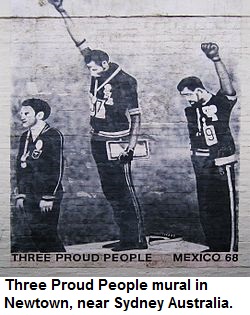
CU Blog - Caribbean Roots - John Carlos among 'Three Proud People' - Photo 1It was at the 1968 Olympics in Mexico City. Despite all the attempts by the organizers to keep the Games apolitical and free-of-conflict, the Moment got political and conflicted … and impactful. This was when the Man, John Carlos, the bronze-medal winner in the 200 meters at the 1968 Summer Olympics gave his Black Power salute on the podium with gold-medalist Tommie Smith; this galvanized the Movement – the Civil Rights Movement in general and the Olympic Project for Human Rights in particular. The Movement caused a lot of controversy.

What is not known about this moment is that this Man, John Carlos, has Caribbean roots.

We are so proud!

Consider his biography reference here:

Title: John Carlos
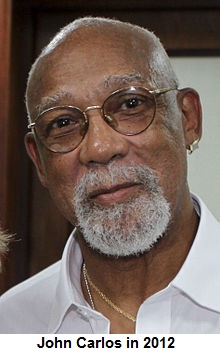
John Wesley Carlos (born June 5, 1945) is an American former track and field athlete and professional football player. He was the bronze-medal winner in the 200 meters at the 1968 Summer Olympics and his Black Power salute on the podium with Tommie Smith caused much political controversy. He went on to tie the world record in the 100 yard dash and beat the 200 meters world record (although the latter achievement was never certified). After his track career, he enjoyed a brief stint in the Canadian Football League but retired due to injury.[1]

He became involved with the United States Olympic Committee and helped to organize the 1984 Summer Olympics. Following this he became a track coach at Palm SpringsHigh School. He was inducted into the USA Track & Field Hall of Fame in 2003.

He is the author, with sportswriter Dave Zirin, of The John Carlos Story: The Sports Moment That Changed the World, published in 2011 by Haymarket Books.

Early life and education
Born in Harlem, New York, to Cuban[2] parents, John Carlos was a gifted high school athlete and outstanding student who went on to study at East Texas State University on a full track-and-field scholarship. His victories in the 100- and 200-meter dash and as a member of the 4×400-meter relay helped lead ETSU to the 1967 Lone Star Conference Championship. After his first year, Carlos enrolled at San Jose State University where he was trained by future National Track & Field Hall of Fame coach, Lloyd (Bud) Winter.

Carlos was awarded an honorary doctorate from CaliforniaStateUniversity in 2008. In 2012, he was awarded honorary doctorates from his alma maters Texas A&M University-Commerce (formerly EastTexasStateUniversity) and San Jose State University.

Career
At the 1968 Olympic Trials, Carlos won the 200-meter dash in 19.92 seconds, beating world-record holder Tommie Smith and surpassing his record by 0.3 seconds. Though the record was never ratified because the spike formation on Carlos’ shoes (“brush spikes”) was not accepted at the time, the race reinforced his status as a world-class sprinter.

Carlos became a founding member of the Olympic Project for Human Rights (OPHR), and originally advocated a boycott of the 1968 Mexico City Olympic Games unless four conditions were met: withdrawal of South Africa and Rhodesia from the games, restoration of Muhammad Ali’s world heavyweight boxing title, Avery Brundage to step down as president of the IOC, and the hiring of more African-American assistant coaches. As the boycott failed to achieve support after the IOC withdrew invitations for South Africa and Rhodesia, he decided, together with Smith, to participate but to stage a protest in case he received a medal.[3] Following his third-place finish behind fellow American Smith and Australian Peter Norman in the 200 at the Mexico Olympics, Carlos and Smith made headlines around the world by raising their black-gloved fists at the medal award ceremony. Both athletes wore black socks and no shoes on the podium to represent African-American poverty in the United States. In support, Peter Norman, the silver medalist who was a white athlete from Australia, participated in the protest by wearing an OPHR badge.

IOC president Avery Brundage deemed a political statement unfit for the apolitical, international forum the Olympic Games was supposed to be. In an immediate response to their actions, he ordered Smith and Carlos suspended from the U.S. team and banned from the Olympic Village. Many supporters, however, praised the men for their bravery. The men’s gesture had lingering effects for all three athletes, the most serious of which were death threats against Carlos, Smith, and their families. Although it has been reported that Carlos and Smith were stripped of their medals, Carlos has indicated this is not true and his medal is with his mother.[4]

Carlos had his greatest year in track and field in 1969, equaling the world 100-yard record of 9.1, winning the AAU 220-yard run, and leading San JoseState to its first NCAA championship with victories in the 100 and 220 and as a member of the 4×110-yard relay. He was featured on the cover of Track and Field News May 1969 issue.[5]

CU Blog - Caribbean Roots - John Carlos among 'Three Proud People' - Photo 3

Source: Wikipedia Online Encyclopedia – Retrieved March 8, 2017 from: https://en.wikipedia.org/wiki/John_Carlos

This biography should go back further to include John Carlos’s Cuban-Caribbean heritage, that of his father:

John Carlos is of Cuban descent and can understand Spanish. His father, Earl Carlos Sr., was a businessman (a cobbler or shoe repair) and World War I Veteran [fighting for the US]. He was a man proud of his appearance in all circumstances and carried himself in a dignified way. He had to work hard from an early age (like most African-American children of his era, especially in the South of the country) and his parents were born as slaves; [(slavery ended in Cuba in 1886 and he was born in 1895)]. When he participated in World War I, he got wounded and received the Medal of Citation Award for his stoicism on the battlefield. When he returned back home, he had to face racial hatred, economic discrimination, the Roaring Twenties, the Stock Market Crash in 1929, the Dust Bowl in the mid-thirties and World War II. Despite the difficulties, he never became bitter. He met his future wife, Vioris Lawrence (an African-American woman), in 1941, who was later John Carlos’ mother. – MegaDiversities.

This was quite a legacy to absorb. John Carlos had the molding from his proud Cuban father, who left a segregated Cuba and emigrated for a better life in the metropolitan area of New York. Harlem – think Harlem Renaissance – was a better place to be a Black Man than the Jim Crow South or the minority-ruled Cuba. When he stood in defiance in that Moment in 1968, John Carlos was protesting the blatant racism that he experienced and his father before him – Earl Carlos died later, in May 1969. The Movement to uplift oppressed people had began on the global stage, but the Black Power salute was a local action in solidarity with all those oppressed before and after this Moment. He understood that ‘Sport and Politics’ are intrinsically linked, whether right or wrong.

The movement behind the book Go Lean … Caribbean recognizes the significance of that Moment and the stage for its execution, the celebrated Olympic Games. The Go Lean book applauds the struggle for Civil Rights and the dynamics of sports. It posits that sports can foster a great influence – and even wealth – in modern society. See this in Appendix B VIDEO.

The sportsman can “rule in people’s hearts”. People marvel at their athletic prowess – billions may be watching on live or tape-delayed TV broadcasts – the participants can forge a positive image and wield power and influence; think:

We can add John Carlos and Tommie Smith to that list.

This Moment was in 1968; that was a pivotal year, so many things happened, mostly bad; consider this sample:

  • Martin Luther King was assassinated, April 4
  • Robert Kennedy was assassinated, June 6
  • Vietnam War Protests – Summer
  • Chicano (Hispanic) Movement and Red Power (Native Americans) Movement Summer Protests
  • Mexico City Olympics – October 12 – 27
  • James Brown song: Say it loud: “I’m Black and I’m Proud”
    CU Blog - Caribbean Roots - John Carlos among 'Three Proud People' - Photo 2

According to John Carlos, in a recent interview describing the disposition on the ground there in Mexico City: “it was high tension, drama, a powder keg … prior to the Olympics there was a massacre that killed hundreds of young activists”.

That was 1968 … all around; consider the experience of one Californian “back in that day”:

1968 was an exciting time for me. I think it was when my activism was born. Before that time things were pretty rosy. Even though I knew about the [Black] Panthers and had seen Dr. [Martin Luther] King, living in LA you were kind of removed. I do remember expressing a desire to join the Freedom Rides, but my Pastor said ‘No’.

1968 was [when] my friends were coming home from Vietnam or refusing to go.

I remember loaning my boyfriend $$ to go to Philly to go before the Draft Board to argue as a Conscientious Objector.  He won and we were so happy.

I remember the day Dr. King was killed and going that night to a service with friends. I remember being so sad and being glued to the TV.

I remember the horror of Bobby Kennedy being killed. I was at work and heard the news.

I remember being so proud of Tommy Smith and John Carlos at the Olympics.

My living room had two posters. One of them on the stand with the black gloved fists held high and the other was [Black Panther Party co-founder] Huey Newton sitting in that Peacock Chair.

Those were the days when I was very active in the Watts Summer Festival.  Tommy Jacquette, the founder, was a friend, and we all gathered together to make the event a success. …

I would say that 1968 was the year that I became the person I am today. – Bunny Withers, Los Angeles.

The reality of human rights abuses in America in 1968 was bad, worse or dire – those were the only options. The Black community was far from being treated as equal citizens in that society. But truth be told, other minority groups in the country also experienced oppression, repression and suppression. America was the greatest country on the planet for those that qualified; those that were:

White, Anglo-Saxon, Rich, Male and Straight

Anyone else – everyone else – needed civil rights empowerments.

Fortunately, this is not the conditions of the America of today. It is now a better place to live, work and play. How did this society go from “there to here”?

It took the strenuous efforts of advocates: individuals – Men and Women – and organizations, exploiting Moments and Movements for maximum exposure. They appealed to the public, appealed to their better nature. John Carlos was one such individual.

The third person on the dais, silver medalist Peter Norman of Australia, can also be classified as an advocate fighting to assuage human rights abuses – he also wore a badge of the Olympic Project for Human Rights – he was in solidarity with Smith and Carlos. See the profile VIDEO on his activities in Appendix A below.

The Caribbean has a problem today that we did not have back in 1968. The majority populations of the Caribbean region is/was Black-and-Brown. America was not inviting to this demographic, so our people rarely immigrated to the US. Now with the above-referenced civil rights empowerments, America is now a more fair society for all people. Our Caribbean people now “beat down their doors” to flee to America, and other places – Go Lean book Page 3.

The US is now a “frienemy” for us! We are trading partners; we are aligned; we are allies; many of our students studied there; many of our Diaspora live there. We now have to compete to dissuade our young people from setting their sights on American shores as a refuge and destination of their hopes and dreams. No society can survive with a high abandonment rate – the book Go Lean … Caribbean reports that 70% brain drain rate among our professional populations.

We are failing and need advocates of our own.

We need new role models, with the courage of John Carlos, to help us “battle” against the “push-and-pull” factors that draw many Caribbean citizens away from home to the US. We need Men to seize the Moment and advance this Movement.

The Go Lean movement pursues the quest to elevate the Caribbean region through empowerments in economics, security and governance. Since 29 of the 30 Caribbean member-states (“St. Barths” is the only exception) have majority Black populations, the book pushes further on this subject of racism, positing that it is easier for Caribbean citizens to stay home and effect change in their homelands than to go to America and try to remediate that society. The book therefore asserts that the region can turn-around from failing assessments by applying best-practices, and forging new societal institutions to impact the Greater Good for all the Caribbean.

The Go Lean book posits that sports – individual achievements and the business of sports – can greatly impact society; in addition to the entertainment value, there is also national pride, image and impression. People can override many false precepts with sporting excellence by great role models.

The book Go Lean…Caribbean serves as a roadmap for the introduction and implementation of the Caribbean Union Trade Federation (CU), a technocratic federal government designed to administer and optimize the economic-security-governing engines of the region’s 30 member-states. This is highlighted by these 3 prime directives:

  • Optimization of the economic engines in order to grow the regional economy; creating 2.2 million new jobs and expanding the regional GDP to $800 Billion.
  • Establishment of a security apparatus to protect the resultant economic engines.
  • Improve Caribbean governance to support these engines.

At the outset, the roadmap recognizes our crisis and the value of sports in the roadmap, with these statements in the Declaration of Interdependence (Page 13 & 14):

xix. Whereas our legacy in recent times is one of societal abandonment, it is imperative that incentives and encouragement be put in place to first dissuade the human flight, and then entice and welcome the return of our Diaspora back to our shores. This repatriation should be effected with the appropriate guards so as not to imperil the lives and securities of the repatriated citizens or the communities they inhabit. The right of repatriation is to be extended to any natural born citizens despite any previous naturalization to foreign sovereignties.

xxvi. Whereas the preparation of our labor force can foster opportunities and dictate economic progress for current and future generations, the Federation must ensure that educational and job training opportunities are fully optimized for all residents of all member-states, with no partiality towards any gender or ethnic group. The Federation must recognize and facilitate excellence in many different fields of endeavor, including sciences, languages, arts, music and sports. This responsibility should be executed without incurring the risks of further human flight, as has been the past history.

xxxi. Whereas sports have been a source of great pride for the Caribbean region, the economic returns from these ventures have not been evenly distributed as in other societies. The Federation must therefore facilitate the eco-systems and vertical industries of sports as a business, recreation, national pastime and even sports tourism – modeling the Olympics.

The Go Lean roadmap calls for the market organizations to better garner the economic benefits of sports. One of the biggest contributions the CU will make is the facilitation of sports venues: arenas and stadia. As described in a previous blog-commentary, sports can be big business! And even when money is not involved, other benefits abound: educational scholarships, fitness/wellness, disciplined activities for the youth, image, and pride. No doubt an intangible yet important benefits is depicted in this Go Lean roadmap, that of less societal abandonment.

The movement behind the Go Lean book salute those ones from our past who left their Caribbean homelands for better opportunities abroad; we salute their legacies (foreign-born children) as well. We know that there are “new” athletes who are just waiting to be discovered and fostered throughout the Caribbean member-states. We salute these ones as our future, and pledge to do better to keep them here at home. The book details the community ethos, strategies, tactics, implementations and advocacies to allow Caribbean people to prosper where they are planted.

In terms of salute, it is appropriate to salute Vioris Louise Lawrence Carlos – the mother of John Carlos. She just recently passed-away, on December 12, 2016, at age 97. This blessed woman’s contributions and life course help to mold the life and legacy of 5 children – including John Carlos – and a whole community.

Previous Go Lean blog-commentaries that identified other sports role models for our consideration:

https://goleancaribbean.com/blog/?p=8495 NBA Greatness and Caribbean Roots: Tim Duncan Retires
https://goleancaribbean.com/blog/?p=2222 Sports Role Model – Playing For Pride … And More
https://goleancaribbean.com/blog/?p=1020 Sports Revolutionary: Advocate Jeffrey Webb
https://goleancaribbean.com/blog/?p=498 Caribbean Sport Excellence due to ‘The Sports Gene’

In addition, these other Go Lean blog-commentaries have identified other role models with Caribbean roots:

https://goleancaribbean.com/blog/?p=10609 Caribbean Roots: Cast of ‘The Fresh Prince of Bel-Air’
https://goleancaribbean.com/blog/?p=10114 Esther Rolle – Caribbean Roots
https://goleancaribbean.com/blog/?p=9948 Sammy Davis, Jr. – Caribbean Roots
https://goleancaribbean.com/blog/?p=8724 Remembering Marcus Garvey: A Role Model; Still Relevant Today
https://goleancaribbean.com/blog/?p=8619 Clive Campbell – Jamaican Innovation for Hip Hop
https://goleancaribbean.com/blog/?p=8328 YouTube Role Model with Caribbean Roots: ‘Tipsy Bartender’
https://goleancaribbean.com/blog/?p=2726 Caribbean Role Model – Oscar De La Renta – RIP
https://goleancaribbean.com/blog/?p=866 Caribbean Musical Icon and Role Model: Bob Marley

The world is a better place, sports-wise and arts-wise, because of Caribbean contributions. Thank you to all past, present and future athletes and contributors.

Not to be overlooked, but the same as the US had a Climate of Hate in 1968, we have our own societal defects in the Caribbean region today. We cannot claim enlightenment to the achievements of advocates like John Carlos and have a blind eye” to our own “ills”. So let’s stand-up as a Proud People and force our own communities to change. Let’s make our Caribbean homeland a better place to live, work and play. 🙂

Download the book Go Lean … Caribbean – now!

Sign the petition to lean-in for the roadmap for the Caribbean Union Trade Federation.

————-

APPENDIX A VIDEO – The Story Behind The White Guy In This Historic Photo – https://youtu.be/t4LvwXYmt3Q

Published on Oct 31, 2015 – In 1968 there was a powerful moment of protest at the Olympic games when two winners put on black gloves to protest what was happening in the country during the civil rights era. Most people don’t know the story of the silver medalist, Peter Norman. Cenk Uygur, host of the The Young Turks, breaks it down. Tell us what you think in the comment section below.

“In an act as appropriate as it is overdue, the Australian House of Parliament is issuing an official state apology Monday to the country’s late, great sprinter Peter Norman. Norman won the 200-meter silver medal at the 1968 Olympics, but that’s not why he’s either remembered or owed apologies. After the race, gold and bronze medalists Tommie Smith and John Carlos bowed their heads and raised their fists on the medal stand and started an international firestorm. Many see the iconic image and assume Norman was just a bystander to history, or as he would joke, “the white guy.” But he was standing in full solidarity with Smith and Carlos, wearing a patch on his chest that reads, “Olympic Project for Human Rights.”

Read more here: https://www.thenation.com/article/aus…

Disclaimer: The Young Turks is an online video talk show that provides commentary on news and opinion articles. Often times these articles come from sources outside of our organization. Where possible, we do our best to research and verify various sources before reporting. Content created by third parties is the sole responsibility of the third parties and its accuracy and completeness are not endorsed or guaranteed.

UPDATE to story: http://www.filmsforaction.org/watch/j…

————-

APPENDIX B VIDEO – THREE PROUD PEOPLE (Mural project) Tommy Smith, Peter Norman, John Carlos – https://youtu.be/xHcasP4HOo0

Uploaded on May 17, 2009 – This mural was put up about 6 weeks prior to the opening ceremony of the Sydney 2000 Olympic games. It could be viewed from the McDonaldtown train station platform and from trains travelling past. Trains travel from central Sydney to the Homebush Olympic venue past this mural. As of a few years ago, the mural can no longer be seen from the tracks due to a city rail concrete sound barrier that has been installed.
Peter Norman was repremanded for his part in the action. Peter, in solidarity, wore the Olympic project for human rights badge, which defied the code of conduct. He also came up with the idea of Smith and Carlos each wearing one black glove from the same pair. All three of these guys were very couragous.

  • Category: Education
  • License: Standard YouTube License


Share this post:
, , ,
[Top]

Stay Home! Immigration Realities in the US

Go Lean Commentary

When conditions are dysfunctional at home, people leave … period.

“… we are just making it easy for the clean-up woman” – Classic R&B song by Betty Wright
See Appendix VIDEO below.

CU Blog - Immigration Realities in the US - Photo 6

This is not good for a family nor for a community. The truth of the matter is that communities need their populations to grow, not recede. So any human flight incidences would create havoc on the functionality of societal engines: economics, security and governance.

This is our status in the Caribbean, but it is not just an incident, not a trickle; it is a flood. The people are beating down the doors to get out of their Caribbean homeland, to seek refuge in places like the US, Canada and Western Europe. We have a sad state of affairs for our Caribbean eco-system so we are suffering from a bad record of societal abandonment – averaging a 70 percent brain drain rate. The reasons why people leave have been identified as “push and pull”:

“Push” refers to people who feel compelled to leave, to seek refuge in a foreign land. “Refuge” is an appropriate word; because of societal defects, many from the Caribbean must leave as refugees – think LGBTDisabilityDomestic-abuseMedically-challenged – for their life, liberty and pursuit of happiness. This is making it easy for the “clean-up woman”.

“Pull”, on the other hand refers to the lure of a more prosperous life in the US (and other destinations); many times our people are emigrating for economics solely.

If only we can mitigate these “push and pull” factors, then we can dissuade our people from leaving in the first place. If only we can go from ‘good to great‘ here in the Caribbean homeland. This would be the ideal. But this is not our reality.

What is a point of contention is where our emigrants are going. Let’s consider the realities of one such destination: the United States. While things are bad for our residents in their Caribbean homeland, many minority immigrants in America (Black-and-Brown, Muslim, etc.) have to contend with less than welcoming conditions there.

The movement behind the book Go Lean … Caribbean has consistently related that the United States of America functions as a Great Society but it has two societal defects: Institutional Racism and Crony-Capitalism. These societal defects can easily create a ‘Climate of Hate‘ that causes people to haze and blame-game the immigrant community.

CU Blog - Immigration Realities in the US - Photo 4

In a previous blog-commentary, it was conveyed that America treats immigrants unappreciatedly – they are inflicted with a “long train of abuses”. The long-term Americans start towards the immigrants with hate and then eventually tolerate. After some decades they may then integrate with the immigrant community. But only after generations do they appreciate and celebrate the minority group. Think of the American experience of the Chinese, Italians, Jewish and Cuban populations.

This is also the reality of the Caribbean Black-and-Brown that has emigrated to the US, while they can more easily survive, the quest to thrive is more perplexing. They have to live in this environment filled with these societal defects. Consider this news article and these aligning VIDEO’s:

News Article Title: GPS device-maker Garmin reeling after workers gunned down
By: Jim Suhr

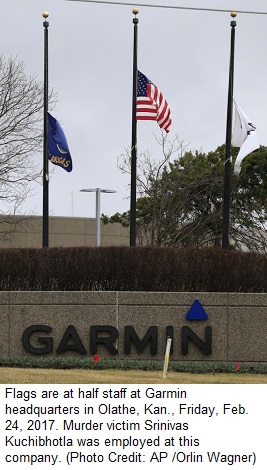
CU Blog - Immigration Realities in the US - Photo 1

OLATHE, Kan. (AP) — GPS device-maker Garmin long has revered diversity in its workforce, even when the locale of its ever-sprawling operational headquarters — a largely white Kansas City suburb — didn’t reflect it.

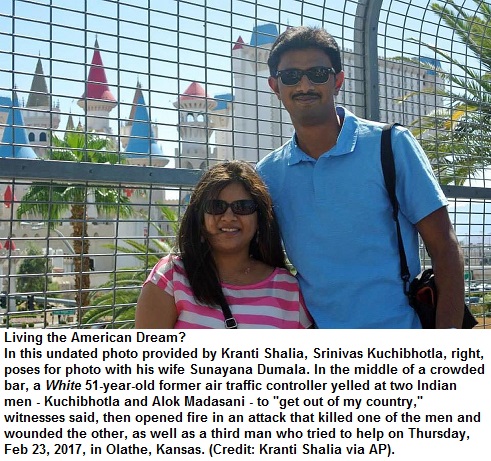
It’s the place 32-year-old Srinivas Kuchibhotla came to work a few years ago. By his wife’s account Friday he willingly spent long hours on an aviation systems engineering team alongside Alok Madasani, a friend and colleague also 32 and from India.

Kuchibhotla’s trek led him to have a kinship with his boss, Lebanese native Didier Popadopoulos, who says he moved to America at Kuchibhotla’s age and once held the same Garmin job.

But Garmin — a billion-dollar tech giant launched in Kansas as a startup by two men nearly three decades ago — now is reeling, trying to digest Kuchibhotla’s shooting death Wednesday at a tavern just a mile down the road from work. Madasani was wounded, along with a stranger who tried to help.

Witnesses say the gunman, Adam Purinton, yelled at the two Indian men to “get out of my country” and opened fire. Purinton, who was arrested hours later at a bar in Missouri, remains jailed on murder and attempted murder charges.

The shooting happened at a time when many have concerns about the treatment of immigrants in the U.S., some of whom feel targeted by the current administration. President Donald Trump has promised to ban certain travelers and been especially vocal about the threat posed by Islamic terrorist groups.

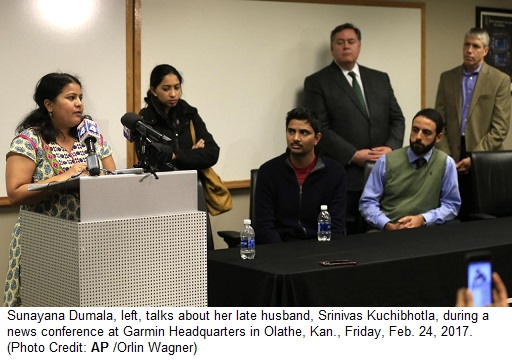
CU Blog - Immigration Realities in the US - Photo 2On Friday, Garmin tried to comfort grieving employees at a closed-door vigil inside the auditorium on its campus in Olathe, Kansas. Kuchibhotla’s widow, Sunayana Dumala, addressed the group of about 200 workers that included Madasani, who was released from the hospital Thursday.

Laurie Minard, Garmin’s vice president of human resources, doesn’t believe the shooting will jeopardize its recruitment of workers from overseas.

“We tend to be a family here,” she said at the Garmin campus, which is waging a $200 million expansion, with plans announced last August for a new manufacturing and distribution center. “We want people to feel safe. We embrace it. We encourage it. We support it. It’s extremely important to us about acceptance.”

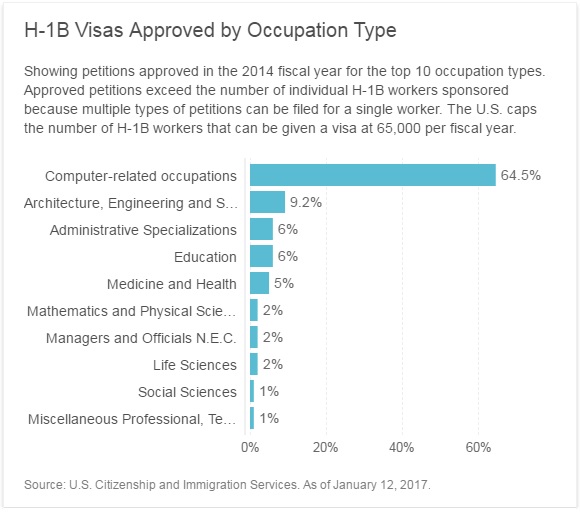
At any given time, she said, more than 100 Garmin employees are in the H-1B program, which lets American companies bring foreigners with technical skills to the U.S. for three to six years.

CU Blog - Immigration Realities in the US - Photo 5

In an eight-year period until fiscal year 2016, Garmin on average obtained 49 certifications for foreign labor — a prerequisite for hiring with an H-1B visa — for an average of 70 positions, according to the U.S. Department of Labor. During that time, 81 percent of the certified positions were in Olathe, the Labor Department says.

Olathe, whose name means “beautiful” in the Shawnee language, is a well-to-do Kansas City suburb where the median household income is above $77,000 a year.

CU Blog - Immigration Realities in the US - Photo 3Worldwide, Switzerland-based Garmin Ltd. — the Kansas operation’s corporate parent — has more than 11,400 workers in 60 offices and last year logged $3.02 billion in revenue. Roughly 2,800 workers are at the Kansas headquarters, which Greater Kansas City Chamber of Commerce spokeswoman Pam Whiting cast as regionally “one of our entrepreneurial success stories” and biggest employers.

Recruiting from overseas isn’t at all unusual in the tech industry, which contends there aren’t enough Americans with specialized skills the companies need.

Indian immigrants in the U.S. has spiked from about 200,000 in the 1980s to more than 2 million today, as Indian-born scientists and engineers fueled the American tech boom. India received more H-1B visas in the U.S. for its temporary high-skilled workers, about 70 percent, than any other country in 2014.

Stunned by Kuchibhotla’s death, Popadopoulos, the Lebanese native who was the man’s boss, said he plans to stay the course.

“When this happened, one of the things I started to think about with my wife (was) ‘Is it time to leave?'” he said.

Then he thought: “Leave where? I’m from here. I really think Srinivas would want us to stick together and stand up for what’s right.”

U.S. Sen. Jerry Moran said he left a message with Olathe’s mayor, offering to help assure people from India who live in Kansas that the actions leading to Kuchibhotla’s death are “not the norm.”

“This is not the nature of Kansas, and we welcome people to the United States, particularly a company like Garmin and many others,” the Kansas Republican said.

___

AP Data Journalist Larry Fenn in New York and AP writers Martha Mendoza in Bangkok and John Hanna in Topeka, Kansas, contributed to this report.
Source: Associated Press – posted February 25, 2017; retrieved February 27, 2017 from: https://www.yahoo.com/news/gps-device-maker-garmin-reeling-workers-gunned-down-013731087.html

—————-

VIDEO #1 What would America’s Tech industry be like without immigrants? – https://youtu.be/QODK-9-mImg

Published on Feb 3, 2017 – In the recent hate-crime in Olathe, Kansas the gunman exclaimed that he wanted the country back. Consider the words of this deranged killer and ask “What would America’s Tech industry be like without immigrants?”
But maybe, the American people are not so inviting, even though American companies may seek immigrants.
http://global-gathering.com

—————-

VIDEO #2 Trump Said Immigration Is Bad for the Economy, But Is it? – https://youtu.be/7PHfJ8HY-Ds

Published on Feb 12, 2017 – The new President, Donald Trump, has expressed that immigration is bad for the American economy and society in general. This is just another example of his “alternate facts”. It is not the truth. But it does project that his American administration is not welcoming to immigrants.
The question to the Caribbean: Do you want to go to a party that you’re not invited to or welcomed?
Category: News & Politics
License: Standard YouTube License

This foregoing article relates a hate-crime against immigrants (engineers) from India. They were not Muslims; they were not Mexican; they were not affiliated with the Black-and-Brown populations from Latin America or the Caribbean. But they were non-White and spoke with foreign accents; they therefore were subject to standard American hate-speech, bullying and in this case, a random act of violence; one was murdered.

This commentary is one of the missions of the book Go Lean…Caribbean, to lower the “pull” attraction of life in the US. This is not being done with “smoke and mirrors” but rather this is just the truth. This is part 2 of 3 in a series on “Why Caribbean people need to Stay Home“, positing that the “grass is not greener on the other side”. The complete series is as follows:

  1.  Stay Home! Remembering ‘High Noon’ and its Back-Story
  2.  Stay Home! Immigration Realities in the US
  3.  Stay Home! Outreach to the Diaspora – Doubling-down on Failure

The truth of the matter is that immigrants are better able to survive in America – there is an abundance of minimum wage jobs – but to thrive is more of a challenge; consider the experiences in the foregoing news article. It would seem better for Caribbean people to work to remediate the problems in their homeland, rather than work to become immigrants in the US. But this is no easy task; and despite being necessary, it is hereby defined as heavy-lifting.

The book Go Lean … Caribbean seeks to optimize the societal engines of Caribbean life; it serves as a roadmap for the introduction and implementation of the technocratic Caribbean Union Trade Federation (CU). The CU must employ better strategies, tactics and implementations to impact the regional homelands to reform and transform the societal engines. The prime directives of the Go Lean/CU roadmap for technocratic stewardship is identified with the following 3 statements:

  • Optimization of the economic engines in order to grow the regional economy to $800 Billion & create 2.2 million new jobs. The deficiency of jobs is one  of the reasons Caribbean people have emigrated.
  • Establishment of a security apparatus to protect the resultant economic engines and mitigate internal and external threats.
  • Improvement of Caribbean governance to support these above engines, including a separation-of-powers between member-state governments and CU federal agencies.

Early in the Go Lean book, this need for careful technocratic stewardship of the region’s societal engines was pronounced (Declaration of Interdependence – Page 12 – 13) with these acknowledgements and statements:

xi.   Whereas all men are entitled to the benefits of good governance in a free society, “new guards” must be enacted to dissuade the emergence of incompetence, corruption, nepotism and cronyism at the peril of the people’s best interest. The Federation must guarantee the executions of a social contract between government and the governed.

xii.  Whereas the legacy in recent times in individual states may be that of ineffectual governance with no redress to higher authority, the accedence of this Federation will ensure accountability and escalation of the human and civil rights of the people for good governance, justice assurances, due process and the rule of law. As such, any threats of a “failed state” status for any member state must enact emergency measures on behalf of the Federation to protect the human, civil and property rights of the citizens, residents, allies, trading partners, and visitors of the affected member state and the Federation as a whole.

xxiv. Whereas a free market economy can be induced and spurred for continuous progress, the Federation must install the controls to better manage aspects of the economy: jobs, inflation, savings rate, investments and other economic principles. Thereby attracting direct foreign investment because of the stability and vibrancy of our economy.

xxvi.  Whereas the Caribbean region must have new jobs to empower the engines of the economy and create the income sources for prosperity, and encourage the next generation to forge their dreams right at home, the Federation must therefore foster the development of new industries … In addition, the Federation must invigorate the enterprises related to existing industries … impacting the region with more jobs.

Our Caribbean community, no community for that matter, can survive a constant drain against our population and human capital. This is a crisis! This point was crystalized in a previous blog/commentary with this quotation:

We tend to think economic growth comes from working harder and smarter. But economists attribute up to a third of it to more people joining the workforce each year than leaving it. The result is more producing, earning and spending.

This is a consistent theme in the book Go Lean…Caribbean. The book posits that the most serious threat to Caribbean prosperity is the high abandonment rate among its citizens, especially its highly educated, skilled-labor classes.

“A crisis is a terrible thing to waste” – states the book quoting noted Economist Paul Romer.

The opportunity therefore exists to forge change in the economic, security and governing engines of the Caribbean, in response to this crisis. This is the advocacy of the Go Lean book, to position the region at the corner of preparation and opportunity, so as to better compete on the world stage. Our job creation engines have failed to keep pace with the population, therefore fewer and fewer jobs are at home. Thus this region has had a higher and higher emigration rate as the decades pass. If we want our citizens to “Stay Home” then we must provide job options.

How?

First, the region already has a mature tourism product so we now need jobs in other industries.

The following details from the book Go Lean … Caribbean are the community ethos, strategies, tactics, implementations and advocates prescribed to create non-tourism jobs and elevate the Caribbean economy:

Community Ethos – Deferred Gratification Page 21
Community Ethos – new Economic Principles Page 21
Community Ethos – Job Multiplier Page 22
Community Ethos – new Security Principles Page 22
Community Ethos – new Governing Principles Page 24
Community Ethos – Ways to Impact the Future Page 26
Community Ethos – Ways to Impact Turn-Arounds Page 33
Community Ethos – Ways to Promote Happiness Page 36
Community Ethos – Ways to Impact the Greater Good Page 37
Strategy – Repatriating Caribbean Diaspora Page 47
Strategy – Non-Government Organizations Page 48
Tactical – Confederating a Permanent Union Page 63
Tactical – Fostering a Technocracy Page 64
Implementation – Assemble all Member-States Page 96
Implementation – Ways to Pay for Change Page 101
Implementation – Reasons to Repatriate Page 118
Planning – Ways to Make the Caribbean Better Page 131
Advocacy – Ways to Grow the Economy Page 151
Advocacy – Ways to Create Jobs Page 152
Advocacy – Better Manage the Social Contract Page 170
Advocacy – Ways to Foster Empowering Immigration Page 174
Advocacy – Impact the Diaspora Page 217
Advocacy – Ways to Preserve Caribbean Heritage Page 218
Advocacy – Ways to Help the Middle Class Page 223

The Go Lean roadmap is a product of the Diaspora, from those residing in the US – looking at Caribbean residents and longing to go home. The Go Lean book and blog-commentaries assert that the “grass is not greener on the other side”. But we rightfully know that the quest for economic opportunities is the “pull” factor that attracts Caribbean people.

How to create jobs at home? This point – and accompanying lessons – has been exhausted in previous blog/commentaries; consider this sample:

https://goleancaribbean.com/blog/?p=9751 Where the Jobs Are – Animation and Game Design
https://goleancaribbean.com/blog/?p=9203 Where the Jobs Are – Employer Models in the United States
https://goleancaribbean.com/blog/?p=8262 Creating Job Opportunities with UberEverything – An African Model
https://goleancaribbean.com/blog/?p=8328 Creating Job Opportunities as YouTube Millionaires
https://goleancaribbean.com/blog/?p=7806 Skipping School to become Tech Giants
https://goleancaribbean.com/blog/?p=6129 Innovative Partnership Aids Farm Workers/Agricultural Jobs
https://goleancaribbean.com/blog/?p=6089 Where the Jobs Are – Futility of Minimum Wage
https://goleancaribbean.com/blog/?p=5759 Pressed by Debt Crisis, Doctors Leave Greece in Droves for New Jobs
https://goleancaribbean.com/blog/?p=2857 Where the Jobs Are – Entrepreneurism in Junk
https://goleancaribbean.com/blog/?p=2126 Where the Jobs Are – Computers Reshaping Global Job Market
https://goleancaribbean.com/blog/?p=2025 Where the Jobs Are – Attitudes & Images of the Diaspora
https://goleancaribbean.com/blog/?p=2003 Where the Jobs Are – One Scenario: Ship-breaking
https://goleancaribbean.com/blog/?p=1698 Where the Jobs Are – STEM Jobs Are Filling Slowly

These previous blogs report that this Go Lean roadmap is a hope for change in the Caribbean region. Its a plan that is conceivable, believable and achievable for making the Caribbean homeland a better place to live, work and play. Everyone in the region is hereby urged to lean-in to this roadmap. 🙂

Download the book Go Lean … Caribbean – now!

———–

Appendix VIDEO – Betty Wright – Clean Up Woman – https://youtu.be/vh-2_kdVcyA

Uploaded on May 27, 2009 Lyrics:

“Clean Up Woman”
A clean up woman is a woman who
Gets all the love we girls leave behind
The reason I know so much about her
Is because she picked up a man of mine

Chumpin’ slick was my ruin
‘Cause, I found out all I was doin’
Was making it easy for the clean up woman
To get my man’s love, oh yeah
Just making it easy for the clean up woman
To get my baby’s love, uh-huh, um-hum

I took this man’s love and put it a shelf
And like a fool I thought I had him all to myself

When you needed love I was out having fun
But I found out that all I had done
Was made it easy for the clean up woman
To get my man’s love, uh-huh
Yeah, that’s what I did, I made it easy for the clean up woman
To steal my baby’s love, oh yeah

The clean up woman will wipe his blues away
She’ll give him plenty lovin’ 24 hours a day
The clean up woman, she’ll sweep him off his feet
She’s the one who’ll take him in when you dump him in the street
So take a tip, you better get hip
To the clean up woman ’cause she’s tough
I mean, she really cleans up


Share this post:
, , ,
[Top]

Stay Home! Remembering ‘High Noon’ and its Back-Story

Go Lean Commentary

When there is a ‘Climate of Hate’, conditions in society can easily go from bad to worse. We have a lot of lessons from history that supplant this assertion. Consider this lesson from America in the 1950’s.

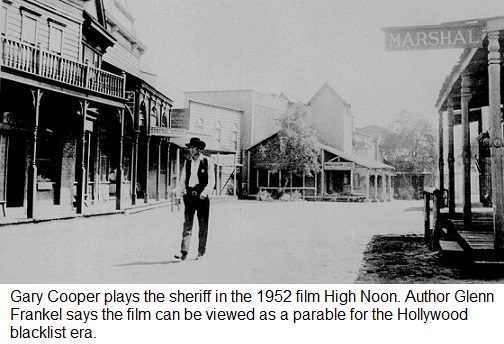
CU Blog - Remembering 'High Noon' and its Back Story - Photo 2

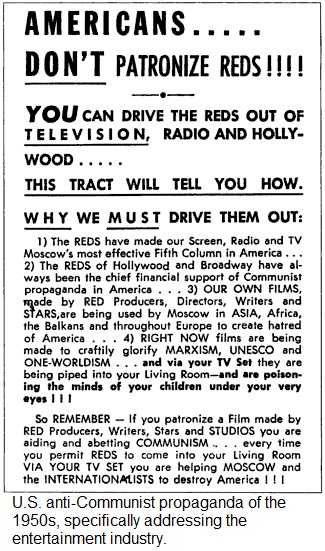
A revealing new book High Noon: The Hollywood Blacklist and the Making of an American Classic uncovers the back-story of the classic Western movie ‘High Noon’; it details the grim time in American history, when a bad community ethos permeated, McCarthyism and the resultant blacklist. “These events from the 1950’s have a special resonance today.”

The movement behind the book Go Lean … Caribbean has consistently related that the United States function as a Great Society but it has two societal defects: Institutional Racism and Crony-Capitalism. These societal defects can easily create a ‘Climate of Hate‘ and in the 1950’s, the US had it bad … with their stereotyping and “witch hunts” of McCarthyism.

McCarthyism include the speeches, investigations, and hearings of Wisconsin Senator Joseph McCarthy (in office 1947 –1957); the Hollywood blacklist, associated with hearings conducted by the House Un-American Activities Committee (HUAC); and the various anti-communist activities of the Federal Bureau of Investigation (FBI) under Director J. Edgar Hoover. McCarthyism was a widespread social and cultural phenomenon that affected all levels of society and was the source of a great deal of debate and conflict in the United States.

CU Blog - Remembering 'High Noon' and its Back Story - Photo 3McCarthyism was the practice of making accusations of subversion or treason without proper regard for evidence.[1] It also means “the practice of making unfair allegations or using unfair investigative techniques, especially in order to restrict dissent or political criticism.”[2] The term has its origins in the period in the United States known as the Second Red Scare, lasting roughly from 1947 to 1956 and characterized by heightened political repression as well as a campaign spreading fear of influence on American institutions and of espionage by Soviet agents.

McCarthyism soon took on a broader meaning, describing the excesses of similar efforts. The term is also now used more generally to describe reckless, unsubstantiated accusations, as well as demagogic attacks on the character or patriotism of political adversaries. During the McCarthy era, thousands of Americans were accused of being communists or communist sympathizers and became the subject of aggressive investigations and questioning before government or private-industry panels, committees and agencies. The primary targets of such suspicions were government employees, those in the entertainment industry, educators and union activists. Suspicions were often given credence despite inconclusive or questionable evidence, and the level of threat posed by a person’s real or supposed leftist associations or beliefs was often greatly exaggerated. Many people suffered loss of employment and/or destruction of their careers; some even suffered imprisonment. Most of these punishments came about through trial verdicts later overturned,[4] laws that were later declared unconstitutional,[5] dismissals for reasons later declared illegal[6] or actionable,[7] or extra-legal procedures that would come into general disrepute.
Source: Wikipedia Online Encyclopedia; retrieved February 26, 2017 from: https://en.wikipedia.org/wiki/McCarthyism

As related in the foregoing, “many people suffered loss of employment and/or destruction of their careers”; this was definitely the case in Hollywood. Consider the experience of the screenwriter Carl Foreman, best known for the film classic Western ‘High Noon’. See the Book Review and related AUDIO-Podcast here:

Book Title: High Noon: The Hollywood Blacklist and the Making of an American Classic
By:  Glenn Frankel
From the New York Times-bestselling author of The Searchers, the revelatory story behind the classic movie High Noon and the toxic political climate in which it was created.

CU Blog - Remembering 'High Noon' and its Back Story - Photo 1It’s one of the most revered movies of Hollywood’s golden era. Starring screen legend Gary Cooper and Grace Kelly in her first significant film role, High Noon was shot on a lean budget over just thirty-two days but achieved instant box-office and critical success. It won four Academy Awards in 1953, including a best actor win for Cooper. And it became a cultural touchstone, often cited by politicians as a favorite film, celebrating moral fortitude.

Yet what has been often overlooked is that High Noon was made during the height of the Hollywood blacklist, a time of political inquisition and personal betrayal. In the middle of the film shoot, screenwriter Carl Foreman was forced to testify before the House Committee on Un-American Activities about his former membership in the Communist Party. Refusing to name names, he was eventually blacklisted and fled the United States. (His co-authored screenplay for another classic, The Bridge on the River Kwai, went uncredited in 1957.) Examined in light of Foreman’s testimony, High Noon‘s emphasis on courage and loyalty takes on deeper meaning and importance.

In this book, Pulitzer Prize-winning journalist Glenn Frankel tells the story of the making of a great American Western, exploring how Carl Foreman’s concept of High Noon evolved from idea to first draft to final script, taking on allegorical weight. Both the classic film and its turbulent political times emerge newly illuminated.

———

AUDIO-PODCASTWhat A Classic ’50s Western Can Teach Us About The Hollywood Blacklist – http://www.npr.org/2017/02/21/516427212/what-a-classic-50s-western-can-teach-us-about-the-hollywood-blacklist

Posted on February 21, 2017 – Author Glenn Frankel tells Fresh Air‘s Terry Gross that the government was “looking to see or to prove that there had been communist infiltration in Hollywood, that this was part of a mass plot engineered by Moscow to take over our cultural institutions.”

Many who appeared before the House Un-American Activities Committee were put on a blacklist that made it impossible for them to work in show business. Among the blacklisted was screenwriter Carl Foreman, whose 1952 classic western High Noon is seen as a parable about the toxic political climate of the time.

This history highlights the bad consequence of societal defects; they can easily be exploited and society further hijacked with blatant malice (bad motives, bad messages and bad actions). This aligns with the Go Lean book’s definition of “community ethos”:

the underlying attitude/spirit/sentiment that informs the beliefs, customs, or practices of a group or society.

The bad ethos of McCarthyism became a “widespread social and cultural phenomenon that affected all levels of America”. The US would not have been a welcoming society for those on the wrong side of this targeting. This truly demonstrates how a ‘Climate of Hate’ exacerbates societal defects, conditions easily go from bad to worse.

America is not much different today … in 2017 compared to the 1950’s. Yes, the laws of the land has been updated, but the attitudes of the people are still intact towards a ‘Climate of Hate’. There is the continuous need for vigilance and truth. The truth of the matter is that America has a lot of work to do to be the Great Society they project to the world. This country should not be the panacea of Caribbean ills. This commentary has consistently asserted that it is easier for the Caribbean member-states to reform and transform its own society than to flee to find refuge in America.

According to the foregoing, the American government turned on some of its most talented and productive citizens during the bad days of McCarthyism. This turned out to be just another extension of the country’s ‘Climate of Hate’. This commentary maintains that hate is in the American DNA.

Too strong?!

Just consider the experience of the nation’s Black-and-Brown populations. This has been duly documented and lamented.

Too old?!

If it is the contention that this is an indictment of the America of old, then consider the fresh experience of Muslim immigrants.

And yet … the people in the Caribbean – mostly Black-and-Brown – are beating down the doors to get out of their Caribbean homeland, to seek refuge in places like the US; (a smaller faction emigrate to Canada and Western Europe). This really conveys the sad state of affairs for the Caribbean eco-system. While things are bad for minorities in America (Black-and-Brown, Muslim, etc.), more Black people want to come in, instead of working to remediate the problems in their own homeland.

This is the reality of the Caribbean disposition: the region suffers from a bad record of societal abandonment. The reasons why people leave have been identified as “push and pull”:

“Push” refers to people who feel compelled to leave, to seek refuge in a foreign land. “Refuge” is an appropriate word; because of societal defects, many from the Caribbean must leave as refugees – think LGBTDisabilityDomestic-abuseMedically-challenged – for their life, liberty and pursuit of happiness.

“Pull”, on the other hand refers to the lure of a more prosperous life in the US (and other destinations); many times our people are emigrating for economics solely.

If only we can mitigate these “push and pull” factors, then we can dissuade our people from leaving in the first place. We CAN go from ‘good to great‘ here in the homeland. This is no easy task; and despite being necessary, it is hereby defined as heavy-lifting. This is the purpose of this commentary; this is part 1 of 3 in a series on “Why Caribbean people need to Stay Home“, positing that the “grass is not greener on the other side”. The complete series is as follows:

  1.  Stay Home! Remembering ‘High Noon’ and its Back-Story
  2.  Stay Home! Immigration Realities in the US
  3.  Stay Home! Outreach to the Diaspora – Doubling-down on Failure

The book Go Lean … Caribbean seeks to optimize the societal engines of Caribbean life; it serves as a roadmap for the introduction and implementation of the technocratic Caribbean Union Trade Federation (CU). The CU must employ better strategies, tactics and implementations to impact its prime directives; identified with the following 3 statements:

  • Optimization of the economic engines in order to grow the regional economy to $800 Billion & create 2.2 million new jobs.
  • Establishment of a security apparatus to protect the resultant economic engines and mitigate internal and external threats.
  • Improvement of Caribbean governance to support these above engines, including a separation-of-powers between member-state governments and CU federal agencies.

Early in the Go Lean book, this need for careful technocratic stewardship of the region’s societal engines was pronounced (Declaration of Interdependence – Page 12 – 13) with these acknowledgements and statements:

xi.   Whereas all men are entitled to the benefits of good governance in a free society, “new guards” must be enacted to dissuade the emergence of incompetence, corruption, nepotism and cronyism at the peril of the people’s best interest. The Federation must guarantee the executions of a social contract between government and the governed.

xii.  Whereas the legacy in recent times in individual states may be that of ineffectual governance with no redress to higher authority, the accedence of this Federation will ensure accountability and escalation of the human and civil rights of the people for good governance, justice assurances, due process and the rule of law. As such, any threats of a “failed state” status for any member state must enact emergency measures on behalf of the Federation to protect the human, civil and property rights of the citizens, residents, allies, trading partners, and visitors of the affected member state and the Federation as a whole.

xxiv. Whereas a free market economy can be induced and spurred for continuous progress, the Federation must install the controls to better manage aspects of the economy: jobs, inflation, savings rate, investments and other economic principles. Thereby attracting direct foreign investment because of the stability and vibrancy of our economy.

This is movie season … and movies are an art form that imitates life, while life also imitates movies.

… The 89th Academy Awards ceremony, presented by the Academy of Motion Picture Arts and Sciences, honored the best films of 2016, and took place on February 26, 2017, at the Dolby Theatre in Hollywood, Los Angeles, 5:30 p.m. PST. – Wikipedia

The lesson we learn from the back-story of the movie ‘High Noon’ and the foregoing Book Review, is that we have to ‘stand our ground’ to reform and transform our communities in the Caribbean; we have our own ‘Climate of Hate’. So the Go Lean book therefore details this series of community ethos to adopt, plus the strategies, tactics, implementations and advocacies to execute to forge a permanent transformation in the homeland:

Community Ethos – Economic Systems Influence Choices & Incentives Page 21
Community Ethos – Consequences of Choices Lie in the Future Page 21
Community Ethos – Anti-Bullying and Mitigation Page 23
Community Ethos – Minority Equalization Page 24
Community Ethos – Ways to Impact the Future Page 26
Community Ethos – Ways to Manage Reconciliations Page 34
Community Ethos – Ways to Impact the Greater Good Page 37
Strategy – Vision –  Integrate region into a Single Market Economy Page 45
Strategy – Agents of Change – Globalization Page 57
Tactical – Separation of Powers – Department of Homeland Security Page 75
Implementation – Ways to Foster International Aid Page 115
Planning – 10 Big Ideas … in the Caribbean Region – Haiti & Cuba Page 127
Planning – Ways to Improve Failed-State Indices Page 134
Planning – Lessons from East Germany – European Post-War Rebuilding – Attitudes Page 139
Planning – Lessons from the US Constitution – Progressive &  Evolutionary Page 145
Advocacy – Ways to Grow the Economy Page 151
Advocacy – Ways to Create Jobs Page 152
Advocacy – Ways to Foster Empowering Immigration – Case Study of Indian Migrants Page 174
Advocacy – Ways to Impact Justice Page 177
Advocacy – Ways to Remediate and Mitigate Crime Page 178
Advocacy – Ways to Improve Gun Control Page 179
Advocacy – Ways to Improve Homeland Security Page 180
Advocacy – Ways to Mitigate Terrorism – and Bullying Page 181
Advocacy – Ways to Improve Intelligence Gathering & Analysis Page 182
Advocacy – Ways to Protect Human Rights Page 220
Advocacy – Ways to Help Women – Mitigate Gender-based Violence Page 226
Advocacy – Ways to Impact Youth – Message new Community Ethos – Inclusion Page 227
Advocacy – Ways to Impact Hollywood – Power of Film Page 203
Advocacy – Ways to Impact the Dominican Republic – Reconciling Neighboring Hate Page 237
Advocacy – Ways to Re-boot Haiti – Regional Climate of Hate against Haiti Page 238
Advocacy – Ways to Impact Trinidad & Tobago – Indo versus Afro Climate Page 240
Advocacy – Ways to Impact Guyana – Indo versus Afro Climate Page 241
Advocacy – Ways to Impact Belize – Cross Border Climate with Guatemala Page 242
Advocacy – Ways to Impact US Territories – Interracial Climate Page 244

Underlying the back-story in the foregoing Book Review is the classic Western film: High Noon. See the Appendix VIDEO.

That was a great movie about a man when faced with the choice of ‘fight or flight’, chose to stay and fight rather than fleeing for his own refuge. This film was thought-provoking and impactful … and celebrated. In fact, the film …

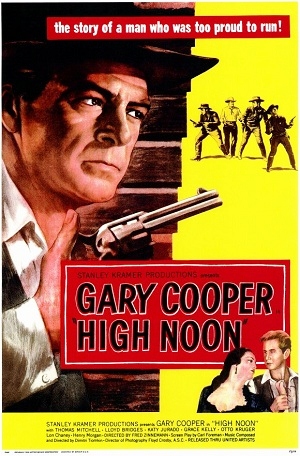
… was nominated for seven Academy Awards, and won four (Actor, Editing, Music-Score, and Music-Song)[3] as well as four Golden Globe Awards (Actor, Supporting Actress, Score, and Cinematography-Black and White).[4] In 1989, this movie was selected for preservation in the United States National Film Registry by the Library of Congress as “culturally, historically, or aesthetically significant”. – Wikipedia.

CU Blog - Remembering 'High Noon' and its Back Story - Photo 4

Movies are important in the roadmap to impact the Caribbean; a previous blog/commentary regarding Caribbean Diaspora member and Hollywood great, Sidney Poitier, declared that …

… “movies are an amazing business model. People give money to spend a couple of hours watching someone else’s creation and then leave the theater with nothing to show for the investment; except perhaps a different perspective”.

The contention is that we can do better in the Caribbean. This is based on one premise: it is easier to reform and transform the Caribbean that it is to reform and transform America. Yes, we can …

The points of effective, technocratic stewardship of the Caribbean have been detailed in these previous blog/commentaries:

https://goleancaribbean.com/blog/?p=10532 Learning from Stereotypes – Good and Bad
https://goleancaribbean.com/blog/?p=9595 Vision and Values for a ‘New’ Caribbean
https://goleancaribbean.com/blog/?p=9214 Time To Go: A 6-part series for the Diaspora in the US
https://goleancaribbean.com/blog/?p=8200 Respect for Minorities: Climate of Hate
https://goleancaribbean.com/blog/?p=7646 Going from ‘Good to Great’
https://goleancaribbean.com/blog/?p=7221 Street naming for Martin Luther King unveils a ‘Climate of Hate’
https://goleancaribbean.com/blog/?p=5733 Better than America? Yes, We Can!
https://goleancaribbean.com/blog/?p=5527 American Defects: Racism – Is It Over?
https://goleancaribbean.com/blog/?p=1596 ‘Prosper where Planted’ in the Caribbean

The issues addressed in this commentary are not related to America alone. We have our own ‘Climate of Hate’ in the Caribbean. While we can learn lessons from the American past and present, we still must do the required heavy-lifting ourselves.

The Go Lean book reports that the Caribbean is in crisis. Too many people leave … due to “push and pull” reasons. Thusly, the region is suffering a debilitating brain-drain estimated at 70% with some countries reporting up to 81%.

The Go Lean roadmap declares that we must, and can, do better. Truth be told, it is easier for the average person to remediate and mitigate defects in the Caribbean homeland than to prosper in foreign lands like the US. This message , while repeated here, must be loudly proclaimed and echoed throughout our Caribbean region.

Every stakeholder, everyone who live, work and play in the Caribbean are urged to lean-in to this Go Lean roadmap to turn-around the region. The strategies, tactics and implementations proposed in the Go Lean book are conceivable, believable and achievable. 🙂

————-

Appendix VIDEO – High Noon (1952) Official Trailer – https://youtu.be/g9CR_tib0CA

Uploaded on Dec 12, 2011 – Classic Western movie starring Gary Cooper and Grace Kelly.

Share this post:
, , , , ,
[Top]

Learning from Stereotypes – Good and Bad

Go Lean Commentary

“Tell them about the dream Martin” – Prompting by Gospel Singer Mahalia Jackson.

“I have a dream that one day … children will be judged by the contents of their character and not the color of their skin.” – Martin Luther King (MLK) @ March on Washington August 28, 1963.

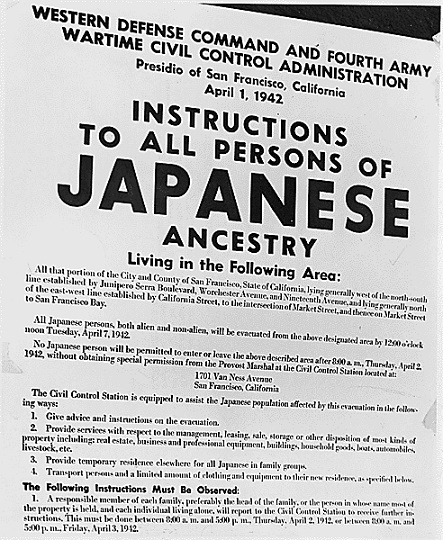
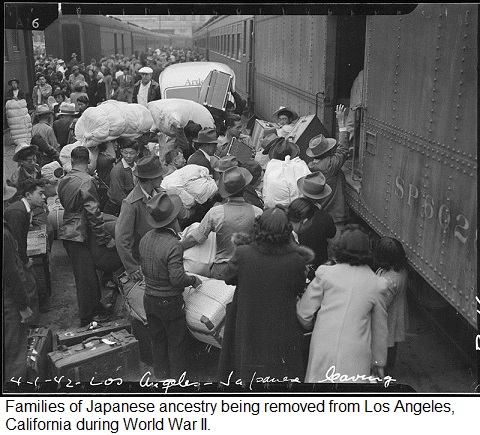
The movement behind the book Go Lean … Caribbean has asserted that the country of the United States had a long way to go to reform their societal defects – racism proliferated every aspect of society. In a previous blog-commentary about lessons learned from 75 years ago with Japanese-American relations (Pearl Harbor) it was explained how America double-downed on their bad community ethos (the underlying attitude/spirit/sentiment that informs the beliefs, customs, or practices):

Japan’s aggression was a direct result of their community ethos that honored Samurai warrior and battle culture. Men would walk the streets with their swords, ready for a challenge. On the other hand, the US (and Western Europe) community ethos of racism was so ingrained that the natural response in the US, post-Pearl Harbor, was to intern Japanese Americans in camps.
All of these bad community ethos were weeded out with post-WWII Human Rights reconciliations. – Go Lean book Page 220.

This day – February 19 – is special; this is the Day of Remembrance of the bad episode of American stereotyping their own citizens, Japanese-Americans following the Pearl Harbor attacks. This is the 75th anniversary of then President Franklin D. Roosevelt’s (FDR) executive order that allowed this open discrimination against Japanese-Americans. This was just 2 and a half months after the Pearl Harbor attack and the American response was to stereotype all Japanese. See this portrayal in the historic account here:

CU Blog - Learning from Stereotypes - Good and Bad - Photo 1

The internment of Japanese Americans in the United States during World War II was the forced relocation and incarceration in camps in the interior of the country of between 110,000 and 120,000[4] people of Japanese ancestry who lived on the Pacific coast. Sixty-two percent of the internees were United States citizens.[5][6] These actions were ordered by President Franklin D. Roosevelt shortly after Imperial Japan’s attack on Pearl Harbor.[7]

Japanese Americans were incarcerated based on local population concentrations and regional politics. More than 110,000 Japanese Americans, who mostly lived on the West Coast, were forced into interior camps, but in Hawaii, where the 150,000-plus Japanese Americans composed over one-third of the population, 1,200 to 1,800 were interned.[8] The internment is considered to have resulted more from racism than from any security risk posed by Japanese Americans,[9][10] as those who were as little as 1/16 Japanese[11] and orphaned infants with “one drop of Japanese blood” could be placed in internment camps.[12]Source: Wikipedia.

CU Blog - Learning from Stereotypes - Good and Bad - Photo 2

In effect, the America of 1942 was declaring that if one Japanese person could attack America then all Japanese people could attack America. They were judging the Japanese people based on the “color of their skin” (and slant of their eyes) rather than the “content of their character”. This is so obviously wrong.

Did America learn from this 1942 experience?

Unfortunately, the experience continued as “more of the same”. Martin Luther King echoed his dream 21 years later after lamenting the continuous bad experience of blatant racism against Black people. Even today, prominent Japanese-Americans are decrying the “more of the same” parallel that America is demonstrating; see George Takei’s comments here:

Every year, on February 19, we Japanese-Americans honor this day as Remembrance Day, and we renew our pledge to make sure what happened to us never happens again in America. I am always amazed, and saddened, that despite our decades long efforts, so many young people today are not even aware that such a tragedy and miscarriage of justice took place here.

And I grow increasingly concerned that we are careening toward a future where such a thing would again be possible.

A few months into his campaign, Donald Trump refused to outright reject the policies and fears that underlay the internment. Instead, he suggested that it was a tough call, and that he “would have had to be there” in order to know whether it was the wrong one.

CU Blog - Learning from Stereotypes - Good and Bad - Photo 3Trump ignored the inconvenient fact that not a single case of espionage or sabotage was ever proven against any internee, and that the military itself admitted that there was never any evidence to support their sweeping policy. A few months later, a top Trump surrogate went on television and suggested that the internment might actually serve as a “precedent” for another Trump policy — the registration of Muslim-Americans in a database.

I cannot help but hear in these words terrible echoes from the past. The internment happened because of three things: fear, prejudice and a failure of political leadership. When the administration targets groups today, whether for exclusion from travel here on the basis of religion and national origin, or for deportation based on their undocumented status, I know from personal experience that these are not done, as they claim, truly in the name of national security.

Source: Posted and retrieved February 19, 2017 from: http://www.cnn.com/2017/02/18/opinions/george-takei-japanese-american-internment-day-of-remembrance/index.html

Despite the 75 years since FDR’s racist decree and 54 years since MLK’s lamentation of blatant American racism, we find “more of the same” in this society, though now it is considered politically incorrect to be blatantly racist. Under the tenants of the law, this type of behavior – 1942 internment – is now fully recognized as being unconstitutional. The Civil Liberties Act of 1988 officially acknowledged the “fundamental violations of the basic civil liberties and constitutional rights” of the internment.[7] Many Japanese-Americans consider the term internment camp a euphemism and prefer to refer to their forced relocation as imprisonment in concentration camps.[8]

The movement behind the Go Lean book asserts that despite the legalities, the foundations of institutional racism in America have become even more entrenched. This movement campaigns that it is folly for the Black-and-Brown populations to leave the Caribbean for American shores. Racism is in this country’s DNA as the Naturalization Act of 1790 restricted naturalized US citizenship to “free white persons”.

Considering the reality of the Caribbean demographics (Black-and-Brown), it is no wonder that the American world consider Caribbean people and society as “Less Than“.

This is the problem with stereotypes. There is an art-and-science associated with the subject of stereotypes.

Consider the photos here and this AUDIO Podcast:

CU Blog - Learning from Stereotypes - Good and Bad - Photo 5

CU Blog - Learning from Stereotypes - Good and Bad - Photo 6

Full Podcast – Playing With Perceptions – http://www.npr.org/programs/ted-radio-hour/358360814/playing-with-perceptions

AUDIO – Why Do We Create Stereotypes?

Posted February 14, 2017 – Where do stereotypes come from? Why do some perceptions persist, and is there any truth or value to the assumptions we make? In this hour, TED speakers examine the consequences of stereotypes.

CU Blog - Learning from Stereotypes - Good and Bad - Photo 4

The planners of Caribbean empowerment, the Go Lean movement assess that America is a “frienemy” for us! We are trading partners; we are aligned; we are allies; many of our Diaspora live in America; studied in America; but we have to compete to dissuade our young people from setting their sights on American shores as a refuge and destination of their hopes and dreams. So the Go Lean book challenges Caribbean society, positing that “we” cannot prosper with a high abandonment rate – reported at 70% for educated classes. Therefore we must battle” against the “push-and-pull” factors that draw so many Caribbean citizens away from their homeland to places like the US.

This is the quest of Go Lean…Caribbean. The book and accompanying blog/commentaries advocate learning lessons from other societies, from history and the present. Examples are provided from as far back as the patriarchal Bible times, to best-practices today employed by communities around the world that have successfully turned-around their societies, such as post-World War II Germany and Japan; and post-Apartheid South Africa. The Go Lean book serves as a roadmap for the introduction and implementation of the technocratic Caribbean Union Trade Federation (CU). This roadmap seeks to reboot the region’s economic, security and governing engines; to employ best practices to impact our prime directives; identified with the following 3 statements:

  • Optimization of the economic engines in order to grow the regional economy to $800 Billion & create 2.2 million new jobs.
  • Establishment of a security apparatus to protect the resultant economic engines and mitigate challenges/threats to regional Justice Institutions.
  • Improvement of Caribbean governance to support these engines.

The Go Lean book relates that 29 of the 30 Caribbean member-states (“St. Barths” is the only exception) have a majority Black population. So the roadmap pushes further on this subject of racism, positing that it is easier for Caribbean citizens to stay home and effect change in their homelands than to go to America – and other countries – to try to remediate other societies. This consideration is one of technocratic stewardship of the regional Caribbean societal engines, not ignoring the realities and historicities of race relations in the New World. This point was pronounced in the opening Declaration of Interdependence (Pages 10 – 14) with these acknowledgements and statements:

Preamble:  As the history of our region and the oppression, suppression and repression of its indigenous people is duly documented, there is no one alive who can be held accountable for the prior actions, and so we must put aside the shackles of systems of repression to instead formulate efficient and effective systems to steer our own destiny.

xi.   Whereas all men are entitled to the benefits of good governance in a free society, “new guards” must be enacted to dissuade the emergence of incompetence, corruption, nepotism and cronyism at the peril of the people’s best interest. The Federation must guarantee the executions of a social contract between government and the governed.

xii. Whereas the legacy in recent times in individual states may be that of ineffectual governance with no redress to higher authority, the accedence of this Federation will ensure accountability and escalation of the human and civil rights of the people for good governance, justice assurances, due process and the rule of law. As such, any threats of a “failed state” status for any member state must enact emergency measures on behalf of the Federation to protect the human, civil and property rights of the citizens, residents, allies, trading partners, and visitors of the affected member state and the Federation as a whole.

xxxiii. Whereas lessons can be learned and applied from the study of the recent history of other societies, the Federation must formalize statutes and organizational dimensions to avoid the pitfalls of [other] communities.

The Go Lean book stresses the key community ethos that need to be adopted and the societal defects that need to be “weed out”; plus strategies, tactics, implementations and advocacies necessary to transform and turn-around the eco-systems of Caribbean society. These points are detailed in the book as follows:

Community Ethos – Deferred Gratification – African American Experience Page 21
Economic Principles – Economic Systems Influence Individual Choices Page 21
Community Ethos – Economic Principles – Consequences of Choices Lie in the Future Page 21
Community Ethos – Governing Principles – Lean Operations Page 24
Community Ethos – Ways to Manage Reconciliations – South Africa’s Model Page 34
Community Ethos – Ways to Impact the Greater Good Page 37
Strategy – Vision – Confederate all 30 member-states/ 4 languages into a Single Market Page 45

Strategy – Mission – Build and foster local economic engines Page 45
Tactical – Ways to Foster a Technocracy Page 64
Tactical – Growing the Economy – Post WW II European Marshall Plan Model Page 68
Tactical – Growing the Economy – Post WW II Japan’s Turn-around Model Page 68
Tactical – Separation-of-Powers – CU Federal Government versus Member-State Governance Page 71
Implementation – Assemble All Regionally-focus Organizations of All Caribbean Communities Page 96
Implementation – Ways to Better Manage Debt Page 114
Anatomy of Advocacies – One Person can make a difference! Page 122
Planning – 10 Big Ideas – Single Market / Currency Union Page 127
Planning – Ways to Make the Caribbean Better Page 131
Planning – Ways to Better Manage Caribbean Image Page 133
Planning – Ways to Improve Failed-State Indices – Minority and Human Rights Page 134
Planning – Lessons Learned from the previous West Indies Federation Page 135
Planning – Lessons Learned New York City – Managing as a “Frienemy” Page 137
Planning – Lessons Learned from East Germany – Bad Examples for Trade & Security Page 139
Planning – Lessons Learned from Detroit – Turn-around from Failure Page 140
Planning – Lessons Learned from Indian Reservations – Pattern of Ethnic Oppression Page 141
Advocacy – Ways to Grow the Economy Page 151
Advocacy – Ways to Create Jobs Page 152
Advocacy – Ways to Improve Governance Page 168
Advocacy – Ways to Better Manage the Social Contract Page 170
Advocacy – Ways to Impact Justice Page 177
Advocacy – Ways to Improve Homeland Security Page 180
Advocacy – Ways to Preserve Caribbean Heritage Page 218

There are other lessons for the Caribbean to learn from considering the history of race/ethnic relations and the effects on stereotypes; see the following sample blog/commentaries:

https://goleancaribbean.com/blog/?p=10216 Waging a Successful War on Orthodoxy
https://goleancaribbean.com/blog/?p=10170 Obama was a ‘Reconstruction’; Trump is the resulting ‘Redemption’
https://goleancaribbean.com/blog/?p=9214 US Race Relations: Spot-on for Protest
https://goleancaribbean.com/blog/?p=8724 US versus Marcus Garvey: A Typical Case of Racism
https://goleancaribbean.com/blog/?p=8200 Respect for Minorities: Climate of Hate
https://goleancaribbean.com/blog/?p=7221 Street Naming for Martin Luther King Unveils the Real America
https://goleancaribbean.com/blog/?p=5527 American Defects: Racism – Is It Over?
https://goleancaribbean.com/blog/?p=2809 A Lesson in History: Economics of East Berlin
https://goleancaribbean.com/blog/?p=2480 A Lesson in History: Community Ethos of WW II
https://goleancaribbean.com/blog/?p=2297 A Lesson in History: Booker T versus Du Bois
https://goleancaribbean.com/blog/?p=1020 Europe Desperately Battling to Weed-out Last of Racism
https://goleancaribbean.com/blog/?p=789 A Lesson in History: America’s War on the Caribbean

The Go Lean roadmap does not seek to reform or transform America; it is out-of-scope for our efforts; our focus is only here in our Caribbean homeland.

The stereotypes in America are based on a false premise: White Supremacy. The everyday consequence of this bad foundation is White Privilege. This is why it is better for Caribbean people to stay in the Caribbean, to prosper where planted here at home. But we have defects too. However it is easier to reform our defects in the Caribbean than to try and fix the American eco-system.

We urge everyone in the Caribbean to lean-in to this Go Lean roadmap. It is the heavy-lifting we need to effect change in our region’s societal engines.

Yes we can … make the Caribbean region a better place to live, work and play. 🙂

Download the book Go Lean … Caribbean – now!


Share this post:
, , , ,
[Top]

Waging a Successful War on ‘Terrorism’

Go Lean Commentary

“The first casualty when war comes is truth” – US Senator Hiram Warren Johnson (1918).

In the United States, the War on ‘Terrorism’ was declared after the World Trade Center Attacks in September 2001. The war is still waging … some 16 years later. This is the third Commander-in-Chief (President) to lead the American effort; (George W. Bush, Barack Obama and Donald Trump). Now, the lines are starting to blur in terms of who are the enemies and who are the allies.

During the first week of the new Trump administration, the new President issued an Executive Order – fulfilling a campaign promise – banning all immigrants from certain Muslim-majority countries. This is purportedly in conjunction with the ongoing War on ‘Terror’. The problem is that the cited countries have not been the source of the terrorist activities that have attacked the US. The targeting seem arbitrary. We must consider the truth; see the news article and photo/map of this story here:

Title: These Countries with Business Links to Trump Aren’t Part of His Immigration Ban
By: Joseph Hincks

CU Blog - War on 'Terrorism' - Photo 1

A little over a year ago, then-Republican presidential candidate Donald Trump called for a “total and complete shutdown of Muslims entering the United States,” until the country’s leadership could “figure out what is going on.”

Along the campaign trail, he modified this blanket ban to a suspension of “immigration from terror-prone regions, where vetting cannot safely occur,” which he promised to enact during his first 100 days in office.

And now, a week into Trump’s presidency, he has tried to make good on that promise—or, at least, partly so. A draft proposal of an executive order obtained by Bloomberg News reportedly shows that Trump is poised to suspend all entry to the U.S. from seven Muslim-majority countries.

Notably missing from the blacklist, however, are several Muslim-majority countries where Trump has business dealings, according to Bloomberg.

The news organization has put together a map of the proposed suspensions, with the Muslim-majority countries where Trump has business interests—Egypt, Saudi Arabia, Turkey, and Azerbaijan—rendered in yellow.

While Muslim-majority countries such as Oman, Qatar, Kuwait, and others are not included on the list, the omission of Turkey and Egypt may be argued as being seen at odds with Trump’s definition. Both Turkey and Egypt endured high-profile terror attacks in 2016.

The President has positions in two companies that may be related to business in Egypt, and has previously praised the country’s autocratic leader, Abdel Fattah al-Sisi. In Turkey, Trump has a licensing deal to use his name on two luxury towers in Istanbul.

Source: Fortune Magazine Online Site; posted January 27, 2017; retrieved January 29, 2017 from: http://fortune.com/2017/01/27/donald-trump-muslim-immigration-ban-conflict/

Such a bold move – based on mis-truths – elicits response, feedback and uproar from opposition and pundits alike. In one such salvo on Saturday January 28th, a Security Analyst (with TV News Network MSNBC), Malcolm Nance, identified that terrorists are sourced in many countries around the world, not just the banned 7 and including places like the Caribbean.

Wait, what?!?! Such a scandalous accusation!

This brings to mind a previous blog-commentary by the promoters of the book Go Lean … Caribbean, describing the reality of the terrorism-threat in the Caribbean:

ISIS reaches the Caribbean Region

The Caribbean member-states are all atwitter about such associations. The region’s governments asserts that they are partners in the ‘War on Terror’ and not accessories to any Bad Actors. Consider the formal response from the Bahamas in the Appendix A below.

But truth be told, the US – and other advanced democracy countries – are very alarmed with their Caribbean partners; we have so many societal defects that exacerbate the global attempts to mitigate terrorism. Consider this list of security-based societal defects:

1.  Indiscriminant Citizenship By Investment Program – see the CBS 60 Minutes story about Passports for Sale even to Terror Suspects featured in this previous blog. Can terrorists hide their identity with a passport from a Caribbean member-state? Can we do better going forward?CU Blog - War on Rent - Photo 3
CU Blog - War on 'Terrorism' - Photo 22.  US PATRIOT Act – Managing ‘the Need and the Greed’ with this law. The measure allowed US authorities to have purview on foreign bank accounts in cooperative countries. This is where the Caribbean member-states were given the opportunity to demonstrate that they were willing to mitigate terrorism. Cooperation with these measures – see Appendix B below – jeopardized the Offshore Banking industry in the region. Can terrorists use our “banking in the shadows” to facilitate their malice? The historicity of the Offshore Banking Regulatory changes were detailed in the Go Lean book (Pages 321 – 326). Consider this sample from Page 321:

“In 2001 the development of standards in the fight against terrorism financing was added to the mission of the FATF [(Financial Action Task Force … on Money Laundering)]. In October 2001 the FATF issued the Eight Special Recommendations to deal with the issue of terrorism financing. The continued evolution of money laundering techniques led the FATF to revise the FATF standards comprehensively in June 2003. In October 2004 the FATF published a Ninth Special Recommendations, further strengthening the agreed international standards for combating money laundering and terrorism financing”.

3.  Aversion to Digital Dragnets – The cutting edge technologies to capture meta-data or actual cell phone contents have been frowned on in the Caribbean; in a 2011 WikiLeaks dissemination, whistleblower Edward Snowden revealed that the Bahamas cooperates with US official and records all cell phone calls. This disclosure was assailed as an Abuse of Power. But we must admit, this is an abuse of American power on the Caribbean homeland. Issues abound that need to be addressed and settled. The societal defect is that we are expecting others (the US in this case) to take the lead for our own security. Can we better prepare our own security apparatus for our own security needs? See VIDEO here relating the Privacy Concerns of dragnets.
VIDEO – USA Today: Digital Dragnet – Police Scoop Up Cell Phone Data – https://www.occupycorporatism.com/digital-dragnet-dhs-police-stingray-trackers/

Posted December 9, 2013 – Systems like the “Stingray” allow law enforcement entities to “tap into cellphone data in real time . . . capturing information about thousands of cellphone users at a time, whether they are targets of an investigation or not”.
4.  Monitoring for threats (Weapons of Mass Destruction) – like Nuclear weapons. In the Caribbean, the “Sum of our Greatest Fear” is a terrorist detonating a dirty (nuclear) bomb in an unsecured island community. This is not just something we can complain about, no, we must prepare. There is an international accord that affords a solution, through the US. This is addressed in the discussion of the NEST program (Nuclear Emergency Support Team) in Appendix C below. We can facilitate our own arrangement, with US cooperation. We can mount sensors and monitoring equipment; we can grant access and enable the NEST inspectors in our domain.
CU Blog - War on 'Terrorism' - Photo 3

How we receive, perceive and retrieve security mitigations indicates the impact of our societal defects. Without firing one shot, the Caribbean is able to help or hurt the War Against ‘Terrorism’ with our societal defects. This is commentary 4 of 4 from the movement behind the Go Lean book on the subject of Caribbean societal defects. So how do we move our communities from the deficient-defective status quo to our targeted destination: “a better (safer) place to live, work and play”? By waging war on our defects. All of these commentaries detail that effort, for the following defects:

  1. Waging a Successful War on Orthodoxy
  2. Waging a Successful War on Stupidity
  3. Waging a Successful War on Rent
  4. Waging a Successful War on ‘Terrorism’

These commentaries draw reference to the Go Lean book, as it details the quest to reform and transform the Caribbean; it features a how-to guide and roadmap for elevating the region’s societal engines for (1.) economics, (2.) security and (3.) governance. Strategies, tactics and implementations for the War Against Terrorism have relevance for all these three spheres of society.

The book Go Lean … Caribbean serves as a roadmap for the introduction and implementation of the Caribbean Union Trade Federation (CU) to elevate the region’s societal engines of economics, security and governance. With a brand name like Trade Federation, obviously the primary focus is on economics, but the book asserts (Page 23) that peace, security and public safety must be tantamount to economic prosperity; that bad things will happen to good people and so the community needs to be prepared to contend with the risks that can imperil the homeland. The Go Lean book therefore serves as a roadmap for full Caribbean integration, with the motivation for Greater Good. In all, the Go Lean roadmap has these 3 prime directives:

  • Optimization of the economic engines in order to grow the regional economy and create new jobs.
  • Establishment of a homeland security apparatus to ensure public safety and to protect the resultant economic engines of the Caribbean region.
  • Improvement of Caribbean governance to support these engines.

The priority on homeland security was pronounced early in the Go Lean book with the opening Declaration of Interdependence (Page 12) that claims:

x. Whereas we are surrounded and allied to nations of larger proportions in land mass, populations, and treasuries, elements in their societies may have ill-intent in their pursuits, at the expense of the safety and security of our citizens. We must therefore appoint “new guards” to ensure our public safety and threats against our society, both domestic and foreign. The Federation must employ the latest advances and best practices … to assuage continuous threats against public safety.

xi. Whereas all men are entitled to the benefits of good governance in a free society, “new guards” must be enacted to dissuade the emergence of incompetence, corruption, nepotism and cronyism at the peril of the people’s best interest. The Federation must guarantee the executions of a social contract between government and the governed.

xii. Whereas the legacy in recent times in individual states may be that of ineffectual governance with no redress to higher authority, the accedence of this Federation will ensure accountability and escalation of the human and civil rights of the people for good governance, justice assurances, due process and the rule of law. As such, any threats of a “failed state” status for any member state must enact emergency measures on behalf of the Federation to protect the human, civil and property rights of the citizens, residents, allies, trading partners, and visitors of the affected member state and the Federation as a whole.

xvi. Whereas security of our homeland is inextricably linked to prosperity of the homeland, the economic and security interest of the region needs to be aligned under the same governance. Since economic crimes, including … forms of terrorism, can imperil the functioning of the wheels of commerce for all the citizenry, the accedence of this Federation must equip the security apparatus with the tools and techniques for predictive and proactive interdictions.

The Caribbean appointing these “new guards” will include many strategies, tactics and implementations considered “best-practices” in the War Against Terror.

The CU would be established by the sovereign powers of the 30 Caribbean member-states to empower the region with economic, security and governing tools and techniques. This includes a Security / Defense Pact (Armed Forces) with a fully-empowered Naval Force and Expeditionary Marine (ground) Forces. The Security Pact is about action, not attitude; but the right societal attitude (weeding out societal defects) is important, critical even.

Societal defects are destructive and self-defeating for the interior of our communities. But in the case of security gaps, far-away communities can be imperiled as well. The War on Terrorism is fought by many stakeholders on many different ‘battlefields’.  Consider airport screening; once every passenger has been screened for weapons and explosives, the plane is considered “sanitized” and can then enter any airspace with a presumed label of “safe-and-secured”. Poor security executions in the Caribbean can therefore impact the public safety of far-away places. So our defects can result in bad cause-and-effect for other (innocent) people.

This is the attitude – community ethos – that we must adopt, that our battles in the War Against Terror can help/hurt the rest of the world. “Community Ethos” is defined here as:

“… the fundamental character or spirit of a culture; the underlying sentiment that informs the beliefs, customs, or practices of a group or society; dominant assumptions of a people or period practices of a group or society; dominant assumptions of a people or period”.

The Go Lean book details the series of community ethos, strategies, tactics, implementations and advocacies to wage a successful ‘War on Terrorism’; this includes proactive and reactive public safety/security measures in the Caribbean region:

Community Ethos – Economic Systems Influence Individual Choices Page 21
Community Ethos – Consequences of Choices Lie in Future Page 21
Community Ethos – Privacy –vs- Public Protection Page 23
Community Ethos – Intelligence Gathering Page 23
Community Ethos – Whistleblower Protection Page 23
Community Ethos – “Crap” Happens Page 23
Community Ethos – Cooperatives Page 25
Community Ethos – Ways to Manage Reconciliations Page 34
Community Ethos – Ways to Improve Sharing Page 35
Community Ethos – Ways to Promote Happiness Page 36
Community Ethos – Ways to Impact the Greater Good Page 37
Strategy – Vision – Confederating a non-sovereign permanent union Page 45
Tactical – Fostering a Technocracy Page 64
Tactical – Separation of Powers – Coast Guard & Naval Authorities Page 75
Tactical – Separation of Powers – Ground Militia Forces Page 75
Tactical – Separation of Powers – Emergency Management Agency Page 76
Tactical – Separation of Powers – CariPol: Marshals & Investigations Page 75
Implementation – Ways to Pay for Change Page 101
Implementation – Start-up Foreign Policy Initiatives Page 102
Implementation – Start-up Security Initiatives Page 103
Implementation – Ways to Foster International Aid Page 115
Planning – 10 Big Ideas – #3: Consolidated Homeland Security Pact Page 130
Planning – Ways to Make the Caribbean Better Page 131
Planning – Ways to Improve Failed-State Indices – Escalation Role Page 134
Planning – Lessons from the American West – Needed Law & Order Page 142
Planning – Lessons from Egypt – Law & Order for Tourism Page 143
Advocacy – Ways to Grow the Economy – Quick Disaster Recovery Page 151
Advocacy – Ways to Improve Governance Page 168
Advocacy – Ways to Better Manage the Social Contract Page 170
Advocacy – Ways to Impact Justice – Policing/Supporting the Police Page 177
Advocacy – Ways to Reduce Crime – Regional Security Intelligence Page 178
Advocacy – Ways to Improve Homeland Security Page 180
Advocacy – Ways to Mitigate Terrorism Page 181
Advocacy – Ways to Improve Intelligence Gathering & Analysis Page 182
Advocacy – Reforms for Banking Regulations – Offshore Banking Reforms Page 199
Advocacy – Ways to Impact Wall Street – Downplay Lawless Impressions Page 200
Advocacy – Ways to Impact Main Street Page 201
Advocacy – Ways to Protect Human Rights – Watchful World Page 220
Appendix ZD – Offshore Tax & Financial Services Industry Developments Page 321
Appendix ZE – Offshore Tax & Financial Services Industry – Bahamas Example Page 322

Other subjects related to security and governing empowerments for the region’s defense have been blogged in other Go Lean…Caribbean commentaries, as sampled here:

https://goleancaribbean.com/blog/?p=9974 Lessons Learned from Pearl Harbor
https://goleancaribbean.com/blog/?p=9072 Securing the Homeland – On the Ground
https://goleancaribbean.com/blog/?p=9070 Securing the Homeland – From the Seas
https://goleancaribbean.com/blog/?p=9068 Securing the Homeland – From the Air
https://goleancaribbean.com/blog/?p=7119 Security Role Model for the Caribbean: African Standby Force
https://goleancaribbean.com/blog/?p=6720 A Lesson in History – During the Civil War: Fighting for Our Own Cause
https://goleancaribbean.com/blog/?p=6103 Sum of All Fears – ‘On Guard’ Against Deadly Threats
https://goleancaribbean.com/blog/?p=5183 A Lesson in History – Cinco De Mayo and Mexico’s Security Lapses
https://goleancaribbean.com/blog/?p=5002 Managing a ‘Clear and Present Danger’
https://goleancaribbean.com/blog/?p=4809 Americans arrest 2 would-be terrorists – a Clear and Present Danger
https://goleancaribbean.com/blog/?p=4360 Dreading the ‘Caribbean  Basin Security Initiative’
https://goleancaribbean.com/blog/?p=3881 Intelligence Agencies to Up Cyber Security Cooperation
https://goleancaribbean.com/blog/?p=1965 America’s Navy – 100 Percent – Model for Caribbean
https://goleancaribbean.com/blog/?p=1554 Status of Forces Agreement = Security Pact
https://goleancaribbean.com/blog/?p=1076 Trinidad Muslims travel to Venezuela for Jihadist training
https://goleancaribbean.com/blog/?p=809 Muslim officials condemn abductions of Nigerian girls
https://goleancaribbean.com/blog/?p=535 Remembering and learning from Boston
https://goleancaribbean.com/blog/?p=273 10 Things We Want from the US – #4: Pax Americana

An effort to provide better security solutions in the Caribbean should be welcomed here.

The new Caribbean must foster good security habits … and ‘War against Bad Ones’ – societal defects. This is how to secure our homeland: monitor for threats, gather intelligence, investigate incidences, police communities, arm a defense apparatus and prepare for the worst.

This level of response is new … for our region; we normally sit back and let someone else do the heavy-lifting for security. But it is time now to grow up and secure our own communities and our economic engines.

All Caribbean stakeholders are therefore urged to lean-in to this roadmap, to this conceivable, believable and achievable plan to make the Caribbean a better place to live, work and play. 🙂

Download the book Go Lean … Caribbean – now!

———–

Appendix A – Statement By The Bahamas Ministry of Foreign Affairs

On Reported ‘Terrorism Threat From The Bahamas’

28 January 2017

For Immediate Release

Today on MSNBC Cable News, on a show hosted by Joy-Ann Reid, a guest Malcolm Nance, a reported expert in security and terrorism, made the following statement:

” We [ the United States] have not banned terrorists from Brazil. ISIS has dozens of members from Brazil or Trinidad or The Bahamas who have more terrorists members than any of those other countries.”

In today’s atmosphere, the video clip is being spread around at a clipped pace.

Upon hearing the report, the Minister of Foreign Affairs Fred Mitchell spoke with the Prime Minister, the National Security Minister, the Head of SIB in the Royal Bahamas Police Force. all of whom are responsible for the country’s national security and they have no knowledge of any such terrorists or group of terrorists or any individual terrorist that is related to ISIS or any other terrorist organization in The Bahamas.

In speaking with ZNS TV news this evening, the Minister said the report is rubbish.

He indicated that the U S Mission in the United States has been asked to reach out to US counterparts, to MSNBC and the Mr. Nance himself to find out what the source of the allegation is. The Mission has been asked to ask for a retraction forthwith.

Source: Retrieved January 29, 2017 from: http://www.thebahamasweekly.com/publish/bis-news-updates/Bahamas_Gov_t_responds_to_MSNBC_regarding_reported_terrorism_threat_from_The_Bahamas52287.shtml

———–

Appendix B – USA Patriot Act

The USA PATRIOT Act is an Act of Congress that was signed into law by President George W. Bush on October 26, 2001.[1] With its ten-letter abbreviation (USA PATRIOT) expanded, the full title is “Uniting and Strengthening America by Providing Appropriate Tools Required to Intercept and Obstruct Terrorism Act of 2001”.[2]

On May 26, 2011, President Barack Obama signed the PATRIOT Sunsets Extension Act of 2011, a four-year extension of three key provisions in the USA PATRIOT Act:[3] roving wiretapssearches of business records, and conducting surveillance of “lone wolves”—individuals suspected of terrorist-related activities not linked to terrorist groups.[4]

Following a lack of Congressional approval, parts of the Patriot Act expired on June 1, 2015.[5] With the passage of the USA Freedom Act on June 2, 2015, the expired parts were restored and renewed through 2019.[6] However, Section 215 of the law was amended to stop the National Security Agency (NSA) from continuing its mass phone data collection program.[6] Instead, phone companies will retain the data and the NSA can obtain information about targeted individuals with permission from a federal court.[6]

From broad concern felt among Americans from both the September 11 attacks and the 2001 anthrax attacks, Congress rushed to pass legislation to strengthen security controls.

Acts amended Electronic Communications Privacy Act
Computer Fraud and Abuse Act
Foreign Intelligence Surveillance Act
Family Educational Rights and Privacy Act
Money Laundering Control Act
Bank Secrecy Act
Right to Financial Privacy Act
Fair Credit Reporting Act
Immigration and Nationality Act of 1952
Victims of Crime Act of 1984
Telemarketing and Consumer Fraud and Abuse Prevention Act

Title III: Anti-money-laundering to prevent terrorism

Title III of the Act, titled “International Money Laundering Abatement and Financial Anti-Terrorism Act of 2001,” is intended to facilitate the prevention, detection and prosecution of international money laundering and the financing of terrorism. It primarily amends portions of the Money Laundering Control Act of 1986 (MLCA) and the Bank Secrecy Act of 1970 (BSA). It was divided into three subtitles, with the first dealing primarily with strengthening banking rules against money laundering, especially on the international stage. The second attempts to improve communication between law enforcement agencies and financial institutions, as well as expanding record keeping and reporting requirements. The third subtitle deals with currency smuggling and counterfeiting, including quadrupling the maximum penalty for counterfeiting foreign currency.

Restrictions were placed on accounts and foreign banks. It prohibited shell banks that are not an affiliate of a bank that has a physical presence in the U.S. or that are not subject to supervision by a banking authority in a non-U.S. country. It also prohibits or restricts the use of certain accounts held at financial institutions.[47] Financial institutions must now undertake steps to identify the owners of any privately owned bank outside the U.S. who have a correspondent account with them, along with the interests of each of the owners in the bank. It is expected that additional scrutiny will be applied by the U.S. institution to such banks to make sure they are not engaging in money laundering. Banks must identify all the nominal and beneficial owners of any private bank account opened and maintained in the U.S. by non-U.S. citizens. There is also an expectation that they must undertake enhanced scrutiny of the account if it is owned by, or is being maintained on behalf of, any senior political figure where there is reasonable suspicion of corruption.[48]Any deposits made from within the U.S. into foreign banks are now deemed to have been deposited into any interbank account the foreign bank may have in the U.S. Thus any restraining order, seizure warrant or arrest warrant may be made against the funds in the interbank account held at a U.S. financial institution, up to the amount deposited in the account at the foreign bank.[49]

Source: Retrieved January 29, 2017 from: https://en.wikipedia.org/wiki/Patriot_Act

———–

Appendix C – Nuclear Emergency Support Team

The Nuclear Emergency Support Team (NEST) (formerly known as the Nuclear Emergency Search Team) is a team of scientists, technicians, and engineers operating under the United States Department of Energy‘s National Nuclear Security Administration (NNSA). Their task is to be “prepared to respond immediately to any type of radiological accident or incident anywhere in the world”.[1]

History

Concerns over scenarios involving nuclear accidents or incidents on American soil are not recent. As early as the 1960s, officials were concerned that a nuclear weapon might be smuggled into the country, or that an airplane carrying a nuclear weapon might crash and contaminate surrounding areas.[2] In late 1974, President Gerald Ford was warned that the FBI received a communication from an extortionist wanting $200,000 (equivalent to $971,000 in 2016) after claiming that a nuclear weapon had been placed somewhere in Boston. A team of experts rushed in from the United States Atomic Energy Commission but their radiation detection gear arrived at a different airport. Federal officials then rented a fleet of vans to carry concealed radiation detectors around the city but forgot to bring the tools they needed to install the equipment. The incident was later found to be a hoax. However, the government’s response made clear the need for an agency capable of effectively responding to such threats in the future. Later that year, President Ford created the Nuclear Emergency Search Team (NEST), which under the Atomic Energy Act is tasked with investigating the “illegal use of nuclear materials within the United States, including terrorist threats involving the use of special nuclear materials”.[1]

One of its first responses was in Spokane, Washington on November 23, 1976. An unknown group called the “Days of Omega” had mailed an extortion threat claiming they would explode radioactive containers of water all over the city unless paid $500,000 (equivalent to $2,104,000 in 2016). Presumably, the radioactive containers had been stolen from the Hanford Site, less than 150 miles (240 km) to the southwest. Immediately, NEST flew in a support aircraft from Las Vegas and began searching for non-natural radiation, but found nothing. No one ever responded, despite the elaborate instructions given, or made any attempt to claim the (fake) money, which was kept under surveillance. Within days, the incident was deemed a hoax, though the case was never solved. To avoid panic, the public was not notified until a few years later.[3][4]

Today

According to the Bulletin of the Atomic Scientists, NEST has the ability to deploy as many as 600 people to the scene of a radiological incident, though deployments do not usually exceed 45 people.[5] NEST has a variety of equipment (weighing up to 150 tons) and has the support of a small fleet of aircraft which includes four helicopters and three airplanes, all outfitted with detection equipment.

When an airborne response to an incident is underway, the Federal Aviation Administration grants NEST flights a higher control priority within the United States National Airspace System, designated with the callsign “FLYNET”.

Since 1975, NEST has been warned of 125 nuclear terror threats and has responded to 30. All have been false alarms.

Source: Retrieved January 29, 2017 from: https://en.wikipedia.org/wiki/Nuclear_Emergency_Support_Team


Share this post:
, , ,
[Top]

Waging a Successful War on Rent

Go Lean Commentary

‘Rent’ is a 4-letter word …

… in the field of Economics.

This is not referring to the positive action of paying for the monthly expense for a house or an apartment, but rather the bad practice of extracting uncompensated value from others without making any contribution – getting something for nothing.

With such a simple definition, the assumption would be that ‘rent’ is unwelcomed and marginalized in society. And yet, for the Caribbean, this bad practice proliferates.

“Say it ain’t so…”

Unfortunately, there is plenty “rent-seeking” in the Caribbean. If we want to reform and transform our society – we do – there is a need to “Wage War” against this bad practice of rent-seeking.

CU Blog - War on Rent - Photo 1

The movement behind the book Go Lean … Caribbean describes rent-seeking as a societal defect … in the Caribbean, and most other societies. It is destructive and self-defeating. In a previous blog-commentary, this defective practice was fully dissected, detailed and dismissed as behavior we want to weed out of Caribbean society.

How?

First we start by recognizing that there is a problem:

“There is rent-seeking in our communities”.

Now we can arm ourselves for battle in this War Against Rent. This is an important first step in reforming and transforming our regional society. This is commentary 3 of 4 from the movement behind the Go Lean book on the subject of Caribbean societal defects. So how do we move our communities from the deficient-defective status quo to our targeted destination: “a better place to live, work and play”? By waging war on our defects. All of these commentaries detail that effort, for the following defects:

  1. Waging a Successful War on Orthodoxy
  2. Waging a Successful War on Stupidity
  3. Waging a Successful War on Rent
  4. Waging a Successful War on ‘Terrorism’

These commentaries draw reference to the Go Lean book, as it details the quest to transform the Caribbean; it features a how-to guide and roadmap for elevating the region’s societal engines for economics, security and governance. Rent-seeking can, and have, penetrated all these three spheres of society.

In the previous commentary on ‘Stupidity’, it was established that when stupid policies-practices persist in a society, it is usually because “someone is profiting” in the shadows. Rent-seeking on the other hand, tends to be “out in the open”, i.e. guaranteed gratuities at a restaurant/bar. Both stupidity and rent-seeking are therefore tied to Crony-Capitalism: the abuse of public funds for private gain.

Consider these details of rent-seeking in the economics, security and governing societal engines:

Economics
Gratuity              . 18 percent guaranteed
Sharing Economy AirBnB and Uber examples
Security
Bribery/Graff   . An obvious crime
Traffic Cameras Electronic surveillance used to auto-generate traffic tickets
Governance
Citizenship For Sale $100,000 fees for … doing nothing – See VIDEO in the Appendix.
Disclosures           . Follow the money‘; many politicians enter public service with modest incomes, but become wealthy while in office, despite only moderate government paychecks.
Fuel Taxes             . Dissuade Green Alternatives and e-Cars. “Invention, the Mother of Necessity” is discouraged because the government wants it’s guaranteed revenues.

The movement behind the Go Lean book seeks to reform and transform the economic engines of the Caribbean by being technocratic in applying best practices from the field of Economics. Rent-seeking is distinguished in economic theory from profit-seeking, in which entities seek to extract value by engaging in mutually beneficial transactions.[6] Profit-seeking in this sense is the creation of wealth, while rent-seeking is the use of social institutions such as the power of government to redistribute wealth among different groups without creating new wealth.[7] For the Caribbean elevation quest, we see the defects; we see the destructive rent-seeking practices; and we now know how to supplant them. This intent is declared at the outset of the book with this Declaration of Interdependence (Page 10) for the region to work in unison to remediate the broken systems of commerce:

Preamble: As the colonial history of our region was initiated to create economic expansion opportunities for our previous imperial masters, the structures of government instituted in their wake have not fostered the best systems for prosperity of the indigenous people. Despite this past, we thrust our energies only to the future, in adapting the best practices and successes of the societies of these previous imperial masters and recognizing the positive spirit of their intent and vow to learn from their past accomplishments and mistakes so as to optimize the opportunities for our own citizenry to create a more perfect bond of union.

So how exactly do we supplant rent-seeking practices in the Caribbean? Foster best practices for economics and governance.

There is an implied Social Contract in every expression of governance everywhere, where “citizens surrender some of their freedoms and submit to the authority of the State in exchange for protection of remaining rights” (Page 170). In modern societies, there is a role for governments and a role for commercial entities. This was the assertion of the father of modern economists, Adam Smith, that the “division of functions” between governments and commerce should be carefully regulated to keep free enterprise operating “freely”; governments should limit their deliveries in commerce. The Go Lean book relates this (Page 67) as follows:

CU Blog - War on Rent - Photo 2Adam Smith, the 18th century Scottish political economics pioneer, is best known for his classic work: An Inquiry into the Nature and Causes of the Wealth of Nations (1776), usually abbreviated as The Wealth of Nations. This book is considered the first modern work of economics, and he is thusly cited as the “father of modern economics”, even today, and among the most influential thinkers in the field of economics. Through reflection over the economics at the beginning of the Industrial Revolution the [Wealth of Nations] book touches upon broad topics as the division of labor, productivity and free markets.

Smith attacked most forms of government interference in the economic process, including tariffs, arguing that these create inefficiency and high prices in the long run. It is believed that this theory, laissez-faire economic philosophy, influenced government legislation in later years.

Smith advocated a government that was active in sectors other than the economy. He advocated public education for poor adults, a judiciary, and a standing army—institutional systems not directly profitable for private industries.

So according to a scholar in economics from 240 years ago, the cause of Caribbean rent-seeking is governmental interference and the solution is a governmental “pull back”.

This is how to wage war against ‘rent’.

Look back at the foregoing list of Caribbean rent-seeking activities; and consider here how we can mitigate:

  • How much tips/gratuity should waiters/waitresses receive when they serve tables? The experience is that they always receive more that government-mandated 18% when the service is good. The incentive to provide good service is lost when the gratuity is guaranteed by government policy.
  • In other markets, the “Sharing Economy” has spurred the economy in creative ways: 1. AirBnB has created opportunities for festivals to absorb bigger crowds than hotel capacity; 2. the presence of Uber has forced taxicabs to become more efficient with smartphone apps and have created prospects for any restaurant to now offer delivery.
  • Fuel tax dependency in the Caribbean keeps electricity costs high; the average is US$0.35/kWh, one of the highest in the world. Green Energy alternatives have been avoided, even discouraged, despite an abundance of sun and wind resources; with these mitigations, the cost for electricity can be lowered to US$0.088/kWh.
  • Traffic Light Cameras will be a new deployment in the region. When these are implemented, they must be regulated at the government level. The government should never be the service provider but rather the escalation authority. It would be rent-seeking to just sit back and collect traffic fines … uncontested. Everything at a traffic light is not always “black-and-white or red-and-green”; there are scenarios with breakdowns and pedestrians that must be accounted with allowances.
  • Passports For Sale – This is indefensible; to tarnish the Caribbean Image for “30 Pieces of Silver”, sorry, make that $100,000. See VIDEO in the Appendix below.
  • CU Blog - War on Rent - Photo 3

The Go Lean book serves as a roadmap for the introduction and implementation of the Caribbean Union Trade Federation (CU). The CU is designed to be a technocratic intergovernmental entity that shepherds the Caribbean region. The goal is to reboot and optimize the region’s economic, security and governing engines. Optimization would entail weeding out any rent-seeking practice.

As previously detailed:

“Rent-seeking can prove costly to economic growth; high rent-seeking activity makes more rent-seeking attractive because of the natural and growing returns that one sees as a result of rent-seeking. Thus organizations value rent-seeking over productivity. In this case there are very high levels of rent-seeking with very low levels of output. Rent-seeking may grow at the cost of economic growth because rent-seeking by the state can easily hurt innovation. Ultimately, public rent-seeking hurts the economy the most because innovation drives economic growth.”[19]

“Government agents may initiate rent-seeking – such agents soliciting bribes or other favors from the individuals or firms that stand to gain from having special economic privileges, which opens up the possibility of exploitation of the consumer.[20] It has been shown that rent-seeking by a bureaucracy can push up the cost of production of public goods.[21] It has also been shown that rent-seeking by tax officials may cause loss in revenue to the public [treasury].”[8]

The Go Lean/CU roadmap employs some counter-tactics; consider the “Separation-of-Powers between CU federal agencies and Caribbean member-state governments”; so the limitations of national laws in a member-state would not override the CU. The CU‘s technocratic practices would directly apply to the installation of Exclusive Economic Zones (EEZ) and Self-Governing Entities (SGE); these operate in controlled bordered territories like campuses, industrial parks, research labs and industrial plants. Lastly, there is the power of “peer pressure” to reform the member-states. When progress is made by one Caribbean state, this would incline the others to follow suit. In total, the Go Lean/CU roadmap will employ strategies, tactics and implementations to impact its prime directives; identified with the following 3 statements:

  • Optimization of the economic engines in order to grow the regional economy to $800 Billion & create 2.2 million new jobs.
  • Establishment of a security apparatus to ensure public safety assurances and protect the region’s economic engines.
  • Improvement of Caribbean governance to support these engines.

The Go Lean roadmap seeks to “Wage War against Rent” by optimizing the entire Caribbean economic eco-system with the adoption of best practices for commerce and governance. This vision is defined early in the book (Page 12) in the following pronouncements in the Declaration of Interdependence:

xi. Whereas all men are entitled to the benefits of good governance in a free society, “new guards” must be enacted to dissuade the emergence of incompetence, corruption, nepotism and cronyism at the peril of the people’s best interest. The Federation must guarantee the executions of a social contract between government and the governed.

xii. Whereas the legacy in recent times in individual states may be that of ineffectual governance with no redress to higher authority, the accedence of this Federation will ensure accountability and escalation of the human and civil rights of the people for good governance, justice assurances, due process and the rule of law. As such, any threats of a “failed state” status for any member state must enact emergency measures on behalf of the Federation to protect the human, civil and property rights of the citizens, residents, allies, trading partners, and visitors of the affected member state and the Federation as a whole.

In order to make the Caribbean a better place to live, work and play the people of the region must change their attitudes about elements of their society – elements that are in place and elements missing. This is referred to as “Community Ethos”, defined as:

“the fundamental character or spirit of a culture; the underlying sentiment that informs the beliefs, customs, or practices of a group or society; dominant assumptions of a people or period practices of a group or society; dominant assumptions of a people or period”.

Rent-seeking is one of the negative community ethos – societal defects – that must be weeded out of the Caribbean. This ethos stems from an attitude of entitlement; to get something … for almost nothing. The Caribbean was colonized originally with this type of community ethos; a previous blog/commentary related this:

Most of the property and indigenous wealth of the Caribbean region is concentrated amongst the rich, powerful and yet small elite; an oligarchy. Many times these families received their property, corporate rights and/or monopolies by Royal Charter from the European monarchs of ancient times. These charters thus lingered in legacy from one generation to another … until …

The Go Lean book presents a roadmap on how to optimize the economic engines without continuing rent-seeking practices. The book stresses key community ethos, strategies, tactics, implementations and advocacies necessary to transform and turn-around the eco-systems of Caribbean society. These points are detailed in the book as follows:

Community Ethos – Deferred Gratification Page 21
Community Ethos – Return on Investments Page 24
Community Ethos – Ways to Impact the Future Page 26
Community Ethos – Ways to Impact the Greater Good Page 37
Strategy – Vision – Confederate all 30 member-states/ 4 languages into a Single Market Page 45
Tactical – Separation-of-Powers – CU Federal Government versus Member-State Governance Page 71
Implementation – Ways to Pay for Change – Award exploratory rights in exclusive territories Page 101
Implementation – Start-up Benefits from the Exclusive Economic Zone (EEZ) Page 104
Planning – 10 Big Ideas – #3: Proactive Anti-crime Measures Page 127
Planning – Ways to Improve Trade Page 128
Advocacy – Ways to Grow the Economy – Protect Property Rights Page 151
Advocacy – Ways to Create Jobs Page 152
Advocacy – Ways to Improve Governance Page 168
Advocacy – Ways to Better Manage the Social Contract Page 170
Advocacy – Ways to Impact Main Street Page 201

In considering this economic history, the CU/Go Lean roadmap distinguishes rent-seeking from profit-seeking:

  • Profit is Good!
  • Rent is Bad!

The new Caribbean must foster good economic habits … and abandon bad ones. This is how to grow the economy: create jobs; create businesses; retain people; foster new opportunities, learn from past mistakes and accomplishments.

This is new …

All Caribbean stakeholders are urged to lean-in to this roadmap/plan for change … and empowerment. This plan is conceivable, believable and achievable. 🙂

Download the book Go Lean … Caribbean – now!

———–

Appendix VIDEO – CBS 60 Minutes: Passports For Sale – http://www.cbsnews.com/videos/passports-for-sale/

Posted January 1, 2017 – Steve Kroft reports on how cash-starved countries [in the Caribbean] offer citizenship for a price, creating ways to ease travel for foreigners, including those running from the law.

Share this post:
, ,
[Top]

Waging a Successful War on Stupidity

Go Lean Commentary

“Stupid is as stupid does…”

CU Blog - War on Stupidity - Photo 1

CU Blog - War on Stupidity - Photo 1b

Nobody likes to be called stupid!

It has a “stinging” feel to its indictment. It is different than being called “crazy” as insanity may be linked to a physical disability from brain chemistry. No, “stupid” is different. Stupid says that the person is perfectly sane and intentionally chooses an action that they know to yield an undesirable result – “… stupid does …”.

A person knowing they have a balance of $6.00 in their checking account, but newly writing a check for $7, knowing that their bank may charge them a $35 fee and the check recipient may charge another fee ($20 – $50 range). That one $7 transaction may cost up to $75 in fees.

Surely this is stupid! Yet this happens in society again … and again. In fact there is a whole industry based on this reality in the United States: Check Cashing / Pay-Day Loans. This entire industry has been weighed and measured and found to be  “wanting” or stupid.

So, knowing that there is some degree of intentionality associated with this question, why do people do the “stupid” things that they do?

Answer: It’s complicated!

Perhaps there’s more to “stupid” than what meets the eye. See/hear the AUDIO Podcast here of a related interview based on a new book:

CU Blog - War on Stupidity - Photo 2

AUDIO Podcast – What Is Driving The ‘Unbanking Of America’? – http://www.npr.org/2017/01/10/509126878/what-is-driving-the-unbanking-of-america

Published on January 10, 2017 – Author Lisa Servon says a growing number of Americans are giving up on traditional banks and relying instead on alternatives, including prepaid debit cards, check-cashing centers and payday lenders.
“… increasing numbers of working Americans are using those services and turning their backs on traditional banking because banks don’t meet their needs and whack them with fees and charges they aren’t expecting. In 2011, she notes, Americans paid $38 billion just in overdraft fees.”

There is no doubt that there is “stupidity” in society and there is a need to “Wage War” against it. We first need to understand the roots and origins; many times the “rhyme and reason” why stupid policies-practices persist, is because “someone is profiting”. So stupidity may be tied to Crony-Capitalism: the abuse of public funds for private gain.

The movement behind the book Go Lean … Caribbean describes this stupidity as a societal defect … in America … and the Caribbean. This previous blog-commentary has identified “Crony-Capitalism” as a serious societal defect in the US. The goal is for the Caribbean to do better!

How?

First we start by recognizing that there is a problem: “there is stupidity in our society”. Now we can arm ourselves for battle in this ‘War Against Stupidity’. This is an important first step in reforming and transforming our regional society. This is commentary 2 of 4 from the movement behind the Go Lean book on the subject of Caribbean societal defects. So how do we move our communities from the deficient-defective status quo to our targeted destination: “a better place to live, work and play”? By waging war on our defects. All of these commentaries detail that effort, for the following defects:

  1. Waging a Successful War on Orthodoxy
  2. Waging a Successful War on Stupidity
  3. Waging a Successful War on Rent
  4. Waging a Successful War on ‘Terrorism’

These commentaries draw reference to the Go Lean book, as it details the quest to transform the Caribbean; it features a how-to guide and roadmap for elevating the region’s societal engines for economics, security and governance. Stupidity can be found in all these three spheres of society. Consider these details:

Economics

The Go Lean book serves as a roadmap for the introduction and implementation of the Caribbean Union Trade Federation (CU). The CU is designed to be a technocratic – opposite of stupid – intergovernmental entity that shepherds the Caribbean region. The goal is to reboot and optimize the region’s economic, security and governing engines.  We have some stupidity that we need to weed out. Our economy currently serve as a parasite of other – more mature – economies, consider the US, Canada and Western Europe. We must not be parasites, we should be protégés. These role model countries have their own stupidity to weed out, consider the recent adventures with NINJA loans.

In a recent blog-commentary, the problem of these NINJA loans were fully dissected. Imagine giving a $100,000 mortgage to someone with No Income, No Job and no Assets. How about $200,000, or $300,000 or worse $400,000 to $600,000? The problem was that bad during the bad old days of the Great Recession of 2008. Many of the heightened financial controls – common sense mandates – that we implemented during the aftermath of the crisis, are now at risk of being dismantled with the new Donald Trump administration in the US.

This is stupidity; this is not the role model, we want to emulate in the Caribbean. But we, in the Caribbean, have our own stupid economic policies to contend with; consider this sample list:

Security

Stupidity can be found in other areas of society as well; take “crime and punishment” for example. Comedians (and other entertainers) often amuse us with stories about “Stupid Criminals” who commit atrocious acts, many times caught on camera. In fact, a proliferation of security and traffic cameras has proven to be a great investigation tool. See this phenomena portrayed in these sample VIDEOs:

VIDEO 1 – 10 Stupid Criminals You Won’t Believe – https://youtu.be/YOivkJxx2_0


Published on Nov 2, 2016 – Top 10 dumbest criminals in the world
Subscribe to our channel: http://goo.gl/9CwQhg
———–
VIDEO 2 – GEICO Commercial – Objection: Great Answer – https://youtu.be/zj_RHi1klRU


Published on Dec 4, 2016 – The savings you get from switching to GEICO make it a great answer for car insurance. But that leads some people to think that GEICO is a great answer to other tough questions. Watch this defendant use GEICO to defend his innocence. *** PARODY ***

CU Blog - War on Stupidity - Photo 3For the Caribbean to wage a successful war against stupidity, communities should make “Stupid Criminals” videos available to the media for full dissemination; these can be a great crime deterrence.

But videos from where? Consider:

Governance

There is a lot of stupidity in the governing arena.

Consider the US, the most advanced democracy on the planet. The assumption is “one man one vote” and yet in the 2016 general election, one candidate for President had 3 million more votes than the other opponent, and yet lost.  By some measures, the Electoral College is considered “stupid”.

In the Caribbean, we have a lot of stupid rules and stupid iterations in our governance; consider this sample list:

——–

The movement behind the Go Lean book wants to help reform and transform the Caribbean. We see the defects; we see the stupidity. We know how to overcome the stupidity. There is an implied Social Contract in every expression of governance everywhere. Technocratic efficiency is embedded in the implied CU Social Contract. The Go Lean book defines (Page 170) the Social Contract as follows:

“Citizens surrender some of their freedoms and submit to the authority of the State in exchange for protection of remaining natural and legal rights”.

The CU Social Contract, as specified in the Go Lean book, specifies that governments should serve the people as efficiently as possible. So then, how can we employ more efficiencies?

The Go Lean/CU roadmap seeks to deploy the technocratic efficiency by embracing the latest project management methodologies and best practices. In fact, the roadmap calls for the establishment of a Project Management Office in every Cabinet Office for the CU Trade Federation.

Further, the Go Lean/CU roadmap employs a tactic of a “Separation-of-Powers between CU federal agencies and Caribbean member-state governments”; so the limitations of national laws in a member-state does not have to override the CU. The CU constitution would apply to the installation of Exclusive Economic Zones (EEZ) and Self-Governing Entities (SGE) that operate in controlled bordered territories like campuses, industrial parks, research labs and industrial plants. Lastly, there is the power of “peer pressure” where progress by one CU member-state would incline others to follow suit. In total, the Go Lean/CU roadmap will employ strategies, tactics and implementations to impact its prime directives; identified with the following 3 statements:

  • Optimization of the economic engines in order to grow the regional economy to $800 Billion & create 2.2 million new jobs.
  • Establishment of a security apparatus to ensure public safety assurances and protect the region’s economic engines.
  • Improvement of Caribbean governance to support these engines.

The Go Lean roadmap seeks to “Wage War against Stupidity” by optimizing the entire Caribbean economic/security/governance eco-system with the adoption of best practices. This vision is defined early in the book (Page 12) in the following pronouncements in the Declaration of Interdependence:

xi. Whereas all men are entitled to the benefits of good governance in a free society, “new guards” must be enacted to dissuade the emergence of incompetence, corruption, nepotism and cronyism at the peril of the people’s best interest. The Federation must guarantee the executions of a social contract between government and the governed.

xii. Whereas the legacy in recent times in individual states may be that of ineffectual governance with no redress to higher authority, the accedence of this Federation will ensure accountability and escalation of the human and civil rights of the people for good governance, justice assurances, due process and the rule of law. As such, any threats of a “failed state” status for any member state must enact emergency measures on behalf of the Federation to protect the human, civil and property rights of the citizens, residents, allies, trading partners, and visitors of the affected member state and the Federation as a whole.

The Go Lean book posits that inefficient Caribbean communities can be reformed and transformed if they adopt the community ethos, strategies, tactics, implementations and advocacies as depicted in the Go Lean book; consider this sample:

Community Ethos – Economic Systems Influence Choices & Incentives Page 21
Community Ethos – People Respond to Incentives Page 21
Community Ethos – Lean Operations Page 24
Community Ethos – Ways to Impact Turn-Around Page 33
Strategy – Mission – Foster Local Economic Engines to Diversify the Economy Page 45
Tactical – Fostering a Technocracy Page 64
Tactical – Separation of Powers – Self-Governing Entities Page 80
Implementation – Steps to Implement Self-Governing Entities Page 105
Implementation – Ways to Deliver – Case Study on Project Management Offices (PMO) Page 109
Planning – Ways to Make the Caribbean Better Page 131
Advocacy – Ways to Measure Progress – Case Study on Six Sigma Methodology Page 147
Advocacy – Ways to Grow the Economy Page 151
Advocacy – Ways to Create Jobs Page 152
Advocacy – Ways to Better Manage the Social Contract Page 170
Advocacy – Ways to Improve Communications Page 186
Advocacy – Ways to Impact Urban Living Page 234
Advocacy – Ways to Impact Rural Living Page 235

The Caribbean can succeed in our efforts to improve our regional efficiencies. Consider this sample of previous blog-commentaries that delve into aspects of transformation in the Caribbean region:

https://goleancaribbean.com/blog/?p=10043 Integration Plan for Greater Caribbean Prosperity
https://goleancaribbean.com/blog/?p=9595 Vision and Values for a ‘New’ Caribbean
https://goleancaribbean.com/blog/?p=7989 Transformations: Money Matters – ‘Getting over’ with ‘free money’
https://goleancaribbean.com/blog/?p=7646 Going from ‘Good to Great’
https://goleancaribbean.com/blog/?p=7628 ‘A Change Is Gonna Come’
https://goleancaribbean.com/blog/?p=6993 Forging Change: ‘Something to Lose’
https://goleancaribbean.com/blog/?p=3915 ‘Change the way you see the world; you change the world you see’
https://goleancaribbean.com/blog/?p=1596 Transforming to where we can “Prosper where Planted”
https://goleancaribbean.com/blog/?p=623 ‘Only at the precipice, do they change’

The vision for a new Caribbean is one that has successfully ‘waged the war on stupidity’. This is easier said than done, but we have seen it (and done it) in other societies with measurable success, and we are ready, willing and able to succeed here at home.

Deploying a technocracy is how the Go Lean/CU roadmap wages a successful war on stupidity. Technocratic executions include the “arts and sciences” of project management and Quality Assurance (QA) deliveries. As related in the Go Lean book (Page 147):

… one QA methodology – Six Sigma follows a methodology, aimed at improving existing business processes – uses a set of quality management methods, including statistical methods, and creates a special infrastructure of people within the organization (Champions, Black Belts, Green Belts, Orange Belts, etc.) who are experts in these very complex methods. With Six Sigma the maturity of a delivery process can be described by a sigma rating indicating its yield or the percentage of defect-free deliveries it creates. A six sigma process is one in which 99.9999998% of products manufactured/services delivered are statistically expected to be free of defects (3.4 defects per million).

This is heavy-lifting, but ‘Yes, we can … do better‘.

We can work towards making our region a better homeland to live, work and play. We urge everyone in the Caribbean to lean-in to this roadmap for change and optimization. We do not have to do as stupid does. 🙂

Download the book Go Lean … Caribbean – now!


Share this post:
, ,
[Top]

Waging a Successful War on Orthodoxy

Go Lean Commentary

What is the formula for having/being a great society?

There is no doubt the societal engines of economics, security and governance must be optimized. But history has proven that these don’t just happen; there must be a concerted effort by stakeholders in society to make their community great. Yes, it takes “blood, sweat and tears”, but we find that there must be something else first, the right community attitude. The book Go Lean … Caribbean describes this attitude as community ethos …

… the fundamental character or spirit of a culture; the underlying sentiment that informs the beliefs, customs, or practices of a group or society; the dominant assumptions of a people or period.

There are good ethos and bad ethos (defects). The Caribbean member-states are not known as great societies, despite having the greatest “address on the planet” in terms of terrain, fauna/flora, hospitality, festivities, food, rum and cigars. This is because our community attitudes or ethos … suck!

We all know people that are beautiful on the outside, but ugly on the inside. See a sample in this VIDEO clip here from a recent movie.

VIDEO – Shallow Hal (1/5) Movie CLIP – Dancing With the Nasties (2001) – https://youtu.be/K4j25DUQLgE

Published on Sep 8, 2015 – Movie: Shallow Hal, a feature about “Inner Beauty”/”Inner Ugly”. See more movie clips: http://j.mp/1POlWqm
Following the advice of his dying father, Hal dates only women who are physically beautiful. One day, however, he runs into self-help guru Tony Robbins, who hypnotizes him into recognizing only the inner beauty of women. Hal thereafter meets Rosemary, a grossly obese woman whom only he can see as a vision of loveliness. But will their relationship survive when Hal’s equally shallow friend undoes the hypnosis? Written by “Anonymous”

The Caribbean has “outer beauty” and  “inner ugly”. See Photos here:

CU Blog - War on Orthodoxy - Photo 1CU Blog - War on Orthodoxy - Photo 1b

CU Blog - War on Orthodoxy - Photo 2CU Blog - War on Orthodoxy - Photo 2b

CU Blog - War on Orthodoxy - Photo 3CU Blog - War on Orthodoxy - Photo 3b

Identifying the Caribbean ugly – societal defects – is an important step in reforming and transforming the regional society. There are a number of defects to consider; this is commentary 1 of 4 from the movement behind the Go Lean book on the subject of Caribbean defects. So how do we move our region from the deficient-defective status quo to our targeted destination: the undisputed “greatest address on the planet”? By waging war on our defects. All of these commentaries detail that effort, for the following defects:

  1.   Waging a Successful War on Orthodoxy
  2.   Waging a Successful War on Stupidity
  3.   Waging a Successful War on Rent
  4.   Waging a Successful War on ‘Terrorism’

These  commentaries draw reference to the Go Lean book, as it details the quest to transform the Caribbean; it features a how-to guide and roadmap for elevating the region’s societal engines (economic, security and governance).

What is ‘Orthodoxy’ and why is it important to “War” against it?

The simple definition is: a belief or a way of thinking that is accepted as true or correct. The more formal definition is defined as follows:

or·tho·dox·y
(noun)

1. authorized or generally accepted theory, doctrine, or practice.

synonyms: doctrine, belief, conviction, creed, dogma, credo, theory, tenet, teaching
“Christian orthodoxies”

2. the whole community of Orthodox Jews or Orthodox Christians.

In everyday-speak, “do what you have always done; get what you always got”.

Is orthodoxy a force for good in modern society … in the Caribbean? Despite the above definitions relating to religion and doctrine, the unfortunate observation is:

“No, orthodoxy is not a force for moral good”.

The reference to Caribbean orthodoxy is not limited to religion; there are other defects as well; for example, there is the whole case study of colonialism:

Colonialism refers to the establishment of a colony in one territory by a political power from another territory; [particularly from Europe], and the subsequent maintenance, expansion, and exploitation of that colony. The term is also used to describe a set of unequal relationships between the European colonial power (British, Denmark, Dutch, French, Portugal and Spain) and the colony and often between the colonists and the indigenous peoples. The European colonies in the Caribbean also featured the practice of slavery of an imported African population.

The European colonial period was the era from the 16th century to the mid-20th century when several European powers established colonies in Asia, Africa, and the Americas. At first the countries followed a policy of mercantilism, designed to strengthen the home economy at the expense of rivals, so the colonies were usually allowed to trade only with the mother country. By the mid-19th century, however, many empires gave up mercantilism and trade restrictions and introduced the principle of free trade, with few restrictions or tariffs.

The book Go Lean…Caribbean details (Page 307) a lot of the history of the European colonial movement in the Caribbean. Some territories changed hands from one European power to another (again and again); consider the island of Trinidad got their independence from the British, but the Spanish name of “Trinidad” (English equivalent of Trinity), extols the Spanish legacy. (The US Virgin Islands have a city named Christiansted, reflecting its Danish legacy). In fact, the 30 different member-states in Caribbean region feature 5 different European colonial legacies and 4 different languages. (18 Caribbean member-states are part of the British Commonwealth).

The Go Lean book serves as a roadmap for the introduction and implementation of the Caribbean Union Trade Federation (CU). The CU is designed to be a technocratic intergovernmental entity that sheds the orthodoxy of European colonialism. The goal is to reboot and optimize the region’s economic, security and governing engines.

How much of this European orthodoxy remain?

Plenty…

… this despite the fact that many of the former European powers have discontinued much of their orthodox practices. Consider these following examples in the Caribbean region:

  • Patriarchy – Men “must” lead … at the peril of women; assigning more status and privileges to men; this effectuates repression of women and girls.
  • Homosexual Persecution – Regulating the private affairs against homosexuality – i.e. British Buggery – has now been defined as a human rights violation.
  • Domestic violence toleration
  • Racial Prejudice & Dissension – The justification of African Slave Trade in the New World was religious expansionism.
  • School uniforms for youth classification; girls must wear skits or dresses
  • Nurses in clinics/hospitals must wear formal dresses and stockings
  • Lawyers/Judges must wear wigs
  • Supreme Court (highest) authority remaining in Europe
  • Upper Chamber of Legislature a body of entitlement only
  • Titles – Right Honorable, Lord, Your Eminence…
  • Mercantilism –  all trade must go through colonial masters; services (i.e. postal mail) and telecommunications continue this routing.
  • Carnival festivities banned for Sundays

The results of this orthodoxy on our society is dire and desperate: we are near Failed-State status!

Too much?!?!  Too radical an assessment? Think again, we have such a high societal abandonment rate that it is plausible to assign any descriptor synonymous with “failing”.

A mission of the Go Lean/CU roadmap is to mitigate Failed-State indices, and reverse the propensity for “human flight”. The book accepts the premise that many people flee the Caribbean region in search of refuge from the region’s strict orthodoxy. The book explains that there are two reasons why people flee their beloved homelands: “Push” and “Pull” factors. These factors highlight reasons that people want to flee “home” and seek “refuge” in foreign countries. “Refuge” is an appropriate word; because of societal defects, or orthodoxy; many from the Caribbean must leave as refugees – think LGBTDisabilityDomestic-abuseMedically-challenged – for their life, liberty and pursuit of happiness. On the other hand, the lure of a more prosperous life in foreign countries, (US, Canada and Europe) drive the “pull” side of the equation; these ones “pulled” are to be considered economic refugees.

What alternative is there to orthodoxy?

Secularism!

This commentary is NOT an attack on Christianity. A Christian character is preferred for the individual; but a “Christian nation”, not so much. This harmonizes with the Bible’s decree itself. Jesus Christ said:

“My kingdom is no part of the world”. – John 18:36

To answer the earlier question: why is it important to “Wage War” against orthodoxy? Religious orthodoxy is responsible for a lot of harm in the world, and in the Caribbean. The Go Lean movement (book and blogs) have identified the foregoing defects, many bad values, attitudes and community ethos. The Caribbean region needs to desist and make amends of these practices. We need to pursue an alternative ethos, the Greater Good. The book defines this (Page 37) as follows:

“It is the greatest good to the greatest number of people which is the measure of right and wrong”. –  Jeremy Bentham (1748-1832)

The Go Lean book (Page 20) and movement advocates the community ethos of the Greater Good for all of the Caribbean. The movement wants to help reform and transform the Caribbean. We see the defects; we recognize that status quo, including the root causes and orthodoxy of many of our influences; we perceive the harmful effects. Still, we do not want to ban religion; we simply want a clear “Separation of Church and State”, because we have so many churches and so many States in the Caribbean. We must not favor one over another.

A “Separation of Church and State” is the standard in the advanced democracies; this is now embedded in the implied Social Contract. The Go Lean book defines (Page 170) the Social Contract as follows:

“Citizens surrender some of their freedoms and submit to the authority of the State in exchange for protection of remaining natural and legal rights”.

According to the foregoing orthodoxy list, this Social Contract is not the norm in the Caribbean. The Caribbean Social Contract should specify that governments must protect their citizens; that human rights are assumed and that there is a religious neutrality.

The Go Lean/CU roadmap employs a tactic of a “Separation-of-Powers between CU federal agencies and Caribbean member-state governments”; so the limitations of national laws in a member-state does not have to override the CU. The CU constitution would apply to the installations of Exclusive Economic Zones (EEZ) and Self-Governing Entities (SGE) that operate in controlled bordered territories like campuses, industrial parks, research labs and industrial plants. There is also the power of “peer pressure”; one Caribbean state making positive progress, inclines the others to follow suit.

This CU/Go Lean mission is to elevate society for Caribbean people in the Caribbean. There is the need to monitor the enforcement of human rights and stand “on guard” against movements towards Failed-State status. The Go Lean roadmap calls for the CU to assume that role. Using cutting edge delivery of best practices, the CU will employ strategies, tactics and implementations to impact its prime directives; identified with the following 3 statements:

  • Optimization of the economic engines in order to grow the regional economy to $800 Billion & create 2.2 million new jobs.
  • Establishment of a security apparatus to ensure public safety assurances and protect the region’s economic engines.
  • Improvement of Caribbean governance to support these engines.

The Go Lean roadmap seeks to optimize the entire Caribbean economic/security/governance eco-system. This vision is defined early in the book (Page 12) in the following pronouncements in the Declaration of Interdependence:

xi. Whereas all men are entitled to the benefits of good governance in a free society, “new guards” must be enacted to dissuade the emergence of incompetence, corruption, nepotism and cronyism at the peril of the people’s best interest. The Federation must guarantee the executions of a social contract between government and the governed.

xii. Whereas the legacy in recent times in individual states may be that of ineffectual governance with no redress to higher authority, the accedence of this Federation will ensure accountability and escalation of the human and civil rights of the people for good governance, justice assurances, due process and the rule of law. As such, any threats of a “failed state” status for any member state must enact emergency measures on behalf of the Federation to protect the human, civil and property rights of the citizens, residents, allies, trading partners, and visitors of the affected member state and the Federation as a whole.

The Go Lean book posits that failing Caribbean communities can be rescued, that if “we do what we have always done, we get what we have always got”. Therefore Caribbean communities must adopt different community ethos, plus the executions of key strategies, tactics, implementations and advocacies to bring about change, empowerment and turn-around . The following is a sample from the Go Lean book:

Community Ethos – Economic Principle – Economic Systems Influence Choices & Incentives Page 21
Community Ethos – Economic Principle – Voluntary Trade Creates Wealth Page 21
Community Ethos – Economic Systems Influence Choices & Incentives Page 21
Community Ethos – People Respond to Incentives Page 21
Community Ethos – Consequences of Choices Lie in the Future Page 21
Community Ethos – Ways to Help Entrepreneurship Page 28
Community Ethos – Ways to Impact Turn-Around Page 33
Community Ethos – Ways to Manage Reconciliations Page 34
Community Ethos – Ways to Promote Happiness Page 36
Community Ethos – Ways to Impact the Greater Good Page 37
Strategy – Mission – Foster Local Economic Engines to Diversify the Economy Page 45
Strategy – Mission – Keep the next generation at home; Repatriate Diaspora Page 46
Tactical – Fostering a Technocracy Page 64
Tactical – Tactics to Forge an $800 Billion Economy – High Multiplier Industries Page 70
Tactical – Separation of Powers – Meteorological and Geological Service Page 79
Tactical – Separation of Powers – Self-Governing Entities Page 80
Implementation – Start-up Benefits from the EEZ Page 104
Implementation – Steps to Implement Self-Governing Entities Page 105
Planning – Big Ideas – Virtual “Turnpike” Operations to Ensure Continued Relevance Page 127
Planning – Ways to Make the Caribbean Better Page 131
Planning – Ways to Improve Image Page 133
Planning – Ways to Improve Failed-State Indices Page 134
Advocacy – Ways to Grow the Economy Page 151
Advocacy – Ways to Create Jobs Page 152
Advocacy – Ways to Better Manage the Social Contract Page 170
Advocacy – Ways to Impact Justice Page 177
Advocacy – Ways to Improve Communications Page 186
Advocacy – Ways to Impact Hollywood – Convey Messaging Page 203
Advocacy – Ways to Preserve Caribbean Heritage Page 218
Appendix – Failed State Indicators & Definitions Page 271

The Caribbean can succeed in our efforts to improve our community ethos. Consider this sample of previous blog-commentaries that delve into aspects of forging change in the Caribbean community ethos:

https://goleancaribbean.com/blog/?p=10043 Integration Plan for Greater Caribbean Prosperity
https://goleancaribbean.com/blog/?p=9595 Vision and Values for a ‘New’ Caribbean
https://goleancaribbean.com/blog/?p=9428 Forging Change: Herd Mentality
https://goleancaribbean.com/blog/?p=8186 Respect for Minorities: ‘All for One’
https://goleancaribbean.com/blog/?p=7646 Going from ‘Good to Great’
https://goleancaribbean.com/blog/?p=7628 ‘A Change Is Gonna Come’
https://goleancaribbean.com/blog/?p=7056 ‘Necessity is the Mother of Invention’
https://goleancaribbean.com/blog/?p=5695 Repenting, Forgiving and Reconciling the Past
https://goleancaribbean.com/blog/?p=3915 ‘Change the way you see the world; you change the world you see’
https://goleancaribbean.com/blog/?p=3780 Forging an Ethos of ‘Blood, Sweat and Tears’
https://goleancaribbean.com/blog/?p=623 ‘Only at the precipice, do they change’

The vision for a new Caribbean is one that has successfully ‘waged the war on orthodoxy’. This means a religiously neutral society that respects and protects the human rights for all stakeholders. This is easy to say, hard to do, but we have seen it successfully deployed in other societies, as in the same European communities that once colonized our Caribbean region. We need to follow their lead … again. We need to adjust our community ethos to reflect 2017, not 1867.

Yes, we can … do this heavy-lifting. We can work towards making our region a better homeland to live, work and play. We urge everyone in the Caribbean to lean-in to this roadmap for change and optimization. We do not have to “always do what we have always done”. We can do … and be better. 🙂

Download the book Go Lean … Caribbean – now!


Share this post:
, ,
[Top]

ENCORE: Obama is the 3rd ‘Reconstruction’; Trump is the resulting ‘Redemption’

Reconstruction and Redemption?!?!

This deliberative analysis was carefully laid-out in this previous blog-commentary from June 15, 2016, where it presented the following periods of Reconstruction and Redemption for race relations in the United States of America:

  • First Reconstruction: 1865 – 1877
    First Redemption: 1890 – 1968
  • Second Reconstruction: 1954 – 1972
    Second Redemption: 1964 – 1994 (i.e. Covenant with America)

Now, with the drawing close (January 20, 2017) of the federal administration of the nation’s first Black President, Barack Obama, it seems logical to conclude that the surprising election of Donald Trump with a mandate to usurp many of the Obama Executive initiatives may be a Third Redemption (2017 – ) to the Obama years (2009 – 2017) being the Third Reconstruction. This is supported by the fact that during the Obama years, 1,030 elected seats (State & Federal Legislators plus governors) were lost to his opposition party.

See the full details of this developed thesis on the “2nd Redemption and 2nd Reconstruction” in the ENCORE below…

… and consider the consistent point of so many blog-commentaries from the movement behind the book Go Lean…Caribbean, that America, with its lack of respect for minority rights, should not be the Land of Refuge for the Black-and-Black people of the Caribbean.

🙁

——————

Go Lean Commentary – TitleRespect for Minorities: Reconstruction then Redemption – A Lesson in History

This subject of “Respect for Minorities” is dominant in the news right now. This commentary is 3 of 3 in this series on lamentations for defective social values. The complete series is as follows:

  1. Respect for Minorities: ‘All For One’
  2. Respect for Minorities: Climate of Hate – ‘It Gets Worse Before It Gets Worse’
  3. Respect for Minorities: Reconstruction then Redemption – A Lesson in History

There are these familiar proverbs:

1. What has been will be again, what has been done will be done again; there is nothing new under the sun. – The Bible; Ecclesiastes 1: 9

2. The more things change, the more they remain the same.

CU Blog - Respect for Minorities - Reconstruction, Then Redemption - Photo 4There is a lot of history in the United States regarding “Respect for Minorities”; and the lessons from that history apply for the Caribbean. In this case, there is the history of the 2nd Reconstruction and 2nd Redemption that applies directly to Caribbean people living in the US. Life in the US for our Diaspora has been a familiar theme for the publishers of the book Go Lean…Caribbean; this theme has been exhausted in the book (Page 118 – Reasons to Repatriate to the Caribbean) and in countless blog/commentaries (see list below), within the quest to dissuade Caribbean people from emigrating to the US and to encourage many of the existing Diaspora to return to their homelands, to repatriate.

Why is this so important? The Go Lean movement (book and blogs) have been consistent: it is easier for the people of the Caribbean – a majority Black and Brown demographic – to prosper where planted in their homelands than to endure as alien residents in foreign countries. This commentary asserts the key ingredient for reforming and transforming societies with diverse demographics: “Respect for Minorities”.  This commentary seeks to learn this lesson based on  life (and history) in the US; though the principles here can easily apply to Canada and the many western European countries that receive our citizens. Consider this analogy:

Do you want to go a party – that you hear is a lot of fun – uninvited? What if you hear the host really wants you at the party, and then when you get there you discovered that they want you to serve and work and cater to the other preferred guests; you are just there as support staff?
Want to go home yet?

This is the experience for so many Caribbean Diaspora when they ‘come to America’. Just take a quick tour at so many tourist/travel facilities at America’s principal cities. So many of the “serving” staff are of Caribbean heritage. One would talk to taxi drivers, hotel maids, waiters and retail store clerks and you discover that these ones descend from the Caribbean.

You think: They came here for “this”? They are minorities among a majority that has little respect for them.

There is this above scenario, and then … there is “prosper where you’re planted”:

Just like a tree planted by the rivers of water
That bring forth fruit in due season
Source: The BiblePsalms Chapter 1 verse 3 – King James Bible

CU Blog - Respect for Minorities - Reconstruction, Then Redemption - Photo 3This was the strong point made by one of the key figures in African-American history, Booker T Washington. He asserted that the African-American community must work to prosper in its own hometown, that they must seek reconciliation with their White neighbors and find a way to co-exist. This was a good plan for Black America, the minorities; but White America, the majority population didn’t always cooperate. The effort to reconcile was attempted before, immediately following the Civil War, during the period of Reconstruction; 1865 – 1877. This period of time actually featured some real progress in liberating and promoting the previous enslaved minority population – an enfranchisement of all freedmen. But then, at the end of the formal Reconstruction period, there was redemption…

… redemption: a return to American original values, that is “White supremacy” and the repression of the African-American race.

During this Redemption period: Jim Crow laws – segregation in public places – were implemented, as the follow details depict:

The end of Reconstruction … was followed by a period that White Southerners labeled Redemption, during which White-dominated state legislatures enacted Jim Crow laws and, beginning in 1890, disenfranchised most Blacks and many poor Whites through a combination of constitutional amendments and electoral laws. The White Democrat Southerners’ memory of Reconstruction played a major role in imposing the system of white supremacy and second-class citizenship for Blacks. – Sourced from Wikipedia.

CU Blog - Respect for Minorities - Reconstruction, Then Redemption - Photo 1

That was then, 130 years ago; how about now? The notion of an Encore/”Second Take” seems unthinkable; and yet this is the historicity of events and experiences after this 2nd Reconstruction – the Civil Rights movement of the 20th Century: think Rosa Parks, Martin Luther King, Civil Rights Act, Voting Rights Act, Affirmative Action, Minority Set-Asides, etc.. See the encyclopedic reference here:

Reference Title: Second Reconstruction
Second Reconstruction is a term that refers to the American Civil Rights Movement. In many respects, the mass movement against segregation and discrimination that erupted following World War II, shared many similarities with the period of Reconstruction which followed the American Civil War. The period of Second Reconstruction featured active participation on the part of African-Americans to regain their rights that they had lost during the period of Redemption and Jim Crow segregation in the latter part of the nineteenth century.

During Second Reconstruction, African-Americans once again began holding various political offices, and reasserting and reclaiming their civil and political rights as American citizens. Unlike Reconstruction, however, most African-Americans abandoned the Republican Party for the Democratic Party. A noteworthy feature of Second Reconstruction was the political realignment that occurred in 1965, which transformed the nature and composition of both the Republican and Democratic Party’s, eroding the Democratic Solid South.

In the same way, however, that Reconstruction was followed by Redemption, some have also claimed that period following Second Reconstruction could be termed a Second Redemption characterized by more conservatism on the part of the federal government, and several Supreme Court decisions that weakened the scope of civil rights reforms, especially in the Northern States

The years between 1954-1972 have often been called the Second Reconstruction, since it has noteworthy similarities with the First Black Reconstruction (1865-1877), which began with the abolition of slavery by the enactment of the Thirteenth Amendment. Both periods saw African Americans making tremendous gains in the fields of politics and civil rights. Three major Supreme Court decisions (the Brown decision on school desegregation (1954), desegregation of public transportation (1956); bussing to achieve school desegregation (April 1971), two legislative enactments (the Civil Rights Act, 1964, and the Voting Rights Act, 1965) and the March on Washington, D.C. (April 28, 1963), many demonstrations and riots, resulted in major alterations in race relations. There was “change within change,” and America would never be the same.

While the Second Reconstruction destroyed the legal foundations of the segregationist system, it also highlighted the further and more difficult challenge of translating legal victories into real change. Moreover, the 1968 assassination of Martin Luther King, Jr., removed a key symbol and source of unity in the nonviolent freedom struggle. According to one activist, King was “the one man of our race that this country’s older generations, the militants, and the revolutionaries and the masses of black people would still listen to.” As the limitations of the Civil Rights movement became more apparent, growing numbers of young African Americans advocated Black Power as an alternative to nonviolent direct-action strategies. Partly because revolutionary black organizations like the Black Panther party (formed in 1966) emphasized the mass mobilization of poor and working-class blacks, armed struggle, and opposition to the Vietnam War, they came under the combined assault of federal, state, and local authorities. Under the weight of official and unofficial white resistance, the Black Power movement fragmented and gradually dissipated by the early 1970s.

Late Twentieth Century Developments. As the civil rights and Black Power movements weakened, white resistance to the gains of the Second Reconstruction intensified. Opposition to affirmative-action policies in employment and education were closely related to the deindustrialization of the nation’s economy. The loss of jobs to mechanization and low-wage overseas factories affected all industrial workers, black and white, but the persistence of overt and covert discriminatory employment practices rooted in white kin and friendship networks made black workers and their communities especially vulnerable to economic down swings. African-American unemployment rates persisted at well over the white rate, especially among young black males. At the same time, the beneficiaries of existing affirmative-action programs–the middle class and better-educated members of the black working class–experienced a degree of upward mobility and moved into outlying urban and suburban neighborhoods. They left working-class and poor blacks, disproportionately single women with children, concentrated in the central cities, where violence, drug addiction, and class-stratified social spaces intensified, causing acute tensions in day-to-day intraracial as well as interracial relations.

Perhaps even more than in the industrial era, the post- industrial age challenged African Americans to develop new strategies for coping with social change and the persistence of inequality. Some of their emerging responses built upon earlier struggles. Institution-building, marches, participation in electoral politics, and migration in search of better opportunities all continued to express black activism and resistance to social injustice. Yet, much had changed in the nation and in African American life, and such time-tested strategies took on different meanings in the 1980s and 1990s. Rising numbers of southern- born blacks returned to the South during the 1970s. After declining for more than a century, the proportion of blacks living in the South increased by 1980. Other African Americans rallied behind the Rainbow Coalition and supported the Reverend Jesse Jackson’s bid for the Democratic party’s presidential nomination in 1984 and 1988. Still others endorsed Nation of Islam minister Louis Farrakhan’s Million Man March (MMM) in 1994. Calling the march a “day of atonement” for black men, leaders of the MMM encouraged black men to earn and reclaim a position of authority in their families and communities. Four years later, many black women responded to the MMM’s gender bias with their own Million Woman March, which emphasized the centrality of women in the ongoing black freedom struggle. Through these various actions and many more, African Americans continued to resist shifting forms of inequality and gave direction to their own lives as a new century began.

These same years saw the emergence of a new generation of African-American academics, musicians, performers, sports figures, and writers. Such diverse men and women as the scholars and public intellectuals Henry Louis Gates, Cornel West, and Stephen L. Carter; basketball superstar Michael Jordan and track-and-field athlete Jackie Joyner-Kersee; film actors Eddie Murphy and Denzel Washington; jazz musicians Joshua Redman, Herbie Hancock, and Wynton and Bradford Marsalis; television celebrity Oprah Winfrey; and an array of novelists and writers including Maya Angelou, Alice Walker, and Toni Morrison enriched American life and gave voice to the black experience.

By the 1990s, the nation’s more than 30 million African Americans, representing about 12 percent of the total population, had transformed themselves from a predominantly rural people into an overwhelmingly urban people; from a southern regional group to a national population living in every part of the nation; and, perhaps most importantly, from a group confined to southern agriculture, domestic service, and general labor to a work force with representation in every sector of the nation’s economy.
Source:  Wikipedia Online Encyclopedia – Retrieved May 26, 2016 from: https://en.wikipedia.org/wiki/Second_Reconstruction

——————

VIDEO 1Henry Louis Gates assesses the black community todayhttps://youtu.be/g8XcWodA47g

Uploaded on Oct 28, 2011 – www.twaintrip.com

——————

VIDEO 2 – Powell Comments On Gates Arrest, Admits Being Profiled “Many Times”https://youtu.be/sVelDpz5ZT0

Uploaded on Jul 28, 2009 – Gen. Colin Powell talks about the Henry Louis Gates arrest with Larry King. He said the story “went viral” when President Obama commented on the story. Also, Powell thinks that America “isn’t quite post-racial” at this time. “These problems still exist in post-racial America.” However, he suggested that Gates should not have argued with the policeman arresting him. “You don’t argue with a police officer,” he says.

Powell also called the arresting cop, Sergeant James Crowley, “an outstanding police officer.”

Also, at 5:10, Powell admits he’s been profiled “many times” [even] as the National Security Advisor.

CU Blog - Respect for Minorities - Reconstruction, Then Redemption - Photo 2This conclusion of a 2nd Redemption is not so far-fetched!

Just consider the current campaign of Republican Presidential candidate Donald Trump: “Make America Great Again“. It bears to mind the question: “just when was America great before”? Answer: After the first Redemption.

It should be hard to justify migrating to this American climate/eco-system, rather than the quest to prosper where planted in the homeland. The societal defects in the Caribbean – that “pushes” many to flee – must be that acute!

The book Go Lean…Caribbean declares that the “Caribbean is in crisis”; but asserts that this crisis is a terrible thing to waste. The book serves as a roadmap for the introduction and implementation of the technocratic Caribbean Union Trade Federation (CU); an initiative to bring change, empowerment, to the Caribbean region; to make the region a better place to live, work and play. This Go Lean roadmap has these 3 prime directives:

  • Optimization of the economic engines in order to grow the regional economy to $800 Billion & create 2.2 million new jobs.
  • Establishment of a security apparatus to protect the resultant economic engines.
  • Improve Caribbean governance to support these engines.

The book describes the CU as a technocratic administration with 144 different missions to elevate the Caribbean homeland. This underlying goal is stated early in the book with this pronouncement in the opening Declaration of Interdependence (Page 12):

xii. Whereas the legacy in recent times in individual states may be that of ineffectual governance with no redress to higher authority, the accedence of this Federation will ensure accountability and escalation of the human and civil rights of the people for good governance, justice assurances, due process and the rule of law…

CU Blog - Respect for Minorities - Reconstruction, Then Redemption - Photo 1Change has come to the Caribbean. The Go Lean book declares that for permanent change to take place, there must first be an adoption of new community ethos of the Greater Good; this term community ethos refers to the national spirit that drives the character and identity of its people. This Greater Good ethos, with genuine concern and respect for minority groups, is what was missing in previous American generations … and current Caribbean population. This point of “Respect for Minorities” is therefore our biggest lesson from this consideration in history – the foregoing encyclopedic reference.

The Go Lean roadmap was constructed with this and other community ethos in mind, plus the execution of strategies, tactics, implementation and advocacies to forge the identified permanent change in the region. The following is a sample of these specific details from the book:

Community Ethos – Deferred Gratification – Historic Motivation of Black America Page 21
Community Ethos – Economic Principles – People Choose Page 21
Community Ethos – Economic Principles – All Choices Involve Costs Page 21
Community Ethos – Economic Principles – People Respond to Incentives in Predictable Ways Page 21
Community Ethos – Economic Principles – Economic Systems Influence Individual Choices Page 21
Community Ethos – Economic Principles – The Consequences of Choices Lie in the Future Page 21
Community Ethos – Security Principles – Anti-Bullying and Mitigation Page 23
Community Ethos – Governing Principles – Minority Equalization Page 24
Community Ethos – Governing Principles – Lean Operations Page 24
Community Ethos – Ways to Impact the Future Page 26
Community Ethos – Ways to Foster Genius Page 27
Community Ethos – Ways to Help Entrepreneurship Page 28
Community Ethos – Ways to Promote Intellectual Property Page 29
Community Ethos – Ways to Impact Research & Development Page 30
Community Ethos – Ways to Manage Reconciliations Page 34
Community Ethos – Ways to Improve Sharing Page 35
Community Ethos – Ways to Promote Happiness Page 36
Community Ethos – Ways to Impact the Greater Good Page 37
Anecdote – LCD versus an Entrepreneurial Ethos Page 39
Strategy – Vision – Confederation of the 30 Caribbean Member-States into a Single Market Page 45
Strategy – Mission – Celebrate the Music, Sports, Art, People and Culture of the Caribbean Page 46
Tactical – Confederating a Permanent Union Page 63
Tactical – Fostering a Technocracy Page 64
Tactical –  Separation of Powers: Federal Administration versus Member-States Governance Page 71
Implementation – Ways to Pay for Change Page 101
Implementation – Foreign Policy Initiatives at Start-up Page 102
Implementation – Ways to Deliver Page 109
Implementation – Reasons to Repatriate to the Caribbean Page 118
Planning – 10 Big Ideas for the Caribbean Region Page 127
Planning – Ways to Make the Caribbean Better Page 131
Planning – Ways to Better Manage Image Page 133
Advocacy – Ways to Grow the Economy Page 151
Advocacy – Ways to Create Jobs Page 152
Advocacy – Ways to Improve Governance in the Caribbean Region Page 168
Advocacy – Ways to Better Manage the Social Contract Page 170
Advocacy – Ways to Mitigate Terrorism – Anti-Bullying Mitigations Page 181
Advocacy – Ways to Improve Communications Page 186
Advocacy – Ways Impact the Diaspora Page 217
Advocacy – Ways to Preserve Caribbean Heritage Page 218
Advocacy – Ways to Improve the Arts Page 230
Advocacy – Ways to Promote Music Page 231

Previous Go Lean blog/commentaries stressed issues relating to respect for minority rights and full societal inclusion. The following sample applies:

https://goleancaribbean.com/blog/?p=8099 Caribbean Image: ‘Less Than’?
https://goleancaribbean.com/blog/?p=7221 Street naming for Martin Luther King unveils the real America
https://goleancaribbean.com/blog/?p=7204 ‘The Covenant with Black America’ – Ten Years Later
https://goleancaribbean.com/blog/?p=6722 A Lesson in History – After the Civil War: Birthright Mandates
https://goleancaribbean.com/blog/?p=6434 ‘Good Hair’ and the Strong Black Woman
https://goleancaribbean.com/blog/?p=5784 Buggery in Jamaica – ‘Say It Ain’t So’!
https://goleancaribbean.com/blog/?p=5733 Better than America? Yes, We Can!
https://goleancaribbean.com/blog/?p=5527 American Defects: Racism – Is It Over?
https://goleancaribbean.com/blog/?p=5333 Racial Legacies: Cause and Effect
https://goleancaribbean.com/blog/?p=4935 A Lesson in History – the ‘Grand Old Party’
https://goleancaribbean.com/blog/?p=2222 Sports Role Model – Playing For Pride … And More
https://goleancaribbean.com/blog/?p=1918 Philadelphia Freedom – Some Restrictions Apply
https://goleancaribbean.com/blog/?p=1896 The Crisis in Black Homeownership
https://goleancaribbean.com/blog/?p=1596 Book Review: ‘Prosper Where You Are Planted’
https://goleancaribbean.com/blog/?p=1020 Lack of Respect in European Sports – A Lesson; A Role Model
https://goleancaribbean.com/blog/?p=789 America’s War on the Caribbean
https://goleancaribbean.com/blog/?p=546 Book Review: ‘The Divide in American Injustice’
https://goleancaribbean.com/blog/?p=341 Hypocritical US slams Caribbean human rights practices

The purpose of the Go Lean movement (book and blogs) is not to fix America; it is to fix the Caribbean. We want to learn important lessons from this advanced democracy who have endured a bitter history but has now emerged as the richest, strongest and most-prosperous nation in world history. The US is now a “frienemy” of the Caribbean. As we lose so many of our Caribbean citizens to life in the Diaspora in the US.

Some reports are that the Diaspora and their heirs amount to over 20 million American residents. America’s population and economy grows while our region is in crisis.

Our people leave our homelands due to “push and pull” reasons; “push” as in societal defects that cause many to seek refuge abroad, and “pull” in the presumption that American life is now optimized for the Black-and-Brown people. But a consideration of this commentary helps us to understand the “DNA” of American society, that while “Respect for Minorities” is improved, it is far from optimized.

The recommendation from this commentary and the Go Lean book in general is:

  • “stay home” in the Caribbean and work toward improving the Caribbean homeland.
  • And for those who have left, please consider repatriating home and bring us your “time, talent and treasuries”; help us reform and transform our society.

The US should not be considered the “panacea of Caribbean hopes and dreams”. With the adoption of the appropriate community ethos, strategies, tactics and implementations of the Go Lean roadmap, we can make all Caribbean member-states better places to live, work and play. 🙂

Download the book Go Lean … Caribbean – now!


Share this post:
, , ,
[Top]