Tag: Disaster

Greece: From Bad to Worse

Go Lean Commentary

Here a prediction for Greece: Things will get worse before they get worse!

This commentary has previously asserted that there are 3 kinds of people in the world:

1. Those who make things happen
2. Those who watch things happen
3. Those who wonder “What happened?”

Many people are now waking up to the harsh realities that a Failed-State – Greece – is emerging, right in front of their eyes. Unfortunately, this applies to people in the Caribbean as well.

On Sunday (July 5, 2015), a referendum was put to the Greek people to vote whether to accept further bail-out monies with harsh austerity measures from the international community … or go at it alone. They chose the latter!

Now they are waking up to the reality that the “cupboards are bare”; and many international trading partners will not trade with them. Many people are now wondering “What happened?”
-

See the news article here (and a related VIDEO from just before the referendum) conveying the harsh realities that many in Greece are now faced with:

Title: The economic consequences of Syriza
By: C.R. and S.N. | London And Athens

AFTER the party in Syntagma Square celebrating the landslide victory for the “no” campaign in Sunday’s referendum comes the hangover. They went wild “because we are tired of everything, from all the lies, from paying for the rich, and from years of austerity, especially for young”, as one partying Athenian told us. To be fair, with youth unemployment rates of over 50%, many have had little to celebrate for a long time. Young Greeks support the aggressive stance taken towards the country’s lenders by Syriza and its leader, the Greek prime minister Alexis Tspiras, whose position in domestic politics has been strengthened as a result of the referendum.

But two days after the close of the polls the fact remains that Greece’s real economy is in a mess. Capital controls imposed after Mr Tsipras called the referendum on June 26th have kept banks closed. Ordinary Greeks have been limited to cash withdrawals from ATMs of just €60 ($67) a day (which is now in effect down to €50 as smaller notes have disappeared from circulation). Many cash machines in Athens have run completely out of money.

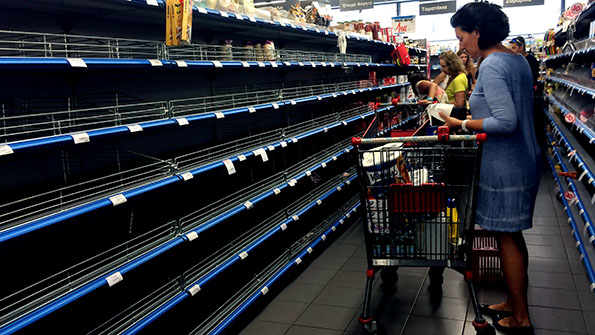
Firms have also been hit particularly hard. Foreign bank transfers have been banned by the Greek government, with few exceptions. Greek credit is no longer accepted outside the country. That has hit firms that rely on foreign credit to import goods, as well as the Greek tourists who found themselves stranded when their credit cards stopped working. Supplies of food and some medicines are running short (see picture); a black market for cancer drugs has even emerged. As we reported on Sunday:

Greece relies almost entirely on foreign imports for its pharmaceutical supplies. But since capital controls imposed last Sunday brought the country’s banking system to a sudden halt, some suppliers have stopped delivering key medication because they cannot get paid…As things stand, she has another week’s worth of insulin in stock for diabetics but will then have to start turning her patients away. “Do you know what that means?” she asks, trying to keep a proud face, “Do you know what insulin does?”

Unsurprisingly, as a result, Greek economic growth—which began to falter shortly after Syriza came to power in January—has collapsed. Consumption has slumped by 70% since capital controls were imposed, according to the National Confederation of Hellenic Commerce, a business group. Individuals and firms are hoarding cash at the same time that essential goods are becoming unavailable—a toxic mix for any economy. The decision taken yesterday by the European Central Bank—to keep in place the cap on emergency lending to Greek banks, and to increase the discount applied on Greek bonds accepted as collateral—will tighten the short-run financial crunch.

Greece is running short of time; in the next few days either a new deal will be done that allows the ECB to reopen the liquidity spigots or bank failures will lead to Grexit. In either case, the damage done by this period of uncertainty and financial drought will be severe.

Economic history suggests that economies can be surprisingly resilient when hit by shocks, such as the temporary imposition of capital controls or a reduction in the supply capacity of the economy. The Cypriot economy, for instance, started to grow again just one year after it imposed capital controls in 2013. And as Britain’s experience of general strikes indicates, temporary one- or two-week supply disruptions do not tend to have much impact on output after about a year. Leaving a single currency may also not be a complete disaster; countries such as Ireland (which left the British pound in 1928) have managed it before. And many countries ditching fixed-exchange rates—such as Britain in 1931 and 1992—exited long recessions almost immediately after they bit the bullet.

But there are three main reasons why economists think that the Greek economy will be wounded for far longer than other unfortunates. First, current uncertainty is probably damaging future demand as well as current demand; future tourist bookings have fallen by around a third since capital controls were imposed, for instance, which matters greatly given that the sector produces almost one-sixth of the country’s GDP. And with summer bookings so vital, the likely conclusion of the crisis in early July could not have been timed worse. Second, most countries that experience fast recoveries from supply-side shocks and fixed-exchange rate exits are able to count on a solvent and liquid banking system, which is needed in order to fund investment and growth through loans.

But Greece’s, which is about to collapse because of capital controls and deposit flight, is in a less comfortable position. The speedy introduction of new economic reforms post-Grexit, combined with capable macroeconomic management, could nonetheless cushion the Greek economy against the worst effects of exit and lead to a rapid bounceback. Yet few outside Greece reckon that the Syriza government has the inclination or competence to execute the transition smoothly and responsibly. Whatever Greece’s political fate, its economy is bound to get much worse before it gets better.
Source: The Economist Magazine – Online Edition – July 6, 2015
http://www.economist.com/blogs/freeexchange/2015/07/greeces-economy

—————–

VIDEO – Yes or No? Greece Again on the Brink: Greek Debt Crisis – https://youtu.be/reU7wWgFmDU

Published on Jul 3, 2015 – For the past five years, Greece has been struggling with a financial crisis that has led the country to the brink of an exit from the euro and an economic collapse.

Add this word to your vocabulary: Grexit; meaning a Greek Exit from the European Union.

This experience in Greece is a cautionary tale for the Caribbean, as so many aspects of Greek life parallel those of the Caribbean:

The harsh reality of Greece is a reminder of another crisis, the Great Recession of 2008. The events this week – with the referendum – mirrors September 15, 2008 when the American Investment Bank Lehman Brothers filed for bankruptcy, thus bringing the US (and the world’s economy) to the brink of disaster. This 2008 consideration is part-and-parcel of the book Go Lean…Caribbean which serves as a roadmap for the introduction of the technocratic Caribbean Union Trade Federation (CU) to provide new oversight for the Caribbean region’s economic, security and governing engines. The book was conceived as a result of this 2008 crisis, by stakeholders intimate with the anatomy of the 2008 crisis – People who make things happen – and composed from a position of strength, while in the location of one of the most successful communities to endure the Great Recession crisis: Omaha, Nebraska.

The pretext of the Go Lean roadmap is simple, and applies equally to Greece and the Caribbean:

Only at the precipice do they change!

The lessons learned, and codified, in the pages of the Go Lean book can now be enhanced with the examination of the realities of Greece. This examination must consider the reality of the economic, security and governing aspects of Greek society.
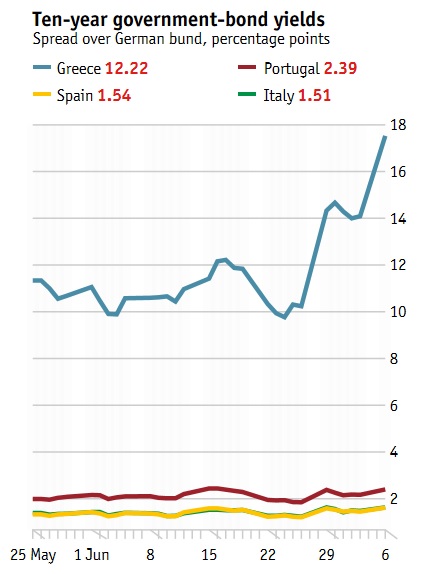
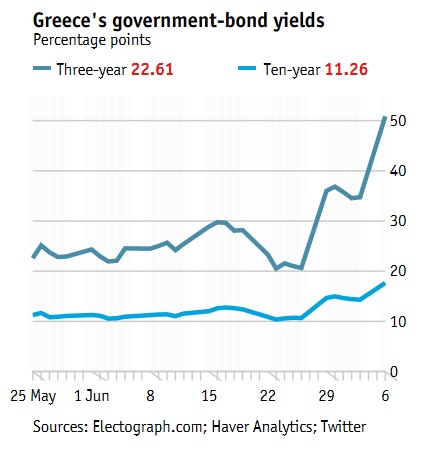
CU Blog - Greece - From Bad to Worse - Photo 3 CU Blog - Greece - From Bad to Worse - Photo 2

This country now has new leadership – the political party Syriza was swept into office on 25 January 2015 – trying to forge change in a dysfunctional environment. Until recently, the Minister of Finance for this sovereign nation was Yanis Varoufakis. (He resigned on July 5th, after the passage of the Referendum). To project transparency, Mr. Varoufakis presented the arguments in favor of their request for more compromise from the European Central Bank, the IMF, and other creditors demanding more austerity from Greece; he vocalized the following:

Our political mandate is to find an honourable, workable compromise. Is it so difficult to do so? We do not think so. A few days ago Olivier Blanchard, the IMF’s Chief Economist published a piece entitled ‘Greece: A Credible Deal Will Require Difficult Decisions by All Sides.’ He is right, the three operative words being ‘by all sides’. Dr Blanchard added that: “At the core of the negotiations is a simple question. How much of an adjustment has to be made by Greece, how much has to be made by its official creditors?”

That Greece needs to adjust there is no doubt. The question, however, is not how much adjustment Greece needs to make. It is, rather, what kind of adjustment. If by ‘adjustment’ we mean fiscal consolidation, wage and pension cuts, and tax rate increases, it is clear we [Greece] have done more of that than any other country in peacetime.

  • The public sector’s structural, or cyclically adjusted, fiscal deficit turned into a surplus on the back of a ‘world record beating’ 20% adjustment
  • Wages fell by 37%
  • Pensions were reduced by up to 48%
  • State employment diminished by 30%
  • Consumer spending was curtailed by 33%
  • Even the nation’s chronic current account deficit dropped by 16%.

No one can say that Greece has not adjusted to its new, post-2008, circumstances. But what we can say is that gigantic adjustment, whether necessary or not, has produced more problems than it solved:

  • Aggregate real GDP fell by 27% while nominal GDP continued to fall quarter-in-quarter-out for 18 quarters non-stop to this day
  • Unemployment skyrocketed to 27%
  • Undeclared labour reached 34%
  • Banks are labouring under non-performing loans that exceed 40% in value
  • Public debt has exceeded 180% of GDP
  • Young well-qualified people are abandoning Greece in droves
  • Poverty, hunger and energy deprivation have registered increases usually associated with a state at war
  • Investment in productive capacity has evaporated.

Source: http://www.businessinsider.com/full-greece-proposal-leaked-by-yanis-varoufakis-2015-6

Mr. Varoufakis’ appeal has been rejected. Greece is now at the precipice. They are willing to change and correct many inequities. But maybe, this is too little, too late? They want to work to build up their communities, not necessarily build up their neighboring countries. They are willing to accept the Grexit.

In this status quo is the primary lesson for the Caribbean. Are we now willing to change and correct the inequities in our society?

The Go Lean book declares: “A crisis is a terrible thing to waste” – quoting noted Economist Paul Romer. The opportunity exists now to forge change in the economic, security and governing engines of the Caribbean, as this cautionary guidance is gleaned from the Greek crisis.

The roadmap calls for a confederation of the 30 member-states of the Caribbean into a Single Market of 42 million people; thereby allow an adequate size to absorb economic shocks and downward trends. The Go Lean roadmap provides the details for the creation of 2.2 million new jobs and GDP growth to accumulate to $800 Billion. This vision is at the root of the Go Lean roadmap, embedded in the opening Declaration of Interdependence (Page 13):

xxiv. Whereas a free market economy can be induced and spurred for continuous progress, the Federation must install the controls to better manage aspects of the economy: jobs, inflation, savings rate, investments and other economic principles. Thereby attracting direct foreign investment because of the stability and vibrancy of our economy.

xxv.  Whereas the legacy of international democracies had been imperiled due to a global financial crisis, the structure of the Federation must allow for financial stability and assurance of the Federation’s institutions. To mandate the economic vibrancy of the region, monetary and fiscal controls and policies must be incorporated as proactive and reactive measures. These measures must address threats against the financial integrity of the Federation and of the member-states.

The following details from the book Go Lean … Caribbean are the community ethos, strategies, tactics, implementations and advocacies necessary to effect the turn-around of the Caribbean societal engines – to learn from Greece:

Who We Are – SFE Foundation and 2008 Role Page 8
Anecdote: Puerto Rico – The Greece of the Caribbean Page 18
Community Ethos – Economic Systems Influence Individual Choices Page 21
Community Ethos – Economic Principles – Money Multiplier Page 21
Community Ethos – Governing Principles – Lean Operations Page 24
Community Ethos – Ways to Impact the Future Page 26
Community Ethos – Ways to Impact Turn-Arounds Page 33
Community Ethos – Ways to Impact the Greater Good Page 37
Strategy – Vision – Confederate all 30 Member-States into a Single Market Page 47
Strategy –   Mission – Build and foster local economic engines Page 45
Strategy –   Mission – Fortify the stability of our mediums of exchange Page 45
Strategy –   Mission – Dissuade further Brain Drain Page 46
Tactical –   Confederating a Permanent Union Page 63
Tactical – Fostering a Technocracy Page 64
Implementation – Assemble all Member-States Page 96
Implementation – Ways   to Pay for Change Page 101
Implementation – Foreign Policy Initiatives at Start-up Page 102
Implementation – Ways to Better Manage Debt Page 114
Planning – Ways to Model the European Union (EU) Page 130
Planning – Ways to Improve Failed-State Indices Page 134
Planning – Lessons Learned from 2008 Page 136
Planning – Lessons Learned from Omaha Page 138
Advocacy – Ways to Grow the Economy Page 151
Advocacy – Ways to Create Jobs Page 152
Advocacy – Better Manage the Social Contract Page 170
Advocacy – Ways to Preserve Caribbean Heritage Page 218
Advocacy – Ways to Protect Human Rights Page 218
Advocacy – Ways to Help the Middle Class Page 223
Advocacy – Ways to Re-boot Cuba Page 236
Advocacy – Ways to Re-boot Haiti Page 238
Appendix – Caribbean Failed-State Indicators and Definitions Page 271

Greece will become a Failed-State before it is all said-and-done. We hope that this country, and their European neighbors, can secure their society to assure peace and the protection of human rights.

Greece will recover…eventually! Their disposition will go from bad to worse – see Appendix VIDEO – but then they can reboot, much like Cyprus did just recently, as detailed in the foregoing news article. Take their tourism for example:

Travel and tourism contributed a total of €28.3 billion ($31.3 billion) to the economy in 2013—or 16.3% of GDP. But after one to two years, after the country returns to local drachma currency and it stabilizes after devaluation, destinations in Greece will be cheaper than its competitors. This will eventually be an advantage. – http://www.economist.com/node/21657058

Greece will be a European Failed-State … and will “bounce-back” … eventually.

We also have Failed-States in the Caribbean: Think: Haiti, Dominican Republic and Cuba; plus a host of countries just slightly behind them. We have to foster our own turn-around strategies for our region.

The Go Lean roadmap declares that the responsibility for fixing the Caribbean though must fall first-and-foremost on the Caribbean, its people and institutions.

The Caribbean must also reboot and “bounce back”; to “step back from the precipice”. The effort is not easy; the Go Lean book describes it as heavy-lifting. But the returns will be worth the investment. This is true for Greece … and the Caribbean.

This is the goal of the Go Lean roadmap: not to wonder what happened, or watch things happen, but rather to make the things happen … that make the Caribbean a better place to live, work and play. 🙂

Download the book Go Lean … Caribbean – now!

—————–

Appendix VIDEO – The Economic Collapse of Greece. Whiteboard Animation by Angelow – https://youtu.be/dt6w4eE_tg0

Published on Mar 17, 2013VIDEO on the previous need for Greek bail-outs. Greece is bankrupt!
Share this post:
, , , , ,

In Search Of The Red Cross’ $500 Million In Haiti Relief

Go Lean Commentary

“A crisis is a terrible thing to waste” – familiar expression coined by American Economist Paul Romer.

This expression is prominent in the introduction of the book Go Lean…Caribbean. The motives of the book publishers are to exploit the post-2008 economic crises to forge change in the Caribbean region. But in this case, it appears that another party has utilized a Caribbean crisis to exploit the public for monies for their own coffers; that party is the American Red Cross.

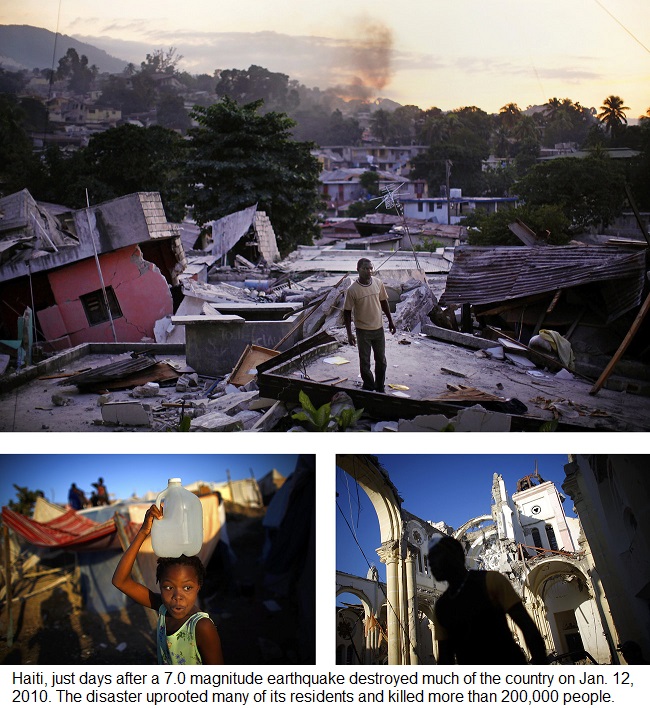
Immediately after the earthquake in Haiti on January 12, 2010 many Non-Government Organizations (NGO), including the American Red Cross, embarked on fundraising campaigns to raise money for the response, relief and rebuilding of Haiti. The Red Cross held a Telethon, complete with text message fundraising:

Text [the word] Haiti to 90999

… and boom, $10 would be billed to the respondent’s mobile phone account and encumbered for the American Red Cross’s Aid to Haiti. (Note: this writer contributed via text message in 2010).

$500 Million In Haiti Relief - Photo 1

How successful was this fundraising campaign? US$500 million! How successful was the relief and rebuilding of Haiti campaign? Still waiting…

VIDEO – Report highlights Red Cross aid failures in Haiti  https://youtu.be/cSAZ8cScwro

Published on Jun 3, 2015 – Following the devastating 2010 earthquake in Haiti, the American Red Cross raised close to 500 million dollars and promised to help rebuild the country’s communities. A new report by ProPublica and NPR unearth a number of confidential memos and insider accounts that stand in sharp contrast to the public picture painted by the organization. CBSN spoke to co-author of the report, Justin Elliott.

This consideration aligns with the strategies, tactics, implementations and advocacies of the book Go Lean…Caribbean. The declaration is that the Caribbean must be front-and-center in providing for our own solutions. The alternative, someone else taking the lead for our solution seems to be lacking…every time!

For us in the Caribbean, we need to grow up and more responsible ourselves! We need to stand up and be counted!

The Go Lean book declares (Page 115):

“Haiti should not be a perennial beggar; the Caribbean should not be perennial beggars, but we do need capital/money, especially to get started”.

There was the opportunity to raise $500 million to get started. We lost out!

Instead the American Red Cross provided the “adult supervision” and what do we have to show for it? According to the following AUDIO Podcast, next to nothing; (6 houses):

Appendix AUDIO Podcast: NPR’s ‘All Things Considered’ –  http://www.npr.org/player/v2/mediaPlayer.html?action=1&t=1&islist=false&id=411524156&m=411812821

By Laura Sullivan – When a devastating earthquake leveled Haiti in 2010, millions of people donated to the American Red Cross. The charity raised almost half a billion dollars. It was one of its most successful fundraising efforts ever.
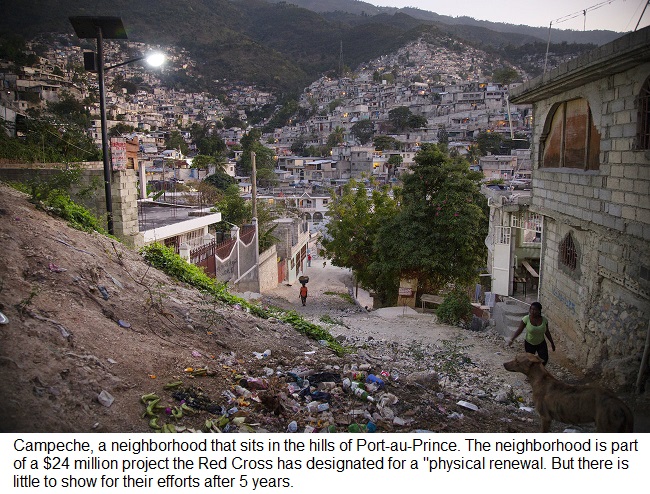
The American Red Cross vowed to help Haitians rebuild, but after five years the Red Cross’ legacy in Haiti is not new roads, or schools, or hundreds of new homes. It’s difficult to know where all the money went.
Source: National Public Radio (NPR) – Radio Podcast for Fresh Air; posted 06/03/2015; retrieved from: http://www.npr.org/2015/06/03/411524156/in-search-of-the-red-cross-500-million-in-haiti-relief

This is just another example of Crony-Capitalism.

This is not only the Go Lean commentary, but rather many of the general public voiced this same concern on the cited NPR website; see sample here:

Public Comment by “TheUnPossible” on June 3, 2015: Perhaps they should do what they do best. Serve coffee, give-out blankets and draw blood. This reminds me of a lot of the other high-profile charities like Susan G. Komen and United Way that just become a black-hole for donations. They’re like a church. They get people to give them tons of cash and promise salvation if people just believe in them.

Public Comment by “Unpartisan” on June 3, 2015: They’re like a church. They get people to give them tons of cash and promise salvation if people just believe in them.” Sounds like many politicians and government agencies as well, good analogy.

Public Comment by “James Hulsey” on June 3, 2015: I haven’t trusted the American Red Cross since 9/11, when they were fundraising for 9/11 relief efforts and then shunted the extra money into their general fund.

Public Comment by “TravelingOne” on June 4, 2015: No – the Red Cross: http://www.huffingtonpost.com/… And one of the reasons they no longer get any money from me; nor does United Way (UW) however.

Public Comment by “DCRich” on June 4, 2015: Local UW chapters often are worse. They coerce poorly paid employees of agencies they support to contribute with the implication that support to the agency is influenced by this. They try to engage new agencies with the same kind of appeal. Most of their money goes to orgs that have no trouble fundraising on their own like the Y and Scouts. Basically, they’re a middleman that allows the business community to interfere with and take credit or the work of “charity”. Giving money directly to some org[anization] you actually know something about is better than giving a cut to UW or CFC [(Combined Federal Campaign) for federal government employees].

The book and subsequent blogs posit that the Caribbean must not be vulnerable to American Crony-Capitalistic forces.

“We can do bad all by ourselves”.

The dread of Crony-Capitalism was highlighted and detailed in many previous blog commentaries; see Appendix below. Now we have to add the reality of Big Charity to the landscape; referring to the big organizations that fleece the public under the guise of charities but retain vast majorities of the funding as administrative costs, thusly benefiting mostly the charities’ executives and staff rather than the intended benefactors.

The Caribbean must do better! We need a Truth & Reconciliation Commission (TRC) on this issue.

The book Go Lean…Caribbean pursues the quest to elevate the Caribbean region through economic, security and governance empowerments. This includes oversight and guidance for NGO’s in the region. The book serves as a roadmap for the introduction and implementation of the technocratic Caribbean Union Trade Federation (CU) to provide better stewardship for the Caribbean homeland. The book describes that NGO’s are Caribbean stakeholders. Even though many of the 30 member-states may be considered independent nations, the premise of the book is that there must be an ethos of interdependence, rather than just independence. This all relates to governance, the need for technocratic – and better – stewardship of regional Caribbean society. This point was also pronounced in the opening Declaration of Interdependence (Pages 11 & 14) with these acknowledgements and statements:

xi. Whereas all men are entitled to the benefits of good governance in a free society, “new guards” must be enacted to dissuade the emergence of incompetence, corruption, nepotism and cronyism at the peril of the people’s best interest. The Federation must guarantee the executions of a social contract between government and the governed.

xii. Whereas the legacy in recent times in individual states may be that of ineffectual governance with no redress to higher authority, the accedence of this Federation will ensure accountability and escalation of the human and civil rights of the people for good governance, justice assurances, due process and the rule of law. As such, any threats of a “failed state” status for any member state must enact emergency measures on behalf of the Federation to protect the human, civil and property rights of the citizens, residents, allies, trading partners, and visitors of the affected member state and the Federation as a whole.

xxxiii. Whereas lessons can be learned and applied from the study of the recent history of other societies, the Federation must formalize statutes and organizational dimensions to avoid the pitfalls of [other] communities.

$500 Million In Haiti Relief - Photo 2This is the quest of CU/Go Lean roadmap: to provide new guards for a more competent Caribbean administration … by governmental organizations and non-governmental organizations. (NGO would be promoted, audited and overseen by CU administrators).

This crisis should not be wasted!

In general, the CU will employ better strategies, tactics and implementations to impact its prime directives; identified with the following 3 statements:

  • Optimization of the economic engines in order to grow the regional economy to $800 Billion & create 2.2 million new jobs.
  • Establishment of a security apparatus to protect the resultant engines and mitigate internal and external “bad actors”.
  • Improvement of Caribbean governance to support these engines.

The Go Lean book stresses key community ethos, strategies, tactics, implementations and advocacies necessary to turn-around the eco-systems of Caribbean governance. These points are detailed in the book as follows:

Community Ethos – Deferred Gratification Page 21
Community Ethos – Economic Principles – Respond to Incentives in   Predictable Ways Page 21
Community Ethos – Economic Principles – Economic Systems Influence   Individual Choices Page 21
Community Ethos – Economic Principles – Consequences of Choices Lie in   the Future Page 21
Community Ethos – Security Principles – Whistleblower Protection Page 23
Community Ethos – Security Principles – Intelligence Gathering Page 23
Community Ethos – Security Principles – “Crap” Happens Page 23
Community Ethos – Governing Principles – Lean Operations Page 24
Community Ethos – Governing Principles – Return on Investments Page 24
Community Ethos – Governing Principles – Cooperatives Page 25
Community Ethos – Ways to Impact the Future Page 26
Community Ethos – Ways to Impact Turn-Arounds Page 33
Community Ethos – Ways to Manage Reconciliations – South Africa TRC Model Page 34
Community Ethos – Ways to Improve Sharing – Emergency Response Page 35
Community Ethos – Ways to Impact the Greater Good Page 37
Strategy – Vision – Confederate all 30 member-states/ 4 languages into a Single Market Page 45
Strategy – Mission – Prepare for the eventuality of natural disasters Page 45
Strategy – Agents of Change – Climate Change Page 57
Tactical – Ways to Foster a Technocracy Page 64
Tactical – Growing the Economy – Post WW II European Marshall Plan/Recovery Model Page 68
Tactical – Separation-of-Powers – CU Federal Government versus Member-State Governance Page 71
Tactical – Separation-of-Powers – Treasury Department – Shared Property Recording Systems Page 74
Tactical – Separation-of-Powers – State Department – Liaison/Oversight for NGO’s Page 80
Tactical – Separation-of-Powers – Interior Department – Housing & Urban Authority Page 83
Tactical – Separation-of-Powers – Federal Courts – Truth & Reconciliation Commissions Page 90
Implementation – Assemble All Regionally-focus Organizations of All Caribbean Communities Page 96
Implementation – Ways to Pay for Change Page 101
Implementation – Ways to Foster International Aid Page 115
Planning – 10 Big Ideas – Homeland   Security Pact Page 127
Planning – Ways to Make the Caribbean Better Page 131
Planning – Ways to Improve Failed-State Indices – Governance and the Social Contract Page 134
Advocacy – Ways to Grow the Economy Page 151
Advocacy – Ways to Create Jobs Page 152
Advocacy – Ways to Improve Housing – Optimizing Property Registration Process Page 152
Advocacy – Ways to Improve Governance Page 168
Advocacy – Ways to Better Manage the Social Contract Page 170
Advocacy – Ways to Improve Homeland Security Page 180
Advocacy – Ways to Improve for Natural Disasters Page 184
Advocacy – Ways to Improve Technology Page 197
Advocacy – Ways to Develop a Pre-Fab Housing Industry – One solution ideal for Haiti Page 207
Advocacy – Ways to Impact Foundations – NGO’s can help deliver Social Contract Page 219
Advocacy – Ways to Re-boot Haiti Page 238
Appendix – Philanthropy Pledge Signatories – Billionaires willing to “give” to an optimized  technocracy Page 292

The Go Lean roadmap seeks to empower and elevate Caribbean societal engines. While it is out-of-scope to impact America, we do not want American institutions (or European or Asian for that matter) exploiting our crisis for their gain.

Charity begins at home. (And should be managed at home). Online crowd-sourcing may be a better tool.

The Go Lean book calls on the Caribbean region to be collectively self-reliant, both proactively and reactively. Natural disasters (i.e. earthquakes and hurricanes) will occur again. Considering our efforts in our disaster response, relief and rebuilding – there will be many opportunities to get it right. Once we do … get it right – with an optimized technocracy – there will be more philanthropic funds and charitable donations to help our Caribbean causes. NGO’s, billionaires and their well-funded foundations are attracted to efficiently managed entities:

Take care of the pennies and the dollars will take care of themselves – Old Adage.

Our quest is simple, a regional effort to make the Caribbean homeland a better place to live, work and play. 🙂

Download the book Go Lean … Caribbean – now!

————

Appendix – Models of American Crony-Capitalism

Big Defense Many theorists indicate that the “follow the money” approach reveals the Military Industrial Complex work to undermine peace, so as to increase defense spending for military equipment, systems and weapons.
Big Media Cable companies conspire to keep rates high; kill net neutrality; textbook publishers practice price gouging; Hollywood insists on big tax breaks/ subsidies for on-location shooting.
Big Oil While lobbying for continuous tax subsidies, the industry have colluded to artificially keep prices high and garner rocket profits ($38+ Billion every quarter).
Big Box Retail chains impoverish small merchants on Main Street with Antitrust-like tactics, thusly impacting community jobs. e-Commerce, an area of many future prospects, is the best hope of countering these bad business tactics.
Big Pharma Chemo-therapy cost $20,000+/month; and the War against Cancer is imperiled due to industry profit insistence.
Big Tobacco Cigarettes are not natural tobacco but rather latent with chemicals to spruce addiction.
Big Agra Agribusiness concerns bully family farmers and crowd out the market; plus fight common sense food labeling efforts.
Big Data Brokers for internet and demographic data clearly have no regards to privacy concerns.
Big Banks Wall Street’s damage to housing and student loans are incontrovertible.
Big Weather Overblown hype of “Weather Forecasts” to dictate commercial transactions.
Big Real Estate Preserving MLS for Real Estate brokers only, forcing 6% commission rates, when the buyers and sellers can meet without them.
Big Salt Despite the corrosiveness of salt on roads and the environment, it is the only tactic   used to de-ice roads. Immediately after the weather warms, the roads must be re-constructed, thus ensuring a continuous economic cycle.
Big Energy The For-Profit utility companies always lobby against regulations to “clean-up” fossil-fuel (coal) power plants or block small “Green” start-ups from sending excess power to the National Grid. Their motive is to preserve their century-long monopoly and their profits.
Big Legal Even though it is evident that the promotion of Intellectual Property can help   grow economies, the emergence of Patent Trolling parties (mostly lawyers) is squashing innovation. These ones are not focused on future innovations, rather just litigation. They go out and buy patents, then look for anyone that may consume any concepts close to those patents, then sue for settlements, quick gains.
Big Cruise Cruise ships are the last bastion of segregation with descriptors like “modern-day-slavery” and “sweat-ships”. Working conditions are poor and wages are far below anyone’s standards of minimum. Many ship-domestic staff are “tip earners”, paid only about US$50 a month and expected to survive on the generosity of the passengers’ gratuity. The industry staff with personnel from Third World countries, exploiting those with desperate demands. Nowhere else in the modern world is this kind of job discrimination encouraged, accepted or tolerated.
Big Jails The private prison industry seem motivated more by profit than by public safety. They attempt to sue state governments when their occupancy levels go too low; a reduction in crime is bad for business.
Big Housing The American legacy is one of the institutional segregation in American cities. The practice was administered by real estate agents and housing officials executing policies to elevate property values and generational wealth for White families at the expense of a life of squalor for Non-Whites.
Share this post:
, , , ,
[Top]

Drones to be used for Insurance Damage Claims

Go Lean Commentary

CU Blog - Drones to be used for Insurance Damage Claims - Photo 1What have you done for “me” lately?

So now that we’ve been awed and entertained with drones, frankly we need something more. We need to put them to work. What can drones do for us … in our quest to elevate Caribbean societal engines?

The answer is “Plenty”!

For starters, an insurance company had sought and is now approved to use drones for disaster claims processing.

This is BIG!

In a few days, the annual hurricane season will begin … in earnest; (this year was an aberration with the first Tropical Depression – Ana – making landfall early on May 10 in South Carolina, USA).

“Ana” is the first of what is forecasted to be a busy season. The names for the 2015 season are already pre-determined as:

Ana, Bill, Claudette, Danny, Erika, Fred, Grace, Henri, Ida, Joaquin, Kate, Larry, Mindy, Nicholas, Odette, Peter, Rose, Sam, Teresa, Victor and Wanda.

The source news article follows:

Title: FAA Gives USAA The A-OKAY To Test Damage Claims Drones
By:
Kelsey D. Atherton

Source: Popular Science Magazine posted April 7, 2015; retrieved 05-21-2015 from:
http://www.popsci.com/faa-gives-usaa-okay-drone

After the disaster come the accountants. Major tornadoes, earthquakes, tsunamis, and the like do dollar amounts of damage, sometimes in the billions. That number comes from the nitty-gritty of insurance valuations and payouts, a wholly human assessment of the ruins from natural forces. Now, thanks to FAA approval, robots may start to get in on the action.

Yesterday, insurance giant USAA announced, as follows, that the FAA approved their request to test drones as a way to more quickly process insurance claims after disasters:

FAA Approves USAA Request for Drone Research

April 6, 2015 –The Federal Aviation Administration has approved USAA’s request to test how unmanned aircraft systems, also known as drones, could help speed review of insurance claims from its members following natural disasters. USAA is one of the first insurers to be granted the approval for such testing.

“Our members have grown accustomed to seeing us pave the way for innovative solutions that streamline the claims process,” said Alan Krapf, president, USAA Property and Casualty Insurance Group.

In October 2014, USAA filed for an exemption under Section 333 of the FAA Modernization and Reform Act of 2012 to enable more efficient testing of small drones. Exempt from select FAA regulations, USAA can now fly drones, made by U.S.-based PrecisionHawk, during the day within line-of-sight of a trained pilot and air crew. Prior to the approval, USAA test flights could only take place at FAA-approved sites. No aircraft will exceed an altitude of 400 feet, and all flights will continue to be reported to the FAA prior to takeoff.

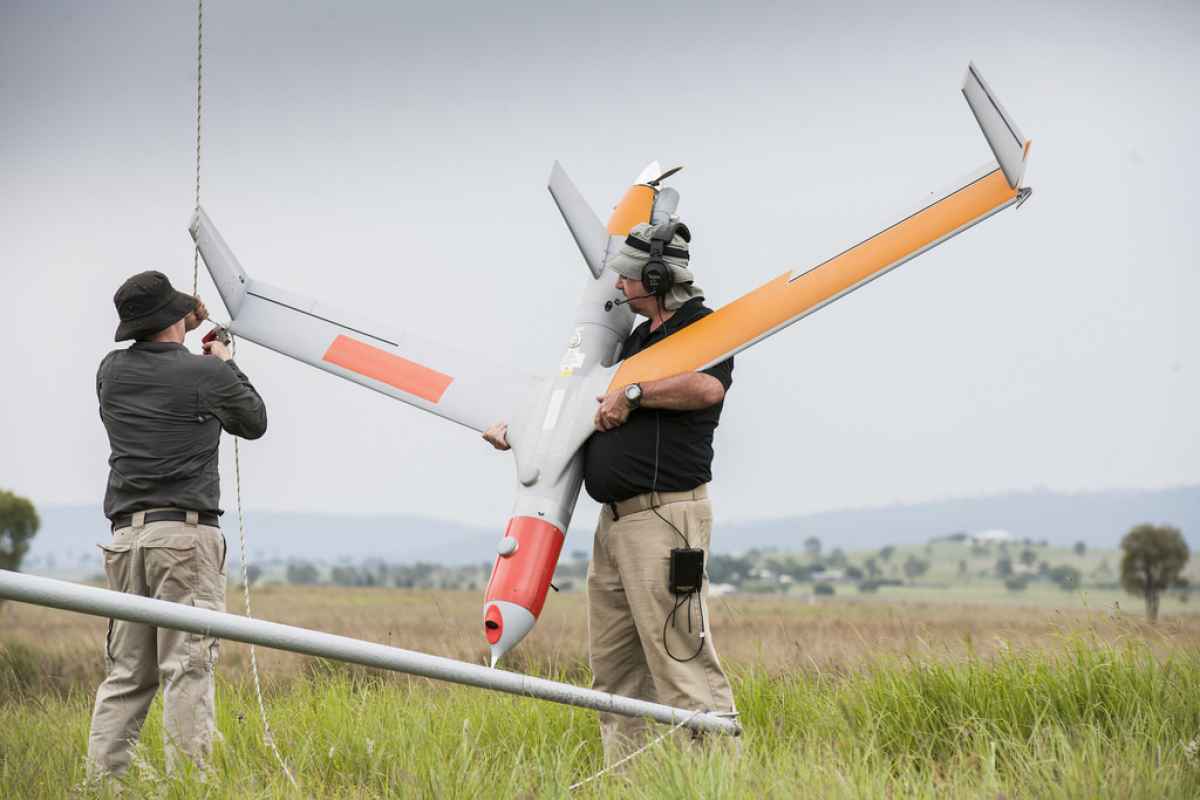
With FAA approval, USAA will work with PrecisionHawk [(see VIDEO here)] to efficiently research and develop best practices, safety and privacy protocols and procedures as it further develops plans for operational use.

USAA also filed for an additional FAA exemption in November that will enhance USAA’s ability to use drones in catastrophes. That exemption petition is pending approval, and a decision is expected soon.

“We’re proud to be among the first insurers approved to test this technology,” Krapf said. “It’s our responsibility to explore every option to improve our members’ experience.”

About USAA
The USAA family of companies provides insurance, banking, investments, retirement products and advice to 10.7 million current and former members of the U.S. military and their families. Known for its legendary commitment to its members, USAA is consistently recognized for outstanding service, employee well-being and financial strength. USAA membership is open to all who are serving our nation in the U.S. military or have received a discharge type of Honorable – and their eligible family members. Founded in 1922, USAA is headquartered in San Antonio. For more information about USAA, follow us on Facebook or Twitter (@USAA), or visit usaa.com.
(Source: https://communities.usaa.com/t5/Press-Releases/FAA-Approves-USAA-Request-for-Drone-Research/ba-p/62019)

USAA applied for the exemption in October. In their application, they noted that USAA employees were invited to Oso, Washington, after a mudslide to assist local officials with aerial surveys.

Drones are a great tool for examining natural disasters, because they can safely fly over areas where the ground may still be hazardous for humans. Visual assessment and mapping tools give rescue workers a way to understand the newly-changed terrain, and they can also let insurance agents see which claims are justified.

In the best case scenario, using drones to evaluate claims means that victims of disasters will get the resources they need to get back on their feet faster. All told, that’s pretty great. There are certainly far worse things that could happen when a robot shows up after a disaster.

CU Blog - Drones to be used for Insurance Damage Claims - Photo 4

CU Blog - Drones to be used for Insurance Damage Claims - Photo 5

The subject of unmanned aircrafts are just another area of autonomous vehicles that the Go Lean … Caribbean movement (book and aligning blogs) has highlighted as being a focused subject for the region. This subject will impact jobs and security measures. Consider these previous blog/commentaries:

https://goleancaribbean.com/blog/?p=1487 Here come the Drones … and the Concerns
https://goleancaribbean.com/blog/?p=1277 The need for highway safety innovations – here comes Google
https://goleancaribbean.com/blog/?p=673 Ghost ships – Autonomous cargo vessels without a crew

A lot of activity with autonomous aircrafts have been the product of Radio Controlled craft hobbyists; see Appendix C VIDEO. But now, practical applications are being promoted, especially for commercial photographers. This is science, not science fiction; see VIDEO in Appendix B. There is the need for high-end photography solutions to process claims after natural disasters. According to the foregoing news article, the US regulators are now allowing the testing of drones for post-hurricane (and other natural disasters) claims processing. This aligns with the Go Lean book, to optimize natural disaster response AND to provide oversight for the regional aviation space. This book serves as a roadmap for the introduction and implementation of the technocratic Caribbean Union Trade Federation (CU). The CU/Go Lean roadmap describes CU agencies in the role of the Federal Aviation Administration (FAA) performs for the US in the foregoing article. So the parallel is strong, as there is the need to plan for natural disasters in the Caribbean – more and more – in partnership with the CU‘s Emergency Management agencies.

CU Blog - Drones to be used for Insurance Damage Claims - Photo 3

CU Blog - Drones to be used for Insurance Damage Claims - Photo 2

The Go Lean book purports that this type of industrial revolutions emerging with drones are more and more critical for Caribbean society. The risks and threats from storms will only intensify. In the previous blog about the rise of drones, this commentary asserted that “our region must participate in these developments, not just spectate on them”. These points are  also pronounced early in the book in the opening Declaration of Interdependence (Page 14), with these statements:

i.   Whereas the earth’s climate has undeniably changed resulting in more severe tropical weather storms, it is necessary to prepare to insure the safety and security of life, property and systems of commerce in our geographical region. As nature recognizes no borders in the target of its destruction, we also must set aside border considerations in the preparation and response to these weather challenges.

xxvi.  Whereas theCaribbean region must have new jobs to empower the engines of the economy and create the income sources for prosperity, and encourage the next generation to forge their dreams right at home, the Federation must therefore foster the development of new industries… In addition, the Federation must invigorate the enterprises related to existing industries like tourism…– impacting the region with more jobs.

xxvii.  Whereas the region has endured a spectator status during the Industrial Revolution, we cannot stand on the sidelines of this new economy, the Information Revolution. Rather, the Federation must embrace all the tenets of Internet Communications Technology (ICT) to serve as an equalizing element in competition with the rest of the world. The Federation must bridge the digital divide and promote the community ethos that research/development is valuable and must be promoted and incentivized for adoption.

This Go Lean book and accompanying blogs champion the cause of deploying technology to make the Caribbean a better homeland to live, work and play. The assertion is that innovative developments like camera-mounted unmanned aerial vehicles (drones) should be readily deployed after emergencies and disasters – from hurricanes to industrial accidents – to quickly assess the damage: life and property; see Appendix A VIDEO. There is the need to gather intelligence for where to direct First Responders (as in 911 emergencies); and even before people in the affected areas may call out for help.

While the focus of the Go Lean movement is primarily towards economics, it is the premise of this roadmap that security efforts must be coupled with the region’s economic empowerments. The premise is simple! The economic engines must be protected and preserved; this subject of “Insurance Company Disaster-Claim Assessing Drones” is therefore within scope for the Trade Federation. In fact, the CU/Go Lean roadmap has defined these 3 prime directives:

  • Optimization of the economic engines in order to grow the regional economy to $800 Billion and create 2.2 million jobs.
  • Establishment of a security apparatus to protect the resultant economic engines.
  • Improvement of Caribbean governance to support these engines.

While there may be proponents and opponents (privacy advocates) of unmanned aviation, no one would object to aggressive efforts to locate people in danger or quickly restore communities to normal operations after a storm. There is an overriding need, as many times tourist-based industries need to project the confidence to the watching world that Caribbean winter destinations will be ready, willing and able to extend hospitality to visitors … in short order.

The message and image must be consistent for the region’s primary economic driver, even after a natural disaster: Be our guest!

The Go Lean strategy is to confederate the 30 member-states of the Caribbean region to form the technocratic CU Trade Federation. Tactically, the roadmap calls for a separation-of-powers, allowing the Caribbean member-states to deputize authority of the Caribbean airspace to the one unified CU agency. Operationally, there is the need for these drones in critical times and also for everyday scenarios. (Many times, watercrafts become imperiled in the region’s waters; the scanning & diagnostic capabilities on drones would far-exceed human-eye capability for search-and-rescue).

The book details community ethos to adopt, plus the executions of the following strategies, tactics, implementations and advocacies to foster innovative solutions in Caribbean communities, so as to positively impact the societal economic, security and governing engines:

Community Ethos – Deferred Gratification Page 21
Community Ethos – All Choices Involve Costs Page 21
Community Ethos – Job   Multiplier Page 22
Community Ethos – Public Protection Over Privacy Concerns Page 23
Community Ethos – “Crap” Happens Page 23
Community Ethos – Lean Operations Page 24
Community Ethos – Return on Investments (ROI) Page 24
Community Ethos – Ways to Impact the Future Page 26
Community Ethos – Ways to Help Entrepreneurship Page 28
Community Ethos – Ways to Impact Research & Development Page 30
Community Ethos – Impact the Greater Good Page 37
Strategy – Vision – Confederating 30 Member-states in a Union Page 45
Strategy – Agents of Change – Technology Page 57
Strategy – Agents of Change – Aging Diaspora Page 57
Strategy – Agents of Change – Globalization Page 57
Strategy – Agents of Change – Climate Change Page 57
Tactical – Fostering a Technocracy Page 64
Tactical – Growing Economy – New High Multiplier Industries Page 68
Separation of Powers – Self Governing Entities Page 80
Separation of Powers – Aviation Administration and Promotion Page 84
Implementation – Ways to Pay for Change – Hurricane Reinsurance Funds Page 101
Implementation – Benefits from the Exclusive Economic Zone Page 104
Implementation – Steps to Implement Self-Governing Entities Page 105
Implementation – Ways to Deliver Page 109
Planning – 10 Big Ideas – Homeland Security Innovations Page 127
Advocacy – Ways to Grow the Economy Page 151
Advocacy – Ways to Create Jobs Page 152
Advocacy – Ways to Improve Housing – Hurricane Risk Reinsurance Funds Page 161
Advocacy – Revenues Sources for Caribbean Administration – Reinsurance Funds Page 172
Advocacy – Ways to Improve Homeland Security Page 180
Advocacy – Ways to Improve Intelligence Gathering & Analysis Page 182
Advocacy – Ways to Improve for Natural Disasters Page 184
Advocacy – Ways to Improve Emergency Management Page 196
Advocacy – Ways to Foster Technology Page 197
Advocacy – Ways to Impact Wall Street – Adopt Advanced Products: “Reinsurance” Page 197
Advocacy – Ways to Improve Transportation – Aviation Oversight Page 205
Advocacy – Ways to Improve Fisheries – Search & Rescue Page 210
Advocacy – Ways to Impact Urban Living Page 238
Advocacy – Ways to Impact Rural Living Page 239

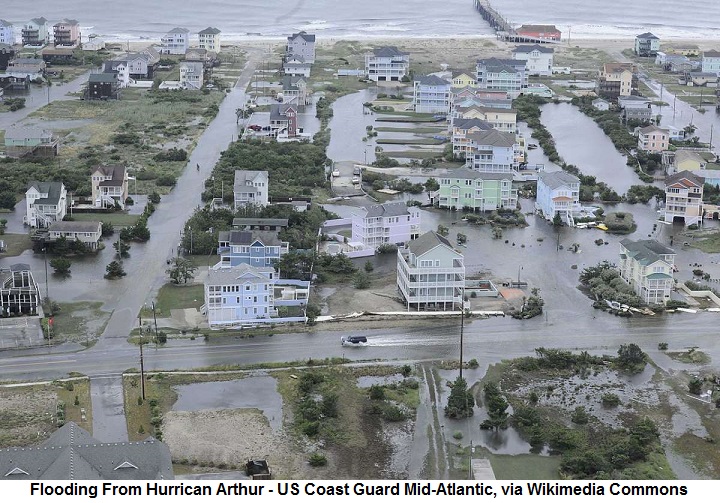
The foregoing news story relates to threats and consequences of hurricanes. While hurricanes present a Clear and Present Danger to “life and limb”, the focus of this commentary is on property. While the sense of urgency may appear to be lower, there is still the need to impact the region’s Greater Good. The advocacy in this case is to be an early adopter of technology to optimize the administration of Caribbean economic engines.

This is heavy-lifting. The buy-in from community stakeholders will not be easy; there will be the need for collaboration, compromise and consensus-building for the full adoption of unmanned aviation.

The insights from the foregoing articles and embedded videos help us to appreciate that the future for unmanned aviation is now! We must therefore lean-in for these empowerments now.

In fact the region is urged to lean-in for the entire roadmap of Go Lean … Caribbean. The benefits are too alluring. Protection of people, properties and processes. This is the Greater Good. This roadmap allows for that quest: to make the Caribbean a better homeland to live, work and play. 🙂

Download the book Go Lean…Caribbean now!

————

Appendix A VIDEODrone Footage from Inside Corvette Museum Sinkholehttps://youtu.be/vkEDwOidW_Q


Published on Feb 12, 2014 – University of Western Kentucky’s Engineering Department sent a drone helicopter into the sinkhole at the National Corvette Museum that swallowed eight vintage Corvettes.

————

Appendix B VIDEO – Sprite Unmanned Aerial Vehicle –  https://youtu.be/-w9YTJjGaEg


Published on May 13, 2015 – Meet Sprite, the most portable, most durable small unmanned aerial vehicle in the world. Powerful, yet simple to fly. Visit us at www.ascentaerosystems.com for more information! Pre-order at https://www.kickstarter.com/projects/…

————

Appendix C VIDEO – Top 10 Drones 2015 – https://youtu.be/sq2n4TMC1XU


Published on Nov 14, 2014 – More Info & Pics: https://ezvid.com/top-ten-drones


Share this post:
, , , , ,
[Top]

Vanuatu and Tuvalu – Inadequate response to human suffering

Go Lean Commentary

“There but for fortune go I” – Sir Roland Sanders.

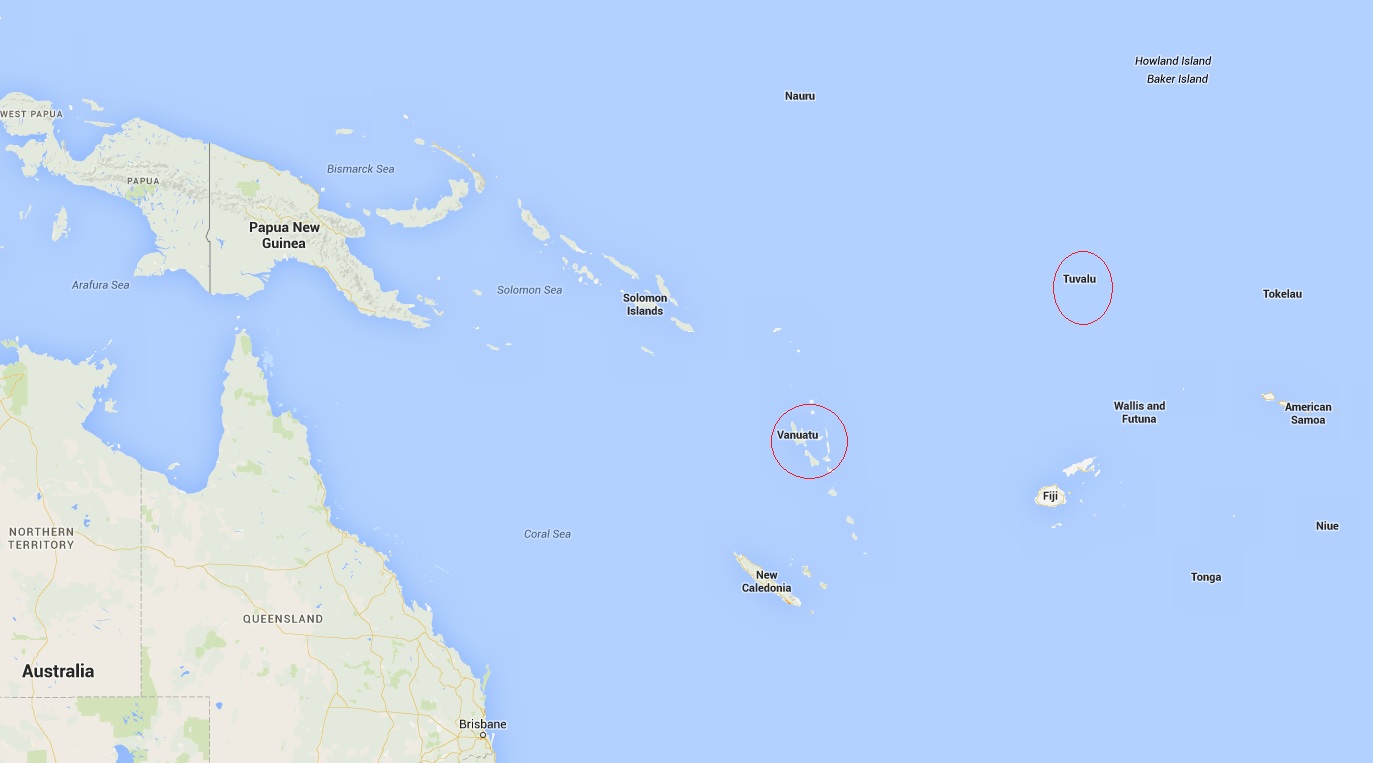
This commentator and author of the subsequent article, is spot on in this regards. Just last week (March 20) was the Spring Equinox in the Northern Hemisphere; so while hurricane season for the Caribbean is still months away, it is the “thick” of the season for the Southern Hemisphere right now; (equivalent to September for the Caribbean). Last week the Pacific island nations of Vanuatu and Tuvalu – see Appendices A, B & C – were devastated by the Category 5 Cyclone Pam. (Cyclones are the Pacific version of hurricanes).

Category 5!!!

Pacific or Caribbean; we both share this same reality. We have to contend with natural disasters, not of our making. This threat is heightened now with Climate Change. 9 of the 10 hottest years on record have now taken place since 2000.

The only exception to this trend was … 1998.

It is what it is!

Poor Vanuatu and Tuvalu… (see VIDEOs of the devastation in Appendix A below). They are not prepared for this “agent of change”; in fact their peoples are suffering right now; and they will suffer further trying to effectuate a recovery. See the full article here:

Title: Vanuatu and Tuvalu – Inadequate response to human suffering
By: Sir Roland Sanders – Caribbean/Commonwealth Commentator – Posted03-19-2015; retrieved 03-25-2015 from:
http://www.sirronaldsanders.com/viewarticle.aspx?ID=491

People on the East Coast of the United States of America (US) and the Caribbean should consider how best they might lend a helping hand to the people of the islands of Tuvalu and Vanuatu in the Pacific whose lives have been shattered by Cyclone Pam that struck them on the night of March 13.

In the case of the Caribbean islands, it is a matter of “there but for fortune go I”.

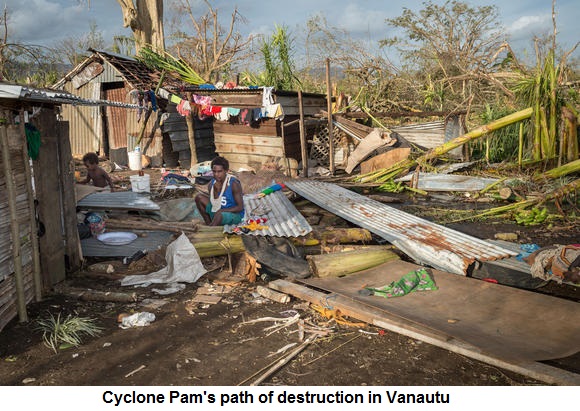
Vanuatu - Photo 2Category 5 Pam, ripped through both Vanuatu and Tuvalu – two archipelagic countries consisting of several small islands and atolls – creating widespread destruction.   Damage was so intense that all the inhabitants of one of the Tuvalu islands had to be evacuated.  They left behind everything they hold dear, and they now live in uncertainty about when they can return and how to start to reconstruct their lives.

The capacity of these countries to cope with ferocious cyclones, such as Pam, and the resilience to rebuild in the wake of huge damage, simply do not exist.   Both Vanuatu and Tuvalu are confronted with immediate humanitarian needs for food, shelter and fresh water.  Reports indicate that residents on some of the distant islands have resorted to drinking salt water.

The level of the immediate suffering can only be imagined by those who have not experienced the cruel conditions in which people are forced to live in the aftermath of natural disasters of this magnitude.

Vanuatu - Photo 1The governments of Australia and New Zealand, which are the two most developed Commonwealth countries in the area, have been quick to help with humanitarian assistance.  But, the islands in the two archipelagic countries are so scattered that distribution of supplies is severely constrained, particularly as many have no landing strips.  Britain, too, has offered help amounting to £1m.  That money will be made immediately available to UN organisations and international aid agencies already working in the region.

But the lack of aid co-ordination has resulted in uneven assistance to the people of the islands, and in some cases to no help at all.   At the time of writing, the government of Vanuatu announced that food will run out on some islands within a week. The deputy chair of the National Disaster Committee, Benjamin Shing, has said that while the country appreciated the aid, the initial response could have been handled better.  He claims that the aid agencies are working on their own rather than in co-operation with the government.  He added that “in nearly every country in the world where they go in they have their own operational systems, they have their own networks and they refuse to conform to government directives”. In the situation that Shing describes it is the already-suffering people who are hurt more as resources are duplicated or wasted in one area, and little or no help reaches others.

If, apart from Australia and New Zealand particularly, the response to the tragedy in Vanuatu and Tuvalu has not been impressive, the greater and more profound problem will be the rebuilding process.  These islands, like many in the Caribbean, do not have the capital formation in their own banking system to finance reconstruction.  They will have to turn to international financial institutions for help.   But, if the experience of the Caribbean is a measure of what they can expect, rebuilding will be a long and agonizing process.

Many Caribbean countries, such as Antigua and Barbuda, Grenada and Dominica, lost more than 3 years of gross domestic product (GDP) in 24 hours when hurricanes devastated them.  Anxious to rebuild in the wake of such massively destructive hurricanes, the governments of these countries were forced into the commercial market to secure financing to rebuild infrastructure, even while their revenues were declining from decreased production.  Hotels closed, agricultural production ceased and manufacturing halted.  The result was an increase in the national debt and uncomfortable levels of debt to GDP ratios of more than 100%.

These countries had no option.  They either had to borrow to rebuild and re-start their economies or face soaring unemployment, increase in poverty and inadequate investment in health and education services.

Right now, Vanuatu and Tuvalu are rightly focused on alleviating the suffering of their people.  But, the bigger and more fundamental problem of rebuilding – and how to pay for it – already looms large.   Australia’s Foreign Minister, Julie Bishop, has told the Tuvalu Prime Minister, Enele Sopoaga, that her government would support longer-term recovery and reconstruction efforts.   Vanuatu will also need that help.   Australia alone cannot provide it, nor should it be expected to.

As Richard Bourne of the Ramphal Institute observed recently, “with erratic climate events and sea level rise it is time for the global community to take more seriously the growing risks for island archipelagos, especially low-lying atoll states in the Pacific and Caribbean. In a single year a storm can knock 10 per cent off GDP, and certain communities are already being withdrawn from shorelines where ocean levels have risen. This is a particular challenge for the Commonwealth, where the Ramphal Institute estimates that there are some ten independent and dependent territories which might be under water in 2100”.

In its report to Commonwealth Heads of Government, “A Commonwealth of the People: Time for Urgent Reform”, the Eminent Persons Group of which I was a member had recommended that the 53-nation Commonwealth establish a disaster management capacity.  Unfortunately the recommendation was not implemented. The details of the mechanism are laid out in the report.  Suffice to say that the proposal sought to establish a rapid Commonwealth response to natural disasters; machinery for disaster preparation and mitigation; and the means to help mobilize concessionary financing for rebuilding.

Both Vanuatu and Tuvalu could have benefited enormously from such a disaster management capacity within the Commonwealth of which they are two of the smallest and most vulnerable of member states.  The Commonwealth Secretary-General, Kamalesh Sharma, called for Commonwealth help immediately after the destructive passage of Cyclone Pam, but the Commonwealth should be doing more at times of tragedy if it is to be relevant to the people of its member states.

Let us hope that the tragedy in Vanuatu and Tuvalu is a wake-up call.  Hurricanes in the Caribbean and cyclones in the Pacific are not going away.  They are clear and present dangers.

The commentator in this case, Sir Roland Sanders, is an honorable man. He has principles and passion for the Caribbean … and Commonwealth alike. But, the Commonwealth appears to be his profession – see Appendix D below – and his panacea. He is advocating for relief for Vanuatu and Tuvalu to come from their fellow member-states in the British Commonwealth. That is a tall order!

The Go Lean book relates that most former British colonies are members of the Commonwealth, a non-political, voluntary association of equal members. This entity has no power or resources. Any help extended to Vanuatu and Tuvalu will be strictly optional and extended from the member-states’ surpluses. The neighboring communities of Australia, New Zealand and Papua New Guinea maybe in better position to assist Vanuatu and Tuvalu; though it is not our place to lay claim to their budgets. It would be difficult, given the recent global financial difficulties to expect aid to come from the Caribbean or any Small Island Development States (SIDS).

On the other hand, the book Go Lean … Caribbean, calls for the region to adopt strategic, tactical and operational mitigations for hurricanes in the region. We cannot and must not be beggars on the international scene. These hurricanes and cyclones are no surprise; we know they are coming. So the book details advocacies to respond, rescue, repair, rebuild and restore the Caribbean eco-systems in the event of the now-heightened hurricane threats. These advocacies are designed to mitigate the challenges of Mother Nature, create jobs, secure the homeland and grow the economy at the same time.

This point is pronounced early in the book with this Declaration of Interdependence (Page 11), with the opening and subsequent statements:

i.    Whereas the earth’s climate has undeniably changed resulting in more severe tropical weather storms, it is necessary to prepare to insure the safety and security of life, property and systems of commerce in our geographical region. As nature recognizes no borders in the target of its destruction, we also must set aside border considerations in the preparation and response to these weather challenges.

vi.    Whereas the finite nature of the landmass of our lands limits the populations and markets of commerce, by extending the bonds of brotherhood to our geographic neighbors allows for extended opportunities and better execution of the kinetics of our economies through trade. This regional focus must foster and promote diverse economic stimuli.

viii.  Whereas the population size is too small to foster good negotiations for products and commodities from international vendors, the Federation must allow the unification of the region as one purchasing agent, thereby garnering better terms and discounts.

This book, Go Lean… Caribbean, serves as a roadmap for the introduction and implementation of a technocratic Caribbean Union Trade Federation (CU) to elevate society of the 30 Caribbean member-states. The 53-member Commonwealth is out of scope for this Go Lean effort; this is territorial and geographic in its focus. The CU effort is a confederation that includes the island-nations of the Caribbean Sea and the coastal states like Guyana, Suriname and Belize. These are all vulnerable to the hurricane threat.

As a Trade Federation, the CU would be able to establish a permanent sentinel to mitigate devastation that stems from storms like Cyclone Pam. We would be able to deploy implementations to aid our recovery, like regional power grid, pipelines, a, regional currency, leveraged casualty insurance plans, and a robust capitals market. In fact the CU/Go Lean roadmap has these 3 prime directives:

  • Optimization of the economic engines in order to grow the regional economy.
  • Establishment of a security apparatus to protect the resultant economic engines from man-made and natural threats.
  • Improvement of Caribbean governance to support these engines.

The Go Lean book details the economic principles and community ethos to adopt, plus the executions of strategies, tactics, implementations and advocacies to elevate the Caribbean to better manage the threats of Climate Change and natural disasters like hurricanes. We must forge solutions, in advance and in response. We must do these ourselves, primarily; we cannot be perennial beggars and expecting International Aid every time we have emergencies. We must grow up and grow into a mature role of self-sufficiency. Consider the detail list from the book as follows:

Economic Principles – People Choose because Resources are Limited Page 21
Economic Principles – All Choices Involve Costs Page 21
Economic Principles – People Respond to Incentives Page 21
Economic Principles – Economic Systems Influence Individual Choices Page 21
Economic Principles – Consequences of Choices Lie in the Future Page 21
Community Ethos – “Crap” Happens Page 23
Community Ethos – Lean Operations Page 24
Community Ethos – Return on Investments (ROI) Page 24
Community Ethos – Ways to Impact the Future Page 26
Community Ethos – Ways to Improve Sharing Page 35
Community Ethos – Impact the Greater Good Page 37
Anecdote – Pipeline Transport – Strategies, Tactics & Implementations Page 43
Strategy – Vision – Confederating 30 Member-states in a Permanent Union Page 45
Strategy – Agents of Change – Globalization Page 57
Strategy – Agents of Change – Climate Change Page 57
Tactical – Fostering a Technocracy Page 64
Tactical – Growing Economy – Marshall Plan-like campaigns Page 68
Tactical – Growing Economy – Surviving Bubbles Page 68
Separation of Powers – Securities Regulator for Reinsurance Products Page 74
Separation of Powers – Homeland Security – Emergency Management Page 76
Implementation – Assemble – Pipeline as a Focused  Activity Page 96
Implementation – Ways to Pay for Change – Hurricane Insurance Fund Page 101
Implementation – Ways to Develop a Pipeline Industry Page 107
Implementation – Ways to Deliver Page 109
Implementation – Ways to Improve Energy Usage – Regional Grid Storm Resets Page 113
Implementation – Ways to Foster   International Aid – Natural Disaster Relief Page 115
Implementation – Ways to Benefit from   Globalization – Act Locally, Think Globally Page 119
Implementation – Ways to Promote Independence – Disaster Self-Response Page 120
Planning – 10 Big Ideas – Homeland Security Pact Page 127
Advocacy – Ways to Grow the Economy Page 151
Advocacy – Ways to Improve Housing – Hurricane Risk Reinsurance Fund Page 161
Advocacy – Ways to Better Manage the Social Contract Page 170
Advocacy – Ways to Impact Public Works – Rebuild after Disasters Page 175
Advocacy – Ways to Improve Homeland Security – Assuage systemic threats Page 180
Advocacy – Ways to Better Manage Natural Resources Page 183
Advocacy – Ways to Improve for Natural Disasters Page 184
Advocacy – Ways to Impact Extractions – Pipeline Strategy Alignment Page 195
Advocacy – Ways to Improve Emergency   Management Page 196
Advocacy – Ways to Improve Monopolies – Foster Cooperatives Page 202
Advocacy – Ways to Improve Transportation – Pipeline Options Page 205
Advocacy – Ways to Impact Rural Living – Small Island Development Page 235
Advocacy – Ways to Impact British   Territories – Commonwealth Emergence Page 245
Appendix – Offshore Banking Developments – Financial Action Task Force Page 321

This commentary previously featured subjects related to preparing and responding to the devastating effects of Climate Change and natural disasters in the region:

https://goleancaribbean.com/blog/?p=4587 Climate Change Defense – First US city to be powered 100% by renewables
https://goleancaribbean.com/blog/?p=2465 Book Review: ‘This Changes Everything: Capitalism vs. the Climate’
https://goleancaribbean.com/blog/?p=2119 Cooling Effect – Oceans and the Climate
https://goleancaribbean.com/blog/?p=1817 Caribbean grapples with intense new cycles of flooding & drought
https://goleancaribbean.com/blog/?p=1516 Floods in Minnesota, Drought in California – Why Not Share?
https://goleancaribbean.com/blog/?p=915 Go ‘Green’ … Caribbean
https://goleancaribbean.com/blog/?p=87 Earthquakes & Hurricanes Shake Eastern Caribbean Region

This is a new day for the Caribbean! It’s time now for change in our response to the eventuality of Climate Change. The elevations that are identified, qualified and proposed in the book Go Lean…Caribbean are not just reactive, but also proactive. It’s time for the Caribbean to lean-in for these elevations. Once we demonstrate success, it will be our pleasure to export our methods and systems to other SIDS locales… and Commonwealth states.

They – SIDS locales and Commonwealth states – will be welcomed to consider the entire Go Lean roadmap for their societal elevation.

Download the free e-Book of Go Lean … Caribbean – now!

——–

Appendix A – VIDEO 1: Cyclone Pam Brings Massive Destruction to Vanuatu

Appendix A – VIDEO 2: Drone Flies Over Cyclone Pam Damage in Vanuatu

——–

Appendix B: Vanuatu

Vanuatu - Photo 3

This archipelago is officially the Republic of Vanuatu; it is an Oceanian island nation located in the South Pacific Ocean, 1,090 miles east of northern Australia. Though the islands were first inhabited by Melanesian people, it moved about European colonial hands of Spain, France and England. In the 1880s, France and the United Kingdom claimed parts of the country, and in 1906 they agreed on a framework for jointly managing the archipelago through a British–French Condominium. An independence movement arose in the 1970s, and the Republic of Vanuatu was founded in 1980.

Today, Vanuatu is a member of both la Francophonie and the Commonwealth of Nations. The island-nation has a population of 267,000 people; GDP of $1.204 Billion and per capita GDP of  $4,916[6].

Appendix C: Tuvalu

Vanuatu - Photo 4

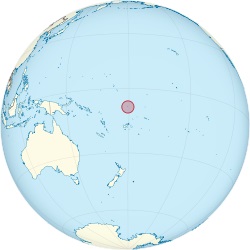
This country is formerly known as the Ellice Islands; it is a Polynesian island nation located in the Pacific Ocean, midway between Hawaii and Australia. It comprises three reef islands and six true atolls. This is a small country, with a population of 10,837. The total land area of the islands of Tuvalu is 10 square miles.

The first inhabitants of Tuvalu were Polynesians, but the islands came under Britain’s sphere of influence in the late 19th century, when each of the Ellice Islands was declared a British Protectorate in 1892. The islands were administered as as part of the British Western Pacific Territories, and later as part of the Gilbert and Ellice Islands colony from 1916 to 1974. In December 1974 a referendum was held to determine whether the Gilbert Islands and Ellice Islands should each have their own administration. As a consequence of the referendum, the Gilbert and Ellice Islands colony ceased to exist on 1 January 1976 and the separate British colonies of Kiribati and Tuvalu came into existence. Tuvalu became fully independent and within the British Commonwealth on 1 October 1978.

The island-nation GDP is $36 million with a per capita of $3,400.

——–

Appendix D: Sir Ronald Michael Sanders KCMG

Vanuatu - Photo 5Sir Ronald Sanders is currently a Senior Research Fellow at the Institute of Commonwealth Studies, University of London in the UK. He is an International Consultant, Writer and former senior Caribbean Ambassador.

In the private sector he has served on the Board of Directors of Financial Institutions, Telecom Companies, Media Companies and a Sustainable Forestry Company in Antigua and Barbuda, Belize, Barbados, Guyana, and the US Virgin Islands.

In the public sector he has served as the elected Chairman of the Caribbean Financial Action Task Force against drug trafficking and money laundering (2003-2004). He also served on the Board of the International Programme for the Development of Communication at UNESCO (1983-1985) and as an elected member of the Executive Board of UNESCO (1985-1987).

His diplomatic career spanned two periods between 1982 to 1987 and 1996 to 2004. He was twice High Commissioner to the United Kingdom for Antigua and Barbuda and Ambassador to the World Trade Organisation (WTO). He had special responsibilities for negotiations on financial and trade matters in the WTO and with the International Monetary Fund and the Organization for Economic Cooperation and Development (OECD). He attended Commonwealth and CARICOM Foreign Ministers and Heads of Governments Conferences throughout his diplomatic career.

He served on numerous committees, task forces and advisory boards to formulate and implement policy for the Caribbean and the Commonwealth. He also has experience of dealing with regulatory bodies such as the FCC in the US, and he has led a successful complaint to an arbitration panel of the World Trade Organisation.

Share this post:
, , , ,
[Top]

Caribbean Ghost Towns: It Could Happen…Again

Go Lean Commentary

The Caribbean is in crisis today; but even more so, if left unchecked, the crisis gets worst tomorrow (near future). We are at the point, and have been here for some time, where we are completely dysfunctional as a society; we are at the precipice. How else would one explain why citizens from the most beautiful addresses on the planet are “breaking down the doors” to get out, either through legal means or illegal ones?

“Things will always work themselves out” – Popular fallacy.

There is no guarantee of our survival. Communities and societies do fail; success is not assured; the work must be done, we must “sow if we want to reap”.

The reality of ghost towns, in the Caribbean and around the world, is a reminder to failing communities of where the road ends. Consider the definition of ghost towns here:

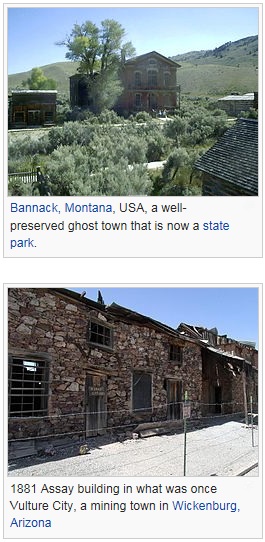
A ghost town is an abandoned village, town or city, usually one which contains substantial visible remains. A town often becomes a ghost town because the economic activity that supported it has failed, or due to natural or human-caused disasters such as floods, government actions, uncontrolled lawlessness, war, or nuclear disasters. The term can sometimes refer to cities, towns, and neighborhoods which are still populated, but significantly less so than in years past; for example those affected by high levels of unemployment and dereliction.[1]

CU Blog - Caribbean Ghost Towns - It Could Happen - Photo 1

Some ghost towns, especially those that preserve period-specific architecture, have become tourist attractions. Some examples are Bannack, Montana; Calico, California; Centralia, Pennsylvania; and Oatman, Arizona in the United States; Barkerville, British Columbia in Canada; Craco in Italy; ElizabethBay and Kolmanskop in Namibia; and Pripyat in Ukraine. Visiting, writing about, and photographing ghost towns is a minor industry. A recent modern-day example is Ōkuma, Fukushima, which was abandoned due to the Fukushima Daiichi nuclear disaster in 2011. (Also see Battleship or Hashima Island in the Appendix-VIDEO below).

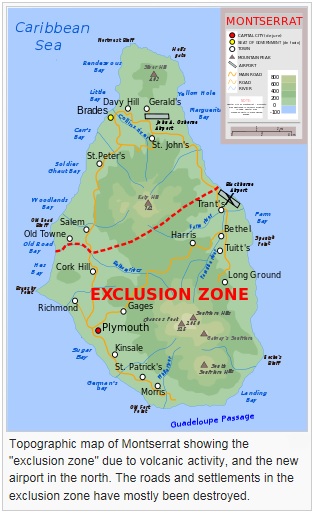
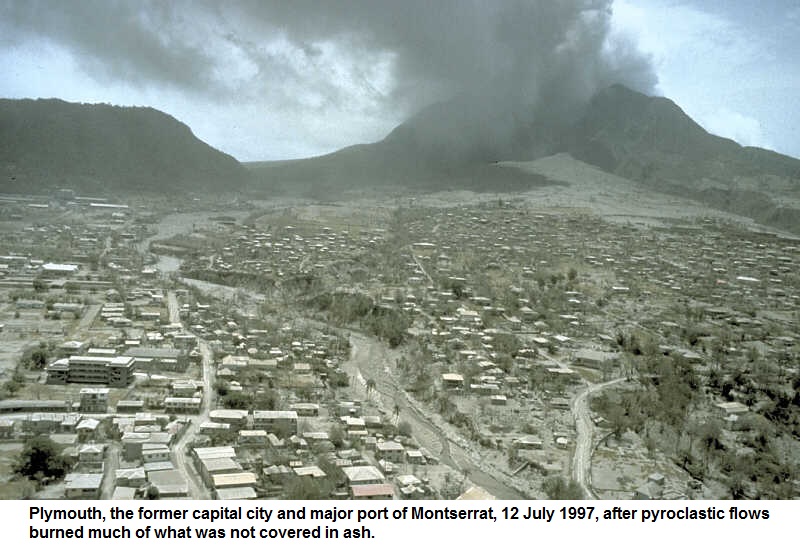
There is a ghost town that is an incumbent de jure capital: Plymouth in the Caribbean island of Montserrat*. This city was abandoned in 1997 due to volcanic eruptions and is now part of an Exclusion Zone.

CU Blog - Caribbean Ghost Towns - It Could Happen - Photo 2

CU Blog - Caribbean Ghost Towns - It Could Happen - Photo 6
(Source: http://en.wikipedia.org/wiki/Ghost_town retrieved February 11, 2015)

The book Go Lean … Caribbean stresses reboots, reorganizations and general turn-around of failing economic engines in favor of winning formulas. The book quotes a noted American Economist Paul Romer with this famous quotation:

“A crisis is a terrible thing to waste”.

The encyclopedic reference of ghost towns continues:

Ghost towns may result when the single activity or resource that created a boomtown (e.g., nearby mine, mill or resort) is depleted or the resource economy undergoes a “bust” (e.g., catastrophic resource price collapse). Boomtowns can often decrease in size as fast as they initially grew. Sometimes, all or nearly the entire population can desert the town, resulting in a ghost town.

The dismantling of a boomtown can often occur on a planned basis. Mining companies nowadays will create a temporary community to service a mine site, building all the accommodation shops and services, and then remove it as the resource is worked out. A gold rush would often bring intensive but short-lived economic activity to a remote village, only to leave a ghost town once the resource was depleted.

In some cases, multiple factors may remove the economic basis for a community; some former mining towns on U.S. Route 66 suffered both mine closures when the resources were depleted and loss of highway traffic as US 66 was diverted away from places like Oatman, Arizona onto a more direct path.

The Middle East has many ghost towns that were created when the shifting of politics or the fall of empires caused capital cities to be socially or economically non-viable, such as Ctesiphon, (a once great city of ancient Mesopotamia; today’s modern-day Iraq, Kuwait, and the northeastern section of Syria).

The Go Lean book posits that many Caribbean communities suffer from a mono-industrial complex (Page 3), therefore the risk is high for the same ghost town eventuality like so many other towns have experienced. Yes, ghost towns could happen in the Caribbean … again.

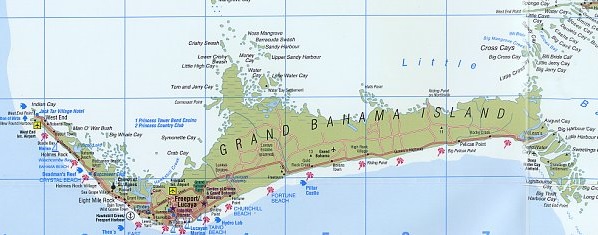
In fact, the 2nd city in the Bahamas, Freeport, on the island of Grand Bahama is experiencing a sharp decline in it’s economic output – where tourism is the primary industry – calculated at 66 percent decline from 2004 to 2013 for air arrivals. They are now near a failed-city status.

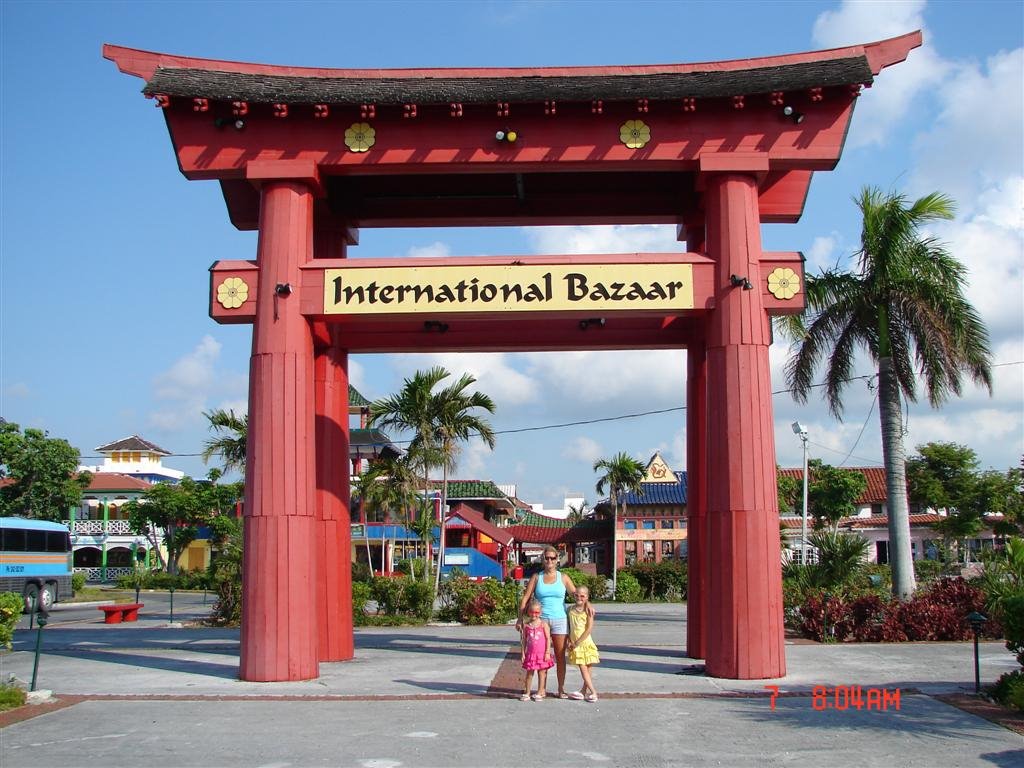
CU Blog - Caribbean Ghost Towns - It Could Happen - Photo 11Freeport’s tourism, which used to top over a million visitors a year – with air arrivals and cruise passengers – has considerably diminished since 2004, when two major hurricanes, Hurricane Frances and Hurricane Jeanne, hit the island; then the following year (2005), Hurricane Wilma reiterated more destruction to Freeport’s economic engines – many hotels shuttered their doors for good. Since then, several cruise ships also stopped their weekly visits to the island. Much of the remaining tourist industry is centered on the seaside suburb of Lucaya; in fact the city is often promoted as Freeport/Lucaya. Most remaining hotels on the island are located along the southern shore in Lucaya. The primary shopping venues for tourists used to be the popular International Bazaar near downtown Freeport, but now the focus has shifted to the Port Lucaya Marketplace, an outdoor mall-like complex near the beach-side hotel-resorts.

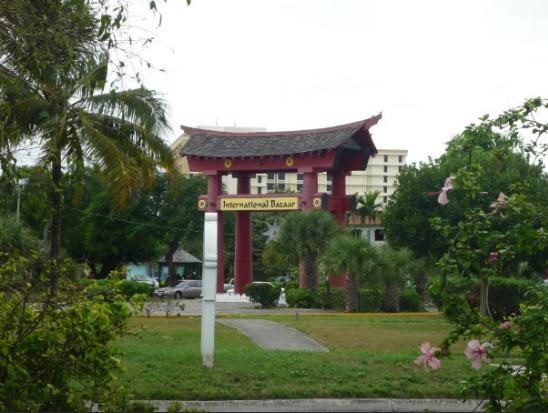
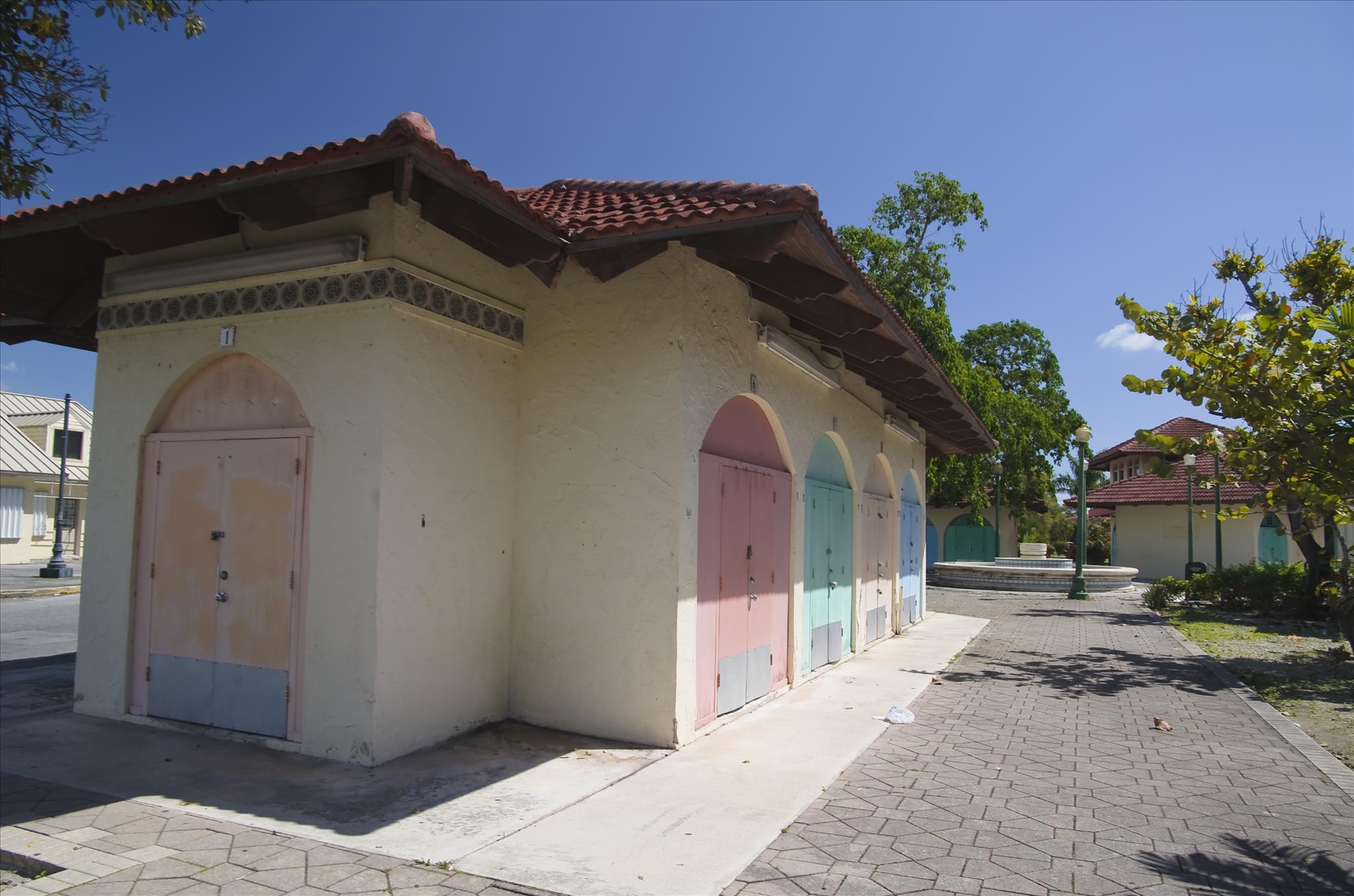
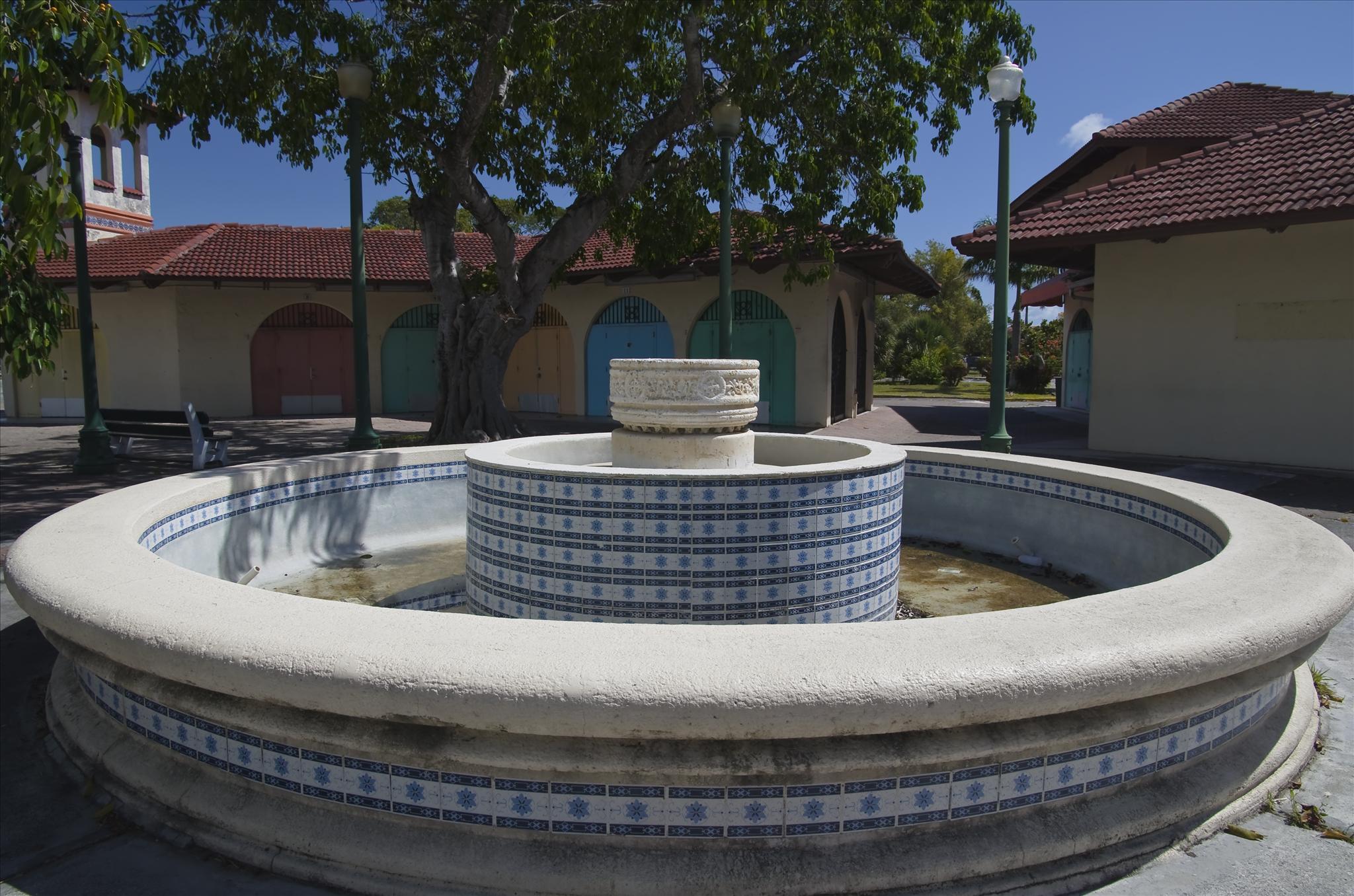
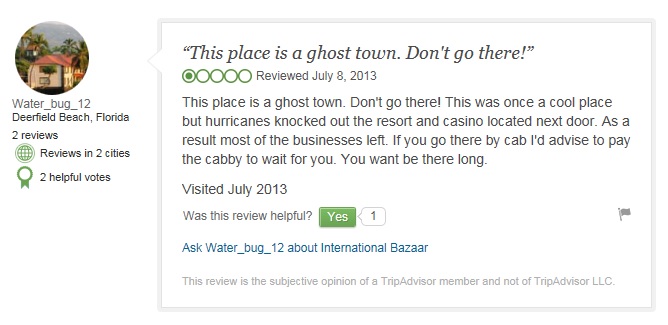
What of the current disposition of the International Bazaar in the downtown area? Unfortunately, the adjoining hotel-casino-resort, Royal Oasis, closed after the above hurricanes and never re-opened.  A local Bahamas photography magazine thusly dubbed the International Bazaar as a “ghost town”. (Retrieved February 11, 2015; article entitled: “The International Bazaar – The Lost Shopping Mecca”):

What happened to this marvelous structure? I do not know. What is its fate? I still do not know. What I do know: it is a sad day when one of the Bahamas’ greatest attractions has been reduced to a ghost town.  What I can tell you is that it seems as if the excitement has moved from the Bazaar to Port Lucaya. It is now the New Shopping Mecca of Grand Bahama.

Photo Caption: Freeport’s International Bazaar in it’s “Hey Day”

CU Blog - Caribbean Ghost Towns - It Could Happen - Photo 7

CU Blog - Caribbean Ghost Towns - It Could Happen - Photo 3

Photo Caption: Freeport’s International Bazaar Ghost Town Today

CU Blog - Caribbean Ghost Towns - It Could Happen - Photo 9

CU Blog - Caribbean Ghost Towns - It Could Happen - Photo 4

CU Blog - Caribbean Ghost Towns - It Could Happen - Photo 5

See TripAdvisor.com comments of disappointed visitors:

CU Blog - Caribbean Ghost Towns - It Could Happen - Photo 8

CU Blog - Caribbean Ghost Towns - It Could Happen - Photo 10

In fact, many more comments abound on the internet with “ghost town” comparisons for Freeport.

Freeport must now reboot, or face the eventuality: Ghost Town!

This sad reality of Montserrat and Freeport is an omen for the rest of the Caribbean.

The book Go Lean … Caribbean serves as a roadmap for the introduction and implementation of the technocratic Caribbean Union Trade Federation (CU). The CU is structured to turn-around failing Caribbean communities; it is proffered to provide economic, security and governance solutions for all 30 member Caribbean states, including Montserrat and Freeport. This mandate is detailed early on in the book’s Declaration of Interdependence, as follows (Page 12 & 13):

xii. Whereas the legacy in recent times in individual states may be that of ineffectual governance with no redress to higher authority, the accedence of this Federation will ensure accountability and escalation of the human and civil rights of the people for good governance, justice assurances, due process and the rule of law. As such, any threats of a “failed state” status for any member state must enact emergency measures on behalf of the Federation to protect the human, civil and property rights of the citizens, residents, allies, trading partners, and visitors of the affected member state and the Federation as a whole.

xix. Whereas our legacy in recent times is one of societal abandonment, it is imperative that incentives and encouragement be put in place to first dissuade the human flight, and then entice and welcome the return of our Diaspora back to our shores. This repatriation should be effected with the appropriate guards so as not to imperil the lives and securities of the repatriated citizens or the communities they inhabit…

The Go Lean book posits that failing Caribbean communities can be rescued, that if “we do what we have always done, we get what we have always got”. Therefore Caribbean communities must adopt different community ethos, plus the executions of key strategies, tactics, implementations and advocacies to bring about change, empowerment and turn-around . The following is a sample:

Community Ethos – Economic Principle – Economic Systems Influence Choices & Incentives Page 21
Community Ethos – Economic Principle – Voluntary Trade Creates Wealth Page 21
Community Ethos – Job Multiplier Page 22
Community Ethos – Lean Operations Page 24
Community Ethos – Ways to Impact the Future Page 26
Community Ethos – Ways to Help Entrepreneurship Page 28
Community Ethos – Ways to Impact Turn-Around – Recycling and Demolition Industries Page 33
Community Ethos – Ways to Impact the Greater Good Page 37
Strategy – Mission – Foster Local Economic Engines to Diversify the Economy Page 45
Tactical – Fostering a Technocracy Page 64
Tactical – Tactics to Forge an $800 Billion Economy – High Multiplier Industries Page 70
Tactical – Separation of Powers – Meteorological and Geological Service Page 79
Tactical – Separation of Powers – Self-Governing Entities Page 80
Implementation – Steps to Implement Self-Governing Entities Page 105
Implementation – Ways to Re-boot Freeport Page 112
Planning – Big Ideas – Virtual “Turnpike” Operations to Ensure Continued Relevance Page 127
Planning – Ways to Make the Caribbean Better Page 131
Planning – Ways to Improve Failed-State Indices Page 134
Planning – Lessons from East Germany Page 139
Planning – Lessons from Detroit – Model of City needing Turn-around Page 140
Advocacy – Ways to Grow the Economy Page 151
Advocacy – Ways to Create Jobs Page 152
Advocacy – Ways to Better Improve for Natural Disasters – Volcanoes and Hurricanes Page 184
Advocacy – Ways to Improve Emergency Management – Casualty Insurance to Rebuild Page 196
Advocacy – Ways to Impact Main Street Page 201
Appendix – Job Multipliers Page 259

Natural disasters are an inevitability in the Caribbean: earthquakes, volcanoes and hurricanes. We must insure and assure the business continuity of our communities’ economic engines. To recover, rebuild and reboot communities like Montserrat and Freeport after disasters, the burden or heavy-lifting should be spread across the full region, as leverage for all 30 member-states.

In order to avoid the pitfalls and eventuality of “ghost towns”, communities must diversify their economy. The Go Lean book also describes this heavy-lifting effort to facilitate this goal. The book describes the turn-by-turn directions for all the community stakeholders to follow to reach this goal, categorizing the effort as these 3 prime directives:

  • Optimization of economic engines in order to grow the regional economy to $800 Billion and create 2.2 million new jobs.
  • Establishment of a security apparatus to protect the resultant economic.
  • Improve Caribbean governance to support these engines.

In summary, ghost towns abound throughout the world, (see Appendix-VIDEO below), and can happen again here in the Caribbean region. A mono-industrial economy is bad; disaster  remediation and mitigations are good; diversity is good!

The CU will take the lead … for optimizing economic, security and governing engines. (Starting with a diversification from tourism). Everyone is hereby urged to lean-in to this CU/Go Lean roadmap to make the Caribbean a better place to live, work and play.  🙂

Download the book Go Lean … Caribbean – now!

———

Appendix*Plymouth, Montserrat

Montserrat is a British Overseas Territory located in the Caribbean. The island is located in the Leeward Islands chain of islands.[2] Montserrat is nicknamed The Emerald Isle of the Caribbean both for its resemblance to coastal Ireland and for the Irish ancestry of some of its inhabitants.[3]

Plymouth was the capital of the island of Montserrat. For centuries it had been the only port of entry to the island. On 18 July 1995, the previously dormant Soufrière Hills volcano, in the southern part of the island, became active.  Eruptions destroyed this Georgian era capital city and two-thirds of the island’s population was forced to flee.[6] The town was overwhelmed and was abandoned. The volcanic activity continues, even today, mostly affecting the vicinity of Plymouth, including its docking facilities, and the eastern side of the island around the former W.H. Bramble Airport, the remnants of which were buried by flows from volcanic activity on 11 February 2010.

An Exclusion Zone that extends from the south coast of the island north to parts of the BelhamValley was imposed because of the size of the existing volcanic dome and the resulting potential for pyroclastic activity. Visitors are generally not permitted entry into the exclusion zone, but an impressive view of the destruction of Plymouth can be seen from the top of Garibaldi Hill in IslesBay. Relatively quiet since early 2010, the volcano continues to be closely monitored by the Montserrat Volcano Observatory.

A new town and port is being developed at Little Bay, which is on the northwest coast of the island. While this construction proceeds, the centre of government and businesses rests new Village of Brades in the northen extremes of the island.

(Source: http://en.wikipedia.org/wiki/Montserrat retrieved February 11, 2015)

———

VIDEO: Battleship Island: Japan’s Ultimate Ghost Town – http://youtu.be/wHbQMhmsGPc

Uploaded on Dec 30, 2011 – This island – also known as Hashima Island is among the Japanese chain – sits 9 miles off the coast of Nagasaki. It was the administrative and residential base for undersea coal mines. As a ghost town it serves as a filming location for many projects, including serving as the inspiration for the external filming sets for the film Skyfall  – James Bond 007. For more stunning images of this Holy Grail of all industrial ruins, see: https://www.flickr.com/photos/picturenarrative/sets/72157628124548378/with/6388285131/


Share this post:
, , , , , ,
[Top]

Media Fantasies versus Weather Realities

Go Lean Commentary

Dateline Monday, February 2: It’s Groundhog Day again…and again…and again…*

CU Blog - Media Fantasies Versus Weather Realities - Photo 3

The media swarms around this hibernating animal for prognosticating signs of what to expect for the rest of the winter weather season. This is a fantasy; an American media fantasy. On the other hand, there are many effective meteorological models that do an effective job of forecasting the weather, but many people think these are ignored in place of media hype; case in point: a Groundhog.

VIDEO – Punxsutawney Phil See His Shadow and Predicts 6 More Weeks of Winter – http://wapo.st/1BU7s23

A Groundhog?

Groundhogs, whistlepigs, woodchucks, all names for the same animal. Depending on where you live, you might have heard all three of these names; however, woodchuck is the scientifically accepted common name for the species, Marmota monax. As the first word suggests, the woodchuck is a marmot, a genus comprised of 15 species of medium-sized, ground-dwelling squirrels. Although woodchucks are generally solitary and live in lowland areas, most marmot species live in social groups in mountainous parts of Europe, Asia, and North America. (Source: http://blog.oup.com/2015/02/groundhog-day-urban-wildlife-institute/#sthash.c41AKDvb.dpuf)

The concept of weather forecasting requires hardware and software, not rodent animals. The Europeans have provided a good example for the Caribbean to model. Their hardware: satellites, are collaborative efforts to deploy, maintain and support, referred to as the European Organization for the Exploitation of Meteorological Satellites or EUMETSAT; see Appendix below.

The software for weather forecasting is the application of science and technology to predict the state of the atmosphere for a given location. These forecasts are made by collecting quantitative data about the current state of the atmosphere at a given place and using scientific understanding of atmospheric processes to project how the atmosphere will change. The chaotic nature of the atmosphere, the massive computational power required to solve the equations that describe the atmosphere, error involved in measuring the initial conditions, and an incomplete understanding of atmospheric processes mean that forecasts become less accurate as the time range of the forecast increases. The use of ensembles and model consensus help narrow the error and pick the most likely outcome.

A major part of modern weather forecasting is the severe weather alerts and advisories which a governmental weather service may issue when severe or hazardous weather is expected. This is done to protect life and property.[75] Some of the most commonly known severe weather advisories are the severe thunderstorm, tornado warnings, as well as the severe tornado watches. Other forms of these advisories include those for winter weather, high wind, flood, tropical hurricanes, and fog.[76] Severe weather advisories and alerts are broadcasted through the media, including radio, using emergency systems as the Emergency Alert System which break into regular TV and radio programming.[77]

Among the notable models for Caribbean consideration are:

  1. American Model: National Oceanic and Atmospheric Administration (NOAA)
  2. European Model: European Centre for Medium-Range Weather Forecasts (ECMRWF).

The scope of the American Model is weather affecting the American mainland and aligned territories. The European Model, on the other hand, has a similar scope for Europe, but starts their focus earlier with weather patterns in the Americas and Caribbean. (The “Jet Stream” brings weather from West to East across the US and then continues across the Atlantic on to the European continent).

The American and European models assume different strategies. The American model runs a short, mid and long range forecast. The European model considers mid-range only, running out only 10 to 15 days into the future.

This consideration aligns with the book Go Lean…Caribbean; this book serves as a roadmap for the introduction and implementation of the technocratic Caribbean Union Trade Federation (CU). This empowerment effort represents a change for the region, calling on all 30 member-states in the region to confederate and provide their own solutions in the areas of economics, security and governance. Weather, as depicted in the foregoing VIDEOS, relates to all three areas. The CU/Go Lean roadmap has these prime directives:

  • Optimization of the economic engines in order to grow the regional economy.
  • Establishment of a security apparatus to protect the resultant economic engines against “bad actors” and natural disasters.
  • Improve Caribbean governance to support these engines, with a separation-of-powers between federal and state agencies.

The purpose of this commentary is to draw reference to the European Model, ECMWF, at a time when the American eco-system appears to be dysfunctional and filled with bad intent.

ECMRWF is renowned worldwide as providing the most accurate medium-range global weather forecasts to 15 days and seasonal forecasts to 12 months.[2] Its products are provided to the European National Weather Services, as a complement to the national short-range and climatological activities. The National Meteorological Services of member-states use ECMWF’s products for their own national duties, in particular to give early warning of potentially damaging severe weather.

While many things the US do are good, there is also “bad intent” in the American eco-system, often associated with crony-capitalism. Many believe that media hype over weather forecasts spurs retail spending (surplus food, gasoline, generators, and firewood) to benefit the same companies that contract media purchases (advertising) with the media outlets. Consider the “blown out of proportion” sense in the following article:

About Juno: The how and why of a blown forecast http://www.mcall.com/news/breaking/mc-juno-snow-dud-lehigh-valley-20150127-story.html

January 27, 2015 – Those Lehigh Valley commuters dusting the powder off their windshields Tuesday morning undoubtedly cast their thoughts back a day and concluded something had gone amiss in all the weather laboratories.

Wasn’t it supposed to snow 14 inches? Or was it six? Or two to four? They said something about a European model…

Well, off to work.

The storm that might have been is now the storm that wasn’t and no one will mention it again, at least until the next big miss by the weather services.

CU Blog - Media Fantasies Versus Weather Realities - Photo 2“Mother nature humbled us,” the Eastern PA Weather Authority wrote in a mea culpa Facebook post after its final call of 9 to 14 inches fell roughly 9 to 14 inches short.

What happened? As always, forecasters looked at a variety of models — the European model, famed for its precise forecasting of Superstorm Sandy, and many domestic models — and made predictions based on the data.

Mitchell Gaines, a meteorologist with the National Weather Service in Mount Holly, N.J., said there are about 10 commonly used models that make use of weather observations gathered around the world from satellites, balloons, ground stations and ships.

“We blew the call, and everyone blew it,” the Eastern PA Weather Authority post said. “(A)mending or lowering your original call is not nailing it either. No one got this right, plain and simple.”

Not quite no one. Adam Joseph, a meteorologist at the ABC station in Philadelphia, had predicted an underwhelming storm for the Philadelphia# region from early on, saying on Sunday it had “high bust potential.”

New York Mayor Bill DeBlasio spent a couple of days making pronouncements so foreboding that he was parodied as an end-times prophet by [humor magazine] The Onion.

But instead of three feet of snow and blizzard winds, the city got about 8 inches of snow in Central Park. “Snore-easter,” the Daily News called it.

“This is an imprecise science,” New York# Governor Andrew Cuomo said at a news briefing early Tuesday when asked about the forecast. He noted that last November, a storm that officials had not expected to be severe dropped seven feet of snow on Buffalo, in the western part of the state.

In New Jersey#, Governor Chris Christie said it was better to err on the side of caution: “I was being told as late as 9 o’clock (Monday) night that we were looking at 20-inch accumulations in parts of New Jersey,” he said. “We were acting based on what we were being told.”

There was, too, something of a New York-centric slant in the media coverage. The storm was declared a “dud” because it largely spared Manhattan. But it slammed New England as advertised, with wind gusts approaching hurricane strength and smothering snow.

VIDEO MONSTER BLIZZARD OF 2015 | New York Snow Storm Juno Forecast was an EPIC FAILhttps://youtu.be/Je6zr_K966A

Published on Jan 28, 2015 – Jan. 27, 2015 will go down in the annals of history as the day New Jersey came to a standstill for a blizzard in another state. Blizzard warnings have been lifted in the Garden State, projected snow totals more than cut in half and forecasters have apologized for what they’re describing as “big forecast miss.”

Conspiracy, anyone?

The book Go Lean…Caribbean asserts that the Caribbean region must not allow the US to take the lead for our own nation-building, that American Crony-Capitalistic interest tends to hijack policies intended for the Greater Good. This assessment is logical considering that despite the reality of the 2008 Great Recession and the Wall Street complexity, no one has gone to jail! This despite the blatant “lying, cheating and stealing”, the millions of victims and $11 Trillion in economic setbacks.

Be kind, rewind …

In the fall of 2012, Super Storm Sandy devastated the Northeast American coast despite warnings and accurate forecasts from the European Model.

US vs. European hurricane model: Which is better?
By:
Tamara Lush; posted May 29, 2013; retrieved February 3, 2015 from:
http://news.yahoo.com/us-vs-european-hurricane-model-better-164750199.html

When forecasters from the National Weather Service track a hurricane, they use models from several different supercomputers located around the world to create their predictions.

Some of those models are more accurate than others. During Hurricane Sandy last October, for instance, the model from the EuropeanCenter for Medium-range Weather Forecasting in the United Kingdom predicted eight days before landfall that the large storm would hit the East Coast, while the American supercomputer model showed Sandy drifting out to sea.

The American model eventually predicted Sandy’s landfall four days before the storm hit — plenty of time for preparation — but revealed a potential weakness in the American computer compared to the European system. It left some meteorologists fuming.

“Let me be blunt: the state of operational U.S. numerical weather prediction is an embarrassment to the nation and it does not have to be this way,” wrote Cliff Maas, a professor of atmospheric sciences at the University of Washington.

Experts also say the quality of a nation’s computer capability [for modeling] is emblematic of its underlying commitment to research, science and innovation.

Many felt that “the powers that be” did not want to overly alarm American citizens and affect the turnout for the Presidential Elections days later.

The foregoing articles/VIDEOs look at the repetition of Weather Forecast Dysfunction in 2012 with Super Storm Sandy and again, just last week with Winter Storm Juno. Compare this to the over-blown media hype of a Groundhog in Punxsutawney, Pennsylvania…for weather prognostication.

Something is wrong with this portrayal. This is American crony-capitalism all over again. Like the Groundhog Day movie, the same patterns are repeating again, and again …

The Caribbean must do better!

This issue on weather is not the first instance of a “Big Bad American Bully” in the business world. This is just another reflection of American Crony Capitalism – where public policy is set to benefit private parties. Consider this chart from a previous blog:

Big Oil While lobbying for continuous tax subsidies, the industry have colluded to artificially keep prices high and garner rocket profits ($38+ Billion every quarter).
Big Box Retail chains impoverish small merchants on Main Street with Antitrust-like tactics, thusly impacting community jobs.
Big Pharma Chemo-therapy cost $20,000+/month; and the War against Cancer is imperiled due to industry profit insistence.
Big Tobacco Cigarettes are not natural tobacco but rather latent with chemicals to spruce addiction.
Big Agra Agribusiness concerns bully family farmers and crowd out the market; plus fight common sense food labeling efforts.
Big Data Brokers for internet and demographic data clearly have no regards to privacy confines
Big Media Hollywood insists on big tax breaks/ subsidies for on-location shooting; cable companies conspire to keep rates high; textbook publishers practice price gouging.
Big Banks Wall Street’s damage to housing and student loans are incontrovertible.
NEW ENTRY
Big Weather Overblown hype of “Weather Forecasts” to dictate commercial transactions.

The Go Lean book, and accompanying blog commentaries, go even deeper and hypothesize that beyond weather alerts, the American economic models are dysfunctional for the Caribbean perspective. The American wheels of commerce portray the Caribbean in a “parasite” role; imperiling regional industrialization even further. The US foreign policy for the Caribbean is to incentivize consumption of American products and media, and to ensure that no other European powers exert undue influence in the region – Monroe Doctrine and Pax Americana (Page 180).

The disposition of a “parasite” is not the only choice, for despite American pressure, countries like Japan and South Korea, despite being small population-size, have trade surpluses with the US. They are protégés, not parasites, and thusly provide a model for the Caribbean to emulate.

This broken system in America does not have to be modeled in the Caribbean. Change has now come. The driver of this change is technology and globalization. The Go Lean book posits that the governmental administrations must be open to full disclosure and accountability. The ubiquity of the internet has allowed whistleblowers to expose “shady” practices to the general public; think WikiLeaks.

The Go Lean roadmap provides turn-by-turn directions on how to forge this change in the region for a reboot of these Caribbean societal systems, including justice institutions. This roadmap is thusly viewed as more than just a planning tool, pronouncing this point early in the Declaration of Interdependence (Page 13) with these statements:

xvi.    Whereas security [(Emergency/Disaster Management)] of our homeland is inextricably linked to prosperity of the homeland, the economic and security interest of the region needs to be aligned under the same governance. Since economic crimes…can imperil the functioning of the wheels of commerce for all the citizenry, the accedence of this Federation must equip the security apparatus with the tools and techniques for predictive and proactive interdictions.

The Go Lean book purports that the Caribbean can – and must – do better than our American counterparts. The vision of the CU is a confederation of the 30 member-states of the Caribbean to do the heavy-lifting of optimizing economic-security-governing engines. The book thusly details the policies and other community ethos to adopt, plus the executions of the following strategies, tactics, implementations and advocacies to protect Caribbean society with prudent weather forecasting:

Community Ethos – Deferred Gratification Page 21
Community Ethos – Consequences of Choices Lie in the Future Page 21
Community Ethos – Privacy versus Public Protection Page 23
Community Ethos – Whistleblower Protection Page 23
Community Ethos – Anti-Bullying and Mitigation Page 23
Community Ethos – Intelligence Gathering Page 23
Community Ethos – Lean Operations Page 24
Community Ethos – Ways to Impact the Greater Good Page 37
Strategy – Agents of Change – Technology Page 57
Strategy – Agents of Change – Globalization Page 57
Tactical – Separation of Powers – Emergency Management Page 76
Tactical – Separation of Powers – Meteorological and Geological Services Page 79
Implementation – Security Initiatives at Start-up Page 103
Implementation – Ways to Benefit from Globalization Page 119
Planning – Big Ideas – Integrating to a Single Market Page 127
Planning – Lessons Learned from 2008 Page 136
Advocacy – Ways to Grow the Economy Page 151
Advocacy – Ways to Create Jobs Page 152
Advocacy – Ways to Improve Governance Page 169
Advocacy – Ways to Better Manage the Social Contract Page 171
Advocacy – Ways to Improve Homeland Security Page 180
Advocacy – Ways to Improve Intelligence Gathering & Analysis Page 182
Advocacy – Ways to Improve for Natural Disasters Page 184
Advocacy – Ways to Improve Emergency Management Page 196

The foregoing article/VIDEO relates to topics that are of serious concern for Caribbean planners. While the US is the world’s largest Single Market economy, we want to only model some of the American example. We would rather foster a business climate to benefit the Greater Good, not just some special interest group.

The world is not fooled! “Tamarind, Sour Sap and Green Dilly, you musse think we silly” – Bahamian Folk Song

There are many Go Lean blog commentaries that have echoed this point, addressing the subject of the Caribbean avoiding American consequences. See sample here:

https://goleancaribbean.com/blog/?p=3397 A Christmas Present for the Banks from the Omnibus Bill
https://goleancaribbean.com/blog/?p=3326 Detroit’s M-1 Rail – Finally avoiding Plutocratic Auto Industry Solutions
https://goleancaribbean.com/blog/?p=2887 Caribbean must work together to address rum subsidies
https://goleancaribbean.com/blog/?p=2522 The Cost of Cancer Drugs
https://goleancaribbean.com/blog/?p=2465 Book Review: ‘This Changes Everything: Capitalism vs. the Climate’
https://goleancaribbean.com/blog/?p=2435 Korea’s Model – A dream for Latin America and the Caribbean
https://goleancaribbean.com/blog/?p=2338 How Caribbean can Mitigate the Dreaded ‘Plutocracy’
https://goleancaribbean.com/blog/?p=2259 The Criminalization of American Business
https://goleancaribbean.com/blog/?p=2183 A Textbook Case of Industry Price-gouging
https://goleancaribbean.com/blog/?p=1309 5 Steps to a Bubble
https://goleancaribbean.com/blog/?p=1256 Traditional 4-year Colleges – Terrible Investment for Region and Jobs
https://goleancaribbean.com/blog/?p=1143 Health-care fraud in America; Criminals take $272 billion a year
https://goleancaribbean.com/blog/?p=798 Lessons Learned from the American Airlines merger
https://goleancaribbean.com/blog/?p=789 America’s War on the Caribbean
https://goleancaribbean.com/blog/?p=782 Open the Time Capsule: The Great Recession of 2008
https://goleancaribbean.com/blog/?p=709 Student debt holds back many would-be home buyers
https://goleancaribbean.com/blog/?p=658 Indian Reservation Advocates Push for Junk-Food Tax
https://goleancaribbean.com/blog/?p=623 Book Review: “The Divide – American Injustice in the Age of the Wealth Gap”
https://goleancaribbean.com/blog/?p=353 Book Review: ‘Wrong – Nine Economic Policy Disasters and What We Can Learn…’
https://goleancaribbean.com/blog/?p=273 10 Things We Don’t Want from the US – #1: American Self-Interest Policies

The book Go Lean…Caribbean posits that many problems of the region are too big for any one member-state to solve alone, that there is the need for the technocracy of the Caribbean Union Trade Federation. The purpose of this Go Lean/CU roadmap is to make the Caribbean homeland, a better place to live, work, learn and play. This effort is more than academic; this involves many practical mitigations and heavy-lifting. While this charter is not easy, it is worth all effort.

Climate change is a reality … for the Caribbean; (despite many in denial, especially in the US).

In the Caribbean we need accurate weather forecasting and alerts. We need the public to respect these alerts and not question some commercial-profit ulterior motive. We need the European Model more so than the American one.

The Go Lean roadmap calls for some integration of the regional member-states, a strategy of confederation with a tactic of separating powers between CU federal agencies and member-states’ governments. The roadmap calls for the regional integration of all meteorological and geological professional services. The separation-of-powers tactic also calls for assumption of Emergency Management Agencies for the member-states. There is the need for weather and disaster preparation/response under the same umbrella, with a direct line of reporting. The roadmap posits that to succeed as a society, the Caribbean region must not only consume, (in this case weather forecasts), but also create, produce, and distribute intellectual products and services (property) to the rest of the world. We need our own Caribbean weather/forecast models, algorithms, calculations and formulas!

Now is the time for all of the Caribbean, the people and governing institutions, to lean-in for the changes and empowerments described in the book Go Lean … Caribbean.

🙂

Download the book Go Lean … Caribbean – now!

—————-

AppendixEUMETSAT: European Organization for the Exploitation of Meteorological Satellites

CU Blog - Media Fantasies versus Weather Realities - Photo 1EUMETSAT is an intergovernmental organization created through an international convention agreed by a current total of 30 European Member States: Austria, Belgium, Bulgaria, Croatia, the Czech Republic, Denmark, Estonia, Finland, France, Germany, Greece, Hungary, Ireland, Iceland, Italy, Latvia, Lithuania, Luxembourg, the Netherlands, Norway, Poland, Portugal, Romania, Slovakia, Slovenia, Spain, Serbia, Sweden, Switzerland, Turkey, and the United Kingdom. These States fund the EUMETSAT programs and are the principal users of the systems. The convention establishing EUMETSAT was opened for signature in 1983 and entered into force in 19 June 1986.

EUMETSAT’s primary objective is to establish, maintain and exploit European systems of operational meteorological satellites. EUMETSAT is responsible for the launch and operation of the satellites and for delivering satellite data to end-users as well as contributing to the operational monitoring of climate and the detection of global climate changes.

The activities of EUMETSAT contribute to a global meteorological satellite observing system coordinated with other space-faring nations.

Satellite observations are an essential input to numerical weather prediction systems and also assist the human forecaster in the diagnosis of potentially hazardous weather developments. Of growing importance is the capacity of weather satellites to gather long-term measurements from space in support of climate change studies.

EUMETSAT is not part of the European Union, but became a signatory to the International Charter on Space and Major Disasters in 2012, thus providing for the global charitable use of its space assets.[1]
Source Reference: 1. http://www.disasterscharter.org/c/document_library/get_file?p_l_id=23109&folderId=172718&name=DLFE-4704.pdf

—————-

Appendix – # Winter Storm Juno Overblown Preparationshttp://youtu.be/ivK6jtWfX-U

Blizzard 2015 !!! Winter Storm Juno Forecast “Northeast Snowstorm Ramping Up ” !!! Amazing Video

Published on Jan 27, 2015 – More than 35 million people along the Philadelphia-to-Boston corridor rushed to get home and settle in Monday as a fearsome storm swirled in with the potential for hurricane-force winds and 1 to 3 feet of snow that could paralyze the Northeast for days.

—————-

Appendix – * Movie Reference: 1993 Movie Groundhog Day

http://www.imdb.com/title/tt0107048/?ref_=nv_sr_2

A weatherman finds himself living the same day over and over again.

Trailer: http://www.imdb.com/title/tt0107048/?ref_=ext_shr_eml_vi#lb-vi1319829785

Share this post:
, , , ,
[Top]

The ‘Great ShakeOut’ Earthquake Drill

Go Lean Commentary

At this moment (Thursday October 16), there is a Category 4 Hurricane (Gonzalo) bearing down on a Caribbean member-state (Bermuda), and yet this commentary is focusing on another type of natural disaster: Earthquakes.

January 2010 saw a devastating tremor hit Haiti. The whole world came to a halt – from Haiti’s perspective – the island nation has still not recovered.

Hurricanes. Earthquakes. This is the reality of Caribbean life – we have to contend with natural disasters; some with advanced warnings, some with no warnings at all.

In the past, our region has not done well managing the crisis associated with natural disasters. In fact, this was a motivation for the origination of the book, Go Lean … Caribbean. We do not have the luxury of “sticking our head in the sand” and pretending that there is no problem. Rather, we must prepare.

The foregoing news article/VIDEO is an example of earthquake preparation around the world, but especially in a region (US Eastern Seaboard) that usually do not have to contend with the threat of earthquakes; and yet got a surprising “shake” in August 2011:

Title: Damaged National Cathedral Hosts ‘Great ShakeOut’ Earthquake Drill
By: Alex DeMetrick, General Assignment Reporter

WASHINGTON (WJZ) – There’s nothing like an earthquake to get your attention, and the large quake Maryland felt three years ago is helping to spread the word to prepare for another.

Alex DeMetrick reports it’s all part of the great shakeout campaign.

Earthquake Drill - Photo 1

Depending on where you were three years ago, experiencing a 5.8 magnitude earthquake made an impression.

And you didn’t have to be scrambling out of the Washington Monument.

Maryland rocked all over.

“The Earth’s crust here is old; it’s cold. It transmits energy very effectively. Sort of rings like a bell,” said Dr. David Applegate, U.S. Geological Survey.

And because it could ring again, the Mid-Atlantic region is now part of the Great ShakeOut.

With the National Cathedral as a backdrop, the day is used to promote “drop, cover and hold on” in a quake.

“Something as simple as a book could hurt you, or a bookshelf could hurt, so you don’t want to try and run out, especially in our area here,” said Wendy Phillips, FEMA program specialist.

Bricks and masonry can fall. Thousands of pounds worth fell from the top of the National Cathedral.

“Top of the tower is the absolute worst,” said James Shepherd, director of preservation at the National Cathedral. “So those are the areas that really released the energy. Those are the areas we have the most damage.”

Repairs made the inside safe, although work still continues at the rear of the cathedral.

Just this reinforcement effort has cost $10 million.

Another $22 million will have to be found to strengthen the structure’s flying buttresses.

If it isn’t done, “what that means if there’s an earthquake, the stones move,” Shepherd said.

While repairs may still take years, the cathedral is a reminder the next earthquake could happen any time.

“Absolutely, earthquakes have defied efforts to give a short term prediction, so an earthquake in the east, less frequent, but the shaking can be a real issue over a wide area,” Applegate said.

The Great ShakeOut campaign began in California, and worldwide an estimated 25 million people, including 1 million in the Mid-Atlantic, practiced drop, cover and hold-on drills Thursday.
Baltimore Local CBS Station WJZ Newscast  (Retrieved 10-16-2014) – http://baltimore.cbslocal.com/2014/10/16/damaged-national-cathedral-hosts-great-shakeout-earthquake-drill/

CBS Baltimore Video: http://baltimore.cbslocal.com/video?autoStart=true&topVideoCatNo=default&clipId=10700214

The Go Lean book posits that earthquakes are outside of our control and can easily wreak havoc on one Caribbean island after another. This regional threat is due to the active Enriquillo fault-line in the Greater Antilles (Jamaica, Cuba, Hispaniola and Puerto Rico) and the Lesser Antilles subduction zone (also known for volcanoes) along the rim of the Eastern Caribbean basin. Already there have been a number of small quakes in a few Caribbean islands for 2014, including Puerto Rico, Dominican Republic, Martinique, Barbados and others.

So the earthquake threat is real. The foregoing article/VIDEO advocates preparing people in the region to survive quaking and shaking. The Caribbean has to be on guard for danger from seismic activities – we have failed miserably in the past, as in Haiti.

Earthquake Drill - Photo 2A previous blog/commentary asserted that the risk of earthquakes plus the constant threats during the annual hurricane season creates the need for a full-time sentinel to monitor, mitigate and manage the risks of natural disasters in the region. This is the mandate for the technocratic Caribbean Union Trade Federation (CU) for the 30 member-states of the Caribbean region. The Go Lean … Caribbean roadmap describes the CU’s prime directives as empowering the region’s economic engines, providing homeland security assurances and preparing/responding the region’s governance for natural disasters.

The point of natural disaster preparation, especially in the era of climate change, is pronounced early in the book with this Declaration of Interdependence (Page 11), with this opening statement:

i.        Whereas the earth’s climate has undeniably changed resulting in more severe tropical weather storms, it is necessary to prepare to insure the safety and security of life, property and systems of commerce in our geographical region. As nature recognizes no borders in the target of its destruction, we also must set aside border considerations in the preparation and response to these weather challenges.

The Go Lean book details the economic principles and community ethos to adopt, plus the executions of the following strategies, tactics, implementations and advocacies to prepare for the eventuality of earthquakes and hurricanes in Caribbean communities:

Economic Principles – People Respond to Incentives Page 21
Economic Principles – Economic Systems Influence   Individual Choices Page 21
Economic Principles – Consequences of Choices Lie in the   Future Page 21
Community Ethos – “Crap” Happens Page 23
Community Ethos – Lean Operations Page 24
Community Ethos – Return on Investments (ROI) Page 24
Community Ethos – Ways to Impact the Future Page 26
Community Ethos – Ways to Improve Sharing Page 35
Community Ethos – Impact the Greater Good Page 37
Strategy – Vision – Confederating 30 Member-states in a Union Page 45
Strategy – Agents of Change – Climate Change Page 57
Tactical – Fostering a Technocracy Page 64
Tactical – Separation of Powers – Emergency Management   Agency Page 76
Implementation – Ways to Deliver Page 109
Implementation – Ways to Foster International Aid – Haiti’s   Earthquakes Page 115
Planning – 10 Big Ideas – Homeland Security Pact Page 127
Advocacy – Ways to Grow the Economy Page 151
Advocacy – Ways to Improve for Natural Disasters Page 184
Advocacy – Ways to Improve Emergency Management Page 196

This is the change that has come to the region: the Caribbean is accepting that it is undoubtedly an earthquake zone.

There is the need for a regional sentinel to coordinate the preparation for earthquakes among the Caribbean member-states. There is the need for participation in the ‘Great ShakeOut’ Earthquake Drill, as related in the foregoing article and VIDEO, for this year (but its too late) and next year, and henceforth.

Natural disasters are unavoidable in the Caribbean. But we can prepare for them, we can make the Caribbean a better place to live, work and play. These elevations are identified, qualified and proposed in the book Go Lean…Caribbean; the mitigations are not just reactive, but also proactive.

All of the Caribbean, the people and institutions, are urged to lean-in to the roadmap from this book – and to “drop, cover and hold-on”.

Download the book Go Lean…Caribbean now!

Share this post:
, ,
[Top]

Guyana and Suriname Wrestle With High Rates of Suicides

Go Lean Commentary

This Caribbean member-state, Guyana, is Number One …

Not Number One on the list of most productive countries, but Number One on this infamous list: as the country with the highest rate of suicides in the world, according to the latest WHO report. (Suriname is also in the Top 10, at Number 6).

This is a tragedy!

The book Go Lean… Caribbean claims that this region is the best address in the world…physically. And yet this below article asserts that per capita, more people voluntarily “check-out permanently” here than anywhere else in the world. In a previous blog, this commentary presented that this same country Guyana is also Number One in the region with a 89% brain drain among college graduates.

This is not a coincidence, this is a crisis!

Title: Sleepy Guyana Wrestles With High Rate of Suicides
CU Blog - Guyana Wrestles With High Rate of Suicides - Photo 1
Lesbeholden, Guyana – The young man responds all too easily when asked whether he knows anyone who has committed suicide in his village, a sleepy cluster of homes and rum shops surrounded by vast brown fields of rice awaiting harvest.

Less than a year ago, Omadat Ramlackhan recalls, his younger brother swallowed pesticide after a drunken argument with their father and died five days later. “I don’t know what got into him,” the 23-year-old said. “It just happened like that.”

It wasn’t the family’s first brush with suicide. His stepmother, Sharmilla Pooran, volunteers that her brother hanged himself and the man’s son tried to do the same but survived, with rope marks on his neck to remember it. She once contemplated killing herself.

The fact that self-inflected harm is such a presence in the lives of this family is not surprising given that they live in an area that Guyana’s Ministry of Health has designated the “suicide belt,” in a country that the World Health Organization says in a new report has the highest rate of suicide in the world.

Guyana, a largely rural country at the northeastern edge of South America, has a suicide rate four times the global average, ahead of North Korea, South Korea, and Sri Lanka. Neighboring Suriname was the only other country from the Americas in the top 10.

There seem to be a number of reasons that Guyana tops the list, including deep rural poverty, alcohol abuse and easy access to deadly pesticides. It apparently has nothing to do with the mass cult suicide and murder of more than 900 people in 1978 at Jonestown, the event that made the country notorious.

“It’s not that we are a population that has this native propensity for suicide or something like that,” said Supriya Singh-Bodden, founder of the non-governmental Guyana Foundation. “We have been trying to live off the stigma of Jonestown, which had nothing to do with Guyana as such. It was a cult that came into our country and left a very dark mark.”

Just before the WHO published its report last month, the foundation cited rampant alcoholism as a major factor in its own study of the suicide phenomenon, which has been a subject of concern in Guyana for years. In 2010, the government announced it was training priests, teachers and police officers to help identify people at risk of killing themselves in Berbice, the remote farming region along the southeast border with Suriname where 17-year-old Ramdat Ramlackhan committed suicide after quarreling with his father, Vijai.

More recently, the government has sought to restrict access to deadly pesticides, though that is difficult in a country dependent on agriculture. In May, authorities announced a suicide-prevention hotline would be established and Health Minister Bheri Ramsarran said he would deploy additional nurses and social-service workers in response to the WHO report.

Some countries have had success with national strategies in bringing down the number of people who take their own lives, according to the WHO. The number of suicides rose rapidly in Japan in the late 1990s, but started to decrease in 2009 amid government prevention efforts and as discussion of the subject became less taboo.

It has declined in China and India as a result of urbanization and efforts to control the most common means of suicide, said Dr. Alan Berman, a senior adviser to the American Association of Suicidology and a contributor to the WHO report.

“A certain proportion of suicides are rather impulsive and if you can restrict access to the means of suicide, whether it’s by pesticides, or by firearms or by bridge, you can thwart the behavior and give people an opportunity to change their minds,” Berman said.

The WHO estimates there are more than 800,000 suicides around the world per year. Statistics on the subject are unreliable because in some places the practice is stigmatized, or illegal.

The agency found Guyana, which has a population of about 800,000, had an age-adjusted rate of just over 44 per 100,000 people based on 2012 data. For males alone, it was nearly 71 per 100,000. In raw numbers, there are about 200 per year and 500 attempts, according to local health authorities. The U.S. overall rate was 12 per 100,000.

Most occur in Berbice, a flat, sun-baked expanse of farmlands along the river that forms the border with Suriname, where similar social and economic conditions prevail and which was 6th on the WHO list, just ahead of Mozambique.

“Suicides tend to be higher in rural areas than urban areas,” Berman said. “If I’m living in rural Montana, or if I’m living in rural India or in rural Suriname the question then is if I need help for whatever is going on with me how am I going to get it?”

It is a touchy subject in Guyana. The country is divided politically and ethnically between the descendants of people brought from Africa as slaves and the descendants of people brought from India, both Hindus and Muslims, as indentured workers to replace them.

Berbice has many people of Hindus of Indian descent and, as a result, suicide is often portrayed in Guyana as a largely Hindu phenomenon. But Singh-Bodden of the Guyana Foundation said that may be because self-inflicted death among the Hindus of Berbice is more likely to be reported as such. Their study, for example, found little reporting of suicide among native Amerindians who live in the country’s rugged interior.

“I don’t buy into the argument necessarily that it’s an ethnic thing, that Indo Guyanese are more susceptible to suicide,” she said. “There has been a lot of suicide among mixed people as well. I honestly believe it’s the hopelessness.”

Pooran, describing her family’s experiences, said her brother apparently killed himself after struggling with health problems for years and difficult home life. She said she thought about taking her own life while cleaning her house after a day’s work at a local sawmill.

“One day, I picked up the poison and thought about drinking it but I called God’s name and then realized my husband would just get another woman and soon forget me,” she said. “Don’t think I would do that today.”
———
By Bert Wilkinson in Guyana and Ben Fox reported from Miami.
Associated Press News Wire Service (Retrieved 10-15-2014) – http://abcnews.go.com/international/wirestory/sleepy-guyana-wrestles-high-rate-suicides-26174156

There is something providential about this crisis as the Go Lean… Caribbean book also asserts that “a crisis is a terrible thing to waste”. The book declares (Page 36) that a man/woman needs three things to be happy:

Deficiency Mitigation
1. Something to do Jobs
2. Someone to love Repatriation of Diaspora
3. Something to hope for Future-focus

The book serves as a roadmap to mitigate these 3 deficiencies within Caribbean life, rural communities and also in The Guianas (Guyana & Suriname).

The subject of suicide is not a light matter and should not be ignored. It addresses one of the most serious aspects of the science of Mental Health. The Go Lean book is not a reference source for science, but it does glean from “social science” concepts in communicating the plan to elevate Caribbean society. The book thusly serves as a roadmap for the introduction and implementation of the technocratic Caribbean Union Trade Federation (CU). The complete prime directives are described as:

  • Optimize the economic engines of the Caribbean to elevate the regional economy and create 2.2 million new job.
  • Establish a security apparatus to protect the resultant economic engines.
  • Improve Caribbean governance to support these engines.

The Go Lean roadmap immediately calls for the establishment of a regional sentinel, a federal Health Department, to monitor, manage and mitigate public health issues in the region. This focus includes mental health in its focus, just as seriously as any other health concern like cancer, trauma, bacterial/viral epidemiology. This direct correlation of physical/mental health issue with the Caribbean (and American) economy has been previously detailed in Go Lean blog/commentaries, as sampled here:

Public Health Economics – The Cost of Cancer Drugs
Antibiotics Misuse Associated With Obesity Risk
Regional Health Sentinel – Stopping Ebola
Recessions and Public Health in the Caribbean Region
Health Concern – Climate Change May Bring More Kidney Stones
New Hope in the Fight Against Alzheimer’s Disease
For Diabetes Mitigation, Google and Novartis to develop “smart” contact  lens
Health-care fraud in America; criminals take $272 billion a year
Painful and rapid spread of new Chikungunya virus in the Caribbean
Cuban Cancer Medication registered in 28 countries

Being first on a list is not uncommon for the Caribbean – Cuba’s famous tobacco-cigar is already declared “Among the Best in the World”. This is the kind of notoriety we want with our global image; not suicides. No one wants to live in a society where these mental health crises remain unmitigated. But the foregoing article relates that suicide rates in Guyana (and Suriname) needs to be arrested.

A lot is at stake.

The Go Lean roadmap immediately calls for the coordination of the region’s healthcare needs. This point is declared early in the Go Lean book, commencing with this opening pronouncement in the Declaration of Interdependence (Page 12), as follows:

ix.  Whereas the realities of healthcare … cannot be ignored and cannot be afforded without some advanced mitigation, the Federation must arrange for health plans to consolidate premiums of both healthy and sickly people across the wider base of the entire Caribbean population. The mitigation should extend further to disease management, wellness, mental health, obesity and smoking cessation programs.

The Go Lean … Caribbean roadmap constitutes a change for the region, a plan to consolidate 30 member-states into a Trade Federation with the tools/techniques to bring immediate change to the region to benefit one and all member-states. This includes the monitoring/tracking/studying the physical and mental health trends. This empowerment would allow for better coordination with member-states, non-governmental organizations (NGOs) and the World Health Organization (WHO).

The book details Happiness as a community ethos that first must be adopted; this refers to the appropriate attitude/spirit to forge change in the region. Go Lean details this and other ethos; plus the executions of the following strategies, tactics, implementations and advocacies to impact the region’s public [mental] health:

Community Ethos – Deferred Gratification Page 21
Community Ethos – Economics Influence Choices Page 21
Community Ethos – “Crap” Happens Page 23
Community Ethos – Lean Operations Page 24
Community Ethos – Cooperatives Page 24
Community Ethos – Non-Government Organizations Page 25
Community Ethos – Ways to Impact the Future Page 26
Community Ethos – Ways to Impact Turn-Around Page 33
Community Ethos – Ways to Promote Happiness Page 36
Community Ethos – Impact the Greater Good Page 37
Strategy – Vision – Confederate 30 Member-States Page 45
Strategy – Mission – Reform our Health Care Response Page 47
Strategy – Agents of Change – Aging Diaspora Page 57
Tactical – Fostering a Technocracy Page 64
Separation of Powers – Department of Health Page 86
Implementation – Ways to Deliver Page 109
Implementation – Reasons to Repatriate Page 118
Planning – Ways to Make the Caribbean Better Page 131
Planning – Ways to Improve Failed-State Indices Page 134
Planning – Lessons from Indian Reservations – Suicides Page 148
Advocacy – Ways to Grow the Economy Page 151
Advocacy – Ways to Improve Healthcare Page 156
Advocacy – Ways to Better Manage the Social Contract Page 170
Advocacy – Ways to Foster Cooperatives Page 176
Advocacy – Ways to Improve Emergency Management Page 196
Advocacy – Ways to Impact Rural Living Page 235
Advocacy – Ways to Impact/Re-boot The Guianas Page 241

Guyana is a “failing” state, economy-wise. The CU mitigation to re-boot the economy there (& the region) is Step One for minimizing the risk of suicide. The foregoing news article links economic downturns and rural poverty to suicide risks. All in all, there is the need for better stewardship for Caribbean society, the economy, security and governing engines.

Who will provide this better stewardship? Who will take the lead? The book Go Lean…Caribbean provide 370 pages of turn-by-turn directions for how the CU is to provide this role for the region. The people are hereby urged to lean-in to this Go Lean roadmap, to make the Caribbean a better place to live, work and play. 🙂

Download the book Go Lean … Caribbean – now!

Share this post:
, , , , , , ,
[Top]

Book Review: ‘This Changes Everything: Capitalism vs. the Climate’

Go Lean Commentary

The biggest threat to the Caribbean’s future maybe the biggest threat to the planet: Climate Change. How is it possible that anyone would deny this?

Maslow’s “Hierarchy of Needs” may help us to understand the dissenters viewpoint. The Maslow Hierarchy identifies these 8 levels of needs:

Level 1 – Biological and Physiological needs
Level 2 – Security/Safety needs
Level 3 – Belongingness and Love needs
Level 4 – Esteem needs
Level 5 – Cognitive needs
Level 6 – Aesthetic needs
Level 7 – Self-Actualization needs
Level 8 – Transcendence needs

In addition to the abundance of published materials on Maslow, the book Go Lean…Caribbean qualifies the same 8 levels of needs (Page 231). This definition of needs also applies to the subject of Climate Change and the foregoing Book Review of the new publication by author Naomi Klein entitled This Changes Everything: Capitalism vs. the Climate. This source book relates that the systems of capitalism run conflict with the ideals of fighting Climate Change. This commentary asserts that those who dissent are limiting their advent of Maslow’s Hierarchy to Level 1 and/or 2, while advocates to cure/mitigate Climate Change are navigating above Level 3, all the way to Level 8.

The profit motive is powerful; according to the foregoing article/book review, the practice of capitalism dictates seeking the shortest path to profit. Many are spellbound by profit, to make millions or simply to maintain jobs, to the point that they will sacrifice the higher level needs to only ensure Basic (Level 1) and Security/Safety (Level 2) needs.

This short-sighted view “cuts off the nose to spite the face”; it sacrifices the long-term for the sake of the short-term.

The book review follows:

Book Review: Heather Mallick, Columnist
Title: Naomi Klein has written the book of the modern era
This Changes Everything: Capitalism vs. the Climate – gives the reader the tools to discuss the coming disaster intelligently.

Capitalism vs the Climate 2The planet is headed for a climate catastrophe, and soon. Make that now. Your reaction will be either a quick calculation as to whether you’ll be able to die in time to skip the whole thing, or an appalled realization that your children are in for pain and your grandchildren for a terrible fate.

But your starter task should be reading Naomi Klein’s This Changes Everything: Capitalism vs. the Climate. Meticulously researched and briskly rational in tone, her just-published book is one of the basic texts of the modern era, by which I mean since the Scotsman James Watt invented the coal-fired steam engine in 1776. Hasn’t perdition come quickly on its wee cloven hooves?

Until then power came from water wheels. With Watt’s device, owners could build factories near the urban poor, hire cheaply, cut prices and stabilize production that used to depend on the whims of weather. Ironically it’s weather that will finish us off now. Capitalism is magical until it isn’t. Skip ahead 240 years and here we are, basically doomed by its profit formula.

Klein’s book is an essential purchase in that it tells you precisely what you need to know to discuss the climate dilemma intelligently: it covers historical context, environmental science, fossil fuel finance, our current version of capitalism, political history, climate change denial, environmentalism’s failures, suggested quack-scientific remedies that will “block” the sun, green energy and how people are working locally to blockade carbon extraction because nothing else is being done. It is factual rather than emotive.

Fascinatingly, it portrays fossil fuel corporations as victims of their own nature. Programmed like computers, they could not reverse themselves even if they wished to. Only governments can do it. Even then, international free-trade agreements allow corporations to sue nations to stop this, the very reason smart Germany has just objected to Canada’s new European trade deal. Stephen Harper knuckled under to corporations but the Germans are smarter than that.

This magnificent textbook has already been attacked by people who didn’t read it, apparently for the high school reason that Klein is too famous, or that the book is too hard on the West. But science has spoken. There are 2,795 gigatons (a gigaton is 1 billion metric tons) of fossil fuel reserves already claimed by industry that will be extracted and burned. “We know how much more carbon can be burned between now and 2050 and still leave us a solid chance (roughly 80 per cent) of keeping warming below 2 degrees Celsius,” writes Klein. “That amount is 565 gigatons.”

That’s 2,795 vs. 565, not even faintly close, and humans haven’t agreed even in principle to slow down. “2 degrees now looks like a utopian dream,” Klein writes, and 4 degrees is reliably said to be “incompatible with any reasonable characterization of an organized, equitable and civilized global community,” a.k.a. life as we sort of know it. Many experts say we’ll go far beyond 4 degrees.

The joy and genius of capitalism is how it takes the shortest path to profit, but it is as bad as communism at trashing earth, water and air. Something has to reshape capitalism or we are fried. Humans want to fob the problem off on other humans, which is not how it works on this pretty blue ball spinning through the sky. We may not suffer equally but we’ll all suffer.

A big wheel is already rolling. There is produce we can’t buy as drought crisps farmland in California, a state that hasn’t even banned private swimming pools. We are seeing the hottest summers on record and abnormally harsh winters, violent storms, more smog alerts, nations like the U.K. and cities like New York hit by flooding, Brazil hit by drought.

Author: Naomi Klein

Author: Naomi Klein

We may blame China and India, accusing them of blithely polluting as we claim to virtuously filter North American effluent. But we outsourced our pollution to Asia. As Klein reports, “The rise in emissions from goods produced in developing countries but consumed in industrialized ones was six times greater than the emissions savings of industrialized countries.” China will stop polluting when we stop buying their cheap stuff. Are you going to stop? Are you?

Klein’s question is this: do you go along to get along or do you fight back? This Changes Everything is basic reading and no one will take you seriously until you’ve read every single page.

Heather Mallick’s column appears Monday and Wednesday on the op-ed page and Saturday in News. hmallick@thestar.ca
The Star
– Toronto’s Daily Newspaper – Book Review – Sunday September 28, 2014
http://www.thestar.com/opinion/commentary/2014/09/28/naomi_klein_has_written_the_book_of_the_modern_era_mallick.html

Video: This Changes Everything: Capitalism vs the Climate – Book Trailer – https://www.youtube.com/watch?v=WPQI1Lui42c

The Go Lean book also details the impending crisis of Climate Change and then declares that “a crisis is a terrible thing to waste”, calling for the establishment of a regional administration to monitor, mitigate and manage the threats of Climate Change. The Go Lean book posits that the Caribbean region is at the frontline of the battleground of Climate Change, and that there is the need to save life-and-limb due to increased occurrences of devastating hurricanes, flooding, forest fires, droughts, rising sea levels, and alterations in fish stock.

This Go Lean book serves as a roadmap for the introduction and implementation of the technocratic Caribbean Union Trade Federation (CU). The prime directives of this agency are described as:

  • Optimize the economic engines of the Caribbean to elevate the regional economy to grow to $800 Billion and create 2.2 million new jobs.
  • Establish a security apparatus to protect the resultant economic engines.
  • Improve Caribbean governance and industrial policies to support these engines.

The Go Lean roadmap calls for the CU to serve as the regional administration to optimize economy, homeland security and governance engines for the Caribbean, especially in the fight of Climate Change battleground frontline status. But the needs of the economy, capitalistic principles and Climate Change mitigations do not have to clash/conflict; they can co-exist.

This is the first pronouncement (Page 11) of the opening Declaration of Interdependence that bears a direct reference to this foregoing article and source book:

i. Whereas the earth’s climate has undeniably changed resulting in more severe tropical weather storms, it is necessary to prepare to insure the safety and security of life, property and systems of commerce in our geographical region. As nature recognizes no borders in the target of its destruction, we also must set aside border considerations in the preparation and response to these weather challenges.

The source book also relates to the concepts of capitalism. Though it is the surviving system from the 20th Century debate versus Communism, it is far from being a perfect commerce system. But it can be managed and manipulated for the Greater Good. This point was also pronounced  on Page 13 of the Declaration of Interdependence in the Go Lean book:

xxiv. Whereas a free market economy can be induced and spurred for continuous progress, the Federation must install the controls to better manage aspects of the economy: jobs, inflation, savings rate, investments and other economic principles. Thereby attracting direct foreign investment because of the stability and vibrancy of our economy.

The Go Lean roadmap is designed to deliver many empowerment activities to elevate Caribbean society. These activities will carefully balance the needs of the Caribbean and the needs of the planet: we need jobs, yes, but we do not need to increase our carbon footprint.

The issues of Climate Change have been repeatedly addressed and further elaborated upon in these previous blog/commentaries:

https://goleancaribbean.com/blog/?p=2276 Climate Change May Affect Food Supply Within a Decade
https://goleancaribbean.com/blog/?p=2119 Cooling Effect – Oceans and the Climate
https://goleancaribbean.com/blog/?p=1883 Climate Change May Bring More Kidney Stones
https://goleancaribbean.com/blog/?p=1817 Caribbean grapples with intense new cycles of flooding & drought
https://goleancaribbean.com/blog/?p=1516 Floods in Minnesota, Drought in California – Why Not Share?
https://goleancaribbean.com/blog/?p=926 Conservative heavyweights have solar industry in their sights
https://goleancaribbean.com/blog/?p=915 Go ‘Green’ … Caribbean

The Go Lean book declares that we must adopt a community ethos, the appropriate attitude/spirit, to forge change in our region; then details the executions of the following strategies, tactics, implementations and advocacies to better impact the region’s resources and eco-systems, especially in considering the preparations and consequences of Climate Change:

Community Ethos – Deferred Gratification Page 21
Community Ethos – Economic Systems Influence Individual Choices / Incentives Page 21
Community Ethos – The Consequences of Choices Lie in the Future Page 21
Community Ethos – “Crap” Happens Page 23
Community Ethos – Lean Operations Page 24
Community Ethos – Cooperatives Page 24
Community Ethos – Non-Government Organizations Page 25
Community Ethos – Ways to Impact the Future Page 26
Community Ethos – Ways to Improve Sharing Page 35
Community Ethos – Impact the Greater Good Page 37
Strategy – Vision – Confederating 30 Member-States into a Single Market Page 45
Strategy – Vision – Foster Local Economic Engines for Basic Needs Page 45
Strategy – Mission – Prepare   for Natural Disasters Page 45
Strategy – Agents of Change – Climate Change Page 57
Strategy – Agents of Change – Globalization Page 57
Tactical – Confederating a Permanent Union Page 63
Tactical – Fostering a Technocracy Page 64
Separation of Powers – Emergency Management Page 76
Separation of Powers – Interstate Commerce Administration Page 79
Separation of Powers – Meteorological & Geological Service Page 79
Separation of Powers – Fisheries and Agriculture Department Page 88
Implementation – Assemble Regional Organs into a Single Market Economy Page 96
Implementation – Ways to Pay for Change Page 101
Implementation – Security Initiatives at Start-up – Unified Command & Control Page 103
Implementation – Industrial Policy for CU Self   Governing Entities Page 103
Implementation – Ways to Deliver Page 109
Implementation – Ways to Foster International Aid Page 115
Implementation – Ways to Benefit from Globalization Page 119
Planning – Big Ideas for the Caribbean Region Page 127
Planning – Ways to Make the Caribbean Better Page 131
Advocacy – Ways to Grow the Economy Page 151
Advocacy – Ways to Create Jobs Page 152
Advocacy – Ways to Improve Governance Page 168
Advocacy – Ways to Better Manage the Social Contract Page 170
Advocacy – Ways to Impact Public Works Page 175
Advocacy – Ways to Foster Cooperatives Page 176
Advocacy – Ways to Improve for Natural Disasters Page 184
Advocacy – Ways to Improve Emergency Management Page 196
Advocacy – Ways to Impact Wall Street Page 200
Advocacy – Ways to Impact Main Street Page 201
Advocacy – Ways to Improve Fisheries Page 210
Appendix – History of Puerto Rican Migration to US & Effects of   Hurricanes Page 303
Appendix – US Virgin Islands Economic Timeline with Hurricane Impacts Page 305

The foregoing book review and the source book discusses the threats of Climate Change on the planet. We have no option to ignore these debates. We are involved whether we want to be or not – we are on the frontlines of this battle. Apathy is not an option!

Change has come to our region; more devastating change is imminent. There is the need for a permanent union to provide efficient stewardship for Caribbean economy, security and governing engines. There must be that constant balancing act between capitalism and the planet. The Go Lean…Caribbean posits that these problems, these agents of change, are too big for just any one member-state to tackle alone, there must be a regional solution. This multi-state technocratic administration of the CU may be our best option.

The people and institutions of the region are hereby urged to lean-in to this Go Lean roadmap, to embrace the mitigations for the impending changes to the planet due to Climate Change. We can still make the Caribbean a better homeland to live, work and play. 🙂

Download the book Go Lean … Caribbean – now!

———-

Video: Bill Maher Interviews Naomi Klein on Climate Change Issues (Posted 09-26-14) – https://www.youtube.com/watch?v=nI1DoZBohyE

Share this post:
, ,
[Top]

Stopping Ebola

Go Lean Commentary

CU Blog - Stopping Ebola - Photo 1What a cute little boy in this photo…

Look at that sly look. It’s as if he just doesn’t understand why he is expected to believe the “nonsense”. He will not “drink the Kool-Aid”.

From the mouths of babes -The Bible; Matthew 21:16

The below article by the Editorial Board of the Miami Herald newspaper seems to indicate that someone has been “drinking the Kool-Aid”. Ebola is not an American problem. As of this moment the figures reported by the World Health Organization is that 2,300 people have died during this recent spread of Ebola in West Africa (Sierra Leone, Liberia, Guinea and other neighboring countries). What’s more, that number afflicted is expected to rise to 20,000 by the end of November. What’s worse, 70% of the afflicted are expected to die, if nothing is done.

There is the need for leadership.

This editorial article therefore petitions for American leadership in this Ebola threat:

By: Miami Herald Editorial Board

CU Blog - Stopping Ebola - Photo 2 Rarely has the idea of the global village and the mantra that the world is one big neighborhood seemed as real as in the frightening case of the raging Ebola epidemic in Africa.

There was a time, not so long ago, that an outbreak of disease anywhere in the Third World would have seemed far removed from the daily concerns of Americans and the nation’s foreign-policy agenda. Safely protected from foreign plagues by vast oceans, U.S. leaders would not have felt compelled to order a rapid response along the lines announced last week by President Obama as a matter of self-protection.

There might have been a tardy and symbolic response, if any at all, but certainly it would not have been treated as a priority demanding presidential action, complete with a significant military deployment.

What makes Ebola different is the realization that the world is indeed smaller, that modern modes of transportation — with busier travel patterns and habits — have lowered the barriers against infection. In places like Miami, a major port of entry for overseas visitors, the threat is very real, and Ebola is a particularly scary virus.

The disease kills between 50 percent and 90 percent of people infected with the virus, and there is as yet no specific and effective treatment available. No vaccine exists. Senior U.N. officials say cases are rising at an almost exponential level, with 5,000 reported by the end of August and many more expected.

Officials in Africa are plainly scared, and should be. Over the weekend, the government in Sierra Leone confined the country’s entire population, some 6 million people, to their homes for three days, an action that one news report called “the most sweeping lockdown against disease since the Middle Ages.”

Some experts estimate that as many as 20,000 people could become infected before the epidemic is under control. Others said the number would be several times higher by year’s end.

“We don’t know where the numbers are going,” said Dr. Bruce Aylward, assistant director general of the World Health Organization. He said the virus was spreading faster than the (belated) escalation of the response by the international community.

Indeed, the international community could have responded more quickly, and more effectively. A major outbreak was reported in Guinea in March by WHO, but it was not until last week that President Obama announced action commensurate with the nature of the threat.

He ordered a deployment of medicine, equipment and soldiers to Liberia and Senegal. A contingent of 3,000 military personnel will help build emergency treatment centers and establish what Pentagon officials call “command and control” assistance to coordinate the overall effort with other countries. According to the White House, the Centers for Disease Control and Prevention has committed more than $100 million to the fight since the outbreak started, but months were lost before the alarm was sounded outside the borders of the affected countries.

As Mr. Obama explained, as a virus multiplies, it also mutates to fight human immunology and counter-measures. That adds to the urgency of the crisis and makes it imperative for the United   States to coordinate an effort on a scale large enough to make a difference.
Miami Herald Daily Newspaper (Posted 09-21-2014) – http://www.miamiherald.com/opinion/editorials/article2180670.html

Ebola is not an American problem but when American citizens have been afflicted, the US response has been inspiringly genius, deploying a potential cure within a week. (See caption on above photo). This is not the resume of a global leader, this is the resume of a nation playing favorites.

CU Blog - Stopping Ebola - Photo 3

The book Go Lean…Caribbean posits that the Caribbean region must promote its own interest and protect its own citizens. We cannot count on the US to pursue the Greater Good for the whole world, or the Caribbean for that matter. Assuredly, we must have our own preparation and response vehicle.

This is the goal of the Go Lean…Caribbean book.

The book serves as a roadmap for the introduction and implementation of that regional sentinel, the Caribbean Union Trade Federation (CU). The complete prime directives of the CU:

  • Optimize the economic engines of the Caribbean to elevate the regional economy.
  • Establish a security apparatus to protect the resultant economic engines.
  • Improve Caribbean governance to support these engines.

This CU roadmap declares that “Crap happens” (Page 23). The Go Lean roadmap immediately calls for the establishment of a Homeland Security Department, with an agency to practice the arts and sciences of Emergency Management. The emergencies include more than natural disasters (hurricanes, earthquakes, tsunamis, volcanoes, flooding, forest fires, and droughts), they include the man-made variety (industrial accidents, oil spills, factory accidents, chemical spills, explosions, terroristic attacks, prison riots) and epidemic threats. Of course, these types of emergencies, described in the foregoing article, require professional expertise, a medical discipline. Stopping Ebola therefore would require a hybrid response of the Emergency Management agency and the CU’s Department of Health Disease Control & Management agency. This agency of Medical experts would help contend with systemic threats of epidemic illness and infectious diseases.

The Go Lean roadmap immediately calls for the coordination of security monitoring and mitigation in the Caribbean; this point is declared early in the Go Lean book with a pronouncement in the Declaration of Interdependence (Page 12), as follows:

xvi. Whereas security of our homeland is inextricably linked to prosperity of the homeland, the economic and security interest of the region needs to be aligned under the same governance. …[to ensure] the functioning of the wheels of commerce for all the citizenry, the accedence of this Federation must equip the security apparatus with the tools and techniques for predictive and proactive interdictions.

The Go Lean roadmap calls for the integration of the viral sentinel responsibility of the 30 Caribbean member-states, despite the 4 different languages and 5 colonial legacies (American, British, Dutch, French, Spanish) into a Trade Federation with the tools/techniques to bring immediate change to the region to benefit one and all member-states. This includes the monitoring and epidemiological defense of common and emerging viruses. This empowered CU agency will liaison with foreign entities with the same scope, like the World Health Organization (WHO), and the US’s Center for Disease Control (CDC). The need for this empowerment had previously been discussed in a similar blog/commentary regarding the Chikungunya virus.

Embedded YouTube Video: https://www.youtube.com/watch?v=Ui8wMZpwnp0

Since the CU roadmap leads with economic reform, the primary economic driver of the region (tourism) would be a constant concern. A lot is at stake if the Ebola threat comes to Caribbean shores. The realization, or even the unsubstantiated rumor, of viral outbreaks can imperil the tourism product. We must therefore take proactive steps to protect our economic engines. So there are heavy responsibilities for the stewardship of the Caribbean economy, security and governing engines; the goal is to impact the Greater Good of the entire Caribbean region. There is the need for a Caribbean-based agency to do the heavy-lifting of epidemiology for the region – no such entity exists today.  The emerging CU will invite this role and will promote it as a community ethos.

The book details the community ethos, plus the executions of the following strategies, tactics, implementations and advocacies to impact the region’s public health security in protection of the economy:

Community Ethos – Privacy versus Public Protection Page 23
Community Ethos – “Crap” Happens Page 23
Community Ethos – Lean Operations Page 24
Community Ethos – Cooperatives Page 24
Community Ethos – Non-Government Organizations Page 25
Community Ethos – Ways to Improve Sharing Page 35
Community Ethos – Impact the Greater Good Page 37
Strategy – Vision – Confederate a Non-Sovereign Single Market Entity Page 45
Strategy – Customers – Residents & Visitors Page 47
Strategy – Agents of Change – Globalization Page 57
Tactical – Confederating a Permanent Union Page 63
Tactical – Fostering a Technocracy Page 64
Separation of Powers – Emergency Management Page 76
Separation of Powers – Disease Control & Management Page 86
Implementation – Ways to Pay for Change Page 101
Implementation – Security Initiatives at Start-up Page 103
Implementation – Ways to Deliver Page 109
Implementation – Ways to Foster International Aid Page 115
Implementation – Ways to Benefit from Globalization Page 119
Planning – Ways to Improve Failed-State Indices Page 134
Planning – Ways to Measure Progress Page 148
Advocacy – Ways to Grow the Economy Page 151
Advocacy – Ways to Improve Healthcare Page 156
Advocacy – Ways to Improve Governance Page 168
Advocacy – Ways to Better Manage the Social Contract Page 170
Advocacy – Ways to Foster Cooperatives Page 176
Advocacy – Ways to Improve for Natural Disasters Page 184
Advocacy – Ways to Improve Emergency Management Page 196

The foregoing news editorial assumes the US will be altruistic and only pursue the Greater Good for the rest of the world.

LOL…

Recent Go Lean blogs have reported that the US is still not an equal society for its own citizens; forget those in foreign lands looking to the US for leadership. See sample list here:

https://goleancaribbean.com/blog/?p=2297 A Lesson in US Racial History – Booker T versus Du Bois
https://goleancaribbean.com/blog/?p=2259 The Criminalization of American Business
https://goleancaribbean.com/blog/?p=2251 What’s In A Name… (American Job Discrimination for Minorities)
https://goleancaribbean.com/blog/?p=2183 A Textbook Case of Price-gouging
https://goleancaribbean.com/blog/?p=1896 The Unbalanced Crisis in Black Homeownership
https://goleancaribbean.com/blog/?p=1832 Many drug inmates who get break under new plan to be deported
https://goleancaribbean.com/blog/?p=1674 Obama’s Plans for $3.7 Billion Immigration Crisis Funds
https://goleancaribbean.com/blog/?p=1143 Health-care fraud in America; criminals take $272 billion a year
https://goleancaribbean.com/blog/?p=789 America’s War on the Caribbean
https://goleancaribbean.com/blog/?p=546 Book Review: ‘The Divide’ – American Injustice in the Age of the Wealth Gap
https://goleancaribbean.com/blog/?p=341 Hypocritical US slams Caribbean human rights practices
https://goleancaribbean.com/blog/?p=273 10 Things We Don’t Want from the US: #7 – Discrimination of Immigrants

The change now being fostered by this Go Lean roadmap (and blogs) is focused on the Caribbean member-states, not on the United States of America. The US is out-of-scope; the Caribbean, on the other hand is our home. According to the old adage: “charity begins at home”.

The region is hereby urged to lean-in to this Go Lean roadmap, to fulfill the vision of making the Caribbean region a better place to live, work and play.

Share this post:
, , , , , , ,
[Top]