Tag: History

Oscar López Rivera: The ‘Nelson Mandela’ of the Caribbean?

Go Lean Commentary 

Here’s a not-so-fun fact about the First President of a pluralistic democratic Republic of South Africa, Nelson Mandela:

He spent 27 years in prison for terrorism.
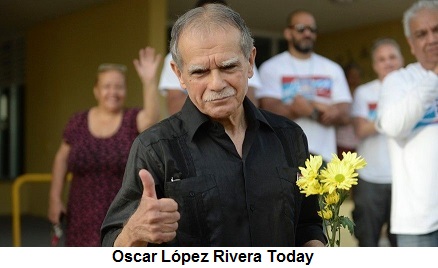
CU Blog - Oscar Lopez Rivera - Nelson Mandela of the Caribbean - Photo 1Yet, he was hailed a hero upon his release in 1990, and eventually elected as President and a transcendent leader of that country.

Is history about to repeat itself, with Puerto Rican Nationalist Oscar López Rivera?

Hardly!

While the object of animosity – villain – in the Mandela drama was the racist-bigoted government of South Africa, the object of animosity for López Rivera is … the United States of America, albeit a racist-bigoted iteration from the annals of recent history.

Same crime – same disposition? Hardly!

South Africa was never amongst the “Great Powers” of the Earth. (For much of its history – until 1961 – it was a member of the British Dominion and Commonwealth). It is also located at the Southern tip of the African continent – out of sight, out of mind. Mandela (18 July 1918 – 5 December 2013) had righteous indignation and accepted sabotage (a form of terrorism) as a tactic to force change in his country. But … Mandela enjoyed wide international support and concurrence, even from the US … in the end; see his altruism in his motivation here:

I have fought against white domination, and I have fought against black domination. I have cherished the ideal of a democratic and free society in which all persons will live together in harmony and with equal opportunities. It is an ideal which I hope to live for and to see realised. But if it needs be, it is an ideal for which I am prepared to die. — Mandela’s Rivonia Trial Speech, 1964[138][139]
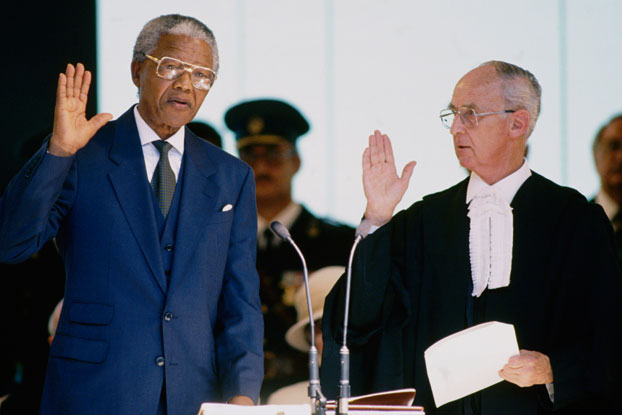
Zimbabwe - Photo 4

Mr. López Rivera also had a quest of righteous indignation against his enemy – advocating for Puerto Rican independence[6].

Oscar López Rivera (born 6 January 1943) is a Puerto Rican independence activist[1] who was one of the leaders of the FALN –  Fuerzas Armadas de Liberación Nacional Puertorriqueña, a Marxist-Leninist [organization] with a quest to make Puerto Rico an independent communist nation.[9][10][6] Mr. López Rivera was a fugitive since 1976 and indicted in 1977 and 1979; he was arrested on May 29, 1980 and tried by the United States government for seditious conspiracy, use of force to commit robbery, interstate transportation of firearms, and conspiracy to transport explosives with intent to destroy government property. López Rivera maintained that according to international law he was an anti-colonial combatant and could not be prosecuted by the United States government. On August 11, 1981, López Rivera was convicted and sentenced to 55 years in federal prison. On February 26, 1988 he was sentenced to an additional 15 years in prison for conspiring to allegedly escape from the Leavenworth federal prison. – Source: Wikipedia.
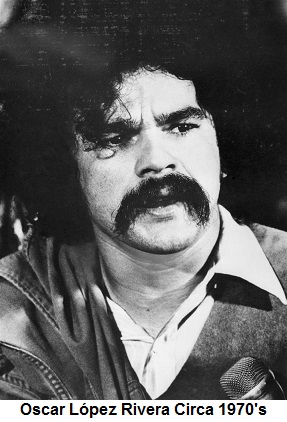
CU Blog - Oscar Lopez Rivera - Nelson Mandela of the Caribbean - Photo 1b

In truth, López Rivera had the wrong enemy if he wanted international support and concurrence. The US – since World War II – is the Super Power of the day, the #1 Single Market economy and #1 Military establishment. The US President is even considered the Leader of the Free World. But alas, In 2006, the United Nations (UN) called for the release of all convicted for actions related to Puerto Rican independence who had served more than 25 years in US prisons; these ones the UN deemed “political prisoners”.[28]

On August 11, 1999, U.S. President Bill Clinton offered clemency to López Rivera and 15 other convicted FALN members, subject to the condition of “renouncing the use or threatened use of violence for any purpose” in writing. … López Rivera rejected the offer because one of its conditions was that he [had to] renounce the use of terrorism.[1][44] On January 17, 2017, President Obama commuted López Rivera’s sentence. His release was scheduled for May 17[77] … one week ago. See VIDEO in the Appendix below.

The movement behind the book Go Lean…Caribbean – available to download for free – tracks and monitors the developments of the US Territory of Puerto Rico – it is a Failed-State. Would Puerto Rico have fared better had López Rivera and his cohorts won their revolution?

Probably not!

Despite all the current failures in societies esteeming capitalism – include the US with its Crony-Capitalism and institutional racism – Communist states around the world have fared even worse. In fact the Soviet Union collapsed in 1991 while López Rivera was in prison. Another Caribbean territory that defines itself as a Communist state, Cuba, has a terrible disposition, also a Failed-State that people are desperately fleeing from.

López Rivera is no Nelson Mandela! To some, he is not even a hero; see a story about the related protests and boycotts in the Appendix below.

CU Blog - Oscar Lopez Rivera - Nelson Mandela of the Caribbean - Photo 3

The Go Lean book presents a better plan to finally reform and transform Puerto Rico and the Caribbean; it serves as a roadmap for the introduction and implementation of the technocratic Caribbean Union Trade Federation (CU), for the elevation of Caribbean society – for all member-states. This CU/Go Lean roadmap has these 3 prime directives:

  • Optimization of the economic engines in order to grow the regional economy to $800 Billion and create 2.2 million new jobs.
  • Establishment of a security apparatus to ensure public safety and protect the resultant economic engines.
  • Improve Caribbean governance to support these engines, including a separation-of-powers between the member-states and CU federal agencies.

The book stresses that reforming and transforming the Caribbean societal engines must be a regional pursuit, that the problems are too big for any one Caribbean member-state alone – Puerto Rico has been trying this whole time and continue to fail … miserably. This was an early motivation for the roadmap, as pronounced in the opening Declaration of Interdependence (Pages 12 – 13):

xi. Whereas all men are entitled to the benefits of good governance in a free society, “new guards” must be enacted to dissuade the emergence of incompetence, corruption, nepotism and cronyism at the peril of the people’s best interest. The Federation must guarantee the executions of a social contract between government and the governed.

xvi. Whereas security of our homeland is inextricably linked to prosperity of the homeland, the economic and security interest of the region needs to be aligned under the same governance. Since economic crimes … can imperil the functioning of the wheels of commerce for all the citizenry, the accedence of this Federation must equip the security apparatus with the tools and techniques for predictive and proactive interdictions.

xxiii. Whereas many countries in our region are dependent Overseas Territory of imperial powers, the systems of governance can be instituted on a regional and local basis, rather than requiring oversight or accountability from distant masters far removed from their subjects of administration. The Federation must facilitate success in autonomous rule by sharing tools, systems and teamwork within the geographical region.

xxiv. Whereas a free market economy can be induced and spurred for continuous progress, the Federation must install the controls to better manage aspects of the economy: jobs, inflation, savings rate, investments and other economic principles. Thereby attracting direct foreign investment because of the stability and vibrancy of our economy.

The Go Lean book provides 370-pages of turn-by-turn instructions on “how” to adopt new community ethos, plus the strategies, tactics, implementations and advocacies to execute so as to reboot, reform and transform the societal engines of Caribbean society.

Puerto Rico does need a savior, a hero, but López Rivera is not it!

The Go Lean movement calls on Puerto Rico and its neighbors to save itself; this is a call for all 30 Caribbean member-states to convene, collaborate and confederate to provide a better, more effective, technocratic stewardship for the societal engines of the region. Consider this sample of prior blog/commentaries where these points had been elaborated upon:

https://goleancaribbean.com/blog/?p=11812 State of Caribbean Union: Hope and Change
https://goleancaribbean.com/blog/?p=11647 Righting a Wrong: Puerto Rico’s Bankruptcy
https://goleancaribbean.com/blog/?p=10895 US President Trump’s Vision of the Caribbean: Yawn
https://goleancaribbean.com/blog/?p=10700 Petition to Lean-in for the ‘Caribbean Union Trade Federation’
https://goleancaribbean.com/blog/?p=10585 Two Pies: Economic Plan for a New Caribbean
https://goleancaribbean.com/blog/?p=10566 Funding the Caribbean Security Pact
https://goleancaribbean.com/blog/?p=10043 Integration Plan for Greater Caribbean Prosperity
https://goleancaribbean.com/blog/?p=9595 Vision and Values for a ‘New’ Caribbean
https://goleancaribbean.com/blog/?p=7963 ‘Like a Good Neighbor’ – Being there for Puerto Rico
https://goleancaribbean.com/blog/?p=7151 The Caribbean is Looking for Heroes … ‘to Return’
https://goleancaribbean.com/blog/?p=4551 US Territories – Between a ‘rock and a hard place’
https://goleancaribbean.com/blog/?p=3834 State of the Caribbean Union
https://goleancaribbean.com/blog/?p=599 Ailing Puerto Rico open to radical economic fixes

Overall, to Oscar López Rivera, we say (Go Lean book conclusion Page 252):

Thank you for your service, love and commitment to [Puerto Rico, Puerto Ricans and] all Caribbean people. We will take it from here.

The movement behind Go Lean book, the planners of a new Caribbean stresses that a ‘change is going to come’, one way or another. We have endured failure for far too long; we have seen what works and what does not. We do not need to buy what López Rivera was selling in the 1970’s. We have looked, listened, learned and lend-a-hand since then. We are now ready to lead this country – Puerto Rico – and this region to a better destination, to being a homeland that is better to live, work and play. 🙂

Download the free e-Book of Go Lean … Caribbean – now!

Sign the petition to lean-in for this roadmap for the Caribbean Union Trade Federation. 

————–

Appendix VIDEO – Oscar Lopez Rivera? Hero Or Villain? – https://youtu.be/eje-sPJkaHQ

Published on May 18, 2017 The freed Puerto Rican nationalist was mostly hailed as a hero as he returned to Chicago’s HumboldtPark. New York’s CBS 2’s Vince Gerasole reports.

————–

Appendix Title: Yankees among groups to boycott New York City’s Puerto Rican Day Parade
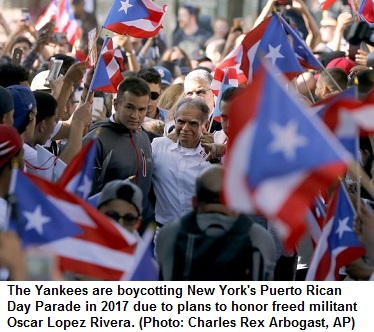
CU Blog - Oscar Lopez Rivera - Nelson Mandela of the Caribbean - Photo 2The New York Yankees joined the Fire Department of New York City and other high-profile organizations in dropping out of the Puerto Rican Day Parade in response to parade organizers’ plans to honor freed militant Oscar Lopez Rivera.

The Yankees organization didn’t elaborate on its decision, but a spokesperson said in a statement that the team still plans to financially support the parade’s scholarship program:

“The New York Yankees are not participating in this year’s Puerto Rican Day parade. However, for many years, the Yankees have supported a scholarship program that recognizes students selected by the parade organizers. To best protect the interests of those students, and avoid any undue harm to them, the Yankees will continue to provide financial support for the scholarships, and will give to the students directly.”

The June 11 parade, which draws 1 million people each year, also lost key sponsors because of the decision to honor a man considered to be the leader of the ultranationalist Puerto Rican group responsible for more than 100 bombings. Rivera, who was sentenced to 55 years in prison in 1981 after he was found guilty of seditious conspiracy, served 35 years until his sentence was commuted by President Barack Obama.

Among the other organizations skipping the parade are the NYPD’s Hispanic Society and Rafael Ramos foundation.

“We understand that others may not be able to be with us,” a statement by the board of directors of the National Puerto Rican Day Parade said in reference to naming Rivera a national freedom hero. “However, we will continue to represent all voices, with an aim to spark dialogue and find common ground, so that we can help advance our community and build cultural legacy.”
Source: USA Today Daily NewspaperPosted May 23, 2017; retrieved May 24, 2017 from https://www.usatoday.com/story/sports/mlb/yankees/2017/05/23/yankees-to-boycott-new-york-citys-puerto-rican-parade/102058948/
Share this post:
, ,

Rio Olympics – Athens Olympics: Same Strategy; Same Failure

Go Lean Commentary

It’s simple: learn from mistakes or you repeat them.

This applies to other people’s mistakes as well.

There is the funny anecdote of an insane asylum located in the inner boroughs in some unidentified city. The inmates forced a hole in a border fence and one day they shouted out “Four, four, four …”. A stranger walked by, heard the shouts and peeked in the hole. An inmate poked him in the eye, then shouted “Five, five, five …”.

Mistake made, no lesson learned!

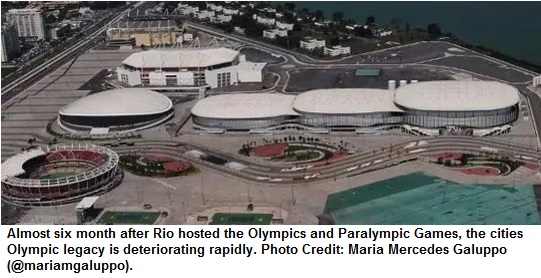
Unfortunately, this is the reality for many countries, in particular “poorer” countries that have hosted the Olympics. There was the clearly documented mistake – “bad” experience – of Athens-Greece hosting the 2004 Olympics. They built many permanent stadiums that were never used again – “white elephants” – they cost a lot of money to build and a lot to maintain. Fast forward to the 2016 Rio De Janeiro-Brazil Olympics and we see the Same Strategy; Same Failure – “the stranger unwisely peeks in the same hole and gets poked in the eye”.

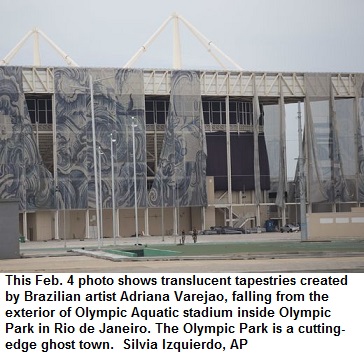
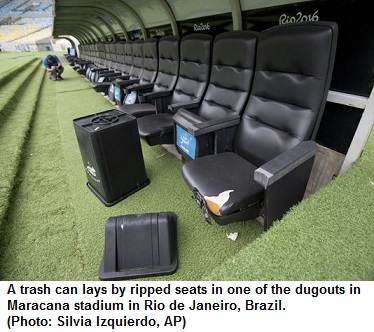
CU Blog - Rio Olympics - Same Strategy; Same Failure - Photo 1

CU Blog - Rio Olympics - Same Strategy; Same Failure - Photo 3

CU Blog - Rio Olympics - Same Strategy; Same Failure - Photo 5

CU Blog - Rio Olympics - Same Strategy; Same Failure - Photo 4

CU Blog - Rio Olympics - Same Strategy; Same Failure - Photo 2

The Rio De Janeiro-Brazil city, state and federal governments ignored the sage advice and built permanent stadia (plural of stadium) and venues for the 2016 Olympic Games and now are suffering the same “black eye”. See the details of this Same Strategy; Same Failure phenomena in the article and VIDEO here:

Title: Scathing report on 2016 Rio Olympics: venues ‘White Elephants’
RIO DE JANEIRO (AP) — A federal prosecutor looking into last year’s Rio de Janeiro Olympics says that many of the venues “are white elephants” that were built with “no planning.”

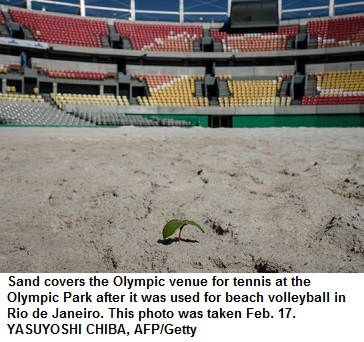
The scathing report offered Monday at a public hearing confirms what was reported several months after the games ended. Many of the venues are empty, boarded up, and have no tenants or income with the maintenance costs dumped on the federal government.

“There was no planning,” federal prosecutor Leandro Mitidieri told the public hearing on the Olympics. “There was no planning when they put out the bid to host the Games. No planning.

“They are white elephants today,” Mitidieri added. “What we are trying to look at here is to how to turn this into something usable.”

Rio de Janeiro spend about $12 billion to organize the games, which were plagued by cost-cutting, poor attendance, and reports of bribes and corruption linked to the building of some Olympic-related facilities.

The Olympic Park in suburban Barra da Tijuca, which was the largest cluster of venues, is an expanse of empty arenas with clutter still remaining from the games. The second largest cluster, in the northern area of Deodoro, is closed despite plans to open it as a public park with swimming facilities for the mostly poor who live in the area.

Patricia Amorim, the undersecretary for sports in the city of Rio, said highly publicized plans were on hold to dismantle one arena and turn the remains into four schools. The arena was the venue for handball.

“It will be dismantled,” she said. “We are just waiting to know whether we will actually have resources to build these schools on other sites, or whether we will dismantle it and wait for the resources to come. Our schools need to be reformed and that’s our priority, not new schools.”

Nine months after the Rio Olympics ended, the local organizing committee still owes creditors about $30 million, and 137 medals awarded during the games are rusting and need to be repaired.

Former Rio de Janeiro Mayor Eduardo Paes, the moving force with the International Olympic Committee behind organizing last year’s Olympics, is being investigated for allegedly accepting at least 15 million reals ($5 million) in payments to facilitate construction projects tied to the games.

He denies any wrongdoing.

Organizing committee spokesman Mario Andrada said more than 100 medals awarded at the Olympics showed signs of rusting. He said many were bronze medals, and said many of the tarnished medals had been awarded to Americans.

“Most of the problems were due to handling, poor handling,” Andrada said. “Either they fell on the floor or they were touching each other so, it was a problem of handling. Whatever was the problem with the poor handling, it took the gloss off the medal and then you see rusting.”

He said the medals would be repaired at Brazil’s mint, called the Casa da Moeda.

He said more than 2,000 medals were awarded at the Olympics and said “several other games had problems with medals.”

Source: USA Today Daily Newspaper. Posted May 22, 2017; retrieved May 24, 2017 from: https://www.usatoday.com/story/sports/olympics/2017/05/22/scathing-report-on-rio-olympics-venues-white-elephants/102041926/
—————–

VIDEO – Rio 2016 Olympic Venues Just 6 Months After The Olympics – https://youtu.be/Jh-s2rb1Ka0

Published on Feb 13, 2017 – Summer is over for Brazil’s ‘marvelous city’. In a series of eerie and depressing new photos released last week, the 2016 Summer Olympic venues in Rio de Janeiro are seen filthy and deserted just 6 months after the end of the games, including the legendary Maracana Stadium. In a city that hoped desperately to be lifted out of poverty and debt by making back the money they spent, these are the ruins of a shattered dream.

Rio 2016 was boiled in scandal before it had even began, including a Zika virus outbreak, reports of doping by Russian athletes, and the impeachment of president Dilma Rousseff due to corruption. The second largest city in Brazil is millions of dollars in debt with international creditors, and now also owes over 900 thousand dollars to a local energy company.

Murky pools, worn terrain, and vandalism can be found all over the Olympic park. Seats have been torn from the once-iconic arena. The future of these shockingly neglected buildings remains uncertain, but they’re unlikely to be a high priority among Rio’s long list of coming challenges.

Temporary stadium over permanent stadium – this is a familiar advocacy for the publishers of the book Go Lean…Caribbean. These points are gleaned from this previous blog-commentary from June 5, 2014:

Learn from Greece – Why build expensive permanent stadiums for temporary (sports/cultural) events, when there is such an effective art and science with temporary stadiums?! This important lesson was ignored in Brazil for the FIFA World Cup 2014.

The subsequent article and [embedded] VIDEO (from the cable channel HBO’s documentary Real Sports) describes the folly for expensive permanent stadiums for short-term events; especially while the art and science of temporary stadiums is so effective.


The foregoing article discourages investment in permanent venues unless there is a solid long-term business plan. The Go Lean roadmap concurs – Greece did not recover from the flawed Olympic build-out for facilities that were never used again after the 2004 Games. On the other hand, here is the encouragement and recommendation to develop fairgrounds and deploy temporary stadia, arenas and theaters. Imagine a golf tournament; no one would expect bleachers and grandstands at the putting greens to be permanent structures. No, there is a place for temporary structures in the world of sports.

The book Go Lean…Caribbean – available to download for free – serves as a roadmap for the introduction and implementation of the technocratic Caribbean Union Trade Federation (CU), for the elevation of Caribbean society – for all the 30 member-states in the region. The roadmap asserts that there could be many economic and societal benefits by harnessing the potential from the world of sports.  While sports are not the roadmap’s primary purpose, related pursuits are recognized as important strategies. A mission of the Go Lean roadmap is quoted as “forge industries and economic drivers around the individual and group activities of sports and culture” (Page 81). But make no mistake, there is NO recomendation for the Caribbean to host the Olympics … ever.

Overall, this CU/Go Lean roadmap describes these 3 prime directives:

  • Optimization of the economic engines in order to grow the regional economy to $800 Billion and create 2.2 million new jobs; 21,000 direct jobs at sports enterprises, venues and fairgrounds throughout the region.
  • Establishment of a security apparatus to ensure public safety and protect the resultant economic engines.
  • Improvement of Caribbean governance to support these engines, including a separation-of-powers between the member-states and CU federal agencies.

The book stresses that reforming and transforming the Caribbean societal engines – including the sports eco-systems – must be a regional pursuit. This was an early motivation for the roadmap, as pronounced in the opening Declaration of Interdependence (Pages 12 – 13):

xi. Whereas all men are entitled to the benefits of good governance in a free society, “new guards” must be enacted to dissuade the emergence of incompetence, corruption, nepotism and cronyism at the peril of the people’s best interest. The Federation must guarantee the executions of a social contract between government and the governed.

xxi. Whereas the preparation of our labor force can foster opportunities and dictate economic progress for current and future generations, the Federation must ensure that educational and job training opportunities are fully optimized for all residents of all member-states, with no partiality towards any gender or ethnic group. The Federation must recognize and facilitate excellence in many different fields of endeavor, including sciences, languages, arts, music and sports. This responsibility should be executed without incurring the risks of further human flight, as has been the past history.

xxii. Whereas sports have been a source of great pride for the Caribbean region, the economic returns from these ventures have not been evenly distributed as in other societies. The Federation must therefore facilitate the eco-systems and vertical industries of sports as a business, recreation, national pastime and even sports tourism – modeling the Olympics.

The Go Lean book avoids the Same Strategy; Same Failure pitfall; it provides 370-pages of turn-by-turn instructions on “how” to adopt new community ethos, plus the strategies, tactics, implementations and advocacies to execute so as to reboot, reform and transform the societal engines of Caribbean society, including the full opportunities in the world of sports.

There are a number of sports – Tennis, Auto Racing, Beach Volleyball, and Soccer/Football (i.e. 2006 FIFA World Cup in Germany) – which fully explore temporary bleachers/grandstands. This is the wise course; the art-and-sciences of temporary structures is a best-practice.

Why would anyone consider expensive permanent stadia when temporary stadia is better? This would be stupid! But alas, a previous Go Lean commentary has posited that Stupidity persists when “someone is getting paid”. This is the lesson learned from Rio … and Athens.

Now is the time for all of the Caribbean – governing institutions and the people (athletes and fans) – to abide by best-practices and lean-in for this Go Lean roadmap for the Caribbean Union Trade Federation; Same Strategy; Same Failure no more! Now is the time to make our homeland a better place to live, work and play. 🙂

Download the free e-Book of Go Lean … Caribbean – now!

Sign the petition to lean-in for this roadmap for the Caribbean Union Trade Federation.


Share this post:
, , ,
[Top]

State of the American Union – Indian Termination Policy

Go Lean Commentary

When Christopher Columbus discovered the New World on his initial voyage in 1492, he brought along with him Benedictine Priests as missionaries for any native people encountered.

Encounter they did!

From this start, the quest to assimilate native people (dubbed “Indians” by all European colonizers) – to make them civilized Christians – had started in earnest and didn’t end until …

… what time is it? 🙁

CU Blog - State of the American Union - Indian Termination Policies - Photo 2

CU Blog - State of the American Union - Indian Termination Policies - Photo 3

CU Blog - State of the American Union - Indian Termination Policies - Photo 4

The experience of European colonizers versus indigenous tribes is similar throughout the New World, but the historic model of the quest to assimilate native people is best represented by the American experience. There were the colonial efforts and early American efforts – make that wars – but eventually there was a compromise for the “White” people to co-exist with the native people, to grant them “tribal sovereignty”. This quest is codified in the American Constitution and further expanded in the Tenth Amendment (Bill of Rights); see this quotation here:

It may be noted that while Native American tribal sovereignty is partially limited as “domestic dependent nations,” so too is the sovereignty of the federal government and the individual states – each of which is limited by the other. The will of the people underlies the sovereignty of both the U.S. federal government and the states, but neither sovereignty is absolute and each operates within a system of dual sovereignty. According to the reservation clause of the Tenth Amendment, the federal state possesses only those powers delegated to it by the Constitution (expressly or implicitly), while all other powers are reserved to the individual states or to the people. For example, the individual states hold full police powers. On the other hand, the individual states, like the Indian tribes, cannot print currency or conduct foreign affairs, or exercise other powers assigned by the Constitution to the federal state. Viewed in this light, tribal sovereignty is a form of parallel sovereignty[1] within the U.S. constitutional framework, constrained by but not subordinate to other sovereign entities. – Source: Wikipedia

The book Go Lean…Caribbean – available to download for free – details a study of the Native American efforts to preserve and elevate their society while amongst the general American population. They failed (and continue to fail) miserably. The US has a long bad history of ethnic genocide and discrimination – see the VIDEO in Appendix B below – this had been the State of their American Union.

The Go Lean book asserts that there are lessons from Indian Reservations for the Caribbean region to learn and apply in our efforts to elevate our Caribbean region. The Go Lean book serves as a roadmap for the introduction and implementation of the technocratic Caribbean Union Trade Federation (CU), for the elevation of Caribbean society – for all member-states. A CU mission is to integrate resources to field a confederated response to economic challenges and security threats. This strategy was not applied by the Indian-Native American tribes during their history. After losing many one-on-one battles against the stronger US Army; they were forced into treaties that relegated them to these Reservations.

The official American policy did not stop with Reservations; it migrated to an Indian Termination Policy – an attempt to assimilate Native American people into mainstream society, into the American Union. See more here:

Indian Termination was the policy of the United States from the mid-1940s to the mid-1960s.[1] It was shaped by a series of laws and policies with the intent of assimilating Native Americans into mainstream American society. Assimilation was not new. The belief that indigenous people should abandon their traditional lives and become “civilized” had been the basis of policy for centuries. But what was new was the sense of urgency, that with or without consent, tribes must be terminated and begin to live “as Americans”.[2] To that end, Congress set about ending the special relationship between tribes and the federal government. The intention was to grant Native Americans all the rights and privileges of citizenship, reduce their dependence on a bureaucracy whose mismanagement had been documented, and eliminate the expense of providing services for native people.[3]

In practical terms, the policy ended the U.S. government’s recognition of sovereignty of tribes, trusteeship over Indian reservations, and exclusion of state law applicability to native persons. From the government’s perspective Native Americans were to become taxpaying citizens, subject to state and federal taxes as well as laws, from which they had previously been exempt.[4]

From the native standpoint, Northern Cheyenne former U.S. Senator from Colorado Ben Nighthorse Campbell said of assimilation and termination in a speech delivered in Montana[5]:

    “If you can’t change them, absorb them until they simply disappear into the mainstream culture. …In Washington’s infinite wisdom, it was decided that tribes should no longer be tribes, never mind that they had been tribes for thousands of years.” – Ben Nighthorse Campbell, Opening Keynote Address.

The policy for termination of tribes collided with the Native American peoples’ own desires to preserve native identity, reflected in an activism that increased after World War II and survived through the anti-collectivism era of Joseph McCarthy. The termination policy was changed in The Sixties and rising activism resulted in the ensuing decades of restoration of tribal governments and increased Native American self-determination.

See the links to the detailed Table of Contents on the Indian Termination Policy in Appendix A below.

The Go Lean book posits that if the Native American tribes were able to integrate and consolidate to one unified effort they would have been so much more successful. This is not our contention alone.

Today – May 22, 2017 – marks the 75th birthday of the late Native American Activist Richard Oakes; this is the Google Doodle in his honor. His quest was to unite all Native American tribes in their struggle for civil rights. This was a noble gesture on his part, worthy of his devotion and sacrifice; (he was assassinated on September 20, 1972).

CU Blog - State of the American Union - Indian Termination Policies - Photo 1

See the related VIDEO here:

VIDEO – Activist Richard Oakes delivers the Alcatraz proclamation – http://www.express.co.uk/life-style/science-technology/807660/richard-oakes-activist-biography-death-michael-morgan-assassination-google-doodle

Richard Oakes has been honoured with a special Google Doodle – today May 22, 2017 – which shows him alongside three locations that defined his life and legacy.

The illustration features the Mohawk Indian reservation in Akwesasne – where Oakes was born, Alcatraz Island – where he launched a 19-month occupation, and Pit River – where he helped to recover tribal land.

The book Go Lean … Caribbean has a similar quest as the foregoing activist and advocacy, for the 30 member-states of the Caribbean region to convene, collaborate and confederate. There are many benefits to flow from such an unification effort.

These benefits are pronounced in the Go Lean/CU roadmap as the prime directives, with these 3 statements:

  • Optimization of the economic engines in order to grow the regional economy to $800 Billion and create 2.2 million new jobs.
  • Establishment of a security apparatus to ensure public safety and protect the resultant economic engines.
  • Improvement of Caribbean governance to support these engines, including a separation-of-powers between the member-states and CU federal agencies.

The Go Lean book stresses that reforming and transforming the Caribbean societal engines must be a regional pursuit. This was an early motivation for the roadmap, as pronounced in the opening Declaration of Interdependence (Pages 12 – 14):

xi. Whereas all men are entitled to the benefits of good governance in a free society, “new guards” must be enacted to dissuade the emergence of incompetence, corruption, nepotism and cronyism at the peril of the people’s best interest. The Federation must guarantee the executions of a social contract between government and the governed.

xvi. Whereas security of our homeland is inextricably linked to prosperity of the homeland, the economic and security interest of the region needs to be aligned under the same governance. Since economic crimes … can imperil the functioning of the wheels of commerce for all the citizenry, the accedence of this Federation must equip the security apparatus with the tools and techniques for predictive and proactive interdictions.

xxiv. Whereas a free market economy can be induced and spurred for continuous progress, the Federation must install the controls to better manage aspects of the economy: jobs, inflation, savings rate, investments and other economic principles. Thereby attracting direct foreign investment because of the stability and vibrancy of our economy.

xxxiii. Whereas lessons can be learned and applied from the study of the recent history of other societies, the Federation must formalize statutes and organizational dimensions to avoid the pitfalls of communities like East Germany, Detroit, Indian (Native American) Reservations, Egypt and the previous West Indies Federation. On the other hand, the Federation must also implement the good examples learned from developments/communities like New York City, Germany, Japan, Canada, the old American West and tenants of the US Constitution.

The Go Lean book provides 370-pages of turn-by-turn instructions on “how” to adopt new community ethos, plus the strategies, tactics, implementations and advocacies to execute so as to reboot, reform and transform the societal engines of Caribbean society.

Consider this one chapter … where the Go Lean book fully detailed the lessons learned from Native American Reservations; see  these headlines from Page 141:

10 Lessons from Indian Reservations

1

Lean-in for Caribbean Integration
The CU treaty calls for the unification of the 30 member-states in a Single Market of 42 million people. The CU mission is to integrate resources to field a confederated response to economic challenges and security threats. This strategy was not applied by the Indian tribes. After losing many one-on-one battles against the stronger US Army; they were forced into treaties that relegated them to Reservations. While the CU gets its legal authority through national treaties, these can be counted as assets (strengths), guaranteeing specific rights and privileges, rather than weaknesses. The synergy from inter-tribe cooperation was never a feature of Indian life – no benefits from brotherhood and confederation. US integration of multiple cultures led to economic prosperity, while the Reservations never enjoyed the American Dream.

2

Image Management

3

Heritage As Hostage
More than 80 years after the [original 1890] battle, beginning on February 27, 1973, Wounded Knee [Creek on the Lakota Pine Ridge Indian Reservation] was the site of another incident, a 71-day standoff between militants of the American Indian Movement (AIM) — who had chosen the site for its symbolic value — and federal law enforcement officials. The legacy of the 1890 massacre had lingered up to that point, and continues even now. The Lakota strategized their engagement in the US as if they are Prisoners-of-War rather than full American citizens. The lesson for the CU is to facilitate the future, not burden children with anguish against past sins.

4

Sovereignty – Subject Only to Congress
All Indian Reservations were codified by treaties with the US federal government. This allows semi-autonomousjurisdiction from any domicile State. This is the basis for the establishment of casino gambling on reservations, though not legal in that state. The CU advocates the establishment of Self Governing Entities that are regulated only by the CU.

5

Casinos – Managed by Gaming Professionals

6

Economic Empowerment – Audacity of Hope
Treaties (and subsequent statues) between Reservation tribes and federal government have strived for new economic empowerments: fishing, hunting, some tribes have even begun herding buffalo and catching wild salmon for market.

7

Alcoholism – Absence of Hope
Reservations suffer from a disproportionately high rate of poverty and alcoholism – a continuing problem since founding. These are symptoms of the hopelessness that stems from societal isolation. Some tribes now try to police alcohol on and off the Reservation. The CU accepts that Prohibition tactics do not work and it dissuades economics, like tourism.

8

Brain Drain – Absence of Hope
Reservations have historically been economically depressed, with minimal job prospects. The end result, like the CU, people leave/flee. [For example,] today, one half of all identified Lakota live off the Reservation (55,000 of 103,255 from 1990 census).

9

Reservation Health and Suicides – Absence of Hope
The population on Reservations, like Pine Ridge, SD [in South Dakota], has among the shortest life expectancies (male: 47 years; female: 52) in the Western Hemisphere. The infant mortality rate is five times the US national average, and sadly, the suicide rate for adolescents is four times the national average. The CU mitigation is to promote a better place to live/work/ play.

10

Entitlements – Absence of Hope
Reservations residents are entitled to a share of tribal revenues from gaming, hunting and other economic activities. Plus with additional federal benefits, there is a weakened, work ethic. The CU advocates “work-fare” over welfare.

The Go Lean movement (book and preceding blog-commentaries) relates that cultures and countries are not guaranteed to survive: many native tribes and cultures have been assimilated. In fact, in a recent blog it was detailed how the Central Pacific island-nation of Kiribati is on course to lose all of its land territory due to global warming and the resultant higher sea-levels. They have thusly used their national treasuries to buy land elsewhere (Fiji) with the intent of relocating their people there. This will undoubtedly result in all new children being awarded Fiji birth certificates; and after 2 – 3 generations, the original culture of Kiribati will be extinct, lost to time and tides.

The book Go Lean…Caribbean and accompanying blogs have asserted that without remediation and mitigation efforts, there is no guarantee that countries and/or cultures can survive. The book therefore urges the Caribbean region to act! Already, the English-speaking nations have lost 70 percent of the tertiary educated populations to the Brain Drain, while the US Territories experience an even higher rate of societal abandonment. The Dutch and French Caribbean countries, with their automatic EU citizenship status have the same cultural extinction concerns. Notice these points further developed in these previous blogs:

https://goleancaribbean.com/blog/?p=11858 Welcome to Kiribati – Say “Hello” and “Goodbye”
https://goleancaribbean.com/blog/?p=10554 Welcoming the French to these Cultural Extinction Concerns
https://goleancaribbean.com/blog/?p=7151 The Caribbean is Looking for Heroes … ‘to Return’
https://goleancaribbean.com/blog/?p=4613 Lessons from Ireland – Diaspora Past, Present and Future
https://goleancaribbean.com/blog/?p=4551 US Territories – Between a ‘rock and a hard place’
https://goleancaribbean.com/blog/?p=4263 The State of Aruba’s Economy
https://goleancaribbean.com/blog/?p=4185 Caribbean Ghost Towns: It Could Happen…Again
https://goleancaribbean.com/blog/?p=2818 DR President Medina on the economy: ‘God will provide’
https://goleancaribbean.com/blog/?p=2602 Guyana and Suriname Wrestle With High Rates of Suicides
https://goleancaribbean.com/blog/?p=1433 Region loses more than 70% of tertiary educated to Brain Drain

Henry Ford Quote - Vanity of Government EntitlementsThe foregoing is a true and accurate history of the United States of America. Considering their treatment of Native Americans, there should be no rush for the Black-and-Brown of the Caribbean to seek refuge in the US. The book Go Lean posits that fleeing the Caribbean homeland  equates to “jumping from the frying-pan into the fire”. What’s more, the Go Lean book asserts – in the quest to lower the rate of societal abandonment – that it is easier to remediate social defects in the Caribbean homeland than to attempt to remediate the American eco-system. The “grass is not greener on the other side”.

We must learn from the experiences of the Native American Tribes and Reservations – in the US and other countries – and reboot our homeland to reform and transform our societal engines, to avoid any possible cultural termination-extinction fate.

We hereby urge all Caribbean stakeholders –governments and people (residents and Diaspora) – to lean-in to this Go Lean roadmap to continue to accentuate our culture. We must work against extinction and societal abandonment by making our homeland a better place to live, work and play. 🙂

Download the free e-book of Go Lean … Caribbean – now!

Sign the petition to lean-in for this roadmap for the Caribbean Union Trade Federation.

————–

Appendix A – Indian Termination Policy Contents

[The detailed content on the Indian Termination Policy is catalogued as follows:]

Source: Wikipedia Online Encyclopedia; retrieved May 22, 2017 from: https://en.wikipedia.org/wiki/Indian_termination_policy

————–

Appendix B VIDEO – The Tragedy of Wounded Knee  https://youtu.be/0EdRT56WK7Q

Uploaded on Jan 22, 2011 – Not even the powers of the Ghost Dance could save the victims of the Wounded Knee Massacre.

  • Category: Education
  • License: Standard YouTube License


Share this post:
, ,
[Top]

ENCORE: It’s Cinco De Mayo … again

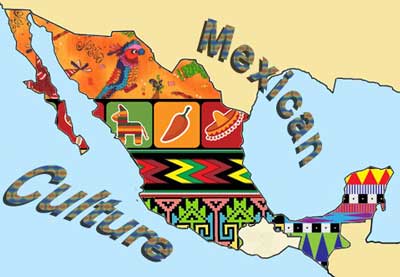
This Go Lean blog-commentary from May 5, 2015 is re-distributed on this occasion of Cinco De Mayo 2017. As always, this year’s commemoration is a celebration of Mexican culture, more so than Mexican history.

CU Blog - Celebrating Mexican Culture - Photo 1

This is a great model for the Caribbean’s current effort to forge an international day of recognition: Caribbean Day for August 1 every year.  Yes, we can … develop a similar occasion to commemorate, celebrate and accentuate our Caribbean identity and culture.

But for now …

… Bienvenido Amigos, as we encore this submission on Cinco De Mayo, as follows:

————–

Go Lean Commentary – A Lesson in History: Cinco De Mayo

Today (May 5) is Cinco De Mayo – celebrating this is a move of solidarity with Mexico; its people and culture – Enjoy the festivities!

Enjoy the Mexican food, spirits, music and culture. The country and people of Mexico have so much to offer the world – see VIDEO below – this includes the Caribbean.

One thing more that they can offer us in our region: A Lesson in History!

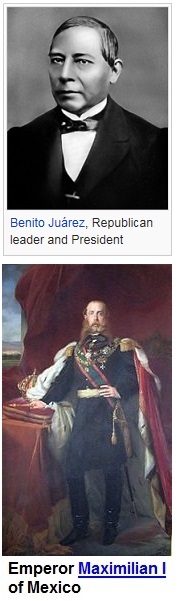
The summary of this celebration is simple on the surface: Mexican forces commanded by General Ignacio Zaragoza defeated the French army in the Battle of Puebla on 5 May 1862. 4 days later, on 9 May 1862, The then-President Benito Juárez declared that the anniversary of the Battle of Puebla would be a national holiday,[14][15][16][17][18] regarded as “Battle of Puebla Day” or “Battle of Cinco de Mayo”. Although today it is recognized in some countries as a day of Mexican heritage celebration, it is not a federal holiday in Mexico.[19]

Considering the real history of Cinco De Mayo is a really big deal. For starters, while Mexico was not the aggressor in this war, they were not exactly blameless.

The 1858 – 1860 Mexican civil war known as The Reform War had caused distress throughout Mexico’s economy. When taking office as the newly-elected president of the Republic in 1861, Juárez was forced to suspend payments of interest on foreign debts for a period of two years. At the end of October 1861 diplomats from Spain, France, and Britain met in London to form the Tripartite Alliance, with the main purpose of launching an allied invasion of Mexico, taking control of Veracruz, its major port, and forcing the Mexican government to negotiate terms for repaying its debts and for reparations for alleged harm to foreign citizens in Mexico. In December 1861, Spanish troops landed in Veracruz; British and French followed in early January. The allied forces occupied Veracruz and advanced to Orizaba. However, the Tripartite Alliance fell apart by early April 1862, when it became clear the French wanted to impose harsh demands on the Juarez government and provoke a war. The British and Spanish withdrew, leaving the French to march alone on Mexico City. French Emperor-President Napoleon III – the first democratically elected French President – wanted to set up a puppet regime, the Mexican Empire.

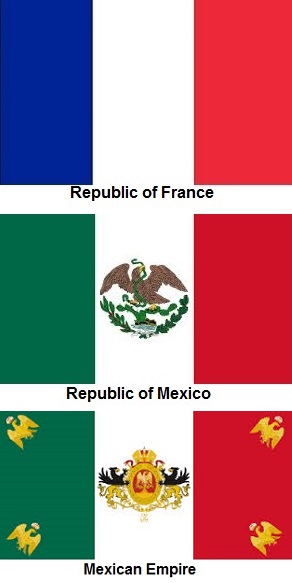
Thus started this French Intervention in Mexico. The effects of these 5 years were far-reaching, even to this day – consider the similarities in flags for these countries.

CU Blog - A Lesson in History - Cinco De Mayo - Photo 1Title: French Intervention in Mexico 1862 – 1867
Emperor Napoleon III of France was the instigator, justifying military intervention by claiming a broad foreign policy of commitment to free trade. For him, a friendly government in Mexico would ensure European access to Latin American markets. Napoleon also wanted the silver that could be mined in Mexico to finance his empire. Napoleon built a coalition with Spain and Britain while the U.S. was deeply engaged in its own civil war from 1861 to 1865.

Here is the main timeline of this French Intervention period:

1. 1862: Arrival of the French
After the initial victory by the Mexicans at the Battle of Puebla, the war continued in a different direction. The pursuing Mexican army was contained by the French at Orizaba, Veracruz, on 14 June. More British troops arrived on 21 September, and General Bazaine arrived with French reinforcements on 16 October. The French occupied the port of Tamaulipas on 23 October, and unopposed by Mexican forces took control of Xalapa, Veracruz on 12 December.

2. 1863: The French take the capital
CU Blog - A Lesson in History - Cinco De Mayo - Photo 2The French army of General François Achille Bazaine defeated the Mexican army led by General Comonfort in its campaign to relieve the siege of Puebla, at San Lorenzo, to the south of Puebla. Puebla surrendered to the French shortly afterward, on 17 May. On 31 May, President Juárez fled the capital city (Mexico City) with his cabinet, retreating northward to Paso del Norte and later to Chihuahua. Having taken the treasure of the state with them, the government-in-exile remained in Chihuahua until 1867.

French troops under Bazaine entered Mexico City on 7 June 1863. The main army entered the city three days later, led by General Forey. General Almonte was appointed the provisional President of Mexico on 16 June, by the Superior Junta (which had been appointed by Forey). The Superior Junta with its 35 members met on 21 June, and proclaimed a Catholic Empire on 10 July. The crown was offered to Austrian Prince Archduke Ferdinand Maximilian, following pressures by Napoleon. Maximilian accepted the crown on 3 October.

3. 1864: Arrival of Maximilian
Further decisive French victories continued with the fall of Guadalajara, Zacatecas, Acapulco, Durango by 3 July, and the defeat of republicans in the states of Sinaloa and Jalisco in November.

Maximilian formally accepted the crown on 10 April, signing the Treaty of Miramar (between France and Mexico), and landed at Veracruz on 28 May. He was enthroned as Maximilian I, Emperor of Mexico, [under French occupation].

4. 1865: Beginning of Republican victories
CU Blog - A Lesson in History - Cinco De Mayo - Photo 3After many more French victories, finally on 11 April, republicans defeated Imperial forces at Tacámbaro in Michoacán. In April and May the republicans had many forces in the states of Sinaloa and Chihuahua. Most towns along the Rio Grande, [(the border with the US),] were also occupied by republicans.

The decree known as the “Black Decree” was issued by Maximilian on 3 October, which threatened any Mexican captured in the war with immediate execution.

5. 1859-1867: U.S. Diplomacy and Involvement
The United States did not condone the French occupation of Mexico but it had to use its resources for the American Civil War, which lasted 1861 to 1865. Then-President Abraham Lincoln expressed his sympathy to Latin American republics against any European attempt to establish a monarchy; and the Congress passed a resolution in disgust of these French actions. In 1865, The US supported the sale of Mexican bonds by Mexican agents in the US to fund the Juarez Administration, raising up to $18-million dollars for the purchase of American war material.[16] By 1867, American policy shifted from thinly veiled sympathy to the republican government of Juarez to open threat of war to induce a French withdrawal, invoking the Monroe Doctrine, a policy to thwart any aggression by European powers in the Americas.

6. 1866: French withdrawal and Republican victories
Choosing Franco-American relations over his Mexican monarchy ambitions, Napoleon III announced the withdrawal of French forces beginning 31 May. Taking advantage of the end of French military support to the Imperial troops, the Republicans won a series of crippling victories in Chihuahua on 25 March, Guadalajara, Matamoros, Tampico and Acapulco in July. Napoleon III urged Maximilian to abandon Mexico and evacuate with the French troops; [but he persisted]. The French evacuated Monterrey on 26 July, Saltillo on 5 August, and the whole state of Sonora in September. Maximilian’s French cabinet members resigned on 18 September. The Republicans defeated imperial troops in Oaxaca in October, occupying the whole of Oaxaca in November, as well as parts of Zacatecas, San Luis Potosí and Guanajuato.

7. 1867: Republicans take the capital
The Republicans occupied the rest of the states of Zacatecas, San Luis Potosí and Guanajuato in January. The French evacuated the capital on 5 February.

On 13 February 1867, Maximilian withdrew to Querétaro. The Republicans began a siege of the city on 9 March, and Mexico City on 12 April. On 11 May, Maximilian finally resolved to try to escape through the enemy lines. He was intercepted on 15 May. Following a court-martial, he was sentenced to death and executed on 19 June.
Source: http://en.wikipedia.org/wiki/French intervention_in_Mexico  

This subject has relevance for the Caribbean. Mexico is a stakeholder in Caribbean affairs. They have a vast coastline (Yucatan Peninsula) on the Caribbean Sea, plus a few Caribbean islands (Cozumel, Isla Mujeres, Isla Contoy, and Isla Blanca). This country is also a member of the ACS – Association of Caribbean States – one of the relevant entities that must be assembled for this regional integration movement championed in the book Go Lean…Caribbean.

The underlying theme of this Lesson in Mexican History is the lack of effective security for the people and societal engines of Mexico. Now, after 150 years, this historic pattern has continued; Mexico proceeded to endure one revolution-rebellion-overthrow-coup d’etat after another until recent times.

The Caribbean cannot afford this same disposition: the dread and damage endured from decades of dysfunction.

Today, Mexico is known as a lawless society in many pockets, especially along the US border. Considering the art and science of security, it is sad that they never got it right! They resemble a Failed-State in so many perspectives. This is where their history, especially those 5 years of the Franco-Mexican War, provides lessons for the Caribbean people and institutions. But this Go Lean movement does not seek to remediate Mexico; this is out of scope. Rather the focus is strictly on the 30 Caribbean member-states: islands of the Caribbean plus the Central & South American states that caucus with the Caribbean Community (Belize, Guyana and Suriname).

This effort to elevate Caribbean society fully recognizes that security mitigations must be prioritized equally with economic and governing remediation. This is an underlying theme of the book Go Lean…Caribbean. The book declares that the region is in crisis, at the precipice of Failed-State status. This is the assertion of the Go Lean book, that the region must prepare its own security apparatus for its own security needs.

This book serves as a roadmap for the introduction and implementation of the technocratic Caribbean Union Trade Federation (CU). So while the CU is set to optimize Caribbean society through economic empowerment, the security dynamics will be inextricably linked to this same endeavor. Therefore the Go Lean roadmap has 3 prime directives:

  • Optimization of the economic engines in order to grow the regional economy to $800 Billion & create 2.2 million new jobs.
  • Establishment of a security apparatus to protect the resultant economic engines.
  • Improvement of Caribbean governance to support these engines.

The book contends, just as the French proved to be a “bad actor” to Mexico in 1862, that new “bad actors” will emerge for the Caribbean to contend with. This will be as a by-product of new economic successes in the region. This point is pronounced early in the book with the Declaration of Interdependence (Page 12) that claims:

x.   Whereas we are surrounded and allied to nations of larger proportions in land mass, populations, and treasuries, elements in their societies may have ill-intent in their pursuits, at the expense of the safety and security of our citizens. We must therefore appoint “new guards” to ensure our public safety and threats against our society, both domestic and foreign. The Federation must employ the latest advances and best practices … to assuage continuous threats against public safety.

xvi. Whereas security of our homeland is inextricably linked to prosperity of the homeland, the economic and security interest of the region needs to be aligned under the same governance. Since economic crimes, including piracy and other forms of terrorism, can imperil the functioning of the wheels of commerce for all the citizenry, the accedence of this Federation must equip the security apparatus with the tools and techniques for predictive and proactive interdictions.

The need for the Caribbean to appoint “new guards” or a security pact to mitigate foreign and domestic threats in the region is the primary lesson to glean from the foregoing encyclopedic article – a consideration of the history of Cinco De Mayo. This security pact is to be legally constituted by a Status of Forces Agreement which would be enacted as a complement to the CU confederation treaty. The Go Lean roadmap provides 370-pages of turn-by-turn directions on how to deploy cutting-edge strategies, tactics and implementations to succeed in this goal.

In addition, there are other lessons – secondary – that we learn from this consideration of the history of Cinco De Mayo:

The Go Lean book details a roadmap with turn-by-turn directions for transforming the Caribbean homeland. The following is a sample of the community ethos, strategies, tactics, implementations and advocacies to impact the Caribbean region for this turnaround:

Community Ethos – Economic Principle – Economic Systems Influence Choices Page 21
Community Ethos – Economic Principle – Consequences of Choices Lie in the Future Page 21
Community Ethos – Anti-Bullying and Mitigation Page 23
Community Ethos – Minority Equalization Page 24
Community Ethos – Cooperatives Page 25
Community Ethos – Ways to Improve Sharing Page 35
Strategy – Vision – Confederating a Non-Sovereign Union Page 45
Strategy – Mission – Protect Economic Engines from threats Page 45
Tactical – Fostering a Technocracy Page 64
Tactical – Separation of Powers Page 71
Implementation – Start-up Foreign Policy Initiatives Page 102
Implementation – Security Initiatives at Start-up Page 103
Implementation – Ways to Deliver Page 109
Implementation – Ways to Better Manage Debt Page 118
Implementation – Ways to Promote Independence – Interdependence Page 120
Planning – 10 Big Ideas – Defense / Homeland Security Pact Page 127
Planning – Ways to Make the Caribbean Better Page 131
Planning – Ways to Better Manage Image Page 133
Planning – Ways to Improve Failed-State Indices Page 134
Planning – Lessons from the American West Page 142
Advocacy – Ways to Grow the Economy Page 151
Advocacy – Ways to Create Jobs Page 152
Advocacy – Ways to Improve Governance Page 168
Advocacy – Ways to Better Manage the Social Contract Page 170
Advocacy – Ways to Impact Justice Page 177
Advocacy – Ways to Improve Homeland Security Page 180
Advocacy – Ways to Mitigate Terrorism Page 181
Advocacy – Ways to Protect Human Rights Page 220

Mexico is a beautiful country, with a beautifully diverse population plus a lot of natural resources. They experience a vibrant tourism product where millions visit annually for Mexican hospitality – they are a fit competitor of Caribbean tourism, even for cruises. See VIDEO here:

VIDEO: Mexico: Live It to Believe It – Cultural Diversity 2015 – https://youtu.be/jciVmLL_UgY

Published on Feb 27, 2014 – A production of the Mexico Department of Tourism; commissioned for the Central American and Caribbean Games in Veracruz from November 14 to 30, 2014.

Many people visit Mexico, but few would consider moving there permanently. In fact just the opposite occurs, the societal abandonment problem in Mexico is very pronounced. Their northern neighbor, the United States, has constant security issues of illegal Mexican migrants. Mexico has been dysfunctional for their entire history as a Republic. They must do better! While this quest is out-of-scope for the CU/Go Lean roadmap, we can learn lessons from their actions and inactions.

The Go Lean book posits (Page 3) that the Caribbean islands are among the greatest addresses in the world. But like Mexico, instead of the world “beating a path” to our doors, the people of the Caribbean have “beat down their doors” to get out; despite the absence of any war or revolution … like our Mexican neighbors. Our abandonment is inexcusable.

May we learn from this history of Mexico! Mexican culture is great! Enjoy the festivities: their people, food, drink, music and dance. But let’s do better … than they have done. Let’s make the Caribbean even better, where our citizens can prosper where they are planted; let’s make our homeland better places to live, work and play.  🙂

Download the free e-Book of Go Lean … Caribbean – now!

Share this post:
, ,
[Top]

Forging Change: Collective Bargaining

Go Lean Commentary

Want to re-negotiate? You must be prepared to  give the other party something they don’t currently have:

To the Caribbean Cruise industry, we present you: a Single Market of 42 million consumers.

CU Blog - Forging Change - Consuming Cruises - Photo 1

These 42 million people were always there, just not considered potential customers for the Cruise Line Industry. But money is money; it still spends the same way.

This seems so familiar!

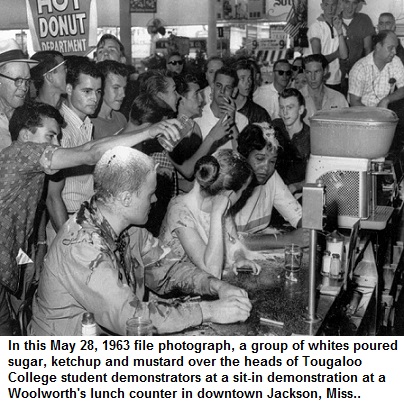
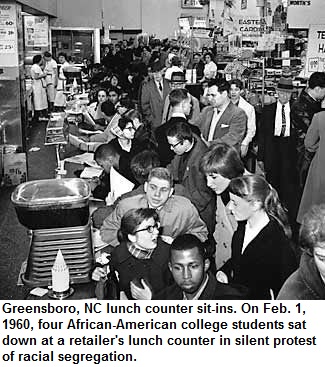
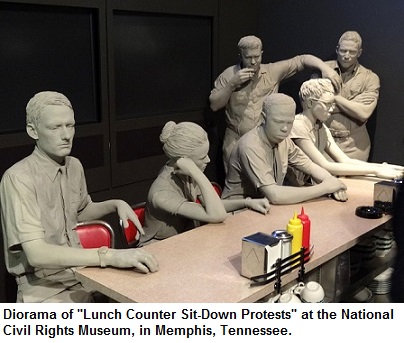
This feels like the Southern US during the days of Jim Crow Racial Segregation. The US States practicing these policies where the “best place to live” if you were White. The Black people were there, facilitating and supporting commerce and industry, but were not supposed to be seen; they were 2nd Class citizens … in their own country. The Merchants wanted their money, just not their presence.

If you were Black and wanted to get lunch from a cafeteria, you had to “Go outback and get brown bag food from the kitchen”, while White customers got the hospitality of in-store dining.

Same money; different respect. The protests against this blatant wrong practice galvanized the US and the Civil Rights movement. See photos here:

CU Blog - Forging Change - Consuming Cruises - Photo 3

CU Blog - Forging Change - Consuming Cruises - Photo 2

CU Blog - Forging Change - Consuming Cruises - Photo 4

See the news article in the Appendix below, commemorating the 50th Anniversary of the Civil Rights Struggles of the early 1960’s. It has been 53 years now, since the abolition of this bad policy with the Civil Rights Act of 1964. This history is sitting here as a teaching moment for us in the Caribbean:

Has our region learned any lessons from this history?

It can be concluded that the answer is “No”! We have tolerated an unjust system here in our region in which the 42 million residents in the Caribbean have been treated as 2nd Class citizens … in their own countries regarding local cruise consumption.

Fact:
If you’re a Caribbean citizen and you want to take a Caribbean cruise, you have to fly to Miami, Ft. Lauderdale, Tampa, Port Canaveral, Baltimore, New York or Puerto Rico to originate the cruise, even though the ships itinerary may come right to your Caribbean port. This means you Nassau, Montego Bay, Grand Cayman, St Thomas, St. Martin and others.

Welcome to 1960’s … redux!

There is the need to forge change in the Caribbean; the same as there was the need to forge change in 1960’s America. Consuming cruises is just one of the challenges that we have to contend with in our region. This is reflective of the disrespect that exists in our society. We have dysfunctions in our economics, security and governing engines. We are 2nd class citizens on the world stage! We have the greatest address on the planet – demonstrated in that 80 million tourists consume our marketplace every year, 10 million via cruises – and yet our own people have to break down the doors to get out to find the respectful life that they need, want and deserve in foreign countries.

Enough! Time to change … here … now! But how?

This is the quest of the movement behind the book Go Lean…Caribbean. It presents a roadmap to change – to elevate – Caribbean society by rebooting the economic, security and governing engines in the 30 member-states that constitute the Caribbean. The book opens with the thesis (Page 3) that the problems of the Caribbean are too big for any one member-state to tackle alone. Cruise vacations are not one of our biggest problems, but the issues here-in are indicative of the lack of respect we have in our region and as a region of 30 separate entities. We need the change of being considered one entity; we need Collective Bargaining. Yes, it makes us more formidable in our negotiations with the Cruise Lines, but as stated in the opening, it also brings something new to the table that the Cruise Lines do not currently have: our 42 million local consumers.

According to a previous Go Lean blog-commentary, this could be a win-win for all stakeholders connected to the cruise tourism eco-system:

Some of the most popular cruise destinations include the Bahamas, Jamaica, Cayman Islands and Saint Martin. Alone, these port cities/member states cannot effect change on this cruise line industry. But together, as one unified front, the chances for success improves exponentially. The unified front is the Caribbean Union Trade Federation (CU). The term Union is more than a coincidence; it was branded as such by design. The Go Lean book serves as a roadmap for the introduction and implementation of the CU.

The vision of this integration movement is for the region to function as a Single Market. The quotation from the Go Lean book continues in advocating that the Caribbean member-states (independent & dependent) lean-in to this plan for confederacy, convention and collaboration. This is Collective Bargaining 101. From the outset, the book recognized the significance of our exercising authority over the Caribbean Seas. This point was pronounced in the opening Declaration of Interdependence (Page 11):

    v. Whereas the natural formation of our landmass and coastlines entail a large portion of waterscapes, the reality of management of our interior calls for extended oversight of the waterways between the islands. The internationally accepted 12-mile limits for national borders must be extended by International Tribunals to encompass the areas in between islands. The individual states must maintain their 12-mile borders while the sovereignty of this expanded area, the Exclusive Economic Zone, must be vested in the accedence of this Federation.

The confederacy goal entails accepting that there is interdependence among the Caribbean member-states. Implementation-wise, this shifts the responsibility for cruise line negotiations to a region-wide, professionally-managed, deputized technocracy that can result in greater production and greater accountability.

So this is one strategy for forging change in our region, in this case: collective bargaining, on behalf of the 42 million consumers in the Caribbean. This is a continuation of the various strategies, tactics and implementations that have been considered for forging change here in the homeland. These have been identified in a series of previous Go Lean blog-commentaries over the past 2 & 1/2 years, this is the tenth submission. These were presented as follows, in reverse chronological order:

  1. Forging Change – Collective Bargaining (Today)
  2. Forging Change – Addicted to Home (April 14, 2017)
  3. Forging Change – Arts & Artists (December 1, 2016)
  4. Forging Change – Panem et Circenses (November 15, 2016)
  5. Forging Change – Herd Mentality (October 11, 2016)
  6. Forging Change – ‘Something To Lose’ (November 18, 2015)
  7. Forging Change – ‘Food’ for Thought (April 29, 2015)
  8. Forging Change – Music Moves People (December 30, 2014)
  9. Forging Change – The Sales Process (December 22, 2014)
  10. Forging Change – The Fun Theory (September 9, 2014)

This commentary is urging Caribbean stakeholders to come together – to collaborate, convene and confederate – to better negotiate with Third Parties to forge change and impact the people that live, work and play here in the Caribbean.

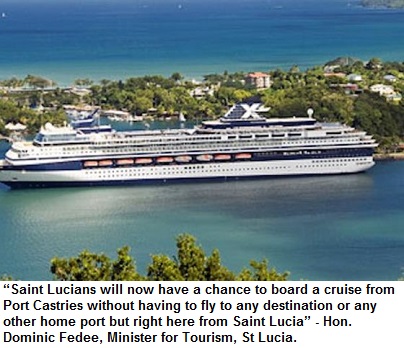
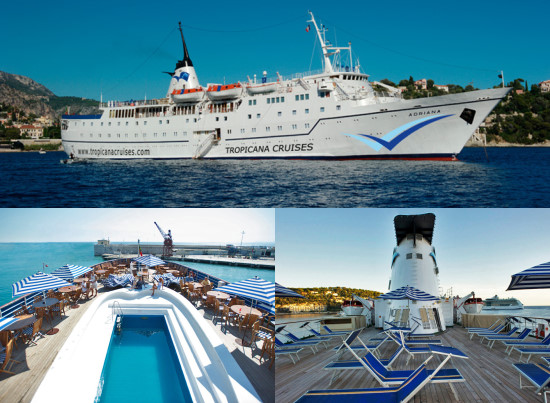
This quest is conceivable, believable and achievable. Look at this news article here that depicts that one Cruise Line (Tropicana Cruises) and one port city (Port Castries, St. Lucia) who have implemented a strategy of local consumption. (The arrangement exists for other ports as well, as in Trinidad).

Title: New cost effective way for St. Lucians to cruise the Caribbean 

Saint Lucians now have a cost effective way to cruise the Caribbean.

Minister in the Office of the Prime Minister with responsibility for tourism, Hon. Dominic Fedee, was on hand to greet the crew of the MV Adriana for its maiden call to Port Castries.

Accompanied by the Executive Chairperson of the Saint Lucia Tourist Board (SLTB) Agnes Francis, the minister said he was pleased at what this new development means for the people of Saint Lucia.

“Saint Lucians will now have a chance to board a cruise from Port Castries without having to fly to any destination or any other home port but right here from Saint Lucia,” he said.

Owner of the MV Adriana Captain Sergey Poniatovsky gave a background to the rationale of the visa-free Caribbean cruise.

“This ship is very unique, it is not like any other cruise ship. The ship is specifically for Caribbean islands, it is like a discovery vessel, with a family and private yacht atmosphere. We have an incredible itinerary which allows people living within these West Indies to have a synergy between islands. We have the opportunity to show each island nation as a destination and bring families together.”

In addition to touring the ship, the minister and the ship captain exchanged gifts to mark the momentous occasion.

Information on the MV Adriana Caribbean cruise can be found at the Saint Lucia Tourist Board and local travel agents.
Source: St Lucia Times Daily Newspaper – Posted March 30, 2017; retrieved April 27, 2017 from: https://stluciatimes.com/2017/03/30/new-cost-effective-way-st-lucians-cruise-caribbean

CU Blog - Forging Change - Consuming Cruises - Photo 0

This quest for collective bargaining (negotiations) is both an art and a science. The Go Lean book describes this fact in a chapter on negotiations entitled  (Page 32):

10 Ways to Improve Negotiations

#2 – Bargain from Position of Strength
For the CU, negotiation is an art and a science. As a technocratic institution representing the economic integration of the region, we must project the Single Market as bigger than initial appearances. The CU represents 42 million people in 30 member-states, with a GDP of over $800 Billion, but also some 8 million [to 20 million] engaged members of the Caribbean Diaspora, scattered throughout the US, Canada and EU countries. There are also many visitors, one estimate is at 80 million yearly. The economic opportunities, catering to this market, can be quite enormous, once properly exploited.

What is the art?

The fact that different people get different results from negotiations is indicative of the fact that not all people are Negotiating Artist.

Sounds familiar?

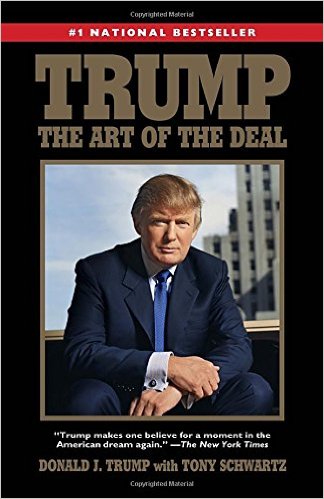
This was the campaign line from Donald J. Trump, the 45th President of the United States. Previously as a successful business man and media star, he was proud of his artistic accomplishment in the arena of negotiations. His co-wrote this book to this effect:

Book title: “The Art of the Deal”

President Donald J. Trump lays out his professional and personal worldview in this classic work—a firsthand account of the rise of America’s foremost deal-maker.

CU Blog - Forging Change - Consuming Cruises - Photo 5

“I like thinking big. I always have. To me it’s very simple: If you’re going to be thinking anyway, you might as well think big.”—Donald J. Trump

Here is Trump in action—how he runs his organization and how he runs his life—as he meets the people he needs to meet, chats with family and friends, clashes with enemies, and challenges conventional thinking. But even a maverick plays by rules, and Trump has formulated time-tested guidelines for success. He isolates the common elements in his greatest accomplishments; he shatters myths; he names names, spells out the zeros, and fully reveals the deal-maker’s art. And throughout, Trump talks—really talks—about how he does it. Trump: The Art of the Deal is an unguarded look at the mind of a brilliant entrepreneur—the ultimate read for anyone interested in the man behind the spotlight.
Source: Amazon.com retrieved April 27, 2017 from: https://www.amazon.com/Trump-Art-Deal-Donald-J/dp/0399594493

What about the science?

Nobel Prize Winner John F. Nash (1928 – 2015) is best known for his landmark work in applying science to the process of collective bargaining and negotiations (Game Theory). He was the subject character in the Hollywood movie: A Beautiful Mind; see Movie Trailer in the Appendix VIDEO. These encyclopedia details relate:

He was a mathematician who made fundamental contributions to game theorydifferential geometry, and the study of partial differential equations.[2][3] Nash’s work has provided insight into the factors that govern chance and decision-making inside complex systems found in everyday life.

His theories are widely used in Economics. Serving as a Senior Research Mathematician at Princeton University during the latter part of his life, he shared the 1994 Nobel Memorial Prize in Economic Sciences with game theorists Reinhard Selten and John Harsanyi. …

Nash earned a Ph.D. degree in 1950 with a 28-page dissertation on Non-cooperative Games.[13][14] His thesis contained the definition and properties of the [now widely accepted] Nash Equilibrium.

—–

The Nash equilibrium – a subset of game theory – is a solution concept of a non-cooperative game involving two or more players in which each player is assumed to know the equilibrium strategies of the other players, and no player has anything to gain by changing only his or her own strategy.[1] If each player has chosen a strategy and no player can benefit by changing strategies while the other players keep theirs unchanged, then the current set of strategy choices and the corresponding payoffs constitutes a “Nash Equilibrium”. The Nash equilibrium is one of the foundational concepts in game theory. The reality of the Nash Equilibrium of a game can be tested using experimental economics methods.

Stated simply, Amy and Phil are in Nash Equilibrium if Amy is making the best decision she can, taking into account Phil’s decision while Phil’s decision remains unchanged, and Phil is making the best decision he can, taking into account Amy’s decision while Amy’s decision remains unchanged. Likewise, a group of players are in Nash equilibrium if each one is making the best decision possible, taking into account the decisions of the others in the game as long as the other party’s decision remains unchanged.

Applications
Game theorists use the Nash equilibrium concept to analyze the outcome of the strategic interaction of several decision makers. In other words, it provides a way of predicting what will happen if several people or several institutions are making decisions at the same time, and if the outcome depends on the decisions of the others. The simple insight underlying John Nash’s idea is that one cannot predict the result of the choices of multiple decision makers if one analyzes those decisions in isolation. Instead, one must ask what each player would do, taking into account the decision-making of the others.

Nash equilibrium has been used to analyze hostile situations like war and arms races[2] (see prisoner’s dilemma), and also how conflict may be mitigated by repeated interaction (see tit-for-tat). It has also been used to study to what extent people with different preferences can cooperate (see battle of the sexes), and whether they will take risks to achieve a cooperative outcome (see stag hunt). It has been used to study the adoption of technical standards,[citation needed] and also the occurrence of bank runs and currency crises (see coordination game). Other applications include traffic flow (see Wardrop’s principle), how to organize auctions (see auction theory), the outcome of efforts exerted by multiple parties in the education process,[3] regulatory legislation such as environmental regulations (see tragedy of the Commons),[4] analysing strategies in marketing[5] and even penalty kicks in football [(soccer)] (see matching pennies).[6]
Source: Retrieved April 27, 2017 from https://en.wikipedia.org/wiki/John_Forbes_Nash_Jr.; https://en.wikipedia.org/wiki/Nash_equilibrium

The Caribbean Union Trade Federation (CU) is presented in the Go Lean book as a technocratic organization, where best-practices (art) and scientific methods are the norm. The book features the following chapter (Page 64):

Fostering a Technocracy

#1 – Lean-in for the Caribbean Single Market.
This treaty calls for a technocratic confederation of the Caribbean region into a single market of 30 member-states and 42 million people. The term technocracy was originally used to designate the application of the scientific method to solving social & economic problems, in counter distinction to the traditional political or philosophic approaches. The CU must start as a technocratic confederation – a Trade Federation – rather than evolving to this eventuality due to some failed-state status or insolvency.

The art-and-science of negotiation is part-and-parcel of the heavy-lifting the Go Lean movement envisions for the Caribbean technocracy. Considering the natural law: “Reap what you sow”, we should be able to generate the benefits anticipated in the stated prime directives, identified with the following 3 statements:

  • Optimization of the economic engines in order to grow the regional economy to $800 Billion & create 2.2 million new jobs.
  • Establishment of a security apparatus to protect the resultant economic engines.
  • Improvement of Caribbean governance to support these engines.

Underlying to this issue of collective bargaining and negotiation is the quest to forge changes in the cruise industry – jobs and commerce are at stake. The Go Lean movement has frequently blogged on issues and efforts related to improving the cruise eco-system for the region. Consider these samples:

https://goleancaribbean.com/blog/?p=6635 New Security Chip in Credit Cards Unveiled
https://goleancaribbean.com/blog/?p=5993 Carnival to ban carry-on bottled beverages
https://goleancaribbean.com/blog/?p=5307 Cruise Passengers and Violent Crime Warnings
https://goleancaribbean.com/blog/?p=5210 Cruise Ship Commerce – Getting Ready for Change
https://goleancaribbean.com/blog/?p=4639 Tobago: A Model for Cruise Tourism
https://goleancaribbean.com/blog/?p=3889 Electronic Payments– Ready for Change in Cruise Commerce
https://goleancaribbean.com/blog/?p=3225 Regional aviation dysfunction leading to more cruise traffic

The elevation of cruise commerce in the region is one of 144 missions within the Go Lean roadmap. The book details the applicable community ethos, strategies, tactics, implementation and advocacies to succeed in these efforts. The Go Lean book explains that the benefits of this roadmap will not just happen, we must act; we must change and adapt to the changing world. The Cruise Line industry must also change, but we must present the end-result of these changes as win-win for all regional stakeholders.

In the end, the changes will be for the better; for the Greater Good and to promote a better partnership for all cruise industry stakeholders. These efforts will make Caribbean ports-of-call a better destination to live, work and play. 🙂

Download the free e-book of Go Lean … Caribbean – now!

Sign the petition to lean-in for the roadmap for the Caribbean Union Trade Federation.

————-

Appendix Title: Key Clubs and the Slow Death of Restaurant Segregation

Soon after President Johnson signed the Civil Rights Act of 1964 into law on July 2, hundreds of restaurants across the South integrated.

I wrote about some of them in a recent Garden & Gun feature:

On July 3, Cafe du Monde, the coffee and beignet stand in the French Quarter of New Orleans, served its first black customers without incident. On July 5, the Sun and Sand motel in Jackson, Mississippi, served its first black dining room client, but closed the swimming pool.

Dozens more refused to desegregate. In the years after, the names of those restaurant owners became infamous:  McClung in Alabama. Bessinger in South Carolina. Boyd in Georgia.

Their stories of defiance have long fascinated me.

One of the longest-running standoffs occurred in Shaw, Mississippi, where Dinty Moore owned and operated the Shady Nook. Over the course of a fifty-two year career, Dinty Moore, who died in 1984, never served a black man or woman in his restaurant’s dining room.

For an Oxford American column, published in 2000, I spoke with his son, Dana Moore:

“I talked to daddy about that back when the law was passed,” Dana told me. “I was serving in the legislature then and it seemed like everybody was looking for a way around the law. Things were different then. Daddy was thinking about making the café into a private club like some places were doing. I advised him that if he did, he needed to do it legally, to incorporate and get chartered as a bona fide private club. Next thing I knew, he was selling keys to the place for a dollar apiece and calling it the Shady Nook Key Club.”

Soon thereafter, the front door to the green masonry building was locked for good and a one-way mirror was installed so that Dinty Moore could see out but no one could see in. A door key or a smiling white face became the coin of the realm for those seeking admittance to the Shady Nook.

In this moment when we justly celebrate how far we have come since 1964, it’s also important to recognize that the struggle for equal access to public accommodations didn’t end on July 2 of that year.
Source: Posted July 1, 2014; retrieved April 27, 2017 from: https://www.southernfoodways.org/directors-cut-key-clubs-and-the-slow-death-of-restaurant-segregation/

—————

Appendix VIDEO – A Beautiful Mind Movie (2001) Official Trailerhttps://youtu.be/YWwAOutgWBQ

Share this post:
, , , ,
[Top]

End of ‘The Greatest Show on Earth’

Go Lean Commentary

Come this May (2017), it will be ‘The Greatest Show on Earth’ … no more!

CU Blog - End of 'The Greatest Show on Earth' - Photo 1

CU Blog - End of 'The Greatest Show on Earth' - Photo 2

After 146 years, the Ringling Bros. and Barnum & Bailey Circus will close, shut down and come to an end for good. The Agents of Change in entertainment has been chasing this fabled institution, and time finally caught up with it.

Kenneth Feld, the Chairman and CEO of Feld Entertainment, the company that owns the circus, verbalizes the drama succinctly:

“The competitor in many ways was ‘time’.”

“It’s a different model that we can’t see how it works in today’s world to justify and maintain an affordable ticket price. So you’ve got all these things working against it.”

So now the legacy of exotic animals, flashy costumes, death-defying acrobats and clowns is over, under this model. The iconic American spectacle was felled by a variety of factors, company executives explained these contributing factors:

  • Changing public tastes
  • Declining attendance combined with high operating costs
  • Prolonged battles with animal rights groups

While this spells the end of the Ringling Bros. and Barnum & Bailey Circus, it is not the end of circuses in general or the company Feld Entertainment; they also own-operate other profitable shows that will continue; a sample include:

Monster Jam, Disney on Ice and Marvel Live, etc.

Still, in the end – starting next month – some 500 people who perform and work on the circus shows will be impacted. According to the news article here by the Associated Press, “a handful will be placed in positions with the company’s other profitable shows but most will be out of a job”. See the full article here:

Title: Ringling Bros. circus to close after 146 years
By: Tamara Lush
ELLENTON, Fla. (AP) — After 146 years, the curtain is coming down on “The Greatest Show on Earth.” The owner of the Ringling Bros. and Barnum & Bailey Circus told The Associated Press that the show will close forever in May.

The iconic American spectacle was felled by a variety of factors, company executives say. Declining attendance combined with high operating costs, along with changing public tastes and prolonged battles with animal rights groups all contributed to its demise.

CU Blog - End of 'The Greatest Show on Earth' - Photo 6“There isn’t any one thing,” said Kenneth Feld, chairman and CEO of Feld Entertainment. “This has been a very difficult decision for me and for the entire family.”

The company broke the news to circus employees Saturday night after shows in Orlando and Miami.

Ringling Bros. has two touring circuses this season and will perform 30 shows between now and May. Major stops include Atlanta, Washington, Philadelphia, Boston and Brooklyn. The final shows will be in Providence, Rhode Island, on May 7 and in Uniondale, New York, at the Nassau County Coliseum on May 21.

The circus, with its exotic animals, flashy costumes and death-defying acrobats, has been a staple of entertainment in the United States since the mid-1800s. Phineas Taylor Barnum made a traveling spectacle of animals and human oddities popular, while the five Ringling brothers performed juggling acts and skits from their home base in Wisconsin. Eventually, they merged and the modern circus was born. The sprawling troupes traveled around America by train, wowing audiences with the sheer scale of entertainment and exotic animals.

By midcentury, the circus was routine, wholesome family entertainment. But as the 20th century went on, kids became less and less enthralled. Movies, television, video games and the internet captured young minds. The circus didn’t have savvy product merchandising tie-ins or Saturday morning cartoons to shore up its image.

“The competitor in many ways is time,” said Feld, adding that transporting the show by rail and other circus quirks — such as providing a traveling school for performers’ children— are throwbacks to another era. “It’s a different model that we can’t see how it works in today’s world to justify and maintain an affordable ticket price. So you’ve got all these things working against it.”

The Feld family bought the Ringling circus in 1967. The show was just under 3 hours then. Today, the show is 2 hours and 7 minutes, with the longest segment — a tiger act — clocking in at 12 minutes.

CU Blog - End of 'The Greatest Show on Earth' - Photo 5

CU Blog - End of 'The Greatest Show on Earth' - Photo 4

“Try getting a 3- or 4-year-old today to sit for 12 minutes,” he said.

Feld and his daughter Juliette Feld, who is the company’s chief operating officer, acknowledged another reality that led to the closing, and it was the one thing that initially drew millions to the show: the animals. Ringling has been targeted by activists who say forcing animals to perform is cruel and unnecessary.

People for the Ethical Treatment of Animals, a longtime opponent of the circus, wasted no time in claiming victory.

“After 36 years of PETA protests, which have awoken the world to the plight of animals in captivity, PETA heralds the end of what has been the saddest show on earth for wild animals, and asks all other animal circuses to follow suit, as this is a sign of changing times,” Ingrid Newkirk, president of People for the Ethical Treatment of Animals, wrote in a statement.

Wayne Pacelle, president and CEO of The Humane Society of the United States, acknowledged the move was “bittersweet” for the Felds but said: “I applaud their decision to move away from an institution grounded on inherently inhumane wild animal acts.”

In May of 2016, after a long and costly legal battle, the company removed the elephants from the shows and sent the animals to live on a conservation farm in Central Florida. The animals had been the symbol of the circus since Barnum brought an Asian elephant named Jumbo to America in 1882. In 2014, Feld Entertainment won $25.2 million in settlements from groups including the Humane Society of the United States, ending a 14-year fight over allegations that circus employees mistreated elephants.

By the time the elephants were removed, public opinion had shifted somewhat. Los Angeles prohibited the use of bull-hooks by elephant trainers and handlers, as did Oakland, California. The city of Asheville, North Carolina nixed wild or exotic animals from performing in the municipally owned, 7,600-seat U.S. Cellular Center.

Attendance has been dropping for 10 years, said Juliette Feld, but when the elephants left, there was a “dramatic drop” in ticket sales. Paradoxically, while many said they didn’t want big animals to perform in circuses, many others refused to attend a circus without them.

“We know now that one of the major reasons people came to Ringling Bros. was getting to see elephants,” she said. “We stand by that decision. We know it was the right decision. This was what audiences wanted to see and it definitely played a major role.”

The Felds say their existing animals — lions, tigers, camels, donkeys, alpacas, kangaroos and llamas — will go to suitable homes. Juliette Feld says the company will continue operating the Center for Elephant Conservation.

Some 500 people perform and work on both touring shows. A handful will be placed in positions with the company’s other, profitable shows — it owns Monster Jam, Disney on Ice and Marvel Live, among other things — but most will be out of a job. Juliette Feld said the company will help employees with job placement and resumes. In some cases where a circus employee lives on the tour rail car (the circus travels by train), the company will also help with housing relocation.

Kenneth Feld became visibly emotional while discussing the decision with a reporter. He said over the next four months, fans will be able to say goodbye at the remaining shows.

CU Blog - End of 'The Greatest Show on Earth' - Photo 3In recent years, Ringling Bros. tried to remain relevant, hiring its first African American ringmaster, then its first female ringmaster, and also launching an interactive app. It added elements from its other, popular shows, such as motorbike daredevils and ice skaters. But it seemingly was no match for Pokemon Go and a generation of kids who desire familiar brands and YouTube celebrities.

“We tried all these different things to see what would work, and supported it with a lot of funding as well, and we weren’t successful in finding the solution,” said Kenneth Feld.
Source: Associated Press – Posted January 15, 2017; retrieved April 25, 2017 from: https://apnews.com/020bc7b2f16f4446ade338bcf4a500ed

While this is an American drama (consider the slice of Americana portrayed in the movie “The Greatest Show on Earth” highlighted in the Movie Trailer in the Appendix below), there is a lot of consideration in this news that relate to the Caribbean. There are lessons for us to learn and apply in the stewardship of Caribbean affairs. These points are being highlighted by the promoters of the book Go Lean…Caribbean; it presents a roadmap to elevate the 30 member-states in the Caribbean region through economic, security and governing empowerments. The book asserts that the entertainment industry can be a great economic contributor to Caribbean communities. Already, tourism is our primary economic driver, and so amusement and entertainment are closely linked.

There are changing trends in tourism, the same as there had been for circus appreciation. At many Caribbean resorts, the business models of casino gambling and golf resources simply do not have the same appeal as in previous days. There is the same factor that affected the circus: “changing public taste”.

So let’s consider the following lessons that the Caribbean is able to glean from experiences (good and bad) of the Ringling Brothers and Barnum & Bailey Circus:

  • There is a need to reconcile past abuses – The Circus had a checkered past of abuses; of the 3 separate circuses that merged over the 146 years, (Ringling Brothers, Barnum, Bailey), the Barnum entity – famed for P.T. Barnum – was known for its exploitation and displays of Freaks, people who were malformed or disabled in some way. This is a total disrespect to dignity and human rights. Lesson: Past sins must be repented and reconciled. (See Go Lean book Page 34: 10 Ways to Manage Reconciliations).
  • By extension, the abuse of animals was clearly documented by animal rights activists and advocates. The Circus should have just conceded this bad practices and worked to rectify. Instead, after decades of denials, when the irrefutable evidence were presented, the circus had no choice but to retire the Elephants and other exotic animals. There was no structured Change Management so as to prepare the public for the new absence of the elephants. The Circus attendance assuredly declined. Lesson: The Circus did have to answer to animal protection entities in the State and Federal governments; they should have negotiated with stakeholders – even opposers – like partners, not enemies. (See Go Lean book Page 32: 10 Ways to Improve Negotiations).
  • Circus performers are people too; they have families and children; many performers are children. Many media productions (i.e. documentaries) abound describing Carnie Life. There should have been more concerted effort to bring dignity to this travelling profession, like the travelling schools, without the need for the hard-fought labor rules and concessions. Carnies should have been viewed as indispensable partners. Lesson: The Caribbean can apply many lessons in the management and administration of Sports and Student Athletes; think Sports Academies. (See Go Lean book Page 229: 10 Ways to Improve Sports).
  • Circuses have excelled with their Transportation innovations – Ringling’s use of railroad tracks, trains and cars have been ingenious. They have also deployed residential cars for the cast and crew while they are on the road. Lesson: The Go Lean roadmap calls for deployment of innovative transportation solutions like ferries and the Union Atlantic Turnpike; logistics are necessary to empower communities. (See Go Lean book Page 205: 10 Ways to Improve Transportation).
  • Circuses have innovated and engineered amazing Event Centers – Tents and Temporary Stadiums. These have been advantageous since the circus only makes a temporary occupancy. Lesson: The strategies for Event Tourism in the Caribbean member-states require facilitations for stadiums and arenas. What we learn from the circus, is they do not have to be permanent structures. (See Go Lean book Page 191: 10 Ways to Impact Events).
  • Changing public tastes: – There is a need to understand the market and plan the business for the Caribbean economic engines. Lesson: In our region, casinos and golf are declining as hotel amenities, while Cruises Lines are transforming the public taste for how to consume the Caribbean. (See Go Lean book Page 193: 10 Ways to Impact Cruise Tourism).
  • Listen to the complaints – Ringling’s officials confess that “public opinion had shifted somewhat”. So in effect, the complainers (animal protesters for the circus; negative commentators for the Caribbean) represent the customers views.
  • Can’t beat them, join them – Ringling should have partnered with their stakeholders (Cities, Animal Advocates, “Carnies”) to develop a win-win product; but rather, for much of their 146-year history they were exploiters. Lesson: Lean Project Management methodologies, calls for “Plan, Do & Review”. Each year’s post-analysis goals should have been on finding solutions for the known challenges. (See Go Lean book Page 147: 10 Ways to Measure Progress).
  • Value the ‘Genius’ Factor – The Art & Science of circus must be fostered as an ongoing vocation. With their Clown College, Ringling made the proper effort to foster genius. Lesson: The Caribbean region must also foster those with genius qualifiers. (See Go Lean book Page 27: 10 Ways to Foster Genius).
  • Circus amusement is a leisure activity, 100% discretionary spending. The public can readily lower their spending. Lesson: The Caribbean cannot depend solely on Tourism, its a leisure activity; we need to trade in essentials. (See Go Lean book Page 195: 10 Ways to Impact Extractions).
  • Patriarchy & Orthodoxy must go – Diversity and Inclusion should not have been optional for the Ringling circus. Only in recent years, has the Ringling Circus even tried to remain relevant, hiring its first African American ringmaster, then its first female ringmaster, and also launching an interactive smart-phone app. Lesson: Institutions should reflect the better values of society, the Greater Good. (See Go Lean book Page 37: 10 Ways to Impact the Greater Good.).
  • The Ringling Circus will be missed – An absence of circuses hurts society. Circus amusement can be effective for influencing people: make people happy, feed them and entertain them, then heavy-lifting tasks can be pursued – see this point developed in this previous blog.

As alluded to earlier, there is a model for circus entertainment that works successfully in today’s economy:

Cirque Du Soleil

This model had previously (1984) rebooted, reformed and transformed circus entertainment, and now they are one of the most successful entertainment enterprises in North America – they continue to soar. This model features death-defying acrobats, costumes, and clowns; only no exotic animals. See the pricing here for their permanent show – Cirque du Soleil La Nouba – in Orlando’s Downtown Disney (Disney Springs) entertainment complex. The field of Economics teaches an important lesson here: Price is a measurement of demand.

Greatest Show - Photo 8

 Click to Enlarge

Lessons learned!

The Go Lean book presents a plan to reboot, reform and transform the regional economy and create the needed jobs and careers, some even in the amusement & entertainment industry. But, the Go Lean book asserts that this effort is too big a task for just for Caribbean member-state alone; all the 30 member-states must convene, confederate and collaborate in order to effect change. As such, the Go Lean book serves as a roadmap for the introduction and implementation of the technocratic Caribbean Union Trade Federation (CU), for the elevation of Caribbean society. This CU/Go Lean roadmap has these 3 prime directives:

The Go Lean book stresses that reforming and transforming management of Caribbean talent must be a regional pursuit, considering the genius-qualifier of show-business and sports. This was an early motivation for the roadmap as pronounced in the opening Declaration of Interdependence (Page 14):

xxxi. Whereas sports have been a source of great pride for the Caribbean region, the economic returns from these ventures have not been evenly distributed as in other societies. The Federation must therefore facilitate the eco-systems and vertical industries of sports as a business, recreation, national pastime and even sports tourism ….

xxxii. Whereas the cultural arts and music of the region are germane to the quality of Caribbean life, and the international appreciation of Caribbean life, the Federation must implement the support systems to teach, encourage, incentivize, monetize and promote the related industries for arts and music in domestic and foreign markets. These endeavors will make the Caribbean a better place to live, work and play.

This commentary previously related details of the subjects of talent management and fostering genius (including show-business and sports) that can be applied directly in the Caribbean. Here is a sample of previous blogs:

https://goleancaribbean.com/blog/?p=10351 ‘Culture Eats Strategy For Breakfast’
https://goleancaribbean.com/blog/?p=7866 Switching Allegiances: Jamaican sprinters represent other countries
https://goleancaribbean.com/blog/?p=2415 How ‘The Lion King’ roared into history
https://goleancaribbean.com/blog/?p=1446 Caribbean Players in the 2014 World Cup
https://goleancaribbean.com/blog/?p=1214 The Art & Science of Temporary Stadiums – No White Elephants
https://goleancaribbean.com/blog/?p=498 Book Review: ‘The Sports Gene’

The Go Lean book details the community ethos, strategies, tactics and operational advocacies to effectuate this goal of preparing the Caribbean for change. This 5-year roadmap does not want our economic engines to just stop, like the circus is about to do in the US in May 2017. There will still be the need for amusement, entertainment and fun, all such things associated with the circus and leisure travel. And just like the circus was branded “The Great Show on Earth”, our Caribbean destination have been branded, according to the Go Lean book (Page 251):

… the greatest address in the world …
… appreciated not only by the residents but also by the visitors to these shores – estimated at 80 million. But things are missing here. Since we cannot move the islands, the only solution is to fill the deficiency. … This is not the first time a society has had to institute change to adjust to the realities … Many examples abound; lessons can be applied from the success and failures of others.

In this vein, the Go Lean book identifies the Agents of Change affecting the Caribbean marketplace and then tries to prepare the region for its eventuality. The book describes some of these agents as:

  • Technology
  • Globalization
  • Climate Change

The book (and this commentary) concludes (Page 252):

Get moving … now is the time. Opportunities abound; … there is opportunity enough in the preparation for the coming change. So act now! Get moving to that place, the “corner” of preparation and opportunity.

🙂

Download the free e-book of Go Lean … Caribbean – now!

Sign the petition to lean-in for this roadmap for the Caribbean Union Trade Federation.

————-

Appendix – Movie Trailer VIDEO – The Greatest Show on Earth – https://youtu.be/2QswjButLfA

Published on Sep 10, 2012 – Charlton Heston stars as Brad Braden, the diehard circus manager who lives and breathes to keep the show rolling. With the Big Top about to hit rock bottom, Braden hires The Great Sebastian (Cornel Wilde), a daring trapeze legend, to revitalize the circus. His arrival sparks the rivalry and admiration of Holly (Betty Hutton), Braden’s girlfriend and trapeze star.

License: Standard YouTube License

CU Blog - End of 'The Greatest Show on Earth' - Photo 7

Share this post:
, , ,
[Top]

Managing the ‘Strong versus the Weak’ – Book Review: Sold-Out!

Go Lean Commentary

George Carlin speaks from the grave about an American societal defect:

“The real owners of this country, the big wealthy business interest that controls everything and makes all the important decisions….
They spent billions of dollars every year lobbying to get what they want. And what is it that they want: ‘more for themselves and less for everybody else’.” —

George D. P. Carlin[1] (May 12, 1937 – June 22, 2008) was an American stand-up comedian, social critic, actor and author. In 2008, he was posthumously awarded the Mark Twain Prize for American Humor. In 2017, Rolling Stone magazine ranked him second (behind Richard Pryor) on its list of the 50 best stand-up comics of all time.[4] – Source: Wikipedia.

Sold-Out - Photo 3

For millions of people affected with declining job options and under-employment, these words by George Carlin are spot on. The people stand back and see a trend with more and more (hundreds of thousands) of highly sought STEM (Science,  Technology, Engineering & Math) jobs being created but not going to Americans, rather going to foreigners – on American soil – at below market prices. This is the drama of H-1B Visas discussed in the VIDEO in the Appendix below.

CU Blog - Immigration Realities in the US - Photo 5

Something is wrong with this picture!

The United States has known societal defects. The movement behind the book Go Lean…Caribbean have delved into the most prominent ones; they were identified as:

This discussion – and the accompanying VIDEO in the Appendix below – allows us to better appreciate the community ethos – the fundamental spirit of a culture – that breathes these societal defects. There is a similarity with these two defects:

“The strong inflicts harm on the weak”

This commentary posits that this problem in America was imbrued as part of a New World experiment that deviated from the Old World values.

In the previous blog-commentary on the Model of Hammurabi it was detailed how that ancient King established laws to ensure that the “strong in society did not abuse the weak”. That blog concluded that New World societies need to do better in applying the sage advice from a 3,800-year-old regent. This point aligns with the book Go Lean…Caribbean, which seeks to reform and transform the 30 member-states of the Caribbean region, to ensure better stewardship of the Social Contract – implied arrangement where all citizens (strong and weak) surrender some of their freedoms and submit to the authority of the State in exchange for protection of remaining natural and legal rights.

The Go Lean book describes empowerments to target the economic, security and governing engines of society to ensure an adherence to the principle of the Greater Good; (greatest good to the greatest number of people which is the measure of right and wrong). This commentary is 4 of 4 in a series on “Managing the Strong versus the Weak”. The other commentaries in this series all considered the security and governmental deficiencies of American society – the model-advanced democracy that “pulls” so many of our Caribbean Diaspora. This commentary here focuses on economic abuses. The full details in this series are as follows:

  1. Managing the Strong versus the Weak – Model of Hammurabi
  2. Managing the Strong versus the Weak – Mental Disabilities
  3. Managing the Strong versus the Weak – Bullying in Schools: “Teach them well and let them lead the way”
  4. Managing the Strong versus the Weak – Book Review: Sold-Out!

All of these commentaries relate to nation-building, stressing the community ethos necessary to forge a society where all the people are protected all the time. Looking at the American model, we clearly discern that “all that glitters is not Gold”. There are obvious abuses and deficiencies that should deter Caribbean citizens from setting their hopes-and-dreams on America as a land of refuge.

There is a similar theme in the book – Sold-Out! – by syndicated columnist Michelle Malkin. She scorches the American Crony-Capitalism associated with labor-certified immigration. She asserts that laws of supply-and-demand in the STEM fields are being distorted so that corporations can profit at the expense of American and foreign workers.

So sad! See the review of her book here:

 Sold-Out - Photo 1

Book Review for Book: Sold Out: How High-Tech Billionaires & Bipartisan Beltway Crapweasels Are Screwing America’s Best & Brightest Workers
Book Authors:
Michelle MalkinJohn Miano

The #1 New York Times bestselling author and firebrand syndicated columnist Michelle Malkin sets her sights on the corrupt businessmen, politicians, and lobbyists flooding our borders and selling out America’s best and brightest workers.

In Sold Out, Michelle Malkin and John Miano reveal the worst perpetrators screwing America’s high-skilled workers, how and why they’re doing it—and what we must do to stop them. In this book, they will name names and expose the lies of those who pretend to champion the middle class, while aiding and abetting massive layoffs of highly skilled American workers in favor of cheap foreign labor. Malkin and Miano will explode some of the most commonly told myths spread in the media like these:

Lie #1: America is suffering from an apocalyptic “shortage” of science, technology, engineering, and math workers.

Lie #2: US companies cannot function without an unlimited injection of the most “highly skilled” and “highly educated” foreign workers, who offer intellectual capital and entrepreneurial energy that American workers can’t match.

Lie #3: America’s best and brightest talents are protected because employers are required to demonstrate that they’ve made every effort to hire American citizens before resorting to foreign labor.

For too long, open-borders tech billionaires and their political enablers have escaped tough public scrutiny of their means and motives. Sold Out is an indictment of not only political corruption in Washington, but also the journalistic malpractice that enables it. It’s time to trade the whitewash for solvent. American workers deserve better and the public deserves the unvarnished truth.
Source: Good Reads – Online Bookstore-Portal; retrieved April 3, 2017 from: http://www.goodreads.com/book/show/25246754-sold-out

Sold-Out - Photo 2

We can and must do better than this in the Caribbean. While the problem in the foregoing is an American drama, our region can learn so many lessons from the developments and executions of this blatant example of the “strong abusing the weak”. Keep this summary in mind, from Sold-Out  (“Introduction” – Page viii):

  • With very few exceptions, the purported shortages of American workers don’t exist.
  • There is nothing special about the hundreds of thousands of H-1B visa holders flooding the workforce.
  • Most H-1B workers are sponsored by companies that specialize in offshore outsourcing of U.S. jobs.
  • Abuse of guest workers by both offshoring companies and their U.S. tech giant partners is rampant.
  • Enforcement is a joke.
  • The promises of U.S. worker protections were big fat whoppers.

This exposure of the exploitation in the American immigration eco-system reveals what is embedded in this country’s DNA – a propensity for the “strong to abuse the weak”; in this case it’s an economic abuse – manipulating market forces to keep salaries low. And yet, the Caribbean suffers from an atrocious emigration rate of our citizens fleeing to the American homeland. Verily, even this defective American labor market is better than the Caribbean status quo.

The reasons why people leave the Caribbean in the first place have been identified as “push and pull”:

“Push” refers to the reasons people who feel compelled to leave, to seek refuge in a foreign land. “These ones suffer from the abuse of the “strong over the weak”. Many from the Caribbean had to flee as refugees related to qualifiers like DisabilityDomestic-abuseMedically-challenged and LGBT.

“Pull”, on the other hand refers to the lure of a more prosperous life abroad; many times our people are emigrating to communities where they perceive that there are more protections for the “weak against the abusive strong “.

The movement behind the Go Lean book has consistently urged Caribbean authority figures to work to dull the bright lights on American “Welcome Signs”. Our people need to know that the “grass is not necessarily greener on the other side”. The Go Lean book and blogs asserts that it is easier to reform and transform Caribbean society than abandoning our home and trying to fix the American eco-system. There is no much resistance due to the acute greed and adherence to a profit-seeking culture. Consider these sample blog-commentaries previous published:

https://goleancaribbean.com/blog/?p=10052 Fake News? Welcome to America
https://goleancaribbean.com/blog/?p=9038 Fallacy of American Charity Altruism for Caribbean Causes
https://goleancaribbean.com/blog/?p=8966 American For-Profit Education – Plenty of Profit; Little Education
https://goleancaribbean.com/blog/?p=7430 Big Pharma and Zika – Too Much Profit Motivation
https://goleancaribbean.com/blog/?p=6819 The Academic Downside of ‘Western’ Diets
https://goleancaribbean.com/blog/?p=6580 Capitalism of Drug Patents
https://goleancaribbean.com/blog/?p=5733 Better than America? Yes, We Can!
https://goleancaribbean.com/blog/?p=5529 American Defects: Inventory of Crony-Capitalism

The Go Lean book serves as a roadmap for the introduction and implementation of the technocratic Caribbean Union Trade Federation (CU) to elevate Caribbean societal engines. We want to be a better society than we have been in the past, and even better than our American counterparts.

We want to pursue the Greater Good. This means promoting values that do NOT benefit the strong by abusing the weak. While this definitely applies to a security and governance mandate, it includes economic policies as well.

We can learn from the American experience. If we can assuage the “strong-weak” power abuses in our society, this will mitigate the “push and pull” factors for why people abandon our territories.

Yes, America is flawed!

… but we have to do better at home before we can condemn another country. Though we must deter our young people from “jumping out of the frying pan and into the fire”.

So let’s just be better and do better here … in reforming and transforming our societal engines. Let’s lean-in to the Go Lean roadmap and work to make the Caribbean a better place to live, work and play for all citizens, “strong or weak”. 🙂

Download the free e-book of Go Lean … Caribbean – now!

Sign the petition to lean-in for the roadmap for the Caribbean Union Trade Federation.

————

Appendix VIDEO – How H-1B visas have been abused since the beginning – http://www.cbsnews.com/videos/h-1b-creator-1998-loophole-in-law-is-a-travesty

Published March 19, 2017 – The H-1B visa [program] creator says the program has been “hijacked” to take American jobs. But a 1993 60 Minutes piece shows the visas had problems from the start

Share this post:
, , ,
[Top]

Managing the ‘Strong versus the Weak’ – Bullying in Schools

Go Lean Commentary

“I believe that children are the future, teach them well and let them lead the way …” – Song Lyrics – The Greatest Love  Of All

The need to secure the community against threats and ‘bad actors’ must start with young people, school age children: High School, Middle School and Elementary.

Why so early? Because the tendency for strong individuals in a group to abuse the weak individuals starts early. Its an animalistic instinct to emerge as an Alpha Male or Alpha Female.

Bullying - Photo 5But we are not animals, despite any natural instincts. Societies come together to form a civilization with civil treatment of neighbors and fellow citizens. In the previous blog-commentary on the Model of Hammurabi it was detailed how that ancient King established laws to ensure that the “strong in society would not abuse the weak”. That blog concluded that the governmental authorities (the State) should provide the stewardship as specified in a Social Contract – where citizens surrender some of their freedoms and submit to the authority of the State in exchange for protection of remaining natural and legal rights – with all citizens in society, the strong ones and the weak ones. This commentary is the 3rd of 4 in a series on “Managing the Strong versus the Weak”. The other commentaries detailed in this series are as follows:

  1. Managing the Strong versus the Weak – Model of Hammurabi
  2. Managing the Strong versus the Weak – Mental Disabilities
  3. Managing the Strong versus the Weak – Bullying in Schools: “Teach them well and let them lead the way”
  4. Managing the Strong versus the Weak – Book Review: Sold-Out!

All of these commentaries relate to nation-building, stressing the community ethos necessary to forge a society where all the people are protected all the time. Since “children are the future”, it is important to mitigate and remediate bad behavior of the strong children that may trample on the “weak” children – bullying; if we teach them well when they are young and impressionable, that will allow them to lead the way for future societal cohesion. (See the personification of these words – song lyrics – in the Music VIDEO in the Appendix below).

The United States, as a model of an advanced democracy in our region, provides us lessons in how effective programs can be that are designed to mitigate bullying. We get to see the progress and regression. See this report-news article here:

Title: School Bullying, Cyberbullying Continue to Drop

Bullying - Photo 1

Sub-Title: School bullying is at its lowest rate since 2005, but girls are still bullied at higher rates.
By:
Allie Bidwell

The percentage of students who reported being bullied or cyberbullied reached a record low in 2013, but female students are still victimized at higher rates, according to new data from the Department of Education.

The department on Friday released the results of the latest School Crime Supplement to the National Crime Victimization Survey, which showed that in 2013, the percentage of students ages 12-18 who reported being bullied dropped to 21.5 percent. That’s down from 27.8 percent in 2011, and a high of 31.7 percent in 2007. The percentage of students who reported being cyberbullied also fell to 6.9 percent in 2013, down from 9 percent in 2011.

The department’s National Center on Education Statistics began surveying students on bullying in 2005.

“As schools become safer, students are better able to thrive academically and socially,” Education Secretary Arne Duncan said in a statement. “Even though we’ve come a long way over the past few years in educating the public about the health and educational impacts that bullying can have on students, we still have more work to do to ensure the safety of our nation’s children.”

Despite the overall drop in bullying and cyberbullying, reporting rates remain low – just more than one-third of students who were victims of traditional bullying and fewer than one-quarter of cyberbullying victims reported the incident to an adult, the data show.

Female students also still consistently experience higher-than-average rates of victimization – 23.7 percent of female students said they had been bullied in 2013, and 8.6 percent said they had been cyberbullied. By comparison, 19.5 percent and 5.2 percent of male students in 2013 said they had been bullied and cyberbullied, respectively.

While there aren’t noticeable gender gaps in the location of bullying, female students were significantly more likely than male students to be made fun of, called names or insulted (14.7 percent compared with 12.6 percent), to be the subject of rumors (17 percent compared with 9.6 percent) and to be excluded from activities on purpose (5.5 percent compared with 3.5 percent). Male students who were bullied were more likely than female students to be pushed, shoved, tripped or spit on (7.4 percent compared with 4.6 percent).

Overall, bullied students were most likely to be made fun of, called names or insulted (13.6 percent) or to be the subject of rumors (13.2 percent). The most common forms of cyberbullying were unwanted contact via text messaging and posting hurtful information on the Internet.

Among students who were cyberbullied, female students were more likely to have hurtful information about them posted on the Internet (4.5 percent compared with 1.2 percent), to receive unwanted contact via instant messaging (3.4 percent compared with 1 percent) and unwanted contact via text messaging (4.9 percent compared with 1.6 percent).

Traditional bullying and cyberbullying also impact the behaviors of the affected students.
Among students who were victims of traditional bullying, more than 1 in 10 said they feared being attacked or harmed at school. That fear was slightly more frequent among victims of cyberbullying: about 1 in 8 students who had been cyberbullied said they feared attack or harm at school.

Generally, being the victim of cyberbullying appeared to affect students’ behavior more than traditional bullying – students who were cyberbullied were more likely to skip school, to avoid school activities, to avoid specific places at school and to carry a weapon to school.

Allie Bidwell is an education reporter for U.S. News & World Report.

[MORE: Social Combat: Bullying Risk Increases With Popularity]

[ALSO: Cyberbullied Teens Can Connect Online, In Person to Get Help]

Bullying - Photo 2

Bullying - Photo 3

Source: US News & World Report – Posted May 15, 2015; retrieved 04/01/2017 from: https://www.usnews.com/news/blogs/data-mine/2015/05/15/school-bullying-cyber-bullying-continue-to-drop

The book Go Lean…Caribbean describes empowerments to target the economic, security and governing engines of society to ensure an adherence to the principle of the Greater Good. The book defines this principle as follows (Page 37):

“The greatest good to the greatest number of people which is the measure of right and wrong”. –  Jeremy Bentham (1748-1832)

The Go Lean book serves as a roadmap for the introduction and implementation of the Caribbean Union Trade Federation (CU); it posits (Page 23) that whatever the circumstances, “bad actors” will always emerge to exploit opportunities, with good, bad and evil intent….

The CU‘s security apparatus must defend against regional threats, including domestic terrorism. This includes gangs and their junior counterparts, bullies. The community must accept that young ones will go astray, so Juvenile Justice programs should be centered on the goal to rehabilitate them into good citizens, before it’s too late. Community messaging (life-coaching and school-mentoring programs) must be part of the campaign for anti-bullying and mitigations.

The Go Lean book continues (Page 181) on the subject of “Junior Terrorism” with the quotation here:

The CU wants to “leave no child behind”. So bullying will be managed under a domestic terrorism and Juvenile Justice jurisdiction. The CU will conduct media campaigns for anti-bullying, life-coaching, and school-mentoring programs. The problem with teen distress is that violence can ensue from bullying perpetrators or in response to bullying.

Bullying - Photo 4We were all children at one point, and may have experienced the dynamics of bullying, either as a victor or a victim, but trust the facts here, the subject of bullying today is different; there is the New Media element; there is cyber-bullying.

Cyberbullying or cyberharassment is a form of bullying or harassment using electronic forms of contact. Cyberbullying has become increasingly common, especially among teenagers.[1] Awareness in the United States has risen in the 2010s, due in part to high-profile cases.[2][3] Bullying or harassment can be identified by repeated behavior and an intent to harm.[4] Harmful bullying behavior can include posting rumors about a person, threats, sexual remarks, disclose victims’ personal information, or pejorative labels (i.e., hate speech).[5]

Several US states and other countries have laws specific to regulating cyberbullying.[6] These laws are designed to specifically target teen cyberbullying, while others use laws extending from the scope of physical harassment.[7] In cases of adult cyberharassment, these reports are usually filed beginning with local police.[8] Research has demonstrated a number of serious consequences of cyberbullying victimization.[9] Victims may have lower self-esteem, increased suicidal ideation, and a variety of emotional responses, retaliating, being scared, frustrated, angry, and depressed.[10] Individuals have reported that cyberbullying can be more harmful than traditional bullying.[11]

Internet trolling is a common form of bullying over the Internet in an online community (such as social media) in order to elicit a reaction, disruption, or for their own personal amusement.[12][13] Cyberstalking is another form of bullying or harassment that uses electronic communications to stalk a victim may pose a credible threat to the safety of the victim.[14]
Source: Retrieved April 2, 2017 from: https://en.wikipedia.org/wiki/Cyberbullying

The Go Lean book describes the eco-system of Internet & Communications Technology (ICT) and strategizes to use ICT as a great equalizer in the world markets. Big countries and small countries can equally and evenly compete. So ICT can be beneficial, if …

… the downsides – like cyber-bullying – can be assuaged or mitigated.

The point of fostering and policing ICT has been previously elaborated on in prior blog-commentaries; see sample list here:

https://goleancaribbean.com/blog/?p=8823 Lessons from China – WeChat: Model for Caribbean Social Media
https://goleancaribbean.com/blog/?p=5435 China Internet Policing – Model for Caribbean
https://goleancaribbean.com/blog/?p=4793 Truth in Commerce – Learning from Yelp
https://goleancaribbean.com/blog/?p=3881 Intelligence Agencies to Up Cyber Security Cooperation

According to the foregoing article, bullying is on the decline. This is a direct product of the effective messaging and school-based coaching. We need to model this in the Caribbean.

Girl Mocking Clever Kid In Glasses Teenage Bully Demonstrating Mischievous Uncontrollable Delinquent Behavior Cartoon Illustration

But also according to the foregoing article, the subject matters in the bullying eco-system that need the most attention are the girl-bullies, as opposed to boy-bullies. The messaging for girls – think: Mean Girls – must be customized as opposed to the messaging for boys. The art and science of this advocacy is just plain technocratic! This is a mission of the Go Lean/CU roadmap. The Go Lean book actually conveys that there are many empowerments for Caribbean stewards to implement to help the youth (boys and girls) of the region. This sends the right message that we will not allow the weak in society to be trampled on by the strong. Consider this advocacy here:

10 Ways to Impact Youth – Page 227

1 Lean-in for the CU to address regional problems! Of 42 million population, more than half below age 30; need jobs and security empowerments.
2 Infant Mortality
3 Health Care Neutralization – Trauma Centers, as injuries are the leading causes of death
4 Work Ethic – Youth assimilate well to ICT, so the CU will foster schemes to create and produce ICT, not just consume.
5 Juvenile Crime and the DARE Model
Addressing the mission to remediate youth crime, the CU will implement specific programs to engage and mitigate youth crime, this is similar to DARE (Drug-Alcohol-Resistance-Endeavors) in the US for drug and gang anti-crime. Also, the Juvenile Justice solution will have vertical institutions for judiciary, corrections & probation, applying best practices of criminology/penology for youthful offenders.
6 Education Dynamics
The CU will identify students early who display high aptitude in the areas of Science, Technology, Engineering and Mathematics; then develop them thru academies and e-learning. The CU will offer forgive-able loans for college. With the CU mission to stop the brain drain, every inducement will be extended to encourage graduates to stay in the region.
7 Sports Prospects
The CU will encourage professional sports pursuits for many disciplines, incentivizing Sport Academies to foster the talent with proper risk mitigations.
8 Artist Development & Colonies
9 Music and Art (Performance & Visual) Appreciation
10 Repatriation – Family Reunification

The book Go Lean, serving as a roadmap, describes formal institutions to improve security like a regional Police and Military forces (including “Intelligence Gathering and Analysis”). There is the need to be on guard so that …

“… the strong should not harm the weak.”

This is the Code of Hammurabi, and despite having originated thousands of years ago, there is urgency to apply the principle today to counteract “bad actors”. The Go Lean book makes this revelation (Page 23):

… with the emergence of new economic engines, “bad actors” will also emerge thereafter to exploit the opportunities, with good, bad and evil intent.

This roadmap for Caribbean integration declares that peace, security and public safety is tantamount to economic prosperity. This is why an advocacy for the Greater Good must be championed as a community ethos. A prime precept is that it is “better to know than to not know” – this implies that privacy is secondary to security. A secondary precept is that bad things will happen to good people and so the community needs to be prepared to contend with the risks that can imperil the homeland.

The Go Lean roadmap details strategies, tactics, implementations and advocacies to impact this region in the cause against bullying. Consider this sample:

Community Ethos – Security Principles – Fully comprehensive empowerments Page 22
Ways to Impact the Future – Count on the Greedy to be Greedy; [expect bullies to emerge] Page 27
Ways to Foster Genius – Anti-Bullying Campaign – “Revenge of the Nerds” Page 28
Security Initiatives at Start-up Page 103
Ways to Improve Education Page 159
Ways to Mitigate Black Markets – Prosecute economic crimes: Extortion and Intimidation Page 165
Ways to Impact Justice – Juvenile Justice will have vertical institutions Page 177
Ways to Reduce Crime – Youth Crime Awareness and Prevention Page 178
Ways to Improve for Gun Control – Public Relations / Anti-Bullying Campaign Page 179
Ways to Improve Homeland Security Page 180
Ways to Mitigate Terrorism – Bullying Page 181
Ways to Improve Intelligence Gathering & Analysis – Internet/Cyber Crimes Monitoring Page 182
Ways to Impact the Prison-Industrial Complex – Monitoring of Parolees Page 211

The CU‘s efforts relate to our Prime Directives; as exemplified by these 3 statements:

  • Optimization of the economic engines in order to grow the regional economy and create new jobs.
  • Establishment of a security apparatus to protect the resultant economic engines and mitigate internal and external threats.
  • Improve Caribbean governance to support these engines.

The purpose of these prime directives is to elevate all of Caribbean society, all 30 member-states. This is a Big Deal – too big for any one member-state alone. We must confederate, collaborate and convene together. We can succeed with an interdependence within the region. See these statements from the formal Declaration of Interdependence, at the start of the book (Page 12):

x.  Whereas we are surrounded and allied to nations of larger proportions in land mass, populations, and treasuries, elements in their societies may have ill-intent in their pursuits, at the expense of the safety and security of our citizens. We must therefore appoint “new guards” to ensure our public safety and threats against our society, both domestic and foreign. The Federation must employ the latest advances and best practices … to assuage continuous threats against public safety.

xvi. Whereas security of our homeland is inextricably linked to prosperity of the homeland, the economic and security interest of the region needs to be aligned under the same governance. Since economic crimes, including … forms of terrorism [like bullying], can imperil the functioning of the wheels of commerce for all the citizenry, the accedence of this Federation must equip the security apparatus with the tools and techniques for predictive and proactive interdictions.

The points of security mitigation have been previously elaborated on in these prior blog-commentaries; see sample list here:

https://goleancaribbean.com/blog/?p=10959 See Something, Say Something … Do Something
https://goleancaribbean.com/blog/?p=10566 Funding the Caribbean Security Pact
https://goleancaribbean.com/blog/?p=10222 Waging a Successful War on Terrorism – (Junior Partner of ‘Bullying’)
https://goleancaribbean.com/blog/?p=9072 Securing the Homeland – On the Ground
https://goleancaribbean.com/blog/?p=7485 A Lesson in the History of Interpersonal Violence – Street Crimes
https://goleancaribbean.com/blog/?p=7179 SME Declaration: ‘Change Leaders in Crime Fight’
https://goleancaribbean.com/blog/?p=392 Jamaica received World Bank funds to help in crime fight

We must learn from the American lessons on mitigating bullying. Our society, every society has “weak (physical and mental) members” that must be protected from the “strong” members, even in the schools. We can assuage any abuse; we can teach the children … well … and let them lead the way.

We would hate to think that bullying may “push” citizens away from their Caribbean homelands. So we must reform and transform our societal engines. If we do this, we will make the Caribbean a better place to live, work, learn and play for all citizens “strong or weak”. 🙂

Download the book Go Lean … Caribbean – now!

Sign the petition to lean-in for the roadmap for the Caribbean Union Trade Federation.

—————-

Appendix VIDEO – Whitney Houston – Greatest Love Of All – https://youtu.be/IYzlVDlE72w

Uploaded on Sep 27, 2010 – Whitney Houston’s official music video for ‘Greatest Love Of All’. Click to listen to Whitney Houston on Spotify: http://smarturl.it/WhitneyHSpotify?IQ…

Click to buy the track or album via iTunes: http://smarturl.it/WhitneyGreatestHit…
Google Play: http://smarturl.it/GLOGPlay?IQid=Whit…
Amazon: http://smarturl.it/WGHAmazon?IQid=Whi…

Follow Whitney Houston
Website: http://www.whitneyhouston.com
Facebook: https://www.facebook.com/WhitneyHouston

Subscribe to Whitney Houston on YouTube: http://smarturl.it/WhitneyHoustonSub?…

Share this post:
, , , , ,
[Top]

Managing the ‘Strong versus the Weak’ – Mental Disabilities

Go Lean Commentary

“Are you an idiot?”

“No, I’m a moron”

Imagine this exchange. Funny isn’t it! But truth be told the etymology of the words “idiot” and “moron” is that they represent scales in the range of intellectual disability.

There is a 3rd classification: “Imbecile”, to represent the mid-range. In total, the following is the full range, from higher (better) to lower (intellectually disabled):

3.  Moron – is a term once used in Psychology to denote mild intellectual disability.[1] This term was coined in 1910 by psychologist Henry H. Goddard[3] from the Ancient Greek word  moros, which meant “dull”[4] and used to describe a person with a mental age in adulthood of between 8 and 12 on the Binet scale.[5]

2.  Imbecile – is a term for people with moderate to severe intellectual disability.[1][2] The term arises from the Latin word imbecillus, meaning weak, or weak-minded. It included people with an IQ of 26–50, between “idiot” (IQ of 0–25) and “moron” (IQ of 51–70).[3]

1.  Idiot – is a term for a person perceived to be lacking intelligence. In Psychology, it is a historical term for a person so mentally deficient as to be incapable of ordinary reasoning.

All of these terms were closely tied with the American Eugenics Movement[2] (where they attempted to sterilize and colonize the mentally disabled in society so as to control the risks of procreating further). Once the terms became popularized, they fell out of use by the Psychological community, and were used more commonly as insults rather than as psychological classifications.

Note: We have “Idiots”, “Imbeciles” and “Morons” in every community in the Caribbean. People with congenital mental weaknesses are everywhere!

This backdrop allows us to better appreciate a societal defect that exists in much of the New World. From the beginning of time, there have always been people who suffered from congenital mental weakness or intellectual disability. These persons need protection in society, not abuse and insults. Accordingly, from the Enlightenment Age (between 1650 and 1700), the concept of a Social Contract emerged; this is the implied arrangement where citizens surrender some of their freedoms and submit to the authority of the State in exchange for protection of remaining natural and legal rights. By extension the assumption is that as all societies have both “strong” and “weak” constituents, so there must always be some societal protections for the weak – physically weak and mentally weak.

In addition to congenital mental weakness, we find that that are other categories of people that at one time or another fall under the category of the mentally “weak”. There are those with:

  • Transactional Mental Weakness – PTSD, Family/Marriage/Divorce counseling, Bereavement, Addiction and Alcoholism. (“Transactional” is not a clinical term, but rather an adjective). People can and do recover-rehabiltate from these disorders.
  • Adult Onset Illnesses – Schizophrenia and Bi-Polar Disorders that emerge in the late 20’s / early 30’s
  • Degenerative Illnesses – Alzheimer’s, Dementia and other age-induced neural disorders

In the previous blog-commentary on the Model of Hammurabi it was detailed how that ancient King established laws to ensure that the “strong in society did not abuse the weak”. That blog concluded that New World societies need to do better in applying the sage advice from a 3,800-year-old regent. This point aligns with the book Go Lean…Caribbean, which seeks to reform and transform the 30 member-states of the Caribbean region, to ensure better stewardship of the Social Contract for all citizens in our homeland, strong and weak.

The Go Lean book describes empowerments to target the economic, security and governing engines of Caribbean society to ensure an adherence to the principle of the Greater Good. This commentary is the 2nd of 4 in a series on “Managing the Strong versus the Weak”. The other commentaries detailed in this series are as follows:

  1. Managing the Strong versus the Weak – Model of Hammurabi
  2. Managing the Strong versus the Weak – Mental Disabilities
  3. Managing the Strong versus the Weak – Bullying in Schools: “Teach them well and let them lead the way”
  4. Managing the Strong versus the Weak – Book Review: Sold-Out!

All of these commentaries relate to nation-building, stressing the community ethos necessary to forge a society where all the people are protected all the time. This has not always been the case in the Caribbean nor has it been in the US – the “city on the hill” – the model of advanced democracy in our region. We must do better!

There is a lesson in American history in which they abused the rights (life, liberty and pursuit of happiness) of 70,000 people. We can observe-and-report on this bad experience and commit to effect change here in our Caribbean homeland. See-listen to the AUDIO Podcast here, relating this sad history based on the following book:

Mental Photo 2

Book Cover

AUDIO Podcast – The Supreme Court Ruling That Led To 70,000 Forced Sterilizations – Heard on Fresh Air

Mental Photo 4In the early 20th century, American eugenicists used forced sterilization to “breed out” traits considered undesirable. Adam Cohen tells the story in Imbeciles. Originally broadcast March 7, 2016.

This foregoing AUDIO report reviews the new paperback book Imbeciles by writer-lawyer Adam Cohen. Here is a representative sound-bite:

One of the worst Supreme Court decisions in US history … was the 1927 decision upholding a state’s right to forcibly sterilize a person considered unfit to procreate – unfit because they were deemed to be mentally deficient. That decision is part of a larger chapter of American history in which the eugenics movement was behind preventing so-called mentally deficient people from procreating through not allowing them to marry, sterilizing them and segregating them in special colonies.

The Nazis borrowed some ideas from American eugenicists. The eugenics movement also influenced the 1924 Immigration Act, which was designed in part to keep out Italians and Eastern European Jews. Adam Cohen’s book titled “Imbeciles” is about the eugenics movement in the early 20th century and the Supreme Court case legalizing sterilization.

This true history of the United States exposes what is embedded in this country’s DNA – a propensity for the “strong to abuse the weak”. And yet, the Caribbean suffers from an atrocious emigration rate of our citizens fleeing our homeland to go to the US. Surely, this history is unknown among these expatriates.  Surely, a rich education to the next generation of Caribbean citizens would deter some of them from setting their sights on US shores as the panacea for all Caribbean ills.

The reasons why people leave in the first place have been identified as “push and pull”:

“Push” refers to the reasons people who feel compelled to leave, to seek refuge in a foreign land. “Refuge” is an appropriate word; because of societal defects – like the “strong abusing the weak” – many from the Caribbean must leave as refugees – think DisabilityDomestic-abuseMedically-challenged and LGBT – for their life, liberty and pursuit of happiness.

“Pull”, on the other hand refers to the lure of a more safer life abroad; many times our people are emigrating to communities where they perceive that there are protections for the “weak against the abusive strong”.

It has been a consistent theme from the promoters of the Go Lean book, that we can dull the bright lights on any flashing American “Welcome Signs” so as to dissuade the “Pull” factor. Indeed, the consistent messaging of these Go Lean blogs has been that it takes less effort to reform and transform our Caribbean society than abandoning our home and trying to succeed in a Diasporic life.

Surely, the truth of American history will hurt … any false impressions that Caribbean people may have about American life and culture. Consider this sample of previous blog-commentaries:

https://goleancaribbean.com/blog/?p=10933 White is Right – Not!
https://goleancaribbean.com/blog/?p=10895 Trump’s Vision of the Caribbean: Yawn
https://goleancaribbean.com/blog/?p=10654 Stay Home! Immigration Realities in the US
https://goleancaribbean.com/blog/?p=10629 Stay Home! Remembering the Societal Defects of McCarthyism
https://goleancaribbean.com/blog/?p=10532 Learning from American Stereotypes – Good and Bad
https://goleancaribbean.com/blog/?p=10336 A Lesson in History: Haiti’s Reasonable Doubt of America
https://goleancaribbean.com/blog/?p=10052 Fake News? Welcome to America
https://goleancaribbean.com/blog/?p=9974 Lessons Learned from Pearl Harbor
https://goleancaribbean.com/blog/?p=9626 ‘Time to Go’ – America Marginalizes the Black-n-Brown Vote
https://goleancaribbean.com/blog/?p=9214 ‘Time to Go’ – Spot-on for Protest
https://goleancaribbean.com/blog/?p=8431 A Caribbean State Issued US Travel Advisory Citing Police Violence
https://goleancaribbean.com/blog/?p=7221 Street naming for Martin Luther King unveils a ‘Climate of Hate’
https://goleancaribbean.com/blog/?p=5733 Better than America? Yes, We Can!
https://goleancaribbean.com/blog/?p=5529 American Defects: Inventory of Crony-Capitalism
https://goleancaribbean.com/blog/?p=5527 American Defects: Racism – Is It Over?

Still some may conclude that the American ethos of yesteryear no longer applies today. Yet, the foregoing AUDIO Podcast relates that the landmark 1927 Supreme Court decision is still the law of the land in the US, and that there have been many times – including a recent 2001 Sterilization case – where provisions of this law is still being applied.

Mental Photo 3

America is very much troubled with their management of [transactional and degenerative] mental weakness:

The Go Lean book serves as a roadmap for the introduction and implementation of the technocratic Caribbean Union Trade Federation (CU) to “weed out” our own bad practices of the “strong abusing the weak” in our society. We want to pursue the Greater Good (greatest good to the greatest number of people which is the measure of right and wrong). And this includes help for people who are mentally weak.  The Go Lean/CU roadmap includes many strategies, tactics, implementations and advocacies to impact Caribbean society and our treatment of the weak, including the mentally weak due to congenital, transactional, adult-onset and degenerative causes.

“Persons with Disabilities” are still people. They can still contribute to society. Even in the US, people with disorders like Bi-Polar and Schizophrenia have been extremely impactful in their communities – consider the example of Nobel Prize Winner Dr. John Nash.

These previous Go Lean blog-commentaries have detailed mental health challenges in communities:

https://goleancaribbean.com/blog/?p=7659 Pre-Fab Housing and Elder-Care Conjunction
https://goleancaribbean.com/blog/?p=5901 The Demographic Theory of Elderly Suicide
https://goleancaribbean.com/blog/?p=5720 Role Model advocates for ‘Reasonable Accommodations’
https://goleancaribbean.com/blog/?p=2633 Book Review: ‘The Protest Psychosis’
https://goleancaribbean.com/blog/?p=2602 Guyana and Suriname Wrestle With High Rates of Suicides
https://goleancaribbean.com/blog/?p=2105 Recessions and Public Physical and Mental Health
https://goleancaribbean.com/blog/?p=1751 New Hope in the Fight against Alzheimer’s Disease

We must learn from this lesson … that the “weak (physical and mental) must be protected from the strong” that may have malice towards them. If we can assuage such abuses, we would mitigate the “push and pull” factors that have previously befallen our territories. Let’s do better in reforming and transforming our societal engines in the Caribbean homeland in regards to mental healthcare. If we do this, we will make the Caribbean a better place to live, work, heal and play for all citizens, “strong or weak”. 🙂

Download the free e-Book of Go Lean … Caribbean – now!

Sign the petition to lean-in for the roadmap for the Caribbean Union Trade Federation.


Share this post:
, , ,
[Top]

Managing the ‘Strong versus the Weak’ – Model of Hammurabi

Go Lean Commentary

Time for a lesson from history; a very old history; going back-back-back to the year 1754 BC.

Hammurabi - Photo 1This is when the Code of Hammurabi was enacted within the Babylonian Empire, a Super Power in the ancient world; see Appendix reference and VIDEO below. Despite the passage of 3,800 years, there is a lesson to glean from this ancient legal precept for us today. Despite the irrelevance of so many of the 282 statutes, there in the preface of the codified Law is this statement:

“So that the strong should not harm the weak”

Despite how much advances we have made in the millennia since King Hammurabi of Babylon reigned, this concept seems to be void in so many societies; this concept …

  • … is not in the Caribbean.
  • … is not in the United States.
  • … is not in the New World.

There is an obvious “ignorance or negligence of this concept” in the New World. Consider the experience in the United States, where the American DNA seems to be based on a consistent pattern of the “strong abusing the weak” and the long civil rights struggle to overcome the abuse. This is American History and the American Experience. Consider these examples of the “weak” that were harmed:

  • Native American / Indigenous people – The Ameri-Indians were mostly eradicated. Those who survived where corralled onto limited territorial grounds called “reservations”.
  • Slavery of Africans – After the indigenous people of the New World could not be sustained in servitude, their replacements – native African tribes people proved more enduring.
  • Civil Rights Movement – After international forces and pressure ended the “Slave Trade“, then abolition of slavery, the emancipated people were suppressed, repressed and oppressed as 2nd class citizens for 100 years in the country they helped build.
  • Indentured Servants (East Indians & Irish) – As replacement labor sources, these desperate groups were hoarded to the New World where their labors and cultures were exploited as an under-class.
  • Labor Movement – After a “long train of abuses” in factories and industrial plants, the common worker was subjected to forceful resistance to unionization and collective bargaining.
  • McCarthyism – Congressional “Witch-hunts” and industry blacklisting anyone with a dissenting thought in the capitalism -vs- communism debate.
  • Farm Migrant Labor – Immigrants were subjected to a form of “slavery under a different name” to harvest crops on Big Agra farms.

The American creed of “In God We Trust” seems to indicate that the country would be based on religious principles. But the actuality of the abuses of the “strong against the weak” belie any religious predisposition. The US and all New World territories claim to be a nation based on Judeo-Christian principles; but the Bible’s Old Testament (Hebrew Scriptures) states:

Job 29:12 – “because I rescued the poor who cried for help, and the fatherless who had none to assist them.”

… and the Bible’s New Testament (Christian Greek Scriptures) states:

James 1:27 – “[the form of] religion that God our Father accepts as pure and faultless is this: to look after orphans and widows in their distress and to keep oneself from being polluted by the world.”

So the abuse of the “strong against the weak” is clearly an unabashed societal defect in the New World. History teaches that with the emergence of any new economic engines, “bad actors” will also emerge thereafter to exploit the opportunities – the weak – with good, bad and evil intent.

The New World needs to apply this lesson-learned from the “Old World of 1754 BC” to protect the “poor, sick and huddled masses yearning to be free”.

This lesson from history aligns with the book Go Lean…Caribbean, which seeks to reform and transform the 30 member-states of the Caribbean region; the book describes empowerments to target the economic, security and governing engines of society to ensure an adherence to the principle of the Greater Good. While we can observe-and-report on the other countries, we can only effect change here in our Caribbean homeland. This commentary is the first, 1 of 4 on a series on “Managing the Strong versus the Weak”. The other commentaries detailed in this series are as follows:

  1. Managing the Strong versus the Weak – Model of Hammurabi
  2. Managing the Strong versus the Weak – Mental Disabilities
  3. Managing the Strong versus the Weak – Bullying in Schools: “Teach them well and let them lead the way”
  4. Managing the Strong versus the Weak – Book Review: Sold-Out!

All of these commentaries relate to nation-building, stressing the community ethos necessary to forge a society where all the people are protected all the time. This has not always been the case in the Caribbean nor in the US. We must do better. The Code of Hammurabi gives us a great model:

  • The code has been seen as an early example of a fundamental law, regulating a government — i.e., a primitive constitution.[14][15]
  • The copying [of the code] in subsequent generations indicates that it was used as a model of legal and judicial reasoning.[17]
  • The Code focuses on justice, following the three classes of Babylonian society: 1. property owners, 2. freed men, and 3. Slaves.[18]. This is a good model for considering today’s contrast for the Rich, Middle Class and the Poor.

The Go Lean book serves as a roadmap for the introduction and implementation of the technocratic Caribbean Union Trade Federation (CU) to provide better stewardship for the region’s economic, security and governing eco-systems. The book actually conveys that there are many opportunities for the Caribbean to implement some “reasonable accommodations” so that the weak in society are not trampled on by the strong. Consider these two missions: Organ Transplantation & Disabilities:

10 Ways to Improve Organ Transplantation – Page 214

0 The Bottom Line on Organ Trade – Organ trade is the trade involving inner organs (heart, liver, kidneys, cornea, etc.) of a human for transplantation. In the 1970s pharmaceuticals that prevent organ rejection were introduced. This along with a lack of medical regulation helped foster the organ market. The problem of organ trafficking is widespread, although data on the exact scale of the organ market is difficult to obtain. (Most organ trade involves kidney or liver transplants). There is a worldwide shortage of organs available for transplantation, yet trade in human organs is illegal in all countries, except Iran.WHO states that, “Payment for…organs is likely to take unfair advantage of the poorest and most vulnerable groups, undermining altruistic donation and leads to profiteering and human trafficking.”
1 Leverage the full population – 42 million people – of the Caribbean Union Trade Federation.
2 Diaspora Matching
3 Medical Tourism
4 Self-Governing Entities
5 Xeno-transplantation and Artificial Organs
6 Trauma Centers
7 Tissue Bank
8 Intelligence Analysis / Post Op – Data Analysis
9 Health Insurance Cooperation
10 Public Health Mandates – Pre (Vaccinations/Immunizations) and Post-op (mental & physical) challenges

10 Ways to Impact Persons with Disabilities – Page 228

0 The Bottom Line on the American with Disabilities Act (ADA) – This Act is a law that was enacted by the U.S. Congress in 1990. It was signed into law on July 26, 1990, by President George H. W. Bush, and later amended with changes effective January 1, 2009. The ADA is a wide-ranging civil rights law that prohibits, under certain circumstances, discrimination based on disability. It affords similar protections against discrimination to Americans with disabilities as the Civil Rights Act of 1964, which made discrimination based on race, religion, sex, national origin, and other characteristics illegal. Disability is defined by the ADA as “…a physical or mental impairment that substantially limits a major life activity.” The determination of whether any particular condition is considered a disability is made on a case by case basis. Certain specific conditions are excluded as disabilities, such as current substance abuse and visual impairment that is correctable by prescription lenses.[ADA is based on the premise of] reasonable accommodation – an adjustment made in a system to “accommodate” or make fair the same system for an individual based on a proven need. Accommodations can be religious, academic, or employment related. This provision is also prominent in international law as the United Nations has codified the principle in the Convention on the Rights of Persons with Disabilities. [There are many international signatories to these principles and resolutions].
1 Leverage the full population – 42 million people – of the region for a Caribbean Persons With Disabilities Act.
2 Cruise Ships and Disability Tourism
3 Public Transportation and Public Accommodations – Assurance on CU facilities
4 Government Buildings and Proceedings
5 Mental Disabilities and Gun Control
6 Tele-type Call Center Access
7 Autism Awareness – Opt-Out Accommodations
8 Braille Websites
9 Closed Captioning … for Television
10 Public Awareness Campaign – Improve Image

The Go Lean movement (book and blogs) have identified the foregoing defect of the “strong abusing the weak”. The consequences and repercussions of this defect are:

Death or Diaspora

The Caribbean region needs to “weed out” this bad practice in our community ethos and instead, pursue the Greater Good. The book defines this attribute as follows (Page 37):

“The greatest good to the greatest number of people which is the measure of right and wrong”. –  Jeremy Bentham (1748-1832)

Our Caribbean Diaspora grows with every passing day – Ghost Towns are viable possibilities in some countries. People who love their homeland abandon it for foreign shores. As a result, we have a sad state of affairs. The reasons why people leave in the first place have been identified as “push and pull”:

“Push” refers to the reasons people who feel compelled to leave, to seek refuge in a foreign land. “Refuge” is an appropriate word; because of societal defects – like the “strong abusing the weak” – many from the Caribbean must leave as refugees – think DisabilityDomestic-abuseMedically-challenged and LGBT – for their life, liberty and pursuit of happiness.

“Pull”, on the other hand refers to the lure of a more safer life abroad; many times our people are emigrating to communities where there are protections for the “weak against the abusive strong”.

If only we can mitigate these “push and pull” factors, then we can dissuade our societal abandonment and have a chance of elevating (reforming and transforming) our societal engines in the homeland. But there is a need for due caution to all those in the Caribbean desiring to emigrate to the US, we urge you to take heed: the “grass is not greener” on that other side. The American propensity is for the “strong to abuse the weak”; maybe even more so than in your home country.

The Go Lean book and movement wants to help reform and transform the Caribbean. We see the defects throughout the New World, we perceive the harmful effects, but only the Caribbean is within scope for our remediation efforts. While we want to dissuade our people from fleeing, it is our quest to apply best-practices to improve our homeland, to make the Caribbean a better place to live, work and play. 🙂

Download the free e-Book of Go Lean … Caribbean – now!

Sign the petition to lean-in for the roadmap for the Caribbean Union Trade Federation.

——————

Appendix – Code of Hammurabi

Hammurabi - Photo 2The Code of Hammurabi is a well-preserved Babylonian law code of ancient Mesopotamia, dating back to about 1754 BC. It is one of the oldest deciphered writings of significant length in the world. The sixth Babylonian king, Hammurabi, enacted the code, and partial copies exist on a seven and a half foot stone stele and various clay tablets. The code consists of 282 laws, with scaled punishments, adjusting “an eye for an eye, a tooth for a tooth” (lex talionis)[1] as graded depending on social status, of slave versus free man.[2] Nearly one-half of the code deals with matters of contract, establishing, for example, the wages to be paid to an ox driver or a surgeon. Other provisions set the terms of a transaction, establishing the liability of a builder for a house that collapses, for example, or property that is damaged while left in the care of another. A third of the code addresses issues concerning household and family relationships such as inheritance, divorce, paternity, and sexual behavior. Only one provision appears to impose obligations on an official; this provision establishes that a judge who reaches an incorrect decision is to be fined and removed from the bench permanently.[3] A few provisions address issues related to military service.

The code was discovered by modern archaeologists in 1901, and its editio princeps translation published in 1902 by Jean-Vincent Scheil. This nearly complete example of the code is carved into a basalt stele in the shape of a huge index finger,[4] 2.25 m (7.4 ft) tall. The code is inscribed in the Akkadian language, using cuneiform script carved into the stele. It is currently on display in the Louvre [Museum in Paris], with exact replicas in the Oriental Institute at the University of Chicago, the Clendening History of Medicine Library & Museum at the University of Kansas Medical Center, the library of the Theological University of the Reformed Churches (Dutch: Theologische Universiteit Kampen voor de Gereformeerde Kerken) in the Netherlands, the Pergamon Museum of Berlin, and the National Museum of Iran in Tehran.

Hammurabi ruled for nearly 42 years, from about 1792 to 1749 BC according to the Middle chronology. In the preface to the law, he states, “Anu and Bel called by name me, Hammurabi, the exalted prince, who feared God, to bring about the rule of righteousness in the land, to destroy the wicked and the evil-doers; so that the strong should not harm the weak; so that I should rule over the black-headed people like Shamash, and enlighten the land, to further the well-being of mankind.”[5] On the stone slab are 44 columns and 28 paragraphs that contained 282 laws. Some of these laws follow along the rules of ‘an eye for an eye’.[6]

Source: Retrieved March 29, 2017 from: https://en.wikipedia.org/wiki/Code_of_Hammurabi

—————

VIDEO – Hammurabi’s Code Explained: World History Review – https://youtu.be/BsPbqmYwxso

Published on Jan 7, 2015 – A 5 minute fun overview of Hammurabi’s Code, one of the earliest and most influential legal documents to be pounded out by Mesopotamia. Check out the real doc here http://www.commonlaw.com/Hammurabi.html

  • Category: Education

  • License: Standard YouTube License

Share this post:
, ,
[Top]