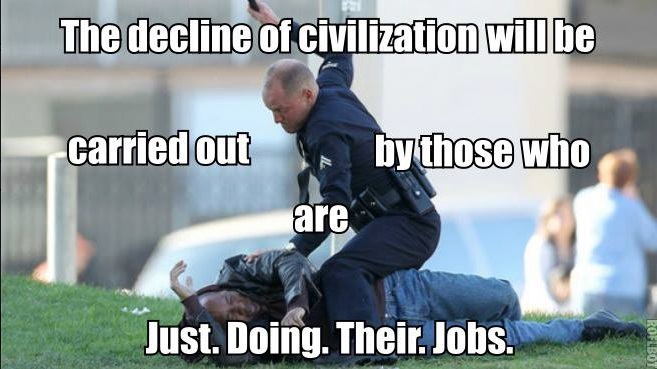
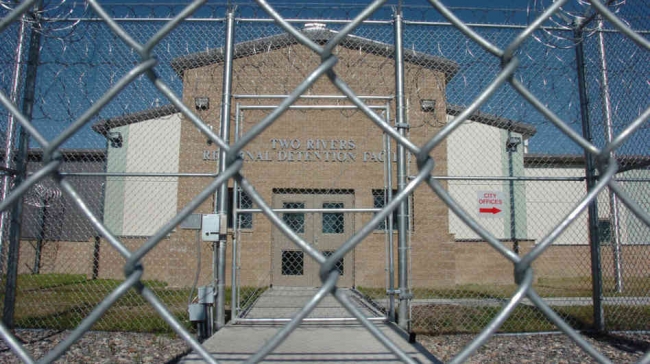
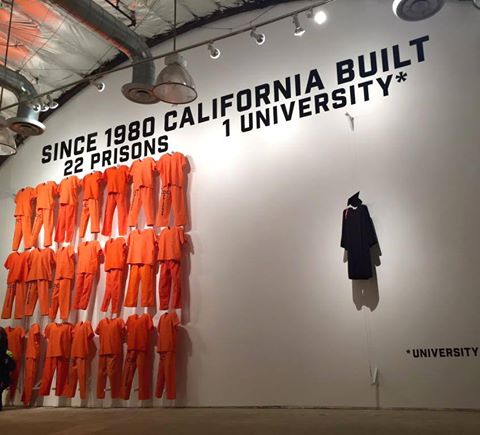
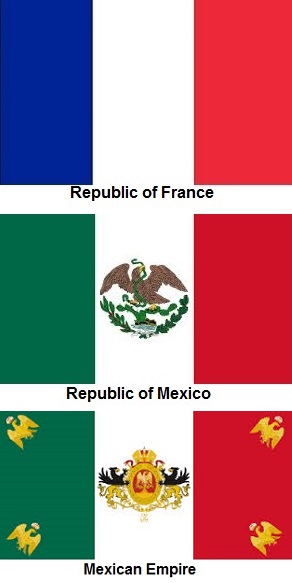
These issues: housing, education, job hunting, prisons, drug crime prosecutions, racial profiling and others are addressed here in this foregoing VIDEO. They are also important considerations for the planners of Caribbean empowerment. America is a “frienemy” for us! We are trading partners; we are aligned; we are allies; many of us live in America; studied in America; but we have to compete to dissuade our young people from setting their sights on American shores as a refuge and destination of their hopes and dreams. Yet the book Go Lean … Caribbean asserts that no society can prosper with a high abandonment rate – reported at 70% for educated classes. Therefore we must “battle” against the “push-and-pull” factors that draw many Caribbean citizens away to the US.
The Go Lean book pursues the quest to elevate the Caribbean region through empowerments in economics, security and governance. Since 29 of the 30 Caribbean member-states (“St. Barths” is the only exception) have majority Black population, the book pushes further on this subject of racism, positing that it is easier for Caribbean citizens to stay home and effect change in their homelands than to go to America and try to remediate that society. The book therefore asserts that the region can turn-around from failing assessments by applying best-practices, and forging new societal institutions to impact the Greater Good for all the Caribbean.
This consideration of the Go Lean book is one of technocratic stewardship of the regional Caribbean societal engines: economy, security and governance. This point of the current disposition of racism and this quest to improve was pronounced in the opening Declaration of Interdependence (Pages 10 – 14) with these acknowledgements and statements:
Preamble: As the history of our region and the oppression, suppression and repression of its indigenous people is duly documented, there is no one alive who can be held accountable for the prior actions, and so we must put aside the shackles of systems of repression to instead formulate efficient and effective systems to steer our own destiny.
xi. Whereas all men are entitled to the benefits of good governance in a free society, “new guards” must be enacted to dissuade the emergence of incompetence, corruption, nepotism and cronyism at the peril of the people’s best interest. The Federation must guarantee the executions of a social contract between government and the governed.
xii. Whereas the legacy in recent times in individual states may be that of ineffectual governance with no redress to higher authority, the accedence of this Federation will ensure accountability and escalation of the human and civil rights of the people for good governance, justice assurances, due process and the rule of law. As such, any threats of a “failed state” status for any member state must enact emergency measures on behalf of the Federation to protect the human, civil and property rights of the citizens, residents, allies, trading partners, and visitors of the affected member state and the Federation as a whole.
xxxiii. Whereas lessons can be learned and applied from the study of the recent history of other societies, the Federation must formalize statutes and organizational dimensions to avoid the pitfalls of [other] communities.
This is the quest of Go Lean…Caribbean. The book and accompanying blog/commentaries advocate learning lessons from many events and concepts from history and the present; from as far back as the patriarchal Bible times, to best-practices today employed by communities around the world that have successfully turned-around their societies. (Think: post-World War II in Germany and Japan; plus post-Apartheid in South Africa). The Go Lean book serves as a roadmap for the introduction and implementation of the technocratic Caribbean Union Trade Federation (CU). This roadmap seeks to reboot the region’s economic, security and governing engines; employing better strategies, tactics and implementations to impact its prime directives; identified with the following 3 statements:
Optimization of the economic engines in order to grow the regional economy to $800 Billion & create 2.2 million new jobs.
Establishment of a security apparatus to protect the resultant economic engines and mitigate challenges/threats to regional Justice Institutions.
Improvement of Caribbean governance to support these engines.
The Go Lean book stresses key community ethos, strategies, tactics, implementations and advocacies necessary to transform and turn-around the eco-systems of Caribbean society. These points are detailed in the book as follows:
Community Ethos – Economic Principles – Economic Systems Influence Individual Choices
Page 21
Community Ethos – Economic Principles – Consequences of Choices Lie in the Future
Page 21
Community Ethos – Governing Principles – Lean Operations
Page 24
Community Ethos – Ways to Impact the Future
Page 26
Community Ethos – Ways to Manage Reconciliations – South Africa’s Model
Page 34
Community Ethos – Ways to Impact the Greater Good
Page 37
Strategy – Vision – Confederate all 30 member-states/ 4 languages into a Single Market
Page 45
Strategy – Mission – Build and foster local economic engines
Page 45
Tactical – Ways to Foster a Technocracy
Page 64
Tactical – Growing the Economy – Post WW II European Marshall Plan Model
Page 68
Tactical – Growing the Economy – Post WW II Japan’s Turn-around Model
Page 68
Tactical – Separation-of-Powers – CU Federal Government versus Member-State Governance
Page 71
Implementation – Assemble All Regionally-focus Organizations of All Caribbean Communities
Page 96
Implementation – Ways to Better Manage Debt
Page 114
Anatomy of Advocacies – One Person can make a difference!
Page 122
Planning – 10 Big Ideas – Single Market / Currency Union
Page 127
Planning – Ways to Model the new European Union
Page 130
Planning – Ways to Make the Caribbean Better
Page 131
Planning – Ways to Improve Failed-State Indices – Minority and Human Rights
Page 134
Planning – Lessons Learned from the previous West Indies Federation
Page 135
Planning – Lessons Learned from 2008 – Optimizing Economic-Financial-Monetary Engines
Page 136
Planning – Lessons Learned New York City – Managing as a “Frienemy”
Page 137
Planning – Lessons Learned from Omaha – Human Flight Mitigations
Page 138
Planning – Lessons Learned from East Germany – Bad Examples for Trade & Security
Page 139
Planning – Lessons Learned from Detroit – Turn-around from Failure
Page 140
Planning – Lessons Learned from Indian Reservations – Pattern of Ethnic Oppression
Page 141
Planning – Lessons Learned from the American West – How to Win the Peace
Page 142
Advocacy – Ways to Grow the Economy
Page 151
Advocacy – Ways to Create Jobs
Page 152
Advocacy – Ways to Improve Governance
Page 168
Advocacy – Ways to Better Manage the Social Contract
Page 170
Advocacy – Ways to Impact Justice
Page 177
Advocacy – Ways to Improve Homeland Security
Page 180
Advocacy – Ways to Preserve Caribbean Heritage
Page 218
Appendix – Failed-State Index for Uneven Economic Development
Page 272
There are other lessons for the Caribbean to learn from considering the history of race/ethnic relations; the following previous blog/commentaries apply:
A Lesson in History: America’s War on the Caribbean
The Go Lean roadmap seeks to empower and elevate Caribbean societal engines. It is out-of-scope to impact America; our focus is only here in our homeland.
What is the requirement for the Office of the President of the United States; and why is this important to the Caribbean?
A candidate must be at least 35 years old; natural born citizen of the country (could not have been naturalized); must win the majority of votes (270) of the 538 total in the American Electoral College.
One more requirement: the candidate must have a “thick skin” and the uncanny ability to choose his/her battles. The President cannot pick a fight with just anyone that lobs unkind words, no matter how denigrating the insult.
This is not easy! Considering the free-for-all that is the internet; freedom of speech … is not free!
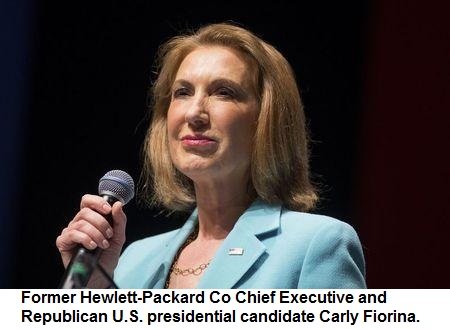
This actuality was dynamically illustrated in the past week; first with a number of 2016 potential candidates (Carly Fiorina, Ted Cruz, Jeb Bush and Hillary Clinton) in their quest to secure their own web domains (xxxxxxxxxx.com, xxxxxxxxxx.net, xxxxxxxxxx.org, etc.) and lastly with the current president’s first foray with the social media site Twitter. See stories here:
WASHINGTON (Reuters) – Republican presidential candidate Carly Fiorina apparently has learned something about registering website domain names.
Shortly after the former Hewlett-Packard chief executive announced her campaign last week, she found out that a cybersquatter had bought the rights to carlyfiorina.org and was using it to criticize her record.
Chuck Todd of NBC News brought up the issue while interviewing Fiorina on “Meet the Press” and showed the website, which features row after row of frowny-face emoticons representing 30,000 people laid off during her Hewlett-Packard tenure from 1999 to 2005.
Fiorina defended her record and after the interview sent a tweet thanking Todd for having her on the show and saying, “Btw, checkout chucktodd.org.” Her campaign had registered that domain and clicking on the link redirected traffic to her official campaign site, carlyforpresident.com.
Fiorina had done the same thing last week with sethmeyers.org when she appeared on NBC’s “The Late Show with Seth Meyers.”
Fiorina has acknowledged she made a mistake in not registering carlyfiorina.org first, but she is not the only 2016 presidential candidate bedeviled by cybersquatters.
Republican Ted Cruz must endure a rogue tedcruz.com site that says only “Support President Obama. Immigration Reform now”, while jebbushforpresident.com is being used by supporters of gay rights, not Jeb Bush.
The site hillaryclinton.org is not the work of Democratic candidate Hillary Clinton’s campaign and cyber security experts say it contains malicious software.
May 19, 2015 (Reuters) – President Obama started his own Twitter account on Monday. Within 45 minutes of sending his first tweet, Obama gained more than 217,000 followers.
—————-
Title #3: ‘Welcome To Twitter, N*gger’: Righties Go FULL RACIST On POTUS Twitter Account (TWEETS)
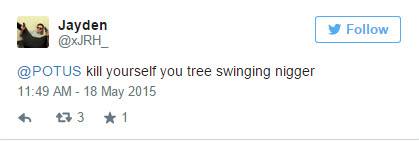
While the president was having fun posting about how his tweets would be his own words to the American people, righties were busy hurling racial slurs in @replies at the POTUS twitter account. For your viewing disgust, here are just a few of the so-called “welcome” messages President Obama received on his newly-created personal account (yes, these are screenshots and not actual tweets, in the event these trolls decide to delete their words like the cowards they are):
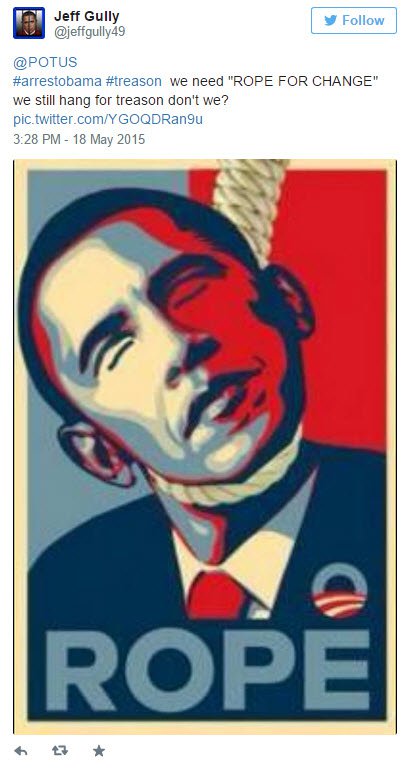
As if those initial messages weren’t bad enough, one person tweeted to the sitting President that he should be lynched, completed with image:
… I could go on, but you get the idea. If this doesn’t tell you that Barack Obama has handled the unprecedented disrespect and outright hatred directed at him from right-wing racists with the utmost grace and dignity, I don’t know what will. …
Title #4: Uh, you probably don’t want to tweet to @POTUS, actually By: Caitlin Dewey
Twitter, at first glance, is a magical fantasy land — a utopia where any old egg can freely converse with presidents, pop stars and kings. It is the great democratizer; the global water cooler; the one place where you can say anything to anyone and know it’ll be okay.
Consider this your monthly reminder that this is actually NOT the case: On the modern Internet, impressions of anonymity and ephemerality are, well … usually fake.
But the joke’s actually on them: Not only does the Secret Service already monitor Twitter for threats, but the White House is archiving each and every thing @POTUS tweeters say. Ashley Feinberg flagged this relevant piece of the White House Online Privacy Policy …
… when you tweet “leave Michelle for me @POTUS,” or something even more inappropriate/creepy, that lives in an official White House Archive for eternity (slash, for potential future scrutiny).
To be clear, this isn’t just a White House thing: The principle applies, in one form or another, to most types of social networking …
Find the whole article at the Washington Post Online site – The Capital’s Daily Newspaper (Posted 05-19-2015) –
The President of the United States (POTUS) is considered the most powerful Commander-in-Chief in the world; this is due to the fact that the US is the only remaining Super Power with the world’s largest Single Market economy and world’s largest military establishment. This country is the Caribbean largest trading partner. POTUS also has direct oversight over the US Federal Government functionalities in the 2 US Territories in the Caribbean (Puerto Rico and the US Virgin Islands).
This subject is a pivotal theme in the book Go Lean…Caribbean, which asserts that Internet & Communications Technologies (ICT) are critical for elevating Caribbean society. The art and science of this field is slated to impact the economic, security and governing engines. The internet makes things easy; it makes benevolent endeavors easier and malevolent endeavors easier. There must be the constant oversight.
The challenges of politicians and the Internet clearly demonstrate the need for technocratic oversight for the Caribbean’s foray into garnering more respect and benefits for intellectual property. There is the need for “Grievance Officers” to settle disputes related to cyber-squatting for Caribbean domains and the proposed Caribbean Cloud branded: www.myCaribbean.gov.
Change has come to the world of politicking and elections. The ubiquity of the internet cannot be ignored.
This book, Go Lean… Caribbean, serves as a roadmap for the introduction and implementation of the technocratic Caribbean Union Trade Federation (CU). The CU/Go Lean roadmap has 3 prime directives:
Optimization of the economic engines in order to grow the regional economy to $800 Billion GDP and create 2.2 million new jobs.
Establishment of a security apparatus to protect the societal engines and marshal against human and civil rights abuses.
Improvement of Caribbean governance to support these engines, plus facilitate a smooth transparent election process.
Early in the book, the benefits of optimizing governance through technology empowerments are pronounced in the opening Declaration of Interdependence (Pages 12 & 14), with these statements:
xi. Whereas all men are entitled to the benefits of good governance in a free society, “new guards” must be enacted to dissuade the emergence of incompetence, corruption, nepotism and cronyism at the peril of the people’s best interest. The Federation must guarantee the executions of a social contract between government and the governed.
xii. Whereas the legacy in recent times in individual states may be that of ineffectual governance with no redress to higher authority, the accedence of this Federation will ensure accountability and escalation of the human and civil rights of the people for good governance, justice assurances, due process and the rule of law…
xxvi. Whereas the region has endured a spectator status during the Industrial Revolution, we cannot stand on the sidelines of this new economy, the Information Revolution. Rather, the Federation must embrace all the tenets of Internet Communications Technology (ICT) to serve as an equalizing element in competition with the rest of the world. The Federation must bridge the digital divide and promote the community ethos that research/development is valuable and must be promoted and incentivized for adoption.
xxvii. Whereas intellectual property can easily traverse national borders, the rights and privileges of intellectual property must be respected at home and abroad. The Federation must install protections to ensure that no abuse of these rights go with impunity, and to ensure that foreign authorities enforce the rights of the intellectual property registered in our region.
The Go Lean book details the community ethos to adapt to the changed ICT landscape, plus the executions of the following strategies, tactics, implementations and advocacies:
Community Ethos – Economic Principle – People Respond to Incentives
Page 21
Community Ethos – Job Multiplier
Page 22
Community Ethos – Lean Operations
Page 24
Community Ethos – Return on Investments (ROI)
Page 24
Community Ethos – Ways to Impact the Future
Page 26
Community Ethos – Promote Intellectual Property
Page 29
Community Ethos – Impact Research & Development
Page 30
Community Ethos – Bridge the Digital Divide
Page 31
Strategy – Vision – Integrate 30 Caribbean member-states into a Single Market Economy
Page 45
Strategy – Mission – Fix the broken systems of governance in our region
Page 46
Tactical – Fostering a Technocracy
Page 64
Tactical – Growing the Economy – Book: Nature and Causes of the Wealth of Nations by Adam Smith (1776)
Page 70
Separation of Powers – Department of State – Federal Elections Administrators
Page 70
Separation of Powers – Federal/Caribbean Police – Elections/Candidate Security
Page 77
Separation of Powers – Film Promotion and Administration
Page 78
Separation of Powers – Intellectual Property (Copyrights & Domains) Administration
Page 78
Separation of Powers – Communications and Media Authority
Page 79
Separation of Powers – Federal Legislature & Electoral Seats
Page 91
Implementation – Ways to Impact Social Media
Page 111
Implementation – Ways to Impact Elections
Page 116
Advocacy – Ways to Grow the Economy
Page 151
Advocacy – Ways to Create Jobs
Page 152
Advocacy – Ways to Improve Communications
Page 186
Advocacy – Ways to Foster Technology
Page 197
Advocacy – Ways to Foster e-Commerce
Page 198
Advocacy – Ways to Impact Hollywood
Page 203
Advocacy – Ways to Promote Contact Centers – Ideal for Pre-Election Polling
Page 212
Advocacy – Ways to Impact the Diaspora
Page 217
Appendix – Puerto Rico Diaspora distribution in the mainland United States
Page 304
This commentary is about the Caribbean, not about the United States. It is important for leaders in the US to be concerned with the Caribbean’s well-being. This point has been explicitly acknowledged by Caribbean stakeholders and relevant subjects have recently been extolled in these previous Go Lean…Caribbean blog/commentaries:
US slams human rights practices among Caribbean nations
The CU seeks to re-boot the relationship with the US to an elevated “protégé” status, as opposed to the parasite status currently being maintained. For the Caribbean member-states, the CU will oversee the radio spectrum used for internet, radio, television and satellite communications in the region. (This radio spectrum must be regulated “by us and for us” … on a regional level due to the close-proximity of member-states). So the CU‘s coordination must be arranged in the manner of a Common Pool Resource, as the radio spectrum is limited. This oversight must also extend to internet broadband (wireless & wire-line) governance.
Also, the CU must conduct its own federal elections for all 30 member-states. This CU election process, detailed in the Go Lean roadmap, is a direct parallel to the election process in the US, alluded to at the start of this commentary. The US system defines 538 “electors”. This corresponds to the 435 members of the House of Representatives, 100 senators, and the three additional electors for the nation’s non-State capital city, Washington, DC. The same Electoral College design is proposed for the CU – so asto not trivialize the region’s Small Island States – where 250 House seats, and 60 Senate seats, amounts to a total 310 (Page 91). With the requirement of 156 electoral votes to win the CU presidency, no candidate can be elected without the inclusion of some Small Island States. This is logical; an effective application for the CU legal structure bred from the US model.
For the CU, ICT must also come into play more and more to facilitate efficient federal campaigns. We can do this!
We can apply best-practices – as communicated in the foregoing articles – so as to mitigate election-campaign abuses and remediate slanderous communication from “bad actors” who try to bully elected officials; these ones will become more active as election passions intensify.
“Out with the old; in with the new” – the US President Obama has less than 2 years remaining in his constitutionally-mandated term-limit. The candidates vying for Mr. Obama’s job for 2016 will have to feature many of the same qualifications as Mr. Obama; these ones, in particular, must be thick-skinned in tolerating scathing insults and cyber-bullying. They would do best to remember that there will always be a loud minority … and quiet majority. 🙂
The actual definition is: 1. anything handed down from the past, as from an ancestor or predecessor; 2. a gift of property, especially personal property, as money, by will; a bequest.
Legacies refer to good and bad. This is the pointed reference of this commentary, the legacies of American and Caribbean empowerments and disestablishments. Two examples are presented here as teaching points for our communities because frankly, these legacies are current and pervasive in the news and daily lives of so many people today.
This is a milestone – Number 300 – for this effort, these commentaries to draw attention to news, models and applications of the book Go Lean…Caribbean. These 300 blogs/commentaries all highlight subjects, issues and advocacies to promote best practices to elevate the Caribbean economic, security and governing eco-system. All previous blogs were grouped into these 10 categories:
The basis for the teaching point of this American legacy is the institutional segregation practiced in American cities that limited non-Whites to ghettos and slums. This was not just an issue in the South, as this AUDIO Podcast reveals:
Fifty years after the repeal of Jim Crow, many African-Americans still live in segregated ghettos in the country’s metropolitan areas. Richard Rothstein, a research associate at the Economic Policy Institute, has spent years studying the history of residential segregation in America. “We have a myth today that the ghettos in metropolitan areas around the country are what the Supreme Court calls ‘de-facto’ — just the accident of the fact that people have not enough income to move into middle class neighborhoods or because real estate agents steered black and white families to different neighborhoods or because there was white flight,” Rothstein tells NPR Fresh Air’s Terry Gross.
“It was not the unintended effect of benign policies,” he says. “It was an explicit, racially purposeful policy that was pursued at all levels of government, and that’s the reason we have these ghettos today and we are reaping the fruits of those policies.”
The application of this history does not require an external geographic address to glean. Rather many people within the US, clearly recognize and lament this poor legacy. Notice here the following posted guestbook comments on the Podcast’s website:
“It doesn’t take rocket science or a degree in economics to see how white families would have become wealthier and African Americans would have missed out … by the time equal protection laws were enacted [in the 1960’s]. – Public Comment by “Cat Jones” on May 14, 2015.
“I remember in Lubbock, TX; which is a dry county [(no alcohol sold)]; they attempted to allow liquor stores [only] in the black neighborhoods, stating that it would be an influx of dollars into these neighborhoods. The black Churches came together to vote this down. The whites fought very hard for this to happen. Blacks said ok but why not allow them to be in the entire city. That question was never answered. It was simple we will provide your communities with the industries we have no desire for in our own communities but industries that improve the communities were reserved for white communities. Racism is far from running around shouting racist names. IT is stuff like this. – Public Comment by “bleemorrison” on May 14, 2015.
The book Go Lean…Caribbean pursues the quest to elevate the Caribbean region through economic, security and governance empowerments. This means looking, listening and learning from the lessons in history … old and new. This is especially true when our communities may still be impacted by that history. (The Podcast commences with the acknowledgement that Baltimore’s ghettos were just recently in flames due to the culmination of frustration of urban dysfunction there, ignited by the police killing of a Black Man in custody; this was just the “tip of the iceberg”). The book serves as a roadmap for the introduction and implementation of the technocratic Caribbean Union Trade Federation (CU) to provide better stewardship for the Caribbean homeland.
This book and subsequent 300 blogs posit that the Caribbean can do better than our American counterparts, that rather than being parasites, we can be protégés and maybe even provide American communities our model on how to build a progressive society to live, work and play. In a recent blog/commentary, the issue of legacies – from Royal Charters and the resultant effects on powerful families – was detailed. The full appreciation was explored on how good and bad circumstances in life can be extended from generation to generation.
That’s the American example…
The Caribbean example involves the member-state of Haiti. This week the President of France made a proclamation of acknowledgement that the Republic of Haiti has endured a long legacy of paying a debt (in blood and finances) for the natural right of freedom.
Published on May 12, 2015 – French President Francois Hollande pledged to pay back a “moral debt” to Haiti during a visit on Tuesday to the impoverished Caribbean nation founded by former French slaves who declared independence in 1804. His visit marked the first official visit by a French president to the hemisphere’s poorest country, a former colonial jewel still bitter over a debt France forced Haiti to pay in 1825 for property lost in the slave rebellion. Hollande said, “We cannot change the past, but we can change the future.” He spoke at an event with Haitian president Michel Martelly on Port au Prince’s Champ de Mars, in the city center near the presidential palace that was destroyed by a 2010 earthquake.
Haiti revolted its slave colony status in 1791 and fought for its independence in 1804. To finally be recognized, France required the new country of Haiti to offset the income that would be lost by French settlers and slave owners; they demanded compensation amounting to 150 million gold francs. After a new deal was struck in 1838, Haiti agreed to pay France 90 million gold francs (the equivalent of €17 billion today). It was not until 1952 that Haiti made the final payment on what became known as its “independence debt”. Many analysts posit that the compensation Haiti paid to France throughout the 19th century “strangled development” and hindered the “evolution of the country”.
Though many had hoped the French’s President’s cancelation of the moral debt would translate to monetary damages – reparations – it is asserted here that just the acknowledgement of the legacy is profound. The same as the Baltimore legacy restricted a community, the French-Haiti legacy restricted this Caribbean country and a race of people – Haiti continues to be dysfunctional – a failed-state – the poorest country in the Western Hemisphere.
We see the causes and effects of legacies.
The Go Lean book and accompanying blogs push further and deeper on this subject of legacies, stressing that success can still be derived in the Caribbean, despite any lack of legacies, as some parties in the Americas have enjoyed 500, 200 or 75 years of entitlement. The book therefore stresses that the region can turn-around from “ground zero”, by applying best-practices, and forge new societal institutions to empower the region.
The consideration of the Go Lean book, as related to this subject is one of governance, the need for technocratic stewardship of the regional Caribbean society. This point of governance against the backdrop of societal legacies was pronounced early in the book, in the opening Declaration of Interdependence (Pages 10 – 14) with these declarations:
Preamble: As the history of our region and the oppression, suppression and repression of its indigenous people is duly documented, there is no one alive who can be held accountable for the prior actions, and so we must put aside the shackles of systems of repression to instead formulate efficient and effective systems to steer our own destiny.
xi. Whereas all men are entitled to the benefits of good governance in a free society, “new guards” must be enacted to dissuade the emergence of incompetence, corruption, nepotism and cronyism at the peril of the people’s best interest. The Federation must guarantee the executions of a social contract between government and the governed.
xii. Whereas the legacy in recent times in individual states may be that of ineffectual governance with no redress to higher authority, the accedence of this Federation will ensure accountability and escalation of the human and civil rights of the people for good governance, justice assurances, due process and the rule of law. As such, any threats of a “failed state” status for any member state must enact emergency measures on behalf of the Federation to protect the human, civil and property rights of the citizens, residents, allies, trading partners, and visitors of the affected member state and the Federation as a whole.
xxiv. Whereas a free market economy can be induced and spurred for continuous progress, the Federation must install the controls to better manage aspects of the economy: jobs, inflation, savings rate, investments and other economic principles. Thereby attracting direct foreign investment because of the stability and vibrancy of our economy.
xxxiii. Whereas lessons can be learned and applied from the study of the recent history of other societies, the Federation must formalize statutes and organizational dimensions to avoid the pitfalls of [other] communities.
According to the timeline established in the foregoing AUDIO Podcast, the Civil Rights movement of the 1960’s was a turn-around; it corrected a lot of the blatant defects in the American racial eco-systems. Haiti still awaits its turn-around.
This is the quest of Go Lean…Caribbean, to impact the Caribbean, not the United States. Haiti is in scope for this roadmap; Baltimore is not. The immediate goal is to analyze case studies, to learn lessons from the past (ancient and recent) of communities; then to assess how the best-practices … will drive success in the Caribbean. The roadmap simply seeks to reboot the region’s economic, security and governing engines, hypothesizing that the American and European colonial stewards did not have societal efficiency in mind when they structure administrations of the individual member-states in this region.
In general, the CU will employ better strategies, tactics and implementations to impact these 3 prime directives:
Optimization of the economic engines in order to grow the regional economy to $800 Billion & create 2.2 million new jobs.
Establishment of a security apparatus to protect the resultant economic engines and mitigate internal and external threats.
Improvement of Caribbean governance to support these engines.
The Go Lean book stresses key community ethos, strategies, tactics, implementations and advocacies necessary to transform and turn-around the eco-systems of Caribbean society. These points – relevant to the foregoing AUDIO and VIDEO features – are detailed in the book as follows:
Community Ethos – Economic Principles – Economic Systems Influence Individual Choices
Page 21
Community Ethos – Economic Principles – Consequences of Choices Lie in the Future
Page 21
Community Ethos – Ways to Impact the Future
Page 26
Community Ethos – Ways to Manage Reconciliations
Page 34
Community Ethos – Ways to Impact the Greater Good
Page 37
Strategy – Vision – Confederate all 30 member-states / 4 languages into a Single Market
Page 45
Strategy – Mission – Build and foster local economic engines
Page 45
Tactical – Ways to Foster a Technocracy
Page 64
Tactical – Growing the Economy – Post WW II European Marshall Plan Model
Page 68
Tactical – Separation-of-Powers – CU Federal Government versus Member-State Governance
Page 71
Implementation – Assemble All Regionally-focus Organizations of All Caribbean Communities
Page 96
Implementation – Ways to Better Manage Debt
Page 114
Planning – 10 Big Ideas – Haiti Marshall Plan
Page 127
Planning – Ways to Make the Caribbean Better
Page 131
Planning – Ways to Improve Failed-State Indices – Local Government and the Social Contract
Page 134
Planning – Lessons Learned from the previous West Indies Federation
Page 135
Planning – Lessons Learned from 2008 – Optimizing Economic-Financial-Monetary Engines
Page 136
Planning – Lessons Learned from Omaha – Human Flight Mitigations
Page 138
Planning – Lessons Learned from Detroit – Turn-around from Failure
Page 140
Advocacy – Ways to Grow the Economy
Page 151
Advocacy – Ways to Improve Governance
Page 168
Advocacy – Ways to Better Manage the Social Contract
Page 170
Advocacy – Ways to Improve Homeland Security
Page 180
Advocacy – Ways to Preserve Caribbean Heritage
Page 218
Advocacy – Ways to Re-boot Haiti
Page 238
Appendix – Failed-State Index for Uneven Economic Development
Page 272
There are other lessons for the Caribbean to learn from considering history; the following previous blog/commentaries apply:
A Lesson in History: America’s War on the Caribbean
There is the effort to remediate American and European societies now. They recognize the futility of the actions of their ancestors and predecessors. They are now battling to try and weed-out the last vestiges of racism and housing discrimination. This is good! Housing investment is the best way to get rich slowly, to create generational wealth. This has been demonstrated time and again in the US, even though “black & brown” populations may have been excluded from participation.
The Go Lean roadmap focuses on the homeland only. It is out-of-scope to impact American cities like Baltimore; our scope is for the Caribbean only; for communities like Haiti.
Our quest is simple, the future, a 21st century effort to make the Caribbean region a better place to live, work and play. 🙂
Power corrupts. Absolute power corrupts absolutely – Familiar secular prophesy.
The book Go Lean…Caribbean serves as a roadmap for the introduction and implementation of the technocratic Caribbean Union Trade Federation (CU) to elevate the region’s economic, security and governing engines. The roadmap covers 5 years. Once the roadmap succeed in its execution, there will be a lot of opportunities for stakeholders to acquire and wield power. The roadmap fully expects the eventual corrupting effects of that power, and thusly embed the required checks-and-balances from the outset.
The Go Lean roadmap covers so many aspects of Caribbean life that every one, in every nook-and-cranny, will sense the presence of the CU. The CU/Go Lean roadmap commences with these 3 prime directives:
Optimization of the economic engines in order to grow the regional economy to $800 Billion & create 2.2 million new jobs.
Establishment of a security apparatus to protect the resultant economic engines.
Improvement of Caribbean governance to support these engines.
During the course of these executions, there will be a constant focus on the exercise of power.
The assertion of the Go Lean book is that the Caribbean region must prepare for its own success, and its own eventual security threats. The book relates (Page 23) the historic references where the emergence of new economic engines were immediately followed by the emergence of “bad actors” to exploit the opportunities, with good, bad and evil intent. So we must proactively and reactively address crime, whether it is street crime, “White Collar” crime and/or also public corruption allegations. But doing so judiciously and with proper regard for human and civil rights.
Accordingly, the opening Declaration of Interdependence (Page 12) pronounced that we must take our own lead for our own security solutions; we must appoint our own “guardians” with our self-interest in mind; prioritizing the community ethos for the Greater Good. The actual declaration is pronounced as follows:
x. Whereas we are surrounded and allied to nations of larger proportions in land mass, populations, and treasuries, elements in their societies may have ill-intent in their pursuits, at the expense of the safety and security of our citizens. We must therefore appoint “new guards” to ensure our public safety and threats against our society, both domestic and foreign. The Federation must employ the latest advances and best practices … to assuage continuous threats against public safety.
xvi. Whereas security of our homeland is inextricably linked to prosperity of the homeland, the economic and security interest of the region needs to be aligned under the same governance. Since economic crimes, including piracy and other forms of terrorism, can imperil the functioning of the wheels of commerce for all the citizenry, the accedence of this Federation must equip the security apparatus with the tools and techniques for predictive and proactive interdictions.
The Caribbean appointing “new guards” or a security pact to ensure public safety, will call for permanent justice institutions, sanctioned by all 30 CU member-states. The CU Federation or federal justice’s institutions will operate under a separation-of-powers edict – between the member-states and CU agencies. This is radically different than other federal government scenarios – like the United States – because of the reality of sovereignty. The CU is only a trade and security bloc, so the sovereignty of member-states remains with its current possessors. Therefore the Go Lean roadmap requires CU agencies to be deputized by the duly authorities in the member-states. Then with CU funding comes CU “strings attached” to ensure compliance of governance mandates. (These strings include fair and equitable treatment of all citizens).
A previous commentary related how the citizens of the City of Ferguson, Missouri-USA – African-American more so than any other ethnic group – were abused and repressed by law enforcement and judicial officials in that community. The injustice and abuse-of-power was so blatant that the town burst into protest – (literally burst into flames) – when one of their unarmed citizens, Michael Brown, was killed by a police officer. Then the whole country burst into protest – in solidarity – when the subsequent Grand Jury decided not to indict the offending police officer. The constant outcry was: “No Justice; No Peace” and “Black Lives Matter”.
The events of this small Midwest American town – a suburb of St. Louis – can easily be joined in chorus with countless Caribbean anecdotes. Any elevation of Caribbean society must therefore include the optimization of Caribbean justice institutions. The Go Lean roadmap assumes the heavy-lifting for the CU Trade federation to transform Caribbean society. The CU will be empowered for its security role – deputized for law enforcement in all Caribbean member-states – by a Status of Forces Agreement (SOFA) embedded with the initial confederation treaty. (This effort also includes the US Territories as well, under the legal guise of an Interstate Compact). This point was strongly urged in the same opening Declaration of Interdependence (Page 12), as follows:
xii. Whereas the legacy in recent times in individual states may be that of ineffectual governance with no redress to higher authority, the accedence of this Federation will ensure accountability and escalation of the human and civil rights of the people for good governance, justice assurances, due process and the rule of law. As such, any threats of a “failed state” status for any member state must enact emergency measures on behalf of the Federation to protect the human, civil and property rights of the citizens, residents, allies, trading partners, and visitors of the affected member state and the Federation as a whole.
The Go Lean roadmap identifies gangs, organized crime, narcotics trafficking, human trafficking, guns/explosive interdiction, piracy, and terrorism as threats to the law-and-order fabric of Caribbean society. But the community ethos for Go Lean roadmap must be based on the Greater Good, ensuring both the letter and the spirit of laws to serve-and-protect the community. So the relevant CU agencies must also police the Police. Just how does the roadmap propose this; (Page 177)?
The strings-attached in funding national police forces would force Internal Affairs compliance and reporting up-line to CU agencies.
Military justice institution, Judge Advocacy Generals, will also follow a reporting up-line to CU agencies.
The CU funding to member-states will required separate accounting ledgers – no deposit into General Treasury Funds. The CU therefore retains the rights to “audit the books”. Any malfeasance, misfeasance or nonfeasance constitute federal crimes, criminal prosecution and federal prison sentences.
The CU will provide grants for equipment and investigative tools, like dashboard cameras and body cameras. The SOFA would legally grant authority to the CU to review police activity.
Every security-involved death (police, soldier, sailor, marine) will automatically initiate a federal investigative review.
In the Caribbean, “All Lives Matter”!
The Go Lean book details all the community ethos to ensure the right attitudes to serve and protect Caribbean communities; plus strategies, tactics, implementations and advocacies to provide increased public safety & security in the Caribbean region:
Economic Principle – Economic Systems Influence Individual Choices
Page 21
Economic Principle – Consequences of Choices Lie in Future
Page 21
Community Ethos – Security Principle – Privacy –vs- Public Protection
Page 23
Community Ethos – Security Principle – Witness Security & Protection
Page 23
Community Ethos – Security Principle – Anti-Bullying and Mitigation
Page 23
Community Ethos – Security Principle – Intelligence Gathering
Page 23
Community Ethos – Security Principle – Light Up the Dark Places
Page 23
Community Ethos – Security Principle – “Crap” Happens
Page 23
Community Ethos – Governing Principle – Minority Equalization
Page 24
Community Ethos – Governing Principle – Cooperatives
Page 25
Community Ethos – Ways to Improve Sharing
Page 35
Community Ethos – Ways to Impact the Greater Good
Page 37
Tactical – Confederating a non-sovereign union
Page 63
Tactical – Fostering a Technocracy
Page 64
Tactical – Separation of Powers – Homeland Security
Page 75
Tactical – Separation of Powers – Justice Department – District Attorneys
Page 77
Tactical – Separation of Powers – Justice Department – CariPol
Page 77
Tactical – Separation of Powers – Labor Department – Regional Relations
Page 89
Tactical – Separation of Powers – Federal Courts – Court of Justice
Page 90
Implementation – Assemble “Organs” into a Security Apparatus
Page 96
Implementation – Start-up Security Initiatives
Page 103
Planning – Ways to Make the Caribbean Better
Page 131
Planning – Ways to Improve Failed-State Indices
Page 134
Planning – Lessons from the American West – Model for Law-and-Order
Page 142
Advocacy – Ways to Grow the Economy
Page 151
Advocacy – Ways to Improve Governance
Page 168
Advocacy – Ways to Better Manage the Social Contract
Page 170
Advocacy – Ways to Impact Justice
Page 177
Advocacy – Ways to Reduce Crime
Page 178
Advocacy – Ways to Improve for Gun Control
Page 179
Advocacy – Ways to Improve Homeland Security
Page 180
Advocacy – Ways to Mitigate Terrorism
Page 181
Advocacy – Ways to Improve Intelligence Gathering/Analysis
Page 182
Advocacy – Ways to Impact the Prison Industrial Complex
Page 211
Advocacy – Ways to Protect Human Rights
Page 220
Appendix – CariCom Organs: IMPACS & Court of Justice
Page 244
Other subjects related to crime remediation empowerments for the region have been blogged in other Go Lean…Caribbean commentary, as sampled here:
American Hypocritical Human Rights Leadership Slams Caribbean Poor Record
The vision of the Go Lean roadmap is to make the Caribbean homeland, a better place to live, work and play. One, of many missions, is to lower the “push” factors (from “push-and-pull” reference) so that our citizens are not led to flee their homeland for foreign (North American and European) shores. Among the many reasons people emigrate, many times, there is a fear of life-and-limb. We must allow for “Justice”; and for “Peace”. All lives must matter!
We must do better!
We know that “bad actors” will emerge, from internal and external origins. We must be prepared and on-guard to defend our homeland against all threats, foreign and domestic. Yet we must maintain transparency, accountability, and constant commitment to due-process and the rule-of-law.
We do not want a Sheriff John Brown – see Appendix & VIDEO – emerging in the Caribbean region. Sheriff John Brown is a classic example of an Authority figure that abused his power at the peril of a common citizen:
John Brown always hated me, For what, I don’t know: Every time I plant a seed, He said kill it before it grow.
Everyone, the people (residents and visitors), institutions and government officials are hereby encouraged to lean-in to this roadmap. 🙂
Appendix – I Shot the Sheriff – Lyrics by Bob Marley
Chorus:
(I shot the sheriff
But I didn’t shoot no deputy, oh no! Oh!
I shot the sheriff
But I didn’t shoot no deputy, ooh, ooh, oo-ooh.)
Yeah! All around in my home town,
They’re tryin’ to track me down;
They say they want to bring me in guilty
For the killing of a deputy,
For the life of a deputy.
But I say:
Oh, now, now. Oh!
(I shot the sheriff.) – the sheriff.
(But I swear it was in self-defence.)
Oh, no! (Ooh, ooh, oo-oh) Yeah!
I say: I shot the sheriff – Oh, Lord! –
(And they say it is a capital offence.)
Yeah! (Ooh, ooh, oo-oh) Yeah!
Sheriff John Brown always hated me,
For what, I don’t know:
Every time I plant a seed,
He said kill it before it grow –
He said kill them before they grow.
And so:
Read it in the news:
(I shot the sheriff.) Oh, Lord!
(But I swear it was in self-defence.)
Where was the deputy? (Oo-oo-oh)
I say: I shot the sheriff,
But I swear it was in selfdefence. (Oo-oh) Yeah!
Freedom came my way one day
And I started out of town, yeah!
All of a sudden I saw sheriff John Brown
Aiming to shoot me down,
So I shot – I shot – I shot him down and I say:
If I am guilty I will pay.
(I shot the sheriff,)
But I say (But I didn’t shoot no deputy),
I didn’t shoot no deputy (oh, no-oh), oh no!
(I shot the sheriff.) I did!
But I didn’t shoot no deputy. Oh! (Oo-oo-ooh)
Reflexes had got the better of me
And what is to be must be:
Every day the bucket a-go a well,
One day the bottom a-go drop out,
One day the bottom a-go drop out.
I say:
I – I – I – I shot the sheriff.
Lord, I didn’t shot the deputy. Yeah!
I – I (shot the sheriff) –
But I didn’t shoot no deputy, yeah! No, yeah!
This accusation against the American Big Business eco-system, seems so egregious:
Sacrifice children on the altar of corporate profits.
According to the events on the HBO Television show Real Time with Bill Maher, on Friday April 24, 2015, it is hard not to be an Anti-Vaxxer. The ‘Real Time’ host sided with his guest, activists and author Robert F. Kennedy Jr.. Mr. Kennedy came on to talk about his new book (see Appendix A), and the link between vaccines and the dreaded disorder of Autism.
On the show, Maher conducted a sit-down interview with Robert F. Kennedy Jr. who came on the program to promote the new book he edited ‘Thimerosal:Let the Science Speak’; as well as the full-page ad Kennedy recently ran in USA Today claiming that the drug Thimerosal, a mercury-containing preservative used in vaccine medications, causes Autism.
This is a stance Kennedy, and others, has taken for quite some time. Back in 2005, Kennedy made an infamous appearance on The Daily Show with Jon Stewart for an “Autism” special. There, Kennedy preached his Anti-vaxx stance, claiming not only that vaccines cause Autism, but also that there’s a wide-ranging conspiracy to cover this fact up involving the government, academia, and Big Pharma. Stewart, who’d later rip Anti-vaxxers a new one in a February 2015 Daily Show rant, just nodded his head and said, “I appreciate you getting the word out.”
Kennedy went on to answer Maher’s questions by explaining what he believes are the “unanimous dangers of Thimerosal” and “the links between Thimerosal and an epidemic of neurological disorders that are now afflicting American children: ADD, ADHD, speech delay, language delay, hyperactivity disorder, ASD, and Autism, all of which began in 1989, the year they changed the vaccine schedule.”
Then, Kennedy made an interesting admission.
“I am very pro-vaccine,” he said. “I had all my kids vaccinated and want to see government policies promoting full-coverage vaccines. The only way to do that is to have safe vaccines, and to have a credible regulatory process with regulators with integrity, and we don’t have that today.”
Yes, Kennedy said he mainly takes issue with the Centers for Disease Control and Prevention (CDC), which he says “controls the field” and is a “cesspool of corruption that’s been completely taken over by the vaccine industry.”
This latter point is where this commentary related to the plan to elevate Caribbean society. The book Go Lean…Caribbean (Page 157) declares that big American Pharmaceutical industry or Big Pharma may be more of an obstacle than a aid for effecting community well-being. They care more about profits than they do the well-being of the public.
Sacrifice children on the altar of corporate profits.
This charge relates the underlying theme that the profit motives of Big Pharma is indicative of American Crony-Capitalistic practices that have been cited in so many other blog / commentaries. See Appendix C of cited Crony-Capitalism conflicts in American society.
(The publishers of the Go Lean book are proponents of childhood vaccinations – Pro-Vaxxers).
The Go Lean book strategizes a roadmap for economic empowerment in the region, clearly relating that healthcare, and pharmaceutical acquisitions are important in the quest to make the Caribbean a better place to live, work and play. At the outset of the Go Lean book, in the Declaration of Interdependence (Page 11), these points are pronounced:
viii. Whereas the population size is too small to foster good negotiations for products and commodities from international vendors, the Federation must allow the unification of the region as one purchasing agent, thereby garnering better terms and discounts.
ix. Whereas the realities of healthcare and an aging population cannot be ignored and cannot be afforded without some advanced mitigation, the Federation must arrange for health plans to consolidate premiums of both healthy and sickly people across the wider base of the entire Caribbean population. The mitigation should extend further to disease management, wellness, obesity and smoking cessation programs.
The Go Lean book serves as a roadmap for the implementation and introduction of the technocratic Caribbean Union Trade Federation (CU). The CU‘s prime directives are identified with the following 3 statements:
Optimization of the economic engines in order to grow the regional economy to $800 Billion & create 2.2 million new jobs.
Establishment of a security apparatus to protect the resultant economic engines.
Improvement of Caribbean governance to support these engines.
Previous blog/commentaries addressed issues of capitalistic conflicts in American medical practices, compared to other countries, and the Caribbean. The following sample applies:
The Caribbean Union Trade Federation has the prime directive of optimizing the economic, security and governing engines of the region. The Book Review and AutismOne VIDEO – in the Appendices below – depict that abuses have entered the quest for best practices in health management for the American public. We must do better in the Caribbean.
The Book Review and VIDEO below provide inside glimpses of the decision-making around Public Health drugs. Obviously, the innovators and developers of drugs have the right to glean the economic returns of their research. The Go Lean roadmap posits that more innovations will emerge in the region as a direct result of the CU prioritization on science, technology, engineering and medical (STEM) activities on Caribbean R&D campuses and educational institutions.
This is the manifestation and benefits of Research & Development (R&D). The roadmap describes this focus as a community ethos and promote R&D as valuable for the region. The following list details additional ethos, strategies, tactics, implementations and advocacies to optimize the region’s health deliveries and R&D investments:
Community Ethos – Deferred Gratification
Page 21
Community Ethos – Economic Systems Influence Individual Choices and Incentives
Page 21
Community Ethos – The Consequences of Choices Lie in the Future
Page 21
Community Ethos – Governing Principles – Return on Investments
Page 24
Community Ethos – Governing Principles – Cooperatives
Page 25
Community Ethos – Non-Government Organizations
Page 25
Community Ethos – Ways to Impact Research & Development (R&D)
Page 30
Community Ethos – 10 Ways to Promote Happiness
Page 36
Community Ethos – Ways to Impact the Greater Good
Page 37
Strategy – Integrate and unify region in a Single Market
Page 45
Strategy – Agents of Change – Globalization
Page 57
Tactical – Fostering a Technocracy
Page 64
Tactical – Separation of Powers – Health Department
Page 86
Tactical – Separation of Powers – Drug Administration
Page 87
Implementation – Ways to Pay for Change
Page 101
Implementation – Ways to Implement Self-Government Entities – R&D Campuses
Page 105
Implementation – Ways to Deliver
Page 109
Planning – Ways to Improve Trade
Page 128
Planning – Ways to Make the Caribbean Better
Page 131
Advocacy – Ways to Improve Healthcare
Page 156
Advocacy – Ways to Better Manage the Social Contract
Page 170
Advocacy – Ways Foster Cooperatives
Page 176
Advocacy – Ways to Improve Emergency Management
Page 196
Advocacy – Ways to Impact Foundations
Page 219
Advocacy – Ways to Impact Persons with Disabilities
Page 228
Appendix – Emergency Management – Medical Trauma Centers
Page 336
The Go Lean roadmap does not purport to be an authority on medical or Public Health best practices. The economic-security-governance empowerment plan should not direct the course of direction for research and/or treatment. But something is wrong in the US, and other countries. 1 in every 160 child has been afflicted with Autism since 1989.
According to these anecdotes and reports, Big Pharma has clearly sacrificed our children on the altar of corporate profits. These companies cannot claim any adherence to any “better nature” in their practices. Their motive is malevolent!
The King of Pop, Michael Jackson, released a song with the title: “They don’t really care about us”; see Appendix DVIDEO below; he very well could have been talking about Big Pharma. In a previous blog/commentary, the pharmaceutical industry was assailed over one cancer drug, Gleevec. The commentary clearly depicted the perils of Crony-Capitalism.
Crony-Capitalism is not for the Greater Good. It is not good economics, good security nor good governance. These activities must be monitored and mitigated.
No, “they don’t really care about us”. We must care and provide for ourselves. There must be better stewardship for society.
This is the calling for the CU Trade Federation, to do better. We can use this community ethos to impact the Greater Good. This is the heavy-lifting of the CU, to make the Caribbean a better place to live, work, heal and play. 🙂
Book debut day is always exhilarating – even for a seasoned, best selling author like Robert Kennedy, Jr.. Please join us in wishing him well as he educates readers on the dangers of neurotoxic mercury. In an environment (pardon the pun) where so few advocates are willing to step and and speak out on behalf of vaccine safety, we commend and thank both Kennedy and his publisher, Skyhorse. There is not a bigger name in American environmental causes doing anything like this.
Unfortunately, many people will negatively review the book never having cracked the spine – never having the read more than the book’s cover art on the computer… Write the review that suits your reaction to the book. Copy it, and leave it at every book site you can find.
Comments Many follow this conversation and subscribe to the comment feed for this post. Here are a sample:
1. Children damaged by vaccines is not about mercury. That is throwing people off scent. Each and every vaccine has the potential to maim and/or kill the recipient, from the first instant after injection by anaphylactic shock, to Sids, to brain tumors 60 years later, as Michele Carbone has shown…
I get sick reading people’s comments repeating the mind controlled offal about how vaccines have saved the lives of millions. That is an outright lie. The opposite is true. From day one mandated mass smallpox vaccinations have led to mass outbreaks of smallpox. The same goes for polio, especially in Africa.
Check the historical facts: The Jenner/Pasteur gospels are the basis of today’s vaccination programs, yet their premise is patently false, making the whole vaccination religion nothing but a house of cards.
In reality all vaccines are weapons of mass destruction. Just check the product inserts for their content. Introducing manipulated pathogens plus toxic chemicals and metals into the bloodstream never will lead to true health!
Source – Posted by: Desiree L. Rover, August 30, 2014
—————
2. Robert F. Kennedy Jr. has assembled two books: a private unpublished draft which, as he promised at AutismOne 2013, exposes the vaccine/autism cover-up. And this short, bowdlerized, oddly incoherent book, which does not.
In the published book, two bright spots shimmer. The first is Martha Herbert’s brilliant introduction, which places the vaccine safety debate in a broader context, arguing that we need “fresh approaches to health care, product development, energy, and ecosystems management.” The second is Chapter 2, written in a strong, confident narrative voice that pins mercury firmly to the rising prevalence of neuro-developmental disorders. The remaining chapters and 804 citations appear largely to be notes and debating points that support and expand upon Kennedy’s 2005 article, “Deadly Immunity,” published jointly by Salon.com and Rolling Stone, where the key points are made more succinctly, and in my view more persuasively, but without as much supporting documentation.
For those who have followed the vaccine debate on Age of Autism and especially for those who attended Kennedy’s AutismOne 2013 presentation, there are five surprises in the published book. Four of them occur in the introductory material.
First, that “there is no definitive proof that vaccines or the mercury in them causes autism” (p. xvi). How much proof do you need to be “definitive?”
Second, that “the common claim of autism rates continuing to climb after Thimerosal’s phase-out from the routine childhood vaccination schedule … has not, as yet, been borne out” (p. xxvii). Will that statement ring true with special education teachers and professionals whose clinics are overflowing with vaccine-damaged kids?
Third, that removing Thimerosal from all medical products, including flu shots, will restore “faith in the vaccine regimen while maintaining or increasing vaccination rates” (p. xxix). If restoring faith in the vaccine regimen is indeed Kennedy’s goal, this book is two hundred pages too short and ten years too late.
Fourth, that “This book is aggressively pro-vaccine” (p. xi). I know what that is supposed to mean in this context, but the choice of words is surprising. Given the failures of mandated vaccines to protect our children — failures publicized in Age of Autism during the past year — how much more “aggressively pro-vaccine” do we need to be?
The fifth surprise—and for me this is a head spinner — is that in 1999, two key Pharma companies, Merck and SmithKline Beecham (now GlaxoSmithKline) informed the CDC that they could supply enough Thimerosal-free versions of their products to “meet total vaccine demand.” The CDC declined. The unanswered question, worthy of a British whodunit, is this: Why? What beast at the heart of darkness is responsible for the greatest man-made medical catastrophe yet visited on humankind?
The draft chapters that were dismembered, replaced, eviscerated, or buried before Thimerosal: Let the Science Speak was published point to the answer. They cry out from the grave.
Many theorists indicate that the “follow the money” approach reveals the Military Industrial Complex work to undermine peace, so as to increase defense spending for military equipment, systems and weapons.
While lobbying for continuous tax subsidies, the industry have colluded to artificially keep prices high and garner rocket profits ($38+ Billion every quarter).
Retail chains impoverish small merchants on Main Street with Antitrust-like tactics, thusly impacting community jobs. e-Commerce, an area of many future prospects, is the best hope of countering these bad business tactics.
Agribusiness concerns continue to exacerbate greenhouse gases, bully family farmers and crowd out the market; plus they fight common sense food labeling efforts.
Despite the corrosiveness of salt on roads and the environment, it is the only tactic used to de-ice roads during the winter. Immediately after the weather warms, the roads must be re-constructed, thus ensuring a continuous economic cycle.
The For-Profit utility companies always lobby against regulations to “clean-up” fossil-fuel (coal) power plants or block small “Green” start-ups from sending excess power to the National Grid. Their motive is to preserve their century-long monopoly and their profits.
Even though it is evident that the promotion of Intellectual Property can help grow economies, the emergence of Patent Trolling parties (mostly lawyers) is squashing innovation. These ones are not focused on future innovations, rather just litigation. They go out and buy patents, then look for anyone that may consume any concepts close to those patents, then sue for settlements, quick gains.
Cruise ships are the last bastion of segregation with descriptors like “modern-day-slavery” and “sweat-ships”. Working conditions are poor and wages are far below anyone’s standards of minimum. Many ship-domestic staff are “tip earners”, paid only about US$50 a month and expected to survive on the generosity of the passengers’ gratuity. The industry staff with personnel from Third World countries, exploiting those with desperate demands. Nowhere else in the modern world is this kind of job discrimination encouraged, accepted or tolerated.
The private prison industry seem motivated more by profit than by public safety. They attempt to sue state governments when their occupancy levels go too low; a reduction in crime is bad for business.
The prison-industrial complex is so out of control that private prisons have the sheer audacity to order states to keep beds full or face their wrath with stiff financial penalties, according to reports. Private prisons in some states have language in their contracts that state if they fall below a certain percentage of capacity that the states must pay the private prisons millions of dollars, lest they face a lawsuit for millions more.
And guess what? The private prisons, which are holding cash-starved states hostage, are getting away with it, says advocacy group, “In the Public Interest”.
“In the Public Interest” has reviewed more than 60 contracts between private prison companies and state and local governments across the country, and found language mentioning “quotas” for prisoners in nearly two-thirds of those contracts reviewed. Those quotas can range from a mandatory occupancy of, for example, 70 percent occupancy in California to up to 100 percent in some prisons in Arizona.
It is very interesting and telling that so few major national news organization are willing to report on the monstrous, ravenous and criminal system that is devouring hundreds of thousands of black and brown boys. Even those who do not subscribe to conspiracy theories have looked askance at this shocking report.
Welcome to the greatest manifestation of modern-day slavery, ladies and gentlemen.
One of those private prisons, The Corrections Corporation of America, made an offer last year to the governors of 48 states to operate their prisons on 20-year contracts, according to “In the Public Interest”.
What makes these deals so odious and unscrupulous? Take a look:
1) The offer included a demand that those prisons remain 90 percent full for the duration of the operating agreement. You know what that means: if there are not enough prisoners then there will be an unspoken push for police to arrest more people and to have the courts send more to prison for petty, frivolous and nonviolent crimes. There will also be a “nudge” for judges to hand down longer or maximum sentences to satisfy this “quota.”
2) Private prison companies have also backed measures such as “three-strike” laws to maintain high prison occupancy.
3) When the crime rate drops so low that the occupancy requirements can’t be met, taxpayers are left footing the bill for unused facilities.
The report found that 41 of 62 contracts reviewed contained occupancy requirements, with the highest occupancy rates found in Arizona, Oklahoma and Virginia.
In Colorado, Democratic Gov. John Hinklooper agreed to close down five state-run prisons and instead send inmates to CCA’s three corrections facilities. That cost taxpayers at least $2 million to maintain the unused facilities.
It is getting more difficult to rationalize the societal cost of keeping prisons full just to satisfy private investors who treat prisoners as commodity and cattle .
Source: Rolling Out
The reasons for emigration are “push-and-pull”. Failures in our society have compelled many to seek refuge abroad; that’s the “push”!
Propaganda in the media and community gossip within the region pronounces that American life is better – the “place to be”. This is the “pull”.
This commentary posits that “all that glitters is not gold”.
The publishers of the book Go Lean … Caribbean campaign that it would be better for Caribbean citizens to remain in their homeland and work to remediate conditions there. Considering the statistics and anecdotal evidence published in the embedded features/articles here, there are reasons why American life should be less than ideal for Caribbean people:
Crony Capitalism – America has a disease where much of its public policy is set based on some special interest benefiting from public resources. This is Crony Capitalism and it is defined as public interest being hijacked for private gain.
Institutional Racism – Racial discrimination still permeates much of American society, though not always blatant. Statistics and anecdotes prove that employment, housing and educational disenfranchisements still abound in many institutions, despite surpassing 150 years after the Civil War (1861 – 1865) and 50 years after the “bad old days” of the 100-year legal segregation policy; (think Jim Crow).
This foregoing article quotes dollar amounts that are so big that the malevolence of Crony-Capitalism cannot be ignored. It can be argued that this is actually the primary driver in the above average prison population per capita (compared to other industrialized countries, the US is Number 1 by a far margin). This commentary thereby asserts that there is a nefarious Big Business agenda in motion here. Many States have outsourced prison management to private companies. It is in those companies’ best interest to keep prison populations high.
A reduction in crime is bad for business.
This “Prison Industrial Complex” is compelled to lobby, cheerlead and tease both sides of any political divide to keep public policy focused on “being tough on crime / hard on criminals” so as to keep their prisons filled. There is too much money involved. The “bad actors” in this case would readily short-change the Greater Good for immediate gains or profits.
It is obvious from this review that one consequence of Crony-Capitalism is that it short-changes the future for immediate gains, or profits.
In the Caribbean, we hope to minimize the “push-and-pull” factors that draw our Caribbean youth away; and away from that American reality. This dilemma is not just due to the fact that the US population has increased or that crime has increased. No, just the opposite. This point was related in a previous Go Lean blog/commentary, that served as a review for a book by writer and Rolling Stone Magazine contributor Matt Taibbi entitled: “The Divide – American Injustice in the Age of the Wealth Gap“. The actual book quotation is:
Violent crime has fallen by 44 percent in America over the past two decades, but during that same period the prison population has more than doubled, skewing heavily black and poor.
This subject matter – and foregoing news article – align with the publication Go Lean … Caribbean, which serves as a roadmap for the introduction and implementation of the technocratic Caribbean Union Trade Federation (CU). The Go Lean roadmap calls for the optimization of Caribbean society by rebooting the eco-systems with prime directives for the region’s economic, security and governing engines.
We want a society based on sound justice, not the fake American model. We do not want to sacrifice our young people on the altar of corporate profits. We’d rather invest in them rather than sacrifice them; this means investing in (early) education and universities rather than prisons.
“Enough is enough. We demand more empathy, more accountability, more economic opportunity, more compassion, more dignity, more power and more opportunity for all. We demand healthier communities, which means more from each other; more from our school systems and more from our judicial systems.” Those are the words of Manifest Justice, the creative community exhibition. The Exhibit, which took place last week [(May 2nd – 10)] – in Los Angeles’ gang affected Baldwin Village – featured protest posters, paintings, and three-dimensional works. Mostly focused on police brutality, the exhibition also touched on issues like education, racial justice, and LGBT rights. Programme coordinator Nijeul Porter says, “The idea is that art is at the center of social change”.
This Go Lean roadmap first openly confesses that the Caribbean is in crisis, that we are not able to retain our young people. Many member-states (St Vincent, Puerto Rico, US Virgin Islands, etc.) have lost more than half of their populations to foreign shores. While others have lost more than 70 percent of their college educated populations. For many, the destination of choice is the United States. The situation is so impactful that now 1 out of 11 Black persons in the US is now of Caribbean (or African) descent, and these numbers are only expected to grow.
The goal of Go Lean is to forge a better society, to make the Caribbean a better place to live, work and play. This means optimizing our own justice institutions. We want to lower the “push” factors. These requirement were pronounced at the outset of the Go Lean book, in the Declaration of Interdependence (Page 12) with these statements:
xi. Whereas all men are entitled to the benefits of good governance in a free society, “new guards” must be enacted to dissuade the emergence of incompetence, corruption, nepotism and cronyism at the peril of the people’s best interest. The Federation must guarantee the executions of a social contract between government and the governed.
xxi. Whereas the legacy in recent times in individual states may be that of ineffectual governance with no redress to higher authority, the accedence of this Federation will ensure accountability and escalation of the human and civil rights of the people for good governance, justice assurances, due process and the rule of law. As such, any threats of a “failed state” status for any member state must enact emergency measures on behalf of the Federation to protect the human, civil and property rights of the citizens, residents, allies, trading partners, and visitors of the affected member state and the Federation as a whole.
How should the Caribbean be different than the United States in the pursuit of justice?
The Go Lean roadmap cautions that we do not want to repeat America’s mistakes in criminal justice; there are many. But rather we want to learn from history; the book cites the example and abuses of the Peonage system that emerged in the Southern US after the Civil War (Page 211). Without being considered a conspiracy theorist, it is obvious that many “bad actors” in American society wanted cheap labor even though slavery had just been outlawed in the country.
That was 1865; this is 2015 – 150 years later. Surely American society has transformed … finally. Yet there are vast reports of a continued Great Divide in the US Criminal Justice system, where those of Black-and-Brown heritage (including those from the Caribbean) get sentenced to long prison engagements while “White Collar” offenders get little-to-no jail time at all.
American “White Collar” offenders have perhaps caused more damage in the US than the other “Blue Collar” types. This is especially the case for cross-border criminal conduct in the US. In truth, the Caribbean – and other parts of the world – are still reeling from the effects of the Global Financial Crisis of 2008; spurned from financial mis-adventures on Wall Street.
What is worse, the US has…
“hardly marshaled any persecutions against the culprits and perpetrators of the mortgage fraud that de-stabilized the American securities markets and the world economy” (Matt Taibbi’s “The Divide – American Injustice in the Age of the Wealth Gap“).
To all those in the Caribbean desiring to emigrate to the US, take heed: the “grass is not greener” on that other side!
The book Go Lean … Caribbean, on the other hand, details strategies, tactics, implementations and advocacies to elevate Caribbean society, mitigating the “push” reasons:
Community Ethos – People Respond to Incentives in Predictable Ways
Page 21
Community Ethos – Economic Systems Influence Individual Choices
Page 21
Community Ethos – Anti-Bullying and Mitigation
Page 23
Community Ethos – Governing Principles – Lean Operations
Page 24
10 Ways to Manage Reconciliations
Page 34
10 Ways to Impact the Greater Good
Page 37
Separation of Powers – Homeland Security Department – Bureau of Prisons
Page 76
Separation of Powers – Justice Department
Page 77
Separation of Powers – Judicial Branch
Page 90
10 Steps to Implement Self-Governing Entities – Prisons as SGEs
Page 103
10 Ways to Improve Failed-State Indices – Security Deficiencies
Page 134
10 Ways to Improve Education – Promote Industries for e-Learning & Prisons
Page 159
10 Ways to Impact Justice
Page 177
10 Ways to Reduce Crime
Page 178
10 Ways to Ways to Improve Homeland Security – CU Prisons
Page 180
10 Ways to Mitigate Terrorism – Fight Narco-Terrorism
Page 181
10 Ways to Improve Intelligence Gathering & Analysis – Probation and Parole
Page 182
10 Ways to Impact Wall Street – Mitigate Economic Crimes
Page 200
10 Ways to Impact Prison-Industrial Complex – Case Study on Peonage
Page 211
10 Ways to Protect Human Rights – Mitigate Bad Prison Practices
Page 220
10 Ways to Impact Youth – Deploy Crime Diversion Programs
Page 227
This Go Lean roadmap asserts to all those desiring to flee to the US. That country is not so alluring … from a justice perspective, especially if you’re poor, Black-and-Brown. The admonition: Lower the “pull” factor for Coming to America.
There is another dimension of the prison industrial complex considered in the Go Lean book: the economic returns of a proper practice of this social responsibility of crime and punishment:
xxvi. Whereas the Caribbean region must have new jobs to empower the engines of the economy and create the income sources for prosperity, and encourage the next generation to forge their dreams right at home, the Federation must therefore foster the development of new industries, like that of … the prison industrial complex… – impacting the region with more jobs.
It is the vision of this roadmap that modern-technocratic CU prisons can be located in appropriate rural communities and create a viable economic “through put” (jobs); especially when the CU facilities house prisoners for other jurisdictions. The CU would emerge as a benevolent player in the prison-industrial complex. But instead of profits, our motive would be the Greater Good.
More jobs would help to lower the “push” factor. We must do this; address all possible “push” factors. The region must address its issues, as to why its population is so inclined to emigrate. This is the purpose of the Go Lean roadmap. It features the assessments, strategies, tactics and implementations to make the Caribbean a better place to live, work and play.
Now is the time for the Caribbean region to lean-in for the empowerments described in the book Go Lean … Caribbean. The benefits of this roadmap are too alluring to ignore: emergence of our own $800 Billion (GDP) economy, 2.2 million new jobs, new industries (like our own prison industrial complex), services and optimized justice institutions.
The end result of the Go Lean roadmap – after the defined 5 year plan – is to lower both the “push-and-pull” factors. Instead we want to incentive our citizens to prosper where planted. 🙂
I pledge allegiance to the Flag of the United States of America, and to the Republic for which it stands, one Nation under God, indivisible, with liberty and justice for all.
Originally composed by Francis Bellamy in 1892 and formally adopted by the US Congress as the official pledge in 1942.[1]
Today (May 5) is Cinco De Mayo – celebrating this is a move of solidarity with Mexico; its people and culture – Enjoy the festivities!
Enjoy the Mexican food, spirits, music and culture. The country and people of Mexico have so much to offer the world – see VIDEO below – this includes the Caribbean.
One thing more that they can offer us in our region: A Lesson in History!
The summary of this celebration is simple on the surface: Mexican forces commanded by General Ignacio Zaragoza defeated the French army in the Battle of Puebla on 5 May 1862. 4 days later, on 9 May 1862, The then-President Benito Juárez declared that the anniversary of the Battle of Puebla would be a national holiday,[14][15][16][17][18] regarded as “Battle of Puebla Day” or “Battle of Cinco de Mayo”. Although today it is recognized in some countries as a day of Mexican heritage celebration, it is not a federal holiday in Mexico.[19]
Considering the real history of Cinco De Mayo is a really big deal. For starters, while Mexico was not the aggressor in this war, they were not exactly blameless.
The 1858 – 1860 Mexican civil war known as The Reform War had caused distress throughout Mexico’s economy. When taking office as the newly-elected president of the Republic in 1861, Juárez was forced to suspend payments of interest on foreign debts for a period of two years. At the end of October 1861 diplomats from Spain, France, and Britain met in London to form the Tripartite Alliance, with the main purpose of launching an allied invasion of Mexico, taking control of Veracruz, its major port, and forcing the Mexican government to negotiate terms for repaying its debts and for reparations for alleged harm to foreign citizens in Mexico. In December 1861, Spanish troops landed in Veracruz; British and French followed in early January. The allied forces occupied Veracruz and advanced to Orizaba. However, the Tripartite Alliance fell apart by early April 1862, when it became clear the French wanted to impose harsh demands on the Juarez government and provoke a war. The British and Spanish withdrew, leaving the French to march alone on Mexico City. French Emperor-President Napoleon III – the first democratically elected French President – wanted to set up a puppet regime, the Mexican Empire.
Thus started this French Intervention in Mexico. The effects of these 5 years were far-reaching, even to this day – consider the similarities in flags for these countries.
Title: French Intervention in Mexico 1862 – 1867 Emperor Napoleon III of France was the instigator, justifying military intervention by claiming a broad foreign policy of commitment to free trade. For him, a friendly government in Mexico would ensure European access to Latin American markets. Napoleon also wanted the silver that could be mined in Mexico to finance his empire. Napoleon built a coalition with Spain and Britain while the U.S. was deeply engaged in its own civil war from 1861 to 1865.
Here is the main timeline of this French Intervention period:
1. 1862: Arrival of the French After the initial victory by the Mexicans at the Battle of Puebla, the war continued in a different direction. The pursuing Mexican army was contained by the French at Orizaba, Veracruz, on 14 June. More British troops arrived on 21 September, and General Bazaine arrived with French reinforcements on 16 October. The French occupied the port of Tamaulipas on 23 October, and unopposed by Mexican forces took control of Xalapa, Veracruz on 12 December.
2. 1863: The French take the capital The French army of General François Achille Bazaine defeated the Mexican army led by General Comonfort in its campaign to relieve the siege of Puebla, at San Lorenzo, to the south of Puebla. Puebla surrendered to the French shortly afterward, on 17 May. On 31 May, President Juárez fled the capital city (Mexico City) with his cabinet, retreating northward to Paso del Norte and later to Chihuahua. Having taken the treasure of the state with them, the government-in-exile remained in Chihuahua until 1867.
French troops under Bazaine entered Mexico City on 7 June 1863. The main army entered the city three days later, led by General Forey. General Almonte was appointed the provisional President of Mexico on 16 June, by the Superior Junta (which had been appointed by Forey). The Superior Junta with its 35 members met on 21 June, and proclaimed a Catholic Empire on 10 July. The crown was offered to Austrian Prince Archduke Ferdinand Maximilian, following pressures by Napoleon. Maximilian accepted the crown on 3 October.
3. 1864: Arrival of Maximilian Further decisive French victories continued with the fall of Guadalajara, Zacatecas, Acapulco, Durango by 3 July, and the defeat of republicans in the states of Sinaloa and Jalisco in November.
Maximilian formally accepted the crown on 10 April, signing the Treaty of Miramar (between France and Mexico), and landed at Veracruz on 28 May. He was enthroned as Maximilian I, Emperor of Mexico, [under French occupation].
4. 1865: Beginning of Republican victories After many more French victories, finally on 11 April, republicans defeated Imperial forces at Tacámbaro in Michoacán. In April and May the republicans had many forces in the states of Sinaloa and Chihuahua. Most towns along the Rio Grande, [(the border with the US),] were also occupied by republicans.
The decree known as the “Black Decree” was issued by Maximilian on 3 October, which threatened any Mexican captured in the war with immediate execution.
5. 1859-1867: U.S. Diplomacy and Involvement The United States did not condone the French occupation of Mexico but it had to use its resources for the American Civil War, which lasted 1861 to 1865. Then-President Abraham Lincoln expressed his sympathy to Latin American republics against any European attempt to establish a monarchy; and the Congress passed a resolution in disgust of these French actions. In 1865, The US supported the sale of Mexican bonds by Mexican agents in the US to fund the Juarez Administration, raising up to $18-million dollars for the purchase of American war material.[16] By 1867, American policy shifted from thinly veiled sympathy to the republican government of Juarez to open threat of war to induce a French withdrawal, invoking the Monroe Doctrine, a policy to thwart any aggression by European powers in the Americas.
6. 1866: French withdrawal and Republican victories Choosing Franco-American relations over his Mexican monarchy ambitions, Napoleon III announced the withdrawal of French forces beginning 31 May. Taking advantage of the end of French military support to the Imperial troops, the Republicans won a series of crippling victories in Chihuahua on 25 March, Guadalajara, Matamoros, Tampico and Acapulco in July. Napoleon III urged Maximilian to abandon Mexico and evacuate with the French troops; [but he persisted]. The French evacuated Monterrey on 26 July, Saltillo on 5 August, and the whole state of Sonora in September. Maximilian’s French cabinet members resigned on 18 September. The Republicans defeated imperial troops in Oaxaca in October, occupying the whole of Oaxaca in November, as well as parts of Zacatecas, San Luis Potosí and Guanajuato.
7. 1867: Republicans take the capital The Republicans occupied the rest of the states of Zacatecas, San Luis Potosí and Guanajuato in January. The French evacuated the capital on 5 February.
On 13 February 1867, Maximilian withdrew to Querétaro. The Republicans began a siege of the city on 9 March, and Mexico City on 12 April. On 11 May, Maximilian finally resolved to try to escape through the enemy lines. He was intercepted on 15 May. Following a court-martial, he was sentenced to death and executed on 19 June. Source: http://en.wikipedia.org/wiki/French intervention_in_Mexico
This subject has relevance for the Caribbean. Mexico is a stakeholder in Caribbean affairs. They have a vast coastline (Yucatan Peninsula) on the Caribbean Sea, plus a few Caribbean islands (Cozumel, Isla Mujeres, Isla Contoy, and Isla Blanca). This country is also a member of the ACS – Association of Caribbean States – one of the relevant entities that must be assembled for this regional integration movement championed in the book Go Lean…Caribbean.
The underlying theme of this Lesson in Mexican History is the lack of effective security for the people and societal engines of Mexico. Now, after 150 years, this historic pattern has continued; Mexico proceeded to endure one revolution-rebellion-overthrow-coup d’etat after another until recent times.
The Caribbean cannot afford this same disposition: the dread and damage endured from decades of dysfunction.
Today, Mexico is known as a lawless society in many pockets, especially along the US border. Considering the art and science of security, it is sad that they never got it right! They resemble a Failed-State in so many perspectives. This is where their history, especially those 5 years of the Franco-Mexican War, provides lessons for the Caribbean people and institutions. But this Go Lean movement does not seek to remediate Mexico; this is out of scope. Rather the focus is strictly on the 30 Caribbean member-states: islands of the Caribbean plus the Central & South American states that caucus with the Caribbean Community (Belize, Guyana and Suriname).
This effort to elevate Caribbean society fully recognizes that security mitigations must be prioritized equally with economic and governing remediation. This is an underlying theme of the book Go Lean…Caribbean. The book declares that the region is in crisis, at the precipice of Failed-State status. This is the assertion of the Go Lean book, that the region must prepare its own security apparatus for its own security needs.
This book serves as a roadmap for the introduction and implementation of the technocratic Caribbean Union Trade Federation (CU). So while the CU is set to optimize Caribbean society through economic empowerment, the security dynamics will be inextricably linked to this same endeavor. Therefore the Go Lean roadmap has 3 prime directives:
Optimization of the economic engines in order to grow the regional economy to $800 Billion & create 2.2 million new jobs.
Establishment of a security apparatus to protect the resultant economic engines.
Improvement of Caribbean governance to support these engines.
The book contends, just as the French proved to be a “bad actor” to Mexico in 1862, that new “bad actors” will emerge for the Caribbean to contend with. This will be as a by-product of new economic successes in the region. This point is pronounced early in the book with the Declaration of Interdependence (Page 12) that claims:
x. Whereas we are surrounded and allied to nations of larger proportions in land mass, populations, and treasuries, elements in their societies may have ill-intent in their pursuits, at the expense of the safety and security of our citizens. We must therefore appoint “new guards” to ensure our public safety and threats against our society, both domestic and foreign. The Federation must employ the latest advances and best practices … to assuage continuous threats against public safety.
xvi. Whereas security of our homeland is inextricably linked to prosperity of the homeland, the economic and security interest of the region needs to be aligned under the same governance. Since economic crimes, including piracy and other forms of terrorism, can imperil the functioning of the wheels of commerce for all the citizenry, the accedence of this Federation must equip the security apparatus with the tools and techniques for predictive and proactive interdictions.
The need for the Caribbean to appoint “new guards” or a security pact to mitigate foreign and domestic threats in the region is the primary lesson to glean from the foregoing encyclopedic article – a consideration of the history of Cinco De Mayo. This security pact is to be legally constituted by a Status of Forces Agreement which would be enacted as a complement to the CU confederation treaty. The Go Lean roadmap provides 370-pages of turn-by-turn directions on how to deploy cutting-edge strategies, tactics and implementations to succeed in this goal.
In addition, there are other lessons – secondary – that we learn from this consideration of the history of Cinco De Mayo:
The Go Lean book details a roadmap with turn-by-turn directions for transforming the Caribbean homeland. The following is a sample of the community ethos, strategies, tactics, implementations and advocacies to impact the Caribbean region for this turnaround:
Community Ethos – Economic Principle – Economic Systems Influence Choices
Page 21
Community Ethos – Economic Principle – Consequences of Choices Lie in the Future
Page 21
Community Ethos – Anti-Bullying and Mitigation
Page 23
Community Ethos – Minority Equalization
Page 24
Community Ethos – Cooperatives
Page 25
Community Ethos – Ways to Improve Sharing
Page 35
Strategy – Vision – Confederating a Non-Sovereign Union
Page 45
Strategy – Mission – Protect Economic Engines from threats
Advocacy – Ways to Better Manage the Social Contract
Page 170
Advocacy – Ways to Impact Justice
Page 177
Advocacy – Ways to Improve Homeland Security
Page 180
Advocacy – Ways to Mitigate Terrorism
Page 181
Advocacy – Ways to Protect Human Rights
Page 220
Mexico is a beautiful country, with a beautifully diverse population plus a lot of natural resources. They experience a vibrant tourism product where millions visit annually for Mexican hospitality – they are a fit competitor of Caribbean tourism, even for cruises. See VIDEO here:
Published on Feb 27, 2014 – A production of the Mexico Department of Tourism; commissioned for the Central American and Caribbean Games in Veracruz from November 14 to 30, 2014.
Many people visit Mexico, but few would consider moving there permanently. In fact just the opposite occurs, the societal abandonment problem in Mexico is very pronounced. Their northern neighbor, the United States, has constant security issues of illegal Mexican migrants. Mexico has been dysfunctional for their entire history as a Republic. They must do better! While this quest is out-of-scope for the CU/Go Lean roadmap, we can learn lessons from their actions and inactions.
The Go Lean book posits (Page 3) that the Caribbean islands are among the greatest addresses in the world. But like Mexico, instead of the world “beating a path” to our doors, the people of the Caribbean have “beat down their doors” to get out; despite the absence of any war or revolution … like our Mexican neighbors. Our abandonment is inexcusable.
May we learn from this history of Mexico! Mexican culture is great! Enjoy the festivities: their people, food, drink, music and dance. But let’s do better … than they have done. Let’s make the Caribbean even better, where our citizens can prosper where they are planted; let’s make our homeland better places to live, work and play. 🙂
The Caribbean Community (CariCom) in general and Jamaica in particular had the great privilege of hosting the United States President Barack Obama. He is the first Black Man to hold that esteemed office. In his visit, he was hailed as a conquering hero for agreeing to attend a regional meeting on Caribbean soil, thereby facilitating consultation and collaboration on regional issues between Caribbean government officials and the Chief Executive of the American Republic. Though the Caribbean member-states have no vote in the US Capitol of Washington DC, including the US Territories of Puerto Rico and the Virgin Island, we do have a voice. The Jamaica meeting allowed more audiences for those voices.
The US is the world’s largest, and richest, single market economy – an economic and military Super Power – plus the largest trading partner for most Caribbean member-states. We are directly affected by the economic, security and governing policies emanating from the shores of America. This focus aligns with the book Go Lean…Caribbean which seeks to elevate the Caribbean economic, security and governing engines. Begrudgingly, the book admits that the Caribbean is only a parasite of the American eco-system but presents a roadmap to elevate the region to a better status: protégé instead of parasite.
Due to constitutionally mandated term limits, President Obama only has less than 2 years left in his administration. The focus now moves to his possible successor. The next presidential election in the US is set for November 2016. Despite being 18 months away, the jockeying has begun. Will the next president be a Democrat or a Republican? Will their policies be Pro-Caribbean, Anti-Caribbean or completely agnostic; indifferent to the Caribbean’s needs and issues? Agnosticism is not far-fetch as this is the observation given by President Obama. He concluded that 55 years of indifference towards Cuba was long-enough and he has “set the machinery in motion” to normalize relations with Cuba. Will this initiative continue with the new president? The world will have to wait-and-see.
As of this writing, 4 people have already officially declared and launched their campaigns, 1 Democrat (Hillary Clinton) and 3 Republicans (Ted Cruz, Rand Paul, and Marco Rubio). Most stakeholders in the Caribbean may think that the Democratic Party may be more conducive to Caribbean elevation. But still, the decision of American leadership is not ours to make nor influence. We must simply convene, consult and collaborate with whomever the elected official is, Democrat or Republican.
This commentary therefore asserts that we need to work to influence both sides of the American political divide; perhaps even more on the Republican side, since as of late, their policies are less empowering for African-American, and less empowering for the Caribbean. Therefore, there is the need for more mitigation and remediation for the Republican party … as of late.
As of late…
… because the Republican Party, commonly referred to as the GOP (abbreviation for Grand Old Party), was founded by anti-slavery activists in 1854. (The Caribbean and the United States share the same historic legacy of slavery and the slow drag throughout history to remediate the experiences and injustices for this Black-and-Brown population). The GOP dominated politics nationally and in most of the northern U.S. for most of the period between 1860 and 1932. There have been 18 Republican U.S. presidents, the first being Abraham Lincoln, who served from 1861 until his assassination in 1865, and the most recent being George W. Bush, who served two full four-year terms 2001 to 2009. The most recent Republican presidential nominee was former Massachusetts governor Mitt Romney who lost in 2012 to the incumbent president, Democrat Barack Obama. See the full 19th and 20th Century history of the GOP in the Appendix below.
Today, the party’s platform is generally based on American conservatism,[8][9][10] in contrast to the contemporary American liberalism of the rival Democratic Party. The Republican Party’s conservatism involves supporting free market capitalism, limited government, strong national defense, opposing regulation and labor unions, and supporting socially conservative policies.[2] Civil rights, or issues related to empowering minorities, are not identified with the Republican Party. What a change compared to the historic beginnings of this party.
In the current 114th U.S. Congress, the Republicans have their largest majority in the U.S. House of Representatives since the 1928 election; the GOP also holds a majority of seats in the Senate.[12] The party also holds a majority of governorships and state legislatures.[13]
It is what it is!
We must seek to engage Republicans. It is only the US Presidency that is missing in their echelon of American power.
There is expected to be a full corps of Republican presidential candidates for 2016. Some of the names that have expressed interest in running include the following, but these ones have not officially launched their federal campaigns … yet:
Jeb Bush – former 2-term Florida Governor
Mike Huckabee – former Arkansas Governor and 2008 presidential candidate
Chris Christie – Current Governor of New Jersey
Donald Trump – Popular Billionaire businessman and media personality
Ben Carson – Retired neurosurgeon and businessman; he happens to be an African-American; see article here:
Title: Will He Run? Ben Carson Set To Address Presidential Plans In May 4 Announcement
He may announce his bid to run for president in 2016. He may not.
But whatever Ben Carson’s political aspirations are, we’ll all know when he makes them public in a May 4 announcement in Detroit, his team tells [news outlet] CNN.
The announcement, set to take place at the Detroit Music Hall Center for Performing Arts, is expected to be the launch for his presidential bid. Details, including ticketing and the subject of the announcement, however, have “yet to be hammered out,” Carson spokeswoman Deana Bass said.
“He will make an announcement. But he’s still very much in the exploratory phase, so he hasn’t made a decision yet,” she said.
From CNN: The retired neurosurgeon has been traveling the nation over the past six months, giving paid speeches and meeting with supporters to gauge interest in a bid. He recently traveled to Iowa and New Hampshire, and spoke last weekend at the National Rifle Association’s meeting in Tennessee. Carson’s relative political inexperience, however, hasn’t turned him away from the campaign — if he runs, he’ll look to make it an asset, framing himself as a common-sense alternative to the broken policies of Washington politicians.
So far, the presidential race has gained three GOP senators — Rand Paul of Kentucky, Ted Cruz of Texas, and Marco Rubio of Florida — but Carson’s green political experience (and the already full pot of GOP candidates) doesn’t seem to be a deterrent. And according to the Real Clear Politics average of polls, he may have a real shot.
From CNN: Carson surveys right in the middle of the potential GOP field, ahead of more seasoned or better-known GOP contenders like former Arkansas Gov. Mike Huckabee or Rubio, and he took fifth place with 9% support in the last CNN/ORC survey, conducted in March.
Still, that’s a marked decline from late February, when he was polling in the top three of the pack, indicating he still has some work to do in proving his credibility with voters.
Is the United States ready for a second Black Man to assume the highest office in the land? Is Ben Carson ready? Is Black America ready for this Black Republican?
These are all appropriate questions. From the Caribbean perspective, we will observe-and-report on these developments.
The focus of the Go Lean book is not American politics, but rather the economic, security and governing engines of the Caribbean. Yet still, we need to have a productive relationship with the American federal government and whichever administration is in the White House. The book serves as a roadmap for the introduction and implementation of the Caribbean Union Trade Federation (CU); an initiative to bring “Hope and Change” to the Caribbean region; to make the region a better place to live, work and play. This Go Lean roadmap also has these 3 prime directives:
Optimization of the economic engines in order to grow the regional economy to $800 Billion & create 2.2 million new jobs.
Establishment of a security apparatus to protect the resultant economic engines.
Improvement of Caribbean governance to support these engines.
The book describes the CU as a technocratic administration with 144 different missions to elevate the Caribbean homeland. The underlying goal is stated early in the book with this pronouncement in the opening Declaration of Interdependence (Page 12):
xii. Whereas the legacy in recent times in individual states may be that of ineffectual governance with no redress to higher authority, the accedence of this Federation will ensure accountability and escalation of the human and civil rights of the people for good governance, justice assurances, due process and the rule of law…
The Go Lean roadmap represents “Hope and Change” for the Caribbean. In 2008, Barack Obama propelled forward into American conscience with that theme “Hope and Change“, now the effort is to propel an initiative for the Caribbean. We have some serious crises to contend with. We need hope and we need change…now.
This fact was enunciated by Obama in his visit to Jamaica. He explained how we have to better manage our interactions with Super Powers to ensure we are getting the sought-after benefits, and not being exploited for their self-interest. The President prescribed a formula for the Caribbean’s dealing with China … and also America itself.
VIDEO: President Barack Obama’s response on China’s involvement in Jamaica’s Development – https://youtu.be/rRaQjukEPOo
Published on
Apr 22, 2015 — We are a movement of Jamaicans both at Home and Abroad who are willing to fight for real and lasting change. This isn’t for everyone — we’re Changing Jamaica Through Leadership, and we’re proud of it. If you’re someone who’d rather get involved than sit back, if you refuse to be cynical about what we can get done together, then you should be part of this at www.ourjamaicavote.org
The Go Lean roadmap was constructed with the following community ethos in mind, plus the execution of strategies, tactics, implementation and advocacies to elevate the Caribbean eco-system. The following is a sample of these specific details from the book:
Assessment – Caribbean Community’s stalled Single Market Initiative
Page 15
Community Ethos – Economic Principles – People Choose
Page 21
Community Ethos – Economic Principles – All Choices Involve Costs
Page 21
Community Ethos – Economic Principles – People Respond to Incentives in Predictable Ways
Page 21
Community Ethos – Economic Principles – Economic Systems Influence Individual Choices
Page 21
Community Ethos – Economic Principles – The Consequences of Choices Lie in the Future
Page 21
Community Ethos – Security Principles – “Crap” Happens
Page 23
Community Ethos – Governing Principles – Minority Equalization
Page 24
Community Ethos – Governing Principles – Lean Operations
Page 24
Community Ethos – Ways to Impact the Future
Page 26
Community Ethos – Ways to Foster Genius – Leadership Skills/Development
Page 27
Community Ethos – Ways to Manage Reconciliations
Page 34
Community Ethos – Ways to Impact the Greater Good
Page 37
Strategy – Vision – Confederation of the 30 Caribbean Member-States into a Single Market
Page 45
Strategy – Mission – Celebrate the Music, Sports, Art, People and Culture of the Caribbean
Page 46
Tactical – Confederating a Permanent Union
Page 63
Tactical – Fostering a Technocracy
Page 64
Tactical – Separation of Powers: Federal Administration versus Member-States Governance
Page 71
Implementation – Ways to Pay for Change
Page 101
Implementation – Ways to Deliver
Page 109
Planning – 10 Big Ideas for the Caribbean Region
Page 127
Planning – Ways to Improve Trade
Page 128
Planning – Ways to Make the Caribbean Better
Page 131
Planning – Ways to Better Manage Image
Page 133
Planning – Lessons Learned from Detroit
Page 140
Advocacy – Ways to Grow the Economy
Page 151
Advocacy – Ways to Create Jobs
Page 152
Advocacy – Ways to Improve Governance in the Caribbean Region
Page 168
Advocacy – Ways to Better Manage the Social Contract
Page 170
Advocacy – Ways to Improve Leadership
Page 171
Advocacy – Ways to Improve Homeland Security
Page 180
Advocacy – Ways to Improve Communications
Page 186
Advocacy – Ways to Preserve Caribbean Heritage
Page 218
Advocacy – Ways to Reboot Cuba
Page 236
There is a consistency with this Go Lean commentary, applying lessons from a consideration of historic events and people. The premise is simple:
Those who refuse to learn from history are forced to repeat it.
A Lesson in History: America’s War on the Caribbean
The Go Lean roadmap seeks to empower and elevate Caribbean engines. It is out-of-scope to impact the US. That will be the campaign of the presidential candidates, perhaps also including Ben Carson. He would not be the first Black Republican presidential candidate; in fact in 2012 Herman Cain ran a substantial campaign for much of that “season” – a one-time front-runner. Further, in 2000, former ambassador Alan Keyes sought the Republican nomination for President.
Will “Ben Carson” campaign change the Republican party, making it more amiable to the Black Community? Did the previous candidates (Herman Cain & Alan Keyes) impact the party? It is only logical to conclude that each attempt by serious Black candidates will “crack the glass ceiling”; then eventually a substantial Black candidate will “break through”.
Will “Ben Carson” be that candidate? Let’s observe-and-report.
Founded in the Northern states in 1854 by anti-slavery activists, modernizers, ex-Whigs, and ex-Free Soilers, the Republican Party quickly became the principal opposition to the dominant Democratic Party and the briefly popular Know Nothing Party. The main cause was opposition to the Kansas–Nebraska Act, which repealed the Missouri Compromise by which slavery was kept out of Kansas. The Northern Republicans saw the expansion of slavery as a great evil. The first public meeting where the name “Republican” was suggested for a new anti-slavery party was held on March 20, 1854 in a schoolhouse in Ripon, Wisconsin.[14] The name was partly chosen to pay homage to Thomas Jefferson’s Republican Party.
The first official party convention was held on July 6, 1854, in Jackson, Michigan.[15] By 1858, the Republicans dominated nearly all Northern states. The Republican Party first came to power in 1860 with the election of Abraham Lincoln to the Presidency and Republicans in control of Congress and again, the Northern states. It oversaw the preserving of the union, the end of slavery, and the provision of equal rights to all men in the American Civil War and Reconstruction, 1861–1877.[16]
The Republicans’ initial base was in the Northeast and the upper Midwest [States].
Early Republican ideology was reflected in the 1856 slogan “free labor, free land, free men”, which had been coined by Salmon P. Chase, a Senator from Ohio (and future Secretary of the Treasury and Chief Justice of the United States).[17] “Free labor” referred to the Republican opposition to slave labor and belief in independent artisans and businessmen. “Free land” referred to Republican opposition to plantation system whereby slave-owners could buy up all the good farm land, leaving the yeoman independent farmers the leftovers. The Party strived to contain the expansion of slavery, which would cause the collapse of the slave power (“slaveocracy”) and the expansion of freedom.[18]
Lincoln, representing the fast-growing western states, won the Republican nomination in 1860 and subsequently won the presidency. The party took on the mission of preserving the Union and destroying slavery during the American Civil War and over Reconstruction. In the election of 1864, it united with War Democrats to nominate Lincoln on the National Union Party ticket.
The party’s success created factionalism within the party in the 1870s. Those who felt that Reconstruction had been accomplished and was continued mostly to promote the large-scale corruption tolerated by President Ulysses S. Grant ran Horace Greeley for the presidency. The Stalwarts defended Grant and the spoils system; the Half-Breeds pushed for reform of the civil service.
The GOP supported business generally, hard money (i.e., the gold standard), high tariffs to promote economic growth, high wages and high profits, generous pensions for Union veterans, and (after 1893) the annexation of Hawaii. The Republicans supported the pietistic Protestants who demanded Prohibition. As the northern post-bellum economy boomed with heavy and light industry, railroads, mines, fast-growing cities and prosperous agriculture, the Republicans took credit and promoted policies to sustain the fast growth.
Nevertheless, by 1890 the Republicans had agreed to the Sherman Antitrust Act and the Interstate Commerce Commission in response to complaints from owners of small businesses and farmers. The high McKinley Tariff of 1890 hurt the party and the Democrats swept to a landslide in the off-year elections, even defeating McKinley himself.
After the two terms of Democrat Grover Cleveland, the election of William McKinley in 1896 is widely seen as a resurgence of Republican dominance and is sometimes cited as a realigning election. McKinley promised that high tariffs would end the severe hardship caused by the [Economic] Panic of 1893, and that the GOP would guarantee a sort of pluralism in which all groups would benefit.
20th century
The 1896 realignment cemented the GOP as the party of big business, while Theodore Roosevelt added more small business support by his embrace of trust busting. He handpicked his successor William Howard Taft in 1908, but they became enemies on economic issues. Defeated by Taft for the 1912 nomination, Roosevelt bolted the party and led the third party ticket of the Progressive Party. The party returned to the White House throughout the 1920s, running on platforms of normalcy, business-oriented efficiency, and high tariffs. The national party avoided the prohibition issue after it became law in 1920.
The New Deal coalition of Democrat Franklin D. Roosevelt controlled American politics for most of the next three decades, excepting the two-term presidency of Republican Dwight D. Eisenhower. Blacks moved into the Democratic Party during the New Deal era; they could vote in the North but not in the South. After Roosevelt took office in 1933, New Deal legislation sailed through Congress and the economy moved sharply upward from the nadir in early 1933. However long-term unemployment remained a drag until 1940. In the 1934 midterm elections, 10 Republican senators went down to defeat, leaving them with only 25 against 71 Democrats. The House of Representatives likewise had overwhelming Democratic majorities.
The GOP split into a majority “Old Right” (based in the Midwest) and a liberal wing based in the Northeast that supported much of the New Deal. The Old Right sharply attacked the “Second New Deal” and said it represented class warfare and socialism. Roosevelt was reelected in a landslide in 1936 but everything went awry in his second term, as the economy plunged, strikes soared, and FDR failed to take control of the Supreme Court or to purge the Southern conservatives in the Democratic party. The GOP made a major comeback in the 1938 elections, and had new rising stars such as Robert A. Taft of Ohio on the right and Thomas E. Dewey of New York on the left.[19] Southern conservatives joined with most Republicans to form the conservative coalition, which dominated domestic issues in Congress until 1964. Both parties split on foreign policy issues, with the anti-war isolationists dominant in the GOP and the interventionists who wanted to stop Hitler dominant in the Democratic party. Roosevelt won a third and fourth term in 1940 and 1944. Conservatives abolished most of the New Deal during the war, but did not attempt to reverse Social Security or the agencies that regulated business.
Unlike the “moderate”, internationalist, largely eastern bloc of Republicans who accepted (or at least acquiesced in) some of the “Roosevelt Revolution” and the essential premises of President Truman’s foreign policy, the Republican Right at heart was counter-revolutionary, anti-collectivist, anti-Communist, anti-New Deal, passionately committed to limited government, free market economics, and congressional (as opposed to executive) prerogatives, the G.O.P. conservatives were obliged from the start to wage a constant two-front war: against liberal Democrats from without and “me-too” Republicans from within.[20]
The Democrats elected majorities to Congress almost continuously after 1932 (the GOP won only in 1946 and 1952), but the Conservative Coalition blocked practically all major liberal proposals in domestic policy. After 1945, the internationalist wing of the GOP cooperated with Harry Truman’s Cold War foreign policy, funded the Marshall Plan, and supported NATO, despite the continued isolationism of the Old Right.
The second half of the 20th century saw election or succession of Republican presidents Dwight D. Eisenhower, Richard Nixon, Gerald Ford, Ronald Reagan, George H. W. Bush and George W. Bush. Eisenhower had defeated conservative leader Senator Robert A. Taft for the 1952 nomination, but conservatives dominated the domestic policies of the Eisenhower Administration. Voters liked Ike much more than they liked the GOP, and he proved unable to shift the party to a more moderate position. After 1970, the liberal wing faded away.[21]
Ever since he left office in 1989, Reagan has been the iconic Republican; and Republican presidential candidates frequently claim to share his views and aim to establish themselves and their policies as the more appropriate heir to his legacy.[22] In 1994, the Party, led by House Minority Whip Newt Gingrich campaigning on the Contract with America, was elected to majorities to both houses of Congress in the Republican Revolution. However Gingrich was unable to deliver on most of its promises, and after the impeachment of President Bill Clinton in 1998 and subsequent Republican losses in the House, he resigned. Since Reagan’s day, presidential elections have been close. However, the Republican presidential candidate won a majority of the popular vote only in 2004, while coming in second in 1992, 1996, 2000, 2008 and 2012.
“There but for fortune go I” – Sir Roland Sanders.
This commentator and author of the subsequent article, is spot on in this regards. Just last week (March 20) was the Spring Equinox in the Northern Hemisphere; so while hurricane season for the Caribbean is still months away, it is the “thick” of the season for the Southern Hemisphere right now; (equivalent to September for the Caribbean). Last week the Pacific island nations of Vanuatu and Tuvalu – see Appendices A, B & C – were devastated by the Category 5 Cyclone Pam. (Cyclones are the Pacific version of hurricanes).
Poor Vanuatu and Tuvalu… (see VIDEOs of the devastation in AppendixA below). They are not prepared for this “agent of change”; in fact their peoples are suffering right now; and they will suffer further trying to effectuate a recovery. See the full article here:
Title: Vanuatu and Tuvalu – Inadequate response to human suffering By:Sir Roland Sanders – Caribbean/Commonwealth Commentator – Posted03-19-2015; retrieved 03-25-2015 from: http://www.sirronaldsanders.com/viewarticle.aspx?ID=491
People on the East Coast of the United States of America (US) and the Caribbean should consider how best they might lend a helping hand to the people of the islands of Tuvalu and Vanuatu in the Pacific whose lives have been shattered by Cyclone Pam that struck them on the night of March 13.
In the case of the Caribbean islands, it is a matter of “there but for fortune go I”.
Category 5 Pam, ripped through both Vanuatu and Tuvalu – two archipelagic countries consisting of several small islands and atolls – creating widespread destruction. Damage was so intense that all the inhabitants of one of the Tuvalu islands had to be evacuated. They left behind everything they hold dear, and they now live in uncertainty about when they can return and how to start to reconstruct their lives.
The capacity of these countries to cope with ferocious cyclones, such as Pam, and the resilience to rebuild in the wake of huge damage, simply do not exist. Both Vanuatu and Tuvalu are confronted with immediate humanitarian needs for food, shelter and fresh water. Reports indicate that residents on some of the distant islands have resorted to drinking salt water.
The level of the immediate suffering can only be imagined by those who have not experienced the cruel conditions in which people are forced to live in the aftermath of natural disasters of this magnitude.
The governments of Australia and New Zealand, which are the two most developed Commonwealth countries in the area, have been quick to help with humanitarian assistance. But, the islands in the two archipelagic countries are so scattered that distribution of supplies is severely constrained, particularly as many have no landing strips. Britain, too, has offered help amounting to £1m. That money will be made immediately available to UN organisations and international aid agencies already working in the region.
But the lack of aid co-ordination has resulted in uneven assistance to the people of the islands, and in some cases to no help at all. At the time of writing, the government of Vanuatu announced that food will run out on some islands within a week. The deputy chair of the National Disaster Committee, Benjamin Shing, has said that while the country appreciated the aid, the initial response could have been handled better. He claims that the aid agencies are working on their own rather than in co-operation with the government. He added that “in nearly every country in the world where they go in they have their own operational systems, they have their own networks and they refuse to conform to government directives”. In the situation that Shing describes it is the already-suffering people who are hurt more as resources are duplicated or wasted in one area, and little or no help reaches others.
If, apart from Australia and New Zealand particularly, the response to the tragedy in Vanuatu and Tuvalu has not been impressive, the greater and more profound problem will be the rebuilding process. These islands, like many in the Caribbean, do not have the capital formation in their own banking system to finance reconstruction. They will have to turn to international financial institutions for help. But, if the experience of the Caribbean is a measure of what they can expect, rebuilding will be a long and agonizing process.
Many Caribbean countries, such as Antigua and Barbuda, Grenada and Dominica, lost more than 3 years of gross domestic product (GDP) in 24 hours when hurricanes devastated them. Anxious to rebuild in the wake of such massively destructive hurricanes, the governments of these countries were forced into the commercial market to secure financing to rebuild infrastructure, even while their revenues were declining from decreased production. Hotels closed, agricultural production ceased and manufacturing halted. The result was an increase in the national debt and uncomfortable levels of debt to GDP ratios of more than 100%.
These countries had no option. They either had to borrow to rebuild and re-start their economies or face soaring unemployment, increase in poverty and inadequate investment in health and education services.
Right now, Vanuatu and Tuvalu are rightly focused on alleviating the suffering of their people. But, the bigger and more fundamental problem of rebuilding – and how to pay for it – already looms large. Australia’s Foreign Minister, Julie Bishop, has told the Tuvalu Prime Minister, Enele Sopoaga, that her government would support longer-term recovery and reconstruction efforts. Vanuatu will also need that help. Australia alone cannot provide it, nor should it be expected to.
As Richard Bourne of the Ramphal Institute observed recently, “with erratic climate events and sea level rise it is time for the global community to take more seriously the growing risks for island archipelagos, especially low-lying atoll states in the Pacific and Caribbean. In a single year a storm can knock 10 per cent off GDP, and certain communities are already being withdrawn from shorelines where ocean levels have risen. This is a particular challenge for the Commonwealth, where the Ramphal Institute estimates that there are some ten independent and dependent territories which might be under water in 2100”.
In its report to Commonwealth Heads of Government, “A Commonwealth of the People: Time for Urgent Reform”, the Eminent Persons Group of which I was a member had recommended that the 53-nation Commonwealth establish a disaster management capacity. Unfortunately the recommendation was not implemented. The details of the mechanism are laid out in the report. Suffice to say that the proposal sought to establish a rapid Commonwealth response to natural disasters; machinery for disaster preparation and mitigation; and the means to help mobilize concessionary financing for rebuilding.
Both Vanuatu and Tuvalu could have benefited enormously from such a disaster management capacity within the Commonwealth of which they are two of the smallest and most vulnerable of member states. The Commonwealth Secretary-General, Kamalesh Sharma, called for Commonwealth help immediately after the destructive passage of Cyclone Pam, but the Commonwealth should be doing more at times of tragedy if it is to be relevant to the people of its member states.
Let us hope that the tragedy in Vanuatu and Tuvalu is a wake-up call. Hurricanes in the Caribbean and cyclones in the Pacific are not going away. They are clear and present dangers.
The commentator in this case, Sir Roland Sanders, is an honorable man. He has principles and passion for the Caribbean … and Commonwealth alike. But, the Commonwealth appears to be his profession – see Appendix D below – and his panacea. He is advocating for relief for Vanuatu and Tuvalu to come from their fellow member-states in the British Commonwealth. That is a tall order!
The Go Lean bookrelates that most former British colonies are members of the Commonwealth, a non-political, voluntary association of equal members. This entity has no power or resources. Any help extended to Vanuatu and Tuvalu will be strictly optional and extended from the member-states’ surpluses. The neighboring communities of Australia, New Zealand and Papua New Guinea maybe in better position to assist Vanuatu and Tuvalu; though it is not our place to lay claim to their budgets. It would be difficult, given the recent global financial difficulties to expect aid to come from the Caribbean or any Small Island Development States (SIDS).
On the other hand, the book Go Lean … Caribbean, calls for the region to adopt strategic, tactical and operational mitigations for hurricanes in the region. We cannot and must not be beggars on the international scene. These hurricanes and cyclones are no surprise; we know they are coming. So the book details advocacies to respond, rescue, repair, rebuild and restore the Caribbean eco-systems in the event of the now-heightened hurricane threats. These advocacies are designed to mitigate the challenges of Mother Nature, create jobs, secure the homeland and grow the economy at the same time.
This point is pronounced early in the book with this Declaration of Interdependence (Page 11), with the opening and subsequent statements:
i. Whereas the earth’s climate has undeniably changed resulting in more severe tropical weather storms, it is necessary to prepare to insure the safety and security of life, property and systems of commerce in our geographical region. As nature recognizes no borders in the target of its destruction, we also must set aside border considerations in the preparation and response to these weather challenges.
vi. Whereas the finite nature of the landmass of our lands limits the populations and markets of commerce, by extending the bonds of brotherhood to our geographic neighbors allows for extended opportunities and better execution of the kinetics of our economies through trade. This regional focus must foster and promote diverse economic stimuli.
viii. Whereas the population size is too small to foster good negotiations for products and commodities from international vendors, the Federation must allow the unification of the region as one purchasing agent, thereby garnering better terms and discounts.
This book, Go Lean… Caribbean, serves as a roadmap for the introduction and implementation of a technocratic Caribbean Union Trade Federation (CU) to elevate society of the 30 Caribbean member-states. The 53-member Commonwealth is out of scope for this Go Lean effort; this is territorial and geographic in its focus. The CU effort is a confederation that includes the island-nations of the Caribbean Sea and the coastal states like Guyana, Suriname and Belize. These are all vulnerable to the hurricane threat.
As a Trade Federation, the CU would be able to establish a permanent sentinel to mitigate devastation that stems from storms like Cyclone Pam. We would be able to deploy implementations to aid our recovery, like regional power grid, pipelines, a, regional currency, leveraged casualty insurance plans, and a robust capitals market. In fact the CU/Go Lean roadmap has these 3 prime directives:
Optimization of the economic engines in order to grow the regional economy.
Establishment of a security apparatus to protect the resultant economic engines from man-made and natural threats.
Improvement of Caribbean governance to support these engines.
The Go Lean book details the economic principles and community ethos to adopt, plus the executions of strategies, tactics, implementations and advocacies to elevate the Caribbean to better manage the threats of Climate Change and natural disasters like hurricanes. We must forge solutions, in advance and in response. We must do these ourselves, primarily; we cannot be perennial beggars and expecting International Aid every time we have emergencies. We must grow up and grow into a mature role of self-sufficiency. Consider the detail list from the book as follows:
Economic Principles – People Choose because Resources are Limited
Page 21
Economic Principles – All Choices Involve Costs
Page 21
Economic Principles – People Respond to Incentives
Page 21
Economic Principles – Economic Systems Influence Individual Choices
Page 21
Economic Principles – Consequences of Choices Lie in the Future
Page 21
Community Ethos – “Crap” Happens
Page 23
Community Ethos – Lean Operations
Page 24
Community Ethos – Return on Investments (ROI)
Page 24
Community Ethos – Ways to Impact the Future
Page 26
Community Ethos – Ways to Improve Sharing
Page 35
Community Ethos – Impact the Greater Good
Page 37
Anecdote – Pipeline Transport – Strategies, Tactics & Implementations
Page 43
Strategy – Vision – Confederating 30 Member-states in a Permanent Union
Advocacy – Ways to Better Manage Natural Resources
Page 183
Advocacy – Ways to Improve for Natural Disasters
Page 184
Advocacy – Ways to Impact Extractions – Pipeline Strategy Alignment
Page 195
Advocacy – Ways to Improve Emergency Management
Page 196
Advocacy – Ways to Improve Monopolies – Foster Cooperatives
Page 202
Advocacy – Ways to Improve Transportation – Pipeline Options
Page 205
Advocacy – Ways to Impact Rural Living – Small Island Development
Page 235
Advocacy – Ways to Impact British Territories – Commonwealth Emergence
Page 245
Appendix – Offshore Banking Developments – Financial Action Task Force
Page 321
This commentary previously featured subjects related to preparing and responding to the devastating effects of Climate Change and natural disasters in the region:
Earthquakes & Hurricanes Shake Eastern Caribbean Region
This is a new day for the Caribbean! It’s time now for change in our response to the eventuality of Climate Change. The elevations that are identified, qualified and proposed in the book Go Lean…Caribbean are not just reactive, but also proactive. It’s time for the Caribbean to lean-in for these elevations. Once we demonstrate success, it will be our pleasure to export our methods and systems to other SIDS locales… and Commonwealth states.
They – SIDS locales and Commonwealth states – will be welcomed to consider the entire Go Lean roadmap for their societal elevation.
This archipelago is officially the Republic of Vanuatu; it is an Oceanian island nation located in the South Pacific Ocean, 1,090 miles east of northern Australia. Though the islands were first inhabited by Melanesian people, it moved about European colonial hands of Spain, France and England. In the 1880s, France and the United Kingdom claimed parts of the country, and in 1906 they agreed on a framework for jointly managing the archipelago through a British–French Condominium. An independence movement arose in the 1970s, and the Republic of Vanuatu was founded in 1980.
Today, Vanuatu is a member of both la Francophonie and the Commonwealth of Nations. The island-nation has a population of 267,000 people; GDP of $1.204 Billion and per capita GDP of $4,916[6].
This country is formerly known as the Ellice Islands; it is a Polynesian island nation located in the Pacific Ocean, midway between Hawaii and Australia. It comprises three reef islands and six true atolls. This is a small country, with a population of 10,837. The total land area of the islands of Tuvalu is 10 square miles.
The first inhabitants of Tuvalu were Polynesians, but the islands came under Britain’s sphere of influence in the late 19th century, when each of the Ellice Islands was declared a British Protectorate in 1892. The islands were administered as as part of the British Western Pacific Territories, and later as part of the Gilbert and Ellice Islands colony from 1916 to 1974. In December 1974 a referendum was held to determine whether the Gilbert Islands and Ellice Islands should each have their own administration. As a consequence of the referendum, the Gilbert and Ellice Islands colony ceased to exist on 1 January 1976 and the separate British colonies of Kiribati and Tuvalu came into existence. Tuvalu became fully independent and within the British Commonwealth on 1 October 1978.
The island-nation GDP is $36 million with a per capita of $3,400.
Sir Ronald Sanders is currently a Senior Research Fellow at the Institute of Commonwealth Studies, University of London in the UK. He is an International Consultant, Writer and former senior Caribbean Ambassador.
In the private sector he has served on the Board of Directors of Financial Institutions, Telecom Companies, Media Companies and a Sustainable Forestry Company in Antigua and Barbuda, Belize, Barbados, Guyana, and the US Virgin Islands.
In the public sector he has served as the elected Chairman of the Caribbean Financial Action Task Force against drug trafficking and money laundering (2003-2004). He also served on the Board of the International Programme for the Development of Communication at UNESCO (1983-1985) and as an elected member of the Executive Board of UNESCO (1985-1987).
His diplomatic career spanned two periods between 1982 to 1987 and 1996 to 2004. He was twice High Commissioner to the United Kingdom for Antigua and Barbuda and Ambassador to the World Trade Organisation (WTO). He had special responsibilities for negotiations on financial and trade matters in the WTO and with the International Monetary Fund and the Organization for Economic Cooperation and Development (OECD). He attended Commonwealth and CARICOM Foreign Ministers and Heads of Governments Conferences throughout his diplomatic career.
He served on numerous committees, task forces and advisory boards to formulate and implement policy for the Caribbean and the Commonwealth. He also has experience of dealing with regulatory bodies such as the FCC in the US, and he has led a successful complaint to an arbitration panel of the World Trade Organisation.
“You can fool all the people some of the time; some of the people all of the time; but you cannot fool all the people all the time”. – Old Adage
This adage is apropos considering that there are actual professionals who are engaged by vested business interests to provide scientific denials regarding the effects of Climate Change.
How is it possible that anyone would deny this? In a previous blog-commentary it was asserted that many who deny the realities of Climate Change, do so because of self-interest; they are only concerned with the lower levels of Maslow’s hierarchy of needs; only concerned about basic or social needs. But now we highlight the public relations/messaging professionals who craft the message, and support it with scientific testimonies to reinforce the status quo. These ones’ motives are more sinister than just supporting a dissenting opinion; they want to promote “doubt”.
The book Go Lean…Caribbean collects statistical data and anecdotes on the dire effects of Climate Change in the Caribbean. Some communities have been affected by Climate Change-driven hurricanes, and after many years, have still not recovered (Page 112). So, we must now take our own lead for our own solutions. The region cannot fall prey to the shenanigans of the Merchants of Doubt.
This commentary highlights the film, “Merchants of Doubt“, a big hit at the Toronto Film Festival for 2014. The documentary though is based on the 2010 book: Merchants of Doubt: How a Handful of Scientists Obscured the Truth on Issues from Tobacco Smoke to Global Warming;by Naomi Oreskes and Erik M. Conway. See a clip from the film here:
This documentary looks at pundits-for-hire who present themselves as scientific authorities as they speak about topics like toxic chemicals, pharmaceuticals and climate change. (Director: Robert Kenner; Writers: Robert Kenner, Kim Roberts).
What is the motivation of the Merchants of Doubt?
Profit.
There is a lot of money at stake, especially for those who want to preserve the status quo and not invest in the required mitigations to arrest Climate Change. No doubt, this Merchants of Doubt “role play” is just another glimpse of Crony Capitalism.
The profit motive is powerful. Climate Change is not the first issue in which they have manufactured “doubt”. In truth, their efforts are from a familiar playbook, used previously to delay actions by Big Tobacco, Toxic Waste, Acid Rain, and other dangerous chemicals. They have a successful track record.
This was the point a few days ago by the film’s director Robert Kenner in an interview on the show All Things Considered for National Public Radio (NPR). Listen to the podcast here:
March 06, 2015 – NPR’s Melissa Block speaks to director Robert Kenner about his documentary, “Merchants of Doubt“, which examines the work of climate change skeptics and their campaign to sway public opinion.
The Go Lean book details the impending crisis of Climate Change and then calls for the establishment of a regional administration to monitor, mitigate and manage the threats of Climate Change. We must pursue the Greater Good, for the Caribbean region is at the frontline of the battleground of Climate Change; the region is experiencing devastating hurricanes, flooding, forest fires, droughts, rising sea levels, and alterations in fish stock.
This Go Lean book serves as a roadmap for the introduction and implementation of the technocratic Caribbean Union Trade Federation (CU). The prime directives of this agency are described as:
Optimize the economic engines of the Caribbean to elevate the regional economy to grow to $800 Billion and create 2.2 million new jobs.
Establish a security apparatus to protect the resultant economic engines.
Improve Caribbean governance and industrial policies to support these engines.
The Go Lean roadmap calls for the CU to serve as the regional administration to optimize economy, homeland security and governance engines for the Caribbean, especially in light of Climate Change battleground frontline status. The needs of the economy and Climate Change mitigations do not have to clash; they can co-exist. There is no need for the campaign of doubt.
This is the first pronouncement (Page 11) of the opening Declaration of Interdependence that bears a direct reference to this foregoing article and source book:
i. Whereas the earth’s climate has undeniably changed resulting in more severe tropical weather storms, it is necessary to prepare to insure the safety and security of life, property and systems of commerce in our geographical region. As nature recognizes no borders in the target of its destruction, we also must set aside border considerations in the preparation and response to these weather challenges.
The Go Lean roadmap is designed to deliver many empowerment activities to elevate Caribbean society. These activities will carefully balance the needs of the Caribbean and the needs of the planet: we need jobs, yes, but we do not need to increase our carbon footprint. This seems logical; who could dispute? Unfortunately, there are many doubters, dissenters and disputers. Many times these motives are strictly capitalistic; strictly for profit. The issues of Climate Change have been repeatedly addressed and further elaborated upon in these previous blog/commentaries:
The subject of Climate Change doubters-dissenters-disputers is just another example of the well-documented bad corporate behavior by Big Business. Many other cases have been considered in this commentary; see the relevant list here:
Many theorists indicate that the “follow the money” approach reveals the Military Industrial Complex work to undermine peace, so as to increase defense spending for military equipment, systems and weapons.
While lobbying for continuous tax subsidies, the industry have colluded to artificially keep prices high and garner rocket profits ($38+ Billion every quarter).
Retail chains impoverish small merchants on Main Street with Antitrust-like tactics, thusly impacting community jobs. e-Commerce, an area of many future prospects, is the best hope of countering these bad business tactics.
Despite the corrosiveness of salt on roads and the environment, it is the only tactic used to de-ice roads during the winter. Immediately after the weather warms, the roads must be re-constructed, thus ensuring a continuous economic cycle.
The Go Lean book, and accompanying blog commentaries, go even deeper and hypothesize that American economic models are considered dysfunctional when viewed from the Caribbean perspective. While the US generates the largest carbon footprint per-capita on the planet, most of the Climate Change doubters-dissenters-disputers originate there. Yet, we in the Caribbean are on the frontlines, especially considering the devastating realities of modern hurricanes. In general, the American wheels of commerce stage the Caribbean in a “parasite” role. The American policy for the Caribbean is to incentivize consumption of American products, and serve as a playground for their leisure.
There is more to our reality. We also care about the planet, and our children’s future. We want to effect the required changes for our region and encourage the rest of the world to capitulate to good science in aid of the planet.
The Go Lean book declares that we must adopt a community ethos, the appropriate attitude/spirit, to forge change in our region; then details the executions of the following strategies, tactics, implementations and advocacies to better impact the region’s resources and eco-systems, especially in considering the preparations and consequences of Climate Change:
Community Ethos – Deferred Gratification
Page 21
Community Ethos – Economic Systems Influence Individual Choices / Incentives
Page 21
Community Ethos – The Consequences of Choices Lie in the Future
Page 21
Community Ethos – “Crap” Happens
Page 23
Community Ethos – Lean Operations
Page 24
Community Ethos – Cooperatives
Page 24
Community Ethos – Non-Government Organizations
Page 25
Community Ethos – Ways to Impact the Future
Page 26
Community Ethos – Ways to Improve Sharing
Page 35
Community Ethos – Impact the Greater Good
Page 37
Strategy – Vision – Confederating 30 Member-States into a Single Market
Page 45
Strategy – Vision – Foster Local Economic Engines for Basic Needs
Page 45
Strategy – Mission – Prepare for Natural Disasters
Page 45
Strategy – Agents of Change – Climate Change
Page 57
Strategy – Agents of Change – Globalization
Page 57
Tactical – Confederating a Permanent Union
Page 63
Tactical – Fostering a Technocracy
Page 64
Separation of Powers – Emergency Management
Page 76
Separation of Powers – Interstate Commerce Administration
Page 79
Separation of Powers – Meteorological & Geological Service
Page 79
Separation of Powers – Fisheries and Agriculture Department
Page 88
Implementation – Assemble Regional Organs into a Single Market Economy
Page 96
Implementation – Ways to Pay for Change
Page 101
Implementation – Security Initiatives at Start-up – Unified Command & Control
Page 103
Implementation – Industrial Policy for CU Self Governing Entities
Page 103
Implementation – Ways to Deliver
Page 109
Implementation – Ways to Benefit from Globalization
Page 119
Planning – Big Ideas for the Caribbean Region
Page 127
Planning – Ways to Make the Caribbean Better
Page 131
Advocacy – Ways to Grow the Economy
Page 151
Advocacy – Ways to Create Jobs
Page 152
Advocacy – Ways to Improve Governance
Page 168
Advocacy – Ways to Better Manage the Social Contract
Page 170
Advocacy – Ways to Impact Public Works
Page 175
Advocacy – Ways to Foster Cooperatives
Page 176
Advocacy – Ways to Improve for Natural Disasters
Page 184
Advocacy – Ways to Improve Emergency Management
Page 196
Advocacy – Ways to Impact Main Street
Page 201
Advocacy – Ways to Improve Fisheries
Page 210
Appendix – History of Puerto Rican Migration to US & Effects of Hurricanes
Page 303
Appendix – US Virgin Islands Economic Timeline with Hurricane Impacts
Page 305
The foregoing Audio podcast and VIDEO discuss the effectiveness of Merchants of Doubt in delaying public policy in combating Climate Change. In the Caribbean, we have no option to exit from these debates. We are involved whether we want to be or not – we are on the frontlines of this battle.
This is not our opinion alone. There have been many comments from viewers of the documentary film. The following User Reviews support the thesis from the film:
— Typical of proponents —
User Review 1: The art of deception, applied to scientific consensus Author:Douglas Allchin from St Paul, MN; 13 March 2015
This is not a film about the science of climate change, second-hand smoke, or risks of flame-retardants. It is about the tactics used (repeatedly) to mislead the public about that science. Most notably, the “Merchants of Doubt” foster unwarranted images of uncertainty and obscure scientific consensus, and even threaten the scientists themselves (and then joke about it). All the while they hide their sources of funding and conflicts of interest that might lead a reasonable person to measure their claims. The documentary evidence and testimony presented is compelling–including, ironically, the voices of the con-artists themselves (Marc Morano, Fred Singer, Tim Phillips). Especially noteworthy is testimony by those who discovered the deceptions despite prior sympathetic beliefs: Matthew Crawford, Michael Shermer, Congr. Bob Inglis.
Striking imagery. Amusing moments. But also chilling when one reflects how these voices obscure harms to our health and environment. Worse, they appeal to the banner of free speech and other “freedoms” (to do harm, in the name of unregulated business, I suppose), and imagine that sheer will or personal belief can trump sound scientific conclusions.
Other naysaying reviews one finds of this film will surely be further evidence of what the film itself exposes so well. Once revealed, never again concealed.
User Review 2: Engaging look at the politics of climate change… from one perspective
Author: rm_777from United States 10 September 2014
I saw “Merchants of Doubt” recently at the TIFF festival, and would recommend watching it, as it an engaging, well-structured and well-paced look at the politics of climate change… from one perspective.
Robert Kenner, of Food, Inc. fame, focuses “Merchants of Doubt” on the politics of climate change, and the individuals and corporations responsible for helping shape public opinion. The film integrates recent history, similar industries and interviews with a wide-range of members, exceptionally-well. Kenner, I believe, would make an excellent teacher on how to produce documentaries.
The major – and I mean major – downside of this film is that it is incredibly one-sided. One review from We Got This Covered put it exceptionally-well, which is that “As he tries to side his audience against the skeptics, Kenner ends up using the same tactics that they do.” Kenner is “content to regurgitate the same facts again and again, hoping his audience will be convinced enough to not want to hear the other side.”
If you are familiar with how politics works, then much of this is not new. This is why it is surprising that someone of Kenner’s pedigree would not challenge the “tribal” system of climate change, instead, taking a stance.
Likewise, there are doubters-dissenters-disputers even of the film. In the interest of full disclosure, notice here an opposing review of the same film:
— Typical of opponents —
User Review 3: But what about the science and economics of climate?
Author: Viscount Monckton of Brenchley from UK; 5 Feb 2015
Merchants of Doubt is a prejudiced and relentlessly one-sided attempt to divert attention away from the failure of global temperatures to respond as the models had so confidently but so misguidedly predicted.
So far, any honest and independent inquirer would conclude that the unfolding evidence of global warming at half the central rate predicted with “substantial” (but misplaced) “confidence” in IPCC (1990) has cast more than a little legitimate doubt on the “settled” science.
However, this and other inconvenient truths – no global warming at all for up to 18 years 3 months (RSS satellite dataset); no increase in hurricane frequency or strength (Accumulated Cyclone Energy Index), or in flooding (IPCC, 2013), or in droughts (Hao et al., 2014); greening of the Sahara (Nicholson, 1981); global sea-ice extent recently at a satellite-era maximum (University of Illinois Cryosphere Today project, December 2014) – are entirely overlooked in the movie, which also ignores the well-established fact that the sceptical side of the debate receives 1/5000 of the lavish funding poured by governments and “green” profiteers of doom into promoting Thermageddon.
The movie will please climate Communists, but it is a fine illustration of the depths of despair into which the true-believers in the Thermageddon cult have been reduced as the “science” behind the scare visibly collapses before them. The movie is predicated on the assumption that there is a “97% consensus” that recent global warming was mostly man-made. The peer-reviewed result demonstrating that the “consensus” on this issue is actually 0.5% is conveniently ignored, along with all the other facts which – however much the Marxstream media may deny them or decline to report them – will slowly, inexorably consign the climate scare to the rubbish-heap to which all mere superstitions are ultimately, ineluctably consigned.
Don’t bother to watch it.
Change has come to the Caribbean region; more devastating change is imminent. There is the need for a permanent union to provide efficient stewardship for Caribbean economy, security and governing engines. The Go Lean…Caribbean book posits that these problems, these agents of change, are too big for just any one member-state to tackle alone, there must be a regional solution. This multi-state technocratic administration of the CU may be our best option.
The people and institutions of the region are hereby urged to lean-in to this Go Lean roadmap, to embrace the mitigations to arrest Climate Change. and respond to the Merchants of Doubt. Despite their objects, we can still make the Caribbean a better homeland to live, work and play. 🙂