Tag: History

Caribbean Ghost Towns: It Could Happen…Again

Go Lean Commentary

The Caribbean is in crisis today; but even more so, if left unchecked, the crisis gets worst tomorrow (near future). We are at the point, and have been here for some time, where we are completely dysfunctional as a society; we are at the precipice. How else would one explain why citizens from the most beautiful addresses on the planet are “breaking down the doors” to get out, either through legal means or illegal ones?

“Things will always work themselves out” – Popular fallacy.

There is no guarantee of our survival. Communities and societies do fail; success is not assured; the work must be done, we must “sow if we want to reap”.

The reality of ghost towns, in the Caribbean and around the world, is a reminder to failing communities of where the road ends. Consider the definition of ghost towns here:

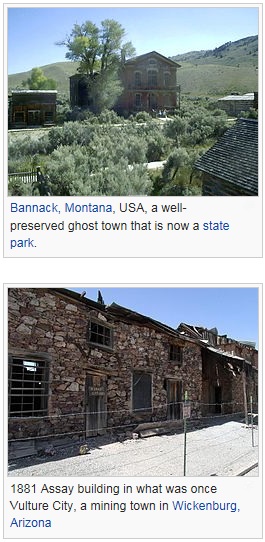
A ghost town is an abandoned village, town or city, usually one which contains substantial visible remains. A town often becomes a ghost town because the economic activity that supported it has failed, or due to natural or human-caused disasters such as floods, government actions, uncontrolled lawlessness, war, or nuclear disasters. The term can sometimes refer to cities, towns, and neighborhoods which are still populated, but significantly less so than in years past; for example those affected by high levels of unemployment and dereliction.[1]
CU Blog - Caribbean Ghost Towns - It Could Happen - Photo 1

Some ghost towns, especially those that preserve period-specific architecture, have become tourist attractions. Some examples are Bannack, Montana; Calico, California; Centralia, Pennsylvania; and Oatman, Arizona in the United States; Barkerville, British Columbia in Canada; Craco in Italy; ElizabethBay and Kolmanskop in Namibia; and Pripyat in Ukraine. Visiting, writing about, and photographing ghost towns is a minor industry. A recent modern-day example is Ōkuma, Fukushima, which was abandoned due to the Fukushima Daiichi nuclear disaster in 2011. (Also see Battleship or Hashima Island in the Appendix-VIDEO below).

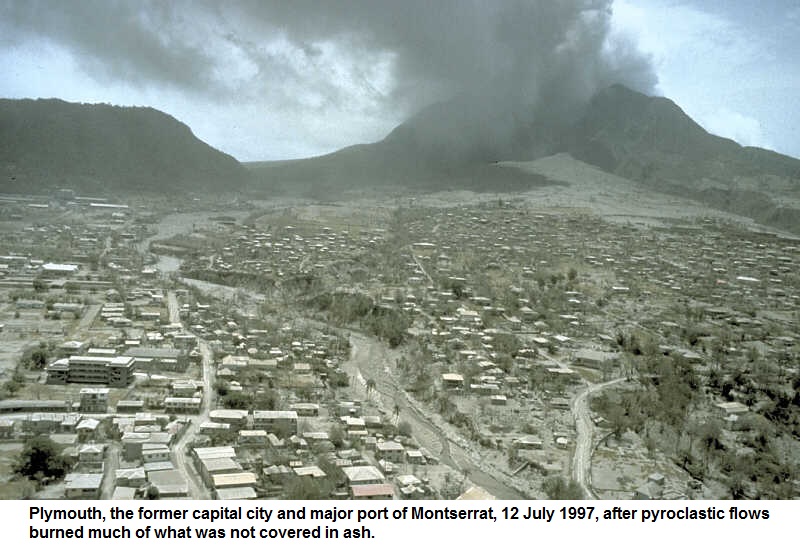
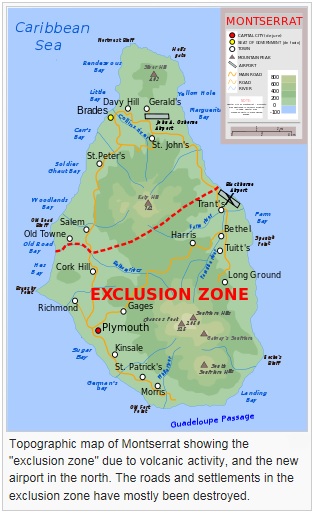
There is a ghost town that is an incumbent de jure capital: Plymouth in the Caribbean island of Montserrat*. This city was abandoned in 1997 due to volcanic eruptions and is now part of an Exclusion Zone.

CU Blog - Caribbean Ghost Towns - It Could Happen - Photo 2

CU Blog - Caribbean Ghost Towns - It Could Happen - Photo 6
(Source: http://en.wikipedia.org/wiki/Ghost_town retrieved February 11, 2015)
The book Go Lean … Caribbean stresses reboots, reorganizations and general turn-around of failing economic engines in favor of winning formulas. The book quotes a noted American Economist Paul Romer with this famous quotation:

“A crisis is a terrible thing to waste”.

The encyclopedic reference of ghost towns continues:

Ghost towns may result when the single activity or resource that created a boomtown (e.g., nearby mine, mill or resort) is depleted or the resource economy undergoes a “bust” (e.g., catastrophic resource price collapse). Boomtowns can often decrease in size as fast as they initially grew. Sometimes, all or nearly the entire population can desert the town, resulting in a ghost town.

The dismantling of a boomtown can often occur on a planned basis. Mining companies nowadays will create a temporary community to service a mine site, building all the accommodation shops and services, and then remove it as the resource is worked out. A gold rush would often bring intensive but short-lived economic activity to a remote village, only to leave a ghost town once the resource was depleted.

In some cases, multiple factors may remove the economic basis for a community; some former mining towns on U.S. Route 66 suffered both mine closures when the resources were depleted and loss of highway traffic as US 66 was diverted away from places like Oatman, Arizona onto a more direct path.

The Middle East has many ghost towns that were created when the shifting of politics or the fall of empires caused capital cities to be socially or economically non-viable, such as Ctesiphon, (a once great city of ancient Mesopotamia; today’s modern-day Iraq, Kuwait, and the northeastern section of Syria).

The Go Lean book posits that many Caribbean communities suffer from a mono-industrial complex (Page 3), therefore the risk is high for the same ghost town eventuality like so many other towns have experienced. Yes, ghost towns could happen in the Caribbean … again.

In fact, the 2nd city in the Bahamas, Freeport, on the island of Grand Bahama is experiencing a sharp decline in it’s economic output – where tourism is the primary industry – calculated at 66 percent decline from 2004 to 2013 for air arrivals. They are now near a failed-city status.
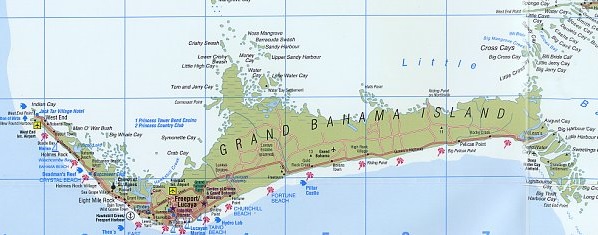
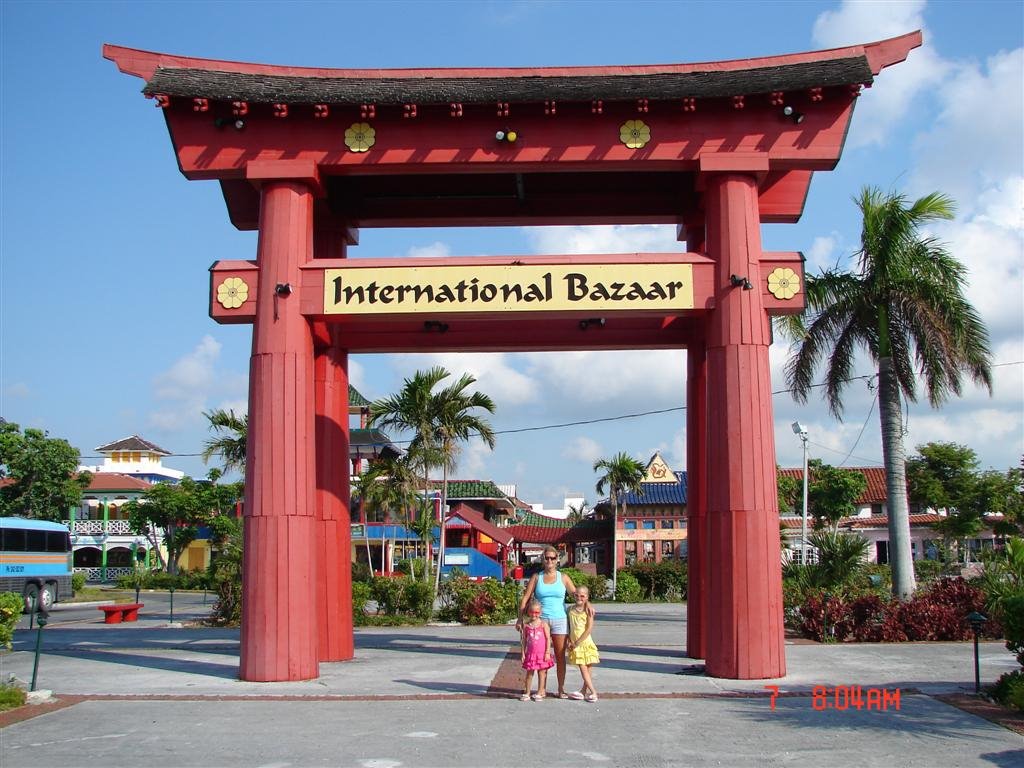
CU Blog - Caribbean Ghost Towns - It Could Happen - Photo 11Freeport’s tourism, which used to top over a million visitors a year – with air arrivals and cruise passengers – has considerably diminished since 2004, when two major hurricanes, Hurricane Frances and Hurricane Jeanne, hit the island; then the following year (2005), Hurricane Wilma reiterated more destruction to Freeport’s economic engines – many hotels shuttered their doors for good. Since then, several cruise ships also stopped their weekly visits to the island. Much of the remaining tourist industry is centered on the seaside suburb of Lucaya; in fact the city is often promoted as Freeport/Lucaya. Most remaining hotels on the island are located along the southern shore in Lucaya. The primary shopping venues for tourists used to be the popular International Bazaar near downtown Freeport, but now the focus has shifted to the Port Lucaya Marketplace, an outdoor mall-like complex near the beach-side hotel-resorts.

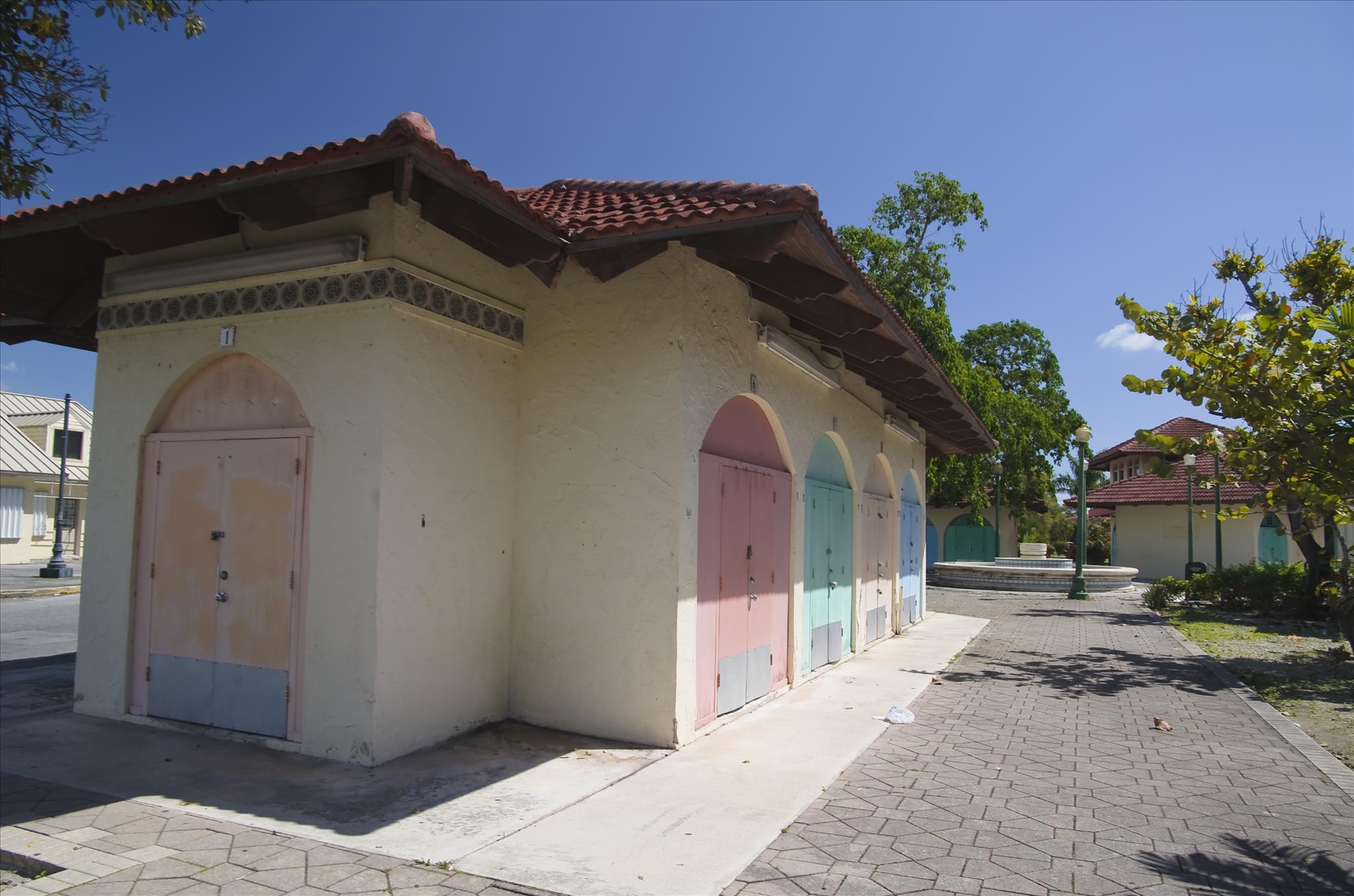
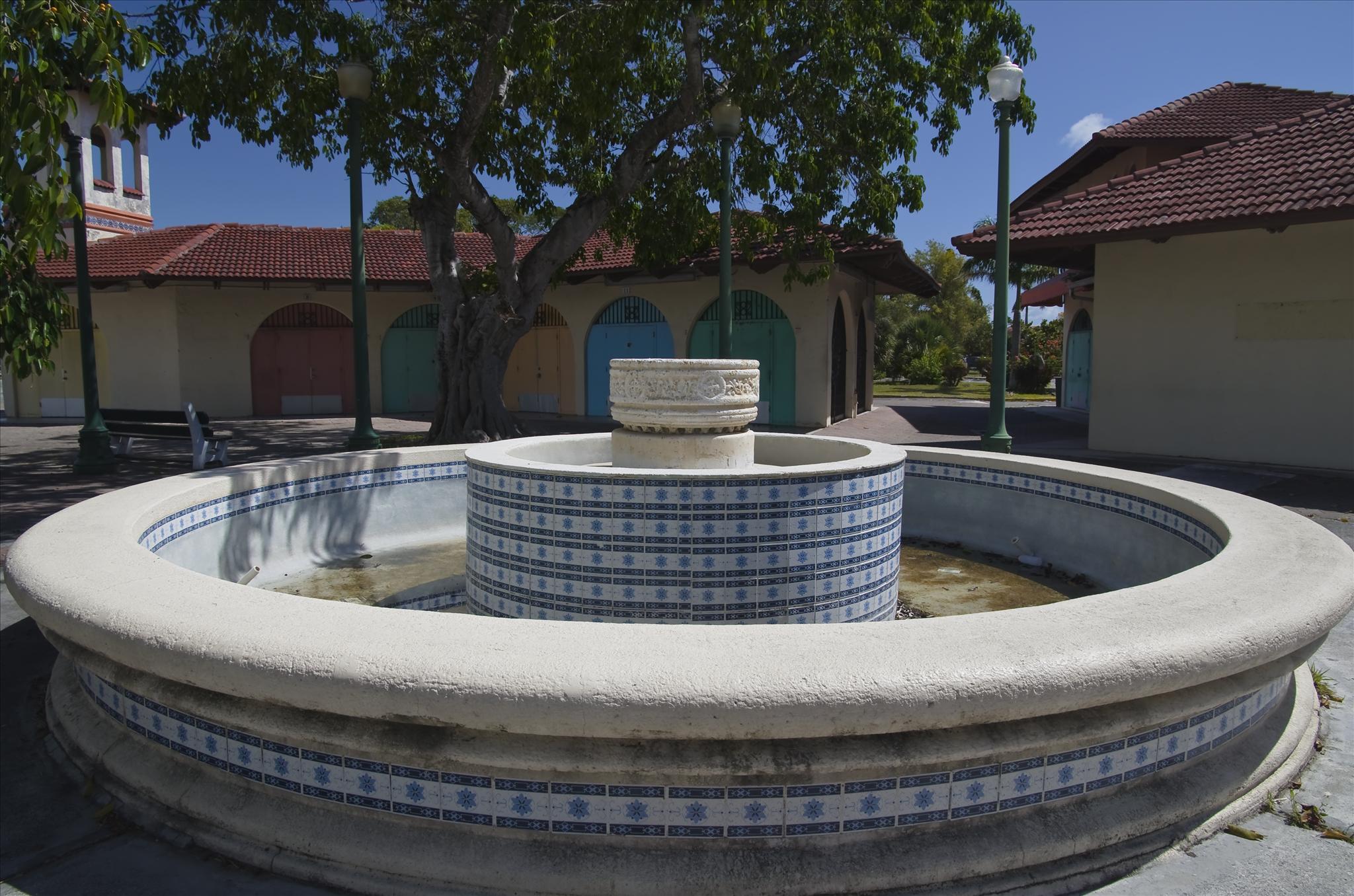
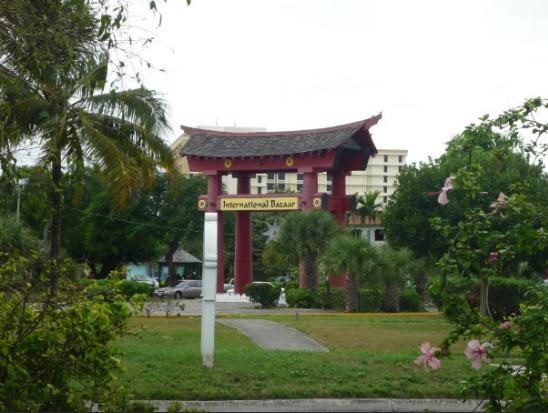
What of the current disposition of the International Bazaar in the downtown area? Unfortunately, the adjoining hotel-casino-resort, Royal Oasis, closed after the above hurricanes and never re-opened.  A local Bahamas photography magazine thusly dubbed the International Bazaar as a “ghost town”. (Retrieved February 11, 2015; article entitled: “The International Bazaar – The Lost Shopping Mecca”):

What happened to this marvelous structure? I do not know. What is its fate? I still do not know. What I do know: it is a sad day when one of the Bahamas’ greatest attractions has been reduced to a ghost town.  What I can tell you is that it seems as if the excitement has moved from the Bazaar to Port Lucaya. It is now the New Shopping Mecca of Grand Bahama.

Photo Caption: Freeport’s International Bazaar in it’s “Hey Day”
CU Blog - Caribbean Ghost Towns - It Could Happen - Photo 7

CU Blog - Caribbean Ghost Towns - It Could Happen - Photo 3

Photo Caption: Freeport’s International Bazaar Ghost Town Today
CU Blog - Caribbean Ghost Towns - It Could Happen - Photo 9

CU Blog - Caribbean Ghost Towns - It Could Happen - Photo 4

CU Blog - Caribbean Ghost Towns - It Could Happen - Photo 5

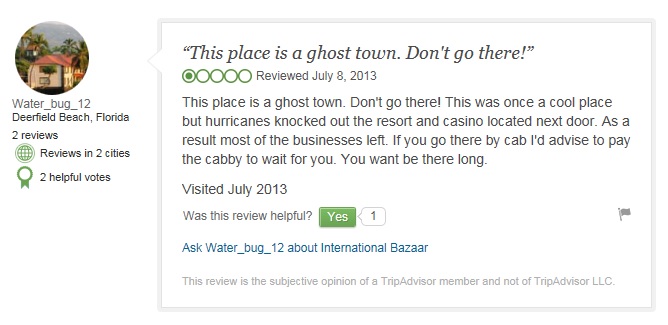
See TripAdvisor.com comments of disappointed visitors:
CU Blog - Caribbean Ghost Towns - It Could Happen - Photo 8

CU Blog - Caribbean Ghost Towns - It Could Happen - Photo 10

In fact, many more comments abound on the internet with “ghost town” comparisons for Freeport.

Freeport must now reboot, or face the eventuality: Ghost Town!

This sad reality of Montserrat and Freeport is an omen for the rest of the Caribbean.

The book Go Lean … Caribbean serves as a roadmap for the introduction and implementation of the technocratic Caribbean Union Trade Federation (CU). The CU is structured to turn-around failing Caribbean communities; it is proffered to provide economic, security and governance solutions for all 30 member Caribbean states, including Montserrat and Freeport. This mandate is detailed early on in the book’s Declaration of Interdependence, as follows (Page 12 & 13):

xii. Whereas the legacy in recent times in individual states may be that of ineffectual governance with no redress to higher authority, the accedence of this Federation will ensure accountability and escalation of the human and civil rights of the people for good governance, justice assurances, due process and the rule of law. As such, any threats of a “failed state” status for any member state must enact emergency measures on behalf of the Federation to protect the human, civil and property rights of the citizens, residents, allies, trading partners, and visitors of the affected member state and the Federation as a whole.

xix. Whereas our legacy in recent times is one of societal abandonment, it is imperative that incentives and encouragement be put in place to first dissuade the human flight, and then entice and welcome the return of our Diaspora back to our shores. This repatriation should be effected with the appropriate guards so as not to imperil the lives and securities of the repatriated citizens or the communities they inhabit…

The Go Lean book posits that failing Caribbean communities can be rescued, that if “we do what we have always done, we get what we have always got”. Therefore Caribbean communities must adopt different community ethos, plus the executions of key strategies, tactics, implementations and advocacies to bring about change, empowerment and turn-around . The following is a sample:

Community Ethos – Economic Principle – Economic Systems Influence Choices & Incentives Page 21
Community Ethos – Economic Principle – Voluntary Trade Creates Wealth Page 21
Community Ethos – Job Multiplier Page 22
Community Ethos – Lean Operations Page 24
Community Ethos – Ways to Impact the Future Page 26
Community Ethos – Ways to Help Entrepreneurship Page 28
Community Ethos – Ways to Impact Turn-Around – Recycling and Demolition Industries Page 33
Community Ethos – Ways to Impact the Greater Good Page 37
Strategy – Mission – Foster Local Economic Engines to Diversify the Economy Page 45
Tactical – Fostering a Technocracy Page 64
Tactical – Tactics to Forge an $800 Billion Economy – High Multiplier Industries Page 70
Tactical – Separation of Powers – Meteorological and Geological Service Page 79
Tactical – Separation of Powers – Self-Governing Entities Page 80
Implementation – Steps to Implement Self-Governing Entities Page 105
Implementation – Ways to Re-boot Freeport Page 112
Planning – Big Ideas – Virtual “Turnpike” Operations to Ensure Continued Relevance Page 127
Planning – Ways to Make the Caribbean Better Page 131
Planning – Ways to Improve Failed-State Indices Page 134
Planning – Lessons from East Germany Page 139
Planning – Lessons from Detroit – Model of City needing Turn-around Page 140
Advocacy – Ways to Grow the Economy Page 151
Advocacy – Ways to Create Jobs Page 152
Advocacy – Ways to Better Improve for Natural Disasters – Volcanoes and Hurricanes Page 184
Advocacy – Ways to Improve Emergency Management – Casualty Insurance to Rebuild Page 196
Advocacy – Ways to Impact Main Street Page 201
Appendix – Job Multipliers Page 259

Natural disasters are an inevitability in the Caribbean: earthquakes, volcanoes and hurricanes. We must insure and assure the business continuity of our communities’ economic engines. To recover, rebuild and reboot communities like Montserrat and Freeport after disasters, the burden or heavy-lifting should be spread across the full region, as leverage for all 30 member-states.

In order to avoid the pitfalls and eventuality of “ghost towns”, communities must diversify their economy. The Go Lean book also describes this heavy-lifting effort to facilitate this goal. The book describes the turn-by-turn directions for all the community stakeholders to follow to reach this goal, categorizing the effort as these 3 prime directives:

  • Optimization of economic engines in order to grow the regional economy to $800 Billion and create 2.2 million new jobs.
  • Establishment of a security apparatus to protect the resultant economic.
  • Improve Caribbean governance to support these engines.

In summary, ghost towns abound throughout the world, (see Appendix-VIDEO below), and can happen again here in the Caribbean region. A mono-industrial economy is bad; disaster  remediation and mitigations are good; diversity is good!

The CU will take the lead … for optimizing economic, security and governing engines. (Starting with a diversification from tourism). Everyone is hereby urged to lean-in to this CU/Go Lean roadmap to make the Caribbean a better place to live, work and play.  🙂

Download the book Go Lean … Caribbean – now!

———

Appendix*Plymouth, Montserrat

Montserrat is a British Overseas Territory located in the Caribbean. The island is located in the Leeward Islands chain of islands.[2] Montserrat is nicknamed The Emerald Isle of the Caribbean both for its resemblance to coastal Ireland and for the Irish ancestry of some of its inhabitants.[3]

Plymouth was the capital of the island of Montserrat. For centuries it had been the only port of entry to the island. On 18 July 1995, the previously dormant Soufrière Hills volcano, in the southern part of the island, became active.  Eruptions destroyed this Georgian era capital city and two-thirds of the island’s population was forced to flee.[6] The town was overwhelmed and was abandoned. The volcanic activity continues, even today, mostly affecting the vicinity of Plymouth, including its docking facilities, and the eastern side of the island around the former W.H. Bramble Airport, the remnants of which were buried by flows from volcanic activity on 11 February 2010.

An Exclusion Zone that extends from the south coast of the island north to parts of the BelhamValley was imposed because of the size of the existing volcanic dome and the resulting potential for pyroclastic activity. Visitors are generally not permitted entry into the exclusion zone, but an impressive view of the destruction of Plymouth can be seen from the top of Garibaldi Hill in IslesBay. Relatively quiet since early 2010, the volcano continues to be closely monitored by the Montserrat Volcano Observatory.

A new town and port is being developed at Little Bay, which is on the northwest coast of the island. While this construction proceeds, the centre of government and businesses rests new Village of Brades in the northen extremes of the island.

(Source: http://en.wikipedia.org/wiki/Montserrat retrieved February 11, 2015)

———

VIDEO: Battleship Island: Japan’s Ultimate Ghost Town – http://youtu.be/wHbQMhmsGPc

Uploaded on Dec 30, 2011 – This island – also known as Hashima Island is among the Japanese chain – sits 9 miles off the coast of Nagasaki. It was the administrative and residential base for undersea coal mines. As a ghost town it serves as a filming location for many projects, including serving as the inspiration for the external filming sets for the film Skyfall  – James Bond 007. For more stunning images of this Holy Grail of all industrial ruins, see: https://www.flickr.com/photos/picturenarrative/sets/72157628124548378/with/6388285131/
 

Share this post:
, , , , , ,

A Lesson in History – Panamanian Balboa

Go Lean Commentary

America has surely changed over the past century!

The people, institutions and governance of the US are now more tolerant of minorities and their communities. As such, there are no more American complexities in overthrowing Latin American & Caribbean governments.

Wink-wink

This hypothesis is validated with the lesson in history from 1941 in the Republic of Panama. This Central American country is a young nation; they were formed in 1903 after seceding from the Republic of Colombia, with US backing. The new country immediately signed a treaty with the US to allow the construction of the Panama Canal, by the US Army Corps of Engineers, and a perpetual lease* for its operations. The country’s separation from Colombia also included changing from the Colombian Peso currency. So in 1904 the Panamanian Balboa currency was launched, but as coins only; the country used the US Dollar as banknotes.

A basic tenant of macro-economics is that countries should issue their own currency and banknotes so as to better influence the economic engines in their communities. By manipulating the banknote quantity and the “Discount Rate” in a Fractional Central Banking System, monetary supply can be regulated, interest rates controlled; credit markets tamed; and yes, money can be created from “thin air”. Panama had none of this control, due to its lack of banknotes.

In 1941, the then-President Dr. Arnulfo Arias pushed the government to create the Central Bank and to issue paper currency. [2] The bank was authorized, constitutionally, to issue up to 6 million Balboas worth of paper notes, but only 2.7 million Balboas were issued on 2 October 1941. Seven days later, Arias was deposed in a military coup – supported by the United States – and replaced by Dr. Ricardo Adolfo de la Guardia Arango as President. The new government immediately closed the bank, withdrew the issued notes, and burned all unissued money stock. In the 74 years since then, the country has never re-attempted to issue its own paper money currency; they continue to use US Dollars, even today.

A bit extreme?

This lesson in history is presented in a consideration of the book Go Lean…Caribbean; it serves as a roadmap for the introduction and implementation of the technocratic Caribbean Union Trade Federation (CU) and Caribbean Central Bank (CCB) to provide better stewardship in ensuring that the currency and economic failures of the past, in the Caribbean and other regions, do not re-occur here in the homeland. The book posits that we must NOT fashion ourselves as an American parasite economy, but rather pursue a status as a protégé.

The full details of the Panamanian Balboa history is provided here:

Title: Panamanian Balboa
(Source: Wikipedia Online Encyclopedia (Retrieved 02/09/2015) – http://en.wikipedia.org/wiki/Panamanian_balboa)

The Balboa (sign: B/.; ISO 4217: PAB) is, along with the United States dollar, one of the official currencies of Panama. It is named in honor of the Spanish explorer / conquistador Vasco Núñez de Balboa. The Balboa is subdivided into 100 centésimos.

The history of the Panamanian Balboa

The Balboa replaced the Colombian Peso in 1904 following the country’s independence. The Balboa has been tied to the United States dollar (which is legal tender in Panama) at an exchange rate of 1:1 since its introduction and has always circulated alongside dollars.

Coins

In 1904, silver coins in denominations of 2½, 5, 10, 25, and 50 centésimos were introduced. These coins were weight-related to the 25 gram 50 centésimos, making the 2½ centésimos coin 1¼ grams. Its small size led to it being known as the “Panama pill” or the “Panama pearl”. In 1907, copper-nickel ½ and 2½ centésimos coins were introduced, followed by copper-nickel 5 centésimos in 1929. In 1930, coins for 110, ¼, and ½ Balboa were introduced, followed by 1 balboa in 1931, which were identical in size and composition to the corresponding U.S. coins. In 1935, bronze 1 centésimo coins were introduced, with 1¼ centésimo pieces minted in 1940.

CU Blog - A Lesson in History - Panamanian Balboa - Photo 1

In 1966, Panama followed the U.S. in changing the composition of their silver coins, with copper-nickel clad 110 and ¼ Balboa, and .400 fineness ½ Balboa. 1 balboa coins, at .900 fineness silver, were issued that year for the first time since 1947. In 1973, copper-nickel clad ½ Balboa coins were introduced. 1973 also saw the revival of the 2½ centésimos coin, which had a size similar to that of the U.S. half dime, but these were discontinued two years later due to lack of popular demand. In 1983, 1 centésimo coins followed their U.S. counterpart by switching from copper to copper plated zinc. Further issues of the 1 Balboa coins have been made since 1982 in copper-nickel without reducing the size.

Modern 1 and 5 centésimos and 110, ¼, and ½ balboa coins are the same weight, dimensions, and composition as the U.S. cent, nickel, dime, quarter, and half-dollar, respectively. In 2011, new 1 and 2 balboa bi-metal coins were issued.[1]

In addition to the circulating issues, commemorative coins with denominations of 5, 10, 20, 50, 75, 100, 150, 200, and 500 Balboas have been issued.

Banknotes

In 1941, President Dr. Arnulfo Arias pushed the government to enact Article 156 to the constitution, authorizing official and private banks to issue paper money. As a result, on 30 September 1941, El Banco Central de Emission de la Republica de Panama was established.[2]

CU Blog - A Lesson in History - Panamanian Balboa - Photo 2

The bank was authorized to issue up to 6,000,000 Balboas worth of paper notes, but only 2,700,000 balboas were issued on 2 October 1941. A week later, Dr. Ricardo Adolfo de la Guardia Arango replaced Arias as president in a coup supported by the United States. The new government immediately closed the bank, withdrew the issued notes, and burned all unissued stocks of same. Very few of these so-called “Arias Seven Day” notes escaped incineration.

Reference Notes:
1. http://worldcoinnews.blogspot.com/search/label/panama
2. Linzmayer, Owen (2012). “Panama”. The Banknote Book. San Francisco, CA: www.BanknoteNews.com.

Panama is out-of-scope of this Go Lean empowerment roadmap. They are not a member-state that caucuses with the Caribbean Community (CariCom), and they do not even have an “Observer” representation/status within the trade bloc. But since a part of their territory-coastline is on the Caribbean Sea, their dealings should generate review and monitoring from Caribbean planners. There are many issues for the Caribbean to consider  – from an academic point-of-view – about this history of Panama: an obvious failed-state as recent as the 1980’s.

Is the American manipulations in Panama’s past reflective of the same America today? The assumption is No! The US no longer draws such “hard lines” in their interactions with peoples of different ethnicity. The country has endured deep soul-searching and reconciliation of its racial past, (Civil Rights Movement, Affirmative Action, etc.), and now even the President of the United States is a Black Man. On the surface today, America is a color-blind society.

On the surface!

Behind the scenes, under the covers, there is another reality. The current American experience is that Black-and-Brown is still institutionally disadvantaged and Wall Street, and by extension “Big American Business”, wields uncanny power over the socio-economic-political affairs of the country. For this and other reasons, the Go Lean movement advocates for Caribbean people and institutions to take their own lead for their own determination. We want to be a protégé of the US, not a parasite.

The roadmap calls for a cooperative entity of the existing regional Central Banks to foster interdependence for the regional Greater Good. We must issue Caribbean banknotes, branded Caribbean Dollars (C$). The totality of the regional market, 42 million people in 30 member-states, is large enough to allow for streamlining of the marketplace, creating the right climate for viable currency/financial/securities markets. While there might be some reticence for liberal currency operations, considering that so many Caribbean member-states had to learn hard lessons on currency over the decades – painful devaluations – the CU is to be structured as a technocracy, with the right mix of skilled talent, gifted genius and independent oversight to allow regional C$ currency markets to soar.

The strategy is not a pro-American stance, no pegging to the US Dollar, therefore no losses will be experienced when the US dollar drops value compared to other international currencies, a far too frequent an occurrence in the last 50 years. The US Dollar planners (Federal Reserve) do not have the Caribbean best-interest in mind for their technocratic decisions regarding their currency management; they have American self-interest in mind. Therefore the Caribbean region must overcome any “fear of math” because the C$ may become stronger, (see VIDEO below), in comparison to the US$. This is why e-Commerce and e-Payments schemes are strongly urged within the CU/Go Lean roadmap.

In general, the CU will employ strategies, tactics and implementations to impact its prime directives; identified with the following 3 statements:

  • Optimization of the economic engines in order to grow the regional economy to $800 Billion & create 2.2 million new jobs.
  • Establishment of a security apparatus to protect the resultant economic engines and mitigate internal and external threats.
  • Improve Caribbean governance to support these engines.

Early in the Go Lean book, this need for careful technocratic stewardship of the regional Caribbean economy was pronounced (Declaration of Interdependence – Page 12 – 13) with these acknowledgements and statements:

xi.   Whereas all men are entitled to the benefits of good governance in a free society, “new guards” must be enacted to dissuade the emergence of incompetence, corruption, nepotism and cronyism at the peril of the people’s best interest. The Federation must guarantee the executions of a social contract between government and the governed.

xii.   Whereas the legacy in recent times in individual states may be that of ineffectual governance with no redress to higher authority, the accedence of this Federation will ensure accountability and escalation of the human and civil rights of the people for good governance, justice assurances, due process and the rule of law. As such, any threats of a “failed state” status for any member state must enact emergency measures on behalf of the Federation to protect the human, civil and property rights of the citizens, residents, allies, trading partners, and visitors of the affected member state and the Federation as a whole.

xxiv.   Whereas a free market economy can be induced and spurred for continuous progress, the Federation must install the controls to better manage aspects of the economy: jobs, inflation, savings rate, investments and other economic principles. Thereby attracting direct foreign investment because of the stability and vibrancy of our economy.

xxv.   Whereas the legacy of international democracies had been imperiled due to a global financial crisis, the structure of the Federation must allow for financial stability and assurance of the Federation’s institutions. To mandate the economic vibrancy of the region, monetary and fiscal controls and policies must be incorporated as proactive and reactive measures. These measures must address threats against the financial integrity of the Federation and of the member-states.

The Go Lean book, and previous blog/commentaries, stressed the key community ethos, strategies, tactics, implementations and advocacies necessary to regulate and manage the regional financial eco-system for the Caribbean currency. These points are detailed in the book as follows:

Community Ethos – Economic Principles – Economic Systems Influence Individual Choices Page 21
Community Ethos – Economic Principles – Consequences of Choices Lie in the Future Page 21
Community Ethos – Economic Principles – Money Multiplier Page 23
Community Ethos – Governing Principles – Lean Operations Page 24
Community Ethos – Ways to Impact the Future Page 26
Community Ethos – Ways to Impact the Greater Good Page 37
Strategy – Mission – Fortify the Stability of the Banking Institutions Page 45
Strategy – Provide Proper Oversight and Support for the Depository Institutions Page 46
Tactical – Ways to Foster a Technocracy Page 64
Tactical – Growing the Economy – Minimizing Bubbles Page 69
Tactical – Separation-of-Powers – Caribbean Central Bank Page 73
Tactical – Separation-of-Powers – Depository Institutions Regulatory Agency Page 73
Anecdote – Turning Around CARICOM – Effects of 2008 Financial Crisis Page 92
Implementation – Assemble Caribbean Central Bank as a Cooperative Page 96
Implementation – Ways to Better Manage Debt Page 114
Planning –10 Big Ideas – Single Market / Currency Union Page 127
Planning – Ways to Improve Failed-State Indices Page 134
Planning – Lessons Learned from 2008 Page 136
Planning – Ways to Measure Progress Page 147
Anecdote – Caribbean Currencies Page 149
Advocacy – Ways to Grow the Economy Page 151
Advocacy – Ways to Control Inflation Page 153
Advocacy – Reforms for Banking Regulations Page 199
Advocacy – Ways to Impact Wall Street Page 200
Advocacy – Ways to Impact Main Street Page 201
Appendix – Controlling Inflation – Technical Details Page 318
Appendix – Jamaica’s International Perception – “High inflation and currency dysfunction” Page 297

The points of effective, technocratic banking/economic stewardship of regional currencies, were further elaborated upon in these previous blog/commentaries:

https://goleancaribbean.com/blog/?p=3889 RBC EZPay – Ready for Change
https://goleancaribbean.com/blog/?p=3858 ECB unveils 1 trillion Euro stimulus program
https://goleancaribbean.com/blog/?p=3814 Lessons from the Swiss unpegging the franc
https://goleancaribbean.com/blog/?p=3743 Trinidad cuts 2015 budget as oil prices tumble
https://goleancaribbean.com/blog/?p=3582 For Canadian Banks: Caribbean is a ‘Bad Bet’
https://goleancaribbean.com/blog/?p=3090 Lessons Learned – Europe Sovereign Debt Crisis of 2009
https://goleancaribbean.com/blog/?p=2930 ‘Too Big To Fail’ – Caribbean Version
https://goleancaribbean.com/blog/?p=949 Inflation Matters
https://goleancaribbean.com/blog/?p=833 One currency, divergent economies
https://goleancaribbean.com/blog/?p=518 Analyzing the Data – What Banks learn about financial risks
https://goleancaribbean.com/blog/?p=378 US Federal Reserve Releases Transcripts from 2008 Meetings/Stimulus
https://goleancaribbean.com/blog/?p=273 10 Things We Don’t Want from the US – #3: Quantitative Easing

Similar to Panama, there are a number of Caribbean member-states that use the US dollar as their sole paper currency:

  • British Virgin Island
  • Turks & Caicos Islands
  • Dutch Caribbean Territories: Bonaire, Sint Eustatius and Saba
  • US Territories of Puerto Rico & US Virgin Islands

The Go Lean book reports that previous Caribbean administrations have failed miserably in managing regional currencies. Consider Jamaica for example, despite being pegged 1-to-1 with the US dollar in 1960’s, the J$ was trading at 87-to-1 with the US$ at press time for the book (November 2013). Other countries (like Trinidad, Dominican Republic, and the Eastern Caribbean Currency Union states) experienced similar turmoil, though at lesser rates of devaluation. The book opens with the declaration that the Caribbean is in crisis because of episodes like these currency failings. In every case, the direct after-effect was increased societal abandonment, and now the reported brain-drain rate is estimated at 70%, with some countries even reporting up to 81%. This disposition is symptomatic of a Failed-State status.

Currency management includes details of more than just the paper-money people carry in their wallets. The book describes the 4 basic functions of money:

  • a medium of exchange
  • a unit of account
  • a store of value
  • a standard of deferred payment

These dynamics have an effect on inflation/deflation and trade facilitation with other countries. So Central Banks must strenuously manage currency issues to ensure economic progress and avoid financial dysfunction. This point is conveyed in the following VIDEO, as regards the Central Bank management of the Chinese Yuan.

VIDEO: Pegging the Yuan – http://youtu.be/S-9iY1OgbDE

Uploaded on Oct 25, 2010 – How the Chinese Central Bank could peg the Yuan to the dollar by printing Yuan and buying dollars (building up a dollar reserve). This lesson in macro-economics can be applied to any Central Bank, any other currency.

There are so many currency issues that have to be coordinated that the Go Lean book describes the effort as heavy-lifting. The roadmap (Page 5) declares that change has come to the Caribbean, and that new technocrats are ready to assume oversight of regional currency issues:

Please swallow your pride
If I have things you need to borrow
For no one can fill those of your needs
That you won’t let show
You just call on me brother, when you need a hand

(Chorus)
We all need somebody to lean on
I just might have a problem that you’d understand
We all need somebody to lean on

(Lyrics of song: Lean On Me, by Singer/Songwriter: Bill Withers)

This is not the same world as 1941 Panama, but still there are many lessons to learn and apply in the Caribbean. The goal is simple, to move the region to a new destination: a better homeland to live, work and play. Now is the time for all of the Caribbean, the people, banking establishments and the governing institutions, to lean-in for the changes described in the book Go Lean … Caribbean.

🙂

Download the free e-Book of Go Lean … Caribbean – now!

———

* Appendix Footnote: Subsequent treaties added an expiration date for 1999; the Canal is now fully Panamanian.

Share this post:
, , , ,
[Top]

The African Renaissance Monument

Go Lean Commentary

The commentaries of the Go Lean…Caribbean blogs have often addressed the Caribbean Diaspora. But for many people of Caribbean heritage, they are a member of a larger Diaspora, the African Diaspora. Every Caribbean member-state – except for the French Territory Saint Barthélemy and the new Indo-Guyanese immigrant reality – has a majority population of Black or African ethnicity. So most people of the region have been affected by events that took place in Western Africa during the Atlantic Slave Trade. Any symbolism or artistic expression commemorating this historic sacrifice of Africa to the Caribbean genome should be acknowledged, promoted and celebrated.

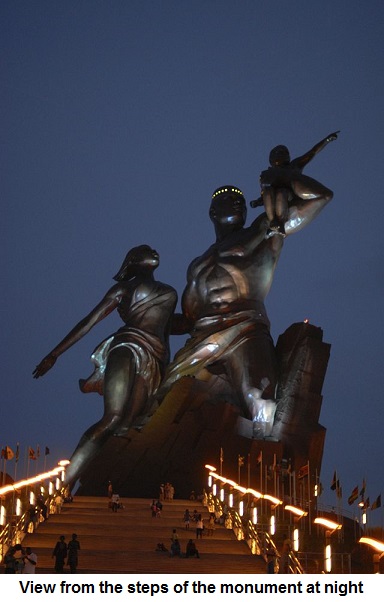
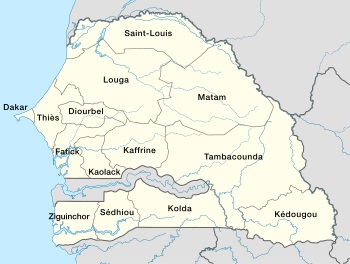
This prominent statue in Dakar, Senegal, the African Renaissance Monument, is the epitome of such a symbolism.

 CU Blog - The African Renaissance Monument - Photo 1

CU Blog - The African Renaissance Monument - Photo 2

CU Blog - The African Renaissance Monument - Photo 3

This monument should be a World Heritage Site.

This subject aligns with the book Go Lean…Caribbean which details a plan to promote World Heritage Sites (Page 248) in the Caribbean region. The book also asserts that there are good economic returns to be harnessed by communities investing in regional artists and the eco-systems surrounding the business of the arts.

This commentary continues that pattern, established in the book. The following encyclopedic details provides a role model for how the Caribbean can further develop this industry space:

Title: African Renaissance Monument – Source: Wikipedia Online Encyclopedia (Retrieved 02/08/2015 from: http://en.wikipedia.org/wiki/African_Renaissance_Monument)

The African Renaissance Monument is a 49m tall bronze statue located on top of one of the twin hills known as Collines des Mamelles, outside of Dakar, Senegal. Built overlooking the Atlantic Ocean in the Ouakam suburb, the statue was designed by the Senegalese architect Pierre Goudiaby after an idea presented by president Abdoulaye Wade (in office from year 2000 to 2012) and built by Mansudae Overseas Projects, a company from North Korea.[1] Site preparation on top of the 100-meter high hill began in 2006, and construction of the bronze statue began 3 April 2008.[2] Originally scheduled for completion in December 2009, delays stretched into early 2010, and the formal dedication occurred on 4 April 2010, Senegal’s “National Day”, commemorating the 50th anniversary of the country’s independence from France.[3] It is the tallest statue in Africa.

CU Blog - The African Renaissance Monument - Photo 4

CU Blog - The African Renaissance Monument - Photo 5

Construction

The monument is made of 3-centimetre thick metal sheets and depicts a family group emerging from a mountaintop: a full-length statue of a young woman, a man, and held aloft on the man’s raised left arm, a child resolutely pointing west towards the sea. Construction of the bronze statue group was carried out by the North Korean firm Mansudae Overseas Project Group of Companies.[4]

The project was launched by then Senegalese president Abdoulaye Wade who considered it part of Senegal’s prestige projects, aimed at providing monuments to herald a new era of African Renaissance.

Unveiling

On 3 April 2010, the African Renaissance Monument was unveiled in Dakar in front of 19 African heads of state, including President of Malawi and the African Union Bingu wa Mutharika, Jean Ping of the African Union Commission and the Presidents of Benin, Cape Verde, Republic of Congo, Ivory Coast, Gambia, Liberia, Mali, Mauritania and Zimbabwe, as well as representatives from North Korea, and Jesse Jackson and musician Akon, both from the United States.[3][5] Everyone was given a tour.[3][5]

President Wade said “It brings to life our common destiny. Africa has arrived in the 21st century standing tall and more ready than ever to take its destiny into its hands”.[6] President Bingu said “This monument does not belong to Senegal. It belongs to the African people wherever we are”.[7]

Criticism

Expense
Thousands of people protested against “all the failures of [President] Wade’s regime, the least of which is this horrible statue” on the city’s streets beforehand, with riot police deployed to maintain control.[3] Deputy leader of the opposition Ndeye Fatou Toure described the monument as an “economic monster and a financial scandal in the context of the current [economic] crisis”.

The colossal statue has been criticized for its cost at US$ 27 million (£16.6m).[1] The payment was made in kind, with 30 to 40 hectares of land that will be sponsored by a Senegalese businessman.[8]

Style
Senegalese opposition leaders have also questioned the style of the project, labelling it “Stalinist“, while art critics have pointed out that the body shapes are cartoon-like, with only vaguely African facial features.[1] It has also been suggested that the monument is a stark representation of the macho sexism of African authoritarian rulers.[9] The statue’s design has been derided internationally because of false claims of its Senegalese origin, actually having been designed by a Romanian architect and built by a North Korean sculpting company famous for various projects and large statues throughout Africa since the 1970s.[10] It was a poorly received piece by art critics around the world after its much-delayed unveiling in 2010, and has been compared by some to the infamous (and now-abandoned) Christopher Columbus statue project that was underway in Cataño, Puerto Rico in the late 1990s and early 2000s.[11] Local Imams (Islamic Spiritual Leaders) argue that a statue depicting a human figure is idolatrous, and object to the perceived immodesty of the semi-nude male and female figures.[12]

In December 2009, president Abdoulaye Wade apologised to Senegal’s Christian minority for comparing the statue to Jesus Christ.[1]

Revenue
The project has also attracted controversy due to Wade’s claim to the intellectual property rights of the statue, and insisting that he is entitled to 35 percent of the profits raised.[12] Opposition figures have sharply criticized Wade’s plan to claim intellectual property rights, insisting that the president cannot claim copyright over ideas conceived as a function of his public office.[13][1]

Local artists
Ousmane Sow, a world-renowned Senegalese sculptor, also objected to the use of North Korean builders, saying it was anything but a symbol of African Renaissance and nothing to do with art.[14]

The book Go Lean…Caribbean is a economic elevation roadmap for the Caribbean, not Africa. But there are many lessons for the Caribbean to glean from this African Renaissance Monument project: good, bad and ugly. Whereas, this monument project does not have the economic impact of the Statue of Liberty in New York Harbor, it has potential.

This discussion of “art in the public domain” is not just academic. Community pride, jobs, and the growth of the regional economy is involved. This point aligns with the objectives of the Go Lean book, in that it serves as a roadmap for the introduction and implementation of the technocratic Caribbean Union Trade Federation (CU). This effort will harness the individual genius abilities (micro) of artists so as to elevate the arts and the economic impact on their related communities (macros). To glean these economic benefits, the charter for the regional “art world” must be bigger than just sculpture; it must also include paintings, fashion, music, film and performing arts (dance & theater). The CU will employ strategies, tactics and implementations to impact its prime directives, defined with the following 3 statements:

  • Optimization of the economic engines in order to grow the regional economy to $800 Billion & create 2.2 million new jobs.
  • Establishment of a security apparatus to protect the resultant economic engines.
  • Improve Caribbean governance to support these engines.

The Go Lean book identified this vision early in the book (Page 13 & 14) in the following pronouncements in the Declaration of Interdependence:

Preamble: As the history of our region and the oppression, suppression and repression of its indigenous people is duly documented, there is no one alive who can be held accountable for the prior actions, and so we must put aside the shackles of systems of repression to instead formulate efficient and effective systems to steer our own destiny.
As the colonial history of our region was initiated to create economic expansion opportunities for our previous imperial masters, the structures of government instituted in their wake have not fostered the best systems for prosperity of the indigenous people.

xxi.      Whereas the preparation of our labor force can foster opportunities and dictate economic progress for current and future generations, the Federation must ensure that educational and job training opportunities are fully optimized for all residents of all member-states, with no partiality towards any gender or ethnic group. The Federation must recognize and facilitate excellence in many different fields of endeavor, including sciences, languages, arts, music and sports. This responsibility should be executed without incurring the risks of further human flight, as has been the past history.

xxxiii.      Whereas the cultural arts and music of the region are germane to the quality of Caribbean life, and the international appreciation of Caribbean life, the Federation must implement the support systems to teach, encourage, incentivize, monetize and promote the related industries for arts and music in domestic and foreign markets. These endeavors will make the Caribbean a better place to live, work and play.

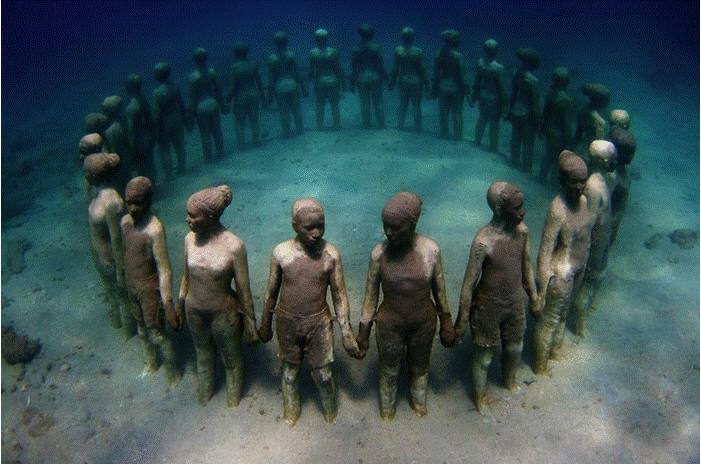
The foregoing African Renaissance Monument is on the Eastern side of the Atlantic; there is also a monument effort on the Western side of the Atlantic: the “Vicissitudes” and other features in the Moilinere Bay Underwater Sculpture Park in the waters off the Caribbean island of Grenada. The voyage across the Atlantic was referred to as the Middle Passage, a segment in the Slave Trade Triangle. Many victims, African captives designated to be sold in slavery, did not survive the Middle Passage. The Vicissitudes are in honor of the African Ancestors who were thrown overboard during the voyage; (retrieved from: http://en.wikipedia.org/wiki/Molinere_Underwater_Sculpture_Park).

1. “Vicissitudes” – According to the primary professional Artist, British Sculptor Jason de Caires Taylor:

“Vicissitudes depicts a circle of figures, all linked through holding hands. These are life-size casts taken from a group of children of diverse ethnic background. Circular in structure … the work both withstands strong currents and replicates one of the primary geometric shapes, evoking ideas of unity and continuum. … The sculpture proposes growth, chance, and natural transformation. It shows how time and environment impact on and shape the physical body. Children by nature are adaptive to their surroundings. Their use within the work highlights the importance of creating a sustainable and well-managed environment, a space for future generations.”

2. Amateur Projects – Cast student faces in the side of a large underwater stone: Theophilus Albert Marryshow Community College

In March 2007, a project was initiated with Helen Hayward of T.A. Marryshow Community College (Grenada) to produce a series of works for the Molinere sculpture park. Workshops were planned with A-level Art and Design students; (senior exams – General Certificate of Education or GCE – from the University of London). Each student was required to produce a life cast of their face, to form an installation two meters deep around the shoreline of Molinere Bay.

The project aimed to encourage local artists to contribute further works to the site and provide a arena for communities to appreciate and highlight the marine processes evident in their local environment.

The students were taught a range of skills including life-casting, cement casting and sculpting. The final pieces were installed by Jason [de Caires Taylor] on 25th April 2007.

CU Blog - The African Renaissance Monument - Photo 6

CU Blog - The African Renaissance Monument - Photo 7

The following news article relates the coverage received at the project’s implementation:

Title: Underwater Sculpture Park off Grenada is stunning and unique
Sub-title: Jason de Caires Taylor is an internationally recognized sculptor with a difference.
(Source: http://www.telegraph.co.uk/news/earth/environment/3538787/Underwater-sculpture-park-off-Grenada-is-stunning-and-unique.html)

December 1, 2008 – Instead of bleak urban backdrops for his creations, [artist Jason de Caires Taylor] has crafted a stunning and unique underwater sculpture park in the shallow waters off the West Indies island of Grenada.

His desire to create striking and meaningful art forms and his love of the underwater world led him to explore the intricate relationships between art and the environment.

For Grenada, this has resulted in a series of beautiful marine seascapes that have formed a series of artificial reefs, drawing new life into areas which have been damaged by nature’s raw power and mans intervention.

Jason discusses his work in a video interview with Miranda Krestovnikoff, one of the UK faces of a new global web TV channel, The Underwater Channel.

Miranda, also a BBC One Show / Coast presenter, explores Jason’s motivations and shows footage of his installations demonstrating the beauty of the structures and the way they interact with their environment. In some zones, the shifting sands of the ocean floor can change the whole viewing experience from moment to moment.

The sculptures are sited in clear, shallow waters to allow easy access by divers, snorkellers and those in glass-bottomed boats. Jason is keen to engage local people, particularly children, in his work to build a direct relationship with and understanding of their own precious natural resource.

The physical nature of the underwater world is vastly different from that of dry land. Objects appear 25 per cent larger underwater, and as a consequence they also appear closer. Colours alter as light is absorbed and reflected at different rates, with the depth of the water affecting this further.

The large number of angles and perspectives from which the sculptures can be viewed increase the unique experience of encountering the works.

His first work, Grace Reef, was built in a bay where the coral growth and natural habitat had been decimated by Hurricane Ivan. It comprises 16 statues, each cast from a local Grenadian woman.

Located across an expansive underwater area the work draws marine life to a zone that has suffered substantial and sustained storm damage. The direction and strengths of currents mean that entire sections of the work become covered, hidden and lost. At other times figures emerge and are fully visible.

Another major work is Vicissitudes comprising the extraordinary visual impact of a circle of 26 life-size children of diverse ethnic background, all holding hands and facing outwards.

The cement finish and chemical composition of Vicissitudes actively promotes the colonisation of coral and marine life. This natural process echoes the changes experienced through growing up and shows how time and environment impact on and shape the physical body.

Children by nature are adaptive to their surroundings and their use within the work highlights the importance of creating a sustainable and well-managed environment, a space for future generations.

“This piece took six months to create and weighs about 15 tons” Jason tells Miranda. “Consequently I had to install it in sections and it attracted quite a lot of local attention as parts of it sat outside the front of my house!”.

Un-Still life is a beautiful depiction of the essence of growth and change in the marine environment which mirrors the composition of still life tableaux.

On a table is an arrangement of cement objects; a vase, bowl and fruit. In contrast to established ideas of stasis the work is constantly changing, remaining a work in progress as living coral builds layers onto its surface and marine creatures take up residence in its tiny nooks and crannies.

This colonization becomes a physical equivalent to the conventional development of drawing and painting.

Jason currently has 65 stunning installations in place. The majority of his work is in Grenada, but he also has additional projects in the UK and Europe. Contracts have been agreed for the first phase of a new underwater project in Mexico, placed within the National Marine Park of Cancun, Isla Mujeres and Nisuc. Jason works out of his studio in London.

VIDEO: Grenada Underwater Sculpture Park, Molinere Bay, Marine Protected Area, Grenada, West Indies – http://youtu.be/Zmy0o7Zk4wg

Published by Louis Kahn (c) on Apr 1, 2012 – Video shot while scuba diving in Grenada at the Underwater Sculpture
Park.

The African Renaissance Monument in Senegal should be a World Heritage Site.

The stunning and unique Underwater Sculpture Park in Grenada should be a World Heritage Site; and similar expressions should be duplicated throughout the Caribbean region.

Imagine eco-tourism tours, SCUBA divers, glass-bottom boats and sub-marines, to this site and other monuments erected in kind.

Previous Go Lean blog/commentaries related artistic endeavors in the region and how they have impacted the communities; consider this sample as follows:

https://goleancaribbean.com/blog/?p=3999 Sir Sidney Poitier – ‘Breaking New Ground’ in the Film Arts
https://goleancaribbean.com/blog/?p=3641 ‘We Built This City …’ on Music and Show-business
https://goleancaribbean.com/blog/?p=3568 Forging Change: Music Moves People
https://goleancaribbean.com/blog/?p=3292 Art Basel Miami – a Testament to the Spread of Art & Culture
https://goleancaribbean.com/blog/?p=2726 Caribbean Role Model for the Arts/Fashion – Oscar De La Renta: RIP
https://goleancaribbean.com/blog/?p=2415 How ‘The Lion King’ roared into history
https://goleancaribbean.com/blog/?p=1909 Music Role Model Berry Gordy – No Town Like Motown
https://goleancaribbean.com/blog/?p=1037 Humanities Advocate – Maya Angelou: RIP
https://goleancaribbean.com/blog/?p=866 Caribbean Music Man: Bob Marley – The legend lives on!

The Slave Trade and Middle Passage victimized millions of innocent people. The world must never forget the travesty and sacrifice of the African people. The Bible makes a related statement at Isaiah 56:5 (NET Bible): “I will set up within my temple and my walls a monument that will be better than sons and daughters. I will set up a permanent monument for them that will remain”.

Now is the time for all of the Caribbean to lean-in to the following community ethos, strategies, tactics, implementations and advocacies detailed in the book Go Lean … Caribbean to foster remembrances and memorials in the region:

Community Ethos – Deferred Gratification – African Diaspora Experience Page 21
Community Ethos – People Respond to Incentives in Predictable Ways Page 21
Community Ethos – Consequences of Choices Lie in the Future Page 21
Community Ethos – Return on Investments Page 24
Community Ethos – Ways to Foster Genius – High Art Intelligence Page 27
Community Ethos – Ways to Promote Happiness Page 36
Community Ethos – Ways to Impact the Greater Good Page 37
Strategic – Vision – Integrating Region in to a Single Market Page 45
Strategic – Mission – Preserve Caribbean Ecology Page 46
Tactical – Fostering a Technocracy Page 64
Tactical – Separation of Powers – Culture Administration Page 81
Tactical – Separation of Powers – Fairgrounds Administration Page 83
Implementation – Steps to Implement Self-Governing Entities (SGE’s) Page 105
Implementation – Ways to Deliver Page 109
Planning – 10 Big Ideas for the Caribbean Region Page 127
Planning – Ways to Make the Caribbean Better Page 131
Planning – Ways to Better Manage Caribbean Image Page 133
Advocacy – Ways to Grow the Economy Page 151
Advocacy – Ways to Create Jobs Page 152
Advocacy – Ways to Improve Governance Page 168
Advocacy – Ways to Improve Libraries – Creative Exhibits & Archives Page 187
Advocacy – Ways to Enhance Tourism – Eco-Tourism Page 190
Advocacy – Ways to Promote Fairgrounds – Art Colonies as SGE’s Page 192
Advocacy – Ways to Impact Public Works – Aesthetic & Practical Page 175
Advocacy – Ways to Better Manage Natural Resources – World Heritage Sites Page 183
Advocacy – Ways to Impact the Diaspora Page 217
Advocacy – Ways to Preserve Caribbean Heritage Page 218
Advocacy – Ways to Improve the Arts Page 230
Advocacy – Ways to Impact Urban Living – Access to the Arts and Culture Page 234
Advocacy – Ways to Promote World-Heritage-Sites – Petition UNESCO for more… Page 248
Appendix – Taos (New Mexico) Artist Colony Page 291
Appendix – List of 21 World Heritage Sites in the Caribbean region Page 330

Now is the time for all of the Caribbean, the people and governing institutions, to lean-in for the empowerments described in the book Go Lean…Caribbean. This is a big deal for regional artists and art institutions. This book provides the turn-by-turn directions for how to monetize the arts and foster genius potential. By pursuing the strategies, tactics, and implementations of this roadmap, we do not only impact the artists; we also impact the whole world.

“Artists have a unique power to change minds and attitudes” – President Obama urging to the Grammy’s audience (musical artists) on February 8, 2015.

The Caribbean needs change…and empowerments (jobs, economic growth and brand/image enhancement); plus we need to always remember the great sacrifices of the others that came before us, and those that did not survive.

🙂

Download the book Go Lean … Caribbean – now!

Share this post:
, , , ,
[Top]

How to Train Your ‘Dragon’ – Freeport Version

Go Lean Commentary

The term ‘dragon’ has a deep and rich meaning in all of literature; see Appendix A for a list of different cultures with dragon mythologies.

CU Blog - Freeport Version - How to Train My Dragon - Photo 6

Needless to say, there is no such creature, apart from the adorable Komodo Dragon, a big lizard native to South Pacific and Australasia region.

Even in scripture, the great Enemy, Satan the Devil is depicted as a Dragon; (Revelation 12:9). This commentary is not labeling any one person as a “Dragon”, but rather assigning the term “Dragon” to a “Dependence on Foreign Investors” or DFI.

So figuratively, the term “dragon” refers to an adversarial creature. This is where the relevance is to this commentary for the promotion of the book Go Lean…Caribbean. The book calls for the elevation of Caribbean economics, security and governance. It assesses many “dragon-like” challenges that stand in the way of progress and have resulted in near wholesale abandonment of so many communities.

One city of focus for this commentary is the 2nd city in the Bahamas, Freeport/Lucaya. This town is now undergoing a crisis in all three challenge factors (economics, security, and governance), and yet the book maintains that this “dragon can be trained’ see VIDEO below. Part of this crisis is the fact the certain tax-free provisions, real property tax and Business License, of the Hawksbill Creek Agreement (that led to the private development of Freeport) will expire on August 4, 2015. The national government is pondering renewal and extension; the ongoing stalemate, exacerbates the municipal crisis.

The book opens with the declaration that a crisis is a terrible thing to waste. For the Caribbean region there is not just one issue, but rather many negative/downward triggers, all which are addressed in the Go Lean book. While these challenges abound through out the region, Freeport’s exposure to these following triggers are more heightened than elsewhere:

  • Climate Change and threats from natural disasters
  • Decline of the American Middle Class, since the 2008 financial crisis
  • Decimation of the tourism product – measured decline in amenities like Golf and Casino Gambling.
  • Failure to diversify the economy with any industrial base
  • Emergence of powerful elite, the One Percent.
  • Bureaucratic hindrance of Foreign Direct Investors
  • Security threats from border encroachments of illegal immigrants.
  • Security threats of immigrants assimilating their adopted societies.

Harsh realities have now come to fruition in the Caribbean, but the town of Freeport have been hard hit with the full force of all of these dynamics. The book therefore posits that there is a need to re-focus, re-boot, and optimize the engines of commerce so as to make all the Caribbean a better place to live, work and play. While all the Caribbean needs to create jobs, this town of Freeport, has a greater need, more so than others.

Ship-building, in its many genres, is being promoted for adoption and incubation. This is just one of the advocacies identified, qualified and proposed in the Go Lean book. In total, there are 144 advocacies, catalogued in the areas of Community Ethos, Strategy, Tactics, Implementations, Planning, Economics, Government, Industries, Social, and Locations.

Normally DFI refer to Direct Foreign Investment, but in this case the “Dependence on Foreign Investors” is portrayed as a negative factor or pest – a dragon –  unless “trained”, caroled and controlled to harness the energy in a positive way.

Consider these news articles that describe the business climate and players for the Freeport landscape:

1. Freeport Plutocratic Benefactor – Sir Jack Hayward:

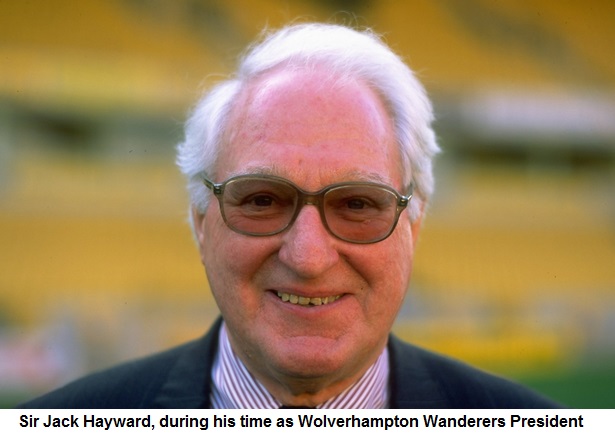
CU Blog - Freeport Version - How to Train My Dragon - Photo 5Sir Jack Hayward, British Businessman, Property Developer, Philanthropist and Sports Team Owner was memorialized by fans of his football team Wolverhampton Wanderers F.C.. He passed away last week (January 13) at age 91. He was loved and hated in different circles, some even compared his racism to Adolf Hitler – perhaps a hyperbole. Sir Jack was also a principal owner in the Grand Bahama Port Authority*. So he wielded power as to the municipal affairs and economic development of this city.

http://www.birminghammail.co.uk/sport/wolves-football-pundit-barry-glendenning-8481522

2. Fleeing a “sinking ship”:

Sir Jack Hayward Jack arrived in Grand Bahama in 1956 to promote the development of Freeport and became a Vice-President of the Grand Bahama Port Authority; eventually he assumed the Chairmanship of the Board of Directors (after 2004). Until the convalescence before his death, he continued to play an active role in Freeport. Sir Jack was in negotiations to sell his family’s 50 per cent stake in the GBPA Group of Companies. Now that provisions of the Hawksbill Creek Agreement (HCA) need renewal from the national government, multiple “dragons” are now circling the City of Freeport.

http://www.tribune242.com/news/2015/jan/28/sir-jack-port-sale-talks-passing/

3. At the precipice:

Community leaders in Freeport have declared that it would be “disastrous” if the national government fail to pursue HCA extension and allow the levy of real property taxes on GBPA licensees; “this would be another nail in Freeport’s coffin”. Freeport is now at the precipice – dragons are circling.

http://www.tribune242.com/news/2015/jan/08/freeport-disaster-if-property-tax-imposed/

4. Roadmap for economic empowerments:

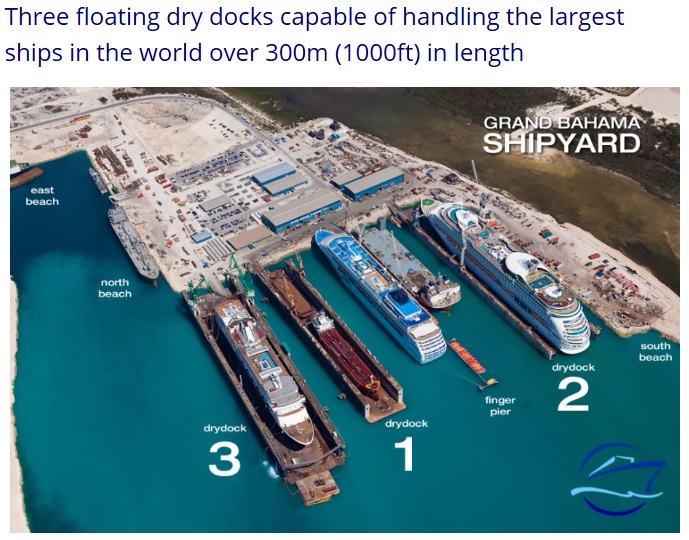
CU Blog - Freeport Version - How to Train My Dragon - Photo 4The Go Lean roadmap is not a work of fiction or mythology; it is based on the reality of the Caribbean disposition. It is what it is, the book declares. It is only by accepting reality that real solutions can be forged: discovered, designed and deployed.  The book, and accompanying blogs posit that “dragons can be trained”. The sad state of affairs in Freeport can be turned around by the embrace of a “double down” strategy on the island’s nascent ship-building industry.

http://grandbahamashipyard.com/facilities/drydocks/

The current disposition for Freeport, Grand Bahama is dire. But there is a glimmer of hope with this industrial development of ship-building. A previous blog/commentary pushed hard on the idea of ship-building/ship-breaking for the Caribbean region; now this commentary advocates adding ship-breaking to the ship-building model for Freeport, and then “double-down” on this industry space … with incubators, stimulus grants, angel investors, R&D and other initiatives. This is the heavy-lifting described in the Go Lean book.

In this vein, the book Go Lean… Caribbean, serves as a roadmap for the introduction and implementation of the technocratic Caribbean Union Trade Federation (CU) with the charter to facilitate jobs in the region. We want to explore all the strong benefits of the ship-building/ship-breaking industry. This aligns with the CU charter; as defined by these 3 prime directives:

  • Optimization of economic engines in order to grow the regional economy to $800 Billion and create 2.2 million new jobs.
  • Establishment of a security apparatus to protect the resultant economic.
  • Improvement of Caribbean governance to support these engines.

Early in the Go Lean book, the responsibility to create jobs was identified as an important function for the CU with this pronouncement in the Declaration of Interdependence (Pages 14):

xxvi.  Whereas the Caribbean region must have new jobs to empower the engines of the economy and create the income sources for prosperity, and encourage the next generation to forge their dreams right at home, the Federation must therefore foster the development of new industries, like that of ship-building, automobile manufacturing, prefabricated housing, frozen foods, pipelines, call centers, and the prison industrial complex. In addition, the Federation must invigorate the enterprises related to existing industries tourism, fisheries and lotteries – impacting the region with more jobs.

The CU will facilitate the region’s eco-system for Self-Governing Entities (SGE) for shipyards. This approach calls for the establishment of industrial parks, corporate campuses and research parks in bordered territories; these structures would be inviting to the super-rich (One-Percent) and their resources. These entities would be governed solely by the technocratic CU. The approach is not to punish the One-Percent for their success nor cower to any special interests group at the expense of the greater population.

This roadmap explains how all 30 Caribbean member-states can elevate the economic engines (direct and indirect spin-off activities), by allowing the CU to assume jurisdiction for SGE’s in the region and the Exclusive Economic Zone (the 1,063,000 square miles of the Caribbean Sea). Freeport is ideal for SGE’s for ship-building/ship-breaking yards, with its vast array of canals and waterways.

The Go Lean book also details the principle of job multipliers, how certain industries are better than others for generating multiple indirect jobs down the line for each direct job on a company’s payroll. The shipyard industry has a job-multiplier rate of 3.0. So the creation of 15,000 direct jobs for the shipyard industry in the Caribbean region can have the multiplier effect of 45,000 jobs. That economic impact is the result of “training the dragons”.

How would the Caribbean create 45,000 jobs in the course of the 5-year roadmap? By adoption of different community ethos, plus the executions of key strategies, tactics, implementations and advocacies. The following is a sample:

Community Ethos – Economic Principle – Economic Systems Influence Choices & Incentives Page 21
Community Ethos – Economic Principle – Voluntary Trade Creates Wealth Page 21
Community Ethos – Job Multiplier Page 22
Community Ethos – Lean Operations Page 24
Community Ethos – Ways to Impact the Future Page 26
Community Ethos – Ways to Help Entrepreneurship Page 28
Community Ethos – Ways to Impact Research & Development Page 30
Community Ethos – Ways to Impact Turn-Around – Recycling and Demolition Industries Page 33
Community Ethos – Ways to Impact the Greater Good Page 37
Strategy – Mission – Facilitate   a Shipbuilding Industry Page 46
Tactical – Fostering a Technocracy Page 64
Tactical – Tactics to Forge an $800 Billion Economy – High Multiplier Industries Page 70
Tactical – Separation of Powers – Self-Governing Entities Page 80
Implementation – Steps to Implement Self-Governing Entities Page 105
Implementation – Ways to Re-boot Freeport Page 112
Planning – Big Ideas – Confederation with Sovereignty Page 127
Advocacy – Ways to Grow the Economy Page 151
Advocacy – Ways to Create Jobs Page 152
Advocacy – Ways to Improve Emergency Management – Processes and Systems Page 196
Advocacy – Ways to Foster Technology Page 197
Advocacy – Ways to Develop/Grow a Ship-Building Industry Page 209
Appendix – Job Multipliers Page 259

The CU will foster industrial developments in support of alternative options to tourism. An important ingredient is the willingness of the people to engage. The CU/Go Lean will message to the Caribbean people, that the region is ready for this industrial challenge of ship-breaking.

The Caribbean is arguably the best address on the planet, but jobs are missing. With jobs, communities like the City of Freeport will be able to retain more of their citizens and suffer less abandonment. It’s all about people; Freeport has lost people and populations in the last few decades. The imagery of pests – dragons – come to mind that sneak away with young people during the night.

Time now for a change; time to train the dragons!

Whereas dragons are mythical, the Caribbean disposition, and Freeport’s, is no fairytale, no myth; this is real life. 🙂

Download the free e-Book of Go Lean … Caribbean – now!

————-

Appendix VIDEO: How To Train Your Dragon: “Official Trailer” – http://www.imdb.com/video/imdb/vi1158218777/

This commentary asserts that Freeport, Grand Bahama would be analogous to the fictitious Town of Berk in the movie.

This movie/snippet is owned by Dreamworks Entertainment. No copyright infringement intended. Apologies for the references to Nordic Culture, and any negative stereotypes projected.

Appendix A – Cultures with Dragon Mythology

Nordic (Viking)
Greek
Slavic (Romania, Russia)
Egypt
Ancient India
Persian
Jewish
Chinese dragon
Japanese
Korean
Bhutan
Manipur
Vietnam

CU Blog - Freeport Version - How to Train My Dragon - Photo 1

CU Blog - Freeport Version - How to Train My Dragon - Photo 2

CU Blog - Freeport Version - How to Train My Dragon - Photo 3

————–

Appendix B* Grand Bahama Port Authority (GBPA)

The Port Authority is a privately held corporation that acts as the municipal authority for Freeport, Grand Bahama Island, The Bahamas. The GBPA was created by the Hawksbill Creek Agreement of 1955. The GBPA is horizontally integrated with property development, municipal services, airport ( world’s largest privately owned airport), harbor operations, and shipyard concerns.

The Grand Bahama Port Authority is jointly owned by Sir Jack Hayward (50%) and the family of the late Edward St. George (1928 – 2004).The Ownership Structure also features a partnership with Hong Kong-based Hutchison Whampoa on the container port operations, and the resort area in the Lucaya section of the City.


Share this post:
, , , , , , ,
[Top]

Lessons Learned from Queen Conch

Go Lean Commentary

So you think you are independent?

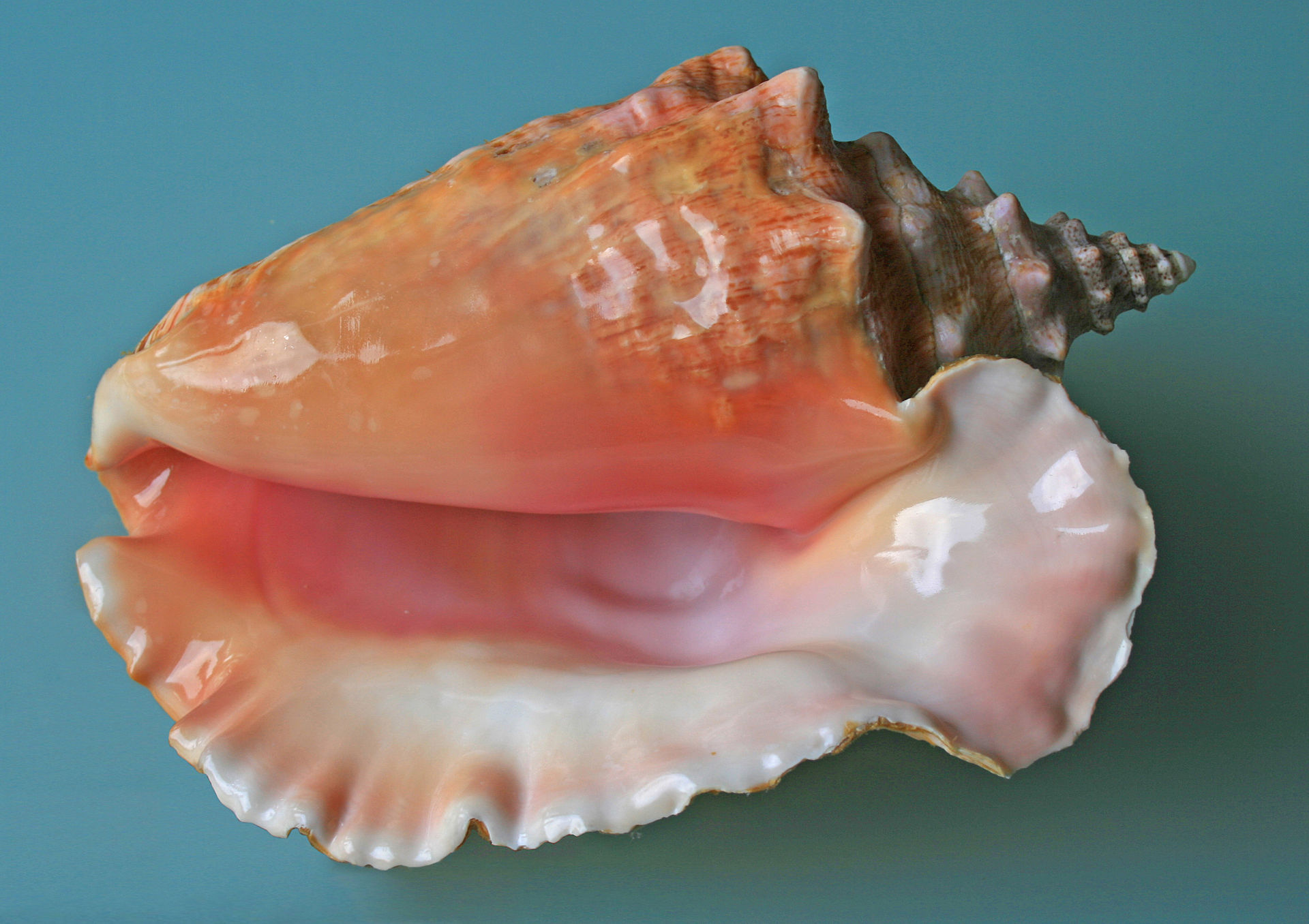
Just consider the lessons from the Queen Conch and discover exactly how independent, or interdependent, you truly are.

This is just one of the many lessons that the Queen Conch teaches Caribbean stakeholders.

According to the subsequent news article, there is a “Minority Report” (WildEarth Guardians) that the Queen Conch may be endangered and facing extinction. A Federal Government (US) agency listened intently to the concerns expressed by advocates alerting them of the conch’s dwindling status – an argument of extinction. Stakeholders in the Caribbean should have been sitting on “pins and needles” for the verdict. If this agency agreed with the Minority Report … Boom!

No more conch imports to the US. Further the host countries would have to regulate their conch fisheries to better manage the stock in national and international waters. Life as we know it, in the affected countries, would change forever; see VIDEOs below.

Where is your independence now?!

The publishers of book Go Lean…Caribbean monitor the developments in the societal engines related to the economic, security and governing aspect of Caribbean life.  The book serves as a roadmap for the introduction and implementation of the technocratic Caribbean Union Trade Federation (CU), an agency for managing integration and “common cause” issues for all the Caribbean. The issues in the following news article  highlights the subject matter of “Common Pool Resources“:

Title: No conch ban; Queen conch ‘not currently in danger of extinction’
By: K. Quincy Parker, Business Editor

CU Blog - Lessons Learned from Queen Conch - Photo 1The United States’ National Oceanic and Atmospheric Administration (NOAA) has decided not to place the queen conch on the endangered species list, erasing fears of a U.S. import ban on one of the Caribbean’s most valuable marine resources.

Concern over the potential of a conch ban was evident in the region, given the importance of conch exports to the Caribbean. Conch meat exports from 12 Caribbean countries are about 14,000 tons and contribute around $185 million in earnings. Even the shells are exported, albeit to a far lesser extent. CARICOM states together are the main suppliers of queen conch on the international market.

The matter was raised recently at the sixth meeting of the CARICOM-United States Trade and Investment Council (TIC) in Nassau.

In 2013, The Bahamas exported $4.2 million in fresh and frozen conch, practically all of it to the U.S. The value of conch shell exports was $43,700.

Study and findings
The National Marine Fisheries Service (NMFS), a division of the NOAA responsible for the stewardship of living marine resources within the United States’ exclusive economic zone, conducted a 12-month study and on Wednesday issued its determination on the petition to list the queen conch (Strombus gigas) as threatened or endangered under the United States’ Endangered Species Act (ESA).

“We have completed a comprehensive status report for the queen conch in response to the petition submitted by WildEarth Guardians,” NFMS said. “Based on the best scientific and commercial information available…we have determined that the species does not warrant listing at this time.”

The NMFS explained the process through which the decision had been made. First NMFS conducted a biological review of the species’ taxonomy, distribution, abundance, life history and biology. Available information on threats affecting the species’ status was compiled into a status report, which also defined the foreseeable future for the NMFS evaluation of extinction risk.

The group then established a group of biologists and marine mollusk experts – referred to as the Extinction Risk Analysis (ERA) group – to conduct a threats assessment for the queen conch, using the information in the status report. The ERA group was comprised of six Endangered Species Act policy experts from NMFS’ Office of Protected Resources and its southeast and southwest regional office’s protected resources divisions; three biologists with fisheries management expertise from NMFS’ southeast region’s sustainable fisheries division, and two marine mollusk biologists from NMFS’ northwest and southeast fisheries science centers. The ERA group had expertise in marine mollusk biology, ecology, population dynamics, ESA policy and fisheries management. The group members were asked to independently evaluate the severity, scope, and certainty for each threat currently and in the foreseeable future, which they qualified as 15 years from now.

After the year-long investigation, the ERA spoke.

“We conclude that the queen conch is not currently in danger of extinction throughout all or a significant portion of its range, nor is it not likely to become so within the foreseeable future,” the NMFS reported.
The Nassau Guardian; Bahamas Daily Newspaper (Posted 11/07/2014; Retrieved 12/30/2014) –
http://www.thenassauguardian.com/bahamas-business/40-bahamas-business/51572-no-conch-ban-queen-conch-not-currently-in-danger-of-extinction

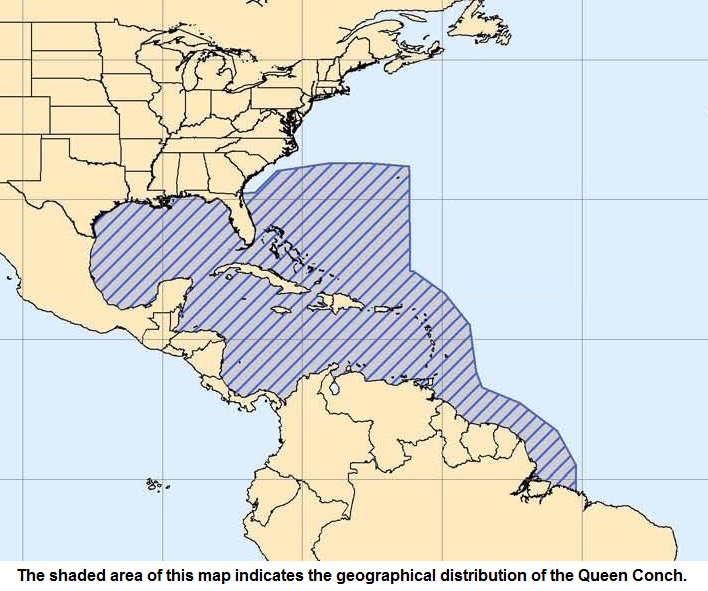
The foregoing article trumpets the need for regional stewardship of resources that traverse from one member-state to another: sovereign democracies and overseas territories in and around the Caribbean Sea. The following 3 prime directives are explored in full details in the roadmap:

  • Optimization of the economic engines in order to grow the regional economy to $800 Billion & create 2.2 million new jobs.
  • Establishment of a security apparatus to protect the resultant economic engines.
  • Improve Caribbean governance to support these engines.

For the Queen Conch, there is no border consideration, they move and multiply from one Caribbean member-state to another. So there needs to be an administration over Caribbean Common Pool Resource that is agnostic of borders. This is the role of a super-national organization to provide the effective integration and administration for the region. All the geographical member-states, 30 in all, need to confederate, collaborate, and convene with the CU for Common Pool Resource solutions. This pronouncement is made in the Declaration of Interdependence, (Page 10 & 11). The statements are included as follows:

Preamble: While our rights to exercise good governance and promote a more perfect society are the natural assumptions among the powers of the earth, no one other than ourselves can be held accountable for our failure to succeed if we do not try to promote the opportunities that a democratic society fosters.

iii.  Whereas the natural formation of the landmass for our society is that of an archipelago of islands, inherent to this nature is the limitation of terrain and the natural resources there in. We must therefore provide “new guards” and protections to ensure the efficient and effective management of these resources.

The vision of this Go Lean roadmap is a confederation of the 30 member-states of the Caribbean into an integrated “Single Market” – Dutch, English, French and Spanish homelands – vested with the powers, tools and techniques to conduct the oversight role and responsibility for the region’s Common Pool Resource. The governance will include an Exclusive Economic Zone (EEZ) of the 1,063,000 square miles of the Caribbean Sea and a separation-of-powers between the CU federal and member-state Environmental Protection governing agencies. The Go Lean book details these series of community ethos, strategies, tactics, implementations and advocacies designed to foster regional oversight and solutions for the Queen Conch … and other Caribbean resources:

Anecdote – Caribbean Single Market & Economy Page 15
Community Ethos – Deferred Gratification Page 21
Community Ethos – Economic Principle – Consequences of Choice Lie in Future Page 21
Community Ethos – “Crap” Happens Page 23
Community Ethos – Minority Equalization Page 24
Community Ethos – Lean Operations Page 24
Community Ethos – Cooperatives Page 25
Community Ethos – Ways to Impact the Future Page 26
Community Ethos – Ways to Improve Sharing Page 35
Community Ethos – Ways to Impact the Greater Good Page 37
Strategic – Vision – Integrated Region in a Single Market Page 45
Strategic – Vision – Agents of Change: Globalization Page 57
Tactical – Confederating a Non-sovereign Union Page 63
Tactical – Fostering a Technocracy Page 64
Tactical – Growing to $800 Billion Regional Economy – Exploration of EEZ resources Page 67
Tactical – Separation of Powers – Interstate Commerce   Administration Page 79
Tactical – Separation of Powers – Environmental Control   & Regulatory Commission Page 83
Tactical – Separation of Powers – Agriculture and   Fisheries Department Page 88
Anecdote – Turning Around The Current Regional Administration: CariCom Page 92
Anecdote – Success Story: “Lean” in Government Page 93
Implementation – Ways to Pay for Change – EEZ Exploration Rights Page 101
Implementation – Foreign Policy Initiatives at Start-up – US Relationship Page 102
Implementation – Security Initiatives at Start-up – Border Security Page 103
Implementation – Ways to Deliver Page 109
Planning – 10 Big Ideas for the Caribbean Region – # 3 Integrated Homeland Security Page 127
Planning – Ways to Improve Trade Page 128
Planning – Ways to Improve Interstate Commerce – Trade SHIELD Page 129
Planning – Ways to Model the EU – Deputized   Agencies for Entire Region Page 130
Planning – Ways to Measure Progress – Big Data Capture and Analysis Page 147
Advocacy – Ways to Grow the Economy Page 151
Anecdote – Governmental Integration: CariCom Parliament Page 167
Advocacy – Ways to Improve Governance Page 168
Advocacy – Ways to Foster Cooperatives Page 176
Advocacy – Ways to Improve Homeland Security – Caribbean Naval Authority Page 180
Advocacy – Ways to Better Manage Natural Resources – Common Pool Resources Page 183
Advocacy – Ways to Preserve Caribbean Heritage – Natural Resources Oversight Page 22?
Appendix – Trade SHIELD – “Enforcement“ Trade -versus- Environment Paradox Page 264

As mentioned in the foregoing article, the 12 conch exporting countries and (US) territories in the Caribbean are as follows:

Aruba, (Netherlands Antilles) Dominican Republic
Barbados Grenada (the “Grenadines”)
Bahamas Jamaica
Belize Martinique / Saint Barthélemy
Bermuda Turks and Caicos Islands
British Virgin Islands US / Puerto Rico
Cuba US / Virgin Islands

CU Blog - Lessons Learned from Queen Conch - Photo 3

The problem for the Queen Conch lie in the management (or lack there-of) for Common Pool Resources. There are now threats and risks to the viability of this Caribbean inhabitant. There are attempts at conservation too. Consider this encyclopedic information[1] as follows:

Threats
CU Blog - Lessons Learned from Queen Conch - Photo 4Photo: The island of Anegada, British Virgin Islands, a heap consisting of thousands of queen conch shells discarded after their flesh was taken for human consumption.

Within the conch fisheries, one of the threats to sustainability stems from the fact that there is almost as much meat in large juveniles as there is in adults, but only adult conchs can reproduce, and thus sustain a population.[62] In many places where adult conchs have become rare due to overfishing, larger juveniles and sub-adults are taken before they ever mate.[62][69] On a number of islands, sub-adults provide the majority of the harvest.[70] Lobatus gigas abundance is declining throughout its range as a result of overfishing and poaching. Populations in Honduras, Haiti and the Dominican Republic, in particular, are currently being exploited at rates considered unsustainable. Trade from many Caribbean countries is known or thought to be unsustainable. Illegal harvest, including fishing in foreign waters and subsequent illegal international trade, is a common problem.[50] The Caribbean “International Queen Conch Initiative” is an international attempt at managing this species.[52]

Conservation
CU Blog - Lessons Learned from Queen Conch - Photo 2The queen conch fishery is usually managed under the regulations of individual nations. In the United States all taking of queen conch is prohibited in Florida and in adjacent Federal waters. No international regional fishery management organization exists for the whole Caribbean area, but in places such as Puerto Rico and the Virgin Islands, queen conch is regulated under the auspices of the Caribbean Fishery Management Council (CFMC).[50] In 1990, the Parties to the Convention for the Protection and Development of the Marine Environment of the Wider Caribbean Region (Cartagena Convention) included queen conch in Annex II of its Protocol Concerning Specially Protected Areas and Wildlife (SPAW Protocol) as a species that may be used on a rational and sustainable basis, but that requires protective measures.

This species has been mentioned in the Convention on International Trade in Endangered Species of Wild Fauna and Flora (CITES) since 1985.[32] In 1992 the United States proposed queen conch for listing in CITES Appendix II, making queen conch the first large-scale fisheries product to be regulated by CITES (as Strombus gigas).[50][71][72] In 1995 CITES began reviewing the biological and trade status of the queen conch under its “Significant Trade Review” process. These reviews are undertaken to address concerns about trade levels in an Appendix II species. Based on the 2003 review,[63] CITES recommended that all countries prohibit importation from Honduras, Haiti and the Dominican Republic, according to Standing Committee Recommendations.[73] Queen conch meat continues to be available from other Caribbean countries, including Jamaica and Turks and Caicos, which operate well-managed queen conch fisheries.[50]

The Go Lean roadmap for the CU stresses the importance of common pool resource management. Managing the quota and harvesting seasons of seafood stock is a classic role for governmental agencies. But without the CU, there is no jurisdiction for the international waters between the islands. The area of “Fisheries” is a big economic engine for the coastal communities, but mitigating the risks of stock depletion would be a priority for the CU. This oversight is necessary for Queen Conch, plus other seafood stock like lobster, grouper and flying fish.

While the Minority Report by the “WildEarth Guardians” group in the foregoing news article may not have been adhered to by the US government, Caribbean stakeholders need to take heed. We have more at stake; any depletion of Queen Conch populations, endangered, extinct or not, is a serious matter of concern for our homeland.

The Go Lean book, foregoing news article and the encyclopedia references above all recommend a best-practice for the Caribbean: technocratic administration of the regional common pool resources, regardless of independence or sovereignty consideration. This is a matter of interdependence and survival of Caribbean culture and our way of life. See VIDEO #1 below demonstrating conch preparation in the Bahamas and VIDEO #2 revealing a Belizean recipe for the Caribbean conch delicacy.

Now is the time for all of the Caribbean, the people and governing institutions, to lean-in for this Caribbean integration roadmap, this exercise in “single market” promotion. Now is the time to Go Lean and make the Caribbean region a better homeland to live, work and play. 🙂

Download the free e-Book of Go Lean … Caribbean – now!

————–

Appendix – Referenced Citations:

1.http://en.wikipedia.org/wiki/Queen_conch
32. McCarthy, K. (2007). “A review of queen conch (Strombus gigas) life-history. Sustainable Fisheries Division NOAA. SEDAR 14-DW-4.
50. NOAA.Queen Conch (Strombus gigas). Retrieved 4 July 2009.
52.“International Queen Conch Initiative”. NOAA: Caribbean Fishery Management Council. Retrieved 2009-09-27.
62.“Virgin Islands Vacation Guide & Community”. Retrieved 13 April 2010.
63. CITES (2003). Review of Significant Trade in specimens of Appendix-II species. (Resolution Conf. 12.8 and Decision 12.75). Nineteenth meeting of the Animals Committee, Geneva (Switzerland), 18–21.
69. Theile, S. (2001). “Queen conch fisheries and their management in the Caribbean”. Traffic Europe (CITES): 1–77.
70. Oxenford, H. A.; et al. (2007). Fishing and marketing of queen conch (Strombus gigas) in Barbados. CERMES Technical Report Number 16. University of the West Indies, Barbados: Centre for Resource Management and Environmental Studies.
71.Appendices I, II and III. cites.org website. Retrieved 4 July 2009.
72.NOAA Fisheries Office of International Affairs website: CITES. Retrieved 4 July 2009.
73.“Standing Committee Recommendations”. CITES Official Documents No 2003/057. 2003. Retrieved 16 April 2010.

————–

Appendix – VIDEO # 1http://youtu.be/lqHwoX3VXeY – Conch Salad – Eleuthera Island, Bahamas – Martha Stewart

————–

Appendix – VIDEO # 2http://youtu.be/w1JP05CeA9A – Conch Fritters: Fry Jack – Cooking with Flavors of Belize & Chef Sean Kuylen

Published on Jan 14, 2014 – A classic Belizean dish, perfect for an appetizer at dinner time or a quick snack. And as usual, Chef Sean puts his spin on things adding Belikin Lighthouse Beer to the batter while giving chefs at home good tips when preparing this simple dish.

Share this post:
, , , ,
[Top]

Restoration of Diplomatic Relations with Cuba

Go Lean Commentary

The subject matter in this blog’s title does not mean the end of the Castro regime, but rather the beginning of the struggle to integrate Cuba with the rest of the Caribbean.

Let’s get started!

The book Go Lean…Caribbean was designed with this intent: integrate and unify all of the Caribbean into a Single Market with technocratic stewardship and oversight. This stewardship is the Caribbean Union Trade Federation (CU). The book describes the process of working for Cuba as heavy-lifting, including all the economic, security and governing engines. The article here describes the catalyst for these changes:

Title: US to Normalize Relations With Cuba
By: Alexander Britell

CU Blog - Restoration of Diplomatic Relations with Cuba - Photo 1The Caribbean changed forever on Wednesday morning.

United States President Barack Obama announced a major shift in more than half-century of American politics, signaling the two countries’ desire to work toward normalizing relations.

The announcement came alongside a high-level prisoner swap of Alan Gross, a USAID contractor jailed for five years on espionage charges, for three Cubans convicted of spying on the United States.

Gross was released alongside an unnamed agent whom Obama called one of the most important intelligence agents the US has ever had in Cuba, who had been imprisoned for nearly two decades.

The imprisonment of all parties had been a point of major contention between the two countries.

In an address Wednesday, Obama said he had ordered US Secretary of State John Kerry to immediately begin discussions with Cuba to reestablish diplomatic relations severed since January 1961.

The US will also reestablish an embassy in Havana and “high-ranking officials will visit Havana.”

Obama said he had also asked Kerry to review Cuba’s designation as a state sponsor of terrorism.

He said the US was taking steps to increase travel, commerce and the flow of information to Cuba.

The plan includes the aforementioned re-establishment of diplomatic relations, a change in travel and remittance policies to increase people to people contact and the overall expansion of travel to Cuba.

That also includes expanded sales and exports of certain goods and services from the US to Cuba, along with the authorization of American citizens to import $400 goods from Cuba, with a maximum of $100 on alcohol and tobacco.

The White House also said US telecom providers will be allowed to establish “the necessary mechanisms, including infrastructure, in Cuba to provide commercial telecommunications and internet services,” in a country that has one of the lowest rates of Internet penetration on earth.

Obama said he would end an “outdated approach that for decades has failed to advance our interests.”

In a statement to the Cuban people, Cuban President Raul Castro said he and Obama had spoken by telephone on Tuesday to address “issues of interest to both nations.”

He also thanked Pope Francis and the government of Canada, who reportedly helped facilitate high-level talks between the two countries.

Of course, much of the President’s actions will take time and face roadblocks, with the biggest impediment, the Cuban Embargo, one that can only be changed with approval by the US Congress.

Indeed, the announcement was immediately met with criticism from a number of US lawmakers and the Cuban diaspora community, including US Senator Marco Rubio, the son of Cuban exiles who criticized the prisoner exchange and said Obama’s actions had “vindicated the brutal behavior of the Cuban government.”

Raul Castro himself confirmed the agreement, but noted the tough road ahead and that the announcement was by no means decisive.

“This does not mean the main matter is resolved,” Castro said. “The economic, commercial and financial blockade that causes enormous human and economic damage to our country must cease.”

“Recognizing that we have deep differences, mainly on national sovereignty, democracy, human rights and foreign policy, I reaffirm our willingness to discuss all these issues,” Castro said.

Castor said he urged “the government of the United States to remove obstacles that prevent or restrict the links between our peoples, families and citizens of both countries,” Castro said. “In particular, those relating to travel, direct mail and telecommunications.”

But what does a normalized relationship mean for the wider Caribbean?

Cuba welcomed around 2.85 million tourists last year, the vast majority from Canada and Europe, and a number that, with the proper development of tourist infrastructure and the like, could surpass the Dominican Republic, the current regional leader.

Indeed, that number will certainly increase if and when American travel becomes formally legalized; but will that mean travelers choosing Cuba over Jamaica or the Dominican Republic?

Or will a renewed Cuban tourism sector mean a larger tourism pie for the whole Caribbean?

There is another issue — notably, the impact of the massive size of the Cuban market on the rest of the region’s economy — how will potential Cuban exports to America impact Caribbean exports to Cuba?

The answers will soon become clear.
Caribbean Journal Regional News Site – December 17, 2014 (Retrieved 12/11/2014) –
http://www.caribjournal.com/2014/12/17/us-to-normalize-relations-with-cuba/#

After news broke that President Obama would use Executive Powers to normalize diplomatic relations with Cuba, members of Miami’s Cuban and Cuban-American communities have “screamed in agony, cheered with joy, or vowed angrily to dismantle the decision”.

Here are some other headlines from the Miami Herald Daily Newspaper associated with this historic news:

Miami would be a natural choice should Havana want a consulate outside of Washington, D.C., but some elected officials expressed their opposition to such a move.

According to the Miami Herald, the public response was a mix of the opinionated, the emotional and the thoughtful.

“Depending on how old you were or how long you had lived in the United States, especially if you were U.S.-born, your view on Cuba and its politics might have been shaped generationally. [The Herald] asked South Florida Cubans and Cuban Americans for their thoughts on social platforms. This is some of what they shared:”

@Miamiblues – 1st gen immigrants are too stubborn and proud to admit that embargo was epic fail. In complete denial with blinders on.

@PedazosdelaIsla – It’s not a division of young/old, it’s a division of those who want 2 legitimize a brutal dictatorship & those who don’t #Cuba

@mannyafer  – Divide in Cuban-American community– old who lived thru Castro regime want embargo, while young gen wishes to do away with it.
(Source: http://www.miamiherald.com/news/nation-world/world/americas/cuba/article4623942.html)

The foregoing article stressed the potential of an imminent re-integration of Cuba. The current regional construct CariCom wants to consider the inclusion of Cuba as a member-state. But the Go Lean book asserts that CariCom is a failed institution and need to correct its own structural defects – they are in no position to claim the burdens of Cuba. The CU on the other hand is designed as a lean technocracy, mastering Delivery Arts and Sciences. This Go Lean book details the step-by-step roadmap for including Cuba in with the rest of the Caribbean to form a confederation of the 30 member-states of the region into the integrated Single Market. The prime directives of the CU are pronounced in these statements:

  • Optimization of the economic engines in order to grow the regional economy to $800 Billion & create 2.2 million new jobs.
  • Establishment of a security apparatus to protect the resultant economic engines.
  • Improve Caribbean governance to support these engines.

This re-boot roadmap commences with the recognition that Cuba and the rest of the Caribbean are in crisis; they are in the “same boat” despite their colonial heritage or language differences. One crisis is associated with the societal abandonment that has crippled so much of Caribbean societal engines. In Cuba, this transpired in mass, while the other countries experienced a steady draining. The CU member-states need to confederate, collaborate, and convene for repatriation and reconciliation. This pronouncement is made in the Declaration of Interdependence, (Page 12) is included as follows:

xiii.      Whereas the legacy of dissensions in many member-states (for example: Haiti and Cuba) will require a concerted effort to integrate the exile community’s repatriation, the Federation must arrange for Reconciliation Commissions to satiate a demand for justice.

The Go Lean book details the series of community ethos, strategies, tactics, implementations and advocacies designed to re-boot and integrate Cuba to the region:

Anecdote – Caribbean Single Market & Economy Page 15
Community Ethos – Economic Systems Influence Individual Choices & Incentives Page 21
Community Ethos – Job Multiplier Page 22
Community Ethos – “Crap” Happens Page 23
Community Ethos – Lean Operations Page 24
Community Ethos – Cooperatives Page 25
Community Ethos – Ways to Impact the Future Page 26
Community Ethos – Ways to Manage Reconciliations Page 34
Community Ethos – Ways to Impact the Greater Good Page 37
Strategic – Vision – Integrated Region in a Single Market Page 45
Strategic – Vision – Agents of Change Page 57
Tactical – Confederating a Non-sovereign Union Page 63
Tactical – Fostering a Technocracy Page 64
Tactical – Growing to $800 Billion Regional Economy Page 67
Tactical – Separation of Powers Page 71
Tactical – Separation of Powers – Office of Trade Negotiations Page 80
Tactical – Separation of Powers – Federal Courts – Truth & Reconciliation   Commissions Page 90
Anecdote – Turning Around CariCom Page 92
Anecdote – “Lean” in Government Page 93
Implementation – Assemble & Create Super-Regional Organs to   represent all Caribbean Page 96
Implementation – Ways to Pay for Change Page 101
Implementation – Foreign Policy Initiatives at Start-up Page 102
Implementation – Ways to Deliver Page 109
Implementation – Reasons to Repatriate to the Caribbean Page 118
Implementation – Ways to Benefit from Globalization Page 119
Planning – 10 Big Ideas – Cuba Page 127
Planning – Big Ideas for the Caribbean Region Page 127
Planning – Ways to Model the EU Page 130
Planning – Ways to Improve Failed-State Indices Page 134
Advocacy – Ways to Grow the Economy Page 151
Anecdote – Governmental Integration: CariCom Parliament Page 167
Advocacy – Ways to Improve Governance Page 168
Advocacy – Ways to Impact the Diaspora Page 217
Advocacy – Ways to Re-boot Cuba Page 236
Appendix – New CariCom Model Urged Page 255

The foregoing news article relates the bilateral move to re-instate Cuba’s diplomatic relations with the US; this was 55 years in the making – far too long. The next step: the Cuban Trade Embargo. Good luck with Congress … until the Castros (Fidel and Raul) are all gone from Cuban public life – expected for 2017.

This point is the strong theme of so many of these previous Go Lean commentaries/blogs that featured issues on Cuba’s eventual integration into the world’s economic networks; detailed here:

CARICOM Chair calls for an end to US embargo on Cuba
Miami’s Success versus Caribbean Failures
‘Raul Castro reforms not enough’, Cuba’s bishops say
Cuban Cigars – Declared “Among the best in the world”
Cuba mulls economy in Parliament session
America’s War on the Caribbean
Cuban cancer medication registered in 28 countries
Cuba Approves New “Law on Foreign Investment”

The news of President’s Obama Executive Order on Cuba is causing upheaval in the Cuban Diaspora, especially in Miami. But they are not the only stakeholders on guard of these pending changes. Another stakeholder of note is the US business community. What are their expectations? What are their fears? What is their hope? See AppendixVIDEO for a comprehensive report.

The Go Lean roadmap addresses the concerns of all Cuban and Caribbean stakeholders. The book posits that challenges that Cuba must face are too insurmountable for Cuba alone to contend with; there must be a regional solution, a super-national, professionally-managed, deputized technocracy to impact greater production and greater accountability than a re-invigorated Cuba can do alone. This deputized agency is the Caribbean Union Trade Federation. This CU structure is especially inviting to the Cuban and Caribbean Diaspora; it presents a workable plan for the contribution of their time, talents and treasuries in the repatriation to their homeland.

Now is the time for all Cuban stakeholders, the people, business community and governing institutions, to lean-in for the Caribbean/Cuban integration and re-boot. Now is the time to make this region as a whole, and Cuba specifically, a better place to live, work and play. 🙂

Download Go Lean … Caribbean – now!

——————

APPENDIX – The Nightly Business Report

The “Nightly Business Report produced by CNBC” (NBR) is an award-winning and highly-respected nightly business news program that airs on public television. Television’s longest-running evening business news broadcast, “NBR” features in-depth coverage and analysis of the biggest financial news stories of the day and access to some of the world’s top business leaders and policy makers.

Referenced Video – Nightly Business Report — December 17, 2014 – http://youtu.be/dnIEYPQ8K2A?t=8m43s

President Obama announces sweeping changes to U.S. policy with Cuba and it could, eventually, create opportunities for both investors and business.


Share this post:
, , , , ,
[Top]

Blog # 200 – Ignorance is no excuse – Milestone in Enlightenment

Go Lean Commentary – Number 200

We have now reached a new milestone in the distribution of the blogs from the publishers of the book Go Lean…Caribbean, 200 submissions. That’s a lot of blogs and a lot of enlightenment, (see Appendix below); there is now no excuse for ignorance in the Caribbean region. (Enlightenment is defined here as the opposite of ignorance).

The Go Lean book stresses the subject of the “Age of Enlightenment” (Page 170); relating the cultural movement of intellectuals in the 17th and 18th centuries, (between 1650 to 1700). Enlightenment thinkers used logic and reason to challenge ideas grounded in nothing more than ignorance, superstition, arbitrary tradition and dogmatic faith. There is now a new need for an Age of Enlightenment for Caribbean society as ignorance, superstition, arbitrary tradition and dogmatic faith has re-emerged as a negative community ethos.

CU Blog - Ignorance is no excuse - Milestone in Enlightenment - Photo 1

The Go Lean book posits that 2008 is the pivotal year for Caribbean enlightenment (Page 136) – see the VIDEO below. Our Age of Enlightenment unfurled since 2008. This acknowledgement is recognized at the outset of the book with this Declaration of Interdependence (Page 11) opening statement:

xxi. Whereas the legacy of international democracies had been imperiled due to a global financial crisis, the structure of the Federation must allow for financial stability and assurance of the Federation’s institutions. To mandate the economic vibrancy of the region, monetary and fiscal controls and policies must be incorporated as proactive and reactive measures. These measures must address threats against the financial integrity of the Federation and of the member-states.

This roadmap was constructed with assessments, community ethos, strategies, tactics, implementation and advocacies to mitigate the ignorance, superstitions, arbitrary traditions and dogmatic faith of the Caribbean status quo.

One example of dogmatic faith, the focus of this commentary, is the elevation of the view that the United States of America is the panacea of Caribbean ills. As a result, the book and aligned blog commentaries elaborate on how the countries of the Caribbean region emerged as parasites to American-ism, rather than protégés for an advanced society. (The assessment is that even the US territories of Puerto Rico and the Virgin Islands are dysfunctional in their societal engines).

The Go Lean book is not anti-American, on the contrary, we look to the US as a role model of democracy and seek to emulate provisions of the US Constitution (Page 145). The book simply asserts that the Caribbean member-states must “man up” and assume our own destiny, not look for someone else, the US, to solve our problems of economic, security and governing dysfunction. This theme has been a frequent topic for blogging by the Go Lean promoters, as sampled here:

American-ism – Miami’s Success versus Caribbean Failure
A Lesson in History: Deferred Gratification as a Community Ethos of WW II
Protégé Model for Caribbean/Latin America: Korean Example
Applying Lessons from 2008 – Depth and Breath of Crises
Sports Role Model – US versus the World
America’s Navy – 100 Percent – Model for Caribbean
American Self-Interest – Senate bill targets companies that move overseas
‘Prosper Where You Are Planted’ – Book Review and Community Ethos
Caribbean loses over 70% of tertiary educated citizens to the brain drain – Mostly to the US
Open the Time Capsule: The Great Recession of 2008
Caribbean Reality – Only at the precipice, do they change
Ailing Puerto Rico open to radical economic fixes
Book Review: ‘Wrong – Nine Economic Policy Disasters and What We Can Learn…’
10 Things We Want from the US and 10 Things We Don’t Want from the US

Change has come to the Caribbean region; an upgrade to the Caribbean intelligentsia.

The book Go Lean…Caribbean serves as a roadmap for the introduction and implementation of the Caribbean Union Trade Federation (CU) and the Caribbean Central Bank (CCB). This Caribbean empowerment roadmap has 3 prime directives:

  • Optimization of the economic engines in order to grow the regional economy to $800 Billion & create 2.2 million new jobs.
  • Establishment of a security apparatus to protect the resultant economic engines.
  • Improve Caribbean governance to support these engines.

The book described both the CU and CCB as hallmarks of technocracy, a commitment to efficiency and effectiveness. The book itself is 370 pages and covers 144 different missions.

The following is a sample of these specific details from the book related to this commentary:

Community Ethos – Deferred Gratification Page 21
Community Ethos – Consequences of Choices Lie in the Future Page 21
Community Ethos – Return on Investments (ROI) Page 23
Community Ethos – Lean Operations Page 24
Community Ethos – Ways to Impact the Future Page 26
Strategy – Vision – Confederate 30 Member-States Page 45
Strategy – Missions – 144 Advocacies Page 457
Tactical – Confederating a Permanent Union Page 63
Tactical – Fostering a Technocracy Page 64
Implementation – Ways to Pay for Change Page 101
Implementation – Ways to Deliver Page 109
Planning – 10 Big Ideas for the Caribbean Region Page 127
Planning – Lessons Learned from 2008 Page 136
Advocacy – Ways to Grow the Economy Page 151
Advocacy – Ways to Create Jobs Page 152
Advocacy – Reforms for Banking Regulations Page 199
Advocacy – Ways to Impact Wall Street Page 200
Advocacy – Ways to Impact Main Street Page 201
Appendix – Credit Ratings Agencies in 2008 Page 276

It is understandable that the reference to “parasite” is negative. The book describes positive community ethos that we advocate for adoption. But the “parasite” reference is appropriate; the disposition of the host, directly impacts the disposition of the parasite. The financial crisis of 2008, initiated by American financial defects, severely crippled Caribbean economies. Even now, despite the recovery in the US, Caribbean economic malaise lingers.

A protégé disposition is so much more preferred. We should apply the best practices of American society, and other cultures as well. (The Go Lean book directly refers to Canada – Page 146 – and the European Union – Page 130).

This quest for Go Lean…Caribbean is huge, making our homeland a better place to live, work and play. This is not easy, this is heavy-lifting!

It is time for enlightenment, Caribbean style – too much is at stake!

CU Blog - Ignorance is no excuse - Milestone in Enlightenment - Photo 2

Yes, “Hope and Change” has come to the Caribbean; see the 2008 version of “Hope and Change” manifested in America, in the VIDEO below:

Video: 2008 Presidential Election Acceptance Speech – http://youtu.be/GNtJRPcPCcw

The new President-Elected Obama declared that night on November 4, 2008: “A new dawn of American leadership is at hand”…

For the Caribbean, we say: Ditto!

Download the book Go Lean … Caribbean – now!

———————————–

Appendix – Categories and Counts of all Go Lean Blogs (as of November 28, 2014); 1 Blog = Many Categories

Economics 76
Ethos 66
Government 63
Implementation 39
Industries 53
Locations 34
Planning 63
Social 58
Strategy 40
Tactical 29


Share this post:
,
[Top]

Introduction to Europe – All Grown Up

Go Lean Commentary

CU Blog - Introduction to Europe - All Grown Up - Photo 1The countries in the western hemisphere are considered the New World. Why “new”? Because none of the independent nations in this hemisphere are older than 250 years. Despite previous civilizations in the lands; the hemisphere’s modernity started as colonies of their European forebears: England, France, Portugal, Spain, and The Netherlands. The European lands are thusly referred to as the Old Country.

Well now, the Old Country has a new lesson for the New World: economic, security and governing integration of the European Union (EU). This structure is such an advancement in democracy, that it is now presented as a model for the Caribbean region to explore.

This is the quest of the book Go Lean…Caribbean, to get the Caribbean region to model their society to incorporate the best practices of the EU. The book urges the introduction and implementation of the Caribbean Union Trade Federation (CU). The book therefore serves as a roadmap for this goal, with turn-by-turn directions to integrate the 30 member-states of the region, forge an $800 Billion economy and create 2.2 million new jobs.

While this is a big idea for the nascent Caribbean, this is just a microcosm of the EU’s width and breadth – Europe is all grown-up. The EU has the economies-of-scale of 508 million people and a GDP of $15 Trillion (2012) in 28 member-states; (the EuroZone Currency Union is a subset of 18 states, 333 million people and $13.1 Trillion GDP). The EU is even larger than the Caribbean’s neighbor, the US, with its 50 states, 320 million people, and $14 Trillion integrated economy.

There is an even more important number in the discussion of EU dynamics: 100 million. That’s how many lives were lost prematurely due to the wars of the 20th Century, all spurred from European conflicts, think World War I and World War II. Since the European integration began, after WW II and completing with the EU charter in 1992, there has been no full continental or global wars. This absence is a testament of European economic-security-governing integration.

The continent of Europe has now “grown up”, organizationally. In fact, because of the success of this integration, the EU was awarded the coveted Nobel Peace Prize for 2012. This fact was detailed in the Go Lean book (Page 130).

Considering the EU example, the economic benefits are undeniable; shocks and dips in economic performance can be more easily absorbed and leveraged across the entire region. (The US provides a similar lesson).  Despite recent crises in the US (2008) and in Europe (Sovereign Debt of 2009 – 2011), the US is still the #2 economy, while the EU is the world’s #1 economy.

At the outset, the Go Lean roadmap identified an urgent need to collaborate and consolidate for economic resilience. This is pronounced in this clause in the opening Declaration of Interdependence (Page 13):

xxv.   Whereas the legacy of international democracies had been imperiled due to a global financial crisis, the structure of the Federation must allow for financial stability and assurance of the Federation’s institutions. To mandate the economic vibrancy of the region, monetary and fiscal controls and policies must be incorporated as proactive and reactive measures. These measures must address threats against the financial integrity of the Federation and of the member-states.

The biggest lesson for the Caribbean to glean from a consideration of the EU is the need for compromise in consensus-building. This is why there are asterisks on so many confederation clauses. See the details in this VIDEO here:

Direct Link: http://youtu.be/O37yJBFRrfg

The CU is modeled from the EU – see Page 130 in the Go Lean…Caribbean book, so as to provide good stewardship and shepherding of the Caribbean economic, security and governing engines.

The theme of applying models and best-practices from other countries/regions has been elaborated on in these previous blog commentaries:

Why India is doing better than most emerging markets
‘Too Big To Fail’ – Caribbean Version
A Lesson in European Dysfunctional History: 100 Years Ago – World War I
EU willing to fund study on cost of not having CARICOM
European Model: One currency, divergent economies
How Nigeria’s economy grew by 89% overnight
Book Review: ‘Wrong – Nine Economic Policy Disasters and What We Can Learn…’

The CU roadmap drives change among the economic, security and governing engines of the Caribbean region. The book presents the solutions to elevate Caribbean society as new community ethos, strategies, tactics, implementations and advocates; as follows:

Community Ethos – Forging Change Page 20
Community Ethos – Economic Principles Page 21
Community Ethos – Security Principles Page 22
Community Ethos – Governing Principles Page 24
Community Ethos – Impact the Future Page 26
Community Ethos – Impact the Greater Good Page 37
Strategy – CU Vision – Integrate Caribbean member-states modeling the European Union Page 45
Strategy – Facilitate a Currency Union, the Caribbean Dollar (C$), and the Caribbean Central Bank, modeled after the Euro and European Central Bank Page 48
Tactical – Fostering a Technocracy Page 64
Tactical – $800 Billion Economy – How and When Page 67
Tactical – Separation-of-Powers – Central Bank Page 73
Implementation – Assemble Caribbean Central Bank Page 96
Implementation – Ways to Better Manage Debt Page 114
Planning – Ways to Model the EU Page 119
Planning – Lessons Learned from 2008 Page 136
Anecdote – Caribbean Currencies Page 149
Advocacy – Ways to Grow the Economy Page 151
Advocacy – Ways to Create Jobs Page 152
Advocacy – Reforms for Banking Regulations Page 199

The Go Lean roadmap posits that modeling the EU is easier said than done. On the one hand, the economic optimizations are easy, just show up with investments (money) and jobs and any Caribbean community will acquiesce. On the other hand, the attempts to introduce empowerments for security and/or governing engines are doomed to be more complicated, requiring a political process, with a lot of compromise and consensus-building.

See a dissenting view of the EU structure, expressed here:

Dissenting View: Some people object to the structure of the EU. Notice this comment added to the same foregoing YouTube VIDEO above:

By: aalexmary – 1 month ago (October 2014):
So, explained. The European Union is US’s pathetic slave. The European Union is an unsuccessful organisation who took the sovereignty of the nations away. the European union is a monster (I mean its leaders) who carries out coups and bloody wars. The EU, NATO, US destroyed and blooded Ukraine and Novorrosia with the purpose of starting WWIII and to destroy Russia. The European Union hurts its own nations (eg: the illegal insane sanctions against Russia, and this is not the only example). Obama, Merkel and all the leaders of the EU are just pathetic war criminals. Not to mention Pigosenko and his clique. The “democrat” EU brought back the cruel Nazism. EU is ugly. It is not the European “dream” anymore. It is about EU’s leaders greed for power. In EU the individuals do not count. I will be so happy when EU and NATO will disappear. Useless organisations. It is time for the countries to regain their sovereignty.
YouTube Video Sharing Online Site – Posted July 2, 2013; retrieved November 26, 2014
http://youtu.be/O37yJBFRrfg

This heavy-lifting, navigating the dissent and overcoming opposition, is worth the effort. This is the mission of the CU: built for the heavy-lifting of integration and collaboration. With the successful execution of the deliveries in the Go Lean roadmap, the effect will be undeniable: a better homeland to live, work and play. 🙂

Download the book Go Lean … Caribbean – now!

Share this post:
, ,
[Top]

A Lesson in History – Economics of East Berlin

Go Lean Commentary

The book Go Lean…Caribbean serves as a roadmap for elevating Caribbean society; the book posits that the history of East Germany is a tutorial to the Caribbean effort. As such there are direct references in the book of the failed Communist State (Pages 132 & 139).

On this date 25 years ago, the “walls came tumbling down”, quickening the reunification of the nations of West Germany and East Germany. That is the headline, but beneath the surface, the German Democratic Republic (GDR or East Germany) was also rife with some other ugly truths.

In summary, the City of “East” Berlin was a maximum security prison in the heart of Europe. (This refers to City of East Berlin, not the whole country of East Germany).

Title: 25 Years Ago – The Berlin Wall Crumbled

CU Blog - A Lesson in History - Economics of East Berlin - Photo 1On the night of November 9, 1989, the Berlin Wall came down. East German authorities opened the border between East and West Berlin and the door to the fall of tyranny.

The wall went up in the early morning darkness of August 13, 1961, to keep millions of people from fleeing communist East Germany after World War II. It fell as suddenly as it had been built. For 28 years, Germany was a country divided not only by ideology but by stone, barbed wire and deadly force. The Berlin Wall — die Mauer — stood as a testament to the eternal struggle between open and closed societies. For all its might, the wall could not stop the free flow of news into East Berlin.

The West side of the wall became a stage for politicians and a canvas for artists. The East side grew grimmer, as social and economic problems worsened. In the end, people rose in protest. When the wall finally crumbled, there was dancing and celebration. But the wall’s toll could not be forgotten: Nearly 200 people died trying to escape; more than 30,000 political prisoners were jailed.

Today, the fallen wall is a memorial to their sacrifice, one of the world’s great symbols of the victory of freedom over oppression. The eight, 12-foot-high segments of the Berlin Wall in the Newseum’s Berlin Wall Gallery weigh 2.5 tons each and came from throughout Berlin. The Newseum acquired the pieces in 1993, along with the three-story East German guard tower that stood near Checkpoint Charlie.

Newseum Institute – Archives and Exhibit of News Artifacts
http://www.newseum.org/2014/11/06/25-years-ago-the-berlin-wall-crumbled/

CU Blog - A Lesson in History - Economics of East Berlin - Photo 2This is more than just dry history. No, this is a lesson plan for the Caribbean empowerment effort. That effort is part-and-parcel of the Go Lean…Caribbean movement, this refers to the book and accompanying blog/commentaries. The book posits that the experiences of East Germany and the reunification with the Federal Republic of Germany (FRG or West Germany) provide a fitting example for the Caribbean people and institutions. What most people in the Caribbean may not realize, due to the far distance of a continent away, is that the national border for West and East Germany did not traverse through the City of Berlin, but rather 100 miles to the west of Berlin; (see map here). So the City of Berlin stood as an “island” within the country of East Germany, with that island itself split into West and East territories. (This is so similar to many Caribbean locales). The Western portion of Berlin belonged to West Germany; the residents had travel access via “air bridge” to other ports in the Federal Republic of Germany, while East Berliners were restricted – imprisoned in their own country, despite committing no offenses. This is classic human rights violation.

East Berlin, and by extension East Germany was a definitive Failed-State.

This audio-podcast here relates a practice of East Germany selling prisoners to the West for hard currency, so as to remediate the government’s economic deficiencies:

Video: Public Radio International East Germany Prisoner Ransom … http://youtu.be/FjozYlAlMew

The narratives described in this audio-podcast constitutes state-sponsored human trafficking.

This is abominable!

The German Reunification was not a merger, rather it was a repossession. East Germany was at the precipice of a Failed-State. The Caribbean today is at a similar precipice of dysfunction. This status is not due to the failure of communism (though one Caribbean member-state – Cuba – does feature a failed communist society), but rather the global financial crisis. Cuba also parallels East Germany with a human trafficking crisis; many citizens are desperate to leave the island and families pay huge “ransoms” to extract them.

The review of the historic events of this day regarding the Berlin Wall 25 years ago is more than just an academic discussion, the book Go Lean…Caribbean aspires to economic principles that dictate that “consequences of choices lie in the future”. The book serves as a roadmap for the introduction and implementation of the technocratic Caribbean Union Trade Federation (CU). The people of the Caribbean may not know the intimate details of East Germany, but we do understand societal decline and dysfunction all too well.

What have we learned from the East/West Germany experiences? How will those lessons help us today?

  • Brain Drain is unrecoverable – East Germany learned quickly that they had to keep their talented citizens by any means necessary, and thus the wall. The CU/Go Lean roadmap places priority on the atmosphere for the Caribbean talent to want to stay in the homeland and for the Diaspora to repatriate..
  • Most valuable resource – East German sold their human resources to the West; (over 300,000 people according to the above audio-podcast/VIDEO). This was their best marketable resource. The Go Lean roadmap posits that one person can make a difference and impact the economic engines in the fields of endeavor. Rather than one, the CU/Go Lean effort strives to foster the masses for their collective and individual contributions.
  • Promote opportunities for the Pursuit of Happiness – People in the West were NOT trying to sneak into the East. Basic needs were not fully satisfied there, so higher level needs were rarely pursued. The Go Lean roadmap posits that when the basic needs are in place, only then can the pursuit of happiness be tackled.
  • Consider the Greater Good – Complying with this Greater Good principle would have prevented a lot of the conflict during the 28-year East-West segregation. This philosophy is directly quoted in the book as: “it is the greatest good to the greatest number of people which is the measure of right and wrong”. The CU/Go Lean roadmap calls for a number of measures that strike directly at the Greater Good mandate: accountable justice institutions, economic empowerment for rich and poor, strategic education initiatives, proactive health/wellness, etc.
  • Quit on “failed” policies  – With the Soviet Union and Eastern European trading partners collapsing, the East German currency, the Mark, had become worthless outside of the GDR, creating the acute need to merge the two German economies. The GDR did not try to prop up the failing currency beyond 1989, instead they transferred its financial & monetary policy to the stewards of the stronger West Germany currency. The Go Lean roadmap will employ a technocratic Caribbean Central Bank and Caribbean Dollar so as to shore up the currency and economic engines in the region.
  • Negotiating as partners not competitors – Considering the German reunification models, consolidating millions of people with divergent politics and cultures into one Federation requires toleration and adjustments by all stakeholders. Success is possible only when all sides are willing to negotiate as partners not competitors. The CU requires negotiations and treaty considerations for economics, security and governing solutions. So the Go Lean roadmap adopts negotiations as a community ethos.
  • Reconciliation of issues is not optional, more conflict will emerge otherwise – There was loss of life and many human rights abuses in the history of the East-West schism, and there must be accountability. The CU plans for Truth & Reconciliation Commissions for dealing with a lot of latent issues in the last Caribbean century (i.e. Cuba, Haiti, Dominican Republic, etc).

The related subjects of economic, security and governing dysfunction have been a frequent topic for blogging by the Go Lean promoters, as sampled here:

https://goleancaribbean.com/blog/?p=2585 A Lesson in History: Concorde SST
https://goleancaribbean.com/blog/?p=2480 A Lesson in History: Community Ethos of WW II
https://goleancaribbean.com/blog/?p=2359 CariCom calls for innovative ideas to finance SIDS development
https://goleancaribbean.com/blog/?p=2330 ‘Raul Castro reforms not enough’, Cuba’s bishops say
https://goleancaribbean.com/blog/?p=2297 A Lesson in History: Booker T versus Du Bois
https://goleancaribbean.com/blog/?p=1531 A Lesson in History: 100 Years Ago Today – World War I
https://goleancaribbean.com/blog/?p=1433 Caribbean loses over 70% of tertiary educated citizens to the brain drain
https://goleancaribbean.com/blog/?p=1309 5 Steps of a Bubble – Learning from the past and mitigating negatives
https://goleancaribbean.com/blog/?p=1014 All is not well in the sunny Caribbean
https://goleancaribbean.com/blog/?p=816 The Future of Caribbean Integration and CariCom
https://goleancaribbean.com/blog/?p=782 Open the Time Capsule: The Great Recession of 2008
https://goleancaribbean.com/blog/?p=623 Only at the precipice, do they change
https://goleancaribbean.com/blog/?p=599 Ailing Puerto Rico open to radical economic fixes
https://goleancaribbean.com/blog/?p=451 CariCom Chairman to deliver address on slavery/colonization reparations
https://goleancaribbean.com/blog/?p=353 Book Review: ‘Wrong – Nine Economic Policy Disasters and What We Can Learn…’

The purpose of the Go Lean roadmap is to turn-around the downward trends in the Caribbean today, to reverse course and elevate Caribbean society. This CU/Go Lean roadmap, applying lessons from the last 25 years of German history, has developed these prime directives, pronounced as follows:

  • Optimization of the economic engines in order to grow the regional economy to $800 Billion & create 2.2 million new jobs.
  • Establishment of a security apparatus to protect the resultant economic engines.
  • Improve Caribbean governance to support these engines.

The Go Lean book details a series of assessments, community ethos, strategies, tactics, implementations and advocacies to empower all the factions in the Caribbean region:

Community Ethos – Economic Systems Influence Choices & Incentives Page 21
Community Ethos – Consequences of Choices Lie in the Future Page 21
Community Ethos – Money Multiplier – Control of Local/Regional Currency Page 22
Community Ethos – Anti-Bullying and Mitigation Page 23
Community Ethos – Intelligence Gathering Page 23
Community Ethos – “Crap” Happens Page 23
Community Ethos – Minority Equalization Page 24
Community Ethos – Ways to Impact the Future Page 26
Community Ethos – Ways to Improve Negotiations Page 32
Community Ethos – Ways to Manage Reconciliations Page 34
Community Ethos – Ways to Improve Sharing Page 35
Community Ethos – Ways to Promote Happiness Page 36
Community Ethos – Ways to Impact the Greater Good Page 37
Strategy – Vision –  Integrate Region into a Single Market Economy Page 45
Strategy – Agents of Change – Globalization Page 57
Tactical – Separation of Powers – Department of Homeland Security Page 75
Implementation – Assemble Existing Super-national Institutions Page 96
Implementation – Ways to Pay for Change Page 101
Implementation – Foreign Policy Initiatives at Start-up Page 102
Implementation – Security Initiatives at Start-up Page 103
Implementation – Ways to Deliver Page 109
Planning – Ways to Ways to Model the EU Page 130
Planning – Ways to Make the Caribbean Better Page 131
Planning – Reasons Why the CU Will Succeed – Germany Reunification Model Page 132
Planning – Ways to Improve Failed-State Indices Page 134
Planning – Lessons from East Germany Page 139
Advocacy – Ways to Grow the Economy Page 151
Advocacy – Ways to Create Jobs Page 152
Advocacy – Ways to Better Manage the Social Contract Page 170
Advocacy – Ways to Foster Cooperatives Page 176
Advocacy – Ways to Impact Justice Page 177
Advocacy – Ways to Improve Homeland Security Page 180
Advocacy – Ways to Improve Intelligence Gathering and Analysis Page 182
Advocacy – Ways to Protect Human Rights Page 220

1989 was pivotal in the history of modern Germany. Today the unified country is the Number One Economy in Europe and a role model for the Caribbean.

Now is the time for all of the Caribbean to learn the lessons from East Germany’s failed economy. The book Go Lean … Caribbean posits that the Caribbean is in a serious crisis, but asserts that this crisis would be a terrible thing to waste. The people and governing institutions of the region are hereby urged to lean-in for the empowerments described in the book Go Lean … Caribbean. This is a big deal for the region, the same way 1989 was a big year for Germany. While “impacting Germany” is out-of-scope for this CU roadmap, applying effective turn-around strategies (as in emerging from communism in Cuba) and elevating the Caribbean neighborhood is realistic and plausible. We can make our Caribbean homeland a better place to live, work, and play. 🙂

Download the book Go Lean … Caribbean – now!

Share this post:
, , , ,
[Top]

The Geography of Joblessness

Go Lean Commentary

“A better place to live, work and play” – this is the tagline for the book Go Lean…Caribbean, thereby placing emphasis on the verb “work”. To work, there must be jobs, so the entire eco-system of jobs is a constant focus of the book’s publishers.

The foregoing news article relates to this mission. The underlying issue in this consideration relates to jobs and joblessness. There is the need for more jobs – in urban communities in OECD – Organization of Economic Cooperation and Development – countries (like US, Canada, Europe) and also in the Caribbean – see VIDEO in the Appendix below. But there are many issues that underlie the availability of jobs, such as geography, transportation and racial discrimination. To effect change in the job creation quest, there must be some consideration of these issues:

Subtitle: The difficulty people have in getting to jobs makes unemployment unnecessarily high

CU Blog - The Geography of Joblessness - PhotoIN THE OECD, a club mostly of rich countries, nearly 45 million people are unemployed. Of these, 16 million have been seeking work for over a year. Many put this apparently intractable scourge down to workers’ inadequate skills or overgenerous welfare states. But might geography also play a role?

In a paper* published in 1965, John Kain, an economist at Harvard University, proposed what came to be known as the “spatial-mismatch hypothesis”. Kain had noticed that while the unemployment rate in America as a whole was below 5%, it was 40% in many black, inner-city communities. He suggested that high and persistent urban joblessness was due to a movement of jobs away from the inner city, coupled with the inability of those living there to move closer to the places where jobs had gone, due to racial discrimination in housing. Employers might also discriminate against those that came from “bad” neighbourhoods. As a result, finding work was tough for many inner-city types, especially if public transport was poor and they did not own a car.

For the past 50 years, urban economists have argued over Kain’s theory. Some, like William Julius Wilson, then of University of Chicago, pointed to the decline of inner-city manufacturing to explain the sharp spike in poverty in black inner-city neighbourhoods between 1970 and 1980—in keeping with Kain’s logic. Others, like Edward Glaeser, another Harvard economist, suggest that spatial mismatch is overblown. There may indeed be a correlation between where people live and their chances of finding a job. But the connection may not be causal: people may live in bad areas because they have been shunned by employers, either for lack of skills or because of racial discrimination.

Until recently economists did not have adequate data to back up their opinions. Studies used cross-sectional data—a snapshot of an economy at a single point in time—which made it hard to disentangle cause and effect. Did someone live in a bad area because they could not find a job, or was it more difficult to find a job because they lived in a bad area? It was also hard to know quite how inaccessible a particular job was. Researchers could calculate the distance between homes and job opportunities but struggled to estimate how much time it would take to get from one to the other by car or public transport. And the research was marred by small samples, often all from a single city.

A new paper, published by the National Bureau of Economic Research, avoids these pitfalls. It looks at the job searches of nearly 250,000 poor Americans living in nine cities in the Midwest. These places contain pockets of penury: unemployment in inner Chicago, for instance, is twice the average for the remainder of the city. Even more impressive than the size of the sample is the richness of the data. They are longitudinal, not cross-sectional: the authors have repeated observations over a number of years (in this case, six). That helps them to separate cause and effect. Most importantly, the paper looks only at workers who lost their jobs during “mass lay-offs”, in which at least 30% of a company’s workforce was let go. That means the sample is less likely to include people who may live in a certain area, and be looking for work, for reasons other than plain bad luck.

For each worker the authors build an index of accessibility, which measures how far a jobseeker is from the available jobs, adjusted for how many other people are likely to be competing for them. The authors use rush-hour travel times to estimate how long a jobseeker would need to get to a particular job.

If a spatial mismatch exists, then accessibility should influence how long it takes to find a job. That is indeed what the authors find: jobs are often located where poorer people cannot afford to live. Those at the 25th percentile of the authors’ index take 7% longer to find a job that replaces at least 90% of their previous earnings than those at the 75th percentile. Those who commuted a long way to their old job find a new one faster, possibly because they are used to a long trek.

The annihilation of space with time

Other papers suggest that workers may be in the wrong place. A study from the Brookings Institution, a think-tank, finds that poverty in America has become more concentrated over the past decade. During the 2000s the number of neighbourhoods with poverty rates of 40% or more climbed by three-quarters. Unlike Kain’s day, though, poverty is growing fastest in the suburbs, not the inner cities. Pockets of concentrated poverty also tend to suffer from bad schools and crime, making them even more difficult to escape.

Spatial mismatch is not just an American problem. A paper by Laurent Gobillon of the French National Institute for Demographic Studies and Harris Selod of the Paris School of Economics finds that neighbourhood segregation prevents unemployed Parisians from finding work. Another study, conducted in England, concludes that those who live far from jobs spend less time looking for work than those who live nearby, presumably because they think they have little hope of finding one.

All this has big policy implications. Some suggest that governments should encourage companies to set up shop in areas with high unemployment. That is a tall order: firms that hire unskilled workers often need to be near customers or suppliers. A better approach would be to help workers either to move to areas with lots of jobs, or at least to commute to them. That would involve scrapping zoning laws that discourage cheaper housing, and improving public transport. The typical American city dweller can reach just 30% of jobs in their city within 90 minutes on public transport. That is a recipe for unemployment.
The Economist Magazine (Posted October 25, 2014; Retrieved November 7, 2014) –
http://www.economist.com/news/finance-and-economics/21627628-difficulty-people-have-getting-jobs-makes-unemployment-unnecessarily

References – *Studies cited in this article

“Job displacement and the duration of joblessness: The role of spatial mismatch”, by F. Andersson et al, National Bureau of Economic Research, 2014

“The effect of segregation and spatial mismatch on unemployment: evidence from France”, by L. Gobillon & H. Selod, Centre for Economic Policy Research, 2007

“The spatial mismatch hypothesis: three decades later”, by J.F. Kain, Housing Policy Debate, 3(2), 371-460, 1992

“Spatial mismatch, transport mode and search decisions in England”, by E. Patacchini, & Y. Zenou, Journal of Urban Economics, 58(1), 62-90, 2005.

The Growth and Spread of Concentrated Poverty, 2000 to 2008-2012“, by E. Kneebone, Brookings Institution

The book Go Lean…Caribbean serves as a roadmap for the introduction and implementation of the technocratic Caribbean Union Trade Federation (CU). The CU is set to optimize Caribbean society, starting with economic empowerment. In fact, the Go Lean roadmap has 3 prime directives:

  • Optimization of the economic engines in order to grow the regional economy to $800 Billion & create 2.2 million new jobs.
  • Establishment of a security apparatus to protect the resultant economic engines.
  • Improve Caribbean governance to support these engines.

The Go Lean roadmap calls for many changes and empowerments. One such example is the infrastructure of Self-Governing Entities (SGE), to allow for industrial developments in a controlled (bordered) environment. There is so much that can be accomplished with the right climate, entrepreneurial spirit, access to capital and willing work force. But location is significant with this model, workers must physically get to the bordered campuses/compounds, to get to the jobs. So transportation solutions are paramount to this roadmap.

The CU will foster the installation of SGE’s, and the infrastructure to transport workers to the jobs. The roadmap identifies electrified streetcars, light-rail, natural gas buses and other transit options.

Another compelling mission of the Go Lean book is to lower the “push and pull” factors that lead many to abandon their Caribbean homeland for foreign shores. The book posits that the region must create jobs, the roadmap calls for 2.2 million new jobs over a 5-year period, so that its citizens do not have to leave to become aliens in a foreign land, to be discriminated against as victims of joblessness due to the compelling factors depicted in the foregoing article. The CU does not aim to change North American or European societies, beyond impacting the Diaspora – our scope is the Caribbean. So the public messaging of the societal defects in those countries, as depicted in the foregoing article, should have the effect of dissuading Caribbean emigration. This affects the “pull” factors for Caribbean citizens wanting to leave.

That’s the “pull”; we must still deal with the “push” factors …

There are so many other defects of Caribbean life that need to be addressed to lower the “push” factors. This point is pronounced early in the book with the Declaration of Interdependence (Pages 12 – 14) with many statements that demonstrate the need to remediate Caribbean communities:

xix. Whereas our legacy in recent times is one of societal abandonment, it is imperative that incentives and encouragement be put in place to first dissuade the human flight, and then entice and welcome the return of our Diaspora back to our shores. This repatriation should be effected with the appropriate guards so as not to imperil the lives and securities of the repatriated citizens or the communities they inhabit. The right of repatriation is to be extended to any natural born citizens despite any previous naturalization to foreign sovereignties.

xx.  Whereas the preparation of our labor force can foster opportunities and dictate economic progress for current and future generations, the Federation must ensure that educational and job training opportunities are fully optimized for all residents of all member-states, with no partiality towards any gender or ethnic group. The Federation must recognize and facilitate excellence in many different fields of endeavor, including sciences, languages, arts, music and sports. This responsibility should be executed without incurring the risks of further human flight, as has been the past history.

xxiv. Whereas a free market economy can be induced and spurred for continuous progress, the Federation must install the controls to better manage aspects of the economy: jobs, inflation, savings rate, investments and other economic principles. Thereby attracting direct foreign investment because of the stability and vibrancy of our economy.

xxv.  Whereas the legacy of international democracies had been imperiled due to a global financial crisis, the structure of the Federation must allow for financial stability and assurance of the Federation’s institutions. To mandate the economic vibrancy of the region, monetary and fiscal controls and policies must be incorporated as proactive and reactive measures. These measures must address threats against the financial integrity of the Federation and of the member-states.

xxvi. Whereas the Caribbean region must have new jobs to empower the engines of the economy and create the income sources for prosperity, and encourage the next generation to forge their dreams right at home, the Federation must therefore foster the development of new industries, like that of ship-building, automobile manufacturing, pre-fabricated housing, frozen foods, pipelines, call centers, and the prison industrial complex. In addition, the Federation must invigorate the enterprises related to existing industries like tourism, fisheries and lotteries – impacting the region with more jobs.

The purpose of the Go Lean…Caribbean roadmap is to compose, communicate and compel economic, security and governing solutions for the Caribbean homeland. We want a better society than the past, and perhaps even better than our OECD counterparts. (A CU mission is to repatriate the Diaspora back to the homeland).

How, what, when?

The Go Lean book details a series of community ethos, strategies, tactics, implementations and advocacies to impact jobs in the region, member-states, cities and communities. Below is a sample:

Community Ethos – Deferred Gratification Page 21
Community Ethos – Economic Principle – Economic Systems Influence Choices & Incentives Page 21
Community Ethos – Economic Principle – Voluntary Trade Creates Wealth Page 21
Community Ethos – Job Multiplier Page 22
Community Ethos – Minority Equalization Page 24
Community Ethos – Lean Operations Page 24
Community Ethos – Ways to Impact the Future Page 26
Community Ethos – Ways to Foster Genius Page 27
Community Ethos – Ways to Help Entrepreneurship Page 28
Community Ethos – Ways to Promote Happiness Page 36
Community Ethos – Ways to Impact the Greater Good Page 37
Strategy – Mission – Facilitate Job-Creating Industries Page 46
Tactical – Fostering a Technocracy Page 64
Tactical – Tactics to Forge an $800 Billion Economy – High Multiplier Industries Page 70
Tactical – Separation of Powers – Self-Governing Entities Page 80
Implementation – Ways to Pay for Change Page 101
Implementation – Steps to Implement Self-Governing Entities Page 105
Implementation – Ways to Deliver Page 109
Implementation – Reasons to Repatriate to the Caribbean Page 118
Planning – 10 Big Ideas – Self Governing Entities as Job Creating Engines Page 128
Planning – Ways to Make the Caribbean Better Page 131
Planning – Ways to Improve Failed-State Indices – OECD-style Big Data Analysis Page 133
Advocacy – Ways to Grow the Economy Page 151
Advocacy – Ways to Create Jobs Page 152
Advocacy – Ways to Improve Transportation Page 205
Advocacy – Ways to Impact the Diaspora Page 217
Advocacy – Battles in the War on Poverty Page 222
Advocacy – Ways to Impact Trinidad & Tobago – Bottom Line: OECD Case Study Page 240
Appendix – Job Multipliers Page 259

Other subjects related to job empowerments (and joblessness) for the region have been blogged in other Go Lean…Caribbean commentaries, as sampled here:

https://goleancaribbean.com/blog/?p=2769 DC Streetcars to Facilitate Easier Urban Transportation Options
https://goleancaribbean.com/blog/?p=2750 Disney World’s example of Self Governing Entities and Economic Impacts
https://goleancaribbean.com/blog/?p=2602 Jobless Rural Guyana Wrestles With High Rate of Suicides
https://goleancaribbean.com/blog/?p=2126 Where the Jobs Are – Computers Reshaping Global Job Market
https://goleancaribbean.com/blog/?p=2025 Where the Jobs Are – Attitudes & Images of the Caribbean Diaspora in US
https://goleancaribbean.com/blog/?p=2003 Where the Jobs Are – Ship-breaking under the SGE Structure
https://goleancaribbean.com/blog/?p=1698 Where the Jobs Are – STEM Jobs Are Filling Slowly
https://goleancaribbean.com/blog/?p=1683 Where the Jobs Were – British public sector now strike over ‘poverty pay’
https://goleancaribbean.com/blog/?p=1596 Book Review: ‘Prosper Where You Are Planted’
https://goleancaribbean.com/blog/?p=1433 Caribbean loses more than 70 percent of tertiary educated to brain drain
https://goleancaribbean.com/blog/?p=1214 Where the Jobs Are – Fairgrounds as SGE & Landlords for Sports Leagues
https://goleancaribbean.com/blog/?p=273 10 Things We Don’t Want from the US – Job Discrimination of Immigrations

The purpose of this roadmap is to elevate Caribbean society. To succeed we must apply lessons from the advanced economy countries (OECD) like the US, Canada and Western Europe; lessons from their good, bad and ugly experiences of the past.

The Go Lean book embraces economic principles. One basic tenet is “supply and demand”. The assumption would be that if there are job openings and unemployed people, that “suppliers and demanders” would align. Unfortunately that is not the reality; the foregoing article relates the other issues in OECD countries of racism and geography.

Life in the OECD countries is not fair. It is a struggle; perhaps even more so than necessary.

The Go Lean movement (book and blog commentaries) posits that there is less effort to remediate the Caribbean homeland, than to thrive in an alien land. So it thusly advocates to “prosper where planted”. With some effort, as defined in the Go Lean book, the Caribbean can truly become a better place to live, work and play. 🙂

Download the free e-Book of Go Lean … Caribbean – now!

————

AppendixVideo: OECD – For A Better World Economyhttp://youtu.be/B5XGiihBfaU


Share this post:
, , , ,
[Top]