Tag: Transform

‘Time to Go’ – States must have ‘population increases’

Go Lean Commentary

“We need more people” – News Article conclusion below.

Economics is a complex social science. But it all boils now to advanced variations of this simple law:

Supply and demand

Whether it’s a product, service or population, there must be a good measure of supply and demand for eco-systems to work. When either side of the equation becomes dysfunctional, the supply or the demand, the stewards of the eco-system (company leaders or community leaders) must effect change in either the supply-side or demand-side, or both.
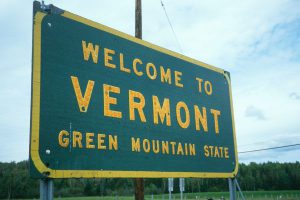
This is the actuality of the US State of Vermont today. They need more people! They need more supply and more demand. ‘Things’ are bad now, but will get even worse going forward if there are no mitigations to the current trends.

  • Vermont’s aging population … the median age nationally has increased by almost five years to 37.8 while Vermont’s has increased by 10 years
  • rapidly shrinking tax base
  • 16,000 fewer workers [now] than [they had] in 2009
  • “Must think outside the box …”

So that State is willing to pay $10,000 to people to move into the State.

Wait, what?

See the full news article and related VIDEO here:

Title: Vermont will pay you $10,000 to move there and work from home
By: Abigail Hess

Considering leaving the big city behind in favor of somewhere scenic? Now could be the right time.

On Wednesday, Quartz reports, Vermont Governor Phil Scott signed a bill into law that will pay people $10,000 if they move to Vermont and work remotely for an employer out of state. The Remote Worker Grant Program will take effect on January 1, 2019, and will help cover moving, living and working expenses. Grants can be used for relocation, computer software and hardware, broadband internet and access to a co-working space.

Currently, Vermont has budgeted funds to support 100 grants for the first three years and 20 additional workers each year from then on. Grant recipients will receive $10,000 over two years that will be distributed on a first-come, first-served basis.

This policy is intended to address Vermont’s aging population. While the state may be rich in beautiful landscapes and maple syrup, it has a rapidly shrinking tax base.

“Vermont continues to age, and age faster than the nation as a whole,” writes Art Woolf for the Burlington Free Press. “Over the past quarter of a century, the median age nationally has increased by almost five years to 37.8 while Vermont’s has increased by 10 years.”

This trend has made Vermont one of the oldest states in the nation.

In addition to the remote worker grant program, the bill also launches the state’s Stay-to-Stay initiative. The program, aimed at convincing the state’s 13 million annual tourists to permanently relocate to Vermont, will be organized by the Vermont Department of Tourism and Marketing and will connect visitors with local employers, entrepreneurs, community leaders and potential neighbors.

“We have about 16,000 fewer workers than we did in 2009. That’s why expanding our workforce is one of the top priorities of my administration,” Scott said in a statement. “We must think outside the box to help more Vermonters enter the labor force and attract more working families and young professionals to Vermont. That’s exactly what the Department of Tourism and Marketing did with this program for out-of-state visitors who may be interested in living full-time in Vermont, and I’m excited to see it move forward.”

The initiative will take place over four weekends and will be piloted in three communities. One of those selected communities is Brattleboro, Vermont. “The one thing we need more of in Vermont is people,” says Adam Grinold, executive director of the Brattleboro Development Credit Corporation. “We need more visitors, we need more employees, we need more business owners. We need more people.”

Source: CNBC Consumer & Business News – posted May 31, 2018; retrieved June 27, 2018 from: https://www.cnbc.com/2018/05/31/vermont-will-pay-you-10000-to-move-there-and-work-from-home.html

————

VIDEO – Move to Vermont, make $10,000 –  https://youtu.be/Q5Pum5HfNkQ


Published on Jun 1, 2018 – Fox Business News’ Tracee Carrasco on a new bill signed in Vermont allowing the state to offer $10,000 to those who move there and work remotely for out-of-state employers.

  • Category: News and Politics
  • License: Standard YouTube License

Vermont has a problem and they are willing to throw money at it for resolution. This just might work! Another observed-and-confirmed principle in Economics is that:

People Respond to Incentives in Predictable Ways

Think about the viability for Vermont. There are candidate individuals (and families) out there. These ones do work from home and can reside/live anywhere. Why not do it – reside – in Vermont and work from Vermont? Especially if “someone” will pay for it. These candidates have to live somewhere:

… an entity will pay you $10,000 to do something – Reside –  that you would otherwise have to do for free, or pay for!

This challenge for Vermont parallels with challenges for the Caribbean homeland. This commentary continues the series on Time to Go back to the Caribbean homeland as residents. In this instance, we are considering the reality for life in communities that constantly lose their population. Things will go from bad to worse. Considering the assessment of our Caribbean member-states:

Oops, too late! We are already Failing!
(See Appendix F below for references to Failed-State Indices for Caribbean member-states)

We have lost, and will continue to lose, so many of our professional population – one report measured the abandonment rate at 70 percent. Something must be done! Solutions must be sought!

This is commentary Number 11 in this series from the movement behind the book Go Lean … Caribbean which started in September 2016 with the first 6 issues. Now, this commentary, examines the actuality of an American State trying to recruit “good” people away from their current abodes. This is something we must be conscious of. Our advocacy is simple:

  • Our Caribbean Diaspora need to plan to repatriate to the region – we need them back!
  • While our young people, in the homeland, many times set their sights on foreign (American) shores – we need to dissuade this.

So, is this a competition? Are we trying to recruit people to come to the Caribbean instead of going to Vermont?

Ready or not, we have a battle on our hands.

The Go Lean book – available to download for free – serves as a roadmap for the technocratic Caribbean Union Trade Federation (CU). The book specifically states (Page 49):

Who are our competitors and how do we stack up against them?

Considering the customers of the CU (citizens, governments, business community, Diaspora, visitors, bank depositors, investors, monitors, NGOs), who else will be competing for their attention? From the Trade Federation perspective, this “attention” includes their time, talents, and their treasuries. Even as basic as the citizens of the region, though we’d like to think that we have a captive audience, the truth of the matter is that other role-players are campaigning to the same marketplace and audience. Consider the aspect of media: Caribbean citizens can listen to radio, watch television and read newspapers/magazines from anywhere around the world. Also, consider the City of Miami – Florida; they brand themselves as the “gateway to the Americas”. So they would rather provide most of the services – for profit – that the CU intends to provide for its citizens.

The world is flat … and as such, all societies are now competitors for the resources of Caribbean society. …

(The US State of Kansas is also incentivizing people to move there. See here: https://youtu.be/d7Gj1wDfKFM)

Vermont is cold … in the winter months! The same as Canada, the UK and Europe; they are all cold-weather locations during the winter season, yet the Caribbean has lost large numbers to those countries – our Diaspora. Weather is therefore nullified as a competitive disadvantage; it’s all about economics … and security … and governance. See more here:

The Go Lean roadmap posits that the Caribbean region is in crisis now, and so many are quick to flee for refuge in foreign countries. But the “grass is not necessarily greener on the other side”. Those destinations need our “new blood” the same as we need our people to remain. But in those countries, racial disparities continue to present challenges for new immigrants, especially those of Black-and-Brown characteristics. It is therefore easier and better for all stakeholders, that our people remain in the homeland; plus for those that have departed, that they would repatriate to the homeland.

But words alone will not suffice, we must also compete.

No, we do not need to give $10,000 to each individual. But we do need to invest … in our people and our infrastructure! We must give the effort to reform and transform our societies. We do have defects; we do have inadequacies; we are flirting with a Failed-State status. So we have heavy-lifting to do! The Go Lean/CU roadmap is designed for that heavy-lifting … to optimize Caribbean society through economic, security and governing empowerments. The Go Lean roadmap has these 3 prime directives for optimizing our societal engines:

This is the conclusion (for now) on this series of commentaries on this theme Time to Go! There are 11 in total, starting in September 2016; those 6 submissions were as follows:

  1. Time to Go: Spot-on for Protest
  2. Time to Go: No Respect for our Hair
  3. Time to Go: Logic of Senior Immigration
  4. Time to Go: Marginalizing Our Vote
  5. Time to Go: American Vices; Don’t Follow
  6. Time to Go: Public Schools for Black-and-Brown

Now, we consider these 5 new entries along that same theme:

  1. Time to Go: Windrush – 70th Anniversary
  2. Time to Go: Mandatory Guns – Say it Ain’t So
  3. Time to Go: Racist History of Loitering
  4. Time to Go: Blacks Get Longer Sentences From ‘Republican’ Judges
  5. Time to Go: States must have Population Increases

All of these commentaries relate to Caribbean people and their disposition in foreign lands and why they need to Go Back Home. Communities need their populations to grow! Our Caribbean member-states need our populations to grow. So many macro-economic programs – pensions, unemployment insurance, etc. – need gradual increases to remain solvent!

This subject is a familiar theme for this Go Lean commentary. This movement has consistently related the economic realities from societal abandonment. Less is not more! Consider these prior submissions:

https://goleancaribbean.com/blog/?p=14954 Overseas Workers Programs are not the Panacea; they create crises
https://goleancaribbean.com/blog/?p=14746 Calls for Repatriation Strategy to reverse Abandonment
https://goleancaribbean.com/blog/?p=13391 After Hurricane Maria : Destruction and Defection for Puerto Rico
https://goleancaribbean.com/blog/?p=12996 After Irma, Failed-State Indicators: Destruction and Defection
https://goleancaribbean.com/blog/?p=9203 Where the Jobs Are – Employers in the United States – They want our cheap labor
https://goleancaribbean.com/blog/?p=8155 Referendum Outcome: Impact on the ‘Brain Drain’
https://goleancaribbean.com/blog/?p=5759 Bad Role Model: Pressed by Debt Crisis, Doctors Leave Greece in Droves
https://goleancaribbean.com/blog/?p=4278 Businesses Try to Stave-off Brain Drain as “Baby Boomers” Retire
https://goleancaribbean.com/blog/?p=4185 Caribbean Ghost Towns: It Could Happen…Again
https://goleancaribbean.com/blog/?p=2547 Miami’s Success versus Caribbean Failure
https://goleancaribbean.com/blog/?p=841 Having Less Babies is Bad for the Economy

To Caribbean people: do not move to Vermont. While they are good people there – they are a great role model to emulate in terms of Green Energy initiative – it is not home. The Black-and-Brown of the Caribbean may forever be a minority there as their demographics feature 90.5% Non-Hispanic White with only 1.2% Black, 2.3% Hispanic and 2.7% Asian. This is still America; a society not built for the Caribbean’s Black-and-Brown. It is a dangerous proposition to be Black in America.

But to better compete, we must still “take care of our business” at home. The Go Lean book identifies the reasons why people abandon their homeland as “push and pull”. While the “push” refers to the societal defects that people take refuge from, the “pull” is mostly due to messaging. Our people perceive that the US is better for them, and that landing in the US will assuage all societal short-comings.

This is far from the truth. And it’s cold … in the winter!

You see! Good messaging will help mitigate our societal abandonment rate.

The Go Lean book asserts that it is easier for the Black-and-Brown populations in the Caribbean to prosper where planted in the Caribbean, rather than in Vermont or any American State, or Canada or Europe.

We need our Caribbean people to remain in the homeland, and they need to Stay Home! This is the quest of the Go Lean/CU roadmap. The book presents 370 pages of instructions for how to reform and transform our Caribbean member-states. It stresses the key community ethos that needs to be adopted, plus the strategies, tactics, implementations and advocacies necessary to optimize the societal engines in a community.

No doubt, it is Time to Go! We urge all Caribbean stakeholder, in the homeland and in the Diaspora to lean-in to this Go Lean/CU roadmap. This is our quest to reform and transform our society and make it better to live, work and play. 🙂

Download the free e-Book of Go Lean … Caribbean – now!

Sign the petition to lean-in for this roadmap for the Caribbean Union Trade Federation.

————-

APPENDIX F – CU Indicators & Definitions

The Bottom Line on the Failed States Index  – Go Lean … Caribbean (Page 134)
The Failed States Index (Appendix F) is an annual ranking of 177 nations based on their levels of stability and capacity. The Index is compiled by the Fund for Peace Institute, an independent, nonpartisan, 501(c)(3) non-profit research and educational organization, based in Washington DC, that works to prevent violent conflict and promote sustainable security. As a leader in the conflict assessment and early warning field, the Fund for Peace focuses on the problems of weak and failing states. The strength of the Failed States Index is its ability to distill millions of pieces of information into a form that is relevant as well as easily digestible and informative, as an indicator code.

Each Indicator is rated on a 1 to 10 scale with 1 (low) being the most stable and 10 (high) being the most at-risk of collapse and violence. Think of it as trying to bring down a fever, with high being dangerous, low being acceptable. An obvious example, consider Somalia, the state’s complete inability to provide public services for its citizens would warrant a score of 10 for the Public Service indicator. Conversely, Sweden’s extensive provision of health, education & other public services would produce a 1 or 2 for that indicator. – Fund For Peace®

Source: Appendix F of Go Lean … Caribbean (Pages 271 – 272)

For the Caribbean Failed-State rankings, some states are too small for consideration (i.e. Antigua, St. Kitts, etc.) and the Overseas Territories (Aruba, St. Martin, etc.) are not considered due to the fact that their legacy countries are ranked. The rankings for 2012 are as following:
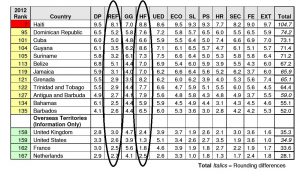
Failing Indicator:

REF – Massive Movement of Refugees or IDPs
Forced uprooting of large communities as a result of random or targeted violence and/or repression, causing food shortages, disease, lack of clean water, land competition, and turmoil that can spiral into larger humanitarian and security problems, both within and between countries. This indicator refers to refugees leaving or entering a country.
This indicator include pressures and measures related to: Displacement, Refugee Camps, IDP (Internally Displaced Persons) Camps, Disease Related to Displacement, Refugees per capita, and IDPs per capita.

HF – Chronic and Sustained Human Flight and Brain Drain
When there is little opportunity, people migrate, leaving a vacuum of human capital. Those with resources often leave before, or just as, conflict erupts. This “brain drain” of professionals, intellectuals and political dissidents fearing persecution or repression is an indicating of the failing status of a state. Other features are voluntary emigration of “the middle class”, particularly economically productive segments of the population, such as entrepreneurs, businesspeople, artisans and traders, due to economic deterioration. The end result is the growth of exile communities and Diasporas.
This indicator include pressures and measures related to: Migration per capita, Human Capital, and Emigration of Educated Population

Share this post:
, ,

e-Government 3.0

Go Lean Commentary

What if we had the chance to “start all over again”, with the knowledge, wisdom and experience that we have now? Could we do “it” faster, stronger, better? Can we do more with less?

Absolutely! Yes, we can!

Work it harder
Make it better
Do it faster
Make us stronger – 2001 Song Lyrics by group Daft Punk

The “it” in this case, is the governance for the Caribbean, the stewardship and shepherding of the 30 member-states that constitute the political Caribbean. (This includes the 2 South American countries – Guyana and Suriname – along with the Central American country of Belize).

There is the need now to reboot, reform or transform all 3 societal engines of the Caribbean region: economics, security and governance. While the first 2 engines can be reformed, there is the opportunity to launch a whole layer of governance. This is the purpose of the book Go Lean…Caribbean – available to download for free – to introduce and implement the Caribbean Union Trade Federation (CU). The Go Lean book serves as a roadmap for this new federal government. We will therefore be in a position to “start all over again” and create an administrative regime that can make the Caribbean homeland faster, stronger, better as places to live, work and play. This regime can be dubbed:

e-Government 3.0.

e-Government 1.0 refers to just the facilitation of government services via some electronic mode, the first attempt to embrace an online presence and processing; 2.0 refers to the quest for greater citizen participation in the governing/policy-making process, “putting government in the hands of citizens”.[54] This 3.0 brand however, refers to the penultimate e-Delivery, processing and optimization of ICT (Internet & Communications Technologies) among all the different roles and responsibilities. Imagine digital interactions …

  • between a citizen and their government (C2G)
  • between governments and other government agencies (G2G)
  • between government and citizens (G2C)
  • between government and employees (G2E), and …
  • between government and businesses/commercial entities (G2B).

If this sounds fantastical, just know that there are successful role model countries doing this e-Government 3.0 right now. For example, the Baltic Republic country of Estonia is widely recognized as e-Estonia, as a reference to its tech-savvy government and society.[98] (Until recently – 1991 – Estonia was a Failing-State as a member of the USSR or the Union of Soviet Socialist Republics). Today, e-Estonia is recognized as the leader in implementing block-chain technology into its e-government infrastructure.[99] See more on their 3.0 offering in the Appendices below, including a White Paper in Appendix B. Also see the VIDEO on Estonia in Appendix C.

e-Government schemes are win-win

The ultimate goal of e-Government is to be able to offer an increased portfolio of public services to citizens in an efficient and cost effective manner. e-Government allows for government transparency. Government transparency is important because it allows the public to be informed about what the government is working on as well as the policies they are trying to implement. Simple tasks may be easier to perform through electronic government access. Many changes, such as marital status or address changes can be a long process and take a lot of paper work for citizens. e-Government allows these tasks to be performed efficiently with more convenience to individuals. e-Government is an easy way for the public to be more involved in political campaigns. It could increase voter awareness, which could lead to an increase in citizen participation in elections. It is convenient and cost-effective for businesses, and the public benefits by getting easy access to the most current information available without having to spend time, energy and money to get it.

e-Government helps simplify processes and makes government information more easily accessible for public sector agencies and citizens. For example, the Indiana Bureau of Motor Vehicles simplified the process of certifying driver records to be admitted in county court proceedings.[34] Indiana became the first state to allow government records to be digitally signed, legally certified and delivered electronically by using Electronic Postmark technology. In addition to its simplicity, e-democracy services can reduce costs. Alabama Department of Conservation & Natural Resources, Wal-Mart and NIC[35] developed an online hunting and fishing license service utilizing an existing computer to automate the licensing process. More than 140,000 licenses were purchased at Wal-Mart stores during the first hunting season and the agency estimates it will save $200,000 annually from service.[36]

The anticipated benefits of e-government include efficiency, improved services, better accessibility of public services, sustainable community development and more transparency and accountability.[22]

Source: Retrieved June 19, 2018 from: https://en.wikipedia.org/wiki/E-government#Advantages

There is no doubt that the operations of government are necessary for a functioning society. There is an implied Social Contract that states “that citizens surrender some of their freedoms and submit to the authority of the State in exchange for protection of remaining natural and legal rights”. The more efficiency a State displays in delivering its obligations to its citizens, the better for the State, and the citizens. Where there is failure in this delivery, people … leave or flee!

Human flight and societal abandonment is already a characteristic of the Caribbean today. So we must explore the viability and feasibility of e-Government schemes in the new Caribbean, as rebooting the governing engines is part-and-parcel of the Go Lean roadmap. In fact, the roadmap features these 3 prime directives:

  • Optimization of the economic engines in order to grow the regional economy to $800 Billion & create 2.2 million new jobs.
  • Establishment of a security apparatus to ensure public safety and protect the resultant economic engines.
  • Improve Caribbean governance to support these engines, including a separation-of-powers between the member-states and CU federal agencies.

In a previous Go Lean commentary, it was revealed that the government is the largest employer in each Caribbean member-state. So to foster change, it is necessary to engage the governing processes. How can we improve Caribbean governance so as to bring change to our society? Answer: Deploy these functional areas of new electronic systems:

e-Government services are among the strategies, tactics and implementations in the Go Lean roadmap for elevating Caribbean society. While the new federal government will embrace these above e-Systems, the existing governmental structures – municipal, state and NGO’s – can also benefit from the economies-of-scale. See how this functionality is portrayed in the book (Page 51):

The CU’s delivery of ICT [(Internet & Communications Technologies)] systems, e-Government, contact center and in-source services (i.e. property tax systems [and www.myCaribbean.gov]) can put the burden on systems continuity at the federal level and not the member-states. (This is the model of Canada with the federal delivery of provincial systems and services – some Provincial / Territorial presence / governance is completely “virtual”).

The Go Lean book provides 370-pages of turn-by-turn directions on how to deliver on the ICT promise. The book describes “how” Caribbean communities can adopt new community ethos, plus the strategies, tactics, implementations and advocacies to execute so as to reboot, reform and transform our homeland. Consider one advocacy in particular on Page 168; see here some excerpts, summaries and headlines from the Chapter entitled:

10 Ways to Improve Governance in the Caribbean Region

1 Lean-in for the Caribbean Single Market
The CU will adopt a “Right to Good Governance” in its charter; thereby bringing accountability beyond state borders. The CU’s initiatives allow for more effective governance by separating many duties that are now managed on a national level to a federal level within the CU. So national governments will perform less services, and with the dividends from the CU, more revenues to control. But with these benefits come greater fiscal accountability.
2 Currency Union & Monetary Control
3 e-Government & e-Delivery

e-Government services for a lot of government functionality will allow economies of scale with regional governments sharing the same systems. This is envisioned for property records-tax assessment-collections, income taxes, auto registrations, vital records, human resources-payroll, and regulatory-compliance-audit functionality. In addition, a lot of government services will be delivered electronically: email, cash disbursements on a card-based benefits card (see Appendix ZV on Page 353), ACH and electronic funds transfer measure for expenditures and revenue collections.

4 Better (and New) Revenue Management
5 Economic Sanctions and Penalties
6 Consolidation of Outstanding Debt
7 CU Capital Markets
8 Economic Crimes and Bankruptcy Jurisdiction
9 Postal Modernization

The CU will assume the responsibility for mail service in the region with modernized systems and processes to enhance the efficiency and effectiveness: zone improvement (ZIP) codes, postal barcodes, sorting-collating equipment, “last-leg-electronic-postal”. The Caribbean Postal Union will deploy thousands of “neighborhood centralized mail box” locations for delivery and collection. All postal employees of the member-states will become Federal Civil Servants.

10 Prison Industrial Labor

The CU will launch the www.myCaribbean.gov on Day One/Step One of this important roadmap. This portal, resembling a social media site, will also be accessible from a smart-phone. So citizens can interact for their government from the palm of their hands. Consider how e-Government and e-Delivery have been portrayed in this sample of previous blog-commentaries:

https://goleancaribbean.com/blog/?p=13524 Future Focused – e-Government Portal 101
https://goleancaribbean.com/blog/?p=10513 Transforming ‘Money’ Countrywide
https://goleancaribbean.com/blog/?p=8823 China’s WeChat: Model for Caribbean Social Media
https://goleancaribbean.com/blog/?p=7991 Transformations: Caribbean Postal Union – Delivering the Future
https://goleancaribbean.com/blog/?p=7034 The Future of Money
https://goleancaribbean.com/blog/?p=888 How to Re-invent Government in a Digital Image – Book Review

We must reform and transform our Caribbean governing engines. We can easily accomplish this with the new CU Trade Federation – a new federal government.

This is not an option. We have a chance to start over again, and do things right! We can be faster, stronger and better. This is exactly what our region needs right now – e-Government 3.0. We urge all stakeholders to lean-in to this CU/Go Lean roadmap to make the Caribbean a better place to live, work and play. 🙂

Sign the petition to lean-in for this roadmap for the Caribbean Union Trade Federation.

Download the free e-Book of Go Lean … Caribbean – now!

————

Appendix A – Estonia takes the plunge
Sub-title: A national identity scheme goes global

The founders of the internet were academics who took users’ identities on trust. When only research co-operation was at stake, this was reasonable. But the lack of secure identification is now hampering the development of e-commerce and the provision of public services online. In day-to-day life, from banking to dating, if you don’t know who you are dealing with, you are vulnerable to fraud or deceit, or will have to submit to cumbersome procedures such as scanning and uploading documents to prove who you are.

Much work has gone into making systems that can recognise and verify digital IDs. A standard called OpenID Connect, organised by an international non-profit foundation, was launched this year. Mobile-phone operators have started a complementary service, Mobile Connect, which allows identities of all kinds to be authenticated from smartphones.

But providing a digital ID that will be widely used and trusted is far harder. Businesses can check their employees rigorously, and issue credentials for gaining access to buildings, computers and the like. But what about outside the workplace? Facebook, Google and Twitter are all trying to make their accounts a form of ID. But these are issued without verification, so pseudonyms are rife and impersonation easy.

Private providers are offering their own schemes; miiCard, for example, uses bank accounts as a way of issuing a verified online identity. But these fall short of the reliability of a state-backed identity, issued by a government official, checked against other databases, using biometric data (such as fingerprints and retinal scans) and backed by law—in effect an electronic passport.

There is one place where this cyberdream is already reality. Secure, authenticated identity is the birthright of every Estonian: before a newborn even arrives home, the hospital will have issued a digital birth certificate and his health insurance will have been started automatically. All residents of the small Baltic state aged 15 or over have electronic ID cards, which are used in health care, electronic banking and shopping, to sign contracts and encrypt e-mail, as tram tickets, and much more besides—even to vote.

Estonia’s approach makes life efficient: taxes take less than an hour to file, and refunds are paid within 48 hours. By law, the state may not ask for any piece of information more than once, people have the right to know what data are held on them and all government databases must be compatible, a system known as the X-road. In all, the Estonian state offers 600 e-services to its citizens and 2,400 to businesses.

Estonia’s system uses suitably hefty encryption. Only a minimum of private data are kept on the ID card itself. Lost cards can simply be cancelled. And in over a decade, no security breaches have been reported. Also issued are two PIN codes, one for authentication (proving who the holder is) and one for authorisation (signing documents or making payments). Asked to authenticate a user, the service concerned queries a central database to check that the card and relevant code match. It also asks for only the minimum information needed: to check a customer’s age, for example, it does not ask, “How old is this person?” but merely, “Is this person over 18?”

Other governments have tried to issue electronic identity cards. But costs have been high and public resistance strong. Some have proved careless custodians of their citizens’ data. There are fears of snooping. Britain had spent £257m ($370m) of a planned £4.5 billion on a much-criticised ID card scheme by the time the current coalition government scrapped it after coming to office in 2010.

That has left a gap in the global market—one that Estonia hopes to fill. Starting later this year, it will issue ID cards to non-resident “satellite Estonians”, thereby creating a global, government-standard digital identity. Applicants will pay a small fee, probably around €30-50 ($41-68), and provide the same biometric data and documents as Estonian residents. If all is in order, a card will be issued, or its virtual equivalent on a smartphone (held on a special secure module in the SIM card).

Some good ideas never take off because too few people embrace them. And with just 1.3m residents, Estonia is a tiddler—even with the 10m satellite Estonians the government hopes to add over the next decade. What may provide the necessary scale is a European Union rule soon to come into force that will require member states to accept each others’ digital IDs. That means non-resident holders of Estonian IDs, wherever they are, will be able not only to send each other encrypted e-mail and to prove their identity to web-service providers who accept government-issued identities, but also to do business with governments anywhere in the EU.

Estonia is being “very clever”, says Stéphanie de Labriolle of the Secure Identity Alliance, an international working group. Marie Austenaa of the GSMA, a global association of mobile-phone firms, praises it too. Allan Foster of ForgeRock, a firm that is working on government ID schemes in Belgium, New Zealand and elsewhere, thinks that the new satellite Estonians will help change attitudes to secure digital identities in their own countries, too.

The scheme’s advantages for Estonia are multiple. It will help it shed the detested “ex-Soviet” tag and promote itself as a paragon of good government and innovation. It will attract investment: once you have an Estonian ID, setting up a company there takes only a few minutes. And it will create an electronic diaspora all over the world with a stake in the country’s survival—no small matter at a time when the threat from Russia is keenly felt. (Estonia is also planning to back up all its national data to secure “digital embassies” in friendly foreign countries.)

Struck by the X-road’s scalability and security, and the fact that it has already worked well for over a decade, Finland and other countries are adopting the Estonian system in whole or in part. But for foreign individuals, perhaps its greatest appeal is that it is optional. Those who like the system’s convenience, security and flexibility can apply (though Estonia’s chief information officer, Taavi Kotka, who is taking time away from his real-life job running an IT company, stresses that the ID is a privilege, not a right). Those who feel queasy about a foreign state having access to their personal data can steer clear.

Mr Kotka says that Estonia aims to do for identity what American Express cards did for international travel in the 1960s: to simplify life. But the bigger point is that government-verified identity has been divorced from location. If Estonia’s scheme takes off some other countries may well decide to follow its lead. Some may aim at volume; others, to target the top end, as with the market in non-resident investors’ passports. Soon, multiple satellite citizenship may even become the norm.

Source: The Economist Magazine – Posted June 28, 2018; retrieved June 20, 2018 from: https://web.archive.org/web/20140701170642/http://www.economist.com/news/international/21605923-national-identity-scheme-goes-global-estonia-takes-plunge

————

Appendix B – Estonia: A model for e-Government
Abstract
Over the next decade, the population of Estonia is expected to soar more than 600% as the country becomes the first in the world to open its borders to an influx of e-residents.

Estonia: A model for e-Government. Available from: https://www.researchgate.net/publication/277943805_Estonia_A_model_for_e-government [accessed Jun 19 2018].

————

Appendix C VIDEO – Estonia Built the Society of the Future from Scratch – https://youtu.be/cHkIfiTGmzo

Beme News
Published on Jan 10, 2018 – A tech revolution is going down in Estonia…of all places. The tiny Baltic nation has built a futuristic, digital-first society. Lou explains how it works, why it works, and if it will work elsewhere.

Sources & Further Reading:
E-Estonia’ official website – https://e-estonia.com/
Estonia the Digital Republic – https://www.newyorker.com/magazine/20…
Is This Tiny European Nation a Preview of Our Tech Future? – http://fortune.com/2017/04/27/estonia…
How long it takes to file taxes in Estonia – http://www.politifact.com/truth-o-met…
How long it takes to file taxes in the U.S. – https://www.washingtonpost.com/blogs/…
Why Americans didn’t vote in 2016 – http://www.pewresearch.org/fact-tank/…

Share this post:
, , ,
[Top]

Regional Tourism Coordination – No Longer Optional

Go Lean Commentary

No one can hide anymore!

There are 30 different member-states, with 5 different colonial legacies and 4 different languages, and yet people around the world only considers our region as One Caribbean:

Event Consequence to Perception
Devastating hurricane Oops, the Caribbean is unable to function commercially
Devastating earthquake Oops, the Caribbean is unable to function commercially
Emergence of a pandemic Oops, the Caribbean is unable to function commercially

All of the Caribbean member-states are in this “same boat”, so this is a matter of image and geographic misconceptions, more so than it is about disasters.

So, good or bad, the fate of one Caribbean member-state is tied to the other member-states, when it comes to tourism. See this point conveyed in this news article here:

Title: Geographic misconceptions hurting Caribbean economies
By Sarah Peter

Nassau, Bahamas – The mistaken perception among many travelers of the complete devastation of the Caribbean in the wake of the 2017 hurricane season caused further economic destruction to the region’s economy.
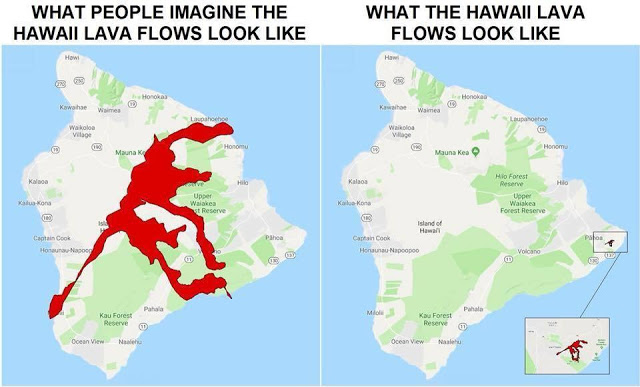
That’s according to the Chair of the Caribbean Tourism Organization (CTO), Joy Jibrilu. She raised the concern amid staggering losses among countries which were not impacted by the 2017 Hurricane season.

Jibrilu says following the devastation caused by hurricanes Irma and Maria to some islands in the region, many travelers called and canceled for countries who were not impacted by the storm.

This resulted in a significant drop in hotel room demand across the entire Caribbean. In light of that another disaster, an economic storm, was created which resulted in great losses in tourism revenue and a challenge for tourism officials.

“All our travel partners, all of them without exception called and said that we have heard the Caribbean  is closed.”

She further added that  Caribbean islands irrespective of if they were not actually impacted by the storm were economically  affected.

We all lost when people were not sure if or when to book if they canceled. You saw a dip in bookings because people thought that the islands which were not impacted were. We must quantify the figures of lost business so we can share the story with the world to tell them how serious it is. “

The chair of the CTO says that over one billion US dollars in tourism revenue was lost in the wake of last year’s hurricane season, the costliest hurricane season on record.

Jibrilu, who is also the Director of Tourism for the island of Barbados says the region’s reconstruction and recovery effort has been estimated at close to  6 billion dollars.

“Tourism is the region’s greatest driver of foreign exchange tax revenue and reliable vehicle of poverty reduction and human capital development for the region’s small island developing states. The tragedy is that the dampening of demand occurred even among islands that were not in the path of the storm.  This contributes to  an economic disaster as tourism visitation dropped of resulting in significant losses in revenue.”

Jilbrilu blamed the international media for the problem. She says their reports describes the region as if it was one country as opposed to several different islands. The chairman of the CTO says this inaccurate reporting is costing a region millions and negatively impacting lives in the region.

“First of all if we look at international news reporters when they talk about a hurricane they say the “Caribbean” has been impacted. They generalize and say the entire Caribbean. As a result, people look at the Caribbean as a whole unit as oppose to all these different countries, thousands of miles away from each other. To put it in context the Bahamas alone from north to south covers one hundred thousand square miles that is further than the distance of  Toronto to New York.  So if a storm happens in New York no one would say I am not going to Toronto. They just would not, it just does not make sense but when people lump the Caribbean  together as just one region ( as if it was just one country ) it  is negative.”

Jilbrilu says the region’s economy and people lives depend on accurate reporting and think making the international media more aware of this matter is a matter of economic prosperity or suffering for the region’s people.

“What we have done is to educate people of the geography of the Caribbean, that the same time it takes to travel from the Bahamas to Barbados is the same as traveling from London in the UK to Rome, Italy. So what happens to the Bahamas does not impact Barbados and vice versa.  We really  want to get that message out.”

Jilbrilu made the disclosure at the 2018 annual Caribbean Aviation Meetup in the Bahamas. Dubbed as the Caribbean region’s largest aviation conference the annual event brings together major players from the aviation and tourism industries aimed at tackling problems faced by the  World and the Caribbean’s Tourism and Aviation industries.
Source: Posted and retrieved June 15, 2018 from: https://stluciatimes.com/2018/06/15/geographic-misconceptions-hurting-caribbean-economies/

As related in the foregoing, the whole world knew of the 2017 devastation from Hurricanes Irma and Maria. But the affected (wiped-out) islands were only Barbuda, Grenada and Puerto Rico. And yet:

… following the devastation caused by hurricanes Irma and Maria to some islands in the region, many travelers called and canceled for countries who were not impacted.

Again, this is a matter of image and geographic misconceptions, more so than it is about disasters or even tourism. The world is telling the Caribbean: Better band together to assuage your challenges. We are united in affliction, we might as well be united in solutions. Yes, it is no longer optional for our region to confederate as a Single Market. This, we must do!

Confederation is not a bad thing! In a previous blog-commentary, it was asserted that our Caribbean member-states all suffer from the same inadequate image, and thusly we can all benefit from a regional elevation. Yes, the effect of regional integration could be an Increased Caribbean Tourism Market Share. That commentary quoted:

It’s time to take inventory of Caribbean tourism:

It has been weighed in the balance; it has been measured …
It has been found wanting!

Tourism is the current dominant industry; the goal is to “stand on the shoulders” of previous accomplishments, add infrastructure not possible by just one member-state alone and then reap the benefits. Imagine this manifestation in just this one new strategy: inter-island ferries that connect all islands for people, cars and goods.

The movement behind the book Go Lean … Caribbean seeks to reboot the economic engines of the Caribbean member-states. So while tourism is the region’s primary economic driver, it is inadequate for providing the needs of the people in the region, and inadequate for dealing with the crisis of natural disasters. We must do better!

The Go Lean book serves as a roadmap for the introduction and implementation of the Caribbean Union Trade Federation (CU). The CU is designed to be a technocratic intergovernmental entity that shepherds economic growth for the Caribbean region and mitigate against all security-disaster challenges. The goal is to reboot and optimize the region’s economic, security and governing engines with a regional focus.

The Go Lean/CU roadmap will employ strategies, tactics and implementations to impact its prime directives; identified with the following 3 statements:

  • Optimization of the economic engines in order to grow the regional economy to $800 Billion & create 2.2 million new jobs.
  • Establishment of a security apparatus to ensure public safety and protect the resultant economic engines. This includes a professional disaster planning and response organization.
  • Improvement of Caribbean governance to support these engines, including a separation-of-powers between the member-states and CU federal agencies, as in Self-Governing Entities.

The Go Lean book provides 370-pages of turn-by-turn instructions on “how” to adopt new community ethos, plus the strategies, tactics, implementations and advocacies to execute so as to elevate Caribbean image in good times and bad. One advocacy seeks to optimize the Caribbean tourism brand throughout the world; consider some specific plans, excerpts and headlines from the book on Page 133 entitled:

10 Ways to Better Manage Image

1 Lean-in for the Caribbean Single Market
This will allow for the unification of the region into one market of 42 million people across 30 member-states, with a GDP of $800 Billion (according to 2010 figures). In addition, the treaty calls for collective bargaining with foreign countries and industry representatives for causes of significance to the Caribbean community. There are many times when the media portray a “negative” depiction of Caribbean life, culture and people. The CU will have the scale to effectuate negotiations to better manage the region’s image, and the means by which to enforce the tenets.
2 Media Industrial Complex
The Caribbean Central Bank will settle electronic payments transactions; this will allow electronic commerce to flourish in the region. With the payment mechanisms in place, music, movies, TV shows and other media (domestic and foreign) can be paid for and downloaded legally. For a population base of 42 million, this brings a huge economic clout.
3 Respect for Intellectual Property
4 Sentinel in Hollywood
5 Anti-Defamation League
This Pro-Jewish organization provides a great model for marshalling against negative stereotypes that can belittle a race. The CU will study, copy, and model a lot of the successes of the Anti-Defamation League. This organization can also be consulted with to coach the CU’s efforts. (Consider the example of Uptown Yardies Rasta Gang in the game Grand Theft Auto [206]).
6 Power of the Boycott
The CU is an economic negotiating bloc. The power to ban, boycott and censure trade in intellectual property is a powerful deterrent for producers to be balanced in their media portrayals. A CU federal agency will assume the role to rate pending moves, as performed by MPAA in the US. While the content may not be banned outright, placing a Rated R, NC-17 or X label to a film will affect the economic results from the box office. This is the “power of the purse”.
7 Freedom of the Press
8 Libel and Slander Litigation and Enforcement
9 Public Relations and Press Releases
To facilitate effective communications, the CU’s agencies will embrace the role of “Press Secretaries” to disseminateaccurate records, news and portrayals of Caribbean life. This role is Offensive rather than the above Defensive tactics.
10 Image Award Medals and Recognition
Following the model of the NAACP Image Awards, the CU will recognize and give accolades for individual and institutions that portray a positive “image” of Caribbean life and CU initiatives. This would be similar to the Presidential Medal of … / Congressional Medal of …

The likelihood of more hurricanes in the Caribbean is undeniable. This is further exacerbated with the reality of Climate Change. Our Caribbean region must be prepared to Rinse & Repeat. It is no longer an option to maybe manage our image on a regional level. The world must know that we are bigger than just whatever island has been recently impacted by a natural disaster. This challenge is heavy-lifting because, as a region, we rarely muster an adequate response to our natural disasters.

The Go Lean book explains further that the Caribbean region must install a security apparatus with the directive to prepare and respond to natural disasters. The efficiency and effectiveness of a Caribbean Emergency Management Agency must be streamlined to ensure the world of the business continuity of our systems of commerce. This quotation is derived from the book at Page 184:

Modeled after FEMA in the US, this agency will be charged with the preparation, response and reconstruction for the regions for the eventual manifestations of hurricanes, earthquakes, tsunamis, flooding and other declared disasters, natural and man-made like medical epidemic, drought, pollution, oil spills, terrorism, etc.

This is what it means to be a technocracy, to promote the best delivery arts and sciences, in this case for Professional Emergency Management; as explained further at Page 64:

The CU treaty calls for a collective security agreement for the Caribbean member-states to prepare-respond to natural disasters, emergency incidents and assuage against systemic threats against the homeland. The CU employs the professional arts and sciences of Emergency Management to spread the costs and risks across the entire region. Outside of hurricanes or earthquakes, the emergency scope includes medical trauma, pandemic incidents and industrial accidents (i.e. oil or chemical spills) – any scenario that can impact the continuity of the economic engines and/or community.

This above scenario describes the dynamics of regional tourism promotion and protection. Yes, managing regional tourism means optimizing the planning and response for natural disasters. This is no longer optional for this homeland. We are compelled to invest in this integration and collaboration. We must have the leverage to spread the costs, risks and premium base across the entire region. Only then will the rest of the world know that any hurricane in the Caribbean does not mean a shutdown of the entire Caribbean region. Our image will then be:

Be our guests … in rain and shine.

Consider this Hawaiian example; yes this problem of promoting tourism while contending with natural disasters is not just an issue for the Caribbean. Rather, the US State of Hawaii is contending with the same thing right now, with the active Kīlauea volcano. See related news VIDEO in the Appendix below.

There is the need for better stewardship of the economic engines on touristic islands, be it Hawaii or the Caribbean. It is what it is! And our situations will worsen; things will get worse before they get worst. This is due to the reality and eventuality of Climate Change. This need to assuage against the threats and realities of Climate Change was an original intent of the Go Lean roadmap. The opening Declaration of Interdependence stresses this (Page 11) in the first of many pronouncements:

i. Whereas the earth’s climate has undeniably changed resulting in more severe tropical weather storms, it is necessary to prepare to insure the safety and security of life, property and systems of commerce in our geographical region. As nature recognizes no borders in the target of its destruction, we also must set aside border considerations in the preparation and response to these weather challenges.

The Go Lean movement has previously detailed many related issues and advocacies for disaster awareness and abatement. Consider this sample of previous blog-commentaries:

https://goleancaribbean.com/blog/?p=15012 In Life or Death: No Love for Puerto Rico
https://goleancaribbean.com/blog/?p=14925 ‘Climate Change’ Reality!? Numbers Don’t Lie
https://goleancaribbean.com/blog/?p=14832 Example of Manifesting Environmental Change
https://goleancaribbean.com/blog/?p=13391 After Maria, Failed-State Indicators: Destruction and Defection for Puerto Rico
https://goleancaribbean.com/blog/?p=12996 After Irma, Failed State Indicators: Destruction and Defection
https://goleancaribbean.com/blog/?p=12977 After Irma, Barbuda Becomes a ‘Ghost Town’
https://goleancaribbean.com/blog/?p=12900 The Logistics of Disaster Relief
https://goleancaribbean.com/blog/?p=12879 Disaster Preparation: ‘Rinse and Repeat’
https://goleancaribbean.com/blog/?p=11858 Looking and Learning from the Cautionary Tale of Kiribati
https://goleancaribbean.com/blog/?p=9455 Fix ‘Climate Change’ – Yes, We Can
https://goleancaribbean.com/blog/?p=7103 COP21 – ‘Climate Change’ Acknowledged
https://goleancaribbean.com/blog/?p=6893 A Meteorologist’s View On Climate Change
https://goleancaribbean.com/blog/?p=4673 Climate Change‘ Merchants of Doubt … to Preserve Profits!!
https://goleancaribbean.com/blog/?p=2465 Book: ‘This Changes Everything: Capitalism vs. the Climate’
https://goleancaribbean.com/blog/?p=2276 Climate Change May Affect Food Supply Within a Decade
https://goleancaribbean.com/blog/?p=1883 Climate Change May Bring More Kidney Stones
https://goleancaribbean.com/blog/?p=1817 Caribbean grapples with intense cycles of flooding & drought

In summary, the issues in this commentary relate more to image and geographic misconceptions than they do tourism and natural disasters. Do we have the global reputation to “take a punch and stand back up”.

Unfortunately, no!

So we must reform and transform the Caribbean’s societal engines so as to assuage the dangers of Climate Change and natural disasters; pandemics too. This is the quest of the Go Lean roadmap, and this is not just a pipe dream; it is conceivable, believable and achievable for our regional stakeholders to do better and be better.

All Caribbean stakeholders – residents and tourists alike – are urged to lean-in to this roadmap for change … and empowerment. Yes, we can make the region a better place to live work and play. 🙂

Sign the petition to lean-in for this roadmap for the Caribbean Union Trade Federation.

—————-

Appendix VIDEO – Hawaii tourism hit hard by Kilauea volcano eruption – https://youtu.be/89ppKLS5ufI

CBS Evening News
Published on Jun 2, 2018 – As molten lava destroys more homes in Hawaii, police have been ordered to arrest people who refuse to evacuate. Thousands have already been forced to flee to safety. Now, dramatic images broadcast around the world are having another impact — on tourism. CBS News correspondent Carter Evans reports.

Share this post:
, , ,
[Top]

“Profiting” from Hurricanes – ENCORE

If only there was a way to make money on the hurricane season …

… there is.

Its called reinsurance sidecars – where investors buy-in to the risks and returns of insurance premiums.

Yes, we can …

This was detailed in a previous blog-commentary from the movement behind the book Go Lean…Caribbean. As we embark on the Hurricane Season 2018, it is important to remember that there is a better way – a Way Forward – to optimize Caribbean life. Let’s Encore that blog from October 13, 2017 here-now:

——————

Go Lean Commentary – Funding Caribbean Risk

A penny saved is … a penny.

This is not exactly how the expression goes. It is supposed to refer to the good habit of “saving money”, which is a positive community ethos – underlying sentiment that informs the beliefs, customs, or practices. “Saving money” is a practice that the stewards of any society should advocate for its people. It’s a simple formula: Earn money; spend some; save some!

CU Blog - Funding Caribbean Risk - Photo 0This is easier said than done. A practice of saving money – for a rainy day or any catastrophe – takes discipline, the discipline not to spend. One tactic is to pay yourself first! Before paying other overhead expenses, the priority would be to set aside monies in a savings program or some insurance program. Yes, an insurance strategy could be even smarter for rainy days or catastrophes; it allows the hedging of risks by leveraging across a wider pool; more people – savers – put-in and only a few … or just one withdraws. This is also the approach of the thoughtful Caribbean Catastrophe Risk Insurance Fund (CCRIF).

It is very sad when communities are not able to save or insure a “Rainy Day” fund for when it rains, especially in the tropical region where it doesn’t just rain, but pours and storms.

What is sadder is when the heavy-lifting of “savings” or insurance is done, but the dollar amount is not enough; because a “penny saved is only just a penny”.

This is the Caribbean dilemma, today. We have just experienced 2 devastating hurricanes – Irma and Maria – that have wreaked havoc on our region. We now need to tap the “Rainy Day” fund and frankly, it is simply not enough!

See the actuality of this dilemma in the news article here and the related VIDEO on CCRIF:

Title: CCRIF to make payouts to countries affected by Hurricane Irma

The Caribbean Catastrophe Risk Insurance Facility (CCRIF SPC) will be making payouts totaling over US$15 million to three Caribbean countries affected by Hurricane Irma earlier this week.

“The CCRIF board and team offer condolences for the loss of life and hope these funds will provide some assistance. We stand ready to support the Government and people of these CCRIF countries as they recover from the effects of this devastating hurricane,” said CCRIF chief executive officer, Isaac Anthony.

Payments totaling US$15.2 million
The CCRIF plans to pay US$6.7 million to Antigua and Barbuda, US$6.5 million to Anguilla and US$2.2 million to St. Kitts-Nevis.

The storm has been blamed for at least 10 deaths and millions of dollars in property damages as it made its way through the Lesser Antilles this week.

In the case of Barbuda, Prime Minister Gaston Browne has ordered an immediate evacuation of some 1,800 people on the island. The government has also announced a state of emergency.

“Nothing is functional in Barbuda,” Browne said, adding that he has given instructions that ‘every single soul must be taken out of Barbuda”.

Verifying payouts
The CCRIF is verifying the payout calculations and is in discussion with the three governments about arrangements for the transfer of these funds. The transfer will be completed within 14 days after the storm, as mandated by CCRIF’s operational guidelines.

“Anguilla and St. Kitts & Nevis also have Excess Rainfall (XSR) policies and CCRIF is assessing if these policies were triggered by the rains from Hurricane Irma, which may possibly result in a second payout under those policies. The assessment under the XSR policies will be determined in the next few days,” the CCRIF added.

Segregated portfolio company
The CCRIF SPC is a segregated portfolio company, owned, operated and registered in the Caribbean. It limits the financial impact of catastrophic hurricanes, earthquakes and excess rainfall in the Caribbean and, since 2015, Central American governments by quickly providing short-term liquidity when a parametric insurance policy is triggered.

Since its inception in 2007, the facility has made 22 payouts for hurricanes, earthquakes and excess rainfall to 10-member governments totaling approximately US$69 million.

It said the new payments will bring the total payouts to approximately US$85 million. Last year CCRIF made payouts totaling US$29 million to four countries after Hurricane Matthew.

Source: Posted September 9, 2017; retrieved October 13, 2017 from: https://www.caribbeannationalweekly.com/caribbean-breaking-news-featured/ccrif-make-payouts-countries-affected-hurricane-irma/

———–

VIDEO – WorldBank CCRIF Caribbean Gold – https://youtu.be/IlZ56ON9KnI

CCRIF SPC

Published on Feb 28, 2017 – Working towards sovereign risk protection in the Caribbean and Central America.

We now know what CCRIF is; how it works; and who can engage this program in terms of investors and beneficiaries; see more encyclopedic details in the Appendix A below. But …

… it is the assessment of this commentary that CCRIF is flawed and inadequate for the Caribbean’s needs.

  • The CCRIF is designed for 1-in-15 year hurricane (Source: http://www.ccrif.org/content/rtfs-faqs). Truth be told, thanks to Climate Change we are seeing storms yearly.
  • There is a catastrophic trigger – complicated formula – which generates a “measly” payout for a hurricane or earthquake.
  • This is a sovereign fund only and the trigger level is dependent on the coverage purchased by individual countries.
  • The pool is too small. Member governments may purchase coverage which triggers for a ‘one-in-15-year’ hurricane and a ‘one-in-20-year’ earthquake, with maximum coverage of US$100M available for each peril. The cost of coverage is a direct function of the amount of risk being transferred, ensuring no cross-subsidisation of premiums and a level playing field for all participants.

This fund is “too little, too late” for what the region needs. But like all other Caribbean integration (CariCom) efforts, it is a good start! Still after 50 years of autonomous rule, the expectation is not just for a start, it is for solutions.

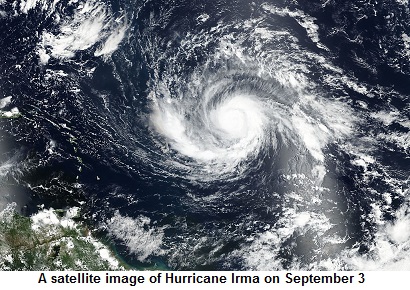
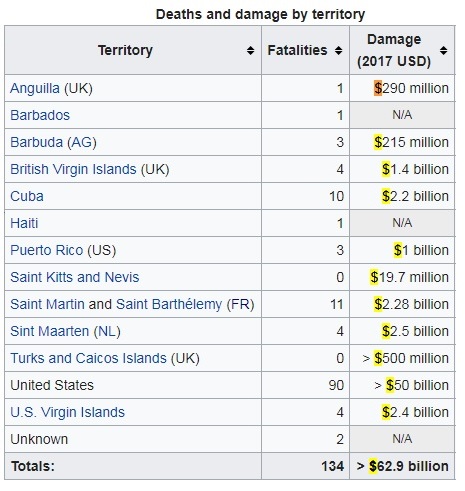
While the habit of “saving” or paying for insurance is a best-practice, the financial amount is important for the subjective assessment of success. The foregoing news article relates that $15.2 million will be paid-out to the affected countries. But this amount is so small, too small! Consider just for Hurricane Irma alone, the estimated damage amount has been tabulated at $62.87 billion. While $50 Billion of that amount relates to the US Mainland, the rest is the Caribbean. So the Caribbean’s share is $12.9 Billion; – see Chart here:

CU Blog - Funding Caribbean Risk - Photo 1

CU Blog - Funding Caribbean Risk - Photo 3

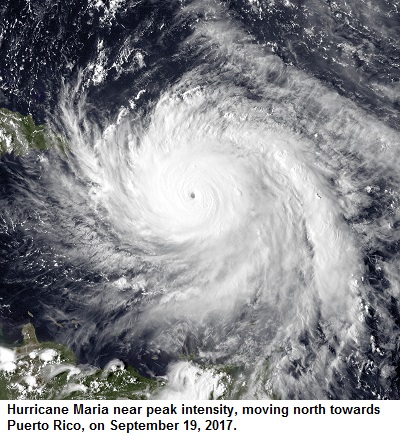
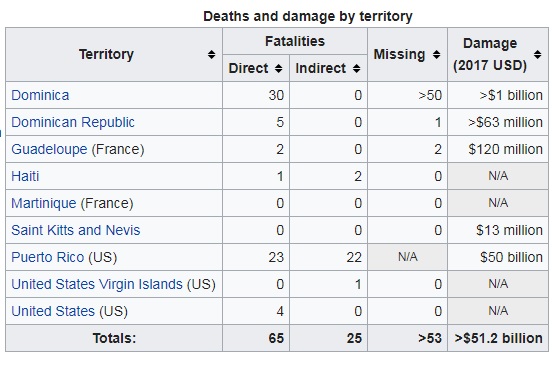
On the other hand. Hurricane Maria, has estimates for damages at $51.2 billion. None of that amount relates to the US Mainland, the amount is all Caribbean, considering Puerto Rico and the US Virgin Islands; see Chart here:

CU Blog - Funding Caribbean Risk - Photo 2

CU Blog - Funding Caribbean Risk - Photo 4

An immediate result of these storms on the Caribbean will probably be the defection of masses of people from the region. As of this date – October 12, 2017 – Puerto Rico is still not relieved nor recovered from Hurricane Maria. In fact 84% of the island still does not have power. Since Puerto Ricans are American citizens, they have freedom of movement from the island to the US Mainland. In addition, many of the other Caribbean islands will also suffer abandonment as the Diaspora is large in North America and Europe; so bonafide family connections will allow for their emigration. Expect more societal abandonment in the region!

The quest of the movement behind the book Go Lean…Caribbean – available to download for free – is to lower the abandonment rates of our Caribbean citizens fleeing the homeland. Our quest is conceivable, believable and achievable. But the status quo of the Caribbean Catastrophe Insurance Funds is inadequate; it must improve. It must reform and transform.

The Go Lean book describes a Way Forward. The book serves as a roadmap for the introduction and implementation of the technocratic Caribbean Union Trade Federation (CU), for the elevation of Caribbean society – for all member-states. This CU/Go Lean roadmap has these 3 prime directives:

  • Optimization of the economic engines in order to grow the regional economy to $800 Billion and create 2.2 million new jobs.
  • Establishment of a Homeland Security and Emergency Management apparatus to ensure public safety and protect the resultant economic engines.
  • Improve Caribbean governance to support these engines, including a separation-of-powers between the member-states and CU federal agencies.

The book stresses that reforming and transforming the Caribbean societal engines must be a regional pursuit. This was an early motivation for the roadmap, as pronounced in the opening Declaration of Interdependence (Pages 12 – 13):

xi. Whereas all men are entitled to the benefits of good governance in a free society, “new guards” must be enacted to dissuade the emergence of incompetence, corruption, nepotism and cronyism at the peril of the people’s best interest. The Federation must guarantee the executions of a social contract between government and the governed.

xvi. Whereas security of our homeland is inextricably linked to prosperity of the homeland, the economic and security interest of the region needs to be aligned under the same governance. Since economic crimes … can imperil the functioning of the wheels of commerce for all the citizenry, the accedence of this Federation must equip the security apparatus with the tools and techniques for predictive and proactive interdictions.

xxiv. Whereas a free market economy can be induced and spurred for continuous progress, the Federation must install the controls to better manage aspects of the economy: jobs, inflation, savings rate, investments and other economic principles. Thereby attracting direct foreign investment because of the stability and vibrancy of our economy.

Way Forward
The Go Lean book provides 370-pages of turn-by-turn instructions on “how” to adopt new community ethos, plus the strategies, tactics, implementations and advocacies to execute so as to reboot, reform and transform the societal engines of Caribbean society, despite the reality and risks of natural disasters. Accepting that the CCRIF is a government-member-state solution, the Go Lean book proposes a supplement of private solutions, instruments facilitated by the region’s Capital Markets – think the Caribbean version of Wall Street. The Go Lean book proposal is for region-wide (all 30 member-states; 4 language groups) private insurance companies and Re-insurance Side-cars traded on the Capital Markets.

Re-insurance Side-cars is a derivative product – see Appendix B below.

Consider these sample references to Re-insurance Side-cars in the book:

Tactical – Separation of Powers – Emergency Management Agency
There is also an economic/financial scope for this department. As the effort for a comprehensive property-casualty fund to cover the entire Caribbean region will also be coordinated by this agency. The classic solution is a large pool of premium payers and claims filed by the affected area. Beyond this model, there are also advanced products like re-issuance side-cars for market assimilation. The public can then invest and profit from the threat/realization of regional risks. This derivative product is a bet, a gamble, but in the end, the result is an insurance fund of last resort, much like the Joint Underwriters Agency (JUA) in Florida.
Page 76
Implementation – 10 Ways to Pay for Change
#8 Homeland Security – Hurricane Insurance Fund
The risk pool for a 42-million population is so much lower than each member-state’s sole mitigation efforts. The CU will establish (contract with a service provider) reinsurance funds (& sidecars) from Day One, and glean the excess premiums-over-claims as profit.
Page 101
Advocacy – Ways to Improve Housing
#7 Hurricane Risk Reinsurance Fund
This fund fits the Emergency Management objectives of rebuilding and restoring after disasters. This is similar to Florida’s Joint Underwriters Association but instead regulated at the CU so as to maximize the premium pool.
Page 161
Advocacy – 10 Revenue Sources
#9 Natural Disaster Insurance Fund
The CU’s Emergency Management Agency will maintain a regional reinsurance fund to offset the casualty coverage for insurance carriers in the region. The difference between premiums and claims constitute revenues for the CU.
Page 172
Advocacy – 10 Ways to Impact Public Works
#10 Capital Markets
A Single Market and currency union will allow for the emergence of viable capital markets for stocks and bonds (public and private), thereby creating the economic engine to fuel growth and development. This forges financial products for “pre” disaster project funding (drainage, levies, dykes, sea walls) and post disaster recovery (reinsurance sidecars).
Page 175
Advocacy – 10 Ways to Improve for Natural Disasters
#7 JUA-style Insurance Fund
The fiduciary management of premiums and claims to allow the immediate response for reconstruction after disasters. These financial services, sidecars traded in markets can be direct or indirect as in reinsurance or insurer-of-last-resort.
Page 184
Advocacy – 10 Ways to Improve for Emergency Management
#8 Casualty Insurance Plans – Reinsurance “Sidecars”
There is also a financial battlefield for Emergency Management. Reinsurance “sidecars” allow investment bonds to be issued in the financial marketplaces to raise casualty insurance capital. The differences between premiums and claims (plus reserves) equal the profit to be shared with investors. The end result should be an insurance fund of last resort.
Page 196
Advocacy – 10 Ways to Develop a Pre-Fab Housing Industry
#10 Homeowners Casualty Insurance
Pre-Fab-ulous houses will be built with the structural integrity to withstand typical tropical storms/hurricanes. The CU will facilitate the Property Casualty insurance industry by offering Reinsurance sidecar options on the capital markets.
Page 207
Advocacy – 10 Ways to Improve Fisheries
#7 Marine Financing
There is also a financial element to facilitating the Fisheries industry. Most fishing vessels require financing and insurance products. These areas have gotten more challenging with “climate change” and the higher propensity of hurricanes. The CU will adopt advanced financial products for the region’s capital-securities markets (i.e. Reinsurance sidecars), to offer the prospects of risk-and-reward to investors, thus inviting more capital to the fisheries marketplace.
Page 210
Advocacy – 10 Ways to Help the Middle Class
Prepare for Healthcare Realities
While a Middle Class family may obtain a degree of financial security, just one catastrophic illness or injury can wipe out a family’s fortunes overnight. This is the proper place for insurance programs, and reinsurance to hedge the risk for carriers. The CU will proactively institute the measures (industry) to protect Middle Class prospects from this real threat.
Page 223
Advocacy – 10 Ways to Impact The Guianas
#4 Disaster Planning, Preparation & Response
Hurricanes are not as dire a threat for The Guianas as the Caribbean islands, yet still there are many natural disasters for this region to contend with, namely floods and earthquakes. The CU will better plan-prepare-respond, with Public Works initiatives (dams, reservoirs) and a professional Emergency Management Agency to recover with elite financial products (i.e. reinsurance sidecars) powered by regional capital markets to restore economic engines in these Guiana states.
Page 241
Advocacy – 10 Ways to Impact Belize
#7 Disaster Planning, Preparation & Response
Mother Nature, and the reality of hurricanes, has been a source of contention in Belize’s history. The CU will better plan-prepare-respond with a professional Emergency Management Agency and recover with elite financial products (i.e. reinsurance sidecars) powered by capital markets so as to restore economic engines in Belize.
Page 243
Advocacy – 10 Ways to Impact US Territories
Advocacy – 10 Ways to Impact British Territories
Advocacy – 10 Ways to Impact Dutch Territories
Advocacy – 10 Ways to Impact French Territories
#4 Disaster Preparation & Response
Mother Nature, and the reality of hurricanes, plays no favorites for one island versus another due to political alliance. The CU will better plan-prepare-respond, with a professional Emergency Management Agency and recover with elite financial products (i.e. reinsurance sidecars) powered by regional capital markets to quickly restore economic engines in the islands.
Page 244
Page 245
Page 246
Page 247 

As an individual or community, to devote a lot of time, talent and treasury to the practice of saving for a rainy-day fund is a positive ethos. To only get a measly payoff – after all that effort – is a negative. The manifestation of this measly scenario calls into question the whole viability of the Caribbean “pooled” risk strategy.

We must do better! Solutions abound!

Engaging a bigger-better regional risk pool, makes our quest realistic: a better homeland to live, work and play.  We urge all Caribbean stakeholders – governments and citizens alike – to lean-in for the empowerments described here in the book Go Lean…Caribbean. 🙂

Download the free e-Book of Go Lean … Caribbean – now!

Sign the petition to lean-in for this roadmap for the Caribbean Union Trade Federation.

———

Appendix A – Caribbean Catastrophe Risk Insurance Facility Segregated Portfolio Company (CCRIF SPC)

[This CCRIF SPC] is an insurance company headquartered in the Cayman Islands.[1] The sixteen original member-countries of CCRIF included participants in CARICOM, and the membership of the Board of Directors is selected by CARICOM and by the Caribbean Development Bank.[2]

Founded in 2007,[3] CCRIF is the first multi-country risk pool in the world, and was the first insurance instrument to successfully develop parametric policies backed by both traditional and capital markets.[4] These parametric polices release funds based upon factors of a calamity such as rainfall or wind speed, which can speed up the payout of policies rather than after damages are assessed. Unused funds are kept as reserves for the CCRIF. The fund can also draw upon $140 million in funds underwritten by reinsurance.[5]

Other regions have since setup similar government disaster instance including in the African Union and the Pacific Islands Forum.[5]

Source: Retrieved October 13, 2017 from:  https://en.wikipedia.org/wiki/Caribbean_Catastrophe_Risk_Insurance_Facility_Segregated_Portfolio_Company

———

Appendix B – Reinsurance sidecars

Reinsurance sidecars, conventionally referred to as “sidecars”, are financial structures that are created to allow investors to take on the risk and return of a group of insurance policies (a “book of business”) written by an insurer or reinsurer (henceforth re/insurer) and earn the risk and return that arises from that business. A re/insurer will only pay (“cede”) the premiums associated with a book of business to such an entity if the investors place sufficient funds in the vehicle to ensure that it can meet claims if they arise. Typically, the liability of investors is limited to these funds. These structures have become quite prominent in the aftermath of Hurricane Katrina as a vehicle for re/insurers to add risk-bearing capacity, and for investors to participate in the potential profits resulting from sharp price increases in re/insurance over the four quarters following Katrina. An earlier and smaller generation of sidecars were created after 9/11 for the same purpose.

Market growth following 9-11 and Hurricane Katrina
In the years following 9-11, the idea of raising funds from capital markets investors in addition to re/insurers to support quota-shares arose and a handful of such ventures were consummated (Olympus, DaVinci, Rockridge). These were the first true sidecars, and were a natural outgrowth of the development of re/insurance as an asset class in the form of catastrophe bonds.

Following Hurricane Katrina, the sidecar idea became very prominent among investors because it was seen as a way to participate in the risk/return of the higher-priced (“hard”) reinsurance market without investing in either existing reinsurers (who might have liabilities from the past that would undermine returns) or new reinsurers (“newcos” that would have a lengthy and expensive “ramp up” period).

Source: Retrieved October 13, 2017 from: https://en.wikipedia.org/wiki/Reinsurance_sidecar


Share this post:
, ,
[Top]

Graduation Speakers – Say ‘Something Nice’ or Nothing At All

Go Lean Commentary

Congratulations to all the graduates in the Class of 2018.

Way to go! Before you move the tassel from left to right, you have to endure the invited speaker who should deliver an inspired Commencement speech. To that speaker, we urge: “Say something nice or say nothing at all”.

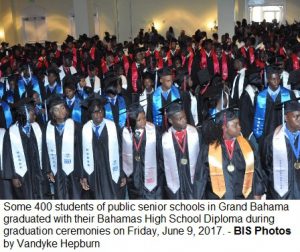
Please learn the good lesson from this bad speech delivered last year to the combined graduating classes – 400 students – of all 4 public high schools in Grand Bahama (Freeport), Bahamas in June 2017.

This was really bad!

First though, some background …

… this was one month after the new government came into power in the Bahamas. The political party, Free National Movement, with the Leader and thusly the new Prime Minister, Dr. Hubert A. Minnis, was voted in with a landslide victory on May 10, 2017. The party, and new Cabinet, was thrust into power by a mandate of the Bahamian people; their demand for a change because the assessments before were so very bad. The new Minister of Education, Jeffrey Lloyd was called on to give this graduation speech. Let’s give him the benefit of the doubt that this was his first one; see here:

Title: Education Minister tells GB Public School Graduates to Think Globally, Get Qualified, Come Back and Build Their Country

By: Andrew Coakley, Bahamas Information Services

FREEPORT, Grand Bahama – Minister of Education the Hon. Jeffrey Lloyd told the 2017 graduating class of public school students in Grand Bahama that The Bahamas critically needs their talents to positively shape and form the future of these islands.  “Go out and see the world – there are six or seven continents in this world — go and visit them all, and even work in them all, but come back home and build your country,” said Minister Lloyd.

“We need your talents, your brilliance, your capabilities and your insights so that we can become the best little country on God’s earth.”

The Education Minister’s remarks came during graduation ceremonies for the Ministry of Education’s Inaugural Bahamas High School Diploma, which was held at the Grand Lucayan resort on Friday, June 9, 2017. The ceremony combined the public schools on Grand Bahama, inclusive of Jack Hayward High School, St. George’s High School, Eight Mile Rock High, as well as students from the Beacon School.

“Today, there are nearly 50,000 students in the public schools in this country,” said Minister Lloyd.  “Young people like you, under the age of 20, make up approximately 40 percent of the population of this land. Those under 30 make up almost 60 percent of this population.

“So, without a doubt, the future social atmosphere, the cultural identity, the economic and political reality of this country is directly tied to the constructive development of you. This is a time of great opportunity; it is also a time of great trial and challenge.

“There are many, many negative influences that swirl about in your young lives.”

He apologized to those graduates who may not have had the opportunity to have positive role models in their lives and within their environments. He said those are not the paradigm they must follow, but that Jesus, the Christ is the role model to follow.

“And what he invites you to understand graduates, is that you must let no one take your greatness, your potential, your power, your magnificence nor your splendor from you,” said Minister Lloyd.

The Education Minister reminded the students that they live in what is considered to be one of the most exciting times in mankind’s history.

Minister Lloyd reminded teachers that education has changed and is constantly changing; now it is driven by technology.

“So educators, if you are not tech savvy, you better get there, because that is the world we live in today. Unlike anytime in our history the re-dedication of the educational professional to their craft and the outcomes they seek, what we seek, is never more powerful.”

Minister Lloyd left the graduates with three final thoughts as they move to the next level of their lives: Think globally, get qualified and become mobile.

Source: Posted June 12, 2017; retrieved May 26, 2018 from The Official Website of the Government of The Bahamas

We have made this assessment of the speech and verbiage of this new government before. These words by the Education Minister is the same bad advice:

“Go out and see the world … visit them all, and even work in them all, but come back home and build your country”.

Yeah, nobody does that! They leave; they very seldom come back!

The Education Minister here seems to be doubling-down on failure. In a previous blog-commentary, the Prime Minister, Dr. Minnis, addressed a Bahamian Diaspora group and he portrayed them as if they were the panacea, the “cure-all”, for what ails the Bahamas. This attitude truly reflects why the Bahamas, and especially this 2nd city of Freeport, is failing in all their societal engines. The problem is abandonment or human flight. Now, the chief educator in the country stares down at these young impressionable men and women and urges them further to …

Leave!
Get world experience and then maybe, if its not too much trouble, come back.

It is a well known fact, that the college educated populations in the Bahamas do NOT come back. In fact, according to a World Bank study, the country suffers from a 61 percent abandonment rate.

Most of what ails Freeport and the whole Bahamas (actually true for the entire Caribbean) is the human flight of their most educated citizens. A country cannot “nation build” without nation-builders. A government policy that urges young ones to leave and complete their development abroad is a flawed strategy; it should not be spoken. This is not just a problem for the Bahamas,  but has been consistently lambasted in these other Caribbean member-states:

This commentary is from the movement behind the book Go Lean … Caribbean. We have criticized every Caribbean member-state that projects policies that encourage more traffic among their Diaspora – those who had fled, being “pushed” or “pulled” away from their homeland. This policy-strategy double-downs on the failure of why the Diaspora left in the first place. A previous commentary explained:

The subtle message to the Caribbean population is that they need to leave their homeland, go get success and then please remember to invest in us afterwards.

… It is so unfortunate that the people in the Caribbean are beating down the doors to get out of their Caribbean homeland, to seek refuge in these places like the US, Canada and Western Europe. … We have such a sad state of affairs for our Caribbean eco-system as we are suffering from a bad record of societal abandonment.

This movement advocates for the people of Freeport, people of the Bahamas and the people of the Caribbean. We want them all to “prosper where planted” in their Caribbean homelands. But first, we must “stop the bleeding” – even student loans have been defaulted by those abandoning their Bahamian homeland. Leaving home to matriculate and/or work has a serious and consistent track record of failure. This should never be the theme of a Commencement address.

Our quest should be to “stop the bleeding”. This is truly a quest, and not just an idea. This is not easy; there is heavy-lifting involved. We must assess the reasons why people leave, the “push and pull” factors, then conceive strategies, tactics, implementations and advocacies to assuage the bad trend. Yes, this quest is conceivable, believable and achievable.

The book Go Lean…Caribbean – available to download for free – serves as a roadmap for the introduction and implementation of the technocratic Caribbean Union Trade Federation (CU), for the elevation of Caribbean society – Freeport, for the Bahamas and for all member-states. The book asserts that the region must work to hold on its populations – especially the well-educated classes – not send them away and see them never return from foreign shores. To accomplish this objective, this CU/Go Lean roadmap presents these 3 prime directives:

  • Optimization of the economic engines in order to grow the regional economy to $800 Billion and create 2.2 million new jobs.
  • Establishment of a security apparatus to ensure public safety and protect the resultant economic engines.
  • Improvement of Caribbean governance to support these engines, including a separation-of-powers between the member-states and CU federal agencies.

The book aligns with the vision of the Education Minister and the  Prime Minister of the Bahamas in the desire to reform and transform their community. But the Go Lean roadmap does not double-down on the failing policy of “leaving off” from nation-building for the hope that maybe someday, the student can nation-build later. Rather, the book provides the turn-by-turn direction of how to reform Bahamian (and all Caribbean) education systems now with the new education regime that the Education Minister alluded to in his ill-fated speech:

Minister Lloyd reminded teachers that education has changed and is constantly changing; now it is driven by technology.

The Go Lean movement has consistently urged Caribbean communities to invest … in post-secondary education options right here in the region, or better still, right here at home, maybe even e-Learning solutions. These points were exhaustingly detailed in these previous blog-commentaries:

There is a reason, this commentary can criticize the Minister of Education, the Honorable Jeffrey Lloyd. Despite his knowledge, desire and hope for the students in his audience, he could not present this “study local and online” plan. The problems facing the Bahamas are too insurmountable for the Bahamas alone. This government’s scope is only a population of 320,000; the ideal solutions require more leverage, a BIGGER market. This is the strategy of the CU/Go Lean roadmap; it  targets all 30 Caribbean member-states and their 42 million people. The larger scope is accomplished by forging a Single Market of all these countries and catering for the educational needs of this full Single Market.

Yes, a better educational landscape – one that minimizes the risk of abandonment – is ushered in with an interdependence of the Caribbean member-states. This was an early motivation for the CU/Go Lean roadmap, as pronounced in the opening Declaration of Interdependence (Pages 12 – 14) of the book:

xi. Whereas all men are entitled to the benefits of good governance in a free society, “new guards” must be enacted to dissuade the emergence of incompetence, corruption, nepotism and cronyism at the peril of the people’s best interest. The Federation must guarantee the executions of a social contract between government and the governed.

xix. Whereas our legacy in recent times is one of societal abandonment, it is imperative that incentives and encouragement be put in place to first dissuade the human flight, and then entice and welcome the return of our Diaspora back to our shores. This repatriation should be effected with the appropriate guards so as not to imperil the lives and securities of the repatriated citizens or the communities they inhabit. The right of repatriation is to be extended to any natural born citizens despite any previous naturalization to foreign sovereignties.

xxi. Whereas the preparation of our labor force can foster opportunities and dictate economic progress for current and future generations, the Federation must ensure that educational and job training opportunities are fully optimized for all residents of all member-states, with no partiality towards any gender or ethnic group. The Federation must recognize and facilitate excellence in many different fields of endeavor, including sciences, languages, arts, music and sports. This responsibility should be executed without incurring the risks of further human flight, as has been the past history.

xxvi.  Whereas the Caribbean region must have new jobs to empower the engines of the economy and create the income sources for prosperity, and encourage the next generation to forge their dreams right at home, the Federation must therefore foster the development of new industries … [and] invigorate the enterprises related to existing industries … impacting the region with more jobs.

xxvii. Whereas the region has endured a spectator status during the Industrial Revolution, we cannot stand on the sidelines of this new economy, the Information Revolution. Rather, the Federation must embrace all the tenets of Internet Communications Technology (ICT) to serve as an equalizing element in competition with the rest of the world. The Federation must bridge the digital divide and promote the community ethos that research/development is valuable and must be promoted and incentivized for adoption.

The vision of Caribbean interdependence is a great theme for a Commencement address. Describing the prospects of an inviting homeland where the students can prosper would be an truly inspirational speech. Inspiration is one of the mandates of any good Commencement address; see Appendix. So to the Honorable Minister Jeffrey Lloyd, we hereby deliver to you this previous blog-commentary for your consideration; and grant you permission to glean from its inspiration and messaging:

“Be the change you want to see in the world” – Mahatma Gandhi
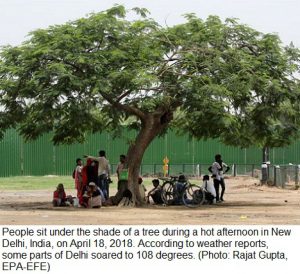
… Changing one-self; changing the community and changing the world; these are great aspirations! This is such a familiar theme for the [Go Lean] movement …

Yes, the societal defects of the Caribbean can be fixed – remediated and mitigated – but “if it is going to be, it starts with me”; it is necessary for all stakeholders to engage in the effort to turn-around the Caribbean. To forge change, the region must consider top-down and bottoms-up approaches, so we need the multitude of Caribbean people (bottoms-up) and politicians and community leaders (top-down) to lean-in to this quest to turn-around the community. Yes, it starts with “me”, as in everyone.

So Minister Jeffrey Lloyd, we urge you to say “something nice” … like this or say nothing at all.

For an example of an inspiring Commencement address, see this VIDEO in the Appendix below.

Freeport is in dire straits. The city needs its young men and women to be champions at home, not on the road. So urging Freeport’s human capital to leave is just irresponsible. Any effort to reboot Freeport can only be exerted by being in Freeport. This commentary had previously detailed the assessment and possibilities for Freeport; see this sample here:

https://goleancaribbean.com/blog/?p=10470 More ‘Bad News’ for Freeport
https://goleancaribbean.com/blog/?p=7528 A Vision of Freeport as a Self-Governing Entity
https://goleancaribbean.com/blog/?p=7449 ‘Crap Happens’ – So What Now? Case Study: Freeport
https://goleancaribbean.com/blog/?p=5542 Freeport’s Bad Model: Economic Dysfunctions with Rent-Seeking
https://goleancaribbean.com/blog/?p=4185 Caribbean Ghost Towns: It Could Happen…Again in Freeport
https://goleancaribbean.com/blog/?p=4037 How to Train Your ‘Dragon’ – Freeport Version
https://goleancaribbean.com/blog/?p=3641 ‘We Built This City …’ on Music and Entertainment
https://goleancaribbean.com/blog/?p=2585 A Lesson in History for Freeport – Concorde SST
https://goleancaribbean.com/blog/?p=300 Dire City – ‘10,000 Bahamians Living in Darkness in Grand Bahama’

The Go Lean book provides 370-pages of turn-by-turn instructions on “how” to adopt new community ethos, plus the strategies, tactics, implementations and advocacies to execute so as to reboot, reform and transform Freeport and the regional collective of Caribbean communities.

To the people of Freeport, and to all the Caribbean, we urge …

Stay Home! Do NOT double-down on failure … by fleeing. The grass is not greener on the other side – of the border – you can thrive more at home than as an alien resident in another land. In North America or Europe, you will always be “alien”.

As related in this commentary, joining the Diaspora is bad for the Diaspora and bad for the Caribbean. The Diaspora should not be counted on to come back and save their previous Caribbean homes. No we must do the heavy-lifting ourselves. We can succeed to make our homelands better places to live, work and play so that our citizens can prosper where planted. This way, they wouldn’t have to leave in the first place. 🙂

Download the free e-book of Go Lean … Caribbean – now!

Sign the petition to lean-in for this roadmap for the Caribbean Union Trade Federation. 

—————

Appendix VIDEO – Chadwick Boseman’s Howard University 2018 Commencement Speech – https://youtu.be/RIHZypMyQ2s

Howard University

Published on May 14, 2018 – Howard University alumnus Chadwick Boseman provides words of inspiration to the Class of 2018 during Howard University’s 150th Commencement Ceremony on Saturday, May 12 in Washington, D.C.

  • Category: Education
  •  License: Standard YouTube License
Share this post:
, , ,
[Top]

‘Climate Change’ Reality!? Numbers Don’t Lie

Go Lean Commentary

It’s simple: Numbers don’t lie!

There are many subjective topics: best this, greatest that! If a company thinks they are successful – i.e. one of the fastest growing firms – but they do not have money in the bank, they are “in the RED”, then frankly their Balance Sheet simply doesn’t lie, they are insolvent.

The same for the subjective topic of Climate Change. Is Global Warming real? Is the planet getting warmer?

There is no longer any doubt, the Numbers don’t lie: the earth has had 400 straight warmer-than-average months. See the full story of this actuality here:

VIDEO – This weather event hasn’t happened since 1984 https://www.usatoday.com/videos/weather/2018/05/17/weather-event-hasnt-happened-since-1984/618961002/

Published May 17, 2018 – NOAA climate scientists say April 2018 marked the planet’s 400th consecutive month with above-average temperatures. USA TODAY

———–

Title: Earth just had its 400th straight warmer-than-average month thanks to global warming

It was December 1984, and President Reagan had just been elected to his second term, Dynasty was the top show on TV and Madonna’s Like a Virgin topped the musical charts.

It was also the last time the Earth had a cooler-than-average month.

Last month marked the planet’s 400th consecutive month with above-average temperatures, federal scientists from the National Oceanic and Atmospheric Administration announced Thursday.

The cause for the streak? Unquestionably, it’s climate change, caused by humanity’s burning of fossil fuels.

“We live in and share a world that is unequivocally, appreciably and consequentially warmer than just a few decades ago, and our world continues to warm,” said NOAA climate scientist Deke Arndt. “Speeding by a ‘400’ sign only underscores that, but it does not prove anything new.”

Climate scientists use the 20th-century average as a benchmark for global temperature measurements. That’s because it’s fixed in time, allowing for consistent “goal posts” when reviewing climate data. It’s also a sufficiently long period to include several cycles of climate variability.

“The thing that really matters is that, by whatever metric, we’ve spent every month for several decades on the warm side of any reasonable baseline,” Arndt said.

NOAA’s analysis found last month was the 3rd-warmest April on record globally. The unusual heat was most noteworthy in Europe, which had its warmest April on record, and Australia, which had its second-warmest.

Portions of Asia also experienced some extreme heat: In southern Pakistan, the town of Nawabshah soared to a scalding 122.4 degrees on April 30, which may have been the warmest April temperature on record for the globe, according to Meteo France.

Argentina also had its warmest April since national records began there in 1961.

North America was the one part of the world that didn’t get in on the heat parade. Last month, the average U.S. temperature was 48.9 degrees, 2.2 degrees below average, “making it the 13th-coldest April on record and the coldest since 1997,” NOAA said.

For the year-to-date, the Earth is seeing its 5th-warmest start to the year.

A separate analysis of global temperature data from NASA also found last month was the third-warmest April on record.

Another milestone was reached in April, also related to the number “400”: Carbon dioxide — the gas scientists say is most responsible for global warming — reached its highest level in recorded history at 410 parts per million.

This amount is highest in at least the past 800,000 years, according to the Scripps Institute of Oceanography.

Source: Retrieved May 18, 2018 from: https://www.usatoday.com/story/news/world/2018/05/17/global-warming-april-400th-consecutive-warm-month/618484002/

Once we accept the facts, then we can move on to debating solutions.

Perhaps there was some debate when it was 4 straight months, or 20 straight months; but 400 straight months is an abundance of obvious. Our argument should not be whether Climate Change is real, it should be:

What are we going to do about it?

Option A or Option B?

i.e. There are serious debates for terminating the use of fossil fuels immediately! There is no doubt “we” must employ solar, wind and tidal power generating solutions now. But that is still not enough! How do we fill the gaps in the vacuum for power generation?

  • Option A: Nuclear.
  • Option B: Natural Gas.

Pro’s and Con’s abound!

Anyone who still argues the incontrovertible facts of the reality of Climate Change, should just be ignored, ridiculed and rendered to the “trash heap” of history.

Wait, what?! The US President, Donald J. Trump, is a Climate Change denier, so what are we saying?

Yes, we should ignore, ridicule and render his policies to the “trash heap” of history, while we move forward with our Climate Change abatement.

While this commentary is from the movement behind the book Go Lean…Caribbean, these words to ignore-ridicule-render Trump are also the declaration of …

Climate Change is one of the biggest threats for the Caribbean region. The region must therefore work to mitigate this threat. Yes, we can! We have many successful track records of effecting environmental changes.

Hurricane Season 20018 is about to begun; (June 1).

Climate Change can exacerbate storms… These represent a Clear-and-Present Danger for the Caribbean … for many US communities as well. The US President should not be so dismissive.

In the previous blog-commentary, it was asserted …

The reality of Caribbean life: we must contend with natural disasters, not of our making, “again and again”. The situation can be described as “Rinse and Repeat“.

The book Go Lean…Caribbean – available to download for free – serves as a roadmap for the introduction and implementation of the technocratic Caribbean Union Trade Federation (CU), to reform and transform all of Caribbean society – all 30 member-states. There is the need to shepherd our communities to abate for Climate Change episodes – before and after storms. This CU/Go Lean roadmap has these 3 prime directives:

Fixing Climate Change in the US is out-of-scope for this Go Lean…Caribbean effort. Our scope is the Caribbean only. But we must not be hypocritical … or parasitic. We must do our own heavy-lifting and fix our own communities, in preparation for a global abatement initiative – no matter how small we may perceive our impact may be because of our small size in the grand scheme of the planet’s population. How else do we shame the Big Polluters?!

The Go Lean movement has previously detailed many related issues and advocacies for Climate Change awareness and abatement. Consider this sample of previous blog-commentaries:

https://goleancaribbean.com/blog/?p=14832 Manifesting Environmental Change
https://goleancaribbean.com/blog/?p=13985 EU Assists Barbados to Go Green
https://goleancaribbean.com/blog/?p=11858 Looking and Learning from the Cautionary Tale of Kiribati
https://goleancaribbean.com/blog/?p=9455 Fix ‘Climate Change’ – Yes, We Can
https://goleancaribbean.com/blog/?p=7103 COP21 – ‘Climate Change’ Acknowledged
https://goleancaribbean.com/blog/?p=6893 A Meteorologist’s View On Climate Change
https://goleancaribbean.com/blog/?p=4673 Climate Change‘ Merchants of Doubt … to Preserve Profits!!
https://goleancaribbean.com/blog/?p=2465 Book: ‘This Changes Everything: Capitalism vs. the Climate’
https://goleancaribbean.com/blog/?p=2276 Climate Change May Affect Food Supply Within a Decade
https://goleancaribbean.com/blog/?p=1883 Climate Change May Bring More Kidney Stones
https://goleancaribbean.com/blog/?p=1817 Caribbean grapples with intense cycles of flooding & drought
https://goleancaribbean.com/blog/?p=915 Go ‘Green’ … Caribbean

The Go Lean book and roadmap stresses that reforming and transforming the Caribbean’s societal engines to abate Climate Change is possible; it is conceivable, believable and achievable. But this is heavy-lifting.

The Go Lean book provides 370-pages of turn-by-turn instructions on “how” to prepare and respond for Climate Change-infused storms. This quest is the actual title of one advocacy in the Go Lean book. Consider the specific plans, excerpts and headlines here from Page 184, entitled:

10 Ways to Improve for Natural Disasters

1 Lean-in for the Caribbean Single Market and Economy
This allows for the unification of the 30 member-states into one market, thereby spreading the risk and premium base across a market of 42 million people. The Caribbean member-states have Hurricane Katrina styled disasters (relatively speaking) every year.
2 Caribbean Emergency Management Agency – Federal Disaster Declarations

Modeled after FEMA in the US, this agency will be charged with the preparation, response and reconstruction for the regions for the eventual manifestations of hurricanes, earthquakes, tsunamis, flooding and other declared disasters, natural and man-made like medical epidemic, drought, pollution, oil spills, terrorism, etc.

3 Support Services for First Responders

Training, licensing and standards for Emergency Managers, Paramedics, Firefighters, Search and Rescue resources. For major disasters, some of these resources will come from international origins; they will need the support services (language translation, guides, maps, etc.) and coordination to maximize their results.

4 Animal Partner Training and Development

Maintain plantations for the training, development and boarding of “search & rescue” dogs, cadavers dogs and other service animals (horses, mules, pigs, etc.) so that there will be local resources within the region. (We cannot always depend on international responses in light of other regions experiencing their own disasters). These animals need not be owned by any one member-state, they can be on loan from CU resources

5 Siren Warnings & Notifications
6 Airlift & Sealift Authorizations

The CU Emergency Management Agency can license, regulate and authorize (air & sea) vessels and vehicles for emergency deployment in a disaster zone, before during and after the disastrous event.

7 JUA-style Insurance Fund

The fiduciary management of premiums and claims to allow the immediate response for reconstruction after disasters. These financial services, sidecars traded in markets can be direct or indirect as in reinsurance or insurer-of-last-resort.

8 Economic Crime Enforcement During and After Disasters
9 Disaster Declaration Loans
10 Building Codes and Standards

The Numbers – 400 straight months of above-average temperatures – tell the truth! We do not have a choice to just ignore this reality. We must prepare! Any Caribbean community leader who do not endorse proactive measures of a regional disaster apparatus needs to be ignored, ridiculed and rendered to the “trash heap” of history.

We need serious leaders … only! Climate Change can be abated, remember Acid Rain. We urge all Caribbean stakeholders to lean-in to this Go Lean roadmap for change, to make our homeland safer. This is a necessary step in forging a better homeland to live, work and play. 🙂

Download the free e-Book of Go Lean … Caribbean – now!

Sign the petition to lean-in for this roadmap for the Caribbean Union Trade Federation.

Share this post:
, , , ,
[Top]

Counter-culture: Pushing for Change

Go Lean Commentary

The Change Agent cometh; … they always come.

The only constant is change itself.

A primary motivation of the movement behind the book Go Lean…Caribbean is to better cope with societal change. The book asserted that the region had been “steamrolled” by dynamic Agents of Change; these 4 agents are full explored in the book (Page 57) with this introduction:

Shakespeare described change as “an undiscovered country”. No one knows exactly what will happen next and when. The best practice is to monitor the developments in the marketplace, adapt and adjust as soon as possible. This description of a nimble response is the purpose behind “Agile” project management and other Lean management methodologies. … Assuming a role to “understand the market and plan the business” requires looking at the business landscape today and planning the strategic, tactical, and operational changes to keep pace with the market and ahead of competitors. Strategic changes that must be accounted for now, includes:

  • Technology
  • Globalization
  • Climate Change
  • Aging Diaspora

This commentary – entry 4 of 4 – is the final submission in this series on the counter-culture of the 1960’s/1970’s. This series from the Go Lean movement considers the experiences of how people deviated from the mainstream society to forge change in their communities. The people – think: Hippies – were scorned and ridiculed, but they persisted … and eventually manifested change on … everything and everybody. The other commentaries in the series are cataloged as follows:

  1. Counter-culture: Embracing the Change – Battling against Orthodoxy
  2. Counter-culture: Manifesting Change – Environmentalism & ‘Climate Change’ abatement
  3. Counter-culture: Monetizing the Change – Education, Workplace, Healthcare & Retirement Mandates
  4. Counter-culture: Pushing for Change – Is Ganja here to stay?

Today, it is clear that mainstream society has been assimilated by the counter-culture revolution with previously debated New Morals. Some people even claim that this New Morality is the same Old Immorality. For instance, consider recreational drugs, marijuana in particular; counter-culturists have always “pushed” for the freedom of marijuana use; see the VIDEO in the Appendix below. Despite all the efforts to outlaw it, authority figures are now starting to just accept, tolerate and legitimize its usage. This last commentary in this series asked the pointed question:

Is Ganja here to stay?

(We use the Caribbean branding here for marijuana; known by many different names: weed, cannabis, pot or reefer).

Is this change here to stay? Is this just another victory from the counter-culturists from the 1960’s/1970’s? They are still pushing! Though it may not be the same people, it is still the same counter-revolutionary attitudes.

As related in the previous submissions – in this series – the champions of the counter-culture were able to claim some measure of victory in their efforts. Therefore, all of these commentaries have conveyed “how” the stewards for a new Caribbean can shepherd our society for smoother change management.

The marijuana reality is pressing down on us. Notice the imminence as conveyed in this news article here from St. Lucia:

Title # 1: Mondesir says ganja unstoppable, here to stay

Former Health Minister, Doctor Keith Mondesir, asserting that ganja is here to stay and is unstoppable, has come out in support of its legalisation.

“The entire first world, Europe , the USA, have tried hard to stop it. They have given up now realising this is here to stay. So  we as a people in the Caribbean, we have to determine what policies  do we have right now and what policies should we adopt,” Mondesir declared.

“Are we going to have open policy like Holland? Are we going to have it restricted like the US in certain places? But we know that the world is now accepting the smoking of marijuana,” the former minister observed.

He pointed to the example of Canada which is heading towards legalisation,  noting that farmers there are preparing to cash in on the herb.

“If anyone planting marijuana here has any intention of making money, they are missing the boat,” Mondesir remarked.

Just last week National Security Minister and former Deputy Police Commissioner, Hermangild Francis, expressed support for ‘relaxing’ current ganja laws in Saint Lucia.

But the Cannabis Movement, which has been in the forefront of the push to decriminalise or legalise marijuana ‘outright’, has accused the authorities  here of being split and possibly ‘two-faced’ on the issue.
Source: Retrieved May 12, 2018 from: https://stluciatimes.com/2018/04/23/mondesir-says-ganja-unstoppable-here-to-stay/

Were you alive in the 1960’s or 1970’s?

Can you believe now that we are talking about how we can co-exist with legal marijuana use in our communities?

Such talk would have been considered crazy, just a few years or a decade ago.

But crazy is as crazy does; consider these quotes from Advertising Executive Rob Siltanen:

  1. “The people who are crazy enough to think they can change the world are the ones who do.”
  2. “Here’s to the crazy ones. The misfits. The rebels. The troublemakers. The round pegs in the square holes. The ones who see things differently. They’re not fond of rules. And they have no respect for the status quo. You can quote them, disagree with them, glorify or vilify them. About the only thing you can’t do is ignore them. Because they change things. They push the human race forward. And while some may see them as the crazy ones, we see genius. Because the people who are crazy enough to think they can change the world, are the ones who do.”

The stewards for a new Caribbean regional administration – the movement behind the Go Lean book, a roadmap for the introduction and implementation of the technocratic Caribbean Union Trade Federation (CU) – are not crazy. We know the dangers, risks and threats of drugs in society, and yet accept that this counter-cultural change may also be inevitable. So rather that dreading or running from the eventuality of marijuana decriminalization, we seek to prepare for it, but on a regional, super-national level. Amazingly, this strategy also aligns with a former government Cabinet member in St. Lucia; “he” made this siren call:

Title # 2: ‘Musa’ wants united Caribbean approach to ganja decriminalisation

Former Agriculture Minister, Moses ‘Musa’ Jn Baptiste, has expressed the view that the Caribbean should approach the issue of decriminalising marijuana in a united way.

‘It is something that we have spoken about even when we were in government. I was minister of agriculture and that question came up many times,’ Jn Baptiste recalled.

‘We were always of the view that the Caribbean should approach this in a united way because if you have decriminalisation in various countries and not in others, especially in an OECS economic union, you can envisage the challenges,’ the former minister told reporters Thursday.

He asserted that the decriminalisation process and the decriminalisation movement in the region are moving in a ‘particular direction.’

‘I am sure that all governments in the sub-region will quickly realise that instead of everybody doing it on their own, that we  should move on this,’ Jn Baptiste declared.

He expressed the hope that there would be widespread consultation.

‘The whole society has to sit down and talk about this – but certainly, this is moving in a particular direction and we see what is happening in the United States, we see what is happening in certain states in the United States and  we just noticed what has happened in Antigua and definitely I am sure all governments and people in the region, especially the OECS economic union, will be taking this seriously,’ Jn Baptiste stated.
Source: Retrieved May 12, 2018 from: https://stluciatimes.com/2018/04/06/musa-wants-united-caribbean-approach-to-ganja-decriminalisation/

Imagine a regional Caribbean coordination for the drama of marijuana decriminalization. “Yes, we can”!

The Go Lean book provides 370-pages of turn-by-turn instructions on “how” to adopt a regional community ethos, plus the strategies, tactics, implementations and advocacies to execute so as to transform the societal engines of Caribbean society (economics, security and governance), regarding the whole drug eco-system. As related in a previous blog-commentary:

… the Go Lean book asserts that every community has bad actors, and with a more liberal-progressive attitude towards a once-illegal drug, community attitudes must be paramount. There must be “new guards” to assuage any threats from this practice on society. This point is pronounced early in the book with the Declaration of Interdependence (Pages 12 – 13) that claims:

x. Whereas we are surrounded and allied to nations of larger proportions in land mass, populations, and treasuries, elements in their societies may have ill-intent in their pursuits, at the expense of the safety and security of our citizens. We must therefore appoint new guards to ensure our public safety and threats against our society, both domestic and foreign. The Federation must employ the latest advances and best practices of criminology and penology to assuage continuous threats against public safety. The Federation must allow for facilitations of detention for [domestic and foreign] convicted felons of federal crimes, and should over-build prisons to house trustees from other jurisdictions.

xi. Whereas all men are entitled to the benefits of good governance in a free society, “new guards” must be enacted to dissuade the emergence of incompetence, corruption, nepotism and cronyism at the peril of the people’s best interest. The Federation must guarantee the executions of a social contract between government and the governed.

xvi. Whereas security of our homeland is inextricably linked to prosperity of the homeland, the economic and security interest of the region needs to be aligned under the same governance. Since economic crimes, including piracy and other forms of terrorism, can imperil the functioning of the wheels of commerce for all the citizenry, the accedence of this Federation must equip the security apparatus with the tools and techniques for predictive and proactive interdictions.

So legalizing marijuana … will be about more than just managing change, it will also be about managing risks. The Go Lean book relates that managing risk is more than just “One Act”, there is lengthy, engaged process (Page 76):

  • Education
  • Mentoring
  • Monitoring
  • Mitigation
  • Licensing
  • Coordination

For this delicate matter of marijuana decriminalization, issues abound, in all facets of society. There are economic, security and governing complexities that must be considered. In  fact, these issues were addressed in many previous Go Lean blog-commentaries. Consider this list here:

https://goleancaribbean.com/blog/?p=13882 Managing Legal Marijuana ‘Change’ in California
https://goleancaribbean.com/blog/?p=12703 Rocky Mountain High – Marijuana management in Colorado
https://goleancaribbean.com/blog/?p=9646 ‘Time to Go’ – American Vices, i.e. Marijuana. Don’t Follow!
https://goleancaribbean.com/blog/?p=1386 Marijuana in Jamaica – Puff Peace

The Go Lean book and roadmap stresses that preparing the Caribbean region for change is possible, but heavy-lifting. All the societal engines will have to be reformed and transformed. Yet still, this is conceivable, believable and achievable.

As related in the foregoing news articles, the First World or Advanced Democracies are advancing – pushing – towards legal or decriminalized marijuana use.

Ready or not, here they come!

    … vacationing  tourists …
    … cruise passengers.
    … students studying abroad.
    … repatriated citizens.
    … Ouch!

These descriptions – First World or Advanced Democracies – apply to the US, Canada and many Western European nations (think: England, The Netherlands, France, Germany, etc.), our tourism target markets. These descriptors do not apply to any Caribbean member-states. All 30 countries and territories (islands or coastal states) are flirting with Failed-State status. Adding recreational drug use into the Caribbean mix may only be a recipe for disaster. And yet, the change “cometh” anyway.

Let’s get ready! Let’s confederate, cooperate and collaborate to install the empowerments to allow us to better manage Caribbean affairs. We urge all Caribbean stakeholders to lean-in to this Go Lean roadmap. It is a viable plan to make our  homeland a better place to live, work and play. 🙂

Download the free e-Book of Go Lean … Caribbean – now!

Sign the petition to lean-in for this roadmap for the Caribbean Union Trade Federation.

———-

Appendix VIDEO – Rick James – Mary Jane – https://youtu.be/PrPNwLuk0zQ

Published on Oct 16, 2015

Rick James – Mary Jane (Video)


Share this post:
, ,
[Top]

Counter-culture: Manifesting Change – Environmentalism

Go Lean Commentary

News Flash: The hippies of the 1960’s grew up! They became middle class suburbanites. They traded in their tie-dye T-shirts for Polo shirts; and their Volkswagen Beetles for ‘Soccer-Mom’ Minivans.

Did the revolution for the 60’s Hippies simply fail? Did they retreat into the mainstream?
No and No, they simply won, their fight; the changes the counter-culture demanded were manifested:

The counter-culture has been argued to have diminished in the early 1970s, and some have attributed two reasons for this. First, it has been suggested that the most popular of its political goals—civil rightscivil libertiesgender equalityenvironmentalism, and the end of the Vietnam War—were “accomplished” (to at least some degree); and also that its most popular social attributes—particularly a “live and let live” mentality in personal lifestyles (the “sexual revolution“)—were co-opted by mainstream society.[57][65] Second, a decline of idealism and hedonism occurred as many notable counter-culture figures died, the rest settled into mainstream society and started their own families, and the “magic economy” of the 1960s gave way to the stagflation of the 1970s[57]—the latter costing many in the middle-classes the luxury of being able to live outside conventional social institutions. The counter-culture, however, continues to influence social movements, art, music, and society in general, and the post-1973 mainstream society has been in many ways a hybrid of the 1960s establishment and counter-culture.[65]Wikipedia.

Wait, what?!

The fights for civil rights, civil liberties, gender equality, environmentalism, and the “end of the Vietnam War” was successful. The world – America and Western Europe – we live in today is radically different than the world before the 1960’s. So they – the counter-culturists – are able to declare some relative victory.

Unfortunately, while that success was only limited, the Caribbean was left out in this fight … and the victory tour.

For example, the mentality to “live and let live” which is present in the US and other countries is painfully absent in the Caribbean. Many Caribbean citizens have fled the Caribbean orthodoxy, many being “pushed”, to live in a society where they can “live and let live”.

Let’s consider one fight that was manifested by the counter-culture: environmentalism.

At its crux, environmentalism is an attempt to balance relations between humans and the various natural systems on which we depend in such a way that all the components are accorded a proper degree of sustainability. There was a relative success for environmentalism in the US with the creation and facilitation of the EPA (Environmental Protection Agency). This new independent federal agency was established by the 37th US President Richard Nixon in December 1970. The Administrator of the EPA is accorded Cabinet rank, so it wields power and authority to effect change in American society. In fact, under the 44th President, Barack Obama, the EPA began to impose regulations on carbon emissions from cars, power plants and other industries who contribute to Climate Change.

Despite all the accomplishments with environmental protection (land, air and water), there is still more work to do. In fact, Climate Change has been identified as one of the biggest threats for the Caribbean region. There is a need for our Caribbean communities to stand-up and fight for better Climate Change mitigations. This commentary asserts that there is the need to re-kindle that old counter-cultural vigor and vigilance.

This commentary – entry 2 of 4 – is a continuation in this series on the counter-culture of the 1960’s/1970’s. This series from the movement behind the book Go Lean … Caribbean considers the experiences of how people deviated from the mainstream society to forge change in their communities. The people – youth mostly – were scorned and ridiculed, but they persisted … and manifested the needed change. The other commentaries in the series are cataloged as follows:

  1. Counter-culture: Embracing the Change – Battling against Orthodoxy
  2. Counter-culture: Manifesting Change – Environmentalism & ‘Climate Change’ abatement
  3. Counter-culture: Monetizing the Change – Education, Workplace, Healthcare & Retirement Mandates
  4. Counter-culture: Pushing for Change – Is Ganja here to stay?

All of these commentaries convey “how” the stewards for a new Caribbean can take a “page from the counter-culture book” so as to shepherd societal change in this region.

Yes, we can!

We need that 1960’s vigor and vigilance in our efforts to abate Climate Change today. Remember the powerful anthem by R&B singer Marvin Gaye Mercy, Mercy Me! See the VIDEO here:

VIDEO-AUDIO – Marvin Gaye: Mercy, Mercy Me! (1971)https://youtu.be/U9BA6fFGMjI

Published on Aug 21, 2007
Marvin Gaye – Mercy, Mercy Me (the ecology); Rest in Peace Marvin

———–

VIDEO-AUDIO – Robert Palmer – Mercy Mercy Me/I Want You (1991)https://youtu.be/RMT-oiiY7DE

Published on Aug 20, 2006
A cover of two Marvin Gaye’s “Mercy Mercy Me” and “I Want You” singles from Robert Palmer (Rest in Peace).

  • Category: Music 
  • License: Standard YouTube License

The science has proven that Climate Change is man-made – it is not just Mother Nature – and so man can mitigate the risks and remediate the threats. While this is a global problem, one man, one community, one country and one region can make a difference. Since we are on the frontlines of this battle – due to our vulnerabilities with hurricanes (see Appendix A below) – we need to be front-and-center in the fight.

We have the successful track record of Acid Rain.

In a previous blog-commentary (October 13, 2016), it was related that previous fight against Acid Rain is a good model for Climate Change today. Consider this direct quote:

Remember Acid Rain?

That was a big deal in the 1970’s and 1980’s. It was a big environmental problem; the stakeholders came together – many kicking and screaming – to put in the remediation and mitigation and now the problem is greatly abated. See the encyclopedia details of the problem in the Appendix A below, where it is reported that Acid Rain levels have dropped 65% since 1976.

Climate Change is another area of atmospheric pollution that can also be abated with a lot of the same strategies, tactics and implementations as was employed to abate Acid Rain. But instead of the smoke stacks of factories and power plants, the problematic culprit this time is fossil fuels.

Fossil fuels and carbon emission = Climate Change!

Unlike Acid Rain, the “bad actors” for Climate Change are not just industrial installations; this time it is “almost everybody”. Cars are one of the biggest contributors. There is no denying this cause-effect any more. The problem is now globally acknowledged! There are new international agreements – Paris Conference of the Parties (COP) or COP21 – to curb fossil fuels / carbon dioxide emissions. 195 countries have signed on to these accords, including big polluters China (#1) and the US (#2).

The overall goal of these international accords is to achieve significant environmental benefits through reductions in emissions of greenhouse gases, the primary causes of Climate Change. The remediation and mitigations employ regulatory and market based approaches for controlling GHG [(Greenhouse Gases)] elements. It should be noted that the COP21 accord is a non-binding agreement, but the biggest contribution is that the community will is now entrenched.

The book Go Lean … Caribbean uses an alternate technical term for “community will”; it identifies “community ethos”, as “the fundamental character or spirit of a culture; the underlying sentiment that informs the beliefs, customs, or practices of a society” (Page 20). So, in everyday practical terms, it will now be politically incorrect to pursue policies in denial of Climate Change.

The Go Lean book presents a 370-page roadmap for rebooting, re-organizing and restructuring the economic, security and governmental institutions of the 30 member-states in the Caribbean region, especially in light of the realities of Climate Change. … We must “Go Green” to arrest our own carbon footprint, so that we may be less hypocritical – have moral authority – in calling for reform from the big polluting nations.

The timing for this commentary, and reminder, is crucial! We are on the threshold of the 2018 hurricane season and the scientists are expecting a catastrophic one … again. See the related article in Appendix A below.

We must do better this year and in the future, compared to how we did last year. In 2017, 2 major storms impacted the Caribbean regions, leaving death, destruction, dysfunction and defection in their wake:

  • Irma – A Category 5 storm on September 4, 2017; this caused devastation in many islands, hitting Barbuda and the Virgin Islands especially hard.
  • Maria – A Category 5 storm on September 18, 2017; this caused devastation in many islands, hitting Puerto Rico and Dominica especially hard.

Remember that Hurricane Season is imminent.

Remember Acid Rain …

Remember the Hippies …

In the previous submission in this “counter-culture” series, it was asserted …

… the ‘Hippies’ stood in the track of an oncoming locomotive … and stopped the train!

We need to apply the lessons-learned from the counter-culture most urgently in getting our communities ready for Climate Change abatement.

The book Go Lean…Caribbean – available to download for free – serves as a roadmap for the introduction and implementation of the technocratic Caribbean Union Trade Federation (CU), to reform and transform all of Caribbean society – all 30 member-states. There is the need to shepherd our communities through major challenges, ones that are too big for any one member-state alone; we need to confederate. This CU/Go Lean roadmap has these 3 prime directives:

  • Optimization of the economic engines in order to grow the regional economy to $800 Billion & create 2.2 million new jobs.
  • Establishment of a security apparatus to ensure public safety and protect the resultant economic engines; including a disaster planning and response functionality.
  • Improve Caribbean governance to support these engines, including a separation-of-powers between the member-states and CU federal agencies.

The Caribbean needs the spirit of the previous counter-culture to “stop the train” that is on our track. Can we remember and role-model the previous rebels and revolutionaries who did not settle for the status quo? Yes, we can!

No we are not saying become hippies! Yes, we are saying to counter the status quo.

The movement behind the Go Lean book has previously detailed many related issues and advocacies for Climate Change awareness and abatement. Consider this sample of previous blog-commentaries:

https://goleancaribbean.com/blog/?p=14174 Canada says: “Follow-me” for Model on ‘Climate Change’ Action
https://goleancaribbean.com/blog/?p=13985 EU Assists Barbados to Go Green
https://goleancaribbean.com/blog/?p=11858 Looking and Learning from the Cautionary Tale of Kiribati
https://goleancaribbean.com/blog/?p=10367 The Science of Green Batteries
https://goleancaribbean.com/blog/?p=9455 Fix ‘Climate Change’ – Yes, We Can
https://goleancaribbean.com/blog/?p=7449 Due to Climate Change, ‘Crap Happens’ – So What Now?
https://goleancaribbean.com/blog/?p=7103 COP21 – ‘Climate Change’ Acknowledged
https://goleancaribbean.com/blog/?p=6893 A Meteorologist’s View On Climate Change
https://goleancaribbean.com/blog/?p=6016 ‘Hotter than July’ – Reality in the Caribbean
https://goleancaribbean.com/blog/?p=4673 Climate Change‘ Merchants of Doubt … to Preserve Profits!!
https://goleancaribbean.com/blog/?p=2465 Book: ‘This Changes Everything: Capitalism vs. the Climate’
https://goleancaribbean.com/blog/?p=2276 Climate Change May Affect Food Supply Within a Decade
https://goleancaribbean.com/blog/?p=1883 Climate Change May Bring More Kidney Stones
https://goleancaribbean.com/blog/?p=1817 Caribbean grapples with intense cycles of flooding & drought
https://goleancaribbean.com/blog/?p=915 Go ‘Green’ … Caribbean

The Go Lean book and roadmap stresses that reforming and transforming the Caribbean’s societal engines is possible; it is conceivable, believable and achievable. But changing society entails changing the people in society, their attitudes and values.

We saw change manifest with the counter-culture of the 1960’s/1970’s. As related above, “the post-1973 mainstream society has been in many ways a hybrid of the 1960s establishment and counter-culture”.

We now need to change our people, our Caribbean people. We need them committed, devoted and inspired to adopt the appropriate community ethos to derail the current trajectory – to doom – and move our countries in a new direction.

The Go Lean book provides 370-pages of turn-by-turn instructions on “how” to forge a counter-cultural revolution transition in the Caribbean; it details the new community ethos that needs to be adopted, plus the strategies, tactics, implementations and advocacies to execute so as to reboot, reform and transform the societal engines of Caribbean society.

We urge all Caribbean stakeholders to lean-in to this roadmap for change, to make our homeland a better place to live, work and play. 🙂

Download the free e-Book of Go Lean … Caribbean – now!

Sign the petition to lean-in for this roadmap for the Caribbean Union Trade Federation.

————-

Appendix – Grenada’s Forestry Department Concerned About ‘Climate Change’ And Its Effects On Hurricanes

By: Maryam J. Tawfiq-iLAND Resilience Project

With the announcement from Colorado State University hurricane researchers of their projections for the 2018 Atlantic Hurricane Season the forestry department of the ministry of agriculture in Grenada is concerned with the likely effects of this year’s storm and of them possibly intensifying.

The 14 named storms of the 2018 season will be slightly above-average, said a report from the university. It projects that seven of the storms will become hurricanes; three of them “major’’ hurricanes.

Ever more people around the world seem to be experiencing freak storms, floods and droughts — including catastrophes that devastate whole regions. The reasons for these complex weather events aren’t straightforward. Some say the crazy weather we’re experiencing is due to greenhouse gas emissions around the world; others disagree.

Anthony Jeremiah, acting chief forestry officer, said the ministry of agriculture is adopting “active preparedness measures’’, admitting that “we are very much concerned regarding the destruction that can arise from hurricanes’’.

During the 2017 Atlantic basin hurricane season, six major storms – all of which were Category 3 or higher – produced devastating human, material and financial losses across the southern United States and the Caribbean.

Last year’s above-average storm activity was foreseeable. Hurricane intensity ticked up in 2016 and scientists have predicted this trend will hold as global temperatures continue to rise.

Though the Caribbean is facing increasing vulnerability to hurricanes, many in the region hold very different opinions about the severity of climate change. According to results from the latest Vanderbilt University Americas Barometer survey, a strong majority of Caribbean residents perceive climate change as a “very serious” problem. In contrast, just 44 percent of the U.S. public does.

The 2018 Atlantic hurricane season runs from June 1 to Nov. 30.

Source: Posted May 5, 2018; retrieved May 8, 2018 from: https://stluciatimes.com/2018/05/05/grenadas-forestry-department-concerned-about-climate-change-and-its-effects-on-hurricanes/

Share this post:
, , ,
[Top]

Counter-culture: Embracing the Change

Go Lean Commentary

Children almost always rebel against their parental norms!

This is just a fact of life. Many times this actuality is a source of friction and frustration in families … and society in general. But many times, the rebellion can result in subsequent benefits to people and institutions in society; though this judgment may not be realized until a later time.

So a younger generation’s rebellion may be how whole communities are disciplined. This thought even aligns with the Bible’s counsel on discipline:

No discipline is enjoyable while it is happening – it’s painful! But afterward there will be a peaceful harvest of right living for those who are trained in this way. – Hebrews 12:11 New Living Translation

Just consider these quick examples of protest movements: slavery abolition, women’s suffrage, labor rights and civil rights. These changes upended – sometimes violently – societal norms. But now, our communities are better for having endured it.

With this premise, we are now able to better embrace the historicity of the “counter-culture” of the 1960’s. This is our most recent example of a subculture whose values and norms of behavior differed substantially from those of mainstream society. And this is not just an academic discussion, for this timeframe corresponds with the time of upheaval for Caribbean society; yet we have not fully applied the lessons-learned and benefits from the resultant societal discipline; see Appendix VIDEO.
A counter-culture typically involves criticism or rejection of the status quo powerful institutions, with accompanying hope for a better life or a new society.

This is the focus of this series of commentaries on the counter-culture of the 1960’s. This first one – entry 1 of 4 in this series from the movement behind the book Go Lean … Caribbean – is in consideration of remaining societal defects in the Caribbean region. We did not reform or transform like other communities contending with the counter-culture. The other commentaries in the series are cataloged as follows:

  1. Counter-culture: Embracing the Change – Battling against Orthodoxy
  2. Counter-culture: Manifesting Change – Environmentalism & ‘Climate Change’
  3. Counter-culture: Monetizing the Change – Education, Workplace, Healthcare & Retirement
  4. Counter-culture: Pushing for Change – Is Ganja here to stay?

All of these commentaries relate to “how” the stewards for a new Caribbean can shepherd societal change in this region. We accept that with the counter-culture, young people can reject conventional social norms. This can be good when the “mainstream” culture reflects cultural standards that are defective. The counter-culturists of the 1960’s – think hippies – rejected the norms of their parents – from the 1950’s and before – especially with respect to:

  • Racial segregation – The US had a long, bad track record of enforcing a “separate but equal” standard. This was a sham! For the minority populations, they were separated but far from equal; they were oppressed, suppressed and repressed to ensure an inferior status. It took a counter-culture to press until change manifested; i.e. Linda Brown
  • Support for wars – The counter-culturists opposed military conscriptions with vocal protests, publications, demonstrations and acts of civil disobedience. In fact, not until the Military Draft ended in the US, did Caribbean people start to consider the prospect of emigrating to the US.
  • Women’s rights – These rights, like many other societal reforms, only come about as a result of advocates and activists fighting for change. But these battles were too important not to fight. Starting in the mid-19th Century, the 1960’s Civil and Gender Rights succeeded with the landmark 1972 Title IX US federal legislation.
  • Sexual mores – Many countries criminalize sexual acts between consenting adults of the same sex and other forms of sexual orientation, gender identity and expression. The counter-culturists did not stand still; they persisted and got the US to continue the national trend of more tolerance with every generation.
  • Traditional modes of authority – The counter-culturists conveyed to the world that Police authorities were far from perfect, and many times, not even in the right. Standards for mitigating and managing Police Abuse of Power emerged from this hard-fought counter-culture revolution.
  • A materialist interpretation of Middle Class values – While capitalism has won all debate for governing policy, the harsh profit-first priority of Crony-Capitalism has been debunked by counter-culturists. Now environmentalism, arts, humanitarianism has emerged as great candidates for a purpose-driven life.
  • Drug usage – The counter-culture normalized marijuana use and now … State authorities are enacting legislation to legitimize or decriminalize recreational marijuana use. This implementation will be heavy-lifting as there are many security and governing dynamics to manage.

Lessons abound … all of this above drama from the counter-culture is not just American drama. No, the 1960’s counter-culture movement was truly global. It also impacted our Caribbean homeland as well; see Appendix VIDEO.

All of the above issues had a Caribbean parallel.

Yes, the 1960’s counter-culturists triggered dramatic changes; but they were not the first in history, nor were they the last. See here:

Prominent examples of countercultures in Europe and North America include Romanticism (1790–1840), Bohemianism (1850–1910), the more fragmentary counterculture of the Beat Generation (1944–1964), followed by the globalized counter-culture of the 1960s (1964–1974), usually associated with the hippie subculture[3] and the diversified punk subculture of the 1970s and 1980s. – Wikipedia 

The book Go Lean…Caribbean – available to download for free – serves as a roadmap for the introduction and implementation of the technocratic Caribbean Union Trade Federation (CU), to reform and transform all of Caribbean society – all 30 member-states. This is counter to the existing culture. There is the need to shepherd our communities through major changes; we need to reboot our societal engines. This CU/Go Lean roadmap has these 3 prime directives:

  • Optimization of the economic engines in order to grow the regional economy to $800 Billion and create 2.2 million new jobs.
  • Establishment of a security apparatus to ensure public safety and protect the resultant economic engines.
  • Improve Caribbean governance to support these engines, including a separation-of-powers between the member-states and CU federal agencies.

The Caribbean needs a counter-culture revolution! We have defects we need to abandon and gaps that need to be filled.

We need our young people to reject conventional social norms. We need them to rebel and revile their parents … and other members of society that are backwards – trying to preserve defective “mainstream” cultural standards – then move forward.

The Go Lean book identifies and defines “mainstream” cultural standards as community ethos; with this direct quotation (Page 20 – 25):

The people of the Caribbean must change their feelings about elements of their society – elements that are in place and elements missing. This is referred to as “Community Ethos”, defined as:

noun – (www.Dictionary.com)

    1. the fundamental character or spirit of a culture; the underlying sentiment that informs the beliefs, customs, or practices of a group or society; dominant assumptions of a people or period.
    2. the character or disposition of a community, group, person, etc.

As such, some [missing] community ethos … have been identified as relevant for the Caribbean. They are as follows:

  • Deferred Gratification
  • Economic Principles
    • Money Multiplier
    • Job Multiplier
  • Security Principles
    • Privacy versus Public Protection
    • Whistleblower Protection
    • Witness Security & Protection
    • Anti-Bullying and Mitigation
    • Intelligence Gathering
    • Light Up the Dark Places
    • “Crap” Happens
  • Governing Principles
    • Minority Equalization
    • Lean Operations
    • Return on Investments
    • Cooperatives
    • Non-Government Organizations
  • Advocacies
    • Ways to Impact the Future
    • Ways to Foster Genius
    • Ways to Help Entrepreneurship
    • Ways to Promote Intellectual Property
    • Ways to Impact Research & Development
    • Ways to Bridge the Digital Divide
    • Ways to Improve Negotiations
    • Ways to Impact Turn-Arounds
    • Ways to Manage Reconciliations
    • Ways to Improve Sharing
    • Ways to Promote Happiness
    • Ways to Impact the Greater Good

The movement behind the Go Lean book have previously identified many defective “mainstream” cultural values in the Caribbean; consider this sample of previous blog-commentaries:

https://goleancaribbean.com/blog/?p=13974 Haiti – Earning its “Shit-Hole” Brand
https://goleancaribbean.com/blog/?p=13890 We Need to Talk – The Caribbean Disposition is Dire!
https://goleancaribbean.com/blog/?p=13321 Divided and Conquered – Too Much Pluralism – Us and Them
https://goleancaribbean.com/blog/?p=11244 Caribbean People Willing to “Live Too Fast and Die Too Young”
https://goleancaribbean.com/blog/?p=11048 Ignoring the Society Golden Rule – Protecting Weak from the Strong
https://goleancaribbean.com/blog/?p=8200 Promoting a ‘Climate of Hate’
https://goleancaribbean.com/blog/?p=7082 All Play, No Work – Only Known for Leisure
https://goleancaribbean.com/blog/?p=5784 “Say it ain’t so”! – Archaic Buggery Laws Still in Jamaica
https://goleancaribbean.com/blog/?p=4058 New York Times Maledictions on the Bahamas
https://goleancaribbean.com/blog/?p=2709 58% of Caribbean Boys Agree to Female Discipline
https://goleancaribbean.com/blog/?p=1386 Nonchalance About Impact of Drugs and De-Criminalization

There is so much to learn from the counter-culture movement of the 1960’s!

The ‘Hippies’ stood in the track of an oncoming locomotive … and stopped the train!

The counter-culture brought change, some good (ie: desegregation & anti-war protest) and some bad (ie: un-kept grooming & liberal drug use)! So the ‘Hippies’ are only to be emulated as a model for forging change, not necessarily what they change.

The Go Lean book and roadmap stresses that reforming and transforming the Caribbean’s societal engines is possible, but must be preceded with reforming and transforming Caribbean attitudes or community ethos. Despite the individual member-states, counter-cultural changes can be pushed regionally. This – regional push – was an early motivation for the roadmap, as pronounced in the opening Declaration of Interdependence (Pages 12 – 13):

xi. Whereas all men are entitled to the benefits of good governance in a free society, “new guards” must be enacted to dissuade the emergence of incompetence, corruption, nepotism and cronyism at the peril of the people’s best interest. The Federation must guarantee the executions of a social contract between government and the governed.

xvi.  Whereas security of our homeland is inextricably linked to prosperity of the homeland, the economic and security interest of the region needs to be aligned under the same governance. Since economic crimes … can imperil the functioning of the wheels of commerce for all the citizenry, the accedence of this Federation must equip the security apparatus with the tools and techniques for predictive and proactive interdictions.

xxiv. Whereas a free market economy can be induced and spurred for continuous progress, the Federation must install the controls to better manage aspects of the economy: jobs, inflation, savings rate, investments and other economic principles. Thereby attracting direct foreign investment because of the stability and vibrancy of our economy.

The Go Lean book provides 370-pages of turn-by-turn instructions on “how” to forge a counter-cultural revolution transition in the Caribbean; it details the new community ethos that needs to be adopted, plus the strategies, tactics, implementations and advocacies to execute so as to reboot, reform and transform the societal engines of Caribbean society.

We are not asking the Caribbean to be “hippies”, just learn from the “hippies” and reject the status quo and orthodoxy of the broken Caribbean eco-system.

Yes, we can foster change, a counter-culture even; we can make our homeland a better place to live, work and play. 🙂

Download the free e-Book of Go Lean … Caribbean – now!

Sign the petition to lean-in for this roadmap for the Caribbean Union Trade Federation.

—————

Appendix VIDEO-AUDIO – Eddie Minnis: “Ting an’ Ting Y2K” – https://youtu.be/oDF2cQsEURU

This is a Bahamian folk song by legend Eddie Minnis describing societal change in the capital city. ‘Ting and Ting’, the counter-culture had taken hold and everything changed … for good and bad:

  • “Nassau’s become such a funky town since “ting an’ ting” been going ’round.

EDDIE MINNIS – Topic

Published on Jul 20, 2015 – Provided to YouTube by CDBaby “Ting An’ Ting Y2k” (Granny and Fleabs Mix) · Eddie Minnis Tropical Waves ℗ 2012 Edward Minnis Released on: 2012-08-01 Auto-generated by YouTube.


Share this post:
, ,
[Top]

May Day! May Day! We Need Help With Jobs! – ENCORE

Today is May Day!

In many countries, this day is equivalent to Labor Day, a date set aside to honor and celebrate workers, or the movement to empower workers in society. Many of the historicity of these movements were tied to labor unions.

More than 80 countries celebrate International Workers’ Day on May 1 – the ancient European holiday of May Day.

All Caribbean member-states need help with our job-labor eco-system. Our societal engines are so dysfunctional that our people flee … abandoning the homeland in search of jobs.

There is this prospect for help. This previous blog-commentary from June 18, 2015, discussed the trends in the labor markets, which depict a decline in collective bargaining. This Encore of that commentary is presented here with a plan to assuage this bad trend and create 2.2 million new jobs:

==================

Title: Economic Principle: Wage-Seeking – Market Forces -vs- Collective Bargaining

Go Lean Commentary

The field of Economics is unique! We all practice it every day, no matter the level of skill or competence. There is even the subject area in basic education branded Home Economics, teaching the students the fundamentals of maintaining, supporting and optimizing a home environment. Most assuredly, economics is an art and a science, albeit a social science.

In a previous blog/commentary, Scotman’s Adam Smith was identified as the father of modern macro-economics. Though he lived from 1723 to 1790, his writings defined advanced economic concepts even in this 21st Century. His landmark book An Inquiry into the Nature and Causes of the Wealth of Nations qualified the divisions of income into these following categories: profit, wage, and rent.[4] We have previously explored profit-seeking (a positive ethos that needs to be fostered in the Caribbean region) and rent-seeking (a negative effort that proliferates in the Caribbean but needs to be mitigated), so now the focus of this commentary is on the activity of wage-seeking, and the concepts of governance and public choice theory to allow for maximum employment.

This is hard! Change has come to the world of wage-seekers – the middle classes are under attack; the labor-pool of most industrialized nations have endured decline, not in the numbers, but rather in prosperity. While wage-earners have not kept pace with inflation, top-earners (bonuses, commissions and business profits) have soared; (see Photo).

CU Blog - Economic Principles - Wage-Seeking - Market forces -vs- Collective Bargaining - Photo 2As a direct result, every Caribbean member-state struggles with employment issues in their homeland. In fact, this was an initial motivation for the book Go Lean…Caribbean, stemming from the fall-out of the 2008 Great Recession, this publication was presented as a roadmap for the introduction and implementation of the Caribbean Union Trade Federation (CU) to elevate the economic, security and governing engines of the Caribbean region to create 2.2 million new jobs, despite global challenges.

Needless to say, the global challenge is far more complex than Home Economics. The Go Lean book describes the effort as heavy-lifting; then proceeds to detail the turn-by-turn directions of a roadmap to remediate and mitigate wage-seeking.

The roadmap channels the Economic Principles and best-practices of technocrats like Adam Smith and 11 other named economists, many of them Nobel Laureates. A review of the work of these great men and woman constitute “Lessons in Economic Principles”. Why would these lessons matter in the oversight of Caribbean administration? Cause-and-effect!

Profit 4The root of the current challenge for wage-seekers is income equality; and this is bigger than just the Caribbean. It is tied to the global adoption of globalization and technology/ automation – a product of global Market Forces as opposed to previous Collective Bargaining factors. This relates back to the fundamental Economic Principle of “supply-and-demand”; but now the “supply” is global. This photo/”process flow” here depicts the ingredients of Market Forces. When there is the need for labor, the principle of comparative analysis is employed, and most times the conclusion is to “off-shore” the labor efforts, and then import the finished products. This is reversed of the colonialism that was advocated by Adam Smith; instead of the developed country providing factory labor for Third World consumption, the developed nation (i.e. United States) is now in the consumer-only role, with less and less production activities, for products fabricated in the Third World. This reality is not sustainable for providing prosperity to the middle classes, to the wage-seekers.

As a community, we may not like the laws of Economics, but we cannot ignore them. The Go Lean book explains the roles and significance of Economic Principles … with this excerpt (Page 21):

While money is not the most important factor in society, the lack of money and the struggle to acquire money creates challenges that cannot be ignored. The primary reason why the Caribbean has suffered so much human flight in the recent decades is the performance of the Caribbean economy. Though this book is not a study in economics, it recommends, applies and embraces these 6 core Economic Principles as sound and relevant to this roadmap:

  1. People Choose: We always want more than we can get and productive resources (human, natural, capital) are always limited. Therefore, because of this major economic problem of scarcity, we usually choose the alternative that provides the most benefits with the least cost.
  2. All Choices Involve Costs: The opportunity cost is the next best alternative you give up when you make a choice. When we choose one thing, we refuse something else at the same time.
  3. People Respond to Incentives in Predictable   Ways: Incentives are actions, awards, or rewards that determine the choices people make. Incentives can be positive or negative. When incentives change, people change their behaviors in predictable ways.
  4. Economic Systems Influence Individual Choices and Incentives: People cooperate and govern their actions through both written and unwritten rules that determine methods of allocating scarce resources. These rules determine what is produced, how it is produced, and for whom it is produced. As the rules change, so do individual choices, incentives, and behavior.
  5. Voluntary Trade Creates Wealth: People specialize in the production of certain goods and services because they expect to gain from it. People trade what they produce with other people when they think they can gain something from the exchange. Some benefits of voluntary trade include higher standards of living and broader choices of goods and services.
  6. The Consequences of Choices Lie in the Future: Economists believe that the cost and benefits of decision making appear in the future, since it is only the future that we can influence. Sometimes our choices can lead to unintended consequences.

Source: Handy Dandy Guide (HDC) by the National Council on Economic Education (2000)

The Go Lean book describes the end result of the application of best-practices in this field of economics over the course of a 5-year roadmap: the CU … as a hallmark of technocracy. But the purpose is not the edification of the region’s economists, rather to make the Caribbean homeland “better places to live, work and play” for its citizens. This branding therefore puts emphasis on the verb “work”; the nouns “jobs” and “wages” must thusly be a constant focus of the roadmap.

Brain Drain 70 percent ChartThis Go Lean book declares that the Caribbean eco-system for job-creation is in crisis … due to the same global dilemma. The roadmap describes the crisis as losing a war, the battle of globalization and technology. The consequence of the defeat is 2 undesirable conditions: income inequality and societal abandonment, citizens driven away to a life in the Diaspora. This assessment currently applies in all 30 Caribbean member-states, as every community has lost human capital to emigration. Some communities, like Puerto Rico and the US Virgin Islands have suffered with an abandonment rate of more than 50% and others have watched more than 70% of college-educated citizens flee their community for foreign shores. Even education is presented as failed investments as those educated in the region and leave to find work do not even return remittances in proportion to their costs of development. (See Table 4.1 in the Photo)

The Go Lean book therefore posits that there is a need to re-focus, re-boot, and optimize the labor/wage-seeking engines so as to create more jobs with livable wages. Alas, this is not just a Caribbean issue, but a global (i.e. American) one as well. See the following encyclopedic references for wage-seeking and Collective Bargaining to fully understand the complexities of these global issues:

Encyclopedia Reference #1: Wage-Seeking
(Source: https://en.wikipedia.org/wiki/Wage)

A wage is monetary compensation paid by an employer to an employee in exchange for work done. Payment may be calculated as a fixed amount for each task completed (a task wage or piece rate), or at an hourly or daily rate, or based on an easily measured quantity of work done.

Wages are an example of expenses that are involved in running a business.

Payment by wage contrasts with salaried work, in which the employer pays an arranged amount at steady intervals (such as a week or month) regardless of hours worked, with commission which conditions pay on individual performance, and with compensation based on the performance of the company as a whole. Waged employees may also receive tips or gratuity paid directly by clients and employee benefits which are non-monetary forms of compensation. Since wage labour is the predominant form of work, the term “wage” sometimes refers to all forms (or all monetary forms) of employee compensation.

Determinants of wage rates
Depending on the structure and traditions of different economies around the world, wage rates will be influenced by market forces (supply and demand), legislation, and tradition. Market forces are perhaps more dominant in the United States, while tradition, social structure and seniority, perhaps play a greater role in Japan.[6]

Wage Differences
Even in countries where market forces primarily set wage rates, studies show that there are still differences in remuneration for work based on sex and race. For example, according to the U.S. Bureau of Labor Statistics, in 2007 women of all races made approximately 80% of the median wage of their male counterparts. This is likely due to the supply and demand for women in the market because of family obligations. [7] Similarly, white men made about 84% the wage of Asian men, and black men 64%.[8] These are overall averages and are not adjusted for the type, amount, and quality of work done.

Real Wage
The term real wages refers to wages that have been adjusted for inflation, or, equivalently, wages in terms of the amount of goods and services that can be bought. This term is used in contrast to nominal wages or unadjusted wages. Because it has been adjusted to account for changes in the prices of goods and services, real wages provide a clearer representation of an individual’s wages in terms of what they can afford to buy with those wages – specifically, in terms of the amount of goods and services that can be bought.

See Table of European Model in the Appendix below. (The European Union is the model for the Caribbean Union).

———-

Encyclopedia Reference #2: Collective Bargaining
(Source: https://en.wikipedia.org/wiki/Collective_bargaining)

WPR: Marches & PicketsCollective Bargaining is a process of negotiation between employers and a group of employees aimed at reaching agreements to regulate working conditions. The interests of the employees are commonly presented by representatives of a trade union to which the employees belong. The collective agreements reached by these negotiations usually set out wage scales, working hours, training, health and safety, overtime, grievance mechanisms, and rights to participate in workplace or company affairs.[1]

The union may negotiate with a single employer (who is typically representing a company’s shareholders) or may negotiate with a group of businesses, depending on the country, to reach an industry wide agreement. A collective agreement functions as a labor contract between an employer and one or more unions.

The industrial revolution brought a swell of labor-organizing in [to many industrialized countries, like] the US. The American Federation of Labor (AFL) was formed in 1886, providing unprecedented bargaining powers for a variety of workers.[11] The Railway Labor Act (1926) required employers to bargain collectively with unions. While globally, International Labour Organization Conventions (ILO) were ratified in parallel to the United Nations efforts (i.e. Declaration of Human Rights, etc.). There were a total of eight ILO fundamental conventions [3] all ascending between 1930 and 1973, i.e. the Freedom of Association and Protection of the Right to Organise Convention (1949).

The Go Lean book presents a roadmap on how to benefit from the above Economic Principles – and how to empower communities anew – in the midst of tumultuous global challenges. This roadmap addresses more than economics, as there are other areas of societal concern. This is expressed in the CU charter; as defined by these 3 prime directives:

  • Optimization of economic engines in order to grow the regional economy to $800 Billion and create 2.2 million new jobs.
  • Establishment of a security apparatus to protect the resultant economic.
  • Improvement of Caribbean governance to support these engines.

Early in the Go Lean book, the responsibility to create jobs was identified as an important function for the CU with these pronouncements in the Declaration of Interdependence (Pages 14):

xix.  Whereas our legacy in recent times is one of societal abandonment, it is imperative that incentives and encouragement be put in place to first dissuade the human flight, and then entice and welcome the return of our Diaspora back to our shores.

xxi.  Whereas the preparation of our labor force can foster opportunities and dictate economic progress for current and future generations, the Federation must ensure that educational and job training opportunities are fully optimized for all residents of all member-states, with no partiality towards any gender or ethnic group. The Federation must recognize and facilitate excellence in many different fields of endeavor, including sciences, languages, arts, music and sports. This responsibility should be executed without incurring the risks of further human flight, as has been the past history.

xxiv. Whereas a free market economy can be induced and spurred for continuous progress, the Federation must install the controls to better manage aspects of the economy: jobs, inflation, savings rate, investments and other economic principles. Thereby attracting direct foreign investment because of the stability and vibrancy of our economy.

xxvi.  Whereas the Caribbean region must have new jobs to empower the engines of the economy and create the income sources for prosperity, and encourage the next generation to forge their dreams right at home, the Federation must therefore foster the development of new industries, like that of ship-building, automobile manufacturing, prefabricated housing, frozen foods, pipelines, call centers, and the prison industrial complex. In addition, the Federation must invigorate the enterprises related to existing industries tourism, fisheries and lotteries – impacting the region with more jobs.

According to an article from the Economic Policy Institute, entitled The Decline of Collective Bargaining and the Erosion of Middle-class Incomes in Michigan by Lawrence Mishel (September 25, 2012), the challenges to middle class income are indisputable, and the previous solution – Collective Bargaining – is no longer as effective as in the past. (The industrial landscape of Michigan had previously been identified as a model for the Caribbean to consider). See a summary of the article here (italics added) and VIDEO in the Appendix:

In Michigan between 1979 and 2007, the last year before the Great Recession, the state’s economy experienced substantial growth and incomes rose for high-income households. But middle-class incomes did not grow. The Michigan experience is slightly worse than but parallels that of the United States as a whole, where middle-class income gains were modest but still far less than the income gains at the top. What the experience of Michiganders and other Americans makes clear is that income inequality is rising, and it has prevented middle-class incomes from growing adequately in either Michigan or the nation.

The key dynamic driving this income disparity has been the divergence between the growth of productivity—the improvement in the output of goods and services produced per hour worked—and the growth of wages and benefits (compensation) for the typical worker. It has been amply documented that productivity and hourly compensation grew in tandem between the late 1940s and the late 1970s, but split apart radically after 1979. Nationwide, productivity grew by 69.1 percent between 1979 and 2011, but the hourly compensation of the median worker (who makes more than half the workforce but less than the other half) grew by just 9.6 percent (Mishel and Gee 2012; Mishel et al. 2012). In other words, since 1979 the typical worker has hardly benefited from improvements in the economy’s ability to raise living standards and, consequently, middle-class families’ living standards have barely budged since then. This phenomenon has occurred across the nation, including in Michigan.

This divergence between pay and productivity and the corresponding failure of middle-class incomes to grow is strongly related to the erosion of collective bargaining. And collective bargaining has eroded more in Michigan than in the rest of the nation, helping to explain Michigan’s more disappointing outcomes.

Research three decades ago by economist Richard Freeman (1980) showed that collective bargaining reduces wage inequality, and all the research since then (see Freeman 2005) has confirmed his finding. Collective bargaining reduces wage inequality for three reasons. The first is that wage setting in collective bargaining focuses on establishing “standard rates” for comparable work across business establishments and for particular occupations within establishments. The outcome is less differentiation of wages among workers and, correspondingly, less discrimination against women and minorities. A second reason is that wage gaps between occupations tend to be lower where there is collective bargaining, and so the wages in occupations that are typically low-paid tend to be higher under collective bargaining. A third reason is that collective bargaining has been most prevalent among middle-class workers, so it reduces the wage gaps between middle-class workers and high earners (who have tended not to benefit from collective bargaining).

Collective bargaining also reduces wage inequality in a less-direct way. Wage and benefit standards set by collective bargaining are often followed in workplaces not covered by collective bargaining, at least where there is extensive coverage by collective bargaining in particular occupations and industries. This spillover effect means that the impact of collective bargaining on the wages and benefits of middle-class workers extends far beyond those workers directly covered by an agreement.

Source: http://www.epi.org/publication/bp347-collective-bargaining/

The siren call went out 20 years ago, of the emergence of an “Apartheid” economy, a distinct separation between the classes: labor and management. Former US Secretary of Labor Robert Reich (1993 – 1997 during the Clinton Administration’s First Term) identified vividly, in this 1996 Harvard Business Review paper, that something was wrong with the U.S. economy then; (it is worst now):

CU Blog - Economic Principles - Wage-Seeking - Market forces -vs- Collective Bargaining - Photo 3That something is not the country’s productivity, technological leadership, or rate of economic growth, though there is room for improvement in all those areas. That something is an issue normally on the back burner in U.S. public discourse: the distribution of the fruits of economic progress. For many, the rise in AT&T’s stock after it announced plans [on January 3, 1996] to lay off 40,000 employees crystallized the picture of an economy gone haywire, with shareholders gaining and employees losing as a result of innovation and advances in productivity.

Has the distribution of the benefits of economic growth in the United States in fact gone awry? Is the nation heading toward an apartheid economy—one in which the wealthy and powerful prosper while the less well-off struggle? What are the facts? What do they mean? Are there real problems—and can they be solved?

Deploying solutions for the problem of income equality in the Caribbean is the quest of the Go Lean/CU roadmap. The book identified Agents of Change (Page 57) that is confronting the region, (America as well); they include: Globalization and Technology. A lot of the jobs that paid a “living wage” are now being shipped overseas to countries with lower wage levels, or neutralized by the advancement of technology. Yes, computers are reshaping the global job market, so even Collective Bargaining may fail to counter any eventual obsolescence of wage-earners, their valuation and appreciation; (see Encyclopedic Article # 2). The Go Lean book, and previous blog/commentaries, therefore detailed the campaign to not just consume technology, but to also innovate, produce and distribute the computer-enabled end-products. Therefore industries relating to STEM (Science, Technology, Engineering and Mathematics/Medicine) are critical in the roadmap. Not only do these careers yield good-paying direct jobs, but also factor in the indirect job market, and the job-multiplier rate (3.0 to 4.1) for down-the-line employment (Page 260) opportunities.

The Go Lean… Caribbean book details the creation of 2.2 million new jobs for the Caribbean region, many embracing ICT/STEM skill-sets. This is easier said than done, so how does Go Lean purpose to deliver on this quest? By the adoption of certain community ethos, plus the executions of key strategies, tactics, implementations and advocacies. The following is a sample from the book:

Assessment – Puerto Rico – Extreme Unemployment – The Greece of the Caribbean Page 18
Community Ethos – Deferred Gratification Page 21
Community Ethos – Job Multiplier Page 22
Community Ethos – Anti-Bullying and Mitigation Page 23
Community Ethos – Lean Operations Page 24
Community Ethos – Return on Investments Page 24
Community Ethos – Ways to Impact the Future Page 26
Community Ethos – Ways to Foster Genius Page 27
Community Ethos – Ways to Help Entrepreneurship Page 28
Community Ethos – Ways to Promote Intellectual Property – Key to ICT Careers Page 29
Community Ethos – Ways to Impact Research and Development – Germaine for STEM jobs Page 30
Community Ethos – Ways to Close the Digital Divide – Vital for fostering ICT careers Page 31
Strategy – Mission – Education Without Further Brain Drain Page 46
Strategy – Agents of Change – Technology Page 57
Strategy – Agents of Change – Globalization Page 57
Tactical – Fostering a Technocracy Page 64
Tactical – Tactics to Forge an $800 Billion Economy – East Asian Tigers Model Page 69
Tactical – Tactics to Forge an $800 Billion Economy – High Multiplier Industries Page 70
Tactical – Tactics to Forge an $800 Billion Economy – Trade and Globalization Page 70
Tactical – Separation of Powers – Commerce Department – Patents & Copyrights Page 78
Implementation – Steps to Implement Self-Governing Entities – As Job-creating Engines Page 105
Implementation – Ways to Benefit from Globalization – Technology: The Great Equalizer Page 119
Planning – Ways to Improve Trade Page 128
Planning – Ways to Model the EU Page 130
Planning – Lessons Learned from 2008 – Income Equality Now More Pronounced Page 136
Advocacy – Ways to Grow the Economy Page 151
Advocacy – Ways to Create Jobs Page 152
Advocacy – Ways to Improve Education – e-Learning Options Page 159
Advocacy – Ways to Impact Labor Markets and Unions – Collective Bargaining Best-Practices Page 164
Advocacy – Ways to Foster Empowering Immigration – STEM Resources Page 174
Advocacy – Ways to Foster Technology – Credits, Incentives and Investments Page 197
Advocacy – Ways to Foster e-Commerce – Optimize Remittance Methods Page 198
Advocacy – Ways to Help the Middle Class – Exploit Globalization Page 223
Appendix – Growing 2.2 Million Jobs in 5 Years Page 257
Appendix – Job Multipliers – Direct & Indirect Job Correlations Page 259
Appendix – Emigration Bad Example – Puerto Rican Population in the US Mainland Page 304

The CU will foster job-creating developments, incentivizing many high-tech start-ups and incubating viable companies. The primary ingredient for CU success will be Caribbean people, so we must foster and incite participation of many young people into fields currently sharing higher job demands, like ICT and STEM, so as to better impact their communities. A second ingredient will be the support of the community – the Go Lean movement recognizes the limitation that not everyone in the community can embrace the opportunity to lead in these endeavors. An apathetic disposition is fine-and-well; we simply must not allow that to be a hindrance to those wanting to progress – there are both direct jobs and indirect jobs connected with the embrace of ICT/STEM disciplines. The community ethos or national spirit, must encourage and spur “achievers” into roles where “they can be all they can be”. Go Lean asserts that one person can make a difference … to a community (Page 122).

Other subjects related to job empowerments for wage-seekers in the region have been blogged in other Go Lean…Caribbean commentaries, as sampled here:

https://goleancaribbean.com/blog/?p=4240 Immigration Policy Exacerbates Worker Productivity Crisis
https://goleancaribbean.com/blog/?p=3694 Jamaica-Canada employment programme pumps millions into local economy
https://goleancaribbean.com/blog/?p=3473 Haiti to Receive $70 Million Grant to Expand Caracol Industrial Park to Create Jobs and Benefit from Globalization
https://goleancaribbean.com/blog/?p=3446 Forecast for higher unemployment in Caribbean in 2015
https://goleancaribbean.com/blog/?p=3164 Michigan Unemployment Model – Then and Now
https://goleancaribbean.com/blog/?p=2857 Where the Jobs Are – Entrepreneurism in Junk
https://goleancaribbean.com/blog/?p=2800 The Geography of Joblessness
https://goleancaribbean.com/blog/?p=2750 Disney World’s example of Self Governing Entities and Economic Impacts of 70,000 jobs; 847,000+ Puerto Ricans now live in the vicinity.
https://goleancaribbean.com/blog/?p=2126 Where the Jobs Are – Computers Reshaping Global Job Market
https://goleancaribbean.com/blog/?p=2025 Where the Jobs Are – Attitudes & Images of the Caribbean Diaspora in US
https://goleancaribbean.com/blog/?p=2003 Where the Jobs Are – Ship-breaking under the SGE Structure
https://goleancaribbean.com/blog/?p=1698 Where the Jobs Are – STEM Jobs Are Filling Slowly
https://goleancaribbean.com/blog/?p=1683 Where the Jobs Were – British public sector now strike over ‘poverty pay’
https://goleancaribbean.com/blog/?p=1214 Where the Jobs Are – Fairgrounds as SGE & Landlords for Sports Leagues
https://goleancaribbean.com/blog/?p=273 10 Things We Don’t Want from the US – Job Discrimination of Immigrations

The Caribbean is arguably the best address on the planet, but “man cannot live on beauty alone”, there is the need for a livelihood as well. This is the challenge, considering the reality of unemployment in the region; the jobless rate among the youth is even higher.

The crisis of income inequality for the US is a direct result of free trade agreements, like NAFTA, and China’s Preferential Trading Status. Despite this status, we can benefit from the realities of globalization; jobs are being moved to conducive locations with lower labor costs.  We should invite these investors to look for cheaper labor options, here in the Caribbean region (Haiti, Dominican Republic, Jamaica, etc.). This is the same reality as in Europe with different wage levels for the different countries (see Appendix below); the Caribbean also has these wage differences.

The Go Lean roadmap seeks to foster higher-paying job options: Call Centers, Offshore Software Development Centers, R&D Medical campuses, light-manufacturing and assembly plants for “basic needs” products (food, clothing shelter, energy, and transportation) for Caribbean consumption. This is the successful model of Japan, China and the “East Asia Tigers” economies; these are manifestations of effective Economic Principles.

The Go Lean book therefore digs deeper, providing turn-by-turn directions to get to the desired Caribbean results: a better place to live, work and play. 🙂

Download the free e-Book of Go Lean … Caribbean – now!

————-

Appendix – List of European countries by average wage (USA & Japan added for comparison)

(Source: https://en.wikipedia.org/wiki/List_of_European_countries_by_average_wage)

2014 Annual values (in national currency) for a family with two children with one average salary, including tax credits and allowances.[1] Net amount is computed after Taxes, Social Security and Family Allowances; the result is provided in both the National Currency and the Euro, if different. The table, sorted from highest Net amount to the lowest, is presented as follows:

State Gross Net (Natl. Curr) Net (Euro)
Switzerland 90,521.98 86,731.20 71,407.21
Luxembourg 54,560.39 52,041.36 52,041.36
Norway 542,385.96 415,557.87 49.,741.20
Denmark 397,483.78 289,292.48 38,806.20
Iceland 6,856,099.69 5,872.114.66 37,865.07
UNITED STATES 56,067 45,582 37,671
Sweden 407,974.45 335,501.45 36,874.37
Netherlands 48,855.70 36,648.71 36,648.71
United Kingdom 35,632.64 28,960.38 35,925.65
Belgium 46,464.41 35,810.55 35,810.55
Italy 41,462.67 24,539.93 35,539.93
Germany 45,952.05 36,269.23 35,269.23
France 38,427.35 30,776.75 34,776.75
Ireland 34,465.85 34,382.63 34,382.63
Austria 42,573.25 33,666.04 33,666.04
Finland 42,909.72 32,386.59 32,386.59
JAPAN 4,881,994.24 4,132.432.02 29,452.16
Spain 26,161.81 22,129.78 22,129.78
Greece 24,201.50 17,250.24 17,250.24
Slovenia 17,851.28 15,882.53 15,882.53
Portugal 17,435.71 15,140.25 15,140.25
Estonia 12,435.95 11,176.87 11,176.87
Czech Republic 312,083.83 306,153.76 11,118.31
Slovakia 10,342.10 9,778.16 9,778.16
Poland 42,360.01 34,638.77 8,278.27
Hungary 3,009,283.93 2,530.280.97 8,196.30
Turkey 28,370.00 21,072.12 7,250.00

————-

Appendix VideoCollective Bargaining and Shared Prosperity: Michigan, 1979 – 2009 http://youtu.be/PcT4jK89JmE

Published on September 27, 2012 – This VIDEO depicts the positive effects of Collective Bargaining on the quest for income equality in the US State of Michigan; and the sad consequence of the widening income inequality when Collective Bargaining is less pervasive.
This reflect the “Observe and Report” functionality of the Go Lean…Caribbean promoters in the Greater Detroit-Michigan area.

Share this post:
, , , ,
[Top]