Tag: Transform

State of the Union – Spanish Caribbean

Go Lean Commentary 

CU Blog - State of the Caribbean Union - Spanish Caribbean - Photo 3

There was a time when all of the Spanish Caribbean – Cuba, Dominican Republic (DR), and Puerto Rico – was ruled under the same flag; that goes way back to the year 1865. There has been no Spanish Caribbean territorial unity ever since.

Too sad! They badly need to confederate, collaborate and convene to tackle so many societal challenges: economics, security and governance.

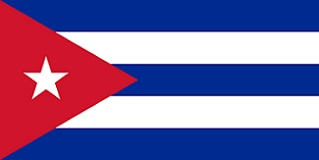
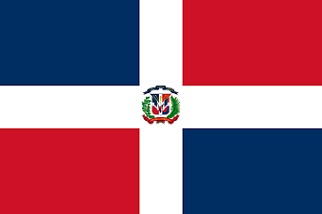
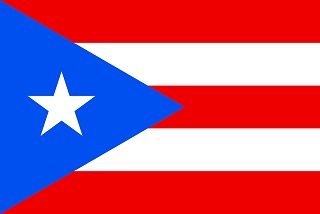
These 3 member-states constitute 59 percent of the Caribbean’s total population of 42+ million people, according to 2010 census numbers (Cuba – 11.24 million, DR – 9.52 million, PR – 3.99 million). They share the same Spanish language, the same colonial heritage, the same legacy of African Slavery, the same color flags (Red, White and Blue) and the same American tutelage; (some say tutelage while some say abandonment) see here:

  • Cuba – This country was ceded from the Spanish Empire in the 1898 Spanish-American War and allowed to pursue their Independence dreams. Their autonomous rule history was dysfunctional; punctuated with a Communist Revolution in 1959 led by Fidel Castro. See more here: America’s War on the Caribbean. After 55 years of economic and political alienation from the US, the Barack Obama administration worked to normalize relations with Cuba. But there is a new American federal governmental administration; they claim to adhere to a different foreign policy than Obama; but so far, the policies that have been introduced or modified have only tweaked trade rules a little – see Appendix A.
    CU Blog - State of the Caribbean Union - Spanish Caribbean - Photo 2
  • DR – This country benefited from the same movement that granted independence to Haiti; the Haitian Revolutionary forces overran the entire island of Hispaniola and self-extracted from the European powers of France and Spain. Later (1844) the DR sought independence from Haiti and had to contend with many other threats from foreign aggressors. A treaty was drafted and presented to the US Senate to annex the DR as a US Territory with the prospect and pathway to eventually become a US State; it was defeated in 1870 and never ratified. See more here: American Annexation of Santo Domingo. The country has had one troublesome political history since – 3 Presidential assassinations.
    CU Blog - State of the Caribbean Union - Spanish Caribbean - Photo 1
  • Puerto Rico – This island territory was ceded from the Spanish Empire to the US as a result of the same 1898 Spanish-American War. It never obtained independence, but instead experienced one dependent status after another until today. There have been many attempts to assuage the colonial status, in fact a fifth referendum was held just recently on June 11, 2017. 97% percent of those participating voted for statehood, though there was only 23% voter turnout[10]. See more here: Statehood movement in Puerto Rico.
    CU Blog - Puerto Rico Bondholders Coalition Launches Ad Campaign - Photo 1

The US is the richest and most powerful Single Market country that has ever reigned in earth’s history, but this fact has not borne fruit for these Spanish Caribbean neighbors.  They have never shared this disposition.

One thing more these former Spanish territories have shared: Failed-State status.

This has been a familiar theme for the movement behind the book Go Lean…Caribbean. We have consistently conveyed how the economic, security and governing eco-systems of these 3 countries are dysfunctional and defective – along with the other 27 Caribbean member-states. The solution for these countries is not a closer annexation with the United States – America is not the panacea of Caribbean ills – but rather the solutions lie in the adoption of a regional brotherhood among these geographic neighbors – the 3 Spanish Caribbean member-states integrated with the other 27 in the region.

This is the quest of the Go Lean movement!

The book Go Lean…Caribbean – available to download for free – serves as a roadmap for the introduction and implementation of the technocratic Caribbean Union Trade Federation (CU), for the elevation of Caribbean society – for all member-states. This CU/Go Lean roadmap has these 3 prime directives:

  • Optimization of the economic engines in order to grow the regional economy to $800 Billion and create 2.2 million new jobs.
  • Establishment of a security apparatus to ensure public safety and protect the resultant economic engines.
  • Improve Caribbean governance to support these engines, including a separation-of-powers between the member-states and CU federal agencies.

The book stresses that reforming and transforming the Caribbean societal engines must be a regional pursuit. This was an early motivation for the roadmap, as pronounced in the opening Declaration of Interdependence (Pages 12 – 13):

xi. Whereas all men are entitled to the benefits of good governance in a free society, “new guards” must be enacted to dissuade the emergence of incompetence, corruption, nepotism and cronyism at the peril of the people’s best interest. The Federation must guarantee the executions of a social contract between government and the governed.

xvi. Whereas security of our homeland is inextricably linked to prosperity of the homeland, the economic and security interest of the region needs to be aligned under the same governance. Since economic crimes … can imperil the functioning of the wheels of commerce for all the citizenry, the accedence of this Federation must equip the security apparatus with the tools and techniques for predictive and proactive interdictions.

xxiv. Whereas a free market economy can be induced and spurred for continuous progress, the Federation must install the controls to better manage aspects of the economy: jobs, inflation, savings rate, investments and other economic principles. Thereby attracting direct foreign investment because of the stability and vibrancy of our economy.

The Go Lean book provides 370-pages of turn-by-turn instructions on “how” to adopt new community ethos, plus the strategies, tactics, implementations and advocacies to execute so as to reboot, reform and transform the societal engines of Caribbean society.

This commentary is 2 of 5 in a non-sequential series on the State of the Caribbean Union. This series depicts the dysfunctional and defective state of affairs (economics, security and governance) throughout the entire region; there are some common traits. These have been assessed by the Go Lean movement. The full entries of all the blog-commentaries in this series are as follows:

  1. State of the Caribbean Union – Lacking Hope and Change
  2. State of the Caribbean Union – Dysfunctional Spanish Caribbean
  3. State of the Caribbean Union – Deficient  Westminster System
  4. State of the Caribbean Union – Unstable Volcano States
  5. State of the Caribbean Union – Self-Interest of Americana

The State of the Caribbean Union prominently includes these Spanish-speaking islands. These islands need all the remediation and mitigation they can get. Notice the dire state of affairs as portrayed in the Appendices below.

These references align with previous Go Lean commentaries related to …

Cuba – (see Appendix A):

https://goleancaribbean.com/blog/?p=10201 Farewell to Obama and to ‘Wet Foot/Dry Foot’
https://goleancaribbean.com/blog/?p=9813 Fidel Castro Is Dead; Now What for Cuba?
https://goleancaribbean.com/blog/?p=3662 Migrant flow [from Cuba] into US from Caribbean spikes
https://goleancaribbean.com/blog/?p=3455 Restoration of Diplomatic Relations with Cuba – Need for Re-boot Now
https://goleancaribbean.com/blog/?p=3354 CARICOM Chair calls for an end to US embargo on Cuba
https://goleancaribbean.com/blog/?p=2547 Miami’s Success versus Caribbean Failure
https://goleancaribbean.com/blog/?p=2330 ‘Raul Castro reforms not enough’, Cuba’s bishops say

Dominican Republic – (see Appendix B):

https://goleancaribbean.com/blog/?p=11033 US Warnings on Low-cost Dominican Surgeries
https://goleancaribbean.com/blog/?p=10820 Miami: Dominican’s ‘Home Away from Home’
https://goleancaribbean.com/blog/?p=2818 DR President Medina on the economy: ‘God will provide’

Puerto Rico – (see Appendix C):

https://goleancaribbean.com/blog/?p=12126 Commerce of the Seas – Stupidity of the Jones Act
https://goleancaribbean.com/blog/?p=11963 Oscar López Rivera: The ‘Nelson Mandela’ of the Caribbean? Not!
https://goleancaribbean.com/blog/?p=11647 Righting a Wrong: Puerto Rico’s Bankruptcy
https://goleancaribbean.com/blog/?p=6693 Ten Puerto Rico Police Accused of Criminal Network
https://goleancaribbean.com/blog/?p=4551 US Territories – Between a ‘rock and a hard place’
https://goleancaribbean.com/blog/?p=599 Ailing Puerto Rico open to radical economic fixes

The Caribbean Union needs the Spanish Caribbean; the Spanish Caribbean needs the Caribbean Union.

We can reboot the Spanish Caribbean; we can reboot the economic, security and governing engines. The end results:

1.   Spanish Caribbean unity;

2.   Total Caribbean unity;

3.   A better homeland to live, work and play. 🙂

Download the free e-Book of Go Lean … Caribbean – now!

Sign the petition to lean-in for this roadmap for the Caribbean Union Trade Federation.

————–

Appendix A – News Article: In Miami, Trump toughens Obama’s Cuba policy ‘like I promised’

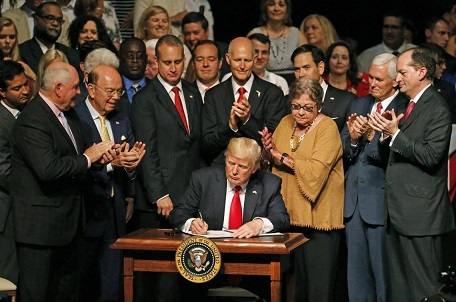
Trump, spurring a standing ovation, billed his appearance as a campaign promise kept to Cuban-Americans to take a harder stance on Cuba. He told the crowd he was canceling Obama’s Cuba policies, though in actuality he’s not. Rather, he’s taking a different approach to pressure Cuba to open its economy and eventually its political system.

CU Blog - State of the Caribbean Union - Spanish Caribbean - Photo 4Trump signed a national security presidential memo — not a presidential policy directive, as originally envisioned by the White House — ordering federal agencies to start writing regulations within 30 days to promulgate his new policy. The State Department will have to compile a list of entities tied to Cuba’s sprawling military conglomerateGrupo de Administración Empresarial, S.A., or GAESA. Americans will be prohibited from transacting with those corporations, except for enumerated exemptions to, among other things, allow for commercial air and cruise travel and payments to private businesses, such as Airbnb rentals.

Travel to Cuba will also become more difficult. Cubans will still be able to visit family and send money. But Americans will have to travel as part of formal groups with set itineraries if they want to qualify under categories that allow educational and people-to-people cultural exchange trips. Another category, for support for the Cuban people, is more stringent but will still allow for individual travel. U.S. travelers will be prohibited from spending money at hotels and restaurants tied to the Cuban military. That includes many brand-name hotel chains. <<< Insert Photo 4 >>>

See the full article from the Miami Herald; posted June 16, 2017; retrieved June 20, 2017 from: http://www.miamiherald.com/news/politics-government/article156586134.html

————-

VIDEO – US Senator Marco Rubio: Cuba will be free ‘in 6 months or 6 years’  – http://www.miamiherald.com/news/politics-government/article156571009.html

————–
Appendix B – “Dominican Watchdog” – Relating the DR’s Dire Status

  • June 12 – MonkeyBiz.dr, Audit Detects Corruption in 68 Dominican City HallsMONKEY BUSINESS AS USUAL IN THE DOM REP – CORRUPTION AND FRAUD FROM A-Z. Forty percent of the monetary resources that should have been destined to infrastructure works, were NOT. Years of real estate fraud prompts purge of officials, foreign investors and buyers of holiday homes have lost hundreds of millions of dollars…….
  • June 12 – STAY HOME, Dominican Republic Chikungunya Cases Skyrocket to 53000 – TRAVEL WARNING – Taiwan recently raised its ALERT about Dom Rep to YELLOW !! Doctors in the DR is fighting 24/7, but he number of chikungunya cases in the Dominican Republic continues to rise at an alarming rate as the Ministry of Health’s Department of Epidemiology reports 52,976 cases, time to stay home, there is NO PROVEN CURE against this virus…..
  • June 12 – Another Agent Killed as Chilling Attacks Grip Dominican RepublicDominican Republic Becoming Most Dangerous Country in the Caribbean – Metropolitan Transit Authority (AMET) agent Carmen Torres Báez, 41, on Monday became the latest victim in a chilling wave of attacks on law enforcement officers gripping the entire Dominican Republic. Torres, mother of four, was gunned down on the Maximo Gomez bridge to Villa Mella around 7:15am as she was walking to work…..

Source: Retrieved June 20, 2017 from: http://www.dominicanwatchdog.org/dominican_news/p-1

————–

Appendix C AUDIO-PODCAST – INTERSECTION: STATEHOOD FOR PUERTO RICO? – https://www.wmfe.org/intersection-statehood-for-puerto-rico/74667

Published June 16, 2017 – Puerto Rico voted for statehood in a referendum last Sunday. At first glance the results seem pretty clear:  97% of voters said yes to statehood. But less than 25% of Puerto Ricans actually cast a vote in the referendum.

Meanwhile, there’s support from lawmakers here in Central Florida for statehood, where there’s a growing Puerto Rican population, but what kind of impetus is there in Washington to add another star to the US flag?

Florida International University’s Cuban Research Institute director Jorge Duany joins the program, along with orlandolatino.org founder Maria Padilla, tecnetico.com founder Wilton Vargas & Ronald Morales who moved to Florida from Puerto Rico in 2015.

Source: Posted June 12, 2017; retrieved June 20, 2017 from Central Florida’s WMFE Public Radio: https://www.wmfe.org/intersection-statehood-for-puerto-rico/74667

Share this post:
, , , ,

Commerce of the Seas – Extraction Realities

Go Lean Commentary

According to the book Go Lean…Caribbean, ‘Luck is the destination where opportunity meets preparation’ – Page 252.

Well, opportunity is awaiting the Caribbean … for mineral extraction and oil exploration.

CU Blog - Commerce of the Seas - Extraction Realities - Photo 1The book also alerts the Caribbean region that Climate Change is raging forward, with a lot of repercussions in its wake. Global warming is resulting in higher sea levels, due to the melting of the polar ice craps/icebergs. A repercussion is:

Beach erosion.

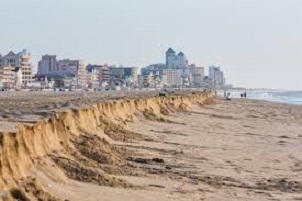
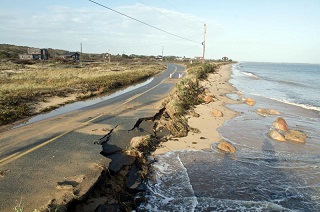
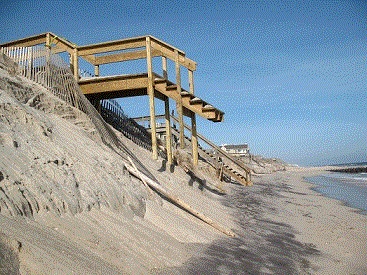
Beaches are gravely important for the American East Coast. (They are important to Caribbean communities as well). So many communities depend on beach vacation and traffic during the spring/summer months (think Spring Break and the commercial summer season of Memorial Day to Labor Day). So when oil spills or predictable storms endanger beach sand, it becomes an urgent imperative for communities to assuage the crisis, even replace the sand; consider these recent News Articles/Summaries here:

Title: Beach Erosion on the US East Coast

Extraction - Photo 2

Extraction - Photo 5

Extraction - Photo 4

1.  http://www.sun-sentinel.com/news/florida/sfl-us-has-ok-to-study-bringing-bahamas-sand-to-florida-beaches-20170102-story.html

    January 2, 2017: A possible solution for replacing sand on South Florida beaches is buying it from the Bahamas. The US federal government has now loosened rules to make this possible.

2.  https://www.scientificamerican.com/article/what-causes-beach-erosion/

    The Art-and-Science of beach management is now being challenged – “Unfortunately for beach lovers and owners of high-priced beach-front homes, coastal erosion in any form is usually a one-way trip. Man-made techniques such as beach nourishment—whereby sand is dredged from off-shore sources and deposited along otherwise vanishing beaches—may slow the process, but nothing short of global cooling or some other major geomorphic change will stop it altogether.”

3.  http://abcnews.go.com/US/deepdive/disappearing-beaches-sea-level-rise-39427567

    DISAPPEARING BEACHES – A Line in the Sand – A tragic story of a family that buys a beach house in 1982, but today, they have to abandon it because of the eroding sands, and bedrock under the house.

4.  AUDIO: http://www.npr.org/2014/09/18/348985568/a-coastal-paradise-confronts-its-watery-future

    September 18, 2014 – There is ‘Trouble in Paradise’. Beachfront communities are finding the waters rising more and more due to global warming.


——–

Title: Oil Exploration and Drilling

http://www.npr.org/2015/03/12/392383373/plans-to-explore-for-oil-offshore-worry-east-coast-residents
March 12, 2015

    March 12, 2015 – As the [US federal government] administration opens the door to offshore drilling, the oil industry is promising more jobs and less reliance on foreign oil. … Coastal towns and cities in several states are formally opposing offshore drilling and oil exploration.

——–

Everyone has a price! So if the price goes up high enough, there may be interested parties among Caribbean member-states to take the money for allowing mineral/oil extraction in their offshore vicinity. There is a need to be alarmed at such proposals, as dredging sand or drilling for oil may endanger protected reefs or other underwater marine features.

With greater demand – imagine post hurricanes – the Laws of Supply-and-Demand will mandate that the prices for extracted minerals will only increase.

It will get more and more tempting!

The movement behind the book Go Lean…Caribbean wants to add other types of economic activities to the Caribbean landscape; we urgently want to use the sea as an industrial zone. This is because the Caribbean region is badly in need of jobs. The book urges communities to empower the economic engines of the Caribbean Sea, as in mineral & oil extraction.

The region’s economic driver is tourism. Tourism and “mineral extraction or oil exploration” are incompatible activities. Thus there is the need for the cautions in this commentary. The challenge is to embrace the commerce of mineral extraction for the positives, while avoiding the negatives.

Challenge accepted!

The book Go Lean…Caribbean serves as a roadmap for the introduction and implementation of the Caribbean Union Trade Federation (CU). This would be the governmental entity for a regional Single Market that covers the land territories of the 30 member-states, and their aligning seas; (including the 1,063,000 square miles of the Caribbean Sea). The Go Lean/CU roadmap features this prime directive, as defined by these 3 statements:

  • Optimization of the economic engines to grow the regional economy to $800 Billion & create 2.2 million new jobs.
  • Establishment of a security apparatus to protect public safety and ensure the economic engines of the region, including the seas.
  • Improvement of Caribbean governance to support these engines in local governments and in the Exclusive Economic Zone, including a separation-of-powers between the member-states and CU federal agencies.

This commentary posits that there are opportunities for the Caribbean to better explore the “Commerce of the Seas”, to deploy International Maritime Organisation-compliant offshore mineral/oil extraction and dredging operations. There are so many lessons that we can learn from the Economic History of other communities and their exploitation of extraction on the high seas. This commentary previously identified a series of 4 commentaries considering the Lessons in Economic History related to “Commerce of the Seas”; this entry is a 5th entry. The full series is as follows:

  1. Commerce of the Seas – Stupidity of the Jones Act
  2. Commerce of the Seas – Book Review: ‘Sea Power’
  3. Commerce of the Seas – Shipbuilding Model of Ingalls
  4. Commerce of the Seas – Lessons from Alang (India)
  5. Commerce of the Seas – Extraction Reality

The reference to “Commerce” refers to the economic interest of the 30 member-states in the Caribbean region. There is the need for more commercial opportunities that would impact the community with job and entrepreneurial empowerments.

Mineral extraction and oil exploration could be providential! Consider these foregoing source references.

In a previous blog, Guyana prioritized oil exploration and drilling as an economic activity in their Exclusive Economic Zone…

… the oil industry/eco-system could be a dizzying ride, up and down, complete with exhilaration and anxiety, especially for communities with mono-industrial economic engines. Trinidad is once such community. Now Guyana is entering that fray.

There are other countries seeking to join these ranks: Haiti, Jamaica, and the Bahamas.

A key consideration in this commentary is the concept of Exclusive Economic Zones (EEZ). Every Caribbean nation with no immediate neighbor within the 200 miles has this exclusive territory to exploit; the previously identified blog-commentary from May 25, 2015 detailed the encyclopedic details, shown here again in Appendix A.

The EEZ is factored in for mineral extraction and oil exploration. This is both a simple and a complicated issue. There is a lot of heavy-lifting involved to balance the needs of commerce and environmental protection.

This is the guidance from the book Go Lean … Caribbean. The CU federation is designed to employ best practices for economics, security and governance. The CU/Go Lean roadmap posits that “Extractions” (Oil and minerals like Rare Earths) must be a significant tactic for the Caribbean region to elevate its society.

The implementation of the CU allows for the designation of an enlarged Exclusive Economic Zones – requiring special approval from an United Nations Tribunal – consolidating existing EEZ’s and the technocratic cooperative-administration of Extractions within that space. This vision was embedded in the Go Lean’s book’s opening Declaration of Interdependence. See the need for regional coordination and integration pronounced these sample stanzas (Page 11 – 13):

i. Whereas the earth’s climate has undeniably changed resulting in more severe tropical weather storms, it is necessary to prepare to insure the safety and security of life, property and systems of commerce in our geographical region. As nature recognizes no borders in the target of its destruction, we also must set aside border considerations in the preparation and response to these weather challenges.

v. Whereas the natural formation of our landmass and coastlines entail a large portion of waterscapes, the reality of management of our interior calls for extended oversight of the waterways between the islands. The internationally accepted 12-mile limits for national borders must be extended by International Tribunals to encompass the areas in between islands. The individual states must maintain their 12-mile borders while the sovereignty of this expanded area, the Exclusive Economic Zone, must be vested in the accedence of this Federation.

xi. Whereas all men are entitled to the benefits of good governance in a free society, “new guards” must be enacted to dissuade the emergence of incompetence, corruption, nepotism and cronyism at the peril of the people’s best interest. The Federation must guarantee the executions of a social contract between government and the governed.

xxvi. Whereas the Caribbean region must have new jobs to empower the engines of the economy and create the income sources for prosperity, and encourage the next generation to forge their dreams right at home, the Federation must therefore foster the development of new industries, like that of ship-building…. In addition, the Federation must invigorate the enterprises related to existing industries like … fisheries … – impacting the region with more jobs.

The Go Lean book provides a 370-page guide on “how” to optimize the eco-system for mineral extraction and oil exploration in an integrated Caribbean region, for the geographic area of the Caribbean Sea. This is the “Commerce of the Seas”.

The Go Lean/CU roadmap asserts that as the confederation for the region’s 30 member-states, the CU, will be the administrator of this EEZ. Step One / Day One of the roadmap calls for awarding contracts for oil exploration and other extractions in the EEZ – this is one of  the methods for financing the CU; this is how to Pay For Change.

The Go Lean roadmap details a series of community ethos, strategies, tactics, implementations and advocacies to foster development, administration and protections in the Caribbean EEZ. Consider this sample except (headlines) from the book’s Page 195:

10 Ways to Impact Extractions

Case Study: The Bottom Line on the Deepwater Horizon Oil Spill
The disaster (also referred to as the BP Oil spill or the Macondo blowout) was an oil spill in the Gulf of Mexico on the BP operated Macondo Prospect, considered the largest accidental marine oil spill in the history of the petroleum industry. Following the explosion and sinking of the Deepwater Horizon oil rig, which claimed 11 lives, a sea-floor oil gusher flowed for 87 days, until it was finally capped on 15 July 2010. The total discharge is estimated at 4.9 million barrels (210 million gallons), resulting in a massive response ensued to protect beaches, wetlands and estuaries from the spreading oil utilizing skimmer ships, floating booms, controlled burns and 1.84 million gallons of Corexit (a chemical oil dispersant). After several failed efforts to contain the flow, the well was declared sealed on 19 September 2010. Due to the months-long spill, along with adverse effects from the response and cleanup activities, extensive damage to marine and wildlife habitats, fishing and tourism industries, and human health problems have continued through this day, 2013. Three years after the spill, tar balls could still be found on the Mississippi coast. …

[See Trailer of the resultant 2016 Movie-Storytelling in the Appendix B VIDEO below.]

1

Lean-in for Caribbean Integration
The CU treaty unifies the Caribbean region into one single market of 42 million people across 30 member-states, thereby empowering the economic engines in and on behalf of the region, including many public works projects and the emergence of many new industries. The new regional jurisdiction allows for mineral extraction (mines), oil/natural gas exploration in the Exclusive Economic Zone and some federal oversight for domestic mining/drilling/extraction operations, especially where systemic threats or cross-border administration are concerned. One CU mandate is to protect tourism. This is just one of the negative side-effects to be on guard for, see Appendix ZK (Page 334) for other concerns.

2

Oil – Mitigation Plan
The concept of oil exploration is very strategic for the CU, as there are member-states that are oil producers. With energy prices so high, this is a lucrative endeavor. But there is risk, tied to the reward equation; the CU cannot endure a Deepwater Horizon-style disaster. Risk management and disaster mitigation plan must therefore be embedded into every drilling permit. The CU will oversee this governance and provide transparent oversight, accountability & reporting.

3

“Rare Earth” Rush – Minerals Priced higher than Gold (Year 2010: $1,000 a pound; $2,200 per kilogram)
There is a “rush”/quest to harvest rare earth elements. These include lanthanide elements (fifteen metallic chemical elements with atomic numbers 57 through 71, from lanthanum through lutetium) for metals that are ferromagnetic, this means their magnetism only appear at low temperatures. Rare earth magnets are made from these compounds and are ideal in many high-tech products. The CU will foster the regional exploration and extraction of these pricey materials.

4

Pipeline Strategy/Tactical Alignment

5

Emergency Response / Trauma Center
The CU accedence grants authority for federal jurisdiction on oil exploration/drilling projects. This is due to the environmental concerns, systemic threats and the strategic implications for energy security. So CU Emergency (Risk, Disaster, and Medical Trauma) Managers will audit and test shutdown, mitigation and emergency procedures annually.

6

Exclusive Economic Zone Oversight / Research and Exploration

7

State Regulated Mining – Peer Review

8

Precious Metals – Exclusive to Caribbean Dollar

9

Treasure Hunting in EEZ – CU must grant Excavation “Permits”

10

Ferries Schedule for Transport to Offshore Rigs

The CU will foster “Extractions” as an industrial alternative to tourism. We have the natural resources (in the waterscapes), the skills and the passionate work-force. We only need the Commerce of the Seas. The Caribbean people are now ready for this industrial empowerment as mineral/oil extraction is both good … and bad!

The Go Lean roadmap asserts that economic needs are undeniable and tempting. While the region sorely needs the economic empowerments, this roadmap also details the mitigations and security measures to guarantee environmental protection.

There is much at stake when communities get the Art-and-Science of mineral extraction wrong!

This commentary ends this deep, long review of the Commerce of the Seas discussion. We have considered many different industries: Tourism, Cruise Lines, Shipping-Trade, Shipbuilding, Ship-breaking and now, Extractions. That is a lot of details to get right! The optimizations of these areas are the hallmarks of a technocracy. Yes, we can … get this right!

Now is the time for all of the Caribbean, the people, business, institutions and governments, to lean-in for the technocratic deliveries of the Go Lean/CU roadmap. 🙂

Download the free e-book of Go Lean … Caribbean – now!

Sign the petition to lean-in for this roadmap for the Caribbean Union Trade Federation.

———–

Appendix A – Exclusive Economic Zone

An Exclusive Economic Zone (EEZ) is a sea zone prescribed by the United Nations Convention on the Law of the Sea over which a state has special rights regarding the exploration and use of marine resources, including energy production from water and wind.[1] It stretches from the baseline out to 200 nautical miles (nmi) from its coast. In colloquial usage, the term may include the continental shelf. The term does not include either the territorial sea or the continental shelf beyond the 200 nmi limit. The difference between the territorial sea and the exclusive economic zone is that the first confers full sovereignty over the waters, whereas the second is merely a “sovereign right” which refers to the coastal state’s rights below the surface of the sea. The surface waters, as can be seen in the map, are international waters.[2]

Generally, a state’s EEZ extends to a distance of 200 nautical miles (370 km) out from its coastal baseline. The exception to this rule occurs when EEZs would overlap; that is, state coastal baselines are less than 400 nautical miles (740 km) apart. When an overlap occurs, it is up to the states to delineate the actual maritime boundary.[3] Generally, any point within an overlapping area defaults to the nearest state.[4]

A state’s Exclusive Economic Zone starts at the landward edge of its territorial sea and extends outward to a distance of 200 nautical miles (370.4 km) from the baseline. The Exclusive Economic Zone stretches much further into sea than the territorial waters, which end at 12 nmi (22 km) from the coastal baseline (if following the rules set out in the UN Convention on the Law of the Sea).[5] Thus, the EEZ includes the contiguous zone. States also have rights to the seabed of what is called the continental shelf up to 350 nautical miles (648 km) from the coastal baseline, beyond the EEZ, but such areas are not part of their EEZ. The legal definition of the continental shelf does not directly correspond to the geological meaning of the term, as it also includes the continental rise and slope, and the entire seabed within the EEZ.

The following is a list of the largest Exclusive Economic Zones; by country with a few noticeable deviations:

Country EEZ Kilometers2 Additional Details
United States 11,351,000 The American EEZ – the world’s largest – includes the Caribbean overseas territories of Puerto Rico and the US Virgin Islands.
France 11,035,000 The French EEZ includes the Caribbean overseas territories of Guadeloupe, Martinique, Saint Martin, Saint Barthélemy and French Guiana.
Australia 8,505,348 Australia has the third largest exclusive economic zone, behind the United States and France, with the total area actually exceeding that of its land territory. Per the UN convention, Australia’s EEZ generally extends 200 nautical miles (370 km) from the coastline of Australia and its external territories, except where a maritime delimitation agreement exists with another state.[15]The United Nations Commission on the Limits of the Continental Shelf confirmed, in April 2008, Australia’s rights over an additional 2.5 million square kilometres of seabed beyond the limits of Australia’s EEZ.[16][17] Australia also claimed, in its submission to the UN Commission on the Limits of the Continental Shelf, additional Continental Shelf past its EEZ from the Australian Antarctic Territory,[18] but these claims were deferred on Australia’s request. However, Australia’s EEZ from its Antarctic Territory is approximately 2 million square kilometres.[17]
Russia 7,566,673
United Kingdom 6,805,586 The UK includes the Caribbean territories of Anguilla, Bermuda, Cayman Islands, Montserrat, Turks & Caicos and the British Virgin Islands.
Indonesia 6,159,032
Canada 5,599,077 Canada is unusual in that its EEZ, covering 2,755,564 km2, is slightly smaller than its territorial waters.[20] The latter generally extend only 12 nautical miles from the shore, but also include inland marine waters such as Hudson Bay (about 300 nautical miles (560 km; 350 mi) across), the Gulf of Saint Lawrence and the internal waters of the Arctic archipelago.
Japan 4,479,388 In addition to Japan’s recognized EEZ, it also has a joint regime with Republic of (South) Korea and has disputes over other territories it claims but are in dispute with all its Asian neighbors (Russia, Republic of Korea and China).
New Zealand 4,083,744
Chile 3,681,989
Brazil 3,660,955 In 2004, the country submitted its claims to the United Nations Commission on the Limits of the Continental Shelf (CLCS) to extend its maritime continental margin.[19]
Mexico 3,269,386 Mexico’s EEZ comprises half of the Gulf of Mexico, with the other half claimed by the US.[32]
Micronesia 2,996,419 The Federated States of Micronesia comprise around 607 islands (a combined land area of approximately 702 km2 or 271 sq mi) that cover a longitudinal distance of almost 2,700 km (1,678 mi) just north of the equator. They lie northeast of New Guinea, south of Guam and the Marianas, west of Nauru and the Marshall Islands, east of Palau and the Philippines, about 2,900 km (1,802 mi) north of eastern Australia and some 4,000 km (2,485 mi) southwest of the main islands of Hawaii. While the FSM’s total land area is quite small, its EEZ occupies more than 2,900,000 km2 (1,000,000 sq mi) of the Pacific Ocean.
Denmark 2,551,238 The Kingdom of Denmark includes the autonomous province of Greenland and the self-governing province of the Faroe Islands. The EEZs of the latter two do not form part of the EEZ of the European Union. See Photo 4.
Papua New Guinea 2,402,288
China 2,287,969
Marshall Islands 1,990,530 The Republic of the Marshall Islands is an island country located near the equator in the Pacific Ocean, slightly west of the International Date Line. Geographically, the country is part of the larger island group of Micronesia. The country’s population of 68,480 people is spread out over 24 coral atolls, comprising 1,156 individual islands and islets. The land mass amounts to 181 km2 (70 sq mi) but the EEZ is 1,990,000 km2, one of the world’s largest.
Portugal 1,727,408 Portugal has the 10th largest EEZ in the world. Presently, it is divided in three non-contiguous sub-zones:

Portugal submitted a claim to extend its jurisdiction over additional 2.15 million square kilometers of the neighboring continental shelf in May 2009,[44] resulting in an area with a total of more than 3,877,408 km2. The submission, as well as a detailed map, can be found in the Task Group for the extension of the Continental Shelf website.

Spain disputes the EEZ’s southern border, maintaining that it should be drawn halfway between Madeira and the Canary Islands. But Portugal exercises sovereignty over the SavageIslands, a small archipelago north of the Canaries, claiming an EEZ border further south. Spain objects, arguing that the SavageIslands do not have a separate continental shelf,[45] citing article 121 of the United Nations Convention on the Law of the Sea.[46] <<< See Photo 6 >>>

Philippines 1,590,780 The Philippines’ EEZ covers 2,265,684 (135,783) km2[41]. See Photo 5.
Solomon Islands 1,589,477
South Africa 1,535,538
Fiji 1,282,978 Fiji is an archipelago of more than 332 islands, of which 110 are permanently inhabited, and more than 500 islets, amounting to a total land area of about 18,300 square kilometres (7,100 sq mi).
Argentina 1,159,063
Spain 1,039,233
Bahamas 654,715
Cuba 350,751
Jamaica 258,137
Dominican Republic 255,898
Barbados 186,898
Netherlands 154,011 The Kingdom of the Netherlands include the Antilles islands of Aruba. Bonaire, Curacao, Saba, Sint Maarten and Sint Eustatius
Guyana 137,765
Suriname 127,772
Haiti 126,760
Antigua and Barbuda 110,089
Trinidad and Tobago 74,199
St Vincent and the Grenadines 36,302
Belize 35,351
Dominica 28,985
Grenada 27,426
Saint Lucia 15,617
Saint Kitts and Nevis 9,974

(Source: Retrieved May 25, 2017 from: http://en.wikipedia.org/wiki/Exclusive_economic_zone)

———–

Appendix B VIDEO – Deepwater Horizon (2016) Official Movie Trailer – ‘Heroes’ – https://youtu.be/S-UPJyEHmM0

Published on May 26, 2016 – Deepwater Horizon – Now Playing.
#DeepwaterHorizonMovie

CU Blog - Commerce of the Seas - Extraction Realities - Photo 6

Share this post:
, ,
[Top]

Commerce of the Seas – Lessons from Alang (India)

Go Lean Commentary

Despite our beautiful vistas in the Caribbean – with our sun, sand and sea – not everywhere is paradisiac. Some locations are just plain ordinary, or even Less-Than. Tourism is the region’s Number 1 economic activity, but there are certain areas where tourists should not venture. This is true for agricultural areas and certain industrial zones.

The movement behind the book Go Lean…Caribbean wants to add another type of “not for tourists” industrial zone to the Caribbean landscape: Ship-breaking Yards.

Just that combination of words – “Ship” + “Breaking” – connotes some negative images. The lessons we learned from the Indian port city of Alang is that Ship-breaking is dirty; see the encyclopedic reference here:

Reference Title: Alang,  Indian State of Gujarat. 

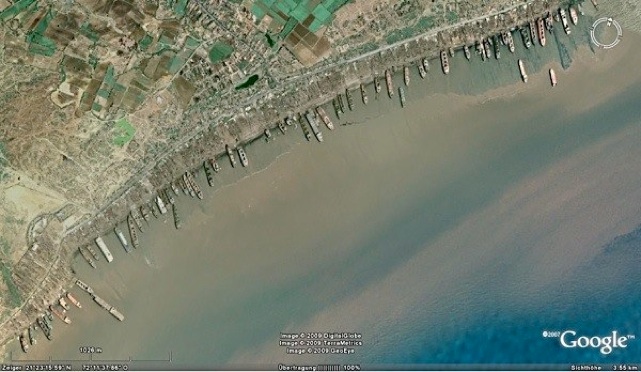
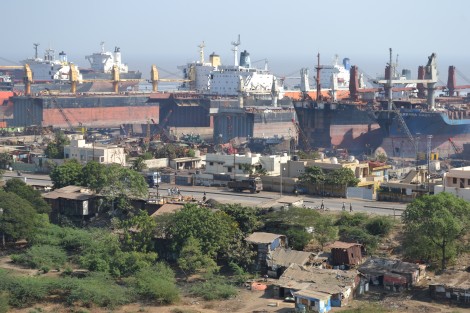
CU Blog - Commerce of the Seas - Lessons from Alang - Photo 5Alang is a census town in Bhavnagar district in the Indian state of Gujarat. In the past three decades, its beaches have become a major worldwide centre for ship breaking. The longest ship ever built, Seawise Giant, was sailed to and beached here for demolition in December 2009. [1]

Marine salvage industry
The shipyards at Alang recycle approximately half of all ships salvaged around the world.[2] It is considered the world’s largest graveyard of ships.[3] The yards are located on the Gulf of Khambat, 50 km (31 mi) southeast of Bhavnagar. Large supertankerscar ferriescontainer ships, and a dwindling number of ocean liners are beached during high tide, and as the tide recedes, hundreds of manual laborers move onto the beach to dismantle each ship, salvaging what they can and reducing the rest to scrap.

The salvage yards at Alang have generated controversy about working conditions, workers’ living conditions, and the impact on the environment. One major problem is that despite many serious work-related injuries, the nearest full service hospital is 50 km (31 mi) away in Bhavnagar.

Alang - Photo 1

Alang - Photo 2

Alang - Photo 4

Future
Japan and the Gujarat government have joined hands to upgrade the existing Alang shipyard. The two parties have signed a Memorandum of Understanding, which focuses on technology transfer and financial assistance from Japan to assist in the upgrading of operations at Alang to meet international standards. This is a part of the Delhi Mumbai Industrial Corridor, a larger partnership between the Japanese and Gujarat government. Under this plan, Japan will address the environmental implications of ship breaking in Alang, and will develop a .marketing strategy. The project is to be carried out as a public-private partnership. The project’s aim is to make this shipyard the largest International Maritime Organisation-compliant ship recycling yard in the world.

Source: Retrieved June 8, 2017 from: https://en.wikipedia.org/wiki/Alang

The dirty nature of these industrial endeavors, as depicted in Alang, provides a negative lesson that we want to learn from to avoid all perilous consequences of doing this business in a “wrong” manner.

Another lesson we learn from Alang is that Ship-breaking work (jobs) is consistent and steady. There are many ships that have lived out their usefulness and now need to be dismantled for scrap; the more labor available, the more ships to break. This is such a positive lesson for us to learn right now, as the Caribbean region is badly in need of jobs. The economic engine involves salvaging the scrap metal (and other materials) for recycling.

The challenge is to embrace the commerce of Ship-breaking for the positives, while avoiding the negatives.

Challenge accepted! (The foregoing relates the welcoming support from Japan for clean ship-breaking).

The book Go Lean…Caribbean serves as a roadmap for the introduction and implementation of the Caribbean Union Trade Federation (CU). This would be the governmental entity for a regional Single Market that covers the land territories of the 30 member-states, and their aligning seas; (including the 1,063,000 square miles of the Caribbean Sea). The Go Lean/CU roadmap features this prime directive, as defined by these 3 statements:

  • Optimization of the economic engines to grow the regional economy to $800 Billion & create 2.2 million new jobs.
  • Establishment of a security apparatus to protect public safety and ensure the economic engines of the region, including the seas.
  • Improvement of Caribbean governance to support these engines in local governments and in Self-Governing Entities, including a separation-of-powers between the member-states and CU federal agencies.

This commentary posits that there are opportunities for the Caribbean to better explore the “Commerce of the Seas”, to deploy International Maritime Organisation-compliant shipyards. There are so many lessons that we can learn from the Economic History of other communities’ exploitation of the high seas. This commentary is 4 of 4 in a series considering the Lessons in Economic History related to “Commerce of the Seas”. The full series is as follows:

  1. Commerce of the Seas – Stupidity of the Jones Act
  2. Commerce of the Seas – Book Review: ‘Sea Power’
  3. Commerce of the Seas – Shipbuilding Model of Ingalls
  4. Commerce of the Seas – Lessons from Alang (India)

The reference to “Commerce” refers to the economic interest of the 30 member-states in the Caribbean region. There is the need for more commercial opportunities that would impact the community with job and entrepreneurial empowerments. Ship-breaking could be providential!

Ship-breaking can provide high tech, mid tech and low tech jobs; especially if the salvage operation is executed in a technocratic manner. The Art & Science of technocratic ship-breaking versus dirty-breaking (i.e. Alang) was previously detailed in a blog-commentary on August 14, 2014. See some highlights from that blog in the excerpt here:

… ship-breaking activities in Third World countries, like Bangladesh, pose harm to the environment, workers and remaining systems of commerce. But when executed correctly, as in Brownsville-Texas, ship-breaking can be all positive. There are benefits in applying the appropriate best practices in handling hazardous materials. The tons of toxic waste (asbestos) can be properly managed and disposed of, with the proper eco-system surrounding the industry. The CU will facilitate the eco-system, especially with the Self-Governing Entities (SGE) concept for shipyards. This is covered in the Go Lean book under the auspices of “turn-around” industries, a federally regulated/promoted activity.

So there is a way to perform ship-breaking – one expression of maritime commerce – in a lean, clean manner while guaranteeing safety for the workers and profit for the investors.

This is the win-win … of the Go Lean roadmap.

The Go Lean book/roadmap was published in November 2013 with a vision for a new industrialization for the region. The quest is for the region to cooperate, collaborate and convene so as to accomplish more as a unified Single Market than may be possible alone. Not one of the Caribbean member-states – all Third World – can do ship-breaking right. It would quickly denigrate to the Alang and Bangladesh models. But together, leveraging the interdependence – so much more can be accomplished. This was the vision of the opening Declaration of Interdependence in the book. Here, the need for regional coordination and integration was pronounced as the basis of reforming and transforming Caribbean society.

See a sample of relevant stanzas from the Declaration here (Page 11 – 13):

xi. Whereas all men are entitled to the benefits of good governance in a free society, “new guards” must be enacted to dissuade the emergence of incompetence, corruption, nepotism and cronyism at the peril of the people’s best interest. The Federation must guarantee the executions of a social contract between government and the governed.

xxvi. Whereas the Caribbean region must have new jobs to empower the engines of the economy and create the income sources for prosperity, and encourage the next generation to forge their dreams right at home, the Federation must therefore foster the development of new industries, like that of ship-building…. In addition, the Federation must invigorate the enterprises related to existing industries like … fisheries … – impacting the region with more jobs.

Reforming and transforming the Caribbean is the quest. The Go Lean book explains “how”, providing 370-pages of turn-by-turn instructions on “how” to adopt new community ethos for economic regionalism, and “how” to execute the right strategies, tactics, and implementations to reboot, reform and transform the maritime commerce to benefit Caribbean society.

The issue of fostering industrial developments in the Art-and-Science of the salvage industry has been a frequent subject for previous blog-commentaries; consider this list of sample entries:

https://goleancaribbean.com/blog/?p=10140 Lessons Learned: Detroit demolishes thousands of structures
https://goleancaribbean.com/blog/?p=6760 A Lesson in ‘Garbage’
https://goleancaribbean.com/blog/?p=2953 Funding Caribbean Entrepreneurs – The ‘Crowdfunding’ Way
https://goleancaribbean.com/blog/?p=2857 Where the Jobs Are – Entrepreneurism in Junk

All Caribbean member-states are islands or coastal territories – they can all be candidates for maritime salvaging (ship-breaking) operations – even all at the same time. While there is a large footprint of “cheap” ship-breakers in Asia, not as many proliferate in the Western Hemisphere. It is a perfect time to explore these opportunities.

This is not tourism! Ship-breaking activities are not paradisiac nor inviting so they should be limited to shipyards, not beaches.

Alang - Photo 3Imagine: towing an old ship from the Americas to the Caribbean, rather than across the Atlantic and Indian Oceans; see the experience of salvaging the “Love Boat” in the Appendix VIDEO below.

This is commerce!

There is a need to transform maritime commerce for the Caribbean region; we can get more economic activity from this sector; the Go Lean book projects 15,000 new direct jobs in the shipbuilding and/or ship-breaking activities. The possibility of these new jobs is hope-inspiring. At last we can arrest the societal abandonment where men and women leave the community looking for any kind of work.

This is Commerce of the Seas; we saw how previous generations of Caribbean people lived off the sea; we can again, with these creative expressions of maritime commerce.

This plan is conceivable, believable and achievable. We urge all Caribbean stakeholders – governments, business owners and workers – to lean-in to this roadmap for economic empowerment. We can make the Caribbean homeland and seas better places to live, work and play. 🙂

Download the free e-book of Go Lean … Caribbean – now!

Sign the petition to lean-in for this roadmap for the Caribbean Union Trade Federation.

————–

Appendix VIDEO – The End of The Love Boat – https://youtu.be/lauAeMtzMYM

Published on Nov 5, 2016English Captions Available!!!
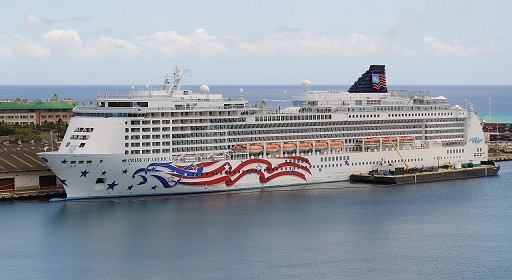
MS Pacific Princess is a voyage send possessed by Princess Cruises and worked by Princess Cruises and P&O Cruises Australia. She was inherent 1999 by the Chantiers de l’Atlantique shipyard in Saint-Nazaire, France as MS R Three for Renaissance Cruises.

The vessel initially entered operation in 1999, with Renaissance Cruises. The ship was not claimed by the organization, ownership rather living with a gathering of French speculators, who rented the ship to the organization. In late 2001, the whole Renaissance armada was seized by lenders.

Pacific Princess in Yalta inlet.

In late 2002, Princess Cruises sanctioned the R Three, alongside sister transport R Four (now Ocean Princess). Both vessels entered operation before the end of 2002. The contract ended toward the end of 2004, at which time both vessels were acquired by Princess Cruises. Gabi Hollows renamed the ship Pacific Princess in Sydney on 8 December 2002.
This ship has been the subject of a state help choice by the European Commission: Decision 2006/219.

Princess Cruise Line Youtube channel: youtube.com/user/princesscruises
Cruise Ships Info Youtube channel: youtube.com/cruiseshipsinfo
Cruise Ships Info Facebook Page: facebook.com/cruiseshipsinfo
Cruise Ships Info Twitter Page: twitter.com/cruiseship_info
Cruise Ships Info Pinterest Page: pinterest.com/cruiseshipinfo

————–

Additional VIDEO – Jobs of Workers in Ship-breaking Industry –  https://www.youtube.com/watch?v=wOGjYfBltZc

Share this post:
, , , , ,
[Top]

Commerce of the Seas – Shipbuilding Model of Ingalls

Go Lean Commentary

The ‘Law of Supply-and-Demand’ is almost as natural as the ‘Law of Gravity’; leave it alone and it will pre-determine what will happen … in the marketplace. But just like the ‘Law of Gravity’ can bend and be defied (think airplanes and rockets), so too the ‘Law of Supply-and-Demand’ can bend and be defied. A great example of defying ‘Supply-and-Demand’ is the Crony-Capitalism (subsidies and protectionist schemes) in the highly-protected Ship-Building industry. (See the Appendix below regarding OECD Ship-Building Industry monitoring efforts).

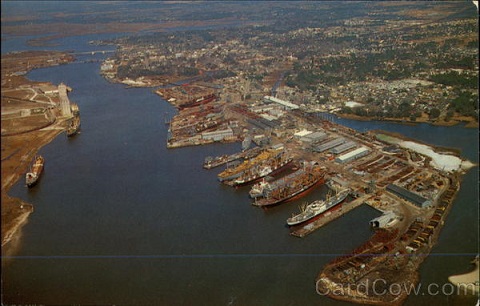
CU Blog - Commerce of the Seas - Model of Ingalls - Photo 1

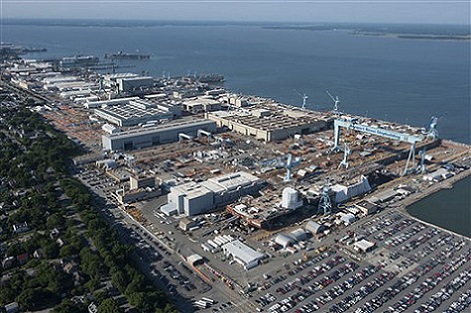
CU Blog - Commerce of the Seas - Model of Ingalls - Photo 2

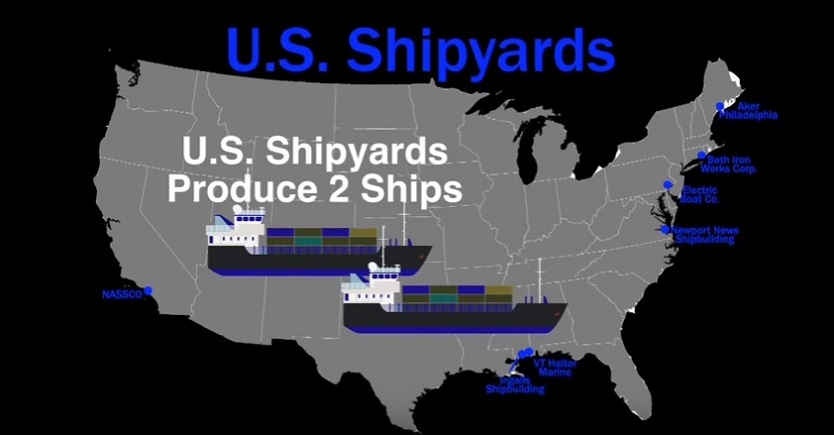
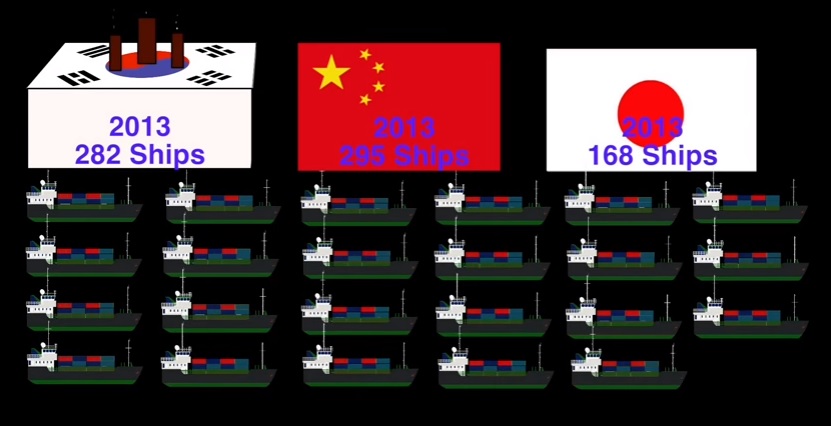
Look at the numbers in the 2 photos above. It is apparent that the US distorts the Supply-and-Demand factors for Ship-Building in its market; their protectionist laws prevent the international market from supplying domestic shipping needs. This is bad! Though there is the need for some government-aid, to protect jobs and defense options,  the US model of Crony-Capitalism is a blatant distortion – Source: https://youtu.be/GpwzoDGDGAQ.

Ship-Building can be a strategic industry! The book Go Lean…Caribbean asserts that 15,000 new direct jobs can be created with strategic endeavors for the Ship-Building industry in the region. (Even more indirect jobs applies – multiplier rate of 3-to-1).  The Go Lean book calls for the elevation of Caribbean economics, positing that governmental entities must stimulate and incubate this industry. The book surveyed the world looking for industrial opportunities that could be fully explored in the Caribbean region where the natural resources of the region could be considered; the region is known for sun, sand and sea.

Tourism is a natural assumption for utilizing these “sun, sand and sea“ resources, but with the recent inadequacies of this industry, there needs to be more diversity in our commercial offerings; ship-building – which needs the sea – was identified as an ideal supplement and alternative for regional commerce. This reference to “regional commerce” refers to the economic interest that the 30 member-states in the Caribbean have to consider to provide job and entrepreneurial opportunities for its people. So this Ship-Building focus prioritizes the “Commerce of the Seas” concept. This commentary is 3 of 4 in a series considering the Lessons in Economic History related to “Commerce of the Seas”, the Crony-Capitalism in laws and practices around the maritime eco-system in the United States … and other countries. The full series is as follows:

  1. Commerce of the Seas – Stupidity of the Jones Act
  2. Commerce of the Seas – Book Review: ‘Sea Power’
  3. Commerce of the Seas – Shipbuilding Model of Ingalls
  4. Commerce of the Seas – Lessons from Alang (India)

There are many Lessons in Economic History for the Caribbean to glean by considering the actuality of this industry. Let’s consider the role model of just one American shipbuilding entity: Ingalls Shipbuilding Company in Pascagoula, Mississippi. See the reference source here, describing the business model for building ships to ‘Supply’ any open ‘Demand’ in the commercial market:

Title: Ingalls Shipbuilding 

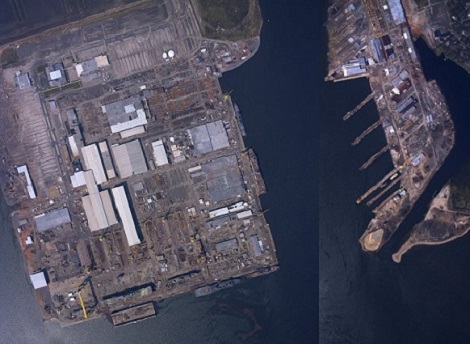
Ingalls Shipbuilding is a shipyard located in Pascagoula, Mississippi, United States, originally established in 1938, and is now part of Huntington Ingalls Industries. It is a leading producer of ships for the United States Navy, and at 12,500 employees, the largest private employer in Mississippi.

CU Blog - Commerce of the Seas - Model of Ingalls - Photo 3

Pascagoula River and Ingalls Shipyard

CU Blog - Commerce of the Seas - Model of Ingalls - Photo 5

History

In 1938, Ingalls Shipbuilding Corporation was founded by Robert Ingersoll Ingalls, Sr. (1882–1951) of Birmingham, Alabama, on the East Bank of the PascagoulaRiver in Mississippi.[1] Ingalls was located where the Pascagoula River runs into the Gulf of Mexico. It started out building commercial ships including the USS George Clymer (APA-27), which took part in Liberty Fleet Day 27 September 1941. In the 1950s Ingalls started bidding on Navy work, winning a contract in 1957 to build 12 nuclear-powered attack submarines.

Litton Industries acquired Ingalls in 1961, and in 1968 expanded its facilities to the other side of the river. Ingalls reached a high point of employment in 1977, with 27,280 workers. In April 2001, Litton was acquired by the Northrop Grumman Corporation.[2]

On August 29, 2005, Ingalls facilities were damaged by Hurricane Katrina; most of the ships in dock and construction escaped serious harm. While shipbuilding was halted for a while due to the destruction of many buildings, most vehicles, and the large overhead cranes, the facility continues to operate today.

On March 31, 2011, Northrop Grumman spun off its shipbuilding sector (including Ingalls Shipbuilding) into a new corporation, Huntington Ingalls Industries.

In 2015, Ingalls Shipbuilding Company signed a contract with US Navy for new destroyers, littoral combat ships and new landing craft. USS John Finn (DDG-113) was one of the first destroyers was launched on March 28. Company also is building Ralph Johnson (DDG 114), Paul Ignatius (DDG 117) and Delbert D. Black (DDG 119).

On March 21, 2015, the new San Antonio LPD 17-class amphibious ship John P. Murtha (LPD 26) was ceremonially christened. The vessel having been launched on October 30 and scheduled to be delivered in 2016.

On March 27, 2015, the shipyard received construction contracts for their next destroyers. Ingalls Shipbuilding Company was awarded a $604.3 million contract modification to build the yet-to-be-named DDG 121.

On March 31, 2015, the shipyard also received another contract with a $500 million fixed price to build the eighth National Security Cutter (NSC) for the US Coast Guard. Most of them will be under construction until 2019. The cutters are the most advanced ships ever built for the Coast Guard. [3]

On June 30, 2016, Ingalls Shipbuilding signed a contract with US Navy to build the U.S. Navy’s next large-deck amphibious assault warship. The contract included planning, advanced engineering and procurement of long-lead material, is just over $272 million. If options are exercised, the cumulative value of the contract would be $3.1 billion.[4]

Ships built

Source: Retrieved 06-11-2017 from Wikipedia: https://en.wikipedia.org/wiki/Ingalls_Shipbuilding

———–

VIDEO – Ingalls Shipbuilding Promotional Video – https://youtu.be/EFl8Tl0ImJo

Published on Jan 10, 2017 – Ingalls Shipbuilding is located in Pascagoula, Mississippi on 800 acres of the most important real estate in America. With 11,000 employees, Ingalls is the largest manufacturing employer in Mississippi and a major contributor to the economic growth of both Mississippi and Alabama. Our 77-year legacy has continuously proven we have the talent, experience and facilities to simultaneously build more classes of ships than any other shipyard in America.

We are the builder-of-record for 35 Aegis DDG 51 class guided missile destroyers, LHA 6 class large deck amphibious ships, National Security Cutters for the U.S. Coast Guard and the sole builder of the Navy’s fleet of San Antonio (LPD 17) class amphibious assault ships. Ingalls Shipbuilding has what it takes to build the capital ships that keep America and our allies safe.

Additional VIDEO consideration: https://youtu.be/0pak_gKglqo – Ingalls shows ‘Shipyard of the Future’.

Considering that 90% of all trade transports by water, there is natural demand for shipbuilding. There is a lot of supply as well.

Ingalls Shipbuilding Company is a definite beneficiary of government-aided commerce in the US; most of their shipbuilding engagements are government contracts. They are a leading producer of ships for the US Navy or Coast Guard, and at 12,500 employees, the largest private employer in Mississippi. As related in the first commentary in this series, the Jones Act has protected maritime commerce and shipbuilding for American stakeholders like Ingalls.

It is ‘high tide’ for the Caribbean to engage some protectionism strategies. Considering that the Caribbean region is the #1 market for the Cruise Line industry, collective bargaining should be prioritized to direct some shipbuilding business to local entities in this industry. The book Go Lean… Caribbean posits that as a unified region – a Single Market – the power of collective bargaining is possible. The book serves as a roadmap for the introduction and implementation of the technocratic Caribbean Union Trade Federation (CU) with the charter to facilitate jobs in the region. We should explore the benefits of the shipbuilding (and ship-breaking) industry. This aligns with the CU charter; as defined by these 3 prime directives:

  • Optimization of economic engines in order to grow the regional economy to $800 Billion and create 2.2 million new jobs.
  • Establishment of a security apparatus to protect the resultant economic.
  • Improve Caribbean governance to support these engines.

Early in the Go Lean book, this responsibility to create jobs was identified as an important function for the CU with this pronouncement in the Declaration of Interdependence (Pages 14):

xxiv.  Whereas a free market economy can be induced and spurred for continuous progress, the Federation must install the controls to better manage aspects of the economy: jobs, inflation, savings rate, investments and other economic principles. Thereby attracting direct foreign investment because of the stability and vibrancy of our economy.

xxvi.  Whereas the Caribbean region must have new jobs to empower the engines of the economy and create the income sources for prosperity, and encourage the next generation to forge their dreams right at home, the Federation must therefore foster the development of new industries, like that of ship-building…. In addition, the Federation must invigorate the enterprises related to existing industries tourism, fisheries and lotteries – impacting the region with more jobs.

Accordingly, the CU will facilitate the eco-system for Self-Governing Entities (SGE), an ideal concept for shipyards, with its exclusive federal regulation/promotion activities.

The Go Lean movement (book and blogs) also details the principle of job multipliers, how certain industries are better than others for generating multiple indirect jobs down the line for each direct job on a company’s payroll. In a previous blog-commentary, it was related that the shipbuilding industry has a job-multiplier rate of 3.0. So once the job-multiplier rate is applied to the 15,000 direct shipbuilding jobs, generating 45,000 indirect jobs, the full economic impact is 60,000. This is transforming!

The Go Lean book provides 370-pages of turn-by-turn instructions on “how” to reform and transform the Caribbean, starting first with how to adopt new community ethos, plus the strategies, tactics, implementations and advocacies to execute so as to transform the maritime commerce to benefit Caribbean society. Consider the Chapter excerpts and headlines from this sample on Page 209 related to Ship-Building:

10 Ways to Develop Ship-Building

1

Lean-in for Caribbean Integration
The CU will allow for the unification of the region into one market, creating an economy of 30 member-states, 42 million people and 2010 GDP over $800 Billion. All of the member-states are either islands or coastal, therefore there are lots of coastline and harbors. Boats, yachts and ships are therefore plentiful in the region. Consistent with the CU’s mission for globalization, the region cannot just consume these vessels; we must create and build as well. There is a history of boat-building in the islands (slopes, schooners, clippers), but what had been missing to forge a formidable industry is the capital and the community “will”. The CU will now fill those gaps. The CU will tap the capital markets to secure long-term funding (stocks/bonds), prepare the labor force for advanced skill-sets, and negotiate treaties with “mature” EU states (i.e. Holland, Ireland) for master-apprentice labor-coaching. Boats, yachts and ships are considered durable goods, the opposite of planned obsolescence. …

2

Cooperatives Movement – “Many hands make heavy job light

3

Ferry Operations – Demand & Supply
The CU envisions a fleet of ferries, to service the individual islands, in a scheme dubbed “Union Atlantic Turnpike”. The proliferation of scheduled ferries, synchronized with trains and trucks will depict a continuous logistic network. This constitutes the demand for ferries. The CU will henceforth award the contracts for building and maintaining the ferries to local industry players – this constitutes the supply. The CU will therefore foster a ship-building “incubator”.

4

Spin-off Strategy – Low-risk Contracts
The CU vision is to deploy a “spin-off” strategy for ship-owning patrons. The CU region needs ships. Therefore, the CU will incentivize patrons to “go local” with their ship-building/maintenance needs. A domestic ship-building industry is a great source of skilled/high-wage jobs. So there are many ways to exploit the cost-benefit equation for a win-win.

5

Cruise Ship Dry-Dock – Let’s Make-A-Deal
The Caribbean region is the Number One market for the Cruise Line industry. Big expenses for Cruise Lines are port charges and landing fees. The CU will offer rebates and incentives for the Cruise Lines to use local dry-docks for retro-fittings and refurbishing.

6

Yacht Development – Catering to a Special Market

7

Sailboats – For Every Man
The history of Caribbean boat building is rich with sailing crafts; cruise ships evolved from local Banana-Boats. The CU will channel that history, passion and ethos for the region to design/develop best-inbred sailboats, big and small.

8

Boat Shows and Open Houses – Show and Tell

9

Regattas – More than Just Winning a Race
The history of the region has highlighted ships, boats and boat building. There is the tradition of Regattas, used to showcase the islands boat building prowess. [199] The CU now intends to feature Regattas in the same manner that automakers feature auto racing (NASCAR, IndyCar, Formula-One), as a demonstration platform for their art and science.

10

Maritime Emergencies – Professional Response
The CU will deploy the necessary equipment and training for the ship-building industry to respond to maritime emergencies in the region. Therefore a disabled cruise ship will have the rapid response of “support-barges”, tug boats, dredging equipment, portable generators. This effort will be marshaled by the CU Emergency Management Agency.

The CU will foster shipbuilding as an industrial supplement and alternative to tourism. We have the resources (waterscapes, ports and harbors), the skills and the passionate work-force. We only need the Commerce of the Seas. The Caribbean people are now ready for this industrial empowerment. But we need to be cautious as to which role model we emulate. The US does provide material support and subsidies to their shipbuilding industry, but their protection laws – i.e. the Jones Act – have nullifies the positive effects of a Free Market. While other countries build and launch hundreds of ships every year, the US model only produce 2. That’s a lot of missing jobs, and artificially induced high prices.

In the Caribbean, we must do better. Fortunately, we do not have the Crony-Capitalism of the Jones Act to deter us. We can follow other – better – models to progress our societal investments in this industry. This is the assertion of the Go Lean roadmap.

We hereby urge all Caribbean stakeholders – governments and citizens – to lean-in to this Go Lean roadmap to foster this industrial development, so that our region can be a better homeland and seas to live, work and play. 🙂

Download the free e-book of Go Lean … Caribbean – now!

Sign the petition to lean-in for this roadmap for the Caribbean Union Trade Federation.

———–
Appendix – The OECD Council Working Party on Shipbuilding

(OECD = Organization of Economic Cooperation and Development)

The OECD Council Working Party on Shipbuilding (WP6) seeks to progressively establish normal competitive conditions in the industry. It encourages transparency through data collection and analysis, and seeks to expand policy dialogue with non-OECD economies that have significant shipbuilding industries. WP6 is the only international body that can influence and guide government policies by identifying and, where possible, eliminating factors that distort the shipbuilding market.

The Working Party is chaired by Ambassador Elin Østebø Johansen, Permanent Representative of Norway to the OECD. Participating OECD members are: Denmark, Finland, Germany, Italy, Japan, Korea, Netherlands, Norway, Poland, Portugal, Sweden and Turkey. Croatia and Romania are full participants in the Working Party, and the Russian Federation participates as an observer. The European Commission, representing the European Union, also participates in WP6 meetings.

What does the Working Party on Shipbuilding do?
The WP6 has placed a high priority on encouraging policy dialogues, and on establishing close working relationships with non-OECD economies. In particular, these economies were invited to participate on an equal footing with OECD members in the negotiations on a shipbuilding agreement that ran from 2002 until 2005, and Brazil, China, Croatia, the Philippines, Romania, the Russian Federation, Chinese Taipei and Ukraine participated in those negotiations. Although the negotiations were eventually halted, a close working relationship has continued with all of these economies.

The WP6 organizes regular workshops aimed at facilitating the exchange of information on policy and industry developments, and as well as the economies already mentioned, other participants have come from India, and Indonesia, amongst others.

The WP6 has also worked closely with industry groups representing shipbuilders, ship owners, ship operators and trade union interests, so that a wide range of perspectives can be taken into account by WP6 members during their formulation of policy responses to address issues and challenges faced by the global shipbuilding sector.

What is the relevance of the Working Party to non-OECD economies and industry?

While the world’s shipbuilding industry has been through a period of record production, it was severely affected by the 2008 global financial crisis, and recent years have seen very low levels of new orders received by virtually all shipyards. The global industry now faces a number of challenges, most notably global excess capacity, which will place the economic viability of the industry under pressure in some parts of the world.

Persistent worldwide overcapacity may encourage governments to provide support through subsidies and other measures, as well as spur other market distorting practices, which can create major structural problems even in the most efficient shipbuilding industries. But potential market distortions can be addressed through close co-operation among economies with significant shipbuilding sectors and the active involvement of industry.

———-

INVENTORY OF GOVERNMENT SUPPORT MEASURES

The Inventory of Government Subsidies and Other Support Measures is a regular exercise for the WP6. The main aim of this exercise is to provide transparency and continuity of data on support measures for the shipbuilding industry. As well as WP6 participants, the Inventory provides some information on the support measures in Partner economies.


Share this post:
, , , ,
[Top]

Commerce of the Seas – Book Review: ‘Sea Power’

Go Lean Commentary 

70% of the earth is covered by water
70% of the human body is made up by water

CU Blog - Lessons from China - South China Seas - Exclusive Economic Zone - Photo 3It seems that water is pretty important in managing the affairs of people and their community.

The quest of the movement behind the book Go Lean… Caribbean is to confederate, collaborate and convene the 30 member-states of the Caribbean region into a Single Market; this would include the territorial homelands and aligning seas. How, where, when ‘Sea Power’ is managed becomes a major consideration in this quest. A lesson we have learned from Economic History is that a people who wield ‘Sea Power’ can control the economic prospects of its people.

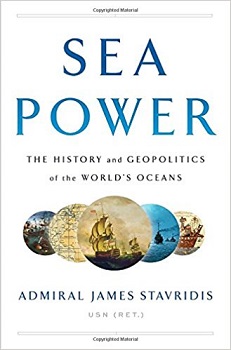
We learn this lesson even more succinctly now, thanks to the new book by Admiral James Stavridis entitled: Sea Power: The History and Geopolitics of the World’s Oceans. See a summary-review of the book here and listen to an AUDIO-Podcast interview with the Author:

 Sea Power - Photo 1

Book Review for Book: Sea Power: The History and Geopolitics of the World’s Oceans By: Admiral James Stavridis

From one of the most admired admirals of his generation – and the only admiral to serve as Supreme Allied Commander at NATO – comes a remarkable voyage through all of the world’s most important bodies of water, providing the story of naval power as a driver of human history and a crucial element in our current geopolitical path. 

From the time of the Greeks and the Persians clashing in the Mediterranean, sea power has determined world power.  To an extent that is often underappreciated, it still does. No one understands this better than Admiral Jim Stavridis. In Sea Power, Admiral Stavridis takes us with him on a tour of the world’s oceans from the admiral’s chair, showing us how the geography of the oceans has shaped the destiny of nations, and how naval power has in a real sense made the world we live in today, and will shape the world we live in tomorrow.

Not least, Sea Power is marvelous naval history, giving us fresh insight into great naval engagements from the battles of Salamis and Lepanto through to Trafalgar, the Battle of the Atlantic, and submarine conflicts of the Cold War. It is also a keen-eyed reckoning with the likely sites of our next major naval conflicts, particularly the Arctic Ocean, Eastern Mediterranean, and the South China Sea. Finally, Sea Power steps back to take a holistic view of the plagues to our oceans that are best seen that way, from piracy to pollution.

When most of us look at a globe, we focus on the shape of the of the seven continents. Admiral Stavridis sees the shapes of the seven seas.  After reading Sea Power, you will too. Not since Alfred Thayer Mahan’s legendary The Influence of Sea Power upon History have we had such a powerful reckoning with this vital subject.

Sea Power makes a great Father’s Day gift!

Source: Amazon Online Bookstore-Portal; retrieved June 9, 2017 from: https://www.amazon.com/Sea-Power-History-Geopolitics-Worlds/dp/073522059X/

———–

Appendix AUDIO-Podcast – Stavridis’ Book ‘Sea Power’ Explains Why Oceans Matter In Global Politics – http://www.npr.org/2017/06/06/531701056/stavridis-book-sea-power-explains-why-oceans-matter-in-global-politics

Published June 6, 2017 – NPR’s Morning Edition’s Steve Inskeep talks to retired Admiral James Stavridis, former supreme allied commander for NATO, about his new book: Sea Power: The History and Geopolitics of the World’s Oceans.

Listen to an extended NPR Podcast here: http://www.npr.org/podcasts/510053/on-point-with-tom-ashbrook

The theme of this new book aligns with the book Go Lean…Caribbean in explaining the significance of ‘Sea Power’ in any plan to elevate the Caribbean region’s societal engines. This commentary is 2 of 4 in a series considering the Lessons in Economic History related to “Commerce of the Seas”, the good, bad and ugly (think Crony-Capitalism) strategies and practices around the maritime eco-system in the United States … and other countries. The full series is as follows:

  1. Commerce of the Seas – Stupidity of the Jones Act
  2. Commerce of the Seas – Book Review: ‘Sea Power’
  3. Commerce of the Seas – Shipbuilding Model of Ingalls
  4. Commerce of the Seas – Lessons from Alang (India)

The previous commentary in this series relates how “Commerce” refers to the economic interest of the 30 member-states in the Caribbean region. Admiral Stavridis book has a heavy focus on naval military power; he posits that a strong Navy paves the way for and protects the continuation of maritime commerce. From the book Sea Power and the Go Lean book we see this consistent Lesson in Economic History:

Around the world, countries that have access to control of the “Sea” have a distinct advantage economically versus countries that are land-locked; i.e. England versus Austria.

CU Blog - America's Navy - 100 Percent - Model for Caribbean - Photo 4As stated previously, the United States have wielded its ‘Sea Power’ to promote profit for its maritime industrial stakeholders at the expense of the residents of off-shore territories, like Puerto Rico and the US Virgin Islands in the Caribbean.

There is therefore a need to reboot, reform and transform the Caribbean region’s stewardship of the Seas. This is the purpose of the book Go Lean … Caribbean, to help empower and elevate the societal engines of the 30 member-states of the Caribbean region and their waterscapes. The Go Lean book serves as a roadmap for the introduction and implementation of the Caribbean Union Trade Federation (CU). This would be the inter-governmental entity for a regional Single Market that covers the land territories of the 30 member-states, and their aligning seas; (including the 1,063,000 square miles of the Caribbean Sea in an Exclusive Economic Zone). The Go Lean/CU roadmap features this prime directive, as defined by these 3 statements:

  • Optimization of the economic engines to grow the regional economy to $800 Billion & create 2.2 million new jobs.
  • Establishment of a security apparatus to protect public safety and ensure the economic engines of the region, including the seas.
  • Improvement of Caribbean governance to support these engines in local governments and in the Exclusive Economic Zone, including a separation-of-powers between the member-states and CU federal agencies.

This Go Lean roadmap envisioned a wide-ranging, fully-encompassing treaty for all Caribbean member-states to deputize a technocratic agency to better administer the affairs (economic, security and governance) of the waterscapes in the region. It was recognized that this quest was “out-of-scope” and too big for any one Caribbean member-state alone, but rather, acknowledging their regional interdependence, these stakeholders would be able to engage a new inter-governmental administration for better regional stewardship. This, regionalism, was the original intent of the Go Lean book, which commenced with a Declaration of Interdependence, pronouncing the need for regional coordination and integration so as to reform and transform Caribbean society. See a sample of relevant stanzas here (Page 11 – 12) as related to the Caribbean ‘Sea Power’:

v. Whereas the natural formation of our landmass and coastlines entail a large portion of waterscapes, the reality of management of our interior calls for extended oversight of the waterways between the islands. The internationally accepted 12-mile limits for national borders must be extended by International Tribunals to encompass the areas in between islands. The individual states must maintain their 12-mile borders while the sovereignty of this expanded area, the Exclusive Economic Zone, must be vested in the accedence of this Federation.

vi. Whereas the finite nature of the landmass of our lands limits the populations and markets of commerce, by extending the bonds of brotherhood to our geographic neighbors allows for extended opportunities and better execution of the kinetics of our economies through trade. This regional focus must foster and promote diverse economic stimuli.

x. Whereas we are surrounded and allied to nations of larger proportions in land mass, populations, and treasuries, elements in their societies may have ill-intent in their pursuits, at the expense of the safety and security of our citizens. We must therefore appoint “new guards” to ensure our public safety and threats against our society, both domestic and foreign. The Federation must employ the latest advances and best practices … to assuage continuous threats against public safety. …

xi. Whereas all men are entitled to the benefits of good governance in a free society, “new guards” must be enacted to dissuade the emergence of incompetence, corruption, nepotism and cronyism at the peril of the people’s best interest. The Federation must guarantee the executions of a social contract between government and the governed.

xvi. Whereas security of our homeland is inextricably linked to prosperity of the homeland, the economic and security interest of the region needs to be aligned under the same governance. Since economic crimes, including piracy and other forms of terrorism, can imperil the functioning of the wheels of commerce for all the citizenry, the accedence of this Federation must equip the security apparatus with the tools and techniques for predictive and proactive interdictions.

The foregoing book, Sea Power, aligns with the Go Lean book references to strategies, tactics and implementations for the Exclusive Economic Zone (EEZ). The Go Lean book provides 370-pages of turn-by-turn directions on “how” this EEZ can impact and benefit Caribbean society. Consider the Chapter excerpts and headlines from this sample on Page 104:

The Bottom Line on the United Nations Convention on the Law of the Sea (UNCLOS)
The UNCLOS is the international agreement that resulted from the third United Nations Conference on the Law of the Sea which took place between 1973 and 1982. This Convention defines the rights and responsibilities of nations in their use of the world’s oceans, establishing guidelines for businesses, the environment, and the management of marine natural resources. As of October 2012, 164 countries and the European Union have joined in the Convention. The convention introduced a number of provisions. The most significant issues covered were setting limits, navigation, archipelagic status and transit regimes, exclusive economic zones (EEZs), continental shelf jurisdiction, deep seabed mining, the exploitation regime, protection of the marine environment, scientific research, and settlement of disputes. EEZs extend from the edge of the territorial sea out to 200 nautical miles (230 miles) from the 12-mile baseline. Within this area, the coastal nation has sole exploitation rights over all natural resources, including the continental shelf. EEZs were introduced to halt the increasingly heated clashes over fishing rights, although oil was also becoming important. The success of an offshore oil platform in the Gulf of Mexico in 1947 was soon repeated elsewhere in the world, and by 1970 it was technically feasible to operate in waters 4000 meters deep. Foreign nations still have freedoms of navigation and over-flights for the EEZ, subject to the regulation of the coastal states. Foreign states may also lay submarine pipes and cables.

CU independent UNCLOS member-states include: Antigua, Jamaica, Suriname, Dominican Republic, Guyana, Barbados, Saint Vincent, Saint Kitts, Trinidad, Grenada, Saint Lucia, Cuba, Bahamas & Belize.

 10 Start-up Benefits from the EEZ

1

Lean-in for Caribbean Integration
The CU treaty unifies the Caribbean region into one single market of 42 million people across 30 member-states, thereby empowering the economic engines in and on behalf of the region. Integral to CU roadmap, is the territory between the island states. The CU will petition the United Nations for rights under the UN Convention on the Law of the Sea for acquisition of an Exclusive Economic Zone (EEZ). This will facilitate both economic empowerment (including Fisheries management) and security assurances for the region. (This effort was started by the Association of Caribbean States).

2

Funding by Selling Exploration Rights

3

Off-shore Wind Turbines

4

Pipelines

5

Extractions – Economic & Security

6

Security – Anti-Piracy
The CU has the mission to defend the homeland against enemies: foreign, domestic, and in the Exclusive Economic Zone of the Caribbean Seas. There is still a threat of piracy in modern times, and these “bad actors” hide behind jurisdictional confusions of one territorial waters after another. But the CU, with its regional oversight, can be more effective in bringing these ones to justice. Piracy is a form of terrorism, and cruise ships (smaller vessels catering to a High Net Worth – One Percent – market) and leisure crafts can be vulnerable to these threats.

7

Security – Interdictions
There is the need to be on alert for seaborne drug smuggling activities, as these can have corrupting influences on the local community. This would be the direct responsibilities of the CU Naval Operations for the jurisdiction of the EEZ. Today the US Coast Guard conducts patrols in the Caribbean Seas with impunity. There is no plan in the CU roadmap to curtail any of this activity; instead the CU will better coordinate their routes and maneuvers with CU Naval Operations.

8

Security – Search & Rescue

9

Security Monitoring
The CU will embrace many cutting-edge technological options to “keep eyes” on the Caribbean Seas. This includes satellite (visual & GPS), drones (unmanned airborne vehicles & dirigibles or blimps. Boaters will be incentivized tocooperate and install location beacons.

10

Security – Defense Pact (Naval Maneuvers)
The US, France, Netherlands, UK and some European trading partners have declared a “War Against Terrorism”; those battles will surely come to Caribbean shores. The CU therefore invites the Navies of allied nations to train, visit and conduct operations in our Caribbean waters, especially in the EEZ.

The issue of managing marine resources for commerce and security in the Caribbean has been a frequent subject for previous blog-commentaries; consider this list of sample entries:

https://goleancaribbean.com/blog/?p=11544 Forging Change in the Cruise Industry with Collective Bargaining
https://goleancaribbean.com/blog/?p=10566 Funding the Caribbean Security Pact
https://goleancaribbean.com/blog/?p=8819 Lessons from China – South China Seas: Exclusive Economic Zones
https://goleancaribbean.com/blog/?p=5210 Cruise Ship Commerce – Getting Ready for Change
https://goleancaribbean.com/blog/?p=3594 Better Fisheries Management for Queen Conch
https://goleancaribbean.com/blog/?p=1965 America’s Navy – 100 Percent – Model for Caribbean
https://goleancaribbean.com/blog/?p=673 Ghost ships – Autonomous cargo vessels without a crew
https://goleancaribbean.com/blog/?p=273 10 Things We Want from the US – # 4: Pax Americana

All Caribbean members are islands or coastal territories. The subject of ‘Sea Power’ and security of the waterscapes matters to us. Rather than 70 percent, we have to be concerned with 100 percent of the issues, challenges and opportunities.

There is a need to reform our maritime eco-system, for commerce and security. ‘Sea Power’ determines world power, so there is also a need to have a “seat at the table” among the big nations and sea-faring empires. As one small island alone, there is no chance for that consideration; but as a Single Market entity of 42 million people and 30 separate countries (and territories), the Caribbean can now have a Voice … and a Vote (in international forums) so as to shape the destiny of our homeland … and maybe even the whole world of commerce & security.

We hereby urge all Caribbean stakeholders – governments and citizens – to lean-in to this Go Lean roadmap to better wield our ‘Sea Power’, so that our region can be a better homeland (and waterscapes) to live, work and play. 🙂

Download the free e-book of Go Lean … Caribbean – now!

Sign the petition to lean-in for this roadmap for the Caribbean Union Trade Federation. 

Share this post:
, , , , , ,
[Top]

Commerce of the Seas – Stupidity of the Jones Act

Go Lean Commentary

CU Blog - Commerce of the Seas - Stupidity of the Jones Act - Photo 1In the Caribbean, we are surrounded by water (straits, banks, Atlantic Ocean, Caribbean Sea, etc); if you stare upon the waters in the middle of a sunny day, you start to see a mirage – a distortion in reality. In the Caribbean, we are also surrounded by a lot of stupidity. Make no mistake, this is not a mirage; it is mercantilism*.

In a previous blog, this commentary asserted that the historicity of a lot of stupidity in society is due to Crony-Capitalism:

Someone is getting paid!

This applies in so many areas of American life that Caribbean people can learn lessons from this history and distortion in reality. This commentary is 1 of 4 in a series considering the Lessons in Economic History related to “Commerce of the Seas”, the Crony-Capitalism in laws and practices around the maritime eco-system in the United States … and other countries. The full series is as follows:

  1. Commerce of the Seas – Stupidity of the Jones Act
  2. Commerce of the Seas – Book Review: ‘Sea Power’
  3. Commerce of the Seas – Shipbuilding Model of Ingalls
  4. Commerce of the Seas – Lessons from Alang (India)

The reference to “Commerce” refers to the economic interests of the 30 member-states in the Caribbean region. There are so many Lessons in Economic History for us to glean:

Around the world, countries that had access to the “Sea” have a distinct advantage economically versus countries that were land-locked; i.e. England versus Austria.

Mercantilism dictated that empires force rules and laws to preserve commerce for their home countries. This was also the case for the United States. One prominent law that was instituted was the Jones Act; see more in Appendix B below.

The Jones Act mandates that for a ship to go from one US port to another US port it must be American-made and American flagged. Also, for foreign ships to trade in US Territories, they must first journey to a foreign port before they could journey to another American port to transport goods. This seems “stupid”; but the adherence to this law keeps American maritime commerce options afloat; this means someone is getting paid; see VIDEO in Appendix A below, highlighting a distortion in the reality of Puerto Rico-to US Mainland trade.

How about the Caribbean, do we have or need maritime “protectionism” in the laws of the member-states of our region? The answer is affirmative for the dysfunctional US Territories; there is a need for economic regionalism, not protectionism.

The US Territories of Puerto Rico and the US Virgin Islands are also regulated by the Jones Act. According to the encyclopedic reference (in Appendix B below), this is not good; it hinders economic development!

In March 2013, the Government Accountability Office (GAO) released a study of the effect of the Jones Act on Puerto Rico that noted “freight rates are set based on a host of supply and demand factors in the market, some of which are affected directly or indirectly by Jones Act requirements.” The report further concludes … [that] freight rates between the United States and Puerto Rico are affected by the Jones Act.” The report also addresses what would happen “under a full exemption from the Act, the rules and requirements that would apply to all carriers would need to be determined.” The report continues that “while proponents of this change expect increased competition and greater availability of vessels to suit shippers’ needs” …

The American territories in the Caribbean are in the middle of the Caribbean geography, rimming the Caribbean Sea. The “Laws of the Sea” need to reflect this reality and not just political alignments. This is the purpose of the book Go Lean … Caribbean, to help reform and transform the societal engines for the 30 member-states of the Caribbean region. The book specifically addresses customization to the “Laws of the Sea” to benefit the Caribbean region. The book serves as a roadmap for the introduction and implementation of the Caribbean Union Trade Federation (CU). This would be the governmental entity for a regional Single Market that covers the land territories of the 30 member-states, and their aligning seas; (including the 1,063,000 square miles of the Caribbean Sea in an Exclusive Economic Zone). The Go Lean/CU roadmap features this prime directive, as defined by these 3 statements:

  • Optimization of the economic engines to grow the regional economy to $800 Billion & create 2.2 million new jobs.
  • Establishment of a security apparatus to protect public safety and ensure the economic engines of the region, including the seas.
  • Improvement of Caribbean governance to support these engines in local governments and in the Exclusive Economic Zone, including a separation-of-powers between the member-states and CU federal agencies.

The Go Lean roadmap allows for the regional stewardship and administration of the commerce on the Caribbean Seas in collaboration, conjunction and cooperation with US legal jurisdiction and foreign entities. The legal premise for this strategy is an Interstate Compact & Treaty – see details in the Go Lean book (Page 278) or the photo-excerpt in Appendix IA below  – legislated by the US Congress, independent Caribbean governments (17) and the colonial masters for the existing overseas territories:

  • France (Guadeloupe, Martinique, St. Martin, St. Barthélemy)
  • The Netherlands (Aruba, Bonaire, Curaçao, Saba, Sint Eustatius, Sint Maarten)
  • United Kingdom (Anguilla, Bermuda, Cayman Islands, Montserrat, Turks & Caicos and the British Virgin Islands)

Such a wide-ranging, fully-encompassing Compact-Treaty was an original intent of the Go Lean book – economic regionalism. The publication (published in November 2013) commenced with a Declaration of Interdependence, pronouncing the need for regional coordination and integration so as to reform and transform Caribbean society. See a sample of relevant stanzas here (Page 11 – 13):

v. Whereas the natural formation of our landmass and coastlines entail a large portion of waterscapes, the reality of management of our interior calls for extended oversight of the waterways between the islands. The internationally accepted 12-mile limits for national borders must be extended by International Tribunals to encompass the areas in between islands. The individual states must maintain their 12-mile borders while the sovereignty of this expanded area, the Exclusive Economic Zone, must be vested in the accedence of this Federation.

vi. Whereas the finite nature of the landmass of our lands limits the populations and markets of commerce, by extending the bonds of brotherhood to our geographic neighbors allows for extended opportunities and better execution of the kinetics of our economies through trade. This regional focus must foster and promote diverse economic stimuli.

xi. Whereas all men are entitled to the benefits of good governance in a free society, “new guards” must be enacted to dissuade the emergence of incompetence, corruption, nepotism and cronyism at the peril of the people’s best interest. The Federation must guarantee the executions of a social contract between government and the governed.

xxiii. Whereas many countries in our region are dependent Overseas Territory of imperial powers, the systems of governance can be instituted on a regional and local basis, rather than requiring oversight or accountability from distant masters far removed from their subjects of administration. The Federation must facilitate success in autonomous rule by sharing tools, systems and teamwork within the geographical region.

The foregoing Jones Act is an American legislation that probably needs to be repealed or revised to reflect the actuality of a globalized economy; (there are some good provisions related to injury of seamen). Consider this recent experience recorded by a commentator on a news site, below an article regarding the efforts to repeal the Jones Act:

John David Oct 25, 2016 at 7:38 pm

The Act does not Protect the Ports and Waterways, that task is left to the US Navy and US Coast Guard. We have Significant Ports on the US Mainland. None of them have had any security issues with Foreign Flagged Vessels. Trade is restrictive to and from places like Puerto Rico, Hawaii, Guam Etc.

Therefore business that could be entertained and cultivated providing a boost in their respective economies, those areas economically are suppressed. The United States has a significant Naval and Coast Guard presence in each of these areas. An example of how this stifles the economy would be to take a guitar manufacturer located on the Big Island of Hawaii. The Big Island has an abundance of Koa wood, a highly sought after wood for the manufacture of wooden guitars. However if they wanted to ship their guitars to a distributor in Australia, they have to first ship it to the USA mainland. They then Offload it and re-ship it to Australia, The interesting part of this story is that many times the costs for shipping it to Australia are less than it was to ship it to the US Mainland on the initial leg. So as you can see this stifles any possible USA productivity. And maybe that is why no one in Hawaii is Mfg guitars, or hardly anything else for that matter.

Original News Article: The Triton – Nautical News – Published January 26, 2015; retrieved June 8, 2017 from: http://www.the-triton.com/2015/01/mccain-repeal-jones-act/

CU Blog - Commerce of the Seas - Stupidity of the Jones Act - Photo 3

Reforming America is out-of-scope for the Go Lean movement, notwithstanding Puerto Rico and the US Virgin Islands. Our quest is to reform and transform the Caribbean … only. The Go Lean book provides 370-pages of turn-by-turn instructions on “how” to adopt new community ethos for economic regionalism, plus the strategies, tactics, implementations and advocacies to execute so as to reboot, reform and transform the maritime commerce to benefit Caribbean society.

The issue of rebooting maritime commerce has been a frequent subject for previous blog-commentaries; consider this list of sample entries:

https://goleancaribbean.com/blog/?p=11544 Forging Change in the Cruise Industry with Collective Bargaining
https://goleancaribbean.com/blog/?p=5210 Cruise Ship Commerce – Getting Ready for Change
https://goleancaribbean.com/blog/?p=4639 Tobago: A Model for Cruise Tourism
https://goleancaribbean.com/blog/?p=4037 One mission for Maritime Commerce: Expanding Shipbuilding
https://goleancaribbean.com/blog/?p=3594 Better Fisheries Management for Queen Conch
https://goleancaribbean.com/blog/?p=2003 Where the Jobs Are in Maritime Commerce? Consider Shipbreaking
https://goleancaribbean.com/blog/?p=673 Ghost ships – Autonomous cargo vessels without a crew

All Caribbean members are islands or coastal territories. There is a need to reform maritime commerce for the Caribbean region; we can get more economic activity from this sector; the Go Lean book projects 15,000 new direct jobs in the shipbuilding industry, 4000 in fisheries and 800 jobs by reforming payment systems for cruise passengers. The possibility of new jobs are positive economic fruitage from considering a reboot of maritime eco-system; it would be stupid not to try.

Previous generations in the Caribbean lived off the sea; we can again; it would be stupid not to try. This plan is conceivable, believable and achievable. We urge all Caribbean stakeholders – seafarers and land-lovers – to lean-in to this roadmap for economic empowerment. We can make the Caribbean homeland and seas better places to live, work and play. 🙂

Download the free e-book of Go Lean … Caribbean – now!

Sign the petition to lean-in for this roadmap for the Caribbean Union Trade Federation. 

————-

Appendix A VIDEO – The Jones Act And The Debt Crisis https://youtu.be/PFnrGcP1OyE

Published on Sep 27, 2016 – Nelson Denis talks about the Jones Act.

In addition, see the FULL Documentary on the Jones Act Explanation: https://youtu.be/GpwzoDGDGAQ

————-

Appendix B: Merchant Marine Act of 1920 aka Jones Act

The Merchant Marine Act of 1920 (P.L. 66-261), also known as the Jones Act, is a United States federal statute that provides for the promotion and maintenance of the American merchant marine.[1] Among other purposes, the law regulates maritime commerce in U.S. waters and between U.S. ports. Section 27 of the Jones Act deals with cabotage and requires that all goods transported by water between U.S. ports be carried on U.S.-flag ships, constructed in the United States, owned by U.S. citizens, and crewed by U.S. citizens and U.S. permanent residents.[2] The act was introduced by Senator Wesley Jones.

Laws similar to the Jones Act date to the early days of the nation. In the First Congress, on September 1, 1789, Congress enacted Chapter XI, “An Act for Registering and Clearing Vessels, Regulating the Coasting Trade, and for other purposes”, which limited domestic trades to American ships meeting certain requirements.[3]

The Merchant Marine Act of 1920 has been revised a number of times; the most recent revision in 2006 included recodification in the U.S. Code.[2] In early 2015 Senator John McCain filed for an amendment that would essentially annul the Act.[4] [The amendment failed].

The Jones Act is not to be confused with the Death on the High Seas Act, another United States maritime law that does not apply to coastal and in-land navigable waters.

Objectives and purpose
The intention of Congress to ensure a vibrant United States maritime industry is stated in the preamble to the Merchant Marine Act of 1920.[5]

Cabotage
Cabotage is the transport of goods or passengers between two points in the same country, alongside coastal waters, by a vessel or an aircraft registered in another country. Originally a shipping term, cabotage now also covers aviation, railways, and road transport. Cabotage is “trade or navigation in coastal waters, or the exclusive right of a country to operate the air traffic within its territory”.[6] In the context of “cabotage rights”, cabotage refers to the right of a company from one country to trade in another country. In aviation terms, for example, it is the right to operate within the domestic borders of another country. Most countries enact cabotage laws for reasons of economic protectionism or national security.[citation needed]

The cabotage provisions relating to the Jones Act restrict the carriage of goods or passengers between United States ports to U.S.-built and flagged vessels. It has been codified as portions of 46 U.S.C. [7] Generally, the Jones Act prohibits any foreign-built, foreign-owned or foreign-flagged vessel from engaging in coastwise trade within the United States. A number of other statutes affect coastwise trade and should be consulted along with the Jones Act. These include the Passenger Vessel Services Act, 46 USC section 289 which restricts coastwise transportation of passengers and 46 USC section 12108 restricts the use of foreign vessel to commercially catch or transport fish in U.S. waters.[8] These provisions also require at least three-fourths of the crewmembers to be U.S. citizens. Moreover, the steel of foreign repair work on the hull and superstructure of a U.S.-flagged vessel is limited to ten percent by weight.

Effects
The Jones Act prevents foreign-flagged ships from carrying cargo between the US mainland and noncontiguous parts of the US, such as Puerto Rico, Hawaii, Alaska, and Guam.[11] Foreign ships inbound with goods cannot stop any of these four locations, offload goods, load mainland-bound goods, and continue to US mainland ports. Instead, they must proceed directly to US mainland ports, where distributors break bulk and then send goods to US places off the mainland by US-flagged ships.[11] Jones Act restrictions can be circumvented by making a stop in a foreign country between two US ports, e.g., Anchorage–Vancouver–Seattle.

Puerto Rico
Studies by the World Economic Forum and Federal Reserve Bank of New York have concluded that the Jones Act hinders economic development in Puerto Rico.[12]

In March 2013, the Government Accountability Office (GAO) released a study of the effect of the Jones Act on Puerto Rico that noted “[f]reight rates are set based on a host of supply and demand factors in the market, some of which are affected directly or indirectly by Jones Act requirements.” The report further concludes, however, that “because so many other factors besides the Jones Act affect rates, it is difficult to isolate the exact extent to which freight rates between the United States and Puerto Rico are affected by the Jones Act.” The report also addresses what would happen “under a full exemption from the Act, the rules and requirements that would apply to all carriers would need to be determined.” The report continues that “[w]hile proponents of this change expect increased competition and greater availability of vessels to suit shippers’ needs, it is also possible that the reliability and other beneficial aspects of the current service could be affected.” The report concludes that “GAO’s report confirmed that previous estimates of the so-called ‘cost’ of the Jones Act are not verifiable and cannot be proven.”[13]

In the Washington Times, Rep. Duncan Hunter spoke to the need for the Jones Act and why it is not to blame for the island’s debt crisis. “With or without such an effort, it’s imperative not to conflate the unrelated issues of Puerto Rico’s debt and the Jones Act, and to fully grasp the importance of ensuring the safe transport of goods between American ports. There must also be acknowledgment of the dire consequences of exposing ports and waterways to foreign seafarers.”[14]

[See VIDEO in Appendix A above].

US shipbuilding
Because the Jones Act requires all transport between US ports be carried on US-built ships, the Jones Act supports the domestic US shipbuilding industry.[15][16]Critics of the act describe it as protectionist, harming the overall economy for the sake of benefiting narrow interests.[17][18] Other criticism argues that the Jones Act is an ineffective way to achieve this goal, claiming it drives up shipping costs, increases energy costs, stifles competition, and hampers innovation in the U.S. shipping industry[19] – however, multiple GAO reports have disputed these claims.[20]

Source: Retrieved June 8, 2017 from: https://en.wikipedia.org/wiki/Merchant_Marine_Act_of_1920

[See the FULL Documentary on the Jones Act Explanation: https://youtu.be/GpwzoDGDGAQ]

————-

Appendix IA – Interstate Compacts

Since Puerto Rico and the Virgin Islands are US Territories, their implementation of the provisions of the Caribbean Union Trade Federation must legally be construed as an Interstate Compact.

An Interstate Compact is an agreement between two or more states of the US. Article I, Section 10 of the US Constitution provides that “no state shall enter into an agreement or compact with another state” without the consent of Congress. Frequently, these agreements create a new governmental agency which is responsible for administering or improving some shared resource such as a seaport or public transportation infrastructure. In some cases, a compact serves simply as a coordination mechanism between independent authorities in the member states.

CU Blog - Commerce of the Seas - Stupidity of the Jones Act - Photo 2

Click on photo to enlarge

————-

Footnote Reference – * Mercantilism

A system of political and economic policy, evolving with the modern national state and seeking to secure a nation’s political and economic supremacy in its rivalry with other states. According to this system, money was regarded as a store of wealth, and the goal of a state was the accumulation of precious metals, by exporting the largest possible quantity of its products and importing as little as possible, thus establishing a favorable balance of trade.
Source: Retrieved June 8, 2017 from: http://www.dictionary.com/browse/mercantile-system

Share this post:
, , , , , ,
[Top]

Blog # 600 – State of Caribbean Union: Hope and Change

Go Lean Commentary

Here’s a fact of life: Young people always need Hope and Change.

To ensure this, there have been protest movements – around the world  – in recent times where young people have engaged to get attention, to foment their prospects for Hope and Change. Consider:

  • Arab Spring – Young people in one Arab & North African country after another stood-up in protest of their political & economic status quo.
  • Occupy Wall Street – Young people in the US complained in enduring street and sleep-in protests outside Wall Street.

The book Go Lean…Caribbean – available to download for free – chronicled the rise of these protest movements (Pages 143, 160, 200 & 224). It showed how people at the grass-roots level are able to effect change on the policies and priorities of their country. This is the bottoms-up strategy for forging change; there is also the top-down strategy: getting the political leaders to propose new legislation. Both approaches could be effective in the quest to elevate the 30 member-states in the Caribbean region. The State of our Caribbean Union is that we are in crisis; we must reform and transform our region; it is not optional; it must be done in order to offer Hope and Change to the young people of the Caribbean.

The book states this urgency in the opening (Page 3):

CU Blog - State of Caribbean Union - Hope and Change - Photo 1Our youth, the next generation, may not be inspired to participate in the future workings of their country; they may measure success only by their exodus from their Caribbean homeland.

Nine years ago (2008), young voters in the US thronged rapturous rallies for then-presidential-candidate Barack Obama. Then again, early in the 2016 Presidential campaign, young people flocked to candidate Bernie Sanders. Despite the end-result, the natural idealism of youth always looks for political expression. Usually …

Currently, there is no grass-roots change-protest movement in the Caribbean – this is the State of the Caribbean Union. There needs to be … such a movement! This is according to this commentator-columnist scanning this region’s political landscape. See his strong urging here:

Title: Why the concerns of Caribbean youth matter
By: David Jessop

In much of the world, young people feel economically marginalized, politically alienated and in a struggle against insecurity and inequity.

In the Caribbean, it is little different. Lack of opportunity, the absence of generational change, high levels of unemployment, discrimination based on gender or sexual orientation, and the slow pace of change, are abiding aspects of the lives of many in the younger generation.

However, unlike their counterparts in other regions of the world, where frustration with the political class and anger with the old order have led to new political movements and protest, no similar region-wide or sustained manifestation of dissent has occurred. Instead, in recent years, protests have been limited and disconnected.

Part of the answer as to why this should be seems to lie in the Caribbean’s smallness and fragmentation. While life in micro-states offers proximity to political and economic opportunity, size also imposes limits on dreams and aspiration. When set alongside the seemingly boundless prospects for material gain in North America and US cultural penetration, the same smallness is almost guaranteed to heighten frustration with the slow pace of national development.

The consequence is a sense of disillusion among many young people, and a desire by many of the best, brightest and better educated to seek avenues of escape to other parts of the world.

Dr Terri-Ann Gilbert Roberts, a UWI/SALISES research fellow who was recently nominated by Caribbean youth to be the UN secretary general’s youth envoy, and who is engaged in research, policy and programme formulation on issues affecting children and youth, speaks with knowledge of the topic.

She believes that while young people in the Anglophone Caribbean may not express their frustrations in traditional highly-visible ways, their concerns are palpable, and can be seen and heard in their online and offline conversations in their communities, and in student and youth organisation debates.

She says that the reason that the views of Caribbean youth do not manifest themselves in large-scale anti-government street protests of the type seen in other parts of the Americas, is not because young people do not share the same concerns about their future, the inclusiveness of Caribbean society, or the accountability of public officials. Instead, she believes that because the Anglophone Caribbean has relatively stable democratic traditions, freedom of expression, a free press, and smallness, young people feel that that their shared concerns are known, but are not adequately addressed.

She argues that because “many young people have lost confidence in the capacity of formal governance processes and structures to address their concerns”, they “question the practical value of investment in large-scale protests in which their voices may be ignored and their actions will not influence change”.

While others believe that the absence of protest in the region is a good thing and reflects the homogeneous nature of Caribbean society, the absence of any real basis for public dialogue with those who may lead or vote for tomorrow’s Caribbean, says much about the region’s malaise, and more importantly its future development.

In common with other societies, many in the older generation in the Caribbean seem to want to hold on to the past and the status they have achieved, sometimes making it seem that all that matters is the jealous guarding of privilege.

Unfortunately, this has resulted in an absence of progress, and bestows legitimacy on defending the political and economic status quo. The consequence is that many nations and regional structures remain locked into thinking that is well past its sell by date, whether it be in relation to politics, the public sector, or business. The effect is to create responses that are inward looking, deeply protective, and lacking leadership, or ambition when it comes to the future for the young. It is reflected in the falling youth voter numbers in many Caribbean nations.

Dr Gilbert-Roberts argues that these frustrations have resulted in a clear majority of Caribbean young people refocussing on what she describes as “self-regulated, constructive and pragmatic spaces for online and offline dialogue” to form a basis for their everyday politics.

Putting this another way, she says that, in the Caribbean, young people are now seeking change in those parts of society over which they have power and influence. She cites as the political expression of this, youth movements in some parts of the region that are calling for public transparency and accountability that seek to audit government processes rather than make generic criticisms of government; environmental clubs; youth clubs that offer homework programmes for children; and offers of peer counselling and mentorship.

There are of course regional variations.

In the Dominican Republic, there is generational mobility but this largely only applies to the well-educated sons and daughters of the elite and the county’s expanding professional classes. In Cuba, its government has belatedly recognised the need to make strenuous efforts to include young people who want more in the way of personal freedoms and materially, while keeping the country’s social gains.

In other parts of the region there are exceptional, often female free thinkers in politics and business. There are young entrepreneurs in the services sector and agriculture who see Caribbean opportunity in new ways. There are very able individuals who in private acknowledge they would seek positions of leadership if politics was less tribal. And there are also large numbers of young men who feel uncertain about their place in society and feel threatened.

Dr Gilbert-Roberts, and others who prefer to speak off the record, observe that the level of frustration may now be growing faster than the capacity of youth groups to respond to the needs in their communities.

“We are already seeing increasing numbers of peaceful civil society protests involving young people: for example, marches in Jamaica against violence against children and women, alongside more disruptive protests, for example in Dominica in relation to oppositional politics… If and when these youth movements join up, and connect with the broader frustrations of other segments of the society, we will begin to see new and more visible forms of expression which could also become catalysts for change,” she observes.

Addressing youth alienation, declining educational standards, and the glass ceiling on aspiration, requires high level leadership and action. If the concerns of the region’s young people are not recognised and embraced by its political and business class, change and new thinking could well be driven by unmanaged events.

About the Author: David Jessop is a consultant to the Caribbean Council and can be contacted at
david.jessop@caribbean-council.org. Previous columns can be found at www.caribbean-council.org
Source: Caribbean News Network – Posted May 13, 2017; retrieved May 16, 2017 from: http://www.caribbeannewsnow.com/headline-Commentary%3A-The-View-from-Europe%3A-Why-the-concerns-of-Caribbean-youth-matter-34441.html

It is important to glean these main points from this foregoing article by David Jessop (Caribbean Council Consultant), to better understand the State of the Caribbean Union and the lack of Hope and Change aspirations here:

  • The Caribbean status quo is failing from the perspective of young people – there is a “glass ceiling of aspiration”:
    • Lack of opportunity
    • Absence of generational change
    • High levels of unemployment
    • Discrimination based on gender or sexual orientation
    • Slow pace of change
  • Other regions – i.e. Arab Spring – have active or recent political movements and protests
  • Caribbean youth do complain … in small voice and online
  • The smallness of most of the Caribbean member-states lead to fragmentation and disunity
  • Entrenched leaders want to conservatively hold on to the status privilege
  • There is a foundation for change: democratic institutions, freedom of speech and press; even small starts in Cuba.
  • These ones are challenging orthodoxy, particularly many female free thinkers in politics, business and entrepreneurism.
  • But young people seem settled on only changing the periphery: demanding transparency, accountability and audits
  • There is the need for more disruptive transformation: “out with the old; in with the change”.

These main points of the foregoing article correspond to the Go Lean movement, the original book and blog-commentaries, especially among the last 100 or so, the most recent milestone. This submission is a new milestone; this is blog-commentary # 600. These prior entries posit that the Caribbean status quo is truly in crisis, and that any alternative destination (North America or Western Europe) is not a fitting refuge for the Caribbean Black-and-Brown.

Really, the assertion is that the best option for Hope and Change in the Caribbean is to work to reform and transform the Caribbean, all 30 member-states for the full population of 42 million people. (This is the quest of the Go Lean movement, to forge a Single Market and a technocratic government for the 30 Caribbean member-states). Consider these consistent themes from these previous blog-commentary samples:

The Go Lean book and accompanying blogs studied the good, bad and ugly lessons from a number of communities around the world – see the most recent American protest movement in the Appendix VIDEO below – and then presented a plan to grow the Caribbean regional economy, create jobs, secure the homeland and optimize governance.

CU Blog - State of Caribbean Union - Hope and Change - Photo 2

CU Blog - State of Caribbean Union - Hope and Change - Photo 3

CU Blog - State of Caribbean Union - Hope and Change - Photo 4

Yes, we can.

But the Go Lean book asserts that this effort is too big a task for just one Caribbean member-state alone, so the book urges all 30 member-states to convene, confederate and collaborate in order to effect change. As such, the Go Lean book serves as a roadmap for the introduction and implementation of the technocratic Caribbean Union Trade Federation (CU), for the elevation of Caribbean society – for all member-states. This CU/Go Lean roadmap has these 3 prime directives:

  • Optimization of the economic engines in order to grow the regional economy to $800 Billion and create 2.2 million new jobs. (The issue of jobs alone is paramount to any Hope and Change movement in the region).
  • Establishment of a security apparatus to ensure public safety and protect the resultant economic engines.
  • Improve Caribbean governance to support these engines, including a separation-of-powers between the member-states and CU federal agencies.

The book stresses that reforming and transforming the Caribbean societal engines must be a regional pursuit. This was an early motivation for the roadmap, as pronounced in the opening Declaration of Interdependence (Pages 11 – 14):

viii. Whereas the population size is too small to foster good negotiations for products and commodities from international vendors, the Federation must allow the unification of the region as one purchasing agent, thereby garnering better terms and discounts.

xi. Whereas all men are entitled to the benefits of good governance in a free society, “new guards” must be enacted to dissuade the emergence of incompetence, corruption, nepotism and cronyism at the peril of the people’s best interest. The Federation must guarantee the executions of a social contract between government and the governed.

xii. Whereas the legacy in recent times in individual states may be that of ineffectual governance with no redress to higher authority, the accedence of this Federation will ensure accountability and escalation of the human and civil rights of the people for good governance, justice assurances, due process and the rule of law. As such, any threats of a “failed state” status for any member state must enact emergency measures on behalf of the Federation to protect the human, civil and property rights of the citizens, residents, allies, trading partners, and visitors of the affected member state and the Federation as a whole.

xvi. Whereas security of our homeland is inextricably linked to prosperity of the homeland, the economic and security interest of the region needs to be aligned under the same governance. Since economic crimes … can imperil the functioning of the wheels of commerce for all the citizenry, the accedence of this Federation must equip the security apparatus with the tools and techniques for predictive and proactive interdictions.

xxiv. Whereas a free market economy can be induced and spurred for continuous progress, the Federation must install the controls to better manage aspects of the economy: jobs, inflation, savings rate, investments and other economic principles. Thereby attracting direct foreign investment because of the stability and vibrancy of our economy.

xxvi.Whereas the Caribbean region must have new jobs to empower the engines of the economy and create the income sources for prosperity, and encourage the next generation to forge their dreams right at home, the Federation must therefore foster the development of new industries, like that of ship-building, automobile manufacturing, prefabricated housing, frozen foods, pipelines, call centers, and the prison industrial complex. In addition, the Federation must invigorate the enterprises related to existing industries like tourism… – impacting the region with more jobs.

The Go Lean book accepts that the current (failing) State of the Caribbean Union does not have to be a permanent disposition. Under the Go Lean roadmap, a 5-year plan, we can do better; all of the Caribbean can do better. This roadmap (370-page book) provides the “how”, the turn-by-turn details of the community ethos to adopt, plus the strategies, tactics, implementations and advocacies to execute so as to reboot, reform and transform the societal engines of Caribbean society.

This commentary is 1 of 5 in a non-sequential series on the State of the Caribbean Union. This series depicts the dysfunctional and defective state of affairs (economics, security and governance) throughout the entire region; there are some common traits. These have been assessed by the Go Lean movement. The full entries of all the blog-commentaries in this series are as follows:

  1. State of the Caribbean Union – Lacking Hope and Change
  2. State of the Caribbean Union – Dysfunctional Spanish Caribbean
  3. State of the Caribbean Union – Deficient  Westminster System
  4. State of the Caribbean Union – Unstable Volcano States
  5. State of the Caribbean Union – Self-Interest of Americana

Can we change the State of the Caribbean Union? Yes, we can. We need our own Hope and Change movement … anew … here at home. We need to make our homeland a better place to live, work and play. 🙂

Download the free e-book of Go Lean … Caribbean – now!

Sign the petition to lean-in for the roadmap for the Caribbean Union Trade Federation.

————-

Appendix VIDEO – Trump inspires grassroots protest movement – http://www.cnn.com/videos/politics/2017/02/03/trump-grassroots-protest-movement-todd-tsr-dnt.cnn

Posted February 3, 2017 – CNN’s Brian Todd reports on the surge of anti-Trump protests across the United States. – Source: CNN

Share this post:
, , ,
[Top]

ENCORE: ‘Concussions’ hit home

Miami, Florida – If you’re a fan of American football (NFL or the National Football League) then you know how impactful it is to go undefeated from the beginning to the end of the season, playoffs included. Only one team has done it … ever: the 1972 Miami Dolphins. The 50 players on that team became heroes to every football-loving kid anywhere near the broadcast waves of Miami.

There was a time when these guys were my heroes.

But “time and unforeseen occurrences befall us all” – The Bible (Ecclesiastes 9:11).

There is a connection between Miami and the Caribbean; the city has become much more than a shopping destination; it has redefined itself as the financial, political and sports capital of the Caribbean and Latin America.

So this news is shocking to receive, as the Miami Herald newspaper reports that many of the players on the 1972 Dolphins team now suffer from CTE (Chronic Traumatic Encephalopathy).

Say it ain’t so …

CU Blog - UPDATE - Concussions Come Home - Photo 1

CU Blog - UPDATE - Concussions Come Home - Photo 1b

CU Blog - UPDATE - Concussions Come Home - Photo 3

It seemed like this CTE disease was so far-off; an affliction on people “over there” … somewhere. But to hit the 1972 Dolphins players means that this disease has come home…to our local heroes.

🙁

See the story here in this recent Miami Herald article:

Title: Football’s toll: At least eight members of 1972 Dolphins affected by cognitive impairment

CU Blog - UPDATE - Concussions Come Home - Photo 2They called him Captain Crunch, and the name was fitting. Mike Kolen packed a punch.

Now, 45 years after the Dolphins’ No-Name Defense ran through the 1972 season undefeated, Kolen and his perfect teammates are tied together again. But instead of celebration, there’s heartache.

South Florida’s most legendary team has become a cautionary tale, a poignant symbol of the concussion saga that threatens the future of America’s favorite sport.

“Within the last month or so, I’ve been diagnosed with the initial stages of Alzheimer’s,” Kolen, a starting linebacker on Miami’s two Super Bowl-winning teams, told the Miami Herald.

And was football the cause?

“I think that’s about the only way I’d have cognitive issues,” replied Kolen, 69, who has no family history of dementia.

Kolen’s story is not unique for Miami’s most historic team.

Earlier this week, Sports Illustrated detailed how Kolen’s better-known 1972 teammates Nick Buoniconti and Jim Kiick have both deteriorated mentally in the past few years.

After quarterback Earl Morrall’s death in 2014, an autopsy revealed he had Stage 4 chronic traumatic encephalopathy, a degenerative brain disease more commonly known as CTE that researchers have linked to football.

Bill Stanfill, the Dolphins’ first sack king, suffered from dementia and Parkinson’s disease when he died last fall at age 69.

Three others from that famed roster — cornerback Lloyd Mumphord, defensive back Tim Foley and running back Hubert Ginn — have quietly dealt with cognitive impairment in recent years, teammates tell the Herald.

That makes at least eight members of a roster of roughly 50 men who have experienced loss of acuity. And that figure includes only those who keep in regular contact with the organization; several do not.

Roughly a quarter of the ’72 team has passed away, including five from cancer. Manny Fernandez, a defensive lineman who was the star of Super Bowl VII, has had eight surgeries on his back alone. Center Jim Langer, 68, said his “legs are bad and my knees are shot” after six operations.

Even the NFL acknowledges – see VIDEO below – that there is a link between football-related head trauma and neurological diseases like CTE after denying any such connection for years. …

Continue reading the full article here; (it is lengthy):

http://www.miamiherald.com/sports/nfl/miami-dolphins/article150311157.html retrieved 05-11-2017.

———

VIDEO – NFL acknowledges link between football and brain disease CTEhttp://www.dailymail.co.uk/news/article-4503362/Seven-members-72-Dolphins-suffered-brain-injuries.html#v-6189767714419658422

Relating Miami to the Caribbean makes this story relatable to the movement behind the book Go Lean … Caribbean. One purpose of this movement is to engage business models so that Caribbean communities can better take advantage of the economic benefits of sports. There are few expressions of professional sports in the Caribbean now – there is no eco-system for collegiate athletics at all. Due to the territorial status and the border proximity, there are 3 member-states with organized American Football league play in the Caribbean: Puerto Rico, US Virgin Islands and the Bahamas.

With the advantages of professional sports (money from ticket sales & broadcast rights, pride, athletic fitness, etc.), come disadvantages as well. CTE, as one, is only now begrudgingly been accepted as a direct consequence of the often times brutal game of American Football.

This was the warning from this previous blog-commentary that marked the release of the movie “Concussion”, chronicling the David-versus-Goliath-like advocacy of the Pathology Doctor who “blew the whistle” on the systemic “willful” ignorance and Crony-Capitalistic abuse in the NFL. This excerpt highlights some main points from that blog:

Yes, movies help us to glean a better view of ourselves … and our failings; and many times, show us a way-forward.

These descriptors actually describe the latest production from Hollywood icon Will Smith (the former Fresh Prince of Bel-Air). This movie, the film “Concussion”, in the following news article, relates the real life drama of one man, Dr. Bennet Omalu, a Nigerian-born medical doctor – a pathologist – who prepared autopsies of former players that suffered from football-related concussions. He did not buckle under the acute pressure to maintain the status quo, and now, he is celebrated for forging change in his adopted homeland. This one man made a difference. (The NFL is now credited for a Concussion awareness and prevention protocol so advanced that other levels of the sport – college, high schools and Youth – are being urged to emulate).

Beyond the excerpt, see the entire blog-commentary from August 31, 2015 on the movie ‘Concussion‘ and the dreaded CTE disease being encored here:

—————-

Go Lean Commentary – ‘Concussions’ – The Movie; The Cause

“Are you ready for some football?” – Promotional song by Hank Williams, Jr. for Monday Night Football on ABC & ESPN networks for 22 years (1989 – 2011). See Appendix below.

This iconic song (see Appendix) and catch-phrase is reflective of exactly how popular the National Football League (NFL) is in the US:

“They own an entire day of the week”.

- The Movie; The Cause - Photo 2So says the new movie ‘Concussions’, starring Will Smith, referring to the media domination of NFL Football on Sundays during the Autumn season. The movie’s script is along a line that resonates well in Hollywood’s Academy Award balloting: “David versus Goliath”; “a small man speaking truth to power”.

In the case of the NFL, it is not just about power, it is about money, prestige and protecting the status quo; the NFL is responsible for the livelihood of so many people. The book Go Lean … Caribbean recognized the importance of the NFL in the American lexicon of “live, work and play”; it featured a case study (Page 32) of the NFL and it’s collective bargaining successes (and failures) in 2011. An excerpt from the book is quoted as follows:

Football is big business in the US, $9 billion in revenue, and more than a business; emotions – civic pride, rivalries, and fanaticism – run high on both sides.

Previous Go Lean commentaries presents the socio-economic realities of much of the American football eco-system. Consider a sample here:

Socio-Economic Impact Analysis of [Football] Sports Stadiums
Watch the Super Bowl … Commercials
Levi’s® NFL Stadium: A Team Effort
Sports Role Model – College Football – Playing For Pride … And More
Sports Role Model – Turn On the SEC Network
Collegiate Sports in the Caribbean – Model of NCAA
10 Things We Want from the US: #10 – Sports Professionalism
10 Things We Don’t Want from the US: #10 – ‘Win At All Costs’ Ethos

While football plays a big role in American life, so do movies. Their role is more unique; they are able to change society. In a previous blog / commentary regarding Caribbean Diaspora member and Hollywood great, Sidney Poitier, it was declared that …

“Movies are an amazing business model. People give money to spend a couple of hours watching someone else’s creation and then leave the theater with nothing to show for the investment; except perhaps a different perspective”.

Yes, movies help us to glean a better view of ourselves … and our failings; and many times, show us a way-forward.

These descriptors actually describe the latest production from Hollywood icon Will Smith (the former Fresh Prince of Bel-Air). This movie, the film “Concussion”, in the following news article, relates the real life drama of one man, Dr. Bennet Omalu, a Nigerian-born medical doctor – a pathologist – who prepared autopsies of former players that suffered from football-related concussions. He did not buckle under the acute pressure to maintain the status quo, and now, he is celebrated for forging change in his adopted homeland. This one man made a difference. (The NFL is now credited for a Concussion awareness and prevention protocol so advanced that other levels of the sport – college, high schools and Youth – are being urged to emulate).

See news article here on the release of the movie:

Title: ‘Concussion’: 5 Take-a-ways From Will Smith’s New Film

Will Smith, 46, is definitely going to get a ton of Oscar buzz portraying Dr. Bennet Omalu in the new film “Concussion.” NFL columnist Peter King of Sports Illustrated got an exclusive first peek at the trailer and it has been widely shared on social media since. And it’s very chilling.

- The Movie; The Cause - Photo 1

Here are five take-aways and background you need to know before checking out the clip:

1 – It’s Based on a True Story

Omalu is the forensic pathologist and neuropathologist who discovered chronic traumatic encephalopathy in football players who got hit in the head over and over again, according to the Washington Post.

In the clip, he says repetitive “head trauma chokes the brain.”

Omalu was one of the founding members of the Brain Injury Research Institute in 2002. He conducted the autopsy of Pittsburgh Steelers center Mike Webster, played by David Morse in the film, which led to this discovery.

2 – Smith’s Version of Omalu’s Accent Is Spot On

Omalu is from Nigeria and Smith has been known to transform completely for a role. He was nominated for an Oscar for 2011’s “Ali,” playing the legendary Muhammad Ali.

For comparison, here’s Omalu’s PBS interview from 2013.

3 – Smith Is a Reluctant Hero

“If you don’t speak for them, who will,” Gugu Mbatha-Raw, who plays Prema Mutiso in the film, tells Smith’s character.

He admits he idolized America growing up and “was the wrong person to have discovered this.”

4 – Alec Baldwin and Luke Wilson

“Concussion” brought in some heavyweights for this movie. Baldwin plays Dr. Julian Bailes, who advises Omalu, and Wilson, who will reportedly play NFL Commissioner Roger Goodell, according to IMDB. There’s no official word on this. He’s seen at a podium in the trailer, but doesn’t speak.

5 – “Tell the Truth”

Smith captures Omalu’s passion to have the truth told about this injury and disease.

“I was afraid of letting Mike [Webster] down. I was afraid. I don’t know. I was afraid I was going to fail,” Omalu told PBS a couple years back.

———-

VIDEO Link: http://www.imdb.com/title/tt3322364/?ref_=nv_sr_1


Will Smith stars in the incredible true David vs. Goliath story of Dr. Bennet Omalu, the brilliant forensic neuropathologist who made the first discovery of CTE, a football-related brain trauma, in a pro player.

The subject of concussions is serious – life and death. Just a few weeks ago (August 8), an NFL Hall-of-Fame inductee was honored for his play on the field during his 20-year professional career, but his family, his daughter in particular, is the one that made his acceptance / induction speech. He had died, in 2012; he committed suicide after apparently suffering from a brain disorder – chronic traumatic encephalopathy (CTE), a type of chronic brain damage that has also been found in other deceased former NFL players[4] – sustained from his years of brutal head contacts in organized football in high school, college and in his NFL career. This player was Junior Seau.

- The Movie; The Cause - Photo 3a

- The Movie; The Cause - Photo 3b

Why would there be a need for “David versus Goliath”; “a small man speaking truth to power”? Is not the actuality of an acclaimed football player committing suicide in this manner – he shot himself in the chest so as to preserve his brain for research – telling enough to drive home the message for reform?

No. Hardly. As previously discussed, there is too much money at stake.

These stakes bring out the Crony-capitalism in American society.

The book Go Lean…Caribbean (and subsequent blog/commentaries) relates many examples of cronyism in the American eco-system. There is a lot of money at stake. Those who want to preserve the status quo or not invest in the required mitigations to remediate concussions will fight back against any Advocate promoting the Greater Good. The profit motive is powerful. There are doubters and those who want to spurn doubt. “Concussions in Football” is not the first issue these “actors” have promoted doubt on. The efforts to downplay concussion alarmists are from a familiar playbook, used previously by Climate Change deniers, Big Tobacco, Toxic Waste, Acid Rain, and other dangerous chemicals.

This Go Lean book serves as a roadmap for the introduction and implementation of the technocratic Caribbean Union Trade Federation (CU). Sports are integral to the Go Lean/CU roadmap. While sports can be good and promote positives in society, even economically, the safety issues must be addressed upfront. This is a matter of community security. Thusly, the prime directives of the CU are described as:

  • Optimize the economic engines of the Caribbean to elevate the regional economy to grow to $800 Billion and create 2.2 million new jobs, including sports-related industries with a projection of 21,000 direct jobs at Fairgrounds and sports enterprises.
  • Establish a security apparatus to protect the people and economic engines.
  • Improvement of Caribbean governance to support these economic and security engines.

The CU/Go Lean sports mission is to harness the individual abilities of athletes to not just elevate their performance, but also to harness the economic impact for their communities. So modern sports endeavors cannot be analyzed without considering the impact on “dollars and cents” for stakeholders. This is a fact and should never be ignored. There is therefore the need to carefully assess and be on guard for crony-capitalistic influences entering the decision-making of sports stakeholders. The Go Lean book posits that with the emergence of new economic engines, “bad actors” will also emerge thereafter to exploit the opportunities, with good, bad and evil intent”. These points were pronounced early in the opening Declaration of Interdependence (Page 12 &14):

x. Whereas we are surrounded and allied to nations of larger proportions in land mass, populations, and treasuries, elements in their societies may have ill-intent in their pursuits, at the expense of the safety and security of our citizens. We must therefore appoint “new guards” to ensure our public safety and threats against our society, both domestic and foreign. The Federation must employ the latest advances and best practices of criminology and penology to assuage continuous threats against public safety.

xi. Whereas all men are entitled to the benefits of good governance in a free society, “new guards” must be enacted to dissuade the emergence of incompetence, corruption, nepotism and cronyism at the peril of the people’s best interest. The Federation must guarantee the executions of a social contract between government and the governed.

xvi. Whereas security of our homeland is inextricably linked to prosperity of the homeland, the economic and security interests of the region needs to be aligned under the same governance. Since economic crimes … can imperil the functioning of the wheels of commerce for all the citizenry, the accedence of this Federation must equip the security apparatus with the tools and techniques for predictive and proactive interdictions.

xxxi. Whereas sports have been a source of great pride for the Caribbean region, the economic returns from these ventures have not been evenly distributed as in other societies. The Federation must therefore facilitate the eco-systems and vertical industries of sports as a business, recreation, national pastime and even sports tourism …

The Go Lean book envisions the CU – a confederation of the 30 member-states of the Caribbean chartered to do the heavy-lifting of empowering and elevating the Caribbean economy – as the landlord of many sports facilities (within the Self-Governing Entities design), and the regulator for inter-state sport federations. The book details the economic principles and community ethos to adopt, plus the executions of strategies, tactics, implementations and advocacies to optimize sports enterprises in the Caribbean:

Community Ethos – Deferred Gratification Page 21
Economic Principles – People Respond to Incentives in Predictable Ways Page 21
Economic Principles – Economic Systems Influence Individual Choices / Incentives Page 21
Economic Principles – The Consequences of Choices Lie in the Future Page 21
Economic Principles – Job Multiplier Page 22
Community Ethos – Security Principles – Whistleblower Protection Page 23
Community Ethos – Security Principles – Light-Up the Dark Places Page 23
Community Ethos – Security Principles – “Crap” Happens Page 23
Community Ethos – Governing Principles – Lean Operations Page 24
Community Ethos – Ways to Impact the Future Page 26
Community Ethos – Ways to Promote Happiness – Mitigate Suicide Threats Page 36
Community Ethos – Impact the Greater Good Page 37
Strategy – Vision – Confederating 30 Member-States into a Single Market Page 45
Strategy – Vision – Foster Local Economic Engines for Basic Needs Page 45
Strategy – Mission – Prepare for Natural Disasters Page 45
Strategic – Staffing – Sporting Events at Fairgrounds Page 55
Strategy – Agents of Change – Climate Change Page 57
Strategy – Agents of Change – Globalization Page 57
Tactical – Confederating a Permanent Union Page 63
Tactical – Fostering a Technocracy Page 64
Tactical – Separation of Powers – Sports & Culture Administration Page 81
Tactical – Separation of Powers – Fairgrounds Administration Page 83
Tactical – Separation of Powers – Health Department – Disease Management Page 86
Implementation – Assemble Regional Organs into a Single Market Economy Page 96
Implementation – Steps to Implement Self-Governing Entities – Sports Stadia Page 105
Implementation – Security Initiatives at Start-up – Unified Command & Control Page 103
Implementation – Industrial Policy for CU Self Governing Entities Page 103
Implementation – Ways to Deliver – Project Management/Accountabilities Page 109
Anatomy of Advocacies – Examples of Individuals Who Made Impact Page 122
Planning – Ways to Make the Caribbean Better Page 131
Advocacy – Ways to Grow the Economy Page 151
Advocacy – Ways to Create Jobs Page 152
Advocacy – Ways to Improve Governance Page 168
Advocacy – Ways to Better Manage the Social Contract Page 170
Advocacy – Ways to Promote Fairgrounds Page 192
Advocacy – Ways to Improve Emergency Management – Trauma Arts & Sciences Page 196
Advocacy – Ways to Improve Sports Page 229
Advocacy – Ways to Impact Urban Living – Sports Leagues Page 234

The Go Lean book and accompanying blogs declare that the Caribbean needs to learn lessons from other communities, especially when big money is involved in pursuits like sports. These activities should be beneficial to health, not detrimental. So the admonition is to be “on guard” against the “cronies”; they will always try to sacrifice public policy – the Greater Good – for private gain: profit.

Let’s do better. Yes, the Caribbean can be better than the American experiences.

The design of Self-Governing Entities allow for greater protections from Crony-Capitalistic abuses. While this roadmap is committed to availing the economic opportunities of sports and accompanying infrastructure, as demonstrated in the foregoing movie trailer, sport teams and owners can be plutocratic “animals” in their greed. We must learn to mitigate plutocratic abuses. While an optimized eco-system is good, there is always the need for an Advocate, one person to step up, blow the whistle and transform society. The Go Lean roadmap encourages these role models.

Bravo Dr. Bennet Omalu. Thank you for this example … and for being a role model for all of the Caribbean.

RIP Junior Seau.

Now is the time for all of the Caribbean, the people and governing institutions, to lean-in for the empowerments described in the book Go Lean … Caribbean. This roadmap will result in more positive socio-economic changes throughout the region; it will make the Caribbean a better place to live, work and play. 🙂

Download the free e-book of Go Lean … Caribbean – now!

Sign the petition to lean-in for this roadmap for the Caribbean Union Trade Federation.

——-

Appendix VIDEO: Hank Williams Jr. – Are You Ready for Some Footballhttps://youtu.be/dKPZEMu7Mno

Uploaded on Jan 28, 2019 – Official Music Video

Share this post:
, , , , , , ,
[Top]

UPDATE: Understand the Market, Plan the …

Update – Go Lean Commentary

“The Prime Minister bet his administration on the prospect of Carnival and now, its election time.” – Previous Go Lean commentary.

It’s official, that bet has failed! The Prime Minister (PM) of the Bahamas and leader of the Progressive Liberal Party (PLP) – Perry G. Christie – has been defeated. See full story here (posted 05/11/2017):

PLP Feel The Heat In FNM Landslide Win

CU Blog - UPDATE - PM Christie and Bahamas Junkanoo Carnival - Photo 1

CU Blog - Understand the Market, Plan the ... - Photo 2

New Prime Minister Dr. Hubert Minnis

Out with the old, in with the new!

This commentary has observed-and-reported on the Bahamas for the last 5 years and the “bet” that the PM made was related to more than just Carnival; he also bet on:

  • Music Festival-Event – The Fyre Festival event was a fiasco; it went up in flames on April 28, 2017 after getting government permissions and support beforehand. The mass population of Bahamian stakeholders – other than the government – knew nothing of this event until it was an international embarrassment – a “Black-eye”.
  • Value-Added Tax – New 7.5% Sales & Use tax implementation increased the tax burden on the poor more than the rich.
  • Baha Mar Resort & Casino – $2 Billion Resort & Casino stalled due to government meddling in the Developer-Banker conflict.
  • Grand Bahama (Freeport) – 2nd City economic progress stalled; decisions on extending Investment Tax Credits were inexplicably stalled and extended for 6-month intervals, until it was finally granted for a reasonable period.

So when the outgoing PM dissolved Parliament on April 11, 2017 and called elections for May 10, it was the only chance for the people to vocalize their displeasure. They shouted an almost unanimous veto of Christie’s policies and administration, giving the Opposition Party (Free National Movement) 35 of the 39 seats in the House of Assembly – see Polling Results in Appendix B below. (We wish all success to the new government of Dr. Hubert Minnis, but our plan is different, better, as it relates to the full region of all 30 Caribbean member-states, not just the Bahamas alone.)

It is obvious that the outgoing PM also failed in the primary functionality of any Planning apparatus:

Understand the Market; Plan the … [Enterprise]

This point is detailed in the book Go Lean…Caribbean as a necessary responsibility for the new Caribbean Union Trade Federation (CU).  The CU is presented as a technocratic solution to the societal defects for the Bahamas and the rest of the Caribbean – 30 member-states in total. The book quotes (Page 57):

What are the Agents of Change that will affect our customers [citizens] and our competitors in the future?

Shakespeare described change as “an undiscovered country”. No one knows exactly what will happen next and when. The best practice is to monitor the developments in the marketplace, adapt and adjust as soon as possible. This description of a nimble response is the purpose behind “Agile” project management and other Lean management methodologies.

The CU will be lean.

Assuming a role to “understand the market and plan the business” requires looking at the business landscape today and planning the strategic, tactical, and operational changes to keep pace with the market and ahead of competitors. Strategic changes that must be accounted for now, includes: Technology, Aging Diaspora, Globalization and Climate Change.

Understanding the market means taking an accurate assessment of the status quo. What truly are the needs and wants of the community; and how much solution can we really provide, so as to balance our promises? This is Planning 101; understanding the market and planning the business, planning the security apparatus, planning the government, planning the Federation.

Federation?

This is the quest for the movement behind the book Go Lean…Caribbean. The book serves as a roadmap for the introduction and implementation of the Caribbean Union Trade Federation (CU). This Federation is an initiative to bring change and empowerment to the Caribbean region; to make the region a better place to live, work and play. This Go Lean roadmap has these 3 prime directives:

  • Optimization of the economic engines in order to grow the regional economy to $800 Billion & create 2.2 million new jobs.
  • Establishment of a security apparatus to ensure public safety for all Caribbean stakeholders and protect the resultant economic engines.
  • Improvement of Caribbean governance to support these engines.

The book features 144 different missions; all centered on a technocracy to elevate the societal engines of economics, security and governance. This is not easy; in fact the book describes this quest – unifying of the region of 42 million people into one Single Market – as heavy-lifting; paralleling the CU effort as a Caribbean version of the American Moon Shot in the 1960’s (Page 127). See this quote here:

The Bottom Line on Kennedy’s Quest for the Moon
On 25 May 1961, US President John F. Kennedy announced his support for the American Space program’s “Apollo” missions and redefined the ultimate goal of the Space Race in an address to a special joint session of Congress: “I believe that this nation should commit itself to achieving the goal, before this decade is out, of landing a man on the moon and returning him safely to the earth”. His justification for the Moon Race was both that it was vital to national security and that it would focus the nation’s energies in other scientific and social fields. [10] This quest was succeeded. At 10:56 pm EDT, on 20 July 1969, the first human (American Astronaut Neil Armstrong) ventured out of the Apollo 11 landing craft and set foot on the Moon declaring: “one small step for man, one giant leap for mankind“. [11]

Other countries have had subsequent moon landings. See VIDEO here:

VIDEO – The History of: The Apollo Space Program – https://youtu.be/kAxWaqM5M80

Published on Apr 27, 2014 – The History Of series intends to inform and entertain viewers about recorded events in human history.

Support this channel: http://www.patreon.com/RobertDavis

For more information about the Apollo Space Program visit the Wikipedia page here: http://en.wikipedia.org/wiki/Apollo_p…
Music: Hans Zimmer – What Are You Going To Do When You Are Not Saving The World (Man of Steel Soundtrack) https://www.youtube.com/watch?v=qpBnx…

Thanks for watching.

  • Category: Education
  • License: Standard YouTube License

This commentary is all about the functionality of planning. Drawing reference to the Go Lean book’s treatment of planning, Page 125 listed this preface:

Planning
The Caribbean Union Trade Federation roadmap catalogs where we are as a region and where we plan to go. This section drills down on the advocacies important for planning the future of the Caribbean.

The issues identified in this section will be incorporated in the CU Treaty with member-states and then in the subsequent constitution, (after an organized Constitution Convention).

Scriptural Quotation – Proverbs 29:18 (King James Version):

    Where there is no vision, the people perish …

The book then proceeds to list these chapters on planning for the Caribbean stakeholders to consider:

CU Blog - Understand the Market, Plan the ... - Photo 1

The topics in the photo depict a community ethos – the national spirit that drives the character and identity of its people – of learning from other societies who have succeeded and failed at the planning-governing process. This vision was anticipated from the beginning of the Go Lean book, opening with these pronouncements in the Declaration of Interdependence (Pages 12 – 14):

xi. Whereas all men are entitled to the benefits of good governance in a free society, “new guards” must be enacted to dissuade the emergence of incompetence, corruption, nepotism and cronyism at the peril of the people’s best interest.  The Federation must guarantee the executions of a social contract between government and the governed.

xii. Whereas the legacy in recent times in individual states may be that of ineffectual governance with no redress to higher authority, the accedence of this Federation will ensure accountability and escalation of the human and civil rights of the people for good governance, justice assurances, due process and the rule of law. As such, any threats of a “failed state” status for any member state must enact emergency measures on behalf of the Federation to protect the human, civil and property rights of the citizens, residents, allies, trading partners, and visitors of the affected member state and the Federation as a whole.

xxxiii. Whereas lessons can be learned and applied from the study of the recent history of other societies, the Federation must formalize statutes and organizational dimensions to avoid the pitfalls of communities like East Germany, Detroit, Indian (Native American) Reservations, Egypt and the previous West Indies Federation. On the other hand, the Federation must also implement the good examples learned from developments/communities like New York City, Germany, Japan, Canada, the old American West and tenants of the US Constitution.

There is planning first … and then there is delivery.

Planning and delivery are 2 separate and distinct functionalities, but one drives the other. The Go Lean movement, with the branding of Lean in the name is all about the art-and-science of project delivery. The book explains (Page 4) that the Caribbean Union Trade Federation considers the word lean to be a noun, a verb and an adjective. It considers lean as a “core idea to maximize value while minimizing waste. Simply [put], lean means creating more value for stakeholders with fewer resources. A lean organization understands value and focuses its key processes to continuously increase it. The ultimate goal is to provide perfect value to the customer/constituent/beneficiary through a perfect value creation process that has zero waste.”

With confidence we can declare that the CU will “understand the market and plan the delivery”. Truly, then …

… “a Change Is Gonna Come”!

The Go Lean book declares that for permanent change to take place there must first be an adoption of new community ethos. The roadmap was constructed with the new community ethos in mind (see Page 20), plus the execution of strategies, tactics, implementation and advocacies to deliver on the plans for an elevated Caribbean.

Yes, this plan, the Go Lean roadmap is conceivable, believable and achievable. We can make the Caribbean region – all 30 member-states – better homelands to live, work and play. 🙂

Download the free e-Book of Go Lean … Caribbean – now!

Sign the petition to lean-in for the roadmap for the Caribbean Union Trade Federation. 

————-

Appendix A – Cited Footnote References

10 – Kennedy, John F. (25 May 1961). “Special Message to the Congress on Urgent National Needs”. Historical Resources. John F. Kennedy Presidential Library and Museum. p. 4. Retrieved 16 August 2010.

11 – Murray, Charles; Catherine Bly Cox (1990). Apollo: The Race to the Moon. New York: Touchstone (Simon & Schuster). ISBN 0-671-70625-X.

————-

Appendix B – General Election 2017

Commonwealth of The Bahamas – *OFFICIAL RESULTS*

Note: Her Excellency Dame Marguerite Pindling, Governor-General of The Bahamas, has invited Prime Minister-elect Hubert Minnis to be sworn in at Government House at 5 pm [on May 11, 2017].

—–
Free National Movement (35 seats)
✔Hubert Minnis (Killarney)
✔K. Peter Turnquest (East Grand Bahama)
✔Adrian Gibson (Long Island)
✔Brensil Rolle (Garden Hills)
✔Brent Symonette (St. Anne’s)
✔Carlton Bowleg Jr. (North Andros & the Berry Islands)
✔Desmond Bannister (Carmichael)
✔D. Halson Moultrie (Nassau Village)
✔Darren Allan Henfield (North Abaco)
✔Dionisio D’Aguilar (Freetown)
✔Donald L. Saunders (Tall Pines)
✔Duane Sands (Elizabeth)
✔Elsworth Johnson (Yamacraw)
✔Frankie Campbell (Southern Shores)
✔Frederick McAlpine (Pineridge)
✔Hank Johnson (Central & South Eleuthera)
✔Iram Lewis (Central Grand Bahama)
✔James Albury (Central &a South Abaco)
✔Jeffrey Lloyd (South Beach)
✔Lanisha Tolle (Sea Breeze)
✔Mark Humes (Fort Charlotte)
✔Marvin Dames (Mount Moriah)
✔Michael Foulkes (Golden Gates)
✔Michael Pintard (Marco City)
✔Miriam Reckly-Emmanuel (MICAL)
✔Pakeisha Parker-Edgecombe (West Grand Bahama & Bimini)
✔Reece Chipman (Centreville)
✔Renward Wells (Bamboo Town)
✔Reuben Rahming (Pinewood)
✔Rickey Mackey (North Eleuthera)
✔Romauld “Romi” Ferreira (Marathon)
✔Shenendon Cartwright (St. Barnabas)
✔Shonel Ferguson (Fox Hill)
✔Travis Robinson (Bain’s & Grant’s Town)
✔Vaughn Miller (Golden Isles)

—–
Progressive Liberal Party (4 seats)
✔Phillip Davis (Cat Island, Rum Cay and San Salvador)
✔Picewell Forbes (Mangrove Cay & South Andros)
✔Glenys Hanna-Martin (Englerston)
✔Chester Cooper (Exumas & Ragged Island)

Share this post:
, ,
[Top]

Robots Building Houses – More than Fiction

Go Lean Commentary

Robotic Builder - Photo 2What do you want to do when you grow up?

This is the familiar career planning question that is asked of young ones. Today, the responders may answer with noble careers like: doctor, lawyer, accountant, computer programmer, engineer, etc. Rarely, do we hear answers like bricklayer, mason or carpenter; though these too are noble professions. But food, clothing and shelter are basic needs that everyone must make provision for. So if our young people are not yearning for those jobs, how will the needs be fulfilled?

In the US, there is the sarcastic joke that the country brings in “immigrants” to do the jobs Americans don’t want to do; think migrant farmers, sweat shops and construction sites. But “now” … emerges a new option:

Robots!

Robotic Builder - Photo 3

Yes, the word “now” is appropriate. The idea of robots building houses is not so science fiction; not so far-fetch in the future; and not so unlikely. This is happening now! See the news article & VIDEO’s here:

Title: Meet The Robots That Will Build Your Next House
By: Tyler Durden

The U.S. residential construction industry employs 100’s of thousands of people each year in various skilled trades that earn hourly pay rates ranging from minimum wage to $100 per hour, or more.

Per BLS statistics, the residential housing space employed over 1 million people at the height of the housing bubble and now accounts for nearly 750,000 jobs.

Of course, just like the auto industry, many of those jobs can be done at a fraction of the cost and with much greater precision by industrial robots.  Moreover, those robots work inside a warehouse where they’re immune from the negative consequences of weather and can work 365 days per year without compromising construction integrity.

As Blueprint Robotics’ CEO, Jerry Smalley, points out, nearly 60% of a custom home can be built inside a warehouse and shipped on a standard flatbed truck to its destination for installation. [(See Blueprint Robotics VIDEO below.)]

Production starts with the most precise robot in our factory, the WBZ-160 beam-center. This saw cuts the top and bottom plates for our wall, and pre-drills for the installation of plumbing, venting and electrical rough-in that is soon to be installed.

It’s all pre-determined by the plans you provide. Everything in our factory is pre-cut: drilled, trimmed, fastened and routed with CNC precision.

Once we’ve got the lumber cut, we move to the Framing Station. This machine produces 40 linear feet of framed wall in about 11 minutes. Because robots are executing the nail pattern, it’s incredibly precise. The nail will never be outside of the stud: no misses here.

The wall comes out of the framing station and moves to our Drywall Bridge Station. Here we put a layer of OSB on the frame followed by a layer of drywall. The OSB is nailed to the stud, while the drywall is glued to the OSB and screwed to the stud. The Drywall Bridge Station is also where any openings in the wall, doors, windows, outlets and switches are precisely cut to perfectly square dimensions.

As Bloomberg notes, modular houses, at least in the U.S., used to be reserved for smaller, cheaper homes and that stigma restricted the industry from taking market share in the high-end McMansion neighborhoods.  But, that is all gradually changing as modern technology allows companies like Blueprint to manufacture far more complicated custom homes rather than the simple ‘boxes’ of the past.

Today’s plants are capable of producing bigger buildings with more elaborate designs. The Blueprint factory in Baltimore – see VIDEO #1 below – is one of the first in the U.S. to use robots, Fleisher said. Taller multifamily buildings, dorms and hotels are increasingly being manufactured indoors. And so are mansions that sell for millions.

“Some builders won’t even advertise they work with modular companies like us,” said Myles Biggs, general manager of Ritz-Craft Corp.’s Pennsylvania construction facility. “You could be driving past a modular home and not even know it, because it looks just like one next door.”

Ritz-Craft can deliver a single-family house in six to eight weeks, on average. Having an indoor facility means weather delays are rarely a factor. Each worker is given a narrow concentration, like tiling floors or sanding drywall, which increases production speed. People without any background in construction can become skilled laborers in two weeks, according to Biggs.

There doesn’t seem to be any stigma for customers of Connecticut Valley Homes, a builder that assembles factory-made components on lots in New England, including near the stately mansions of Greenwich. The East Lyme-based firm is “booming at moment,” with deposits for 42 houses, up about 50 percent from the same time last year, said Dave Cooper, senior building consultant. The company built only eight homes in 2011, when the housing market was hitting bottom.

Looks like Bill Gates will soon have a lot more robots to tax in the residential construction space.

Source: Posted April 17, 2017; retrieved May 9, 2017 from: http://www.zerohedge.com/news/2017-04-17/meet-robots-will-build-your-next-house

———-

VIDEO # 1 – Blueprint Robotics – https://youtu.be/1Rx04wVn7vM

Uploaded on Jul 21, 2016 – A better way to build.

———-

VIDEO # 2 – Robot bricklayer can build a whole house in two days – https://youtu.be/V72Hm3PIM3Q

Published on Jun 26, 2015 – Robot bricklayer can build a whole house in two days

An Australian engineer has built a robot that can build houses in two hours, and could work every day to build houses for people.
Human house-builders have to work for four to six weeks to put a house together, and have to take weekends and holidays. The robot can work much more quickly and doesn’t need to take breaks.

Hadrian could take the jobs of human bricklayers. But its creator, Mark Pivac, told PerthNow that it was a response to the lack of available workers — the average age of the industry is getting much higher, and the robot might be able to fill some of that gap.

“People have been laying bricks for about 6000 years and ever since the industrial revolution, they have tried to automate the bricklaying process,” Pivac told PerthNow, which first reported his creation. But despite the thousands of years of housebuilding, most bricklaying is still done by hand.
Hadrian works by laying 1000 bricks an hour, letting it put up 150 houses a year.

It takes a design of the house and then works out where all of the bricks need to go, before cutting and laying each of them. It has a 28-foot arm, which is used to set and mortar the brick, and means that it doesn’t need to move during the laying.
Pivac will now work to commercialise the robot, first in West Australia but eventually globally.

http://www.independent.co.uk/life-sty…

The subjects of robots building houses and 3-D Printing of construction materials are just part of the “joys and pains” of modern life: one step forward; two steps backwards.

Yes, this news is not all positive; there are a lot of downsides with developments like robotic fabrication. For instance:

Jobs

The foregoing article referred to the eventually – the transformative change – depicted in this photo here and a related AUDIO-Podcast from National Public Radio (NPR):

Robotic Builder - Photo 1

AUDIO-Podcast Title: Robots and Our Automated Future – http://www.npr.org/podcasts/510053/on-point-with-tom-ashbrook

Posted May 8, 2017 – Will your next home be built by robots? We’ll look at the growing robot boom and American jobs.

So the planners of the societal engines must consider this eventually. They must “understand the market and plan the business [economy]”. This is the charter of planning organizations. There must be such a role for the Caribbean, so declares the book Go Lean…Caribbean. It warns (Page 126) of the dreaded prophecy from the Bible:

Where there is no vision, the people perish – Proverbs 29:18 (King James Version)

As noted in the foregoing, robotic fabrication can be deemed the “Robot Apocalypse”; it is a matter of serious concern for a lot of communities. The fear is NOT that robots will take over the planet and annihilate the humans, but rather take the jobs.

This is no long-range forecast; this is the current threat. Notice the systems being tested and deployed in the Appendices below; this acute transformation is happening now in real life. The Go Lean book also asserted (Page 260) that construction industry jobs have a job multiplier factor of up to 9.1, where each direct job would indirectly support 9.1 other jobs. All of this would be at risk with the Robot Apocalypse hitting the construction-homebuilding industry. 🙁

The book Go Lean…Caribbean serves as a roadmap for the introduction and implementation of the technocratic Caribbean Union Trade Federation (CU). The book acknowledges that “Agents of Change” have now impacted the Caribbean region so negatively that the communities are now in crisis. Alas, the book declares that this “crisis is a terrible thing to waste”.

The book seeks to prepare the region for 4 Agents of Change, identifying these 2 (Page 57) as related to this commentary:

  • Technology
  • Globalization

The underlying issue with the Robot Apocalypse or robotic fabrication is that the technological systems and end-products can be developed anywhere around the world and shipped to our region for deployment. The threat is that these changes will undermine the societal engines in the process. Imagine the trade deficit with foreign countries that develop, manufacture and ship these systems and end-products – this fact affects our foreign currency reserves. Imagine too, our communities’ security needs, because of the preponderance of hurricanes and earthquakes in our region. Lastly the shock to the national tax rolls (no payroll-pension contributions) will impact the governing apparatus as well. This would truly be apocalyptic as these 3 societal engines – economic, security and governance – constitute the foundations of our society. This corresponds with the prime directives of the Go Lean/CU roadmap, which declares the quest as follows:

  • Optimization of the economic engines in order to grow the regional economy to $800 Billion & create 2.2 million new jobs.
  • Establishment of a security apparatus to ensure public safety (i.e. building standards) and protect the resultant economic engines.
  • Improvement of Caribbean governance – remembering that robots do not pay income taxes – to support these engines.

The changes, challenges and opportunities of robotic fabrication equipment had been previously detailed in August 2015 in a blog-commentary related to 3D Printing. This quotation here succinctly foretells the future societal “apocalypse”:

The new reality of 3D Printing is now changing business models. Imagine distributed manufacturing where the additive manufacturing process would be combined with cloud computing technologies to allow for decentralized and geographically independent distributed production.[74] For example, make a car, with parts sourced from different locations by different 3D Printers. Under this new scheme, the creation of chattel goods will be a product of intellectual property.

The future is exciting!

Here comes change! Consider the governmental consequences:

    If Caribbean governments depend on ‘Customs Duties’ of manufactured goods for a revenue source, they are hereby put on notice that this revenue stream will dry up. In many countries, (the Bahamas for example), the duty rates for automobiles are on a sliding scale from the high of 85% down to 55%. With an average costs of US$25,000, that is a lot of lost revenue for a member-state to adjust to.

The future is scary!

The book Go Lean…Caribbean focuses heavily on the future, and how to manage, monitor, and mitigate the changes (good and bad) that the future will bring. This acute transformation of 3D Printing is a good model of the type of innovation the Go Lean book anticipates. The book posits that the Caribbean region must not only be on the consuming end of these developments; we must create, develop and contribute to the innovations. This means jobs!

The job-creating initiatives start by fostering genius in Caribbean stakeholders who demonstrate competence in Science, Technology, Engineering and Mathematics (STEM). This will eventually apply to government revenue officials, but initially the focus will be more on the youth markets, as these ones adapt more readily to acute transformations.

This vision was pronounced early in the book with these statements in the opening Declaration of Interdependence (Pages 12 – 14) about the need for the Caribbean Union Trade Federation:

xiv. Whereas government services cannot cannot be delivered without the appropriate funding mechanisms, “new guards” must be incorporated to assess, accrue, calculate and collect revenues, fees and other income sources for the Federation and member-states. The Federation can spur government revenues directly through cross-border services and indirectly by fostering industries and economic activities not possible without this Union.

xxii. Whereas the preparation of our labor force can foster opportunities and dictate economic progress for current and future generations, the Federation must ensure that educational and job training opportunities are fully optimized for all residents of all member-states, with no partiality towards any gender or ethnic group. The Federation must recognize and facilitate excellence in many different fields of endeavor, including sciences, languages, arts, music and sports. This responsibility should be executed without incurring the risks of further human flight, as has been the past history.

xxvi. Whereas the Caribbean region must have new jobs to empower the engines of the economy and create the income sources for prosperity, and encourage the next generation to forge their dreams right at home, the Federation must therefore foster the development of new industries, like that of ship-building, automobile manufacturing, prefabricated housing, frozen foods, pipelines, call centers, and the prison industrial complex. In addition, the Federation must invigorate the enterprises related to existing industries like tourism, fisheries and lotteries – impacting the region with more jobs.

xxvii. Whereas the region has endured a spectator status during the Industrial Revolution, we cannot stand on the sidelines of this new economy, the Information Revolution. Rather, the Federation must embrace all the tenets of Internet Communications Technology (ICT) to serve as an equalizing element in competition with the rest of the world. The Federation must bridge the digital divide and promote the community ethos that research/development is valuable and must be promoted and incentivized for adoption.

xxviii. Whereas intellectual property can easily traverse national borders, the rights and privileges of intellectual property must be respected at home and abroad. The Federation must install protections to ensure that no abuse of these rights go with impunity, and to ensure that foreign authorities enforce the rights of the intellectual property registered in our region.

xxx. Whereas the effects of globalization can be felt in every aspect of Caribbean life, from the acquisition of food and clothing, to the ubiquity of ICT, the region cannot only consume, it is imperative that our lands also produce and add to the international community, even if doing so requires some sacrifice and subsidy.

The changes being anticipated with robotic fabrication and robot-aided construction dictates that our region explore the possibilities of Prefabricated Housing. The Caribbean region – all 30 member-states – has a constant need to rebuild, renew and restore our housing deliveries. This is mostly due to the preponderance of natural disasters in our region; think hurricanes and earthquakes. The Go Lean book fully detailed the eco-system of Prefabricated Homes; see  the headlines here of this advocacy from Page 207:

10 Ways to Develop a Pre-Fab Housing Industry

1 Leverage the Single Market
This calls for the need to supply the full population of 42 million people in all 30 member-states; the CU would be able to Research-and-Develop varying pre-fabricated housing options. Pre-Fab homes are becoming popular in the EU and North America as they are cheaper compared to many existing homes on the market.
2 Fashionable Design
3 Energy Optimizations
4 Raw Materials
Houses are normally built with the raw material that is abundant in the area; lands with red dirt, produce a lot of brick houses, while forest areas build wooden houses. The CU will apply the same strategies, but with the consideration of the need to withstand hurricanes. As such, components of homes (walls) built from concrete blocks may be prevalent.
5 Assembly Plants
Prefabricated buildings consist of several factory-built components or units that are assembled on-site to complete the unit. The prefab house requires much less (on-site) labor as compared to conventional houses. But there is the need for much skilled/creative labor in the design and manufacturing cycles/sites – thus a boon to CU job-creation efforts. Where to erect the assembly plants will be a subject of “community will”. The CU will allow for an open bidding process.
6 Supply Chain Solutions (Contractors)
7 Transport/Logistics
8 Showrooms and Marketing
9 Mortgages – Retail and Secondary Markets
10 Homeowners Casualty Insurance

Overall, the Go Lean book stresses the community ethos, strategies, tactics, implementations and advocacies to reboot, reform and transform the societal engines of Caribbean society, so as to benefit from changes coming due to this Robot Apocalypse. Though not directly mentioned in the book, the Robot Apocalypse is planned for in the Go Lean book. A comprehensive view of  the technocratic stewardship for the region’s societal engines, including the industrial policy to foster basic needs (in this case housing), is presented in the book. The points of effective, technocratic industrial stewardship were further elaborated upon in previous blog/commentaries. Consider this sample:

https://goleancaribbean.com/blog/?p=11358 Retail Apocalypse – Preparing for the Inevitable
https://goleancaribbean.com/blog/?p=10869 Bill Gates: ‘Tax the Robots’
https://goleancaribbean.com/blog/?p=8294 ‘Olli’ – The Self-Driving Public Transit Vehicle
https://goleancaribbean.com/blog/?p=5376 Drones to be used for Insurance Damage Claims
https://goleancaribbean.com/blog/?p=3384 Pleas to Detroit on Technology in Cars
https://goleancaribbean.com/blog/?p=1487 Here come the Drones … and the Concerns
https://goleancaribbean.com/blog/?p=1277 The need for Google’s highway safety innovations
https://goleancaribbean.com/blog/?p=673 Autonomous Ghost Ships

Warning to all building-construction stakeholders in the Caribbean: Change is coming!

The Caribbean is arguably the best address on the planet, but the ability to adapt and stay ahead of changes is definitely missing. This Go Lean roadmap is conceivable, believable and achievable for turning around our dire disposition.

Now is the time for all stakeholders of Caribbean – homeowners, home builders, bankers and governments (income tax revenues are greatly impacted) – to lean-in for the empowerments for technological assimilation described here-in and in the book Go Lean … Caribbean. This is where industry is going, not soon, but now today. Everyone is hereby urged to lean-in to this guidance to get to the region to its desired destination: a better place to live, work and play. 🙂

Download the free e-Book of Go Lean … Caribbean – now!

Sign the petition to lean-in for the roadmap for the Caribbean Union Trade Federation. 

—————–

Appendix VIDEO’s


Share this post:
, , ,
[Top]