Tag: Green Energy

COP21 – ‘Climate Change’ Acknowledged

Go Lean Commentary

“If at first you don’t succeed, try and try again” – Old Adage

Keep trying, maybe even up to 21 times.

This is the global experience for the advocacy to arrest greenhouse gases (GHG) in the environment. There have been many conventions and many accords – i.e. Kyoto in 1997 and Copenhagen in 2009 – but they never got the full participation of the world’s major stakeholders.

Now, only now at this 21st Conference of the Parties (COP) in Paris, has the accord come to fruition:

Acknowledged - Photo 2The Paris Agreement is an agreement within the framework of the United Nations Framework Convention on Climate Change (UNFCCC) governing carbon dioxide reduction measures from 2020. The Agreement was negotiated during the 21st Conference of the Parties of the UNFCCC in Paris and adopted by consensus on 12 December 2015, but has not entered into force.[1][2] Conference head Laurent Fabius, France’s foreign minister, said this “ambitious and balanced” plan was a “historic turning point” in the goal of reducing global warming.[3]
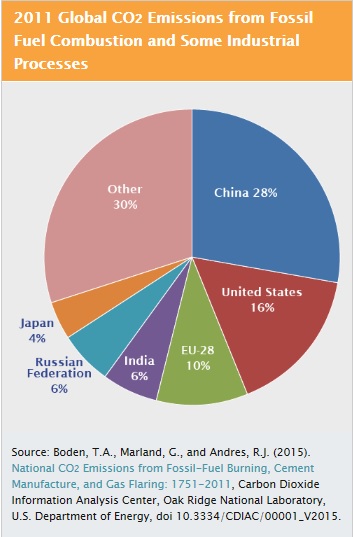
This conference had wide participation from rich nations – like big polluters China (#1) and the USA (#2) – and small nations alike; 195 in total. In fact, the requirements of the formal Small Islands Development States (SIDS) were front-and-center among the conference’s agenda. These islands are experiencing real problems from rising sea levels. This is not theory; this is fact! See Appendix relating the “canary in the coal mine” scenario with the Marshall Islands chain in the Pacific Ocean.

Fossil fuels and carbon emission = Climate Change! Acknowledged!

It looks now as if the international agreements to curb fossil fuels / carbon dioxide emissions will finally gain traction. It’s a non-binding agreement, but traction nonetheless. The fact that this agreement is non-binding may not even be an issue as now the “community ethos” has changed. This refers to …

… the fundamental character or spirit of a culture; the underlying sentiment that informs the beliefs, customs, or practices of a group or society; dominant assumptions of a people or period.

This is the technical definition of “community ethos”, as related in the book Go Lean … Caribbean (Page 20). In everyday practical terms, it will now be politically incorrect to pursue policies in denial of Climate Change.

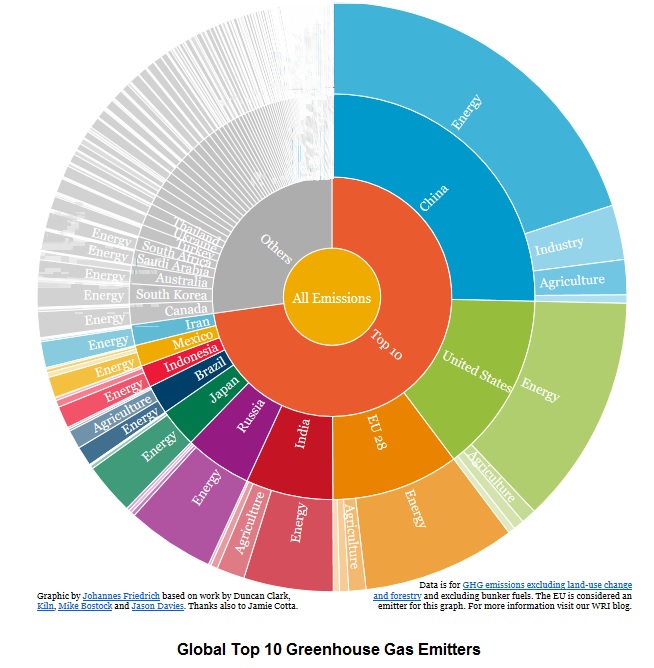
The Go Lean book presents a 370-page roadmap for re-booting, re-organizing and restructuring the economic, security and governmental institutions of the 30 member-states in the Caribbean region, especially in light of the realities of Climate Change. This is a global battle, and we in the Caribbean are on the front lines. Though we may not be the primary culprits – no Caribbean member-state appear high of the list of Green House Gases Emitters; see photos/charts here – we still must participate in the mitigations.

Acknowledged - Photo 1

Acknowledged - Photo 3

The Caribbean cannot expect others to do all the battling; we must fight our battles for ourselves. This has frequently been a prominent subject in previous Go Lean blog/commentaries. The assertion is that we must do our share to “Go Green” to arrest our own carbon footprint, so that we may be less hypocritical and have moral authority to call for reform from the big polluting nations. This sample – as follows – depicts previous blog-commentaries over the short timeframe since the publication of the Go Lean book:

https://goleancaribbean.com/blog/?p=6893 A Meteorologist’s View On Climate Change
https://goleancaribbean.com/blog/?p=6016 ‘Hotter than July’ – Reality in the Caribbean
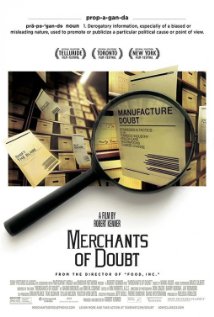
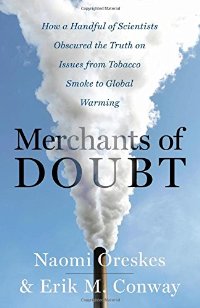
https://goleancaribbean.com/blog/?p=4673 Climate Change‘ Merchants of Doubt … to Preserve Profits!!
https://goleancaribbean.com/blog/?p=2465 Book Review: ‘This Changes Everything: Capitalism vs. the Climate’
https://goleancaribbean.com/blog/?p=2276 Climate Change May Affect Food Supply Within a Decade
https://goleancaribbean.com/blog/?p=2119 Cooling Effect – Oceans and the Climate
https://goleancaribbean.com/blog/?p=1883 Climate Change May Bring More Kidney Stones
https://goleancaribbean.com/blog/?p=1817 Caribbean grapples with intense new cycles of flooding & drought
https://goleancaribbean.com/blog/?p=1516 Floods in Minnesota, Drought in California – Why Not Share?
https://goleancaribbean.com/blog/?p=926 Conservative heavyweights have solar industry in their sights
https://goleancaribbean.com/blog/?p=915 Go ‘Green’ … Caribbean

In addition, there is the demand from the SIDS countries for financial remuneration from the big polluting countries. Its as if they are saying:

“You break it, you fix it”.

This seems to be the unspoken battle-cry / war-chant emanating from the Caribbean and other SIDS countries. See the news articles here relating these events:

News Title #1: With landmark climate accord, world marks turn from fossil fuels
By: Alister Doyle and Barbara Lewis

PARIS (Reuters) – The global climate summit in Paris forged a landmark agreement on Saturday, setting the course for a historic transformation of the world’s fossil fuel-driven economy within decades in a bid to arrest global warming.

After four years of fraught U.N. talks often pitting the interests of rich nations against poor, imperiled island states against rising economic powerhouses, French Foreign Minister Laurent Fabius declared the pact adopted, to the standing applause and whistles of delegates from almost 200 nations.

“With a small hammer you can achieve great things,” Fabius said as he gaveled the agreement, capping two weeks of tense negotiations at the summit on the outskirts of the French capital.

Hailed as the first truly global climate deal, committing both rich and poor nations to reining in rising emissions blamed for warming the planet, it sets out a sweeping, long-term goal of eliminating net manmade greenhouse gas output this century.

“It is a victory for all of the planet and for future generations,” said U.S. Secretary of State John Kerry, who led the U.S. negotiations in Paris.

“We have set a course here. The world has come together around an agreement that will empower us to chart a new path for our planet, a smart and responsible path, a sustainable path.”

It also creates a system to encourage nations to step up voluntary domestic efforts to curb emissions, and provides billions more dollars to help poor nations cope with the transition to a greener economy powered by renewable energy.

Calling it “ambitious and balanced”, Fabius said the accord would mark a “historic turning point” in efforts to avert the potentially disastrous consequences of an overheated planet.

For U.S. President Barack Obama, it is a legacy-defining accomplishment that, he said at the White House, represents “the best chance we have to save the one planet that we’ve got.”

The final agreement was essentially unchanged from a draft unveiled earlier in the day, including a more ambitious objective of restraining the rise in temperatures to “well below” 2 degrees Celsius (3.6 degrees Fahrenheit) above pre-industrial levels, a mark scientists fear could be a tipping point for the climate. Until now the line was drawn only at 2 degrees.

In some ways, its success was assured before the summit began: 187 nations have submitted detailed national plans for how they will contain the rise in greenhouse gas emissions, commitments that are the core of the Paris deal.

While leaving each country to pursue those measures on its own, the agreement finally sets a common vision and course of action after years of bickering over how to move forward.

Officials hope a unified stance will be a powerful symbol for world citizens and a potent signal to the executives and investors they are counting on to spend trillions of dollars to replace coal-fired power with solar panels and windmills.

“This agreement establishes a clear path to decarbonize the global economy within the lifetimes of many people alive today,” said Paul Polman, the CEO of consumer goods maker Unilever and a leading advocate for sustainable business practices. Polman said it will “drive real change in the real economy”.

TOO MUCH, OR NOT ENOUGH?
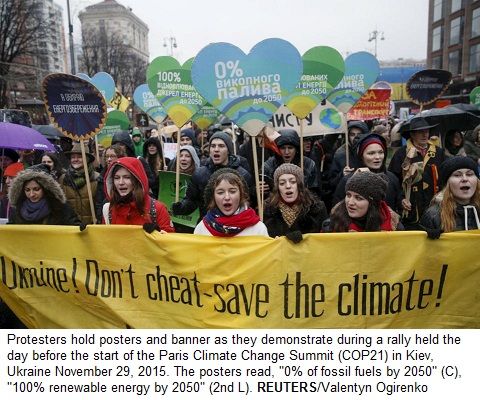
Protesters hold posters and banner as they demonstrate during rally held day before start of Paris Climate Change Summit in KievWhile some climate change activists and U.S. Republicans will likely find fault with the accord – either for failing to take sufficiently drastic action, or for overreacting to an uncertain threat – many of the estimated 30,000 officials, academics and campaigners who set up camp on the outskirts of Paris say they see it as a long-overdue turning point.

Six years after the previous climate summit in Copenhagen ended in failure and acrimony, the Paris pact appears to have rebuilt much of the trust required for a concerted global effort to combat climate change, delegates said.

“Whereas we left Copenhagen scared of what comes next, we’ll leave Paris inspired to keep fighting,” said David Turnbull of Oil Change International, a research and advocacy organization opposed to fossil fuel production.

Most climate activists reacted positively, encouraged by long-term targets that were more ambitious than they expected, while warning it was only the first step of many.

“Today we celebrate, tomorrow we have to work,” European Climate Commissioner Miguel Arias Canete said.

From the outset, some criticized the deal for setting too low a bar for success. Scientists warned that the envisaged national emissions cuts will not be enough to keep warming to less than 2 degrees Celsius.

Unlike the Kyoto Protocol, the last major climate deal reached in 1997, the Paris pact will also not be a fully legally binding treaty, something that would almost certainly fail to pass the U.S. Congress.

In the United States, many Republicans will see the pact as a dangerous endeavor that threatens to trade economic prosperity for an uncertain if greener future. Some officials fear U.S. progress could stall if a Republican is elected president next year, a concern Kerry brushed aside.

DESTINIES BOUND
After talks that extended into early morning, the draft text showed how officials had resolved the stickiest points.

In a win for vulnerable low-lying nations who had portrayed the summit as the last chance to avoid the existential threat of rising seas, nations would “pursue efforts” to limit the rise in temperatures to 1.5 degrees Celsius (2.7 degrees Fahrenheit), as they had hoped.

“Our head is above water,” said Olai Uludong, ambassador on climate change for the Pacific island state of Palau.

While scientists say pledges thus far could see global temperatures rise by as much as 3.7 degrees Celsius (6.7 degrees Fahrenheit), the agreement also lays out a roadmap for checking up on progress. The first “stocktake” would occur in 2023, with further reviews every five years to steadily increase or “ratchet up” those measures.

It softened that requirement for countries with longer-term plans extending to 2030, such as China, which had resisted revisiting its goal before then.

And for the first time, the world has agreed on a longer-term aspiration for reaching a peak in greenhouse emissions “as soon as possible” and achieving a balance between output of manmade greenhouse gases and absorption – by forests or the oceans – by the second half of this century.

It also requires rich nations to maintain a $100 billion a year funding pledge beyond 2020, and use that figure as a “floor” for further support agreed by 2025, providing greater financial security to developing nations as they wean themselves away from coal-fired power.

(Reporting By Emmanuel Jarry, Bate Felix, Lesley Wroughton, Nina Chestney, Richard Valdmanis, Valerie Volcovici, Bruce Wallace and David Stanway; Editing by Jonathan Leff and Clelia Oziel)

VIDEO – Reuters News on COP21 – http://news.yahoo.com/video/world-climate-accord-hailed-turning-150537864.html

———

News Article #2: CARICOM negotiators await penultimate Climate Change draft agreement

PARIS, France, Friday, December 11, 2015 – CARICOM negotiators at the UN Climate Change conference (COP 21) are awaiting the penultimate draft of the Paris outcome agreement to assess the extent to which their key issues and concerns are represented.

Conference organizers on Wednesday released a preliminary draft which formed the basis for all night deliberations. The region’s negotiators reviewed the draft text and strategized for the remaining negotiations, as they expressed concerns on several key issues.

At the top of the list is the long-term temperature rise issue, with CARICOM stressing that the goal should be to hold temperature rises to less than 1.5 degrees Celsius and insisting that some of the alternatives proposed in the draft text were not acceptable. The region rejected, in particular, the option to hold temperature increases at two degrees Celsius, stating that it has been established by the Structured Expert Dialogue that figure is too high.

The region also noted the lack of agreement on recognition of the special circumstances of SmallIsland and low-lying Developing States (SIDS). The team has said that the special circumstances are real, have been recognized by the international community and world leaders, and are non-negotiable.

The CARICOM team also wants the text to recognize and respond to the fact that the SIDS, which bear the brunt of the adverse effects of climate change, have specific challenges with accessing finance especially for climate change adaptation and technology, given their capacity and scale of needs.

The team is also pressing for agreement on outstanding differences on the loss and damage effects of climate change, so that it can be a major feature of the outcome document. The negotiators were also concerned that the provisions in the text for compliance were very weak.

However, the CARICOM team has welcomed the provision in the text for five-year global cycles, and is recommending that this is linked to the renewal of mitigation commitments.

Source: Caribbean360 Posted December 11, 2015: http://www.caribbean360.com/news/1128733
From these foregoing articles, we see the compelling need for a funding mechanism to mitigate Climate Change threats in the Caribbean and SIDS countries. But a degree of pragmatism is needed too. We cannot expect to get something for nothing from other people’s money. That is an unbecoming  attitude of entitlement!

The Go Lean book delves into innovative ideas for funding Caribbean member-states for their empowerment efforts. The book serves as a roadmap for the introduction and implementation of the technocratic Caribbean Union Trade Federation (CU). The roadmap depicts how this federal government will “give, not take” for the treasuries of the SIDS of this region. There are many new funding options – economic leverage – that will only be possible with the integration and ratification of a regional Single Market. This vision is embedded in the opening Declaration of Interdependence, pronouncing as follows, (Page 12):

viii. Whereas the population size is too small to foster good negotiations for products and commodities from international vendors, the Federation must allow the unification of the region as one purchasing agent, thereby garnering better terms and discounts.

xiv. Whereas government services cannot be delivered without the appropriate funding mechanisms, “new guards” must be incorporated to assess, accrue, calculate and collect revenues, fees and other income sources for the Federation and member-states. The Federation can spur government revenues directly through cross-border services and indirectly by fostering industries and economic activities not possible without this Union.

The Go Lean book posits that the “whole is worth more than the sum of its parts”; that from this roadmap, Caribbean economies will grow individually and even more collectively as a Single Market. This roadmap advocates the optimization of the economic, security and governing engines and projects so that the region’s economy will grow from $378 Billion (2010) to $800 Billion in a 5 year time span. The international community would therefore have more respect and accountability to a regional Caribbean entity, rather than many individual (30) Small Island Development States.

Unite and take your stand!

As related in the roadmap, the 3 CU prime directives are described as follows:

  • Optimize the economic engines of the Caribbean to elevate the regional economy to grow to $800 Billion and create 2.2 million new jobs.
  • Establish a security apparatus to protect the people and property of the resultant economic engines.
  • Improve Caribbean governance to support these engines.

The Go Lean roadmap calls for the CU to serve as the regional administration to optimize economy, homeland security and governance engines for the Caribbean, especially in flight of Climate Change battleground frontline status. This is the first pronouncement (Page 11) of the same opening Declaration of Interdependence:

i. Whereas the earth’s climate has undeniably changed resulting in more severe tropical weather storms, it is necessary to prepare to insure the safety and security of life, property and systems of commerce in our geographical region. As nature recognizes no borders in the target of its destruction, we also must set aside border considerations in the preparation and response to these weather challenges.

The following details from the Go Lean…Caribbean book highlights the community ethos, strategies, tactics, implementation and advocacies necessary to elevate the regions stance in this global battle consequences on Climate Change:

Community Ethos – Deferred Gratification Page 21
Community Ethos – Economic Systems Influence Individual Choices / Incentives Page 21
Community Ethos – The Consequences of Choices Lie in the Future Page 21
Community Ethos – “Crap” Happens Page 23
Community Ethos – Lean Operations Page 24
Community Ethos – Cooperatives Page 24
Community Ethos – Non-Government Organizations Page 25
Community Ethos – Ways to Impact the Future Page 26
Community Ethos – Ways to Improve Sharing Page 35
Community Ethos – Impact the Greater Good Page 37
Strategy – Vision – Confederating 30 Member-States into a Single Market Page 45
Strategy – Vision – Foster Local Economic Engines for Basic Needs Page 45
Strategy – Mission – Prepare   for Natural Disasters Page 45
Strategy – Agents of Change – Climate Change Page 57
Strategy – Agents of Change – Globalization Page 57
Tactical – Confederating a Permanent Union Page 63
Tactical – Fostering a Technocracy Page 64
Separation of Powers – Emergency Management Page 76
Separation of Powers – Interstate Commerce Administration Page 79
Separation of Powers – Meteorological & Geological Service Page 79
Separation of Powers – Fisheries and Agriculture Department Page 88
Anecdote – “Lean” in Government Page 93
Implementation – Assemble Regional Organs into a Single Market Economy Page 96
Implementation – Ways to Pay for Change Page 101
Implementation – Security Initiatives at Start-up – Unified Command & Control Page 103
Implementation – Industrial Policy for CU Self-Governing Entities Page 103
Implementation – Ways to Deliver Page 109
Implementation – Ways to Foster International Aid Page 115
Implementation – Ways to Benefit from Globalization Page 119
Planning – Big Ideas for the Caribbean Region Page 127
Planning – Ways to Make the Caribbean Better Page 131
Advocacy – Ways to Grow the Economy Page 151
Advocacy – Ways to Create Jobs Page 152
Advocacy – Ways to Improve Governance Page 168
Advocacy – Ways to Better Manage the Social Contract Page 170
Advocacy – Ways to Impact Public Works Page 175
Advocacy – Ways to Foster Cooperatives Page 176
Advocacy – Ways to Improve for Natural Disasters Page 184
Advocacy – Ways to Improve Emergency Management Page 196
Advocacy – Ways to Improve Fisheries Page 210

As detailed in a previous blog-commentary, there is a preponderance of SIDS countries looking to the international community for aid. The Go Lean book describes this dependent attitude as “parasite” and instead advocates for change: a more “protégé” approach.

We can …. no, we must hold the bigger, richer nations accountable for breaking/fixing the environment, in regards to greenhouse gases. But first, we must show some technocracy to arresting our own carbon footprint. We must Go Green in the Caribbean. Then and only then, can we, in good conscience, appeal to the Big Polluters for financial remunerations to fix what they have broken.

This is heavy-lifting.

Yet, this is the quest of the CU/Go Lean roadmap; to make the Caribbean region more self-reliant collectively; to act more proactively and reactively for our own emergencies and natural disaster events; and to be more efficient in our governance.

Change has come to the Caribbean region. If Climate Change is not arrested, then even more devastating consequences will emerge. There is the need for the region to establish a permanent union to provide efficient stewardship for our economic, security and governing engines. According to Paris-COP21, now is the time …

… now is the time for all of the Caribbean, the people and governing institutions, to lean-in to the empowerments described in the book Go Lean … Caribbean. This is the course we must pursue. The future of the islands – for our children – depend on it. We must not allow the region to continue on the existing path to doom and abandonment, but rather pursue this new course to a better destination: a better homeland to live, work and play.  🙂

Download the book Go Lean … Caribbean – now!

———

Appendix – Marshall Islands – A case in point of a Small Island Development State coping/failing with the effects of Climate Change – posted September 17, 2014.

VIDEO – http://america.aljazeera.com/articles/2014/9/17/un-climate-change.html

PHOTOS – 2015 Update – http://america.aljazeera.com/watch/shows/compass/articles/2015/7/7/in-photos-on-the-front-lines-of-climate-change.html
 

Share this post:
, ,

Electric Cars: ‘Necessity is the Mother of Invention’

Go Lean Commentary

Today, gas prices have remained consistently low in the US for the past year; even dropping below $2 per gallon in many places.

This was not always the case. Just recently, in 2008, many of these same places – like California – featured gas prices near $5 per gallon. How amazing? What a change! How did the prices drop so low and what effect did those prior high prices have on the American, or more specifically, the Californian psyche?

“A crisis is a terrible thing to waste” …

… so says the book Go Lean… Caribbean quoting noted Economist Paul Romer (Page 8). A crisis brings an opportunity to forge change in the economic, security and governing engines of communities. An industry did this in the US, in response to the 2008 crisis. This is the industry of Electric Cars (Vehicles) or EV.

EV = No Gas … at all.

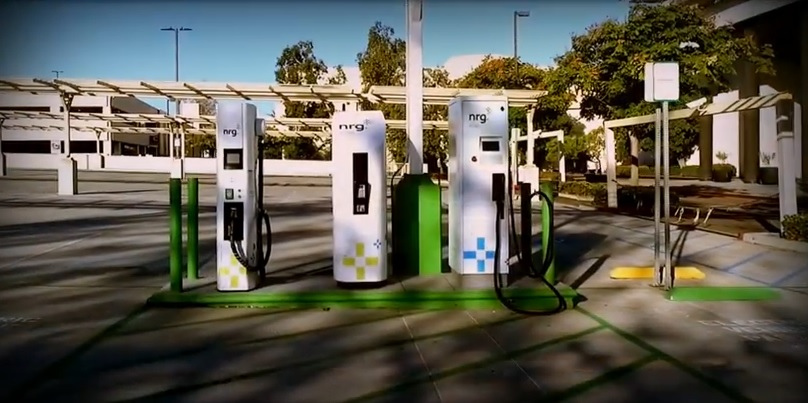
Overall, gas prices dropped due to macro-economic factors in both supply and demand. But on the micro-level, the need to mitigate the acute rise in gas prices truly proved to be the ‘mother of invention’. This is well documented in the historicity of one company NRG Energy and their eVgo® electric car charging initiative – see here the encyclopedic information on this enterprise:

NRG Energy and eVgo®

CU Blog - Electric Cars - Necessity is the Mother of Invention - Photo 1

NRG Energy, Inc. is a large American energy company – focusing primarily on power generation. They are dually headquartered in West Windsor Township, New Jersey,[3][4] and Houston, Texas.[1][5][6] It was formerly the wholesale arm of Xcel Energy, and was spun off in bankruptcy in 2004.[7]

Beginning in 2009, NRG began a major initiative to become the leading green energy producer in the United States and started investing very large amounts of money in clean energy projects.[18][19] They include onshore and offshore wind power, solar thermal energy, photovoltaic, and distributed solar power facilities, and repowering of some of their traditional coal plants with biomass.[18]

In late 2010, NRG made news by launching the “eVgo” network, the first completely private public car charging station network for electric power vehicles.[20]Source: https://en.wikipedia.org/wiki/NRG_Energy

… and now in 2015 …

eVgo® leads America’s electric vehicle (EV) revolution.

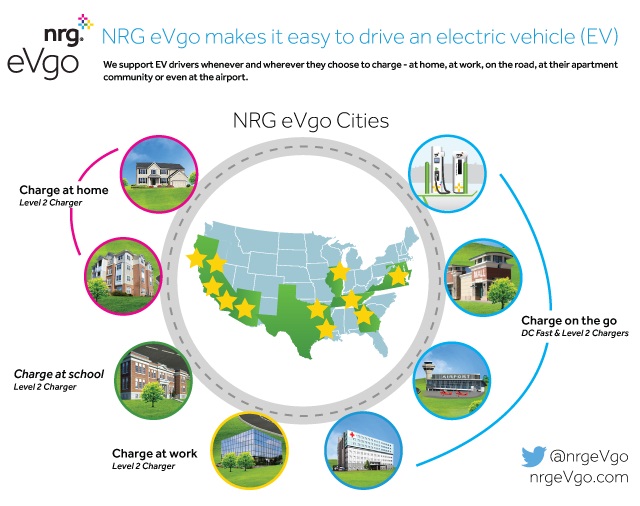
eVgo® provides charging solutions and stations directly to electric car owners as well as businesses looking to serve the EV charging needs of their residents, tenants, employees, or customers.

Combining desired tier of service with home, multi-family, and workplace charging solutions in conjunction with the largest number of DC fast charging stations across the nation, EVgo provides EV drivers a truly unique level of freedom—and a whole new world of possible destinations.

The eVgo® network is the largest public DC fast charging network in the nation. From April 2014 to October 2015 their chargers provided enough kWh of electricity to power 12,323,090 EV miles. EVgo’s forward-looking infrastructure is invested across the country right now in more than 25 markets with a target of 40 by the end of 2016. EVgo drivers can access more than 1,000 fast charging locations, along with individual charging stations at homes, schools, offices, multi-family communities and hospitals across our growing network. – Source: https://www.nrgevgo.com/about/

NRG Energy and their eVgo® subsidiary is therefore a role model for the Caribbean to emulate. This enterprise has proven to be a technocratic organization that has championed the cause of providing the societal structures for EV’s. They do not manufacture the cars – that is the sphere of the giant car makers like General Motors, Ford, Nissan, BMW, Tesla, SMART and others – but they facilitate all the attendant functions to charge the vehicles and keep them powered. This structure aligns with the book Go Lean… Caribbean, a roadmap for the introduction and implementation of the Caribbean Union Trade Federation (CU). This calls for the confederation, collaboration and convention of 30 member-states into one intergovernmental organization. The same as NRG Energy/eVgo® facilitates EV’s in the US, the CU seeks to facilitate EV’s in the Caribbean region. This is part-and-parcel of the prime directives (3) of the CU/Go Lean roadmap:

  • Optimization of the economic engines – accepting that energy is as basic a need as food, clothing and shelter – in order to grow the regional economy to $800 Billion & create 2.2 million new jobs.
  • Establishment of a security apparatus, including energy security, to protect the resultant economic engines.
  • Improve Caribbean governance to support these engines.

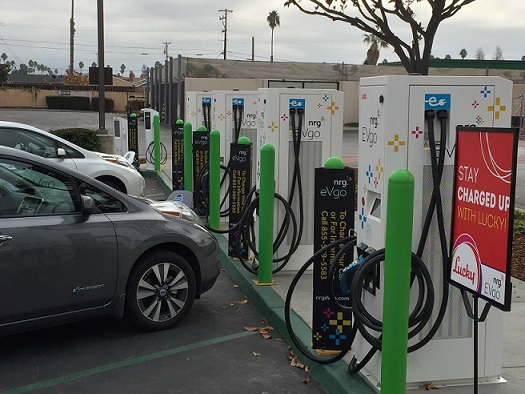
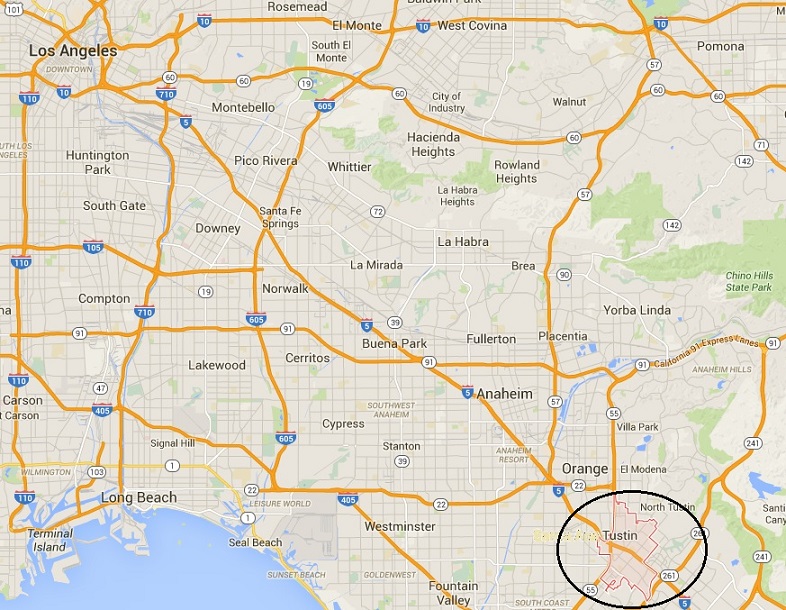
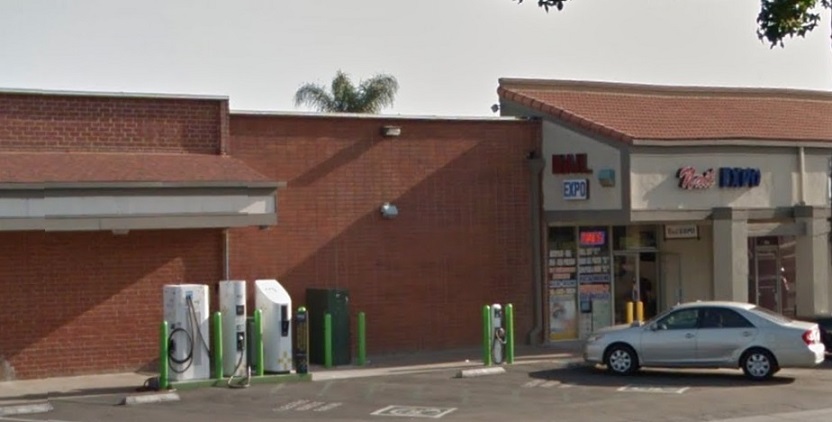
This writer lived in California in 2008 … and paid $5 prices for gas. But now just visited the old residential neighborhoods of Tustin in Orange County – see Appendix B – and noticed something different:

CU Blog - Electric Cars - Necessity is the Mother of Invention - Photo 2

Wow, change, innovation, necessity = the ‘mother of invention’.

 CU Blog - Electric Cars - Necessity is the Mother of Invention - Photo 4

CU Blog - Electric Cars - Necessity is the Mother of Invention - Photo 5

CU Blog - Electric Cars - Necessity is the Mother of Invention - Photo 6

See Appendix A for Charging locations/options in Tustin California today.

The goal of the CU is to optimize Caribbean society in kind. We need to foster innovation at home as well. We need to change in response to our own crises and not waste them. In many Caribbean locales, gas is still priced near $5.00 per gallon.

See the VIDEO here relating the story of an Uber driver and glean the comment of the Jamaican visitor longing for this solution in his Caribbean homeland:

VIDEO:  EVs and Uber- Sasha’s Story of Charging and Driving his Electric Car –  https://youtu.be/dj6NyUv_WkQ

Published on Nov 12, 2015 – Category: Autos & Vehicles; License: Standard YouTube License

This is also a matter of competition. The Caribbean homeland must better compete globally and hopefully present more favorable options for our youth to want to stay here in the homeland, and not copy the model of their previous generations who sought refuge abroad. We are failing miserably at this now!

We are also failing to create innovative energy options. There is the need to optimize our energy policies – from top to bottom. The Go Lean book directs this energy policy directive: the Caribbean region must lower crude oil demands. Success in this area will result in lower fuel and retail gasoline prices. The economic principles are sound: lower the demand, as the supply increases and prices will drop.

Thusly the book proposes many solutions for the region to optimize energy generation, distribution and consumption. No “stone is left unturned”. Go Lean posits that the average costs of energy can be decreased from an average of US$0.35/kWh to US$0.088/kWh in the course of the 5-year term of this roadmap. (Page 100).

Primarily in this strategy in lowering the demand for crude oil is increasing options with alternative energy sources: natural gas, solar, wind and tidal. Thereby lowering the demand on crude oil. As for the supply, the roadmap advocates for Electric Vehicles (EV’s) – just like in Tustin California – and hybrids and other energy mixes like natural gas and hydrogen. In fact, the roadmap calls for the development of a homegrown Automotive Industry in the Caribbean (Page 206). The overriding need for cheaper energy options would be the ‘Mother of Invention’ for these solutions.

The Go Lean book details a series of community ethos, strategies, tactics, implementations and advocacies to foster the progress in the wide fields of energy generation, distribution, consumption and automobile efficiencies. The following list applies:

Community Ethos – Lean Operations Page 24
Community Ethos – Return on Investments Page 24
Community Ethos – Cooperatives Page 25
Community Ethos – Regional Taxi Commissions Page 25
Community Ethos – Non-Government Organizations Page 25
Community Ethos – Ways to Impact the Future Page 26
Community Ethos – Ways to Improve Negotiations Page 32
Anecdote – Pipeline Transport – Strategies, Tactics & Implementations Page 43
Strategy – Harness the power of the sun/winds Page 46
Tactical – Fostering a Technocracy Page 82
Tactical – Separation of Powers – Energy Commission Page 82
Anecdote – “Lean” in Government – Energy Permits Page 93
Anecdote – Caribbean Energy Grid Implementation Page 100
Implementation – Ways to Develop Pipeline   Industry Page 107
Implementation – Ways to Improve Energy Usage Page 113
Planning – Lessons Learned from 2008 Page 136
Advocacy – Ways to Impact Public Works Page 175
Advocacy – Ways to Foster Cooperatives Page 176
Advocacy – Ways to Impact Monopolies Page 202
Advocacy – Ways to Improve Transportation Page 205
Advocacy – Ways to Develop the Auto Industry Page 206

This commentary asserts that energy needs are undeniable. Options abound; the biggest ingredient is the “community will”. Here comes the “will”! If the old adage is true: “where there’s a will, there’s a way”, then the CU/Go Lean roadmap is the way. This is the “heavy-lifting” for the lean, agile operations of the CU technocracy.

There are many Go Lean blog commentaries that have echoed this point, addressing the need to mitigate high prices in energy and the overall cost-of-living in the Caribbean. See sample here:

https://goleancaribbean.com/blog/?p=6867 How to address high consumer prices
https://goleancaribbean.com/blog/?p=5396 ‘Significant’ oil deposit found offshore Guyana
https://goleancaribbean.com/blog/?p=5155 Tesla unveils super-battery to power homes
https://goleancaribbean.com/blog/?p=4587 Burlington, Vermont: First city to be powered 100% by renewables
https://goleancaribbean.com/blog/?p=3743 Trinidad cuts 2015 budget as oil prices tumble
https://goleancaribbean.com/blog/?p=3213 Gas Prices Drop Below $2; due to “Supply and Demand” Factors
https://goleancaribbean.com/blog/?p=915 Go Green Caribbean – Renewable energy pursuits in the region
https://goleancaribbean.com/blog/?p=273 10 Things We Want from the US – American Innovation

So the message to the people of the Caribbean region is straight-forward: Help is on the way!

Now is the time for all of the Caribbean, the people and governments, to lean-in for the optimizations and opportunities described in the book Go Lean … Caribbean.  🙂

Download the book Go Lean … Caribbean – now!

———

Appendix A – EV Charging Locations

The Ultimate Guide to Electric Car Charging Networks In Tustin California

Source: http://evcharging.xyz/free-electric-car-charging-stations-in-tustin-ca-looking-for-a-free-ev-charge-station-in-california.html

When it comes to refueling a car, drivers of gas- and diesel-powered vehicles have it easy. They roll up to any one of about 100,000-plus gas stations in CA, pump in liquid fuel in a matter of minutes, and pay either in cash or with a credit card. Unfortunately, it is a little more complicated with public charging for electric vehicles although remember that almost all EV charging takes place at home, which usually requires about 30 seconds to plug in each night.

For EV drivers who want to regularly charge in public, it is important to know about the handful of charging networks offering access to electric fuel on the go. Each network works a little differently. It is a good idea for EV owners to have a basic understanding of how they compare with one another. That is why we put together this basic guide on EV charging networks.

Cost Considerations

The three primary approaches are:

(1) pay-as-you-go,

(2) monthly subscriptions

(3) free.

Obviously, if given the opportunity, it makes sense to grab a free charge, even for a relatively short period of time. But the pay models, depending on the cost for a charge, need to be studied to determine which network makes the most sense for you; if it is best to collect a wallet-full of membership cards; or if proper planning will allow you to avoid public charging unless you are running very low on charge.

There are a few gotchas. Keep in mind that the amount of range you add per hour depends on the power capabilities of your cars onboard charger. As Marc Geller, a director at Plug In America, an EV advocacy organization, told me: If the car comes with a smaller charger, the cost is relatively higher than if you have a faster charger. It is a weird fact. Other oddities include credit card transactions and costs associated with leaving a car plugged in, even if the battery if fully charged and the electrons have stopped flowing.

Networks, such as eVgo, operated by NRG Energy, avoid some of these issues by using an all-encompassing all-you-can-charge subscription service. That brings clarity, but usually at a higher overall cost. As of July 2014, the majority of public chargers are still available for free (although not every system makes it absolutely clear how much EV drivers are paying to charge).

High-Level Recommendations

  • First, think about your regular routes and favorite destinations in Tustin CA. Then use PlugShare or another station finding tool to see which charging networks are along the way. Be prepared to use any of them.
  • ChargePoint is the biggest charging network, so it is a must for nearly all EV drivers.
  • If you live in Pacific Northwest, get a key fob from Aerovironment for its AV Subscription Network.
  • In Texas, it’s generally better to pay as you go with ChargePoint and Blink, rather than opting for multi-year expensive contracts with eVgo unless you want to splurge for the convenience of an all-you-can-charge plan and, at this time, the ability to access DC fast charging.
  • On the east coast, SemaConnect is the best backup to ChargePoint.
  • Who doesn’t like free? There are about 2,000 stations, mostly free, not associated with any of the networks listed below. Use PlugShare or other tools to find these stations.

One last caveat: The terminology of ”station” can be confusing and misleading. Some services call each individual charger a station, when the term station usually refers to a single public site with the capability to charge more than one car at a time.

List of Top EV Charging Networks In Tustin 92780

AEROVIRONMENT

Background: Aerovironment, known as AV, is a pioneer in the development of electric vehicle charging technologies. The company sells a range of Level 2 and Quick Charge equipment, but also operates its own network of chargers.

Approximate Number of Sites: 60

Coverage: AV chargers, many of which are DC Quick Chargers, are primarily located in Oregon, and to a lesser extent, in Washington State as part of the West Coast Electric Highway. AV also has a handful of charging locations in California.

Access: Unlimited monthly access is provided for $19.99 per month. Subscribing to the AV network starts with calling 888-833-2148 or filling out a form on the AV website. The company will send a key fob that activates the chargers. If you are a current subscriber there is no activation fee. If you are a new subscriber, there will be a one-time activation fee of $15.

Cost per charge: As an alternative to the flat monthly access fee, there is the option of paying per session: $7.50/session for DC Fast Charger; and $4.00/session for a Level 2 charging station.

Website: http://evsolutions.avinc.com/services/subscriber_network

——-

BLINK NETWORK

Background: The assets of Blink Network were purchased by CarCharging Group in October 2013. Ecotality had received a $114.8 million federal stimulus grant to oversee The EV Project. The goal of The EV Project is to deploy 8,300 private and public chargers. There have been several reported problems associated with Blink chargers, and the Blink Network, such as insufficient customer support, and incompatibility of the equipment with certain vehicles.

Approximate Number of Sites: 1,680

Coverage: Blink Network chargers are located in approximately 25 states, with the largest concentration in California, California, Arizona, Oregon, Texas, Tennessee and Washington.

Access: Start by registering a credit card with a Blink account. There are no required annual or monthly membership fees, or minimum credit card balance. Members who register will receive an InCard and can initiate a charge using the card. Guests can initiate a charge with Blinks mobile application.

Cost Per Charge: In the states that permit kilowatt-hour pricing, fees for Level 2 EV charging stations owned by Blink and operated on the Blink Network range from $0.39 to $0.79 per kWh, depending on the state and individuals membership status. Blink is a proponent of kWh pricing because it is usage-based and EV drivers pay fees based on the actual amount of power consumed during the charging session rather than the amount of time that the car is plugged into the station.Fees for DCFC chargers owned by Blink and operated on the Blink Network in kWh eligible state range from $0.49 to $0.69 per kWh, depending on the state and individuals membership status.

These states currently permit fees by the kilowatt-hour: California, Colorado, Florida, Hawaii, Illinois, Maryland, Minnesota, New York, Oregon, Utah, Virginia, and Washington, as well as the District of Columbia.

In states where pricing by kWh is not permitted, time-based charging fees for Level 2 charging stations owned by Blink and operated on the Blink Network range from $0.04 to $0.06 per minute, depending on membership status. Time-based charging fees are rounded up to the nearest 30-second interval. Fees for DCFC chargers owned by Blink and operated on the Blink Network in non-kWh eligible states will range from $6.99 – $9.99 per session, depending on membership status.

Website: http://www.blinknetwork.com .

——-

CHARGEPOINT

Background: Chargepoint, previously Coulomb Technologies, describes itself as the largest online network of independently owned EV charging stations operating in 14 countries. The company provides a turnkey EV charging solutions for property owners who can determine the terms for offering charging to EV drivers.

Approximate Number of Sites: 3,084

Coverage: While one-quarter of ChargePoint stations are in California, the network is the most widely distributed with at least one station in California.

Access: There is no cost to sign up and receive a ChargePoint card. After submitting your credit card information as part of the sign-up, you will be charged an initial deposit of $25 only when you first visit a charging station that requires a fee. (Many stations on the network are free.) Your account provides access to all public stations on ChargePoint. Charging stations are activated with the ChargePoint card, or a contactless credit card. The stations can also be activated by calling a toll-free customer service number on the ChargePoint station, or by using the associated mobile app. Account balances automatically replenish when the balance gets low. Cost Per Charge: Prices are determined by the property owner. Many ChargePoint stations are currently free.

Website: http://www.chargepoint.com.

——-

EVGO

Background: eVgo is subsidiary of NRG, a Fortune 300 and S&P 500 company. It Is one of the countrys largest power generation and retail electricity businesses, with power plants producing about 47,000 megawatts of generation capacity. eVgo is part of NRGs clean energy portfolio, which includes solar, thermal, and carbon capture technology.

Approximate Number of Stations: Approximately 150, each with Level 2 and DC quick charging options.

Coverage: Currently, eVgo operates stations in Tustin CA, Texas, in the Houston and Dallas-Fort Worth markets, as well as Tennessee, California and the greater Washington, DC area.

Access: NRG network is only available to its monthly subscribers using an eVgo card, but as its website states, the company will always take care of an EV driver in need of a charge.

Cost Per Charge: eVgo offers various plans based on the needs of an EV driver and the electric vehicle they have chosen. This is an overview of their three most popular all-you-can-charge plans. Starting at $30 a month, with a one-year service agreement, EV drivers have access to unlimited charging at the companys so-called Freedom Station sites, which includes Level 2 and DC fast charging. The $40 a month Home plan, with a three-year service agreement, adds installation of your own home charging equipment but not the cost of electricity that is separately metered. The Workplace plan is $30 a month. See the pricing structure, which is unique to each region.

Website: http://www.evgonetwork.com/

——-

GE WATTSTATIONS

Approximate Number of Sites: 270

Coverage: 32 states, California, DC and Puerto Rico.

Access: WattStations require an RFID card, even when non-networked and free.

Cost Per Charge: Prices vary, as established by owners.

——-

GREENLOTS

Background: Greenlots is not formally a network, but rather a provider of open standards-based technology solutions for various stations and other networks. Designed to answer the needs of site hosts offering workplace, utility and public charging applications, Greenlots SKY platform utilizes Open Charge Point Protocol (OCPP), the largest open standard for charger-to-network communications.

Access: Users have many access options, including: (1) Download the free Greenlots app from iTunes or Google Play. Next, enter your credit card information. Once your information is saved, select “Charge” from the menu and enter the Station ID or scan the QR code displayed on the front of the station; (2) Swipe your Greenlots RFID card; (3) Call the customer care number listed on the station to have the charge session started remotely; and (4) Some stations have a credit card swiper. Users can also create a driver account at www.charge.greenlots.com to track electricity usage, update information, or order an RFID card.

Coverage: No specific region. Charging stations in Midwest, Northeast, Northwest, South, and Southwest, as well as Hawaii, Canada and Singapore.

Cost Per Charge: Site hosts determine the fee for use. Greenlots does not charge a membership fee.

Website: http://greenlots.com/

——-

SEMACONNECT

Background: Maryland-based SemaConnect offers Level 2 commercial grade EV charging station equipment and management software called SemaCharge. Their focus is on making charging as easy as possible for EV drivers and station owners. The company says it is the fastest growing network on the east coast. SemaConnect is the third largest supplier of commercial grade Level 2 charging stations based on number of stations deployed.

Approximate Number of Sites: 450

Coverage: SemaConnect stations are located in about 20 states, with the greatest concentration in California, Maryland, Virginia, Washington, DC, Georgia, California and the Pacific Northwest. It also has a presence in Puerto Rico.

Access: To sign up, log on to the SemaConnect website, and open a new account with a $20 balance charged to a major credit card. You will receive a SemaCharge RFID card that can be used to initiate charging at any SemaConnect location. If the balance drops below $0.00, the associated credit card will add another $20 to your account. SemaConnect also offers mobile payments via its smartphone application, toll-free number, or via a QR code scan.

Cost per charge: The cost varies, as determined by the property owner.

Website: http://www.semaconnect.com

——-

SHOREPOWER CONNECT

Background: Shorepower Technologies manufactures, sells and operates equipment for truck stop electricity services, as well as electric vehicle charging equipment. Most of the truck stop sites have standard charging outlets (e.g., NEMA 5-20, NEMA 14-30 and NEMA TT-30), accessible to EV drivers with the appropriated adapter cords. Relatively few of the locations also have charging stations with standard J1772 connectors.

Approximate Number of Sites: Shorepower has about 425 locations, with more than 2,000 individual connection points.

Coverage: Charging locations, mostly at truck stops, are spread widely across the U.S. in approximately 30 states and can be found in Tustin CA.

Access: Use the toll-free hotline, kiosk or web browser to activate service via a credit card. There is a $1 activation fee. Cost per charge: For paid stations at Level and Level 2, the fee is $1 per hour. Locations with J1772 equipment, mostly on west coast, are free.

Website: www.shorepowerconnect.com

——-

TESLA SUPERCHARGERS

Background: In fall 2012, Tesla Motors, the makers of the Model S sedan, rolled out its first so-called Superchargers, in order to make road trips available for free to owners of its sporty luxury sedan.

Approximate Number of Sites: As of August 2015, there are 502 Supercharger stations with 2,832 Superchargers.

Coverage: Supercharger stations are situated throughout the United States and can be found in Tustin 92780.

Access: Tesla Superchargers do not require a card to initiate. Model S owners simply drive up and plug in. The chargers are available to owners of Model S models with the 85 kWh battery pack, or cars with the 60 kWh pack that have been configured to use Superchargers.

Cost Per Charge: Free. No sign up and no cost for electricity.

Website: http://www.teslamotors.com/supercharger

——-

Appendix B – Tustin Information

CU Blog - Electric Cars - Necessity is the Mother of Invention - Photo 7

Share this post:
, , , ,
[Top]

Hotter than July – Still ‘Third World’

Go Lean Commentary

- Photo 5

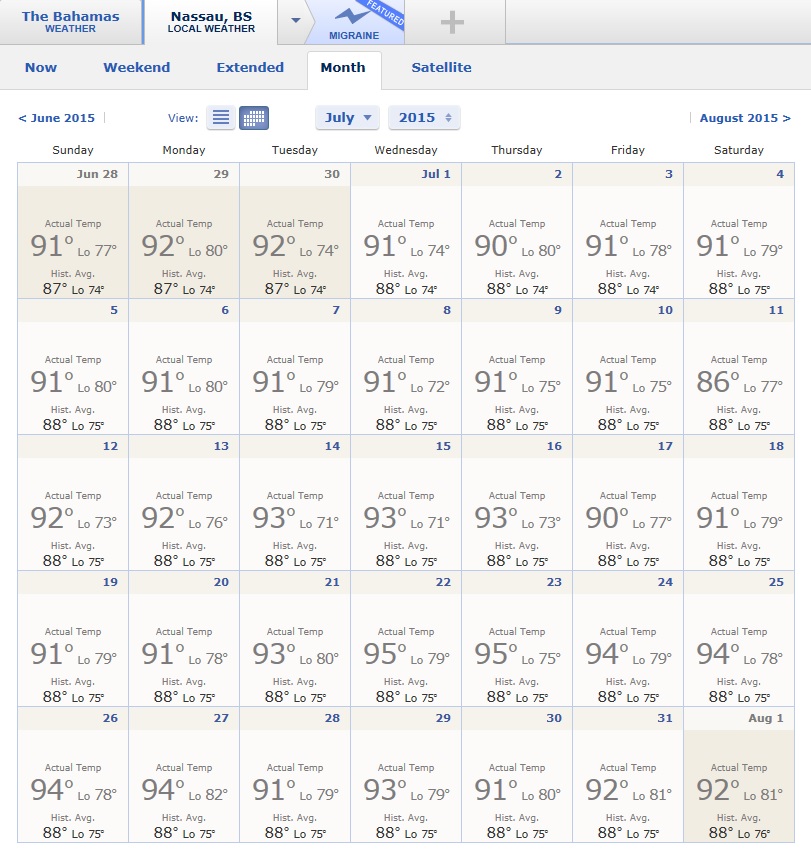
(Source: http://www.accuweather.com/en/bs/nassau/30072/july-weather/30072)

In the Caribbean, this time of the year, it is “hot, hot, hot”.

While that is a hit song by “The Merrymen” of Barbados (see Appendix below), unfortunately, it is also the weather report.

“I just flew back from the Caribbean and boy are my arms tired…from fanning … for relief from the heat” – Old joke-new twist

This is not good! In fact, the hot weather, and the lack of infrastructure to mitigate and remediate the discomfort, is identified as one of the reasons for the brain drain/societal abandonment. (This commentary is an appeal for cooperative refrigeration).

The issue of Caribbean citizens abandoning their homelands is one of the more dire threats to societal life in the region. Why do they do it?

“Push and Pull” reasons!

Push
Conditions at home drive Caribbean citizens to take flight and find refuge elsewhere. Many times these conditions are economic (jobs and entrepreneurial opportunities), security and governance related, but there are other reasons too; consider discriminations due to ethnic diversity or other lifestyle choices.

Lastly, there is the new threat of Climate Change. While this is a threat for the whole world, the Caribbean is on the frontline. Though there is some debate as to the causes of climate change, there is no question as to its outcome: temperatures are rising, droughts prevail, and most devastating, hurricanes are now more threatening. A Caribbean elevation plan must address the causes of climate change and most assuredly its consequences.

Early in the book Go Lean…Caribbean, a roadmap to elevate the Caribbean region, the pressing need to be “on guard” of climate change is pronounced in the Declaration of Interdependence (Page 11), with these words, (the first of many “causes of complaints”):

i.  Whereas the earth’s climate has undeniably changed resulting in more severe tropical weather storms, it is necessary to prepare to insure the safety and security of life, property and systems of commerce in our geographical region. As nature recognizes no borders in the target of its destruction, we also must set aside border considerations in the preparation and response to these weather challenges.

The Go Lean…Caribbean book serves as a roadmap for the introduction and implementation of the Caribbean Union Trade Federation (CU). The CU must advocate for systems and schemes for a lower carbon footprint so as not to contribute further to green-house gases. Plus, the CU must implement recovery measures to respond, and react to the ever-threatening climatic conditions. While this means hurricanes at the extreme, it also includes daily factors that must be dealt with, like excessive heat and frequent power black-outs … during summer months. (The elderly are more susceptible to heat stroke and other ailments).

“Growing up in the Caribbean, summer extended from Easter Monday to Columbus Day” – Recollection of a Caribbean/Bahamas Diaspora Member.

Now, the anecdotal experience is that there is a need to mitigate excessive heat in the region for an even longer season. How do we mitigate excessive heat?

Air conditioning!

But this cure may at times be worse than the disease.

Air conditioning requires even greater energy consumption, (the Caribbean has among the highest energy costs in the Western Hemisphere); the Go Lean book posits that the average costs of energy can be decreased from an average of US$0.35/kWh to US$0.088/kWh in the course of the 5-year term of this roadmap; (Page 100).

In addition, the release of Chlorofluorocarbons (CFC’s) in the air-conditioning process is a contributor of greenhouse gases into the atmosphere.

The status quo needs remediation!

Pull
In addition to these climatic “push” factors, there are also climatic pull considerations.

These factors, as related in the Go Lean roadmap, posit that North American and European destinations have been more inviting to Caribbean citizens. Weather-wise, everywhere has “mean seasons”, but it is easier to stay warm during a wintry “mean season” in the North, than it is to stay cool in the “mean season” in the South. Plus with pronounced Climate Change effects on northern communities, the “mean seasons” in the north have been shorter and easier to endure.

This issue refers to an environment – the weather – that maybe outside of human control. But when humans do grab some control – climate control – the northern communities (US, Canada and Europe) do a better job of mitigating and remediating the new acute effects of climate change.

Consider again, the location for the composition for the Go Lean book, Omaha, Nebraska. That community in the American Midwest is notorious as a “land of 4 seasons” and all of them extreme. In May 2013, it snowed on May 1st then the temperature hit 100 degrees (Fahrenheit) on May 15th. Omaha is provided in the Go Lean book (Page 138) as a model for Caribbean communities to emulate. How does Omaha mitigate the extreme climate conditions they have to contend with?

  • Infrastructure
  • Economies-of-Scale

Consider this one example of how a cooling/heating scheme provides the needed air-conditioning for the entire Downtown District:

Company ProfileNRG Energy Center Omaha
(Source: http://www.nrg.com/business/large-business/distributed-generation/district-heating-cooling/omaha/)

- Photo 1

NRG Energy Center Omaha provides energy-efficient and environmentally sound district heating and cooling for the business district of downtown Omaha, including Woodman Tower, Creighton University, the Joslyn Art Museum, Creighton University Medical Center and more than 70 percent of all other public and commercial buildings in the downtown area.

NRG Energy Center Omaha has established a reliability history of “Six-Nines” (99.9999%) for its chilled-water service. Our steam service reliability history is equally impressive.

NRG Energy Center Omaha leverages a variety of conventional fuels, depending on which is most cost-competitive at a given time, and it has also incorporated cogeneration technology – a highly efficient combination of heat and mechanical power –to reduce the amount of energy lost up the smokestack. This kind of technology and fuel flexibility keeps costs down, preserves valuable natural resources and reduces emissions. We also provide the buildings we serve with free energy audits, budget assistance and historical use and cost data on request.

Recent developments linked to NRG Energy Center Omaha include the Hruska Federal Courthouse, First National Bank of Omaha Technology Center, Creighton University expansion, the First National Bank Office Tower, World Herald’s Freedom Center, Qwest Arena and Convention Center, the Omaha Performing Arts Center, and the Lasting Hope and MidCity Centers.

System Profile
Area served: Downtown Omaha
Services Provided: Steam heating and chilled water cooling
Total system capacity: 29,250 tons of chilled water and 735,000 lbs/hr of steam
Buildings on system: Woodman Tower, Creighton University, the Joslyn Art Museum, Creighton University Medical Center and more than 70 percent of all other public and commercial buildings in the downtown area.

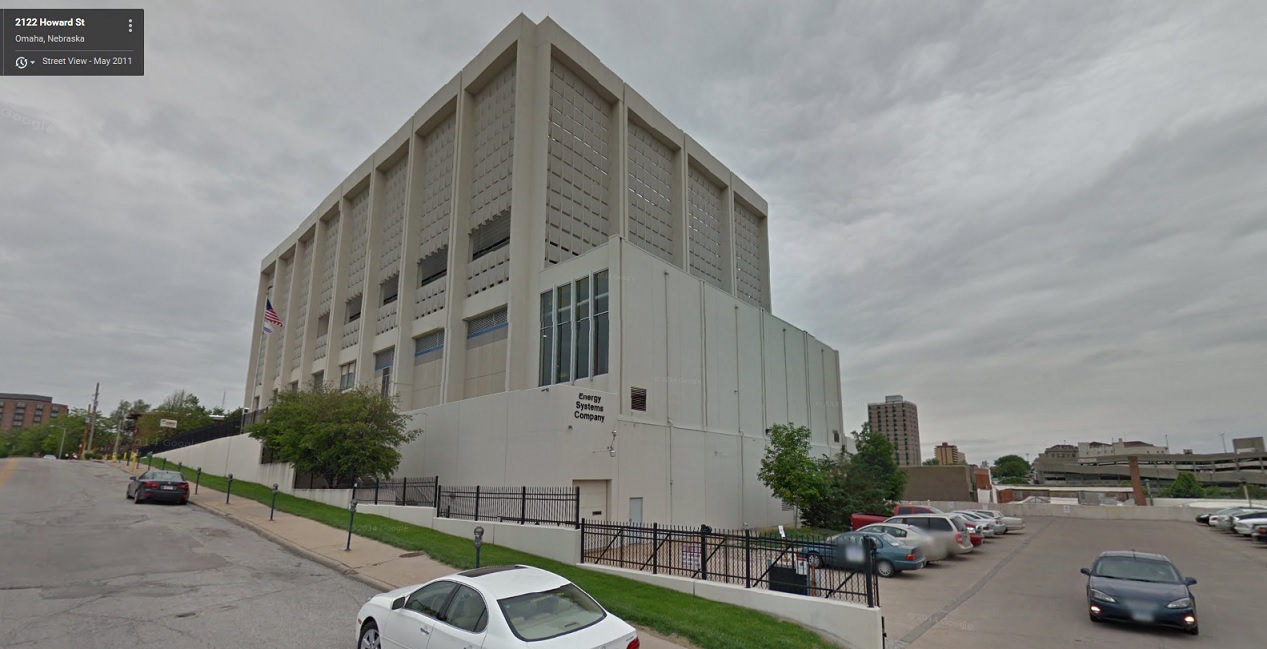
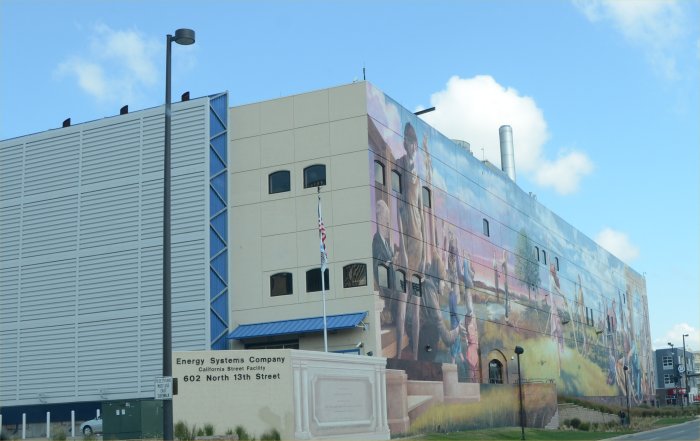
- Photo 2- Photo 3- Photo 3b- Photo 4

Consider the photos above; (the building with the mural is a refrigerated warehouse). Imagine this Omaha Downtown model deployed in Caribbean communities. This “District Heating and Cooling” scheme provides economies-of-scale, efficiency and lower costs. The design is a “plant” to produce steam, hot water and/or chilled water at a central location and then pipe the steam and water underground to individual buildings within a specific district. This process is energy efficient and reliable, typically requiring less capital investment, risk and operational costs than systems where each building must maintain its own boiler or air conditioner. The destinations/buildings only need air handlers – much cheaper than full air-conditioning – to blow and control preferred temperature settings.

This is a model of a technocracy. Without these types of infrastructure the Caribbean is just … ‘Third World’.

The Go Lean/CU roadmap recognizes that modern life has expanded the definition of basic needs to now include food, clothing, shelter and energy. And thusly the book proposes many solutions for the region to optimize energy generation, distribution and consumption. There are many lessons to learn from other more-efficient communities. This is the prime directive of the Go Lean roadmap, to apply these lessons and best-practices so as to impact the Caribbean in these 3 ways:

  • Optimization of the economic engines in order to grow the regional economy to $800 Billion GDP and create 2.2 million new jobs.
  • Establishment of a security apparatus to protect the resultant economic engines.
  • Improvement of Caribbean governance, including Self-Governing Entities, to support these engines.

As for energy, the Go Lean book posits that the average costs of energy can be decreased from an average of US$0.35/kWh to US$0.088/kWh in the course of the 5-year term of this roadmap. (Page 100). This is a 75% savings!  Cooperative refrigeration allows for even more savings!

These initiatives will take some effort on the part of the community and governmental institutions. This is heavy-lifting! The Go Lean roadmap details a series of community ethos, strategies, tactics, implementations and advocacies to foster the progress in the wide fields of energy optimization and cooperative refrigeration. The following list applies:

Economic Principles – Economic Systems Influence Individual Choices/Incentives Page 21
Community Ethos – Lean Operations Page 24
Community Ethos – Return on Investments Page 24
Community Ethos – Cooperatives Page 25
Community Ethos – Model: Regional Taxi Commissions Page 25
Community Ethos – Non-Government Organizations Page 25
Community Ethos – Ways to Impact the Future Page 26
Community Ethos – Ways to Improve Negotiations Page 32
Community Ethos – Ways to Improve Sharing – Economies of Scale Page 35
Community Ethos – Ways to Impact the Greater Good Page 37
Anecdote – Pipeline Transport – Strategies, Tactics & Implementations Page 43
Strategy – Harness the power of the sun/winds Page 46
Strategy – Agents of Change – Technology Page 57
Strategy – Agents of Change – Aging Diaspora Page 57
Strategy – Agents of Change – Climate Change Page 57
Tactical – Fostering a Technocracy Page 82
Tactical – Separation of Powers – Public Works and Infrastructure Page 82
Tactical – Separation of Powers – Energy Commission Page 82
Anecdote – “Lean” in Government – Energy Permits Page 93
Anecdote – Caribbean Energy Grid Implementation Page 100
Implementation – Ways to Develop Pipeline Industry Page 107
Implementation – Ways to Improve Energy Usage Page 113
Implementation – Reasons to Repatriate to the Caribbean – Gerontology Initiatives Page 118
Planning – Lessons Learned from Omaha Page 138
Advocacy – Ways to Impact Public Works – Air Chillers Utilities Page 175
Advocacy – Ways to Foster Cooperatives – Refrigerated Warehouses Model Page 176
Advocacy – Ways to Impact Monopolies – Empower Municipal Authorities Page 202
Advocacy – Ways to Develop a Frozen Foods Industry – Need for Refrigerated Warehouses Page 208
Advocacy – Ways to Battle Poverty – Third World Realities Page 222

The phrase “Hotter than July” should only be a song, not a way of life in the Caribbean.

Energy needs are undeniable. Air-conditioning needs to be readily available and affordable during the “mean season”. This should not be open to any compromise.

Fulfilling these needs is a great target for lean, agile operations, perfect for the CU technocracy. Any failure in this regards results in heightened abandonment.

Now is the time for all of the Caribbean, the people, businesses, institutions and governments, to lean-in for the optimizations and opportunities described in the book Go Lean … Caribbean.

Stay cool people! 🙂

Download the book Go Lean … Caribbean – now!

—————

Appendix MUSIC – The Merrymen – Feeling Hot Hot Hot – https://youtu.be/rbc_LxfhSoY


Uploaded on Dec 21, 2011 – The Merrymen recorded this song in 1983 originally on thier album “No Big Ting”, however this version was recorded in 1988 on their album “Hot Hot Soca”. http://www.facebook.com/themerrymenfr…

Music: “Hot Hot Hot” by The Merrymen (Google PlayAmazonMP3eMusiciTunes)

Share this post:
, , , ,
[Top]

Tesla unveils super-battery to power homes

Go Lean Commentary

Necessity is the ‘mother’ of invention – Old Wives Tale

Caribbean energy costs are among the highest in the world. The book Go Lean…Caribbean relates (Page 100) that the Caribbean has among the most expensive energy costs in the world, despite having abundant alternative energy natural resources (solar, wind, tidal, and geo-thermal). The Caribbean eco-system focuses on imported petroleum to provide energy options and as a result retail electricity rates in the Caribbean average US$0.35/kWh, when instead it could be down to US$0.088/kWh.

There is definitely the need for invention. Now, along comes Tesla*
… with this “inventive” solution.
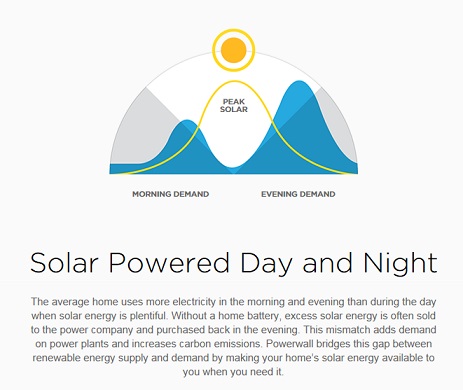
… with this Powerwall product, launched last week by Tesla Chief Executive Officer Elon Musk; it is designed to allow homeowners to store electricity generated by green energy options – solar panels and wind turbines – during the peak of the day, then use it at other times when electricity consumption is higher.

CU Blog - Tesla unveils super-battery to power homes - Photo 1

CU Blog - Tesla unveils super-battery to power homes - Photo 3

VIDEO 1 – Tesla unveils super-battery to power homes –  http://www.cbsnews.com/videos/tesla-unveils-super-battery-to-power-homes/

May 2, 2015 – The electronic car maker has come up with large, high-tech batteries to power your home even after the sun goes down. Telsa’s founder, Elon Musk, says they will let homeowners store solar power during the day and keep using it at night. CNET.com’s senior editor Bridget Carey joins “CBS This Morning: Saturday” to discuss how this could open a whole new way to use clean energy and to save money. (VIDEO plays best in Internet Explorer).

According to Elon Musk, this is “a fundamental transformation of how the world works”.

VIDEO 2 – Elon Musk unveils Powerwall, a battery pack for buildings (TomoNews) – https://youtu.be/NvCIhn7_FXI

Published on May 5, 2015 – Tesla Motors on Thursday, April 30 unveiled Tesla Energy, storage systems or batteries designed for homes and businesses.

Elon Musk, the company CEO, introduced the products to a crowd of business experts and journalists at a Tesla facility close to Los Angeles.

CU Blog - Tesla unveils super-battery to power homes - Photo 4Tesla did not invent the original battery, nor solar power panels. These technologies had pre-existed before this new development. But the problem has always been availability of the green energy option during uninviting conditions: solar – night time or cloud covered days; wind – still days.

This was the problem: Energy needs are undeniable 24-7-365; all the time. Energy delivery must cover all of those times.

The delivery or fulfilling those needs is a great target for lean, agile operations. It will save a lot of money for the people and institutions of the Caribbean.

This is the economic dynamic; there is also the matter of burning fossil fuels (oil, coal, wood pulp) and contributing to global warming and climate change. The Go Lean book posits that the embrace of alternative energy generation sources to be more impactful on the quest to minimize the threats on the environment. Early in the book, the pressing need to be aware of climate change is pronounced in the Declaration of Interdependence (Page 11), with these words, (the first of many “causes of complaints”):

i.  Whereas the earth’s climate has undeniably changed resulting in more severe tropical weather storms, it is necessary to prepare to insure the safety and security of life, property and systems of commerce in our geographical region. As nature recognizes no borders in the target of its destruction, we also must set aside border considerations in the preparation and response to these weather challenges.

Now, with this innovative offering from Tesla, the quest to adapt to more clean/green energy options can be practical and more cost effective. Power generation from the sun or wind (free & renewable sources) is far cheaper that generation based on fossil fuels.

Money! Environment! These two constitute reasons enough to pursue strategies, tactics and implementations of renewable energy with battery back-ups. But there is a third motivation behind the Go Lean…Caribbean movement; that is love of the homeland. Many people find the current lack of energy options unbearable for a normal life in their Caribbean ancestral homeland – imagine not being able to turn on air conditioning during the summer due to excessive costs – so they flee the region for foreign shores … in North America and Europe.

This new innovative product by Tesla…changes everything!

The book Go Lean… Caribbean serves as a roadmap for the introduction and implementation of the Caribbean Union Trade Federation (CU). This roadmap has 3 prime directives:

  • Optimization of the economic engines in order to grow the regional economy to $800 Billion GDP and create 2.2 million new jobs.
  • Establishment of a security apparatus to protect the resultant economic engines.
  • Improvement of Caribbean governance to support these engines.

CU Blog - Tesla unveils super-battery to power homes - Photo 5This Go Lean/CU roadmap recognizes that modern life has expanded the definition of basic needs to now include food, clothing, shelter and energy. And thusly the book proposes many solutions for the region to optimize energy delivery:

  • generation
  • distribution
  • consumption

Home-based solar panels or home-based wind turbines with battery back-ups would optimize all these three areas of focus. We applaud Tesla and the success of their transformational product.

To the Caribbean we declare: More help is on the way! The Go Lean book posits that with the adoptions of the strategies, tactics and implementations in the roadmap that average costs of energy can be decreased from an average of US$0.35/kWh to US$0.088/kWh in the course of the 5-year term of this roadmap. (Page 100). That is a 75% savings.

The Go Lean roadmap details a series of community ethos, strategies, tactics, implementations and advocacies to be early adopters of these cutting-edge energy systems. The following list applies:

Community Ethos – Deferred Gratification Page 21
Community Ethos – Lean Operations Page 24
Community Ethos – Return on Investments Page 24
Community Ethos – Cooperatives Page 25
Community Ethos – Ways to Impact the Future Page 26
Community Ethos – Ways to Impact the Greater Good Page 37
Strategy – Harness the power of the sun/winds Page 46
Tactical – Fostering a Technocracy Page 82
Tactical – Separation of Powers – Energy Commission Page 82
Anecdote – “Lean” in Government – Energy Permits Page 93
Anecdote – Caribbean Energy Grid Implementation Page 100
Implementation – Ways to Develop Pipeline Industry Page 107
Implementation – Ways to Improve Energy Usage Page 113
Advocacy – Ways to Impact Public Works Page 175
Advocacy – Ways to Foster Cooperatives Page 176
Advocacy – Ways to Impact Monopolies Page 202

This Tesla battery system – Powerwall – offers independence from utility grids. It is not from an energy company, but rather from a technology company; (see Appendix). Stay tuned, opposition will emerge; it always does…especially in the US. The For-Profit utility companies always lobby against regulations to “clean-up” fossil-fuel (coal) power plants or block small “Green” start-ups from sending excess power to the National Grid. Their motive is to preserve their century-long monopoly. See related article here:

Title: Is America’s electrical grid fading to black?
By: Bruce Kennedy – MoneyWatch – April 8, 2015

Are you prepared to live “off the grid,” independent of major electric utilities? Many people who live in Washington, D.C., may be ready for a change — after widespread power outages in the region on Tuesday, due to a problem in a utility company transmission line.

While the term may sound like something out of a novel, a growing number of U.S. consumers and businesses are actually expected to be living “off the grid” over the next several decades – to the point where some of the big utilities may find themselves in a new financial reality.

According to a new report by Rocky Mountain Institute (RMI) and HOMER Energy, a firm that designs remote microgrids, the development of practical and efficient solar-plus battery systems is an economic and cultural game-changer.

The report looked at median commercial and residential electrical customers in five very different metro areas – Louisville, Kentucky, Westchester County, New York, San Antonio, Texas, Los Angeles, California, and Honolulu, Hawaii – and evaluated their local economics through to 2050.

And their findings were startling. “Over time, as retail electricity prices from the grid increase and solar and battery costs decrease,” said the report’s executive summary, “customers logically reduce their grid purchases until the grid takes a backup-only role.”

For example, according to RMI’s analysis, the New York suburb of Westchester Country could see utility grid’s supply to overall electric power for commercial customers in the region shrink from 100 percent today to around 25 percent by 2030 – and to less than five percent by 2050.

“These findings should be compelling for customers and technology providers,” RMI principal and report author James Mandel said in a press statement. “No matter how expensive retail electricity gets in the future, customers that invest in these grid-connected systems can contain their electricity costs at or below a ‘peak price,’ yielding significant savings on their monthly utility bill.”

More choices for consumers of electricity also means major changes for the big utilities, even if only a fraction of their current customers end up adopting the new-tech systems. The report says that in the northeastern United States, commercial load “defections” away from the traditional utility grid could total 140 million megawatt hours by 2030, or around $35 billion in annual electrical costs.

But RMI manager and report coauthor Leia Guccione says the changes aren’t necessarily adversarial, pitting the old-school utilities against the new technology.

“Because these solar-plus-battery systems are grid-connected,” she notes, “they can offer value and services back to the grid. We need not see them only as a threat.”

© 2015 CBS Interactive Inc.. All Rights Reserved.
Retrieved from CBS News Online Site (Posted May 2, 2015) from: http://www.cbsnews.com/news/is-americas-electrical-grid-fading-to-black/

This will be a choice for America to make: immediate profits or the Greater Good. Choose well, America!

The Go Lean movement (book and blogs) asserts that we should not look to American Big Energy for answers to our own Caribbean dilemmas. American leadership has often times been motivated by crony-capitalistic intentions. This point had been further elaborated upon in these previous blog/commentaries:

https://goleancaribbean.com/blog/?p=4897 US Backs Natural Gas (LNG) Distribution Base in Jamaica
https://goleancaribbean.com/blog/?p=4294 Ambassadors to Caribbean discuss PetroCaribe-Energy, Security
https://goleancaribbean.com/blog/?p=2465 Book Review: ‘This Changes Everything: Capitalism vs. the Climate’
https://goleancaribbean.com/blog/?p=2338 Lessons: How Best to Welcome the Dreaded American ‘Plutocracy’
https://goleancaribbean.com/blog/?p=926 Conservative heavyweights have solar industry in their ‘kill’ sights
https://goleancaribbean.com/blog/?p=273 10 Things We Don’t Want from the US – #1: American Self-Interest

Fulfilling energy needs is a great target for lean, agile operations, perfect for the CU technocracy.

We need innovative products, systems, companies and people to help us in our quest to make the Caribbean a better place to live, work and play.

Let’s get started. Now is the time for all of the Caribbean, the people, businesses, institutions and governments, to lean-in for the optimizations and opportunities described in the book Go Lean … Caribbean.  🙂

Download the book Go Lean … Caribbean – now!

————-

Appendix – * TeslaCU Blog - Tesla unveils super-battery to power homes - Photo 2

Tesla Motors, Inc. is an American company that designs, manufactures, and sells electric cars and electric vehicle powertrain components.[4] Tesla Motors is a public company that trades on the NASDAQ stock exchange under the symbol TSLA.[5] In the first quarter of 2013, Tesla posted profits for the first time in its history.[6]

Tesla first gained widespread attention following their production of the Tesla Roadster, the first fully electric sports car.[7] The company’s second vehicle is the Model S, a fully electric luxury sedan, and its next two vehicles are the Models X and 3.[8] As of March 2015, Tesla Motors has delivered about 70,000 electric cars since 2008.[9]

Tesla also markets electric powertrain components, including lithium-ion battery packs to automakers including Daimler and Toyota.[10] Its CEO, Elon Musk, has said that he envisions Tesla Motors as an independent automaker,[11] aimed at eventually offering electric cars at prices affordable to the average consumer.[12][13] Pricing for the Tesla Model 3 is expected to start at US$35,000 before any government incentives and deliveries are expected to begin by 2017.[14][15] On April 30, 2015, Tesla announced the Powerwall, a battery product for home use. (Source: http://en.wikipedia.org/wiki/Tesla_Motors)

The company is named after famous inventor and innovator, Nikola Tesla (1856 –1943). He was a Serbian American[2][3][4], electrical engineer, mechanical engineer, physicist, and futurist. He is best known for his contributions to the design of the modern alternating current (AC) electricity supply system.[5]

Nicola Tesla gained experience in telephony and electrical engineering before immigrating to the United States in 1884 to work for Thomas Edison in New York City. He soon struck out on his own with financial backers, setting up laboratories and companies to develop a range of electrical devices. His patented AC induction motor and transformer were licensed by George Westinghouse, who also hired Tesla for a short time as a consultant. His work in the formative years of electric power development was involved in a corporate alternating current/direct current “War of Currents” as well as various patent battles. Tesla went on to pursue his ideas of wireless lighting and electricity distribution in his high-voltage, high-frequency power experiments in New York and Colorado Springs and made early (1893) pronouncements on the possibility of wireless communication with his devices. He tried to put these ideas to practical use in his ill-fated attempt at intercontinental wireless transmission. He was ahead of his time, as we only now have some semblance of these systems in place today. (Source: http://en.wikipedia.org/wiki/Nikola_Tesla).

Share this post:
, ,
[Top]

US Backs LNG Distribution Base in Jamaica

Go Lean Commentary

All of a sudden, the US wants to take the lead in providing energy solutions for the Caribbean. What happened?

Oh yeah, another suitor came calling on this beautiful “sweetheart” that the US had taken for granted. That suitor: Venezuela; (see Appendix).

Though this is a simplistic analogy, the appearance of romancing the Caribbean heart (and dollars) regarding energy fuel seems to follow the dramatic sequences of “teenage love”.

The book Go Lean… Caribbean relates (Page 100) how the Caribbean has among the most expensive energy costs in the world, despite having abundant alternative energy natural resources (solar, trade winds, tidal, geo-thermal). The societal administrations only focused on imported petroleum to provide energy options and as a result retail electricity rates in the Caribbean average US$0.35/kWh, when instead it could be down to US$0.088/kWh.

These are just the economic issues. There is also the matter of burning fossil fuels and contributing to global warming and climate change. For this teenage love scenario, that is too far-reaching for this original suitor; his only focus is the short-term. The Go Lean book posits that the embrace of this identified alternative energy generation source (Natural Gas) could be more impactful on the environment in addition to remediating the high energy costs.

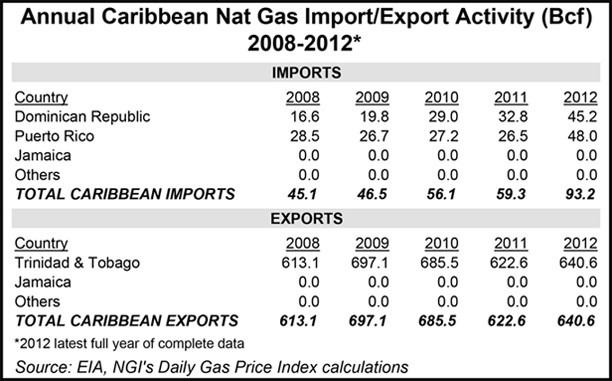
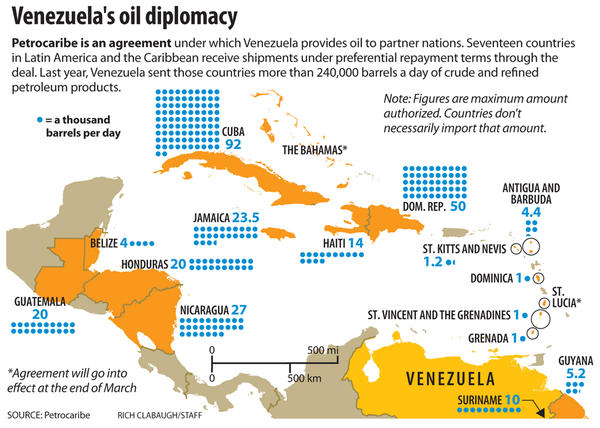
The US is now the world largest energy producer. But Venezuela is the largest oil exporter in all of Latin America; they turned their attention – with their PetroCaribe program – to aid the Caribbean member-states with very attractive and enticing delivery and payment terms to consume more Venezuelan oil. Most of the independent Caribbean states acquiesced to these advances.

But now, the Empire Strikes Back

Previously, this commentary detailed how the US Ambassadors to the Caribbean were soliciting more US trade in energy options and dissuading the Venezuelan connections. Now we follow-up to see the US making strides with Jamaica to help diversify energy generation – include natural gas – and establish this central Caribbean destination as a hub for natural gas logistics to the rest of the region.

See the news article here from the NGI* entity about Liquefied Natural Gas (LNG):

Title: U.S. Backs Fuel Diversification, LNG Distribution Base in Jamaica
By: Charlie Passut

The United States will help Jamaica with fuel diversification and embrace liquefied natural gas (LNG) for its energy needs, and will also back plans for the island nation to become a base for delivering LNG to the rest of the Caribbean region.

On Thursday [(April 9, 2015)], U.S. Department of Energy (DOE) Secretary Ernest Moniz signed an agreement with Jamaica’s energy minister, Phillip Paulwell, at the U.S.-CARICOM summit in Mona, Jamaica.

CU Blog - US Backs LNG Distribution Base in Jamaica - Photo 1“We believe that Jamaica could be a part of [an LNG export] hub because of our geographic location, in proximity to places like Haiti and other areas in the western Caribbean,” Paulwell said, according to video of the summit provided by the government’s Jamaica Information Service (JIS). “After these meetings, we are hoping to zero in on some of the specificity.”

Moniz countered that DOE would help facilitate discussions between Jamaica and the Inter-American Development Bank, which provides financial and technical support to countries in Latin America and the Caribbean. He also suggested talks with the bank’s president, Luis Alberto Moreno.

“We are happy to [facilitate the discussions],” Moniz said on JIS. “We think it’s good for the Western Hemisphere and certainly good for the Caribbean in terms of energy security, environmental impact and economic development.”

CU Blog - US Backs LNG Distribution Base in Jamaica - Photo 2Rick Smead, managing director of advisory services for RBN Energy LLC, said Jamaica had been expected to become a major trading center for LNG, with larger tankers coming in to offload onto smaller barges and tankers for shorter trips to the different islands.

“But until Secretary Moniz’s visit, I didn’t know how close we were to supporting that or doing anything to try to foster it,” Smead told NGI on Friday.

“One of the rapidly evolving dynamics of U.S. gas abundance, and especially our LNG export capability, is that in addition to the large volume [of international cargoes bound] for Europe and Asia, there should be a lot of opportunities for smaller cargoes to taxi all over the place in the Caribbean. The technology of both floating liquefaction and especially floating regasification along the lines of accelerates stuff, frees up the ability to go to a lot of these smaller markets without needing to build a giant regasification facility.

“There’s been a proliferation of smaller LNG transportation and regasification technologies all over the Caribbean, in large part in anticipation of there being a lot more supply available.”

Smead predicted that the U.S. will eventually become the world’s second or third largest exporter of LNG, with the Caribbean becoming a significant importer.

“The Caribbean [is] a very gas hungry market,” Smead said. “Being very close to the U.S. Gulf Coast, where four out of our five operational LNG export facilities that are close to getting done will be [located], it seems pretty obvious that there would be a lot of vitality to that market.”

Last month, American LNG Marketing LLC was granted DOE authorization to export up to 60,000 tonnes per annum of containerized LNG from Florida, mostly to free trade agreement (FTA) countries in the Caribbean and Central America (see Daily GPI, March 23).

In 2014, Carib Energy LLC, a subsidiary of Crowley Maritime Corp., won a multi-year contract to export containerized LNG produced in the U.S. to an undisclosed pharmaceutical company in Puerto Rico (see Daily GPI, Nov. 17, 2014). That followed DOE approval for Carib and Sempra Energy’s Cameron LNG project to export domestically-produced LNG. Both facilities are in Louisiana, on the Gulf Coast (see Daily GPI, Sept. 10, 2014

The U.S. Energy Administration has also touted the benefits of LNG exports to U.S. island states and territories (see Daily GPI, Aug. 19, 2014).
Source: Natural Gas Intelligence Magazine  (Posted April 13, 2015) – http://www.naturalgasintel.com/articles/101954-us-backs-fuel-diversification-lng-distribution-base-in-jamaica

This foregoing news article highlights some important issues, most of which have been detailed in the Go Lean book. That publication coupled energy as a basic need with food, clothing and shelter; and then addressed ways to elevate Caribbean society by optimizing the delivery of these needs. The book serves as a roadmap for the introduction and implementation of the technocratic Caribbean Union Trade Federation (CU). This entity would serve as a regional confederation of all 30 Caribbean member-states to provide better leverage to source the energy resources for the region, including natural gas options that had previously been overlooked; (see Appendix-VIDEO below). Many benefits abound from this approach. This Go Lean roadmap identifies these benefits as prime directives, as detailed in these 3 declarative statements:

  • Optimization of the economic engines in order to grow the regional economy.
  • Establishment of a security apparatus to protect the resultant economic engines.
  • Improvement of governance to support these engines.

The motivation of the Go Lean…Caribbean book is love for this homeland and the quest to make it a better place to live, work and play. If the US now wants to show more leadership in this area, we welcome their positive contribution. But we stand cautioned in knowing that America is plagued with the history of prioritizing their self-interest above the needs of the Caribbean people. We now therefore dread an American leadership and instead look for a partnership. We want to be protégés and no longer parasites.

Early in the book, the need to better leverage our small Caribbean populations in trade negotiations with the US or Venezuela was pronounced in the Declaration of Interdependence (Page 11), with these statements:

viii. Whereas the population size is too small to foster good negotiations for products and commodities from international vendors, the Federation must allow the unification of the region as one purchasing agent, thereby garnering better terms and discounts.

xi. Whereas all men are entitled to the benefits of good governance in a free society, “new guards” must be enacted to dissuade the emergence of incompetence, corruption, nepotism and cronyism at the peril of the people’s best interest. The Federation must guarantee the executions of a social contract between government and the governed.

So we welcome America’s natural gas options;  (see Appendix-VIDEO below) …

… and we add renewables and other energy alternatives into the mix for Caribbean energy.  These would be more cost efficient and ecologically friendly for the planet, of which we share with our bigger neighbors in North and South America. This would truly be lean!

CU Blog - US Backs LNG Distribution Base in Jamaica - Photo 3This concept of lean is very important for this roadmap to elevate Caribbean society. For the purpose of this effort, ‘lean’ is more than just a description, it’s a noun, a verb, an adjective and an adverb. It is also a commitment and a cause in which the entire Caribbean region is urged to embrace; or better stated: “lean in”.

Why were natural gas solutions not considered in the past?

It is an imported resource, just like petroleum; it requires the same logistical considerations as crude oil or refined products of gasoline and diesel. Except though natural gas (LNG) does not need to be refined, only converted from liquid form back to gas form: regasification. LNG is more stable for transport.

The Go Lean roadmap also anticipates the transport option of pipelines. The strategies, tactics and implementation (above ground, underground and undersea of this technology) have been fully detailed in the book. The roadmap thereby details the series of community ethos, strategies, tactics, implementations and advocacies to foster progress in the wide fields of energy generation and energy distribution. The following list applies:

Community Ethos – Lean Operations Page 24
Community Ethos – Return on Investments Page 24
Community Ethos – Cooperatives Page 25
Community Ethos – Regional Taxi Commissions – To Adopt Natural Gas Page 25
Community Ethos – Non-Government Organizations Page 25
Community Ethos – Ways to Impact the Future Page 26
Community Ethos – Ways to Improve Negotiations Page 32
Anecdote – Pipeline Transport – Strategies, Tactics & Implementations Page 43
Strategy – Harness the power of the sun/winds Page 46
Tactical – Fostering a Technocracy Page 82
Tactical – Separation of Powers – Energy Commission Page 82
Anecdote – “Lean” in Government – Energy Permits Page 93
Anecdote – Caribbean Energy Grid Implementation Page 100
Implementation – Ways to Develop Pipeline Industry Page 107
Implementation – Ways to Improve Energy Usage Page 113
Advocacy – Ways to Foster Cooperatives Page 176
Advocacy – Ways to Impact Monopolies Page 202

The energy needs for the Caribbean are undeniable. The Caribbean region must take the lead in providing Caribbean energy needs. Though we welcome the US partnership, we should be cautious as to their motives and priorities. We accept that at this moment, the US may have altruistic motives, especially with declining oil prices possibly affecting Venezuela. But for far too often, American leadership has been motivated by crony-capitalistic intentions. The points of mitigating the risks of American Big Business (in this case Big Oil) were further elaborated upon in these previous blog/commentaries:

https://goleancaribbean.com/blog/?p=4294 Ambassadors to Caribbean discuss PetroCaribe-Energy, Security
https://goleancaribbean.com/blog/?p=3397 A Christmas Present for the Banks from the Omnibus Bill
https://goleancaribbean.com/blog/?p=2887 Caribbean must work together to address US rum subsidies
https://goleancaribbean.com/blog/?p=2670   A Lesson in History: Oil Magnate Rockefeller’s Pipeline
https://goleancaribbean.com/blog/?p=2522 The Cost of American Cancer Drugs
https://goleancaribbean.com/blog/?p=2465 Book Review: ‘This Changes Everything: Capitalism vs. the Climate’
https://goleancaribbean.com/blog/?p=2338 Lessons: How Best to Welcome the Dreaded American ‘Plutocracy’
https://goleancaribbean.com/blog/?p=2259 The Criminalization of American Business – Big Banks Let Loose
https://goleancaribbean.com/blog/?p=789 America’s War on the Caribbean
https://goleancaribbean.com/blog/?p=273 10 Things We Don’t Want from the US – #1: American Self-Interest

Fulfilling the Caribbean energy needs is a great target for lean, agile operations, perfect for the CU technocracy. This allows us to prove, to ourselves and to the world, that we can truly be protégés and not just parasites.

Now is the time for all of the Caribbean, the people, business, institutions and governments, to lean-in for the optimizations and opportunities described in the book Go Lean … Caribbean.  🙂

Download Go Lean … Caribbean – now!

———-

* Appendix – About …

  • NGI – Natural Gas Intelligence (NGI), is a leading provider of natural gas, shale news and market information for the deregulated North American natural gas industry. Since the first issue of Natural Gas Intelligence was published in 1981, NGI has provided key pricing and data relied upon daily by thousands of industry participants in the U.S, Canada and Mexico as well as Central and South America, Europe and Asia.
  • NGI Corporate – Natural Gas Intelligence (NGI), operating under the corporate entity of Intelligence Press, Inc., is the publisher of the NGI family of newsletters–a leading provider of news and physical market pricing information for the deregulated North American natural gas industry. Since the first issue of the Natural Gas Intelligence newsletter published in 1981, NGI has provided information and data relied upon daily by thousands of industry participants in the U.S, Canada and Mexico as well as Central and South America, Europe and Asia.

———

Appendix – Venezuela’s PetroCaribe Distribution:

Venezuela Oil

Appendix – VIDEO: ExxonMobil’s Discussion on Energy Supply –  https://youtu.be/faDKwEl1BcY

Published on Jan 23, 2015 – Advances in technology continue to make a wide range of energy supplies available to consumers. At the same time, the fuels that people and businesses choose to meet their needs continue to evolve. These choices are based not just on price, but also on attributes like convenience, performance and environmental effects. Natural gas is expected to be the fastest-growing major fuel through 2040.
Share this post:
, , , ,
[Top]

Review: ‘Merchants of Doubt’ Documentary

Go Lean Commentary

“You can fool all the people some of the time; some of the people all of the time; but you cannot fool all the people all the time”. – Old Adage

Doubt Photo 1This adage is apropos considering that there are actual professionals who are engaged by vested business interests to provide scientific denials regarding the effects of Climate Change.

How is it possible that anyone would deny this? In a previous blog-commentary it was asserted that many who deny the realities of Climate Change, do so because of self-interest; they are only concerned with the lower levels of Maslow’s hierarchy of needs; only concerned about basic or social needs. But now we highlight the public relations/messaging professionals who craft the message, and support it with scientific testimonies to reinforce the status quo. These ones’ motives are more sinister than just supporting a dissenting opinion; they want to promote “doubt”.

The book Go Lean…Caribbean collects statistical data and anecdotes on the dire effects of Climate Change in the Caribbean. Some communities have been affected by Climate Change-driven hurricanes, and after many years, have still not recovered (Page 112). So, we must now take our own lead for our own solutions. The region cannot fall prey to the shenanigans of the Merchants of Doubt.

This commentary highlights the film, “Merchants of Doubt“, a big hit at the Toronto Film Festival for 2014. The documentary though is based on the 2010 book: Merchants of Doubt: How a Handful of Scientists Obscured the Truth on Issues from Tobacco Smoke to Global Warming; by Naomi Oreskes and Erik M. Conway.  See a clip from the film here:

VIDEO: ” Hard Pill To Swallow” – Merchants of Doubt (2014) Documentary Clip- http://www.imdb.com/video/imdb/vi524725785?ref_=tt_pv_vi_aiv_1

This documentary looks at pundits-for-hire who present themselves as scientific authorities as they speak about topics like toxic chemicals, pharmaceuticals and climate change. (Director: Robert Kenner; Writers: Robert Kenner, Kim Roberts).

What is the motivation of the Merchants of Doubt?

Profit.

There is a lot of money at stake, especially for those who want to preserve the status quo and not invest in the required mitigations to arrest Climate Change. No doubt, this Merchants of Doubt “role play” is just another glimpse of Crony Capitalism.

The profit motive is powerful. Climate Change is not the first issue in which they have manufactured “doubt”. In truth, their efforts are from a familiar playbook, used previously to delay actions by Big Tobacco, Toxic Waste, Acid Rain, and other dangerous chemicals. They have a successful track record.

Doubt Photo 2

This was the point a few days ago by the film’s director Robert Kenner in an interview on the show All Things Considered for National Public Radio (NPR). Listen to the podcast here:

Audio:Merchants Of Doubt‘ Explores Work of Climate Change Deniers – http://www.npr.org/2015/03/06/391269315/merchants-of-doubt-explores-work-of-climate-change-deniers

March 06, 2015 – NPR’s Melissa Block speaks to director Robert Kenner about his documentary, “Merchants of Doubt“, which examines the work of climate change skeptics and their campaign to sway public opinion.

The Go Lean book details the impending crisis of Climate Change and then calls for the establishment of a regional administration to monitor, mitigate and manage the threats of Climate Change. We must pursue the Greater Good, for the Caribbean region is at the frontline of the battleground of Climate Change; the region is experiencing devastating hurricanes, flooding, forest fires, droughts, rising sea levels, and alterations in fish stock.

This Go Lean book serves as a roadmap for the introduction and implementation of the technocratic Caribbean Union Trade Federation (CU). The prime directives of this agency are described as:

  • Optimize the economic engines of the Caribbean to elevate the regional economy to grow to $800 Billion and create 2.2 million new jobs.
  • Establish a security apparatus to protect the resultant economic engines.
  • Improve Caribbean governance and industrial policies to support these engines.

The Go Lean roadmap calls for the CU to serve as the regional administration to optimize economy, homeland security and governance engines for the Caribbean, especially in light of Climate Change battleground frontline status. The needs of the economy and Climate Change mitigations do not have to clash; they can co-exist. There is no need for the campaign of doubt.

This is the first pronouncement (Page 11) of the opening Declaration of Interdependence that bears a direct reference to this foregoing article and source book:

i. Whereas the earth’s climate has undeniably changed resulting in more severe tropical weather storms, it is necessary to prepare to insure the safety and security of life, property and systems of commerce in our geographical region. As nature recognizes no borders in the target of its destruction, we also must set aside border considerations in the preparation and response to these weather challenges.

The Go Lean roadmap is designed to deliver many empowerment activities to elevate Caribbean society. These activities will carefully balance the needs of the Caribbean and the needs of the planet: we need jobs, yes, but we do not need to increase our carbon footprint. This seems logical; who could dispute? Unfortunately, there are many doubters, dissenters and disputers. Many times these motives are strictly capitalistic; strictly for profit. The issues of Climate Change have been repeatedly addressed and further elaborated upon in these previous blog/commentaries:

First US city to be powered 100% by renewables
Book Review: ‘This Changes Everything: Capitalism vs. the Climate’
Climate Change May Affect Food Supply Within a Decade
Cooling Effect – Oceans and the Climate
Climate Change May Bring More Kidney Stones
Caribbean grapples with intense new cycles of flooding & drought
Floods in Minnesota, Drought in California – Why Not Share?
Conservative heavyweights have solar industry in their sights
Go ‘Green’ … Caribbean

The subject of Climate Change doubters-dissenters-disputers is just another example of the well-documented bad corporate behavior by Big Business. Many other cases have been considered in this commentary; see the relevant list here:

Big Defense Many theorists indicate that the “follow the money” approach reveals the Military Industrial Complex work to undermine peace, so as to increase defense spending for military equipment, systems and weapons.
Big Media Cable companies conspire to keep rates high; kill net neutrality; textbook publishers practice price gouging; Hollywood insists on big tax breaks/ subsidies for on-location shooting.
Big Oil While lobbying for continuous tax subsidies, the industry have colluded to artificially keep prices high and garner rocket profits ($38+ Billion every quarter).
Big Box Retail chains impoverish small merchants on Main Street with Antitrust-like tactics, thusly impacting community jobs. e-Commerce, an area of many future prospects, is the best hope of countering these bad business tactics.
Big Pharma Chemo-therapy cost $20,000+/month; and the War against Cancer is imperiled due to industry profit insistence.
Big Tobacco Cigarettes are not natural tobacco but rather latent with chemicals to spruce addiction. Caribbean cigars are all natural.
Big Agra Agribusiness concerns continue to greenhouse gases, bully family farmers and crowd out the market; plus they fight common sense food labeling efforts.
Big Data Brokers for internet and demographic data clearly have no regards to privacy concerns. They open that doors for hackers and data breaches.
Big Banks Wall Street’s damage to housing and student loans are incontrovertible. Their only motive: more profits.
Big Weather Overblown hype of “Weather Forecasts” to dictate commercial transactions.
Big Real Estate Preserving MLS for Real Estate brokers only, forcing 6% commission rates, when the buyers and sellers can easily meet online without them.
Big Salt Despite the corrosiveness of salt on roads and the environment, it is the only tactic used to de-ice roads during the winter. Immediately after the weather warms, the roads must be re-constructed, thus ensuring a continuous economic cycle.

The Go Lean book, and accompanying blog commentaries, go even deeper and hypothesize that American economic models are considered dysfunctional when viewed from the Caribbean perspective. While the US generates the largest carbon footprint per-capita on the planet, most of the Climate Change doubters-dissenters-disputers originate there. Yet, we in the Caribbean are on the frontlines, especially considering the devastating realities of modern hurricanes.  In general, the American wheels of commerce stage the Caribbean in a “parasite” role. The American policy for the Caribbean is to incentivize consumption of American products, and serve as a playground for their leisure.

There is more to our reality. We also care about the planet, and our children’s future. We want to effect the required changes for our region and encourage the rest of the world to capitulate to good science in aid of the planet.

The Go Lean book declares that we must adopt a community ethos, the appropriate attitude/spirit, to forge change in our region; then details the executions of the following strategies, tactics, implementations and advocacies to better impact the region’s resources and eco-systems, especially in considering the preparations and consequences of Climate Change:

Community Ethos – Deferred Gratification Page 21
Community Ethos – Economic Systems Influence Individual Choices / Incentives Page 21
Community Ethos – The Consequences of Choices Lie in the Future Page 21
Community Ethos – “Crap” Happens Page 23
Community Ethos – Lean Operations Page 24
Community Ethos – Cooperatives Page 24
Community Ethos – Non-Government Organizations Page 25
Community Ethos – Ways to Impact the Future Page 26
Community Ethos – Ways to Improve Sharing Page 35
Community Ethos – Impact the Greater Good Page 37
Strategy – Vision – Confederating 30 Member-States into a Single Market Page 45
Strategy – Vision – Foster Local Economic Engines for Basic Needs Page 45
Strategy – Mission – Prepare for Natural Disasters Page 45
Strategy – Agents of Change – Climate Change Page 57
Strategy – Agents of Change – Globalization Page 57
Tactical – Confederating a Permanent Union Page 63
Tactical – Fostering a Technocracy Page 64
Separation of Powers – Emergency Management Page 76
Separation of Powers – Interstate Commerce Administration Page 79
Separation of Powers – Meteorological & Geological Service Page 79
Separation of Powers – Fisheries and Agriculture Department Page 88
Implementation – Assemble Regional Organs into a Single Market Economy Page 96
Implementation – Ways to Pay for Change Page 101
Implementation – Security Initiatives at Start-up – Unified Command & Control Page 103
Implementation – Industrial Policy for CU Self Governing Entities Page 103
Implementation – Ways to Deliver Page 109
Implementation – Ways to Benefit from Globalization Page 119
Planning – Big Ideas for the Caribbean Region Page 127
Planning – Ways to Make the Caribbean Better Page 131
Advocacy – Ways to Grow the Economy Page 151
Advocacy – Ways to Create Jobs Page 152
Advocacy – Ways to Improve Governance Page 168
Advocacy – Ways to Better Manage the Social Contract Page 170
Advocacy – Ways to Impact Public Works Page 175
Advocacy – Ways to Foster Cooperatives Page 176
Advocacy – Ways to Improve for Natural Disasters Page 184
Advocacy – Ways to Improve Emergency Management Page 196
Advocacy – Ways to Impact Main Street Page 201
Advocacy – Ways to Improve Fisheries Page 210
Appendix – History of Puerto Rican Migration to US & Effects of Hurricanes Page 303
Appendix – US Virgin Islands Economic Timeline with Hurricane Impacts Page 305

The foregoing Audio podcast and VIDEO discuss the effectiveness of Merchants of Doubt in delaying public policy in combating Climate Change. In the Caribbean, we have no option to exit from these debates. We are involved whether we want to be or not – we are on the frontlines of this battle.

This is not our opinion alone. There have been many comments from viewers of the documentary film. The following User Reviews support the thesis from the film:

— Typical of proponents —

User Review 1: The art of deception, applied to scientific consensus
Author: Douglas Allchin from St Paul, MN; 13 March 2015

This is not a film about the science of climate change, second-hand smoke, or risks of flame-retardants. It is about the tactics used (repeatedly) to mislead the public about that science. Most notably, the “Merchants of Doubt” foster unwarranted images of uncertainty and obscure scientific consensus, and even threaten the scientists themselves (and then joke about it). All the while they hide their sources of funding and conflicts of interest that might lead a reasonable person to measure their claims. The documentary evidence and testimony presented is compelling–including, ironically, the voices of the con-artists themselves (Marc Morano, Fred Singer, Tim Phillips). Especially noteworthy is testimony by those who discovered the deceptions despite prior sympathetic beliefs: Matthew Crawford, Michael Shermer, Congr. Bob Inglis.

Striking imagery. Amusing moments. But also chilling when one reflects how these voices obscure harms to our health and environment. Worse, they appeal to the banner of free speech and other “freedoms” (to do harm, in the name of unregulated business, I suppose), and imagine that sheer will or personal belief can trump sound scientific conclusions.

Other naysaying reviews one finds of this film will surely be further evidence of what the film itself exposes so well. Once revealed, never again concealed.

User Review 2: Engaging look at the politics of climate change… from one perspective
Author:
rm_777 from United States 10 September 2014

I saw “Merchants of Doubt” recently at the TIFF festival, and would recommend watching it, as it an engaging, well-structured and well-paced look at the politics of climate change… from one perspective.

Robert Kenner, of Food, Inc. fame, focuses “Merchants of Doubt” on the politics of climate change, and the individuals and corporations responsible for helping shape public opinion. The film integrates recent history, similar industries and interviews with a wide-range of members, exceptionally-well. Kenner, I believe, would make an excellent teacher on how to produce documentaries.

The major – and I mean major – downside of this film is that it is incredibly one-sided. One review from We Got This Covered put it exceptionally-well, which is that “As he tries to side his audience against the skeptics, Kenner ends up using the same tactics that they do.” Kenner is “content to regurgitate the same facts again and again, hoping his audience will be convinced enough to not want to hear the other side.”

If you are familiar with how politics works, then much of this is not new. This is why it is surprising that someone of Kenner’s pedigree would not challenge the “tribal” system of climate change, instead, taking a stance.

Likewise, there are doubters-dissenters-disputers even of the film. In the interest of full disclosure, notice here an opposing review of the same film:

— Typical of opponents —

User Review 3: But what about the science and economics of climate?
Author:
Viscount Monckton of Brenchley from UK; 5 Feb 2015

Merchants of Doubt is a prejudiced and relentlessly one-sided attempt to divert attention away from the failure of global temperatures to respond as the models had so confidently but so misguidedly predicted.

So far, any honest and independent inquirer would conclude that the unfolding evidence of global warming at half the central rate predicted with “substantial” (but misplaced) “confidence” in IPCC (1990) has cast more than a little legitimate doubt on the “settled” science.

However, this and other inconvenient truths – no global warming at all for up to 18 years 3 months (RSS satellite dataset); no increase in hurricane frequency or strength (Accumulated Cyclone Energy Index), or in flooding (IPCC, 2013), or in droughts (Hao et al., 2014); greening of the Sahara (Nicholson, 1981); global sea-ice extent recently at a satellite-era maximum (University of Illinois Cryosphere Today project, December 2014) – are entirely overlooked in the movie, which also ignores the well-established fact that the sceptical side of the debate receives 1/5000 of the lavish funding poured by governments and “green” profiteers of doom into promoting Thermageddon.

The movie will please climate Communists, but it is a fine illustration of the depths of despair into which the true-believers in the Thermageddon cult have been reduced as the “science” behind the scare visibly collapses before them. The movie is predicated on the assumption that there is a “97% consensus” that recent global warming was mostly man-made. The peer-reviewed result demonstrating that the “consensus” on this issue is actually 0.5% is conveniently ignored, along with all the other facts which – however much the Marxstream media may deny them or decline to report them – will slowly, inexorably consign the climate scare to the rubbish-heap to which all mere superstitions are ultimately, ineluctably consigned.

Don’t bother to watch it.

Change has come to the Caribbean region; more devastating change is imminent. There is the need for a permanent union to provide efficient stewardship for Caribbean economy, security and governing engines. The Go Lean…Caribbean book posits that these problems, these agents of change, are too big for just any one member-state to tackle alone, there must be a regional solution. This multi-state technocratic administration of the CU may be our best option.

The people and institutions of the region are hereby urged to lean-in to this Go Lean roadmap, to embrace the mitigations to arrest Climate Change. and respond to the Merchants of Doubt. Despite their objects, we can still make the Caribbean a better homeland to live, work and play. 🙂

Download the free e-Book of Go Lean … Caribbean – now!


Share this post:
, , , , , , ,
[Top]

Burlington, Vermont: First city to be powered 100% by renewables

Go Lean Commentary

The idea of transforming to 100% renewable energy has been a dream for the Caribbean. It would accomplish 2 important objectives: environmental protection and economic efficiency.

Instead of dreaming, the following VIDEO demonstrates that it is no dream, but rather …

… energy based on 100% renewables sources is being done … now!

Title: Running on renewable energy, Burlington, Vermont powers green movement forward – http://video.pbs.org/viralplayer/2365415796

“Burlington, Vermont, the state’s largest city, recently became the first in the country to use 100 percent renewable energy for its residents’ electricity needs. In a state known for socially conscious policies, the feat represents a milestone in the growing green energy movement. NewsHour’s William Brangham reports on the implications for the country’s green movement.”

This is the energy-mix summary from this VIDEO:

  •  35% – from Bio Mass – Burning renewable wood pulp
  • 20% – Wind
  • 5% – Solar
  • 40% – Hydro-electric … from dams on 2 area rivers

Burlington - Photo 1

No doubt, these renewables bring many benefits in arresting “Climate Change”, but the economic benefits cannot be ignored. The City of Burlington, Vermont is expected to save $20 million over the next few years. But the biggest economic benefit is on the household level: no power price increases since 2009.

The environmental focus may be considered the primary focus of the Green movement. So be it!

This Green movement is a concept, a commitment and a cause that needs some assimilation in the Caribbean. The abundance of carbon dioxide in the earth’s atmosphere has been attributed to the devastating effects of Climate Change. The book Go Lean…Caribbean initiates with the pronouncement that our region is in crisis, one reason being Climate Change. The pressing need to be aware of this phenomena is pronounced early in the book in the Declaration of Interdependence (Page 11), with these words, (the first of many “causes of complaints”):

i.    Whereas the earth’s climate has undeniably changed resulting in more severe tropical weather storms, it is necessary to prepare to insure the safety and security of life, property and systems of commerce in our geographical region. As nature recognizes no borders in the target of its destruction, we also must set aside border considerations in the preparation and response to these weather challenges.

The motivation behind the Go Lean book is to serve as a roadmap for the introduction and implementation of the technocratic Caribbean Union Trade Federation (CU). This Go Lean roadmap has 3 prime directives that are above and beyond combating Climate Change. They are defined as follows:

  • Optimization of the economic engines in order to grow the regional economy.
  • Establishment of a security apparatus, including energy security, to protect the resultant economic engines.
  • Improvement of Caribbean governance to support these engines.

This is where the ‘Lean’ comes into play for this roadmap. According to the foregoing VIDEO, the strategy for renewables improves all the other societal engines: economic, [energy] security and governance. For the purpose of this Caribbean empowerment effort, ‘lean’ is more than just a description, it’s a noun, a verb, an adjective and an adverb. It is also a concept, commitment and cause in which the entire Caribbean region is urged to embrace and ‘lean in’.

The Caribbean is struggling with the costs and reality of energy. The Go Lean book relates (Page 100) that this region pays one of the highest rates in the world; averaging US$0.35 /kWh. The motivation of the Go Lean energy is to optimize energy options. The book posits that the average energy costs can come down to US$0.088/kWh with just a better mix of fossil-fuels and renewables.

The member-states in the Caribbean are not the only communities envisioning a 100% renewable strategy; consider Denmark here. This is en vogue right now, despite the different geographies.

Imagine 100% renewable; as it has happened in this US City of Burlington.

Burlington - Photo 2

Burlington - Photo 4There is so much to benefit from a consideration of Burlington. Demographics-wise, it is so similar to many Caribbean towns. It is the largest city in the State of Vermont. It is international and regional, situated on the eastern shore of Lake Champlain, north of Shelburne Bay. It lies 45 miles south of the U.S.-Canadian (Vermont-Quebec) border and 94 miles south of Montreal. The City has a direct population of 42,417 (2010), but as the hub of the metropolitan area, consisting of the three northwestern Vermont counties has an effectual population of 213,701, approximately one third of Vermont’s total.[7]

If this city can get to 100% renewables, despite harsh winters for 3 months every year, imagine how much more so the Caribbean communities can with their near-365 days of sunshine. The mix for the Caribbean renewables will actually be different than Burlington, (or Denmark). Instead of wood pulp and hydro-electric, the Caribbean can consider tidal and geothermal (“Geyser”) steam-turbine energy (see Appendix below), in addition to the classic renewables of solar and wind.

These initiatives will take some strenuous effort on the part of Caribbean communities and governmental institutions. This heavy-lifting is part-and-parcel of the Go Lean roadmap. The roadmap details a series of community ethos, strategies, tactics, implementations and advocacies to foster the progress in the pursuits of green energy generation. The following list applies:

Community Ethos – Economic Systems Influence Individual Choices Page 21
Community Ethos – The Consequences of Choices Lie in the Future Page 21
Community Ethos – Lean Operations Page 24
Community Ethos – Return on Investments Page 24
Community Ethos – Cooperatives Page 25
Community Ethos – Regional Taxi Commissions – to push renewables Page 25
Community Ethos – Non-Government Organizations Page 25
Community Ethos – Ways to Impact the Future Page 26
Community Ethos – Ways to Improve Negotiations Page 32
Anecdote – Pipeline Transport – Strategies, Tactics & Implementations Page 43
Strategy – Harness the power of the sun/winds/tides Page 46
Tactical – Fostering a Technocracy Page 82
Tactical – Separation of Powers – Energy Commission Page 82
Anecdote – “Lean” in Government – Energy Permits Page 93
Anecdote – Caribbean Energy Grid Implementation Page 100
Implementation – Ways to Develop Pipeline Industry Page 107
Implementation – Ways to Improve Energy Usage Page 113
Advocacy – Ways to Impact Public Works Page 175
Advocacy – Ways to Foster Cooperatives Page 176
Advocacy – Ways to Impact Monopolies Page 202

The Caribbean energy needs are undeniable. The effects of fossil-fueled-driven Climate Change are undeniable. The Caribbean energy options are vast. There is simply the need for the commitment. The Go Lean roadmap shows that commitment. It is the quest to make this region a better place to live, work and play. This has been a constant theme of many other Go Lean commentaries; see this sample:

https://goleancaribbean.com/blog/?p=4294 The US trying to lead the Caribbean to energy security and energy independence; but rather their self-interest is pronounced.
https://goleancaribbean.com/blog/?p=3743 The need for Trinidad to diversify from an oil-based mono-industrial economy; change is coming.
https://goleancaribbean.com/blog/?p=3326 M-1 Rail: Alternative Green Motion in the Motor City
https://goleancaribbean.com/blog/?p=3213 Gas prices drop below $2.00 – The world tire of gasoline price cycles
https://goleancaribbean.com/blog/?p=2769 DC Streetcars – Green Manifestation and Model For Caribbean Re-development
https://goleancaribbean.com/blog/?p=2585 A Lesson in History: Concorde SST inefficient fuel reality doomed innovative project
https://goleancaribbean.com/blog/?p=2465 Book Review: ‘This Changes Everything: Capitalism vs. the Climate’
https://goleancaribbean.com/blog/?p=2276 The need for renewable – Climate Change may affect food supply within a decade
https://goleancaribbean.com/blog/?p=2119 Cooling Effect – Oceans and the Climate
https://goleancaribbean.com/blog/?p=1883 Climate Change May Bring More Kidney Stones
https://goleancaribbean.com/blog/?p=1817 Caribbean grapples with intense new cycles of flooding & drought
https://goleancaribbean.com/blog/?p=926 Conservative heavyweights have solar industry in their sights
https://goleancaribbean.com/blog/?p=915 Go Green Caribbean – Renewable energy pursuits in the region
https://goleancaribbean.com/blog/?p=623 Only at the precipice, do they change

The Go Lean book opened (Page 3) with the job description for the CU technocracy to make better provisions for the region’s basic needs (food, clothing, energy and shelter), and then be in position to supply the rest of the world. There are energy (oil) exporting countries in the Caribbean (Trinidad & Tobago, Belize). Despite this reality, petroleum (gasoline and diesel) is very expensive in the region. Plus with the world’s fixation to graduate from fossil fuels – green movement – there is the need now to fully embrace renewable energy options, maybe even for 100%.

Now is the time for all of the Caribbean, the people, businesses, institutions and governments, to lean-in for the optimizations and opportunities described in the book Go Lean … Caribbean.

This is now more than just a dream. 🙂

Download the free e-Book of Go Lean … Caribbean – now!

————

APPENDIX – The Geysers – 50 Year Anniversary – https://player.vimeo.com/video/58388803

The Special Properties of Geothermal Sites – Drill deep enough and the earth is hot everywhere, but converting that heat to power is a challenge. Sites such as The Geysers in Northern California USA, where the heat is close to the surface and deep rock layers are fractured to allow water to percolate through, are quite rare.

Share this post:
, ,
[Top]

Gas Prices Drop Below $2

Go Lean Commentary

This is one of the year’s biggest economic stories; Gas Prices have dropped below $2.

The OnCue Drive Thru in Oklahoma sold gas for $1.99 a gallon Wednesday, a trend that many U.S. drivers are hoping will spread. – Published December 3rd 2014, 6:52 pm

Video: http://www.nbcnews.com/nightly-news/gas-prices-drop-below-2-gallon-oklahoma-n261101

It’s worth appreciating what’s going on here. The Power Player in this story is the Organization of the Petroleum Exporting Countries (better known as OPEC):

OPEC – a cartel of [12] oil producers that include Saudi Arabia, Iran, Iraq, and Venezuela – had a big meeting in Vienna on November 27. Before the gathering, there was speculation that OPEC countries might cut back on their own oil production in order to prop up prices. But in the end, the cartel couldn’t agree on how to respond and did nothing.

Oil prices promptly nosedived, with the price of Brent crude now hovering around $70 per barrel.

As recently as the summer, that price was over $100 per barrel.

CU Blog - Gas Prices Drop Below $2 - Photo 1

At this big meeting in Vienna, there was a lot of heated debate among OPEC members about how best to respond to this current drop in oil prices. Some countries, like Venezuela and Iran, wanted the cartel (mainly Saudi Arabia) to cut back on production in order to prop up the price of oil. The reason is that these countries need high prices in order to “break even” on their budgets and pay for all the government spending they’ve racked up:

CU Blog - Gas Prices Drop Below $2 - Photo 2

Source – Brad Plumer of Vox.com. Posted November 28, 2014; retrieved December 4, 2014 from: http://www.vox.com/2014/11/28/7302827/oil-prices-opec

OPEC is an international intergovernmental organization and economic cartel whose mission is to coordinate the policies of the oil-producing countries. This structure aligns with the book Go Lean… Caribbean, a roadmap for the introduction and implementation of the Caribbean Union Trade Federation (CU). This calls for the confederation, collaboration and convention of 30 member-states into one intergovernmental organization. The same as OPEC does for its 12 oil-producing nations – a proxy agency to represent all members – the CU seeks for the Caribbean region. But instead of elevating oil prices, the CU coalition has these 3 prime directives:

  • Optimization of the economic engines in order to grow the regional economy to $800 Billion & create 2.2 million new jobs.
  • Establishment of a security apparatus, including energy security, to protect the resultant economic engines.
  • Improve Caribbean governance to support these engines.

The goal of the CU is to optimize Caribbean society, allowing us to better compete globally and hopefully present more favorable options for our youth here in the homeland. (Previous generations sought refuge abroad).

The goal of OPEC is to secure a steady income to the member states and to collaborate in influencing world oil prices through economic means. Though this charter seems fairly benign, the reality of OPEC is vastly different; they have emerged as a monstrous entity! Autocratic leaders of OPEC countries – think Saddam Hussein – would constantly urge pushing world oil prices up; their claims were to help all OPEC members financially, but their motivation were purely nationalistic. The public view of OPEC now coincides with this dialogue from a movie, “art imitating life”:

“It can’t be bargained with, it can’t feel pain or mercy, and it will stop at absolutely nothing until you are dead!” – Movie dialogue from The Terminator (1984)

OPEC is not a monster, just protective of its own self-interest; many of their member-states feature a mono-industrial economy; it’s oil or bust! Plus, with 40 percent of global oil production, they do wield some power, influence and control of the eco-system of crude-oil pricing. But their power-influence-control is not absolute; there are always the laws of Economics!

Back to the foregoing article, the fact remains that oil prices were falling well before OPEC’s Friday announcement; this change was driven in large part by factors from Economics 101: less demand + higher supply = lower prices. In this case, economic slowdowns in much of the world have dampened demand, as supply has expanded considerably, especially within the U.S.

This premise directs the Energy Policy as communicated in the Go Lean book: the Caribbean region must lower crude oil demand.

This Go Lean/CU roadmap recognizes that modern life has expanded the definition of basic needs to now include food, clothing, shelter and energy. And thusly the book proposes many solutions for the region to optimize energy generation, distribution and consumption. No “stone is left unturned”. Go Lean posits that the average costs of energy can be decreased from an average of US$0.35/kWh to US$0.088/kWh in the course of the 5-year term of this roadmap. (Page 100).

Primary to this strategy of lowering the demand for crude oil is increasing options with alternative energy sources: natural gas, solar, wind and tidal. This will translate to more electric, hybrids, and fuel-efficient vehicles. The CU is a strong proponent of compressed-natural-gas vehicles (buses, trucks and passenger vehicles).

Lowering demand for energy works in lowering the costs.

In the US, the Obama administration’s improved fuel-efficiency standards have ultimately affected consumers, in that they are using less gas: “The sales-weighted fuel economy of vehicles in the U.S. increased from 20.8 miles per gallon in 2008 to 25.3 miles per gallon in 2014.” Other countries share the same experiences.

The Go Lean roadmap details a series of community ethos, strategies, tactics, implementations and advocacies to foster the progress in the wide fields of energy generation, distribution and consumption. The following list applies:

Community Ethos – Lean Operations Page 24
Community Ethos – Return on Investments Page 24
Community Ethos – Cooperatives Page 25
Community Ethos – Regional Taxi Commissions Page 25
Community Ethos – Non-Government Organizations Page 25
Community Ethos – Ways to Impact the Future Page 26
Community Ethos – Ways to Improve Negotiations Page 32
Anecdote – Pipeline Transport – Strategies, Tactics & Implementations Page 43
Strategy – Harness the power of the sun/winds Page 46
Tactical – Fostering a Technocracy Page 82
Tactical – Separation of Powers – Energy Commission Page 82
Anecdote – “Lean” in Government – Energy Permits Page 93
Anecdote – Caribbean Energy Grid Implementation Page 100
Implementation – Ways to Develop Pipeline Industry Page 107
Implementation – Ways to Improve Energy Usage Page 113
Advocacy – Ways to Impact Public Works Page 175
Advocacy – Ways to Foster Cooperatives Page 176
Advocacy – Ways to Impact Monopolies Page 202
Advocacy – Ways to Improve Transportation Page 205
Advocacy – Ways to Develop the Auto Industry Page 206
Appendix – North Dakota Oil Boom Economic-Societal Effects Page 334

This commentary asserts that energy needs are undeniable; and that OPEC may or may not be classified as a “monster”. The main take-away though is that monitoring and mitigating the realities of the global energy eco-system is a necessary role, a heavy-lifting task for the lean, agile operations of the CU technocracy.

So the message to the Caribbean region is clear: Help is on the way – the Terminator can be defeated – “life imitating art”!

Now is the time for all of the Caribbean, the people, business, institutions and governments, to lean-in for the optimizations and opportunities described in the book Go Lean … Caribbean. 🙂

Download the book Go Lean … Caribbean – now!

Share this post:
, , , ,
[Top]

Blue is the New Green

Go Lean Commentary

First we said to “Go Green!”

Now we are saying to “Go Blue”, because Blue is the new Green. While ‘Green’ is indicative for all-things-environmental, ‘Blue’ refers specifically to Water.

There is money in Green; there is money in Blue too! The references to Blue waters apply equally to fCU Blog - Blue is the New Green - Photoresh water and seawater. When we consider all the waterscapes in the Caribbean, (1,063,000 square-miles of the Caribbean seas and thousands of islands in the archipelago – The Bahamas has over 700 alone), we realize how much opportunity exists.

This is the time to be proactive; and to facilitate the intersection of preparation and opportunity. (This is one definition of luck. This is how to create one’s own luck).

Considering all the opportunities, how can the Caribbean prepare its economic engines to harvest all the fruitage from these Blue market conditions? This is the theme of the book Go Lean…Caribbean, that the world is struggling to contend with monumental changes related to technology, globalization and most importantly Climate Change.

Early in the book, the pressing need to be aware and to adapt to Climate Change is pronounced in the Declaration of Interdependence (Page 11), with these words:

i. Whereas the earth’s climate has undeniably changed resulting in more severe tropical weather storms, it is necessary to prepare to insure the safety and security of life, property and systems of commerce in our geographical region. As nature recognizes no borders in the target of its destruction, we also must set aside border considerations in the preparation and response to these weather challenges.

The Caribbean needs Blue Technology solutions to sustain our own lives, liberties and systems of commerce. But the Go Lean book posits that we cannot just consume, we must also create, produce, and foster. So we must foster industrial solutions for the rest of the world. This subsequent magazine-article-summary highlights the progression in this new Blue Technology industry-space in these areas:
Sourcing
Treating
Storing
Conserving
Keeping it Clean
————-

VIDEO – The Blue Economy – https://youtu.be/7NqhVbCtqNk

Published on Jul 3, 2012 – The oceans have long been the centre of economic activity. People have been living near the sea, feeding themselves by fishing and making their livelihoods on the coast for thousands of years. The challenge today is harnessing the potential of this Blue Economy.

————-

Excerpts of Article by: Adam Bluestein

Forget for a moment about carbon emissions. The world is facing a more immediate crisis — it is running out of clean water. The prospect of widespread shortages is creating a new kind of new economy. Featured here are a number of entrepreneurial firms who are ahead of the curve, finding opportunity in the largest emerging market the world has seen in some time.

Analysts estimate that the world will need to invest as much as $1 trillion a year on [water] conservation technologies, infrastructure, and sanitation to meet demand through 2030. As in the past, most of the large capital-intensive projects will be done by the usual multinational corporations and engineering firms. But the extent of the problem and the demand for new technology to address it present — pardon the metaphor — a kind of perfect storm for entrepreneurs. “Small companies with intellectual property, significant know-how, and a product that’s scalable can stake out a niche below the radar of the large companies,” says Laura Shenkar, a water expert and consultant in San Francisco. “This is an opportunity that will generate Googles.”

There are a number of business roles that emerge from seizing the opportunities to develop solutions to water challenges:

Sourcing – Increasing the Supply

The well-documented experience around the world is that poverty comes from inadequate access to fundamental resources, like water. To assuage this threat, there are solutions in place now to deliver added fresh water by many means: irrigation canals, pipelines and tanker trucks/tanker ships (i.e. tanker ships between France and Algeria; Turkey and Israel). An emerging solution operated in the Middle East and India is small-scale barge-based desalination systems. These systems play an important role in increasing the supply of freshwater, especially after a natural disaster (storm or earthquake) when normal infrastructure may be crippled.

In general, desalination is an expensive option. Desalination, of course, is well-and-good for communities close to the ocean/seas and that can afford relatively expensive water. For everyone else, exploring inland pumping solutions is essential. An innovation comes from Deerfield Beach, Florida-based company Moving Water Industries. They produce SolarPedalFlo, a solar and pedal-powered pump that can singly provide filtered and chlorinated water for thousands of people every day.

Treating It

As the gold standard of disinfection for more than 100 years, chlorine kills bacteria, viruses, and other pathogens, and it has played a key role in eliminating diseases such as typhoid and cholera in the U.S. Chlorine’s benefits in water are twofold: it not only disinfects but also remains at a residual level in the water, preventing reinfection by viruses or bacteria during transport, storage, and distribution.

Water treatment is just a basic fact. While moving water is very power intensive, a huge energy user that it doesn’t make sense to continue to treat it one place, pump it, live with “losses and degradation”, and move it someplace else to dispose of it. This is depicted with a swimming pool. One would not fill it up and dump it out every time it is used. This defies logic.

But safety and security issues abound with Chlorine solutions, as it is a hazardous material to transport. An emerging solution is a compact generator, by MIOX, an Albuquerque, New Mexico-based outfit founded in 1994. Their equipment allows water treatment facilities to produce liquid chlorine on site. This solution uses only water, salt, and electricity, thus eliminating the need to store or transport hazardous chemicals.

In a developing country, the ability to treat one’s own water at home can be a matter of life and death. Those with limited means often purify water by boiling it or mixing it with iodine tablets. Those who can afford it use home water-purification systems. One of the companies capitalizing on demand for such systems is Eureka Forbes, India’s largest manufacturer of home water-purification systems. They have profited from their effort to make home water-purification systems much more affordable.

Storing It

It’s nice to imagine that water flows magically from a pristine reservoir or spring to your home faucet, but that’s simply not the case. As we have seen, it is disinfected and pumped along through a sprawling network of water mains and pipes. The U.S. water network (including Puerto Rico and the US Virgin Islands), much of it built in the 1950s and ’60s, will require some $277 billion worth of construction, upgrades, and replacement in the next 20 years, according to EPA (Environmental Protection Agency) estimates. With scarcity driving water agencies to fix leaks — by some estimates, about six billion gallons per day in the U.S. are lost through literal cracks in the system — companies making high-tech metering and leak-detection technologies are doing well for themselves.

Water Storage Tanks – After being treated, drinking water can spend as long as 100 days in the distribution system before reaching an end user. That’s not necessarily a bad thing, but when water sits in a tank too long, it begins to stagnate and settle into layers of different temperatures, as in a lake. In warmer layers at the top, the disinfectants used in treatment are burned off, which increases the potential for contamination. Even when the water is being used, poor tank design can create an uneven distribution of disinfectant and encourage uneven aging, allowing water at the bottom of a tank to be replenished more quickly than water at the top.

The traditional solution is to dump more disinfecting chemicals into the holding system, leading to the formation of chemical byproducts. Another solution is to use energy-intensive “operational cycling” – basically pumping moving water around from tank to tank.

An energy-efficient, inexpensive, and elegant solution is called the Lily Impeller (by San Rafael, California-based PAX Water Technologies, founded in 2006). It’s a spiral propeller that’s installed on the bottom of a storage tank; it can mix up to seven million gallons of water while drawing the same amount of energy as three 100-watt light bulbs.

Another solution is a floating solar-powered impeller, which could improve surface water to be treated for drinking or even provide basic wastewater remediation.

Conserving It

A basic example of water conservation is a water recycling system that would take used water from the bathroom sink, disinfect it, and reroute it to the toilet tank for flushing.

One option: The AQUS System uses standard plumbing parts and can be installed by a professional plumber in about two hours. Priced at $395 (before rebates), it can save up to 6,000 gallons of water a year in a two-person household.

Another option: water-free urinals – biodegradable liquid with a specific gravity lighter than water.

Utilities have found that offering customers rebates for things such as low-flow showerheads and toilets and efficient front-loading clothes washers has been a reliable and cost-effective way to curb water use, and the cost of energy to supply and treat water.

A final option: WeatherTRAK irrigation controllers – a (software-based) system that uses live weather data, rather than preset timers, to tell sprinklers when and how much to water crops, lawns, and commercial landscapes.

Keeping It Clean

Though drought is one of the more obvious consequences of Climate Change, water experts are equally worried about the problems caused by extreme storms and flooding that many, if not most, scientists believe are another consequence of global warming. Storm-water runoff has become a concern for its effect on surface and ground water, as well as the additional burden that it puts on already creaky wastewater treatment facilities.

One solution: Scottsdale, Arizona-based AbTech Industries, first used their Smart Sponges — made from a synthetic polymer — in 1997 to clean up oil spills from tankers at sea. In 1999, when they turned their attention to storm water, most regulation was focused on runoff from new construction. But billions of gallons of rain that come down on the roads and go into our flood-control devices could be contaminated on the way through. This company molds their sponge material into different shapes that would fit into street-level storm drains and catch basins, soaking up oil and debris and letting clean water pass through. They also developed a way to coat the sponges with an antimicrobial agent so they would disinfect water as well. Their next iteration, add the ability to capture heavy metals, herbicides, and pesticides.

Another solution for eliminating challenging pollutants from water, compared to the traditional approach using mechanical filters or chemicals, researchers have experimented with using genetically modified organisms to degrade water pollutants. This new technological solution, being commercialized by companies like Overland Park, Kansas-based Microvi Biotech (founded in 2004), is literally eating these pollutants up. Their company verbiage explains: “The idea of using biotechnology — using concepts from nature — to clean up water has proven very appealing”.

—-

Adam Bluestein is a Burlington, Vermont-based freelance writer.
INC Magazine for Entrepreneurs (Article posted November 1 2008; retrieved 07/07/2014) – http://www.inc.com/magazine/20081101/blue-is-the-new-green.html

The topics in this commentary are relevant and familiar. Prudent water management is vital for Caribbean life, our public safety and commerce systems. Tourism continues to be the primary economic driver in the region. While the motivation behind the Caribbean “Lean” is to diversify the economy, prudence dictates that we do not undermine current successful tourism engines. Since tourists come to the region for sand, surf and sun, there must be a “quality” sentinel for Caribbean water works, waterscapes and water eco-systems.

This point is detailed in the book Go Lean…Caribbean, a roadmap for the introduction and implementation of the technocratic Caribbean Union Trade Federation (CU). This roadmap has 3 prime directives:

  • Optimization of the economic engines in order to grow the regional economy.
  • Establishment of a security apparatus to protect the homeland and related economic engines.
  • Improve Caribbean governance to support these engines.

This Go Lean commentary delved into related subjects in these previous blogs:

https://goleancaribbean.com/blog/?p=1516 Floods in Minnesota, Drought in California – Why Not Share?
https://goleancaribbean.com/blog/?p=915 Go ‘Green’… Caribbean

Water is not cheap. It is only free when it rains. The effort to source, treat, store, conserve and keep water clean takes a big investment on the part of community and governmental institutions. While we commend and applaud the regional executions thus far, the Go Lean book recognizing that there is more heavy-lifting to do. Help is on the way! The Go Lean roadmap details a series of community ethos, strategies, tactics, implementations and advocacies to foster the progress in the wide field of Blue technology. The following list applies:

Community Ethos – Lean Operations Page 24
Community Ethos – Return on Investments Page 24
Community Ethos – Cooperatives Page 25
Community Ethos – Non-Government Organizations Page 25
Community Ethos – Ways to Impact the Future Page 26
Community Ethos – Impact the Greater Good Page 37
Anecdote – Pipeline Transport – Strategies, Tactics &   Implementations Page 43
Strategy – Build and foster local economic engines Page 45
Tactical – Fostering a Technocracy Page 82
Tactical – Separation of Powers – Public Works Page 82
Anecdote – “Lean” Environmental Quality Process Page 93
Implementation – Ways to Develop Pipeline Industry Page 107
Advocacy – Ways to Impact Public Works Page 175
Advocacy – Ways to Foster Cooperatives Page 176
Advocacy – Ways to Better Manage Natural Resources – Water   Resources Page 182
Advocacy – Ways to   Foster Technology Page 197
Advocacy – Ways to Impact Monopolies Page 202
Advocacy – Ways to Impact   Rural Living – Minimize Irrigation Downsides Page   235
Appendix – Pipeline   Maintenance Robots Page   283

Water needs are undeniable.

Fulfilling those needs is a great target for lean, agile operations, perfect for the CU technocracy. While its “good to be green”, being “blue” is not an option we can choose to ignore, as the Caribbean is mostly made up of islands – surrounded by water.

Go Blue. Go Green. Go Lean.

Now is the time for all of the Caribbean, the people, entrepreneurs, institutions and governments, to lean-in for the optimizations and opportunities described in the book Go Lean … Caribbean.

Download the book Go Lean … Caribbean – now!


Share this post:
, , , , ,
[Top]

Conservative heavyweights have solar industry in their sights

Go Lean Commentary solar panels

The song, Colors of the Wind, featured in the Disney animated movie Pocahontas (sung by Vanessa Williams), heightened the awareness and arguments of conserving the Earth’s resources. This key verse stands out:

You can own the earth and still All you’ll own is [dirt] until You can paint with all the colors of the wind

These words describe the folly of acquiring properties at the expense of ruining the natural resources around it. No one wants to ruin the planet, but yet many feel that the conservation movement is unnecessary, over-hyped or fear-mongering; that weather extremes are just natural cycles. The book Go Lean…Caribbean is not a call for conservation; it is a call for economic optimization. Whatever your politics, whether you believe that climate change is real or imagined, this book is not trying to convince you one way. It is what it is! This book Go Lean… Caribbean, serves as a roadmap for the introduction and implementation of the Caribbean Union Trade Federation (CU). This Go Lean roadmap has 3 prime directives:

  • Optimization of the economic engines in order to grow the regional economy.
  • Establishment of a security apparatus to protect the resultant economic engines.
  • Improve Caribbean governance to support these engines.

This book is written with the approach that we hope for the best, but plan for the worst. Unfortunately, for much of the Caribbean, they have been impacted with the worst-case scenario, time and again (See Page 112). Early in the book, the pressing need to be prepared for the ravages of climate change is pronounced in the Declaration of Interdependence (Page 11), with these opening words:

Whereas the earth’s climate has undeniably changed resulting in more severe tropical weather storms, it is necessary to prepare to insure the safety and security of life, property and systems of commerce in our geographical region. As nature recognizes no borders in the target of its destruction, we also must set aside border considerations in the preparation and response to these weather challenges.

The assessment and curative measures for the Caribbean is different than the approaches of the United States. The Caribbean does not have the landmass, population, treasuries, or economics of the US, so we cannot look for the US to take the lead for Caribbean problems. We must lead ourselves. The CU is a proxy of that leadership.

By: Evan Halper

WASHINGTON — The political attack ad that ran recently in Arizona had some familiar hallmarks of the genre, including a greedy villain who hogged sweets for himself and made children cry.

But the bad guy, in this case, wasn’t a fat-cat lobbyist or someone’s political opponent.

He was a solar-energy consumer.

Solar, once almost universally regarded as a virtuous, if perhaps over-hyped, energy alternative, has now grown big enough to have enemies.

The Koch brothers, anti-tax activist Grover Norquist and some of the nation’s largest power companies have backed efforts in recent months to roll back state policies that favor green energy. The conservative luminaries have pushed campaigns in Kansas, North Carolina and Arizona, with the battle rapidly spreading to other states.

Alarmed environmentalists and their allies in the solar industry have fought back, battling the other side to a draw so far. Both sides say the fight is growing more intense as new states, including Ohio, South Carolina and Washington, enter the fray.

At the nub of the dispute are two policies found in dozens of states. One requires utilities to get a certain share of power from renewable sources. The other, known as net metering, guarantees homeowners or businesses with solar panels on their roofs the right to sell any excess electricity back into the power grid at attractive rates.

Net metering forms the linchpin of the solar-energy business model. Without it, firms say, solar power would be prohibitively expensive.

The power industry argues that net metering provides an unfair advantage to solar consumers, who don’t pay to maintain the power grid although they draw money from it and rely on it for backup on cloudy days. The more people produce their own electricity through solar, the fewer are left being billed for the transmission lines, substations and computer systems that make up the grid, industry officials say.

“If you are using the grid and benefiting from the grid, you should pay for it,” said David Owens, executive vice president of the Edison Electric Institute, the advocacy arm for the industry. “If you don’t, other customers have to absorb those costs.”

The institute has warned power companies that profits could erode catastrophically if current policies and market trends continue. If electricity companies delay in taking political action, the group warned in a report, “it may be too late to repair the utility business model.”

The American Legislative Exchange Council, or ALEC, a membership group for conservative state lawmakers, recently drafted model legislation that targeted net metering. The group also helped launch efforts by conservative lawmakers in more than half a dozen states to repeal green energy mandates.

“State governments are starting to wake up,” Christine Harbin Hanson, a spokeswoman for Americans for Prosperity, the advocacy group backed by billionaire industrialists Charles and David Koch, said in an email. The organization has led the effort to overturn the mandate in Kansas, which requires that 20% of the state’s electricity come from renewable sources.

“These green energy mandates are bad policy,” said Hanson, adding that the group was hopeful Kansas would be the first of many dominoes to fall.

The group’s campaign in that state compared the green energy mandate to Obamacare, featuring ominous images of Kathleen Sebelius, the outgoing secretary of Health and Human Services, who was Kansas’ governor when the state adopted the requirement.

The Kansas Senate voted late last month to repeal the mandate, but solar industry allies in the state House blocked the move.

Environmentalists were unnerved. “They want to roll it back here so they can start picking off other states,” said Dorothy Barnett, director of the Climate and Energy Project, a Kansas advocacy group.

The arguments over who benefits from net metering, meanwhile, are hotly disputed. Some studies, including one

published recently by regulators in Vermont, conclude that solar customers bring enough benefits to a regional power supply to fully defray the cost of the incentive.

Utilities deny that and are spending large sums to greatly scale back the policy.

In Arizona, a major utility and a tangle of secret donors and operatives with ties to ALEC and the Kochs invested millions to persuade state regulators to impose a monthly fee of $50 to $100 on net-metering customers.

Two pro-business groups, at least one of which had previously reported receiving millions of dollars from the Koch brothers, formed the campaign’s public face. Their activities were coordinated by GOP consultant Sean Noble and former Arizona House Speaker Kirk Adams, two early architects of the Koch network of nonprofits.

In October, California ethics officials levied a $1-million fine after accusing groups the two men ran during the 2012 election of violating state campaign finance laws in an effort to hide the identities of donors.

The Arizona Public Service Co., the state’s utility, also had Noble on its payroll. As a key vote at the Arizona Corporation Commission approached late last year, one of the commissioners expressed frustration that anonymous donors had bankrolled the heated campaign. He demanded APS reveal its involvement. The utility reported it had spent $3.7 million.

“Politically oriented nonprofits are a fact of life today and provide a vehicle for individuals and organizations with a common point of view to express themselves,” company officials said in a statement in response to questions about their campaign.

The solar companies, seeking to sway the corporation commission, an elected panel made up entirely of Republicans, formed an organization aimed at building support among conservatives. The group, Tell Utilities Solar won’t be Killed, is led by former California congressman Barry Goldwater Jr., a Republican Party stalwart.

“These solar companies are becoming popular, and utilities don’t like competition,” Goldwater said. “I believe people ought to have a choice.”

The commission ultimately voted to impose a monthly fee on solar consumers — of $5.

The solar firms declared victory. But utility industry officials and activists at ALEC and Americans for Prosperity say the battles are just getting underway. They note the Kansas legislation will soon be up for reconsideration, and fights elsewhere have barely begun.

In North Carolina, executives at Duke Energy, the country’s largest electric utility, have made clear the state’s net metering law is in their sights. The company’s lobbying effort is just beginning. But already, Goldwater’s group has begun working in the state, launching a social media and video campaign accusing Duke of deceit.

“The intention of these proposals is to eliminate the rooftop solar industry,” said Bryan Miller, president of the Alliance for Solar Choice, an industry group.

“They have picked some of the most conservative states in the country,” he added. “But rooftop solar customers are voters, and policymakers ultimately have to listen to the public.”

LA Times.com (Article posted 04-20-2014; retrieved 05/15/2014) –http://www.latimes.com /nation/la-na-solar-kochs-20140420,0,7412286.story#axzz2zU4qRP15

The foregoing article highlights opposition to some implementations of some green initiatives, the solar industry.

While the oppositional arguments have merit, the principles of the above-cited song lingers: “we can own the earth and only own dirt, if we do not paint with the colors of the wind”.

We must therefore consider the lessons learned from these lyrics and the foregoing news article. We must insure that financial subsidies are strategically assigned to prioritize one energy source over others only for the Greater Good.

The Go Lean roadmap posits that people respond to economic incentives (Page 21). So if green conservation projects (like solar panels or wind turbines) are important for the Greater Good (Page 37), then there must be incentives to encourage their adoption. The roadmap specifics call for the implementation of a regional power grid (Page 113), utilizing underwater cables, to connect the many islands. The plan therefore advocates the adoption of green power generation modes: solar, wind, and tidal, but not with the legislative mandates that are the source of debates, as in the foregoing articles. The regional grid will allow for economies-of-scale to justify this type of infrastructure.

As for existing infrastructure, oil/coal power generation, Go Lean proposes improvements with modernizations, clean burning natural gas and a heightened focus on quality delivery. The big hurdle of funding is mitigated with this plan.

The ravages of climate change are real for the Caribbean region. So too are the solutions proffered in this roadmap for the CU. “It is what it is”, but we will be prepared for the changes and the opportunities to make our homeland a better place to live, work and play. 🙂

Download the free e-Book of Go Lean … Caribbean – now!

Share this post:
, , ,
[Top]