Tag: Tourism

ENCORE: Bahamas Junkanoo Carnival – Long road to Legacy

On the occasion of the 2nd Bahamas Junkanoo Carnival – concluding on Saturday May 7, 2016 – this commentary encores the Post-Mortem Analysis from the inaugural  event in 2015.

2 years and counting …

… the officials here* in the Bahamas are taking the “long” view: that it might take some time – 5 years or more – to establish this event as a cultural legacy, “building the Junkanoo Carnival brand into the future“.

See here for the lessons learned from Year 1. As for Year 2, we say: Ditto!

*Assessing from the Bahamas; here to “observe and report”.

===================
Go Lean Commentary

May 14, 2015 – The Bahamas held their inaugural Junkanoo Carnival this past weekend. How did they do? How was the execution, compared to the planning? How much money was spent? How much return on investment was recouped?

Title: Carnival Fever: Organisers Hail A ‘Cultural Revolution’
By: Rashad Rolle, Tribune Staff Reporter
The Tribune – Daily Bahamian Newspaper. Posted 05/11/2015; retrieved from:
http://www.tribune242.com/news/2015/may/11/carnival-fever-organisers-hail-cultural-revolution/

CU Blog - Post-Mortem of Junkanoo Carnival - Photo 1An “unprecedented” number of people descended upon Clifford Park, the Western Esplanade and Arawak Cay to participate in the inaugural Junkanoo Carnival events between Thursday and Saturday, completing what officials say will become a permanent fixture on the Bahamian calendar that will jumpstart the country’s cultural economy.

Officials yesterday said it was too early to say exactly how many attended or participated in the event or to assess its overall economic impact.

However, it’s estimated that at the event’s peak, more than 15,000 attended Friday’s Music Masters concert – the “largest gathering of people” ever in The Bahamas, some said.

Last week, Mr Major estimated that 50,000 to 100,000 people would attend Junkanoo Carnival adding that the festival could bring in $50m to $60m.

The event – filled with food and arts and crafts – was bolstered by a well-received mixture of Bahamian and Soca music.

There were “no major (disruptive or criminal) incidents” and “no complaints” about security, Police Assistant Commissioner (ACP) Leon Bethel told The Tribune.

The event, which had faced months of criticism, “proved naysayers wrong,” Tourism Minister Obie Wilchcombe told this newspaper.

He noted that the government, the National Festival Commission and workers in the Tourism and Youth, Sports and Culture Ministries have now put on two major, successful events within the span of a week, proving that the country must add a “label of excellence” to its brand.

“Certainly by all that developed,” he said, “it proved that carnival does have a place in the Bahamas and it can be a unique festival celebrated in a traditional Bahamian way with the inclusion of Junkanoo, highlighting the many talented Bahamians, whether it’s the entertainers, the artisans who produced costumes, the vendors out there with their fine cuisine or the Royal Bahamas Police Force and the entire national security team that worked to turn the place into a spectacular village.”

“While there were those who prayed for rain, the place poured and rained with people,” Mr Wilchcombe added. “We must appreciate that for all the naysayers and those who opposed to the event, the Bahamian people spoke. No one stopped anyone from saying what they wanted to say or from criticising the event, but we stayed focused.”

“Each success, be it the IAAF World Relays or be it carnival, it tells you that collectively we know who we are as a people and what we are capable of.

“We did not let the invited guests dominate the occasion,” he said, reflecting on a prior concern that the event would not be Bahamian-centric.

Mr Wilchcombe added that he wished Bahamian singers ‘KB’, who has flip-flopped on his support for the festival, and ‘Geno D’ had been involved.

“They are two of the best musicians in the country, but in the future I think we are going to see more and more Bahamian artists coming out. What you are now going to see is that Abaco, Eleuthera, Bimini all will want to be a part of this fantastic event.”

In an interview with The Tribune, Festival Commission Chairman Paul Major also said the event exceeded his expectations.

“The spirit of the event, the number of spectators, the number of participants, it was awesome,” he said. “I think we are witnessing a cultural revolution. It’s an economic stimulus.”

Nonetheless, some critics said that while the event seemed to be a big hit among Bahamians, it did not attract the number of tourists needed to provide a major economic boost to the economy as hoped.

Mr Wilchcombe, however, disputed this and said the event will only grow following its successful launch.

Asked about this, Mr Major said: “(That claim) is not true. We were busing tourists from east and west of this venue and continued doing so throughout the event.”

Still, he conceded that the event could have been promoted more internationally. He said the fact that a headliner was not finalised until weeks before the Music Masters concert affected promotional work.

“We will start marketing for the next event as early as September of this year. We may have to look for another venue. This venue may not be big enough to host next year’s event,” Mr Major added.

As for the security of the event, ACP Bethel said the conduct of those attending was “top notch.”

“We had no resistance in terms of security measures. The security was elaborate with many layers in and around the event and we worked hand in hand with the organisers, private security, (and) the Defence Force.”

VIDEO: 2015 Bahamas Junkanoo Carnival Closes Out – https://youtu.be/IR0mGpAd47A

Published on May 10, 2015 – After three days of excitement the inaugural Bahamas Junkanoo Carnival came to an end with many already looking forward to next year. News coverage by local network ZNS TV.
It time now for a post-mortem analysis; borrowing this practice from medical science.

Medical science can teach us a lot. The purpose of the practice of medicine is to protect and promote health and wellness. But when there is a failure in this quest; when someone actually dies, another resource (medical doctor called a pathologist) adds value with a post-mortem examination (autopsy) — a highly specialized surgical procedure that consists of a thorough examination of a corpse to determine the cause and manner of death, evaluating any disease or injury.

This medical practice aligns with the process to forge change, as described in the book Go Lean … Caribbean (Page 9). The book performs a careful post-mortem analysis of the Caribbean’s eco-systems. The conclusion of that analysis was that the region is in crisis. But alas the book, serving as a roadmap for the introduction and implementation of the technocratic Caribbean Union Trade Federation (CU), declares that a crisis is a terrible thing to waste. The roadmap then provides for a turn-around, with turn-by-turn directions on how to elevate the economic, security and governing engines to make the homeland better to live, work and play.

One mission is to optimize events. The Bahamas Junkanoo Carnival is typical of the type of events that the roadmap projects to elevate the region’s societal engines. As detailed plans of this inaugural Carnival were published, this commentary applied analysis comparing the Go Lean baseline. Now that the event has transpired and Go Lean promoters were there to “observe and report”, these are now the lessons-learned; the post-mortem analysis:

  • Regionalism embraced … at lastCarnival is an international brand. One cannot expect to shove a Bahamian-first ethos into the Carnival brand; see Appendix B below. Many people in-country complained that international artists had to be brought in, and “cuddled”: Big Paychecks, amenities, etc; see Photo here of Trinidadian Soca Music Artist Marchel Montano. The Go Lean book/blogs calls for the embrace of the regional Single Market for all of the Caribbean.

CU Blog - Post-Mortem of Junkanoo Carnival - Photo 5

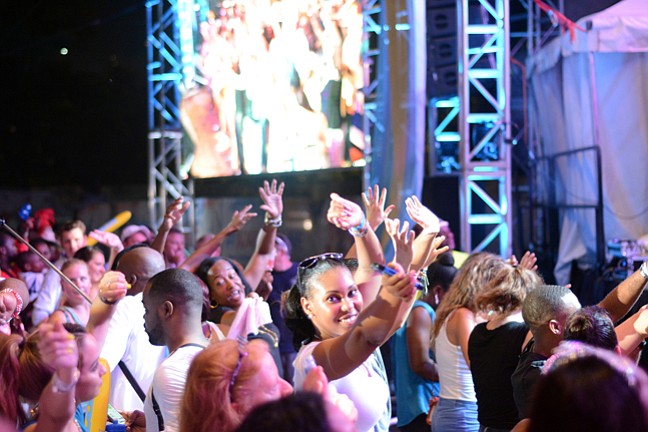
  • Fostering genius … at last – The Bahamas has been notorious for their policies advocating egalitarianism. The concept of Carnival requiring artists to compete for top prizes is 100% divergent from that ideal. Yet, this approach of fostering the musical genius in the country is essential for growing the regional/national economy. We must “hitch our wagons” to the strong, talented and gifted “horses”, as was the case for Bob Marley. See Photos here of the Bahamian Headliner and also of one of the Junkanoo Carnival “Music Masters” event finalist; see Appendix A – VIDEO below. Go Lean calls for formal institutions to develop and monetize musical genius in the region.


CU Blog - Post-Mortem of Junkanoo Carnival - Photo 2

CU Blog - Post-Mortem of Junkanoo Carnival - Photo 4

  • Carnival is a Stimulus (GDP) not an investment (no ROI)Gross Domestic Product is calculated as C + I + G + (X – M) or private consumption + gross investment + government spending + (exports − imports). So the Bahamas government spending $9 million to facilitate the inaugural Carnival did stimulate additional economic activity; (actual results still spending). The foregoing article quotes a $50 to $60 million impact on GDP. This is highly possible based on this formula. Go Lean plans many economic stimuli from Events.
  • Mass attendance is assured – but monetizing is the challenge – Other news reports reflect that vendors and merchants did not get the final returns they had hoped. The Go Lean roadmap calls for the embrace of fairgrounds so as to better monetize event revenues; think parking, hospitality tents, campgrounds (RV’s).
  • Main Street not fully engaged – Bigger Carnival events (Rio de Janeiro, New Orleans, etc.) are successful for their inclusion of floats and trinkets thrown to spectators. The embrace of this strategy would allow Main Street businesses or NGO’s direct participation with sponsorship, advertising and float construction. The Go Lean roadmap seeks to create 2.2 million new jobs in the region by embedding large, medium, small businesses and NGO’s in the development of trade and commerce.
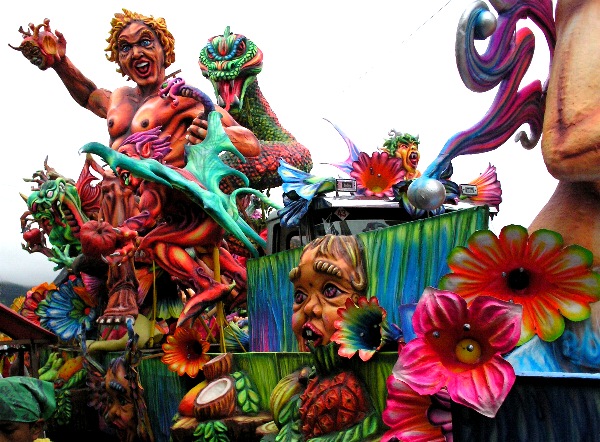
CU Blog - Post-Mortem of Junkanoo Carnival - Photo 7 Sample Float from Rio De Janeiro, Brazil
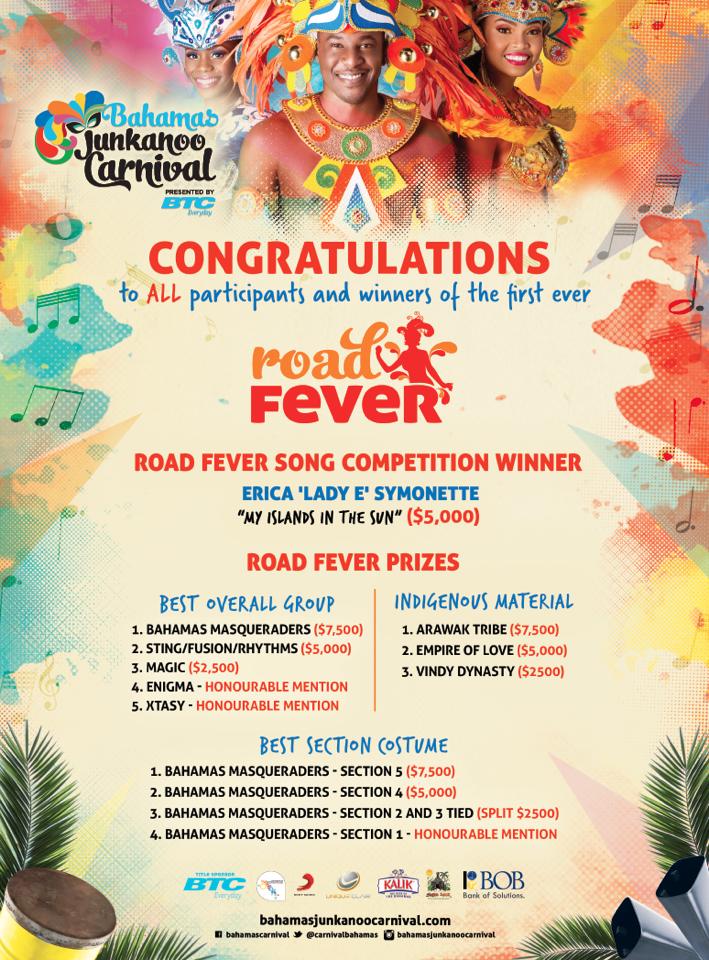
CU Blog - Post-Mortem of Junkanoo Carnival - Photo 6 Bahamas Carnival’s “Road Fever” Winners

  • Carnival and religion do not make good dance partners – Carnival, by its very nature and history is not a religious event. It does not attempt to honor or worship the Christian God; therefore there should be no attempt to reconcile the two; see Photo here. The Bahamas event avoided planning Sunday activities as an acquiescence to religious leaders; thus missing out on prime weekend availability for visitors and locals alike. The Go Lean roadmap promotes a religiously neutral technocracy – better!

CU Blog - Post-Mortem of Junkanoo Carnival - Photo 3

  • Need an earlier date for Snow-birds and Spring-breakers – A typical Carnival pre-Ash Wednesday date would have been February, ideal for extensive outdoor activities in the Bahamian Heat. On the other hand, the 2nd weekend in May is virtually summer and therefore dis-inviting for northern visitors – the classic tourist market. The previous commentary had identified that the Bahamas does not have a Lenten ethos, so a March date would be better all-around for better weather, plus an appeal to Snow-birds and Spring-breakers. The Go Lean roadmap focuses on technocracy not religion.

The Go Lean book prescribes events/festivals as paramount in the roadmap to elevate the regional economy (Page 191). There are many ways for the lessons learned in this year’s inaugural Junkanoo Carnival to be better applied in the execution of the roadmap for the Bahamas and the rest of the Caribbean. There are dimensions of these type of events that hadn’t even been experienced by the region … as of yet, namely security. No “bad actors” have emerged to exploit the event for terroristic activities. Yet the Go Lean roadmap fully anticipates this reality. These are among the many strategies, tactics, implementation and advocacies for best-practices:

Community Ethos – People Respond to Incentives Page 23
Community Ethos – Return on Investments Page 24
Community Ethos – Cooperatives Page 25
Community Ethos – Non Government Organization Page 25
Ways to Impact the Future Page 26
Ways to Foster Genius – Performance Excellence Page 27
Ways to Improve Sharing Page 35
Ways to Promote Happiness Page 36
Ways to Impact the Greater Good Page 37
Strategy – Customers – Business Community Page 47
Strategy – Customers – Visitors / Tourists Page 47
Strategy – Competitors – Event Patrons Page 55
Separation of Powers – Emergency Mgmt. Page 76
Separation of Powers – Tourism Promotion Page 78
Separation of Powers – Sports & Culture Page 81
Separation of Powers – Fairgrounds Administration Page 83
Separation of Powers – Turnpike Operations Page 84
Steps to Implement Self-Governing Entities Page 105
Ways to Foster Cooperatives Page 176
Ways to Improve Intelligence Gathering & Analysis – Surveillance Page 182
Ways to Improve [Service] Animal Husbandry – For Event Security Page 185
Ways to Enhance Tourism Page 190
Ways to Impact Events Page 191
Ways to Promote Fairgrounds Page 192
Ways to Impact Hollywood – Media Industry Page 203
Ways to Preserve Caribbean Heritage Page 218
Ways to Improve the Arts Page 230
Ways to Promote Music Page 231
Appendix – Event Model: Sturgis 10-Day Festival Page 288

The publishers of the Go Lean roadmap applaud the current Bahamian Government officials for their commitment to fully commit to this Event Tourism strategy for future growth. This administration is hereby urged to lean-in to the Go Lean roadmap for clear directions (turn-by-turn) on how best to elevate Bahamian society to being a better place to live, work and play. In fact, the entire Caribbean region is hereby urged to lean into this roadmap.

The success of this roadmap is conceivable, believable and achievable.

Caribbean events are promotions of our unique culture to a world-wide stage; yet they can fortify economic efficiency as well.

So the world is watching…

See how the world marks the manner of our bearing – verse from Bahamas National Anthem.

🙂

Download the book Go Lean … Caribbean – now!

———–

Appendix A – VIDEO: Bahamas Carnival (Junkanoo Carnival) by Sonovia Pierre – https://youtu.be/5OyhOTBDFAA

Published on Dec 15, 2014 – Singer and songwriter Sonovia Pierre, affectionately called Novie, was destined to have an interesting musical life.  She holds a Bachelorʼs of Arts in Music Education from Florida Atlantic University. In 1990 she joined one of the most successful Bahamian bands, Visage as a lead vocalist. She has written and recorded several songs on five of the group’s albums and has collaborated with several other leading Bahamian artists. She is widely known for her hit songs including, “Still need a man” and “Man bad, woman bad”.

License: Standard YouTube License

———-

Appendix B – Caribbean Carnivals  – (Source: http://en.wikipedia.org/wiki/Caribbean_Carnival)

Approximate dates are given for the concluding festivities. Carnival season may last for over a month prior to the concluding festivities, and the exact dates vary from year to year [depending on the Judeo-Christian Passover/Easter calendar].

  • Anguilla – Anguilla Summer Festival, early August[1]
  • Antigua and Barbuda
  • Aruba – Carnival, February, Ash Wednesday[4]
  • The Bahamas – Junkanoo, late December/early January[5]; first Junkanoo Carnival inaugurated in May 2015.[63]
  • Barbados – Crop Over, early August[6]
  • Belize – Carnival, September[7]
  • Bonaire – Carnival, February Ash Wednesday[8]
  • British Virgin Islands
    • Tortola – BVI Emancipation (August) Festival, early August[9]
    • Virgin Gorda – Virgin Gorda Easter Festival Celebrations, late March/early April[10]
  • Cayman Islands – Batabano, late April/early May[11]
  • Cuba
  • Curaçao – Carnival, February, Ash Wednesday[14]
  • Dominica – Carnival, February, Ash Wednesday[15]
  • Dominican Republic – Dominican Carnival, February, Dominican Independence Day[16]
  • Grenada
    • Carriacou – Carriacou Carnival, February, Ash Wednesday[17]
    • Grenada – Spicemas, early August[18]
  • Guadeloupe – Carnaval – February, Ash Wednesday[19]
  • Guyana – Mashramani (Mash), February 23, Guyanese Republic Day[20]
  • Haiti – Kanaval, February, Ash Wednesday[21]
  • Jamaica – Bacchanal, late March/early April[22]
  • Martinique – Carnival, February, Ash Wednesday[23]
  • Montserrat – Montserrat Festival, early January, New Year’s Day[24]
  • Puerto Rico – Carnaval de Ponce, February, Ash Wednesday[25]
  • Saba – Saba Summer Festival, late July/early August[26]
  • Saint-Barthélemy – Carnival, February, Ash Wednesday[27]
  • Saint Lucia – Carnival, July[28]
  • Saint Kitts and Nevis
    • Saint Kitts – Carnival, December/January[29]
    • Nevis – Culturama, late July/early August[30]
  • Saint-Martin – Carnival, February, Ash Wednesday[31]
  • Saint Vincent and the Grenadines – Vincy Mas, late June/early July[32]
  • Saint Eustatius – Statia Carnival, late July/early August[33]
  • Sint Maarten – Carnival, late April/early May[34]
  • Trinidad and Tobago
    • Trinidad – Carnival, February, Ash Wednesday[35]
    • Tobago – Tobago Carnival, February, Ash Wednesday[36]
  • Turks and Caicos – Junkanoo, late December/early January, Three King’s Day[37]
  • United States Virgin Islands
    • Saint Croix – Crucian Festival, late December/early January Three King’s Day[38]
    • Saint John – St. John Festival, June through July 3 & 4, V.I. Emancipation Day and U.S. Independence Day[39]
    • Saint Thomas – V.I. Carnival, April through early May[40]
 

Share this post:
, , , ,

ENCORE: French Caribbean ready for the Martinique Surf Pro

This Go Lean blog-commentary from April 14, 2015 is re-distributed on this occasion of the Second Annual Martinique Surf Pro. Here is the announcement:

After a successful first edition in 2015, the Martinique Surf Pro, a men’s QS3,000 event, will return this season to the idyllic French West Indies island of Martinique from April 17-24, 2016.

The epic first installment unfolded last year in quality surf and brought surfers from all corners of the world. Ultimately, Hawaiian up-and-comer Joshua Moniz (HAW), 19, won the event.
Source: http://www.worldsurfleague.com/posts/181916/french-caribbean-readies-for-second-martinique-surf-pro

Consider the VIDEO highlights from Day 1 of this year’s event.

————–

Go Lean Commentary
Sports could be big business; culture is big business. Every now-and-then there is the opportunity to merge sports and culture into a single economic activity. One such expression is the sports/culture of surfing. This focus is a priority for the movement to elevate the Caribbean society, stemming from the book Go Lean…Caribbean.

The book serves as a roadmap for the introduction and implementation of the technocratic Caribbean Union Trade Federation (CU). While the CU is not intended as a sports promotion entity, it does promote the important role of sports in the quest to make the Caribbean a better place to live, work and play.

Though surfing activities originated with Polynesian culture (see Appendix below), the sport has assimilated well in other societies – the Caribbean included.

In terms of cultural expressions of surfing in the United States, the most iconic portrayal is the Rock-n-Roll group the Beach Boys; see VIDEO in the Appendix below of a milestone performance in Tokyo, Japan.

Yes surfing is global in it participation and appreciation.

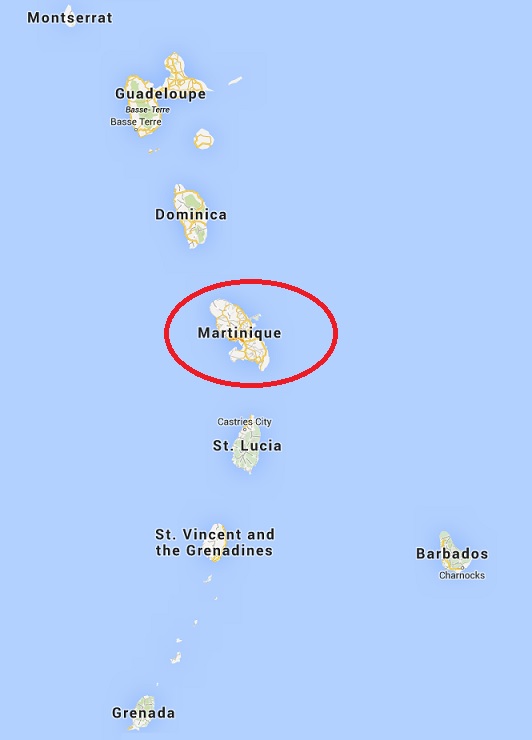
Now a Caribbean community, the French-domain of Martinique is exploring the surfing sub-culture for sport, tourism and sports-tourism.

Cowabonga* Dude!

By: The Caribbean Journal staff

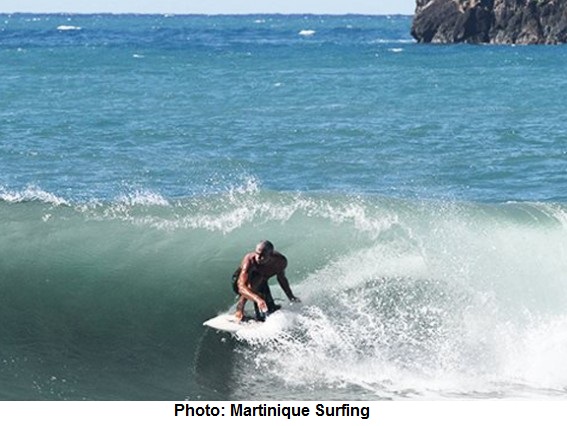
Long an under-the-radar surfing spot, the French Caribbean island will get its place in the spotlight when the surfing world gathers on the island later this month for the first-ever Martinique Surf Pro.

From April 21-26, the Caribbean’s only World Surf League Qualification Series event this year will take place along the shores of Basse-Pointe in Martinique.

The event, which is being organized by Martinique Surfing in partnership with the World Surf League, will bring together 100 world-class surfers from the United States, Japan, Europe, Brazil and the Caribbean.

“Martinique has been among the best-kept secrets in Caribbean surfing for some time now,” said Muriel Wiltord, director of the Americas for the Martinique Promotion Bureau. “Such a high-profile event as this cements the island’s position as a prime surfing destination. As one the top watersports competitions being held in the Caribbean in 2015, Martinique Surf Pro also shines a spotlight on the wide range of additional watersports options that Martinique has to offer.”

Martinique’s surfing season typically lasts between November and May along its northern and northeastern Atlantic coasts.

Source retrieved April 13, 2015: http://www.caribjournal.com/2015/04/13/is-martinique-the-next-caribbean-surfing-capital/

CU Blog - Is Martinique the next big Caribbean surfing capital - Photo 2

CU Blog - Is Martinique the next big Caribbean surfing capital - Photo 3

CU Blog - Is Martinique the next big Caribbean surfing capital - Photo 1

Not every coastline is ideal for surfing; thusly many Caribbean residents do not surf; it is not an indigenous activity to this region. But the past-time – and culture for that matter – is adaptable. Why is this? While the Caribbean has been blessed with many natural gifts, the physical conditions for surfing are not everywhere; (based on factual information retrieved from Wikipedia).

There must be a consistent swell. A swell is generated when wind blows consistently over a large area of open water, called the wind’s fetch. The size of a swell is determined by the strength of the wind and the length of its fetch and duration. Because of this, surf tends to be larger and more prevalent on coastlines exposed to large expanses of ocean traversed by intense low pressure systems.

Local wind conditions affect wave quality, since the surface of a wave can become choppy in blustery conditions. Ideal conditions include a light to moderate “offshore” wind, because it blows into the front of the wave, making it a “barrel” or “tube” wave. Waves are Left handed and Right Handed depending upon the breaking formation of the wave.

Waves are generally recognized by the surfaces over which they break.[7] For example, there are Beach breaks, Reef breaks and Point breaks.

The most important influence on wave shape is the topography of the seabed directly behind and immediately beneath the breaking wave. The contours of the reef or bar front becomes stretched by diffraction. Each break is different, since each location’s underwater topography is unique. At beach breaks, sandbanks change shape from week to week. Surf forecasting is aided by advances in information technology. Mathematical modeling graphically depicts the size and direction of swells around the globe.

So mastering the sport of surfing is now an art and a science.

Despite the fun and joy of surfing, there are a lot of dangers with this activity:

This activity is not for the faint of heart.

Not every market, especially in the Caribbean, can support the demands of surfing as a sport and as a cultural event. As depicted in the foregoing article, Martinique uniquely qualifies. This year’s professional tournament is the inaugural event. This Caribbean island makes a very short-list of all locations where this activity is practical. The following is a sample of the competitive/major surfing locations (Surf Cities) around the globe:

1. In Australia

2. In Asia

3. In the South Pacific

4. In South Africa

5. In North America

6. In Central America

7. In South America

8. In the USA

9. In Europe

The Martinique effort and initiative to satiate the thirst … and fascination of surfing aligns with the objects of the CU/Go Lean roadmap; especially the mission “to forge industries and economic drivers around the individual and group activities of sports and culture” (Page 81).

The Go Lean vision is a confederation of the 30 member-states of the Caribbean forming the CU as a proxy organization to do the heavy-lighting of building, funding, maintaining and promoting sports venues. The strategy is for the CU to be the landlord, and super-regional regulatory agency, for sports leagues, federations and associations (amateur, collegiate, and professional). The embrace and promotion of the sport and culture of surfing can contribute to the Greater Good for the Caribbean. This aligns with the prime directives of the CU/Go Lean roadmap; summarized in the book with these 3 statements:

  • Optimization of the economic engines in order to grow the regional economy to $800 Billion & create 2.2 million new jobs.
  • Establishment of a security apparatus to protect the resultant economic engines and the participants in activities like surfing.
  • Improvement of Caribbean governance to support these engines.

This roadmap commences with the recognition that genius qualifiers can be found in many fields of endeavor, including sports. The roadmap pronounces the need for the region to confederate in order to invest in elevation of the Caribbean eco-systems in which such athletic geniuses can soar. These pronouncements are made in the opening Declaration of Interdependence, (Pages 13 & 14) as follows:

xxi. Whereas the preparation of our labor force can foster opportunities and dictate economic progress for current and future generations, the Federation must ensure that educational and job training opportunities are fully optimized for all residents of all member-states, with no partiality towards any gender or ethnic group. The Federation must recognize and facilitate excellence in many different fields of endeavor, including sciences, languages, arts, music and sports. This responsibility should be executed without incurring the risks of further human flight, as has been the past history.

xxii. Whereas sports have been a source of great pride for the Caribbean region, the economic returns from these ventures have not been evenly distributed as in other societies. The Federation must therefore facilitate the eco-systems and vertical industries of sports as a business, recreation, national pastime and even sports tourism – modeling the Olympics.

The Go Lean book and accompanying blogs declare that the Caribbean needs to learn lessons from Surf City communities and other sporting venues/administrations. So thusly this subject of the “business of sports” is a familiar topic for Go Lean blogs. This cause was detailed in these previous blogs:

https://goleancaribbean.com/blog/?p=6464 NEW: WWE Network – Model for Caribbean
https://goleancaribbean.com/blog/?p=4019 Melding of Sports & Technology; the Business of the Super Bowl
https://goleancaribbean.com/blog/?p=3414 Levi’s® Stadium: A Team Effort
https://goleancaribbean.com/blog/?p=3244 Sports Role Model – espnW
https://goleancaribbean.com/blog/?p=2222 Sports Role Model – Playing For Pride … And More
https://goleancaribbean.com/blog/?p=2171 Sports Role Model – Turn On the SEC Network
https://goleancaribbean.com/blog/?p=2152 Sports Role Model – US versus the World
https://goleancaribbean.com/blog/?p=1715 Lebronomy – Economic Impact of the Return of the NBA Great
https://goleancaribbean.com/blog/?p=1446 Caribbean Players in the 2014 World Cup
https://goleancaribbean.com/blog/?p=1341 College World Series Time – Lessons from Omaha
https://goleancaribbean.com/blog/?p=1214 Landlord of Temporary Stadiums
https://goleancaribbean.com/blog/?p=1148 Sports Bubble – Franchise values in basketball
https://goleancaribbean.com/blog/?p=1020 Sports Revolutionary: Advocate Jeffrey Webb
https://goleancaribbean.com/blog/?p=498 Book Review: ‘The Sports Gene’
https://goleancaribbean.com/blog/?p=318 Collegiate Sports in the Caribbean
https://goleancaribbean.com/blog/?p=60 Could the Caribbean Host the Olympic Games?

This Go Lean roadmap is committed to availing the economic opportunities of all the Caribbean sports eco-system to respond to the world’s thirst for surfing. The book details the series of community ethos, strategies, tactics, implementations and advocacies to deliver the regional solutions to better harness economic benefits from sports and sports-tourism activities:

Community Ethos – People Respond to Incentives in Predictable Ways Page 21
Community Ethos – Consequences of Choices Lie in the Future Page 21
Community Ethos – Lean Operations Page 24
Community Ethos – Return on Investments Page 25
Community Ethos – Ways to Foster Genius Page 27
Community Ethos – Ways to Impact the Greater Good Page 37
Strategic – Staffing – Sporting Events at Fairgrounds Page 55
Tactical – Fostering a Technocracy Page 64
Tactical – Separation of Powers – Sports & Culture Administration Page 81
Tactical – Separation of Powers – Fairgrounds Administration Page 83
Implementation – Steps to Implement Self-Governing Entities Page 105
Implementation – Ways to Deliver Page 109
Planning – Ways to Make the Caribbean Better Page 131
Advocacy – Ways to Grow the Economy Page 151
Advocacy – Ways to Create Jobs Page 152
Advocacy – Ways to Improve Local Government – Parks & Recreation Page 169
Advocacy – Ways to Impact Public Works Page 175
Advocacy – Ways to Impact Events Page 191
Advocacy – Ways to Promote Fairgrounds as Sporting Venues Page 192
Advocacy – Ways to Preserve Caribbean Heritage Page 218
Advocacy – Ways to Improve Sports Page 229
Advocacy – Ways to Impact Urban Living – Sports Leagues Page 234

What could be the end result for the Go Lean roadmap’s venture into the sport of surfing and the business of sports? Economic growth and “jobs”. The Go Lean roadmap anticipates 21,000 direct jobs at sports enterprises throughout the region.

But surfing is also a leisure amenity, a “play” activity within the Go Lean roadmap. Many participate in this activity with no competitive motives. So the promotion of surfing in the Caribbean region can appeal to many enthusiasts far-and-wide to come visit and enjoy our Caribbean hospitality. This subject therefore relates back to the primary regional economic activity of tourism. This fits into the appeal of the Caribbean sun, sand and surf.

Overall, with these executions, the Caribbean region can be a better place to live, work and play. There is a lot of economic activity in the “play” aspects of society. Everyone, surfers, athletes and spectators alike, are hereby urged to lean-in to this Go Lean roadmap.

Cowabonga Dudes!

Download the book Go Lean … Caribbean – now!

———-

Appendix – *Cowabunga: (slang) an expression of surprise or amazement, often followed by “dude”. Popular among California surfers.

———-

Appendix – Encyclopedia of Surfing:

For centuries, surfing was a central part of ancient Polynesian culture. This activity was first observed by Europeans at Tahiti in 1767 by Samuel Wallis and the crew members of the Dolphin; they were the first Europeans to visit the island in June of that year.

Surfing is a surface water sport in which the wave rider, referred to as a surfer, rides on the forward or deep face of a moving wave, which is usually carrying the surfer toward the shore. Waves suitable for surfing are primarily found in the ocean, but can also be found in lakes or in rivers in the form of a standing wave or tidal bore. However, surfers can also utilize artificial waves such as those from boat wakes and the waves created in artificial wave pools.

The term surfing refers to the act of riding a wave, regardless of whether the wave is ridden with a board or without a board, and regardless of the stance used. The native peoples of the Pacific, for instance, surfed waves on alaia, paipo, and other such craft, and did so on their belly and knees. The modern-day definition of surfing, however, most often refers to a surfer riding a wave standing up on a surfboard; this is also referred to as stand-up surfing.

George Freeth (8 November 1883 – 7 April 1919) is often credited as being the “Father of Modern Surfing”.

In 1907, the eclectic interests of the land baron Henry Huntington (of whom the City of Huntington Beach is named after) brought the ancient art of surfing to the California coast. While on vacation, Huntington had seen Hawaiian boys surfing the island waves. Looking for a way to entice visitors to the area of Redondo Beach, where he had heavily invested in real estate, he hired the young Hawaiian George Freeth to come to California and ride surfboards to the delight of visitors; Mr. Freeth exhibited his surfing skills twice a day in front of the Hotel Redondo.

In 1975, professional contests started.[6]

Today, the Surfing Hall of Fame is located in the city of Huntington Beach, California. The city brands itself as Surf City USA.

(Source retrieved April 14 from: http://en.wikipedia.org/wiki/Surfing)

———-

AppendixVIDEO – The Beach Boys: Surfin’ Safari~Surf City~Surfin’ U.S.A – https://youtu.be/qpSwdQMn8xs

Uploaded on Jul 29, 2011 – Live at Budokan in Japan November 2, 1991

Share this post:
, , , , ,
[Top]

‘A Change Is Gonna Come’

Go Lean Commentary

There is a lot we can learn from the Chinese …

… there is a Chinese proverb: “Make happy those who are near, and those who are far will come”.

- Photo 2

This ancient expression is like saying “Love yourself first and others will love you”. Looking at it from a different point of view: “if you treat your friends like crap, you will stand alone without a friend, but if you treat your friends with kindness, you will make more friends”.

The Caribbean needs more friends … and to treat its stakeholders (residents, Diaspora, visitors, trading partners, etc.) better.

Can we get the Caribbean region to effect this change?

One way or another: “A Change Is Gonna Come”!

Either we change proactively, or reactively. The only constant is change itself.

This was the theme of a powerful song by legendary R&B singer Sam Cooke in 1964. See the song-VIDEO here:

AUDIO-VIDEO – Sam Cooke – A Change Is Gonna Come (Official Lyric Video)https://youtu.be/wEBlaMOmKV4

Published on Jan 22, 2016 – Lyric Video for “A Change Is Gonna Come” performed by Sam Cooke.
Directed & Produced by: Robin Klein, Mick Gochanour, Hector Sanitizo
Video Editor: Andre Murrugarra  (C) 2016 ABKCO Music & Records, Inc.
Download or stream the single below:
iTunes: https://itunes.apple.com/us/album/por
Google: https://play.google.com/store/music/a
Amazon: http://www.amazon.com/Portrait-Legend
Stream On Spotify: https://open.spotify.com/track/1WMUes

- Photo 1Lyrics:
I was born by the river in a little tent
Oh, and just like the river I’ve been a-runnin’ ever since.
It’s been a long, a long time comin’,
but I know, oh-oo-oh,
a change gon’ come, oh yes, it will.

It’s been too hard living but I’m afraid to die
‘Cause I don’t know what’s up there beyond the sky
It’s been a long, a long time comin’,
But I know, oh-oo-oh,
A change gonna come, oh yes, it will.

I go to the movie and I go downtown
Somebody keep tellin’ me don’t hang around.
It’s been a long, a long time coming, but I know, oh-oo-oh,
A change gon’ come, oh yes, it will.

Then I go, oh-oo-oh, to my brother and I say, brother, help me please.
But he winds up knocking me back down on my knees, oh.

There’ve been times that I thought I couldn’t last for long
But now I think I’m able to carry on
It’s been a long, a long time comin’,
But I know, oh-oo-oh, a change gonna come, oh yes, it will.

Music video by Sam Cooke performing A Change Is Gonna Come. (C) 2016 ABKCO Music & Records, Inc.
http://vevo.ly/nTXKoJ
Category: Music
License: Standard YouTube License

There is a lot more “story” to this story about this song. See here:

AUDIO – NPR’s Fresh Air: Sam Cooke And The Song That ‘Almost Scared Him’ – http://www.npr.org/2014/02/01/268995033/sam-cooke-and-the-song-that-almost-scared-him

Published February 1, 2014 – The story of “A Change Is Gonna Come’ is as amazing, and unsettling, as the song itself.

The foregoing song is gravely serious – no one dances to it – but it does convey the emotion that change is hard sprung, yet necessary. From an American perspective, perhaps that change did come … in 2008 with the “ribbon on the package” of the Civil Rights movement being the election of Barack Obama as the first Black Man as President of the United States. This was a big, shocking and pivotal moment.

The Caribbean needs big, shocking and pivotal moments of its own. We need change and a turn-around; we need to do better in making our people happy so that those far off will come … to us as well. Those far off will include tourists and our Diaspora: reaching more sources of tourist visitors, and facilitating the return of so many Caribbean exiles.

These missions (tourism and repatriation) are familiar themes for the publishers of the book Go Lean…Caribbean.

The book serves as a roadmap for the introduction and implementation of the Caribbean Union Trade Federation (CU); an initiative to bring change and empowerment to the Caribbean region; to make the region a better place to live, work and play. This Go Lean roadmap has these 3 prime directives:

  • Optimization of the economic engines in order to grow the regional economy to $800 Billion & create 2.2 million new jobs.
  • Establishment of a security apparatus to ensure public safety for all Caribbean stakeholders and protect the resultant economic engines.
  • Improve Caribbean governance to support these engines.

Of the 144 different missions presented in the Go Lean book, a number of them are presented specifically to address the issues raised in this commentary. This is part of the technocratic shepherding designed for the CU, to elevate the Caribbean homeland, by this roadmap in these two areas: 1. Tourism and 2. Repatriation.

1. Tourism

The underlying goals for this industrial occupation are stated early in the Go Lean book with these pronouncements in the opening Declaration of Interdependence (Pages 11 & 14):

iii.  Whereas the natural formation of the landmass for our society is that of an archipelago of islands, inherent to this nature is the limitation of terrain and the natural resources there in. We must therefore provide “new guards” and protections to ensure the efficient and effective management of these resources.

iv.  Whereas the natural formation of the landmass is in a tropical region, the flora and fauna allows for an inherent beauty that is enviable to peoples near and far. The structures must be strenuously guarded to protect and promote sustainable systems of commerce paramount to this reality.

v.   Whereas the natural formation of our landmass and coastlines entail a large portion of waterscapes, the reality of management of our interior calls for extended oversight of the waterways between the islands. The internationally accepted 12-mile limits for national borders must be extended by International Tribunals to encompass the areas in between islands. The individual states must maintain their 12-mile borders while the sovereignty of this expanded area, the Exclusive Economic Zone, must be vested in the accedence of this Federation.

xxvi. Whereas the Caribbean region must have new jobs to empower the engines of the economy and create the income sources for prosperity, and encourage the next generation to forge their dreams right at home, the Federation must therefore invigorate the enterprises related to existing industries like tourism … – impacting the region with more jobs.

That publication stressed creative marketing for better tourism outreach, featuring highlights such the following strategies, tactics, implementations and advocacies:

Strategy – Vision – Integrate Region in a Single Market Page 45
Strategy – Mission – Build and Foster Local Economic Engines Page 45
Strategy – Mission – Exploit the Benefits of Globalization in Trade-Tourism Page 46
Tactical – Fostering a Technocracy Page 64
Tactical – Growing the Economy to $800 Billion – Trade and Globalization Page 70
Tactical – Website www.myCaribbean.gov for Caribbean stakeholders – Tourists Page 74
Tactical – Separation of Powers – Tourism Promotions and Administration Page 78
Implementation – Integrate All Caribbean Websites to www.myCaribbean.gov Portal Page 97
Implementation – Ways to Deliver – Agile / Lean / Quality Assurances Page 109
Implementation – Ways to Impact Social Media – www.myCaribbean.gov Portal Page 111
Planning – 10 Big Ideas – Cyber Caribbean Page 127
Planning – Ways to Make the Caribbean Better – VIP’s for Events and Cultural Festivals Page 131
Planning – Ways to Better Manage Image – Digital Media Presence Page 133
Planning – Lessons Learned from 2008 – Tourism & Economy Went Bust Page 136
Planning – Lessons Learned from Egypt – Lack of Tourism Stewardship Page 143
Advocacy – Ways to Measure Progress – Mining www.myCaribbean.gov Portal Data Page 147
Advocacy – Ways to Foster Cooperatives – Purchasing Cooperatives for TV Ads Page 176
Advocacy – Ways to Improve Communications – Internet & Social Media Marketing Page 186
Advocacy – Ways to Enhance Tourism – Excess Inventory Marketing Page 190
Advocacy – Ways to Impact Events – Sharing Economy Page 191
Advocacy – Ways to Market Southern California – Example of Exploiting a Specific Market Page 194
Advocacy – Ways to Foster Technology – Economies-of-Scale for Centers of Excellence Page 197
Advocacy – Ways to Foster e-Commerce – Global Outreach via Social Media Page 198
Advocacy – Ways to Preserve Caribbean Heritage – Cyber-Caribbean Image/Media Page 218

Other blog/commentaries stressed related issues and details for optimizing the tourism product. The following sample applies:

https://goleancaribbean.com/blog/?p=7449 Assurances to Restore Tourism After Catastrophes
https://goleancaribbean.com/blog/?p=7327 Zika Virus: How to Mitigate the Effects on Tourism
https://goleancaribbean.com/blog/?p=6921 Live. Work. Play. Repeat.
https://goleancaribbean.com/blog/?p=6680 Casino Industry Placing Bets on Video Games
https://goleancaribbean.com/blog/?p=6385 Protecting Tourists from Wi-Fi Hot Spots Run By Hackers
https://goleancaribbean.com/blog/?p=6341 Tourism Stewardship — What’s Next?
https://goleancaribbean.com/blog/?p=5210 Cruise Ship Commerce – Getting Ready for Change
https://goleancaribbean.com/blog/?p=4639 Tobago: A Model for Cruise Tourism
https://goleancaribbean.com/blog/?p=3225 The need to optimize Caribbean aviation policies
https://goleancaribbean.com/blog/?p=2571 Internet Commerce meets Sharing Economy: Airbnb
https://goleancaribbean.com/blog/?p=1984 Casinos Failing Business Model within Tourism
https://goleancaribbean.com/blog/?p=1943 The Future of Golf; Vital for Tourism
https://goleancaribbean.com/blog/?p=273 10 Things We Want from the US – # 2: Tourists
https://goleancaribbean.com/blog/?p=254 The need to enhance Tourism with “Air Lifts”
https://goleancaribbean.com/blog/?p=235 Tourism’s changing profile

2. Repatriation

In addition to tourism, the proverb – “Make happy those who are near, and those who are far will come” – speaks to the goal of repatriating the Caribbean Diaspora that has scattered far and wide. The theme of inviting their return and/or incentivizing their repatriation to the homeland has been prominent for this Go Lean movement. There is the direct reference in the book (Page 118) and many related blog/commentaries (see list below). This underlying goal / mission was stated early in the book with these pronouncements in the opening Declaration of Interdependence (Page 12 & 13):

xiii. Whereas the legacy of dissensions in many member-states (for example: Haiti and Cuba) will require a concerted effort to integrate the exile community’s repatriation, the Federation must arrange for Reconciliation Commissions to satiate a demand for justice.

xix. Whereas our legacy in recent times is one of societal abandonment, it is imperative that incentives and encouragements be put in place to first dissuade the human flight, and then entice and welcome the return of our Diaspora back to our shores. This repatriation should be effected with the appropriate guards so as not to imperil the lives and securities of the repatriated citizens or the communities they inhabit. The right of repatriation is to be extended to any natural born citizens despite any previous naturalization to foreign sovereignties.

xx.  Whereas the results of our decades of migration created a vibrant Diaspora in foreign lands, the Federation must organize interactions with this population into structured markets. Thus allowing foreign consumption of domestic products, services and media, which is a positive trade impact. These economic activities must not be exploited by others’ profiteering but rather harnessed by Federation resources for efficient repatriations.

Change must come to the Caribbean; especially to attract and recruit repatriates. There are real obstacles that the region must overcome: the poor performing economy and the threats to public safety. So the prime directives of the Go Lean/CU roadmap is to elevate Caribbean society and all of its societal engines. The success of our movement should be publicized and messaged throughout the world. After all…

… the Caribbean is the greatest address on the planet… arguably. This claim is not just made based on terrain, but also culture (music, food, festivals and fun). If/when we fix the societal defects, the native sons (and daughters) living in the Diaspora should beat a path to come home.

With confidence we can declare: “A Change Is Gonna Come”!

But this time, the change must be permanent! The Go Lean book declares that for permanent change to take place, there must first be an adoption of new community ethos, the national spirit that drives the character and identity of its people. The roadmap was constructed with the following community ethos in mind, plus the execution of strategies, tactics, implementation and advocacies to invite and incentivize the Diaspora to return. The following is a sample of these specific details from the book:

Community Ethos – Deferred Gratification Page 21
Community Ethos – Economic Principles – People Choose Page 21
Community Ethos – Economic Principles – All Choices Involve Costs Page 21
Community Ethos – Economic Principles – People Respond to Incentives in Predictable Ways Page 21
Community Ethos – Economic Principles – Economic Systems Influence Individual Choices Page 21
Community Ethos – Economic Principles – The Consequences of Choices Lie in the Future Page 21
Community Ethos – Security   Principles – Anti-Bullying and Mitigation Page 23
Community Ethos – Governing Principles – Minority Equalization Page 24
Community Ethos – Governing Principles – Lean Operations Page 24
Community Ethos – Ways to Impact the Future Page 26
Community Ethos – Ways to Foster Genius Page 27
Community Ethos – Ways to Help Entrepreneurship – Incubators Page 28
Community Ethos – Ways to Promote Intellectual Property Page 29
Community Ethos – Ways to   Impact Research & Development Page 30
Community Ethos – Ways to Manage Reconciliations Page 34
Community Ethos – Ways to Improve Sharing Page 35
Community Ethos – Ways to Promote Happiness Page 36
Community Ethos – Ways to Impact the Greater Good Page 37
Anecdote – LCD versus an Entrepreneurial Ethos Page 39
Strategy – Mission – Celebrate the Music, Sports, Art, People and Culture of the Caribbean Page 46
Tactical – Confederating a Permanent Union Page 63
Tactical –  Separation of Powers: Federal Administration versus Member-States Governance Page 71
Implementation – Ways to Pay for Change Page 101
Planning – Ways to Make the Caribbean Better – Live, Work and Play Empowerments Page 131
Planning – Ways to Better Manage Image Page 133
Advocacy – Ways to Grow the Economy Page 151
Advocacy – Ways to Create Jobs Page 152
Advocacy – Ways to Improve Governance in the Caribbean Region Page 168
Advocacy – Ways to Better Manage the Social Contract Page 170
Advocacy – Ways to Remediate and Mitigate Crime Page 178
Advocacy – Ways to Improve Communications – Improve the Messaging Page 186
Advocacy – Ways Impact the Diaspora Page 217
Advocacy – Ways to Improve the Arts Page 230
Advocacy – Ways to Promote Music Page 231
Advocacy – Ways to Improve Urban Living Page 234
Advocacy – Ways to Improve Rural Living Page 235

There have been many previous blog/commentaries that stressed issues related to repatriation. The following sample applies:

https://goleancaribbean.com/blog/?p=7412 The Road to Restoring Cuba
https://goleancaribbean.com/blog/?p=7151 The Caribbean is Looking for Heroes … ‘to Return’
https://goleancaribbean.com/blog/?p=6718 A Lesson in History – No Compromise on Human Rights
https://goleancaribbean.com/blog/?p=6247 Tragic images show refugee crisis at a tipping point in Europe
https://goleancaribbean.com/blog/?p=6016 Hotter than July – Still ‘Third World’ – The Need for Cooling …
https://goleancaribbean.com/blog/?p=5784 The Need for Human Rights/LGBT Reform in the Region
https://goleancaribbean.com/blog/?p=5695 Repenting, Forgiving and Reconciling the Past
https://goleancaribbean.com/blog/?p=4613 ‘Luck of the Irish’ – Lessons from their Past, Present and Future

Truth be told, the Caribbean is in competition with the rest of the world.

Considering the analogy of a race, we are behind, trailing our competitors. There are many empowerments that our Caribbean region needs to implement. While no society is perfect, nor fully optimized, some countries have been better than others. Many countries in North America and Western Europe have been lands of refuge for our Caribbean Diaspora. We must now fix our own broken societal engines, so as to dissuade people from leaving in the first place. Plus, many of these North American and European societies leave a lot to be desired for our Black and Brown immigrants from the Caribbean. There is heavylifting for these ones to thrive in those foreign lands. The logical conclusion: stay home in the Caribbean and work towards improving the homeland.

While we do have problems to contend with, many which we are failing at, our biggest crisis stem from the fact that so many of our citizens have fled their Caribbean homelands for foreign shores. These lands should not be the panacea of Caribbean hopes and dreams.

Based on the foregoing Chinese proverb, we can and must make people happy that are near us. Once we succeed, then others – tourists and repatriates – will come to enjoy our happier homelands.

This is easier said than done, but it is conceivable, believable and achievable!

Many of the resources (people) involved in the Go Lean/CU roadmap have done this before … else where. They know the process is to start small, optimize the engines in their neighborhoods, then widen out to a wider community, optimize the engines there, then widen out further to the whole country; again optimize the national engines and then widen out to the full region  For success, we must keep moving forward.  🙂

Download the book Go Lean … Caribbean – now!


Share this post:
, , , ,
[Top]

Brazilian Shrunken Head Babies: Zika or Tdap?

Go Lean Commentary:

CU Blog - Brazilian Shrunken Head Babies - Zika or Tdap - Photo 1“Call a spade a spade…”

… all of a sudden in 2014, Brazil signs a contract with Big Pharma to inoculate pregnant women with a TDAP booster and boom: a Microcephaly pandemic emerges.

Now “they” are banning pregnant women and all hoping to someday get pregnant from traveling to Latin America and the Caribbean…

… and this prohibition is in the middle of the Peak Winter tourist season.

Imagine the economic consequences. Imagine the public health and security consequences. Imagine the governmental complications.

This commentary urges the Caribbean to “call a spade a spade”, rather than blaming “it” all on mosquitoes. See the actual editorial article here:

Editorial Title: Brazilian Shrunken Head Babies: Zika or Tdap?

CU Blog - Zika - A 4-Letter Word - Photo 1In late 2014, the Ministry of Health of Brazil announced the introduction of the Tdap (Tetanus, diphtheria, and acellular pertussis) vaccine for all pregnant women in that country as part of its routine vaccination program. The move was aimed at trying to contain the resurgence of pertussis in Brazil.

In December 2015, the Brazilian government declared an emergency after 2,400 Brazilian babies were found to be born with shrunken heads (microcephaly) and damaged brains since October.

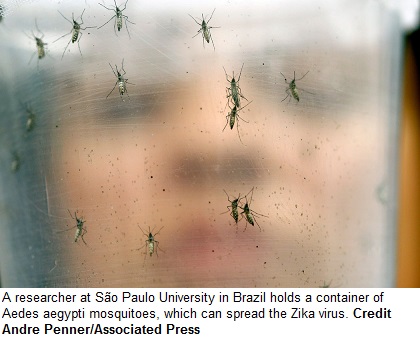
Brazilian public health officials don’t know what is causing the increase in microcephaly cases in babies born in Brazil, but they are theorizing that it may be caused by a virus known as “Zika,” which is spread by mosquitoes (Aedes aegypti)—in the same way as is the West Nile virus.

The theory is largely based on the fact that they found the Zika virus in a baby with microcephaly following an autopsy of the dead child. The virus was also found in the amniotic fluid of two mothers whose babies had the condition.

Note that Zika is not a new virus; it has been around for decades. No explanation has been given as to why suddenly it could be causing all these cases of microcephaly. No one is seriously asking the question, “What has changed?”

There is no theorizing about the possibility that the cases of microcephaly could be linked to the mandating of the Tdap vaccine for all pregnant women in Brazil about 10 months earlier. The government has “assumed” the cause is a virus.

FACT—Drug companies did not test the safety and effectiveness of giving Tdap vaccine to pregnant women before the vaccines were licensed in the U.S. and there is almost no data on inflammatory or other biological responses to this vaccine that could affect pregnancy and birth outcomes.

FACT—According to the U.S. Food and Drug Administration (FDA) adequate testing has not been done in humans to demonstrate safety for pregnant women and it is not known whether the vaccines can cause fetal harm or affect reproduction capacity. The manufacturers of the Tdap vaccine state that human toxicity and fertility studies are inadequate and warn that Tdap should “be given to a pregnant woman only if clearly needed.”

FACT—There are ingredients pertussis containing Tdap vaccine that have not been fully evaluated for potential genotoxic or other adverse effects on the human fetus developing in the womb that may negatively affect health after birth, including aluminum adjuvants, mercury containing (Thimerosal) preservatives and many more bioactive and potentially toxic ingredients.

FACT—There are serious problems with outdated testing procedures for determining the potency and toxicity of pertussis vaccines and some scientists are calling for limits to be established for specific toxin content of pertussis-containing vaccines.

FACT—There are no published biological mechanism studies that assess pre-vaccination health status and measure changes in brain and immune function and chromosomal integrity after vaccination of pregnant women or their babies developing in the womb.

FACT—Since licensure of Tdap vaccine in the U.S., there have been no well designed prospective case controlled studies comparing the health outcomes of large groups of women who get pertussis containing Tdap vaccine during pregnancy either separately or simultaneously compared to those who do not get the vaccines, and no similar health outcome comparisons of their newborns at birth or in the first year of life have been conducted. Safety and effectiveness evaluations that have been conducted are either small, retrospective, compare vaccinated women to vaccinated women or have been performed by drug company or government health officials using unpublished data.

FACTFACT—The FDA has licensed Tdap vaccines to be given once as a single dose pertussis booster shot to individuals over 10 or 11 years old. The CDC’s recommendation that doctors give every pregnant woman a Tdap vaccination during every pregnancy—regardless of whether a woman has already received one dose of Tdap—is an off-label use of the vaccine.

FACT—Injuries and deaths from pertussis-containing vaccines are the most compensated claims in the federal Vaccine Injury Compensation Program (VICP) and influenza vaccine injuries and deaths are the second most compensated claim.

FACT—A 2013 published study evaluating reports of acute disseminated encephalomyelitis (ADEM) following vaccination in the U. S. Vaccine Adverse Events Reporting System (VAERS) and in a European vaccine reaction reporting system found that pertussis containing DTaP was among the vaccines most frequently associated with brain inflammation in children between birth and age five.

Tdap is manufactured by two pharmaceutical companies: Sanofi Pasteur of France and GlaxoSmithKline (GSK) of the United Kingdom.

The Sanofi Pasteur product contains aluminum phosphate, residual formaldehyde, residual glutaraldehyde, and 2-phenoxyethanola, along with the following growth mediums and process ingredients: Stainer-Scholte medium, casamino acids, dimethyl-beta-cyclodextrin, glutaraldehyde, formaldehyde, aluminum phosphate, modified Mueller-Miller casamino acid medium without beef heart infusion, ammonium sulfate, 2-phenoxyethanol, water for injection.

The GSK product contains aluminum hydroxide, sodium chloride, residual formaldehyde, polysorbate 80 (Tween 80), along with the following growth mediums and process ingredients: modified Latham medium derived from bovine casein, Fenton medium containing bovine extract, formaldehyde, Stainer-Scholte liquid medium, glutaraldehyde, aluminum hydroxide.

Unsurprisingly, the Brazilian government announced on January 15, 2016 it will direct funds to a biomedical research center (Sao Paulo-based Butantan Institute) to help develop a vaccine against Zika. Development of the vaccine is expected to take 3-5 years. Again, no consideration to the irony that you may be developing a vaccine to address a problem that may have been CAUSED by a vaccine, and that that new vaccine may COMPOUND the problem No consideration to the possibility that the answer to the problem may not be to do MORE, but rather to do LESS (simply STOP giving Tdcap to pregnant women).

The number of cases of microcephaly in Brazil has grown to 3,530 babies, as of mid-January 2016. Fewer than 150 such cases were seen in all of 2014.

Most of the microcephaly cases have been concentrated in Brazil’s poor northeast, though cases in Rio de Janeiro and other big cities have also been on the rise, prompting people to stock up on mosquito repellent. Health officials are warning Brazilians—especially pregnant women—to stay inside when possible and wear plenty of bug spray if they have to go out.

Wanna look up the ingredients in mosquito spray? Oh, and what deadly insecticide do you reckon they’ll mass fumigate with? DDT perhaps?

(Note. Contains information pieced together—often copy and pasted—from newspaper articles and information from the NationalVaccineInformationCenter.)
Source: Anonymous Blog Entry – WordPress.com – Posted 02-04-2016; retrieved 02-08-2016 from: https://brazilianshrunkenheadbabies.wordpress.com/about/


Other Zika-related thinking to consider:

This commentary parallels with the book Go Lean … Caribbean in its quest to elevate societal life in the Caribbean. The book identifies that “bad actors” will always emerge to exploit the economic engines in the community. For the Zika virus, the “bad actor” was assumed to be mosquitoes; now it appears something more insidious is at work: This constitutes an accusation against Big Pharma. But that’s OK, this is not our first accusation and probably will not be the last. See here for previous blog/commentaries indicting Big Pharma’s cronyism:

Book Review – ‘Thimerosal: Let The Science Speak’
Judge to decide on Vaccination Amidst Autism Fears
Big Pharma & Criminalization of American Business
Climate Change May Bring More Kidney Stones
New Research and New Hope in the Fight against Alzheimer’s Disease
Health-care fraud in America; Criminals take $272 billion

These Go Lean commentaries are accusing Big Pharma of being willing to …

…Sacrifice children on the altar of corporate profits.

Yes, that is the accusation. In the case of Brazil’s Zika virus pandemic, the “bad actor” appears to be the Pharmaceutical companies and their consorts in the government’s public health agencies.

This all sounds familiar, as in the controversy with child immunizations and the public fear of a connection with Autism. Once these types of accusations are publicized, Big Pharma responds … by attacking and discrediting the accusers. So just wait: soon come the denials, defense and discrediting attacks for this allegation … any moment now.

This strategy is also consistent in the “play book” of climate change deniers and other Crony-Capitalistic enterprises (i.e. Big Tobacco).

This point is where this commentary relates to the overall plan to elevate Caribbean society: the book Go Lean…Caribbean. This book declares (Page 157) that Big Pharma may be more of an obstacle than a aid for effecting community health. They care more about profits than they do the well-being of the public, or the Greater Good. The Caribbean must therefore assume the leadership for its own destiny, and not be dependent on other parties. We must be protégés and not parasites.

Big Pharma is not the only stakeholders involved in this drama, as the directing organization is the World Health Organization. The WHO has altruistic motives in protecting the public health of the entire world, but at times their motives and executions can be flawed, biased and influenced by capitalistic forces. How much of these dynamics are at play now? Just consider the BIG economic issues attendant to this Zika viral outbreak:

  • Peak Winter Tourism Season in the Caribbean
  • Spring Break 2016 – Mexican and Caribbean locales are “hotspots”.
  • 2016 Olympics in Brazil
  • Future Public Health mandate to “force” TDAP immunization on pregnant women.

This champion for the Zika virus, the WHO, is not the WTO nor the World Bank; though they are all multilateral/UN agencies but with different specialties, scopes and charters. Here is the WHO’s declaration:

The World Health Organization has declared the Zika virus an international public health emergency, prompted by growing concern that it could cause birth defects. As many as four million people could be infected by the end of the year. Officials at the Centers for Disease Control and Prevention have urged pregnant women against travel to about two dozen countries, mostly in the Caribbean and Latin America, where the outbreak is growing. (Source: http://www.nytimes.com/interactive/2016/health/what-is-zika-virus.html retrieved 02-08-2016).

See VIDEO here!

VIDEO – Understanding Zika – http://www.nytimes.com/interactive/2016/health/what-is-zika-virus.html?_r=0

There it is … this declaration appears to be legitimately concerned about public health. But alas, the Zika virus has been around since 1947 and never related to microcephaly. Now all of sudden, there is this correlation. Something seems awry; mosquitoes have not evolved that much, that fast. This foregoing editorial article, therefore may not be so far-fetched.

The Caribbean needs to take its own lead for its own causes. The Go Lean book strategizes a roadmap for economic empowerment in the region, clearly relating that healthcare, and pharmaceutical acquisitions are important in the quest to make the Caribbean a better place to live, work, heal and play. At the outset of the Go Lean book, in the Declaration of Interdependence (Page 11), these points are pronounced:

viii. Whereas the population size is too small to foster good negotiations for products and commodities from international vendors, the Federation must allow the unification of the region as one purchasing agent, thereby garnering better terms and discounts.

ix. Whereas the realities of healthcare and an aging population cannot be ignored and cannot be afforded without some advanced mitigation, the Federation must arrange for health plans to consolidate premiums of both healthy and sickly people across the wider base of the entire Caribbean population. The mitigation should extend further to disease management

The Go Lean book serves as a roadmap for the implementation and introduction of the technocratic Caribbean Union Trade Federation (CU). The CU‘s prime directives are identified with the following 3 statements:

  • Optimization of the economic engines in order to grow the regional economy and create new jobs.
  • Establishment of a security apparatus to protect the resultant economic engines.
  • Improvement of Caribbean governance to support these engines.

The CU Trade Federation has the prime directive of optimizing the economic, security and governing engines of the Caribbean region. The foregoing editorial depicts that abuses have entered the quest for best practices in health management for the Brazilian public; and maybe other countries. We must learn from this cautionary tale and do better in the Caribbean.

The foregoing editorial presents perplexing questions about the legitimacy of the cause of the current crisis: Is the mosquito really to blame?

The Go Lean roadmap posits that more innovations need to emerge in the region, so as to take our own lead for our own needs. The CU needs a prioritization on science, technology, engineering and medical (STEM) activities so as to enable such leadership.

This is the manifestation and benefits of Research & Development (R&D) ethos in the Go Lean/CU roadmap. The roadmap describes the elevation on society from such a priority. The following list details additional ethos, strategies, tactics, implementations and advocacies to optimize the region’s health deliveries and R&D investments:

Community   Ethos – Deferred Gratification Page 21
Community   Ethos – Economic Systems Influence Individual Choices and Incentives Page 21
Community   Ethos – The Consequences of Choices Lie in the Future Page 21
Community   Ethos – Governing Principles – Return on Investments Page 24
Community   Ethos – Governing Principles – Cooperatives Page 25
Community   Ethos – Non-Government Organizations Page 25
Community   Ethos – Ways to Impact Research & Development (R&D) Page 30
Community   Ethos – 10 Ways to Promote Happiness Page 36
Community   Ethos – Ways to Impact the Greater Good Page 37
Strategy – Integrate and unify region in a Single Market Page 45
Strategy – Agents of Change – Globalization Page 57
Tactical – Fostering a Technocracy Page 64
Tactical – Separation of Powers – Health Department Page 86
Tactical – Separation of Powers – Drug Administration Page 87
Implementation – Ways to Pay for Change Page 101
Implementation – Ways to Implement   Self-Government Entities – R&D Campuses Page 105
Implementation – Ways to Deliver Page 109
Planning – Ways to Improve Trade Page 128
Planning – Ways to Make the Caribbean Better Page 131
Planning – Ways to Better Manage Image Page 133
Advocacy – Ways to Improve Healthcare Page 156
Advocacy – Ways to Better Manage the Social Contract Page 170
Advocacy – Ways Foster Cooperatives Page 176
Advocacy – Ways to Improve Emergency Management Page 196
Advocacy – Ways to Impact Foundations Page 219
Advocacy – Ways to Impact Persons with Disabilities Page 228
Appendix – Emergency Management – Medical Trauma Centers Page 336

The promoters of the Go Lean roadmap does not purport to be an authority on medical or Public Health best practices. But we are logical, like everyone else in society and we can see rubbish when presented:

You can fool all of the people some of the time.
… some of the people all of the time.
But you  cannot fool all of the people all of the time.

The Go Lean economic-security-governance empowerment roadmap advocates for medical professionals making medical decisions, not accountants and business marketers. This imagery is the manifestation of Crony-Capitalism. There are so many examples in the US, and other countries. Consider the case of how one pharmaceutical company has been assailed over the cancer drug, Gleevec. This case study clearly depicts how the industry prioritizes profit over people.

Crony-Capitalism on the one hand, the Greater Good. on the other hand. These choices dictate public policies for economic, security and governing engines. Good, bad and ugly examples abound. The Caribbean is urged to choose its course wisely.

This is the calling for the CU Trade Federation, to set our community ethos to impact the Greater Good. Only then will we make the Caribbean a better place to live, work, heal and play. 🙂

Download the book Go Lean … Caribbean – now!

Share this post:
, , , ,
[Top]

Zika – A 4-Letter Word

Go Lean Commentary

If it isn’t one thing – pandemic wise – it’s another. Since the recent days of promoting the book Go Lean … Caribbean, and the accompanying blog-commentaries, there has been the issue of the Chikungunya virus and the Ebola virus. Now comes the Zika virus.

This virus is proving to be a “4-Letter” word. See VIDEO here:

VIDEO – U.S. doctors prepare as Zika virus spreads – http://www.cbsnews.com/videos/u-s-doctors-prepare-as-zika-virus-spreads/

January 27, 2016, 6:47pm – The Zika virus is continuing to spread and U.S. doctors are bracing for its arrival. Airlines are giving refunds to passengers who booked flights to infected countries where travel warning have now been issued. CBS Chief Medical Correspondent Dr. Jon LaPook breaks down the dangers — and precautions that can be taken. (VIDEO plays best in Internet Explorer).

The below article in the New York Times is demonstrating that the Zika virus is becoming a threat for all of the Americas. But some people are in a worst disposition than others:

Welcome to the Caribbean!

The Go Lean movement seeks to reform and transform the Caribbean societal engines:

  • Economics
  • Security
  • Governance

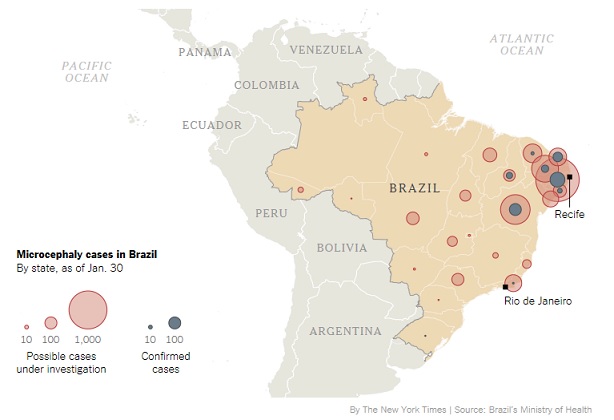
CU Blog - Zika - A 4-Letter Word - Photo 1

All of these engines come under attack with this virus:

  • Economics – Visitors who may be pregnant or considering pregnancy are advised to stay away from the affected states: including 11 Caribbean member-states. For tourism, our primary economic driver, expect a “hit”, as honeymooners and newly-weds will be dissuaded to vacation in our region.
  • Security – Viruses and other epidemiological episodes are among the “bad actors” that can endanger a community. Any proactive or re-active security apparatus is required to be “on guard” against these threats.
  • Governance – The governance in the affected countries are now urging citizens to delay pregnancies. This disruption in the natural cycle of human procreation is a violation of the assumed Social Contract between governments (the State) and the citizens. The citizens are expecting the State to protect them … and stay out of their bedrooms (family-planning decisions).

This Zika issue is a major issue that has now come under the attention of major “alphabet” stakeholders, like the WHO (World Health Organization) and the CDC (America’s Center for Disease Control). See the heightened threat as conveyed by the New York Times in this news article here and in the Appendix-VIDEO below:

Title: Zika Virus ‘Spreading Explosively’ in Americas, W.H.O. Says
By: Sabrina Tavernise, NY Times

Officials from the World Health Organization said on Thursday that the Zika virus was “spreading explosively” in the Americas and announced that they would convene an emergency meeting on Monday to decide whether to declare a public health emergency.

“The level of alarm is extremely high,” said Dr. Margaret Chan, the director general of the W.H.O., in a speech in Geneva.

As many as three to four million people in the Americas could be exposed to the virus in the next 12 months, said Dr. Sylvain Aldighieri, a unit chief for the Pan American Health Organization.

“As I told you, we have big gaps in terms of confirmation of the real situation,” he said. “These are estimates. These are mathematical estimations.”

Of particular concern, Dr. Chan said, are the cases of microcephaly, a rare condition in which infants are born with abnormally small heads that has been rising dramatically in Brazil as Zika spreads. Experts say it is too early to tell whether Zika is the cause of the condition, but there are some indications that the two are linked.

The health authorities in Brazil said on Wednesday that reported cases of microcephaly had climbed to 4,180 since October, a 7 percent increase from the previous tally last week. Before the epidemic, Brazil recorded only about 150 cases of microcephaly a year.

That has caused widespread alarm because researchers say the virus arrived in Brazil only recently, with the huge jump in microcephaly cases reported by doctors, hospitals and other medical officials following closely in its wake.

But proving that Zika is the cause has been elusive.

“It’s really important to understand the difference between associations and causations,” said Dr. Bruce Aylward, a W.H.O. assistant director general, noting that there are still many questions about whether the Zika virus and microcephaly are linked.

The Brazilian health ministry said Wednesday that it had examined more than 700 reported cases of microcephaly and found Zika in only six of the infants — though what that means exactly is unclear. Infectious disease specialists caution that Brazil’s testing methods are outdated and may miss many Zika cases. They also say that in some cases, the mother may have had Zika, causing microcephaly in her baby, even if the virus is never detected in the infant.

The virus has spread to more than 20 countries and territories in the region. Dr. Chan said she was “deeply concerned about this rapidly evolving situation.” She also raised an alarm about the potential for further international spread of the virus, given how ubiquitous the mosquitoes that carry it are and how few people have developed immunity to it. The virus, which first surfaced in Uganda in the 1940s, had rarely been seen in the Americas.

“The level of concern is high, as is the level of uncertainty,” she said. “Questions abound. We need to get some answers quickly.”

Dr. Chan struck a tone of deep concern, but Dr. Aylward appeared to play down some of the most dire predictions about the disease.

“‘Concerned’ is certainly the right language to be used,” he said. “ ‘Alarmed’ would definitely not be the right language.”

Asked whether the W.H.O. would advise people not to travel to Brazil for the Olympics, he replied, “I would think that would be very, very unlikely when you look at areas affected and the scope of this.”

Some experts had criticized Dr. Chan for not immediately convening a committee to advise on whether to declare Zika a public health emergency. On Wednesday in the journal JAMA, two experts called for an immediate meeting, saying the hesitation on the part of the W.H.O. echoed the agency’s slow reaction at the outset of the Ebola epidemic in 2014.

“The very process of convening the committee would catalyze international attention, funding and research,” they wrote.

On Thursday morning, one of the authors, Dr. Daniel Lucey, an expert on global viral outbreaks at Georgetown University School of Medicine, said of the announcement, “I’m very, very happy.”

Dr. Chan said she would be asking the committee for advice on the “the appropriate level of international concern” and for what measures the W.H.O. should advise affected countries to take. She said she would also ask the committee to identify research priorities

One worry, Dr. Chan noted, is that there is no vaccine against the virus or a rapid diagnostic test to determine whether someone has been infected. Dr. Anthony S. Fauci, director of the National Institute of Allergy and Infectious Diseases, said in an interview this week that scientists at the National Institutes of Health were working on both.

“We are already on our way on the first steps to developing a vaccine,” he said. “And we have started to work on a diagnostic to tell if someone’s been infected.”

Other related articles:

Short Answers to Hard Questions About Zika Virus

Reports of Zika-linked Birth Defect Rise in Brazil

Zika Testing Is Urged for Some Newborns

CU Blog - Zika - A 4-Letter Word - Photo 2

What countries should pregnant women avoid?

About two dozen destinations mostly in the Caribbean, Central America and South America.

The Pan American Health Organization believes that the virus will spread locally in every country in the Americas except Canada and Chile. Here is the C.D.C.’s current list of countries and territories in which Zika virus is circulating. (Caribbean countries in RED italics)

The Caribbean
United States Virgin Islands
Barbados
Dominican Republic
Guadeloupe
Haiti
Martinique
Saint Martin

South America
Bolivia
Brazil
Colombia
Ecuador
French Guiana
Guyana

Paraguay
Suriname
Venezuela

Find the latest Travel Advisory updates here.
Source: http://www.nytimes.com/interactive/2016/health/what-is-zika-virus.html

Is there a responsible party who would champion this issue for the Caribbean region?

No.

But there is the need to fill this void in the region; there is the need for Caribbean leadership to address the needs of the whole Caribbean economic, security and governing eco-system. While there is no current solution, other than the WHO’s address and that of individual member-states, there is now a plan – better still, a roadmap to address the deficiencies.

The book Go Lean…Caribbean serves as that roadmap; it posits that the Caribbean region must promote its own interest and protect its own citizens. We should not look to the WHO to micro-manage our day-to-day details; they have no concern for our touristic industry implications. It is not within their charter. Further, we should not count on the US to pursue the Greater Good for our Caribbean local, as their (CDC) travel advisory already endangers our economies, with no consultation with our tourism planners. (This is also not in the CDC’s charter). Assuredly, we must have our own preparation and response vehicle.

This is the charter of the Go Lean…Caribbean book.

The book urges the introduction and implementation of the Caribbean Union Trade Federation (CU), as a regional sentinel in the Caribbean, for the Caribbean. The complete prime directives of the CU is as follows:

  • Optimize the economic engines of the Caribbean to elevate the regional economy.
  • Establish a security apparatus for public safety assurances and to protect the economic engines.
  • Improve Caribbean governance to support these engines.

With issues like this, ugly elements of society always emerge: nationalistic self-interest, finger-pointing and bad politics. Talking-heads start to talk.

But this is a time for action, not talk. The biggest and best remediation is also a simple one: kill the affected mosquitoes.

This Go Lean/CU roadmap declares that “Crap happens” (Page 23). This immediately calls for the establishment of a Homeland Security Department, with an agency to practice the arts and sciences of Emergency Management. The emergencies include more than natural disasters (hurricanes, earthquakes, tsunamis, volcanoes, flooding, forest fires, and droughts), they include the man-made variety (industrial accidents, oil spills, factory accidents, chemical spills, explosions, terroristic attacks, prison riots) and epidemic threats. Of course, this type of emergency, the Zika virus, described in the foregoing VIDEO/article, requires professional expertise, a medical discipline. Stopping Zika therefore would require a hybrid response of the Emergency Management agency and the CU’s Department of Health Disease Control & Management agency. This agency of Medical experts would help contend with systemic threats of epidemic illness and infectious diseases.

These stakeholders would be expected to kill mosquitoes. (A coordinated Rapid Response Team, seeking out mosquitoes breading grounds – still waters – and deploying appropriate pesticides).

The Go Lean roadmap immediately calls for the coordination of security monitoring and mitigation in the Caribbean; this point is declared early in the Go Lean book with a pronouncement in the Declaration of Interdependence (Page 12), as follows:

xvi. Whereas security of our homeland is inextricably linked to prosperity of the homeland, the economic and security interest of the region needs to be aligned under the same governance. …[to ensure] the functioning of the wheels of commerce for all the citizenry, the accedence of this Federation must equip the security apparatus with the tools and techniques for predictive and proactive interdictions.

The Go Lean roadmap calls for the integration of the viral sentinel responsibility of the 30 Caribbean member-states, despite the 4 different languages and 5 colonial legacies (American, British, Dutch, French, Spanish) – notice the foregoing list of countries – into the CU Trade Federation with the tools/techniques to bring immediate change to the region to benefit one and all member-states. This includes the monitoring and epidemiology defense of common and emerging viruses. This empowered CU agency will liaison with foreign entities with the same scope, like the WHO, and the CDC.

Most importantly, the CU would coordinate the Caribbean brand and image promotion. The rest of the world need to know that we can kill mosquitoes, and cajoled our communities into action to mitigate all known threats; (i.e there is no travel advisory for Florida).

Since the CU roadmap leads with economic reforms, the primary economic driver of the region (tourism) would be a constant concern. The realization, or even the unsubstantiated rumor, of viral outbreaks can imperil the tourism product. We must therefore take proactive steps to protect our economic engines. So there are heavy responsibilities for the stewardship of the Caribbean economy, security and governing engines. The goal is to impact the Greater Good of the entire Caribbean region. The CU invites this role and promote it as a community ethos.

There should be no need for a travel advisory, or to ban pregnant women, or honeymooners or general vacationers.

We’ve got this!

The Go Lean book details the community ethos, plus the executions of the following strategies, tactics, implementations and advocacies to impact the region’s public health security in protection of the economy:

Community Ethos – Privacy versus Public Protection Page 23
Community Ethos – “Crap” Happens Page 23
Community Ethos – Lean Operations Page 24
Community Ethos – Cooperatives Page 24
Community Ethos – Non-Government Organizations Page 25
Community Ethos – Ways to Improve Sharing Page 35
Community Ethos – Impact the Greater Good Page 37
Strategy – Vision – Non-Sovereign “Unified” Proxy Entity Page 45
Strategy – Customers – Residents & Visitors Page 47
Strategy – Agents of Change – Globalization Page 57
Tactical – Confederating a Permanent Union Page 63
Tactical – Fostering a Technocracy Page 64
Separation of Powers – Emergency Management Page 76
Separation of Powers – Disease Control & Management Page 86
Implementation – Ways to Pay for Change Page 101
Implementation – Security Initiatives at Start-up Page 103
Implementation – Ways to Deliver Page 109
Implementation – Ways to Foster International Aid Page 115
Implementation – Ways to Benefit from Globalization Page 119
Planning – Ways to Better Manage Image Page 133
Planning – Ways to Improve Failed-State Indices Page 134
Advocacy – Ways to Grow the Economy Page 151
Advocacy – Ways to Improve Healthcare Page 156
Advocacy – Ways to Improve Governance Page 168
Advocacy – Ways to Better Manage the Social Contract Page 170
Advocacy – Ways to Foster Cooperatives Page 176
Advocacy – Ways to Improve for Natural Disasters Page 184
Advocacy – Ways to Improve Emergency Management Page 196

Previous Go Lean blog-commentaries have detailed the reality of viral management around the world, at different times in different locales. There is much for us to learn in the Caribbean. (As reported in the foregoing VIDEO, there are many similarities of Dengue, Yellow Fever and West Nile to this new Zika virus). See sample list here of previous blogs:

https://goleancaribbean.com/blog/?p=4720 A Lesson in History – SARS in Hong  Kong
https://goleancaribbean.com/blog/?p=4111 Detroit-area Judge to Decide if Kids Need Vaccines
https://goleancaribbean.com/blog/?p=2397 Stopping Ebola
https://goleancaribbean.com/blog/?p=1003 Painful and rapid spread of new virus – Chikungunya – in Caribbean

There have also been previous Go Lean blog-commentaries that have addressed the economic and governance deficiencies in the Caribbean region, as related to this Zika issue. See here for a sample list of these types of blogs:

https://goleancaribbean.com/blog/?p=6531 A Lesson in History – Book Review on ‘Exigent Circumstances’
https://goleancaribbean.com/blog/?p=6341 Tourism Stewardship — What’s Next?
https://goleancaribbean.com/blog/?p=5287 Book Review on Vaccines – ‘Thimerosal: Let The Science Speak’
https://goleancaribbean.com/blog/?p=5002 Managing a ‘Clear and Present Danger’
https://goleancaribbean.com/blog/?p=4360 Dreading the ‘Caribbean  Basin Security   Initiative’
https://goleancaribbean.com/blog/?p=2105 Recessions and Public Health

An underlying goal of the Go Lean movement is to make the Caribbean homeland, a better place to live, work and play. While this roadmap includes a heavy focus on economics, the other areas for societal harmony –  security and governance – must get due attention. Accepting the premise of “bad actors” inevitability means preparing counter-measures in earnest. We need a technocratic security apparatus for public safety and epidemiological crises. This is necessary to elevate our Caribbean homeland.

The entire region is hereby urged to lean-in to this Go Lean roadmap – the countries included on the above Travel Advisory list and the rest of the Caribbean – to fulfill the vision of securing our homeland. We can, and must do better.

We are bigger than mosquitoes, literally and figuratively.  🙂

Download the book Go Lean … Caribbean Now!

———-

Appendix – What is the Zika virus?

A tropical infection new to the Western Hemisphere.

The Zika virus is a mosquito-transmitted infection related to Dengue, Yellow Fever and West Nile virus. Although it was discovered in the Zika forest in Uganda in 1947 and is common in Africa and Asia, it did not begin spreading widely in the Western Hemisphere until last May, when an outbreak occurred in Brazil.

Until now, almost no one on this side of the world had been infected. Few of us have immune defenses against the virus, so it is spreading rapidly. Millions of people in tropical regions of the Americas may have had it.

———–

Appendix VIDEO – W.H.O. Speaks Out and Calls for A Conference – http://graphics8.nytimes.com/video/players/offsite/index.html?videoId=100000004173752

 Published January 28, 2016 – Officials from the World Health Organization warned that the Zika virus was spreading “explosively” and called for an emergency meeting to address it. – REUTERS.

Share this post:
, , , ,
[Top]

The Art and Science of ‘Play’

Go Lean Commentary

The book Go Lean…Caribbean calls for the elevation of Caribbean society, to re-focus, re-boot, and optimize all the engines of society so as to make the Caribbean a better place to live, work and play. The activities of “play” are of serious concern; they are Art and Science.

All work and no play, makes Jack a dull boy. All play and no work, makes Jack a dumb boy.

There is the need for balance.

Tourism activities and/or vacations, the primary economic driver in the Caribbean region, are grouped as a “play” activity.

- Photo 3The Go Lean book, serving as a roadmap, posits that tourism will continue to be the primary economic driver in the region for the foreseeable future. Considering the “bread and butter” of the region, it is obvious our “bread is buttered” with “play”. Understanding the science of “play” activities can therefore be critical in the roadmap to grow the region’s GDP and create jobs (2.2 million new jobs projected). There are many other activities considered “play”: sports, parks & recreation, art & culture, media (film, TV, online social networking, etc.) and also … animal companions. People love their pets and even treat them as part of the family. So to make the Caribbean a better place to live, work and play means considering the needs of the 42-million population and their animal companions.

A study of economics must consider the systems of survival, the quest for food, clothing and shelter. This is a science. Research by Behavioral Scientist & Psychologist Abraham Maslow with his Hierarchy of Needs[a], identifies needs as a pyramid, where at the bottom, or base level, are basic, survival elements (food, water, shelter and security/safety). As these are obtained, then there are natural urges for emotional stability (belongingness, self-esteem, social acceptance); accordingly, the top level of the pyramid was defined as complex understanding (beauty, justice, realizing one’s full potential). Where does “play” fit into this hierarchy? Other research now indicates that the need to play nullifies the hierarchy, people and animals seek play at all times and all circumstances, despite whether the other needs are fulfilled. See the example here …

… this VIDEO shows hungry polar bears in the Arctic region and what they do with dogs, despite a potential food source. See here:

Title: He Watched Helplessly As A Starving Bear Approached His Dogs. Then Something Amazing Happened.

Source: http://boredomtherapy.com/watched-helplessly-starving-polar-bear-approached-dogs-something-amazing-happened/

Polar bears and dogs are natural enemies, and bears usually behave quite aggressively toward dogs. Polar bears are the largest land carnivore and are many times larger than even the largest of dogs, so when a hungry polar bear spots a dog, it usually ends very badly for the dog.

This, however, is truly unbelievable. Take a look at the photos and videos here.

- Photo 2

- Photo 1

Renowned nature photographer Norbert Rosing, whose work has appeared in National Geographic, visited Brian and his dogs on several occasions. Here are some of the incredible photos he took.

Here is some incredible footage of these unlikely friends playing together:

Mother nature never ceases to amaze. There’s so much we can learn from these unusual friends about tolerance.

Share this awesome friendship with others. They’ll never expect to see this!

VIDEO 1 – Not Just Man’s Best Friend – http:/youtu.be/5bcl0yrHPwk

VIDEO 2 – Polar Bears and Dogs Playing – http://youtu.be/JE-Nyt4Bmi8

There are lessons here to consider …

… there is a lot that can be learned from the science of “play” by just examining dogs and other animals.

- Photo 4Everyone needs and wants to play … at all levels of the socio-economic ladder: rich, middle-class and poor. So “play” options should be provided in society so that everyone can partake. Since tourism is categorized as “play”. The Go Lean book posits that the region can experience even more growth in tourism than the estimated 80 million people that visit our shores annually, by facilitating more “play” options for all levels of society. (Cruise vacations are known for being more affordable to those with smaller budgets).  The book proposes growth strategies/options, such as:

  • Inter-Island Ferries (Page 280)
  • Cruises options that can start/stop at different Caribbean ports (Page 193)
  • Features of the Sharing Economy (Car and Residence) for Cheaper Vacations (Page 35)
  • Sports eco-system for amateur, professional and inter-collegiate participation (Page 229)
  • Expansion of Parks Eco-system (Page 83)
  • Urban Bicycle Assimilation and Expansions of Bike Paths (Page 352)

The Go Lean book asserts that the requisite investment of the resources (time, talent, treasuries) for these societal elevation goal may be too big for any one Caribbean member-state alone. So the Go Lean book campaigns to shift the responsibility to a region-wide, professionally-managed, deputized technocracy, the Caribbean Union Trade Federation (CU). The book serves as a roadmap for the introduction and implementation of the CU.

The subject of animals and animal companionship is also pivotal in the roadmap for elevating Caribbean society, especially for the security engines. The Go Lean book posits (Page 185) that better command of Animal Husbandry can facilitate better security around the region’s economic engines. Dogs feel a lot less intrusive and less intimidating than formal security screening, or personnel patrolling with AK47 automatic rifles.  Imagine a beautiful Caribbean beach scene with a plain clothes “officer” walking along with specialty dogs, or more exactly:

  • Drug Sniffing Dogs
  • Bomb Sniffing Dogs
  • Service/Therapy Dogs


- Photo 6

- Photo 5The Go Lean book considers the Agent of Change (Page 57) of the “Aging Diaspora” and its effect on the Caribbean’s biggest economic driver: “tourism”. Many former Caribbean citizens left these shores for greater opportunities abroad, but now they are approaching retirement. These ones can be induced to return to the Caribbean … and bring their economic resources with them … provided that their needs are covered.

This includes the needs of their animal companions. (Currently, the requirements for transporting pets to “foreign” countries are exhaustive; they entail many standards and veterinarian assessments).

The goal of the CU is to bring the proper tools and techniques to the Caribbean region to optimize the stewardship of the economic, security and governing engines.  The book posits that the economy can be induced and spurred for continuous progress, with technocratic management and stewardship of a Single Market. As conveyed here in this commentary, and in previous commentaries, this would be better than the status quo.

Change has come to the region. This book Go Lean… Caribbean provides the needed details on how to better manage the challenge of a changing world. Early in the book, the optimization and best-practices was highlighted as a reason the Caribbean region needed to unite, integrate and confederate to a Single Market. These pronouncements were included in the opening Declaration of Interdependence (Pages 11 – 14):

iv.  Whereas the natural formation of the landmass is in a tropical region, the flora and fauna allows for an inherent beauty that is enviable to peoples near and far. The structures must be strenuously guarded to protect and promote sustainable systems of commerce paramount to this reality.

vi.  Whereas the finite nature of the landmass of our lands limits the populations and markets of commerce, by extending the bonds of brotherhood to our geographic neighbors allows for extended opportunities and better execution of the kinetics of our economies through trade. This regional focus must foster and promote diverse economic stimuli.

xix. Whereas our legacy in recent times is one of societal abandonment, it is imperative that incentives and encouragement be put in place to first dissuade the human flight, and then entice and welcome the return of our Diaspora back to our shores. This repatriation should be effected with the appropriate guards so as not to imperil the lives and securities of the repatriated citizens or the communities they inhabit. The right of repatriation is to be extended to any natural born citizens despite any previous naturalization to foreign sovereignties.

xxiv.  Whereas a free market economy can be induced and spurred for continuous progress, the Federation must install the controls to better manage aspects of the economy: jobs, inflation, savings rate, investments and other economic principles. Thereby attracting direct foreign investment because of the stability and vibrancy of our economy.

xxxii. Whereas the cultural arts and music of the region are germane to the quality of Caribbean life, and the international appreciation of Caribbean life, the Federation must implement the support systems to teach, encourage, incentivize, monetize and promote the related industries for arts and music in domestic and foreign markets. These endeavors will make the Caribbean a better place to live, work and play.

The Go Lean… Caribbean book wisely details the community ethos to adopt to proactively facilitate digital campaigns for the changed landscape; plus the executions of the following strategies, tactics, implementations and advocacies:

Community Ethos – Economic Principle – Economic Systems Influence   Individual Choices & Incentives Page 21
Community Ethos – Economic Principle – Consequences of Choices Lie in   the Future Page 21
Community Ethos – Lean Operations Page 24
Community Ethos – Return on Investments (ROI) Page 24
Community Ethos – Ways to Impact the Future Page 26
Community Ethos – Ways to Foster Genius – Athletics, Literary, Art and Music in “Play” activities Page 27
Community Ethos – Impact Research & Development – Including Animal Husbandry Page 30
Community Ethos – Ways to Improve Sharing – Viable for Service Animals Page 35
Community Ethos – Ways to Impact the Greater Good Page 37
Strategy – Vision – Integrate Region in a Single Market Page 45
Strategy – Mission – Enhancing the Tourism Product Page 45
Strategy – Agents of Change – Aging Diaspora Page 57
Tactical – Fostering a Technocracy Page 64
Tactical – Growing the Economy to $800 Billion – Trade and Globalization Page 70
Tactical – Separation of Powers – Tourism Promotions and Administration Page 78
Tactical – Separation of Powers – Fairgrounds Administration Page 83
Tactical – Separation of Powers – Department of Health – Veterinarian Standards Page 86
Implementation – Assembling Regional Organs Page 96
Implementation – Ways to Deliver Page 109
Planning – 10 Big Ideas – Single Market Page 127
Planning – Ways to Make the Caribbean Better – “Play” activities for Rich, Middle Class,   and the Poor Page 131
Advocacy – Ways to Grow the Economy Page 151
Advocacy – Ways to Create Jobs – Many from “Play” activities Page 152
Advocacy – Ways to Foster Cooperatives – Ideal for Animal Husbandry Page 176
Advocacy – Ways to Better Manage Natural Resources – Parks Administration Page 183
Advocacy – Ways to Improve for Natural Disasters – Animal Partners & First Responders Page 184
Advocacy – Ways to Improve Animal Husbandry – Police & Security Canines Page 185
Advocacy – Ways to Enhance Tourism – Expanding Solutions for “Snowbirds” Page 190
Advocacy – Ways to Impact Events – Sharing Economy Page 191
Advocacy – Ways to Promote Fairgrounds – Venues for “Play” activities Page 192
Advocacy – Ways to Impact Cruise Tourism – Appealing for Budget Vacations Page 193
Advocacy – Ways to Improve Transportation – Bicycle-Friendly Culture Page 205
Advocacy – Ways to Improve Elder-Care – Planning for Storm Shelters Page 225
Advocacy – Ways to Improve Sports – For Amateur and Professionals Page 229
Advocacy – Ways to Promote Music – A significant role despite the level of need Page 231
Advocacy – Ways to Impact Urban Living – Storm Shelters for Pets Page 234
Advocacy – Ways to Promote World Heritage Sites – Low-cost Touristic Activities Page 248
Appendix – Sample Inter-Island Ferry Scheme Page 280
Appendix – Sample Urban Bicycle Sharing Scheme Page 352

The CU seeks to foster play options to aid-and-abet tourism and other economic activities. This includes all supporting functions before, during and after visitors come to our shores. Consider the example of Hurricane preparation; there is the need to prepare storm shelters for residents in unsafe areas; these solutions MUST consider pet shelters as well; (Page 234).

In previous Go Lean blogs, related points of the innovative tourism marketing, Aging Diaspora and the need for efficient Animal Husbandry have been detailed; see sample here:

https://goleancaribbean.com/blog/?p=6341 Tourism Stewardship — What’s Next?
https://goleancaribbean.com/blog/?p=5251 Post-Mortem Analysis of Initial Bahamas Carnival Event – Need for Dogs
https://goleancaribbean.com/blog/?p=5210 Cruise Ship Commerce – Getting Ready for Change
https://goleancaribbean.com/blog/?p=4308 911 – Emergency Management/Response Systems in Crisis
https://goleancaribbean.com/blog/?p=2571 Internet Commerce meets Sharing Economy: Airbnb
https://goleancaribbean.com/blog/?p=1364 Uber’s Emergence Transforming Cities
https://goleancaribbean.com/blog/?p=535 Remembering and learning from Boston Terrorists Attacks
https://goleancaribbean.com/blog/?p=273 10 Things We Want from the US – # 2: Tourists
https://goleancaribbean.com/blog/?p=235 Tourism’s changing profile – Less “rich”…

This commentary focuses on the core competence of the Caribbean Union Trade Federation, which is Trade. This refers to the ability to accentuate the economic activities of the region to make the homeland a better place to live, work and play. But this commentary also addresses a passion project: the love of dogs. See the related VIDEO in the Appendix below.

But the integration of core competence and passion can elevate a society. Dogs can definitely have that impact for the Caribbean.

The people and institutions of the Caribbean are urged to lean-in to these new business models to incentivize more tourism and “play” activities for all segments of society. The region is also urged to full employ working canines, as in embedding them with Military & Police units. This is win-win!

Let’s do it! This is the quest of the Go Lean roadmap: elevate the societal engines for all people … and their pet companions & helpers. With the empowerments and elevations portrayed in the roadmap we can succeed in making Caribbean region a better place for citizens and tourists alike to live, work and play.  🙂

Download the book Go Lean…Caribbean now!

———

Appendix – Footnote

a. Maslow, Abraham H. (1943). A Theory of Human Motivation. Psychological Review, 50(4), 370–96. Retrieved November 2013 from http://psychclassics.yorku.ca/Maslow/motivation.htm

———

Appendix – VIDEO “So God Made A Dog” A gift to all of us – https://youtu.be/VDrabmm421I

Published on Aug 18, 2014 – “So God Made a Dog” a takeoff on the Paul Harvey “God made a Farmer”. They are, our friends and part of the family and often with us for to short a time …

Share this post:
, , ,
[Top]

The Future of Money

Go Lean Commentary

CU Blog - The Future of Money - Photo 3Surely the Caribbean can offer more than the African country of Kenya does. Surely?!

… and yet Kenya is providing a role model for the Caribbean to emulate, that of mobile money payment systems.

Let’s play catch-up.

Benefits await the Caribbean, more so than just playing catch-up. We can empower and elevate our economy and society. Notice here how this elevation benefits Kenya – an iconic and typical Third World country – in these news VIDEOs here:

VIDEO 1 – CBS 60 Minutes Story: The Future of Money – http://www.cbsnews.com/videos/the-future-of-money

  • … requires CBS All Access Subscription…

VIDEO 2 – Financial Times: Mobile money keeps Kenya economy moving – https://youtu.be/ayo-rgayDJE

Published on Mar 11, 2013 – Kenya has led Africa’s innovative and revolutionary embrace of mobile telephones, and the country’s technology sector has grown faster than all others in east Africa’s regional economic hub. Bob Collymore, chief executive of Safaricom, parent company of the mobile payment system M-Pesa, talks to Katrina Manson, east Africa correspondent.

This is a familiar advocacy for these Go Lean commentaries. The full width and breadth of electronic payments schemes have been examined, dissected and debated. The benefits are undeniable:

  • Instant access
  • Safer transactions
  • Expanded networks
  • Mitigating fees
  • Expanded money supply
  • Availing credit

CU Blog - The Future of Money - Photo 1
CU Blog - The Future of Money - Photo 4-newB
CU Blog - The Future of Money - Photo 5
CU Blog - The Future of Money - Photo 6-new

Previous blog-commentaries have promoted the following as advocacies integrating technology and money:

https://goleancaribbean.com/blog/?p=6635 New Security Chip in Credit Cards Unveiled
https://goleancaribbean.com/blog/?p=5668 Move over Mastercard/Visa… here comes a Caribbean Solution
https://goleancaribbean.com/blog/?p=4425 Cash, Credit or iPhone …
https://goleancaribbean.com/blog/?p=3889 Caribbean regional banks are ready to accept electronic payments transactions
https://goleancaribbean.com/blog/?p=2074 MetroCard – Model for the Caribbean Dollar
https://goleancaribbean.com/blog/?p=1350 PayPal expands payment services to 10 markets
https://goleancaribbean.com/blog/?p=906 Bitcoin needs regulatory framework to change ‘risky’ image of payments
https://goleancaribbean.com/blog/?p=528 Facebook plans to provide mobile payment services

CU Blog - The Future of Money - Photo 2-newThe world is moving forward with electronic payment systems; the standard of cash registers with cash drawers have passed. Many times, establishments do not even want to accept “cash”. They want the money, but only want it electronically. Consider this photo here, it demonstrates how United Airlines – the 3rd largest airline in the world – will not even accept “cash” for travelling passengers to pay for baggage when they check-in for their flights. They want electronic money only (credit and debit cards). This photo depicts a cash-accepting kiosk to load the cash onto a pre-paid credit card … on the spot at the terminal … at the Metropolitan Detroit International Airport (DTW) in November 2015.

Those involved in tourism commerce must now adapt or perish.

What’s more, even the standard of magnetic stripe credit cards and debit cards have passed. As depicted in the foregoing VIDEO and previously Go Lean blog-commentaries, those involved in retail commerce – in general – must now adapt (or perish) to credit and debit cards … without the card!

This means you, Caribbean merchants (hotels, restaurants, tour operators, retailers, and business establishments). The environment must now change for tourism commerce and ordinary domestic commerce. The stewardship of Caribbean economics must improve to adapt to this changing world. This is a consistent advocacy of these Go Lean blogs: to “lean-in” to better economic stewardship as detailed in the book Go Lean … Caribbean.

The book serves as a roadmap for the introduction and implementation of the Caribbean Union Trade Federation (CU) and the Caribbean Central Bank (CCB). This Go Lean roadmap depicts that these entities will drive change in payment systems, to includes options depicted in the foregoing VIDEO and beyond. Their role will include facilitating and settling transactions for new payment systems: new cards and telephony apps. The Go Lean roadmap calls for a regional currency for the Caribbean Single Market, the Caribbean Dollar (C$), to be used primarily as an electronic currency. These schemes will impact the growth of the regional economy in both the domestic and tourist markets. Consider the real scenario of Cruise Ship passenger-commerce; the solutions must be delivered here and now.

The CU/CCB roadmap anticipates these electronic payment systems from the outset of the Go Lean book; covering more than commerce, but the security and governing issues as well. In fact, the Go Lean roadmap has these 3 prime directives:

  • Optimization of the economic engines in order to grow the regional economy to $800 Billion & create 2.2 million new jobs.
  • Establishment of a security apparatus to protect the resultant economic engines.
  • Improvement of Caribbean governance to support these engines.

As depicted in the foregoing VIDEO, there abound many security benefits with electronic payment schemes, mobile money in this case. In the field of Economics, the “cash currency” is referred to as M0. No doubt, changes for electronic payment system will reduce M0. The greatest benefit though of deploying these electronic payment scheme is the acceleration of M1 in the regional economy. While M0 refers to “cash: paper & coins”, M1 refers to the measurement of “cash” in circulation (the M0) plus overnight bank deposits. As depicted in the Go Lean book, and subsequent blog-commentaries, M1 increases allow central banks – in this case, the CCB – to create money “from thin-air”; referring to the money multiplier principle.

A final feature of M1 is that it normally does not include any Black Market activities. But with electronic payment systems, M0 reduces and M1 increases, thusly nullifying the Black Markets.

The Go Lean book posits that to adapt and thrive in the new global marketplace there must be more strenuous management and technocratic oversight of the region’s currencies. This is the quest of the Go Lean roadmap; it opened with these pronouncements in the Declaration of Interdependence (Page 13 and 14):

xxiv.   Whereas a free market economy can be induced and spurred for continuous progress, the Federation must install the controls to better manage aspects of the economy: jobs, inflation, savings rate, investments and other economic principles. Thereby attracting direct foreign investment because of the stability and vibrancy of our economy.

xxv.    Whereas the legacy of international democracies had been imperiled due to a global financial crisis, the structure of the Federation must allow for financial stability and assurance of the Federation’s institutions. To mandate the economic vibrancy of the region, monetary and fiscal controls and policies must be incorporated as proactive and reactive measures. These measures must address threats against the financial integrity of the Federation and of the member-states.

xxvii. Whereas the region has endured a spectator status during the Industrial Revolution, we cannot stand on the sidelines of this new economy, the Information Revolution. Rather, the Federation must embrace all the tenets of Internet Communications Technology (ICT) to serve as an equalizing element in competition with the rest of the world. The Federation must bridge the digital divide and promote the community ethos that research/development is valuable and must be promoted and incentivized for adoption.

The Go Lean book details a series of community ethos, strategies, tactics, implementations and advocacies to foster the proper controls for electronic/mobile payments in the Caribbean region:

Community Ethos – Economic Principles Page 21
Community Ethos – Money Multiplier Principle Page 22
Community Ethos – Security Principles – Privacy versus Public Protection Page 23
Community Ethos – Governing Principles – Lean Operations Page 24
Community Ethos – Governing Principles – Cooperatives Page 25
Community Ethos – Promote Intellectual Property Page 29
Community Ethos – Ways to Bridge the Digital Divide Page 31
Community Ethos – Ways to Improve Sharing Page 35
Community Ethos – Ways to Impact the Greater Good Page 37
Strategy – Mission – Fortify the monetary needs through a Currency Union Page 45
Tactical – Separation of Powers – Central Banking Page 73
Implementation – Assemble Central Bank Cooperative Page 96
Implementation – Assemble Caribbean Regional Organs Page 96
Implementation – Ways to Deliver Page 109
Planning – 10 Big Ideas – #2: Currency Union / Single Currency Page 127
Anecdote – Caribbean Currencies Page 149
Advocacy – Ways to Grow the Economy Page 151
Advocacy – Ways to Create Jobs Page 152
Advocacy – Ways to Mitigate Black Markets Page 165
Advocacy – Ways to Foster Cooperatives Page 176
Advocacy – Ways to Impact Cruise Tourism – Smartcard scheme Page 193
Advocacy – Ways to Foster Technology Page 197
Advocacy – Ways to Foster e-Commerce Page 198
Advocacy – Reforms for Banking Regulations – Central Banking Efficiencies Page 199
Advocacy – Ways to Impact Main Street – Downtown Wi-Fi – Time and Place Page 201
Appendix – Assembling the Caribbean Telecommunications Union Page 256

The world of electronic payment systems now includes smart cards, mobile payments (like “M-Pesa” in the foregoing VIDEO and apps on Google’s Android and Apple’s iPhone devices). To those in the Caribbean, we admonish you:

Try and keep up!

The benefits of this new “regime” are too enticing to ignore: fostering more e-Commerce, increasing regional M1, mitigation of Black Markets, more cruise tourism spending, growing the economy, creating jobs, enhancing security and optimizing governance.

Now is the time for all stakeholders of the Caribbean, (residents, visitors, merchants, vendors, bankers, and governing institutions), to lean-in for the empowerments described in the book Go Lean … Caribbean. These empowerments can help to make the Caribbean a better place to live, work and play.  🙂

Download the free e-Book for Go Lean … Caribbean – now!

Share this post:
, , , , ,
[Top]

ENCORE: Art Basel Miami – A Testament to the Spread of Culture

Go Lean Commentary

This commentary – from December 9, 2014 – is hereby re-distributed on the occasion of the Art Basel Miami 2015. This year’s events are planned for December 3 – 6, with peripheral events starting from December 1.

Bienvenido a Miami!

———

There’s no business like ‘show business’. – Age Old Adage.

There is money in the ‘Arts’. – Go Lean…Caribbean precept.

And now, the subsequent news article posits: “the community rallies around art creating a unique energy. And art ‘dynamises’ the community, in a very unique way”.

The book Go Lean…Caribbean has a simple purpose: enable the Caribbean to be a better place to live, work and play. The book recognizes that the ‘genius qualifier’ is shown in different fields of endeavor, including the arts (fine, visual, performing, music, etc.). While the Go Lean roadmap has a focus on STEM [1] fields, it is accepted that not everyone possesses STEM skills, and yet many others can still contribute to society. Then when these other skills/talents are “gifted” beyond the extraordinary, they can truly impact their community, and maybe even the world.

The book relates that the arts can have a positive influence on the Caribbean. And that one man, or woman, can make a difference in this quest. We want to foster the next generation of “stars” in the arts and other fields of endeavor.

According to the following news article, the arts can truly ‘dynamise’ the community. The article relates to Art Basel, the movement to stage art shows for Modern and Contemporary works, sited annually in Basel (Switzerland), Hong Kong and Miami Beach. The focus of this article is Miami Beach:

Title: 13th Art Basel Miami Beach (December 4 – 7, 2014), a testament to the spread of culture
By:
Jane Wooldridge, and contributed Ricardo Mor

CU Blog - Art Basel Miami - a Testament to the Spread of Culture - Photo 1If “more” equals better, the 13th edition of Art Basel Miami Beach and the surrounding art week events may go down as the best ever. More new art fairs and just-to-see shows. More record-breaking sales at Art Basel Miami Beach. More CEOs — from watchmakers Hublot and Omega, luggage brand Rimowa, hotel companies Starwood and Marriott — opening luxury properties. And if not more — who can keep track? — then certainly plenty of celebrities, including actors Leonardo DiCaprio, James Marden and Owen Wilson; musicians Usher, Miley Cyrus, Russell Simmons and Joe Jonas; supermodel Heidi Klum and the world’s fastest man, Usain Bolt.

There was another kind of “more” as well — more spillovers, touch points and art for all manner of South Floridians, from entrepreneurs to pre-teen fashion designers, stretching from Pinecrest to Coconut Grove, Overtown to Fort Lauderdale.

If the aim is “to make art general,” as Knight Foundation President Alberto Ibargüen told attendees Monday at the foundation’s annual announcement of Knight Art Challenge awards, this year’s art week put South Florida well on its way. Proclaimed National Endowment for the Arts chairman Jane Chu on a whiplash art tour to downtown, Miami Beach and Opa-locka, “Art is entwined in Miami’s DNA.”

Even as the Pérez Art Museum Miami celebrated its first year anniversary, a new permanent museum building for the Institute for Contemporary Art Miami was announced for the Design District.

Overtown [historical Black neighborhood] hosted its first Art Africa fair of works created by artists from the African Diaspora. Joining it on the list of first-year events are an impressive exhibition of monumental works in the vast Mana-Miami Wynwood space on NW 23rd Street and Pinta, a fair focusing on Latin American art that moved from New York to Midtown.

The festivities reach far, far beyond the traditional art crowd. On the Mana campus, the Savannah College of Art and Design is presenting “i feel ya,” an exhibition that includes jumpsuits designed by André 3000 for Outkast’s reunion tour. The nearby ArtHaus tent is surrounded by food trucks and a sound program where Beethoven is definitely not on the playlist.

This year, more than a half-dozen student exhibits are on the art agenda. At FusionMIA, student photographs hang near works by masters Rashid Johnson and Al Loving; all were curated by Miami’s N’Namdi Contemporary gallery. A few blocks north, at Wynwood’s House of Art, a dozen students ages 5 to 15 from the DesignLab program showed off their creations at a Friday night “vernissage.”

Among them was 13-year-old Yael Bloom, wearing a flounced party dress she made from shrink wrap. No matter that the first-time event was a little-known spinoff. “Art Basel is pretty hard for adults to get into,” Bloom said. “For kids to get into it is very cool.”

As in years past, free events abound, from performances by Chinese artist Shen Wei at Miami-Dade College and artist Theo Jansen’s Strandbeest demonstrations on the sand to official Art Basel events, including films on the New World Center Wallcast and the Art Public sculptures in Collins Park. New is free Art Week shuttle service between Midtown and Miami Beach — a government cooperative effort — that dovetails with trolley service to art venues on both sides of Biscayne Bay.

In institutional quarters, Art Basel Miami Beach global sponsor UBS announced the creation of a $5 million loan fund for existing Florida small business owners. Sponsor BMW USA announced it would fund an “art journey” open to emerging artists exhibiting at Art Basel Miami Beach. And the City of Miami Beach and Miami-Dade County put out a call to artists, encouraging them to propose projects for the $4.33 million public art program associated with the Miami Beach Convention Center renovation. South Floridians are eligible to apply for all three initiatives.

Clearly, art week isn’t just about aesthetics, personal enrichment and community building. It is also about enterprise — which explains all those luxury CEOs, the ground-breaking of the Zaha Hadid-designed One Thousand Museum, and the announcement at Miami Ironside that designer Ron Arad will create the interiors for the revamped Watergate Hotel in Washington. (And no, there’s no real connection to Miami.)

Said Michael Spring, Miami-Dade’s cultural affairs director, “There’s a certain deepening, a realization not just that the Art Basel event but arts in general have a phenomenal effect on the image and economy of our entire region. We’ve talked about it before, but there seems to be more focus this year. It’s not an interesting footnote anymore; it’s the theme.”

That, says Miami Commissioner Keon Hardemon, was the thinking behind the city’s $50,000 grant supporting the Art Africa fair. “We need to encourage people to come now to Overtown. The cultural aspect helps them realize they can safely come here now. And then maybe they’ll come back later and spend money in the community, in our restaurants and stores,” he said.

In Miami, with commerce inevitably comes glamor, which is proving as glossy as ever. Hennessey V.S.O.P., Dom Perignon, Paper Magazine, Interview and B.E.T. have staged events all around town, at private “locations,” hotels, restaurants, the 1111 Lincoln Road garage and the ICA temporary space in the Moore Building. Developer Alan Faena threw a breezy beachside asado. Jeffrey Deitch, Tommy Hilfiger and V Magazine hosted a glitzy bash at the Raleigh featuring a performance by Miley Cyrus.

In the Design District, developer Craig Robins hosted a dinner honoring architect Peter Marino at a single, 142-yard candlelit table for 380 guests on a closed-off street amid the district’s luxury brand storefronts. Sculptor Jaume Plensa was the guest of honor at another long candlelit table — this one for 60 — in the Coconut Grove sales offices of Park Grove, which recently installed a series of his works along South Bayshore Drive.

Alas, once again, manners were not de rigueur among the glossy set. At some parties, guests of guests turned up with entirely uninvited guests. For other tony soirees, publicists emailed out “disinvitations” to previously invited guests, obliquely sending the message that someone more glamorous would be taking those seats.

Decorous or not, during art week, the energy all emanates from the week’s namesake fair, said Dennis Scholl, VP/Arts at the Knight Foundation. “The most important thing to remember is why this week exists, and that’s Art Basel in the Convention Center. If that wasn’t the core of what’s going on — if it weren’t a world-class event — nobody else would be interested in being involved. It continues to be the raison d’être of this week.”

In the Convention Center, at what Scholl called “the core of the nuclear reactor,” many gallerists were quite happy, thank you very much.

Veteran Art Basel Miami Beach gallerist Sean Kelly said Wednesday was his best first day ever at the fair. Newcomer Michael Jon Gallery also sold almost all of its available work — by rising stars like Sayre Gomez and JPW3 — on the first day.

For most dealers, sales remained lively, day after day. At Galerie Gmurzynska, co-CEO Mathias Rastorfer proclaimed it “successful indeed … . In terms of reception, it was an overwhelmingly enthusiastic response from collectors and colleagues alike. In terms of sales, we did several over $1 million sales and many within the $100,000 to $500,000 range, with a Picasso’s Venus and Love selling at near the asking price of $1.2 million.

Said Art Basel Director Marc Spiegler on Saturday, “I’ve gotten nothing but positive response from galleries,” not only because of strong sales, but also because new hours for VIPs gave gallerists more time to meet new collectors. “A lot of people were here and buying for the first time. Many galleries said they had their best fair ever.”

But like this week’s weather, the upbeat atmosphere suffered from uncharacteristic clouds. In Wynwood, a police car hit and critically injured a street artist. An $87,000 silver plate crafted by Pablo Picasso was reported stolen from the Art Miami satellite fair in Midtown. A partygoer at PAMM’s first anniversary fête on Thursday accidentally damaged an artwork installed on the floor. And Friday night, would-be art goers were stymied by traffic shutdowns into art-centric areas of Wynwood, Midtown and Miami Beach by protests against nationwide police-involved killings.

Though unfortunate and sometimes tragic, Spring said, the unrelated events were “a product of the incredible level of activity.” At Saturday’s annual brunch at the art-rich Sagamore Hotel in Miami Beach, the theft and damaged artwork uniformly were brushed off as inconsequential. Said one art insider, “s–t happens.”

Miami Art Week’s merry-go-round nature is surely born from Miami’s appreciation of a good time. And increasingly, perhaps from something deeper.

Said Miami gallerist Jumaane N’Namdi, “Art Basel has put art on everyone’s mind. Everyone wants to be involved somehow.”

And that’s not just about the parties, said N’Namdi, who had galleries in Chicago, New York and Detroit before opening in Miami. “I don’t think you could find a city that enjoys really looking at the art the way this city does. I came through the airport, and even the TSA guys were talking about it, asking each other if they got their Art Basel posters. Every level of art you want is here.”

Outsiders agree. “Miami is very special for its link between art and the community,” said Axelle de Buffévent, style director at champagne house Martell Mumm Perrier-Jouët. “It goes both ways. The community rallies around art creating a unique energy. And art dynamises the community, in a very unique way.”
Miami Herald – Daily Newspaper – (Posted December 6, 2014) –
http://www.miamiherald.com/entertainment/visual-arts/art-basel/article4313255.html

VIDEO: Art Basel Miami Beach 2014 – http://youtu.be/StkzLiBtDis

Published on Dec 4, 2014
The international art fair Art Basel returns to Miami Beach for its 13th edition, taking place at the Miami Beach Convention Center from December 4 to December 7, 2014. Art Basel Miami Beach 2014 features 267 leading international galleries from 31 countries across North and South America, Europe, Asia and Africa, which present artworks ranging from Modern masters to the latest contemporary art pieces. With this edition, the fair debuts Survey, a new sector dedicated to art-historical projects. In this video, we attend the Private View of Art Basel Miami Beach 2014 at the Miami Beach Convention Center on December 3.

This story aligns with the book Go Lean…Caribbean in stressing the economic impact of artistic endeavors. The book pledges that Caribbean society will be elevated by improving the eco-system to live, work and play; and that “play” covers vast areas of culture.

“Culture” has emerged as a central concept in anthropology, encompassing the range of human phenomena that cannot be directly attributed to genetic inheritance. Specifically, the term “culture” in North American anthropology has two meanings:

  1. the evolved human capacity to classify and represent experiences with symbols, and to act imaginatively and creatively; and
  2. the distinct ways that people, who live differently, classified and represented their experiences, and acted creatively.[2]

Anthropologist Adamson Hoebel best describes culture as an integrated system of learned behavior patterns which are characteristic of the members of a society and which are not a result of biological inheritance.[3]

The Go Lean book stresses economic benefits from classic cultural expressions and popular cultural productions, including Caribbean music, paintings/art, sketches, sculptures, books, fashion and food. All the “skilled phenomena” that makes Caribbean life unique and appealing.

The book Go Lean…Caribbean serves as a roadmap for the introduction and implementation of the technocratic Caribbean Union Trade Federation (CU). There is a lot involved in this vision; the prime directives are stated as follows:

  • Optimization of the economic engines in order to grow the regional economy to $800 Billion & create 2.2 million new jobs.
  • Establishment of a security apparatus to protect the resultant economic engines.
  • Improve Caribbean governance to support these engines.

CU Blog - Art Basel Miami - a Testament to the Spread of Culture - Photo 2The foregoing article relates the economic impact that the Greater Miami area is enjoying for hosting the Art Basel event, for the 13th year now. At this point the benefits have spread throughout the community, (Art Fairs, museums, scholarships, foundations, etc.) not just one venue on Miami Beach. The spin-off benefit of art is a strong point of the Go Lean book, highlighting benefits as long as we keep the talent at home working in/for the community. This point is pronounced early in the following statements in the book’s opening Declaration of Interdependence (Page 14):

xxi. Whereas the preparation of our labor force can foster opportunities and dictate economic progress for current and future generations, the Federation must ensure that educational and job training opportunities are fully optimized for all residents of all member-states, with no partiality towards any gender or ethnic group. The Federation must recognize and facilitate excellence in many different fields of endeavor, including sciences, languages, arts, music and sports. This responsibility should be executed without incurring the risks of further human flight, as has been the past history.

xxxii. Whereas the cultural arts and music of the region are germane to the quality of Caribbean life, and the international appreciation of Caribbean life, the Federation must implement the support systems to teach, encourage, incentivize, monetize and promote the related industries for arts and music in domestic and foreign markets. These endeavors will make the Caribbean a better place to live, work and play.

The economic, cultural and image considerations for “show business” on a society have been well-detailed in these previous Go Lean blogs:

Caribbean Role Model – Oscar De La Renta – RIP
How ‘The Lion King’ roared into history
Forging Change – The Fun Theory
Role Model Berry Gordy – No Town Like Motown
Book Review: ‘Chasing Youth Culture and Getting It Right’
The Music, Art, Culture and Legend of Bob Marley lives on!

The Go Lean roadmap posits that change will come to the Caribbean “show business” (Visual and Performing Arts, Music, Film). This is due mostly to the convergence of a Single Market for the Caribbean region. If “size matters”, then the integration of 42 million people (plus the 10 million Diaspora and 80 million visitors) for the 30 member-states will create the consumer markets to promote and foster Caribbean artistic creations for their full appreciation. The first requirement in this goal is the community ethos of valuing intellectual property; to recognize that other people’s creations are valuable. (Then we can enforce on others to value and appreciate our creations).

This would truly be new for the Caribbean.

The CU is designed to do the heavy-lifting of organizing Caribbean society for the new world of art appreciation and “consumerization”. The following list details the ethos, strategies, tactics, implementations and advocacies to foster regional artists and showcase their wares to the world stage:

Community Ethos – Forging Change Page 20
Community Ethos – Lean Operations Page 24
Community Ethos – Return on Investments Page 24
Community Ethos – Ways to Foster Genius Page 27
Community Ethos – Help Entrepreneurship Page 28
Community Ethos – Promote Intellectual Property Page 29
Strategy – Caribbean Vision: Single Market Page 45
Separation of Powers – Central Bank – Electronic Payment Deployments Page 73
Tactical – Separation of Powers – Patents – Copyrights Page 78
Separation of Powers – Culture Administration Page 81
Planning – Ways to Make the Caribbean Better Page 131
Planning – Lessons Learned from New York City Page 137
Advocacy – Ways to Grow the Economy Page 151
Advocacy – Ways to Create Jobs Page 152
Advocacy – Education – Performing Arts Schools Page 159
Advocacy – Ways to Impact Hollywood Page 203
Advocacy – Ways to Improve the Arts Page 230
Advocacy – Ways to Promote Music Page 231
Advocacy – Impact Urban Living – Art & Theaters Page 234
Appendix – New York / Arts / Theater Jobs Page 277
Appendix – Taos New Mexico Art Colony Page 291
Appendix – Caribbean Music Genres Page 347
Appendix – Protecting Music Copyrights Page 351

There is BIG money in show business and in the world of the Arts. For the 10th edition of Art Basel in Miami in 2011, there was a record number of fifty thousand collectors, artists, dealers, curators, critics and art enthusiasts – including 150 museum and institutions from across the globe – participating in the show.[4]

This event requires a lot of community investments. Every year, Miami’s leading private collections – among them the Rubell Family Collection, Cisneros Fontanals Art Foundation, the De la Cruz Collection Contemporary Art Space, World Class Boxing, the Margulies Collection and the Dacra Collection – open their homes and warehouses to guests of Art Basel. Additionally, the museums of South Florida organize exhibitions including shows at the Miami Art Museum, Bass Museum of Art, Norton Museum, Wolfsonian-FIU and MOCA North Miami.

The community investment has been there for Miami, and so has the returns [5].For 2014, the attendance figures were 75,000, with an increase in hotel occupancy of 30,000 rooms on the days the Art Fair is in progress. The conservative estimates are that the Art Fair brings close to $13 million a year in economic impact to the region. (This figure does not include the purchases of artworks, some of which fetch millions of dollars).

The subject of the Miami Metropolitan area is very relevant for a Caribbean empowerment discussion. A previous blog asserted that Miami’s success, in many regards, is attributable to Caribbean’s failures. Many of our populations (including artists) have fled their homelands and have taken refuge in the Miami area. Where at first this disposition was begrudged, eventually it transformed to tolerance, but now it is even celebrated.

CU Blog - Art Basel Miami - a Testament to the Spread of Culture - Photo 3

Miami has been greatly impacted by both the Caribbean Diaspora and its assimilation of the “Arts”. Whole neighborhoods have been elevated due to this strategy of catering to the arts; (see photo here). This is a great role model for the Caribbean to emulate; our whole society can be elevated.

The Go Lean/CU roadmap represents the empowerment for the Caribbean communities to elevate – we now want to keep our artists at home. The people, institutions and governance of the region are therefore urged to “lean-in” to this roadmap for change. 🙂

Download the book Go Lean … Caribbean – now!

——-

Appendix – Source References:

1. STEM = Science, Technology, Engineering and Mathematics.

2. “What is culture?”. Bodylanguagecards.com. Retreived 2013-03-29.

3. Hoebel, Adamson (1966). Anthropology: Study of Man. McGraw-Hill.

4. http://www.nytimes.com/2011/12/03/arts/design/art-basel-miami-beach-review.html?_r=1&pagewanted=all

5. http://www.nytimes.com/2014/12/04/arts/international/art-fair-energizes-economy-of-region.html?_r=0


Share this post:
, , , , ,
[Top]

Live. Work. Play. Repeat.

Go Lean Commentary

CU Blog - Live. Work. Play. Repeat - Photo 3It’s time to go back to school, advanced Business School that is, and glean some wisdom from the structured marketing strategy called Loyalty programs. These are designed to encourage customers to continue to shop at or use the services of establishments associated with each program.[1]

There are large numbers of such programs in existence covering most types of business, (airlines: frequent flyer, hotels: frequent guest, car rental: frequent renters, restaurants: frequent diners, etc.), each one having varying features, and reward schemes. See Appendix B for details on airlines’ frequent-flyer programs.

Taking a page from this retail marketing eco-system …

… there is a need for a frequent-flyer-style loyalty program in the Caribbean to incentivize repeat business-activity in almost all regional economic engines.

This commentary asserts that a frequent-flyer-miles-style program can be structured in the Caribbean to “spread the wealth” from peak to non-peak seasons. More points can be accumulated by consuming hospitality in the slow season and less points are accumulated for consuming hospitality in the peak/high season. (See Appendix C for Spirit Airlines Model).

This strategy can also be applied with locations …

… more points can be accumulated for hospitality in the lessor-known, lesser-frequented destinations. (See Appendix D for a glimpse of the Hotwire / HotDollars program).

The book Go Lean…Caribbean calls for the elevation of Caribbean society; to re-focus, re-boot, and optimize all the engines of commerce so as to make the Caribbean a better place for these categories of vital activities: live, work and play.  Loyalty programs can be used to incentivize all of these aspects of this roadmap. The tourism industry is categorized as “play”. The book posits that the region can experience even more growth than the estimated 80 million people that visit our shores annually. This can also apply to more spending from the visitors as well.

The Go Lean book is written to employ the best-practices of economic principles. Therefore, these fundamental principles – as related in the book (Page 21) are paramount:

People Respond to Incentives in Predictable Ways: Incentives are actions, awards, or rewards that determine the choices people make. Incentives can be positive or negative. When incentives change, people change their behaviors in predictable ways.

Economic Systems Influence Individual Choices and Incentives: People cooperate and govern their actions through both written and unwritten rules that determine methods of allocating scarce resources. These rules determine what is produced, how it is produced, and for whom it is produced. As the rules change, so do individual choices, incentives, and behavior.

The Go Lean book considers the Agent of Change (Page 57) of technology and its effect on the Caribbean’s biggest economic driver “tourism”. The end-results of loyalty program will have far-reaching effects on this travel/tourism industry.

Technology, the Internet-Communications-Technology (ICT), social media account management & marketing …

… the stewardship of Caribbean tourism must truly adapt, evolve and transform to lead and keep pace with this dynamic world; see sample VIDEO in Appendix A.

This commentary relates to more than just tourism and the visiting tourists. Considering applications for “live”, “work”, and “play”, we see that there are also many opportunities to apply incentives for Caribbean citizens who live in the homeland.

The Go Lean book identifies an Agent of Change in the vast field of technology. The technological advances with cutting-edge financial products allow loyalty programs to be forged to incentivize a lot of good behavior and to dissuade bad behavior. Consider these “live” and “work” examples:

CU Blog - Live. Work. Play. Repeat - Photo 1“Live” – Tax Payments – This is not a welcome activity for anyone, thusly taxing authorities provide range of dates for tax obligations to be paid; (in the US, the Federal Income Tax deadline is April 15; payments/refunds can start on February 1st). A loyalty scheme can easily be introduced to award miles-points for early payers and refund recipients that purposefully claim their refunds later in the time window. This practice will maximize cash flow for the authorities while commending good behavior with preferable things they may want after completing obligation they must endure.

“Live” – Energy Efficiency – Positive activities like installing Green Energy alternatives (solar panels/water heaters, hybrid/electric automobiles, etc.) can be incentivized by awarding “double miles” or “eco-points”. Rather than acquiring some chattel goods, the rewards in this case could simply be privileges, like riding in carpool lanes alone.

“Live” – Education – e-Learning enrollment can result in immediate and deferred mileage credit for Caribbean students. (Thus discouraging further brain drain consequences).

“Work” – Taking jobs in rural/desolate communities or working from home is positive behavior that can be further incentivized with “double miles”-like promotions.

“Work” – Working or volunteering for Not-for-Profit agencies should also be encouraged, incentivized and rewarded.

“Work” – Take-Your-Daughter-To-Work Day is a good practice to instill career goals in young girls. Rewards should follow.

There are a lot of opportunities where loyalty program rules can transform society. Consider the practice of “gifting” miles. One person can earn the miles, but then share them with another party and even gift them to a charitable organization or a person directly. This strategy allows for a nimble, technocratic administration of loyalty programs to incentivize good behavior and dissuade bad practices.

Loyalty programs embedded in societal engines are transforming …

Could the current tourism administrations in the Caribbean master the complexities of this technology-bred strategy for elevating the region’s “play” economic engines? Hardly!

How about for regional administrators for the other activities, “live” and “work”? Again, hardly!

This “new-fangled” world requires “new-fangled” leaders. Visionaries. Technocrats.

The book Go Lean…Caribbean and the underlying movement seeks to re-boot the strategies and tactics of tourism marketing for the entire Caribbean region. The book asserts Caribbean member-states must expand and optimize their tourism outreach and use innovative products like excess inventory and loyalty rewards. However the requisite investment of the resources (time, talent, treasuries) for this goal may be too big for any one Caribbean member-state alone. So the Go Lean book campaigns to shift the responsibility to a region-wide, professionally-managed, deputized technocracy, the Caribbean Union Trade Federation (CU). The book serves as a roadmap for the introduction and implementation of the CU.

The goal of the CU is to bring the proper tools and techniques – electronic commerce, Internet Communications Technologies (ICT), visionary marketing, agile management – to the Caribbean region to optimize the stewardship of the economic, security and governing engines.  The book posits that the economy can be induced and spurred for continuous progress, with technocratic management and stewardship of a Single Market. This would be better than the status quo. As conveyed here in this commentary, and in previous commentaries, the publishers of the book Go Lean…Caribbean convene the talents and skill-sets of movers-and-shakers in electronic commerce so as to forge the best tools and techniques for advanced product marketing like loyalty program.

Change has come to the region. This book Go Lean… Caribbean provides the needed details. Early in the book, the optimization and best-practices was highlighted as a reason the Caribbean region needed to unite, integrate and confederate to a Single Market. These pronouncements were included in the opening Declaration of Interdependence (Pages 11 – 14):

iv.  Whereas the natural formation of the landmass is in a tropical region, the flora and fauna allows for an inherent beauty that is enviable to peoples near and far. The structures must be strenuously guarded to protect and promote sustainable systems of commerce paramount to this reality.

vi.  Whereas the finite nature of the landmass of our lands limits the populations and markets of commerce, by extending the bonds of brotherhood to our geographic neighbors allows for extended opportunities and better execution of the kinetics of our economies through trade. This regional focus must foster and promote diverse economic stimuli.

xiv.  Whereas a free market economy can be induced and spurred for continuous progress, the Federation must install the controls to better manage aspects of the economy: jobs, inflation, savings rate, investments and other economic principles. Thereby attracting direct foreign investment because of the stability and vibrancy of our economy.

xxvii. Whereas the region has endured a spectator status during the Industrial Revolution, we cannot stand on the sidelines of this new economy, the Information Revolution. Rather, the Federation must embrace all the tenets of Internet Communications Technology (ICT) to serve as an equalizing element in competition with the rest of the world. The Federation must bridge the digital divide and promote the community ethos that research/development is valuable and must be promoted and incentivized for adoption.

The Go Lean… Caribbean book wisely details the community ethos to adopt to proactively facilitate digital campaigns for the changed landscape; plus the executions of the following strategies, tactics, implementations and advocacies:

Community Ethos – Deferred Gratification Page 21
Community Ethos – Economic Principle – People Respond to Incentives Page 21
Community Ethos – Economic Principle – Economic Systems Influence Individual Choices & Incentives Page 21
Community Ethos – Economic Principle – Consequences of Choices Lie in the Future Page 21
Community Ethos – Lean Operations Page 24
Community Ethos – Return on Investments (ROI) Page 24
Community Ethos – Ways to Impact the Future Page 26
Community Ethos – Ways to Foster Genius – Literary, Art and Music in Graphic Design Page 27
Community Ethos – Impact Research & Development – Including ICT Page 30
Community Ethos – Ways to Improve Sharing – Data / Social Network Page 35
Community Ethos – Ways to Impact the Greater Good Page 37
Strategy – Vision – Integrate Region in a Single Market Page 45
Strategy – Mission – Build   and Foster Local Economic Engines Page 45
Strategy – Mission – Exploit   the Benefits of Globalization in Trade-Tourism Page 46
Tactical – Fostering a Technocracy Page 64
Tactical – Growing the Economy to $800 Billion – Trade and Globalization Page 70
Tactical – Website www.myCaribbean.gov for Caribbean stakeholders – Tourists Page 74
Tactical – Separation of Powers – Tourism Promotions and Administration Page 78
Implementation – Integrate All Caribbean Websites to www.myCaribbean.gov Portal Page 97
Implementation – Ways to Pay for Change Page 101
Implementation – Ways to Deliver Page 109
Implementation – Ways to Impact Social Media – www.myCaribbean.gov Portal Page 111
Planning – 10 Big Ideas – Cyber Caribbean Page 127
Planning – Ways to Make the Caribbean Better Page 131
Planning – Ways to Better Manage Image – Digital Media Presence Page 133
Planning – Lessons Learned from 2008 – Tourism & Economy Went Bust Page 136
Planning – Lessons Learned from Egypt – Lack of Tourism Stewardship Page 143
Advocacy – Ways to Measure Progress – Mining www.myCaribbean.gov Portal Data Page 147
Advocacy – Ways to Grow the Economy Page 151
Advocacy – Ways to Foster Cooperatives Page 176
Advocacy – Ways to Improve Communications – Internet & Social Media Marketing Page 186
Advocacy – Ways to Enhance Tourism – Excess Inventory Marketing Page 190
Advocacy – Ways to Impact Events – Sharing Economy Page 191
Advocacy – Ways to Market Southern California Page 194
Advocacy – Ways to Foster Technology Page 197
Advocacy – Ways to Foster e-Commerce Page 198
Advocacy – Ways to Preserve Caribbean Heritage – Cyber-Caribbean Image/Media Page 218
Advocacy – Ways to Impact Urban Living Page 234
Advocacy – Ways to Impact Rural Living Page 235

The CU seeks to foster internet-communications-technologies (ICT) to aid-and-abet tourism and other economic activities. This includes all supporting functions before, during and after visitors come to our shores – accumulating reward miles-points creates an account-holder status – see Appendix D – with the need for monthly e-statements. This is a forceful example of how a technocratic effort by regional administrators can enhance the Caribbean product offerings online. This is heavy-lifting; but this hard-work is worth the effort. The Returns-on-Investment is assured!

In previous Go Lean blogs, related points of the Technology Agents of Change affecting the tourism product offering have been detailed; see sample here:

https://goleancaribbean.com/blog/?p=6385 Wi-Fi Hot Spots Run By Hackers Are Targeting Tourists
https://goleancaribbean.com/blog/?p=6341 Tourism Stewardship — What’s Next?
https://goleancaribbean.com/blog/?p=6016 Hotter than July – Mitigating Excessive Heat with Systems
https://goleancaribbean.com/blog/?p=5840 Computer Glitches Disrupt Business For United Airlines & Others
https://goleancaribbean.com/blog/?p=5210 Cruise Ship Commerce – Getting Ready for Change
https://goleancaribbean.com/blog/?p=4793 Truth in Electronic Commerce – Learning from Yelp
https://goleancaribbean.com/blog/?p=4639 Tobago: A Model for Cruise Tourism
https://goleancaribbean.com/blog/?p=3225 The need to optimize Caribbean aviation policies
https://goleancaribbean.com/blog/?p=2571 Internet Commerce meets Sharing Economy: Airbnb
https://goleancaribbean.com/blog/?p=1364 Uber’s Emergence Transforming Cities
https://goleancaribbean.com/blog/?p=273 10 Things We Want from the US – # 2: Tourists
https://goleancaribbean.com/blog/?p=235 Tourism’s changing profile

The Caribbean must lean-in to these new business models to incentivize good behavior, for tourism and other aspects of Caribbean affairs. People will respond with the proper inducements. So imagine the universe of 130 million people all tuned-in – to the www.myCaribbean.gov portal – and responding to the appropriate prodding.

This is referred to as “Unified Command-and-Control”. Caribbean benevolent stewards can “push a few buttons” and millions of people respond, for the Greater Good. This is an exciting perspective. Let’s do it!

This is the charge of the Go Lean roadmap: incentivize the people to do more of the right thing. With the empowerments and elevations portrayed in the roadmap we can succeed in making Caribbean region a better place for citizens and tourists alike to live, work, play and repeat.  🙂

Download the book Go Lean … Caribbean – now!

———–

Appendix A – VIDEO – Capital One Venture® – Jennifer Garner – Ticked Off Traveler – https://youtu.be/7uwYGXqPguU

Published on Sep 15, 2015 – Trying to use your airline credit card miles shouldn’t be frustrating! With the Capital One Venture card, you can fly on any airline any time, then use your miles to cover the cost. Learn more: http://www.capitalone.com/credit-card

————

Appendix B – Frequent-Flyer Programs

A Frequent-Flyer Program (FFP) is a loyalty program offered by an airline. Many airlines have frequent-flyer programs designed to encourage airline customers enrolled in the program to accumulate points (also called miles, kilometers or segments) which may then be redeemed for air travel or other rewards. Points earned under FFPs may be based on the class of fare, distance flown on that airline or its partners, or the amount paid. There are other ways to earn points. For example, in recent years, more points have been earned by using co-branded credit and debit cards than by air travel. Another way to earn points is spending money at associated retail outlets, car hire companies, hotels or other associated businesses. Points can be redeemed for air travel, other goods or services, or for increased benefits, such as travel class upgrades, airport lounge access, or priority bookings.

Frequent-flyer programs can be seen as a certain type of virtual currency, one with unidirectional flow of money to purchase points, but no exchange back into money.[1]

The very first modern frequent-flyer program was created in 1972 by Western Direct Marketing, for United Airlines. It gave plaques and promotional materials to members. In 1979, Texas International Airlines created the first frequent-flyer program that used mileage tracking to give ‘rewards’ to its passengers, while in 1980 Western Airlines created its Travel Bank, which ultimately became part of Delta Air Lines’ program upon their merger in 1987.[2][3] American Airlines’ AAdvantage program launched in 1981 as a modification of a never-realized concept from 1979 that would have given special fares to frequent customers. It was quickly followed later that year by programs from United Airlines (Mileage Plus) and Delta Air Lines (SkyMiles), and in 1982 from British Airways (Executive Club).[4]

Credit card purchases
Many credit card companies partner with airlines to offer a co-branded credit card or the ability to transfer points in their loyalty program to an airline’s program. Large sign-up bonuses and other incentives have been common. Accruing points via credit cards bonuses and spending allows infrequent travelers to benefit from the frequent flyer program.

With a non-affiliated travel rewards credit card a card-member can buy a positive-space ticket considered “revenue” class, which can earn the passenger points with the airline flown.[11]

Redemption
After accumulating a certain number of points, members then use these points to obtain airline tickets. However, points only pay for the base fare, with the member still responsible for the payment of mandatory taxes and fees.

Source: https://en.wikipedia.org/wiki/Frequent-flyer_program retrieved November 11, 2015.

———–

Appendix C – Spirit Airlines

CU Blog - Live. Work. Play. Repeat - Photo 2

———–

Appendix D – Hotwire / HotDollars

What are HotDollars?
HotDollars can be used for any hotel, flight, or Hotwire Hot Rate rental car booking on Hotwire. Each HotDollar is equivalent to one U.S. dollar and is available for one year from the date of issuance. For more information, please see the HotDollars section of our Hotwire Travel Products Rules and Restrictions.

To use your HotDollars, simply sign in by clicking, “My Account.” Then, during checkout, choose HotDollars as your payment method.

Share this post:
, , , ,
[Top]

Vegas Casinos Place Bets on Video Games

Go Lean Commentary

Numbers don’t lie!

Especially if those numbers are the balance statements of bank accounts. Either one has the money, or they don’t.

Increasingly in the casino/gaming industries, the money is not there.

Why?

Despite the fact that the “house” always wins, the number of gamblers have declined! It is what it is!

  • 87% of Baby-Boomers gamble when visiting Las Vegas
  • 78% of Generation X-ers gamble when visiting Las Vegas
  • 63% of Millenials gamble when visiting Las Vegas

The following news article/VIDEO depicts that change is afoot. There are less and less gamblers participating in “games of chance” at casinos. These establishments can complain or change along with the demographics. This VIDEO portrays an attempt for Las Vegas casinos to change, to adapt to the indisputable societal factors. See VIDEO here:

VIDEO Title: Vegas casinos place bets on video game gambling http://www.cbsnews.com/videos/vegas-casinos-place-bets-on-video-game-gambling/

October 7, 2015 – Casino revenue on the Las Vegas strip dropped nearly 5 percent in August [2015]. That’s the third straight month of declines. This comes as Sin City tries to lure the next generation of gamblers. While slot machines are still one of the world’s best moneymakers, casinos are having a tough time getting young people to sit down at them. Ben Tracy reports on what casinos have planned to appeal to millennials. (VIDEO plays best in Internet Explorer).

Vegas Casino 1

Vegas Casino 2This is a very important issue for Caribbean consideration, as casino gambling has often been associated with Caribbean resorts. Even now there are new casino projects under development. In a previous blog, this commentary posited that “doubling down” the bet on casinos was a flawed strategy for the region’s governments and business institutions.

Alas, there is the potential for a lot of money to still be made in the casino/gaming industries if only the product can evolve to keep pace with the changing demographics of the marketplace.

Enter “technology-based” games.

This article aligns with the book Go Lean…Caribbean, which calls for the elevation of Caribbean economics and an embrace of more technology. This book serves as a roadmap for the introduction and implementation of the technocratic Caribbean Union Trade Federation (CU) to better manage change and emerging technology in the Caribbean region. This is a big deal for the Caribbean, as technology (internet and communications technologies) is being pitched in the Go Lean roadmap as an equalizing element for the Caribbean region in competition with the rest of the world. This hope was identified early in the Go Lean book (Page14) in the following pronouncements in the Declaration of Interdependence:

xxvii. Whereas the region has endured a spectator status during the Industrial Revolution, we cannot stand on the sidelines of this new economy, the Information Revolution. Rather, the Federation must embrace all the tenets of Internet Communications Technology (ICT) to serve as an equalizing element in competition with the rest of the world. The Federation must bridge the digital divide and promote the community ethos that research/development is valuable and must be promoted and incentivized for adoption.

The Go Lean book posits that there is a need to re-boot and optimize the engines of commerce so as to make the Caribbean a better place to live, work and play. The tourism product, the mainstay of Caribbean economy, used to depend on certain amenities (i.e. Golf) that have now come under attack by the social and demographic changes depicted in the foregoing VIDEO. It so appears that the future for Caribbean commerce in the hospitality and gaming industries will not only depend on factors like “sun, sand, surf and smiles”, but now also on “systems”.

This is a changed world and changed marketplace. Likewise, our communities must change to keep pace … and get ahead!

The Go Lean book also addresses the realities of gambling, in that it advocates the adoption of a regional lottery for all 30 member-states of the Caribbean.

The Go Lean/CU roadmap seeks to elevate all of Caribbean society, including the “games people play” to remain competitive and consequential in the future. This is a matter of technology, education, marketing, planning, and econometrics. This is the heavy-lifting of shepherding a progressive region of 42 million people, 10 million Diaspora, 80 million tourists, and 4 language groups across 30 member-states. The CU’s charter is to effectuate progress in this region with these 3 prime directives:

  • Optimization of the economic engines in order to grow the regional economy to $800 Billion and create 2.2 million new jobs.
  • Establishment of a security apparatus to protect the resultant economic engines and marshal against economic crimes.
  • Improve Caribbean governance to support these engines.

The foregoing article-VIDEO helps us to appreciate that there will be sustained economic activity in the gambling-gaming industries; a tourism industry mainstay in the Caribbean. This means future jobs. The quest to create the jobs (and work force) for the near-future is paramount in the Go Lean roadmap. Early in the book, the responsibility to monitor, manage, and plan for new jobs were identified as an important function for the CU with this pronouncement in the same Declaration of Interdependence (Pages 13):

xxvi. Whereas the Caribbean region must have new jobs to empower the engines of the economy and create the income sources for prosperity, and encourage the next generation to forge their dreams right at home, the Federation must therefore foster the development of new industries… In addition, the Federation must invigorate the enterprises related to existing industries like tourism… – impacting the region with more jobs.

The Caribbean must contend with the challenges of demographic change. There are 3 kinds of people in the world:

  • Those who make things happen
  • Those who watch things happen
  • Those who wonder “what happened?”

Whereas, this latter description may have been our disposition in the past, we can no longer afford this status. Our situation is quite dire now, as we have lost vast numbers of our populations to societal abandonment because as a community, we have failed to keep pace of change. Our society is now in desperate need of reform and reboot to insulate from many demographic changes. On the one hand, we must diversify our economy and avail other high job-multiplier industries, away from tourism, but on the other hand, we must double down in the tourism product, as the economic principles of “supply and demand” just cannot be ignored. (During the winter months, our Caribbean destinations are the “best addresses on the planet”).

The Go Lean… Caribbean book details this quandary. It qualifies the community ethos to adopt to diversify our economy and proactively mitigate the dire effects of the changed demographic landscape; plus the executions of the following strategies, tactics, implementations and advocacies:

Community Ethos – Economic Principle – People Respond to Incentives Page 21
Community Ethos – Economic Principle – Consequences of Choices Lie in   the Future Page 21
Community Ethos – Job   Multiplier Page 22
Community Ethos – Lean Operations Page 24
Community Ethos – Return on Investments (ROI) Page 24
Community Ethos – Ways to Impact the Future Page 26
Community Ethos – Ways to Foster Genius – STEM Career Options Page 27
Community Ethos – Ways to Help Entrepreneurship – Incubators Role Page 28
Community Ethos – Ways to Promote Intellectual Property Page 29
Community Ethos – Ways to Impact Research & Development Page 30
Community Ethos – Ways to Bridge the   Digital Divide Page 31
Community Ethos – Ways to Impact the Greater Good Page 37
Strategy – Vision – Best Address on the Planet Page 45
Strategy – Vision – Integrate Region in a Single Market Page 45
Strategy – Mission – Embrace the Advances of Technology & Incentivize Participation Page 46
Tactical – Fostering a Technocracy Page 64
Tactical – Tactics to Forge an $800 Billion Economy Page 67
Tactical – Separation of Powers Page 71
Implementation – Ways to Deliver Page 109
Planning – Ways to Make the Caribbean Better Page 131
Planning – Lessons Learned from 2008 Page 136
Advocacy – Ways to Grow the Economy Page 151
Advocacy – Ways to Create Jobs Page 152
Advocacy – Ways to Enhance Tourism Page 190
Advocacy – Ways to Impact Events Page 191
Advocacy – Ways to Foster Technology Page 197
Advocacy – Ways to Foster e-Commerce Page 198
Advocacy – Ways to Impact the Lottery – Regional Caribbean Option Page 213

This commentary is not advocating betting on casino gambling, (this practice is considered a vice), but rather betting on technology.

The Go Lean/CU roadmap calls for fostering industrial developments to aid tourism, incorporating best practices and quality assurances to deliver the best experience in the world. This must also include creating technology products to make gaming more appealing for the millennial generations. The realities of technology is that these developments can be produced anywhere in the world. So why not here? We have a lot at stake already.

If we successfully incubate a gaming technology industry here at home, we would create jobs right here at home. If, on the other hand, if we incubate gaming technology and the world is not receptive to our creations, we would have still created a workforce with very marketable skills, looking for opportunities to ply their trade. This is win-win! The Caribbean “house” will only win.

This commentary has previously related details of the changing macro-economic factors that affect where and how jobs are created. The following are samples of earlier Go Lean blogs:

https://goleancaribbean.com/blog/?p=6089 Where the Jobs Are – Futility of Minimum Wage
https://goleancaribbean.com/blog/?p=4240 Immigration Policy Exacerbates Worker Productivity Crisis
https://goleancaribbean.com/blog/?p=3694 Jamaica-Canada employment program pumps millions into local economy
https://goleancaribbean.com/blog/?p=3050 Obama’s immigration tweaks leave Big Tech wanting more
https://goleancaribbean.com/blog/?p=2857 Where the Jobs Are – Entrepreneurism in Junk
https://goleancaribbean.com/blog/?p=2800 Where the Jobs Are Not – The Geography of Joblessness
https://goleancaribbean.com/blog/?p=2126 Where the Jobs Are – Computers Reshaping Global Job Market
https://goleancaribbean.com/blog/?p=2003 Where the Jobs Are – One Scenario (Shipbreaking)
https://goleancaribbean.com/blog/?p=1698 Where the Jobs Are – STEM Jobs Are Filling Slowly
https://goleancaribbean.com/blog/?p=1596 Book Review: ‘Prosper Where You Are Planted’

According to the foregoing VIDEO, there is new hope for casino gambling, based on technology. For a community, this is not a gamble; this is a sure bet; by embracing technology, the Caribbean region will surely win. This position is based on some reliable economic principles, the principles of money multipliers and job multipliers:

Casinos can create money “from thin air”, getting cash while giving nothing in return (Page 22). As for job multipliers, this principle explains how certain industries are better than others for generating multiple indirect jobs down the line for each direct job on a company’s payroll. (.i.e. The automotive manufacturing industry was a choice selection with a job-multiplier rate of 11 – Page 260).

So this advocacy to embrace gaming technology is more than a bet; it’s a sure formula for success. This is a “play” that the Caribbean must make and cannot lose. The “house” always wins.

The Caribbean can be the best destination on the planet, a better place to live, work and play. 🙂

Download the free e-book of Go Lean … Caribbean – now!

Share this post:
, , , ,
[Top]