Tag: Model

The World as 100 People – Showing the Gaps

Go Lean Commentary

Blood, sweat and tears…

These are the triumvirate ingredients that forged many movements in the history of mankind.

Now comes the book Go Lean…Caribbean, serving as a roadmap for the introduction and implementation of the Caribbean Union Trade Federation (CU) to elevate Caribbean society. This movement calls for a new triumvirate: time, talent and treasury, to effect change in the Caribbean region. The book posits that all Caribbean stakeholders (residents, institutions, students, Diaspora) have to devote a measure of these three ingredients.

But not a full measure… this is not war; this is social change…and philanthropy.

The Go Lean book asserts a roadmap for economic/security/governing empowerment; but it also clearly relates that many social aspects of Caribbean life will be un-addressed by the CU. There will be voids and gaps that NGO’s (Non-Government Organizations) are called on to fill. This accompanying chart shows the “World as 100 People”, a picturesque presentation of the significant categories of factors present (and absent) in the world “as a whole”:

CU Blog - The World as 100 People - Photo 1

Click on Image to Enlarge.

This chart was published by the Bill & Melinda Gates Foundation, one of the NGO’s that the CU should solicit for Caribbean participation. This foundation was instituted by Information Technology Innovator and Microsoft founder Bill Gates. His foundation sets out to make a permanent impact on the world; guided by the belief that every life has equal value; this foundation works to help all people lead healthy, productive lives. The successful execution of this charter would fill the voids/gaps in the Caribbean social contract.

The Gates Foundation has a specific charter for education/libraries, health-advocacies, children, women, the elderly and the disabled. See the foundation Profile in the photo here. CU Blog - The World as 100 People - Photo 2

The Go Lean roadmap invites NGO’s, like the Gates Foundation, to impact the Caribbean according to their charters. While forging change in the Caribbean is the responsibility of the Caribbean, we must be open to ask for help, to accept the help, and respond to the help being offered. This is a mission of the CU.

Under the Go Lean roadmap, the structure is put in place to include the contributions of the time, talent, and treasuries of NGOs/foundations. One feature of the Go Lean roadmap involves Self-Governing Entities (SGE’s); some of which may be structured as NGO’s. The following list details other community ethos, strategies, tactics, implementations and advocacies to optimize the region’s public/private cooperation and endeavors:

Community Ethos – Deferred Gratification Page 21
Community Ethos – People Respond to Incentives in Predictable Ways Page 21
Community Ethos – “Crap” Happens Page 23
Community Ethos – Return on Investments Page 24
Community Ethos – Cooperatives Page 25
Community Ethos – Non-Government Organizations Page 25
Community Ethos – Ways to Bridge the Digital Divide Page 31
Community Ethos – Ways to Improve Sharing Page 35
Community Ethos – Ways to Promote Happiness Page 36
Community Ethos – Ways to Impact the Greater Good Page 37
Strategy – Customers – Non-Government Organizations are Stakeholders Page 48
Strategy – Competition – Attention to Caribbean as Opposed to Other 3rd World Page 56
Separation of Powers – State Department – Registrar/Liaison of NGO’s Page 80
Implementation – Ways to Pay for Change Page 101
Implementation – Ways to Implement Self-Government Entities Page 105
Implementation – Ways to Deliver Page 109
Implementation – Ways to Foster International Aid Page 115
Advocacy – Ways to Improve Education Page 159
Advocacy – Ways to Better Manage the Social Contract Page 170
Advocacy – Ways to Foster Cooperatives Page 176
Advocacy – Ways to Improve Libraries Page 187
Advocacy – Ways to Impact Foundations Page 219
Advocacy – Ways to Impact the One Percent Page 224
Advocacy – Ways to Improve Elder-Care Page 225
Advocacy – Ways to Impact Youth – Not-for-Profit Youth Fair Model Page 227
Advocacy – Ways to Impact Persons with Disabilities Page 228
Appendix – Giving Pledge Signatories – 113 Super Rich Benefactors Page 292

The Go Lean book clearly depicts that Not-For-Profit charities, foundations and NGO’s are also stakeholders for the effort to make the Caribbean better. Many members of the “One Percent” want to help “change the world”; they want to give of their time, talent and treasuries. The CU will help facilitate their vision. This is win-win!

Welcome to the Caribbean, Mr. Gates et al. The Bill (and Melinda) Gates Foundation is one; the Go Lean book identifies 112 more billionaires and their “war chests”.

We will accept all genuine help to make the Caribbean a better place to live, work, learn, heal and play.

Download the book Go Lean … Caribbean – now!

Share this post:
, , , ,

New Hope in the Fight against Alzheimer’s Disease

 Go Lean Commentary

Be careful what you pray for. You just might be blessed with it.

This is the scenario to consider when campaigning to repatriate the Caribbean Diaspora. We just might succeed! And when we do, then we have to contend with the challenges of those blessings: the good, bad and ugly of the aging Diaspora.

Alzheimer’s disease is described as a “long goodbye”. It is one of those “challenges of blessings” that comes with an aging population.

Considering the attributes of life, liberty and the pursuit of happiness, this disease robs all three. But now, there is new hope, and some measurements for positive progress.

An eye exam that looks to detect plaque buildup in the brain is one of two new developments in the field of Alzheimer’s research.

These constitute New Hope. See VIDEO here:

NBC News Online Video – Retrieved 07-15-2014
http://www.nbcnews.com/nightly-news/new-hope-fight-against-alzheimers-disease-n155841

CU Blog - New Hope in the Fight Against Alzheimer's Disease - Photo 1Alzheimer’s disease (AD) is the most common form of dementia. There is no cure for the disease, which worsens as it progresses, and eventually leads to death. It was first described by German psychiatrist and neuro-pathologist Alois Alzheimer in 1906 and was named after him.[a]Most often, AD is diagnosed in people over 65 years of age,[b]although the less-prevalent early-onset Alzheimer’s can occur much earlier. In 2006, there were 26.6 million people worldwide with AD. Alzheimer’s is predicted to affect 1 in 85 people globally by 2050.[c][d]

This subject matter aligns with the publication Go Lean … Caribbean, which serves as a roadmap for the introduction and implementation of the Caribbean Union Trade Federation (CU). The Go Lean roadmap posits that expatriating to foreign lands should only ever be considered as a temporary measure. The book quotes (Page 144) the Bible examples of Jacob/Joseph emigrating to Egypt for refuge from the sever famine in their Promised Land of Canaan. Eventually the famine abated, and the Promised Land was “flowing with milk and honey” again. It was time to go home.

This situation parallels the Caribbean today. The region is arguable the best address on the planet. But so many of its citizens seek to flee because of the lack of economic opportunities. Something is clearly wrong, broken and must be fixed. The Go Lean roadmap specifies where we are as a region (with 70% brain drain among the college educated), where we want to go (elevation of Caribbean society in the homeland for all citizens to return and enjoy) and how we plan to get there. While the Go Lean book strategizes a roadmap for economic empowerment, it clearly relates that healthcare, disease management, and medicines are germane to the Caribbean quest for health, wealth and happiness. At the outset of the Go Lean book, in the Declaration of Interdependence (Page 10 & 11 respectively), these points are pronounced:

Preamble: And while our rights to exercise good governance and promote a more perfect society are the natural assumptions among the powers of the earth, no one other than ourselves can be held accountable for our failure to succeed if we do not try to promote the opportunities that a democratic society fosters.

ix.     Whereas the realities of healthcare and an aging population cannot be ignored and cannot be afforded without some advanced mitigation, the Federation must arrange for health plans to consolidate premiums of both healthy and sickly people across the wider base of the entire Caribbean population. The mitigation should extend further to disease management, wellness, obesity and smoking cessation programs. The Federation must proactively anticipate the demand and supply of organ transplantation as developing countries are often exploited by richer neighbors for illicit organ trade.

Alzheimer is pandemic, with the projections of 1 in 85 people globally by 2050. This scourge was not the motivation for composing the book Go Lean … Caribbean, but rather the bigger goal of elevating Caribbean society. The Caribbean Union Trade Federation has the prime directive of optimizing the economic, security and governing engines of the region. The foregoing article/VIDEO depicts the benefits that can emerge as a result of innovation in science, technology, engineering and medicine (STEM).

Under the Go Lean roadmap, these types of developments will also emerge from the Caribbean. The following list details the strategies, tactics, implementations and advocacies to optimize the region’s health deliveries:

Community Ethos – Cooperatives Page 25
Community Ethos – Non-Government Organizations Page 25
Community Ethos – Ways to Impact Research & Development (R&D) Page 30
Community Ethos – Ways to Impact the Greater Good Page 37
Separation of Powers – Patent, Standards & Copyrights Office Page 78
Separation of Powers – Health Department Page 86
Separation of Powers – Drug Administration Page 87
Implementation – Ways to Pay for Change Page 101
Implementation – Ways to Implement Self-Government Entities Page 105
Implementation – Ways to Deliver Page 109
Implementation – Trade Mission Objectives – Diaspora Outreach Page 116
Implementation –  Reasons to Repatriate Page 118
Implementation –  Ways to   Benefit from Globalization Page 119
Advocacy – Ways to Improve Healthcare Page 156
Advocacy – Ways to Impact Cancer Page 157
Advocacy – Ways to Impact Entitlements Page 158
Advocacy – Ways to Better Manage the Social   Contract Page 170
Advocacy – Ways Foster Cooperatives Page 176
Advocacy – Ways to Impact Foundations Page 219
Advocacy – Ways to Improve Elder-Care Page 225
Advocacy – Ways to Impact Persons with Disabilities Page 228
Appendix – Healthways Model – Disease Management Page 300

While dementia has been a constant among the elderly from the dawn of time, it does appear to be that Alzheimer’s disease is more prevalent today. Some studies have shown an increased risk of developing AD with environmental factors such as the intake of metals, particularly aluminum. [e] The quality of some of these studies has been criticized [f] and other studies have concluded that there is no relationship between these environmental factors and the development of AD. [g] Other studies suggest that extremely low frequency electromagnetic fields may also increase the risk for AD [h], but reviewers found that further epidemiological and laboratory investigations of this hypothesis are needed. [i] Smoking is undoubtedly a significant AD risk factor.[j] Lastly, systemic markers of the innate immune system are identified as risk factors for late-onset AD.

These questions/statements demonstrate that there is a need for more R&D on Alzheimer’s disease. Progress can emerge from anywhere around the world. In fact, the reports in the foregoing VIDEO depicted medical innovations fostered in the country of Finland. These innovations could easily have come from the Caribbean as well – for example, Cuba currently performs a lot of R&D into cancer, diabetes and other ailments. The Go Lean roadmap posits that more innovations will emerge as a direct result of the CU prioritization on science, technology, engineering and medical activities on Caribbean R&D campuses and educational institutions.

CU Blog - New Hope in the Fight Against Alzheimer's Disease - Photo 2This is the heavy-lifting that the CU is designed to bear, with investments made in R&D. Such investments are designed to benefit those who suffer from AD and the many caregivers who love them. This then is serving the Greater Good.

Download the book Go Lean … Caribbean – now!

——————————————————————————————————————————

Photo Credit: The Alzheimer’s Association … for care, support and research – http://www.alz.org/

References:

a.     Berchtold NC, Cotman CW. Evolution in the Conceptualization of Dementia and Alzheimer’s Disease: Greco-Roman Period to the 1960s. Neurobiology of Aging. 1998; Volume 19 Number 3; Pages 173–89.

b.     Brookmeyer R, Gray S, Kawas C. Projections of Alzheimer’s Disease in the United States and the Public Health Impact of Delaying Disease Onset. American Journal of Public Health. (1998) Volume 88 Number 9. Pages 1337–42. Retrieved from: http://www.ncbi.nlm.nih.gov/pmc/articles/PMC1509089/

c.     Brookmeyer R, Johnson E, Ziegler-Graham K, Arrighi HM. Forecasting the global burden of Alzheimer’s disease. Alzheimer’s & Dementia. 2007 Volume 3 Number 3; Pages186 – 91. Retrieved 18 June 2008 from: http://works.bepress.com/cgi/viewcontent.cgi?article=1022&context=rbrookmeyer

d.     2007 Report retrieved 27 August 2008 from: http://un.org/esa/population/publications/wpp2006/WPP2006_Highlights_rev.pdf.

e.     Shcherbatykh I, Carpenter DO. The Role of Metals in the Etiology of Alzheimer’s Disease. Journal of Alzheimer’s Disease. 2007;11(2):191–205. PMID 17522444.

f.      Santibáñez M, Bolumar F, García AM. Occupational Risk Factors in Alzheimer’s Disease: A Review Assessing the Quality of Published Epidemiological Studies. Occupational and Environmental Medicine. 2007;64(11):723–732. doi:10.1136/oem.2006.028209. PMID 17525096.

g.     Rondeau V. A Review of Epidemiologic Studies on Aluminum and Silica in Relation to Alzheimer’s Disease and Associated Disorders. Reviews on Environmental Health. 2002;17(2):107–21. doi:10.1515/REVEH.2002.17.2.107. PMID 12222737.

h.     Kheifets L, Bowman JD, Checkoway H, Feychting M, Harrington JM, Kavet R, Marsh G, Mezei G, Renew DC, van Wijngaarden E. Future needs of occupational epidemiology of extremely low frequency electric and magnetic fields: review and recommendations. Occupational and Environmental Medicine. February 2009. Volume 66 Number 2. Pages 72–80.

i.      Scientific Committee on Emerging and Newly Identified Health Risks (SCENIHR). Health Effects of Exposure to EMF. January 2009 Retrieved 27 April 2010 (Page 4–5) from: http://ec.europa.eu/health/ph_risk/committees/04_scenihr/docs/scenihr_o_022.pdf

j.      Cataldo JK, Prochaska JJ, Glantz SA. Cigarette smoking is a risk factor for Alzheimer’s disease: An analysis controlling for tobacco industry affiliation. Journal of Alzheimer’s Disease. 2010; Volume 19 Number 2: Pages 465–80.

Share this post:
, , , ,
[Top]

Google and Novartis to develop ‘smart’ contact lens

Go Lean Commentary

This foregoing article presses the point about innovation in diabetes care and maintenance – qualifying the great need that we have in the Caribbean.

CU Blog - Novartis and Google to develop 'smart' contact lens - Photo 1 By: Caroline Copley, Kate Kelland in London and by Katharina Bart and Paul Arnold in Zurich

ZURICH (Reuters) – Swiss drug-maker Novartis has struck an agreement with Google to develop “smart” contact lenses that would help diabetics track their blood glucose levels or restore the eye’s ability to focus.

The device for diabetics would measure glucose in tear fluid and send the data wirelessly to a mobile device, Novartis said. The technology is potentially life-changing for many diabetics, who prick their fingers as many as 10 times daily to check their body’s production of the sugar.

Success would allow Novartis to compete in a global blood-sugar tracking market that is expected to be worth over $12 billion by 2017, according to research firm GlobalData. Diabetes afflicts an estimated 382 million people worldwide.

The second approach is for presbyopia, in which aging eyes have trouble focusing on close objects. Novartis hopes the lens technology will help restore the eye’s ability to focus, almost like the autofocus on a camera.

Non-invasive sensors, microchips and other miniaturized electronics would be embedded into the contact lenses.

Under the deal with Google, Novartis’s Alcon eye-care unit will further develop and commercialize the lens technologies designed by Google[x], the American company’s development team.

Financial details were not disclosed.

The alliance comes as drug-makers explore ways for technology to reshape healthcare, helping patients monitor their own health and lowering the costs of managing chronic diseases.

In turn, technology firms such as Apple Inc, Samsung Electronics Co and Google are trying to find health-related applications for wearable devices.

CU Blog - Novartis and Google to develop 'smart' contact lens - Photo 2Novartis Chief Executive Joe Jimenez said he hoped a product could be on the market in about five years’ time.

“This really brings high-technology and combines it with biology and that’s a very exciting combination for us,” Jimenez told Reuters.

“I think you’re going to see more and more areas of unmet medical need where companies like Novartis are going to take a non-traditional approach to addressing those unmet needs.”

Although the licensing deal is just for the eye, Jimenez said the drug-maker was also thinking about how technology could be applied in other areas, such as remote patient monitoring in heart failure.
Reuters News Wire (Retrieved 07-15-2014) –
http://news.yahoo.com/novartis-hopes-commercialise-smart-lens-within-five-years-091941956–finance.html

There is a high rate of occurrence of diabetes in the Caribbean region – it is one of the primary causes of death – one in five people are afflicted. This is a crisis, and a crisis is a terrible thing to waste! This is the declaration of the book Go Lean…Caribbean.

There is also a race to create technological solutions in response to dealing with this crisis. This book’s assertion is that innovations will spurn new economic activity.

While the Go Lean book is not a Medical Journal, (see Medical Journal Article Summary below [Appendix]), it does advocate for a culture of innovation and a solution-minded focus. This is described in the book as community ethos. The book then strategizes a roadmap for economic empowerment, it clearly relates that healthcare and disease management are germane to the Caribbean quest for health, wealth and happiness.

This book purports that a new industrial revolution is emerging in which the Caribbean people and society must engage. This is  pronounced at the outset of the Go Lean book in the Declaration of Interdependence (Pages 12 & 14), with these opening statements:

ix.   Whereas the realities of healthcare and an aging population cannot be ignored and cannot be afforded without some advanced mitigation, the Federation must arrange for health plans to consolidate premiums of both healthy and sickly people across the wider base of the entire Caribbean population. The mitigation should extend further to disease management, wellness, obesity and smoking cessation programs.

xxvii.   Whereas the region has endured a spectator status during the Industrial Revolution, we cannot stand on the sidelines of this new economy, the Information Revolution. Rather, the Federation must embrace all the tenets of Internet Communications Technology (ICT) to serve as an equalizing element in competition with the rest of the world. The Federation must bridge the digital divide and promote the community ethos that research/development is valuable and must be promoted and incentivized for adoption.

This book Go Lean… Caribbean, serves as a roadmap for the introduction and implementation of the technocratic Caribbean Union Trade Federation (CU). This effort will marshal the region to avail the opportunities associated with technology and healthcare. There is the need to better care for our citizens and a plan to foster a local disease management industry, so that we may invite the aging Diaspora back to their ancestral homelands. In fact The CU/Go Lean roadmap has these 3 prime directives:

  • Optimization of the economic engines in order to grow the regional economy.
  • Establishment of a security apparatus to protect the resultant economic engines.
  • Improve Caribbean governance to support these engines.

There is a lot at stake for the Caribbean in considering this subject area. According to the foregoing article diabetes afflicts an estimated 382 million people worldwide. Those who live-work-and-play in the Caribbean have crossed paths with many afflicted ones. Many of these are loved ones (young and old) and we would want to do anything/everything to help them. The Go Lean book dictates that an “anything/everything” attitude should be reflected in our Research-and-Development community ethos. In a previous blog entry (https://goleancaribbean.com/blog/?p=554  “Cuban cancer/diabetes medication registered in 28 countries”), some great R&D progress from Cuba was highlighted. We are urged to do more than just mourn the passing of our loved ones, but also foster the climate, environment and atmosphere to forge change in healthcare deliveries. Engaging this ethos early can result in many new jobs, and most importantly, many new opportunities to save lives and impact the Greater Good.

The book details other ethos to adopt, plus the executions of the following strategies, tactics, implementations and advocacies to forge research-and-development and industrial growth in Caribbean communities:

Community Ethos – Deferred Gratification Page 21
Community Ethos – People Respond to Incentives Page 21
Community Ethos – Job Multiplier Page 22
Community Ethos – “Crap” Happens Page 23
Community Ethos – Lean Operations Page 24
Community Ethos – Return on Investments (ROI) Page 24
Community Ethos – Ways to Impact the Future Page 26
Community Ethos – Ways to Help Entrepreneurship Page 28
Community Ethos – Ways to Impact Research & Development Page 30
Community Ethos – Impact the Greater Good Page 37
Strategy – Agents of Change – Technology Page 57
Strategy – Agents of Change – Aging Diaspora Page 57
Tactical – Fostering a Technocracy Page 64
Tactical – Growing Economy – New High Multiplier Industries Page 68
Separation of Powers – Patent, Standards, & Copyrights Office Page 82
Separation of Powers – Health Department Page 86
Separation of Powers – Drug [and Medical Devices] Administration Page 87
Implementation – Ways to Pay for Change Page 101
Ways to   Implement Self-Government Entities Page 105
Implementation – Ways to Deliver Page 109
Advocacy – Ways to Grow the Economy Page 151
Advocacy – Ways to Create Jobs Page 152
Advocacy – Ways   to Improve Healthcare Page 156
Advocacy – Ways to Impact Entitlements Page 158
Advocacy – Ways to Foster Technology Page 197
Advocacy – Ways to Improve Elder-Care Page 225
Appendix – Healthways Model – Disease Management Page 300

Historically, the Caribbean is quick to adapt to technological ubiquity – cable TV, internet and mobile phones proliferate in the region. But this is only true for consumption, not creation. So the management of change in the Caribbean now must include the attitude that we must also “contribute a verse” to the ongoing stage play that is modern life.

Some communities in the Caribbean have started, like Cuba discussed in the previously cited blog.

We now entreat the rest of the Caribbean to join in, to lean-in.

Download the book Go Lean…Caribbean now!

—————————————————————————————————————————-

APPENDIX – Medical Journal Article Summary: Diabetes in a Caribbean population: epidemiological profile and implications

By: Anselm Hennis [a][b][c],  Suh-Yuh Wu [c], Barbara Nemesure [c], Xiaowei Li [c], M Cristina Leske [c] and for The Barbados Eye Studies Group [b][c][d],

Published: International Journal of Epidemiology (2002) Volume 31 – 01

Accepted: July 11, 2001.

Objective: To examine the distribution and impact of diabetes, glycaemic status, and related factors, in a predominantly black adult Caribbean population.

Methods: The study included 4709 people, or 84% of a simple random sample of Barbadian-born citizens aged 40–84 years, examined between 1988 and 1992 and re-assessed 4 years later. Diabetes was evaluated according to physician-diagnosis and glycosylated haemoglobin (GHb). Associations were assessed by logistic regression analyses, cumulative mortality by product-limit methods and death-rate ratios by Cox proportional hazards regression.

Results: Among the 4314 black participants, the prevalence of known diabetes, predominantly type 2, was 9.1% at 40–49 years of age and increased to 24.0% at 70–79 years. The overall prevalence was 17.5%, while it was 12.5% in mixed (black/ white; n = 184) and 6.0% in white/other participants (n = 133), only 0.3% had younger-onset. Additionally, 2% had GHb >10% (>2 SD over the mean) without diabetes history. Sulphonylureas were the most frequent treatment, while insulin use was infrequent. In black participants, diabetes was positively associated with age (OR = 1.03 per year; 95% CI : 1.02–1.04), diabetes family history (OR = 2.85, 95% CI : 2.39–3.40), hypertension (OR = 1.71, 95% CI : 1.42–2.05), obesity (BMI ≥25 kg/m2; OR = 1.74, 95% CI : 1.44–2.10), and high waist-hip ratio (WHR ≥0.92; OR = 1.29, 95% CI : 1.09–1.53). Ocular co-morbidities were increased among people with diabetes, as was 4-year-mortality (death rate ratio = 1.42, 95% CI : 1.10–1.83). There was a 9% increase in mortality for each 1% increase in GHb (death rate ratio = 1.09, 95% CI : 1.04–1.15).

Conclusions: A markedly high prevalence of diabetes existed in the adult black population, affecting almost one in five people and increasing morbidity and mortality. Prevention strategies are urgently needed to reduce the adverse implications of diabetes in this and similar populations.

Download the entire Medical Journal article here: http://ije.oxfordjournals.org/content/31/1/234.full.pdf+html

Citation Sources:

a. School of Clinical Medicine & Research, University of the West Indies.

b. Ministry of Health, Barbados, West Indies.

c. University Medical Center at Stony Brook, Stony Brook, NY, USA.

M Cristina Leske, Department of Preventive Medicine, University Medical Center at Stony Brook, HSC L3 086, Stony Brook, NY 11794–8036, USA. E-mail: cleske@notes.cc.sunysb.edu

d. The Johns Hopkins University School of Medicine, Baltimore, MD, USA.

Share this post:
, , ,
[Top]

Role Model Warren Buffet – An Ode to Omaha

Go Lean Commentary

This book Go Lean…Caribbean was written in Omaha, Nebraska. The timeframe of being in this Mid-Western American city has now come to an end.

The Great Recession is now over… from the experience of enduring the crisis. It is now only the paperwork that needs to be completed. The paperwork is the Go Lean book: a composition of lessons learned and a roadmap to effectuate change based on the lessons.

What is so special about Omaha?

Well, one thing: The Oracle of Omaha…

… Warren Buffet.

The foregoing article/photo highlights the adoration that the community has for Mr. Buffett.

CU Blog - Ode to Omaha - Photo 1By: Lance Ulanoff

Title: Nebraska Kid Takes Selfie With Paul McCartney and Warren Buffett

Sixteen-year-old Tom White of Omaha, Nebraska, stumbled upon a scene that could only happen in the movies or a New Yorker cartoon: Paul McCartney and Billionaire Warren Buffett sitting on a bench. He did what comes naturally to his generation: took a selfie.

McCartney, who recently recovered from a hospital stay is back on the road, with a touring stop in Lincoln, Nebraska on July 14. The photo was taken on the evening of July 13.

Buffett lives in Omaha, and the bench break apparently came as part of a lengthy evening of dinner and ice cream, according to Omaha.com. In fact, White’s photo is just one of many captured by Omaha locals as McCartney and Buffett did an eatery crawl through the Dundee section of Omaha.
Mashable.com Social Media Site (Retrieved 07/15/2014) – http://mashable.com/2014/07/14/nebraska-selfie-warren-buffet-paul-mccartney/?utm_cid=mash-prod-email-topstories&utm_emailalert=daily&utm_content=buffer75200&utm_medium=social&utm_source=twitter.com&utm_campaign=buffer

Why is Warren Buffett such a great role model for consideration, especially for the Caribbean to emulate?

His entrepreneurship. His commitment to community. His concern for the Greater Good.

Warren Buffet is a good example/sample of someone who prospered where he is planted.

He was born in Omaha, Nebraska (1930), raised and educated there, attending the University of Nebraska. Now as one of the richest men in the world, (# 1 on the Forbes List for 2008 and # 3 since 2011), he has the resources to live anywhere in world. But he chooses to prosper right here in Omaha, where he is planted.  Mr. Buffet is widely considered the most successful investor of the 20th century. He is called the “Wizard of Omaha”, “Oracle of Omaha”, or the “Sage of Omaha” and is noted for his adherence to the “value investing”[a] philosophy and for his personal frugality despite his immense wealth (See photo of his home). Mr. Buffett is also a notable philanthropist, having pledged to give away 99 percent of his fortune to philanthropic causes, primarily via the Gates Foundation.

ICU Blog - Ode to Omaha - Photo 2n 2012, American magazine Time named Mr. Buffett one of the most influential people in the world.

On April 11, 2012, he was diagnosed with prostate cancer, for which he successfully completed treatment in September 2012.

Despite his great wealth, power, and influence, Mr. Buffett is very much human, and humane. His capacity for charity is as compelling as his wealth generating prowess.

Many of the lessons/insights from the role model Warren Buffet and the community of Omaha align with the book Go Lean… Caribbean. The primary focus of this book is the introduction and implementation of the technocratic Caribbean Union Trade Federation (CU). The following 3 prime directives of the CU are explored in full details:

  • Optimization of the economic engines in order to grow the regional economy to $800 Billion & create 2.2 million new jobs.
  • Establishment of a security apparatus to protect the resultant economic engines.
  • Improve Caribbean governance to support these engines.

While the Great Recession may be over in Omaha in specific and the US in general, the effects continue to linger in the Caribbean. The Go Lean book serves as a roadmap for the CU. This commences with the assessment that the Caribbean is still very much in crisis, and that this “crisis would be a terrible thing to waste”. As a planning tool, the book goes on to detail lessons learned from the 2008 Crisis (Page 136) and the City of Omaha (Page 138). This roadmap accepts that the problems of the Caribbean are too big for any one member-state to effect change alone, but rather there should be an interdependent solution. This point is detailed in the  Declaration of Interdependence at the outset of the book, pronouncing this need for regional solutions (Page 10):

When, in the course of human events, it becomes necessary for one people to unite with others so as to connect them together to collaborate, confederate and champion the challenges that face them, we the people of Caribbean democracies find it necessary to accede and form a confederated Union, the Caribbean Union Trade Federation, with our geographic neighbors of common interest.

The Go Lean strategy is to confederate all the 30 member-states of the Caribbean (Page 44), despite their language and legacy, into an integrated “single market”. Tactically, this will allow a separation-of-powers (Page 71) between the member-states governments and federal agencies, allowing for efficient economies-of-scale for delivering the benefits of a technocracy to the region.

This is the example of Omaha, personified!

It was practical, providential and inspirational to write this book in this city; see VIDEO here:

The metropolitan area of Omaha had been prominently featured in previous blog considerations:

https://goleancaribbean.com/blog/?p=1341 Blog Number 100: College World Series Time
https://goleancaribbean.com/blog/?p=740 Foreign Mission Offices – Why not … a profit center?
https://goleancaribbean.com/blog/?p=273 10 Things We Want from the US and 10 Things We Don’t Want from the US

Now is the time for all of the Caribbean to lean-in for the empowerments described in the book Go Lean…Caribbean. There are benefits for all to consider in reviewing all aspects of the metropolitan area of Omaha: people, students, patients, governance, institutions and community organizations. These are all a part of the eco-systems of society. So from Omaha’s society, it is time now to apply the benefits in Caribbean society.

The methodology of this assignment was to look, listen, learn, lend-a-hand, and then finally: lead!

The Omaha assignment is now complete! Now the publishers are moving on, back to the Caribbean.

Time to lead!

Download the free e-Book of Go Lean … Caribbean – now!

——————————————————————————————————————————

Referenced Citation:

a.   Value investing is an investment paradigm that derives from the ideas on investment that Ben Graham and David Dodd began teaching at Columbia Business School in 1928 and subsequently developed in their 1934 text Security Analysis. Although value investing has taken many forms since its inception, it generally involves buying securities that appear under-priced by some form of fundamental analysis. As examples, such securities may be stock in public companies that trade at discounts to book value or tangible book value, have high dividend yields, have low price-to-earnings multiples or have low price-to-book ratios.

High-profile proponents of value investing, including Berkshire Hathaway chairman Warren Buffett, have argued that the essence of value investing is buying stocks at less than their intrinsic value. The discount of the market price to the intrinsic value is what Benjamin Graham called the “margin of safety”. The intrinsic value is the discounted value of all future distributions. However, the future distributions and the appropriate discount rate can only be assumptions. (Graham never recommended using future numbers, only past ones). For the last 25 years, Warren Buffett has taken the value investing concept even further with a focus on “finding an outstanding company at a sensible price” rather than generic companies at a bargain price.

Source: Retrieved July 15, 2014 from; http://en.wikipedia.org/wiki/Value_investing


Share this post:
, , ,
[Top]

Lebronomy – Economic Impact of the Return of the NBA Great

Go Lean Commentary

The commentaries of the Go Lean…Caribbean blogs have often addressed sports issues. But mostly from the point-of-view as the business of sports, and its impact on the communities’ economic engines.

This commentary continues that pattern, plus it couples one more assignment: Mea Culpa.

CU Blog - Lebronomy - Economic Impact of the Return of the NBA GreatWe were wrong! The publishers of the Go Lean book (dated November 2013) included an anecdote on the Miami Heat (Page 42), stressing the “Not one, not two, not three, not four…” quotation from superstar free agent LeBron James when he joined the team in 2010. The Mea Culpa, (Latin verbiage for “My Bad”), obviously applies in that, there would only be 2 championships. Everything else of that anecdote applies, but a technocratic approach, different than previous Caribbean administrations, requires that we learn lessons from successes and failures. Already this commentary has congratulated the 2014 winner of the NBA Finals, San Antonio Spurs, who went on to beat the Miami Heat; as follows:

https://goleancaribbean.com/blog/?p=1508 St   Croix’s Tim Duncan to Return to Spurs For Another Season

What are the lessons that we learn from our failure to prognosticate the winning basketball team? Number one: Don’t bet!

The Bible words are correct: “Time and unforeseen occurrences befall us all” (Ecclesiastes 9:11). That’s what we got wrong, but what we got right is so much more impactful, the economic impact of sports on the local community:

By: ABC News

Title: Lebronomy: Economic Impact of the Return of NBA Great LeBron James

A ticket to the Cleveland Cavalier’s season opener used to go for $40, now goes for as much as $600.

Yahoo Video Sharing Site (Retrieved 07/14/2014) –
http://news.yahoo.com/video/lebronomy-economic-impact-return-nba-030818278.html

This discussion of sports and the basketball team in Cleveland is not just academic. Community pride, jobs, and the growth of the regional economy is involved; the foregoing VIDEO summarized that LeBron James’ absence was worth $50 million a season for this metropolitan area. This point aligns with the objections of the book Go Lean…Caribbean. This book serves as a roadmap for the introduction and implementation of the technocratic Caribbean Union Trade Federation (CU). This effort harnessed the individual abilities so as to elevate the athletes (micro) and also economic impact for their related communities (macros). Modern sports cannot be analyzed without considering the impact on “dollars and cents” for the community. In his essay to the people of Cleveland, announcing his return, after taking his talents to South Beach, this was the exact point LeBron James made:

“My relationship with Northeast Ohio is bigger than basketball. I didn’t realize that four years ago. I do now.”

“Before anyone ever cared where I would play basketball, I was a kid from Northeast Ohio. It’s where I walked,” James told SI (Sports Illustrated). “It’s where I ran. It’s where I cried. It’s where I bled. It holds a special place in my heart. People there have seen me grow up. I sometimes feel like I’m their son. Their passion can be overwhelming. But it drives me.

“I want to give them hope when I can. I want to inspire them when I can.”
(http://www.journalgazette.net/article/20140711/SPORTS20/140719891/-1/sports12)

These words in this eloquently written essay could have been concurred by so many of the Caribbean Diaspora that had taken their talents to “South Beach, South Toronto or South London”. The economic impact of their absence has been duly noted in research and analysis and the conclusion is bad:

https://goleancaribbean.com/blog/?p=1433 Caribbean loses over 70% of tertiary educated citizens to the   brain drain

The Go Lean roadmap attempts to impact change in the region, by elevating Caribbean society. The CU, using all the economic benefit that can be derived from sports in the region, will pursue a charter that is bigger than basketball, football, baseball or any other sport. Rather the CU will employ strategies, tactics and implementations to impact its prime directives; identified with the following 3 statements:

  • Optimization of the economic engines in order to grow the regional economy to $800 Billion & create 2.2 million new jobs.
  • Establishment of a security apparatus to protect the resultant economic engines.
  • Improve Caribbean governance to support these engines.

The Go Lean book identified this vision early in the book (Page 13 & 14) in the following pronouncements in the Declaration of Interdependence:

xix.   Whereas our legacy in recent times is one of societal abandonment, it is imperative that incentives and encouragement be put in place to first dissuade the human flight, and then entice and welcome the return of our Diaspora back to our shores…

xxi.   Whereas the preparation of our labor force can foster opportunities and dictate economic progress for current and future generations, the Federation must ensure that educational and job training opportunities are fully optimized for all residents of all member-states, with no partiality towards any gender or ethnic group. The Federation must recognize and facilitate excellence in many different fields of endeavor, including sciences, languages, arts, music and sports. This responsibility should be executed without incurring the risks of further human flight, as has been the past history.

xxxi.   Whereas sports have been a source of great pride for the Caribbean region, the economic returns from these ventures have not been evenly distributed as in other societies. The Federation must therefore facilitate the eco-systems and vertical industries of sports as a business, recreation, national pastime and even sports tourism – modeling the Olympics.

Now is the time for all of the Caribbean to lean-in to the following community ethos, strategies, tactics, implementations and advocacies detailed in the book Go Lean … Caribbean to foster the elevation and industrialization of sports in the Caribbean region:

Community   Ethos – People Respond to Incentives in Predictable Ways Page 21
Community   Ethos – Return on Investments Page 24
Community   Ethos – Ways to Foster Genius Page 27
Community   Ethos – Ways to Promote Happiness Page 36
Community   Ethos – Ways to Impact the Greater Good Page 37
Strategic   – Vision – Integrating Region in to a Single Market Page 45
Strategic   – Staffing – Sporting Events at Fairgrounds Page 55
Tactical   – Fostering a Technocracy Page 64
Tactical   – Separation of Powers – Sports & Culture Administration Page 81
Tactical   – Separation of Powers – Fairgrounds Administration Page 83
Implementation   – Steps to Implement Self-Governing Entities (Fairgrounds) Page 105
Implementation   – Ways to Deliver Page 109
Planning   – 10 Big Ideas for the Caribbean Region Page 127
Planning   – Ways to Make the Caribbean Better Page 131
Advocacy   – Ways to Grow the Economy Page 151
Advocacy   – Ways to Create Jobs Page 152
Advocacy   – Ways to Improve Local Government – Parks & Recreation Page 169
Advocacy   – Ways to Impact Events Page 191
Advocacy   – Ways to Promote Fairgrounds Page 192
Advocacy   – Ways to Foster Technology Expositions Page 197
Advocacy   – Ways to Improve Sports Page 229
Advocacy   – Ways to Impact Urban Living – Sports Leagues Page 234

Now is the time for all of the Caribbean, the people and governing institutions, to lean-in for the empowerments described in the book Go Lean…Caribbean. This is a big deal for regional sports. This book provides the turn-by-turn directions for how to get from Point A, where we can only hope and dream about foreign sports stars, to Point B, where we can finally celebrate our own sports stars.

Download the book Go Lean … Caribbean – now!

Share this post:
, , , ,
[Top]

British public sector workers strike over ‘poverty pay’

Go Lean Commentary

The grass is not greener on the other side.

Go from being a big fish in small pond, to small fish in big pond.

These expressions are relevant in considering the fate of so many Caribbean Diaspora that had fled their Caribbean homelands over the past decades to take residence in Great Britain. Many of them sought refuge as career civil servants; (one reason [a] was the acute racism and intolerance encountered in private enterprises). These ones are faced with the harsh reality that pay scales in the public sector have not kept pace with inflation; they are now at poverty level. See the news article here:

By: Tess Little (Editing by Stephen Addison)

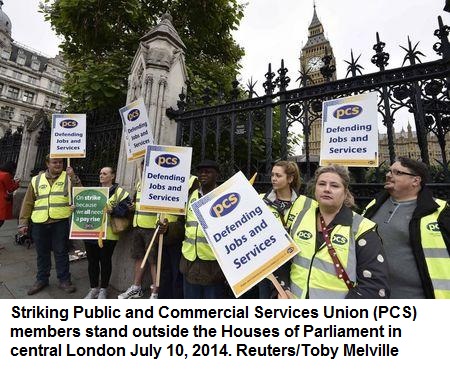
British strike 1LONDON (Reuters) – Hundreds of thousands of public sector workers including teachers, council workers and firefighters staged a 24-hour pay strike on Thursday in a stoppage that has prompted Prime Minister David Cameron to pledge a crackdown on union powers.

Protesters marched through the streets of many of Britain’s main cities in one of the biggest co-ordinated labour stoppages for three years.

Denouncing what they called “poverty pay,” they demanded an end to restrictions on wage rises that have been imposed by the government over the past four years in an effort to help reduce Britain’s huge budget deficit.

In London, demonstrators marched towards Trafalgar Square at midday, chanting “Low pay, no way, no slave labour” to the beat of a drum. A giant pair of inflatable scissors, carried by members of the National Union of Teachers (NUT), read “Education cuts never heal.”

Firefighter Simon Amos, 47, marched wearing his uniform behind a flashing fire engine parading members of the Fire Brigades Union (FBU). “The government [is] making us pay more for our pension for it to be worth the same, and making us work longer,” he said.

British strike 2The biggest public sector union involved, Unison, said early reports showed the strike had led to 3,225 school closures with more than 1,000 others partially closed.

Refuse collectors, school support staff, cleaners, street sweepers, care workers, nursery assistants and social workers were joining the strike, it added.

Hot spots, it said, included the North East, Wales and East Midlands where most council offices had closed, while more than 60 picket lines have closed most services in Newcastle.

“It is a massive decision by local government and school support workers to sacrifice a day’s pay by going on strike, but today they are saying enough is enough,” said Unison General Secretary, Dave Prentis in a statement.

Britain’s coalition government has enforced a policy of pay restraint for public sector workers since coming to power in 2010, imposing a pay freeze until 2012 and then a one percent pay rise cap, resulting in a fall in income in real terms [compared to inflation].

The Cabinet Office played down the impact of the strike, saying that most schools in England and Wales were open and that fire services were operating throughout the country.

British strike 3On Wednesday, Cameron told parliament he planned to limit unions’ powers to call strikes.

“How can it possibly be right for our children’s education to be disrupted by trade unions acting in this way” he said.

Tough new laws would be proposed in the Conservative manifesto for next year’s general election, he added.

These would include the introduction of a minimum threshold in the number of union members who need to take part in a strike ballot for it to be legal.

The manifesto could also back the introduction of a time limit on how long a vote in favour of industrial action would remain valid.

The NUT mandate for Thursday’s strike, for example, came from a 2012 strike ballot based on a turnout of just 27 percent, Cameron said.

The issue of minimum voting thresholds last arose three months ago when a strike by London Underground train drivers caused huge disruption in the capital, prompting Mayor Boris Johnson to demand that at least half of a union’s members should vote in favour for a strike to go ahead.
Source: Reuters News Service; retrieved 07/10/2014 from: http://news.yahoo.com/public-sector-workers-strike-over-poverty-pay-105040672.html

Frankly, the Caribbean Diaspora employed in the British public sector can now do better at home … in the Caribbean.

This is the assertion of the book Go Lean…Caribbean. That once the proposed empowerments are put in place, the Caribbean Diaspora should consider repatriating to their ancestral homelands.

Unfortunately for the Caribbean, this societal abandonment has continued, since the early days of the “Windrush Generation”[a] right up to now. In a recent blog post, this commentary related analysis by the Inter-American Development Bank that the Caribbean endures a brain drain of 70% among the college educated population; (https://goleancaribbean.com/blog/?p=1433).

Change has now come to the Caribbean.

The book Go Lean…Caribbean serves as a roadmap for the introduction and implementation of the technocratic Caribbean Union Trade Federation (CU). This roadmap will spearhead the elevation of Caribbean society. The prime directives of the CU are presented as the following 3 statements:

  • Optimization of the economic engines in order to grow the regional economy & create 2.2 million new jobs at home.
  • Establishment of a security apparatus to protect the resultant economic engines.
  • Improve Caribbean governance to support these engines.

The book posits that the improved conditions projected over the 5 years of the roadmap will neutralize the impetus for Caribbean citizens to flee, identified as “push and pull” factors. This point is stressed early in the book (Page 13) in the following pronouncements in the opening Declaration of Interdependence:

xix.   Whereas our legacy in recent times is one of societal abandonment, it is imperative that incentives and encouragement be put in place to first dissuade the human flight, and then entice and welcome the return of our Diaspora back to our shores. This repatriation should be effected with the appropriate guards so as not to imperil the lives and securities of the repatriated citizens or the communities they inhabit. The right of repatriation is to be extended to any natural born citizens despite any previous naturalization to foreign sovereignties.

xx.   Whereas the results of our decades of migration created a vibrant Diaspora in foreign lands, the Federation must organize interactions with this population into structured markets. Thus allowing foreign consumption of domestic products, services and media, which is a positive trade impact. These economic activities must not be exploited by others’ profiteering but rather harnessed by Federation resources for efficient repatriations.

This foregoing article highlights other issues that have been prominently addressed in the Go Lean book, namely that of the Civil Service and Labor Relations. There is the need for a professional staff in the Federal Civil Service. They require marketable benefits and compensation. There is also a role for Labor Unions to play in the elevation of Caribbean society. The Go Lean roadmap envisions an inclusionary attitude towards unions. The Go Lean community ethos is that of being partners with unions, not competitors. The book features specific tools and techniques that can enhance management-labor relationships.

These issues constitute heavy-lifting for the regional administration of the Caribbean:

  • fostering best practices for federal civil service and labor unions,
  • minimizing the brain drain, and
  • facilitating repatriation to the homeland.

These issues cannot be glossed over or handled lightly; this is why the Go Lean book contains 370 pages of finite details for managing change in the region. The book contains the following sample of community ethos, strategies, tactics, implementations and advocacies to impact the Caribbean homeland:

Community Ethos – Economic Systems Influence Choices & Incentives Page 21
Community Ethos – The Consequences of Choices Lie in the Future Page 21
Community Ethos – Job Multiplier Page 22
Community Ethos – Lean Operations Page 24
Community Ethos – Return on Investments Page 24
Community Ethos – Ways to Impact the Future Page 26
Community Ethos – Ways to Improve Negotiations Page 32
Strategy – Competition – Remain home   –vs- Emigrate Page 49
Strategy – Agents of Change – Aging Diaspora Page 57
Tactical – Separation of Powers – Versus Member-States Governments Page 71
Implementation – Year 1 / Assemble Phase – Establish Civil Service Page 96
Implementation – Ways to Deliver Page 109
Implementation – Trade Mission Objectives Page 116
Implementation – Reasons to Repatriate Page 118
Anecdote – Experiences of a Repatriated Resident Page 126
Planning  – 10 Big Ideas for the Caribbean Region Page 127
Advocacy – Ways to Create Jobs Page 152
Advocacy – Ways to Impact Labor Unions Page 164
Advocacy – Ways to Manage Federal Civil Service Page 173
Anecdote – Experiences of Diaspora Member Living Abroad Page 216
Advocacy – Ways to Impact the Diaspora Page 217

The Go Lean roadmap has simple motives: fix the problems in the homeland to make the Caribbean a better place to live, work, learn and play. There should be no need to go abroad and try to foster an existence in a foreign land. So for those of Caribbean heritage working in the British Civil Service, we hear your pleas. Our response: Come home; come in from the cold.

Now is the time for all of the Caribbean, the people residing in the homeland and those of the Diaspora, to lean-in for the empowerments described in the book Go Lean … Caribbean. This Big Idea for the region is a dramatic change; one that is overdue. The policies & practices of the past have failed Caribbean society. Too many people left, yet have little to show for it.

Caribbean music icon Bob Marley advocated this same charter for the Caribbean Diaspora. He sang to “come in from the cold” in the opening song of his last album Uprisings in 1980. How “spot-on’ were his words in the following music/video:

Download the free e-Book of Go Lean … Caribbean – now!

———————

Appendix – Cited Reference
a: “There was plenty of work in post-war Britain and industries such as British Rail, the National Health Service and public transport recruited almost exclusively from Jamaica and Barbados”. Retrieved July 10, 2014 from: http://en.wikipedia.org/wiki/British_African-Caribbean_people#The_.22Windrush_generation.22

Share this post:
, , ,
[Top]

Book Review: ‘Prosper Where You Are Planted’

Go Lean Commentary

The Caribbean is in crisis; according to a report by the Inter-American Development Bank (IDB), over 70% of college educated citizens have fled the region, looking for better opportunity. The fact that the percentage is so high is evident that it is more prosperous abroad than at home. This is the harsh reality. This is also an economic fact as many Caribbean states get 4 to 7 percent of their GDP as remittances back to the homeland from the Diaspora living abroad, mostly in North America and Western Europe.

But this is a losing proposition for the Caribbean – no doubt it is better to get 100% of Gross Domestic Production. In the same report by the IDB, it was stated that Caribbean member-states lose 10 to 11 percent of GDP from emigration and the “spent” cost of education on those expatriates, (https://goleancaribbean.com/blog/?p=1433), so whatever the level of remittance from the Diaspora, the community is still losing. What we need is the option to prosper where we’re planted in the Caribbean. This goal obviously requires heavy-lifting and is easier said than done. This is the focus of the book Go Lean…Caribbean, to elevate the Caribbean economy so that there would be optimal opportunities at home and no need to supplant to another land.

So how do we prosper where we’re planted? While this is a simple question (based on the Bible principle of Psalms 1:3), the answer is more complex. One writer, Dani Johnson, has advocated this theme in a series of books:

Title ISBN                               
First Steps to Wealth 978-0-9789551-8-2
Grooming the Next Generation for Success 978-1-4587-9610-3
Spirit-Driven Success 978-0-7684-9651-2

The below article (and VIDEO) is a review of her last book First Steps to Wealth: it breaks down into bite-size morsels the big meal of wealth building.

The book Go Lean…Caribbean concurs with First Steps to Wealth, but rather than individual wealth, it serves as a roadmap for the introduction and implementation of the technocratic Caribbean Union Trade Federation (CU) to do the heavy-lifting of optimizing community wealth and nation-building for the region.

By: Sheryl Nance-Nash
Title: Dani Johnson Offers Her 12 Laws for Creating Wealth – and Keeping It
DailyFinance e-Zine (Posted 07/23/2013 Retrieved 06/30/2014) –
http://www.dailyfinance.com/2011/07/23/dani-johnson-offers-her-12-laws-for-creating-wealth-and-keepi/

CU Blog - Book Review - Prosper Where You Are Planted - Photo 1

Dani Johnson says she was groomed by her drug addict parents to fail — financially, emotionally and socially. She seemed well on her way to living down to that expectation — by 17 she was pregnant, at 21, homeless. Two years later though, she was a millionaire, thanks to the thriving company she built manufacturing and selling her own nutritional and skin care products. She sold that company in 1996. Then, she lost her fortune, spending almost all of it and trusting the wrong people with the rest.

Today, as a multimillionaire with six businesses that employ more than 30 people, she knows a thing or two about wealth. She says there are three things you need to know about money: how to make it and more of it; how to keep it; and how to turn it into your slave.

“Ninety-eight percent of the population will end up dead or broke by age 65. Only two percent of the population will succeed,” says Johnson in her new book, First Steps to Wealth. “Where do you want to be?” she asks. You need a financial vision.

When she started raking in the cash, she didn’t have the vision thing down yet. “I believed I had to wear Christian Dior suits and $500 shoes to be successful. I believed wealth was about a new Mercedes Benz convertible, and the 6,000 square-foot house with a swimming pool, view of the mountains and tennis courts. But when I got those things, I never felt successful. I had a $250,000 wardrobe and $250,000 in jewelry, and I still felt this gaping hole in my belly that made me feel I was a failure,” she writes.

Challenge Yourself to Apply the Laws to Your Life

Everything starts with a decision. “There’s a theory that if you find your passion that’s where you’ll be successful, but I believe you have to go with what’s in front of you. I saw a box of weight-loss products in the backseat of my car and though I had no interest in selling, I made a decision that I needed to find out how to sell those products because if I relied on being a cocktail waitress it would take months to be able to afford an apartment,” says Johnson, who was homeless and suicidal then. She started a business from the trunk of her car and a phone booth.

“If I didn’t make that decision, I would still be broke. I didn’t want to sell, but it was the door in front of me,” says Johnson. When her first sales call ended with a hang up, she called another weight-loss product company, observed how they handled her, and developed a script from that. She used their advertisements to shape her own. To make a long story short, in 45 days she had $18,000 in sales.

Johnson credits her fortune to what she calls the 12 Laws of Success — fundamental principles that moved her from an impoverished past to a prosperous present. She has spent the last two decades telling others how those principles can help them too.

Law No. 1 – The Law of Vision

In her book she asks, “What are the things you dreamed of doing in your life? Do you remember what those dreams looked like? What happened to those dreams? “If you want to be successful financially, expand your income to fit your dreams. This is the Law of Vision. “For without vision, we perish. It is important to list where we want to go, what we want to do, and with whom we want to do it. If you do not know what you want, no one can help you get it,” she writes. But what do you want?

Law No. 2 – The Law of the Mind

There is something very different about the wealthy: The way they think, how they make decisions, act upon them, and how they see circumstances and react to them. It’s their mindset, says Johnson. What’s the right mindset? “It’s saying every time you meet a roadblock, ‘How can I make it happen?'” You decide to go around a problem, or dig a hole underneath a problem to make things happen, instead of quitting. Watch the company you keep. “You’re a product of your environment. I listen to uplifting music and life-giving audios,” says Johnson.

Law No. 3 – The Law of Value

The marketplace pays for value. What determines your value? Your skill set. Quite simply, “If you increase your skill, you will increase your pay.” Your value is not personality, looks, or where you were born, but has everything to do with your skills, she writes. Everybody is in control of his or her skills.

“Go beyond the basics. If I had focused just on weight-loss products, I would have been like everybody else, but we decided to go a step further, to focus on people — what makes them tick, to deal with bigger issues,” says Johnson. Not only did delving deeper into the customer distinguish her from competitors, it birthed another business, a training program for personal and professional development.

Law No. 4 – The Law of Reaping and Sowing

This is the greatest of all the laws, she says. “You have been taught a lie that success is about being lucky or being in the right place at the right time. But the bottom line, says Johnson, we reap what we sow. “If you waste money, you are going to reap what you sow. If you feed your financial problems and are focused on stressing out and not being able to pay your bills, you will have more problems. Focus on finding answers. Feed the solution, not the problem,” she writes.

Giving is also key. “With our businesses, we give 10% of our gross sales right off the top — to the poor, orphans, widows, or for freeing children out of the sex trade. That is about 30% of our net profit. When we do that, we have found that even more comes back to us,” she writes. She co-founded the nonprofit King’s Ransom Foundation, which serves the needy globally. She spread her generosity on ABC’s Secret Millionaire earlier this year. Johnson says giving motivates her. “The only reason I work is to be able give to the kids, the orphans. I don’t have to work another day in my life. My kids are set.”

Law No. 5 – The Law of Desire

Johnson says desire always reveals design and destiny. Everyone was born with a design to succeed. You were born with everything in you. “You have enthusiasm, persistence, faith, adventurous spirit, and the gift to get over it,” says Johnson. The only thing you’re lacking is the skill to succeed. “That’s the part you have to learn and invest in,” she writes. You were designed with wealth in mind. Replace the poverty mentality with a whole new way of thinking. No amount of debt is too small to pay off. “If you invest your money is something that makes more money, you create wealth. If you spend that money, the money is gone. Your monthly income is supposed to grow something, just like seed. But most people live from paycheck to paycheck, which means they are eating all of their seed. They have nothing to plant and grow.”

Law No. 6 – The Law of Teachability

There are people around you who have success in some areas of their lives. When you are teachable, you find them. When you are unteachable, you think you are them. Being teachable means you are hungry, pursuing success, and willing to learn from masters. When you follow this law you will achieve whatever you pursue.

Law No. 7 – The Law of Forgiveness

When you do not forgive, you make decisions out of bitterness. “This kills your time for being productive and creating wealth,” says Johnson.

Law No. 8 – The Law of Promotion

If you can be faithful with the little things, if you grow and improve what you have, then you will be made a ruler over much more. Johnson insists, “Prosper where you are planted.” Your answer might be right in front of you, and maybe you don’t like it. “The road to success is often paved with things we do not want to do,” says Johnson.

Then too, “People are always trying to hit a home run. Life doesn’t work like that. They try to make one big jump and flop. Work with what you have. If you have a job that you might think is ‘little’, be the best at it, effect people there, make a difference wherever you are.” Instead of always seeking something else, focus on where you are, whether it’s your job, your business, your relationships. “You will never prosper if you don’t,” says Johnson.

Law No. 9 – The Law of Focus

It’s simple: Whatever you focus on is what you get good at. She asks, “Where is your focus?”

Johnson used to work 100 hour weeks. “My marriage was miserable and I didn’t deserve the title mother,” says Johnson, whose five children are now 12 to 24. After a nervous breakdown in the 1990s, her priorities changed. “I decided that family came first and that I would only work 20 hours a week — that required focus. I discovered I was wasting 80 hours a week.” When she started working less, she was so focused that her income tripled. She began delegating. “Don’t think you’re the only one who can do something,” says Johnson, whose businesses include danijohnson.com, publishing company Call to Freedom, investment, software, real estate and oil firms.

Law No. 10 – The Law of Honor

Honoring people is the key to successful relationships, personal and professional. Says Johnson, “It’s about honoring people, giving them what they want. When you honor people, they honor you back, but it is not always the one you honor who honors you back.”

Law No. 11 – The Law of Decision

Everything in life boils down to choices. When you finally make a decision, everything begins to click. Make a decision.

Law No. 12 – The Law of Action

When we sit with indecision, we invite our enemies — procrastination, fear, unbelief, and excuses — into our lives, writes Johnson. When you immediately follow your decisions with action, a funnel of favor begins. Doors begin to open. People begin to help. Your life’s purpose becomes clear, and self-motivation mobilizes you from the inside out.

If the thought of trying to put all 12 laws into play seems overwhelming, there’s one good place to start. Says Johnson, “Change your attitude.

Rather than 12 Laws, the Go Lean roadmap uses cutting-edge delivery of best practices to employ strategies, tactics and implementations to impact its prime directives; identified with the following 3 statements:

  • Optimization of the economic engines in order to grow the regional economy to $800 Billion & create 2.2 million new jobs.
  • Establishment of a security apparatus to protect the resultant economic engines.
  • Improve Caribbean governance to support these engines.

The successful execution of these directives will allow Caribbean stakeholders to prosper, while remaining as residents in their homeland. The Go Lean book seeks to optimize the entire Caribbean economic/security/governance eco-system to reach this goal. This vision is defined early in the book (Page 13 & 14) in the following pronouncements in the Declaration of Interdependence:


xix.   Whereas our legacy in recent times is one of societal abandonment, it is imperative that incentives and encouragement be put in place to first dissuade the human flight, and then entice and welcome the return of our Diaspora back to our shores. This repatriation should be effected with the appropriate guards so as not to imperil the lives and securities of the repatriated citizens or the communities they inhabit. The right of repatriation is to be extended to any natural born citizens despite any previous naturalization to foreign sovereignties.

xxvi.   Whereas the Caribbean region must have new jobs to empower the engines of the economy and create the income sources for prosperity, and encourage the next generation to forge their dreams right at home, the Federation must therefore foster the development of new industries… In addition, the Federation must invigorate the enterprises related to existing industries … – impacting the region with more jobs.

The Go Lean book details (Page Numbers included below) features of assessments, community ethos, strategies, tactics, implementations and advocacies to plant and exploit local opportunities in the Caribbean region. These features are listed here to correspond with references from Dani Johnson’s book in the foregoing article:

Prosper   Where You Are Planted References Go Lean…Caribbean References
Assessment – 98% of the population will end up dead or   broke by age 65. Impacting   Retirement (Page 221); Improving   Elder-Care (Page 225).
Learning from   competitors Lessons from New   York City (Page 137); Canada (Page 146)
A “Hustling” Attitude Entrepreneurship Ethos (Page 28)
Law No. 1 – The Law of Vision Strategy – Vision (Page 45)
Law   No. 2 – The Law of the Mind Advocacies – Overcoming Obstacles (Pages 121 – 124)
Law No. 3 – The Law of Value Community Ethos – Genius (Page 27), Intellectual Property (Page 29), Turn-around (Page 33)
Law No. 4 – The Law of Reaping and Sowing Community Ethos – Return on Investments (Page 24), Lean Operations (Page 24), Non-Governmental Organizations   (Page 25)
Law No. 5 – The Law of Desire Strategy – Missions (Page 45)
Law No. 6 – The Law of Teachability Planning – Lessons Learned from … (Pages 135 – 146)
Law No. 7 – The Law of Forgiveness Community Ethos – Reconciliation (Page 34)
Law No. 8 – The Law of Promotion Optimize Existing Competencies (Page 58) – Tourism (Page 190), Banking (Page 199), Agriculture (Pages 162, 183 & 208)
Law No. 9 – The Law of Focus Implementation – Fostering a Lean   Technocracy (Page 64), Delivery   Arts (Page 109)
Law No. 10 – The Law of Honor Advocacy – One Percent (Page 224), Foundations (Page 219)
Law No. 11 – The Law of Decision Community Ethos – Intelligence Gathering   & Analysis (Page 23);    Impact Research & Development – Big   Data Analysis (Page 30)
Law No. 12 – The Law of Action Implementation – Delivery Arts &   Sciences (Page 109)

Now is the time for all of the Caribbean, the people and governing institutions, to lean-in for the empowerments described in the book Go Lean … Caribbean. It is time for the region to prosper right here where we are planted.

The Caribbean can succeed in this effort to improve the Caribbean as a place to live, work and play. There are previous blog commentaries that delve into these same issues:

https://goleancaribbean.com/blog/?p=1325 Puerto Rico Governor Signs Bill on SME’s
https://goleancaribbean.com/blog/?p=1296 Remittances to Caribbean Increased By 3 Percent in 2013
https://goleancaribbean.com/blog/?p=1014 Jack M. Mintz Commentary: All is not well in the sunny Caribbean
https://goleancaribbean.com/blog/?p=623 Only at the precipice, do they change
https://goleancaribbean.com/blog/?p=599 Ailing Puerto Rico open to radical economic fixes
https://goleancaribbean.com/blog/?p=398 Self-employment on the rise in the Caribbean – World Bank
https://goleancaribbean.com/blog/?p=364 Time Value of Money

Caribbean Music icon Bob Marley advocated a similar pledge, based on Psalms 1:3, in his song “We’d be Forever Loving Jah” (Album: Uprisings 1980) with the following lyrical stanza:

‘Cause just like a tree, planted, planted by the rivers of water
That bringeth forth fruits, bringeth forth fruits in due season.
Everything in life got its purpose,
Find its reason in every season,
Forever, yeah!
(We’ll be forever loving Jah) We’ll be forever!

See Bob Marley Embedded VIDEO here: https://youtu.be/VuAXl1LYY6o

Download the book Go Lean … Caribbean – now!

Share this post:
, , , ,
[Top]

Floods in Minnesota, Drought in California – Why Not Share?

 Go Lean Commentary

Millions across Minnesota are in the middle of a flooding disaster as a severe storm system moves over the central U.S.. See this VIDEO:

VIDEO – CBS News; posted June 23, 2014; retrieved June 27 from: http://www.cbsnews.com/videos/minnesota-communities-face-weeks-of-flooding/
Title: Minnesota communities face weeks of flooding

(VIDEO plays best in Internet Explorer).

At the same time, California continues to endure serious drought conditions. Many feel, though not supported by the facts, that this may be the worst drought in California history. See the aligning VIDEO here:

VIDEO – Win Rosenfeld, NBC News; posted June 2, 2014; retrieved June 27 from: https://www.youtube.com/watch?v=Gx7vFqU8iGY
Title: California’s Drought History | Debunker

So on the one hand, part of the United States is experiencing too much water and in other parts of the country, too little water. This is Climate Change 101. If only, there would be some equalizing between “the feast and the famine” with water.

This was the point/comment of one viewer of the CBS News Video:

Why are we not building a WATER PIPELINE from these flood prone areas to the parched West and South?!?!? If we can afford an OIL pipeline all the way to the southern gulf, we can definitely build a desperately needed pipeline for water! – By: uberengineer – June 24, 2014

This comment was spot on! According to the book Go Lean … Caribbean, pipelines can be strategic, tactical and operationally efficient. They can mitigate challenges of Mother Nature, create jobs and grow the economy at the same time.

The Go Lean book identifies that there are “agents-of-change” that our world have to now contend with. Proactively managing the cause-and-effect of these agents can yield great benefits and alleviate much suffering. The agents-of-change for the Caribbean are identified as follows:

Technology
Aging Diaspora
Climate Change
Globalization

If the suggestion of above commentator Uber Engineer is to be seriously considered in the US, this would fall under the scope of the US federal government as two states California and Minnesota are involved – neither state has jurisdiction over the other. Plus, the many states in between (Iowa, Nebraska, Colorado, Utah and Nevada) where a pipeline would traverse would also have to be factored into the equation. Under US law this approach is called an Interstate Compact. Uber Engineer is right! This pipeline strategy is already being deployed for oil in the US with the TransCanada Keystone [a] Pipeline project, running from southern Canada down to the Gulf of Mexico; (see route map in the photo).

The question is: who can contemplate such a solution for the Caribbean marketplace? The Go Lean book posits that Climate Change is wreaking havoc on Caribbean life as well and that Caribbean stakeholders must proactively consider the benefits of pipeline deployments in the region. This book purports that a new technology-enhanced industrial revolution is emerging, in which there is more efficiency gleaned from installing, monitoring and maintaining pipelines. Caribbean society must participate, not just spectate the developments in this revolution. This point is pronounced early in the book with this Declaration of Interdependence (Page 11 &14), with the opening and subsequent statements:

i.     Whereas the earth’s climate has undeniably changed resulting in more severe tropical weather storms, it is necessary to prepare to insure the safety and security of life, property and systems of commerce in our geographical region. As nature recognizes no borders in the target of its destruction, we also must set aside border considerations in the preparation and response to these weather challenges.

xxvi.       Whereas the Caribbean region must have new jobs to empower the engines of the economy and create the income sources for prosperity, and encourage the next generation to forge their dreams right at home, the Federation must therefore foster the development of new industries, like that of … pipelines …

xxvii.     Whereas the region has endured a spectator status during the Industrial Revolution, we cannot stand on the sidelines of this new economy, the Information Revolution. Rather, the Federation must embrace all the tenets of Internet Communications Technology (ICT) to serve as an equalizing element in competition with the rest of the world. The Federation must bridge the digital divide and promote the community ethos that research/development is valuable and must be promoted and incentivized for adoption.

This book Go Lean… Caribbean, serves as a roadmap for the introduction and implementation of the technocratic Caribbean Union Trade Federation (CU) to elevate society of the 30 Caribbean member-states. This agency will assume jurisdiction for the Caribbean Sea, the 1,063,000 square-mile international waters under the guise of an Exclusive Economic Zone. This approach allows for cooperation and equalization between the feast-and-famine conditions in the region. This is a real solution to real problems! In fact the CU/Go Lean roadmap has these 3 prime directives:

  • Optimization of the economic engines in order to grow the regional economy.
  • Establishment of a security apparatus to protect the resultant economic engines.
  • Improve Caribbean governance to support these engines.

The Go Lean book details the economic principles and community ethos to adopt, plus the executions of strategies, tactics, implementations and advocacies to forge Research & Development with pipelines and industrial growth in Caribbean communities:

Economic Principles – People Choose because Resources are Limited Page 21
Economic Principles – All Choices Involve Costs Page 21
Economic Principles – People Respond to Incentives Page 21
Economic Principles – Economic Systems Influence Individual Choices Page 21
Economic Principles – Voluntary Trade Creates Wealth Page 21
Economic Principles – Consequences of Choices Lie in the Future Page 21
Community Ethos – Job   Multiplier Page 22
Community Ethos – “Crap” Happens Page 23
Community Ethos – Lean Operations Page 24
Community Ethos – Return on Investments (ROI) Page 24
Community Ethos – Cooperatives Page 25
Community Ethos – Ways to Impact the Future Page 26
Community Ethos – Ways to Help Entrepreneurship Page 28
Community Ethos – Ways to Impact Research & Development Page 30
Community Ethos – Ways to Improve Negotiations Page 32
Community Ethos – Ways to Improve Sharing Page 35
Community Ethos – Impact the Greater Good Page 37
Anecdote – Pipeline Transport – Strategies, Tactics &   Implementations Page 43
Strategy – Vision – Confederating 30 Member-states in a Union Page 45
Strategy – Agents of Change – Technology Page 57
Strategy – Agents of Change – Aging Diaspora Page 57
Strategy – Agents of Change – Globalization Page 57
Strategy – Agents of Change – Climate Change Page 57
Tactical – Fostering a Technocracy Page 64
Tactical – Growing Economy – New High Multiplier Industries Page 68
Separation of Powers – Interstate   Commerce Administration Page 79
Separation of Powers – Interior Department – Exclusive Economic Zone Page 82
Implementation – Assemble – Pipeline as a Focused   Activity Page 96
Implementation – Ways to Pay for Change Page 101
Implementation – Benefits from the Exclusive Economic Zone Page 104
Implementation – Ways to Develop a Pipeline Industry Page 107
Implementation – Ways to Deliver Page 109
Planning – 10 Big Ideas – Pipeline Projects Page 127
Advocacy – Ways to Grow the Economy Page 151
Advocacy – Ways to Create Jobs Page 152
Advocacy – Ways to Better Manage the Social Contract – Infrastructure Page 170
Advocacy – Ways to Ways to Impact Public Works – Ideal for Pipelines Page 175
Advocacy – Ways to Foster Cooperatives Page 176
Advocacy – Ways to Better Manage Natural Resources – Water   Resources Page 183
Advocacy – Ways to Impact Extractions – Pipeline Strategy   Alignment Page 195
Advocacy – Ways to Improve Emergency Management Page 196
Advocacy – Ways to Foster Technology Page 197
Advocacy – Ways to Ways to Improve Monopolies – Foster   Cooperatives Page 202
Advocacy – Ways to Improve Transportation – Pipeline Options Page 205
Advocacy – Ways to Impact Rural Living – Minimize Irrigation   Downsides Page 235
Appendix – Interstate Compacts Page 278
Appendix – Pipeline Maintenance Robots Page 283
Appendix – North Dakota Example – Oil Drilling Economic-Societal   Effects Page 334

Historically, pipelines are cheaper than alternative modes of transport for liquid materials like oil, natural gas and water. Plus the cost of water in all aspects of modern society is no longer negligible. Just conduct an acid test at a friendly neighborhood Gas Station; while a gallon of gas may be high, the equivalent pricing for cool drinking water is within the same range.

Water is only free in our society when it is raining; for all other times, there are costs associated with storage and distribution.

Thusly, the economic principles of pipelines are sound.

CU Blog - Floods in Minnesota, Drought in California - Why Not Share - Photo 2

Pipelines can be above ground, underground and/or underwater. (See Trans-Alaska Pipeline photo). There is a role for many schemes of pipeline deployments in the vision for the reboot of the Caribbean homeland. The roadmap Go Lean … Caribbean identifies pipelines as strategic, tactical and operationally mandatory for any chance at success in making the Caribbean a better place to live, work and play.

Download the book Go Lean … Caribbean – now!

——–

Appendix – Referenced Source:

a.     Keystone Pipeline (Retrieved June 27, 2014 from: http://en.wikipedia.org/wiki/Keystone_Pipeline):

The Keystone Pipeline System is an oil pipeline system in Canada and the United States. It runs from the Western Canadian Sedimentary Basin in Alberta, Canada, to refineries in the United States in Steele City, Nebraska; Wood River and Patoka, Illinois; and the Gulf Coast of Texas. In addition to the synthetic crude oil (syncrude) and diluted bitumen (dilbit) from the oil sands of Canada, it also carries light crude oil from the Williston Basin (Bakken) region in Montana and North Dakota.

CU Blog - Floods in Minnesota, Drought in California - Why Not Share - Photo 1Three phases of the project are in operation, and the fourth is awaiting U.S. government approval. Upon completion, the Keystone Pipeline System would consist of the completed 2,151-mile (3,462 km) Keystone Pipeline (Phases I and II), Keystone Gulf Coast Expansion (Phase III), and the proposed Keystone XL Pipeline Project (Phase IV). Phase I, delivering oil from Hardisty, Alberta, to Steele City, Wood River, and Patoka, was completed in the summer of 2010. Phase II, the Keystone-Cushing extension, was completed in February 2011 with the pipeline from Steele City to storage and distribution facilities at Cushing, Oklahoma. These two phases have the capacity to deliver up to 590,000 barrels per day (94,000 m3/d) of oil into the Mid-West refineries. Phase III, the Gulf Coast Extension, which was opened in January 2014, has capacity up to 700,000 barrels per day (110,000 m3/d). The proposed Phase IV, would begin in Hardisty, Alberta, and extend to Steele City, essentially replacing the existing phase I pipeline.

The Keystone XL proposal faced criticism from environmentalists and some members of the United States Congress. In January 2012, President Barack Obama rejected the application amid protests about the pipeline’s impact on Nebraska’s environmentally sensitive Sand Hills region. TransCanada Corporation changed the original proposed route of Keystone XL to minimize “disturbance of land, water resources and special areas”; the new route was approved by Nebraska Governor Dave Heineman in January 2013. On April 18, 2014 the Obama administration announced that the review of the controversial Keystone XL oil pipeline has been extended indefinitely, until at least after the November 4, 2014 mid-term United States elections.


Share this post:
, , , ,
[Top]

St Croix’s Tim Duncan to Return to Spurs For Another Season

Go Lean Commentary

Congratulations Tim Duncan. You deserve your champion’s accolades.

Tim Duncan Photo

This commentary has previously sided with Mr. Duncan’s opponent in the recent NBA Finals. Here below are the previous blogs citing a hope for the Miami Heat’s dominance in the NBA Playoff tournament.

https://goleancaribbean.com/blog/?p=1148 Sports Bubble – Franchise values in basketball
https://goleancaribbean.com/blog/?p=689 eMerge conference aims to jump-start Miami tech hub

But talent recognizes talent!

It is also good news, according to this foregoing news article, that Mr. Duncan will be returning for at least one more season.

By: The Caribbean Journal Staff

Tim Duncan isn’t going anywhere.

The St Croix native, who recently won his fifth NBA championship, will be returning to the San Antonio Spurs for his 18th NBA season.

The team announced Monday that the 38-year-old Duncan had exercised his player option for the 2014-2015 season, putting to rest any notion that he would be retiring.

Duncan helped the Spurs to a dominant 4-1 series win over the Miami Heat in this month’s NBA Finals.

The Christiansted native is one of five players in the history of the NBA to win five championships and five MVPs (either NBA Finals or regular season), along with Michael Jordan, Magic Johnson, Bill Russell and Kareem Abdul-Jabbar.

Duncan leads all active players in career wins, with 898.
Caribbean Journal Online News Source  (Posted 06-23-2014; retrieved 06-26-2014) –
http://www.caribjournal.com/2014/06/23/st-croixs-tim-duncan-to-return-to-spurs-for-another-season/

There is something bigger than sports alone at play here. As the foregoing news article depicts, Mr. Duncan is a member of the Caribbean Diaspora. He is recognized as one of the best in his field of endeavor; perhaps one of the best of all time. This is a claim of the book Go Lean … Caribbean, that sports require a genius qualifier and that genius  ability can be found in abundance in the Caribbean. Mr. Duncan makes us all proud: Christiansted, St. Croix, the US Virgin Islands and all of the Caribbean.

The Go Lean book serves as a roadmap for the introduction and implementation of the Caribbean Union Trade Federation (CU), a technocratic federal government to administer and optimize the economic/security/ governing engines of the region’s 30 member-states. At the outset, the roadmap recognizes the value of sports with these statements in the Declaration of Interdependence (Page 13 & 14):

xxvi.     Whereas the preparation of our labor force can foster opportunities and dictate economic progress for current and future generations, the Federation must ensure that educational and job training opportunities are fully optimized for all residents of all member-states, with no partiality towards any gender or ethnic group. The Federation must recognize and facilitate excellence in many different fields of endeavor, including sciences, languages, arts, music and sports. This responsibility should be executed without incurring the risks of further human flight, as has been the past history.

xxxi.     Whereas sports have been a source of great pride for the Caribbean region, the economic returns from these ventures have not been evenly distributed as in other societies. The Federation must therefore facilitate the eco-systems and vertical industries of sports as a business, recreation, national pastime and even sports tourism – modeling the Olympics.

The Go Lean roadmap calls for the market organizations to better explore the economic opportunities for sports. Sports can be big business! But even when money is not involved, other benefits abound. As such the CU will enhance the engines to elevate sports at all levels: amateur, intercollegiate and professional.

The other issue related to Tim Duncan is that of “image”. Mr. Duncan could be a proud ambassador of Caribbean character. Personally, he does not advocate any political or economic agenda, so others must do that for him. As a public figure, his story is free to relate to the listening world of how impactful a Caribbean heritage can be.

The subjects of sports and Caribbean image have been related in many previous Go Lean blogs; highlighted here in the following samples:

a. https://goleancaribbean.com/blog/?p=1446 Caribbean   Players in the 2014 World Cup
b. https://goleancaribbean.com/blog/?p=1341 College   World Series Time
c. https://goleancaribbean.com/blog/?p=1214 The Art &   Science of Temporary   Stadiums – No White Elephants
d. https://goleancaribbean.com/blog/?p=1148 Sports Bubble –   Franchise values in   basketball
e. https://goleancaribbean.com/blog/?p=1020 Sports Revolutionary: Advocate Jeffrey Webb
f. https://goleancaribbean.com/blog/?p=857 Caribbean Image: Dreadlocks
g. https://goleancaribbean.com/blog/?p=498 Book Review: ‘The Sports Gene’
h. https://goleancaribbean.com/blog/?p=334 Bahamians Make Presence Felt In Libyan   League
i. https://goleancaribbean.com/blog/?p=318 Collegiate Sports in the Caribbean
j. https://goleancaribbean.com/blog/?p=60 Could the Caribbean Host the Olympic Games?

The book Go Lean…Caribbean has an economic empowerment agenda, but there are still huge benefits for the region related to sports. The strategy is to consolidate the region’s 30 member-states / 4 languages into a Single Market of 42 million people – leverage for a viable sports landscape. The CU facilitation of applicable venues (stadia, arenas, fields, temporary structures) on CU-owned fairgrounds plus the negotiations for broadcast/streaming rights/licenses will elevate the art, science and genius of sports as an enterprise in the region.

Now is the time for all of the Caribbean to lean-in to the following community ethos, strategies, tactics, implementations and advocacies detailed in the book Go Lean … Caribbean to re-boot the delivery of the regional solutions to elevate the Caribbean region through sports:

Community Ethos – People Respond to Incentives in Predictable Ways Page 21
Community Ethos – Return on Investments Page 24
Community Ethos – Ways to Foster Genius Page 27
Community Ethos – Ways to Improve Negotiations Page 32
Community Ethos – Ways to Promote Happiness Page 36
Strategic – Vision – Integrating Region in to a Single Market Page 45
Strategic – Staffing – Sporting Events at Fairgrounds Page 55
Tactical – Fostering a Technocracy Page 64
Tactical – Separation of Powers – Sports & Culture Administration Page 81
Tactical – Separation of Powers – Fairgrounds Administration Page 83
Implementation – Steps to Implement Self-Governing Entities (Fairgrounds) Page 105
Implementation – Ways to Deliver Page 109
Planning – Ways to Make the Caribbean Better Page 131
Advocacy – Ways to Grow the Economy Page 151
Advocacy – Ways to Improve Local Government – Parks & Recreation Page 169
Advocacy – Ways to Impact Events Page 191
Advocacy – Ways to Promote Fairgrounds Page 192
Advocacy – Ways to Foster Technology Expositions Page 197
Advocacy – Ways to Improve Sports Page 229
Advocacy – Ways to Impact Urban Living – Sports Leagues Page 234

The foregoing article celebrates a Caribbean Champion. But there is more to celebrate with Caribbean life, culture and the homeland. With the Go Lean executions, we can all be champions, by making the Caribbean a better place to live, work and play.

Download the book Go Lean…Caribbean now!


Share this post:
, , , ,
[Top]

Here come the Drones … and the Concerns

Go Lean Commentary

Drones - SurveillanceThe Gee-Whiz days are over … for drones.

The initial excitement and fascination period seems to have ended. Now people are trying to curb, protect and run from all-things-drone.

This point is evident from the two foregoing articles & VIDEOS. Here come the drones, and here come troubles.

Despite the foregoing articles, the old adage still applies: “The early bird gets the worm”.

Story 1 – By: CBS News & The Associated Press

http://www.cbsnews.com/news/government-moves-to-ban-drones-in-400-national-parks/

Title: Government moves to ban drones in 400 national parks

WASHINGTON — The National Park Service is taking steps to ban drones from 84 million acres of public lands and waterways, saying the unmanned aircraft annoy visitors, harass wildlife and threaten safety.

Jonathan Jarvis, the park service’s director, told The Associated Press he doesn’t want drones flushing birds from their nests, hovering over rock climbers as they cling to the sides of cliffs or buzzing across the face of Mount Rushmore.

Jarvis said he would sign a policy memorandum on Friday directing superintendents of the service’s 401 parks to write rules prohibiting the launching, landing or operation of unmanned aircraft in their parks.

Two large national parks, Grand Canyon in Arizona and Zion in Utah, have already changed their rules to ban drones. Some other parks have interpreted existing regulations to permit them to ban drone flights, but Jarvis said each park must change its “compendium” – a set of regulations unique to that park – if a ban is to be enforceable.

At Yosemite National Park in California, where officials announced last month they would adopt a policy prohibiting drone flights, hobbyists have been using unmanned aircraft to film the park’s famous waterfalls and capture close-up shots of climbers on its granite cliffs. Zion officials were spurred to take action after an incident in which an unmanned aircraft was seen harassing bighorn sheep and causing youngsters to become separated from their herd.

At Mount Rushmore in South Dakota, park rangers last September confiscated an unmanned aircraft after it flew above 1,500 visitors seated in an amphitheater and then over the heads of the four presidents carved into the mountain.

Drones - HoverFlowImagine you’re a big wall climber in Yosemite working on a four-day climb up El Capitan, and you’re hanging off a bolt ready to make a (difficult) move, and an unmanned aircraft flies up beside you and is hovering a few feet from your head with its GoPro camera running,” Jarvis said in an interview. “Think about what that does to your experience and your safety,”

Some drone operators have complained that a ban favors some park users over others. They also say many unmanned aircraft flights are made without incident and with respect for other park users and wildlife.

Unmanned aircraft range from no bigger than a hummingbird to the size of an airliner, and their capabilities are improving rapidly. Use is growing as their price tags decline. The park service wants to get out in front of that by putting rules in place now, Jarvis said.

“This is a different kind of aircraft, and it is being used in different ways than what we have seen from the (model aircraft) hobbyists,” he said. “We want to have some control over it now before it proliferates.”

The memorandum directs superintendents to continue to allow model aircraft hobbyists and clubs that already have approval to operate in some parks. Also, parks can continue to grant permits for drone flights for other purposes like research, search and rescue, and firefighting, he said. Commercial operators like moviemakers can also apply for a permit to operate a drone, he said.

“We would have to hear why they would necessarily need this type of equipment in order to accomplish their goals,” Jarvis said.

Brendan Schulman, a New York attorney representing several commercial drone operators, said the park service appears to be “overreaching its authority with respect to the existing regulations, which only address the use of passenger aircraft.”

“A penalty imposed on a personal drone operator could certainly be challenged on the basis that there does not appear to be a regulation addressing that activity,” he said.

While parks are changing their individual rules, the park service will be drafting its own rule to ban drone flights in parks nationwide, Jarvis said. He said he hopes to have a proposal ready in about 18 months.

The ban only affects what Jarvis described as “operations inside parks,” and not high altitude flights over parks.

The park service has been working closely with the Federal Aviation Administration, although the service’s action is separate from the FAA’s ban on commercial drone flights, he said.

The FAA ban is being challenged by drone operators represented by Schulman.

Two years ago, Congress directed the FAA to put regulations in place to provide for the safe integration of commercial drones into the national airspace. The regulations were supposed to be finished by September 2015, but the agency isn’t expected to make that deadline.

Last week, the FAA said it had granted the first permission for commercial drone flights over land.

Earlier this month, CBS News transportation correspondent Jeff Pegues reported that some Hollywood production companies are trying to win an exemption from the FAA to use drones in the U.S.

YouTube Video Sharing Site (Retrieved 06-25-2014) from: www.youtube.com/embed/kTZ94RujpEg

Story 2 – By: Miguel Almaguer, NBC News

Title: Police investigate claims of peeping drones

Seattle police responded to an apartment complex after a woman said a drone was spying on her. The complaint raises interesting questions about drones and privacy.

Even though owning and flying drones is legal, the police will respond to privacy violations and other concerns. This drone is owned by Skyris Imaging, which owns an entire fleet, to photograph property, farm land and real estate. No laws appear to have been broken.

Visit NBCNews.com for breaking news, world news, and news about the economy

http://www.today.com/video/today/55502613#55502613 (Retrieved 06-25-2014)

Unmanned aircrafts are just another area of autonomous vehicles that the book Go Lean … Caribbean and aligning blogs have highlighted as being a source of future growth and jobs; 2 examples are listed here:

https://goleancaribbean.com/blog/?p=1277 The need for highway safety innovations – here comes Google
https://goleancaribbean.com/blog/?p=673 Ghost ships – Autonomous cargo vessels without a crew

Autonomous vehicles are a subset of the field of robotics – this is science, not science fiction. This is the future direction for so many industrial endeavors. The Go Lean book identifies the returns on investment for communities that prepare and foster development in impending technology fields. The book asserts that there is a race to create solutions to ease the challenges associated with the agents of change (Technology, Aging Diaspora, Climate Change, Globalization). The question is: who will create the solutions for this marketplace? The book posits that Caribbean stakeholders cannot only consume, but must also create, produce, develop and help construct the “vehicles” to get its people to the future. This applies whether the vehicle is a physical or figurative application.

“Don’t be a ‘stock on the shelf’” – Caribbean music icon Bob Marley in the song: Pimpers’ Paradise (Uprising Album, 1980).

This book purports that a new industrial revolution is emerging and the Caribbean society must participate, not just spectate. This point is  pronounced early in the Declaration of Interdependence (Page 14), with these opening statements:

xxvi. Whereas the Caribbean region must have new jobs to empower the engines of the economy and create the income sources for prosperity, and encourage the next generation to forge their dreams right at home, the Federation must therefore foster the development of new industries… In addition, the Federation must invigorate the enterprises related to existing industries like tourism…– impacting the region with more jobs.

xxvii. Whereas the region has endured a spectator status during the Industrial Revolution, we cannot stand on the sidelines of this new economy, the Information Revolution. Rather, the Federation must embrace all the tenets of Internet Communications Technology (ICT) to serve as an equalizing element in competition with the rest of the world. The Federation must bridge the digital divide and promote the community ethos that research/development is valuable and must be promoted and incentivized for adoption.

The book Go Lean… Caribbean, serves as a roadmap for the introduction and implementation of the Caribbean Union Trade Federation (CU). This agency will assume jurisdiction for the Caribbean skies (airspace), much like the Federal Aviation Administration (FAA) performs for the US. This role is not intended as just a regulatory arm, but a promotional agency as well. We must be partners with the aviation industry; and we want to be on the cutting-edge of unmanned aviation. We cannot be just a “stock on the shelf”. The failure to advocate in the aviation industry has already devastated Caribbean commerce, as dysfunction in regional air carriers has negatively affected tourism and the transport of tourists to their island resorts. This is happening now; this is real!

These issues were highlighted in previous blogs as follows:

https://goleancaribbean.com/blog/?p=798 Lessons Learned from the American Airlines merger
https://goleancaribbean.com/blog/?p=254 Air Antilles Launches St. Maarten Service

So this blog, and the undergirding book, is pinning for more than just “Gee-Whiz” avionics; this is championing a bigger cause, that of empowering Caribbean society. In fact the CU/Go Lean roadmap has these 3 prime directives:

  • Optimization of the economic engines in order to grow the regional economy.
  • Establishment of a security apparatus to protect the resultant economic engines.
  • Improve Caribbean governance to support these engines.

There is a lot at stake for the Caribbean in considering this subject area. According to the foregoing articles and VIDEOS, research-and-development (R&D identified in Go Lean as a community ethos) has started to deploy economic and security solutions with drones as effective tools. While there are still many growing pains to work through, the early adopters have gotten benefits … and profits.

Drones - WeatherThere are proponents and opponents of unmanned aviation, as depicted in the foregoing articles and VIDEOS.  One thing for sure, those “sweating the details”, resolving the issues are sowing the field for the many harvest seasons due to come from this industry space. The Go Lean book and blogs are hereby urging the Caribbean region to lean-in to this discussion, development and industry. The “harvest is great, while the workers are few” – The Bible (Matthew 9:37).

In the US, there is a 25-pound limit for “unmanned aerial systems”. This is regulated by the Federal Aviation Administration. The FAA has no jurisdiction in the Caribbean. Perhaps, the CU as the FAA counterpart can advocate a 30-pound limit, or some other rule changes that would be more industry-friendly. Also, testing-proving grounds abound in the Caribbean, with many remote islands and the 1,063,000 square-mile territory of the Caribbean Sea, which according to the roadmap would come under CU jurisdiction.

The Go Lean strategy is to confederate the 30 member-states of the Caribbean region to form the technocratic CU Trade Federation. The issues associated in this blog entry are too big for any one member-state, but a consolidated market of 42 million people allow for more economies-of-scale for generating returns on technological investments. Tactically, the Go Lean plan for a separation-of-powers allows the member-states to deputize authority of the Caribbean airspace to the one unified agency, with the mandate to promote, not just regulate. Operationally, there is no place with a greater need for unmanned aerial reconnaissance than the Caribbean. Every year, countless watercrafts become imperiled; the scanning & diagnostic capabilities on drones exceed human-eye capability for search-and-rescue. Other applications include pipelines, sea-bound wind farms, fairgrounds, isolated residents and Self-Governing Entities.

Drones - ShadowHawkIn general, there is the need for rules and public protection with evasive technologies like drones, but it is the assertion of the Go Lean book and subsequent blog entries that a protection mandate does not have to stifle technological innovation. A spirit of partnership in negotiations can foster a more productive business climate for R&D and a win-win for all stakeholders.

The book details community ethos to adopt, plus the executions of the following strategies, tactics, implementations and advocacies to forge R&D and industrial growth in Caribbean communities:

Community Ethos – Deferred Gratification Page 21
Community Ethos – All Choices Involve Costs Page 21
Community Ethos – Job   Multiplier Page 22
Community Ethos – Public Protection Over Privacy Concerns Page 23
Community Ethos – “Crap” Happens Page 23
Community Ethos – Lean Operations Page 24
Community Ethos – Return on Investments (ROI) Page 24
Community Ethos – Ways to Impact the Future Page 26
Community Ethos – Ways to Help Entrepreneurship Page 28
Community Ethos – Ways to Impact Research & Development Page 30
Community Ethos – Ways to Improve Negotiations Page 32
Community Ethos – Impact the Greater Good Page 37
Strategy – Vision – Confederating 30 Member-states in a Union Page 45
Strategy – Agents of Change – Technology Page 57
Strategy – Agents of Change – Aging Diaspora Page 57
Strategy – Agents of Change – Globalization Page 57
Strategy – Agents of Change – Climate Change Page 57
Tactical – Fostering a Technocracy Page 64
Tactical – Growing Economy – New High Multiplier Industries Page 68
Separation of Powers – Self Governing Entities Page 80
Separation of Powers – Interior Department Page 82
Separation of Powers – Regional Aviation Administration and Promotion Page 84
Implementation – Ways to Pay for Change Page 101
Implementation – Benefits from the Exclusive Economic Zone Page 104
Implementation – Steps to Implement Self-Governing Entities Page 105
Implementation – Ways to Deliver Page 109
Planning – 10 Big Ideas Page 127
Advocacy – Ways to Grow the Economy Page 151
Advocacy – Ways to Create Jobs Page 152
Advocacy – Ways to Improve Homeland Security Page 180
Advocacy – Ways to Improve Intelligence Gathering &   Analysis Page 182
Advocacy – Ways to Foster Technology Page 197
Advocacy – Ways to Improve Transportation Page 205
Advocacy – Ways to Improve Fisheries Page 210
Advocacy – Ways to Impact Urban Living Page 238
Advocacy – Ways to Impact Rural Living Page 239
Appendix – Industrial Sites at Sea-bound Wind Farms Page 335

Historically, forging change in the transportation sphere in the Caribbean has been burdensome – early adopters we are not. The region was very slow to adopt many provisions (seat belts, fast ferry, smoking on planes) that may be considered common sense by today’s standard. Managing change for the region must therefore be viewed as both an art and a science. The CU approach is different for spearheading this change of unmanned aviation – more technocracy, less democracy; (no need for consensus building).

The insights from the foregoing articles and embedded videos help us to appreciate that the future for unmanned aviation is now! We must therefore lean-in for the empowerments described in Go Lean … Caribbean. This roadmap allows us to build a better community and a better homeland to live, work and play. 🙂

Download the book Go Lean … Caribbean – now!

Share this post:
, , , , , ,
[Top]