Tag: Civil Rights

On Martin Luther King’s 90th Birthday – America is still ‘Dreaming’ – ENCORE

Today – January 15, 2019 – would have been the 90th birthday for American Civil Rights hero Martin Luther King (1929 – 1968). Though an American drama, MLK was impactful for the entire world and every Civil Rights struggle. An assassin’s bullet ended his life of sacrifice on April 4, 1968.

“I have a dream …”

In contemplating the life and legacy of MLK, a great question comes to mind:

Has America achieved that vision of racial equality or is the country still dreaming?

This is an important question for the Caribbean, as more and more of our people “break down the door to get out” of their homeland to flee to America. Of our entire Diaspora, estimated between 10 and 25 million people, the United States of America is the Number 1 destination.

This question was asked and answered comprehensively in a previous blog-commentary on January 18, 2016. It is only appropriate to Encore that submission now, as follows:

============================================

Go Lean CommentaryStreet naming for Martin Luther King unveils the real America

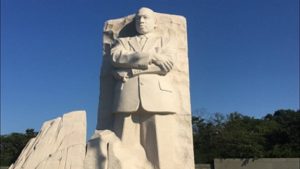
We join the nation today to celebrate Dr. Martin Luther King Jr.’s birthday. This day is an opportunity to honor Dr. King and his legacy.CU Blog - Street naming for Martin Luther King unveils the real America - Photo 1

Born on January 15, 1929 in Atlanta, Georgia, Dr. King was a well-respected activist, scholar, pastor and humanitarian. Although his life was brief, Dr. King’s accomplishments in the civil rights movement and social justice are echoed throughout the world still today. Considered to be one of the greatest non-violent leaders in world history, Dr. King’s exceptional achievements used the power of legislation and social change.

As an advocate for freedom and non-violent resistance, Dr. King offered the power of words through public protests, grassroots organizing, and powerful sermons to achieve nearly insurmountable goals. He fought against racial segregation and poverty, advocated for international peace, and eliminated lasting barriers to voting for African-Americans.

In honor of his work, Dr. King received numerous awards during his lifetime including the Nobel Peace Prize in 1964. He continues to be remembered as one of the most lauded African-American leaders in history, often referenced by his 1963 speech, “I Have a Dream.” – Corporate Intranet Website for Credit Acceptance Corporation, Southfield (Detroit), Michigan; retrieved January 18, 2016.

Ditto”, for the promoters of the book Go Lean … Caribbean and accompanying blogs advocating for change in the Caribbean. Dr. Martin Luther King proved that “one man can make a difference” – a frequent theme of this Go Lean movement. He thusly serves as a role model for current and future Caribbean advocates, activists and humanitarians hoping to impact the Greater Good in their homeland.

Based on these accomplishments, one would think honoring Dr. King with a street-naming would be a simple task.

One would think!

Let us see how far America has progressed regarding race relations, in the naming of streets after Martin Luther King, in one town after another!

Consider this encyclopedic source – a website:

Title: A street fit for a King?
Website: Politics of Naming Streets for Martin Luther King, Jr. – Retrieved January 18, 2016: http://mlkstreet.com/

Naming streets is one of the most widespread and contentious ways of commemorating Martin Luther King Jr.  Debates over whether to name a street for King and which specific street to identify with him have led to the boycott of businesses, protest marches, court actions, petition drives, the vandalizing of roads, and even activists chaining themselves to street signs.

Honoring King with a street name is often controversial when the road in question challenges long-standing racial and economic boundaries within communities.  While few scholars have studied the King street naming phenomena, the naming process is an important indicator of local political tensions as well as broader debates about race, memory, and place in America.

CU Blog - Street naming for Martin Luther King unveils the real America - Photo 2I have studied the politics of naming streets after King for the past several years, seeking to understand the obstacles that face street naming proponents and the various strategies that communities have pursued in finding a street fit for remembering King. In many instances (but not all), public opposition has led King’s name to be socially and geographically marginalized within cities, which has worked to stigmatize these streets and create public anxiety about renaming more prominent streets.  As a cultural geographer, my work stresses the importance that location–the street’s site, situation, and scale within the city’s larger social landscape–plays in shaping the meaning of King’s commemoration.    Believing that my research and perspectives can be of some help to the public, I have set up this web page as a resource for engaging and assisting the movement to remember the civil rights leader.

Below (Appendix A) are some research papers that I have written about naming streets for King as well as some questions that I frequently encounter in my discussions with journalists and street naming stakeholders (proponents and opponents).  If you have a question not listed here, email me and I will try to provide some feedback.

—-

Site established to spread information and commentary on the (re)naming of streets for slain civil rights leader Martin Luther King, Jr. with the hope of informing public debate.

If you use any information or statistics from this site, please cite the source (Appendix C) as: Derek Alderman, Professor of Geography, University of Tennessee, Knoxville TN.
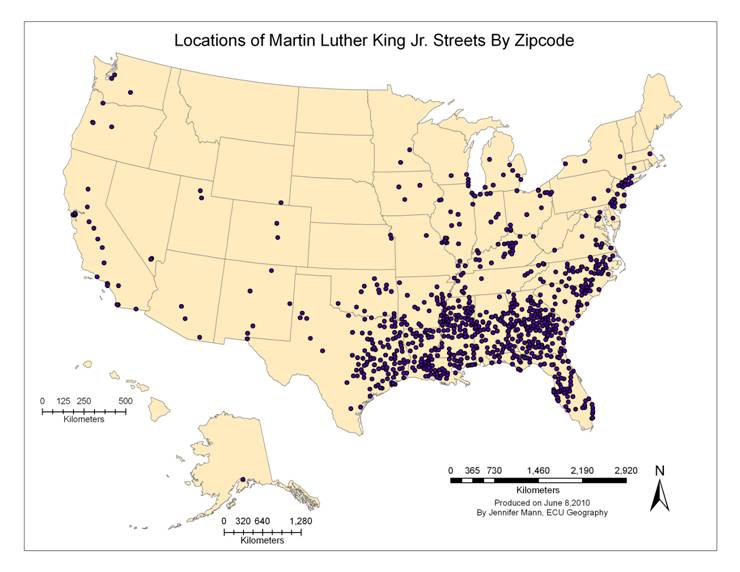
To the uninitiated, one would think the year is 1956, rather than 2016; see the VIDEO (Appendix D) of the documentary “MLK Streets Project”. One would think that such a racially-charged society was only representative of the America of old; that now America has transformed, to the point that the President is of African-American descent. But it must be concluded that the more things change, the more they remain the same.

The issue in the foregoing encyclopedic source (and the below VIDEO) relates the true disposition of the America many Caribbean citizens emigrate to, or want to. There is a great lure for Black-and-Brown Caribbean immigrants to come to America. But these portrayals/depictions would be the atmosphere that the new arrivals would have to navigate. Perhaps the shining light of that Welcome Sign should be dulled a little.

This consideration is brought to focus by the book Go Lean … Caribbean. The book serves as a roadmap for the introduction and implementation of the technocratic Caribbean Union Trade Federation (CU), for the economic optimization in the region. One mission of the roadmap is to minimize the “push-and-pull” factors that contribute to the alarming high abandonment rate of Caribbean citizens – one report reflects a 70% brain drain rate.

The Go Lean book posits that when the economic engines are not sufficient that people will flee, abandon their homelands, despite the love of family, friends and culture and endure all obstacles to secure a better livelihood. This has been the reality for all of the Caribbean, even the American member-states (Puerto Rico & Virgin Islands). So is the “grass greener”, is life in the American urban communities better that the status quo in the Caribbean? Considering the actuality of Caribbean emigrants, and the fact that there is no migration in the opposite direction, the answer must be true.

Sad! If only, there would be a better option for the Caribbean?

The book and movement Go Lean…Caribbean present that option!

This CU/Go Lean roadmap provides the turn-by-turn directions with the following 3 prime directives:

  • Optimization of the economic engines in order to grow the regional economy to $800 Billion & create 2.2 million new jobs.
  • Establishment of a security apparatus to protect the resultant economic engines.
  • Improve Caribbean governance to support these engines.

The roadmap posits that the United States of America should not be viewed as the panacea for Caribbean ailments; that when the choices of a challenge is “fight or flight” that Caribbean society must now consider the “fight” options. (No violent conflict is being advocated, in emulation of Martin Luther King, but rather a strenuous effort, heavy-lifting, to compete and win economic battles).

Are there social issues in America that are more important than street naming?

CU Blog - Street naming for Martin Luther King unveils the real America - Photo 3Proponents for naming streets for King often encounter the argument that African Americans should concern themselves with civil rights issues “more important” than street naming.

No doubt, there are a large number of worthy social and economic issues in need of addressing. At the same time, it is worth thinking about how the naming of roads is not necessarily separate from the larger racial/social justice picture. Naming streets for King can signal something very important about the willingness (or unwillingness) of the larger community to invest in African Americans, thus providing (or failing to provide) a platform on which to bring about more “substantive” change and improvement. When that community refuses to do something as seemingly minor as naming street, what does that say about the degree to which the community is really ready or willing to take on the “tough” issues?

I have argued in my research that the street naming issue is about the struggle to be seen and heard within public space, an important civil right in and of itself and one arguably necessary for other rights to be realized. Plus, we can also think about how street naming can be coupled with other larger and “more important” social and economic campaigns on streets in America, such as community redevelopment.

The problem is NOT that street naming is inherently less important. Rather it is the limited ways in which we imagine street naming as a social and political tool.  The photo above, from a street naming struggle in Melbourne, Florida, captures the deep emotions that proponents and opponents attach to the street renaming issue.  Street naming proponents in Melbourne were especially vocal about how honoring King was part of a larger campaign against racism. – Professor Derek Alderman.

As related in the foregoing article/VIDEO, America is not so welcoming a society for the “Black and Brown” populations from the Caribbean – and yet they come, they are in the USA and their numbers cannot be ignored. Here is the need for the heavy-lifting, to effect change to dissuade further brain drain and in reverse to incentivize repatriation. While not ignoring the “push” reason that cause people to flee, the book stresses (early at Page 13) the need to be on-guard for this fight in the following pronouncements in the Declaration of Interdependence:

xix.    Whereas our legacy in recent times is one of societal abandonment, it is imperative that incentives and encouragement be put in place to first dissuade the human flight, and then entice and welcome the return of our Diaspora back to our shores. This repatriation should be effected with the appropriate guards so as not to imperil the lives and securities of the repatriated citizens or the communities they inhabit. The right of repatriation is to be extended to any natural born citizens despite any previous naturalization to foreign sovereignties.

xx.    Whereas the results of our decades of migration created a vibrant Diaspora in foreign lands, the Federation must organize interactions with this population into structured markets. Thus allowing foreign consumption of domestic products, services and media, which is a positive trade impact. These economic activities must not be exploited by others’ profiteering but rather harnessed by Federation resources for efficient repatriations.

xxi.    Whereas the preparation of our labor force can foster opportunities and dictate economic progress for current and future generations, the Federation must ensure that educational and job training opportunities are fully optimized for all residents of all member-states, with no partiality towards any gender or ethnic group. The Federation must recognize and facilitate excellence in many different fields of endeavor, including sciences, languages, arts, music and sports. This responsibility should be executed without incurring the risks of further human flight, as has been the past history.

xxvi.    Whereas the Caribbean region must have new jobs to empower the engines of the economy and create the income sources for prosperity, and encourage the next generation to forge their dreams right at home, the Federation must therefore foster the development of new industries, like that of ship-building, automobile manufacturing, prefabricated housing, frozen foods, pipelines, call centers, and the prison industrial complex. In addition, the Federation must invigorate the enterprises related to existing industries like tourism, fisheries and lotteries – impacting the region with more jobs.

This commentary previously related details of the Caribbean Diaspora experience, the “push-and-pull” factors in the US, and the American record on Civil Rights. Here is a sample from earlier Go Lean blogs:

https://goleancaribbean.com/blog/?p=7204 ‘The Covenant with Black America’ – Ten Years Later
https://goleancaribbean.com/blog/?p=6722 A Lesson in History – After the Civil War: Birthright Mandates
https://goleancaribbean.com/blog/?p=6434 ‘Good Hair’ and the Strong Black Woman
https://goleancaribbean.com/blog/?p=5527 American Defects: Racism – Is It Over?
https://goleancaribbean.com/blog/?p=5333 American Urban Segregation Legacies: Cause and Effect
https://goleancaribbean.com/blog/?p=2297 A Lesson in History – Booker T versus Du Bois
https://goleancaribbean.com/blog/?p=2222 Sports Role Model – Playing For Pride … And More
https://goleancaribbean.com/blog/?p=1896 American “Pull” Factors – Crisis in Black Homeownership
https://goleancaribbean.com/blog/?p=1596 Book Review: ‘Prosper Where You Are Planted’
https://goleancaribbean.com/blog/?p=1433 Caribbean loses more than 70 percent of tertiary educated to brain drain
https://goleancaribbean.com/blog/?p=546 Book Review: ‘The Divide’: American Injustice in the Age of the Wealth Gap
https://goleancaribbean.com/blog/?p=209 Muhammad Ali’s Greatest Fight

For the Caribbean Diaspora, fleeing from their homelands to reside in the US is akin to “jumping from the frying pan into the fire”. While we may not be able to change American society, we can – no, we must – impact our own society. How? What? When? Why? All of these questions are valid, because the answers are difficult. The Go Lean book details the heavy-lifting answers with a roadmap to implement new community ethos, strategies, tactics and operational advocacies to effectuate this goal:

Community Ethos – Deferred Gratification Page 21
Community Ethos – People Respond to Incentives Page 21
Community Ethos – Economic Systems Influences Choices & Incentives Page 21
Community Ethos – The Consequences of Choice Lie in the Future Page 21
Community Ethos – Job Multiplier Page 22
Community Ethos – Minority Equalization Page 24
Community Ethos – Lean Operations Page 24
Community Ethos – Ways to Foster Genius Page 27
Community Ethos – Ways to Impact the Greater Good Page 37
Strategy – Vision – Make the Caribbean the Best Address on Planet Page 45
Strategy – Mission – Repatriate Diaspora Page 46
Strategy – Mission – Dissuade Human Flight/“Brain Drain” Page 46
Tactical – Ways to Foster a Technocracy Page 64
Tactical – Separation of Powers – Federal Government versus Member-States Page 89
Implementation – Ways to Deliver Page 109
Implementation – Reasons to Repatriate Page 118
Planning – Lessons Learned from the Year 2008 Page 136
Planning – Lessons from the US Constitutional Laws and Processes Page 145
Advocacy – Ways to Grow the Economy Page 151
Advocacy – Ways to Create Jobs Page 152
Advocacy – Ways to Impact the Diaspora Page 217
Advocacy – Ways to Preserve Caribbean Heritage Page 218
Advocacy – Battles in the War on Poverty Page 222
Advocacy – Ways to Help the Middle Class Page 223
Advocacy – Ways to Impact US Territories Page 244
Appendix – Analysis of Caribbean Emigration Page 269
Appendix – Puerto Rican Population in the US Page 304

The scope of this roadmap is to focus on the changes we have to make in the Caribbean, not the changes for American society. The Caribbean can be the world’s best address. This success is conceivable, believable and achievable.  Now is the time for all of the Caribbean, the people and governing institutions, to lean-in to this Go Lean … Caribbean roadmap.

This is a big deal for the region. This roadmap is not just a plan, it’s a Dream. We want the same sense of possibility that was manifested by Dr. Martin Luther King. We too, have a dream that one day … [we would be] “free at last, free at last; thank God almighty we are free (and home) at last”. 🙂

Download the free e-Book of Go Lean … Caribbean – now!

———

Appendix A – Publications Related to MLK Place/Street Naming

Mitchell, Jerry and Derek H. Alderman. 2014. “A Street Named for a King: A Lesson in the Politics of Place-Naming.” Social Education 78(3): 137-142.

Alderman, Derek H. and Joshua F.J. Inwood. 2013. “Street Naming and the Politics of Belonging: Spatial Injustices in the Toponymic Commemoration of Martin Luther King, Jr.” Social & Cultural Geography 14(2): 211-233.

Dwyer, Owen J. and Derek H. Alderman. 2008. Civil Rights Memorials and the Geography of Memory.  Book from Center for American Places and University of Georgia Press.

Alderman, Derek H. 2008. “Martin Luther King, Jr. Streets in the South: A New Landscape of Memory.Southern Cultures 14(3): 88-105.

Alderman, Derek H., Steve Spina, and Preston Mitchell. 2008. “A Bumpy Road: the Challenges of Naming Streets for Martin Luther King, Jr.” Planning 74(1): 18-21. Contribution to American Planning Association magazine.

Alderman, Derek H. and Preston Mitchell. 2007. “A Sign of Changing Times: A Street Renaming Lesson from Chapel Hill, North Carolina.” Public Management  89(6): 37-38. Contribution to International City/County Management Association magazine as part of special feature entitled Street Naming: Not as Easy as You Might Think.

Mitchelson, Matthew, Derek H. Alderman, Jeff Popke. 2007. “Branded: The Economic Geographies of MLK Streets.” Social Science Quarterly 88(1): 120-145.

Alderman, Derek H. 2006. “Naming Streets after Martin Luther King, Jr.: No Easy Road.” In Landscape and Race in the United States, Routledge Press (edited by Richard Schein), pp. 213-236.

Alderman, Derek H. 2003. “Street names and the scaling of memory: The politics of commemorating Martin Luther King, Jr. within the African-American community.Area 35 (2): 163-173.

Alderman, Derek H. 2002. “Street Names as Memorial Arenas: The Reputational Politics of Commemorating Martin Luther King, Jr. in a Georgia County.”  Historical Geography 30: 99-120.

Alderman, Derek H. 2002. “School Names as Cultural Arenas: The Naming of U.S. Public Schools after Martin Luther King, Jr.Urban Geography 23(7): 601-626.

Alderman, Derek H. 2000.  “A Street fit for a King: Naming Places and Commemoration in the American South.”  Professional Geographer 52(4): 672-684.

Alderman, Derek H.  1996. “Creating a New Geography of Memory in the South: The (Re) Naming of Streets in Honor of Martin Luther King, Jr.”  Southeastern Geographer 36(1): 51-69.

———

Appendix B – MLK Street Naming Educational Pamphlet

Electronic copy (pdf) of community outreach pamphlet on MLK street naming (produced 2005). Note data is now old. Pamphlet distributed to various schools, activists groups, and civil rights; national meetings of the NAACP and SCLC; and MLK Historic Site in Atlanta, Georgia.

Outside cover of pamphlet

Inside content of pamphlet

———

Appendix C – About Professor Derek Alderman

Professor of Cultural and Historical Geography and Head of the Department of GeographyUniversity of Tennessee-Knoxville (formerly affiliated with East Carolina University)

CV/Resume

Homepage

Academia.edu Page 

Book on Civil Rights Memorials and Street Naming

Email at: dalderma@utk.edu

Follow on: @MLKStreet

———

Appendix D – Trailer MLK Street Projecthttps://youtu.be/dE73UMlqaIs


Uploaded on Sep 28, 2010 – Trailer for the documentary “The MLK Streets Project”. A film by One Common Unity and Straight No Chaser Productions

Share this post:
, , ,

Transforming Hindus versus Women – What it means for us?

Go Lean Commentary

The responsibility to assuage these bad behaviors must lie first with the religious institutions. But any failure to deliver protection by these institutions would truly mandate that the “State” (government) step in and deliver.
Separation of Church and State be damned!

Separation of Church and State has been the standard for governments ever since the Enlightenment Age. In fact, the governing standard – the Social Contract – is a concept that was codified during that period. That contract states:

Citizens surrender some of their freedoms and submit to the authority of the State in exchange for protection of remaining natural and legal rights. – Book  Go Lean…Caribbean Page 170.

Christianity! Islam! Guilty … of failing to protect their congregants and adherents from the bad orthodoxies in their communities!

Now its Hinduism time to secede to civil “protections of natural rights”. There are abuses that are victimizing segments of their population. It is no longer acceptable to tolerate such abuse.

Change has come to the world, Separation of Church and State is now suspect! Sometimes the “Church” is the problem; so the State is therefore expected to step in and break that Separation shield. See how this is playing out in India right now. See the full news article here:

Title: Hindu hardliners clash with police over women at shrine

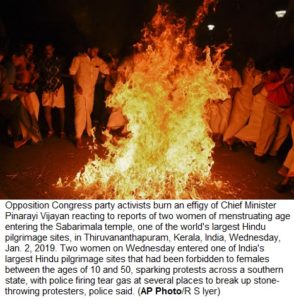
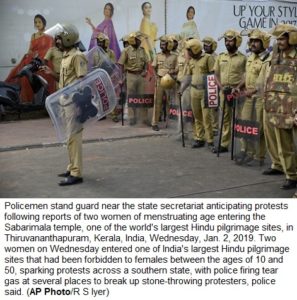
NEW DELHI (AP) — Hindu hardliners vandalized shops, shut businesses and clashed with police in a southern state Thursday to protest the entry of two women in one of India’s largest Hindu pilgrimage sites, police said.

Police used water cannons and tear gas to disperse the protesters who also blocked roads by placing burning tires and concrete blocks in key towns, including Kozhikode, Kannur, Malappuram, Palakkad and Thiruvananthapuram.

Pinarayi Vijayan, the state’s top elected official, accused supporters of Prime Minister Narendra Modi’s Bharatiya Janata Party of triggering violence that reportedly claimed one life.

Most state-run buses kept off roads after several were damaged by protesters.

Supporters of Modi’s party held protest marches in the state as part of a strike call by Sabarimala Karma Samithi, an umbrella organization of Hindu groups.

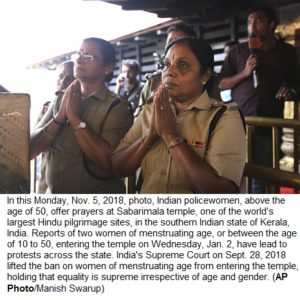
The two women entered the temple to pray early Wednesday, triggering protests. They were escorted by police because it is “the government’s constitutional responsibility to give protection to women,” Vijayan said.

Women of menstruating age were forbidden to pray at the temple until the Supreme Court lifted the ban in September. The ban was informal for many years but became law in 1972.

Some devotees have filed a petition saying the court decision revoking the ban was an affront to the celibate deity Ayyappa.

Vijayan said Thursday that 39 police officers were injured while trying to control the protesters, who damaged 79 state-run buses in the state.

The Press Trust of India news agency reported that a 55-year-old passer-by died after being injured amid rock throwing by protesters in Pandalam.

Source: Associated Press posted January 3, 2019; retrieved January 5, 2019 from: https://news.yahoo.com/hindu-hard-liners-paralyze-indian-state-over-women-090122760.html

The concept is simple for “States“, while they must allow for Freedom of Religion, they cannot allow religious intimidation of their citizens. No More!

This is an issue of Orthodoxy and it is not only a concern in India. Even here in the Caribbean we have to make progress. Clearly we understand the oppression, suppression and repression experienced in India prohibiting women to pray in the Temple, and so there is the acceptance that it is right for that State to act against continued abuse. There has always been a need for States to legislate morality in society over the years; consider these examples:

  • Slavery – The Pope approved African Slavery in 1491; but it took the Protestant and Enlightenment movements to unravel the end of the Slave Trade and eventually the institution of Slavery itself. By the mid-1800’s all European Powers ended slavery in their New World territories.
  • Indian Widows – As detailed in a previous blog-commentary, the “Hindu Widows’ Remarriage Act of 1856” legalized the remarriage of Hindu widows in all jurisdictions of India under British rule. Upper-caste Hindu society had long disallowed the remarriage of widows, even child and adolescent ones, all of whom were expected to live a life of austerity and abnegation. The law provided legal safeguards against loss of certain forms of inheritance for remarrying a Hindu widow.
    See the Appendix VIDEO below.
  • Drunk Driving – A classic example is that in France where Evan’s Law regulated alcohol advertising; advertising affected alcohol demand; so the end result on alcohol consumption was that in 1960, the average adult in France consumed 30 liters of alcohol while that figure is down to 13.5 liters today. Drunk Driving incidences naturally declined.

The assertion of the movement behind the book Go Lean … Caribbean (Page 20) is that there must be a new regime for our region; one that is apolitical and religiously-neutral. The community ethos – underlying sentiment that informs the beliefs, customs, or practices – that must be pursued by this new Caribbean regime is that of the Greater Good; that it can be pursued despite any religiosity. This book defines this Greater Good community ethos as follows:

“It is the greatest good to the greatest number of people which is the measure of right and wrong”. Jeremy Bentham (1748-1832)

In the Caribbean, we have adherents to many religions: Christianity, Islam, Hindu and indigenous animism. We must insist on a clear “Separation of Church and State” in order to mold the behavior and character development we want to see in our communities. Seeing the default orthodoxy in these religions, it is obvious that our ideals must be Greater.

For one, we must protect and promote women in our communities. This is a charge that we must execute whether it is popular or not. This theme – protecting and promoting women in society – aligns with previous Go Lean commentaries; see a sample list here:

https://goleancaribbean.com/blog/?p=16408 Bad Ethos on Home Violence leads to more “Stranger” Abuse
https://goleancaribbean.com/blog/?p=14482 UN’s International Women’s Day – Protecting Rural Women
https://goleancaribbean.com/blog/?p=13664 High Profile Sexual Harassment Accusers – Finally Believed?
https://goleancaribbean.com/blog/?p=13063 Gender Equity without a ‘Battle of the Sexes’
https://goleancaribbean.com/blog/?p=8306 Women Get Ready for New Lean-In Campaign
https://goleancaribbean.com/blog/?p=6937 Women in Politics – Yes, They Can!
https://goleancaribbean.com/blog/?p=2709 Caribbean Study: 58% Of Boys Agree to Female ‘Discipline’

This is the Year 2019 and we are still talking about women being suppressed, oppressed and repressed in society. Change just doesn’t happen because the ‘clock is ticking’. No, people have to forge change, overcome the obstacles and embed the needed new value systems to get improvements institutionalized instead of just a passing trend. Change takes heavy-lifting.
This is what the lessons from India mean to us here-now in the Caribbean.

So many women in our communities flee due to the lack of protections and promotions for them. We want that bad trend to now end, so we must do the heavy-lifting ourselves. We must lower the “Push and Pull” factors that have plagued our society and caused abandonment.

We must do this! Women are half of our population; and they are beloved. This is how we can make our homeland a better place to live, work and play for all.  🙂

About the Book
The book Go Lean…Caribbean serves as a roadmap for the introduction and implementation of the technocratic Caribbean Union Trade Federation (CU), for the elevation of Caribbean society – for all member-states. This CU/Go Lean roadmap has these 3 prime directives:

  • Optimization of the economic engines in order to grow the regional economy to $800 Billion and create 2.2 million new jobs.
  • Establishment of a security apparatus to ensure public safety and protect the resultant economic engines.
  • Improve Caribbean governance to support these engines, including a separation-of-powers between the member-states and CU federal agencies.

The Go Lean book provides 370-pages of turn-by-turn instructions on “how” to adopt new community ethos, plus the strategies, tactics, implementations and advocacies to execute so as to reboot, reform and transform the societal engines of Caribbean society.

Download the free e-Book of Go Lean … Caribbean – now!

Who We Are
The movement behind the Go Lean book – a non-partisan, apolitical, religiously-neutral Community Development Foundation chartered for the purpose of empowering and re-booting economic engines – stresses that reforming and transforming the Caribbean societal engines must be a regional pursuit. This was an early motivation for the roadmap, as pronounced in the opening Declaration of Interdependence (Pages 12 – 13):

xi. Whereas all men are entitled to the benefits of good governance in a free society, “new guards” must be enacted to dissuade the emergence of incompetence, corruption, nepotism and cronyism at the peril of the people’s best interest. The Federation must guarantee the executions of a social contract between government and the governed.

xvi. Whereas security of our homeland is inextricably linked to prosperity of the homeland, the economic and security interest of the region needs to be aligned under the same governance. Since economic crimes … can imperil the functioning of the wheels of commerce for all the citizenry, the accedence of this Federation must equip the security apparatus with the tools and techniques for predictive and proactive interdictions.

xxiv. Whereas a free market economy can be induced and spurred for continuous progress, the Federation must install the controls to better manage aspects of the economy: jobs, inflation, savings rate, investments and other economic principles. Thereby attracting direct foreign investment because of the stability and vibrancy of our economy.

Sign the petition to lean-in for this roadmap for the Caribbean Union Trade Federation.

—————-

Appendix VIDEO – The Horrible Plight of India’s Widows – https://youtu.be/CS8euwO4o8k

Published on Aug 20, 2007 – India Widows (2007): In many conservative Indian families, widows are seen as a liability. Cast out of the family home, they live the rest of their lives in poverty and isolation.

For downloads and more information visit http://journeyman.tv/57526/short-film…

“She becomes a zero and all her powers are lost”, states Dr Giri, explaining how some women’s status change when their husband dies. With no where else to go, thousands come to Vrindavan, city of widows. It was the childhood home of Hindu God, Krishna, who championed downtrodden women. “They come here in search of death”, explains Dr Giri, in the hope they will have a better afterlife” – ABC Australia – Ref. 3587

Journeyman Pictures is your independent source for the world’s most powerful films, exploring the burning issues of today. We represent stories from the world’s top producers, with brand new content coming in all the time. On our channel you’ll find outstanding and controversial journalism covering any global subject you can imagine wanting to know about.

Share this post:
, , , ,
[Top]

This Day in 1941: Pearl Harbor – ENCORE

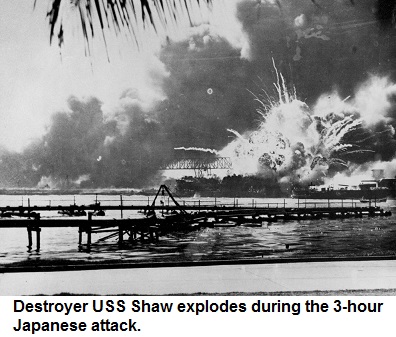
This day 77 years ago is a “day that will live in infamy”.
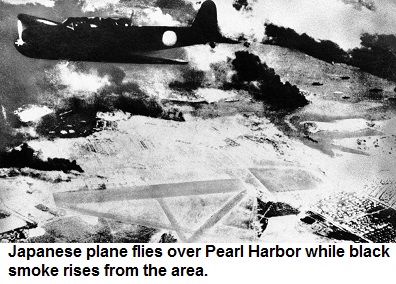
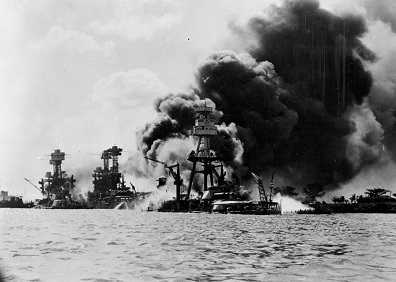
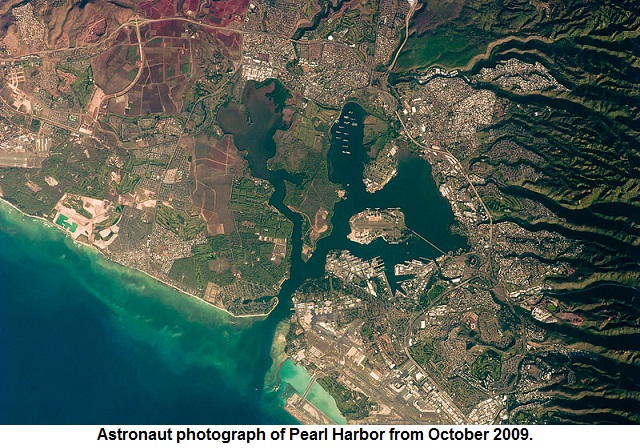
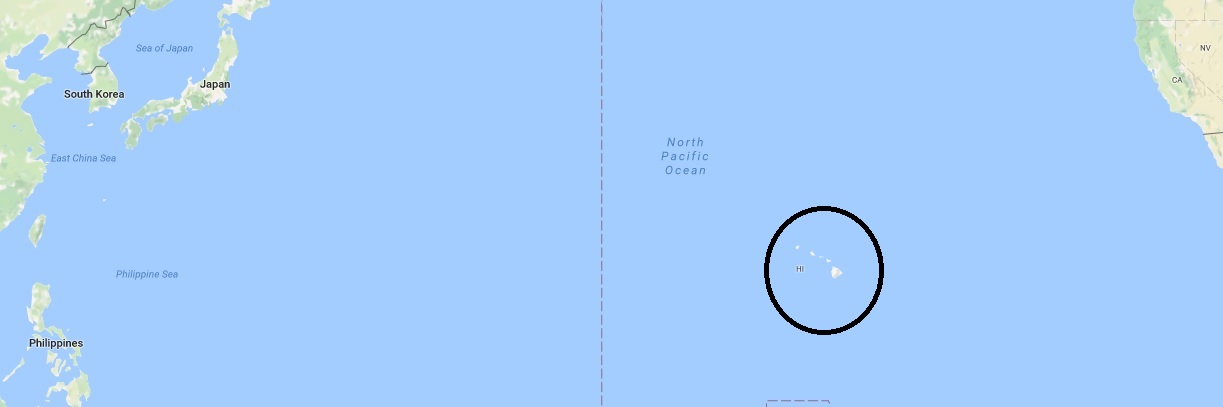
This is the anniversary of the Japanese attack on the United States Navy at Pearl Harbor, Hawaii. This event changed the world, as it ushered the US into World War II when they declared war against Japan the next day. Japan (Hirohito) was aligned with Germany (Hitler) and Italy (Mussolini), so by the US declaring war on Japan, the direct and immediate result was Germany and Italy declared war against the United States.

Germany, Italy, Japan, United States of America, …. these are just a sample of the countries involved in the conflict; it was a global war, the second one in 30 years.

There are a lot of lessons for the Caribbean in this history. This was the theme of this previous blog-commentary on December 7, 2016 during the 75th Anniversary commemoration. That entry is being Encored here-now, for the 2018 commemoration:

——————–

Go Lean Commentary – Lessons Learned from Pearl Harbor

What would you do if backed into a corner and there’s a threat on your life?

For many people their natural impulse is to come out fighting. They say that this is not aggression, rather just a survival instinct.

Believe it or not, this depiction describes one of the biggest attacks in American history: the Japanese Attack on Pearl Harbor. See VIDEO here:

VIDEO – World War II History: Attack on Pearl Harbor – http://www.history.com/topics/world-war-ii/world-war-ii-history/videos/attack-pearl-harbor

Retrieved December 7, 2016 from History.com – On December 7, 1941, Japan launches a surprise attack on American soil at Pearl Harbor.

cu-blog-lessons-learned-from-pearl-harbor-photo-2

cu-blog-lessons-learned-from-pearl-harbor-photo-3

cu-blog-lessons-learned-from-pearl-harbor-photo-4

This is the 75th Anniversary of that attack – a few days ago: December 7. That’s a lot of years and a lot of lessons. Still, 75 is a pretty round number, like 25, 50 and 100. This commentary has been reserved for now, a few days late on purpose because of the best-practice to “not speak ill of the dead” at a funeral or memorial service. But a “lessons learned analysis” is still an important exercise for benefiting from catastrophic efforts. After 75 years since the Pearl Harbor Attack on December 7, 1941, this post-mortem analysis is just as shocking as it was on this “day of infamy”.

Consider the details of this maligning article here (and the Appendices below); notice that it assumes a conspiracy:

Title: How U.S. Economic Warfare Provoked Japan’s Attack on Pearl Harbor
By: Robert Higgs

cu-blog-lessons-learned-from-pearl-harbor-photo-1Ask a typical American how the United States got into World War II, and he will almost certainly tell you that the Japanese attacked Pearl Harbor and the Americans fought back. Ask him why the Japanese attacked Pearl Harbor, and he will probably need some time to gather his thoughts. He might say that the Japanese were aggressive militarists who wanted to take over the world, or at least the Asia-Pacific part of it. Ask him what the United States did to provoke the Japanese, and he will probably say that the Americans did nothing: we were just minding our own business when the crazy Japanese, completely without justification, mounted a sneak attack on us, catching us totally by surprise in Hawaii on December 7, 1941.

You can’t blame him much. For more than 60 years such beliefs have constituted the generally accepted view among Americans, the one taught in schools and depicted in movies—what “every schoolboy knows.” Unfortunately, this orthodox view is a tissue of misconceptions. Don’t bother to ask the typical American what U.S. economic warfare had to do with provoking the Japanese to mount their attack, because he won’t know. Indeed, he will have no idea what you are talking about.

In the late nineteenth century, Japan’s economy began to grow and to industrialize rapidly. Because Japan has few natural resources, many of the burgeoning industries had to rely on imported raw materials, such as coal, iron ore or steel scrap, tin, copper, bauxite, rubber, and petroleum. Without access to such imports, many of which came from the United States or from European colonies in southeast Asia, Japan’s industrial economy would have ground to a halt. By engaging in international trade, however, the Japanese had built a moderately advanced industrial economy by 1941.

At the same time, they also built a military-industrial complex to support an increasingly powerful army and navy. These armed forces allowed Japan to project its power into various places in the Pacific and east Asia, including Korea and northern China, much as the United States used its growing industrial might to equip armed forces that projected U.S. power into the Caribbean and Latin America, and even as far away as the Philippine Islands.

When Franklin D. Roosevelt became president in 1933, the U.S. government fell under the control of a man who disliked the Japanese and harbored a romantic affection for the Chinese because, some writers have speculated, Roosevelt’s ancestors had made money in the China trade.[1] Roosevelt also disliked the Germans (and of course Adolf Hitler), and he tended to favor the British in his personal relations and in world affairs. He did not pay much attention to foreign policy, however, until his New Deal began to peter out in 1937. Afterward, he relied heavily on foreign policy to fulfill his political ambitions, including his desire for reelection to an unprecedented third term.

When Germany began to rearm and to seek Lebensraum aggressively in the late 1930s, the Roosevelt administration cooperated closely with the British and the French in measures to oppose German expansion. After World War II commenced in 1939, this U.S. assistance grew ever greater and included such measures as the so-called destroyer deal and the deceptively named Lend-Lease program. In anticipation of U.S. entry into the war, British and U.S. military staffs secretly formulated plans for joint operations. U.S. forces sought to create a war-justifying incident by cooperating with the British navy in attacks on German U-boats in the north Atlantic, but Hitler refused to take the bait, thus denying Roosevelt the pretext he craved for making the United States a full-fledged, declared belligerent—an end that the great majority of Americans opposed.

In June 1940, Henry L. Stimson, who had been secretary of war under Taft and secretary of state under Hoover, became secretary of war again. Stimson was a lion of the Anglophile, northeastern upper crust and no friend of the Japanese. In support of the so-called Open Door Policy for China, Stimson favored the use of economic sanctions to obstruct Japan’s advance in Asia. Treasury Secretary Henry Morgenthau and Interior Secretary Harold Ickes vigorously endorsed this policy. Roosevelt hoped that such sanctions would goad the Japanese into making a rash mistake by launching a war against the United States, which would bring in Germany because Japan and Germany were allied.

Accordingly, the Roosevelt administration, while curtly dismissing Japanese diplomatic overtures to harmonize relations, imposed a series of increasingly stringent economic sanctions on Japan. In 1939 the United States terminated the 1911 commercial treaty with Japan. “On July 2, 1940, Roosevelt signed the Export Control Act, authorizing the President to license or prohibit the export of essential defense materials.” Under this authority, “[o]n July 31, exports of aviation motor fuels and lubricants and No. 1 heavy melting iron and steel scrap were restricted.” Next, in a move aimed at Japan, Roosevelt slapped an embargo, effective October 16, “on all exports of scrap iron and steel to destinations other than Britain and the nations of the Western Hemisphere.” Finally, on July 26, 1941, Roosevelt “froze Japanese assets in the United States, thus bringing commercial relations between the nations to an effective end. One week later Roosevelt embargoed the export of such grades of oil as still were in commercial flow to Japan.”[2] The British and the Dutch followed suit, embargoing exports to Japan from their colonies in southeast Asia.

An Untenable Position
cu-blog-lessons-learned-from-pearl-harbor-photo-6
Roosevelt and his subordinates knew they were putting Japan in an untenable position and that the Japanese government might well try to escape the stranglehold by going to war. Having broken the Japanese diplomatic code, the Americans knew, among many other things, what Foreign Minister Teijiro Toyoda had communicated to Ambassador Kichisaburo Nomura on July 31: “Commercial and economic relations between Japan and third countries, led by England and the United States, are gradually becoming so horribly strained that we cannot endure it much longer. Consequently, our Empire, to save its very life, must take measures to secure the raw materials of the South Seas.”[3]

Because American cryptographers had also broken the Japanese naval code, the leaders in Washington knew as well that Japan’s “measures” would include an attack on Pearl Harbor.[4] Yet they withheld this critical information from the commanders in Hawaii, who might have headed off the attack or prepared themselves to defend against it. That Roosevelt and his chieftains did not ring the tocsin makes perfect sense: after all, the impending attack constituted precisely what they had been seeking for a long time. As Stimson confided to his diary after a meeting of the war cabinet on November 25, “The question was how we should maneuver them [the Japanese] into firing the first shot without allowing too much danger to ourselves.”[5] After the attack, Stimson confessed that “my first feeling was of relief … that a crisis had come in a way which would unite all our people.[6]

Source: The Independent Institute – Online Community – Posted: May 1, 2006; retrieved December 7, 2016 from: http://www.independent.org/newsroom/article.asp?id=1930
——–
See Appendices below for cited references and profiles of the Author and the Organization.

So this establishes why the Japanese may have been motivated to attack Pearl Harbor in the first place. The motivation seems more complicated than initially reported.

The Bible declares that:

“For there is nothing hidden that will not become manifest” – Luke 8:17

cu-blog-lessons-learned-from-pearl-harbor-photo-7

cu-blog-lessons-learned-from-pearl-harbor-photo-5

After 75 years, the before-during-after facts associated with the Pearl Harbor Attack should be available for full disclosure. What are the lessons here for the Caribbean and today’s effort to secure the Caribbean homeland while expanding the regional economy? We truly want to consider these main points, these lessons; (the hyperlinks refer to previous Go Lean commentaries):

Lessons

Territories have a status of disregard Hawaii (Pearl Harbor) and Philippines were attacked by the Japanese. These were both US Territories at the same. The levels of protection and preparedness for territories are sub-standard compared to the American mainland. As a result there was no meaningful plan for the air defense of Hawaii.
Colonialism is/was really bad Japan protested the sub-standard reality of the native Asians under the European colonial schemes. A people oppressed, suppressed and repressed would not remain docile forever; “that a downtrodden people would not stay down, that they would rise and revolt, that they would risk their lives and that of their children to pursue freedom.” – Go Lean book Page 251.
White Supremacy is/was a really bad construct The US Territories (Hawaii and Philippines) were not the first targets for Japan. They targeted all European colonies (British, French and Dutch) territories. Their campaign was to rail against White Supremacy.
Bullies only respond to a superior force Japan avail themselves of expansion opportunities in Far-East Asia as the European powers became distracted in the time period during and after World War I. (Manchuria in China was occupied by Japan starting in 1931). Only a superior force, the US, was able to assuage their aggression.
Economic Warfare can back a Government into a corner When the supply of basic needs (food, clothing, shelter and energy) are curtailed, a crisis ensues. When people are in crisis, they consider “fight or flight” options. Japan chose to fight; Caribbean people choose flight.
Societies can double-down on a bad Community Ethos Japan’s aggression was a direct result of their community ethos that honored Samurai warrior and battle culture. Men would walk the streets with their swords, ready for a challenge. On the other hand, the US (and Western Europe) community ethos of racism was so ingrained that the natural response in the US, post-Pearl Harbor, was to intern Japanese Americans in camps.
All of these bad community ethos were weeded out with post-WWII Human Rights reconciliations. – Go Lean book Page 220.
Double Standards are hard to ignore Japan felt justified in their Pacific aggression because of the US’s regional aggression in the Americas. Before Pearl Harbor, they withdrew from the League of Nations in protest of double standards.
Even after WWII, this double standard continues with countries with Veto power on the UN Security Council.
People have short memories There are movements to re-ignite many of the same developments that led to the devastation of WWII: right wing initiatives in Japan and Germany; Human Rights disregard for large minority groups (Muslims, etc.).
The more things change, the more they remain the same.

This discussion is analyzing the concept of “fight or flight”. According to Anthropologists, individuals and societies facing a crisis have to contend with these two options for survival. The very concept of refugees indicate that most people choose to flee; they choose internal displacement or refuge status in foreign countries. This point is consistent with the theme in the book Go Lean … Caribbean that this region is in crisis and as a result people have fled from their beloved homelands to foreign destinations in North America and Europe. How bad? According to one report, we have lost 70 percent of our tertiary-educated population.

Enough said! Our indictment is valid. Rather than flee, we now want the region to fight. This is not advocating a change to a militaristic state, but rather this commentary, and the underlying Go Lean book, advocates devoting “blood, sweat and tears” to empowering change in the Caribbean region. The book states this in its introduction (Page 3):

We cannot ignore the past, as it defines who we are, but we do not wish to be shackled to the past either, for then, we miss the future. So we must learn from the past, our experiences and that of other states in similar situations, mount our feet solidly to the ground and then lean-in, to reach for new heights; forward, upward and onward. This is what is advocated in this book: to Go Lean … Caribbean!

The Go Lean book serves as a roadmap for the introduction and implementation of the Caribbean Union Trade Federation (CU). One mission of this roadmap is to reduce the “push and pull” factors that contributes to the high emigration rates. For the most part the “push and pull” factors relate to the societal defects among the economic, security and governing engines. Another mission is to incentivize the far-flung Diaspora to consider a return to the region. Overall, the Go Lean roadmap asserts that the economy of the Caribbean is inextricably linked to the security of the Caribbean. The roadmap therefore proposes an accompanying Security Pact to accompany the CU treaty’s economic empowerment efforts. The plan is to cooperate, collaborate and confer with all regional counterparts so as to provide an optimized Caribbean defense, against all threats, foreign and domestic. This includes the American Caribbean territories (just like Pearl Harbor was on the American territory of Hawaii) of Puerto Rico and the US Virgin Islands. These American protectorates are included in this CU regional plan.

This CU/Go Lean regional plan strives to advance all of Caribbean society with these 3 prime directives:

  • Optimization of the economic engines in order to grow the regional economy to a $800 Billion Single Market by creating 2.2 million new jobs.
  • Establishment of a security apparatus to protect the resultant economic engines.
  • Improvement of Caribbean governance in support of these endeavors.

The Go Lean book stresses the effectiveness and efficiency of protecting life and property of all Caribbean stakeholders: residents, trading partners, visitors, etc.. This is why the book posits that some deployments are too big for any one member-state to manage alone – especially with such close proximities of one island nation to another – there are times when there must be a cross-border multi-lateral coordination – a regional partnership. This is the vision that is defined in the book (Pages 12 – 14), starting with these statements in the opening Declaration of Interdependence:

x. Whereas we are surrounded and allied to nations of larger proportions in land mass, populations, and treasuries, elements in their societies may have ill-intent in their pursuits, at the expense of the safety and security of our citizens. We must therefore appoint “new guards” to ensure our public safety and threats against our society, both domestic and foreign.

xii. Whereas the legacy in recent times in individual states may be that of ineffectual governance with no redress to higher authority, the accedence of this Federation will ensure accountability and escalation of the human and civil rights of the people for good governance, justice assurances, due process and the rule of law. As such, any threats of a “failed state” status for any member state must enact emergency measures on behalf of the Federation to protect the human, civil and property rights of the citizens, residents, allies, trading partners, and visitors of the affected member state and the Federation as a whole.

xvi. Whereas security of our homeland is inextricably linked to prosperity of the homeland, the economic and security interest of the region needs to be aligned under the same governance.

The Go Lean roadmap is not a call for a revolt against the governments, agencies or institutions of the Caribbean region, but rather a petition for a peaceful transition and optimization of the economic, security and governing engines in the region. To establish the security optimization, the Go Lean book presents a series of community ethos that must be adapted to forge this change. In addition, there are these specific strategies, tactics, implementation and advocacies to apply:

Community Ethos – new Economic Principles Page 21
Community Ethos – new Security Principles Page 22
Community Ethos – Minority Equalization Page 24
Community Ethos – Impacting the Greater Good Page 34
Strategy – Mission – Enact a Defense Pact to defend the homeland Page 45
Tactical – Fostering a Technocracy Page 64
Tactical – Homeland Security – Naval Operations Page 75
Tactical – Homeland Security – Militias Page 75
Implementation – Assemble – US Overseas Territory into CU Page 96
Implementation – Foreign Policy Initiatives at Start-up Page 102
Implementation – Security Initiatives at Start-up Page 103
Implementation – Ways to Promote Independence Page 120
Planning – Ways to Model the EU – Constructs after WW II Page 130
Advocacy – Ways to Better Manage the Social Contract Page 170
Advocacy – Ways to Improve Homeland Security Page 180
Advocacy – Ways to Mitigate Terrorism Page 181
Advocacy – Ways to Improve Intelligence Gathering Page 182
Advocacy – Ways to Enhance Tourism – Mitigate Risky Image Page 190
Advocacy – Ways to Improve Emergency Management Page 196
Advocacy – Ways to Preserve Caribbean Heritage Page 218
Advocacy – Ways to Impact US Territories Page 244

Now is the time to lean-in to this roadmap and “fight” for Caribbean change, as depicted in the book Go Lean…Caribbean. At this time, there are no State Actor adversaries – like Imperial Japan – seeking to cause harm to our homeland, but that status quo can change very quickly. Some Caribbean member-states are still de facto “colonies”, so enemies of our colonial masters – France, Netherlands, US, UK – can quickly “pop up”. We must be ready and on guard to any possible threats and security risks.

The movement behind the Go Lean … Caribbean book seeks to make this homeland a better place to live, work and play. Since the Caribbean is arguably the best address of the planet, tourism is a primary concern. So security here in our homeland must take on a different priority. Tourists do not visit war zones – civil wars, genocides, active terrorism, Failed-States and rampant crime. Already our societal defects (economics) have created such crises that our people have chosen to flee as opposed to “fight”. We do not need security threats as well; we do not need Failed-States. We are now preparing to “fight” (exert great efforts), not flee, to wage economic war to elevate our  communities.

This will not be easy; this is heavy-lifting, but success is possible. The strategies, tactics and implementations in the Go Lean roadmap are conceivable, believable and achievable. 🙂

Download the book Go Lean … Caribbean – now!

———–

Appendix A – Reference Notes:
1.  Harry Elmer Barnes, “Summary and Conclusions,” in Perpetual War for Perpetual Peace:A Critical Examination of the Foreign Policy of Franklin Delano Roosevelt and Its Aftermath (Caldwell, Id.: Caxton Printers, 1953), pp. 682–83.
2.  All quotations in this paragraph from George Morgenstern, “The Actual Road to Pearl Harbor,” in Perpetual War for Perpetual Peace, pp. 322–23, 327–28.
3.  Quoted ibid., p. 329.
4.  Robert B. Stinnett, Day of Deceit: The Truth about FDR and Pearl Harbor (NewYork: Free Press, 2000).
5.  Stimson quoted in Morgenstern, p. 343.
6.  Stimson quoted ibid., p. 384.

 ——-

Appendix B – About the Author:

Robert Higgs is a Senior Fellow in Political Economy at the Independent Institute and Editor at Large of the Institute’s quarterly journal The Independent Review. He received his Ph.D. in economics from JohnsHopkinsUniversity, and he has taught at the University of Washington, LafayetteCollege, SeattleUniversity, the University of Economics, Prague, and GeorgeMasonUniversity.

——-

Appendix C – About the Independent Institute:

The Independent Institute is a non-profit, non-partisan, scholarly research and educational organization that sponsors in-depth studies of critical social and economic issues.

The mission of the Independent Institute is to boldly advance peaceful, prosperous, and free societies grounded in a commitment to human worth and dignity.

Today, the influence of partisan interests is so pervasive that public-policy debate has become too politicized and is largely confined to a narrow reconsideration of existing policies. In order to fully understand the nature of public issues and possible solutions, the Institute’s program adheres to the highest standards of independent scholarly inquiry.
Source: http://www.independent.org/aboutus/

Share this post:
, , , ,
[Top]

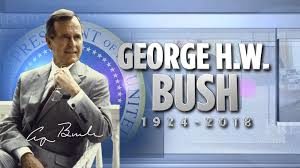
Remembering George H.W. Bush and ADA

Go Lean Commentary

Old age is justice; it is when able-bodied people and disabled people become equally disabled.

We are being reminded of this sad reality of aging by the life-and-death of the 41st President of United States of America. At the end of his life, this able-bodied man (former war hero) was bound to a wheelchair.
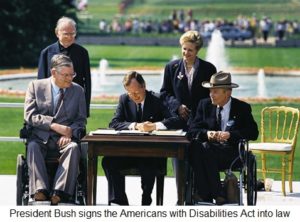

The United States is mourning the death of its ex-president (1989 – 1993), George H. W. Bush. Wednesday December 5, 2018 is set-aside as the National Day of Mourning.

“The best 1 term president in the history of the country” – as declared by George W. Bush, the eldest son and subsequent president (#43 2001 – 2009).

Who’s best? Who’s the greatest? These are all questions for historians to consider. But for one group of Americans – Persons with Disabilities – they will surely concur with the “best” and “greatest” tag to George H.W. Bush because of one reason, his passage of the Americans with Disabilities Act (ADA).

The book Go Lean…Caribbean – available to download for free – presents this landmark ADA legislation as a model for emulation and adoption in the Caribbean. The book provided this ADA summary (Page 228):

The Bottom Line on the American with Disabilities Act (ADA)
This Act is a law that was enacted by the U.S. Congress in 1990. It was signed into law on July 26, 1990, by President George H. W. Bush, and later amended with changes effective January 1, 2009. The ADA is a wide-ranging civil rights law that prohibits, under certain circumstances, discrimination based on disability. It affords similar protections against discrimination to Americans with disabilities as the Civil Rights Act of 1964, which made discrimination based on race, religion, sex, national origin, and other characteristics illegal. Disability is defined by the ADA as “…a physical or mental impairment that substantially limits a major life activity.” The determination of whether any particular condition is considered a disability is made on a case by case basis. Certain specific conditions are excluded as disabilities, such as current substance abuse and visual impairment that is correctable by prescription lenses. [ADA is based on the premise of] reasonable accommodation – an adjustment made in a system to “accommodate” or make fair the same system for an individual based on a proven need. Accommodations can be religious, academic, or employment related. This provision is also prominent in international law as the United Nations has codified the principle in the Convention on the Rights of Persons with Disabilities. [There are many international signatories to these principles and resolutions].

The ADA allows private plaintiffs to receive only injunctive relief (a court order requiring the public accommodation to remedy violations of the accessibility regulations) and attorneys’ fees, and does not provide monetary rewards to private plaintiffs who sue non-compliant businesses. Unless a state law provides for monetary damages to private plaintiffs, qualified claimants do not obtain direct financial benefits from suing entities that violate the ADA. [Thus, no “professional plaintiffs”!]

Listen to this relevant AUDIO Podcast from today (December 3, 2018):

AUDIO Podcast – Americans With Disabilities Act Signed By George H.W. Bush Expanded Rights Of Millions –  https://www.wbur.org/hereandnow/2018/12/03/americans-with-disabilities-george-hw-bush

Published December 3, 2018 – President George H.W. Bush signed the Americans with Disabilities Act into law in 1990. It was landmark legislation that expanded rights and protections for millions of people. Bush, who died Friday at age 94, played a key role in its passage.

Here & Now‘s Jeremy Hobson talks with Marian Vessels, director of the Mid-Atlantic ADA Center in Maryland, who was at the ADA’s signing.

Unfortunately, the Caribbean has a terrible track record for accommodating Persons with Disabilities. The Go Lean book serves as a roadmap for the introduction and implementation of the technocratic Caribbean Union Trade Federation (CU), for the elevation of Caribbean society – for all member-states. This CU/Go Lean roadmap has these 3 prime directives:

  • Optimization of the economic engines in order to grow the regional economy to $800 Billion and create 2.2 million new jobs.
  • Establishment of a security apparatus to ensure public safety and protect the resultant economic engines for all citizens and visitors.
  • Improve Caribbean governance to support these engines, including a separation-of-powers between the member-states and CU federal agencies.

The book stresses that reforming and transforming the Caribbean societal engines must be a regional pursuit. This was an early motivation for the roadmap, as pronounced in the opening Declaration of Interdependence (Pages 12 – 13):

ix. Whereas the realities of healthcare and an aging population cannot be ignored and cannot be afforded without some advanced mitigation, the Federation must arrange for health plans to consolidate premiums of both healthy and sickly people across the wider base of the entire Caribbean population. The mitigation should extend further to disease management, wellness, mental health, obesity and smoking cessation programs. …

xi. Whereas all men are entitled to the benefits of good governance in a free society, “new guards” must be enacted to dissuade the emergence of incompetence, corruption, nepotism and cronyism at the peril of the people’s best interest. The Federation must guarantee the executions of a social contract between government and the governed.

xviii. Whereas all citizens in the Federation member-states may not have the same physical abilities, reasonable accommodations must be made so that individuals with physical and mental disabilities can still access public and governmental services so as to foster a satisfactory pursuit of life’s liberties and opportunities for happiness.

The Go Lean book provides 370-pages of turn-by-turn instructions on “how” to adopt new community ethos, plus the strategies, tactics, implementations and advocacies to execute so as to reboot, reform and transform the societal engines of Caribbean society – to benefit all people, able-bodied and the disabled. One specific advocacy addresses the needs of Persons with Disabilities. See the sample plans, excerpts and headlines from the book on Page 228 entitled:

10 Ways to Impact Persons with Disabilities

1 Lean-in for Treaty for a Caribbean Single Market
This treaty allows for the unification of the region into one market, thereby expanding to an economy of 26 countries, 42 million people and a GDP of over $800 Billion (per 2010). The CU will empower and enhance the economic engines for the participation and benefit of all people; this includes the number of citizens that may have some physical (deaf, blind, lame, etc.) or mental challenges. The CU’s vision is that this sector represents a critical talent pool that is underserved and underutilized. They will be included in this CU movement, with a Caribbean [Persons] with Disabilities (CDA) provision embedded in the treaty. In addition, to the economic missions, the treaty also establishes a security pact, with the mission to fortify homeland security and to mitigate regional threats including a strategic gun control policy.
2 Cruise Ships and Disability Tourism
Since most western democracies have Reasonable Accommodation provisions for their citizenry, many disabled people in the US, Canada and EU countries live full-functioning lives with jobs, disposable income and the manifestation of vacation needs. The CU will incentivize the Cruise industry and tourism properties to make their own “reasonable accommodations” to cater to persons with disabilities. This also applies to the Elder-Care population.
3 Public Transportation and Public Accommodations – Assurance on CU facilities
4 Government Buildings and Proceedings
5 Mental Disabilities and Gun Control
6 Tele-type Call Center Access
The CU advocates e-Government and e-Delivery of government services, therefore call centers will be a primary feature for service delivery. To accommodate deaf residents, guests and trading partners, the CU call centers will be equipped with “Tele-type” terminals and agents with related certifiable skills (including 911).
7 Autism Awareness – Opt-Out Accommodations
8 Braille Websites
9 Closed Captioning … for Television
As the regulator for cross-border radio spectrum, the CU’s Media Regulatory Authority will mandate that all broadcasters provide a closed-captioning option on their channels. This enables the hearing-impaired to have full access.
10 Public Awareness Campaign – Improve Image

The Go Lean movement (book and blogs) have maintained that there must always be the empowerments for Persons with Disabilities. This cannot be left to chance; it must be enacted in law. Thank you for this model President George H.W. Bush. The need for Caribbean empowerments for Persons with Disabilities has been alluded to in many previous blog-commentaries; consider this sample:

https://goleancaribbean.com/blog/?p=14480 Repairing the Breach: Mental Health Realities

Mental Health is a real concern for the population in general and for men in particular. One of the biggest problems is that men rarely want to admit to any problems or seek any help. Yet, the evidence of dysfunction is there: 1. Substance Abuse (Drugs and Alcohol) 2. Suicide

https://goleancaribbean.com/blog/?p=11052 Managing the ‘Strong versus the Weak’ – Mental Disabilities

The creed to protect the Weak from being abused by the Strong is age-old as an honor code. All societies have those that are mentally weak; the Social Contract must allow for protection and remediation of these ones.

https://goleancaribbean.com/blog/?p=11048 Managing the ‘Strong versus the Weak’ – Model of Hammurabi

In every society, there are those that are able-bodied and those that are disabled. so there is the need for the authorities to ensure that the “strong should not harm the weak”. This is the legacy of the 3,800 year-old Hammurabi Code.

https://goleancaribbean.com/blog/?p=6836 Role Model – #FatGirlsCan

The Go Lean movement campaigns for reasonable accommodations so that persons in the Caribbean that are differently-abled can live a full and engaging life … and help to elevate their communities. This difference also includes those who are “fat”, overweight or obese.

https://goleancaribbean.com/blog/?p=5901 The Demographic Theory of Elderly Suicide

Failures in health delivery results in suicides. Among senior citizens, this prevalence is due to the fact that they may not consider themselves as relevant in modern society. We can learn from others on health remediation and solutions for Caribbean senior citizens.

https://goleancaribbean.com/blog/?p=5720 Role Model of a Disability Advocate: Reasonable Accommodations

With just a reasonable accommodation, persons with disabilities can live a full and engaging life … and help to elevate their communities and make “home” better places to live, work and play.

https://goleancaribbean.com/blog/?p=2105 Recessions and Public Physical and Mental Health

Mental Health disorders can spark when the economy sours. Public Health officials need to be “on guard” for Mental Health fallout during periods of economic recession.

https://goleancaribbean.com/blog/?p=1751 New Hope in the Fight against Alzheimer’s Disease

Everyone ages, and so Alzheimer’s disease is a guaranteed risk in every community. This is a Mental Health reality that must be planned for, so as to ensure the best outcomes for communities.

As related above, American society is at the matured level now in their Social Contract deliveries. They now expect the standard to be “reasonable accommodations” so that Persons with Disabilities can participate in and contribute to society. This was not always the case, and then George H.W. Bush came along and forge change in American society. This is not the standard in the Caribbean member-states … yet. But part of this reboot effort – the quest of the Go Lean roadmap – is to reform and transform the societal engines to benefit all members of the community, able-bodied or not.
President Bush’s motives with the ADA efforts where not selfish; his legacy of public service is being lauded today leading up to his National Hero’s Funeral. But lo and behold, at the end of his life, he needed the reasonable accommodations he enshrined into law.

In the Caribbean, we need to apply this same lesson: even able-bodied people become disabled; therefore reasonable accommodations need to be ensured in society. Yes, we can benefit ourselves from such empowerments. This will make our homeland a better place to live, work and play. 🙂

Download the free e-Book of Go Lean … Caribbean – now!

Sign the petition to lean-in for this roadmap for the Caribbean Union Trade Federation.

Share this post:
, , ,
[Top]

Mid-Term Elections 2018: No Vote; No Voice

Go Lean Commentary

It’s a BIG Day (November 6, 2018) in the US; it’s the Mid-Term Elections to choose the new Congress.

As related in this previous blog-commentary, the Caribbean has No Vote and No Voice in the US elections for the power of their leaders.

But one Caribbean stakeholder – “Rock Star” Rihanna – has chimed in with her own power; she has a voice and a vote. She has declared:

Please stop the music.
See the full news article in the Appendix below, to see how she has forbidden any of her music at Trump rallies.

For this election, there is a lot at stake for this American eco-system – as the only Super Power in the western hemisphere – this affects the Caribbean in an impactful way as well.

Bad things happen when Good people do not vote.
The opposite of justice is not injustice; it’s apathy, indifference and inaction. – Senator Corey Booker Nov 5, 2018.

The United States of America is the richest, most powerful democracy – a government of the people, by the people, for the people – on the planet and yet their power does not appear to lie with the population, but rather the passionate. So many times, the winner of campaign races are not the people with the majority, but rather the people who are passionate enough to show up and vote … consistently. The current federal administration – under President Donald Trump – seems to have little regards for the needs of Caribbean people. So now is the first chance for America to chime in on their support or opposition of this President. This is the actuality of the Mid-term elections.

The results are in:

  • In summary, the opposition party, the Democrats, has won back the US House of Representatives.
  • The Senate remains with the incumbent party, the Republicans.
  • Many State races revert to the opposition parties, except for Florida and Georgia where both Democratic gubernatorial candidates have apparently lost. In Florida, Andrew Gillum would had become the first African-American governor in the State; while Georgia’s Stacey Abrams would have been the first African-American female governor ever … anywhere.

The quest for a pluralistic democracy is still not complete. (When its No Vote and No Voice, it gets even more difficult).

The Caribbean remains inconsequential to this American process. Even the American territories remain with No Voice, No Vote and No Progress. That previous blog-commentary related:

[For] the US Territories of Puerto Rico and the Virgin Islands, … American economic prosperity does not always extend to the islands. The emigration (brain & capital drain) for these islands has been acute for over 100 years and continues, unchecked today. The pattern of the US Territories is what the rest of the [Caribbean] region does not want: half abandoned; where the emigrated population exceeds the on-island population. These islands are paradise – there should be no reason to leave. – Book Go Lean…Caribbean Page 244

The US as the regional Super Power does not mean power nor prosperity for the neighboring Caribbean region. We are not protégés; we are parasites. The solution to assuage Caribbean crises is not America; we must do the heavy-lifting to reform and transform our society ourselves.

Solving our own problems; providing for our own needs; handling our own affairs – there is an umbrella word for these activities: Independence. (With independence, our Vote and Voice matters).

The Go Lean book – a roadmap for the Caribbean Union Trade Federation (CU) – provides 370-pages of turn-by-turn instructions for a Way Forward, a guide “how” to adopt new community ethos, plus the strategies, tactics, implementations and advocacies to execute so as to reboot, reform, transform and promote independence. We need to be able to deliver without dependence on “overseas masters”: Washington, Paris, Amsterdam or London. Our focus here is on Washington. Though our quest is not to impact the US – notwithstanding the Diaspora living there – there is the need for the CU to limit our scope to the 2 American territories and other 28 lands in the Caribbean. One advocacy in the book (Page 120) is entitled “10 Ways to Promote Independence“; this allows for the heightened delivery of basic needs. See the headlines, summaries and excerpts from that advocacy here:

10 Ways to Promote Independence

1 Lean-in for the Treaty for a Caribbean Single Market
This treaty calls for the unification of the Caribbean region into an integrated market, thereby expanding to an economy of 30 member-states of 42 million people. The vision of the CU is independence! But independence as a regional entity, one Single Market. The missions of the CU entail empowering the economic engines, securing the homeland and assuaging the emergency crises of natural disasters.The current state of the CU region would equate to the unsettled period in US history from 1776 until the accedence of the constitution in 1789. If independence is likened to the birth of a new nation, then the CU would be considered the adult stage of this fictitious entity – partnering in a marriage; ready for growth (annexation) once settled and stable.
2 Autonomous Rule for Territories
The CU treaty includes the American, British, Dutch and French Overseas Territories. Though the legacy powers are among the world’s biggest economies, such prosperity has not always extended to these islands. The CU only seeks autonomous rule from their legacies, not sovereignty, and receivership status in the case of any financial insolvency.
3 CU Neutrality
The CU Federation must “get and give” independence. Many CU agencies are configured as independent entities from the political structures within the region. This is especially noted with the Caribbean Central Bank, Federal Elections, Organ Procurement, Education Testing, Federal Courts and Self Governing Entities. The independence of these service providers must be assured with compliance reviews and audits – these protect public integrity.
4 Elections Management – International Monitors
5 Security Independence
The CU region has enemies, (narco-terrorists, and sworn enemies of legacy nations). So the collective security pact will create a Homeland Security Department, to defend against all enemies, foreign and domestic. The CU will coalesce with the Defense Forces of the US, France, Netherlands, British Navies for Intelligence sharing and naval patrols and shore leaves. The CU will acquire tactical defensive weapons: helicopters, submarines, drones, & anti-aircraft systems.
6 Energy Independence
7 Financial Independence
8 Disaster Response Independence
Every hurricane or earthquake should not constitute an international crisis. Adults are required to be prepared for rainy days, so too the CU must position relief supplies and recovery equipment to quickly respond to events and aftermaths.
9 Food Independence
10 Foreign Aid

Yes, the Caribbean must stand-up, rise-up and act responsibly to fulfill it needs; our Vote and Voice must matter. Such an independence mandate is embedded in the implied Social Contract for every member-state. The Social Contract is defined as follows:

Where citizens surrender some of their freedoms and submit to the authority of the State in exchange for protection of remaining natural and legal rights.

The American association does not merit progress. Just look at Puerto Rico and the Virgin Islands. Of the 30 member-states that constitute the Caribbean, only these two gets American systems of governance, commerce and culture. So any plan to elevate the Caribbean region must also consider the legal and constitutional mandates of the US; and yet these territories have No Vote and No Voice in Washington.

The Caribbean must get started with reforming and transforming our societies ourselves – no rescue is coming from abroad.

While any consideration for leading from the Top must partner with American stakeholders, we must do the heavy-lifting ourselves. This prescription does not only apply to the 2 US territories; no these are urgings for all the Caribbean. We still need the wisdom and insight provided in this Go Lean roadmap on how to reform and transform the Caribbean member-states so that they can be better places to live, work and play.

The Go Lean book – available to download for free – serves as a roadmap for the introduction and implementation of the technocratic CU Trade Federation, for the elevation of Caribbean society – for all member-states. This CU/Go Lean roadmap has these 3 prime directives:

  • Optimization of the economic engines in order to grow the regional economy to $800 Billion & create 2.2 million new jobs.
  • Establishment of a security apparatus to ensure public safety and protect the resultant economic engines.
  • Improve Caribbean governance to support these engines, including a separation-of-powers between the member-states and CU federal agencies.

The book stresses that reforming and transforming the Caribbean societal engines must be a regional pursuit. This was an early motivation for the roadmap, as pronounced in the opening Declaration of Interdependence (Pages 12 – 13):

xi. Whereas all men are entitled to the benefits of good governance in a free society, “new guards” must be enacted to dissuade the emergence of incompetence, corruption, nepotism and cronyism at the peril of the people’s best interest. The Federation must guarantee the executions of a social contract between government and the governed.

xxiii.  Whereas many countries in our region are dependent Overseas Territory of imperial powers, the systems of governance can be instituted on a regional and local basis, rather than requiring oversight or accountability from distant masters far removed from their subjects of administration. The Federation must facilitate success in autonomous rule by sharing tools, systems and teamwork within the geographical region.

xxiv. Whereas a free market economy can be induced and spurred for continuous progress, the Federation must install the controls to better manage aspects of the economy: jobs, inflation, savings rate, investments and other economic principles. Thereby attracting direct foreign investment because of the stability and vibrancy of our economy.

This Go Lean book stresses that forging change in the Caribbean (American territories and all other legacies) requiring effort from the Top (leaders) and from the Bottom (citizens). Political transformation alone will not do it. As is evident in the US Mid-Term Elections in 2018, politics do not always manifest as hoped, expected or promised. This is even more frustrating when we have No Vote and No Voice. This is why both Top-Down and Bottoms-Up must be pursued simultaneously.

Do it – sow this seed – and in the end, we will reap a good harvest.

The subject of Caribbean people’s political expressions – attempting to forge change at the top – have been detailed in many previous Go Lean commentaries. See this list here:

http://goleancaribbean.com/blog/?p=13995 The Sad Reality of the US Territories: No Vote; No Voice
https://goleancaribbean.com/blog/?p=11989 The Dynamics of Diaspora Voting
https://goleancaribbean.com/blog/?p=9626 American Tragedy – Marginalizing The Black-and-Brown Vote
https://goleancaribbean.com/blog/?p=9354 Courting the Caribbean Votes – Cuban-Americans
https://goleancaribbean.com/blog/?p=9352 Courting the Caribbean Votes – ‘Jamericans’
https://goleancaribbean.com/blog/?p=9350 Courting Caribbean Votes – Puerto Ricans
https://goleancaribbean.com/blog/?p=8306 Women Get Ready for New Lean-In Campaign
https://goleancaribbean.com/blog/?p=8155 Gender Equality Referendum Outcome: Impact on the ‘Brain Drain’
https://goleancaribbean.com/blog/?p=7749 Lessons from Regional Elections
https://goleancaribbean.com/blog/?p=6937 Women in Politics – The Fight for Gender Equality

Forging change from the top is effective. But we also need to forge change from the bottom. This is how we can make our homeland a better place to live, work and play. We urge everyone to  lean-in to this Go Lean roadmap. 🙂

Sign the petition to lean-in for this roadmap for the Caribbean Union Trade Federation.

——————

Appendix – Title: Rihanna tells Trump to stop playing her music at his rallies

NBC News:-  Please stop the music.

That’s the message Rihanna sent to President Donald Trump Sunday night after learning that her 2007 single “Don’t Stop the Music” was played at one of his rallies.

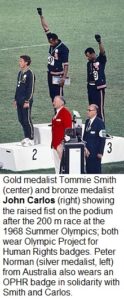
Rucker said the song was played while aides tossed Trump T-shirts into the crowd, as is commonly done at baseball games. “Everyone’s loving it,” he said.

Rihanna’s warning to the president came hours after she endorsed Andrew Gillum, the Democratic candidate for governor of Florida, in an Instagram post.

“Florida: You have the opportunity to make history this election,” Rihanna, 30, wrote on Instagram. “The US has only had four black governors in its entire history and we can help make #AndrewGillum the next one and Florida’s first.”

With her rebuke, Rihanna, who was born in Barbados, joins a growing list of artists who have asked that their music not be part of the soundtrack of Republican rallies. Last week, Pharrell Williams issued a cease-and-desist letter after Trump played his 2013 song “Happy” at a rally on the same day 11 people were killed in a Pittsburgh synagogue shooting.

In August, Aerosmith’s Steven Tyler sent Trump a cease-and-desist letter over use of the song “Livin’ on the Edge” at a political rally without permission.

“This is not about Dems vs. Repub.,” Tyler tweeted at the time. “I do not let anyone use my songs without my permission. My music is for causes, not for political campaigns or rallies. Protecting copyright and songwriters is what I’ve been fighting for even before this current administration took office.”

In 2015, the singer’s legal team warned Trump, then a Republican presidential candidate, over his use of “Dream On.”

Rihanna’s remarks came a day after Axl Rose, who has been a vocal critic of the Trump administration, accused his campaign of “using loopholes in the various venues’ blanket performance licenses, which were not intended for such craven political purposes, without the songwriters’ consent.”

The Guns N’ Roses frontman also said the band had formally requested that its music not be used at Trump rallies or Trump-associated events.

After Washington Post reporter Philip Rucker on Sunday tweetedthat Rihanna’s hit song was playing at a rally in Chattanooga, Tennessee, the singer replied: “Not for much longer.”

She also said: “Me nor my people would ever be at or around one of those tragic rallies.”

Source: Posted November 5, 2018; retrieved November 6, 2018 from: https://stluciatimes.com/arts-entertainment/rihanna-tells-trump-to-stop-playing-her-music-at-his-rallies/

Share this post:
,
[Top]

Good Governance: The Kind of Society We Want

Go Lean Commentary

What kind of society do you want to live in?

This is important to consider. As a democracy – of the people, by the people, for the people – what is done by the government is done on the people’s behalf, in our name.

“This is on us”.

Frankly, I would not want to live in a society where the strong abuses the weak.

To the contrast, I would want to live in a society, where we protect the vulnerable ones among us. This is also a Biblical concept …

The form of worship* that is clean and undefiled from the standpoint of our God and Father is this: to look after orphans+ and widows+ in their tribulation,+ and to keep oneself without spot from the world.+James 1:27 NWT

This is a discussion about the modern plague of Human Trafficking.

Modern? Yes, there is “nothing new under the sun”. Human trafficking has always been a plight in the Caribbean; (see Appendix VIDEO below). Surely you recognize the parallels of this old practice of another name:

Slave Trade

Yes, Human Trafficking is the new brand for the old abominable practice of the slave trade. The Caribbean has a sad history with this practice – ancient and modern. Stories continue to emerge of contemporary occurrences. See this one here:

Title: Suspected Human Trafficking Victim Rescued In Castries

Crying young woman

A sixteen year old female, suspected to be a victim of human trafficking, was rescued Sunday in Castries and handed over to Saint Lucia Police, a senior law enforcement source has confirmed.

The teenager, originally from Venezuela but living in neighbouring Martinique for some time, ran to a complete stranger and begged for help, saying that she had been kidnapped and sexually abused, the source said.

According to the source, the young woman was partially naked and was complaining of intense pain.

“She said she was sedated by her captors and brought to Saint Lucia,” the source told St Lucia Times.

The stranger, a woman, to whom the teenager ran for help, took the girl to her home where she was given a meal and some clothing and later handed over to the Criminal Investigations Department of the Royal Saint Lucia Police Force (RSLPF), it was reported.

The law enforcement source told St Lucia Times that it appears that the teenager had been reported missing by officials in Martinique.

Investigations into the matter are continuing.

Source: Posted October 23, 2018; retrieved October 26, 2018 from https://stluciatimes.com/2018/10/23/suspected-human-trafficking-victim-rescued-in-castries/

As related here, this victim originated in Spanish-speaking Venezuela and has since been trafficked in the French Caribbean territory of Martinique and now the Anglophone country of St. Lucia.

This is more than just an academic discussion; this is a defining issue for the Caribbean and all of the New World territories in the Americas: What kind of society do we want to be?

My answer: one with Good Governance; one where we ensure that the strong do not abuse the weak and the vulnerable.

Human trafficking is a clear obvious violation of human rights of a weak subject; see the definition in the Appendix below.

In a previous Go Lean blog-commentary, the reference was made to a higher standard for governments and shepherds of society – the Code of Hammurabi – enacted within the ancient Babylonian Empire Super Power; it featured this statement:

“So that the strong should not harm the weak”

There is an obvious “ignorance or negligence of this [Old World] concept” in the New World. …

So the abuse of the “strong against the weak” is clearly an unabashed societal defect in the New World. History teaches that with the emergence of any new economic engines, “bad actors” will also emerge thereafter to exploit the opportunities – the weak – with good, bad and evil intent.

The New World needs to apply this lesson-learned from the “Old World of 1754 BC” to protect the “poor, sick and huddled masses yearning to be free”.

This lesson from history aligns with the book Go Lean…Caribbean, which seeks to reform and transform the 30 member-states of the Caribbean region; the book describes empowerments to target the economic, security and governing engines of society to ensure an adherence to the principle of the Greater Good. While we can observe-and-report on the other countries, we can only effect change here in our Caribbean homeland.

For the strong to protect the weak, the minimum expectation is an assumption of Good Governance. It is expected that someone-somewhere will step-in and step-up to police against human trafficking …

… failing this, we would have a Failed-State.

Unfortunately, according to the foregoing news article, this is the reality and actuality in the Caribbean. A Failed-State emerges when the governmental entities are not able to deliver on the Social Contract as defined here in a previous blog-commentary:

“Citizens surrender some of their freedoms and submit to the authority of the State in exchange for protection of remaining natural and legal rights”.

When a State fails on the delivery of the Social Contract; the most common consequence in society is human flight in search of refuge. This aligns with the societal abandonment reasons of “Push and Pull“:

  • Push – refers to the reasons people who feel compelled to leave, to seek refuge in a foreign land. “Refuge” is an appropriate word; because of societal defects – like the “strong abusing the weak” – many from the Caribbean must leave as refugees – think DisabilityDomestic-abuseMedically-challenged and LGBT – for their life, liberty and pursuit of happiness.
  • Pull – refers to the lure of a more safer life abroad; many times our people are emigrating to communities where there are protections for the “weak against the abusive strong”.

The kind of society we want is one where Human Traffickers do not find safe haven in our communities. We want Good Governance not Failed-States.

This commentary is the third of a 5-part series (3 of 5) from the movement behind the Go Lean book in consideration of the Good Governance needs for a new Caribbean regime. The other commentaries in the series are cataloged as follows:

  1. Good Governance: … Versus Partisan Politics
  2. Good GovernanceStepping Up in an Emergency
  3. Good Governance: The Kind of Society We Want
  4. Good GovernanceGetting ‘Out of the Way’ of Local Economic Empowerment
  5. Good GovernanceGood Corporate Compliance

This need for Good Governance and a Caribbean Regional Police – CariPol – is embedded in this plan to elevate Caribbean life, the Go Lean book serves as a roadmap for the introduction and implementation of the Caribbean Union Trade Federation (CU). The purpose of this roadmap is to transform the region’s societal engines, which includes economics, security and governance. This is stated as the prime directive of the CU/Go Lean roadmap, see here:

  • Optimization of the economic engines in order to grow the regional economy to $800 Billion & create 2.2 million new jobs.
  • Establishment of a regional security apparatus to ensure public safety and protect the resultant economic engines.
  • Improvement of Caribbean governance to support these engines, including a separation-of-powers between the member-states and CU federal agencies.

Good Governance, CariPol and Homeland Security are all part of the Go Lean book’s emphasis on New Guards. Notice these references in the opening Declaration of Interdependence (Pages 11 – 13):

x. Whereas we are surrounded and allied to nations of larger proportions in land mass, populations, and treasuries, elements in their societies may have ill-intent in their pursuits, at the expense of the safety and security of our citizens. We must therefore appoint “new guards” to ensure our public safety and threats against our society, both domestic and foreign. …

xi. Whereas all men are entitled to the benefits of good governance in a free society, “new guards” must be enacted to dissuade the emergence of incompetence, corruption, nepotism and cronyism at the peril of the people’s best interest. The Federation must guarantee the executions of a social contract between government and the governed.

xii. Whereas the legacy in recent times in individual states may be that of ineffectual governance with no redress to higher authority, the accedence of this Federation will ensure accountability and escalation of the human and civil rights of the people for good governance, justice assurances, due process and the rule of law. As such, any threats of a “failed state” status for any member state must enact emergency measures on behalf of the Federation to protect the human, civil and property rights of the citizens, residents, allies, trading partners, and visitors of the affected member state and the Federation as a whole.

xviii. Whereas all citizens in the Federation member-states may not have the same physical abilities, reasonable accommodations must be made so that individuals with physical and mental disabilities can still access public and governmental services so as to foster a satisfactory pursuit of life’s liberties and opportunities for happiness.

These  references to New Guards is a glimpse of a new Caribbean as envisioned in the Go Lean book. The Go Lean book provides 370-pages of turn-by-turn instructions on “how” to adopt new community ethos, plus the strategies, tactics, implementations and advocacies to execute so as to reboot, reform and transform the societal engines of Caribbean society. We need to avoid Failed-State statuses. In addition, there is one advocacy in the book for mitigating the downward trend to Failed-State status. This includes considerations for the delivery of the Social Contract. Notice the specific plans, excerpts and headlines from the book on Page 134 entitled:

10 Ways to Improve Failed-State Indices

1 Lean-in for the Caribbean Single Market
This will allow for the unification of the region into one market of 42 million people across 30 member-states, thereby creating an economic zone to protect the interest of the participant trading partner-member-states. The GDP of the region will amount to $800 Billion (circa 2010). In addition, the treaty calls for a collective security agreement of the member states so as to ensure homeland security and assuage against systemic threats. The CU will ensure that law-and-order persist during times of distress. When a member state declares a State of Emergency, due to natural disaster or civil unrest, this triggers an automatic CU response – this is equivalent to the governmental dialing 911.
2 Image and Defamation
3 Local Government and the Social Contract

The Social Contract is the concept that individuals have consented, either explicitly or tacitly, to surrender some of their freedoms and submit to the authority of the State in exchange for protection of their remaining rights (natural and legal). People therefore expect their government (national or municipal) to provide public safety, health, education and other services. The CU will facilitate overhead services for local governments and access to financial markets to fund capital infrastructure investments. The member-states will therefore have more accountability and reporting to CU institutions.

4 Law Enforcement Oversight

The CU will maintain jurisdiction for economic crimes and regional threats. Plus, the CU will collaborate and facilitate

local law enforcement with grants of equipment and training to better fulfill their roles. Lastly, the regional security treaty will grant the CU the audit and compliance responsibility for “use of force” investigations and internal affairs.

5 Military and Political Monitoring

The CU will carefully monitor the activities of the military units (Army, Navy and Coast Guard) – this accountability will be the by-product of increased CU funding. The CU will assume the Judge Advocate General role for military justice affairs. For cross border engagements, the National armed forces will be marshaled by the CU’s Commander-in-Chief.

6 Crime/Homeland Intelligence
The CU will install advanced systems, processes, and personnel for intelligence gathering and analysis to assist public safety institutions. This includes terrestrial and satellite surveillance systems, phone eavesdropping, data mining and predictive modeling. The findings will be used to mitigate risks and threats (gangs, anarchy, and organized crime).
7 Minority and Human Rights

The CU will protect the minority and human rights for the region’s population; this includes ethnic mixes of African, European, Amerindian, and Asian heritage; 4 languages, various religions, and 5 colonial legacies. The CU strategizes this diversity as an asset, rather than a source of contention, to be exploited as cultural exchanges in music, festivals, events, and food services. This will have a positive effect on tourism (foreign & domestic) and media initiatives.

8 Election Outsourcing
9 War Against Poverty
10 Big Data

This Go Lean book presents that the function and responsibility of assuaging Failed-State indices will be a priority on Day One / Step One of the Go Lean/CU roadmap. The point of Failed-State downward spirals has been elaborated on in previous blog-commentaries; consider this sample:

https://goleancaribbean.com/blog/?p=13391 After Maria, Failed-State Indicators: Destruction and Defection for PR
https://goleancaribbean.com/blog/?p=12996 After Irma, Failed-State Indicators: Destruction and Defection
https://goleancaribbean.com/blog/?p=12098 Inaction: A Recipe for ‘Failed-State’ Status in Venezuela
https://goleancaribbean.com/blog/?p=2547 Miami’s Success versus Caribbean Failure

We want the kind of society that looks after – protects – the vulnerable people in our community. This is what Good Governance should mean to us. So we must reform and transform our Caribbean governing engines to reach this goal. Let’s lean-in to this Go Lean roadmap to accomplish this.

A commitment for Good Governance is a commitment to fully deliver on the Social Contract. Succeeding, or trying to succeed is how to can make the Caribbean a better homeland to live, work and play. 🙂

Download the free e-Book of Go Lean … Caribbean – now!

Sign the petition to lean-in for this roadmap for the Caribbean Union Trade Federation.

—————-

Appendix – Human Trafficking

Human trafficking is the trade of humans for the purpose of forced laboursexual slavery, or commercial sexual exploitation for the trafficker or others.[1][2] This may encompass providing a spouse in the context of forced marriage,[3][4][5] or the extraction of organs or tissues,[6][7] including for surrogacy and ova removal.[8] Human trafficking can occur within a country or trans-nationally. Human trafficking is a crime against the person because of the violation of the victim’s rights of movement through coercion and because of their commercial exploitation.[9] Human trafficking is the trade in people, especially women and children, and does not necessarily involve the movement of the person from one place to another.[citation needed]

According to the International Labour Organization (ILO), forced labor alone (one component of human trafficking) generates an estimated $150 billion in profits per annum as of 2014.[10] In 2012, the ILO estimated that 21 million victims are trapped in modern-day slavery. Of these, 14.2 million (68%) were exploited for labor, 4.5 million (22%) were sexually exploited, and 2.2 million (10%) were exploited in state-imposed forced labor.[11]

Human trafficking is thought to be one of the fastest-growing activities of trans-national criminal organizations.[12]

Human trafficking is condemned as a violation of human rights by international conventions. In addition, human trafficking is subject to a directive in the European Union.[13] According to a report by the U.S. State Department, BelarusIranRussia, and Turkmenistan remain among the worst countries when it comes to providing protection against human trafficking and forced labor. [14]

Revenues

In 2014, the International Labour Organization estimated $150 billion in annual profit is generated from forced labor alone.[10]

The average cost of a human trafficking victim today is USD $90 whereas the average slave in 1800 America cost the equivalent of USD $40,000.[18]

(Human trafficking differs from people smuggling, which involves a person voluntarily requesting or hiring another individual to covertly transport them across an international border, usually because the smuggled person would be denied entry into a country by legal channels. )

Source: Retrieved from: https://en.wikipedia.org/wiki/Human_trafficking

—————–

Appendix VIDEO – Human Trafficking – Short Documentary in the Caribbean – https://youtu.be/Hy0uA-srXig

UK Foreign & Commonwealth Office
Published on Sep 24, 2013 – A short film to inform the public about human trafficking in the Caribbean and to raise awareness of this modern form of slavery.

Share this post:
, , ,
[Top]

Remembering the Moment – 1968’s Proudest Protest – ENCORE

October 16, 2018 – Today marks the 50th Anniversary of a moment in history when two American athletes stood-up in protest at the 1968 Olympic Games, during the Medal-Award ceremony. Their “human rights salute” is regarded as one of the most overtly political statements ever in the history of the modern Olympic Games.
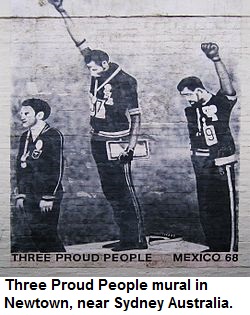
Protesting athletes? This sounds so familiar, considering the recent exploits of Colin Kaepernick et al.

This one episode – this moment – was actually a forerunner for conducting protests and forging change today. It was part-and-parcel of the tumultuous year that 1968 proved to be.

This was not just an American issue. This affected the whole world. After all, this was the Olympics. In addition, one of the protesting athletes, John Carlos, was of Caribbean (Cuban) Roots.

Today, we are presenting an Encore of the profile of John Carlos, depicting his role in this episode in history. See this previous blog-commentary from March 10, 2017 here-now:

===========================

Go Lean CommentaryCaribbean Roots: John Carlos – The Man. The Moment. The Movement

The title: “The Man. The Moment. The Movement” is more than just a catch-phrase, its a recipe for successfully transforming society.

Do you remember this Sports Moment That Changed the World?

CU Blog - Caribbean Roots - John Carlos among 'Three Proud People' - Photo 1It was at the 1968 Olympics in Mexico City. Despite all the attempts by the organizers to keep the Games apolitical and free-of-conflict, the Moment got political and conflicted … and impactful. This was when the Man, John Carlos, the bronze-medal winner in the 200 meters at the 1968 Summer Olympics gave his Black Power salute on the podium with gold-medalist Tommie Smith; this galvanized the Movement – the Civil Rights Movement in general and the Olympic Project for Human Rights in particular. The Movement caused a lot of controversy.

What is not known about this moment is that this Man, John Carlos, has Caribbean roots.

We are so proud!

Consider his biography reference here:

Title: John Carlos
John Wesley Carlos (born June 5, 1945) is an American former track and field athlete and professional football player. He was the bronze-medal winner in the 200 meters at the 1968 Summer Olympics and his Black Power salute on the podium with Tommie Smith caused much political controversy. He went on to tie the world record in the 100 yard dash and beat the 200 meters world record (although the latter achievement was never certified). After his track career, he enjoyed a brief stint in the Canadian Football League but retired due to injury.[1]

He became involved with the United States Olympic Committee and helped to organize the 1984 Summer Olympics. Following this he became a track coach at Palm SpringsHigh School. He was inducted into the USA Track & Field Hall of Fame in 2003.

He is the author, with sportswriter Dave Zirin, of The John Carlos Story: The Sports Moment That Changed the World, published in 2011 by Haymarket Books.

Early life and education
Born in Harlem, New York, to Cuban[2] parents, John Carlos was a gifted high school athlete and outstanding student who went on to study at East Texas State University on a full track-and-field scholarship. His victories in the 100- and 200-meter dash and as a member of the 4×400-meter relay helped lead ETSU to the 1967 Lone Star Conference Championship. After his first year, Carlos enrolled at San Jose State University where he was trained by future National Track & Field Hall of Fame coach, Lloyd (Bud) Winter.

Carlos was awarded an honorary doctorate from CaliforniaStateUniversity in 2008. In 2012, he was awarded honorary doctorates from his alma maters Texas A&M University-Commerce (formerly EastTexasStateUniversity) and San Jose State University.

Career
At the 1968 Olympic Trials, Carlos won the 200-meter dash in 19.92 seconds, beating world-record holder Tommie Smith and surpassing his record by 0.3 seconds. Though the record was never ratified because the spike formation on Carlos’ shoes (“brush spikes”) was not accepted at the time, the race reinforced his status as a world-class sprinter.

Carlos became a founding member of the Olympic Project for Human Rights (OPHR), and originally advocated a boycott of the 1968 Mexico City Olympic Games unless four conditions were met: withdrawal of South Africa and Rhodesia from the games, restoration of Muhammad Ali’s world heavyweight boxing title, Avery Brundage to step down as president of the IOC, and the hiring of more African-American assistant coaches. As the boycott failed to achieve support after the IOC withdrew invitations for South Africa and Rhodesia, he decided, together with Smith, to participate but to stage a protest in case he received a medal.[3] Following his third-place finish behind fellow American Smith and Australian Peter Norman in the 200 at the Mexico Olympics, Carlos and Smith made headlines around the world by raising their black-gloved fists at the medal award ceremony. Both athletes wore black socks and no shoes on the podium to represent African-American poverty in the United States. In support, Peter Norman, the silver medalist who was a white athlete from Australia, participated in the protest by wearing an OPHR badge.

IOC president Avery Brundage deemed a political statement unfit for the apolitical, international forum the Olympic Games was supposed to be. In an immediate response to their actions, he ordered Smith and Carlos suspended from the U.S. team and banned from the Olympic Village. Many supporters, however, praised the men for their bravery. The men’s gesture had lingering effects for all three athletes, the most serious of which were death threats against Carlos, Smith, and their families. Although it has been reported that Carlos and Smith were stripped of their medals, Carlos has indicated this is not true and his medal is with his mother.[4]

Carlos had his greatest year in track and field in 1969, equaling the world 100-yard record of 9.1, winning the AAU 220-yard run, and leading San JoseState to its first NCAA championship with victories in the 100 and 220 and as a member of the 4×110-yard relay. He was featured on the cover of Track and Field News May 1969 issue.[5]

CU Blog - Caribbean Roots - John Carlos among 'Three Proud People' - Photo 3

Source: Wikipedia Online Encyclopedia – Retrieved March 8, 2017 from: https://en.wikipedia.org/wiki/John_Carlos

This biography should go back further to include John Carlos’s Cuban-Caribbean heritage, that of his father:

John Carlos is of Cuban descent and can understand Spanish. His father, Earl Carlos Sr., was a businessman (a cobbler or shoe repair) and World War I Veteran [fighting for the US]. He was a man proud of his appearance in all circumstances and carried himself in a dignified way. He had to work hard from an early age (like most African-American children of his era, especially in the South of the country) and his parents were born as slaves; [(slavery ended in Cuba in 1886 and he was born in 1895)]. When he participated in World War I, he got wounded and received the Medal of Citation Award for his stoicism on the battlefield. When he returned back home, he had to face racial hatred, economic discrimination, the Roaring Twenties, the Stock Market Crash in 1929, the Dust Bowl in the mid-thirties and World War II. Despite the difficulties, he never became bitter. He met his future wife, Vioris Lawrence (an African-American woman), in 1941, who was later John Carlos’ mother. – MegaDiversities.

This was quite a legacy to absorb. John Carlos had the molding from his proud Cuban father, who left a segregated Cuba and emigrated for a better life in the metropolitan area of New York. Harlem – think Harlem Renaissance – was a better place to be a Black Man than the Jim Crow South or the minority-ruled Cuba. When he stood in defiance in that Moment in 1968, John Carlos was protesting the blatant racism that he experienced and his father before him – Earl Carlos died later, in May 1969. The Movement to uplift oppressed people had began on the global stage, but the Black Power salute was a local action in solidarity with all those oppressed before and after this Moment. He understood that ‘Sport and Politics’ are intrinsically linked, whether right or wrong.

The movement behind the book Go Lean … Caribbean recognizes the significance of that Moment and the stage for its execution, the celebrated Olympic Games. The Go Lean book applauds the struggle for Civil Rights and the dynamics of sports. It posits that sports can foster a great influence – and even wealth – in modern society. See this in Appendix B VIDEO.

The sportsman can “rule in people’s hearts”. People marvel at their athletic prowess – billions may be watching on live or tape-delayed TV broadcasts – the participants can forge a positive image and wield power and influence; think:

We can add John Carlos and Tommie Smith to that list.

This Moment was in 1968; that was a pivotal year, so many things happened, mostly bad; consider this sample:

  • Martin Luther King was assassinated, April 4
  • Robert Kennedy was assassinated, June 6
  • Vietnam War Protests – Summer
  • Chicano (Hispanic) Movement and Red Power (Native Americans) Movement Summer Protests
  • Mexico City Olympics – October 12 – 27
  • James Brown song: Say it loud: “I’m Black and I’m Proud”
    CU Blog - Caribbean Roots - John Carlos among 'Three Proud People' - Photo 2

According to John Carlos, in a recent interview describing the disposition on the ground there in Mexico City: “it was high tension, drama, a powder keg … prior to the Olympics there was a massacre that killed hundreds of young activists”.

That was 1968 … all around; consider the experience of one Californian “back in that day”:

1968 was an exciting time for me. I think it was when my activism was born. Before that time things were pretty rosy. Even though I knew about the [Black] Panthers and had seen Dr. [Martin Luther] King, living in LA you were kind of removed. I do remember expressing a desire to join the Freedom Rides, but my Pastor said ‘No’.

1968 was [when] my friends were coming home from Vietnam or refusing to go.

I remember loaning my boyfriend $$ to go to Philly to go before the Draft Board to argue as a Conscientious Objector. He won and we were so happy.

I remember the day Dr. King was killed and going that night to a service with friends. I remember being so sad and being glued to the TV.

I remember the horror of Bobby Kennedy being killed. I was at work and heard the news.

I remember being so proud of Tommy Smith and John Carlos at the Olympics.

My living room had two posters. One of them on the stand with the black gloved fists held high and the other was [Black Panther Party co-founder] Huey Newton sitting in that Peacock Chair.

Those were the days when I was very active in the Watts Summer Festival. Tommy Jacquette, the founder, was a friend, and we all gathered together to make the event a success. …

I would say that 1968 was the year that I became the person I am today. – Bunny Withers, Los Angeles.

The reality of human rights abuses in America in 1968 was bad, worse or dire – those were the only options. The Black community was far from being treated as equal citizens in that society. But truth be told, other minority groups in the country also experienced oppression, repression and suppression. America was the greatest country on the planet for those that qualified; those that were:

White, Anglo-Saxon, Rich, Male and Straight

Anyone else – everyone else – needed civil rights empowerments.

Fortunately, this is not the conditions of the America of today. It is now a better place to live, work and play. How did this society go from “there to here”?

It took the strenuous efforts of advocates: individuals – Men and Women – and organizations, exploiting Moments and Movements for maximum exposure. They appealed to the public, appealed to their better nature. John Carlos was one such individual.

The third person on the dais, silver medalist Peter Norman of Australia, can also be classified as an advocate fighting to assuage human rights abuses – he also wore a badge of the Olympic Project for Human Rights – he was in solidarity with Smith and Carlos. See the profile VIDEO on his activities in Appendix A below.

The Caribbean has a problem today that we did not have back in 1968. The majority populations of the Caribbean region is/was Black-and-Brown. America was not inviting to this demographic, so our people rarely immigrated to the US. Now with the above-referenced civil rights empowerments, America is now a more fair society for all people. Our Caribbean people now “beat down their doors” to flee to America, and other places – Go Lean book Page 3.

The US is now a “frienemy” for us! We are trading partners; we are aligned; we are allies; many of our students studied there; many of our Diaspora live there. We now have to compete to dissuade our young people from setting their sights on American shores as a refuge and destination of their hopes and dreams. No society can survive with a high abandonment rate – the book Go Lean … Caribbean reports that 70% brain drain rate among our professional populations.

We are failing and need advocates of our own.

We need new role models, with the courage of John Carlos, to help us “battle” against the “push-and-pull” factors that draw many Caribbean citizens away from home to the US. We need Men to seize the Moment and advance this Movement.

The Go Lean movement pursues the quest to elevate the Caribbean region through empowerments in economics, security and governance. Since 29 of the 30 Caribbean member-states (“St. Barths” is the only exception) have majority Black populations, the book pushes further on this subject of racism, positing that it is easier for Caribbean citizens to stay home and effect change in their homelands than to go to America and try to remediate that society. The book therefore asserts that the region can turn-around from failing assessments by applying best-practices, and forging new societal institutions to impact the Greater Good for all the Caribbean.

The Go Lean book posits that sports – individual achievements and the business of sports – can greatly impact society; in addition to the entertainment value, there is also national pride, image and impression. People can override many false precepts with sporting excellence by great role models.

The book Go Lean…Caribbean serves as a roadmap for the introduction and implementation of the Caribbean Union Trade Federation (CU), a technocratic federal government designed to administer and optimize the economic-security-governing engines of the region’s 30 member-states. This is highlighted by these 3 prime directives:

  • Optimization of the economic engines in order to grow the regional economy; creating 2.2 million new jobs and expanding the regional GDP to $800 Billion.
  • Establishment of a security apparatus to protect the resultant economic engines.
  • Improve Caribbean governance to support these engines.

At the outset, the roadmap recognizes our crisis and the value of sports in the roadmap, with these statements in the Declaration of Interdependence (Page 13 & 14):

xix. Whereas our legacy in recent times is one of societal abandonment, it is imperative that incentives and encouragement be put in place to first dissuade the human flight, and then entice and welcome the return of our Diaspora back to our shores. This repatriation should be effected with the appropriate guards so as not to imperil the lives and securities of the repatriated citizens or the communities they inhabit. The right of repatriation is to be extended to any natural born citizens despite any previous naturalization to foreign sovereignties.

xxvi. Whereas the preparation of our labor force can foster opportunities and dictate economic progress for current and future generations, the Federation must ensure that educational and job training opportunities are fully optimized for all residents of all member-states, with no partiality towards any gender or ethnic group. The Federation must recognize and facilitate excellence in many different fields of endeavor, including sciences, languages, arts, music and sports. This responsibility should be executed without incurring the risks of further human flight, as has been the past history.

xxxi. Whereas sports have been a source of great pride for the Caribbean region, the economic returns from these ventures have not been evenly distributed as in other societies. The Federation must therefore facilitate the eco-systems and vertical industries of sports as a business, recreation, national pastime and even sports tourism – modeling the Olympics.

The Go Lean roadmap calls for the market organizations to better garner the economic benefits of sports. One of the biggest contributions the CU will make is the facilitation of sports venues: arenas and stadia. As described in a previous blog-commentary, sports can be big business! And even when money is not involved, other benefits abound: educational scholarships, fitness/wellness, disciplined activities for the youth, image, and pride. No doubt an intangible yet important benefits is depicted in this Go Lean roadmap, that of less societal abandonment.

The movement behind the Go Lean book salute those ones from our past who left their Caribbean homelands for better opportunities abroad; we salute their legacies (foreign-born children) as well. We know that there are “new” athletes who are just waiting to be discovered and fostered throughout the Caribbean member-states. We salute these ones as our future, and pledge to do better to keep them here at home. The book details the community ethos, strategies, tactics, implementations and advocacies to allow Caribbean people to prosper where they are planted.

In terms of salute, it is appropriate to salute Vioris Louise Lawrence Carlos – the mother of John Carlos. She just recently passed-away, on December 12, 2016, at age 97. This blessed woman’s contributions and life course help to mold the life and legacy of 5 children – including John Carlos – and a whole community.

Previous Go Lean blog-commentaries that identified other sports role models for our consideration:

https://goleancaribbean.com/blog/?p=8495 NBA Greatness and Caribbean Roots: Tim Duncan Retires
https://goleancaribbean.com/blog/?p=2222 Sports Role Model – Playing For Pride … And More
https://goleancaribbean.com/blog/?p=1020 Sports Revolutionary: Advocate Jeffrey Webb
https://goleancaribbean.com/blog/?p=498 Caribbean Sport Excellence due to ‘The Sports Gene’

In addition, these other Go Lean blog-commentaries have identified other role models with Caribbean roots:

https://goleancaribbean.com/blog/?p=10609 Caribbean Roots: Cast of ‘The Fresh Prince of Bel-Air’
https://goleancaribbean.com/blog/?p=10114 Esther Rolle – Caribbean Roots
https://goleancaribbean.com/blog/?p=9948 Sammy Davis, Jr. – Caribbean Roots
https://goleancaribbean.com/blog/?p=8724 Remembering Marcus Garvey: A Role Model; Still Relevant Today
https://goleancaribbean.com/blog/?p=8619 Clive Campbell – Jamaican Innovation for Hip Hop
https://goleancaribbean.com/blog/?p=8328 YouTube Role Model with Caribbean Roots: ‘Tipsy Bartender’
https://goleancaribbean.com/blog/?p=2726 Caribbean Role Model – Oscar De La Renta – RIP
https://goleancaribbean.com/blog/?p=866 Caribbean Musical Icon and Role Model: Bob Marley

The world is a better place, sports-wise and arts-wise, because of Caribbean contributions. Thank you to all past, present and future athletes and contributors.

Not to be overlooked, but the same as the US had a Climate of Hate in 1968, we have our own societal defects in the Caribbean region today. We cannot claim enlightenment to the achievements of advocates like John Carlos and have a blind eye” to our own “ills”. So let’s stand-up as a Proud People and force our own communities to change. Let’s make our Caribbean homeland a better place to live, work and play. 🙂

Download the book Go Lean … Caribbean – now!

Sign the petition to lean-in for the roadmap for the Caribbean Union Trade Federation.

————-

APPENDIX A VIDEO – The Story Behind The White Guy In This Historic Photo – https://youtu.be/t4LvwXYmt3Q

Published on Oct 31, 2015 – In 1968 there was a powerful moment of protest at the Olympic games when two winners put on black gloves to protest what was happening in the country during the civil rights era. Most people don’t know the story of the silver medalist, Peter Norman. Cenk Uygur, host of the The Young Turks, breaks it down. Tell us what you think in the comment section below.

“In an act as appropriate as it is overdue, the Australian House of Parliament is issuing an official state apology Monday to the country’s late, great sprinter Peter Norman. Norman won the 200-meter silver medal at the 1968 Olympics, but that’s not why he’s either remembered or owed apologies. After the race, gold and bronze medalists Tommie Smith and John Carlos bowed their heads and raised their fists on the medal stand and started an international firestorm. Many see the iconic image and assume Norman was just a bystander to history, or as he would joke, “the white guy.” But he was standing in full solidarity with Smith and Carlos, wearing a patch on his chest that reads, “Olympic Project for Human Rights.”

Read more here: https://www.thenation.com/article/aus…

Disclaimer: The Young Turks is an online video talk show that provides commentary on news and opinion articles. Often times these articles come from sources outside of our organization. Where possible, we do our best to research and verify various sources before reporting. Content created by third parties is the sole responsibility of the third parties and its accuracy and completeness are not endorsed or guaranteed.

UPDATE to story: http://www.filmsforaction.org/watch/j…

————-

APPENDIX B VIDEO – THREE PROUD PEOPLE (Mural project) Tommy Smith, Peter Norman, John Carlos – https://youtu.be/xHcasP4HOo0

Uploaded on May 17, 2009 – This mural was put up about 6 weeks prior to the opening ceremony of the Sydney 2000 Olympic games. It could be viewed from the McDonaldtown train station platform and from trains travelling past. Trains travel from central Sydney to the Homebush Olympic venue past this mural. As of a few years ago, the mural can no longer be seen from the tracks due to a city rail concrete sound barrier that has been installed.
Peter Norman was repremanded for his part in the action. Peter, in solidarity, wore the Olympic project for human rights badge, which defied the code of conduct. He also came up with the idea of Smith and Carlos each wearing one black glove from the same pair. All three of these guys were very couragous.

  • Category: Education
  • License: Standard YouTube License


Share this post:
, , ,
[Top]

‘Freedom of Speech’ has consequences

Go Lean Commentary

Freedom of Speech is not so absolute!

There are consequences to speech – think: defamation, libel and slander – and so there is the need for some curtailment. One cannot just say anything they want about a person or product and not expect some consequences. There is the classic “Fire in a Crowded Theater” scenario.

The intent is the key.

If one says “fire”, knowing full well that there is no fire, he-she may only want to rile people up and make them stampede; then there may be legal consequences. One can be charged with inciting a riot, willful disregard to safety, depraved indifference or manslaughter.

This is serious … in the physical world.

How about the virtual world?

Same rules … and consequences apply. Now we have medical doctors and clinicians on guard about negative comments-reviews-ratings from patients and customers. See the VIDEO & news story of this threat here:

VIDEO – Surgeon: Online posts were part of patient’s ‘obsession over 10 years’ – https://www.usatoday.com/videos/news/health/2018/07/16/surgeon-online-posts-were-part-patients-obsession-over-10-years/788794002/

—————

Title: Doctors, hospitals sue patients who post negative comments, reviews on social media

By: Jayne O’Donnell and Ken Alltucker

CLEVELAND – Retired Air Force Colonel David Antoon agreed to pay $100 to settle what were felony charges for emailing his former Cleveland Clinic surgeon articles the doctor found threatening and posting a list on Yelp of all the surgeries the urologist had scheduled at the same time as the one that left Antoon incontinent and impotent a decade ago.

He faced up to a year in prison.

Antoon’s 10-year crusade against the Cleveland Clinic and his urologist is unusual for its length and intensity, as is the extent to which Cleveland Clinic urologist Jihad Kaouk was able to convince police and prosecutors to advocate on his behalf.

Antoon’s plea deal last week came as others in the medical community aggressively combat negative social media posts, casting a pall over one of the few ways prospective patients can get unvarnished opinions of doctors.

Among recent cases:

  • Cleveland physician Bahman Guyuron sued a former patient for defamation for posting negative reviews on Yelp and other sites about her nose job. Guyuron’s attorney Steve Friedman says that although the First Amendment protects patients’ rights to post their opinions, “our position is she did far beyond that (and) deliberately made false factual statements.”  A settlement mediation is slated for early August, and a trial is set for late August if no agreement is reached.
  • Jazz singer Sherry Petta used her own website and doctor-rating sites to criticize a Scottsdale, Arizona, medical practice over her nasal tip surgery, laser treatment and other procedures. Her doctors, Albert Carlotti and Michelle Cabret-Carlotti, successfully sued for defamation. They won a $12 million jury award that was vacated on appeal. Petta claimed the court judgment forced her to sell a house and file bankruptcy. The parties would not discuss the case and jointly asked for it to be dismissed in 2016 but declined to explain why.
  • A Michigan hospital sued an elderly patient’s two daughters and a granddaughter over a Facebook post and for picketing in front of the hospital they said mistreated the late Eleanor Pound. The operator of Kalkaska Memorial Health Center sued Aliza Morse, Carol Pound and Diane Pound for defamation, tortious interference and invasion of privacy.

Petta’s attorney, Ryan Lorenz, says consumers need to know there can be consequences if they post factually incorrect information. Lorenz, who has represented both consumers and businesses on cases involving online comments, says consumers are allowed to offer opinions that do not address factual points.

“Make sure what you are saying is true – it has to be truthful,” he says.

“It would be great if the regulators of hospitals and doctors were more diligent about responding to harm to patients, but they’re not, so people have turned to other people,” says Lisa McGiffert, former head of Consumer Reports’ Safe Patient Project. “This is what happens when your system of oversight is failing patients.”

As doctors and hospitals throw their considerable resources behind legal fights, some patients face huge legal bills for posting critiques and other consumers face their own challenges trying to get a straight story.

Experts say doctors take on extra risk when they resort to suing a patient.

Doctors typically can’t successfully sue third-party websites such as Yelp that allow consumer comments, but they can sue patients over reviews.

Even so, “you can win (a case) and still not win,” says Eric Goldman, a professor at Santa Clara University’s law school.

Goldman, who has tracked about two dozen cases of doctors suing patients over online reviews, says physicians rarely win the cases and sometimes must pay the patients’ legal fees.

Physician-patient confidentiality rules complicate options for doctors, Goldman says, but they can respond to factually incorrect reviews if the patient agrees to waive confidentiality and publicly discuss the case.

The comments challenged legally are typically those that were left online. Many medical review sites will remove posts they deem offensive or threatening to doctors, as many of Antoon’s or other Kaouk patients’ were. Yelp removes reviews only if they violate the consumer website’s terms of service.

Patients should first bring up complaints directly to the doctor or other medical provider, says Edward Hopkins, an attorney who represented Carlotti, Cabret-Carlotti and their medical practice for part of the case. Other options could include reporting a doctor to state oversight agencies, consulting with an attorney or filing complaints with a state attorneys’ general office.

Advocacy or obsession?

By the time he was arrested last December, Antoon had tried most every option with very little success.

Along the way, Antoon became a patient advocate – volunteering with Consumer Reports’ Safe Patient Project and HealthWatch USA – and advising others who say they were harmed by Kaouk and the Cleveland Clinic.

Cleveland Clinic, one of the top-rated hospitals in the country, has an aggressive legal department. Kaouk and the clinic prevailed in malpractice and fraud cases filed by Antoon and other patients who claimed they were harmed.

Matthew Donnelly, Cleveland Clinic’s deputy chief legal officer, attended Antoon’s criminal hearing in November.

To Kaouk, a decade of negative reviews on social media led to what he considered an escalation when Antoon sent him several emails, including one with a link to an article about a Chinese crackdown on research fraud that could include the death penalty if people were injured or killed.

The day before Antoon posted on Yelp in November, Kaouk was granted a civil stalking protective order against Antoon, which barred him from contacting the doctor.

“What would be next – showing up at my door?” Kaouk said in court. “That’s what we feared.”

In his posts and emails, Antoon documented alleged issues, including Kaouk and the urology department’s lack of credentials to use the robotic device in his surgery. He sent records to the Centers for Medicare and Medicaid Services (CMS), claiming they showed Kaouk was not present in the operating room during his surgery despite his insistence that only Kaouk could perform the surgery.

The Ohio Medical Board closed its investigation into Kaouk after five years without reprimanding him in any way. Antoon’s complaints to CMS temporarily put the hospital’s $1 billion annual Medicare reimbursement at risk.

Antoon’s claims were rejected, and Kaouk was not held liable for the surgery that left Antoon impotent and incontinent.

Along with more than $40,000 defending himself against the criminal charges, Antoon spent almost two days in jail. He had to post $50,000 bond in Shaker Heights and again in Cleveland’s Cuyahoga County after the case was transferred there.

It’s common “for someone in a position of wealth, power and money to go after someone like David to silence critics,” says Antoon’s attorney, Don Malarcik. “That happens often and it happened here.”

Hospitals, including the Cleveland Clinic, combat negative comments with their own rating systems, which let them “control their message,” McGiffert says.

Some comments posted by Antoon and Dan Galliano, another patient who claimed he was injured, disappeared from the websites RateMDs and Vitals, as shown in screenshots Antoon took right after they were posted.

Cleveland Clinic spokeswoman Eileen Sheil says it posts all the government-required satisfaction survey responses patients fill out about doctors on its ratings site, once at least 30 are received. Comments aren’t edited.

Sheil says Cleveland Clinic will request comments to be removed from other sites when they violate the sites’ terms of service.

RateMDs did not respond to requests for comment. Vitals spokeswoman Rosie Mattio says the site has a care team that will investigate reviews it is contacted about.

“While we will not pull down a necessarily negative review, we will remove the review if we find that it violates our terms and includes material that is threatening, racist or vulgar,” Mattio says.

Navigating Yelp

On Yelp, business owners can flag a review to be removed for violation of Yelp’s terms of services. Yelp reviews flagged comments and removes those that include hate speech or a conflict of interest or that are not based on a commenter’s firsthand experience.

The website doesn’t intervene over factual disputes, Yelp spokeswoman Hannah Cheesman says. Instead, it classifies consumer reviews as “recommended” or “not currently recommended” based on an automated software review.

If Yelp’s software detects multiple reviews from the same IP address or biased reviews from a competitor or disgruntled employee, it puts the comment in the not-recommended category. Consumers can still view such reviews by clicking on another page, but those comments are not factors in Yelp’s five-star rating system.

McGiffert has long advocated for a federal database where people could report medical errors and infections. Unless that happens, online review sites – including hospitals’ own and ones that will remove some reviews doctors object to – are among the only places patients can find physician reviews.

Doctors such as Kaouk suggest they are the ones who are disadvantaged.

“It is something that if anybody would look just by Googling my name online, you would see what he has written about me,”  Kaouk says of Antoon.

O’Donnell reported from Cleveland and McLean, Virginia. Alltucker reported from McLean.
Source: USA Today Daily Newspaper – Published July 18, 2018; Retrieved September 5, 2018
https://www.usatoday.com/story/news/politics/2018/07/18/doctors-hospitals-sue-patients-posting-negative-online-comments/763981002/ 

Can they – medical doctors and clinicians who shun negative comments-reviews-ratings – or should they regulate other people’s opinions? This is a BIG deal to contend with, as this issue reflects the current state of Internet Communications Technologies (ICT).

This is the world of New Media; the internet has supplanted all Old Media options, we need to settle this debate sooner, rather than later. While the debate in the foregoing article may be an American drama, the issue is with the World Wide Web.

This is a familiar theme for the movement behind the book Go Lean…Caribbean – available to download for free. Previously this site has presented blog-commentaries that highlight the need for better Internet Stewardship in the Caribbean Cloud. Those submissions presented some comprehensive ideas. See here:

https://goleancaribbean.com/blog/?p=14811 “Loose Lips Sink Ships” – Leaders Undermine College Enrollment

Freedom of Speech exercised wrongly could result in less economic activity. This is what is happening in the US, under President Trump, fewer international students are considering, applying and attending American universities. This is a lesson learn for the dangers of Hate Speech.

https://goleancaribbean.com/blog/?p=11224 “Loose Lips Sink Ships” – Leaders Undermine Tourism

Freedom of Speech exercised wrongly could result in less tourism. If leaders make Hate Speech, then fewer people may want to come visit. This is what is happening in the US, under President Trump.

https://goleancaribbean.com/blog/?p=10052 Fake News? Welcome to America

With tabloid journalism and Fake News, the American eco-system features Freedom of False Speech; so mis-information is easily spread. This distortion of truth is not the model for us in the Caribbean.

https://goleancaribbean.com/blog/?p=5435 China Internet Policing – Model for Caribbean

Someone needs to be watching the e-Store. China’s approach is that they actually “police” the internet within their borders. A bridge too far? Perhaps, but there is no debate that there is some need to regulate speech on the internet. It cannot just be the Wild Wild West.

https://goleancaribbean.com/blog/?p=5353 POTUS and the Internet
The President of the United States started using the internet as a freeform communications to his citizens – this turned ugly fast; hate speech proceeded immediately towards Obama.
https://goleancaribbean.com/blog/?p=4793 Truth in Commerce – Learning from Yelp

The e-Commerce site for rating retailers, Yelp, has often been hijacked by Bad Actors to undermine businesses for their own nefarious motives or just out of depraved indifference.

https://goleancaribbean.com/blog/?p=4673 Review “Merchants of Doubt” Documentary

There is a professional industry whose purpose is to conduct disinformation campaigns, plant seeds of doubt and even declare outright lies as dissenting views. These are Bad Actors.

The Go Lean book serves as a roadmap for the introduction and implementation of the technocratic Caribbean Union Trade Federation (CU), for the elevation of Caribbean society – for all member-states. Internet & Communications Technology is expected to be a major factor in this roadmap – ‘the great equalizer’. This CU/Go Lean roadmap has these 3 prime directives:

  • Optimization of the economic engines in order to grow the regional economy to $800 Billion and create 2.2 million new jobs. ICT strategies, tactics and implementations are paramount in delivering economic empowerments.
  • Establishment of a security apparatus to ensure public safety, ensure justice institutions and protect the resultant economic engines. ICT strategies, tactics and implementations are important in optimizing security provisions, imagine intelligence gathering and analyzing systems.
  • Improve Caribbean governance to support these engines, including a separation-of-powers between the member-states and CU federal agencies. E-Government will be the hallmark of the CU technocracy, so ICT strategies, tactics and implementations are paramount in delivering better governance.

The requisite investments to deploy the latest-greatest strategies, tactics and implementations in the art and science of ICT are too big for any one Caribbean member-state alone. So the Go Lean book stresses that reforming and transforming the Caribbean societal engines must be a regional pursuit. This was an early motivation for the roadmap, as pronounced in the opening Declaration of Interdependence (Pages 12 – 14):

xi. Whereas all men are entitled to the benefits of good governance in a free society, “new guards” must be enacted to dissuade the emergence of incompetence, corruption, nepotism and cronyism at the peril of the people’s best interest. The Federation must guarantee the executions of a social contract between government and the governed.

xvi. Whereas security of our homeland is inextricably linked to prosperity of the homeland, the economic and security interest of the region needs to be aligned under the same governance. Since economic crimes … can imperil the functioning of the wheels of commerce for all the citizenry, the accedence of this Federation must equip the security apparatus with the tools and techniques for predictive and proactive interdictions.

xxiv. Whereas a free market economy can be induced and spurred for continuous progress, the Federation must install the controls to better manage aspects of the economy: jobs, inflation, savings rate, investments and other economic principles. Thereby attracting direct foreign investment because of the stability and vibrancy of our economy.

xxvii. Whereas the region has endured a spectator status during the Industrial Revolution, we cannot stand on the sidelines of this new economy, the Information Revolution. Rather, the Federation must embrace all the tenets of Internet Communications Technology (ICT) to serve as an equalizing element in competition with the rest of the world. The Federation must bridge the digital divide and promote the community ethos that research-development is valuable and must be promoted and incentivized for adoption.

The Go Lean book provides 370-pages of turn-by-turn instructions on “how” to adopt new community ethos, plus the strategies, tactics, implementations and advocacies to execute so as to reboot, reform and transform the societal engines of Caribbean society. One advocacy presented in the book – 10 Ways to Improve Communications (Page 186) – focuses on the “art and science” of media (communications). The following tidbits are retrieved from that page:

# 3 – Media Industrial Complex
The CU will oversee the radio spectrum used for radio, television and satellite communications. The radio spectrum must be regulated on a regional level, because the islands are so close to each other and foreign states, that there must be coordination of the common resource pool – the spectrum is limited. This FCC-style (USA) oversight will also extend to internet broadband (wireless & wire-line) governance. With the CU’s financial reforms, the emergence of card-based and e-payment systems will allow for the full exploitation of the media business models. Also, the CU, through licensing, can mandate a certain amount of programming of the educational, inspirational and public service variety.

The Bottom Line on Old Media versus New Media
The internet and mobile communications has changed the modern world; many industries that once flourished (music retailers, travel agencies, book sales, line telephone companies), now flounder. Media distribution via the internet or mobile devices are referred to as “new media”, while old distribution channels like newspapers, magazines, TV and radio are referred to as “old media”. The mainstream (“old”) media is pivotal for “freedom of the press” as they are effective at standing up to big institutions like governments and corporations. The art of “good” journalism requires the deeper pockets that mainstream media bring to the market, but old media is dying financially. New media, on the other hand, is an aggregation of mainstream media. With the ubiquity of new media devices, people have freer, easier access and more options to news and information. On the plus side, there is now a greater diversity of ideas and viewpoints, on the minus side, with too many options, people tend to isolate their news consumption to only the views they want to hear. As new media matures, it is expected that it will take over the social responsibilities of old media, adopt the best practices of journalism, like fact checking (with the ease of information retrieval online), and finally return the industry to financial viability.

In summary, there are 2 Take-aways from this commentary:

(1) While there is  “Freedom of Speech”, there is no freedom from the consequences of speech.

(2) While there is “Freedom of the Press”, if the press is profit-oriented then popularity may be a greater priority than truth.

These dictate that there must be a stronger need for accuracy, integrity and professionalism in the age of New Media – disinformation can cause a lot of harm, fast.

There are lessons for the Caribbean to learn from other lands – America, China, and others. China is heavy-handed with their policing of media outlets, including online. This is definitely a bridge too far … for us in the Caribbean! India, though has a great model of a Chief Grievance Officer.

The Caribbean, sitting on the border with the United States of America allows us to look-listen-learn from the American experience. Our conclusion: We do not want to be America … we want to be better.

Yes, we can … get this right, and make our homeland a better place to live, work and play. 🙂

Sign the petition to lean-in for this roadmap for the Caribbean Union Trade Federation.

Share this post:
, , ,
[Top]

Caribbean Unity? Religion’s Role: False Friend

Go Lean Commentary

Fool me once, shame on you. Fool me twice, shame on me.

There is no way to miss this; the dread of “pedophile priests” is in the news … again:

The Pope apologizes for the abuse afflicted on victims by thousands of pedophile priests, just in Pennsylvania, after a Grand Jury handed down indictments for the accused priests and the administrators in the cover-up.
“The heart-wrenching pain of these victims, which cries out to heaven, was long ignored, kept quiet or silenced”. – Pope Francis


– (Source: https://en.wikipedia.org/wiki/Grand_jury_investigation_of_Catholic_Church_sexual_abuse_in_Pennsylvania)

This is such a Big Story – see VIDEO in the Appendix below – there is even a request for the Pope to resign. Stay tuned to new developments on this “hot issue”; more and more revelations and upheavals are expected to emerge.

While this issue originated in the US State of Pennsylvania, there are many implications for the Caribbean. This is the same church that sanctioned and authorized the Slave Trade in the first place; (Pope Innocent VIII back in 1491). All of this history – then and now – forces us to ask these questions:

  • What role has the Church had on Caribbean life?
  • Has the Church been a uniting force … for good in the Caribbean?

These are important questions for the Caribbean. This commentary presents the thesis that the Church – the various religion organizations – have been a False Friend for integration, consolidation and collaboration among the Caribbean member-states.

Wait, what?!

The 30 member-states that constitute the political Caribbean have these colonial legacies and predominant religions:

Dutch-speaking – 3 Netherlands Dutch Reform – Protestantism
English-speaking – 18 England – Great Britain – United Kingdom Anglican – Protestantism
French-speaking – 5 France Catholicism
Spanish-speaking – 3 Cuba, Dominican Republic & Puerto Rico Catholicism
American Territories – 2 Puerto Rico & US Virgin Islands Protestantism

Notice this list, both the English and Dutch Caribbean feature a “nationalistic” Church as the predominant religion.

It has long been established that just because these member-states are “Christian”, does not make them “Brothers”. Many wars have been fought in Christian lands where nationalism overrode religious affinity – members of the same faith have fought against each other. Even more animosity have existed in contrasting religious sects: i.e. Catholics versus Protestants.

This reality directly contradicts the statures, principles and spirit of the teachings of the founder of Christianity, Jesus Christ:

35 By this all will know that you are my disciples—if you have love among yourselves.”+ – John 13:35 NWT

This is the assertion (Page 20) of the movement behind the book Go Lean … Caribbean that the Greater Good should be the community ethos – underlying sentiment that informs the beliefs, customs, or practices – that is promoted in the region; that it can be pursued despite any religiosity. This book defines this Greater Good community ethos as follows:

“It is the greatest good to the greatest number of people which is the measure of right and wrong”. Jeremy Bentham (1748-1832)

This is the “why”; now the “how”.

The Go Lean book serves as a roadmap for the introduction and implementation of the Caribbean Union Trade Federation (CU), an intergovernmental entity to empower all 30 Caribbean member-states – both Catholic and Protestants territories. This would constitute a new regime for the region; one that is apolitical and religiously-neutral. We must not favor one religion over another. Rather, we must insist on a clear “Separation of Church and State”, because we have so many different churches in so many States. As related in the foregoing: the Churches will not be a model of behavior and character development. Our ideals must be Greater.

A “Separation of Church and State” mantra is embedded in the implied Social Contract. The Go Lean book defines (Page 170) the Social Contract as follows:

“Citizens surrender some of their freedoms and submit to the authority of the State in exchange for protection of remaining natural and legal rights”.

Some Caribbean countries rely on Churches to deliver specific social services: education, welfare, disaster recovery, etc. But under the Go Lean roadmap, religious institutions will be recognized, respected and defined as Non-Government Organizations (NGO), nothing more … nothing less. Caribbean integration – all the language groups in all 30 member-states operating as one Single Market – is the priority and this priority would facilitate a more efficient delivery of the Social Contract.
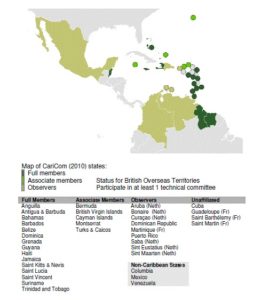
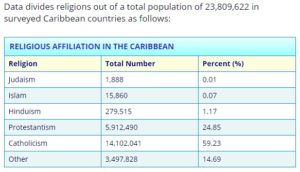
The purpose of this commentary is to lament the inadequacies in the Caribbean region, due to our lack of unity or disunity. This completes this series of commentaries on the absurdity of the premise that “there is some Caribbean unity” – what a joke! This submission is 4 of 4 from the Go Lean movement. The consistent theme from the full series is that the full Caribbean – all 30 member-states – have never been able to convene, collude, consolidate, collaborate and confederate. As a result our community have never thrived; and now only barely survive; we are flirting with Failed-State status.

What a joke our disposition has become. This has been declared in all the commentaries in this series, cataloged as follows:

  1. Caribbean Unity? – Tourism Missteps
  2. Caribbean Unity? – Ross University Saga
  3. Caribbean Unity? – No Freedom of Movement in/out of French Antilles
  4. Caribbean Unity? – Religion’s Role: False Friend

All of these commentaries relate to “how” the stewards for a new Caribbean can finally foster unity in this region. There had been previous attempts at regional integration, all with the same language/heritage grouping. Now, there is the need to recognize the deterrents to regional unity – religious and national alignment – and finally make progress.

God is Good!

The Church? Not so much! The Church must not be a priority! They have been False Friends to the Caribbean. This commentary is not advocating for a God-less society, just a religiously neutral one.

Today, there is the Caribbean Community or CariCom; it is not enough. It includes all the English-speaking territories, plus Haiti and Suriname. But that is only 20 member-states – in a Full or “Associated Member” status. “We” need universal participation for all neighbors in the neighborhood. This means you:

  • Cuba
  • French Caribbean
  • US Virgin Islands
  • Puerto Rico (Currently Observer status only)
  • Dominican Republic (Currently Observer status only)
  • Dutch Caribbean (Currently Observer status only)

These countries must be welcomed into the full brotherhood of an integrated Caribbean, despite any differences in religious affinity. That separation is very important; there are so many other issues at stake; think: economics, security (justice) and governance. The Go Lean/CU roadmap stresses the strategies, tactics and implementations to impact these societal engines. In fact, these statements are identified as the prime directives for the roadmap:

  • Optimize the economic engines in order to grow the regional economy to $800 Billion & create 2.2 million new jobs.
  • Establish a security apparatus to protect the resultant economic engines, plus ensure public safety and justice institutions.
  • Improve Caribbean governance to support these engines, including a separation-of-powers between the member-states and CU federal agencies, plus even oversight for NGO’s.

These prime directives transcend religions, languages or culture. They are designed to just deliver … on the empowerments that the homeland needs. The approach is to move the Caribbean region to a Single Market. CariCom started this vision, but failed to deliver on it. As related in the first commentary in this series, this new CU regime embraces the spirit of CariCom – the need for integration – but with a stronger foundation, one that includes all the neighbors in the neighborhood.

The book Go Lean…Caribbean – available to download for free – opened with the assessment that the challenges belying the Caribbean are Too Big for anyone one member-state alone – there must be regional solutions. Thusly, the book calls for a regional interdependence. This need was pronounced in the opening Declaration of Interdependence (Pages 11 – 13):

vi. Whereas the finite nature of the landmass of our lands limits the populations and markets of commerce, by extending the bonds of brotherhood to our geographic neighbors allows for extended opportunities and better execution of the kinetics of our economies through trade. This regional focus must foster and promote diverse economic stimuli.

viii. Whereas the population size is too small to foster good negotiations for products and commodities from international vendors, the Federation must allow the unification of the region as one purchasing agent, thereby garnering better terms and discounts.

x. Whereas we are surrounded and allied to nations of larger proportions in land mass, populations, and treasuries, elements in their societies may have ill-intent in their pursuits, at the expense of the safety and security of our citizens. We must therefore appoint “new guards” to ensure our public safety and threats against our society, both domestic and foreign. …

xi. Whereas all men are entitled to the benefits of good governance in a free society, “new guards” must be enacted to dissuade the emergence of incompetence, corruption, nepotism and cronyism at the peril of the people’s best interest. The Federation must guarantee the executions of a social contract between government and the governed.

xvi. Whereas security of our homeland is inextricably linked to prosperity of the homeland, the economic and security interest of the region needs to be aligned under the same governance. Since economic crimes … can imperil the functioning of the wheels of commerce for all the citizenry, the accedence of this Federation must equip the security apparatus with the tools and techniques for predictive and proactive interdictions.

xxiv. Whereas a free market economy can be induced and spurred for continuous progress, the Federation must install the controls to better manage aspects of the economy: jobs, inflation, savings rate, investments and other economic principles. Thereby attracting direct foreign investment because of the stability and vibrancy of our economy.

The Go Lean book provides 370-pages of turn-by-turn instructions on “how” to adopt new community ethos, plus the strategies, tactics, implementations and advocacies to execute so as to transform the Caribbean region into a Single Market with 30 different member-states, all striving for a “better society”. That “better society” is one that pursues the Greater Good. Consider the Chapter excerpts and headlines from this sample on Page 37 entitled:

10 Ways to Impact the Greater Good

1 Lean-in for Caribbean Integration
In addition to economic empowerment, this treaty calls for a collective security pact of the member-states so as to ensure homeland security, law-and-order, and assuage against systemic threats. It is an economic and historical fact that security solutions must accompany economic engines; otherwise any well-intentioned plans will be quickly defeated. As stated in scripture: “the love of money is the root of evil”. The community ethos for the CU therefore is for the greater good, at all costs.
2 Economic & Enforcement Openness
3 Reconciling the Poor/Black Experience
4 Public Relations – Messaging Against “Rats” (Snitches)
5 Focus on Justice
The CU will push a community ethos for justice and the rule of law, not “honor among thieves”. This will be fomented by the CU practice of transparency and accountability (including legislative oversight).  The many CU institutions for justice will be required to publish milestones and accomplishments so as to engender public trust and confidence.
6 Intelligence Gathering versus  Privacy
7 Military Deployments – Embedded Journalists
Since there are security threats for the region there is the need for a military apparatus. But to instill public confidence, the CU defense agencies will allow embedded journalists, even though their publications/broadcasts may be deferred.
8 Military Justice
9 Image Management
10 Foundation [and NGO] Alignment
There are many causes and advocacies that align with philanthropic foundations, NGOs and Not-For-Profits. The CU will liaison with these organizations, give them support and cooperation to pursue the greater good goals for the public.

The Caribbean must foster a better homeland that transcends the False Friends of the Church and other hypocrisies. Religion does have an effect on our culture and society, so we must pay more than the usual attention to their developments. Considering the lessons being learned from the pedophile priest crisis, we must also hold religious organizations – and NGO’s – accountable for their actions and violations of justice norms and requirements.

This Go Lean movement has previously detailed many related issues and advocacies for this kind of Truth and Reconciliation mandate in our region; consider this sample of previous blog-commentaries:

https://goleancaribbean.com/blog/?p=14482 International Women’s Day – Protecting Rural Women
https://goleancaribbean.com/blog/?p=13299 Making a Pluralistic Democracy – Respecting Diwali
https://goleancaribbean.com/blog/?p=11224 ‘Loose Lips Sink Ships’ – Fanatical Theologians Undermine Tourism
https://goleancaribbean.com/blog/?p=10216 Waging a Successful War on Orthodoxy
https://goleancaribbean.com/blog/?p=9766 Rwanda’s Catholic bishops apologize for genocide
https://goleancaribbean.com/blog/?p=5695 Repenting, Forgiving and Reconciling the Past
https://goleancaribbean.com/blog/?p=4971 A Lesson in Church History – Royal Charters: Truth & Consequence
https://goleancaribbean.com/blog/?p=809 Muslim Officials condemn abduction of Nigerian girls
https://goleancaribbean.com/blog/?p=631 The Pope as a Turnaround CEO – The Francis Effect

Christianity does not complete the religious landscape for the Caribbean. There are other faiths:

Source: Retrieved August 30, 2018 from: http://caribya.com/caribbean/religion/

The Caribbean is unique in that it has forged its own brand of religions:

  • Rastafarianism – The black power movements of the early 1900s helped launch a completely different kind of religion. Based on Christianity and the King James Bible, Rastafarian beliefs also include the worship of Ras (meaning Prince) Tafari of Ethiopia.
  • Creole Religions – The two best-known forms of these Creole religions are Voodoo and Santería. These were most often practiced on French and Spanish islands where Roman Catholicism was the religion of the whites. Other creole faiths/practices include Regla de Palo, Abakuá Secret Society, Espiritismo, Obeah, Myal, and Quimbois. These latter ones, Obeah, Myal, and Quimbois are Afro-Caribbean Creolized forms of witchcraft and healing practices. Ashanti and other linguistically united tribes were brought to the Caribbean as slaves almost exclusively by the British – the French and Spanish thought these Africans to be more likely to rebel. This means that these spiritual practices were performed almost exclusively on British islands, though Quimbois was a popular practice on Martinique and Guadeloupe.

These Afro-Caribbean Creolized forms of religious practices also have disruptive affects on regional unity.

In summary, religion have not been and cannot be the unifying force for the Caribbean; it must be something else.

We present the community ethos of the Greater Good. This is the best way to reform and transform the Caribbean’s societal engines to better allow for our pluralistic realities. This is the quest of the Go Lean roadmap.

All Caribbean stakeholders – church-goers and secularist alike – are urged to lean-in to this roadmap for change … and empowerment. We can make our region a better place to live work and play. 🙂

Download the e-Book of Go Lean … Caribbean – now!

Sign the petition to lean-in for this roadmap for the Caribbean Union Trade Federation.

—————–

Appendix VIDEO – Former Vatican official calls for Pope Francis to resign – http://www.foxnews.com/world/2018/08/28/pope-francis-facing-calls-to-resign-sexual-abuse-scandal-exposes-rifts-in-vatican.html

Posted August 28, 2018 – Former Archbishop Carlo Maria Vigano claims the pope knew about sexual abuse allegations against American Cardinal Theodore McCarrick; Bryan Llenas reports.

Share this post:
, ,
[Top]

Should We Celebrate the ‘4th of July’? – ENCORE

This is a good question.

Think about America’s closest Ally, England, Great Britain or the United Kingdom; (same country, 3 names): Do they celebrate this American Holiday in London?

Should they?

Of course not!

This good question was asked a year ago on July 4th, 2017 in a previous blog-commentary. It is so important that Caribbean people should ask it every year. The Encore of that previous submission follows:

==================================================================

Go Lean Commentary – A Lesson in History – ‘4th of July’ and Slavery

CU Blog - A Lesson in History - Slavery and the 4th of July - Photo 1Today is a special day in the United States, it is the 241st anniversary of their Declaration of Independence from Great Britain on July 4, 1776. This day will be celebrated all over the country with parades, picnics, music and fireworks.

The celebrations of this day is a BIG deal!

What is buried in this annual celebration is the stark and sharp contrast on the different sides in the conflict of July 4, 1776. There were the British loyalists on one hand and those seeking freedom from the British, the patriots, on the other hand; see the opposing sides here:

Title #1: What two sides emerged in response to the Declaration of Independence? What did each side favor?

Answer:
The Patriots and Loyalists; Patriots favored independence and Loyalists favored staying as a British colony.

Explanation:
Tensions were simmering prior to the start of the Revolution, and the Declaration of Independence, signed in 1776 formally broadcasted to all that the United States was a new and independent nation. This led to two factions being formed: Patriots and Loyalists.

Patriots believed that the United States should be an independent nation separate from Britain. They felt that they were being treated unfairly as a colony and that their basic rights were being trampled upon. It was their view that the time for compromises was over and that the colonies needed to leave the British Empire.

Loyalists thought that the colonies were better off staying with England. Some did this out of loyalty for the king, but others feared instability and anarchy in the event of a change in government. In addition, many feared that the economic fallout with the mother country would destabilize the American economy.

All in all, these were the two groups that were formed, and as you know, the Patriots emerged as successful and formed a new nation.

Source: Retrieved July 4, 2017 from: https://socratic.org/questions/what-two-sides-emerged-in-response-to-the-declaration-of-independence-what-did-e

The patriots get to celebrate the 4th of July every year. But as there were 2 sides of this conflict, we sometimes forget the loyalists side of the conflict. They did not simply go away; they remained vocal and loyal to the Britain’s Crown.

The category of loyalists have a big bearing on the history of the Caribbean. Of the 30 member-states that caucus as the Caribbean, 18 of them have British heritage. Many of these were impacted by the American Declaration of Independence; many loyalists fled America and relocated to these British West Indies. Consider these notes:

When their cause was defeated, about 15% of the Loyalists (65,000–70,000 people) fled to other parts of the British Empire, to Britain itself, or to British North America (now Canada). …

CU Blog - A Lesson in History - Slavery and the 4th of July - Photo 3a

CU Blog - A Lesson in History - Slavery and the 4th of July - Photo 2a

CU Blog - A Lesson in History - Slavery and the 4th of July - Photo 2b

The wealthiest and most prominent Loyalist exiles went to Great Britain to rebuild their careers; many received pensions. Many Southern Loyalists, taking along their slaves, went to the West Indies and the Bahamas, particularly to the Abaco Islands. – Source: Wikipedia

CU Blog - A Lesson in History - Slavery and the 4th of July - Photo 3b

Great Britain also responded … formally. See details of the response here:

Title #2: The British Reply

When Great Britain first received the Declaration of Independence, the country was silent. To them, this was another annoyance from the colonies. The colonists had sent previous letters to King George III that had been ignored, but this was the first time that they had declared themselves free from Great Britain. You know how you feel when a little child continues to ask you for the same thing over and over again, and eventually, you stop listening? This was how King George III viewed the colonies. They were a nuisance, but relatively harmless. Or so he thought.

The government hired John Lind, an English politician and pamphleteer, to write a rebuttal to the declaration. He wrote Answer to the Declaration of the American Congress, a reply that tried to pick apart the Declaration of Independence. Lind focused on the issue of slavery, saying that the colonists were actually angry that King George III had offered freedom to the slaves. Lind even mocked the writers for stating, ‘All men are created equal…’, yet they allowed slavery. Of course, all of this was just a distraction. The colonists really paid no attention to the pamphlet.

Following this, King George III officially declared the colonies to be in a state of rebellion. By August of 1776, the King ordered troops to the colonies.

Once the Revolutionary War began, the citizens of Great Britain became more concerned about the colonies and their fight for independence. In October, King George III addressed Parliament, hoping to ease some of the concerns. He opened the address wishing that he could inform them that the troubles were at an end and that the people had ‘recovered from their delusion’ and ‘returned to their duty.’ However, the colonists continued to fight and even ‘openly renounced all allegiance to the Crown.’ King George III accused the colonists of treason, but reassured the Parliament that England was still united.

The King ended his address singing his own praises saying, ‘No people ever enjoyed more Happiness, or lived under a milder Government, then those now revolted Provinces.’ Everything that the colonies have—their land, sea, wealth, and strength—was because of him. His desire was to return the colonies as a part of the British Empire and end the war.

As we know, King George III’s desire to end the war and keep the colonies did not go as planned. The Revolutionary War, the war for American Independence, continued until 1783, ending with more than 50,000 deaths, and the colonies freed as a new country, the United States of America.

Source: Retrieved July 4, 2017 from: http://study.com/academy/lesson/british-reply-to-the-declaration-summary-analysis.html

As related, slavery was not the cause of the US War of Independence … entirely. But the notion that “all men are created equal” was a laughable American hypocrisy. The continuation of slavery in the wake of a trend of liberalism in England became a boiling point of contention. In fact as reported here, many African Americans – 12,000 or so – fled to the side of the British for the promise of freedom:

Title #3: Slavery and Black Loyalists

As a result of the looming crisis in 1775 the Royal Governor of Virginia, Lord Dunmoreissued a proclamation that promised freedom to servants and slaves who were able to bear arms and join his Loyalist Ethiopian Regiment. Many of the slaves in the South joined the Loyalists with intentions of gaining freedom and escaping the South. About 800 did so; some helped rout the Virginia militia at the Battle of Kemp’s Landing and fought in the Battle of Great Bridge on the Elizabeth River, wearing the motto “Liberty to Slaves”, but this time they were defeated. The remains of their regiment were then involved in the evacuation of Norfolk [(Virginia)], after which they served in the Chesapeake area. Eventually the camp that they had set up there suffered an outbreak of smallpox and other diseases. This took a heavy toll, putting many of them out of action for some time. There was a slave by the name of Boston King who joined the Loyalists and wound up catching smallpox. Boston King and other soldiers who were sick were relocated to a different part of the camp so that they did not contaminate the healthy soldiers. The survivors joined other British units and continued to serve throughout the war. Black colonials were often the first to come forward to volunteer and a total of 12,000 African Americans served with the British from 1775 to 1783. This factor had the effect of forcing the rebels to also offer freedom to those who would serve in the Continental Army; however, such promises were often reneged upon by both sides.[31]

African Americans who gained their freedom by fighting for the British became known as Black Loyalists. The British honored the pledge of freedom in New York City through the efforts of General Guy Carleton who recorded the names of African Americans who had supported the British in a document called the Book of Negroes which granted freedom to slaves who had escaped and assisted the British. About 4,000 Black Loyalists went to the British colonies of Nova Scotia and New Brunswick, where the British promised them land. They founded communities across the two provinces, many of which still exist today. Over 2,500 settled in Birchtown, Nova Scotia, instantly making it the largest free black community in North America. However, the inferior grants of land they were given and the prejudices of white Loyalists in nearby Shelburne who regularly harassed the settlement in events such as the Shelburne Riots in 1784, made life very difficult for the community.[32] In 1791 Britain’s Sierra Leone Company offered to transport dissatisfied black Loyalists to the British colony of Sierra Leone in Africa, with the promise of better land and more equality. About 1,200 left Nova Scotia for Sierra Leone, where they named the capital Freetown.[32] After 1787 they became Sierra Leone’s ruling elite. About 400 to 1,000 free blacks who joined the British side in the Revolution went to London and joined the free black community of about 10,000 there.

Source: Retrieved July 4, 2017 from: https://en.wikipedia.org/wiki/Loyalist_(American_Revolution)#Slavery_and_Black_Loyalists

Wow, what a notion! An argument can be made that for the Black population – the majority ethnicity for 29 of the 30 Caribbean member-states – their celebration of the 4th of July should have been … for the other side!

Intriguing!

This is the lesson in history for the Caribbean; American historic accomplishments are NOT historic accomplishments for the majority of Caribbean people. Poor race relations tarnished so much of American history, that the country continues with this societal defect … even to this day.

This lesson from America’s initiation is presented by the movement behind the book Go Lean…Caribbean – available to download for free – which serves as a roadmap for the introduction and implementation of the technocratic Caribbean Union Trade Federation (CU), for the elevation of Caribbean society – for all member-states. This book features a declaration of its own, a Declaration of Interdependence (Pages 10 – 13):

Preamble: When, in the course of human events, it becomes necessary for one people to unite with others so as to connect them together to collaborate, confederate and champion the challenges that face them, we the people of Caribbean democracies find it necessary to accede and form a confederated Union, the Caribbean Union Trade Federation, with our geographic neighbors of common interest.

While the laws of nature and of nature’s God entitle us to form a society and a brotherhood to foster manifestations of our hopes and aspirations and to forge solutions to the challenges that imperil us, decent respect to the opinions of mankind requires that we declare the causes which imperil us and incite us to unite to assuage our common threats.

And while our rights to exercise good governance and promote a more perfect society are the natural assumptions among the powers of the earth, no one other than ourselves can be held accountable for our failure to succeed if we do not try to promote the opportunities that a democratic society fosters.

As the history of our region and the oppression, suppression and repression of its indigenous people is duly documented, there is no one alive who can be held accountable for the prior actions, and so we must put aside the shackles of systems of repression to instead formulate efficient and effective systems to steer our own destiny. …

xi. Whereas all men are entitled to the benefits of good governance in a free society, “new guards” must be enacted to dissuade the emergence of incompetence, corruption, nepotism and cronyism at the peril of the people’s best interest. The Federation must guarantee the executions of a social contract between government and the governed.

xvi. Whereas security of our homeland is inextricably linked to prosperity of the homeland, the economic and security interest of the region needs to be aligned under the same governance. Since economic crimes … can imperil the functioning of the wheels of commerce for all the citizenry, the accedence of this Federation must equip the security apparatus with the tools and techniques for predictive and proactive interdictions.

xxiv. Whereas a free market economy can be induced and spurred for continuous progress, the Federation must install the controls to better manage aspects of the economy: jobs, inflation, savings rate, investments and other economic principles. Thereby attracting direct foreign investment because of the stability and vibrancy of our economy.

The Go Lean book provides 370-pages of turn-by-turn instructions on this roadmap, on “how” to adopt new community ethos, plus the strategies, tactics, implementations and advocacies to execute so as to reboot, reform and transform the societal engines of Caribbean society. This CU/Go Lean roadmap has these 3 prime directives:

  • Optimization of the economic engines in order to grow the regional economy to $800 Billion and create 2.2 million new jobs.
  • Establishment of a security apparatus to ensure public safety and protect the resultant economic engines.
  • Improve Caribbean governance to support these engines, including a separation-of-powers between the member-states and CU federal agencies.

“Lessons in History” are a familiar theme for these Go Lean blog-commentaries; consider this sample of previous submissions:

https://goleancaribbean.com/blog/?p=12274 A Lesson in History – Spanish Caribbean
https://goleancaribbean.com/blog/?p=11870 A Lesson in History – Indian Termination Policy
https://goleancaribbean.com/blog/?p=10933 A Lesson in History – White is Right – Not!
https://goleancaribbean.com/blog/?p=10733 150 Years of Historically Black Colleges & Universities
https://goleancaribbean.com/blog/?p=9151 The New Smithsonian African – American Museum
https://goleancaribbean.com/blog/?p=8767 A Lesson in History – Haiti 1804
https://goleancaribbean.com/blog/?p=7769 History’s Effect of the Current Caribbean Disposition
https://goleancaribbean.com/blog/?p=7738 A Lesson in History – Legacy of the Buffalo Soldiers
https://goleancaribbean.com/blog/?p=5695 A Lesson in History – Repenting, Forgiving and Reconciling the Past
https://goleancaribbean.com/blog/?p=4971 A Lesson in History – Royal Charters: Truth & Consequence
https://goleancaribbean.com/blog/?p=451 CariCom position on Slavery/Colonization Reparations

There are so many lessons that we, in the Caribbean, can learn from this history of the initiation of the United States; the role of slavery was integral to the whole fabric of American society. Repercussions and consequences of this societal defect reverberated from those events in July 1776 right down to our day. In many ways, these repercussions and consequences are responsible for our region’s poor performance in our economic, security and governing engines. Our society was created as parasites of the American- European (British) eco-system, rather than protégés  of these advanced economies.

It is time for this disposition to end! It is not 1776 anymore; we must make the societal progress that 241 years of lessons should have taught us. America has reformed and transformed … some, but still needs more progress. But our goal is not to reform and transform America; our target is the Caribbean … only. We hereby urge everyone in the region – people, institutions and governments – to lean-in to this Go Lean roadmap.

We can do this, we can declare our interdependence and make our homeland a better place to live, work and play. 🙂

Download the free e-Book of Go Lean … Caribbean – now!

Sign the petition to lean-in for this roadmap for the Caribbean Union Trade Federation.

Share this post:
, ,
[Top]