Tag: Jobs

A Lesson in Economic Fallacies – Phillips Curve: Fallacy of Minimum Wage

Go Lean Commentary

Ring the bell: School’s in!

There are lessons that the Caribbean need to learn about minimum wages:

In the long run, it makes no difference in buying power.

If wages are increased – as in an universal minimum wage increase – then inflationary forces would kick in and consumer prices will also adjust upwards. So as a government policy, raising the minimum wage is an economic fallacy.

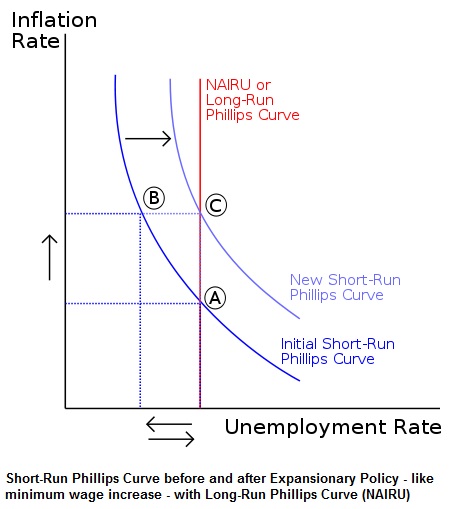
This relates to the topic in the field of Economics related to the Phillips Curve. This empirical model establishes that there is a ‘short run’ trade-off between unemployment and inflation but this is not been observed in the long run. The textbook definition of the Phillips Curve is as follows:

Reference Title: Phillips Curve

Source: Retrieved July 9, 2016 from https://en.wikipedia.org/wiki/Phillips_curve

The Phillips curve is a single-equation empirical model, named after A. W. Phillips, describing a historical inverse relationship between rates of unemployment and corresponding rates of inflation that result within an economy. Stated simply, decreased unemployment, (i.e., increased levels of employment) in an economy will correlate with higher rates of inflation.

While there is a short run trade-off between unemployment and inflation, it has not been observed in the long run.[1] In 1968, Milton Friedman asserted that the Phillips curve was only applicable in the short-run and that in the long-run, inflationary policies will not decrease unemployment.[2][3] Friedman then correctly predicted that, in the 1973–75 recession, both inflation and unemployment would increase.[3] The long-run Phillips Curve is now seen as a vertical line at the natural rate of unemployment, where the rate of inflation has no effect on unemployment.[4] Accordingly, the Phillips curve is now seen as too simplistic, with the unemployment rate supplanted by more accurate predictors of inflation based on velocity of money supply measures such as the MZM (“money zero maturity”) velocity,[5] which is affected by unemployment in the short but not the long term.[6]

CU Blog - Phillips Curve - Fallacy of Minimum Wage - Photo 2

Key: NAIRU = Non-Accelerating Inflation Rate of Unemployment
This subject matter synchronizes with the book Go Lean…Caribbean, which calls for the elevation of Caribbean economics. The book asserts that the Caribbean has to pursue a quest for job creation, but to set the sights on a higher target, high-paying jobs, because minimum wage jobs are no elevation at all; it is only a fallacy. As conveyed in a previous blog-commentary, the Go Lean book examined the anatomy of minimum wages (Page 152) and its effect on a community’s eco-system. It defined minimum wage as:

the lowest hourly, daily or monthly remuneration that employers may legally pay to workers

The minimum wage is generally acknowledged to increase the standard of living of workers, reduces poverty, reduces inequality, boosts morale and forces businesses to be more efficient. Critics of the minimum wage, predominantly followers of neo-classical economic theory, contend that a minimum wage increases unemployment, particularly among workers with very low productivity due to inexperience or handicap, thereby harming less skilled workers and possibly excluding some groups from the labor market

This fallacy of minimum wage is commentary 4 of 6 in this series on Economic Fallacies from the movement behind the Go Lean book. As related in the first submission on this series, the situation in the Caribbean region is likened to the imagery of an animal foraging for food, but then gets distracted and “chases a squirrel up a tree”. The squirrel in the tree will never be a meal; it is just a waste of time and energy for the animal. This analogy conveys the waste of time associated with a frivolous and fallacious pursuit. The other commentaries detailed in this series are as follows:

  1. Independence – Hype of Hope
  2. Austerity – Book Review: Mark Blyth’s “History of a Dangerous Idea”
  3. Education & Student Loans – Not a good Return on Investment
  4. Phillips Curve – Fallacy of Minimum Wage
  5. Self-regulation of the Centers of Economic Activity
  6. Casino Currency – US Dollars?

All of the commentaries in this series are economic in nature. They refer to rules for managing the valuable resources of time, talents and treasuries. The creation of jobs require a measure of all three of these resources. A mission of the Go Lean roadmap is to create jobs in the region. The roadmap – for a total of 370 pages – presents a comprehensive plan to create 2.2 million new jobs, with a heavy focus on high paying jobs, exhausting the Science, Technology, Engineering and Mathematics / Medical (STEM) fields.

This subject is no childs-play; this is heavy-lifting. There are supplemental teaching points that align with this subject.This is gleaned from a Khan Academy’s online/e-Learning teaching course:

CU Blog - Phillips Curve - Fallacy of Minimum Wage - Photo 1What is the relationship between the aggregate demand curve and the Phillips curve?

At first, unemployment will go down, shifting aggregate demand (AD) from AD1 to AD2, which increases Y (output) by Y2 – Y1. This increase in demand means more workers are needed, and then AD will be shifted from AD2 to AD3. However, this time, much less is produced than in the previous shift, but the price level has risen from P2 to P3, which is a much higher increase in price than in the previous shift. The increase in price is called inflation. – Khan Academy Lesson

Question: As much as the increase in demand would affect inflation wouldn’t another and maybe more obvious explanation be that as wages raise the costs of producing increase (since labor most often is a very important production factor) and thus forcing companies to increase prices as to offset the increase in wages?

Answer: Increase in price won’t always lead to increase in profit, because it entails decrease in demand in a highly competitive market. It will do so when there is so much money in the economy that demand becomes insensitive to price, or when profit is marginal. The former factor takes place first, the later – second.

VIDEO – Phillips curve – Inflation – measuring the cost of living – Macroeconomics – Khan Academy – https://youtu.be/v7ZWTZ9NgU4

Uploaded on Feb 15, 2012 – The observation that inflation and unemployment tend to be inversely correlated.

The book Go Lean … Caribbean calls for the elevation of Caribbean economics using sound economic principles and best-practices, not the pursuits of economic fallacies. The book serves as a roadmap for the introduction and implementation of the technocratic Caribbean Union Trade Federation (CU) with the charter to facilitate jobs in the region. The book posits that STEM industries and careers can be a great equalizer for the Caribbean to better compete with the rest of the world. These jobs are not location dependent. There is only the need for the “community will”. This job-creation mantra is among these 3 prime directives of the CU/Go Lean roadmap:

  • Optimization of economic engines in order to grow the regional economy to a GDP of $800 Billion.
  • Establishment of a security apparatus to protect the resultant economic.
  • Improvement of Caribbean governance to support these engines.

Early in the Go Lean book, the responsibility to create jobs was identified as an important function for the CU with these pronouncements in the Declaration of Interdependence (Pages 14):

xxvi.     Whereas the Caribbean region must have new jobs to empower the engines of the economy and create the income sources for prosperity, and encourage the next generation to forge their dreams right at home, the Federation must therefore foster the development of new industries, like that of ship-building, automobile manufacturing, prefabricated housing, frozen foods, pipelines, call centers, and the prison industrial complex. In addition, the Federation must invigorate the enterprises related to existing industries tourism, fisheries and lotteries – impacting the region with more jobs.

xxvii.    Whereas the region has endured a spectator status during the Industrial Revolution, we cannot stand on the sidelines of this new economy, the Information Revolution. Rather, the Federation must embrace all the tenets of Internet Communications Technology (ICT) to serve as an equalizing element in competition with the rest of the world. The Federation must bridge the digital divide and promote the community ethos that research/development is valuable and must be promoted and incentivized for adoption.

xxviii.   Whereas intellectual property can easily traverse national borders, the rights and privileges of intellectual property must be respected at home and abroad. The Federation must install protections to ensure that no abuse of these rights go with impunity, and to ensure that foreign authorities enforce the rights of the intellectual property registered in our region.

Job creation has been a frequent topic for blog/commentaries. Consider this sample list:

https://goleancaribbean.com/blog/?p=8262 Where the Jobs Are – One Company’s Model: Uber
https://goleancaribbean.com/blog/?p=8045 Where the Jobs Are – How Small Businesses Can Help
https://goleancaribbean.com/blog/?p=6089 Where the Jobs Are – Futility of Minimum Wage
https://goleancaribbean.com/blog/?p=5034 Where the Jobs Are – Patents: The Start of Innovative Jobs
https://goleancaribbean.com/blog/?p=4240 Where the Jobs Are – The Effects of Immigration Policy
https://goleancaribbean.com/blog/?p=2857 Where the Jobs Are – Entrepreneur-ism in Junk
https://goleancaribbean.com/blog/?p=2750 Where the Jobs Are – Role Model for Jobs by Self-Governing Entities
https://goleancaribbean.com/blog/?p=2025 Where the Jobs Are – Attitudes & Images of the Diaspora
https://goleancaribbean.com/blog/?p=2003 Where the Jobs Are – One Scenario: Ship-breaking
https://goleancaribbean.com/blog/?p=1698 Where the Jobs Are – STEM Jobs Are Filling Slowly

The book Go Lean…Caribbean details the creation of 2.2 million new jobs for the Caribbean region, many embracing STEM skill-sets. How? By adoption of certain community ethos – that “community will” – plus the executions of key strategies, tactics, implementations and advocacies. The following is a sample from the book:

Community Ethos – Deferred Gratification Page 21
Community Ethos – Economic Principle – Economic Systems Influence Choices & Incentives Page 21
Community Ethos – Consequences of Choices Lie in the Future Page 21
Community Ethos – Job Multiplier Page 22
Community Ethos – Lean Operations Page 24
Community Ethos – Return on Investments Page 24
Community Ethos – Ways to Impact the Future Page 26
Community Ethos – Ways to Help Entrepreneurship Page 28
Community Ethos – Ways to Promote Intellectual Property Page 29
Community Ethos – Ways to Impact Research & Development Page 30
Community Ethos – Ways to Bridge the Digital Divide Page 31
Strategy – Mission – Education Without Further Brain Drain Page 46
Tactical – Fostering a Technocracy Page 64
Tactical – Tactics to Forge an $800 Billion Economy – High Multiplier Industries Page 70
Tactical – Separation of Powers – Commerce Department – Patents & Copyrights Page 78
Implementation – Ways to Pay for Change Page 101
Implementation – Ways to Deliver Page 109
Implementation – Ways to Impact ICT and Social Media Page 111
Planning – Ways to Improve Trade Page 128
Advocacy – Ways to Create Jobs Page 152
Advocacy – Ways to Improve Education Page 159
Advocacy – Ways to Impact Labor Markets and Unions Page 164
Advocacy – Ways to Foster Technology Page 197
Advocacy – Ways to Impact Main Street Page 201
Advocacy – Ways to Battle Poverty – Third World Realities Page 222
Advocacy – Ways to Help the Middle Class Page 223
Appendix – Growing 2.2 Million Jobs in 5 Years Page 257
Appendix – Job Multipliers Page 259

The CU will foster job-creating developments for above minimum-wage jobs, by incentivizing many “innovation sector” jobs: high-tech start-ups, incubating viable companies, and implementing Self-Governing Entities. The primary ingredient for CU success will be Caribbean people, so we must foster and incite participation of many young people into innovation sectors or STEM fields. This quest is the opposite of the minimum wage fallacious pursuit observed in many Caribbean countries who prioritize tourism and tourism-related service jobs.

Of the 2.2 million new jobs in the Go Lean roadmap, there is no expectation that all jobs will be in the innovation sector and above the minimum wage. No, service industries will always persists, and these frequently feature a minimum wage scale. But these jobs will not be the focus nor the target of the Go Lean heavy-lifting. They will simply be the derivatives of the innovation sector jobs. This derivative enjoys a job multiplier effect; for every direct job, additional ones are fostered “down stream”. The Go Lean book details this dynamic; consider this sample from Page 259:

With only a fraction of the jobs, the innovation sector generates a disproportionate number of additional local jobs and therefore profoundly shapes the local economy. A healthy traded sector benefits the local economy directly, as it generates well-paid jobs, and indirectly as it creates additional jobs in the non-traded sector. What is truly remarkable is that this indirect effect to the local economy is much larger than the direct effect. My research, based on an analysis of 11 million American workers in 320 metropolitan areas, shows that for each new high-tech job in a metropolitan area, five additional local jobs are created outside of high tech in the long run. – Enrico Moretti’s.

The roadmap anticipates only a 3.75 job multiplier factor in the estimation of the 2.2 million new jobs.

Everyone is hereby urged to lean-in to this Go Lean roadmap, so that we can create the high-paying, community-impacting jobs, and not consume ourselves with a focus on minimum-wage jobs. How to accomplish this heavy-lifting tasks? This roadmap provides the turn-by-turn directions. This is an action plan to not just improve the Caribbean workplace, but the entire homeland. To make this, our homeland, a better place to live, work and play. 🙂

Download the book Go Lean … Caribbean – now!


Share this post:
, ,

YouTube Millionaire: ‘Tipsy Bartender’

Go Lean Commentary

“Out with the old; in with the new” …

… media that is.

The transformation to new media has taken hold. More and more people are consuming electronic media; so much so that it is becoming the mainstay for communications and entertainment.

This reference to electronic media conveys visual images; that means television, yes  …

CU Blog - YouTube Millionaires - TipsyBartender - Photo 2… but today, there is also the ubiquity of the internet, with its many video streaming services. The “new” in new media refers more to this medium than it does TV.

This is the change that has come to the world … and the Caribbean.

The book Go Lean … Caribbean advocates for the Caribbean region to better prepare to exploit the agents of change affecting the world. The book specifically identified technology and globalization among those agents (Page 57). It then declares that the region needs to move to the corner of preparation and opportunity.

Here – this commentary – is an example of the full manifestation of this “corner”. Identifying how – and why – networks can emerge without the need for investment into network infrastructure. The old adage is “where there’s a will, there’s a way”; but now there is only the need for the “will”, as the “way” is already in place, ubiquitous and fully accepted.

The Go Lean book relates how we are now able to have a network without the “network”. Many models abound on the world-wide-web. Previously, this commentary identified the World Wrestling Entertainment (WWE) and ESPN-W; now the focus is the platform of YouTube, and the millionaires that have emerged. The YouTube network is delivered via the internet-streaming only.

This platform allows for nimble individuals and enterprises, the “fast and the furious”, to exploit the tenets of Internet Communications Technologies (ICT). So this platform – or even a homegrown duplicate as in the www.myCaribbean.gov portal defined in the Go Lean book – demonstrates how we in the Caribbean can elevate our eco-systems of ICT, entertainment, television, and economics.

This commentary presents the profile of one member of the Caribbean Diaspora – Bahamas – who serves as a role model for his exploitation of YouTube videos: Skyy John.

CU Blog - YouTube Millionaires - TipsyBartender - Photo 1

DATE OF BIRTH: January 2, 1978

BIRTHPLACE: Nassau, Bahamas

AGE: 38 years old

ABOUT
Host and creator of the YouTube channel Tipsy Bartender, the number one bartending show in the world. On the show, he makes crazy, colorful drinks.

BEFORE FAME
Before moving to America, he was a bank teller by day, a Dominos pizza delivery guy by night, and a fisherman on weekends. He is also a former member of the Bahamian military (Defence Force).

TRIVIA
He has acted in co-starring roles on television series, including The New Adventures of Old Christine, Cold Case, The Shield, The Young & Restless. He has also appeared in movies: Dorm Daze 2 (2006), Street Eyes (2015) and Whitey Goes to Compton (2011).
Source: Retrieved June 29, 2016 from http://www.famousbirthdays.com/people/skyy-john.html

See a full interview from Tubefilter in the following article. Tubefilter is a curator of online videos from industry news, web series reviews, events, and an Awards Show. They published a web series on YouTube Millionaires. See the full article here:

Title: YouTube Millionaires: TipsyBartender Is “Here To Have Fun And Make Cocktails”
By: Sam Gutelle

Welcome to YouTube Millionaires, where we profile channels that have recently crossed the one million subscriber mark. There are channels crossing this threshold every week, and each has a story to tell about YouTube success. Read previous installments of YouTube Millionaires here.

Skyy John has successfully brought the party to YouTube. The 37-year-old Bahamian has found online success thanks to TipsyBartender, a channel on which he teaches viewers how to craft a variety of mixed drinks. John’s videos tend to have several elements in common: They feature colorful beverages, feature attractive women as John’s assistants, and convey a fun-loving atmosphere. This formula has proven to be a hit with the online audience. TipsyBartender, which is partnered with the Tastemade network, now has more than 1.4 million subscribers. Here’s what John had to say about that:

Tubefilter: How does it feel to have one million subscribers? What do you have to say to your fans?

Skyy John: It feels amazing, humbling and empowering when you think of that many people supporting what you do.

I would like to tell each one of them that I love you, and you’re all very special to me. To celebrate hitting one million subscribers, I set up a meet and greet at a local bar. I bought everyone drinks and shots all night because it’s the least I could do to show my appreciation.

TF: How did you get started on YouTube?

SJ: In the early days of YouTube I had an idea for a talk show – I shot a really low budget pilot of it and posted it online. The response was good, so I kept making videos where I’d go around and interview people. As a means of diversifying my content, since I was a bartender, I’d show people how to make one or two cocktails. A friend of mine, Monroe, said “Hey, why don’t you start a bartending channel?” I said, “That’s a good idea,” and TipsyBartender was born.

TF: What made you decide to include women in all your videos?

SJ: When you come to the TipsyBartender channel and you watch an episode, yes I always have an attractive female cohost, and to the new viewer who thinks they’re there for looks, it’s much deeper than that. Behind the scenes, the show has been primarily powered by women, in terms of working out the format, designing the style of thumbnails, choosing the drinks that we make – it’s all been women. Without that very important female touch, the TipsyBartender show that you see today would not exist. I’d like to give a special thanks to Marjane and Emma, the two that really helped me create what you see today. TipsyBartender will always be home to women from all over the world who don’t get a chance in any other medium.

TF: When you create your videos, how do you balance entertaining your audience with conveying your recipes?

SJ: We maintain a very delicate balance between entertainment and education. We keep our recipes simple, which allows us to focus on the entertainment more. Our goal is to learn and have fun while doing it. We are, after all, a party channel.

TF: What in your mind is the most important component of a good cocktail?

SJ: The most important component of a good cocktail is you – the person that I’m serving. You have to like what I’m giving you. The easiest way to accomplish that is to build a cocktail using some ingredients that you already enjoy. You like Kool Aid? I’ll build around that. If you like ice cream, I’ll build around ice cream. You like Gatorade? I’ll build around that. Whatever you like, I’ll use – and that mentality is what makes me a pariah in the world of mixology because most mixologists feel that they know better than you what you should be drinking. They’ll give you a cocktail with aged whiskey, organic basil, handcrafted bitters, ice from the Alps, and tell you that “Hey, this is the most perfect best greatest drink ever!” What if that person you’re serving it to doesn’t like any of that s**t? Only you know what you like. You’re drinking the drink, I’m just working with you – i’m not a mixologist. I’m here to have fun and make cocktails. Drinking is supposed to be enjoyable, not feel like a damn chemistry exam.

TF: There don’t seem to be a ton of drinks channels on YouTube. Why do you think it’s not a more common category?

SJ: Because it’s very difficult to do. Drink-making is not that exciting because it’s very difficult to present it in an interesting format. Luckily, we’ve been able to get it right and to keep people interested, and every day we strive to continue doing what we’re doing and make our audience grow.

TF: What is your favorite cocktail you’ve made on your channel?

SJ: There are too many to list. Some of the favorite drinks I made were the rainbow shots, because that was difficult to learn how to do. Definitely some of the jungle juices because they’re pretty crazy, and believe it or not it requires a lot of math and planning to make the appropriate amounts in large quantities. Some of the jello shots we’ve made for sure. My favorites would probably have to be ice cream drinks or drinks based around rum, especially coconut rum.

TF: When you’re out bartending, do you ever get recognized as “that guy from the Internet”?

SJ: All the time – but I don’t bartend in a bar anymore. I actually got fired because of TipsyBartender. I was spending so much time on the show, so much time editing that I needed to get my shifts covered. Working in L.A. you got people covering shifts all the time, so it wasn’t really a problem at first. I was called into work for a meeting and they said I hadn’t been there in a few months – I said “I’ll get back to work, don’t worry I got you,” –  but I didn’t realize that they were monitoring me. They discovered that in four months following our meeting, I only worked once. So I got the call saying “Go mix drinks man, we’ll handle the bar.”

TF: What’s next for your channel? Any fun plans?

SJ: TipsyBartender morphed into a truly global brand where we have tons of fans all over the world, primarily because we focused on Facebook, where videos are very easily shared. We’re now approaching 7 million fans that are highly engaged in what we do. Our Facebook engagement is higher than that of all the biggest liquor brands around the world combined! Our next step for us is to take our cocktails and products around the world. We’re also in the developing stages of creating a Kickstarter to fund our first bar in L.A.
Source: Tube Filter Online Magazine – Posted February 5, 2015; retrieved June 28, 2016 from: http://www.tubefilter.com/2015/02/05/tipsy-bartender-skyy-john-drinks-youtube-millionaires/

—————–

Alternative Interview: http://affairstoday.co.uk/interview-tipsy-bartender/

—————–

VIDEO – How to make Rainbow Shots! – Tipsy Bartender – http://youtu.be/MoVZoCmkdjY

Published on Nov 17, 2011 – Subscribe to Tipsy Bartender: http://bit.ly/1krKA4R
The prettiest shots ever…RAINBOW SHOTS! These are the best looking rainbow shots ever!
OUR VLOG CHANNEL: http://www.youtube.com/TipsyVlogs

Is YouTube a successful business model for Skyy John? Yes indeed. See here as to the estimate of how much money he was making in 2011, long before he crossed the million-subscriber threshold; (1.4 million as of February 2015):

“How much money does Tipsy Bartender make?”
Skyy John is the Bahamian guy who runs the YouTube channel called Tipsy Bartender. He has an estimated net worth of $500,000. …

See the full article here: https://naibuzz.com/much-money-tipsy-bartender-makes-youtube/

The actuality of YouTube and the role model of Skyy John is a lesson for the Caribbean; there is heavy-lifting required to transform society. The book Go Lean…Caribbean serves as a roadmap for the introduction and implementation of the Caribbean Union Trade Federation (CU), a technocratic federal government to administer and optimize the economic/security/governing engines of the region’s 30 member-states. In addition, there is the vision for the Caribbean Postal Union (CPU), the focus of which is to coordinate regional mail plus the www.myCaribbean.gov portal to offer email and social media functionality for all Caribbean stakeholders: 42 million residents, 10 million in the Diaspora and even the 80 million tourists-visitors.

The Go Lean roadmap accepts the precept that one person can make a difference in society. What’s more, that one person does not have to be a genius – in the way society measures genius – they only need to be committed and disciplined. That is the example of Skyy John, committed and disciplined in the occupation of bartending, not exactly a STEM field (Science, Technology, Engineering and Mathematics), but impactful nonetheless.

Bartending is more art than science.

This Go Lean economic empowerment roadmap strategizes to create a Single Media Market to leverage the population of the entire region, an audience of 42 million people across 30 member-states and 4 languages consuming cutting-edge ICT offerings. YouTube provides a great role model for the CU‘s executions; making the regional implementation of social media and internet streaming, www.myCaribbean.gov, economically viable. This means jobs and entrepreneurial opportunities.

At the outset, the roadmap recognizes the need for ICT development and job creation with these statements in the opening Declaration of Interdependence (Page 13 & 14):

xxi. Whereas the preparation of our labor force can foster opportunities and dictate economic progress for current and future generations, the Federation must ensure that educational and job training opportunities are fully optimized for all residents of all member-states, with no partiality towards any gender or ethnic group. The Federation must recognize and facilitate excellence in many different fields of endeavor, including sciences, languages, arts, music and sports. This responsibility should be executed without incurring the risks of further human flight, as has been the past history.

xxvi. Whereas the Caribbean region must have new jobs to empower the engines of the economy and create the income sources for prosperity, and encourage the next generation to forge their dreams right at home, the Federation must therefore foster the development of new industries… . In addition, the Federation must invigorate the enterprises related to existing industries like tourism, fisheries and lotteries – impacting the region with more jobs.

xxvii. Whereas the region has endured a spectator status during the Industrial Revolution, we cannot stand on the sidelines of this new economy, the Information Revolution. Rather, the Federation must embrace all the tenets of Internet Communications Technology (ICT) to serve as an equalizing element in competition with the rest of the world. The Federation must bridge the digital divide and promote the community ethos that research/development is valuable and must be promoted and incentivized for adoption.

xxviii. Whereas intellectual property can easily traverse national borders, the rights and privileges of intellectual property must be respected at home and abroad. The Federation must install protections to ensure that no abuse of these rights go with impunity, and to ensure that foreign authorities enforce the rights of the intellectual property registered in our region.

In the Go Lean book and previous blogs, the Go Lean movement asserted that the market organizations and community investments to garner economic benefits of ICT are within reach, with the proper technocracy. The eco-system for streaming videos is inclusive of the roadmap’s quest to make the Caribbean region a better place to live, work and play.

Now is the time for all of the Caribbean to lean-in to the following community ethos, strategies, tactics, implementations and advocacies detailed in the book Go Lean…Caribbean to deliver the solutions to elevate the Caribbean region through ICT:

Community Ethos – Deferred Gratification Page 21
Community Ethos – Economic Principles – All Choices Involve Costs Page 21
Community Ethos – Economic Principles – People Respond to Incentives Page 21
Community Ethos – Economic Principles – Economic Systems Influence Choices Page 21
Community Ethos – Economic Principles – Voluntary Trade Creates Wealth Page 21
Community Ethos – Economic Principles – The Consequence of Choice Lie in Future Page 21
Community Ethos – Job Multiplier Page 22
Community Ethos – Lean Operations Page 24
Community Ethos – Return on Investments – ROI Page 24
Community Ethos – Cooperatives Page 25
Community Ethos – Ways to Impact the Future Page 26
Community Ethos – Ways to Foster Genius Page 27
Community Ethos – Ways to Help Entrepreneurship Page 28
Community Ethos – Promote Intellectual Property Page 29
Community Ethos – Ways to Bridge the Digital Divide Page 31
Community Ethos – Ways to Impact the Greater Good Page 37
Strategy – Agents of Change – Technology Page 57
Strategy – Agents of Change – Globalization Page 57
Tactical – Fostering a Technocracy Page 64
Tactical – How to Grow the Economy to $800 Billion – Trade and Globalization Page 70
Tactical – Separation of Powers – Postal Services Page 78
Tactical – Separation of Powers – Interstate Commerce Administration Page 79
Implementation – Year 1 / Assemble Phase – Establish CPU Page 96
Implementation – Ways to Pay for Change – Group Purchase Organizations (GPO) Page 101
Implementation – Ways to Optimize Mail Service & the myCaribbean.gov Marketplace Page 108
Implementation – Ways to Deliver Page 109
Implementation – Ways to Impact Social Media Page 111
Implementation – Ways to Benefit from Globalization Page 119
Planning – 10 Big Ideas for the Caribbean – # 8 Cyber-Caribbean Page 127
Advocacy – Ways to Grow the Economy Page 151
Advocacy – Ways to Create Jobs Page 152
Advocacy – Ways to Foster Technology Page 197
Advocacy – Ways to Foster e-Commerce Page 198
Advocacy – Ways to Impact Main Street Page 201
Advocacy – Ways to Impact Hollywood Page 203
Advocacy – Ways to Preserve Caribbean Heritage Page 218

The Go Lean book asserts that the region can be a better place to live, work and play; that the economy can be grown methodically by embracing progressive strategies in ICT and video streaming. This point was further detailed in these previous blogs:

UberEverything in Africa – Model for ICT and Logistics
Zuckerberg’s Philanthropy Project Makes Investment for ICT Education
Transformations: Caribbean Postal Union – Delivering the Future
The Future of Money
How to address high consumer prices
Truth in Commerce – Learning from Yelp
Net Neutrality: It matters here … in the Caribbean
Role Model Jack Ma brings Alibaba Social Media Portal to America
Where the Jobs Are – Computers Reshaping Global Job Market
Amazon’s new FIRE Smartphone
Grenada PM Urges CARICOM on ICT

This Go Lean roadmap is committed to availing the economic opportunities of ICT but the roadmap is bigger than just videos; its a concerted effort to elevate all of Caribbean society. The CU is the vehicle for this goal, this is detailed by the following 3 prime directives:

  • Optimization of the economic engines in order to grow the regional economy to $800 Billion & create 2.2 million new jobs.
  • Establishment of a security apparatus to protect the resultant economic engines.
  • Improve Caribbean governance to support these engines.

This Go Lean roadmap looks for the opportunities to foster interest that may exists in specific endeavors, and then explore the business opportunities around servicing that demand. This is the example that the ‘Tipsy Bartender’ (Skyy John) provides for his Caribbean neighbors – though he now lives in Los Angeles, California. Oh, how much better to foster these passions right here at home in the Caribbean region.

This quest is conceivable, believable and achievable, but it is not easy; it is heavy-lifting. This is the quest of Go Lean/CU roadmap, to do the heavy-lifting to make the Caribbean a better place to live, work and play. 🙂

Download the book Go Lean … Caribbean – now!

Share this post:
, , ,
[Top]

Women Get Ready for New Lean-In Campaign

Go Lean Commentary

CU Blog - Women Get Ready for New Lean-In Campaign - Photo 5The last 12 months (June 2015 to June 2016) is turning out to be a topsy-turvy year for women. On the one hand, the US has the first ever woman Presidential Candidate from a major party – Democrat Hillary Clinton. On the other hand, the Caribbean lost (in election defeat) it’s two women Heads of State (Jamaican – Portia Simpson-Miller; Trinidad – Kamla Persad-Bissessar). Canada has chimed into this discussion as well, with their new Prime Minister, Justin Trudeau, appointing women to half of the roles in his Cabinet.

That’s the government arena; in the business arena, there has been a good number of promotions for women CEO’s for Fortune 500 companies during this past year, bringing the total now to 22. See list here:

CEO Company 2015 Fortune 500 ranking
Mary Barra General Motors 6
Meg Whitman[3] Hewlett-Packard 19
Virginia Rometty[4] IBM 24
Indra K. Nooyi[5] PepsiCo, Inc. 44
Marillyn Hewson[6] Lockheed Martin 64
Safra A. Catz[7] Oracle 81
Irene B. Rosenfeld[8] Mondelēz International 91
Phebe Novakovic General Dynamics 100
Carol Meyrowitz The TJX Companies, Inc. 103
Lynn Good[9] Duke Energy 116
Ursula M. Burns[10] Xerox Corporation 143
Deanna M. Mulligan Guardian Life Insurance Company of America 254
Barbara Rentler Ross Stores 269
Debra L. Reed Sempra Energy 270
Kimberly Lubel CST Brands 277
Sheri S. McCoy[11] Avon Products Inc. 322
Susan M. Cameron Reynolds American 337
Denise M. Morrison[12] Campbell Soup 342
Kathleen Mazzarella Graybar Electric 445
Ilene Gordon Ingredion 462
Lisa Su[13] Advanced Micro Devices 473
Jacqueline C. Hinman CH2M Hill 480

Source: Retrieved June 23, 2016 from: https://en.wikipedia.org/wiki/List_of_women_CEOs_of_Fortune_500_companies

With women amounting to 50 percent of the population, 22 of 500 (4.4%) must only be a start. So how to propel forward? One person who have purported a strategy is Facebook’s Chief Operating Officer, author and advocate Sheryl Sandberg. She published her groundbreaking book Lean In: Women, Work, and the Will to Lead. This book inspired the composition of another book, Go Lean … Caribbean, to help the women … and men of the Caribbean by elevating their societal engines (economics, security and governance) of the region. The Go Lean book quotes this review of the Lean In book with these words on Page 5:

Thirty years after women became 50 percent of the college graduates in the United States, men still hold the vast majority of leadership positions in government and industry. This means that women’s voices are still not heard equally in the decisions that most affect our lives. In Lean In, Sheryl Sandberg examines why women’s progress in achieving leadership roles has stalled, explains the root causes, and offers compelling, commonsense solutions that can empower women to achieve their full potential.

Sandberg is the chief operating officer of Facebook and is ranked on Fortune’s list of the 50 Most Powerful Women in Business and as one of Time’s 100 Most Influential People in the World.

Since the release of Ms. Sandberg’s book in 2013, she has since invited other impactful women to join her advocacy. The call has been answered. See a related news article here:

Title: Washington, Dunham, Gomez are faces of new Lean-In campaign
By: AP Entertainment Writer Sandy Cohen

CU Blog - Women Get Ready for New Lean-In Campaign - Photo 4LOS ANGELES (AP) — Kerry Washington, Lena Dunham, Emma Watson, Selena Gomez and Serena Williams say help from other women has been critical to their success.

The stars appear in a video released Thursday by LeanIn.org to promote its new “Together Women Can ” campaign.

Washington says she’s “not really sure what my life would look like if it were not for Shonda Rhimes,” who cast her as the lead in “Scandal.”

Williams cited her sister Venus as her guide. Watson said Sofia Coppola was a mentor: “She supported my work and made me believe I could do more.”

Eva Longoria, newscaster Megyn Kelly and soccer star Abby Wambach also appear in the video.

CU Blog - Women Get Ready for New Lean-In Campaign - Photo 3LeanIn.org founder Sheryl Sandberg said the campaign is meant to raise awareness of the ways women can support each other in the workplace and encourage confidence and leadership skills in girls.

Women working together leads to more women in leadership positions, a key objective of LeanIn.org, Sandberg said.

The video is among several set to appear on the campaign’s website, which also includes tips for mentors and those they mentor and guidance for modeling leadership skills for girls.

“When women are CEOs, when women run for office, we inspire girls and women everywhere to believe they can do more,” Sandberg, a self-made billionaire and top executive at Facebook, said in an interview. “And we still have a very small percentage of leadership roles anywhere, in any industry, in any government anywhere in the world. Our goal is to change that. And while the gap may be big, the numbers change one by one.”
Source: Associated Press; posted June 23, 2016 at: https://www.yahoo.com/news/washington-dunham-gomez-faces-leanin-campaign-110033640.html?ref=gs

CU Blog - Women Get Ready for New Lean-In Campaign - Photo 1

CU Blog - Women Get Ready for New Lean-In Campaign - Photo 2

The Caribbean region needs to include more women in leadership roles so as to include maximum representation in the stewardship of Caribbean society. We need their voices in as policy-makers, that means politics and government.

The Caribbean region needs more women pursuing business and entrepreneurial opportunities.  We need their insights and investment of their time, talent and treasuries. With their earnest contributions, the whole community will benefit.

Our Caribbean women need to lean-in. And the supportive men in their lives, need to lean-in too.

This issue in the foregoing news article relate more participation than they do feminism. This consideration is being brought into focus as it relates to the book Go Lean … Caribbean. The book serves as a roadmap for the introduction and implementation of the technocratic Caribbean Union Trade Federation (CU). The roadmap solicits full participation from women and men as stakeholders in the new Caribbean. This is a mandate! We cannot marginalized women in our society. Otherwise, we run the risk of losing them; watching them abandon their ancestral homelands to seek refuge in foreign countries. This has been happening far too often.

The situation is so bad, that the Caribbean is now in crisis. Among the crises that the region battles is the brain drain or abandonment of the highly educated citizenry. Why do they leave? For “push-and-pull” reasons!

“Push” refers for deficient conditions at home that makes people want to flee. “Pull” refers to the presumption of better conditions abroad. Our Caribbean women gleaning the information of a possible women President in the US and a growing list of women CEO’s in the Fortune 500, may entice them for a better life, to pursue dreams abroad in the Diaspora.

Dissuading this human flight is a mission of the Go Lean/CU (including incentives for the Diaspora to repatriate). This point is pronounced early in the book with this Declaration of Interdependence (Pages 12 – 14), with these opening statements:

xi. Whereas all men are entitled to the benefits of good governance in a free society, “new guards” must be enacted to dissuade the emergence of incompetence, corruption, nepotism and cronyism at the peril of the people’s best interest. The Federation must guarantee the executions of a social contract between government and the governed.

xii. Whereas the legacy in recent times in individual states may be that of ineffectual governance with no redress to higher authority, the accedence of this Federation will ensure accountability and escalation of the human and civil rights of the people for good governance, justice assurances, due process and the rule of law.

xix. Whereas our legacy in recent times is one of societal abandonment, it is imperative that incentives and encouragement be put in place to first dissuade the human flight, and then entice and welcome the return of our Diaspora back to our shores.

xxi. Whereas the preparation of our labor force can foster opportunities and dictate economic progress for current and future generations, the Federation must ensure that educational and job training opportunities are fully optimized for all residents of all member-states, with no partiality towards any gender or ethnic group. The Federation must recognize and facilitate excellence in many different fields of endeavor, including sciences, languages, arts, music and sports. This responsibility should be executed without incurring the risks of further human flight, as has been the past history.

xxvi. Whereas the Caribbean region must have new jobs to empower the engines of the economy and create the income sources for prosperity, and encourage the next generation to forge their dreams right at home, the Federation must therefore foster the development of new industries

The subject of fostering gender equality, equal access and equal protections for women have been directly addressed and further elaborated upon in these previous blog/commentaries:

https://goleancaribbean.com/blog/?p=8155 Bahamas Referendum Outcome: Impact on the ‘Brain Drain’
https://goleancaribbean.com/blog/?p=7490 Push Factor: Interpersonal Violence / Domestic
https://goleancaribbean.com/blog/?p=6937 Women in Politics – Yes, They Can!
https://goleancaribbean.com/blog/?p=6836 Role Model – #FatGirlsCan – Empowering Women
https://goleancaribbean.com/blog/?p=6434 ‘Good Hair’ and the Strong Black Woman
https://goleancaribbean.com/blog/?p=6422 Getting More Women Interested in Science/Technology Careers
https://goleancaribbean.com/blog/?p=5720 Role Model/Disability Advocate Urging Reasonable Accommodations
https://goleancaribbean.com/blog/?p=3078 Bad Case Study: Bill Cosby’s Accusers – Why They Weren’t Believed
https://goleancaribbean.com/blog/?p=2709 Caribbean Study: 58% Of Boys Agree to Female ‘Discipline’
https://goleancaribbean.com/blog/?p=2201 Students developing nail polish to detect date rape drugs
https://goleancaribbean.com/blog/?p=809 Muslim officials condemn abductions of Nigerian girls
https://goleancaribbean.com/blog/?p=695 Help for Abused Women Depicts Societal Defects

The Go Lean book posits that every woman has a right to work towards making their homeland a better place to life, work and play. The Caribbean community needs their participation. So the book details the following community ethos, strategies, tactics, implementations and advocates to help women to impact the homeland:

Community Ethos – Deferred Gratification Page 21
Community Ethos – Economic Systems Influence Individual Choices Page 21
Community Ethos – Consequences of Choices Lie in the Future Page 21
Community Ethos – Anti Bullying & Mitigations Page 23
Community Ethos – Minority Equalizations Page 24
Community Ethos – Ways to Impact the Greater Good Page 37
Strategy – Fix the broken systems of governance Page 46
Tactical – Separation of Powers – Member-states versus CU Federal Government Page 71
Implementation – Reason to Repatriate Page 118
Planning – Ways to Improve Failed-State Indices – Law Enforcement Oversight Page 134
Advocacy – Ways to Better Manage the Social Contract Page 170
Advocacy – Ways to Impact the Diaspora – Encourage Repatriation Page 218
Advocacy – Ways to Impact Foundations – NGO’s for Women Causes Page 219
Advocacy – Ways to Protect Human Rights – Women’s Rights Page 220
Advocacy – Ways to Improve Elder-Care – Needs of Widows Page 225
Advocacy – Ways to Empower Women Page 226
Advocacy – Ways to Impact Youth – Steering Young Girls to STEM Careers Page 227
Advocacy – Ways to Impact Persons with Disabilities Page 228

There are serious issues impacting the Caribbean; these must be addressed . Since many of these issues affect women, it is better to have women as stakeholders, as leaders and policy-makers. This applies to work and play activities, like sports.

Women represent 50% of the population in most communities. To effectively engage a population, we must effectively engage women. But, we need the women to engage back as well. As Sheryl Sandberg’s movement states, we need them to “lean-in”. See Appendix for Sheryl Sandberg’s follow-up TEDTalk interview entitled: “So we leaned in … now what?” The Go Lean movement needs the Caribbean women (and men) to lean-in to this roadmap to elevate the societal engines of the region. This is our prime directive, defined as follows:

  • Optimization of the economic engines in order to grow the regional economy to $800 Billion & create 2.2 million new jobs.
  • Establishment of a security apparatus to protect the resultant economic engines.
  • Improve Caribbean governance to support these engines.

This CU/Go Lean roadmap is a conceivable, believable and achievable business plan. With the right commitment of time, talent and treasuries from women and men to support them, they can succeed in making the Caribbean region a better place to live, work and play. This is something everybody wants. 🙂

Download the book Go Lean … Caribbean – now!

—————-

Appendix VIDEO – Sheryl Sandberg: So we leaned in … now what? – https://youtu.be/YraU52j3y8s

Published on Jan 15, 2014 – Sheryl Sandberg admits she was terrified to step onto the TED stage in 2010 — because she was going to talk, for the first time, about the lonely experience of being a woman in the top tiers of business. Millions of views (and a best-selling book) later, the Facebook COO talks with the woman who pushed her to give that first talk, Pat Mitchell. Sandberg opens up about the reaction to her idea, and explores the ways that women still struggle with success.
TEDTalks is a daily video podcast of the best talks and performances from the TED Conference, where the world’s leading thinkers and doers give the talk of their lives in 18 minutes (or less). Look for talks on Technology, Entertainment and Design — plus science, business, global issues, the arts and much more.

Share this post:
,
[Top]

‘Olli’ – The Self-Driving Public Transit Vehicle

Go Lean Commentary

Freedom can be dangerous.

  • Having the freedom of speech, one can say inappropriate, even hateful things.
  • Having the freedom of choice, one can choose wrong.
  • Having a car that can drive anywhere, one can cause an accident or even a fatality.

A bit extreme? Yes, but also true.

The ideal would be to have freedom but also constraints to force us to use our freedom only for good.

- The Self-Driving Public Transit Vehicle - Photo 1

While this is intelligent, we must all accept, that this is not human; this is describing an algorithm; something mechanical and artificial. Yes, we are hereby writing a bid request for Artificial Intelligence.

This is the theme of the introduction for an autonomous/self-driving vehicle Olli; see VIDEO and Press Release here:

VIDEO – Olli: Local Motors’ First Self-Driving Vehicle – https://youtu.be/Ymz4SYVr_EE

Published on Jun 15, 2016 – Olli is a self-driving vehicle from Local Motors that holds up to 12 people and uses the latest technology to offer riders a pleasant experience. Olli was designed by Local Motors’ community member, Edgar Sarmiento, and is proudly built by Local Motors. Coming soon to a neighborhood near you. #MeetOlli

——————-

Title: Local Motors debuts “Olli”, the first self-driving vehicle to tap the power of IBM Watson
By: Adam Kress

Local Motors transforms the passenger experience with IBM Watson Internet of Things technology; On roads now in Washington, DC and soon in Miami-Dade County and Las Vegas

National Harbor, Md., June 16, 2016 – Local Motors, the leading vehicle technology integrator and creator of the world’s first 3D-printed cars, today introduced the first self-driving vehicle to integrate the advanced cognitive computing capabilities of IBM Watson.

- The Self-Driving Public Transit Vehicle - Photo 2The vehicle, dubbed ‘Olli,’ was unveiled during the Grand Opening of a new Local Motors facility in National Harbor, MD this morning, and transported Local Motors CEO and co-founder John B. Rogers, Jr. along with vehicle designer Edgar Sarmiento from the Local Motors co-creation community into the new facility. The electric vehicle, which can carry up to 12 people, is equipped with some of the world’s most advanced vehicle technology, including IBM Watson Internet of Things (IoT) for Automotive, to improve the passenger experience and allow natural interaction with the vehicle.

Starting today, Olli will be used on public roads locally in DC, and late in 2016 in Miami-Dade County and Las Vegas.

“Olli offers a smart, safe and sustainable transportation solution that is long overdue,” Rogers said. “Olli with Watson acts as our entry into the world of self-driving vehicles, something we’ve been quietly working on with our co-creative community for the past year. We are now ready to accelerate the adoption of this technology and apply it to nearly every vehicle in our current portfolio and those in the very near future. I’m thrilled to see what our open community will do with the latest in advanced vehicle technology.”

Olli is the first vehicle to utilize the cloud-based cognitive computing capability of IBM Watson Internet of Things (IoT) to analyze and learn from high volumes of transportation data, produced by more than 30 sensors embedded throughout the vehicle. Using the Local Motors open vehicle development process, sensors will be added and adjusted continuously as passenger needs and local preferences are identified. Furthermore, the platform leverages four Watson developer APIs — Speech to Text, Natural Language Classifier, Entity Extraction and Text to Speech — to enable seamless interactions between the vehicle and passengers.

Passengers will be able to interact conversationally with Olli while traveling from point A to point B, discussing topics about how the vehicle works, where they are going, and why Olli is making specific driving decisions. Watson empowers Olli to understand and respond to passengers’ questions as they enter the vehicle, including about destinations (“Olli, can you take me downtown?”) or specific vehicle functions (“how does this feature work?” or even “are we there yet?”). Passengers can also ask for recommendations on local destinations such as popular restaurants or historical sites based on analysis of personal preferences. These interactions with Olli are designed to create more pleasant, comfortable, intuitive and interactive experiences for riders as they journey in autonomous vehicles.

“Cognitive computing provides incredible opportunities to create unparalleled, customized experiences for customers, taking advantage of the massive amounts of streaming data from all devices connected to the Internet of Things, including an automobile’s myriad sensors and systems,” said Harriet Green, General Manager, IBM Watson Internet of Things, Commerce & Education. “IBM is excited to work with Local Motors to infuse IBM Watson IoT cognitive computing capabilities into Olli, exploring the art of what’s possible in a world of self-driving vehicles and providing a unique, personalized experience for every passenger while helping to revolutionize the future of transportation for years to come.”

Though officially introduced today, there is already immediate interest in putting Olli to use on public roads. Miami-DadeCounty is exploring a pilot program in which several autonomous vehicles would be used to transport people around Miami.

“Improving the sustainability of local transportation networks as part of a wider goal to create more vibrant, livable, sustainable cities within Miami-Dade County, and improve the quality of life for residents is our top priority,” said Miami-Dade County Mayor Carlos Gimenez. “We must do more to improve transit and mobility in our community and the deployment of autonomous vehicles is a big step in the right direction.”

As part of Olli’s debut, Local Motors officially opened its new NationalHarbor facility in Maryland today to serve as a public place where co-creation can flourish and vehicle technologies can rapidly advance. The company’s 3D-printed cars are on display, along with a large-scale 3D printer and an interactive co-creative experience that showcases what the future of the nation’s capital might look like. STEM-centered programming is also being developed for the facility so that the public can learn more about 3D printing, sustainability, autonomous technology and get involved with Local Motors engineers and the company’s co-creation community.

“NationalHarbor has a history of attracting unique and experiential shopping, dining and entertainment destinations, so we are an ideal launch pad for Local Motors,” said Jon Peterson, Principal of Peterson Companies, the developer of NationalHarbor. “We are excited to welcome Local Motors and play a part in the revolution of the transportation industry.”

The very first Olli will remain in NationalHarbor this summer, and the public will be able to interact with it during select times over the next several months. The development of the cognitive rider experience in Olli is a collaboration between Local Motors and IBM Watson IoT’s AutoLAB, an industry-specific incubation engine for co-creation of cognitive mobility applications. Production of additional Ollies is taking place at Local Motors headquarters near Phoenix.

To learn more about Olli and the new NationalHarbor facility, click here.

About Local Motors

Local Motors is a technology company that designs, builds and sells vehicles. The Local Motors platform combines global co-creation with local micro-manufacturing to bring hardware innovations, like the world’s first 3D-printed cars, to market at unprecedented speeds. To learn more, visit, www.localmotors.com.

About IBM

For more information about IBM Watson IoT, please visit www.ibm.com/iot or follow @IBMIoT on Twitter.

These self-driving vehicles are now here in Washington, DC – and coming to test cities, like Miami by year-end 2016. They are “ready for their close-up”.

Close-up? A movie reference? This is life imitating art; remember the scenes with the Johnny Cab in the 1990 movie Total Recall – see Appendix.

That was science fiction; this is real. Real life and real problems. It will take a technocratic administration to shepherd this advance through society. As for the Caribbean’s deployment, the plan is promoted by the movement behind the book Go Lean … Caribbean. This book serves as a roadmap for the introduction and implementation of the Caribbean Union Trade Federation (CU). This book Go Lean…Caribbean identifies that the region needs its own innovations, to spun economic activity, i.e. jobs. This book purports that a new industrial revolution is emerging and the Caribbean people and society must engage. This is pronounced in the opening Declaration of Interdependence (Pages 13 & 14), with these statements:

xxi.  Whereas the preparation of our labor force can foster opportunities and dictate economic progress for current and future generations, the Federation must ensure that educational and job training opportunities are fully optimized for all residents of all member-states, with no partiality towards any gender or ethnic group. The Federation must recognize and facilitate excellence in many different fields of endeavor, including sciences, languages, arts, music and sports. This responsibility should be executed without incurring the risks of further human flight, as has been the past history.

xxvii. Whereas the region has endured a spectator status during the Industrial Revolution, we cannot stand on the sidelines of this new economy, the Information Revolution. Rather, the Federation must embrace all the tenets of Internet Communications Technology (ICT) to serve as an equalizing element in competition with the rest of the world. The Federation must bridge the digital divide and promote the community ethos that research/development is valuable and must be promoted and incentivized for adoption.

This Go Lean/CU roadmap will marshal the region to avail the opportunities associated with technology and automobiles, as there is an advocacy to foster a local automotive industry. In fact the CU/Go Lean roadmap has these 3 prime directives:

  • Optimization of the economic engines in order to grow the regional economy and create jobs.
  • Establishment of a security apparatus to protect the resultant economic engines.
  • Improve Caribbean governance to support these engines.

A previous blog identified the imminence of self-driving cars as a mandate to optimize highway safety in the US. The goal then was to provide automation to do more of the driving and neutralize dangerous “humans”: drunk drivers, texting-&-driving, drowsy driving and distracted driving. Too many lives have been lost!

This innovation in the foregoing article features an additional benefit: public transport of tourists and stakeholders on college campuses and other Self-Governing Entities.

Since tourism is the largest economic driver in the Caribbean, we need to pay more than the usual attention to these developments: direct and indirect jobs are at stake. This is why the Go Lean book presents Research-and-Development (R&D) as a community ethos – the fundamental spirit of a culture that drives the practices of society – that needs to be adopted. There is the need for similar solutions in the Caribbean. The book also details other ethos to adopt, plus the executions of the following strategies, tactics, implementations and advocacies to forge research-and-development in Caribbean communities:

Community Ethos – Deferred Gratification Page 21
Community Ethos – People Respond to Incentives Page 21
Community Ethos – Job Multiplier Page 22
Community Ethos – “Crap” Happens Page 23
Community Ethos – Lean Operations Page 24
Community Ethos – Return on Investments Page 24
Community Ethos – Ways to Impact the Future Page 26
Community Ethos – Ways to Help Entrepreneurship Page 28
Community Ethos – Ways to Impact R&D Page 30
Community Ethos – Impact the Greater Good Page 37
Strategy – Agents of Change – Technology Page 48
Tactical – Fostering a Technocracy Page 64
Tactical – Growing Economy – High Multiplier Industries Page 68
Separation of Powers – Public Works & Infrastructure Page 82
Separation of Powers – Department of Transportation Page 84
Implementation – Ways to Pay for Change Page 101
Implementation – Steps to Implement Self-Governing Entities Page 105
Implementation – Ways to Deliver Page 109
Planning – 10 Big Ideas Page 127
Planning – Lessons from Detroit Page 140
Advocacy – Ways to Grow the Economy Page 151
Advocacy – Ways to Create Jobs Page 152
Advocacy – Ways to Foster Technology Page 197
Advocacy – Ways to Foster e-Commerce Page 198
Advocacy – Ways to Improve Transportation Page 205
Advocacy – Ways to Develop the Auto Industry Page 206

Issues related to autonomous (self-drive) vehicles have been detailed in these Go Lean commentaries, listed here:

Drones to be used for Insurance Damage Claims
Pleas to Detroit on Technology in Cars
Here come the Drones … and the Concerns
The need for Google’s highway safety innovations
Autonomous Ghost Ships

This subject of autonomous vehicles will impact jobs and also security measures. Notice the references to live monitoring operators in the foregoing article. Autonomous vehicles can easily become a serious local government concern. So a Caribbean deployment of “Olli” will require the type of technocratic coordination that the CU is designed for.

The foregoing article and VIDEO describe Olli’s deployment in the US. The Caribbean must be ready, willing and able to embrace these types of innovations. This will mean one-step-forward-two-steps-backwards. Imagine the impact on taxi cabs! Already this population will have to contend with ride-sharing services like Uber.

The world is continuing to change; and ‘change’ is bringing great new opportunities … if we are prepared.

Managing change for the region is something the CU will spearhead.

What was science fiction is now reality. The future is now! Autonomous vehicles, elevating the experience and safety of public transit is for the Greater Good. It’s win-win for the people and the community. We must engage, empower and equip the people of the Caribbean if we want to make our homeland a better place to live, work and play. 🙂

Download the book Go Lean … Caribbean – now!

——————–

Appendix VIDEO – Total Recall’s Johnny Cab – https://youtu.be/IjRXyWFLkEY

Uploaded on Oct 29, 2006 – Johnny cab clips from the movie Total Recall (1990).

Share this post:
, , , ,
[Top]

UberEverything in Africa

Go Lean Commentary

UPDATED August 29, 2020 – Uber Technologies Inc. continues to change the Old World [economy] to a new world [economy]. This car-sharing service has already rankled taxi-limo companies and cabbies across the world, and now they are setting their sights on other industries.

They have dubbed this advance into diverse businesses as UberEverything. See the detailed news story / product announcement here of this launch in Africa, published by Quartz Africa – see Appendix:

Title: Uber Africa will diversify beyond car rides this year with its ‘Everything’ service
By: Yomi Kazeem

Having nearly perfected the business of moving people around on the continent, Uber is set to diversify the core of its business in sub Saharan Africa with the introduction of UberEverything, a division of the company with ambitious plans to plug its existing drivers network into the on-demand economy and provide services such as product and food delivery and courier services.

CU Blog - UberEverything in Africa - Photo 1

“The first market will probably be South Africa and we are pushing to make that happen before the end of the year,” said Alon Lits, Uber’s general manager for sub-Saharan Africa.

‘Everything’ is Uber’s strategy to build on its logistics infrastructure in the cities it operates. Once the company is at scale in a city with ride passengers it can develop other services such as UberRush, a personal courier service or food delivery with UberEats,(available in San Francisco, Los Angeles, Chicago and New York) . “Everything we’re building is on top of a platform that already exists,” Jason Droege, head of the UberEverything division, told the Los Angeles Times last month.

With the rising popularity and adoption of e-commerce shopping and on-demand services among a growing African middle-class who live on-the-go and increasingly value convenience, UberEverything could be a hit.

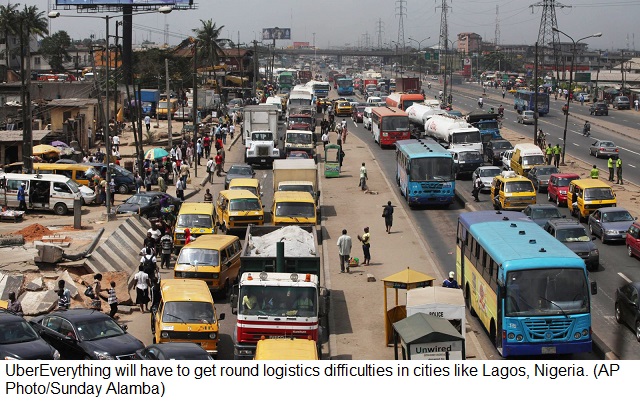
Logistics have been a big challenge for e-commerce companies in African larger cities, some of which have poor road networks and other infrastructure challenges. Major local players like Konga in Nigeria and African Internet Group’s Jumia and sister company Hellofood have had to invest heavily in developing their own logistics platform to get round the weak local infrastructure.

“If things go well in South Africa, there’s no reason why we won’t bring UberEverything to more markets.” One of such markets will likely be Lagos, which Lits says Uber remains “bullish” about despite Nigeria’s struggling economy. Home to 20 million people, Lagos’ infamous traffic jams and haphazard address system make it difficult—and expensive—for delivery services to operate but could represent a big opportunity for UberEverything’s goal of providing efficient logistics using its existing drivers network.

Aided by its recent $3.5 billion funding—its single biggest investment ever— from Saudi Arabia’s Public Investment Fund, Uber expanded to Kampala and Accra in the last week and Lits says a launch in Dar es Salaam is imminent. This follows plans to spend $250 million on growing its market across North Africa and the Middle East.

But Uber’s operations in Africa have not been without hitches. In Cairo and Nairobi, Uber drivers have been targets of protests and, in some cases, violent attacks. In South Africa, the company was forced to provide drivers with emergency numbers and also partner with a local private security firm.

Source: Quartz Africa Weekly Brief – Posted 06/13/2016; retrieved 06/18/2016 from: http://qz.com/703087/uber-africa-is-will-diversify-beyond-car-rides-this-year-with-its-everything-service/

In a previous blog on Uber, the Go Lean commentary identified how evolutionary changes in technology and modernization affects Old World taxi businesses. Now we see how evolution is changing all businesses … everywhere.

The challenge with technology, for the taxi cab industry and many other areas of life, is one-step forward-two steps-backwards. This point aligns with the book Go Lean…Caribbean which anticipates the compelling issues associated with Internet & Communications Technologies (ICT) and their effect on traditional commerce. The book prepares the Caribbean region to move to the intersection of opportunity and preparation. The book serves as a roadmap for the introduction and implementation of the technocratic Caribbean Union Trade Federation (CU). This roadmap accepts the tenets of ICT, that it can serve as an equalizer between big countries and small countries, or big companies and small companies. So opportunities will come to the Caribbean region as a result of the advances in technology. How will the region prepare?

First, the book asserts that before the strategies, tactics and implementations of the Go Lean roadmap can be deployed, the affected communities must first embrace a progressive community ethos. The book defines this “community ethos” as the fundamental character or spirit of a culture; the underlying sentiment that informs the beliefs, customs, or practices of society; dominant assumptions of a people or period.

The Go Lean book stresses that the current community ethos must change and the best way to motivate people to adapt their values and priorities is in response to a crisis. The roadmap recognizes this fact with the pronouncement that the Caribbean is in crisis, and that “a crisis is a terrible thing to waste”. This ethos corresponds with the UberEverything motives. In a lot of urban communities around the world, Caribbean included, traffic is crisis-worthy. According to the foregoing article, this reality is creating business opportunities around the logistics of Uber.

Uber 2The Go Lean roadmap avails these opportunities, by strategizing logistics with a regional focus. The roadmap for Caribbean logistics is also our means for delivering the mail; this is the vision for the Caribbean Postal Union (CPU). The focus of the CPU is not just postal mail, but rather all the lean technocratic activities that make up logistics. Mail requires logistics, but logistics means so much more than just mail. So we would want to model successful enterprises in this industry space, like Uber. (The Go Lean book considers the postal operation of the US Postal Service – Page 99 – and rules it null-and-void for transforming e-Commerce). Other successful enterprises that provide good examples of lean technocratic efficiency include Amazon and Alibaba.

Modeling UberEverything, the Go Lean/CU roadmap will directly employ technologically innovative products and services to impact its own prime directives, identified with the following 3 statements:

  • Optimization of the economic engines in order to grow the regional economy to $800 Billion & create 2.2 million new jobs.
  • Establishment of a security apparatus to protect the resultant economic engines.
  • Improve Caribbean governance to support these engines.

The Uber model helps the CPU impact the economic, security and governing engines, like job creation. In the previous 2014 blog relating Uber, it was disclosed that Uber is responsible for 20,000 new jobs per month. The median income for drivers using the UberX platform, Uber’s low-cost service, is $90,000 per year in New York and more than $74,000 in San Francisco, the company said. How is this possible to make so much more money than traditional driving professionals? Uber is a sophisticated business model; one thing is Uber fully applies the laws of economics – supply and demand. Note the explanation in the VIDEO here:

VIDEOMake More $ During Times of High Demand – https://youtu.be/cHfWwnJwyOU

Professor Wolters
Published on Nov 20, 2019 – Ever wonder how Uber and other ride sharing firms calculate their prices? Or maybe how prices are made for airlines? Well to understand the pricing you need to understand what is called Dynamic Pricing, which is constantly moving prices.

Filmed in Watkinsville, GA. Copyright Mark Wolters 2019
#marketing #pricing #principlesofmarketing

Topic 4: Digital Marketing
Topic 13: Dynamic Pricing

Learn more at http://uber.com

This model is a good starting point for elevating the Caribbean. But this is heavy-lifting; notice in the foregoing article regarding the complex issues associated with Uber in terms of security and taxi-limo licensing (governance). The Go Lean roadmap conveys that heavy-lifting of logistical details are more of an investment. The community will enjoy the returns, with the optimized commerce deliveries.

The Go Lean roadmap seeks to change the entire eco-system of Caribbean logistics and resulting commerce – the interaction with postal operations. This vision is defined early in the book (Page 12 & 14) in the following pronouncements in the opening Declaration of Interdependence:

xv. Whereas the business of the Federation and the commercial interest in the region cannot prosper without an efficient facilitation of postal services, the Caribbean Union must allow for the integration of the existing mail operations of the governments of the member-states into a consolidated Caribbean Postal Union, allowing for the adoption of best practices and technical advances to deliver foreign/domestic mail in the region.

xxvii. Whereas the region has endured a spectator status during the Industrial Revolution, we cannot stand on the sidelines of this new economy, the Information Revolution. Rather, the Federation must embrace all the tenets of Internet Communications Technology (ICT) to serve as an equalizing element in competition with the rest of the world. The Federation must bridge the digital divide and promote the community ethos that research/development is valuable and must be promoted and incentivized for adoption.

The Go Lean book details a series of community ethos, strategies, tactics, implementations and advocacies to foster the best practices for the logistics of the CPU and trade marketplaces in the Caribbean region:

Community Ethos – Deferred Gratification Page 21
Community Ethos – Economic Principles – All Choices Involve Costs Page 21
Community Ethos – Economic Principles – People Respond to Incentives Page 21
Community Ethos – Economic Principles – Economic Systems Influence Choices Page 21
Community Ethos – Economic Principles – Voluntary Trade Creates Wealth Page 21
Community Ethos – Economic Principles – The Consequence of Choice Lie in Future Page 21
Community Ethos – Job Multiplier Page 22
Community Ethos – Lean Operations Page 24
Community Ethos – Return on Investments – ROI Page 24
Community Ethos – Cooperatives Page 25
Community Ethos – Ways to Impact the Future Page 26
Community Ethos – Ways to Help Entrepreneurship Page 28
Community Ethos – Promote Intellectual Property Page 29
Community Ethos – Ways to Bridge the Digital Divide Page 31
Strategy – Customers – Citizens and Member-states Governmental Page 47
Tactical – Fostering a Technocracy Page 64
Tactical – How to Grow the Economy to $800 Billion – Trade and Globalization Page 70
Tactical – Separation of Powers – Postal Services Page 78
Tactical – Separation of Powers – Interstate Commerce Administration Page 79
Implementation – Year 1 / Assemble Phase – Establish CPU Page 96
Implementation – Anecdote – Mail Services – USPS Dilemma Page 99
Implementation – Ways to Pay for Change – Group Purchase Organizations (GPO) Page 101
Implementation – Ways to Optimize Mail Service & myCaribbean.gov Marketplace Page 108
Implementation – Ways to Deliver Page 109
Implementation – Ways to Impact Social Media Page 111
Implementation – Ways to Benefit from Globalization Page 119
Planning – 10 Big Ideas for the Caribbean – # 8 Cyber-Caribbean Page 127
Planning – Ways to Improve Trade – GPO’s Page 128
Planning – Ways to Improve Interstate Commerce Page 129
Advocacy – Ways to Grow the Economy Page 151
Advocacy – Ways to Create Jobs Page 152
Advocacy – Ways to Mitigate Black Markets Page 165
Advocacy – Ways to Manage the Federal Civil Service Page 173
Advocacy – Ways to Foster Cooperatives Page 176
Advocacy – Ways to Foster Technology Page 197
Advocacy – Ways to Foster e-Commerce Page 198
Advocacy – Reforms for Banking Regulations Page 199
Advocacy – Ways to Impact Main Street Page 201
Advocacy – Ways to Improve Transportation – Union Atlantic Turnpike Page 205
Appendix – Network of Ferries – Model of Marine Highway System Page 280

Issues related to the CPU business model have previously been detailed in these Go Lean commentaries, listed here:

Transformations: Caribbean Postal Union – Delivering the Future
The Future of Money
How to address high consumer prices
Truth in Commerce – Learning from Yelp
Net Neutrality: It matters here … in the Caribbean
Robots help Amazon tackle Cyber Monday
Role Model Jack Ma brings Alibaba to America
Where the Jobs Are – Computers Reshaping Global Job Market
Amazon’s new FIRE Smartphone
Grenada PM Urges CARICOM on ICT

The foregoing article describes Uber’s activities in Africa. The Caribbean is now ready, willing and able …

The Go Lean roadmap posits that the CU will incubate the e-Commerce industry, forge entrepreneurial incentives and facilitate the regional logistics so that innovations can thrive. As related in the foregoing article about impact in other regions, these efforts can elevate the economy, security and governing engines of a community.

The world is continuing to change; and ‘change’ is bringing great new opportunities.

We need to be prepared. This is the intersection – change and opportunity – that we need to position ourselves at. Then, only then will success is within reach. We can make the Caribbean, a better place to live, work and play. 🙂

Download the book Go Lean … Caribbean – now!
—————-

Appendix – About Quartz

Quartz is a digitally native news outlet, born in 2012, for business people in the new global economy. We publish bracingly creative and intelligent journalism with a broad worldview

Quartz is owned by Atlantic Media Co., the publisher of The Atlantic, National Journal, and Government Executive.


Share this post:
, , , , , ,
[Top]

Zuckerberg’s Philanthropy Project Makes First Major Investment

Go Lean Commentary

We hereby submit to be Number 2!

Facebook’s founder and CEO Mark Zuckerberg – see VIDEO below – has identified and invested in his FIRST philanthropic project … in the region of Africa … with a heavy focus on Information & Communications Technology (ICT). That is Number 1; “we”, the Caribbean region would like to request to be Number 2, or 3 or 4 … anywhere. We do not care about which nominal order we receive the investment, only that he invests, along with other philanthropists of his ilk, in our Caribbean youth to help us forge technology careers in our region. See the news article here:

Title: Zuckerberg’s philanthropy project makes first major investment
s philanthropy project makes first major investment - Photo 1

(Reuters) – Facebook Inc founder Mark Zuckerberg’s philanthropy venture has made its first major investment, leading a funding round in a startup that trains and recruits software developers in Africa.

The Chan Zuckerberg Initiative LLC, created by Zuckerberg and his wife Priscilla Chan, led a $24 million Series B funding in Andela, the startup said on Thursday.

Alphabet Inc’s GV, previously known as Google Ventures, was also part of the funding round.

Andela selects the top 1 percent of tech talent from Africa, trains them and places them in engineering organizations.

The startup, which has nearly 200 engineers currently employed by its Nigeria and Kenya offices, will use the funds to expand to a third African country by the end of 2016.

“We live in a world where talent is evenly distributed, but opportunity is not. Andela’s mission is to close that gap,” Zuckerberg said in a statement.

When the philanthropy initiative was launched in late 2015, Zuckerberg said he would put in 99 percent of his Facebook shares.

The initiative is structured as a limited liability company. This means, unlike a traditional charitable or philanthropic foundation, the venture can make political donations, lobby lawmakers, invest in businesses and recoup any profits from those investments.

Zuckerberg has also signed the Giving Pledge, which invites the world’s wealthiest individuals and families to commit to giving more than half of their wealth to philanthropy or charitable causes over their lifetime or in their will.

(Reporting by Anya George Tharakan in Bengaluru; Editing by Sriraj Kalluvila)

Source: Reuters News Source – Posted June 16, 2016; retrieved June 17, 2016 from: http://sports.yahoo.com/news/zuckerbergs-philanthropy-project-makes-first-major-investment-123251464–sector.html

———–

VIDEO – Mark Zuckerberg Biography Computer Programmer, Philanthropist (1984–) –  http://www.biography.com/people/mark-zuckerberg-507402/videos/mark-zuckerberg-mini-biography-36891527

Mark Zuckerberg is co-founder and CEO of the social-networking website Facebook, as well as one of the world’s youngest billionaires.

The Caribbean has a lot of expectations for technology in the region, so  as to aid and assist with our goal to elevate our regional society. This campaign is detailed in the book Go Lean…Caribbean, serving as a roadmap for the introduction and implementation of the technocratic Caribbean Union Trade Federation (CU) to elevate Caribbean society. This movement calls for investments of time, talent and treasury to effect change in this region. The book posits that all Caribbean stakeholders (governments, residents, institutions, students, Diaspora) would be willing to devote a measure of these three ingredients if they had them, but these resources are deficient here. So these stakeholders need to lean-in to the plans of others, like philanthropist Mark Zuckerberg.

The Go Lean book strategizes a roadmap for economic/security/governing empowerment; but it also clearly relates that many social aspects of Caribbean life will be un-addressed. This is a void that NGO’s (Non-Government Organizations) can fill. Many times, these organizations offer free money, that requires no repayment!

The Go Lean roadmap invites NGO’s to impact the Caribbean according to their charters. Though forging change in the region is the responsibility of the region, we must be open to ask for help, to accept the help, and respond to the help being offered. (And then to give an account of the helping resources extended).

This is why we hereby submit to be Number 2 for Mr. Zuckerberg!

The Go Lean/CU movement champions the cause of building and optimizing the Caribbean eco-system. According to the foregoing article, it is important to identify, qualify and foster those with genius potential in Internet & Communications Technology fields and to do so as soon as possible.  There is the expectation that fostering such skills and industries can contribute to the fulfillment of the Go Lean prime directives, defined as follows:

  • Optimization of the economic engines in order to grow the regional economy to $800 Billion & create 2.2 million new jobs.
  • Establishment of a security apparatus to protect the resultant economic engines.
  • Improve Caribbean governance to support these engines.

The Caribbean does not only want to be on the consuming end of technological developments, we want to create, produce and contribute to the world of technological innovations. So the CU/Go Lean roadmap explicitly asserts that the love and curiosity for technology must be ingrained in our youth as early as possible. So the plan is to foster genius qualifiers in our Caribbean youth for careers and occupations – at home – that involve Science, Technology, Engineering and Mathematics (STEM).

These points – of ICT and STEM – were pronounced at the outset of the Go Lean book with this opening Foreword (Page 3) and the subsequent Declaration of Interdependence (Page 12 & 14) with these statements:

Foreword:  Our youth, the next generation, may not be inspired to participate in the future workings of their country; they may measure success only by their exodus from their Caribbean homeland.

xiii.  Whereas the preparation of our labor force can foster opportunities and dictate economic progress for current and future generations, the Federation must ensure that educational and job training opportunities are fully optimized for all residents of all member-states, with no partiality towards any gender or ethnic group. The Federation must recognize and facilitate excellence in many different fields of endeavor, including sciences, languages, arts, music and sports. This responsibility should be executed without incurring the risks of further human flight, as has been the past history.

xxvi. Whereas the Caribbean region must have new jobs to empower the engines of the economy and create the income sources for prosperity, and encourage the next generation to forge their dreams right at home, the Federation must therefore foster the development of new industries, like that of ship-building, automobile manufacturing, prefabricated housing, frozen foods, pipelines, call centers, and the prison industrial complex. In addition, the Federation must invigorate the enterprises related to existing industries like tourism, fisheries and lotteries – impacting the region with more jobs.

xxvii. Whereas the region has endured a spectator status during the Industrial Revolution, we cannot stand on the sidelines of this new economy, the Information Revolution. Rather, the Federation must embrace all the tenets of Internet Communications Technology (ICT) to serve as an equalizing element in competition with the rest of the world. The Federation must bridge the digital divide and promote the community ethos that research/development is valuable and must be promoted and incentivized for adoption.

xxx.  Whereas the effects of globalization can be felt in every aspect of Caribbean life, from the acquisition of food and clothing, to the ubiquity of ICT, the region cannot only consume, it is imperative that our lands also produce and add to the international community, even if doing so requires some sacrifice and subsidy.

This is a mission of the CU, to create an eco-system for technology education, appreciation and manifestation of industrial initiatives. The goal is to create 64,000 new direct and indirect technology/software jobs in the Caribbean Single Market. So it will be a good start – even if we are Number 2 – to use the grants and support (time, talent and treasuries) of Facebook’s Mark Zuckerberg – and other philanthropists and NGO’s – to foster this campaign.

Under the Go Lean roadmap, the structure is put in place to include contributions of time-talent-treasuries of NGOs/foundations. One feature of the Go Lean roadmap involves Self-Governing Entities (SGE’s); these may be structured as NGO’s at times. This structure will provide the needed regulatory oversight and accountability. The following list details other community ethos, strategies, tactics, implementations and advocacies to optimize the region’s public/private cooperation and endeavors:

Community Ethos – Deferred Gratification Page 21
Community Ethos – People Respond to Incentives in Predictable Ways Page 21
Community Ethos – “Crap” Happens – So solicit NGO’s Aid Page 23
Community Ethos – Return on Investments Page 24
Community Ethos – Cooperatives Page 25
Community Ethos – Non-Government Organizations Page 25
Community Ethos – Ways to Bridge the Digital Divide Page 31
Community Ethos – Ways to Impact the Greater Good Page 37
Strategy – Vision – Confederate all 30 member-states into a Single Market Page 45
Strategy – Customers – Non-Government Organizations are Stakeholders Page 48
Strategy – Competition – Attention to Caribbean as Opposed to Other 3rd World Page 56
Separation of Powers – State Department – Regulator and Liaison for NGO’s Page 80
Implementation – Ways to Pay for Change Page 101
Implementation – Ways to Implement Self-Government Entities Page 105
Implementation – Ways to Deliver Page 109
Implementation – Ways to Impact Social Media Page 111
Implementation – Ways to Foster International Aid Page 115
Advocacy – Ways to Create Jobs Page 152
Advocacy – Ways to Improve Education Page 159
Advocacy – Ways to Better Manage the Social Contract Page 170
Advocacy – Ways to Foster Cooperatives Page 176
Advocacy – Ways to Improve Libraries – Portals for Technology Education Page 187
Advocacy – Ways to Foster Technology Page 197
Advocacy – Ways to Foster e-Commerce Page 198
Advocacy – Ways to Impact Foundations Page 219
Advocacy – Ways to Impact Youth Page 227
Appendix – Billionaires on the list of The Giving Pledge Page 292

The details of such philanthropic projects have been detailed in previous Go Lean blog-commentaries; see sample list here:

https://goleancaribbean.com/blog/?p=7989 Transformations: Getting over’ with ‘free money
https://goleancaribbean.com/blog/?p=7963 Being a ‘Good Neighbor’ – Like Puerto Rico needs right now
https://goleancaribbean.com/blog/?p=7896 The Logistics of Disaster Relief
https://goleancaribbean.com/blog/?p=7822 Doing more against Cancer – Facebook co-founder Sean Parker
https://goleancaribbean.com/blog/?p=6422 Microsoft Pledges $75 million in Philanthropy for Kids in ICT
https://goleancaribbean.com/blog/?p=5462 NGO Accountability – The Case of The Red Cross’ $500 Million Haiti Fund
https://goleancaribbean.com/blog/?p=3432 International Aid “drying up” for Caribbean countries
https://goleancaribbean.com/blog/?p=2126 Where the Jobs Are – Computers Reshaping Global Job Market
https://goleancaribbean.com/blog/?p=1698 STEM Jobs Are Filling Slowly
https://goleancaribbean.com/blog/?p=1193 EU willing to fund study on cost of not having CARICOM
https://goleancaribbean.com/blog/?p=1112 Zuckerberg’s $100 Million Investment in Newark’s Schools Declared a Waste
https://goleancaribbean.com/blog/?p=816 The Future of CariCom – Too dependent on Foreign Aid
https://goleancaribbean.com/blog/?p=476 CARICOM Urged on ICT
https://goleancaribbean.com/blog/?p=451 CARICOM deliver address on reparations – Looking for Free Money
https://goleancaribbean.com/blog/?p=308 CARCIP Urges Greater Innovation

There is the old adage: “Charity begins at home”.

This is true, and preferable, if the resources are available “at home” in the first place. For the Caribbean, our “cupboards are bare”.

The Go Lean book describes how to empower and elevate Caribbean societal engines. The book clearly depicts that Not-For-Profit charities, foundations and NGO’s are stakeholders for the effort to make the Caribbean better. We need their access to alternate capital. Many members of the “One Percent” – see list of billionaires on Page 292 – want to help “change the world”; they want to give of their time, talent and treasuries. (But in turn, want accountability). The CU will help facilitate their vision. This is win-win!

Welcome to the Caribbean Mr. Zuckerberg. And bring your friends along.

We must accept all genuine help to make the Caribbean a better place to live, work and play. 🙂

Download the book Go Lean … Caribbean – now!

 

Share this post:
, , , ,
[Top]

How Local Economies Benefit From Small Businesses

Go Lean Commentary

This sentence about small & medium-sized enterprises (SME’s) in Puerto Rico speaks true for the rest of the Caribbean:

According to government data, 95 percent of companies … are SME’s with 50 or fewer employees, and they employ around 25 percent of the jobs on the island.
Caribbean Journal Online News Source – Posted 06/12/2014; retrieved 06/13/2014 from: http://www.caribjournal.com/2014/06/12/puerto-rico-governor-signs-bill-on-small-medium-sized-enterprises/

Small and medium-sized firms constitute the economic landscape of Caribbean life. They must be cuddled; it is what it is!

CU Blog - How Local Economies Benefit From Small Businesses - Photo 4

The purpose of the book Go Lean … Caribbean is to elevate the economic engines in the region, to make the Caribbean a better place to live, work and play. The book serves as a 5 year roadmap to foster new empowerments and economic opportunities for the region, with the goal of creating 2.2 million new jobs. To be successful, we must focus on the landscape – and realities – of small businesses, considering that they may constitute 95 percent of the business community.

In previous blogs-commentaries, the reality of BIG businesses are fully explored: the good, the bad and the ugly:

CU Blog - How Local Economies Benefit From Small Businesses - Photo 2

This commentary stresses jobs and entrepreneurship, features of the prime directives described in the Go Lean book. The book serves as a roadmap for the introduction and implementation of the technocratic Caribbean Union Trade Federation (CU) with the charter to facilitate jobs. These prime directives are defined by these 3 statements:

  • Optimization of the economic engines in order to grow the regional economy to $800 Billion in GDP and create 2.2 million new jobs.
  • Establishment of a security apparatus to protect the resultant economic engines.
  • Improvement of Caribbean governance to support these engines.

How can small businesses fit in this mission? How can small enterprises succeed and compete against BIG multi-national corporations? Can they succeed? Yes, they can!

So says one of the largest banks in the US, Bank of America. They have provided a proven formula for small businesses to succeed … in competition with the rest of the world. Consider their details here:

Title: How Local Economies Benefit From Small Businesses
Posted  by: Touchpoint in General Business on  May 5, 2016

Studies show that when consumers spend money at a small business, their purchases have a ripple effect that spreads through the local economy. Big box or national chain stores might appear to make a bigger impact, but downtown merchants anchored in the community often provide more benefits overall. From keeping more money in the community to providing competitive deals, local economies thrive when neighborhood businesses are supported.

CU Blog - How Local Economies Benefit From Small Businesses - Photo 1A

CU Blog - How Local Economies Benefit From Small Businesses - Photo 1B

CU Blog - How Local Economies Benefit From Small Businesses - Photo 1C

Click on Images to Enlarge
Bank of America – Community Economic Education Campaign. Posted 05/5/2016; retrieved 05/13-/2016:
https://smallbusinessonlinecommunity.bankofamerica.com/community/running-your-business/general-business/blog/2016/04/22/how-local-economies-benefit-from-small-businesses

It is important to note that the quest to “cuddle” small businesses likely do not involve Crony-Capitalism, as small enterprises do not wield much power. (Collectively, as in the Chamber of Commerce, the influence peddling may be more impactful).

So how can small businesses fit in with the prime directives to elevate Caribbean society?

The Go Lean roadmap anticipates the job multiplier effect. It is necessary to confederate the 30 member-states of the Caribbean region to optimize the local economic engines. This means enhancing existing industries like tourism, offshore banking, specialty agriculture; plus also creating new industries for the region like Automotive manufacturing, Ship-building, “Pre-Fab” Housing and Frozen Foods. These activities are designed to create 461,900 new jobs. The remaining of the 2.2 million jobs – 1,732,125 – are created as a result the job multiplier effect; (in which every direct job can indirectly impact multiple jobs in the economy). This is where the reality of small businesses fit into the mission to elevate the Caribbean.

According to the opening quote, 95% of the new companies will be small or medium-sized firms – with 50 or fewer employees. This is the source for the majority of new jobs.

But with the reality of the BIG multi-national corporations, how can small enterprises compete and succeed against them?

CU Blog - How Local Economies Benefit From Small Businesses - Photo 3Efficiency and effectiveness is the key to “leveling the playing-field”. One leveling strategy is the use of technology. This does not mean that small businesses must buy-own the technology. No, not, in this year of 2016! It is only necessary to use the technology, other people’s technology. See this VIDEO from the same Bank of America for their offering of Account Management services, in conjunction with specialized software from Intuit’s QuickBooks®; (who partners with over 18,000 banks):

VIDEO – Account Management for Small Business from Bank of Americahttps://youtu.be/C3qX4oTOIcw

Published on Dec 15, 2015 – With Account Management from Bank of America you’ll get more control over your small business banking accounts plus seamless integration with QuickBooks®.

According to this VIDEO from Bank of America, there are obvious back-office enhancements for online banking systems; (other banks provide similar solutions). It is the full expectation that local Caribbean banks will launch similar products. This is a mission of the Go Lean roadmap; to provide greater stewardship (“new guards”) – setting the bar higher – for the regional banks and business communities. The roadmap commences with a Declaration of Interdependence, pronouncing the need for regional integration (Page 11 – 14) and a new technology eco-system to foster a better economic future. The declarative statements are as follows:

xi.  Whereas all men are entitled to the benefits of good governance in a free society, “new guards” must be enacted to dissuade the emergence of incompetence, corruption, nepotism and cronyism at the peril of the people’s best interest. The Federation must guarantee the executions of a social contract between government and the governed.

xxi. Whereas the preparation of our labor force can foster opportunities and dictate economic progress for current and future generations, the Federation must ensure that educational and job training opportunities are fully optimized for all residents of all member-states, with no partiality towards any gender or ethnic group. The Federation must recognize and facilitate excellence in many different fields of endeavor, including sciences, languages, arts, music and sports. This responsibility should be executed without incurring the risks of further human flight, as has been the past history.

xxiv.  Whereas a free market economy can be induced and spurred for continuous progress, the Federation must install the controls to better manage aspects of the economy: jobs, inflation, savings rate, investments and other economic principles. Thereby attracting direct foreign investment because of the stability and vibrancy of our economy.

xxv.   Whereas the legacy of international democracies had been imperiled due to a global financial crisis, the structure of the Federation must allow for financial stability and assurance of the Federation’s institutions.

xxvi.  Whereas the Caribbean region must have new jobs to empower the engines of the economy and create the income sources for prosperity, and encourage the next generation to forge their dreams right at home, the Federation must therefore foster the development of new industries… In addition, the Federation must invigorate the enterprises related to existing industries … – impacting the region with more jobs.

xxvii.  Whereas the region has endured a spectator status during the Industrial Revolution, we cannot stand on the sidelines of this new economy, the Information Revolution. Rather, the Federation must embrace all the tenets of Internet Communications Technology (ICT) to serve as an equalizing element in competition with the rest of the world. The Federation must bridge the digital divide and promote the community ethos that research/development is valuable and must be promoted and incentivized for adoption.

Change has now come to the Caribbean. In a previous blog-commentary it was explained that the driver of this change is technology and globalization. The Caribbean region cannot only consume the innovations being developed around the world to support small businesses; we must develop and innovate ourselves. The bottom-line for our development must be the “bottom-line” for the community, the Greater Good. The Go Lean roadmap identifies an example of the ICT advancement: the emergence of cloud computing, as similarly depicted in the foregoing VIDEO. This is the strategy of forging a Cyber Caribbean with many outsourcing/in-sourcing deployments for regional governments, institutions, businesses and consumers.

The Go Lean/CU roadmap is designed to foster ICT developments in the Caribbean region, with the motives of job-creation. This requires a full-vertical strategy: identifying the human resources / skill-set development, incentivizing high-tech start-ups and incubating viable companies. These points have been detailed in many previous Go Lean blog-commentaries; consider this sample:

https://goleancaribbean.com/blog/?p=7847 PC industry swoons, as cloud and mobile devices dominate
https://goleancaribbean.com/blog/?p=7806 Skipping School to become Tech Giants
https://goleancaribbean.com/blog/?p=7646 Going from ‘Good to Great’
https://goleancaribbean.com/blog/?p=6422 Microsoft Pledges $75 million for Kids in Computer Science
https://goleancaribbean.com/blog/?p=6341 The new Tourism Stewardship: e-Commerce
https://goleancaribbean.com/blog/?p=6151 3D Printing: Here Comes Change
https://goleancaribbean.com/blog/?p=5840 Security Concerns: Computer Glitches Disrupt Business As Usual
https://goleancaribbean.com/blog/?p=5435 China Internet Policing – Model for Caribbean
https://goleancaribbean.com/blog/?p=4793 Truth in Commerce – Learning from Yelp
https://goleancaribbean.com/blog/?p=4381 Net Neutrality: It Matters Here …in the Caribbean
https://goleancaribbean.com/blog/?p=3974 Google and Mobile Phones – Here comes Change
https://goleancaribbean.com/blog/?p=3881 Intelligence Agencies to Up Cyber Security Cooperation
https://goleancaribbean.com/blog/?p=3152 Making a Great Place to Work®
https://goleancaribbean.com/blog/?p=3187 Robots help Amazon tackle Cyber Monday
https://goleancaribbean.com/blog/?p=2126 Computers Reshaping Global Job Market
https://goleancaribbean.com/blog/?p=689 ‘eMerge’ Conference aims to jump-start Tech Hub
https://goleancaribbean.com/blog/?p=308 CARCIP – CariCom Initiative – Urges Greater Innovation

The primary ingredient for a Caribbean ICT strategy is Caribbean people. There is no need to create new computers, just new computer programs. There is no need to create banks, just deploy online banking. There is no need to create new accounting software, just configure existing software like Intuit’s QuickBooks with Caribbean “particulars”. This is the conceivable, believable and achievable goal for Caribbean stewards to help foster local small businesses, to include them in this regional elevation plan  – see VIDEO in the Appendix below. The Go Lean roadmap describes the need to reform and transform the community “will” as a community ethos – national spirit – to promote entrepreneurship.

The Go Lean book envisions the CU – a confederation of the 30 member-states of the Caribbean chartered to do the heavy-lifting of elevating the Caribbean economy – to empower (and cuddle) small and medium-sized businesses. The book details the economic principles and community ethos to adopt, plus the executions of strategies, tactics, implementations and advocacies to foster a dynamic business environment in the Caribbean. See sample list here:

Economic Principles – Deferred Gratification Page 21
Economic Principles – People Respond to Incentives in Predictable Ways Page 21
Economic Principles – Consequences of Choices Lie in the Future Page 21
Economic Principles – Money Multiplier Page 22
Economic Principles – Job Multiplier Page 22
Community Ethos – Lean Operations Page 24
Community Ethos – Return on Investments (ROI) Page 24
Community Ethos – Ways to Impact the Future Page 26
Community Ethos – Ways to Foster Genius Page 27
Community Ethos – Ways to Help Entrepreneurship Page 28
Community Ethos – Ways to Impact Research & Development Page 30
Community Ethos – Ways to Close the Digital Divide Page 31
Community Ethos – Ways to Impact the Greater Good Page 37
Strategy – Agents of Change – Technology Page 48
Strategic – Core Competence – Getting better at what we do best Page 58
Tactical – Fostering a Technocracy Page 64
Tactical – Growing Economy – New High Multiplier Industries Page 68
Tactical – Separation of Powers – Caribbean Postal Union (CPU) – Facilitating local business Page 78
Tactical – Separation of Powers – State Department – Shepherding NGO’s and Cooperatives Page 80
Tactical – Separation of Powers – Education Department – e-Learning Promoter Page 85
Tactical – Separation of Powers – Labor – Promoting excellence and On-Job-Training Page 89
Implementation – Assemble CPU and www.myCaribbean.gov Page 96
Implementation – Steps to Improve Mail Services – Logistics for local commerce Page 108
Implementation – Ways to Deliver – Embrace of Project Management Arts & Sciences Page 109
Planning – 10 Big Ideas – Cyber Caribbean Page 127
Advocacy – Ways to Grow the Economy Page 151
Advocacy – Ways to Create Jobs Page 152
Advocacy – Ways to Improve Governance Page 168
Advocacy – Ways to Impact Cooperatives Page 169
Advocacy – Ways to Promote Events – Example of multiple small businesses Page 191
Advocacy – Ways to Foster Technology Page 197
Advocacy – Ways to Impact Main Street Page 201
Advocacy – Ways to Impact Urban Living – Transportation to jobs Page 234

The Go Lean book and accompanying blogs declare that the Caribbean needs to learn lessons from organizations in other communities, especially banking entities that promote small businesses. The foregoing VIDEO provides a sample/example.

Now is the time for all of the Caribbean, the people, businesses, institutions (i.e. banking) and governmental entities, to lean-in for the empowerments described in the book Go Lean … Caribbean. This roadmap will result in economic opportunities throughout the region, for small, medium-sized and large businesses and trading partners – domestic and foreign direct investors.

Overall, with these executions, the Caribbean region can be a better place to live, work and play. As demonstrated by this discussion on banking systems supporting small businesses, there is a lot of economic activity – 95 percent of all new companies – in the small business arena. The practice of incentivizing, “cuddling” and incubating small businesses must be earnestly engaged by stakeholders in the Caribbean region, especially those taking the lead. This is not easy; this is heavy-lifting, part of the process to elevate Caribbean society. But the heavy-lifting is an investment, for immediate returns, to benefit the Greater Good. 🙂

Download the book Go Lean…Caribbean now!

—————-

Appendix VIDEO – The single biggest reason why startups succeedhttps://youtu.be/bNpx7gpSqbY

Published on Jun 1, 2015 – Bill Gross has founded a lot of startups, and incubated many others — and he got curious about why some succeeded and others failed. So he gathered data from hundreds of companies, his own and other people’s, and ranked each company on five key factors. He found one factor that stands out from the others — and surprised even him.

TEDTalks is a daily video podcast of the best talks and performances from the TED Conference, where the world’s leading thinkers and doers give the talk of their lives in 18 minutes (or less). Look for talks on Technology, Entertainment and Design — plus science, business, global issues, the arts and much more.
Find closed captions and translated subtitles in many languages at http://www.ted.com/talks/bill_gross_t…


Share this post:
, ,
[Top]

Transformations: Perfecting Our Core Competence

Go Lean Commentary

What is required for the world to believe that the Caribbean is the greatest address on the planet?

Terrain and Weather Check
Culture and Hospitality Check
Food and Spirits Check
Music and Festivals Check
Economy and Jobs Danger! Fail!

This point aligns with the book Go Lean…Caribbean, which asserts that the societal engines in the Caribbean (economy, security, and governance) are deficient and defective; in some cases we even feature Failed-States (think: Haiti, Cuba, Puerto Rico and others). But alas, we can improve and make our homeland a better place to live, work and play.

How?

The Go Lean book details the quest to make the Caribbean better; it features a how-to guide, a roadmap for elevating the region’s societal engines of economics, security and governance. Despite the 370 pages, it boils down to doing a few things and doing them well!

This is commentary 1 of 4 on the subject of transformations: how to move our region from this status quo to the undisputed title of “greatest address on the planet”. All these commentaries detail these issues, starting with:

  1. Core Competence
  2. Money Matters – “Getting Over” with “free money”
  3. Caribbean Postal Union (CPU) – Delivering the Future
  4. Civil Disobedience – Still Effective

CU Blog - Transformations - Perfecting Our Core Competence - Photo 1

What are the focus activities that we do, as a region, that by improving we would pronounce to the world that we are truly the greatest address on the planet?

The Go Lean book identifies 144 advocacies to improve life in the region. But we cannot “master all trades”; we must do better than anywhere else in the world in a few activities; these ones here are deemed our core competence:

Economic Tourism / Events / Cruises
Specialty Agriculture
Energy
Security Public Safety
Governance Senior Health Care

The assertion is that the Caribbean region must at least do the above activities better than anywhere else in the world. Why?

Because we are competing with the world … and losing.

But if we do better, perfect our core competence – see VIDEO here of Transformations and Core Competence in the corporate setting – then our hard work will be recognized and rewarded by others wanting to share in our passions and profits. Or maybe even just to retain our citizens here at home. A previous blog stated this eloquently by quoting a Chinese proverb: “Make happy those who are near, and those who are far will come”.

VIDEO:An Introduction to Prahalad & Hamel’s Core Competence of the Corporation – A Macat Business Videohttps://youtu.be/KSUbSEvJ1Cs

Published on Nov 16, 2015 – Success in business comes from combining technological ability with organizational skills to gain a competitive edge. It is called “core competence.” Watch Macat’s short video for a great introduction to C. K. Prahalad and Gary Hamel’s “The Core Competence of the Corporation,” one of the most important business articles ever written. 

CU Blog - Transformations - Perfecting Our Core Competence - Photo 2

The book Go Lean … Caribbean sets to optimize the societal engines (economics, security and governance) in the Caribbean. The book serves as a roadmap for the introduction and implementation for the technocratic Caribbean Union Trade Federation (CU). As a federation or federal government representing all 30 member-states, the prime directives of this roadmap is to elevate society by addressing these 3 focus areas:

  • Optimization of the economic engines in order to grow the regional economy to $800 Billion & create 2.2 million new jobs.
  • Establishment of a security apparatus to protect the resultant economic engines.
  • Improve Caribbean governance to support these engines.

The benefits of core competence feature a “snowball” effect. The better we optimize one functional area, the better the rest of the environment becomes. For example, the 2.2 million jobs that the roadmap sets to create. There is no need to actuate the economic processes for each job. No, we focus on our core competence, and the job multiplier effect processes the remaining new jobs. To reach the required transformations, this commentary identifies these core competencies for our economic engines:

Tourism / Events / Cruises

CU Blog - Transformations - Perfecting Our Core Competence - Photo 3This activity is the Number 1 economic driver in the Caribbean region. But each member-state can only do “so much more” so as to generate marginal increases in their output. An old adage states that “one cannot get blood from a stone”; this is so true for the region: there are only so many beaches and coastal areas to explore for touristic opportunities. The Go Lean roadmap (Page 190) therefore takes a different, more elevated, approach to increase tourism: regionalism.

The book – and previous blogs – features empowerments that are not possible for any member-state alone, leveraging the full force of a bigger Single Market of 42 million people, across the 30 member states. The following are some regional highlights:

Specialty Agriculture

There are farming expressions, like “bread basket” of America, or Europe. But, these no not apply to the Caribbean, as we are not known for our agricultural productions … except for cigar and rum. Yes, these specialty agricultural products are deemed the “best in the world”. Following the strategies, tactics and implementations from the Go Lean book (Page 88), we can continue the greatness and exploit the reputation for even more profit; (jobs and entrepreneurial opportunities).

Cuba, the source of much of the heightened reputation for Caribbean cigars, has suffered with a 55-year trade embargo. Efforts are now being made to normalize trade with Cuba and the rest of the western world. There is therefore a lot of upside and growth for improved trade and production for this world-renown product. There will undoubtedly be a return on any investment in this core competence.

Energy

The Caribbean is the best-in-the world in certain pursuits; energy is not one of them, but it needs to be. At this juncture, the region is reported as having one of the highest energy costs on the planet. So we need to apply best-practices – detailed in the Go Lean book (Page 113) – to optimize our energy eco-system to go from the worst to the first – energy needs to become a core competence. Considering the successful models we have to emulate, we have all the resources we need to succeed ourselves:

We simply need better stewardship and administration of the region’s energy policies to optimize the supply-and-demand metrics. The Go Lean book specifically states (Page 46) the mission as follows:

Harness the power of the sun, the winds, and the tides to power our home and the institutions of our industry and government. This embrace of alternative energy can supplement our traditional power sources and usher in energy independence. Independence in general means that we are finally ready to stand-up and be counted worldwide.

Security – Public Safety

To reach the required transformations, this commentary also identifies one core competence for our security engine: Public Safety.

The art and science of Homeland Security covers vast areas, including warfare, community policing, terrorism, domestic violence, penology & criminology, organized crime, trans-national drug and human trafficking and other activities. While progress in all of these areas in the Caribbean would be nice, these are not prerequisites for the societal transformation sought in this commentary – we are not at war. No, we simply need to optimize our Public Safety apparatus. We need to be able to assure safe conditions for our stakeholders:

If we are able to raise the delivery level of protections to these groups, then our society will be recognized world-wide as a great place to live, work and play. This does not mean that we ignore the safety of the general citizenry; no, we simply accept that there will always be crime – bad actors – in every society, everywhere. So our remediation and mitigations for crime – need, greed and honor – must be omnipresent.

The following sample from the Go Lean book details the strategies, tactics, implementation and advocacies of the Go Lean roadmap related to the core competence of Public Safety:

Community Ethos – Economic Principles – Economic Systems Influence Individual Choices Page 21
Community Ethos – Security Principles Page 22
Community Ethos – Governing Principles – Lean Operations Page 24
Community Ethos – Ways to Impact the Greater Good Page 37
Strategy – Mission – Protect our stakeholders with anti-crime and law enforcement measures Page 45
Tactical – Confederating a Permanent Union Page 63
Tactical –  Separation of Powers – Homeland Security Page 75
Tactical –  Separation of Powers – CariPol Page 77
Implementation – Reasons to Repatriate to the Caribbean Page 118
Advocacy – Ways to Better Manage the Social Contract Page 170
Advocacy – Ways to Improve Leadership Page 171
Advocacy – Ways to Impact Justice Page 177
Advocacy – Ways to Remediate and Mitigate Crime Page 178
Advocacy – Ways to Improve Gun Control Page 179
Advocacy – Ways to Improve Homeland Security Page 180
Advocacy – Ways to Mitigate Terrorism Page 181
Advocacy – Ways to Improve Intelligence Gathering & Analysis Page 182
Advocacy – Ways to Improve for Natural Disasters Page 183
Advocacy – Ways to Protect Human Rights Page 220
Advocacy – Ways to Improve Elder-Care Page 225
Advocacy – Ways to Empower Women Page 226
Advocacy – Ways to Impact Youth Page 227
Advocacy – Ways to Impact Persons with Disabilities Page 228

Governance – Senior Healthcare

To reach the required transformations, this commentary lastly identifies one core competence for our regional governance: Senior / Elder Healthcare.

Most Caribbean member-states feature Democratic Socialism as the official form of government; (Cuba practices Communism, and the US Territories feature the American brand of Capitalism, though the majority of the population receive some government assistance). This means that the 30 member-states have a government entitlement program for healthcare, and it is self-evident that senior citizens in every society consume more healthcare services than any other population group.

The Go Lean movement (book and blogs) details how the governing engines in the region can elevate their healthcare deliveries, and how the elderly populations can benefit. The successful executions of the strategies, tactics, implementation and advocacies of the Go Lean roadmap, (see the following sample of these specific details from the book related to the core competence of senior healthcare), would allow the world to see how great a society the Caribbean would be. This lingering affects will reverberate in other aspects of society, like the repatriation of our aging Diaspora, medical tourists and other economic spin-offs – the book details 70,000 direct jobs created in the region as a result of these empowerments.

Community Ethos – Economic Principles – Economic Systems Influence Individual Choices Page 21
Community Ethos – Economic Principles – The Consequences of Choices Lie in the Future Page 21
Community Ethos – Governing Principles – Lean Operations Page 24
Community Ethos – Ways to Help Entrepreneurship – STEM Incubators Page 28
Community Ethos – Ways to Impact Research & Development – Including Medical Research Page 30
Community Ethos – Ways to Impact the Greater Good Page 37
Strategy – Mission – Reform our Health Care industries for the reality of our needs Page 46
Tactical –  Separation of Powers: Department of Health – Self-Governing Entities Page 80
Tactical –  Separation of Powers: Department of Health – MediCare Administration Page 86
Implementation – Reasons to Repatriate to the Caribbean Page 118
Planning – Ways to Make the Caribbean Better – Support/Social Services Page 131
Advocacy – Ways to Improve Healthcare Page 156
Advocacy – Ways to Impact Cancer Page 157
Advocacy – Ways to Impact Entitlements Page 158
Advocacy – Ways to Better Manage the Social Contract Page 170
Advocacy – Ways to Improve Elder-Care Page 225
Advocacy – Ways to Empower Women Page 226
Advocacy – Ways to Impact Persons with Disabilities Page 228
Appendix – Growing 2.2 Million Jobs in 5 years – Medical R&D, Gerontology & Healthcare Page 257

The Caribbean can truly be a great place to live, work, heal and play.

Previously, Go Lean blogs commented on transformations, showing the success of aspirations to be better and do better. Consider this sample:

Being Lean: Asking the Question ‘Why’ 5 Times
Going from ‘Good to Great’
‘A Change Is Gonna Come’
Forging Change: ‘Something to Lose’
Movie Lessons from the movie: ‘Tomorrowland’ – ‘Feed the right wolf’ in Society
Better than America? Yes, We Can!
‘Change the way you see the world; you change the world you see’
Making a Great Place to Work®
Book Review: ‘Citizenville – Take the Town Square Digital and Reinvent Government’

The effort to elevate the Caribbean is defined as heavy-lifting, a lot of strenuous actions that are very complicated. But despite the complexity, a successful completion of some of the basic or core functionality can aid the region – these limited actions are considered “core competencies”. The successful execution of these core competencies would start the “snowball” and transform the Caribbean … to a better homeland.

Any transformation for the Caribbean must be permanent! The Go Lean book declares that for permanent change to take place, there must first be an adoption of new community ethos, the national spirit that drives the character and identity of its people. The roadmap was constructed with the primary community ethos in mind, the Greater Good. This is a big deal; notice it is not a profit motive, nor a nationalistic motive, but rather a commitment to the “greatest good for the greatest number of people”.

Now is the time for all Caribbean stakeholders to lean-in to this regional solution – the Go Lean roadmap – for the Caribbean to transform to a better society, a better place to live, work and play. 🙂

Download the book Go Lean … Caribbean – now!

Share this post:
, , , ,
[Top]

Chambers’ Strategy: A Great Role Model

Go Lean Commentary

We normally do not think much about Chambers of Commerce, but they are important in the normal eco-systems that businesses operate in. Despite the community, a representative of a Chamber of Commerce – see Appendix A below – can almost always get an audience with the Mayor or other governmental executives. See this news reference here:

CU Blog - Chambers Strategy - A Great Role Model - Photo 2Mention the Chamber of Commerce, and most people think of a benign organization comprised mostly of small business owners who meet for networking and mutual support in local chapters across the U.S. But today’s Chamber is anything but that, according to Alyssa Katz’s extensive research, recently published as “The Influence Machine.”

Founded in 1912, the U.S. Chamber of Commerce has been shaped by its CEO Tom Donohue into a powerful lobbying and campaigning machine that pursues a fairly narrow special-interest agenda. It’s now the largest lobbying organization in the U.S. (ranked by budget). It mostly represents the interests of a handful of so-called “legacy industries” – industries like tobacco, banking and fossil fuels which have been around for generations and learned how to parley their earnings into political influence. The Chamber seeks favorable treatment for them, for example, through trade negotiations, tax treatment, regulations and judicial rulings.
Source: Retrieved April 30, 2016 from: http://www.usnews.com/opinion/economic-intelligence/2015/10/22/who-does-the-us-chamber-of-commerce-really-represent

The book Go Lean … Caribbean, a how-to guide for elevating the societal engines in the Caribbean homeland, owes its origin-motivation to the US Chamber of Commerce. On August 1, 2011 the US Chamber published a recommendation to American power brokers on how to recover from the recession and create jobs in the US. They provided a 10-Step advocacy for creating jobs in the US; in response, the Go Lean publishers created its own 10-Step advocacy for the Caribbean; this proved to be the first of 144 advocacies that constituted the 370-page book. See the side-by-side comparison in Appendix B below.

CU Blog - Chambers Strategy - A Great Role Model - Photo 1The Go Lean book was composed with many of the same strategies as pro-business Chambers of Commerce in the US. We therefore look to these organizations as a role model in our roadmap to transform – remediate and mitigate – the engines of regional economics, security and governance. Rather than just any Chamber in the US, this commentary considers the example of the 2 Chambers in South Florida (Greater Miami Chamber in Miami-Dade County and the Fort Lauderdale Chamber in Broward County). These entities are now embarking on a strategy that the Caribbean stewards should examine and apply in our region. See VIDEO in Appendix C below on the Greater Miami Chamber; the City of Miami is pictured here.

The publishers of the Go Lean book are now here in Greater Miami, (in from Detroit), to observe-and-report on the developments and progress of this neo-Caribbean community. Miami is notorious for its penetration of Caribbean people, culture and causes. It has a full scope of business and civic activities that traverse the breadth-and-depth of Caribbean interest. Miami’s success, with its potpourri of Caribbean Diaspora, comes as a consequence of many Caribbean failures; consider the experiences of Cubans, Haitians, Dominicans, Puerto Ricans, JamaicansBahamian and other nationalities from the region.

Therefore the strategies, tactics and implementations of the Miami-Dade-Broward Chambers of Commerce definitely apply to the Caribbean region. See related news article here:

Title: Greater Miami, Fort Lauderdale chambers may merge
By: Nancy Dahlberg and Jane Wooldridge ndahlberg@miamiherald.com

South Florida’s two largest chambers of commerce, the Greater Miami Chamber of Commerce and the Greater Fort Lauderdale Chamber of Commerce, are exploring a merger.

A memorandum of understanding was signed by the executive committees of each group, the chambers announced on Monday. A task force is being created to explore the structure and operational issues required for the combination to move ahead, and the chambers will decide by the end of the year whether to proceed, the chambers said.

“It’s a great opportunity for our business communities to evaluate this as many of the things we do discuss are very regionalized. … such as transportation, sea level rise and beach erosion,” said Heiko Dobrikow, chairman of the Greater Fort Lauderdale Chamber of Commerce and General Manager of the Riverside Hotel. “And when you have a larger, more regional representation, it gives our members certainly more growth potential for their businesses.”

Christine Barney, chairwoman of the Greater Miami Chamber of Commerce and CEO of Miami’s rbb Communications, concurred. “The potential combination gives more clout to the business community in shaping the future of South Florida,” she said.

“In the past we’ve done a lot of strategic alliances and that can only do so much,” Barney said. “We thought a more-aggressive approach was needed.”

Though membership in both Greater Miami and Greater Fort Lauderdale chambers has remained strong, nationwide, chambers of commerce have suffered declining membership and revenues.

“Even though we are acquiring new members it is probably not at the same rate as we wish, and there is probably a great opportunity that we have,” Dobrikow said.

The Greater Miami Chamber was founded in 1907 and now boasts about 4,100 members representing about 400,000 employees. The Greater Fort Lauderdale Chamber, founded in 1910, has 1,311 company-members that employ more than 500,000.

Both counties are also home to myriad smaller chambers focusing on specific geography or demographics. The idea rose from regular meetings between the president and CEOs of the two organizations, said Miami’s Barry Johnson, who announced recently he will retire at the end of this year.

Said Dan Lindblade, leader of the Greater Fort Lauderdale Chamber, “Barry Johnson and I have been talking over the years and we thought now would be a good time to begin these discussions to see if they lead us into the direction that we both feel is inevitable — a regional chamber with the size and scope of the two largest chambers in Broward and Miami-Dade.”

The Greater Miami chamber will continue the search for Johnson’s replacement during the evaluation period, Barney said.

As more small smartups emerge throughout South Florida, the traditional model of fee-based memberships has become less attractive to some members, who may have specific needs such as international introductions or skills training but not the full range of services now offered, said Barney. The ultimate goal, said both chamber chairs, is to bring more value to members.

Said Barney, “Miami is unique, Broward unique, Palm Beach is unique. … Whatever we do, we want to keep the strength of the local representation as front and center as possible.”
Source:  Posted April 26, 2016; retrieved April 30, 2016 from: http://www.miamiherald.com/news/business/article73800622.html

So the Greater Miami Chamber of Commerce and the Greater Fort Lauderdale Chamber of Commerce are considering merging, consolidating and integrating their efforts to elevate the business environment for the entire South Florida region. If successfully executed, this effort could be a role model for the Caribbean region to emulate. This discussion aligns with the book Go Lean … Caribbean, in its effort to serve as a roadmap for the introduction and implementation of the Caribbean Union Trade Federation (CU); the purpose of which is to elevate Caribbean society, for all 30 member-states. The book stresses the need to optimize the societal engines of economics, security and governance. Jobs is a very important goal of the Go Lean roadmap, with a prime directive to create 2.2 million new jobs in the Caribbean.

The stance of Chambers of Commerce is normally pro-business, anti-labor. So they are not always universally loved in their communities; they do and will “ruffle feathers”; sometimes they are even accused of promoting Crony-Capitalism. But the Go Lean focus here is “jobs” more so than Chambers of Commerce. The Go Lean book opens with pronouncements relating to the jobs-creating directive. Consider these statements early in the book in the Declaration of Interdependence (Page 12 – 14):

xxi. Whereas the preparation of our labor force can foster opportunities and dictate economic progress for current and future generations, the Federation must ensure that educational and job training opportunities are fully optimized for all residents of all member-states, with no partiality towards any gender or ethnic group. The Federation must recognize and facilitate excellence in many different fields of endeavor, including sciences, languages, arts, music and sports. This responsibility should be executed without incurring the risks of further human flight, as has been the past history.

xxiv. Whereas a free market economy can be induced and spurred for continuous progress, the Federation must install the controls to better manage aspects of the economy: jobs, inflation, savings rate, investments and other economic principles. Thereby attracting direct foreign investment because of the stability and vibrancy of our economy.

xxv. Whereas the legacy of international democracies had been imperiled due to a global financial crisis, the structure of the Federation must allow for financial stability and assurance of the Federation’s institutions. To mandate the economic vibrancy of the region, monetary and fiscal controls and policies must be incorporated as proactive and reactive measures. These measures must address threats against the financial integrity of the Federation and of the member-states.

xxvi.   Whereas the Caribbean region must have new jobs to empower the engines of the economy and create the income sources for prosperity, and encourage the next generation to forge their dreams right at home, the Federation must therefore foster the development of new industries… In addition, the Federation must invigorate the enterprises related to existing industries like tourism … impacting the region with more jobs.

The subject of job creation has been directly addressed and further elaborated upon in these previous blog/commentaries:

https://goleancaribbean.com/blog/?p=6760 Where the Jobs Are – A Lesson in ‘Garbage’
https://goleancaribbean.com/blog/?p=6680 Vegas Casinos Create New Jobs By Betting on Video Games
https://goleancaribbean.com/blog/?p=6089 Where the Jobs Are – Futility of Minimum Wage
https://goleancaribbean.com/blog/?p=4240 Immigration Policy Exacerbates Worker Productivity Crisis
https://goleancaribbean.com/blog/?p=3694 Job Option: Jamaica-Canada employment programme
https://goleancaribbean.com/blog/?p=3050 Obama’s immigration tweaks in the US leave Big Tech wanting more
https://goleancaribbean.com/blog/?p=2857 Where the Jobs Are – Entrepreneurism in Junk
https://goleancaribbean.com/blog/?p=2750 Disney World – Role Model for Self Governing Entities
https://goleancaribbean.com/blog/?p=2338 Using SGE’s to Welcome the Dreaded ‘Plutocracy’ and Jobs
https://goleancaribbean.com/blog/?p=2126 Where the Jobs Are – Computers Reshaping Global Job Market
https://goleancaribbean.com/blog/?p=2003 Where the Jobs Are – Ship-breaking under SGE Structure
https://goleancaribbean.com/blog/?p=1698 STEM Jobs Are Filling Slowly

The Go Lean book itself details the economic principles and community ethos to adopt, plus the executions of strategies, tactics, implementations and advocacies to create new jobs in Caribbean communities. See a sample list here:

Economic Principles – People Choose because Resources are Limited Page 21
Economic Principles – All Choices Involve Costs Page 21
Economic Principles – People Respond to Incentives Page 21
Economic Principles – Economic Systems Influence Individual Choices Page 21
Economic Principles – Voluntary Trade Creates Wealth Page 21
Economic Principles – Consequences of Choices Lie in the Future Page 21
Community Ethos – Job Multiplier Page 22
Community Ethos – Lean Operations Page 24
Community Ethos – Return on Investments Page 24
Community Ethos – Ways to Impact the Future Page 26
Community Ethos – Ways to Help Entrepreneurship Page 28
Community Ethos – Ways to Impact Research & Development – Create Local; Stay Local Page 30
Strategy – Vision – Integrate 30 member-states to a Single Market Economy Page 45
Strategy – Mission – Foster local economic engines Page 45
Tactical – Tactics to Forge an $800 Billion Economy – High Multiplier Industries Page 70
Tactical – Separation of Powers – Commerce Department – Promotions Role Page 78
Implementation – Ways to Deliver Page 109
Planning – Ways to Improve Trade Page 128
Advocacy – Ways to Create Jobs Page 152
Advocacy – Ways to Improve Education Page 159
Advocacy – Ways to Impact Labor Markets and Unions Page 164
Advocacy – Ways to Foster Technology Page 197
Advocacy – Ways to Foster e-Commerce Page 198
Advocacy – Ways to Help the Middle Class – Promote Entrepreneurship Page 223
Advocacy – Ways to Impact Youth – Early Start for STEM Page 227
Appendix – Growing 2.2 Million Jobs in 5 Years Page 257
Appendix – Job Multipliers Page 259

The Go Lean … Caribbean roadmap needs the effective modeling of South Florida’s business promotion, as in the regional Chambers of Commerce. Considering the 5 L‘s, (Look, Listen, Learn, Lend-a-hand & Lead), there will be much for us to look, listen and learn in the South Florida area. Eventually we may even be able to lend-a-hand to the South Florida cause – especially in regards to the Diaspora – but our focus is on the Caribbean. We do not look to lead in Florida; we are preparing to lead in the Caribbean.

Today, the Greater Miami / South Florida region is a better place to live, work and play … due in many ways to the contributions of the Caribbean Diaspora. These ones are active in the participation of the work-force, business promotion and culture of South Florida, resulting in a distinctive character that has made the Greater Miami region unique, and appealing.

We invite all of the Caribbean Diaspora in the Greater Miami / South Florida region to lean-in to this roadmap to make the Caribbean a better place to live, work and play. We also urge all stakeholders in the Caribbean to lean-in to this roadmap. 🙂

Download the book Go Lean … Caribbean – now!
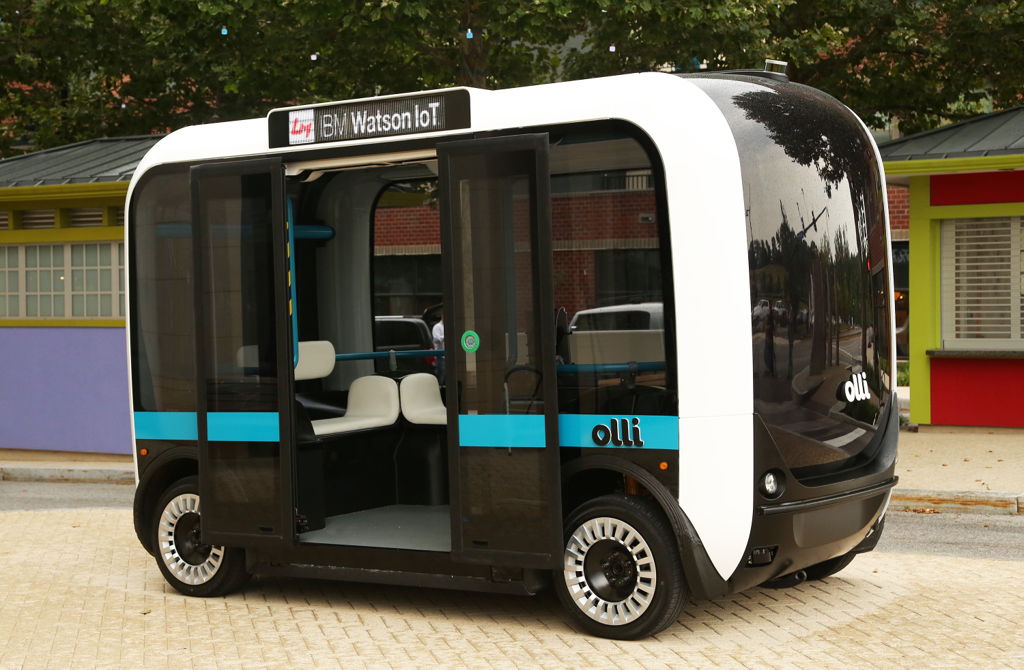
———–

Appendix – Encyclopedic Reference: Chamber of Commerce

A chamber of commerce (or board of trade) is a form of business network, for example, a local organization of businesses whose goal is to further the interests of businesses. Business owners in towns and cities form these local societies to advocate on behalf of the business community. Local businesses are members, and they elect a board of directors or executive council to set policy for the chamber. The board or council then hires a President, CEO or Executive Director, plus staffing appropriate to size, to run the organization.

The first chamber of commerce was founded in 1599 in Marseille, France.[1][2][3][4] Another official chamber of commerce would follow 65 years later, probably in Bruges, then part of the Spanish Netherlands.[5]

The world’s oldest English-speaking chamber of commerce, in New York City, dates from 1768.[6] The oldest known existing chamber in the English-speaking world with continuous records, the Glasgow Chamber of Commerce,[7] was founded in 1783. However, Hull Chamber of Commerce[8] is the UK’s oldest, followed by those of Leeds and of Belfast in Northern Ireland.

As a non-governmental institution, a chamber of commerce has no direct role in the writing and passage of laws and regulations that affect businesses. It may however, lobby in an attempt to get laws passed that are favorable to businesses. They also work closely with a number of other youth organizations in the country about the value and role of business in our Source: Retrieved April 30, 2016 from: https://en.wikipedia.org/wiki/Chamber_of_commerce

———–

Appendix B – Creating Jobs: How?


US Chamber of Commerce – 2011

Go Lean … Caribbean (Page 152)

1

Steer more students into technical schools Lean-in for the Caribbean Single Market & Economy

2

Enhance the payoff of a college degree Feed Ourselves

3

Help small businesses find foreign customers Clothe Ourselves

4

Welcome more immigrants House Ourselves

5

Create a national jobs database Update Our Own Infrastructure and the Industries They Spun

6

Create “lean” regulatory agencies Steer More People to S.T.E.M. Education and Careers

7

Speed the foreclosure epidemic Help Regional Businesses Find Foreign Markets

8

Copy Germany’s Model for Jobs Preservation Welcome Home Emigrants

9

Draw more tourists Welcome “Empowering” Immigrants

10

Lure American companies back home Draw More Tourists

Source: Posted August 1, 2011; retrieved April 30, 2011 from http://www.usnews.com/news/slideshows/10-ways-to-create-jobs

———–

Appendix C VIDEO – Greater Miami Chamber of Commerce – https://youtu.be/igNL5An_VAo

Published on Jul 18, 2015 – Category: How To & Style
License: Standard YouTube License


Share this post:
, ,
[Top]

ENCORE: eMerge conference aims to jump-start Miami tech hub

This commentary is being re-distributed on the occasion of eMerge TechWeek 2016.
The event just ended … April 18 – 19.

CU Blog - eMerge Conference 2016 Photo 1

In the commentary in 2014, previewing the inaugural event, the expectation was for 3,000 visitors. This time, just 2 years later, the attendance was 13,000 visitors. Congratulations to the organizers on this successful event. Now let’s plan on another successful one for June 12 – 13, 2017.

The original blog – still relevant – is as follows:
—————

Go Lean Commentary

Master BrokersPositive Change!

It doesn’t just happen. It takes people forging it, guiding it and fostering it. The below news article speaks of the effort in South Florida (from Miami north to West Palm Beach) to establish an economic engine of a “tech hub”.

This is a noble, yet strategic undertaking. Success in this “industry space” would mean more jobs, investment capital, and more technology students remaining in South Florida after matriculating in the area’s colleges. These 3 objectives align this story with the advocacies of the book Go Lean … Caribbean.

The book serves as a roadmap for the introduction and implementation of the Caribbean Union Trade Federation (CU). The prime directive of this organization is to optimize the economic engines of the Caribbean region. We also want to increase jobs and investment capital, plus retain more of our young people aspiring for careers in high technology fields. But the CU wants to harvest these activities in the Caribbean, for the Caribbean and by the people of the Caribbean.

South Florida is germane to the Caribbean conscience. It is the Number One destination for the Caribbean Diaspora, featuring large populations of Cubans, Jamaicans, Dominicans (DR), Puerto Ricans, Bahamians, and Haitians. The book relates this association by declaring the NBA basketball team, Miami Heat, as the “home team” of the Caribbean; (Page 42).

Right time, right place!

The eMerge Americas Techweek is this week. Also, the Miami Heat has just started the playoffs in defense of their consecutive World Championships.

By: Marcia Heroux Pounds and Doreen Hemlock

A movement to make South Florida a technology hub for the Americas kicks off its first conference this week, aiming to draw more than 3,000 people from entrepreneurs to investors to students — from Broward and Palm Beach counties and from around the world.

Organizers want to build on South Florida’s success as a gateway to Latin America for trade, banking and services, extending that prowess into technology, entrepreneurship and capital for startups. They hope the event — eMerge Americas Techweek — can do for tech what the annual Art Basel event in Miami Beach has done for art: put South Florida on the world map.

It’s an exciting chance for entrepreneurs like Boca Raton’s Dan Cane, chief executive of Boca Raton-based Modernizing Medicine, which developed an iPad application for specialty physicians. He’s among influencers named to the event’s “Techweek100” — South Florida leaders who have had a significant impact on business and technology. He will speak at the conference.

“We jumped at the opportunity,” said Cane, whose 3-year-old company had $17.5 million in sales last year. “We hope to find contacts and connections and begin to develop the right ecosystem in the Latin American market” to export south starting next year.

The eMerge push doesn’t strive to make South Florida into Silicon Valley. It aims instead for a tech center specialized in multinationals looking south, Latin American companies moving north, local startup companies, as well as universities and investors.

That’s why Citi Latin America, the regional headquarters for financial giant Citi, is taking part in what is planned as an annual event. The division employs about 750 people in Miami-Dade and Broward counties and is sponsoring the event, sending speakers and bringing clients, said Jorge Ruiz, who heads digital banking.

“This event is a great example of the things we should do more of,” Ruiz said. It showcases the importance of technology to a range of industries, promotes what South Florida already offers and highlights South Florida’s ability to unite from across the Americas for tech business, he said.

“As people come together, they’re going to realize this is the space to invest in,” Ruiz said.

Universities that train talent for tech jobs are eager to participate too.

“We’re going to bring as many students as possible,” said Eric Ackerman, dean and associate professor of the Graduate School of Computer and Information Sciences at Nova Southeastern University, who also is on the Techweek100 list. Nova has more than 500 students studying information technology.

Ackerman said tech graduates often leave South Florida, figuring they will have better job opportunities in larger hubs known for innovation.

“That’s one of the things we are trying to change — to become an innovation zone for new technology, new products and new services,” Ackerman said. “An event like this says, ‘Look what’s here in our own back yard. Why should I go somewhere else?’ ”

Kimberly Gramm, assistant dean and director of FAU’s Adams Center for Entrepreneurship, is taking winners of FAU’s recent business plan competition to eMerge’s Startup Village.

Some of South Florida’s largest tech companies also will exhibit at eMerge. Those include Citrix Systems of Fort Lauderdale, C3 Cloud Computing Concepts of Delray Beach and TriNet Group of Boca Raton, said Lonnie Maier, president of the South Florida Technology Alliance, a group that promotes local tech.

Investors and consultants to startups also are heading to eMerge to network and build business.

New World Angels, a Boca Raton-based group of investors, will share a booth with the Miami Innovation Fund to offer entrepreneurs advice on launching or growing their ventures, said Rhys Williams, executive director of New World Angels and a Techweek 100 leader.

“Technology investing is a contact sport. There are few textbooks or classes of relevance, so this conference is a timely way to keep current on your knowledge base and pick up new knowledge, skills and contacts,” said Williams, who also is a judge in the eMerge Launch competition where more than 200 companies will compete for $150,000 in prizes.

Of course, South Florida faces hurdles in its quest, tech leaders said.

The area needs to overcome a long-time image based on sun and fun. And it needs to show critical mass in tech, especially success stories of entrepreneurs that grew startups to global players — much as conference organizer Manny Medina did, starting Miami-based Terremark and selling it for more than $1.4 billion to Verizon.

Enterprise Development Corp. President Rob Strandberg, whose group works with startups from Boca Raton to Miami, will be busy making introductions between entrepreneurs and potential investors at the conference. He’s also a judge in the Launch competition.

EDC executive director Linda Gove will participate with the Boca Raton incubator’s startup companies.

“Investors are taking notice of South Florida companies to a far greater extent than they were,” Strandberg said.

Joe Levy, CEO of Fort Lauderdale-based startup ClearCi and also named to the Techweek 100, said the perception of the area as a tech hub is changing.

“Folks used to ask me, ‘Why aren’t you in Silicon Valley?’ ” Levy said. “We don’t get that anymore.”

South Florida’s Sun Sentinel Daily Newspaper – April 27, 2014 – http://www.sun-sentinel.com/business/careers/fl-emerge-broward-palm-beach-20140427,0,1252077.story

The Go Lean roadmap calls for agencies within the CU to champion technological start-up endeavors, much like this week’s eMerge initiative.

There is much for the CU’s planners to glean by the observation of the planned events this week. The Go Lean/CU approach, in the absence of the actual establishment of the Trade Federation is simply to:

1. Look
2. Listen
3. Learn
4. Lend-a-hand
5. Lead

This approach is codified in the book, with details of community ethos, strategies, tactics, implementations and advocates; as follows:

Community Ethos – Impact the Future Page 26
Community Ethos – Foster Genius Page 27
Community Ethos – Help Entrepreneurship Page 28
Community Ethos – Promote Intellectual Property Page 29
Community Ethos – Impact R & D Page 30
Community Ethos – Bridge the Digital Divide Page 31
Strategy – Agents of Change: Technology Page 57
Separation of Powers – Patents & Copyrights Page 78
Implementation –  Self-Governing Entities Page 105
Implementation –  Impact Social Media Page 111
Ways to Better Manage Image Page 133
Industries – Ways to Foster Technology Page 197
Industries – Foster e-Commerce Page 198

We hope for success for eMerge Americas Techweek. We hope our Caribbean brothers living and working in South Florida participate, engage in and benefit from this initiative. Then we hope that they would repatriate some of this passion, knowledge, and experience back to their Caribbean homelands.

Lastly, we cheer for further basketball dominance. Go Heat!

Basketball shot

Download the book – Go Lean…Caribbean now!!!

Share this post:
, , , , , ,
[Top]