Tag: Play

St Croix’s Tim Duncan to Return to Spurs For Another Season

Go Lean Commentary

Congratulations Tim Duncan. You deserve your champion’s accolades.
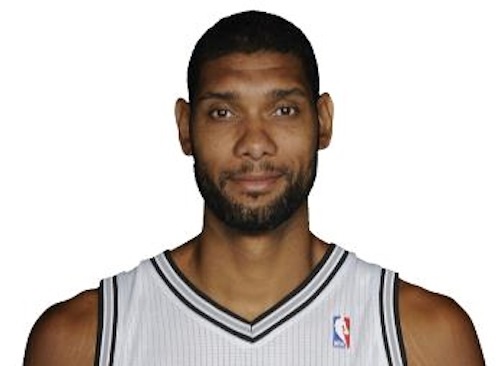
Tim Duncan Photo

This commentary has previously sided with Mr. Duncan’s opponent in the recent NBA Finals. Here below are the previous blogs citing a hope for the Miami Heat’s dominance in the NBA Playoff tournament.

https://goleancaribbean.com/blog/?p=1148 Sports Bubble – Franchise values in basketball
https://goleancaribbean.com/blog/?p=689 eMerge conference aims to jump-start Miami tech hub

But talent recognizes talent!

It is also good news, according to this foregoing news article, that Mr. Duncan will be returning for at least one more season.

By: The Caribbean Journal Staff

Tim Duncan isn’t going anywhere.

The St Croix native, who recently won his fifth NBA championship, will be returning to the San Antonio Spurs for his 18th NBA season.

The team announced Monday that the 38-year-old Duncan had exercised his player option for the 2014-2015 season, putting to rest any notion that he would be retiring.

Duncan helped the Spurs to a dominant 4-1 series win over the Miami Heat in this month’s NBA Finals.

The Christiansted native is one of five players in the history of the NBA to win five championships and five MVPs (either NBA Finals or regular season), along with Michael Jordan, Magic Johnson, Bill Russell and Kareem Abdul-Jabbar.

Duncan leads all active players in career wins, with 898.
Caribbean Journal Online News Source  (Posted 06-23-2014; retrieved 06-26-2014) –
http://www.caribjournal.com/2014/06/23/st-croixs-tim-duncan-to-return-to-spurs-for-another-season/

There is something bigger than sports alone at play here. As the foregoing news article depicts, Mr. Duncan is a member of the Caribbean Diaspora. He is recognized as one of the best in his field of endeavor; perhaps one of the best of all time. This is a claim of the book Go Lean … Caribbean, that sports require a genius qualifier and that genius  ability can be found in abundance in the Caribbean. Mr. Duncan makes us all proud: Christiansted, St. Croix, the US Virgin Islands and all of the Caribbean.

The Go Lean book serves as a roadmap for the introduction and implementation of the Caribbean Union Trade Federation (CU), a technocratic federal government to administer and optimize the economic/security/ governing engines of the region’s 30 member-states. At the outset, the roadmap recognizes the value of sports with these statements in the Declaration of Interdependence (Page 13 & 14):

xxvi.     Whereas the preparation of our labor force can foster opportunities and dictate economic progress for current and future generations, the Federation must ensure that educational and job training opportunities are fully optimized for all residents of all member-states, with no partiality towards any gender or ethnic group. The Federation must recognize and facilitate excellence in many different fields of endeavor, including sciences, languages, arts, music and sports. This responsibility should be executed without incurring the risks of further human flight, as has been the past history.

xxxi.     Whereas sports have been a source of great pride for the Caribbean region, the economic returns from these ventures have not been evenly distributed as in other societies. The Federation must therefore facilitate the eco-systems and vertical industries of sports as a business, recreation, national pastime and even sports tourism – modeling the Olympics.

The Go Lean roadmap calls for the market organizations to better explore the economic opportunities for sports. Sports can be big business! But even when money is not involved, other benefits abound. As such the CU will enhance the engines to elevate sports at all levels: amateur, intercollegiate and professional.

The other issue related to Tim Duncan is that of “image”. Mr. Duncan could be a proud ambassador of Caribbean character. Personally, he does not advocate any political or economic agenda, so others must do that for him. As a public figure, his story is free to relate to the listening world of how impactful a Caribbean heritage can be.

The subjects of sports and Caribbean image have been related in many previous Go Lean blogs; highlighted here in the following samples:

a. https://goleancaribbean.com/blog/?p=1446 Caribbean   Players in the 2014 World Cup
b. https://goleancaribbean.com/blog/?p=1341 College   World Series Time
c. https://goleancaribbean.com/blog/?p=1214 The Art &   Science of Temporary   Stadiums – No White Elephants
d. https://goleancaribbean.com/blog/?p=1148 Sports Bubble –   Franchise values in   basketball
e. https://goleancaribbean.com/blog/?p=1020 Sports Revolutionary: Advocate Jeffrey Webb
f. https://goleancaribbean.com/blog/?p=857 Caribbean Image: Dreadlocks
g. https://goleancaribbean.com/blog/?p=498 Book Review: ‘The Sports Gene’
h. https://goleancaribbean.com/blog/?p=334 Bahamians Make Presence Felt In Libyan   League
i. https://goleancaribbean.com/blog/?p=318 Collegiate Sports in the Caribbean
j. https://goleancaribbean.com/blog/?p=60 Could the Caribbean Host the Olympic Games?

The book Go Lean…Caribbean has an economic empowerment agenda, but there are still huge benefits for the region related to sports. The strategy is to consolidate the region’s 30 member-states / 4 languages into a Single Market of 42 million people – leverage for a viable sports landscape. The CU facilitation of applicable venues (stadia, arenas, fields, temporary structures) on CU-owned fairgrounds plus the negotiations for broadcast/streaming rights/licenses will elevate the art, science and genius of sports as an enterprise in the region.

Now is the time for all of the Caribbean to lean-in to the following community ethos, strategies, tactics, implementations and advocacies detailed in the book Go Lean … Caribbean to re-boot the delivery of the regional solutions to elevate the Caribbean region through sports:

Community Ethos – People Respond to Incentives in Predictable Ways Page 21
Community Ethos – Return on Investments Page 24
Community Ethos – Ways to Foster Genius Page 27
Community Ethos – Ways to Improve Negotiations Page 32
Community Ethos – Ways to Promote Happiness Page 36
Strategic – Vision – Integrating Region in to a Single Market Page 45
Strategic – Staffing – Sporting Events at Fairgrounds Page 55
Tactical – Fostering a Technocracy Page 64
Tactical – Separation of Powers – Sports & Culture Administration Page 81
Tactical – Separation of Powers – Fairgrounds Administration Page 83
Implementation – Steps to Implement Self-Governing Entities (Fairgrounds) Page 105
Implementation – Ways to Deliver Page 109
Planning – Ways to Make the Caribbean Better Page 131
Advocacy – Ways to Grow the Economy Page 151
Advocacy – Ways to Improve Local Government – Parks & Recreation Page 169
Advocacy – Ways to Impact Events Page 191
Advocacy – Ways to Promote Fairgrounds Page 192
Advocacy – Ways to Foster Technology Expositions Page 197
Advocacy – Ways to Improve Sports Page 229
Advocacy – Ways to Impact Urban Living – Sports Leagues Page 234

The foregoing article celebrates a Caribbean Champion. But there is more to celebrate with Caribbean life, culture and the homeland. With the Go Lean executions, we can all be champions, by making the Caribbean a better place to live, work and play.

Download the book Go Lean…Caribbean now!


Share this post:
, , , ,

Caribbean Players in the 2014 World Cup

FIFA 2014Go Lean Commentary

Soccer (Association Football) is the world’s most popular game. The book Go Lean … Caribbean contemplates greater exploration of the economic opportunities associated with the business of sports – the Caribbean has a failing record in this important area. This quest must therefore give consideration to the eco-system of the World Cup. As such, the news story in the foregoing article synchronizes with the Go Lean book in that it depicts the societal abandonment by so many Caribbean athletes and the lack of professional opportunities in the Caribbean homeland. The two issues: lack of opportunities and society abandonment is a cause-and-effect conundrum. See article here:

Caribbean Journal – Caribbean e-Zine Online Site (Posted 06/14/2014; retrieved 06/21/2014) –
http://www.caribjournal.com/2014/06/16/caribbean-players-in-the-2014-world-cup/
There aren’t any teams from the traditional Caribbean in the 2014 World Cup in Brazil (although there are several from the wider Caribbean Basin), but that doesn’t mean there isn’t a strong Caribbean contingent. From powerhouses like the Netherlands and England to up-and-coming teams like Costa Rica, there are a number of Caribbean footballers in Brazil this month. Here are some of the featured Caribbean athletes:

Raheem Sterling

Raheem SterlingThe 19-year-old phenom who plays for England was actually born in Kingston, Jamaica. A midfielder, he plays professionally for Liverpool.

Raphael Varane

, Raphael VaraneVarane who plays professionally for Real Madrid, is a centre back for the French World Cup team. He is of Martiniquais heritage, as his father comes from the island.
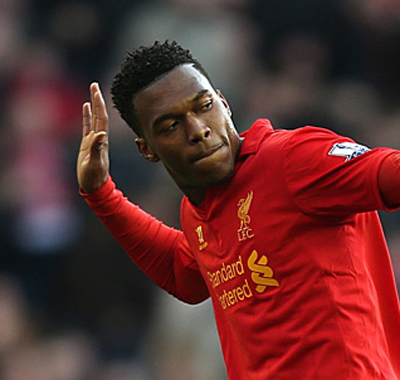
Daniel Sturridge

Daniel SturridgeThe England striker is of Jamaican heritage, as both sides of his grandparents are Jamaican. Like Sterling, he plays for Liverpool professionally. (And he keeps up his ties to Jamaica with a charity in Portmore).

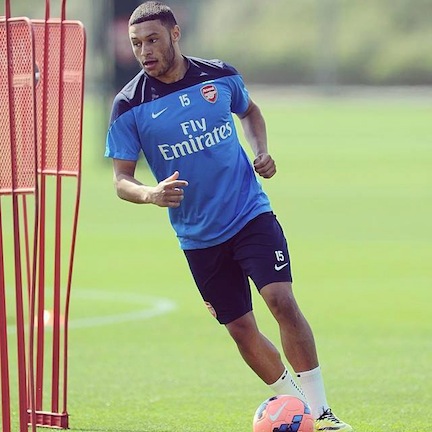
Alex Oxlade-Chamberlain

Alex Oxlade-ChamberlainOxlade-Chamberlain, the son of former England international player Mark Chamberlain, is of Jamaican heritage. A winger and central midfielder, he plays professionally for Arsenal.

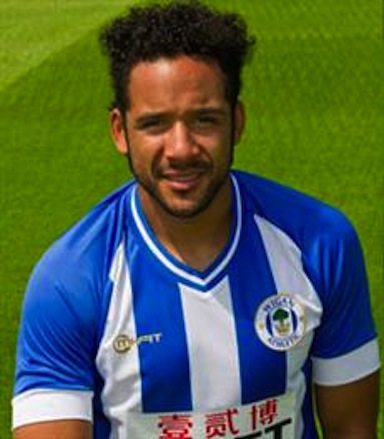
Jean Beausejour

Jean BeausejourBeausejour, a 30-year-old left winger for Chile, is the son of a Haitian father. He plays professionally for Wigan Athletic in England.
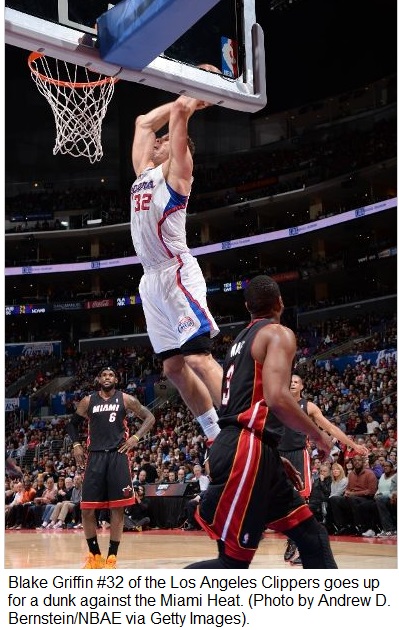
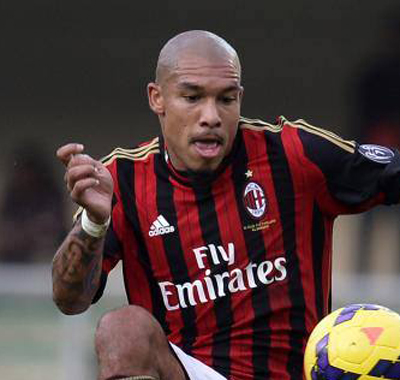
Nigel de Jong

Nigel de JongMuch of the Netherlands’ football success over the years has come from the Caribbean nation of Suriname, and the trend continues today. de Jong, of Surinamese heritage, is a defensive midfielder who plays professionally for Milan.

Jeremain Lens

Jeremain LensLens, a striker, is of Surinamese heritage (and has even played internationally for the country). He plays professionally for FC Dyanmo Kyiv.

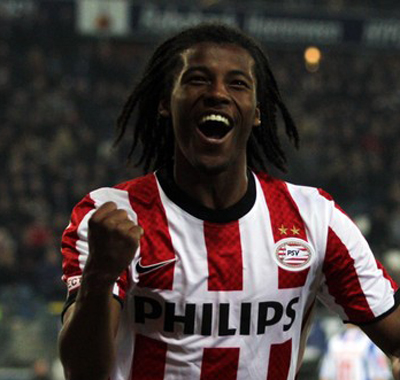
Georginio Wijnaldum

Georginio WijnaldumWijnald is of Surinamese heritage, and plays for professionally for PSV in the Netherlands. For Oranje, he’s a midfielder.

Leroy Fer

Leroy FerThe Norwich City player is a central midfielder who plays for (and was born in) the Netherlands. His roots, however, come from Curacao, where he comes from a family of sporting talents.

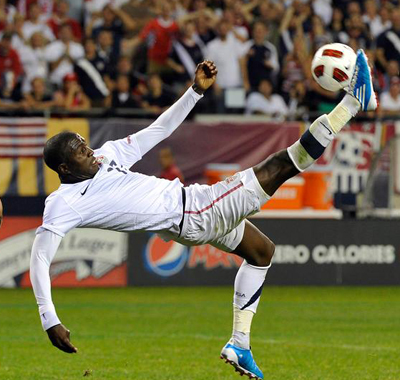
Jozy Altidore

Jozy AltidoreThe Haitian-American Altidore is one of the leaders of the American World Cup squad. A striker by trade, he plays professionally for Sunderland.
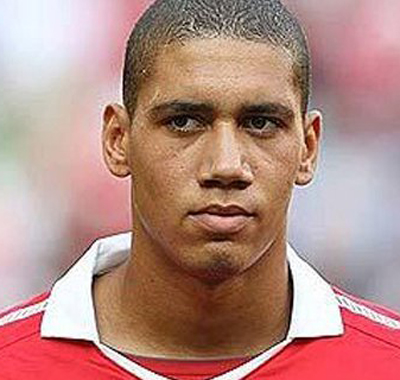
Chris Smalling

Chris SmallingSmalling, of Jamaican heritage, is a centre back for England who plays professionally for Manchester United.

Patrick Pemberton

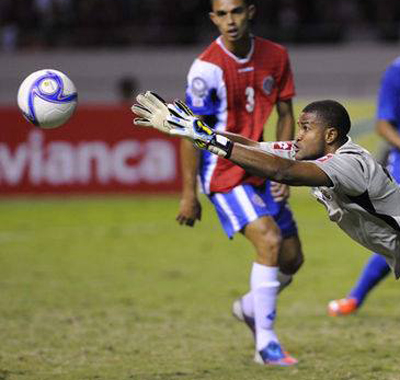
Patrick PembertonCosta Rica has a Caribbean coastline, and it’s an area with a distinct heritage and culture in large part due to an influx of immigration from Caribbean countries like Jamaica in the 19th [and early 20th century for the construction of the Panama Canal]. One result [has been] last names like Pemberton in a Spanish-speaking country. Patrick Pemberton, a native of Puerto Limon, and is the lead goalie for the Costa Rican World Cup side, playing professionally for LD Alajuelense.

Marvin Chavez

Marvin ChavezThe winger Chavez is part of a group of Garifuna players on the Honduran side, those who live on the Caribbean coast of the country — indeed, almost half of the team is comprised of those of Garifuna heritage. Chavez plays professionally in Chivas USA in MLS.

David Myrie

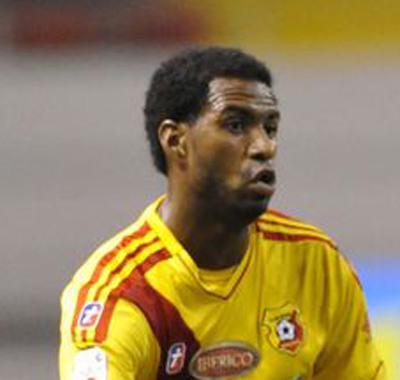
David MyrieDavid Myrie, a defender for the Costa Rican team, hails from the Caribbean area of Puerto Viejo. He plays professionally for the Costa Rican side Herediano.

Loic Remy

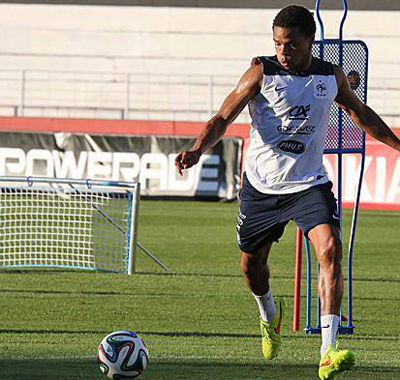
Loic RemyThe 27-year-old native of Lyon is of Martiniquais heritage and plays for France. Professionally, the striker plays for Queens Park Rangers in England.
Jonathan de Guzman

Jonathan de GuzmanThe midfielder for the Netherlands is the son of a Jamaican mother. He plays professionally for Swansea City, on loan from Spain’s Villareal.

The Go Lean book serves as a roadmap for the introduction and implementation of the Caribbean Union Trade Federation (CU), a technocratic federal government to administer and optimize the economic/security/ governing engines of the region’s 30 member-states. At the outset, the roadmap recognizes the value of sports with these statements in the Declaration of Interdependence (Page 13 & 14):

xxi.     Whereas the preparation of our labor force can foster opportunities and dictate economic progress for current and future generations, the Federation must ensure that educational and job training opportunities are fully optimized for all residents of all member-states, with no partiality towards any gender or ethnic group. The Federation must recognize and facilitate excellence in many different fields of endeavor, including sciences, languages, arts, music and sports. This responsibility should be executed without incurring the risks of further human flight, as has been the past history.

xxxi.     Whereas sports have been a source of great pride for the Caribbean region, the economic returns from these ventures have not been evenly distributed as in other societies. The Federation must therefore facilitate the eco-systems and vertical industries of sports as a business, recreation, national pastime and even sports tourism – modeling the Olympics.

The Go Lean roadmap posits that sport genius qualifiers are found throughout Caribbean society. With the planned market organizations of this roadmap, sports can be more lucrative for Caribbean residents, Diaspora and their legacies. This is big business! There is money to be made in sports endeavors like the World Cup, as stated here:

World Cup Brazil will generate $4 billion in total revenue for FIFA, or 66% more than the previous tournament in South Africa in 2010. The vast majority of the money will come from the sale of television and marketing rights. The World Cup generates more revenue for its association than any other sports tournament, save the Olympics. – Source: Forbes Magazine; retrieved June 5, 2014 from: http://www.forbes.com/sites/mikeozanian/2014/06/05/the-billion-dollar-business-of-the-world-cup/

This subject of sports and World Cup Soccer relates to many previous Go Lean blogs; highlighted here in the following samples, including tangential issues like societal abandonment/brain drain and Caribbean image:

a. https://goleancaribbean.com/blog/?p=1433 Caribbean   loses more than 70 per cent of tertiary educated to brain drain
b. https://goleancaribbean.com/blog/?p=1341 College   World Series Time
c. https://goleancaribbean.com/blog/?p=1214 The Art &   Science of Temporary   Stadiums – No White Elephants
d. https://goleancaribbean.com/blog/?p=1148 Sports Bubble –   Franchise values in   basketball
e. https://goleancaribbean.com/blog/?p=1020 Sports   Revolutionary: Advocate   Jeffrey Webb
f. https://goleancaribbean.com/blog/?p=857 Caribbean Image: Dreadlocks
g. https://goleancaribbean.com/blog/?p=498 Book Review: ‘The   Sports Gene’
h. https://goleancaribbean.com/blog/?p=334 Bahamians Make   Presence Felt In   Libyan League
i. https://goleancaribbean.com/blog/?p=318 Collegiate Sports   in the Caribbean
j. https://goleancaribbean.com/blog/?p=60 Could the Caribbean Host the Olympic Games?

The Caribbean already competes on the world stage, in all other aspects of life. But for the World Cup it is unfortunate that we have to compete with teams aligned to other countries, as shown in the foregoing article.

While it’s too late for this year, perhaps in the near future, at the end of this roadmap, there will be more recognition of the Caribbean contribution to the World Cup. Take the dream one step further and imagine a unified Caribbean team fielding its best athletes in competition with the rest of the world. This is the basic strategy of the CU, to confederate and collaborate as a unified team for sports and most other endeavors. The Go Lean roadmap asserts that no one Caribbean member-state can thrive alone.

Though Go Lean is an economic empowerment agenda, there are huge benefits for the region related to sports: optimization of eco-systems for amateur, intercollegiate and professional engagements. The CU facilitation is straight-forward: to supply the missing elements of the previous generations: applicable venues (stadia, arenas, fields, temporary structures) and broadcast/streaming capabilities.

Now is the time for all of the Caribbean to forge permanent change by implementing the Five Year roadmap advocated in the book Go Lean … Caribbean. The hope is to keep our “star” athletes at home, playing for the home team and home country. Then finally, with the Go Lean executions in place, the Caribbean can become a better place for all citizens to live, work and play.

Download the book Go Lean … Caribbean – now!

Share this post:
, , , , ,
[Top]

Marijuana in Jamaica – Puff Peace

Go Lean Commentary

Weed 1Come to Jamaica and feel alright! – Advertising tag line sampling Bob Marley’s song: One Love.

Marijuana decriminalization is not a Jamaican issue… alone. Other countries have already addressed this debate; like Latin America[a] and Europe; legal in The Netherlands & Portugal, and decriminalized in Norway. In the US, Colorado is about to be joined by the State of Washington in allowing recreational use of the cannabis plant.

While medical marijuana originated in Jamaica (1970’s), many jurisdictions now allow marijuana to be legally distributed by medical professionals, with a prescription. Life imitates art, art imitates life. Hollywood has lampooned this practice many times in movies, TV shows and commentary. In the State of California, it is common-place to get a prescription for marijuana for “dubious” ailments like insomnia, appetite abatement, non-clinical depression, even sneezing. Without a doubt in California, the whole process is a farce! (See Comedian Bill Maher’s tongue-in-cheek commentary in Referenced VIDEO below[c]).

The world has changed; the acceptance of marijuana is changing.

The following news article addresses the issue of Marijuana decriminalization, (more so than legalization):

Port of Spain, Trinidad & Tobago – It would have seemed a lot more revolutionary just two years ago but for Jamaica, it is still a welcome whiff of sense. The island’s energy minister, Philip Paulwell, who also leads government business in parliament, has said he will find time this year to decriminalise possession of small amounts of marijuana. At a stroke, the move will cut the number of illicit smokes by as many as a million a week. It will also make a Jamaican break somewhat less nervy for ganja-puffing tourists.

Reform proposals have been knocking around for some time: a National Commission on Ganja recommended decriminalisation in 2001. But helped by moves towards legalisation in Uruguay and decriminalisation in the United States, momentum has been growing. A Cannabis Future Growers and Producers Association was launched last month, and a commercial company to support medical marijuana in December.

Selling for less than five dollars an ounce, ganja has a long history in Jamaica, going all the way back to 19th-century Indian immigrants. Cultivation and import have been illegal since 1913, but everyone’s granny remembers when the herb was quite openly on sale as a cure-all. Some of the early work on medicinal uses for marijuana was done in Jamaica in the 1970s and 1980s.

In practice, most small-time ganja users are not arrested or prosecuted. But for those who are, the consequences can be dire. A criminal record makes it hard to get a coveted American visa or to land jobs in Jamaica itself. For that reason alone, reform looks like a surefire vote-winner.

Decriminalisation will also unclog the courts and free up police time. But it won’t change the big picture. It will remain illegal to grow and trade marijuana in large quantities, something that suits the big players just fine. Full legalisation would knock the bottom out of the market, hurting the island’s powerful criminal gangs. It would also curtail the potential for extortion; seven police officers appeared in court this month to face allegations that they took a $2,750 bribe from a businessman in return for overlooking a ganja find on his premises.

Jamaicans are prone to waves of moral panic, but the proposal to decriminalise ganja has caused barely any waves. The foreign minister AJ Nicholson and the opposition leader, Andrew Holness, have expressed mild reservations; the vocal church lobby has been silent. Says a well-educated and dreadlocked Jamaican: “Most of them accept that there are people who do this, just like there are people who drink.” Such tolerant sentiments only go so far, however. The “abominable crime of buggery” carries a prison sentence of up to ten years, and the government has no plans to right that injustice.
The Economist Magazine; posted 06/13/2014; retrieved 06/18/2014 from: http://www.economist.com/blogs/americasview/2014/06/marijuana-jamaica?spc=scode&spv=xm&ah=9d7f7ab945510a56fa6d37c30b6f1709

Marijuana tourism or “ganja-puffing tourists” …
…these words jump off the page of this foregoing news article.

The book Go Lean…Caribbean anticipates the compelling issues associated with economic engines. The book serves as a roadmap for the introduction and implementation of the technocratic Caribbean Union Trade Federation (CU). This effort calls for the focus of the following 3 prime directives related to Trade:

  • Optimization of the economic engines in order to grow the regional economy to $800 Billion and create 2.2 million jobs.
  • Establishment of a security apparatus (including law enforcement enhancements) to protect the resultant economic engines.
  • Improve Caribbean governance to support these engines.

Weed 2But the subject of marijuana is bigger than Trade. There are moral, religious, legal and psychological (treatment) issues associated with this topic; and there is history – good and bad. Any jurisdiction decriminalizing the use of marijuana has to contend with the previous messaging to the community of: “Just say no to drugs”.

The book asserts that before the strategies, tactics, implementations and advocacies of a roadmap to elevate a society can be deployed, the affected society must first embrace a progressive community ethos. The book defines this “community ethos” as the fundamental character or spirit of a culture; the underlying sentiment that informs the beliefs, customs, or practices of society; dominant assumptions of a people or period. Think of the derivative term: “work ethic”.

Marijuana is a mood-altering drug; it has negative effects, one being preponderance for apathy, to tune out of any active engagement. In the US, even in the states where marijuana is legal, most firms/governments still screen staffers (new hires and veterans) and ban consumption of the drug. The reason is simple: Apathy does not make for industriousness. So this issue/drug presents a conundrum for the CU. The mission to grow the economy, promote industriousness, foster new jobs and new industries is pronounced early in the roadmap, detailed in the Declaration of Interdependence (Page 14) with this statement:

 xxvi.   Whereas the Caribbean region must have new jobs to empower the engines of the economy and create the income sources for prosperity, and encourage the next generation to forge their dreams right at home, the Federation must therefore foster the development of new industries … In addition, the Federation must invigorate the enterprises related to existing industries … impacting the region with more jobs.

According to the foregoing article, reconciling the history of marijuana/ganja will be a “tall order”:

ganja has a long history in Jamaica, going all the way back to 19th-century Indian immigrants.

The history of marijuana/ganja in the Caribbean in general and Jamaica in particular has generated a lot of proponents and opponents. Despite outlawing “the weed” for over 100 years, there is a vibrant black market economy associated with the drug. This reality challenges the security apparatus of the Caribbean’s legitimate governing entities. The Go Lean roadmap therefore features the necessary homeland security/law enforcement mitigations. This need was pronounced at the outset of the book (Page 12), recognizing that the problem of drug enforcement/interdiction may be too big for any one member-state alone:

xvi.   Whereas security of our homeland is inextricably linked to prosperity of the homeland, the economic and security interest of the region needs to be aligned under the same governance. Since economic crimes … can imperil the functioning of the wheels of commerce for all the citizenry, the accedence of this Federation must equip the security apparatus with the tools and techniques for predictive and proactive interdictions.

This issue of decriminalizing marijuana must now reconcile with the long history of criminal prosecutions, prison terms and probation/parole eco-system. Management of these attendant functions of criminology has been a consistent theme of the Go Lean roadmap, commencing with this statement in the same Declaration of Interdependence (Page 12):

x.   Whereas we are surrounded and allied to nations of larger proportions in land mass, populations, and treasuries, elements in their societies may have ill-intent in their pursuits, at the expense of the safety and security of our citizens. We must therefore appoint “new guards” to ensure our public safety and threats against our society, both domestic and foreign. The Federation must employ the latest advances and best practices of criminology and penology to assuage continuous threats against public safety. The Federation must allow for facilitations of detention for convicted felons of federal crimes, and should over-build prisons to house trustees from other jurisdictions.

The Go Lean book envisions the CU as a confederation of the 30 member-states of the Caribbean to do the heavy-lifting of empowering and elevating the Caribbean society by creating a “single market” for the region. Among the many benefits of this roadmap is the economies-of-scale for leveraging regional security solutions, like the upheavals of marijuana decriminalization.

Despite the many economic benefits researched for decriminalizing drugs, as measured in the mature market of the US [b], this roadmap and supporting blogs are NOT proposing this measure for the Caribbean … per se. This is presented here as a political issue; the CU strives to maintain an apolitical stance.

There is security risk on both sides of this issue. The book details the community ethos, strategies, tactics, implementations and advocacies to monitor, manage and mitigate the security risks to Caribbean society. The following is a sample list:

Community Ethos – Deferred Gratification Page 21
Community Ethos – Job Multiplier Page 22
Community Ethos – Privacy versus Public Protection Page 23
Community Ethos – Light Up the Dark Places Page 23
Community Ethos – Ways to Impact Research & Development Page 30
Community Ethos – Ways to Impact the Greater Good Page 37
Strategy – Vision – Integration of Single Market Economy Page 45
Strategy – Agents of Change – Globalization Page 57
Tactical – Fostering a Technocracy Page 64
Tactical – Separation of Powers – Homeland Security Page 75
Tactical – Separation of Powers – Justice Department Page 77
Implementation – Security Initiatives at Start-up Page 103
Advocacy – Ways to Grow the Economy Page 151
Advocacy – Ways to Ways to Mitigate Black Markets Page 165
Advocacy – Ways to Improve Governance Page 168
Advocacy – Ways to Better Manage the Social Contract Page 170
Advocacy – Ways to Impact Justice Page 177
Advocacy – Ways to Remediate and Mitigate Crime Page 178
Advocacy – Ways to Improve Homeland Security Page 180
Advocacy – Ways to Impact the Prison Industrial Complex Page 211

Now is the time for all of the Caribbean, the people and governing institutions, to lean-in for the empowerments described in the book Go Lean … Caribbean. For us to send the invitation to the wide-world to ”come to Caribbean and feel alright”, but we must first put “our house” in order.

The world’s acceptance of marijuana has changed. While this is true, this change has created opportunities and also challenges. There is plenty of work yet to be done; heavy-lifting.

Download the book Go Lean … Caribbean – now!

————————-

Referenced Citations:

a.  Marijuana is legal to some degree in 8 Latin America countries (Argentina, Brazil, Columbia, Costa Rica, Ecuador, Honduras, Mexico and Uruguay).

b.  A Harvard economist, Jeffery Miron, estimated that ending the war on drugs would inject 76.8 billion dollars into the US economy in 2010 alone.[1] He estimates that the government would save $41.3 billion for law enforcement and the government would gain up to $46.7 billion in tax revenue.[2] Since President Nixon began the war on drugs, the federal drug-fighting budget has increased from $100 million in 1970 to $15.1 billion in 2010, with a total cost estimated near 1 trillion dollars over 40 years.[3] In the same time period an estimated 37 million nonviolent drug offenders have been incarcerated. $121 billion was spent to arrest these offenders and $450 billion to incarcerate them.[3]

1.       Debusmann, Bernd (12/03/2008). “Einstein, Insanity and the War on Drugs”. Reuter. Retrieved 04/01/2012 from: http://blogs.reuters.com/great-debate/2008/12/03/einstein-insanity-and-the-war-on-drugs/.

2.       Miron, Jeffrey A.; Katherine Waldock. “The Budgetary Impact of Ending Drug Prohibition”. The Cato Institute.  Retrieved 05/03/2010 from: http://www.cato.org/publications/white-paper/budgetary-impact-ending-drug-prohibition

3.       The Associated Press (05/13/2010). “After 40 years, $1 trillion, US War on Drugs Has Failed to Meet Any of its Goals”. The Associated Press. Retrieved 04/01/2012 from: http://www.foxnews.com/world/2010/05/13/ap-impact-years-trillion-war-drugs-failed-meet-goals/.

c.  Referenced VIDEO:


On Friday night’s episode of “Real Time,” Bill Maher offered some advice to viewers and to the state of Colorado about how to use marijuana safely and effectively, which we need to do, he said, because “after all, we’re pretending it’s medicine…


Share this post:
, , , , , , ,
[Top]

Blog # 100 – College World Series Time

Go Lean Commentary

The sports world is all abuzz this weekend: World Cup in Brazil, NBA Finals, US Open Golf tournament, and the NCAA College World Series (CWS) baseball championship tournament.

History happens here!

History happens here!

This last event, CWS, is the subject of this blog, a milestone, the 100th in the series promoting the book Go Lean…Caribbean. This book serves as a roadmap for the introduction and implementation of the technocratic Caribbean Union Trade Federation (CU). While the CU is NOT a sports promotion entity, it does present an important role for sports in the vision to make the Caribbean a better place to live, work and play. As an expression of this vision Page 81 states:

“a mission of the CU is to forge industries and economic drivers around the individual and group activities of sports and culture”.

The Go Lean vision is a confederation of the 30 member-states of the Caribbean forming a proxy organization to do the heavy-lighting of building, funding and maintaining sports venues. The strategy is for the CU to be the landlord, and super-regional regulatory agency, for sports leagues, federations and associations (amateur, collegiate, and professional). This strategy relates to the College World Series model. The CWS tournament opened this weekend (June 14/15) in Omaha, Nebraska USA; this is the 65th straight tournament in the same city. This is an anomaly for American sports, as every year most big sporting events (Super Bowl, US Open Golf, NCAA Final Four, BCS Football Championship) rotate/move to different cities. Consider 2014 thus far:

Sport 2014 Host 2013 Host 2012 Host
Super Bowl New York City New Orleans, Louisiana Indianapolis, Indiana
US Open Golf Pinehurst, North Carolina Ardmore (Philadelphia), Pennsylvania San Francisco, California
NCAA Basketball Final Four Dallas, Texas Atlanta, Georgia New Orleans, Louisiana
BCS College Football Pasadena, California Miami, Florida New Orleans, Louisiana

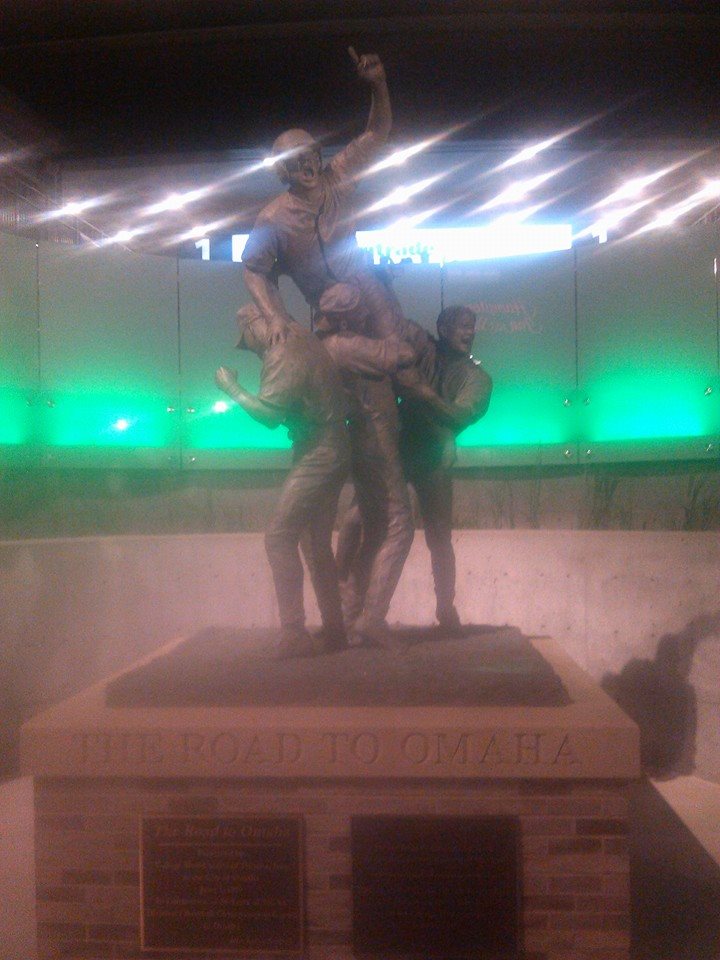
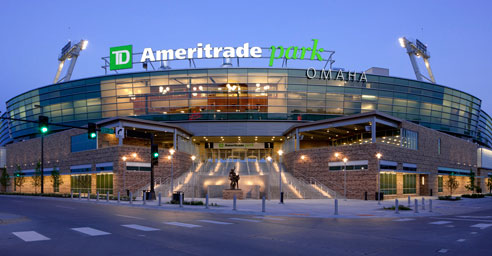
But since 1950, the 12-day College World Series, college baseball championship, has been held in the City of Omaha. It was held at Rosenblatt Stadium from 1950 through 2010; starting in 2011, it has been moved to the new ultra-modern TD Ameritrade Park downtown. The 2013 attendance of 341,483 belies the economic benefits.

CWS Photo 2

CWS Photo 3

These facts reinforce the marketing tag line of CWS Omaha, Inc., (a Nebraska technocracy):

History Happens Here.

The prime directives of the CU/Go Lean roadmap are described with these 3 statements:

  • Optimization of the economic engines in order to grow the regional economy to $800 Billion & create 2.2 million new jobs.
  • Establishment of a security apparatus to protect the resultant economic engines.
  • Improve Caribbean governance to support these engines.

This roadmap commences with the recognition that genius qualifiers can be found in many fields of endeavor, including sports. The roadmap pronounces the need for the region to confederate in order to invest in the facilitations for the Caribbean sports genius to soar. These pronouncements are made in the Declaration of Interdependence, (Pages 13 & 14) as follows:

xxi. Whereas the preparation of our labor force can foster opportunities and dictate economic progress for current and future generations, the Federation must ensure that educational and job training opportunities are fully optimized for all residents of all member-states, with no partiality towards any gender or ethnic group. The Federation must recognize and facilitate excellence in many different fields of endeavor, including … sports. This responsibility should be executed without incurring the risks of further human flight, as has been the past history.

xxii. Whereas sports have been a source of great pride for the Caribbean region, the economic returns from these ventures have not been evenly distributed as in other societies. The Federation must therefore facilitate the eco-systems and vertical industries of sports as a business, recreation, national pastime and even sports tourism – modeling the Olympics.

All in all, the Go Lean book and accompanying blogs declare that the Caribbean needs to learn lessons from CWS-Omaha and other sporting venues/administrations. And thus this subject of the “business of sports” is a familiar topic for Go Lean blogs. The previous blogs as follows, and this one, constitutes 8 of the first 100 entries:

a. https://goleancaribbean.com/blog/?p=1214 The Art & Science of Temporary Stadiums – No White Elephants
b. https://goleancaribbean.com/blog/?p=1148 Sports Bubble – Franchise values in basketball
c. https://goleancaribbean.com/blog/?p=1020 Sports Revolutionary: Advocate Jeffrey Webb
d. https://goleancaribbean.com/blog/?p=498 Book Review: ‘The Sports Gene’
e. https://goleancaribbean.com/blog/?p=334 Bahamians Make Presence Felt In Libyan League
f. https://goleancaribbean.com/blog/?p=318 Collegiate Sports in the Caribbean
g. https://goleancaribbean.com/blog/?p=60 Could the Caribbean Host the Olympic Games?

This Go Lean roadmap is committed to availing the economic opportunities of all the Caribbean athletic abilities. The book details these series of community ethos, strategies, tactics, implementations and advocacies designed to deliver regional solutions:

Community Ethos – Return on Investments Page 24
Community Ethos – Ways to Foster Genius Page 27
Community Ethos – Ways to Impact the Greater Good Page 37
Strategic – Staffing – Sporting Events at Fairgrounds Page 55
Tactical – Fostering a Technocracy Page 64
Tactical – Separation of Powers – Sports & Culture Administration Page 81
Tactical – Separation of Powers – Fairgrounds Administration Page 83
Implementation – Steps to Implement   Self-Governing Entities Page 105
Implementation – Ways to Deliver Page 109
Planning – Ways to Make the Caribbean   Better Page 131
Advocacy – Ways to Grow the Economy Page 151
Advocacy – Ways to Improve Local Government – Parks & Recreation Page 169
Advocacy – Ways to Impact Events Page 191
Advocacy – Ways to Promote Fairgrounds Page 192
Advocacy – Ways to Improve Sports Page 229
Advocacy – Ways to Impact Urban Living – Sports Leagues Page 234

The Go Lean roadmap encourages solid business plans to develop sports stadia and arenas at CU-owned fairgrounds. Where appropriate, there should be the deployment of temporary bleacher seats/grandstands and structures (think: golf tournaments and Beach Volleyball). There is an obvious economic impact from deployments of Sports Tourism in areas like jobs, ticket sales, hotel bookings and other community spin-off spending.

The following 8 teams in this year’s tournament are indicative of the need for hospitality as they are from cities all around the country:

UC Irvine Texas Tech
Texas TCU
Louisville Ole Miss
Vanderbilt Virginia

There are obvious community benefits from this business model. In fact, the Go Lean roadmap anticipates 21,000 direct jobs at fairgrounds and sports enterprises throughout the region. This is not bad for lessons learned from the College World Series in Omaha.

Now is the time for all of the Caribbean, the people and governing institutions, to lean-in for the empowerments of the Caribbean Union Trade Federation, as prescribed by the Go Lean…Caribbean roadmap.

Share this post:
, , , ,
[Top]

The Art & Science of Temporary Stadiums – No White Elephants

Go Lean Commentary

Learn from Greece – Why build expensive permanent stadiums for temporary (sports/cultural) events, when there is such an effective art and science with temporary stadiums?! This important lesson was ignored in Brazil for the FIFA World Cup 2014.

The book Go Lean…Caribbean, serving as a roadmap for the introduction and implementation of the technocratic Caribbean Union Trade Federation (CU), advocates this lesson and declares that “a mission of the CU is to forge industries and economic drivers around the individual and group activities of sports and culture”. There is the need for temporary stadiums for events and festivals; (see Temporary Structures Models & Systems Appendix below).

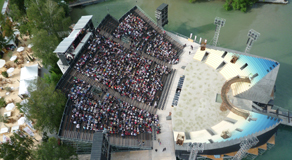
This temporary stadium was erected in Germany for the 2006 FIFA World Cup championship game.

This temporary stadium was erected in Germany for the 2006 FIFA World Cup championship game.

The need to optimize sports/cultural events & festivals have previously been addressed in the following Go Lean blogs entries:

a. https://goleancaribbean.com/blog/?p=1148 Sports Bubble – Franchise values in basketball
b. https://goleancaribbean.com/blog/?p=1020 Sports Revolutionary: Advocate Jeffrey Webb
c. https://goleancaribbean.com/blog/?p=676 PM Christie responds to critics of Bahamian ‘Carnival’
d. https://goleancaribbean.com/blog/?p=498 Book Review: ‘The Sports Gene’
e. https://goleancaribbean.com/blog/?p=334 Bahamians Make Presence Felt In Libyan League
f. https://goleancaribbean.com/blog/?p=318 Collegiate Sports in the Caribbean
g. https://goleancaribbean.com/blog/?p=60 Could the Caribbean Host the Olympic Games?

All in all, the book and accompanying blogs declare that the region needs to learn lessons from other sporting venues like Athens-Greece, South Africa and Brazil. The people of the Caribbean cannot afford such monumental mis-steps – see VIDEO below. So this Go Lean… Caribbean roadmap applies the lessons learned and details the following 3 prime directives:

  • Optimization of the economic engines in order to grow the regional economy to $800 Billion & create 2.2 million new jobs.
  • Establishment of a security apparatus to protect the resultant economic engines.
  • Improve Caribbean governance to support these engines.

This roadmap commences with the recognition that genius qualifiers can be found in many fields of endeavor, including music, sports and the performing arts. To exploit the economic benefits of these fields require some facilitation, like stadia, arenas and theaters. The roadmap pronounces the need for the region to confederate in order to invest in the facilitations for the Caribbean genius to soar. These pronouncements are made in the Declaration of Interdependence, (Pages 13 & 14) as follows:

xxi.      Whereas the preparation of our labor force can foster opportunities and dictate economic progress for current and future generations, the Federation must ensure that educational and job training opportunities are fully optimized for all residents of all member-states, with no partiality towards any gender or ethnic group. The Federation must recognize and facilitate excellence in many different fields of endeavor, including sciences, languages, arts, music and sports. This responsibility should be executed without incurring the risks of further human flight, as has been the past history.

xxii.      Whereas sports have been a source of great pride for the Caribbean region, the economic returns from these ventures have not been evenly distributed as in other societies. The Federation must therefore facilitate the eco-systems and vertical industries of sports as a business, recreation, national pastime and even sports tourism – modeling the Olympics.

The Go Lean vision is a confederation of the 30 member-states of the Caribbean forming a proxy organization to do the heavy- lighting of building, funding and maintaining sports/event venues. The strategy is to deploy temporary structures where appropriate on CU fairgrounds, as some events may require specific configurations, but only for a few days every year. Tactically, the Go Lean roadmap calls for a separation-of-powers between the member-state governments and the new federal agencies; so the CU will serve as the landlord for local, national and regional events.

The subsequent article and VIDEO (from the cable channel HBO’s documentary Real Sports) describes the folly for expensive permanent stadiums for short-term events; especially while the art and science of temporary stadiums is so effective.

Title: HBO’s Real Sports tackles the white elephants of the World Cup and Olympics
Posted by Joe Lucia on May 20, 2014 10:31
(http://awfulannouncing.com/2014/hbos-real-sports-tackles-the-white-elephants-of-the-world-cup-and-olympics.html)

The lead story of May’s episode of Real Sports on HBO tackles the World Cup, but in a different way

Next month’s World Cup in Brazil (starting June 12, 2014) has resulted in numerous brand new soccer stadiums being built all across the country. Once the World Cup ends, the stadiums will more than likely remain dormant – which is where the “white elephants” title of the segment comes into play. In South Africa four years ago, ten stadiums were built at the cost of billions of dollars. Nine of those stadiums stand relatively unused today.

The same thing happens when countries host the Olympics – it doesn’t take too much effort to find evidence of stadiums or arenas being built solely to hold events and then be used for nothing or razed years later. The 2004 Olympics in Athens are a stark example of the waste that goes into holding events like the Olympics and the World Cup, as many of the arenas and stadiums built for the events stand empty.

Perhaps even more shocking – the organizers of these events in those host countries openly admit to having no plan for the future of the venues. The Greek economy collapsed in large part to the massive amount of waste that went into the Olympics a decade ago, with the crumbling stadiums as reminders of that waste.

Today, Brazil is preparing by the World Cup by spending more money than any country in history. A brand new, $270 million stadium was built in the remote town of Manaus for just four games this World Cup. Manaus is so remote that many Brazilians can’t even drive there. Materials to build the stadium were shipped from Portugal, across the Atlantic Ocean and transported down the Amazon River. All that for four games in a town that HBO described as “a weigh station.”

The organizers are oblivious to this. The designer of the stadium in Manaus claims that when people watch the games on television, they will become aware of the city, and tourism and investment opportunities will increase. Apparently, eight hours of soccer over the month of June will create all of that goodwill.

For a country like Brazil, bathed in poverty, to burn away billions of dollars on stadiums and arenas for the World Cup and the 2016 Olympics is shameful. Once the World Cup ends and Olympics preparation begins, homes in Rio de Janeiro will be razed to make room for the venues, sending many Brazilian citizens into homelessness for the sake of a two week sporting event.

in a country like Brazil that is teetering on the edge of financial chaos, dumping billions of dollars into sports while a bulk of your citizens are poor, starving, and lacking healthcare seems like a recipe for a disaster, with nothing but empty stadiums and a page on Wikipedia to show for it when all is said and done.

VIDEO: Real Sports with Bryant Gumbel: Episode #206 Web Clip – White Elephants (HBO Sports) – http://youtu.be/lHUiyxKgg1s

Jon Frankel travels to Athens, Greece plus Manaus and Rio de Janeiro in Brazil and looks for answers to the question of: Are billions being wasted on World Cup and Olympic venues?

The Go Lean book details these series of community ethos, strategies, tactics, implementations and advocacies designed to re-boot the delivery of the regional solutions, so badly needed and hoped for:

Community Ethos – Ways to Foster Genius Page 27
Community Ethos – Ways to Promote Happiness Page 36
Strategic – Visitors – Snow Birds at RV Campgrounds Page 55
Strategic – Staffing – Events at Fairgrounds Page 55
Tactical – Fostering a Technocracy Page 64
Tactical – Separation of Powers – Sports & Culture Administration Page 81
Tactical – Separation of Powers – Fairgrounds Administration Page 83
Implementation – Steps to Implement Self-Governing Entities Page 105
Implementation – Ways to Deliver Page 109
Planning – Ways to Make the Caribbean Better Page 131
Advocacy – Ways to Grow the Economy Page 151
Advocacy – Ways to Improve Local Government – Parks & Recreation Page 169
Advocacy – Ways to Impact Events Page 191
Advocacy – Ways to Promote Fairgrounds Page 192
Advocacy – Ways to Foster Technology Expositions Page 197
Anecdote – Model of Miami-DadeCounty Youth Fair Page 227
Advocacy – Ways to Improve Sports Page 229
Advocacy – Ways to Improve the Arts Page 230
Advocacy – Ways to Promote Music Page 231
Advocacy – Ways to Impact Urban Living – Sports Leagues Page 234
Temporary Stadiums - Golf

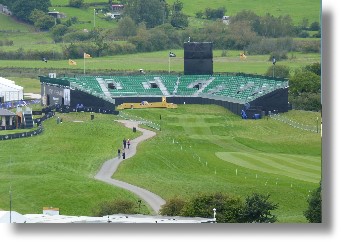
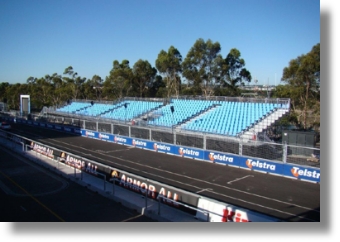
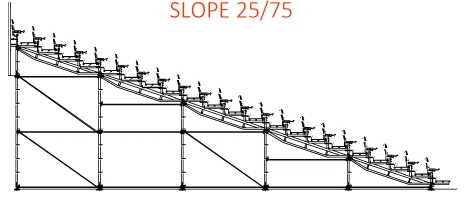
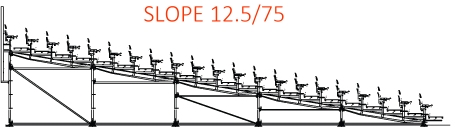
This stadium is the Pakar Seating Grandstand system. It is so versatile that it’s suitable for any type of Golf Competition event.

The foregoing article discourages investment in permanent venues unless there is a solid long-term business plan. The Go Lean roadmap concurs – Greece did not recover from the flawed Olympic build-out for facilities that were never used again after the 2004 Games. On the other hand, here is the encouragement and recommendation to develop fairgrounds and deploy temporary stadia, arenas and theaters. Imagine a golf tournament; no one would expect bleachers and grandstands at the putting greens to be permanent structures. No, there is a place for temporary structures in the world of sports.

Temporary Stadiums - Beach Volleyball

The Bondi Beach Volleyball Stadium was constructed for the Sydney 2000 Olympic Games and stood for just six weeks. The temporary stadium was constructed on the world-famous Bondi Beach and had over 10,000 seats.

There is one sport, Beach Volleyball, which only uses temporary bleachers/grandstands – 100 percent.
So there is a place for the arts & sciences of temporary structures. There is the need for their economic impact.

The Go Lean roadmap anticipates 21,000 direct jobs at fairgrounds and sports enterprises throughout the region.

Now is the time for all of the Caribbean, the people and governing institutions, to lean-in for the empowerments of the Caribbean Union Trade Federation. Now is the time to make this region a better place to live, work and play. 🙂

Download the free e-Book of Go Lean … Caribbean – now!

========================

*** APPENDICES ***

Appendix A – Sample New Stadiums for Brazil
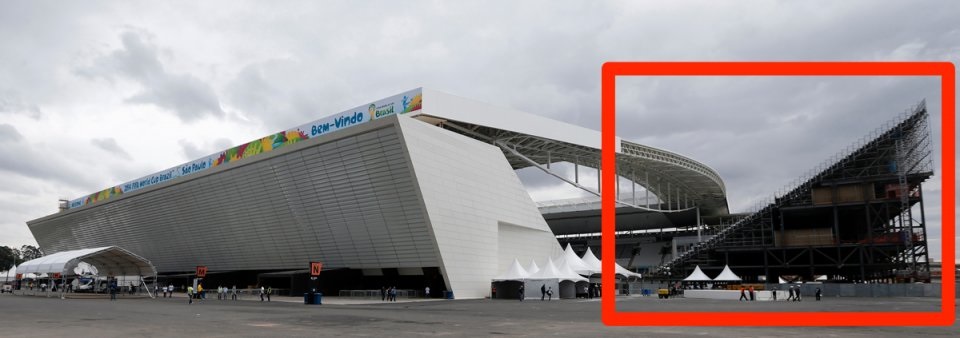
The permanent structures call for more elaborate construction schedules and risks. Some delays have been unavoidable – see this article (photos) on the Sao Paulo stadium slated for the opening game on June 12, 2014; posted and retrieved 06/04/2014:

http://www.businessinsider.com/bleachers-at-sao-paulo-world-cup-stadiums-2014-6#ixzz33iMAwtEf

Brazil prepares…
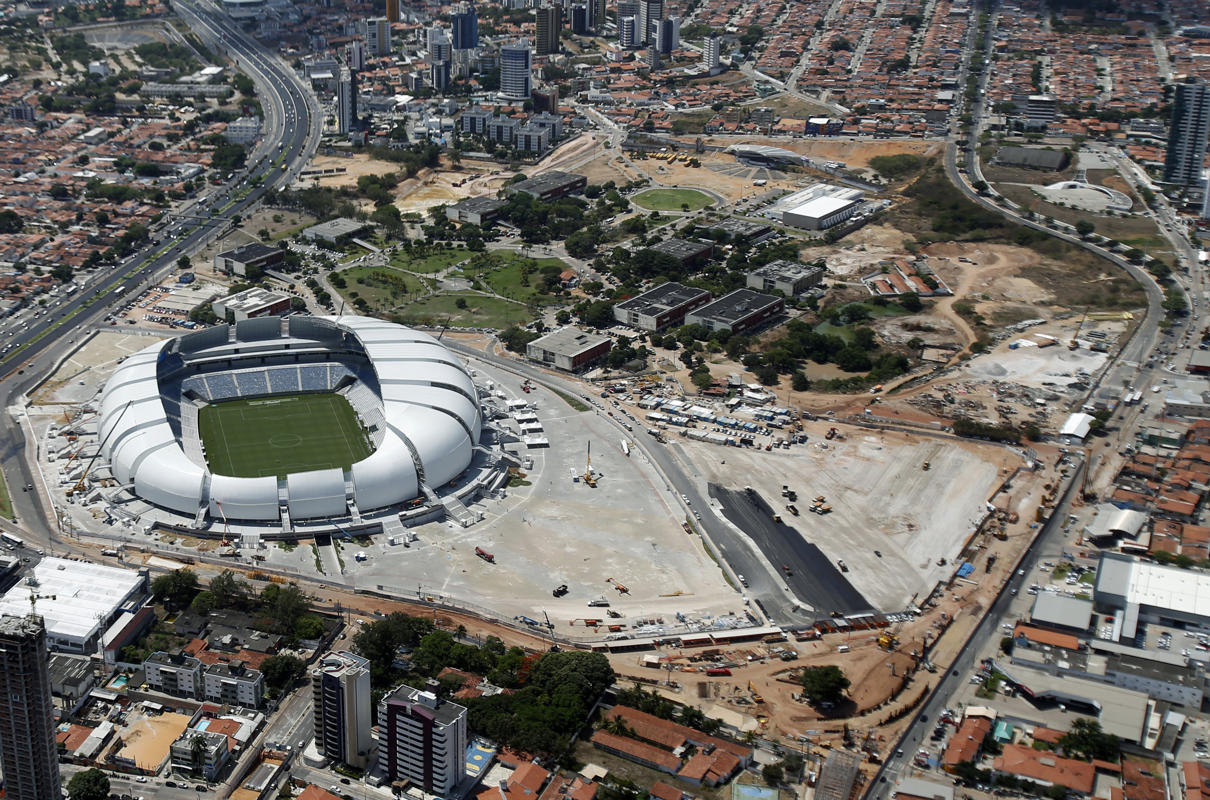
When Brazil drafted plans to host the upcoming World Cup, Natal, the Atlantic beach destination was exactly the type of city it wanted to show off. Five years later, and four weeks before kickoff, little besides the arena and a remote, untested airport are complete.

Almost half the more than $1.3 billion in promised developments [in Natal] never began. What did [begin] has languished, including ongoing road work that has rendered the stadium’s outskirts a raw sprawl of rebar, dust and concrete. (Reuters)

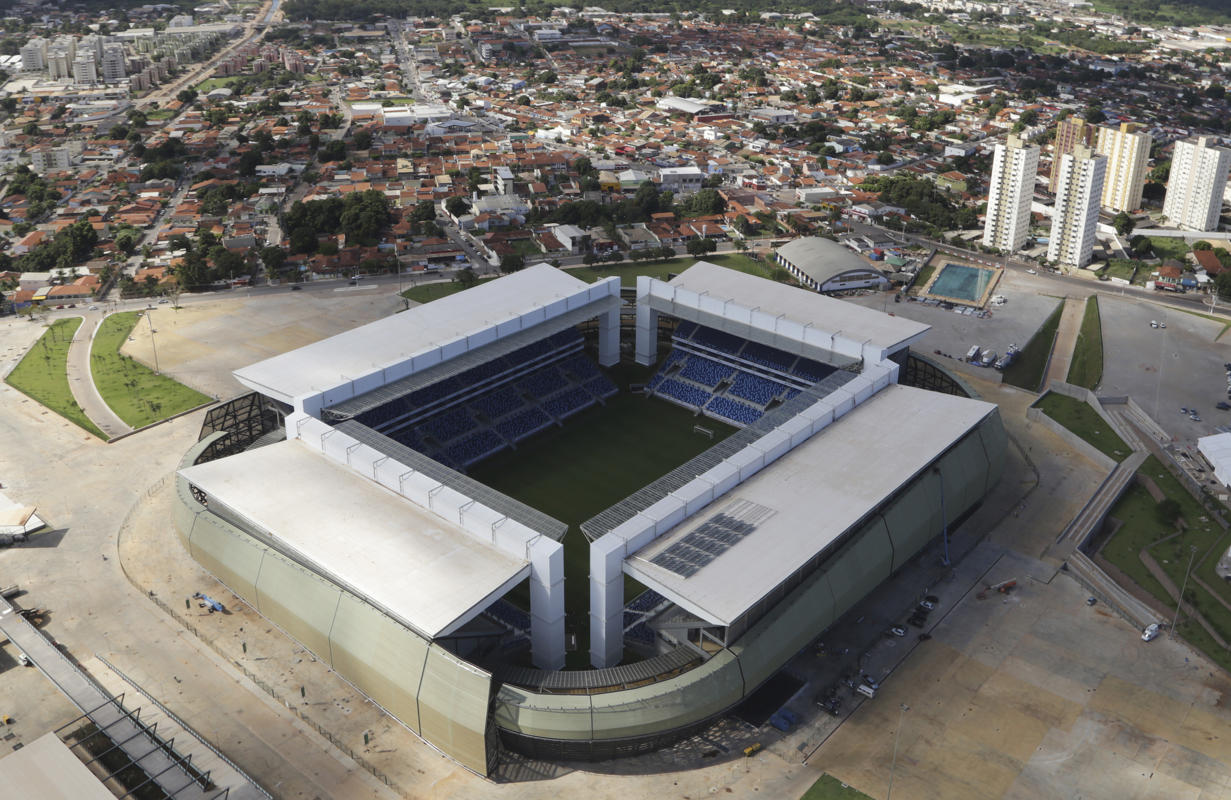
An aerial view of the Arena Pantanal soccer stadium in Cuiaba, April 25, 2014. Cuiaba is one of the host cities for the 2014 World Cup in Brazil. See photos here (REUTERS/Joel Marcos):

Temporary Stadiums - Natal

An Aerial view of the Arena das Dumas from January 22, 2014; this stadium will host matches for the 2014 soccer World Cup.

Temporary Stadiums - Cuiaba

This is the incomplete stadium in Natal; with 4 weeks before the first event, the infrastructural improvements for the surrounding areas have still not been completed.

Temporary Stadiums - Sao Paulo

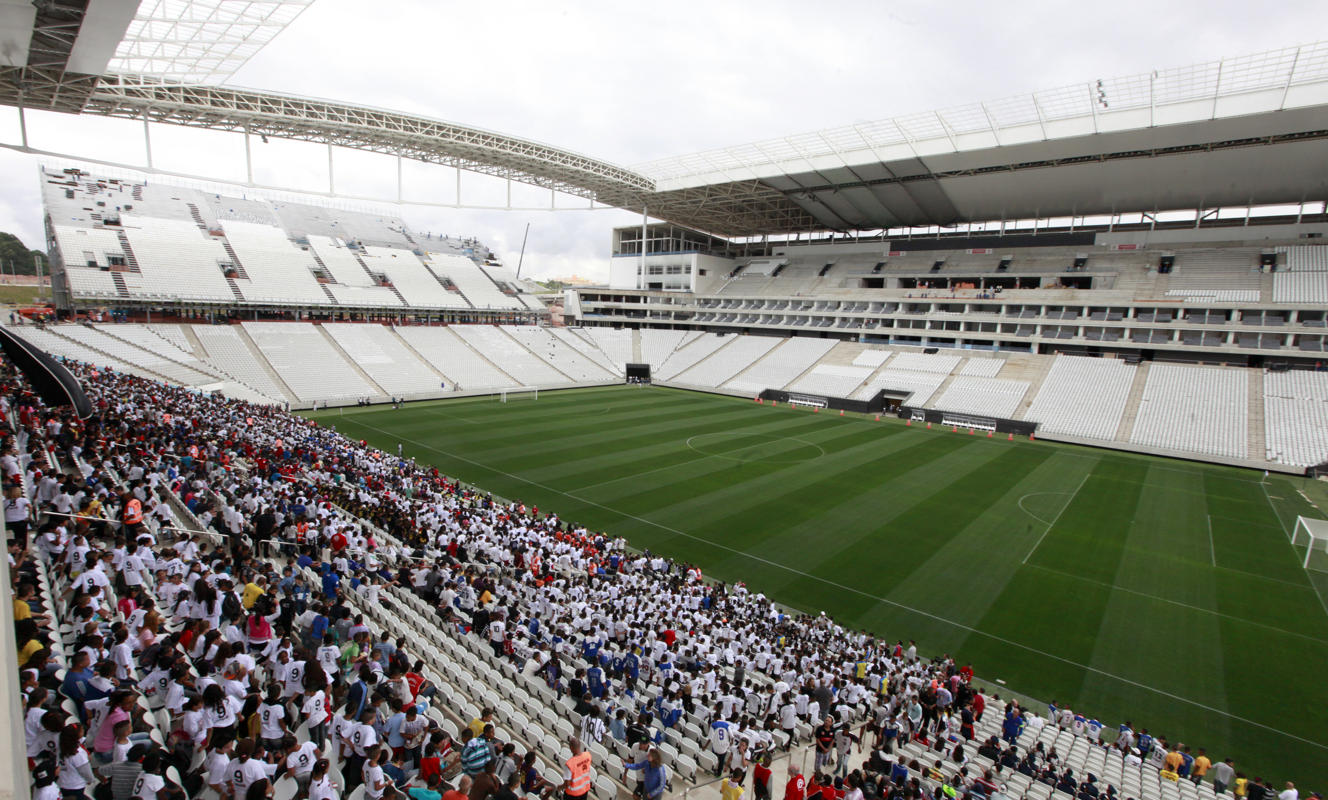
People stand in the bleachers during an infrastructure test at Arena de Sao Paulo Stadium, one of the venues for the 2014 World Cup, in the Sao Paulo district of Itaquera April 26, 2014.

Appendix B – Temporary Structures Models & Systems
Many examples of successful temporary stadia, arenas and theaters abound – see photos here.

Here are 2 reputable vendors for providing these products and services.

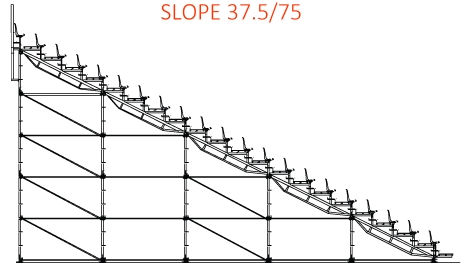
1. PAKAR Grandstand is extremely versatile, therefore, it can be installed either as a PERMANENT or REMOVABLE Grandstand. It can be displaced and re-installed at any location quickly and easily. The system of frames is pre-assembled with an interlocking system, ties, braces, beams and deck units that locks together for fast assembly. Our Grandstand can be installed on any type of surface i.e. concrete, grass and sand (Desert). It can be installed on a slope depending on soil condition. Our system can be used both Outdoor and Indoor. For Outdoor use, it can be equipped with a roof system (Complete roofing or Semi-roofing). Source: http://www.pakar-seating.com/

Temporary Stadiums - Padel

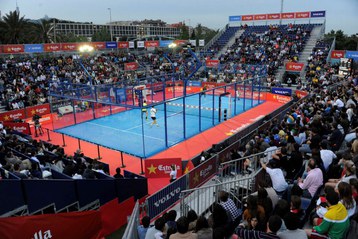
Padel is a relatively new racquet sport that is extremely popular in Spain. The logistics of this platform accommodates each individual sports event and is 600 square meters in size and has 3,000 seats around it.

Temporary Stadiums - Soccer

This stadium is a modular stadium built by NUSSLI who has developed flexible and sustainable concepts for popular global sports and cultural events

Temporary Stadiums - Theater

This stadium is not only for sporting events, but it is ideal for cultural activities as well.

Grandstand bleachers for a drag racing configuration

2. Temporary Stadium, Modular Stadium Construction, Stadia Expansion.

NUSSLI provides complete modular stadiums and arenas or additional grandstands – with or without roofing. We offer our stadium construction solutions for rental (temporary) or sale (permanent).

The experience gained from multifaceted stadium projects around the world makes NUSSLI a reliable partner in modular stadia construction and in stadium expansion. NUSSLI‘s mobile stadia fulfill the highest demands in regard to safety, functionality, and architecture.

The modular stadium® can be adapted to meet changing requirements and individual customer needs over and over again. The stadium can be installed in virtually no time and removed just as quickly after use.

The NUSSLI service range in stadium construction:
•Stadia and arenas (modular, temporary, permanent, mobile)
•Stadium expansion (modular, temporary, permanent)
•Additional grandstand, roofing
•Steel tube grandstand
•Service buildings

Modular Stadium® – a Convincing System.
Those who modularly build or expand stadiums and arenas enjoy considerable advantages over those using the traditional building method. The key factors of modular stadium construction are savings in cost and time.

Cost advantage: The use of modules can be temporally limited, therefore avoiding costs for possible surplus capacities. The standardization shortens planning and construction processes.

Fast and flexible: modular stadium constructions or expansions by NUSSLI beat any other system in regard to installation speed.
Source: http://www.nussli.us/services/stadium-construction.html

 Temporary Stadiums - Photo 1Temporary Stadiums - Grandstands Temporary Stadiums - Slopings 1 Temporary Stadiums - Slopings 2 Temporary Stadiums - Slopings 3

Share this post:
, , , , ,
[Top]

Sports Bubble – Franchise values in basketball

Go Lean Commentary

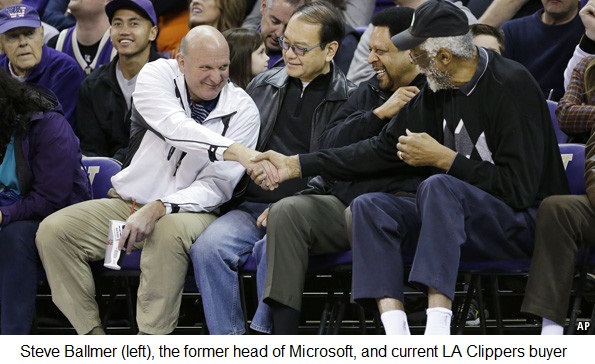
BBall2The foregoing news article highlights a topical issue in the world of sports, basketball in particular: the blatant racism of basketball team owner by octogenarian Donald Sterling. The sports league, the NBA, expelled him from the league and has announced that it is moving forward with the forced sale of the Los Angeles Clippers to former Microsoft CEO Steve Ballmer for $2 Billion.

There are many lessons to learn/apply from this Donald Sterling / LA Clippers drama. Lessons such as:

  • There are more important things than money – the sports world rallied in support of the campaign to divorce the antagonist, Donald Sterling, from his team ownership.
  • Money covers a multitude of sins – the indication is that Mr. Sterling’s conduct was unbecoming for a long time before this episode.
  • Sports are immune to economic cycles – team values continue to rise despite depressed asset values during the Great Recession.
  • Sports are not immune to economic realities – there is a real possibility of a bubble due to the absence of economic fundamentals of some teams; there is still the need for technocratic efficiency.
  • Technology in broadcasting is transforming the sports industry – since DVR programming neutralizes the exposure to advertising, live sports broadcasts stand out as an exception: reliable audience. This thereby increases league/team values.
  • Institutional racism is real – the generation that practiced segregation is still alive and wields power, like 80-year-old Donald Sterling.
  • Attitudes in sports can mold society – the public sympathized with Black personnel having to work for an owner with racist views towards Black people; the NBA was forced to act quickly to expel Sterling from the league, with national concurrence.
  • The business of sports can shape a community’s economic landscape – the new value assessment of the Clippers has now elevated all the sport franchises in Los Angeles and related cities; now all connected properties and neighborhoods have appreciated in value as well.

The book, Go Lean … Caribbean, serves as a roadmap for the introduction and implementation of the Caribbean Union Trade Federation (CU). This subject of blatant racism in sports ownership is in scope for the CU as this technocratic agency will assume responsibility for regional sports administration. The roadmap has the prime directives to elevate the Caribbean’s:

(1) economy,

(2) security apparatus, and

(3) governing engines.

The Economist Magazine (Posted & Retrieved 05/31/2014) –
FOR all Donald Sterling’s well-known faults—the owner of the Los Angeles Clippers basketball team seems to have comfortably secured a role as the face of racism in America—no one has ever accused him of being a bad businessman. Although most of his fortune came from real estate, he is now on the brink of closing out what is probably the most profitable investment in the history of professional sports. The other 29 team owners of the National Basketball Association (NBA) are set to hold a vote on June 3rd to terminate his control of the Clippers, in response to a tape of his offensive remarks about blacks that was leaked to the media. But the league’s commissioner, Adam Silver, had let it be known that he would prefer a voluntary sale to happen first—managed by Mr. Sterling’s estranged wife Rochelle, since Mr. Silver had already banned Mr. Sterling for life and thus prevented him from exercising control over the team.

On May 29th the commissioner’s wish was granted, when Ms. Sterling announced that Steve Ballmer the former head of Microsoft, had agreed to buy the Clippers for the eye-popping sum of $2 billion. Although the Los Angeles Dodgers baseball team went for a slightly higher $2.15 billion in 2012, that deal included valuable real-estate assets as well, whereas the Clippers are essentially being sold on their own. The previous record price for an NBA club was just $550m, set by the Milwaukee Bucks earlier this year, and Forbes magazine valued the Clippers at a mere $575m in January. Mr. Ballmer’s bid comfortably exceeded the reported $1.6 billion offered by a group led by David Geffen, a media executive.

BBall1Mr. Sterling has not yet announced whether he will try to block the sale. Since he bought the team for a piddling $12.5m in 1981 and lives in the high-tax state of California, the deal would cost him an estimated $662m in capital-gains taxes. Moreover, his lawyer has demanded that the league retract its accusations against Mr. Sterling, though an after-tax profit of $1.326 billion might help him to swallow his pride. It is not yet clear whether Mr. Sterling could hold up the deal if he wants to. His representatives insist that no sale can proceed without his signature. But the family trust that formally owns the club has declared the 80-year-old Mr Sterling mentally incapacitated—an opinion shared by many viewers of his ill-advised interview with Anderson Cooper on CNN—in order to give his wife sole authority over the franchise. Mr Sterling has a well-earned reputation for litigiousness, and would surely challenge any sale by Ms Sterling against his will in court. However, that would cause the league to re-initiate termination proceedings against him.

The NBA will also still have to approve Mr. Ballmer, but that is expected to be a mere formality. Paul Allen, another Microsoft billionaire, already owns the Portland Trail Blazers, and the league vetted Mr. Ballmer when he made a failed bid for the Sacramento Kings. Mr. Silver will be eager to remove a pariah from the league as quickly and quietly as possible, and to avoid the prospect of a long court battle with Mr. Sterling. And the commissioner surely wants to lock in the lofty sale price, which sets a new valuation bar for every other franchise.

Mr Ballmer is yet to speak publicly about his financial calculus, except to assure the NBA that he would not seek to move the Clippers to Seattle, as he hoped to do with the Kings. (He told the Wall Street Journal that relocating the club out of America’s second-biggest market would be “value destructive”.) Microsoft shareholders who despaired at his string of high-priced acquisitions for the company can at least take solace that he is no thriftier with his own money: the Clippers will cost an estimated 10% of his net worth.

To be sure, there are strong arguments for a ten-figure price for the team. Sports franchise values have been soaring in recent years, thanks to record-setting rights deals from television networks desperate for DVR-proof programming. Both the NBA’s national contract and the Clippers’ local one are set to expire in the coming years, leaving the team doubly well-positioned to cash in. And following an acrimonious lockout in 2011, the league’s current collective-bargaining agreement sharply cut the share of its revenues that gets paid out in salaries, which made clubs far more profitable. Low interest rates are driving up prices for all assets, and the combination of rising inequality and greater international interest in basketball has increased the number of billionaires willing to splurge on an NBA team.

Moreover, the Clippers currently find themselves in an unfamiliar spot as the best basketball team in Los Angeles, and indeed all of California. The Lakers, their far better-loved crosstown rivals, are suffering through a difficult rebuilding phase, whereas the Clippers finished with the league’s third-best record this year. No one would blink an eye if the Lakers sold for $2 billion, and in theory there’s no reason why the team’s electrifying “Lob City” offence featuring Chris Paul and Blake Griffin could not supplant the slumping Lakers for Angelenos’ affections.

On the other hand, brand loyalty matters as much or more in sports as the on-field product. In 2009 the Chicago Cubs, baseball’s iconic lovable losers, sold for $845m despite putrid overall economic conditions, because they were the more popular club in a big two-team market. As measured by Facebook likes, there is not a single postal code in which the Clippers are even one-fifth as popular as the Lakers, and the Lakers are the preferred club in pretty much every part of the United States that lacks a nearby team save the Southeast. The Lakers’ local television deal pays them $180m a year; the Clippers are expected to fetch 60% less for their next contract. Mr. Sterling’s 33 years of penny-pinching mismanagement have left a stain on the franchise that no number of Paul-to-Griffin windmill alley-oops can erase. When Jack Nicholson attends a Clippers game, it’s news; when he goes to see the Lakers, it’s just normal.

The great unknown is whether the going rate for televised sports rates is sustainable. Cable carriers like Time Warner have already begun offering cheaper packages that exclude expensive sports channels, and John McCain, a senator from Arizona and former presidential candidate, has introduced a bill that would “unbundle” cable television and let viewers choose the channels they want a la carte. Both approaches would reduce the “sports tax” that non-fans currently pay to subsidise fans via their cable bills. Technological advances or piracy could also disrupt the current lucrative delivery model, as they have with so many other types of media.

Buying a team for a billion or two is essentially a bet on the sports-media status quo continuing for at least another decade. It may well be a bubble. But it has already lasted for far longer than the naysayers ever thought possible.
http://www.economist.com/news/leaders/21603026-how-hand-over-272-billion-year-criminals-thats-where-money?fsrc=nlw%7Chig%7C30-05-2014%7C53552127899249e1cc9ea210%7CNA

The Go Lean … Caribbean roadmap commences with a Declaration of Interdependence. In Verse XXXI (Page 14) it pronounces specific dynamics of sports:

Whereas sports have been a source of great pride for the Caribbean region, the economic returns from these ventures have not been evenly distributed as in other societies. The Federation must therefore facilitate the eco-systems and vertical industries of sports as a business, recreation, national pastime and even sports tourism.

The foregoing news article is sourced from the Economist Magazine. Therefore this perspective is from a macro-economic vantage point, which is apropos for this roadmap, as this book posits that the right economic, financial and investment landscape can impact Caribbean society, forging sport franchises and facilitating growth in value and appreciation. The CU envisions being the landlord of sports leagues at CU fairgrounds – operating as Self-Governing Entities. Today in the Caribbean however, there is not much of a sports eco-system beyond the High School level. This roadmap envisions collegiate and professional sports manifestations, as a tool/technique to empower society.

The roadmap specifically elevates the region through a series of community ethos, strategies, tactics, implementations and advocacies to foster the business of sports in the Caribbean region:

Economic Systems Influence Choices and Incentives Page 21
Community Ethos – Anti-Bullying and Mitigation Page 23
Anecdote – Hail, Hail, the Champs: Miami Heat! Page 42
Tactical – Confederating a non-sovereign union Page 63
Tactical – Separation of Powers–Sports Administration Page 81
Implementation – Assemble Existing Regional Entities Page 96
Implementation – Consolidating Regional Spectrum Page 101
Implementation – Steps for Self-Governing Entities Page 105
Implementation – Reasons to Repatriate Page 118
Planning – Ways to Make the Caribbean   Better to Play Page 151
Advocacy – Ways to Improve Communications Page 156
Advocacy –   Ways to Promote Fairgrounds Page 193
Advocacy –   Impact Media/Broadcast/Hollywood Roles Page 201
Advocacy –   Ways to Improve Sports Page 218

Now is the time for all of the Caribbean, athletes and non-athletes alike to lean-in for the empowerments described in the book Go Lean … Caribbean. The benefits are too alluring, an improved, economically viable sports world; and a better place to live, work and play.

The Go Lean roadmap is not about basketball. But basketball is among the games people play; and play can be a great source of leisure and economics. The world is now watching the tropical region for basketball dominance. This is because the Miami Heat will now play for the NBA championship, starting this week Thursday (June 5, 2014) in their 4th straight NBA Finals. The roadmap posits that the Miami Heat relates to the Caribbean since its base is in Miami, Florida; a metropolitan area that possesses the largest pocket of Caribbean Diaspora. So in many ways, the Miami Heat is the “home team” of the Caribbean. Go Heat!

Download Go Lean … Caribbean – now!


Share this post:
, ,
[Top]

Sports Revolutionary: Advocate Jeffrey Webb

Go Lean Commentary

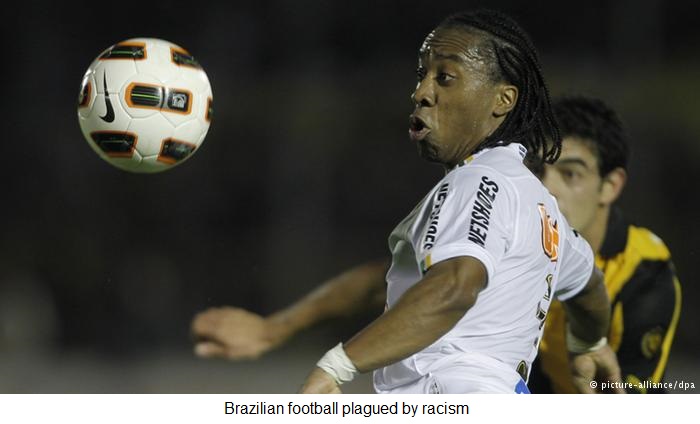
Sports Revolution 3The forgoing encyclopedia source focuses on the background person connected to an important issue in sports administration: blatant racism in European soccer.

Blatant racism is a scourge to the beautiful sport of football (soccer). Black players have to endure unspeakable acts of disrespect (cursing, spitting, monkey-chants, tossed bananas, etc). The international governing body for soccer/football, Fédération Internationale de Football Association (FIFA), wants to forge change among the game’s stakeholders. This issue relates to the Caribbean, in that the FIFA advocate in this cause is from the Cayman Islands.

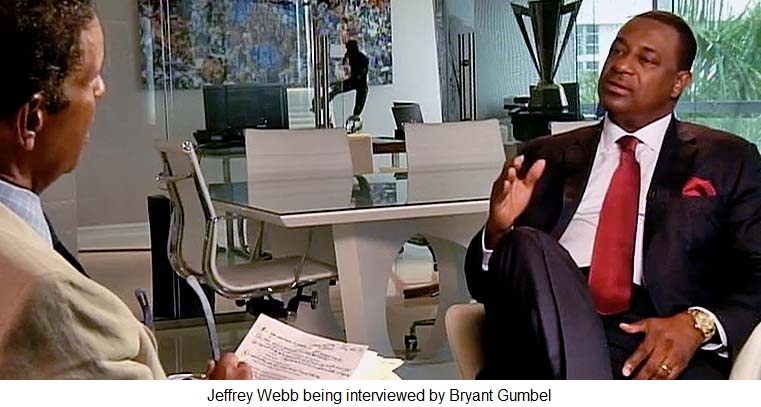
This advocate, Jeffrey Webb, is featured in a current episode of a sports documentary television show in the US.

Sports Revolution 1MIAMI — CONCACAF President Jeffrey Webb, who is Chairman of FIFA¹s Anti-Racism and Discrimination Task Force, appeared Tuesday (May 20, 2014) on the acclaimed HBO program Real Sports with Bryant Gumbel, addressing FIFA’s strategy and efforts to eradicate racism from football.  He discussed the governing body’s responsibility in providing meaningful support for all players around the globe and implementing tougher sanctions to fortify the sport, so that focus can be placed on the game itself.

The Emmy-winning show also featured an interview with United States international striker Jozy Altidore, a member of FIFA’s anti-discrimination body.

HBO will re-air the episode between May 20 and June 21, 2014.

During the 63rd FIFA Congress last year in Mauritius, Member Associations approved the Anti-Racism and Discrimination resolutions proposed by the task force chaired by President Webb.  The application of these resolutions in every country where football is played will bring universality to the mechanisms that combat racism and discrimination.

(http://www.concacaf.com/article/president-webb-speaks-about-racism-on-real-sports-with-bryant-gumbel)

Many professional athletes participating in European soccer, are of Afro-Caribbean heritage. This should be a proud legacy, one to be protected and promoted. (This is also an issue in Brazil).

Jeffrey Webb (born 1964) [1], is the president of CONCACAF and the Cayman Islands Football Association (CIFA) and FIFA Vice President.

He was educated at HillsboroughCommunity College in the United States. His career in the football field spans almost three decades. He was appointed as President of the Cayman Islands Football Association in 1991.[2]

CIFA’s accomplishments under Webb’s administration and leadership were widely recognized and in 1994 he was co-opted as a member of the CFU Executive Committee, and member of FIFA’s Protocol Committee in 1995. Prior to his appointment to CIFA, Webb served as President of the local football club Strikers FC.

Moreover, within FIFA’s governing body, in 2002 Webb became Deputy Chairman of the FIFA Internal Audit Committee and subsequently Chairman in 2011. He is a former member of FIFA’s Transparency and Compliance Committee and, most recently, was appointed as member of FIFA’s Strategic, Finance, Organizing World Cup and Emergency Committees.

Sports Revolution 2Webb also took part of FIFA’s delegations to the World Cup including France (1998), U.S. Women’s World Cup (1999), Korea/Japan (2002), Germany (2006), and South Africa (2010).

Webb was a Business Development Manager at Fidelity Bank (Cayman) Limited, a subsidiary of Fidelity Bank & Trust International Limited, which is involved in retail banking, investment banking, corporate finance and asset management. Outside of banking, Webb co-owns a franchise of Burrell’s bakery chain “Captain’s Bakery” in the Cayman Islands.[3]

On May 23, 2012, in Budapest, Hungary, Webb was unanimously elected to lead the Confederation of North, Central America and the Caribbean Football Association (CONCACAF). He became the fourth President in the Confederation’s history and the youngest leader of any regional association within FIFA to reach this position. As CONCACAF President, his core focus is to restructure the Confederation by building solid foundations to manage, develop and promote the game with a resilient commitment to inclusiveness, accountability and transparency.

As President of CONCACAF, Webb also became FIFA Vice President and an official member of the governing body’s Executive Committee. Moreover, on March 2013 Webb was appointed by FIFA President Joseph Blatter as Chairman of the FIFA anti-discrimination task force, which will oversee all matters related to discrimination within global football.

At the time of his appointment, in 2012, Webb was President of the Cayman Islands Football Association (CIFA).

Webb appointed a new Miami-based General Secretary Enrique Sanz de Santamaría enabling the CONCACAF head office to relocate to Miami.[4]

Source References:

  1. “Jeffrey Webb profile”. FIFA.com. Retrieved 11 July 2013.
  2. “Jeff Webb profile”. Cayman Active. 6 January 2011. Retrieved 1 March 2012.
  3. Brown, Rudolph (9 February 2002). “Captain’s Bakery opens in Cayman”. Gleaner (Jamaica). Retrieved 1 March 2012.
  4. “CONCACAF appoints Enrique Sanz as General Secretary”. CONCACAF.com. 13 July 2012. Retrieved 14 July 2012.

Wikipedia Online Encyclopedia (Retrieved 05/25/2014)–http://en.wikipedia.org/wiki/Jeffrey_Webb

The book Go Lean … Caribbean recognizes that image is an important intangible factor that must be managed to optimize value of Caribbean contributions – more value should equal more pay – see Appendix A – Table. As such the book is submitted as a complete roadmap to advance the Caribbean economy/culture, at home, for Caribbean residents, and advance the Caribbean image throughout the world, to benefit residents and Diaspora alike – see Appendix B for book reference on Brazil footballers.

The book, Go Lean … Caribbean, serves as a roadmap for the introduction and implementation of the Caribbean Union Trade Federation (CU), as a sentinel for the Caribbean “image”. This subject of blatant racism in European soccer is in scope for the CU as this technocratic agency will assume oversight to optimize the region’s:

(1) economy,

(2) security apparatus, and

(3) governing engines.

The roadmap commences with a Declaration of Interdependence. In Verse XXXI (Page 14) it pronounces:

Whereas sports have been a source of great pride for the Caribbean region, the economic returns from these ventures have not been evenly distributed as in other societies. The Federation must therefore facilitate the eco-systems and vertical industries of sports as a business, recreation, national pastime and even sports tourism.

The book posits that one person can make a difference in the Caribbean, and its impact on the world; that there are many opportunities where one champion, one advocate, can elevate society. In fact the book is a collection of 144 different advocacies, so there is inspiration for the Jeffrey Webb’s of the region to make their mark in many different fields of endeavor.

The roadmap specifically encourages the region to foster the genius potential (Page 27) in their communities, forge leadership skills (Page 171), improve for sports (Page 229) and pursue the Greater Good (Page 37). With the participation of many advocates on many different paths for progress, the Caribbean can truly become a better place to live, work and play. We can, and must, promote positive images (Page 133).

Download the free e-Book of Go Lean … Caribbean – now!

————————-

Appendix A – Table: Lucky 18 – The World’s Highest Paid Black Athletes for 2011

Athlete Sport Heritage Contract $$$*
Tiger Woods Golf American $75 million
Kobe Bryant Basketball American $53 million
LeBron James Basketball American $48 million
Dwight Howard Basketball American $27.6 million
Dwayne Wade Basketball American $26.2 million
Carmelo Anthony Basketball American $25.1 million
Ronaldo de Assis Moreira aka “Ronaldinho” Football / Soccer Brazil $24.7 million
Amar’e Stoudemire Basketball American $24.5 million
Kevin Garnett Basketball American $23.8 million
CC Sabathia Baseball American $23.6 million
Vince Carter Basketball American $21.8 million
Tim Duncan Basketball US Virgin Islands $21.2 million
Chris Paul Basketball American $20.9 million
Ryan Howard Baseball American $20.8 million
Usain Bolt Track and Field Jamaican $20.3 million
Rashard Lewis Basketball American $20.1 million
Jahri Evans American Football American $19.1 million
Michael Redd Basketball American $18.8 million

Source: http://madamenoire.com/60523/lucky-17-the-worlds-highest-paid-black-athletes/; posted June 10, 2011; retrieved May 25, 2014.

* Salaries, bonuses, prize money, appearance fees, licensing & endorsement income in the 12 months ending May 1, 2011

————————————

Appendix B: Book Reference

The phrase ‘Brazilian soccer player’ is like the phrases ‘French chef’ or ‘Tibetan monk.’ The nationality expresses an authority, an innate vocation for the job – whatever the natural ability.

Original: Bellos, Alex (2003). Futebol: The Brazilian Way of Life: Bloomsbury Publishing Plc. Publication date: 5/02/2003 ISBN: 9780747561798

Revision: Bellos, Alex (2014). Futebol: The Brazilian Way of Life. Publisher: Bloomsbury USA. Publication date: 5/6/2014 ISBN: 9781620402443

Share this post:
, , , ,
[Top]

Bob Marley: The legend lives on!

Go Lean Commentary

Bob Marley - The legend lives on“Let’s get together and feel alright” – Bob Marley’s Song: One Love

This song is identified in the below article as being designated Song of the Millennium by the BBC (British Broadcasting Corporation). Today, 11 May 2014, is the 33rd anniversary of Bob Marley’s death. (The number 33 is the “rev” speed for music-album playback).

The book Go Lean … Caribbean identifies 169 different musical/national combinations of genres throughout the Caribbean. Of them all, Reggae is by far the most impactful of a Caribbean sound; even more so than Calypso, Soca, Merengue or any of the many Afro-Cuban varieties (Conga, Mambo, Salsa, etc). One cannot speak of Reggae music though without recognizing the iconic role of Bob Marley. The Go Lean book speaks directly of Bob Marley in recognizing him, along with other advocates, in the way in which his contributions resonated in the world. As follows, an excerpt from that rendering (Page 133):

The majority of the Caribbean population descends from an African ancestry – a legacy of slavery from previous centuries. Despite the differences in nationality, culture and language, the image of the African Diaspora is all linked hand-in-hand. And thus, when Martin Luther King, Malcolm X, Nelson Mandela, Muhammad Ali and Bob Marley impacted the world with their contributions, the reverberations were felt globally, not just in their homelands. It is hard for one segment of the black world to advance when other segments have a negative global image. This is exemplified with the election of Barack Obama as US President; his election was viewed as an ascent for the entire Black race.*

The following article, from the Daily Independent Newspaper of Nigeria, posits that the legend and legacy of Bob Marley lives on, to this day and beyond.

“My music will go on forever. Maybe it’s a fool say that, but when me know facts me can say facts. My music will go on forever.” – Bob Marley

The above statement made by Bob Marley of his music, is a living testimony of his continued legacy and legend. Since his demise on May 11, 1981, the influence of his music on global culture has become unparalleled as evidenced by ever increasing list of accomplishments, honours and awards.

In June 1978, he was awarded the ‘Peace Medal of the Third World ’ from the United Nations. He was voted as one of the greatest lyricists of all time by a BBC poll. In 2006, a blue plaque was unveiled at his first UK residence in Ridgmount Gardens, London, dedicated to him by Nubian Jak community trust and supported by Her Majesty’s Foreign Office.

Bob Marley was posthumously inducted into the Rock and Roll Hall of Fame in 1994; in December 1999, his 1977 album “Exodus” was named Album of the Century by Time Magazine and his song “One Love” was designated Song of the Millennium by the BBC.

Since its release in 1984, Marley’s “Legend” compilation has annually sold over 250,000 copies, according to Nielsen Sound Scan, and it is only the 17th album to exceed sales of 10 million copies since SoundScan began its tabulations in 1991.

Bob Marley’s music was never recognised with a Grammy nomination, but in 2001 he was bestowed The Grammy Lifetime Achievement Award. That same year, a feature length documentary about Bob Marley’s life, ‘Rebel Music’, directed by Jeremy Marre, was nominated for a Grammy for ‘Best Long Form Music Video’ documentary. In 2001 Bob Marley was accorded the 2171st star on the Hollywood Walk of Fame by the Hollywood Historic Trust and the Hollywood Chamber of Commerce, in Hollywood, California. As a recipient of this distinction, Bob Marley joined musical legends, including Carlos Santana, Stevie Wonder and The Temptations.

In 2006, the State of New York renamed a portion of Church Avenue in the section of Brooklyn, “Bob Marley Boulevard “.

Recently, the popular TV show, Late Night with Jimmy Fallon, commemorated the 30th anniversary of Bob Marley’s passing with an entire week (May 9-13) devoted to his music, as performed by Bob’s eldest son, Ziggy, Jennifer Hudson, Lauryn Hill, Lenny Kravitz and the show’s house band, The Roots. These triumphs are all the more remarkable considering Bob Marley’s humble beginnings and numerous challenges he overcame attempting to gain a foothold in Jamaica ‘s chaotic music industry while skillfully navigating the politically partisan violence that abounded in Kingston throughout the 1970s.

In celebration of what would have been his 68th birthday, the 2013 Grammys featured an all-star Bob Marley tribute including some of music’s hottest stars.

One of the 20th century’s most charismatic and challenging performers, Bob Marley’s renown now transcends the role of reggae luminary: he is regarded as a cultural icon who implored his people to know their history “coming from the root of King David, through the line of Solomon,” as he sang on “Blackman Redemption”; Bob urged his listeners to check out the “Real Situation” and to rebel against the vampiric “Babylon System”. “Bob had a rebel type of approach, but his rebelliousness had a clearly defined purpose to it,” acknowledges Chris Blackwell, the founder of Island Records, who played a pivotal role in the Bob Marley biography by introducing Marley and the Wailers to an international audience.

Two influences of Marley’s music are his Rastafarian belief and his love for marijuana. The pan-African consciousness, progressive political ideologies and deep spiritual convictions heard in Bob Marley’s music were derived from his firmly rooted commitment to Rastafarian beliefs and its attendant lifestyle. Marley did not just enjoy weed as a recreational habit. He was instead a staunch supporter of the plant’s meditational, spiritual and healing abilities, and a fierce opponent to those who tried using marijuana as a vehicle for oppression, and to keep certain groups of people out of the societal mainstream.

In his early years, February 1962, Marley recorded four songs, Judge Not, One Cup of Coffee, Do You Still Love Me? And Terror. One Cup of Coffee was released under the pseudonym, Bobby Martell.

The following year, Bob Marley, Bunny Wailer, Peter Tosh,Junior Braithwaite, Beverly Kelso and Cherry Smith called The Teenagers, later changed the name to The Wailing Rudeboys, then to The Wailing Wailers and finally to The Wailers. In 1966, Smith, Kelso and Braithwaite left the Wailers leaving Bob Marley, Peter Tosh and Bunny Wailer. Marley, that same year married, Rita Anderson.

In an attempt to commercialise The Wailers sound, between 1968 and 1972, Bob and Rita Marley, Peter Tosh and Bunny Wailer re-cut some old tracks with JAD Records in Kingston and London.

After signing with CBS Records in London, Marley in 1972 embarked on a UK tour with American musician, Johnny Nash. The Wailers returned to Jamaica to release its first album, Catch a Fire. The eight track album was followed the same year by the album, Burnin, which included the song, I Shot the Sheriff. Eric Clapton was given the album by his guitarist, George Terry, for his enjoyment, but Clapton was so impressed that he recorded a cover version of, I Shot the Sheriff, which became his first US hit after [the song] Layla.

It is pertinent to note that during this period, Blackwell, Marley’s record company, gifted his Kingston residence and company headquarters to Marley. The property housing Tuff Gong studios, became not only his office, but also his home. Finally, The Wailers broke up in 1974 with each of the three members pursuing solo careers.

Though born a Catholic, Marley converted to Rastafari and began to grow dreadlocks. With new members in his solo career, Marley continued recording as ‘Bob Marley and The Wailers’ as the ‘I Threes’ comprising Marcia Griffiths, Judy Mowatt and Marley’s wife, Rita provided backing vocals.

Marley rose to fame internationally in 1975 with his first hit track, No Woman No Cry from the Natty Dread album. This was followed by Rastaman Vibration, his breakthrough album in the US.

Of significance was an assassination attempt by unknown gunmen on December 3, 1976, two days before, a free concert, tagged, ‘Smile Jamaica’, organised by the Jamaican Prime Minister, Michael Manley in an attempt to ease tension between two warring political factions. Marley, his wife and manager, Don Taylor were wounded in the assault. However, injured Marley performed after the attack. At the end of 1976, Marley left Jamaica and after a month of recovery and writing, he arrived [in] England, where he spent two years in self imposed exile. While in Queen Elizabeth’s country, he recorded the albums, Kaya and Exodus. For 56 consecutive weeks, Exodus stayed on the British album charts. It also included four UK hit singles – Exodus, Waiting in Vain, Jamming and One Love (a rendition of Curtis Mayfield’s hit, People get Ready).

In an effort to calm warring parties, when Marley returned to Jamaica in 1978, he performed at another political concert, the One Love Peace Concert which saw the two heads of the factions shook hands on stage.

A defiant and politically charged album, Survival, was released in 1979 with such tracks as, Zimbabwe, Africa Unite, Wake Up and Live and Survival reflected his struggle for Africans. Bob Marley’s final studio album, Uprising in 1980 is regarded as one of his most religious productions. It includes, Redemption Song and Forever Loving Jah.

Confrontation was released posthumously in 1983, contained unreleased songs recorded during Marley’s lifetime. It includes the hit song, Buffalo Soldier and new mixes of singles previously available only in Jamaica. 11 albums, four live albums and seven studio albums were achieved under the name Bob Marley and the Wailers.

In July 1977, Marley was found to have a type of malignant melanoma under the nail of a toe. Citing his religious beliefs, he turned down his doctors’ advice to have his toe amputated. Despite his illness, he continued touring.

His Redemption Song track is in particular considered to be about Marley’s coming to terms with his mortality. He appeared at the Stanley Theatre in Pittsburg, Pennsylvania on September 23 1980, unfortunately, it would be his last concert.

Shortly afterwards, his health deteriorated, the cancer had [spread] to his lungs and brains. Marley sought treatment at the Bavarian clinic of Josef Issels where he received an unusual therapy. After fighting the disease unsuccessfully for eight months, he boarded a plane for his home in Jamaica but he never made it. He landed in Miami, Florida, USA and was taken to Cedars of Lebanon, hospital for immediate medical attention.

On May 11, 1981, Robert Nesta Marley, born on February 6, 1945 on the farm of his maternal grandfather in Nine Mile, Saint Ann Parish, Jamaica to Norval Sinclair Marley and Cedella Booker gave up the ghost. He was aged 36.

After his death, he seems to loom larger than life as his legacy continues to grow. Marley received a state funeral in Jamaica on May 21, 1981 which combined elements of Ethiopian Orthodoxy and Rastafari tradition. On his religious life, Marley was a vegetarian who was affiliated with the Twelve Tribes Mansion. He was in the denomination of the Tribe of Joseph. Shortly before his death, Marley was baptised into Christianity by Archbishop Abuna Yesehaq of the Ethiopian Orthodox church in Kingston, Jamaica on November 4, 1980.

In April 1981 Bob Marley was awarded Jamaica’s third highest honor, the Order of Merit, for his outstanding contribution to his country’s culture.

Marley had a number of children: three with his wife Rita, two adopted from Rita’s previous relationships and several other others with different women.

Irrespective of race, colour, creed, the Bob Marley’s revolutionary yet unifying music, challenging colonialism, racism, and the rest has had profound effects even in country’s where English is not widely spoken.

In August 2008, two artists from Serbia and Croatia , unveiled a statue of Bob Marley during a rock music festival in Serbia; the monument’s inscription read “Bob Marley Fighter for Freedom Armed with A Guitar”.

A statue was inaugurated, next to the national stadium on Arthur Wint Drive in Kingston to commemorate him.

Internationally, Marley’s message also continues to reverberate among various indigenous communities.

The Daily Independent – Nigerian Daily Newspaper – Retrieved May 11, 2014 from: http://dailyindependentnig.com/2014/05/bob-marley-legend-lives/

The book Go Lean…Caribbean serves as a roadmap for the introduction and implementation of the Caribbean Union Trade Federation (CU). This CU strives to advance the Caribbean culture with these 3 prime directives:

  • Optimization of the economic engines in order to grow the regional economy to $800 Billion and create 2.2 million new jobs.
  • Establishment of a security apparatus to protect the resultant economic engines.
  • Improve Caribbean governance.

This roadmap recognizes that a prerequisite for advancing society is a change in the Caribbean community ethos. Early in the book, the contributions that music can make is pronounced as an ethos for the entire region to embrace, (Declaration of Interdependence – DOI – Pages 14) with these statements:

xxxii. Whereas the cultural arts and music of the region are germane to the quality of Caribbean life, and the international appreciation of Caribbean life, the Federation must implement the support systems to teach, encourage, incentivize, monetize and promote the related industries for arts and music in domestic and foreign markets. These endeavors will make the Caribbean a better place to live, work and play.

Bob Marley was the embodiment of all of these above values. He impacted the music, culture and economics of the region. He set a pathway for success for other generations of talented, inspirational and influential artists – musical geniuses – to follow. Other artists of Caribbean heritage are sure to emerge and “rock the world”; we are hereby “banking” on it, with these CU preparations (DOI – Page 13):

xxi. Whereas the preparation of our labor force can foster opportunities and dictate economic progress for current and future generations, the Federation must ensure that educational and job training opportunities are fully optimized for all residents of all member-states, with no partiality towards any gender or ethnic group. The Federation must recognize and facilitate excellence in many different fields of endeavor, including sciences, languages, arts, music and sports. This responsibility should be executed without incurring the risks of further human flight, as has been the past history.

Bob Marley - UprisingThe CU represents the change that has come to the Caribbean. The people, institutions and governance of the region are all urged to “lean-in” to this roadmap for change. We know there is a “new” Bob Marley somewhere in the Caribbean member-states, waiting to be fostered. We salute this one with the words of this Bob Marley composition Redemption Song, (from this writer’s favorite album “Uprising”):

But my hand was made strong
By the hand of the Almighty.
We forward in this generation
Triumphantly.

Won’t you help to sing
These songs of freedom?
‘Cause all I ever had,
Redemption songs,
Redemption songs.

Emancipate yourself from mental slavery,
None but our self can free our minds.
Have no fear for atomic energy,
‘Cause none of them can stop the time.
How long shall they kill our prophets,
While we stand aside and look?
Some say it’s just a part of it,
We’ve got to fulfill de book.

The following list details the community ethos, strategies, tactics, implementations and advocacies to foster the next Bob Marley:

Community Ethos – Ways to Foster Genius Page 27
Community Ethos –Promote Intellectual Property Page 29
Community Ethos – Ways to Promote Happiness Page 36
Community Ethos – Impact the Greater Good Page 37
Strategy – Caribbean Vision Page 45
Separation of Powers – Patents & Copyrights Page 78
Separation of Powers – Culture Administration Page 81
Implementation – Ways to Impact Social Media Page 111
Advocacy – Ways to Make the Caribbean Better Page 131
Advocacy – Ways to Impact Hollywood Page 203
Advocacy – Ways to Promote Music Page 231
Advocacy – Ways to Re-boot Jamaica Page 239

For this occasion, the reader is hereby admonished to put on your favorite Bob Marley album, sit back, and feel the love, the “One Love”.

Download the e-Book of Go Lean … Caribbean – free … now!

————–

Appendix Reference:

* Rampersad, Dr. Arnold (2008). “Race, History, and the Emergence of Obama”. Florida International University Dr. Eric E. Williams Memorial Lecture Series. BBC-Caribbean.com. Retrieved November 2013 from: http://www.bbc.co.uk/caribbean/news/story/2008/11/printable/081111_obama_rampersad.shtml


Share this post:
, , , , , , , , , , ,
[Top]

PM Christie responds to critics of Bahamian ‘Carnival’

Go Lean Commentary

Carnival 1Head –> Heart –> Hands.

This is the physiological process to forge change, described in the book Go Lean … Caribbean (Page 20). As experienced on a daily basis by people attempting to “quit smoking”, change is near impossible without engaging those three body parts. The book, serving as a roadmap for the introduction and implementation of the Caribbean Union Trade Federation (CU) describes the linked application of those three symbolic body parts, as follows:

  • Head – Plans, Models and Strategies
  • Heart – Community Ethos
  • Hands – Actions, Implementations, Advocacies

According to the below news article, the Prime Minister of the Bahamas wants to forge change in his homeland. He wants to incorporate a new festival, based on the model of Carnival and Madri Gras, so as to glean some of the massive economic harvests around those events in the Caribbean and other Western Hemisphere destinations.

Since initiating this plan in Spring 2013, cyber-space and public commentary have been awash with feedback: some in favor; most opposed.

Albeit he is inspired by good motives, the publishers declare that something is missing in the Prime Minister’s plans: Best practices.

By: Erica Wells, Managing Editor
Prime Minister Perry Christie has assured critics of the Government’s plan to create a Bahamian Carnival or Mardi Gras that the festival will be “essentially” Bahamian and that a special committee will be appointed to prepare the country and the world for the initiative.

Addressing the MP’s in his 2013/2014 budget wrap up, Christie said many people rushed to judgement after he made the announcement last month. The week-long festival is slated for a 2015 start-up and the government will spend $1 million to help with its development, which may incorporate a cultural village, public processions and song and costume competition. The $1 million will be allocated to the festival next year and will be a joint effort between the public and private sector, he said.

The government, Christie says, sees the festival as both a major economic intervention and a cultural expansion.

“It will be essentially Bahamian but also include thousands of visitors who will be attracted by what will be an absolutely fabulous affair,” said Christie.

Anthropologist and author Dr. Nicolette Bethel, who is also a former director of culture, has been one of the biggest critics of the proposed festival.

Bethel told Guardian Arts&Culture before Christie’s communication earlier this week that she did not have a problem with the idea per se, and that it was long overdue, but the timing and title were both “awful”.

“As a result I don’t think it’s feasible,” she said. “I have no idea what consultation, if any, was done with the relevant community. It falls during the Junkanoo downtime and I do not think that the practitioners will seriously be able to prepare for it, and in fact many of the most serious (Junkanooers) are out of the country attending the real carnivals that take place all around our region at that time — New Orleans, Rio de Janeiro, and of course Port-of-Spain.”

Bethel said she did not see that it would have any real effect on the current Junkanoo parades.

She also criticized the government’s $1 million allocation to the festival.

“One million dollars according to our data is nowhere near enough money to fund something of this kind,” said Bethel. “Annual Junkanoo parades take up to $3 million of the government’s money — $2 million at least. If that money were invested in creating a Junkanoo festival at the normal Junkanoo time it would go far further, but I do not see any way that we can hope to compete with the real carnivals by introducing something fake like this. It’s a total waste of a good idea.”

Christie noted that many critics questioned why The Bahamas should copy Trinidad or Brazil, and why the country would move away from Junkanoo, which is “spectacularly Bahamian”.

“Let me say at the outset that prior to making my announcement, I consulted with several icons in the world of Junkanoo and without exception they were fully supportive of the idea and immediately confirmed their willingness to work with the committee, which will be appointed to prepare The Bahamas and the world for this new festival,” said the prime minister.

The government will shortly appoint the committee, said Christie.

Paul Major, a former banker and Junkanoo participant, has been invited to chair the committee. Robert Sands and Ed Fields, and other major figures in the cultural field — in painting, music, drama all of which are a part of this new enterprise — will also be invited to sit on the committee, he said.

“I expect the committee to hold full consultations with all of the major personalities of Junkanoo, and associates. “I will, for my part, advise the committee that I do not wish them to interfere with Junkanoo.

This is a separate and different activity,” Christie explained. He noted that the major Junkanoo groups and their leaders will be advised that the government does not propose to licence those groups, unless there is overwhelming evidence of general acceptance by the rank and file.

Prime Minister Christie said for the groups to be licensed, they would have to form themselves into a company and operate as a business.

“This is a massive undertaking which will receive very careful consideration of the government,” he said.

“This is very necessary as the corporate groups will be advertising abroad and inviting persons to purchase costumes online as well as from store fronts in a cultural village or elsewhere.”

The Prime Minister said the committee would ultimately move recommendations to the government for its consideration.

Christie also noted that he has met with Sarkis Izmirlian of Baha Mar and advised him that the festival was one of the major promotions the government was putting in place in view of his introducing 2,200 new hotel rooms in December 2014.

“He liked the idea. The committee will recommend whether there should be a preferred resort destination or leave it to the choice of visitors,” said Christie.

Carnival worldwide industry

The prime minister said carnival is part of a worldwide masquerade industry.

He said the industry has been successful in attracting costume makers, wire benders, painters, designers and performers at some of the largest festivals in the world.

“It has an export dimension. We know of major festivals in Trinidad, Brazil, Toronto, Barbados, New York, Miami and London. Carnival in the diaspora generates hundreds of millions of dollars and creates many jobs and entrepreneurial opportunities.

“It is big business and it requires business planning, management, marketing of products and organizational structure,” said Christie.

Prime Minister Christie said costumes from carnival inspired designers show up in New York, Toronto, Notting Hill, London, Miami and many other centers in the U.S.

“The committee will be briefed and have the opportunity to visit carnival enterprises in Brazil, Trinidad and even Toronto, where carnival has become arguably the largest festival in the world,” he said.
Source: The Nassau Guardian Online. Posted 06/22/2013. (Retrieved 04/24/2014) –http://www.thenassauguardian.com/index.phpoption=com_content&view=article&id=40021&Itemid=59

The Go Lean roadmap is different! It employs best practices for assessing, strategizing and implementing change. The book commences with the practice to assess current landscapes; this is what strategists call “Understand the market / Plan the business”. Page 44 presents these questions:

• Who are our customers and what exactly do they want?

• Who are our competitors; how do we stack up against them?

The book then proceeds to answer these and other strategy queries, accordingly.

carnival 2Events/festivals are paramount in the Go Lean roadmap: the optimization of existing events and the introduction of new events. This advocacy is detailed on Page 191 as being supplemental to the goal of enhancing tourism (Page 190).

What are the prospects for this new Bahamas Carnival/Lenten festival?

On the surface, it seems far-fetched, as the Bahamas does not have a Lenten ethos. All the competitive destinations (Rio De Janeiro, New Orleans and Trinidad) have elevated lent habits (Ash Wednesday to Good Friday), so that Mardi Gras/Fat Tuesday actually has significance in preparation of this hallowed Lenten season. Without this ethos, it is hard, though not impossible, to forge a new tradition, festival or business model. But the mediocre financial investment, announced in the foregoing article – $1 million as opposed to $3 million, makes the success of initiating and promoting a new event an insurmountable obstacle.

The publishers of the Go Lean roadmap wish the Prime Minister good fortune with his plans, but this execution does not appear to be lean, within “best practices”. More is needed; much more! There should be more focus on “Head, Heart & Hands” principles. As a contrast, notice the detailed strategies, tactics, actions and advocacies for new events in the Go Lean roadmap:

Community Ethos – Lean Operations Page 24
Community Ethos – Return on Investments Page 24
Community Ethos – Cooperatives Page 25
Community Ethos – Non Government Org’s. Page 25
Impact the Future Page 26
Foster Genius – Performance Excellence Page 27
Ways to Improve Sharing Page 35
Ways to Promote Happiness Page 36
Ways to Impact the Greater Good Page 37
Strategy – Customers – Business Community Page 47
Strategy – Customers – Visitors / Tourists Page 47
Strategy – Competitors – Event Patrons Page 55
Separation of Powers – Emergency Mgmt. Page 76
Separation of Powers – Tourism Promotion Page 78
Separation of Powers – Sports & Culture Page 81
Separation of Powers – Fairgrounds Admin. Page 83
Separation of Powers – Turnpike Operations Page 84
Steps to Implement Self-Governing Entities Page 105
Ways to Foster Cooperatives Page 176
Ways to Improve Intelligence Gathering Page 182
Ways to Improve [Service] Animal Husbandry Page 185
Ways to Enhance Tourism Page 190
Ways to Impact Events Page 191
Ways to Promote Fairgrounds Page 192
Ways to Improve Emergency Management Page 196
Ways to Impact Hollywood [& Media Industry] Page 203
Ways to Preserve Caribbean Heritage Page 218
Ways to Improve the Arts Page 230
Ways to Promote Music Page 231

In summary, festivals/events are important, so they require lean administration and executions. They empower economics and fortify cultural pride. In all, they make the Bahamas, by extension the entire Caribbean, a better place to live, work, and play.

Download the book Go Lean … Caribbean – now!

Share this post:
, , , , , ,
[Top]

What Usain Bolt can teach banks about financial risk

Go Lean Commentary

Runner GuyThere were 465 US bank failures between 2008 and 2012.[a]

Joke: “The bank returned a check to me this morning, stamped: ‘insufficient funds.’ Is it them or me?”

The foregoing article shows the type of functions that technocrats do: evaluating risk. Any risk that can imperil the complete financial system must be monitored and mitigated. The “extreme value theory” is a model for evaluating risk and predicting future performance; and while not perfect, it is better than doing nothing.

There was no one performing this role in the Caribbean in 2008.

The foregoing article and its reliance on calculus, quantitative methods and econometric modeling is an example of the required technocratic oversight in managing an economy. Usain Bolt is used here as an allegory, a fable. The Economist magazine thusly explains how complex issues can be taught with simplified analogies and illustrations. Banking is more complex than track-and-field; but the pursuit of excellence is similar. Just like any world-class athletic pursuit, this goal is hard to master.

The Economist explains…

THE banking industry did a bad job in the run-up to the financial crisis of assessing “tail risks”, extreme events that represent the least likely of a range of probable outcomes. The Basel Committee on Banking Supervision, which is the international standard-setter for bank capital, has proposed changes in the internal risk models that financial institutions use. In particular, it wants banks to shift from a technique called “value-at-risk” (VaR) to one called “expected shortfall” (ES).

VaR is a way of measuring a firm’s risk of suffering really big losses over a certain period (a day, a week, a month) to a certain level of “confidence”. A daily VaR of $1m at 1% probability means that there is a 99% chance that you will not lose more than $1 [million] on any one day. The problem is that if you have that one bad day in 100, the potential losses could go much higher than $1 [million]. VaR doesn’t have much to say about what those losses might be. The expected-shortfall approach is meant to provide an answer to that question. Instead of asking, “What are the chances that things get so bad that we lose $1 [million]?” it asks, “If things do get that bad, how much would we actually lose?”

To do this, it uses a statistical method called “extreme value theory”, which looks specifically at what happens in the tail of distributions. To take a more trivial example of where extreme-value theory has been used, a 2011 paper by two researchers at Tilburg University collected data on the personal bests of elite athletes between 1991 and 2008, in order to try and calculate the “ultimate world record” for 100m sprints—the absolute edge of human performance given the times, equipment and drugs-policies that then prevailed. For the 100[meter] for men, the boffins (British slang for technical expert) put the ultimate world record at 9.51 seconds, compared with the record that then prevailed of 9.72, and a current world best of 9.58, set by Usain Bolt in 2009. That looks pretty good: the model came up with a number that was well inside the mark that then prevailed, and is still a hefty improvement on the current record. If extreme-value theory is meant to help banks think through the extremes, this is encouraging.

But like every model in history, expected shortfall cannot predict the future. In an earlier 2006 paper, researchers from the same university tried to calculate ultimate world records for a wider range of events, including the men’s marathon. The researchers reckoned back in 2006 that the best possible running of that distance would yield a time of two hours, four minutes and six seconds. Yet the world record today stands at two hours, three minutes and 23 seconds (Wilson Kipsang in 2013). To be fair to the researchers, they did not claim that their ultimate record could not be broken. But whether bankers will remember that reality can be worse than expected is a different question. Expected shortfall is an improvement on VaR; it is not a crystal ball.
The Economist (Retrieved 04/09/2014) – http://www.economist.com/blogs/economist-explains/2014/04/economist-explains-4

EquasionThe book, Go Lean…Caribbean, serves as a roadmap for the implementation of the Caribbean Union Trade Federation (CU). The book presents the CU as a technocracy, to ensure economic failures of the past do not re-occur. From the outset, the book identified that the Caribbean is in crisis, with the pronouncement that a “crisis is a terrible thing to waste”. The prime directive of the CU is to optimize economic, security and governing engines to impact the Caribbean’s Greater Good, for residents … and bank depositors. This was pronounced in the Declaration of Interdependence – (Page 13):

xxv. Whereas the legacy of international democracies had been imperiled due to a global financial crisis, the structure of the Federation must allow for financial stability and assurance of the Federation’s institutions. To mandate the economic vibrancy of the region, monetary and fiscal controls and policies must be incorporated as proactive and reactive measures. These measures must address threats against the financial integrity of the CU and of the member-states.

In line with the foregoing article, the Go Lean book details some infrastructural enhancements/advocacies to the region’s financial eco-system; to facilitate efficient management of the economy:

  • Fostering a Technocracy (Page 64)
  • Caribbean Central Bank (Page 73)
  • Deposit Insurance Regulations (Page 73)
  • Securities Regulatory Authority (Page 74)
  • Modeling the European Union / Central Bank (Page 130)
  • Lessons from 2008 (Page 136)
  • Banking Reforms (Page 199)

The mis-management of the economy has led to many episodes of “fight-or-flight” among Caribbean society. For many member-states, their Diaspora is more than half their population; i.e. Jamaica and Puerto Rico.

While there is no crystal ball, according to the foregoing article, there is much that can be done. Now is the time for the CU!

The purpose of this roadmap is to make the Caribbean, a better place to live, work and play. No more flight! Now we stand and fight with these technocratic weapons of modern economics.

Download the book Go Lean … Caribbean – now!

———-

Appendix Reference:
[a]. https://news.yahoo.com/facts-numbers-us-bank-failures-183852568.html

Share this post:
, , , , ,
[Top]