Tag: Transform

Profiting from ‘Climate Change’

Go Lean Commentary

Bad things happen to good people.

There is an actuality of Caribbean life; we are at the frontline of hurricanes. Every season, a number of storms brew and cause damage somewhere in the region. It may not be the same island or country, but at least one destination gets hit. This is a known threat confronting our region, under normal circumstances.

Now comes Climate Change; this is identified as the single most dangerous existential threat to modern life … for the whole planet. But, on the Caribbean frontlines, we are exposed to even more danger.

If only we can predict what will happen and then profit from it.

This is possible, probable and in practice now.

See this reference article from the Motley Fool Stock Advisory service:

Title: 3 Climate Change Stocks to Consider in 2020
Sub-Title:
While an ever-warming world searches for solutions to wilder weather, we’ve found three stocks likely to make make the best of a bad situation.
By: Nathan Alderman, Stock Up Editor

The science is in: The world’s getting way too warm, way too fast, and it’s all but certain that we humans are to blame. Things are already getting bad — in Australia, six months of wildfires have scorched a chunk of land roughly the size of Oklahoma, killing an estimated 1 billion animals — and they’ll either get somewhat worse (if we act quickly and decisively) or a whole lot worse (if we keep doing next to nothing).

The three companies we’ve found:

  • A water utility as fresh water becomes scarcer
  • A pool provider as summers get hotter
  • A generator maker as fires and disasters cause more power outages

… can’t fix these problems. But they’re well-positioned to benefit, at least in the near term, from our changing climate.

For more on these three companies — and the very real, very urgent situation that could drive their shares higher — read the rest [of the stock advisory here].

Source: Retrieved January 22, 2020 from Motley Fool Stock Recommendation service at: https://bi-acq.motleyfool.com/track?t=v&enid=ZWFzPTEmbXNpZD0xJmF1aWQ9MjA1MjUzMjcmbWlkPTMzMDgyOCZtc2dpZD0xNDc4MTkmZGlkPTM4NDEzJmVkaWQ9Mzg0MTMmc249MTY4MDA4NTkmZWlkPXJvc2F3eWVyQGdtYWlsLmNvbSZlZWlkPXJvc2F3eWVyQGdtYWlsLmNvbSZ1aWQ9ODk0Njc5NjI5JnRhcmdldGlkPSZtbj0zNjQ3NjAmcmlkPTM0MTM4JmVyaWQ9MzQxMzgmZmw9Jm12aWQ9JnRnaWQ9JmV4dHJhPQ==&&&2141&eu=1&&&#

—————-

Excerpt – Title: 3 Climate Change Stocks to Consider Buying in 2020
Sub-title: These three diverse stocks are poised to rise as heat waves, droughts, and power shutoffs increase in frequency and/or severity.
By: Beth McKenna
One of the biggest trends of the 2020s decade will likely be an unfortunate one: climate change. Indeed, this topic tops the agenda at this week’s annual World Economic Forum in Switzerland, commonly called Davos, after the Alpine ski resort town in which the gathering of world leaders is held.

Evidence that the earth is warming is “unequivocal,” according to scientists around the world. Increasing average global temperatures and the rising frequency and severity of droughts in some areas, however, aren’t the only manifestations of climate change.

In 2018, while California was in the last official full year of its epic seven-year drought, dozens of cities across the East and Midwest set records for the wettest year on record, with most records dating back to the late 1800s. And last fall’s unprecedented widespread and days-long power shutoffs in Northern California can largely be attributed to climate change, as we’ll discuss further in a moment.

NASA weighs in as follows on the debate as to whether the climate change we’re experiencing is mainly a cyclical phenomenon or largely due to human activities:

The current warming trend is of particular significance because most of it is extremely likely (greater than 95 percent probability) to be the result of human activity since the mid-20th century and proceeding at a rate that is unprecedented over decades to millennia.

Even if the world acts relatively rapidly, it will likely take decades to halt or significantly slow down climate change. Moreover, our climate has already changed, and some of those changes are probably irreversible. Three stocks that should get a long-term tailwind from the changing climate are water utility giant American Water Works (NYSE:AWK), leading wholesaler of swimming pool supplies Pool Corp. (NASDAQ:POOL), and backup power generator maker Generac Holdings (NYSE:GNRC).

See the full article: Posted and retrieved Jan 22, 2020 from: https://www.fool.com/investing/2020/01/22/3-climate-change-stocks-to-consider-buying-in-2020.aspx

So an individual investor can profit from the perceived threats of Climate Change by investing (Stock Market) in one or all three companies:

  1. A Water Treatment/Management Company
  2. A Recreational Swimming Pools Company
  3. A Stand-by Generator Company

These investments seem practical and pragmatic; there will be a greater demand, so profit can be realized by supplying the needed products and services.

However, not just individuals, but also institutions and public entities can profit. How? In a previous blog-commentary – from June 6, 2018 – this business model was presented:

“Profiting” from Hurricanes
… there was [is] a way to make money on the hurricane season … its called reinsurance sidecars – where investors buy-in to the risks and returns of insurance premiums.

Hurricanes are bad! Yet still, profits can be made in these eventualities. In truth, profits can be made in the stock market even when companies are experiencing decline – one can “Make Money even When Stocks Go Down”; see this investing strategy portrayed in the following VIDEO here:

VIDEO Make Money When Stocks Go Down: Beginner’s Guide to Short Selling Stocks!https://youtu.be/bcbEypoYRGM

UKspreadbetting
A Beginner’s Guide to Short Selling Stocks. http://www.financial-spread-betting.c… PLEASE LIKE AND SHARE THIS VIDEO SO WE CAN DO MORE! Short selling is the secret to make money when stocks go down in price. But what is Short Selling? And how does one make money short selling? You are selling something you don’t own and buying it back later – but how does that work? How to Short a Stock: To go short I need to sell stock in the market and then buy it back at a later time. Theoretically what happens when you go short is that an institution will lend you the stock for a yearly percentage fee; you can then sell it on the market (pretending that you own it) hoping that the stock will decrease in value in time and thereby pocketing the difference. The fund isn’t too bothered about the stock movements in the short-term as typically they have very long term objectives unlike traders.

Shorters borrow shares from Pension Funds and Investment Houses, sell them onto the market and hope to buy them back later for a lower price, pocketing the difference. By borrowing a large number of shares and then selling them into the market the Hedge Funds usually manage to push the share price down. They will then buy them back in dribs and drabs so as not to push the price back up too much. The fact that any company is being heavily shorted alarms investors, which can also force down the share price, as they get frightened and sell up.

Related Videos on Short Selling and Going Short

Make Money When Stocks Go Down: Beginner’s Guide to Short Selling Stocks! 🚩 https://www.youtube.com/watch?v=bcbEy…

Why is Short Selling Stocks Dangerous?⚠️ https://www.youtube.com/watch?v=LJzVq…

How To Find The Best Entry Points For Short Selling Stocks 👇 https://www.youtube.com/watch?v=9I2Kg…

Rules and Strategies For Profitable Short Selling: Quantifying Risk When Selling New Lows 🚩
https://www.youtube.com/watch?v=Hs5OF…

Market Too OverSold to Press the Short Side? How to Avoid Shorting into the Hole! ⛳ https://www.youtube.com/watch?v=3m_Zh…
Long/Short Equity Hedge Fund Strategy – 130/30 Strategy Explained Part 2 🙋
https://www.youtube.com/watch?v=ElGNb…

Related Videos (Lucian Miers and Simon Cawkwell):
Is shorting unethical or immoral? https://www.youtube.com/watch?v=C-lCb…
Is there anything morally dubious about short selling? https://www.youtube.com/watch?v=Dx-iH…
The Argument: Short Selling ruins Markets and Lives https://www.youtube.com/watch?v=2_ReO…
What is the difference between short selling and naked short selling? https://www.youtube.com/watch?v=4rpan…
Shorting Shares at a Support Level / after a Major Downward Spike https://www.youtube.com/watch?v=GvipY…

If you’re into short selling those interviews will likely be interesting for you:
Interview with Lucian Miers, known as East London’s most feared short seller https://www.youtube.com/playlist?list… Interview with Simon Cawkwell (aka as Evil Knievil) https://www.youtube.com/playlist?list…

In general, and in specifics, the actuality of profiting from perilous situations has been conveyed in many previous blog-commentaries from the movement behind the Go Lean book; see sample list here:

https://goleancaribbean.com/blog/?p=18301 After Dorian, Rebuilding Partners: China Versus America
https://goleancaribbean.com/blog/?p=17878 Profiting from the Migration Crisis
https://goleancaribbean.com/blog/?p=13251 Funding Caribbean Risk
https://goleancaribbean.com/blog/?p=13138 Industrial Reboot – Prisons 101 – Allowing Profits from Necessities
https://goleancaribbean.com/blog/?p=12959 After Irma, America Should Scrap the ‘Jones Act’
https://goleancaribbean.com/blog/?p=5559 Economic Principle: Profit-Seeking – When ‘Greed is Good’

The Go Lean book, serving as a roadmap for the introduction of the Caribbean Union Trade Federation (CU), identifies Climate Change as an Agent of Change; a dimension of external factors outside of our control that bring undeniable impact to the region. The book states (Page 57):

This issue is a major concern for the whole world, but particularly impactful on the Caribbean. There is some debate as to the causes of Climate Change, but no question as to its outcome: temperatures are rising, droughts prevail, and most devastating, hurricanes are more threatening. The CU roadmap must address the causes of Climate Change and most assuredly its consequences. The CU federal government must therefore advocate systems and schemes for a lower carbon footprint. Notwithstanding, the CU must implement recovery measures to respond, react and rebuild from the ever-more-devastating hurricanes.

Climate Change brings forth a lot of demand for cutting-edge products and services; supplying that demand will mean profits. Let’s keep those profits here in our region. Let’s allow for Caribbean investors in Caribbean companies.
Yes, we can …

Frankly, individuals and institutions investing in companies that supply cutting-edge Climate Change mitigating products is only an American actuality, now. But we must not be limited to this reality. The Go Lean/CU roadmap calls for promoting and elevating the 9 existing Stock Exchanges that are already in the region. The book identified these institutions (Page 200):

  • Bahamas (BISX)
  • Barbados (BSE)
  • Bermuda (BSX)
  • Cayman Islands (CSX)
  • Eastern Caribbean (ECSE)
  • Guyana (GASCI)
  • Haiti (HSE)
  • Jamaica (JSE)
  • Trinidad (TTSE)

So this is the How

… throughout the 370 pages of the Go Lean book, the details are provided as turn-by-turn directions on how to reform and transform the economic, security and governing engines for the Caribbean region and their member-states. This roadmap includes the new community ethos (attitudes and values) that must be adopted; plus the executions of new strategies, tactics, implementations and advocacies to elevate the region’s existing Stock Exchanges – our versions of Wall Street. In fact, this actual advocacy in the Go Lean book contains specific plans, excerpts and headlines here from Page 200, entitled:

10 Ways to Impact Wall Street

1 Lean-in for the Caribbean Single Market Confederation Treaty
This treaty allows for the unification of the region into one market, thereby expanding to an economy of 30 countries, 42 million people and a GDP of over $800 Billion. The CU’s Single Market and Currency Union will allow for the emergence of viable capital markets for stocks, public/private bonds, and securities to create the economic engines needed to fuel growth, expansion and development. The CU will fill in the missing piece of the equation for successful international financial centers by providing the “whole institutional infrastructure of laws, regulations, contracts, trust and disclosure”.
2 Ensure Corporate Governance
3 Protect Public Financing Vehicles

The CU is a reboot of the regional governance for the Caribbean region. As such, “new guards” are implemented to ensure governmental financing. All public institutions (local authorities, municipal, national, and CU/federal) can avail the securities markets to sell municipal bonds and tax liens – this strategy ensure revenue collection. The CU will ensure a vertical industry of credit information and risk assessments to ensure the collectability of public debt.

4 Adopt Advanced Products

The regional securities markets will be encouraged to adopt advanced financial products like mutual funds, ETF, REITs, commodities futures and options. These products attract more people to avail themselves of investment opportunities.

5 Apply Common Sense – Derivatives – Lessons Learned
6 Ensure Quality and Limits on Electronic Trading systems
7 Downplay Lawless Impressions – Offshore Banking

Offshore banks have a place in the modern financial landscape without being viewed as “pirate” enterprises. When firms incorporate in CU financial centers to avail lower tax burden, this is a legal, opportunistic and a prudent business move. The CU will promote the vibrancy of this industry with better controls, oversight and image promotion.

8 Protect Against Foreign Currency Manipulators
9 Protect Against Insider Trading and Securities Fraud

Economic crimes involving the securities industry can have far reaching consequences beyond normal felonies. As such, the CU will maintain jurisdiction and marshal the investigations, prosecutions and sentencing of these crimes.

10 Learn from Occupy Wall Street Protest Movement

This advocacy projects that there is hope that the Caribbean region can foster the needed Capital Markets and Securities Exchanges to allow the funding vehicles for societal progress: stocks, bonds, options, reinsurance sidecars, warrants, and other financial products.

We urge all Caribbean stakeholders to lean-in to this Go Lean roadmap … to allow us to invest in ourselves … finally. This is how we can make our Caribbean homeland a better place to live, work and play. 🙂

About the Book
The book Go Lean…Caribbean serves as a roadmap for the introduction and implementation of the technocratic Caribbean Union Trade Federation (CU), for the elevation of Caribbean society – for all member-states. This CU/Go Lean roadmap has these 3 prime directives:

  • Optimization of the economic engines in order to grow the regional economy to $800 Billion & create 2.2 million new jobs.
  • Establishment of a security apparatus to ensure public safety and protect the resultant economic engines.
  • Improve Caribbean governance to support these engines, including a separation-of-powers between the member-states and CU federal agencies.

The Go Lean book provides 370-pages of turn-by-turn instructions on “how” to adopt new community ethos, plus the strategies, tactics, implementations and advocacies to execute so as to reboot, reform and transform the societal engines of Caribbean society.

Download the free e-Book of Go Lean … Caribbean – now!

Who We Are
The movement behind the Go Lean book – a non-partisan, apolitical, religiously-neutral Community Development Foundation chartered for the purpose of empowering and re-booting economic engines – stresses that reforming and transforming the Caribbean societal engines must be a regional pursuit. This was an early motivation for the roadmap, as pronounced in the opening Declaration of Interdependence (Pages 11 – 13):

i. Whereas the earth’s climate has undeniably changed resulting in more severe tropical weather storms, it is necessary to prepare to insure the safety and security of life, property and systems of commerce in our geographical region. As nature recognizes no borders in the target of its destruction, we also must set aside border considerations in the preparation and response to these weather challenges.

xi. Whereas all men are entitled to the benefits of good governance in a free society, “new guards” must be enacted to dissuade the emergence of incompetence, corruption, nepotism and cronyism at the peril of the people’s best interest. The Federation must guarantee the executions of a social contract between government and the governed.

xvi. Whereas security of our homeland is inextricably linked to prosperity of the homeland, the economic and security interest of the region needs to be aligned under the same governance. Since economic crimes … can imperil the functioning of the wheels of commerce for all the citizenry, the accedence of this Federation must equip the security apparatus with the tools and techniques for predictive and proactive interdictions.

xxiv. Whereas a free market economy can be induced and spurred for continuous progress, the Federation must install the controls to better manage aspects of the economy: jobs, inflation, savings rate, investments and other economic principles. Thereby attracting direct foreign investment because of the stability and vibrancy of our economy.

Sign the petition to lean-in for this roadmap for the Caribbean Union Trade Federation.
Share this post:
, ,

Food Security – Big Chicken 101

Go Lean Commentary

We gotta eat!
So we should always have access to foods that are “delicious, nutritious and taste like Chicken”.

So many exotic foods taste like chicken: sea turtle, alligator, rattlesnake, frog legs, iguana, etc. These foods are viable sources of protein, and commonplace here in the New World (Western Hemisphere). Still, for the un-initiated, they may frown on the exotic nature of these foods – they would rather just “Eat Chicken”.

Everybody eats chicken or poultry; it is the staple protein of the Western global diet.

The chickens are simple and straight forward to cultivate; they are the most docile of domesticated animals:

  • The females – hens – give eggs every day.
  • It takes 8 to 12 weeks from hatching to slaughter.
  • In some Third World countries, there is the iconic imagery of chickens on buses, trains, and boats; people take their chickens with them alive for their journey, but they might slaughter and eat them during the course of the expedition.

Poultry varieties – chicken, turkey, Cornish hens, pheasant, quail, etc. – are universally prominent in diets around the globe. Plus, there tend to be few religious restrictions amongst meat-eaters:

i.e. compared to Muslims who do not eat pork; or Hindus who do not eat beef.

This is not new; chickens played a prominent role in ancient life, medieval iife and the recent colonial life. But “something” happened in the 20th Century and now chickens are omnipresent – 9 billion are raised in the US alone – in modern life. What was the “something” that happened?

Big Pharma: Antibiotics or Steroids … in the 1940’s.

This is the science:

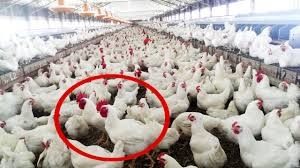
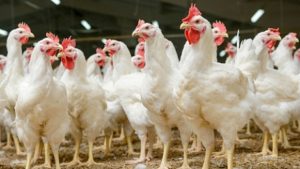
Too many fowls (chicken, turkey, etc.) together almost always causes sickness, disease and death. Something more is needed to bolster the fowl’s immune system to allow them to thrive despite the closed quarters, surrounded by thousands of other birds, and with minimal exercise/movement.

This pharmaceutical product offering – antibiotics – which emerged in the late 1940’s, allows for more chicken production at lower costs. Since the late 1940’s – early 1950’s – poultry (eggs and chicken meat) became plentiful for breakfast, lunch and dinner; daily if that is the desire.

Now, anybody, anywhere can deploy Chicken Farms, endure the 8 to 12 weeks growth stage, slaughter and eat chicken. (It is best suited for rural areas). See the “How To” in the Appendix VIDEO below.

Anybody, anywhere”? This sounds like a business model for rural agri-business, so that a community can “Feed Itself”.

“The Caribbean must be able to Feed Ourselves” – this is the theme of the teaching series for December 2019 from the movement behind the book Go Lean…Caribbean. This submission is the conclusion of the series; this is commentary 5 of 5 considering the Food Security and Bread Baskets for the Caribbean. The Go Lean movement (book and blogs) posits that regional stakeholders must have the priority for us to Feed Ourselves, rather than depending solely on trade. Other Food Supply considerations are presented in this series; see the full series catalog here:

  1. Food SecurityBread Baskets on Land and Sea
  2. Food SecurityTemperate Foods in the Tropics
  3. Food SecurityOpportunity: 1 American County in Iowa raises all Beef for a Cruise Line
  4. Food SecurityFTAA: A Lesson in History
  5. Food Security – Big Chicken

The Go Lean movement presents a roadmap for an Industrial Reboot of our agricultural footprint. This relates to the Caribbean Union Trade Federation (CU) and how we can ensure Food Security for all 30 member-states by collaborating, integrating and leveraging – one community can service another. This way we can Feed Ourselves by creating our own bread baskets. This strategy allows for consideration among the 30 participating member-states as to who is more suited to ramp-up an agri-business eco-system. While we should be deploying Chicken Farms everywhere – in every community, in truth this is not always possible locally. However, there is the opportunity for a regional solution – one community can be deputized for another community.

All in all, our society must be able to Feed Ourselves and antibiotics-steroids help. But don’t get it twisted, antibiotics and steroids are not the heroes in this story; in fact they could be villains. See their historicity depicted in the book Big Chicken – consider the Book Review in the Appendix below and the interview with the Author in this AUDIO-PODCAST  here:

AUDIO-PODCASTHow Antibiotics Changed The Way The World Eatshttps://the1a.org/audio/#/shows/2017-09-26/how-antibiotics-changed-the-way-the-world-eats/112128/@00:00

How Antibiotics Changed The Way The World Eats

Posted September 26, 2017 – The Poultry industry taught us to want chicken more. Before the 1940’s, chicken was rarely seen on the dinner table.

Chickens play a prominent role in domestic life – they are omnipresent – but there are dire consequences from the excessive use of antibiotics. This is the peril of Big Pharma. This is not new! In fact, this is typical in modern life, “we” tend to go “2 steps forward, 1 step backwards” or worse yet: “1 step forward, 2 steps backwards”. We have addressed the dangers of antibiotics before; consider this excerpt from a previous blog-commentary from October 2014:

Antibiotics Use Associated With Obesity Risk
Big Pharma, the Pharmaceutical industry, dictates standards of care in the field of medicine, more so than may be a best-practice. (Picture the scene of a Pharmaceutical Salesperson slipping in the backdoor to visit a doctor and showcase latest product lines).
This subject of damaging health effects deriving from capitalistic practices in medicine aligns with Go Lean … Caribbean (Page 157), as it posits that Cancer treatment (in the US) has been driven by the profit motive, more so than a quest for wellness and/or a cure.

This is not the model we want to effect the well-being of our young children.

The Go Lean roadmap specifies where we are as a region (minimal advanced medicine options), where we want to go (elevation of Caribbean society in the homeland for all citizens to optimize wellness) and how we plan to get there – confederating as a Single Market entity. While the Go Lean book strategizes a roadmap for economic empowerment, it clearly relates that healthcare, and pharmaceutical acquisitions are important in the quest to make the Caribbean a better place to live, work and play.

We need more food production – this includes Chicken – in our Caribbean homelands. We import too much. Apparently, chickens can be hatched, raised, slaughtered and processed with little effort. Ideal for rural areas, there should be few “barriers to entry” for community stewards to launch this aspect of agri-business.

What could possibly be the problem?

There is one:

Agricultural pollution/odors – Normally limited to rural areas, have the potential of disturbing the natural beauty of the area or detract from the tourism/resort look, feel and smell. See the Appendix AUDIO-PODCAST below.

In addition, when considering any changes, there are always the “powers that be” that provide opposition; they profit from the Status Quo. Caribbean communities are consuming chicken – imported chicken, acquired through trade. To reboot the agri-business eco-system and foster a local industry will entail empowering new people-processes, at the expense of the old people-processes. This is the reality of Crony-CapitalismSpecial Interests that defy the Greater Good for personal gain.

Come what may, we must reboot. Change will come … anyway. We need to regulate, modulate and stipulate positive changes that society makes to ensure the Greater Good. This commitment might mean ignoring the Classical Economists and their Theory of Comparative Advantage – where greater benefits are derived to the trading partners by allowing the partner with the most value to execute the functionality – for a while. This Theory has caused globalization to run amok.

We may need subsidies to compensate and prop up the local agri-business establishments. The reasoning is simple: we must promote farmers and protect the independence of our Food Supply. We must unconditionally be able to Feed Ourselves … finally.

We must always be On Guard for the corruption of Crony-Capitalism. In fact, the issues in reforming and transforming our society to mitigate Crony-Capitalism have been addressed in many previous blog-commentaries; consider this list of sample entries:

https://goleancaribbean.com/blog/?p=14087 Opioids and the FDA – ‘Fox guarding the Henhouse’
https://goleancaribbean.com/blog/?p=12645 Back to the Future: Textbooks or Tablets in School?
https://goleancaribbean.com/blog/?p=11520 Managing the ‘Strong versus the Weak’ – Lower Ed.
https://goleancaribbean.com/blog/?p=11269 Managing the ‘Strong versus the Weak’ – An American Sickness
https://goleancaribbean.com/blog/?p=11057 Managing the ‘Strong versus the Weak’ – Book Review: Sold-Out!
https://goleancaribbean.com/blog/?p=7430 Brazilian Shrunken Head Babies: Zika or Tdap (Vaccine Abuse)?
https://goleancaribbean.com/blog/?p=6819 The Downside & Crony-Capitalism of ‘Western’ Diets
https://goleancaribbean.com/blog/?p=6580 Crony-Capitalism of Drug Patents
https://goleancaribbean.com/blog/?p=5993 Carnival Cruise Onboard Monopoly – Ban carry-on bottled beverages
https://goleancaribbean.com/blog/?p=4673 Book Review: ‘Merchants of Doubt’ Documentary
https://goleancaribbean.com/blog/?p=2522 The Cost of Cancer Drugs – Pure Crony-Capitalism

As related in every submission of this Food Supply series, our intent – as communicated in the outset of the Go Lean book – is simple yet providential (Page 4):

The CU should better provide for the region’s basic needs (food, clothing, energy and shelter), and then be in position to help supply the rest of the world.

We gotta eat! Chicken is good! It would be a good business model – government policy – to provide subsidies to grow, harvest and distribute locally raised chickens – all foods for that matter – for the people of our communities. We would save on the “Foreign Currency” and minimize “Trade Deficits”. This would be a win-win all around.

We urge all Caribbean stakeholders to lean-in to this Go Lean roadmap … to Feed Ourselves … finally. This is how we can make our Caribbean homeland a better place to live, work and play. 🙂

About the Book
The book Go Lean…Caribbean serves as a roadmap for the introduction and implementation of the technocratic Caribbean Union Trade Federation (CU), for the elevation of Caribbean society – for all member-states. This CU/Go Lean roadmap has these 3 prime directives:

  • Optimization of the economic engines in order to grow the regional economy to $800 Billion & create 2.2 million new jobs.
  • Establishment of a security apparatus to ensure public safety and protect the resultant economic engines.
  • Improve Caribbean governance to support these engines, including a separation-of-powers between the member-states and CU federal agencies.

The Go Lean book provides 370-pages of turn-by-turn instructions on “how” to adopt new community ethos, plus the strategies, tactics, implementations and advocacies to execute so as to reboot, reform and transform the societal engines of Caribbean society.

Download the free e-Book of Go Lean … Caribbean – now!

Who We Are
The movement behind the Go Lean book – a non-partisan, apolitical, religiously-neutral Community Development Foundation chartered for the purpose of empowering and re-booting economic engines – stresses that reforming and transforming the Caribbean societal engines must be a regional pursuit. This was an early motivation for the roadmap, as pronounced in the opening Declaration of Interdependence (Pages 12 – 14):

xi. Whereas all men are entitled to the benefits of good governance in a free society, “new guards” must be enacted to dissuade the emergence of incompetence, corruption, nepotism and cronyism at the peril of the people’s best interest. The Federation must guarantee the executions of a social contract between government and the governed.

xvi. Whereas security of our homeland is inextricably linked to prosperity of the homeland, the economic and security interest of the region needs to be aligned under the same governance. Since economic crimes … can imperil the functioning of the wheels of commerce for all the citizenry, the accedence of this Federation must equip the security apparatus with the tools and techniques for predictive and proactive interdictions.

xxiv. Whereas a free market economy can be induced and spurred for continuous progress, the Federation must install the controls to better manage aspects of the economy: jobs, inflation, savings rate, investments and other economic principles. Thereby attracting direct foreign investment because of the stability and vibrancy of our economy.

xxx.  Whereas the effects of globalization can be felt in every aspect of Caribbean life, from the acquisition of food and clothing, to the ubiquity of ICT, the region cannot only consume, it is imperative that our lands also produce and add to the international community, even if doing so requires some sacrifice and subsidy.

Sign the petition to lean-in for this roadmap for the Caribbean Union Trade Federation.

————-

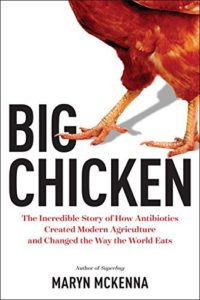
Book Review – Big Chicken: The Incredible Story of How Antibiotics Created Modern Agriculture and Changed the Way the World Eats
By:
McKenna, Maryn
In this eye-opening exposé, acclaimed health journalist and National Geographic contributor Maryn McKenna documents how antibiotics transformed chicken from local delicacy to industrial commodity—and human health threat—uncovering the ways we can make America’s favorite meat safer again.
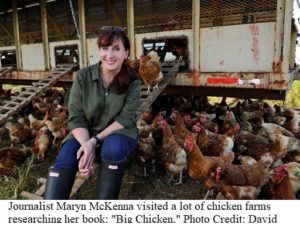
What you eat matters—for your health, for the environment, and for future generations. In this riveting investigative narrative, McKenna dives deep into the world of modern agriculture by way of chicken: from the farm where it’s raised directly to your dinner table. Consumed more than any other meat in the United States, chicken is emblematic of today’s mass food-processing practices and their profound influence on our lives and health. Tracing its meteoric rise from scarce treat to ubiquitous global commodity, McKenna reveals the astounding role of antibiotics in industrial farming, documenting how and why “wonder drugs” revolutionized the way the world eats—and not necessarily for the better. Rich with scientific, historical, and cultural insights, this spellbinding cautionary tale shines a light on one of America’s favorite foods—and shows us the way to safer, healthier eating for ourselves and our children.

In August 2019 this book will be published in paperback with the title Plucked: Chicken, Antibiotics, and How Big Business Changed the Way the World Eats.

Source: Retrieved December 29, 2019 from: https://www.amazon.com/Big-Chicken-Incredible-Antibiotics-Agriculture/dp/1426217668

————–

Appendix VIDEO – How to Start Chicken Farm Business – Organic Broiler Poultry Farming of Chickens & Goats – https://youtu.be/t8OGruo7DJs

Young Entrepreneurs Forum
Posted December 5, 2016 –
Full Process of How to Start Chicken Farm Business. Start Organic Broiler Poultry Farming of Chickens & Goats.

Chicken farming business is a very profitable business idea in 2016 & 2017. So, if you want to start chicken farm business then, must watch this video for starting organic broiler poultry farming business in your country. Start Chicken farming in India.

[Need 15 pieces of] Equipment of Organic Broiler Poultry Farming Business – Chicken Farm Business Equipment.

  1. Feeders
  2. Heaters or Brooders
  3. Incubator
  4. Chick box
  5. Fly Tray
  6. Poultry Plucker Rubber Finger
  7. Egg Tray
  8. Poultry Incubator Controller
  9. Ventilation Fan
  10. Laying Nest
  11. Egg Scale
  12. Egg Washer
  13. Water Pots and Drinkers
  14. Cages and Coops
  15. Dressing Machine

If you’ve any questions related to How to Start Chicken Farm Business – Organic Broiler Poultry Farming of Chickens & Goats then, feel free to leave it in comment box. Thanks for watching chicken farm business – organic broiler farming video.

————–

Appendix AUDIO-PODCAST – When A Chicken Farm Moves Next Door, Odor May Not Be The Only Problem – https://www.npr.org/sections/thesalt/2016/01/24/463976110/when-a-chicken-farm-moves-next-door-odor-may-not-be-the-only-problem

All Things Considered
Posted January 24, 2016 – As farms move closer to residential areas, neighbors are complaining that the waste generated is a potential health hazard.

Share this post:
, , ,
[Top]

Food Security – A Lesson in History: Free Trade Agreement of the Americas

Go Lean Commentary

Free Trade agreements are highly controversial:
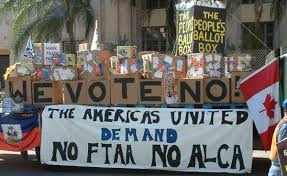
  • Economists love them while workers hate them.

The Economists claim that trade pacts – i.e. NAFTA, MERCURSOR, and the now-defunct FTAA – result in increased economic output: See this excerpt from the 2013 Go Lean … Caribbean book (Page 21):

Voluntary Trade Creates Wealth: People specialize in the production of certain goods and services because they expect to gain from it. People trade what they produce with other people when they think they can gain something from the exchange. Some benefits of voluntary trade include higher standards of living and broader choices of goods and services.

On the other hand, workers complain that in Free Trade pacts low-skilled jobs flee to the participating countries with the lowest wages. See the American drama depicted in this excerpt from a previous blog-commentary from March 2016:

An Ode to Detroit – Good Luck on Trade!
There is a strong current against free trade deals in big industrial cities in the American north. … But chances are, these trade agreements will not disappear… These free trade agreements are ratified treaties with other countries that are not so easily dismantled. Plus, the US business interest has proven to be formidable in their obstructionism to radical changes to their status quo.

The Go Lean movement asserts that there is a Crony-Capitalistic influence in the US that creates a societal defect for forging change. In this case, trade deals like NAFTA allow big corporations to shift labor costs to alternate locales with lower payroll costs. This commentary has related that the money motivation with this strategy may be too much to overcome in the America of 2016.

So when the ascension of the Free Trade Agreement of the Americas (FTAA) stalled in 2005 – see the historicity of FTAA in Appendix A below  – this outcome taught an important lesson about something even more important than “Free Trade”:
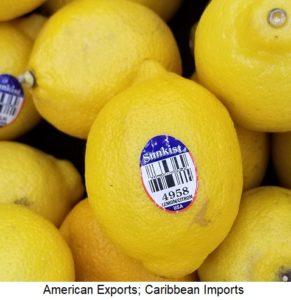

The art and science of the Food Supply.

The United States of America has the highest level of wages among the 34 countries in this hemispheric economic plan; they would have benefited from cost savings of using cheaper labor in poorer countries to grow certain agricultural products – think lemons-limes in Mexico. This is referred to as the Theory of Comparative Advantage – where greater benefits are derived to the trading partners by allowing the partner with the most value to execute the functionality. See the formal policy here:

Theory of Comparative Advantage
The law of comparative advantage describes how, under free trade, an agent will produce more of and consume less of a good for which they have a comparative advantage.[1] In an economic model, agents have a comparative advantage over others in producing a particular good if they can produce that good at a lower relative opportunity cost or autarky price, i.e. at a lower relative marginal cost prior to trade.[2] Comparative advantage describes the economic reality of the work gains from trade for individuals, firms, or nations, which arise from differences in their factor endowments or technological progress.[3] – Source: Wikipedia

True adherence to this economic concept would have demanded that the US ended their agricultural subsidies for their farmers. (See the definitions of ‘subsidies’ in Appendix B below.). FTAA failed because the US refused to comply with the mandate from the Economists. They reasoned that they must protect their bread baskets (farmers), because in so doing they would protect the independence of their Food Supply.

A society must be able to feed itself …
… despite whether it is cheaper to do so, compared to cross-border trade.

This is the Lesson in History for us in the Caribbean from the FTAA drama.

This is the continuation of this teaching series for December 2019 from the movement behind the Go Lean book. This entry is commentary 4 of 5 considering Food Security for the Caribbean. The first priority should be for us to Feed Ourselves ; rather than depending so heavily on trade. This is a good example from the American-FTAA drama. Other Food Supply considerations are presented in this series; see the full series catalog here:

  1. Food SecurityBread Baskets on Land and Sea
  2. Food SecurityTemperate Foods in the Tropics
  3. Food SecurityOpportunity: 1 American County in Iowa raises all Beef for a Cruise Line
  4. Food Security – FTAA: A Lesson in History
  5. Food SecurityBig Chicken

The Go Lean book presents a roadmap for an Industrial Reboot of our agricultural footprint. It introduces a regional solution – the Caribbean Union Trade Federation (CU) – to ensure Food Security for all 30 member-states. The book posits that we must be prepared to Feed Ourselves with intra-regional solutions – we must have our own bread baskets. Among the 30 participating member-states, there are some that are better suited – lower opportunity costs in the Competitive Analysis exercise – to ramp-up an agri-business eco-system.

As a boy growing up in the Caribbean – more exactly, in the Bahamas – we would go to the citrus trees in the backyard and pick fruit for household consumption: seasoning foods and making limeade-lemonade. Now today, the grocery stores only sell imported lemons – see Photo here.

The same issues are prevalent with Caribbean fisheries.

Today in the Caribbean, the prevalence is for “Fish Fingers” on restaurant menus to be American exported, farm-raised tilapia or catfish; despite the 1,063,000 square miles of the Caribbean Sea.

We must do better; we must be able to Feed Ourselves … finally. The Theory of Competitive Analysis has caused globalization to run amok.

The issues in reforming and transforming our interactions with global trade have been addressed in many previous blog-commentaries; consider this list of sample entries:

https://goleancaribbean.com/blog/?p=16341 New Post Office Eco-system – Globalization issues ‘loud and clear’
https://goleancaribbean.com/blog/?p=16208 In Defense of Trade – Bilateral Tariffs: No one wins
https://goleancaribbean.com/blog/?p=15875 Amazon Model: ‘What I want to be when I grow up’
https://goleancaribbean.com/blog/?p=13233 Caribbean proposes new US-Caribbean trade initiative
https://goleancaribbean.com/blog/?p=6231 China’s Caribbean Playbook: America’s Script
https://goleancaribbean.com/blog/?p=994 Bahamas rejects US trade demand

As related in every submission of this Food Supply series, our intention is simple yet providential – as communicated in the outset of the Go Lean book (Page 3):

The CU should better provide for the region’s basic needs (food, clothing, energy and shelter), and then be in position to help supply the rest of the world.

We gotta eat! So it is a great business model – maybe after some government subsidies – to grow, harvest and distribute local foods for the people of our communities. It creates foreign exchange as well. The Go Lean movement presents a business model of fostering packaged foods to sell to the world – imagine our Diaspora scattered in foreign lands; see this portrayal of a Caribbean food service company – GraceKennedy – in this VIDEO here:

VIDEOGrace Kennedy Belize Ltdhttps://youtu.be/kVDhoaa2yWI

globaldirectories
Published Sep 4, 2015
– GraceKennedy (Belize) Ltd was established and commenced operations January, 1982 as a subsidiary of GraceKennedy Ltd. of Kingston, Jamaica. Presently, GraceKennedy (Belize) Ltd. is one of Belize’s major food & beverage distributors. GraceKennedy (Belize) Ltd. is involved in the importation and distribution of a wide range of food and non-food grocery items throughout the country of Belize. The company is the exclusive distributor of Grace and Grace-owned branded products. Over the many years, the company’s ability to Brand-build and engage consumers has attracted any other brands such as Malher, Colgate-Polmive, PA Benjamins, Suretox, Roses Toilet Tissues, Mackeson Stout, Carib Beer, Stag Beer and El Dorado Rum.

Join us in our campaign for 2015, Grace We Care .

This is an extension of the ever popular Pass On The Love. Every month GraceKennedy (Belize) Ltd. staff members donate a portion of their salary to the Grace We Care Club. This Club then finds ways to give back to the community. Show you care by preparing a meal with your family, invite someone less fortunate to a dinner or to enjoy a family game. Teach the youths to give to those who don’t have as much as they do by donating toys, usable clothing that is not being worn or books that they have read. There is a lot we can all do to help one another.

This plan – fostering regional bread baskets with the help of government subsidies – would be a win-win all around.

We urge all Caribbean stakeholders to lean-in to this Go Lean roadmap … to Feed Ourselves and our trading partners. This is how we make our Caribbean homeland a better place to live, work and play. 🙂

About the Book
The book Go Lean…Caribbean serves as a roadmap for the introduction and implementation of the technocratic Caribbean Union Trade Federation (CU), for the elevation of Caribbean society – for all member-states. This CU/Go Lean roadmap has these 3 prime directives:

  • Optimization of the economic engines in order to grow the regional economy to $800 Billion & create 2.2 million new jobs.
  • Establishment of a security apparatus to ensure public safety and protect the resultant economic engines.
  • Improve Caribbean governance to support these engines, including a separation-of-powers between the member-states and CU federal agencies.

The Go Lean book provides 370-pages of turn-by-turn instructions on “how” to adopt new community ethos, plus the strategies, tactics, implementations and advocacies to execute so as to reboot, reform and transform the societal engines of Caribbean society.

Download the free e-Book of Go Lean … Caribbean – now!

Who We Are
The movement behind the Go Lean book – a non-partisan, apolitical, religiously-neutral Community Development Foundation chartered for the purpose of empowering and re-booting economic engines – stresses that reforming and transforming the Caribbean societal engines must be a regional pursuit. This was an early motivation for the roadmap, as pronounced in the opening Declaration of Interdependence (Pages 12 – 14):

xi. Whereas all men are entitled to the benefits of good governance in a free society, “new guards” must be enacted to dissuade the emergence of incompetence, corruption, nepotism and cronyism at the peril of the people’s best interest. The Federation must guarantee the executions of a social contract between government and the governed.

xvi. Whereas security of our homeland is inextricably linked to prosperity of the homeland, the economic and security interest of the region needs to be aligned under the same governance. Since economic crimes … can imperil the functioning of the wheels of commerce for all the citizenry, the accedence of this Federation must equip the security apparatus with the tools and techniques for predictive and proactive interdictions.

xxiv. Whereas a free market economy can be induced and spurred for continuous progress, the Federation must install the controls to better manage aspects of the economy: jobs, inflation, savings rate, investments and other economic principles. Thereby attracting direct foreign investment because of the stability and vibrancy of our economy.

xxx.  Whereas the effects of globalization can be felt in every aspect of Caribbean life, from the acquisition of food and clothing, to the ubiquity of ICT, the region cannot only consume, it is imperative that our lands also produce and add to the international community, even if doing so requires some sacrifice and subsidy.

Sign the petition to lean-in for this roadmap for the Caribbean Union Trade Federation.

—————

Appendix A – Reference: Free Trade Area of the Americas

The Free Trade Area of the Americas (FTAA) was a proposed agreement to eliminate or reduce the trade barriers among all countries in the Americas, excluding Cuba.

History In the latest round of negotiations, trade ministers from 34 countries met in Miami, Florida, in the United States, in November 2003 to discuss the proposal.[1] The proposed agreement was an extension of the North American Free Trade Agreement (NAFTA) between Canada, Mexico, and the United States. Opposing the proposal were Cuba, Venezuela, Bolivia, Ecuador, Dominica, and Nicaragua (all of which entered the Bolivarian Alternative for the Americas in response), and Mercosur member states. Discussions have faltered over similar points as the Doha Development Round of World Trade Organization (WTO) talks; developed nations seek expanded trade in services and increased intellectual property rights, while less developed nations seek an end to agricultural subsidies and free trade in agricultural goods. Similar to the WTO talks, Brazil has taken a leadership role among the less developed nations, while the United States has taken a similar role for the developed nations.

Beginning Free Trade Area of the Americas began with the Summit of the Americas in Miami, Florida, on December 11, 1994, but the FTAA came to public attention during the Quebec City Summit of the Americas, held in Canada in 2001, a meeting targeted by massive anti-corporatization and anti-globalization protests. The Miami negotiations in 2003 met similar protests, though perhaps not as large.

Disagreements In previous negotiations, the United States had pushed for a single comprehensive agreement to reduce trade barriers for goods, while increasing intellectual property protection. Specific intellectual property protections could include DMC Digital Millennium Copyright Act style copyright protections similar to the U.S.-Australia Free Trade Agreement. Another protection would likely restrict the importation or cross importation of pharmaceuticals, similar to the proposed agreement between the United States and Canada. Brazil posed a three-track approach that calls for a series of bilateral agreements to reduce specific tariffs on goods, a hemispheric pact on rules of origin, and a dispute resolution process Brazil proposed to omit the more controversial issues from the FTA, leaving them to the WTO.

The location of the FTA Secretariat was to have been determined in 2005. The contending cities were: Atlanta, Chicago, Galveston, Houston, San Juan, and Miami in the United States; Cancún and Puebla in Mexico; Panama City, Panama; and Port of Spain, Trinidad and Tobago. The U.S. city of Colorado Springs also submitted its candidacy in the early days but subsequently withdrew.[2] Miami, Panama City and Puebla served successively an interim secretariat headquarters during the negotiation process.

The last summit was held at Mar del Plata, Argentina, in November 2005, but no agreement on FTA was reached. Of the 39 countries present at the negotiations, 20 pledged to meet again in 2006 to resume negotiations, but no meeting took place. The failure of the Mar del Plata summit to establish a comprehensive FTA agenda augured poorly.

Current status The FTAA missed the targeted deadline of 2005, which followed the stalling of useful negotiations of the World Trade Organization Ministerial Conference of 2005.[3] Over the next few years, some governments, most notably the United States, not wanting to lose any chance of hemispheric trade expansion moved in the direction of establishing a series of bilateral trade deals. The leaders however, planned further discussions at the Sixth Summit of the Americas in Cartagen, Colombia, in 2012.[4][5]  …

Source: Retrieved December 29, 2019 from: https://en.wikipedia.org/wiki/Free_Trade_Area_of_the_Americas

————–

Appendix B – Reference: Subsidy

A subsidy or government incentive is a form of financial aid or support extended to an economic sector (business, or individual) generally with the aim of promoting economic and social policy.[1] Although commonly extended from government, the term subsidy can relate to any type of support – for example from NGOs or as implicit subsidies. Subsidies come in various forms including: direct (cash grants, interest-free loans) and indirect (tax breaks, insurance, low-interest loans, accelerated depreciation, rent rebates).[2][3]

Furthermore, they can be broad or narrow, legal or illegal, ethical or unethical. The most common forms of subsidies are those to the producer or the consumer. Producer/production subsidies ensure producers are better off by either supplying market price support, direct support, or payments to factors of production.[1] Consumer/consumption subsidies commonly reduce the price of goods and services to the consumer. For example, in the US at one time it was cheaper to buy gasoline than bottled water.[4] …

Examples
Agricultural subsidies – Support for agriculture dates back to the 19th century. It was developed extensively in the EU and USA across the two World Wars and the Great Depression to protect domestic food production, but remains important across the world today.[26][29] In 2005, US farmers received $14 billion and EU farmers $47 billion in agricultural subsidies.[18] Today, agricultural subsidies are defended on the grounds of helping farmers to maintain their livelihoods. The majority of payments are based on outputs and inputs and thus favour the larger producing agribusinesses over the small-scale farmers.[1][33] In the USA nearly 30% of payments go to the top 2% of farmers.[26][34][35]

By subsidising inputs and outputs through such schemes as ‘yield based subsidisation’, farmers are encouraged to over-produce using intensive methods, including using more fertilizers and pesticides; grow high-yielding monocultures; reduce crop rotation; shorten fallow periods; and promote exploitative land use change from forests, rainforests and wetlands to agricultural land.[26] These all lead to severe environmental degradation, including adverse effects on soil quality and productivity including erosion, nutrient supply and salinity which in turn affects carbon storage and cycling, water retention and drought resistance; water quality including pollution, nutrient deposition and eutrophication of waterways, and lowering of water tables; diversity of flora and fauna including indigenous species both directly and indirectly through the destruction of habitats, resulting in a genetic wipe-out.[1][26][36][37]

Cotton growers in the US reportedly receive half their income from the government under the Farm Bill of 2002. The subsidy payments stimulated overproduction and resulted in a record cotton harvest in 2002, much of which had to be sold at very reduced prices in the global market.[18] For foreign producers, the depressed cotton price lowered their prices far below the break-even price. In fact, African farmers received 35 to 40 cents per pound for cotton, while US cotton growers, backed by government agricultural payments, received 75 cents per pound. Developing countries and trade organizations argue that poorer countries should be able to export their principal commodities to survive, but protectionist laws and payments in the United States and Europe prevent these countries from engaging in international trade opportunities.

Fisheries – Today, much of the world’s major fisheries are overexploited; in 2002, the WWF estimate this at approximately 75%. Fishing subsidies include “direct assistance to fishers; loan support programs; tax preferences and insurance support; capital and infrastructure programs; marketing and price support programs; and fisheries management, research, and conservation programs.”[38] They promote the expansion of fishing fleets, the supply of larger and longer nets, larger yields and indiscriminate catch, as well as mitigating risks which encourages further investment into large-scale operations to the disfavour of the already struggling small-scale industry.[26][39] Collectively, these result in the continued overcapitalization and overfishing of marine fisheries.

There are four categories of fisheries subsidies. First are direct financial transfers, second are indirect financial transfers and services. Third, certain forms of intervention and fourth, not intervening. The first category regards direct payments from the government received by the fisheries industry. These typically affect profits of the industry in the short term and can be negative or positive. Category two pertains to government intervention, not involving those under the first category. These subsidies also affect the profits in the short term but typically are not negative. Category three includes intervention that results in a negative short-term economic impact, but economic benefits in the long term. These benefits are usually more general societal benefits such as the environment. The final category pertains to inaction by the government, allowing producers to impose certain production costs on others. These subsidies tend to lead to positive benefits in the short term but negative in the long term.[40]

Others – The US National Football League’s (NFL) profits have topped records at $11 billion, the highest of all sports. The NFL had tax-exempt status until voluntarily relinquishing it in 2015, and new stadiums have been built with public subsidies.[41][42]

The Commitment to Development Index (CDI), published by the Center for Global Development, measures the effect that subsidies and trade barriers actually have on the undeveloped world. It uses trade, along with six other components such as aid or investment, to rank and evaluate developed countries on policies that affect the undeveloped world. It finds that the richest countries spend $106 billion per year subsidizing their own farmers – almost exactly as much as they spend on foreign aid.[43]

Source: Retrieved December 29, 2019 from: https://en.wikipedia.org/wiki/Subsidy

Share this post:
, ,
[Top]

Food Security – Opportunity: “1 Iowa County Supplies all the Beef for a Cruise Line”

Go Lean Commentary

Supply and Demand

These are the bedrock principles of economic decision-making. Or should be …

… but when it comes to Caribbean economics, the rules seem to be different … 🙁

  • There is demand for food supplies for Caribbean foreign visitors
  • The supply to feed foreign visitors are also sourced from foreign originators.

In fact, as reported in this one article in November 2010, there is a sophisticated supply chain eco-system for just Carnival Cruise Lines – responsible for 8 to 9 million annual unique Caribbean visitors, per 2012. See the details of that article here:

Title: Amazing Cruise Food Facts
Ever wondered just how much food and drink is consumed on an average cruise? … Here are some amazing cruise food facts, according to the UK-based industry trade journal Cruise International.

  • Every day 2,550 fresh eggs are consumed by Holland America’s Eurodam, 2,100 guests and 900 crew.
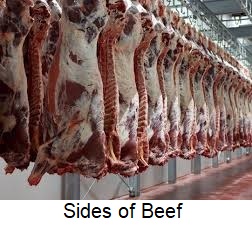
  • A whole county in Iowa raises all its cattle for sale to Carnival Cruise Lines.
  • On board Carnival Dream, passengers eat of 28,730 shrimp every week.
  • 6,200 cocktails and 15,000 coffees are drunk on Costa ships every week.
  • On board MSC Fantasia class ships, 2,000 different recipes are used on a seven-day cruise.
  • 280 bottles of free champagne, 10lbs of caviar and 120lbs of lobster are devoured on  Seabourn ships (Legend/Pride/Spirit) over seven nights.
  • On an average P&O Ventura 14-day cruise, 3,096 passengers and 1,200 crew will eat some 171,840 main meals.
  • During an eight-night cruise on board Fred. Olsen’s Boudicca630 litres of ice cream will be eaten.
  • On a typical 10-day cruise, the shopping list for Crystal Symphony includes over 60 tonnes of food-stuffs to be purchased and delivered to dock in the few hours on turnaround day.

It is not known exactly how much Spam was consumed by passengers on the stranded Carnival Splendor in November 2010; [it had to be towed to its San Diego-California home base after engines caught fire off the Mexican Rivera coast].

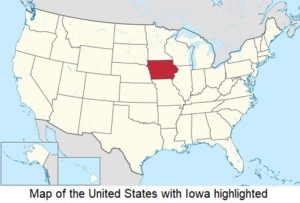
A whole county in Iowa? (This was reported back in 2010 reflecting activity for the years leading up to 2010, but it does give some insights as to scope of the operation). Iowa is part of the American Midwest region – the bread basket of America:

Iowa 101 

  • There are 99 counties in the U.S. state of Iowa.
  • Iowa Population: 3,156,145 (2,018)
  • Iowa’s main conventional agricultural commodities are hogs, corn, soybeans, oats, cattle, eggs, and dairy products. Iowa is the nation’s largest producer of ethanol and corn and some years is the largest grower of soybeans. In 2008, the 92,600 farms in Iowa produced 19% of the nation’s corn, 17% of the soybeans, 30% of the hogs, and 14% of the eggs.[131]

Midwest 101
Sometimes called “the breadbasket of America” the [American] Midwest serves as a center for grain production, particularly wheatcorn and soybeans.[3] …

In 1839 the Northeastern state of New York became the country’s leading dairy producer, a position it held until overtaken by Iowa in 1890. It wasn’t long after that Wisconsin emerged as the leading dairy producer.[5]

Beef and pork processing have long been important Midwestern industries. Chicago and Kansas City served as stockyards and processing centers of the beef trade and Cincinnati, nicknamed ‘Porkopolis’, was once the largest pork-producing city in the world.[6] Iowa is the center of pork production in the U.S.[citation needed] Meats were preserved by curing as in corned beef, sugar-cured ham and bacon, or smoked. – Source: https://en.wikipedia.org/wiki/Cuisine_of_the_Midwestern_United_States#Background retrieved December 28, 2019.

That was 2010; what is the status quo now? How does Carnival provision their beef needs today, as we approach 2020?

Posted September 18, 2010
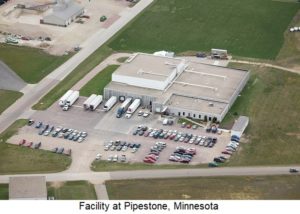
… I understand that Carnival has cut a deal with an new meat supplier. I read that last April [2010], Carnival began using J&B Foods of Albertville, Minnesota as their meat supplier.

I didn’t know this until a couple of weeks ago A friend told me he is a Senior Butcher for the company and was he said that Carnival contract had increased their production over 30%. It’s a good company and they do a good job with meat. – Source: https://boards.cruisecritic.com/topic/1218077-what-was-your-experience-with-carnival-meat-in-the-mdr/

J&B Group
Even though sourcing all the beef from an entire county was impressive, enacting a supply contract with J&B Foods is even more so. See the corporate profile in the Appendix below and the VIDEO here:

VIDEO – J&B Group – Discover our capabilities – https://youtu.be/6Xkng_4MTQI

J&B Foods
From food service and retail to wholesale and third party logistics, discover what J&B Group can do for you!

Do you see the opportunity here, in supplying the demand for beef for the cruise ships traversing the Caribbean?

If one cruise line is willing to enact supply agreements that engage a whole region (Iowa), surely Caribbean stakeholders can deploy the necessary cattle operations (ranching, slaughter, butchering, warehousing and distribution) to satisfy the existing demand for a Caribbean cruise eco-system. We have one primary advantage that cannot be ignored:

Location, location and location.

Raising cattle is not “Rocket Science” – we can do it here! With the ability to transform one or more BIG member-states – Belize, Cuba, Guyana, and/or Suriname – into the region’s bread baskets, we can scale-up beef productions with minimal time, talent and treasures to supply the cruise industry’s demand; (and our own demand-supply needs).

If we cannot “have all of the pie, then maybe just some slices”.

This is how Industrial Reboots work!

This is the continuation of this teaching series for December 2019 from the movement behind the book Go Lean … Caribbean. As we present a series every month, this entry is commentary 3 of 5 considering Food Security for the Caribbean. The goal is first to Feed Ourselves after which we should foster Trade to an export market. Servicing the cruise industry is within this Trade strategy. Other Food Supply considerations are presented in  this series; see the full series catalog here:

  1. Food SecurityBread Baskets on Land and Sea
  2. Food SecurityTemperate Foods in the Tropics
  3. Food Security – Opportunity: 1 American County in Iowa raises all Beef for a Cruise Line
  4. Food SecurityFTAA: A Lesson in History
  5. Food SecurityBig Chicken

The 2013 Go Lean book presents a roadmap – an economic plan – to introduce and implement a regional solution – the Caribbean Union Trade Federation (CU) – to ensure Food Security. The book posits that we can satisfy the “supply and demand” dynamics. On the Supply-side, we can put the implementations in place to have our own bread baskets … finally. Among the 30 participating member-states there are some that are more suited – lower opportunity costs – to ramp-up an agri-business eco-system. The strategy is to make the regional investments there, in one or several of those states.

On the Demand-side, there is the tactic of collective bargaining. This activity is already planned in the quest to reform and transform the cruise tourism industry. This was related in a previous Go Lean blog-commentary; see an excerpt here:

Some of the most popular cruise destinations include the Bahamas, Jamaica, Cayman Islands and Saint Martin. Alone, these port cities/member states cannot effect change on this cruise line industry. But together, as one unified front, the chances for success improves exponentially. The unified front is the Caribbean Union Trade Federation (CU). The term Union is more than a coincidence; it was branded as such by design. The Go Lean book serves as a roadmap for the introduction and implementation of the CU.

The vision of this integration movement is for the region to function as a Single Market. The quotation from the Go Lean book continues in advocating that the Caribbean member-states (independent & dependent) lean-in to this plan for confederacy, convention and collaboration. This is Collective Bargaining 101.

This is a wise yet simple plan: Make the Caribbean Cruise industry an offer they cannot refuse

… the same or better quality for beef at a lower price (with minimal transport or logistical expenses).

As related in the first commentary in this series, the following organizational deployments make this business plan possible:

Organizational deployments are among the 370 pages of the roadmap, the turn-by-turn directions in the Go Lean book, on how to reform and transform the economic, security and governing engines for the Caribbean region and their member-states. This roadmap includes the new community ethos that must be adopted; plus the executions of new strategies, tactics, and implementations to deliver on this quest to reboot our industrial landscape and Feed Ourselves. In fact, this is the actual title of one advocacy in the Go Lean book. Consider the specific plans, excerpts and headlines here from Page 193, entitled:

10 Ways to Impact Cruise Tourism

1 Lean-in for the Caribbean Single Market Confederation Treaty
The unification of the region into one market will allow for collective bargaining with the cruise industry. No one single island nation-state would have the clout of a unified market – the industry needs the Caribbean more than the Caribbean needs the industry. The ports-of-calls need to be able to generate more revenue from the visiting passengers, but the cruise line have embedded rules/regulations designed to maximize their revenues at the expense of the port-side establishments, like on-board duty free shops, prohibitions against buying island alcohol and tobacco products. Such actions would often violate anti-trust rules/laws in most modern democracies.
2 Quality Assurance Programs
The CU will regulate and enforce high standards among the port-side establishments, therefore eliminating the need for cruise lines to “curry favor” with merchants. A Charge-back eco-system and quality assurance programs like surveys for passenger feedback will be used and the results published extensively.
3 e-Purse Settlement with Central Bank in Caribbean Dollars
4 Port-side Risk Mitigations
5 Disabled Passengers Accommodations
6 Emergency Management Proactive and Reactive Services
7 Medical Escalated Response
8 Co-Marketing with National Tourism Departments, Excess Inventory and One-Way Travel
9 Domestic Market
The CU market of 42 million people also has vacation needs. Cruises should be able to start/end locally in the region, for example a passenger should be able to join a cruise in the Bahamas and complete the circuit back in the Bahamas. The Caribbean represents different cultures, languages, urban and rural destinations, therefore many taste can be accommodated. An alignment with tender boats can also accommodate eco-tourism hand-off to/from cruise ships. These are among the service offerings for collective bargaining negotiations.
10 Shipbuilding Support Services

Raising cattle is not “Rocket Science” – we can do it here! What an opportunity? We can reform and transform our agricultural deliveries so as to better Feed Ourselves with lower costs and greater variety in our Food Supply. Then, we get to also improve our pocketbooks by trading foodstuffs with our Cruise Line business partners.

The issues in reforming and transforming our interactions with our Cruise Line business partners have been addressed in many previous blog-commentaries; consider this list of sample entries:

https://goleancaribbean.com/blog/?p=17072 One Case Study: Caribbean Cruise Port ‘Held Hostage’
https://goleancaribbean.com/blog/?p=15380 Industrial Reboot – Cruise Tourism 2.0
https://goleancaribbean.com/blog/?p=12126 America’s Maritime Laws – Stupidity of the ‘Jones Act’ on Tourism
https://goleancaribbean.com/blog/?p=11544 Forging Change: Collective Bargaining
https://goleancaribbean.com/blog/?p=5210 Cruise Ship Commerce – Getting Ready for Change
https://goleancaribbean.com/blog/?p=3889 Merchant Banks e-Payments – Ready for Cruise Industry Changes

Our intent – as communicated in the outset of the Go Lean book – is simple yet providential (Page 4):

The CU should better provide for the region’s basic needs (food, clothing, energy and shelter), and then be in position to help supply the rest of the world.

Tourism is a great business model; we get to generate a lot of foreign currency. But then, we “stupidly” turn around to give it away for products and commodities that we can/should really fulfill ourselves.

Not wise!

Let’s wisen up. Let’s lean-in to this Go Lean roadmap … and Feed Ourselves and our guest. This is how we make our Caribbean homeland a better place to live, work and play. 🙂

About the Book
The book Go Lean…Caribbean serves as a roadmap for the introduction and implementation of the technocratic Caribbean Union Trade Federation (CU), for the elevation of Caribbean society – for all member-states. This CU/Go Lean roadmap has these 3 prime directives:

  • Optimization of the economic engines in order to grow the regional economy to $800 Billion & create 2.2 million new jobs.
  • Establishment of a security apparatus to ensure public safety and protect the resultant economic engines.
  • Improve Caribbean governance to support these engines, including a separation-of-powers between the member-states and CU federal agencies.

The Go Lean book provides 370-pages of turn-by-turn instructions on “how” to adopt new community ethos, plus the strategies, tactics, implementations and advocacies to execute so as to reboot, reform and transform the societal engines of Caribbean society.

Download the free e-Book of Go Lean … Caribbean – now!

Who We Are
The movement behind the Go Lean book – a non-partisan, apolitical, religiously-neutral Community Development Foundation chartered for the purpose of empowering and re-booting economic engines – stresses that reforming and transforming the Caribbean societal engines must be a regional pursuit. This was an early motivation for the roadmap, as pronounced in the opening Declaration of Interdependence (Pages 12 – 14):

xi. Whereas all men are entitled to the benefits of good governance in a free society, “new guards” must be enacted to dissuade the emergence of incompetence, corruption, nepotism and cronyism at the peril of the people’s best interest. The Federation must guarantee the executions of a social contract between government and the governed.

xvi. Whereas security of our homeland is inextricably linked to prosperity of the homeland, the economic and security interest of the region needs to be aligned under the same governance. Since economic crimes … can imperil the functioning of the wheels of commerce for all the citizenry, the accedence of this Federation must equip the security apparatus with the tools and techniques for predictive and proactive interdictions.

xxiv. Whereas a free market economy can be induced and spurred for continuous progress, the Federation must install the controls to better manage aspects of the economy: jobs, inflation, savings rate, investments and other economic principles. Thereby attracting direct foreign investment because of the stability and vibrancy of our economy.

xxx.   Whereas the effects of globalization can be felt in every aspect of Caribbean life, from the acquisition of food and clothing, to the ubiquity of ICT, the region cannot only consume, it is imperative that our lands also produce and add to the international community, even if doing so requires some sacrifice and subsidy.

Sign the petition to lean-in for this roadmap for the Caribbean Union Trade Federation.

—————-

Appendix J&B Group: Foodservice Offerings

Quality starts at the center of your plate and J&B Group is the premier cold chain provider that can bring you the quality protein solutions you need, along with unparalleled customer service.

Serving up the best in protein solutions
In today’s hyper-complex foodservice world, you need a protein partner that can maximize your competitive advantages – from your kitchen to your menu to your bottom line. Turn to J&B Foodservice and our “5S Guarantee” to help solve your critical business challenges.

Buying Power
Our expert protein industry purchasing team understands the markets and successfully navigates fluctuations to bring you the highest value at the most competitive cost possible. They leverage over one hundred years of J&B buying experience to ensure a supply chain that brings excellent value and service to every one of our valued customers. Collaborating with our customers to understand their needs, our team provides recommendations and solutions to an ever changing global protein supply chain.

Manufacturing
J&B has a mission to be an innovative leader in protein produced goods, providing exceptional value in quality, cost, and service.

Cold Storage
J&B’s warehouse capabilities include blast freezing, order picking, speed tempering and re-stacking/re-palletizing. We guarantee temperature consistency, proper product handling with detailed documentation and reporting with superior cleanliness and secure facility.

Our Products
J&B Foodservice sells an extensive portfolio of foodservice proteins throughout the United States to both large restaurant chains as well as independent operators. We produce a wide variety of proteins, such as portion cut steaks, fresh and frozen portioned and bulk ground beef, injected sub-primals, and Thin Sliced Meats. We also offer a wide variety of raw material grades and brands to meet our customer’s quality and pricing needs.

Our Facilities

Source: Retrieved December 28, 2019 from: https://www.jbgroup.com/business-unit/foodservice/

Share this post:
, , ,
[Top]

Food Security – Temperate Foods in the Tropics – Encore

So we want our own bread baskets to better Feed Ourselves here in the Caribbean.

This is normal and natural! According to this Bible scripture …
And God blessed them, and God said unto them, Be fruitful, and multiply, and replenish the earth, and subdue it: and have dominion over the fish of the sea, and over the fowl of the air, and over every living thing that moveth upon the earth. – The Bible – Genesis 1:28 KJV

… having dominion over the earth should mean being able to employ the arts and sciences of agriculture to harvest the food that we need, want and deserve.

While this is true, we still must contend with the reality of the seasons and weather. Or we do?

If it doesn’t rain, we can still water our crops through irrigation and plumbing.
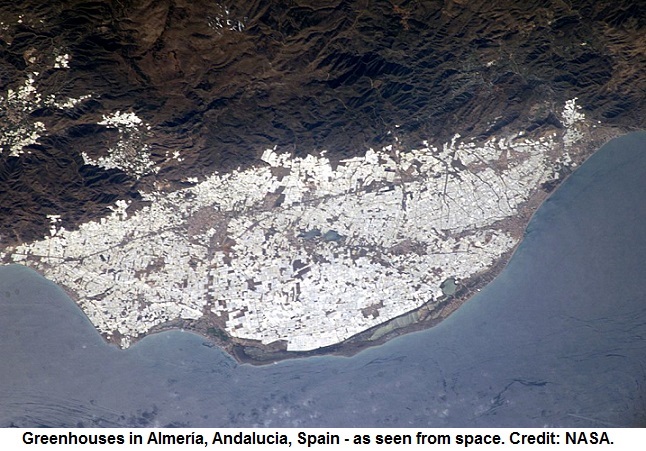
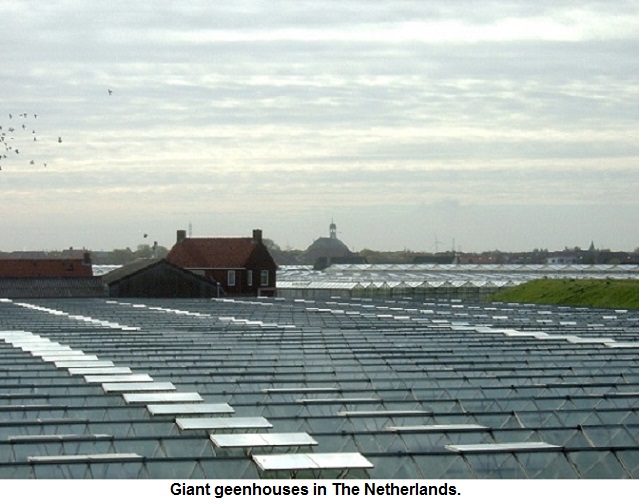
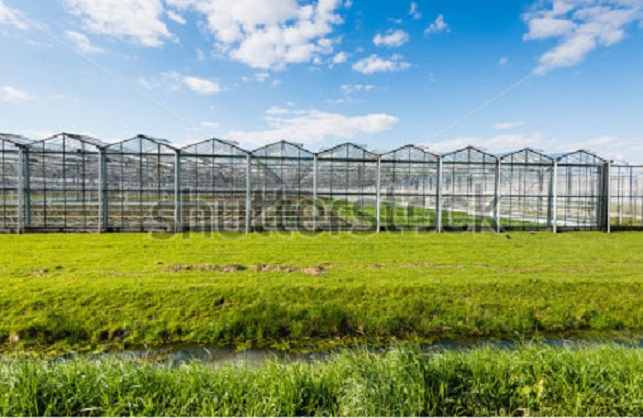
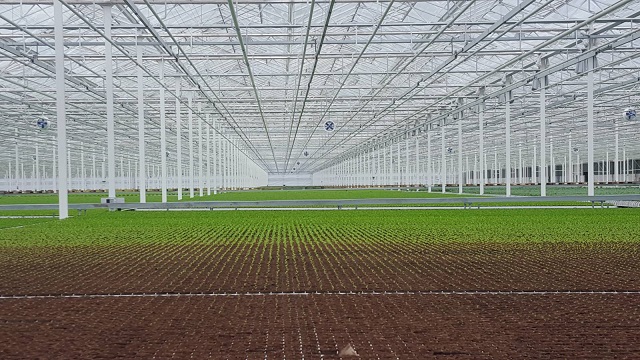
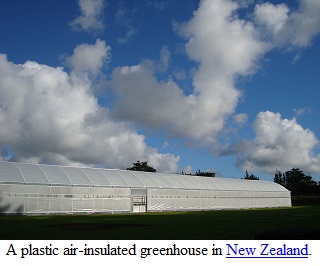
If it is too cold, we can warm up the crops – greenhouses – to guarantee a warmer temperature.

Surely, if its too warm, then we can cool our crops to dictate a colder climate.

Surely?! This reflects “dominion” over the earth.

This is the continuation of the teaching series for December 2019, from the movement behind the 2013 book Go Lean…Caribbean. This is entry 2 of 5 in this series considering Food Security and Bread Baskets for the Caribbean. Again, the goal here is not to just list the problems, but rather to focus on solutions for a better Food Supply for our region. The full catalog of this series is as follows:

  1. Food Security – Bread Baskets on Land and Sea
  2. Food Security – Temperate Foods in the Tropics
  3. Food Security – Opportunity: 1 County in Iowa raises all the Beef for a Cruise Line
  4. Food Security – FTAA: A Lesson in History
  5. Food Security – Big Chicken

This talk of bread baskets reminds us of the thought and thesis presented in a previous blog-commentary on February 8, 2017, from the movement behind this book Go Lean book. It is only apropos to Encore that previous submission here-now:

————-

Go Lean Commentary – Science of Sustenance – Temperate Foods

The “bread basket” of _________ …

CU Blog - Science of Sustenance - Temperate Foods - Photo 0You can fill in the blanks with difbferent regions around the world:

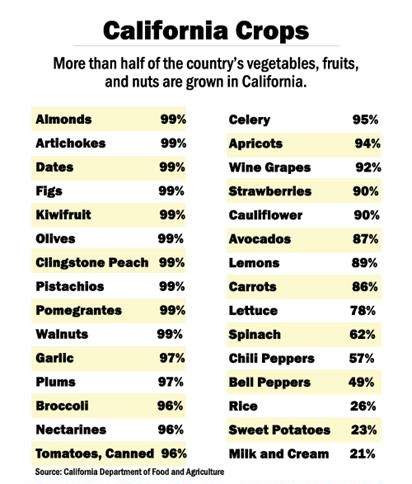
  • “Central Valley”, the bread basket of California
  • “Kansas”, the bread basket of America
  • “Alberta”, the bread basket of Canada
  • “Ukraine”, the bread basket of Eastern Europe

So who or where is the bread basket of the Caribbean?

Do we have an answer? Do we have a bread basket? Do we even have an organized region so as to collaborate on the responsibility of feeding our people?

No, No, and No!

This commentary is important for the Caribbean to contemplate. Every human in every land must arrange for the delivery of basic needs – “we gotta eat” and so food supply is paramount. Scientific developments have always been a major consideration for food supply, ever since the days of hunting-and gathering. Modern society is built on the premise that we would employ scientific best practices to harvest our food, or trade with people who employ these best practices.

The book Go Lean…Caribbean declares “enough already” with the trade; it is time to produce our own.

This was the original motivation for the publishing of this Go Lean book: to optimize the 30 Caribbean member-states into a Single Market so that we can be structured to do better in providing our basic needs. That structure would be the technocratic Caribbean Union Trade Federation (CU). The opening pages of the book feature this quotation (Page 3):

The CU should better provide for the region’s basic needs (food, clothing, energy and shelter), and then be in position to help supply the rest of the world. Previous Caribbean societies lived off the land and the sea; but today, the region depends extensively on imports, even acquiring large quantities of seafood, despite the 1,063,000 square miles of  the Caribbean Sea.

The CU Trade Federation is a technocracy, empowered to reboot the economic engines of the member-states, by fostering new industries (new “purse”) across the entire region and deploying solutions to better exploit the opportunities of the global trade market.

The Caribbean is in crisis for their dysfunctions in  delivering their own basic needs. This is the focus of this commentary; it is 2 of 4 in a series on the modern advances in science for delivering basic needs: energy, food, clothing and shelter. It is possible to deliver all these basic needs without science. But for our modern world, the advances of science make a positive impact on daily life. So the full series for our consideration follows this pattern:

  1.    Science of Sustenance: Energy
  2.    Science of Sustenance: Food
  3.    Science of Sustenance: Clothing
  4.    Science of Sustenance: Shelter

The book Go Lean…Caribbean asserts that “a crisis is a terrible thing to waste”. We must use our inadequate disposition to motivate stakeholders to forge change on our society; to implement the food supply solutions to do better at facilitating our own needs.

We are in the tropics…

… but science and technology allows us to deliver agricultural solutions for temperate produce (fruit and vegetables). Think:

  • Strawberries
  • Peaches
  • Apples
  • Spinach
  • Greens (Mustard, Collard, Kale, etc.)

Temperate produce need cooler temperatures to thrive. So the key is utilization of greenhouses, climate-controlled greenhouses. These allow for consistent temperatures of 20 to 30 degrees lower than the outside atmosphere. See a reference article on this subject here:

ARTICLE Grower 101: Using Evaporative Cooling, Part I
By John W. Bartok, Jr.
Find out what to use to keep your greenhouse ventilated and cool in the hot, humid summer.

On a bright, sunny summer day, a 30- x 100-foot greenhouse will gather about 32 million British Thermal Units (Btus) of heat. This is equivalent to burning 32 gallons of fuel oil or 320 therms of natural gas. If the greenhouse is full of plants, about one-half of this heat is used for transpiration and evaporation. The remainder of the cooling has to be conducted through ventilation. If the greenhouse is empty and closed, the temperature can exceed 150° F.

Understanding the basics
Shade on the outside of the greenhouse will keep some of the heat out. Shade on the inside, if it contains aluminum foil, will reflect some of the heat back out. Ventilation, either natural or fan, will remove a considerable amount of the heat that is collected. Still, on summer days, the temperature may exceed the desired level that promotes good plant growth by 10-20ºF. Excessive temperature results in delayed flowering and internode stretching. Evaporative cooling may be the best choice under these conditions.

Evaporative cooling, which uses the heat in the air to evaporate water from leaves and other wetted surfaces, can cool the greenhouse to 10-20° F below outside temperature. It takes one Btu of heat to raise the temperature of one pound of water 1° F, but it takes 1,060 Btus of heat to change the same amount of water to a vapor.

With an evaporated cooling system, humid air containing the heat that it picked up within the greenhouse is exhausted out through the vents or fans, and cooler, drier air is brought in. Evaporative cooling works best when the humidity of the outside air is low. For example, in Reno, Nev., the average summer dry bulb temperature is 96º F and the wet bulb is 61ºF. With an evaporative cooler having an efficiency of 80 percent, the temperature would be cooled to about 68° F. These conditions are most common in the dry Southwest, but even in the more humid sections of the United States, significant evaporative cooling can occur most days in the summer. In humid New Orleans, where the average summer dry bulb temperature is 93° F and the wet bulb is 78° F, the cooled air would be about 81° F, acceptable for the production of most plants.

Fan and pad system
Several evaporative cooling systems work well in commercial greenhouses. The most common is the fan and pad system. It contains a cellulose pad, overhead water supply pipe, gutter to collect excess water, a sump tank, pump, piping and control.

The 4- or 6-inch-thick pad is treated with anti-rot salts and stiffening and wetting agents. Pads are normally installed continuously along the side or end of the wall opposite the fans. The amount of pad area needed is calcuis the utillated by multiplying the floor area by 8 feet and dividing by 250 for a 4-inch pad or 400 for a 6-inch pad. For example, a 30- x 100-foot greenhouse with a 4-inch pad would require 96 sq. ft. of pads (30 x 100 x 8÷ 250 = 96 sq. ft.)

The overhead water supply pipe should distribute the water so the pad is wet uniformly. The minimum water flow rate is 0.5 gpm per sq. ft. for a 4-inch pad and 0.8 gpm per sq. ft. for a 6-inch pad.

Excess water is collected below the pad in a gutter and piped to a sump tank. Tank capacity needs to be 0.8 gallon per sq. ft. of pad for 4-inch pads and 1.0 gallon per sq. ft. for 6-inch pads. Water returning to the sump should be filtered to remove any debris. A make-up water supply and float valve keep the water level constant. In areas having water with a high mineral content, it is advisable to bleed 3-5 percent of the water to minimize salt buildup. Algae growth in the re-circulated water can be controlled with abiocide.

Modular pad systems of 5 and 6 feet are now available. These are self-contained and come completely assembled and ready to bolt to the wall. Installation time is reduced considerably. Only water and electrical connections have to be attached.

Next month, find out about swamp coolers, mist and fog systems and fan-generated fog and how they can work for you.

Source: Posted March 2003 from trade journal Greenhouse Product News; retrieved February 8, 2017 from: http://www.gpnmag.com/article/grower-101-using-evaporative-cooling-part-i/

CU Blog - Science of Sustenance - Temperate Foods - Photo 2

————-

VIDEO # 1 Best Thermal Cooled Greenhouse – https://youtu.be/HWXJ1ukEXa0

His Thermal Cooled Greenhouse in 1985 ran for 7 years, cooled itself day and night with 3 small Aquarium pumps, no fans or blowers; 14′ X 36′ ran on pennies a day – this worked!!! Now building a larger 24′ X 54′ Thermal Cooled Greenhouse. This works DAY OR NIGHT. Watch VIDEO !!!

  • Category – Science & Technology
  • License – Standard YouTube License

The science of greenhouses allows for temperate foods (fruit and vegetables) to be grown in a tropical zone – cold adds sweetness. This is what we want, what we need to fulfill our own basic needs. Other communities are doing this and we can as well. We have the role model of countries with colder climates supplying tropical fruit. Surely the reverse can be deployed as well, with strategic and tactical greenhouses.

Greenhouses allow for greater control over the growing environment of plants. Depending upon the technical specification of a greenhouse, key factors which may be controlled include temperature, levels of light and shade, irrigation, fertilizer application, and atmospheric humidity. Greenhouses may be used to overcome shortcomings in the growing qualities of a piece of land, such as a short growing season or poor light levels, and they can thereby improve food production in marginal environments. Greenhouses in hot, dry climates used specifically to provide shade are sometimes called “shadehouses”.[42][43]

As they may enable certain crops to be grown throughout the year, greenhouses are increasingly important in the food supply of high-latitude countries. One of the largest complexes in the world is in Almería, Andalucía, Spain, where greenhouses cover almost 49,000 acres.
Source:
Retrieved February 8, 2017 from: https://en.wikipedia.org/wiki/Greenhouse
CU Blog - Science of Sustenance - Temperate Foods - Photo 3

The Caribbean is in crisis … we are not able to feed ourselves from the current food supply systems. We therefore have to expend foreign reserves to acquire food from foreign locations. This applies to food that, with the proper empowerments, can be grown locally in the Caribbean region.

This Go Lean book serves as a roadmap for the introduction and implementation of the technocratic Caribbean Union Trade Federation (CU). The goal is that the CU would adopt these food supply best practices to better delivery this basic need for the region. In fact, the prime directives of the CU are described as:

  • Optimize the economic engines – including food supply solutions – to elevate the regional economy to grow to $800 Billion and create 2.2 million new jobs.
  • Establish a security apparatus to protect the resultant economic engines.
  • Improve Caribbean governance to support these engines.

The Go Lean roadmap calls for the immediate adoption of best practices in food supply science (agriculture) and infrastructure. We do not have to re-invent the wheel in this quest; other communities are doing it already. Consider the photos here of giant greenhouses in The Netherlands:

CU Blog - Science of Sustenance - Temperate Foods - Photo 1

CU Blog - Science of Sustenance - Temperate Foods - Photo 1d

CU Blog - Science of Sustenance - Temperate Foods - Photo 1c

CU Blog - Science of Sustenance - Temperate Foods - Photo 1b

This vision of temperature controlled greenhouses in the Caribbean assumes a supply of energy for cooling and ventilation. See more here on ventilation:

Ventilation is one of the most important components in a successful greenhouse, specially in hot and humid tropical climate condition.[18] If there is no proper ventilation, greenhouses and their growing plants can become prone to problems. The main purposes of ventilation are to regulate the temperature, humidity and vapor pressure deficit [19] to the optimal level, and to ensure movement of air and thus prevent build-up of plant pathogens (such as Botrytis cinerea) that prefer still air conditions. Ventilation also ensures a supply of fresh air for photosynthesis and plant respiration, and may enable important pollinators to access the greenhouse crop.

Ventilation can be achieved via use of vents – often controlled automatically via a computer – and recirculation fans.
Source: Retrieved February 8, 2017 from: https://en.wikipedia.org/wiki/Greenhouse

All in all, the Go Lean book declares that “a crisis is a terrible thing to waste”. This siren call is for the establishment of a regional technocracy to facilitate the delivery of the region’s basic needs.  According to the foregoing articles/references, we can grow temperate foods in the tropical zone without exhausting foreign currency.

The vision here of climate-controlled greenhouses requires heavy-lifting on the part of Caribbean stakeholders (governments and business communities). We need this heavy-lifting. A lot is at stake: our ability to feed our populations. The Go Lean roadmap calls for a separation-of-powers between CU federal agencies and the member-state governments. The CU presents Cabinet departments for Agriculture, Fisheries and Health (Food/Nutrition). These departments will have to collaborate with parallel departments at the member-state level.

This was the original motivation of the Go Lean roadmap, an interdependence of the 30 member-states of the Caribbean to offset the effects of globalization. This was pronounced early in the book in the Declaration of Interdependence (Page 14), with this statement:

xxx. Whereas the effects of globalization can be felt in every aspect of Caribbean life, from the acquisition of food and clothing, to the ubiquity of ICT, the region cannot only consume, it is imperative that our lands also produce and add to the international community, even if doing so requires some sacrifice and subsidy.

The roadmap also calls for the installations of Exclusive Economic Zones (EEZ) and Self-Governing Entities (SGE) that operate in controlled bordered territories like campuses, industrial parks, research labs and industrial plants. These can be a target for the climate-controlled greenhouses.

The Go Lean book declares that we must adopt a community ethos, the appropriate attitude/spirit to forge change in our region; then details the executions of the following strategies, tactics, implementations and advocacies to better impact the region’s preparation for food resources. See this sample here:

Community Ethos – Deferred Gratification Page 21
Community Ethos – Economic Systems Influence Individual Choices / Incentives Page 21
Community Ethos – The Consequences of Choices Lie in the Future Page 21
Community Ethos – Lean Operations Page 24
Community Ethos – Cooperatives Page 24
Community Ethos – Non-Government Organizations Page 25
Community Ethos – Ways to Impact the Future Page 26
Community Ethos – Ways to Improve Sharing Page 35
Community Ethos – Impact the Greater Good Page 37
Strategy – Vision – Confederating 30 Member-States into a Single Market Page 45
Strategy – Vision – Foster Local Economic Engines Food, Clothing & Shelter Page 45
Strategy – Mission – Prepare for Natural Disasters Page 45
Strategy – Mission – Exploit the Benefits and Opportunities of Globalization Page 46
Strategy – Agents of Change – Climate Change Page 57
Strategy – Agents of Change – Globalization Page 57
Tactical – Confederating a Permanent Union Page 63
Tactical – Fostering a Technocracy Page 64
Separation of Powers – Food & Nutritional Administration Page 87
Separation of Powers – Agriculture and Fisheries Department Page 88
Implementation – Ways to Pay for Change Page 101
Implementation – Start-up Benefits from the EEZ Page 104
Implementation – Steps to Implement Self-Governing Entities Page 105
Implementation – Ways to Deliver Page 109
Implementation – Ways to Foster International Aid Page 115
Implementation – Ways to Benefit from Globalization Page 119
Planning – Ways to Make the Caribbean Better Page 131
Advocacy – Ways to Grow the Economy Page 151
Advocacy – Ways to Better Manage Food Page 162
Advocacy – Ways to Improve Governance Page 168
Advocacy – Ways to Better Manage the Social Contract Page 170
Advocacy – Ways to Foster Cooperatives Page 176
Advocacy – Ways to Improve for Natural Disasters Page 184
Advocacy – Ways to Improve Emergency Management Page 196
Advocacy – Ways to Improve Fisheries Page 210
Advocacy – Ways to Impact Rural Living – Agricultural eco-systems Page 235

There are a lot of models of agricultural and infrastructural delivery that the Caribbean can learn from foreign shores. Previous Go Lean blog-commentaries have cited these models, samples and examples:

https://goleancaribbean.com/blog/?p=8982 GraceKennedy: A Caribbean Transnational tackles Food Supply
https://goleancaribbean.com/blog/?p=6867 How to address high consumer prices
https://goleancaribbean.com/blog/?p=6819 Supplying Foods for ‘Western’ Diets – We can do better!
https://goleancaribbean.com/blog/?p=6016 Hotter than July – An Appeal for Cooperative Refrigeration
https://goleancaribbean.com/blog/?p=5098 Forging Change in Society Through Food
https://goleancaribbean.com/blog/?p=3594 Lessons Learned from Queen Conch – A Caribbean Food
https://goleancaribbean.com/blog/?p=2276 Climate Change May Affect Food Supply Within a Decade

Who or where will be the bread basket of the Caribbean? With the empowerments in this commentary, it could be all 30 member-states.

Change has come to the world of agricultural systems and sciences and change must come to the Caribbean region; we must be able to feed ourselves. We need to convene, collaborate and cooperate to satisfy our most basic needs. Yes, we can …

… come together to make the Caribbean a better homeland to live, work and play.

The people and institutions of the region are hereby urged to lean-in to this Go Lean roadmap, to embrace the empowerments to reboot and turn-around our region. 🙂

Download the book Go Lean … Caribbean – now!


Share this post:
,
[Top]

Food Security – Bread Basket 101

Go Lean Commentary

We gotta eat!

In fact, we probably ate 3 times yesterday; we will need to eat today; and our bellies will grumble if we do not eat tomorrow. Every culture around the world have to plan and deliver some solution for food. The art and science of this delivery is called:

Food Security
[This] is defined as the availability of food and one’s access to it. A household is considered food secure when its occupants do not live in hunger or fear of starvation. Stages of food insecurity range from food secure situations to full-scale famine. The World Food Summit of 1996 defined food security as existing “when all people at all times have access to sufficient, safe, nutritious food to maintain a healthy and active life”. – Source: https://www.disabled-world.com/fitness/nutrition/foodsecurity/

This is Christmas-time 2019; this season is known for its feasting, especially here in the Caribbean where all 30 member-states – that constitute the political Caribbean – boasts a Judeo-Christian heritage.

What did you have on your dinner table for Christmas?
Turkey, Ham, Roast Pork, Goat, Fish, Chicken, etc.?

I hope you enjoyed your festivities. Nevertheless, truth be told, we have some serious issues in the regional eco-system for our food supply. In summary:

We do NOT have Food Security.

In fact, for most of the 30 Caribbean member-states, that Christmas dinner you enjoyed was mostly imported food. So if the transportation networks are ever interrupted, the flow of the needed food stuff would be impeded.
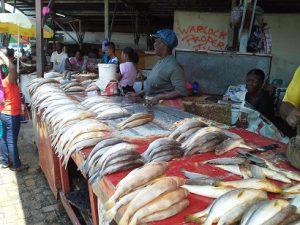
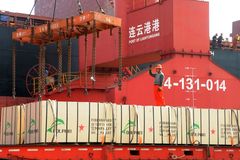
If … ever?

We have the constant threat of hurricanes and earthquakes in our region, so yes, this worrisome threat is not just theoretical; it has happened is happening in our homeland. (i.e. the NGO World Central Kitchen is feeding Hurricane Dorian survivors in the Northern Bahamas even now, 4 months after the devastation).

But wait?! We’ve got water: oceans and seas. Surely those resources will preserve our ability to provide a Food Supply to our people; surely we can feed ourselves from our fisheries? Sorry, No! Again in summary:

Our fish-stocks are in crisis. We are now importing more of our seafood, rather than locally sourcing for ourselves and others (minimal exports).

This is the subject of December 2019 teaching series for the movement behind the book Go Lean…Caribbean. (Every month we present a series). This commentary is 1 of 5 in a series considering Food Security for the Caribbean; the goal here is not to inventory the problems, but rather to define, discover, design and develop better Food Supply solutions for our region. The full series is as follows:

  1. Food Security – Bread Baskets on Land and Sea
  2. Food SecurityTemperate Foods in the Tropics
  3. Food SecurityOpportunity: 1 County in Iowa raises all the Beef for a Cruise Line
  4. Food SecurityFTAA: A Lesson in History
  5. Food SecurityBig Chicken

The 2013 Go Lean book presents a roadmap to introduce and implement a regional solution to ensure Food Security. It is a wise yet simple plan, to leverage the 42 million people in the 30 member-states to optimize the delivery systems for the region’s basic needs: food, clothing shelter and energy. The strategy of regional leverage is to confederate the technocratic Caribbean Union Trade Federation (CU). This would be a supra-national government entity to optimize the sourcing and provisioning of much of the agriculture and fishery needs for the people. The book posits that the challenge is too big for any one member-state alone to tackle and succeed. Therefore, there is the urgent need to formulate a Single Market to integrate all of these countries and territories in the geographical region, including the 1,063,000 square miles of the Caribbean Sea in an Exclusive Economic Zone. Imagine …

  • Food Cooperatives
  • Group Purchasing Organizations (GPO)
  • Refrigerated Warehouse Condominiums

These are just glimpses of the regional vision to grow the economy for all member-states. This was the urging of professional Economists when ask the question: “How do we, as the Caribbean, grow our economy? The answer: Feed Ourselves. See this excerpt from the Go Lean book (Page 153):

The industries of agri-business allow structured commercial systems to grow, harvest and trade in food supplies. Many of the Caribbean member states (Lesser Antilles) acquire all their food in trade, the agricultural footprint is very small, though some countries (Greater Antilles, Belize, Guyana & Suriname) have a low opportunity cost for producing food. But with the Trade Federation in force, intra-region trade will be the first priority. When the demand is qualified, quantified and assured, the supply and quality there in, will catch up.

As related here, “the industries of agri-business …” is where our focus need to be. As prescribed as good economic policy, we need our own bread basket so as to Feed Ourselves.

Bread basket = a part of a region that produces cereals for the rest of it.

Recent examples of Breadbasket Economic discussions:

See a sample bread basket reference (Nigeria) in this VIDEO here:

VIDEO – Benue State – Nigeria’s Food Basket – https://youtu.be/GhyOAF1eo1k

The234project
Published Feb 1, 2017 – Enjoy an overview of this wonderful middle belt state in Nigeria. It was created in 1976.

According to a previous Go Lean commentary:

Who or where is the bread basket of the Caribbean?

Do we have an answer? Do we have a bread basket? Do we even have an organized region so as to collaborate on the responsibility of feeding our people?

No, No, and No!

This commentary is important for the Caribbean to contemplate. Every human in every land must arrange for the delivery of basic needs – “we gotta eat” and so food supply is paramount. Scientific developments have always been a major consideration for food supply, ever since the days of hunting-and gathering. Modern society is built on the premise that we would employ scientific best practices to harvest our food, or trade with people who employ these best practices.

The book Go Lean…Caribbean declares “enough already” with the trade; it is time to produce our own.

Truth be told, the limestone islands of the Caribbean – think: Bahamas, Cayman, Turks & Caicos Islands, etc. – cannot be used to implement sustainable agricultural system. We need to deputize the larger landmasses – Belize, Cuba, Guyana, Suriname, etc. – to serve the bread basket role for the rest of the region.

This is the plan … deploy the agricultural installations and developments to make all the appropriate member-states our bread basket.

This plan is presented throughout the 370 pages of the Go Lean book, provided as turn-by-turn directions on how to reform and transform the economic, security and governing engines for the Caribbean region and their member-states. This roadmap includes the new community ethos (attitudes and values) that must be adopted; plus the executions of new strategies, tactics, implementations and advocacies to deliver on the basic responsibility of Feeding Ourselves. In fact, this is the actual title of one advocacy in the Go Lean book. Consider the specific plans, excerpts and headlines here from Page 162, entitled:

10 Ways to Better Manage Food Consumption

1 Lean-in for the Caribbean Single Market Confederation Treaty The CU will allow for the unification of the region into one market, thereby creating a single economy of 30 member-states, 42 million people and a GDP of over $800 Billion – the CU will take the lead in facilitating the food supply and distribution systems to ensure the region can feed itself, more from local production and less from trade. Though the cost savings of imports should never be ignored, some CU countries (Greater Antilles, Belize, Guyana & Suriname) have a low opportunity cost for increasing food production for the regional market. Thus a mission of the CU is to streamline the systems, processes, logistics, funding, training, and market promotions so that the Caribbean can fulfill this basic need.
2 Public Health Dynamics – Produce Deserts & Farmers Market
3 “Nouvelle” Caribbean Cuisine
4 Agri-Business

Many of the member-states get 90% (or more) of their food supplies from imports; even fish is imported from Alaska, despite the 1,063,000 square miles of harvestable waters of the Caribbean Sea. The CU will implement agri-business (and aqua-culture) investments to generate more regional options for food production: cooperatives (co-ops), farm credit, common grazing lands, fisheries oversight, canaries, aqua-culture endeavors, etc.

5 Logistics for the Food Supply

[Quick Service Restaurants or] QSRs are so popular and growing in demand because they have mastered the “art and science” of logistics, to get their food to the consumer; and thus the low cost. When speed is not the goal, preservative strategies must be implemented. The technology of canning, “200 year old science”, will be advocated more for native products. (Most canned coconut water comes from Thailand). The CU will sponsor co-ops to manage canneries for different foods.

6 Fresh Frozen

Delivery of food products must be carefully managed. Meats and produce are perishable and have a limited time to get to their final markets. An additional logistical strategy is “flash freezing”. This 100-year old technology holds a lot of promise for the region. The CU will sponsor cooperatives and condominium associations to construct and maintain refrigerated warehouses, with power alternatives, to facilitate the logistics of frozen products – for trading partners.

7 Food Labeling
8 Export – Help Regional Businesses Find Foreign Markets
9 Media Industrial Complex
10 Food Tourism

This advocacy projects that there is hope that we can reform and transform our agricultural deliveries. That’s the land, what about the seas?

In a previous blog-commentaryLessons in Economic History: Commerce of the Seas – Book Review: ‘Sea Power’ – we learned how the oceans/seas can give a competitive advantage that can be exploited:

Around the world, countries that had access to the “Sea” have a distinct advantage economically versus countries that were land-locked; i.e. England versus Austria.

To help us Feed Ourselves, the Go Lean roadmap also advocates that we exploit the valuable resources of the seas, by reforming and transforming the fishery eco-system. In fact, this is the actual title of one advocacy in the Go Lean book. Consider the specific plans, excerpts and headlines here from Page 210, entitled:

10 Ways to Improve Fisheries

1 Lean-in for the Caribbean Union Trade Federation (CU).

The CU will allow for the unification of the region into one market, thereby creating a single economy of 30 member-states, 42 million people and a GDP of over $800 Billion (2010). One mission of the CU is to facilitate the food supply so that the region can feed itself, more from local production and less from trade; this includes yields from fisheries. The Caribbean Sea generates a large fishing industry for the surrounding countries, accounting for half a million metric tons (1.1 billion pounds) of fish per year. And yet, the region still imports fish from Alaska. (Alaska imports none from the Caribbean).

2 UN Petition – Effort initiated by the ACS [(Association of Caribbean States)]
3 Common Pool Resources (Lobster, Conch, Grouper, Flying Fish)

Though the waters between the islands may be uninhabited, their resources can still be depleted. The CU will govern the common pool resources to promote the sustainability of fish stock. Fishing for lobster, conch, grouper, “flying fish” and other species. [These] must be controlled, with limited harvesting seasons, otherwise there will be none for future generations.

4 Cooperatives

Fishery cooperatives allow fishermen and industry players to pool their resources in certain (non-competitive) areas of activity. This strategy is vital for sharing the cost and expense of installing piers/docks, locating systems (Loran-C & GPS), canaries, refrigerated warehouses and transportation solutions.

5 Aqua-culture and Mari-culture

The CU will foster the industry (and cooperatives) for aqua-culture, the controlled harvesting of fish, crustaceans,

mollusks and aquatic plants using farm-like conditions and practices. While commercial fishing can be likened to hunting-and-gathering, aquaculture is more akin to agriculture. Mari-culture, on the other hand, refers to aquaculture practiced in marine environments and underwater habitats. The CU will plant aquatic plants as needed to protect fish beds and reefs.

6 Fishing Tourism and Yachting Enthusiasts
7 Marine Financing
8 Coast Guard hand-off to CU Naval Authority
9 ICE Cooperation
10 Maritime Emergency Management

This Caribbean roadmap to improve our Surf & Turf  Food Supply should be welcomed and greatly appreciated. The end result will be less imports – this means we get to Feed Ourselves with lower costs and greater variety in our Food Supply.

The issues in reforming and transforming our agriculture and fishery eco-systems have been a frequent subject for previous blog-commentaries; consider this list of sample entries:

https://goleancaribbean.com/blog/?p=17697 Using Common Pool Resources to Better Source Our Food
https://goleancaribbean.com/blog/?p=15359 Industrial Reboot – Fisheries 101
https://goleancaribbean.com/blog/?p=13184 Industrial Reboot – Frozen Foods 101
https://goleancaribbean.com/blog/?p=10369 Science of Sustenance – Temperate Foods
https://goleancaribbean.com/blog/?p=3594 Better Fisheries Management for Queen Conch
https://goleancaribbean.com/blog/?p=2276 Climate Change May Affect Food Supply Within a Decade

All Caribbean member-states are urged to “eat, drink and be merry”, but let’s do it with local food that we source ourselves – harvested from our own bread basket. This was an original intent of the Go Lean book; see this except from the opening Page 3:

The CU should better provide for the region’s basic needs (food, clothing, energy and shelter), and then be in position to help supply the rest of the world. Previous Caribbean societies lived off the land and the sea; but today, the region depends extensively on imports, even acquiring large quantities of seafood, despite the 1,063,000 square miles of the Caribbean Sea.

“Living off the land; living off the Seas” – considering our historicity, it would be stupid for us to NOT try this effort. This is why this roadmap is conceivable, believable and achievable. We urge all Caribbean stakeholders to lean-in to this roadmap to empower our regional Food Supply – we must feed ourselves … and make the Caribbean homeland and home-seas better places to live, work and play. 🙂

About the Book
The book Go Lean…Caribbean serves as a roadmap for the introduction and implementation of the technocratic Caribbean Union Trade Federation (CU), for the elevation of Caribbean society – for all member-states. This CU/Go Lean roadmap has these 3 prime directives:

  • Optimization of the economic engines in order to grow the regional economy to $800 Billion & create 2.2 million new jobs.
  • Establishment of a security apparatus to ensure public safety and protect the resultant economic engines.
  • Improve Caribbean governance to support these engines, including a separation-of-powers between the member-states and CU federal agencies.

The Go Lean book provides 370-pages of turn-by-turn instructions on “how” to adopt new community ethos, plus the strategies, tactics, implementations and advocacies to execute so as to reboot, reform and transform the societal engines of Caribbean society.

Download the free e-Book of Go Lean … Caribbean – now!

Who We Are
The movement behind the Go Lean book – a non-partisan, apolitical, religiously-neutral Community Development Foundation chartered for the purpose of empowering and re-booting economic engines – stresses that reforming and transforming the Caribbean societal engines must be a regional pursuit. This was an early motivation for the roadmap, as pronounced in the opening Declaration of Interdependence (Pages 12 – 14):

xi. Whereas all men are entitled to the benefits of good governance in a free society, “new guards” must be enacted to dissuade the emergence of incompetence, corruption, nepotism and cronyism at the peril of the people’s best interest. The Federation must guarantee the executions of a social contract between government and the governed.

xvi. Whereas security of our homeland is inextricably linked to prosperity of the homeland, the economic and security interest of the region needs to be aligned under the same governance. Since economic crimes … can imperil the functioning of the wheels of commerce for all the citizenry, the accedence of this Federation must equip the security apparatus with the tools and techniques for predictive and proactive interdictions.

xxiv. Whereas a free market economy can be induced and spurred for continuous progress, the Federation must install the controls to better manage aspects of the economy: jobs, inflation, savings rate, investments and other economic principles. Thereby attracting direct foreign investment because of the stability and vibrancy of our economy.

xxx.  Whereas the effects of globalization can be felt in every aspect of Caribbean life, from the acquisition of food and clothing, to the ubiquity of ICT, the region cannot only consume, it is imperative that our lands also produce and add to the international community, even if doing so requires some sacrifice and subsidy.

Sign the petition to lean-in for this roadmap for the Caribbean Union Trade Federation.

Share this post:
,
[Top]

Better Than … the ‘Bill of Rights’ – Seventh & Eighth Amendments

Go Lean Commentary

We presented a thesis, that despite the public branding of America being the “Greatest” country, we can do better in a new Caribbean. We presented the argument that the American Bill of Rights may not be the masterpiece as people want to believe:

  • It’s First Amendment does not allow for mitigation of the Fake News phenomenon;
  • the Second Amendment does not allow for common sense gun control;
  • the Fourth & Fifth Amendments allows for so many exclusions that they undermine any quest for justice.

Now we make the assessments on the Seventh and Eighth Amendments of the US Constitution. These provide the legal premise of …

Seventh Amendment – Guarantees jury trials in federal civil cases
Eighth Amendment – Restricts against excessive bail and cruel-and-unusual punishments

Surely, these constitutional provisions allow the United States to be a more Perfect Union? Undeniably, No! In fact, these constitutional mandates have resulted in a more unequaled society. As we examine the actuality of America’s criminal justice system, we concur with the critics and scholars, that the legal deficiencies are acute; see these headlines here:
“Increasingly, bail has become a way to lock up the poor regardless to guilt” – VIDEO below.

“War against Poor people” – Criticism of America in previous VIDEO.

These headlines are true because of the painful reality that there are two standards of justice in America:

One for poor people and one for rich people. – See the previous blog-commentaries in Appendix A below.

What is worse: there’s nothing “we” can do about it, as Caribbean people. There is little that American can do about it either. This is the continuation – 5 of 6 – of the November 2019 series from the movement behind the book Go Lean…Caribbean. This series supports the thesis that we, in the Caribbean, can be Better Than America, in words (law) and in action. As related in a previous submission, the American Bill of Rights was designed to be embedded in the country’s legal foundation in such a way so as to prevent subsequent majorities from violating the rights of minorities. This sounds “good on paper”, but it made it near-impossible to change the Constitution. So when deficiencies emerge just through societal evolution, the country’s criminal justice laws have not kept pace; now there is a blatantly unequal, unjust system of law-and-order.

This introduction allows us to define these subsets of the Bill of Rights, the Seventh and Eighth Amendments of the US Constitution, as follows:

Seventh Amendment to the United States Constitution

  • In suits at common law, where the value in controversy shall exceed twenty dollars, the right of trial by jury shall be preserved, and no fact tried by a jury, shall be otherwise re-examined in any court of the United States, than according to the rules of the common law.[93]

The Seventh Amendment guarantees jury trials in federal civil cases that deal with claims of more than twenty dollars. It also prohibits judges from overruling findings of fact by juries in federal civil trials.

Eighth Amendment to the United States Constitution

  • Excessive bail shall not be required, nor excessive fines imposed, nor cruel and unusual punishments inflicted.[93]

The Eighth Amendment forbids the imposition of excessive bails or fines, though it leaves the term “excessive” open to interpretation.[112] The most frequently litigated clause of the amendment is the last, which forbids cruel and unusual punishment.[113][114] This clause was only occasionally applied by the Supreme Court prior to the 1970s, generally in cases dealing with means of execution. In Furman v. Georgia (1972), some members of the Court found capital punishment itself in violation of the amendment, arguing that the clause could reflect “evolving standards of decency” as public opinion changed; others found certain practices in capital trials to be unacceptably arbitrary, resulting in a majority decision that effectively halted executions in the United States for several years.[115] Executions resumed following Gregg v. Georgia (1976), which found capital punishment to be constitutional if the jury was directed by concrete sentencing guidelines.[115] The Court has also found that some poor prison conditions constitute cruel and unusual punishment, as in Estelle v. Gamble (1976) and Brown v. Plata (2011).[113]
Source: Retrieved November 26, 2019 from https://en.wikipedia.org/wiki/United_States_Bill_of_Rights

Note: Rich people are able to hire jury consultants to “stack the deck” in their favor to ensure victory. It’s an art and a science! (See more on this subject here: https://en.wikipedia.org/wiki/Trial_consulting).

The US currently boast a criminal justice system with Cash Bail that imperils the poor. So when a suspect is accused of a crime and does not have the money for bail, they have to stay in jail until their trial. Since they are detained, this actuality is in fact a “cruel and unusual” punishment; especially when they have been innocent all the while. Many times the offences are small and the amount of time away from their normal routines (jobs and family obligations) disrupt their lives severely. See how this has been depicted in this embedded VIDEO here:

VIDEO – Bail: Last Week Tonight with John Oliver (HBO) – https://youtu.be/IS5mwymTIJU

LastWeekTonight
Published Jun 7, 2015 – John Oliver explains why America’s bail system is better for the Reality TV industry than it is for the justice system.

Connect with Last Week Tonight online…

Subscribe to the Last Week Tonight YouTube channel for more almost news as it almost happens: www.youtube.com/user/LastWeekTonight

Find Last Week Tonight on Facebook like your mom would: http://Facebook.com/LastWeekTonight

Follow us on Twitter for news about jokes and jokes about news: http://Twitter.com/LastWeekTonight

Visit our official site for all that other stuff at once: http://www.hbo.com/lastweektonight

Despite the humorous portrayals, this is no laughing matter. Many lives are ruined because of the injustice of the Cash Bail system. America is punishing poor people for being … poor.

This is not our conclusion alone.

There are advocates that are trying to reform and transform this broken eco-system. Kudos to them. There are also organizations that are trying to help the most vulnerable of the victims of this legal dysfunction. These “Do Gooders” should be recognized, honored, promoted and emulated. See the news story of one such group in Atlanta, Georgia in Appendix B below.

(Click here to read the full article).

We too can do good and do better in our Caribbean homeland; we have no Bill of Rights impeding our need for progress. We have always maintained that we can more easily reform our homeland than to fix American society. We have no excuse not to change and improve our communities.

This is the quest of the Go Lean movement to reform and transform Caribbean society. The revelation of the ugly details of American jurisprudence is the purpose of this November 2019 blog series. The full catalog of this series on the Bill of Rights is detailed as follows:

  1. Better than the Bill of Rights: First Amendment – We can do better
  2. Better than the Bill of RightsSecond Amendment – No slavery legacy
  3. Better than the Bill of RightsThird  & Fourth Amendments – Remember, Justice First
  4. Better than the Bill of RightsFifth & Sixth Amendments
  5. Better than the Bill of Rights: Seventh & Eighth Amendments
  6. Better than the Bill of Rights: Ninth & Tenth Amendments

As this series refers to the need for a comprehensive roadmap for elevating the societal engines – economics, security and governance – of the 30 Caribbean member-states, this entry focuses more on the need for a roadmap to help poor people in our Caribbean society. While poverty must not be criminalized, we must also not be satisfied to just stop on criminal justice issues; we must make strenuous effort to forge a society where poverty can be mitigated and its “captors liberated”. Our goal is for the Caribbean homeland to be a place where people can prosper where they are planted. If we fail on the prospering side, then people will be inclined to just abandon their homeland. (This is a Push and a Pull issue).

Oops too late!

We already have an atrocious societal abandonment rate – some reports reflect 70 percent of the professional classes have already left from the independent countries. It is even worse still in dependent territories – 50 percent of everyone!

The Go Lean book provides 370 pages of roadmap posits that economic optimizations must be coupled with security provisions; we cannot have one without the other. This is a Big Idea for the Caribbean to reform and transform its economic and security engines; this requires adopting new community ethos (attitudes and values), plus the executions of new strategies, tactics, implementations and advocacies to empower poor people to elevate their circumstances. In the end, the goal is to find success in the journey to Middle Class. This is the actual title of one advocacy in the Go Lean book. Consider the specific plans, excerpts and headlines here from Page 222, entitled:

10 Battles in the War on Poverty

1 Lean-in for the Caribbean Single Market Confederation Treaty
This regional re-boot will allow for the unification of the region into one market, thereby creating a single economy of 30 member-states, 42 million people and a GDP of over $800 Billion. Following the model of the European Union, the CU will seek to streamline economic engines so as to increase jobs, standards of living and opportunities – increasing GDP. The CU will work to make the Caribbean a better place to live, work and play for all socio-economic classes.
2 Minimize Political Bureaucracy
3 Welfare versus “Work-fare”

Many economists have argued that the US “War Against Poverty” – Welfare first – policies, actually had a negative impact on the economy because of their interventionist nature. This school of thought is that the best way to fight poverty is not through government spending but through economic growth, thus “Work-fare” is a better solution. In 1996 the US implemented a Welfare-to-Work program that had almost immediate results – welfare and poverty rates both declined during the late-1990s, leading many commentators to declare that the legislation was a success. The CU takes a similar stance: lead with jobs!

4 Entrepreneurial Values
5 Repatriation of Time, Talent and Treasuries
6 Family Planning

Third World countries usually have higher birth rates than Developed countries. While not discouraging individual rights, the CU will facilitate better education, women’s health resources and access to prenatal healthcare.

7 Education Goals in Balance
8 Proactive about Healthcare Realities
9 Aging Population

The CU will facilitate for the Caribbean Region to be the world’s best address for senior citizens. This will send the invitation to retirees (Caribbean Diaspora and foreign) to welcome their participation and contributions to CU society. The increase in the pool of participants and beneficiaries will extended added benefits to domestic seniors.

10 Raise Retirement Age

Yes, we can do better in the Caribbean homeland. We are hereby determined and committed to battling poverty in the 30 member-states. The Go Lean roadmap presents the strategies, tactics, implementations and advocacies to do “whatever it takes” to lower the Push and Pull factors that cause people to abandon their communities. It is conceivable, believable and achievable to succeed.

Competing with America is not an option; the very continuation of our Caribbean culture depends on our ability to compete better. Lowering Push and Pull factors, at times, involve just messaging the people on the truth of the American experience.

So yes, we can be Better Than America; we can do better than the Bill of Rights (with its concern for tyranny). We can be more just, and more equal in our public safety mechanisms and the dispensation of justice; and do it without allowing tyranny. We urge all Caribbean stakeholders – citizens and government leaders alike – to lean-in to this roadmap to make our homeland a better place to live, work and play.  🙂

About the Book
The book Go Lean…Caribbean serves as a roadmap for the introduction and implementation of the technocratic Caribbean Union Trade Federation (CU), for the elevation of Caribbean society – for all member-states. This CU/Go Lean roadmap has these 3 prime directives:

  • Optimization of the economic engines in order to grow the regional economy to $800 Billion & create 2.2 million new jobs.
  • Establishment of a security apparatus to ensure public safety and protect the resultant economic engines.
  • Improve Caribbean governance to support these engines, including a separation-of-powers between the member-states and CU federal agencies.

The Go Lean book provides 370-pages of turn-by-turn instructions on “how” to adopt new community ethos, plus the strategies, tactics, implementations and advocacies to execute so as to reboot, reform and transform the societal engines of Caribbean society.

Download the free e-Book of Go Lean … Caribbean – now!

Who We Are
The movement behind the Go Lean book – a non-partisan, apolitical, religiously-neutral Community Development Foundation chartered for the purpose of empowering and re-booting economic engines – stresses that reforming and transforming the Caribbean societal engines must be a regional pursuit. This was an early motivation for the roadmap, as pronounced in the opening Declaration of Interdependence (Pages 12 – 13):

xi. Whereas all men are entitled to the benefits of good governance in a free society, “new guards” must be enacted to dissuade the emergence of incompetence, corruption, nepotism and cronyism at the peril of the people’s best interest. The Federation must guarantee the executions of a social contract between government and the governed.

xvi. Whereas security of our homeland is inextricably linked to prosperity of the homeland, the economic and security interest of the region needs to be aligned under the same governance. Since economic crimes … can imperil the functioning of the wheels of commerce for all the citizenry, the ccidence of this Federation must equip the security apparatus with the tools and techniques for predictive and proactive interdictions.

xxiv. Whereas a free market economy can be induced and spurred for continuous progress, the Federation must install the controls to better manage aspects of the economy: jobs, inflation, savings rate, investments and other economic principles. Thereby attracting direct foreign investment because of the stability and vibrancy of our economy.

Sign the petition to lean-in for this roadmap for the Caribbean Union Trade Federation.

—————–

Appendix A – Observing and Reporting on America’s Criminal Injustice

There have been a number of blog-commentaries by the Go Lean movement over the years that highlighted the inequality in the American Justice System – clearly “justice is blind, deaf and dumb”, as  there is a Great Divide in this country for Black vs White and Rich vs Poor. See a sample list here of those previous submissions:

https://goleancaribbean.com/blog/?p=18421 Introducing Formal Reconciliations: Forging Justice After the Fact
https://goleancaribbean.com/blog/?p=18321 Unequal Justice: Lessons from the American Sheriffs Eco-System
https://goleancaribbean.com/blog/?p=18100 Cop-on-Black Shootings in America’s DNA/Slavery Legacy
https://goleancaribbean.com/blog/?p=17667 Is the US a ‘Just’ Society? Hardly! – Notice how the Rich is treated
https://goleancaribbean.com/blog/?p=17267 Lessons learned for Justice: The need for Special Prosecutors
https://goleancaribbean.com/blog/?p=16668 Justice and Economics – Both needed to forge change
https://goleancaribbean.com/blog/?p=14413 Learning from the History of Lynching: ‘Hurt People Hurt People’
https://goleancaribbean.com/blog/?p=14087 Pharma Injustice: Opioids & the FDA – ‘Fox guarding the Henhouse’
https://goleancaribbean.com/blog/?p=13826 Taking from the Poor to Give to the Rich
https://goleancaribbean.com/blog/?p=13664 High Profile Sexual Harassment Accusers – Hard to get Justice
https://goleancaribbean.com/blog/?p=13081 America’s Race Relations – Spot-on for Protest
https://goleancaribbean.com/blog/?p=10654 Immigration Realities in the US – Better to Stay Home
https://goleancaribbean.com/blog/?p=10532 Learning from Good and Bad Stereotypes: Japanese Internments
https://goleancaribbean.com/blog/?p=5527 American Defects: Racism – Is It Over?
https://goleancaribbean.com/blog/?p=5238 Prisoners for Profit – Mostly Black-and-Brown Victimized
https://goleancaribbean.com/blog/?p=8724 US versus Marcus Garvey: An Obvious Case of Racial Injustice
https://goleancaribbean.com/blog/?p=1143 Easy on White Collar Crimes & Health-care Fraud = $272 Billion/year
https://goleancaribbean.com/blog/?p=546 Book Review: ‘The Divide’ – American Injustice … Age of Wealth Gap

—————–

Appendix B – New Birth bails nonviolent offenders out of jail for fresh start
By: Shelia Poole, The Atlanta Journal-Constitution

New Birth Missionary Baptist Church has raised $120,000 to provide bail for first-time, nonviolent offenders in four Georgia counties.

The “Bail Out” program was designed to give men and women a second chance, beginning Easter weekend. [Pastor Jamal] Bryant will share details of the initiative during a press conference at 2 p.m. Saturday at New Birth Missionary Baptist Church, 6400 Woodrow Rd. in Stonecrest.

He is expected to joined by rapper and actor Clifford “T.I.” Harris, VH1’s “Love & Hip Hop” personality Scrapp DeLeon and representatives from local sheriffs’ offices.

The program targets DeKalb, Fulton, Gwinnett and Rockdale counties. It will also help with job readiness.

It began as a $40,000 local challenge within the New Birth congregation and quickly grew to $120,000 and a larger metro movement.

“I looked at what was happening in the prison pipeline and realized that the church voice had been muted on the issue of prison reform,” said Bryant, the megachurch’s senior pastor.  “I realized that we needed to be part of what was taking place.”

And what better time, he noted, than during the observance of Easter, when Christians celebrates the resurrection of Jesus Christ which some churches refer to as “Resurrection Sunday.”
Source:  Posted April 19, 2019; retrieved November 26, 2019 from: https://www.ajc.com/lifestyles/pastor-jamal-bryant-scrapp-deleon-join-forces-help-nonviolent-offenders-get-new-start/0R1JARRBpUSBhW1nBMe1pN/

Share this post:
, , , , ,
[Top]

Better Than … the ‘Bill of Rights’ – We can do better!

Go Lean Commentary

What makes America better?
Our freedom …
… our Constitution is a masterpiece;
… but other countries have freedom too. – Dialogue from TV Show Newsroom (See Appendix VIDEO below).

Many people still believe that America is the “greatest” because of its Constitution. It is time now to break-down this BIG FAT LIE of a thesis and then ascertain the truth. Remember this assertion:

When I was a boy, heaven was up here – [pointing in a gesture] – and America was here [only a little lower in the gesturing]. – See previous Go Lean blog-commentary with this portrayal.

Is America just a product of good advertising or is there any truth to this “masterpiece” assessment of the Constitution?

Firstly, that “masterpiece” Constitution was ratified in 1789 and then immediately engaged in an Amendment process to add-more and make it better. There was the pronounced need to ensure protection against any emergence of tyranny by the new government. These protections were codified in the First 10 Amendments, better known as the Bill of Rights; this is the feature that valued the new Constitution as a masterpiece.

Let’s examine these closer …

American History presents the case of an overarching need to rebel against the tyranny of imperial power. This was the motivation for the country’s Founding Fathers and the originators of the American Declaration of Independence in 1776. That document codified this motivation with these words:

We hold these truths to be self-evident, that all men are created equal, that they are endowed by their Creator with certain unalienable rights, that among these are life, liberty and the pursuit of happiness; that to secure these rights, governments are instituted among men, deriving their just powers from the consent of the governed. That whenever any form of government becomes destructive to these ends, it is the right of the people to alter or to abolish it, and to institute new government, laying its foundation on such principles and organizing its powers in such form, as to them shall seem most likely to effect their safety and happiness. Prudence, indeed, will dictate that governments long established should not be changed for light and transient causes; and accordingly all experience hath shown that mankind are more disposed to suffer, while evils are sufferable, than to right themselves by abolishing the forms to which they are accustomed. But when a long train of abuses and usurpations, pursuing invariably the same object evinces a design to reduce them under absolute despotism, it is their right, it is their duty, to throw off such government, and to provide new guards for their future security.

Why is this American Constitutional History important from a Caribbean perspective?

Today we have to compete with America, but now they are economic tyrants due to their size, strength and wealth; they are “eating our lunch”. We have a critical brain drain problem in which we lose so many of our citizens, who have abandoned their homelands … for American shores. When they do this and naturalize as American citizens, they are required to take an oath and vow to defend this same Constitution; with these sentiments:

… that I will support and defend the Constitution and laws of the United States of America against all enemies, foreign and domestic; that I will bear true faith and allegiance to the same;

Let’s keep it real! Those in the Caribbean, where 29-of-the-30 member-states reflect a Majority Black-and-Brown ethnic reality, that 1789 Constitution allowed you to be enslaved and only valued you at 3/5th the value of a man. So perhaps that Constitution needs to be “taken down a notch” in its glorification. (Note: the 13th Amendment abolished slavery, but after nearly 100 years later in 1865).

The effort in this commentary is part of the quest to make the Caribbean a better place to live, work and play, even Better Than America. Therefore, we too need a masterpiece quality in our laws and statues. How do we compare? How should we compare? In addition, with our effort to appoint New Guard for our regional governance, how can we apply the lessons from America’s Constitutional History?

Here’s the encyclopedic reference to those Bill of Rights … that supposedly made the US Constitution such a masterpiece:

Reference: United States Bill of Rights
The United States Bill of Rights comprises the first ten amendments to the United States Constitution. Proposed following the often bitter 1787–88 debate over the ratification of the Constitution, and written to address the objections raised by Anti-Federalists, the Bill of Rights amendments add to the Constitution specific guarantees of personal freedoms and rights, clear limitations on the government’s power in judicial and other proceedings, and explicit declarations that all powers not specifically granted to the U.S. Congress by the Constitution are reserved for the states or the people. The concepts codified in these amendments are built upon those found in earlier documents, especially the Virginia Declaration of Rights (1776), as well as the English Bill of Rights (1689) and the Magna Carta (1215).[1]
The Supreme Court … concluded … that the founders intended the Bill of Rights to put some rights out of reach from majorities, ensuring that some liberties would endure beyond political majorities.[88][89][90][91]

  • First Amendment – Freedom of speech, or of the press; or the right of the people peaceably to assemble/petition
  • Second Amendment – The right of the people to keep and bear Arms
  • Third Amendment – Restricting the quartering of soldiers in a private house
  • Fourth Amendment – Restrictions against unreasonable searches and seizures
  • Fifth Amendment – Protects against double jeopardy and self-incrimination and guarantees the rights to due process, grand jury screening of criminal indictments, and compensation for the seizure of private property under eminent domain.
  • Sixth Amendment – Grants the right to a speedy and public trial, by an impartial jury in the jurisdiction where the crime have been committed.
  • Seventh Amendment – Guarantees jury trials in federal civil cases
  • Eighth Amendment – Restricts against excessive bail and cruel-and-unusual punishments
  • Ninth Amendment – Reserves the privilege that “other” rights not enumerated in the Constitution are retained by the people
  • Tenth Amendment – Reinforces that powers not delegated to the Federal Government as being reserved to the States or the people.

Source: Retrieved November 21, 2019 from: https://en.wikipedia.org/wiki/United_States_Bill_of_Rights

For the new Caribbean, we want to compete better with America. We do not want “them eating our lunch”; we want to appeal to our people that they can better succeed in their quest for life, liberty and the pursuit of happiness right here at home.

Yes, we can “prosper where we are planted”. However, this quest must be more than just a vision (dream); we must have the legal structure to ensure societal success. We must conceive, believe and achieve!

This is the charter and the roadmap for the movement behind the book Go Lean…Caribbean. Every month, we publish a series of teaching commentaries – as a supplement to the 2013 book; for November 2019, we are presenting the thesis that we can be Better Than America, in words (law) and in action. We are presenting this thesis by analyzing the American Bill of Rights and how our proposed treaty – to confederate a new Caribbean regional administration – is founded on even better principles than  theirs.  The full catalog of this series is detailed as follows:

  1. Better than the Bill of Rights: First Amendment – We can do better
  2. Better than the Bill of Rights: Second Amendment – No slavery legacy
  3. Better than the Bill of Rights: Third  & Fourth Amendments
  4. Better than the Bill of Rights: Fifth & Sixth Amendments
  5. Better than the Bill of Rights: Seventh & Eighth Amendments
  6. Better than the Bill of Rights: Ninth & Tenth Amendments

In this series, a reference is made to the need for a comprehensive roadmap for elevating the societal engines of the 30 Caribbean member-states for the Greater Good. We need to ensure that governmental institutions never abuse Human Rights or become tyrannical in their execution of the implied Social Contract (where citizens surrender some of their freedoms and submit to the authority of the State in exchange for protection of remaining natural and legal rights).

When Human Rights are abused,  we fail to guarantee “justice for all”, and our people seize upon the opportunity to leave, and then our critical plight of societal abandonment worsens even more. people seek refuge on foreign shores, like America. So the need to optimize our governance and justice institutions is ever-present; and it transcends borders, politics, class, language and race. It is a Human Right for people to feel justified to pursue justice – even heightened as a religious devotion – for themselves and for their children.

This need for justice, free of tyranny, have been elaborated upon in many previous Go Lean commentaries; consider this sample here:

https://goleancaribbean.com/blog/?p=18321 Unequal Justice – A series on the Tyranny of American Sheriffs
https://goleancaribbean.com/blog/?p=18100 Cop-on-Black Shootings in America’s DNA
https://goleancaribbean.com/blog/?p=17667 Is the US a ‘Just’ Society? Hardly!
https://goleancaribbean.com/blog/?p=14413 Repairing the Breach: ‘Hurt People Hurt People’
https://goleancaribbean.com/blog/?p=13476 Future Focused – Policing the Police
https://goleancaribbean.com/blog/?p=10222 Waging a Successful War on ‘Terrorism’ and Bullying
https://goleancaribbean.com/blog/?p=5238 Prisoners for Profit – Abuses in the Prison Industrial Complex
https://goleancaribbean.com/blog/?p=5304 Mitigating the Eventual ‘Abuse of Power’

The First Amendment was also first in importance; it stressed freedom of speech and free flow of knowledge. This freedom was presented as a mitigation to ignorance, orthodoxy and dogma – which many times stemmed from religious practices.  The American experience, therefore, called for a Separation of Church and State so as to not elevate one group of religious practitioners over another group. The thinking – derived from the European Enlightenment movement – assessed that religious orthodoxy had a dysfunctional past. The Enlightened strategy was to divest all religions from State Power, therefore de-clawing the fangs that had tyrannized previous societies. During those Bad Old Days, the religious tyranny was so unjust that historians dubbed European civilization as in the Dark Ages. The mitigation from the Enlightened Movements brought a new progression in liberalism.

The First Amendment was designed to continue that progression in American society.

This is also the design for the Go Lean roadmap.

The Caribbean member-states need progress and more liberalism. The imperial forces that tyrannized American society also afflicted the history of the Caribbean but we never rebelled; no revolutionary change; only evolutionary change. There is therefore the need to weed out many of the bad practices of our orthodox society. This quest – battling against orthodoxy – aligns with many previous Go Lean commentaries; see a sample list here:

https://goleancaribbean.com/blog/?p=17915 What Went Wrong – We never had our War
https://goleancaribbean.com/blog/?p=18421 Introducing Formal Reconciliations to now ‘Refuse to Lose’
https://goleancaribbean.com/blog/?p=16534 European Reckoning – Christianity’s Indictment
https://goleancaribbean.com/blog/?p=13579 Colonialism’s Bloody History Revisited
https://goleancaribbean.com/blog/?p=11812 State of Caribbean Union: Hope and Change from Orthodoxy
https://goleancaribbean.com/blog/?p=10532 Learning from Stereotypes – Good and Bad
https://goleancaribbean.com/blog/?p=10216 Waging a Successful War on Orthodoxy
https://goleancaribbean.com/blog/?p=9595 Vision and Values for a ‘New’ Caribbean

The Go Lean book provides 370-pages of turn-by-turn instructions on “how” to adopt new community ethos, plus the strategies, tactics, implementations and advocacies to execute so as to reboot, reform and transform the societal engines of Caribbean society, for better protection of Human Rights. One advocacy provides lessons that we learn by considering history of the US Constitution. See excerpts and headlines from this advocacy from Page 145 entitled:

10 Lessons from the US Constitution

1 Lean-in for the Caribbean Single Market & Economy initiative: Caribbean Union Trade Federation (CU).
This treaty calls for the unification of the region into a single market, thereby expanding to an economy of 30 member-states and 42 million people. The mission of the CU is to provide economic empowerment, homeland security and emergency management (disaster recovery). The CU is a neo-governmental entity, modeled after the European Union (EU). The EU attempted to codify a Constitution, though not ratified by the national legislatures of France and the Netherlands. So the EU Parliament accomplished the same objectives by amending the original treaties with the provisions from the proposed Constitution. The lesson is that the legal protections must be codified in the CU Treaty.
2 Articles of Confederation
The 1789 US Constitution was preceded by the Articles of Confederation and Perpetual Union, an agreement among the 13founding states that established the United States of America as a confederation of sovereign states and served as its first constitution. Its drafting by the Continental Congress began in mid-1776, and an approved version was sent to the states for ratification in late 1777. The formal ratification by all 13 states was completed in early 1781. Even when not yet ratified, the Articles provided domestic and international legitimacy for the Continental Congress to direct the American Revolutionary War, conduct diplomacy with Europe and deal with territorial issues and Indian relations. Nevertheless, the weak government created by the Articles became a matter of concern for key Nationalists. On March 4, 1789, the Articles were replaced with the new US Constitution. This new Constitution provided for a much stronger national government with a chief executive (the President), courts, and taxing powers.
3 Amendments – Living Document
The US Constitution can be changed through the amendment process. Constitutional amendments are added to it, altering its effect. Changing the “fundamental law” is a two-part process: amendments are proposed then they must be ratified by the states. The Constitution has been amended 17 additional times (for a total of 27 amendments).
4 Bill of Rights – Immediately Proposed
The first ten amendments, ratified by 3/4 of the states in 1791, are known as the Bill of Rights. These 10 Amendments, limitations to protect the natural rights of liberty/property, were proposed almost immediately after the Constitution was ratified (adopted by the First Congress in August 21, 1789), recognizing an important fact that the public (average man) may have to be gradually conditioned to acknowledge and accept the rights of other people in a progressive society.
5 Values -vs- Verbiage
The US Constitution was written, followed by its amendments, to use broad language – a model for the CU – so that the principles primarily can be applied in statues for everyday laws. This indicates that constitutions should be strategic, depicting the values and vision of a society, while the legislative products (statues) should be tactical and specific.
6 US Court Interpretations ==> Model for CU
7 Ratifying – High Burden
8 Repeal and Secession
9 Slavery!
10 International Treaties

The Caribbean must foster a better society that mitigates the tyranny of religious orthodoxy. We can benefit from the American example of how they weeded out uncanny religious influences; they made a constitutional provision – First Amendment to the United States Constitution – that separated religious influences from federal governance (and later adopted for state governments):

Congress shall make no law respecting an establishment of religion, or prohibiting the free exercise thereof; or abridging the freedom of speech, or of the press; or the right of the people peaceably to assemble, and to petition the Government for a redress of grievances.[93]

The Go Lean roadmap calls for Freedom of Religion,  Freedom of Press and Freedom of Assembly, but we can do better than the American experience:

  • Freedom of Religion – Despite the 1789 start, America didn’t show respect for the “non-Christian” faiths of its indigenous people until the 1960’s. The Go Lean roadmap calls for respect of all people in all 30 member-states and respect for all of their religious devotions: Christians, Muslims, Hindus, and others including Indigenous or Animists.
  • Freedom of Press – Fake News is a modern pang of distress; the Social Contract must allow for a quest for truth and protection against erroneous information. We can do better!.
  • Freedom of Assembly – The actuality of Self-Governing Entities may allow for a declaration of Private Property. This would differ from the American standard in that economic interest can be shielded from demanding local governance.

We hereby urge all Caribbean stakeholders – governments and citizens – to lean-in to this comprehensive Go Lean roadmap to elevate Caribbean society. Our Caribbean can be even better than America as a better place to live, work and play. 🙂

About the Book
The book Go Lean…Caribbean serves as a roadmap for the introduction and implementation of the technocratic Caribbean Union Trade Federation (CU), for the elevation of Caribbean society – for all member-states. This CU/Go Lean roadmap has these 3 prime directives:

  • Optimization of the economic engines in order to grow the regional economy to $800 Billion & create 2.2 million new jobs.
  • Establishment of a security apparatus to ensure public safety and protect the resultant economic engines.
  • Improve Caribbean governance to support these engines, including a separation-of-powers between the member-states and CU federal agencies.

The Go Lean book provides 370-pages of turn-by-turn instructions on “how” to adopt new community ethos, plus the strategies, tactics, implementations and advocacies to execute so as to reboot, reform and transform the societal engines of Caribbean society.

Download the free e-Book of Go Lean … Caribbean – now!

Who We Are
The movement behind the Go Lean book – a non-partisan, apolitical, religiously-neutral Community Development Foundation chartered for the purpose of empowering and re-booting economic engines – stresses that reforming and transforming the Caribbean societal engines must be a regional pursuit. This was an early motivation for the roadmap, as pronounced in the opening Declaration of Interdependence (Pages 12 – 14):

xi. Whereas all men are entitled to the benefits of good governance in a free society, “new guards” must be enacted to dissuade the emergence of incompetence, corruption, nepotism and cronyism at the peril of the people’s best interest. The Federation must guarantee the executions of a social contract between government and the governed.

xvi. Whereas security of our homeland is inextricably linked to prosperity of the homeland, the economic and security interest of the region needs to be aligned under the same governance. Since economic crimes … can imperil the functioning of the wheels of commerce for all the citizenry, the accedence of this Federation must equip the security apparatus with the tools and techniques for predictive and proactive interdictions.

xxiv. Whereas a free market economy can be induced and spurred for continuous progress, the Federation must install the controls to better manage aspects of the economy: jobs, inflation, savings rate, investments and other economic principles. Thereby attracting direct foreign investment because of the stability and vibrancy of our economy.

xxxiii. Whereas lessons can be learned and applied from the study of the recent history of other societies, the Federation must formalize statutes and organizational dimensions to avoid the pitfalls of [failed communities] … . On the other hand, the Federation must also implement the good examples learned from developments like … the tenants of the US Constitution.

Sign the petition to lean-in for this roadmap for the Caribbean Union Trade Federation.

—————-

Appendix VIDEO – The Newsroom – America is not the greatest country in the world anymore…(Restricted language)  – https://youtu.be/wTjMqda19wk

Published on Jul 21, 2012 – Will McAvoy (Jeff Daniels) hits the nail straight on the head in the opening minutes on HBO’s new series ‘The Newsroom’. He is asked by a college student a simple question during a campus debate. ‘What makes America the greatest country in the world?’. Daniels initially goes the politically correct route then at the last minute goes with a honest, bold, straight forward answer that sums up a lot of the world’s problems that so many are afraid to accept because we all want to believe in our system and that it is our system that works. The evidence that is out there today is to the contrary and he discloses such information in his argument. We used to be the world’s best of the best and now we are just pretending. The first step to solving a problem is to admit there is one.

Share this post:
, , ,
[Top]

An Ode to JPMorganChase – This is how ‘Change’ happens

Go Lean Commentary

Plan. Do. Review.

We told you change was imminent … for Detroit.

We, the movement behind the book Go Lean…Caribbean for the introduction of the Caribbean Union Trade Federation (CU), published a detailed blog-commentary on May 22, 2014 – 5 plus years ago – on the plans for this one bank, JPMorganChase, who was advocating for a turn-around for the distressed City of Detroit in Michigan (USA). This is an excerpt from that previous submission:

The same as there is profit involved in destruction and construction, there is profit to be made in community redevelopment, within a city or even for a region. …

The City of Detroit is in crisis. In July 2013, Detroit became the largest U.S. city to seek bankruptcy protection. It is currently $19 billion in debt and has an unemployment rate of about 14% – more than double the national average. This is why the study of Detroit is such an ideal model for the Caribbean. We have many communities within the Caribbean’s 30 member-states with similar unemployment, urban blight, brain drain, and acute hopelessness.


… the rebirth of Detroit will be financed, in part, with $100 million of community investment dollars from JPMorganChase. The Go Lean roadmap presents a plan to generate funding to Pay for Change (Page 101). Both the JPMorganChase / Detroit plan and the CU/Go Lean plan extend over a 5 year period. The Detroit plan is branded the “Motor City Makeover”; this branding and messaging is important for soliciting support and participation from the community in general. This parallels to the CU/Go Lean effort to foster the attitudes and motivations to forge change from Caribbean stakeholders. This is defined in the book as a community ethos. One such ethos is turn-around: a collective vision, succeeded by appropriate steps and actions, to reject the status quo and demand change.

How has the “Motor City Makeover” been received in the 5 years since? Has the community responded? Have they supported this advocacy? Has there been return on the investment?

Yes, Yes, Yes and Yes.

See here, this review of the JPMorganChase effort from the news magazine 60 Minutes, as broadcasted on November 10, 2019. See this VIDEO here:

VIDEO – A mega-bank’s data-driven investment in Detroit – https://www.cbsnews.com/news/jamie-dimon-jp-morgan-chase-ceo-makes-data-focused-investment-in-detroit-60-minutes-2019-11-10/


Published on November 10, 2019 – JPMorganChase is using data to invest more efficiently, helping entrepreneurs open businesses in parts of the city that most need their services.
Used for entertainment [and educational] purposes only. The property and rights for this video/audio go to ©CBS.

In summary, JPMorganChase invested in Detroit and now has returns on that investment. This is how ‘Change’ happens.

The Go Lean movement also invested (time) in Detroit …

… we too have returns, rewards and reflections from our time of observing-and-reporting from there – which started 5 years ago. Consider the many lessons-learned about turn-around and re-development from these previous blog-commentaries:

https://goleancaribbean.com/blog/?p=14825 May Day! May Day! We Need Help With Jobs!
https://goleancaribbean.com/blog/?p=11453 Location Matters, Even in a Virtual World
https://goleancaribbean.com/blog/?p=11386 Building Better Cities
https://goleancaribbean.com/blog/?p=10140 Lessons Learned: Detroit demolishes thousands of abandoned structures
https://goleancaribbean.com/blog/?p=8669 Detroit makes Community College free
https://goleancaribbean.com/blog/?p=7789 An Ode to Detroit – Good Luck on Trade!
https://goleancaribbean.com/blog/?p=7601 Beware of Vulture Capitalists – Lesson from Detroit
https://goleancaribbean.com/blog/?p=7268 Detroit giving schools their ‘Worst Shot’
https://goleancaribbean.com/blog/?p=7235 Flint, Michigan – A Cautionary Tale on Infrastructure
https://goleancaribbean.com/blog/?p=6965 Secrecy, corruption and ‘conflicts of interest’ pervade state governments
https://goleancaribbean.com/blog/?p=6609 Before and After Photos Showing Detroit’s Riverfront Transformation
https://goleancaribbean.com/blog/?p=6269 Education & Economics: Welcome to Detroit, Mr. President
https://goleancaribbean.com/blog/?p=6022 Caribbean Diaspora in Detroit … Celebrating Heritage
https://goleancaribbean.com/blog/?p=5055 A Lesson from an Empowering Family in Detroit
https://goleancaribbean.com/blog/?p=4913 Ann Arbor: Model for ‘Start-up’ Cities
https://goleancaribbean.com/blog/?p=4476 De-icing Detroit’s Winter Roads: Impetuous & Short Term
https://goleancaribbean.com/blog/?p=3713 NEXUS: Facilitating Detroit-Windsor Cross-Border Commerce
https://goleancaribbean.com/blog/?p=3326 M-1 Rail: Alternative Motion in the Motor City
https://goleancaribbean.com/blog/?p=3311 Detroit to exit historic bankruptcy
https://goleancaribbean.com/blog/?p=3164 Michigan Unemployment – Then and Now
https://goleancaribbean.com/blog/?p=3152 Making a Great Place to Work® – A Detroit Example
https://goleancaribbean.com/blog/?p=2480 A Lesson in History: Community Ethos of WW II
https://goleancaribbean.com/blog/?p=1656 Blue is the New Green – Managing Michigan’s Water Resources

These past 5 years have been busy for the Go Lean movement. In addition to observing-and-reporting on Detroit, we have also observed-and-reported on JPMorganChase – from the inside; (this writer worked for JPMorganChase and Jaime Dimon on 2 separate occasions). See the lessons-learned from this financial institution from these previous Go Lean commentaries:

https://goleancaribbean.com/blog/?p=16836 Crypto-currency: Here comes ‘Trouble’; Here comes “JPM Coin”
https://goleancaribbean.com/blog/?p=16002 Good Governance: Good Corporate Compliance; JPMC Model
https://goleancaribbean.com/blog/?p=11184 JPMorganChase spent $10 billion on ‘Fintech’ for 1 year
https://goleancaribbean.com/blog/?p=970 JP Morgan Chase $100 million Detroit investment not just for Press

This tenure with JPMorganChase now comes to an end; as we repatriate back to our Caribbean homeland. And so we say:

Ode to JPMorganChase; thanks for  the lessons-learned.

These lessons-learned may be more than just pedestrian; they may actual change our Caribbean world. Like Detroit, we need to redevelop, turn-around and reboot. The JPMorganChase example above may just be an example of the Corporate Vigilantism that we need to forge change in society.

Corporate Vigilantism?

This has been exhaustingly defined in a previous Go Lean commentary; consider this excerpt:

Corporate Vigilantism – can be effective for forging change. Imagine the pressure: no credit line, mortgage, installment loan, credit card processing, nor check-cashing for the business. This can affect a company’s ability to meet payroll or operate as an ongoing concern. This is called controlling the purse strings.

And what is the bank asking for their continuation of business-as-usual?

Common sense … regulations …

We have been paying more than the usual attention to this banking industry, company (JPMorganChase), City of Detroit and turn-around advocacy. It is past time now to manifest the needed change in our Caribbean society.

This corresponds to the 5-L’s approach that we have previously defined:

  • Look
  • Listen
  • Learn
  • Lend-a-hand
  • Lead

Let’s get busy …

The JPMorganChase tenure … is now over! (The same as the Detroit tenure is over; goodbye and good luck to them).

The Go Lean book doubles-down on lessons-learned from the other communities, past and present. The book provides 370-pages of turn-by-turn instructions on “how” to adopt new community ethos, plus the strategies, tactics, implementations and advocacies to execute so as to reboot, reform and transform the societal engines of Caribbean society. Many of these strategies-tactics-implementations were conceived based on lessons-learned from the other observed stakeholders.

We have looked, listened, learned, lend-a-hand in Detroit and at JPMorganChase; now we are ready to go back to the Caribbean … and lead. This is the approach for us to make our own homeland a better place to live, work and play. 🙂

About the Book
The book Go Lean…Caribbean serves as a roadmap for the introduction and implementation of the technocratic Caribbean Union Trade Federation (CU), for the elevation of Caribbean society – for all member-states. This CU/Go Lean roadmap has these 3 prime directives:

  • Optimization of the economic engines in order to grow the regional economy to $800 Billion and create 2.2 million new jobs.
  • Establishment of a security apparatus to ensure public safety and protect the resultant economic engines.
  • Improve Caribbean governance to support these engines, including a separation-of-powers between the member-states and CU federal agencies.

The Go Lean book provides 370-pages of turn-by-turn instructions on “how” to adopt new community ethos, plus the strategies, tactics, implementations and advocacies to execute so as to reboot, reform and transform the societal engines of Caribbean society.

Download the free e-Book of Go Lean … Caribbean – now!

Who We Are
The movement behind the Go Lean book – a non-partisan, apolitical, religiously-neutral Community Development Foundation chartered for the purpose of empowering and re-booting economic engines – stresses that reforming and transforming the Caribbean societal engines must be a regional pursuit. This was an early motivation for the roadmap, as pronounced in the opening Declaration of Interdependence (Pages 12 – 14):

xi. Whereas all men are entitled to the benefits of good governance in a free society, “new guards” must be enacted to dissuade the emergence of incompetence, corruption, nepotism and cronyism at the peril of the people’s best interest. The Federation must guarantee the executions of a social contract between government and the governed.

xxiv. Whereas a free market economy can be induced and spurred for continuous progress, the Federation must install the controls to better manage aspects of the economy: jobs, inflation, savings rate, investments and other economic principles. Thereby attracting direct foreign investment because of the stability and vibrancy of our economy.

xxxiii. Whereas lessons can be learned and applied from the study of the recent history of other societies, the Federation must formalize statutes and organizational dimensions to avoid the pitfalls of communities like … Detroit … . On the other hand, the Federation must also implement the good examples learned from developments/
communities like … .

Sign the petition to lean-in for this roadmap for the Caribbean Union Trade Federation.

Share this post:
, , , ,
[Top]

Internet Birthday – Still Growing Up after 50 Years

Go Lean Commentary

Today – October 29, 2019 – is the 50th birthday of the Internet.

No joke …

This is a Big Deal – or should be – for the world and for us in the Caribbean. The Internet has brought Good, Bad and Ugly to the world:

  • Think of the ease of communications with people around the world. Have you paid for long distance telephone calls lately?
  • When was the last time you touched an encyclopedia book or volume? … a dictionary?
  • Think of retail industries that have disappeared: record stores, book stores, travel agencies.

In this commentary, we have been consistent in our advocacy of Internet & Communications Technologies (ICT); see this previous post:

Technology has also pounced on the modern world, the Caribbean included; what started as a counter-culture revolution – nerds, geeks and techies – has become mainstream and normal. People today are walking around with a computer in their pockets (smart-phones) that far exceeds Big Mainframe systems (Big Iron) from 30 years ago; think 1 terabyte of memory-storage; 3.5 Giga-Hertz processor chips; global communication networks with interconnected devices around the world.

This change is not all bad! The whole world – the people, media and information – is now accessible at our finger tips!

It is our assertion that the entire Caribbean region – all 30 member-states, Cuba included – must adopt, compete and thrive in our ICT endeavors. This is one strategy for leveling the playing field in our competition with the rest of the world. But to adopt, compete and thrive, we cannot only consume; we must produce (research and develop) as well.

Why? Because the internet can also lead consumers astray; there are lanes on the information superhighway that goes into some dark-dangerous corners of society. See how this was pronounced by this college professor, who so happens to be one of the Participating Founders of the Internet 50 years ago … today:

Opinion: 50 years ago, I helped invent the internet. How did it go so wrong?
By: Leonard Kleinrock
When I was a young scientist working on the fledgling creation that came to be known as the internet, the ethos that defined the culture we were building was characterized by words such as ethical, open, trusted, free, shared. None of us knew where our research would lead, but these words and principles were our beacon.

We did not anticipate that the dark side of the internet would emerge with such ferocity. Or that we would feel an urgent need to fix it.

How did we get from there to here?

While studying for my doctorate at MIT in the early 1960s, I recognized the need to create a mathematical theory of networks that would allow disparate computers to communicate. Later that decade, the Advanced Research Projects Agency — a research funding arm of the Department of Defense created in response to Sputnik — determined they needed a network based on my theory so that their computer research centers could share work remotely.

My UCLA computer lab was selected to be the first node of this network. Fifty years ago — on Oct. 29, 1969 — a simple “Lo” became the first internet message, from UCLA to Stanford Research Institute. We had typed the first two letters of “login” when the network crashed.

This quiet little moment of transmission over that two-computer communication network is regarded as the founding moment of the internet.

During its first 25 years, the internet grew dramatically and organically with the user community seeming to follow the same positive principles the scientists did. We scientists sought neither patents nor private ownership of this networking technology. We were nerds in our element, busily answering the challenge to create new technology that would benefit the world.

Around 1994, the internet began to change quickly as dot-coms came online, the network channels escalated to gigabit speeds and the World Wide Web became a common household presence. That same year, Amazon was founded and Netscape, the first commercial web browser, was released.

And on April 12, 1994, a “small” moment with enormous meaning occurred: The transmission of the first widely circulated spam email message, a brazen advertisement. The collective response of our science community was “How dare they?” Our miraculous creation, a “research” network capable of boundless computing magnificence had been hijacked to sell … detergent?

By 1995, the internet had 50 million users worldwide. The commercial world had recognized something we had not foreseen: The internet could be used as a powerful shopping machine, a gossip chamber, an entertainment channel and a social club. The internet had suddenly become a money-making machine.
With the profit motive taking over the internet, the very nature of innovation changed. Averting risk dominated the direction of technical progress. We no longer pursued “moonshots.” Instead advancement came via baby steps — “design me a 5% faster Bluetooth connection” as opposed to “build me an internet.” An online community that had once been convivial transformed into one of competition, antagonism and extremism.

And then as the millennium ended, our revolution took a more disturbing turn that we continue to grapple with today.

By suddenly providing the power for anyone to immediately reach millions of people inexpensively and anonymously, we had inadvertently also created the perfect formula for the “dark” side to spread like a virus all over the world. Today more than 50% of email is spam, but far more troubling issues have emerged — including denial of service attacks that can immobilize critical financial institutions and malicious botnets that can cripple essential infrastructure sectors.

Other dangerous players, such as nation-states, started coming onto the scene around 2010, when Stuxnet malware appeared. Organized crime recognized the internet could be used for international money laundering, and extremists found the internet to be a convenient megaphone for their radical views. Artificial intelligence, machine learning, facial recognition, biometrics and other advanced technologies could be used by governments to weaken democratic institutions.

The balkanization of the internet is now conceivable as firewalls spring up around national networks.

We could try to push the internet back toward its ethical roots. However, it would be a complex challenge requiring a joint effort by interested parties — which means pretty much everyone.

We should pressure government officials and entities to more zealously monitor and adjudicate such internet abuses as cyber-attacks, data breaches and piracy. Governments also should provide a forum to bring interested parties together to problem-solve.

Citizen-users need to hold websites more accountable. When was the last time a website asked what privacy policy you would like applied to you? My guess is never. You should be able to clearly articulate your preferred privacy policy and reject websites that don’t meet your standards. This means websites should provide a privacy policy customized to you, something they should be able to do since they already customize the ads you see. Websites should also be required to take responsibility for any violations and abuses of privacy that result from their services.

Scientists need to create more advanced methods of encryption to protect individual privacy by preventing perpetrators from using stolen databases. We are working on technologies that would hide the origin and destination of data moving around the network, thereby diminishing the value of captured network traffic. Blockchain, the technology that underpins bitcoin and other digital currencies, also offers the promise of irrefutable, indisputable data ledgers.

If we work together to make these changes happen, it might be possible to return to the internet I knew.

Leonard Kleinrock is distinguished professor of computer science at the UCLA Samueli School of Engineering.

Source: Posted October 29, 2019; retrieved October 29, 2019 from: https://www.latimes.com/opinion/story/2019-10-29/internet-50th-anniversary-ucla-kleinrock

————–

VIDEO – The internet is turning 50 this year, here’s how it all started – https://youtu.be/U58HO1FyQ04

CGTN America
Posted April 2, 2019 –
The technology behind the very platform you’re reading these words on turns 50 years old on Oct. 29th. On this date in 1969, researchers sent the first message ever online.

CGTN’s Phil Lavelle reports on how it all started in room at UCLA back in 1969.

Watch CGTN LIVE on your computer, tablet or mobile http://america.cgtn.com/livenews

Subscribe to CGTN America on YouTube
Follow CGTN America:
Twitter: @cgtnamerica
Facebook: @cgtnamerica

The founding of the internet is not unfamiliar to this movement behind the book Go Lean…Caribbean; one of the book authors benefited from the tutelage of another one of the Participating Founders of the computer science that led to today’s internet; see the obituary excerpts of Dr. Thomas Mason in the Appendix below.

The Way Forward for the Caribbean now relies heavily on Internet & Communications Technologies. We cannot get from “here to there” without a robust participation in the art and science of ICT.

This theme – doubling-down on ICT – aligns with many previous Go Lean commentaries; see a sample list here:

https://goleancaribbean.com/blog/?p=18524 One Step Closer: e-Money Solutions in One Country After Another
https://goleancaribbean.com/blog/?p=17040 Uber: An ICT product that is a ‘Better Mousetrap’
https://goleancaribbean.com/blog/?p=16364 5 Years Later – Technology: Caribbean countries fully on board
https://goleancaribbean.com/blog/?p=15875 Internet Giant “Amazon”: ‘What I want to be when I grow up’
https://goleancaribbean.com/blog/?p=15858 New Media Model – Network Mandates for a New Caribbean
https://goleancaribbean.com/blog/?p=15075 New Governing Model: e-Government 3.0
https://goleancaribbean.com/blog/?p=13466 Future Focused – Personal Development and the Internet
https://goleancaribbean.com/blog/?p=11358 Retail Apocalypse – Preparing for the e-Commerce Inevitable
https://goleancaribbean.com/blog/?p=11184 JPMorganChase spent $10 billion on ‘FinTech’ for 1 year
https://goleancaribbean.com/blog/?p=6341 Tourism Stewardship – What’s Next? Internet Sales & Administration
https://goleancaribbean.com/blog/?p=5435 New Governing Model – China Internet Policing Lessons
https://goleancaribbean.com/blog/?p=2126 Where the Jobs Are – ICT Reshaping Global Job Market

The Internet is not fully grown – it continues to mature, despite fully-developed eco-systems.

What will be the end-result for Cable Television? Electioneering? E-Learning?

We have more questions than we have answers.

There is still opportunity for Caribbean stakeholders to mold the landscape for Internet Commerce in our region; i.e. imagine what the end result will be for 3D-Printing?

We urge all stakeholders to tune-in to the next 50 years by leaning-in to this Go Lean roadmap. We are preparing the region to not just consume, but also to foster and forge internet solutions for our homeland. This is how we will make our homeland a better place to live, work and play. 🙂

About the Book
The book Go Lean…Caribbean serves as a roadmap for the introduction and implementation of the technocratic Caribbean Union Trade Federation (CU), for the elevation of Caribbean society – for all member-states. This CU/Go Lean roadmap has these 3 prime directives:

  • Optimization of the economic engines in order to grow the regional economy to $800 Billion and create 2.2 million new jobs.
  • Establishment of a security apparatus to ensure public safety and protect the resultant economic engines.
  • Improve Caribbean governance to support these engines, including a separation-of-powers between the member-states and CU federal agencies.

The Go Lean book provides 370-pages of turn-by-turn instructions on “how” to adopt new community ethos, plus the strategies, tactics, implementations and advocacies to execute so as to reboot, reform and transform the societal engines of Caribbean society.

Download the free e-Book of Go Lean … Caribbean – now!

Who We Are
The movement behind the Go Lean book – a non-partisan, apolitical, religiously-neutral Community Development Foundation chartered for the purpose of empowering and re-booting economic engines – stresses that reforming and transforming the Caribbean societal engines must be a regional pursuit. This was an early motivation for the roadmap, as pronounced in the opening Declaration of Interdependence (Pages 12 – 14):

xi. Whereas all men are entitled to the benefits of good governance in a free society, “new guards” must be enacted to dissuade the emergence of incompetence, corruption, nepotism and cronyism at the peril of the people’s best interest. The Federation must guarantee the executions of a social contract between government and the governed.

xvi. Whereas security of our homeland is inextricably linked to prosperity of the homeland, the economic and security interest of the region needs to be aligned under the same governance. Since economic crimes … can imperil the functioning of the wheels of commerce for all the citizenry, the accedence of this Federation must equip the security apparatus with the tools and techniques for predictive and proactive interdictions.

xxiv. Whereas a free market economy can be induced and spurred for continuous progress, the Federation must install the controls to better manage aspects of the economy: jobs, inflation, savings rate, investments and other economic principles. Thereby attracting direct foreign investment because of the stability and vibrancy of our economy.

xxvii. Whereas the region has endured a spectator status during the Industrial Revolution, we cannot stand on the sidelines of this new economy, the Information Revolution. Rather, the Federation must embrace all the tenets of Internet Communications Technology (ICT) to serve as an equalizing element in competition with the rest of the world. The Federation must bridge the digital divide and promote the community ethos that research/development is valuable and must be promoted and incentivized for adoption.

xxx.   Whereas the effects of globalization can be felt in every aspect of Caribbean life, from the acquisition of food and clothing, to the ubiquity of ICT, the region cannot only consume, it is imperative that our lands also produce and add to the international community, even if doing so requires some sacrifice and subsidy.

Sign the petition to lean-in for this roadmap for the Caribbean Union Trade Federation.

—————

Appendix: Obituary of Dr. Thomas Mason

July 24, 2017 – It is with a heavy heart that we report the passing of a great educator and STEM influencer, Dr. Thomas W. Mason. He was the founder and legendary professor of Mathematics, Data Processing and Computer Science at Florida Agriculture & Mechanical University (FAMU). 

Considering the proud legacy of Historical Black Colleges and University (HBCU), Dr. Mason was agnostic to all of that; he was first and foremost a computer scientist, who happened to be Black, He matriculated for his PhD at the University of Illinois (completing in 1973); there he worked on the ILLIAC project, directly on the ILLIAC IV effort:

ILLIAC (Illinois Automatic Computer) was a series of supercomputers built at a variety of locations, some at the University of Illinois at Urbana-Champaign (UIUC). In all, five computers were built in this series between 1951 and 1974. Some more modern projects also use the name.

The architecture for the first two UIUC computers was taken from a technical report from a committee at the Institute for Advanced Study (IAS) at Princeton, First Draft of a Report on the EDVAC [1945], edited by John von Neumann (but with ideas from Eckert & Mauchley and many others.) The designs in this report were not tested at Princeton until a later machine, JOHNNIAC, was completed in 1953. However, the technical report was a major influence on computing in the 1950s, and was used as a blueprint for many other computers, including two at the University of Illinois, which were both completed before Princeton finished Johnniac. The University of Illinois was the only institution to build two instances of the IAS machine. In fairness, several of the other universities, including Princeton, invented new technology (new types of memory or I/O devices) during the construction of their computers, which delayed those projects. For ILLIAC I, II, and IV, students associated with IAS at Princeton (Abraham H. TaubDonald B. GilliesDaniel Slotnick) played a key role in the computer design(s).[1]

———
The ILLIAC IV was one of the first attempts to build a massively parallel computer. One of a series of research machines (the ILLIACsfrom the University of Illinois), the ILLIAC IV design featured fairly high parallelism with up to 256 processors, used to allow the machine to work on large data sets in what would later be known as vector processing. After several delays and redesigns, the computer was delivered to NASA’s Ames Research Center at Moffett Airfield in Mountain View, California in 1971. After thorough testing and four years of NASA use, ILLIAC IV was connected to the ARPANet for distributed use in November 1975, becoming the first network-available supercomputer, beating Cray’s Cray-1 by nearly 12 months. – Source: Wikipedia

Notice the reference here to ARPA and ARPANet – ARPA, the Advanced Research Projects Agency, renamed the Defense Advanced Research Projects Agency (DARPA) in 1972 – this was the forerunner to today’s Internet. He was proud of this participation and accomplishments of this endeavor – he often embedded this history in his lectures. He sought to influence the next generation of students to look, listen, learn, lend-a-hand and lead in the development of these cutting-edge technologies. (By extension, his impact extended to the Caribbean as well).

For those who listened and learned, we are forever grateful for Dr. Mason contributions and tutelage.

The publishers of the book Go Lean…Caribbean recognize the life contributions of Dr. Mason as a STEM educator, visionary and influencer. … Any hope of creating more jobs requires more STEM … students, participants, entrepreneurs and educators. The Go Lean roadmap seeks to put Caribbean people in a place of better command-and-control of the STEM field for their region. We need contributions from people with the profile like Dr. Mason; he provided a role model for inspiration … for this writer, a former protégé.

Share this post:
, , , ,
[Top]