Caribbean loses more than 70 percent of tertiary educated to brain drain

Go Lean Commentary

The chart in the foregoing news article is more than troubling, it is just plain bad.

According to the analysis by the Inter-American Development Bank, the people in the “Caribbean 6” countries, including the Bahamas, Barbados, Guyana, Jamaica, Suriname, and Trinidad & Tobago have wasted money on educating their populations, especially tertiary (college) education.

“Say it aint so…”

Brain Drain 70 percent Chart

Title: IDB: T&T lost more than 70 per cent of tertiary educated from brain drain
T&T has lost more than 70 per cent of its tertiary level educated labour force through emigration to developed countries, according to an Inter-American Development Bank (IDB) report released Tuesday.

The report looks at events up to 2012.

The T&T labour force, according to statistics from the Central Statistical Office is made up of 635,100 persons as at the first quarter of 2013.

The report entitled, Is there a Caribbean Sclerosis? Stagnating Economic Growth in the Caribbean, said 79 per cent of the labour force in T&T who received tertiary level education up to 2011 migrated to member countries of the Organisation for Economic Co-operation and Development (OECD).

“The OECD has been called a think tank, monitoring agency, rich man’s club and un-academic university. Whatever you want to call it, the OECD has a lot of power. Over the years, it has dealt with a range of issues, including raising the standard of living in member countries, contributing to the expansion of world trade and promoting economic stability,” according to Investopedia. The term “OECD countries” is often used loosely in economics as a euphemism for developed countries.

“Euro sclerosis” was a term coined in the 1970s to describe stagnant integration, high unemployment, and slow job creation in Europe relative to the United States, authors of the report explained. Since then, the term has been used more generally to refer to overall economic stagnation, they said.
The Guardian – Trinidad Daily Newspaper (Retrieved 06/19/2014) –
http://m.guardian.co.tt/business-guardian/2014-06-19/idb-tt-lost-more-70-cent-tertiary-educated-brain-drain

There is a similar concern expressed in the book Go Lean…Caribbean that education in the Caribbean needs to undergo a total re-boot, to be re-evaluated/re-organized, since the region has for far too long “fattened frogs for snakes”. The book further charges that this issue is not just in the CariCom states as the Caribbean 6 group represents, but also in the Dutch, French, and Spanish Caribbean. This problem is a real crisis for the Caribbean.

Alas, the book posits that a “crisis is a terrible thing to waste” and thereafter proposes solutions and mitigations to effectuate change in the Caribbean. The book Go Lean…Caribbean serves as a roadmap for the introduction and implementation of the technocratic Caribbean Union Trade Federation (CU).

The roadmap is for the elevation of Caribbean society. The prime directives of the CU are presented as the following 3 statements:

  • Optimization of the economic engines in order to grow the regional economy to $800 Billion & create 2.2 million new jobs.
  • Establishment of a security apparatus to protect the resultant economic engines.
  • Improve Caribbean governance to support these engines.

The book posits that all of the Caribbean is in crisis with this brain drain problem. This point is stressed early in the book (Page 13) in the following pronouncements in the Declaration of Interdependence:

xix.   Whereas our legacy in recent times is one of societal abandonment, it is imperative that incentives and encouragement be put in place to first dissuade the human flight, and then entice and welcome the return of our Diaspora back to our shores. This repatriation should be effected with the appropriate guards so as not to imperil the lives and securities of the repatriated citizens or the communities they inhabit. The right of repatriation is to be extended to any natural born citizens despite any previous naturalization to foreign sovereignties.

xx.   Whereas the results of our decades of migration created a vibrant Diaspora in foreign lands, the Federation must organize interactions with this population into structured markets. Thus allowing foreign consumption of domestic products, services and media, which is a positive trade impact. These economic activities must not be exploited by others’ profiteering but rather harnessed by Federation resources for efficient repatriations.

This blog obviously relates to the now vibrant Caribbean Diaspora, the causes of emigration, and the continuous interaction with the “exile community”. These subjects have previously been covered in these Go Lean blogs, highlighted here in the following samples:

a. https://goleancaribbean.com/blog/?p=1296 Remittances to Caribbean Increased By 3 Percent in 2013
b. https://goleancaribbean.com/blog/?p=1256 Is a Traditional 4-year Degree a Terrible Investment?
c. https://goleancaribbean.com/blog/?p=1112 Zuckerberg’s  $100 Million for Newark’s Schools was a waste
d. https://goleancaribbean.com/blog/?p=607 Antigua Completes Construction of New National Library
e. https://goleancaribbean.com/blog/?p=599 Ailing Puerto Rico open to radical economic fixes
f. https://goleancaribbean.com/blog/?p=459 CXC and UK publisher hosting CCSLC workshops in Barbados
g. https://goleancaribbean.com/blog/?p=353 Book Review: ‘Wrong – Nine Economic Policy Disasters and What We Can Learn…’ – Example of Irish Famine leading to Emigration

The foregoing news article focuses on the tertiary emigration rates for Trinidad & Tobago, but the accompanying chart/photo demonstrates that many Caribbean countries have this same problem: 89% in Guyana, 61% in the Bahamas. These numbers validate the crisis.

How did this crisis come about? What are the past/present experiences and what are the future prospects of the Caribbean Diaspora? An examination of this subject is most effective using an analogy of a road journey. A review of the past helps us to better understand the roadmap. The road began at some point in the past and continued up to today. Where will the road end?

The Go Lean book posits that the Caribbean is the greatest address in the world. So why would people want to leave? The book answers by relating “push” and “pull” factors. Push, in that the dire economic conditions in the Caribbean homeland, plus governmental failures in response, caused responsible people to look elsewhere to fulfill their responsibilities and aspirations. On the other hand, pull factors came from the geo-political circumstances in the world. For the Anglophone Caribbean, the pull factors were tied to their British colonial status. At the end of the second World War, British labor markets were devastated and so the invitation went out to the Caribbean colonies to come to England for gainful employment opportunities. The 1948 British Nationality Act gave British citizenship to all people living in Commonwealth countries, and full rights of entry and settlement in Britain. Many West Indians were attracted by these better prospects in what was often referred to as the mother country. The ship MV Empire Windrush brought the first group of 492 immigrants to Tilbury near London on 22 June 1948. The Windrush was en route from Australia to England via the Atlantic, docking in Kingston, Jamaica. An advertisement had appeared in a Jamaican newspaper offering cheap transport on the ship for anybody who wanted to come and work in the UK [a].

Today, a majority of the African-Caribbean population in the UK is of Jamaican origin; other notable representation is from Trinidad & Tobago, Saint Kitts & Nevis, Barbados, Grenada, Antigua & Barbuda, Saint Lucia, Dominica, Montserrat, Anguilla, Saint Vincent & the Grenadines, Guyana, and Belize.

Parallel anecdotes exist for American, Dutch and French Caribbean colonies. (In total, there were over 60 million deaths from World War II; with very few losses in the Caribbean).

In the decades that followed European sclerosis, as cited in the foregoing article, the target of Caribbean emigrants shifted to North American destinations,

The Go Lean book posits that the recent global financial crisis has created economic stagnation in the very same countries in which the Caribbean Diaspora sought refuge. These countries are no longer a place of refuge – it is time to repatriate back to the Caribbean. But not back to the same parasite economies of 1948, or 1958, 1978, not even 2008. The Go Lean roadmap calls for a Caribbean re-boot, creating a Single Market of all Caribbean countries despite their European/American legacies; this is the plan for “Step One, Day One”. This approach allows for the optimizations discussed above for the economic, security and governing engines.

The Go Lean book details a series of community ethos, strategies, tactics, implementations and advocacies to foster the Caribbean re-boot:

Anecdote – Caribbean Single Market & Economy Page 15
Anecdote – Dutch Caribbean: Integration & Secessions Page 16
Anecdote – French Caribbean: Organization & Discord Page 17
Anecdote – Puerto Rico: The Greece of the Caribbean Page 18
Community Ethos – Deferred Gratification Page 21
Community Ethos – Economic Systems Influences Choices & Incentives Page 21
Community Ethos – The Consequences of Choice Lie in the Future Page 21
Community Ethos – Lean Operations Page 24
Community Ethos – Return on Investments Page 23
Community Ethos – Ways to Impact the Future Page 26
Community Ethos – Ways to Foster Genius Page 27
Community Ethos – Ways to Help Entrepreneurship Page 28
Community Ethos – Ways to Bridge the Digital Divide Page 31
Community Ethos – Ways to Manage Reconciliations Page 34
Strategy – Vision – Single Market & Economy Page 45
Tactical – Separation of Powers – Federal versus   Member-States Page 71
Implementation – Year 1 / Assemble Phase Page 96
Implementation – Year 4 / Repatriate Phase Page 98
Implementation – Ways to Pay for Change Page 101
Implementation – Ways to Deliver Page 109
Implementation – Reasons to Repatriate Page 118
Advocacy – Ways to Grow the Economy Page 151
Advocacy – Ways to Create Jobs Page 152
Advocacy – Ways to Improve Education Page 159
Advocacy – Ways to Impact Student Loans Page 160
Advocacy – Ways to Improve Governance Page 168
Advocacy – Ways to Better Manage the Social Contract Page 170
Advocacy – Ways to Reduce Crime – Repatriates’ Hate Crime Status Page 178
Advocacy – Ways to Impact the Diaspora Page 217
Advocacy – Ways to Preserve Caribbean Heritage Page 218
Advocacy – Ways to Impact Retirement Page 221
Advocacy – Ways to Improve Elder-Care Page 225
Appendix – Analysis of Caribbean Diaspora Page 267
Appendix – Analysis of Caribbean Remittances Page 268
Appendix – Analysis of Caribbean Emigration Page 269
Appendix – Alternative Remittance Modes Page 270
Appendix – Interstate Compacts Page 278
Appendix – Jamaica’s International Perception Page 297
Appendix – Nuyorican Movement Page 303
Appendix – Puerto Rican Population in the US Page 304

Now is the time for all of the Caribbean, the people and governing institutions, to lean-in for the regional re-boot described in the book Go Lean…Caribbean. This big deal for the Caribbean will neutralize the “push and pull” factors that contributed to previous emigration patterns and a vibrant Diaspora. Losing 60, 70 and 80 percent of the college educated population is not a formula for nation-building success.

(One solution is the adoption of e-Learning schemes for residential educational options).

Caribbean Beach #2The Caribbean region features the world’s best address. The world should be beating down the doors to come to the Caribbean, not the Caribbean people beating down doors to get out. Already the best place to play, the region now needs to become better places to live and work. This is possible, if we Go Lean.

Download the book Go Lean … Caribbean – now!

———–

Appendix – Cited Reference:
a. Retrieved June 21, 2014 from: http://en.wikipedia.org/wiki/British_African-Caribbean_people.

 

Share this post:
, , ,

Amazon’s new FIRE Smartphone

Go Lean Commentary

Amazon 1The American company Amazon is the model for the Caribbean Postal Union (CPU): our means for delivering the mail.

This is surprising! One would think the American model would be the US Postal Service (USPS). No, the book Go Lean…Caribbean posits that the USPS is a failing enterprise, as of late; they lose money every year, have excessively high overhead expense base and an under-funded pension (Page 99). Why would anyone want to model that?

The focus of the CPU is not postal mail, but rather logistics. So we would want to model a successful enterprise in this industry space, like Amazon, not just another postal operation.

But Amazon does so much more than just sell books online. They are the epitome of an electronic commerce company. They operate a number of business operations online and off-line; and they run these companies well. They provide a good example of lean technocratic efficiency. So Amazon is a good model, not just for the CPU but the entire Caribbean Union Trade Federation (CU). The book Go Lean…Caribbean, serves as a roadmap for the introduction and implementation of the technocratic CU.

This concept of “lean” is very prominent in the book, even adapting the title, Go Lean, for the quest for excellence in Caribbean economic empowerment and governing efforts. The label “lean” is indicative of this quest; the word is used as a noun, a verb and an adjective. This point is pronounced early in the book (Page 4) with these statements:

The CU will lean on, lean in, lean over backwards, and then lean towards…The CU will embrace lean, agile, efficient organization structures – more virtual, less physical, more systems, less payroll.

The foregoing news article and VIDEO demonstrate Amazon’s commitment to a lean business model with their deployment of a proprietary smartphone.

By: Keith Wagstaff, Technology Reporter
The long-rumored Amazon smartphone was officially unveiled Wednesday and, yes, it has a 3-D screen. Well, technically Amazon CEO Jeff Bezos called it “dynamic perspective,” but it gives the new Fire Phone the illusion of depth with no glasses required thanks to four face-tracking cameras built into the front of the phone. While it features a 4.7-inch Gorilla Glass screen, users don’t necessarily have to touch the screen, thanks to controls that let people scroll through pages by tilting the phone. It also unveiled a service called Firefly, which makes it easier to buy items on Amazon by scanning and recognizing more “100 million different items” including books, movies and other products. The Fire Phone (32 GB), which ships July 25, is available now for pre-order for $199 with a two-year AT&T contract.

NBC News / CNBC – Cable News Channel (Posted 06-18-2014; retrieved 06/19/2014) –http://www.nbcnews.com/tech/gadgets/amazon-unveils-new-3-d-fire-smartphone-n134561

Visit NBCNews.com for breaking news, world news, and news about the economy

From the first glance, a benefit of the Fire smartphone is obvious for Amazon’s core business [a]. A consumer can scan “more than 100 million different items” and process a direct purchase directly from the phone – any electronic media would be delivered instantly to the phone, while a chattel good would be delivered within days, using Amazon’s already matured logistics network. Evidently, the execution of this business model requires hardware (smartphone) and not just some software (app).

This is win-win.

This entire model demonstrates the advantage of leading with technological innovations, even for non-technical endeavors.

This synchronizes with the Go Lean roadmap for elevating Caribbean society. The CU will employ technologically innovative products and services to impact its prime directives; identified with the following 3 statements:

  • Optimization of the economic engines in order to grow the regional economy to $800 Billion & create 2.2 million new jobs.
  • Establishment of a security apparatus to protect the resultant economic engines.
  • Improve Caribbean governance to support these engines.

The book posits that the Caribbean is in crisis, but that this crisis can be a good thing because a “crisis is a terrible thing to waste”. Therefore the roadmap seeks to change the entire eco-system of Caribbean commerce and the interaction with postal operations. This vision is defined early in the book (Page 12 & 14) in the following pronouncements in the Declaration of Interdependence:

xv. Whereas the business of the Federation and the commercial interest in the region cannot prosper without an efficient facilitation of postal services, the Caribbean Union must allow for the integration of the existing mail operations of the governments of the member-states into a consolidated Caribbean Postal Union, allowing for the adoption of best practices and technical advances to deliver foreign/domestic mail in the region.

xxvii. Whereas the region has endured a spectator status during the Industrial Revolution, we cannot stand on the sidelines of this new economy, the Information Revolution. Rather, the Federation must embrace all the tenets of Internet Communications Technology (ICT) to serve as an equalizing element in competition with the rest of the world. The Federation must bridge the digital divide and promote the community ethos that research/development is valuable and must be promoted and incentivized for adoption.

This roadmap changes everything … in the Caribbean:

  • The CPU will be the owner/operator of the Caribbean Cloud web-site dubbed as myCaribbean.gov.
  • The CPU will operate a marketplace (like EBay or Amazon.com) to facilitate business transactions for Caribbean-based businesses and consumers (in the homeland or the Diaspora).
  • The CPU will provide mobile apps to facilitate contact & commerce within the region, modeling this Amazon FIRE feature.
  • The CPU will provide logistics to deliver products (“wet and dry”) to every Caribbean address.
  • The CPU will be the owner/operator of the cutting-edge network planned for pneumatic capsule pipelines in the region.
  • The CPU will own/operate refrigerated warehouses throughout the region, to distribute “wet” merchandise to destinations.
  • The CPU will be the Number One client for the Union Atlantic Turnpike, providing the cargo/parcels on the vessels (ferries, etc.) and thoroughways/tollways/railways built to inter-connect the islands of the homeland and the coastal states.

Creating the CPU and the Caribbean Cloud is “Step One, Day One” in the Go Lean roadmap. This is the by-product of assembling regional organs with multilateral cooperation and a separation-of-powers. The roadmap identifies Service Level Agreements (SLA) that the CPU will adhere to in fulfilling the obligations to its stakeholders: residents and member-state governments. There will be financial penalties for failures to deliver “absolutely, positive” at the agreed-upon schedule. This is how technocracies are structured. The guarantee forms the community ethos that success is not optional!

The Go Lean book details a series of community ethos, strategies, tactics, implementations and advocacies to foster the best practices for the delivery of CPU logistics in the Caribbean region:

Community Ethos – Deferred Gratification Page 21
Community Ethos – People Respond to Incentives Page 21
Community Ethos – Job Multiplier Page 22
Community Ethos – Intelligence Gathering Page 23
Community Ethos – Lean Operations Page 24
Community Ethos – Cooperatives Page 25
Community Ethos – Ways to Impact the Future Page 26
Community Ethos – Ways to Help Entrepreneurship Page 28
Community Ethos – Promote Intellectual Property Page 29
Community Ethos – Ways to Bridge the Digital Divide Page 31
Community Ethos – Ways to Improve Sharing Page 35
Strategy – Customers – Citizens and Member-states Governmental Page 47
Tactical – Separation of Powers – Postal Services Page 78
Tactical – Separation of Powers – Interstate Commerce Administration Page 79
Implementation – Year 1 / Assemble Phase – Establish CPU Page 96
Anecdote – Implementation Plan – Mail Services – US Dilemma Page 99
Implementation – Ways to Develop a Pipeline Industry Page 107
Implementation – Improve Mail Services – Electronic Supplements Page 108
Implementation – Ways to Deliver Page 109
Advocacy – Ways to Improve Interstate Commerce Page 129
Advocacy – Ways to Grow the Economy Page 151
Advocacy – Ways to Create Jobs Page 152
Advocacy – Ways to Foster Technology Page 197
Advocacy – Ways to Foster e-Commerce Page 198
Advocacy – Ways to Promote Call Centers Page 212
Advocacy – Ways to Impact the Diaspora Page 217
Advocacy – Ways to Impact Urban Living Page 234
Advocacy – Ways to Impact Rural Living Page 235
Appendix – Alternative Remittance Modes Page 270
Appendix – Interstate Compacts Page 278

Now is the time for all of the Caribbean, the people and governing institutions, to lean-in for the changes in the book Go Lean … Caribbean. This is a big deal for the region. This roadmap is not just a plan; it is also the delivery of the hopes and dreams of generations of Caribbean residents…and their Diaspora.

The region needs this delivery. Otherwise, we have no hope to incite and retain our young people. This roadmap therefore is more than just delivering the mail; it is about delivering the future: a better place to live, work and play.

Download the book Go Lean … Caribbean – now!

———–

a. Appendix – Amazon.com
Amazon.com, Inc. is an American international electronic commerce company with headquarters in Seattle, Washington, United States. It is the world’s largest online retailer. Amazon.com started as an online bookstore, but soon diversified, selling DVDs, VHSs, CDs, video and MP3 downloads/streaming, software, video games, electronics, apparel, furniture, food, toys, and jewelry. The company also produces consumer electronics—notably the Fire Phone, Amazon Kindle e-book reader and the Kindle Fire tablet computer—and is a major provider of cloud computing services.

Amazon 2Jeff Bezos, the founder and CEO, incorporated the company (as Cadabra) in July 1994 and the site went online as Amazon.com in 1995. Bezos changed the name cadabra.com to amazon.com because it sounded too much like cadaver. Additionally, a name beginning with “A” was preferential due to the probability it would occur at the top of any list that was alphabetized.
Amazon has separate retail websites for United States, United Kingdom, France, Canada, Germany, Italy, Spain, Sri Lanka, Australia, Brazil, Japan, China, India and Mexico soon coming soon, other South East Asian countries, with international shipping to certain other countries for some of its products. In 2011, it had professed an intention to launch its websites in Poland, Netherlands, and Sweden, as well. An Austrian website operates as part of the German website. As of June 2014, it still does not service Australia or New Zealand.
According to 2008 data, the domain amazon.com attracted at least 615 million visitors annually, twice the number of competitor Walmart. Amazon attracts approximately 65 million customers to its US website per month. The company has also invested heavily on a massive amount of server capacity for its website, especially to handle the excessive traffic during the December Christmas holiday season.
For 2013, Amazon posted revenues of US$ 74.45 Billion; profit of US$ 745 million (before taxes) and US$ 274.0 million after taxes. They have 117,300 employees, as of January 2014.
Multi-level sales strategy – Amazon employs a multi-level e-commerce strategy. Amazon started off by focusing on Business-to-Consumer relationships between itself and its customers, and Business-to-Business relationships between itself and its suppliers but it then moved to incorporate Customer-to-Business transactions as it realized the value of customer reviews as part of the product descriptions. It now also facilitates customer to customer with the provision of the Amazon marketplace which act as an intermediary to facilitate consumer to consumer transactions. The company lets almost anyone sell almost anything using its platform. In addition to affiliate program that lets anybody post Amazon links and earn a commission on click through sales, there is now a program which let those affiliates builds entire websites based on Amazon’s platform.
Some other large e-commerce sellers use Amazon to sell their products in addition to selling them through their own websites. The sales are processed through Amazon.com and end up at individual sellers for processing and order fulfillment and Amazon leases space for these retailers. Small sellers of used and new goods go to Amazon Marketplace to offer goods at a fixed price. Amazon also employs the use of drop shippers or meta sellers. These are members or entities that advertise goods on Amazon who order these goods direct from other competing websites but usually from other Amazon members. These meta sellers may have millions of products listed, have large transaction numbers and are grouped alongside other less prolific members giving them credibility as just someone who has been in business for a long time. Markup is anywhere from 50% to 100% and sometimes more. [A disadvantage is that] these sellers maintain that items are in stock when the opposite may be true. As Amazon has increased their dominance in the marketplace these drop shippers have become more and more commonplace in recent years. [There is a fear that this practice will result in] damage to a supply and demand marketplace, but this remains to be seen, as advertising contracts with large search engines have eliminated smaller websites from overall exposure. So these practices have not had a negative effect on the industry as a whole.
Revenue model – Over the last decade, Amazon has developed a customer base of around 30 million people. Amazon.com is primarily a retail site with a sales revenue model. Amazon makes its money by taking a small percentage of the sale price of each item that is sold through its website. Amazon also allows companies to advertise their products by paying to be listed as featured products.
(Source: Retrieved 06/19/2014 from: http://en.wikipedia.org/wiki/Amazon.com)
Share this post:
, , , , , , ,
[Top]

Facebook goes down across multiple countries

Go Lean Commentary

FB PicFacebook’s 31 minute failure is the subject of the foregoing news article and VIDEO.

By: Kim Hjelmgaard, USA TODAY Blogger

Access to Facebook’s website and apps went down just before 4 a.m. ET on Thursday, shutting out millions of users for a brief period.

For about half an hour, users who tried to access Facebook in the United States, United Kingdom, Ireland, Israel and India received the following message: “Sorry, something went wrong. We’re working on getting this fixed as soon as we can.”

Problems were also reported across multiple nations in Asia and the Middle East. Shortly after the outage, #Facebookdown started trending all over the world on Twitter.

Attempts by USA TODAY to reach the Menlo Park, Calif.,-based social networking company (at 9:00am) for a fuller explanation of the disruptions were not immediately successful.

In April, Facebook’s revenue rocketed 72% higher to $2.5 billion.

USA Today – Daily Newspaper (Retrieved 06/19/2014 @ 9:03am EDT) –

http://www.usatoday.com/story/tech/2014/06/19/facebook-down/10834461/

————

VIDEO – Facebook suffers worldwide outage – https://www.today.com/video/today/55451289

“No big deal – 31 minutes at 4am should not be a burden!”

The problem is that it breaks the promise of 24-7-365 continuous operations. This is a failure and there must be some accountability. This is the attitude, ethos, forged by adherents of lean principles. This is the basis for the book Go Lean…Caribbean, which serves as a roadmap for the introduction of the lean and technocratic Caribbean Union Trade Federation (CU).

Just the very label “lean” is indicative of this quest. This point is pronounced early in the book (Page 4):

For the CU, lean is a noun, a verb and an adjective. The institutions of the CU will lean on, lean in, lean over backwards, and then lean towards…

The CU will embrace lean, agile, efficient organization structures – more virtual, less physical, more systems, less payroll. A lean organization understands value and focuses its key processes to continuously increase it. The ultimate goal is to provide perfect value to the customer/constituent/beneficiary through a perfect value creation process that has zero waste…

Thusly, this Go Lean roadmap for the CU has 3 prime directives:

  • Optimization of the economic engines in order to grow the regional economy to $800 Billion & create 2.2 million new jobs.
  • Establishment of a security apparatus to protect the resultant economic engines.
  • Improve Caribbean governance to support these engines.

Facebook is big business; as the world’s premier social media site, with over a billion unique users, it is also the model of the Caribbean Cloud web-based network proposed by the Go Lean roadmap. This is dubbed as myCaribbean.gov.

These subjects of Facebook and social media/electronic storefront websites have been previously covered in these Go Lean blogs, highlighted here in the following samples:

a. https://goleancaribbean.com/blog/?p=1350 PayPal expands payment services to 10 markets
b. https://goleancaribbean.com/blog/?p=1112 FB’s Zuckerberg’s $100 Million for Newark’s Schools was a waste
c. https://goleancaribbean.com/blog/?p=528 Facebook plans to provide mobile payment services
d. https://goleancaribbean.com/blog/?p=486 Incubator firm backs Southeast Asia cab booking mobile app
e. https://goleancaribbean.com/blog/?p=476 Grenada PM Urges CARICOM on ICT
f. https://goleancaribbean.com/blog/?p=308 Caribbean Communications Infrastructure Program (CARCIP) Urges Greater Innovation

The people and institutions of the Caribbean understand this plight of system failures all too well, as reported in the foregoing news article regarding Facebook last night. There is little faith in utility monopolies in the Caribbean member-states; black-outs, brown-outs, spotty internet, unreliable telephone and cable TV service are the norm. The reputation is in tatters for the region as efficient destinations for business operations. The book posits that to adapt, there must be optimizations of best practices for technology. This is defined in Verse XXVII (Page 14) of the Declaration of Interdependence, with these words:

Whereas the region has endured a spectator status during the Industrial Revolution, we cannot stand on the sidelines of this new economy, the Information Revolution. Rather, the Federation must embrace all the tenets of Internet Communications Technology (ICT) to serve as an equalizing element in competition with the rest of the world. The Federation must bridge the digital divide and promote the community ethos that research/development is valuable and must be promoted and incentivized for adoption.

Creating the CU’s Caribbean Cloud is “Step One, Day One” in the Go Lean roadmap. Implementing the architectural, application and administrative platform is critical for success. The roadmap specifically identified Service Level Agreements (SLA) that the CU will present to its stakeholders: citizens and member-state governments.

If the Caribbean Cloud was down for 31 minutes at 4am on a Thursday morning, there would be financial consequences to pay!

The Go Lean book details a series of community ethos, strategies, tactics, implementations and advocacies to foster the best practices for deployments of Information Technologies in the Caribbean region:

Community Ethos – Economic Principles Can Influence Choices Page 21
Community Ethos – Light Up the Dark Places Page 23
Community Ethos – “Crap” Happens Page 23
Community Ethos – Lean Operations Page 24
Community Ethos – Return on Investments Page 24
Community Ethos – Ways to Impact the Future Page 26
Community Ethos – Ways to Foster Genius Page 27
Community Ethos – Promote Intellectual Property Page 29
Community Ethos – Ways to Bridge the Digital Divide Page 31
Strategy – Customers – Citizens and Member-states Governmental Page 47
Tactical – Separation of Powers – Revenue Administration Data Centers Page 74
Tactical – Separation of Powers – Energy Commission – Better Power Page 82
Implementation – Year 1 / Assemble Phase – Data Center Deployments Page 96
Implementation – Trends in Implementing Data Centers Page 106
Implementation – Improve Mail Services – Electronic Supplements Page 108
Implementation – Ways to Deliver Page 109
Implementation – Ways to Impact Social Media – Facebook Model Page 111
Implementation – Ways to Improve Energy Usage and Lower Costs Page 113
Advocacy – Ways to Grow the Economy Page 151
Advocacy – Ways to Improve Communications Page 186
Advocacy – Ways to Improve Emergency Management Page 196
Advocacy – Ways to Foster Technology Page 197
Advocacy – Ways to Foster e-Commerce Page 198
Advocacy – Reforms for Banking Regulations Page 199
Advocacy – Ways to Impact Monopolies Page 202
Advocacy – Ways to Promote Call Centers Page 212
Advocacy – Ways to Impact the Diaspora Page 217
Appendix – Alternative Remittance Modes Page 270
Appendix – Hydrogen Fuel Cells Data Centers Page 285
Appendix – ITIL Supplement – Service Continuity Management Page 338

Now is the time for all of the Caribbean, the people and governing institutions, to lean-in for the empowerment described in the book Go Lean … Caribbean. The benefits are richly rewarding: more uptime and less downtime.

The region needs technology; we must fully embrace Internet & Communications Technology – we need our technology up, all the time: 24-7-365. This embrace will allow us to better compete with the rest of the world, and make our Caribbean homeland, a better place to live, work and play.

Download the Book- Go Lean…Caribbean Now!!!

Share this post:
, , ,
[Top]

Marijuana in Jamaica – Puff Peace

Go Lean Commentary

Weed 1Come to Jamaica and feel alright! – Advertising tag line sampling Bob Marley’s song: One Love.

Marijuana decriminalization is not a Jamaican issue… alone. Other countries have already addressed this debate; like Latin America[a] and Europe; legal in The Netherlands & Portugal, and decriminalized in Norway. In the US, Colorado is about to be joined by the State of Washington in allowing recreational use of the cannabis plant.

While medical marijuana originated in Jamaica (1970’s), many jurisdictions now allow marijuana to be legally distributed by medical professionals, with a prescription. Life imitates art, art imitates life. Hollywood has lampooned this practice many times in movies, TV shows and commentary. In the State of California, it is common-place to get a prescription for marijuana for “dubious” ailments like insomnia, appetite abatement, non-clinical depression, even sneezing. Without a doubt in California, the whole process is a farce! (See Comedian Bill Maher’s tongue-in-cheek commentary in Referenced VIDEO below[c]).

The world has changed; the acceptance of marijuana is changing.

The following news article addresses the issue of Marijuana decriminalization, (more so than legalization):

Port of Spain, Trinidad & Tobago – It would have seemed a lot more revolutionary just two years ago but for Jamaica, it is still a welcome whiff of sense. The island’s energy minister, Philip Paulwell, who also leads government business in parliament, has said he will find time this year to decriminalise possession of small amounts of marijuana. At a stroke, the move will cut the number of illicit smokes by as many as a million a week. It will also make a Jamaican break somewhat less nervy for ganja-puffing tourists.

Reform proposals have been knocking around for some time: a National Commission on Ganja recommended decriminalisation in 2001. But helped by moves towards legalisation in Uruguay and decriminalisation in the United States, momentum has been growing. A Cannabis Future Growers and Producers Association was launched last month, and a commercial company to support medical marijuana in December.

Selling for less than five dollars an ounce, ganja has a long history in Jamaica, going all the way back to 19th-century Indian immigrants. Cultivation and import have been illegal since 1913, but everyone’s granny remembers when the herb was quite openly on sale as a cure-all. Some of the early work on medicinal uses for marijuana was done in Jamaica in the 1970s and 1980s.

In practice, most small-time ganja users are not arrested or prosecuted. But for those who are, the consequences can be dire. A criminal record makes it hard to get a coveted American visa or to land jobs in Jamaica itself. For that reason alone, reform looks like a surefire vote-winner.

Decriminalisation will also unclog the courts and free up police time. But it won’t change the big picture. It will remain illegal to grow and trade marijuana in large quantities, something that suits the big players just fine. Full legalisation would knock the bottom out of the market, hurting the island’s powerful criminal gangs. It would also curtail the potential for extortion; seven police officers appeared in court this month to face allegations that they took a $2,750 bribe from a businessman in return for overlooking a ganja find on his premises.

Jamaicans are prone to waves of moral panic, but the proposal to decriminalise ganja has caused barely any waves. The foreign minister AJ Nicholson and the opposition leader, Andrew Holness, have expressed mild reservations; the vocal church lobby has been silent. Says a well-educated and dreadlocked Jamaican: “Most of them accept that there are people who do this, just like there are people who drink.” Such tolerant sentiments only go so far, however. The “abominable crime of buggery” carries a prison sentence of up to ten years, and the government has no plans to right that injustice.
The Economist Magazine; posted 06/13/2014; retrieved 06/18/2014 from: http://www.economist.com/blogs/americasview/2014/06/marijuana-jamaica?spc=scode&spv=xm&ah=9d7f7ab945510a56fa6d37c30b6f1709

Marijuana tourism or “ganja-puffing tourists” …
…these words jump off the page of this foregoing news article.

The book Go Lean…Caribbean anticipates the compelling issues associated with economic engines. The book serves as a roadmap for the introduction and implementation of the technocratic Caribbean Union Trade Federation (CU). This effort calls for the focus of the following 3 prime directives related to Trade:

  • Optimization of the economic engines in order to grow the regional economy to $800 Billion and create 2.2 million jobs.
  • Establishment of a security apparatus (including law enforcement enhancements) to protect the resultant economic engines.
  • Improve Caribbean governance to support these engines.

Weed 2But the subject of marijuana is bigger than Trade. There are moral, religious, legal and psychological (treatment) issues associated with this topic; and there is history – good and bad. Any jurisdiction decriminalizing the use of marijuana has to contend with the previous messaging to the community of: “Just say no to drugs”.

The book asserts that before the strategies, tactics, implementations and advocacies of a roadmap to elevate a society can be deployed, the affected society must first embrace a progressive community ethos. The book defines this “community ethos” as the fundamental character or spirit of a culture; the underlying sentiment that informs the beliefs, customs, or practices of society; dominant assumptions of a people or period. Think of the derivative term: “work ethic”.

Marijuana is a mood-altering drug; it has negative effects, one being preponderance for apathy, to tune out of any active engagement. In the US, even in the states where marijuana is legal, most firms/governments still screen staffers (new hires and veterans) and ban consumption of the drug. The reason is simple: Apathy does not make for industriousness. So this issue/drug presents a conundrum for the CU. The mission to grow the economy, promote industriousness, foster new jobs and new industries is pronounced early in the roadmap, detailed in the Declaration of Interdependence (Page 14) with this statement:

 xxvi.   Whereas the Caribbean region must have new jobs to empower the engines of the economy and create the income sources for prosperity, and encourage the next generation to forge their dreams right at home, the Federation must therefore foster the development of new industries … In addition, the Federation must invigorate the enterprises related to existing industries … impacting the region with more jobs.

According to the foregoing article, reconciling the history of marijuana/ganja will be a “tall order”:

ganja has a long history in Jamaica, going all the way back to 19th-century Indian immigrants.

The history of marijuana/ganja in the Caribbean in general and Jamaica in particular has generated a lot of proponents and opponents. Despite outlawing “the weed” for over 100 years, there is a vibrant black market economy associated with the drug. This reality challenges the security apparatus of the Caribbean’s legitimate governing entities. The Go Lean roadmap therefore features the necessary homeland security/law enforcement mitigations. This need was pronounced at the outset of the book (Page 12), recognizing that the problem of drug enforcement/interdiction may be too big for any one member-state alone:

xvi.   Whereas security of our homeland is inextricably linked to prosperity of the homeland, the economic and security interest of the region needs to be aligned under the same governance. Since economic crimes … can imperil the functioning of the wheels of commerce for all the citizenry, the accedence of this Federation must equip the security apparatus with the tools and techniques for predictive and proactive interdictions.

This issue of decriminalizing marijuana must now reconcile with the long history of criminal prosecutions, prison terms and probation/parole eco-system. Management of these attendant functions of criminology has been a consistent theme of the Go Lean roadmap, commencing with this statement in the same Declaration of Interdependence (Page 12):

x.   Whereas we are surrounded and allied to nations of larger proportions in land mass, populations, and treasuries, elements in their societies may have ill-intent in their pursuits, at the expense of the safety and security of our citizens. We must therefore appoint “new guards” to ensure our public safety and threats against our society, both domestic and foreign. The Federation must employ the latest advances and best practices of criminology and penology to assuage continuous threats against public safety. The Federation must allow for facilitations of detention for convicted felons of federal crimes, and should over-build prisons to house trustees from other jurisdictions.

The Go Lean book envisions the CU as a confederation of the 30 member-states of the Caribbean to do the heavy-lifting of empowering and elevating the Caribbean society by creating a “single market” for the region. Among the many benefits of this roadmap is the economies-of-scale for leveraging regional security solutions, like the upheavals of marijuana decriminalization.

Despite the many economic benefits researched for decriminalizing drugs, as measured in the mature market of the US [b], this roadmap and supporting blogs are NOT proposing this measure for the Caribbean … per se. This is presented here as a political issue; the CU strives to maintain an apolitical stance.

There is security risk on both sides of this issue. The book details the community ethos, strategies, tactics, implementations and advocacies to monitor, manage and mitigate the security risks to Caribbean society. The following is a sample list:

Community Ethos – Deferred Gratification Page 21
Community Ethos – Job Multiplier Page 22
Community Ethos – Privacy versus Public Protection Page 23
Community Ethos – Light Up the Dark Places Page 23
Community Ethos – Ways to Impact Research & Development Page 30
Community Ethos – Ways to Impact the Greater Good Page 37
Strategy – Vision – Integration of Single Market Economy Page 45
Strategy – Agents of Change – Globalization Page 57
Tactical – Fostering a Technocracy Page 64
Tactical – Separation of Powers – Homeland Security Page 75
Tactical – Separation of Powers – Justice Department Page 77
Implementation – Security Initiatives at Start-up Page 103
Advocacy – Ways to Grow the Economy Page 151
Advocacy – Ways to Ways to Mitigate Black Markets Page 165
Advocacy – Ways to Improve Governance Page 168
Advocacy – Ways to Better Manage the Social Contract Page 170
Advocacy – Ways to Impact Justice Page 177
Advocacy – Ways to Remediate and Mitigate Crime Page 178
Advocacy – Ways to Improve Homeland Security Page 180
Advocacy – Ways to Impact the Prison Industrial Complex Page 211

Now is the time for all of the Caribbean, the people and governing institutions, to lean-in for the empowerments described in the book Go Lean … Caribbean. For us to send the invitation to the wide-world to ”come to Caribbean and feel alright”, but we must first put “our house” in order.

The world’s acceptance of marijuana has changed. While this is true, this change has created opportunities and also challenges. There is plenty of work yet to be done; heavy-lifting.

Download the book Go Lean … Caribbean – now!

————————-

Referenced Citations:

a.  Marijuana is legal to some degree in 8 Latin America countries (Argentina, Brazil, Columbia, Costa Rica, Ecuador, Honduras, Mexico and Uruguay).

b.  A Harvard economist, Jeffery Miron, estimated that ending the war on drugs would inject 76.8 billion dollars into the US economy in 2010 alone.[1] He estimates that the government would save $41.3 billion for law enforcement and the government would gain up to $46.7 billion in tax revenue.[2] Since President Nixon began the war on drugs, the federal drug-fighting budget has increased from $100 million in 1970 to $15.1 billion in 2010, with a total cost estimated near 1 trillion dollars over 40 years.[3] In the same time period an estimated 37 million nonviolent drug offenders have been incarcerated. $121 billion was spent to arrest these offenders and $450 billion to incarcerate them.[3]

1.       Debusmann, Bernd (12/03/2008). “Einstein, Insanity and the War on Drugs”. Reuter. Retrieved 04/01/2012 from: http://blogs.reuters.com/great-debate/2008/12/03/einstein-insanity-and-the-war-on-drugs/.

2.       Miron, Jeffrey A.; Katherine Waldock. “The Budgetary Impact of Ending Drug Prohibition”. The Cato Institute.  Retrieved 05/03/2010 from: http://www.cato.org/publications/white-paper/budgetary-impact-ending-drug-prohibition

3.       The Associated Press (05/13/2010). “After 40 years, $1 trillion, US War on Drugs Has Failed to Meet Any of its Goals”. The Associated Press. Retrieved 04/01/2012 from: http://www.foxnews.com/world/2010/05/13/ap-impact-years-trillion-war-drugs-failed-meet-goals/.

c.  Referenced VIDEO:


On Friday night’s episode of “Real Time,” Bill Maher offered some advice to viewers and to the state of Colorado about how to use marijuana safely and effectively, which we need to do, he said, because “after all, we’re pretending it’s medicine…


Share this post:
, , , , , , ,
[Top]

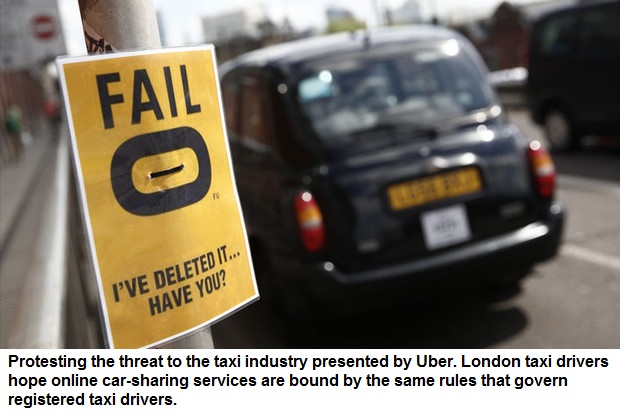
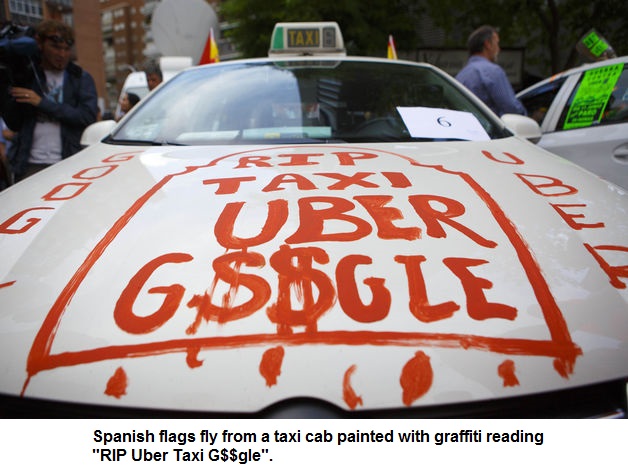
Uber Demonstrations Snarl Traffic from London to Berlin

Go Lean Commentary

Uber 1Old World [economy] meets New World [economy].

Taxi cabs go back to the days of horses and carriages; yet the industry has slowly adapted to all the evolutionary changes in technology and modernization. Today, in some jurisdictions, a taxi cab is a moving economic engine: a passenger sitting in the back gets access to streaming video, online browsing and advertising/booking options. While in the front, the driver gets access to advanced dispatch & logistical tools, security surveillance, credit card processing, traffic alerts, and more.

But the challenge with technology, for taxi cabs and many other areas of life, is one-step forward, two-steps backwards.

According to the below article, there is a new technological innovation that has rankled cabbies in the US, Europe and other global cities – 128 in total. This is the practice of car-sharing. The company featured in the foregoing article and VIDEO is Uber, but it could easily be any of the other entities in this emerging industry (ZipCar, Getaround, RelayRides, etc.):

By: Amy Thomson, Cornelius Rahn & Angelina Rascouet

Uber Technologies Inc., the car-sharing service that’s rankling cabbies across the U.S., is fighting its biggest protest from European drivers who say the smartphone application threatens their livelihoods.

Traffic snarled in cities from London to Madrid and Berlin to Paris as strikes and gatherings by more than 30,000 taxi and limo drivers blocked tourist centers and shopping districts. They are asking regulators to apply tougher rules on San Francisco-based Uber, whose software allows customers to order a ride from drivers who don’t need licenses that can cost 200,000 euros ($270,000) apiece.

The biggest city-center protest was in London, where black-cab drivers were joined by private car services and trainees to protest what they saw as the government’s failure to hold Uber to the same standards as other car services and taxis. While similar demonstrations this year have led to smashed windshields and traffic chaos in Paris, a united front in Europe highlights the challenges for Uber’s expansion.

“A strike won’t work,” European Commission Vice President Neelie Kroes said in a statement today. “What we need is real dialogue where we talk about these disruptions caused by technology.”

A funding round last week values the company at $17 billion, almost five times the figure in an earlier round. Out of some 128 cities it serves, 20 are in Europe, including Manchester, Lyon and Zurich.

Tourist Hubs

In London, thousands of black cabs and private hire cars descended on the tourist hubs of Trafalgar Square and Parliament Square, blocking some of the city’s busiest streets. Scooter and motorbike riders studying for the cab-driver exam joined in, honking their horns as the police tried to regulate traffic.

London taxi drivers have said that the app’s fare calculator amounts to a meter, which aren’t allowed in hired cars that aren’t registered taxis. Last month, TFL asked the High Court to rule on whether the fare system was legal.

“We have to have a license to own a cab, we have to have a driver’s license, a cab driver’s license,” said Mark Haslam, a 58-year-old black-cab driver, who took part in the protest. “For some reason they seem to be outside the law.”

Another driver, John Maloney, 64, was standing on top of a black cab on the corner of Whitehall and Trafalgar Square with a sign saying “enforce the law.” He was dressed as a judge, wearing a white wig and black cape.

Arrest Warning

No major accidents or clashes were reported. The London police, saying organizers hadn’t asked for proper permission to assemble, had threatened to arrest protesters if they arrived before 2 p.m. and didn’t leave by 3 p.m.

London organizers had called on drivers to join the demonstrations with posters mimicking a World War I recruiting campaign, featuring military commander Horatio Kitchener and his characteristic handlebar mustache.

In Paris, drivers blocked the Charles de Gaulle and Orly airports this morning and prevented private-car services from picking up passengers, said Nadine Annet, vice president at the FNAT taxi association. Cabbies also slowed down traffic the A1 highway that circles Paris, leading to a 200-kilometer (120-mile) jam, local TV reported. The vast majority of France’s 55,000 professional taxis and Paris’s 15,000 cabs are on strike today, Annet said.

Kader Djielouli, a 44-year-old protester who’s been driving taxis in Paris for 15 years, said he’s lost 40 percent of his revenue since 2009 because of services like Uber.

Paris, Madrid

Private-car services “are taxis without being taxis,” he said at a cab stand near the Opera metro station in Paris. “We are against them. There need to be the same rules for all.”

In Madrid, thousands of drivers marched to block the Paseo de la Castellana, one of the city’s main avenues, as police escorted the demonstration by cars, a helicopter and officers on foot. Protesters chanted insults targeted at Uber and chased taxis that weren’t taking part in the rally.

In Berlin, more than 500 taxis lined up in columns of 20 in the plaza stretching out from the Olympic stadium. Four youth chanting “friends of Uber” were escorted away by security under shouts of a few enraged drivers.

Berlin cabs earlier packed airports and the upscale Kurfuerstendamm shopping district. At the Tegel airport, one of the three starting locations for the Berlin demonstration, taxi driver Kubilay Sarikaya said this morning he was skeptical about the protests. While he’d been working since 3 a.m., he said he’ll go along if his friends do.

“While we are demonstrating, the other guys are hauling people around,” said Sarikaya, 33. “There have to be other ways. Ultimately I think folks know that they can always count on the good old cab to get them where they need to be.”

Berlin, Milan

Uber 2In Milan, no taxi was to be seen after about 5,000 drivers this morning went on a strike that is set to last until 10 p.m.

Uber took the demonstrations as an opportunity to promote its service, saying in a statement its teams across Europe will keep the cities moving today.

“While the taxi protests may seek to bring Europe to a standstill, we’ll be on hand to get our riders from A to B.”

Uber also chose this morning to open its service in London to black-cab drivers, describing its 5 percent commission as the lowest of all booking systems in the city. Uber has thus far offered luxury cars and cheaper rides in London, while excluding licensed black cabs. Later in the day, Uber said signups in London to its service today were 850 percent higher than last Wednesday, declining to give the actual number.

Internet Backlash

The protests have a deeper significance beyond the taxi industry. They underscore the growing backlash against the likes of room-booking service Airbnb Inc. and video-streaming provider Aereo Inc. as they clash with traditional industries arguing the competitors should be subject to the same regulations.

“European cities have tended to regulate taxi drivers much more than the U.S.,” said Charles Lichfield, an analyst at Eurasia Group in London. “I do think the protests have a better chance of succeeding.”

In the U.S., local taxi groups have also lobbied against Uber and similar services in cities such as Seattle. In Europe, regulators and courts are struggling with the disconnect between the desire to protect a regulated industry and the need for more technological innovation.

“For years the government has slapped new fees onto taxis and imposed more constraints — everything from car colors to, now, GPS tracking,” FNAT’s Annet said. “The least we’re asking for is that our competitors get the same tough love.”

French Court

Following complaints by Paris cab drivers, France this year imposed a rule on private services, requiring a minimum 15-minute wait between the time a car is booked and the passenger is picked up. The decree was later struck down by the country’s constitutional court.

Hamburg’s economy ministry on June 6 issued an order preventing Wundercar, a German peer of Uber, from operating in the city, saying that transporting people for profit and without a license is against the law. Berlin administrators are probing a similar move against Uber, spokeswoman Petra Rohland said. A Berlin court banned the Uber Black chauffeur service in April, although the injunction hasn’t been enforced.

The Spanish region of Catalonia said yesterday it will ask Uber — which is available in Barcelona — to immediately stop its activities in the area. The regional government is also telling security forces to increase control and detection of illegal taxi services.

European Regulation

“Consumers want to have these services. I’ve personally never sat in a run-down Uber car, but I’ve definitely experienced a lot of run-down taxis,” said Arndt Ellinghorst, head of automotive research at ISI Group in London. “It is a bit scary how protectionist Europe can be.”

Uber raised $1.2 billion in new financing led by Fidelity Investments last week, valuing the company at about $17 billion, before added investments. The company had earlier raised $307.5 million from investors including Google Ventures, TPG Capital and Menlo Ventures.

The company’s assets may be worth just $5.9 billion, Aswath Damodaran, a finance professor at New York University, wrote on his blog this week. He said the figure was based on optimistic assumptions about the taxi industry’s growth and Uber’s market share and profitability.

Lower Prices

Chief Executive Officer Travis Kalanick — who started Uber in 2009 after he and partner Garrett Camp couldn’t find a cab in Paris — has pushed the company into 37 countries. He said the low prices and ease of use that their drivers can offer will lead to a base of support from consumers that regulators won’t be able to ignore.

Uber 3A typical journey from Finsbury Square, near London’s financial district, and Paddington Station takes between 20 and 30 minutes by car to travel approximately four miles. Uber estimates that that journey would cost between 14 pounds ($24) and 16 pounds. London’s transportation authority estimates that the trip could cost between 15 pounds and 22 pounds.

The German market for taxis and rental cars was 4.3 billion euros last year, said Michael Mueller, the president of the German Association of Taxis and Rental Cars. It would shrink by 1 billion euros at the price levels Uber advocates, he said.

Job Creation

Uber said in its blog it’s responsible for 20,000 new jobs per month. The median income for drivers using the UberX platform, Uber’s low-cost service, is $90,000 per year in New York and more than $74,000 in San Francisco, the company said.

Uber advertises itself to prospective drivers as a way to start your own business, drawing users who aren’t professional chauffeurs. That’s different from apps such as Hailo, which recruit from the industry. Uber customers can tap the app on their smartphone and see the locations of taxis in real time, pay via a stored credit card and rate their driver.

“Citizens of these cities are getting around the cities much more cheaply,” Kalanick told Bloomberg TV in an interview this week. “How does a regulator or city official take that away from the population? Say that inexpensive transportation that’s high quality, you shouldn’t have?”

Bloomberg Business News Service (Posted 06/11/2014; retrieved 06/17/2014) –http://www.bloomberg.com/news/2014-06-10/uber-protests-spread-across-europe-as-taxi-app-backlash-grows.html

The book Go Lean…Caribbean anticipates the compelling issues associated with taxi cabs in the emerging new economy. The book serves as a roadmap for the introduction and implementation of the technocratic Caribbean Union Trade Federation (CU). This effort calls for the elevation of the Taxi & Limousine Commission to the regional/CU level. The roadmap posits that many issues and challenges for this industry can only be managed with feasible economies-of-scale. The CU market size of 42 million will allow for the leverage to consolidate, collaborate and confederate the organizational dynamics to tackle these issues.

The book presents solutions, but asserts that before the new strategies, tactics and implementations can be deployed, the affected communities must first embrace a progressive community ethos. The book defines this “community ethos” as the fundamental character or spirit of a culture; the underlying sentiment that informs the beliefs, customs, or practices of society; dominant assumptions of a people or period.

Progress cannot be accomplished by simply picketing at the airport that a new technological advance is impacting the taxi industry. Technological change can be likened to a charging bull; if someone gets in the way, they can be run over!

The foregoing news article, about car-sharing company Uber provides a glimpse of the inner-workings of these “business models” for these two industries:

  • Regional Taxi Administration – The Go Lean roadmap defines that taxis are the frontline of Caribbean hospitality; there is the need to compel the stakeholders to adapt  innovative products & services that impact the passenger and driver experience alike, such as mobile apps (Page 25).
  • Mobile Applications – The Go Lean roadmap defines the mastery of time-&-space as strategic for succeeding in mobile apps development and deployment for the region (Page 35). If products like Uber master mobile apps, then competitors, including old-guard taxi-cabs should also be able to master this field. Already apps like GrabTaxi have excelled at providing taxi cabs with viable solutions

The Go Lean book stresses that the current community ethos must change and the best way to motivate people to adapt their values and priorities is in response to a crisis. The roadmap recognizes this fact with the pronouncement that the Caribbean is in crisis, and that “a crisis is a terrible thing to waste”. The region is devastated from external factors: global economic recession, globalization and rapid technological advances. The book then asserts that to adapt, there must be a new internal optimization of the region’s strengths. This is defined in Verse XXVII (Page 14) of the Declaration of Interdependence:

Whereas the region has endured a spectator status during the Industrial Revolution, we cannot stand on the sidelines of this new economy, the Information Revolution. Rather, the Federation must embrace all the tenets of Internet Communications Technology (ICT) to serve as an equalizing element in competition with the rest of the world. The Federation must bridge the digital divide and promote the community ethos that research/development is valuable and must be promoted and incentivized for adoption.

This subject of taxi cab administration and promotion has been previously covered in these Go Lean blogs, highlighted here in the following samples:

a.       https://goleancaribbean.com/blog/?p=486 – Incubator firm (Temasek) backs Southeast Asia cab booking app GrabTaxi
b.      https://goleancaribbean.com/blog/?p=214 – Entrepreneur battling Least Common Denominator (LCD) Ethos

In line with the foregoing article, the Go Lean book details some applicable community ethos, and provides a roadmap to better foster these qualities and their resulting benefits:

  • Help for Entrepreneurship (Page 28)
  • Promotion of Intellectual Property (Page 29)
  • Impacting Research & Developments (Page 30)
  • Bridging the Digital Divide (Page 31)
  • Improve Sharing (Page 35)

The roadmap posits that the CU will incubate a Mobile Apps industry, forge entrepreneurial incentives and facilitate the infrastructure upgrades so that innovations can thrive. As related in the foregoing article, these efforts can mitigate against competitive/alternative pressures.

The world has changed!

Yet, still, success is within reach. We can, and must, make the the Caribbean a better place to live, work and play.

Share this post:
, , , , ,
[Top]

PayPal expands payment services to 10 markets

PayPal PhotoGo Lean Commentary

PayPal [a], the subject of the below news article, is an electronic payment company and this industry of electronic payments has become very important in the strategy for elevating the Caribbean economy. This is digital currency and not “hard money”, so there are no paper stock or coinage issues to be managed with this approach, but there are numerous risk and fraud issues. PayPal is starting to do business in some of the world’s most challenging markets, like Nigeria; this is a good resume for the Caribbean deployment of electronic payment systems.

By: Eric Auchard and Jason Neely

LONDON (Reuters) – PayPal is entering 10 new countries this week, including Nigeria, providing online payment alternatives for consumers via mobile phones or PCs in markets often blighted by financial fraud.

Rupert Keeley, the executive in charge of the EMEA region of PayPal, the payments unit of eBay Inc., said in an interview on Monday the expansion would bring the number of countries it serves to 203.

Starting on Tuesday, consumers in Nigeria, which has 60 million users and has Africa’s largest population, along with nine other markets in sub-Saharan Africa, Eastern Europe and Latin America will be able to make payments through PayPal.

“PayPal has been going through a period of reinvention, refreshing many of its services to make them easier to use on mobile (phones), allowing us to expand into fast-developing markets,” Keeley said.

Once the services go live, customers in the 10 countries with access to the Web and a bank card authorized for Internet transactions will be able to register for a PayPal account and make payments to millions of sites worldwide.

Initially, PayPal is only offering “send money” services for consumers to pay for goods and services at PayPal-enabled merchant sites while safeguarding their financial details. This is free to consumers and covered by fees it charges merchants.

“We think we can give our sellers selling into this market a great deal of reassurance,” said Keeley, a former regional banking executive with Standard Chartered Plc and senior executive with payment card company Visa Inc .

PayPal does not yet cover peer-to-peer transactions, which allow consumers to send money to other consumers. It has not yet enabled local merchants in the new markets to receive payments, nor is it offering other forms of banking services, he said.

A 2013 survey of 200 UK ecommerce sites by Visa’s CyberSource unit estimated that 1.26 percent of online orders are fraudulent and that 85 percent of merchants expected fraud to increase or remain static last year.

CyberSource also estimated that suspicion of fraudulent transactions result in 8.2 percent of online orders in Latin America being rejected by merchants, compared with 5.5 percent in Europe and 2.7 percent in the United States and Canada.

Such fraud can include ID theft, social engineering, phishing and automated harvesting of customer financial data via botnets, or networks of computers controlled by hackers.

A total of 80 million Internet users stand to gain access to PayPal global services this week, including those in five European markets – Belarus, Macedonia, Moldova, Monaco and Montenegro, four in the African nations of Nigeria, Cameroon, Ivory Coast, and Zimbabwe, as well as Paraguay. Internet usage figures are based on research by Euromonitor International.

PayPal counts 148 million active accounts worldwide.

Last week, MasterCard Inc , the world’s second-largest debit and credit card company, and a PayPal rival in payment processing, said it was working with the Nigerian government on a pilot to overlay payment technology on a new national identity card.

PayPal has operated in 190 markets since 2007 and added three countries – Egypt, Georgia and Serbia last year. Roughly a quarter of the $52 billion in payment volumes PayPal reported in the first quarter of 2014 were for cross-border transactions. PayPal reported $1.8 billion in revenue during the period.
Reuters News Service (Retrieved 06/16/2014) –
http://news.yahoo.com/paypal-expands-payment-services-nigeria-9-other-markets-141457269–sector.html

Central Banks print currency notes and determine the quantity, measured as M0. But there is no need for that activity with digital money, yet still, there is a big role for a Central Bank with command-and-control of the economy. This relates to M1 monetary supply. M1 refers to the measurement of the total of currency/money in circulation (M0) plus overnight bank deposits (like demand deposits, travelers’ checks & other checkable deposits). So when digital currencies are factored in, though there is no M0, there is still an increase in M1 nonetheless. As M1 values increase, there is a dynamic to create money “from thin-air”, called the money multiplier. The more money in the system, the more liquidity for investment and development opportunities.

Digital currencies are “reaping” the benefits of monetary supply without “sowing” the hard work of actual money/stock/coinage management!

This subject is detailed in the book Go Lean…Caribbean, which serves as a roadmap for the introduction of the Caribbean Union Trade Federation (CU) and the Caribbean Central Bank (CCB). This Go Lean roadmap has 3 prime directives:

  • Optimization of the economic engines in order to grow the regional economy to $800 Billion & create 2.2 million new jobs.
  • Establishment of a security apparatus to protect the resultant economic engines.
  • Improve Caribbean governance to support these engines.

This subject of electronic payment systems has been previously covered in these Go Lean blogs, highlighted here in the following samples:

a.     https://goleancaribbean.com/blog/?p=906 – Bitcoin needs regulatory framework to change ‘risky’ image
b.     https://goleancaribbean.com/blog/?p=528 – Facebook plans to provide mobile payment services
c.      https://goleancaribbean.com/blog/?p=360 – How to Create Money from Thin Air

This Go Lean/CU/CCB roadmap looks to employ electronic/digital currency schemes to impact the growth of the regional economy. This is defined early in the book in Verse XXIV (Page 13) of the Declaration of Interdependence, with these words:

Whereas a free market economy can be induced and spurred for continuous progress, the Federation must install the controls to better manage aspects of the economy: jobs, inflation, savings rate, investments and other economic principles…

Creating the CU/CCB governance is “Step One, Day One” in the Go Lean roadmap. Implementing this framework for electronic payments allows for emergence of the regional currency of the Caribbean Dollar. This currency emergence allows for the foundation, so that the regional society can be elevated, economically and governmentally.

The Go Lean posits that the business model of PayPal can be fully deployed in the region. Even though PayPal transacts in every CU member-state, except Cuba and Haiti [b], they have provided an example of how to develop an online electronic payment scheme. There is also the need to model other electronic schemes like Visa/MasterCard and Smart Cards (for Cruise Tourism).

The Go Lean book details a series of community ethos, strategies, tactics, implementations and advocacies to foster the proper controls for electronic payments in the Caribbean region:

Community Ethos – Money Multiplier Principle Page 22
Community Ethos – Lean Operations Page 24
Community Ethos – Cooperatives Page 25
Community Ethos – Promote Intellectual Property Page 29
Community Ethos – Ways to Bridge the Digital Divide Page 31
Strategy – Vision of Caribbean Single Market Page 45
Tactical – Separation of Powers – Central Banking Page 73
Implementation – Assemble Central Bank   Cooperative Page 93
Implementation – Ways to Deliver Page 109
Implementation – Ways to Impact Social   Media Page 111
Planning – Ways to Better Manage Image Page 129
Anecdote – Caribbean Currencies Page 149
Advocacy – Ways to Mitigate Black Markets Page 165
Advocacy – Ways to Foster Cooperatives Page 176
Advocacy – Ways to Impact Cruise Tourism Page 193
Advocacy – Ways to Foster Technology Page 197
Advocacy – Ways to Foster e-Commerce Page 198
Advocacy – Reforms for Banking Regulations Page 199
Appendix – Alternative Remittance Modes Page 270

Now is the time for all of the Caribbean, the people and governing institutions, to lean-in for the empowerments described in the book Go Lean … Caribbean. This is the basis for the CU vision, a better place to live, work and play.

Download the book Go Lean … Caribbean – now!

————————-

Appendix – Cited References:

a.   PayPal

PayPal is an international e-commerce business allowing payments and money transfers to be made through the Internet. Online money transfers serve as electronic alternatives to paying with traditional paper methods, such as checks and money orders. It is subject to the US economic sanction list and subject to other rules and interventions required by US laws or government.

PayPal is an acquirer, performing payment processing for online vendors, auction sites, and other commercial users, for which it charges a fee. The fee depends on what currency or payments the seller is using. In addition, eBay purchases made by credit card through PayPal may incur extra fees if the buyer and seller use different currencies.

On October 3, 2002, PayPal became a wholly owned subsidiary of eBay. Its corporate headquarters are in San Jose, California, United States at eBay’s North First Street satellite office campus. The company also has significant operations in Omaha, Scottsdale, Charlotte, Boston, Baltimore and Austin in the United States; Chennai and Bangalore in India; Dublin and Dundalk in Ireland; Kleinmachnow in Germany; and Tel Aviv in Israel. Since July 2007, PayPal has operated across the European Union as a Luxembourg-based bank.

Source: Retrieved June 16, 2014 from: http://en.wikipedia.org/wiki/PayPal

b.   PayPal Countries

PayPal’s tagline: We get where you’re coming from. We are available in 193 markets and 26 currencies. Spend and receive safely over borders and language barriers. We’re here for you, wherever you are.

Anguilla Haiti
Antigua and Barbuda Jamaica
Aruba Martinique
Bahamas Montserrat
Barbados Netherlands Antilles
Belize Puerto Rico (USA)
Bermuda Saint Barthélemy (France)
British Virgin Islands Saint Kitts and Nevis
Cayman Islands Saint Lucia
Dominica Saint Martin (France / The Netherlands)
Dominican Republic Saint Vincent and the Grenadines
French Guiana Suriname
Grenada Trinidad and Tobago
Guadeloupe Turks and Caicos
Guyana Virgin Islands (USA)


Share this post:
, , , ,
[Top]

Blog # 100 – College World Series Time

Go Lean Commentary

The sports world is all abuzz this weekend: World Cup in Brazil, NBA Finals, US Open Golf tournament, and the NCAA College World Series (CWS) baseball championship tournament.

History happens here!

History happens here!

This last event, CWS, is the subject of this blog, a milestone, the 100th in the series promoting the book Go Lean…Caribbean. This book serves as a roadmap for the introduction and implementation of the technocratic Caribbean Union Trade Federation (CU). While the CU is NOT a sports promotion entity, it does present an important role for sports in the vision to make the Caribbean a better place to live, work and play. As an expression of this vision Page 81 states:

“a mission of the CU is to forge industries and economic drivers around the individual and group activities of sports and culture”.

The Go Lean vision is a confederation of the 30 member-states of the Caribbean forming a proxy organization to do the heavy-lighting of building, funding and maintaining sports venues. The strategy is for the CU to be the landlord, and super-regional regulatory agency, for sports leagues, federations and associations (amateur, collegiate, and professional). This strategy relates to the College World Series model. The CWS tournament opened this weekend (June 14/15) in Omaha, Nebraska USA; this is the 65th straight tournament in the same city. This is an anomaly for American sports, as every year most big sporting events (Super Bowl, US Open Golf, NCAA Final Four, BCS Football Championship) rotate/move to different cities. Consider 2014 thus far:

Sport 2014 Host 2013 Host 2012 Host
Super Bowl New York City New Orleans, Louisiana Indianapolis, Indiana
US Open Golf Pinehurst, North Carolina Ardmore (Philadelphia), Pennsylvania San Francisco, California
NCAA Basketball Final Four Dallas, Texas Atlanta, Georgia New Orleans, Louisiana
BCS College Football Pasadena, California Miami, Florida New Orleans, Louisiana

But since 1950, the 12-day College World Series, college baseball championship, has been held in the City of Omaha. It was held at Rosenblatt Stadium from 1950 through 2010; starting in 2011, it has been moved to the new ultra-modern TD Ameritrade Park downtown. The 2013 attendance of 341,483 belies the economic benefits.

CWS Photo 2

CWS Photo 3

These facts reinforce the marketing tag line of CWS Omaha, Inc., (a Nebraska technocracy):

History Happens Here.

The prime directives of the CU/Go Lean roadmap are described with these 3 statements:

  • Optimization of the economic engines in order to grow the regional economy to $800 Billion & create 2.2 million new jobs.
  • Establishment of a security apparatus to protect the resultant economic engines.
  • Improve Caribbean governance to support these engines.

This roadmap commences with the recognition that genius qualifiers can be found in many fields of endeavor, including sports. The roadmap pronounces the need for the region to confederate in order to invest in the facilitations for the Caribbean sports genius to soar. These pronouncements are made in the Declaration of Interdependence, (Pages 13 & 14) as follows:

xxi. Whereas the preparation of our labor force can foster opportunities and dictate economic progress for current and future generations, the Federation must ensure that educational and job training opportunities are fully optimized for all residents of all member-states, with no partiality towards any gender or ethnic group. The Federation must recognize and facilitate excellence in many different fields of endeavor, including … sports. This responsibility should be executed without incurring the risks of further human flight, as has been the past history.

xxii. Whereas sports have been a source of great pride for the Caribbean region, the economic returns from these ventures have not been evenly distributed as in other societies. The Federation must therefore facilitate the eco-systems and vertical industries of sports as a business, recreation, national pastime and even sports tourism – modeling the Olympics.

All in all, the Go Lean book and accompanying blogs declare that the Caribbean needs to learn lessons from CWS-Omaha and other sporting venues/administrations. And thus this subject of the “business of sports” is a familiar topic for Go Lean blogs. The previous blogs as follows, and this one, constitutes 8 of the first 100 entries:

a. https://goleancaribbean.com/blog/?p=1214 The Art & Science of Temporary Stadiums – No White Elephants
b. https://goleancaribbean.com/blog/?p=1148 Sports Bubble – Franchise values in basketball
c. https://goleancaribbean.com/blog/?p=1020 Sports Revolutionary: Advocate Jeffrey Webb
d. https://goleancaribbean.com/blog/?p=498 Book Review: ‘The Sports Gene’
e. https://goleancaribbean.com/blog/?p=334 Bahamians Make Presence Felt In Libyan League
f. https://goleancaribbean.com/blog/?p=318 Collegiate Sports in the Caribbean
g. https://goleancaribbean.com/blog/?p=60 Could the Caribbean Host the Olympic Games?

This Go Lean roadmap is committed to availing the economic opportunities of all the Caribbean athletic abilities. The book details these series of community ethos, strategies, tactics, implementations and advocacies designed to deliver regional solutions:

Community Ethos – Return on Investments Page 24
Community Ethos – Ways to Foster Genius Page 27
Community Ethos – Ways to Impact the Greater Good Page 37
Strategic – Staffing – Sporting Events at Fairgrounds Page 55
Tactical – Fostering a Technocracy Page 64
Tactical – Separation of Powers – Sports & Culture Administration Page 81
Tactical – Separation of Powers – Fairgrounds Administration Page 83
Implementation – Steps to Implement   Self-Governing Entities Page 105
Implementation – Ways to Deliver Page 109
Planning – Ways to Make the Caribbean   Better Page 131
Advocacy – Ways to Grow the Economy Page 151
Advocacy – Ways to Improve Local Government – Parks & Recreation Page 169
Advocacy – Ways to Impact Events Page 191
Advocacy – Ways to Promote Fairgrounds Page 192
Advocacy – Ways to Improve Sports Page 229
Advocacy – Ways to Impact Urban Living – Sports Leagues Page 234

The Go Lean roadmap encourages solid business plans to develop sports stadia and arenas at CU-owned fairgrounds. Where appropriate, there should be the deployment of temporary bleacher seats/grandstands and structures (think: golf tournaments and Beach Volleyball). There is an obvious economic impact from deployments of Sports Tourism in areas like jobs, ticket sales, hotel bookings and other community spin-off spending.

The following 8 teams in this year’s tournament are indicative of the need for hospitality as they are from cities all around the country:

UC Irvine Texas Tech
Texas TCU
Louisville Ole Miss
Vanderbilt Virginia

There are obvious community benefits from this business model. In fact, the Go Lean roadmap anticipates 21,000 direct jobs at fairgrounds and sports enterprises throughout the region. This is not bad for lessons learned from the College World Series in Omaha.

Now is the time for all of the Caribbean, the people and governing institutions, to lean-in for the empowerments of the Caribbean Union Trade Federation, as prescribed by the Go Lean…Caribbean roadmap.

Share this post:
, , , ,
[Top]

Puerto Rico Governor Signs Bill on SME’s

PR SME - Photo 1Go Lean Commentary

This sentence in the news article below about small & medium-sized enterprises (SME’s) speaks volumes for Puerto Rico’s economy and all the Caribbean:

According to government data, 95 percent of companies in Puerto Rico are SMEs with 50 or fewer employees, and they employ around 25 percent of the jobs on the island.

So if there is a plan to grow jobs in Puerto Rico and the Caribbean, that plan must look to impact small businesses or SME’s.

By: The Caribbean Journal staff

Puerto Rico Governor Alejandro Garcia Padilla has signed a bill aiming to boost small and medium-sized enterprises on the island.

The new law has several provisions: it reserves part of government purchases for local businesses, encourages the integration of professional and new entrepreneurs and gives priority to SMEs “in discretionary public funds to subsidize payroll for new jobs or existing ones,” Garcia Padilla’s office said in a statement.

The bill, called the “Support for Microenterprise, Small and Medium Merchant Act” amends the island’s Procurement Reserve Act to 20 percent, and establishes a reserve of 60 percent for SMEs when granting subsidies under the Law of Security in Employment.

“This bill is for SMEs what the Law of Incentives for Economic Development and previous industrial incentive laws were for manufacturing in Puerto Rico. That’s how important it is,” the Governor said in a statement. “The country is undergoing the biggest transformation in its recent history.”

According to government data, 95 percent of companies in Puerto Rico are SMEs with 50 or fewer employees, and they employ around 25 percent of the jobs on the island.

“The path to sustainable economic development will necessarily have to include SMEs,” he said. “Encouraging SMEs is to boost local production and wealth creation that circulates and remains in the country.”

The government said the law also creates a board to support small retailers, among other aspects, and amends the country’s permitting act to grant permits for conditional or temporary activities that “pose no risk to health, the environment or security and conforms to the zoning requirements.”
Caribbean Journal– Caribbean Online News Source (Retrieved 06/13/2014) –
http://www.caribjournal.com/2014/06/12/puerto-rico-governor-signs-bill-on-small-medium-sized-enterprises/

The book Go Lean … Caribbean fulfills that requirement. The book serves as a roadmap to implement the Caribbean Union Trade Federation (CU), and with this effort, create 2.2 million new jobs over a 5 year period. Major consideration is given to entrepreneurship, small businesses (Main Street) and even optimizing existing industries. But Go Lean differs from government efforts, such as Puerto Rico’s as described in the foregoing article, in that it looks to provide complete incubation for SME’s. This includes fund development, technical assistance, coaching, management training and introductions to new global markets; a true public-private partnership.

This directive is embedded in the opening Declaration of Interdependence at the start of the book (Page 13/14), with these statements:

xxi.  Whereas the preparation of our labor force can foster opportunities and dictate economic progress for current and future generations, the Federation must ensure that educational and job training opportunities are fully optimized for all residents of all member-states, with no partiality towards any gender or ethnic group. The Federation must recognize and facilitate excellence in many different fields of endeavor, including sciences, languages, arts, music and sports. This responsibility should be executed without incurring the risks of further human flight, as has been the past history.

xxiv.   Whereas a free market economy can be induced and spurred for continuous progress, the Federation must install the controls to better manage aspects of the economy: jobs, inflation, savings rate, investments and other economic principles. Thereby attracting direct foreign investment because of the stability and vibrancy of our economy.

Whereas the Caribbean region must have new jobs to empower the engines of the economy and create the income sources for prosperity, and encourage the next generation to forge their dreams right at home, the Federation must therefore foster the development of new industries… In addition, the Federation must invigorate the enterprises related to existing industries … – impacting the region with more jobs.

This subject of entrepreneurship has been previously covered in these Go Lean blogs, highlighted here in the following samples:

a.   https://goleancaribbean.com/blog/?p=486 – Incubator firm backs Southeast Asia cab booking app

b.   https://goleancaribbean.com/blog/?p=398 – Self-employment on the rise in the Caribbean – World Bank

c.   https://goleancaribbean.com/blog/?p=214  – LCD versus an Entrepreneurial Ethos

As also depicted in the foregoing article, governments have employed strategies to promote small businesses like set-aside programs. While this is a good start, more is needed for true success. Go Lean relates that progress in entrepreneurship requires a new community ethos, an acceptance that intellectual property is just as essential as any real property requiring protection by government authorities and respect by the general public. This is key, as the book posits that new information-centric economy activities can be equally exploited from an address in the Caribbean or any address in North America or Europe. ICT (Internet & Communication Technologies) has emerged as the great equalizer!

PR SME - Photo 2The vision of the CU is a confederation of the 30 member-states of the Caribbean, including all 4 language groups, into an integrated “single market”, thereby fostering economic growth to raise the regional economy to $800 Billion GDP (from the 2010 base of $378 Billion). This growth would be the cause-and-effect of 2.2 million new jobs projected in the Go Lean roadmap. The following list details the series of community ethos, strategies, tactics, implementations and advocacies necessary to effectuate the change in the region to foster the small business environment:

Community Ethos – Job Multiplier Page 22
Community Ethos – Lean Operations Page 24
Community Ethos – Return on Investments Page 24
Community Ethos – Ways to Impact the Future Page 26
Community Ethos – Ways to Help Entrepreneurship Page 28
Community Ethos – Ways to Promote Intellectual Property Page 29
Strategic – Vision – Integrated Region in a   Single Market Page 45
Strategic – Vision – Agents of Change – Globalization Page 57
Tactical – Fostering a Technocracy Page 64
Tactical – Growing to $800 Billion Regional Economy Page 67
Tactical – Separation of Powers – Homeland Security Page 75
Tactical – Separation of Powers – Interstate Commerce Page 79
Tactical – Separation of Powers – Department of Labor Page 89
Implementation – Ways to Pay for Change Page 101
Implementation – Steps for Self-Governing   Entities Page 105
Implementation – Ways to Deliver Page 109
Implementation – Ways to Benefit from   Globalization Page 119
Planning – Big Ideas for the Caribbean Region Page 127
Planning – Ways to Improve Trade Page 128
Planning – Ways to Improve Interstate Commerce Page 129
Advocacy – Ways to Grow the Economy Page 151
Advocacy – Ways to Create Jobs Page 152
Advocacy – Ways to Foster Technology Page 197
Advocacy – Ways to Impact Main Street Page 201
Appendix – Job Multipliers Page 259

While the Go Lean roadmap is focused on small and medium-sized businesses, it also stresses the importance of protecting the economic engines against crime and emergency scenarios. The roadmap asserts that the economy of the region must be aligned with the security of the region; otherwise “bad actors” will emerge. The CU/Go Lean roadmap calls for “new guards for their future security”, so as to ensure that the regions hard-fought investments are not easily undermined. We must have return on our investments; we must have forward progress.

We do not want “to sow and have someone else reap” – The Bible.

All in all, the Go Lean … Caribbean roadmap posits that the problems of the Caribbean homeland are too big for any one member-state to solve, empowerments in Puerto Rico alone is too-little-too-late, but rather a regional solution is needed. The street-wise expression is so valid at this time: “You don’t bring a knife to a gun fight”. The Caribbean Union Trade Federation is a regional answer – the scope is bigger than just entrepreneurship, small businesses or jobs. While the effort will be fully exerted to promote and optimize SME’s, create jobs and forge every opportunity for success at home, a lot more is riding on these efforts. In addition to economic progress, we also have the whole future “hanging in the balance”, that of the Caribbean youth and their presence in the Caribbean. For this reason, the roadmap considers even more, that of making the Caribbean a better place to live, work and play.

Download the book Go Lean…Caribbean – now!

Share this post:
, , ,
[Top]

5 Steps of a Bubble

Go Lean Commentary

What have we learned?

LB 1The Great Recession of 2008 – 2009 has come and gone – though many Caribbean member-states are still reeling from this crisis. The book Go Lean…Caribbean serves as a roadmap for the introduction and implementation of the technocratic Caribbean Union Trade Federation (CU); it declares that a crisis is a terrible thing to waste – quoting famed American Economist Paul Romer.

A popular leadership principle dictates a methodical progression as follows, identified as the 5-L’s:

Look
Listen
Learn
Lend-a-hand
Lead

The CU will assume the leadership role of exploring the opportunities presented as a result of this recent crisis. This leadership starts with the need to study/learn from the 2008 financial crisis, with the goal of minimizing future crisis or at least mitigating their effects. But 2008 is not the only crisis for Caribbean consideration, we also contend with an annual hurricane season. This subject is not an academic pursuit, but rather turn-by-turn directions to elevate Caribbean life and culture. In fact, the following 3 prime directives are explored in the roadmap:

  • Optimization of the economic engines in order to grow the regional economy to $800 Billion.
  • Establishment of a security apparatus (including disaster management) to protect the resultant economic engines.
  • Improve Caribbean governance to support these engines.

All in all, the roadmap commences with the recognition that since 2008 all the Caribbean is in crisis. This acknowledgement is pronounced in the Declaration of Interdependence (Page 13) with these statements:

xxiv.   Whereas a free market economy can be induced and spurred for continuous progress, the Federation must install the controls to better manage aspects of the economy: jobs, inflation, savings rate, investments and other economic principles. Thereby attracting direct foreign investment because of the stability and vibrancy of our economy.

 xxv.   Whereas the legacy of international democracies had been imperiled due to a global financial crisis, the structure of the Federation must allow for financial stability and assurance of the Federation’s institutions. To mandate the economic vibrancy of the region, monetary and fiscal controls and policies must be incorporated as proactive and reactive measures. These measures must address threats against the financial integrity of the Federation and of the member-states.

This issue of learning from the 2008 crisis has been a consistent theme of the Go Lean blogs entries as sampled here:

a. https://goleancaribbean.com/blog/?p=841 – Post 2008: Having Less Babies is Bad for the Economy

b. https://goleancaribbean.com/blog/?p=782 – Open the Time Capsule: The Great Recession of 2008

c. https://goleancaribbean.com/blog/?p=709 – Post 2008 Student Debt Holds Back Many Would-be Home Buyers

d. https://goleancaribbean.com/blog/?p=528 – Facebook plans to provide mobile payment services and remittances

e. https://goleancaribbean.com/blog/?p=378 – US Federal Reserve Releases Transcripts from 2008 Meetings

f. https://goleancaribbean.com/blog/?p=353 – Book Review: ‘Wrong – Nine Economic Policy Disasters and What We Can Learn…’

g. https://goleancaribbean.com/blog/?p=235 – Post 2008 Tourism’s changing profile

The main lesson learned about the cause of the 2008 Great Recession is a poignant one: it spurned from a housing bubble.

Change has come to the Caribbean; the driver of this change is technology, globalization and climate change. From these 3 drivers, bubbles can easily inflate and deflate (burst). The Caribbean region must be astute to recognize the formation of such bubbles. Most importantly, we must apply technocratic skills to mitigate the risk of these bubbles and their eventual deflation.

The term “bubble,” in the financial context, generally refers to a situation in which the price of an asset exceeds its fundamental value by a large margin. During a bubble, prices for a financial asset or asset class are highly inflated, bearing little relation to the intrinsic value of the asset. The terms “asset price bubble,” “financial bubble” or “speculative bubble” are interchangeable, and are often shortened simply to “bubble.”

A basic characteristic of a bubble is the suspension of disbelief by most participants during the “bubble phase.” There is a failure to recognize that regular market participants and other forms of traders are engaged in a speculative exercise that is not supported by previous valuation techniques. Also, bubbles are usually identified only in retrospect, after the bubble has burst. Economist Hyman Minsky identified five stages in a typical credit cycle – displacement, boom, euphoria, profit taking and panic. Although there are various interpretations of the cycle, the general pattern of bubble activity remains fairly consistent.

1.       Displacement
A displacement occurs when investors get enamored by a new paradigm, such as an innovative new technology or interest rates that are historically low. A classic example of displacement is the decline in the federal funds rate from 6.5% in May, 2000, to 1% in June, 2003. Over this three-year period, the interest rate on 30-year fixed-rate mortgages fell by 2.5 percentage points to a historic lows of 5.21%, sowing the seeds for the housing bubble.

2.       Boom
Prices rise slowly at first, following a displacement, but then gain momentum as more and more participants enter the market, setting the stage for the boom phase. During this phase, the asset in question attracts widespread media coverage. Fear of missing out on what could be a once-in-a-lifetime opportunity spurs more speculation, drawing an increasing number of participants into the fold.

3.       Euphoria
During this phase, caution is thrown to the wind, as asset prices skyrocket. The “greater fool” theory plays out everywhere. Valuations reach extreme levels during this phase. For example, at the peak of the Japanese real estate bubble in 1989, land in Tokyo sold for as much as $139,000 per square foot, or more than 350-times the value of Manhattan property. After the bubble burst, real estate lost approximately 80% of its inflated value, while stock prices declined by 70%. Similarly, at the height of the internet bubble in March, 2000, the combined value of all technology stocks on the Nasdaq was higher than the GDP of most nations.

4.       Profit Taking
By this time, the smart money – heeding the warning signs – is generally selling out positions and taking profits. But estimating the exact time when a bubble is due to collapse can be a difficult exercise and extremely hazardous to one’s financial health because, as John Maynard Keynes put it, “the markets can stay irrational longer than you can stay solvent.” Note that it only takes a relatively minor event to prick a bubble, but once it is pricked, the bubble cannot “inflate” again.

5.       Panic
In the panic stage, asset prices reverse course and descend as rapidly as they had ascended. Investors and speculators, faced with margin calls and plunging values of their holdings, now want to liquidate them at any price. As supply overwhelms demand, asset prices slide sharply. One of the most vivid examples of global panic in financial markets occurred in October 2008, weeks after Lehman Brothers declared bankruptcy and Fannie Mae, Freddie Mac and AIG almost collapsed. The S&P 500 plunged almost 17% that month, its ninth-worst monthly performance. In that single month, global equity markets lost a staggering $9.3 trillion of 22% of their combined market capitalization.

Investopedia Online Investing Trade Journal (Retrieved June 12, 2014) http://www.investopedia.com/slide-show/5-steps-of-a-bubble/

LB 2

LB 3

The Caribbean region felt the brunt of the Panic of this 2008/2009 crisis. See this news article posted on Jan 18, 2009 in USA Today, describing the full economic devastation with this title: “Caribbean islands slammed with double financial hit” – http://abcnews.go.com/Business/story?id=6677886&page=1&singlePage=true

For the Caribbean, the lessons of the above 5 Steps of a Bubble was not academic, it was real-life, affecting every man, woman and child. But still, bubbles continue to be impactful; in addition to housing market bubbles, the Caribbean must contend with post-hurricane recoveries.

The Go Lean book envisions the CU as a confederation of the 30 member-states of the Caribbean to do the heavy-lifting of empowering and elevating the Caribbean economy by creating a “single market” for the region. Many benefits are due to abound, but there must be caution not to create bubbles.

The book details the community ethos to adopt to monitor, manage and mitigate risks and the emergence of bubbles. The roadmap also details the executions of the following strategies, tactics, implementations and advocacies to guide progress in the region; (a bubble can result in “1 step forward but 2 steps backwards”):

Anecdote – Puerto Rico – The Greece of the Caribbean Page 18
Community Ethos – Consequences of Choices Lie in the Future Page 21
Community Ethos – Money Multiplier Page 22
Community Ethos – Lean Operations Page 24
Community Ethos – Return on Investments (ROI) Page 24
Community Ethos – Ways to Impact the Future Page 26
Community Ethos – Ways to Impact the Greater Good Page 37
Strategy – Agents of Change – Technology Page 57
Strategy – Agents of Change – Globalization Page 57
Strategy – Agents of Change – Climate Change Page 57
Tactical – Confederating a Non-Sovereign Union Page 63
Tactical – Fostering a Technocracy Page 64
Tactical – Growing Economy – Avoid Economic Bubbles Page 69
Tactical – Growing Economy – Trade and Globalization Page 70
Tactical – Separation of Powers – Central Bank Page 73
Tactical – Separation of Powers – Securities Regulatory Agency Page 74
Tactical – Separation of Powers – Housing and Urban Authority Page 83
Implementation – Ways to Deliver Page 109
Implementation – Ways to Better Manage Debt Page 114
Implementation – Ways to Benefit from Globalization Page 119
Planning – 10 Big Ideas Page 127
Advocacy – Ways to Grow the Economy Page 151
Advocacy – Ways to Control Inflation – Post Natural Disasters Page 153
Advocacy – Ways to Improve Housing Page 161
Advocacy – Ways to Improve for Natural Disasters Page 184
Advocacy – Ways to Foster Technology Page 197
Advocacy – Reforms for Banking Regulations Page 199
Advocacy – Ways to Impact Wall Street Page 200
Advocacy – Ways to Impact Main Street Page 201
Appendix – Controlling Inflation – Technical Details – Quick Recovery Page 320

Now is the time for all of the Caribbean, the people and governing institutions, to lean-in for the empowerments described in the book Go Lean … Caribbean. We start by understanding “bubbles”. While the 2008 Great Recession crisis originated as an American bubble, the rest of the world felt its devastating effects. This case-in-point sets the model for the CU to emulate for the Caribbean region; we need a resilient economy that can grow in “ripe” conditions, but avoid any bubble effects. Every year the region is threatened by tropical storms and hurricanes; the spending for recovery, repair and rebuilding can always create a bubble-effect. LB 4

LB 5

This has been the legacy in the past, but now the CU administration is proposed as “new guards” to shepherd the economy to avoid such pitfalls.

The CU/Go Lean roadmap is a complete solution for Caribbean elevation. Despite threats – natural disasters and economic bubbles – the region can be led to a better destination, a better place to live, work and play.

Download the book Go Lean … Caribbean – now!

Share this post:
, ,
[Top]

Remittances to Caribbean Increased By 3 Percent in 2013

Go Lean Commentary

Participation in Caribbean national elections seems to have an additional candidate to vote for: None of the Above.

This is the assertion of the book Go Lean…Caribbean, and many aligned blog submissions, that Caribbean citizens are voting with their “feet and wallet” and leaving their tropical homelands for life in foreign countries. In fact, the book posits that the Caribbean Diaspora amount to 10 million people, compared to 42 million residents in the homeland. A great measurement of the economic activity of this diasporic population is their remittance activity. (Though not all migrants remit back to their homelands).

This book Go Lean…Caribbean serves as a roadmap for the introduction and implementation of the technocratic Caribbean Union Trade Federation (CU). The CU will assume the role and responsibility of empowering the regional economy and measuring trade/financial/remittance activity. The following 3 prime directives are explored in full details in the roadmap:

  • Optimization of the economic engines in order to grow the regional economy to $800 Billion & create 2.2 million new jobs.
  • Establishment of a security apparatus to protect the resultant economic engines.
  • Improve Caribbean governance to support these engines.

A mission of the CU is to minimize the need for Caribbean labor force to migrate to foreign lands for work; and also to invite the Diaspora to repatriate. We need to expand the labor pool at home. But the reality of the Go Lean roadmap is the methodical implementation over a 5 year period, so in the interim, there may still be more prosperous opportunities abroad.

It is what it is! The CU/Go Lean plan then is to optimize the remittance process where possible: lowering the costs of transfers and managing the accompanying foreign currency and economic crime risks.

The reference source for the foregoing article came from the MIF (Multilateral Investment Fund), a member of the Inter-American Development Bank (IDB) Group; the MIF is funded by 39 donors and supports private sector-led development benefitting low-income populations and the poor –-their businesses, their farms, and their households. A core MIF mission is to act as a development laboratory in order to build and support successful micro and SME (Small-Medium-sized Enterprises) business models. [a]

By the Caribbean Journal staff

Table 1Remittances to the Caribbean region increased by 3 percent in 2013, according to a new report from the Inter-American Development Bank’s Multilateral Investment Fund.

Remittances to the region totaled $8.519 billion, a 3 percent improvement in US dollar terms, an 8.9 percent increase in local currency and a 3.3 percent improvement in local currency and adjusted for inflation.

“Remittance flows to Latin America and the Caribbean (LAC) remain an important source of income for millions of poor and vulnerable families,” said MIF General Manager Nancy Lee. “Remittance recipients need more access to financial tools that will help them use remittances to save and make investments for their future in areas like education, housing, and starting and growing businesses.”

The Dominican Republic received $3.333 billion USD in 2013, a 5.5 percent improvement, followed by Jamaica, which received $2.065 billion and Haiti, which received $2.017 billion.

Trinidad and Tobago was next with $131 million in remittances.

Of the group, the Dominican Republic saw the largest increase.

The Latin America and Caribbean region received a total of $61.251 billion last year, with the United States the source of about 75 percent of remittances to the region.

See the Table 1 (photo on this page) from the IDB for full details.

Caribbean Journal – Regional News Source (Retrieved 06/11/2014) –http://www.caribjournal.com/2014/06/10/remittances-to-caribbean-increased-by-3-percent-in-2013-report/

The reference source for the foregoing article came from the MIF (Multilateral Investment Fund), a member of the Inter-American Development Bank (IDB) Group; the MIF is funded by 39 donors and supports private sector-led development benefitting low-income populations and the poor –-their businesses, their farms, and their households. A core MIF mission is to act as a development laboratory in order to build and support successful micro and SME (Small-Medium-sized Enterprises) business models. [a]

Another mission of the CU/Go Lean roadmap is to apply lessons from the 2008 Great Recession financial crisis.

The MIF reports that in the years before the financial crisis of 2008-2009, remittances to the region as a whole experienced average annual growth of 17 percent. After a record high in 2008 of $64.9 billion, there was a sharp drop in 2009 of over 10 percent, followed by an increase in 2011 of 6 percent, and subsequent stagnation that continued up to 2013.

Figure 1

Figure 2

Figure 5

Figure 14

For 2014, macroeconomic projections show an encouraging landscape at the global level; it is predicted that the US economy will continue its path to recovery, as will EU countries, although at a slower pace. Employment data on LAC migrants, in both the United States and Spain, also show a recovery process enabling the prediction of growth in remittances sent from both countries. (See the accompanying charts, figures and tables on this page; sourced from the MIF/IDB report [b]).

This issue of continued fallout from the Great Recession has been a consistent theme of the Go Lean blogs entries as sampled here:

a. https://goleancaribbean.com/blog/?p=841 – Post 2008: Having Less Babies is Bad for the Economy

b. https://goleancaribbean.com/blog/?p=782 – Open the Time Capsule: The Great Recession of 2008

c. https://goleancaribbean.com/blog/?p=709 – Post 2008 Student Debt Holds Back Many Would-be Home Buyers

d. https://goleancaribbean.com/blog/?p=528 – Facebook plans to provide mobile payment services and remittances

e. https://goleancaribbean.com/blog/?p=378 – US Federal Reserve Releases Transcripts from 2008 Meetings

f. https://goleancaribbean.com/blog/?p=353 – Book Review: ‘Wrong – Nine Economic Policy Disasters and What We Can Learn…’

g. https://goleancaribbean.com/blog/?p=235 – Post 2008 Tourism’s changing profile

All in all, the roadmap commences with the recognition that all the Caribbean is in crisis, exacerbated after 2008, with defective business models, underemployment, globalization, and aging demographics. These acknowledgements are pronounced in the Declaration of Interdependence, (Page 13 & 14). The statements are included as follows:

xix.   Whereas our legacy in recent times is one of societal abandonment, it is imperative that incentives and encouragement be put in place to first dissuade the human flight, and then entice and welcome the return of our Diaspora back to our shores. This repatriation should be effected with the appropriate guards so as not to imperil the lives and securities of the repatriated citizens or the communities they inhabit. The right of repatriation is to be extended to any natural born citizens despite any previous naturalization to foreign sovereignties.  

xx.   Whereas the results of our decades of migration created a vibrant Diaspora in foreign lands, the Federation must organize interactions with this population into structured markets. Thus allowing foreign consumption of domestic products, services and media, which is a positive trade impact. These economic activities must not be exploited by others’ profiteering but rather harnessed by Federation resources for efficient repatriations.

xxi.   Whereas the preparation of our labor force can foster opportunities and dictate economic progress for current and future generations, the Federation must ensure that educational and job training opportunities are fully optimized for all residents of all member-states, with no partiality towards any gender or ethnic group. The Federation must recognize and facilitate excellence in many different fields of endeavor, including sciences, languages, arts, music and sports. This responsibility should be executed without incurring the risks of further human flight, as has been the past history.

 xxiv.   Whereas a free market economy can be induced and spurred for continuous progress, the Federation must install the controls to better manage aspects of the economy: jobs, inflation, savings rate, investments and other economic principles. Thereby attracting direct foreign investment because of the stability and vibrancy of our economy.

xxv.   Whereas the legacy of international democracies had been imperiled due to a global financial crisis, the structure of the Federation must allow for financial stability and assurance of the Federation’s institutions. To mandate the economic vibrancy of the region, monetary and fiscal controls and policies must be incorporated as proactive and reactive measures. These measures must address threats against the financial integrity of the Federation and of the member-states.

xxvi.   Whereas the Caribbean region must have new jobs to empower the engines of the economy and create the income sources for prosperity, and encourage the next generation to forge their dreams right at home, the Federation must therefore foster the development of new industries… In addition, the Federation must invigorate the enterprises related to existing … – impacting the region with more jobs.

The vision of the CU is a confederation of the 30 member-states of the Caribbean into an integrated “single market”, thereby fostering economic growth to grow the regional economy to $800 Billion (from the 2010 base of $378 Billion). This growth would be the cause-and-effect of 2.2 million new jobs. No more migrant culture! Tactically, the CU allows for a separation-of-powers between the member-state governments and the new federal agencies, so as to allow a technocratic management approach to simply “deliver” on the Go Lean roadmap, devoid of partisan politics! The following list details the series of community ethos, strategies, tactics, implementations and advocacies necessary to effectuate the change in the region to graduate from this migrant culture, described in the foregoing article and accompanying charts:

Community Ethos – Economic Systems Influence Individual Choices Page 21
Community Ethos – Job Multiplier Page 22
Community Ethos – Lean Operations Page 24
Community Ethos – Return on Investments Page 24
Community Ethos – Ways to Impact the Future Page 26
Community Ethos – Ways to Help Entrepreneurship Page 28
Strategic – Vision – Integrated Region in a Single Market Page 45
Strategic – Vision – Agents of Change Page 57
Tactical – Fostering a Technocracy Page 64
Tactical – Growing to $800 Billion Regional Economy Page 67
Tactical – Separation of Powers Page 71
Tactical – Interstate Commerce Admin – Econometrics Data Analysis Page 79
Implementation – Ways to Pay for Change Page 101
Implementation – Ways to Deliver Page 109
Planning – Big Ideas for the Caribbean Region Page 127
Planning – Lessons Learned from 2008 Page 136
Planning – Ways to Measure Progress Page 147
Advocacy – Ways to Grow the Economy Page 151
Advocacy – Ways to Create Jobs Page 152
Advocacy – Ways to Better Manage Foreign Exchange Page 154
Advocacy – Ways to Impact the Diaspora Page 217
Appendix – Job Multipliers Page 259
Appendix – Trade SHIELD – “Harvest“ Comprehensive Data Analysis Page 264
Appendix – Alternate (Cheaper & More Efficient) Remittance Modes Page 270

The Go Lean roadmap for the CU stresses the importance of a solid data foundation to analyze and measure progress. Since this is a 5-year roadmap, there must be milestones along the way, opportunities to plan-do-review. This approach allows for the proper adjustments to strategies, tactics and operations. The people of the Caribbean deserve every opportunity to deliver success. We need to be able to capture the traffic/data of remittances to all CU countries – only the large member-states were measured in these accompanying charts – and glean intelligence from the analysis. This approach reflects a true technocracy; this reflects the change that is coming to the region. Figure 15

Now is the time for all of the Caribbean, the people and governing institutions, to lean-in for the change that is the Caribbean Union Trade Federation. Now is the time for a viable plan for the millions abroad, and the next generation of young people, to work here at home … to make this region a better place to live, work and play.

Referenced Citations:

a. http://www.iadb.org/en/news/news-releases/2014-06-10/mif-2013-remittances-report,10838.html

b. http://idbdocs.iadb.org/wsdocs/getDocument.aspx?DOCNUM=38842219

Download the Book- Go Lean…Caribbean Now!!!


Share this post:
, ,
[Top]