Cancer: Doing More

Go Lean Commentary:

If you had a lot of money and wanted to do good in the world, what causes would you pursue?

  • World hunger
  • Education of girls
  • Childhood vaccinations
  • Cancer

That last one is BIG. And noble. And maybe, just maybe viable.
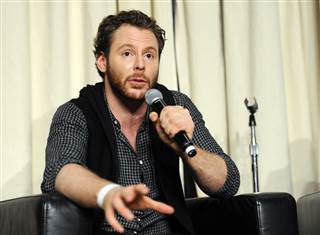
CU Blog - Cancer - Doing More - Photo 1This is the hope of philanthropist-billionaire Sean Parker; (founder of Napster and onetime CEO of Facebook). He is investing his time, talent (business & entrepreneurship) and treasuries in this quest to impact the world of cancer research and treatment.

Kudos, Mr. Parker!

The book Go Lean…Caribbean relates (Page 157) the statement that:

“1-in-3 Americans are due to be diagnosed with cancer … at some point. If 1-in-3 Americans are at risk, then surely Caribbean citizens cannot be far behind”.

This book does not assert to be a roadmap for treating cancer, but rather a roadmap for elevating Caribbean society by optimizing the economic, security and governing engines in the region. Yet, within this roadmap is the strategy to incentivize cancer research and facilitate treatment centers and workable solutions. In fact this roadmap invites role models like this philanthropist-billionaire Sean Parker – featured here in the following VIDEO and article:

VIDEO: Napster Co-Founder Sean Parker Pledges $250M to Fight Cancer
http://www.nbcnews.com/nightly-news/video/napster-co-founder-sean-parker-pledges-250m-to-fight-cancer-665463363805

NBC Nightly News – Posted 04-13-2016 – The Silicon Valley billionaire and Napster co-founder is putting his money behind a new cancer institute focusing on the emerging field of cancer immunotherapy.

News Article Title: Sean Parker Donates $250 Million to Launch Cancer Immunotherapy Institute
By: Reuters
Silicon Valley billionaire Sean Parker – see photo here – will donate $250 million to launch a new institute aimed at developing more effective cancer treatments by fostering collaboration among leading researchers in the field.

“Any breakthrough made at one center is immediately available to another center without any kind of IP (intellectual property) entanglements or bureaucracy,” Parker, the co-founder of music-sharing website Napster and the first president of Facebook, told Reuters in an interview.

The new Parker Institute for Cancer Immunotherapy will focus on the emerging field of cancer immunotherapy, which harnesses the body’s immune system to fight cancer cells.

It will include over 40 laboratories and more than 300 researchers from six key cancer centers: New York’s Memorial Sloan Kettering, Stanford Medicine, the University of California, Los Angeles, the University of California, San Francisco, Houston’s University of Texas MD Anderson and the University of Pennsylvania in Philadelphia.

Recently approved drugs have helped some patients sustain remission. But those first-generation therapies do not work for everyone, and scientists are trying to understand how to make them more effective.

“Very little progress has been made over the last several decades,” Parker said, referring to cancer drug research. “Average life expectancy has only increased three to six months with some of these drugs that cost billions to develop.”

Parker said the current system of cancer drug development discouraged the kinds of risk-taking that could lead to a major breakthrough.

The new institute “is paradigm shifting,” said Dr. Jedd Wolchok, chief of the melanoma and immunotherapeutics unit at Memorial Sloan Kettering Cancer Center.

He said it would alleviate the need for scientists to secure grants, which he said took up at least 30 percent of his time, foster collaboration among accomplished scientists and provide access to the newest information processing and data technology.

“I have no doubt this will allow us to make progress, and to make it much more quickly,” Wolchok said.
Source: NBC Nightly News – Retrieved 04-13-2016 from: http://www.nbcnews.com/health/cancer/sean-parker-donates-250-million-launch-cancer-immunotherapy-institute-n555196 

Related: Mark Zuckerberg’s ‘Initiative’ Adds New Wrinkle to Tech Philanthropy

The Go Lean book serves as a roadmap for the implementation and introduction of the technocratic Caribbean Union Trade Federation (CU). The CU‘s prime directives are identified with the following 3 statements:

  • Optimization of the economic engines in order to grow the regional economy to $800 Billion & create 2.2 million new jobs.
  • Establishment of a security apparatus to protect the resultant economic engines.
  • Improve Caribbean governance to support these engines.

The Go Lean book asserts that healthcare covers all the above 3 facets of the prime directives. Healthcare costs can easily bankrupt a family, community or a nation; economic security, public safety and government entitlements are therefore embedded in any discussion about cancer and its community impact.

The book also posits that one person can make a difference and maybe even change the world. The efforts of Sean Parker may very well fit this advocacy. He is therefore a role model for Caribbean philanthropists; he is doing more! We invite this type of impact in the Caribbean.

The Go Lean roadmap calls for more medical R&D initiatives like what Mr. Parker is pursuing. The roadmap strategizes the adoption of Self-Governing Entities (SGE) to employ medical research and treatment campuses. These dedicated, bordered grounds are ideal for immuno-therapy research and treatment. We hereby extend the invitation to all innovators and facilitators who want to do more in cancer research to come to the Caribbean. These ones will find cooperative and supportive governing structures to facilitate their impact on the world. They can do more … against cancer.

The Go Lean book strategizes economic empowerment in the region, clearly relating that healthcare and pharmaceuticals research/developments are important in the quest to make the Caribbean a better place to live, work, heal and play. At the outset of the Go Lean book, in the Declaration of Interdependence (Page 11), these points are pronounced:

viii.  Whereas the population size is too small to foster good negotiations for products and commodities from international vendors, the Federation must allow the unification of the region as one purchasing agent, thereby garnering better terms and discounts.

ix.  Whereas the realities of healthcare and an aging population cannot be ignored and cannot be afforded without some advanced mitigation, the Federation must arrange for health plans to consolidate premiums of both healthy and sickly people across the wider base of the entire Caribbean population. The mitigation should extend further to disease management, wellness, obesity and smoking cessation programs.

xxviii.  Whereas intellectual property can easily traverse national borders, the rights and privileges of intellectual property must be respected at home and abroad. The Federation must install protections to ensure that no abuse of these rights go with impunity, and to ensure that foreign authorities enforce the rights of the intellectual property registered in our region.

Previous blog/commentaries addressed issues of cancer and other medical research and practices, sampled here:

Using Group Purchasing Organizations to lower HealthCare costs
Role Model Shaking Up the World of Cancer
The Cost of Cancer Drugs
Antibiotics Misuse Linked to Obesity in the US
CHOP Research: Climate Change May Bring More Kidney Stones
Welcoming Innovators and Entrepreneurs under an SGE Structure
Big Pharma & Criminalization of American Business
Medical Research Associates Kidney Stones and Climate Change – Innovative!
New Research and New Hope in the Fight against Alzheimer’s Disease
Research in Diabetes Detection – Novartis and Google develop ‘smart’ contact lens
Health-care fraud in America; criminals take $272 billion a year
New Cuban Cancer medication registered in 28 countries
Puerto Rico’s Comprehensive Cancer Center Project Breaks Ground – Model of Medical SGE

Cancer is a crisis! The Go Lean book declares that a “crisis is a terrible thing to waste”. This premise is loud-and-clear from the foregoing VIDEO, that there is money to be made in this industry-space. But most importantly, there are lives to be saved.

The Go Lean roadmap posits that more innovations will emerge in the region as a direct result of the CU prioritization on science, technology, engineering and medical (STEM) activities on Caribbean R&D campuses and educational institutions. This is based on the assumption that intellectual properties (IP) registered in the Caribbean region will be duly respected around the world.

This IP protection mandate is a heavy-lifting task for the Caribbean Union Trade Federation. This is an example of the issues related to economic, security and governance that need to be managed in a technocracy.

The CU has the prime directive of optimizing these economic, security and governing engines of the Caribbean region. The foregoing article and VIDEO depicts that R&D is very important to medical innovations. So the roadmap thusly focuses on the community ethos to promote R&D as valuable for the region. The following list details this and other community ethos, plus the strategies, tactics, implementations and advocacies to optimize the region’s healthcare deliveries and R&D investments:

Community Ethos – Deferred Gratification Page 21
Community Ethos – Economic Systems Influence Individual Choices and Incentives Page 21
Community Ethos – The Consequences of Choices Lie in the Future Page 21
Community Ethos – Governing Principles – Return on Investments Page 24
Community Ethos – Governing Principles – Cooperatives Page 25
Community Ethos – Non-Government Organizations Page 25
Community Ethos – Ways to Impact Research & Development (R&D) Page 30
Community Ethos – 10 Ways to Promote Happiness Page 36
Community Ethos – Ways to Impact the Greater Good Page 37
Strategy – Integrate and unify region in a Single Market Page 45
Strategy – Agents of Change – Globalization Page 57
Tactical – Fostering a Technocracy Page 64
Tactical – Separation of Powers – Health Department Page 86
Tactical – Separation of Powers – Drug Administration Page 87
Implementation – Ways to Pay for Change Page 101
Implementation – Ways to Implement Self-Government Entities – R&D Campuses Page 105
Implementation – Ways to Deliver Page 109
Planning – Big Ideas for the Caribbean Region Page 127
Planning – Ways to Make the Caribbean Better Page 131
Advocacy – Ways to Improve Healthcare Page 156
Advocacy – Ways to Better Manage the Social Contract Page 170
Advocacy – Ways Foster Cooperatives Page 176
Advocacy – Ways to Improve Emergency Management Page 196
Advocacy – Ways to Impact Foundations Page 219
Advocacy – Ways to Impact Persons with Disabilities Page 228
Appendix – Emergency Management – Medical Trauma Centers Page 336

The Go Lean book or movement does not purport to be an authority on cancer research or any medical best practices. No economic-security-governance empowerment plan should ever dictate the course of direction for cancer research and/or treatment. But the war on cancer has been stagnant for far too long; more needs be done. The solutions must be incentivized for private enterprises and private individuals – role models. The SGE structure invites innovations like that of Sean Parker and many others with this same passion … and some degree of genius.

Now is the time for all of the Caribbean, the people and governing institutions, to lean-in for the empowerments in the book Go Lean … Caribbean. This concept of Self-Government Entities (Page 127) is a Big Idea for the region. Change can really take hold, and thrive. We can do more … for cancer.  We can make the Caribbean a better place to live, work, heal and play. 🙂
Download the free e-book of Go Lean … Caribbean – now!

Share this post:
, , , ,

Skipping School to become Tech Giants

Go Lean Commentary

How can we mold young minds for career success?

Apparently, there is more than one way; (notwithstanding starting early). Yes, there is college, but there is another way too: entrepreneurship. Think Bill Gates, Steve Jobs, and Mark Zuckerberg. These ones are notorious for their billionaire success, despite not finishing college.

CU Blog - Skipping School to become Tech Giants - Photo 1Some people think that a 4-year college degree may NOT be entirely essential for career success; these ones say: “there is an alternate path” for success for an individual career and for their community; (some even claim that a 4-year degree may be a bad investments for students).

So there are parallel paths. Let’s consider: education -vs- entrepreneurship …

Many claim that the underlying goal for molding young minds should not be education, but rather competition … with the rest of the world. The question could therefore be codified as: “Is a 4-year college degree necessary for our community to better compete with the world?”

This is a tough one (question), in which there are no easy answers.

The book Go Lean…Caribbean embarks on the quest to elevate the Caribbean societal engines (economics, security and governance); it presents options with education and with entrepreneurship. The book immediately rails against the education status quo; it stakes the claim that Caribbean tertiary education eco-system needs to be reformed and transformed, asserting that the status quo has not served the region as well as expected. Truth is, traditional college education paths may be considered disastrous for the Caribbean region in whole, and for each specific country in particular. Why?

Students leave to study …

… and do not necessarily return. They are “gone and forgotten”*; they run-off with their community investments with little chance for any “return”. (* = Many Caribbean graduates only return for family visits and festivals).

Normally, college education is great for the individual. The Go Lean book relates how economists have established that every additional year of schooling increases a student’s earning potential by about 10% (Page 258). Yet for our Caribbean communities as a whole, the end-result has been different – bad – ending in our incontrovertible brain drain.

How bad?

Previous blogs on this same subject matter have detailed the dysfunction; one example is the report that 70 percent of the tertiary-educated population in the Caribbean has fled. What’s worst in these reports, is the fact that these emigrants have taken their Caribbean-funded education and skill-sets with them; even taking any hope for collecting student loans, thereby imperiling future generations of scholars from their own benefits of a college education.

So education is not the champion – for nation-building – that we would expect. There is room for a challenger-contender. Consider this VIDEO here (and transcript in the Appendix), of young ones quitting college or never enrolling, to pursue entrepreneurial endeavors in the technology space. These ones are being fostered, prodded and nurtured; as related here:

VIDEO – Skipping School to become Tech Giants – http://www.cbsnews.com/videos/investing-in-college-dropouts-with-big-ideas

(VIDEO plays best in Internet Explorer).

The Go Lean movement – book and blogs – asserts that change must come to the region in response to the debilitating status quo in Caribbean life. The book refers to these change factors as Agents of Change, including technology and globalization. The best strategy for contending with both technology and globalization change is to not only consume; communities must develop, innovate and produce as well. The Go Lean book posits therefore that Caribbean regional shepherds should invest in (better) higher education and entrepreneurial options. The bottom-line motive should be the Greater Good.

This book Go Lean book serves as a roadmap for the introduction and implementation of the Caribbean Union Trade Federation (CU). This represents change for the region. The CU/Go Lean roadmap has 3 prime directives:

  • Optimization of the economic engines – including educational empowerments and entrepreneurial incubators – in order to grow the regional economy and create 2.2 million new jobs.
  • Establishment of a security apparatus to protect the resultant economic engines.
  • Improve Caribbean governance to support these engines.

The book relates that forging technology genius is a direct product of perspiration and inspiration. Perspiration as in the training and education needed to excel in this field; and inspiration as in the spark of innovation that is required to conceive, compose and construct competitive products pertaining to hardware, software and communication systems.

The Go Lean roadmap provides turn-by-turn directions on how to foster genius and how to reform the Caribbean tertiary education eco-systems. As a planning tool, the roadmap commences with a Declaration of Interdependence, pronouncing the approach of regional integration (Page 12 & 14) as a viable solution to elevate the opportunities in the region:

xix.  Whereas our legacy in recent times is one of societal abandonment, it is imperative that incentives and encouragement be put in place to first dissuade the human flight, and then entice and welcome the return of our Diaspora back to our shores

xxi.  Whereas the preparation of our labor force can foster opportunities and dictate economic progress for current and future generations, the Federation must ensure that educational and job training opportunities are fully optimized for all residents of all member-states, with no partiality towards any gender or ethnic group. The Federation must recognize and facilitate excellence in many different fields of endeavor, including sciences, languages, arts, music and sports. This responsibility should be executed without incurring the risks of further human flight, as has been the past history.

xxvii.  Whereas the region has endured a spectator status during the Industrial Revolution, we cannot stand on the sidelines of this new economy, the Information Revolution. Rather, the Federation must embrace all the tenets of Internet Communications Technology (ICT) to serve as an equalizing element in competition with the rest of the world. The Federation must bridge the digital divide and promote the community ethos that research/development is valuable and must be promoted and incentivized for adoption.

xxx.   Whereas the effects of globalization can be felt in every aspect of Caribbean life, from the acquisition of food and clothing, to the ubiquity of ICT, the region cannot only consume, it is imperative that our lands also produce and add to the international community, even if doing so requires some sacrifice and subsidy.

The Go Lean book focuses primarily on economic issues, and it recognizes that computer hardware, software and communications systems are the future direction for consumer, corporate and industrial developments. This is where the new jobs are to be found. If we want to arrest societal abandonment occurring in our communities, we must create jobs. The Go Lean roadmap describes the heavy-lifting for people, organizations and governments to foster genius and forge technological innovations here at home in the Caribbean; (i.e. start early).

This commentary is not advocating a practice of “skipping school to rush to try and become tech giants”. But rather, it is advocating education reform, abandoning failed practices, like study abroad and adopting new ones, like e-Learning solutions. After which there should be an effort to provide entrepreneurial incubators to foster more business start-ups.

The Go Lean book posits that education and entrepreneurism are vital advocacies for Caribbean economic empowerment. But there have been flawed decision-making in the past, both individually and community-wise, and so we are now playing catch-up with the rest of the world. Whether we want it or not, there is a competition; globalization features trade wars; wars feature battles; battles feature champions. The vision of the CU is a confederation of the 30 member-states of the Caribbean to do the heavy-lifting of championing better educational and entrepreneurial policies.

The book details those policies; and other ethos to adopt, plus the executions of the following strategies, tactics, implementations and advocacies to impact the Greater Good for the region:

Community Ethos – Deferred Gratification Page 21
Community Ethos – People Respond to Incentives Page 21
Community Ethos – Job Multiplier Page 22
Community Ethos – Lean Operations Page 24
Community Ethos – Return on Investments – ROI Page 24
Community Ethos – Ways to Impact the Future Page 26
Community Ethos – Ways to Foster Genius Page 27
Community Ethos – Ways to Help Entrepreneurship Page 28
Strategy – Agent of Change – Technology Page 57
Strategy – Agent of Change – Globalization Page 57
Tactical – Separation of Powers – Education Department Page 85
Tactical – Separation of Powers – Labor Department Page 89
Implementation – Ways to Impact Social Media Page 111
Advocacy – Ways to Grow the Economy Page 151
Advocacy – Ways to Create Jobs Page 152
Advocacy – Ways to Improve Education Page 159
Advocacy – Ways to Improve Governance Page 169
Advocacy – Ways to Better Manage the Social Contract Page 171
Advocacy – Ways to Foster Cooperatives Page 176
Advocacy – Ways to Improve Libraries Page 187
Advocacy – Ways to Foster Technology Page 197
Advocacy – Ways to Foster e-Commerce Page 198
Appendix – Education and Economic Growth Page 258

Now is the time for all of the Caribbean, the people and governing institutions, to lean-in for the changes described in the book Go Lean … Caribbean. We welcome entrepreneurism and we welcome education; these two activities can be concurrent and complementary. But we need to break from the old-bad practices (i.e. study abroad) and engage new-better practices (i.e. incubators).

So we encourage all young people to get advanced education, but to do it at home. And we encourage all with entrepreneurial dreams to pursue them … here at home.

The new jobs that our region need must come from these initiatives. Let’s get started!  🙂

Download the book Go Lean…Caribbean now!

————–

APPENDIX – Story Transcript: Skipping School to become Tech Giants

A select group of whiz kids seems to be thriving despite having dropped out of college. All any of them seems to need is a high-tech idea, a sofa to sleep on … plus a $100,000 grant. John Blackstone explains:

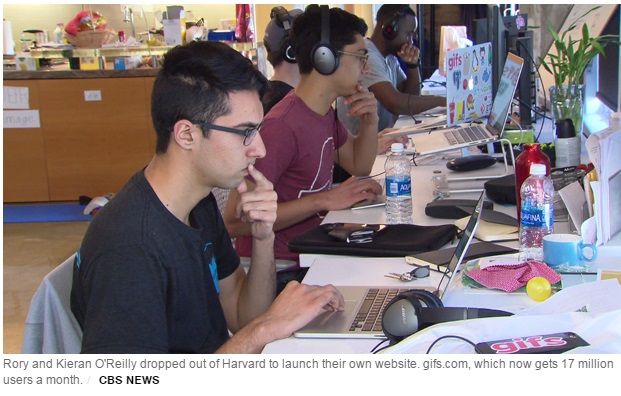
When brothers Kieran and Rory O’Reilly were both accepted to Harvard, their parents marked the accomplishment with new license plates: One read “2 N HRVD”; the other, “HARVRD 2.”

“They might change it to ‘2 DROPOUTS,'” said Rory.

They both quit Harvard as undergrads two years ago. They were just 18 and 19 when they moved to San Francisco with big hopes, and almost nothing else.

“Three bags of clothes — every day we would take it, move from hotel to hotel,” said Rory.

“I remember our bank account was always negative $66, because that’s the overdraft fee,” said Kieran.

They’re now living IN their office. “Every single day our mom tries to call us or send food,” Rory said.

They’ve created a website, gifs.com, a tool for re-editing online videos. Seventeen million people in the past month have used it.

The O’Reillys are on a path made famous by some of the tech industry’s biggest names: Jobs, Gates, Zuckerberg.

“People that drop out of Harvard, maybe the Bill Gateses of the world, the Zuckerbergs, they’re the people that are really changing the entire world, in my opinion,” said Rory. “And yeah, I’m glad to be a part of that.”

The O’Reillys are “part of that” partly because Peter Thiel, one of the billionaire founders of PayPal, gave them $100,000 each.

Thiel started his surprising giveaway five years ago, offering $100,000 to kids who quit college to “build new things.”

Jack Abraham is executive director of the Thiel Fellowship, which distributes the money to 20 new dropouts each year. And what is he encouraging? “If you have a great idea, the time to pursue it is now,” Abraham said. “We also hope to show society that this is an alternate path that people can and should consider and take.”

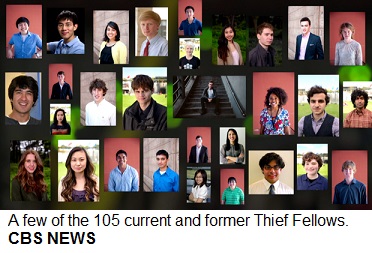
Abraham says the 105 current and former Thiel Fellows have created more than 1,000 jobs and raised $330 million from investors.

CU Blog - Skipping School to become Tech Giants - Photo 2

Only eight have returned to college.

The selection committee is now sorting through 5,000 applications for this year’s 20 fellowships. Most of the applicants would have much better odds getting into the Ivy League.

“It breaks my heart when some of the most promising students don’t fulfill their potential because they’re chasing rainbows,” said Vivek Wadhwa, a fellow at StanfordUniversity, who has been a critic of the Thiel Fellowship from the beginning.”

“It’s like what happens in Hollywood: You have tens of thousands of young people flocking to Hollywood thinking that they’re gonna become a Brad Pitt or an Angelina Jolie; they don’t,” said Wadhwa.

“They don’t become billionaires. There haven’t been many Mark Zuckerbergs after Mark Zuckerberg achieved success.”

And Wadhwa says there is little evidence the Thiel dropouts are doing much that isn’t already being done in Silicon Valley.”Everyone does the same thing: It’s social media, it’s photo sharing apps. Today it’s sharing economy,” Wadhwa said. “It’s ‘Me, too,’ ‘More of the same.'”

But 19-year-old Conrad Kramer and 21-year-old Ari Weinstein were convinced they had a new idea, so when they were awarded Thiel Fellowships in 2014, they both walked away from MIT to work full-time on their app, called Workflow.

“There are some opportunities that come up that you would regret turning down,” Kramer said. “Workflow was definitely one of those.”

“It’s kind of like making your own apps that save you time,” Weinstein said.

When Workflow launched, it was the number one bestseller on Apple’s App Store — and has since won several awards.

They’ve just hired their newest employee, Tim Hsia, a graduate of Stanford’s business and law schools and an Army vet. He’s 33-years-old and says he doesn’t mind taking orders from a teenage boss.

“I’m learning so much because they have such a wealth of experience despite their age,” Hsia said. “In Silicon Valley it’s about meritocracy of ideas. And so if you have a good idea, everyone’s always receptive to listen to it.”

Zach Latta found many people were willing to listen — leaving high school to move to San Francisco on his own, to start a non-profit called Hack Club.

He recalled that when he moved to the city at age 16, “I’d showed up at a gym one day with some friends, and they turned me away at the door because I had to be 18.”

Now he is 18 and works full-time helping high school students learn to code.

“I feel challenged in every single day,” Latta said. “And I think I’m learning as much as I’ve ever been while being happy.”

For now these wannabe tech titans live modestly in homes they share with several others, or in offices that also provide a place to sleep. Instead of meals, some drink Soylent — Silicon Valley’s version of fast food. It apparently contains all the nutrients necessary to stay alive, in a bottle.

“Yeah — breakfast, lunch, snack, dinner,” said Latta.

They are building their companies with money from investors who seem to care little whether they graduated from college.

“It’s actually kind of a badge of honor here, dropping out,” said 23-year-old Stacey Ferreira. She’s dropped out of NYU — twice! The first time she saw a tweet from Richard Branson, the founder of the Virgin Group, offering to meet anyone who gave $2,000 to his charity.

She borrowed the money and met him. She was 18 and starting her first business.

“And make a long story short, he and two of his buddies ended up investing $1.2 million in our business that summer,” Ferreira told Blackstone.

Two years later, she sold that company, MySocialCloud, for a hefty profit, and returned to NYU. But then she had another big idea that couldn’t wait.

“If you can create your own job, why wouldn’t you just do that and not get stuck paying student loans for the rest of your life?” Ferreira said.

Instead of student loans, she has $100,000 from Peter Thiel. She’s working on an app called Forrge that aims to create an on-demand marketplace for hourly workers.

She’s hoping that dropping out of NYU again will pay off again.

Blackstone asked, “Is there a lesson in your story for other young people?”

“Yeah, I think the biggest lesson to learn is just take risks,” Ferreira said.

“What’s the worst that can happen to you when you take the risk?”

“For me, the worst that can happen is I move home and sleep on my parent’s couch for a couple months, until I figure it out,” Ferreira replied.

For more info:


Share this post:
, , ,
[Top]

An Ode to Detroit – Good Luck on Trade!

Go Lean Commentary

It’s now time to say “goodbye and good luck” to the City of Detroit with these passing words, lessons and advice …

A commonly accepted economic principle declares that “Voluntary Trade Creates Wealth”.

Really? The City of Detroit, Michigan seems to have not “gotten the memo”.

The actual principle is summarized in the book Go Lean … Caribbean (Page 21) as follows:

Voluntary Trade Creates Wealth – People specialize in the production of certain goods and services because they expect to gain from it. People trade what they produce with other people when they think they can gain something from the exchange. Some benefits of voluntary trade include higher standards of living and broader choices of goods and services.

Detroit is branded the Motor City or Motown for being the capital of the American Automotive industry, (all the Big 3 car-makers – General Motors, Ford and Chrysler – are based in this metropolitan area). From a trade perspective, automobiles are among the most successful American exports. According to this simple logic  – trade creates wealth and Detroit is home to one of America’s best trade products – there should be win-win for all stakeholders in the vertical automotive industry, including the local communities. Right?

Not quite! This is NOT the reality.

CU Blog - An Ode to Detroit - Good luck on Trade - Photo 1

CU Blog - An Ode to Detroit - Good luck on Trade - Photo 2

This article below, just in time for the US presidential elections – posted on March 8, 2016 – and the arrival of the main candidates for the Democratic and Republican nominations, reveal the truth of life in today’s Detroit … and the dire consequence of free trade:

The City of Detroit has gone from one of the country’s richest in the 1960s to one of the poorest [today].

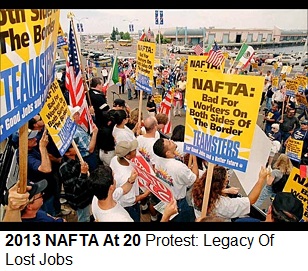
The once-thriving automotive hub is pocked by blighted homes and crime and has more children living in extreme poverty than any of the nation’s 50 largest cities. Manufacturing job losses devastated neighboring communities, sowing more than 20 years of resentment among white, working-class Democrats over the North American Free Trade Agreement.
Source: MSN Social Media Site; (posted 03-08-2016; retrieved April 9, 2016) .

The publishers of the Go Lean book have been in Detroit to “observe and report” on the turn-around and rebirth of the once-great-but-now-distressed city and its nearby communities; (we have also considered the dysfunction of Flint and the promise of Ann Arbor). There have been so many lessons to learn from Michigan: good, bad and ugly. Consider this sample here conveyed in previous blogs/commentaries:

https://goleancaribbean.com/blog/?p=7601 Beware of Vulture Capitalists
https://goleancaribbean.com/blog/?p=7268 Detroit giving schools their ‘Worst Shot’
https://goleancaribbean.com/blog/?p=7235 Flint, Michigan – A Cautionary Tale
https://goleancaribbean.com/blog/?p=6965 Secrecy, corruption and ‘conflicts of interest’ pervade state governments
https://goleancaribbean.com/blog/?p=6609 Before and After Photos Showing Detroit’s Riverfront Transformation
https://goleancaribbean.com/blog/?p=6269 Education & Economics: Welcome to Detroit, Mr. President
https://goleancaribbean.com/blog/?p=6022 Caribbean Diaspora in Detroit … Celebrating Heritage
https://goleancaribbean.com/blog/?p=5597 The Dire Strait of Unions and Collective Bargaining
https://goleancaribbean.com/blog/?p=5055 A Lesson from an Empowering Family in Detroit
https://goleancaribbean.com/blog/?p=4913 Ann Arbor: Model for ‘Start-up’ Cities
https://goleancaribbean.com/blog/?p=4476 De-icing Detroit’s Winter Roads: Impetuous & Short Term
https://goleancaribbean.com/blog/?p=3713 NEXUS: Facilitating Detroit-Windsor Cross-Border Commerce
https://goleancaribbean.com/blog/?p=3326 M-1 Rail: Alternative Motion in the Motor City
https://goleancaribbean.com/blog/?p=3311 Detroit to exit historic bankruptcy
https://goleancaribbean.com/blog/?p=3164 Michigan Unemployment – Then and Now
https://goleancaribbean.com/blog/?p=2480 A Lesson in History: Community Ethos of WW II
https://goleancaribbean.com/blog/?p=1656 Blue is the New Green – Managing Michigan’s Water Resources
https://goleancaribbean.com/blog/?p=970 JP Morgan Chase’s $100 million Detroit investment – Not just for the Press

The full news article from the MSN Social Media Site is embedded here, retrieved from – http://www.msn.com/en-us/news/politics/michigan-a-critical-showdown-for-sanders-to-mount-comeback/ar-BBqsehO?li=BBnb7Kz&ocid=ieslice:

Title: Michigan ‘a critical showdown’ for Sanders to mount comeback
By: Heidi M. Przybyla

CU Blog - An Ode to Detroit - Good luck on Trade - Photo 3The State of Michigan could be Bernie Sanders’ last, best chance to challenge Hillary Clinton’s hold on the Democratic presidential race.

The Midwestern industrial state, which holds its primary Tuesday [(March 8, 2016)], is the ideal audience for Sanders’ campaign message about “unfair” trade agreements, income inequality and a “rigged economy.”

“This is ground zero for trade,” said Rep. Debbie Dingell, D-Mich. “People are frustrated. It’s been almost 15 years, and they’re not better off than they were,” said the first-term Democrat, who is backing Clinton.

Yet Clinton has consistently led in polls — a Monmouth University Poll out Monday showed her up 13 points. “If he can’t win in Michigan, where can he win besides these small caucus states?” said Susan Demas, publisher of Inside Michigan Politics, a political analysis newsletter. Sanders campaign manager Jeff Weaver is calling Michigan “a critical showdown.”

Mississippi also holds a primary on Tuesday, and Clinton is favored there.

The city of Detroit has gone from one of the country’s richest in the 1960s to one of the poorest.  The once-thriving automotive hub is pocked by blighted homes and crime and has more children living in extreme poverty than any of the nation’s 50 largest cities. Manufacturing job losses devastated neighboring communities, sowing more than 20 years of resentment among white, working-class Democrats over the North American Free Trade Agreement.

Sanders is hitting Clinton hard on the trade issue, including a recent ad picturing abandoned homes and factories. NAFTA was championed by her husband, former president Bill Clinton, though the former first lady is trying to distance herself from a number of those policies.

Michigan could expose some of Clinton’s longer-term vulnerabilities. Some of the state’s most powerful unions, including the Teamsters, the AFL-CIO and the United Auto Workers, traditional Democratic allies, haven’t endorsed a candidate. Many union rank-and-file backed her husband in 1992 and 1996 but are now supporting Sanders or Republican front-runner Donald Trump.

“She’s also competing with Donald Trump, who’s made this a strong issue and not backed down on the currency trade issue,” said Dingell. “There’s a lot of pent-up anger, and Donald Trump let’s them release it,” she said.

Sanders may be indirectly helping Trump. At campaign rallies, he has repeatedly slammed Clinton on trade, listing it as a key area where they disagree. Sanders says he led opposition to NAFTA and permanent normal trade relations with China, which he says resulted in the loss of millions of middle-class jobs and “a race to the bottom.” His campaign, in a March 3 news release, dubbed Clinton the “outsourcer-in-chief.”

Clinton has been trying to distance herself from the 1990s-era policy. In the Flint debate, she tried to distinguish her record from that of her husband’s.  As a senator, she voted against a Central American trade agreement, the only multinational pact that came before her, she said. More recently, she’s come out against the Trans-Pacific Partnership.

Nearing closer to the nomination, Clinton has begun to discuss the role Sanders would need to play in unifying the party. During a town hall forum Monday in Grand Rapids, she talked extensively about how she encouraged her voters to back Barack Obama in 2008.

“I had a lot of passionate supporters who did not feel like they wanted to support then-Sen. Obama. I worked as hard as I could. I nominated him at the convention. I made the case, because he and I shared a lot of the same views,” she said.

“We have differences, but those differences pale in comparison to what we see going on with the Republicans right now,” said Clinton.

Clinton’s supporters acknowledge a Michigan loss is unlikely to deter Sanders. Several testy exchanges in the Flint debate highlighted festering tensions between the two, and Sanders is flush with campaign donations to keep him going.

“I think Hillary Clinton will win Michigan,” said Dingell. “But I think Sen. Sanders plans on staying in this race for a while.”

Contributing writer: Nicole Gaudiano

News Update: Senator Bernie Sanders won the Michigan Democratic primary.

There is a strong current against free trade deals in big industrial cities in the American north. At this juncture (April 9, 2016), Bernie Sanders has won the last 7 state primaries with his “unfair trade” message:

  • Idaho
  • Utah
  • Alaska
  • Hawaii
  • Washington
  • Wisconsin
  • Wyoming

But chances are, these trade agreements will not disappear, even under a new president – to be elected later this year. (Listen to the related AUDIO podcast in the Appendix below).

These free trade agreements are ratified treaties with other countries that are not so easily dismantled. Plus, the US business interest has proven to be formidable in their obstructionism to radical changes to their status quo.

The Go Lean movement asserts that there is a Crony-Capitalistic influence in the US that creates a societal defect for forging change. In this case, trade deals like NAFTA allow big corporations to shift labor costs to alternate locales with lower payroll costs. This commentary has related that the money motivation with this strategy may be too much to overcome in the America of 2016.

Good luck to Detroit.

Hope and Change? Not here, not now.

The book Go Lean… Caribbean urges Caribbean citizens not to be swayed by the false perception of refuge in America. The grass is NOT greener on this side.

Yes, the status quo in the overall US is better than the status quo in the Caribbean, but change is afoot. This movement – book and blogs – posits that it is easier to reform and transform the Caribbean member-states than to attempt to change America. The Go Lean book serves as a roadmap for the introduction and implementation of the technocratic  Caribbean Union Trade Federation (CU). This represents a confederation of the 30 member-states of the Caribbean region, including the US Territories (2): Puerto Rico and the US Virgin Islands); the French Territories (5); 6 Dutch Territories constituted as 1 member; British Overseas Territories (5) and independent states and Republics (17).

This CU/Go Lean roadmap extols a priority of trade in the execution of its prime directives. Economic stability and progress is fundamental to forging an elevated society. As observed in Detroit, dysfunction in a community’s economic engine, brings about dysfunction in other facets of societal life. This explains why Detroit is also plagued with rampant crime. (During the course of the Go Lean movement’s observing-and-reporting on Detroit, there were some acute criminal activities, like the one case where a mother was adjudicated for killing and storing 2 dead children in her kitchen freezer). Likewise, the City has been plagued with one instance after another of ineffectual governance or municipal corruption. (A recent ex-Mayor – Kwame Kilpatrick – lingers in federal prison on federal corruption convictions). This is why the CU prime directives feature economics, security and governance, as defined by these 3 statements here:

  • Optimize the Caribbean economic engines of the region to grow the GDP of the economy to $800 billion and create 2.2 million new jobs.
  • Establish a security apparatus to protect the resultant economic engines in the Caribbean.
  • Improve Caribbean governance – including municipal, state and federal administrations – to support these engines.

The Go Lean roadmap seeks to reform the Caribbean, not the City of Detroit nor America. The roadmap opens with the call for the consolidation of trade negotiation for the region – treating everyone as equals. This point is echoed early, and often, in the book, commencing with these opening pronouncements in the Declaration of Interdependence (Pages 11 – 14), as follows:

viii.   Whereas the population size is too small to foster good negotiations for products and commodities from international vendors, the Federation must allow the unification of the region as one purchasing agent, thereby garnering better terms and discounts.

xi.   Whereas all men are entitled to the benefits of good governance in a free society, “new guards” must be enacted to dissuade the emergence of incompetence, corruption, nepotism and cronyism at the peril of the people’s best interest. The Federation must guarantee the executions of a social contract between government and the governed.

xvi. Whereas security of our homeland is inextricably linked to prosperity of the homeland, the economic and security interest of the region needs to be aligned under the same governance. Since economic crimes … can imperil the functioning of the wheels of commerce for all the citizenry, the accedence of this Federation must equip the security apparatus with the tools and techniques for predictive and proactive interdictions.

xxiv. Whereas a free market economy can be induced and spurred for continuous progress, the Federation must install the controls to better manage aspects of the economy: jobs, inflation, savings rate, investments and other economic principles. Thereby attracting direct foreign investment because of the stability and vibrancy of our economy.

xxx. Whereas the effects of globalization can be felt in every aspect of Caribbean life, from the acquisition of food and clothing, to the ubiquity of ICT, the region cannot only consume, it is imperative that our lands also produce and add to the international community, even if doing so requires some sacrifice and subsidy.

The Go Lean roadmap therefore constitutes a change for the Caribbean. This provides the tools/techniques to bring immediate elevation to the region to benefit one and all member-states. The book details the community ethos to forge such change; plus the executions of the following strategies, tactics, implementations and advocacies to make the changes permanent:

Community Ethos – Deferred Gratification Page 21
Community Ethos – Economic Systems Influence Individual Choices Page 21
Community Ethos – Voluntary Trade Creates Wealth Page 21
Community Ethos – Lean Operations Page 24
Community Ethos – Return on Investments Page 24
Community Ethos – Cooperatives Page 24
Community Ethos – Ways to Improve Negotiations Page 30
Community Ethos – Impact the Greater Good Page 37
Strategy – Unified Region in a Single Market Economy Page 45
Strategy – Customers – The Business Community Page 47
Strategy – Agents of Change – Globalization Page 57
Tactical – Confederating a Permanent Union Page 63
Tactical – Fostering a Technocracy Page 64
Tactical – Growth Approach – Trade and Globalization Page 70
Tactical – Separation of Powers – Interstate Commerce Admin Page 79
Tactical – Separation of Powers – Office of Trade Negotiations Page 80
Implementation – Ways to Pay for Change Page 101
Implementation – Foreign Policy Initiatives at Start-up Page 102
Implementation – Ways to Deliver Page 109
Implementation – Trade Mission Office Objectives Page 116
Planning – Ways to Improve Trade Page 128
Planning – Ways to Improve Interstate Commerce Page 129
Planning – Lessons Learned from Detroit Page 140
Advocacy – Ways to Grow the Economy Page 151
Advocacy – Ways to Create Job Page 152
Advocacy – Ways to Improve Housing – Lesson from Detroit to raze Dilapidated housing Page 161
Advocacy – Ways to Improve Governance Page 168
Advocacy – Ways to Improve Local Government Page 169
Advocacy – Ways to Better Manage the Social Contract Page 170
Advocacy – Ways to Foster Cooperatives Page 176
Advocacy – Ways to Impact Main Street Page 201

The issues in this commentary are important for the development of Caribbean region. There is the need to fully participate in trade agreements; it is the only way to fully compete in a globalized marketplace. But there is the need for a new regulatory regime for the Caribbean market, as free market dynamics are normally based on supply-and-demand. The Caribbean member-states, with their small population and market-sizes have not been able to compete with the voluminous demand nor voluminous supply of some of the bigger countries (i.e. China, India, EU, the US, etc). The consolidated CU market would be different … and better!

The Go Lean book is a detailed turn-by-turn, step-by-step roadmap for how to lean-in to a new trade regime. We now urge everyone in the region – all stakeholders: citizens, visitors, direct foreign investors, trading-partners, business establishments – to lean-in to this roadmap. With this plan, we would have reason to believe in “Hope and Change” for the Caribbean region, for it to be a better place to live, work and play.

So as we move onto another American locale (Miami) for final preparation for an eventual repatriation, here’s our advice to the Caribbean Diaspora living in Detroit: Go home and help with this Go Lean roadmap to elevate the Caribbean …

… and to the people of Detroit, we say: Good luck. We invite you too, to come and visit us in  the Caribbean … often. 🙂

Download the book Go Lean…Caribbean now!

————-

APPENDIX – AUDIO Podcast: Free Trade On The Campaign Trail – http://www.npr.org/podcasts/510053/on-point-with-tom-ashbrook#

Posted March 8, 2016 – From Trump to Sanders, free trade is getting a thumping on the campaign trail. Could, would the United States really turn it around? Plus: inspecting stalled millennial wage growth.

Share this post:
, , , ,
[Top]

Being Lean: Asking the Question ‘Why’ 5 Times

Go Lean Commentary

“The Caribbean is arguably the greatest address on the planet”, as declared in the book Go Lean…Caribbean. (This “greatest” attribute is defined for terrain, culture and hospitality). Yet the region has an unconscious-able brain drain rate, where 70 percent of the tertiary-educated population has fled.

Why!?

This question has been asked repeatedly! Many times the published answers are really describing the symptoms and not the root-causes. In the end, the answer is not so easy! The Go Lean book defines it as heavy-lifting. The Go Lean approach is an examination of the word “Lean”. In the book the word is presented as a noun, a verb and an adjective; all inclusive of the agile concept. The lean/agile concept is an understanding that value is a derived-result from a continuously optimizing key process, that repeats as a cycle .. again and again.

The Go Lean book (Page 4) relates that …

… lean thinking changes the focus of management from optimizing separate technologies, assets, and vertical departments to optimizing the flow of products and services through entire value streams that flow horizontally across technologies, assets, and departments to customers.

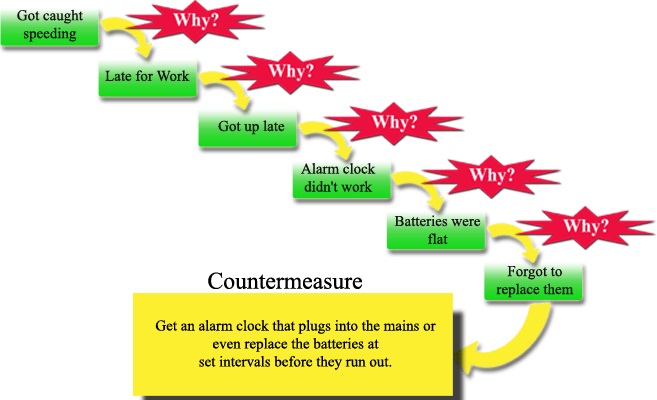
One expression of the lean methodology that can be used to dissect/”add value” to the key question (” Why such a high brain drain rate”) in this commentary is the iterative interrogative technique: 5 Why’s. See details of this agile-lean technique below. Using this technique, the 5 Why’s needs to be extended to 7 actual Why questions, as follows:

Problem: Why do Caribbean citizens abandon their homelands?

  1. “Push and Pull” reasons. “Push”, as in people fleeing to find refuge and “pull” in the perception (though false) that life is better on foreign shores. Why?
  2. Societal defects – in the region – are so acute. Why?
  3. Societal engines (responsible for economics, security & governance) not optimized. Why?
  4. Colonial Masters did not engage best-practices. Why?
  5. Foreign Policy in the colonies was to just keep them dependent. Why?
  6. Colonizers promoted home country commerceMercantilism; slavery in the colonies, but not at home (i.e. Serfism, French Revolution). Why?
  7. European Community Ethos: OK to exploit African Race as declared by Pope Innocent VIII.

s - Photo 1

s - Photo 2

See the encyclopedic details and a related VIDEO here:

Reference Title: 5 Whys
Source: 
Wikipedia Online Encyclopedia – Retrieved 04/07/2016 from: https://en.wikipedia.org/wiki/5_Whys

5 Whys is an iterative interrogative technique used to explore the cause-and-effect relationships underlying a particular problem.[1] The primary goal of the technique is to determine the root cause of a defect or problem by repeating the question “Why?” Each question forms the basis of the next question. The “5” in the name derives from an empirical observation on the number of iterations typically required to resolve the problem.

The technique was formally developed by Sakichi Toyoda and was used within the Toyota Motor Corporation during the evolution of its manufacturing methodologies. In other companies, it appears in other forms. Under Ricardo Semler, Semco practices “three whys” and broadens the practice to cover goal setting and decision making.[2]

Not all problems have a single root cause. If one wishes to uncover multiple root causes, the method must be repeated asking a different sequence of questions each time.

The method provides no hard and fast rules about what lines of questions to explore, or how long to continue the search for additional root causes. Thus, even when the method is closely followed, the outcome still depends upon the knowledge and persistence of the people involved.

—–

The questioning for this example could be taken further to a sixth, seventh, or higher level, but five iterations of asking why is generally sufficient to get to a root cause. The key is to encourage the trouble-shooter to avoid assumptions and logic traps and instead trace the chain of causality in direct increments from the effect through any layers of abstraction to a root cause that still has some connection to the original problem. Note that, in this example, the fifth why suggests a broken process or an alterable behaviour, which is indicative of reaching the root-cause level.

It is interesting to note that the last answer points to a process. This is one of the most important aspects in the 5 Why approach – the real root cause should point toward a process that is not working well or does not exist.[3] Untrained facilitators will often observe that answers seem to point towards classical answers such as not enough time, not enough investments, or not enough manpower. These answers may be true, but they are out of our control. Therefore, instead of asking the question why?, ask why did the process fail?

A key phrase to keep in mind in any 5 Why exercise is “people do not fail, processes do”.

Rules of performing “5 Whys”

In order to carry out the 5-Why analysis properly, following advices should be kept:

  1. It is necessary to engage the management in 5 Whys standard in the company. For the analysis itself, remember about right working group. Also consider facilitator presence for more difficult topics.
  2. Use paper or whiteboard instead of computers.
  3. Write down the problem and make sure that all people understand it.
  4. Distinguish causes from symptoms.
  5. Take care of the logic of cause-and-effect relationship.
  6. Make sure that root causes certainly lead to the mistake by reversing the sentences created as a result of the analysis with the use of expression “and therefore”.
  7. Try to make our answers more precise.
  8. Look for the cause step by step. Don’t jump to conclusions.
  9. Base on facts and knowledge.
  10. Assess the process, not people.
  11. Never leave “human error”, “worker’s inattention”, etc. as the root cause.
  12. Take care of the atmosphere of trust and sincerity.
  13. Ask the question “why” until the root cause is determined, i.e. such cause the elimination of which will cause that the error will not occur again.[7]

Criticism

While the 5 Whys is a powerful tool for engineers or technically savvy individuals to help get to the true causes of problems, it has been criticized … as being too basic a tool to analyze root causes to the depth that is needed to ensure that they are fixed.[8] Reasons for this criticism include:

  • Tendency for investigators to stop at symptoms rather than going on to lower-level root causes.
  • Inability to go beyond the investigator’s current knowledge – cannot find causes that they do not already know.
  • Lack of support to help the investigator ask the right “why” questions.
  • Results are not repeatable – different people using 5 Whys come up with different causes for the same problem.
  • Tendency to isolate a single root cause, whereas each question could elicit many different root causes.

These can be significant problems when the method is applied through deduction only. On-the-spot verification of the answer to the current “why” question before proceeding to the next is recommended to avoid these issues. In addition, performing logical tests for necessity and sufficiency at each level can help avoid the selection of spurious causes and promote the consideration of multiple root causes.[9]

s - Photo 3

————————

VIDEO – 5 Whys Root Cause Analysis Problem Solving Tool–Video Training – https://youtu.be/zvkYFZUsBnw

Uploaded on Jul 23, 2009 – The 5 Whys (Free 6-Page PDF at http://www.velaction.com/5-whys/ ) is one of the simplest problem solving tools used in Lean manufacturing and Lean offices. This presentation shows how to use the 5 Whys, and what to watch out for. Created and presented by Jeff Hajek of Velaction Continuous Improvement.
Category: How to & Style
License: Standard YouTube License

Wow, the root cause “Why Caribbean citizens abandon their homelands” is tied to the community ethos and embedded racial inequalities in the ancient European world. Now that we know – thanks to the iterative interrogative technique – we can deploy new community ethos plus new strategies, tactics, implementations and advocacies to turn-around Caribbean failings into opportunities for success.

The Go Lean book identifies Toyota Motor Company as a role model for deploying agile/lean methodologies in delivering quality. Quality delivery is a mission of the Go Lean movement. The book serves as a roadmap for the introduction and implementation for the technocratic Caribbean Union Trade Federation (CU). As a federal government, there will be the need to employ agile/lean methodologies to ensure that a small organizational footprint can provide the facilitations to enhance the region’s economic, security and governing engines. For a regional population of 42 million, the plan is to only engage 30,000 federal civil servants, but with a lot of systems and agile methodologies. That is lean!

By being lean, the stewards of this new Caribbean can fulfill the Go Lean vision: a better region to live, work and play. In the end, we would dissuade the brain drain, and then eventually invite the Diaspora to return, to repatriate to their ancestral homelands.

The Go Lean book was constructed with community ethos – national spirit that drives the character and identity of its people – in mind, plus the execution of strategies, tactics, implementation and advocacies to keep the regional government lean. The following is a sample of these specific details from the book:

Preface – Use of “Lean” in the Public Sphere Page 4
Community Ethos – Deferred Gratification Page 21
Community Ethos – Economic Principles – Economic Systems Influence Individual Choices Page 21
Community Ethos – Economic Principles – The Consequences of Choices Lie in the Future Page 21
Community Ethos – Governing Principles – Lean Operations Page 24
Community Ethos – Ways to Impact the Future Page 26
Community Ethos – Ways to Help Entrepreneurship – Incubators Page 28
Community Ethos – Ways to Impact Research & Development Page 30
Community Ethos – Ways to Improve Sharing Page 35
Community Ethos – Ways to Promote Happiness Page 36
Community Ethos – Ways to Impact the Greater Good Page 37
Strategy – Mission – Build and foster local economic engines Page 45
Tactical –  Separation of Powers: Federal Administration versus Member-States Governance Page 71
Implementation – Ways to Pay for Change Page 101
Implementation – Reasons to Repatriate to the Caribbean Page 118
Planning – Ways to Make the Caribbean Better Page 131
Advocacy – Ways to Grow the Economy Page 151
Advocacy – Ways to Create Jobs Page 152
Advocacy – Ways to Improve Governance in the Caribbean Region Page 168
Advocacy – Ways to Better Manage the Social Contract Page 170
Advocacy – Ways to Improve Leadership Page 171
Advocacy – Ways to Manage Federal Civil Service Page 173
Advocacy – Ways to Impact the Diaspora Page 217
Advocacy – Ways to Preserve Caribbean Heritage Page 218

The Go Lean roadmap presents the CU as a real organizational structure. So all the references in the foregoing encyclopedic reference regarding agile-lean organizations, enterprises, companies and/or firms could apply directly and indirectly to the CU Trade Federation. Yet, the federal agencies and civil servants are not the only focus of the Go Lean/CU roadmap. The prime directives of this roadmap is to reach out into the community and impact the societal engines in these ways:

  • Optimization of the economic engines in order to grow the regional economy to $800 Billion & create 2.2 million new jobs.
  • Establishment of a security apparatus to protect the resultant economic engines.
  • Improve Caribbean governance to support these engines.

Previously, Go Lean blogs detailed other opportunities to deploy agile methodologies. Consider this sample:

https://goleancaribbean.com/blog/?p=7646 Methodology for going from ‘Good to Great
https://goleancaribbean.com/blog/?p=6921 “Live. Work. Play. Repeat” – Need for Agile Rewards program
https://goleancaribbean.com/blog/?p=6016 Case Study of a Lean Utility to Assuage Excessively Hot Weather
https://goleancaribbean.com/blog/?p=3956 Art and Science of Collaboration
https://goleancaribbean.com/blog/?p=3152 The formal process of Making a Great Place to Work®
https://goleancaribbean.com/blog/?p=915 Go Green Caribbean – Pursuits for Lean energy in the region

The message to the people of the Caribbean region is that the Caribbean’s past is not to be the Caribbean’s future. The catalyst for change in the Caribbean is the CU. This “heavy-lifting” task to implement agile/lean methodologies in the Caribbean is the charter of the CU technocracy.

Now is the time for all Caribbean stakeholders – residents, Diaspora, businesses and institutions – to lean-in for the optimizations and empowerments described in the book Go Lean … Caribbean. Yes, we can make the region a better homeland to live, work and play. 🙂
Download the book Go Lean … Caribbean – now!

Share this post:
,
[Top]

Lessons from Regional Elections

Go Lean Commentary

Imagine spending $5.3 Billion dollars to buy a “service” and then the logistics fail in the final delivery.

Unfortunately, this can describe the election process in the United States. In 2008, according to the book Go Lean…Caribbean, that amount of money was spent on the Presidential campaign. Surely those spending that money, wanted to have their candidates win. It would be so unfortunate that when Election Day finally comes around that the delivery – balloting – is flawed:

  • hanging chads
  • long lines
  • computer glitches
  • incorrect registration
  • wrong polling stations
  • absentee ballots
  • provisional ballots
  • photo ID

These and many other issues persist…

… the biggest problem being voter apathy, especially among the young.

With this greatest threat – voter apathy – that $5.3 Billion investment (for 2008, even though more have been spent in 2012 and the current 2016 campaign) maybe in jeopardy. “Say it ain’t so”…

Here come the solutions. Perhaps technology offers some mitigation to these risks. Consider this:

Question: Will US citizens be able to cast their vote online during the 2016 presidential election?

Answer: Probably not on a mass scale. Currently, Alaska is the only state that allows any eligible voter to vote electronically.

It is unlikely that this will become commonplace across the country in the next two years.

However, perhaps this will change over time if online security measures improve and as popular opinion changes. Among all age groups, Millennials tend to be more interested in online voting.

By: Steve Johnston, (Worked on Political Campaigns and in Congress) Written 11 Feb 2015 ; retrieved April 4, 2016 from: https://www.quora.com/Will-US-citizens-be-able-to-cast-their-vote-online-during-the-2016-presidential-election

Online voting seems so logical. What are the obstacles? Why not now? Who is doing it? When will the US (as the world’s leading democracy) see this utility?

What?
Why?
Who?
When?

These are powerful questions; appropriate ones considering that “power” is the commodity at stake.

Consider this article here based on 2012, that answers a lot of these questions:

Article #1 Title: Why you can’t vote online yet
By: Julianne Pepitone

CNNMoney (New York) – Online voting is taking off in local elections, particularly overseas. But Americans shouldn’t expect to vote for the president on their laptop or iPad anytime soon.

The battle over whether to digitize the voting process has become a full-blown war in the United States, even as countries like Canada, Norway and Australia have increasingly adopted online systems. Proponents say going digital will boost voter turnout, while naysayers cite hacking and other security threats as risks too great to overcome in the near future.

“It’s such a different world than it was 20 years ago, and yet very little has changed in our voting process,” says Rob Weber, a former IT professional at IBM (IBM), who started the blog Cyber the Vote in 2010.

Like many supporters of online voting, Weber points out that many young Americans don’t vote. Bringing the voting process to a format they’re familiar with — a website on a PC, tablet, or even a mobile phone — would overcome the “enthusiasm gap,” he believes.

But that argument hasn’t been enough to bring online voting into the mainstream. For that, Weber places the blame squarely on election officials whom he says aren’t interested in changing the status quo.

“They find online voting culturally distasteful,” Weber says. “They bring up theoretical hacking situations in order to make people afraid of the concept of change. And unfortunately it works.”

Security researchers don’t think those concerns are merely theoretical. Michael Coates, chair of the Open Web Application Security Project (OWASP) and director of security assurance at Firefox maker Mozilla, says hackers will attack anything worth hacking.

“It’s guaranteed that such a system [online voting] would be attacked, for sure,” Coates says. “All important systems, from financial to government, face skilled hackers. There are security flaws in every system; it’s a matter of how you detect and respond to them.”

Home PCs, in particular, are susceptible to a myriad of cyberattacks that could be used to alter a user’s vote.

“Until we can reliably foil malware and viruses — and who knows when that will be — it’s hard to consider a system in which we vote from our home computers,” Coates says.

Such issues have felled some past attempts at online voting in the United States.

In 2004, the military began testing the Secure Electronic Registration and Voting Experiment (SERVE), which would have let service members stationed overseas vote online in the general election. But Deputy Defense Secretary Paul Wolfowitz scrapped the plan after government-commissioned studies warned of extensive security flaws.

Another oft-cited failure came in 2010, when Washington, D.C., conducted a pilot project to allow overseas or military voters to download and return absentee ballots over the Internet. Before opening the system to real voters, D.C. invited the public to evaluate whether the system could be hacked.

It was. Within 36 hours of going live.

A University of Michigan team “found and exploited a vulnerability that gave us almost total control of the server software, including the ability to change votes and reveal voters’ secret ballots,” professor J. Alex Halderman later wrote in a blog post about the hack.

Halderman termed the system “brittle” and proclaimed online voting too dangerous to implement anytime soon.

“It may someday be possible to build a secure method for submitting ballots over the Internet, but in the meantime, such systems should be presumed to be vulnerable based on the limitations of today’s security technology,” he wrote.

Such high-profile debacles are a difficult obstacle for online voting companies like Everyone Counts, says CEO Lori Steele.

“The problem with the D.C. hacking is that it was a less-than-mediocre system run by people who had no experience,” Steele says. “When people use it as an example, it’s like, c’mon — those issues were all security 101.”

Bad PR for any online voting attempt undermines the entire cause, Steele says. Still, California-based Everyone Counts has run online elections for local and municipal contests in U.S. locations including West Virginia, Honolulu, El Paso, Chicago and Washington state, in addition to the United Kingdom and Australia.

CU Blog - Lessons from Regional Elections - Photo 4Everyone Counts uses “military-grade encryption” for its ballots, and can also provide a paper trail for clients who want it, Steele says. A “transparent code” policy allows any client to inspect the company’s source code.

While Steele admits that online voting, like any system, is susceptible to attacks, she thinks the sheer number of devices in the wild would make it difficult for would-be hackers to hit their targets.

“They don’t know which PCs or tablets or phones will be used for voting,” Steele says. “Plus, people talk about paper being the Holy Grail of security, but that is so far from reality.”

The biggest limitation of paper ballots was on display last week, when Hurricane Sandy decimated parts of the northeastern United States. The storm’s destruction cut many voters off from their scheduled polling station.

On Saturday, New Jersey announced that displaced storm victims will qualify as “overseas voters,” meaning they are eligible to vote via e-mail or fax.

“The storm was awful, but it could serve as a wider reminder that we need to reform the system,” says Michelle Shafer, director of communications at Scytl USA.

Scytl’s Spanish parent company has conducted online voting in over 30 countries worldwide. In the U.S., it’s slowly gaining steam. The company has completed online “ballot delivery” — digitally delivering a paper-ballot-like form that voters can fill out and submit — in six U.S. states. Those digital ballots are typically used by military members and overseas residents. It has also run direct online voting for local elections in West Virginia, Florida and Alaska.

“I don’t think we’ll be voting online by [2016’s general election], but my hope is that we’ll continue to take slow and measured steps toward that eventuality,” she adds.

While the United States takes it slow, countries like Canada and Norway continue to expand online voting.

Dean Smith, president and founder of Canada’s leading online-voting firm, Intelivote, says the divide between his home country and the United States is vast. Popular Canadian labor unions have used online voting for years — which means users have grown accustomed to the process — and the country’s ballots tend to be far less complex than those in the United States.

“In general, people here see the benefits of online voting and there’s an acceptance,” Smith says of Canada. “The U.S. would be a great coup, but there are so many academics who made their name by being naysayers. There’s so much fighting about it. Right now, we don’t need the additional problems.”

Source: http://money.cnn.com/2012/11/06/technology/innovation/online-voting-election/ Posted November 6, 2012; retrieved April 4, 2016

VIDEO – How Your Vote Can Be Hacked – http://money.cnn.com/video/technology/2012/10/31/ts-voting-machine-hack.cnnmoney/

The experience in the US is that the politicians do not always represent the majority of the people, but rather the majority of the passionate. This country thusly provides good, bad and ugly examples as lessons for us in the Caribbean, where we do have our own challenges. Many times for Caribbean elections, there is the need for international monitors to observe and report on the fairness of our balloting. In the last few months, there have been elections in numerous Caribbean member-states, i.e. Jamaica and Haiti; (in fact every country must re-vote in 4 – 5 years). These have been fraught with contention and controversy.

We need to be better and do better. Facilitating an efficient election need not be “rocket science”.

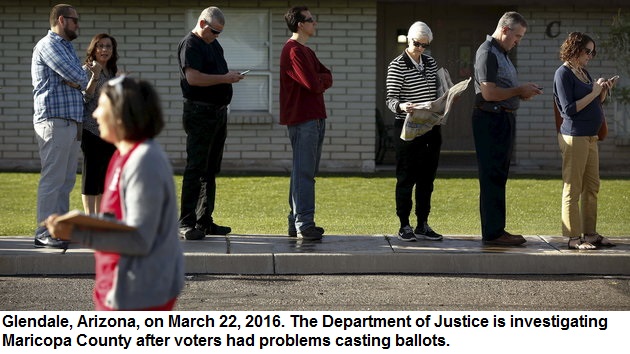
The book Go Lean … Caribbean asserts that the current system for Federal campaigns and elections in the US is not the model that the Caribbean would want to emulate – we must do even better than our American counterparts.  This book relates that $5.3 Billion was spent for the 2008 US Federal Elections (Page 116), a lot of it contributed by corporations and Political Action Committees (PACs) so as to peddle influence. Then when the voter turn-out is discouraged or suppressed because of any lack of efficiency, this results in even more influence, as now only the passionate will participate in the election process, as most other people cannot tolerate the dysfunction. Consider the example in the Appendix below of long voting lines in Arizona, suppressing the vote – people cannot wait around for 5 hours – especially in the minority communities.

The model sought for the Caribbean is to facilitate the polling of every vote for everyone wanting to participate in the political process, no matter who they are, where they are, what they are voting for or when they vote. Yes, this means local polling stations in convenient places (private/public) – like the shopping mall example in these photos.

CU Blog - Lessons from Regional Elections - Photo 1 CU Blog - Lessons from Regional Elections - Photo 2 CU Blog - Lessons from Regional Elections - Photo 3

The Go Lean book serves as a roadmap for the introduction and implementation of the technocratic Caribbean Union Trade Federation (CU). It advocates learning lessons from other societies so as to optimize the societal engines of economics, security and governance. Elections are an expression of all three of these branches of society. It should be about the people and their will, not about the power and retaining it. This book, roadmap and movement therefore advocates the CU being deputized/in-sourced to facilitate elections, including online, electronic systems in physical polling and absentee balloting – i.e. Diaspora.

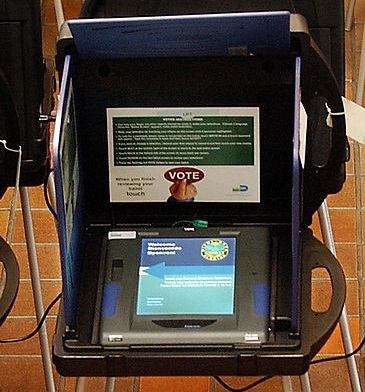
The lesson from regional elections, like Arizona in the Appendix and Florida in the photos, is that the election process must submit to a higher oversight. For the member-states in the US, that oversight is wielded by the US federal government (Executive Branch – Department of Justice – and the Courts). We need similar oversight in the Caribbean; this is embedded in the roadmap for the CU Federation, our regional federal government. Despite our region’s size (only 42 million people in 30 member-states), we can do better than our American neighbors in the election-campaign process. We can be a protégé, not just an American parasite.

The CU’s prime directive, elevating the Caribbean’s economic-security-governing engines, recognizes that the changes the region needs must start first with the adoption of new community ethos and controls: the people need to feel empowered, that  their voice and votes count, no matter their ethnicity, language or minority status. Early in the book, this need was pronounced in the opening Declaration of Interdependence  (Page 12) with these statements:

xi.  Whereas all men are entitled to the benefits of good governance in a free society, “new guards” must be enacted to dissuade the emergence of incompetence, corruption, nepotism and cronyism at the peril of the people’s best interest. The Federation must guarantee the executions of a social contract between government and the governed.

xii. Whereas the legacy in recent times in individual states may be that of ineffectual governance with no redress to higher authority, the accedence of this Federation will ensure accountability and escalation of the human and civil rights of the people for good governance, justice assurances, due process and the rule of law. As such, any threats of a “failed state” status for any member state must enact emergency measures on behalf of the Federation to protect the human, civil and property rights of the citizens, residents, allies, trading partners, and visitors of the affected member state and the Federation as a whole.

The Go Lean book, and previous blog/commentaries, stressed the key community ethos, strategies, tactics, implementation and advocacies necessary to effect change in the region, to improve the oversight of the governing process. They are detailed as follows:

Community Ethos – Economic Principles Page 21
Community Ethos – Security Principles – Private Interest –vs- Public Protection Page 23
Community Ethos – Security Principles – “Light Up Dark Place” Page 23
Community Ethos – Governing Principles – Lean Operations Page 24
Community Ethos – Ways to Impact the Future – Give the Youth a Voice & Vote Page 26
Community Ethos – Impact Research and Development – Develop Technology Page 30
Community Ethos – Ways to Impact Turn-around Page 33
Community Ethos – Ways to Impact the Greater Good Page 37
Strategy – Mission – Embrace the advances of technology Page 47
Strategy – CU Stakeholders to Protect – Diaspora Page 47
Tactical – Separation-of-Powers – Secretary of State – Elections Bureau Page 80
Anecdote – Turning Around CARICOM – Deputized for election oversight Page 92
Implementation – Assemble Caribbean Election Oversight as Cooperative Page 96
Implementation – Assemble Constitutional Convention – Start of federal elections Page 97
Implementation – Ways to Impact Elections Page 116
Planning – 10 Big Ideas – Cyber Caribbean Page 127
Planning – Ways to Improve Failed-State Indices – Election Outsourcing Page 134
Planning – Lessons Learned from US Constitution Page 145
Planning – Ways to Measure Progress Page 147
Advocacy – Ways to Grow the Economy Page 151
Advocacy – Ways to Foster Technology – Heavy focus on systems Page 197
Advocacy – Ways to Foster e-Commerce Page 198
Advocacy – Ways to Promote Contact Centers – Big Data Analysis Page 212

The points of effective, technocratic regional oversight and stewardship were further elaborated upon in these previous blog/commentaries:

https://goleancaribbean.com/blog/?p=7646 Going from ‘Good to Great’
https://goleancaribbean.com/blog/?p=7528 Sample Vision of 1 City, Freeport, as a Self-Governing Entity
https://goleancaribbean.com/blog/?p=7204 ‘The Covenant with Black America’ – Ten Years Later
https://goleancaribbean.com/blog/?p=6965 Secrecy, corruption and conflicts of interest pervade state governments
https://goleancaribbean.com/blog/?p=6937 Women in Politics – Yes, They Can!
https://goleancaribbean.com/blog/?p=5353 POTUS and the Internet
https://goleancaribbean.com/blog/?p=4935 A Lesson in History – the ‘Grand Old Party’
https://goleancaribbean.com/blog/?p=3397 Bankers Campaign Contributions-Lobbying End Game
https://goleancaribbean.com/blog/?p=356 The Use & Abuse of Statistics in Politics

If we want to make our homeland a better place to live, work and play then we must learn/apply lessons from other communities and societies. We can protect the right to vote and give all people a voice by implementing technologically advanced electoral solutions. We can learn from Arizona and do better. Let’s not be blinded to the truth:

Opinion: “In the US, there are 2 main political parties: one with the population (Democrats), and one with the passion (Republicans)”. The Republicans depend on vote suppression tactics (i.e. Voter ID requirements) to win elections – it is not how much support one have, it is how many turn up to vote. Online voting would scare these stakeholders. So the other lesson we can learn and apply from places like Canada, Norway and Australia, is to deploy the online voting, and let the “chips fall where they may”; parties will simply adjust, the people’s voices will be heard and the leaders – survival of the fittest – will respond in kind.

We must look beyond the US for protégé models. We must do better; we must be better!

The Go Lean movement advocates being a protégé, not parasite, of our North American and European trading partners. These places are “frienemies” of the Caribbean now; we get our tourism from these source countries, yes, but we also lose our emigrants to them as well – the Caribbean brain drain is estimated at 70 percent. We must now seek out solutions that encourage participation in the nation-building process. We have no other choice, the alternative is more abandonment of our society.

This is the purpose of the Go Lean roadmap, to provide a turn-by-turn direction to accomplish the needed turn-round. The Go Lean roadmap does not seek to change America and their voting strategies and systems; our only focus is to change the Caribbean. Yes, we can! 🙂

Download the free e-Book of Go Lean … Caribbean – now!

————-

Appendix -Article (#2): The DOJ Is Investigating Arizona’s Election Mess
By: Samantha Lachman, Staff Reporter and Ryan J Reilly, Senior Justice Reporter

People wait to vote in U.S. presidential primary election outside polling site in ArizonaWASHINGTON — The federal government is investigating Arizona’s most populous county after its dramatic decrease in voting sites led to long lines during the state’s primary last month.

Elizabeth Bartholomew, communications manager for the the Recorder’s Office in MaricopaCounty, said the office received a letter from the Justice Department’s Civil Rights Division on Friday. Bartholomew said the feds want specific data about the office’s reason for cutting the number of polling places. She said the office “absolutely” plans to cooperate with the investigation and to provide federal officials with the requested information in the coming weeks.

“We have no problem cooperating with them, so we should have that over to them over the next couple of weeks,” she told The Huffington Post on Monday.

The county cut its voting sites from 200 during the 2012 presidential primary to just 60 for this year’s March 22 primary. Some Arizona voters reported waiting in line for five hours to cast their ballot, long after the GOP race was called for reality television star Donald Trump and the Democratic primary was called for former Secretary of State Hillary Clinton.

Maricopa County Recorder Helen Purcell (R), who is in charge of the county’s elections, partially blamed “the voters, for getting in line,” but later admitted that the county made “bad decisions” and “miscalculated” how many voting sites it would need.

County officials argued earlier this year that having fewer sites would save money. Purcell recommended that the county’s Board of Supervisors reduce the number of polling sites because her office suspected more people would vote early by mail. However, fewer people voted by mail than the office had predicted.

The county probably wouldn’t have been able to cut as many polling places as it did if the full force of the Voting Rights Act was still in effect; the Supreme Court gutted the landmark civil rights legislation in a controversial 5-4 decision in 2013. Before that ruling, states with a long history of racial discrimination, such as Arizona, were required to get permission from the DOJ or in federal court to change their election procedures or laws. States asking for approval of their proposed election changes had to show that such measures wouldn’t leave voters of color worse off.

But, as Phoenix Mayor Greg Stanton (D) pointed out in a letter asking the DOJ to investigate the county, Maricopa “distributed fewer polling locations to parts of the county with higher minority populations.”

Stanton wrote that Phoenix, a majority-minority city, had one polling place for every 108,000 residents, while predominantly white communities hosted more polling sites for significantly smaller populations.

Arizona Gov. Doug Ducey (R) said in a statement after the primary that he wanted election officials to investigate why lines outside polling places were so long. He called for making the state’s primaries open, rather than closed, so independent voters could participate, without mentioning that the state should allocate more funds to open more polling sites.

Lines weren’t the only problem in Maricopa, however. Some voters reported that the county had switched their party registration, possibly due to a computer glitch. Thousands of voters were forced to cast provisional ballots as a result.
Source: Huffington Post Online News; posted and retrieved 04/04/2016 from: http://www.huffingtonpost.com/entry/justice-department-arizona_us_5702b720e4b083f5c6085933
Aligning VIDEO: https://youtu.be/y_6kaWYjwCk

Share this post:
, , ,
[Top]

Obama – Bad For Caribbean Status Quo

Go Lean Commentary

CU Blog - Obama - Bad For Caribbean Status Quo - Photo 2Yes, Barack Obama was elected in 2008 as the first Black President of the United States, with his campaign of “Hope and Change”. While one would think that would be good for all Black (African-American) people in the US – and around the world – alas, that has not been the case. It is the conclusion of many commentators and analysts that Obama has not been able to do as much for his race as he would like, nor his race would like. (Obama himself has confessed this). Or that another White person may have been able to do more for the African American community.

This seems like a paradox!

Yet, it is what it is. The truth of the matter is that race still plays a huge decision-making factor in all things in America. This reality has curtailed Obama in any quest to do more for his people.

This is the assessment by noted commentator and analyst, Professor Michael Eric Dyson, in his new book “The Black Presidency: Barack Obama and the Politics of Race in America“. Professor Dyson points out some actual events during the Obama presidency and concludes that a White President would have been more successfully championing certain race-related causes. (Think: the Black Lives Matter movement was ignited during the Obama presidency).

VIDEO – Michael Eric Dyson on Democracy Now – https://youtu.be/F7Uo06_NfCw

Published on Feb 3, 2016 – http://democracynow.org – As the 2016 presidential race heats up and the nation marks Black History Month, we turn to look back on President Obama’s legacy as the nation’s first African-American president. Georgetown professor Michael Eric Dyson has just published a new book titled The Black Presidency: Barack Obama and the Politics of Race in America. From the protests in Ferguson to the church shooting in Charleston, South Carolina, to the controversy over the arrest of Harvard professor Henry Louis Gates, Michael Eric Dyson explores how President Obama has changed how he talks about race over the past seven years.

Democracy Now! is an independent global news hour that airs weekdays on nearly 1,400 TV and radio stations Monday through Friday. Watch the live-stream 8-9AM ET: http://democracynow.org.

The summary is that White Privilege still dominates in America. See the review of this book in Appendix A below.

This conclusion aligns with the assertions of the book Go Lean…Caribbean, and many aligned blog submissions, that America is not the ideal society for Caribbean citizens to seek for refuge, that rather Caribbean people can exert less effort to reform and transform their homelands than trying to prosper in this foreign land. The conclusion is the priority should be on a local/regional quest to prosper where planted in the Caribbean. This is a mission of the Go Lean…Caribbean movement, to lower the push and pull factors that lead many in the Caribbean to flee their tropical homes. Highlighting and enunciating the truths of American “Race Reality” aligns with that mission. We must lower the “pull” factors!

It is this commentary’s conclusion that Obama has been a good president for American self-interest. (The economy has recovered and rebounded from the “bad old days” of the 2008 financial crisis).

It is also this commentary’s conclusion that Obama has been a bad president for the Caribbean status-quo! His administration has brought ” change” to many facets of Caribbean life – good, bad and ugly, as follows:

  • Consider the good: The American re-approachment to Cuba – under Obama – is presenting an end to the Cold War animosity of these regional neighbors – Cuba’s status quo is changing. A bad actor from this conflict, former Cuban President Fidel Castro, just penned his own commentary lamenting Obama’s salesmanship in his recent official visit to Cuba on March 15; see Appendix B.
  • Consider the bad:
    • (A) The US has doubled-down on globalization, forcing countries with little manufacturing or agricultural production to consume even more and produce even less; a lose-lose proposition.
    • (B) The primary industry in the Caribbean – tourism – has experienced change and decline as a direct result of heightened income inequality in the US, the region’s biggest source of touristic visitors; now more middle class can only afford cruise vacations as opposed to the more lucrative (for the region) stop-overs.
    • (C) The secondary industry in the Caribbean – Offshore Banking – has come under fire from the US-led Organization for Economic Cooperation & Development (OECD) to deter offshore banking growth; the industry, jobs and economic contributions have thusly receded.
  • Consider the ugly: Emigration of Caribbean citizens to the US has accelerated during this presidency, more so than any other time in American-Caribbean history. Published rates of societal abandonment among the college educated classes have reported an average of 70 percent in most member-states, with some countries (i.e. Guyana) tallying up to 89 percent.

The Caribbean status quo has changed. It is now time for a Caribbean version of “hope and change”.

This book Go Lean…Caribbean serves as a roadmap for the introduction and implementation of the Caribbean Union Trade Federation (CU). This roadmap presents “hope and change” for empowering the Caribbean region’s societal engines: economic, security and governance. In fact, the following are the prime directives of the roadmap:

  • Optimization of the economic engines in order to grow the regional economy to $800 Billion & create 2.2 million new jobs.
  • Establishment of a security apparatus to protect the resultant economic engines.
  • Improve Caribbean governance to support these engines.

A mission of the CU is to minimize the push and pull factors that lead so many Caribbean citizens to migrate to foreign lands – to America; and also to invite the Diaspora living there to repatriate home. The argument is that America is not the most welcoming for the Black and Brown populations of the Caribbean. Let’s work to prosper where planted at home.

Yes, there are societal defects in the Caribbean, as there are defects in America. But the defects in America are greater: institutional racism and Crony-Capitalism. Though it is heavy-lifting, it is easier to reform and transform the Caribbean.

The reference sources in the Appendices relate that the Obama effect is changing the status quo … in America … and the Caribbean.

This issue of reducing the societal abandonment rate and encouraging repatriation has been a consistent theme of Go Lean blogs entries; as sampled here:

https://goleancaribbean.com/blog/?p=7628 ‘A Change Is Gonna Come’
https://goleancaribbean.com/blog/?p=7204 ‘The Covenant with Black America’ – Ten Years Later
https://goleancaribbean.com/blog/?p=7151 The Caribbean is Looking for Heroes … ‘to Return’
https://goleancaribbean.com/blog/?p=7412 The Road to Restoring Cuba
https://goleancaribbean.com/blog/?p=7151 The Caribbean is Looking for Heroes … ‘to Return’
https://goleancaribbean.com/blog/?p=6016 Hotter than July – Still ‘Third World’ – The Need for Cooling …
https://goleancaribbean.com/blog/?p=5784 The Need for Human Rights/LGBT Reform in the Region
https://goleancaribbean.com/blog/?p=4613 ‘Luck of the Irish’ – Lessons from their Past, Present and Future
https://goleancaribbean.com/blog/?p=4447 Probe of Ferguson, Missouri exposes Institutional Racism

All in all, the roadmap commences with the recognition that all the Caribbean is in crisis, with its high abandonment rate. These acknowledgements are pronounced in the Declaration of Interdependence (Page 13). The statements are included as follows:

xix.   Whereas our legacy in recent times is one of societal abandonment, it is imperative that incentives and encouragement be put in place to first dissuade the human flight, and then entice and welcome the return of our Diaspora back to our shores. This repatriation should be effected with the appropriate guards so as not to imperil the lives and securities of the repatriated citizens or the communities they inhabit. The right of repatriation is to be extended to any natural born citizens despite any previous naturalization to foreign sovereignties.

xx.   Whereas the results of our decades of migration created a vibrant Diaspora in foreign lands, the Federation must organize interactions with this population into structured markets. Thus allowing foreign consumption of domestic products, services and media, which is a positive trade impact. These economic activities must not be exploited by others’ profiteering but rather harnessed by Federation resources for efficient repatriations.

The Go Lean roadmap lists the following details on the series of community ethos, strategies, tactics, implementations and advocacies necessary to effectuate the “hope and change” in the Caribbean region to mitigate the continued risk of emigration and the brain drain. The list is as follows:

Community Ethos – Economic Systems Influence Individual Choices Page 21
Community Ethos – Job Multiplier Page 22
Community Ethos – Lean Operations Page 24
Community Ethos – Return on Investments Page 24
Community Ethos – Ways to Impact the Future Page 26
Community Ethos – Ways to Help Entrepreneurship Page 28
Strategic – Vision – Integrated Region in a Single Market Page 45
Strategic – Vision – Agents of Change Page 57
Tactical – Fostering a Technocracy Page 64
Tactical – Growing to $800 Billion Regional Economy Page 67
Tactical – Separation of Powers Page 71
Implementation – Ways to Pay for Change Page 101
Implementation – Ways to Deliver Page 109
Implementation – Reasons to Repatriate Page 118
Planning – Big Ideas for the Caribbean Region Page 127
Planning – Lessons Learned from the US Constitution Page 145
Advocacy – Ways to Grow the Economy Page 151
Advocacy – Ways to Create Jobs Page 152
Advocacy – Ways to Improve Governance Page 168
Advocacy – Ways to Impact the Diaspora Page 217
Appendix – Source of 2.2 Million New Jobs Page 257

The  Go Lean roadmap allows for the Caribbean region to deliver success, to mitigate the risk of further push and pull. The world in general and the Caribbean in particular needs to know the truth of life in America for the Black and Brown populations. This heavy-lifting task is the mission of the CU technocracy.

Now is the time for all of the Caribbean, the people and institutions, to lean-in for the “hope and change” that is the Caribbean Union Trade Federation. Yes, we can … make this region a better place to live, work and play. 🙂

Download the free e-Book of Go Lean … Caribbean – now!

————–

Appendix A

Book Review: ‘The Black Presidency: Barack Obama and the Politics of Race in America’ By Michael Eric Dyson. 346 Pages. Houghton Mifflin Harcourt. $27. ISBN 978-0544387669
Review By: N. D. B. Connolly

CU Blog - Obama - Bad For Caribbean Status Quo - Photo 3What happens when the nation’s foremost voice on the race question is also its most confined and restrained? Michael Eric Dyson raises this question about President Obama in his latest book, “The Black Presidency: Barack Obama and the Politics of Race in America.” The book inspires one to raise similar questions about Dyson himself. For, while hardly restrained, Dyson appears noticeably boxed in by the limitations placed on celebrity race commentators in the Age of Obama.

Readers will recognize Dyson’s practiced flair for language and metaphor as he makes an important and layered argument about American political culture and the narrowness of presidential speech. The book argues that Americans live under a black presidency — not so much because the president is black, but because Obama’s presidency remains bound by the rules and rituals of black respectability and white supremacy. Even the leader of the free world, we learn in Dyson’s book, conforms principally to white expectations. (Dyson maintained in the November issue of The New Republic that Hillary Clinton may well do more for black people than Obama did.) But Obama’s presidency is “black” in a more hopeful way, too, providing Americans with an opportunity to better realize the nation’s democratic ideals and promises. “Obama’s achievement gestures toward what the state had not allowed at the highest level before his emergence,” Dyson writes. “Equality of opportunity, fairness in democracy and justice in society.”

A certain optimism ebbs and flows in “The Black Presidency,” but only occasionally does it refer to white Americans’ beliefs about race. Far more often, Dyson hangs hope on Obama’s impromptu shows of racial solidarity. One such moment was the president’s remarks after the 2009 arrest of the Harvard professor Henry Louis Gates Jr. (who was arrested trying to get into his own home). Another was Obama’s public identification with Trayvon Martin. Both acts may have been politically risky, but they also greatly heartened African- Americans. Hope builds, and by book’s end, readers find a chapter-long celebration of the president’s soaring invocations of “Amazing Grace” during last year’s memorial service for the slain parishioners of EmanuelA.M.E.Church. For Dyson, the eulogy at Emanuel seems to serve as a sign of grace that black America may still yet enjoy from the Obama White House.

Its cresting invocations of hope aside, the book ably maintains a sharp critical edge. Dyson uncovers a troubling consistency to the president’s race speech and shows that in spite of Obama’s reliance on black political networks and black votes during his meteoric rise, the president chose to follow a governing and rhetorical template largely hewed by his white predecessors. As both candidate and president, Obama’s speeches have tended to allay white guilt. They have scolded ­African-American masses for cultural pathology and implied that blacks were to blame for lingering white antipathy. Obama’s speeches have also often consigned the worst forms of racism and anti-black violence to the past or to the fringes of American political culture. One finds passive-voice constructions everywhere in Obama’s race talk, as black folk are found suffering under pressures and at the hands of parties that go largely unnamed. “Obama is forced to exaggerate black responsibility,” Dyson advances, “because he must always underplay white responsibility.”

Critically, Dyson contends that the president’s tepid anti-racism comes from political pragmatism rather than a set of deeper ideological concerns. “Obama is anti-ideological,” Dyson maintains, and that is “the very reason he was electable.”

That characterization, however, overlooks how liberal pragmatism functions as ideology. What’s more, it ignores the marginalization and violence that black and brown people often suffer — at home and abroad — whenever moderates resolve to “get things done.” If the Obama era proved anything about liberalism, it’s that there remains little room for an explicit policy approach to racial justice — even, or perhaps especially, under a black president. As Obama himself explains to Dyson: “I have to appropriate dollars for any program which has to go through ways and means committees, or appropriations committees, that are not dominated by folks who read Cornel West or listen to Michael Eric Dyson.”

Upon a careful reading of Dyson’s book, loss seems always to arrive on the heels of hope. As we might expect, the author explores Obama’s estrangement from the Rev. Jeremiah Wright in 2008. He also attends to his own very public and more recent split from Cornel West. But even beyond these signal episodes, “The Black Presidency” is suffused with a bittersweet tone about relationships strained. President Obama seems to leave a host of people and political commitments at the White House door as he conforms to the racial demands of a historically white office. Even Dyson seems unaware of all the ways in which “The Black Presidency,” as a book, both explicates and illustrates how the Obama administration leaves black folk behind.

All but the last two of the book’s eight chapters begin with the author placing himself in close and often luxurious proximity to Obama. The repetition has the literary effect of a Facebook feed. Here is Michael at Oprah’s sumptuous California mansion during a 2007 fund-raiser, sharing a joke with Barack and Chris Rock. Here is Michael on the private plane and in the S.U.V., giving the candidate tips on how to use a “ ‘blacker’ rhetorical style” during his debate performances against a surging Hillary Clinton. Here he is in the V.I.P. section of the 50th-anniversary ceremony for the March on Washington and, yet again, at the White House Correspondents’ Association dinner. Through these and similar moments, Dyson projects his status and, in ways less clear, his authority. Dyson knows Obama, the reader is assured, because he has kept his company. He has swapped playful taunts and bro-hugs with the president; he has been intimate, one might say, with history.

Moments like these have a secondary effect. They illuminate a tension cutting through and profoundly limiting “The Black Presidency” as a work of political commentary. Regardless of who Michael Eric Dyson may have been to Obama the candidate, Dyson now has barely any access to Obama the president. Time and circumstance have rendered Dyson, the man and the thinker, increasingly irrelevant to Obama’s presidency. He can be at the party, but not at the table.

Perhaps worse in relation to the book’s stated aim to be the first full measure of Obama and America’s race problem, Dy­son, the author, has none but only the smallest role to play in assessing and narrating Obama’s legacy. When Bill Clinton decided to chronicle his own historic turn in the White House, he called on Taylor Branch and recorded with the historian some 150 hours of interviews over 79 separate sessions. Dyson, in 2015, gets far shabbier treatment. Chapter 5, “The Scold of Black Folk,” opens: “I was waiting outside the Oval Office to speak to President Obama. I had a tough time getting on his schedule.” In response to Dyson’s request for a presidential audience, the White House offered the author 10 whole minutes. By his own telling, Dyson “politely declined” and pressed Obama’s confidante, Valerie Jarrett, to remember his long history with and support of the president. “I eventually negotiated a 20-minute interview that turned into half an hour.” It appears to be the only interview Dyson conducted for the book.

In the end, “The Black Presidency” possesses a loaves-and-fishes quality. Drawing mostly on the news cycle, close readings of carefully crafted speeches and a handful of glittering encounters, Dyson has managed to do a lot with a little. The book might well be considered an interpretive miracle, one performed in fealty and hope for a future show of presidential grace, either from this president or, should she get elected, the next one.

Source: http://www.nytimes.com/2016/02/07/books/review/the-black-presidency-barack-obama-and-the-politics-of-race-in-america-by-michael-eric-dyson.html. Posted February 2, 2016; retrieved March 29, 2016.

————–

Appendix B

Title: Cuba’s Fidel Castro knocks sweet-talking Obama after ‘honey-coated’ visit
By: Marc Frank

U.S. President Barack Obama waves from the door of Air Force One in HavanaHavana – Retired leader Fidel Castro accused U.S. President Barack Obama of sweet-talking the Cuban people during his visit to the island last week and ignoring the accomplishments of Communist rule, in an opinion piece carried by all state-run media on Monday.

Obama’s visit was aimed at consolidating a detente between the once intractable Cold War enemies and the U.S. president said in a speech to the Cuban people that it was time for both nations to put the past behind them and face the future “as friends and as neighbors and as family, together.”

“One assumes that every one of us ran the risk of a heart attack listening to these words,” Castro said in his column, dismissing Obama’s comments as “honey-coated” and reminding Cubans of the many U.S. efforts to overthrow and weaken the Communist government.

Castro, 89, laced his opinion piece with nationalist sentiment and, bristling at Obama’s offer to help Cuba, said the country was able to produce the food and material riches it needs with the efforts of its people.

“We don’t need the empire to give us anything,” he wrote.

Asked about Fidel Castro’s criticisms on Monday, White House spokesman Josh Earnest said the Obama administration was pleased with the reception the president received from the Cuban people and the conversations he had with Cuban officials.

“The fact that the former president felt compelled to respond so forcefully to the president’s visit, I think is an indication of the significant impact of President Obama’s visit to Cuba,” Earnest said.

After the visit, major obstacles remain to full normalization of ties between Cuba and the United States, with no major concessions offered by Cuba on rights and economic freedom.

“The president made clear time and time again both in private meetings with President Castro, but also in public when he delivered a speech to the Cuban people, that the U.S. commitment to human rights is rock solid and that’s not going to change,” Earnest said.

Fidel Castro took power in a 1959 revolution and led the country until 2006, when he fell ill and passed power to his brother Raul Castro. He now lives in relative seclusion but is occasionally heard from in opinion pieces or seen on television and in photos meeting with visiting dignitaries.

The iconic figure’s influence has waned in his retirement and the introduction of market-style reforms carried out by Raul Castro, but Fidel Castro still has a moral authority among many residents, especially older generations.

Obama did not meet with Fidel Castro during his three-day visit, nor mention him in any of his public appearances. It was the first visit of a sitting U.S. president for 88 years.

Fidel Castro blasted Obama for not referring in his speech to the extermination of native peoples in both the United States and Cuba, not recognizing Cuba’s gains in health and education, and not coming clean on what he might know about how South Africa obtained nuclear weapons before apartheid ended, presumably with the aid of the U.S. government.

“My modest suggestion is that he reflects (on the U.S. role in South Africa and Cuba’s in Angola) and not now try to elaborate theories about Cuban politics,” Castro said.

Castro also took aim at the tourism industry in Cuba, which has grown further since Obama’s rapprochement with Raul Castro in December 2014. He said it was dominated by large foreign corporations which took for granted billion-dollar profits.

(Reporting by Marc Frank; Additional reporting by Doina Chiacu in Washington; Editing by Bill Rigby)

Share this post:
, , , ,
[Top]

A Lesson in History – Buffalo Soldiers

Go Lean Commentary

Welcome to the New World.

Fighting on arrival; fighting for survival“. – Lyrics from song  Buffalo Soldier by Bob Marley.

CU Blog - A Lesson in History - Buffalo Soldiers - Photo 1This is the experience of the Pan-African Diaspora in all of the Americas. Truly a sad origin history, “Coming to America” as slaves. And yet, the African race has proliferated in much of the Americas, most notably in the Caribbean, where the one-time slaves emerged as the majority population in 29 of the 30 member-states; (the only other New World non-Caribbean country with a majority Black population is Brazil). After a few turns in world political developments, these majorities now run the governments in most of these Caribbean countries.

It took “blood, sweat and tears” to reach this accomplishment. This connotes military action, warfare and sacrifice. The most prominent of Black fighting men in the history of the New World is the Buffalo Soldier.

Caribbean Music legend Bob Marley is to be credited for educating much of the world with this history. In his landmark song Buffalo Soldier; he sang their praises – see lyrics in Appendix A.

See the VIDEO-AUDIO of the song here:

VIDEO-AUDIO – Bob Marley Buffalo Soldier – https://youtu.be/IEpSBsUjY-0

Uploaded on May 2, 2011 – This song was released post humorously in 1983, after Bob Marley’s death.

Just who were the Buffalo Soldiers and what are their connections to the Caribbean? See  this encyclopedia reference here:

From 1863 to the early 20th century, African American units were utilized by the Army to combat the Native Americans during the Indian Wars.[14] The most noted among this group were the Buffalo Soldiers:

This nickname was given to the “Negro Cavalry” by the Native American tribes they fought in the Indian Wars. The term eventually became synonymous with all of the African American regiments formed in 1866. At the end of the U.S. Civil War the army reorganized and authorized the formation of two regiments of black cavalry (the 9th and 10th US Cavalry). Four regiments of infantry (the 38th, 39th, 40th and 41st US Infantry) were formed at the same time. In 1869, the four infantry regiments were merged into two new ones (the 24th and 25th US Infantry). These units were composed of black enlisted men commanded by white officers such as Benjamin Grierson, and occasionally, an African-American officer such as Henry O. Flipper. The “Buffalo Soldiers” served a variety of roles along the frontier from building roads to guarding the U.S. mail.[15]

CU Blog - A Lesson in History - Buffalo Soldiers - Photo 2These regiments served at a variety of posts in the southwest United States and Great Plains regions. During this period they participated in most of the military campaigns in these areas and earned a distinguished record. Thirteen enlisted men and six officers from these four regiments earned the Medal of Honor during the Indian Wars.[16]

After the Indian Wars ended in the 1890s, the regiments continued to serve and participated in the Spanish–American War (including the Battle of San Juan Hill in Cuba), where five more Medals of Honor were earned.[17] 

Source: https://en.wikipedia.org/wiki/Military_history_of_African_Americans#Indian_Wars retrieved March 28, 2019.

All of the New World , despite their European colonizers – Dutch, English, French, Portuguese or Spanish – was developed on the same economic policy: slavery!

This ugly institution was so entrenched that only a model war would effectuate its abolition permanently. That war was waged in the United States (1861 – 1865) as a proxy to all the New World territories. Shortly thereafter, the institution was abolished in the remaining countries that still maintained it in the region, i.e. Brazil. (The US was not the first; that distinction belong to Haiti, which endured a slave rebellion and battles for emancipation; the Spanish colonies followed shortly there-after, then the French, then the British).

The Buffalo Soldiers are most noteworthy because they fought for dignity for all the African race in the New World, though this was not pronounced in their commission, only now gleaned from their legacy. See Trailer below for one of the many movies.

The movement and underlying book Go Lean … Caribbean asserts that Caribbean people must now consider the weight of history and re-assign these islands and coastal states as their only homeland. As a people, the African Diaspora have fought and paid for these lands; they have shed “blood, sweat and tears” for their New World homelands. The ancestral home of Africa is no longer relevant. We now need to “prosper where we are planted” here in the Caribbean. Bob Marley said it best:

I mean it, when I analyze the stench –
To me it makes a lot of sense:
How the Dreadlock Rasta was the Buffalo Soldier,
And he was taken from Africa, brought to America,
Fighting on arrival, fighting for survival.

The freedoms we enjoy today, were not free!

They cost our ancestors and predecessors all their had to offer: a full measure of sacrifice and devotion. They gave of their sons and daughters. This is the important lesson to learn in considering the history of these American fighting men. As our ancestors and predecessors, they paid a steep price – “they punched our tickets” – for progress. We must regard their sacrifice.

This is one reason why we must adopt a National Sacrifice community ethos. This vital quality has been missing for far too long. This is why the region has such a deplorable abandonment rate: no [perception of] pain, no gain; no comprehension of sacrifice, no sense of value.

As a region, we must do better. We must discourage the emigration, brain drain and further societal abandonment.

The book Go Lean…Caribbean and accompanying blogs provide lessons from history in considering the fighting men of the American Civil War. The Caribbean region’s debilitating societal abandonment rate – 70 percent of college educated had fled for foreign shores – is proof positive of the absence and lack of this National Sacrifice ethos.

Early in the Go Lean book, this need for careful review of the history of slavery was acknowledged and then placed into perspective with this pronouncement (Declaration of Interdependence – Page 10):

As the history of our region and the oppression, suppression and repression of its indigenous people is duly documented, there is no one alive who can be held accountable for the prior actions, and so we must put aside the shackles of systems of repression to instead formulate efficient and effective systems to steer our own destiny.

As the colonial history of our region was initiated to create economic expansion opportunities for our previous imperial masters, the structures of government instituted in their wake have not fostered the best systems for prosperity of the indigenous people.

So the consideration of the Go Lean book, is to identify and correct all bad community ethos – the fundamental spirit of our culture – and to foster positive community ethos (such as National Sacrifice and deferred gratification). This point was also pronounced in the opening Declaration of Interdependence (Page 13) with this statement:

xix. Whereas our legacy in recent times is one of societal abandonment, it is imperative that incentives and encouragement be put in place to first dissuade the human flight, and then entice and welcome the return of our Diaspora back to our shores. This repatriation should be effected with the appropriate guards so as not to imperil the lives and securities of the repatriated citizens or the communities they inhabit. The right of repatriation is to be extended to any natural born citizens despite any previous naturalization to foreign sovereignties.

This book  Go Lean…Caribbean serves as a roadmap for the introduction and implementation of the technocratic Caribbean Union Trade Federation (CU) to spearhead the elevation of Caribbean society. The book advocates learning lessons from many events and concepts in history, covering all societal engines: economics, security and governance. The roadmap seeks to reboot these engines to ensure that all Caribbean stakeholders have the opportunity for life, liberty and the pursuit of happiness with no abusive exploitation of any ethnic group; no suppression, repression or oppression of any people: African or not!

The Go Lean roadmap seeks to employ “best-practices” to impact the CU prime directives; identified with the following 3 statements:

  • Optimization of the economic engines in order to grow the regional economy to $800 Billion & create 2.2 million new jobs.
  • Establishment of a security apparatus to protect the resultant economic engines and ensure the respect of human rights and public safety.
  • Improve Caribbean governance to support these engines.

The Go Lean book stresses the community ethos, strategies, tactics, implementations and advocacies to reboot, reform and transform the eco-systems of Caribbean society. These points are detailed in the book as follows:

Community Ethos – Deferred Gratification Page 21
Community Ethos – Economic Principles – People Choose Page 21
Community Ethos – Economic Principles – People Respond to Incentives in Predictable Ways Page 21
Community Ethos – Economic Systems Influence Individual Choices Page 21
Community Ethos – Economic Principles – The Consequences of Choices Lie in the Future Page 21
Community Ethos – Governing Principles – Lean Operations Page 24
Community Ethos – Governing Principles – Cooperatives Page 25
Community Ethos – Ways to Impact the Future Page 26
Community Ethos – Ways to Impact a Turn-Around Page 33
Community Ethos – Ways to Promote Happiness Page 36
Community Ethos – Ways to Impact the Greater Good Page 37
Strategy – Vision – Confederate 30 Member-States Page 45
Strategy – Mission – Enact a Defense Pact with Militia and Naval Forces Page 45
Strategy – Mission – Keep the next generation at home Page 46
Tactical – Confederating a Permanent Union Page 63
Tactical – Fostering a Technocracy Page 64
Implementation – Assemble – Incorporating all the existing regional military organizations Page 96
Implementation – Ways to Pay for Change Page 101
Implementation – Security Initiatives at Start-up Page 103
Implementation – Ways to Deliver Page 109
Implementation – Reasons to Repatriate to the Caribbean Page 118
Planning – 10 Big Ideas for the Caribbean – Confederation Without Sovereignty Page 127
Planning – Ways to Make the Caribbean Better Page 131
Advocacy – Ways to Grow the Economy Page 151
Advocacy – Ways to Create Jobs Page 152
Advocacy – Ways to Better Manage the Social Contract Page 170
Advocacy – Ways to Improve Homeland Security Page 181
Advocacy – Ways to Impact the Diaspora Page 217
Advocacy – Ways to Preserve Caribbean Heritage Page 218
Advocacy – Ways to Protect Human Rights Page 220

There are other lessons for the Caribbean to learn from considering history; the following previous blog/commentaries apply:

https://goleancaribbean.com/blog/?p=7682 Frederick Douglass: Role Model for Single Cause – Abolition
https://goleancaribbean.com/blog/?p=6722 A Lesson in History – After the Civil War: Birthright Mandates
https://goleancaribbean.com/blog/?p=6720 A Lesson in History – During the Civil War: Principle over Principal
https://goleancaribbean.com/blog/?p=6718 A Lesson in History – Before the Civil War: Compromising Human Rights
https://goleancaribbean.com/blog/?p=5695 Repenting, Forgiving and Reconciling the Past
https://goleancaribbean.com/blog/?p=5333 A Lesson in History – Legacies: Cause and Effect
https://goleancaribbean.com/blog/?p=5183 A Lesson in History – Cinco De Mayo
https://goleancaribbean.com/blog/?p=5123 A Lesson in History – Royal Charter: Zimbabwe -vs- South Africa
https://goleancaribbean.com/blog/?p=4971 A Lesson in History – Royal Charter: Truth & Consequence
https://goleancaribbean.com/blog/?p=4935 A Lesson in History: the ‘Grand Old Party’ Abolition Roots
https://goleancaribbean.com/blog/?p=2480 A Lesson in History: Community Ethos of WW II
https://goleancaribbean.com/blog/?p=2297 A Lesson in History: Booker T versus Du Bois
https://goleancaribbean.com/blog/?p=1531 A Lesson in History: 100 Years Ago Today – World War I
https://goleancaribbean.com/blog/?p=789 A Lesson in History: America’s War on the Caribbean

The concepts in this commentary are more profound than just the lyrics of a reggae song. It is bigger than music, it relates to life and legacy. The recent legacy of the Afro-Caribbean community is one of dysfunction and abandonment. But the ancient history – Buffalo Soldiers in particular – should give us pause and cause to reflect and reform our commitment to a National Sacrifice ethos.

No appreciation, no sacrifice; no sacrifice, no victory!

The Go Lean roadmap seeks to reform and transform the Caribbean societal engines, urging the adoption of new positive community ethos, such as National Sacrifice. This is an expression of deferred gratification, choosing to focus more on the future than on the present. The Go Lean book relates that the “African Diaspora experience in the New World is one of future gratification, as the generations that sought freedom from slavery knew that their children, not them, would be the beneficiaries of that liberty. This ethos continued with subsequent generations expecting that their “children” would be more successful in the future than the parents may have been”. Deferred gratification is a form of sacrifice.

We should value this sacrifice. Such gratitude makes our community better, more resilient and more long suffering.

Now is the time for all stakeholders in the Caribbean to show proper appreciation for the sacrifices by leaning-in to this roadmap for Caribbean empowerment. All the empowerments in this roadmap require people to fight for their homeland. We can learn so much from the Buffalo Soldiers:

Fighting on arrival, fighting for survival;
Driven from the mainland to the heart of the Caribbean.

If you know your history,
Then you would know where you coming from,
Then you wouldn’t have to ask me,
Who the ‘eck do I think I am.

The Go Lean quest is simple, learn from history and work to make the Caribbean region a better place to live, work and play. 🙂
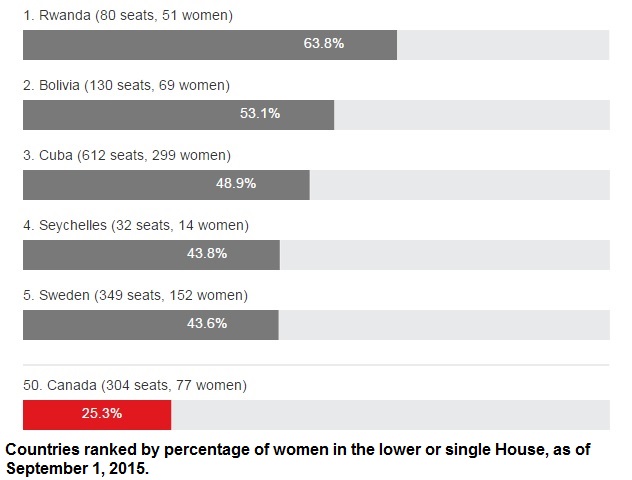
Download the book Go Lean … Caribbean – now!

———–

Appendix A – Song Buffalo Soldier Lyrics – Sang by Bob Marley

Buffalo Soldier, Dreadlock Rasta:
There was a Buffalo Soldier in the heart of America,
Stolen from Africa, brought to America,
Fighting on arrival, fighting for survival.

I mean it, when I analyze the stench –
To me it makes a lot of sense:
How the Dreadlock Rasta was the Buffalo Soldier,
And he was taken from Africa, brought to America,
Fighting on arrival, fighting for survival.

Said he was a Buffalo Soldier, Dreadlock Rasta –
Buffalo Soldier in the heart of America.

If you know your history,
Then you would know where you coming from,
Then you wouldn’t have to ask me,
Who the ‘eck do I think I am.

I’m just a Buffalo Soldier in the heart of America,
Stolen from Africa, brought to America,
Said he was fighting on arrival, fighting for survival;
Said he was a Buffalo Soldier win the war for America.

Dreadie, woy yoy yoy, woy yoy-yoy yoy,
Woy yoy yoy yoy, yoy yoy-yoy yoy!
Woy yoy yoy, woy yoy-yoy yoy,
Woy yoy yoy yoy, yoy yoy-yoy yoy!
Buffalo Soldier troddin’ through the land, wo-ho-ooh!
Said he wanna ran, then you wanna hand,
Troddin’ through the land, yea-hea, yea-ea.

Said he was a Buffalo Soldier win the war for America;
Buffalo Soldier, Dreadlock Rasta,
Fighting on arrival, fighting for survival;
Driven from the mainland to the heart of the Caribbean.

Singing, woy yoy yoy, woy yoy-yoy yoy,
Woy yoy yoy yoy, yoy yoy-yoy yoy!
Woy yoy yoy, woy yoy-yoy yoy,
Woy yoy yoy yoy, yoy yoy-yoy yoy!

Troddin’ through San Juan in the arms of America;
Troddin’ through Jamaica, a Buffalo Soldier# –
Fighting on arrival, fighting for survival:
Buffalo Soldier, Dreadlock Rasta.

Woy yoy yoy, woy yoy-yoy yoy,
Woy yoy yoy yoy, yoy yoy-yoy yoy!
Woy yoy yoy, woy yoy-yoy yoy,
Woy yoy yoy yoy, yoy yoy-yoy yoy! [fadeout]
———–

Appendix B – VIDEO – Buffalo Soldiers Trailer 1997 – https://youtu.be/Om_BrJhu4gQ

Published on Mar 9, 2015 – Buffalo Soldiers Trailer 1997; Director: Charles Haid; Starring: Danny Glover, Bob Gunton, Carl Lumbly, Tom Bower, Gabriel Casseus.
Official Content From Warner Home Video

Share this post:
, ,
[Top]

Joy. Pain. Sunshine. Rain.

Go Lean Commentary

The movement behind the book Go Lean…Caribbean strives to make the Caribbean a better place to live, work and play. Having success in this quest would mean more joy (happiness) for the stakeholders (residents and visitors alike) of the tropical sunshine. We also try to soften the pain of day-to-day life, for “in every life, a little rain must fall”.

“Joy, Pain, Sunshine and Rain” – Sounds familiar, right? It is the title and chorus of a popular Rhythm & Blues song by the Grammy Award winning band Frankie Beverly and Maze; see the VIDEO-AUDIO here:

VIDEO-AUDIO: Frankie Beverly And Maze – Joy And Pain – https://youtu.be/KNuKMPeOdfM

Uploaded on Oct 31, 2011 – {DISCLAIMER}
No Copyright Intended. This Song Belongs To It Respective Owners.
Please Support The Artist By Buying Their Songs/Album – “Joy and Pain” by Maze Listen ad-free with YouTube Red

Art imitates life and life imitates art …

Music is a viable approach for forging change in society. Consider these popular quotations:

“Music soothes the savage beast”.

“A great song can change the world”.

There are a lot of famous quotes alluding to the power of music, but here’s an old favorite:

“Music is a moral law. It gives soul to the universe, wings to the mind, flight to the imagination, and charm and gaiety to life and to everything.” — Plato

Consider this list where music (songs & concerts) has changed the world in past campaigns:

1

Bob Dylan: Times They Are A-Changin’ – 1960’s Civil Rights Anthem

2

Hope for Haiti Now: A Global Benefit for Earthquake Relief – Telethon on Jan 22, 2010

3

“Sun City” – 1985 Anti-Apartheid Group Song and Album

4

Bob Marley and the Wailers: “Them Belly Full (But We Hungry)” – 1975 song

5

K’naan: “Wavin’ Flag” – 2010 Soccer World Cup anthem advocating rights for refugees

6

Live Aid – 1985 “simul”-concerts in London & Philadelphia for famine relief in Ethiopia

7

46664 Concerts – (Mandela’s Prison #) – 2003 advocacy against HIV/AIDS in South Africa

8

John Lennon: “Imagine” – 1971 iconic song for world peace

9

Tsunami Aid: Concert of Hope – 2004 Benefit for Indian Ocean Earthquake & Tsunami

10

The Concert for Bangladesh – 1971 Benefit for refugees from (then) East Pakistan

11

Live 8 – 2005 series of concerts in the G8 member-states for foreign aid to poorest countries

12

Patti Smith: “People Have the Power” – 1988 song condemning war and human rights abuses

13

Farm Aid – Annual concerts starting in 1985 advocating  Family Farms

14

Marvin Gaye: “What’s Going On” – 1971 album against the Vietnam war, drugs and poverty

15

Concert in celebration of “It Takes Two” – 2014 effort tackling high teenage pregnancy in Uganda

16

Joni Mitchell: “Big Yellow Taxi” – 1970 hit song addresses environmental concerns

[17]

[“We Are the World” – 1985 super-group (most famous music artists) song by USA for Africa]

Source: https://www.globalcitizen.org/en/content/music-that-has-changed-the-world/ by Christina Nuñez on July 27, 2015. The [] represent this blog’s addition – Number 17 – to the list.

The Go Lean book identifies the art and science of the music business among the strategies, tactics, implementations and advocacies of the roadmap to elevate the Caribbean’s societal engines. The book serves as a roadmap for the introduction and implementation of the Caribbean Union Trade Federation (CU), an initiative to elevate and empower the region, to make the homelands better and happier. From the outset, the book recognized the significance of music and happiness in this roadmap with these statements in the opening Declaration of Interdependence (Page 12 & 14):

Preamble. We hold these truths to be self-evident, that all men are created equal, that they are endowed by their Creator with certain unalienable rights, that among these are life, liberty and the pursuit of happiness

xxi.   Whereas the preparation of our labor force can foster opportunities and dictate economic progress for current and future generations, the Federation must ensure that educational and job training opportunities are fully optimized for all residents of all member-states, with no partiality towards any gender or ethnic group. The Federation must recognize and facilitate excellence in many different fields of endeavor, including sciences, languages, arts, music and sports. This responsibility should be executed without incurring the risks of further human flight, as has been the past history.

xxxii.  Whereas the cultural arts and music of the region are germane to the quality of Caribbean life, and the international appreciation of Caribbean life, the Federation must implement the support systems to teach, encourage, incentivize, monetize and promote the related industries for arts and music in domestic and foreign markets. These endeavors will make the Caribbean a better place to live, work and play.

The purpose of the Go Lean roadmap is not music, but rather to make the Caribbean region a better homeland, a happier place to live, work and play. Music can be an effective tool for campaigns … to convey the important message of happiness, to pronounce that “Joy, Pain, Sunshine and Rain” is part-and-parcel of any happiness advocacy.

This Go Lean roadmap calls for heavy-lifting in shepherding important aspects of Caribbean life. In fact, the empowerment roadmap has 3 prime directives that are critical for forging a happy society; they are identified as follows:

  • Optimization of the economic engines in order to grow the regional economy to $800 Billion & create 2.2 million new jobs.
  • Establishment of a security apparatus to protect the resultant economic engines.
  • Improve Caribbean governance to support these engines.

The book describes the CU as a hallmark of a technocracy, with a commitment to efficiency and effectiveness in these societal engines, while still not ignoring principles of fun such as music, arts, heritage and overall happiness. In fact, one of  the 144 different missions of the Go Lean/CU roadmap is to promote happiness (10 Ways to Promote Happiness – Page 36).

Happiness is the focus of this commentary…

CU Blog - Joy. Pain. Sunshine. Pain - Photo 1

CU Blog - Joy. Pain. Sunshine. Pain - Photo 2

CU Blog - Joy. Pain. Sunshine. Pain - Photo 3

 CU Blog - Joy. Pain. Sunshine. Pain - Photo 4

CU Blog - Joy. Pain. Sunshine. Pain - Photo 5

… thousands of people all around the world took action to support the International Day of Happiness on March 20, 2016. (This is celebrated in March every year). See a related alternate commentary of this year’s advocacy in the Appendix below.

What more can we do?

First, we encourage all to take this “Action for Happiness” pledge:

“I will try to create more happiness in the world around me”.

… this Go Lean/CU effort is “our” attempt to do more … for the Caribbean. The Go Lean/CU roadmap was constructed with the community ethos in mind to make the region more happy, plus the execution of related strategies, tactics, implementations and advocacies to forge permanent happiness. The following is a sample of these specific details of the roadmap from the book:

Community Ethos – Deferred Gratification Page 21
Community Ethos – Economic Principles – People Choose Page 21
Community Ethos – Economic Principles – People Respond to Incentives in Predictable Ways Page 21
Community Ethos – Economic Principles – The Consequences of Choices Lie in the Future Page 21
Community Ethos – Governing Principles – Lean Operations Page 24
Community Ethos – Ways to Impact the Future Page 26
Community Ethos – Ways to Foster Genius Page 27
Community Ethos – Ways to Promote Intellectual Property Page 29
Community Ethos – Ways to Impact Research & Development Page 30
Community Ethos – Ways to Bridge the Digital Divide Page 31
Community Ethos – Ways to Impact Turn-Around Page 33
Community Ethos – Ways to Promote Happiness Page 36
Community Ethos – Ways to Impact the Greater Good Page 37
Strategy – Vision – Confederate 30 Member-States Page 45
Strategy – Mission – Celebrate the Music, Sports, Art, People and Culture of the Caribbean Page 46
Tactical – Confederating a Permanent Union Page 63
Tactical – Fostering a Technocracy Page 64
Implementation – Ways to Pay for Change Page 101
Implementation – Ways to Deliver Page 109
Planning – 10 Big Ideas for the Caribbean Region – Cyber-Caribbean Page 127
Planning – Ways to Make the Caribbean Better Page 136
Planning – Reasons Why the CU Will Succeed Page 137
Advocacy – Ways to Grow the Economy Page 151
Advocacy – Ways to Create Jobs Page 152
Advocacy – Ways to Improve Communications Page 186
Advocacy – Ways to Preserve Caribbean Heritage Page 218
Advocacy – Ways to Improve the Arts Page 230
Advocacy – Ways to Promote Music Page 231
Appendix – Case Study Managing Copyright Infringements Page 351

The Go Lean/CU roadmap is optimistic, but it is realistic and pragmatic too. There is the acknowledgement that while music is powerful, the music business on the other hand, not so much. This industry has changed in the light of modern dynamics (technology and globalization), particularly due to Internet & Communications Technologies. The industry needs to adapt accordingly – we need a fully functional music industry. To spur more development in the industrial dimensions of the music business, this roadmap seeks to secure the economic, security and governing engines of the Caribbean region. This point was detailed in these previous Go Lean blog/commentaries:

https://goleancaribbean.com/blog/?p=6310 Farewell to ‘Sábado Gigante’
https://goleancaribbean.com/blog/?p=5648 Taylor Swift withholds Album from Apple Music
https://goleancaribbean.com/blog/?p=5251 Post-Mortem of Inaugural Bahamas Junkanoo Carnival
https://goleancaribbean.com/blog/?p=3641 ‘We Built This City …’
https://goleancaribbean.com/blog/?p=2415 How ‘The Lion King’ productions roared into history
https://goleancaribbean.com/blog/?p=1909 Music Role Model Berry Gordy – Reflecting & Effecting Change

We need a fully functional music industry because we need music, and the effects of music: the power to reach, soothe and move people. This point was previously detailed in other Go Lean blog/commentaries; a sample follows:

https://goleancaribbean.com/blog/?p=7628 ‘A Change Is Gonna Come’
https://goleancaribbean.com/blog/?p=3568 Forging Change: Music Moves People
https://goleancaribbean.com/blog/?p=2291 Forging Change: The Fun Theory
https://goleancaribbean.com/blog/?p=866 Music Man Bob Marley: The legend lives on!

This quest to elevate the Caribbean region is heavy-lifting; more is involved than just saying “Don’t Worry Be Happy“. It is more complex than just playing or listening to music. Though this is serious, it should also be fun; it should be  “Joy, Pain, Sunshine and Rain”.

Let’s create a happier world together; a happy world filled with laughter and music –  “Joy, Pain, Sunshine and Rain”. And if not the world, then maybe just the Caribbean. 🙂

Download the book Go Lean … Caribbean – now!

————

Appendix – Title: The best habits to practice to feel happy every day
By: Dr. Christine Brown
Sourcehttp://www.news.com.au/lifestyle/health/mind/the-best-habits-to-practice-to-feel-happy-every-day/news-story/bd7d414a2b5da7f6f0bd138f0af2c7fc . Posted and retrieved March 20, 2016.

HAPPY International Day of Happiness!

I have a question for you: How often do you feel like a ‘room without a roof’? According to Pharrell Williams, this “space without limit” feeling is universally achievable. But for many of us, limitless happiness takes a little work. So, what are some of the best habits to practice for feeling happy every day?

MANAGE THE DOWN DAYS

You know the days. Those days when you’re telling yourself the ‘I’m not good enough’ story (which we all have, by the way). The days where things seem to go from bad to worse.

It’s very easy to get trapped at this point because many of us start feeling bad for feeling bad. There are enough external pressures to always be ‘up’ and cheerful, without applying internal pressure too. Acknowledge you’re feeling suboptimal, and do a quick stocktake.

If you can change things, take action. If not, do something that helps to calm you, comfort you or cheer you up (even a little bit).

Be gentle with yourself and don’t splatter your down day over your bystanders. Remember, no-one can ‘make’ you feel anything. You have all the controls. Which reminds me …

DON’T BELIEVE EVERYTHING YOU THINK

Much unhappiness is caused by paying way too much attention to our thoughts. Our minds are constantly telling us stories to explain the world around us. Many times these stories are accurate, but unfortunately, whenever we don’t have enough data, our mind just fills in the gaps.

Let’s face it, we really don’t know why they didn’t say hello to us this morning. We really don’t.

As soon as we hear our minds saying things like, “They ALWAYS let me down” or “She NEVER keeps her promises” we need to reach for the metaphorical handbrake.

Get in the habit of asking yourself if that’s strictly true. Remember it’s just a story you’re telling yourself. You can even give the story a name: “Oh, it’s the ‘I do everything around here’ story”. It is very unlikely that things NEVER or ALWAYS happen. There are always exceptions. Remembering to look for (and recognise) the exceptions means much happier states of mind.

KEEP WHAT ‘SPARKS JOY’

In her book, The Life-Changing Magic of Tidying Up, Marie Kondo recommends a (once-off) festival of tidying where you gather categories of belongings into ginormous piles, pick items up one-by-one and ask a simple question: “Does it spark joy?”

If it does, you keep it. If it doesn’t, you can let it go.

Just imagine how it would be if every item around you had a happy association. Out would go that hideous fondue set from Aunt Bertha or those pyjamas from your ex. Because, according to Marie Kondo, a gift has done its job once it’s received. The freedom!

Oh, and on a side note, this totally applies to the humans in your life too.

EVERYONE’S DOING BETTER THAN ME

The International Day of Happiness website has a great downloadable resource containing 10 keys to happier living. Each key strategy has been inspired by the latest scientific happiness research and there are some excellent quotes.

The one that I recognised most from working with many different clients is “Don’t compare your insides with other people’s outsides”. This is easy to do.

I remember consulting at a very high-end corporate where everyone was incredibly polished and successful looking. One by one, they would come in and say, “Everyone else is doing okay, but I’m falling apart”.

The thing is, you can’t know what is going on inside someone else, especially if you only have their outside as your guide. Chances are, if you’re finding something difficult or challenging, other people are too. I’m talking work, parenting, studying, teaching, being single, being in a relationship …

WHAT WENT WELL?

One of the pioneers of positive psychology, Martin Seligman, outlines some quick and easy strategies that raise your wellbeing and lower your depression in his book, Flourish.

A simple exercise to do in the 10 minutes before you go to sleep every night is the ‘what-went-well’ exercise. Every night, you write down three things that went well and why they went well (e.g. I finished most of my important tasks today because I took time to plan in the morning or I didn’t yell at my partner this morning because I got up a little earlier and made sure I ate breakfast). This will greatly improve your mood over time.

ROOFLESS ROOMS

According to Sonja Lyubomirsky in The How of Happiness, up to 40 per cent of our happiness is within our power to change.

Being grateful, taking responsibility, blaming less, learning to forgive and yes, even practising random acts of kindness, all predictably increase our happiness.

Have a happy day and go well everyone!

———-

Dr. Christine Brown is an Inventiologist, Psychologist and Executive Coach.

Share this post:
, ,
[Top]

Frederick Douglass: Role Model for Single Cause – Death or Diaspora

Go Lean Commentary

CU Blog - Frederick Douglass - Model for Single Cause - Death or Diaspora - Photo 1The Caribbean can learn an important lesson from a 150 year-old Role Model, Frederick Douglass. His is a powerful lesson for the advocacy of Single Causes. Despite the plethora of earth-shattering developments for human rights in the period of 1840 to 1880, (slavery, Empire-building-Colonialism, suffrage, feifdom-serfdom, Aboriginal genocide, etc.), Mr. Douglass remained steadfast and committed to one cause primarily: abolition of slavery and civil rights for African-Americans.

Who was Frederick Douglass? What did he do? See the Mini-Biography VIDEO of his life and legacy, here:

VIDEO – Frederick Douglass – Mini Bio – https://youtu.be/Su-4JBEIhXY

Uploaded on Jan 26, 2010 – A short biography of Frederick Douglass. The abolitionist who was born a slave not only worked towards the freedom of Blacks, but also advocated for women’s rights and education in general. He was one of the most prominent African-American voices during the Civil War.

The publishers of the book Go Lean…Caribbean recognize the contributions of Frederick Douglass in the historicity of human rights. The book serves as a roadmap for the introduction and implementation of the Caribbean Union Trade Federation (CU) to empower societal elevation (economics, security and governing engines) for the Caribbean region. The issues germane to Mr. Douglass life and legacy also relate to the Caribbean. Since 29 of the 30 Caribbean member-states (“St. Barths” is the only exception) have a majority Black population, the book posits that the 19th century effort is not finished; the legacy lingers as the Afro-Caribbean populations are still repressed, oppressed and suppressed, but now more so economically.

The legacy of Frederick Douglass, is that if an oppressed population didn’t find refuge, the only outcome would be Death or Diaspora.

The Diaspora prophecy happened, then in Ireland and today, especially here in the Caribbean! (In a previous blog, it was revealed that after 1840, emigration from Ireland became a massive, relentless, and efficiently managed national enterprise. In 1890 40% of Irish-born people were living abroad. By the 21st century, an estimated 80 million people worldwide claimed some Irish descent; which includes more than 36 million Americans who claim Irish as their primary ethnicity).

Caribbean citizens are also pruned to emigrate … to foreign shores (North America and Europe) seeking refuge. In a previous blog-commentary it was asserted that the US – the homeland  for Frederick Douglass – has experienced accelerated immigration in recent years. Published rates of societal abandonment among the college educated classes have reported an average of 70 percent in most member-states, with some countries (i.e. Guyana) tallying up to 89 percent. For this reason, there is solidarity for the Diaspora of Ireland and the Diaspora of the Caribbean.

The publishers of the Go Lean book are also steadfast and committed to one cause: arresting the societal abandonment of Caribbean communities. This would lessen the future Diaspora. This would be good!

In his advocacy, Frederick Douglass sought consult and consort with the “enemies of his enemies”, the oppressed people of Ireland.

In the modern day application, the Go Lean/CU movement seeks to consult with the lessons of history, such as this one of Frederick Douglass’ sojourn to Ireland. We now have the privilege of study of this role-model and his odyssey to Dublin and the cities and towns of pastoral Ireland. See the article here:

Title: Frederick Douglass’s Irish Odyssey
Sub-Title: Tom Chaffin, author of Giant’s Causeway, assesses the influence on the anti-slavery campaigner of his time in poverty-ridden and religiously divided Ireland

For young Frederick Douglass in August 1845, soon to leave Boston for a lecture tour of undetermined length of Ireland, Scotland and England, fame had proven a double-edged sword.

CU Blog - Frederick Douglass - Model for Single Cause - Death or Diaspora - Photo 2Tall and handsome, Douglass was in his late twenties then – just how late he did not know. Slavery had robbed him of knowledge of the exact circumstances of his birth – its precise date as well as certainty of his father’s identity.

He had escaped his bondage in Maryland in 1837 and soon found his way to the free soil of Massachusetts. Two years later, by then married and having started a family, he had established himself as a gifted orator on the abolitionist speaking circuit. Under the sponsorship of William Lloyd Garrison’s American Anti-Slavery Society, he travelled the states of the North, railing against human bondage and demanding that it be outlawed, activities that sparked frequent threats against him.

In spring 1845, Douglass published his first book– Narrative of the Life of Frederick Douglass, an American slave. The memoir stirred fresh hostilities. To avoid physical harm or being forcibly returned (by bounty-hungry “slave-catchers”) to his bondage in Maryland, it was decided that, until things cooled down, he would leave the United States for a while, for a hastily and incompletely planned lecture tour of the British Isles.

After landing in Liverpool, Douglass and his white travelling companion, fellow abolitionist James Buffum, were to ferry across the Irish Sea to Dublin. There they would commence Douglass’s lecture tour. While in Ireland, he would also work with Richard Webb, a Dublin printer, to publish a British Isles edition of the Narrative.

Still other motivations compelled Douglass’s overseas journey – personal desires left unspoken in public comments made before he sailed. His mother, from whom he was separated soon after his birth, was a slave. Although Douglass was never certain, he presumed that his father was a white man. And by travelling to the British Isles, the orator later wrote, he aspired “to increase my stock of information, and my opportunities for self-improvement, by a visit to the land of my paternal ancestors”.

The journey would transform the young man. Its impact upon him, particularly in Ireland, would be dramatic, lasting and, in the end, liberating. Put another way, in Ireland, Douglass found his own voice. “I can truly say,” he wrote home as he completed his travels there, “I have spent some of the happiest moments of my life since landing in this country, I seem to have undergone a transformation. I live a new life.”

Before leaving Belfast and Ireland, Douglass, on January 1st, 1 846, writing to William Lloyd Garrison, gathered his impressions of Ireland: “My opportunities,” he wrote, “for learning the character and condition of the people of this land have been very great. I have travelled almost from the hill of ‘Howth’ to the Giant’s Causeway and from the Giant’s Causeway to CapeClear.”

In Ireland, Douglass also met several individuals who made deep impressions on him – notably the “Liberator,” Daniel O’Connell; and Cork’s temperance movement leader, Father Theobald Mathew. As the tour progressed, Douglass anticipated – correctly, as it turned out – that newspaper coverage of his passage through Ireland and Great Britain would increase his stature as an international celebrity; and that publicity in foreign newspapers, refracted by the US press, would exponentially increase his renown in America: “My words, feeble as they are when spoken at home,” he told an audience in Cork, “will wax stronger in proportion to the distance I go from home, as a lever gains power by its distance from the fulcrum.” But little did Douglass calculate how that lever of publicity – by increasing the domestic renown that he had traveled to Europe to allow to wane – would, for him, soon nourish still greater worries over personal harm.

The tour of Ireland, Douglass’s first sojourn abroad, tested and transformed the young man’s still emerging identity – his private and public convictions; his self-reliance; his fealty to his wife, friends and colleagues; the depth of his courage; the mettle of his integrity; and the limits of his compassion for the world’s downtrodden. Indeed, as Douglass toured Ireland, a potato crop failure was shadowing the already impoverished island, a ruined harvest that would soon transmogrify into a catastrophe of unparalleled suffering, ruin, death and diaspora. Confronting that poverty, Douglass, writing home, noted that he found “much here to remind me of my former condition”. But he also found his compassion often undercut by repulsion before the island’s “human misery, ignorance, degradation, filth and wretchedness”.

Douglass’s tour consisted of extended stays, for multiple lectures, in Dublin, Cork, Limerick and Belfast. He also made brief stops in Wexford and Waterford. In a country then largely uncrossed by railroads, he conducted an alternately exhilarating and wearying forced-march of successive public performances. Yawning between each stop were long, cold, bone-rattling horse-and-carriage trips through wind- and rain-slashed, coastal mountains and other damp landscapes. In Ireland and Britain, no longer employed by others, Douglass fended for himself, organised his own itinerary and, to help finance the tour, sold copies of the book he had written – until then an impossibility due to a simple fact: most earlier tours had been conducted before the publication of his first book.

The Narrative, as it happened, had been published two months before Douglass’s British Isles tour. In Ireland, as planned, he oversaw the publication of a British Isles edition of the book; afterwards, he did more than stay abreast of accounts and sell the new edition. He also tended to the logistics of transporting the books, or otherwise arranging for them to be sent from his Dublin publisher to each stop – thanks to robust sales, an often urgent task; “Well all my Books went last night at one blow,” he pleaded from Belfast. “I want more[.] I want more.”

Equally important, the tour accelerated Douglass’s transformation from more than a teller of his own life-story into a commentator on contemporary issues – a transition discouraged during his early lecturing days, by white colleagues at the American Anti-Slavery Society: “Give us the facts,” he had been instructed, “we will take care of the philosophy.” “Be yourself,” he was also told. Even so, lest Douglass, in diction and matter, seemed too refined during those years, he was also advised, “Better have a little of the plantation manner of speech than not, ‘tis not best that you seem too learned.”

By the era in which Douglass arrived in Ireland, fewer than half of the island’s population were exclusively speakers of Irish. By then, the language was largely confined to poor, often illiterate and rural areas. Moreover, during his Irish travels, Douglass’s hosts and those who attended his lectures were English-speakers; and his hosts numbered among the island’s more prosperous residents.

In Ireland, Douglass confronted a Pandora’s box of contentious issues – some of immediate relevance to him, others unique to the island; among the latter, he often possessed only a general familiarity. The ever present tensions between Catholics and Protestants proved especially difficult to navigate. As recounted by a local newspaper, during one lecture, responding to an accusation by a Protestant attendee that at another lecture in that same city, Douglass had maligned Protestants, he answered that, “It was not to be expected he could tell a Roman Catholic from Methodist by looking him in the face.”

Attempting to win favour with particular audiences – variously, each dominated by Catholics, Protestants, Irish nationalists, or United Kingdom loyalists – Douglass often strayed into controversies removed from the anti-slavery message that he came to Ireland to impart. But eventually, he disciplined himself to avoid fights not his own and to focus on his campaign to end American slavery.

“I only claim,” he confided to an associate midway through the tour, “to be a man of one idea.” Indeed, challenged during a lecture to explain why the subordination of Ireland’s poor to English interests might also warrant use of the term slavery, he answered, “that if slavery existed here, it ought to be put down.” But, he insisted, “there was nothing like American slavery on the soil on which he now stood”.

After Douglass’s return to America, he resumed his fight against American slavery in the South and for full civil rights for black people living in the North. In that latter effort, Irish-Americans of the North’s cities often numbered among his staunchest opponents. In May 1863, speaking in Brooklyn, he observed, “I am told that the Irish element in this country is exceedingly strong, and that that element will never allow coloured men to stand upon an equal political footing with white men. I am pointed to the terrible outrages committed from time to time by Irishmen upon negroes. The mobs at Detroit, Chicago, Cincinnati, and New York are cited as proving the unconquerable aversion of the Irish toward the coloured race.”

Even so, to the end of his life, Douglass fondly remembered his 1840s lecture tour of Ireland and the welcoming reception he had been accorded. And though many Irish-Americans often opposed his civil rights efforts, he also viewed the Irish, in both Ireland and America, as a persecuted people. He even saw parallels between their plight and that of African Americans. Indeed, throughout his career, Douglass often invoked Daniel O’Connell and his struggles on behalf of Ireland as a cautionary tale for African Americans and, more broadly, the United States. In 1867, for instance, Douglass, in an Atlantic Monthly article observed that “what O’Connell said of the history of Ireland may with greater truth be said of the negro’s. It may be ‘traced like a wounded man through a crowd, by the blood.”

Moreover, during his sojourn in Ireland, Douglass had honed habits of independence, discretion, compromise, self-reliance and practical politics that served him over the coming decades. Those habits eventually empowered him to play his career’s most defining role on the stage of world history-providing counsel for and assisting President Lincoln’s elevation of the US military’s actions during the American civil war from a campaign to preserve the Union to a moral cause devoted to vanquishing American slavery.

— This article is adapted from the introduction to historian Tom Chaffin’s new book Giant’s Causeway: Frederick Douglass’s Irish Odyssey and the Making of an American Visionary (University of Virginia Press). Chaffin lives in Atlanta, Georgia. For more on Giant’s Causeway and his other books, go to tomchaffin.com. —
Source: The Irish Times: Dublin’s Daily Newspaper. Posted 02-02-2015; retrieved 03-17-2016 (St. Patrick’s Day) from: http://www.irishtimes.com/culture/books/frederick-douglass-s-irish-odyssey-1.2084550

Frederick Douglass was able to move his audience … through an appeal to their better nature. People questioned their conscience and the standards of their community. He urged the world – of his day – to do better.

One man … made a difference! And this one man impacted his country … and the whole world.

“The only thing necessary for the triumph of evil is for good men to do nothing” – Edmund Burke; 1729 – 1797; an Irish statesman and member of British Parliament.

The Go Lean/CU roadmap is designed to move the audience of Caribbean stakeholders, to make an impact on the region’s societal engines, corresponding with the prime directives, as follows:

  • Optimization of the economic engines in order to grow the regional economy to $800 Billion & create 2.2 million new jobs.
  • Establishment of a security apparatus to protect the resultant economic engines.
  • Improve Caribbean governance to support these engines.

The focus of this commentary, Frederick Douglass’ legacy, is relevant for our life and times and the Go Lean prime directives. Notice the parallels: The institution of slavery was initiated for economic purposes. In addition, there was no consideration to security principles for the enslaved population. But for the relevance to the Go Lean book, the subject of consideration is one of governance, the need for technocratic stewardship of the regional Caribbean society. This point of governance against the backdrop of the legacy of slavery was pronounced early in the book, in the opening Declaration of Interdependence (Pages 10 – 14) with these declarations:

Preamble:  As the history of our region and the oppression, suppression and repression of its indigenous people is duly documented, there is no one alive who can be held accountable for the prior actions, and so we must put aside the shackles of systems of repression to instead formulate efficient and effective systems to steer our own destiny.

xi.   Whereas all men are entitled to the benefits of good governance in a free society, “new guards” must be enacted to dissuade the emergence of incompetence, corruption, nepotism and cronyism at the peril of the people’s best interest. The Federation must guarantee the executions of a social contract between government and the governed.

xii. Whereas the legacy in recent times in individual states may be that of ineffectual governance with no redress to higher authority, the accedence of this Federation will ensure accountability and escalation of the human and civil rights of the people for good governance, justice assurances, due process and the rule of law. As such, any threats of a “failed state” status for any member state must enact emergency measures on behalf of the Federation to protect the human, civil and property rights of the citizens, residents, allies, trading partners, and visitors of the affected member state and the Federation as a whole.

xxxiii. Whereas lessons can be learned and applied from the study of the recent history of other societies, the Federation must formalize statutes and organizational dimensions to avoid the pitfalls of [other] communities.

The Go Lean book stresses key community ethos, strategies, tactics, implementations and advocacies necessary to transform and turn-around the eco-systems of Caribbean society and learn the lessons from history. The book details the following:

Community Ethos – Economic Principles – Economic Systems Influence Individual Choices Page 21
Community Ethos – Economic Principles – Consequences of Choices Lie in the Future Page 21
Community Ethos – Ways to Impact the Future Page 26
Community Ethos – Ways to Foster Genius – Developing leadership genius Page 27
Community Ethos – Ways to Impact the Greater Good Page 37
Strategy – Vision – Confederate all 30 member-states / 4 languages into aSingle Market Page 45
Strategy – Mission – Build and foster local economic engines Page 45
Tactical – Ways to Foster a Technocracy Page 64
Tactical – Growing the Economy – Post WW II European Marshall Plan Model Page 68
Tactical – Separation-of-Powers – CU Federal Government versus Member-State Governance Page 71
Planning – 10 Big Ideas – Failed States Marshall Plan Page 127
Planning – Ways to Make the Caribbean Better Page 131
Planning – Ways to Improve Failed-State Indices – Local Government and the Social Contract Page 134
Planning – Lessons Learned from the previous West Indies Federation Page 135
Planning – Lessons Learned from Detroit – Turn-around from Failure Page 140
Advocacy – Ways to Grow the Economy Page 151
Advocacy – Ways to Improve Governance Page 168
Advocacy – Ways to Better Manage the Social Contract Page 170
Advocacy – Ways to Improve Homeland Security Page 180
Advocacy – Ways to Impact the Diaspora Page 217
Advocacy – Ways to Preserve Caribbean Heritage Page 218
Advocacy – Ways to Protect Human Rights Page 220

Previous Go Lean blogs presented other lessons for the Caribbean to learn from considering history; the following previous blog/commentaries apply:

https://goleancaribbean.com/blog/?p=5333 A Lesson in History – Legacies: Cause and Effect
https://goleancaribbean.com/blog/?p=5183 A Lesson in History – Cinco De Mayo and the Mexican Experience
https://goleancaribbean.com/blog/?p=5123 A Lesson in History – Royal Charter: Zimbabwe -vs- South Africa
https://goleancaribbean.com/blog/?p=5055 A Lesson in History – Royal Charter: Empowering Families
https://goleancaribbean.com/blog/?p=4971 A Lesson in History – Royal Charter: Truth & Consequence
https://goleancaribbean.com/blog/?p=4935 A Lesson in History – The ‘Grand Old Party’ of American Politics
https://goleancaribbean.com/blog/?p=4613 A Lesson in History – Ireland’s Death And Diaspora Legacy
https://goleancaribbean.com/blog/?p=2297 A Lesson in History – Booker T versus Du Bois
https://goleancaribbean.com/blog/?p=1531 A Lesson in History – 100 Years Ago Today – World War I
https://goleancaribbean.com/blog/?p=789 A Lesson in History – America’s War on the Caribbean

There is the effort to remediate American and European societies now. They recognize the futility of the actions of their ancestors and predecessors with the legacy of slavery. They are now battling to try and weed-out the last vestiges of racism and discrimination. This is good!

But …

… the Go Lean roadmap focuses on the Caribbean homeland only. It is out-of-scope to impact America, Europe or Ireland. Our quest is simple, the future, a 21st century effort to model Frederick Douglass and make the Caribbean region a better place to live, work and play.  🙂

Download the free e-Book of Go Lean … Caribbean – now!

Share this post:
, , , ,
[Top]

ENCORE: In honor of “International Women’s Day” – #OneDayIWill!

This Go Lean blog-commentary from November 14, 2015 is re-distributed on this occasion of International Women’s Day – originally called International Working Women’s Day. This is celebrated on March 8 every year. (See more details at Wikipedia). Google gave it a great honor this year, with this VIDEO here – https://youtu.be/ztMIb6nEeyg:

See the original blog here …

———-

Go Lean Commentary

CU Blog - Women in Politics - Yes, They Can - Photo 4

The Caribbean member-states, despite their differences, (4 languages, 5 colonial legacies, terrain: mountains -vs- limestone islands), have a lot in common. Some similarities include:

  • Lack of equality for women compared to men.
  • The government is the largest employer.

So the reality of Caribbean life is that while the governmental administrations are not fully representative of the populations, they are responsible for all societal engines: economy, security and governance.

This is bad and this is good! Bad, because all the “eggs are in the same basket”. Good, because there is only one entity to reform, reboot and re-focus.

So how do we seriously consider reforming government in the Caribbean?

  • Start anew.
  • Start with politics and policy-makers.
  • Start with the people who submit for politics, to be policy-makers.
  • Start with people who participate in the process.

Considering the status-quo of the region – in crisis – there is this need to start again. But this time we need more women.

Consider Canada!

(The City of Detroit is across the river from Windsor, Ontario, Canada. The publishers of the book Go Lean…Caribbean are here to “observe and report” the turn-around and rebirth of the once-great-but-now-distressed City of Detroit and its metropolitan area. This proximity also allows us to observe-and-report on Detroit’s neighbor: Canada).

The Canadian political landscape can serve as a great role model for the Caribbean; (its a fitting role model for Detroit too). Consider these articles on Canada’s recent national elections:

News Article #1 Title: 50% population, 25% representation. Why the parliamentary gender gap?

CU Blog - Women in Politics - Yes, They Can - Photo 1A record 88 women were elected in the 2015 federal election, up from 76 in 2011. The increase represents a modest gain in terms of representation, with women now accounting for 26 per cent of the seats in the House. The following feature — which was initially published before the election — examines the gender imbalance in Canadian politics.

Canadian women held just one-quarter of the seats in the House of Commons when the writ dropped back in August. This figure places us 50th in a recent international ranking of women in parliaments.

The 41st Canadian Parliament featured 77 women MPs, with a record 12 female ministers in Prime Minister Stephen Harper’s cabinet.

The NDP’s success in Quebec during the 2011 federal election largely triggered the uptick in the number of women in Parliament, with the proportion rising to 25 per cent from 22 per cent in the 2008 election.

In spite of this, a large gender gap persists after decades of relative stagnation in Canada’s House of Commons. Women comprise just 33 per cent of the candidates from the five leading parties in this election.

“There is no doubt that in the old democracies, including Canada, there is stagnation,” said Drude Dahlerup, a political scientist from the University of Stockholm who has consulted in countries such as Tunisia and Sierra Leone on gender equality in parliament.

“We have this perception that gender equality should come naturally. Our research shows that is not necessarily a fact.”

Old democracies don’t favour ‘gender shocks’
There is significant growth in women representatives in what Dahlerup calls “fast-track” countries — places that have experienced recent conflict or are a new democracy.

In fact, some of the countries outpacing Canada in terms of parliamentary gender equality include Rwanda, Bolivia, Iraq and Kazakhstan.

Newer democracies like Bolivia can experience a gender shock as it did in an October 2014 election, rising from 22 per cent to 53 per cent women in the lower house.

Older democracies take the incremental approach, which is slower and involves grappling with the conventions of older institutions.

Does the electorate share some of the blame?
Despite what some term as a patronizing treatment in the public sphere it appears that gender is not a chief concern for voters.

Sylvia Bashevkin, a political scientist from the University of Toronto, looked at the negative effects of underrepresentation for women in her 2009 book Women, Power, Politics: The Hidden Story of Canada’s Unfinished Democracy and found a persistent marginalization of women’s contributions to politics in the media and public sphere.

“There’s a certain stream of gender stereotyping that still colours our discussions of public leadership that often tends to trivialize the contributions of women by paying particular attention to things like their appearance, speaking style or their personal lives rather than positions on policy.”

According to a recent poll, party loyalty factors far outweigh individual factors such as gender. In fact, respondents said women often tend to represent leadership qualities the voting public admires. The online Abacus survey was conducted in December 2014 and included a sample size of 1,438 Canadians.

“The argument is that [women] tend to be more community focused… and that they tend on average to be more honest and trustworthy than male politicians,” said Bashevkin.

The core of the issue comes back to the political parties and their nominations processes, says Melanee Thomas, a political scientist from the University of Calgary.

“We can find no evidence that voters discriminate against women candidates. We did find considerable evidence that party [nomination committees] were more likely to discriminate against women candidates,” said Thomas.

Thomas’s 2013 research with Marc André Bodet of LavalUniversity looked at district competitiveness. They found that women were more likely to be chosen as nominees in areas considered strongholds for other parties.

Where women are involved in the party nomination process, Thomas also said, more women are recruited to run for that nomination. Former MP and deputy prime minister Sheila Copps agrees.

“People try to replicate themselves and their social circle is usually very like-minded. I probably recruited more women in my time because it’s human nature,” said Copps.

Copps played a role in pitching the concept of a gender target of 25 per cent to former prime minister Jean Chrétien in 1993.

The target concept relies on the ability of the party leader to appoint women nominees required to meet the target.

Former prime minister Paul Martin opted to not have a target for women in the federal Liberal Party for 2004 while Stéphane Dion increased the target to 30 per cent in 2008.

Liberal Leader Justin Trudeau is running with an open nomination policy for the upcoming election, although this has caused some recent controversies. Ultimately, women comprised 31 per cent of the Liberal candidates.

The NDP has internal mechanisms to attempt to foster diversity. They say they have “parity policies,” that aim for gender diversity in the party structure, leadership and delegates.” It also insists that ridings must provide documentation of efforts to search for a woman or minority candidate before selecting a white male. When the final candidate list was released, the NDP touted a record proportion of 43 per cent women candidates.

Under the leadership of Prime Minister Stephen Harper, the Conservative Party holds that the matter should be left up to the local riding associations to determine. After running only 38 women candidates in 2006 the party’s figure spiked quickly in 2008 to 63 candidates. In 2015, 66 women, representing 20 per cent of the Conservatives roster of candidates, are in the running.

Read the whole story here: CBC News Site retrieved 11/13/2013 from: http://www.cbc.ca/news2/interactives/women-politics/

VIDEO 1 – Canada’s First Woman MP Agnes Macphail – https://youtu.be/0ALgilFMkug

Published on Sep 11, 2014 – Canada’s first female MP takes up the cause of Canadian penal system reform (1935).

————-

VIDEO 2 – MacPhail’s Successors – https://youtu.be/fyK7C6DA9lI

Published on Oct 21, 2015 – Political Scientist Sylvia Bashevkin reviews Canada’s gender facts: 50% population, 25% representation Why the parliamentary gender gap?

————

News Article #2 Title: New PM unveils cabinet that looks ‘like Canada’
Sub-title: Justin Trudeau’s younger, more diverse team comprises old-guard Liberal politicians and newcomers, half of them women.

CU Blog - Women in Politics - Yes, They Can - Photo 2

Justin Trudeau has been sworn in as Canada’s new prime minister, appointing a cabinet that he says looks “like Canada”.

The 43-year-old Liberal party leader, who swept to power in a general election two weeks ago to end nearly a decade of Conservative rule, took the oath on Wednesday and promised big changes as he introduced a younger, more diverse cabinet.

Most of the new ministers are between the ages of 35 and 50, while half of them are women – in line with Trudeau’s campaign pledge.

Asked why gender balance was important, Trudeau’s response was: “Because it’s 2015.

“Canadians from all across this country sent a message that it is time for real change, and I am deeply honoured by the faith they have placed in my team and me.”

The new cabinet includes a mix of old-guard Liberal politicians with many newcomers.

Among them is Indian-born Harjit Sajjan, a former Canadian soldier and Afghanistan war veteran who was named as Canada’s new defence minister.

He was Canada’s first Sikh commanding officer and received a number of recognitions for his service, having been deployed to Kandahar, Afghanistan, and Bosnia-Herzegovina.

Sajjan, a lieutenant-colonel in Canada’s armed forces, will oversee an anticipated change in Canada’s military involvement in the battle against the Islamic State of Iraq and the Levant (ISIL) fighters in Syria and Iraq.

Read the whole story here: http://www.aljazeera.com/news/2015/11/canada-pm-trudeau-diverse-women-cabinet-151105062433796.html posted November 5, 2015 by Al Jazerra News Service; retrieved November 13, 2015

This is not just a case for feminism. The issues in the foregoing news articles relate to policy-making participation and optimization, more than they relate to feminism. This story is being brought into focus in a consideration of the book Go Lean … Caribbean. The book serves as a roadmap for the introduction and implementation of the technocratic Caribbean Union Trade Federation (CU), for the societal elevation in the region. This roadmap calls for a fuller participation from women as stakeholders.

How do the foregoing stories relate to the Caribbean? The book relates that Canada (Page 146) has always provided a great role model for the Caribbean to consider for empowerment and elevation of our society. That country is a “friend” of the Caribbean; but it is also a competitor; a “frienemy” of sorts. How are we competing? What is our rate of participation of women in politics? See CHART here:

CHART – Caribbean Women Political Participation

Member-states

Women Eligible To Vote*

Women Eligible for Office*

Number of Legislators#

Number of Women Legislators#

Percentage

Anguilla

1951

1951

11

2

18.18%

Antigua and Barbuda

1951

1951

19

3

15.79%

Aruba

1949

1949

21

7

33.33%

Bahamas

1961

1961

38

5

13.16%

Barbados

1950

1950

30

5

16.67%

Belize

1954

1954

31

1

3.23%

Bermuda

1943

1943

36

8

22.22%

British Virgin Islands

1951

1951

15

3

20.00%

Cayman Islands

1959

1959

18

2

11.11%

Cuba

1934

1934

612

299

48.86%

Dominica

1951

1951

22

3

13.64%

Dominican Republic

1942

1942

183

38

20.77%

Grenada

1951

1951

16

5

31.25%

Guadeloupe (Fr)

1945

1945

41

11

26.83%

Guyana

1953

1945

65

18

27.69%

Haiti

1950

1950

95

4

4.21%

Jamaica

1944

1944

63

7

11.11%

Martinique (Fr)

1945

1945

41

14

34.15%

Montserrat

1951

1951

9

2

22.22%

Netherlands Antilles (Ne)^

1949

1949

150

56

37.33%

Puerto Rico

1920

1920

51

6

11.76%

Saint Barthélemy (Fr)

1945

1945

19

5

26.32%

Saint Kitts and Nevis

1951

1951

15

2

13.33%

Saint Lucia

1924

1924

18

3

16.67%

Saint Martin (Fr)

1945

1945

23

7

30.43%

Saint Vincent

1951

1951

23

3

13.04%

Suriname

1948

1948

51

13

25.49%

Trinidad and Tobago

1946

1946

42

12

28.57%

Turks and Caicos Islands

1951

1951

15

5

33.33%

US Virgin Islands

1920

1920

15

5

33.33%

TOTAL

1788

554

30.98%

^ Includes: Bonaire, Curaçao, Saba, Sint Eustatius, Sint Maarten
* – The Women Suffrage Timeline: http://womensuffrage.org/?page_id=69
# – Women in National Parliaments (2015) retrieved October 29, 2015 from: http://www.ipu.org/wmn-e/classif.htm

The Go Lean book advocates for more women in position of authority and decision-making in the new Caribbean.

CU Blog - Women in Politics - Yes, They Can - Photo 5

Why is this necessary?

Simple: With 50% of the population, there is the need for 50% of the representation; (this is the target). The foregoing CHART, however shows a different reality. These facts align with the Go Lean book’s quest to elevate Caribbean society.

Among the crises that the region contends with is human flight, the brain drain or abandonment of the highly educated citizenry. Why do they leave? For “push-and-pull” reasons!

“Push” refers to deficient conditions at home that makes people want to flee. “Pull” refers to better conditions abroad that appeals to Caribbean residents. They want that better life.

An underlying mission of the CU is to dissuade this human flight (and incentivize repatriation of the far-flung Diaspora). Canada is one of those refuge countries; a large number of Caribbean Diaspora live there. This country does a better job of facilitating participation from women in the political process. In competition of the Caribbean versus Canada, the Caribbean needs to do better.

For this lofty goal, of which we are failing, we can learn from Canada – our competitor – and follow their lead!

Change has come to the Caribbean. As the roadmap depicts, there is the need to foster more collaboration and optimization in the region’s governing eco-system. This involves including all ready, willing and abled stakeholders, men or women. In the Summer 2015 Blockbuster Movie Tomorrowland, the main character Frank Walker – played by George Clooney – advised the audience hoping to impact their communities for change:

“Find the ones who haven’t given up. They are the future”.

Women participating more readily in the political process can help a community.

CU Blog - Women in Politics - Yes, They Can - Photo 3

This has been proven true. Consider the example of Rwanda. (The country first on the above list). This country has endured a lot (Genocide in the 1990’s between Hutu and Tutsi tribes). Now, despite being a poorer African country, they have healed a lot of social issues. They now have many women in policy-making roles; and they have  transformed their society and now feature a great turn-around story. See details here:

Since 2000 Rwanda’s economy,[51] tourist numbers,[52] and Human Development Index have grown rapidly;[53] between 2006 and 2011 the poverty rate reduced from 57% to 45%,[54] while life expectancy rose from 46.6 years in 2000[55] to 59.7 years in 2015.[56] 

Following the 2013 election, there are 51 female deputies,[78] up from 45 in 2008;[79] as of 2015, Rwanda is one of only two countries with a female majority in the national parliament.[80]
(Source: https://en.wikipedia.org/wiki/Rwanda#CITEREFCJCR2003 retrieved November 13, 2015.)

The Go Lean roadmap posits that every woman has a right to work towards making their homeland a better place to live, work and play. The book details the following community ethos, strategies, tactics, implementations and advocates to impact our homeland:

Community Ethos – Deferred Gratification Page 21
Community Ethos – Economic Systems Influence Individual Choices Page 21
Community Ethos – Consequences of Choices Lie in the Future Page 21
Community Ethos – Minority Equalizations Page 24
Strategy – Fix the broken systems of governance Page 46
Tactical – Separation of Powers – Member-states versus CU Federal Government Page 71
Implementation – Reason to Repatriate Page 118
Planning – Lessons Learned from the previous West Indies Federation – Canada’s Support Page 135
Planning – Lessons from Canada’s   History Page 146
Advocacy – Ways to Better Manage the Social Contract Page 170
Advocacy – Ways to Impact the Diaspora – Page 218
Advocacy – Ways to Impact Foundations – NGO’s for Women Causes Page 219
Advocacy – Ways to Protect Human Rights – Women’s Rights Page 220
Advocacy – Ways to Improve Elder-Care – Needs of Widows Page 225
Advocacy – Ways to Empower Women Page 226
Advocacy – Ways to Impact Youth – Steering Young Girls to STEM Careers Page 227
Advocacy – Ways to Impact Persons with Disabilities Page 228

There are serious issues impacting the Caribbean; these must be addressed . Since many of these issues affect women, it is better to have women as stakeholders, as policy-makers and as politicians.

Many of these issues have been addressed in previous Go Lean blog/commentaries, as sampled here:

https://goleancaribbean.com/blog/?p=6836 Empowering Role Model – #FatGirlsCan
https://goleancaribbean.com/blog/?p=6722 A Lesson in History on Birthright Mandates from the US Civil War
https://goleancaribbean.com/blog/?p=6434 ‘Good Hair’ and the Strong Black Woman
https://goleancaribbean.com/blog/?p=5720 Role Model and Disability Advocate: Reasonable Accommodations
https://goleancaribbean.com/blog/?p=5648 Role Model Taylor Swift – Wielding Power in the Music Industry
https://goleancaribbean.com/blog/?p=3490 One Woman – Role Model Rallying a Whole Community
https://goleancaribbean.com/blog/?p=3244 Sports Role Model – espnW – Network for Women
https://goleancaribbean.com/blog/?p=3078 Honoring Women Victims – Bill Cosby Accusers’ Case Study
https://goleancaribbean.com/blog/?p=1918 Philadelphia Spirit Empowered Women and Other Causes
https://goleancaribbean.com/blog/?p=1037 Role Model & Humanities Advocate – Maya Angelou – R.I.P.
https://goleancaribbean.com/blog/?p=809 Case Study: Bad Treatment of Women – Abductions of Nigerian girls
https://goleancaribbean.com/blog/?p=695 Case Study: Abused wives find help by going to ‘Dona Carmen’

Politics represent the power of the people. Women represent 50% of the population; to engage the population, we must engage women. But, we need the women to engage as well, to lean-in, to this roadmap to elevate their societal engines (economy, security and governance). The goal of the Go Lean roadmap is to make the Caribbean a better place to live work and play; for all, regardless of gender.

This is not politics. This is not feminism. This is simply a quest for “better”. 🙂

Download the book Go Lean … Caribbean – now!

Share this post:
, , , , ,
[Top]