The Criminalization of American Business

Go Lean Commentary

Criminal Business

“Don’t throw out the baby with the bath water” – Old Adage

This old adage never encouraged infant abuse, but rather it illustrated the point that sometimes the whole eco-system can be preserved despite the extraction of bad actors.

After some decades of applying this strategy in the US Justice System, as regards to Big Business, it is the conclusion of this commentary that “No, this is wrong!”

In the words of Forrest Gump “stupid is as stupid does”.

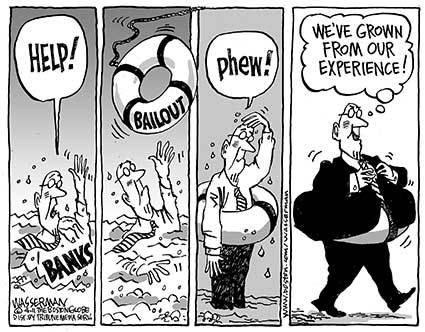
The foregoing article/VIDEO looks at the trend of this double standard of the US Justice System as it applies to criminology of American business. The stakeholders in the Justice Department and the Securities & Exchange Commission (SEC) seems to have forgotten that we have seen this all before, just recently as the cause of the Great Recession, where the global economy was brought to the precipice (2008) due to defective oversight with American home mortgage financing and servicing. Now, the foregoing VIDEO alludes that the regulators and prosecutors have promoted  a “leaving the fox in the hen house” scenario under the guise of not curtailing industrial growth.

Subtitle: Companies must be punished when they do wrong, but the legal system has become an extortion racket


Who runs the world’s most lucrative shakedown operation? The Sicilian mafia? The People’s Liberation Army in China? The kleptocracy in the Kremlin? If you are a big business, all these are less grasping than America’s regulatory system. The formula is simple: find a large company that may (or may not) have done something wrong; threaten its managers with commercial ruin, preferably with criminal charges; force them to use their shareholders’ money to pay an enormous fine to drop the charges in a secret settlement (so nobody can check the details). Then repeat with another large company.

The amounts are mind-boggling. So far this year, Bank of America, JPMorgan Chase, Citigroup, Goldman Sachs and other banks have coughed up close to $50 billion for supposedly misleading investors in mortgage-backed bonds. BNP Paribas is paying $9 billion over breaches of American sanctions against Sudan and Iran. Credit Suisse, UBS, Barclays and others have settled for billions more, over various accusations. And that is just the financial institutions. Add BP’s $13 billion in settlements since the Deepwater Horizon oil spill, Toyota’s $1.2 billion settlement over alleged faults in some cars, and many more.

In many cases, the companies deserved some form of punishment: BNP Paribas disgustingly abetted genocide, American banks fleeced customers with toxic investments and BP despoiled the Gulf of Mexico. But justice should not be based on extortion behind closed doors. The increasing criminalisation of corporate behaviour in America is bad for the rule of law and for capitalism [a].

No soul, no body? No problem

Until just over a century ago, the idea that a company could be a criminal was alien to American law. The prevailing assumption was, as Edward Thurlow, an 18th-century Lord Chancellor of England, had put it, that corporations had neither bodies to be punished nor souls to be condemned, and thus were incapable of being “guilty”. But a case against a railway in 1909, for disobeying price controls, established the principle that companies were responsible for their employees’ actions, and America now has several hundred thousand rules that carry some form of criminal penalty. Meanwhile, ever since the 1960s, civil “class-action suits” have taught managers the wisdom of seeking rapid, discreet settlements to avoid long, expensive and embarrassing trials.

The drawbacks of America’s civil tort system are well known. What is new is the way that regulators and prosecutors are in effect conducting closed-door trials. For all the talk of public-spiritedness, the agencies that pocket the fines have become profit centres: Rhode Island’s bureaucrats have been on a spending spree courtesy of a $500m payout by Google, while New York’s governor and attorney-general have squabbled over a $613m settlement from JPMorgan. And their power far exceeds that of trial lawyers. Not only are regulators in effect judge and jury as well as plaintiff in the cases they bring; they can also use the threat of the criminal law.

Financial firms rarely survive being indicted on criminal charges. Few want to go the way of Drexel Burnham Lambert or E.F. Hutton. For their managers, the threat of personal criminal charges is career-ending ruin. Unsurprisingly, it is easier to empty their shareholders’ wallets. To anyone who asks, “Surely these big firms wouldn’t pay out if they knew they were innocent?”, the answer is: oddly enough, they might.

Perhaps the most destructive part of it all is the secrecy and opacity. The public never finds out the full facts of the case, nor discovers which specific people—with souls and bodies—were to blame. Since the cases never go to court, precedent is not established, so it is unclear what exactly is illegal. That enables future shakedowns, but hurts the rule of law and imposes enormous costs. Nor is it clear how the regulatory booty is being carved up. Andrew Cuomo, the governor of New York, who is up for re-election, reportedly intervened to increase the state coffers’ share of BNP’s settlement by $1 billion, threatening to wield his powers to withdraw the French bank’s licence to operate on Wall Street. Why a state government should get any share at all of a French firm’s fine for defying the federal government’s foreign policy is not clear.

I’ll see you in court—in another life

The best thing would be for at least some of these cases to go to proper trial: then a few of the facts would spill out. That is hardly in the interests of the regulators or their managerial prey, but shareholders at least should push for that. Two senators, Elizabeth Warren and Tom Coburn, have put forward a bill to make the terms of such settlements public, which would be a start. Prosecutors and regulators should also be required to publish the reasons why, given the gravity of their initial accusations, they did not take the matter all the way to court.

In the longer term, two changes are needed to the legal system. The first is a much clearer division between the civil and criminal law when it comes to companies. Most cases of corporate malfeasance are to do with money and belong in civil courts. If in the course of those cases it emerges that individual managers have broken the criminal law, they can be charged.

The second is a severe pruning of the legal system. When America was founded, there were only three specified federal crimes—treason, counterfeiting and piracy. Now there are too many to count. In the most recent estimate, in the early 1990s, a law professor reckoned there were perhaps 300,000 regulatory statutes carrying criminal penalties—a number that can only have grown since then. For financial firms especially, there are now so many laws, and they are so complex (witness the thousands of pages of new rules resulting from the Dodd-Frank reforms), that enforcing them is becoming discretionary.

This undermines the predictability and clarity that serve as the foundations for the rule of law, and risks the prospect of a selective—and potentially corrupt—system of justice in which everybody is guilty of something and punishment is determined by political deals . America can hardly tut-tut at the way China’s justice system applies the law to companies in such an arbitrary manner when at times it seems almost as bad itself.
The Economist Magazine (Posted 08-30-2014; retrieved 09-04-2014) –
http://www.economist.com/news/leaders/21614138-companies-must-be-punished-when-they-do-wrong-legal-system-has-become-extortion?fsrc=nlw|hig|28-08-2014|53552127899249e1cc9ea210|NA

The issue in this foregoing article/VIDEO is another reflection of American Crony Capitalism – where public policy is set to benefit private parties. Consider:

Big Oil While lobbying for continuous tax subsidies, the industry have colluded to artificially keep prices high and garner rocket profits ($38+ Billion every quarter).
Big Box Retail chains impoverish small merchants on Main Street with Antitrust-like tactics, thusly impacting community jobs.
Big Pharma Chemo-therapy cost $20,000+/month; and the War against Cancer is imperiled due to industry profit insistence.
Big Tobacco Cigarettes are not natural tobacco but rather latent with chemicals to spruce addiction.
Big Agra Agribusiness concerns bully family farmers and crowd out the market; plus fight common sense food labeling efforts.
Big Data Brokers for internet and demographic data clearly have no regards to privacy confines
Big Media Hollywood insists on big tax breaks/ subsidies   for on-location shooting; cable companies conspire to keep rates high; textbook publishers practice price gouging.
Big Banks Wall Street’s damage to the housing and student loan markets are incontrovertible.

The book Go Lean…Caribbean asserts that the Caribbean region must not allow the US to take the lead for our own nation-building, that American capitalistic interest tends to hijack policies intended for the Greater Good. This assessment is logical considering that despite the reality of the 2008 Great Recession and the Wall Street complexity, no one has gone to jail, even now 6 years later! The “land of the free and home of the brave” is now too coward to prosecute Wall Street for “lying, cheating and stealing”, despite the millions of victims and $11 Trillion in economic setbacks.

According to the foregoing article/VIDEO, the Justice Department strategizes settlements, rather than convictions. This is American neo-Justice 2014, where the government is in cahoots with Big Business, maintaining a dual standard of justice for corporate criminals versus ordinary felons. The foregoing article posits that the practices of the US Federal Justice Department is representative of a lucrative shakedown operation, actions akin to organized crime and racketeering.

No wonder critics and advocates point to American Justice as divided: one standard for the rich and one for the poor.

The Go Lean book, and accompanying blog commentaries, go even deeper and hypothesize that beyond justice, the American economic models are dysfunctional for the Caribbean perspective. The American wheels of commerce stages the Caribbean in a “parasite” role; imperiling regional industrialization even further. This is due to globalization, in which the US is one of the biggest proponents; this policy trumpets free trade and assessing opportunity costs (through comparative analysis). Under this model the exporter benefits while the importer suffers; trade surpluses – good; trade deficits – bad. The US foreign policy for the Caribbean is to incentivize consumption of American imports, and to ensure that no other European powers exert undo influence in the region – Monroe Doctrine and Pax Americana (Page 180).

The disposition of a “parasite” is not the only choice, for despite American pressure, countries like Japan and South Korea have trade surpluses with the US. They are protégés, not parasites, and thusly provide a model for the Caribbean to emulate.

This broken system in America does not have to be modeled in the Caribbean. Change has now come. The driver of this change is technology and globalization. The Go Lean book posits that the governmental administrations must be open to full disclosure and accountability. The ubiquity of the internet has allowed whistleblowers to expose “shady” practices to the general public; think WikiLeaks.

This book Go Lean… Caribbean, serves as a roadmap for the introduction and implementation of the technocratic Caribbean Union Trade Federation (CU), which represents change for the region. The CU/Go Lean roadmap has 3 prime directives:

  • Optimization of the economic engines in order to grow the regional economy.
  • Establishment of a security apparatus to protect the resultant economic engines against “bad actors”.
  • Improve Caribbean governance to support these engines.

The Go Lean roadmap provides turn-by-turn directions on how to forge this change in the region for a reboot of these Caribbean societal systems, including justice institutions. This roadmap is thusly viewed as more than just a planning tool, pronouncing this point early in the Declaration of Interdependence (Page 13) with these statements:

xvi.    Whereas security of our homeland is inextricably linked to prosperity of the homeland, the economic and security interest of the region needs to be aligned under the same governance. Since economic crimes…can imperil the functioning of the wheels of commerce for all the citizenry, the accedence of this Federation must equip the security apparatus with the tools and techniques for predictive and proactive interdictions.

xxiv.  Whereas a free market economy can be induced and spurred for continuous progress, the Federation must install the controls to better manage aspects of the economy: jobs, inflation, savings rate, investments and other economic principles. Thereby attracting direct foreign investment because of the stability and vibrancy of our economy.

xxv.   Whereas the legacy of international democracies had been imperiled due to a global financial crisis, the structure of the Federation must allow for financial stability and assurance of the Federation’s institutions. To mandate the economic vibrancy of the region, monetary and fiscal controls and policies must be incorporated as proactive and reactive measures. These measures must address threats against the financial integrity of the Federation and of the member-states.

The Go Lean book purports that the Caribbean can – and must – do better. The vision of the CU is a confederation of the 30 member-states of the Caribbean to do the heavy-lifting of optimizing economic-security-governing engines. The Go Lean book details the policies and other community ethos to adopt, plus the executions of the following strategies, tactics, implementations and advocacies to elevate Caribbean society, and still mandate “justice for all”:

Community Ethos – Deferred Gratification Page 21
Community Ethos – Consequences of Choices Lie in the Future Page 21
Community Ethos – Privacy versus Public   Protection Page 23
Community Ethos – Whistleblower Protection Page 23
Community Ethos – Witness Security & Protection Page 23
Community Ethos – Anti-Bullying and Mitigation Page 23
Community Ethos – Intelligence Gathering Page 23
Community Ethos – Lean Operations Page 24
Community Ethos – Ways to Manage Reconciliations Page 34
Community Ethos – Ways to Impact the Greater Good Page 37
Strategy – Agents of Change – Technology Page 57
Strategy – Agents of Change – Globalization Page 57
Tactical – Separation of Powers – Homeland Security Page 75
Tactical – Separation of Powers – Justice Department Page 77
Implementation – Security Initiatives at Start-up Page 103
Implementation – Ways to Benefit from Globalization Page 119
Planning – Ways to Improve Failed-State Indices Page 134
Planning – Lessons Learned from 2008 Page 136
Advocacy – Ways to Grow the Economy Page 151
Advocacy – Ways to Create Jobs Page 152
Advocacy – Ways to Impact Student Loans Page 160
Advocacy – Ways to Improve Housing Page 161
Advocacy – Ways to Improve Governance Page 169
Advocacy – Ways to Better Manage the Social Contract Page 171
Advocacy – Ways to Impact Justice Page 177
Advocacy – Ways to Improve Homeland Security Page 180
Advocacy – Ways to Improve Intelligence Gathering & Analysis Page 182
Advocacy – Ways to Impact Main Street Page 201
Advocacy – Ways to Ways to Protect Human Rights Page 220
Appendix – Credit Ratings Agencies in 2008 Page 276
Appendix – New Student Loan Scandal – Rolling Stone Magazine Page 286

The foregoing article/VIDEO relates to topics that are of serious concern for Caribbean planners. While the US is the world’s largest Single Market economy, we want to only model some of the American example. We would rather foster a business climate to benefit the Greater Good, not just some special interest group.

The world is not fooled! “Tamarind, Sour Sap and Green Dilly, you mussee think we silly” – Bahamian Folk Song

There are many Go Lean blog commentaries that have echoed this point, addressing the subject of the Caribbean avoiding American consequences. See sample here:

https://goleancaribbean.com/blog/?p=2183 A Textbook Case of Industry Price-gouging
https://goleancaribbean.com/blog/?p=2126 Where the Jobs Are – Computers Reshaping Global Job Market
https://goleancaribbean.com/blog/?p=2003 Where the Jobs Are – One Scenario
https://goleancaribbean.com/blog/?p=1433 Caribbean loses more than 70 percent of tertiary educated to brain drain
https://goleancaribbean.com/blog/?p=1309 5 Steps to a Bubble
https://goleancaribbean.com/blog/?p=1256 Traditional 4-year Colleges – Terrible Investment for Region and Jobs
https://goleancaribbean.com/blog/?p=1143 Health-care fraud in America; Criminals take $272 billion a year
https://goleancaribbean.com/blog/?p=1092 Aereo Founder on the future of TV – Fight Against Big Media
https://goleancaribbean.com/blog/?p=798 Lessons Learned from the American Airlines merger
https://goleancaribbean.com/blog/?p=789 America’s War on the Caribbean
https://goleancaribbean.com/blog/?p=782 Open the Time Capsule: The Great Recession of 2008
https://goleancaribbean.com/blog/?p=709 Student debt holds back many would-be home buyers
https://goleancaribbean.com/blog/?p=658 Indian Reservation Advocates Push for Junk-Food Tax
https://goleancaribbean.com/blog/?p=623 Book Review: “The Divide – American Injustice in the Age of the Wealth Gap”
https://goleancaribbean.com/blog/?p=378 Fed Releases Transcripts from 2008   Meetings to Save Big Banks
https://goleancaribbean.com/blog/?p=353 Book Review: ‘Wrong – Nine Economic Policy Disasters and What We Can Learn…’
https://goleancaribbean.com/blog/?p=273 10 Things We Don’t Want from the US – American Self-Interest Policies

The book Go Lean…Caribbean posits that many problems of the region are too big for any one member-state to solve alone, that there is the need for the technocracy of the Caribbean Union Trade Federation. The purpose of this Go Lean/CU roadmap is to make the Caribbean homeland, a better place to live, work, learn and play. This effort is more than academic, this involves many practical mitigations and heavy-lifting. While this charter is not easy, it is worth all effort.

In the Caribbean we need jobs; we need entrepreneurship; we need the business climate to grow the economy; we need to be able to compete with the rest of the world. We therefore need a level playing field. Go Lean is a different approach, especially from the foregoing American experiences. The roadmap posits that to succeed in the global marketplace, the Caribbean region must not only consume but rather also create, produce, and export/distribute domestics products (including intellectual property) and services to the rest of the world.

Optimized justice systems are not optional, as the Go Lean roadmap posits that “bad actors” will surely emerge to exploit the new Caribbean economic engines. The CU institutions must surely anticipate these scenarios and respond proactively and reactively. The charter is to marshal and prosecute all economic crimes at the federal (CU) level. There can be no “divide”, no compromise on right-and-wrong.

No justice, no peace!

Now is the time for all of the Caribbean, the people and governing institutions, to lean-in for the changes described in the book Go Lean … Caribbean.

Download the book Go Lean…Caribbean now!

——————-

Cited Reference:

a. “A mammoth guilt trip – Corporate America is finding it ever harder to stay on the right side of the law”. The Economist Magazine; posted August 30, 2014; retrieved September 4, 2014 from: http://www.economist.com/news/briefing/21614101-corporate-america-finding-it-ever-harder-stay-right-side-law-mammoth-guilt

 

Share this post:
,

What’s In A Name…

Go Lean Commentary

What Name

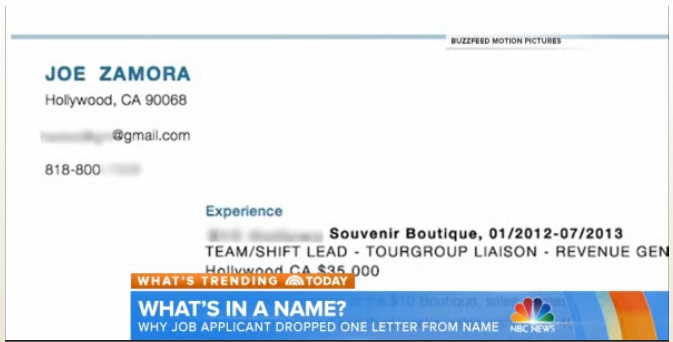
Joe versus Jose; Emily versus Lakisha [a] – race still matters very much in the US labor market. So says the following VIDEO from NBC News The Today Show and the research in the appendix below.

Title: What’s in a name when you apply for a job?
By: NBC News – The Today Show

A man named Jose spent six fruitless months looking for work online. But when he dropped the “s” from his name and applied as “Joe,” the job offers started coming in.
NBC News – The Today Show – September 4, 2014 –
http://www.today.com/video/today/55986337#55986337

One would think that such a racially-charged society was only representative of the America of old; that now America has transformed, to the point that the President is of African-American descent. But it must be concluded that the more things change, the more they remain the same.

The issue in the foregoing news article/VIDEO relates to the lure of America as a destination for Caribbean immigrants. This is the labor market that new arrivals would have to navigate. Perhaps the shining light of that Welcome Sign should be dulled a little.

The story in the VIDEO, and the research in the Appendix, is being brought into focus in a consideration of the book Go Lean … Caribbean. The book serves as a roadmap for the introduction and implementation of the technocratic Caribbean Union Trade Federation (CU), for the economic optimization in the region. One mission of the roadmap is to minimize the “push-and-pull” factors that contribute to the alarmingly high societal abandonment rate of Caribbean citizens – one report reflects a 70% brain drain rate.

This blog/commentary also infers one additional issue, that of job creation. The Go Lean book posits that when the economic engines are not sufficient that people will flee, abandon their homelands, despite the love of family, friends and culture and endure all obstacles to secure a better livelihood. This has been the reality for all of the Caribbean, even the American member-states (Puerto Rico & Virgin Islands). If only, there would be a better option for the Caribbean?

Go Lean…Caribbean presents that option!

This CU/Go Lean roadmap provides the turn-by-turn details with the following 3 prime directives:

  • Optimization of the economic engines in order to grow the regional economy to $800 Billion & create 2.2 million new jobs.
  • Establishment of a security apparatus to protect the resultant economic engines.
  • Improve Caribbean governance to support these engines.

The roadmap posits that the United States of America should not be viewed as the panacea for Caribbean ailments; that when the choices of a challenge is “fight or flight” that Caribbean society must now consider the “fight” options. (No violent conflict is being advocated, but rather a strenuous effort, heavy-lifting, to compete and win economic battles).

As related in the foregoing article/VIDEO, America is not so welcoming a society for the “Black and Brown” populations from the Caribbean – and yet they come, there are in the USA and their numbers cannot be ignored. Here is the need for the heavy-lifting, to effect change to dissuade further brain drain and in reverse to incentivize repatriation. While not ignoring the “push” reasons that cause people to flee, the book stresses (early at Page 13) the need to be on-guard for this fight in the following pronouncements in the Declaration of Interdependence:

xix.      Whereas our legacy in recent times is one of societal abandonment, it is imperative that incentives and encouragement be put in place to first dissuade the human flight, and then entice and welcome the return of our Diaspora back to our shores. This repatriation should be effected with the appropriate guards so as not to imperil the lives and securities of the repatriated citizens or the communities they inhabit. The right of repatriation is to be extended to any natural born citizens despite any previous naturalization to foreign sovereignties.

xx.      Whereas the results of our decades of migration created a vibrant Diaspora in foreign lands, the Federation must organize interactions with this population into structured markets. Thus allowing foreign consumption of domestic products, services and media, which is a positive trade impact. These economic activities must not be exploited by others’ profiteering but rather harnessed by Federation resources for efficient repatriations.

xxi.      Whereas the preparation of our labor force can foster opportunities and dictate economic progress for current and future generations, the Federation must ensure that educational and job training opportunities are fully optimized for all residents of all member-states, with no partiality towards any gender or ethnic group. The Federation must recognize and facilitate excellence in many different fields of endeavor, including sciences, languages, arts, music and sports. This responsibility should be executed without incurring the risks of further human flight, as has been the past history.

xxvi.      Whereas the Caribbean region must have new jobs to empower the engines of the economy and create the income sources for prosperity, and encourage the next generation to forge their dreams right at home, the Federation must therefore foster the development of new industries, like that of ship-building, automobile manufacturing, prefabricated housing, frozen foods, pipelines, call centers, and the prison industrial complex. In addition, the Federation must invigorate the enterprises related to existing industries like tourism, fisheries and lotteries – impacting the region with more jobs.

This commentary previously related details of the Caribbean Diaspora experience, the “push-and-pull” factors in the US, and our region’s own job-creation efforts. Here is a sample of earlier Go Lean blogs:

https://goleancaribbean.com/blog/?p=2025 Caribbean Jobs – Attitudes & Images of the Diaspora
https://goleancaribbean.com/blog/?p=1896 American “Pull” Factors – Crisis in Black Homeownership
https://goleancaribbean.com/blog/?p=1698 American “Pull” Factors – STEM Jobs Are Filling Slowly
https://goleancaribbean.com/blog/?p=1596 Book Review: “Prosper Where You Are Planted”
https://goleancaribbean.com/blog/?p=1433 Caribbean loses more than 70 percent of tertiary educated to brain drain
https://goleancaribbean.com/blog/?p=1296 Remittances to Caribbean Increased By 3 Percent in 2013
https://goleancaribbean.com/blog/?p=1256 Traditional 4-year College Degree are Terrible Investments for the Caribbean Region
https://goleancaribbean.com/blog/?p=599 Ailing Puerto Rico Open to Radical Economic Fixes To Keep Citizens At Home
https://goleancaribbean.com/blog/?p=623 Book Review: “The Divide – American Injustice in the Age of the Wealth Gap”
https://goleancaribbean.com/blog/?p=273 10 Things We Don’t Want from the US – Discrimination of Immigrations
https://goleancaribbean.com/blog/?p=209 Muhammad Ali and Role Model/Advocate Kevin Connolly – Demanding Equal Rights in America’s Supreme Court

For the Caribbean Diaspora, fleeing from their homelands to reside in the US is akin to “jumping from the frying pan into the fire”. While we may not be able to change American society, we can – no, we must – impact our own society. How? What? When? Why? All of these questions are valid, because the answers are difficult. The Go Lean book describes the solution as heavy-lifting.

This is the charge of the Go Lean…Caribbean roadmap: to do the heavy-lifting, to implement the organizational dynamics to impact Caribbean society here and now. The following are the community ethos, strategies, tactics and operational advocacies to effectuate this goal:

Community Ethos – Deferred Gratification Page 21
Community Ethos – People Respond to Incentives Page 21
Community Ethos – Economic Systems Influences Choices & Incentives Page 21
Community Ethos – The Consequences of Choice Lie in the Future Page 21
Community Ethos – Job Multiplier Page 22
Community Ethos – Minority Equalization Page 24
Community Ethos – Lean Operations Page 24
Community Ethos – Ways to Foster Genius Page 27
Community Ethos – Ways to Impact the Greater Good Page 37
Strategy – Vision – Make the Caribbean the Best Address   on Planet Page 45
Strategy – Mission –   Repatriate Diaspora Page 46
Strategy – Mission –   Dissuade Human Flight/“Brain Drain” Page 46
Tactical – Separation of Powers – Department of Labor – Equal Opportunities Page 89
Implementation – Ways to Deliver Page 109
Implementation – Reasons to Repatriate Page 118
Implementation – Ways to Benefit from Globalization Page 119
Planning – Ways to Better Manage Image Page 133
Planning – Lessons from the US   Constitution Page 145
Advocacy – Ways to Grow the Economy Page 151
Advocacy – Ways to Create Jobs Page 152
Advocacy – Ways to Impact Labor Unions Page 164
Advocacy – Ways to Impact the Diaspora Page 217
Advocacy – Ways to Preserve Caribbean Heritage Page 218
Advocacy – Ways to Impact US Territories Page 244
Appendix – Analysis of Caribbean Diaspora by Country of   Residence Page 267
Appendix – Analysis of Caribbean Emigration Page 269
Appendix – Puerto Rican Population in the US Page 304

The scope of this roadmap is to focus on the changes we have to make in the Caribbean, not the changes for American society. Our success is conceivable, believable and achievable.  The Caribbean can be the world’s best address. Now is the time for all of the Caribbean, the people and governing institutions, to lean-in to this Go Lean … Caribbean roadmap.

This is a big deal for the region. This roadmap is not just a plan, its a prescription. We want the current Jose’s and Lakisha’s to fully “be all they can be”, here at home in the Caribbean. Let’s show America, and the world in general, that our homeland, is the best place to live, work and play, no matter our name.

Download the book Go Lean … Caribbean – now!

———————–

Appendix a: Emily versus Lakisha

The following is the summary/introduction of a landmark study conducted by academicians in 2004:

We study race in the labor market by sending fictitious resumes to help-wanted ads in Boston and Chicago newspapers. To manipulate perceived race, resumes are randomly assigned African-American or White-sounding names. White names receive 50 percent more callbacks for interviews. Callbacks are also more responsive to resume quality for White names than for African-American ones. The racial gap is uniform across occupation, industry, and employer size. We also find little evidence that employers are inferring social class from the names. Differential treatment by race still appears to be prominent in the U.S. labor market.

Marianne Bertrand and Sendhil Mullainathan (2004). “Are Emily and Greg More Employable than Lakisha and Jamal? A Field Experiment on Labor Market Discrimination”; The American Economic Review. Published September 2004. Retrieved September 4, 2014 from http://www.jstor.org/stable/3592802?origin=JSTOR-pdf

Share this post:
, ,
[Top]

Climate Change May Affect Food Supply Within a Decade

Go Lean Commentary

Don’t say you haven’t been warned! The apocalyptic effects of Climate Change may not be so far off, maybe even within the next decade. So says the foregoing article. For those of us on the front line, the Caribbean region, this is our warning siren for us to take immediate actions to “save life and limb”:

Title: Think Climate Change Is a Problem for the Future? Our Food System May Feel the Heat in a Decade
By: Steve Holt

CU Blog - Climate Change May Affect Food Within a Decade - Photo 2The new sci-fi thriller The Collapse of Western Civilization: A View From the Future depicts a world ravaged by climate change. Decades of ignoring signs of global warming have led “to soaring temperatures, rising sea levels, widespread drought,” and the collapse of the West Antarctic ice sheet, a catastrophic global disaster. It’s a terrifying fiction to consider—but one that, even in science fiction, seems far, far off. Collapse takes place in 2393, after all. Similarly, voters and politicians alike are prone to taking a far-off view when talking about climate change—it’s easy for some of us to procrastinate on acting because we believe any effects are 50 or more years away. The incremental changes happen so slowly, it seems: an extra powerful storm here or an inch of ice melt there.

But what if we felt the impact of our collective actions (and inactions) relating to climate change a lot sooner—like, by 2024?

Well, that far-off sci-fi tomorrow may indeed be here before we know it. Recently, a leading climate change observer made the scary prediction that climate change could disrupt the global food supply, endangering billions of humans, within the next decade.

“The challenges from waste to warming, spurred on by a growing population with a rising middle-class hunger for meat, are leading us down a dangerous path,” Rachel Kyte, World Bank Group vice president and special envoy for climate change, recently told the Crawford Fund 2014 annual conference in Canberra, Australia, according to the Sydney Morning Herald. “Unless we chart a new course, we will find ourselves staring volatility and disruption in the food system in the face, not in 2050, not in 2040, but potentially within the next decade.”

While we’re already talking about how climate change could take away our coffee [a] and our chocolate, there’s far more to this problem than higher prices for lattes and candy bars. Yields on staple crops could drop significantly, and meat prices are already on the rise thanks to the prolonged drought in the West. And our failure to stem the tide of human environmental destruction, experts say, will hit Americans hard in the pocketbook. Food shoppers here in the United States should expect a climate-induced rise in food prices as a result of more extreme weather events; crop failures due to weather warming that influences pests, diseases, and weeds; and related effects on fisheries and livestock. But while we’ll all feel the pain at the checkout, food price increases will disproportionately impact the nearly 15 percent of U.S. households that are food insecure [b], says Dr. Linda Berlin, director of the Center for Sustainable Agriculture at the University of Vermont.

“Americans who will be most negatively affected by these changes are those with the least disposable income, i.e., little ability to absorb the extra costs,” she says.

Kyte—who oversees work on climate change adaptation and mitigation and climate finance taking place across World Bank Group institutions—pointed to a number of factors that are exacerbating the oncoming food crisis, including a rising demand for meat worldwide, land clearing and increased greenhouse gas emissions from livestock, and threats to low-lying areas from rising sea levels. Air temperatures could increase 2 degrees by the mid-2030s, she says, which could cut cereal yields by 20 percent worldwide and 50 percent in Africa.

Kyte’s analysis coincides with the draft of an upcoming United Nations report [c], released in August, in which the international panel of scientists expresses 95 to 100 percent certainty that human activity is the primary cause of global warming. Additionally, according to the report, greenhouse gas emissions are increasing, despite far-reaching political efforts to reduce them. Between 2000 and 2010, emissions grew at 2.2 percent annually, up from growth of 1.3 percent yearly between 1970 and 2000.

Food shortages have led to riots in other countries, and that kind of hunger-related violence is always cast as an “over-there” sort of problem. But that’s partly because of our “giant safety net program—SNAP (food stamps)—which most countries don’t have,” as Stanford professor Rosamond Naylor told several hundred scientists and California Gov. Jerry Brown last December [d].

With $8.6 billion cut from the program in the 2014 farm bill [e], that safety net isn’t faring all that well.
—————————————————-
Cited References:
a. http://www.takepart.com/article/2014/05/19/federal-cash-coffee-rust
b. http://www.ers.usda.gov/publications/err-economic-research-report/err155.aspx#.VADQkmRdWa4 c.http://www.nytimes.com/2013/08/20/science/earth/extremely-likely-that-human-activity-is-driving-climate-change-panel-finds.html?pagewanted=all&_r=0
d. http://woods.stanford.edu/news-events/news/climate-change-threatens-food-security-stanford-professor-warns
e. http://www.takepart.com/article/2014/02/05/2014-farm-bill

Yahoo News / Takepart.com e-Zine (Posted 09-02-2014) –
http://news.yahoo.com/think-climate-change-problem-future-food-system-may-000721066.html;_ylt=AwrBEiTNFApULVYAgIbQtDMD

The foregoing article is asserting that Climate Change may not just be our grandchildren’s problem alone; it is an issue for us, and even our parents. The risks and threats associated with this agent-of-change must therefore be mitigated now! The book Go Lean…Caribbean identifies this impending crisis and then declares that “a crisis is a terrible thing to waste”, calling for the establishment of a regional sentinel to monitor, mitigate and manage the effects of Climate Change on the region’s economic, security and governing engines. According to the foregoing article, which considers near-term projections on the world’s food supply systems, this will be a global crisis; the rest of the world will have to contend with these same issues.

This Go Lean book serves as a roadmap for the introduction and implementation of the technocratic Caribbean Union Trade Federation (CU). The prime directives of this agency are described as:

  • Optimize the economic engines of the Caribbean to elevate the regional economy to grow to $800 Billion and create 2.2 million new jobs.
  • Establish a security apparatus to protect the resultant economic engines.
  • Improve Caribbean governance to support these engines.

The Go Lean roadmap calls for the establishment of an Emergency Management agency (subset of the CU’s Homeland Security Department) so as to adopt the professional arts and sciences of Public Safety & Emergency Management. The emergencies within this scope will include natural disasters like hurricanes, flooding, forest fires, and droughts, all which can affect the food supply systems, even fisheries. The Caribbean Emergency Management Agency would therefore need to coordinate and plan with other CU Departments and member-state agencies in a proactive manner to anticipate the needs of the Caribbean region; this will include the CU Departments of Health (Food & Nutrition Administrations), Agriculture & Fisheries.

A lot is at stake with this consideration – life and death – our ability to feed our populations.

CU Blog - Climate Change May Affect Food Within a Decade - Photo 1Not everyone accepts these precepts – vocal deniers of Climate Change abound! But, recent natural disasters have devastated the region and do not allow us the luxury of dissent in our planning. We can see, hear, touch, taste and feel the effects of Climate Change now in our region. It is an Inconvenient Truth.

The Go Lean book reports that Climate Change is wreaking havoc on Caribbean life now; (the Bahamas 2nd city, Freeport, never fully recovered from Category 4 Hurricane Wilma in 2004, even now). Today, this foregoing news article identifies even more serious risks, this time for the world’s food supply. Due to globalization and the status as Small Island Developing States, today’s story becomes an alarming issue for the Caribbean as our region disproportionally depends on imports for our food supply. These agents-of-change (Climate Change & Globalization) were pronounced early in the book in the Declaration of Interdependence (Page 11 & 14), with these statements:

i.     Whereas the earth’s climate has undeniably changed resulting in more severe tropical weather storms, it is necessary to prepare to insure the safety and security of life, property and systems of commerce in our geographical region. As nature recognizes no borders in the target of its destruction, we also must set aside border considerations in the preparation and response to these weather challenges.

xxx. Whereas the effects of globalization can be felt in every aspect of Caribbean life, from the acquisition of food and clothing, to the ubiquity of ICT, the region cannot only consume, it is imperative that our lands also produce and add to the international community, even if doing so requires some sacrifice and subsidy.

To counteract the changes in nature, the Go Lean book advocates the immediate confederation of the 30 member-states into a Trade Federation with the tools/techniques to bring immediate change to the region to benefit one and all member-states. This includes the monitoring of the dynamics of Climate Change. While the region’s total population is only 42 million, compared to the whole world’s 6 Billion, we can still have an impact. We must still feed ourselves; we can show the world how best to accomplish this as Small Island Developing States. As the world seeks answers, they will have our technocratic example to glean from.

We cannot not expect anyone but ourselves to take the lead for our solutions. Other countries, like the US, have Climate Change deniers-and-detractors in the highest levels of government – this is not a model for us to emulate. Previous Go Lean blogs have cited this trend, as cited in the following sample:

https://goleancaribbean.com/blog/?p=2119 Cooling Effect – Oceans and the Climate
https://goleancaribbean.com/blog/?p=1883 Climate Change May Bring More Kidney Stones
https://goleancaribbean.com/blog/?p=1817 Caribbean grapples with intense new cycles of flooding & drought
https://goleancaribbean.com/blog/?p=926 Conservative heavyweights have solar industry in their sights
https://goleancaribbean.com/blog/?p=915 Go ‘Green’ … Caribbean

The Caribbean does not have the luxury of a laissez-faire attitude – No Problem Mon – towards Climate Change as we are on the frontline of these dilemmas. Instead the Go Lean book declares that we must adopt a community ethos, the appropriate attitude/spirit, to forge change in our region; then details the executions of the following strategies, tactics, implementations and advocacies to better impact the region’s preparation for food resources, especially considering the consequences from Climate Change:

Community Ethos – Deferred Gratification Page 21
Community Ethos – Economic Systems Influence Individual Choices / Incentives Page 21
Community Ethos – The Consequences of Choices Lie in the Future Page 21
Community Ethos – Intelligence Gathering Page 23
Community Ethos – “Crap” Happens Page 23
Community Ethos – Lean Operations Page 24
Community Ethos – Cooperatives Page 24
Community Ethos – Non-Government Organizations Page 25
Community Ethos – Ways to Impact the Future Page 26
Community Ethos – Ways to Improve Sharing Page 35
Community Ethos – Impact the Greater Good Page 37
Strategy – Vision – Confederating 30 Member-States into a Single Market Page 45
Strategy – Vision – Foster Local Economic Engines Food, Clothing &   Shelter Page 45
Strategy – Mission – Prepare   for Natural Disasters Page 45
Strategy – Mission – Exploit   the Benefits and Opportunities of Globalization Page 46
Strategy – Agents of Change – Climate Change Page 57
Strategy – Agents of Change – Globalization Page 57
Tactical – Confederating a Permanent Union Page 63
Tactical – Fostering a Technocracy Page 64
Separation of Powers – Emergency Management Page 76
Separation of Powers – Meteorological & Geological Service Page 79
Separation of Powers – Food & Nutritional Administration Page 87
Separation of Powers – Agriculture and Fisheries Department Page 88
Implementation – Ways to Pay for Change Page 101
Implementation – Security Initiatives at Start-up – Unified Command & Control Page 103
Implementation – Ways to Deliver Page 109
Implementation – Ways to Foster International Aid Page 115
Implementation – Ways to Benefit from Globalization Page 119
Planning – Ways to Make the Caribbean Better Page 131
Advocacy – Ways to Grow the Economy Page 151
Advocacy – Ways to Better Manage Food Page 162
Advocacy – Ways to Improve Governance Page 168
Advocacy – Ways to Better Manage the Social Contract Page 170
Advocacy – Ways to Foster Cooperatives Page 176
Advocacy – Ways to Improve for Natural Disasters Page 184
Advocacy – Ways to Improve Emergency Management Page 196
Advocacy – Ways to Improve Fisheries Page 210
Appendix – History of Puerto Rican Migration to US & Effects of Hurricanes Page 303
Appendix – US Virgin Islands Economic Timeline with Hurricane Impacts Page 305

The foregoing news article discusses the threats of Climate Change on the world’s food supply…soon, within the next decade. We have no time to relax, no time to debate, we must get ready now.

Remember the Bible drama of Joseph interpreting Pharaoh’s dreams as warning of an impending great famine. The shrewd course of action for Joseph and Pharaoh was to plan/prepare the food supplies for the forthcoming lean years – Genesis Chapter 40 – 41.

From the Caribbean perspective, our only observation on this drama can be: Ditto!

Change has come to our region; more devastating change is imminent. There is the need for a permanent union – a sentinel – to provide efficient stewardship for Caribbean economy, security and governing engines. The Go Lean…Caribbean posits that the problems of this region are too big for just any one member-state to tackle, but rather this multi-state technocratic administration may be our best solution.

The people and institutions of the region are hereby urged to lean-in to this Go Lean roadmap, to embrace the mitigations for the impending world changes. Let’s make the Caribbean better; a better place to live-work-play today and even more so tomorrow.

Download the book Go Lean … Caribbean – now!

Share this post:
, ,
[Top]

Sports Role Model – Playing For Pride … And More

Go Lean Commentary

These blog/commentaries started in March 2014. But this source article was published on November 15, 2013. It never seemed appropriate to reach back and feature this article – until now. This marks the occasion of a Black College Football Game (Classic) being staged in Nassau, Bahamas on September 13, 2014 in the new Thomas A. Robinson National Stadium.

CU Blog - Playing For Pride - Photo 3

 CU Blog - Playing For Pride - Photo 2

The foregoing article was adapted from the book by Samuel G. Freedman, Breaking the Line: The Season in Black College Football That Transformed the Sport and Changed the Course of Civil Rights. (It is available at www.samuelfreedman.com and at bookstores nationwide).

Title: Playing for Pride
By: Samuel G. Freedman

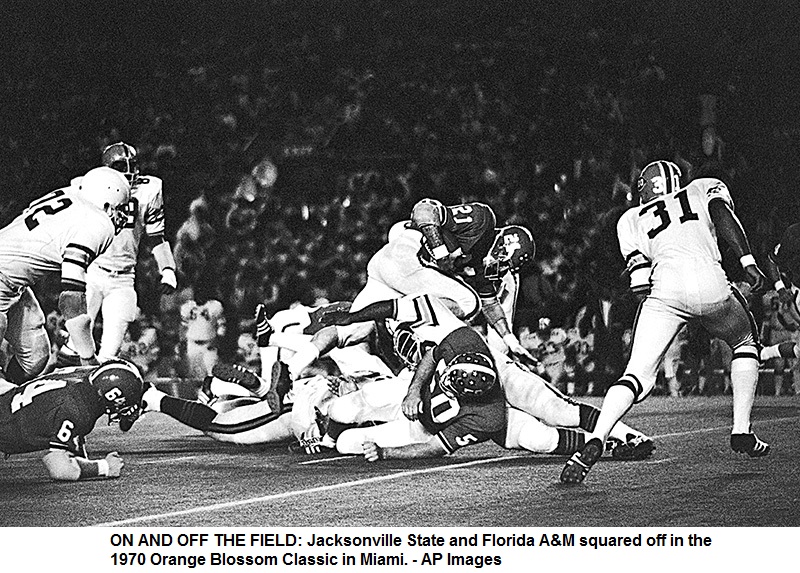
The yearly gridiron matchup known as the ORANGE BLOSSOM CLASSIC helped to even the playing field for black players, coaches and fans. But it was about so much more than football.

The calendar of Black America includes several specific holidays. Juneteenth, celebrated every June 19, honors the day the Union Army liberated slaves in Texas following the end of the Civil War. Kwanzaa, beginning on Dec. 26, is a seven-day festival of African heritage. On Dec. 31, which is called watch night, churches hold worship services to commemorate the way their forebears had stayed up all night awaiting the issuance of the ­Emancipation Proclamation on January 1, 1863.

And for a 30-year heyday beginning in the late 1940s, the Orange ­Blossom Classic football game and festival in Miami was the most important annual sporting event and the largest annual gathering of any kind for black Americans. For most of those years, more than 40,000 spectators attended the game in the Orange Bowl stadium, while tens of thousands more thronged to marching-band parades. Black tourists flocked to the hotels, restaurants and clubs of Miami’s Overtown and Liberty City neighborhoods. Pro-football scouts with binoculars, Ray-Bans and stingy-brim hats elbowed their way along the sidelines to scout prospects.

While the Orange Blossom Classic lives only in memory now — it served as the de facto black college championship until 1978 and was still played sporadically until 2004; it was ultimately the unexpected casualty of racial integration in sports and in society — its spirit persists in the dozens of “Classics” played between football teams from ­historically black colleges and universities (HBCUs). There are 37 on the schedule this season, and several of the most famous are coming up. Florida A&M University plays Bethune-Cookman University on Nov. 23 (2013) in the Florida Classic in Orlando, Fla., and Grambling State University faces Southern University and A&M College in the Bayou Classic on Nov. 30 (2013) in New Orleans. [2014 games are scheduled for the same corresponding weekends].

Football, though, is only part of a Classic. Marching bands, step shows, networking, gospel concerts and shopping excursions are all parts of the experience. These Classics continue to draw crowds as large as 70,000 for the on-field rivalry and a broader sense of affirmation.

“Historically speaking, there were not always so many opportunities for African-Americans to socialize in public,” says Todd Boyd, a University of Southern California professor who specializes in race and popular culture. “So the opportunities that did exist often took on added significance. Yet over time, the events became part of a larger tradition. I think the games now have a nostalgic feel. So it’s all about tradition and ritual once again.”

As sporting event and communal celebration, the Orange Blossom Classic rose as an answer to invisibility, the kind Ralph Ellison famously rendered in his novel, Invisible Man. In 1937, when Miami opened the Orange Bowl stadium, a public facility built with public funds, it excluded blacks from all but one section of the eastern end zone. No integrated football team was permitted onto the gridiron until the Nebraska Cornhuskers played Duke in the 1955 Orange Bowl. Blacks were barred from participating in any of the pageants and events related to the bowl game, much as they were barred from patronizing the resort hotels in Miami Beach. The black maids and janitors and cooks and bellhops who comprised the ­human infrastructure of those establishments had to obtain identification­ cards from the police. Even the black performers who drew the crowds — Sammy Davis Jr., Nat King Cole, Ella Fitzgerald — were forbidden from staying in the hotels where they entertained.

During the 1930s, Miami blacks began their own competitor to the Orange Bowl festivities, which they called the Coconut Festival. It had its own beauty queen, its own parade and its own football game, played in Dorsey Park, a segregated square block named for Miami’s first black millionaire. The Coconut Festival game, though, lacked much football pizzazz. That’s where J.R.E. Lee Jr., the son of Florida A&M University’s president, came in.

Even before Lee, black colleges had sought to create their own version of season-ending bowl games. In the 1920s, Lincoln University and Howard University began playing annually in the self-proclaimed Football Classic of the Year, and Tuskegee University met Wilberforce University yearly at Soldier Field in the Midwest Chicago Football Classic. Inspired by these ­examples, Lee conceived a “Black Rose Bowl,” naming it the Orange Blossom Classic. In the first game, in 1933, Florida A&M beat Howard by a score of 9-6 before 2,000 spectators at a blacks-only ballpark in Jacksonville, Fla. For the next 13 years, the contest migrated among the Florida cities of Jacksonville, Orlando and Tampa, becoming an itinerant attraction that gradually built its audience and reputation.

Then, in 1947, Lee linked the game’s fortunes to the Coconut Festival’s and settled it in Miami. Miami had the largest stadium in Florida. Miami also had the greatest concentration of media anywhere in the state. And Miami, as it entered the postwar boom, was beginning to shake off its rigid segregation, largely owing to the influx of Jews from the North, most of them either tacitly or actively supportive of civil rights.

The very first Classic game in Miami made racial history. For the first time, black fans were permitted to sit in the main stands of the Orange Bowl. And when a Florida A&M Rattler receiver named Nathaniel “Traz” Powell caught a 45-yard pass to break a 0-0 tie with Hampton Institute, he became the first black man to score a touchdown on the Orange Bowl’s previously whites-only gridiron. Powell had grown up in Miami as the son of a laundress and a laborer at the city’s incinerator. For years to come, blacks around the state would speak about his touchdown as if he’d been Rosa Parks refusing to surrender her seat.

The civil rights analogy was apt. Black colleges and their football teams operated in a kind of parallel universe during the segregation era. Even as they sent hundreds of players into the pros, the mainstream media rarely covered the schools. The proliferation of sports-focused talk radio and cable TV was decades away. So Jake Gaither, Florida A&M’s legendary coach, set about raising the Orange Blossom Classic to the status of a de facto black championship. Year in and year out, his Rattlers ranked near the top. And because Florida A&M hosted the Orange Blossom Classic, Gaither invited the strongest possible opponent.

As a result, the Orange Blossom Classic far outdrew the University of Miami’s football games and, later, those of the new National Football League (NFL) franchise, the Miami Dolphins. In Black America, it supplanted the Negro League All-Star game as the biggest single event. Florida A&M’s renowned “Marching 100” band pranced in two parades, one through the black neighborhoods and the other downtown, each drawing thousands upon thousands of spectators.

One year, comedian Nipsey Russell joined the Rattlers on their sideline; another time it was Sammy Davis Jr. All week long, the streets of Overtown and LibertyCity were “crowded like the state fair, music pouring out of doorways,” as one participant remembers. At the Zebra Lounge and the Hampton House, in the Harlem Square Club and the Rockland Palace and all along the stretch of Northwest Second Street called the Great Black Way, stars of jazz, soul and rhythm and blues headlined. Women spent a year’s savings on their Orange Blossom dresses, and beauty salons stayed open all night to handle the demand. When the parties ended near daybreak, people went their ways for breakfast before a sunrise snooze.

“The Classic was bigger than the Fourth of July,” says Marvin Dunn, author of the history book Black Miami in the Twentieth Century. “It was a black thing, and it was well done, and it added to the sense of pride. Even if you didn’t go to the game, you’d have all these people massed along the parade route. And the clothes — you had to get a new suit, a new dress for the Classic. There was not a seat to be had in a barber shop.”

No game brought more luster and historical significance than the 1967 matchup between Florida A&M and Grambling. They were the two greatest black college teams with the two greatest black college coaches (Jake Gaither and Eddie Robinson, respectively) and the two finest quarterbacks to play at each school (Ken Riley and James Harris, respectively). Robinson very deliberately was developing Harris to break the quarterback color line in the pros, to forever lay to rest the canard that no black man was smart enough to play that most intellectual of positions. As Leon Armbrister, the sports columnist of The Miami Times, the city’s weekly black newspaper, exalted, “The selection of Grambling adds Super Bowl status to the Classic.”

In many ways, the Orange Blossom Classic in 1967 also embodied the recent progress in race relations. The Grambling and Florida A&M teams both stayed in integrated hotels on Miami Beach. The P. Ballantine & Sons Brewing Company sponsored a tape-delayed broadcast of the game on television stations in Atlanta, Philadelphia, Washington, D.C., and New York. Buddy Young, the first black executive in the NFL’s front office, provided the on-air commentary. The local publicity for the game was handled by Julian Cole, a transplanted Jew who counted the ritziest Miami Beach hotels among his clients.

The Orange Blossom Classic’s souvenir program featured advertisements from major national companies, including Humble Oil, Prudential Insurance and RC Cola. Coca-Cola sponsored a float carrying the Grambling College queen and her court in the pregame parade. The celebrities in attendance included the first wave of black executives hired by corporations in search of black consumers. Pepsi-Cola, the leader in the field, dispatched its vice president for special markets, Charles Dryden, a bona fide war hero as one of the Tuskegee Airmen. Greyhound sent Joe Black, the former Brooklyn Dodgers pitcher, who recently had been ­appointed the bus company’s vice president of special markets. F.W. Woolworth, a company trying to repair a reputation damaged by its segregated lunch counters in Southern cities, dispatched Aubrey Lewis, a former Notre Dame football star and FBI agent it recently had hired as an executive recruiter.

The competitive tension built as the game approached. As Grambling ran through its practice session at a junior college, two busloads of Florida A&M players arrived. They jogged around the field, chanting, “It’s so hard to be a Rattler,” before haughtily driving off. Grambling’s Eddie Robinson, incensed, told his team, “The peace dove flies out the window tomorrow!” At a pregame banquet, he had to remind his players not to start jawing at the Florida A&M team, saying, “Take it out on the field.”

On the night of Dec. 2, 1967, before more than 40,000 spectators, Grambling and Florida A&M produced a classic for the Classic. The game went down to the final play, with the Tigers holding off a final drive by the Rattlers to win 28-25. Florida A&M compiled 396 yards of total offense, slightly more than Grambling’s 382. James Harris threw for 174 yards, and Ken Riley nearly matched him, with 110 yards passing and 62 more rushing.

CU Blog - Playing For Pride - Photo 1The scouts certainly noticed. Harris, then a junior, would be drafted by the NFL’s Buffalo Bills in January 1969. He went on to become the first black quarterback to regularly start in the NFL, leading the Los Angeles Rams to the conference title game twice in the mid-1970s. Every black quarterback to follow, from Doug Williams and Warren Moon to Russell Wilson and Robert Griffin III, came through the door that James Harris opened. As for Ken Riley, he was moved to cornerback in the NFL and had an illustrious 15-year career with the Cincinnati Bengals. Even now, 30 years after retiring, he ranks fifth in NFL history in career interceptions.

In the aftermath of the 1967 Orange Blossom Classic, Grambling was able to bring black college football to the nation as a whole. The following September, the Tigers played Morgan State before a sold-out crowd in Yankee Stadium in a fundraising game for the National Urban League, a prominent civil-rights organization. That example inspired the dozens of black-college classics being played today, keeping a precious thread of prideful history unbroken.
——
SAMUEL G. FREEDMAN is a professor at Columbia University’s Graduate School of Journalism and a New York Times columnist.

The foregoing article depicts reality for the Black American population for much of the 20th Century. Despite the differences in population, cultural heritage and language, much of the historical experiences were parallel in the Caribbean until majority rule and/or de-colonization came to fruition in these tropical homelands.

This foregoing article therefore relates to more than just sports, but history, culture and civil rights cause-and-effect. The foregoing therefore harmonizes with the book Go Lean…Caribbean which also stresses the need to Transform Sports and Change the Course of Civil Rights but this time for the Caribbean region. The Go Lean book studies the assessment of the 30 Caribbean member-states and posits that the region is in crisis, with the societal engines at the precipice due the an unsustainable rate of human flight. The African-American experience in the US has thusly improved over the last century, the current US President Barack Obama is of African-American descent; the dreaded co-existence (segregation) of Blacks along side Whites is no longer the status quo; their community is more color-blind. This creates strong motivation for Caribbean residents to consider an American migration. In fact 70% of the Caribbean college-educated population, some from American HBCU’s as depicted in the foregoing article, have abandoned their homeland and live abroad, mostly in the US.

The City of Miami, prominently featured in the foregoing article is largely comprised of the Caribbean Diaspora. (In the interest of full disclosure, this Go Lean blogger attended one of the schools prominently featured in this foregoing article, Florida A&M University, and separately lived in Miami for 17 years).

The underlying issue in this consideration is sports and the game of (American) football.  A compelling mission of the Go Lean book is to foster the eco-systems for sports enterprises in the region. The book posits that sports, collegiate sports included, can impact a community’s economics and surely its pride.

An important mission of this Go Lean message is to simply lower the “push and pull” factors that lead many to abandon their Caribbean homeland for American shores. The “pull” factors were miniscule in the mid-20th Century; Caribbean citizens of Black and Brown heritage may not have found the (southern) US so welcoming. But times have changed, and the minority experience in America is different; more enticing and appealing to Caribbean citizens seeking to relocate.

While the Caribbean may not have the sports business eco-system, we do have the underlying assets: athletes. The Caribbean supplies the world, including American colleges (NCAA), with the best-of-the-best in the sports genres of basketball, track-and-field, FIFA-soccer and a few football players (NCAA & NFL). The Go Lean book recognizes and fosters the genius qualifiers of many Caribbean athletes.

The Go Lean goal now is to foster the local eco-system in the homeland so that  those with talent would not have to flee the region to garner successful returns on their athletic investments.

The Go Lean book serves as a roadmap for the introduction and implementation of the Caribbean Union Trade Federation (CU), a technocratic federal government to administer and optimize the economic/security/ governing engines of the region’s 30 member-states. At the outset, the roadmap recognizes our crisis and the value of sports in the roadmap, with these statements in the Declaration of Interdependence (Page 13 & 14):

xix.    Whereas our legacy in recent times is one of societal abandonment, it is imperative that incentives and encouragement be put in place to first dissuade the human flight, and then entice and welcome the return of our Diaspora back to our shores. This repatriation should be effected with the appropriate guards so as not to imperil the lives and securities of the repatriated citizens or the communities they inhabit. The right of repatriation is to be extended to any natural born citizens despite any previous naturalization to foreign sovereignties.

xxvi. Whereas the preparation of our labor force can foster opportunities and dictate economic progress for current and future generations, the Federation must ensure that educational and job training opportunities are fully optimized for all residents of all member-states, with no partiality towards any gender or ethnic group. The Federation must recognize and facilitate excellence in many different fields of endeavor, including sciences, languages, arts, music and sports. This responsibility should be executed without incurring the risks of further human flight, as has been the past history.

xxxi. Whereas sports have been a source of great pride for the Caribbean region, the economic returns from these ventures have not been evenly distributed as in other societies. The Federation must therefore facilitate the eco-systems and vertical industries of sports as a business, recreation, national pastime and even sports tourism – modeling the Olympics.

The Go Lean roadmap calls for the market organizations to better garner the economic benefits of sports. One of the biggest contributions the CU will make is the facilitation of sports venues: arenas and stadia. Sports can be big business! But even when money is not involved, other benefits abound: educational scholarships, fitness/wellness, disciplined activities for the youth, image, and pride. No doubt an intangible yet important benefits is depicted in this Go Lean roadmap, that of less societal abandonment. A mission of the CU is to reduce the brain drain and incentivize repatriation of the Diaspora.

Another area of the Go Lean economic empowerment roadmap that relates to the foregoing article is the strategy is to create a Single (Media) Market to leverage the value of broadcast rights for the region, the resultant consolidated market would cover 30 member-states, 4 languages and 42 million people. The successful execution of this strategy will elevate the art, science and genius of sport enterprises in the region. Now is the time for all of the Caribbean to lean-in to the following community ethos, strategies, tactics, implementations and advocacies detailed in the book Go Lean … Caribbean to re-boot the delivery of the regional solutions to elevate the Caribbean region through sports:

Community Ethos – Deferred Gratification Page 21
Community Ethos – Economic Principle – Consequences of Choices Lie in the Future Page 21
Community Ethos – Return on Investments Page 24
Community Ethos – Ways to Impact the Future Page 26
Community Ethos – Ways to Foster Genius Page 27
Community Ethos – Ways to Impact the Greater Good Page 37
Strategy – Vision – Make Caribbean The Best Place to Live, Work and Play Page 46
Strategic – Staffing – Sporting Events at Fairgrounds Page 55
Tactical – Fostering a Technocracy Page 64
Tactical – Separation of Powers – Sports & Culture Administration Page 81
Tactical – Separation of Powers – Fairgrounds Administration Page 83
Implementation – Steps to Implement Self-Governing Entities (Fairgrounds) Page 105
Implementation – Ways to Deliver Page 109
Planning – Ways to Make the Caribbean Better Page 131
Planning – Ways to Better Manage Caribbean Image Page 133
Advocacy – Ways to Grow the Economy Page 151
Advocacy – Ways to Impact Hollywood Page 203
Advocacy – Ways to Impact the Diaspora Page 217
Advocacy – Ways to Improve Sports Page 229

With some measure of success, we should be able to reduce the “push and pull” factors that lead many to abandon the Caribbean region in the first place. We want our athletes to transform their sports and change our society, not some distant land.

Other subjects related to the sports world and it’s impact on society have been blogged in other Go Lean…Caribbean commentaries, as sampled here:

Date Published Blog Subject / Link
August 24 Sports Role Model – The SEC Network for College Sports Broadcasting
June 23 Caribbean Players Impact on the 2014 World Cup
June 22 Caribbean Crisis: More than 70 Percent of Tertiary- Educated Abandon Region
May 27 Sports Revolution for Advocate Jeffrey Webb
March 24 Collegiate Sports in the Caribbean
March 24 10 Things We Want from the US – #10 Sports Professionalism
March 21 Muhammad Ali and Advocate Kevin Connolly – Changing Society

The Caribbean has the capacity to be the best address on the planet, but there are certain missing features, such as intercollegiate athletics… and jobs. Why else would citizens choose to abandon their beloved homeland if not for the greater economic opportunities abroad. The foregoing article reminds us of the evolutionary nature of change, thereby aligning with this Go Lean…Caribbean roadmap. This effort is bigger than college sports; this is about Caribbean life; we must elevate our own society. The CU is the vehicle for this change, detailed here with the following 3 prime directives:

  • Optimization of the economic engines in order to grow the regional economy to $800 Billion & create 2.2 million new jobs.
  • Establishment of a security apparatus to protect the resultant economic engines.
  • Improve Caribbean governance to support these engines.

With the Go Lean roadmap, the people and institutions of the Caribbean can easily envision major sporting events like the Orange Blossom Classic of bygone days, having similar impact on society beyond the playing field. Sports can have that effect; we must therefore not ignore its significance and contributions.

The purpose of this roadmap is to make the Caribbean homeland, a better place to live, work and play. Sports falls under the “games people play” category. With the CU oversight on the economy, security and governing engines, our community can take time to play. As the Bible book of Ecclesiastes (Chapter 3 verses 1 – 8 of Young’s Literal Translation) relates, there is a right time, a season for “everything under the sun”:

  1. To everything — a season, and a time to every delight under the heavens:
  2. A time to bring forth, And a time to die. A time to plant, And a time to eradicate the planted.
  3. A time to slay, And a time to heal, A time to break down, And a time to build up.
  4. A time to weep, And a time to laugh. A time to mourn, And a time to skip [about].
  5. A time to cast away stones, And a time to heap up stones. A time to embrace, And a time to be far from embracing.
  6. A time to seek, And a time to destroy. A time to keep,  And a time to cast away.
  7. A time to rend, And a time to sew. A time to be silent, And a time to speak.
  8. A time to love, And a time to hate. A time of war, And a time of peace.

There was a time for the Orange Blossom Classic, for its impact on American society; there was also a time for the Classic to pass on, where it would no longer be required to showcase African-American athletic talent. The same applies for the Caribbean. Now is the time for all the Caribbean to lean-in for this roadmap to transform sports and changed the course of Caribbean society. Now is the season to Go Lean.

Download the free e-Book of Go Lean … Caribbean – now!

Share this post:
, , , , , ,
[Top]

Hotels are making billions from added fees

Go Lean Commentary

CU Blog - Hotels are making billions from added fees - Photo 1

The attack on the middle class continues…

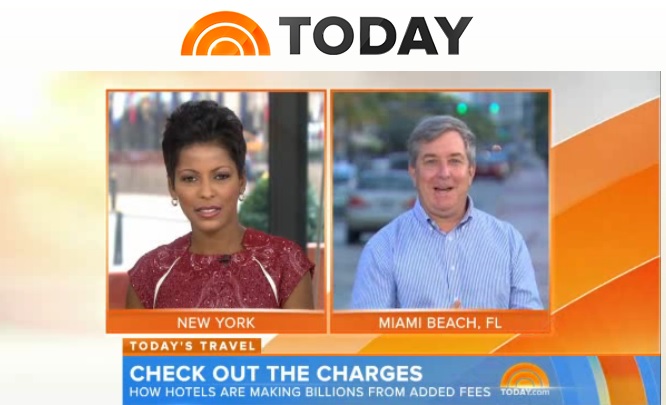
The foregoing news article/VIDEO relates to the middle class in the US. Normally this would not be an issue for the Caribbean to consider except this story is relating the pressures on the customer base that the region relies on for its primary economic driver: tourism.

Plus most Caribbean resorts also apply a “resort fee”.

By: NBC News – The Today Show
How hotels are making billions from added fees – http://www.today.com/video/today/55935286#55935286
Hotels are taking a page from the airline industry, and it’s costing consumers a lot more. The fees added up to $2.5 billion just last year. NBC’s Kerry Sanders reports.

This subject is pivotal in the roadmap for elevation of the Caribbean economy, which maintains that tourism will continue to be the primary economic driver in the region for the foreseeable future. The book Go Lean…Caribbean calls for the elevation of Caribbean society, to re-focus, re-boot, and optimize all the engines of commerce so as to make the Caribbean a better place to live, work and play. The Caribbean has become a playground for the US. So we cannot, indeed we must not ignore the middle class.

What is important in this discussion is the functionality of economic planning. Already the attacks on the middle class has shrunk their disposable income, retirement savings and buying power. We need to continue to monitor the progress of this economic group. This effort (the foregoing VIDEO and the Appendix) is an iteration in this monitoring charter.

The Great Recession came and went. The US lost $11 Trillion in the crisis, then gained $13.5 Trillion in the recovery (Go Lean book Page 69). Unfortunately the ones that lost are not the ones that gained. The world has changed; the middle class has shrunk, the poor has expanded, and the One Percent has expanded in affluence and influence.

So the markets that Caribbean tourism planners cater to have now changed. The Great Recession should have been a lesson enough for the Caribbean to develop a more resilient economy, to be nimble in strategies, tactics and implementation. Unfortunately, the experience (and the following list) shows that the planners are repeating the same mistakes and following the same bad American model. The following are resort fees of what are considered the best properties in the Caribbean, according to the US-based cable TV Travel Channel (http://www.travelchannel.com/interests/beaches/articles/top-10-caribbean-resorts):

Preface: Top 10 Caribbean Resorts

Welcome to paradise. We’re counting down Caribbean resorts with crystal-clear waters, powder-soft sands, sumptuous settings and world-class accommodations. These aren’t your average cookie-cutter beachfront hotels either. These Caribbean hot spots rank among the most luxurious and lavish in the world:

Resort Property

Resort Fee

1

Hyatt Regency, Aruba Resort & Casino

– $0.00 –

2

CaneelBay, St. John, US Virgin Island

10% Service Fee

3

Parrot Cay By Como, Providenciales, Turks and Caicos Islands

– $0.00 –

4

Little Dix Bay, Virgin Gorda, British Virgin Islands

$32.00

5

Beaches Turks & Caicos Resort and Spa, Providenciales

All   Inclusive

6

Ritz-Carlton St. Thomas, St. Thomas, US Virgin Islands

$62.00

7

Four Seasons Resort, Pinney’s Beach, Charlestown, Nevis

$33.85 + $20.00

8

Atlantis, ParadiseIsland, Nassau, Bahamas

$20.70 – $65.95

9

Sandy Lane, St. James, Barbados

– $0.00 –

10

Hotel Maroma, Cancun, Mexico St. Regis Bahia Beach Resort, Puerto Rico

$60.00

According to the foregoing VIDEO and article in the Appendix, there are major issues in the acceptance of hotel resort fees. In the US, complaints have been made to the Federal Trade Commission (FTC), the US watchdog for deceptive business practices. Despite some queries, there has been no definitive regulatory action.

CU Blog - Hotels are making billions from added fees - Photo 2We must do better in the Caribbean. The fear is that these practices may lead more to embrace “cruises” as their mode for enjoying Caribbean shores. This may be how the US middle class “plays” in the Caribbean.

What is wrong with cruises? Nothing … per se. We welcome all visitors that come to the region. As it is, the Go Lean book describes 80 million visitors annually. If there is a preference though, we would choose air-hotel packages as opposed to cruise options. The Go Lean book details that cruise passengers average $237/day in spending while on a cruise ship. Unfortunately, the majority (80%) of that money is spent with the foreign-based cruise line, not in the destination; the port cities get trinkets ($20 – $30 per day) in port-side souvenirs and tours.

Resort hotels in the Caribbean generate a lot of economic activities down the line: airports, taxis, restaurants, casinos, shopping, etc. The strategy employed by cruise lines is to embed most of all these activities on the ship. This difference is not ignored in the Go Lean consideration of Caribbean commerce (Page 61).

This book Go Lean… Caribbean, serves as a roadmap for the introduction and implementation of the technocratic Caribbean Union Trade Federation (CU). The CU/Go Lean roadmap has 3 prime directives:

  • Optimization of the economic engines in order to grow the regional economy to $800 Billion and create 2.2 million new jobs.
  • Establishment of a security apparatus to protect the resultant economic engines and marshal against economic crimes.
  • Improve Caribbean governance to support these engines.

Early in the book, the responsibility of monitoring and managing economic trends were identified as a crucial role of the CU; these statements were pronounced in the Declaration of Interdependence (Pages 13) as follows:

xxiv. Whereas a free market economy can be induced and spurred for continuous progress, the Federation must install the controls to better manage aspects of the economy: jobs, inflation, savings rate, investments and other economic principles. Thereby attracting direct foreign investment because of the stability and vibrancy of our economy.

xxv.  Whereas the legacy of international democracies had been imperiled due to a global financial crisis, the structure of the Federation must allow for financial stability and assurance of the Federation’s institutions. To mandate the economic vibrancy of the region, monetary and fiscal controls and policies must be incorporated as proactive and reactive measures. These measures must address threats against the financial integrity of the Federation and of the member-states.

The Caribbean tourism resort properties depend on their resort amenities. This commentary previously related details of the changing macro-economic factors (like demographics) that are currently affecting the region’s resorts, including amenities like golf and casinos:

https://goleancaribbean.com/blog/?p=1984 Casinos Changing/Failing Business Model
https://goleancaribbean.com/blog/?p=1943 The Future of Golf; Vital for   Tourism
https://goleancaribbean.com/blog/?p=782 Open/Review the Time Capsule: The Great Recession of 2008
https://goleancaribbean.com/blog/?p=273 10 Things We Want from the US and 10 Things We Don’t Want from the US – # 2: Tourists
https://goleancaribbean.com/blog/?p=242 The Erosion of the Middle Class
https://goleancaribbean.com/blog/?p=235 Tourism’s changing profile

Accordingly the tourist industry needs to be cognizant of the changing landscape in world economics; they need to minimize the downward pressure on their product. There needs to be a promoter for Caribbean commerce and a Sentinel for Caribbean image.

Who is up for this challenge? Not the FTC; despite having two Caribbean territories within its scope (Puerto Rico & US Virgin Islands), this agency has “fallen asleep at the switch” in its duty to regulate the markets and mandate a level-playing-field. For the Caribbean (region as a whole) we must perform this function on our own.

This roadmap posits that the Caribbean must not allow the US to lead for our own nation-building. We must step up and step forward for ourselves. We have the means and the methods to better ensure a quality experience to our hotel/resort visitors. The roadmap calls for oversight by an Interstate Commerce Administration within the Commerce Department of the CU. But there is no need for Caribbean hoteliers to fear! This agency will be more of a partner/promoter than that of a regulator. The plan is simple: require non-optional resort fee pricing to be fully disclosed as part of the base hotel rate. Then ensure a level-playing-field for all market participants.

This strategy, tactic and implementation features the heavy-lifting of Caribbean economic reform/reboot. Caribbean tourism is in need of this reform/reboot to attract and return visitors to our shores to enjoy our hospitality. But the interest of our visitors must also be protected, they are also stakeholders in the Caribbean reboot effort. The Go Lean… Caribbean book details the community ethos to adopt to proactively mitigate the dire effects of the changed demographic landscape, plus the executions of these additional strategies, tactics, implementations and advocacies:

Community Ethos – Economic Principle – People Respond to Incentives Page 21
Community Ethos – Economic Principle – Economic Systems Influence Individual Choices Page 21
Community Ethos – Job Multiplier Page 22
Community Ethos – Lean Operations Page 24
Community Ethos – Ways to Impact the Greater Good Page 37
Strategy – Vision – Best Address on the Planet Page 45
Tactical – Fostering a Technocracy Page 64
Tactical – Trade and Globalization Page 70
Separation of Powers – Sports and Culture Administration Page 81
Implementation – Ways to Pay for Change Page 101
Implementation – Ways to Deliver Page 109
Implementation – Ways to Impact Social Media Page 111
Implementation – Ways to Benefit from Globalization Page 119
Planning – Ways to Make the Caribbean Better Page 131
Planning – Lessons Learned from 2008 Page 136
Advocacy – Ways to Grow the Economy Page 151
Advocacy – Ways to Create Jobs Page 152
Anecdote – Butch   Stewart – Sandals Resorts Growth in   Tourism – Responding to  Guests Needs Page 189
Advocacy – Ways to Enhance Tourism Page 190
Advocacy – Ways to Impact Cruise Tourism Page 193
Advocacy – Ways to Foster Technology Page 197
Advocacy – Ways to Foster e-Commerce Page 198
Advocacy – Ways to Help the Middle Class Page 223
Advocacy – Ways to Impact the One Percent Page 224

The book Go Lean…Caribbean purports that the Caribbean is the greatest address in the world and sets on a roadmap to extend the invitation of Caribbean hospitality to not just Americans, but also the rest of the world. In order to appeal to the global market, this roadmap, posits that regional tourism stakeholders must traverse the changing landscape, in which some of the agents-of-change are technology and globalization.

The plan also calls for establishing Trade Mission Offices in divergent cities like Spain and Tokyo for outreach to Mid & Far Eastern markets.

The issues in the foregoing news stories emerged mostly because of the different experiences in booking hotel rooms online and then engaging the resort properties at check-in/check-out.  The roadmap advocates the art and science of using Internet & Communications Technologies and Social Media for bookings, and also for the advertising and selling of Caribbean culture and amenities. The plan is also to monitor and track comments/complaints from online postings – many have complained about being “nickeled-and-dimed” in hotels due to various resort/amenity fees.

With this roadmap, the people (and governing institutions) of the Caribbean step up and declare that we have learned from the lessons of the past; we have streamlined our products/services and we are ready to be the best address for the world to visit, even for those among the middle classes. The Caribbean therefore prepares for a better future, one in which the world recognizes that we are the best place to live, work and play.

Download the book Go Lean … Caribbean – now!

—————————————————————————

APPENDIX

Title: News Article: Resort Fees Explained: How to Spot (and Avoid) Them on Your Next Trip
Source: http://www.huffingtonpost.com/shermans-travel/resort-fees_b_4098716.html

Ah, those pesky resort fees. We’ve all encountered them in our travels, lurking on our hotel bills.

They’ve been around since the 1990s when they were generally utilized to pay for the upkeep of high-end facilities at upscale resorts; the beach clubs and tennis courts, for example. However, in the last five years or so, more and more hotels have been tacking on these annoying — and often spendy — extra charges for considerably lower-end facilities. For example, almost every explanation of these fees we’ve encountered includes such uninspiring “perks” as a newspaper and local phone calls.

According to research by Bjorn Hanson, divisional dean of the PrestonRobertTischCenter for Hospitality, Tourism, and Sports Management at New YorkUniversity, the U.S. hotel industry collected approximately $1.55 billion in fees and surcharges in 2009. Not all of which were resort fees, but you can see how fees and extras add up. Here’s a breakdown of these fees, how they work, when they’re charged, and how you can avoid them.

What is a Resort Fee?

A resort fee is a (usually unadvertised) mandatory fee tacked onto a nightly room rate. Fees can be as low as $3.50 per night at the Clarion Inn & Suites at International Drive, Orlando (they call this one a “safe fee”), to as much as $60 per night for the St. Regis Bahia Beach Resort, Puerto Rico.

A resort fee is almost always a fixed rate that is paid per room, per night, however some of the perks that come with the fee are only good for one person; like the one mai tai per day, per room offered by the Waikiki Beach Resort & Spa ($25 a day), or at Bally’s Las Vegas, where rooms sleep up to four people, but the $18 resort fee only allows two people access to the fitness center.

The things included in your fees run the gamut from the sublime ($25 resort fee applied towards some services at The Spa at the Trump Hotel, Las Vegas) to the ridiculous. Notary service at the Mirage Las Vegas ($25), anyone? But generally, the fee includes amenities such as WiFi, shuttle service, a newspaper, and the in-room phone.

Who Charges a Resort Fee?

You’ll find resort fees are most prevalent in a few specific destinations: Las Vegas, the Caribbean, Florida, and Hawaii. In Las Vegas, you’ll be hard pressed to find a hotel that does not charge a resort fee. The few that haven’t charged a fee in the past – such as Ceasar’s, which even launched a Facebook page at one point that asked visitors to “join the fight against Las Vegas resort fees” — are steadily jumping onto the resort fee bandwagon. From the point of view of the hotel, this is understandable. Why miss out on the extra cash that everyone else is already getting?

A few ski resorts also add resort fees, One   Ski Hill Place in Breckenridge, Colorado, for example, charges $30 a night, and the Viceroy Snowmass, also in Colorado, charges $16 a night.

How Do You Know if Your Hotel Charges a Resort Fee?

Read the fine print before you book. Resort fees tend to be hidden from advertised rates – the rationale presumably being that the site can lure guests in with low room rates before hitting them with an extra fee later. Say you’re searching for a hotel in Las Vegas on a third-party web site. You might see a good deal pop up like this one we found: The Palms Casino Resort for $67 on October 22. However, it’s not until you get to the booking page that you see the resort fee listed ($20 per night); bundled together with the taxes.

Several hotels hide the resort fee from their advertised room rates until you are ready to book; and even then they often do not include the fee in the reservation total, instead running a strip of (literally) fine print saying something like “rate and total room rates do not include the daily resort fee of $22 or applicable taxes.” (That’s taken from the Hard Rock Hotel and Casino, Las Vegas). You usually end up handing over the money at check-in or check-out.

While there’s often an element of surprise with resort fees, hotels have at least become more upfront about them since the FTC sent a letter to 22 hotel operators last year warning that their online rates may have been deceptive and in violation of FTC regulations. If you are still unsure, don’t hesitate to call the hotel before booking to ask exactly how much you will be paying, and for what.

Do You Have to Pay It?

The short answer is yes. There are a few resources available if you’re looking for more detail about resort fees. VegasChatter, for example, keeps an up-to-date list of Las Vegas hotels not charging resort fees (it contains only 11 hotels). There’s also no harm in trying to get the fees waived, especially if you advise management that you have no intention of using the facilities, or if you don’t want a newspaper or WiFi. This is more likely to be successful if you have status with the hotel’s loyalty program, which brings us to our final point…

Do You Earn Points on Resort Fees?

No. The extra money you are paying per night does not go toward your loyalty program status – even more reason to read the fine print, and keep yourself informed.

By
Karen Dion.

Share this post:
, , , ,
[Top]

Students developing nail polish to detect date rape drugs

Go Lean Commentary

CU Blog - Students developing nail polish to detect date rape drugs - Photo

It’s back to school time! For K-12 and colleges. At the tertiary level, it’s time again for all the good, bad and ugly of the college experience.

The issue in the foregoing news article/VIDEO relates more to the ugly side of the college experience, especially for young girls on and near college campuses – sexual violence. But this issue is bigger than just college, date-rape, and university mitigations, this is about human rights.

By: NBC News – The Today Show
A group of male students at North Carolina State University is taking on a problem on campus, developing a nail polish that changes color to indicate the presence of date-rape drugs. NBC’s Gabe Gutierrez reports, as follows:


NBC News – The Today Show – August 26, 2014 –
http://www.today.com/video/today/55935260#55935260

This story is being brought into focus in a consideration of the book Go Lean … Caribbean. The book serves as a roadmap for the introduction and implementation of the technocratic Caribbean Union Trade Federation (CU), for the economic optimization in the region. How does this story relate?

Education
College Campuses
Justice Systems – Bad Actors
Women Rights
The Greater Good

This CU/Go Lean roadmap has 3 prime directives:

  • Optimization of the economic engines in order to grow the regional economy.
  • Establishment of a security apparatus to protect the resultant economic engines.
  • Improve Caribbean governance to support these engines.

The roadmap posits that the economy of the Caribbean is inextricably linked to the security of the Caribbean. The security scope of the CU is mostly focused on the “bad actors” that might emerge to exploit the new Caribbean economic engines. The book also focuses on traditional crime-and-punishment issues. The subject of date rape and sexual violence falls on the member-state side of the separation-of-powers divide, the CU does retain jurisdiction on Self-Governing Entities (SGE’s). A growth strategy of the roadmap is to invite, foster and incubate academic institutions to the region under the SGE scheme. The CU will also feature a jurisdiction of monitoring and metering (ratings, rankings, service levels, etc) the delivery of local governments in their execution of the Social Contract. For these reason, 3-prong focus of the CU prime directive is apropos: economic, security and governing engines.

Change has come to the Caribbean, but as the roadmap depicts, the problem of sexual violence (a human rights abuse) had persisted long before, so there is the need to mitigate recidivism in the region. Who are those most at risk for this behavior, and their victims? What efforts can be implemented to mitigate and protect our citizens, especially young innocent girls, venturing into the brave new world to foster their education and impact their communites.

Remember Natalee Holloway? (See the consideration on Page 190 of the Go Lean book).

“Serve and protect”. This is the new lean Caribbean!

The Go Lean roadmap posits that every woman has a right to a violence-free existence, on campus, in the family and in society; it is reprehensible that in so many Caribbean/Latin countries women are still viewed as lesser beings that can be abused at the whim of men.

What should be done to mitigate these bad practices? How does the Go Lean roadmap address this issue?

The solution in the foregoing VIDEO is “a good start”.

We made this issue personal, and interviewed a College Counselor for Freshman Women in one tertiary school in the Bahamas. (See Appendix).

There needs to be more research and development of more solutions.

This is the charge of the Go Lean…Caribbean roadmap: embrace R&D as a community ethos so as not to accept the status quo – keep moving forward. There are more ethos, strategies, tactics and operational advocacies presented in the Go Lean roadmap as well, so as to ensure that those vulnerable are protected and perpetrators are held accountable for their actions. The following are samples (with page numbers) from the book:

Community Ethos – Privacy –vs- Public Protection Page 23
Community Ethos – Whistleblower Protection Page 23
Community Ethos – Intelligence Gathering Page 23
Community Ethos – Witness Security Page 23
Community Ethos – Anti Bullying & Mitigations Page 23
Community Ethos – Light Up the Dark Places Page 23
Community Ethos – Minority Equalizations Page 24
Community Ethos – Impacting the Greater   Good Page 34
Strategy – Rule of Law –vs- Vigilantism Page 49
Separation of Powers – CariPol Page 77
Implementation – Ways to Pay for Change Page 101
Implementation – Steps to Implement SGE’s Page 105
Ways to Improve Education Page 159
Ways to Better Manage the Social Contract Page 170
Ways to Impact Justice Page 177
Ways to Remediate and Mitigate Crime Page 178
Ways to Improve Gun Control Page 179
Ways to Improve Intelligence Gathering Page 182
Ways to Improve Communications Page 186
Ways to Enhance Tourism – Mitigate Economic Crimes Page 190
Ways to Impact the Prison Industrial Complex – Recidivism Page 211
Ways to Impact Foundations Page 219
Ways to Protect Human Rights Page 220
Ways to Empower Women Page 226
Ways to Impact Youth Page 227
Ways to Impact Persons with Disabilities Page 228

In addition, many related issues/points were elaborated in previous blogs, sampled here:

https://goleancaribbean.com/blog/?p=1634 Book Review: ‘Chasing Youth Culture and Getting It Right’
https://goleancaribbean.com/blog/?p=809 Muslim officials condemn abductions of Nigerian girls
https://goleancaribbean.com/blog/?p=695 Brazil’s abused wives find help by going to ‘Dona Carmen’
https://goleancaribbean.com/blog/?p=392 Jamaica to receive World Bank funds to help in crime fight

For the CU’s deployment of SGE’s, we are front-and center in monitoring, managing and mitigating the issues in this foregoing article/VIDEO. For the Caribbean member-states in general, while the CU does not have sovereignty (its a deputized agency only), it can still provide support services to ensure compliance, accountability and service-level assurances. Yes, in addition to monitoring and metering, the CU can also provide ratings, funding, training, intelligence gathering, and cross border (fugitive) law enforcement.

The goal is simply to make the Caribbean a better place to live work, learn and play; with justice for all, regardless of gender. Simple goal, but heavy-lifting in the execution.

To the Caribbean communities, we say: “Bring it!”

This is not politics or feminism; this is law-and-order. This is just right!

Download the book Go Lean … Caribbean – now!

——————————————————————

Appendix – Interview

Camille Russell-Smith (CRS) is employed at the College of the Bahamas as a Counselor in the Counseling and Health Services Department. She pays it forward. One task among her duties that grabbed our attention is the “Violence in Interpersonal Relationships” workshops she conducts each semester for incoming freshmen.

Here is the interview with the Go Lean…Caribbean publishers (GLC):

GLC: In this day and age, do you find that it is difficult to reach young men and young women on proper behavior with regards to date-acquaintance-rape threats and risks?

CRS: Definitely a challenge exists in getting young people to realize proper attitudes they must have towards each other in order to foster healthy relationships It is important to raise their awareness of how they can easily abuse the rights of others. Further it is important to remind all students, particularly women, of the need to be ever vigilant, not to assume that a friend-date-acquaintance will respect their rights and not take advantage of any vulnerabilities.

GLC: Is there an ongoing problem on your campus with date- acquaintance rape?

CRS: There have been some related incidents between students of the College, though not necessarily on campus. However, I continue to counsel young women on the fallout and consequences of what happens when they go out at night. What I worry about the most is the fact that so many women believe that the rape may be their fault, for example if they went to a bar, but told their family/friends that they were going somewhere benign, like the library. However, the penalty for lying is definitely not being raped.

GLC: How do you hope to mitigate these threats?

CRS: Education, awareness, advocacies. But it is hard. I am going against a “tidal wave” in the other direction. The music, videos, images in the media, makes many young men feel as if they have some sense of entitlement. Then many women feel as if they can only be accepted if they allow, tolerate sexually abusive behavior without “making waves”.

GLC: How do you feel about the innovations in this foregoing VIDEO?

CRS: This innovation of a chemical that can detect the presence of a date-rape drug is a good start. We need more such innovations. The special glass, as mentioned in the foregoing article, sounds like another good innovation. I can imagine that other such developments will come soon.

GLC: What hope do you see for the future in our communities regarding these kinds of attitudes that can lead to unhealthy relationships?

CRS: We need to get our communities to the point that it is commonly accepted that “no means no”. Also, that those prosecuted for sex crimes would not be cuddled or excused and most importantly that women that report crimes would not be shunned. We can be successful. The acceptance in the community has changed regarding domestic violence and I believe that acceptance of date-acquaintance-rape will change also.

GLC: Thank you for your insights. Any final words?

CRS: We must do this. We must try to change our country and the Caribbean region as a whole. There are far too many “old views, old habits, and old philosophies” in our communities where some men think they can ignore the rights of women. Let’s please fix this…once and for all.

Share this post:
, , , , ,
[Top]

Blog # 150 – Why So Long? Can’t We Just…

Go Lean Commentary

CU Blog - Why so long - Can't we just - Photo 1We have now reached a milestone in the publishing of the (sometimes) daily blogs from the publishers of Go Lean…Caribbean, 150 submissions. This is a good time to address a consistent question we’ve gotten from some readers:

Why are the blog commentaries so long?
Can’t you accomplish the same objective with shorter blogs?

This submission here is meant to be a practice in active listening: We hear you! Consider this attribute of  one blog published on August 20, 2014:

3742 words: NYC’s MetroCard – A Model for the Caribbean Dollar – https://goleancaribbean.com/blog/?p=2074

So can we accomplish the same objectives with shorter commentaries? The answer: No!

The question is interpreted by us as “Can’t we just…?”

There is a serious reason why this is the answer: These are serious issues. We cannot, must not skim on the consideration of the solutions.

Our experience has taught us that serious problems require thorough and thoughtful consideration. There is no place for abbreviation in this exercise.

Our experience?

Consider these events from 2008, (a frequent topic of discussion in Go Lean…Caribbean blogs):

Video: Too Big To Fail – 2011 Movie (Pardon the adult language):
YouTube Video Sharing Site (Retrieved 08/20/2014) –
https://www.youtube.com/watch?v=Aqf97p1Rdm0

As the events of September 2008 unfolded where the financial system (Wall Street) was on the brink of collapse, stakeholders from the US Treasury Department assembled a representative body to conceive a remedy.

The resultant plan/proposal was introduced on September 20, by Treasury Secretary Henry Paulson and was later named the Troubled Asset Relief Program (TARP)[a].

The plan/proposal was only three pages long, intentionally short on details to facilitate quick passage by Congress.[b]

The plan called for the U.S. Treasury to acquire up to $700 billion worth of mortgage-backed securities…

… in the end, in an analysis by Bloomberg Business News Source, it was disclosed that the Federal Reserve had, by March 2009, committed $7.77 trillion to rescuing the financial system. This amount is more than half the value of everything produced in the U.S. that year.[c]
Wikipedia Online Encyclopedia Source (Retrieved 08/20/2014) –
http://en.wikipedia.org/wiki/Emergency_Economic_Stabilization_Act_of_2008

So can’t we just…?

The book Go Lean…Caribbean serves as a roadmap for the introduction and implementation of the Caribbean Union Trade Federation (CU) and the Caribbean Central Bank (CCB). This Caribbean empowerment roadmap has 3 prime directives:

  • Optimization of the economic engines in order to grow the regional economy to $800 Billion & create 2.2 million new jobs.
  • Establishment of a security apparatus to protect the resultant economic engines.
  • Improve Caribbean governance to support these engines.

The book described both the CU and CCB as hallmarks of technocracy, a commitment to efficiency and effectiveness. The book itself is 370 pages and covers 144 different missions.

As alluded above, principals in the Go Lean…Caribbean movement were front-and-center in the events that unfurled in 2008.

CU Blog - Why so long - Can't we just - Photo 2

The roadmap was constructed with the ethos to be thorough in the assessment, strategies, tactics, implementation and advocacies to understand the complexities of our time and forge permanent change in the Caribbean region. The following is a sample of these specific details from the book:

Community Ethos – Deferred Gratification Page 21
Community Ethos – Consequences of Choices Lie in the Future Page 21
Community Ethos – Intelligence Gathering Page 23
Community Ethos – “Crap” Happens Page 23
Community Ethos – Lean Operations Page 24
Community Ethos – Ways to Impact the Future Page 26
Strategy – Vision – Confederate 30 Member-States Page 45
Strategy – Missions – 144 Advocacies Page 457
Tactical – Confederating a Permanent Union Page 63
Tactical – Fostering a Technocracy Page 64
Implementation – Ways to Pay for Change Page 101
Implementation – Ways to Deliver Page 109
Planning – 10 Big Ideas for the Caribbean Region Page 127
Planning – Lessons Learned from 2008 Page 136
Planning – Lessons Learned from New York City Page 137
Advocacy – Ways to Grow the Economy Page 151
Advocacy – Ways to Create Jobs Page 152
Advocacy – Reforms for Banking Regulations Page 199
Advocacy – Ways to Impact Wall Street Page 200
Advocacy – Ways to Impact Main Street Page 201
Advocacy – Ways to Impact Hollywood Page 202
Appendix – Credit Ratings Agencies in 2008 Page 276

Imagine following a long complex and detailed recipe for baking a cake. To get the best results, it is important to include all the ingredients and follow the exacting instructions, the more detailed the better.

The quest for Go Lean…Caribbean is not as simple as baking a cake, rather a goal that is so much more important, to make the Caribbean region a better place to live, work and play.

We cannot skim on this effort – too much is at stake!

Download the free e-Book of Go Lean … Caribbean – now!

———————

Appendices:
a.  http://www.nytimes.com/2008/09/21/business/21draftcnd.html?_r=0; retrieved August 20, 2014.
b.  http://content.time.com/time/politics/article/0,8599,1843642,00.html; retrieved August 20, 2014.
c.  Ivry, Bob; Keoun, Bradley; Kuntz, Phil (November 28, 2011). “Secret Fed Loans Gave Banks $13 Billion Undisclosed to Congress”. Bloomberg Markets Magazine. Bloomberg L.P. Retrieved May 14, 2012 from: http://www.bloomberg.com/news/2011-11-28/secret-fed-loans-undisclosed-to-congress-gave-banks-13-billion-in-income.html.


Share this post:
,
[Top]

A Textbook Case of Price-gouging

Go Lean Commentary

Its déjà-vu all over again.

Didn’t we see this before? Yes, just recently as the cause of the Great Recession, where the global economy was brought to the precipice (2008) due to a defective eco-system with American home mortgage financing and servicing. Now, the foregoing VIDEO alludes to a similar “fox in charge of the hen house” scenario – this time with college education textbooks.

Why university books in America are so expensive? (Click ad-supported VIDEO here)

The Economist Magazine (Posted 08-20-2014) –
http://www.economist.com/blogs/graphicdetail/2014/08/daily-chart-11

Textbook Price 1The issue in this VIDEO reflects American Capitalism 101 – not free market economics – where public policy is set to benefit private parties. (This is defined by some as Crony Capitalism). Since many college expenses are subsidized by governments (federal and state) by means of grants or low-interest, deferred student loans, the marketplace knows that governmental entities will pay…unconditionally, so of course prices go up … and up.

The book Go Lean…Caribbean asserts that the Caribbean region must not allow the US to take the lead for our own nation-building, that American capitalistic interest tends to highjack policies intended for the Greater Good.

This assessment applies to the mortgage bubble/crisis of the 2000’s, foreign policy in the Latin America and now to college education textbooks. When will we learn?

The Go Lean book, and accompanying blog commentaries, go even deeper and hypothesize that the traditional American college educated career paths has led to disastrous policies for the Caribbean in whole, and for each specific country in particular. This is a conclusion based on a macro focus, not the micro.

From a micro perspective, college education is great for the individual, enabling them to increase their earning potential in society – every additional year of schooling increases their earnings by about 10%. But on the macro, the Caribbean assimilation of an American college education strategy has been one disaster after another – an incontrovertible brain drain, capital flight of unpaid student loans and illegal immigration.

Now we are learning from this VIDEO, that the American Textbook Publishing schema is designed to take even more of the treasuries from the parents of Caribbean students that are paying tuition, plus room-and-board.

This broken system in America does not have to be tolerated in the Caribbean, anymore. Change has now come. The driver of this change is technology and globalization. The Go Lean book posits that the governmental administrations and educational institutions of the region should invest in alternative higher education options and as much technological educational advances (e-Learning) as possible, for its citizens.

This book Go Lean… Caribbean, serves as a roadmap for the introduction and implementation of the Caribbean Union Trade Federation (CU), which represents change for the region. The CU/Go Lean roadmap has 3 prime directives:

  • Optimization of the economic engines in order to grow the regional economy.
  • Establishment of a security apparatus to protect the resultant economic engines.
  • Improve Caribbean governance to support these engines.

The Go Lean roadmap provides turn-by-turn directions on how to forge this change in the region for a reboot of the Caribbean tertiary education systems, economy, governance and Caribbean society as a whole. This roadmap is presented as a planning tool, pronouncing this point early in the Declaration of Interdependence (Page 12 & 14) with these statements:

xix.      Whereas our legacy in recent times is one of societal abandonment, it is imperative that incentives and encouragement be put in place to first dissuade the human flight, and then entice and welcome the return of our Diaspora back to our shores

xxi.      Whereas the preparation of our labor force can foster opportunities and dictate economic progress for current and future generations, the Federation must ensure that educational and job training opportunities are fully optimized for all residents of all member-states, with no partiality towards any gender or ethnic group. The Federation must recognize and facilitate excellence in many different fields of endeavor, including sciences, languages, arts, music and sports. This responsibility should be executed without incurring the risks of further human flight, as has been the past history.

xxvii.      Whereas the region has endured a spectator status during the Industrial Revolution, we cannot stand on the sidelines of this new economy, the Information Revolution. Rather, the Federation must embrace all the tenets of Internet Communications Technology (ICT) to serve as an equalizing element in competition with the rest of the world. The Federation must bridge the digital divide and promote the community ethos that research/development is valuable and must be promoted and incentivized for adoption.

The Go Lean book posits that even though education is a vital ingredient for Caribbean economic empowerment, there has been a lot of flawed decision-making in the past, both individually and community-wise. The vision of the CU is a confederation of the 30 member-states of the Caribbean to do the heavy-lifting of optimizing educational policies. The Go Lean book details those policies; and other ethos to adopt, plus the executions of the following strategies, tactics, implementations and advocacies to impact the tertiary education in the region:

Community Ethos – Deferred Gratification Page 21
Community Ethos – People Respond to Incentives Page 21
Community Ethos – Job Multiplier Page 22
Community Ethos – Lean Operations Page 24
Community Ethos – Return on Investments (ROI) Page 24
Community Ethos – Ways to Impact the Future Page 26
Community Ethos – Ways to Foster Genius Page 27
Community Ethos – Ways to Promote Intellectual Property Page 29
Community Ethos – Ways to Close the Digital Divide Page 31
Community Ethos – Ways to Improve Sharing – Purchasing Cooperatives Page 35
Community Ethos – Ways to Impact the Greater Good Page 37
Strategy – Agents of Change – Technology Page 57
Strategy – Agents of Change – Globalization Page 57
Tactical – Separation of Powers – Education Department Page 85
Tactical – Separation of Powers – Labor Department – On Job Training Page 89
Implementation – Ways to Pay for Change Page 101
Implementation – Ways to Benefit from Globalization Page 119
Planning – Lessons Learned from 2008 Page 136
Advocacy – Ways to Grow the Economy Page 151
Advocacy – Ways to Create Jobs Page 152
Advocacy – Ways to Improve Education Page 159
Advocacy – Ways to Impact Student Loans Page 160
Advocacy – Ways to Improve Governance Page 169
Advocacy – Ways to Foster Cooperatives Page 176
Advocacy – Ways to Improve Libraries Page 187
Appendix – Education and Economic Growth Page 258
Appendix – Measuring Education Page 266
Appendix – New Student Loan Scandal – Rolling Stone Magazine Page 286

The foregoing video relates to topics that are of serious concern for Caribbean planners. While the US is the world’s largest Single Market economy, we want to only model some of the American example. We want to foster an education agenda that propels the Caribbean’s best interest, not some American special interest group. There are many Go Lean blog commentaries that have echoed this point, addressing the subject of Caribbean education decision-making and ramifications. See sample here:

https://goleancaribbean.com/blog/?p=2126 Where the Jobs Are – Computers Reshaping   Global Job Market
https://goleancaribbean.com/blog/?p=1698 STEM Jobs Are Filling Slowly
https://goleancaribbean.com/blog/?p=1596 Book Review: ‘Prosper Where You Are   Planted’
https://goleancaribbean.com/blog/?p=1470 College of the Bahamas Master Plan 2025 – Reach   for the Lamp-Post
https://goleancaribbean.com/blog/?p=1433 Caribbean   loses more than 70 percent of tertiary educated to brain drain
https://goleancaribbean.com/blog/?p=1256 Traditional 4-year Colleges – Terrible   Investment for Region and Jobs
https://goleancaribbean.com/blog/?p=459 CXC and UK   textbook publisher hosting CCSLC workshops in Barbados
https://goleancaribbean.com/blog/?p=398 Self-employment on the rise in the Caribbean
https://goleancaribbean.com/blog/?p=273 10 Things We Don’t Want from the US – American   Self-Interest Policies

The book Go Lean…Caribbean posits that many problems of the region are too big for any one member-state to solve alone, that there is the need for the technocracy of the Caribbean Union Trade Federation. The purpose of this Go Lean/CU roadmap is to make the Caribbean homeland, a better place to live, work, learn and play. This effort is more than academic, this involves some alleviation of the pain and suffering back in the homeland.

We need jobs, and we need an educated labor-force to facilitate the demands of a competitive world. The roadmap posits that to succeed in the global marketplace, the Caribbean region must not only consume but rather also create, produce, and distribute intellectual property. So subjects like prices of textbooks and e-books are germane for our consideration, (see Appendix below). Plus with tactics like Group Purchasing (GPO), there are effective ways to minimize the associated costs of educating the general population, and specific learning needs.

Textbook Price 2

There is the need for specific skills training – we need more STEM enthusiasts (Science, Technology, Engineering, Math). So the issue, as expressed in the foregoing video, and the remediation as expressed in Go Lean…Caribbean is an important reflection of technocratic problem solving being advocated for the CU.

Now is the time for all of the Caribbean, the people and governing institutions, to lean-in for the changes described in the book Go Lean … Caribbean.

Download the book Go Lean…Caribbean now!

—————————————————————————————————————-

APPENDIX

High Textbook Prices Anecdote #1: (http://www.timesheraldonline.com/news/ci_25464834/throwing-book-at-high-costs-college-textbooks)

Former Napa College student Jena Goodman of Vallejo said student higher education leaders from across California are working to find ways to lighten the financial load of buying textbooks.

“For me, I’ve spent up to $150 for a textbook and as much as $500 to $600 per semester on books,” said Goodman.

High Textbook Prices Anecdote #2: (http://www.theatlantic.com/business/archive/2013/01/why-are-college-textbooks-so-absurdly-expensive/266801/)

According to the National Association of College Stores, the average college student reports paying about $655 for textbooks and supplies annually, down a bit from $702 four years ago. The NACS credits that fall to its efforts to promote used books along with programs that let students rent rather than buy their texts.

Proposed Solution: (http://www.vox.com/2014/8/25/6058017/why-are-college-textbooks-so-expensive)

One [option] is to treat college textbooks more like high school textbooks — a college would purchase the textbooks, then rent them out to students for a fee. That spreads out the cost of materials over multiple years and for multiple students, and makes textbooks cheaper. But to be effective, it also has to work in bulk, which means faculty have to agree on texts to use for their classes.

Another alternative is open educational resources, which are open-source materials available for free that can take the place of textbooks. Peter Thorsness, a University of Wyoming professor [and a father of a first time college student], said upper-level science classes are now more likely to use such materials from the National Institutes of Health. And some researchers think that open educational resources and other online materials are poised to disrupt the textbook market.

Share this post:
, ,
[Top]

Sports Role Model – Turn On the SEC Network

Go Lean Commentary

There is a new religion in the South (United States). It is SEC football. For many in the South, football is life, “everything else is details”. Now, (starting August 28) the SEC adherents can worship 7-24-365 on the SEC Network cable channel. This is a melding of sports, television, southern culture and economics – this is big business – and a religious-like devotion.

The SEC (South East Conference) is the Number 1 (American) football conference in the National Collegiate Athletic Association (NCAA). Their revenues, attendance, championships, NFL draft picks and TV ratings are the best-of-the-best of all other conferences. This last subject is the focus of this commentary: TV ratings and broadcast rights.

Title: Turn On the SEC
By: Jon Saraceno

CU Blog - Sports Role Model - Turn On the SEC - Photo 1In a melding of two powerful sports brands, cable-television behemoth ESPN and the football-crazed Southeastern Conference have joined forces to form the SEC Network, debuting August 14. ESPN Radio host Paul Finebaum, a veteran observer of all things SEC, believes ­audience response will be rabid. That view seems particularly valid given that college football is the unquestioned autumnal king of the South.

“SEC fans are an interesting bunch,” Finebaum observes. “They don’t like being subjected to other leagues [that have TV networks], like the Big Ten or the Pac-12. Now they can say, ‘Nothing else exists but us — the rest of the world can vaporize, for all we care.’ It is as irritating to non-SEC fans as it is pleasing to a son of the South.”

CU Blog - Sports Role Model - Turn On the SEC - Photo 3Finebaum understands the parochialism. The Memphis, Tenn., native worked for three decades in Birmingham, Ala., before relocating to Charlotte, N.C., as the SEC Network’s first on-air hire when ESPN announced the formation of the network last year. The network launches with a well-timed countdown to the start of the 2014 football season. Blastoff is Aug. 28, when Texas A&M travels to South Carolina. Brent Musburger, one of several marquee on-air hires, will call the game. But the SEC Network’s most popular personality might be former Florida Gators quarterback Tim Tebow.

Programming for the 24/7 multiplatform channel will be highlighted by 45 SEC football games. The network also will showcase men’s basketball (an estimated 100 games), women’s basketball (60 games) and baseball (75 games), along with select coverage from the league’s 21 sports. In all, more than 1,000 events will be aired across the network’s digital platform.

Following ESPN’s time-tested formula of bracketing programming and analysis around live events, the SEC Network will televise studio shows and live-event days such as spring football games and national signing day for college-football recruits.

Beyond content, the marriage between ESPN and the conference should be a match made in financial heaven. Disney-owned ESPN expects to reap untold hundreds of millions in advertising revenue during the 20-year deal. Increased exposure and lucrative media rights bode well for all 14 SEC schools.
American Way August 2014 – American Airlines Inflight Magazine –
http://hub.aa.com/en/aw/turn-on-the-sec

CU Blog - Sports Role Model - Turn On the SEC - Photo 2

The Caribbean does not currently have an eco-system for intercollegiate athletics. The book Go Lean…Caribbean, and aligning blog commentaries, asserts that the region can be a better place to live, work and play; that the economy can be grown methodically by embracing progressive strategies in sports at all levels: professional, amateur and intercollegiate.

While the Caribbean may not have the sports business eco-system, we do have the underlying assets: the athletes. The Caribbean supply the world, including the NCAA, with the best-of-the-best in the sports genres of basketball, track-and-field, soccer-FIFA-football and other endeavors. The Go Lean book recognizes and fosters the genius qualifiers of many Caribbean athletes.

The goal now is foster the local eco-system in the homeland so that  those with talent would not have to flee the region to garner the business returns on their athletic investments.

The Go Lean book serves as a roadmap for the introduction and implementation of the Caribbean Union Trade Federation (CU), a technocratic federal government to administer and optimize the economic/security/ governing engines of the region’s 30 member-states. At the outset, the roadmap recognizes the value of sports in the roadmap with these statements in the Declaration of Interdependence (Page 13 & 14):

xxvi. Whereas the preparation of our labor force can foster opportunities and dictate economic progress for current and future generations, the Federation must ensure that educational and job training opportunities are fully optimized for all residents of all member-states, with no partiality towards any gender or ethnic group. The Federation must recognize and facilitate excellence in many different fields of endeavor, including sciences, languages, arts, music and sports. This responsibility should be executed without incurring the risks of further human flight, as has been the past history.

xxxi. Whereas sports have been a source of great pride for the Caribbean region, the economic returns from these ventures have not been evenly distributed as in other societies. The Federation must therefore facilitate the eco-systems and vertical industries of sports as a business, recreation, national pastime and even sports tourism – modeling the Olympics.

The Go Lean roadmap calls for the market organizations to better garner the economic benefits of sports. One of the biggest contribution the CU will make is the facilitation of sports venues: arenas and stadia. Sports can be big business! But even when money is not involved, other benefits abound: educational scholarships, image, national pride, and something more, something non-tangible yet of utmost importance for the Go Lean roadmap: less societal abandonment. A mission of the CU is to reduce the brain drain and incentivize repatriation of the Diaspora.

Another area of the Go Lean economic empowerment roadmap that relates to the foregoing article is the strategy is to create a Single (Media) Market to leverage the value of broadcast rights for the region, the resultant consolidated market would cover 30 member-states, 4 languages and 42 million people. The successful execution of this strategy will elevate the art, science and genius of sport enterprises in the region. Now is the time for all of the Caribbean to lean-in to the following community ethos, strategies, tactics, implementations and advocacies detailed in the book Go Lean … Caribbean to re-boot the delivery of the regional solutions to elevate the Caribbean region through sports:

Community Ethos – People Respond to Incentives in Predictable Ways Page 21
Community Ethos – Return on Investments Page 24
Community Ethos – Ways to Foster Genius Page 27
Community Ethos – Ways to Improve Negotiations Page 32
Community Ethos – Ways to Promote Happiness Page 36
Strategic – Vision – Consolidating the Region in to a Single Market Page 45
Strategic – Staffing – Sporting Events at Fairgrounds Page 55
Tactical – Fostering a Technocracy Page 64
Tactical – Separation of Powers – Sports & Culture Administration Page 81
Tactical – Separation of Powers – Fairgrounds Administration Page 83
Implementation – Steps to Implement Self-Governing Entities (Fairgrounds) Page 105
Implementation – Ways to Deliver Page 109
Planning – Ways to Make the Caribbean Better Page 131
Advocacy – Ways to Grow the Economy Page 151
Advocacy – Ways to Create Jobs Page 152
Advocacy – Ways to Improve Education – Reduce Brain Drain Page 159
Advocacy – Ways to Improve Local Government – Parks & Recreation Page 169
Advocacy – Ways to Impact Events Page 191
Advocacy – Ways to Promote Fairgrounds Page 192
Advocacy – Ways to Foster Technology Expositions Page 197
Advocacy – Ways to Impact Youth Page 227
Advocacy – Ways to Improve Sports Page 229
Advocacy – Ways to Impact Urban Living – Sports Leagues Page 234

The Caribbean is the best-of-the-best address on the planet, but there are certain missing features, such as intercollegiate athletics… and jobs. The foregoing article aligns with this Go Lean…Caribbean roadmap to fill these voids. This effort is bigger than sports; this is about Caribbean life; we must elevate our own society. The CU is the vehicle for this goal, this is detailed by the following 3 prime directives:

  • Optimization of the economic engines in order to grow the regional economy to $800 Billion & create 2.2 million new jobs.
  • Establishment of a security apparatus to protect the resultant economic engines.
  • Improve Caribbean governance to support these engines.

The Go Lean roadmap anticipates 21,000 direct jobs at fairgrounds and sport venues throughout the region; plus 40,000 new jobs by re-optimizing the region’s educational engines, including colleges & universities.

Now is the time for all of the Caribbean, the people and governing institutions, to lean-in for the empowerments of the Caribbean Union Trade Federation. Now is the time to make this region a better place to live, work and play.

Download the book Go Lean…Caribbean now!

APPENDIX – SEC Conference Schools/Teams

CU Blog - Sports Role Model - Turn On the SEC - Photo 4

Share this post:
, , , , ,
[Top]

Cooling Effect – Oceans and the Climate

Go Lean Commentary

Are you smarter than a 5th Grader?

The following is an analysis based on some basic elementary school science. For starters, salt (salinity) has an effect on the absorption of heat – it freezes at a colder temperature (28.4 degrees Fahrenheit) than the 32 degrees for water – salt is thusly the #1 tool for managing snow removal during the winter months in the colder climates. (This dynamic may be unfamiliar to many residents in the Caribbean). When salt is scattered/applied on sidewalks or roads, affected snow would melt … on its own.

Another principle in consideration of this discussion is that Climate Change is mostly associated with Global Warming, and yet, this year (this summer especially in the Northeast US) has been cooler than usual.

So do we have Global Warming or not? Is this a fluke that this summer is cooler than usual? Do we need to prepare for more devastating effects of Climate Change?

Yes, yes and yes!

The book Go Lean…Caribbean calls for the establishment of a regional sentinel to monitor, mitigate and manage the effects of Climate Change on the region’s economic, security and governing engines. This subject is more than just academic for the Caribbean, this affects our life and livelihood. When we get this stewardship wrong, and for 50 years this has been the assessment, we lose out. We have a long track record of losses associated with the perils of Climate Change; consider this sample: Hurricane Andrew (1992 – Bahamas), Hurricane Marilyn (1995 – Virgin Islands), Hurricane Wilma (2005 – Bahamas) and Hurricane Dean (2007 – Belize).

Caribbean losses have not only been property damage and the disruption of commerce. Inevitably, each storm episode created “push” factors for societal abandonment. Then as a community, we lost out on even more economic opportunities associated with the time, talent and treasuries of the Caribbean residents who left – we experienced a brain drain. Today, our “sorry state of affairs” find some regional member-states with an abandonment rate of more than 50% (Puerto Rico and US Virgin Islands) and the absence of more than 70% of college-educated citizens.

While 5th Grade Science is important for this empowerment effort, the book Go Lean … Caribbean is not a book of science; it gleans from scientific concepts in communicating the plan to elevate Caribbean society. The book focuses on economics, and relates that the resultant societal engines can be seriously impacted by climate change-led natural disasters: threats and actual impact. The book thusly serves as a roadmap for the introduction and implementation of the technocratic Caribbean Union Trade Federation (CU). The prime directives of this agency are described as:

  • Optimize the economic engines of the Caribbean to elevate the regional economy to grow to $800 Billion and create 2.2 million new jobs.
  • Establish a security apparatus to protect the resultant economic engines.
  • Improve Caribbean governance to support these engines.

The Go Lean roadmap immediately calls for the establishment of a Homeland Security Department, with an agency to practice the arts and sciences of Emergency Management. The emergencies include natural disasters like hurricanes, earthquakes, tsunamis, volcanoes, flooding, forest fires, and droughts – all now of more frequent occurrences. These types of emergencies should be impacted even further based on the dynamics described in the foregoing article. Emergency Management is not just reactive, it must be proactive as well. This direct correlation of warmer seas and cooling temperatures with the economy, thusly depicts the need for this CU charter and mission:

Title: Davy Jones’s heat locker
Subtitle: The mystery of the pause in global warming may have been solved. The answer seems to lie at the bottom of the sea

CU Blog - Cooling Effect - Oceans and the Climate - Photo 1Over the past few years one of the biggest questions in climate science has been why, since the turn of the century, average surface-air temperatures on Earth have not risen, even though the concentration in the atmosphere of heat-trapping carbon dioxide has continued to go up. This “pause” in global warming has been seized on by those skeptical that humanity needs to act to curb greenhouse-gas emissions or even (in the case of some extreme skeptics) who think that man-made global warming itself is a fantasy. People with a grasp of the law of conservation of energy are, however, skeptical in their turn of these positions and doubt that the pause is such good news. They would rather understand where the missing heat has gone, and why – and thus whether the pause can be expected to continue.

The most likely explanation is that it is hiding in the oceans, which store nine times as much of the sun’s heat as do the atmosphere and land combined. But until this week, descriptions of how the sea might do this have largely come from computer models. Now, thanks to a study published in Science by Chen Xianyao of the Ocean University of China, Qingdao, and Ka-Kit Tung of the University of Washington, Seattle, there are data.

Dr Chen and Dr Tung have shown where exactly in the sea the missing heat is lurking. As the left-hand chart below shows, over the past decade and a bit the ocean depths have been warming faster than the surface. This period corresponds perfectly with the pause, and contrasts with the last two decades of the 20th century, when the surface was warming faster than the deep. The authors calculate that, between 1999 and 2012, 69 zettajoules of heat (that is, 69 x 1011 joules—a huge amount of energy) have been sequestered in the oceans between 300 metres and 1,500 metres down. If it had not been so sequestered, they think, there would have been no pause in warming at the surface.

Hidden depths
The two researchers draw this conclusion from observations collected by 3,000 floats launched by Argo, an international scientific collaboration. These measure the temperature and salinity of the top 2,000 metres of the world’s oceans. In general, their readings match the models’ predictions. But one of the specifics is weird.

Most workers in the field have assumed the Pacific Ocean would be the biggest heat sink, since it is the largest body of water. A study published in Nature in 2013 by Yu Kosaka and Shang-Ping Xie of the Scripps Institution of Oceanography, in San Diego, argued that cooling in the eastern Pacific explained most of the difference between actual temperatures and models of the climate that predict continuous warming. Dr Chen’s and Dr Tung’s research, though, suggests it is the Atlantic (see middle chart) and the Southern Ocean that are doing the sequestering. The Pacific (right-hand chart), and also the Indian Ocean, contribute nothing this way—for surface and deepwater temperatures in both have risen in parallel since 1999.

This has an intriguing implication. Because the Pacific has previously been thought of as the world’s main heat sink, fluctuations affecting it are considered among the most important influences upon the climate. During episodes called El Niño, for example, warm water from its west sloshes eastward over the cooler surface layer there, warming the atmosphere. Kevin Trenberth of America’s National Centre for Atmospheric Research has suggested that a strong Niño could produce a jump in surface-air temperatures and herald the end of the pause. Earlier this summer, a strong Niño was indeed forecast, though the chances of this happening seem to have receded recently.

But if Dr Chen and Dr Tung are right, then the fluctuations in the Atlantic may be more important. In this ocean, saltier tropical water tends to move towards the poles (surface water at the tropics is especially saline because of greater evaporation). As it travels it cools and sinks, carrying its heat into the depths—but not before melting polar ice, which makes the surface water less dense, fresh water being lighter than brine. This fresher water has the effect of slowing the poleward movement of tropical water, moderating heat sequestration. It is not clear precisely how this mechanism is changing so as to send heat farther into the depths. But changing it presumably is.

Understanding that variation is the next task. The process of sequestration must reverse itself at some point, since otherwise the ocean depths would end up hotter than the surface—an unsustainable outcome. And when it does, global warming will resume.

CU Blog - Cooling Effect - Oceans and the Climate - Photo 2

A lot is at stake with this consideration. Our economic drivers in the region – tourism and fisheries – depend on the strength of the Caribbean climate compared to other parts of the world. If change is coming to our climate, then we must be front-and-center in the planning of the mitigations and responses.

The Go Lean book posits that Climate Change is wreaking havoc on Caribbean life now, for the potential for even more harm in the future. This point is pronounced early in the book with this Declaration of Interdependence (Page 11), with this opening statement:

i.     Whereas the earth’s climate has undeniably changed resulting in more severe tropical weather storms, it is necessary to prepare to insure the safety and security of life, property and systems of commerce in our geographical region. As nature recognizes no borders in the target of its destruction, we also must set aside border considerations in the preparation and response to these weather challenges.

To counteract the changes in nature, the Go Lean book advocates the immediate confederation of the 30 member-states into a Trade Federation with the tools/techniques to bring immediate change to the region to benefit one and all member-states. This includes the monitoring/studying of the dynamics of Climate Change. The region’s total population is only 42 million, compared to the whole world’s 6 Billion. We may not be able to change the world’s habits and practices that may exacerbate Climate Change – we must still try – but we can better prepare our homeland for nature’s onslaughts. The empowered CU agencies must therefore liaise with non-governmental organizations (NGOs) and foreign entities with the similar scope to monitor, mitigate and manage the causes-and-effects of oceans warming/cooling trends.

The book details that we must first adopt a community ethos, the appropriate attitude/spirit, to forge change in our region. Go Lean details this and other ethos; plus the executions of the following strategies, tactics, implementations and advocacies to better impact the region’s response (& preparation) for Climate Change:

Community Ethos – Economic Systems Influence Individual Choices Page 21
Community Ethos – “Crap” Happens Page 23
Community Ethos – Lean Operations Page 24
Community Ethos – Cooperatives Page 24
Community Ethos – Non-Government Organizations Page 25
Community Ethos – Ways to Improve Sharing Page 35
Community Ethos – Impact the Greater Good Page 37
Strategy – Vision – Single Market & Economy Page 45
Strategy – Mission – Prepare for Natural Disasters Page 45
Strategy – Agents of Change – Climate Change Page 57
Tactical – Confederating a Permanent Union Page 63
Tactical – Fostering a Technocracy Page 64
Separation of Powers – Emergency Management Page 76
Separation of Powers – Meteorological & Geological Service Page 79
Implementation – Ways to Pay for Change Page 101
Implementation – Security Initiatives at Start-up Page 103
Implementation – Ways to Deliver Page 109
Implementation – Ways to Benefit from Globalization Page 119
Planning – Ways to Measure Progress Page 148
Advocacy – Ways to Grow the Economy Page 151
Advocacy – Ways to Create Jobs Page 152
Advocacy – Ways to Improve Governance Page 168
Advocacy – Ways to Better Manage the Social Contract Page 170
Advocacy – Ways to Foster Cooperatives Page 176
Advocacy – Ways to Improve for Natural Disasters Page 184
Advocacy – Ways to Ways to Enhance Tourism in the Region Page 190
Advocacy – Ways to Improve Emergency Management Page 196
Advocacy – Ways to Improve Fisheries Page 210
Appendix – History of Puerto Rican Migration to US Page 303
Appendix – US Virgin Islands Economic Timeline Page 305

Change has come to the Caribbean.

The foregoing news article discusses the threats of warming oceans and cooler temperatures. This is today’s issue. New issues will emerge tomorrow and the days after. This establishes that there is a need for a permanent union – a sentinel – to provide efficient stewardship for Caribbean economy, security and governing engines.

The Go Lean…Caribbean posits that the problems of the region are too big for just any one member-state to tackle, there is the need for a regional solution, a regional sentinel. The Caribbean Union Trade Federation submits for this job to be the Caribbean sentinel for the issues, conditions and threats of Climate Change. The people and institutions of the region are hereby urged to lean-in to this Go Lean roadmap, to embrace these changes to make the Caribbean a better place to live, work and play.

At the time of this writing, it is 76 degrees in the peak of a mid-summer day in Philadelphia. It should be 96 degrees. The weather forecast for parts of Montana is a winter weather advisory during the next 24 hours, usually it would be 90 degrees. Despite the detractors and naysayers to Climate Change, something is wrong! Even a 5th Grader can discern this.


Share this post:
, ,
[Top]