Category: Social

Welcoming the Caribbean Intelligentsia

Go Lean Commentary

Who knew?

    … the Caribbean has an Intelligentsia?

Well blow me away with a whisper! This fact is surprising new information for this movement behind the book Go Lean … Caribbean

    … and we should know as we “wrote the book” on the Caribbean.

So there are college degree programs at universities in North America that cover the subject matter of “Caribbean Studies”. This would normally include the sociology, anthropology and historicity of the region; its people, traditions, culture, institutions and industries.

    Big question mark on that last one!

It’s hard to think that there may be intelligent people studying the Caribbean industrial and economic eco-system and their credentials are not scorned in academic circles.

The truth is, the Caribbean is devoid of so much smart out-workings – there are many societal defects – that it’s hard to think there is an intelligentsia for this region:

in·tel·li·gent·si·a
noun

  1. Google: intellectuals or highly educated people as a group, especially when regarded as possessing culture and political influence.
  2. Merriam-Webster: intellectuals who form an artistic, social, or political vanguard or elite.

The opening assessment in the Go Lean book explained that there is undoubtedly a Caribbean geographical region; but there is no unified Caribbean society or culture. Rather there is crisis; there are 30 disjointed, unorganized member-states rimming the Caribbean Sea that has no universal leverage, comradery nor brotherhood. Even the Bible says:

Two are better than one because they have a good return for their labor. 10 For if either of them falls, the one will lift up his companion. But woe to the one who falls when there is not another to lift him up. 11 Furthermore, if two lie down together they keep warm, but how can one be warm alone? 12 And if one can overpower him who is alone, two can resist him. A cord of three strands is not quickly torn apart. – Ecclesiastes 4: 9-12

So for any existing Caribbean intelligentsia in the status quo, it must be for English-speaking territories alone, or Dutch-speaking alone (minus Suriname), or French-speaking alone (minus Haiti), or Spanish-speaking (though there is no unity even among those 3 countries: Cuba, Dominican Republic and Puerto Rico).

It is time now for a change; for the emergence of a Caribbean intelligentsia for all of the Caribbean, for all 30 member-states.

The book Go Lean…Caribbean – available to download for free – serves as a roadmap for the introduction and implementation of the technocratic Caribbean Union Trade Federation (CU), for the elevation of all Caribbean society – for all 30 member-states in all 4 language groups. This CU/Go Lean roadmap has these 3 prime directives:

  • Optimization of the economic engines in order to grow the regional economy to $800 Billion and create 2.2 million jobs.
  • Establishment of a security apparatus to ensure public safety and protect the resultant economic engines.
  • Improve Caribbean governance to support these engines, including a separation-of-powers between the member-states and CU federal agencies.

The book stresses that Caribbean societal engines must be reformed and transformed at a regional level. This shows the need for an intelligentsia influence on Caribbean society. This was an early motivation for the roadmap, as pronounced in the opening Declaration of Interdependence (Pages 12 – 13):

xi. Whereas all men are entitled to the benefits of good governance in a free society, “new guards” must be enacted to dissuade the emergence of incompetence, corruption, nepotism and cronyism at the peril of the people’s best interest. The Federation must guarantee the executions of a social contract between government and the governed.

xii. Whereas the legacy in recent times in individual states may be that of ineffectual governance with no redress to higher authority, the accedence of this Federation will ensure accountability and escalation of the human and civil rights of the people for good governance, justice assurances, due process and the rule of law. As such, any threats of a “failed state” status for any member state must enact emergency measures on behalf of the Federation to protect the human, civil and property rights of the citizens, residents, allies, trading partners, and visitors of the affected member state and the Federation as a whole.

xvi. Whereas security of our homeland is inextricably linked to prosperity of the homeland, the economic and security interest of the region needs to be aligned under the same governance. Since economic crimes … can imperil the functioning of the wheels of commerce for all the citizenry, the accedence of this Federation must equip the security apparatus with the tools and techniques for predictive and proactive interdictions.

xxiv. Whereas a free market economy can be induced and spurred for continuous progress, the Federation must install the controls to better manage aspects of the economy: jobs, inflation, savings rate, investments and other economic principles. Thereby attracting direct foreign investment because of the stability and vibrancy of our economy.

There is the need for a Caribbean Intelligentsia. This normally includes:

  • Think Tanks
  • Advisory Councils
  • Standards Organizations
  • Community Development Foundations
  • Organized Philanthropists
  • Non-Government social agencies

There have been so many expressions of intelligence-lacking practices (Stupidity, Orthodoxy and even Rent-Seeking) in Caribbean society that influence and guidance from well-educated, intelligent stakeholders need to be encouraged.

The Go Lean book provides 370-pages of turn-by-turn instructions on “how” to adopt new community ethos, plus the strategies, tactics, implementations and advocacies to execute so as to reboot, reform and transform the societal engines of Caribbean society: economics, security and governance. Intelligence-lacking practices can be found in all these three spheres of society.

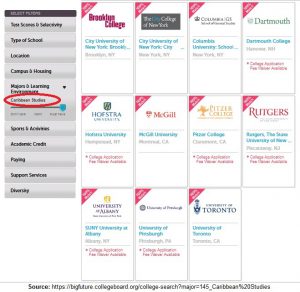
So teach away, all you colleges and universities, identified here from the online resource website CollegeBoard.org; (and learn more about the College Board in the Appendix VIDEO below):

College Search: Caribbean Studies

11 results

City University of New York: Brooklyn College

Brooklyn, NY

City University of New York: City College

New York, NY

Columbia University: School of General Studies

New York, NY

Dartmouth College

Hanover, NH

College Application Fee Waiver Available

Hofstra University

Hempstead, NY

College Application Fee Waiver Available

McGill University

Montreal, CA

Pitzer College

Claremont, CA

College Application Fee Waiver Available

Rutgers, The State University of New Jersey: New Brunswick/Piscataway Campus

Piscataway, NJ

College Application Fee Waiver Available

SUNY University at Albany

Albany, NY

College Application Fee Waiver Available

University of Pittsburgh

Pittsburgh, PA

College Application Fee Waiver Available

University of Toronto

Toronto, CA

Source: Retrieved January 11, 2018 from: https://bigfuture.collegeboard.org/college-search?major=145_Caribbean%20Studies

So we entreat you universities … to teach your ‘Caribbean Studies’; and then lets apply the teachings – the arts and the sciences – the scientific methods and technocratic best practices.

See how the Go Lean book considers specific plans, excerpts and headlines for the objective of Fostering a Technocracy; this is found in the book on Page 64:

Fostering a Technocracy

1 Lean-in for the Caribbean Single Market
This CU treaty calls for a technocratic confederation of the Caribbean region into a Single Market of 30 member-states and 42 million people. The term technocracy was originally used to designate the application of the scientific method to solving social & economic problems, in counter distinction to the traditional political or philosophic approaches. The CU must start as a technocratic confederation – a Trade Federation – rather than evolving to this eventuality due to some Failed-State status or insolvency.
2 Economists & Engineers – not Lawyers nor Politicians

The concept of a technocracy remains mostly hypothetical, though some nations have been considered as such in the sense of being governed primarily by technical experts in various fields of governmental decision-making. A technocrat has come to mean either ‘a member of a powerful technical elite’, or ‘someone who advocates the supremacy of technical experts’. Scientists, engineers, economists, and technologists, who have knowledge, expertise, or skills, would compose the governing body, instead of politicians and businesspeople. In a technocracy, decision makers would be selected based upon how knowledgeable and skillful they are in their fields. Even the leaders of the Communist Party of China are mostly professional engineers. The Five-Year plans of the People’s Republic of China have enabled them to plan ahead in a technocratic fashion to build projects such as the National Trunk Highway System, the High-speed rail system, and the Three Gorges Dam.

3 Professional Emergency Managers

The CU treaty calls for a collective security agreement for the Caribbean member-states to prepare-respond to natural disasters, emergency incidents and assuage against systemic threats against the homeland. The CU employs the professional arts and sciences of Emergency Management to spread the costs and risks across the entire region. Outside of hurricanes or earthquakes, the emergency scope includes medical trauma, pandemic incidents and   industrial accidents (i.e. oil or chemical spills) – any scenario that can impact the continuity of the economic engines and/or community.

4 Apolitical – Loved by All
5 Model of Constitutional Monarchy
6 Constitutional Mandates – Supporting Democracy

The Nobel Prize winning Public Choice Theory posits that public stakeholders (politicians & bureaucrats), tend to act in their own self-interest. The CU, in true technocratic fashion, will codify constitutional mandates (ie. lottery/school funding).

7 Balance Budget Constraints
8 Federal Civil Service – Guarantee Fair Treatment
9 Service Level Agreements

The CU is a proxy organization, chartered to execute deputized functions on behalf of member-states; this means a task-oriented philosophy with “Service Level Agreements” in place; i.e. 80% of all phone calls answered within 20 seconds.

10 ITIL – Systematic Assurances

The formal ITIL (Information Technology Infrastructure Library) discipline is the art/science that describes processes, procedures, tasks, and checklists for managing risks associated with information technology deployments, to ensure the optimal uptime. This includes the CU’s Continuity & Availability Management, Change Control & Release Management.

The Go Lean roadmap seeks to assuage the societal defects in the Caribbean region. This means identifying, qualifying and engaging curative strategies and tactics. This is a familiar theme for this Go Lean movement; the charter of the organization is to function as an Intelligentsia Group unto itself. Consider here, some previous blog-commentaries that have highlighted organizations, best-practices and new community attitudes, all under a consistent theme of the “Role of the Intelligentsia“. See the sample of prior submissions here:

https://goleancaribbean.com/blog/?p=13890 Role of Intelligentsia: We Need to Talk and Collaborate on Solutions
https://goleancaribbean.com/blog/?p=13524 Role of Intelligentsia: Future Focused – e-Government Portal 101
https://goleancaribbean.com/blog/?p=13321 Role of Intelligentsia: Making a Pluralistic Multilingual Democracy
https://goleancaribbean.com/blog/?p=12949 Role of Intelligentsia: Grow Up Already for Charity Management:
https://goleancaribbean.com/blog/?p=12621 Role of Intelligentsia: ‘If it is going to be, it starts with me’
https://goleancaribbean.com/blog/?p=11812 Role of Intelligentsia: Planning for Hope and Change
https://goleancaribbean.com/blog/?p=11759 Role of Intelligentsia: Understand the Market, Plan the …
https://goleancaribbean.com/blog/?p=11598 Role of Intelligentsia: Give us your Time, Talent and Treasuries
https://goleancaribbean.com/blog/?p=11358 Role of Intelligentsia: Preparing for the Inevitable Retail Apocalypse
https://goleancaribbean.com/blog/?p=10351 Role of Intelligentsia: ‘Culture Eats Strategy For Breakfast’
https://goleancaribbean.com/blog/?p=10166 Role of Intelligentsia: Looking Back at the Obama Years
https://goleancaribbean.com/blog/?p=9428 Role of Intelligentsia: Forging Change with a Herd Mentality
https://goleancaribbean.com/blog/?p=7769 Role of Intelligentsia: Being Lean – Asking the Question ‘Why’ 5 Times
https://goleancaribbean.com/blog/?p=7646 Role of Intelligentsia: Going from ‘Good to Great’
https://goleancaribbean.com/blog/?p=6341 Role of Intelligentsia: Tourism Stewardship
https://goleancaribbean.com/blog/?p=2709 Role of Intelligentsia: Caribbean Academic Study: Boy-Girl ‘Discipline’

Having educated individuals in society is good for society … and good for the individuals – see Appendix VIDEO below. These ones eventually make up the intelligentsia. If put to use this intelligentsia can be a source for good.

It was shocking and unbelievable that there is supposed to be a Caribbean Intelligentsia, individuals or groups studying the Caribbean’s past and planning the future. This can easily become the role-responsibilities of today’s students matriculating in the field of ‘Caribbean Studies’. They are out there! So let’s be shocked no more. The message to the people of the Caribbean region henceforth is that the Caribbean’s past is not necessarily condemned to be the Caribbean’s future.

Change has come! The CU will do the “heavy-lifting” to effect change, to implement agile/lean methodologies in the region, in the member-states and in the new federal agencies. Welcome to a  technocracy!

Now is the time for all Caribbean stakeholders – residents, Diaspora, businesses and institutions – to lean-in for the optimizations and empowerments described in the book Go Lean … Caribbean. Yes, we can make the region a better homeland to live, work and play. 🙂

Download the free e-Book of Go Lean … Caribbean – now!

Sign the petition to lean-in for this roadmap for the Caribbean Union Trade Federation. 

———–

Appendix VIDEO – Five Ways Education Pays: Having a college degree means a richer life in every way!https://youtu.be/spNDLD2KRuA

The College Board
Published on Nov 28, 2011 – For most students who go to college, the increase in their lifetime earnings far outweighs the costs of their education. That’s a powerful argument for college. But more income is by no means the only positive outcome students can expect. Learn about all the ways that a college degree can transform your life and lifestyle for the better!

  • Category: Education 
  • License: Standard YouTube License


Share this post:
,

Haiti – Beauty ‘Only a Mother Can Love’

Go Lean Commentary

The Caribbean is among the most beautiful addresses on the planet.

Consider the tropical islands, coastal beaches, waterscapes, flora, fauna, etc.

This is true among most of the Caribbean member-states in the region …

… Haiti, not included! (Just yet! Stay tuned!)

While this country has some beautiful terrain, poverty and mis-management has sullied a lot of its natural beauty. In some places, Haiti is a land where “only a mother can love”.

Yet still, many mothers have stepped in, stepped up and are showing love to this land!

May we all be inspired by their examples. Consider the news story in this article here:

Title: These Haitian women were doing great in U.S. — and then returned to aid quake-hit nation

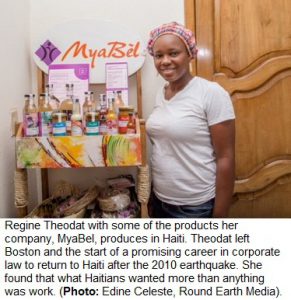
Croix-Des-Bouquets, Haiti — Regine Theodat had just passed the bar exam and at 25 years old was beginning a promising, if predictable, career in U.S. corporate law. She went to work, to spin class, home and to bed.

“Wake up and repeat,” she recalled. “I was very much a corporate lawyer — very strait-laced; not very adventurous.”

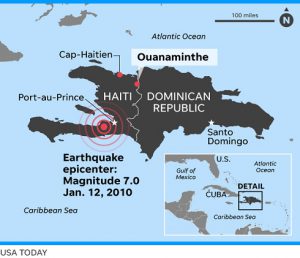
Then on Jan. 12, 2010, a magnitude-7.0 earthquake struck Haiti, killing hundreds of thousands of people. And the child of immigrants who left Haiti for greater opportunities did something shocking. She traded her comfortable life in Boston for the chaos of the poorest country in the Americas.

Aid groups and volunteers from around the world also poured into Haiti. Most have left. But eight years later, Theodat is still here.

She is among a small army, most of them women, who returned to Haiti and started businesses. Theodat makes food and cocktails. Another woman supplies castor oil beauty products to North American stores, including Whole Foods. Some of the others sell fruit smoothies, jewelry and chocolate.
More Haitians may soon be returning from the U.S., but not voluntarily. The Trump administration announced in November that “temporary protected status” for 59,000 Haitians will end in 2019. Many will have limited opportunities back home. VIDEO

What’s more, remittances make up almost a third of Haiti’s GDP, so for each person deported, several local people suffer. For those with education, drive and money, however, moving back is a chance to create jobs and help change practices that many believe perpetuate poverty.

Family members thought Theodat was insane for going back to a country they’d left in the 1980s.

“They said, ‘She’ll be back. The first demonstration that happens, she’ll be back. The first rocks she sees thrown, she’ll be back,’” she said. She has indeed seen a lot, but she has stayed.

Theodat spent her first year running a human rights clinic, until she found out that Haitians really wanted something else. “People kept asking me for jobs,” she said.

So she teamed up with two collaborators from her human right work, including a man she later married. They launched MyaBèl, a restaurant and cocktail bar in Croix-des-Bouquets, the hometown of Theodat’s family located northeast of Port-au-Prince.

Then they started bottling drinks and sauces in a middle-class house on a dirt side street and began a farm to supply fresh ingredients.

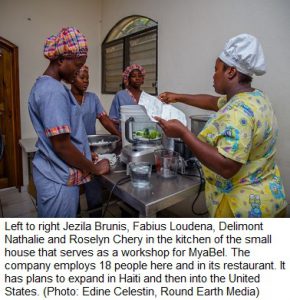
MyaBèl now sells products at more than a dozen Haitian supermarkets and boutiques. It employs 18 people and works with 65 farmers. This year, Theodat was nominated for an entrepreneur of the year award.

Jezila Brunis, 37, a single mother of three, makes minimum wage, about $5.50 a day, in the workshop. She’s able to send her children to school, and she likes the process of washing and chopping ingredients, feeding them into mixers and cooking them on a stove-top. “I’m always learning new things,” she said.
Even paying the minimum is a challenge because other costs — generators, fuel, imports and wear-and-tear on vehicles — are extremely high, Theodat said. Hiring and managing people is difficult because so few held jobs before, and they often fail to do basics, such as keeping kitchen doors closed, getting to work on time and finishing tasks quickly. Five out of the restaurant’s original six employees lost their jobs.

Most Haitians subsist in part on farms or work informally, so unemployment is hard to measure. But the World Bank says almost 60% of Haiti’s 11 million people live in poverty. In May, the insurance company FM Global rated Haiti the worst place to do business among 130 countries it studied.

Theodat came face-to-face with endemic corruption the first time she went to pay taxes. She was told she needed to pay someone to speed up the process. “I refused,” she said. “And then I just sat there until I was able to do it the way I was supposed to do it.” She did the same with immigration and customs.

Some of the émigrés couldn’t cut it. “They came, they tried, Haiti pummeled them, and they left,” said Isabelle Clérié, who came home to work with local entrepreneurs after studying anthropology in the U.S. “Some were able to stick it out, and through some truly big challenges.”

“One of the most valuable exports from Haiti is our brains,” she said. “It’s been really great to see these people come back.”

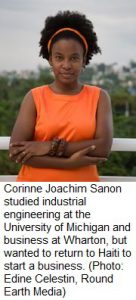
Unlike Theodat, Corinne Joachim Sanon long planned to start a business in Haiti. She grew up in Port-au-Prince, graduated from high school at 16 and headed to the University of Michigan to study industrial engineering. She was in Wharton’s business program when the earthquake struck, destroying her family home and killing her grandmother.

She launched Askanya, Haiti’s first bean-to-bar chocolate company, in her grandmother’s childhood home in Ouanaminthe, a town on the border with the Dominican Republic. The company works with cacao and sugar cooperatives representing more than 3,000 growers and employs 10 people full time.

One of them is Jocelyne Diomètre, 34, who had been a maid in the Dominican Republic and hated the hassle of crossing the border every day. At Askanya, she is working in her own country for the first time.

Askanya sells bars at scores of locations across Haiti and the U.S. Boosted by recognition at festivals in Seattle and Paris, Joachim Sanon is looking to expand production and double its number of growers.

MyaBèl is also growing, clearing and planting more than 30 acres of idle land. It is planning to hire local people to make machines for the workshop. Theodat said the company must increase production to meet local demand and then start exporting to the U.S., creating more jobs.

Theodat and Joachim Sanon know that returning émigrés can’t end poverty in Haiti. “I don’t think I’m going to go to bed and wake up and Haiti is going to be totally different,” Theodat said.

Refusing to take part in corruption might result in incremental change. Theodat also believes the more collaborative style of émigrés has been rubbing off on their local counterparts.

Joachim Sanon is encouraged that a Haitian company is now competing with Askanya by selling high-end chocolate bars. “Sometimes you want to see someone else succeed first before you try to put your toe in the water,” she said.

“It’s definitely changing the image of Haiti,” she said. “It creates a momentum.”

—–
Contributing: Michel Joseph. 

This story was produced in association with Round Earth Media, which trains and supports young journalists around the world.

Source: USA Today – Posted December 22, 2017; retrieved January 9, 2017 from:

https://www.usatoday.com/story/news/world/2017/12/22/these-haitian-women-were-doing-great-u-s-and-then-returned-aid-quake-hit-nation/938639001/ 

Related: Trump administration to send Haiti earthquake victims home in 2019 – See Appendix VIDEO below.

This commentary is about Haiti’s community re-development, jobs, image and pride. Plus the “Sheroes” who are transforming the country!

This foregoing article aligns with the movement behind the book Go Lean…Caribbean – available to download for free. The movement double-downs on the homeland; it advocates for the Caribbean Diaspora – like the above “Sheroes” – to return to their communities and for in-country residents to not leave in the first place. While no society is perfect anywhere in the world, the Go Lean book posits that the Caribbean is easier to reform and transform. Plus the inherent beauty of the islands, coastal states, cultures and hospitality makes the heavy-lifting to transform our community worth all the effort and sacrifice.

There is no doubt that Haiti has seen a lot of dysfunction; the country flirts with Failed-State status. But change is afoot – see A Supplication for Haiti in the Appendix below – here comes that change: “New Guards”. The Go Lean book serves as a roadmap for the introduction and implementation of the technocratic Caribbean Union Trade Federation (CU), for the elevation of Caribbean society – New Guards for all member-states. This CU/Go Lean roadmap has these 3 prime directives:

  • Optimization of the economic engines in order to grow the regional economy to $800 Billion and create 2.2 million new jobs. One strategy is to deploy industrial campuses, work-yards and job-sites as Self-Governing Entities (SGE’s).
  • Establishment of a security apparatus to protect the resultant economic engines, especially on the SGE’s.
  • Improve Caribbean governance to support these engines, including a separation-of-powers between the member-states and CU federal agencies. This allows for Self-Governing Entities independent of Haiti’s local government. Yippee!!!

The book stresses that reforming and transforming the Caribbean societal engines must be a regional pursuit. This was an early motivation for the roadmap, as pronounced in the opening Declaration of Interdependence (Pages 12 – 13):

xi. Whereas all men are entitled to the benefits of good governance in a free society, “new guards” must be enacted to dissuade the emergence of incompetence, corruption, nepotism and cronyism at the peril of the people’s best interest. The Federation must guarantee the executions of a social contract between government and the governed.

xii.  Whereas the legacy in recent times in individual states may be that of ineffectual governance with no redress to higher authority, the accedence of this Federation will ensure accountability and escalation of the human and civil rights of the people for good governance, justice assurances, due process and the rule of law. As such, any threats of a “failed state” status for any member state must enact emergency measures on behalf of the Federation to protect the human, civil and property rights of the citizens, residents, allies, trading partners, and visitors of the affected member state and the Federation as a whole.

xiii. Whereas the legacy of dissensions in many member-states (for example: Haiti and Cuba) will require a concerted effort to integrate the exile community’s repatriation, the Federation must arrange for Reconciliation Commissions to satiate a demand for justice.

xix. Whereas our legacy in recent times is one of societal abandonment, it is imperative that incentives and encouragement be put in place to first dissuade the human flight, and then entice and welcome the return of our Diaspora back to our shores. This repatriation should be effected with the appropriate guards so as not to imperil the lives and securities of the repatriated citizens or the communities they inhabit. The right of repatriation is to be extended to any natural born citizens despite any previous naturalization to foreign sovereignties.

xxiv. Whereas a free market economy can be induced and spurred for continuous progress, the Federation must install the controls to better manage aspects of the economy: jobs, inflation, savings rate, investments and other economic principles. Thereby attracting direct foreign investment because of the stability and vibrancy of our economy.

The Go Lean book provides 370-pages of turn-by-turn instructions on “how” to adopt new community ethos, plus the strategies, tactics, implementations and advocacies to execute so as to reboot, reform and transform the societal engines of Caribbean society. One advocacy is the deployment of Self-Governing Entities – industrial sites though physically located in a member-state, like Haiti, actually administered by agencies of the CU Federation (Page 105). Another advocacy is the Reboot of Haiti. The book posits that solutions for the Caribbean must first come from the Caribbean. Therefore, the roadmap calls for a Caribbean-styled Marshall Plan. (A similar advocacy is provided for Cuba). See this definition here, from Page 238:

The Bottom Line on the Marshall Plan

By the end of World War II much of Europe was devastated. The Marshall Plan, (officially the European Recovery Program, ERP), named after the then Secretary of State and retired general George Marshall, was the American program to aid Europe where the United States gave monetary support to help rebuild European economies after the end of the war. During the four years (1948 – 1952) that the plan was operational, US $13 billion in economic and technical assistance was given to help the recovery of the European countries. The plan looked to the future, and did not focus on the destruction caused by the war.

Much more important were efforts to modernize European industrial and business practices using high-efficiency American models, reduce artificial trade barriers, and instill a sense of hope and self-reliance. By 1952 as the funding ended, the economy of every participant state had surpassed pre-war levels; for all Marshall Plan recipients, output in 1951 was at least 35% higher than in 1938. Over the next two decades, Western Europe enjoyed unprecedented growth and prosperity. Generally, economists agree that the Marshall Plan was one of the first elements of European integration, as it erased trade barriers and set up institutions to coordinate the economy on a continental level—that is, it stimulated the total political reconstruction of Western Europe.

Today, the European Union, the latest successor of the integration effort, is the world largest integrated economy.

Consider too some specific plans, excerpts and headlines for the objective of engaging the Marshall Plan concept for Haiti; this too is found in the book on Page 238, entitled:

10 Ways to Reboot Haiti

1 Lean-in for the Caribbean Single Market
This regional re-boot will allow for the unification of the region into one market, thereby creating a single economy of 30 member-states, 42 million people and a GDP of over $800 Billion. Following the model of European integration, the CU will be the representative and negotiating body for Haiti and the entire region for all trade and security issues.
2 Marshall Plan for Haiti

Haiti is the poorest nation in the Western Hemisphere. But what they have is impassioned human capital as opposed to financial capital or valuable minerals. The CU is a total economic reboot for this country, one that involves developing internally and not thru emigration. To reboot Haiti will require a mini-Marshall Plan. The infrastructure, for the most part, is archaic compared to modern societies. The engines of the CU will enable a rapid upgrade of the infra-structure and some “low hanging fruit” for returns on the investment.

3 Leap Frog Philosophy

There is no need to move Haiti’s technology infrastructure baseline from the 1960’s, then to the 1970’s, and so on. Rather, the CU’s vision is to move Haiti to where technology is going, not coming from. This includes advanced urban planning concepts like electrified light-rail, prefab house constructions, alternative energies and e-delivery of governmental services and payment systems.

4 Repatriation and Reconciliation of the Haitian Diaspora
5 Access to Capital Markets
6 National Historic Places
7 World Heritage Sites
8 Labor, Immigration and Movement of People
The recovery plan for Haiti would discourage the emigration of the population. Haiti has a population base (10 million) that can imperil other islands if too many Haitians relocate within the Caribbean. As a result, the CU will expend the resources and facilitate the campaign to dissuade relocation for the first 10 years of the ascension of the CU [Treaty]. During these first 10 years, Haitians visiting other CU member states, with Visa’s, with careful monitoring to ensure compliance.
9 Educational Mandates

Whereas the CU educational facilitation is satisfied at the secondary level, there will be a greater need for Adult Education in Haiti. Because of the decades of poverty, illiteracy is more dire in Haiti than in other CU state. There will be no age limitation for the educational opportunities. The macro-economic principle is “every year of education raises a country’s GDP”; this will allow for easy pickings of the economic “low hanging fruit”.

10 Language Neutrality of the Union … French and Creole

According to the foregoing news article, a big concern for Haiti is the lack of jobs – the article cited a 60 percent poverty/unemployment rate. The Go Lean roadmap seeks to assuage this economic challenge by the facilitation of formal jobs and informal gigs, especially on the Self-Governing Entity job sites. Welcome to the Gig Economy

A gig economy is an environment in which temporary positions are common and organizations contract with independent workers for short-term engagements. The trend toward a gig economy has begun. A study by financial systems company, Intuit, predicted that by 2020, 40 percent of American workers would be independent contractors. – Source

We can ride this trend in the Caribbean as well. Haiti would be perfectly suited. Consider here, how the Go Lean movement identified many opportunities and expressions of the Gig Economy in these previous blog-commentaries:

https://goleancaribbean.com/blog/?p=13420 Lessons on Gigs from the History of Whaling Expedition
https://goleancaribbean.com/blog/?p=8262 UberEverything in Africa – Model of Gigs
https://goleancaribbean.com/blog/?p=6129 Lessons Learned from US Migrant Farm Workers on Seasonal Gigs
https://goleancaribbean.com/blog/?p=4145 Gigs for Eco-Tourism and World Heritage Sites
https://goleancaribbean.com/blog/?p=2857 Gig Economy Model – Entrepreneurism in Junk
https://goleancaribbean.com/blog/?p=2571 AirBnB Gig Economy Options Materializing
https://goleancaribbean.com/blog/?p=2003 Ship-breaking – One Job/Gig Scenario
https://goleancaribbean.com/blog/?p=1364 Uber Gigs Backlash Shows the Community Impact

Jobs in the Gig Economy are counted in the Go Lean roadmap as these are direct jobs; there is also the reality of indirect jobs – unrelated service and attendant functions – at a 3.75 multiplier rate would add even more to the job-creation effort.

According to the foregoing news article, there are many women in Haiti that have given a full measure to impact their communities and foster new jobs and economic activities. Such good news! How blessed they are:

The Lord gives the word; the women who announce the good news are a great host – English Standard Version

We urge all Caribbean stakeholders to lean-in to this roadmap to make the homeland a better place to live, work and play. 🙂

Download the free e-Book of Go Lean … Caribbean – now!

Sign the petition to lean-in for this roadmap for the Caribbean Union Trade Federation.

————

Appendix – Poem: A Supplication for Haiti!

Here’s my supplication for my brothers and sisters of Haiti:

Do not beg people to love you.
If you are successful in your begging,
it will not be love that you get, it will be pity!

Do you want to be pitied … as an individual?

Do you want to be pitied as a community; do you want to be pitied as a country?

This is most apropos on the heels of America ending her charity towards you – below. Yet, do not beg!

You do not want to be pitied by the world. You want to be honored by the world … for showing your proud heritage, as the progenitor of freedom for the New World.

Show them your pride. Show them your dignity.

————

Appendix VIDEO – US Ending Temporary Permits for Haitians – https://www.usatoday.com/videos/news/nation/2017/11/21/u.s.-ending-temporary-permits-haitians/107896498/

AP Nov. 21, 2017 – The Trump administration said Monday it is ending a temporary residency permit program that has allowed almost 60,000 citizens from Haiti to live and work in the United States since a 2010. Haitian advocates quickly criticized the decision.

Share this post:
, , ,
[Top]

Blog # 700 – We Need to Talk!

Go Lean Commentary

Hello, to those of you who live in and/or love the Caribbean, we have to make this urgent plea:

We need to talk …

This is a familiar advocacy from the movement behind the book Go Lean…Caribbean – available to download for free. The book declares that the Caribbean is in crisis, and opens with this sad disposition (Page 3):

There is something wrong in the Caribbean. It is the greatest address in the world for its 4 language groups, but instead of the world “beating a path” to these doors, the people of the Caribbean have “beat down their doors” to get out. For some Caribbean countries, their population has declined or been flat for the last 3 decades. This is only possible if despite new births and the absence of war, people are fleeing. This scenario, human flight, is a constant threat to prosperity for all the Caribbean despite their colonial legacies. Our youth, the next generation, may not be inspired to participate in the future workings of their country; they may measure success only by their exodus from their Caribbean homeland.

Today is January 5, 2018, as the rest of North America dips into a deep freeze – Winter Storm Grayson – the expectation should have been that the Caribbean would be a refuge. But sadly, we have to conclude that “all is not well in the sunny Caribbean“.

No, our dire situation depicts our wonderful Caribbean cultures flirting with failure, abandonment and extinction. Consider these highlights of island communities that have had to contend with failure and extinction:

  • Sad Puerto Rico, despite American power and prosperity, this US Territory is between a “rock and a hard-place” after Hurricane Maria this past season. More and more residents are now fleeing the island on a daily basis, justifiably so.
  • There are no guarantees that communities, countries and nations will survive. Just this past year, the twin-island nation of Antigua and Barbuda evacuated Barbuda – it is a twin-island nation no more.
  • The Pacific island nation of Kiribati has engaged a plan to evacuate the whole country and relocate to a foreign land – in a few generations Kiribati citizenship will cease to exist.
  • A few years ago, a volcano eruption in Montserrat led to the near-evacuation – a ghost-town – of the whole island.

Once again, no guarantees exist for the future. We reap what we sow.

In order to secure a future, communities must do the heavy-lifting to reform and transform their societal engines. So to you Caribbean people, the entreaty is:

We need to talk …

We need to consider some solutions that can bring us from the precipice of extinction to forge a new future. We need to talk about the workable strategies, tactics and implementations to reach this goal.

There had been some plans in the past, that failed to launch viable solutions:

  • There was the West Indies Federation among the Anglophone Caribbean. It failed after 4 years. (At one point there was talk of integrating the British Caribbean possessions into Canada as overseas territories, much like Hawaii is to the United States).
  • There was the renewed attempt for integration with the formal Caribbean Community organization, but its failures are so evident that now there is even talk of the EU funding a study to consider CariCom’s dissolution.

No, we need to talk about a newer, better plan, a roadmap to finally elevate Caribbean communities, all Caribbean communities – all 30 member-states in the geographic region. This is the thrust of the Go Lean book …

The Go Lean book therefore serves as a roadmap for the introduction and implementation of the technocratic Caribbean Union Trade Federation (CU), for the elevation of Caribbean society; this is a Way Forward for all member-states. This CU/Go Lean roadmap has these 3 prime directives:

  • Optimization of the economic engines in order to grow the regional economy to $800 Billion and create 2.2 million new jobs.
  • Establishment of a security apparatus to ensure public safety and protect the resultant economic engines.
  • Improve Caribbean governance to support these engines, with one stewardship among all Caribbean member-states despite the colonial heritage of American, British, Dutch, French or Spanish.

The book stresses that reforming and transforming the Caribbean societal engines must be a regional pursuit. This was an early motivation for the roadmap, as pronounced in the opening Declaration of Interdependence (Pages 12 – 13):

xi. Whereas all men are entitled to the benefits of good governance in a free society, “new guards” must be enacted to dissuade the emergence of incompetence, corruption, nepotism and cronyism at the peril of the people’s best interest. The Federation must guarantee the executions of a social contract between government and the governed.

xvi. Whereas security of our homeland is inextricably linked to prosperity of the homeland, the economic and security interest of the region needs to be aligned under the same governance. Since economic crimes … can imperil the functioning of the wheels of commerce for all the citizenry, the accedence of this Federation must equip the security apparatus with the tools and techniques for predictive and proactive interdictions.

xxiv. Whereas a free market economy can be induced and spurred for continuous progress, the Federation must install the controls to better manage aspects of the economy: jobs, inflation, savings rate, investments and other economic principles. Thereby attracting direct foreign investment because of the stability and vibrancy of our economy.

So the Caribbean needs to talk … about our current assessments and how we can move forward. The “talk” we need to have is really collaborative problem-solving. Just how do we conduct this “talk”?

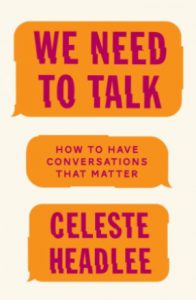
A new book by radio-journalist Celeste Headlee gives us some suggestions. See the Book Review here and an accompanying Ted Talk VIDEO that follows:

Book Title: “WE NEED TO TALK” by Celeste Headlee
Sub-title: How to Have Conversations That Matter

In this urgent and insightful book, public radio journalist Celeste Headlee shows us how to bridge what divides us–by having real conversations. (BASED ON THE TED TALK WITH OVER 10 MILLION VIEWS)

NPR’s Best Books of 2017

“We Need to Talk is an important read for a conversationally-challenged, disconnected age. Headlee is a talented, honest storyteller, and her advice has helped me become a better spouse, friend, and mother.”  (Jessica Lahey, author of New York Times bestseller The Gift of Failure)

Today most of us communicate from behind electronic screens, and studies show that Americans feel less connected and more divided than ever before. The blame for some of this disconnect can be attributed to our political landscape, but the erosion of our conversational skills as a society lies with us as individuals.

And the only way forward, says Headlee, is to start talking to each other. In We Need to Talk, she outlines the strategies that have made her a better conversationalist—and offers simple tools that can improve anyone’s communication. For example:

  • BE THERE OR GO ELSEWHERE. Human beings are incapable of multitasking, and this is especially true of tasks that involve language. Think you can type up a few emails while on a business call, or hold a conversation with your child while texting your spouse? Think again.
  • CHECK YOUR BIAS. The belief that your intelligence protects you from erroneous assumptions can end up making you more vulnerable to them. We all have blind spots that affect the way we view others. Check your bias before you judge someone else.
  • HIDE YOUR PHONE. Don’t just put down your phone, put it away. New research suggests that the mere presence of a cell phone can negatively impact the quality of a conversation.

Whether you’re struggling to communicate with your kid’s teacher at school, an employee at work, or the people you love the most — Headlee offers smart strategies that can help us all have conversations that matter.

Source: Retrieved January 4, 2018 from: https://www.amazon.com/We-Need-Talk-Conversations-Matter/dp/0062669001/ref=sr_1_1?s=books&ie=UTF8&qid=1515111400&sr=1-1&keywords=we+need+to+talk

Biography
Celeste Headlee is the host of the daily news show On Second Thought on Georgia Public Broadcasting. She has spent more than a decade with National Public Radio and has been a host for Public Radio International since 2008. Celeste has appeared on CNN, the BBC, PBS, and MSNBC. She’s also a classically trained soprano who doesn’t get enough time to sing anymore. She has one son and one rescue dog, and lives in Atlanta, Georgia. <<< Photo 2 >>>
Source: Retrieved January 4, 2018 from: https://www.harpercollins.com/9780062669001/we-need-to-talk

———–

VIDEO – 10 ways to have a better conversation | Celeste Headlee – https://youtu.be/R1vskiVDwl4

TED
Published on Mar 8, 2016 – When your job hinges on how well you talk to people, you learn a lot about how to have conversations — and that most of us don’t converse very well. Celeste Headlee has worked as a radio host for decades, and she knows the ingredients of a great conversation: Honesty, brevity, clarity and a healthy amount of listening. In this insightful talk, she shares 10 useful rules for having better conversations. “Go out, talk to people, listen to people,” she says. “And, most importantly, be prepared to be amazed.”
TEDTalks is a daily video podcast of the best talks and performances from the TED Conference, where the world’s leading thinkers and doers give the talk of their lives in 18 minutes (or less). Look for talks on Technology, Entertainment and Design — plus science, business, global issues, the arts and much more.

Find closed captions and translated subtitles in many languages at http://www.ted.com/translate

Follow TED news on Twitter: http://www.twitter.com/tednews

Like TED on Facebook: https://www.facebook.com/TED

Subscribe to our channel: http://www.youtube.com/user/TEDtalksD…

This foregoing Book Review describes this global deficiency of talking-and-listening from an American perspective. But the need for collaborative problem-solving is really location agnostic. This is because America has problems; the Caribbean has problems; the whole world has problems. We need to come together and work towards assuaging our problems, yet the only way forward, says Headlee, is to start talking to each other.

The Go Lean book provides a Way Forward, 370-pages of turn-by-turn instructions on “how” to adopt new community ethos, plus the strategies, tactics, implementations and advocacies to execute so as to reboot, reform and transform the societal engines of Caribbean society.

This is Blog # 700, a major milestone within this Go Lean movement for the Caribbean Union Trade Federation. Over the years, the concept of a Way Forward for the universal Caribbean has been explored in other previous Go Lean blog-commentaries; see sample here:

https://goleancaribbean.com/blog/?p=12416 Conscientizing – Talking about Solutions – on the Radio
https://goleancaribbean.com/blog/?p=12274 State of the Union – Spanish Caribbean
https://goleancaribbean.com/blog/?p=11812 State of the Union – Hope and Change
https://goleancaribbean.com/blog/?p=11544 State of the Union – Need for Collective Bargaining
https://goleancaribbean.com/blog/?p=10554 State of the Union – French Caribbean Seeking Integration
https://goleancaribbean.com/blog/?p=4551 State of the Union – US Territories
https://goleancaribbean.com/blog/?p=4263 State of the Union – Aruba and Dutch Territories
https://goleancaribbean.com/blog/?p=3956 Art and Science of Collaboration

Now is the time for all of the Caribbean – the people in all the islands and coastal states and those in the Diaspora – to lean-in for this collaborative effort, the integrated Caribbean Union Trade Federation.

We can do this. We can all talk … and collaborate and conceive solutions to our regional problems. We can make our Caribbean homeland a better place to live, work and play. 🙂

Download the free e-book of Go Lean … Caribbean – now!

Sign the petition to lean-in for this roadmap for the Caribbean Union Trade Federation.

Share this post:
, , ,
[Top]

Managing ‘Change’ in California

Go Lean Commentary

This is a Big Deal

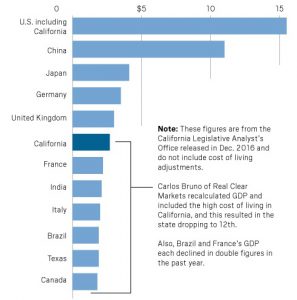
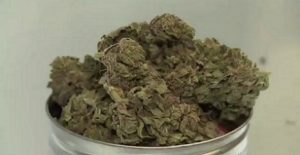
California, the biggest state in the Union (USA) – #6 GDP if ranked as an independent country – has enacted legislation to legitimize recreational marijuana use. Wow, what a ‘change’ to manage! That’s 37 million people, millions of cars and billions of dollars. The implementation of this New Order will surely be heavy-lifting.

For the Caribbean, let’s pay more than the usual attention for lessons learned for our own Big Deal implementation. See the VIDEO on California’s challenge here:

VIDEO – California residents line up to buy recreational marijuana – https://www.today.com/video/california-residents-line-up-to-buy-recreational-marijuana-1127548995762


Posted January 2, 2018 – Vendors in The Golden State began selling recreational marijuana legally on Monday, a milestone moment in the push to legalize marijuana across the country. NBC’s Jacob Soboroff has the report for TODAY from Los Angeles.

Again, California is managing the ‘change’ of implementing the legalization of recreational marijuana use, while the Caribbean needs to implement a roadmap to forge change in its societal engines (economics, security and governance) for the 30 member-states of our region.

The book Go Lean…Caribbean – available to download for free – serves as a roadmap for the introduction and implementation of the technocratic Caribbean Union Trade Federation (CU), for the elevation of Caribbean society – for all member-states. This CU/Go Lean roadmap has these 3 prime directives:
  • Optimization of the economic engines in order to grow the regional economy to $800 Billion and create 2.2 million new jobs.
  • Establishment of a security apparatus to ensure public safety and protect the resultant economic engines.
  • Improve Caribbean governance to support these engines, including a separation-of-powers between the member-states and CU federal agencies.

The State of California is taking on the heavy-lifting of this marijuana legalization while the US federal government continues to consider the drug as illegal. But California is NOT the first state; that distinction belongs to Colorado. The movement behind the Go Lean book has explored Colorado and observed-and-reported on the societal developments there. Notice these main points from a previous blog-commentary entitled – Lessons from Colorado: Legalized Marijuana: Heavy-lifting! – from August 17, 2017:

… in 2017, the phrase “Rocky Mountain High” has a total different meaning, because the State of Colorado has since legalized recreational use of marijuana.

This is not an easy topic; this is heavy …

There are so many lessons we can learn from the debate, legalization, implementation and regulation of this product in this State. All in all, it is heavy-lifting. This is the theme of this series of commentaries of lessons that have been learned by Caribbean stakeholders visiting, observing and reporting on the US State of Colorado.

We have so much in common and so much in contrast. One commonality to consider is how Colorado is now associated with marijuana consumption. …

“Welcome to our club”! This has always been the image of Caribbean people and culture – think: Rasta Man smoking Ganja.

California … Colorado … other states to follow, according to another previous blog-commentary after the last American General Election on November 8, 2016. That submission was entitled – Time to Go: American Vices; Don’t Follow and quoted:

Marijuana legalization is now the norm for 40 percent of the American population. …
Voter measures [passed] in Massachusetts and Nevada. Maine’s referendum was still being counted early Wednesday morning, and Arizona’s was poised to lose. Three other states passed medical marijuana reforms, and a fourth appeared likely to do so. This means that in eight states (plus Washington, D.C.) weed will be legal for recreational purposes, and in sum, 28 will have some kind of legalization on the books.

There will be a lot of security and governing dynamics that these states – like California – will now have to manage, since the process will decriminalize marijuana use, after a long history of criminalization. This is a BIG DEAL considering that many people may be in a penal status – active or parole – for marijuana use or trafficking. Wow, indeed; this is a BIG transformation!

This point too, was addressed in a previous blog-commentary entitled – Marijuana in Jamaica – ‘Puff Peace’:

There are moral, religious, legal and psychological (treatment) issues associated with this topic; and there is history – good and bad. Any jurisdiction decriminalizing the use of marijuana has to contend with the previous messaging to the community of: “Just say no to drugs”.

The [Go Lean] book asserts that before the strategies, tactics, implementations and advocacies of a roadmap to elevate a society can be deployed, the affected society must first embrace a progressive community ethos. The book defines this “community ethos” as the fundamental character or spirit of a culture; the underlying sentiment that informs the beliefs, customs, or practices of society; dominant assumptions of a people or period. Think of the derivative term: “work ethic”.

Marijuana is a mood-altering drug; it has negative effects, one being preponderance for apathy, to tune out of any active engagement. In the US, even in the states where marijuana is legal, most firms/governments still screen staffers (new hires and veterans) and ban consumption of the drug. The reason is simple: Apathy does not make for industriousness.

The Go Lean book provides 370-pages of turn-by-turn instructions on “how” to adopt new community ethos, plus the strategies, tactics, implementations and advocacies to execute so as to transform the societal engines of Caribbean society, regarding the whole drug eco-system. The Go Lean book asserts that every community has bad actors, and with a more liberal-progressive attitude towards a once-illegal drug, community attitudes must be paramount. There must be “new guards” to assuage any threats from this practice on society. This point is pronounced early in the book with the Declaration of Interdependence (Pages 12 – 13) that claims:

x. Whereas we are surrounded and allied to nations of larger proportions in land mass, populations, and treasuries, elements in their societies may have ill-intent in their pursuits, at the expense of the safety and security of our citizens. We must therefore appoint new guards to ensure our public safety and threats against our society, both domestic and foreign. The Federation must employ the latest advances and best practices of criminology and penology to assuage continuous threats against public safety. The Federation must allow for facilitations of detention for [domestic and foreign] convicted felons of federal crimes, and should over-build prisons to house trustees from other jurisdictions.

xi. Whereas all men are entitled to the benefits of good governance in a free society, “new guards” must be enacted to dissuade the emergence of incompetence, corruption, nepotism and cronyism at the peril of the people’s best interest. The Federation must guarantee the executions of a social contract between government and the governed.

xvi. Whereas security of our homeland is inextricably linked to prosperity of the homeland, the economic and security interest of the region needs to be aligned under the same governance. Since economic crimes, including piracy and other forms of terrorism, can imperil the functioning of the wheels of commerce for all the citizenry, the accedence of this Federation must equip the security apparatus with the tools and techniques for predictive and proactive interdictions.

So legalizing marijuana in the BIG market of California will be about more than just managing change, it will also be about managing risks. The Go Lean book relates that managing risk is more than just “One Act”, there is lengthy, engaged process (Page 76):

  • Education
  • Mentoring
  • Monitoring
  • Mitigation
  • Licensing
  • Coordination

Let’s see how this process goes for California. While this state’s independent streak has made it a “maverick” among the other American states – see Independence Movement detailed in this previous blog – this effort with marijuana may be “biting off more than they can chew”. This is truly a BIG DEAL!

We need to pay attention, as there are parallels for California compared to the full Caribbean:

This writer, having lived in California for 10 years, can conclude that California wants the same thing that the Caribbean wants (or should want): to be an elevated society; to be a better homeland, a better place to live, work and play. 🙂

Let’s observe-and-report on these California’s developments and manifestations, their successes and failures.

Download the free e-Book of Go Lean … Caribbean – now!

Sign the petition to lean-in for this roadmap for the Caribbean Union Trade Federation.

Share this post:
, ,
[Top]

2017 Review – Mr. Trump shows the ‘Wrong Way’

Go Lean Commentary

The year 2017 is coming to a close. This was the first year of the federal administration of the 45th President of the United States, the non-politician, billionaire real estate developer Donald J. Trump. In retrospect, it has been a “year of Biblical proportions”, one to lament. While we thought 2016 was bad, and it was, its “wow oh wow” for 2017 …

… if the summary of 2017 was named after one of the 66 books of the Bible, it would not be Revelations, nor Exodus. No, it would be:

Lamentations
The Bible book of Lamentations reveals how God viewed the ancient City of Jerusalem and the land of Judah after their enemy, the Kingdom of Babylon under Nebuchadnezzar, burned the city and laid the land desolate in the year 607 BC. The expressions of acknowledgment of sin recorded therein make it clear that from God’s standpoint, the reason for the calamity was the error of the people. – Source.

We can now look back and lament the happenings of 2017.

While this year 2017 has been a cliffhanger, it has been perfect for the stewards of a new Caribbean. The new President – Donald Trump – proved the “perfect example of what NOT to do” to elevate society – economics, security and governing engines. Yet, this is the country that so many Caribbean people have fled to. We can learn a lot from America’s accomplishments, and even more from their failures. See the satirical recaps in these VIDEO’s, here and the Appendix. 🙂

We can now look back, lament and laugh at the happenings of 2017, see here:

VIDEO – Stephen’s Greetings: 2017 Late Show Year In Review – https://youtu.be/E9VkweYGTwU


The Late Show with Stephen Colbert

Published on Dec 4, 2017 – 2017 was rough for a lot of people, but here’s proof that it wasn’t a total wash. See some of Stephen Colbert’s best moments from The Late Show this year.

Subscribe To “The Late Show” Channel HERE: http://bit.ly/ColbertYouTube

For more content from “The Late Show with Stephen Colbert”, click HERE: http://bit.ly/1AKISnR 

This commentary is presented by the movement behind the book Go Lean…Caribbean. The movement – book and accompanying blog-commentaries – relates that the United States of America should be lamented and not considered a refuge for the people of the Caribbean – the “grass is not greener on the other side”. The book laments the fact that despite residing in the best address on the planet, many of our people “beat down their doors” to get out (Page 3), and emigrate to the US and other countries.

Why do people leave such an idyllic place? The book identifies a series of reasons, classified as “push and pull” factors:

“Pull”, on the one hand refers to the lure of a more prosperous life abroad; many times our people are emigrating for economics solely.

“Push” refers to people who feel compelled to leave, to seek refuge in a foreign land. “Refuge” is an appropriate word; because of societal defects, many from the Caribbean must leave as refugees – think LGBTDisabilityDomestic-abuseMedically-challenged – for their life, liberty and pursuit of happiness.

Surely, fleeing to the US must be likened to “jumping out of the frying pan into the fire”. Remember, this country was not built for the Caribbean’s Black-and-Brown. They continue to experience racial discriminations, despite a recent Black President.

Here are some snippets from this 2017 Caribbean Yearbook against the backdrop of Trump’s exhortations; (this is just a sample in chronological order – from January 2017 to today):

Religious Intolerance – Trump banned travel from 6 Muslim countries

Fostering Discord – California wants out!  They have started a petition to secede from Tump’s America

Collaboration Flaws – Disinterest in Others  (Non-Americans) – Trumps yawns at the Caribbean’s priorities

Disparaging Messaging to Tourists/Visitors – Arrivals and Revenues down from some countries

Rejection of Evidence – Climate Change Denial – Paris Accords Withdrawal

Climate of Hate fostered by Trump – White Supremacists / Disdain of Immigrants

America First – Prioritization as World Leader downplayed – Other countries lose respect

Supply-side Economics Failures manifested in Kansas

Selective Law-and-Order Enforcement – Under Trump, Civil Rights cases downplayed

Claim to Ignorance on Natural Disasters – Who Knew?

Disdain of Female Empowerment – Female dissidents “diss-ed” by Trump; think Hillary, Pocahontas, etc.

Hurricane Response and Competence – Puerto Rico versus Texas – Black-and-Brown gets less

Societal Defects of Gun Culture – Trumps calls Black-and-Brown Shooters Terrorist, but silent on Whites

Aversion to Trade Agreements – Trump undermined TPP, NAFTA and others

Trump’s Compassion Exhaustion – Ending ‘Temporary Protection Status’ to Haitian Refugees

Sexual Harassment Complicity – Trump’s accusers re-emerged

Take from the Poor; Give to the Rich – Trump’s Tax Reform law

Surely, it is the conclusion of most people that 2017 has proven that America is not working for Caribbean priorities …

… they are not even working for their own priorities, as the country under Trump seems more and more divided with the President only supported by 33 percent of the people, the other 67% are outraged – see VIDEO in the Appendix below – i.e. the majority of the population are middle class, yet yesterday’s passage of the Tax Reform bill only benefits the rich.

Proudly, we say that for our societal elevation efforts, the quest of the Go Lean … Caribbean movement: we do not want to be America, we want to be better.

The Go Lean book – available for free download – does not only complain or lament America, but also prescribes a Way Forward for the Caribbean:

Way Forward – an action, plan etc. that seems a good idea because it is likely to lead to success; i.e.:

  • A way forward lies in developing more economic links.
  • This treatment may be the way forward for many inherited disorders.

Source: Retrieved December 22, 2016 from: http://www.ldoceonline.com/dictionary/a-the-way-forward

The Go Lean book serves as a roadmap for the introduction and implementation of the technocratic Caribbean Union Trade Federation (CU), for the elevation of Caribbean society. This CU/Go Lean roadmap has these 3 prime directives:

This Go Lean movement (book and accompanying blogs) does not look to President Donald Trump to lead for the Caribbean; we look to lead ourselves. To our chagrin, so many of our citizens have previously fled the homeland for American shores. But now …

we want them back!

The Go Lean book does not ignore these “push and pull” factors that cause our Caribbean people to leave in the first place. No, the book stresses (early at Page 13) the need to be on-guard for “push” factors in these Declaration of Interdependence statements:

xix. Whereas our legacy in recent times is one of societal abandonment, it is imperative that incentives and encouragement be put in place to first dissuade the human flight, and then entice and welcome the return of our Diaspora back to our shores. This repatriation should be effected with the appropriate guards so as not to imperil the lives and securities of the repatriated citizens or the communities they inhabit. The right of repatriation is to be extended to any natural born citizens despite any previous naturalization to foreign sovereignties.

xxi. Whereas the preparation of our labor force can foster opportunities and dictate economic progress for current and future generations, the Federation must ensure that educational and job training opportunities are fully optimized for all residents of all member-states, with no partiality towards any gender or ethnic group. The Federation must recognize and facilitate excellence in many different fields of endeavor, including sciences, languages, arts, music and sports. This responsibility should be executed without incurring the risks of further human flight, as has been the past history.

xxvi. Whereas the Caribbean region must have new jobs to empower the engines of the economy and create the income sources for prosperity, and encourage the next generation to forge their dreams right at home, the Federation must therefore foster the development of new industries, like that of ship-building, automobile manufacturing, prefabricated housing, frozen foods, pipelines, call centers, and the prison industrial complex. In addition, the Federation must invigorate the enterprises related to existing industries like tourism, fisheries and lotteries – impacting the region with more jobs.

For the Caribbean, we must succeed in our Way Forward / Go Lean roadmap, so as to dissuade our own people from giving up and abandoning their native homelands. While no society is perfect nor fully-optimized, some countries have been better than others; notwithstanding the US under Donald Trump. Many countries in North America and Western Europe have become lands of refuge for our Caribbean Diaspora.

Surely, we can do better in lowering the Push and Pull factors now. We should be able to dissuade Caribbean people from the lamentable decision of going to Trump’s America.

Yes, we can …

… if we do the heavy-lifting to convince all Caribbean stakeholders to lean-in to this Go Lean roadmap, then truly we can make our region better places to live, work and play. 🙂

Download the book Go Lean … Caribbean – now!

Sign the petition to lean-in for this roadmap for the Caribbean Union Trade Federation.

—————

Appendix VIDEO – The Politics of Branding, Meeting Obama & Trump’s First Year: The Daily Show – https://youtu.be/bjKr2ltVKII

The Daily Show with Trevor Noah

Published on Dec 18, 2017

Trevor Noah explains why Republicans are better than Democrats at political branding, talks about meeting Barack Obama and reflects on the first year of the Trump administration.

Watch full episodes of The Daily Show for free: http://www.cc.com/shows/the-daily-sho…

The Daily Show with Trevor Noah airs weeknights at 11/10c on Comedy Central.

  • Category: Comedy 
  • License: Standard YouTube License


Share this post:
, , ,
[Top]

Taking from the Poor to Give to the Rich – ENCORE

The US Congress and White House have done it, they have successfully passed their Tax Reform bill that effectively “takes from the poor and gives to the rich”. See full story here:

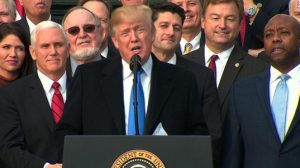
Washington (CNN) – Republican lawmakers joined President Donald Trump [today] on Wednesday afternoon to celebrate their largest legislative achievement of 2017, in a public ceremony spotlighting the most sweeping overhaul of the US tax system in more than 30 years.

“It’s always a lot of fun when you win,” Trump said at the ceremony on the White House lawn, after thanking congressional leaders including Senate Majority Leader Mitch McConnell and House Speaker Paul Ryan.

Hailing passage of the GOP’s tax plan and surrounded by dozens of prominent Republicans in Congress, Trump said the package would fulfill his core campaign promise. … 
Source: CNN retrieved December 20, 2017 from: http://www.cnn.com/2017/12/20/politics/house-senate-trump-tax-bill/index.html

This is Payback!

The Tax Reform strategy here double-downs on the concept of Supply-side economics. The hope is that corporate entities and wealthy people will receive tax breaks and then use the “wind fall” to re-invest in the community, thereafter creating jobs and economic growth. The Republicans in Washington (Congress and the White House) are betting on the success of this strategy even though there has been utter failures with this approach; for example just recently in the US State of Kansas.

Whether that re-investment occurs or not is the unknown. What is known is that the Rich will undoubtedly get the tax breaks. The Rich will win, at the expense of the Poor. This is why that foregoing article also relates:

While Republicans [leaders] cheer the bill’s passage, however, 55% of Americans oppose the plan, according to a new CNN poll. Just 33% say they favor the GOP’s proposals to reform the nation’s tax code.

This is a great opportunity to Encore a previous blog-commentary from December 16, 2014 when the same group – Washington Republicans – maneuvered to pass a law to repeal many post-2008 restrictions to guarantee higher profits for the nation’s banks. While this is an American drama, this is an opportunity for the Caribbean to learn lessons on managing governance for the Greater Good; which this foregoing law violates. See that Encore here:

——————–

Go Lean Commentary – A Christmas Present for the Banks from the Omnibus Bill

What do you get for $5.3 Billion? There must be some return on that investment.

The book Go Lean … Caribbean asserts that the US Federal Election-Campaign system is not the model that the Caribbean should want to emulate.  This book relates that $5.3 Billion was spent for the 2008 Federal Elections (Page 116), a lot of it contributed by corporations, resulting in a lot of influence peddling. This drama was vividly demonstrated this Saturday evening when the “lame-duck” Congress (the Senate in particular), delayed the required Omnibus Spending Bill – just in time – to extort favorable legislation that would roll back some of the federal regulations enacted after the Great Recession of 2008 to protect against banking systemic risks.

Senate Minority Leader Mitch McConnell speaks to reporters on upcoming budget battle in Washington

The Shadow Influences spearheading these changes are known to adhere to the principle that “a crisis is a terrible thing to waste” – a quotation credited to famed American Economist Paul Romer. While others will think that this drama was just politics as usual, the following article depicts the more strategic nature of the new legislation, to foster the environment and industry for financial derivative trading – this is too specific for any life-long politician (the US Senate) to advocate on the sly. No, this has the fingerprints of Wall Street Shadow Influences all over it. (See Appendix below for encyclopedic references on derivatives and swaps). See the news article here:

Title: A Christmas Present For The Banks From The Omnibus Bill
Forbes Magazine Investing Online Blog (Posted 12/13/2014; retrieved 12/15/2014) –
http://www.forbes.com/sites/robertlenzner/2014/12/13/wall-street-reverses-ban-on-trading-derivatives-backed-by-uncle-sam/
By: Robert Lenzner, Contributor

Wall Street banks like Citigroup and JP Morgan Chase have flexed the power of their influence to pressure Congress and the White House into a key change in the law that will allow the trading of risky financial derivatives in bank operations that are insured by the Federal Deposit Insurance Corp. This means the nation’s largest banks used the deadline for passing the Omnibus spending bill as pressure to reverse a key section of the Dodd-Frank bill of 2010 that was meant to prohibit a federal government bailout of swaps entities.

It was the existence of over $500 billion of Credit Default Swaps on the balance sheet of AIG in 2008 that threatened to bankrupt the largest insurance company in the world. So, in effect, six years later, the same Wall Street banks that were bailed out by federal largesse, are being given a legislative gift that will enable them to freely trade the securities that brought Lehman Bros down in 2008 — and obtain access to the benefit of insurance and loans from the federal government.

Behind the scenes, unbenownst to the media or the public, the nation’s Too Big To Fail banks used the Omnibus spending bill that is necessary to finance federal spending in 2015 to undo this little-known Dodd Frank provision that might have restricted the volume of trading in financial derivatives that have been a major source of profits as well as controversy since the 2008 financial crisis. Most financial derivatives will be able to be traded in entities holding deposits guaranteed by the Federal Deposit Insurance Corp. and subject to borrowing at the Federal Reserve’s discount window. This is a key advantage for the banks that will enable them to increase their activity in these securities.

Former Rep. Barney Frank, who was a key sponsor of the Wall Street reform legislation, attacked the change in Dodd-Frank as “a road map for further attacks on our protection against financial instability.” Frank was incensed that the last-minute procedure was “inserted with no hearings, no chance for further modification, and no chance for debate into a mammoth bill in the last days of a lame-duck Congress.”

If President Obama signs the Omnibus spending bill, he will have effectively rewarded Wall Street by reversing a provision that prohibits any federal assistance from being provided to “swaps entities,” including registered swaps dealers, security-based swap dealers, major swap participants and major security-based swap participants, according to information obtained by Forbes. This measure required banks to remove their swaps dealing from the bank itself and do its trading in non-bank affiliates not eligible for deposit insurance. Access to the Fed’s discount window would also be denied in case of a financial crisis in the markets.

The net effect of the changes in the Omnibus spending bill would be to expand permissible swaps activities within a bank and to only exclude swaps based on asset-backed securities that are unregulated and not of a credit quality.

All very technical, but the net result is to allow Citigroup, JP Morgan Chase and others to use the Fed’s discount window to borrow money in case of a crisis that roiled the derivative market for credit swaps again as took place in September 2008. In effect, it means the major banks need not limit their trading of financial derivatives to non-bank operations that the market will never be fooled into thinking some future risk of danger has just been avoided. It is a complex holiday present for Wall Street. And it is a warning sign that other sections of the Dodd-Frank Wall Street reform may also be vulnerable to political rollback.

An additionally relevant blog by Robert Lenzer: http://www.forbes.com/sites/robertlenzner/2014/12/08/the-ten-reasons-why-there-will-be-another-systemic-financial-crisis/

The crisis of the 2008 Great Recession was the lynchpin for the Go Lean movement, (book and blogs). This book, serving as a roadmap for the introduction and implementation of the Caribbean Union Trade Federation (CU), posits that the effects of the 2008 Great Recession continue to linger in the Caribbean. Therefore the book advocates learning lessons from 2008 and to turn-around, reform, and reboot the region’s economic, security and governing engines to ensure that “never again” will our society be so vulnerable to the financial misgivings of our American neighbors; or the “plutocratic” elements there-in.

The field of economics is not always solutions-oriented; sometimes, they have been responsible for the problem. Consider this VIDEO snippet here:

Documentary Film “Inside Job” – http://youtu.be/CaXNqGgIc-g

Published on Apr 19, 2012 – Since the repeal of Glass-Steagall in 1999, the total notional value of derivatives has grown by over 700% for holdings companies and 674% for commercial banks. Even more alarming, since the third quarter of 2008 when the cracks in the financial system were clearly evident, derivatives at the commercial banks have grown from $175 TRILLION to $234 TRILLION ” a $59 TRILLION increase. To put this in perspective, the cumulative Gross Domestic Product in the United States over that same time frame (Q3 2008 through Q3 2010) was approximately $32 TRILLION.

Despite our region’s small size (42 million people in 30 member-states), we do have some control over our own destiny. We want to be a protégé, not a parasite.

The CU’s prime directives, elevating the Caribbean’s economic-security-governing engines, recognize that the changes the region needs must start first with the adoption of new community ethos and controls. Early in the book, the need for this shift is pronounced (Declaration of Interdependence – Page 13) with these statements:

xxiv.      Whereas a free market economy can be induced and spurred for continuous progress, the Federation must install the controls to better manage aspects of the economy: jobs, inflation, savings rate, investments and other economic principles. Thereby attracting direct foreign investment because of the stability and vibrancy of our economy.

xxv.      Whereas the legacy of international democracies had been imperiled due to a global financial crisis, the structure of the Federation must allow for financial stability and assurance of the Federation’s institutions. To mandate the economic vibrancy of the region, monetary and fiscal controls and policies must be incorporated as proactive and reactive measures. These measures must address threats against the financial integrity of the Federation and of the member-states.

The Go Lean book, and previous blog/commentaries, stressed the key community ethos, strategies, tactics, implementation and advocacies necessary to effect change in the region ourselves, to improve the stewardship over the economy. They are detailed as follows:

Who We Are – 2008 Internal Experiences Page 8
Community Ethos – Economic Principles Page 21
Community Ethos – Security Principles – Private Interest –vs- Public Protection Page 23
Community Ethos – Security Principles – “Light Up Dark Place” Page 23
Community Ethos – Governing Principles – Lean Operations Page 24
Community Ethos – Ways to Impact the Future Page 26
Community Ethos – Impact Research and Development Page 30
Community Ethos – Ways to Improve Negotiations Page 32
Community Ethos – Ways to Impact Turn-around – 2008 Crisis Page 33
Community Ethos – Ways to Impact the Greater Good Page 37
Strategy – Mission – Fortify   the Stability of the Securities Markets Page 47
Strategy – CU Stakeholders to Protect – Banks & Depositors Page 47
Tactical – Growing the Economy – Minimizing Bubbles Page 69
Tactical – Separation-of-Powers – Depository Insurance & Regulatory Agency Page 73
Anecdote – Turning Around CARICOM – Effects of 2008 Financial Crisis Page 92
Implementation – Assemble Caribbean Central Bank as Cooperative Page 96
Implementation – Assemble Constitutional Convention Page 97
Implementation – Ways to Better Manage Debt – Optimizing Wall Street Role Page 114
Implementation – Ways to Impact Elections Page 116
Planning – 10 Big Ideas – Single Market / Currency Union Page 127
Planning – Lessons Learned from 2008 Page 136
Planning – Ways to Measure Progress Page 147
Advocacy – Ways to Grow the Economy – Case Study of $5.3 Billion Influence Page 151
Advocacy – Ways to Improve Credit Ratings – 2008 Lessons Page 155
Advocacy – Ways to Improve Housing – 2008 Mortgage Crisis Lessons Page 161
Advocacy – Ways to Impact Labor Unions – 2008 Effects on Main Street Jobs Page 164
Anecdote – Caribbean Industrialist – Growing without Shadow Influence Page 189
Advocacy – Reforms for Banking Regulations Page 199
Advocacy – Ways to Impact Wall Street Page 200
Appendix – Whitepaper: The 2008 Financial Crisis and Its Aftermath Page 276
Appendix – Currency Capital Controls Page 325

The points of effective, technocratic regional stewardship, especially in response to the 2008 Great Recession / Financial Crisis, were further elaborated upon in these previous blog/commentaries:

https://goleancaribbean.com/blog/?p=3311 Detroit to exit historic bankruptcy – Finally recovering from 2008
https://goleancaribbean.com/blog/?p=3164 Michigan Unemployment – Then (2008/2009) and Now
https://goleancaribbean.com/blog/?p=3090 Lessons Learned – Europe Sovereign Debt Crisis of 2009
https://goleancaribbean.com/blog/?p=3028 Why India is doing better than most emerging markets since the crisis
https://goleancaribbean.com/blog/?p=2930 ‘Too Big To Fail’ – Caribbean Version
https://goleancaribbean.com/blog/?p=2448 ‘Consumer Reports’ Survey Finds the American Consumer is Back
https://goleancaribbean.com/blog/?p=2435 Korea’s Protégé Model – A Dream for Latin America / Caribbean
https://goleancaribbean.com/blog/?p=2338 Lesson Learned – How Best to Welcome the Dreaded ‘Plutocracy’
https://goleancaribbean.com/blog/?p=2259 The Criminalization of American Business – Big Banks Let Loose
https://goleancaribbean.com/blog/?p=2105 Recessions and Public Health – Lessons from the 2008 Crisis
https://goleancaribbean.com/blog/?p=2090 The Depth & Breadth of Remediating 2008
https://goleancaribbean.com/blog/?p=1896 The Crisis in Black Homeownership since 2008
https://goleancaribbean.com/blog/?p=1309 5 Steps of a Bubble
https://goleancaribbean.com/blog/?p=841 Post 2008 – Having Less Babies is Bad for the Economy?
https://goleancaribbean.com/blog/?p=782 Open/Review the Time Capsule: The Great Recession of 2008
https://goleancaribbean.com/blog/?p=709 Post 2008 – Student debt holds back home buyers
https://goleancaribbean.com/blog/?p=522 Financial Crisis Jokes – Reflecting the cultural impact on society
https://goleancaribbean.com/blog/?p=518 Post 2008 – What Banks learn about financial risks
https://goleancaribbean.com/blog/?p=378 Fed Releases Transcripts from 2008 Meetings
https://goleancaribbean.com/blog/?p=242 Post 2008 – The Erosion of the Middle Class

The 2008 Great Recession brought major upheaval to American and Caribbean societies, plus the rest of the world. Much of the world is interconnected; this is even more acute in our region. Our economy is structured as parasites on the US economy. According to the foregoing news article, our parasitic host is not worthy of our devotion. What qualifies the Go Lean promoters to make these assessments? Principals of this publishing foundation were also there in 2008, engaged with major stakeholders of the Global Financial crisis: Lehman Brothers, JPMorganChase, Citigroup, etc. They were on the inside looking out, not the outside looking in. They were equipped to discern the Shadow Influence.

The Go Lean movement advocates the role of protégé, not parasite. We must diversify our economy and additionally cater to other markets, other countries and other industries. This is the purpose of the Go Lean roadmap, to provide a turn-by-turn direction to accomplish this diversification.

If we want to make our homeland a better place to live, work and play then we cannot depend on the stewards of the US economy to shepherd the Caribbean. Look! Despite the cruel and harsh lessons from 2008, it appears – from the foregoing article and the Appendix below – that the Wall Street Shadow Influence wants to repeat the “Bubble” that lead up to 2008. When they succeed, they profit; but when they fail, the “low man” on Main Street – and parasite economies like the Caribbean – has to endure the pain, not Wall Street.

The Go Lean roadmap does not seek to change America, (though we lobby against these arbitrary “Derivative” rule changes in the Omnibus Budget Bill); only teach the lessons to the Caribbean. We can do so much better.

Download the free e-Book of Go Lean … Caribbean – now!

——————–

Appendix – Derivatives:
(Source: http://en.wikipedia.org/wiki/Derivative_(finance) )

In finance, a derivative is a contract that derives its value from the performance of an underlying entity. This underlying entity can be an asset, index, or interest rate, and is often called the “underlying”.[1][2] Derivatives can be used for a number of purposes – including insuring against price movements (hedging), increasing exposure to price movements for speculation or getting access to otherwise hard to trade assets or markets.[3]

Some of the more common derivatives include forwards, futures, options, swaps, and variations of these such as collateralized debt obligations, credit default swaps, and mortgage backed securities. Most derivatives are traded over-the-counter (off-exchange) or on an exchange such as the Chicago Mercantile Exchange, while most insurance contracts have developed into a separate industry. Derivatives are one of the three main categories of financial instruments, the other two being equities (i.e. stocks or shares) and debt (i.e. bonds and mortgages).

Speculation
Derivatives can be used to acquire risk, rather than to hedge against risk. Thus, some individuals and institutions will enter into a derivative contract to speculate on the value of the underlying asset, betting that the party seeking insurance will be wrong about the future value of the underlying asset. Speculators look to buy an asset in the future at a low price according to a derivative contract when the future market price is high, or to sell an asset in the future at a high price according to a derivative contract when the future market price is less.

Risks
The use of derivatives can result in large losses because of the use of leverage, or borrowing; (see VIDEO below). Derivatives allow investors to earn large returns from small movements in the underlying asset’s price. However, investors could lose large amounts if the price of the underlying moves against them significantly. There have been several instances of massive losses in derivative markets, such as the following:

  • American International Group (AIG) lost more than US$18 billion through a subsidiary over the preceding three quarters on credit default swaps (CDSs).[42] The United States Federal Reserve Bank announced the creation of a secured credit facility of up to US$85 billion, to prevent the company’s collapse by enabling AIG to meet its obligations to deliver additional collateral to its credit default swap trading partners.[43]
  • The loss of US$7.2 Billion by Société Générale in January 2008 through mis-use of futures contracts.
  • The loss of US$6.4 billion in the failed fund Amaranth Advisors, which was long natural gas in September 2006 when the price plummeted.
  • The loss of US$4.6 billion in the failed fund Long-Term Capital Management in 1998.
  • The loss of US$1.3 billion equivalent in oil derivatives in 1993 and 1994 by Metallgesellschaft AG.[44]
  • The loss of US$1.2 billion equivalent in equity derivatives in 1995 by Barings Bank.[45]
  • UBS AG, Switzerland’s biggest bank, suffered a $2 billion loss through unauthorized trading discovered in September 2011.[46]

This comes to a staggering $39.5 billion; the majority in the last decade after the Commodity Futures Modernization Act of 2000 was passed.

Financial Reform and Government Regulation
Under US law and the laws of most other developed countries, derivatives have special legal exemptions that make them a particularly attractive legal form to extend credit.[47] The strong creditor protections afforded to derivatives counterparties, in combination with their complexity and lack of transparency however, can cause capital markets to underprice credit risk. This can contribute to credit booms, and increase systemic risks.[47] Indeed, the use of derivatives to conceal credit risk from third parties while protecting derivative counterparties contributed to the financial crisis of 2008 in the United States.[47][48]

CU Blog - A Christmas Present for The Banks From The Omnibus Bill - Photo 2

In November 2012, the SEC and regulators from Australia, Brazil, the European Union, Hong Kong, Japan, Ontario, Quebec, Singapore, and Switzerland met to discuss reforming the OTC derivatives market, as had been agreed by leaders at the 2009 G-20 Pittsburgh summit (see Photo) in September 2009.[54] In December 2012, they released a joint statement to the effect that they recognized that the market is a global one and “firmly support the adoption and enforcement of robust and consistent standards in and across jurisdictions”, with the goals of mitigating risk, improving transparency, protecting against market abuse, preventing regulatory gaps, reducing the potential for arbitrage opportunities, and fostering a level playing field for market participants.[54] They also agreed on the need to reduce regulatory uncertainty and provide market participants with sufficient clarity on laws and regulations by avoiding, to the extent possible, the application of conflicting rules to the same entities and transactions, and minimizing the application of inconsistent and duplicative rules.[54] At the same time, they noted that “complete harmonization – perfect alignment of rules across jurisdictions” would be difficult, because of jurisdictions’ differences in law, policy, markets, implementation timing, and legislative and regulatory processes.[54]

VIDEO: Leverage Explained – http://youtu.be/6YEnkkznGTg
When things turn out good, big risk means big return; but if it turns out bad, you lose everything and left with a debt.

Source References:
1.       Derivatives (Report). Office of the Comptroller of the Currency, U.S. Department of Treasury. http://www.occ.gov/topics/capital-markets/financial-markets/trading/derivatives/index-derivatives.html. Retrieved February 2013. “A derivative is a financial contract whose value is derived from the performance of some underlying market factors, such as interest rates, currency exchange rates, and commodity, credit, or equity prices. Derivative transactions include an assortment of financial contracts, including structured debt obligations and deposits, swaps, futures, options, caps, floors, collars, forwards, and various combinations thereof.”
2.       Derivative Definition Investopedia
3.       Koehler, Christian. “The Relationship between the Complexity of Financial Derivatives and Systemic Risk”. Working Paper: 10–11.
——
42.   Kelleher, James B. (September 18, 2008). “”Buffett’s Time Bomb Goes Off on Wall Street” by James B. Kelleher of Reuters”. Reuters.com. Retrieved August 29, 2010.
43.   “Fed’s $85 billion Loan Rescues Insurer”
44.   Edwards, Franklin (1995). “Derivatives Can Be Hazardous To Your Health: The Case of Metallgesellschaft”. Derivatives Quarterly (Spring 1995): 8–17
45.   Whaley, Robert (2006). Derivatives: markets, valuation, and risk management. John Wiley and Sons. p. 506. ISBN 0-471-78632-2.
46.   “UBS Loss Shows Banks Fail to Learn From Kerviel, Leeson”. Businessweek. September 15, 2011. Retrieved March 5, 2013.
47.   “Michael Simkovic, Secret Liens and the Financial Crisis of 2008.”. American Bankruptcy Law Journal, Vol. 83, p. 253. 2009. Retrieved March 5, 2013.
48.   Michael Simkovic (January 11, 2011). “Bankruptcy Immunities, Transparency, and Capital Structure, Presentation at the World Bank”. Ssrn.com. doi:10.2139/ssrn.1738539. Retrieved March 5, 2013.
——
54.   “Joint Press Statement of Leaders on Operating Principles and Areas of Exploration in the Regulation of the Cross-Border OTC Derivatives Market; 2012-251”. Sec.gov. December 4, 2012. Retrieved March 5, 2013.

Share this post:
, ,
[Top]

A Lesson from Star Wars Movie: ‘We Need Heroes’ – ENCORE

This is the BIG news for the weekend of December 15, 2017:

Star Wars: The Last Jedi” was a box office force this weekend.

“The Last Jedi,” the eighth installment in the “Star Wars” saga, premiered this [past] weekend to the second-biggest opening ever in North America. It brought in an estimated $220 million, according to Disney. – CNN posted December 18, 2017 from: http://money.cnn.com/2017/12/17/media/star-wars-last-jedi-opening-weekend-box-office/index.html 

The lure of Star Wars was also embraced by the movement behind the book Go Lean … Caribbean. In a previous blog-commentary from December 22, 2015 when the movie Star Wars Episode 7 “The Force Awakens” was released, a parallel was shown between the standard Hero’s Journey dramatic path and what the Caribbean region needs:

Our heroes to return … to the homeland.

Here is an ENCORE of that previous Episode 7 blog-commentary on this occasion of Episode 8.

————-

Go Lean CommentaryThe Caribbean is Looking For Heroes … to Return

In the Caribbean, we need a hero, we need lots of heroes …

… need a hero
I’m holding out for a hero ’til the end of the night
He’s gotta be strong
And he’s gotta be fast
And he’s gotta be fresh from the fight
I need a hero
I’m holding out for a hero ’til the morning light
He’s gotta be sure
And it’s gotta be soon
And he’s gotta be larger than life
(Song by Bonnie Tyler 1984; see VIDEO & Lyrics at https://youtu.be/OBwS66EBUcY; see Appendix)

We must reform and transform our Caribbean society. We know that one person – a hero – can make a difference, and we need to encourage those contributions.

Heroes are not born, they are forged. According to noted Mythologist Joseph Campbell, hero candidates go through a consistent pattern of a journey to become bona-fide heroes.

CU Blog - The Caribbean is Looking for Heroes to Return - Photo 1Who is Joseph Campbell and why does his opinion matter? He is the inspiration behind the big hit movie franchise Star Wars. All things Star Wars are en vogue right now. According to IMDB.com, this movie which opened just days ago – Star Wars Episode 7 “The Force Awakens”; (see Appendix) – had the biggest US box office opening of any movie … ever. See the box office results here in the photo, retrieved December 22, 2015.

This is an amazing feat, considering that Joseph Campbell has been dead since 1987. But Star Wars creator, George Lucas drew his story-line from Joseph Campbell’s inspirations in the cataloging of the “Hero’s Journey” in his writings. See article here:

Title: Role Model Joseph Campbell
In 1949 Joseph Campbell (1904-1987) made a big splash in the field of mythology with his book The Hero With a Thousand Faces. This book built on the pioneering work of German anthropologist Adolph Bastian (1826-1905), who first proposed the idea that myths from all over the world seem to be built from the same “elementary ideas.” Swiss psychiatrist Carl Jung (1875-1961) named these elementary ideas “archetypes,” which he believed to be the building blocks not only of the unconscious mind, but of a collective unconscious. In other words, Jung believed that everyone in the world is born with the same basic subconscious model of what a “hero” is, or a “mentor” or a “quest,” and that’s why people who don’t even speak the same language can enjoy the same stories.

Jung developed his idea of archetypes mostly as a way of finding meaning within the dreams and visions of the mentally ill: if a person believes they are being followed by a giant apple pie, it’s difficult to make sense of how to help them. But if the giant apple pie can be understood to represent that person’s shadow, the embodiment of all their fears, then the psychotherapist can help guide them through that fear, just as Yoda guided Luke on Dagoba. If you think of a person as a computer and our bodies as “hardware,” language and culture seem to be the “software.” Deeper still, and apparently common to all homo sapians, is a sort of built-in “operating system” which interprets the world by sorting people, places, things and experiences into archetypes.

CU Blog - The Caribbean is Looking for Heroes to Return - Photo 2Campbell’s contribution was to take this idea of archetypes and use it to map out the common underlying structure behind religion and myth. He proposed this idea in The Hero With a Thousand Faces, which provides examples from cultures throughout history and all over the world. Campbell eloquently demonstrates that all stories are expressions of the same story-pattern, which he named the “Hero’s Journey,” or the “monomyth.” This sounds like a simple idea, but it suggests an incredible ramification, which Campbell summed up with his adage “All religions are true, but none are literal.” That is, he concluded that all religions are really containers for the same essential truth, and the trick is to avoid mistaking the wrappings for the diamond.

[Star Wars Creator George] Lucas had already written two drafts of Star Wars when he rediscovered Joseph Campbell’s The Hero With a Thousand Faces in 1975 (having read it years before in college). This blueprint for “The Hero’s Journey” gave Lucas the focus he needed to draw his sprawling imaginary universe into a single story.

Note that the Wachowski Brothers’ wonderful film The Matrix is carefully built on the same blueprint:

Campbell

Star Wars

The Matrix

I: Departure
The call to adventure Princess Leia’s message “Follow the white rabbit”
Refusal of the call Must help with the harvest Neo won’t climb out window
Supernatural aid Obi-wan rescues Luke from sandpeople Trinity extracts the “bug” from Neo
Crossing the first threshold Escaping Tatooine Neo is taken out of the Matrix for the first time
The belly of the whale Trash compactor Torture room
II: Initiation
The road of trials Lightsaber practice Sparring with Morpheus
The meeting with the goddess Princess Leia (wears white, in earlier     scripts was a “sister” of a mystic order) The Oracle
Temptation away from the true path1 Luke is tempted by the Dark Side Cypher (the failed messiah) is tempted by the world of comfortable illusions
Atonement with the Father Darth and Luke reconcile Neo rescues and comes to agree (that he’s The One) with his father-figure, Morpheus
Apotheosis (becoming god-like) Luke becomes a Jedi Neo becomes The One
The ultimate boon Death Star destroyed Humanity’s salvation now within reach
III: Return
Refusal of the return “Luke, come on!” Luke wants to     stay to avenge Obi-Wan Neo fights agent instead of running
The magic flight Millennium Falcon “Jacking in”
Rescue from without Han saves Luke from Darth Trinity saves Neo from agents
Crossing the return threshold Millennium Falcon destroys pursuing TIE fighters Neo fights Agent Smith
Master of the two worlds Victory ceremony Neo’s declares victory over machines in final phone call
Freedom to live Rebellion is victorious over Empire Humans are victorious over machines

Source: Fan Site for Obscure Star Wars Inspirations; retrieved December 20, 2015 from: http://www.moongadget.com/origins/myth.html

But one can argue, these are just movies, “make believe”; these are not real people nor real life. That would be a true statement of facts (there is no “Luke Skywalker” nor “Neo” as historical characters), but the principles of a “Hero’s Journey” is real, and present in real life. This is just another example of “life imitating art”. In a previous blog-commentary regarding Caribbean Diaspora member and Hollywood great, Sidney Poitier, it was declared that …

“Movies are an amazing business model. People give money to spend a couple of hours watching someone else’s creation and then leave the theater with nothing to show for the investment; except perhaps a different perspective”.

 CU Blog - The Caribbean is Looking for Heroes to Return - Photo 3
 CU Blog - The Caribbean is Looking for Heroes to Return - Photo 4

These movies do bring a different perspective. According to the foregoing, there are Three Acts to the “Hero’s Journey”:

I.   Departure
II.  Initiation
III. Return

The publishers of the book Go Lean…Caribbean recognize the one person can make positive, heroic contributions to his community; and that this role must be forged in society. The book serves as a roadmap for the introduction and implementation of the Caribbean Union Trade Federation (CU). The CU seeks to foster the genius qualifiers in Caribbean citizens. Not everyone can be heroes, but society must be structured to allow heroes to soar. Because …

… one man (or woman) can make a difference! Such a person can impact their community, country … and the whole world.

“The only thing necessary for the triumph of evil is for good men to do nothing” – Edmund Burke; 1729 – 1797; an Irish statesman, member of British Parliament and supporter of the American Revolution.

The Caribbean has fostered the hero process, but according to the Three Acts established by Joseph Campbell, our heroes stopped at Act II, they do not “Return”.

CU Blog - The Caribbean is Looking for Heroes to Return - Photo 5

They make their heroic contributions to other communities and not their homeland. The Caribbean, thusly “fattens frogs for snakes”. Consider the bad consequences of this reality, as in our brain drain among the college-educated population, which is up to a 70% rate within the entire region.

A quest of the Go Lean/CU roadmap is to lower the “Push and Pull” factors that causes so many Caribbean citizens to flee their beloved homeland. In addition, another quest is to incentivize the far-flung Diaspora to return to the Caribbean. Success in these quests will take a “Hero’s Journey”.

The villain in this real-life story is the poor performing Caribbean economy. So the prime directive of the Go Lean book is to elevate Caribbean society, and its societal engines … defined in these declarative statements, as follows:

  • Optimization of the economic engines in order to grow the regional economy and create 2.2 million new jobs.
  • Establishment of a security apparatus to protect the resultant societal engines again foreign and domestic threats.
  • Improvement Caribbean governance to support these engines.

The Go Lean book posits that one person, despite their field of endeavor, can make a difference in the Caribbean, and its impact on the world; that there are many opportunities where one advocate, one champion, one “hero” can elevate society. In this light, the book features 144 different advocacies, so there is inspiration for the “next hero” to emerge and excel right here at home in the Caribbean.

The roadmap specifically encourages the region to lean-in, to foster heroes and champions with these specific community ethos, strategies, tactics, implementations and advocacies:

Community Ethos – Forging Change Page 20
Community Ethos – People Respond to Incentives in Predictable Ways Page 21
Community Ethos – Economic Systems Influence Individual Choices Page 21
Community Ethos – Whistleblower Protection Page 23
Community Ethos – Anti-Bullying and Mitigation Page 23
Community Ethos – Minority Equalization Page 24
Community Ethos – Ways to Foster Genius Page 27
Community Ethos – Ways to Impact the Greater Good Page 37
Strategy – Mission – Dissuade Societal Abandonment Page 45
Strategy – Mission – Incentivize Repatriation Page 45
Strategy – Mission – Protect Repatriates with heightened   Public Safety Page 45
Anatomy of Advocacies – Examples of Individuals Who Made Impact Page 122
Planning – Ways to Make the Caribbean Better Page 131
Advocacy – Ways to Improve Governance Page 168
Advocacy – Ways to Better Manage the Social Contract Page 170
Advocacy – Ways to Improve Leadership Page 171
Advocacy – Ways to Impact Justice Page 177
Advocacy – Ways to Remediate and Mitigate Crime Page 178
Advocacy – Ways to Impact Hollywood – Global Box Office – Imitating Life Page 203
Advocacy – Ways to Preserve Caribbean Heritage Page 218
Advocacy – Ways to Improve the Arts Page 230

The Caribbean region wants a more optimized society.

This book posits that “bad actors” – even villains: the “Dark Side of the Force” – will emerge to exploit inefficient economic, security and governing models.  Early in the book, the pressing need to streamline protections – for citizens and institutions – was pronounced in the Declaration of Interdependence (Page 12), with these opening statements:

x. Whereas we are surrounded and allied to nations of larger proportions in land mass, populations, and treasuries, elements in their societies may have ill-intent in their pursuits, at the expense of the safety and security of our citizens. We must therefore appoint “new guards” to ensure our public safety and threats against our society, both domestic and foreign.

xi. Whereas all men are entitled to the benefits of good governance in a free society, “new guards” must be enacted to dissuade the emergence of incompetence, corruption, nepotism and cronyism at the peril of the people’s best interest. The Federation must guarantee the executions of a social contract between government and the governed.

xii. Whereas the legacy in recent times in individual states may be that of ineffectual governance with no redress to higher authority, the accedence of this Federation will ensure accountability and escalation of the human and civil rights of the people for good governance, justice assurances, due process and the rule of law. As such, any threats of a “failed state” status for any member state must enact emergency measures on behalf of the Federation to protect the human, civil and property rights of the citizens, residents, allies, trading partners, and visitors of the affected member state and the Federation as a whole.

xvi. Whereas security of our homeland is inextricably linked to prosperity of the homeland, the economic and security interest of the region needs to be aligned under the same governance. Since economic crimes, including … forms of terrorism, can imperil the functioning of the wheels of commerce for all the citizenry, the accedence of this Federation must equip the security apparatus with the tools and techniques for predictive and proactive interdictions.

The Go Lean book explicitly acknowledges that optimizing society is not easy; it requires strenuous, heroic efforts; heavy-lifting. That is the quest of the CU/Go Lean roadmap. Other subjects related to heroic efforts of role models have been blogged in other Go Lean…Caribbean commentaries, as sampled here:

https://goleancaribbean.com/blog/?p=5964 Movie Review: ‘Tomorrowland’ – ‘Feed the right wolf’ in Society
https://goleancaribbean.com/blog/?p=5648 Music Role Model Taylor Swift withholds Album from Apple Music
https://goleancaribbean.com/blog/?p=5506 Role Model: Edward Snowden – One Person Making a Difference
https://goleancaribbean.com/blog/?p=3490 How One Entrepreneur Can Rally a Whole Community
https://goleancaribbean.com/blog/?p=2726 Caribbean Role Model – Oscar De La Renta – RIP
https://goleancaribbean.com/blog/?p=1731 Role Model Warren Buffet – An Ode to Omaha
https://goleancaribbean.com/blog/?p=1596 Book Review: ‘Prosper Where You Are Planted’
https://goleancaribbean.com/blog/?p=866 Role Model Bob Marley: The Legend Lives On!
https://goleancaribbean.com/blog/?p=209 Role Model: Advocate Kevin Connolly

The Go Lean roadmap posits that the CU should foster the genius potential in Caribbean citizens and incubate their potential to maximum production. We should let “heroes be heroes” in their fields of endeavor here at home, no matter how diverse. Many Caribbean Diaspora has done this exactly, abroad in benefiting other communities, while their homelands languish.

They have departed – Act I.
They have initiated as heroes – Act II.
But, they have NOT returned – no Act III.

Enough already!

The roadmap pronounces that we need the participation of many advocates on many different paths for progress. By facilitating, fostering and furthering these initiative, we can have our heroes return to be heroic at home. Only then, will the Caribbean truly become a better place to live, work and play. 🙂

Download the free e-Book of Go Lean … Caribbean – now!

Sign the petition to lean-in for the roadmap for the Caribbean Union Trade Federation.

————

Appendix VIDEO – Bonnie Tyler – I Need a Hero (Lyrics) – https://youtu.be/OBwS66EBUcY

————

Appendix VIDEO – Star Wars: The Force Awakens Trailer (Official) – https://youtu.be/sGbxmsDFVnE

Published on Oct 19, 2015 – Watch the official trailer for Star Wars: The Force Awakens, [opened] in theaters December 18, 2015.

Share this post:
, ,
[Top]

Miami’s Caribbean Marketplace Revisited – ENCORE

It’s time to celebrate all things Miami – during Miami Art Week 2017 – so that includes all the Caribbean Diaspora that adds to the fabric of this international metropolis and makes it a Magic City.

Spanish, Haitian, Indian Jamaican, Black/White Cuban or Asian … – Lyrics from song “Welcome to Miami” by Rapper Will Smith; featured in the VIDEO below.

Just look at this place now; in all of its glory!

This is the perfect time to encore this following – original blog-commentary – from July 20, 2014 when the Miami Caribbean Marketplace was re-opened in Little Haiti:

—————

Go Lean Commentary – Miami’s Caribbean Marketplace Re-opens

Make no mistake: having a warm welcome in a City of Refuge is not as good as being safe and secure at home. Yet, when conditions mandate that one take flight, a warm welcome is greatly appreciated.

According to the foregoing article, the City of Miami now extends a warm welcome … to the Caribbean Diaspora. While Miami profits from this embrace, the benefits for the Caribbean are not so great.

This is the American Immigrant experience, one of eventual celebration, but only after a “long train of abuses”: rejection, anger, protest, bargaining, toleration and eventual acceptance. The experience in Miami today is one of celebration.

The book Go Lean…Caribbean champions the cause of retaining Caribbean citizens in the Caribbean, even inviting the Diaspora back to their homelands. So the idea of celebrating a cultural contribution at a center in a foreign land is a paradox. Yes, we want the positive image, but no, we do not want to encourage more assimilation in the foreign land.

However, the book declares: It is what it is!

The book serves as a roadmap for the introduction and implementation of the Caribbean Union Trade Federation (CU), a technocratic federal government to administer and optimize the economic/security/ governing engines in the homeland of the region’s 30 member-states. The CU strives to elevate Caribbean image at home and abroad. There are many empowerments in the roadmap for the far-flung Diaspora to improve the interaction with the Caribbean community. So the cultural center in the foregoing article is germane to the Go Lean discussion.

The entire article is listed as follows:

CU Blog - Miami's Caribbean Marketplace Re-opens - Photo 1 Sub-title: The Caribbean Marketplace has become a cultural icon in the Little Haiti community and re-opens with much fanfare….

By: Fabiola Fleuranvil | Noire Miami

The long awaited re-opening of the Caribbean Marketplace (CMP) is back as a cultural marker in the vibrant Little Haiti community. For years, the venue has been a strong figure along Little Haiti’s main corridor and has been easily identified by its bright colors and vibrant activity of vendors as well as Haitian and Caribbean culture. After undergoing a lengthy renovation to transform this cultural gem into a community staple for unique arts and crafts, Caribbean culture, special events, and community events, the highly anticipated reopening positions the Caribbean Marketplace as a vibrant addition to the Little Haiti Cultural Center next door and the burgeoning arts and culture spirit in Little Haiti.

The re-establishment of this Marketplace is a collaborative effort of the City of Miami in partnership with the Miami-Dade Department of Cultural Affairs, the Little Haiti Cultural Complex (LHCC), the Northeast Second Avenue Partnership (NE2P) and District 5 Commissioner Keon Hardemon.

The 9,500-square-foot space includes a refreshment and concession area, gift shops, arts and crafts, retail vendors and space available for private events. The renovations reflect the beautiful diversity of the Caribbean. Low rates, technical and marketing assistance will be provided to all vendors. It is anticipated that new businesses will be created in this cultural hub, resulting in employment opportunities for the local community.

Physical Address for the Caribbean Marketplace: 5925   NE 2nd Ave, Miami (Besides the Little Haiti Cultural Center) Hours: Thursday – Sunday, 11AM – 11PM
Miami Herald Daily Newspaper  (Retrieved 07-16-2014) –
http://www.miami.com/little-haiti039s-caribbean-marketplace-reopens-article

The Miami community is doing even more to embrace the exile populations in its metropolis, (including jurisdictions up to West Palm Beach). They have declared an entire month (June) for celebrating Caribbean communities; the term “month” is a loose definition, it starts in the Spring and forwards deep into the Summer. The following is a sample of events planned for this year (2014).

Caribbean-American Heritage “Month” events around South Florida:

CU Blog - Miami's Caribbean Marketplace Re-opens - Photo 2

3rd Annual Colors of the Caribbean

Saturday, June 14, 4PM – 11PM – Hollywood Arts Park – Hollywood Blvd & US1

What do you get when you blend the diverse, authentic ingredients of the Caribbean? You get a Caribbean inspired day of food, arts and culture, entertainment and irie vibes. Colors of the Caribbean features: Junkanoo procession, Moko Jumbies (Stilt walkers), Steelpan music, and live performances by Wayne Wonder (Jamaica), Midnite (Virgin Islands), Kevin Lyttle (St Vincent), Harmoniq (Haiti), music by DJ Majestic (DC/Trinidad & Tobago), and more.

AllSpice: Flavors of the Caribbean

Friday, June 20, 6PM – 10PM – Borland Center, 4885PGABlvd,Palm BeachGardens

The Caribbean Democratic Club of Palm Beach County presents a Taste of the Caribbean in celebration of Caribbean American Month.

Caribbean Style Week

June 23-29 – Westfield Mall Broward, 8000 West Broward Blvd, Plantation

The Caribbean American Heritage Foundation hosts a week-long showcase featuring both popular and upcoming Caribbean fashion designers and brands. Fashion pieces will be available for purchase during the fashion expo.

Caribbean Heritage Month Travel Experience/Travel Expo

June 28-29 – Westfield Mall Broward, 8000 West Broward Blvd, Plantation

The Caribbean Travel Expo celebrates and promotes each individual as a destination for your next vacation. The expo experience will also showcase live music, cultural performances, and special surprise giveaways over the weekend.

Caribbean: Crossroads of the World Exhibit

April 18 – Aug 17 – PerezArt MuseumMiami (PAMM), 1103 Biscayne Blvd, Miami

Highlighting over two centuries of rarely seen works — from paintings and sculptures to prints, photographs, installations, films, and videos — dating from the Haitian Revolution to the present, this exhibition advances our understanding of the Caribbean and its artistic heritage and contemporary practices.
http://www.miami.com/caribbean-american-heritage-month-events-around-south-florida-article)

The Go Lean…Caribbean clearly recognizes the historicity of Cuban and Afro-Caribbean (Haitian, Jamaican, Dominican, Bahamian, etc) exiles in Miami. They went through the “long train of abuses”. But today, their communities dominate the culture of South Florida, resulting in a distinctive character that has made Miami unique as a travel/tourist destination; see VIDEO below. The expression “take my talents to South Beach” now resonates in American society.

This commentary previously featured subjects related to the Caribbean Diaspora in South Florida. The following here is a sample:

https://goleancaribbean.com/blog/?p=1433 Caribbean loses more than 70 percent of tertiary educated to brain drain
https://goleancaribbean.com/blog/?p=1148 Sports Bubble – Franchise values in basketball
https://goleancaribbean.com/blog/?p=689 eMerge conference aims to jump-start Miami   tech hub
https://goleancaribbean.com/blog/?p=235 Tourism’s changing profile

At the outset, the Go Lean roadmap recognizes the value and significance of Cuban and Haitian exile communities in the pantheon of Caribbean life. Any serious push for Caribbean integration must consider Diaspora communities, like the Cuban/Haitian exiles in Miami. This intent was pronounced early in the book with these statements in the Declaration of Interdependence (Pages 12 & 13):

xiii.      Whereas the legacy of dissensions in many member-states (for example: Haiti and Cuba) will require a concerted effort to integrate the exile community’s repatriation, the Federation must arrange for Reconciliation Commissions to satiate a demand for justice.

xix.      Whereas our legacy in recent times is one of societal abandonment, it is imperative that incentives and encouragement be put in place to first dissuade the human flight, and then entice and welcome the return of our Diaspora back to our shores. This repatriation should be effected with the appropriate guards so as not to imperil the lives and securities of the repatriated citizens or the communities they inhabit. The right of repatriation is to be extended to any natural born citizens despite any previous naturalization to foreign sovereignties.

xx.      Whereas the results of our decades of migration created a vibrant Diaspora in foreign lands, the Federation must organize interactions with this population into structured markets. Thus allowing foreign consumption of domestic products, services and media, which is a positive trade impact. These economic activities must not be exploited by others’ profiteering but rather harnessed by Federation resources for efficient repatriations.

It was commonly accepted that Cuban exiles and other Caribbean Diaspora were sitting, waiting in Miami for change in their homelands; then they would return to claim their earned positions of respect. Along the way, the Survive-then-Thrive strategy was supplanted with a new Thrive-in-America strategy – credited to the next generation’s assimilation of the American Dream and the long duration of Caribbean dysfunctions, i.e. the Castros still reign after 55 years. Miami subsequently emerged as the trading post for the Caribbean and all of Latin America. The Caribbean is now hereby urged to lean-in to the community ethos, strategies, tactics, implementations and advocacies to finally re-boot Caribbean society; as detailed in the book Go Lean … Caribbean sampled here:

Community   Ethos – Economic Systems Influence Individual Choices & Incentives Page 21
Community   Ethos – Voluntary Trade Creates Wealth Page 21
Community   Ethos – Anti-Bullying and Mitigation Page 23
Community   Ethos – Minority Equalization Page 24
Community   Ethos – Lean Operations Page 24
Community   Ethos – Return on Investments Page 24
Community   Ethos – Ways to Impact Turn-Arounds Page 33
Community   Ethos – Ways to Manage Reconciliations Page 34
Community   Ethos – Ways to Impact the Greater Good Page 37
Strategic – Vision – Integrating Region in to a Single Market Page 45
Strategic – Agents of Change – Globalization Page 57
Tactical – Fostering a Technocrary Page 64
Tactical – Separation of Powers – State Department – Culture Administration Page 81
Tactical – Separation of Powers – Federal Courts – Truth & Reconciliation Commissions Page 90
Implementation – Ways to Pay for Change Page 101
Implementation – Foreign Policy Initiatives at Start-up Page 102
Implementation – Ways to Deliver Page 109
Implementation – Trade Mission Objectives Page 117
Implementation – Reasons to Repatriate Page 118
Implementation – Ways to Benefit from Globalization Page 119
Planning – 10 Big Ideas – Cuba/Haiti Page 127
Planning – Ways to Make the Caribbean Better Page 131
Advocacy – Ways to Grow the Economy Page 151
Advocacy – Ways to Impact the Diaspora Page 217
Advocacy – Ways to Preserve Caribbean Heritage Page 218
Advocacy – Ways to Improve the Arts Page 230
Advocacy – Ways to Promote Music Page 231
Advocacy – Ways to Re-boot Cuba Page 236
Advocacy – Ways to Re-boot Haiti Page 238

The foregoing article addresses the story of the Caribbean Marketplace facility to promote Caribbean culture in the South Florida market, and even provide some economic benefits (trade, job, import/export options). The Go Lean book focuses on these economic issues to the Nth degree, and also addresses the important issues regarding Caribbean societal elevation: music, sports, art, education, repatriation and heritage. This cultural center in the foregoing article aligns with the Go Lean roadmap.

Just like Miami grew, and prospered so much over the last 50 years, with help from our people, the Caribbean can also be a better place to live, work and play. This is a new day for the Caribbean!

It’s time now for change; not just change for change sake, but the elevations that were identified, qualified and proposed in the book Go Lean…Caribbean. It’s time to lean-in. Then we can move from celebrating the Diaspora in a foreign land to celebrating their return to the Caribbean, the best address in the world.

Sign the petition to lean-in for this roadmap for the Caribbean Union Trade Federation.

Download the free e-Book of Go Lean … Caribbean – now!

Share this post:
, , , , , , ,
[Top]

High Profile Sexual Harassment Accusers – Finally Believed? – ENCORE

3 years ago, we were commenting on why the dozens of accusers against Bill Cosby were not believed, now we see that there has been a floodgate of women successfully getting their reckoning from powerful men (in media and politics) who had “taken liberties” with them.
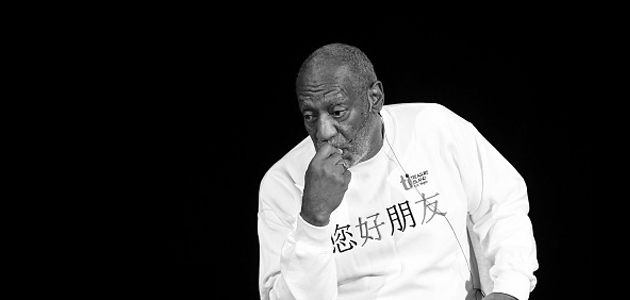

Good for the women! (They are being believed … more and more).

Still the same question can be posed about women accusers in general: Why were they not believed?

In summary, “celebrities should not be glorified as all good, all the time” …
… for nation-building, women must be able to seek refuge in the Criminal Justice systems in their communities.

VIDEO – Matt Lauer Fired from TODAY – https://usat.ly/2Bv3zGi

See the ENCORE of this previous blog-commentary below, from November 26, 2014 on Bill Cosby’s Accusers: Why They Weren’t Believed.

Which men are being reckoned with now? See the full alphabetical list from USA Today national newspaper – to date as of December 4, 2017 – here:

Ben Afleck, Actor-Director Gavin Baker, Hedge Fund Manager John Besh, Celebrity Chef
David Blaine, Magician George H.W. Bush, Former President Louis C.K., Actor-Comedian
Nick Carter, Singer John Conyers, Congressman Andy Dick, Actor
Richard Dreyfuss Hamilton Fish, Magazine Publisher Al Franken, Ex-Actor-now-Senator
Alex Gilady, Olympics Organizer Gary Goddard, Writer-Producer David Guillod, Movie Producer
Mark Halperin, Political Analyst Dustin Hoffman, Actor Danny Jordaan, FIFA Organizer
Steve Jurvetson, Hedge Fund Manager Ethan Kath, Music Producer Garrison Keillor, Radio Host
Andrew Kreisberg, TV Producer John Lasseter, Movie Producer Matt Lauer, TV Host
Benny Medina, Talent Agent Murray Miller, Screenwriter Roy Moore, US Senate Candidate
Michael Oreskes, NPR Vice-President Jeremy Piven, Actor Roy Price, Movie Studio Executive
Brett Ratner, Producer-Director Twiggy Ramirez, Musician-Rock Star Terry Richardson, Photographer
Charlie Rose, TV Host Gilbert Rozon, Comedy Organizer Chris Savino, Animator-Writer
Mark Schwahn, Screenwriter Robert Scoble, Technology Blogger Steven Seagal, Actor-Producer
Russell Simmons, Music Mogul Tom Sizemore, Actor Kevin Spacey, Actor-Producer
Sylvester Stallone, Actor-Producer George Takei, Actor-Activist Jeffrey Tambor, Actor
Glenn Thrush, Newspaper Reporter James Toback, Director-Screenwriter Bob Weinstein, Movie Producer
Harvey Weinstein, Movie Producer Matthew Weiner, TV Producer Ed Westwick, Actor
Leon Wieseltier, Magazine Editor

Source: https://www.usatoday.com/story/news/2017/11/22/weinstein-aftermath-all-men-accused-sexual-misconduct/884778001/

————

Go Lean Commentary – Bill Cosby’s Accusers: Why They Weren’t Believed.

It is hard to reconcile the accusations floating against Bill Cosby with his television characters: Dr. Huxtable, Jell-O Pudding Pitch-Man and the voice/persona of the animated do-gooder Fat Albert (and the Cosby Kids ; see Appendix below*). Or is it?

… that it’s easy to categorize personalities as good versus bad. “We don’t think good and evil can co-exist in the same person” – Psychologist David Adams.

The following article posits that those who do horrible things may still be talented in their gifts and notoriously good to people in their lives, like family members. While it maybe difficult to understand the complexities of personalities, it is very much necessary that society be receptive to the possibility of good people doing bad things. The entire article is presented here:

By: NO MORE Staff

Bill Cosby Photo 1America’s Dad is having a very bad week. A few days ago, Barbara Bowman wrote a personal essay in The Washington Post chronicling how Bill Cosby drugged and raped her 30 years ago.

The story went viral and inspired several others to echo her experiences.

Not so when the teenager spoke out soon after the alleged attacks: When she went to a lawyer after the assaults, she was accused of lying. Her agent did nothing, either. Eventually, she moved on. Years later, Andrea Constand accused Cosby of rape and Bowman was asked to speak in court, but the case was quietly settled.

At this writing, a grand total of 15 women have accused Cosby of assault, dating from the late 1960s. (Here’s a timeline of the accusations.) Despite all this, Cosby’s career had coasted along—in fact, he was awarded the Mark Twain Prize for American Humor not long ago and was planning a new TV show.

But things are changing.

Finally, the accusers’ stories are getting traction. Why now? Last month, comedian Hannibal Buress called Cosby a rapist in his stand-up routine, which went viral. The Twitter-verse responded in kind: Last week, Cosby’s tone-deaf invitation to “meme me!” resulted in people superimposing assault accusations over his photo. #Cosbymeme did not go according to plan, and things only got worse: Last weekend, NPR interviewed him about his African American art collection and then asked him to respond to the Post story. He went silent. Eventually, his lawyer issued a statement firmly denying the allegations and refusing to comment further.

But the damage has been done: New stories about Cosby’s behavior continue to surface, Netflix has put his upcoming comedy special on hold, and NBC has abandoned plans to develop a new sitcom with him.

Why Accusations About Celebrities Aren’t Believed

Cosby isn’t the first icon to be accused of sexual assault or domestic violence, and yet the question persists: Why aren’t these accusers heard or given any credence—not just Cosby’s alleged victims, but the countless other people who have dared to challenge a celebrity?

The answer lies in the American conflation of celebrity and security, says Ulester Douglas, executive director of Men Stopping Violence. “We are a celebrity culture. Seeing someone we idolize, revere, and idealize being accused of horrific crimes makes us wonder: Who are we? It makes us realize that our own families could be capable of it, too,” he says. It’s unsettling and even terrifying to associate an idol with evil, particularly because there are so many celebrities who are good people, capable of powerful, positive influence.

Dissonance Perpetuates Silence

David Adams is a psychologist and co-director of Emerge, a Boston-based abusers’ intervention and counseling program. He sees a difference in how we respond to a stereotypical criminal and a celebrity accused of bad behavior due to our preconceptions about abusers. “We tend to think of an abuser as someone who is easily detectable: someone who is crude, sexist, and boorish. A quarter of men who abuse women do fit this stereotype, and since that’s a substantial subgroup, we tend to spot those guys and not the ones who are more likable. If we don’t know what to do with bad information about someone we adore, it creates dissonance, and we sometimes choose to disbelieve or to ignore it,” he says.

“When we see someone likable accused of a crime, we have a choice to believe something bad about them or to discount it because it doesn’t fit our experience. In some ways it’s easier to do that than to think, oh God, the world really is unknowable—I might as well give up on knowing people,” he says. “If we don’t know what to do with information about someone we worship, we put it aside.”

Why Celebrities Feel Immune

Of course, Cosby is hardly the first famous person to be accused of rape or assault. When we think about any celebrity facing serious allegations, though, it’s difficult to believe that an image-conscious idol could be willing to engage in hugely risky behavior, throwing away the very image they need. What’s going through their mind?

“Any consequence is overridden by the high of the conquest,” Douglas says. And, on a purely logistical level, “They do it because they can. They truly think they can get away with it, based on the very fact that they have a certain image. They will be believed; the accusers will be laughed out of the room.”

Absorbing The Narcissism Factor

In many celebrity cases, narcissism also plays a starring role. “A hallmark of narcissism is exceptionality. You literally think you will not get caught. This personality takes chances, acts reckless, and even associates the behavior with success, because they’ve always been rewarded,” Adams says.

“We think narcissists are people nobody would like. But, in fact, they’re quite charismatic, with good social and image-maintenance skills”— which often allow them to get away with bad behavior, even more so when there’s a PR team on call. Narcissists are also skilled at compartmentalization, Adams says, and they choose to focus on the “part of their life that everybody adores. They don’t focus on other parts of their lives, and if they do something wrong, they think, ‘Gee, everybody loves me. What’s the problem?’” he says. “It’s a lack of character development.”

“Narcissists can engage in all sorts of psychological gymnastics not to feel empathy,” says Douglas.

The Changing Tide

Adams says that it’s easy to categorize personalities as good versus bad. “We don’t think good and evil can co-exist in the same person,” he says. “But look at the Mafia—these guys who do horrible things but are notoriously good to their mothers. And along comes a show like The Sopranos to paint them in a more nuanced light. There’s now less focus on ‘good guys’ and ‘bad guys,’” he says. Understanding the complexities of personalities—refusing to glorify a celebrity as all good, all the time—could help to close the dissonance gap.

“We can also go a long way toward preventing male sexual and domestic violence against women by stopping the pervasive and pernicious victim-blaming,” Douglas says. “The media, for example, should quit asking the toxic, ‘Why did you go back to your abuser?’ and ‘Why didn’t you leave?’ A reporter could say instead, ‘As you know, there are some who question your credibility because of some of the choices you made. What, if anything, would you want to say to them?’ That is respectful journalism. The [accuser] should never be made to feel like she has to justify the choices she made or makes.”

Finally, in his own work with Men Stopping Violence, Douglas sees firsthand the power of healing through sharing. “I see survivors who are finding peace through coming forward and telling their stories. One of the most powerful things that survivors can do is tell their own stories, on their own terms,” he says.
The NO MORE Project – Posted November 19, 2014; retrieved November 26, 2014–
http://nomore.org/why-cosby-victims-werent-believed/

The subject matter in the foregoing article relates to the attitudes that communities must foster so as to mitigate the toleration of domestic violence, rape and stalking. These points are being brought into focus in a consideration of the book Go Lean … Caribbean. The book serves as a roadmap for the introduction and implementation of the technocratic Caribbean Union Trade Federation (CU), for the economic optimization in the region.

The focus of the Go Lean book is Economics, not domestic violence, rape or stalking! And yet this commentary relates that there is an alignment of objectives. The Go Lean roadmap posits that the economy of the Caribbean is inextricably linked to the security (public safety) of the Caribbean.

This CU/Go Lean roadmap has 3 prime directives:

  • Optimization of the economic engines in order to grow the regional economy and create 2.2 million new jobs.
  • Establishment of a security apparatus to protect the resultant economic engines and their relevant stakeholders.
  • Improve Caribbean governance (Executive facilitations, Legislative oversight and Judicial prudence) to support these economic/security engines.

Among the objectives to accomplish the economic elevation is the mission to retain Caribbean citizens in their homelands and repatriate the far-flung Diaspora back to the region. Since many people may have fled the region to mitigate abuse, attitudes of victim-blaming or complacency among public safety authorities must be “weeded out”.

The subject of Celebrity Culture is also germane for the Caribbean empowerment effort (Pages 203 & 224). The Go Lean roadmap consolidates the region’s 30 member-states into a Single Market, media market included – with the caveat of multi-language “simul-casting”. Celebrities will surely emerge. From a governance perspective, the CU will oversee the jurisdiction of monitoring and metering (ratings, rankings, service levels, etc) local public safety institutions to ensure their delivery of the Social Contract. for all regardless of gender or race.

Change has now come to the Caribbean. As the foregoing article depicts, there is a changing tide. It is no longer acceptable to dismiss accusers, even against celebrities. The article relates that “we can go a long way toward preventing male sexual and domestic violence against women by stopping the pervasive and pernicious victim-blaming”. This is part of a new community ethos – the value of women is not undermined! Many related issues/ points were elaborated in previous blogs, sampled here:

Justice Strategy: Special Prosecutors … et al
Caribbean Study: 58% Of Boys Agree to Female ‘Discipline’
Sex Crimes Mitigations – Students developing nail polish to detect date rape drugs
Aereo Founder on the future of TV; Caribbean included
Bob Marley: The legend of a Caribbean Celebrity lives on!
Muslim officials condemn abductions of Nigerian girls
Caribbean/Latin countries still view women as lesser
Book Review: ‘The Divide’ – Differences in US Justice for Rich versus Poor
Jamaica to receive World Bank funds to help in crime fight

The above commentaries examined global developments in crime mitigations and gender based attitudes, then relate their synchronicity with the principles in the Go Lean book. There are a number of touch points that relate to domestic violence, rape and stalking; these blogs also cite the community attitude to dissuade such behavior. Most importantly, the Go Lean book depicts solutions. These are presented as community ethos, strategies, tactics, implementations and advocates; detailed as follows:

Community Ethos – Privacy –vs- Public Protection Page 23
Community Ethos – Whistleblower Protection Page 23
Community Ethos – Witness Security Page 23
Community Ethos – Anti Bullying & Mitigations Page 23
Community Ethos – Light Up the Dark Places Page 23
Community Ethos – “Crap” Happens Page 23
Community Ethos – Minority Equalization Page 24
Community Ethos – Lean Operations Page 24
Community Ethos – NGO’s Page 25
Community Ethos – Reconciliations Page 34
Strategy – Rule of Law –vs- Vigilantism Page 49
Tactical – Separation of Powers – CariPol Page 77
Implementation – Reasons to Repatriate Page 118
Planning – Ways to Improve Failed-State Indices Page 134
Advocacy – Ways to Improve Governance Page 168
Advocacy – Ways to Better Manage the Social Contract Page 170
Advocacy – Ways to Impact Justice Page 177
Advocacy – Ways to Remediate and Mitigate Crime Page 178
Advocacy – Ways to Improve Gun Control – Restraining Orders Automatic Restrictions Page 179
Advocacy – Ways to Improve Intelligence Gathering Page 182
Advocacy – Ways to Improve Communications – Messaging Page 186
Advocacy – Ways to Impact Hollywood Page 203
Advocacy – Ways to Impact the Prison Industrial Complex – Reduce Recidivism Page 211
Advocacy – Ways to Impact Foundations Page 219
Advocacy – Ways to Protect Human Rights Page 220
Advocacy – Ways to Impact the One Percent –    Balancing Justice Provisions for Celebrities Page 224
Advocacy – Ways to Empower Women Page 226
Advocacy – Ways to Impact Persons with Disabilities – including Mental Challenges Page 228

The book Go Lean…Caribbean was written by resources from an organized movement, by people (residents and Diaspora) with passion to change/elevate the Caribbean’s economic, security and governing engines. One principal within this Go Lean movement has a direct job function to dissuade crimes against women.

While there is always the need to give the accused the benefit of the doubt, as in the current case against Bill Cosby, we do not want 30 years of inaction on reported sex crimes by celebrities. The CU roadmap’s goal is to optimize “Justice” institutions in the region. Why? All members of society (celebrities and regular citizens alike) need to be protected, and not dismissed or ignored, especially related to serious allegations like sexually inappropriate behavior. Any “misfeasance, malfeasance or nonfeasance” in this regards reflects negatively on the region’s hospitality – think of the unsolved disappearance of Natalee Holloway in Aruba in 2005; (see Page 190).

Though this topic may be a security issue, community wealth is undoubtedly linked, affecting push-and-pull factors for citizens to flee their homelands. This is lose-lose for all concerned. To the contrast, the goal of the Go Lean effort is to make the Caribbean a better place to live work and play; with justice for all. Since the region failed in the past, the new messaging is simple: “No More“!

The foregoing article is sourced by the Not-For-Profit organization, the “No More” Project. Their goal is to neutralize public attitudes that had previously tolerated and thusly promoted domestic violence, rape and stalking. This is a great role model for the Caribbean to emulate, as attitude adjustment is among the heavy-lifting tasks that regional administrators must undertake to bring positive change to the Caribbean.

Download the book Go Lean … Caribbean – now!

————

* Appendix – Video – Fat Albert And The Cosby Kidshttp://youtu.be/ga7gflAUGCc

It’s Bill Cosby coming at you with music and fun, and if you’re not careful, you might learn something before its done.


Share this post:
, , , ,
[Top]

Africa: Past, Present and Future of Caribbean Relations

Go Lean Commentary

“How good and how pleasant it would be before God and man,
To see the unification of all Africans”
– Bob Marley’s Song Africa Unite; see Appendix VIDEO below.

These rhyming words of this song are shaping up to be more than just platitudes. There is an actual movement to forge an integrated, united Africa … at least economically. This is the movement for a Free Trade area for the whole continent of Africa. (A previous commentary detailed a continental security apparatus for Africa that the Caribbean should model).

Wow! That would be a start to fulfilling the dream of people like Bob Marley … and others (think: Marcus Garvey).

What is amazing is that these two late-great role models where movers-and-shakers for Africa, though they were natives, citizens and residents of the Caribbean.

This is because there is a historic Africa-Caribbean relationship that transcends time; there is a Past, Present and Future to Africa-Caribbean Relations, and it is more than just song-and-dance.

Past
The link between the Caribbean and Africa has always been one of interconnection. Yes, there is the ugly history of the African Slave Trade, but after that East-West human-capital flow ended (1807) the flow had since shifted to West-East between the two regions. (Think: Freetown, Sierra Leone and Liberia).

Following the Slave Trade, there was the legacy of colonialism and White Supremacy (think: South Africa’s Apartheid) until finally the post-colonial period arrived after World War II. This allowed for independence movements and nationalism, but not the integration and unity that Marley sang of.

Caribbean stakeholders where not just the singers and dreamers; no, they were fighters and soldiers as well. There is the one example of the southern Africa country of Angola. During their post-colonial independence drive, there were dissenting movements: one for a minority rule Apartheid-style system and one for majority rule democratic socialism. The Cuban Army helped to defeat the Apartheid-style regime.

This was the Caribbean reaching back and helping Africa.

Present
Today, the southern African region is at peace, liberated and striving for the best way to advance their societies on the world’s stage. Though still trailing, they have made some progress.

Congratulations to Demi-Leigh Nel-Peters of South Africa who was crowned Miss Universe 2018 on November 26, 2017 in Las Vegas, Nevada, USA.[12] (Miss Jamaica finished 3rd). This is the fourth time a contestant from the African continent has been crowned with this honor; the others include: 2011 Miss Angola, 1999 Miss Botswana and 1978 Miss South Africa (Apartheid-era).

Africa has “come a long way, Baby”.

That “Dark Continent” may be the cradle of mankind and the Motherland for many people in the Caribbean, but “she” is playing catch-up in a lot of areas of modernity. For this reason, all embedded countries are considered “developing”. With 1.2 billion[1] people as of 2016, it accounts for about 16% of the world’s human population. (The continent includes Madagascar and various archipelagos). It contains 54 fully recognized sovereign states (countries), nine territories and two de facto independent states with limited or no recognition[3] (Western Sahara and Somaliland); a potential of 65 member-states.

Future
There is the proposal for all countries on the African continent to convene and confederate and form a Single Market among the member-states. This would be transformative. See the full news article here:

Title: Op-Ed: How Africa can create a Continental Free Trade Area
By: Aboubaker Omar Hadi, Chairman of Djibouti Ports and Free Zone Authority

Ours is a continent rich in resources. From the coffee beans and cotton to mineral ores and oil wells, Africa is world-renowned for its raw materials.
However, exporting raw materials alone will not allow Africa to reach its potential. Indeed, the recent slump in global commodity prices has served as a harsh reminder that our traditional reliance on raw materials needs to evolve. It is only by transforming our commodities into value added goods that Africa will reap the full benefits of our natural strengths. Transforming our resources will create larger profit margins, growth and jobs. This transformation will, however, require a big industrialisation drive across the continent to foster trade and growth.

In the wake of Africa Industrialisation Day, which this year reflected on how to accelerate Africa’s progress towards the creation of a Continental Free Trade Area, we must also consider the supporting infrastructure required to make this pre-eminent objective a reality. All economies – on the global scale, but also on the regional and local level – demand a high level of circulation, which is only possible through the development of the necessary infrastructure.

In Africa, the lack of infrastructure is one of the greatest inhibitions preventing transformative growth. Ours is the only continent in the world without a transcontinental railway; in a continent where 16 out of 54 countries are landlocked, this is a real issue. Our infrastructure development therefore needs to be multimodal, ensuring that our coastlines are connected to our railways, airways and highways so that in-land countries and coastal countries are sharing in each others’ successes.

Beyond our transport links and trade zones, we also need to develop one further key aspect in our infrastructure framework: energy production. Around 600 million Africans still live without power on a daily basis. Not only is this unsustainable for our own populations but it is untenable if we are to attract foreign investors. To truly be players on the global stage, Africa needs to make sure that it has the capacity to support the industrial needs of the best of business from around the world.

As the Chairman of the Djibouti Ports and Free Zone Authority, I’ve made this industrial transformation, of both my country and the surrounding region, a priority. In the last year, we have completed and opened three state-of-the-art port facilities which have the capacity to welcome over 30,000 ships every year. As Djibouti sits on two of the world’s busiest maritime trade routes, our country has a key role to play in regional development, by ensuring our neighbours also benefit from this strategic location. Thus, the recently launched Addis Ababa-Djibouti railway will allow the continent’s fastest growing economy,

Ethiopia, to profit from our maritime façade. Already, over 90% of Ethiopia’s trade passes through Djibouti and infrastructure development is vital in ensuring that these trade routes are as efficient as possible.

In terms of our energy infrastructure, Djibouti has developed strong partnerships to strengthen investment in vital gas projects. Only last week, a memorandum of understanding was signed between Djibouti and the Chinese company Poly CGL. This MoU is the start of an important process which will see investment in a gas pipeline, a liquefaction plant and an export terminal in the south of the country, in Damerjog.

Industrial transformation is a long term effort. We will only achieve it with methodical determination and cooperation, as we enter a turning point for the continent. Africa is the second most populated continent in the world with over 1.2 billion inhabitants. By 2050, it is estimated that around a quarter of the world’s population will be living on the African continent. Several African countries are among the fastest growing in the world in terms of economic growth. Out of the 10 fastest growing economies in the world, 3 of them are located in East Africa: Ethiopia, Djibouti and Tanzania. Now is the moment at which we must work hard to keep pace with the rate at which our continent is transforming.

Source: CNBC Africa; posted November 24, 2017; retrieved November 29, 2017 from: https://www.cnbcafrica.com/insights/2017/11/24/africa-potential/

——–

The Caribbean will “pay more than the usual attention” to these developments of 65 member-states for Africa. We have our own roadmap for integration, convention and confederation here in the Caribbean region. This quest is projected in the book Go Lean … Caribbean as it serves as a roadmap for the introduction and implementation for the Caribbean Union Trade Federation (CU). This would be the administrator – a federal government – of a regional Single Market of the Caribbean’s 30 member-states.

With the same goal, the same heavy-lifting is necessary. This is true for Africa and the Caribbean; there would be the need to forge “Pluralistic Democracies” in each region. Imagine the diverse languages, religions, tribes, ethnicities and colonial heritage.  This is the epitome of pluralism, the recognition and affirmation of diversity within a political body. Success or failure with the African pluralism efforts can provide a lot of lessons for the Caribbean effort.

This CU/Go Lean roadmap does more than just forge a Single Market; it has a charter to elevate all the societal engines. As there is the need to assuage the societal defects and deficiencies in the region – there are many. The following are the 3 prime directives designed to elevate society and assuage deficiencies:

  • Optimization of the economic engines in order to grow the regional economy to $800 Billion and create 2.2 million new jobs.
  • Establishment of a security apparatus to ensure public safety and protect the resultant economic engines.
  • Improvement of Caribbean governance to support these engines, including a separation-of-powers between the member-states and CU federal agencies.

Wow, for the BIG ideas of fostering a Single Market … to elevate the economic engines for 1.2 billion people in Africa and 42 million people in the Caribbean.

The Go Lean book has a scope of the Caribbean only. Though we will pay attention to Africa, there is no effort to impact that region with strategies, tactics or implementations. We must sing the song, but have our own twist:

Africa Unite!

‘Cause the children wanna come home.
Not to fight your wars, but to love your shores.

Our limited scope is to “observe and report” on Africa and the rest of the world, while we “serve and protect” the Caribbean. The Go Lean book presented BIG ideas for reforming and transforming the economic-security-governing engines for the 42 million people in our 30 Caribbean member-states. The book stresses that our Caribbean effort must be a regional pursuit. This was an early motivation for the roadmap, as pronounced in the opening Declaration of Interdependence (Pages 12 – 13):

xi. Whereas all men are entitled to the benefits of good governance in a free society, “new guards” must be enacted to dissuade the emergence of incompetence, corruption, nepotism and cronyism at the peril of the people’s best interest. The Federation must guarantee the executions of a social contract between government and the governed.

xvi. Whereas security of our homeland is inextricably linked to prosperity of the homeland, the economic and security interest of the region needs to be aligned under the same governance. Since economic crimes … can imperil the functioning of the wheels of commerce for all the citizenry, the accedence of this Federation must equip the security apparatus with the tools and techniques for predictive and proactive interdictions.

xxiv. Whereas a free market economy can be induced and spurred for continuous progress, the Federation must install the controls to better manage aspects of the economy: jobs, inflation, savings rate, investments and other economic principles. Thereby attracting direct foreign investment because of the stability and vibrancy of our economy.

The Go Lean book provides 370-pages of turn-by-turn instructions on “how” to adopt new community ethos, plus the strategies, tactics, implementations and advocacies to execute so as to reboot, reform and transform the societal engines of Caribbean society.

There have been a number of previous blog-commentaries by the Go Lean movement that have highlighted lessons-learned from Africa. Consider this sample here:

https://goleancaribbean.com/blog/?p=13365 West African Case Study: ECOWAS to Launch ‘Single Currency’
https://goleancaribbean.com/blog/?p=8262 UberEverything in Africa
https://goleancaribbean.com/blog/?p=7119 Role Model: African Standby Force
https://goleancaribbean.com/blog/?p=5123 A Lesson in History – Royal Charter: Zimbabwe -vs- South Africa
https://goleancaribbean.com/blog/?p=4971 A Lesson in History – Royal Charters: Truth & Consequence
https://goleancaribbean.com/blog/?p=4145 The African Renaissance Monument

In summary, shepherding the continental region of Africa is no simple task. It requires the best practices of skilled technocrats. Hopefully the African member-states will thrive with this effort.

We will be watching!

Hopefully too, the Single Market efforts in our region – Caribbean Single Market & Economy – will proceed. This subject was detailed in the Go Lean book (Page 15); consider this sample:

What is the CSME? The initials refer to the Caribbean Single Market & Economy, the attempted integrated development strategy envisioned at the 10th Meeting of the Conference of Heads of Government of the Caribbean Community which took place in July 1989 in Grand Anse, Grenada. The Grand Anse Declaration had three key features:

1. Deepening economic integration by advancing beyond a common market towards a Single Market and Economy.

2. Widening the membership and thereby expanding the economic mass of the Caribbean Community (e.g. Suriname and Haiti were admitted as full members in 1995 and 2002 respectively).

3. Progressive insertion of the region into the global trading and economic system by strengthening trading links with non-traditional partners.

What was the hope for CSME? Whereas CariCom started as a Common Market and Customs Union, to facilitate more intra-region trade, the CSME was intended to effect more integration of the economies of the member states. But this turned out to be mere talk, fanciful murmurings of politicians during their bi-annual Heads of Government meetings. No deployment plans ever emerged, even though up to 15 member-states signed on to the accord; (and 10 more as “Observers” only).

The benefits of a Single Market are too alluring to ignore: larger market, expanded trade, leveraging economic shocks across a larger base naturally associated with a Free Market economy.

Let’s do this … more earnestly in the Caribbean region.

We need to follow through on the words of Bob Marley – “African Unite” – and apply them here at home:

Caribbean Unite: ‘Cause the children wanna come home.

We urge all Caribbean stakeholders – government officials, residents and Diaspora – to lean-in for the empowerments detailed in this Go Lean roadmap. Yes, we can!  We can make our homeland a better place to live, work and play. 🙂

How good and how pleasant it would …

Sign the petition to lean-in for this roadmap for the Caribbean Union Trade Federation.

Download the free e-book of Go Lean … Caribbean – now!

———–

Appendix VIDEO – Africa Unite – https://youtu.be/QMS5vKarzO0

Published on Jun 24, 2009 – Lyrics

Africa, Unite
‘Cause we’re moving right out of Babylon,
And we’re going to our Father’s land, yea-ea.

How good and how pleasant it would be before God and man, yea-eah! –
To see the unification of all Africans, yeah! –
As it’s been said a’ready, let it be done, yeah!
We are the children of the Rastaman;
We are the children of the Iyaman.

So-o, Africa unite:
‘Cause the children (Africa unite) wanna come home.
Africa unite:
‘Cause we’re moving right out of Babylon, yea,
And we’re grooving to our Father’s land, yea-ea.

How good and how pleasant it would be before God and man
To see the unification of all Rastaman, yeah.
As it’s been said a’ready, let it be done!
I tell you who we are under the sun:
We are the children of the Rastaman;
We are the children of the Iyaman.

So-o: Africa unite,
Afri – Africa unite, yeah!
Unite for the benefit (Africa unite) for the benefit of your people!
Unite for it’s later (Africa unite) than you think!
Unite for the benefit (Africa unite) of my children!
Unite for it’s later (Africa uniting) than you think!
Africa awaits (Africa unite) its creators!
Africa awaiting (Africa uniting) its Creator!
Africa, you’re my (Africa unite) forefather cornerstone!
Unite for the Africans (Africa uniting) abroad
Unite for the Africans (Africa unite) a yard! [fadeout]

  • Category: Music 
  • License: Standard YouTube License


Share this post:
, , , , ,
[Top]