Category: Social

ENCORE: Boston Bombing Anniversary – Learning Lessons

Go Lean Commentary

It has been 4 years already! The hope now is for an incident-free Boston Marathon today, April 17, 2017.

But hope is not the only emotion at work in Boston. There is also fear, concern, anticipation and preparation. The City of Boston has learned important lessons from that terrible attack at the Patriots Day Marathon in 2013. See highlights from this VIDEO here:

VIDEO – New security plans in place for the Boston Marathon
– http://wwlp.com/2017/04/14/new-security-plans-in-place-for-the-boston-marathon/

How about the Caribbean? Have we learned lessons? Are we engaging the needed remediation and mitigation?

We have events – think Carnival in  the Caribbean member-states or in  the Diaspora – on our calendar that could also be victimized by attacks, assaults and incidents (terrorism or just plain street-crime). It is very important that we do better to present our participants, spectators, guests and tourists a more secure environment.

More than economic interests are at stake. It could be life-or-death.

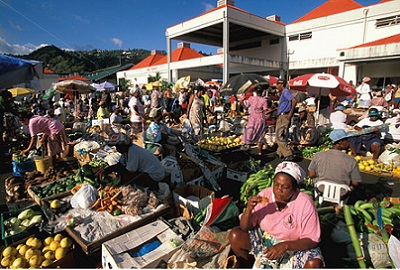
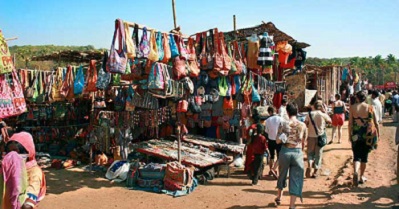
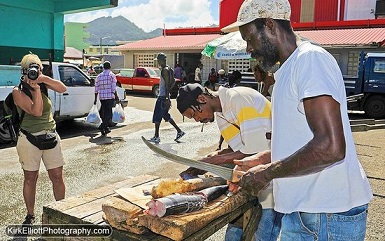
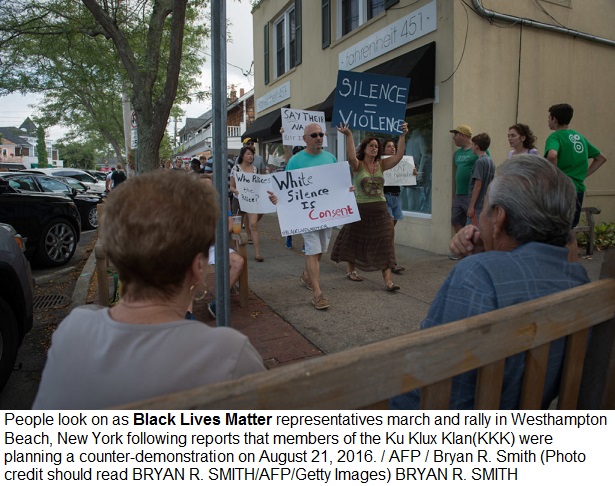
Notice some of the headlines here describing the security dynamics of some Caribbean events (around the Caribbean and the world):

Also, see the Encore of the previous blog-commentary that considered lessons learned from the Boston Marathon terrorist attack; this review was published on the 1-year anniversary in 2014. See it again here-now:

—————–

ENCORE – Original Commentary: Remembering and learning from Boston
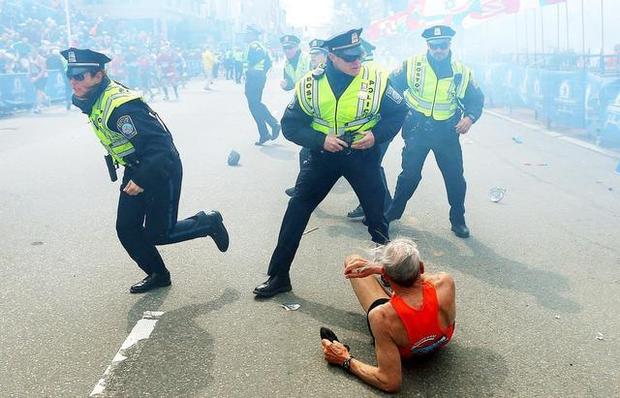
Boston BombingApril 15 [2014] is the one year anniversary of the Boston Marathon bombing. 3 people died directly, and countless others were maimed and injured. From any perspective this was a tragedy! To the families that lost loved ones on that date, our deepest condolences.

There are many lessons for the Caribbean to learn from this experience.

The book Go Lean … Caribbean serves as a roadmap for the introduction and implementation of the Caribbean Union Trade Federation (CU). This CU is proffered to provide economic, security and governing solutions for the 30 member Caribbean states. This book posits that the Caribbean is not immune to similar experiences like Boston; that terrorism requires mitigation beyond the member-states; there needs to be a regional solution. The CU will furnish such a focus. There will be proactive and reactive measures to monitor, interdict, and marshal terroristic threats in the Caribbean. Most of the Caribbean has legacy affiliation with European/US countries that have been victims of terrorism. Though we have not had the tragedies of backpacks exploding at marathons, or chemical weapons used in subways, or airplanes crashing into our buildings, we must still hold a constant vigilance. The roadmap posits that “bad actors” always emerge where there is economic successes. See a related news article here:

Title: Year after Boston bombing, it’s clear that threat of homegrown terrorism overhyped
By: David Schanzer and Charles Kurzman

In the aftermath of the Boston Marathon bombing one year ago Tuesday, many commentators and public officials called this tragedy a harbinger of more homegrown terrorist attacks to come.

“We’re going to see an explosion in this radicalization and recruitment,” predicted Congressman Frank Wolf. “We are less secure than we were 12 years ago,” claimed think-tank terrorism expert Michael Swetnam. Former Attorney General Michael Mukasey told Americans to “worry – a lot.

”To many, the Boston attack demonstrated the potency of the Islamist extremist ideology, the difficulty of detecting individuals radicalized through social media and the Internet, and the ease with which amateurs could cause massive harm in our open society. The Tsarnaev brothers, they claimed, had paved the way for more terrorism.

While only one year has passed, much of this concern appears to have been hyperbole.

No one has been killed by homegrown terrorists in the past year, and there have been no copycat attacks. To put this in context, over the same period there have been 14,000 murders in the United States, including 46 murders in Boston.

There also has been no epidemic of al-Qaida-inspired extremist behavior directed at American civilians. Our research shows that in the year since the marathon bombing, there have been 15 arrests of Muslim-Americans for terrorism-related offenses, below the average of 20 arrests per year since 9/11. Almost all of these arrests were for attempting to join a foreign terrorist organization abroad, not for planning attacks in the homeland, and were motivated by sympathies with rebels in Syria and elsewhere rather than by al-Qaida’s call for Muslims to attack the West.

Our law enforcement agencies have a far more balanced understanding of the nature of the extremist threat than many of those providing public commentary after the Boston attacks. A nationwide survey of law enforcement agencies we are conducting in collaboration with the Police Executive Research Forum shows that more than half of the agencies report little or no threat from al-Qaida-inspired extremism. Only 2 percent report the threat as “severe.” Agencies from large metropolitan areas reported somewhat higher levels of concern (27 percent reporting a low threat and 7 percent reporting a severe threat). Overall, law enforcement agencies are treating this as a serious, but manageable, issue rather than the existential crisis that many have feared.

Law enforcement agencies have embraced community outreach as an effective strategy to counter violent extremism. Almost every large metropolitan police force surveyed collaborates with Muslim-American communities that are targeted for recruitment by al-Qaida and related extremists. Most of these agencies report they have established a high level of trust with the community, and two-thirds say these relationships have helped develop actionable information. This track record contradicts claims by Congressman Peter King, a New York Republican, and others that Muslim-Americans have failed to cooperate with law enforcement.

One year after two individuals inflicted pain and suffering on the streets of Boston, we should not be overly fearful or cavalier about the threat of violent extremism. The low levels of violent conduct both before and after the Boston Marathon show that no matter how many extremist videos are posted on the Internet, the baseless ideas these videos propagate appeal to only a tiny fraction of our populace. Yet, since small numbers of people can do so much harm, law enforcement agencies and the communities they serve must be constantly vigilant and continue to work together to prevent the next atrocity.

David Schanzer is a Professor at Duke University’s Sanford School of Public Policy and Director of the Triangle Center on Terrorism and Homeland Security.

Charles Kurzman is a Professor of Sociology at the University of North Carolina, Chapel Hill.

Source: News Observer Newspaper – a Raleigh, North Carolina Daily – Retrieved 04/15/2014 from: http://www.newsobserver.com/2014/04/14/3784842/year-after-boston-bombing-its.html

How can we apply lessons from this foregoing article in the stewardship of the Caribbean Homeland Security?

First, we have the direct lessons of the scourge of piracy in the Caribbean for centuries. The “after-effects” of this legacy still remain, even today. As Caribbean society traversed over the centuries, the attitudes that tolerated piracy, described in the book as “community ethos”, evolved to tolerate, incubate and even promote other lawless activities; (shipwrecking, bootlegging, drug smuggling). So with this history in mind, and the prime directive to elevate Caribbean society, the Go Lean economic empowerment mission is coupled with appropriate security provisions. This mandate is detailed early on in the book’s Declaration of Interdependence, with the following pronouncements (Page 12):

x. Whereas we are surrounded and allied to nations of larger proportions in land mass, populations, and treasuries, elements in their societies may have ill-intent in their pursuits, at the expense of the safety and security of our citizens. We must therefore appoint “new guards” to ensure our public safety and threats against our society, both domestic and foreign. The Federation must employ the latest advances and best practices of criminology and penology to assuage continuous threats against public safety. The Federation must allow for facilitations of detention for convicted felons of federal crimes, and should over-build prisons to house trustees from other jurisdictions.

xvi. Whereas security of our homeland is inextricably linked to prosperity of the homeland, the economic and security interest of the region needs to be aligned under the same governance. Since economic crimes, including piracy and other forms of terrorism, can imperil the functioning of the wheels of commerce for all the citizenry, the accedence of this Federation must equip the security apparatus with the tools and techniques for predictive and proactive interdictions.

Gun ComicThere are many other lessons for us to learn from Boston. But there are other tragedies that appear to have gotten less attention in the past year since the marathon bombings. In Boston alone, there have been 46 murders since April 15, 2013. In total, there have been 14,000+ murders in the entire Unites States in that time. See the foregoing news article/commentary.

These have not gone unnoticed! Especially terrorism’s junior partner-in-crime, bullying; such incidents also call for mitigations.

The Go Lean roadmap therefore comes BIG, in its offering to effectuate change in the Caribbean. Notice these strategies, tactics, implementations, and advocacies detailed in the book related to Caribbean security:

10 Ways to Improve Sharing Page 35
10 Foreign Policy Initiatives at Start-up Page 102
10 Security Initiatives at Start-up Page 103
10 Ways to Impact Justice Page 177
10 Ways to Reduce Crime Page 178
10 Ways to Improve for Gun Control Page 179
10 Ways to Improve Homeland Security Page 180
10 Ways to Mitigate Terrorism Page 181
10 Ways to Improve Intelligence [Gathering] Page 182
10 Ways to Improve Animal Husbandry Page 185
10 Ways to Impact the Prison-Industrial Complex Page 211
10 Ways to Impact Youth Page 227

Further, the Go Lean roadmap portrays the need for public messaging to encourage adoption of better community ethos for the Greater Good (Page 37). We must not allow those innocent lives in Boston to pass without positive lessons for our society.

Download the book Go Lean … Caribbean – now!

Sign the petition to lean-in for the roadmap for the Caribbean Union Trade Federation.


Share this post:
, ,

Forging Change: Home Addiction

Go Lean Commentary

CU Blog - Forging Change - Home Addiction - Photo 1

If only we can get people addicted to ‘home’ then they would want to stay ‘here’ or come back home.

We can! We can tease, tempt and program people to become addicted to being ‘home’, and homesick whenever they are away from home.

This would be similar to getting people addicted to …

drugs, sex, Rock-n-Roll, games, alcohol, cigarettes, gambling and other vices.

This refers to a scientific process involving brain chemistry. The brain chemistry is dopamine. It is possible to make people addicted to different elements, whether they be physical and conceptual. See the details in the encyclopedic Appendix below.

This is an important issue. The movement behind the book Go Lean … Caribbean – wants to forge change in the Caribbean. We want to dissuade the bad trend of our people abandoning their homeland – fleeing – and pursuing life in the Diaspora abroad. We need our people at home. We need them to be addicted to their homeland and love it, and to miss it when separated. This describes …

Homesickness
… the distress or impairment caused by an actual or anticipated separation from home.[1] Its cognitive hallmark is preoccupying thoughts of home and attachment objects.[2] Sufferers typically report a combination of depressive and anxious symptoms, withdrawn behavior and difficulty focusing on topics unrelated to home.[3][4][5]

Homesickness is defined so similarly to withdrawal symptoms! And the reward-motivated behavior is powerfully addictive; think of a slot-machine in a casino.

Drug abuse = Bad! Casino gambling = Bad! Homesickness = Good.

The Go Lean book describes the effort of dissuading Caribbean residents from societal abandonment as heavy-lifting. The book explains that there are 2 reasons why people leave their beloved homelands – “Push” and “Pull” factors:

  • “Push” refers to people who feel compelled to leave, to seek refuge in a foreign land. “Refuge” is an appropriate word; because of societal defects, many from the Caribbean must leave as refugees – think LGBTDisabilityDomestic-abuseMedically-challenged – for their life, liberty and pursuit of happiness. For these people, it is like “they are on fire” and need to stop-drop-and-roll.
  • “Pull”, on the other hand refers to the lure of a more prosperous life abroad; many times our people are emigrating on the false perception that they can have a better “home” abroad. They have a deficient longing for their homeland.

In order to neutralize the “Push and Pull” factors, the heavy-lift of reforming and transforming Caribbean society must be done. This movement has identified many previous strategies, tactics and implementations (8 in total) for forging change in the region. These require technocratic deliveries and best-practices. The Go Lean book details the efforts to change the minds (head), hearts and hands (actions) of Caribbean people. This commentary describes one way to forge change, getting the people addicted to their homeland.

Yes, this is possible; it is scientific, and not science fiction. This approach is at work right now in the smart-phone industry; they employ strategies, tactics and operational efficiency to compel people to engage their devices … continuously. They make people addicted.

CU Blog - Forging Change - Home Addiction - Photo 2

How can we introduce this addiction in our homeland, to forge change? Fortunately, the devices are already there; we only need to brain hack, to customize the content, for addiction.

See this Art-and-Science portrayed in this news story VIDEO here, from 60 Minutes:

VIDEO – Brain Hacking – http://www.cbsnews.com/videos/brain-hacking

Published April 9, 2017 – Why can’t we stop looking at our smartphones? And are the designers of the apps and content on them using brain science to keep us hooked? Anderson Cooper reports.

Various strategies, tactics and implementations for forging change have been identified in a series of previous Go Lean blog-commentaries over the past 2 & 1/2 years, this is the ninth submission. These were presented as follows, in reverse chronological order:

  1.      Forging Change – Addicted to Home (Today)
  2.      Forging Change – Arts & Artists (December 1, 2016)
  3.      Forging Change – Panem et Circenses (November 15, 2016)
  4.      Forging Change – Herd Mentality (October 11, 2016)
  5.      Forging Change – ‘Something To Lose’ (November 18, 2015)
  6.      Forging Change – ‘Food’ for Thought (April 29, 2015)
  7.      Forging Change – Music Moves People (December 30, 2014)
  8.      Forging Change – The Sales Process (December 22, 2014)
  9.      Forging Change – The Fun Theory (September 9, 2014)

This commentary is urging Caribbean stakeholders to customize the content on smart-phones and media (social website www.myCaribbean.gov) to forge addiction for the people that live, work and play there.

There is an art-and-science to this quest:

#addictionbydesign
CU Blog - Forging Change - Home Addiction - Photo 4

The stakeholders in the smart-phone and social media industries have a proven track record. According to the foregoing VIDEO, whether they want to or not, these ones are “shaping the thoughts, feelings and actions of people [consuming their products]; they are programming people”.

We – the Go Lean movement – want to shape the “thoughts, feelings and actions” of Caribbean people. Understanding the science of Dopamine, allows us to structure the appeal and messaging to create an addiction – home-sickness – among Caribbean residents.

This quest will require a genius application of Art-and-Science to make this effort successful. The Go Lean book (Page 27) describes the process of starting early to identify Caribbean youth with genius qualifiers for the Arts and Science – we need them now. We need them to compete like “Drug Dealers” to get people in the community hooked on the content of Caribbean life: expressions of arts, music, dance, stories, drama, news, information, films, movies, TV shows and other media portrayals. While the actual content creators and curators may only be a handful of professionals, those with genius qualifiers, the impact, the addiction, can be felt on the whole community. This is an expression of the Greater Good. This is defined in the Go Lean book (Page 37) as:

“The greatest good to the greatest number of people which is the measure of right and wrong”. – Jeremy Bentham (1748-1832, a British philosopher, jurist, and social reformer.

This is why the Go Lean book, while commencing as an economic empowerment plan, devotes so many pages to the arts, music, media, social media, technology and communications.

The Go Lean book serves as a roadmap for the introduction and implementation of the technocratic Caribbean Union Trade Federation (CU). The CU is set to optimize Caribbean society through economic, security and governing empowerments. Therefore the Go Lean roadmap has 3 prime directives:

  • Optimization of the economic engines in order to grow the regional economy to $800 Billion & create 2.2 million new jobs.
  • Establishment of a security apparatus to ensure public safety and protect the economic engines.
  • Improve Caribbean governance to support these engines.

The Go Lean/CU roadmap asserts that forging change in the Caribbean will be a hard, heavy-lift task and many alternate strategies – the 9 from above – may have to be engaged. Any one person – artists or technologists – can make a difference and positively impact society; such a person can be a champion for our Caribbean cause . We can all work to make our homeland a better place to live, work and play. This is why fostering the genius ability in Caribbean citizens is presented in the book (Page 27) as a community ethos.

The Go Lean book presents this and other (new) community ethos for the region to adopt, plus new strategies, tactics, implementation and advocacies to execute to forge change in the region. The following is a sample of these specific details from the book:

Community Ethos – Deferred Gratification Page 21
Community Ethos – Economic Principles – People Choose Page 21
Community Ethos – Economic Principles – People Respond to Incentives in Predictable Ways Page 21
Community Ethos – Economic Principles – Economic Systems Influence Individual Choices Page 21
Community Ethos – Economic Principles – The Consequences of Choices Lie in the Future Page 21
Community Ethos – Governing Principles – Lean Operations Page 24
Community Ethos – Governing Principles – Cooperatives Page 25
Community Ethos – Ways to Foster Genius Page 27
Community Ethos – Ways to Help Entrepreneurship – Case Study of Incubators Page 28
Community Ethos – Ways to Promote Intellectual Property Page 29
Community Ethos – Ways to Impact Research and Development Page 30
Community Ethos – Ways to Close the Digital Divide Page 31
Community Ethos – Ways to Impact the Greater Good Page 37
Strategy – Vision – Confederate 30 Member-States Page 45
Strategy – Mission – Celebrate the Music, Sports, Art and Culture of the Caribbean Page 46
Tactical – Confederating a Permanent Union Page 63
Tactical – Fostering a Technocracy Page 64
Tactical – Separation-of-Powers – Communications and Media Authority Page 79
Implementation – Year 1 / Assemble Phase – Establish CPU Page 96
Implementation – Ways to Pay for Change – Spectrum Auctions for Mobile Deployments Page 101
Implementation – Ways to Optimize Mail Service & myCaribbean.gov Marketplace Page 108
Implementation – Ways to Deliver Page 109
Implementation – Ways to Impact Social Media Page 111
Planning – 10 Big Ideas for the Caribbean Region Page 127
Planning – Ways to Make the Caribbean Better Page 131
Planning – Reasons Why the CU Will Succeed Page 132
Advocacy – Ways to Grow the Economy Page 151
Advocacy – Ways to Create Jobs Page 152
Advocacy – Ways to Improve Homeland Security Page 180
Advocacy – Ways to Improve Communications – Community Messaging Page 186
Advocacy – Ways to Foster Technology Page 197
Advocacy – Ways to Foster e-Commerce Page 198
Advocacy – Ways to Preserve Caribbean Heritage Page 218
Advocacy – Ways to Improve the Arts Page 230
Advocacy – Ways to Promote Music Page 231
Appendix – Various Genres of Caribbean Music Page 347

The Go Lean roadmap offers the technocratic execution of these deliverables. Imagine identifying and fostering the genius abilities of technologists (programmers, coders, designers, project managers and behaviorists) and artists (singers, actors, dancers, musicians, performers, etc.). The end-product of their genius may be Caribbean residents longing to stay home and foreign-based residents (Diaspora) being/becoming homesick. From the outset, the Go Lean book recognized the significance of our Diaspora and successful careers in these cutting-edge fields, with these statements in the opening Declaration of Interdependence (Page 13 & 14):

xix. Whereas our legacy in recent times is one of societal abandonment, it is imperative that incentives and encouragement be put in place to first dissuade the human flight, and then entice and welcome the return of our Diaspora back to our shores. This repatriation should be effected with the appropriate guards so as not to imperil the lives and securities of the repatriated citizens or the communities they inhabit. The right of repatriation is to be extended to any natural born citizens despite any previous naturalization to foreign sovereignties.

xx. Whereas the results of our decades of migration created a vibrant Diaspora in foreign lands, the Federation must organize interactions with this population into structured markets. Thus allowing foreign consumption of domestic products, services and media, which is a positive trade impact. These economic activities must not be exploited by others’ profiteering but rather harnessed by Federation resources for efficient repatriations.

xxi.  Whereas the preparation of our labor force can foster opportunities and dictate economic progress for current and future generations, the Federation must ensure that educational and job training opportunities are fully optimized for all residents of all member-states, with no partiality towards any gender or ethnic group. The Federation must recognize and facilitate excellence in many different fields of endeavor, including sciences, languages, arts, music and sports. This responsibility should be executed without incurring the risks of further human flight, as has been the past history.

xxxii. Whereas the cultural arts and music of the region are germane to the quality of Caribbean life, and the international appreciation of Caribbean life, the Federation must implement the support systems to teach, encourage, incentivize, monetize and promote the related industries for arts and music in domestic and foreign markets. These endeavors will make the Caribbean a better place to live, work and play.

The Go Lean roadmap seeks to foster the eco-system for developing and deploying smart-phone arts-and-sciences. There is a lot of progress to be garnered from this field. The more lucrative the industry, the more participation from technologists and artists, the more impactful the content addiction can have on our society. We simply need to foster the regional industry and participation.

This quest – fostering the economic opportunities from smart-phones/social media – has been addressed in many previous Go Lean commentaries; see sample here:

https://goleancaribbean.com/blog/?p=11184 Banks spending $Billions on ‘Financial Technologies’ for Smart-phones
https://goleancaribbean.com/blog/?p=10750 Smart-phones causing more People to abandon Newspapers
https://goleancaribbean.com/blog/?p=9751 Where the Jobs Are – Animation and Game Design
https://goleancaribbean.com/blog/?p=8823 Lessons from China – WeChat: Model for Caribbean Social Media
https://goleancaribbean.com/blog/?p=8817 Lessons from China – Mobile Game Apps: The New Playground
https://goleancaribbean.com/blog/?p=8328 Case Study: Caribbean-bred YouTube Millionaire: ‘Tipsy Bartender’
https://goleancaribbean.com/blog/?p=7991 Transformations: www.myCaribbean.com – Delivering the Future
https://goleancaribbean.com/blog/?p=7920 eMerge Miami’s conference aims to jump-start tech hub for the Caribbean
https://goleancaribbean.com/blog/?p=7806 Skipping School to become Tech Giants
https://goleancaribbean.com/blog/?p=7034 The Future of Electronic Money – Mobile Phones are Key
https://goleancaribbean.com/blog/?p=6921 A Rewards Program for the Caribbean
https://goleancaribbean.com/blog/?p=6341 Tourism Stewardship — In the Information Age
https://goleancaribbean.com/blog/?p=5034 Patents: The Guardians of Innovation
https://goleancaribbean.com/blog/?p=3974 Google and Mobile Phones – Here comes Change
https://goleancaribbean.com/blog/?p=2953 Funding Caribbean Entrepreneurs – The Online ‘Crowdfunding’ Way
https://goleancaribbean.com/blog/?p=2126 Where the Jobs Are – Computers Reshaping Global Job Market
https://goleancaribbean.com/blog/?p=1416 Amazon’s new FIRE Smartphone Eco-system
https://goleancaribbean.com/blog/?p=486 Venture Capital Firm backs Taxi-Cab booking app for Smart-phones
https://goleancaribbean.com/blog/?p=476 New Urgings on ICT for CARICOM

This Go Lean roadmap is committed to optimizing Caribbean societal engines – economic, security and governance – by means of initiatives in the industry for Internet & Communications Technologies (ICT) – including smart-phones and social media applications. But this roadmap is bigger than just smart-phones; its a concerted effort to elevate life in Caribbean communities – to make our society worthy of homesickness.

The Caribbean needs to be successful in keeping their citizens at home; we need our people to want to stay home or to long to come back. We can do this; we can make people homesick – by lowering the “push-and-pull” factors. We must forge change here. And we can; this quest is conceivable, believable and achievable. We can make the Caribbean a better place to live, work and play. 🙂 

Download the book Go Lean … Caribbean – now!

Sign the petition to lean-in for the roadmap for the Caribbean Union Trade Federation.

—————

Appendix Reference – Dopamine

Dopamine (DA, contracted from 3,4-dihydroxyphenethylamine) is an organic chemical of the catecholamine and phenethylamine families that plays several important roles in the brain and body. It is an amine synthesized by removing a carboxyl group from a molecule of its precursor chemical L-DOPA, which is synthesized in the brain and kidneys. Dopamine is also synthesized in plants and most multicellular animals.

Brain

In the brain, dopamine functions as a neurotransmitter—a chemical released by neurons (nerve cells) to send signals to other nerve cells. The brain includes several distinct dopamine pathways, one of which plays a major role in reward-motivated behavior. Most types of rewards increase the level of dopamine in the brain, and many addictive drugs increase dopamine neuronal activity. Other brain dopamine pathways are involved in motor control and in controlling the release of various hormones. These pathways and cell groups form a dopamine system which is neuromodulatory.

Outside the central nervous system, dopamine functions primarily as a local chemical messenger. In blood vessels, it inhibits norepinephrine release and acts as a vasodilator (at normal concentrations); in the kidneys, it increases sodium excretion and urine output; in the pancreas, it reduces insulin production; in the digestive system, it reduces gastrointestinal motility and protects intestinal mucosa; and in the immune system, it reduces the activity of lymphocytes. With the exception of the blood vessels, dopamine in each of these peripheral systems is synthesized locally and exerts its effects near the cells that release it.

Cocainesubstituted amphetamines (including methamphetamine), Adderall, methylphenidate (marketed as Ritalin or Concerta), MDMA (ecstasy) and other psychostimulants exert their effects primarily or partly by increasing dopamine levels in the brain by a variety of mechanisms.[84] Cocaine and methylphenidate are dopamine transporter blockers or reuptake inhibitors; they non-competitively inhibit dopamine reuptake, resulting in increased dopamine concentrations in the synaptic cleft.[85][86]:54–58 Like cocaine, substituted amphetamines and amphetamine also increase the concentration of dopamine in the synaptic cleft, but by different mechanisms.[24][86]

The effects of psychostimulants include increases in heart rate, body temperature, and sweating; improvements in alertness, attention, and endurance; increases in pleasure produced by rewarding events; but at higher doses agitation, anxiety, or even loss of contact with reality.[84] Drugs in this group can have a high addiction potential, due to their activating effects on the dopamine-mediated reward system in the brain.[84]

Source: Retrieved April 14, 2017 from: https://en.wikipedia.org/wiki/Dopamine


Share this post:
, ,
[Top]

ENCORE: Creating a Legacy in Pro-Surfing

CU Blog - Surfing Legacy - Photo 1Time marches on, while the legacy of pro-surfing in the French Caribbean continues to grow.

Welcome to Martinique, and some of the best surfing on the planet.

This original Go Lean blog-commentary from April 14, 2015 is re-distributed on this occasion of the Third Annual Martinique Surf Pro, which just transpired April 1 through April 8, 2017. And the winner is:

Title: Ricardo Christie conquered the 2017 Martinique Surf Pro, at Basse-Pointe, in Martinique.

Christie proved he’s ready to return to the Dream Tour by putting out a competent performance at the righthand pointbreak. And he needed six rides to clinch the tasty trophy.

“When the waves are like that you can forget everything and just go out there and surf. I feel like I’ve improved a lot,” explained Ricardo Christie, who failed to requalify at the end of his rookie season on the Championship Tour.

“I’ve just been working really hard, and I learned a lot when I was on tour. It doesn’t feel like it’s over; it’s just the beginning of the year, so I just have to keep doing my thing.”

With this victory in Martinique, Ricardo Christie jumped 91 places to number 10 on the QS rankings.

Source: Posted April 10, 2017; retrieved April 12, 2017 from: http://www.surfertoday.com/surfing/13558-ricardo-christie-wins-the-2017-martinique-surf-pro

Consider the VIDEO highlights from this year’s event.

This event – part sports; part culture; is all tourism. It is building momentum! We need more events like this. See the Encore below describing how the movement behind the book Go Lean…Caribbean will strategize for sports tourism; this means more and more events … in different sports.

————–

Go Lean Commentary – Title: Is Martinique the Next Caribbean Surfing Capital?


Sports could be big business; culture is big business. Every now-and-then there is the opportunity to merge sports and culture into a single economic activity. One such expression is the sports/culture of surfing. This focus is a priority for the movement to elevate the Caribbean society, stemming from the book Go Lean…Caribbean.

The book serves as a roadmap for the introduction and implementation of the technocratic Caribbean Union Trade Federation (CU). While the CU is not intended as a sports promotion entity, it does promote the important role of sports in the quest to make the Caribbean a better place to live, work and play.

Though surfing activities originated with Polynesian culture (see Appendix below), the sport has assimilated well in other societies – the Caribbean included.

In terms of cultural expressions of surfing in the United States, the most iconic portrayal is the Rock-n-Roll group the Beach Boys; see VIDEO in the Appendix below of a milestone performance in Tokyo, Japan.

Yes surfing is global in its participation and appreciation.

Now a Caribbean community, the French-domain of Martinique is exploring the surfing sub-culture for sport, tourism and sports-tourism.

Cowabonga* Dude!

By: The Caribbean Journal staff

Long an under-the-radar surfing spot, the French Caribbean island will get its place in the spotlight when the surfing world gathers on the island later this month for the first-ever Martinique Surf Pro.

From April 21-26, the Caribbean’s only World Surf League Qualification Series event this year will take place along the shores of Basse-Pointe in Martinique.

The event, which is being organized by Martinique Surfing in partnership with the World Surf League, will bring together 100 world-class surfers from the United States, Japan, Europe, Brazil and the Caribbean.

“Martinique has been among the best-kept secrets in Caribbean surfing for some time now,” said Muriel Wiltord, director of the Americas for the Martinique Promotion Bureau. “Such a high-profile event as this cements the island’s position as a prime surfing destination. As one the top watersports competitions being held in the Caribbean in 2015, Martinique Surf Pro also shines a spotlight on the wide range of additional watersports options that Martinique has to offer.”

Martinique’s surfing season typically lasts between November and May along its northern and northeastern Atlantic coasts.

Source retrieved April 13, 2015: http://www.caribjournal.com/2015/04/13/is-martinique-the-next-caribbean-surfing-capital/

CU Blog - Is Martinique the next big Caribbean surfing capital - Photo 2

CU Blog - Is Martinique the next big Caribbean surfing capital - Photo 3

CU Blog - Is Martinique the next big Caribbean surfing capital - Photo 1

Not every coastline is ideal for surfing; thusly many Caribbean residents do not surf; it is not an indigenous activity to this region. But the past-time – and culture for that matter – is adaptable. Why is this? While the Caribbean has been blessed with many natural gifts, the physical conditions for surfing are not everywhere; (based on factual information retrieved from Wikipedia).

There must be a consistent swell. A swell is generated when wind blows consistently over a large area of open water, called the wind’s fetch. The size of a swell is determined by the strength of the wind and the length of its fetch and duration. Because of this, surf tends to be larger and more prevalent on coastlines exposed to large expanses of ocean traversed by intense low pressure systems.

Local wind conditions affect wave quality, since the surface of a wave can become choppy in blustery conditions. Ideal conditions include a light to moderate “offshore” wind, because it blows into the front of the wave, making it a “barrel” or “tube” wave. Waves are Left handed and Right Handed depending upon the breaking formation of the wave.

Waves are generally recognized by the surfaces over which they break.[7] For example, there are Beach breaks, Reef breaks and Point breaks.

The most important influence on wave shape is the topography of the seabed directly behind and immediately beneath the breaking wave. The contours of the reef or bar front becomes stretched by diffraction. Each break is different, since each location’s underwater topography is unique. At beach breaks, sandbanks change shape from week to week. Surf forecasting is aided by advances in information technology. Mathematical modeling graphically depicts the size and direction of swells around the globe.

So mastering the sport of surfing is now an art and a science.

Despite the fun and joy of surfing, there are a lot of dangers with this activity:

This activity is not for the faint of heart.

Not every market, especially in the Caribbean, can support the demands of surfing as a sport and as a cultural event. As depicted in the foregoing article, Martinique uniquely qualifies. This year’s professional tournament is the inaugural event. This Caribbean island makes a very short-list of all locations where this activity is practical. The following is a sample of the competitive/major surfing locations (Surf Cities) around the globe:

1. In Australia

2. In Asia

3. In the South Pacific

4. In South Africa

5. In North America

6. In Central America

7. In South America

8. In the USA

9. In Europe

The Martinique effort and initiative to satiate the thirst … and fascination of surfing aligns with the objects of the CU/Go Lean roadmap; especially the mission “to forge industries and economic drivers around the individual and group activities of sports and culture” (Page 81).

The Go Lean vision is a confederation of the 30 member-states of the Caribbean forming the CU as a proxy organization to do the heavy-lighting of building, funding, maintaining and promoting sports venues. The strategy is for the CU to be the landlord, and super-regional regulatory agency, for sports leagues, federations and associations (amateur, collegiate, and professional). The embrace and promotion of the sport and culture of surfing can contribute to the Greater Good for the Caribbean. This aligns with the prime directives of the CU/Go Lean roadmap; summarized in the book with these 3 statements:

  • Optimization of the economic engines in order to grow the regional economy to $800 Billion & create 2.2 million new jobs.
  • Establishment of a security apparatus to protect the resultant economic engines and the participants in activities like surfing.
  • Improvement of Caribbean governance to support these engines.

This roadmap commences with the recognition that genius qualifiers can be found in many fields of endeavor, including sports. The roadmap pronounces the need for the region to confederate in order to invest in elevation of the Caribbean eco-systems in which such athletic geniuses can soar. These pronouncements are made in the opening Declaration of Interdependence, (Pages 13 & 14) as follows:

xxi. Whereas the preparation of our labor force can foster opportunities and dictate economic progress for current and future generations, the Federation must ensure that educational and job training opportunities are fully optimized for all residents of all member-states, with no partiality towards any gender or ethnic group. The Federation must recognize and facilitate excellence in many different fields of endeavor, including sciences, languages, arts, music and sports. This responsibility should be executed without incurring the risks of further human flight, as has been the past history.

xxii. Whereas sports have been a source of great pride for the Caribbean region, the economic returns from these ventures have not been evenly distributed as in other societies. The Federation must therefore facilitate the eco-systems and vertical industries of sports as a business, recreation, national pastime and even sports tourism – modeling the Olympics.

The Go Lean book and accompanying blogs declare that the Caribbean needs to learn lessons from Surf City communities and other sporting venues/administrations. So thusly this subject of the “business of sports” is a familiar topic for Go Lean blogs. This cause was detailed in these previous blogs:

https://goleancaribbean.com/blog/?p=6464 NEW: WWE Network – Model for Caribbean
https://goleancaribbean.com/blog/?p=4019 Melding of Sports & Technology; the Business of the Super Bowl
https://goleancaribbean.com/blog/?p=3414 Levi’s® Stadium: A Team Effort
https://goleancaribbean.com/blog/?p=3244 Sports Role Model – espnW
https://goleancaribbean.com/blog/?p=2222 Sports Role Model – Playing For Pride … And More
https://goleancaribbean.com/blog/?p=2171 Sports Role Model – Turn On the SEC Network
https://goleancaribbean.com/blog/?p=2152 Sports Role Model – US versus the World
https://goleancaribbean.com/blog/?p=1715 Lebronomy – Economic Impact of the Return of the NBA Great
https://goleancaribbean.com/blog/?p=1446 Caribbean Players in the 2014 World Cup
https://goleancaribbean.com/blog/?p=1341 College World Series Time – Lessons from Omaha
https://goleancaribbean.com/blog/?p=1214 Landlord of Temporary Stadiums
https://goleancaribbean.com/blog/?p=1148 Sports Bubble – Franchise values in basketball
https://goleancaribbean.com/blog/?p=1020 Sports Revolutionary: Advocate Jeffrey Webb
https://goleancaribbean.com/blog/?p=498 Book Review: ‘The Sports Gene’
https://goleancaribbean.com/blog/?p=318 Collegiate Sports in the Caribbean
https://goleancaribbean.com/blog/?p=60 Could the Caribbean Host the Olympic Games?

This Go Lean roadmap is committed to availing the economic opportunities of all the Caribbean sports eco-system to respond to the world’s thirst for surfing. The book details the series of community ethos, strategies, tactics, implementations and advocacies to deliver the regional solutions to better harness economic benefits from sports and sports-tourism activities:

Community Ethos – People Respond to Incentives in Predictable Ways Page 21
Community Ethos – Consequences of Choices Lie in the Future Page 21
Community Ethos – Lean Operations Page 24
Community Ethos – Return on Investments Page 25
Community Ethos – Ways to Foster Genius Page 27
Community Ethos – Ways to Impact the Greater Good Page 37
Strategic – Staffing – Sporting Events at Fairgrounds Page 55
Tactical – Fostering a Technocracy Page 64
Tactical – Separation of Powers – Sports & Culture Administration Page 81
Tactical – Separation of Powers – Fairgrounds Administration Page 83
Implementation – Steps to Implement Self-Governing Entities Page 105
Implementation – Ways to Deliver Page 109
Planning – Ways to Make the Caribbean Better Page 131
Advocacy – Ways to Grow the Economy Page 151
Advocacy – Ways to Create Jobs Page 152
Advocacy – Ways to Improve Local Government – Parks & Recreation Page 169
Advocacy – Ways to Impact Public Works Page 175
Advocacy – Ways to Impact Events Page 191
Advocacy – Ways to Promote Fairgrounds as Sporting Venues Page 192
Advocacy – Ways to Preserve Caribbean Heritage Page 218
Advocacy – Ways to Improve Sports Page 229
Advocacy – Ways to Impact Urban Living – Sports Leagues Page 234

What could be the end result for the Go Lean roadmap’s venture into the sport of surfing and the business of sports? Economic growth and “jobs”. The Go Lean roadmap anticipates 21,000 direct jobs at sports enterprises throughout the region.

But surfing is also a leisure amenity, a “play” activity within the Go Lean roadmap. Many participate in this activity with no competitive motives. So the promotion of surfing in the Caribbean region can appeal to many enthusiasts far-and-wide to come visit and enjoy our Caribbean hospitality. This subject therefore relates back to the primary regional economic activity of tourism. This fits into the appeal of the Caribbean sun, sand and surf.

Overall, with these executions, the Caribbean region can be a better place to live, work and play. There is a lot of economic activity in the “play” aspects of society. Everyone, surfers, athletes and spectators alike, are hereby urged to lean-in to this Go Lean roadmap.

Cowabonga Dudes!

Download the free e-book of Go Lean … Caribbean – now!

Sign the petition to lean-in for the roadmap for the Caribbean Union Trade Federation.
———-

Appendix – *Cowabunga: (slang) an expression of surprise or amazement, often followed by “dude”. Popular among California surfers.

———-

Appendix – Encyclopedia of Surfing:

For centuries, surfing was a central part of ancient Polynesian culture. This activity was first observed by Europeans at Tahiti in 1767 by Samuel Wallis and the crew members of the Dolphin; they were the first Europeans to visit the island in June of that year.

Surfing is a surface water sport in which the wave rider, referred to as a surfer, rides on the forward or deep face of a moving wave, which is usually carrying the surfer toward the shore. Waves suitable for surfing are primarily found in the ocean, but can also be found in lakes or in rivers in the form of a standing wave or tidal bore. However, surfers can also utilize artificial waves such as those from boat wakes and the waves created in artificial wave pools.

The term surfing refers to the act of riding a wave, regardless of whether the wave is ridden with a board or without a board, and regardless of the stance used. The native peoples of the Pacific, for instance, surfed waves on alaia, paipo, and other such craft, and did so on their belly and knees. The modern-day definition of surfing, however, most often refers to a surfer riding a wave standing up on a surfboard; this is also referred to as stand-up surfing.

George Freeth (8 November 1883 – 7 April 1919) is often credited as being the “Father of Modern Surfing”.

In 1907, the eclectic interests of the land baron Henry Huntington (of whom the City of Huntington Beach is named after) brought the ancient art of surfing to the California coast. While on vacation, Huntington had seen Hawaiian boys surfing the island waves. Looking for a way to entice visitors to the area of Redondo Beach, where he had heavily invested in real estate, he hired the young Hawaiian George Freeth to come to California and ride surfboards to the delight of visitors; Mr. Freeth exhibited his surfing skills twice a day in front of the Hotel Redondo.

In 1975, professional contests started.[6]

Today, the Surfing Hall of Fame is located in the city of Huntington Beach, California. The city brands itself as Surf City USA.

(Source retrieved April 14 from: http://en.wikipedia.org/wiki/Surfing)

———-

AppendixVIDEO – The Beach Boys: Surfin’ Safari~Surf City~Surfin’ U.S.A – https://youtu.be/qpSwdQMn8xs

Uploaded on Jul 29, 2011 – Live at Budokan in Japan November 2, 1991

Share this post:
, , , , ,
[Top]

Managing the ‘Strong versus the Weak’ – An American Sickness

Go Lean Commentary

“There is a special ‘place in hell’ …”
“… for someone that would steal your wallet after you collapse/faint due to a health crisis; (think heart-attack, epileptic seizure, etc.)”.

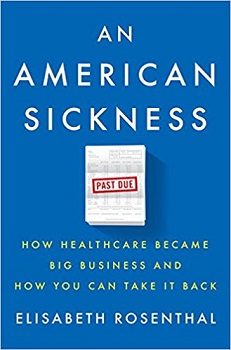
Sickness 1Imagine this scenario at the country level; how inconceivable for an advanced society. And yet, this is the actual situation in the United States. This is according to the new book – An American Sickness: How Healthcare Became Big Business and How You Can Take It Back – by Dr. Elisabeth Rosenthal, a former E.R. doctor and current journalist for medical issues.

This commentary asserts that there is a need for the Caribbean communities to reform and transform our healthcare deliveries, yet still, we do NOT want to model the American system. This point aligns with the book Go Lean…Caribbean, which seeks to reboot the 30 member-states of the Caribbean region, to ensure better stewardship of the Social Contract for all citizens in our homelands, strong and weak. The Go Lean book petitions the Caribbean region to do better! It describes the necessary empowerments to optimize the economic, security and governing engines of Caribbean society to ensure a better adherence to the principle of the Greater Good.

In a 4-part series of blog-commentaries on the “Strong versus the Weak”, the pattern from the Code of Hammurabi was detailed and presented as an Old World model that was ignored in the formation of the New World. The Americans got it bad! If that ancient King Hammurabi was around in present day, he would have a harsh judgment for the American healthcare system. It is figuratively like “stealing the wallet when a person collapses”, as many of the financial abuses in American hospitals occur when the patient is unconscious or only concerned about seeking relief from pain and/or discomforts.

This commentary is an spin-off from that series; though it was originally presented as a 4-parter, we are hereby adding this 5th entry. The full series is now as follows:

  1. Managing the Strong versus the Weak – Model of Hammurabi
  2. Managing the Strong versus the Weak – Mental Disabilities
  3. Managing the Strong versus the Weak – Bullying in Schools
  4. Managing the Strong versus the Weak – Book Review: Sold-Out!
  5. Managing the Strong versus the Weak – An American Sickness

The need for this 5th entry arose with the release of this new book today – April 11, 2017. It is ‘spot-on’ for the criticism of the pattern of abuse of the ‘Weak’ in American society. See the review-synopsis of Dr. Rosenthal’s book here:

Book Review: An American Sickness: How Healthcare Became Big Business and How You Can Take It Back
By: Elisabeth Rosenthal (Author)

At a moment of drastic political upheaval, a shocking investigation into the dangerous, expensive, and dysfunctional American healthcare system, as well as solutions to its myriad of problems

Sickness 2

In these troubled times, perhaps no institution has unraveled more quickly and more completely than American medicine. In only a few decades, the medical system has been overrun by organizations seeking to exploit for profit the trust that vulnerable and sick Americans place in their healthcare. Our politicians have proven themselves either unwilling or incapable of reining in the increasingly outrageous costs faced by patients, and market-based solutions only seem to funnel larger and larger sums of our money into the hands of corporations. Impossibly high insurance premiums and inexplicably large bills have become facts of life; fatalism has set in. Very quickly Americans have been made to accept paying more for less. How did things get so bad so fast?

Breaking down this monolithic business into the individual industries—the hospitals, doctors, insurance companies, and drug manufacturers—that together constitute our healthcare system, Rosenthal exposes the recent evolution of American medicine as never before. How did healthcare, the caring endeavor, become healthcare, the highly profitable industry? Hospital systems, which are managed by business executives, behave like predatory lenders, hounding patients and seizing their homes. Research charities are in bed with big pharmaceutical companies, which surreptitiously profit from the donations made by working people. Patients receive bills in code, from entrepreneurial doctors they never even saw.

The system is in tatters, but we can fight back. Dr. Elisabeth Rosenthal doesn’t just explain the symptoms, she diagnoses and treats the disease itself. In clear and practical terms, she spells out exactly how to decode medical doublespeak, avoid the pitfalls of the pharmaceuticals racket, and get the care you and your family deserve. She takes you inside the doctor-patient relationship and to hospital C-suites, explaining step-by-step the workings of a system badly lacking transparency. This is about what we can do, as individual patients, both to navigate the maze that is American healthcare and also to demand far-reaching reform. An American Sickness is the frontline defense against a healthcare system that no longer has our well-being at heart.

Source: Posted and Retrieved 04-11-2017 from: https://www.amazon.com/American-Sickness-Healthcare-Became-Business/dp/1594206759/ref=sr_1_1?ie=UTF8&qid=1491928851&sr=8-1&keywords=Book+American+Sickness

—————

AUDIO Podcast – Terry Gross interviews Elisabeth Rosenthal – Heard on Fresh Air

Mental Photo 4April 10, 2017 – Health care is a trillion-dollar industry in America, but are we getting what we pay for? Dr. Elisabeth Rosenthal, a medical journalist who formerly worked as a medical doctor, warns that the existing system too often focuses on financial incentives over health or science.

“We’ve trusted a lot of our health care to for-profit businesses and it’s their job, frankly, to make profit,” Rosenthal says. “You can’t expect them to act like Mother Teresas.”

Rosenthal’s new book, An American Sickness, examines the deeply rooted problems of the existing health-care system and also offers suggestions for a way forward. She notes that under the current system, it’s far more lucrative to provide a lifetime of treatments than a cure.

“One expert in the book joked to me … that if we relied on the current medical market to deal with polio, we would never have a polio vaccine,” Rosenthal says. “Instead we would have iron lungs in seven colors with iPhone apps.”

Notice this small sample of the book’s revelations and disclosures, symptomatic of Crony-Capitalism:

  • Healthcare economics do not align with normal economic laws: “Usual & Customary” versus supply-and-demand
  • Hospital systems behave like predatory lenders
  • Consumers cannot decide, as prices may be unknown at the time of delivery
  • Lifetime of treatment preferable for service-providers rather than a cure.
  • Doctors owning Surgical Centers, therefore dictating procedures that they can accommodate at their facilities
  • Unknown and unauthorized “Drive-by Doctors” adding to hospital bills.

This commentary and the previous 4 commentaries in this series all relate to nation-building, stressing the community ethos necessary to forge a society where all the people are protected all the time. While we are analyzing the American system, we clearly recognize that the Caribbean eco-system is equally – or perhaps even more – in a crisis and in need of reform. The premise in the Go Lean book and subsequent blog-commentaries is that “a crisis is a terrible thing to waste”. We can use the acknowledgement of our crisis to optimize our healthcare deliveries once and for all. We must assuredly look beyond the American model. According to the foregoing book and AUDIO Podcast, many more successful models exist.

Dr. Rosenthal’s book asserts that there may be better models in Europe than there is in the US. This is already a familiar thesis for the Go Lean movement – a roadmap for the introduction and implementation of the Caribbean Union Trade Federation (CU) – as the Go Lean book advocates studying all dimensions of the EU:

10 Ways to Model the EU – Page 130.
The CU will emulate the European Union by unifying and integrating the Caribbean region into one market, thereby creating a single economy of 30 member-states, 42 million people and a GDP of over $800 Billion (per 2010). The EU is 28 member-states, 507.89 million people and $16.6 Trillion GDP (per 2012). Though the CU is only a fraction the size of the EU, there is the similarity of divergent peoples (24 languages) putting aside their differences in a quest to confederate. The EU region has quite an ignoble history of contending with differences, spurning 2 World Wars in the last century. Yet they came together to unite and integrate to make Europe a better place to live, work and play. Just like the EU, the CU will not possess sovereignty; this feature remains with each member-state.

Still, there was a previous attempt to reform the American healthcare delivery eco-system. There is wisdom to glean from that development. The Go Lean book provides this excerpt (Page 156):

The Bottom Line on Obama Care
The Patient Protection and Affordable Care Act (PPACA), commonly called Obama Care is a US federal statute signed into law by President Barack Obama on March 23, 2010. It represents the most significant government expansion and regulatory overhaul of the U.S. healthcare system since the passage of Medicare and Medicaid in 1965. The PPACA is aimed at increasing the rate of health insurance coverage for Americans and reducing the overall costs of health care. It provides a number of mechanisms—including mandates, subsidies, and tax credits — to employers and individuals to increase the coverage rate.Additional reforms aim to improve healthcare outcomes and streamline the delivery of health care. The PPACA requires insurance companies to cover all applicants and offer the same rates regardless of pre-existing conditions or sex. The Congressional Budget Office projected that the PPACA will lower both future deficits and Medicare spending. On June 28, 2012, the United States Supreme Court upheld the constitutionality of most of the Obama Care.

The US, despite its advanced democracy status, has definite societal defects in the healthcare arena. Overcoming the defects – particularly Crony-Capitalism or exploiting public resources for private gains – make solving healthcare challenging.

It is truly heavy-lifting!

This was recently discovered by the new US president, Donald Trump.

After campaigning for the 2016 election on the promise of “repealing and replacing Obama Care”, the administration’s first healthcare legislation attempt flopped. The president’s exclamation:

President Trump: ‘Nobody Knew Health Care Could Be So Complicated’

The truth of the matter Mr. President, everybody – engaged in the process of transforming society – knew!

Transforming the Caribbean healthcare will also be equally complicated. It will engage all 3 societal engines: economic, security and governance. In fact, the prime directives of the Go Lean/CU roadmap includes the following 3 statements:

  • Optimization of the economic engines in order to grow the regional economy to $800 Billion & create 2.2 million new jobs.
  • Establishment of a security apparatus – including emergency management – to ensure public safety and protect the resultant economic engines.
  • Improve Caribbean governance for all people – with empowerments for healthcare – to support these engines.

This comprehensive view – economics, security and governance – is the charge of the Go Lean roadmap, opening with these pronouncements in the Declaration of Interdependence (Page 11):

viii. Whereas the population size is too small to foster good negotiations for products and commodities from international vendors, the Federation must allow the unification of the region as one purchasing agent, thereby garnering better terms and discounts.

ix. Whereas the realities of healthcare and an aging population cannot be ignored and cannot be afforded without some advanced mitigation, the Federation must arrange for health plans to consolidate premiums of both healthy and sickly people across the wider base of the entire Caribbean population. The mitigation should extend further to disease management, wellness, mental health, obesity and smoking cessation programs. The Federation must proactively anticipate the demand and supply of organ transplantation as developing countries are often exploited by richer neighbors for illicit organ trade.

Overall, the Go Lean book stresses the community ethos, strategies, tactics, implementations and advocacies to reboot, reform and transform healthcare delivery in the Caribbean; see this expressed in this one advocacy here:

10 Ways to Improve Healthcare – Page 156

1 Embrace the advent of the CU Single Market to leverage across the 42 million people in the 30 member-states.
2 Organ Procurement Authority
3 Deploy Disease Management Models
4 Universal Health Insurance Care
Much like with auto insurance, there is a need to mandate health insurance coverage for most Caribbeans. The coverage does not have to be $0 deductible and 100% coverage, rather it could be less attractive – low-end terms – like $6000 deductible and 60% coverage. The US model, Obama Care has plans branded Bronze (low end), Silver, Gold and Platinum. The goal for the CU is simply to ensure that catastrophic illnesses or injuries do not imperil the financial viability of individual, families or communities. The coverage risk is minimized with insurance carriers having a larger premium base (42 million) to calculate their actuarial formulas. To maximize savings, individual states may choose to combine their health insurance marketplaces with other states or go at it alone.
5 Wellness, Nutrition, Fitness and Smoking Cessations Programs
6 Medical Tourism
7 Repatriate MediCare Beneficiaries
8 Caribbeans with Disabilities
9 Medical Education Outreach
10 Public Health Extension
Due to the systemic threat, epidemic response and disease control will be coordinated at the federal level. Also, the acquisition of public-bound pharmaceuticals (vaccinations, etc.) can be negotiated at the regional level, using the Group Purchasing Organizations (GPO) envisioned in this roadmap. This will lead to a better supply and pricing dynamics.

The points of effective, technocratic stewardship of healthcare were further elaborated upon in previous blog/commentaries. Consider this sample:

https://goleancaribbean.com/blog/?p=7822 Cancer: Doing More
https://goleancaribbean.com/blog/?p=7586 Blink Health: The Cure for High Drug Prices
https://goleancaribbean.com/blog/?p=7430 Brazilian Shrunken Head Babies: Zika or Tdap?
https://goleancaribbean.com/blog/?p=6580 Capitalism of Drug Patents
https://goleancaribbean.com/blog/?p=3276 Role Model Shaking Up the World of Cancer
https://goleancaribbean.com/blog/?p=2522 The Cost of Cancer Drugs
https://goleancaribbean.com/blog/?p=2105 Recessions and Public Health
https://goleancaribbean.com/blog/?p=1751 New Hope in the Fight against Alzheimer’s Disease
https://goleancaribbean.com/blog/?p=1003 Painful and rapid spread of new virus in Caribbean
https://goleancaribbean.com/blog/?p=554 Cuban cancer medication registered in 28 countries
https://goleancaribbean.com/blog/?p=286 PR’s Comprehensive Cancer Center Project Breaks Ground
https://goleancaribbean.com/blog/?p=278 Tim Armstrong, the CEO of AOL – Health-care Concerns

The opening imagery:

“There is a special ‘place in hell’ …”

… is just an metaphorical reference. There is no assumption of a literal burning abyss of torment. But this does convey the abomination of the “strong abusing the weak”. So many times in the past this abuse has proliferated, for those weaker physically, mentally, economically and sadly, medically.

The movement behind the Go Lean/CU roadmap wants us, in the Caribbean, to do better. Yes, healthcare is not easy, but it is possible to reform and transform. There are so many good examples and models to learn from:

The underlying book reviewed here – An American Sickness: How Healthcare Became Big Business and How You Can Take It Back – considers Switzerland.

We want to “weed out” any bad practices of Crony-Capitalism in our health delivery system. Instead, we want to pursue the Greater Good (greatest good to the greatest number of people which is the measure of right and wrong). Most importantly, we want to proclaim the truth of American life. So many of our Caribbean citizens “beat down their doors to get out” and emigrate to the US. We want to “dull the lights on any American Welcome signs” – considering the reality of American Crony-Capitalism, the “grass is not necessarily greener on the other side”.

Now is the time to lean-in to this Go Lean roadmap to reboot, reform and transform Caribbean healthcare. If we do this, we will make the Caribbean a better place to live, work, heal and play. 🙂

Sign the petition to lean-in for the roadmap for the Caribbean Union Trade Federation.

Download the free e-book of Go Lean … Caribbean – now!

Share this post:
, , , ,
[Top]

‘To Live and Die in L.A.’ …

Go Lean Commentary

CU Blog - 'To Live and Die in L.A.' - Photo 1b

“… live so fast and die so young…”
“… it’s like a jungle, sometimes it makes me wonder how I keep from going under…” – Rap Song: The Message – Grandmaster Flash & The Furious Five

Considering the edict of “life imitating art and art imitating life”, this has always been a subject of sharp debate and contrast. Is it better to live “fast & furious”, even though there might be a shorter mortality, or is it better to go slow and last longer, as far away from risky propositions as possible?

Shockingly, this is also a Caribbean debate: is it better to emigrate to L.A., New York, Miami, Toronto, London, Paris or any other foreign destination for faster success, or prosper where planted in the Caribbean homeland?

From an American perspective, this debate is best personified with a comparison of California versus the rest of the US. Los Angeles (L.A.) is the principal metropolis of the State of California and all of the West Coast for that matter.

But this debate is bigger than just a consideration of L.A. or California – see Appendix below – it spans the test of time. Even ancient philosopher Aesop presented this dilemma in the fable of “The Tortoise and The Hare”, in which the nimble jack-rabbit lost out to the slow-and-methodical tortoise in a race – this fable is universally accepted as a metaphor for the race of life.

Poets, songwriters, historians, and philosophers have all chimed in on this profound debate. Some claim that it is better to “live large”, make the “world your oyster”, even if that means having a short lifespan than to live a quiet ignoble life where the joys of life are rationed out for longevity instead.

Whenever a celebrity dies young, this debate rages anew. Consider some of the philosophical headlines:

The book Go Lean … Caribbean discusses this contrast; it draws reference to the American Dream versus the California Dream. Consider this excerpt from Page 223:

The Bottom Line on the American Dream
The American Dream is a national ethos of the United States, a set of ideals in which freedom includes the opportunity for prosperity and success, and an upward social mobility achieved through hard work. This idea of the American Dream is rooted in the US Declaration of Independence which proclaims that “all men are created equal… endowed by their Creator with certain inalienable rights” including “Life, Liberty and the pursuit of Happiness.” The meaning of the “American Dream” has changed over history, and includes components as home-ownership and upward mobility. A lot of people followed the American Dream to achieve a greater chance of becoming rich. For example, the discovery of gold in California in 1849 brought in 100,000 men looking for their fortune overnight—and a few did find it. Thus was born the California Dream of instant success. Historian H. W. Brands noted that in the years after the Gold Rush, the California Dream spread across the nation:

  • “The old American Dream … was the dream of the Puritans, of Benjamin Franklin’s “Poor Richard” … of men and women content to accumulate their modest fortunes a little at a time, year by year by year. The new dream was the dream of instant wealth, won in a twinkling by audacity and good luck. [This] golden dream . . . became a prominent part of the American psyche”. Today, some posit that the ease of achieving this Dream changes with technological advances, available infrastructure, regulations, state of the economy, and the evolving cultural values of the US demographics.

The Go Lean book serves as a roadmap to introduce the technocratic Caribbean Union Trade Federation (CU) to elevate the region’s societal engines – economics, homeland security and governance – of the 30 Caribbean member-states. In fact, the prime directives of the roadmap includes the following 3 statements:

  • Optimization of the economic engines in order to grow the regional economy to $800 Billion & create 2.2 million new jobs.
  • Establishment of a security apparatus to ensure public safety and protect the resultant economic engines.
  • Improve Caribbean governance for all people, even visiting tourists, to support these engines.

CU Blog - 'To Live and Die in L.A.' - Photo 2The quest is to minimize the paradox of future-planning/decision-making for Caribbean citizens. We want to make the Caribbean region better places to live, work and play; this way our citizens would not have to leave … to ‘live and die in L.A., or NYC, or Miami, or any other American, Canadian or European city. The truth of the matter is people die more readily in America due to gun-violence, and automobile accidents than they die in the Caribbean.

No doubt!

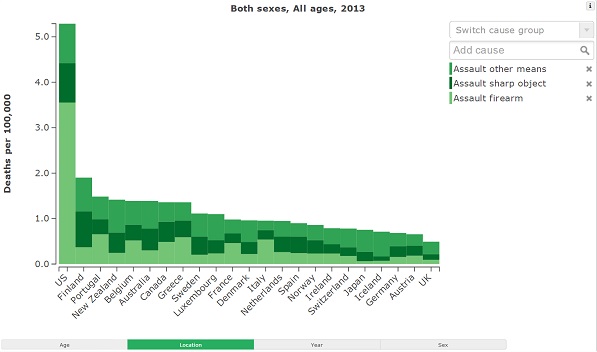
  • Visualizing gun deaths: Comparing the U.S. to rest of the world
    Whenever a mass shooting occurs, a debate about gun violence ensues. An often-cited counter to the point about the United States’ high rates of gun homicides is that people in other countries kill one another at the same rate using different types of weapons. It’s not true.
    Compared to other countries with similar levels of development or socioeconomic status, the United States has exceptional homicide rates, and it’s driven by gun violence.
    CU Blog - 'To Live and Die in L.A.' - Photo 3
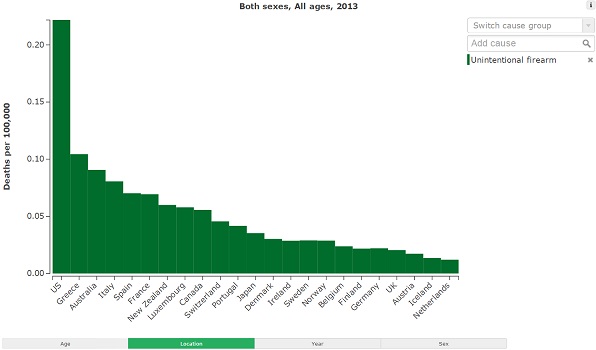
    Another issue that gets less attention is how many people die from firearms accidentally. Again, the U.S. has much higher rates of unintentional death from firearms compared to other countries.
    CU Blog - 'To Live and Die in L.A.' - Photo 4
  • U.S. has highest car crash death rate, despite progress, CDC says
    More people die in car crashes each year in the United States than in other high-income countries, the Centers for Disease Control and Prevention said in a report …
    In 2013, more than 32,000 people died on U.S. roads, roughly 90 fatalities a day, according to the CDC.
    The U.S. has seen a 31% reduction in its motor vehicle death rate per capita over the past 13 years. But compared with 19 other wealthy countries, which have declined an average of 56% during the same period, the U.S. has the slowest decrease.

A previous Go Lean blog-commentary highlighted other statistics of premature deaths (and disability) in the US due to societal defects:

But the truth is a two-sided coin …

… on the flipside, life in America is more prosperous than in any Caribbean member-state.

The Go Lean book introduces the Caribbean Union Trade Federation (CU) as an inter-governmental agency for the 30 member-states, to provide a better – technocratic – stewardship for Caribbean life, to make it more prosperous … at home. The book identifies that we have a crisis – our failing societal engines – but asserts that this crisis would be a terrible thing to waste. We can use the urgency to introduce and implement effective community ethos, strategies, tactics, implementations and advocacies to reboot, reform and transform the engines of Caribbean society.

We do not want our people to ‘live and die in L.A. …’. We want them to prosper right here in the Caribbean. How sad when our families do move to the US (and other countries) and fall victim to fatalities. Consider these headlines:

There are good and bad people everywhere. Bad things happen to good people … everywhere. The Bible declares that “time and unforeseen occurrences befall us all” (Ecclesiastes 9:11). Yet still, post-mortem analyses (crash investigations and autopsies) are always necessary to ascertain the root-causes and the lessons-learned:

What could have been done to prevent the loss of life?

This commentary is not asserting that Caribbean people will not be hurt if they remain in the Caribbean. There are car accidents, murders, robberies, rapes and other assaults in the 30 member-states as well.

But follow the numbers!

We are not #1 for either gun violence or auto deaths, like our American counterparts. This is just a matter odds, probabilities and trends; the preponderance for fatalities cannot be ignored.

The Go Lean book contends that as a people, we must be prepared for accidents, emergencies and security risks (Page 196). It asserts that bad actors will emerge just as a result of economic successes in the region. This point is pronounced early in the book with the Declaration of Interdependence (Page 12) that claims:

x. Whereas we are surrounded and allied to nations of larger proportions in land mass, populations, and treasuries, elements in their societies may have ill-intent in their pursuits, at the expense of the safety and security of our citizens. We must therefore appoint “new guards” to ensure our public safety and threats against our society, both domestic and foreign. The Federation must employ the latest advances and best practices … to assuage continuous threats against public safety.

xvi. Whereas security of our homeland is inextricably linked to prosperity of the homeland, the economic and security interest of the region needs to be aligned under the same governance. Since economic crimes, including piracy and other forms of terrorism, can imperil the functioning of the wheels of commerce for all the citizenry, the accedence of this Federation must equip the security apparatus with the tools and techniques for predictive and proactive interdictions.

There is this expression of wisdom, commonly referred to as the Serenity Prayer; it is a prayer written by the American theologian Reinhold Niebuhr[1][2] (1892–1971). The best-known form is:

  • God, grant me the serenity to accept the things I cannot change,
  • Courage to change the things I can,
  • And wisdom to know the difference.

The Go Lean book describes the need for the Caribbean to appoint “new guards” to apply this wisdom – to change the things we can change. The purpose of this security pact is to ensure public safety as a comprehensive endeavor, encapsulating the needs of all Caribbean stakeholders: residents and visitors alike.

We cannot impact Los Angeles, the US or any other foreign city, more than messaging to our Diaspora there. But we can forge change in our Caribbean homeland.

Applying the edict of “life imitating art and art imitating life”, let’s ‘live and die’ here in the Caribbean. Let’s apply the wisdom from the fictional character Spock (the Vulcan Commander on the TV Show/films Star Trek):

May we live long and prosper.

Now is the time for all of the Caribbean – the people and leaders – to lean-in for the empowerments described here in the book Go Lean…Caribbean. It is conceivable, believable and achievable to prosper where planted here in the region; to make the Caribbean a better place to live, work and play. 🙂

Download the free e-book of Go Lean … Caribbean – now!

Sign the petition to lean-in for the roadmap for the Caribbean Union Trade Federation.

————-
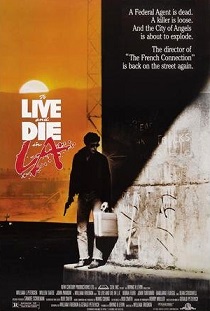
Appendix Review – Book/Movie: To Live and Die in L.A.

Sub-title: A 1984 novel by former Secret Service agent Gerald Petievich is the basis for the 1985 movie of the same name.

CU Blog - 'To Live and Die in L.A.' - Photo 1

A harrowing tale of the dark underside of America’s West Coast metropolis. Two U.S. Treasury agents, partners and antagonists, are drawn into a matrix of violence and corruption, southern California-style, that becomes a journey through a sunlit hell – at the end of which they become experts on the thin line between what it takes to live – and die – in L.A. – Source: Retrieved 04-10-2017 from: https://www.amazon.com/Live-Die-L-A-Gerald-Petievich/dp/1466219645

The action thriller film was directed by William Friedkin and based on the novel by Petievich, and co-written by the both men. The film features William Petersen, Willem Dafoe and John Pankow among others. The film tells the story of the lengths to which two Secret Service agents go to arrest a counterfeiter. – Source: Retrieved 04-10-2017 from: https://en.wikipedia.org/wiki/To_Live_and_Die_in_L.A._(film)

See Trailer in the Appendix VIDEO below.

Storyline
Working largely in cases of counterfeiting, L.A. based Secret Service agent Richie Chance exhibits reckless behavior which according to his longtime and now former partner Jimmy Hart will probably land him in the morgue before he’s ready to retire. That need for the thrill manifests itself in his personal life by his love of base jumping. Professionally, it is demonstrated by the fact that he is sextorting a parolee named Ruth Lanier, who feeds him information in return for him not sending her back to prison for some trumped up parole violation. With his new partner John Vukovich, Chance is more determined than ever, based on recent circumstances, to nab known longtime counterfeiter Ric Masters, who is more than willing to use violence against and kill anyone who crosses him. Masters is well aware that the Secret Service is after him. Masters’ operation is somewhat outwardly in disarray, with Chance being able to nab his mule, Carl Cody, in the course of moving some of the fake money , and one of his associates, a lawyer named Max Waxman, probably stealing money from him. Partly with information from Ruth, Chance is trying to find and exploit the weaknesses in Masters’ operation. To accomplish his goal, Chance takes more and more unethical and illegal measures, which may be problematic for Vukovich, who comes from a family of police officers who are sworn to uphold the law. Written by Huggo

————-
VIDEO – To Live and Die in L.A. – http://www.imdb.com/videoplayer/vi1755645209

A fearless Secret Service agent will stop at nothing to bring down the counterfeiter who killed his partner.

Stars: William Petersen, Willem Dafoe, John Pankow


Share this post:
, ,
[Top]

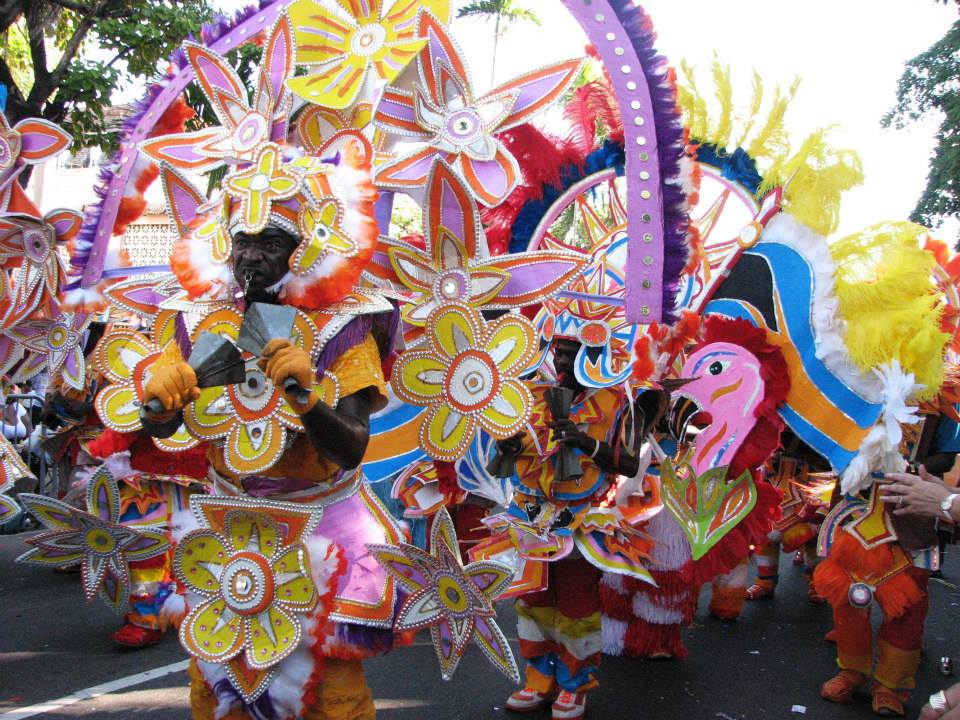
ENCORE: PM Christie and Bahamas Junkanoo Carnival

Update – Go Lean Commentary

Talk is cheap! Results, on the other hand, are hard-fought and expensive.

This is the post-analysis of the plans for Junkanoo Carnival in the Bahamas, after 3-years of planning and execution. The results have indeed been hard-fought, expensive and … “not so successful”.

Told you so…

This was the declaration from this previous blog-commentary from the movement behind the book Go Lean…Caribbean. The assessment was that the Carnival product appeared to be lucrative, but there was so much heavy-lifting involved with an implementation, that unless there was a whole soul commitment by the full community, it would be very hard to find success.

Now there are new developments…

Article Title: ‘Blindsided’ By Carnival Delay
By: Ava Turnquest, Tribune Chief Reporter

CU Blog - UPDATE - PM Christie and Bahamas Junkanoo Carnival - Photo 1LESS than a week after officials announced the event’s line-up, Prime Minister Perry Christie confirmed yesterday that the 2017 Bahamas Junkanoo Carnival has been postponed until after the general election.

The news has “blindsided” key stakeholders and vendors, who decried the confusion, likely damage to brand and reputation and potential financial losses resulting from the date change.

The Tribune understands the event has been pushed back from May 4-6 to May 18-20 in Nassau. The new date was also circulated in a flyer by Bahamas Junkanoo Carnival’s Instagram account last night.

It is unclear whether the Grand Bahama-leg of the festival, slated for April 28 and 29, has also been pushed back.

Mr Christie was asked about the postponement on the sidelines of a ceremony to rename thoroughfares at the University of the Bahamas, after a report published in The Nassau Guardian indicated that the government had decided to delay the event.

Mr Christie said: “I’m advised that the Carnival Commission has met and agreed that because of the impending possibilities, to suspend or extend the date of (Junkanoo) Carnival. I don’t know the dates they had chosen but it is my understanding that that has been done.”

Up to press time, the Bahamas National Festival Commission (BNFC) had not released a new date for the event, or an official statement on the postponement.

When The Tribune contacted BNFC Chairman Paul Major, he said: “What we know is that we’re not going to conflict with the final say of Cabinet – once an official election date is set, then our dates are subject to change.”

Last Thursday, the BNFC announced Trinidadian singing stars Machel Montano and Bunji Garlin as event headliners. It was also confirmed that the event will be streamlined compared to past years because of financial constraints.

The government will reduce its subsidy to the festival by as much as 50 per cent over last year, when taxpayers contributed about $8 million, officials said. The 2016 event brought in $578,342 in revenue, costing more than $9.8m overall.

In 2015, the government spent $11.3m on the inaugural festival, going over its initial budget of $9m, with the rest covered by sponsors. The first Junkanoo Carnival cost $12.9m overall.

Mr Major and BNFC CEO Roscoe Dames declined further questions, and advised that the commission would release further information today.

The Office of the Prime Minister, in a press statement on Sunday, announced that Parliament will be dissolved on April 11.

According to the Parliamentary Elections Act, an election must be held 21 to 30 days after election writs are issued, meaning the next vote will likely be held in early May.

The last election was held on May 7, 2012.

In 2015, the inaugural festival took place on May 7-9 in New Providence, and the 2016 Junkanoo Carnival kicked off on April 15-16 in Grand Bahama and on May 5-7 in New Providence.

In February, Free National Movement (FNM) Deputy Leader K Peter Turnquest called for the government to postpone or delay the festival until after the general election, warning that the event could only be perceived as “vote buying” if staged during the election cycle.

The Tribune reached out to Bahamas Carnival Band Owners Association (BCBOA) President Dario Tirelli for comment on the matter; however, Mr Tirelli declined comment until an official government statement was released.

Mr Tirelli told The Tribune that the news had “blindsided” his association.

Stephan Rolle, owner of Bluemonkey Bahamas, told reporters that any date change would negatively impact his business, the Bahamas Carnival Cruise, which has booked more than 100 carnival-goers on an all-inclusive weekend cruise from Miami to Nassau.

He challenged Mr Christie to give the festival the same level of respect as the annual Junkanoo parades.

Source: The Tribune Daily Newspaper (Posted 04/04/2017; retrieved 04/05/2017) – http://www.tribune242.com/news/2017/apr/04/blindsided-carnival-delay/

The Prime Minister bet his administration on the prospect of Carnival and now, its election time. He declared that the Parliament will dissolve on April 11, 2017. Under the Westminster structure of Parliamentary government, elections of a new Parliament must take place within a month after that date. So now the expectation is that elections will be conducted “smack in the middle” of the 2017 Carnival activities.

The solution? The PM postpones Carnival!

From a strictly Carnival perspective, this is a Big Mistake! See here the reaction of the festival stakeholders:

VIDEO – Unhappy over Carnival situation – http://youtu.be/f5zoG6yiS9E

Uploaded on Apr 4, 2017 – One of many online videos featuring complaints about the postponement of Carnival.

In this previous Go Lean blog-commentary – being ENCORED below – the prospect of Junkanoo Carnival was analyzed … before-hand, then subsequent blogs also examined the results after the 1st-year and 2nd-year events, as follows:

The appeal was made in all of these commentaries for the strategies, tactics and implementations of the Go Lean roadmap for the Caribbean Union Trade Federation (CU). This involved the heavy-lifting to marshal the entire community to ensure for Event Tourism, and profit from it. See the original blog-commentary here below.

Also, see a related story from April 4, 2017 detailing the challenges of a new schedule-date: Festival To Be May 18-20 As PM Confirms Move (The Tribune Daily Newspaper; retrieved 04/05/2017)

————–

Blog Title: PM Christie responds to critics of Bahamian ‘Carnival’

Carnival 1Head –> Heart –> Hands.

This is the physiological process to forge change, described in the book Go Lean … Caribbean (Page 20). As experienced on a daily basis by people attempting to “quit smoking”, change is near impossible without engaging those three body parts. The book, serving as a roadmap for the introduction and implementation of the Caribbean Union Trade Federation (CU) describes the linked application of those three symbolic body parts, as follows:

  • Head – Plans, Models and Strategies
  • Heart – Community Ethos
  • Hands – Actions, Implementations, Advocacies

According to the below news article, the Prime Minister of the Bahamas wants to forge change in his homeland. He wants to incorporate a new festival, based on the model of Carnival and Madri Gras, so as to glean some of the massive economic harvests around those events in the Caribbean and other Western Hemisphere destinations.

Since initiating this plan in Spring 2013, cyber-space and public commentary have been awash with feedback: some in favor; most opposed.

Albeit he is inspired by good motives, the publishers declare that something is missing in the Prime Minister’s plans: Best practices.

Excerpts from original source article: PM Christie responds to critics of Bahamian ‘Carnival’
Date: April 25, 2014
By: Erica Wells, Managing Editor

Prime Minister Perry Christie has assured critics of the Government’s plan to create a Bahamian Carnival or Mardi Gras that the festival will be “essentially” Bahamian and that a special committee will be appointed to prepare the country and the world for the initiative.

The government, Christie says, sees the festival as both a major economic intervention and a cultural expansion.

“It will be essentially Bahamian but also include thousands of visitors who will be attracted by what will be an absolutely fabulous affair,” said Christie.

Anthropologist and author Dr. Nicolette Bethel, who is also a former director of culture, has been one of the biggest critics of the proposed festival.

Prime Minister Christie said for the groups to be licensed, they would have to form themselves into a company and operate as a business.

“This is a massive undertaking which will receive very careful consideration of the government,” he said.

“This is very necessary as the corporate groups will be advertising abroad and inviting persons to purchase costumes online as well as from store fronts in a cultural village or elsewhere.”

The prime minister said carnival is part of a worldwide masquerade industry.

He said the industry has been successful in attracting costume makers, wire benders, painters, designers and performers at some of the largest festivals in the world.

“It has an export dimension. We know of major festivals in Trinidad, Brazil, Toronto, Barbados, New York, Miami and London. Carnival in the diaspora generates hundreds of millions of dollars and creates many jobs and entrepreneurial opportunities.

“It is big business and it requires business planning, management, marketing of products and organizational structure,” said Christie.

Prime Minister Christie said costumes from carnival inspired designers show up in New York, Toronto, Notting Hill, London, Miami and many other centers in the U.S.

Source: The Nassau Guardian Online. Posted 06/22/2013; retrieved 04/24/2014 from: http://www.thenassauguardian.com/index.phpoption=com_content&view=article&id=40021&Itemid=59

The Go Lean roadmap is different! It employs best practices for assessing, strategizing and implementing change. The book commences with the practice to assess current landscapes; this is what strategists call “Understand the market / Plan the business”. Page 44 presents these questions:

• Who are our customers and what exactly do they want?

• Who are our competitors; how do we stack up against them?

The book then proceeds to answer these and other strategy queries, accordingly.

carnival 2Events/festivals are paramount in the Go Lean roadmap: the optimization of existing events and the introduction of new events. This advocacy is detailed on Page 191 as being supplemental to the goal of enhancing tourism (Page 190).

What are the prospects for this new Bahamas Carnival/Lenten festival?

On the surface, it seems far-fetched, as the Bahamas does not have a Lenten ethos. All the competitive destinations (Rio De Janeiro, New Orleans and Trinidad) have elevated lent habits (Ash Wednesday to Good Friday), so that Mardi Gras/Fat Tuesday actually has significance in preparation of this hallowed Lenten season. Without this ethos, it is hard, though not impossible, to forge a new tradition, festival or business model. But the mediocre financial investment, announced in the foregoing article – $1 million as opposed to $3 million, makes the success of initiating and promoting a new event an insurmountable obstacle.

The publishers of the Go Lean roadmap wish the Prime Minister good fortune with his plans, but this execution does not appear to be lean, within “best practices”. More is needed; much more! There should be more focus on “Head, Heart & Hands” principles. As a contrast, notice the detailed strategies, tactics, actions and advocacies for new events in the Go Lean roadmap:

Community Ethos – Lean Operations Page 24
Community Ethos – Return on Investments Page 24
Community Ethos – Cooperatives Page 25
Community Ethos – Non Government Org’s. Page 25
Impact the Future Page 26
Foster Genius – Performance Excellence Page 27
Ways to Improve Sharing Page 35
Ways to Promote Happiness Page 36
Ways to Impact the Greater Good Page 37
Strategy – Customers – Business Community Page 47
Strategy – Customers – Visitors / Tourists Page 47
Strategy – Competitors – Event Patrons Page 55
Separation of Powers – Emergency Mgmt. Page 76
Separation of Powers – Tourism Promotion Page 78
Separation of Powers – Sports & Culture Page 81
Separation of Powers – Fairgrounds Admin. Page 83
Separation of Powers – Turnpike Operations Page 84
Steps to Implement Self-Governing Entities Page 105
Ways to Foster Cooperatives Page 176
Ways to Improve Intelligence Gathering Page 182
Ways to Improve [Service] Animal Husbandry Page 185
Ways to Enhance Tourism Page 190
Ways to Impact Events Page 191
Ways to Promote Fairgrounds Page 192
Ways to Improve Emergency Management Page 196
Ways to Impact Hollywood [& Media Industry] Page 203
Ways to Preserve Caribbean Heritage Page 218
Ways to Improve the Arts Page 230
Ways to Promote Music Page 231

In summary, festivals/events are important, so they require lean administration and executions. They empower economics and fortify cultural pride. In all, they make the Bahamas, by extension the entire Caribbean, a better place to live, work, and play.

Download the book Go Lean … Caribbean – now!

Share this post:
, , , ,
[Top]

Funding the Russell Family Memorial – RIP

Go Lean Commentary

A family of 5 die in a horrific car crash on an American highway.

CU Blog - Funding the Russell Family Memorial - RIP - Photo 1

There is no other way to look at this drama – it is sad. The Bible says “Death rules as King” (Romans 5:17).

The Caribbean Diaspora community in South Florida is now mourning this sad tragedy. We send condolences to all the surviving family and loved-ones of the Russell family, reported in this news story here:

Title: Entire family killed in crash on Florida highway
By: Alex Harris, Miami Herald Staff Reporter

After more than 12 hours in the hospital, a 10-year-old boy succumbed to his injuries, leaving an entire family dead after a horrific car wreck in North Florida on Sunday [March 19].

The Russell family, of Hollywood, was loaded into their 2016 Chrysler 200 and headed home from a trip to Georgia, according to a memorial fundraiser. They were driving south on Interstate 75 when the sedan swerved off the road and into a tractor-trailer stopped on the side of the highway.

Nathan Russell, 37; his 35-year-old wife, Lynda; his 15-year-old daughter, La’Nyah; and one of his twins, 10-year-old Natayah, were killed in the crash. The other twin, 10-year-old Nathan Russell Jr. died hours later at ShandsHospital, according to a Florida Highway Patrol report.

Relatives are raising money for five funerals on GoFundMe and mourning on social media.

Nicole Narae, who said she is Nathan Russell’s cousin, wrote on Facebook that “tomorrow is not promised to anyone.”

“This one hurts. From the Bahamas to Haiti to South Florida…our hearts are broken,” she wrote. “It’s too much for anyone who know them and their household. So unreal to me right now.”

A vigil is was planned at the family’s Coral Springs home, at 9040 Royal Palm Blvd, at 7:30 p.m. on Friday.

CU Blog - Funding the Russell Family Memorial - RIP - Photo 3

———————–

VIDEO – 5 from Hollywood killed in I-75 crash near Gainesville – http://launch.newsinc.com/share.html?trackingGroup=90045&siteSection=90045_pp&videoId=32152391

CU Blog - Funding the Russell Family Memorial - RIP - Photo 2What is a community to do? In this case, what is the Caribbean community to do? (The father is of Bahamian descent and the mother is of Bahamian-Haitian descent).

We cannot bring back the dead, but we can console, support and remember. This is the exact experience for the Caribbean community in South Florida today; they have “come together” and covered this family with love, prayers and the necessary financial support. Advocates for the family created a GoFundMe account for crowd-sourcing to raise $50,000. The end-result: $70,020 was raised … over 4 days.

CU Blog - Funding the Russell Family Memorial - RIP - Photo 4

This shows the power and effectiveness of crowd-funding.

This is not the first tragedy to befall the Caribbean community; and I guarantee you this will not be the last. But notice the alternative fundraising response. Instead of a ‘Bake Sale’ or ‘Car Wash’, advocates for the family conducted a Social Media outreach and raised $70,020 on a crowd-sourcing site.

This fact right here could be a great legacy that comes from this tragic story. The embrace of Internet & Communications Technologies so as to foster the Greater Good.

This objective aligns with the movement behind the book Go Lean… Caribbean. The book and a previous blog-commentary have identified crowd-sourcing as an effective strategy for funding Caribbean projects, especially addressing the Diaspora of the Caribbean communities. These ones have been identified as a potential resources for their time, talent and treasuries. There is only the need for a good delivery system.

The Go Lean book details that delivery. The book serves as a roadmap for the introduction and implementation of the technocratic Caribbean Union Trade Federation (CU) with the charter to facilitate optimization of the region’s societal engines. Imagine not just funding the charitable causes for assuaging family tragedies – like the foregoing news article – but facilitating investment and entrepreneurship as well. Imagine the job-creation!

Early in the Go Lean book, the responsibility to attract investments (funding) and create jobs was identified as an important function for the CU with these pronouncements in the opening Declaration of Interdependence (Pages 14):

xxiv.  Whereas a free market economy can be induced and spurred for continuous progress, the Federation must install the controls to better manage aspects of the economy: jobs, inflation, savings rate, investments and other economic principles. Thereby attracting direct foreign investment because of the stability and vibrancy of our economy.

xxvi.  Whereas the Caribbean region must have new jobs to empower the engines of the economy and create the income sources for prosperity, and encourage the next generation to forge their dreams right at home, the Federation must therefore foster the development of new industries… In addition, the Federation must invigorate the enterprises related to existing industries … – impacting the region with more jobs.

xxvii. Whereas the region has endured a spectator status during the Industrial Revolution, we cannot stand on the sidelines of this new economy, the Information Revolution. Rather, the Federation must embrace all the tenets of Internet Communications Technology (ICT) to serve as an equalizing element in competition with the rest of the world. The Federation must bridge the digital divide and promote the community ethos that research/development is valuable and must be promoted and incentivized for adoption.

The book Go Lean…Caribbean posits that the Caribbean region needs unconventional thinking to overcome the obstacles – the societal defects – that befall our communities. We have an atrocious rate of human flight (reported at 70 percent of the professional classes); so many of our people have left their island homes to now live (and die) in the big-bad United States (and other countries, like Canada and Western Europe). Our citizens leave and we have to accept whatever unforeseen occurrences that befall them.

Crowd-funding is an unconventional funding method – see Appendix – there are benefits for thinking unconventionally and we need to start thinking unconventionally to impact all aspects of Caribbean society – all the engines. This is the charter for the Go Lean book, to effectuate change in the region’s societal engines, allowing for these 3 prime directives:

  • Optimization of the economic engines in order to grow the regional economy to $800 Billion GDP and create 2.2 million new jobs.
  • Establishment of a security apparatus to protect the resultant economic engines.
  • Improve Caribbean governance/administration/oversight to support these engines.

The Go Lean book/roadmap subscribes to crowd-funding and crowd-sourcing as “unconventional thinking” to attract unconventional funding for Caribbean philanthropy and empowerment causes (think entrepreneurial endeavors):

  • The book advocates for cooperatives…
  • The book advocates for incubators… helping/coaching entrepreneurs …
  • The book advocates for the full exploration and exploitation of social media, identifying www.myCarribbean.gov  …

Beyond crowd-funding, there is another compelling lesson to glean from the sad drama in the foregoing news article. As a result of attending the “Vigil” on Friday (March 24), it was disclosed that the cause of the car crash was due to driver fatigue or human error: the father – Nathan Russell – fell asleep behind the wheel.

So now we see that this tragedy was also preventable.

TM BlogMany automakers have now committed to providing technical solutions to transcend human error; they have introduced Self-Driving cars (fully autonomous) and have rolled-out Driver-Assist features, such as lane violation detection. These advancements would have been life-saving for this family of 5. Consider this list of features that help drivers avoid or mitigate collisions:

Title: Cars With Advanced Safety Systems

Key active safety systems include:

  • Automatic emergency braking (AEB) – Brakes are automatically applied to prevent a collision or reduce collision speed.
  • Forward-collision warning (FCW) – Visual and/or audible warning intended alert the driver and prevent a collision.
  • Blind-spot warning (BSW) – Visual and/or audible notification of vehicle in blind spot. The system may provide an additional warning if you use your turn signal when there is a car next to you in another lane.
  • Rear cross-traffic warning – Visual, audible, or haptic notification of object or vehicle out of rear camera range, but could be moving into it.
  • Rear Automatic Emergency Braking (Rear AEB) – Brakes are automatically applied to prevent backing into something behind the vehicle. This could be triggered by the rear cross-traffic system, or other sensors on the vehicle.
  • Lane-departure warning (LDW) – Visual, audible, or haptic warning to alert the driver when they are crossing lane markings.
  • Lane-keeping assist (LKA) – Automatic corrective steering input or braking provided by the vehicle when crossing lane markings.
  • Lane Centering Assist – Continuous active steering to stay in between lanes (active steer, autosteer, etc.)
  • Adaptive Cruise Control – Adaptive cruise uses lasers, radar, cameras, or a combination of these systems to keep a constant distance between you and the car ahead, automatically maintaining a safe following distance. If highway traffic slows, some systems will bring the car to a complete stop and automatically come back to speed when traffic gets going again, allowing the driver to do little more than pay attention and steer.

Source: Posted March 08, 2017; retrieved March 28, 2017 from: http://www.consumerreports.org/car-safety/cars-with-advanced-safety-systems/

The proper motivation and inspiration from this car crash in the foregoing – and the lost of life of the Russell Family – should be a commitment for Research-and-Development of these and other highway safety automation initiatives, and then their deployment in the Caribbean.

This is the commitment of the Go Lean movement.

Previously, these innovations were detailed as being impactful to this roadmap to elevate the Caribbean. See this sample list of previous blog-commentaries that delved into the details and the resultant issues:

https://goleancaribbean.com/blog/?p=10869 Bill Gates: ‘Tax the Robots’
https://goleancaribbean.com/blog/?p=8650 Now it’s Detroit’s turn to rescue Silicon Valley
https://goleancaribbean.com/blog/?p=8294 ‘Olli’ – The Self-Driving Public Transit Vehicle
https://goleancaribbean.com/blog/?p=3384 Plea to Detroit: Less Tech, Please
https://goleancaribbean.com/blog/?p=1277 The need for highway safety innovations – here comes Google
https://goleancaribbean.com/blog/?p=673 Ghost ships – Autonomous cargo vessels without a crew

Martyrs

No one wanted to lose a family like this. This is just an unforeseen occurrence that proves that “bad things happen to good people”; (this point coincides with the Bible’s edict at Ecclesiastes 9:11) But can we use this tragedy as inspiration to power the Caribbean community for progress.

Indeed we can!

The Go Lean book asserts that “a crisis is a terrible thing to waste” (Page 8).

We can memorialize this family, and their tragedy, as stimuli to double-down on the Research-and-Development community ethos, to innovate collision avoidance systems as described above. The Go Lean book defines community ethos as …

… “the fundamental character or spirit of a culture; the underlying sentiment that informs the beliefs, customs, or practices of a group or society; dominant assumptions of a people or period practices of a group or society; dominant assumptions of a people or period”.

The book proceeds to identify a number of community ethos (and related strategies) that the Caribbean region needs to adopt. Consider this sample list:

  • Impact Research & Development (Page 30)
  • Promote Intellectual Property (Page 29)
  • Bridge the Digital Divide (Page 31)
  • Impact Social Media ((Page 111)
  • Foster Technology (Page 197)
  • Improve Transportation (Page 205)
  • Develop a Caribbean Auto Industry (Page 206)

The Russell Family can be “martyrs” for progress … and innovation!

Rest in Peace Nathan, Lynda, La’Nyah, Natayah, and Nathan Jr.. You will not be forgotten!

🙁

Download the free e-Book Go Lean … Caribbean – now!

Sign the petition to lean-in for the roadmap for the Caribbean Union Trade Federation.

——————–

Appendix – Crowdfunding

Crowdfunding is the practice of funding a project or venture by raising monetary contributions from a large number of people. Crowdfunding is a form of crowdsourcing and of alternative finance. In 2015, it was estimated that worldwide over US$34 billion was raised this way.[1][2]

Although the concept can also be executed through mail-order subscriptions, benefit events, and other methods, it is now often performed via Internet-mediated registries.[3] This modern crowdfunding model is generally based on three types of actors: the project initiator who proposes the idea and/or project to be funded, individuals or groups who support the idea, and a moderating organization (the “platform”) that brings the parties together to launch the idea.[4]

Crowdfunding has been used to fund a wide range for-profit entrepreneurial ventures such as artistic and creative projects, medical expenses, travel, or community-oriented social entrepreneurship projects.[5]
Source: Retrieved March 28, 2017 from: https://en.wikipedia.org/wiki/Crowdfunding


Share this post:
, , , , , ,
[Top]

ENCORE – Legacy of the ‘Buffalo Soldier’ Song

Go Lean Commentary

“Now” is always the right time for great Reggae Music.

The world misses Bob Marley. Not only was he a great musician and entertainer, but a great educator as well. How many people in the Caribbean knew about the ‘Buffalo Soldiers’ in America before he recorded this song?

(Interesting tidbit: the song was released in 1983, after his death in 1981).

This Caribbean family got to stretch our knowledge and appreciation of American History and the Buffalo Soldier in our recent summer vacation to Washington, D.C.. We enjoyed this monument to the original segregated African-American fighting men in the US Army.
CU Blog - Legacy of Buffalo Soldier - Photo 1

CU Blog - Legacy of Buffalo Soldier - Photo 2

Related blog-commentary – A Lesson in History – During the Civil War: Principle over Principal

CU Blog - A Lesson in History - During the Civil War - Principle not Principal - Photo 2

This consideration is presented with an ENCORE of this previous blog-commentary from March 28, 2016 – exactly 1 year ago today. See the previous submission here-now:

————-

Title: A Lesson in History: Buffalo Soldier

Welcome to the New World.

Fighting on arrival; fighting for survival“. – Lyrics from song  Buffalo Soldier by Bob Marley.

CU Blog - A Lesson in History - Buffalo Soldiers - Photo 1This is the experience of the Pan-African Diaspora in all of the Americas. Truly a sad origin history, “Coming to America” as slaves. And yet, the African race has proliferated in much of the Americas, most notably in the Caribbean, where the one-time slaves emerged as the majority population in 29 of the 30 member-states; (the only other New World non-Caribbean country with a majority Black population is Brazil). After a few turns in world political developments, these majorities now run the governments in most of these Caribbean countries.

It took “blood, sweat and tears” to reach this accomplishment. This connotes military action, warfare and sacrifice. The most prominent of Black fighting men in the history of the New World is the Buffalo Soldier.

Caribbean Music legend Bob Marley is to be credited for educating much of the world with this history. In his landmark song Buffalo Soldier; he sang their praises – see lyrics in Appendix A.

See the VIDEO-AUDIO of the song here:

VIDEO-AUDIO – Bob Marley Buffalo Soldier – https://youtu.be/IEpSBsUjY-0

Uploaded on May 2, 2011 – This song was released post humorously in 1983, after Bob Marley’s death.

Just who were the Buffalo Soldiers and what are their connections to the Caribbean? See  this encyclopedia reference here:

From 1863 to the early 20th century, African American units were utilized by the Army to combat the Native Americans during the Indian Wars.[14] The most noted among this group were the Buffalo Soldiers:

This nickname was given to the “Negro Cavalry” by the Native American tribes they fought in the Indian Wars. The term eventually became synonymous with all of the African American regiments formed in 1866. At the end of the U.S. Civil War the army reorganized and authorized the formation of two regiments of black cavalry (the 9th and 10th US Cavalry). Four regiments of infantry (the 38th, 39th, 40th and 41st US Infantry) were formed at the same time. In 1869, the four infantry regiments were merged into two new ones (the 24th and 25th US Infantry). These units were composed of black enlisted men commanded by white officers such as Benjamin Grierson, and occasionally, an African-American officer such as Henry O. Flipper. The “Buffalo Soldiers” served a variety of roles along the frontier from building roads to guarding the U.S. mail.[15]

CU Blog - A Lesson in History - Buffalo Soldiers - Photo 2These regiments served at a variety of posts in the southwest United States and Great Plains regions. During this period they participated in most of the military campaigns in these areas and earned a distinguished record. Thirteen enlisted men and six officers from these four regiments earned the Medal of Honor during the Indian Wars.[16]

After the Indian Wars ended in the 1890s, the regiments continued to serve and participated in the Spanish–American War (including the Battle of San Juan Hill in Cuba), where five more Medals of Honor were earned.[17] 

Source: https://en.wikipedia.org/wiki/Military_history_of_African_Americans#Indian_Wars retrieved March 28, 2019.

All of the New World , despite their European colonizers – Dutch, English, French, Portuguese or Spanish – was developed on the same economic policy: slavery!

This ugly institution was so entrenched that only a model war would effectuate its abolition permanently. That war was waged in the United States (1861 – 1865) as a proxy to all the New World territories. Shortly thereafter, the institution was abolished in the remaining countries that still maintained it in the region, i.e. Brazil. (The US was not the first; that distinction belong to Haiti, which endured a slave rebellion and battles for emancipation; the Spanish colonies followed shortly there-after, then the French, then the British).

The Buffalo Soldiers are most noteworthy because they fought for dignity for all the African race in the New World, though this was not pronounced in their commission, only now gleaned from their legacy. See Trailer below for one of the many movies.

The movement and underlying book Go Lean … Caribbean asserts that Caribbean people must now consider the weight of history and re-assign these islands and coastal states as their only homeland. As a people, the African Diaspora have fought and paid for these lands; they have shed “blood, sweat and tears” for their New World homelands. The ancestral home of Africa is no longer relevant. We now need to “prosper where we are planted” here in the Caribbean. Bob Marley said it best:

I mean it, when I analyze the stench –
To me it makes a lot of sense:
How the Dreadlock Rasta was the Buffalo Soldier,
And he was taken from Africa, brought to America,
Fighting on arrival, fighting for survival.

The freedoms we enjoy today, were not free!

They cost our ancestors and predecessors all they had to offer: a full measure of sacrifice and devotion. They gave of their sons and daughters. This is the important lesson to learn in considering the history of these American fighting men. As our ancestors and predecessors, they paid a steep price – “they punched our tickets” – for progress. We must regard their sacrifice.

This is one reason why we must adopt a National Sacrifice community ethos. This vital quality has been missing for far too long. This is why the region has such a deplorable abandonment rate: no [perception of] pain, no gain; no comprehension of sacrifice, no sense of value.

As a region, we must do better. We must discourage the emigration, brain drain and further societal abandonment.

The book Go Lean…Caribbean and accompanying blogs provide lessons from history in considering the fighting men of the American Civil War. The Caribbean region’s debilitating societal abandonment rate – 70 percent of college educated had fled for foreign shores – is proof positive of the absence and lack of this National Sacrifice ethos.

Early in the Go Lean book, this need for careful review of the history of slavery was acknowledged and then placed into perspective with this pronouncement (Declaration of Interdependence – Page 10):

As the history of our region and the oppression, suppression and repression of its indigenous people is duly documented, there is no one alive who can be held accountable for the prior actions, and so we must put aside the shackles of systems of repression to instead formulate efficient and effective systems to steer our own destiny.

As the colonial history of our region was initiated to create economic expansion opportunities for our previous imperial masters, the structures of government instituted in their wake have not fostered the best systems for prosperity of the indigenous people.

So the consideration of the Go Lean book, is to identify and correct all bad community ethos – the fundamental spirit of our culture – and to foster positive community ethos (such as National Sacrifice and deferred gratification). This point was also pronounced in the opening Declaration of Interdependence (Page 13) with this statement:

xix. Whereas our legacy in recent times is one of societal abandonment, it is imperative that incentives and encouragement be put in place to first dissuade the human flight, and then entice and welcome the return of our Diaspora back to our shores. This repatriation should be effected with the appropriate guards so as not to imperil the lives and securities of the repatriated citizens or the communities they inhabit. The right of repatriation is to be extended to any natural born citizens despite any previous naturalization to foreign sovereignties.

This book  Go Lean…Caribbean serves as a roadmap for the introduction and implementation of the technocratic Caribbean Union Trade Federation (CU) to spearhead the elevation of Caribbean society. The book advocates learning lessons from many events and concepts in history, covering all societal engines: economics, security and governance. The roadmap seeks to reboot these engines to ensure that all Caribbean stakeholders have the opportunity for life, liberty and the pursuit of happiness with no abusive exploitation of any ethnic group; no suppression, repression or oppression of any people: African or not!

The Go Lean roadmap seeks to employ “best-practices” to impact the CU prime directives; identified with the following 3 statements:

  • Optimization of the economic engines in order to grow the regional economy to $800 Billion & create 2.2 million new jobs.
  • Establishment of a security apparatus to protect the resultant economic engines and ensure the respect of human rights and public safety.
  • Improve Caribbean governance to support these engines.

The Go Lean book stresses the community ethos, strategies, tactics, implementations and advocacies to reboot, reform and transform the eco-systems of Caribbean society. These points are detailed in the book as follows:

Community Ethos – Deferred Gratification Page 21
Community Ethos – Economic Principles – People Choose Page 21
Community Ethos – Economic Principles – People Respond to Incentives in Predictable Ways Page 21
Community Ethos – Economic Systems Influence Individual Choices Page 21
Community Ethos – Economic Principles – The Consequences of Choices Lie in the Future Page 21
Community Ethos – Governing Principles – Lean Operations Page 24
Community Ethos – Governing Principles – Cooperatives Page 25
Community Ethos – Ways to Impact the Future Page 26
Community Ethos – Ways to Impact a Turn-Around Page 33
Community Ethos – Ways to Promote Happiness Page 36
Community Ethos – Ways to Impact the Greater Good Page 37
Strategy – Vision – Confederate 30 Member-States Page 45
Strategy – Mission – Enact a Defense Pact with Militia and Naval Forces Page 45
Strategy – Mission – Keep the next generation at home Page 46
Tactical – Confederating a Permanent Union Page 63
Tactical – Fostering a Technocracy Page 64
Implementation – Assemble – Incorporating all the existing regional military organizations Page 96
Implementation – Ways to Pay for Change Page 101
Implementation – Security Initiatives at Start-up Page 103
Implementation – Ways to Deliver Page 109
Implementation – Reasons to Repatriate to the Caribbean Page 118
Planning – 10 Big Ideas for the Caribbean – Confederation Without Sovereignty Page 127
Planning – Ways to Make the Caribbean Better Page 131
Advocacy – Ways to Grow the Economy Page 151
Advocacy – Ways to Create Jobs Page 152
Advocacy – Ways to Better Manage the Social Contract Page 170
Advocacy – Ways to Improve Homeland Security Page 181
Advocacy – Ways to Impact the Diaspora Page 217
Advocacy – Ways to Preserve Caribbean Heritage Page 218
Advocacy – Ways to Protect Human Rights Page 220

There are other lessons for the Caribbean to learn from considering history; the following previous blog/commentaries apply:

https://goleancaribbean.com/blog/?p=7682 Frederick Douglass: Role Model for Single Cause – Abolition
https://goleancaribbean.com/blog/?p=6722 A Lesson in History – After the Civil War: Birthright Mandates
https://goleancaribbean.com/blog/?p=6720 A Lesson in History – During the Civil War: Principle over Principal
https://goleancaribbean.com/blog/?p=6718 A Lesson in History – Before the Civil War: Compromising Human Rights
https://goleancaribbean.com/blog/?p=5695 Repenting, Forgiving and Reconciling the Past
https://goleancaribbean.com/blog/?p=5333 A Lesson in History – Legacies: Cause and Effect
https://goleancaribbean.com/blog/?p=5183 A Lesson in History – Cinco De Mayo
https://goleancaribbean.com/blog/?p=5123 A Lesson in History – Royal Charter: Zimbabwe -vs- South Africa
https://goleancaribbean.com/blog/?p=4971 A Lesson in History – Royal Charter: Truth & Consequence
https://goleancaribbean.com/blog/?p=4935 A Lesson in History: the ‘Grand Old Party’ Abolition Roots
https://goleancaribbean.com/blog/?p=2480 A Lesson in History: Community Ethos of WW II
https://goleancaribbean.com/blog/?p=2297 A Lesson in History: Booker T versus Du Bois
https://goleancaribbean.com/blog/?p=1531 A Lesson in History: 100 Years Ago Today – World War I
https://goleancaribbean.com/blog/?p=789 A Lesson in History: America’s War on the Caribbean

The concepts in this commentary are more profound than just the lyrics of a reggae song. It is bigger than music, it relates to life and legacy. The recent legacy of the Afro-Caribbean community is one of dysfunction and abandonment. But the ancient history – Buffalo Soldiers in particular – should give us pause and cause to reflect and reform our commitment to a National Sacrifice ethos.

No appreciation, no sacrifice; no sacrifice, no victory!

The Go Lean roadmap seeks to reform and transform the Caribbean societal engines, urging the adoption of new positive community ethos, such as National Sacrifice. This is an expression of deferred gratification, choosing to focus more on the future than on the present. The Go Lean book relates that the “African Diaspora experience in the New World is one of future gratification, as the generations that sought freedom from slavery knew that their children, not them, would be the beneficiaries of that liberty. This ethos continued with subsequent generations expecting that their “children” would be more successful in the future than the parents may have been”. Deferred gratification is a form of sacrifice.

We should value this sacrifice. Such gratitude makes our community better, more resilient and more long suffering.

Now is the time for all stakeholders in the Caribbean to show proper appreciation for the sacrifices by leaning-in to this roadmap for Caribbean empowerment. All the empowerments in this roadmap require people to fight for their homeland. We can learn so much from the Buffalo Soldiers:

Fighting on arrival, fighting for survival;
Driven from the mainland to the heart of the Caribbean.

If you know your history,
Then you would know where you coming from,
Then you wouldn’t have to ask me,
Who the ‘eck do I think I am.

The Go Lean quest is simple, learn from history and work to make the Caribbean region a better place to live, work and play. 🙂

Download the book Go Lean … Caribbean – now!

Sign the petition to lean-in for the roadmap for the Caribbean Union Trade Federation.
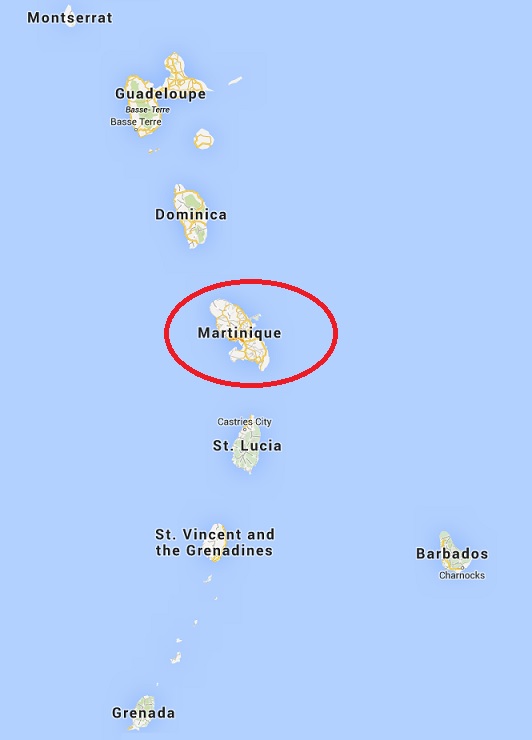
———–

Appendix A – Song Buffalo Soldier Lyrics – Sang by Bob Marley

Buffalo Soldier, Dreadlock Rasta:
There was a Buffalo Soldier in the heart of America,
Stolen from Africa, brought to America,
Fighting on arrival, fighting for survival.

I mean it, when I analyze the stench –
To me it makes a lot of sense:
How the Dreadlock Rasta was the Buffalo Soldier,
And he was taken from Africa, brought to America,
Fighting on arrival, fighting for survival.

Said he was a Buffalo Soldier, Dreadlock Rasta –
Buffalo Soldier in the heart of America.

If you know your history,
Then you would know where you coming from,
Then you wouldn’t have to ask me,
Who the ‘eck do I think I am.

I’m just a Buffalo Soldier in the heart of America,
Stolen from Africa, brought to America,
Said he was fighting on arrival, fighting for survival;
Said he was a Buffalo Soldier win the war for America.

Dreadie, woy yoy yoy, woy yoy-yoy yoy,
Woy yoy yoy yoy, yoy yoy-yoy yoy!
Woy yoy yoy, woy yoy-yoy yoy,
Woy yoy yoy yoy, yoy yoy-yoy yoy!
Buffalo Soldier troddin’ through the land, wo-ho-ooh!
Said he wanna ran, then you wanna hand,
Troddin’ through the land, yea-hea, yea-ea.

Said he was a Buffalo Soldier win the war for America;
Buffalo Soldier, Dreadlock Rasta,
Fighting on arrival, fighting for survival;
Driven from the mainland to the heart of the Caribbean.

Singing, woy yoy yoy, woy yoy-yoy yoy,
Woy yoy yoy yoy, yoy yoy-yoy yoy!
Woy yoy yoy, woy yoy-yoy yoy,
Woy yoy yoy yoy, yoy yoy-yoy yoy!

Troddin’ through San Juan in the arms of America;
Troddin’ through Jamaica, a Buffalo Soldier# –
Fighting on arrival, fighting for survival:
Buffalo Soldier, Dreadlock Rasta.

Woy yoy yoy, woy yoy-yoy yoy,
Woy yoy yoy yoy, yoy yoy-yoy yoy!
Woy yoy yoy, woy yoy-yoy yoy,
Woy yoy yoy yoy, yoy yoy-yoy yoy! [fadeout]
———–

Appendix B – VIDEO – Buffalo Soldiers Trailer 1997 – https://youtu.be/Om_BrJhu4gQ

Published on Mar 9, 2015 – Buffalo Soldiers Trailer 1997; Director: Charles Haid; Starring: Danny Glover, Bob Gunton, Carl Lumbly, Tom Bower, Gabriel Casseus.
Official Content From Warner Home Video

Share this post:
, ,
[Top]

See Something, Say Something … Do Something

The conventional wisdom – advice to the public – for counter-terrorism is “See Something, Say Something”.

For all innocent victims, a 3rd step would be greatly appreciated, though not recommended, it is truly beneficial if that advice can be extended to “See Something, Say Something, Do Something”.

This was definitely the experience recently in the Caribbean island-state of St. Lucia when a couple of tourists were accosted-mugged by a crook-bully-nefarious-character and people in the general public came to their aid. See the story here:

Title: Citizens arrest man who attacks visitor
CU Blog - See Something, Say Something ... Do Something - Photo 1Concerned citizens today arrested a man who attacked a visitor on Jeremie Street near the Castries market, according to an eyewitness report.

The eyewitness told the Times that the incident occurred at around noon.

It is reported that the female visitor was in the company of her husband when she was attacked by a man, said to be in his thirties, in an apparent robbery attempt.

According to the eyewitness, a local man who witnessed the incident intervened and grabbed hold of the attacker who managed to free himself and flee.

However, according to the eyewitness, other citizens gave chase and eventually held the attacker.

The eyewitness said he was part of the group that effected the arrest and eventually handed the attacker over to the police.

Source: Saint Lucia Times Daily Newspaper – Posted 03-12-2017; retrieved 03/22/2017 from: https://stluciatimes.com/2017/03/12/citizens-arrest-man-who-attacks-visitor 

Photos of the Indoor & Outdoor Castries Market:

CU Blog - See Something, Say Something ... Do Something - Photo 1b

CU Blog - See Something, Say Something ... Do Something - Photo 3

CU Blog - See Something, Say Something ... Do Something - Photo 7

CU Blog - See Something, Say Something ... Do Something - Photo 6

CU Blog - See Something, Say Something ... Do Something - Photo 5

CU Blog - See Something, Say Something ... Do Something - Photo 4

This foregoing article belies a serious point of concern: never under-estimate a robber; they may have a gun and can inflict harm on “wanna-be-heroes”. This is why the bravery of that “one local man” in the foregoing story is even more impressive. The unnamed heroes in this case extended protection with no regard for their own safety. But despite this benevolence, it is out of place for civilians to put themselves in harm’s way to ensure public safety. That is the job of the country’s security forces.

The book Go Lean … Caribbean explains the Social Contract as where citizens surrender some of their freedoms and submit to the authority of the State in exchange for protection of remaining natural and legal rights. The formal institutions of the State (Police and Militia) are expected to deliver the security solutions, not some Good Samaritans. So under this Social Contract, it is expected that the people will “See Something, Say Something”, and then the State’s security apparatus would “Do Something”.

There is dysfunction in the Caribbean in the delivery of the Social Contract. So there is the need for many of the best-practices here-in for Caribbean people and institutions to apply to improve this experience.

There is the need to reform and transform the societal engines, the economic, security and governing eco-systems. The Go Lean book (Page 23) details many economic empowerments; and then makes this revelation:

… with the emergence of new economic engines, “bad actors” will also emerge thereafter to exploit the opportunities, with good, bad and evil intent.

This roadmap for Caribbean integration declares that peace, security and public safety is tantamount to economic prosperity. This is why an advocacy for the Greater Good must be championed as a community ethos. A prime precept is that it is “better to know than to not know” – this implies that privacy is secondary to security. A secondary precept is that bad things will happen to good people and so the community needs to be prepared to contend with the risks that can imperil the homeland.

The book Go Lean … Caribbean serves as a roadmap for the introduction and implementation of the Caribbean Union Trade Federation (CU). The branding Trade Federation emphasizes the economic mandate of the CU; but there must also be a security apparatus enveloping the economic engines. Tourism is the primary economic driver in the region. So muggings-robberies of tourists are unbecoming. The communities must mitigate the risks and assuage all threats against tourists. What strategies, tactics and implementations does the Go Lean/CU roadmap envision for this quest? Consider this sample:

Community Ethos – Security Principles Page 22
Ways to Improve Sharing – Mobile Command Centers Page 35
Security Initiatives at Start-up Page 103
Ways to Impact Justice Page 177
Ways to Reduce Crime Page 178
Ways to Improve for Gun Control Page 179
Ways to Improve Homeland Security Page 180
Ways to Mitigate Terrorism – Bullying Page 181
Ways to Improve Intelligence Gathering & Analysis Page 182
Ways to Improve Animal Husbandry – Security Dogs et al Page 185
Ways to Enhance Tourism – Tourist Hate Crimes Sentences Page 190
Ways to Impact the Prison-Industrial Complex Page 211

The CU‘s efforts will be supplemental to the individual member-states, like St. Lucia in the foregoing news story. These states will deputize the CU‘s security agencies – i.e. CariPol and the Naval Authority – to aid-abet the police and military forces to better deliver on the security mandates in the Social Contract. This intent was among the motivation for the Go Lean book in the first place. This is related as the Prime Directives, with these 3 statements:

  • Optimization of the economic engines in order to grow the regional economy and create new jobs.
  • Establishment of a security apparatus to protect the resultant economic engines and mitigate internal and external threats.
  • Improve Caribbean governance to support these engines.

The purpose of these prime directives is to elevate Caribbean society. We cannot do this alone. The challenges befalling the Caribbean region are too big for any one member-state alone. We have an interdependence within the region. See these statements from the formal Declaration of Interdependence, at the start of the book (Page 12):

x. Whereas we are surrounded and allied to nations of larger proportions in land mass, populations, and treasuries, elements in their societies may have ill-intent in their pursuits, at the expense of the safety and security of our citizens. We must therefore appoint “new guards” to ensure our public safety and threats against our society, both domestic and foreign. The Federation must employ the latest advances and best practices of criminology and penology to assuage continuous threats against public safety. The Federation must allow for facilitations of detention for convicted felons of federal crimes, and should over-build prisons to house trustees from other jurisdictions.

xvi. Whereas security of our homeland is inextricably linked to prosperity of the homeland, the economic and security interest of the region needs to be aligned under the same governance. Since economic crimes, including piracy and other forms of terrorism, can imperil the functioning of the wheels of commerce for all the citizenry, the accedence of this Federation must equip the security apparatus with the tools and techniques for predictive and proactive interdictions.

The Go Lean book provides exact details for this roadmap. Consider these points from Page 178 – headlines only here, except for #5 and #8 – from this section, entitled:

10 Ways to Remediate and Mitigate Crime

1 Lean-in for the Caribbean Single Market to leverage for Regional Threats
2 Deploy the Caribbean Police (CariPol)
3 Deploy a Regional Security Intelligence Bureau
4 Install an optimized Prison Industrial Complex
5 Equip local police with advanced technologies
The CU will provide grants to equip local police with advanced technologies, including video (dashboard cameras) and audio transmission, GPS tracking, and mobile computing systems to optimize community policing. The advanced systems also include anklet monitoring systems for non-violent offenders and suspects out on bail.
6 Provide Witness Protection at the Regional Level
7 Enable the Private Industry of First Responders and Bounty Hunters
8 Add Hate Crime Qualifiers on Sentencing
Criminal offences against “special” protected classes get extended sentences. This could include senior citizens, race-based crime, sexual biases, and even crimes against tourists, and the repatriates. Though not necessarily preventing crime, this provision sends the message to perpetrators that undermining the Greater Good is dealt with severely.
9 Roll-out a regional Youth Crime Awareness and Prevention
10 Reform the Dynamics of the Death Penalty – introduce Lethal Injection

Whatever the motivation for the crimes …

1. Need; 2. Greed; 3. Honor; 4. Justice; 5. Terrorism

… the Go Lean roadmap anticipates a forthright response and solution.

This point has been previously elaborated on in these prior blog-commentaries; see sample list here:

https://goleancaribbean.com/blog/?p=10566 Funding the Caribbean Security Pact
https://goleancaribbean.com/blog/?p=10222 Waging a Successful War on Terrorism – (Junior Partner of ‘Bullying’)
https://goleancaribbean.com/blog/?p=9072 Securing the Homeland – On the Ground
https://goleancaribbean.com/blog/?p=7485 A Lesson in the History of Interpersonal Violence – Street Crimes
https://goleancaribbean.com/blog/?p=7179 SME Declaration: ‘Change Leaders in Crime Fight’
https://goleancaribbean.com/blog/?p=5307 8th Violent Crime Warning to Bahamas Tourists
https://goleancaribbean.com/blog/?p=5002 Managing a ‘Clear and Present Danger’
https://goleancaribbean.com/blog/?p=4308 911 Emergency Telephone Systems: Art, Science, Issues
https://goleancaribbean.com/blog/?p=3713 Model of Regional Border Control
https://goleancaribbean.com/blog/?p=2782 Red Light Traffic Cameras: Art, Science, Issues
https://goleancaribbean.com/blog/?p=1965 America’s Navy – 100 Percent – Model for Caribbean Regional Security
https://goleancaribbean.com/blog/?p=1832 American Drug-arrested inmates to be deported – Look-out Caribbean
https://goleancaribbean.com/blog/?p=1554 Status of Forces Agreement for Regional Security Pact
https://goleancaribbean.com/blog/?p=1487 Here come the Drones … and the Concerns
https://goleancaribbean.com/blog/?p=535 Remembering and learning from Boston’s Terror Attack
https://goleancaribbean.com/blog/?p=392 Jamaica received World Bank funds to help in crime fight

The quest of the Go Lean movement is to protect the economic engines from any “bad actors”. These ones will always emerge; we must always be ready. This is the very essence of the Greater Good as a community ethos. This is a BIG motivation for the planners of this new Caribbean eco-system. The Go Lean book (Page 37) defines it as:

“… the greatest good to the greatest number of people which is the measure of right and wrong”. – Jeremy Bentham (1748-1832)

This … Greater Good philosophy also synchronizes with a principle from the Bible (Judges Chapter 4:17-22) with the actions of Jael to save her village rather than give refuge to Canaanite Army Commander Sisera. Her actions were celebrated by the prophetess Deborah, and esteemed as an example of a godly woman executing judgment for the Greater Good, even though at the expense of one person.

Tourism, at present, is the primary economic driver that feeds the Caribbean communities in general and St. Lucia in particular. (See the promotion VIDEO in the Appendix below). We need to not undermine it with selfish, felonious actions by a few “bad actors” imperiling the livelihoods and well-being of the greater community.

So now imagine the foregoing scenario at the Castries Market with the Go Lean/CU empowerments in place:

Being prepared – the goal of the Go Lean/CU roadmap – helps us to make our Caribbean communities better places to live, work and play.  We urge everyone in the Caribbean to lean-in to this plan; if you see something, say something, and then do something; leaning-in will be doing something. 🙂

Download the book Go Lean … Caribbean – now!

Sign the petition to lean-in for the roadmap for the Caribbean Union Trade Federation.

————–

Appendix VIDEO – St Lucia Top Ten Things To Do, by Donna Salerno Travel – https://youtu.be/ulNDWzJcRlE

Published on Nov 27, 2013 – St Lucia Top Ten Things To Do, is a tour of the most popular activities and highlights.
St. Lucia is the type of island that travelers dream about ~ a small, lush tropical gem that is still relatively unknown. In natural beauty, St. Lucia seems like an island plucked from the South Pacific and set down in the Caribbean.
Top Ten Things To Do on Vacation:
1) The Pitons
2) National Rain Forest
3) Sulphur Springs
4) Scuba and Snorkel
5) Jazz Festival
6) Pigeon Island National Park
7) Anse Chastanet Beach
8) Duty Free Shopping (i.e. Castries Market)
9) Horseback Riding on the Beach
10) Rodney Bay and Gros Islet

Share this post:
, ,
[Top]

White is Right – Not!

Go Lean Commentary

White Supremacy has been “weighed in the balance and found to be wanting“, invalid and fallacious.

US-RACE-PROTEST

Yet still, in many circles around the world in general and the Caribbean in particular, there is the impression that “White is Right“.

Why does this fallacy proliferate and how can we dispel this false notion?

The origins are tied to a religious orthodoxy. In a previous blog-commentary, it was related that the Universal Catholic Church …

… permitted trade with Barbary merchants, in which foodstuffs would be given in exchange for slaves who could then be converted to Christianity.[11] This was the de jure authorization of the Slave Trade.

From this origin, the foundation of the New World was established.

All stakeholders have now renounced this history. It is accepted that “Whiteness” is only a social construct, a product of a bad history in social development;  (see the AUDIO-PODCAST in the Appendix below). Though it is a different world today, some things still linger; think Colorism where “White is Right” on one end of the spectrum, while all things non-White is … “Less Than“.

One more lingering item is language. The 5 major languages in the New World are English, Dutch, French, Portuguese and Spanish – all from previous European colonizers. One other language not listed above but that held sway over the New World was the “dead language” of Latin. This was the ancient language of the Roman Empire, as described here:

Undoubtedly, Latin is the language that has the most longevity in the Roman Liturgy: It has been in use for over sixteen centuries, that is to say, from the time when the official liturgical language of the Church went from Greek to Latin – a change completed under Pope Damasus (+384). The official liturgical books of the Roman Rite are still published in Latin today (editio typica). – Vatican Office of Liturgical Celebrations
CU Blog - White is Right - Not! - Photo 1

So “White is Right” was a natural extension from all the religious activities that transpired in the dead language of a European culture, White Romans. To the simple mind, this logic flowed:

Language is White

God is White

White must be Right

This orthodoxy or liturgy continued, with Latin as the only language of the Roman Catholic Church … until 1963.

What happened then and why is it deemed that this change actually changed the world? See the full article here on the Second Vatican Council, informally known as “Vatican II”; this addressed relations between the Catholic Church and the modern world[3]:

Title: Vatican II Changed The Catholic Church — And The World
By: John Pope, Religion News Service

CU Blog - White is Right - Not! - Photo 3Fifty years ago on Thursday (Oct. 11), hundreds of elaborately robed leaders strode into St. Peter’s Basilica in a massive display of solemn ecclesiastical pomp. It signaled the start of a historic three-year assembly that would change the way members of the world’s largest Christian denomination viewed themselves, their church and the rest of the world.

It was the first day of the Second Vatican Council, more popularly known as Vatican II, which was designed to assess the church’s role in a rapidly changing world. Leading the prelates was Pope John XXIII, who said frequently that he convened the council because he thought it was time to open the windows and let in some fresh air.

For many Catholics, the air came in at gale force.

As a result of Vatican II, priests started celebrating Mass in the language of the countries in which they lived, and they faced the congregation, not only to be heard and seen but also to signal to worshippers that they were being included because they were a vital component of the service.

“It called for people not to have passive participation but active participation,” said New Orleans Archbishop Gregory Aymond, who chairs the Committee on Divine Worship for the U.S. Conference of Catholic Bishops. “Prayer is not supposed to be a performance. We’re supposed to be actively participating.”

CU Blog - White is Right - Not! - Photo 2The changes didn’t stop when Mass ended. As time went by, many nuns shucked their voluminous habits in favor of clothes similar to those worn by the people they served. And men and women in religious orders started taking on causes, even risking arrest, when they spoke out in favor of civil rights and workers’ rights and against the war in Vietnam.

Such changes represented an about-face from the church’s defensive approach to the world before Vatican II, said Christopher Baglow, a theology professor at Notre Dame Seminary in New Orleans.

“It wasn’t that the church wasn’t committed to human dignity before Vatican II,” he said. “With Vatican II, the church began to look closely at the ways with which modern thinkers tended to promote human dignity and showed how they and the Gospels are complementary.”

With Vatican II, the Catholic Church sent out the message that it was part of the modern world, said Thomas Ryan, director of the Loyola Institute for Ministry. “Not against, not above, not apart, but in the modern world,” he said. “The church sought to engage, not condemn.”

The council documents say there must be a conversation between the church and the world, Aymond said.

    “The church, by its teaching and by its discipleship, has something to say to the world. At the same time, the world is saying something to the church.”
    “We can’t just say we’re not going to be involved in these conversations,” he said. “As the church, we have to be in conversation with others who agree and disagree with us.”

This shift included the Catholic Church’s attitude toward other religions. Before Vatican II, Catholics weren’t supposed to visit other denominations’ houses of worship. “Catholics looked down on other religions and thought of them as condemned to hell,” Ryan said.

But one document from the council acknowledged that these disparate faiths had a common belief in God, said Ryan, who described it as nothing less than “a revolutionary approach.”

Perhaps the biggest of these changes came in the church’s approach to Judaism. Before Vatican II, Jews were stigmatized as the people who killed Jesus Christ. That changed with the council, when the Catholic Church acknowledged its Jewish roots and Jews’ covenant with God, Ryan said.

    “It had the effect that the sun has when it comes up and interrupts the night,” said Rabbi Edward Cohn of New Orleans’ TempleSinai, whose best friend as a child had to get permission from the archbishop to attend Cohn’s bar mitzvah. “It was no less dramatic than that. It provided an entirely new day. It changed everything.”

Not all the changes brought about by Vatican II have been welcomed, and many would say there haven’t been enough changes regarding the status of women. This spring, the Vatican orthodoxy watchdog launched a full-scale overhaul of the largest umbrella group of American nuns, accusing the group of taking positions that undermine church teaching and promoting several “radical feminist themes” that are incompatible with Catholic teachings.

Although Vatican II was a catalyst for a great deal of change, it didn’t happen in a bubble, Aymond said. The 1960s was a decade of change, with protests against racism, war, sexual behavior, the status quo and authority in general.

    “If that’s going on in the world and in society, that’s bound to affect the church because we’re both a divine and a human institution,” Aymond said.
    “Vatican II isn’t about replacing what the church is,” said Baglow, the theologian at Notre Dame Seminary. “It’s about helping it be more vitally what God intended it to be in the first place.”

(John Pope writes for The Times-Picayune in New Orleans.)

Source: HuntingtonPost Posted Oct 12, 2012; retrieved March 19, 2017 from: http://www.huffingtonpost.com/2012/10/11/vatican-ii-catholic-church-changes_n_1956641.html

Accordingly, it took something drastic to force this change on Christian (Catholic) society. Such an entrenched society would need a revolution to change.

As detailed in the book Go  Lean…Caribbean (Page 241Bottom Line on European Colonialism) the revolutionary event was World War II – upheaval of the European continent (mostly Christian nations), plus 55 million deaths. That global war was a watershed event that led to revolutionary change amongst the European powers – and their overseas territories – including their religious institutions. The changes included:

  • Decolonization
  • Human Rights Empowerments
  • Religious Orthodoxy Neutralization

These changes brought implementation challenges; many of which we are still contending with. These efforts belie Caribbean society. Our focus in this commentary is the historicity of the Second Vatican Council and its effect on the “White is Right” fallacy. See this excerpt here from Wikipedia:

The Vatican II formally opened under the pontificate of Pope John XXIII on 11 October 1962 and closed under Pope Paul VI on the Feast of the Immaculate Conception on 8 December 1965.

CU Blog - White is Right - Not! - Photo 4 the most important and essential message of the council is “the Paschal Mystery as the center of what it is to be Christian and therefore of the Christian life, the Christian year, the Christian seasons”.[5] Other changes which followed the council included the widespread use of vernacular languages in the Mass instead of Latin, the subtle disuse of ornate clerical regalia, the revision of Eucharistic prayers, the abbreviation of the liturgical calendar, the ability to celebrate the Mass versus populum (with the officiant facing the congregation), as well as ad orientem (facing the “East” and the Crucifix), and modern aesthetic changes encompassing contemporary Catholic liturgical music and artwork. Many of these changes remain divisive among the Catholic faithful.[6]

Of those who took part in the council’s opening session, four have become popes: Giovanni Battista Cardinal Montini, who on succeeding John XXIII took the name Pope Paul VI; Bishop Albino Luciani, the future John Paul I; Bishop Karol Wojtyła, who became John Paul II; and Joseph Ratzinger, present as a theological consultant, who became Benedict XVI.[7][8][9]

The consequences from Vatican II were impactful!

Consider this one quotation regarding the Second Vatican Council recommendation henceforth related to the horrors of war:

In addition to general spiritual guidance, the Second Vatican Council produced very specific recommendations, such as in the document Gaudiem et Spes: “Any act of war aimed indiscriminately at the destruction of entire cities of extensive areas along with their population is a crime against God and man himself. It merits unequivocal and unhesitating condemnation.”[48]

The concept or fallacy of “White is Right” was never an agenda item of Vatican II. The same as White Supremacy was never an official doctrine of the Church, only a bad community ethos among its adherents. The Go Lean book defines “community ethos” as …

… the fundamental character or spirit of a culture; the underlying sentiment that informs the beliefs, customs, or practices of a group or society; the dominant assumptions of a people or period.

It is possible to “weed out” bad community ethos and debunk societal fallacies. Notice here, how these previous blog-commentaries have detailed how to “weed out” some identified bad community ethos:

https://goleancaribbean.com/blog/?p=10629 Learning from the Bad Ethos of McCarthyism
https://goleancaribbean.com/blog/?p=10532 Learning from Bad Stereotypes
https://goleancaribbean.com/blog/?p=10222 Waging a Successful War on ‘Terrorism’
https://goleancaribbean.com/blog/?p=10220 Waging a Successful War on Rent
https://goleancaribbean.com/blog/?p=10218 Waging a Successful War on Stupidity
https://goleancaribbean.com/blog/?p=10216 Waging a Successful War on Orthodoxy
https://goleancaribbean.com/blog/?p=5529 American Defects: Inventory of Crony-Capitalism
https://goleancaribbean.com/blog/?p=5527 American Defects: Racism – Not Over!
https://goleancaribbean.com/blog/?p=3780 No Sacrifice; No Victory

Debunking fallacies has also been a frequent past-time for the Go Lean movement; consider these previous blog-commentaries depicting this theme:

https://goleancaribbean.com/blog/?p=8381 Economic Fallacy – Casino Currency – US Dollars?
https://goleancaribbean.com/blog/?p=8379 Economic Fallacy – Self-regulation of the Centers of Economic Activity
https://goleancaribbean.com/blog/?p=8377 Economic Fallacy – Phillips Curve: Fallacy of Minimum Wage
https://goleancaribbean.com/blog/?p=8373 Economic Fallacy – Student Loans As Investments
https://goleancaribbean.com/blog/?p=8370 Economic Fallacy – Austerity: Dangerous Idea?
https://goleancaribbean.com/blog/?p=8351 Economic Fallacy – Independence: Hype or Hope

There are a lot of manifestations from the bad “White is Right” ethos.

Two momentous expressions are presented here: 1. Housing Discrimination and 2. White Flight.

  • Housing Discrimination – Many urban communities suffered from a legacy of racial segregation; as those patterns started to breakdown after World War II and minorities integrated previous White neighborhoods, there were many upheavals and protests. See this sample blog-commentary highlighting the bad trend in American northern cities. In addition, the experience was the same for many Caribbean immigrants to European cities; see a previous blog-commentary here with that theme.
  • White Flight – Decolonization meant a lot of countries that were previously ruled by White minorities came suddenly under a Black-or-Brown majority rule. Many dysfunctions ensued. See this sample blog-commentary highlighting the lessons-learned from Zimbabwe and South Africa. Zimbabwe ascended to majority-rule in 1980; there was an immediate movement of nationalization – forfeiting and seizing commercial farms and mines. This turned out disastrously for this country. Next door in South Africa, the strategy, tactics and implementation was different. This latter country ascended to majority rule in 1994; the first President there, Nelson Mandela saw the futility of this nationalization strategy amongst the precedent African nations that sought independence, so he pursued an alternate approach to assuage White Flight and keep the capital and skilled labor in the country. But the continuation of the status quo of the White minority permeated the White is Right ethos. This sample blog-commentary depicted how majority rule therefore brought no revolutionary change for the average man there in South Africa.

Considering these case studies, we see lessons from history; we get a new appreciation for best-practices in “weeding out” bad community ethos … in the Caribbean region. This is the quest of the Go Lean book, to serve as a roadmap for the introduction and implementation of the technocratic Caribbean Union Trade Federation (CU); to spearhead the elevation of Caribbean society. The book seeks to reboot the region’s economic, security and governing engines, hypothesizing that the European colonial stewards did not have societal efficiency in mind when they structure administrations of the individual “overseas territories” in this region; (many times, their attitudes reflected the defective White Supremacy fallacy).

In general, the Go Lean/CU will employ better strategies, tactics and implementations to impact its prime directives; identified with the following 3 statements:

  • Optimization of the economic engines in order to grow the regional economy to $800 Billion & create 2.2 million new jobs.
  • Establishment of a security apparatus to protect the resultant economic engines and mitigate internal and external threats.
  • Improve Caribbean governance to support these engines.

The Go Lean book, all 370 pages, stresses key community ethos, strategies, tactics, implementations and advocacies necessary to transform and turn-around the eco-systems of Caribbean society. Imagine the messaging campaigns.

The Go Lean roadmap seeks to empower and elevate Caribbean societal engines. It is out-of-scope to impact the Vatican and the religious orthodoxy of Europe; our focus is only here at home in the Caribbean. Already we are advocating for the Greater Good ethos as opposed to orthodoxy. Our former European colonial masters now realize the futility of the actions of their ancestors and predecessors who advocated for White Supremacy and White is Right; They are now battling to try and weed-out the last vestiges of racism and ethnic supremacy in their society.

In conclusion, “White is NOT Right“. There is good and bad in every ethnicity.

The quest of the Go Lean movement is just to move forward, not to prosecute any “bad actors” from previous generations. We cannot go back in time, so we do not want to be shackled to the past. Instead, we want to move forward. Our 21st century quest is to do the heavy-lifting to “weed out” the bad, and bring on the good – the Greater Good – to make our Caribbean region a better place to live, work and play.  We urged everyone in the Caribbean to lean-in to this roadmap for change. 🙂

Download the book Go Lean … Caribbean – now!

Sign the petition to lean-in for the roadmap for the Caribbean Union Trade Federation.
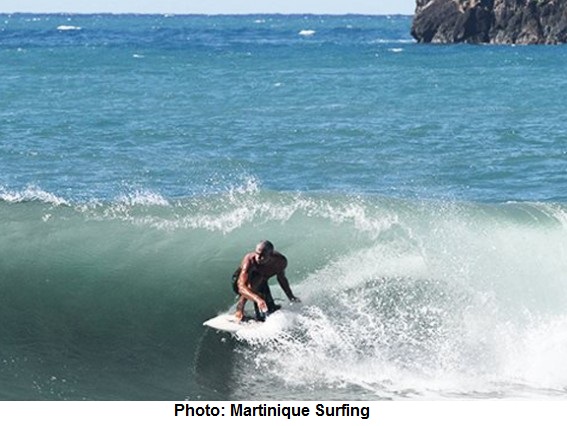
————-

Appendix AUDIO-VIDEO – What Is Whiteness? –  https://the1a.org/segments/2017-02-27-what-is-whiteness/

 What Is Whiteness?

Posted Feb 27 2017 – Biological races do not exist. So why do we continue to rely on race as a key defining factor in our society? A new crop of scholars and artists have turned their attention to examinations of those who identify as white. We talk with some of them about what “whiteness” is — and isn’t — and what the dangers are in the context of a renewed call for white supremacy in America.
Guests

  • Sandra Kim founder of Everyday Feminism and Compassionate Activism.
  • Tim Wise anti-racism activist; author, “Dear White America: Letter to a New Minority” and “White Like Me: Reflections on Race from a Privileged Son.”
  • Mat Johnson associate professor of English at the University of Houston; author of “Pym” and “Loving Day.”
  • Carol Anderson professor of African-American Studies at Emory University; author of “White Rage: The Unspoken Truth of Our Nation’s Divide.”
  • LeRonn P. Brooks Assistant Professor of Africana Studies at Lehman College and Curator for Claudia Rankine’s The Racial Imaginary Institute.
Share this post:
, , ,
[Top]