Category: Social

Extracurricular Music Programs Boost Students

Go Lean Commentary

“Reading, ‘Riting and ‘Rithmetic” – The 3 R’s of Education.

If only everybody learned these basic skills at the same level of competence.

The truth is, not everyone is as gifted as others. While some may display genius abilities with these literary and/or computational skills, others show genius qualifiers for art, dance, athleticism … and music!

The book Go Lean…Caribbean declares: “That’s OK”!

The book identifies that there are 8 different genius qualifiers and plots to include the contribution of all these participants in the quest to elevate Caribbean society. The 8 genius qualifiers are stated in the book (Page 27) as follows:

1. Linguistic
2. Logical-Mathematics
3. Musical, Sound, Rhythm
4. Bodily-Kinesthetic-Body Movement Control
5. Spatial – Shapes/Figures Aptitude
6. Interpersonal – Other People’s Feelings – Leadership
7. Intrapersonal and Naturalistic – Self-Awareness
8. Existential – Moral Intelligence

Some genius skills are innate, natural abilities; but some genius qualifiers have to be taught, learned and fostered. The same as everyone benefits from literary and computational skills – genius or not – the same can be said of music, sound and rhythm. Those who can make music can contribute greatly to society. But on the other hand, even those not enabled with great musical abilities can become appreciative music consumers. So the benefits of music education are extended far-and-wide. In fact, this below news article posits that Extracurricular Music programs have benefits for all students, boosting their grades and graduation rates.

Wow, the research and findings – as follows – should not be ignored:

Title: Extracurricular Music Program Boosts Students’ Grades and Graduation Rates
By: Corey Whelan

(This article is presented in partnership with the California Lottery. The California Lottery proceeds provides supplemental funding to State Education & Music programs)

CU Blog - Extracurricular Music Programs Boost Students - Photo 1

Music is one of the most powerful motivators human beings have. Music can calm an anxious toddler, energize a sleepy teenager and elicit every human emotion known. According to MUSICSTAR, a California public school music program, it can also generate better math scores and higher rates of graduation among public school students. As reported in a recent Gallop Poll, most parents, including those raising children in California, agree that children can benefit from music programs and want them to be available at their child’s school.

The Sound of Learning
In general, music education and learning how to play a musical instrument, have been consistently resulted in developing a myriad of skills and abilities among children. In addition to acquiring mastery of an instrument many come to love, according to MUSICSTAR, the following benefits also occur:

  • Creativity development
  • Team-building skills, particularly if they play in an orchestra or band
  • Increased levels of academic and personal achievement
  • Higher sense of self-esteem
  • Increased levels of self-discipline
  • Higher rates of school spirit
  • Decreased rates of behavioral issues
  • Decreased levels of depression and anxiety

Music programs in school can also support better relationships between teachers and students, and between the school and parent community.

The Power of MUSICSTAR Learning
MUSICSTAR is an educational program which is offered in a variety of California’s public schools, both during the school day and as an after-school program. “We’re providing a solution for many of California’s schools, from elementary through to high school, by providing all of the music education components needed, from the equipment to the instruments, plus the curriculum, trained teaching staff and program support,” says Eckart Seeber, the director of the MUSICSTAR program. “There’s no limit as to what instruments the children can use. They can access and explore band instruments, guitar, drums, marching band or rock band or the violin.”

As an award-winning composer, Seeber knows firsthand what the power of musical learning can do. “MUSICSTAR ran our own internal research and also accessed third-party research which compared students in the same socioeconomic locations. Consistently it was shown that music education learners excelled in many areas over students who were not studying music, in ways which surprised some parents and educators. Music students consistently displayed higher test scores in mathematics than their non-music studying counterparts,” he explains.

The Benefit to Students and Their Community
Students are welcome to explore a wide range of musical instruments and techniques, including multicultural music, music technology, mariachi, choir, glee and hand-drumming. Program options can be suited to all levels of musical ability and the student’s age. Several themes run through all of the programs and provide high levels of musicianship and aesthetics, music literacy and an in-depth comprehension of music as it has been applied throughout various historical periods as an art form.

The programs are geared towards acquiring performance and public speaking skills, both confidence builders. Students involved in the programs long term have the opportunity to take their music into the community. With the support of school-based professionals, many students go on to play with groups at community centers and senior citizen facilities, providing a well-deserved respite for others and an incredible self-growth opportunity for themselves.
——-
Corey Whelan is a freelance writer in New York. Her work can be found at Examiner.com.

Source: CBS Los Angeles – News Site of Local Affiliate (Posted March 18, 2015; retrieved 5/28/2015) –
http://losangeles.cbslocal.com/top-lists/extracurricular-music-program-boosts-students-grades-and-graduation-rates/

The focus of this commentary is on education. (This has proven to be a pivotal subject for the Go Lean movement: the book and accompanying blogs). The focus on this commentary is also on music, and the intersection of these two dynamics: music education.

The book Go Lean…Caribbean serves as a roadmap for the introduction and implementation of the Caribbean Union Trade Federation (CU), an initiative to bring change and empowerment to the Caribbean region; to make the region a better place to live, work and play. From the outset, the book recognized the significance of music in the Caribbean change/empowering plan with these statements in the opening Declaration of Interdependence (Page 12 & 14):

xxi.  Whereas the preparation of our labor force can foster opportunities and dictate economic progress for current and future generations, the Federation must ensure that educational and job training opportunities are fully optimized for all residents of all member-states, with no partiality towards any gender or ethnic group. The Federation must recognize and facilitate excellence in many different fields of endeavor, including sciences, languages, arts, music and sports. This responsibility should be executed without incurring the risks of further human flight, as has been the past history.

xxxii.  Whereas the cultural arts and music of the region are germane to the quality of Caribbean life, and the international appreciation of Caribbean life, the Federation must implement the support systems to teach, encourage, incentivize, monetize and promote the related industries for arts and music in domestic and foreign markets. These endeavors will make the Caribbean a better place to live, work and play.

The purpose of the Go Lean roadmap is to foster change, to elevate Caribbean society. Music can play a major role in that endeavor; (there is the acknowledgement that music can help forge change). Education is also pivotal. Therefore music education must be a priority.

This Go Lean roadmap calls for the heavy-lifting in shepherding change in Caribbean life. In fact, the empowerment roadmap has these 3 prime directives:

  • Optimization of the economic engines in order to grow the regional economy to $800 Billion & create 2.2 million new jobs.
  • Establishment of a security apparatus to protect the resultant economic engines.
  • Improvement of Caribbean governance to support these engines.

While the Go Lean book describes the CU as a hallmark of a technocracy, with a commitment to efficiency and effectiveness, there is still a commitment to concepts of fun, such as music, arts, sports, film/media, heritage and overall happiness. There is the 3rd rail of this Caribbean optimization roadmap: 1. Live, 2. Work and 3. Play.

The Go Lean book declares that before any real change takes root in the Caribbean that we must reach the heart of people, to ready them to adopt new community ethos – the national spirit that drives the character and identity of its people. This is easier said than done! But, Music helps.

This Go Lean movement has previously detailed how society can be transformed through music; consider prior Go Lean blog/commentaries:

https://goleancaribbean.com/blog/?p=5251 Bahamas Attempts to Transform Society with Inaugural Carnival
https://goleancaribbean.com/blog/?p=3641 Building a City on ‘Rock and Roll’
https://goleancaribbean.com/blog/?p=3568 Forging Change: Music Moves People
https://goleancaribbean.com/blog/?p=2415 How ‘The Lion King’ Music/Play roared into history
https://goleancaribbean.com/blog/?p=2291 Forging Change: The Fun Theory
https://goleancaribbean.com/blog/?p=1909 Music Role Model Berry Gordy: Transformed America
https://goleancaribbean.com/blog/?p=866 Music Role Model Bob Marley: Legend Transformed the World
https://goleancaribbean.com/blog/?p=273 10 Things We Do Not Want From the US – #9: Cultural Neutralizations

Our world is in constant flux. The region has not always kept pace with change; as a result, we have often fallen behind and lost many battles in the war of globalization. We have stood on the sidelines and watched the taste and interest of our young people, and many times our youth themselves, shift to life in foreign shores. Change need not be scary! We can win many of the battles of globalization; we do not have to lose this war.

To win, or if only to survive, we must first outfit ourselves in a complete suit of armor. This is a Biblical reference (Ephesians 6:10-18). It stresses that a foremost piece of armor is a “helmet”, referring to the need to protect/prepare mental processes.

This means education!

Yes, the need to better teach our youth is a God-given mandate. Music can be an offensive and defensive tool (weapon). Since most educational administrations in the Caribbean are overwhelmed with just the delivery of the basic “3 R’s” – defined above – music is mostly deemed an extracurricular activity. The Go Lean roadmap was constructed with the approach that change and new empowerments are needed for the Caribbean “community ethos”; plus the execution of new strategies, tactics, implementations and advocacies to impact our society. The following list from the book provides a sample of the community ethos, strategies, tactics, implementations and advocacies for the region to Go Lean:

Community Ethos – Deferred Gratification Page 21
Community Ethos – Economic Principles – People Respond to Incentives in Predictable Ways Page 21
Community Ethos – Economic Principles – The Consequences of Choices Lie in the Future Page 21
Community Ethos – Ways to Impact the Future Page 26
Community Ethos – Ways to Foster Genius Page 27
Community Ethos – Ways to Promote Intellectual Property Page 29
Community Ethos – Ways to Impact Research & Development Page 30
Community Ethos – Ways to Bridge the Digital Divide Page 31
Community Ethos – Ways to Impact Turn-Around Page 33
Community Ethos – Ways to Promote Happiness – Promotion of Domestic Culture Page 36
Community Ethos – Ways to Impact the Greater Good Page 37
Strategy – Vision – Confederate 30 Member-States Page 45
Strategy – Mission – Celebrate the Music, Sports, Art, People and Culture of the Caribbean Page 46
Tactical – Fostering a Technocracy Page 64
Tactical – Growing Economy to $800 Billion – Education Empowerments Page 70
Tactical – Separation-of-Powers – Educational Empowerment from Federation   to Member-States Page 85
Implementation – Ways to Pay for Change Page 101
Implementation – Ways to Deliver Page 109
Planning – 10 Big Ideas for the Caribbean Region – Four Languages in Unison Page 127
Planning – Ways to Make the Caribbean Better – Music/Media/Arts for better PLAY Page 131
Advocacy – Ways to Grow the Economy Page 151
Advocacy – Ways to Create Jobs Page 152
Advocacy – Ways to Improve Communications Page 186
Advocacy – Ways to Impact Hollywood Page 202
Advocacy – Ways to Impact Beauty Pageants Page 203
Advocacy – Ways to Preserve Caribbean Heritage Page 218
Advocacy – Ways to Improve the Arts Page 230
Advocacy – Ways to Promote Music Page 231
Appendix – Job Creations – Music and Art Related Jobs: 12,600 Page 257
Appendix – Caribbean Musical Genres for all 30 Member States Page 347

The quest to change the Caribbean is conceivable, believable and achievable. But it is more than just playing or listening to music. It is heavy-lifting. Yes, it does include a lot of skill-sets of those that master the Reading, ‘Riting and ‘Rithmetic subject matters; but it also has a role for those with genius qualifiers in music and the other arts. Plus, according to the foregoing news article, education in music makes students of Science, Technology, Engineering and Mathematics (STEM) better at their perspective STEM professions.

This is a win-win all-around. Even for those who fail to excel, master or display any genius abilities, their ventures into music will never be wasted, for at least they would have had fun consuming it. This will make them lifelong music patrons.

Life imitating art; art imitating life. This thought was dramatically illustrated in the 2003 Movie School of Rock; see Appendix and VIDEO below.

The Go Lean roadmap was composed with the theme that one man or woman can make a difference in transforming society. The cited movie below is renowned for the quotation:

“One great rock concert can change the world”.

Yes, according to one Bahamian Music Artist and Music Educator extraordinaire Sonovia “Novie” Pierre: Make Love; Make Peace; Make Music.

This aligns with the clarion call for the Go Lean…Caribbean book: A better place to live. A better place to work. A better place to Play. Music is tied to all of these activities.

This is the mandate of the Go Lean roadmap. Everyone is hereby encouraged to lean-in to this roadmap.

🙂

————

Appendix – Movie: School of Rock (2003)

Summary: When struggling musician Dewey Finn finds himself out of work, he takes over his roommate’s job as an elementary school substitute teacher and turns [his] class into a rock band.

Storyline: Down and out rock star Dewey Finn gets fired from his band, and he faces a mountain of debts and depression. He takes a job as a 4th grade substitute teacher at an uptight private school where his attitude and hijinks have a powerful effect on his students. He also meets Zack, a 10-year-old guitar prodigy, who could help Dewey win a “battle of the bands” competition, which would solve his financial problems and put him back in the spotlight. – Written by Anonymous

Director: Richard Linklater
Writer: Mike White
Stars: Jack Black, Mike White, Joan Cusack

VIDEOSchool Of Rock – Epic Scenehttps://youtu.be/x_-4d8YBojo

The Journey: The Teacher discovering the genius talents in his midst.
Category: Music. License: Standard YouTube License

VIDEO – School Of Rock -Zach’s Song [HD] “OFFICIAL VIDEO” – https://youtu.be/oP7kExN8LFA

The Big Show: The culmination of all the effort, teamwork and genius.
Share this post:
, , , , , ,

POTUS and the Internet

Go Lean Commentary

What is the requirement for the Office of the President of the United States; and why is this important to the Caribbean?

A candidate must be at least 35 years old; natural born citizen of the country (could not have been naturalized); must win the majority of votes (270) of the 538 total in the American Electoral College.

One more requirement: the candidate must have a “thick skin” and the uncanny ability to choose his/her battles. The President cannot pick a fight with just anyone that lobs unkind words, no matter how denigrating the insult.

This is not easy! Considering the free-for-all that is the internet; freedom of speech … is not free!

This actuality was dynamically illustrated in the past week; first with a number of 2016 potential candidates (Carly Fiorina, Ted Cruz, Jeb Bush and Hillary Clinton) in their quest to secure their own web domains (xxxxxxxxxx.com, xxxxxxxxxx.net, xxxxxxxxxx.org, etc.) and lastly with the current president’s first foray with the social media site Twitter. See stories here:

Title #1: U.S. presidential candidate Fiorina spins web around interviewer
By: Bill Trott, Reuters, May 10, 2015

WASHINGTON (Reuters) – Republican presidential candidate Carly Fiorina apparently has learned something about registering website domain names.

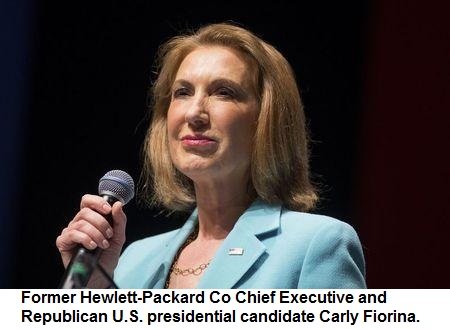
Former Hewlett-Packard Co Chief Executive and Republican U.S. presidential candidate Carly Fiorina speaks during the Freedom Summit in GreenvilleShortly after the former Hewlett-Packard chief executive announced her campaign last week, she found out that a cybersquatter had bought the rights to carlyfiorina.org and was using it to criticize her record.

Chuck Todd of NBC News brought up the issue while interviewing Fiorina on “Meet the Press” and showed the website, which features row after row of frowny-face emoticons representing 30,000 people laid off during her Hewlett-Packard tenure from 1999 to 2005.

Fiorina defended her record and after the interview sent a tweet thanking Todd for having her on the show and saying, “Btw, checkout chucktodd.org.” Her campaign had registered that domain and clicking on the link redirected traffic to her official campaign site, carlyforpresident.com.

Fiorina had done the same thing last week with sethmeyers.org when she appeared on NBC’s “The Late Show with Seth Meyers.”

Fiorina has acknowledged she made a mistake in not registering carlyfiorina.org first, but she is not the only 2016 presidential candidate bedeviled by cybersquatters.

Republican Ted Cruz must endure a rogue tedcruz.com site that says only “Support President Obama. Immigration Reform now”, while jebbushforpresident.com is being used by supporters of gay rights, not Jeb Bush.

The site hillaryclinton.org is not the work of Democratic candidate Hillary Clinton’s campaign and cyber security experts say it contains malicious software.

—————-

Title # 2: VIDEOPresident Obama @POTUShttp://wapo.st/1FkwKrX

May 19, 2015 (Reuters) – President Obama started his own Twitter account on Monday. Within 45 minutes of sending his first tweet, Obama gained more than 217,000 followers.

—————-

Title #3: ‘Welcome To Twitter, N*gger’: Righties Go FULL RACIST On POTUS Twitter Account (TWEETS)

Well, President Obama finally has his own twitter account, and conservatives didn’t waste any time showing just how racist they really are.

CU Blog - POTUS and the Internet - Photo 1

While the president was having fun posting about how his tweets would be his own words to the American people, righties were busy hurling racial slurs in @replies at the POTUS twitter account. For your viewing disgust, here are just a few of the so-called “welcome” messages President Obama received on his newly-created personal account (yes, these are screenshots and not actual tweets, in the event these trolls decide to delete their words like the cowards they are):

CU Blog - POTUS and the Internet - Photo 2

CU Blog - POTUS and the Internet - Photo 3

CU Blog - POTUS and the Internet - Photo 4

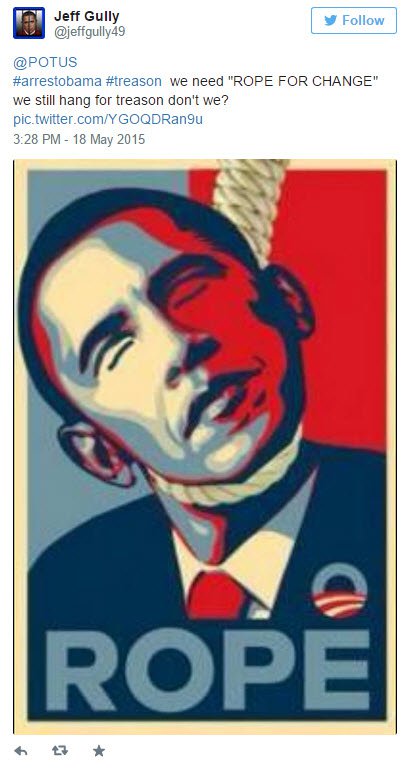
As if those initial messages weren’t bad enough, one person tweeted to the sitting President that he should be lynched, completed with image:

CU Blog - POTUS and the Internet - Photo 5

… I could go on, but you get the idea. If this doesn’t tell you that Barack Obama has handled the unprecedented disrespect and outright hatred directed at him from right-wing racists with the utmost grace and dignity, I don’t know what will.

The entire article is here: http://www.addictinginfo.org/2015/05/18/welcome-to-twitter-ngger-righties-go-full-racist-potus-twitter-account-tweets/; retrieved May 19, 2015.

—————-

Title #4: Uh, you probably don’t want to tweet to @POTUS, actually
By: Caitlin Dewey

Twitter, at first glance, is a magical fantasy land — a utopia where any old egg can freely converse with presidents, pop stars and kings. It is the great democratizer; the global water cooler; the one place where you can say anything to anyone and know it’ll be okay.

Consider this your monthly reminder that this is actually NOT the case: On the modern Internet, impressions of anonymity and ephemerality are, well … usually fake.

But the joke’s actually on them: Not only does the Secret Service already monitor Twitter for threats, but the White House is archiving each and every thing @POTUS tweeters say. Ashley Feinberg flagged this relevant piece of the White House Online Privacy Policy

when you tweet “leave Michelle for me @POTUS,” or something even more inappropriate/creepy, that lives in an official White House Archive for eternity (slash, for potential future scrutiny).

To be clear, this isn’t just a White House thing: The principle applies, in one form or another, to most types of social networking

Find the whole article at the Washington Post Online site – The Capital’s Daily Newspaper (Posted 05-19-2015) –

http://www.washingtonpost.com/news/the-intersect/wp/2015/05/19/uh-you-probably-dont-want-to-tweet-to-potus-actually/

The President of the United States (POTUS) is considered the most powerful Commander-in-Chief in the world; this is due to the fact that the US is the only remaining Super Power with the world’s largest Single Market economy and world’s largest military establishment. This country is the Caribbean largest trading partner. POTUS also has direct oversight over the US Federal Government functionalities in the 2 US Territories in the Caribbean (Puerto Rico and the US Virgin Islands).

This subject is a pivotal theme in the book Go Lean…Caribbean, which asserts that Internet & Communications Technologies (ICT) are critical for elevating Caribbean society. The art and science of this field is slated to impact the economic, security and governing engines. The internet makes things easy; it makes benevolent endeavors easier and malevolent endeavors easier. There must be the constant oversight.

The challenges of politicians and the Internet clearly demonstrate the need for technocratic oversight for the Caribbean’s foray into garnering more respect and benefits for intellectual property. There is the need for “Grievance Officers” to settle disputes related to cyber-squatting for Caribbean domains and the proposed Caribbean Cloud branded: www.myCaribbean.gov.

Change has come to the world of politicking and elections. The ubiquity of the internet cannot be ignored.

This book, Go Lean… Caribbean, serves as a roadmap for the introduction and implementation of the technocratic Caribbean Union Trade Federation (CU). The CU/Go Lean roadmap has 3 prime directives:

  • Optimization of the economic engines in order to grow the regional economy to $800 Billion GDP and create 2.2 million new jobs.
  • Establishment of a security apparatus to protect the societal engines and marshal against human and civil rights abuses.
  • Improvement of Caribbean governance to support these engines, plus facilitate a smooth transparent election process.

Early in the book, the benefits of optimizing governance through technology empowerments are pronounced in the opening Declaration of Interdependence (Pages 12 & 14), with these statements:

xi.  Whereas all men are entitled to the benefits of good governance in a free society, “new guards” must be enacted to dissuade the emergence of incompetence, corruption, nepotism and cronyism at the peril of the people’s best interest. The Federation must guarantee the executions of a social contract between government and the governed.

xii.  Whereas the legacy in recent times in individual states may be that of ineffectual governance with no redress to higher authority, the accedence of this Federation will ensure accountability and escalation of the human and civil rights of the people for good governance, justice assurances, due process and the rule of law…

xxvi.  Whereas the region has endured a spectator status during the Industrial Revolution, we cannot stand on the sidelines of this new economy, the Information Revolution. Rather, the Federation must embrace all the tenets of Internet Communications Technology (ICT) to serve as an equalizing element in competition with the rest of the world. The Federation must bridge the digital divide and promote the community ethos that research/development is valuable and must be promoted and incentivized for adoption.

xxvii.  Whereas intellectual property can easily traverse national borders, the rights and privileges of intellectual property must be respected at home and abroad. The Federation must install protections to ensure that no abuse of these rights go with impunity, and to ensure that foreign authorities enforce the rights of the intellectual property registered in our region.

The Go Lean book details the community ethos to adapt to the changed ICT landscape, plus the executions of the following strategies, tactics, implementations and advocacies:

Community Ethos – Economic Principle – People Respond to Incentives Page 21
Community Ethos – Job Multiplier Page 22
Community Ethos – Lean Operations Page 24
Community Ethos – Return on Investments (ROI) Page 24
Community Ethos – Ways to Impact the Future Page 26
Community Ethos – Promote Intellectual Property Page 29
Community Ethos – Impact Research & Development Page 30
Community Ethos – Bridge the Digital Divide Page 31
Strategy – Vision – Integrate 30 Caribbean member-states into a Single Market Economy Page 45
Strategy – Mission – Fix the broken systems of governance in our region Page 46
Tactical – Fostering a Technocracy Page 64
Tactical – Growing the Economy – Book: Nature and Causes of the Wealth of Nations by Adam Smith (1776) Page 70
Separation of Powers – Department of State – Federal Elections Administrators Page 70
Separation of Powers – Federal/Caribbean Police – Elections/Candidate Security Page 77
Separation of Powers – Film Promotion and Administration Page 78
Separation of Powers – Intellectual Property (Copyrights & Domains) Administration Page 78
Separation of Powers – Communications and Media Authority Page 79
Separation of Powers – Federal Legislature & Electoral Seats Page 91
Implementation – Ways to Impact Social Media Page 111
Implementation – Ways to Impact Elections Page 116
Advocacy – Ways to Grow the Economy Page 151
Advocacy – Ways to Create Jobs Page 152
Advocacy – Ways to Improve Communications Page 186
Advocacy – Ways to Foster Technology Page 197
Advocacy – Ways to Foster e-Commerce Page 198
Advocacy – Ways to Impact Hollywood Page 203
Advocacy – Ways to Promote Contact Centers – Ideal for Pre-Election Polling Page 212
Advocacy – Ways to Impact the Diaspora Page 217
Appendix – Puerto Rico Diaspora distribution in the mainland United States Page 304

This commentary is about the Caribbean, not about the United States. It is important for leaders in the US to be concerned with the Caribbean’s well-being. This point has been explicitly acknowledged by Caribbean stakeholders and relevant subjects have recently been extolled in these previous Go Lean…Caribbean blog/commentaries:

https://goleancaribbean.com/blog/?p=5183 Mexico Model – May 5th – US too occupied during Civil War to defend neighbor
https://goleancaribbean.com/blog/?p=5088 Caribbean Migrants among the accounting of 1 in 11 Black population in USA
https://goleancaribbean.com/blog/?p=4935 A Lesson in History – Grand Old Party – the Republicans – must be cuddled
https://goleancaribbean.com/blog/?p=4897 US Backs LNG Distribution Base in Jamaica as Caribbean Regional Hub
https://goleancaribbean.com/blog/?p=4793 Yelp.com Review Site – Model of CU Social Media Grievance Regulators
https://goleancaribbean.com/blog/?p=4551 US Territories – currently Between a ‘rock and a hard place’
https://goleancaribbean.com/blog/?p=4360 Dreading the American ‘Caribbean Basin Security Initiative’
https://goleancaribbean.com/blog/?p=4294 US Ambassadors to Caribbean push US Energy and Security Policies
https://goleancaribbean.com/blog/?p=3834 State of Caribbean Union compared to the State of the American Union
https://goleancaribbean.com/blog/?p=3662 Caribbean Migrants desperate to get to US as Promised Land destination
https://goleancaribbean.com/blog/?p=1965 America’s Navy – Protector for Caribbean waters and the World’s

Other interactions related to US government-to-Caribbean population have also been blogged in Go Lean commentaries, as sampled here:

https://goleancaribbean.com/blog/?p=4058 New York Times Maledictions on The Bahamas
https://goleancaribbean.com/blog/?p=3473 Haiti to Get $70 Million from US-AID to Expand Caracol  Industrial Park
https://goleancaribbean.com/blog/?p=3455 Restoration of US Diplomatic Relations with Cuba
https://goleancaribbean.com/blog/?p=2907 Miami Haitian-American leaders protest Bahamian immigration policy
https://goleancaribbean.com/blog/?p=341 US slams human rights practices among Caribbean nations

The CU seeks to re-boot the relationship with the US to an elevated “protégé” status, as opposed to the parasite status currently being maintained. For the Caribbean member-states, the CU will oversee the radio spectrum used for internet, radio, television and satellite communications in the region. (This radio spectrum must be regulated “by us and for us” … on a regional level due to the close-proximity of member-states). So the CU‘s coordination must be arranged in the manner of a Common Pool Resource, as the radio spectrum is limited. This oversight must also extend to internet broadband (wireless & wire-line) governance.

Also, the CU must conduct its own federal elections for all 30 member-states. This CU election process, detailed in the Go Lean roadmap, is a direct parallel to the election process in the US, alluded to at the start of this commentary. The US system defines 538 “electors”. This corresponds to the 435 members of the House of Representatives, 100 senators, and the three additional electors for the nation’s non-State capital city, Washington, DC. The same Electoral College design is proposed for the CU – so as to not trivialize the region’s Small Island States – where 250 House seats, and 60 Senate seats, amounts to a total 310 (Page 91). With the requirement of 156 electoral votes to win the CU presidency, no candidate can be elected without the inclusion of some Small Island States. This is logical; an effective application for the CU legal structure bred from the US model.

For the CU, ICT must also come into play more and more to facilitate efficient federal campaigns. We can do this!

We can apply best-practices – as communicated in the foregoing articles – so as to mitigate election-campaign abuses and remediate slanderous communication from “bad actors” who try to bully elected officials; these ones  will become more active as election passions intensify.

“Out with the old; in with the new” – the US President Obama has less than 2 years remaining in his constitutionally-mandated  term-limit. The candidates vying for Mr. Obama’s job for 2016 will have to feature many of the same qualifications as Mr. Obama; these ones, in particular, must be thick-skinned in tolerating scathing insults and cyber-bullying. They would do best to remember that there will always be a loud minority … and quiet majority. 🙂

Download the free e-Book of Go Lean … Caribbean – now!

Share this post:
, , , ,
[Top]

Book Review – ‘Thimerosal: Let The Science Speak’

Go Lean Commentary:

This accusation against the American Big Business eco-system, seems so egregious:

Sacrifice children on the altar of corporate profits.

According to the events on the HBO Television show Real Time with Bill Maher, on Friday April 24, 2015, it is hard not to be an Anti-Vaxxer. The ‘Real Time’ host sided with his guest, activists and author Robert F. Kennedy Jr.. Mr. Kennedy came on to talk about his new book (see Appendix A), and the link between vaccines and the dreaded disorder of Autism.

- Photo 1On the show, Maher conducted a sit-down interview with Robert F. Kennedy Jr. who came on the program to promote the new book he edited ‘Thimerosal: Let the Science Speak’; as well as the full-page ad Kennedy recently ran in USA Today claiming that the drug Thimerosal, a mercury-containing preservative used in vaccine medications, causes Autism.

This is a stance Kennedy, and others, has taken for quite some time. Back in 2005, Kennedy made an infamous appearance on The Daily Show with Jon Stewart for an “Autism” special. There, Kennedy preached his Anti-vaxx stance, claiming not only that vaccines cause Autism, but also that there’s a wide-ranging conspiracy to cover this fact up involving the government, academia, and Big Pharma. Stewart, who’d later rip Anti-vaxxers a new one in a February 2015 Daily Show rant, just nodded his head and said, “I appreciate you getting the word out.”

Kennedy went on to answer Maher’s questions by explaining what he believes are the “unanimous dangers of Thimerosal” and “the links between Thimerosal and an epidemic of neurological disorders that are now afflicting American children: ADD, ADHD, speech delay, language delay, hyperactivity disorder, ASD, and Autism, all of which began in 1989, the year they changed the vaccine schedule.”

Then, Kennedy made an interesting admission.

“I am very pro-vaccine,” he said. “I had all my kids vaccinated and want to see government policies promoting full-coverage vaccines. The only way to do that is to have safe vaccines, and to have a credible regulatory process with regulators with integrity, and we don’t have that today.”

Yes, Kennedy said he mainly takes issue with the Centers for Disease Control and Prevention (CDC), which he says “controls the field” and is a “cesspool of corruption that’s been completely taken over by the vaccine industry.”

(Source: http://www.thedailybeast.com/articles/2015/04/24/bill-maher-anti-vaxxer-the-real-time-host-sides-with-robert-f-kennedy-jr-during-bizarre-interview.html)

This latter point is where this commentary related to the plan to elevate Caribbean society. The book Go Lean…Caribbean (Page 157) declares that big American Pharmaceutical industry or Big Pharma may be more of an obstacle than a aid for effecting community well-being. They care more about profits than they do the well-being of the public.

Sacrifice children on the altar of corporate profits.

This charge relates the underlying theme that the profit motives of Big Pharma is indicative of American Crony-Capitalistic practices that have been cited in so many other blog / commentaries. See Appendix C of cited Crony-Capitalism conflicts in American society.

(The publishers of the Go Lean book are proponents of childhood vaccinations – Pro-Vaxxers).

The Go Lean book strategizes a roadmap for economic empowerment in the region, clearly relating that healthcare, and pharmaceutical acquisitions are important in the quest to make the Caribbean a better place to live, work and play. At the outset of the Go Lean book, in the Declaration of Interdependence (Page 11), these points are pronounced:

viii. Whereas the population size is too small to foster good negotiations for products and commodities from international vendors, the Federation must allow the unification of the region as one purchasing agent, thereby garnering better terms and discounts.

ix.   Whereas the realities of healthcare and an aging population cannot be ignored and cannot be afforded without some advanced mitigation, the Federation must arrange for health plans to consolidate premiums of both healthy and sickly people across the wider base of the entire Caribbean population. The mitigation should extend further to disease management, wellness, obesity and smoking cessation programs.

The Go Lean book serves as a roadmap for the implementation and introduction of the technocratic Caribbean Union Trade Federation (CU). The CU‘s prime directives are identified with the following 3 statements:

  • Optimization of the economic engines in order to grow the regional economy to $800 Billion & create 2.2 million new jobs.
  • Establishment of a security apparatus to protect the resultant economic engines.
  • Improvement of Caribbean governance to support these engines.

Previous blog/commentaries addressed issues of capitalistic conflicts in American medical practices, compared to other countries, and the Caribbean. The following sample applies:

Judge to decide on Vaccination Amidst Autism Fears
Antibiotics Misuse Linked to Obesity in the US
CHOP Research: Climate Change May Bring More Kidney Stones
Big Pharma & Criminalization of American Business
New Research and New Hope in the Fight against Alzheimer’s Disease
Health-care fraud in America; criminals take $272 billion a year
New Cuban Cancer medication registered in 28 countries

The Caribbean Union Trade Federation has the prime directive of optimizing the economic, security and governing engines of the region. The Book Review and AutismOne VIDEO – in the Appendices below – depict that abuses have entered the quest for best practices in health management for the American public. We must do better in the Caribbean.

The Book Review and VIDEO below provide inside glimpses of the decision-making around Public Health drugs. Obviously, the innovators and developers of drugs have the right to glean the economic returns of their research. The Go Lean roadmap posits that more innovations will emerge in the region as a direct result of the CU prioritization on science, technology, engineering and medical (STEM) activities on Caribbean R&D campuses and educational institutions.

This is the manifestation and benefits of Research & Development (R&D). The roadmap describes this focus as a community ethos and promote R&D as valuable for the region. The following list details additional ethos, strategies, tactics, implementations and advocacies to optimize the region’s health deliveries and R&D investments:

Community Ethos – Deferred Gratification Page 21
Community Ethos – Economic Systems Influence Individual Choices and Incentives Page 21
Community Ethos – The Consequences of Choices Lie in the Future Page 21
Community Ethos – Governing Principles – Return on Investments Page 24
Community Ethos – Governing Principles – Cooperatives Page 25
Community Ethos – Non-Government Organizations Page 25
Community Ethos – Ways to Impact Research & Development (R&D) Page 30
Community Ethos – 10 Ways to Promote Happiness Page 36
Community Ethos – Ways to Impact the Greater Good Page 37
Strategy – Integrate and unify region in a Single Market Page 45
Strategy – Agents of Change – Globalization Page 57
Tactical – Fostering a Technocracy Page 64
Tactical – Separation of Powers – Health Department Page 86
Tactical – Separation of Powers – Drug Administration Page 87
Implementation – Ways to Pay for Change Page 101
Implementation – Ways to Implement Self-Government Entities – R&D Campuses Page 105
Implementation – Ways to Deliver Page 109
Planning –  Ways to Improve Trade Page 128
Planning –  Ways to Make the Caribbean Better Page 131
Advocacy – Ways to Improve Healthcare Page 156
Advocacy – Ways to Better Manage the Social Contract Page 170
Advocacy – Ways Foster Cooperatives Page 176
Advocacy – Ways to Improve Emergency Management Page 196
Advocacy – Ways to Impact Foundations Page 219
Advocacy – Ways to Impact Persons with Disabilities Page 228
Appendix – Emergency Management – Medical Trauma Centers Page 336

The Go Lean roadmap does not purport to be an authority on medical or Public Health best practices. The economic-security-governance empowerment plan should not direct the course of direction for research and/or treatment. But something is wrong in the US, and other countries. 1 in every 160 child has been afflicted with Autism since 1989.

According to these anecdotes and reports, Big Pharma has clearly sacrificed our children on the altar of corporate profits. These companies cannot claim any adherence to any “better nature” in their practices. Their motive is malevolent!

The King of Pop, Michael Jackson, released a song with the title: “They don’t really care about us”; see Appendix D VIDEO below; he very well could have been talking about Big Pharma. In a previous blog/commentary, the pharmaceutical industry was assailed over one cancer drug, Gleevec. The commentary clearly depicted the perils of Crony-Capitalism.

Crony-Capitalism is not for the Greater Good. It is not good economics, good security nor good governance. These activities must be monitored and mitigated.

No, “they don’t really care about us”. We must care and provide for ourselves. There must be better stewardship for society.

This is the calling for the CU Trade Federation, to do better. We can use this community ethos to impact the Greater Good. This is the heavy-lifting of the CU, to make the Caribbean a better place to live, work, heal and play. 🙂

Download the book Go Lean … Caribbean – now!

———–

Appendix A – Book Review:  Thimerosal: Let The Science Speakby Robert F. Kennedy Jr.
(Source: Age of Autism – Online Community for Autism Advocacy – Posted 08-04-2014; Retrieved 05-15-2015 http://www.ageofautism.com/2014/08/book-debut-thimerosal-let-the-science-speak-by-robert-f-kennedy-jr.html)

Book debut day is always exhilarating – even for a seasoned, best selling author like Robert Kennedy, Jr.. Please join us in wishing him well as he educates readers on the dangers of neurotoxic mercury. In an environment (pardon the pun) where so few advocates are willing to step and and speak out on behalf of vaccine safety, we commend and thank both Kennedy and his publisher, Skyhorse. There is not a bigger name in American environmental causes doing anything like this.

After you read the book, we invite you to leave a review at Amazon, Barnes & Noble and GoodReads.

Unfortunately, many people will negatively review the book never having cracked the spine – never having the read more than the book’s cover art on the computer…    Write the review that suits your reaction to the book. Copy it, and leave it at every book site you can find.

Comments
Many follow this conversation and subscribe to the comment feed for this post. Here are a sample:

1. Children damaged by vaccines is not about mercury. That is throwing people off scent. Each and every vaccine has the potential to maim and/or kill the recipient, from the first instant after injection by anaphylactic shock, to Sids, to brain tumors 60 years later, as Michele Carbone has shown…

I get sick reading people’s comments repeating the mind controlled offal about how vaccines have saved the lives of millions. That is an outright lie. The opposite is true. From day one mandated mass smallpox vaccinations have led to mass outbreaks of smallpox. The same goes for polio, especially in Africa.

Check the historical facts: The Jenner/Pasteur gospels are the basis of today’s vaccination programs, yet their premise is patently false, making the whole vaccination religion nothing but a house of cards.

In reality all vaccines are weapons of mass destruction. Just check the product inserts for their content. Introducing manipulated pathogens plus toxic chemicals and metals into the bloodstream never will lead to true health!

Source – Posted by: Desiree L. Rover, August 30, 2014

—————

2. Robert F. Kennedy Jr. has assembled two books: a private unpublished draft which, as he promised at AutismOne 2013, exposes the vaccine/autism cover-up. And this short, bowdlerized, oddly incoherent book, which does not.

In the published book, two bright spots shimmer. The first is Martha Herbert’s brilliant introduction, which places the vaccine safety debate in a broader context, arguing that we need “fresh approaches to health care, product development, energy, and ecosystems management.” The second is Chapter 2, written in a strong, confident narrative voice that pins mercury firmly to the rising prevalence of neuro-developmental disorders. The remaining chapters and 804 citations appear largely to be notes and debating points that support and expand upon Kennedy’s 2005 article, “Deadly Immunity,” published jointly by Salon.com and Rolling Stone, where the key points are made more succinctly, and in my view more persuasively, but without as much supporting documentation.

For those who have followed the vaccine debate on Age of Autism and especially for those who attended Kennedy’s AutismOne 2013 presentation, there are five surprises in the published book. Four of them occur in the introductory material.

First, that “there is no definitive proof that vaccines or the mercury in them causes autism” (p. xvi). How much proof do you need to be “definitive?”

Second, that “the common claim of autism rates continuing to climb after Thimerosal’s phase-out from the routine childhood vaccination schedule … has not, as yet, been borne out” (p. xxvii). Will that statement ring true with special education teachers and professionals whose clinics are overflowing with vaccine-damaged kids?

Third, that removing Thimerosal from all medical products, including flu shots, will restore “faith in the vaccine regimen while maintaining or increasing vaccination rates” (p. xxix). If restoring faith in the vaccine regimen is indeed Kennedy’s goal, this book is two hundred pages too short and ten years too late.

Fourth, that “This book is aggressively pro-vaccine” (p. xi). I know what that is supposed to mean in this context, but the choice of words is surprising. Given the failures of mandated vaccines to protect our children — failures publicized in Age of Autism during the past year — how much more “aggressively pro-vaccine” do we need to be?

The fifth surprise—and for me this is a head spinner — is that in 1999, two key Pharma companies, Merck and SmithKline Beecham (now GlaxoSmithKline) informed the CDC that they could supply enough Thimerosal-free versions of their products to “meet total vaccine demand.” The CDC declined. The unanswered question, worthy of a British whodunit, is this: Why? What beast at the heart of darkness is responsible for the greatest man-made medical catastrophe yet visited on humankind?

The draft chapters that were dismembered, replaced, eviscerated, or buried before Thimerosal: Let the Science Speak was published point to the answer. They cry out from the grave.

Mr. Kennedy, publish the draft.

Source – Posted by: Dan Burns, August 06, 2014

———–

Appendix B VIDEO: AutismOne – How Mercury Triggered The Age Of Autism – https://youtu.be/KiT7Y233404

Published on May 25, 2013 – By Dan Olmsted, Mark Blaxill Motion Design By Natalie Palumbo. Special Thanks to Teresa Conrick

———–

Appendix C – Models of American Crony-Capitalism

Big Defense Many theorists indicate that the “follow the money” approach reveals the Military Industrial Complex work to undermine peace, so as to increase defense spending for military equipment, systems and weapons.
Big Media Cable companies conspire to keep rates high; kill net neutrality; textbook publishers practice price gouging; Hollywood insists on big tax breaks/ subsidies for on-location shooting.
Big Oil While lobbying for continuous tax subsidies, the industry have colluded to artificially keep prices high and garner rocket profits ($38+ Billion every quarter).
Big Box Retail chains impoverish small merchants on Main Street with Antitrust-like tactics, thusly impacting community jobs. e-Commerce, an area of many future prospects, is the best hope of countering these bad business tactics.
Big Pharma Chemo-therapy cost $20,000+/month; and the War against Cancer is imperiled due to industry profit insistence.
Big Tobacco Cigarettes are not natural tobacco but rather latent with chemicals to spruce addiction. Caribbean cigars are all natural.
Big Agra Agribusiness concerns continue to exacerbate greenhouse gases, bully family farmers and crowd out the market; plus they fight common sense food labeling efforts.
Big Data Brokers for internet and demographic data clearly have no regards to privacy concerns. They open that doors for hackers and data breaches.
Big Banks Wall Street’s damage to housing and student loans are incontrovertible. Their only motive: more profits.
Big Weather Overblown hype of “Weather Forecasts” to dictate commercial transactions.
Big Real Estate Preserving MLS for Real Estate brokers only, forcing 6% commission rates, when the buyers and sellers can easily meet online without them.
Big Salt Despite the corrosiveness of salt on roads and the environment, it is the only tactic used to de-ice roads during the winter. Immediately after the weather warms, the roads must be re-constructed, thus ensuring a continuous economic cycle.
Big Energy The For-Profit utility companies always lobby against regulations to “clean-up” fossil-fuel (coal) power plants or block small “Green” start-ups from sending excess power to the National Grid. Their motive is to preserve their century-long monopoly and their profits.
Big Legal Even though it is evident that the promotion of Intellectual Property can help grow economies, the emergence of Patent Trolling parties (mostly lawyers) is squashing innovation. These ones are not focused on future   innovations, rather just litigation. They go out and buy patents, then look for anyone that may consume any concepts close to those patents, then sue for settlements, quick gains.
Big Cruise Cruise ships are the last bastion of segregation with descriptors like “modern-day-slavery” and “sweat-ships”. Working conditions are poor and wages are far below anyone’s standards of minimum. Many ship-domestic staff are “tip earners”, paid only about US$50 a month and expected to survive on the generosity of the passengers’ gratuity. The industry staff with personnel from Third World countries, exploiting those with desperate demands. Nowhere else in the modern world is this kind of job discrimination encouraged, accepted or tolerated.
Big Jails The private prison industry seem motivated more by profit than by public safety. They attempt to sue state governments when their occupancy levels go too low; a reduction in crime is bad for business.

———–

Appendix D VIDEO: Michael Jackson – They Don’t Care About Us – https://youtu.be/QNJL6nfu__Q


Uploaded on Oct 2, 2009 – Music video by Michael Jackson performing They Don’t Care About Us. (C) 1996 MJJ Productions Inc.

Music: “They Don’t Care About Us” by Michael Jackson (Google PlayAmazonMP3iTunes)


Share this post:
, , ,
[Top]

Post-Mortem of Inaugural Junkanoo Carnival

Go Lean Commentary

The Bahamas held their inaugural Junkanoo Carnival this past weekend. How did they do? How was the execution, compared to the planning? How much money was spent? How much return on investment was recouped?

Title: Carnival Fever: Organisers Hail A ‘Cultural Revolution’
By: Rashad Rolle, Tribune Staff Reporter
The Tribune – Daily Bahamian Newspaper. Posted 05/11/2015; retrieved from:
http://www.tribune242.com/news/2015/may/11/carnival-fever-organisers-hail-cultural-revolution/

CU Blog - Post-Mortem of Junkanoo Carnival - Photo 1An “unprecedented” number of people descended upon Clifford Park, the Western Esplanade and Arawak Cay to participate in the inaugural Junkanoo Carnival events between Thursday and Saturday, completing what officials say will become a permanent fixture on the Bahamian calendar that will jumpstart the country’s cultural economy.

Officials yesterday said it was too early to say exactly how many attended or participated in the event or to assess its overall economic impact.

However, it’s estimated that at the event’s peak, more than 15,000 attended Friday’s Music Masters concert – the “largest gathering of people” ever in The Bahamas, some said.

Last week, Mr Major estimated that 50,000 to 100,000 people would attend Junkanoo Carnival adding that the festival could bring in $50m to $60m.

The event – filled with food and arts and crafts – was bolstered by a well-received mixture of Bahamian and Soca music.

There were “no major (disruptive or criminal) incidents” and “no complaints” about security, Police Assistant Commissioner (ACP) Leon Bethel told The Tribune.

The event, which had faced months of criticism, “proved naysayers wrong,” Tourism Minister Obie Wilchcombe told this newspaper.

He noted that the government, the National Festival Commission and workers in the Tourism and Youth, Sports and Culture Ministries have now put on two major, successful events within the span of a week, proving that the country must add a “label of excellence” to its brand.

“Certainly by all that developed,” he said, “it proved that carnival does have a place in the Bahamas and it can be a unique festival celebrated in a traditional Bahamian way with the inclusion of Junkanoo, highlighting the many talented Bahamians, whether it’s the entertainers, the artisans who produced costumes, the vendors out there with their fine cuisine or the Royal Bahamas Police Force and the entire national security team that worked to turn the place into a spectacular village.”

“While there were those who prayed for rain, the place poured and rained with people,” Mr Wilchcombe added. “We must appreciate that for all the naysayers and those who opposed to the event, the Bahamian people spoke. No one stopped anyone from saying what they wanted to say or from criticising the event, but we stayed focused.”

“Each success, be it the IAAF World Relays or be it carnival, it tells you that collectively we know who we are as a people and what we are capable of.

“We did not let the invited guests dominate the occasion,” he said, reflecting on a prior concern that the event would not be Bahamian-centric.

Mr Wilchcombe added that he wished Bahamian singers ‘KB’, who has flip-flopped on his support for the festival, and ‘Geno D’ had been involved.

“They are two of the best musicians in the country, but in the future I think we are going to see more and more Bahamian artists coming out. What you are now going to see is that Abaco, Eleuthera, Bimini all will want to be a part of this fantastic event.”

In an interview with The Tribune, Festival Commission Chairman Paul Major also said the event exceeded his expectations.

“The spirit of the event, the number of spectators, the number of participants, it was awesome,” he said. “I think we are witnessing a cultural revolution. It’s an economic stimulus.”

Nonetheless, some critics said that while the event seemed to be a big hit among Bahamians, it did not attract the number of tourists needed to provide a major economic boost to the economy as hoped.

Mr Wilchcombe, however, disputed this and said the event will only grow following its successful launch.

Asked about this, Mr Major said: “(That claim) is not true. We were busing tourists from east and west of this venue and continued doing so throughout the event.”

Still, he conceded that the event could have been promoted more internationally. He said the fact that a headliner was not finalised until weeks before the Music Masters concert affected promotional work.

“We will start marketing for the next event as early as September of this year. We may have to look for another venue. This venue may not be big enough to host next year’s event,” Mr Major added.

As for the security of the event, ACP Bethel said the conduct of those attending was “top notch.”

“We had no resistance in terms of security measures. The security was elaborate with many layers in and around the event and we worked hand in hand with the organisers, private security, (and) the Defence Force.”

VIDEO: 2015 Bahamas Junkanoo Carnival Closes Out – https://youtu.be/IR0mGpAd47A

Published on May 10, 2015 – After three days of excitement the inaugural Bahamas Junkanoo Carnival came to an end with many already looking forward to next year. News coverage by local network ZNS TV.

It time now for a post-mortem analysis; borrowing this practice from medical science.

Medical science can teach us a lot. The purpose of the practice of medicine is to protect and promote health and wellness. But when there is a failure in this quest; when someone actually dies, another resource (medical doctor called a pathologist) adds value with a post-mortem examination (autopsy) — a highly specialized surgical procedure that consists of a thorough examination of a corpse to determine the cause and manner of death, evaluating any disease or injury.

This medical practice aligns with the process to forge change, as described in the book Go Lean … Caribbean (Page 9). The book performs a careful post-mortem analysis of the Caribbean’s eco-systems. The conclusion of that analysis was that the region is in crisis. But alas the book, serving as a roadmap for the introduction and implementation of the technocratic Caribbean Union Trade Federation (CU), declares that a crisis is a terrible thing to waste. The roadmap then provides for a turn-around, with turn-by-turn directions on how to elevate the economic, security and governing engines to make the homeland better to live, work and play.

One mission is to optimize events. The Bahamas Junkanoo Carnival is typical of the type of events that the roadmap projects to elevate the region’s societal engines. As detailed plans of this inaugural Carnival were published, this commentary applied analysis comparing the Go Lean baseline. Now that the event has transpired and Go Lean promoters were there to “observe and report”, these are now the lessons-learned; the post-mortem analysis:

  • Regionalism embraced … at lastCarnival is an international brand. One cannot expect to shove a Bahamian-first ethos into the Carnival brand; see Appendix B below. Many people in-country complained that international artists had to be brought in, and “cuddled”: Big Paychecks, amenities, etc; see Photo here of Trinidadian Soca Music Artist Marchel Montano. The Go Lean book/blogs calls for the embrace of the regional Single Market for all of the Caribbean.

CU Blog - Post-Mortem of Junkanoo Carnival - Photo 5

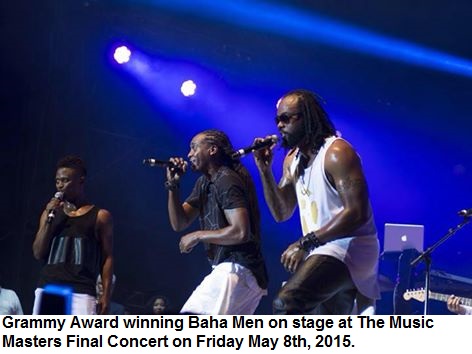
  • Fostering genius … at last – The Bahamas has been notorious for their policies advocating egalitarianism. The concept of Carnival requiring artists to compete for top prizes is 100% divergent from that ideal. Yet, this approach of fostering the musical genius in the country is essential for growing the regional/national economy. We must “hitch our wagons” to the strong, talented and gifted “horses”, as was the case for Bob Marley. See Photos here of the Bahamian Headliner and also of one of the Junkanoo Carnival “Music Masters” event finalist; see Appendix A – VIDEO below. Go Lean calls for formal institutions to develop and monetize musical genius in the region.

CU Blog - Post-Mortem of Junkanoo Carnival - Photo 2

CU Blog - Post-Mortem of Junkanoo Carnival - Photo 4

  • Carnival is a Stimulus (GDP) not an investment (no ROI)Gross Domestic Product is calculated as C + I + G + (X – M) or private consumption + gross investment + government spending + (exports − imports). So the Bahamas government spending $9 million to facilitate the inaugural Carnival did stimulate additional economic activity; (actual results still spending). The foregoing article quotes a $50 to $60 million impact on GDP. This is highly possible based on this formula. Go Lean plans many economic stimuli from Events.
  • Mass attendance is assured – but monetizing is the challenge – Other news reports reflect that vendors and merchants did not get the final returns they had hoped. The Go Lean roadmap calls for the embrace of fairgrounds so as to better monetize event revenues; think parking, hospitality tents, campgrounds (RV’s).
  • Main Street not fully engaged – Bigger Carnival events (Rio de Janeiro, New Orleans, etc.) are successful for their inclusion of floats and trinkets thrown to spectators. The embrace of this strategy would allow Main Street businesses or NGO’s direct participation with sponsorship, advertising and float construction. The Go Lean roadmap seeks to create 2.2 million new jobs in the region by embedding large, medium, small businesses and NGO’s in the development of trade and commerce.

CU Blog - Post-Mortem of Junkanoo Carnival - Photo 7 Sample Float from Rio De Janeiro, Brazil

CU Blog - Post-Mortem of Junkanoo Carnival - Photo 6 Bahamas Carnival’s “Road Fever” Winners

  • Carnival and religion do not make good dance partners – Carnival, by its very nature and history is not a religious event. It does not attempt to honor or worship the Christian God; therefore there should be no attempt to reconcile the two; see Photo here. The Bahamas event avoided planning Sunday activities as an acquiescence to religious leaders; thus missing out on prime weekend availability for visitors and locals alike. The Go Lean roadmap promotes a religiously neutral technocracy – better!

CU Blog - Post-Mortem of Junkanoo Carnival - Photo 3

  • Need an earlier date for Snow-birds and Spring-breakers – A typical Carnival pre-Ash Wednesday date would have been February, ideal for extensive outdoor activities in the Bahamian Heat. On the other hand, the 2nd weekend in May is virtually summer and therefore disinviting for northern visitors – the classic tourist market. The previous commentary had identified that the Bahamas does not have a Lenten ethos, so a March date would be better all-around for better weather, plus an appeal to Snow-birds and Spring-breakers. The Go Lean roadmap focuses on technocracy not religion.

The Go Lean book prescribes events/festivals as paramount in the roadmap to elevate the regional economy (Page 191). There are many ways for the lessons learned in this year’s inaugural Junkanoo Carnival to be better applied in the execution of the roadmap for the Bahamas and the rest of the Caribbean. There are dimensions of these type of events that hadn’t even been experienced by the region … as of yet, namely security. No “bad actors” have emerged to exploit the event for terroristic activities. Yet the Go Lean roadmap fully anticipates this reality. These are among the many strategies, tactics, implementation and advocacies for best-practices:

Community Ethos – People Respond to Incentives Page 23
Community Ethos – Return on Investments Page 24
Community Ethos – Cooperatives Page 25
Community Ethos – Non Government Organization Page 25
Ways to Impact the Future Page 26
Ways to Foster Genius – Performance Excellence Page 27
Ways to Improve Sharing Page 35
Ways to Promote Happiness Page 36
Ways to Impact the Greater Good Page 37
Strategy – Customers – Business Community Page 47
Strategy – Customers – Visitors / Tourists Page 47
Strategy – Competitors – Event Patrons Page 55
Separation of Powers – Emergency Mgmt. Page 76
Separation of Powers – Tourism Promotion Page 78
Separation of Powers – Sports & Culture Page 81
Separation of Powers – Fairgrounds Administration Page 83
Separation of Powers – Turnpike Operations Page 84
Steps to Implement Self-Governing Entities Page 105
Ways to Foster Cooperatives Page 176
Ways to Improve Intelligence Gathering & Analysis – Surveillance Page 182
Ways to Improve [Service] Animal Husbandry – For Event Security Page 185
Ways to Enhance Tourism Page 190
Ways to Impact Events Page 191
Ways to Promote Fairgrounds Page 192
Ways to Impact Hollywood – Media Industry Page 203
Ways to Preserve Caribbean Heritage Page 218
Ways to Improve the Arts Page 230
Ways to Promote Music Page 231
Appendix – Event Model: Sturgis 10-Day Festival Page 288

The publishers of the Go Lean roadmap applaud the current Bahamian Government officials for their commitment to fully commit to this Event Tourism strategy for future growth. This administration is hereby urged to lean-in to the Go Lean roadmap for clear directions (turn-by-turn) on how best to elevate Bahamian society to being a better place to live, work and play. In fact, the entire Caribbean region is hereby urged to lean into this roadmap.

The success of this roadmap is conceivable, believable and achievable.

Caribbean events are promotions of our unique culture to a world-wide stage; yet they can fortify economic efficiency as well.

So the world is watching…

See how the world marks the manner of our bearing – verse from Bahamas National Anthem.

🙂

Download the book Go Lean … Caribbean – now!

———–

Appendix A – VIDEO: Bahamas Carnival (Junkanoo Carnival) by Sonovia Pierre – https://youtu.be/5OyhOTBDFAA

Published on Dec 15, 2014 – Singer and songwriter Sonovia Pierre, affectionately called Novie, was destined to have an interesting musical life.  She holds a Bachelorʼs of Arts in Music Education from Florida Atlantic University. In 1990 she joined one of the most successful Bahamian bands, Visage as a lead vocalist. She has written and recorded several songs on five of the group’s albums and has collaborated with several other leading Bahamian artists. She is widely known for her hit songs including, “Still need a man” and “Man bad, woman bad”.

License: Standard YouTube License

———-

Appendix B – Caribbean Carnivals  – (Source: http://en.wikipedia.org/wiki/Caribbean_Carnival)

Approximate dates are given for the concluding festivities. Carnival season may last for over a month prior to the concluding festivities, and the exact dates vary from year to year [depending on the Judeo-Christian Passover/Easter calendar].

  • Anguilla – Anguilla Summer Festival, early August[1]
  • Antigua and Barbuda
  • Aruba – Carnival, February, Ash Wednesday[4]
  • The Bahamas – Junkanoo, late December/early January[5]; first Junkanoo Carnival inaugurated in May 2015.[63]
  • Barbados – Crop Over, early August[6]
  • Belize – Carnival, September[7]
  • Bonaire – Carnival, February Ash Wednesday[8]
  • British Virgin Islands
    • Tortola – BVI Emancipation (August) Festival, early August[9]
    • Virgin Gorda – Virgin Gorda Easter Festival Celebrations, late March/early April[10]
  • Cayman Islands – Batabano, late April/early May[11]
  • Cuba
  • Curaçao – Carnival, February, Ash Wednesday[14]
  • Dominica – Carnival, February, Ash Wednesday[15]
  • Dominican Republic – Dominican Carnival, February, Dominican Independence Day[16]
  • Grenada
    • Carriacou – Carriacou Carnival, February, Ash Wednesday[17]
    • Grenada – Spicemas, early August[18]
  • Guadeloupe – Carnaval – February, Ash Wednesday[19]
  • Guyana – Mashramani (Mash), February 23, Guyanese Republic Day[20]
  • Haiti – Kanaval, February, Ash Wednesday[21]
  • Jamaica – Bacchanal, late March/early April[22]
  • Martinique – Carnival, February, Ash Wednesday[23]
  • Montserrat – Montserrat Festival, early January, New Year’s Day[24]
  • Puerto Rico – Carnaval de Ponce, February, Ash Wednesday[25]
  • Saba – Saba Summer Festival, late July/early August[26]
  • Saint-Barthélemy – Carnival, February, Ash Wednesday[27]
  • Saint Lucia – Carnival, July[28]
  • Saint Kitts and Nevis
    • Saint Kitts – Carnival, December/January[29]
    • Nevis – Culturama, late July/early August[30]
  • Saint-Martin – Carnival, February, Ash Wednesday[31]
  • Saint Vincent and the Grenadines – Vincy Mas, late June/early July[32]
  • Saint Eustatius – Statia Carnival, late July/early August[33]
  • Sint Maarten – Carnival, late April/early May[34]
  • Trinidad and Tobago
    • Trinidad – Carnival, February, Ash Wednesday[35]
    • Tobago – Tobago Carnival, February, Ash Wednesday[36]
  • Turks and Caicos – Junkanoo, late December/early January, Three King’s Day[37]
  • United States Virgin Islands
    • Saint Croix – Crucian Festival, late December/early January Three King’s Day[38]
    • Saint John – St. John Festival, June through July 3 & 4, V.I. Emancipation Day and U.S. Independence Day[39]
    • Saint Thomas – V.I. Carnival, April through early May[40]


Share this post:
, , , ,
[Top]

A Lesson in History – Cinco De Mayo

Go Lean Commentary

Today (May 5) is Cinco De Mayo – celebrating this is a move of solidarity with Mexico; its people and culture – Enjoy the festivities!

Enjoy the Mexican food, spirits, music and culture. The country and people of Mexico have so much to offer the world – see VIDEO below – this includes the Caribbean.

One thing more that they can offer us in our region: A Lesson in History!

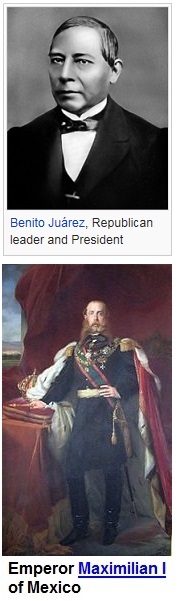
The summary of this celebration is simple on the surface: Mexican forces commanded by General Ignacio Zaragoza defeated the French army in the Battle of Puebla on 5 May 1862. 4 days later, on 9 May 1862, The then-President Benito Juárez declared that the anniversary of the Battle of Puebla would be a national holiday,[14][15][16][17][18] regarded as “Battle of Puebla Day” or “Battle of Cinco de Mayo”. Although today it is recognized in some countries as a day of Mexican heritage celebration, it is not a federal holiday in Mexico.[19]

Considering the real history of Cinco De Mayo is a really big deal. For starters, while Mexico was not the aggressor in this war, they were not exactly blameless.

The 1858 – 1860 Mexican civil war known as The Reform War had caused distress throughout Mexico’s economy. When taking office as the newly-elected president of the Republic in 1861, Juárez was forced to suspend payments of interest on foreign debts for a period of two years. At the end of October 1861 diplomats from Spain, France, and Britain met in London to form the Tripartite Alliance, with the main purpose of launching an allied invasion of Mexico, taking control of Veracruz, its major port, and forcing the Mexican government to negotiate terms for repaying its debts and for reparations for alleged harm to foreign citizens in Mexico. In December 1861, Spanish troops landed in Veracruz; British and French followed in early January. The allied forces occupied Veracruz and advanced to Orizaba. However, the Tripartite Alliance fell apart by early April 1862, when it became clear the French wanted to impose harsh demands on the Juarez government and provoke a war. The British and Spanish withdrew, leaving the French to march alone on Mexico City. French Emperor-President Napoleon III – the first democratically elected French President – wanted to set up a puppet regime, the Mexican Empire.

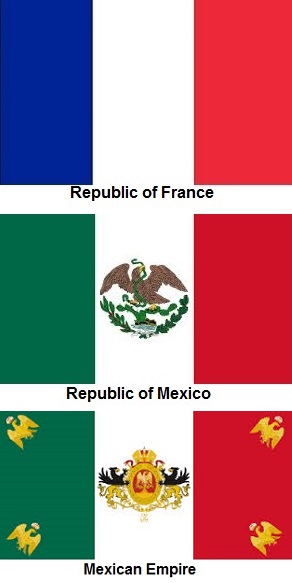
Thus started this French Intervention in Mexico. The effects of these 5 years were far-reaching, even to this day – consider the similarities in flags for these countries.

CU Blog - A Lesson in History - Cinco De Mayo - Photo 1Title: French Intervention in Mexico 1862 – 1867
Emperor Napoleon III of France was the instigator, justifying military intervention by claiming a broad foreign policy of commitment to free trade. For him, a friendly government in Mexico would ensure European access to Latin American markets. Napoleon also wanted the silver that could be mined in Mexico to finance his empire. Napoleon built a coalition with Spain and Britain while the U.S. was deeply engaged in its own civil war from 1861 to 1865.

Here is the main timeline of this French Intervention period:

1. 1862: Arrival of the French
After the initial victory by the Mexicans at the Battle of Puebla, the war continued in a different direction. The pursuing Mexican army was contained by the French at Orizaba, Veracruz, on 14 June. More British troops arrived on 21 September, and General Bazaine arrived with French reinforcements on 16 October. The French occupied the port of Tamaulipas on 23 October, and unopposed by Mexican forces took control of Xalapa, Veracruz on 12 December.

2. 1863: The French take the capital
CU Blog - A Lesson in History - Cinco De Mayo - Photo 2The French army of General François Achille Bazaine defeated the Mexican army led by General Comonfort in its campaign to relieve the siege of Puebla, at San Lorenzo, to the south of Puebla. Puebla surrendered to the French shortly afterward, on 17 May. On 31 May, President Juárez fled the capital city (Mexico City) with his cabinet, retreating northward to Paso del Norte and later to Chihuahua. Having taken the treasure of the state with them, the government-in-exile remained in Chihuahua until 1867.

French troops under Bazaine entered Mexico City on 7 June 1863. The main army entered the city three days later, led by General Forey. General Almonte was appointed the provisional President of Mexico on 16 June, by the Superior Junta (which had been appointed by Forey). The Superior Junta with its 35 members met on 21 June, and proclaimed a Catholic Empire on 10 July. The crown was offered to Austrian Prince Archduke Ferdinand Maximilian, following pressures by Napoleon. Maximilian accepted the crown on 3 October.

3. 1864: Arrival of Maximilian
Further decisive French victories continued with the fall of Guadalajara, Zacatecas, Acapulco, Durango by 3 July, and the defeat of republicans in the states of Sinaloa and Jalisco in November.

Maximilian formally accepted the crown on 10 April, signing the Treaty of Miramar (between France and Mexico), and landed at Veracruz on 28 May. He was enthroned as Maximilian I, Emperor of Mexico, [under French occupation].

4. 1865: Beginning of Republican victories
CU Blog - A Lesson in History - Cinco De Mayo - Photo 3After many more French victories, finally on 11 April, republicans defeated Imperial forces at Tacámbaro in Michoacán. In April and May the republicans had many forces in the states of Sinaloa and Chihuahua. Most towns along the Rio Grande, [(the border with the US),] were also occupied by republicans.

The decree known as the “Black Decree” was issued by Maximilian on 3 October, which threatened any Mexican captured in the war with immediate execution.

5. 1859-1867: U.S. Diplomacy and Involvement
The United States did not condone the French occupation of Mexico but it had to use its resources for the American Civil War, which lasted 1861 to 1865. Then-President Abraham Lincoln expressed his sympathy to Latin American republics against any European attempt to establish a monarchy; and the Congress passed a resolution in disgust of these French actions. In 1865, The US supported the sale of Mexican bonds by Mexican agents in the US to fund the Juarez Administration, raising up to $18-million dollars for the purchase of American war material.[16] By 1867, American policy shifted from thinly veiled sympathy to the republican government of Juarez to open threat of war to induce a French withdrawal, invoking the Monroe Doctrine, a policy to thwart any aggression by European powers in the Americas.

6. 1866: French withdrawal and Republican victories
Choosing Franco-American relations over his Mexican monarchy ambitions, Napoleon III announced the withdrawal of French forces beginning 31 May. Taking advantage of the end of French military support to the Imperial troops, the Republicans won a series of crippling victories in Chihuahua on 25 March, Guadalajara, Matamoros, Tampico and Acapulco in July. Napoleon III urged Maximilian to abandon Mexico and evacuate with the French troops; [but he persisted]. The French evacuated Monterrey on 26 July, Saltillo on 5 August, and the whole state of Sonora in September. Maximilian’s French cabinet members resigned on 18 September. The Republicans defeated imperial troops in Oaxaca in October, occupying the whole of Oaxaca in November, as well as parts of Zacatecas, San Luis Potosí and Guanajuato.

7. 1867: Republicans take the capital
The Republicans occupied the rest of the states of Zacatecas, San Luis Potosí and Guanajuato in January. The French evacuated the capital on 5 February.

On 13 February 1867, Maximilian withdrew to Querétaro. The Republicans began a siege of the city on 9 March, and Mexico City on 12 April. On 11 May, Maximilian finally resolved to try to escape through the enemy lines. He was intercepted on 15 May. Following a court-martial, he was sentenced to death and executed on 19 June.
Source: http://en.wikipedia.org/wiki/French intervention_in_Mexico  

This subject has relevance for the Caribbean. Mexico is a stakeholder in Caribbean affairs. They have a vast coastline (Yucatan Peninsula) on the Caribbean Sea, plus a few Caribbean islands (Cozumel, Isla Mujeres, Isla Contoy, and Isla Blanca). This country is also a member of the ACS – Association of Caribbean States – one of the relevant entities that must be assembled for this regional integration movement championed in the book Go Lean…Caribbean.

The underlying theme of this Lesson in Mexican History is the lack of effective security for the people and societal engines of Mexico. Now, after 150 years, this historic pattern has continued; Mexico proceeded to endure one revolution-rebellion-overthrow-coup d’etat after another until recent times.

The Caribbean cannot afford this same disposition: the dread and damage endured from decades of dysfunction.

Today, Mexico is known as a lawless society in many pockets, especially along the US border. Considering the art and science of security, it is sad that they never got it right! They resemble a Failed-State in so many perspectives. This is where their history, especially those 5 years of the Franco-Mexican War, provides lessons for the Caribbean people and institutions. But this Go Lean movement does not seek to remediate Mexico; this is out of scope. Rather the focus is strictly on the 30 Caribbean member-states: islands of the Caribbean plus the Central & South American states that caucus with the Caribbean Community (Belize, Guyana and Suriname).

This effort to elevate Caribbean society fully recognizes that security mitigations must be prioritized equally with economic and governing remediation. This is an underlying theme of the book Go Lean…Caribbean. The book declares that the region is in crisis, at the precipice of Failed-State status. This is the assertion of the Go Lean book, that the region must prepare its own security apparatus for its own security needs.

This book serves as a roadmap for the introduction and implementation of the technocratic Caribbean Union Trade Federation (CU). So while the CU is set to optimize Caribbean society through economic empowerment, the security dynamics will be inextricably linked to this same endeavor. Therefore the Go Lean roadmap has 3 prime directives:

  • Optimization of the economic engines in order to grow the regional economy to $800 Billion & create 2.2 million new jobs.
  • Establishment of a security apparatus to protect the resultant economic engines.
  • Improvement of Caribbean governance to support these engines.

The book contends, just as the French proved to be a “bad actor” to Mexico in 1862, that new “bad actors” will emerge for the Caribbean to contend with. This will be as a by-product of new economic successes in the region. This point is pronounced early in the book with the Declaration of Interdependence (Page 12) that claims:

x.   Whereas we are surrounded and allied to nations of larger proportions in land mass, populations, and treasuries, elements in their societies may have ill-intent in their pursuits, at the expense of the safety and security of our citizens. We must therefore appoint “new guards” to ensure our public safety and threats against our society, both domestic and foreign. The Federation must employ the latest advances and best practices … to assuage continuous threats against public safety.

xvi. Whereas security of our homeland is inextricably linked to prosperity of the homeland, the economic and security interest of the region needs to be aligned under the same governance. Since economic crimes, including piracy and other forms of terrorism, can imperil the functioning of the wheels of commerce for all the citizenry, the accedence of this Federation must equip the security apparatus with the tools and techniques for predictive and proactive interdictions.

The need for the Caribbean to appoint “new guards” or a security pact to mitigate foreign and domestic threats in the region is the primary lesson to glean from the foregoing encyclopedic article – a consideration of the history of Cinco De Mayo. This security pact is to be legally constituted by a Status of Forces Agreement which would be enacted as a complement to the CU confederation treaty. The Go Lean roadmap provides 370-pages of turn-by-turn directions on how to deploy cutting-edge strategies, tactics and implementations to succeed in this goal.

In addition, there are other lessons – secondary – that we learn from this consideration of the history of Cinco De Mayo:

The Go Lean book details a roadmap with turn-by-turn directions for transforming the Caribbean homeland. The following is a sample of the community ethos, strategies, tactics, implementations and advocacies to impact the Caribbean region for this turnaround:

Community Ethos – Economic Principle – Economic Systems Influence Choices Page 21
Community Ethos – Economic Principle – Consequences of Choices Lie in the Future Page 21
Community Ethos – Anti-Bullying and Mitigation Page 23
Community Ethos – Minority Equalization Page 24
Community Ethos – Cooperatives Page 25
Community Ethos – Ways to Improve Sharing Page 35
Strategy – Vision – Confederating a Non-Sovereign Union Page 45
Strategy – Mission – Protect Economic Engines from threats Page 45
Tactical – Fostering a Technocracy Page 64
Tactical – Separation of Powers Page 71
Implementation – Start-up Foreign Policy Initiatives Page 102
Implementation – Security Initiatives at Start-up Page 103
Implementation – Ways to Deliver Page 109
Implementation – Ways to Better Manage Debt Page 118
Implementation – Ways to Promote Independence – Interdependence Page 120
Planning – 10 Big Ideas – Defense / Homeland Security Pact Page 127
Planning – Ways to Make the Caribbean Better Page 131
Planning – Ways to Better Manage Image Page 133
Planning – Ways to Improve Failed-State Indices Page 134
Planning – Lessons from the American West Page 142
Advocacy – Ways to Grow the Economy Page 151
Advocacy – Ways to Create Jobs Page 152
Advocacy – Ways to Improve Governance Page 168
Advocacy – Ways to Better Manage the Social Contract Page 170
Advocacy – Ways to Impact Justice Page 177
Advocacy – Ways to Improve Homeland Security Page 180
Advocacy – Ways to Mitigate Terrorism Page 181
Advocacy – Ways to Protect Human Rights Page 220

Mexico is a beautiful country, with a beautifully diverse population plus a lot of natural resources. They experience a vibrant tourism product where millions visit annually for Mexican hospitality – they are a fit competitor of Caribbean tourism, even for cruises. See VIDEO here:

VIDEO: Mexico: Live It to Believe It – Cultural Diversity 2015 – https://youtu.be/jciVmLL_UgY

Published on Feb 27, 2014 – A production of the Mexico Department of Tourism; commissioned for the Central American and Caribbean Games in Veracruz from November 14 to 30, 2014.

Many people visit Mexico, but few would consider moving there permanently. In fact just the opposite occurs, the societal abandonment problem in Mexico is very pronounced. Their northern neighbor, the United States, has constant security issues of illegal Mexican migrants. Mexico has been dysfunctional for their entire history as a Republic. They must do better! While this quest is out-of-scope for the CU/Go Lean roadmap, we can learn lessons from their actions and inactions.

The Go Lean book posits (Page 3) that the Caribbean islands are among the greatest addresses in the world. But like Mexico, instead of the world “beating a path” to our doors, the people of the Caribbean have “beat down their doors” to get out; despite the absence of any war or revolution … like our Mexican neighbors. Our abandonment is inexcusable.

May we learn from this history of Mexico! Mexican culture is great! Enjoy the festivities: their people, food, drink, music and dance. But let’s do better … than they have done. Let’s make the Caribbean even better, where our citizens can prosper where they are planted; let’s make our homeland better places to live, work and play.  🙂

Download the free e-Book of Go Lean … Caribbean – now!

Share this post:
, , , , , ,
[Top]

Tesla unveils super-battery to power homes

Go Lean Commentary

Necessity is the ‘mother’ of invention – Old Wives Tale

Caribbean energy costs are among the highest in the world. The book Go Lean…Caribbean relates (Page 100) that the Caribbean has among the most expensive energy costs in the world, despite having abundant alternative energy natural resources (solar, wind, tidal, and geo-thermal). The Caribbean eco-system focuses on imported petroleum to provide energy options and as a result retail electricity rates in the Caribbean average US$0.35/kWh, when instead it could be down to US$0.088/kWh.

There is definitely the need for invention. Now, along comes Tesla*
… with this “inventive” solution.
… with this Powerwall product, launched last week by Tesla Chief Executive Officer Elon Musk; it is designed to allow homeowners to store electricity generated by green energy options – solar panels and wind turbines – during the peak of the day, then use it at other times when electricity consumption is higher.

CU Blog - Tesla unveils super-battery to power homes - Photo 1

CU Blog - Tesla unveils super-battery to power homes - Photo 3

VIDEO 1 – Tesla unveils super-battery to power homes –  http://www.cbsnews.com/videos/tesla-unveils-super-battery-to-power-homes/

May 2, 2015 – The electronic car maker has come up with large, high-tech batteries to power your home even after the sun goes down. Telsa’s founder, Elon Musk, says they will let homeowners store solar power during the day and keep using it at night. CNET.com’s senior editor Bridget Carey joins “CBS This Morning: Saturday” to discuss how this could open a whole new way to use clean energy and to save money. (VIDEO plays best in Internet Explorer).

According to Elon Musk, this is “a fundamental transformation of how the world works”.

VIDEO 2 – Elon Musk unveils Powerwall, a battery pack for buildings (TomoNews) – https://youtu.be/NvCIhn7_FXI

Published on May 5, 2015 – Tesla Motors on Thursday, April 30 unveiled Tesla Energy, storage systems or batteries designed for homes and businesses.

Elon Musk, the company CEO, introduced the products to a crowd of business experts and journalists at a Tesla facility close to Los Angeles.

CU Blog - Tesla unveils super-battery to power homes - Photo 4Tesla did not invent the original battery, nor solar power panels. These technologies had pre-existed before this new development. But the problem has always been availability of the green energy option during uninviting conditions: solar – night time or cloud covered days; wind – still days.

This was the problem: Energy needs are undeniable 24-7-365; all the time. Energy delivery must cover all of those times.

The delivery or fulfilling those needs is a great target for lean, agile operations. It will save a lot of money for the people and institutions of the Caribbean.

This is the economic dynamic; there is also the matter of burning fossil fuels (oil, coal, wood pulp) and contributing to global warming and climate change. The Go Lean book posits that the embrace of alternative energy generation sources to be more impactful on the quest to minimize the threats on the environment. Early in the book, the pressing need to be aware of climate change is pronounced in the Declaration of Interdependence (Page 11), with these words, (the first of many “causes of complaints”):

i.  Whereas the earth’s climate has undeniably changed resulting in more severe tropical weather storms, it is necessary to prepare to insure the safety and security of life, property and systems of commerce in our geographical region. As nature recognizes no borders in the target of its destruction, we also must set aside border considerations in the preparation and response to these weather challenges.

Now, with this innovative offering from Tesla, the quest to adapt to more clean/green energy options can be practical and more cost effective. Power generation from the sun or wind (free & renewable sources) is far cheaper that generation based on fossil fuels.

Money! Environment! These two constitute reasons enough to pursue strategies, tactics and implementations of renewable energy with battery back-ups. But there is a third motivation behind the Go Lean…Caribbean movement; that is love of the homeland. Many people find the current lack of energy options unbearable for a normal life in their Caribbean ancestral homeland – imagine not being able to turn on air conditioning during the summer due to excessive costs – so they flee the region for foreign shores … in North America and Europe.

This new innovative product by Tesla…changes everything!

The book Go Lean… Caribbean serves as a roadmap for the introduction and implementation of the Caribbean Union Trade Federation (CU). This roadmap has 3 prime directives:

  • Optimization of the economic engines in order to grow the regional economy to $800 Billion GDP and create 2.2 million new jobs.
  • Establishment of a security apparatus to protect the resultant economic engines.
  • Improvement of Caribbean governance to support these engines.

CU Blog - Tesla unveils super-battery to power homes - Photo 5This Go Lean/CU roadmap recognizes that modern life has expanded the definition of basic needs to now include food, clothing, shelter and energy. And thusly the book proposes many solutions for the region to optimize energy delivery:

  • generation
  • distribution
  • consumption

Home-based solar panels or home-based wind turbines with battery back-ups would optimize all these three areas of focus. We applaud Tesla and the success of their transformational product.

To the Caribbean we declare: More help is on the way! The Go Lean book posits that with the adoptions of the strategies, tactics and implementations in the roadmap that average costs of energy can be decreased from an average of US$0.35/kWh to US$0.088/kWh in the course of the 5-year term of this roadmap. (Page 100). That is a 75% savings.

The Go Lean roadmap details a series of community ethos, strategies, tactics, implementations and advocacies to be early adopters of these cutting-edge energy systems. The following list applies:

Community Ethos – Deferred Gratification Page 21
Community Ethos – Lean Operations Page 24
Community Ethos – Return on Investments Page 24
Community Ethos – Cooperatives Page 25
Community Ethos – Ways to Impact the Future Page 26
Community Ethos – Ways to Impact the Greater Good Page 37
Strategy – Harness the power of the sun/winds Page 46
Tactical – Fostering a Technocracy Page 82
Tactical – Separation of Powers – Energy Commission Page 82
Anecdote – “Lean” in Government – Energy Permits Page 93
Anecdote – Caribbean Energy Grid Implementation Page 100
Implementation – Ways to Develop Pipeline Industry Page 107
Implementation – Ways to Improve Energy Usage Page 113
Advocacy – Ways to Impact Public Works Page 175
Advocacy – Ways to Foster Cooperatives Page 176
Advocacy – Ways to Impact Monopolies Page 202

This Tesla battery system – Powerwall – offers independence from utility grids. It is not from an energy company, but rather from a technology company; (see Appendix). Stay tuned, opposition will emerge; it always does…especially in the US. The For-Profit utility companies always lobby against regulations to “clean-up” fossil-fuel (coal) power plants or block small “Green” start-ups from sending excess power to the National Grid. Their motive is to preserve their century-long monopoly. See related article here:

Title: Is America’s electrical grid fading to black?
By: Bruce Kennedy – MoneyWatch – April 8, 2015

Are you prepared to live “off the grid,” independent of major electric utilities? Many people who live in Washington, D.C., may be ready for a change — after widespread power outages in the region on Tuesday, due to a problem in a utility company transmission line.

While the term may sound like something out of a novel, a growing number of U.S. consumers and businesses are actually expected to be living “off the grid” over the next several decades – to the point where some of the big utilities may find themselves in a new financial reality.

According to a new report by Rocky Mountain Institute (RMI) and HOMER Energy, a firm that designs remote microgrids, the development of practical and efficient solar-plus battery systems is an economic and cultural game-changer.

The report looked at median commercial and residential electrical customers in five very different metro areas – Louisville, Kentucky, Westchester County, New York, San Antonio, Texas, Los Angeles, California, and Honolulu, Hawaii – and evaluated their local economics through to 2050.

And their findings were startling. “Over time, as retail electricity prices from the grid increase and solar and battery costs decrease,” said the report’s executive summary, “customers logically reduce their grid purchases until the grid takes a backup-only role.”

For example, according to RMI’s analysis, the New York suburb of Westchester Country could see utility grid’s supply to overall electric power for commercial customers in the region shrink from 100 percent today to around 25 percent by 2030 – and to less than five percent by 2050.

“These findings should be compelling for customers and technology providers,” RMI principal and report author James Mandel said in a press statement. “No matter how expensive retail electricity gets in the future, customers that invest in these grid-connected systems can contain their electricity costs at or below a ‘peak price,’ yielding significant savings on their monthly utility bill.”

More choices for consumers of electricity also means major changes for the big utilities, even if only a fraction of their current customers end up adopting the new-tech systems. The report says that in the northeastern United States, commercial load “defections” away from the traditional utility grid could total 140 million megawatt hours by 2030, or around $35 billion in annual electrical costs.

But RMI manager and report coauthor Leia Guccione says the changes aren’t necessarily adversarial, pitting the old-school utilities against the new technology.

“Because these solar-plus-battery systems are grid-connected,” she notes, “they can offer value and services back to the grid. We need not see them only as a threat.”

© 2015 CBS Interactive Inc.. All Rights Reserved.
Retrieved from CBS News Online Site (Posted May 2, 2015) from: http://www.cbsnews.com/news/is-americas-electrical-grid-fading-to-black/

This will be a choice for America to make: immediate profits or the Greater Good. Choose well, America!

The Go Lean movement (book and blogs) asserts that we should not look to American Big Energy for answers to our own Caribbean dilemmas. American leadership has often times been motivated by crony-capitalistic intentions. This point had been further elaborated upon in these previous blog/commentaries:

https://goleancaribbean.com/blog/?p=4897 US Backs Natural Gas (LNG) Distribution Base in Jamaica
https://goleancaribbean.com/blog/?p=4294 Ambassadors to Caribbean discuss PetroCaribe-Energy, Security
https://goleancaribbean.com/blog/?p=2465 Book Review: ‘This Changes Everything: Capitalism vs. the Climate’
https://goleancaribbean.com/blog/?p=2338 Lessons: How Best to Welcome the Dreaded American ‘Plutocracy’
https://goleancaribbean.com/blog/?p=926 Conservative heavyweights have solar industry in their ‘kill’ sights
https://goleancaribbean.com/blog/?p=273 10 Things We Don’t Want from the US – #1: American Self-Interest

Fulfilling energy needs is a great target for lean, agile operations, perfect for the CU technocracy.

We need innovative products, systems, companies and people to help us in our quest to make the Caribbean a better place to live, work and play.

Let’s get started. Now is the time for all of the Caribbean, the people, businesses, institutions and governments, to lean-in for the optimizations and opportunities described in the book Go Lean … Caribbean.  🙂

Download the book Go Lean … Caribbean – now!

————-

Appendix – * TeslaCU Blog - Tesla unveils super-battery to power homes - Photo 2

Tesla Motors, Inc. is an American company that designs, manufactures, and sells electric cars and electric vehicle powertrain components.[4] Tesla Motors is a public company that trades on the NASDAQ stock exchange under the symbol TSLA.[5] In the first quarter of 2013, Tesla posted profits for the first time in its history.[6]

Tesla first gained widespread attention following their production of the Tesla Roadster, the first fully electric sports car.[7] The company’s second vehicle is the Model S, a fully electric luxury sedan, and its next two vehicles are the Models X and 3.[8] As of March 2015, Tesla Motors has delivered about 70,000 electric cars since 2008.[9]

Tesla also markets electric powertrain components, including lithium-ion battery packs to automakers including Daimler and Toyota.[10] Its CEO, Elon Musk, has said that he envisions Tesla Motors as an independent automaker,[11] aimed at eventually offering electric cars at prices affordable to the average consumer.[12][13] Pricing for the Tesla Model 3 is expected to start at US$35,000 before any government incentives and deliveries are expected to begin by 2017.[14][15] On April 30, 2015, Tesla announced the Powerwall, a battery product for home use. (Source: http://en.wikipedia.org/wiki/Tesla_Motors)

The company is named after famous inventor and innovator, Nikola Tesla (1856 –1943). He was a Serbian American[2][3][4], electrical engineer, mechanical engineer, physicist, and futurist. He is best known for his contributions to the design of the modern alternating current (AC) electricity supply system.[5]

Nicola Tesla gained experience in telephony and electrical engineering before immigrating to the United States in 1884 to work for Thomas Edison in New York City. He soon struck out on his own with financial backers, setting up laboratories and companies to develop a range of electrical devices. His patented AC induction motor and transformer were licensed by George Westinghouse, who also hired Tesla for a short time as a consultant. His work in the formative years of electric power development was involved in a corporate alternating current/direct current “War of Currents” as well as various patent battles. Tesla went on to pursue his ideas of wireless lighting and electricity distribution in his high-voltage, high-frequency power experiments in New York and Colorado Springs and made early (1893) pronouncements on the possibility of wireless communication with his devices. He tried to put these ideas to practical use in his ill-fated attempt at intercontinental wireless transmission. He was ahead of his time, as we only now have some semblance of these systems in place today. (Source: http://en.wikipedia.org/wiki/Nikola_Tesla).

Share this post:
, ,
[Top]

Forging Change: ‘Food’ for Thought

Go Lean Commentary

“The way to a man’s heart is through his stomach” – Old Adage.

Could it be that simple? Have we been laboring all the while, trying to forge change in the Caribbean region while missing out on the easiest driver: Food?

Seriously! We “gotta” eat!

While the publishers of the book Go Lean…Caribbean wants to forge change in the Caribbean, we recognize that it is a heavy-lifting task. There are so many societal defects in the region and we need effective strategies, tactics and implementation to effect turn-around. Despite all the advance research and academic exercises, we seem to have left off this simple yet effective model: Food.

This is the impression gleaned from this University of Pittsburgh (USA) study and VIDEO here:

Video: Study: Changing Diet May Affect Colon Cancer Risk – http://www.today.com/video/study-changing-diet-may-affect-colon-cancer-risk-436297283693

As the foregoing VIDEO depicts, change can be forged in as soon as 2 weeks. That simple! This is impactful enough for us to all lean-in to this guidance.

Cancer – this is the underlying threat being mitigated in the foregoing VIDEO. While this is a complicated medical issue – where many people have lost their lives – it is not oversimplifying to say that our food choices can endanger our overall health. While everything is not known about cancer – there is no actual cure, only treatments – it is the accepted wisdom that diet and exercise minimize the risk of affliction.

The subject of cancer is a community health crisis. But if we can forge change in this threatening area by our food choices, then we need to pay heed.

The book Go Lean…Caribbean serves as a roadmap for the introduction and implementation of the Caribbean Union Trade Federation (CU), a confederation of all 30 member-states in the region. This effort is an initiative to bring change and empowerment to the Caribbean region, to make the region a better place to live, work, heal and play. From the outset, the book recognized the significance of our culture, how food and diet plays a significant role in the Caribbean eco-system with these statements in the opening Declaration of Interdependence (Page 14):

xxvi.     Whereas the Caribbean region must have new jobs to empower the engines of the economy and create the income sources for prosperity, and encourage the next generation to forge their dreams right at home, the Federation must therefore foster the development of new industries, like that of … frozen foods … impacting the region with more jobs.

xxx.     Whereas the effects of globalization can be felt in every aspect of Caribbean life, from the acquisition of food and clothing, to the ubiquity of ICT, the region cannot only consume, it is imperative that our lands also produce and add to the international community, even if doing so requires some sacrifice and subsidy.

xxxii.    Whereas the cultural arts … of the region are germane to the quality of Caribbean life, and the international appreciation of Caribbean life, the Federation must implement the support systems to teach, encourage, incentivize, monetize and promote the related industries … These endeavors will make the Caribbean a better place to live, work and play.

The purpose of the Go Lean roadmap is societal change, not food; yet there is this acknowledgement that food can help forge change. This is against the backdrop that there are many threats to Caribbean life, liberty and the pursuit of happiness. Food choices affect these executions. Think: obesity, health care, cancer, poverty and jobs.

This Go Lean roadmap calls for the heavy-lifting in shepherding many important aspects of Caribbean life; these food-related issues included. This is not so simple anymore. For one, the book reports (Page 157) that in the United States “Cancer strikes nearly 1 in every 2 men and more than 1 in every 3 women” and then sounds the alarm that the Caribbean cannot be far behind. This may be considered a “Clear and Present Danger”. So there is the need for change in this important area.

The Go Lean book, as an empowerment roadmap, must therefore examine the reality and consequences of food, under the guise of this regional effort. This roadmap has 3 prime directives:

  • Optimization of the economic engines in order to grow the regional economy to $800 Billion GDP and create 2.2 million new jobs, many of which are projected for food-related and allied health industries (30,000 in direct agriculture; 20,000 in direct Health Care; 4000 in direct Fisheries; and 2000 related to Frozen Foods).
  • Establishment of a security apparatus to protect the resultant economic engines.
  • Improvement of Caribbean governance, including a separation-of-powers with the member-states, to support these engines.

The book is not a public health instruction manual. Nor is it is a book on science and nutrition. But it does describe the CU as a hallmark of a technocracy, a commitment to efficiency and effectiveness, but still with a commitment to concepts of culture, food, and fun – overall happiness. The Go Lean book declares that before any real change takes root in the Caribbean that we must reach the heart, that there must be an adoption of new community ethos, the national spirit that drives the character and identity of its people. We must therefore use effective and efficient drivers to touch the heart and forge this change. How? We know there is truth to the opening quotation: “through the stomach”.

The Go Lean roadmap was constructed with the community ethos in mind to forge change, plus the execution of related strategies, tactics, implementations and advocacies to make the change permanent. The following is a sample of these specific details from the book:

Community Ethos – Deferred Gratification Page 21
Community Ethos – Economic Principles – People Choose Page 21
Community Ethos – Economic Principles – People Respond to Incentives in Predictable Ways Page 21
Community Ethos – Economic Principles – The Consequences of Choices Lie in the Future Page 21
Community Ethos – Governing Principles – Lean Operations Page 24
Community Ethos – Ways to Impact the Future Page 26
Community Ethos – Ways to Impact Research & Development – Nouvelle Caribbean Cuisine Page 30
Community Ethos – Ways to Impact Turn-Around Page 33
Community Ethos – Ways to Promote Happiness – Promotion of Domestic Cultural Institutions Page 36
Community Ethos – Ways to Impact the Greater Good Page 37
Strategy – Mission – Build and foster local economic engines to satiate food   needs Page 45
Strategy – Mission – Celebrate the Culture and Cuisine of the Caribbean Page 46
Strategy – Customers – Outreach to Caribbean Diaspora Page 47
Strategy – Agents of Change – Globalization Page 57
Tactical – Confederating a Permanent Union Page 63
Tactical – Fostering a Technocracy Page 64
Tactical – Creating $800 Billion Economy – New High Multiplier Industries – Frozen Foods Page 70
Tactical – Separation of Powers – Department of State – Culture   Administration Page 81
Tactical – Separation of Powers – Food / Nutritional Administrations Page 87
Tactical – Separation of Powers – Agriculture & Fisheries Licensing – Inspections Page 88
Tactical – Separation of Powers – Farm & Marine Credit – Economic Influence Page 88
Implementation – Ways to Pay for Change Page 101
Implementation – Ways to Deliver Page 109
Implementation – Ways to Benefit from Globalization – Dynamics of Food Supply Page 119
Implementation – Ways to Promote Independence – Food Interdependence Page 119
Planning – 10 Big Ideas for the Caribbean Region – 4 Languages & Culture in Unison Page 127
Planning – Ways to Improve Trade – Diaspora Marketing Page 128
Planning – Ways to Make the Caribbean Better Page 136
Advocacy – Ways to Grow the Economy Page 151
Advocacy – Ways to Create Jobs Page 152
Advocacy – Ways to Impact  Cancer – Promote Wellness – Better Diets Page 157
Advocacy – Ways to Better Manage Food Consumption Page 162
Advocacy – Ways to Improve Communications – Public Broadcasting of “Sound-bites” Page 186
Advocacy – Ways to Impact Events – Food Festivals Page 191
Advocacy – Ways to Develop Frozen Foods Page 208
Advocacy – Ways to Improve Fisheries Page 210
Advocacy – Ways to Preserve Caribbean Heritage – Promote Culture Page 218
Advocacy – Ways to Improve the Arts Page 230
Advocacy – Ways to Impact Urban Living – Promotion of Farmers Markets Page 234
Advocacy – Ways to Impact Rural Living – Agricultural Co-existence Mandate Page 235

This roadmap wants to change the Caribbean diet plan, branded Nouvelle Caribbean Cuisine: more fiber, less fats; more green vegetables, less processed food; no more S.A.D., meaning Standard American Diet.

As depicted by the S.A.D. references, there is the expectation not to allow the American eco-system to lead in this sphere of influence. There was a time when much of the Caribbean food supply originated locally. That is not a difficult message to convey. Lesser developed countries, (think Africa), are more successful with local food production and consumption, the Caribbean can succeed. While this plan is optimistic, it is realistic too. People can and do change.

There is the acknowledgement that the business of food has changed in the light of modern dynamics, particularly due to globalization. To spur more local agricultural development, the economic engines of the food supply must be secured. This point was previously detailed in these Go Lean blog/commentaries:

https://goleancaribbean.com/blog/?p=3276 Role Model Shaking Up the World of Cancer
https://goleancaribbean.com/blog/?p=2522 The Cost of Cancer Drugs
https://goleancaribbean.com/blog/?p=2276 Climate Change May Affect Food Supply Within a Decade
https://goleancaribbean.com/blog/?p=1847 Cuban All Natural – Declared “the best in the world”
https://goleancaribbean.com/blog/?p=658 Wellness Advocates push for junk-food tax
https://goleancaribbean.com/blog/?p=554 Cuban cancer medication registered in 28 countries
https://goleancaribbean.com/blog/?p=286 PR’s Comprehensive Cancer Center Project Breaks Ground

“Do what you have always done, get what you’ve always got” – Old Adage.

The effort to forge change has also been stressed in previous Go Lean blog/commentaries, as detailed here:

https://goleancaribbean.com/blog/?p=3568 Forging Change: Music Moves People
https://goleancaribbean.com/blog/?p=3512 Forging Change: The Sales Process
https://goleancaribbean.com/blog/?p=2291 Forging Change: The Fun Theory
https://goleancaribbean.com/blog/?p=623 Only at the precipice, do they change

In the Caribbean, we need better food consumption habits. According to the foregoing VIDEO, it does not take a lot to change habits in this regard. We must simply push hard (messaging) on the needed changes, and then labor to get the community ethos to take hold. All the earnest effort will be a waste unless people are moved to change. So we must use all effective tools to forge the required change; food or the “stomach” is one of the best ways … to reach people.

Food - Photo 1

Food - Photo 4

Food - Photo 5

Food - Photo 2

Food - Photo 6

Food - Photo 3

This is serious; this is life-and-death.

The quest to change the Caribbean is more complex than just feeding people. But their food options can signal their willingness to change and assimilate the empowerments being advocated for the region. This is the mandate of the Go Lean roadmap: making the Caribbean a better place to live, work, heal and play.

We “gotta” eat …

So everyone is encouraged to lean-in for this change and the full Go Lean roadmap. 🙂

Download the book Go Lean … Caribbean – now!

Share this post:
, , , ,
[Top]

Immigrants account for 1 in 11 Blacks in USA

Go Lean Commentary

More fallout from the Caribbean “Brain Drain” …

CU Blog - Immigrants account for 1 in 11 blacks in USA - Photo 1A wave of immigration from the Caribbean, Africa and Latin America is reshaping the USA’s black population, new findings show, with no sign of ending soon. About one in 11 blacks in America are foreign-born. The figure is likely to rise to one in six by 2060.

The group is still fairly small compared with the numbers of Asian and Latin American immigrants who arrive each year, but it “has been a big part of the black immigrant story at least since 2000,” said Mark Hugo Lopez of the Pew Research Center, which released the findings Thursday.

Using U.S. Census Bureau data, Pew found that a record 3.8 million black immigrants live in the USA, more than four times as many as in 1980. Overall, there are about 42 million immigrants in the USA.

Taken as a group, black immigrants — the vast majority of them from the Caribbean and Africa — comprise nearly 9% of the nation’s black population, three times their share in 1980.

The group is likely to continue growing rapidly: According to Census projections, nearly 17% of U.S. blacks will be immigrants by 2060.

“That’s a big change, particularly when you take a look at Asian and Hispanic populations in the U.S.,” Lopez said. “Their foreign-born shares are actually declining.” For Africans in particular, their share of foreign-born population is likely to rise.

In a few places, black immigrant populations equal or exceed the 2060 projection [already], including:

  • 15% of the black population in the Washington metro area.
  • 28% in the New York metro area.
  • 34% in Miami.

As a group, the study found, about one-fourth of black immigrants 25 and older have a bachelor’s degree or higher, slightly lower than the overall U.S. population. They’re about even with the rest of the population when it comes to advanced degrees.
Source: USA Today – Online News – Posted April 9, 2015; Retrieved April 28, 2015 from: http://www.usatoday.com/story/news/2015/04/09/pew-african-immigrants/25521471/

This must stop. Period.

From a strictly economic point-of-view, this is a ‘Clear and Present Danger’. Our Caribbean community cannot survive, nor any other community for that matter, with the constant drain against the population and human capital. Ghost towns are a reality.

This is therefore a Declaration of [Economic] War!

This is a consistent theme in the book Go Lean…Caribbean. The book posits that the most serious threat to Caribbean prosperity is the high abandonment rate among its citizens, especially its highly educated, skilled-labor classes.

“A crisis is a terrible thing to waste” …

… so states the book quoting noted Economist Paul Romer. The opportunity therefore exists to forge change in the economic, security and governing engines of the Caribbean, in response to this crisis.

The foregoing news story shows that the USA is preparing to assimilate more Caribbean and African immigrants in the next 45 years. Declaring an economic war, complete with battle strategies and tactics, allows the region to organize the resources and investments to pursue victory in this fight.  This is the advocacy of the Go Lean book, to position the region at the corner of preparation and opportunity, so as to benefit from impending change.

The issue from this article is more pressing for the Caribbean, as our economic growth has been stagnant or only “inched” along at a slow pace – our job creation engines have failed to keep pace with the population, therefore fewer and fewer jobs are at home. Thus this region has had a higher and higher emigration rate as the decades pass; and according to this foregoing news article, that rate will grow even further. This nightmare becomes a self-fulfilling prophecy! This point was crystalized in a previous blog/commentary with this quotation:

We tend to think economic growth comes from working harder and smarter. But economists attribute up to a third of it to more people joining the workforce each year than leaving it. The result is more producing, earning and spending.

The book Go Lean…Caribbean serves as a roadmap for the introduction and implementation of the Caribbean Union Trade Federation (CU), a technocratic regional (super-national) entity with federal powers to forge change in the Caribbean community. One goal is incentivizing the return of the far-flung Caribbean Diaspora. Another goal is to dissuade further human flight/brain drain. The numbers don’t lie: we need population growth here at home, not population contraction.

The Go Lean roadmap provides the details of the primary mission, defined as the prime directives, to:

  • Optimize the economic engines in order to grow the regional economy to $800 Billion and create 2.2 million new jobs.
  • Establish a security apparatus to protect the resultant economic engines and mitigate internal and external threats.
  • Improve Caribbean governance to support these engines.

The primary mission to lead in the job creation and economic growth is at the root of the Go Lean effort, embedded in the opening Declaration of Interdependence (Page 13):

xxiv.   Whereas a free market economy can be induced and spurred for continuous progress, the Federation must install the controls to better manage aspects of the economy: jobs, inflation, savings rate, investments and other economic principles. Thereby attracting direct foreign investment because of the stability and vibrancy of our economy.

xxvi.  Whereas the Caribbean region must have new jobs to empower the engines of the economy and create the income sources for prosperity, and encourage the next generation to forge their dreams right at home, the Federation must therefore foster the development of new industries … In addition, the Federation must invigorate the enterprises related to existing industries … impacting the region with more jobs.

The following details from the book Go Lean … Caribbean are the community ethos, strategies, tactics, implementations and advocates prescribed to create jobs and elevate the Caribbean economy, society and life:

Who We Are – SFE Foundation Page 8
Community Ethos – Deferred Gratification Page 21
Community Ethos – new Economic Principles Page 21
Community Ethos – Job Multiplier Page 22
Community Ethos – new Security Principles Page 22
Community Ethos – new Governing Principles Page 24
Community Ethos – Ways to Impact the Future Page 26
Community Ethos – Ways to Impact Turn-Arounds Page 33
Community Ethos – Ways to Promote Happiness Page 36
Community Ethos – Ways to Impact the Greater Good Page 37
Strategy – Vision – Integrate to a Single Market Page 45
Strategy – Mission – Repatriating Caribbean Diaspora Page 47
Tactical – Confederating a Permanent Union Page 63
Tactical – Fostering a Technocracy Page 64
Tactical – Growing the Economy to $800 Billion GDP Page 67
Implementation – Assemble all Member-States Page 96
Implementation – Ways to Pay for Change Page 101
Implementation – Reasons to Repatriate Page 118
Planning – Ways to Make the Caribbean Better Page 131
Advocacy – Ways to Grow the Economy Page 151
Advocacy – Ways to Create Jobs Page 152
Advocacy – Better Manage the Social Contract Page 170
Advocacy – Improve Leadership – The Art of War Page 171
Advocacy – Ways to Foster Empowering Immigration Page 174
Advocacy – Impact the Diaspora Page 217
Advocacy – Ways to Preserve Caribbean Heritage Page 218
Advocacy – Ways to Help the Middle Class Page 223
Advocacy – Ways to Re-boot Haiti Page 238

The social science of Anthropology teaches that communities have two choices when confronted with endangering crises: Fight or Flight. The foregoing article, this commentary and the Go Lean book had asserted that Caribbean people have only chosen the option of flight.

The caption on the foregoing article relates a young Haitian-American immigrant as he completes his naturalization to American citizenship. Congratulations.

But, perhaps there will be less of these going forward as this Go Lean effort seeks to rekindle the revolutionary fight of the Haitian people; (and by extension, the fighting resolve for all the Caribbean). This spirit was admired – from afar – by many people for a long time. The history even became legend, worthy of song …

The “Haitian Fight Song” was composed by Jazz musician Charles Mingus in the mid-1950s, during the burgeoning Civil Rights Movement. Just as significant social change was sweeping across the United   States,  Mingus said he wrote this song while thinking about the injustices in the world, and because of the success of the Haitian Revolution in ending slavery and French colonialism. Haiti was used as a symbol of resistance to racism, colonialism, and every kind of injustice one could think of. (Source: http://ryfigueroa.blogspot.com/2011/08/tracing-evolution-of-haitian-fight-song.html)

That is the fighting spirit …

… It is not all lost!

(The Go Lean book declares – Page 8 – that this is not a call for a revolt against the governments, agencies or institutions of the Caribbean region, but rather a petition for a peaceful transition and optimization of the economic, security and governing engines in the region).

VIDEO: The Haitian Fight Song – https://youtu.be/YSodXzfNdQA

New York Ska Jazz Ensemble – Haitian Fight Song + Volare (Live @ CSOA Gabrio)

Published on Dec 29, 2013 – New York Ska Jazz Ensemble play live a “cover” of Volare & the Haitian Fight Song live @ CSOA Gabrio – Via Revello 3 – Zona San Paolo Antirazzista – Torino Gabrio.noblogs.org
In Spanish and Italian, Volare translates to “Fly or Soar”

The Go Lean roadmap is a product of the Diaspora – residing in the USA – looking at Caribbean residents and longing to go home. These promoters realize that the grass is “not greener on the other side”. But they rightfully know that the quest for economic opportunities is the driving force for all the recent immigrants. There is no greater motivator than a crying stomach … or a crying baby. It is what it is! From this fallout, this roadmap was inspired. But subsequently the promoters have been joined with other resources and Subject Matter Experts in economics, security and governance and those experienced with forging change in other societies.

Now, to do this at home!

How to create jobs at home? The execution of this goal has been detailed in previous blog/commentaries; the following is a sample:

https://goleancaribbean.com/blog/?p=4913 Ann Arbor, Michigan: Model for ‘Start-up’ Cities and Job Creation
https://goleancaribbean.com/blog/?p=3164 Michigan Unemployment – Then and Now – Lessons Learned
https://goleancaribbean.com/blog/?p=2953 Funding Caribbean Entrepreneurs – The ‘Crowdfunding’ Way
https://goleancaribbean.com/blog/?p=2857 Where the Jobs Are – Entrepreneurism in Junk
https://goleancaribbean.com/blog/?p=2800 The Geography of Joblessness
https://goleancaribbean.com/blog/?p=2750 Disney World’s example of Self Governing Entities and Economic Impacts
https://goleancaribbean.com/blog/?p=2126 Where the Jobs Are – Computers Reshaping Global Job Market
https://goleancaribbean.com/blog/?p=2003 Where the Jobs Are – Ship-breaking under the SGE Structure
https://goleancaribbean.com/blog/?p=1698 Where the Jobs Are – STEM Jobs Are Filling Slowly
https://goleancaribbean.com/blog/?p=1214 Where the Jobs Are – Fairgrounds as Landlords for Sports Leagues
https://goleancaribbean.com/blog/?p=398 Self-employment on the rise in the Caribbean – World Bank

This book reports that this roadmap – this hope for change – is now also conceivable, believable and achievable. Yes, we can … make the Caribbean homeland a better place to live, work and play. Everyone in the Caribbean is hereby urged to lean-in to this Go Lean … Caribbean roadmap.  🙂

Download the book Go Lean … Caribbean – now!

Share this post:
, ,
[Top]

The ‘Luck of the Irish’ – Past, Present and Future

Go Lean Commentary

Today (March 17) is Saint Patrick’s Day. Why do people wear green?

It’s a move of solidarity for Irish people and culture.

This is a big deal considering the real history.

This subject also has relevance for the Caribbean as Saint Patrick’s Day is a public holiday in the British Caribbean Territory of Montserrat, in addition to the Republic of Ireland,[10] Northern Ireland,[11] and the Canadian province of Newfoundland and Labrador. While not a holiday elsewhere, this day is venerated by the Irish Diaspora around the world, especially in Great Britain, Canada, Argentina, Australia, New Zealand and the United States. See a tribute here from an American job site:

Title: Happy St. Patrick’s Day!
Southfield, Michigan – We hope you are showing your Irish spirit by wearing green!

Here are 5 fun facts about St. Patrick’s Day:

CU Blog - The Luck of the Irish - Past, Present and Future - Photo 2

1. Of course with St. Patrick’s Day comes the massive appearance of shamrocks. Shamrocks have definitely become a central symbol for this day. In the olden days in Ireland, the shamrock was seen as sacred. The four leaves of the clover represent faith, love, hope, and of course, luck.

2. Good luck finding a four-leaf clover. The odds of finding a four-leafer on your first try are 1 in 10,000.

3. St. Patrick’s Day was traditionally a dry holiday. Irish law between 1903 and 1970 made St. Patrick’s Day a religious holiday for the entire country, which meant pubs were closed for the day. Today, St. Patrick’s Day is arguably one of the largest drinking holidays with an estimated $245 million spent on beer for March 17.

4. Green or Blue? Though green is a very popular color on St. Patrick’s Day, the original color that was very popular and often related back to St. Patrick was not green, but blue. In Irish folklore, green is known as being worn by immortals, and often signified new life and crop growth.

5. The Irish flag. The flag representing Ireland is green, white and orange. The green symbolizes the people of the south, and orange, the people of the north. White represents the peace that brings them together as a nation.

CU Blog - The Luck of the Irish - Past, Present and Future - Photo 5

Source: Credit Acceptance Internal Staff Intranet site; retrieved March 17, 2015.

This subject also provides a case study for the Caribbean, as the Irish Diaspora is one of the most pronounced in the world. This is the model of what we, in the Caribbean, do not want to become.

According to information retrieved from Wikipedia, since 1700 between 9 and 10 million people born in Ireland have emigrated, including those that went to Great Britain. This is more than the population of Ireland at its historical peak in the 1830s of 8.5 million. From 1830 to 1914, almost 5 million went to the United States alone.

After 1840, emigration from Ireland became a massive, relentless, and efficiently managed national enterprise.[1] In 1890 40% of Irish-born people were living abroad. By the 21st century, an estimated 80 million people worldwide claimed some Irish descent; which includes more than 36 million Americans who claim Irish as their primary ethnicity. [2]

CU Blog - The Luck of the Irish - Past, Present and Future - Photo 1

The city of Chicago, Illinois dyes the river green in tribute for St. Patrick’s Day

CU Blog - The Luck of the Irish - Past, Present and Future - Photo 4

The White House in full St. Patrick Day tribute mode

CU Blog - The Luck of the Irish - Past, Present and Future - Photo 3

London; on the Thames River

The Diaspora, broadly interpreted, contains all those known to have Irish ancestors, i.e., over 100 million people, which is more than fifteen times the population of the island of Ireland, which was about 6.4 million in 2011.

In July 2014, the Irish Government appointed Jimmy Deenihan as Minister of State for the Diaspora.[3]

Why this history?

In 1801 Ireland acceded to the United Kingdom (UK).

The Irish Parliament, charged with the heavy burden of directing Ireland’s destiny, was abolished in 1801 in the wake of the Republican United Irishmen Rebellion and Ireland became an integral part of a new United Kingdom of Great Britain and Ireland under the Act of Union. Without the power to direct their own affairs, the island found itself victimized by fate and bad fortune.

The Great Famine of Ireland during the 1840s saw a significant number of people flee from the island to all over the world. Between 1841 and 1851 as a result of death and mass emigration (mainly to Great Britain and North America) Ireland’s population fell by over 2 million. In the western province of Connacht alone, the population fell by almost 30%.

The Go Lean … Caribbean book relates that this is also the current disposition of so many of the Caribbean Diaspora; (10 million abroad compared to 42 million in the region). These ones love their country and culture, but live abroad; they want conditions to be different (better) in their homelands to consider any repatriation. The book details where in Puerto Rico, their on-island population in 2010 was 3,725,789, but Puerto Ricans living abroad in the US mainland was 4,623,716; (Page 303).

In a previous blog/commentary, a review of a book highlighted some strong lessons from Ireland’s past that are illustrative for the Caribbean’s future. The book is by Professor Richard S. Grossman entitled: Wrong: Nine Economic Policy Disasters and What We Can Learn from Them. The following excerpt is extracted from the book review by the London School of Economics:

As an example, we can take a closer look at the chapter on the Irish Famine, (1 of the 9 lessons), which took place from 1845-1852. Grossman not only describes what happened, but puts it into the perspective of  other famines, starting from the BCE period. In terms of absolute numbers, the Great Hunger in Ireland was not the worst famine recorded but it did tragically lead to the death of twelve per cent of Irish population, forcing many others to emigrate. The author details how the potato – which originated in the Americas – arrived to a fertile Ireland, and that the poorest third of the Irish population consumed up to twelve pounds of potatoes per day (per capita). Only after this introduction the economic policy is mentioned. Grossman compares the responses of two Prime Ministers of the United Kingdom to the famine: Sir Robert Peel and Lord John Russell. Russell was so committed to the limited government intervention that he refused to buy food for the starving masses in order not to disturb the free formation of prices in the market. Similarly, he refused to increase the scale of public works that would give jobs to Irish workers so as not to disturb the free labour market. The paradox is that when the Great Famine occurred, Ireland was not a poor country. The Famine would not have been so ‘great’ if it were not for the free market ideology followed by the policymakers at that time. As it turns out, leaving things to the invisible hand of market is not always an optimal solution.

The Go Lean book serves as a roadmap for the introduction and implementation of the Caribbean Union Trade Federation (CU), a technocratic federal government to administer and optimize the economic/security/governing engines of the 30 member Caribbean states. The quest is to provide a better direct stewardship, applying lessons-learned from case studies like Ireland in the 1800’s.

Ireland has fared better since those dire days of the potato famine, but still its people, the Diaspora, endured a lot of misery, resistance and discrimination in their foreign homes. As reported in this previous commentary, the usual path for new immigrants is one of eventual celebration, but only after a “long train of abuses”: rejection, anger, protest, bargaining, toleration and eventual acceptance. Wearing green today – or any other March 17th’s – is a statement of acceptance and celebration of the Irish; as a proud heritage for what they have endured and accomplished.

The island of Ireland today is comprised of 2 countries: the independent Republic of Ireland and the territory of Northern Ireland, a member-state in the United Kingdom, with England, Wales and Scotland; (last year Scotland conducted a referendum in consideration of seceding from the UK; the referendum failed).

The Republic of Ireland ranks among the wealthiest countries in the world in terms of GDP per capita.[11] After joining the European Union, Ireland enacted a series of liberal economic policies that resulted in rapid economic growth. The country achieved considerable prosperity from 1995 to 2007, during which it became known as the Celtic Tiger. This was halted by an unprecedented financial crisis that began in 2008, in conjunction with the concurrent global economic crash.[12][13] Today, the primary source of tourism to Ireland – a primary economic driver – is from their Diaspora; see VIDEO in the Appendix below.

There are a lot of lessons in this issue for the Caribbean. Ireland did need better societal engines, economic-security-governance; this was accomplished with their assimilation into the EU. If only that option was available in the past.

This is the exact option being proposed now by the Go Lean roadmap, to emulate and model the successes of the European Union with the establishment of the Caribbean Union. It was not independence that brought success to Ireland, but rather interdependence with their neighboring countries “in the same boat”. This is the underlying theme behind the Go Lean movement, to “appoint new guards” to make the Caribbean homeland a better place to live, work and play. This Declaration of Interdependence is pronounced at the outset of the Go Lean book (Pages 11 & 13):

xi.  Whereas all men are entitled to the benefits of good governance in a free society, “new guards” must be enacted to dissuade the emergence of incompetence, corruption, nepotism and cronyism at the peril of the people’s best interest. The Federation must guarantee the executions of a social contract between government and the governed.

xix. Whereas our legacy in recent times is one of societal abandonment, it is imperative that incentives and encouragement be put in place to first dissuade the human flight, and then entice and welcome the return of our Diaspora back to our shores. This repatriation should be effected with the appropriate guards so as not to imperil the lives and securities of the repatriated citizens or the communities they inhabit. The right of repatriation is to be extended to any natural born citizens despite any previous naturalization to foreign sovereignties.

xx. Whereas the results of our decades of migration created a vibrant Diaspora in foreign lands, the Federation must organize interactions with this population into structured markets. Thus allowing foreign consumption of domestic products, services and media, which is a positive trade impact. These economic activities must not be exploited by others’ profiteering but rather harnessed by Federation resources for efficient repatriations.

xxv. Whereas the legacy of international democracies had been imperiled due to a global financial crisis, the structure of the Federation must allow for financial stability and assurance of the Federation’s institutions. To mandate the economic vibrancy of the region, monetary and fiscal controls and policies must be incorporated as proactive and reactive measures. These measures must address threats against the financial integrity of the Federation and of the member-states.

The Go Lean movement declares solidarity with the culture and the people of Ireland.

We too have endured a lot of misery in our foreign abodes. We would rather prosper where we were planted at home in our homeland, but due to economic, security and governing dysfunctions have had to emigrate.

The Go Lean book details a roadmap with turn-by-turn directions for transforming our homeland. The following is a sample of the community ethos, strategies, tactics, implementations and advocacies to impact the Caribbean region for this turnaround:

Community Ethos – Economic Principle – Economic Systems Influence Choices & Incentives Page 21
Community Ethos – Economic Principle – Consequences of Choices Lie in the Future Page 21
Community Ethos – Job Multiplier Page 22
Community Ethos – Lean Operations Page 24
Community Ethos – Ways to Promote Happiness Page 36
Community Ethos – Ways to Impact the Greater Good Page 37
Strategy – Vision – Confederating a Non-Sovereign Union Page 45
Strategy – Mission – Keep the next generation at home Page 46
Tactical – Fostering a Technocracy Page 64
Tactical – Tactics to Forge an $800 Billion Economy Page 67
Tactical – Separation of Powers Page 71
Implementation – Ways to Pay for Change Page 101
Implementation – Ways to Deliver Page 109
Implementation – Reasons to Repatriate to the Caribbean Page 118
Implementation – Ways to Promote Independence – Interdependence Page 120
Planning – 10 Big Ideas – A Single Market in the G-20 Page 127
Planning – Ways to Make the Caribbean Better Page 131
Planning – Ways to Better Manage Image – Not as Unwanted Aliens Page 133
Advocacy – Ways to Grow the Economy Page 151
Advocacy – Ways to Create Jobs Page 152
Advocacy – Ways to Improve Governance Page 168
Advocacy – Ways to Enhance Tourism Page 190
Advocacy – Ways to Impact the Diaspora Page 217
Advocacy – Ways to Impact the British Territories Page 245

The Go Lean book posits (Page 3) that the Caribbean islands are among the greatest addresses in the world. But instead of the world “beating a path” to these doors, the people of the Caribbean have “beat down their doors” to get out; despite the absence of any famine, or war for that matter. This abandonment must stop … now!

May we learned from the history of Ireland in our quest to make our homeland a better place to live, work and play. And may we have the luck of the Irish, as conveyed in this Classic Irish Blessing:

May you always have…
Walls for the winds
A roof for the rain
Tea beside the fire
Laughter to cheer you
Those you love near you
And all your heart might desire.

Download the book Go Lean … Caribbean – now!

——–

Appendix- VIDEO: Happy St Patrick’s Day from Discover Ireland – https://youtu.be/J680_aKF5zc

Uploaded on Mar 8, 2011 – This short film is an ode to Ireland on St. Patrick’s Day (which means we used a little bit of poetic licence!). Hope you all enjoy it. Happy St Patrick’s day!
http://www.discoverireland.com/


Share this post:
, , , ,
[Top]

Businesses Try to Stave-off Brain Drain as Boomers Retire

Go Lean Commentary

A consistent theme in the book Go Lean…Caribbean is that communities need their economic engines optimized, otherwise their citizens would simply leave. The book, and subsequent blog/commentaries, posit that the reality of the recent global financial crisis has resulted in an even higher abandonment rate among Caribbean communities. Another dynamic have now become prominent: families are having less babies.

This means, from a strictly supply-and-demand basis, older workers will be pressured to retire later and stay on with their employers longer.

This point was highlighted in the Go Lean book with the acknowledgement that the Aging Diaspora is a new Agent-of-Change for the Caribbean to contend with (Page 57). The book specifically identified that the demographics of the Caribbean was altered in the decades following World War II. Many members of the Caribbean Diaspora availed themselves of opportunities in Europe and North America during the rebuilding efforts for those nations. So those that emigrated in the 1950’s, 1960’s and 1970’s now comprise an aging Diaspora – with the strong desire to return to their native homelands for their “golden years”. They should be welcomed back and incentivized to repatriate, and Caribbean communities should prepare – and profit – from this eventuality. The Go Lean book describes the effort as a figurative “Welcome Mat” that must be administered, with details like: health care, security, disability support, elder-care, entitlements, etc.

There are economic concerns … and benefits from this execution.

But now, according to this story and AUDIO podcast, there may be more pressure for these ones to remain in the work place longer:

Podcast from National Public Radio (NPR) – January 15, 2015
By: Yuki Noguchi

AUDIO Podcast: – http://www.npr.org/2015/01/15/377201540/businesses-try-to-stave-off-brain-drain-as-boomers-retire

(See transcript in Appendix below)

These same issues, though presented from the perspective of the US, have the same application in the Caribbean. Our population is trending older as more and more young people abandon Caribbean communities for Diaspora life in foreign lands. We must also stave-off brain drain in the Caribbean region.

The Go Lean book serves as a roadmap for the introduction and implementation of the technocratic Caribbean Union Trade Federation (CU). This CU is proffered to provide economic, security and economic security solutions for the 30 member-states and their 42 million people. It is our quest to be prepared for this changing landscape. This mandate is pronounced early on in the book’s Declaration of Interdependence with the following statements (Page 11 – 13):

ix.    Whereas the realities of healthcare and an aging population cannot be ignored and cannot be afforded without some advanced mitigation, the Federation must arrange for health plans to consolidate premiums of both healthy and sickly people across the wider base of the entire Caribbean population. The mitigation should extend further to disease management, wellness, mental health, obesity and smoking cessation programs. The Federation must proactively anticipate the demand and supply of organ transplantation as developing countries are often exploited by richer neighbors for illicit organ trade.

xix.    Whereas our legacy in recent times is one of societal abandonment, it is imperative that incentives and encouragement be put in place to first dissuade the human flight, and then entice and welcome the return of our Diaspora back to our shores. This repatriation should be effected with the appropriate guards so as not to imperil the lives and securities of the repatriated citizens or the communities they inhabit. The right of repatriation is to be extended to any natural born citizens despite any previous naturalization to foreign sovereignties.

xxiv.    Whereas a free market economy can be induced and spurred for continuous progress, the Federation must install the controls to better manage aspects of the economy: jobs, inflation, savings rate, investments and other economic principles. Thereby attracting direct foreign investment because of the stability and vibrancy of our economy.

xxv.    Whereas the legacy of international democracies had been imperiled due to a global financial crisis, the structure of the Federation must allow for financial stability and assurance of the Federation’s institutions. To mandate the economic vibrancy of the region, monetary and fiscal controls and policies must be incorporated as proactive and reactive measures. These measures must address threats against the financial integrity of the Federation and of the member-states.

Modern societies are based on the assumption that there will always be more young people in a community than the older population; this is a basic principle in “actuarial science”. There are many social safety nets that depend on this actuarial fact: the Caribbean needs population growth not population contraction. Already the repercussions of so many people abandoning their communities have created devastating consequences. For example, retirement plans-funds are strained in many Caribbean countries. Yes, the Caribbean, as a region, is at the precipice of failed-state status.

The Go Lean book posits that this is a “crisis, but that this crisis is a terrible thing to waste”; (Page 8). As such the roadmap structures the CU to impact the region with the execution of the prime directives defined as these 3 goals:

  • Optimization of economic engines in order to grow the regional economy to $800 Billion and create 2.2 million new jobs.
  • Establishment of a security apparatus to protect the resultant economic.
  • Improvement of Caribbean governance to support these engines.

According to the foregoing article, America needs to keep their older workers working longer; they cannot afford the brain drain. But this fact is conflicting for Caribbean pursuits. We need our aging Diaspora to come back home, sooner, rather than later…and to bring their wealth, benefits and entitlements with them; Go Lean describes it as their “time, talent and treasuries”. This creates a seller’s market for the foreign workers with demand in the US and also in the homeland. It is hoped that “love for the Caribbean homeland” would be the primary motivator.

It is hoped!

Though the needs of the Caribbean youth are identified as priority for the Go Lean movement (book and blogs), the needs of the elderly population are not ignored. In fact, the Go Lean roadmap details missions like retirement planning, increased retirement age, pension re-financing, heightened public safety and optimized healthcare. The following details from the book Go Lean … Caribbean are the community ethos, strategies, tactics, implementations and advocates prescribed to manifest the commitment to the Caribbean elderly populations:

Community Ethos – Deferred Gratification Page 21
Community Ethos – Ways to Impact the Future Page 26
Community Ethos – Ways to Promote Happiness Page 36
Community Ethos – Ways to Impact the Greater Good Page 37
Strategy – Repatriating Caribbean Diaspora Page 47
Strategy – Non-Government Organizations – Senior Aid Groups Page 48
Strategy – Agents of Change – Aging Diaspora Page 57
Tactical – Confederating a Permanent Union Page 63
Tactical – Fostering a Technocracy Page 64
Implementation – Assemble all Member-States Page 96
Implementation – Ways to Pay for Change Page 101
Implementation – Ways to Better Manage Debt – Re-work Pensions Page 114
Implementation – Reasons to Repatriate Page 118
Planning – 10 Big Ideas … in the Caribbean Region Page 127
Planning – Lessons Learned from 2008 Page 136
Advocacy – Ways to Grow the Economy Page 151
Advocacy – Ways to Create Jobs Page 152
Advocacy – Better Manage the Social Contract Page 170
Advocacy – Reforms for Banking Regulations – Central Bank Page 199
Advocacy – Ways to Impact Wall Street Page 200
Advocacy – Impact the Diaspora Page 217
Advocacy – Ways to Preserve Caribbean   Heritage Page 218
Advocacy – Ways to Impact Retirement Page 221
Advocacy – Ways to Help the Middle Class Page 223
Advocacy – Ways to Improve Elder-Care Page 225

The Baby Boom generation has come full circle now as senior citizens. This large population group (born between years 1946 and 1964) is bringing a boon to the industries that cater to their care and preferences. There is an estimated 78.3 million Americans who were born during this demographic period, encompassing a quarter of the US population.

The Caribbean cannot be far behind. Unfortunately though, many of these Caribbean boomers live in foreign countries like the US, Canada, UK, France, the Netherlands and other European countries.  This is a “Big Idea” to incentivize these ones to make a return to their Caribbean ancestral homelands. The Go Lean book describes this big effort as heavy-lifting, a task too big for any one member-state alone. But rather, there is the need for the technocracy of the Caribbean Union Trade Federation. The purpose of this Go Lean/CU roadmap is to deliver, to do the heavy-lifting to make the Caribbean homeland a better place to live, work and play.

Now is the time for all of the Caribbean, the people and governing institutions, to lean-in for the changes/empowerments described in the book Go Lean … Caribbean. 🙂

Download the book Go Lean … Caribbean – now!

———

APPENDIX – Podcast Transcript: Businesses Try to Stave Off Brain Drain as Boomers Retire

In the U.S., roughly 10,000 people reach retirement age every day. And though not everyone who turns 62 or 65 retires right away, enough do that some companies are trying to head off the problem.

CU Blog - Businesses Try To Stave Off Brain Drain As Boomers Retire - Photo 1Dave Tobelmann, who for 33 years developed new products for General Mills, retired five years ago at age 57 — around the same time as a number of other colleagues. “Yeah, I went to a lot of retirement parties,” Tobelmann says.

Losing veteran workers is a challenge, even for big companies like General Mills.

“Let’s say you have 30 people retire in a year and the average years of experience is 30 years. So you just had 1,000 years walk away. That’s hard to lose,” Tobelmann says.

The need is not across the board; not all retirees are in demand. But the older-worker brain drain is a big concern for industries like mining and health care. They are trying to retain older employees because demand is increasing and fewer younger workers are rising through the ranks.

In a survey out this week, the Society for Human Resource Management reports that a third of employers expect staffing problems in coming years.

“When you have large numbers that are leaving and a pipeline that is not entirely as wide as the exit pipeline, you will have temporary gaps,” says Mark Schmit, executive director of the association’s foundation.

Take, for example, the insurance business.

“The average age is in the late 50s in this industry,” says Sharon Emek, who sold an insurance business five years ago after three of the four partners reached retirement age. She then started Work at Home Vintage Employees, a company that contracts insurance-industry retirees.

“It’s a big crisis within the industry where they’re trying to recruit young talent and keep young talent, and the industry is constantly writing about the problem,” Emek says.

Employers are trying to hang onto older talent by offering flexible work hours, more attractive health care benefits or having retirees return to mentor younger workers. And more people are, in fact, working later — either because they want to, or they have to. According to AARP, nearly 19 percent of workers over age 65 work (about 1 in 5), compared with about 11 percent (1 in 10) three decades ago.

Soon after retiring, Tobelmann returned to General Mills. He works through YourEncore, a staffing firm specializing in retiree placement. Procter & Gamble, Boeing and other companies started YourEncore to prepare for baby boomers retiring. Tobelmann says the benefits for the company are obvious.

“I already know how to speak the language, I know how the company operates, I know how the businesses operate, I know how they make money, I know how projects proceed, I know all the processes,” he says.

At Michelin North America, more than 40 percent of the workforce is approaching retirement age. Retirees have, on average, 2 1/2 decades of experience. Dave Stafford, who heads human resources for the company, says last year, it had to plan around losing most of a lab team made up entirely of older workers.

“If we’re doing our job well, we’ll know that there’s risk; we’ll start to staff to compensate for the fact that that risk may come to fruition,” he says.

Michelin encourages retirees to stick around part-time, especially those in technical maintenance, where talent is chronically scarce. But it’s not always easy to accommodate.

“Sometimes they have a very limited number of hours that they want to work, and to try to work around their schedule sometimes can be a bit of a challenge,” says Dale Sweere of Stanley Consultants, an engineering consulting firm based in Muscatine, Iowa.

But Sweere says the company has always offered phased retirement because experienced workers have relationships with clients that are valuable to hang onto. “It’s kind of a running joke around here that we have their retirement party on a Friday and they show up for work again on Monday,” Sweere says.

Share this post:
, , , , , , ,
[Top]