Category: Strategy

A Lesson in History: Jonestown, Guyana

Go Lean Commentary

On this day, 40 years ago, the Caribbean member-state of Guyana was home to one of the worst abuses of religious freedoms in the history of the world. This was the Jonestown People’s Temple “Revolutionary Suicide” on November 18, 1978.
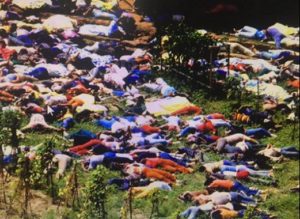
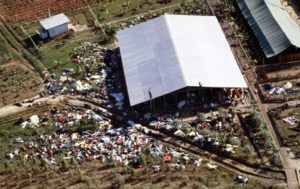
From a Caribbean perspective, we must admit and accept the culpability: “My Bad!”

We have bloodguilt on our hands for the 918 people who died on this day in Guyana 40 years ago; (one third of whom were minor children). See the encyclopedic details here:

Tile: Jonestown
The Peoples Temple Agricultural Project, better known by its informal name “Jonestown“, was a remote settlement established by the Peoples Temple, an American cult under the leadership of reverend Jim Jones, in north Guyana. It became internationally notorious when, on November 18, 1978, a total of 918[1][2] people died in the settlement, at the nearby airstrip in Port Kaituma, and at a Temple-run building in Georgetown, Guyana’s capital city. The name of the settlement became synonymous with the incidents at those locations.

909 individuals died in Jonestown,[1] all but two from apparent cyanide poisoning, in an event termed “revolutionary suicide” by Jones and some members on an audio tape of the event and in prior discussions. The poisonings in Jonestown followed the murder of five others by Temple members at Port Kaituma, including United States Congressman Leo Ryan, an act that Jones ordered. Four other Temple members committed murder-suicide in Georgetown at Jones’ command.

While some refer to the events in Jonestown as mass suicide, many others, including Jonestown survivors, regard them as mass murder.[3][4] As many as 70 people may have been injected with poison, and a third of the victims (304) were minors.[5][6] It was the largest such event in modern history and resulted in the largest single loss of American civilian life in a deliberate act until September 11, 2001.[7]

Selection and establishment of Guyanese land


The Temple chose Guyana, in part, because of its own socialist politics, which were moving further to the [political] left during the selection process.[18][19] Former Temple member Tim Carter stated that the reasons for choosing Guyana were the Temple’s view of a perceived dominance of racism and multinational corporations in the U.S. government.[20] According to Carter, the Temple concluded that Guyana, an English-speaking, socialist country with a predominantly indigenous population and with a government including prominent black leaders, would afford black Temple members a peaceful place to live.[20] Later, Guyanese Prime Minister Forbes Burnham stated that Jones may have “wanted to use cooperatives as the basis for the establishment of socialism, and maybe his idea of setting up a commune meshed with that”.[19] Jones also thought that Guyana was small, poor, and independent enough for him to easily obtain influence and official protection.[18]

See the remaining reference in the Source link here …

Source: Retrieved November 18, 2018 from: https://en.wikipedia.org/wiki/Jonestown

Surely this Jonestown drama is a manifestation of evil, despite the “Reverend” Jim Jones and the Christian affiliation of the People’s Temple.

This atrocity is on us!

Actually, after the events of the November 18, 1978 tragedy, there was a formal inquest – Commission of Inquiry – which concluded that Guyanese Prime Minister Forbes Burnham was responsible for the deaths at Jonestown. There is no way to misconstrue the culpability in this drama:

As a representative democracy, the leaders act on behalf of the people.

What kind of environment was the Caribbean country of Guyana to where a Bad Actor with evil Intents and Purposes could thrive in our neighborhood?
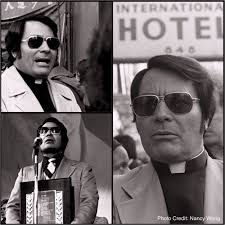
Surely, there were societal defects in place then; the Guyana orthodoxy was surely flawed. (Even though, on the surface, the solidarity of Guyana’s political leadership aligned with Jim Jones and the People’s Temple movement in their opposition to racial inequality and Crony-Capitalism. See the Appendix VIDEO below).

This is the lesson we learn from Jonestown 1978: When we tolerate Human Rights abuses, things go from bad to worse.

How about today?

Is Guyana reformed or transformed today, away from that old bad society to a more viable society today?

According to the movement behind the book Go Lean…Caribbean, the answer is:

No, actually!

The Go Lean book asserts that the Caribbean is in crisis. We have many societal defects that are so badly in need of reform. Guyana’s disposition is especially acute. Of all the societal abandonment transpiring in the region, Guyana is among the worst. One report related a 89% Brain Drain rate with their college educated populations. In addition, Guyana is still notoriously bad for mitigating and counteracting suicides. In a 2014 report, this country was ranked #1 for Suicides Per Capita.

Guyana needs a reboot!

The whole Caribbean region needs a reboot.

This is the “why” the Go Lean book presents a roadmap for the introduction and implementation of a super-national governing authority, the Caribbean Union Trade Federation (CU). This entity will be empowered to effect change in all 30 Caribbean member-states. This would be a new regime for the region; one that is apolitical (not left nor right-leaning) and religiously-neutral; (no blindspots in oversights to “Christian” religious groups).

Under this new regime, as described in the Go Lean book, religious institutions will be recognized, respected and defined as Non-Government Organizations (NGO), nothing more … nothing less. Caribbean integration is the priority and this priority would allow for a more efficient delivery of the Social Contract. (Social Contract is defined for when citizens surrender some of their freedoms and submit to the authority of the State in exchange for protection of remaining natural and legal rights).

It is universally accepted that the Government of Guyana failed those 918 people in 1978. The religious eco-system should not have been looked on for protection and security. No, Jonestown was a failing of the government. There is a variety of religious adherents in this country – Christians, Muslims, Hindus, Indigenous Animists – no one religious group should ever be put above or below another. Religious diversity must be a concern for all Caribbean member-states; the Social Contract for the Caribbean must reflect a Pluralistic Democracy.

40 years later, and the stewards for a new Caribbean have learned how to apply the lessons of Jonestown in this plan to forge a better society. The Go Lean/CU roadmap presents the strategies, tactics and implementations to impact Caribbean communities and all their societal engines. In fact, these statements are identified as the prime directives for this roadmap:

  • Optimize the economic engines in order to grow the regional economy to $800 Billion & create 2.2 million new jobs.
  • Establish a security apparatus to protect the resultant economic engines, plus ensure public safety and justice institutions. Security provisions should apply to the macro and the micro.
  • Improve Caribbean governance to support these engines, including a separation-of-powers between the member-states and CU federal agencies, plus even oversight for NGO’s.

These prime directives transcend religions and national borders. There is an expectation of Human Rights that is expected no matter the country, languages or culture. Protections of Human Rights should just be delivered. The approach is to move the Caribbean region to a Single Market. Guyana-based CariCom started this vision, but they have failed to deliver on it. We need a better integration – with a stronger foundation – that would ensure that a Jonestown can never happen again – NEVER AGAIN.

The book Go Lean…Caribbean – available to download for free – opened with the assessment that regional governance is dysfunctional and the challenges for the Caribbean are too Big for anyone one of these small islands or coastal states alone – there must be regional solutions. Thusly, the roadmap calls for a regional interdependence. This need was pronounced in the opening Declaration of Interdependence (Pages 10 – 12):

Preamble: That whenever any form of government becomes destructive to these ends, it is the right of the people to alter or to abolish it, and to institute new government … when a long train of abuses and usurpations, pursuing invariably the same object evinces a design to reduce them under absolute despotism, it is their right, it is their duty, to throw off such government, and to provide new guards for their future security.

vi. Whereas the finite nature of the landmass of our lands limits the populations and markets of commerce, by extending the bonds of brotherhood to our geographic neighbors allows for extended opportunities and better execution of the kinetics of our economies through trade. This regional focus must foster and promote diverse economic stimuli.

x. Whereas we are surrounded and allied to nations of larger proportions in land mass, populations, and treasuries, elements in their societies may have ill-intent in their pursuits, at the expense of the safety and security of our citizens. We must therefore appoint “new guards” to ensure our public safety and threats against our society, both domestic and foreign. The Federation must employ the latest advances and best practices of criminology and penology to assuage continuous threats against public safety. …

xi. Whereas all men are entitled to the benefits of good governance in a free society, “new guards” must be enacted to dissuade the emergence of incompetence, corruption, nepotism and cronyism at the peril of the people’s best interest. The Federation must guarantee the executions of a social contract between government and the governed.

The Go Lean book provides 370-pages of turn-by-turn instructions on “how” to adopt new community ethos, plus the strategies, tactics, implementations and advocacies to execute so as to transform the Caribbean region into a “better society”.  The book details a “better society” in terms of Human Rights in one specific Chapter on Page 220. See here, some of the excerpts and headlines from that Chapter:

10 Ways to Protect Human Rights

1 Lean-in for Caribbean Integration
This regional re-boot will allow for the unification of the region into one market, thereby creating a single economy of 30 member-states, 42 million people and a GDP of over $800 Billion. The CU will assume the primary coordination for the region’s economy and the requisite security to protect the resultant economic engines. While the CU is an economic initiative, there is a mission to monitor/mitigate Fail State Indices, and Human Rights violations constitute a Failed State Indicator.
2 Watchful World

A CU mission is to monitor the image of the Caribbean to the rest of the world. Not only will the world be watching the activities in the region, but the “story” being told will be directed to depict a positive behind-the-scenes view, that the region is the best place to live-work-play.

3 Caribbeans with Disabilities
4 Women & Youth

The CU will allow for empowerment and protections of women & children, orphans & widows, in compliance with Judeo-Christian precepts, Human Rights requirements, & natural instincts. These efforts will include the special needs for young girls, adult women and senior women.

5 LGBT Toleration
6 Reconciliations

There were many reasons why Caribbean citizens abandoned their homelands and fled to distant shores. In some cases, the expatriates were actually political/human rights refugees. The CU mission for formal Truth & Reconciliation Commissions will allow many past issues to be settled and set aside, not necessary as criminal prosecutions, as statutes of limitations may have been exceeded. Plus punishing the past, at times may short circuit the future.

7 Future Focus
8 Justice Focus

The people of the Caribbean have the right to good government and the fulfillment of the social contract. This would ensure law-and-order, due process, the rule of law, and some justice assurance. The CU will facilitate monitoring and accountability of the justice institutions to ensure compliance and mitigate abuse, compared to times in the past.

9 Tourist Omnipresence
Extending hospitability to guests is putting “the best foot forward”. The vertical industries of tourism are based on this premise. The CU will expand tourist offerings away from resort-life, including eco-tourism (i.e. rainforest & scuba-diving excursions, bird-watching). This brings more tourists into daily interaction with residents – always on our best behavior.
10 Long-Form Journalism
The CU will support and promote Public Broadcasting media outlets for TV/Radio. This has historically allowed for long-form journalistic productions, a great advantage for human rights foundations & agencies. This allows messaging to get deep and detailed, beyond the headline-only of compressed newscasts. These types of endeavors have forged many changes in American society, like exposing the ills of rural poverty and the atrocities of the old peonage system.

Our region has gotten a “Black-Eye” because of the atrocities of Jonestown, Guyana. We must do better, going forward. That “better society” is one that pursues this definition of the Greater Good:

“It is the greatest good to the greatest number of people which is the measure of right and wrong”. – Jeremy Bentham (1748-1832)

The Caribbean must foster a better homeland that protects its citizens and visitors; (the 918 people who died on November 18, 1978 were Americans – non-Guyanese citizens). Considering the lessons being learned from Jonestown, we must also hold religious organizations – and NGO’s – accountable for their actions and violations of Human Rights and modern justice requirements. This Go Lean movement has previously detailed many related issues and advocacies for Human Rights mandates in our region; consider this sample of previous blog-commentaries:

https://goleancaribbean.com/blog/?p=15580 Caribbean Unity? Religion’s Role: False Friend
https://goleancaribbean.com/blog/?p=14482 International Women’s Day – Protecting Rural Women
https://goleancaribbean.com/blog/?p=11224 ‘Loose Lips Sink Ships’ – Fanatical Theologians Undermine Tourism
https://goleancaribbean.com/blog/?p=10566 Funding the Caribbean Security Pact
https://goleancaribbean.com/blog/?p=10216 Waging a Successful War on Orthodoxy
https://goleancaribbean.com/blog/?p=9766 Rwanda’s Catholic bishops apologize for genocide
https://goleancaribbean.com/blog/?p=6718 A Lesson in History Before the Civil War: Compromising Human Rights
https://goleancaribbean.com/blog/?p=5695 Repenting, Forgiving and Reconciling the Past
https://goleancaribbean.com/blog/?p=5210 Cruise Ship Labor Abuses – Getting Ready for Change
https://goleancaribbean.com/blog/?p=4971 A Lesson in Church History – Royal Charters: Truth & Consequence
https://goleancaribbean.com/blog/?p=341 US slams Caribbean human rights practices

As a result of Jonestown 1978, the expression “drinking the Kool-Aid” has entered into the English-speaking lexicon. Yes, this 40 year old tragedy in Guyana has branded the Caribbean with a global brand as inadequate and Less Than when it comes to effective governance in public safety and Human Rights protection.

After all, one third of the 918 victims in Jonestown were minor children.

Surely we have learned lessons in the 40 years since. Surely, we have now learned how to protect our people … and our visitors.

Surely, our communities will embrace all strategies, tactics, implementations and advocacies to ensure such a tragedy will never happen again.

The Go Lean book is the lesson-learn.

Surely, this roadmap will be embraced and adopted as part of the regional pledge of NEVER AGAIN.

We urge all Caribbean stakeholders to lean-in to this roadmap to reboot the region, to bring change … and empowerment. We must make sure those 918 lives were not lost in vain; We must learn the lessons from Jonestown. We must make our communities better places to live, work and play. 🙂

Download the book Go Lean … Caribbean – now!

Sign the petition to lean-in for this roadmap for the Caribbean Union Trade Federation.

—————–

Appendix VIDEO – The Story of The Jonestown Massacre – https://youtu.be/GKqQ1CyneWw

FactFile
Published on Feb 5, 2018 – The Jonestown massacre was a horrendous event that led to the deaths of almost a thousand people. Today we tell the story that led up to that most horrendous of days.

Share this post:
, , ,

Mid-Term Elections 2018: No Vote; No Voice

Go Lean Commentary

It’s a BIG Day (November 6, 2018) in the US; it’s the Mid-Term Elections to choose the new Congress.

As related in this previous blog-commentary, the Caribbean has No Vote and No Voice in the US elections for the power of their leaders.

But one Caribbean stakeholder – “Rock Star” Rihanna – has chimed in with her own power; she has a voice and a vote. She has declared:

Please stop the music.
See the full news article in the Appendix below, to see how she has forbidden any of her music at Trump rallies.

For this election, there is a lot at stake for this American eco-system – as the only Super Power in the western hemisphere – this affects the Caribbean in an impactful way as well.

Bad things happen when Good people do not vote.
The opposite of justice is not injustice; it’s apathy, indifference and inaction. – Senator Corey Booker Nov 5, 2018.

The United States of America is the richest, most powerful democracy – a government of the people, by the people, for the people – on the planet and yet their power does not appear to lie with the population, but rather the passionate. So many times, the winner of campaign races are not the people with the majority, but rather the people who are passionate enough to show up and vote … consistently. The current federal administration – under President Donald Trump – seems to have little regards for the needs of Caribbean people. So now is the first chance for America to chime in on their support or opposition of this President. This is the actuality of the Mid-term elections.

The results are in:

  • In summary, the opposition party, the Democrats, has won back the US House of Representatives.
  • The Senate remains with the incumbent party, the Republicans.
  • Many State races revert to the opposition parties, except for Florida and Georgia where both Democratic gubernatorial candidates have apparently lost. In Florida, Andrew Gillum would had become the first African-American governor in the State; while Georgia’s Stacey Abrams would have been the first African-American female governor ever … anywhere.

The quest for a pluralistic democracy is still not complete. (When its No Vote and No Voice, it gets even more difficult).

The Caribbean remains inconsequential to this American process. Even the American territories remain with No Voice, No Vote and No Progress. That previous blog-commentary related:

[For] the US Territories of Puerto Rico and the Virgin Islands, … American economic prosperity does not always extend to the islands. The emigration (brain & capital drain) for these islands has been acute for over 100 years and continues, unchecked today. The pattern of the US Territories is what the rest of the [Caribbean] region does not want: half abandoned; where the emigrated population exceeds the on-island population. These islands are paradise – there should be no reason to leave. – Book Go Lean…Caribbean Page 244

The US as the regional Super Power does not mean power nor prosperity for the neighboring Caribbean region. We are not protégés; we are parasites. The solution to assuage Caribbean crises is not America; we must do the heavy-lifting to reform and transform our society ourselves.

Solving our own problems; providing for our own needs; handling our own affairs – there is an umbrella word for these activities: Independence. (With independence, our Vote and Voice matters).

The Go Lean book – a roadmap for the Caribbean Union Trade Federation (CU) – provides 370-pages of turn-by-turn instructions for a Way Forward, a guide “how” to adopt new community ethos, plus the strategies, tactics, implementations and advocacies to execute so as to reboot, reform, transform and promote independence. We need to be able to deliver without dependence on “overseas masters”: Washington, Paris, Amsterdam or London. Our focus here is on Washington. Though our quest is not to impact the US – notwithstanding the Diaspora living there – there is the need for the CU to limit our scope to the 2 American territories and other 28 lands in the Caribbean. One advocacy in the book (Page 120) is entitled “10 Ways to Promote Independence“; this allows for the heightened delivery of basic needs. See the headlines, summaries and excerpts from that advocacy here:

10 Ways to Promote Independence

1 Lean-in for the Treaty for a Caribbean Single Market
This treaty calls for the unification of the Caribbean region into an integrated market, thereby expanding to an economy of 30 member-states of 42 million people. The vision of the CU is independence! But independence as a regional entity, one Single Market. The missions of the CU entail empowering the economic engines, securing the homeland and assuaging the emergency crises of natural disasters.The current state of the CU region would equate to the unsettled period in US history from 1776 until the accedence of the constitution in 1789. If independence is likened to the birth of a new nation, then the CU would be considered the adult stage of this fictitious entity – partnering in a marriage; ready for growth (annexation) once settled and stable.
2 Autonomous Rule for Territories
The CU treaty includes the American, British, Dutch and French Overseas Territories. Though the legacy powers are among the world’s biggest economies, such prosperity has not always extended to these islands. The CU only seeks autonomous rule from their legacies, not sovereignty, and receivership status in the case of any financial insolvency.
3 CU Neutrality
The CU Federation must “get and give” independence. Many CU agencies are configured as independent entities from the political structures within the region. This is especially noted with the Caribbean Central Bank, Federal Elections, Organ Procurement, Education Testing, Federal Courts and Self Governing Entities. The independence of these service providers must be assured with compliance reviews and audits – these protect public integrity.
4 Elections Management – International Monitors
5 Security Independence
The CU region has enemies, (narco-terrorists, and sworn enemies of legacy nations). So the collective security pact will create a Homeland Security Department, to defend against all enemies, foreign and domestic. The CU will coalesce with the Defense Forces of the US, France, Netherlands, British Navies for Intelligence sharing and naval patrols and shore leaves. The CU will acquire tactical defensive weapons: helicopters, submarines, drones, & anti-aircraft systems.
6 Energy Independence
7 Financial Independence
8 Disaster Response Independence
Every hurricane or earthquake should not constitute an international crisis. Adults are required to be prepared for rainy days, so too the CU must position relief supplies and recovery equipment to quickly respond to events and aftermaths.
9 Food Independence
10 Foreign Aid

Yes, the Caribbean must stand-up, rise-up and act responsibly to fulfill it needs; our Vote and Voice must matter. Such an independence mandate is embedded in the implied Social Contract for every member-state. The Social Contract is defined as follows:

Where citizens surrender some of their freedoms and submit to the authority of the State in exchange for protection of remaining natural and legal rights.

The American association does not merit progress. Just look at Puerto Rico and the Virgin Islands. Of the 30 member-states that constitute the Caribbean, only these two gets American systems of governance, commerce and culture. So any plan to elevate the Caribbean region must also consider the legal and constitutional mandates of the US; and yet these territories have No Vote and No Voice in Washington.

The Caribbean must get started with reforming and transforming our societies ourselves – no rescue is coming from abroad.

While any consideration for leading from the Top must partner with American stakeholders, we must do the heavy-lifting ourselves. This prescription does not only apply to the 2 US territories; no these are urgings for all the Caribbean. We still need the wisdom and insight provided in this Go Lean roadmap on how to reform and transform the Caribbean member-states so that they can be better places to live, work and play.

The Go Lean book – available to download for free – serves as a roadmap for the introduction and implementation of the technocratic CU Trade Federation, for the elevation of Caribbean society – for all member-states. This CU/Go Lean roadmap has these 3 prime directives:

  • Optimization of the economic engines in order to grow the regional economy to $800 Billion & create 2.2 million new jobs.
  • Establishment of a security apparatus to ensure public safety and protect the resultant economic engines.
  • Improve Caribbean governance to support these engines, including a separation-of-powers between the member-states and CU federal agencies.

The book stresses that reforming and transforming the Caribbean societal engines must be a regional pursuit. This was an early motivation for the roadmap, as pronounced in the opening Declaration of Interdependence (Pages 12 – 13):

xi. Whereas all men are entitled to the benefits of good governance in a free society, “new guards” must be enacted to dissuade the emergence of incompetence, corruption, nepotism and cronyism at the peril of the people’s best interest. The Federation must guarantee the executions of a social contract between government and the governed.

xxiii.  Whereas many countries in our region are dependent Overseas Territory of imperial powers, the systems of governance can be instituted on a regional and local basis, rather than requiring oversight or accountability from distant masters far removed from their subjects of administration. The Federation must facilitate success in autonomous rule by sharing tools, systems and teamwork within the geographical region.

xxiv. Whereas a free market economy can be induced and spurred for continuous progress, the Federation must install the controls to better manage aspects of the economy: jobs, inflation, savings rate, investments and other economic principles. Thereby attracting direct foreign investment because of the stability and vibrancy of our economy.

This Go Lean book stresses that forging change in the Caribbean (American territories and all other legacies) requiring effort from the Top (leaders) and from the Bottom (citizens). Political transformation alone will not do it. As is evident in the US Mid-Term Elections in 2018, politics do not always manifest as hoped, expected or promised. This is even more frustrating when we have No Vote and No Voice. This is why both Top-Down and Bottoms-Up must be pursued simultaneously.

Do it – sow this seed – and in the end, we will reap a good harvest.

The subject of Caribbean people’s political expressions – attempting to forge change at the top – have been detailed in many previous Go Lean commentaries. See this list here:

http://goleancaribbean.com/blog/?p=13995 The Sad Reality of the US Territories: No Vote; No Voice
https://goleancaribbean.com/blog/?p=11989 The Dynamics of Diaspora Voting
https://goleancaribbean.com/blog/?p=9626 American Tragedy – Marginalizing The Black-and-Brown Vote
https://goleancaribbean.com/blog/?p=9354 Courting the Caribbean Votes – Cuban-Americans
https://goleancaribbean.com/blog/?p=9352 Courting the Caribbean Votes – ‘Jamericans’
https://goleancaribbean.com/blog/?p=9350 Courting Caribbean Votes – Puerto Ricans
https://goleancaribbean.com/blog/?p=8306 Women Get Ready for New Lean-In Campaign
https://goleancaribbean.com/blog/?p=8155 Gender Equality Referendum Outcome: Impact on the ‘Brain Drain’
https://goleancaribbean.com/blog/?p=7749 Lessons from Regional Elections
https://goleancaribbean.com/blog/?p=6937 Women in Politics – The Fight for Gender Equality

Forging change from the top is effective. But we also need to forge change from the bottom. This is how we can make our homeland a better place to live, work and play. We urge everyone to  lean-in to this Go Lean roadmap. 🙂

Sign the petition to lean-in for this roadmap for the Caribbean Union Trade Federation.

——————

Appendix – Title: Rihanna tells Trump to stop playing her music at his rallies

NBC News:-  Please stop the music.

That’s the message Rihanna sent to President Donald Trump Sunday night after learning that her 2007 single “Don’t Stop the Music” was played at one of his rallies.



Rucker said the song was played while aides tossed Trump T-shirts into the crowd, as is commonly done at baseball games. “Everyone’s loving it,” he said.

Rihanna’s warning to the president came hours after she endorsed Andrew Gillum, the Democratic candidate for governor of Florida, in an Instagram post.

“Florida: You have the opportunity to make history this election,” Rihanna, 30, wrote on Instagram. “The US has only had four black governors in its entire history and we can help make #AndrewGillum the next one and Florida’s first.”

With her rebuke, Rihanna, who was born in Barbados, joins a growing list of artists who have asked that their music not be part of the soundtrack of Republican rallies. Last week, Pharrell Williams issued a cease-and-desist letter after Trump played his 2013 song “Happy” at a rally on the same day 11 people were killed in a Pittsburgh synagogue shooting.

In August, Aerosmith’s Steven Tyler sent Trump a cease-and-desist letter over use of the song “Livin’ on the Edge” at a political rally without permission.

“This is not about Dems vs. Repub.,” Tyler tweeted at the time. “I do not let anyone use my songs without my permission. My music is for causes, not for political campaigns or rallies. Protecting copyright and songwriters is what I’ve been fighting for even before this current administration took office.”

In 2015, the singer’s legal team warned Trump, then a Republican presidential candidate, over his use of “Dream On.”

Rihanna’s remarks came a day after Axl Rose, who has been a vocal critic of the Trump administration, accused his campaign of “using loopholes in the various venues’ blanket performance licenses, which were not intended for such craven political purposes, without the songwriters’ consent.”

The Guns N’ Roses frontman also said the band had formally requested that its music not be used at Trump rallies or Trump-associated events.

After Washington Post reporter Philip Rucker on Sunday tweetedthat Rihanna’s hit song was playing at a rally in Chattanooga, Tennessee, the singer replied: “Not for much longer.”

She also said: “Me nor my people would ever be at or around one of those tragic rallies.”

Source: Posted November 5, 2018; retrieved November 6, 2018 from: https://stluciatimes.com/arts-entertainment/rihanna-tells-trump-to-stop-playing-her-music-at-his-rallies/

Share this post:
,
[Top]

Diwali 2018 – A Glimpse of our Pluralistic Democracy – ENCORE

Happy Diwali!

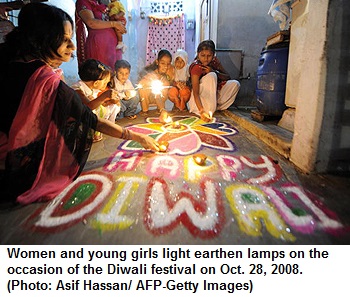
As the clay pots are lit from the villages to the center centers, the Festival of Lights is about to begin. Diwali is one of the biggest and brightest holidays celebrated all across India and the U.S. each year. Fireworks, song and prayer fill the five-day festival to celebrate inner light over spiritual darkness.

Today and always, we honor the many cultures and traditions among our beautifully diverse global organization. As we join in celebrating Diwali, we hope you enjoy this special time with friends and family.

May the divine light of Diwali shine with peace, prosperity, happiness and good health in your life. Happy Diwali.

Signed: The Technology Leadership Team and Saul Van Beurden, CIO, JPMorganChase Consumer & Community Bank

Today is the start of Diwali 2018.

This is one of the biggest holidays for a the global Hindu community. That is the population of India and the Indian Diaspora. That Diaspora includes the Caribbean. JPMorganChase, Americas largest bank, has a large staff based in India. They are a pluralistic corporation; they obviously want their team members to feel honored in their institution.

We want our Caribbean brothers and sisters with Indian heritage to feel that they are honored here in their Caribbean homeland. This was addressed in a previous Go Lean commentary on October 19, 2017. It is appropriate to Encore that submission here-now:

————————–

Go Lean Commentary Respecting Diwali – Making a Pluralistic Democracy

CU Blog - Respecting Diwali - Making a Pluralistic Democracy - Photo 3What is the ethnic composition of the Caribbean?

Not a singularity!

Our quest now is to make the Caribbean a Single Market and a “Pluralistic Democracy”. This means a society where the many different ethnic groups (and religions) have respect, equal rights, equal privileges and equal protections under the law; where there are no superior rights to any majority and no special deprivations to any minority. The expectation is for anyone person to be treated like everyone else. The legal definition of Pluralism as a political philosophy is as follows …

… the recognition and affirmation of diversity within a political body, which permits the peaceful coexistence of different interests, convictions and lifestyles.[1] While not all political pluralists advocate for a pluralist democracy, this is most common as democracy is often viewed as the most fair and effective way to moderate between the discrete values.[2]Wikipedia

This vision of a Caribbean “Pluralistic Democracy” should be more than words; it must be action too!

Yet we fail so miserably in respecting non-standard traditions. The truth of the matter is that while religious toleration appears to be high in the Caribbean, this is really only true of European-styled Christian faiths. Other non-White religious traditions (let’s consider Hindu) are often ignored or even ridiculed in open Caribbean society, despite the large number of adherents. Of the 30 member-states to comprise the Caribbean Single Market, 3 of them have a large Indian-Hindu ethnicity. As a result, in these communities, though lowly promoted, one of the biggest annual celebrations for those communities is Diwali or Divali:

Diwali (or Deepavali) is the Hindu festival of lights celebrated every year in autumn in the northern hemisphere (spring in southern hemisphere).[4][5] It is an official holiday in Fiji, Guyana, India,[6] Malaysia, Mauritius, Myanmar, Nepal, Singapore, Sri Lanka, Suriname, Trinidad and Tobago. One of the most popular festivals of Hinduism, it spiritually signifies the victory of light over darkness, good over evil, knowledge over ignorance, and hope over despair.[7][8][9] Its celebration includes millions of lights shining on housetops, outside doors and windows, around temples and other buildings in the communities and countries where it is observed.[10] The festival preparations and rituals typically extend over a five-day period, but the main festival night of Diwali coincides with the dark night of the Hindu Lunisolar month Kartika in Bikram Sambat calendar (the month of Aippasi in Tamil Calendar), on the 15th of the month. In the Gregorian calendar, Diwali night falls between mid-October and mid-November.[11]

Before Diwali night, people clean, renovate, and decorate their homes and offices.[12] On Diwali night, people dress up in new clothes or their best outfits, light up diyas (lamps and candles) inside and outside their home, participate in family puja (prayers) typically to Lakshmi – the goddess of fertility and prosperity. After puja, fireworks follow,[13] then a family feast including mithai (sweets), and an exchange of gifts between family members and close friends. Deepavali also marks a major shopping period in nations where it is celebrated.[14]

The name of festive days as well as the rituals of Diwali vary significantly among Hindus, based on the region of India. – Wikipedia.

See the VIDEO’s in the Appendix below.

While Diwali is a religious celebration, many aspects of this culture spills-over to general society; see the detailed plans of a previous year (2009) in Appendix A below. This celebration, in many ways, is similar to Christmas spilling-over to non-Christian people in Christian countries. So the festivities carry a heavy civic-cultural “feel” as opposed to religious Hindu adherence. Plus, these values here are positive community ethos that any stewards in any society would want to promote:

“the victory of light over darkness, good over evil, knowledge over ignorance, and hope over despair”.

This year Diwali is celebrated between October 18 – 22, 2017. It is a public holiday only for Wednesday October 18 in Trinidad and Guyana; plus on Thursday October 19 in Suriname.

This celebration of Diwali is only MEDIUM in these 3 Caribbean member-states; but with the proper fostering it could be BIG; it could be an impactful event! Imagine Event Tourism targeted to the 1.2 Billion people of the emerging economy of India; plus the 35 million people in the Indian Diaspora world-wide.

The book Go Lean…Caribbean presents the advocacy of Event Tourism (Page 191). This is fundamental to elevating Caribbean society to be a better place to live, work and play; (or live, work and pray). The Go Lean book – available to download for free – serves as a roadmap for the introduction and implementation of the technocratic Caribbean Union Trade Federation (CU), for the elevation of Caribbean society – for all 30 member-states – to foster a “Pluralistic Democracy”. This CU/Go Lean roadmap has these 3 prime directives:

  • Optimization of the economic engines in order to grow the regional economy to $800 Billion and create 2.2 million new jobs.
  • Establishment of a security apparatus to ensure public safety and protect the resultant economic engines.
  • Improve Caribbean governance to support these engines, including a separation-of-powers between the member-states and CU federal agencies.

The Go Lean roadmap posits that events can be fostered so as to better impact the economic, security and governing engines of society. This was this declaration from a previous blog-commentary, that touristic events could be so much more lucrative, if only there was a whole-souled commitment by the full community – everyone show respect. Think of the success in Sturgis, South Dakota where a small town of 10,000 hosts up to 600,000 visitors (Page 288). Imagine the economic impact!

The movement behind the Go Lean book has repeatedly related that there is a need for new stewardship of the Caribbean tourism apparatus. The world has changed; our target markets have changed. We cannot just advertise to the Northeast corner of North America for the peak winter season (January & February) anymore. No we must now look to alternate markets and target alternate calendar days so as to expand our product offering.

Imagine the prospect of marketing Diwali – see VIDEO’s below – usually in the tourist-slow month of October.

Beautiful Sky Lantern

This is what is needed to expand the region economically. There is no longer the need for tourism stewards to just “rub shoulders” with travel agents, but rather, there is the need for e-Commerce strategies and tactics (think: Search Engines Optimization) and for efficient execution of events. Welcome to Technocracy 101.

A previous blog-commentary (from September 15, 2015) regarding Tourism Stewardship related these details:

The book Go Lean…Caribbean calls for the elevation of Caribbean society, to re-focus, re-boot, and optimize all the engines of commerce so as to make the Caribbean a better place to live, work and play.  The category of “play” covers the full scope of tourism, which is the primary economic driver for our Caribbean region; the book estimates 80 million visitors among the region. (Since that number includes cruise passengers that may visit multiple Caribbean islands on one itinerary, each port is counted separately; without cruise passengers, a figure of 68 – 69 million is perhaps more accurate).

This commentary is a consideration of tourism, not travel. Tourism is a subset of the travel eco-system, so any Agent of Change in the world of travel must be carefully considered on tourism, on Caribbean tourism. …

The Go Lean book considers these Agents of Change (Page 57) that have dynamically affected the Caribbean economic eco-systems:

  • Technology
  • Globalization
  • Aging Diaspora
  • Climate Change

Technology, the Internet-Communications-Technology (ICT) in particular has furnished alternative and better options for travel enterprises to find passengers-guests-travelers-tourists…. Travel agents are now inconsequential. ….

The book Go Lean…Caribbean and the underlying movement seeks to re-boot the strategies and tactics of tourism marketing for the entire Caribbean region. The book asserts Caribbean member-states must expand and optimize their tourism outreach but that the requisite investment of the resources (time, talent, treasuries) for this goal may be too big for any one Caribbean member-state … alone. Rather, shifting the responsibility to a region-wide, professionally-managed, deputized technocracy will result in greater production and greater accountability. This deputized agency is the Caribbean Union Trade Federation (CU). The book thereafter introduces the CU and provides a roadmap for its implementation into a Single Market for the Caribbean economy … and tourism marketing.

The goal of the CU is to bring the proper tools and techniques to the Caribbean region to optimize the stewardship of the economic, security and governing engines.  The book posits that the economy can be induced and spurred for continuous progress, with technocratic management and stewardship better than the status quo. While the goal of the roadmap is to pursue a diversification strategy, the reality is that tourism will continue to be the primary economic driver in the region for the foreseeable future. The publisher of the book Go Lean…Caribbean convenes the talents and skill-sets of movers-and-shakers in electronic commerce [and project management] so as to forge the best tools and techniques for this new ICT-based marketing.

Lessons need to be learned from the execution of events in these Hindu-populated Caribbean countries. Can the Caribbean flare of a dynamic Hindu culture be exploited further for global marketing and appeal? The Hindu Diaspora is huge, comprising sizeable populations in many countries, including BIG numbers (millions) here:

Australia Nepal
Canada Saudi Arabia
Fiji Singapore
India South Africa
Ireland Sri Lanka
Malaysia United Arab Emirates
Mauritius United Kingdom
Myanmar United States

This is the charter of the Go Lean roadmap, to deploy the technocratic administration to optimize Caribbean Event Tourism. The Go Lean book specifically details the community ethos Caribbean communities need to adopt to be successful in Event Tourism; plus the strategies, tactics, implementations and advocacies to ensure successful deployments; see a sample here:

Community Ethos – Deferred Gratification Page 21
Community Ethos – Governing Principles – Lean Operations Page 24
Community Ethos – Governing Principles – Cooperatives Page 25
Community Ethos – Ways to Promote Intellectual Property Page 29
Community Ethos – Ways to Bridge the Digital Divide Page 31
Community Ethos – Ways to Impact Turn-Arounds Page 33
Community Ethos – Ways to Promote Happiness Page 36
Community Ethos – Ways to Impact the Greater Good Page 37
Strategy – Vision – Confederate 30 Member-States Page 45
Strategy – Mission – Celebrate the Music, Sports, Art and Culture of the Caribbean Page 46
Tactical – Fostering a Technocracy Page 64
Tactical – Separation-of-Powers – CU Federal Agencies versus Member-State Governments Page 71
Implementation – Ways to Deliver Page 109
Planning – 10 Big Ideas for the Caribbean Region Page 127
Planning – Ways to Make the Caribbean Better Page 131
Planning – Lessons from Omaha – College World Series Model Page 138
Advocacy – Ways to Enhance Tourism Page 190
Advocacy – Ways to Impact Events Page 191
Advocacy – Ways to Promote Fairgrounds Page 192
Advocacy – Ways to Preserve Caribbean Heritage Page 218
Advocacy – Ways to Improve the Arts Page 230
Advocacy – Ways to Promote Music Page 231
Appendix – Case Study of “The Rally” in Sturgis, South Dakota Page 288

In summary, the Caribbean is in good position to show respect to the Indian-Hindu community and their Festival of Lights – Diwali. In doing so, we double-down on our quest to be a “Pluralistic Democracy” and optimize our economic engines for Event Tourism.

 “Make happy those who are near, and those are far will come” – Chinese Proverb.
gonna-change-photo-2

What a contrast this is to the Climate of Hate that is so prevalent in so many Caribbean communities, towards people who are different or hold alternative viewpoints.

Yes, the Go Lean roadmap is different … and better.

It seeks to unite the people of the entire Caribbean region, diversify the regional economy (to create new 2.2 million jobs) and make our communities better places to live, work and play. This is why we have a quest for a “Pluralistic Democracy”. This is Part 1 of 3 in the series on this topic; the full collection is as follows:

  1. Making a “Pluralistic Democracy” – Respect for Diwali
  2. Making a “Pluralistic Democracy” – Freedom of Movement
  3. Making a “Pluralistic Democracy” – Multilingual Realities

Now is the time for all stakeholders in the Caribbean – governments, residents, religious devotee (Hindus, Christians, etc.), event planners, participants and tourists – to lean-in to this Go Lean roadmap. We can do better and be better. This quest for a “Pluralistic Democracy” is conceivable, believable and achievable. 🙂

Download the free e-book of Go Lean … Caribbean – now!

Sign the petition to lean-in for the roadmap for the Caribbean Union Trade Federation.

————

Appendix A – Divali Festival in Trinidad and Tobago

By: Dr. Kumar Mahabir

Pakistani Hindu women light earthen lampTrinidad and Tobago is the land of Carnival, steel band, tassa, calypso and chutney. It is the same country that gives the world its unique brand of Divali. Indeed, the Hindu Festival of Lights has become Trinidad’s second largest national open-air festival after Carnival. Divali is a welcomed alternative to the rambunctious indulgence in meat, alcohol, party and “wine,” and is arguably the largest vegetarian alcohol-free festival in the Caribbean, if not the western hemisphere. Divali is an event that the Ministry of Tourism can market as a major attraction in the fastest-growing worldwide trend of spiritual tourism.

Divali is the defining event that marks Trinidad as a multi-religious, multi-ethnic society with Hindus comprising the second largest religious group (24 percent) after Roman Catholics in the twin-island population of 1.3 million people. While Divali is essentially a Hindu festival, people of all faiths actively join in celebrating the triumph of light over darkness, knowledge over ignorance, and good over evil. Non-Hindu adherents are attracted to the festival’s universal message as well as to the extravaganza that is not only unique but also provides a clean environment for the cultivation of a healthy body, mind and soul.

Nowhere else in the world do non-Hindus and non-Indians actively take part in the lighting of over 10 million deyas on a single night in the year. These tiny clay lamps are lit in homes, yards, streets, offices, public parks and playing fields. It is perhaps only in Trinidad that one can find split bamboo tubes transformed into magnificent works of art on which the deyas are placed. The split bamboo strips reach out toward neighboring houses, streets and communities to symbolize the popular local mantra “all ah we is one.”

The eagerness to decorate is everywhere, and payment is the pride of the finished product. Streamers of all colors and patterns are made with kite paper and plastic and strung from jhandi [flag] poles. Brightly colored fabric, balloons and bulbs decorate homes, offices and stages. Indeed, it is Divali that heralds the joy of the end-of-year celebrations. Strings of twinkling lights—clear and colored—are strung high on buildings, trees, and even across streets. Effigies of Mother Lakshmi are made from bamboo tubes and large cardboard cutouts. Calligraphy on signs and banners glitters with decorative paint. The starry designs of deyas and bulbs transform simple houses into magical kingdoms.

The nights are filled with free public performances in public parks and playing fields. Divali provides the perfect forum for showcasing the talent of both foreign and local performers in Indian song, music, dance and drama. Fashion shows are the highlight of all celebrations. Indeed, no celebration is considered complete or magnificent without a fashion show that is always eagerly anticipated by all. Indians in the Caribbean keep the tradition of Indian fashion alive by wearing dhotis, kurtas, Nehru jackets, saris, shalwars, nose-pins, necklaces, bangles, anklets, eyeliners, mehendi markings and forehead tikkas/bindis. Most Divali celebrations end with a competition for women in the crowd who vie to be the best-dressed fashion finalist. A Divali Queen is not only bestowed with a crown, but she is also showered with gifts and prizes.

Divali also boasts of Ram Leela/Lila, which is perhaps the oldest living form of outdoor folk theatre in the Caribbean. The worship of Rama takes many forms, but community devotion [Ramayana yagna] outside the temple has the most public impact. During Divali, tons of sweetmeats like parsad, kurma, burfi, pera, ladoo, jalebi, gulab jamoon and kheer [sweet rice] are made and distributed free.

Indian trade fairs during Divali have become the shopping hotspots for women who flock to the sites in thousands to buy mainly clothes and accessories. A kind of dizzy euphoria can also be seen in any one of the Indian apparel stores in the countdown to Divali. It is all part of the excitement that hums through the air during this pre-Christmas celebration as women try to dress their best and stores try to outsell one another. More than men, women dress in their finest traditional Indian wear with matching jewelry, as models of grace and elegance.

The hub of all Divali celebrations in the island is Divali Nagar in central Trinidad. Indeed, the Nagar is the most frequented entertainment center in the country during Divali, second only to the Grand Stand in the Queen’s Park Savannah during Carnival. The grand display of fireworks in the air at the entertainment park resonates with the thunder of bamboo cannons, the explosions of firecrackers, and the sparkle of “star-lights” in villages across the country. On Divali night, thousands of people take to the streets on foot and in vehicles to behold houses and communities that look like an illuminated fairyland.

Divali will be celebrated as a national holiday in Trinidad and Tobago on Saturday, October 17 [2009].

Dr. Kumar Mahabir is the chairman of the Indo-Caribbean Cultural Council and assistant professor at the University of Trinidad and Tobago.

Source: Posted October 14, 2009; retrieved October 19, 2017 from: http://www.worldpress.org/Americas/3437.cfm

————

Appendix B VIDEO – Diwali – Festival of Lights | National Geographic – https://youtu.be/HrrW3rO51ak


Published on May 19, 2010 – In India, one of the most significant festivals is Diwali, or the Festival of Lights. It’s a five day celebration that includes good food, fireworks, colored sand, and special candles and lamps.
Diwali – Festival of Lights | National Geographic https://youtu.be/HrrW3rO51ak

National Geographic https://www.youtube.com/natgeo

————

Appendix C VIDEO – Diwali – The Festival of Lights – https://youtu.be/mPwmXRws7FA


WildFilmsIndia

Published on May 30, 2013 – Diwali is certainly one of the biggest, brightest and most important festivals of India. While Diwali is popularly known as the “festival of lights”. The celebration of Diwali as the “victory of good over evil” refers to the light of higher knowledge dispelling all ignorance. While the story behind Diwali and the manner of celebration of the festival differ greatly depending on the region, the essence of the festival remains the same – the celebration of life, its enjoyment and goodness. …

  • Category: Travel & Events
  • License: Standard YouTube License
Share this post:
, , ,
[Top]

Retail Apocalypse and Sears – Another One Bites the Dust – ENCORE

Another one bites the dust …

Sears has filed for Bankruptcy protection. This may be more than just reorganization; this might be complete dissolution.

See the VIDEO and excerpt of the news article here:

VIDEO – Sears files for Chapter 11 bankruptcy protection – https://www.usatoday.com/videos/news/nation/2018/10/15/sears-files-chapter-11-bankruptcy-protection/38160609/

—————–

Title: Sears files for Chapter 11 bankruptcy protection, to close 142 more stores
By: , USA TODAY

October 15, 2018 – Sears Holdings, whose presence permeated American life for generations, filed for Chapter 11 bankruptcy protection early Monday in a last-ditch attempt to avoid entombment in the graveyard of once-great retailers that failed to adapt to the digital age.

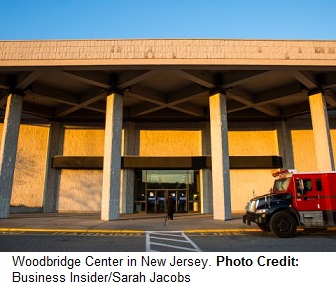
For Sears — which was the largest retailer in the nation before the rise of Walmart and, later, Amazon — bankruptcy marks the culmination of years of decline defined by store closures, sales declines, cost cuts and borrowing.

The company, which also owns discount retailer Kmart, has fallen into disrepair amid a perilous retail landscape in which customers increasingly shop online or seek out more-appealing alternatives.

For Kmart, known for its one-time “blue-light specials,” catchy jingles, and collections created by celebrities, the case marks a second brush with death. Kmart merged with Sears in 2005 after surviving bankruptcy once before.

Sears Holdings will close another 142 stores by about the end of the year, on top of a recently announced round of 46 store closures, as part of the bankruptcy. The company has 687 stores and about 68,000 employees.

See the remaining news story here (retrieved from this source on October 16, 2018):https://www.usatoday.com/story/money/2018/10/15/sears-bankruptcy/1595399002/?csp=chromepush

This was predicted. This is the dreaded, feared Retail Apocalypse. Truth be told, this is relevant for the Caribbean as well. This assertion was made in a prior commentary on April 18, 2017. See an Encore of that submission here-now:

=====================

Go Lean Commentary – Retail Apocalypse – Preparing for the Inevitable

Remember the dream … of 7 Fat Cows and 7 Skinny Cows?

The articulation of the dream was that the 7 Fat Cows represented 7 prosperous years while the 7 Skinny Cows represented 7 years of famine with poverty and distress. – The Bible; Genesis Chapter 41.
CU Blog - Retail Apocalypse - Preparing for the Inevitable - Photo 0

In that Bible drama of Joseph in ancient Egypt, those circumstances were more than just in a dream; it was a prophecy of prosperity and famine. It came true!

Joseph was able to use the foresight to prepare that kingdom for adversity, after first exploiting the opportunities.

Here it comes again.

There is feast and famine “in the cards” as related to the retail eco-system. On one end of the spectrum , there will be prosperity for electronic commerce stakeholders, but on the other end, for brick-and-mortar establishments, there will be a Retail Apocalypse.

Will be? Actually, the threat has already manifested!

This is the assertion in this news article by the financial-economic magazine Business Insider:

CU Blog - Retail Apocalypse - Preparing for the Inevitable - Photo 1

Title: The retail apocalypse has officially descended on America
By: Hayley Peterson

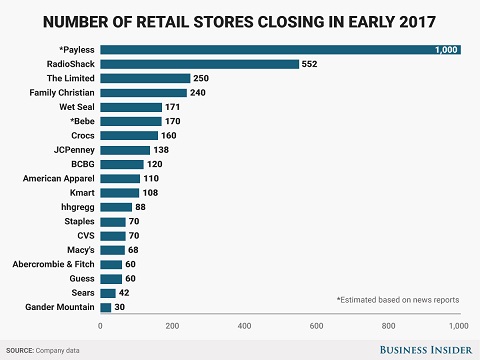
Thousands of mall-based stores are shutting down in what’s fast becoming one of the biggest waves of retail closures in decades.

More than 3,500 stores are expected to close in the next couple of months.

Department stores like JCPenney, Macy’s, Sears, and Kmart are among the companies shutting down stores, along with middle-of-the-mall chains like Crocs, BCBG, Abercrombie & Fitch, and Guess.

CU Blog - Retail Apocalypse - Preparing for the Inevitable - Photo 2

Some retailers are exiting the brick-and-mortar business altogether and trying to shift to an all-online model.

For example, Bebe is closing all its stores — about 170 — to focus on increasing its online sales, according to a Bloomberg report.

Some are going out of business altogether, like The Limited which recently shut down all 250 of its stores.

Others, such as Sears and JCPenney, are aggressively paring down their store counts to unload unprofitable locations and try to stanch losses.

CU Blog - Retail Apocalypse - Preparing for the Inevitable - Photo 3Sears is shutting down about 10% of its Sears and Kmart locations, or 150 stores, and JCPenney is shutting down about 14% of its locations, or 138 stores.

According to many analysts, the retail apocalypse has been a long time coming in the US, where stores per capita far outnumber that of any other country.

The US has 23.5 square feet of retail space per person, compared with 16.4 square feet in Canada and 11.1 square feet in Australia, the next two countries with the most retail space per capita, according to a Morningstar Credit Ratings report from October.

Visits to shopping malls have been declining for years with the rise of e-commerce and titanic shifts in how shoppers spend their money. Visits declined by 50% between 2010 and 2013, according to the real-estate research firm Cushman & Wakefield.

And people are now devoting bigger shares of their wallets to restaurants, travel, and technology than ever before, while spending less on apparel and accessories.

As stores close, many shopping malls will be forced to shut down as well.

When an anchor store like Sears or Macy’s closes, it often triggers a downward spiral in performance for shopping malls.

Not only do the malls lose the income and shopper traffic from that store’s business, but the closure often triggers “co-tenancy clauses” that allow the other mall tenants to terminate their leases or renegotiate the terms, typically with a period of lower rents, until another retailer moves into the anchor space.

To reduce losses, malls must quickly find a replacement tenant for the massive retail space that the anchor store occupied, which is difficult — especially in malls that are already financially strapped — when major department stores are reducing their retail footprints.

That can have grave consequences for shopping malls, especially in markets where it’s harder to transform vacant mall space into non-retail space like apartments, according to analysts.

The nation’s worst-performing malls — those classified in the industry as C- and D-rated — will be hit the hardest by the store closures.

The real-estate research firm Green Street Advisors estimates that about 30% of all malls fall under those classifications. That means that nearly a third of shopping malls are at risk of dying off as a result of store closures.
Source: Business Insider e-Zine. Posted 03/21/2017; retrieved 04/17/2017 from: http://www.businessinsider.com/the-retail-apocalypse-has-officially-descended-on-america-2017-3

CU Blog - Retail Apocalypse - Preparing for the Inevitable - Photo 4

Related:

1. Monday Market Mayhem – The Retail Apocalypse – Look out Wall Street

2. Dollar General is defying the retail apocalypse and opening 1,000 stores

See the related AUDIO Podcast below here:

———–

AUDIO Podcast – Wal-Mart battles Amazon with discounts for online ordering and store pickup – https://www.marketplace.org/2017/04/14/business/its-battle-amazon-walmart-offers-discounts-ordering-online-and-picking-store

Published April 14, 2017 – Big Box giant Wal-Mart battling e-Commerce giant Amazon for New Economy fulfillment.

As noted in the foregoing, the Retail Apocalypse is affecting the news in the United States. It’s only the news today, tomorrow will be jobs, the next day the finance apparatus holding the debt (mortgages and security instruments on Wall Street) for the many shopping malls and then soon, the rest of the economy will be impacted.

This is so familiar. Remember the housing-real estate bubble in 2003 to 2010. This previous blog-commentary identified the following 5 steps of a bubble:

1.   Displacement

2.   Boom

3.   Euphoria

4.   Profit Taking

5.   Panic

Here we go again! Sounds like a crisis is imminent.

The book Go Lean…Caribbean serves as a roadmap for the introduction and implementation of the technocratic Caribbean Union Trade Federation (CU) and Caribbean Central Bank (CCB); it declares that a crisis is a terrible thing to waste – quoting famed American Economist Paul Romer. Though the impending crisis is slated for the US, the actuality of economic contagions mean that the Caribbean member-states will be affected as well.

Where do the tourists come from that drive the Caribbean region’s primary economic driver?

The question is rhetorical; the answer is obvious!

The Go Lean book seeks to prepare the Caribbean region for the change dynamics impacting the world. The “Agents of Change” at play in the foregoing news source are as follows:

  • Technology
  • Globalization

The underlying issue with the Retail Apocalypse is not the demand for retail products, it is the supply. Consumers are still demanding and consuming fashion and commodities, just not at shopping malls; e-Commerce is “all the rage”.

Consider the experience of this commentator:

I went to buy 3 pairs of slacks.

I was only able to find one – with the brand, make, size and color – at a Big Box retail store. So then I went home and matched the brand, model, size with the e-Commerce merchant Amazon.com and acquired the same pants in 2 divergent colors that the Big Box retailer did not have in inventory. 3 days later, the whole shopping expedition was over; I acquired 3 pairs of slacks, primarily from the online merchant and delivered by the shipping company United Parcel Service (UPS).

The quest of the Go Lean/CU roadmap is to elevate the Caribbean’s societal engines – not the US – starting first with economics (jobs, commercial developments and entrepreneurial opportunities). In fact, the following 3 statements are identified as the prime directives of the CU:

  • Optimization of the economic engines in order to grow the regional economy to $800 Billion & create 2.2 million new jobs.
  • Establishment of a security apparatus to protect the resultant economic engines.
  • Improve Caribbean governance – as e-Commerce alters sales & border taxes – to support these engines.

The changes taking place in the US with the Retail Apocalypse will eventually traverse the Caribbean member-states as well. This is the parallel with the opening Bible Drama. A crisis is coming and we have the opportunity to exploit the prosperous years and prepare for the famine. The Caribbean region – all 30 member-states – needs to better exploit e-Commerce. There are so missing ingredients, fully detailed in the Go Lean book; see  this sample advocacy on Page 198:

10 Ways to Foster e-Commerce

1 Leverage the full population – 42 million people in all 30 member-states to deploy the CU and the CCB.
2 Regional Currency (Caribbean Dollar or C$)
3 Card Culture
The CU will seek to foster the eco-system for e-payments beyond government activity. To assimilate this change, a card culture, on Main Street, will entail utilizing debit/credit cards, benefits pay cards, and even smart cards on cruise ships.
The CU will collectively bargain with the cruise lines to deploy C$ electronic “purses” to facilitate port-side and onboard retail commerce. All of these changes will garner a better monetary multiplier on the CU economy, by expanding M1.
4 CU Social Media
The CU web portal www.myCaribbean.gov will grant free access, email, IM, and profile pages for CU stakeholders, even normalizing communications thru social media sites. This will facilitate internet commerce activities in the region, as the CU will have hot data on profiles, habits and previous activities, thereby creating opportunities for measured marketing.
5 A Market for the Downloads of Intellectual Properties
6 Remittance Methods (Card & Email)
7 Mobile Apps – Hi-Density Wi-Fi
8 Regional Postal Services – CPU
The CU will assume the responsibility for mail services in the region; (all member-state postal employees will become federal civil servants). The embrace of the Caribbean Postal Union allows for parcel mail to be optimally shipped and delivered throughout the region, with Customs considerations in place. The CPU will therefore ensure the fulfillment side of e-commerce, even allowing for computer applications for printing electronic stamps/barcodes for value savings.
9 Turnpike Logistics
10 Customs and Import Optimizations

The missing ingredients for this new marketplace – electronic commerce – are not just banking-related, the full eco-system must be enabled: electronic (technology), commerce (trade) and fulfillment (logistics). The implementation of these provisions will constitute a New Day for the region. Overall, the Go Lean book stresses the community ethos, strategies, tactics, implementations and advocacies to reboot, reform and transform the economic engines of Caribbean society, so as to benefit from changes coming due to the Retail Apocalypse, this New Day.

Though not directly mentioned in the Go Lean book, this Retail Apocalypse is planned for in the roadmap. A comprehensive view of  the technocratic stewardship for the region’s economic engines, including the banking eco-system, is presented early in the book with these opening pronouncements in the Declaration of Interdependence (Page 13 and 14):

xxiv. Whereas a free market economy can be induced and spurred for continuous progress, the Federation must install the controls to better manage aspects of the economy: jobs, inflation, savings rate, investments and other economic principles. Thereby attracting direct foreign investment because of the stability and vibrancy of our economy.

xxvii. Whereas the region has endured a spectator status during the Industrial Revolution, we cannot stand on the sidelines of this new economy, the Information Revolution. Rather, the Federation must embrace all the tenets of Internet Communications Technology (ICT) to serve as an equalizing element in competition with the rest of the world. The Federation must bridge the digital divide and promote the community ethos that research/development is valuable and must be promoted and incentivized for adoption.

The points of effective, technocratic banking and retail stewardship were further elaborated upon in previous blog/commentaries. Consider this sample:

https://goleancaribbean.com/blog/?p=11184 Big Bank investing $Billion on ‘Fintech’ for e-Commerce positioning
https://goleancaribbean.com/blog/?p=8823 Lessons from China – WeChat: Model for Caribbean Social Media
https://goleancaribbean.com/blog/?p=8704 Lesson from MetroCard
https://goleancaribbean.com/blog/?p=7991 Transformations: Caribbean Postal Union – Delivering the Future
https://goleancaribbean.com/blog/?p=7034 The Future of Money
https://goleancaribbean.com/blog/?p=6635 New Security Chip in Credit Cards Unveiled
https://goleancaribbean.com/blog/?p=5668 Move over Mastercard/Visa – Time for Local Banking Cards
https://goleancaribbean.com/blog/?p=4425 Cash, Credit or iPhone …
https://goleancaribbean.com/blog/?p=3889 Royal Bank of Canada’s EZPay – Ready for Change
https://goleancaribbean.com/blog/?p=3881 The Need for Regional Cooperation for Cyber-Security & e-Security
https://goleancaribbean.com/blog/?p=3858 Model of Central Banking Technocracy: ECB 1 trillion Euro stimulus
https://goleancaribbean.com/blog/?p=2488 Model of an E-Commerce Fulfillment Company: Alibaba
https://goleancaribbean.com/blog/?p=1416 Model of an E-Commerce Fulfillment Company: Amazon
https://goleancaribbean.com/blog/?p=1350 PayPal’s model to pay for e-Commerce
https://goleancaribbean.com/blog/?p=906 Bitcoin model to pay for e-Commerce
https://goleancaribbean.com/blog/?p=528 Facebook to pay for e-Commerce

Warning to all retail stakeholders – buyers, sellers and governments: Change is coming!

This is a familiar stance – preparing for the inevitable – for the Go Lean movement; there have been previous warnings of disruptive changes; see this sample here:

https://goleancaribbean.com/blog/?p=7847 To the Personal Computer industry: Cloud Computing, Smartphones and Tablets are making actual laptop and desktop computers inconsequential.
https://goleancaribbean.com/blog/?p=6151 To the regional government’s Revenue Officials: 3-D Printing is coming and will change fabrication to local rather than import. This will disrupt border taxes revenue expectations.
https://goleancaribbean.com/blog/?p=6016 To the Infrastructure Planners: Climate Change is making Caribbean summers hot-hot-hot and northern winters milder; there must be cooperative refrigeration to provide relief, otherwise people will leave for northern destinations.
https://goleancaribbean.com/blog/?p=5784 To Jamaica’s Public Safety Officials: Human Rights protections must be extended to people who identify as LGBT. Whether you agree or not, the international community will force you to respect their rights for life, liberty and the pursuit of happiness.
https://goleancaribbean.com/blog/?p=5210 To the Cruise Line industry: The Caribbean region’s collective bargaining will extract greater benefits and protections for port city commerce.
https://goleancaribbean.com/blog/?p=5155 To the Caribbean Power Grip: Home-based batteries will allow for successful deployments of solar/wind power generation and require less power from the grid.
https://goleancaribbean.com/blog/?p=4767 To the regional government’s Revenue Officials: Under the WTO regime, customs duties must eventually be eliminated; same too with conditional property taxes. VAT or Sales Taxes are OK.

As for the Retail Apocalypse, now is the time for all stakeholders of Caribbean banking, retail and governments to lean-in for the empowerments for e-Commerce described here-in and in the book Go Lean … Caribbean. This is where the marketplace is going, not just tomorrow, but already here today. We can do this; we can elevate our communities and our retail eco-systems. We can be a better place to live, work and play. 🙂

Download the free e-book of Go Lean … Caribbean – now!

Sign the petition to lean-in for the roadmap for the Caribbean Union Trade Federation.


Share this post:
, , , ,
[Top]

Climate Change Catastrophe: 12 Year Countdown

Go Lean Commentary

So do not make any plans beyond 12 years …

… that is the warning …

… from the UN Intergovernmental Panel on Climate Change (IPCC). The report from this respected body asserts that if there are no mitigations, then the catastrophic future that we all dread will be unavoidable. Life may continue on the planet, but the status quo would be no more. See the news story on the UN Report here and the continuation in the Appendix below:

Title: We have 12 years to limit climate change catastrophe, warns UN
Sub-title: Urgent changes needed to cut risk of extreme heat, drought, floods and poverty, says IPCC

The world’s leading climate scientists have warned there is only a dozen years for global warming to be kept to a maximum of 1.5C, beyond which even half a degree will significantly worsen the risks of drought, floods, extreme heat and poverty for hundreds of millions of people.
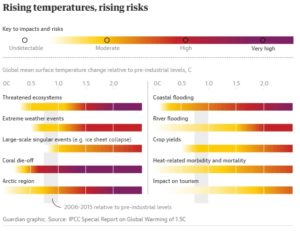
The authors of the landmark report by the UN Intergovernmental Panel on Climate Change (IPCC) released on Monday say urgent and unprecedented changes are needed to reach the target, which they say is affordable and feasible although it lies at the most ambitious end of the Paris agreementpledge to keep temperatures between 1.5C and 2C.

The half-degree difference could also prevent corals from being completely eradicated and ease pressure on the Arctic, according to the 1.5C study, which was launched after approval at a final plenary of all 195 countries in Incheon in South Korea that saw delegates hugging one another, with some in tears.

“It’s a line in the sand and what it says to our species is that this is the moment and we must act now,” said Debra Roberts, a co-chair of the working group on impacts. “This is the largest clarion bell from the science community and I hope it mobilises people and dents the mood of complacency.”

Policymakers commissioned the report at the Paris climate talks in 2016, but since then the gap between science and politics has widened. Donald Trump has promised to withdraw the US – the world’s biggest source of historical emissions – from the accord. The first round of Brazil’s presidential election on Sunday put Jair Bolsonaro into a strong position to carry out his threat to do the same and also open the Amazon rainforest to agribusiness.

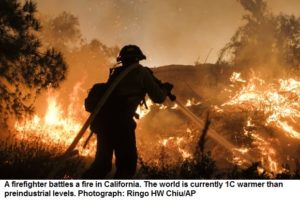
The world is currently 1C warmer than preindustrial levels. Following devastating hurricanes in the US, record droughts in Cape Town and forest fires in the Arctic, the IPCC makes clear that climate change is already happening, upgraded its risk warning from previous reports, and warned that every fraction of additional warming would worsen the impact.


See the remaining article in the Appendix below.

Source: Posted The Guardian – London Daily Newspaper October 8, 2018;retrieved October 15, 2018 from: https://www.theguardian.com/environment/2018/oct/08/global-warming-must-not-exceed-15c-warns-landmark-un-report

This is not Armageddon … yet. But the Bible does provide a justification that redeeming mankind will only happen at the precipice, just as man’s perilous rule reaches the point of unavoidable destruction of the planet. That scripture reads:

18  But the nations became wrathful, and your own wrath came, and the appointed time came for the dead to be judged and to reward+ your slaves the prophets+ and the holy ones and those fearing your name, the small and the great, and to bring to ruin those ruining* the earth.”+ – Revelation 11:18 New World Translation

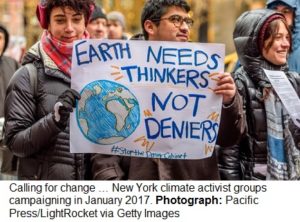
Yes, truly, “we” are ruining the earth. Some people (countries) more so than others. But despite whether we are the guilty culprits or not, we still only have one planet … and it needs some attention. Or else …

… after 12 years, no more earth, the way we know it.

All the evidence is in front of us. To ignore it, we do so at our own peril. As related previously, the Numbers don’t lie: as of this past May, the earth has had 400 straight warmer-than-average months. See other aligned blog-commentaries that echoed this assessment:

https://goleancaribbean.com/blog/?p=14925 Climate Change Doubt?! Numbers Don’t Lie
https://goleancaribbean.com/blog/?p=14832 Manifesting Environmental Change
https://goleancaribbean.com/blog/?p=11858 Islands are Disappearing – The Cautionary Tale of Kiribati
https://goleancaribbean.com/blog/?p=9455 Fix ‘Climate Change’ – Yes, We Can
https://goleancaribbean.com/blog/?p=7103 COP21 – ‘Climate Change’ Acknowledged
https://goleancaribbean.com/blog/?p=6893 A Meteorologist’s View On Climate Change
https://goleancaribbean.com/blog/?p=4673 Climate Change‘ Merchants of Doubt … to Preserve Profits!!
https://goleancaribbean.com/blog/?p=2465 Book: ‘This Changes Everything: Capitalism vs. the Climate’
https://goleancaribbean.com/blog/?p=2276 Climate Change May Affect Food Supply Within a Decade
https://goleancaribbean.com/blog/?p=1883 Climate Change May Bring More Kidney Stones
https://goleancaribbean.com/blog/?p=1817 Caribbean grapples with intense cycles of flooding & drought

Are we saying that the earth will be destroyed in 12 years?

No!

But the mitigations that are feasible to assuage this problem, only have a limited shelf-life. After 12 years, there may not be any turning back from a Greenhouse planet. Once we accept this fact – the eventuality of the Climate Change Catastrophe – only then can we start to make effort to address the truth: our “house is on fire”.

There should be no doubt, we must act now.

What are we going to do about it?

Yes, we can … make a difference … still. But now we cannot hit or miss; we are at the precipice.

Perhaps this reality now is why one of the world’s most notorious Climate Change Denier is finally, begrudgingly, owning up to the fact that … “there might be something to this Climate Change” thing.

We’re talking about US President Donald Trump. See  the VIDEO here:

VIDEO – President Donald Trump’s ’60 Minutes’ Interview: Climate Change, etc. –  https://youtu.be/_D8OfRiEff4

TODAY
Published on Oct 15, 2018 – In an interview with “60 Minutes,” President Trump backed off earlier statements that climate change is a hoax, and also said that he doesn’t “trust everybody” in the White House. He also commented on Supreme Court Justice Brett Kavanaugh’s confirmation and the ongoing Russia investigation.

This is how destiny works. We can run from it, deny it or hide. But it will still catch up with us.

The earth is destined to suffer great catastrophes due to Climate Change … in 12 years!

Let’s do our share, everyone, everywhere to see if we can abate this reality.

The book Go Lean…Caribbean – available to download for free – serves as a roadmap for the introduction and implementation of the technocratic Caribbean Union Trade Federation (CU), to reform and transform all of Caribbean society – all 30 member-states. There is the need to shepherd our own communities to do our share to abate Climate Change. While the problem is too big for us alone in our region, we must still act … nonetheless. We cannot sit back, fold our arms and expect everyone else to do the heavy-lifting. No, we must even lead, since we are on the frontlines of over-heated hurricanes.

This is a lesson learned from Canada; they are on the frontline of melting ice-caps – think icy Northwest Passage – so they are stepping-up to act and show the world how to act. They are not waiting for “deniers to wake up and stop denying”; they are putting in their mitigation now … anyway. Then they are telling and showing the world what to do in following their example. This was detailed in a previous Go Lean commentary as follows:

Canada … has the longest total coastline among all of the countries of the world, at 125,567 miles. …

If Climate Change is to continue unabated, this country has a lot to lose – catastrophic storms, melting ice caps, thawing permafrost and rising sea level. …

Canada is prepared to take the lead, to put the Western Hemisphere on its shoulders and carry the load for arresting Climate Change. …

Thank you Canada for this model. Now, we – the Caribbean – need to step up to carry our own load for better mitigation of Climate Change threats; we need to do our part in lowering our own carbon footprint. We can make a difference. Canada can make a difference. As related in a previous blog-commentary, the same as the threat of Acid Rain was subjugated, so too, curative measures can be put in place to lower the greenhouse gases in the environment. This is why Canada has a Champion for the Environment – Catherine McKenna – at the Cabinet level.

Good model …

The Go Lean roadmap addresses all aspects of Caribbean society – economics, security and governance – and then declares: “Do this; Do that; Do Something; Do Everything”. The roadmap presents these prime directives in this regards:

Fixing Climate Change in the US or Canada is out-of-scope for this Go Lean movement; but we still need them to act. We also need Europe, China, India – all Big Polluters – and all countries of the world to act. We must stand on soap boxes, podiums and stages and tell the world – everyone must listen; we must make them listen. This is now everyone’s job, everyone’s responsibility.

We only have 12 years!

Make no plans for Year 13 and beyond. 🙁

There is hope! The Go Lean book and roadmap stresses that reforming and transforming the Caribbean’s societal engines to abate Climate Change is possible; it is conceivable, believable and achievable. But this is heavy-lifting.

The Go Lean book provides 370-pages of turn-by-turn instructions on “how” to prepare and respond for Climate Change catastrophes. See this sample of strategies, tactics, implementations and advocacies from the book:

Community Ethos – Deferred Gratification Page 21
Community Ethos – Economic Systems Influence Individual Choices / Incentives Page 21
Community Ethos – The Consequences of Choices Lie in the Future Page 21
Community Ethos – “Crap” Happens Page 23
Strategy – Mission – Prepare for Natural Disasters Page 45
Strategy – Agents of Change – Climate Change Page 57
Tactical – Confederating a Permanent Union Page 63
Tactical – Fostering a Technocracy Page 64
Separation of Powers – Emergency Management Page 76
Separation of Powers – Meteorological & Geological Service Page 79
Anecdote – “Lean” in Government Page 93
Implementation – Security Initiatives at Start-up – Unified Command & Control Page 103
Implementation – Industrial Policy for CU Self Governing Entities Page 103
Implementation – Ways to Deliver Page 109
Implementation – Ways to Foster International Aid Page 115
Implementation – Ways to Benefit from Globalization – Produce, Not Just Consume Page 119
Advocacy – Ways to Better Manage the Social Contract Page 170
Advocacy – Ways to Foster Cooperatives Page 176
Advocacy – Ways to Improve for Natural Disasters Page 184
Advocacy – Ways to Improve Emergency Management Page 196
Advocacy – Ways to Improve Transportation – CNG Buses and Electric Street Cars Page 205
Advocacy – Ways to Develop the Auto Industry – Embrace Alternative Energy Page 206

Are we up to this challenge?

We must work at it … as if our life depends on it.

It does!

We need all hands on deck! This is an Inconvenient Truth but its the truth nonetheless. We urge all Caribbean stakeholders to lean-in to this Go Lean roadmap for change, to get our homeland more active in the solution and abatement of Climate Change. Let’s get going. 🙂

Download the free e-Book of Go Lean … Caribbean – now!

Sign the petition to lean-in for this roadmap for the Caribbean Union Trade Federation.

—————-

Appendix – We have 12 years to limit climate change catastrophe, warns UN (Cont’d)

This is the continuation of the news article from the Guardian Newspaper …

Scientists who reviewed the 6,000 works referenced in the report, said the change caused by just half a degree came as a revelation. “We can see there is a difference and it’s substantial,” Roberts said.

At 1.5C the proportion of the global population exposed to water stress could be 50% lower than at 2C, it notes. Food scarcity would be less of a problem and hundreds of millions fewer people, particularly in poor countries, would be at risk of climate-related poverty.

At 2C extremely hot days, such as those experienced in the northern hemisphere this summer, would become more severe and common, increasing heat-related deaths and causing more forest fires.

But the greatest difference would be to nature. Insects, which are vital for pollination of crops, and plants are almost twice as likely to lose half their habitat at 2C compared with 1.5C. Corals would be 99% lost at the higher of the two temperatures, but more than 10% have a chance of surviving if the lower target is reached.

Sea-level rise would affect 10 million more people by 2100 if the half-degree extra warming brought a forecast 10cm additional pressure on coastlines. The number affected would increase substantially in the following centuries due to locked-in ice melt.

Oceans are already suffering from elevated acidity and lower levels of oxygen as a result of climate change. One model shows marine fisheries would lose 3m tonnes at 2C, twice the decline at 1.5C.

Sea ice-free summers in the Arctic, which is warming two to three times faster than the world average, would come once every 100 years at 1.5C, but every 10 years with half a degree more of global warming.

Time and carbon budgets are running out. By mid-century, a shift to the lower goal would require a supercharged roll-back of emissions sources that have built up over the past 250 years.

The IPCC maps out four pathways to achieve 1.5C, with different combinations of land use and technological change. Reforestation is essential to all of them as are shifts to electric transport systems and greater adoption of carbon capture technology.

Carbon pollution would have to be cut by 45% by 2030 – compared with a 20% cut under the 2C pathway – and come down to zero by 2050, compared with 2075 for 2C. This would require carbon prices that are three to four times higher than for a 2C target. But the costs of doing nothing would be far higher.

“We have presented governments with pretty hard choices. We have pointed out the enormous benefits of keeping to 1.5C, and also the unprecedented shift in energy systems and transport that would be needed to achieve that,” said Jim Skea, a co-chair of the working group on mitigation. “We show it can be done within laws of physics and chemistry. Then the final tick box is political will. We cannot answer that. Only our audience can – and that is the governments that receive it.”

He said the main finding of his group was the need for urgency. Although unexpectedly good progress has been made in the adoption of renewable energy, deforestation for agriculture was turning a natural carbon sink into a source of emissions. Carbon capture and storage projects, which are essential for reducing emissions in the concrete and waste disposal industries, have also ground to a halt.

Reversing these trends is essential if the world has any chance of reaching 1.5C without relying on the untried technology of solar radiation modification and other forms of geo-engineering, which could have negative consequences.

In the run-up to the final week of negotiations, there were fears the text of the report would be watered down by the US, Saudi Arabia and other oil-rich countries that are reluctant to consider more ambitious cuts. The authors said nothing of substance was cut from a text.

Bob Ward, of the Grantham Research Institute on Climate Change, said the final document was “incredibly conservative” because it did not mention the likely rise in climate-driven refugees or the danger of tipping points that could push the world on to an irreversible path of extreme warming.

The report will be presented to governments at the UN climate conference in Poland at the end of this year. But analysts say there is much work to be done, with even pro-Paris deal nations involved in fossil fuel extraction that runs against the spirit of their commitments. Britain is pushing ahead with gas fracking, Norway with oil exploration in the Arctic, and the German government wants to tear down Hambach forest to dig for coal.

At the current level of commitments, the world is on course for a disastrous 3C of warming. The report authors are refusing to accept defeat, believing the increasingly visible damage caused by climate change will shift opinion their way.

“I hope this can change the world,” said Jiang Kejun of China’s semi-governmental Energy Research Institute, who is one of the authors. “Two years ago, even I didn’t believe 1.5C was possible but when I look at the options I have confidence it can be done. I want to use this report to do something big in China.”
The timing was good, he said, because the Chinese government was drawing up a long-term plan for 2050 and there was more awareness among the population about the problem of rising temperatures. “People in Beijing have never experienced so many hot days as this summer. It’s made them talk more about climate change.”

Regardless of the US and Brazil, he said, China, Europe and major cities could push ahead. “We can set an example and show what can be done. This is more about technology than politics.”

James Hansen, the former Nasa scientist who helped raised the alarm about climate change, said both 1.5C and 2C would take humanity into uncharted and dangerous territory because they were both well above the Holocene-era range in which human civilisation developed. But he said there was a huge difference between the two: “1.5C gives young people and the next generation a fighting chance of getting back to the Holocene or close to it. That is probably necessary if we want to keep shorelines where they are and preserve our coastal cities.”

Johan Rockström, a co-author of the recent Hothouse Earth report, said scientists never previously discussed 1.5C, which was initially seen as a political concession to small island states. But he said opinion had shifted in the past few years along with growing evidence of climate instability and the approach of tipping points that might push the world off a course that could be controlled by emissions reductions.

“Climate change is occurring earlier and more rapidly than expected. Even at the current level of 1C warming, it is painful,” he told the Guardian. “This report is really important. It has a scientific robustness that shows 1.5C is not just a political concession. There is a growing recognition that 2C is dangerous.”

Source: Posted The Guardian – London Daily Newspaper October 8, 2018;retrieved October 15, 2018 from: https://www.theguardian.com/environment/2018/oct/08/global-warming-must-not-exceed-15c-warns-landmark-un-report

Related: Overwhelmed by climate change? Here’s what you can do

Share this post:
, , , ,
[Top]

Paul Romer – Congrats to the New Nobel Laureate

Go Lean Commentary

Some people make great accomplishments, to the point that they are recognized … globally.

Sometimes, a person greatest accomplishment is that they inspire others.

Every now and then, one person does both.

The world is celebrating the accomplishment of American Economist and University Professor Dr. Paul Romer; he has just been awarded the Nobel Prize for Economics.

Congratulations!

This is a Big Deal for him … and for us in the Caribbean.

Wait, what?

Dr. Romer gets this award today in 2018, but back in 2013, he inspired an important movement in the Caribbean. His writings inspired the book Go Lean…Caribbean. He coined the following phrases, as recorded in the Go Lean book (Page 8):

“A crisis is a terrible thing to waste”

Economic growth occurs whenever people take resources and re-arrange them in ways that are more valuable

Before examining this inspiration and motivation, we must first give Dr. Romer his “props”. See the aligning news article here from the Economist Magazine:

Title: Paul Romer and William Nordhaus win the economics Nobel
Sub-title:
Both have studied the causes and consequences of growth
October 11, 2018 – WHY do economies grow, and why might growth outstrip the natural world’s capacity to sustain it? There are few more important questions in economics. The answers require a working grasp of the mechanisms underlying growth. For the progress that the profession has made towards that understanding, it owes a particular debt to Paul Romer and William Nordhaus, this year’s winners of the Nobel prize in economic sciences.

Although both scholars have long been talked of as potential winners, they are not an obvious pairing for the prize. Mr Romer tends to be described as a growth theorist; Mr Nordhaus’s work is in the field of environmental economics. The Sveriges Riksbank, which awards the economics Nobel, found a common thread in their work incorporating two crucial processes—knowledge creation and climate change, respectively—into models of economic growth. But what most links their work is that they have improved the way the profession thinks about impossibly complex systems, while also revealing the extent of its ignorance.

The influence of both men extends beyond their most noted scholarly achievements. Mr Romer’s career has been especially varied. He left academia in the early 2000s to found an educational-software company. More recently he served as the World Bank’s chief economist (his tenure ended abruptly when staffers bridled at his management style, which included an insistence on more crisply written reports). But it is his analysis of economic growth that has had the greatest impact.

Economists used to think that sustained long-run growth depended on technological progress, which in turn relied on the creation of new ideas. They struggled, however, to explain convincingly how markets generated and propagated those ideas. When Mr Romer came into economics, most prominent models of growth relied on “exogenous” technological progress: it was simply assumed, rather than generated by the models’ equations.

Dissatisfied by this state of affairs, he sought answers by probing the non-rivalrous nature of knowledge: the fact that ideas, once created, can be endlessly exploited. The firms or individuals that come up with new ideas can only ever capture a small share of the benefits arising from them; before long, competitors copy the original brainwave and whittle away innovators’ profits. In Mr Romer’s work, markets are capable of generating new ideas. But the pace at which they are generated, and the way in which they are translated into growth, depends on other factors—such as state support for research and development, or the protection of intellectual property.

The “endogenous” growth models produced by Mr Romer, and by others influenced by him, were once hailed as a critical step towards understanding patterns of economic growth across the globe. They have not quite fulfilled that promise: knowledge may be necessary for growth, but it is clearly not sufficient. But their shortcomings have themselves raised important questions about the stubborn disparities in growth rates. Why are some countries able to exploit existing ideas and grow, while others are not? Should policymakers who want to boost growth focus on policies that support the creation of knowledge or on those that break down barriers to the exploitation of existing knowledge? Or does it make most sense to shift people and resources from the parts of the world that struggle to grow to those that do not? By provoking such questions, Mr Romer’s work identified a rich vein for other researchers to mine.

Mr Nordhaus, for his part, has been a towering figure in the debate about how to respond to one of the biggest challenges that humanity faces. When he was beginning his career in the early 1970s, awareness of the dangers of environmental damage and the threat posed by climate change was just starting to grow. Understanding the economic costs such damage imposes is essential to answering the question of how much society should be willing to pay to avert it.

Mr Nordhaus applied himself to solving this problem. That meant working out the complex interactions between carbon emissions, global temperature and economic growth. He combined mathematical descriptions of both climate and economic activity into “integrated assessment models”. This allowed him to project how different trajectories for the world’s carbon emissions would produce different global temperatures. That, in turn, allowed him to estimate the likely costs of these different scenarios—and thus what level of reduction in emissions would be economically optimal. He was the first to suggest that warming should be limited to no more than 2°C higher than the world’s pre-industrial temperature. Models like his have become the linchpin of most analysis of the cost of climate change.

The known world
As with Mr Romer’s work, Mr Nordhaus’s contributions are also notable for the lessons imparted by their shortcomings. Four decades after he began publishing research on climate change, the limits to scholars’ predictive abilities have become abundantly clear. Indeed, his work has prompted vigorous debate about how best to think through the huge uncertainties associated with global warming—from how emissions translate into higher temperatures to how well society can adapt to rapid changes in climate.

Policymakers prefer the comfort of hard numbers. But the often-unfathomable complexity of human society and natural processes may mean that other guides are sometimes needed to set policy, from the precautionary principle to moral reasoning. Ironically, Mr Nordhaus’s computations, like those of Mr Romer, made that awareness possible.

Above all, both of this year’s prize-winners tackled problems that the field both could not understand and could not afford not to understand. They blazed trails that scholars continue to follow—to the benefit of economics and humanity.

This article appeared in the Finance and economics section of the print edition under the headline “Greener pastures”

Source: Retrieved October 12, 2018 from https://www.economist.com/finance-and-economics/2018/10/13/paul-romer-and-william-nordhaus-win-the-economics-nobel

As for Dr. Romer’s sphere of influence:

Romer was named one of America’s 25 most influential people by Time magazine in 1997.[10]

According to this encyclopedic source, his trademark quotation was stated in 2004…

Romer is credited with the quote “A crisis is a terrible thing to waste,” which he said during a November 2004 venture-capitalist meeting in California. Although he was referring to the rapidly rising education levels in other countries compared to the United States, the quote became a rallying concept for economists and consultants looking for constructive opportunities amid the Great Recession.[17]

So when the movement behind the Go Lean book, came “under his spell”, he had a long and noble track record. Now he is a Nobel Laureate.

So this one man had made a difference in the world, and even in our Caribbean world. The movement behind the book Go Lean…Caribbean – available to download for free – has consistently asserted that one man or one woman can make a difference in society. Though Dr. Romer is not in the Caribbean, nor from the Caribbean, we can still look, listen and learn from his contributions. His pioneering principle of Endogenous growth theory is spot-on for the economic policy that we need to adopt for the Caribbean reboot. See the definition here:

Endogenous growth theory holds that economic growth is primarily the result of endogenous and not external forces [or exogenous].[1] Endogenous growth theory holds that investment in human capital, innovation, and knowledge are significant contributors to economic growth.

Now to learn and apply this lesson. In plain-speak, education directly elevates economics. The Go Lean book quotes this accepted fact on Page 258:

… both public and private returns to investment in education are positive—at both the individual and economy-wide levels

The Go Lean book developed the argument of one person making a difference (Page 122). It specifically relates:

An advocacy is an act of pleading for, supporting, or recommending a cause or subject. For this book, it’s a situational analysis, strategy or tactic for dealing with a narrowly defined subject.

Advocacies are not uncommon in modern history. There are many that have defined generations and personalities. Consider these notable examples from the last two centuries in different locales around the world:

  • Frederick Douglas
  • Mohandas Gandhi
  • Martin Luther King
  • Nelson Mandela
  • Cesar Chavez
  • Candice Lightner

The Go Lean book seeks to advocate and elevate the Caribbean, and the people who love our homeland. Yet still, we can learn lessons from the Nobel-prize-winning Economist and direct our regional stakeholders to a Way Forward based on best-practices of home-grown and home-targeted education. The book serves as a roadmap for the introduction and implementation of the technocratic Caribbean Union Trade Federation (CU), to move our society to a brighter future, by elevating our societal engines – for all member-states. This CU/Go Lean roadmap has these 3 prime directives:

  • Optimization of the economic engines in order to grow the regional economy to $800 Billion and create 2.2 million new jobs.
  • Establishment of a security apparatus to ensure public safety and protect the resultant economic engines.
  • Improve Caribbean governance to support these engines, including a separation-of-powers between the member-states and CU federal agencies.

The book stresses that reforming and transforming the Caribbean societal engines must be a regional pursuit – we must ensure that we have the best education option available to our people, but in a way that does not jeopardize their remaining in their Caribbean homeland. This challenge to guarantee our “brain does not drain” is too big for any one Caribbean member-state to contend with alone. This was an early motivation for the roadmap, as pronounced in the opening Declaration of Interdependence (Pages 12 – 14):

xi. Whereas all men are entitled to the benefits of good governance in a free society, “new guards” must be enacted to dissuade the emergence of incompetence, corruption, nepotism and cronyism at the peril of the people’s best interest. The Federation must guarantee the executions of a social contract between government and the governed.

xxi. Whereas the preparation of our labor force can foster opportunities and dictate economic progress for current and future generations, the Federation must ensure that educational and job training opportunities are fully optimized for all residents of all member-states, with no partiality towards any gender or ethnic group. The Federation must recognize and facilitate excellence in many different fields of endeavor, including sciences, languages, arts, music and sports. This responsibility should be executed without incurring the risks of further human flight, as has been the past history.

xxxiii. Whereas lessons can be learned and applied from the study of the recent history of other societies, the Federation must formalize statutes and organizational dimensions to avoid the pitfalls of communities like East Germany, Detroit, Indian (Native American) Reservations, Egypt and the previous West Indies Federation. On the other hand, the Federation must also implement the good examples learned from developments/ communities …

The Go Lean book provides 370-pages of turn-by-turn instructions on “how” to adopt new community ethos, plus the strategies, tactics, implementations and advocacies to execute so as to reboot, reform and transform the societal engines of Caribbean society.

The Go Lean movement calls on every man, woman and child in the Caribbean to be an advocate and a champion, or at least appreciate the championing efforts of previous advocates. Their examples can truly help us today with our passions and purpose. Consider this sample of prior blog/commentaries where advocates and role models have been elaborated upon:

https://goleancaribbean.com/blog/?p=14541 Viola Desmond – One Woman Made a Difference
https://goleancaribbean.com/blog/?p=14139 Carter Woodson – One Man Made a Difference … for Black History
https://goleancaribbean.com/blog/?p=11963 Oscar López Rivera – The ‘Nelson Mandela’ of the Caribbean?
https://goleancaribbean.com/blog/?p=11442 Caribbean Roots: Al Roker – ‘Climate Change’ Defender
https://goleancaribbean.com/blog/?p=10801 Caribbean Roots: John Carlos – The Man. The Moment. The Movement
https://goleancaribbean.com/blog/?p=10114 Caribbean Roots: Esther Rolle of ‘Good Times’
https://goleancaribbean.com/blog/?p=9948 Caribbean Roots: Sammy Davis, Jr.
https://goleancaribbean.com/blog/?p=9300 Edward Snowden – One Person Making a Difference
https://goleancaribbean.com/blog/?p=8724 Remembering Marcus Garvey: Still Relevant Today
https://goleancaribbean.com/blog/?p=8495 The NBA’s Tim Duncan – Champion On and Off the Court
https://goleancaribbean.com/blog/?p=8328 YouTube Millionaire: ‘Tipsy Bartender’
https://goleancaribbean.com/blog/?p=7682 Frederick Douglass: Role Model for Single Cause – Death or Diaspora
https://goleancaribbean.com/blog/?p=866 Bob Marley: The legend lives on!

Thank you Dr. Paul Romer, for your good role model. Congratulations on your Nobel Prize award. You deserve the recognition. (See the explanation VIDEO in the Appendix below).

In your role as a professor, you have not just taught your classes, but rather the whole world. We say to you as we do to all of our own Caribbean teachers; we say (Go Lean book Valedictions on Page 252):

Thank you for your service, for molding young minds.

The movement behind Go Lean book, the planners of a new Caribbean stresses that a ‘change is going to come’. We have endured failure for far too long; we have seen what works and what does not. We want to learn from Nobel Laureates and apply their lessons as mitigations, though it may be heavy-lifting.

Yes, our Caribbean society is in crisis right now, but as Dr. Romer enunciated:

A crisis is a terrible thing to waste.

We urged every Caribbean stakeholder to lean-in to this Go Lean roadmap to make the homeland a better place to live, work and play. 🙂

Sign the petition to lean-in for this roadmap for the Caribbean Union Trade Federation.

—————–

Appendix VIDEO – The Nobel Prize to Paul Romer – https://youtu.be/JSQSei9XoaI

UniBocconi
Published on Oct 8, 2018 – Guido Tabellini, economist at Bocconi, explains why Romer has won the Nobel Prize for Economics.

Share this post:
,
[Top]

Industrial Reboot – Payment Cards 101

Go Lean Commentary

The purpose of any business is to earn a profit.

Profit is good!

We may be more familiar with a parallel version of this expression, as related in a previous blog-commentary:

greed is good! In this case “greed” is not being defined as excess, but rather the natural desire to possess wealth, goods, or objects of abstract value with the intention to keep it for one’s self. The dreaded excess of “greed”, on the other hand, is a “vice” that must be cautiously monitored and curtailed, i.e. Crony-Capitalism.

When there is an opportunity for profit, people, companies and industries step-in and step-up for the chances to earn. This is the basis for capitalism and other market-based economies. So the profit motive is attached to any industrial landscape. Whenever economic engines become strained and stressed – devoid of profit – the industrial landscape should be revisited and rebooted.

This is the assessment of the Caribbean – our economic engines are in crisis – and this is the intent of the movement behind the book Go Lean…Caribbean – a crisis is a terrible thing to waste . This is why the book opens with a relevant pronouncement in the Declaration of Interdependence (Page 13):

xxiv. Whereas a free market economy can be induced and spurred for continuous progress, the Federation must install the controls to better manage aspects of the economy: jobs, inflation, savings rate, investments and other economic principles. Thereby attracting direct foreign investment because of the stability and vibrancy of our economy.

There is now the opportunity to transform the industrial landscape of Caribbean communities; we can install controls so as to better manage our economy and industrial landscape. Among the many strategies and tactics discussed by this Go Lean movement, there is this one irresistible prospect of introducing electronic money (e-Money) or Payment Cards through out the region.

So, instead of cash, industrial stakeholders will do most transactions … electronically. This changes everything!

With an e-Money/Payment Cards deployment, there would be so many benefits; consider these possibilities:

  • Functional – Payroll and Government Benefits can be easily loaded; credit programs can also be added.
  • Universality – whether its e-Money or Payment Cards, all financial transactions can be executed
  • Portability – e-Money can be used in Cyberspace and in the real world transactions (merchant POS, ATMs)
  • Security – Smartchips and PIN options can ensure against unauthorized use.
  • Resilience – card-to-card transactions can be conducted even with no online connection – think Block-chain.
  • Risk-aversion – The informal economy and Black Markets are mitigated, thereby fostering tax revenues.
  • Far-reaching – Benefits outside of the payment transaction; the scheme increases the money supply (M1), which increases available bank capital for community investments.

This is Payment Cards 101. See the exploratory VIDEO in the Appendix below.

The actuality of a country’s universal acceptance of e-Money/Payment Cards is not just academic, it is already in play … in model countries – think India. They, this emerging economy of 1.2 billion people, have rolled out numerous e-Money products for their “rupee” currency. They have learned-lessons – good, bad and ugly – for us to apply in our implementation. This summary was detailed in a previous Go Lean commentary; consider this excerpt:

Excerpt: What the U.S. can learn from India’s move toward a cashless society

Silicon Valley fancies itself the global leader in innovation. Its leaders hype technologies such as bitcoin and blockchain, which some claim are the greatest inventions since the Internet. They are so complex that only a few mathematicians can understand them, and they require massive computing resources to operate — yet billions of dollars are invested in them.

India may have leapfrogged the U.S. technology industry with simple and practical innovations and massive grunt work. It has built a digital infrastructure that will soon process billions more transactions than bitcoin ever has. With this, India will skip two generations of financial technologies and build something as monumental as China’s Great Wall and America’s interstate highways.

In 2009, the government launched a massive project, called Aadhar, to solve this problem by providing a digital identity to everyone based on an individual’s fingerprints and retina scans. As of 2016, the program had issued 12-digit identification numbers to 1.1 billion people. This was the largest and most successful I.T. project in the world and created the foundation for a digital economy.

And then India launched its Unified Payment Interface (UPI), a way for banks to transfer money directly to one another based on a single identifier, such as the Aadhar number.

With a system such as UPI, the billing processor is eliminated, and transaction costs are close to zero. …

Nobel Prize-winning economist Joseph Stiglitz said at the World Economic Forum meeting in Davos, Switzerland, that the United States should follow Modi’s lead in phasing out currency and moving toward a digital economy, because it would have “benefits that outweigh the cost.” …

Where as India’s e-Money deployment is for their rupee currency, the Caribbean’s plan is to introduce a regional integrated currency branded the Caribbean Dollar (C$). This was the stated intent of the book Go Lean … Caribbean, to serves as a roadmap for the introduction and implementation of the Caribbean Union Trade Federation (CU) and the aligning Caribbean Central Bank (CCB), the issuer of C$. This Go Lean/CU/CCB roadmap depicts e-Money and Payment Cards as a hallmark of technocratic efficiency, with the agility to manage this deployment. This will affect all aspects of Caribbean society – economics, security and governance. As a currency product, surely it affects the economic engines, but with the ubiquity of a government Payment Card system – the government is the largest employer – the universality of this reboot will have immediate impacted.

This reality fits in with the quest of the Go Lean roadmap, to optimize all societal engines, as stated with these 3 prime directives:

  • Optimization of the economic engines in order to grow the regional economy to $800 Billion & create 2.2 million new jobs.
  • Establishment of a security apparatus to ensure public safety and protect the resultant economic engines ; where there is economic successes, “bad actors” always emerge, so there must be a solution for predictive and reactive mitigations and interdictions.
  • Improvement of Caribbean governance to support these above engines. This include a separation-of-powers between the member-states and CU federal agencies, including the independent administration of the Caribbean Central Bank.

The Go Lean/CU/CCB roadmap anticipated e-Money and Payment Card schemes. The book detailed strategies as follows:

  • e-Government – The CU is prescribed as the regional administrator for ICT for the Single Market of 30 states and 42-million people. While the Caribbean Central Bank (CCB) will manage the region’s M1, they will embrace the e-Government mandate, calling for card-based, electronic payment options for all federal transactions and encouraging this mode for state/municipal/private facilitations as well. This means that the Caribbean dollar (C$) will be mostly cashless, an accounting currency much like the first years of the Euro. The CCB will settle all C$ electronic transactions (MasterCard-Visa style or ACH style) and charge interchange/clearance fees. – This scheme is fully defined on Page 198.
  • Cruise line passengers using smart-chips – the cruise industry needs the Caribbean more than the Caribbean needs the industry. But the cruise lines have embedded rules/regulations designed to maximize their revenues at the expense of the port-side establishments. The CU solution is to deploy a scheme for smartcards (or smart-phone applications) that function on the ships and at the port cities. This scheme will also employ NFC technology – (Near Field Communications; defined fully at Page 193 – so as to glean the additional security benefits of shielding private financial data of the guest and passengers. [This scheme will incentivize more spending among cruise line passengers.] – Defined fully on Page 193.
  • Electronic Commerce – This holds the promise of “leveling the playing field” so that small merchants can compete against larger merchants. To facilitate e-Commerce, purchased merchandise must get to their destinations as efficiently as possible. The CU’s implementation of the Caribbean Postal Union allows for better logistics for package delivery. – Defined fully on Page 201.
  • Internet Marketplace / Social Media – The CU‘s web portal, www.myCaribbean.gov, will grant free access, email, IM, and profile pages for CU stakeholders, even normalizing communications thru social media sites. This will facilitate internet commerce activities in the region, as the CU will have hot data on profiles, habits and previous activities, thereby creating opportunities for measured marketing. – Defined fully on Page 198.
  • Government Benefits / Electronic Benefits Transfer (EBT) – allows State welfare departments to issue benefits via magnetically encoded payment card, used in the United States and the United Kingdom. Common benefits provided (in the United States) via EBT are typically of two general categories: food and cash benefits. – Defined fully on Page 353.
  • Unemployment Benefits – The CU‘s mandate for e-Delivery and e-Payment will make the unemployment benefits process more effective and more efficient. Claimants will be able to apply online or on the phone, and payments will be disbursed to debit/payment cards, as opposed to paper checks. (Payments will be in Caribbean dollars, even in Puerto Rico and the US Virgin Islands). – Defined fully on Page 89.
  • Remittance Solutions for Diaspora – By pursuing the e-Government / e-Payment strategy, the Caribbean Diaspora will be able to remit transfers back home by just loading values onto C$ payment cards [for free]. This simplified system will minimize transfer fees and furnish [Foreign Currency] (Fx) controls. – Defined fully on Page 154.

There are countless examples of electronic money schemes facilitating more commerce (i.e. e-Commerce). The key is having an settlement / clearing entity. Under the Go Lean roadmap, that role is assumed by the CCB.

This changes everything … for everyone. Yes, we can!

The Go Lean book provides details of the community ethos to adopt, plus the strategies, tactics, implementations and advocacies that are necessary to executed in order to deliver the e-Money / Payment Card solutions to the Caribbean region. Within its 370-pages, the Go Lean book re-affirms the mantra that Internet & Communication Technologies (ICT) can be used as a great equalizer so that small nation-states can compete against large nation-states.

The points of effective, technocratic e-Money stewardship were further elaborated upon in previous blog/commentaries. Consider this sample:

https://goleancaribbean.com/blog/?p=14248 Leading with Money Matters – Almighty Dollar
https://goleancaribbean.com/blog/?p=10513 Transforming Money Countrywide – The Model of India
https://goleancaribbean.com/blog/?p=7034 The Future of Money
https://goleancaribbean.com/blog/?p=6635 New Security Chip in Credit Cards Unveiled
https://goleancaribbean.com/blog/?p=5668 Move over Mastercard/Visa, Time for Local Settlement
https://goleancaribbean.com/blog/?p=5210 Cruise Ship Commerce – Getting Ready for Change
https://goleancaribbean.com/blog/?p=4425 Cash, Credit or iPhone …
https://goleancaribbean.com/blog/?p=3889 RBC EZPay – Ready for Change
https://goleancaribbean.com/blog/?p=2074 MetroCard – Model for the Caribbean Dollar
https://goleancaribbean.com/blog/?p=1350 PayPal expands payment services to 10 markets
https://goleancaribbean.com/blog/?p=906 Bitcoin virtual currency needs regulatory framework to change image
https://goleancaribbean.com/blog/?p=528 Facebook plans to provide Fintech – Mobile payment services
https://goleancaribbean.com/blog/?p=833 One single currency, divergent economies – Europe’s Model

An e-Money transformation will mean rebooting the industrial landscape of the Caribbean. In general, rebooting the region’s industrial landscape is not a new subject for this Go Lean movement; this commentary has previously identified a number of industrial initiatives to launch a reboot in the region. See the list of previous submissions on Industrial Reboots here:

  1. Industrial RebootsFerries 101 – Published June 27, 2017
  2. Industrial RebootsPrisons 101 – Published October 4, 2017
  3. Industrial RebootsPipeline 101 – Published October 5, 2017
  4. Industrial RebootsFrozen Foods 101 – Published October 6, 2017
  5. Industrial RebootsCall Centers 101 – Published July 2, 2018
  6. Industrial RebootsPrefab Housing 101 – Published July 14, 2018
  7. Industrial RebootsTrauma 101 – Published July 18, 2018
  8. Industrial RebootsAuto-making 101 – Published July 19, 2018
  9. Industrial RebootsShipbuilding 101 – Published July 20, 2018
  10. Industrial RebootsFisheries 101 – Published July 23, 2018
  11. Industrial RebootsLottery 101 – Published July 24, 2018
  12. Industrial RebootsCulture 101 – Published July 25, 2018
  13. Industrial RebootsTourism 2.0 – Published July 27, 2018
  14. Industrial RebootsCruise Tourism 2.0 – Published July 27, 2018
  15. Industrial RebootsReinsurance Sidecars 101 – Published October 2, 2018
  16. Industrial RebootsNavy Piers 101 – Published October 9, 2018
  17. Industrial Reboots – Payment Cards 101 – Published Today – October 11, 2018

In summary, our Caribbean region needs a better industrial landscape to improve our economics, security and governance. While transforming to an e-Money / Payment Card economy may be heavy-lifting, it is worth all the hard work. This plan is conceivable, believable and achievable – India is doing it!

Let’s lean-in to the Go Lean roadmap to reboot our industrial landscape. Time to get going. There is only one destination for all of this effort: a better Caribbean homeland to live, work and play. 🙂

Download the free e-Book of Go Lean … Caribbean – now!

Sign the petition to lean-in for this roadmap for the Caribbean Union Trade Federation.

——————-

Appendix VIDEOHow Credit Card Processing Works – Transaction Cycle & 2 Pricing Modelshttps://youtu.be/avRkRuQsZ6M

BancardSales
Published on Apr 4, 2014 –
How Credit Card Processing Works : http://www.bancardsales.com

This video explains how credit card payments are passed from the cardholder to the merchant bank account. Included in the video is the transaction cycle, and a detailed explanation of the two main pricing models. If you’ve ever wondered:
How Does Credit Card Processing Work?
How To Process Credit Cards?
How Credit Card Processing Works?
How To Accept Credit Card Payments At Your Business or Understanding the transaction flow?

Then you’ll want to watch this video. It’s part of a credit card processing basics video series so be sure to check back for more updates and additional videos in the series.
Additionally, you can check out http://www.bancardsales.com for more tips and tutorials on how merchant account processing works.

Category: Education

Share this post:
, , , ,
[Top]

Industrial Reboot – Navy Pier 101

Go Lean Commentary

From small investments (seedlings) come big harvests. Remember the “mustard seed” …

“… like a grain of mustard seed, which a man took, and sowed in his field; which indeed is smaller than all seeds. But when it is grown, it is greater than the herbs, and becomes a tree, so that the birds of the air come and lodge in its branches.” — Matthew 13:31–32, World English Bible

Imagine an industrial reboot that can take a small investment – seed money – but grow into huge returns for the community.

Yes, we can!

The book Go Lean…Caribbean related a community investment that should be made in each Caribbean member-state, that of Navy Piers, and described how BIG returns can be gathered from the resultant infrastructure. The book describes that such an implementation can impact many of the societal engines – think: economy, security and governance.

What is a Navy Pier?

In short, it’s a dock … and “then some”. The most famous one, and name sake is in Chicago, Illinois; see historic details here:

Navy Pier is a 3,300-foot-long (1,010 m) pier on the Chicago shoreline of Lake Michigan. It is located in the Streeterville neighborhood of the Near North Side community area. The Navy Pier currently encompasses more than fifty acres of parks, gardens, shops, restaurants, family attractions and exhibition facilities and is the top leisure destination in the Midwestern United States (“Midwest”), drawing nearly nine million visitors annually.[2] It is one of the most visited attractions in the entire Midwest and is Chicago’s number one tourist attraction.[3]

The Navy Pier opened to the public on July 15, 1916.[4] … Its original purpose was to serve as a dock for freights, passenger traffic, and indoor and outdoor recreation; events like expositions and pageants were held there.

In the summer of 1918 the pier was also used as a jail for draft dodgers. In 1927, the pier was renamed Navy Pier to honor the naval veterans who served in World War I.

In 1941, during World War II, the pier became a training center for the U.S. Navy; about 10,000 people worked, trained, and lived there. The pier contained a 2,500-seat theater, gym, 12-chair barber shop, tailor, cobbler shops, soda fountain and a vast kitchen and hospital.[6]

In 1989, the City of Chicago had the Urban Land Institute (ULI) reimagine uses for the pier. The Metropolitan Pier and Exposition Authority (MPEA) was created; its responsibility was to manage and operate Navy Pier as well as McCormick Place. The MPEA undertook the redevelopment, incorporating some of ULI’s recommendations.[8]

In 1995, Navy Pier was redesigned and introduced to the public as a mixed-use venue incorporating retail, dining, entertainment, and cultural spaces.

Starting in 2014, the redevelopment plan called The Centennial Vision was implemented. The purpose of this plan is to fulfill the mission to keep Navy Pier as a world-class public space and to renovate the pier so it will have more evening and year-round entertainment and more compelling landscape and design features.[9] The Centennial Vision was completed in summer 2016.
Source: Retrieved October 8, 2018 from: https://en.wikipedia.org/wiki/Navy_Pier


VIDEO – Navy Pier Ferris Wheel in Chicago – https://youtu.be/YVFx0FIb82g

Published on Nov 15, 2016 – Navy Pier’s ferris wheel, an iconic part of Chicago’s skyline, received a makeover this year for the pier’s 100th anniversary. Soaring nearly 200-feet high, the ferris wheel offers 360-degree views of the Windy City and is now taller and faster than ever.

The upgrades to the Navy Pier Ferris Wheel, AKA the Centennial Wheel, are part of a larger project to revitalize the pier, giving it a more modern, sophisticated feel. …

The new wheel is 50 feet taller than its predecessor. Each ride lasts about 13 minutes and rotates three times. A ride on the old ferris wheel was only seven minutes and rotated once. DAY/NIGHT; SUMMER/WINTER The new gondolas have air conditioning and heating systems. This improvement allows you to comfortably ride the Centennial Wheel in Chicago’s painfully cold winters and hot summers. The wheel operates during the day at after dark, offering two distinct experiences.

So where there is a coastline, there is an opportunity for a connecting pier. There are 3 types of piers that are common in the modern world: Working piers, Pleasure piers and Fishing piers. These do not need a lot of land; they are normally created as land-less structures into bodies of water. See this encyclopedic definition here:

pier is a raised structure in a body of water, typically supported by well-spaced piles or pillars. Bridges, buildings, and walkways may all be supported by piers. Their open structure allows tides and currents to flow relatively unhindered, whereas the more solid foundations of a quay or the closely spaced piles of a wharf can act as a breakwater, and are consequently more liable to silting. Piers can range in size and complexity from a simple lightweight wooden structure to major structures extended over 1600 metres.

Coastlines abound throughout the Caribbean, as each of the 30 member-states is either an island or a coastal state (Belize, Guyana or Suriname). So this concept of a Navy Pier will be both a strategic and tactical implementation for the roadmap presented by the Go Lean book for the introduction and implementation of the technocratic Caribbean Union Trade Federation (CU). Consider the prime directives of the roadmap and how a Navy Pier can impact those directives:

  • Economics – The CU seeks to optimize the economic engines in order to grow the regional economy to $800 Billion and to create 2.2 million new jobs. Piers can be structured as event-entertainment destinations, even amusement parks abound. So a pier strategy can greatly impact tourism and recreation spending. Imagine new cruise ports-of-call.
  • Security – Navy Piers were originally designed for the Navy, an entity for national defense. Within the Go Lean roadmap, there is the plan for a comprehensive Homeland Security and Emergency Management apparatus to ensure public safety and protect the resultant economic engines. Imagine the quick roll-out of a floating pier after a hurricane for relief, recovery and restoration.
  • Governance – The CU seeks to improve Caribbean governance to support the above engines. This include a separation-of-powers between the member-states and CU federal agencies. Since ships can also be tendered at Navy Piers, many deliveries of the Social Contract can be built on these structures – imagine ferry access ramps, “pop-up” medical clinics, agencies for special administrative processing and kiosks. The CU plan for Self-Governing Entities allows for the piers themselves and any aligning easements to be a separate federal territory.

The Caribbean’s industrial landscape is in crisis. It must reboot! A Navy Pier can help … in every member-state. In fact the CU/Go Lean roadmap calls for a CU federal agency to build and operate – serve as landlord – the piers. Accordingly, the CU will facilitate this eco-system as Self-Governing Entities (SGE), an ideal concept for ports and piers, with its exclusive federal regulation/promotion activities. Imagine the construction equipment – dam walls, earth-moving machinery, dredging barges, etc – being used again and again as new Navy Piers are deployed through the region. Imagine the jobs …

Within the 370-pages of the Go Lean book are details of the job multiplier principle; this is how certain industries and infrastructures are better than others for generating multiple indirect jobs down the line for each direct job on a company’s payroll.

Here is a sample of references to the eco-system of piers through-out the Go Lean book:

Implementation – 10 Ways to Re-boot [Sample City] Freeport

# 7 – Cruise Ship Pier in Lucaya or Smith Point
Currently, cruise ships have to dock at the Freeport Harbor and the passengers transported to more amiable destinations, quite often the destination was the International Bazaar in the middle of a pine forest. By establishing a docking pier in the Port Lucaya vicinity, the cruise ship tourist destination will be all-encompassing in one geographic area and more value can be offered to the visitors. Cultural festivities (Gombay, Junkanoo, rake-n-scrape bands, etc.) can be a daily highlight; This would be modeling Walt Disney World’s 4 Parks and their afternoon character parades.

Page 112
Advocacy – 10 Ways to Impact Public Works

# 2 – Union Atlantic Turnpike
The Union Atlantic Turnpike is a big initiative of the CU to logistically connect all member-states for easier transport of goods and passengers. There are many transportation arteries and facilities envisioned for the Turnpike: Toll Roads, Railroads, Ferry Piers, and Navy Piers. …

Page 175
Advocacy – 10 Ways to Improve Homeland Security
# 4 – Naval Authority
Since any defense of the island and coastal states must be naval first, the Homeland Security efforts must work in conjunction with Naval operations. … The CU will build separate Navy Piers in the appropriate markets, aside from Cruise Ship docks.
Page 180
Advocacy – 10 Ways to Promote Fairgrounds
# 9 – Transit Consideration – Turnpike – Navy Piers
The Union Atlantic Turnpike initiative fits ideally into the fairgrounds business plan, as passengers and cargo can move efficiently from island to island along rail lines, toll highways, tunnels & causeways and over-the-seas ferries. The CU facilitation of Navy Piers can accommodate naval vessel shore leaves and even cruise ship traffic. …
Page 192
Advocacy – 10 Ways to Improve Fisheries
# 2 – Cooperatives
Fishery cooperatives allow fishermen and industry players to pool their resources in certain (non-competitive) areas of activity. This strategy is vital for sharing the cost and expense of installing piers/docks, locating systems (Loran-C & GPS), canaries, refrigerated warehouses and transportation solutions.
Page 210

This is the vision of an industrial reboot! A transformation for how and where a new societal eco-system can be introduced and engineered.

This Go Lean book projects the roll-out of the Union Atlantic Turnpike and accompanying Navy Piers as Day One / Step One of the Go Lean/CU roadmap. Over the 5-year implementation for this roadmap, more and more of the features of piers will be deployed and their effect on the region will be undeniable: they will help to make the whole Caribbean a better place to live, work and play.

The Go Lean book stresses that reforming and transforming Caribbean engines must be a regional pursuit. These piers need to be  installed everywhere, every member-state, island and coastal state. But this effort is truly too big for any one member-state alone. This rationale, the need for interdependence, is the reason for the Caribbean Union. This interdependence was an early motivation for this roadmap; see these statements in the opening Declaration of Interdependence (Pages 12 – 13):

xvi. Whereas security of our homeland is inextricably linked to prosperity of the homeland, the economic and security interest of the region needs to be aligned under the same governance. Since economic crimes … can imperil the functioning of the wheels of commerce for all the citizenry, the accedence of this Federation must equip the security apparatus with the tools and techniques for predictive and proactive interdictions.

xxiv.  Whereas a free market economy can be induced and spurred for continuous progress, the Federation must install the controls to better manage aspects of the economy: jobs, inflation, savings rate, investments and other economic principles. Thereby attracting direct foreign investment because of the stability and vibrancy of our economy.

xxvi.  Whereas the Caribbean region must have new jobs to empower the engines of the economy and create the income sources for prosperity, and encourage the next generation to forge their dreams right at home, the Federation must therefore foster the development of new industries… . In addition, the Federation must invigorate the enterprises related to existing industries … – impacting the region with more jobs.

Installing Navy Piers will mean rebooting the industrial landscape of the Caribbean. This is not a new subject for this Go Lean roadmap; this commentary has previously identified a number of industrial initiatives to launch a reboot in the region. See the list of previous submissions on Industrial Reboots here:

  1. Industrial RebootsFerries 101 – Published June 27, 2017
  2. Industrial RebootsPrisons 101 – Published October 4, 2017
  3. Industrial RebootsPipeline 101 – Published October 5, 2017
  4. Industrial RebootsFrozen Foods 101 – Published October 6, 2017
  5. Industrial RebootsCall Centers 101 – Published July 2, 2018
  6. Industrial RebootsPrefab Housing 101 – Published July 14, 2018
  7. Industrial RebootsTrauma 101 – Published July 18, 2018
  8. Industrial RebootsAuto-making 101 – Published July 19, 2018
  9. Industrial RebootsShipbuilding 101 – Published July 20, 2018
  10. Industrial RebootsFisheries 101 – Published July 23, 2018
  11. Industrial RebootsLottery 101 – Published July 24, 2018
  12. Industrial RebootsCulture 101 – Published July 25, 2018
  13. Industrial RebootsTourism 2.0 – Published July 27, 2018
  14. Industrial RebootsCruise Tourism 2.0 – Published July 27, 2018
  15. Industrial RebootsReinsurance Sidecars 101 – Published October 2, 2018
  16. Industrial Reboots – Navy Piers 101 – Published Today – October 9, 2018

In summary, our Caribbean region needs a better industrial landscape to improve our economics, security and governance. We can make small investments – think mustard seeds – that can yield huge returns. This is too appealing to ignore.

Let’s get going!

We urge all Caribbean stakeholders to lean-in to this roadmap for industrial reboots, to make our region better islands and coastal states to live, work and play. 🙂

Download the free e-Book of Go Lean … Caribbean – now!

Sign the petition to lean-in for this roadmap for the Caribbean Union Trade Federation.

Share this post:
, , ,
[Top]

First Day of Autumn – Let’s Get Going South – ENCORE

This should be the start of the peak tourist season – its the First Day of Autumn, its time to head South.

The movement behind the book Go Lean … Caribbean asserts that Caribbean tourism can be rebooted, reformed and transformed to capture a reliable market of Snowbirds – people who live in Northern climates who want to spend the winter in warmer destinations. A case for this Tourism 2.0 was presented in this previous blog-commentary.

cu-blog-securing-the-homeland-from-the-seas-photo-5

Imagine this vision of a Caribbean future. Instead of Late September/October being the slow season for tourism, it could be the peak “Travel South Season”. See the photo here; imagine island-hopping on ferries to get to a tropical destination.

This is the business model envisioned in the Go Lean book. It asserts that with the right guidance, investments and the adoption of best practices that the Caribbean region can give refuge to these northern snowbirds for the winter, and profit our communities at the same time. One required investment would be the network of island-hopping ferries, as depicted here.

Imagine the scenario – in the VIDEO here – but a ferry of cars and RV’s (Recreation Vehicles) arriving in one Caribbean port after another:

VIDEO – RVing on the Gulf Coast Ferry System – https://youtu.be/XlTYa83EoTM
Published on Mar 6, 2013 –  … On a recent trip from New Orleans, LA to Galveston Island, TX, both Google Maps and our GPS suggested that we drive inland, along interstate 10. Since we prefer to stay on more scenic local roads whenever possible (and we were also eager to take the RV on the ferry ride to Galveston Island) we stayed along the coast instead. As a bonus, we drove through peaceful and scenic marshland and got some views of the Gulf of Mexico as well.
While researching our route, we discovered that there would be an additional water crossing required, on the Cameron-Holly Beach ferry. We weren’t sure if a large motorhome would be able to make the crossing. Were large vehicles allowed? Was there a problem with low tide causing steep approach or departure angles? A little online research showed that it wouldn’t be a problem, although we’d recommend that anyone planning to follow this route check for any updates or changes to ferry policies or conditions. The Cameron-Holly Beach ferry trip is laughably short… only 1/4 mile and about 3 1/2 minutes. …
When we arrived in Port Bolivar, TX to catch the ferry to Galveston Island, we were pleased to find that the trip was free for all ages! During the crossing we saw dolphins riding in our bow wave and were lucky enough to catch one of them on video, as you can see. Next time you’re RVing along the Gulf Coast, get off the Interstate and head out onto the water. It’s a great way to travel by RV!

Consider the original blog-commentary here from April 11, 2014. It is being ENCORED for this first day of Autumn 2018:

============

Go Lean Commentary – Florida’s Snowbirds Chilly Welcome

Florida's Snowbird Chilly Welcome - PhotoTo the Canadian Snowbirds, looking for warm climates and a warm welcome, we say:

“Be our guest”.

To the Caribbean Diaspora, living in Canada and other northern countries, we say:

“Come in from the cold”.

The book Go Lean…Caribbean aligns with the news story in the below article. While the US may be retracting the Welcome Mats from Canadian snowbirds, after 180 days, the islands of the Caribbean extend the invitation for them to pass the wintry months here. They are invited to bring their time, talent and treasuries; (according to the foregoing article: billions of dollars).

  • Need an extra month? No problem.
  • Need access to cutting-edge medical treatment? Got it.
  • Need protection from crime and harassment? Got you covered.
  • Need video communications to interact with Embassy and government officials? Sure thing.
  • Need access to your Canadian dollar bank accounts? No problem.

The source news article is embedded here as follows:

Title: “Congress protects America from Canadian pensioners”
Gulfport, Florida – A chore combining carpentry with diplomacy awaits Gordon Bennett, a retired Canadian soldier, after his move to a larger mobile home near Florida’s Gulf coast. As commander of an overseas post of the Royal Canadian Legion, he likes to fly his national flag from a handy palm tree. But as a respectful guest—one of about half a million Canadian “snowbirds” who own winter homes in Florida, using special visas good for a total of 180 days in any 12-month period—he knows to follow strict protocol when mounting his flags, or face complaints from American neighbours. His Canadian flag cannot be flown on its own but must be paired with the Stars and Stripes (though never on the same pole). The American flag may not be smaller or fly lower, and must be flown in the position of honour (the right, as you emerge from a doorway).

Mr. Bennett, a genial octogenarian, does not resent the fussing. In his winter home of Pinellas County—an unflashy region of mobile home parks, “senior living” complexes, golf courses and strip malls—the welcome is mostly warm for Canadian snowbirds, who pump billions of dollars into Florida’s economy each year. His post shares premises with the American Legion, and has introduced local veterans to Moose Milk, a lethal Canuck eggnog-variant involving maple syrup. He routinely brings 50 or 60 Canadians to ex-servicemen’s parades, picnics or dinner-dances.

But once issues of sovereignty are raised, America’s welcome can chill. Visa rules force Canadian pensioners to count each day after they cross the border, typically in late October. They are enforced ferociously: overstayers may be barred from re-entry for five years. Some members of Congress have been trying to ease the rules for Canadian pensioners since the late 1990s. A law allowing Canadians over 55 to spend up to eight months in America each year, as long as they can show leases for property down south and do not work, passed the Senate in 2013 as part of a comprehensive immigration bill, but like the bigger bill, it has now stalled. In the House of Representatives an extension for Canadian snowbirds has been tucked into the JOLT Act, a tourism-promotion law introduced by Joe Heck, a Nevada Republican.

Canadian pensioners are not an obviously threatening group—few Americans report being mugged by elderly Ottawans armed with ice-hockey sticks. They pay property and sales taxes in America. They must cover their own health-care costs while down south, through the Canadian public health-care system and private top-up policies. If allowed to stay for eight months, most would stay only seven, predicts Dann Oliver, president of the Canadian Club of the Gulf Coast (staying longer would complicate their health cover and their tax status). They just want a few more weeks in the sun.

Yet even something this easy is proving hard. Mr. Heck is willing to tweak his bill to focus on two reforms: the Canadian extension and visa interviews by video-conference for Chinese, Brazilian and Indian would-be visitors, who currently face long journeys to American consulates. But many members of the House “are reluctant to do anything with the word immigration in it,” says Mr. Heck. Optimists hope the bill might come up for a vote this year. For Mr. Bennett and his wife, Evelyn, Canadians whose “bones ache” in their homeland’s cold, it can’t come too soon.
Source: The Economist (Retrieved 03/08/2014) –http://www.economist.com/news/united-states/21598680-congress-protects-america-canadian-pensioners-chilly-welcome

Florida's Snowbird Chilly Welcome - Photo 2The book, Go Lean…Caribbean, serves as a roadmap for the implementation of the Caribbean Union Trade Federation (CU) over a 5 year period. The book posits that tourism products can be further extended to attract, accommodate and harvest the market of Snowbirds. These ones bring more than they take, and therefore should be viewed as low-hanging fruit for tourism’s economic harvest. While some CU member-states may target a High-Net-Worth clientele, there is room too for the hordes of retirees who may seek more modest accommodations. In the end, billions of dollars of economic output from the Snowbird market are still … billions of dollars.

From the outset, the book defined that the purpose of the CU is to optimize economic, security and governing engines to impact Caribbean society, for residents and visitors. This was pronounced in Verse IV (Page 11) of the opening Declaration of Interdependence:

Whereas the natural formation of the landmass is in a tropical region, the flora and fauna allows for an inherent beauty that is enviable to peoples near and far. The structures must be strenuously guarded to protect and promote sustainable systems of commerce paramount to this reality.

In line with the foregoing article, the Go Lean book details some applicable infrastructure enhancements and advocacies to facilitate more Snowbird traffic:

  • Ferries – Union Atlantic Turnpike (Page 205)
  • Self-Governing Entities/Fairgrounds (Pages 105, 192)
  • Optimized Medical Deliveries (Page 156)
  • Marshalling Economic Crimes (Page 178)
  • Improve Elder-Care (Page 239)

The purpose of this roadmap is to make the Caribbean, a better place to live, work and play; for snowbirds too! This way we can benefit from their presence.

Download the book Go Lean … Caribbean – now!

Share this post:
, ,
[Top]

Lessons Learned from 2008: Righting The Wrong – ENCORE

Learning lessons from the past means that we will not succumb to the same risks, threats and dangers.

Is this the case for the Caribbean? Have we truly learned from the Great Recession of 2008? Are we able to avoid those threats and overcome any dangers that may arise … anew.
Doubtful!

In the 10 years since 2008, our Caribbean region have only declined, not improved. We have still not recovered. 🙁

This is the continuation of a series of commentaries relating the Lessons Learned from 2008.  This one – entry 3 of 4 in this series from the movement behind the book Go Lean … Caribbean – is in consideration of the “economic chaos” that led-up to the 2008 Financial Crisis and the lack of recovery in the Caribbean region. Our economic engines have been based primarily on tourism, so when the economic crisis befell our trading partners, we were affected worse – think parasites attached to a sick host.

Lesson for us: We must diversify!

The commentaries in the series are fully cataloged as follows:

  1. Lessons Learned from 2008 – The Long View – ENCORE
  2. Lessons Learned from 2008 – Too Big to Fail –vs- Too Small to Thrive
  3. Lessons Learned from 2008 – Righting The Wrong – ENCORE
  4. Lessons Learned from 2008 – Still Recovering

All of these commentaries relate to “how” the stewards for a new Caribbean can shepherd the economic engines of the region to apply the best-practices to finally make progress. We need a more diversified economy. So we must learn from the mistakes of the past, ours and others.

This is the purpose of this commentary to apply lessons learned from the mistakes of the US housing crisis and apply the lessons here. We must learn how “they righted that wrong”. See this Encore of a previous blog-commentary here from May 6, 2017, as follows:

——————————-

Go Lean Commentary – Righting a Wrong: 2008 Housing Crisis

Have you ever made a mistake?

“Let him that is without sin, cast the first stone” – Jesus Christ (The Bible @ John 8:7)

Since everyone makes mistakes, a good measure of a good character is how we “Right the Wrongs” that we may have caused to others. This could be the measurement of a good man (or woman), a good company and a good community. People want to be associated with goodness. They will travel great lengths and at great cost to associate with good people, affiliate with good companies and live in a good community.

CU Blog - Righting a Wrong - 2008 Housing Crisis - Photo 1

There are lessons to be learned when people, companies and communities make mistakes and then make concerted efforts to “Right the Wrongs”. These are lessons that can be applied right here in the Caribbean so as to supplement our efforts to elevate our society, to make the Caribbean homeland a better place to live, work and play.

This is more than just an academic discussion for the Caribbean; we are known to have our defects – we repeatedly make mistakes, we endanger people, oppress them, suppress their rights and then carry on unrepentant – this all results in “pushing” people away, causing societal abandonment. We must recognize these defects and repent, reconcile, reform and “Right the Wrongs” of our society.

This is the purpose of the book Go Lean…Caribbean, to help reform and transform the societal engines in the 30 member-states of the Caribbean region. The book serves as a roadmap for the introduction and implementation of the Caribbean Union Trade Federation (CU). The Go Lean/CU roadmap applies best-practices for community empowerment and features these 3 prime directives, proclaimed as follows:

  • Optimization of the economic engines to grow the regional economy to $800 Billion & create 2.2 million new jobs.
  • Establishment of a security apparatus to protect public safety and ensure the economic engines of the region.
  • Improvement of Caribbean governance to support these engines.

What “Wrongs” exactly can we consider to glean lessons-learned for our community empowerment? This commentary is 1 of 4 in a series considering how to “Right a Wrong”. The full series is as follows:

  1. Righting a Wrong: 2008 Housing Crisis
  2. Righting a Wrong: Puerto Rico’s Bankruptcy
  3. Righting a Wrong: Volkswagen Emissions Crisis
  4. Righting a Wrong: Takata Air-Bags

These “Wrongs” relate to bad actions and inaction by different actors. The image and reputations of stakeholders “take a hit” while the issue is fresh. But eventually the recovery – Righting the Wrong – can override and became the lasting legacy. This first wrong – 2008 Housing Crisis – was one of the episodes of the recent Great Recession. The Go Lean book sought to catalog the cause-and-effect of many 2008 developments from an inside perspective. The book identifies its authority to comment on these developments. See this “Who We Are” quotation (Page 8) and the VIDEO in the Appendix below:

This book is published by the SFE Foundation, a community development foundation chartered for the purpose of empowering and re-booting economic engines. …

2008 – The peak day of the recent global financial crisis was September 15, 2008. On this day, Wall Street giant Lehman Brothers filed for bankruptcy protection, and eventual dissolution, after succumbing to the weight of over-leverage in mortgage-backed securities. There is an old observation/expression that states that “there are 3 kinds of people in the world, those who make things happen, those who watch things happen and those who wonder ‘what happened?’“
Principals of the SFE Foundation were there in 2008 … engaged with Lehman Brothers; on the inside looking out, not the outside looking in. Understanding the anatomy of the modern macro economy, allows the dissection of the processes and the creation of viable solutions.

Omaha – The book was initially composed in Omaha, Nebraska, the home of one of the world’s richest men, Warren Buffet – the “Oracle of Omaha” – CEO of corporate giant Berkshire Hathaway. While the United States experienced boom and bust during the Great Recession, Omaha remained a stable, consistent model of prosperity (in March 2008 the unemployment rate in Omaha was 3.9 percent). This was no accident. This community embraces a certain ethos that is fundamental for stability and vibrancy: good corporate citizenship. Omaha is home to other corporate movers-shakers in addition to Berkshire Hathaway; (see Appendix A [on Page 254]). This community example is purported as a model for assimilation by the Caribbean region.

The Go Lean book, though composed in 2013, set the pattern for the Caribbean region to look-listen-learn from models, samples and examples like these. This allows for the regional stewards and administrators to structure policies and procedures so as to apply the lessons learned in their jurisdictions. This was an original intent. As a planning tool, the Go Lean book commenced with a Declaration of Interdependence, pronouncing the need for regional integration so as to improve our society based on lessons learned from other societies. See a stanza here (Page 14):

xxxiii. Whereas lessons can be learned and applied from the study of the recent history of other societies, the Federation must formalize statutes and organizational dimensions to avoid the pitfalls of communities like East Germany, Detroit, Indian (Native American) Reservations, Egypt and the previous West Indies Federation. On the other hand, the Federation must also implement the good examples learned from developments/communities like New York City, [Omaha,] Germany, Japan, Canada, the old American West and tenants of the US Constitution.

So here is the Wrong … and here is the “Righting of the Wrong” associated with the 2008 Housing Crisis:

The Wrong:
In 2008 a perfect storm of economic disasters hit the US and indeed the entire world. The most serious began with the collapse of housing bubbles in California and Florida, and the collapse of housing prices and the construction industries. Millions of mortgages (averaging about $200,000 each) had been bundled into securities called collateralized debt obligations that were re-sold worldwide. Many banks and hedge funds had borrowed hundreds of billions of dollars to buy these securities, which were now “toxic” because unknown values and no buying markets.

A series of the largest banks in the US and Europe collapsed; some went bankrupt, such as Lehman Brothers with $690 billion in assets; others such as Citigroup, the leading insurance company AIG, and the two largest mortgage companies (Fannie Mae, Freddie Mac) were bailed out by the US government. Congress voted $700 billion in bailout money, and the Treasury and Federal Reserve committed trillions of dollars to shoring up the financial system. But the measures did not reverse the declines – banks drastically tightened their lending policies, despite infusions of federal money. The government, for the first time, took major ownership positions in some banks. The stock market plunged 40%, wiping out tens of trillions of dollars in wealth (estimates tallying $11 Trillion); housing prices fell 20% nationwide wiping out trillions more. By late 2008 distress was spreading beyond the financial and housing sectors, especially as the “Big Three” of the automobile industry (General Motors, Ford and Chrysler) were on the verge of bankruptcy, and the retail sector showed major weaknesses. Critics of the $700 billion Troubled Assets Relief Program (TARP) expressed anger that much of the TARP money that had been distributed to banks was seemingly unaccounted for, with banks being secretive on the issue.[45] [See this portrayal in these photos or the VIDEO at https://youtu.be/N9YLta5Tr2A.]

CU Blog - Righting a Wrong - 2008 Housing Crisis - Photo 2

CU Blog - Righting a Wrong - 2008 Housing Crisis - Photo 3

CU Blog - Righting a Wrong - 2008 Housing Crisis - Photo 4

CU Blog - Righting a Wrong - 2008 Housing Crisis - Photo 5

Righting the Wrong:
In February 2009, [the newly inaugurated] President Barack Obama signed the American Recovery and Reinvestment Act; the bill provided $787 billion in stimulus through a combination of spending and tax cuts. The plan was largely based on the Keynesian theory that government spending should offset the fall in private spending during an economic downturn; otherwise the fall in private spending would perpetuate itself and productive resources, such as the labor hours of the unemployed, will be wasted.[46] Critics at the time claimed that government spending cannot offset a fall in private spending because government must borrow money from the private sector in order to add money to it. However, most economists do not think such “crowding out” is an issue when interest rates are near zero and the economy is stagnant.

The recession period officially expended only 6 quarters (Q4-2007 to Q1-2009), but the effects were longer lasting. This was deemed the Great Recession because of the fundamental shifts the economy made. For example, in the US, jobs paying between $14 and $21 per hour made up about 60% those lost during the recession, but such mid-wage jobs have comprised only about 27% of jobs gained during the recovery through mid-2012. In contrast, lower-paying jobs constituted about 58% of the jobs regained.

As of December 2012, the US Federal Reserve Bank reported that the net worth of US households recovered by $1.7 trillion to $65 trillion during Q3-2012. It was still below the record high of $67 trillion during Q3-2007, but up $13.5 trillion since its recent cyclical low during Q1-2009.[47]

Source: Book Go Lean…Caribbean Page 69 – 70

None of the Boom-and-Bust homes in this drama were in the Caribbean; (though Puerto Rico and US Virgin Islands are American territories and did have crises, their home pricing were only mildly affected, going up or going down only a little).

While this was a crisis for continental America, due to inaction on the part of Caribbean regional stewards, this 2008 crisis brought devastation to our region. In some cases, we are still reeling from it; they are near Failed-State status as a result.

There were bad actors in this crisis. They had their Day of Reckoning as well. See these previous blog-commentaries that detailed the aftershocks of the 2008 economic crisis:

https://goleancaribbean.com/blog/?p=10187 Day of Reckoning for NINJA Loans
https://goleancaribbean.com/blog/?p=8379 Economic Fallacy: Self-regulation of the Centers of Economic Activity
https://goleancaribbean.com/blog/?p=6531 A Lesson in History – Book Review of the ‘Exigency of 2008’
https://goleancaribbean.com/blog/?p=1896 The Crisis in Black Homeownership
https://goleancaribbean.com/blog/?p=1309 5 Steps of a Bubble
https://goleancaribbean.com/blog/?p=353 Book: Wrong Economic Policy Disasters and What We Can Learn

One mission of this Go Lean roadmap is to apply the lessons from this American Drama in the stewardship of our Caribbean homeland. Since we also had financial upheavals in our region, many things these were due to contagions of the American crisis. So we needed remediation of our financial institutions as well. This point was detailed in this previous blog-commentary from November 14, 2014:

‘Too Big To Fail’ – Caribbean Version

There were [financial] crises on 2 levels: the Global Financial Crisis of 2007 – 2009 and regional financial banking dysfunctions. See here:

Global – The banks labeled “Too Big To Fail” impacted the world’s economy during the Global Financial Crisis. Though the epi-center was on Wall Street, the Caribbean was not spared; it was deeply impacted with onslaughts to every aspect of Caribbean life (think: Tourism decline). In many ways, the crisis has still not passed.

Regional – The Caribbean region has not been front-and-center to many financial crises in the past, compared to the 465 US bank failures between 2008 and 2012. But over the past few decades, there have been some failures among local commercial banks and affiliated insurance companies where the institutions could not meet demands from depositors for withdrawal. Consider these examples from Jamaica and Trinidad:

  • There was a banking crisis in Jamaica in the 1990s. In January 1997, the decision was made to establish the Financial Sector Adjustment Company (FINSAC) with a mandate to take control and restructure the financial sector. FINSAC took control of 5 of the 9 commercial banks, 10 merchant banks, 21 insurance companies, 34 securities firms and 15 hotels. It was also involved in the re-capitalization and restructuring of 2 life insurance companies, with the requirement that they relinquish their shares in 2 commercial banks.[48]
  • For Trinidad, the notable failure was the holding company CL Financial, with subsidiaries Colonial Life Insurance Company and the CLICO Investment Bank (CIB). In mid-January 2009, this group approached the Central Bank of Trinidad and Tobago requesting financial assistance due to persistent liquidity problems. The global financial events of 2008 combined with other factors placed tremendous strain on the group’s Balance Sheet. The CL Financial lines of business ranged from the areas of finance and energy to manufacturing and real estate services. The group’s assets were estimated at US$16 billion at year-end 2007, and it had a presence in at least thirty countries worldwide, including Barbados. Most significantly, the company held investments in real estate in Trinidad and the United States of America, and in the world’s largest methanol plant prior to its difficulties.

Going forward, there needs to be a solution to mitigate systemic threats that may plague the Caribbean region.

This is the quest of the Go Lean roadmap. The book first presents the community ethos that the region needs to adopt; then it presents detailed strategies, tactics, implementations and advocacies for the economic stewards to deploy. These constitute Big Ideas for the Caribbean region.

For one, there is the plan for a Caribbean Central Bank!

Among the Big Ideas of the Caribbean Union Trade Federation is the introduction and assimilation of the Caribbean Central Bank (CCB) and the Caribbean Dollar. The CCB is actually a cooperative among the region’s Central Banks. All the existing Central Banks, at the time of ascension, will cede their monetary powers to the CCB and continue their participation using well-established cooperative principles. – Go Lean…Caribbean book Page 73

Secondly, there is the tactic of a separation-of-powers between the CU/CCB entities and the member-states in the region. This directive allows for the transfer of oversight and administration of certain state functions to the CU federal authorities. This is modeled after the European Union and the European Central Bank.

This is how the Go Lean roadmap proposes to “Right the Wrongs” of the recent financial crises: to incorporate the organizational structure with the mandate to administer and shepherd the region’s monetary and banking eco-system. This intent was pronounced at the outset, in the opening Declaration of Interdependence, enshrining the need for regional integration on monetary matters for Caribbean society. See the related stanzas here (Pages 12, 13):

xi. Whereas all men are entitled to the benefits of good governance in a free society, “new guards” must be enacted to dissuade the emergence of incompetence, corruption, nepotism and cronyism at the peril of the people’s best interest. The Federation must guarantee the executions of a social contract between government and the governed.

xxiv. Whereas a free market economy can be induced and spurred for continuous progress, the Federation must install the controls to better manage aspects of the economy: jobs, inflation, savings rate, investments and other economic principles. Thereby attracting direct foreign investment because of the stability and vibrancy of our economy.

xxv. Whereas the legacy of international democracies had been imperiled due to a global financial crisis, the structure of the Federation must allow for financial stability and assurance of the Federation’s institutions. To mandate the economic vibrancy of the region, monetary and fiscal controls and policies must be incorporated as proactive and reactive measures. These measures must address threats against the financial integrity of the Federation and of the member-states.

Now is the time for the Caribbean to embrace change. From an economic perspective, we have done wrong … in the past – at a minimum, we are guilty of inaction. We now need to “right those wrongs” or especially to develop the defenses to ensure no future damage to our economy by dysfunctional administration of the region’s monetary and economic engines. It is time for new stewards of the Caribbean economy, security and governing engines. It’s time for the CU/CCB. We must prove that we have learned from our past and that of our trading partners. We must do better and be better.

A lot is at stake: the hopes and dreams of our people, young and old. They all want; we all want a better Caribbean; better places to live, work and play. 🙂

Download the free e-Book of Go Lean … Caribbean – now!

Sign the petition to lean-in for the roadmap for the Caribbean Union Trade Federation.

————

Footnote References

45 – Holt, Jeff. “A Summary of the Primary Causes of the Housing Bubble and the Resulting Credit Crisis: A Non-Technical Paper”. 2009, 8, 1, 120-129. The Journal of Business Inquiry. Retrieved 15 February 2013.

46 – Congressional Budget Office – “Estimated Impact of the American Recovery and Reinvestment Act on Employment and Economic Output from October 2011 Through December 2011”. February 2012; retrieved June 2013.

47 – American Enterprise Institute – Retrieved December 2012 from: www.aei-ideas.org/…/u-s-net-worth-hasrecovered-13-5-trillion-but-still- below-2007-peak/

48 – Retrieved November 14, 2014 from: http://www.centralbank.org.bb/WEBCBB.nsf/WorkingPapers/DB0CF759B9E97FB9042579D70047F645/$FILE/Exploring%20Liquidity%20Linkages%20among%20CARICOM%20Banking%20Systems.pdf

————

Appendix VIDEOThe 2008 Financial Crisis: Crash Course Economicshttps://youtu.be/GPOv72Awo68

Published on Oct 21, 2015 – Today on Crash Course Economics, Adriene and Jacob talk about the 2008 financial crisis and the US Goverment’s response to the troubles. So, all this starts with home mortgages, and the use of mortgages as an investment instrument. For years, it seemed like the US housing market would go up and up. Like a bubble or something. It turns out it was a bubble. But not the good kind. And the government response was…interesting. Anyway, why are you reading this? Watch the video!
More Financial Crisis Resources:
Financial Crisis Inquiry Report: http://www.gpo.gov/fdsys/pkg/GPO-FCIC…
TAL: Giant Pool of Money: http://www.thisamericanlife.org/radio…
Timeline of the crisis: https://www.stlouisfed.org/financial-…
http://www.economist.com/news/schools…


Share this post:
, , ,
[Top]