Category: Strategy

Industrial Reboot – Lottery 101 – ENCORE

“Cannot get Muhammad to the mountain? Take the mountain to Muhammad.”

This vivid saying portrays the heavy-lifting involved with bringing  two parties together. Sometimes, instead of bringing Party A to Place B, we have to bring Place B to Party A. This is the entire business model of the Pizza Delivery business. The end result is the same, a completed commercial transaction.

This same trend is happening in the Gaming (Gambling) industry. Rather than waiting for people to come to casinos, the gaming operators are bringing “games of chance” to the people, in alternate places where they might be. There is a consistent new practice around the North American sports landscape: bring Lottery-Raffle operations to Sports Fans – some sports teams are even selling 50/50 Raffle tickets online. This constitutes an industrial reboot!

Look at how this 50/50 Raffle program in Phoenix, Arizona is portrayed:

During each home game, the Arizona Diamondbacks Foundation draws a raffle ticket in which half of that night’s jackpot goes to one lucky fan and the other half benefits the Arizona Diamondbacks Foundation. The winner is announced at the end of the seventh inning and posted online at dbacks.com/5050raffle. FOX Sports Arizona will also promote during home game broadcasts to direct fans to purchase raffle tickets online, update the jackpot total and announce the winning ticket number on the “D-backs Live” post-game show.
Source: Retrieved July 24, 2018 from: https://www.foxsports.com/arizona/story/d-backs-50-50-raffle-tickets-now-available-online-for-purchase-by-television-audience-080717

Sometimes the purse gets VERY LARGE. Consider this example from Canada:

CFL fans hit record 50-50 jackpot worth $345K at Eskimos game
Two Canadian Football League fans claimed the largest 50-50 jackpot in North American sports history on Tuesday.

Quentin and Samantha Ebertz bought $20 worth of tickets for the sports raffle at Friday night’s Edmonton Eskimos game and walked away with a $345,160 ($435,919.50 Canadian) prize.

“It’s truly jaw-dropping and tax-free,” said Eskimos president and CEO Len Rhodes, referring to the fact that Canadian citizens don’t have to pay taxes on lottery winnings.

Source
: Posted July 18, 2017; retrieved July 23, 2018 from: http://www.espn.com/chalk/story/_/id/20098316/cfl-fans-win-345k-50-50-raffle-jackpot-edmonton-eskimos-game

The promoters behind the book Go Lean…Caribbean have come to the US City of Miami, Florida to observe-and-report on this bustling Metropolitan community – filled with Caribbean Diaspora.

We have noticed this same Lottery-Raffle trend in the sport venues here in the Greater Miami area:

Miami Dolphins NFL Football Miami Dolphins Foundation 50/50 Raffle
Miami Marlins MLB Baseball Marlins Foundation 50/50 Raffle
Florida Panthers NHL Hockey Florida Panther Foundation
Homestead Miami Speedway NASCAR Racing 50/50 NASCAR Foundation Raffle

This Sports-Lottery practice and the South Florida experience gives the Caribbean a lesson-learned that we must apply:

Bring Lottery-Raffles to visitors (tourists).
Bring the jobs to the people!

There is the urgent need to reboot the industrial landscape to create more jobs. We need a new economic landscape in our region because the current one is in shambles! This is due to the primary driver in the region – Tourism – being under assault; more and more visitors shift from stay-overs to cruise arrivals. So this means less economic impact to the local markets. As a region, we must reboot our industrial landscape and add more job-creating options.

Why not bring the “mountain to Muhammad” with … lotteries and raffles, right to the hotel resorts and cruise ports.

Boom, Bang, Bingo! Well, not bingo, rather a raffle.

The book Go Lean…Caribbean – published in November 2013 and available for download now – asserts that the business model of Lotteries could have a place in the Caribbean economic landscape. They can harness a lot of jobs. This book presents a roadmap to elevate the economic engines in Caribbean society and projects that 2,500 new direct jobs can be created with strategic endeavors for the Lottery industry; as follows:

The direct jobs relate to installing, maintaining merchant network & administrative staff.

Even more indirect jobs – 9,375 at a 3.75-to-1 multiplier rate – can be created.  This is how the industrial landscape of the Caribbean region can be rebooted, by doubling-down on the gaming interest of Caribbean tourists – most visitors are from North America and thusly familiar with the Sport-Venue Lottery-Raffles.

Rebooting our industrial landscape and adding more jobs has been a consistent theme this month (July 2018; though this effort started in earnest in 2017). This commentary has previously identified a number of different industries that can be rebooted under this Go Lean roadmap. See the list of previous submissions on Industrial Reboots here:

  1. Industrial RebootsFerries 101 – Published June 27, 2017
  2. Industrial RebootsPrisons 101 – Published October 4, 2017
  3. Industrial RebootsPipeline 101 – Published October 5, 2017
  4. Industrial RebootsFrozen Foods 101 – Published October 6, 2017
  5. Industrial RebootsCall Centers 101 – Published July 2, 2018
  6. Industrial RebootsPrefab Housing 101 – Published July 14, 2018
  7. Industrial RebootsTrauma 101 – Published July 18, 2018
  8. Industrial RebootsAuto-making 101 – Published July 19, 2018
  9. Industrial RebootsShipbuilding 101 – Published July 20, 2018
  10. Industrial RebootsFisheries 101 – Published – July 23, 2018
  11. Industrial Reboots – Lotteries 101 – Published Today – July 24, 2018

This commentary considers the basics of the Lottery industry and how it can harness many jobs if we reboot our industrial landscape to foster this opportunity. There is no need for a new commentary; this subject had already been elaborated upon in a previous Go Lean commentary from February 20, 2018. That submission is hereby Encored here:

————————————————-
Go Lean Commentary – Leading with Money Matters – Lottery Hopes and Dreams

There is no doubt that gambling is a bad vice, but can a little gaming be tolerated in society?

There are parallels:

  • There is no doubt that alcoholism is vice-full,  but can social consumption be tolerated in society?
  • There is no doubt tobacco smoking is a dangerous habit, but can some cigarette or the world’s best cigars be good for Caribbean society?

Gambling, mildly permitted can be tolerated and even beneficial for society. Think State Lotteries …

When the jackpot gets huge – millions, tens of millions, hundreds of millions – a lottery can inspire Hope and Dreams. It can even lead people, influence them, steer them to do and act accordingly. Yes, the Hope and Dreams of a Lottery Jackpot, like all other Money Matters, can lead people to a new destination.

Let’s use this power to inspire good, as in Hope and Dreams for our society. Consider this American model; see article here:

Title: Powerball and Mega Millions: What you need to know

By: Chris Sims and Channing King, IndyStar

The Mega Millions and Powerball jackpots now total more than $950 million combined after Wednesday’s drawing failed to produce a winner.

And this stretch is the first time that both multi-state lottery grand prizes have been at more than $400 million each. That makes Saturday’s Powerball $550 million jackpot potentially the eighth largest lottery prize ever and Friday’s Mega Millions $418 million pot potentially the 16th largest lottery prize.

The winning numbers for Wednesday night’s Powerball drawing were 2, 18, 37, 39, 42 and the Powerball was 12. The Power Play number was 3.

Wednesday’s Powerball jackpot worth $460 million was the game’s seventh largest and 10th largest for all lottery games in the United States, according to Dennis Rosebrough, public relations director for the Hoosier Lottery.

► Jan. 3: No one wins Powerball, Mega Millions drawings
► Jan. 2: Happier new year: $800 million in jackpots await lucky winners
► Dec. 31: Will you hit it rich in 2018 with soaring lottery jackpots?

Tuesday’s Mega Millions drawing would have netted a winner $361 million jackpot.

Here’s what you need to know if you play Powerball or Mega Millions:

What is a winning ticket worth?

The Powerball jackpot now stands at $550 million for Saturday’s drawing, payable in 30 annual installments, with a one-time cash option of $347.9 million before taxes.

The Mega Millions grand prize is $418 million for Friday night’s drawing with a cash value of $261 million before taxes.

► Dec. 30: What to do if you win the lottery in 2018
► Nov. 16: North Carolina woman wins lottery twice in one day

No matter how a winner chooses to go, lottery prizes that hefty are taxed as ordinary income and put a winner in the highest tax bracket. So that’s $128.7 million for the feds right off the top of that Powerball lump sum, not counting state and local taxes.

One benefit of winning now vs. last year: The new federal tax cut will allow the winner of Saturday’s Powerball jackpot who chooses the one-time cash option to keep about $9 million more for himself.

When are the drawings? 

Powerball numbers are drawn at 10:59 p.m. ET every Wednesday and Saturday. Mega Millions numbers are drawn at 11 p.m. every Tuesday and Friday.

Find out where to watch the drawings on your local TV station by heading to your state lottery’s webpage. (Sorry, Alabama, Alaska, Hawaii, Mississippi, Nevada and Utah; you can’t play unless you cross state lines.)

If you’d rather look online, Powerball’s drawing is streamed here; some websites offer live streaming video of Mega Millions drawings, and Mega Millions’ official YouTubechannel posts its video soon after the live event.

Odds of winning

The odds of buying a winning Powerball ticket are 1 in 25. The odds of hitting the jackpot are 1 in more than 292 million. The odds of becoming a millionaire by matching five numbers is 1 in more than 11.5 million.

Mega Millions’ odds of winning overall are a little better at 1 in 24. However, the odds of winning the grand prize are 1 in more than 302.5 million. A shot at matching five numbers for a $1 million is 1 in more than 12.5.

You have a better chance of achieving sainthood than winning either grand prize, 1 in 20 million, according to Gregory Baer, author of Life: The Odds.

How much does it cost to play?

Powerball and Mega Millions tickets sell for $2 each.

Powerball players can add Power Play for an extra $1 per ticket for a chance to multiply a non-jackpot prize up to five times.

Mega Millions players can purchase the Megaplier for an extra $1 a ticket for a chance to multiply a non-jackpot prize up to five times.

If you win …

Rosebrough recommends that players sign and secure their ticket. Winners should call the number on the back of their ticket when they are ready to claim their prize.

“First, you should pause and take a deep breath,” Rosebrough said. “Then, our experience with past winners says you should consult with some experts whether they be accounting, legal or whatever if you have a major prize.”

Rosenbrough has been impressed with most Indiana winners. Most have had a plan in place before they attempt to receive the money.

How long before you get paid?

Both Powerball and Mega Millions officials transfer the money from a central depository of all districts selling tickets — that includes 44 states, the District of Columbia, Puerto Rico and the U.S. Virgin Islands for Powerball; Mega Millions sells in all of those places except Puerto Rico — to respective state lotteries within 24 to 48 hours, Rosenbrough said.

However, the transfer sometimes can take longer because of things such as long holiday weekends.

Follow Chris Sims and Channing King on Twitter: @ChrisFSims and @ChanningKing

Source: USA Today Newspaper Website – Published, Jan. 4, 2018; retrieved February 20, 2018 from: https://www.usatoday.com/story/money/nation-now/2018/01/04/powerball-mega-millions-need-know/1002979001/

As related in the foregoing, this discussion does have a Caribbean footprint, as Powerball is featured in Puerto Rico and the U.S. Virgin Islands; though ‘Mega Millions’ sells only in the Virgin Island. So our Caribbean people can have lottery hopes and dreams.

Here’s to the losers , bless them all – Song by legendary crooner Frank Sinatra

Everybody will lose at these games, except one of two persons … maybe.

VIDEO – Why you wouldn’t win the lottery – https://www.usatoday.com/videos/money/2018/01/03/why-you-wont-win-lottery/109119580/

Posted January 3, 2018 – The odds of winning the Mega Millions jackpot are 1 in more than 302 million. You have a better chance at all these other extraordinary things. USA TODAY

Add among the list of losers: existing gaming establishments – Atlantic City, New Jersey is now a failing business model – horse racing and dog racing tracks, Jai Lai frontons and other pari-mutuels. There are only limited casino models that now work, mostly regional establishments – think Las Vegas, Mohegan Sun in Connecticut, etc. – with abundant entertainment options. Even in the Caribbean, more and more casino resort amenities are failing to lure guests and gamers.

Yes, the lottery eco-system spins many losers, but there are winners too: the State Governments and their designated beneficiaries. In some states, like Florida, the State Legislature guaranteed in statues that all monies – after prizes and overhead expenses – will go to education. Other states supplement education with other causes, like Elder-Care in Pennsylvania.

The foregoing news article and VIDEO aligns with the book Go Lean…Caribbean, which calls for the elevation of Caribbean economics. The book clearly states that gambling is a losing proposition, but concedes to the economic realities: if people will spend their money on gambling, then the structures should be put in place to limit and regulate these activities – see the Appendix below – this will minimize the vice-full effects on society and maximize the returns to the Greater Good. (This Greater Good was defined by Philosopher Jeremy Bentham – lived from 1748 to 1832 – as the “greatest good to the greatest number of people which is the measure of right and wrong”.

This commentary is the final part, 5 of 5 in a series from the movement behind the book Go Lean … Caribbean in consideration of Money Matters for leading the Caribbean down a different path from their status quo. The other commentaries in the series are cataloged as follows:

  1. Leading with Money Matters: Follow the Jobs
  2. Leading with Money Matters: Competing for New Industries
  3. Leading with Money Matters: Almighty Dollar
  4. Leading with Money Matters: As Goes Housing, Goes the Market
  5. Leading with Money Matters: Lottery Hopes and Dreams

All of these commentaries relate to “how” the stewards for a new Caribbean can persuade the region stakeholders to follow this empowerment roadmap for the region. The series has already establish that if we “dangle money in front of our subjects”, they will respond and react. Now, imagine dangling a big Lottery Jackpot – millions, tens of millions, hundreds of millions.

The book Go Lean… Caribbean, serves as a roadmap for the introduction and implementation of the technocratic Caribbean Union Trade Federation (CU) with the charter to effectuate change in the region with these 3 prime directives:

  • Optimization of the economic engines in order to grow the regional economy to $800 Billion and create 2.2 million new jobs.
  • Establishment of a security apparatus to protect the resultant economic engines and marshal against economic crimes.
  • Improve Caribbean governance to support these engines.

Early in the book, the responsibility to monitor, manage, and mitigate the risks and threats on Caribbean societal engines were identified as an important function for the CU. The plan therefore includes provisions for a regional lottery, even declaring the possibility of 2,500 direct new jobs from the ventures (installing, maintaining merchant network & administrative staff). The opening Declaration of Interdependence (Pages 13) stressed this model:

xxvi.  Whereas the Caribbean region must have new jobs to empower the engines of the economy and create the income sources for prosperity, and encourage the next generation to forge their dreams right at home, the Federation must therefore foster the development of new industries… In addition, the Federation must invigorate the enterprises related to existing industries like tourism, fisheries and lotteries – impacting the region with more jobs.

This commentary have previously looked at the vices of society – marijuana, cigars and rum – and prepared sober plans for managing change, risks and threats to Caribbean society. Consider this sample of earlier Go Lean blogs:

https://goleancaribbean.com/blog/?p=13882 Lessons Learned from Managing Marijuana Laws in California
https://goleancaribbean.com/blog/?p=12703 Lessons from Colorado: Legalized Marijuana – Heavy-lifting!
https://goleancaribbean.com/blog/?p=9646 ‘Time to Go’ – American Vices. Don’t Follow!
https://goleancaribbean.com/blog/?p=6680 Vegas Casinos Place Bets on Video Games
https://goleancaribbean.com/blog/?p=2887 Caribbean community must work together to address rum subsidies
https://goleancaribbean.com/blog/?p=1847 Caribbean Cigars – Declared “Among the best in the world”
https://goleancaribbean.com/blog/?p=1386 Marijuana in Jamaica – Puff Peace

The Go Lean book provides 370 pages of detailed instructions regarding the community ethos needed to effect change and empowerment in the societal engines. Lotteries will create a stark contrast for member-states to reconcile. In the past,they told their citizens to work hard, live a clean life and they will prosper where planted in the Caribbean region. Now the message changes to “Buy a Ticket; Get Rich Quick”. This transformation requires the right messaging, plus the executions of the required strategies, tactics, implementations and advocacies to shepherd these societal engines. One particular advocacy in the book relates directly to a regional lottery (Page 213); consider some of the specific plans, excerpts and headlines from that advocacy in the book:

10 Ways to Impact the Lottery

1 Lean-in for the Caribbean Single Market
This treaty allows for the unification of the region into one market, thereby expanding to an economy of 26 countries, 42 million people and a GDP of over $800 Billion (per 2010). The Trade Federation will function as a government “proxy”, a multi-national corporation to deliver the services for an integrated administration. The CU will generate revenues from its own sources, like a lottery, by developing and harvesting regional eco-systems for efforts too big for just one state. The CU is also the sole authority for Self Governing Entities, bordered sites, where lottery tickets can be sold & cashed.
2 Caribbean Dollars Only

The CU Lottery will transact in Caribbean Dollars, not US dollars, UK pounds nor Euros. This way the financial benefit and economic multiplier remains in the region. Consider this UK model: 12% of revenue proceeds go to the State Government, 5% goes to lottery retailers, 4% to Lottery operations, and the remainder (over 50%) paid out in winnings.

3 Powerball / Mega-Millions Models – where even the Retailers share in the Winnings

The CU will model the Caribbean Regional Lottery after the American examples of Powerball and Mega-Millions. These multi-state systems have melded ideally with state counterparts, by incentivizing more gaming due to extra large jackpots tied to more players. Most people, gamblers or not, have no qualms wagering $1-to-$2 on “surreal” jackpots.

4 Education as a Beneficiary

A lottery will be a “tough sell”, unless it’s for the greater good. Education as the beneficiary is the “winning” argument that has worked in some jurisdiction. In fact, in Florida, the Lottery Referendum failed to win majority support many times, until it was aligned with the state’s educational initiatives. Then it passed…overwhelmingly.

5 Elder-Care as a Beneficiary

Not everyone in a jurisdiction, (childless/empty-nesters), care about educational benefits. Pennsylvania-USA aligned their lottery operations to benefit Elder-Care. This too, is a winning inducement, as everyone hopes to be old someday.

6 Cooperation with National Lotteries

The CU’s Lottery will co-exist with State Lotteries, by not deploying CU scratchcard games. Jamaica, Trinidad, Aruba and St. Lucia have successful programs; the US Virgin Islands and Puerto Rico have US Dollar lotteries plus Powerball / Mega-Millions. The USVI Lottery is also a member of an existing small Caribbean Lottery with other islands, such as Sint Maarten, Saint Kitts and Nevis, and Barbados. The CU Lottery will assimilate this current regional effort.

7 Hurricane Risk Reinsurance Fund Merchant Network and Online Presence
8 Diaspora Purchasing
9 Prize: Annuity Pay-outs

Like most lotteries, the CU’s option will award large prizes as 20-year annuities, with no inheritance benefits. This approach allows more funds to be immediately applied to lotteries beneficiaries and promotes the CU’s capital markets.

10 Prize: Lump-Sum Pay-outs
Like most lotteries, the CU will also allow prize winners to take an immediate pay-out rather than elect the 20-year annuity. The rules of NPV (Net Present Value) apply, so the lump-sum payout averages 45 – 60% of the jackpot.

This Go Lean/CU roadmap is not advocating the abandonment of wholesome industrial values. No, in fact the regional government will actually message against gambling, even lotteries. But if people will still consume – and they do – then i is pragmatic to facilitate the consumption of lotteries and tax the revenues… and benefit the people (education, Elder-Care, etc.).

The Caribbean can be a better place to live, work and play; play will include lotteries. Our goal remains: to be the best address on the planet. This is not a lottery fantasy with long odds. No, while effectively leading with Money Matters, change can be fostered in the Caribbean homeland. This roadmap is conceivable, believable and achievable. 🙂

We urge everyone to lean-in to this vision.

Download the book Go Lean … Caribbean – now!

Sign the petition to lean-in for this roadmap for the Caribbean Union Trade Federation.

————

Appendix – The Bottom Line on Gambling

Gambling is a major international commercial activity, with the legal gambling market totaling an estimated US$335 billion in 2009. Religious perspectives on gambling have been mixed. The Catholic Church holds the position that there is no moral impediment to gambling, so long as it is fair, all bettors have a reasonable chance of winning, there is no fraud involved, and the parties involved do not have actual knowledge of the outcome of the bet. [Catholic Churches are notorious for BINGO fundraisers].

Gambling has often been seen as having social consequences. For these social and religious reasons, most legal jurisdictions limit [and regulate] gambling. Such regulation generally leads to gambling tourism and illegal gambling in areas where it is not allowed. The involvement of governments, through regulation and taxation, has led to close connections between many governments and gaming firms, where legal gambling provides significant government revenues.

Studies show that though many people participate in gambling as a form of recreation or even as a means to gain an income, gambling, like any behavior which involves variation in brain chemistry, can become harmful, psychologically addictive.

Online gambling, also known as Internet gambling, is a general term for gambling using the Internet. In 1994 the Caribbean nation of Antigua and Barbuda passed the Free Trade & Processing act, allowing licenses to be granted to organizations applying to open online casinos. [The practice continues, even fighting and winning legal bouts at the WTO against the US].

Many of the companies operating out of Antigua are publicly traded on various stock exchanges, specifically the London Stock Exchange. Antigua has met British regulatory standards and has been added to the UK’s “white list”, which allows licensed Antiguan companies to advertise in the UK. By 2001, the estimated number of people who had participated in online gambling rose to 8 million and the growth continued, despite legislation and lawsuit challenges to online gambling. By 2008, estimates for worldwide online gambling revenue were at $21 billion. Most lotteries are run by governments and are heavily protected from competition due to their ability to generate large taxable cash flows. The first online lotteries were run by private companies but these stop trading as governments passed new laws giving themselves and their own lotteries greater protection. Government controlled lotteries now offer their games online, as with the UK National Lottery.

References:

Source: Book Go Lean…Caribbean Page 213


Share this post:
, , , ,

Industrial Reboot – Fisheries 101

Go Lean Commentary

Go Fish!

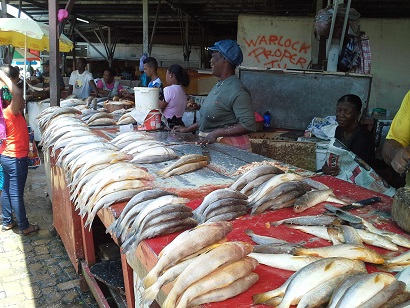
It seems like a simple directive: Fishing. It’s one of the world’s oldest professions, sports and hobbies. As long as a person is close to a body of water – with fish – they can improvise, hustle and acquire food to feed their families. But sadly, in the Caribbean, we do not consume enough fish – see Appendix B below – and have under-utilized our Fisheries industry.

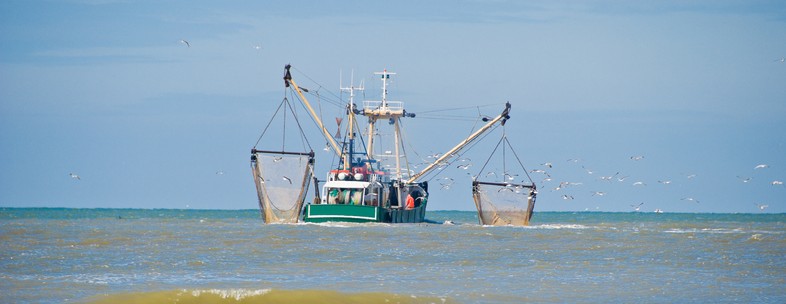
In many jurisdictions, there is a legal distinction between commercial fishing and amateur/sport fishing. The focus of this commentary is on commercial fishing. For the full history of the Caribbean, there has always been a commercial fishing industry … and yet, there are a lot of inadequacies in this industrial eco-system. Consider:

  • There are no canneries in the Caribbean, beyond the “closed” one in Mayaquez, Puerto Rico.
  • Fish stocks are threatened regionally – see more here: http://www.jamaicaobserver.com/news/Caribbean-fishing-industry-at-risk_69808
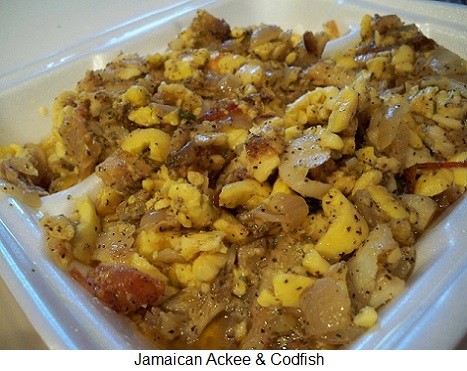
  • The National food of Jamaica – Ackee & Codfish – while delicious and indicative of the native culture, actually features North Atlantic Cod … from Norway; not a locally harvested fish.

This is part of the assessment of the Caribbean failing economic engines. The book Go Lean…Caribbean – a roadmap for the introduction and implementation of the Caribbean Union Trade Federation (CU) – relates:

Previous Caribbean societies lived off the land and the sea; but today, the region depends extensively on imports, even acquiring large quantities of seafood, despite the 1,063,000 square miles of the Caribbean Sea. The CU Trade Federation is a technocracy, empowered to reboot the economic engines of the member-states, by fostering new industries (new “purse”) across the entire region and deploying solutions to better exploit the opportunities of the global trade market. Thus generating all new revenues; with no need to re-distribute any existing “purse” among the member-states.

The book Go Lean…Caribbean asserts that the business model of commercial fishing can harness a lot of jobs. This book asserts, at Page 257, that this roadmap to elevate the economic engines in Caribbean society can succeed and projects that 4,000 new direct jobs – direct jobs on fishing vessels, aquaculture sites, canneries and distribution – can be created with strategic endeavors for the Fisheries. (Even more indirect jobs – 15,000 based on a 3.75-to-1 multiplier rate – can be created).  This is how the industrial landscape of the Caribbean region can be rebooted, by doubling-down on the effort to enhance this fisheries industry. So this strategy from this Go Lean book can result in 19,000 jobs in total.

Fishing is an old industry and yet there is still an opportunity to reboot this part of our industrial landscape. Rather than looking forward, the Go Lean roadmap looks side-ways to the best tactics and best practices of this global industry. Consider these suggestions:

  • Cooperatives – Fishery cooperatives allow fishermen and industry players to pool their resources in certain (non-competitive) areas of activity. This strategy is vital for sharing the cost and expense of installing piers/docks, locating systems (Loran-C & GPS), canneries, refrigerated warehouses and transportation solutions.
  • Canneries – The CU will sponsor co-ops to manage canneries for different foods, including seafood i.e. mackerel.
  • Aqua-culture – the controlled harvesting of fish, crustaceans, mollusks and aquatic plants using farm-like conditions and practices. (Think incubating fertile eggs in a laboratory).
  • Mari-culture – practiced in marine environments and underwater habitats where aquatic plants are embedded to protect fish beds and reefs.

Despite these popular practices, there is something new in  this strategy for the Caribbean: Size!

The requisite investment of the resources for this goal may be too big for any one Caribbean member-state alone. So rather, the Go Lean strategy is to shift the responsibility to a region-wide, professionally-managed, deputized technocracy; this will result in greater production and greater accountability.

We need the greater production of a new economic landscape in our region. The current one is in shambles! This is due to the primary driver in the region – Tourism – being under assault; more and more visitors shift from stay-overs to cruise arrivals. So this means less economic impact to the local markets. So as a region, we must reboot our industrial landscape and add more job-creating options.

The Go Lean book prepares the business model around delivering better on basic needs – food, clothing and shelter. We need the fisheries to supplement the food provisions. In fact, seafood may even be a better source of protein than the land-based options of beef, pork and poultry – think of the additives, antibiotics and steroids. Fish is sounding better and better!

This constitutes an industrial reboot for the Greater Good. We must mine these treasures from the sea. See this thought elaborated upon in this recent news article in Appendix A below. Also, we ask this question of Caribbean stakeholders: “Why not eat more fish?” in Appendix B.

The book Go Lean…Caribbean – available to download for free – presents the confederation roadmap of all 30 member-states to execute a reboot of the Caribbean economic eco-system. This CU/Go Lean roadmap has these 3 prime directives:

  • Optimization of the economic engines in order to grow the regional economy to $800 Billion & create 2.2 million new jobs.
  • Establishment of a security apparatus to ensure public safety and protect the resultant economic engines on the Caribbean homelands and Seas.
  • Improvement of Caribbean governance to support these engines, including a separation-of-powers between the member-states and CU federal agencies. There will be a Federal Fisheries Department for regional oversight of the EEZ.

As related previously, rebooting the homeland of the Caribbean region will mean rebooting the economic engine of the Caribbean Sea. This commentary has previously identified a number of different industries that can be rebooted under this Go Lean roadmap. See the list of previous submissions on Industrial Reboots here:

  1. Industrial RebootsFerries 101 – Published June 27, 2017
  2. Industrial RebootsPrisons 101 – Published October 4, 2017
  3. Industrial RebootsPipeline 101 – To be published October 6, 2017
  4. Industrial RebootsFrozen Foods 101 – To be published October 6, 2017
  5. Industrial RebootsCall Centers 101 – Published July 2, 2018
  6. Industrial RebootsPrefab Housing 101 – Published July 14, 2018
  7. Industrial RebootsTrauma 101 – Published July 18, 2018
  8. Industrial RebootsAuto-making 101 – Published – July 19, 2018
  9. Industrial Reboots – Shipbuilding 101 – Published – July 20, 2018
  10. Industrial Reboots – Fisheries 101 – Published Today – July 23, 2018

The Go Lean book stresses that reforming and transforming the Caribbean economic engines must be a regional pursuit. This was an early motivation for the roadmap, as pronounced in the opening Declaration of Interdependence (Pages 12 – 13):

v. Whereas the natural formation of our landmass and coastlines entail a large portion of waterscapes, the reality of management of our interior calls for extended oversight of the waterways between the islands. The internationally accepted 12-mile limits for national borders must be extended by International Tribunals to encompass the areas in between islands. The individual states must maintain their 12-mile borders while the sovereignty of this expanded area, the Exclusive Economic Zone, must be vested in the accedence of this Federation.

xxiv.  Whereas a free market economy can be induced and spurred for continuous progress, the Federation must install the controls to better manage aspects of the economy: jobs, inflation, savings rate, investments and other economic principles. Thereby attracting direct foreign investment because of the stability and vibrancy of our economy.

xxvi.  Whereas the Caribbean region must have new jobs to empower the engines of the economy and create the income sources for prosperity, and encourage the next generation to forge their dreams right at home, the Federation must therefore foster the development of new industries, like that of ship-building, automobile manufacturing, prefabricated housing, frozen foods, pipelines, call centers, and the prison industrial complex. In addition, the Federation must invigorate the enterprises related to existing industries like tourism, fisheries and lotteries – impacting the region with more jobs.

Accordingly, the CU will facilitate the eco-system for Exclusive Economic Zones (EEZ) and Self-Governing Entities (SGE). These SGE’s are ideal for the Fisheries industry – with its exclusive federal regulation/promotion activities. Imagine bordered campuses – with docks, canneries, refrigerated warehouses, cooperative refrigeration utilities and backup power generations.

There are ideal role models that the Caribbean Sea can emulate. First understand the UN’s Law of the Sea in the Appendix VIDEO below. Then consider the example of Alaska. See the details here from the Go Lean book at Page 210:

The Bottom Line on Alaska Exclusive Economic Zone
Alaska is one of the most bountiful fishing regions in the world, producing a wide variety of seafood. The fisheries of Alaska are recognized as some of the best-managed fisheries in the world, providing thousands of jobs and a vital, long term economic engine for Alaska communities and the state. Over 4.1 billion pounds of fish and shellfish worth over $1.8 billion were harvested in Alaska waters in 2010, keeping Alaska in first place [globally] for value of landings.-AKRDC.org
.
As with other countries, the 200 nautical miles Exclusive Economic Zone (EEZ) off the coast of the United States gives its fishing industry special rights. It covers 4.38 million square miles.The US Government established the North Pacific Fishery Management Council with jurisdiction over the 900,000-squaremiles of the EEZ for the Gulf of Alaska, Bering Sea and Aleutian Islands. This region provides rich marine resources: Pacific salmon, shellfish (shrimp, crab), ground-fish, flatfish, Pacific halibut, herring, and more. The salmon species in Alaska generally produce good harvests, though some stocks are declining. The Aleutian Islands are a series of over 300 rocky islands, stretching over 1,000 miles from southwest Alaska to Russia. They are home to the largest fishing port in the U.S., Dutch Harbor. In 2005, about 30,000 square miles of sea-floor around the Aleutian Islands were permanently closed and certain destructive fishing practices banned.

To fully explore Fisheries, there must be art and science! See the high level view of UNCLOS in the Appendix VIDEO below.

The Go Lean movement (book and blogs) details the principles of SGE’s and job multipliers, how certain industries are better than others for generating multiple indirect jobs down the line (or off-campus) for each direct job on the SGE’s payroll.

This is the vision of an industrial reboot! This transformation is where and how the jobs are to be created.

The Go Lean book provides 370-pages of turn-by-turn instructions on “how” to adopt new community ethos, plus the strategies, tactics, implementations and advocacies to execute so as to reboot, reform and transform the societal engines of Caribbean society. In addition to  Federal Fisheries Department, there is an advocacy for rebooting the industrial landscape to better foster the Fisheries industry; consider the specific plans, excerpts and headlines from the book on Page 210 entitled:

10 Ways to Improve Fisheries

1 Lean-in for the Caribbean Single Market
The CU will allow for the unification of the region into one market, thereby creating a single economy of 30 member-states, 42 million people and a GDP of over $800 Billion (2010). One mission of the CU is to facilitate the food supply so that the region can feed itself, more from local production and less from trade; this includes yields from fisheries. The Caribbean Sea generates a large fishing industry for the surrounding countries, accounting for half a million metric tons (1.1 billion pounds) of fish per year. And yet, the region still imports fish from Alaska. (Alaska imports none from the Caribbean).
2 UN Petition – Effort initiated by the ACS

The CU seeks a designation of an Exclusive Economic Zone for the Caribbean Seas, must like the US enjoys with the waters surrounding Alaska-Aleutian Islands. This new zone should also feature the international waters between the islands. The CU will oversee this zone to coordinate economic activity, protect the natural environment against hazards and ensure the security measures for the assurance of the homelands. These requests are in line with the UN charter. [See more on the UNCLOS in the Appendix VIDEO below].

3 Common Pool Resources (Lobster, Conch, Grouper, Flying Fish)

Though the waters between the islands may be uninhabited, their resources can still be depleted. The CU will govern the common pool resources to promote the sustainability of fish stock. Fishing for lobster, conch, grouper, “flying fish” and other species must be controlled, with limited harvesting seasons, otherwise there will be none for future generations.-

4 Cooperatives
5 Aqua-culture and Mari-culture
6 Fishing Tourism and Yachting Enthusiasts
7 Marine Financing
8 Coast Guard hand-off to CU Naval Authority

The US Coast Guard does assume a lot of patrol duties in the Caribbean, even though only small portions of the region (Puerto Rico) are in their jurisdiction. The CU will not discourage any over-coverage the USCG provides, but the prime responsibility for policing, search-and-rescue, and interdiction for the region rest with the CU and the Naval Authority.

9 ICE Cooperation
10 Maritime Emergency Management

The CU will deploy the necessary resources for maritime emergencies in the region. While the US Coast Guard provides some emergency response today; the direct responsibility would belong to the CU Naval Authority. As such, the CU sponsored Trauma Centers will allow for airlifting hurt-or-sick fishermen on fishing vessels and CU agencies will marshal the effort to prepare and prevent emergencies with disaster recovery and business continuity plans for industry players.

The subject of Caribbean fisheries is not new for this Go Lean roadmap; there have been a number of previous blog-commentaries by the Go Lean movement that referenced economic opportunities embedded in this industry. See a sample list here:

https://goleancaribbean.com/blog/?p=12144 Commerce of the Seas – Book Review: ‘Sea Power’
https://goleancaribbean.com/blog/?p=9070 Securing the Homeland – From the Seas
https://goleancaribbean.com/blog/?p=8819 Lessons from China – South China Seas: Exclusive Economic Zones
https://goleancaribbean.com/blog/?p=3594 Lessons Learned from Queen Conch
https://goleancaribbean.com/blog/?p=2119 Cooling Effect – Oceans and the Climate

In summary, our Caribbean homeland needs jobs; the home “waters” need jobs too. A better job-creation ability would help us to make our homeland a better place to live, work and play. In fact, one of the reasons why so many Caribbean citizens have emigrated away from the homeland is the job-creation dysfunction. Creating a new economic landscape will require rebooting our industrial landscape.

Yes, we can … reboot our industrial landscape, and create the necessary new jobs – and other economic opportunities.

We urge all Caribbean stakeholders to lean-in to this roadmap for economic empowerment. A new disposition among the Fisheries do amplify the fact that this Go Lean roadmap is necessary – we must reboot. 🙂

Download the free e-Book of Go Lean … Caribbean – now!

Sign the petition to lean-in for this roadmap for the Caribbean Union Trade Federation.

—————

Appendix A – The Caribbean: What to Eat

A few decades ago, the Caribbean people thought their food not good enough for the annual hoards of vacationing tourists. They considered their local dishes too native and uninteresting, and chose to offer visitors French food instead. Fortunately, after constant demand, Caribbean hoteliers and restauranteurs now offer a variety of traditional foods throughout the islands.

From the lush tropical vegetation of the Caribbean comes an astonishing array of fruit. There are coconuts, pineapples, passion fruits, papayas, mangoes, apples, oranges, bananas, melons, figs, pomegranate, and limes. Others include the breadfruit, ugli, naseberry, tamarind, sapodilla, soursop, plantains, cherimoya, monstera, loquat, carambola, guava, and mamey sapote. Some exotic fruits are not exported because they are too delicate, which is why many Caribbean fruits are unfamiliar to those who do not travel to the Islands.

Some fruits are enjoyed right off the trees as part of a meal or snack, but many are used for a variety of both sweet and savory dishes. Mangos and papayas are used in drinks, desserts like sherbets and mousse, and in fiery chutneys. Coconuts are used for coconut bread, coconut ice cream, flan, and that world-famous Pina Colada. Coconut milk is also used for meat sauces, and even cooked with beans. Plantains, which are similar to bananas, are eaten grilled, fried, prepared as crispy chips, or baked in meat pies.

Vegetables, likewise, are prolific on the islands. Yams, pumpkin, yuca, calabaza, callaloo, chayote, sweet potatoes, okra, tomatoes, zuchinni, cucumbers, and bell peppers are all used to their full advantage. A variety of legumes are also popular, especially black beans used in popular Cuban black bean soup. Other common beans are pigeon peas, black-eyed peas, and red beans. Most bean dishes are served with rice and cornbread, similar to Creole menus of the Southern U.S.

Poultry dishes are widespread throughout the Caribbean, mostly because chicken is the most economical meat. It is often marinated with ginger, lime, and chiles before grilling. Beef and pork dishes are common in Caribbean cuisine, but more so on the Spanish Islands. Goat, and less popular lamb, are used on some islands. Curried Goat is a holiday specialty of Jamaica.

Treasures from the sea are another reason to experience Caribbean cuisine. These are the fresh fish, shellfish, and other tropical delicacies caught daily in the warm waters of the Caribbean Sea. Hundreds of varieties of fish are available, including sea bass, swordfish, pompano, mullet, kingfish, yellowtail, tuna, wahoo, snapper, grouper, mackerel, and dolphin fish. They are grilled, baked, or served in chowders and stews.

Salt codfish is a Caribbean specialty. Its most common presentations are in salads and stews, or with scrambled eggs. Shellfish like the spiny lobster and shrimp are ubiquitous, and both given the special Caribbean touch with specialties like Lobster Creole and Coconut Shrimp. Other Carribean specialties include conch, sea urchin, and turtle.

Probably because of the preponderance of sugar cane in the islands, desserts are an important part of a Caribbean meal. They come in every form, from cakes, dumplings, bread and rice puddings, to flan, souffle and mousse. There are also frozen ices and sherbets. Many desserts utilize local fresh and dried fruits, sometimes sweet potatoes, pumpkin, and avocado; rum is sometimes an ingredient.

By no means are all Caribbean dishes fiery hot and spicy, but chiles are the most widespread form of Caribbean seasoning. It is not unusual when dining in the islands, that a bottle of local hot sauce be available to patrons.

To truly experience Caribbean cuisine, it is wise to seek out the regional specialties, especially if you are staying at a fine resort hotel. Remember that just because there is a hibiscus flower on the plate, doesn’t mean the dish is authentic!

Source: Food-Wine Magazine January 2007 – retrieved July 22, 2018 from: https://www.foodwine.com/destinations/caribbean/cariwhat.html

—————

Appendix B – Why don’t they eat more fish in the Caribbean?

By  Tyler Cowen

David Lomita, a loyal MR [(Marginal Revolution)] reader, asks me:

I have often wondered why, given that they are a bunch of small islands, that so many of the more famous dishes of Caribbean countries are meat and not fish.  The woman of this house is Jamaican and she is much more proud of jerk than of escabeche fish.  Puerto Rico has its lechon, Cuban food has ropa de viejo and so on.
I don’t have any data here … but independently I have wondered about a similar question.  I see a few possible factors:

  1. Often fish are available, and excellent, immediately right near the ocean.  Transport and adequate refrigeration are not to be taken for granted.  In any case, those dishes won’t always become iconic national recipes.  Note also that a lot of the fish consumed will be boiled, spiced, and salted, presumably for health and storage reasons.
  2. Food is an energy source, and meat is often superior to fish in this regard, especially for diets which may otherwise lack calories.  For the same reason such meals also can be more carbohydrate-heavy than the typical daily diet.
  3. Cows, chickens, and pigs are media for savings.  Fish are not.  Why not invest in some insurance while you are planning your food supply?  Keep in mind that local banking systems often do not serve the poor very well.  Furthermore it may be easier to own a chicken than to catch a fish.  Fishing is low-productivity in many parts of the Caribbean, due to poor knowledge and implementation of aquaculture.
  4. Which countries are we talking about?  In the wealthier Trinidad and Jamaica, retail fish shops are common (that link is useful more generally)  In Barbados, U.S. Virgin Islands, and the Cayman Islands, culinary infrastructure is quite good and there is plenty of wealth.  In Haiti and Cuba, the two most populous nations in the Caribbean, economic conditions are dire.
  5. Never overlook the heavy hand of government, plus a lack of resource management expertise: “Most of the governments of the islands aim at self-sufficiency in fish production. Some, such as Antigua, try to prohibit exports; others, such as Jamaicaand Trinidad, limit imports. All of them are giving more attention to post-harvest practices both at sea and on shore, processing and storage, and to improved marketing and distribution. Many are now more interested in assessment of their resources, and collecting statistics to determine the best management practices to sustain the stocks.”

By the way, here is a very good recent piece on the rising cost of food imports in the Caribbean, especially Jamaica.

Source: Marginal Revolution Online Magazine – Posted August 5, 2013. See the full article and readers comments here; retrieved July 23, 2018 from: https://marginalrevolution.com/marginalrevolution/2013/08/why-dont-they-eat-more-fish-in-the-caribbean.html

—————

Appendix VIDEO – Law of the Sea – https://youtu.be/j_R3zQvwAuw

Published on Mar 21, 2016

Recorded with http://screencast-o-matic.com

  • Category: Education
  • License: Standard YouTube License


Share this post:
, , ,
[Top]

Industrial Reboot – Shipbuilding 101 – ENCORE

Rebooting the industrial landscape means understanding the macro-economic factors affecting a community and then applying changes to assuage negative developments and to exploit the positives.

Understanding the macro factors means embracing the Laws of Economics 101: Supply-and-Demand.

As related in a previous blog-commentary by the movement behind the book Go Lean…Caribbean:

The ‘Law of Supply-and-Demand’ is almost as natural as the ‘Law of Gravity’. Leave it alone and it will pre-determine what will happen in the marketplace. But just like Gravity could be defied – consider airplanes & rockets – so too the Law of Supply-and-Demand could be defied supplemented and exacerbated – consider Crony-Capitalism and protectionism – with the industrial prodding of shipbuilding.

The shipbuilding industry has become a favorite for government leaders to manipulate the supply and demand dynamics for – consider the Jones Act in the US – because this industry creates so many …

Jobs

The book Go Lean…Caribbean asserts that the business model of shipbuilding can harness a lot of jobs. This book presents a roadmap to elevate the economic engines in Caribbean society and projects that 15,000 new direct jobs can be created with strategic endeavors for the shipbuilding industry. (Even more indirect jobs – 3.75-to-1 multiplier rate – can be created).  This is how the industrial landscape of the Caribbean region can be rebooted, by doubling-down on the effort to foster a shipbuilding industry.

We need a new economic landscape in our region. The current one is in shambles! This is due to the primary driver in the region – Tourism – being under assault; more and more visitors shift from stay-overs to cruise arrivals. So this means less economic impact to the local markets. As a region, we must reboot our industrial landscape and add more job-creating options.

How?

This commentary has previously identified a number of different industries that can be rebooted under this Go Lean roadmap. See the list of previous submissions on Industrial Reboots here:

  1. Industrial RebootsFerries 101 – Published June 27, 2017
  2. Industrial RebootsPrisons 101 – Published October 4, 2017
  3. Industrial RebootsPipeline 101 – Published October 5, 2017
  4. Industrial RebootsFrozen Foods 101 – Published October 6, 2017
  5. Industrial RebootsCall Centers 101 – Published July 2, 2018
  6. Industrial RebootsPrefab Housing 101 – Published July 14, 2018
  7. Industrial RebootsTrauma 101 – Published July 18, 2018
  8. Industrial RebootsAuto-making 101 – Published July 19, 2018
  9. Industrial Reboots – Shipbuilding 101 – Published Today – July 20, 2018

This commentary considers the basics of the shipbuilding industry and how it can harness many jobs if we reboot our industrial landscape to foster the industry. There is no need for a new commentary; this subject had already been elaborated upon in that previous Go Lean commentary. That submission is hereby Encored here:

——————–

Go Lean Commentary Commerce of the Seas – Shipbuilding Model of Ingalls

The ‘Law of Supply-and-Demand’ is almost as natural as the ‘Law of Gravity’; leave it alone and it will pre-determine what will happen … in the marketplace. But just like the ‘Law of Gravity’ can bend and be defied (think airplanes and rockets), so too the ‘Law of Supply-and-Demand’ can bend and be defied. A great example of defying ‘Supply-and-Demand’ is the Crony-Capitalism (subsidies and protectionist schemes) in the highly-protected Ship-Building industry. (See the Appendix below regarding OECD Ship-Building Industry monitoring efforts).

CU Blog - Commerce of the Seas - Model of Ingalls - Photo 1

CU Blog - Commerce of the Seas - Model of Ingalls - Photo 2

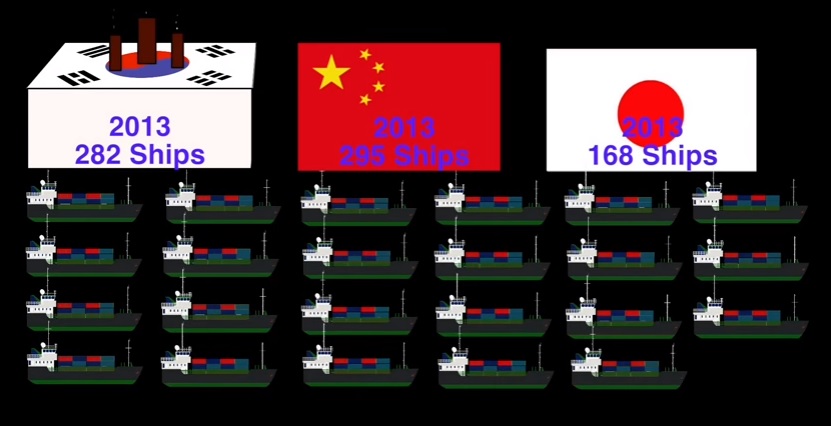
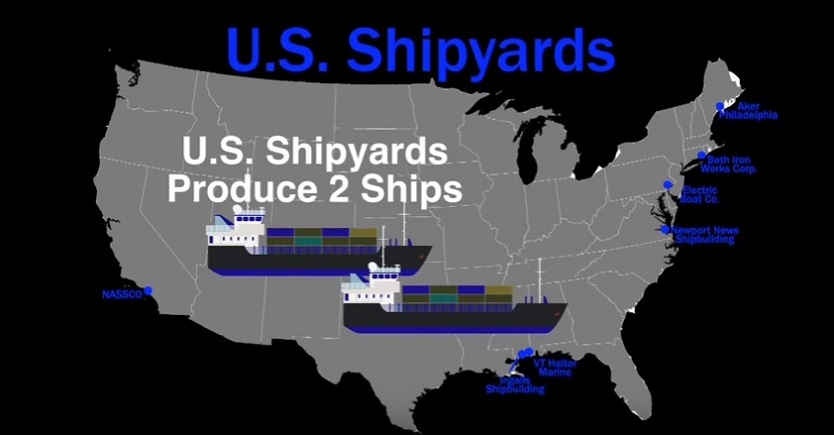
Look at the numbers in the 2 photos above. It is apparent that the US distorts the Supply-and-Demand factors for Ship-Building in its market; their protectionist laws prevent the international market from supplying domestic shipping needs. This is bad! Though there is the need for some government-aid, to protect jobs and defense options,  the US model of Crony-Capitalism is a blatant distortion – Source: https://youtu.be/GpwzoDGDGAQ.

Ship-Building can be a strategic industry! The book Go Lean…Caribbean asserts that 15,000 new direct jobs can be created with strategic endeavors for the Ship-Building industry in the region. (Even more indirect jobs applies – multiplier rate of 3-to-1).  The Go Lean book calls for the elevation of Caribbean economics, positing that governmental entities must stimulate and incubate this industry. The book surveyed the world looking for industrial opportunities that could be fully explored in the Caribbean region where the natural resources of the region could be considered; the region is known for sun, sand and sea.

Tourism is a natural assumption for utilizing these “sun, sand and sea“ resources, but with the recent inadequacies of this industry, there needs to be more diversity in our commercial offerings; ship-building – which needs the sea – was identified as an ideal supplement and alternative for regional commerce. This reference to “regional commerce” refers to the economic interest that the 30 member-states in the Caribbean have to consider to provide job and entrepreneurial opportunities for its people. So this Ship-Building focus prioritizes the “Commerce of the Seas” concept. This commentary is 3 of 4 in a series considering the Lessons in Economic History related to “Commerce of the Seas”, the Crony-Capitalism in laws and practices around the maritime eco-system in the United States … and other countries. The full series is as follows:

  1. Commerce of the Seas – Stupidity of the Jones Act
  2. Commerce of the Seas – Book Review: ‘Sea Power’
  3. Commerce of the Seas – Shipbuilding Model of Ingalls
  4. Commerce of the Seas – Lessons from Alang (India)

There are many Lessons in Economic History for the Caribbean to glean by considering the actuality of this industry. Let’s consider the role model of just one American shipbuilding entity: Ingalls Shipbuilding Company in Pascagoula, Mississippi. See the reference source here, describing the business model for building ships to ‘Supply’ any open ‘Demand’ in the commercial market:

Title: Ingalls Shipbuilding 

Ingalls Shipbuilding is a shipyard located in Pascagoula, Mississippi, United States, originally established in 1938, and is now part of Huntington Ingalls Industries. It is a leading producer of ships for the United States Navy, and at 12,500 employees, the largest private employer in Mississippi.

CU Blog - Commerce of the Seas - Model of Ingalls - Photo 3

Pascagoula River and Ingalls Shipyard

CU Blog - Commerce of the Seas - Model of Ingalls - Photo 5

History

In 1938, Ingalls Shipbuilding Corporation was founded by Robert Ingersoll Ingalls, Sr. (1882–1951) of Birmingham, Alabama, on the East Bank of the PascagoulaRiver in Mississippi.[1] Ingalls was located where the Pascagoula River runs into the Gulf of Mexico. It started out building commercial ships including the USS George Clymer (APA-27), which took part in Liberty Fleet Day 27 September 1941. In the 1950s Ingalls started bidding on Navy work, winning a contract in 1957 to build 12 nuclear-powered attack submarines.

Litton Industries acquired Ingalls in 1961, and in 1968 expanded its facilities to the other side of the river. Ingalls reached a high point of employment in 1977, with 27,280 workers. In April 2001, Litton was acquired by the Northrop Grumman Corporation.[2]

On August 29, 2005, Ingalls facilities were damaged by Hurricane Katrina; most of the ships in dock and construction escaped serious harm. While shipbuilding was halted for a while due to the destruction of many buildings, most vehicles, and the large overhead cranes, the facility continues to operate today.

On March 31, 2011, Northrop Grumman spun off its shipbuilding sector (including Ingalls Shipbuilding) into a new corporation, Huntington Ingalls Industries.

In 2015, Ingalls Shipbuilding Company signed a contract with US Navy for new destroyers, littoral combat ships and new landing craft. USS John Finn (DDG-113) was one of the first destroyers was launched on March 28. Company also is building Ralph Johnson (DDG 114), Paul Ignatius (DDG 117) and Delbert D. Black (DDG 119).

On March 21, 2015, the new San Antonio LPD 17-class amphibious ship John P. Murtha (LPD 26) was ceremonially christened. The vessel having been launched on October 30 and scheduled to be delivered in 2016.

On March 27, 2015, the shipyard received construction contracts for their next destroyers. Ingalls Shipbuilding Company was awarded a $604.3 million contract modification to build the yet-to-be-named DDG 121.

On March 31, 2015, the shipyard also received another contract with a $500 million fixed price to build the eighth National Security Cutter (NSC) for the US Coast Guard. Most of them will be under construction until 2019. The cutters are the most advanced ships ever built for the Coast Guard. [3]

On June 30, 2016, Ingalls Shipbuilding signed a contract with US Navy to build the U.S. Navy’s next large-deck amphibious assault warship. The contract included planning, advanced engineering and procurement of long-lead material, is just over $272 million. If options are exercised, the cumulative value of the contract would be $3.1 billion.[4]

Ships built

Source: Retrieved 06-11-2017 from Wikipedia: https://en.wikipedia.org/wiki/Ingalls_Shipbuilding

———–

VIDEO – Ingalls Shipbuilding Promotional Video – https://youtu.be/EFl8Tl0ImJo

Published on Jan 10, 2017 – Ingalls Shipbuilding is located in Pascagoula, Mississippi on 800 acres of the most important real estate in America. With 11,000 employees, Ingalls is the largest manufacturing employer in Mississippi and a major contributor to the economic growth of both Mississippi and Alabama. Our 77-year legacy has continuously proven we have the talent, experience and facilities to simultaneously build more classes of ships than any other shipyard in America.

We are the builder-of-record for 35 Aegis DDG 51 class guided missile destroyers, LHA 6 class large deck amphibious ships, National Security Cutters for the U.S. Coast Guard and the sole builder of the Navy’s fleet of San Antonio (LPD 17) class amphibious assault ships. Ingalls Shipbuilding has what it takes to build the capital ships that keep America and our allies safe.

Additional VIDEO consideration: https://youtu.be/0pak_gKglqo – Ingalls shows ‘Shipyard of the Future’.

Considering that 90% of all trade transports by water, there is natural demand for shipbuilding. There is a lot of supply as well.

Ingalls Shipbuilding Company is a definite beneficiary of government-aided commerce in the US; most of their shipbuilding engagements are government contracts. They are a leading producer of ships for the US Navy or Coast Guard, and at 12,500 employees, the largest private employer in Mississippi. As related in the first commentary in this series, the Jones Act has protected maritime commerce and shipbuilding for American stakeholders like Ingalls.

It is ‘high tide’ for the Caribbean to engage some protectionism strategies. Considering that the Caribbean region is the #1 market for the Cruise Line industry, collective bargaining should be prioritized to direct some shipbuilding business to local entities in this industry. The book Go Lean… Caribbean posits that as a unified region – a Single Market – the power of collective bargaining is possible. The book serves as a roadmap for the introduction and implementation of the technocratic Caribbean Union Trade Federation (CU) with the charter to facilitate jobs in the region. We should explore the benefits of the shipbuilding (and ship-breaking) industry. This aligns with the CU charter; as defined by these 3 prime directives:

  • Optimization of economic engines in order to grow the regional economy to $800 Billion and create 2.2 million new jobs.
  • Establishment of a security apparatus to protect the resultant economic.
  • Improve Caribbean governance to support these engines.

Early in the Go Lean book, this responsibility to create jobs was identified as an important function for the CU with this pronouncement in the Declaration of Interdependence (Pages 14):

xxiv.  Whereas a free market economy can be induced and spurred for continuous progress, the Federation must install the controls to better manage aspects of the economy: jobs, inflation, savings rate, investments and other economic principles. Thereby attracting direct foreign investment because of the stability and vibrancy of our economy.

xxvi.  Whereas the Caribbean region must have new jobs to empower the engines of the economy and create the income sources for prosperity, and encourage the next generation to forge their dreams right at home, the Federation must therefore foster the development of new industries, like that of ship-building…. In addition, the Federation must invigorate the enterprises related to existing industries tourism, fisheries and lotteries – impacting the region with more jobs.

Accordingly, the CU will facilitate the eco-system for Self-Governing Entities (SGE), an ideal concept for shipyards, with its exclusive federal regulation/promotion activities.

The Go Lean movement (book and blogs) also details the principle of job multipliers, how certain industries are better than others for generating multiple indirect jobs down the line for each direct job on a company’s payroll. In a previous blog-commentary, it was related that the shipbuilding industry has a job-multiplier rate of 3.0. So once the job-multiplier rate is applied to the 15,000 direct shipbuilding jobs, generating 45,000 indirect jobs, the full economic impact is 60,000. This is transforming!

The Go Lean book provides 370-pages of turn-by-turn instructions on “how” to reform and transform the Caribbean, starting first with how to adopt new community ethos, plus the strategies, tactics, implementations and advocacies to execute so as to transform the maritime commerce to benefit Caribbean society. Consider the Chapter excerpts and headlines from this sample on Page 209 related to Ship-Building:

10 Ways to Develop Ship-Building

1

Lean-in for Caribbean Integration
The CU will allow for the unification of the region into one market, creating an economy of 30 member-states, 42 million people and 2010 GDP over $800 Billion. All of the member-states are either islands or coastal, therefore there are lots of coastline and harbors. Boats, yachts and ships are therefore plentiful in the region. Consistent with the CU’s mission for globalization, the region cannot just consume these vessels; we must create and build as well. There is a history of boat-building in the islands (slopes, schooners, clippers), but what had been missing to forge a formidable industry is the capital and the community “will”. The CU will now fill those gaps. The CU will tap the capital markets to secure long-term funding (stocks/bonds), prepare the labor force for advanced skill-sets, and negotiate treaties with “mature” EU states (i.e. Holland, Ireland) for master-apprentice labor-coaching. Boats, yachts and ships are considered durable goods, the opposite of planned obsolescence. …

2

Cooperatives Movement – “Many hands make heavy job light

3

Ferry Operations – Demand & Supply
The CU envisions a fleet of ferries, to service the individual islands, in a scheme dubbed “Union Atlantic Turnpike”. The proliferation of scheduled ferries, synchronized with trains and trucks will depict a continuous logistic network. This constitutes the demand for ferries. The CU will henceforth award the contracts for building and maintaining the ferries to local industry players – this constitutes the supply. The CU will therefore foster a ship-building “incubator”.

4

Spin-off Strategy – Low-risk Contracts
The CU vision is to deploy a “spin-off” strategy for ship-owning patrons. The CU region needs ships. Therefore, the CU will incentivize patrons to “go local” with their ship-building/maintenance needs. A domestic ship-building industry is a great source of skilled/high-wage jobs. So there are many ways to exploit the cost-benefit equation for a win-win.

5

Cruise Ship Dry-Dock – Let’s Make-A-Deal
The Caribbean region is the Number One market for the Cruise Line industry. Big expenses for Cruise Lines are port charges and landing fees. The CU will offer rebates and incentives for the Cruise Lines to use local dry-docks for retro-fittings and refurbishing.

6

Yacht Development – Catering to a Special Market

7

Sailboats – For Every Man
The history of Caribbean boat building is rich with sailing crafts; cruise ships evolved from local Banana-Boats. The CU will channel that history, passion and ethos for the region to design/develop best-inbred sailboats, big and small.

8

Boat Shows and Open Houses – Show and Tell

9

Regattas – More than Just Winning a Race
The history of the region has highlighted ships, boats and boat building. There is the tradition of Regattas, used to showcase the islands boat building prowess. [199] The CU now intends to feature Regattas in the same manner that automakers feature auto racing (NASCAR, IndyCar, Formula-One), as a demonstration platform for their art and science.

10

Maritime Emergencies – Professional Response
The CU will deploy the necessary equipment and training for the ship-building industry to respond to maritime emergencies in the region. Therefore a disabled cruise ship will have the rapid response of “support-barges”, tug boats, dredging equipment, portable generators. This effort will be marshaled by the CU Emergency Management Agency.

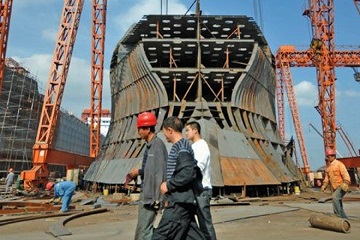
The CU will foster shipbuilding as an industrial supplement and alternative to tourism. We have the resources (waterscapes, ports and harbors), the skills and the passionate work-force. We only need the Commerce of the Seas. The Caribbean people are now ready for this industrial empowerment. But we need to be cautious as to which role model we emulate. The US does provide material support and subsidies to their shipbuilding industry, but their protection laws – i.e. the Jones Act – have nullifies the positive effects of a Free Market. While other countries build and launch hundreds of ships every year, the US model only produce 2. That’s a lot of missing jobs, and artificially induced high prices.

In the Caribbean, we must do better. Fortunately, we do not have the Crony-Capitalism of the Jones Act to deter us. We can follow other – better – models to progress our societal investments in this industry. This is the assertion of the Go Lean roadmap.

We hereby urge all Caribbean stakeholders – governments and citizens – to lean-in to this Go Lean roadmap to foster this industrial development, so that our region can be a better homeland and seas to live, work and play. 🙂

Download the free e-book of Go Lean … Caribbean – now!

Sign the petition to lean-in for this roadmap for the Caribbean Union Trade Federation.

———–
Appendix – The OECD Council Working Party on Shipbuilding

(OECD = Organization of Economic Cooperation and Development)

The OECD Council Working Party on Shipbuilding (WP6) seeks to progressively establish normal competitive conditions in the industry. It encourages transparency through data collection and analysis, and seeks to expand policy dialogue with non-OECD economies that have significant shipbuilding industries. WP6 is the only international body that can influence and guide government policies by identifying and, where possible, eliminating factors that distort the shipbuilding market.

The Working Party is chaired by Ambassador Elin Østebø Johansen, Permanent Representative of Norway to the OECD. Participating OECD members are: Denmark, Finland, Germany, Italy, Japan, Korea, Netherlands, Norway, Poland, Portugal, Sweden and Turkey. Croatia and Romania are full participants in the Working Party, and the Russian Federation participates as an observer. The European Commission, representing the European Union, also participates in WP6 meetings.

What does the Working Party on Shipbuilding do?
The WP6 has placed a high priority on encouraging policy dialogues, and on establishing close working relationships with non-OECD economies. In particular, these economies were invited to participate on an equal footing with OECD members in the negotiations on a shipbuilding agreement that ran from 2002 until 2005, and Brazil, China, Croatia, the Philippines, Romania, the Russian Federation, Chinese Taipei and Ukraine participated in those negotiations. Although the negotiations were eventually halted, a close working relationship has continued with all of these economies.

The WP6 organizes regular workshops aimed at facilitating the exchange of information on policy and industry developments, and as well as the economies already mentioned, other participants have come from India, and Indonesia, amongst others.

The WP6 has also worked closely with industry groups representing shipbuilders, ship owners, ship operators and trade union interests, so that a wide range of perspectives can be taken into account by WP6 members during their formulation of policy responses to address issues and challenges faced by the global shipbuilding sector.

What is the relevance of the Working Party to non-OECD economies and industry?

While the world’s shipbuilding industry has been through a period of record production, it was severely affected by the 2008 global financial crisis, and recent years have seen very low levels of new orders received by virtually all shipyards. The global industry now faces a number of challenges, most notably global excess capacity, which will place the economic viability of the industry under pressure in some parts of the world.

Persistent worldwide overcapacity may encourage governments to provide support through subsidies and other measures, as well as spur other market distorting practices, which can create major structural problems even in the most efficient shipbuilding industries. But potential market distortions can be addressed through close co-operation among economies with significant shipbuilding sectors and the active involvement of industry.

———-

INVENTORY OF GOVERNMENT SUPPORT MEASURES

The Inventory of Government Subsidies and Other Support Measures is a regular exercise for the WP6. The main aim of this exercise is to provide transparency and continuity of data on support measures for the shipbuilding industry. As well as WP6 participants, the Inventory provides some information on the support measures in Partner economies.

Share this post:
, , ,
[Top]

Industrial Reboot – Auto-making 101

Go Lean Commentary

Allow me to introduce this concept of planned obsolescence. This is the policy in industrial design and economics that calls for …

… designing a product with an artificially limited useful life, so it will become obsolete (that is, unfashionable or no longer functional) after a certain period of time. [1] The rationale behind the strategy is to generate long-term sales volume by reducing the time between repeat purchases (referred to as “shortening the replacement cycle”).[2]Wikipedia.

Let’s understand this better: you are a stock on the shelf!

There are planners out there that are designing products that you need that can last longer, but purposely choose to give it a short life so as to force you to “come again” and “buy again”. Considering all the stakeholders in such a transaction: buyers -vs- seller; consumers -vs- producers, who do you think benefits the most? No doubt:

The producer-seller!

So if you have to build an economy from scratch, you should try to forge a producer economy, rather than a consumer economy. Likewise, if you are to reboot an economy, this logic dictates that you should revisit all the consumer industries and ascertain as to whether they can be converted into producing industries. This is especially true of the auto industry.

The book Go Lean … Caribbean asserts that the Caribbean industrial landscape can be transformed so that many basic needs can be provisioned domestically, rather than imported. This is even true of the auto industry. This is the Go Lean quest!

The basic needs in focus of course include food, clothing and shelter. But the Caribbean reality has a supplemental list, consider energy, telecommunications, medical trauma and transportation. Every Caribbean community have a proliferation of automobiles, but despite the 42 million people in the 30 member-states, there are no auto manufacturers in the region at all. Our status is worse than initial appearances, not only do we not have any assembly plants, but no parts suppliers either. We are completely inconsequential on the automotive supply-chain.

The planners in the global automotive industry simply consider the Caribbean region as consumers, and not producers by any stretch of the imagination. This is sad, because many jobs are at stake in the automotive manufacturing industry.

“Somebody, throw us a bone!”

This is the urging of the movement behind the Go Lean book; the book asserts (Page 257) that many jobs can be forged, if we adopt a different community ethos – spirit of a culture that informs the beliefs, customs and practices – and seek to produce, not just consume. The book details this count:

Direct jobs in the design, fabrication and logistics for new autos: 12,000  

There is an Old Adage: “Divide and Conquer”. This is the reality of the Caribbean disposition; there are 30 different and separate countries-territories. If we are able to “buck this trend”, a consolidated-integrated Single Market would amount to 42 million people.

If only …

The Go Lean book prepares the business model for transportation solutions in the Caribbean region. The book ask the question: “Why can’t we contemplate our own auto manufacturing business model?” Yes, business model refers to jobs, entrepreneurial opportunities, trade transactions, etc. In addition to these industry jobs; there is also the reality of indirect jobs – unrelated service and attendant functions – at a 3.75 multiplier rate would add another 45,000 jobs.

This constitutes an industrial reboot. We have successful role models to consider … and lessons to learn.

Consider the Republic of Iran. When their society was sanctioned in 1979, their easy access to American, Japanese and European automobiles were curtailed; their solution:

    They developed a domestic auto manufacturing industry for their 82 million people. See this encyclopedic reference:

Iran’s automotive industry is the third most active industry of the country, after its oil and gas industry, accounting for 10% of Iran’s GDP and 4% of the workforce (700,000 persons).[1][2][3][4]

Iran developed a significant automotive industry with annual production of up to 200,000 units under the Mohammad Reza Shah Pahlavi‘s regime. But after the Iranian Revolution of 1979 production drastically decreased due to Iran–Iraq War and international sanctions. Since the early 2000s, automobile production in Iran has grown exponentially. Iran’s automobile production crossed the 1 million mark in 2007/2008. Today, Iran is the 18th largest automaker in the world and one of the largest in Asia, with annual production of more than 1.6 million.[5] In 2009 Iran ranked fifth in car production growth standing next to China, Taiwan, Romania and India.[6]

The Iranian manufacturers currently produce six different types of vehicle, including passenger cars, 4WD, trucks, buses, minibuses, and pickup trucks. … About 75% of local output is passenger cars, with pick-ups the next largest category, accounting for around 15%.[9]Source: Wikipedia.

We have no sanctions in the Caribbean (notwithstanding Cuba). We should, must be able to foster our own automotive productions. Iran did … with both hands tied behind it’s back – see Appendix VIDEO. Hopefully, in the Caribbean, we can at least try.

The book Go Lean…Caribbean – available to download for free – serves as a roadmap for the introduction and implementation of the technocratic Caribbean Union Trade Federation (CU); this is a confederation of all 30 member-states to execute a reboot of the Caribbean economic eco-system. This CU/Go Lean roadmap has these 3 prime directives:

  • Optimization of the economic engines in order to grow the regional economy to $800 Billion & create 2.2 million new jobs.
  • Establishment of a security apparatus to ensure public safety and protect the resultant economic engines.
  • Improvement of Caribbean governance to support these engines, including a separation-of-powers between the member-states and CU federal agencies.

The Caribbean economic landscape is in shambles! This is due to the primary driver in the region – Tourism – being under assault; more and more visitors shift from stay-overs to cruise arrivals. So this means less economic impact to the local markets. As a region, we must reboot our industrial landscape and add more job-creating options.

This commentary has previously identified a number of different industries that can be rebooted under this Go Lean roadmap. See the list of previous submissions on Industrial Reboots here:

  1. Industrial RebootsFerries 101 – Published June 27, 2017
  2. Industrial RebootsPrisons 101 – Published October 4, 2017
  3. Industrial RebootsPipeline 101 – Published October 5, 2017
  4. Industrial RebootsFrozen Foods 101 – Published October 6, 2017
  5. Industrial RebootsCall Centers 101 – Published July 2, 2018
  6. Industrial RebootsPrefab Housing 101 – Published July 14, 2018
  7. Industrial RebootsTrauma 101 – Published July 18, 2018
  8. Industrial Reboots – Auto-making 101 – Published Today – July 19, 2018

The Go Lean book stresses that reforming and transforming the Caribbean economic engines must be a regional pursuit. This was an early motivation for the roadmap, as pronounced in the opening Declaration of Interdependence (Pages 12 – 13):

xxiv.  Whereas a free market economy can be induced and spurred for continuous progress, the Federation must install the controls to better manage aspects of the economy: jobs, inflation, savings rate, investments and other economic principles. Thereby attracting direct foreign investment because of the stability and vibrancy of our economy.

xxvi.  Whereas the Caribbean region must have new jobs to empower the engines of the economy and create the income sources for prosperity, and encourage the next generation to forge their dreams right at home, the Federation must therefore foster the development of new industries, like that of ship-building, automobile manufacturing, prefabricated housing, frozen foods, pipelines, call centers, and the prison industrial complex … impacting the region with more jobs.

xxvii. Whereas the region has endured a spectator status during the Industrial Revolution, we cannot stand on the sidelines of this new economy, the Information Revolution. Rather, the Federation must embrace all the tenets of Internet Communications Technology (ICT) to serve as an equalizing element in competition with the rest of the world. The Federation must bridge the digital divide and promote the community ethos that research/development is valuable and must be promoted and incentivized for adoption.

Accordingly, the CU will facilitate the eco-system for Self-Governing Entities (SGE), an ideal concept for auto manufacturing with its exclusive federal regulation/promotion activities. Imagine bordered campuses – with R&D Concept Cars, test tracks, railroad lines, shipping docks and backup power generations. The focus for the Go Lean roadmap is locally provisioning for basic needs – being a protégé of advanced democracy countries and not just a parasite, thrown hither-and-thither to the winds of change. This is the fallout of the Planned Obsolescence strategy, as further elaborated on in the book (Page 206), with this addition to the definition here:

The Bottom Line on Planned Obsolescence
… Planned obsolescence has potential benefits for a producer because the consumer is under pressure to purchase again, whether from the same manufacturer (a replacement part or a newer model), or from a competitor which might also rely on planned obsolescence. Firms that pursue this strategy believe that the additional sales revenue it creates more than offsets the additional costs of research and development. Critics of this policy claim the process wastes and exploits customers, uses up resources in making changes that at times may only be cosmetic. Supporters, on the other hand, claim planned obsolescence drives technological advances and contributes to material well-being. They claim that a market structure of planned obsolescence and rapid innovation may be preferred to long-lasting products and slow innovation; that market success requires a perpetual innovation cycle. Planned obsolescence works best when a producer has at least an oligopoly. When a market becomes more competitive, product life-spans tend to increase. When Japanese vehicles with longer life-spans entered the American market in the 1960s and 1970s, American carmakers were forced to respond by building more durable products.

As a community, we would want to be on the driving end – pun intended – of Planned Obsolescence, not the receiving end – we do not just want to be a “stock on the shelf”.

The Go Lean movement (book and blogs) details the principles of SGE’s and job multipliers, how certain industries are better than others for generating multiple indirect jobs down the line (or off-campus) for each direct job on the SGE’s payroll.
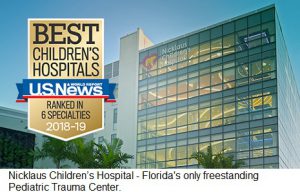
This is the vision of an industrial reboot! This transformation is where and how new jobs are to be created in the Caribbean.

The Go Lean book provides 370-pages of turn-by-turn instructions on “how” to adopt new community ethos, plus the strategies, tactics, implementations and advocacies to execute so as to reboot, reform and transform the societal engines of Caribbean society. One advocacy in rebooting the industrial landscape is to develop some sort of automotive manufacturing industry; consider the  specific plans, excerpts and headlines from the book on Page 206 entitled:

10 Ways to Develop the Auto Industry

1 Lean-in for the Caribbean Single Market
The CU will allow for the unification of the region into one market, thereby creating a single economy of 30 member-states, 42 million people and a GDP of over $800 Billion. The people of the region have cars, and will continue to need cars. There is no demand shortages for the region; in addition, the CU as the regional Taxi Commission will also furnish demand for a fleet customized as taxi cabs; modeling the NYC model – see Appendix ZG. The CU will take the lead in facilitating the vertical industries to supply the needs of a domestic auto industry. The CU’s economic engines allows for investment capital to finance the supply mechanisms and a media complex to forge a constant demand.
2 Do It Yourself – Domestic Manufacturer
A domestic auto industry is a great source for jobs for a skilled and high-wage labor force. Fulfilling the automotive needs of the CU market will create a lot of economic spin-off activity. In the US, the Detroit 3 maintains 240,000 jobs, but impact an additional 3 million jobs in related communities; see Appendix C3. By continuing to buy cars from the US, then Detroit gets the multiplier benefits of CU auto purchases rather than the CU; the same for Germany, Japan, etc. The CU will foster the local manifestation of the global auto industry to grow the domestic economy and deduct from the trade deficit. Invitations will be made to entities like Ford, GM, Volkswagen, Fiat, Toyota, Nissan, etc to deploy a local assembly plant in a CU member-state. After one company thrives from this foothold, other firms will definitely follow.
3 Bring on the future – “Lego” – Modular Platforms
Auto manufacturing disciplines are changing. Companies, like Volkswagen (VW) have adopted a modular platform approach that allows multiple brands and models (VW: includes Audi, Citroen, Bentley, Lamborghini, etc.) to share base components: engines, transmissions, ventilation systems, etc. [185] This allows for the global distribution of plug compatible parts to be assembled for models servicing different markets. Assembly plants can be erected anywhere.
4 Embrace Alternative Energy & Hybrids
5 Optimize the Logistics Industry
Automobiles are assembled at factories, but the ensemble parts are made at supplier plants all over the world. The assembly factories have to receive the parts, just in time, so as to not impede production. [184] The CU will optimize the transportation modes to ensure that doing business in the region is not a deterrent to success. Once the autos are completed, they then need to get to the marketplace, as automakers do not sell directly to the consumers, they distribute through dealerships. So vertical industries are promoted to ship, and relocate completed vehicles.
6 Exploit Service and Maintenance
7 Don’t forget “After-Market” Parts
8 Help Regional Businesses Find Foreign Markets – Export
9 Promote Auto Shows
10 Re-capture Recycled Materials

Automobile transportation solutions are not new for this Go Lean roadmap; there have been a number of previous blog-commentaries by the Go Lean movement that referenced the economic opportunities embedded in the industrial footprint of cars. See a sample list here:

https://goleancaribbean.com/blog/?p=11649 Righting a Wrong: Volkswagen Emissions Crisis
https://goleancaribbean.com/blog/?p=8650 Now it’s Detroit’s turn to rescue Silicon Valley
https://goleancaribbean.com/blog/?p=7056 Electric Cars: ‘Necessity is the Mother of Invention’
https://goleancaribbean.com/blog/?p=1277 The need for highway safety innovations – here comes Google

In summary, our Caribbean region need jobs. A better job-creation ability would help us to make our homeland a better place to live, work and play. In fact, one of the reasons why so many Caribbean citizens have emigrated away from the homeland is the job-creation dysfunction. Creating a new economic landscape will require rebooting the industrial landscape.

Yes, we can … reboot our industrial landscape, and create new jobs – and other economic opportunities.

We urge all Caribbean stakeholders to lean-in to this roadmap for economic empowerment. Other countries with less partnerships have exploited the market opportunities of auto-making; so can we; this Go Lean roadmap is viable. J

Sign the petition to lean-in for this roadmap for the Caribbean Union Trade Federation.

—————

Appendix VIDEO – Iran Automotive Industry – https://youtu.be/mB8buctuO3w

PressTV

Published on Oct 26, 2014 – Iran’s leading auto manufacturer, Iran Khodro, has presented five new products at the 2014 Tabriz Auto Expo. This only days after it started the mass production of TU3 engines for type 2, Peugeot 206 cars. IKCO has experienced a boom in production since October 2013. The 2014 production target is 600,000 sets of car and IKCO is already 2% ahead of planning. Meanwhile, the 2014 Tabriz Auto Expo itself is quite intriguing with nearly 450 Iranian and foreign companies taking part. A great chance to see current automobile models, debuts, and the latest spare parts to pimp your ride!

Share this post:
, , ,
[Top]

Industrial Reboot – Trauma 101

Go Lean Commentary

Define basic needs …

… no doubt this includes food, clothing and shelter. These are the age-old means of sustenance that every generation of mankind have had to contend with.

But in modern times, that list is expanded; add: energy, transportation, telecommunications and …

medical.

Can these be considered luxuries as opposed to basic needs?

An argument can be made of this point; many times even medical necessities are de-prioritized – think immunizations – until absolute emergencies. This latter scenario – medical emergencies – is the subject of Trauma medicine, an absolute necessity, vital service, and essential offering. Trauma becomes a basic need and not an optional luxury. So there will always be a demand for Trauma medicine; how will it be supplied?

This commentary – from the movement behind the book Go Lean … Caribbean (available to download for free) – continues the discussion on the economic principles of supply and demand; it focuses on fostering Industrial Reboots for the Caribbean homeland since the region is in dire straits economically. This Industrial Reboot is badly needed as our current economic landscape – based on Tourism – is in shambles! Our Supply-Demand dynamics are not optimized.

The Go Lean book serves as a roadmap for the introduction and implementation of the technocratic Caribbean Union Trade Federation (CU). It explains that Tourism is a service product that depends heavily on Supply-Demand dynamics. In Economics, higher demand and consistent supply results in higher prices; so in a normalized scenario, revenues should grow and grow. The Caribbean tourism is under assault in every member-state due to the fact that many visitors to the region have shifted from stay-overs to cruise arrivals. The Caribbean demand continues, but the supply is different. Cruises mean less economic impact to the local markets than stay-overs. So as a region, we must reboot our industrial landscape so as to create more jobs … from alternate sources. What options do we have?

The Go Lean book urges the region to reform and transform the economic engines around the delivery of basic needs, so we need to better prepare for medical-trauma emergencies. (There is the industrial sub-group of medical tourism). Medical-trauma needs are currently being supplied by other service providers … in foreign destinations. See the news article here portraying how the Joe DiMaggio Children Hospital in Ft. Lauderdale promotes its Neo-Natal and Pediatric treatments:

Title: World renowned Doctors convene in Saint Lucia
Press Release:–  Dr. Kak-Chen Chan, Pediatric Cardiologist and specialist in Adult Congenital Heart Disease and Dr. Steven Bibevski, Cardiothoracic surgeon who specializes in Pediatric and Congenital Heart Surgery, as well as heart transplantation and artificial heart support, will participate as speakers at the 33th Caribbean Cardiac Society in St. Lucia, from July 18th to July 21st, that will take place in the Royalton- Saint Lucia Resort and Spa.

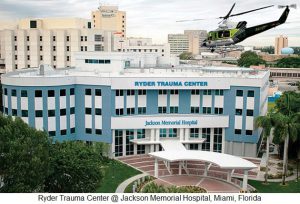
The doctors will share with their colleagues the knowledge, cutting edge procedures, and experiences performed at Joe DiMaggio Children’s Hospital, part of Memorial Healthcare System.

Since 1988, the Caribbean Cardiac Society has been a non-profit organization proud to be one of the most important gatherings of cardiac specialists from around the world, who are committed to providing services to cardiac patients in the Caribbean region, by sharing their experiences and exchange knowledge. This year’s theme is “Meeting the Challenges of Cardiac Care in an Ever-Changing Caribbean.”

One of the most common Congenital Heart Defects is Patent Ductus Arteriosus (PDA) defined when the two major blood vessels leading from the heart remain open after birth. PDA accounts for 5%-10% of all Congenital Heart Defects. To share more insight Dr. Kak-Chen Chan will present his lecture on Extreme Prematurity, chronic lung disease, persistent ductus arteriosus and pulmonary hypertension: The potentially deadly Quartet tamed.

Extreme premature infants are often affected by chronic lung disease, patent ductus arteriosus and pulmonary hypertension.  As medical science improves, more of these babies are surviving past their early infancy.  However, these disease process continues to be important causes of morbidity and mortality.

Dr. Steven Bibevski will be presenting a talk, showing data of survival rate on 10 years of surgical experience with patients from the Caribbean at Joe DiMaggio Children’s Hospital.

“I am very excited and honored to speak at this year’s CCS meeting. As physicians, our focus is on the health, well-being, and healing in of all patients. We are very fortunate to have an experienced team of doctors who work together to provide innovative treatments while delivering compassionate care to our patients,” stated Dr. Bibevski.
Source: St. Lucia News Daily Newspaper; posted & retrieved July 17, 2017 from: https://stluciatimes.com/2018/07/17/world-renowned-doctors-for-congress-in-saint-lucia/

There is the opportunity for a business model in the field of medical Trauma. Others are making money, why not Caribbean stakeholders. (Still, our motive must not just be profit, it must be the Greater Good). This is how and where jobs are to be forged for a new Caribbean economy.

There are other business models too, that the new Caribbean economy can deploy to grow the regional economy; we can, and must, reboot our industrial landscape. This commentary has previously identified a number of different industries that can be rebooted under this Go Lean roadmap. See this list of previous submissions under the title Industrial Reboots:

  1. Industrial RebootsFerries 101 – Published June 27, 2017
  2. Industrial RebootsPrisons 101 – Published October 4, 2017
  3. Industrial RebootsPipeline 101 – Published October 6, 2017
  4. Industrial RebootsFrozen Foods 101 – Published October 6, 2017
  5. Industrial RebootsCall Centers 101 – Published July 2, 2018
  6. Industrial RebootsPrefab Housing 101 – Published July 14, 2018
  7. Industrial Reboots – Trauma 101 – Published Today – July 18, 2018

The Go Lean book stresses that reforming and transforming the Caribbean economic engines and medical deliveries must be a regional pursuit. This was an early motivation for the roadmap, as pronounced in the opening Declaration of Interdependence (Pages 11 – 13):

ix. Whereas the realities of healthcare and an aging population cannot be ignored and cannot be afforded without some advanced mitigation, the Federation must arrange for health plans to consolidate premiums of both healthy and sickly people across the wider base of the entire Caribbean population. The mitigation should extend further to disease management, wellness, mental health, obesity and smoking cessation programs. The Federation must proactively anticipate the demand and supply of organ transplantation as developing countries are often exploited by richer neighbors for illicit organ trade.

xxiv.  Whereas a free market economy can be induced and spurred for continuous progress, the Federation must install the controls to better manage aspects of the economy: jobs, inflation, savings rate, investments and other economic principles. Thereby attracting direct foreign investment because of the stability and vibrancy of our economy.

xxvi.  Whereas the Caribbean region must have new jobs to empower the engines of the economy and create the income sources for prosperity, and encourage the next generation to forge their dreams right at home, the Federation must therefore foster the development of new industries, like that of ship-building, automobile manufacturing, prefabricated housing, frozen foods, pipelines, call centers … – impacting the region with more jobs.

Accordingly, a regional medical trauma eco-system can help to make the Caribbean a better place to live, work, heal and play. Many jobs could derive from these medical deliveries.

In addition, the CU will facilitate the eco-system for Self-Governing Entities (SGE), an ideal concept for Trauma Centers with its exclusive federal regulation/promotion activities. Imagine bordered campuses – with backup power generations, autonomy for professional standards, and autonomous air/sea transportation modes. The Go Lean movement (book and blogs) details the principles of SGE’s and job multipliers, how certain industries are better than others for generating multiple indirect jobs down the line (or off-campus) for each direct job on the SGE’s payroll.

According to the Go Lean book (Page 257) , there could be many jobs in the related fields of Trauma & Emergency Management – separate and apart from general health-care deliveries. The book quotes these figures:

Jobs from Trauma Centers, Emergency Managers, Volunteer Fire/Rescue: 4,000

The Go Lean book prepares the business model of Trauma Centers for consumption among Caribbean people. The book describes a scheme with 6 different Level I Trauma Centers – see Appendix below – throughout the region. This scheme will save lives, and also launch the new business model. Yes, business model refers to jobs, entrepreneurial opportunities, trade transactions, etc. In addition to these industry jobs; there is also the reality of indirect jobs – unrelated service and attendant functions – at a 3.75 multiplier rate would add another 15000 jobs.

This truly constitutes an Industrial Reboot. The Go Lean book details this business model, as such – see this quotation here from Page 196:

The Bottom Line on Trauma Medicine
A trauma center is a hospital facility equipped to provide comprehensive emergency medicine to victims suffering traumatic injuries. Trauma centers grew into existence out of the realization that traumatic injury is a disease process unto itself requiring specialized and experienced multidisciplinary treatment and specialized resources. According to the US Center for Disease Control (CDC), injuries are the leading cause of death for children and adults ages 1–44. The leading causes of trauma are motor vehicle accidents, falls, and assaults.

Trauma centers vary in their specific capabilities and are identified by “Level” designation: Level-1 being the highest, to Level-3 being the lowest (though some states have five designated levels, in which case Level-5 is the lowest). Higher levels of trauma centers will have trauma surgeons available; those trained in such specialties as Neurosurgery and Orthopedic surgery as well as highly sophisticated medical diagnostic equipment. Lower levels of trauma centers may only be able to provide initial care and stabilization of a traumatic injury and arrange for transfer of the victim to a higher level center.

The operation of a trauma center is extremely expensive. Some areas – especially rural regions – are under-served by trauma centers because of this expense. A variety of different methods have been developed for dealing with this. For example, many trauma centers have helipads for receiving patients that have been airlifted. The trauma level certification can directly affect the patient’s outcome and determine if the patient needs to be sent to a higher level center.

The strong point from this quotation is that “the operation of a trauma center is extremely expensive“; this allows for jobs.

According to the Go Lean book, societal engines refer to economics, security and governance. The industrial strategy of Trauma Centers relate to economics and security provisions. This CU/Go Lean roadmap has these 3 prime directives:

  • Optimization of the economic engines in order to grow the regional economy to $800 Billion & create 2.2 million new jobs.
  • Establishment of a security apparatus to ensure public safety and protect the homeland; and the economic engines.
  • Improve Caribbean governance to support these engines, including a separation-of-powers between the member-states and CU federal agencies.

The Go Lean book provides 370-pages of turn-by-turn instructions on “how” to adopt new community ethos, plus the strategies, tactics, implementations and advocacies to execute so as to reboot, reform and transform the societal engines of Caribbean society. One advocacy in rebooting the industrial landscape is to foster better Emergency Management, of which Trauma Centers are a subset. Consider the specific plans, excerpts and headlines from the book on Page 196 entitled:

10 Ways to Improve Emergency Management

1 Lean-in for the Caribbean Single Market
This treaty allows for the unification of the region into one market, thereby expanding to an economy of 30 countries, 42 million people and a GDP of over $800 Billion (according to 2010 metrics). This treaty calls for a collective security agreement for the Caribbean member-states so as to prepare-respond to natural disasters, emergency incidents and assuage against systemic threats against the homeland. The CU employs the professional arts and sciences of Emergency Management to spread the costs, risks and premium base across the entire region and refers to more  than  just medical scenarios, but rather any field of discipline that can impact the continuity of a community or an individual. The CU also has the direct responsibility for emergencies in the Exclusive Economic Zone and Self Governing Entities.
2 Trauma Centers

The CU envisions 6 strategically placed Level-1 trauma centers, and a series or lower level centers, placed throughout the region to service the entire population. The goal will be to ensure that every citizen is within a 1 hour transport from the closest trauma center. The trauma center may be physically located within a hospital campus, or stand-alone, but will be governed (and funded) by the CU and not the member-state’s public health system. (See Appendix ZM on Page 336).

3 Airlift / Sealift – Getting there by Helicopters, Airplanes and Boats

In addition to Air Ambulances (helicopters & airplanes), the CU will deploy Water Ambulances to quickly convey the injured to trauma centers among the islands. The vessels will all be equipped with certified and trauma-trained EMTs.

4 Mobile Surgical Centers and Tele-Medicine
5 Epidemiology – Viral & Bacterial Rapid Response
6 Mobile Command Centers
7 Intelligence Gathering & Analysis
8 Casualty Insurance Plans – Reinsurance “Sidecars”
9 Volunteer Fire – Rescue Brigades
10 ITIL – Information Technology Infrastructure Library

This formal discipline of ITIL is the art and science that describes processes, procedures, tasks and checklists used by organizations for managing risks associated with information technology deployments. This includes “focus areas” for Change Control, … Disaster Recovery, Problem and Access Management. (See Appendix ZN on Page 338).

This Go Lean book projects the roll-out of the 6 Trauma Centers as Day One / Step One of the Go Lean/CU roadmap. Over the 5-year implementation more and more of the features of the roadmap will be deployed and their effect on the region will be magnified and undeniable – think R&D. These will help to make the Caribbean a better place to live, work, heal and play.

This Go Lean roadmap seeks to foster best-practices in the administration of a Trauma Centers and Emergency Management. There is a lot of coordinate; there have been many issues detailed in previous Go Lean commentaries; see a sample here:

https://goleancaribbean.com/blog/?p=15012 Puerto Rico’s Trauma-Emergency Failings – A Lesson Learned
https://goleancaribbean.com/blog/?p=8815 Lessons from China – Managing Trauma & Organs Transplantation
https://goleancaribbean.com/blog/?p=7449 ‘Crap Happens’ – So What Now?
https://goleancaribbean.com/blog/?p=6103 Sum of All Fears – ‘On Guard’ Against Deadly Threats
https://goleancaribbean.com/blog/?p=5002 Managing a ‘Clear and Present Danger’
https://goleancaribbean.com/blog/?p=4308 911 – Emergency Response: Systems in Crisis

According to the foregoing news article, the Caribbean Cardiac Society (CCS) is meeting today through Saturday (July 18 – 21). They do meet annually. This year’s conference or congress – 33rd annual – is meeting in St. Lucia; last year (2017) was Trinidad, 2016 was Barbados, 2015 was Jamaica, 2014 was in the Bahamas and the 2013 conference was held in Curacao. So this organization already has a footprint in all the key destinations of the Caribbean. The CU formally launching 6 Trauma Centers can easily utilize the CCS’s infrastructure.

The subject of Trauma Centers is not a luxury; assuaging trauma is a basic need for the region. We are spending the money now – many times raising money through Bake Sales, Car Washes and Raffles – and enriching foreign entities. Making provisions to provide our own basic needs is just … mature. This is to be expected of emerging societies. This is the type of development that sends the message to Caribbean citizens, at home and in the Diaspora, that “one” can now prosper where planted in the Caribbean.

This plan – the roadmap to deploy a regional network of Trauma Centers – is conceivable, believable and achievable. We can deploy our own brand of Pediatric Hospitals in the Caribbean, much like the Joe DiMaggio one in the VIDEO here:

VIDEO – A Look At What We Like About Joe DiMaggio Children’s Hospital https://youtu.be/9r3pYZZ3UTE

Joe DiMaggio Children’s Hospital
Published on Jul 14, 2015
Joe DiMaggio Children’s Hospital is one of the region’s leading pediatric hospitals, offering a comprehensive scope of healthcare services and programs in a child-friendly atmosphere. A full-service hospital, we treat minor illnesses, trauma-related accidents and some of the most complex medical conditions.

Established in 1992, Joe DiMaggio Children’s Hospital combines advanced technology and the expertise of the largest, most diverse group of board-certified pediatric specialists in the region. With its summer 2011 expansion, Joe DiMaggio Children’s Hospital now has 204 beds and is South Florida’s newest freestanding children’s hospital.

In its first year of operation, Joe DiMaggio Children’s Hospital’s medical staff included 90 physicians and patient admissions numbered 2,000. Through the years, the hospital has enhanced and expanded its services and programs to help meet the growing and diverse needs of the community.

The hospital is staffed 24 hours a day by world-class pediatricians, pediatric specialists, specialty-trained nurses and ancillary support staff. Today, more than 650 physicians are on the medical staff, and during the 2014 fiscal year our team recorded:

  • 8,707 admissions and observations
  • 6,039 pediatric surgeries
  • 53,450 outpatient visits
  • 110,322 visits at three Joe DiMaggio Children’s Hospital Emergency Department locations

Uniquely inspired by and designed for kids and families, the freestanding building offers many amenities. The vibrant colors, whimsical décor and larger-than-life murals welcome children to an upbeat environment where the “Power of Play” is a healing force. Each floor reflects an individual theme of sports, arts, games or dreams. All patient rooms are private and are wired for movies, video games, the Internet and educational programs, and room-service meals are available any time of the day.

This four-story, 180,000-square-foot, environmentally friendly facility features six pediatric operating rooms, dedicated medical/surgical units, family resource centers, ambulatory services, imaging services that feature a CT scanner disguised as a pirate ship, and an entire floor dedicated to inpatient and outpatient pediatric oncology treatment.

A glass pedestrian skywalk connects to the Wasie Neonatal Intensive Care Unit, Pediatric Intensive/Cardiac Care Unit, and Level 1 Trauma Center and Children’s Emergency Department.

Conveniently located on the campus, Conine Clubhouse provides a special home away from home for families of hospitalized children. Accommodations are based on availability.

The team at Joe DiMaggio Children’s Hospital embraces a patient- and family-centered approach to care, working with families in the effort to best meet the needs of the child.

We should not just be “running to Florida” for any/every medical emergency; how long should the expectation be for our young nations to grow-up. The Go Lean roadmap declares that it is high time and past time for the region, to stand-up and step-up to satisfy the needs of our people. While this delivery may be too big for any one Caribbean member-state alone, surely together-united-integrated we can leverage the kinetics of a 42 million Single Market economy.

We urge all Caribbean stakeholders to lean-in to this roadmap for economic empowerment and medical delivery. We can make the Caribbean homeland better places to live, work, heal and play. 🙂

Download the free e-Book of Go Lean … Caribbean – now!

Sign the petition to lean-in for this roadmap for the Caribbean Union Trade Federation.

—————

Appendix ZM – Trauma Center Definitions

A trauma center is a hospital that is designated by a state or local authority or is verified by the American College of Surgeons (ACS) [a]. The details of these trauma levels are as follows:

Level I

A Level I Trauma Center provides the highest level of surgical care to trauma patients. Being treated at a Level I Trauma Center increases a seriously injured patient’s chances of survival by an estimated 20 to 25 percent. This has a full range of specialists and equipment available 24 hours a day and admits a minimum required annual volume of severely injured patients. A Level I trauma center is required to have a certain number of surgeons, emergency physicians and anesthesiologists on duty 24 hours a day at the hospital, an education program, and preventive and outreach programs. Key elements include 24-hour in-house coverage by general surgeons and prompt availability of care in varying specialties—such as orthopedic surgery, neurosurgery, plastic surgery (plastic surgeons often take calls for hand injuries),anesthesiology, emergency medicine, radiology, internal medicine, oral and maxillofacial surgery (trained to treat injuries of the facial skin, muscles, bones), and critical care—which are needed to adequately respond and care for various forms of trauma that a patient may suffer. Additionally, a Level I center has a program of research, is a leader in trauma education and injury prevention, and is a referral resource for communities in nearby regions.

Level II

A Level II trauma center works in collaboration with a Level I center. It provides comprehensive trauma care and supplements the clinical expertise of a Level I institution. It provides 24-hour availability of all essential specialties, personnel, and equipment. Minimum volume requirements may depend on local conditions. These institutions are not required to have an ongoing program of research or a surgical residency program.

Level III

A Level III trauma center does not have the full availability of specialists, but does have resources for emergency resuscitation, surgery, and intensive care of most trauma patients. A Level III center has transfer agreements with Level I or Level II trauma centers that provide back-up resources for the care of exceptionally severe injuries, Example: Rural or Community hospitals.

Level IV

A Level IV trauma center exists in some states where the resources do not exist for a Level III trauma center. It provides initial evaluation, stabilization, diagnostic capabilities, and transfer to a higher level of care. It may also provide surgery and critical-care services, as defined in the scope of services for trauma care. A trauma-trained nurse is immediately available, and physicians are available upon the patient’s arrival to the Emergency Department. Transfer agreements exist with other trauma centers of higher levels, for use when conditions warrant a transfer.

Level V

A Level V trauma center provides initial evaluation, stabilization, diagnostic capabilities, and transfer to a higher level of care. This type of center may provide surgical and critical-care services, as defined in the service’s scope of trauma-care services. A trauma-trained nurse is immediately available, and physicians are available upon patient arrival in the Emergency Department. If not open 24 hours daily, the facility must have an after-hours trauma response protocol.

Pediatric Trauma Centers

A facility can be designated an adult Trauma Center, a pediatric Trauma Center, or an adult & pediatric Trauma Center. If a hospital provides trauma care to both adult and pediatric patients, the Level designation may not be the same for each group. For example, a Level 1 adult Trauma Center may also be a Level 2 pediatric Trauma Center. This is because pediatric trauma surgery is a specialty unto itself. Adult trauma surgeons are not generally specialized in providing surgical trauma care to children, and vice versa, and the difference in practice is significant.

Cited Reference:

a. American College of Surgeons. “ACS Verification Site Visit Outcomes”. Retrieved April 2013 from: http://www.facs.org/trauma/verificationhosp.html


Share this post:
, , ,
[Top]

100 Years of Mandela – ENCORE

Wow, time flies!

It is 100 years now that Nelson Mandela had come into this world, and though his life has ended, his impact continues to reverberate … up to today.

Nelson Rolihlahla Mandela (18 July 1918 – 5 December 2013) was a South African anti-apartheid revolutionarypolitical leader, and philanthropist, who served as President of South Africa from 1994 to 1999. He was the country’s first black head of state and the first elected in a fully representative democratic election. His government focused on dismantling the legacy of apartheid by tackling institutionalized racism and fostering racial reconciliation. Ideologically an African nationalist and socialist, he served as President of the African National Congress (ANC) party from 1991 to 1997.
Source: Retrieved July 17, 2018 from: https://en.wikipedia.org/wiki/Nelson_Mandela

There are so many lessons that the life and legacy of Nelson Mandela offers to the modern Caribbean. One such lesson was provided in a previous blog-commentary from April 30, 2015. See an Encore of that submission here/now:

———————————
Go Lean Commentary – A Lesson in History – Royal Charter: Zimbabwe -vs- South Africa

Zimbabwe - Photo 2If presented the choice, which would you rather be granted: riches or power?

Many would conclude riches, because of societal expressions like the “Golden Rule: He who has the Gold… rules”. Yet the truth is riches can be created and destroyed quickly. This was the experience just recently during the 2008 Great Recession, where people in the US – the richest country on the planet – lost $11 Trillion in net worth in short order.

On the other hand, there is power. History shows that with power, the rights to riches can be granted, exploited and passed on, from century to century, generation to generation. Consider for example the African continent (in particular the southern region) and the Royal Charters that granted abundant wealth to a privileged few:

The English had been the first to adopt the approach of bundling their resources into a monopoly enterprise, with the English East India Company in 1600. This threatened their Dutch competitors with ruin,[15] so in 1602 the Dutch monarchy followed suit and sponsored the creation of a single Dutch East Indies Company and granted it monopoly over the Asian trade. (Source: http://en.wikipedia.org/wiki/Dutch_East_India_Company#Formation_.281602.29)

CU Blog - A Lesson in History - Royal Charter - Zimbabwe -vs- South Africa - Photo 1The British monarchy has issued over 980 Royal Charters.[1] (A formal document issued by a monarch as letters patent, granting a right or power to an individual or a body corporate). A specific charter was issued for the South African region.

The British South Africa Company (BSAC) was established following the amalgamation of Cecil Rhodes‘ Central Search Association and the London-based Exploring Company Ltd which had originally competed to exploit the expected mineral wealth of Mashonaland but united because of common economic interests and to secure British government backing. The company received a Royal Charter in 1889 modeled on that of the English East India Company. Its first directors included the Duke of Abercorn, Rhodes himself and the South African financier Alfred Beit. Rhodes hoped BSAC would promote colonisation and economic exploitation across much of south-central Africa, as part of the “Scramble for Africa“. However, his main focus was south of the Zambezi, in Mashonaland and the coastal areas to its east, from which he believed the Portuguese could be removed by payment or force, and in the Transvaal, which he hoped would return to British control.[1] (Source: http://en.wikipedia.org/wiki/British_South_Africa_Company)

This historic information is being considered in conjunction with the book Go Lean…Caribbean; a publication designed to elevate the region’s economic (create 2.2 million new jobs), security and governing engines. Why would this “Lesson in History” matter in assessing today’s Caribbean status and fate?

It is of utmost importance. This discussion reveals how to reconcile the injustices of the past, and still build a better future. We have good models to consider, in this case the countries of Zimbabwe and South Africa.

In a previous blog/commentary, the issue of the origin of colonial entitlements was detailed at full length. A direct quote relates:

The most iconic of all the Papal Bulls [-“letters patent” or charters issued by a Pope, the Head of the Roman Catholic Church -] was the Inter caetera, a Papal Bull by Pope Alexander VI on 4 May 1493, which set a demarcation between the New Lands to Portugal and Spain; this granted to Spain all lands to the “west and south” … of the islands of the Azores … and all new lands to the East of this pole remained assigned to Portugal.

Just before this world-changing decree, there was an earlier Papal Bull that sealed the fate and would prejudice the African Diaspora for 500 years. The African Slave Trade and institution of “Slavery” was legally predicated on a Papal Bull from Pope Innocent VIII (Giovanni Battista Cybo) in 1491; just months before Christopher Columbus’s historic first voyage

From the origins of slavery, [colonialism] traversed the historic curves of social revolution and evolution. In the 1500, the Protestant movement took hold. As other European powers deviated from Catholicism, Papal Bulls carried no significance to them and compliance was ignored. England and Holland established their own Protestant Churches with their own monarch as head of Church and State; Papal decrees were replaced with Royal Decrees and Charters. The intent and end-result was still the same: territories and lands awarded (colonized) with the stroke of a pen by one European power after another. The Royal Decrees and Charters were then reinforced with a strong military presence and many battles…

[The resultant] “oligarchy” … power effectively rested with a small number of people. These people could be distinguished by royalty, wealth, family ties, education, corporate, religious or military affiliation.

In this discussion of oligarchy, focus is given to powerful families. There are encyclopedic references that relate that oligarchy structures are often controlled by a few prominent families, who typically pass their influence/wealth from one generation to the next, even though inheritance alone is not a necessary condition for oligarchies to prevail…

This is the challenge that belies Caribbean society. Most of the property and indigenous wealth of the Caribbean region is concentrated amongst the rich, powerful and yet small elite; an oligarchy. Many times these families received their property, corporate rights and/or monopolies by Royal Charter from the European monarchs of ancient times. These charters thus lingered in legacy from one generation to another … until …

The form of rulership that dominated these times in history is that of Oligarchy; empowered by Royal Charters/Decrees. Today, oligarchy – rule by the rich[4] – is synonymous with another term commonly used, plutocracy.

Zimbabwe Photo 3The subject of oligarchs is very familiar on the African continent. This has been a real issue there. In many countries after colonialism, like Zimbabwe (1980), the cure for the oligarch disease was nationalization – forfeiting and seizing commercial farms and mines. This turned out disastrously for this country; the cure was worse than the disease. But, next door in South Africa (14 years later), the strategy, tactics and implementation was different. This country did not ascend to majority-rule until 1994; the first majority-ruled President there, Nelson Mandela saw the futility of the nationalization strategy amongst the precedent independent African nations, so he pursued an alternate approach to assuage White Flight and keep the capital and skilled labor in the country. But the continuation of the oligarchs ill-gained, and public-perceived-stolen assets forged problems in the reality of economic/wealth inequality. Majority-rule therefore brought no revolutionary change for the average man.

All in all, change is not easy. It is heavy-lifting. This is abundantly clear in the examination of the independent majority-ruled Zimbabwe and majority-ruled South Africa. See Chart in the Appendix of the comparisons.

The details of the Republic of Zimbabwe (1980) evolution are as follows:

The British South Africa Company was a Royal Charter, to administer “North-Western Rhodesia” and “North-Eastern Rhodesia” for White settlement; it was not under those names, but the names of the geographic parts—”Mashonaland”, “Matabeleland”, “Barotseland”, and so on. The collective territories were initially referred to as “Zambesia” – the name origins of both Zambia and Zimbabwe – but became Rhodesia as an international brand. While the White minority community resisted the transition to black majority-rule, the change inevitably came, empowering revolutionary leader Robert Mugabe. The new regime – due to spite, revenge and broken promises – began confiscating White-owned farmlands. This is widely blamed for leading to the deterioration of the Zimbabwean economy (societal abandonment of human and financial capital); this has plagued the country even until this day.[113]

The details of the Republic of South Africa (1994) evolution are as follows:

The Cape Colony was a British colony in present-day South Africa and Namibia, named for the Cape of Good Hope. The British colony was preceded by an earlier Dutch colony of the same name, established in 1652 by the Dutch East India Company – granted by Royal Charter from the Dutch Monarchy. The Dutch lost the colony to Britain following the 1795 Battle of Muizenberg, but had it returned following the 1802 Peace Treaty of Amiens. It was re-occupied by the British following the Battle of Blaauwberg in 1806, and British possession affirmed with the Anglo-Dutch Treaty of 1814. The Cape Colony then remained in the British Empire, becoming self-governing in 1872, and uniting with three other colonies to form the Union of South Africa in 1910. Despite practicing racial segregation for most of its history, eventually integration and black majority-rule evolved in the Republic of South Africa. Despite their resistance to these changes, accommodations and reconciliations on the part of Nelson Mandela allowed for the continuation of the established societal engines; the minority White communities and business interests remained.

Zimbabwe - Photo 4Considering these case studies, the Failed-State status of Zimbabwe versus the economic successes of South Africa, we see a lesson in this history, an obvious appreciation for best-practices … for us to apply in the Caribbean. We can optimize these best-practices by applying regional strategies, tactics and implementations to benefit everyone – the Greater Good – and try not to disenfranchise any one group.

The masses of people in the democratic Caribbean now have the right to rule, not just some special group set aside by Royal Decree or granted power by a Royal Charter. Since there is the scientific fact that no one can go back in time and change history; we can only move forward, hopefully with wisdom from the lessons learned in history. The Go Lean book presents a roadmap on how to benefit from these lessons – good, bad and ugly – and how to empower communities anew; to use political power to impact the Greater Good. We therefore see a role for the Rich (One Percent – Page 224), the Poor (Page 222) and the Middle Classes (Page 223).

The consideration of the Go Lean book, as related to this subject is one of governance, the need for technocratic stewardship of the regional Caribbean society. This point was also pronounced in the opening Declaration of Interdependence (Page 12) with these acknowledgements and statements:

xi.   Whereas all men are entitled to the benefits of good governance in a free society, “new guards” must be enacted to dissuade the emergence of incompetence, corruption, nepotism and cronyism at the peril of the people’s best interest. The Federation must guarantee the executions of a social contract between government and the governed.

xii. Whereas the legacy in recent times in individual states may be that of ineffectual governance with no redress to higher authority, the accedence of this Federation will ensure accountability and escalation of the human and civil rights of the people for good governance, justice assurances, due process and the rule of law. As such, any threats of a “failed state” status for any member state must enact emergency measures on behalf of the Federation to protect the human, civil and property rights of the citizens, residents, allies, trading partners, and visitors of the affected member state and the Federation as a whole.

xiii. Whereas the legacy of dissensions in many member-states (for example: Haiti and Cuba) will require a concerted effort to integrate the exile community’s repatriation, the Federation must arrange for Reconciliation Commissions to satiate a demand for justice.

This Go Lean book serves as a roadmap for the introduction and implementation of the technocratic Caribbean Union Trade Federation (CU) to provide better stewardship for the 30 member-states of the Caribbean region, despite their European heritage. The book (and subsequent blog/commentaries) posits that we must not fashion ourselves as parasites of our previous European colonizers, but rather pursue a status as protégés.

Our past history feature much oppression and repression; European colonialism had been a villainous “dragon”. But we can train our dragons! We can make the most of previous bad history. This point was presented as a strategy for Direct Foreign Investments, asserting that we want to invite and attract investments. We can use their resources to elevate our own communities, while still providing a return/profit for the investors.

This is Pragmatism 101!

We, in the Caribbean, were not the only ones abused. Other indigenous people (Africans, Asians, Amerindians, etc.) also suffered, sometimes even more so. The goal should be to thrive despite the disabling legacy; (and if not for everyone, then make the most of the situation for the most number of people).

This is the community ethos of the Greater Good!

Globalization is now an ‘Agent of Change’ that we must contend with. We must “play nice in the sandbox” with people of other countries, especially those with capital resources. So if a minority group represents a faction that previously exploited our land and forefathers, we cannot expect to extract vengeance against them – Zimbabwe proved the futility of such a quest for justice and inequity. As related in the Go Lean book (Page 151), the best-practice for any governing entity to grow the economy is to protect all property rights; (real, personal or intellectual). This is the “new” New World; and the new formula for success.

Another formula, an economic principle, is that “voluntary trade creates wealth” (Page 21). This fact has often been overlooked in policy decisions for Africa. The following VIDEO portrays this dilemma, decrying the current migrant/refugee crisis in Europe, when the best-practice the continent can provide the African people is a more liberal trade policy, allowing markets for African agricultural produce. (Without this type of proactive strategies, the continent is being oppressed … all over again … by today’s Europe; this is a lesson learned from the Native American Reservations in the US).

VIDEO: UKIP Leader Nigel Farage Addressing European Parliament on African Culpability & Hyprocrisy – https://youtu.be/NTwOap7ohc4

Posted by Wednesday, April 29, 2015 – UKIP Leader Nigel Farage: speaks to the European Parliament on the EU suggestion that the continent should have a common asylum and migration policy. He felt it was important to represent the view that this is not just another attack on British sovereignty but also inherently dangerous.

In general, the Go Lean roadmap stresses key community ethos, strategies, tactics, implementations and advocacies necessary to transform and turn-around the eco-systems of Caribbean society. These points are detailed in the book as follows:

Community Ethos – Deferred Gratification Page 21
Community Ethos – Economic Principles – Economic Systems Influence   Individual Choices Page 21
Community Ethos – Economic Principles – Consequences of Choices Lie in   the Future Page 21
Community Ethos – Ways to Impact the Future Page 26
Community Ethos – Ways to Manage Reconciliations – South African Model Page 34
Community Ethos – Ways to Impact the Greater Good Page 37
Strategy – Vision – Confederate all 30 member-states/ 4 languages into a Single Market Page 45
Tactical – Separation-of-Powers – CU Federal Government versus Member-State Governance Page 71
Implementation – Ways to Pay for Change Page 101
Implementation – Ways to Foster International Aid Page 115
Planning – 10 Big Ideas – #4: Confederation Without Sovereignty Page 127
Planning – Ways to Improve Trade Page 128
Planning – Ways to Model the new European Union – Unified Economy Page 130
Planning – Ways to Make the Caribbean Better Page 131
Planning – Lessons Learned from 2008 Page 136
Planning – Lessons Learned from Indian Reservations – Audacity versus Absence of Hope Page 141
Advocacy – Ways to Grow the Economy – Protect Property Rights Page 151
Advocacy – Ways to Create Jobs Page 152
Advocacy – Ways to Improve Governance Page 168
Advocacy – Ways to Better Manage the Social Contract Page 170
Advocacy – Ways to Better Manage Natural Resources Page 183
Advocacy – Ways to Preserve Caribbean Heritage Page 218

In considering this history and re-addressing the opening question: given the choice between riches and power, we choose power!

With the proper stewardship, we can “create real money from thin air”; establish trade networks to grow the economy, educate our people to be global leaders, foster development of products and services that the world demands. The “world would beat a path to our doors”.

Adherence to these best-practices – gleaned from this lesson in history – would help us make our Caribbean community a better homeland to live, work and play.  🙂

Download the free e-Book of Go Lean … Caribbean – now!

———

Appendix – Comparative Analysis of Zimbabwe versus South Africa

Zimbabwe

South Africa

Economy – overview Zimbabwe’s economy is growing despite continuing political   uncertainty. Following a decade of contraction from 1998 to 2008, Zimbabwe’s   economy recorded real growth of roughly 10% per year in 2010-11, before   slowing in 2012-13 due poor harvests and low diamond revenues. The government   of Zimbabwe faces a number of difficult economic problems, including   infrastructure and regulatory deficiencies, ongoing indigenization pressure,   policy uncertainty, a large external debt burden, and insufficient formal   employment. Until early 2009, the Reserve Bank of Zimbabwe routinely printed money   to fund the budget deficit, causing hyperinflation. Dollarization in early   2009 – which allowed currencies such as the Botswana   pula, the South Africa   rand, and the US dollar to be used locally – ended hyperinflation and reduced   inflation below 10% per year, but exposed structural weaknesses that continue   to inhibit broad-based growth. South Africa is a middle-income, emerging market with an   abundant supply of natural resources; well-developed financial, legal,   communications, energy, and transport sectors and a stock exchange that is   the 16th largest in the world. Even though the country’s modern   infrastructure supports a relatively efficient distribution of goods to major   urban centers throughout the region, unstable electricity supplies retard   growth. The global financial crisis reduced commodity prices and world   demand. GDP fell nearly 2% in 2009 but has recovered since then, albeit   slowly with 2014 growth projected at about 2%. Unemployment, poverty, and   inequality – among the highest in the world – remain a challenge. Official   unemployment is at nearly 25% of the work force, and runs significantly   higher among black youth. Eskom, the state-run power company, has built two   new power stations and installed new power demand management programs to   improve power grid reliability. Construction delays at two additional plants,   however, mean South Africa   is operating on a razor thin margin; economists judge that growth cannot   exceed 3% until those plants come on line. South Africa’s economic policy   has focused on controlling inflation, however, the country has had   significant budget deficits that restrict its ability to deal with pressing   economic problems. The current government faces growing pressure from special   interest groups to use state-owned enterprises to deliver basic services to   low-income areas and to increase job growth.
Population 12,973,808 54,002,000
GDP (purchasing power parity) $7.496 billion (2013 est.) $595.7 billion (2013 est.)
$7.265 billion (2012 est.) $584 billion (2012 est.)
$6.957 billion (2011 est.) $569.5 billion (2011 est.)
note: data are in 2013 US dollars note: data are in 2013 US dollars
GDP – real growth rate 3.2% (2013 est.) 2% (2013 est.)
4.4% (2012 est.) 2.5% (2012 est.)
10.6% (2011 est.) 3.5% (2011 est.)
GDP – per capita (PPP) $600 (2013 est.) $11,500 (2013 est.)
$600 (2012 est.) $11,400 (2012 est.)
$500 (2011 est.) $11,300 (2011 est.)
note: data are in 2013 US dollars note: data are in 2013 US dollars
GDP – composition by sector agriculture: 20.1% agriculture: 2.6%
industry: 25.4% industry: 29%
services: 54.5% (2013 est.) services: 68.4% (2013 est.)
Population below poverty line 68% (2004) 31.3% (2009 est.)
Household income or consumption by   percentage share lowest 10%: 2% lowest 10%: 1.2%
highest 10%: 40.4% (1995) highest 10%: 51.7% (2009 est.)
Inflation rate (consumer prices) 8.5% (2013 est.) 5.8% (2013 est.)
8.2% (2012 est.) 5.7% (2012 est.)
Labor force 3.939 million (2013 est.) 18.54 million (2013 est.)
Labor force – by occupation agriculture: 66% agriculture: 9%
industry: 10% industry: 26%
services: 24% (1996) services: 65% (2007 est.)
Unemployment rate 95% (2009 est.) 24.9% (2013 est.)
80% (2005 est.) 25.1% (2012 est.)
note: figures include unemployment and underemployment;   true unemployment is unknown and, under current economic conditions,   unknowable
Distribution of family income – Gini   index 50.1 (2006) 63.1 (2005)
50.1 (1995) 59.3 (1994)
Budget revenues: $NA revenues: $88.53 billion
expenditures: $NA (2013 est.) expenditures: $105.5 billion (2013 est.)
Industries mining (coal, gold, platinum, copper,   nickel, tin, diamonds, clay, numerous metallic and nonmetallic ores), steel;   wood products, cement, chemicals, fertilizer, clothing and footwear, foodstuffs,   beverages mining (world’s largest producer of   platinum, gold, chromium), automobile assembly, metalworking, machinery,   textiles, iron and steel, chemicals, fertilizer, foodstuffs, commercial ship   repair
Industrial production growth rate 3.7% (2013 est.) 0.9% (2013 est.)
Agriculture – products corn, cotton, tobacco, wheat, coffee,   sugarcane, peanuts; sheep, goats, pigs corn, wheat, sugarcane, fruits,   vegetables; beef, poultry, mutton, wool, dairy products
Exports $3.144 billion (2013 est.) $91.05 billion (2013 est.)
$3.314 billion (2012 est.) $93.48 billion (2012 est.)
Exports – commodities platinum, cotton, tobacco, gold,   ferroalloys, textiles/clothing gold, diamonds, platinum, other metals   and minerals, machinery and equipment
Exports – partners China 21.1%, South Africa 15.1%,   Democratic Republic of the Congo 12.1%, Botswana 10.8%, Italy 4.6% (2012) China 11.8%, US 8.3%, Japan   6%, Germany 5.7%, India 4.2%   (2012)
Imports $4.571 billion (2013 est.) $99.55 billion (2013 est.)
$4.569 billion (2012 est.) $102.6 billion (2012 est.)
Imports – commodities machinery and transport equipment,   other manufactures, chemicals, fuels, food products machinery and equipment, chemicals,   petroleum products, scientific instruments, foodstuffs
Imports – partners South    Africa 51.9%, China 10%   (2012) China 14.4%, Germany   10.1%, Saudi Arabia 7.7%, US 7.4%, Japan   4.6%, India   4.5% (2012)
Debt – external $8.445 billion (31 December 2013 est.) $139 billion (31 December 2013 est.)
$8.765 billion (31 December 2012 est.) $130.4 billion (31 December 2012 est.)
Exchange rates Zimbabwean dollars (ZWD) per US dollar   – rand (ZAR) per US dollar –
234.25 (2010) 9.576 (2013 est.)
234.25 (2009) 8.2031 (2012 est.)
9,686.8 (2007) 7.3212 (2010 est.)
note: the dollar was adopted as a legal currency in 2009;   since then the Zimbabwean dollar has experienced hyperinflation and is   essentially worthless 8.42 (2009)
  7.9576 (2008)
Fiscal year calendar year 1 April – 31 March
Public debt 202.4% of GDP (2013 est.) 45.4% of GDP (2013 est.)
244.2% of GDP (2012 est.) 42.3% of GDP (2012 est.)
Reserves of foreign exchange and gold $437 million (31 December 2013 est.) $48.46 billion (31 December 2013 est.)
$575.6 million (31 December 2012 est.) $50.7 billion (31 December 2012 est.)
Current Account Balance -$576 million (2013 est.) -$23.78 billion (2013 est.)
-$416.5 million (2012 est.) -$24.07 billion (2012 est.)
GDP (official exchange rate) $10.48 billion (2013 est.) $353.9 billion (2013 est.)
Stock of direct foreign investment –   at home $NA $143.3 billion (31 December 2013 est.)


Share this post:
, , ,
[Top]

Industrial Reboot – Prefab Housing 101

Go Lean Commentary

Is housing just a commodity, available to the highest bidder, or a basic right that everyone is entitled to?

The answer to this question should be obvious: no matter the income level, there is the need for housing – basic needs are cataloged as food, clothing and shelter – so there must be housing solutions for all in society, the rich, middle class and the poor.

Here’s the disclosure: All housing types can benefit from pre-fabricated housing methods – see Photos below.

Prefabricated buildings consist of several factory-built components or units that are assembled on-site to complete the unit. The economic beauty of this method is the requirement for labor in the fabrication site and the assembly site. Fostering that labor means jobs and allows for an Industrial Reboot based on familiar techniques. Already, a popular prefabrication technique is utilized widely in the construction industry with Roof Trusses.

The book Go Lean … Caribbean – available to download for free – focuses on fostering Industrial Reboots for the Caribbean region. The book serves as a roadmap for the introduction and implementation of the technocratic Caribbean Union Trade Federation (CU). It identifies the strategic and tactical genius of Roof Trusses (Page 207):

The Bottom Line on Roof Trusses
In architecture a truss is a structure comprising one or more triangular units constructed with straight members whose ends are connected at joints referred to as nodes. Simple trusses are composed entirely of triangles because of the stability of this shape and the methods of analysis used to calculate the forces within them. The planar truss, pitched truss, or common truss is used primarily for roofs.Prefabrication is the practice of assembling components of a structure in a factory or other manufacturing site, and transporting complete assemblies or sub-assemblies to the construction site. Roof trusses are most commonly prefabricated. A prefabricated roof truss system is an engineered shop fabricated wood frame system that is installed on the building at the job site. It is installed on the typical timber or concrete belt beam and typically spans from one load bearing wall to another load bearing wall. Prefabricated roofs are used on almost any type of roof and are preferred when resistance to high wind speed is required because it can be quickly engineered, or when rapid site installation is required.This is the winning formula for acceptance of prefab homes. Despite objections to prefabrication strategies/concepts, no one objects to prefabricated roof trusses; the market acceptance for homes should “build-up” from this “juncture”.

The Go Lean book opened with a focus on basic needs. At the very beginning – Page 3 – the role for the CU was defined:

The CU should better provide for the region’s basic needs (food, clothing, energy and shelter), and then be in position to help supply the rest of the world. Previous Caribbean societies lived off the land and the sea; but today, the region depends extensively on imports …

For industries that depend on providing basic needs, there is an opportunity to reboot the industrial landscape and business model. There is the opportunity to launch a Prefab Housing industry.

Jobs are at stake.

According to the book Go Lean … Caribbean (Page 257) , there could be this many jobs:

Direct jobs in the design, fabrication and logistics for new pre-fab homes: 8,000

The Go Lean book prepares the business model of Prefab Housing for consumption in the Caribbean. Yes, business model refers to jobs, entrepreneurial opportunities, trade transactions, etc. In addition to these industry jobs; there is also the reality of indirect jobs – unrelated service and attendant functions – at a 3.75 multiplier rate would add another 30,000 jobs.

This constitutes an Industrial Reboot.

There is the need to supplement the housing deliveries in the Caribbean region; so factory-built homes should have a place. But, we are not talking manufactured homes, as in mobile homes or trailers. No, we are talking previously-made and fabulous, or pre-fab. Thus these homes can supply the demand for rich and middle class residents. See the samples from Appendix K; of the Go Lean book on Page 289. In addition, there are vast options for prefab homes from recycled shipping containers. These are ideal for affordable housing solutions, or even replacements for  “Shanty Towns”; see Appendix Commentary.

Providing quality housing for “pennies on the dollar” is an ideal objective for the Go Lean movement, or those pursuing the Greater Good. This Industrial Reboot pursues the Greater Good mandate; it is wise to try to please residents, advocates, entrepreneurs, bankers and governmental officials. This is in addition to the roadmap’s prime directive, defined as follows:

  • Optimization of the economic engines in order to grow the regional economy to $800 Billion & create 2.2 million new jobs.
  • Establishment of a security apparatus to ensure public safety and protect the resultant economic engines.
  • Improvement of Caribbean governance to support these engines, including a separation-of-powers between the member-states and CU federal agencies.

This Industrial Reboot is badly needed in the Caribbean region as our current economic landscape – based on Tourism – is in shambles!

Tourism is under assault in every Caribbean member-state due to the fact that many visitors shift from stay-overs to cruise arrivals. This means less economic impact to the local markets. So as a region, we must reboot our industrial landscape so as to create more jobs … from alternate sources. What options do we have?

This commentary has previously identified a number of different industries that can be rebooted under this Go Lean roadmap. See this list of previous submissions under the title Industrial Reboots:

  1. Industrial RebootsFerries 101 – Published June 27, 2017
  2. Industrial RebootsPrisons 101 – Published October 4, 2017
  3. Industrial RebootsPipeline 101 – Published October 6, 2017
  4. Industrial RebootsFrozen Foods 101 – Published October 6, 2017
  5. Industrial RebootsCall Centers 101 – Published July 2, 2018
  6. Industrial Reboots – Prefab Housing 101 – Published Today – July 14, 2018

The Go Lean book stresses that reforming and transforming the Caribbean economic engines must be a regional pursuit. This was an early motivation for the roadmap, as pronounced in the opening Declaration of Interdependence (Pages 12 – 13):

xxiv.  Whereas a free market economy can be induced and spurred for continuous progress, the Federation must install the controls to better manage aspects of the economy: jobs, inflation, savings rate, investments and other economic principles. Thereby attracting direct foreign investment because of the stability and vibrancy of our economy.

xxvi.  Whereas the Caribbean region must have new jobs to empower the engines of the economy and create the income sources for prosperity, and encourage the next generation to forge their dreams right at home, the Federation must therefore foster the development of new industries, like that of ship-building, automobile manufacturing, prefabricated housing, frozen foods, pipelines, call centers … – impacting the region with more jobs.

Accordingly, the CU will facilitate the eco-system for Self-Governing Entities (SGE), an ideal concept for Prefab Housing with its exclusive federal regulation/promotion activities. Imagine bordered campuses – with backup power generations, extra wide roads, railroad lines and shipping docks. The Go Lean movement (book and blogs) details the principles of SGE’s and job multipliers, how certain industries are better than others for generating multiple indirect jobs down the line (or off-campus) for each direct job on the SGE’s payroll.

This is the vision of an industrial reboot! This transformation is where and how the jobs are to be created.

The Go Lean book provides 370-pages of turn-by-turn instructions on “how” to adopt new community ethos, plus the strategies, tactics, implementations and advocacies to execute so as to reboot, reform and transform the societal engines of Caribbean society. One advocacy in rebooting the industrial landscape is to foster a Prefab Housing industry; consider the  specific plans, excerpts and headlines from the book on Page 207 entitled:

10 Ways to Develop a Prefab Housing Industry

1 Lean-in for the Caribbean Single Market
This treaty allows for the unification of the region into one market, thereby expanding to an economy of 30 countries, 42 million people and GDP of over $800 Billion (circa 2010). One mission of the CU is to enable the region to facilitate its own shelter (plus food & clothing). A successful campaign to repatriate the Diaspora, and attract Retirement/Medical Tourists creates a new demand level for housing. The supply of housing will be met with different solutions, including Prefabricated options. In terms of demand, Pre-Fab homes are becoming popular in the EU and North America as they are cheaper compared to many existing homes on the market. The 2007-2009 Global Financial crisis, however, deflated the cost of regular houses in North America and Europe, so the “cheaper” benefits was not so valued during/after this crisis period. But the CU is a different market than the North America or Europe, resembling the Third World more so than the developed world, so a lot of the current housing is sub-standard and need to be replaced anyway.
2 Fashionable Design
3 Energy Optimizations

To minimize the cost of energy, the CU will encourage design inclusions of solar panels, solar-water-heater, Energy-Star appliance in the Pre-fab-ulous homes. The CU region is also ideal for home “wind” turbines. The design of well air circulated ceilings, so that ceiling fans and the trade-winds alone, can satisfy artificial cooling needs (most of the times).

4 Raw Materials
5 Assembly Plants
6 Supply Chain Solutions (Contractors)
7 Transport/Logistics
8 Showrooms and Marketing
9 Mortgages – Retail and Secondary Markets

Traditionally, manufactured homes do not qualify for mortgages; they are treated as auto loans, not home mortgages. The CU will provide a secondary industry as an inducement for the retail mortgage firms to supply the direct demand.

10 Homeowners Casualty Insurance

Pre-Fab-ulous houses will be built with the structural integrity to withstand typical tropical storms/hurricanes. The CU will facilitate the Property Casualty insurance industry by offering Reinsurance sidecar options on the capital markets.

The subject of housing needs and deliveries is not new for this Go Lean roadmap; there have been a number of previous blog-commentaries by the Go Lean movement that referenced economic opportunities embedded in the housing industry. See a sample list here:

https://goleancaribbean.com/blog/?p=14250 Leading with Money Matters – As Goes Housing, Goes the Market
https://goleancaribbean.com/blog/?p=11737 Robots Building Houses – More than Fiction
https://goleancaribbean.com/blog/?p=11638 Righting a Wrong: The 2008 Housing Crisis
https://goleancaribbean.com/blog/?p=10373 Science of Sustenance – CLT Housing
https://goleancaribbean.com/blog/?p=7659 Pre-Fab Housing and Elder-Care Conjunction
https://goleancaribbean.com/blog/?p=1896 The Crisis in Black Homeownership

Prefab housing is a subset of the general housing industry; but there is a different kind of art and science for this economic endeavor! See the best practice and prospects for prefab manufacturing described in the Appendix VIDEO below.

The Caribbean has a lot of dysfunction when it comes to housing; this is indicative of our near-Failed-State status. We need all the help we can get! We have a constant risk of natural disasters (think: hurricanes and earthquakes) that consistently impact the homes in the region. There is always a need to build and rebuild. This creates the demand for Prefab Housing.

Even successful communities need creative housing solutions. Consider the sad experience of the working class in Silicon Valley, in Northern California (San Francisco Bay Area). People there cannot afford local homes on minimum wage jobs, even two or three jobs. So imagine some of the Prefab homes, discussed here-in, being offered in the Silicon Valley area. While this seems viable, the scope of the Go Lean movement is limited to the Caribbean, not San Francisco. This is just a lesson-learned for us. See more on the Silicon Valley problem in this Youtube VIDEO here: https://youtu.be/6dLo8ES4Bac.

The demand is there. We now need to be a part of the supply solution.

In summary, our Caribbean region need a better job-creation ability than is reflected in the regional status quo. If we are successful in creating more jobs, then boom, just like that, our homeland is a better place to live, work and play. With this success, we should be able to retain more of our Caribbean citizens, as one of the reasons why so many Caribbean citizens have emigrated away from the homeland is the job-creation dysfunction. Prefab Housing can also be a part of the housing solution for inviting the Diaspora to repatriate to the Caribbean homeland.

So rebooting the industrial landscape is necessary and wise; we can contribute to a reality where we can prosper where planted in the Caribbean homeland.

Yes, we can … do this: reboot our industrial landscape, and create new jobs – and provide better housing solutions, for our people, the rich, the poor and all classes in between.

We urge all Caribbean stakeholders to lean-in to this roadmap for economic empowerment. 🙂

Download the free e-Book of Go Lean … Caribbean – now!

Sign the petition to lean-in for this roadmap for the Caribbean Union Trade Federation.

—————-

APPENDIX Commentary – Bahamas Blogger Monte A. Pratt

AN ALTERNATE SOLUTION TO SHANTYTOWN HOUSING DILEMMA – Part 1

The Government has issued a July 31st deadline for all Shantytown persons to vacate their illegally built homes. However, there seems to be no planned relocation program to assist these persons. They are pretty much on their own.

These Shantytowns are a disaster just waiting to happen… they have been very lucky so far that many persons have not been killed in any of these Shantytown fires. Not to mention the health hazard these places are to the many surrounding residences.

Considering all of the above ‘negative’ factors, as a solution to this unwanted ‘vexing problem’, Government should seriously consider allowing the development ‘Container Home Parks’ to relocate and properly re-house these persons.

Container Homes (pictured below) are built from discarded (old) shipping containers is fast becoming a housing solution around the world… even in America. Not only as a clear solution to this problem, they can be a ‘quick solution that is ‘cost-effective’. These houses will be highly fire rated and they can withstand hurricanes.

In fact, once they are properly cleared, the government can give the same Shantytown ‘landowners’ to properly plan, install proper utility infrastructure and erect such ‘low cost’ container homes on these same site locations. Renting the same.

In fact, once they are properly cleared, the government can give the same Shantytown ‘landowners’ (and others) permission to properly plan, install proper utility infrastructure and erect such ‘low cost’ container homes on these same site locations. Renting the same.

This offered solution is by far better than the current situation. This move by Government is the first attempt by any administration to deal with this ‘decades’ old plaguing Shantytown problem throughout the country. (Click on photo to enlarge).

Source: Posted July 7, 2018; retrieved July 13, 2018 from: https://www.facebook.com/monte.a.pratt/posts/10156627694904059:27 )

—————

AN ALTERNATE SOLUTION TO SHANTYTOWN HOUSING DILEMMA – Part 2

It is interesting to see the many ‘negative responses’ from so many Bahamians to my Part-1 proposition for the building of Container Home Parks to replace Haitian Shantytowns. We, Bahamians are too ’emotional’ and that is why we are so easily ‘politically manipulated’. We are not analytic in our thoughts.

That being said, we should also look at the BIG PICTURE of the immigration dilemma that we are now confronted with. That is the ECONOMIC IMPACT of this ‘vexing’ immigration situation. The old saying: ‘When life gives a ‘lemon’ make lemonade. Can we turn this problem ‘lemon’ into ‘lemonade’?
The fact is, many of these (illegal or not) persons are essential to the development of our economy. Don’t be fooled, the fact is, our already fragile construction and agricultural industries will collapse without these KEY WORKERS … that’s because they are more reliable and are also willing to work hard.

Many of these persons are taking the jobs that Bahamians are NOT prepared to do – working in the ‘hot sun’ – especially in construction, agriculture and the landscaping business. Some are making more money than many Bahamians.

By taking on these jobs, they too are making money and many can afford to pay the rents charged. Many live in Shantytowns for economic reasons. That is to SAVE their money to send it home. Estimates are, Haitians send annually some $15 million dollars back home to Haiti from The Bahamas.

Haitian Shantytowns are a ‘fixture housing lifestyle’ that they are accustom to! Shantytowns will not change unless these persons, the residents are forced to change this LIFESTYLE… and/or they are educated about the dangers (fire and health hazard conditions – see pictures below) that they are now living in these clustered and poorly built ‘housing shacks’.

These folks ain’t going nowhere, the Government December 31st deadline has come and gone, and no one has left the country… Since government[s] seem not to have the inability to get them to leave the country, then we should regularize them and properly integrate them into civil society. As there are properly integrated into civic society – make them adhere to the ‘LAW’ of the land.

As most of these folks are already working, once regularized, they can now have ‘bank accounts’ and do business in a right and proper way. By letting them work legally, they can contribute by paying work permits, national insurance and other taxes – that which not now happens – just like everyone else, and the country’s economy will be positively impacted. It will grow to the benefit of the government and the country.

So based on my proposition concept, the creation of Container Home Parks is beyond JUST HOUSING these persons, it is far more. And that why it is more important to resolve this vexing problem in eliminating these Shantytowns and thereby improving these persons lifestyle, at the same time growing the economy via their too; also making their tax contributions.

The TRUTH is, any such ‘massive deportation’ loss will most certainly hurt the country’s economy. More importantly, these people are already a burden on our Medical and Education Systems. So why not regularize them and properly integrate them into the civil society and make them ‘Tax Payers’ too?

Footnote: In qualifying the above, I am not including those ‘illegal persons’ that just came in the last 5 years or so – they should be sent back home. But rather those persons that have been living in The Bahamas for decades, and persons that were born here and only know The Bahamas.

Source: Posted July 8, 2018; retrieved July 13, 2018 from: https://www.facebook.com/monte.a.pratt/posts/10156636669644059

—————-

Appendix VIDEO –  BBC News at 10 – 17.11.16 Prefab houses could solve housing crisis – https://youtu.be/ixMEUWQNFTU

Kieran Simmonds

Published on Nov 17, 2016

Share this post:
, , ,
[Top]

Righting a Wrong: Re-thinking CSME

Go Lean Commentary

It could have been so good for the country, but the leaders had no vision and so the people suffered

The summary of the Caribbean Single Market & Economy (CSME) effort is that an integrated regional economy always grows! But the Bahamas suffered the malediction warned in the Bible scripture in Proverbs 29:18 (King James Version):

Where there is no vision, the people perish…

There is the need to look back at the Bahamas – and other Caribbean countries that waived off the initiative – and do a …

“Coulda, woulda, shoulda”.

What could have been accomplished had the progressive Single Market initiative gone forward, as it succeeded elsewhere?

How do we now Right that Wrong?

This is the continuation of a commentary series from May 2017 that considered how to “Right a Wrong”. Surely, missing out on the opportunity to transform Bahamian society is a “Wrong”. The ship (regional integration) sailed … without us! Other communities – think the European Union or EU – that integrated, grew, progressed and optimized – migrants are dying to get there – while the Bahamas regressed! So there are lessons that we need to glean from the effort to “Right our Wrongs”. Others can benefited, so can we! The full 2017 series were as follows:

As related in the first submission in the series, these “Wrongs” relate to bad actions and inaction by different actors. The Bahamas Intelligentsia was vocal in their opposition to CSME in 1993 – see a prominent White Paper at the time in the Appendix below. But since then, the societal indices in the Bahamas has only pointed to failure, regression and abandonment. The summary is that this country adopted a bad economic policy – by waiving off CSME – to preserve low-skilled jobs. “Righting that Wrong” would detour from this lack of economic planning and allow the country to finally reboot, reform and transform.

The book Go Lean…Caribbean addressed CSME from the beginning; starting with the opening assessment of the State of Caribbean integration. The book detailed CSME on Page 15 as follows:

What is the CSME?
The initials refer to the Caribbean Single Market & Economy, the attempted integrated development strategy envisioned at the 10th Meeting of the Conference of Heads of Government of the Caribbean Community which took place in July 1989 in Grand Anse, Grenada. The Grand Anse Declaration had three key features:
  1. Deepening economic integration by advancing beyond a common market towards a Single Market and Economy.
  2. Widening the membership and thereby expanding the economic mass of the Caribbean Community (e.g. Suriname and Haiti were admitted as full members in 1995 and 2002 respectively).
  3. Progressive insertion of the region into the global trading and economic system by strengthening trading links with non-traditional partners.

What was the hope for CSME?
Whereas CariCom started as a Common Market and Customs Union, to facilitate more intra-region trade, the CSME was intended to effect more integration of the economies of the member states. But this turned out to be mere talk, fanciful murmurings of politicians during their bi-annual Heads of Government meetings. No deployment plans ever emerged, even though up to 15 member-states signed on to the accord; (and 10 more as “Observers” only).

If this effort was started again, what would be done differently?
Make it real! There should have been funding first, then also a proposed constitution, an interstate compact for the US Territories participation, delivery schedules, implementation plans, and even project teams. Many “low hanging fruits” should have been “picked” and their successful deployment lauded throughout the region. Then there are the big projects, the heavy-lifting for the region: job creation, improved governance, security, emergency management, currency & monetary ascension, and support/promotion for many NGO’s in the region.

This Go Lean book was published in November 2013, projecting verbiage like “the Caribbean is in Crisis; alas a crisis is a terrible thing to waste” (Page 8). According to many observations in the Go Lean blogs-commentaries – see below – the Bahamas crisis is dire, in need of immediate remediation, yet the leaders are continuing to waive-off; see a news article here:

Title: Bahamas maintains stance against CSME
By: Royston James

The Bahamas will maintain its stance against joining the Caribbean Single Market and Economy (CSME), despite increased pressure from certain regional heads to expand the initiative.


The CSME seeks to create a single, enlarged economic space by removing certain restrictions, the result of which would allow the free movement of goods and services, people and capital and technology.

“In spite of what you may read in the newspaper, we have discussed CSME, [but] The Bahamas is not and will not be a part of CSME,” Prime Minister Dr. Hubert Minnis said upon returning from Jamaica on Saturday.

“The Bahamas will not allow the free movement of people within our boundaries. So we are not a part of CSME. That must be clear, so that you do not feel that [because of] what has transpired there that Caribbean nationals would be able to move into The Bahamas quite regularly.

“We have our rules, our laws, and they will continue to apply.”

Full implementation of the CSME was high on the agenda of the CARICOM meeting held last Thursday. At least three CARICOM heads called for a review of the program by its member states and for regional leaders to find the political will to see the program expanded and made more efficient.

Addressing CARICOM, Barbados Prime Minister Mia Mottley opined that “psychological impediments and the closed mindsets in some quarters of officialdom” can be attributed to the slow progress of the CSME.

Antigua and Barbuda Prime Minister Gaston Browne and CARICOM Secretary General Irwin LaRocque also pushed for more to be achieved. CARICOM Chairman and Jamaican Prime Minister Andrew Holness said at a press conference following the CARICOM meeting that a special meeting on CSME will be held in Trinidad and Tobago in November.

Under the first Christie administration, the CSME issue featured prominently in local debates with strong opposition to The Bahamas joining the initiative being expressed in many quarters. Debate died down only after the government at the time publicly announced that The Bahamas would not join any bloc that would lead to the free movement of people in the country.

Source: Posted July 9, 2018 retrieved July 10, 2018 from: https://thenassauguardian.com/2018/07/09/bahamas-maintains-stance-against-csme/

The recommendation of the movement behind the Go Lean book is to confederate now!

This is the purpose of the book Go Lean…Caribbean, to help reform and transform the societal engines of the Bahamas and all 30 member-states of the Caribbean region. The book serves as a roadmap for the introduction and implementation of the Caribbean Union Trade Federation (CU). The Go Lean/CU roadmap applies best-practices for community empowerment and features these 3 prime directives, proclaimed as follows:

Had the CU Single Market been in force, the arguments among the people would have been “which of the 2.2 million new jobs would land in the Bahamas”. Rather, according to the foregoing news article, the topics du jour is how to keep poorer people away from the measly resources in the Bahamas. This is happening while more and more Bahamian professionals are fleeing the islands for foreign shores and organizing their affairs in the Diaspora. See related photo here:

According to the Bahamas Prime Minister, the overriding issue with CSME is the Free Movement of People. The country would rather maintain its independence than to succumb to a new “free movement” regime whereby people can freely move from one Caribbean member-state to another for any activity: live, work or play. This is the defect of CSME!

Lesson learned!

The Go Lean roadmap is designed to elevate the Caribbean region, to be better destinations to live, work and play. The movement therefore fosters strategies, tactics and implementation to better foment the regional workplace. The roadmap asserts that Caribbean communities need the Free Movement of People under controlled employment rules-conditions. This is why the CU Trade Federation is a graduation from the CSME – something better. We accomplish Free Trade and Free Movement of People for Domestic (Intra-region) Tourism, but controlled Freedom of Movement for jobs … based on Labor Certification. Here is how the Go Lean book describes the Certification process:

CU Labor Relations Board
This agency coordinates the activities of labor certifications, labor unions and other organizational dimensions in the region. This effort will be collaborated and in cooperation with member-state Labor Relations agencies. The CU‘s focus will be towards interstate activities and enterprises, as opposed to intra-state.

Labor Certification is an important role for this agency as it requires monitoring the labor needs of the region to ascertain where skills are needed and where and who can supply the skills. The certification role involves rating the level of expertise needed for job and rating workers skill sets. (Consider a 10-point grading system for positions and personnel, where “apprentice” level ranges from 1 – 3, “journeyman” level ranges from 4 – 6, and “master” ranges from 7 – 10). This certification role is vital to the strategy of preserving Caribbean human capital in the region, even if this involves some movement among the member-states.  [When a high skilled job becomes available, it has to be rated so that if no local talents are available, workers with qualifying ratings in other CU member-states can apply and be engaged].

When a labor union from one country wants to represent workers in another country, this union will have to be registered and administered by this agency for the CU.

Outside of the labor unions, this agency also marshals the causes of labor abuses, job discrimination and equal opportunities for minority groups, women and persons with disabilities; [in conjunction with related agencies in the member-states].

This agency also maintains a Project Management Office to deliver on regional labor-specific projects. This includes training programs, continuing education and e-Learning schemes among the non-matriculating population. This agency will therefore be the regional authority for “on-the-job” training schemes.

This approach is more technocratic than the status quo, and allows the Caribbean region to embrace the benefits of a Single Market without endangering low-skilled jobs. Sad, the Bahamas is suffering from decline trying to preserve low-skilled jobs!

This issue was also the underlying complaint for Great Britain / United Kingdom desiring to exit the EU; this refers to Brexit. See the aligning issue in the Appendix VIDEO below. Again, lesson learned!

The points of effective, technocratic stewardship for a regional labor market have been elaborated upon in previous blog-commentaries. Consider this sample:

https://goleancaribbean.com/blog/?p=14954 Overseas Workers – Not the Panacea
https://goleancaribbean.com/blog/?p=14242 Leading with Money Matters – Follow the Jobs
https://goleancaribbean.com/blog/?p=14191 Scheduling in the ‘Gig Economy’ – The New Job Source
https://goleancaribbean.com/blog/?p=8377 Fallacy of Minimum Wage
https://goleancaribbean.com/blog/?p=5759 Pressed by Debt Crisis, Doctors Leave Greece in Droves
https://goleancaribbean.com/blog/?p=5597 Wage-Seeking Principles – Market Forces -vs- Collective Bargaining
https://goleancaribbean.com/blog/?p=1698 Professional STEM Jobs Are Filling Slowly

What should be the advocacy priority of a technocratic regional government? Low-skilled workers? Professional classes? High Net-Worth individuals? The answer: All of the above!

Overall, the Go Lean book stresses the community ethos, strategies, tactics, implementations and advocacies to reform and transform the economic, security and governing engines of Caribbean society. This effort will be technocratic! It will preserve low-skill jobs, foster professional careers and invite High Net-Worth individuals to bring their Time, Talent and Treasures to our region. This vision was pronounced in the opening Declaration of Interdependence (Pages 12-14) with these statements:

xi. Whereas all men are entitled to the benefits of good governance in a free society, “new guards” must be enacted to dissuade the emergence of incompetence, corruption, nepotism and cronyism at the peril of the people’s best interest. The Federation must guarantee the executions of a social contract between government and the governed.

xii. Whereas the legacy in recent times in individual states may be that of ineffectual governance with no redress to higher authority, the accedence of this Federation will ensure accountability and escalation of the human and civil rights of the people for good governance, justice assurances, due process and the rule of law. As such, any threats of a “failed state” status for any member state must enact emergency measures on behalf of the Federation to protect the human, civil and property rights of the citizens, residents, allies, trading partners, and visitors of the affected member state and the Federation as a whole.

xix. Whereas our legacy in recent times is one of societal abandonment, it is imperative that incentives and encouragement be put in place to first dissuade the human flight, and then entice and welcome the return of our Diaspora back to our shores. This repatriation should be effected with the appropriate guards so as not to imperil the lives and securities of the repatriated citizens or the communities they inhabit. The right of repatriation is to be extended to any natural born citizens despite any previous naturalization to foreign sovereignties.

xxiv. Whereas a free market economy can be induced and spurred for continuous progress, the Federation must install the controls to better manage aspects of the economy: jobs, inflation, savings rate, investments and other economic principles. Thereby attracting direct foreign investment because of the stability and vibrancy of our economy.

xxvi. Whereas the Caribbean region must have new jobs to empower the engines of the economy and create the income sources for prosperity, and encourage the next generation to forge their dreams right at home, the Federation must therefore foster the development of new industries …. In addition, the Federation must invigorate the enterprises related to existing industries … – impacting the region with more jobs.

Yes, the purpose of this commentary is to project the better plan for reforming and transforming the Caribbean societal engines. Yes, we need jobs, but doubling-down on bad economic policy to preserve low-skilled job is bad for society … and the low-skilled worker. Automation and globalization would diminish those jobs further anyway as time and technology progresses; consider the eventual example of robots performing construction in this previous blog-commentary from the Go Lean movement.

Now is the time for all stakeholders – leaders, citizens, low-skilled workers and professionals – in the Caribbean to lean-in for the empowerments described here-in and in the book Go Lean … Caribbean. We must do better that in the past; we must Right the Wrong of past generations “missing the boat” and benefits of regional integration. This is how we can make the Bahamas and all of the Caribbean a better place to live, work and play. 🙂

Download the free e-Book of Go Lean … Caribbean – now!

Sign the petition to lean-in for this roadmap for the Caribbean Union Trade Federation.

—————

Appendix – No Caricom Without Referendum

By Sir Randol Fawkes – June 1993

I often wondered what The Caribbean Community’s Common Market (CARICOM) was up to. But now that I know, I wish to sound a warning to all true Bahamians to hold fast to the “Christian values and the Rules of Law” as enshrined in the Preamble to our Independence Constitution of July 10th, 1973, because some power-hungry politicians to the South are planning to invade our homeland and to steal our birthright away.

Simple enough? Dictatorship is always simple, monosyllabic and quick. Under a democracy we have a right to be properly briefed on CARICOM before being required to vote, “Yes” or “No” on whether the Bahamas should become a full Member State of the Caribbean Community’s CARICOM. The Rt. Hon. James F. Mitchell further expostulated, “One flag means we speak on the podium of the United Nations with one clear voice. One voice means one passport, one citizenship and all that flows from a single citizenship. Secondly, one Ministry of Finance is essential to provide the economic development which our people crave. This union will need to show results, and this authority which negotiates and secures financing must be responsible for the repayment of that finance.”

Make no mistake about it, these Caribbeans who will descend on Bahamian soil in July offering CARICOM as a panacea for all ills, intend to destroy our national flag: the Black, the Gold and the Aquamarine; silence our National Anthem, Lift Up Your Heads to the Rising Sun Bahama land, abolish Bahamian citizenship and our passports; eliminate Bahamian autonomy and thereafter superimpose upon us a leviathan dictatorship with a network of cells throughout the Caribbean – all done without first a people’s forum in which all voices – pro and con could be heard and ultimately expressed in a Constitutional Referendum.

Source: Retrieved July 10, 2018 from: http://www.sirrandolfawkes.com/yahoo_site_admin/assets/docs/No_Caricom_Without_Referendum1.216134242.pdf

————–

Appendix VIDEOBrexit: UK-EU freedom of movement ‘to end in March 2019’- BBC Newshttps://youtu.be/qzlUNIJ0f_0

BBC News

BBC News
Published on Jul 27, 2017 – New immigration system will be in place by March 2019 when the free movement of people between the EU and the UK ends, a minister has said.
Immigration Minister Brandon Lewis was speaking as the government commissioned a “detailed assessment” of the costs and benefits of EU migrants.
That report is expected in September 2018, six months before Brexit.
Home Secretary Amber Rudd earlier reassured firms there would be no “cliff edge” on immigration. Writing in the Financial Times she said the UK would continue to attract “the brightest and the best” migrants from around the world – with the newspaper suggesting a work permit system for Europeans was being considered.
The CBI said businesses “urgently” needed to know what EU migration would look like, both in any “transitional” period after March 2019 and beyond. Ministers have also promised an “extensive” consultation to listen to the views of businesses, unions and universities.

Share this post:
, ,
[Top]

‘Time to Go’ – States must have ‘population increases’

Go Lean Commentary

“We need more people” – News Article conclusion below.

Economics is a complex social science. But it all boils now to advanced variations of this simple law:

Supply and demand

Whether it’s a product, service or population, there must be a good measure of supply and demand for eco-systems to work. When either side of the equation becomes dysfunctional, the supply or the demand, the stewards of the eco-system (company leaders or community leaders) must effect change in either the supply-side or demand-side, or both.

This is the actuality of the US State of Vermont today. They need more people! They need more supply and more demand. ‘Things’ are bad now, but will get even worse going forward if there are no mitigations to the current trends.

  • Vermont’s aging population … the median age nationally has increased by almost five years to 37.8 while Vermont’s has increased by 10 years
  • rapidly shrinking tax base
  • 16,000 fewer workers [now] than [they had] in 2009
  • “Must think outside the box …”

So that State is willing to pay $10,000 to people to move into the State.

Wait, what?

See the full news article and related VIDEO here:

Title: Vermont will pay you $10,000 to move there and work from home
By: Abigail Hess

Considering leaving the big city behind in favor of somewhere scenic? Now could be the right time.

On Wednesday, Quartz reports, Vermont Governor Phil Scott signed a bill into law that will pay people $10,000 if they move to Vermont and work remotely for an employer out of state. The Remote Worker Grant Program will take effect on January 1, 2019, and will help cover moving, living and working expenses. Grants can be used for relocation, computer software and hardware, broadband internet and access to a co-working space.

Currently, Vermont has budgeted funds to support 100 grants for the first three years and 20 additional workers each year from then on. Grant recipients will receive $10,000 over two years that will be distributed on a first-come, first-served basis.

This policy is intended to address Vermont’s aging population. While the state may be rich in beautiful landscapes and maple syrup, it has a rapidly shrinking tax base.

“Vermont continues to age, and age faster than the nation as a whole,” writes Art Woolf for the Burlington Free Press. “Over the past quarter of a century, the median age nationally has increased by almost five years to 37.8 while Vermont’s has increased by 10 years.”

This trend has made Vermont one of the oldest states in the nation.

In addition to the remote worker grant program, the bill also launches the state’s Stay-to-Stay initiative. The program, aimed at convincing the state’s 13 million annual tourists to permanently relocate to Vermont, will be organized by the Vermont Department of Tourism and Marketing and will connect visitors with local employers, entrepreneurs, community leaders and potential neighbors.

“We have about 16,000 fewer workers than we did in 2009. That’s why expanding our workforce is one of the top priorities of my administration,” Scott said in a statement. “We must think outside the box to help more Vermonters enter the labor force and attract more working families and young professionals to Vermont. That’s exactly what the Department of Tourism and Marketing did with this program for out-of-state visitors who may be interested in living full-time in Vermont, and I’m excited to see it move forward.”

The initiative will take place over four weekends and will be piloted in three communities. One of those selected communities is Brattleboro, Vermont. “The one thing we need more of in Vermont is people,” says Adam Grinold, executive director of the Brattleboro Development Credit Corporation. “We need more visitors, we need more employees, we need more business owners. We need more people.”

Source: CNBC Consumer & Business News – posted May 31, 2018; retrieved June 27, 2018 from: https://www.cnbc.com/2018/05/31/vermont-will-pay-you-10000-to-move-there-and-work-from-home.html

————

VIDEO – Move to Vermont, make $10,000 –  https://youtu.be/Q5Pum5HfNkQ


Published on Jun 1, 2018 – Fox Business News’ Tracee Carrasco on a new bill signed in Vermont allowing the state to offer $10,000 to those who move there and work remotely for out-of-state employers.

  • Category: News and Politics
  • License: Standard YouTube License

Vermont has a problem and they are willing to throw money at it for resolution. This just might work! Another observed-and-confirmed principle in Economics is that:

People Respond to Incentives in Predictable Ways

Think about the viability for Vermont. There are candidate individuals (and families) out there. These ones do work from home and can reside/live anywhere. Why not do it – reside – in Vermont and work from Vermont? Especially if “someone” will pay for it. These candidates have to live somewhere:

… an entity will pay you $10,000 to do something – Reside –  that you would otherwise have to do for free, or pay for!

This challenge for Vermont parallels with challenges for the Caribbean homeland. This commentary continues the series on Time to Go back to the Caribbean homeland as residents. In this instance, we are considering the reality for life in communities that constantly lose their population. Things will go from bad to worse. Considering the assessment of our Caribbean member-states:

Oops, too late! We are already Failing!
(See Appendix F below for references to Failed-State Indices for Caribbean member-states)

We have lost, and will continue to lose, so many of our professional population – one report measured the abandonment rate at 70 percent. Something must be done! Solutions must be sought!

This is commentary Number 11 in this series from the movement behind the book Go Lean … Caribbean which started in September 2016 with the first 6 issues. Now, this commentary, examines the actuality of an American State trying to recruit “good” people away from their current abodes. This is something we must be conscious of. Our advocacy is simple:

  • Our Caribbean Diaspora need to plan to repatriate to the region – we need them back!
  • While our young people, in the homeland, many times set their sights on foreign (American) shores – we need to dissuade this.

So, is this a competition? Are we trying to recruit people to come to the Caribbean instead of going to Vermont?

Ready or not, we have a battle on our hands.

The Go Lean book – available to download for free – serves as a roadmap for the technocratic Caribbean Union Trade Federation (CU). The book specifically states (Page 49):

Who are our competitors and how do we stack up against them?

Considering the customers of the CU (citizens, governments, business community, Diaspora, visitors, bank depositors, investors, monitors, NGOs), who else will be competing for their attention? From the Trade Federation perspective, this “attention” includes their time, talents, and their treasuries. Even as basic as the citizens of the region, though we’d like to think that we have a captive audience, the truth of the matter is that other role-players are campaigning to the same marketplace and audience. Consider the aspect of media: Caribbean citizens can listen to radio, watch television and read newspapers/magazines from anywhere around the world. Also, consider the City of Miami – Florida; they brand themselves as the “gateway to the Americas”. So they would rather provide most of the services – for profit – that the CU intends to provide for its citizens.

The world is flat … and as such, all societies are now competitors for the resources of Caribbean society. …

(The US State of Kansas is also incentivizing people to move there. See here: https://youtu.be/d7Gj1wDfKFM)

Vermont is cold … in the winter months! The same as Canada, the UK and Europe; they are all cold-weather locations during the winter season, yet the Caribbean has lost large numbers to those countries – our Diaspora. Weather is therefore nullified as a competitive disadvantage; it’s all about economics … and security … and governance. See more here:

The Go Lean roadmap posits that the Caribbean region is in crisis now, and so many are quick to flee for refuge in foreign countries. But the “grass is not necessarily greener on the other side”. Those destinations need our “new blood” the same as we need our people to remain. But in those countries, racial disparities continue to present challenges for new immigrants, especially those of Black-and-Brown characteristics. It is therefore easier and better for all stakeholders, that our people remain in the homeland; plus for those that have departed, that they would repatriate to the homeland.

But words alone will not suffice, we must also compete.

No, we do not need to give $10,000 to each individual. But we do need to invest … in our people and our infrastructure! We must give the effort to reform and transform our societies. We do have defects; we do have inadequacies; we are flirting with a Failed-State status. So we have heavy-lifting to do! The Go Lean/CU roadmap is designed for that heavy-lifting … to optimize Caribbean society through economic, security and governing empowerments. The Go Lean roadmap has these 3 prime directives for optimizing our societal engines:

This is the conclusion (for now) on this series of commentaries on this theme Time to Go! There are 11 in total, starting in September 2016; those 6 submissions were as follows:

  1. Time to Go: Spot-on for Protest
  2. Time to Go: No Respect for our Hair
  3. Time to Go: Logic of Senior Immigration
  4. Time to Go: Marginalizing Our Vote
  5. Time to Go: American Vices; Don’t Follow
  6. Time to Go: Public Schools for Black-and-Brown

Now, we consider these 5 new entries along that same theme:

  1. Time to Go: Windrush – 70th Anniversary
  2. Time to Go: Mandatory Guns – Say it Ain’t So
  3. Time to Go: Racist History of Loitering
  4. Time to Go: Blacks Get Longer Sentences From ‘Republican’ Judges
  5. Time to Go: States must have Population Increases

All of these commentaries relate to Caribbean people and their disposition in foreign lands and why they need to Go Back Home. Communities need their populations to grow! Our Caribbean member-states need our populations to grow. So many macro-economic programs – pensions, unemployment insurance, etc. – need gradual increases to remain solvent!

This subject is a familiar theme for this Go Lean commentary. This movement has consistently related the economic realities from societal abandonment. Less is not more! Consider these prior submissions:

https://goleancaribbean.com/blog/?p=14954 Overseas Workers Programs are not the Panacea; they create crises
https://goleancaribbean.com/blog/?p=14746 Calls for Repatriation Strategy to reverse Abandonment
https://goleancaribbean.com/blog/?p=13391 After Hurricane Maria : Destruction and Defection for Puerto Rico
https://goleancaribbean.com/blog/?p=12996 After Irma, Failed-State Indicators: Destruction and Defection
https://goleancaribbean.com/blog/?p=9203 Where the Jobs Are – Employers in the United States – They want our cheap labor
https://goleancaribbean.com/blog/?p=8155 Referendum Outcome: Impact on the ‘Brain Drain’
https://goleancaribbean.com/blog/?p=5759 Bad Role Model: Pressed by Debt Crisis, Doctors Leave Greece in Droves
https://goleancaribbean.com/blog/?p=4278 Businesses Try to Stave-off Brain Drain as “Baby Boomers” Retire
https://goleancaribbean.com/blog/?p=4185 Caribbean Ghost Towns: It Could Happen…Again
https://goleancaribbean.com/blog/?p=2547 Miami’s Success versus Caribbean Failure
https://goleancaribbean.com/blog/?p=841 Having Less Babies is Bad for the Economy

To Caribbean people: do not move to Vermont. While they are good people there – they are a great role model to emulate in terms of Green Energy initiative – it is not home. The Black-and-Brown of the Caribbean may forever be a minority there as their demographics feature 90.5% Non-Hispanic White with only 1.2% Black, 2.3% Hispanic and 2.7% Asian. This is still America; a society not built for the Caribbean’s Black-and-Brown. It is a dangerous proposition to be Black in America.

But to better compete, we must still “take care of our business” at home. The Go Lean book identifies the reasons why people abandon their homeland as “push and pull”. While the “push” refers to the societal defects that people take refuge from, the “pull” is mostly due to messaging. Our people perceive that the US is better for them, and that landing in the US will assuage all societal short-comings.

This is far from the truth. And it’s cold … in the winter!

You see! Good messaging will help mitigate our societal abandonment rate.

The Go Lean book asserts that it is easier for the Black-and-Brown populations in the Caribbean to prosper where planted in the Caribbean, rather than in Vermont or any American State, or Canada or Europe.

We need our Caribbean people to remain in the homeland, and they need to Stay Home! This is the quest of the Go Lean/CU roadmap. The book presents 370 pages of instructions for how to reform and transform our Caribbean member-states. It stresses the key community ethos that needs to be adopted, plus the strategies, tactics, implementations and advocacies necessary to optimize the societal engines in a community.

No doubt, it is Time to Go! We urge all Caribbean stakeholder, in the homeland and in the Diaspora to lean-in to this Go Lean/CU roadmap. This is our quest to reform and transform our society and make it better to live, work and play. 🙂

Download the free e-Book of Go Lean … Caribbean – now!

Sign the petition to lean-in for this roadmap for the Caribbean Union Trade Federation.

————-

APPENDIX F – CU Indicators & Definitions

The Bottom Line on the Failed States Index  – Go Lean … Caribbean (Page 134)
The Failed States Index (Appendix F) is an annual ranking of 177 nations based on their levels of stability and capacity. The Index is compiled by the Fund for Peace Institute, an independent, nonpartisan, 501(c)(3) non-profit research and educational organization, based in Washington DC, that works to prevent violent conflict and promote sustainable security. As a leader in the conflict assessment and early warning field, the Fund for Peace focuses on the problems of weak and failing states. The strength of the Failed States Index is its ability to distill millions of pieces of information into a form that is relevant as well as easily digestible and informative, as an indicator code.

Each Indicator is rated on a 1 to 10 scale with 1 (low) being the most stable and 10 (high) being the most at-risk of collapse and violence. Think of it as trying to bring down a fever, with high being dangerous, low being acceptable. An obvious example, consider Somalia, the state’s complete inability to provide public services for its citizens would warrant a score of 10 for the Public Service indicator. Conversely, Sweden’s extensive provision of health, education & other public services would produce a 1 or 2 for that indicator. – Fund For Peace®

Source: Appendix F of Go Lean … Caribbean (Pages 271 – 272)

For the Caribbean Failed-State rankings, some states are too small for consideration (i.e. Antigua, St. Kitts, etc.) and the Overseas Territories (Aruba, St. Martin, etc.) are not considered due to the fact that their legacy countries are ranked. The rankings for 2012 are as following:

Failing Indicator:

REF – Massive Movement of Refugees or IDPs
Forced uprooting of large communities as a result of random or targeted violence and/or repression, causing food shortages, disease, lack of clean water, land competition, and turmoil that can spiral into larger humanitarian and security problems, both within and between countries. This indicator refers to refugees leaving or entering a country.
This indicator include pressures and measures related to: Displacement, Refugee Camps, IDP (Internally Displaced Persons) Camps, Disease Related to Displacement, Refugees per capita, and IDPs per capita.

HF – Chronic and Sustained Human Flight and Brain Drain
When there is little opportunity, people migrate, leaving a vacuum of human capital. Those with resources often leave before, or just as, conflict erupts. This “brain drain” of professionals, intellectuals and political dissidents fearing persecution or repression is an indicating of the failing status of a state. Other features are voluntary emigration of “the middle class”, particularly economically productive segments of the population, such as entrepreneurs, businesspeople, artisans and traders, due to economic deterioration. The end result is the growth of exile communities and Diasporas.
This indicator include pressures and measures related to: Migration per capita, Human Capital, and Emigration of Educated Population

Share this post:
, ,
[Top]

‘Time to Go’ – Mandatory Guns: “Say it Ain’t So”

Go Lean Commentary

There is that Biblical directive:

Live by the Sword; Die by the Sword – Matthew 26:52

While the reference is here to the weapon of a sword, the truism of this statement applies to any weapon.

So for our American counterparts, this version is apropos: “Live by the Gun; Die by the Gun”.

Consider the recent school shootings and mass shootings, is there any doubt to the fulfillment of these words: America and guns go hand in hand.

Here’s proof! See this news article here; here this town in Georgia tried to mandate that every home own a gun. This is real! See the article & VIDEO here:

Title: Georgia City Loses Battle Over Mandatory Gun Ownership Law, Affirms Right Not To Bear Arms
By: Nick Wing

The small city of Nelson, [Georgia], agreed Thursday to revise an ordinance passed earlier this year that required every household to own a gun.


The measure, passed in April, drew nationwide attention for attempting to make gun and ammunition ownership mandatory. The Brady Center to Prevent Gun Violence, a national gun control group, sued Nelson over the law, claiming it was unconstitutional to make those demands of its citizens.

Nelson settled the suit this week when the city council unanimously approved a motion to amend the ordinance, the Atlanta Journal-Constitution reported. Here are the additions to the text:

    WHEREAS, many members of the City Council believe that possessing a firearm in the home is an effective means to defend residents and the community; and
    WHEREAS, the City Council also recognizes that there are other means available to defend families and homes, and the Constitution protects the rights of Americans to choose not to possess a firearm or bring one into the home….

The Brady Center applauded the city council’s decision in a statement:

“The Constitution protects not just the right to bear arms, but the right not to bear arms,” said Jonathan Lowy, Director of the Legal Action Project at the Brady Center. “The Brady Center brought this lawsuit to establish that the Constitution protects the rights of gun owners and non-gun owners alike, and all of us must be respectful of each other’s rights. We are pleased that as a result of our lawsuit the City of Nelson has recognized that the Second Amendment protects the rights of the hundreds of millions of Americans who believe that the best way to keep themselves and their families safe is by keeping guns out of their homes.”

While the idea of mandatory gun ownership is clearly a divisive one, many people on both sides of the issue pointed out that Nelson’s push was never likely to have been enforced. As the Associated Press reported in April, the ordinance had exemptions for convicted felons, those who suffer from certain physical or mental disabilities, and anyone who generally objects to gun ownership.

Lamar Kellett, a Brady Center member and one of Nelson’s 1,317 residents, was concerned that the law could lead to his being punished for opting not to own a firearm, so he sued. On Thursday, he called Nelson’s changes an “acceptable solution.”

Other mandatory gun ownership laws, meanwhile, remain in place largely without controversy. Kennesaw, Ga. has had such a measure on the books since 1982, though the law is rarely enforced, and some residents reportedly opt to ignore it.

Source: Huffington Post; Posted August 23, 2013; retrieved June 22, 2018: https://www.huffingtonpost.com/2013/08/23/nelson-georgia-guns_n_3805292.html

—————

VIDEO – Guns for everybody: Georgia town makes firearm ownership mandatory – https://youtu.be/e6DELdrYZuI

RT America
Published on Apr 2, 2013 – The city council in the town of Nelson, Georgia voted unanimously in favor of every resident possessing a gun at their homes. Now it’s compulsory for all of them, and Nelson isn’t the only US town to vote for a measure like this. RT’s Liz Wahl explains.

Find RT America in your area: http://rt.com/where-to-watch/
Or watch us online: http://rt.com/on-air/rt-america-air/

Say it Ain’t So! Is this the life that Caribbean people want? It should not be!

Yet, we are losing so many of our people to this eventuality. Our people leave due to “Push and Pull” reasons. “Push” refers to the societal defects in the Caribbean that moves people to want to get way; and “pull” factors refer to the impressions and perceptions that America is better. Surely a mandatory gun culture is not better!

The purpose of this commentary is to relate two strong points of contention:

  • We need to dissuade the high emigration rates of Caribbean citizens to the American homeland.
  • We need to encourage the Caribbean Diaspora to repatriate back to their ancestral homeland.

According to the foregoing article, American life is to “live by the sword/gun and die by the sword/gun”. Despite all the efforts to change this disposition, America’s consistency with guns continue, even now to the point that some communities want to mandate that every household have a gun. This is not the case in the Caribbean.

Yippee! If only, we can “prosper where planted” there.  Yes, we can!

This commentary and the movement behind the book Go Lean … Caribbean asserts that “yes, we can” reform and transform our Caribbean homeland so as to be better places to live, work and play. Where as, Caribbean communities can be elevated and improved, we already comply with common sense gun control, there is no hope for this in America – guns are in their DNA. (Good luck to American Youth demanding change).

For all Caribbean people in America who want a more sound life – gun wise – we entreat you: It is Time to Go.

This commentary is a continuation of a series from the Go Lean movement, in consideration of reasons why the Diaspora should repatriate back to the Caribbean homeland. There was an original 6-part series in 2016, with these submissions:

  1. Time to Go: Spot-on for Protest
  2. Time to Go: No Respect for our Hair
  3. Time to Go: Logic of Senior Immigration
  4. Time to Go: Marginalizing Our Vote
  5. Time to Go: American Vices; Don’t Follow
  6. Time to Go: Public Schools for Black-and-Brown

Now, we consider 5 new entries along that same theme; they are identified as follows:

  1. Time to Go: Windrush – 70th Anniversary
  2. Time to Go: Mandatory Guns – Say it Ain’t So
  3. Time to Go: Racist History of Loitering
  4. Time to Go: Blacks Get Longer Sentences From ‘Republican’ Judges
  5. Time to Go: States must have Population Increases

All of these commentaries relate to the disposition of the Caribbean Diaspora in foreign countries. The Go Lean book and movement serves as a roadmap for the introduction of the technocratic Caribbean Union Trade Federation (CU). The CU is set to optimize Caribbean society through economic, security and governing optimizations. Therefore the Go Lean roadmap has 3 prime directives:

  • Optimization of the economic engines in order to grow the regional economy to $800 Billion & create 2.2 million new jobs.
  • Establishment of a security apparatus to ensure public safety – including regional gun violence abatements – and protect the economic engines.
  • Improve Caribbean governance to support these engines, including a separation-of-powers between the member-states and CU federal agencies.

The “push and pull” factors do imperil Caribbean life. We push our citizens out. Then the resultant effect is a brain drain and even more endangerment to our society: less skilled workers, less entrepreneurs, less law-abiding citizens, less capable public servants – we lose our best and leave the communities with the rest. This create a crisis. The Go Lean roadmap posits that the entire Caribbean is now in crisis; so many of our citizens have fled for refuge in the US and other foreign countries, but the refuge is a mirage. The “grass is not necessarily greener on the other side”. Life in the US, is definitely not optimized – can you imagine living in a community where everyone is mandated to have a gun.

Yes, there is a challenge to reform and transform communities in the US; and there is a challenge to reform and transform communities in the Caribbean. It is easier though, to fix the Caribbean than to fix the American eco-system. So it is Time to Go, so our Caribbean people can do the work to prosper where planted in their Caribbean communities.

Why not simply try to fix America?

The history and DNA of America may be beyond our reach.

Just consider:

Who benefits from a mandatory gun ownership policy?

The Retail Stores and gun manufacturers!

This is Crony-Capitalism at work – exploiting the public good for private profit.

Also underlying the Second Amendment (of the US Constitution) is the white supremacy defect. This ignominious Second Amendment; is a product of the previous Slave Culture, as one original motivation in 1791 was to suppress insurrection, allegedly including slave revolts [60][61][62]. A previous blog-commentary entitled 10 Things We Want from the US and 10 Things We Don’t Want from the US detailed this rationale:

The “right to bear arms” has a personal application beyond the country’s entitlement to maintain a militia. This “right” has been interpreted in a manner in which any normal “man” can get possession of guns and other armament. This proliferation of guns in society results in the highest rate of gun violence in the world, even an unconscionable rate of school shootings.

The Go Lean roadmap purports that this status has also caused discord – a gross abuse and availability of illegal guns – in bordering communities of Mexico, and Caribbean states of the Bahamas, and the DR. This propels our gun-related crime.

The US still has some societal defects – racism and Crony-Capitalism for example – that are so imbrued that they are tied to the country’s DNA. This is why the Go Lean movement posits that it is easier to effect change at home in the Caribbean, than in the foreign country of the US.

In a previous blog-commentary, a thesis was presented that for Caribbean citizens, it is NOT better to live “fast & furious” in the US, but rather it is better to prosper where planted in the Caribbean homeland. Life in the US may experience a shorter mortality due to the riskier reality, like this dangerous gun culture – this is not just theory, a Caribbean Diaspora’s daughter was killed in the Parkland School Shooting in February 2018. And yet, our Caribbean communities are losing people more and more to the US with our atrocious societal abandonment rates.

While we are declaring that it is “Time to Go“, we are also preparing for the return – fixing our economic, security and governing defects. Our goal is to be an American protégé and not a parasite; maybe to even be Better Than America.

If this is going to be, it starts with me – being residential in the Caribbean homeland. Time to Go!

The vision of the CU is a confederation of the 30 member-states of the Caribbean to do the heavy-lifting of championing better economic and security policies. There is the structure of a separation-of-powers between CU agencies and the individual member-states. So the CU will be able to do more independently than the regional status quo, while also helping to elevate the status quo security deliveries in the 30 member-states.

The Go Lean roadmap provides turn-by-turn directions on how to reform the Caribbean security apparatus to better secure Caribbean society as a whole. This roadmap concedes that the Caribbean is in crisis, but that this “crisis would be a terrible thing to waste”. As a planning tool, the roadmap commences with a Declaration of Interdependence, pronouncing the approach of regional integration (Page 12 – 13) as a viable solution to elevate the region’s societal engines:

x. Whereas we are surrounded and allied to nations of larger proportions in land mass, populations, and treasuries, elements in their societies may have ill-intent in their pursuits, at the expense of the safety and security of our citizens. We must therefore appoint “new guards” to ensure our public safety and threats against our society, both domestic and foreign. The Federation must employ the latest advances and best practices … to assuage continuous threats against public safety.

xi. Whereas all men are entitled to the benefits of good governance in a free society, “new guards” must be enacted to dissuade the emergence of incompetence, corruption, nepotism and cronyism at the peril of the people’s best interest. The Federation must guarantee the executions of a social contract between government and the governed.

xvi. Whereas security of our homeland is inextricably linked to prosperity of the homeland, the economic and security interest of the region needs to be aligned under the same governance. Since economic crimes, including piracy and other forms of terrorism, can imperil the functioning of the wheels of commerce for all the citizenry, the accedence of this Federation must equip the security apparatus with the tools and techniques for predictive and proactive interdictions.

xix. Whereas our legacy in recent times is one of societal abandonment, it is imperative that incentives and encouragement be put in place to first dissuade the human flight, and then entice and welcome the return of our Diaspora back to our shores

Change has now come. The driver of this change is globalization. Caribbean people have been emigrating in their search for a better life. Nelson, Georgia – from the foregoing article – should not be that destination. Nor should any community that refuses to implement common sense gun control. The bottom-line should not include sacrificing our children. The bottom-line motive should be the Greater Good – “the greatest good for the greatest number of people which is the measure of right and wrong – not profit, prejudice nor emigration.

The Go Lean book provides 370-pages of turn-by-turn instructions on “how” to adopt new community ethos, plus the strategies, tactics, implementations and advocacies to execute so as to transform the societal engines of Caribbean society, regarding guns and gun control. In addition, the Go Lean movement have presented many previous blog-commentaries on regional security and common-sense provisions to remediate and mitigate crime and violence. See this sample here:

https://goleancaribbean.com/blog/?p=14596 Forging Change – Corporate Vigilantism To Help with Guns
https://goleancaribbean.com/blog/?p=14556 Observing the Change … with Guns
https://goleancaribbean.com/blog/?p=13746 Failure to Launch – Security: Caribbean Basin Security Dreams
https://goleancaribbean.com/blog/?p=13476 Future Focused – Policing the Police
https://goleancaribbean.com/blog/?p=13213 Caribbean People ‘Pulled’ – Despite American Guns
https://goleancaribbean.com/blog/?p=13126 “Must Love Dogs”  – Providing K9 Solutions for Better Security
https://goleancaribbean.com/blog/?p=12400 Accede the Caribbean Arrest Treaty
https://goleancaribbean.com/blog/?p=11332 Boston Bombing Anniversary – Learning Lessons
https://goleancaribbean.com/blog/?p=11244 Live Fast; Die Young – The Fast & Furious Life in the US
https://goleancaribbean.com/blog/?p=11048 Managing the ‘Strong versus the Weak’ Series – Mitigating Bullies
https://goleancaribbean.com/blog/?p=9072 Model: Shots-Fired Monitoring – Securing the Homeland on the Ground
https://goleancaribbean.com/blog/?p=7485 Mitigating Interpersonal Violence Series – Street Crimes

In the Caribbean, we need to dissuade our people from leaving … and incentivize many of the Diaspora to return. We need our people to help us reform and transform our societies. Fleeing to America is not the answer! The grass is not greener on the other side. There are far too many guns in America for that society to be inviting. No, America is not the panacea for all of the Caribbean ills. To the contrary, we must reform and transform our own society.

The Go Lean/CU roadmap asserts that now is the time for all of the Caribbean – residents and Diaspora – to lean-in for the empowerments described here in the book Go Lean … Caribbean. This is conceivable, believable and achievable that we can elevate our homeland and to make our communities better places to live, work and play.

Now is the Time to Go … home! 🙂

Download the book Go Lean … Caribbean – now!

Sign the petition to lean-in for this roadmap for the Caribbean Union Trade Federation.

Share this post:
, , ,
[Top]