Category: Strategy

Canada @ 150 – Happy Canada Day – Encore

It’s July 1, Happy Canada Day.

150 years ago today, Canada – as a confederated country – got its start!

Canada Day (French: Fête du Canada) is the national day of Canada. A federal statutory holiday, it celebrates the anniversary of the July 1, 1867, enactment of the Constitution Act, 1867 (then called the British North America Act, 1867), which united the three separate colonies of CanadaNova Scotia, and New Brunswick into a single Dominion within the British Empire called Canada.[1][2][3] Originally called Dominion Day (French: Le Jour de la Confédération), the holiday was renamed in 1982, the year the Canada Act was passed. Canada Day celebrations take place throughout the country, as well as in various locations around the world, attended by Canadians living abroad. – Source: Wikipedia.

VIDEO – Happy Canada Day 150 Years 1867- 2017 – https://youtu.be/PPF9WQ7xRXw

Published on Jun 30, 2017 – Retrieved July 1, 2017 – Happy Canada Day 150

There are many Caribbean people in Canada; it is the Number 3 destination for our Diaspora (behind the US and the UK). So a celebration of Canada is relevant for this movement behind the book Go Lean … Caribbean; these ones are observing-reporting on the affairs of Canada, and its relevance to the Caribbean homeland. There are so many things we want from Canada, and so many things we do not want.

In fact, this was the actual title of a previous blog-commentary from October 14, 2016, encored here below.

=========

Go Lean Commentary – 10 Things We Want from Canada and 10 Things We Do Not Want

“The Caribbean is the greatest address in the world”…

… so argues the book Go Lean…Caribbean in it’s opening (Page 3). Yet, a large number of Caribbean people live abroad. They live in places like the US, Canada, the UK and Europe. This commentary is Part 2 of 4 in a series examining the destinations of the Caribbean Diaspora. The full series is as follows:

  1. 10 Things We Want from the US and 10 Things We Do Not Want
  2. 10 Things We Want from Canada and 10 Things We Do Not Want
  3. 10 Things We Want from the UK and 10 Things We Do Not Want
  4. 10 Things We Want from Europe and 10 Things We Do Not Want

So for Canada, we must ask the questions of our Diaspora there:
cu-blog-10-things-we-from-the-canada-photo-1

  • Why do they live in Canada and what can we learn from that experience?
  • What can we gather for the Pros and Cons of Canadian life?

There are “push and pull” reasons why Caribbean citizens have emigrated in the past – and continue to do so now – to places like Canada.

“In the 2006 census, 578,695 Canadians reported that they originated from the Caribbean, and the overwhelming majority of these people have immigrated to Canada since the 1970s. … the largest populations of Canadians of Caribbean origin were from Jamaica (231,110), followed by those from Haiti (102,430), Guyana (61,085) and Trinidad and Tobago (58,415).” – Historica Canada

To our chagrin, the extent of that societal abandonment is so acute that it is now at an atrocious 70% rate among the region’s college-educated classes. Yes, this is bad! The frank admission, in the Go Lean book, is that the Caribbean has societal defects … in the economic, security and governing engines of society.

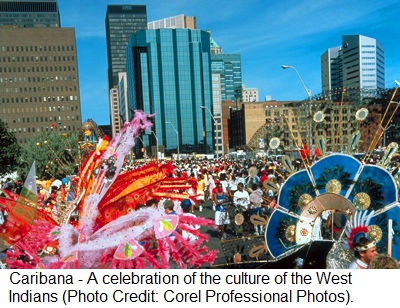
In the course of these Go Lean blog-commentaries, we have looked inward and identified the defects of our society. Now we need to look at these refuge countries and glean the Good and Bad of those destinations. This can be considered a “competitive analysis” as the Caribbean region is competing with these foreign locales for the hopes and dreams of our young people. (See the full immersion of Caribbean culture in Toronto in the Appendix-VIDEO below).

Here is a laundry list of the Good and the Bad of Canada; and how the roadmap to elevate Caribbean society, the Go Lean book, describes how the lessons should be applied in the implementation of the Caribbean Union Trade Federation (CU):

Canadian Imports

10 GOOD Things We Want from Canada

10 BAD Things We Don’t Want from Canada

1

Free Market Economy Canada has always embraced Free Market capitalism; today, their brand is more Liberal Socialism than Conservative Republicanism. Many social programs are offered to Canadian residents as a result, so the government plays a BIG role in the lives of most citizens. The Go Lean roadmap promotes Free Market principles for the region’s industrial development. The structure of Self-Governing Entities allows for further Free Market expressions without local government constraints. Massive Tax Burdens Many Canadians complain of high taxes. The governments defend the policy as necessary to support the many social programs (healthcare, subsidized college education, advanced infrastructure, etc). The Go Lean roadmap advocates deploying balanced tax schemes that mostly “skim off the top”. The CU will deploy systems to help member-state governments do better at collecting their tax revenues. Overall the Caribbean tax burden will increase, but only marginally.

2

Universal Healthcare Canada is a great example of successful healthcare for all of its citizens. They ensure that everyone has access and quality delivery. This minimizes the expensive repercussions of indigent care. The Go Lean roadmap calls for schemes to mandate healthcare insurance for every adult. With the leverage across the 30 member-states and 42 million people, the wholesale cost could be reduced. Healthcare Egalitarianism The Canadian Health delivery is a Single Payer and not an insurance program. So everyone gets the same level of treatment. The realities of healthcare is that different people have different needs, so a “one size fits all” approach is not preferred. The Go Lean roadmap advocates for a mandated insurance solution. The key is that every adult will be required to select some insurance plan, of their choosing.

3

Weather – Cool Summers Climate Change is a reality. So the warm seasons in Canada now last longer, 8 months instead of 6 months. Summertime in Canadian cities is pleasant, without air-conditioning. The Go Lean roadmap promotes better infrastructure for Caribbean cities, developing refrigeration utilities for urban areas. This will leverage energy costs for cooling. Weather – Cold Winters Canadian winters are not preferred, especially the months of January and February. The Caribbean Diaspora dread life there for those months. The Go Lean roadmap details the invitation to Canadian senior citizens to be Snowbirds in the Caribbean for the whole season. The economic returns of this strategy are too appealing to ignore.

4

Tourists There is a lot of competition for Canadian tourists; the Caribbean continues to make the case that its region is the best tourist destination in the world. The region wants to continue to appeal to Canadians of all demographic persuasions to come visit the islands for stay-overs (land-based hotels) and/or cruise ships. We want to forge vacation options and traffic for the upper, middle and lower classes of Canadian society.The CU forges plans, advocacies and re-boots to further enhance the Caribbean tourism product array. Expatriate Workers During the early days of nation-building, many Canadians workers came to the English-speaking Caribbean to work jobs (teachers, nurses, bankers, etc.) that many locals could have done. This practice led to the ethos that “White” Canadians were “better” than local personnel. The Go Lean roadmap dictates a labor standard where local workers get priority for jobs, then regional citizens, then and only then foreign workers (like Canadians).The Single Market would have freedom of movement but with this labor-qualifying caveat.

5

Capital There is a long history of Canadian banks in the Caribbean region. (Think Scotiabank, Royal Bank of Canada, and the First Caribbean-CIBC (Canadian Imperial Bank of Commerce)). Despite recent losses for Canadian banks in the Caribbean region, there is still the need for these banks’ active participation in the region. The Go Lean roadmap calls for strenuous oversight for the Caribbean Dollar (C$) and regional banks participating in transactions using this currency. Devalued Currency The Canadian dollar was 1-to-1 with the US dollar in the 1970’s. The currency has since been devalued, but only a little; between $.95 and $1.08. When a Caribbean financial transaction is executed in US dollars, a Canadian customer has to endure higher prices. The C$ is not designed to be pegged to the US dollar, rather a basket of foreign currencies including the Euro, British Pounds and Japanese Yen. So Canadians doing business in the Caribbean will not be as vulnerable to US$ fluctuations.

 Canadian Imports (cont’d)

10 GOOD Things We Want from Canada

10 BAD Things We Don’t Want from Canada

6

Supportive Defense Canada is not a militarized state like their American neighbor, but they do feature a robust internationally respected Army, Navy, and Air Force in support of their homeland.The CU roadmap provide for a complete Homeland Security apparatus to defend the Caribbean region. In addition, there is a comprehensive Intelligence Gathering and Analysis functionality. Deportees Canada repatriates Caribbean citizens guilty of criminality on Canadian soil. So these one become the concern for Caribbean authorities once deported.The Go Lean roadmap calls for proactive mitigations for “bad actors” that might bring a lawless ethos to the homeland. We seek a treaty with Canada for full intelligence sharing for those affiliated with organized crime (gangs) and low-level felons.

7

Foreign Aid Canada was one of the only foreign supporters for the defunct West Indies Federation; they have always shown our region “love”. Plus they always step up to aid the Caribbean in their “time of need” after natural disasters (earthquakes and hurricanes). But they prefer to help as a regional bloc rather than country by country.The CU/Go Lean roadmap is designed to process all foreign aid from Canada; from both the Canadian government and NGO’s. Condition for Philanthropic Support Many Giving Organizations attach strings to their gifts. The burdens of compliance is so difficult that many times, public-private entities – think Red Cross – attach themselves to the gifts to ensure accountability. This adds an additional layer in administrative costs, and less funding goes to the beneficiaries.The CU envisions a federal agency for oversight of the NGO’s in the region. We must do the heavy-lifting ourselves, rather than submitting perils of “bad actors”.

8

‘First Nation’ Reconciliation Like other European settlers in the New World, Canada had a history of repression of the indigenous peoples, but this country has reconciled that bad history with many positive empowerments. The Go Lean roadmap calls for formal reconciliation commissions to settle a lot of bad treatment in the past. Virtual Segregation Canada has the same history of racial divide as many other American Northern cities. While not a legal segregation, there is a de facto segregation with many ethnic migrants living in pockets.
The CU proposes repatriation back to the Caribbean homeland. There is nothing like being home.

9

Bilingual Co-existence Canada is a bilingual society, with the majority French culture in Quebec Province. The English and French co-exist well and insist on bilingual media expressions. The Go Lean roadmap calls for multilingual media and government communications. There is also the need for Minority Equalization for different language groups. Quebec Pull for French Caribbean Migrants Many French-speaking Caribbean people target Quebec as the destination for their emigration. In the 2006 Census, there were 102,430 people of Haitian descent living in Canada. The CU/Go Lean roadmap calls for managing the country of Canada as a competitor for the hearts of our youth.

10

Professional Sports Role Model Despite the regional domination of continental sports (baseball, football, basketball) by Americans, Canadians still dominate in their own rite – they are usually among the best hockey players in the world. They nurture the skills from youth participation up to the professional levels. The Go Lean roadmap calls for empowering the sports eco-system in the region, allowing for more opportunities for amateur, collegiate and professional participation. Other benefits of the regional focus will include better oversight of sports academies, agents and leagues. Recruitment of Caribbean Athletes During the 2016 Rio Olympics, there were many Track and Field athletes representing Canada that were of Caribbean heritage. Canada extends a “welcome mat” to these ones, therefore encouraging more to naturalize and discouraging loyalty to the Caribbean homeland. The Go Lean roadmap seeks to reboot the Caribbean societal engines. This will lower the “push and pull” factors that cause citizens to flee to other countries and switch their allegiances. This will allow athletes to fully engage their professions without leaving home.

Canada has been a frequent topic for considerations from the Go Lean movement (book and blogs). The opening Declaration of Interdependence (Page 14) recognized that there is value in considering the Good and Bad examples of Canada, with this statement:

xxxiii. Whereas lessons can be learned and applied from the study of the recent history of other societies, the Federation must formalize statutes and organizational dimensions to avoid the pitfalls of communities … On the other hand, the Federation must also implement the good examples learned from developments/ communities like … Canada….

The book specifically addresses Canada with these direct references of community ethos, strategies, tactics, implementations and advocates:

Community Ethos – Deferred Gratification – Cold Weather Residents Must Wait Until Spring Page 21
Community Ethos – Economic Systems Influence Individual Choices Page 21
Community Ethos – Minority Equalizations – Model of Canada’s Territories Page 24
Community Ethos – Ways to Help Entrepreneurship Page 28
Strategy – Invite empowering immigrants – Like Canadians Snowbirds Page 46
Tactical – Separation of Powers – Secretary of State – Trade Mission Offices Page 80
Implementation – Reason to Repatriate – From Canada Page 118
Planning – Lessons Learned from the previous West Indies Federation –Canada’s Support Page 135
Planning – Lessons from Canada’s History Page 146
Advocacy – Ways to Better Manage the Social Contract Page 170
Advocacy – Ways to Impact the Diaspora – Toronto‘s Large Pocket Page 218
Advocacy – Ways to Impact Foundations – Many Canadians NGO’s Page 219
Advocacy – Ways to Protect Human Rights Page 220
Advocacy – Ways to Improve Elder-Care – Snowbirds Invitations Page 225
Advocacy – Ways to Empower Women – Canada‘s great example Page 226

In addition, previous Go Lean blog/commentaries addressed many issues in regards to Canada and the interactions of Caribbean people and Canada; see sample list here:

https://goleancaribbean.com/blog/?p=9179 First Day of Autumn – Time for Canadians to Head South
https://goleancaribbean.com/blog/?p=6937 Canada’s Great Example of Women in Politics
https://goleancaribbean.com/blog/?p=3694 Economic Help: Jamaica-Canada Employment Program
https://goleancaribbean.com/blog/?p=3582 For Canadian Banks: Caribbean is a ‘Bad Bet’
https://goleancaribbean.com/blog/?p=1014 A Canadian’s View: ‘All is not well in the sunny Caribbean’
https://goleancaribbean.com/blog/?p=732 Turks and Caicos Drama with Canadian Healthcare Contract
https://goleancaribbean.com/blog/?p=214 Canada: The Best Address/Destination … per this Bahamian

The Go Lean book serves as a roadmap for the introduction and implementation of the CU. Our scope is to impact the Caribbean’s economic, security and governing engines, not Canada’s. But we do hope to engage the Caribbean Diaspora living there.

There are Good lessons and Bad lessons that we can learned from Canada. So let’s pay more than the usual attention to these insights. Everyone is urged to lean-in to this Go Lean/CU roadmap for the Caribbean Union Trade Federation, to make our region a better place to live, work and play. 🙂

Download the book Go Lean … Caribbean – now!

———

Related Article: 10 Fast Facts About Caribbean Immigrants In Canada

———

Appendix VIDEO – Caribbean West Indian Street Food|Toronto  – https://youtu.be/8ECKojESpOs


Published on Jun 18, 2016 – If you never had West Indian/Trini/Caribbean food, you are seriously missing out. They might not be the healthiest foods out there but it is definitely hot and delicious. Their foods are pretty much like their people, warm and welcoming. I’ve had doubles once before and it made me realize what I have been missing out my entire life. The aloo pie with tamarind sauce gave me the exact same shiver. No fancy complexity, just simple west Indian food.
Share this post:
, ,

Economy Doctor: ‘The Patient is Terminal’

Go Lean Commentary

If you need a new roof on your house – a traumatic event when it starts to rain – do you go to your doctor to do the work?

He might know something about roofing and he might be able to help; surely he can lift shingles up to the roof; spread hot tar; hammer in nails and tacks. As a homeowner, you may get some relief from the elements because of your new doctor-installed roof, but frankly, it is not best-practice. The service provided may not be the most efficient nor most effective.

A professional roofer may have better tools and techniques.

How about an economy?

Is there a professional for economic “roof jobs”? Yes, indeed! They are called Economists! Many times, they too are doctors; they may have a PhD in Economics.

A Doctor (Economist) in the Caribbean is looking at the regional economics as if a medical trauma and declaring:

The patient is “terminal” … dying, unless remediated in some way.

Welcome to the Caribbean 2017. This is the assessment: the Caribbean economy is moribund, due to defects in the region’s governing engines, with its mono-industrial service economy! See the full story of the Doctor’s assessment-diagnosis in the news article here:

Title: Saint Lucian Economist warns: “We are in trouble!”
CU Blog - Economy Doctor - 'The Patient is Terminal' - Photo 1
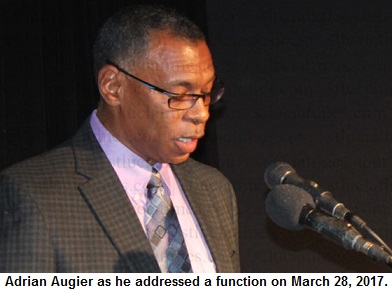
Saint Lucian Economist, Doctor Adrian Augier, has sounded a grim warning that this country is in trouble economically.

Delivering a lecture on Tuesday to the 39th annual general meeting of the Elks Credit Union, Augier compared the national economy to an old farm that is under-fertilised, over exploited, ruined by bad farming and yielding smaller harvests every year.

He was speaking on the theme: “Time to Call a Spade – Why the Caribbean is digging its own economic grave.”

“ I want to frighten you; I want to shock you; I want  to jolt you to the realization that we are in trouble – that you are in trouble along with your job, your family your savings your home and your sanity,”  the Saint Lucian Economist told his audience at the National Cultural Centre.

He said he wanted to cause  the kind of discomfort that prevents his listeners from sleeping at night and rise up,  not only to demand that better be done to prevent development disaster, but to be part of a revolution in thought and action which causes this country to dramatically change its course.

“When I say the country I am not speaking about Mr. Chastanet or Doctor Antony,  I am speaking of us – every one of us here who believes that the sun will rise tomorrow as it did today,” Augier said.

He disclosed that growth rates have been declining for the past three decades, with just a bit of growth in the past year or so.

“The world has changed and so must we,” Augier observed.

According to him, the return to normalcy will not be easy.

He said that many banks in the region have lent out money that was not theirs to people who cannot now pay.

Augier said they cannot pay not because they do not want to, but because jobs have disappeared, markets have shrunk and real property values have fallen.

He explained that in certain areas, crime and instability have diminished the value of properties.

Augier said the economic situation is not only true of Saint Lucia, but across the Caribbean as well.

“We have to look at these issues and not pretend that they are going to go away or suddenly improve because they are not,” the Economist said.

He noted that the social and economic structure of these Islands have changed.

“It is not only true of Saint Lucia but it is a problem across the Caribbean,” he told the Elks AGM.

Augier asserted that there are some things that can happen in the market such as a change of legislation so that banks and credit unions can dispose of assets.

By way of explanation, he spoke of a house with a mortgage that is not being serviced.

“You need to turn it over quickly, reduce the price, put it on the market and get it sold.  That’s not nice when you have to put families out of their homes, but it’s your savings in the credit union underwriting the mortgage and if you don’t return the asset to the market you are going to hold an asset that is deteriorating,” Augier explained.

“We have to take some of the hard knocks and do what we have to do,” he declared, adding that banks have been unable to dump their bad loans which have stayed and corroded the balance sheets.

He explained that people save money in banks and credit unions in the hope of getting their investment back with some interest.

Augier, who is a Director of the First National Bank, said he is worried that the ability to bail out is dwindling.

“We wait and we hope and what is actually happening is that foreign interests are coming into the country and buying up things that we should be able to buy, investing in areas that we should be able to invest in,” he said.

According to him, it is a source of worry that Saint Lucia has a government apparatus designed to ‘help people to buy us out.’

“Foreign investment does not come here because they love us, foreign investment comes here because they see an opportunity which we cannot access or we have not begun to access or we are not positioned to access,” Augier observed.

He said the investors are looking for a return.

“If they are coming here to develop some brand new thing that we are not able to do for ourselves and they want to come in and help us do it or start it up with a possibility of Saint Lucians participating in that venture at some point in time, then that’s another matter,” Augier told his audience.

But  the Saint Lucian Economist said when industries  that are ‘exploitative’ are coming in to use unsustainable cheap labour and exploiting high unemployment by providing menial jobs, it is not good for this country.

Augier said there was need to contemplate what kind of investment is being encouraged here.
Source: Posted March 30, 2017; retrieved June 28, 2017 from: https://stluciatimes.com/2017/03/30/saint-lucian-economist-warns-trouble#comment-114747

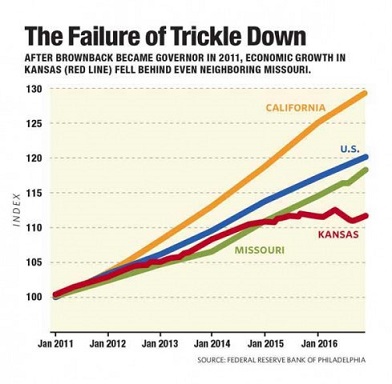
The foregoing news article quotes an Economist – Dr. Adrian Augier – in St. Lucia; speaking of the sad state of affairs for that country and all of the Caribbean. This is not a unique assessment-diagnosis; other countries and states are also suffering economic trauma, dire consequences from dysfunctional economic and governing stewardship. Nor is this assessment only to be found in the Third World (developing countries). No, even the First World or advanced economies have this disposition. Take for example the US State of Kansas. We have a fitting example of economic trauma and dysfunction, brewing there …

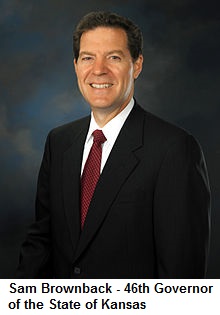
Kansas, Sam Brownback, and the Trickle-Down Implosion

The Kansas governor’s attempt to create Supply-side nirvana in Middle America not only failed to grow the economy — it created a crippling crisis of government that led to a statewide rejection of his politics.

See the excerpt of the news article in the Appendix below or the full article here: http://prospect.org/article/kansas-sam-brownback-and-trickle-down-implosion-0. The summary of the article in the Appendix, is that the State of Kansas experimented with a Supply-side Economic Model and the end-result is traumatic. See these headlines here:

“Brownback’s Kansas has produced one of the worst-performing state economies in the country”.

“The severely imbalanced budget led Moody’s to downgrade Kansas’s bond rating; three months later, Standard & Poor’s followed suit.”

“The failure to restore pre-recession funding has disproportionately impacted urban school districts like Kansas City’s and Wichita’s.”

“Throughout all this, Brownback’s trickle-down obsessions have continued to play out.”

“Many moderate Republicans were fed up with Brownback’s intransigence and eager to get something done.”

Consider also the rendition of this Kansas trauma-drama in this AUDIO-PODCAST from NPR’s All Things Considered show:

AUDIO-Podcast – Kansas Lawmakers Reverse Governor’s Massive Tax Cuts – http://www.npr.org/2017/06/07/531945495/kansas-lawmakers-reverse-governors-massive-tax-cuts

Posted June 7, 2017 As Heard on All Things ConsideredKansas lawmakers charted a major change of course Tuesday night when it comes to tax policy. Both the House and Senate voted to override a veto from Gov. Sam Brownback and roll back many of the 2012 tax cuts that were a model for conservatives across the country.

So Economy Doctors have assessed-diagnosed these 2 dysfunctional communities – lessons abound.  The Caribbean economy (‘patient’) is terminal … and the ‘patient’ that is the State of Kansas is terminal.

This Governor Sam Brownback is now a tarnished brand in American politics. At one time he was a “Star on the Rise” of the national stage, even running for President in 2008. But his now-failed experiment in Tickle-down economics has shifted his reputation from fiscal conservatism to fiscal irresponsibility. This trauma and drama in Kansas should be a cautionary tale for other government leaders in the US and in the Caribbean – economic engines must be optimized; continuation of failed economic policies should not be tolerated. When a patient is in trauma – dying – drastic measures must be taken or the patient dies. This is true for medical trauma and economic trauma. This is the lesson from Kansas and the caution from the Economist – Dr. Adrian Augier – in St. Lucia.

“The world has changed and so must we,” Augier observed.

There is the need for change! Drastic measures must be pursued to reform and transform Caribbean society. But these changes must be planned, implemented (based on best-practices), reviewed and measured against success metrics. This is the methodology of Plan, Do and Review urged in the book Go Lean…Caribbean (Page 147). The book – available to download for free – serves as a roadmap for the introduction and implementation of the technocratic Caribbean Union Trade Federation (CU), for the elevation of Caribbean economy – for all member-states. This CU/Go Lean roadmap has these 3 prime directives:

  • Optimization of the economic engines in order to grow the regional economy to $800 Billion and create 2.2 million new jobs.
  • Establishment of a security apparatus to ensure public safety and protect the resultant economic engines.
  • Improvement of Caribbean governance to support these engines, including a separation-of-powers between the member-states and CU federal agencies.

The mono-industrial service economy in the Caribbean and the failed Supply-side experiment in Kansas  are 2 bad examples. But our scope for reforming communities is the Caribbean only!

The book stresses that reforming and transforming the Caribbean societal engines must be a regional pursuit. This was an early motivation for the roadmap, as pronounced in the opening Declaration of Interdependence (Pages 12 – 13):

xi. Whereas all men are entitled to the benefits of good governance in a free society, “new guards” must be enacted to dissuade the emergence of incompetence, corruption, nepotism and cronyism at the peril of the people’s best interest. The Federation must guarantee the executions of a social contract between government and the governed.

xvi. Whereas security of our homeland is inextricably linked to prosperity of the homeland, the economic and security interest of the region needs to be aligned under the same governance. Since economic crimes … can imperil the functioning of the wheels of commerce for all the citizenry, the accedence of this Federation must equip the security apparatus with the tools and techniques for predictive and proactive interdictions.

xxiv. Whereas a free market economy can be induced and spurred for continuous progress, the Federation must install the controls to better manage aspects of the economy: jobs, inflation, savings rate, investments and other economic principles. Thereby attracting direct foreign investment because of the stability and vibrancy of our economy.

xxxiii. Whereas lessons can be learned and applied from the study of the recent history of other societies, the Federation must formalize statutes and organizational dimensions to avoid the pitfalls of communities …

The Go Lean book provides 370-pages of turn-by-turn instructions on “how” to adopt new community ethos, plus the strategies, tactics, implementations and advocacies to execute so as to reboot, reform and transform the societal engines of Caribbean society. Our reform approach is not some Supply-side / Trickle-down experiment, whereby we exploit the working-classes to benefit the rich.

We can do better! We can deploy industrial solutions with no plutocratic abuses.

In response, the Go Lean roadmap presents a strategy of Self-Governing Entities (SGE’s). This scheme was fully detailed in the Go Lean book; see  some headlines from this sample advocacy on Page 105:

10 Steps to Implement Self-Governing Entities

1 Lean-in for the Caribbean Single Market
The CU treaty unifies the Caribbean region into one single market of 42 million people across 30 member-states, there-by empowering the economic engines in and on behalf of the region. Many times, these engines will be independent, self-governing entities (SGE) that are only physically located in a member state, but not administered by the states. SGE’s are necessary features of the CU roadmap, allowing for industrial parks, technology labs, medical campuses, agricultural ventures, airport cities (see Appendix IJ) and even the Capital District. All aspects of their administration are managed by the CU, including monetary issues managed by the Caribbean Central Bank-CCB.
2 CU Constitution; SGE’s Bylaws
3 Negotiate With Local Municipalities for Resources
The need for local resources is what makes SGE’s such an economic engine. They may have to acquire their basic needs (food, clothing, shelter, energy) from trade with their neighbors. The spirit of negotiations should reflect a partnering relationship as opposed to adversarial, but SGE’s have rights to supply every need internally or from abroad. With free market conditions the norm, price and quality is the determination; the neighbors must compete.
4 Ease-ways
When the SGE physical plant is land-locked, there is a need for an ease-way to convey utilities and supplies in and out. When member-states accede to the CU treaty, they in effect declare that they are ready, willing and able to accommodate the needs of SGE’s. The rights-duty duality is at play, but financial-jobs benefits will be worth the effort. Ease-ways must be inclusive to the municipal negotiations, and may include above-ground and subterranean (pipeline) options.
5 Technology & Infrastructure
The nature of a SGE means monopolies outside the perimeter do not apply inside the perimeter. It is the choice of the SGE whether or not to avail some monopolistic utility or “go solo”. This applies to energy, telecoms, water-sewage, and logistical technologies (transportation, pipeline, pneumatic tubes, etc) as long as the good neighbor status remains.
6 Housing Options
7 Security and JusticeThe CU accedence grants authority for homeland security in the SGE’s to CU institutions. There are Rangers that have direct patrol duties; CariPol that has the investigation responsibility and District Attorneys for federal prosecutions.
8 EmergenciesThough the SGE tenant has near-sovereign rights, there are special provisions for CU intrusions, limited to declared  emergencies. This declaration can come from responsible parties internal to the SGE (as simple as dialing 911, or exigent circumstances) or external declarations from federal court orders or CU constitutional officers.
9 Jurisdictional Liaisons with CU State Department
10 Measuring Results

The business models of SGE’s have been further elaborated upon in previous blog-commentaries. Consider this sample:

https://goleancaribbean.com/blog/?p=12148 Perfect SGE Application: Ship-breaking Model
https://goleancaribbean.com/blog/?p=12146 Perfect SGE Application: Shipbuilding Model
https://goleancaribbean.com/blog/?p=8379 Stewardship for Centers of Economic Activity
https://goleancaribbean.com/blog/?p=5921 Socio-Economic Change: Impact Analysis of SGE’s
https://goleancaribbean.com/blog/?p=2750 Disney World – Role Model for Self-Governing Entities
https://goleancaribbean.com/blog/?p=2338 Using SGE’s to Welcome the Dreaded ‘Plutocracy’
https://goleancaribbean.com/blog/?p=2003 Ship-breaking under SGE Structure
https://goleancaribbean.com/blog/?p=1214 Fairgrounds as SGE and Landlords for Sports Leagues

SGE’s can bring new economic opportunities, and these opportunities must abound in the Caribbean … if we want to avert our terminal condition. The existing economic engines are not sustainable; the mono-industrial strategy – based on a service industry (i.e. tourism) – has led to a dying economy. Everyone is hereby urged to lean-in to this regional change.

The Go Lean roadmap advocates for a pluralistic democracy where all Caribbean stakeholders get a chance for life, liberty and the pursuit of happiness. This is an American ideal, but we can learn lessons from their failure – as in Kansas – to execute on these principles. In a previous blog-commentary, the role model of Hammurabi was disclosed as a missing functionality in the New World. This is where the “weak is protected from abuse from the strong in society” – this is truly missing in Kansas.

The purpose of this roadmap is not to fix the defects in Kansas nor the America political system, but rather to reform and transform the Caribbean, without engaging any unjust schemes, like the Supply-side economics depicted in this commentary.

Yes, we can make our homeland a better place to live, work and play. Let’s do this! 🙂

Download the free e-Book of Go Lean … Caribbean – now!

Sign the petition to lean-in for this roadmap for the Caribbean Union Trade Federation.

————

Appendix – Article Except: Kansas , Sam Brownback, and the Trickle-Down Implosion

Sub-title: The Kansas governor’s attempt to create supply-side nirvana in Middle America not only failed to grow the economy — it created a crippling crisis of government that led to a statewide rejection of his politics.
By: Justin Miller

CU Blog - Economy Doctor - 'The Patient is Terminal' - Photo 2Near midnight on Tuesday, June 6, a number of Republicans in the Kansas legislature did something that few other elected Republicans had done in years: They acted responsibly. Joining with Democrats, they voted to roll back the huge tax cuts that Republican Governor Sam Brownback had inflicted on the state, which had devastated schools and other essential services while also depressing the state’s economy. But after five years of this exercise in trickle-down, the damage had been done.

THE ROBERT B. DOCKING State Office Building looms large amid the sparse downtown Topeka landscape. …

The decaying, hollowed-out building stands as a grim testament to the blunt-force trauma that Brownback’s 2012 tax cuts visited on his state, and to the ensuing budgetary crises that led lawmakers to cut government services to the bone.

For years, Brownback has called for Docking to be demolished rather than renovated. It’s an apt metaphor for his approach to government.

The state’s health-care system teeters on the verge of catastrophe, as Brownback’s privatization of state Medicaid services and further refusal to expand Medicaid has squeezed low-income Kansans and health-care providers alike. Dozens of struggling hospitals across the state are on the verge of closing. “We have to make decisions every day, on which bills to pay. I mean that literally,” one small-town hospital CEO says. Brownback’s decision to cut taxes rather than restore K–12 public education funding has strained both urban and rural school districts, compelling two districts to end the school year early. Meanwhile, he’s ushered in drastic cuts to social services and placed strict work requirements and other limits on welfare programs.

By last year, even Republicans in this heavily Republican state (which Donald Trump carried last November by 21.5 percentage points) had had it with their governor’s insistence on turning the SunflowerState into a Petri dish for radical conservative economics. A number of Republican candidates ousted Brownback supporters in legislative primaries, and this year they teamed up with the minority Democrats in the legislature (whose numbers increased after last year’s elections) to begin rolling back the Brownback catastrophe. Overturning the governor’s vetoes, which required a two-thirds majority in each house, legislators this June voted to repeal the tax cuts enacted by Brownback and a Tea Party–dominated legislature in 2012.

But the devastation has been profound.

IN 2010, SAM BROWNBACK rode the Tea Party wave into the Kansas governorship, pledging to turn the state into a bulwark against President Barack Obama’s big-government liberalism. By 2012, through aggressive backroom politicking, he pressured hesitant moderate Republicans in the legislature to join conservatives in passing a radical tax plan that eliminated the state’s top income tax bracket, drastically slashed rates, and instituted an outright income tax exemption for limited liability companies—a huge tax break for a tiny segment of the population. Conversely, in a nod to “fiscal responsibility,” the plan did away with a number of tax credits that benefited low- and middle-income Kansans. Moderate Republicans in the Senate had thought they’d be able to engineer a less-extreme version of the cuts while in a conference committee with the House. They didn’t, and days later, Brownback signed into law perhaps the most radical version of trickle-down economics any state had ever embraced.

Brownback’s promise that the cuts—particularly the LLC exemption—would be “a shot of adrenaline” for the Kansas economy will be written on his political headstone.

The LLC exemption, the crown jewel of the governor’s tax policy, has allowed some 330,000 independent business owners—almost double the original estimates—to avoid state tax on most, if not all, their income, costing the state roughly $500 million in revenue in 2015 alone. A recent report from a team of researchers who scoured Kansans’ income tax returns concludes that the exemption has fueled more tax evasion than job creation.

Though Brownback argued that exempting owner-operated businesses from taxes would increase investment and jobs in the state, the report found no such results. “We can’t, to the best of our ability, find support for real responses in terms of economic activity because of the tax cuts,” report co-author and University of South Carolina economics professor Jason DeBacker says. Instead, the policy drove more people to simply reclassify their income as a pass-through to avoid taxation.

The small-business owners who were the intended beneficiaries suddenly had no tax liabilities each year. But with average savings of about $1,000 a month, according to one estimate, it was hardly enough to hire more workers or expand operations. One lawyer in suburban JohnsonCounty told a Kansas City Star columnist in 2014 that he was saving as much as $10,000 a year—as were the 15 other partners in his practice—while the paralegals and other staffers with no ownership stake were still stuck paying income tax. He told the columnist that he planned to use his tax savings for a family vacation to Cancún. “I’m making out like a bandit, and it’s completely unfair,” he said.

Perhaps the most enlightening example of how the exemption worked came when a public radio station discovered in May 2016 that Bill Self, the head coach of the storied University of Kansas Jayhawks men’s basketball team, was not paying taxes on about 90 percent of his annual $3 million compensation.

WHAT BROWNBACK’S TAX CUTS have accomplished is to have created a crisis of catastrophic proportions for state residents. The tax cuts blew an immediate hole in the $6 billion state budget, as revenue levels fell an astounding $713 million from fiscal years 2013 to 2014. Those revenue shortfalls have not abated in the years since. To help plug the hole, Brownback has run through all the state’s reserve funds and has increased borrowing, adding $1.3 billion to the state’s debt. “We are essentially the poorest state by now, with no rainy day fund—nothing in the bank,” says Duane Goossen, the former Kansas budget director for both Democratic and Republican governors.

The severely imbalanced budget led Moody’s to downgrade Kansas’s bond rating; three months later, Standard & Poor’s followed suit. The hit to the credit rating, though, was an inadequate measure of the damage to Kansans’ lives.

BY PRIORITIZING HIS trickle-down tax cuts over all else, Brownback has also allowed a long-standing public school funding shortage to metastasize into a full-blown constitutional crisis.

The failure to restore pre-recession funding has disproportionately impacted urban school districts like Kansas City’s and Wichita’s. The state funding formula includes an “equalization” provision that helps even out funding between wealthy school districts that can rely more on a large base of property tax revenue and poorer districts that can’t. When the school cuts took effect, however, the poorer districts couldn’t take up the slack with higher property taxes.

Throughout all this, Brownback’s trickle-down obsessions have continued to play out. He has called for regressive increases to the sales tax and higher taxes on alcohol and cigarettes. At the same time, he continued his war on progressivity, asking the legislature to institute a flat tax—a proposal that garnered just three votes in a clearly fed-up state Senate earlier this year.

That vote reflected a sea change in Kansas politics. Last August, Kansan Republican primary voters across the state supported a group of moderate challengers to more than a dozen ultra-conservative incumbents in legislative elections. Last November, even as Trump took the state with 57 percent of the vote, Democrats managed a pick-up of 12 seats in the state’s House and one in the Senate. Heading into the January session, there was a new legislature with a class of freshmen determined to undo Brownback’s damage.

The budgetary implications of that damage were very clear. When the new legislators took their seats at the start of this year, they confronted a proposed budget with close to a $1 billion shortfall over the next two years. Soon after the session began, the state Supreme Court announced its ruling that mandated adequate school funding, which required the appropriation of an additional $750 million over the next several years.

The legislatures of the preceding six years had been complicit in creating these shortfalls, but those legislatures were gone. “The [new] legislature looks a lot like it did before 2010,” when there was a stronger bloc of moderates, says Burdett Loomis, a political science professor at the University of Kansas. “People understand that in order to get things done, you have to run through this moderate [Republican]-Democratic coalition.”

Passing a budget that accomplished these goals was anything but easy, since overcoming a Brownback veto requires two-thirds support in each house, and the House speaker and Senate president were both staunchly opposed to tax hikes. The moderates’ and Democrats’ task was eased, however, by a collapse in Brownback’s popular support. In 2016, a Morning Consult poll found him to be the least-popular governor in the country, with only 26 percent of the surveyed Kansans approving of his job performance. This year, the only governor less popular with his constituents was New Jersey Governor Chris Christie, bogged down in Bridgegate and the anti-Trump backlash.

Legislators still needed to pass a budget, and they needed to pass a school-financing bill that would meet the state Supreme Court’s call for adequate funding. To fund both the budget shortfall and the public school system, they were faced with the necessity of passing a tax reform plan even more far-reaching than the one Brownback had already vetoed. Many wanted to undo Brownback’s rate cuts by reinstituting a third bracket, raising rates closer to pre-2012 levels, and most of all, eliminating the LLC loophole. The challenge they faced was how to align enough Democrats and Republicans to vote for a package that was substantial enough to satisfy the former and frugal enough not to dissuade the latter.

Still, the political gymnastics required to cobble a veto-proof majority were daunting. …

As the session spilled into June, the legislature was approaching the record for longest legislative session in the state’s history. In the very early hours of June 5, the legislature passed a tax plan that rolled back Brownback’s tax policy and would raise about $1.2 billion over the next two years by doing away with the LLC exemption, ending the March to Zero, and reinstituting a third tax bracket with higher rates across the board. One factor that brought Ward and the Democrats on board was that the bill reinstated a number of tax credits benefiting poor and middle-income Kansans (including a child tax credit), which Brownback had scrapped. The legislature also passed a school-financing plan that would direct nearly $300 million more to schools over the next two years while tethering future aid to the rate of inflation.

In a matter of hours, Brownback announced that he would veto the tax rollback.

Later that night, the Senate approved a veto override by a one-vote margin. …

The lessons of Sam Brownback’s disastrous experiment have become all the more important nationally as President Trump, whose economic doctrine is cut from the same cloth napkin on which Arthur Laffer first sketched his supply-side curve more than 40 years ago, tries to advance a similarly radical series of tax cuts in Washington. (Indeed, Brownback flew Laffer out to Kansas in 2012, where he was paid $75,000 to advise the legislature on the wisdom of slashing taxes, promising astounding dividends of economic growth in exchange.) Trump’s proposed budget echoes the Kansas experiment, slashing income tax rates for the wealthiest few and calling for a drastic rate cut for pass-through entities—a move that would inflict Brownback’s LLC debacle on the nation.

Brownback’s should be a cautionary tale, of course, for the Republicans in Congress and the White House. Should they slash the provision of affordable health coverage to cut taxes for the rich, should they decimate government services while eliminating taxes on the wealthiest Americans, all their invocations of trickle-down economics—that the rich will invest their tax savings in job-creating enterprises, a theory disproved again, again, and again—ultimately won’t win them popular support. The fate of Sam Brownback—scorned by his state, overridden by his legislature, rejected by his party—should make that crystal clear.

CU Blog - Economy Doctor - 'The Patient is Terminal' - Photo 3

Tax Cuts for the rich. Deregulation for the powerful. Wage suppression for everyone else. These are the tenets of trickle-down economics, the conservatives’ age-old strategy for advantaging the interests of the rich and powerful over those of the middle class and poor. The articles in Trickle-Downers are devoted, first, to exposing and refuting these lies, but equally, to reminding Americans that these claims aren’t made because they are true. Rather, they are made because they are the most effective way elites have found to bully, confuse and intimidate middle- and working-class voters. Trickle-down claims are not real economics. They are negotiating strategies. Here at the Prospect, we hope to help you win that negotiation.

Source: Posted in “The American Prospect” on June 28, 2017; retrieved June 28, 2017 from: http://prospect.org/article/kansas-sam-brownback-and-trickle-down-implosion-0


Share this post:
, , , ,
[Top]

Ferries 101: Economics, Security and Governance

Go Lean Commentary

The absolute best way to get from Point A to Point B is a straight line. If those two points are separated by water then the best way is a causeway or a bridge.

That is the ideal. Then there is island life, where we have to accept the Less Than ideal. Many times the best way to get from Point A to Point B across a body of water is a boat, or more specifically a Ferry.

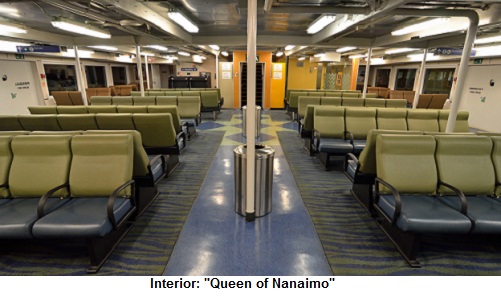
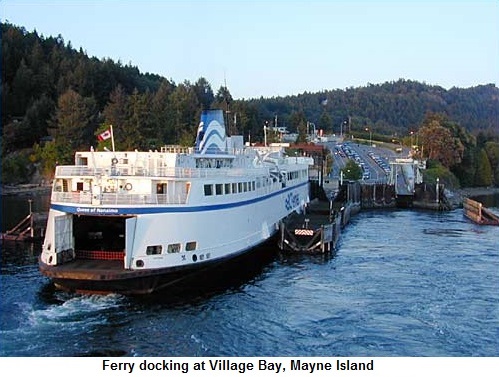
CU Blog - Ferries - Economics, Security and Governance - Photo 0Welcome to a discussion of “Ferries 101”. Also, welcome to British Colombia, Canada. They provide the Caribbean such good role models and lessons of how to facilitate modern life with the realities of coastal and island living.

May we pay more than the usual attention to this Canadian model and these lessons.

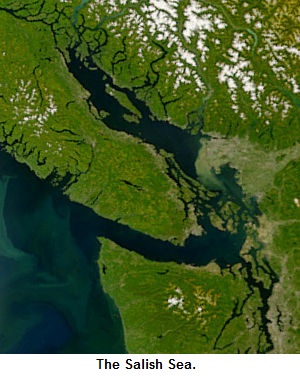
The book Go Lean…Caribbean – available to download for free – proposed a plan to better unite the 30 Caribbean member-states – all islands and coastal territories – that incorporated a full deployment of a network of ferries. This would be so transformative for the Caribbean region that we had to study a successful deployment of such a scheme. The best role model was the Pacific North American coast – the Salish Sea; this is the intricate network of coastal waterways that includes the southwestern portion of the Canadian province of British Columbia (Vancouver) and the northwestern portion of the U.S. state of Washington (Seattle). Its major bodies of water are the Strait of Georgia, the Strait of Juan de Fuca, and Puget Sound. This inland waterway features international borders, constant trade and travel to facilitate year-round tourism and commerce. (See VIDEO in the Appendix below).

Copying such a model is a Big Deal for the Caribbean – too big for any one member-state alone. The Go Lean book thusly serves as a roadmap for the introduction and implementation of the technocratic Caribbean Union Trade Federation (CU), an inter-governmental entity for all 30 member-states. The purpose is to better facilitate the societal engines (economics, security & governance) of the region that would lead to the elevation of Caribbean society – for all member-states. The book states this vision emphatically with this quotation:

The CU envisions a similar – [to North America’s Salish Sea] – water-based highway system of ferries and docks to facilitate passenger, cargo and vehicle travel connecting the islands of the Caribbean region to the mainland ports. This ferry system will be a component of the Union Atlantic Turnpike. – Page 280.
CU Blog - Ferries - Economics, Security and Governance - Photo 1a

CU Blog - Ferries - Economics, Security and Governance - Photo 1e

CU Blog - Ferries - Economics, Security and Governance - Photo 1d

CU Blog - Ferries - Economics, Security and Governance - Photo 1c 

This CU/Go Lean roadmap has these 3 prime directives:

  • Optimization of the economic engines in order to grow the regional economy to $800 Billion and create 2.2 million new jobs.
  • Establishment of a security apparatus to ensure public safety and protect the homeland; and the seas.
  • Improve Caribbean governance to support these engines, including a separation-of-powers between the member-states and CU federal agencies.

The book stresses that reforming and transforming the Caribbean societal engines must be a regional pursuit. This was an early motivation for the roadmap, as pronounced in the opening Declaration of Interdependence (Pages 12 – 13):

xi. Whereas all men are entitled to the benefits of good governance in a free society, “new guards” must be enacted to dissuade the emergence of incompetence, corruption, nepotism and cronyism at the peril of the people’s best interest. The Federation must guarantee the executions of a social contract between government and the governed.

xvi. Whereas security of our homeland is inextricably linked to prosperity of the homeland, the economic and security interest of the region needs to be aligned under the same governance. Since economic crimes … can imperil the functioning of the wheels of commerce for all the citizenry, the accedence of this Federation must equip the security apparatus with the tools and techniques for predictive and proactive interdictions.

xxiv. Whereas a free market economy can be induced and spurred for continuous progress, the Federation must install the controls to better manage aspects of the economy: jobs, inflation, savings rate, investments and other economic principles. Thereby attracting direct foreign investment because of the stability and vibrancy of our economy.

The Go Lean book provides 370-pages of turn-by-turn instructions on “how” to adopt new community ethos, plus the strategies, tactics, implementations and advocacies to execute so as to reboot, reform and transform the societal engines of Caribbean society. The deployment of ferries is integral to the Go Lean roadmap for a “Union Atlantic Turnpike” – this is defined in the book as …

“a big initiative of the CU to logistically connect all CU member-states for easier transport of goods and passengers. The Turnpike is virtual … made up of many physical transportation modes envisioned for the region: Pipeline, Ferries, Highways, and Railroad”. – Page 205

Here is a sample of references to the ferry eco-system through-out the Go Lean book:

Community Ethos – Group Purchase organizations (GPO) – Big Ferry purchases Page 24
Strategy – Competitive Analysis – Buy foreign or buy local – Ferries could neutralize transportation challenges and high costs Page 51
Strategy – Stakeholders – Visitors – Snowbirds can bring RV’s on ferries Page 55
Strategy – Agents of Change – Technology – Industrial efficiencies for transportation options like “Fast Ferry” Page 57
Tactical – Separation of Powers – Department of Transportation – Turnpike Operations: Integrated Ferries Page 84
Tactical – Separation of Powers – Department of Transportation – Marine Administration to include Ferry Operations Page 84
Implementation – Ways to Develop a Pipeline Industry – “Pneumatic Capsule Pipeline” as an advanced ferry system for cargo Page 107
Implementation – Ways to Re-boot [Sample City] Freeport – Shipbuilding options to build/maintain ferries Page 112
Planning – 10 Big Ideas for the Caribbean – Ferries create Virtual “Turnpike” Operations Page 127
Planning – Ways to Improve Interstate Commerce – Ferries operate as transportation arteries Page 129
Planning – Ways to Improve Interstate Commerce – State License Plates Online Registration Access as Ferries allows cars to “island hop” Page 129
Planning – Lessons from New York City – Many transport options including ferries Page 137
Planning – Lessons from the American West – Railroads and Highways opened the West for better commerce, the same as ferries will do for the CU. Page 142
Planning – Lessons from Canada’s History – well-developed trade networks made for Advanced Economy. Page 146
Advocacy – Ways to Create Jobs – New Jobs for Infrastructural Build-out (Ferry docks) Page 152
Advocacy – Ways to Improve Housing – Pre-fab Industry/Jobs depend on Ferry deployment for logistics Page 161
Advocacy – Ways to Impact Public Works – Union Atlantic Turnpike requires Ferry Piers Page 175
Advocacy – Ways to Improve Homeland Security – Naval Authority: to ensure and protect the waterscapes and vessels of the region to mitigate against “bad actions and bad actors”. Page 180
Advocacy – Ways to Enhance Tourism – New Winter Season Product: Snowbirds can transport RV’s with Ferries Page 190
Advocacy – Ways to Enhance Tourism – Dynamic Sea-lifts: Consider Fast Ferries boats and Spring Break traffic Page 190
Advocacy – Ways to Impact Events – Sea lifts for Passengers and Freight Page 191
Advocacy – Ways to Promote Fairgrounds – Ferries can transport “real” fairs Page 192
Advocacy – Ways to Impact Extractions – Ferries Schedule for Transport to Offshore Rigs Page 195
Advocacy – Ways to Foster e-Commerce – Logistics & Delivery options improve Page 198
Advocacy – Ways to Improve Transportation – Islands and Coastal areas demand more seafaring options i.e. ferries Page 205
Advocacy – Ways to Develop Ship-Building – Ferry Operations – Fleet Demand & Supply Page 209
Advocacy – Ways to Impact Rural Living – Ferries can optimize rural transportation options Page 235
Advocacy – Ways to Impact US Territories – Puerto Rico could be Transportation Hub Page 244
Appendix – New Transportation Jobs: Building/maintaining/administering toll roads, electric lines, and ferries: 15,000 Page 257
Appendix – Model of Alaska Marine Highway – Facilitated by ferries Page 280
Appendix – Model of Eurotunnel – The Ferry Link Page 281

This Go Lean book projects the roll-out of this Union Atlantic Turnpike as Day One / Step One of the Go Lean/CU roadmap. Over the 5-year implementation more and more of the features of the Turnpike will be deployed and their effect on the region will be undeniable: they will help to make the Caribbean a better place to live, work and play.

This Go Lean roadmap seeks to foster best-practices in the administration of a “ferry eco-system”. We will have a lot of coordinate – “many balls in the air”: shipbuilding, border protection, customs, events facilitation, trade and tourism promotion. These topics are just a sample of subjects previously addressed in many Go Lean commentaries; see a relevant list here:

https://goleancaribbean.com/blog/?p=12304 Caribbean Festival of the Arts – Transport Options for Events
https://goleancaribbean.com/blog/?p=12146 Commerce of the Seas – Shipbuilding Model of Ingalls
https://goleancaribbean.com/blog/?p=12144 Commerce of the Seas – Book Review: ‘Sea Power’
https://goleancaribbean.com/blog/?p=12126 Commerce of the Seas – Stupidity of the Jones Act
https://goleancaribbean.com/blog/?p=9179 Snowbirds Tourism – First Day of Autumn – Time to Head South
https://goleancaribbean.com/blog/?p=9070 Securing the Homeland – From the Seas
https://goleancaribbean.com/blog/?p=6867 How to address high consumer prices: Welcoming ferries
https://goleancaribbean.com/blog/?p=3713 Lesson from Canada: NEXUS – Facilitating Detroit-Windsor Commerce
https://goleancaribbean.com/blog/?p=673 Future Tech – Autonomous cargo vessels without a crew

The subject of ferries could be strategic and tactical for the Caribbean. They can create new lines of business for our region and help to optimize existing economic activities. Traditionally, building roads and building bridges have always been good for society and good for a local economy. Building ferries should be even easier than building a road or building a bridge.

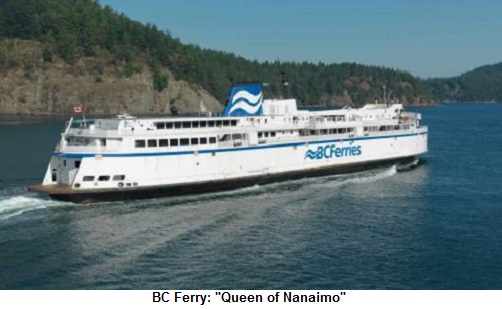
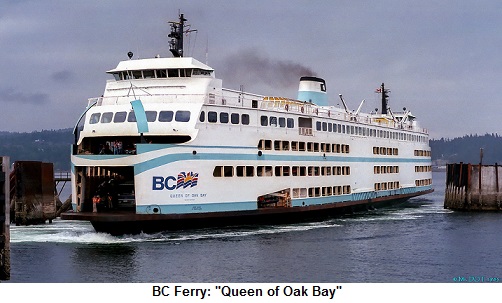
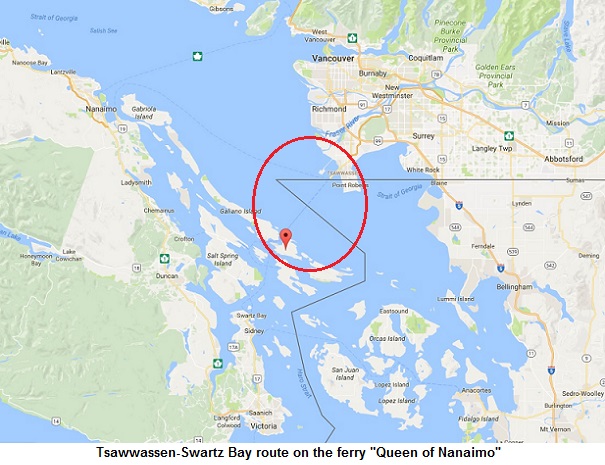
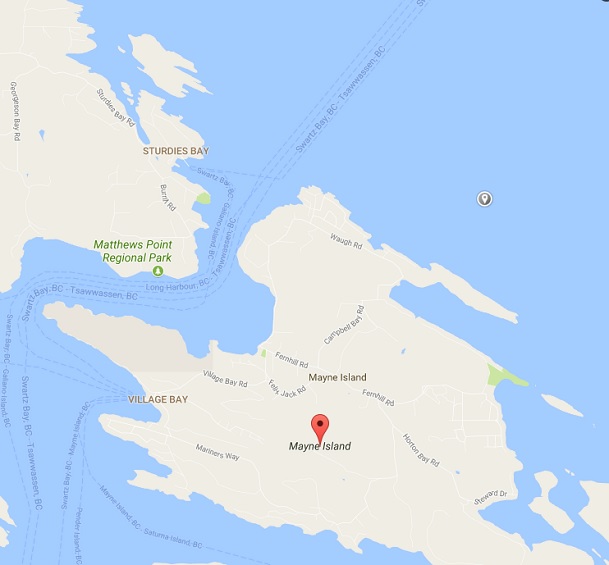
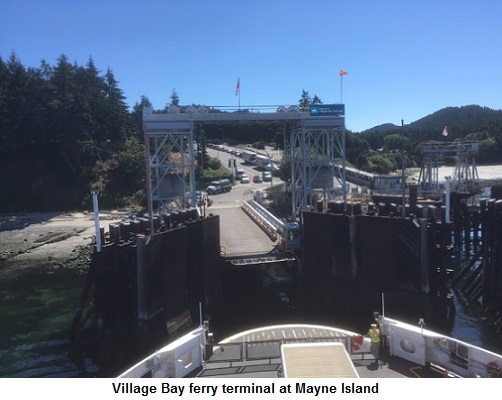
While national-building is heavy-lifting, the administration of ferries need not be. We have so many good examples and role models to consider. For example, this weekend (June 30 / July 1, 2007) is a Big Deal in North America; Canada is celebrating Canada Day on July 1 and the US is celebrating its 4th of July Holiday. We see an example of the best-practices of governance in the news article in the Appendix below. The experience shows how good governance works; due to mechanical problems the ferry operations in this one British Colombian island had to be suspended and a recovery plan executed: free reservations. That is sure to go a long way in forging goodwill among Western Canadian “ferry” stakeholders. This provides a good example for our Caribbean planners, who are observing-and-reporting on Canadian efficiencies. See photos here and the VIDEO in the Appendix below:

CU Blog - Ferries - Economics, Security and Governance - Photo 4

CU Blog - Ferries - Economics, Security and Governance - Photo 3

CU Blog - Ferries - Economics, Security and Governance - Photo 2

Yes, Ferries 101 could exacerbate nation-building 101. These activities can have a positive impact on a nation’s economy, security and governance. The industry of ferries is just one of the basic functionalities that must be embraced for an Industrial Reboot; in fact, this can be catalogued as an Industrial Reboot 101. This commentary is 1 of 4 in an occasional series considering Industrial Reboots. The full series is as follows:

  1. Industrial Reboot – Ferries 101
  2. Industrial RebootPrisons 101
  3. Industrial RebootPipeline 101
  4. Industrial RebootFrozen Foods 101

Yes, we can … reboot our industrial landscape, for our waterways. Past generations of Caribbean people lived off the sea; it is now past-time to do that again. This plan – the roadmap to deploy a regional network of ferries – is conceivable, believable and achievable. We urge all Caribbean stakeholders to lean-in to this roadmap for economic empowerment. We can make the Caribbean homeland – with better interconnectivity between the islands and the “mainlands” – better places to live, work and play. 🙂

Download the free e-Book of Go Lean … Caribbean – now!

Sign the petition to lean-in for this roadmap for the Caribbean Union Trade Federation.

————

Appendix – News Article: Free B.C. Ferries reservations to help Mayne Island travellers
By: Louise Dickson

CU Blog - Ferries - Economics, Security and Governance - Photo 1bB.C. Ferries is offering free reservations on the Tsawwassen-Swartz Bay route for people travelling to Mayne Island in the next few days after hundreds of weekend travellers were caught in a massive traffic jam as they tried to leave the island on Sunday.

All sailings of Queen of Nanaimo between the Lower Mainland and the Gulf Islands were cancelled on Friday due to propeller problems. The Queen of Nanaimo, which has room for 160 cars and 900 passengers, is still out of service and won’t be operating until at least Thursday.

The smaller Salish Eagle, which holds 140 cars and 600 passengers, is running between Tsawwassen and Vancouver Island. B.C. Ferries is adding 12 sailing for the smaller ferry. The sailings will be on Tuesday, Wednesday and Thursday.

B.C. Ferries is working on getting Queen of Nanaimo back into service on Friday, in time for the long weekend, said corporation spokesman Darin Guenette.

If Queen of Nanaimo does not return to service, B.C. Ferries will put another ship on the route, if possible, he said.

The corporation is encouraging Lower Mainland customers to travel through Swartz Bay to the southern Gulf Islands. People interested in travelling through Swartz Bay to the southern Gulf Islands can contact the customer care centre at 1-888-223-3779.

Source: The Times-Colonist – Western Canada’s Oldest Daily Newspaper – Posted & Retrieved June 26, 2017 from: http://www.timescolonist.com/news/local/free-b-c-ferries-reservations-to-help-mayne-island-travellers-1.20780665

————

Appendix VIDEO – Passage ferry QUEEN OF NANAIMO, Tsawwassen – Sturdies Bay (BC Ferries) – https://youtu.be/4c0U6qq2238

Published on Jul 6, 2016 – BC Ferries (06/2016)

Share this post:
, , ,
[Top]

State of the Union – Spanish Caribbean

Go Lean Commentary 

CU Blog - State of the Caribbean Union - Spanish Caribbean - Photo 3

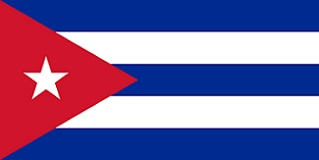
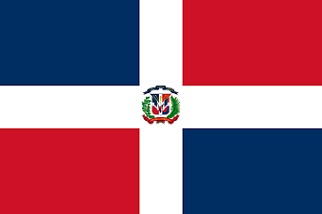
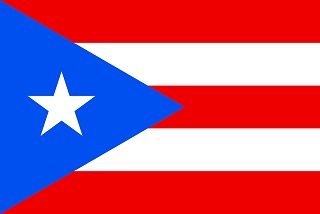
There was a time when all of the Spanish Caribbean – Cuba, Dominican Republic (DR), and Puerto Rico – was ruled under the same flag; that goes way back to the year 1865. There has been no Spanish Caribbean territorial unity ever since.

Too sad! They badly need to confederate, collaborate and convene to tackle so many societal challenges: economics, security and governance.

These 3 member-states constitute 59 percent of the Caribbean’s total population of 42+ million people, according to 2010 census numbers (Cuba – 11.24 million, DR – 9.52 million, PR – 3.99 million). They share the same Spanish language, the same colonial heritage, the same legacy of African Slavery, the same color flags (Red, White and Blue) and the same American tutelage; (some say tutelage while some say abandonment) see here:

  • Cuba – This country was ceded from the Spanish Empire in the 1898 Spanish-American War and allowed to pursue their Independence dreams. Their autonomous rule history was dysfunctional; punctuated with a Communist Revolution in 1959 led by Fidel Castro. See more here: America’s War on the Caribbean. After 55 years of economic and political alienation from the US, the Barack Obama administration worked to normalize relations with Cuba. But there is a new American federal governmental administration; they claim to adhere to a different foreign policy than Obama; but so far, the policies that have been introduced or modified have only tweaked trade rules a little – see Appendix A.
    CU Blog - State of the Caribbean Union - Spanish Caribbean - Photo 2
  • DR – This country benefited from the same movement that granted independence to Haiti; the Haitian Revolutionary forces overran the entire island of Hispaniola and self-extracted from the European powers of France and Spain. Later (1844) the DR sought independence from Haiti and had to contend with many other threats from foreign aggressors. A treaty was drafted and presented to the US Senate to annex the DR as a US Territory with the prospect and pathway to eventually become a US State; it was defeated in 1870 and never ratified. See more here: American Annexation of Santo Domingo. The country has had one troublesome political history since – 3 Presidential assassinations.
    CU Blog - State of the Caribbean Union - Spanish Caribbean - Photo 1
  • Puerto Rico – This island territory was ceded from the Spanish Empire to the US as a result of the same 1898 Spanish-American War. It never obtained independence, but instead experienced one dependent status after another until today. There have been many attempts to assuage the colonial status, in fact a fifth referendum was held just recently on June 11, 2017. 97% percent of those participating voted for statehood, though there was only 23% voter turnout[10]. See more here: Statehood movement in Puerto Rico.
    CU Blog - Puerto Rico Bondholders Coalition Launches Ad Campaign - Photo 1

The US is the richest and most powerful Single Market country that has ever reigned in earth’s history, but this fact has not borne fruit for these Spanish Caribbean neighbors.  They have never shared this disposition.

One thing more these former Spanish territories have shared: Failed-State status.

This has been a familiar theme for the movement behind the book Go Lean…Caribbean. We have consistently conveyed how the economic, security and governing eco-systems of these 3 countries are dysfunctional and defective – along with the other 27 Caribbean member-states. The solution for these countries is not a closer annexation with the United States – America is not the panacea of Caribbean ills – but rather the solutions lie in the adoption of a regional brotherhood among these geographic neighbors – the 3 Spanish Caribbean member-states integrated with the other 27 in the region.

This is the quest of the Go Lean movement!

The book Go Lean…Caribbean – available to download for free – serves as a roadmap for the introduction and implementation of the technocratic Caribbean Union Trade Federation (CU), for the elevation of Caribbean society – for all member-states. This CU/Go Lean roadmap has these 3 prime directives:

  • Optimization of the economic engines in order to grow the regional economy to $800 Billion and create 2.2 million new jobs.
  • Establishment of a security apparatus to ensure public safety and protect the resultant economic engines.
  • Improve Caribbean governance to support these engines, including a separation-of-powers between the member-states and CU federal agencies.

The book stresses that reforming and transforming the Caribbean societal engines must be a regional pursuit. This was an early motivation for the roadmap, as pronounced in the opening Declaration of Interdependence (Pages 12 – 13):

xi. Whereas all men are entitled to the benefits of good governance in a free society, “new guards” must be enacted to dissuade the emergence of incompetence, corruption, nepotism and cronyism at the peril of the people’s best interest. The Federation must guarantee the executions of a social contract between government and the governed.

xvi. Whereas security of our homeland is inextricably linked to prosperity of the homeland, the economic and security interest of the region needs to be aligned under the same governance. Since economic crimes … can imperil the functioning of the wheels of commerce for all the citizenry, the accedence of this Federation must equip the security apparatus with the tools and techniques for predictive and proactive interdictions.

xxiv. Whereas a free market economy can be induced and spurred for continuous progress, the Federation must install the controls to better manage aspects of the economy: jobs, inflation, savings rate, investments and other economic principles. Thereby attracting direct foreign investment because of the stability and vibrancy of our economy.

The Go Lean book provides 370-pages of turn-by-turn instructions on “how” to adopt new community ethos, plus the strategies, tactics, implementations and advocacies to execute so as to reboot, reform and transform the societal engines of Caribbean society.

This commentary is 2 of 5 in a non-sequential series on the State of the Caribbean Union. This series depicts the dysfunctional and defective state of affairs (economics, security and governance) throughout the entire region; there are some common traits. These have been assessed by the Go Lean movement. The full entries of all the blog-commentaries in this series are as follows:

  1. State of the Caribbean Union – Lacking Hope and Change
  2. State of the Caribbean Union – Dysfunctional Spanish Caribbean
  3. State of the Caribbean Union – Deficient  Westminster System
  4. State of the Caribbean Union – Unstable Volcano States
  5. State of the Caribbean Union – Self-Interest of Americana

The State of the Caribbean Union prominently includes these Spanish-speaking islands. These islands need all the remediation and mitigation they can get. Notice the dire state of affairs as portrayed in the Appendices below.

These references align with previous Go Lean commentaries related to …

Cuba – (see Appendix A):

https://goleancaribbean.com/blog/?p=10201 Farewell to Obama and to ‘Wet Foot/Dry Foot’
https://goleancaribbean.com/blog/?p=9813 Fidel Castro Is Dead; Now What for Cuba?
https://goleancaribbean.com/blog/?p=3662 Migrant flow [from Cuba] into US from Caribbean spikes
https://goleancaribbean.com/blog/?p=3455 Restoration of Diplomatic Relations with Cuba – Need for Re-boot Now
https://goleancaribbean.com/blog/?p=3354 CARICOM Chair calls for an end to US embargo on Cuba
https://goleancaribbean.com/blog/?p=2547 Miami’s Success versus Caribbean Failure
https://goleancaribbean.com/blog/?p=2330 ‘Raul Castro reforms not enough’, Cuba’s bishops say

Dominican Republic – (see Appendix B):

https://goleancaribbean.com/blog/?p=11033 US Warnings on Low-cost Dominican Surgeries
https://goleancaribbean.com/blog/?p=10820 Miami: Dominican’s ‘Home Away from Home’
https://goleancaribbean.com/blog/?p=2818 DR President Medina on the economy: ‘God will provide’

Puerto Rico – (see Appendix C):

https://goleancaribbean.com/blog/?p=12126 Commerce of the Seas – Stupidity of the Jones Act
https://goleancaribbean.com/blog/?p=11963 Oscar López Rivera: The ‘Nelson Mandela’ of the Caribbean? Not!
https://goleancaribbean.com/blog/?p=11647 Righting a Wrong: Puerto Rico’s Bankruptcy
https://goleancaribbean.com/blog/?p=6693 Ten Puerto Rico Police Accused of Criminal Network
https://goleancaribbean.com/blog/?p=4551 US Territories – Between a ‘rock and a hard place’
https://goleancaribbean.com/blog/?p=599 Ailing Puerto Rico open to radical economic fixes

The Caribbean Union needs the Spanish Caribbean; the Spanish Caribbean needs the Caribbean Union.

We can reboot the Spanish Caribbean; we can reboot the economic, security and governing engines. The end results:

1.   Spanish Caribbean unity;

2.   Total Caribbean unity;

3.   A better homeland to live, work and play. 🙂

Download the free e-Book of Go Lean … Caribbean – now!

Sign the petition to lean-in for this roadmap for the Caribbean Union Trade Federation.

————–

Appendix A – News Article: In Miami, Trump toughens Obama’s Cuba policy ‘like I promised’

Trump, spurring a standing ovation, billed his appearance as a campaign promise kept to Cuban-Americans to take a harder stance on Cuba. He told the crowd he was canceling Obama’s Cuba policies, though in actuality he’s not. Rather, he’s taking a different approach to pressure Cuba to open its economy and eventually its political system.

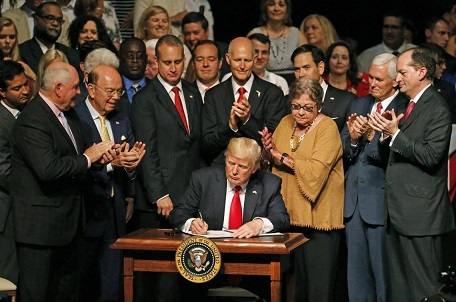
CU Blog - State of the Caribbean Union - Spanish Caribbean - Photo 4Trump signed a national security presidential memo — not a presidential policy directive, as originally envisioned by the White House — ordering federal agencies to start writing regulations within 30 days to promulgate his new policy. The State Department will have to compile a list of entities tied to Cuba’s sprawling military conglomerateGrupo de Administración Empresarial, S.A., or GAESA. Americans will be prohibited from transacting with those corporations, except for enumerated exemptions to, among other things, allow for commercial air and cruise travel and payments to private businesses, such as Airbnb rentals.

Travel to Cuba will also become more difficult. Cubans will still be able to visit family and send money. But Americans will have to travel as part of formal groups with set itineraries if they want to qualify under categories that allow educational and people-to-people cultural exchange trips. Another category, for support for the Cuban people, is more stringent but will still allow for individual travel. U.S. travelers will be prohibited from spending money at hotels and restaurants tied to the Cuban military. That includes many brand-name hotel chains. <<< Insert Photo 4 >>>

See the full article from the Miami Herald; posted June 16, 2017; retrieved June 20, 2017 from: http://www.miamiherald.com/news/politics-government/article156586134.html

————-

VIDEO – US Senator Marco Rubio: Cuba will be free ‘in 6 months or 6 years’  – http://www.miamiherald.com/news/politics-government/article156571009.html

————–
Appendix B – “Dominican Watchdog” – Relating the DR’s Dire Status

  • June 12 – MonkeyBiz.dr, Audit Detects Corruption in 68 Dominican City HallsMONKEY BUSINESS AS USUAL IN THE DOM REP – CORRUPTION AND FRAUD FROM A-Z. Forty percent of the monetary resources that should have been destined to infrastructure works, were NOT. Years of real estate fraud prompts purge of officials, foreign investors and buyers of holiday homes have lost hundreds of millions of dollars…….
  • June 12 – STAY HOME, Dominican Republic Chikungunya Cases Skyrocket to 53000 – TRAVEL WARNING – Taiwan recently raised its ALERT about Dom Rep to YELLOW !! Doctors in the DR is fighting 24/7, but he number of chikungunya cases in the Dominican Republic continues to rise at an alarming rate as the Ministry of Health’s Department of Epidemiology reports 52,976 cases, time to stay home, there is NO PROVEN CURE against this virus…..
  • June 12 – Another Agent Killed as Chilling Attacks Grip Dominican RepublicDominican Republic Becoming Most Dangerous Country in the Caribbean – Metropolitan Transit Authority (AMET) agent Carmen Torres Báez, 41, on Monday became the latest victim in a chilling wave of attacks on law enforcement officers gripping the entire Dominican Republic. Torres, mother of four, was gunned down on the Maximo Gomez bridge to Villa Mella around 7:15am as she was walking to work…..

Source: Retrieved June 20, 2017 from: http://www.dominicanwatchdog.org/dominican_news/p-1

————–

Appendix C AUDIO-PODCAST – INTERSECTION: STATEHOOD FOR PUERTO RICO? – https://www.wmfe.org/intersection-statehood-for-puerto-rico/74667

Published June 16, 2017 – Puerto Rico voted for statehood in a referendum last Sunday. At first glance the results seem pretty clear:  97% of voters said yes to statehood. But less than 25% of Puerto Ricans actually cast a vote in the referendum.
Meanwhile, there’s support from lawmakers here in Central Florida for statehood, where there’s a growing Puerto Rican population, but what kind of impetus is there in Washington to add another star to the US flag?

Florida International University’s Cuban Research Institute director Jorge Duany joins the program, along with orlandolatino.org founder Maria Padilla, tecnetico.com founder Wilton Vargas & Ronald Morales who moved to Florida from Puerto Rico in 2015.

Source: Posted June 12, 2017; retrieved June 20, 2017 from Central Florida’s WMFE Public Radio: https://www.wmfe.org/intersection-statehood-for-puerto-rico/74667

Share this post:
, , , ,
[Top]

Commerce of the Seas – Stupidity of the Jones Act

Go Lean Commentary

CU Blog - Commerce of the Seas - Stupidity of the Jones Act - Photo 1In the Caribbean, we are surrounded by water (straits, banks, Atlantic Ocean, Caribbean Sea, etc); if you stare upon the waters in the middle of a sunny day, you start to see a mirage – a distortion in reality. In the Caribbean, we are also surrounded by a lot of stupidity. Make no mistake, this is not a mirage; it is mercantilism*.

In a previous blog, this commentary asserted that the historicity of a lot of stupidity in society is due to Crony-Capitalism:

Someone is getting paid!

This applies in so many areas of American life that Caribbean people can learn lessons from this history and distortion in reality. This commentary is 1 of 4 in a series considering the Lessons in Economic History related to “Commerce of the Seas”, the Crony-Capitalism in laws and practices around the maritime eco-system in the United States … and other countries. The full series is as follows:

  1. Commerce of the Seas – Stupidity of the Jones Act
  2. Commerce of the Seas – Book Review: ‘Sea Power’
  3. Commerce of the Seas – Shipbuilding Model of Ingalls
  4. Commerce of the Seas – Lessons from Alang (India)

The reference to “Commerce” refers to the economic interests of the 30 member-states in the Caribbean region. There are so many Lessons in Economic History for us to glean:

Around the world, countries that had access to the “Sea” have a distinct advantage economically versus countries that were land-locked; i.e. England versus Austria.

Mercantilism dictated that empires force rules and laws to preserve commerce for their home countries. This was also the case for the United States. One prominent law that was instituted was the Jones Act; see more in Appendix B below.

The Jones Act mandates that for a ship to go from one US port to another US port it must be American-made and American flagged. Also, for foreign ships to trade in US Territories, they must first journey to a foreign port before they could journey to another American port to transport goods. This seems “stupid”; but the adherence to this law keeps American maritime commerce options afloat; this means someone is getting paid; see VIDEO in Appendix A below, highlighting a distortion in the reality of Puerto Rico-to US Mainland trade.
How about the Caribbean, do we have or need maritime “protectionism” in the laws of the member-states of our region? The answer is affirmative for the dysfunctional US Territories; there is a need for economic regionalism, not protectionism.

The US Territories of Puerto Rico and the US Virgin Islands are also regulated by the Jones Act. According to the encyclopedic reference (in Appendix B below), this is not good; it hinders economic development!

In March 2013, the Government Accountability Office (GAO) released a study of the effect of the Jones Act on Puerto Rico that noted “freight rates are set based on a host of supply and demand factors in the market, some of which are affected directly or indirectly by Jones Act requirements.” The report further concludes … [that] freight rates between the United States and Puerto Rico are affected by the Jones Act.” The report also addresses what would happen “under a full exemption from the Act, the rules and requirements that would apply to all carriers would need to be determined.” The report continues that “while proponents of this change expect increased competition and greater availability of vessels to suit shippers’ needs” …

The American territories in the Caribbean are in the middle of the Caribbean geography, rimming the Caribbean Sea. The “Laws of the Sea” need to reflect this reality and not just political alignments. This is the purpose of the book Go Lean … Caribbean, to help reform and transform the societal engines for the 30 member-states of the Caribbean region. The book specifically addresses customization to the “Laws of the Sea” to benefit the Caribbean region. The book serves as a roadmap for the introduction and implementation of the Caribbean Union Trade Federation (CU). This would be the governmental entity for a regional Single Market that covers the land territories of the 30 member-states, and their aligning seas; (including the 1,063,000 square miles of the Caribbean Sea in an Exclusive Economic Zone). The Go Lean/CU roadmap features this prime directive, as defined by these 3 statements:

  • Optimization of the economic engines to grow the regional economy to $800 Billion & create 2.2 million new jobs.
  • Establishment of a security apparatus to protect public safety and ensure the economic engines of the region, including the seas.
  • Improvement of Caribbean governance to support these engines in local governments and in the Exclusive Economic Zone, including a separation-of-powers between the member-states and CU federal agencies.

The Go Lean roadmap allows for the regional stewardship and administration of the commerce on the Caribbean Seas in collaboration, conjunction and cooperation with US legal jurisdiction and foreign entities. The legal premise for this strategy is an Interstate Compact & Treaty – see details in the Go Lean book (Page 278) or the photo-excerpt in Appendix IA below  – legislated by the US Congress, independent Caribbean governments (17) and the colonial masters for the existing overseas territories:

  • France (Guadeloupe, Martinique, St. Martin, St. Barthélemy)
  • The Netherlands (Aruba, Bonaire, Curaçao, Saba, Sint Eustatius, Sint Maarten)
  • United Kingdom (Anguilla, Bermuda, Cayman Islands, Montserrat, Turks & Caicos and the British Virgin Islands)

Such a wide-ranging, fully-encompassing Compact-Treaty was an original intent of the Go Lean book – economic regionalism. The publication (published in November 2013) commenced with a Declaration of Interdependence, pronouncing the need for regional coordination and integration so as to reform and transform Caribbean society. See a sample of relevant stanzas here (Page 11 – 13):

v. Whereas the natural formation of our landmass and coastlines entail a large portion of waterscapes, the reality of management of our interior calls for extended oversight of the waterways between the islands. The internationally accepted 12-mile limits for national borders must be extended by International Tribunals to encompass the areas in between islands. The individual states must maintain their 12-mile borders while the sovereignty of this expanded area, the Exclusive Economic Zone, must be vested in the accedence of this Federation.

vi. Whereas the finite nature of the landmass of our lands limits the populations and markets of commerce, by extending the bonds of brotherhood to our geographic neighbors allows for extended opportunities and better execution of the kinetics of our economies through trade. This regional focus must foster and promote diverse economic stimuli.

xi. Whereas all men are entitled to the benefits of good governance in a free society, “new guards” must be enacted to dissuade the emergence of incompetence, corruption, nepotism and cronyism at the peril of the people’s best interest. The Federation must guarantee the executions of a social contract between government and the governed.

xxiii. Whereas many countries in our region are dependent Overseas Territory of imperial powers, the systems of governance can be instituted on a regional and local basis, rather than requiring oversight or accountability from distant masters far removed from their subjects of administration. The Federation must facilitate success in autonomous rule by sharing tools, systems and teamwork within the geographical region.

The foregoing Jones Act is an American legislation that probably needs to be repealed or revised to reflect the actuality of a globalized economy; (there are some good provisions related to injury of seamen). Consider this recent experience recorded by a commentator on a news site, below an article regarding the efforts to repeal the Jones Act:

John David Oct 25, 2016 at 7:38 pm

The Act does not Protect the Ports and Waterways, that task is left to the US Navy and US Coast Guard. We have Significant Ports on the US Mainland. None of them have had any security issues with Foreign Flagged Vessels. Trade is restrictive to and from places like Puerto Rico, Hawaii, Guam Etc.

Therefore business that could be entertained and cultivated providing a boost in their respective economies, those areas economically are suppressed. The United States has a significant Naval and Coast Guard presence in each of these areas. An example of how this stifles the economy would be to take a guitar manufacturer located on the Big Island of Hawaii. The Big Island has an abundance of Koa wood, a highly sought after wood for the manufacture of wooden guitars. However if they wanted to ship their guitars to a distributor in Australia, they have to first ship it to the USA mainland. They then Offload it and re-ship it to Australia, The interesting part of this story is that many times the costs for shipping it to Australia are less than it was to ship it to the US Mainland on the initial leg. So as you can see this stifles any possible USA productivity. And maybe that is why no one in Hawaii is Mfg guitars, or hardly anything else for that matter.

Original News Article: The Triton – Nautical News – Published January 26, 2015; retrieved June 8, 2017 from: http://www.the-triton.com/2015/01/mccain-repeal-jones-act/

CU Blog - Commerce of the Seas - Stupidity of the Jones Act - Photo 3

Reforming America is out-of-scope for the Go Lean movement, notwithstanding Puerto Rico and the US Virgin Islands. Our quest is to reform and transform the Caribbean … only. The Go Lean book provides 370-pages of turn-by-turn instructions on “how” to adopt new community ethos for economic regionalism, plus the strategies, tactics, implementations and advocacies to execute so as to reboot, reform and transform the maritime commerce to benefit Caribbean society.

The issue of rebooting maritime commerce has been a frequent subject for previous blog-commentaries; consider this list of sample entries:

https://goleancaribbean.com/blog/?p=11544 Forging Change in the Cruise Industry with Collective Bargaining
https://goleancaribbean.com/blog/?p=5210 Cruise Ship Commerce – Getting Ready for Change
https://goleancaribbean.com/blog/?p=4639 Tobago: A Model for Cruise Tourism
https://goleancaribbean.com/blog/?p=4037 One mission for Maritime Commerce: Expanding Shipbuilding
https://goleancaribbean.com/blog/?p=3594 Better Fisheries Management for Queen Conch
https://goleancaribbean.com/blog/?p=2003 Where the Jobs Are in Maritime Commerce? Consider Shipbreaking
https://goleancaribbean.com/blog/?p=673 Ghost ships – Autonomous cargo vessels without a crew

All Caribbean members are islands or coastal territories. There is a need to reform maritime commerce for the Caribbean region; we can get more economic activity from this sector; the Go Lean book projects 15,000 new direct jobs in the shipbuilding industry, 4000 in fisheries and 800 jobs by reforming payment systems for cruise passengers. The possibility of new jobs are positive economic fruitage from considering a reboot of maritime eco-system; it would be stupid not to try.

Previous generations in the Caribbean lived off the sea; we can again; it would be stupid not to try. This plan is conceivable, believable and achievable. We urge all Caribbean stakeholders – seafarers and land-lovers – to lean-in to this roadmap for economic empowerment. We can make the Caribbean homeland and seas better places to live, work and play. 🙂

Download the free e-book of Go Lean … Caribbean – now!

Sign the petition to lean-in for this roadmap for the Caribbean Union Trade Federation. 

————-

Appendix A VIDEO – The Jones Act And The Debt Crisis https://youtu.be/PFnrGcP1OyE

Published on Sep 27, 2016 – Nelson Denis talks about the Jones Act.

In addition, see the FULL Documentary on the Jones Act Explanation: https://youtu.be/GpwzoDGDGAQ

————-

Appendix B: Merchant Marine Act of 1920 aka Jones Act

The Merchant Marine Act of 1920 (P.L. 66-261), also known as the Jones Act, is a United States federal statute that provides for the promotion and maintenance of the American merchant marine.[1] Among other purposes, the law regulates maritime commerce in U.S. waters and between U.S. ports. Section 27 of the Jones Act deals with cabotage and requires that all goods transported by water between U.S. ports be carried on U.S.-flag ships, constructed in the United States, owned by U.S. citizens, and crewed by U.S. citizens and U.S. permanent residents.[2] The act was introduced by Senator Wesley Jones.

Laws similar to the Jones Act date to the early days of the nation. In the First Congress, on September 1, 1789, Congress enacted Chapter XI, “An Act for Registering and Clearing Vessels, Regulating the Coasting Trade, and for other purposes”, which limited domestic trades to American ships meeting certain requirements.[3]

The Merchant Marine Act of 1920 has been revised a number of times; the most recent revision in 2006 included recodification in the U.S. Code.[2] In early 2015 Senator John McCain filed for an amendment that would essentially annul the Act.[4] [The amendment failed].

The Jones Act is not to be confused with the Death on the High Seas Act, another United States maritime law that does not apply to coastal and in-land navigable waters.

Objectives and purpose
The intention of Congress to ensure a vibrant United States maritime industry is stated in the preamble to the Merchant Marine Act of 1920.[5]

Cabotage
Cabotage is the transport of goods or passengers between two points in the same country, alongside coastal waters, by a vessel or an aircraft registered in another country. Originally a shipping term, cabotage now also covers aviation, railways, and road transport. Cabotage is “trade or navigation in coastal waters, or the exclusive right of a country to operate the air traffic within its territory”.[6] In the context of “cabotage rights”, cabotage refers to the right of a company from one country to trade in another country. In aviation terms, for example, it is the right to operate within the domestic borders of another country. Most countries enact cabotage laws for reasons of economic protectionism or national security.[citation needed]

The cabotage provisions relating to the Jones Act restrict the carriage of goods or passengers between United States ports to U.S.-built and flagged vessels. It has been codified as portions of 46 U.S.C. [7] Generally, the Jones Act prohibits any foreign-built, foreign-owned or foreign-flagged vessel from engaging in coastwise trade within the United States. A number of other statutes affect coastwise trade and should be consulted along with the Jones Act. These include the Passenger Vessel Services Act, 46 USC section 289 which restricts coastwise transportation of passengers and 46 USC section 12108 restricts the use of foreign vessel to commercially catch or transport fish in U.S. waters.[8] These provisions also require at least three-fourths of the crewmembers to be U.S. citizens. Moreover, the steel of foreign repair work on the hull and superstructure of a U.S.-flagged vessel is limited to ten percent by weight.

Effects
The Jones Act prevents foreign-flagged ships from carrying cargo between the US mainland and noncontiguous parts of the US, such as Puerto Rico, Hawaii, Alaska, and Guam.[11] Foreign ships inbound with goods cannot stop any of these four locations, offload goods, load mainland-bound goods, and continue to US mainland ports. Instead, they must proceed directly to US mainland ports, where distributors break bulk and then send goods to US places off the mainland by US-flagged ships.[11] Jones Act restrictions can be circumvented by making a stop in a foreign country between two US ports, e.g., Anchorage–Vancouver–Seattle.

Puerto Rico
Studies by the World Economic Forum and Federal Reserve Bank of New York have concluded that the Jones Act hinders economic development in Puerto Rico.[12]

In March 2013, the Government Accountability Office (GAO) released a study of the effect of the Jones Act on Puerto Rico that noted “[f]reight rates are set based on a host of supply and demand factors in the market, some of which are affected directly or indirectly by Jones Act requirements.” The report further concludes, however, that “because so many other factors besides the Jones Act affect rates, it is difficult to isolate the exact extent to which freight rates between the United States and Puerto Rico are affected by the Jones Act.” The report also addresses what would happen “under a full exemption from the Act, the rules and requirements that would apply to all carriers would need to be determined.” The report continues that “[w]hile proponents of this change expect increased competition and greater availability of vessels to suit shippers’ needs, it is also possible that the reliability and other beneficial aspects of the current service could be affected.” The report concludes that “GAO’s report confirmed that previous estimates of the so-called ‘cost’ of the Jones Act are not verifiable and cannot be proven.”[13]

In the Washington Times, Rep. Duncan Hunter spoke to the need for the Jones Act and why it is not to blame for the island’s debt crisis. “With or without such an effort, it’s imperative not to conflate the unrelated issues of Puerto Rico’s debt and the Jones Act, and to fully grasp the importance of ensuring the safe transport of goods between American ports. There must also be acknowledgment of the dire consequences of exposing ports and waterways to foreign seafarers.”[14]

[See VIDEO in Appendix A above].

US shipbuilding
Because the Jones Act requires all transport between US ports be carried on US-built ships, the Jones Act supports the domestic US shipbuilding industry.[15][16]Critics of the act describe it as protectionist, harming the overall economy for the sake of benefiting narrow interests.[17][18] Other criticism argues that the Jones Act is an ineffective way to achieve this goal, claiming it drives up shipping costs, increases energy costs, stifles competition, and hampers innovation in the U.S. shipping industry[19] – however, multiple GAO reports have disputed these claims.[20]

Source: Retrieved June 8, 2017 from: https://en.wikipedia.org/wiki/Merchant_Marine_Act_of_1920

[See the FULL Documentary on the Jones Act Explanation: https://youtu.be/GpwzoDGDGAQ]

————-

Appendix IA – Interstate Compacts

Since Puerto Rico and the Virgin Islands are US Territories, their implementation of the provisions of the Caribbean Union Trade Federation must legally be construed as an Interstate Compact.

An Interstate Compact is an agreement between two or more states of the US. Article I, Section 10 of the US Constitution provides that “no state shall enter into an agreement or compact with another state” without the consent of Congress. Frequently, these agreements create a new governmental agency which is responsible for administering or improving some shared resource such as a seaport or public transportation infrastructure. In some cases, a compact serves simply as a coordination mechanism between independent authorities in the member states.

CU Blog - Commerce of the Seas - Stupidity of the Jones Act - Photo 2

Click on photo to enlarge

————-

Footnote Reference – * Mercantilism

A system of political and economic policy, evolving with the modern national state and seeking to secure a nation’s political and economic supremacy in its rivalry with other states. According to this system, money was regarded as a store of wealth, and the goal of a state was the accumulation of precious metals, by exporting the largest possible quantity of its products and importing as little as possible, thus establishing a favorable balance of trade.
Source: Retrieved June 8, 2017 from: http://www.dictionary.com/browse/mercantile-system

Share this post:
, , , , , ,
[Top]

Inaction: A Recipe for ‘Failed-State’ Status

Go Lean Commentary

Do you remember when …?

Why not? It was such an important event that you should never forget. And yet!

CU Blog - Inaction - A Recipe for 'Failed-State' Status - Photo 2This is the current situation today for a country that is a Caribbean neighbor: Venezuela. Atrocities are happening there and we, as observing-reporting neighbors have done nothing and now propose more of the same: 

Inaction.

This is the formula, the recipe, for creating a Failed-State:

 “The only thing necessary for the triumph of evil is for good men to do nothing” – Edmund Burke; 1729 – 1797; an Irish statesman and member of British Parliament.

How can we forget?!?!

The recipe of good people … doing nothing to prevent atrocities is what was prevalent in Nazi Germany, Rwanda, Bosnia and many other troubled spots – Failed-States – in modern times; (see Appendix D below). Despite all of our pledges of “Never Again“, we now see it happening again; this time in Venezuela; see VIDEO in Appendix C below.

In a previous blog-commentary by the movement behind the book Go Lean…Caribbean – available to download for free – it was related that …

… unless mitigated, Venezuela will become a Failed-State. We hope that the country, and their South American neighbors, can secure their society to assure peace and the protection of human rights.

In fact, the Go Lean commentary had observed-and-reported on a number of negative developments regarding Venezuela; see this sample list of previous blogs here:

Link Date Title
https://goleancaribbean.com/blog/?p=8132 05-31-2016 Venezuela: Watching a ‘Train Wreck in Slow Motion’
https://goleancaribbean.com/blog/?p=6800 10-26-2015 Venezuela sues black market currency website in US
https://goleancaribbean.com/blog/?p=1076 05-29-2014 Trinidad Muslims travel to Venezuela for jihadist training

The situation in Venezuela is dire –  see VIDEO in Appendix C below – action must be taken to abate the downward spiral of the societal engines there. There is something the Caribbean community can do to help mitigate the threats.

There are new Caribbean-Venezuela developments … happening now (last week actually):

Proposals for more of the same … inaction.

CU Blog - Inaction - A Recipe for 'Failed-State' Status - Photo 1See the news articles in the Appendices (A & B) below. The overall theme from the articles is that government leaders in the formal Caribbean Community (CariCom) want to not disturb Venezuela’s sovereignty and further these leaders oppose any entity – i.e. the Organization of American States or OAS – that may want to condemn the status quo and ruling class in Venezuela.

Say it ain’t so CariCom!

Venezuela is near-Failed-State status; lives are being lost; economic systems are dysfunctional and people are taking flight, seeking refuge in foreign countries; see VIDEO below. Despite these conditions, CariCom – who weld some power and influence through peer pressure – wants Inaction.

We object!

Down with CariCom …
Time for a change …
Time to reboot the Caribbean …

This is the declaration of the book Go Lean…Caribbean; this book serves as a roadmap for the introduction and implementation of the technocratic Caribbean Union Trade Federation (CU), for the elevation of Caribbean society – for all member-states. The book posits that CariCom is a failure (Page 3) and that the quest for regional integration in the Caribbean needs a new – and better – expression. The book therefore presents the Go Lean/CU roadmap with these 3 prime directives:

The book stresses that reforming and transforming the Caribbean societal engines must be a regional pursuit. This was an early motivation for the roadmap, as pronounced in the opening Declaration of Interdependence (Pages 12 – 13):

xi. Whereas all men are entitled to the benefits of good governance in a free society, “new guards” must be enacted to dissuade the emergence of incompetence, corruption, nepotism and cronyism at the peril of the people’s best interest. The Federation must guarantee the executions of a social contract between government and the governed.

xvi. Whereas security of our homeland is inextricably linked to prosperity of the homeland, the economic and security interest of the region needs to be aligned under the same governance. Since economic crimes … can imperil the functioning of the wheels of commerce for all the citizenry, the accedence of this Federation must equip the security apparatus with the tools and techniques for predictive and proactive interdictions.

xxiv. Whereas a free market economy can be induced and spurred for continuous progress, the Federation must install the controls to better manage aspects of the economy: jobs, inflation, savings rate, investments and other economic principles. Thereby attracting direct foreign investment because of the stability and vibrancy of our economy.

The Go Lean book provides 370-pages of turn-by-turn instructions and actions to adopt new community ethos, plus the strategies, tactics, implementations and advocacies to execute so as to reboot, reform and transform the societal engines of Caribbean society. To prevent atrocities, there must be actions, positive engagements, before and after; see Appendix D below.

To political leaders like Ralph Gonsalves, Prime Minister of St Vincent and the Grenadines, the Go Lean movement gives this salutation (Page 252):

[Step aside]. Thank you for your service. Change has come.

We must do this: change from the inaction of the current political leadership and lean-in to this roadmap to re-boot, reform and transform the Caribbean region.

Yes, we can act and help prevent atrocities in our region and make our own homeland better places to live, work and play. 🙂

Download the free e-Book of Go Lean … Caribbean – now!

Sign the petition to lean-in for this roadmap for the Caribbean Union Trade Federation. 

————-

Appendix A – Gonsalves warns CariCom of plot against Venezuela

KINGSTOWN, St. Vincent – Prime Minister Ralph Gonsalves of St Vincent and the Grenadines has cautioned the Caribbean Community (CariCom) to refrain from allowing a small group of powerful nations to dilute the collective strength of the 15-member regional grouping.

Gonsalves, in a three page letter to CariCom leaders, that was circulated to the media, warned that a wedge is being driven through CariCom over a plan for regime change in Venezuela and the group of powerful nations with the Organisation of America States (OAS) has an agenda of naked self-interest.

He said the group has strategically invited select CariCom countries to their meetings and ignored the others. In the result, they have succeeded in disuniting and weakening CariCom countries whose only strength lies in our solidarity. This worrying development has been particularly manifest in matters relating to Venezuela, said Gonsalves in a letter dated May 10.

There is clearly a calculated strategy in place by a group of nations to achieve regime change in Venezuela by using the OAS as a weapon of destruction, he added.

Gonsalves said while CARICOM countries may have concerns about the political, economic and social conditions in Venezuela, we are all sufficiently seasoned political leaders to know that toppling a government will not end those conditions, particularly when there is no viable, electable single alternative to replace it.

Resolving the conflict
He acknowledged that CariCom member states could have a role in promoting dialogue to help resolve the conflict in Venezuela he warned fellow regional leaders against allowing themselves to be ambushed into breaking our solidarity and aligning ourselves with fair-weather friends.

Meanwhile, representatives from 18 OAS member states have approved a meeting of foreign ministers scheduled for May 31 in Washington to discuss the Venezuelan crisis.

In recent weeks, there has been growing unrest across Venezuela, with several killed and others injured as they have called for elections, freedom for jailed activists, foreign humanitarian aid to offset the economic crisis, and autonomy for the opposition-controlled legislature.

Source: Posted May 17, 2017; retrieved June 7, 2017 from: https://www.iwnsvg.com/2017/05/17/gonsalves-warns-caricom-of-plot-against-venezuela/

————-

Appendix B – St Vincent PM praises CariCom on position taken on Venezuela
By: Peter Richards

BRIDGETOWN, Barbados (CMC) St. Vincent and the Grenadines Prime Minister, Ralph Gonsalves has praised Caribbean Community (CariCom) countries for acting “with independence, courage and concerted action” during the Permanent Council meeting of the Organisation of American States (OAS) called to discuss the situation in Venezuela earlier this week.

In a two-page letter sent to the Irwin La Rocque, secretary general of CariCom, Gonsalves said that the “CariCom stance is a tribute to our region’s commitment to the highest ideals of our Caribbean civilisation and of its institutional expression, politically, the independent and sovereign nation-state”.

He said that through its position at the OAS, CariCom countries have honoured the names of “our revered leaders of yesteryear” including Errol Barrow of Barbados, Forbes Burnham of Guyana, Michael Manley of Jamaica and Trinidad and Tobago’s Dr. Eric Williams “whose respective countries defied the edict of a hegemonic neighbour in their formal diplomatic recognition of revolutionary Cuba in 1972”.

In his letter, which was copied to heads of state and governments in CariCom and obtained by the Caribbean Media Corporation (CMC), Gonsalves said he was “humbled and proud of the majesty of CARICOM’s united stance in defence of the principle of non-interference in the internal affairs of states; the bedrock ideas of sovereignty and independence (and) the nobility of the fundamental precepts of representative democracy”.

During the OAS meeting, Jamaica, for example, called for dialogue among all parties in Venezuela, where opposition-led street demonstrations to force the Nicolas Maduro government out of office have resulted in more than 40 deaths and a split among members of the OAS.

Jamaica’s Foreign Affairs Minister, Kamina Johnson-Smith, addressing the 29th Meeting of Consultation of Ministers of Foreign Affairs at the OAS in Washington earlier this week, said the Andrew Holness government is “gravely concerned by the continued deterioration of the situation in Venezuela”.

She cited increased violence, loss of life, damage to infrastructure, severe economic hardships for the people, and “a hardening of deeply entrenched positions by both Government and opposition groups…

“Jamaica continues to highly favour meaningful dialogue and discourages the isolation of Venezuela. We, therefore, invite the Government of Venezuela to reconsider that decision,” Johnson Smith added.

On Wednesday, Trinidad and Tobago called for the removal of the OAS Secretary General Luis Almagro, over his non-neutral position on the political situation in Venezuela and warned the 15-member CariCom grouping of the possibility of destroying “itself as an honest broker with respect to any involvement in assistance to Venezuela and its internal problems…

“Trinidad and Tobago registered a strong objection to the behaviour of the OAS leadership. The public servants from the OAS took it upon themselves to engage the Government of Venezuela, the president in fact, in a very derogatory manner,” Prime Minister Keith Rowley told a news conference on his return from an official two-day visit to Chile.

Last month, CariCom foreign ministers called for non-interference in the internal affairs of Venezuela.

Gonsalves, who had last month had cautioned CARICOM to refrain from allowing a small group of powerful nations to dilute the “collective strength” of the 15 member regional grouping on the Venezuela issue, said in his letter to La Rocque that he was “heartened that CariCom member-states are alive to the maneuverings of those who would wish to deliver Venezuela and its oil on a platter to a handful of global enterprises, who are focused on their own greed, duplicity, and narrow self interest….

“We know the road very well. But CariCom has taken the road less travelled by, and that has made all the difference,” Gonsalves wrote, adding, “I do not underestimate the current travails of Venezuela and I am pleased that CariCom is prepared to play a facilitating role, along with other countries and leading personalities in fostering peace, dialogue and constitutionalism in Venezuela”.

But he acknowledged that “at the end of the day, this is a matter for Venezuelans themselves”.

Gonsalves said that he is “sure that the overwhelming majority of nation-states, globally, are pleased with CariCom’s stance at the OAS.

“We must now allow our unity and good sense to be put asunder. Now more than ever we must remain firm. The enemies at the gates of non-interference, sovereignty, and independence will not rest; indeed, they will redouble their efforts. They will raise aloft, hypocritically, any number of high-sounding phrases but beneath them are base motives. History has taught us all this, and more.

“I am confident of CariCom’s continuing embrace of independence, courage, and concerted action, remembering always that, of all time, only the future is ours to desecrate. Our Caribbean civilisation must never be engaged in the desecration of our future,” the St. Vincent and the Grenadines prime minister wrote.

Source: Posted June 3, 2017; retrieved June 7, 2017 from: https://www.iwnsvg.com/2017/06/03/st-vincent-pm-praises-caricom-on-position-taken-on-venezuela/

————-

Appendix C VIDEO – Exclusive Interview on Venezeula: “We’re Being Ruthlessly Killed by the Venezuelan Gov’t” – https://youtu.be/qwPZ75_rj0k

Published on Jun 7, 2017 – Venezuelan citizen Aura Garrillo joined MRCTV’s Nick Kangadis to talk about the atrocities happening in the “dictatorial” nation of Venezuela.

Garrillo speaks out about the hyper-inflation, crime-ridden neighborhoods, lack of affordable goods and bloodshed, courtesy of the Nicolas Maduro-led government.

Subscribe: www.youtube.com/mrctvdotorg

About: MRCTV is an online media platform designed to broadcast conservative values, culture, politics, liberal media bias, and entertainment to a new and diverse audience on a social media optimized site. Our goal is to break down the boundaries between traditional conservative media and mainstream culture.

Follow Us:
www.mrctv.org
facebook.com/MRCTV
twitter.com/mrctv
Nick Kangadis on Twitter: twitter.com/TruthOfChicago
Nick Kangadis on Facebook: https://www.facebook.com/UncommonSens…

MRCTV is brought to you by the Media Research Center. The mission of the MRC is to create a media culture in America where truth and liberty flourish. The MRC is a research and education organization operating under Section 501(c)(3) of the Internal Revenue Code.

————-

Appendix D – Preventing mass atrocities – An agenda for policymakers and citizens

    Introduction ………………………………………………………. 1
    Early warning ……….. ………………………………………….. 3
    Detecting risk and promoting action
    Diplomacy …………………………………………………………. 5
    The first line of prevention
    Development aid ………………………………………………… 7
    Building resilient societies to prevent atrocities
    Security assistance ……………………………………………… 9
    Helping countries protect their people
    International action ………………………………………………11
    Working together to prevent atrocities

CU Blog - Inaction - A Recipe for 'Failed-State' Status - Photo 3

See the full report here; retrieved June 7, 2017 from:

http://responsibilitytoprotect.org/Cit%20for%20glob%20sol-Preventing_mass_atrocities-highres-singlepages.pdf


Share this post:
, , , ,
[Top]

Hurricane Season 2017 and ‘Climate Change’ Abatement

CU Blog - Hurricane Season 2017 - Photo 1

Go Lean Commentary

Its June 1st, the start of the Hurricane season. According to Weather Authorities, it is going to be a tumultuous season, maybe even more destructive than last year; see Appendix A below.

Thanks Climate Change.

What hope is there to abate the threats from Climate Change?

Thanks to the Paris Accord, there is now hope; (we remember the effectiveness of the accord to abate “Acid Rain”).

But wait! The American President – Donald Trump – announces that he is withdrawing the United States from the Paris Accord. (See the news article/link in Appendix B below).

CU Blog - Hurricane Season 2017 - Photo 3

W.T.H.?!?!

This is a matter of security; perhaps we should not look to the US to take the lead for our own fate. This is so familiar … and a Hot Topic today as European member-states are contemplating how much they can look to the US for leadership for their security needs; (see the VIDEO in the Appendix C below).

This is the assertion of the book Go Lean…Caribbean; available to download for free. It serves as a roadmap for the introduction and implementation of the technocratic Caribbean Union Trade Federation (CU), for the elevation of Caribbean society – for all member-states. The quest is that we take our own lead – collectively – for our own fate. This CU/Go Lean roadmap has these 3 prime directives:

The book stresses that reforming and transforming the Caribbean societal engines must be a regional pursuit; the issues at hand are too big for anyone member-state alone. This was an early motivation for the roadmap, as pronounced in the opening Declaration of Interdependence (Pages 12 – 13):

i. Whereas the earth’s climate has undeniably changed resulting in more severe tropical weather storms, it is necessary to prepare to insure the safety and security of life, property and systems of commerce in our geographical region. As nature recognizes no borders in the target of its destruction, we also must set aside border considerations in the preparation and response to these weather challenges.

xi. Whereas all men are entitled to the benefits of good governance in a free society, “new guards” must be enacted to dissuade the emergence of incompetence, corruption, nepotism and cronyism at the peril of the people’s best interest. The Federation must guarantee the executions of a social contract between government and the governed.

xvi. Whereas security of our homeland is inextricably linked to prosperity of the homeland, the economic and security interest of the region needs to be aligned under the same governance. Since economic crimes … can imperil the functioning of the wheels of commerce for all the citizenry, the accedence of this Federation must equip the security apparatus with the tools and techniques for predictive and proactive interdictions.

xxiv. Whereas a free market economy can be induced and spurred for continuous progress, the Federation must install the controls to better manage aspects of the economy: jobs, inflation, savings rate, investments and other economic principles. Thereby attracting direct foreign investment because of the stability and vibrancy of our economy.

The Go Lean book provides 370-pages of turn-by-turn instructions on “how” to adopt new community ethos, plus the strategies, tactics, implementations and advocacies to execute so as to reboot, reform and transform the societal engines of Caribbean society.

The issue of Hurricane Season 2017 is bigger than initial appearances – there are BIG  issues afoot. Many are issues that were addressed in previous Go Lean blog-commentaries; see a sample here:

https://goleancaribbean.com/blog/?p=11858 Welcome to Kiribati – Hello and Goodbye
https://goleancaribbean.com/blog/?p=11442 Caribbean Roots: Al Roker – ‘Climate Change’ Defender
https://goleancaribbean.com/blog/?p=9455 Fix ‘Climate Change’ – Yes, We Can
https://goleancaribbean.com/blog/?p=9334 Hurricane Categories – The Science
https://goleancaribbean.com/blog/?p=7449 Due to Climate Change, ‘Crap Happens’ – So What Now?
https://goleancaribbean.com/blog/?p=7103 COP21 – ‘Climate Change’ Acknowledged
https://goleancaribbean.com/blog/?p=6893 A Meteorologist’s View On Climate Change
https://goleancaribbean.com/blog/?p=6016 ‘Hotter than July’ – Reality in the Caribbean
https://goleancaribbean.com/blog/?p=4673 Climate Change‘ Merchants of Doubt … to Preserve Profits!!
https://goleancaribbean.com/blog/?p=2465 Book: ‘This Changes Everything: Capitalism vs. the Climate’
https://goleancaribbean.com/blog/?p=2276 Climate Change May Affect Food Supply Within a Decade
https://goleancaribbean.com/blog/?p=2119 Cooling Effect – Oceans and the Climate
https://goleancaribbean.com/blog/?p=1883 Climate Change May Bring More Kidney Stones
https://goleancaribbean.com/blog/?p=1817 Caribbean grapples with intense cycles of flooding & drought
https://goleancaribbean.com/blog/?p=926 Conservative heavyweights have solar industry in their sights
https://goleancaribbean.com/blog/?p=915 Go ‘Green’ … Caribbean

We endured a bitter Hurricane Season last year; Hurricane Matthew was devastating for a number of Caribbean islands in September/October; i.e. Haiti and the Bahamas. (In fact, the Bahamian city of Freeport was so severely impacted that one of its biggest Hotel-Casino resorts closed … permanently).

The Caribbean status quo is unsustainable under the real threats of Climate Change. The region must reboot, reform and transform. We must do the heavy-lifting ourselves; we cannot expect relief and refuge from others, like the American Super-Power. We must find and “sail” under our own power.

Hope and Change! Yes, we can …

… we can make our Caribbean homeland a better place to live, work and play. 🙂

Download the free e-Book of Go Lean … Caribbean – now!

Sign the petition to lean-in for this roadmap for the Caribbean Union Trade Federation.

————

Appendix A – Forecasters predict active 2017 hurricane season

With the start of the Atlantic hurricane season less than one week away, the National Oceanic and Atmospheric Administration, says it could be a busy one with five to nine hurricanes expected to form.

Overall, NOAA forecasts 11 to 17 named tropical storms will develop in the region, which includes the Atlantic, the Caribbean Sea and Gulf of Mexico, the agency announced Thursday.

The season officially begins June 1 and runs through Nov. 30.

Of the hurricanes, two to four could be major, with wind speeds of 111 mph or higher and rated as Category 3, 4 or 5 on the Saffir-Simpson Scale of Hurricane Intensity.

An average season typically produces 12 named tropical storms and six hurricanes and peaks in August and September.

A tropical storm contains wind speeds of 39 mph or higher and becomes a hurricane when winds reach 74 mph.

Factors contributing to the prediction include: A weak or non-existent El Nino, near- or above-average sea-surface temperatures, and average or weaker-than-average vertical wind shear, said Gerry Bell, Ph.D., lead seasonal hurricane forecaster with NOAA’s Climate Prediction Center.

Meteorologists at Colorado State University last month estimated 11 tropical storms will form, with four becoming hurricanes.

The late Colorado State University meteorologist William Gray was the first scientist to make seasonal hurricane forecasts back in the 1980s.

The Weather Channel predicts an average season, with 12 named storms, of which six will become hurricanes. AccuWeather forecasts 10 named storms, five of which are projected to become hurricanes.

Source: St. Lucia Times Daily Newspaper –  Posted May 25, 2017 retrieved June 1, 2017 from: https://stluciatimes.com/2017/05/26/forecasters-predict-active-2017-hurricane-season

————

Appendix B – Trump expected to withdraw from Paris Accord

Washington (CNN) President Donald Trump is expected to withdraw from the Paris climate agreement, two senior US officials familiar with his plans told CNN Wednesday, a major break from international partners that would isolate the United States in global efforts to curb global warming.

CU Blog - Hurricane Season 2017 - Photo 2

The decision would put the US at odds with nearly every other nation on earth. It would reflect a major reversal of the Obama administration’s efforts on climate change. And it could trigger further efforts to erode the landmark climate accord.

Source: Posted and retrieved May 31, 2017 from http://www.cnn.com/2017/05/31/politics/trump-paris-accord/

——

In actuality, President Trump officially announces  the exit and former President Obama barks. See story and VIDEO here: http://www.independent.co.uk/news/world/americas/us-politics/paris-agreement-trump-obama-response-rejecting-future-climate-change-deal-latest-news-updates-a7768171.html

————

Appendix C VIDEO – Thanks to Trump, Germany says it can’t rely on the United Stateshttp://wapo.st/2qsrQHd

Share this post:
, , ,
[Top]

The Dynamics of Diaspora Voting

Go Lean Commentary

So you have an opinion? Good! Now here are the facts.

Did that move your opinion? If not, you’re dogmatic. If, on the other hand, the clarification of facts causes you to adjust your thinking then you have been enlightened.

Welcome to the club!

For the movement behind the book Go Lean…Caribbean, the planners of a new Caribbean, it has always been our position that the Diaspora should preserve their voting rights back in the homeland. Now that we have considered the facts below, our relationship status – assuming the ‘romance between man and his hometown’ – must be changed to:

It’s complicated“; not just “divorced” nor just “separated”.

The primary driver of this position comes from this basic principle of democracy:

No taxation without representation

If this basic principle is accepted then the opposite must also be true:

No representation without taxation.

This may be a fitting analogy for the issue of Diaspora Voting: Imagine a man that divorces his wife, then still tries to dictate who she can subsequently date or marry; that ex-husband’s prerogative should justifiably be revoked.

CU Blog - Dynamics of Diaspora Voting - Photo 2

CU Blog - Dynamics of Diaspora Voting - Photo 3

Can a member of the Caribbean Diaspora leave his/her homeland, stop paying taxes, stop contributing to the community and yet still dictate who should assume leadership in their absence? This would include how to spend the tax dollars that they no longer contribute. (See the Letter to Editor – “Diaspora voting is the people’s rights to decide” in the Appendix below).

Thus, the “complicated” status.

There is a lot of details and complexities associated with Diaspora Voting. See this summary here of this White Paper; (the full White Paper can be accessed at: https://www.overseasvotefoundation.org/files/The_History_and_Politics_of_Diaspora_Voting.pdf):

Title: The History and Politics of Diaspora Voting in Home Country Elections

Prepared by Andy Sundberg, based on information from Andrew Ellis and others sources in: ”Voting from Abroad”: The International IDEA Handbook, 2007.

The case for external voting is usually presented as a question of principle, based on the universality of the right to vote. In reality, however, the introduction of external voting is enacted or enabled by legislation passed by elected politicians. Although there have been a variety of reasons for the enactment of external voting provisions, almost all have been the result of political impetus, and many have been controversial and even nakedly partisan.

1. A Brief History of Diaspora Voting
… The reasons for introducing external voting also differ according to the historical and political contexts. Thus, in several countries the introduction of the right to vote for overseas citizens was an acknowledgement of their active participation in World War I or World War II. …Outside the military context, New Zealand introduced absentee voting for seafarers in 1890, and Australia adopted it in 1902, although under operating arrangements which made its use outside Australia practically impossible. …
2. Diaspora Voting In Democratic Transition Countries
The importance of political factors in the adoption and design of external voting provisions was accentuated during the democratic transitions of the 1990s. The inclusion of citizens abroad was often seen as a key element in the process of nation-building, for example, in Namibia in 1989 and South Africa in 1994.Diaspora communities may be active in seeking a post-transition role, and may be particularly influential when they play a role in the domestic politics of major donor countries. However, such pressure is not always successful. …The international community frequently plays a leading or significant role in mediating transitions and even in implementing transitional elections. Transition agreements may therefore contain important and sometimes controversial external voting provisions. …
3. Diaspora Voting and Electoral System Design
Political considerations are not only important in determining whether external voting takes place: they are also influential in defining its form. Many decisions relating to external voting are linked to electoral system design, another highly political aspect of democratic reform and democratic transition.Electoral system design is one of the most important elements in the institutional framework of a country, influencing as it does the political party system. Electoral system reform may be on the agenda as a result of vision or a motivation to improve democracy, or for more short-term, sectoral or even venal reasons on the part of some political participants. This is mirrored by external voting, which may be placed on the democratic agenda by those who believe strongly in the equal right of all citizens to participate—or by political forces which see potential advantage in it.The desire to promote external voting may constrain the options for electoral system design. Conversely, the adoption of a particular electoral system may limit the options for external voting mechanisms. This can be illustrated by considering the three basic options for external voting— personal voting at an external polling site in a diplomatic mission, for example; remote voting by post, fax or some form of e-voting; and voting by proxy.
3.1 Diaspora Voting in Person and Electoral System Design
3.2 Diaspora Remote Voting and Electoral System Design
3.3 Diaspora Voting by Proxy and Electoral System Resign
3.4 Diaspora Voting Timing Issues
4. Who Can Vote and How Voting Takes Place
4.1 The Number of National Diasporas Who Can Vote Today
Voting from abroad is now possible for Diaspora communities from 115 home countries. Of these, 28 come from home countries in Africa; 16 in the Americas; 20 in Asia; 41 in Western, Central and Eastern Europe; and 10 in the Pacific. Provisions for voting by Diaspora communities have been adopted by five additional countries, but rules and voting methods have not yet been decided.
4.2 Restrictions on Diaspora Members Who Can Vote from Abroad
Fourteen countries, who allow voting by their Diaspora communities, impose some time restrictions on such electoral participation. These restrictions are summarized in Table 1 below.
4.3 Different Types of Elections During Which Diaspora Voting is Currently Permitted
There are four principal types of elections where voting by Diaspora members can take place so far.Presidential Elections: Diaspora members from 64 countries can participate in their home country presidential elections.

Legislative Elections: Diaspora members from 92 countries can participate in their home country legislative elections.

Sub-National Elections: Diaspora members from 25 countries can participate in their home country sub-national elections.

Referendums: Diaspora members from 38 countries can participate in their home country referendums.

Diaspora Voting in Different Combinations of Elections: Each country has a different selection of elections that permit vote from their Diaspora members. These elections are shown in Table 2 below.

4.4 Different Types of Diaspora Voting Methods Used
Countries use five different methods of voting for their Diaspora members today.Voting in Person: Diaspora members from 79 countries can vote in person.

Voting by Post: Diaspora members from 47 countries can vote by postal ballot.

Voting by Proxy: Diaspora members from 16 countries can vote by proxy.

Voting by Fax: Diaspora members from 2 countries (Australia and New Zealand) can vote by fax.

Voting by the Internet: Diaspora members from 2 countries (Estonia and the Netherlands) have been able to vote by the Internet so far. (Note: American Diaspora members of Democrats Abroad (DA) were also able to vote in the 2008 overseas primary election by Internet and 48% of the total DA primary votes were cast this way).Different Combinations of Voting Methods: Each country has a different selection of voting methods that are available for their Diaspora members. Some offer only one voting method, but some offer several options. These different options are shown in Table 3 below.

Source: Posted 2007; retrieved May 25, 2017 from: https://www.overseasvotefoundation.org/files/The_History_and_Politics_of_Diaspora_Voting.pdf

The book Go Lean…Caribbean – available to download for free – identified the Diaspora as stakeholders in the quest to reform and transform Caribbean society. The book serves as a roadmap for the introduction and implementation of the technocratic Caribbean Union Trade Federation (CU), for the elevation of Caribbean society – for all 30 member-states. This CU/Go Lean roadmap has these 3 prime directives:

  • Optimization of the economic engines in order to grow the regional economy to $800 Billion and create 2.2 million new jobs.
  • Establishment of a security apparatus to ensure public safety and protect the resultant economic engines.
  • Improve Caribbean governance to support these engines, including a separation-of-powers between the member-states and CU federal agencies.

The failing of these above societal engines constitute one of the reasons why Caribbean people have left their homelands in the first place. This is identified as the “push” factor; in addition there is the “pull” factor, the lure that life may be more prosperous elsewhere, that the “grass is greener on the other side”. The book stresses that reforming and transforming the Caribbean societal engines must be engaged, and must be a regional pursuit, as the societal challenges are too big for any one Caribbean member-state alone to assuage. This regionalism was an early motivation for the roadmap, as pronounced in the opening Declaration of Interdependence (Pages 12 – 13):

xi. Whereas all men are entitled to the benefits of good governance in a free society, “new guards” must be enacted to dissuade the emergence of incompetence, corruption, nepotism and cronyism at the peril of the people’s best interest. The Federation must guarantee the executions of a social contract between government and the governed.

xvi. Whereas security of our homeland is inextricably linked to prosperity of the homeland, the economic and security interest of the region needs to be aligned under the same governance. Since economic crimes … can imperil the functioning of the wheels of commerce for all the citizenry, the accedence of this Federation must equip the security apparatus with the tools and techniques for predictive and proactive interdictions.

xxiv. Whereas a free market economy can be induced and spurred for continuous progress, the Federation must install the controls to better manage aspects of the economy: jobs, inflation, savings rate, investments and other economic principles. Thereby attracting direct foreign investment because of the stability and vibrancy of our economy.

xxxiii. Whereas lessons can be learned and applied from the study of the recent history of other societies, the Federation must formalize statutes and organizational dimensions to avoid the pitfalls of communities like …. On the other hand, the Federation must also implement the good examples learned from developments/communities like ….

The Go Lean book provides 370-pages of turn-by-turn instructions on “how” to adopt new community ethos, plus the strategies, tactics, implementations and advocacies to execute so as to reboot, reform and transform the societal engines of Caribbean society. Consider the importance the book (Page 110) highlights as to the aforementioned democratic principle:

The Bottom Line on Taxation without Representation
“No taxation without representation” is a slogan originating during the late-1700s that summarized a primary grievance of the British colonists in the Thirteen American Colonies, which was one of the major causes of the American Revolution against Great Britain. Many in those colonies believed that as they were not directly represented in the distant British Parliament, any laws it passed taxing the colonists were illegal under the English Bill of Rights enacted in 1689 and were a denial of their rights. – http://www.notaxationwithoutrepresentation.com Retrieved September 2012.

Today, the phrase is used in Washington, DC, and in Ottawa, Canada as part of the campaign for a vote in Congress or Parliament, to publicize the fact that Capital District residents pay Federal taxes, but do not have a legislative vote. To alleviate this abuse, the CU intends to add 1 (voting) seat in the Legislative House of Assembly to represent residents of its Capital District.

What was your opinion? How has your opinion been altered based on the facts here? The overall assertion from the Go Lean movement (book and blog-commentaries) is that reforming politics-government alone will not reform Caribbean society – it is part-and-parcel with reforming economic and security engines – but we still do need to reform government. Reforming society is a heavy-lifting task; we must have “all hands on deck”, Diaspora included.

While we cannot just say “give us your money” and then “get lost” from our decision-making”, we must also accept that there is a difference for those that are “here” versus those that are not! The Go Lean book (Page 47) therefore identifies this role for the Diaspora as stakeholders in the Caribbean reform-transform heavy-lift:

Caribbean Diaspora
These emigrated citizens still identify with their homelands. Though they may live abroad, they congregate in pockets in urban areas. The CU will foster the development of this group so as to form them into an organized market; this includes individuals and institutions (for-profit companies, not-for-profit organizations and foundations). There is also the reality of the foreign-born children of the Diaspora, identified here as Legacies. These will be tapped for consumer products only.

In total, these stakeholders import foods and drink from the homeland; they demand expressions of Caribbean culture and they consume media produced by Caribbean artists targeting a Caribbean consumer-base. The number constituting the Diaspora is estimated between 6 and 8 million people – for some member-states, a majority of their citizenry lives abroad – this population is not to be ignored. A CU mission is to repatriate this group, for their time, talent and treasuries. Where this repatriation cannot be full-time, the CU proffers a part-time commitment: vacation homes, time-share condominiums, youth mentoring, community coaching, and season-ticket holders for sports and artistic events – in the islands or abroad for touring companies’ performances.

The CU will establish Trade Mission Offices closest to Diaspora pockets (for example: Flatbush in Brooklyn, NY, Jamaica Hill in Lauderhill, FL and Notting Hill, London) to allow efficient trade, visitor/convention promotion & planning and CU federal government interactions.

Yes, the Diaspora can help to make our homeland a better place to live, work and play. We urge them to lean-in to this effort.

Consider some previous blog-commentaries here, that elaborated on the role of the Diaspora in the Go Lean roadmap:

https://goleancaribbean.com/blog/?p=11420 ‘Black British’ and ‘Less Than’
https://goleancaribbean.com/blog/?p=11244 ‘To Live and Die in L.A.’ …
https://goleancaribbean.com/blog/?p=10820 Miami: Dominican’s ‘Home Away from Home’
https://goleancaribbean.com/blog/?p=10657 Stay Home! Outreach to the Diaspora – Doubling-down on Failure
https://goleancaribbean.com/blog/?p=10494 A Lesson In History – Ending the US Military Draft Accelerated Diaspora
https://goleancaribbean.com/blog/?p=9646 ‘Time to Go’ – American Vices. Don’t Follow!
https://goleancaribbean.com/blog/?p=9017 Proclaim the Same ‘International Caribbean Day’ for All Diaspora
https://goleancaribbean.com/blog/?p=8155 Government Referendum Outcome: Exacerbating the ‘Brain Drain’
https://goleancaribbean.com/blog/?p=8099 Caribbean Diaspora Image: ‘Less Than’?
https://goleancaribbean.com/blog/?p=7151 The Caribbean is Looking for Heroes … ‘to Return’
https://goleancaribbean.com/blog/?p=5088 Immigrants account for 1 in 11 Blacks in the US
https://goleancaribbean.com/blog/?p=4613 Learning from Ireland about the Past, Present and Future of the Diaspora
https://goleancaribbean.com/blog/?p=2547 Miami’s Success versus Caribbean Failure
https://goleancaribbean.com/blog/?p=1296 Remittances to Caribbean Increased By 3 Percent

But should these Diaspora members vote while still residing in their foreign abodes?

It’s complicated!

🙂

Download the free e-Book of Go Lean … Caribbean – now!

Sign the petition to lean-in for this roadmap for the Caribbean Union Trade Federation.

————–

Appendix – Letter to Editor – Diaspora voting is the people’s rights to decide

Dear Sir:

It is indeed one step closer to complete freedom of the Jamaican people the unshackling of the last vestige of slavery; a direct challenge to the ruling class who have openly opposed ordinary Jamaicans gaining significant political and economic power.

CU Blog - Dynamics of Diaspora Voting - Photo 1If you agree with me that ever since independence no government has actually sought to empower the people except under Michael Manley to some degree, then you must conclude that the country is not been governed in the interest of the ordinary people. Diaspora voting right is not an imposition of our will on the Jamaican people but rather the embodiment of the common man’s vision of the future for Jamaica outside of the colonial construct created to perpetuate the economic enslavement our people. 

Crime in Jamaica is an instrument of social control to deplete the rising power of a middle-class by forcing them to “fly-out ” and oppress a captive underclass by using them as the dominant electorate subverted by criminal gangs and their “Don” leaders.

We, therefore, cannot assert our political and economic rights from within, our influence on transforming Jamaica can only be achieved under the protection of foreign democracies in which we live. There is no other solution to Jamaica’s crime problem than a political one. Diaspora Jamaicans must demand a vote and end the violence once and for all. This will strengthen our democratic institutions and shift the political dynamics away from garrison politics to allow for the repatriation of economic and human capital to Jamaica for economic development. Economic integration cannot be achieved without political and social integration.

One of the most frequent arguments against Diaspora voting is “they don’t have to live with the consequences”. But I say this, you are right! cause we don’t want to live with the consequences of continued poverty and crime, we want live with the consequences of Jamaica’s prosperity that is why we are demanding the vote.

We are not asking to change the laws, we are only demanding what the constitution guarantees us pursuant to the rights and duty of a citizen under the UN Charter of Rights and Freedom which Jamaica is a signatory. It is an agenda for change through the creation of a cooperative democracy (a real partnership) in which the poor is afforded a safety net, and government projects, programs, and policies are evaluated for sustainability goals.

Signed,
Silbert Barrett

Source: Posted May 16, 2017; retrieved May 25, 2017 from: http://www.caribbeannewsnow.com/topstory-Letter%3A-Diaspora-voting-is-the-people%27s-rights-to-decide-34467.html

————–

Appendix – Reference Tables

CU Blog - Dynamics of Diaspora Voting - Table 1

CU Blog - Dynamics of Diaspora Voting - Table 2

CU Blog - Dynamics of Diaspora Voting - Table 3

Share this post:
, ,
[Top]

Righting a Wrong: Takata Air-Bags

Go Lean Commentary

“To whomever much is given, of him will much be required” – The Bible @ Luke 12:48 (World English Bible)

The burden on automobiles is to do more than just transport a rider from Point A to Point B. There are also environmental concerns; and safety concerns. We expect a lot from automakers.

In turn, automakers expect a lot from their parts suppliers.

There is a huge burden on one auto parts manufacturer Takata; they dominate the market on auto parts intended for rider safety: seatbelts and air-bags; (they hold 20 percent for the air-bags market). They have quite a responsibility to keep us safe, and at times they have failed in that delivery. They have committed some “Wrongs”, and thus give the watching world an important lesson on how to “Right a Wrong”.

In the case of a car crash, an air-bag can really save a person’s life. This is good!

In the case of a faulty air-bag, it can take a life, in the case of an accident, or none. (Imagine a situation normal and an air-bag deploys-explodes and impacts a child … or a small frame adult). Thus the tragedy! While faulty seatbelts are only an issue in an accident, faulty air-bags could be an issue anytime.

CU Blog - Righting a Wrong - Takata Air Bags - Photo 2

Notice the experiences in this Reference article here:

Reference Title: Takata Corporation
Takata Corporation is an automotive parts company based in Japan. The company has production facilities on four continents, with its European headquarters located in Germany, where it also has nine production facilities.[3] In 2013, A series of deaths and injuries associated with defective Takata airbag inflators had led Takata to initially recall 3.6 million cars equipped with such airbags. Further fatalities caused by the airbags have led the National Highway Traffic Safety Administration (NHTSA) to order an ongoing, nationwide recall of more than 42 million cars, the largest automotive recall in U.S. history.[4][a]

History
CU Blog - Righting a Wrong - Takata Air Bags - Photo 1
Takata was founded in 1933 in Shiga Prefecture, Japan, by Takezo Takada and started to produce lifelines for parachutes, and other textiles. In the early 1950s, the company started to research seat belts. Later they incorporated as “Takata”. In the 1960s, Takata started to sell seat-belts and built the world’s first crash test plant for testing seat-belts under real world conditions.

In the 1970s, Takata developed child restraint systems. In the 1980s, the company changed its name to “Takata Corporation” and expanded to Korea, the United States, and later to Ireland, to sell seat-belts. In the 1990s, Takata expanded internationally.

In 2000, Takata Corporation acquired German competitor Petri AG, forming the European subsidiary Takata-Petri, renamed Takata AG in early 2012.[5] Takata AG makes steering wheels and plastic parts, not only for the automotive industry.

1995 seat belt recall
In May 1995, a recall in the U.S. affecting 8,428,402 predominantly Japanese built vehicles made from 1986 to 1991 with seat belts manufactured by the Takata Corporation of Japan, was begun. It was called at the time the “second largest recall in the 30 year history of the Department of Transportation (DOT)”. The recall was prompted by an investigation (PE94-052) carried out by the National Highway Traffic Safety Administration (NHTSA) on Takata-equipped Honda vehicles, after many of their owners complained of seat belt buckles either failing to latch, latching and releasing automatically, or releasing in accidents. It revealed that potentially faulty Takata seat belts were not limited only to Honda vehicles, but to other Japanese imports as well…. NHTSA concluded that the cause of the defect was that the buckles were made of ABS plastic. Through exposure to ultraviolet light over a period of time, the plastic became brittle and pieces fell off, causing a jamming of the release button mechanism.

CU Blog - Righting a Wrong - Takata Air Bags - Photo 3

The manufacturers involved agreed to a voluntary recall, though this did not go smoothly, with only 18% of the 8.9 million cars and trucks with the Takata belt buckle having been repaired two years after the recall had begun. In addition, NHTSA assessed a $50,000 civil penalty against both Honda and Takata for failing to notify the agency about the seat belt defect in a timely manner.

Defective airbag recalls (2013–present)

Takata began making airbags in 1988 and, as of 2014, holds 20 percent of the market. During 2013, several automakers began large recalls of vehicles due to Takata-made airbags. Reports state that the problems may have begun a decade before.[7]

Honda stated they knew of more than 100 injuries and eight deaths (seven in the United States plus one in Malaysia) that were related to Takata airbags.[7][8][9][10]

In April and May 2013, a total of 3.6 million cars were recalled due to defective Takata airbags.[7] All of those airbags were made at, or otherwise used inflator units manufactured by, Takata’s Monclova Plant[11] in Coahuila, Mexico, operated by Takata’s North American/Mexican subsidiary, TK Holdings Inc.[12] In November 2014, BMW announced they will move any orders from the Mexican plant to a Takata plant in Germany.[13]

CU Blog - Righting a Wrong - Takata Air Bags - Photo 4

In June 2014, Takata admitted their Mexican subsidiary had mishandled the manufacture of explosive propellants and improperly stored chemicals used in airbags. Identifying vehicles with defective airbags was made more difficult by the failure of TK Holdings Inc. to keep proper quality control records. That prompted another round of recalls in June 2013.[7]

In their statement the company said, “We take this situation seriously, will strengthen our quality control and make a concerted effort to prevent a recurrence”.[7]

On June 23, 2014, auto manufacturers BMW, Chrysler, Ford, Honda, Mazda, Nissan, and Toyota announced they were recalling over three million vehicles worldwide due to Takata Corporation-made airbags. The reason was that they could rupture and send flying debris inside the vehicle. This was in response to a National Highway Traffic Safety Administration (NHTSA) investigation that was initiated after the NHTSA received three injury complaints.[7]

In a statement on June 23, 2014, Takata said they thought excessive moisture was the cause of the defect. Haruo Otani, an official at the vehicle recall section of the Japanese Ministry of Land, Infrastructure, Transport and Tourism, said that moisture and humidity could be seeping inside inflators, destabilizing the volatile propellant inside.[7]

In July 2014, a pregnant Malaysian woman was killed in a collision involving her 2003 Honda “City” which contained the defective airbag. The woman, aged 42, died when a metal fragment from a ruptured driver’s airbag sliced into her neck in the accident in which she was driving at around 30 km/h when another vehicle hit her at a junction, according to a lawsuit filed by her father at a Miami federal court. Her daughter, delivered after the mother’s death, died three days later.[14][15]

On November 18, 2014, the NHTSA ordered Takata to initiate a nationwide airbag recall. The action came as 10 automakers in the U.S. recalled hundreds of thousands of cars equipped with potentially faulty air bags manufactured by Takata.[16]

As of May 19, 2015, Takata is now responsible for the largest auto recall in history. Takata has already recalled 40 million vehicles across 12 vehicle brands for “Airbags that could explode and potentially send shrapnel into the face and body of both the driver and front seat passenger”.[17] This recall will bring the number up to about 53 million automobiles eligible for this recall. In November 2015, Takata was fined $200 million ($70 million paid upfront) by U.S. federal regulators in response to Takata admittance of a default.[18] Toyota, Mazda and Honda have said that they will not use ammonium nitrate-based inflators.[19][20]

On May 4, 2016, the NHTSA announced recall campaigns of an additional estimated 35-40 million inflators, adding to the already 28.8 million inflators previously recalled.[21]

On Aug 22, 2016, a truck transporting Takata airbag parts was involved in a crash in Quemado, Texas that caused the cargo to explode, destroying a house and killing a woman inside.[22]

On Jan 13, 2017, the United States charged three Takata executives, Shinichi Tanaka, Hideo Nakajima and Tsueno Chikaraishi for Takata’s exploding airbags.[23]The company agreed to plead guilty and to pay $1 billion to resolve the investigation, which includes a $25 million fine, $125 million for victim compensation and $850 million to compensate automobile manufacturers. At least 16 deaths are linked to the defective airbags.[24]

Cars affected
The NHTSA received notification from BMW, Chrysler, Ford, Honda, Mazda, Nissan, and Toyota that they were conducting limited regional recalls to address a possible safety defect involving Takata brand air bag inflators.[25]

In May 2014, General Motors expanded their earlier recall of their 2012 Chevrolet Cruze sedan and other models because of an electrical problem with the Takata airbags. The recall also included the Buick Verano, the Chevrolet Sonic and the Chevrolet Camaro.[26]

On June 25, 2014, General Motors told their North American dealers to stop selling their 2013 and 2014 model Chevrolet Cruze sedans. GM stated, “Certain vehicles may be equipped with a suspect driver’s air bag inflator module that may have been assembled with an incorrect part.” The airbags involved were made by Takata Corporation.[26] On June 11, 2014, Toyota recalled 2.3 million vehicles, many for the second time.[7]

On July 17, 2015, Ferrari issued a recall for their lineup from the 2014-15 model years due to the driver’s side airbags being improperly installed and the leather covering them improperly glued.[27] This was discovered when the company was conducting tests on a 458 Italia and the airbags would deploy at a rotated orientation, potentially causing injuries.[28] This recall isn’t related to the explosive airbags that have caused injuries and fatalities when deployed.

The issue itself has only shown to affect vehicles in hot and humid locations, however all potentially affected vehicles have been recalled as a precaution. No evidence of the issue has been seen in the UK and Europe. Nearly all reported injuries (both fatal and minor) had been recorded in Honda vehicles, something which is undergoing investigation. But Ford added certain models to the list after the 10th death occurred when the airbag in a 2006 Ford Ranger pickup driven by a Georgia man ruptured violently in South Carolina, in late December of 2015. [29]

As of December 9, 2016, car manufacturers affected by this recall include Acura, Audi, BMW, Cadillac, Chevrolet, Chrysler, Daimler Trucks North America, Daimler Vans USA LLC, Dodge/Ram, Ferrari, Fisker, Ford, GMC, Honda, Infiniti, Jaguar, Jeep, Land Rover, Lexus, Lincoln, Mazda, McLaren, Mercedes-Benz, Mercury, Mitsubishi, Nissan, Pontiac, Saab, Saturn, Scion, Subaru, Tesla, Toyota, and Volkswagen.[30]

Source: Retrieved May 8, 2017 from: https://en.wikipedia.org/wiki/Takata_Corporation

———–

VIDEO – Takata to plead guilty, fined $1 Billion penalty over air-bag scandal – http://wapo.st/2jfvNP3?tid=ss_mail

Published January 13, 2017 – Japan’s Takata agreed to plead guilty to criminal wrongdoing and pay $1 billion to resolve a Justice Department investigation into ruptures of its air-bag inflaters linked to deaths worldwide. (Reuters).

As related in the foregoing, Takata has mostly been responsive to all safety concerns:

In their statement the company said, “We take this situation seriously, will strengthen our quality control and make a concerted effort to prevent a recurrence”.

(This is refreshingly honest, after some period of hiding the truth).

Many of their problems were tied to environmental differences (temperature, humidity, altitude pressure, etc.). An important lesson we, the observers and reporters, learned is their eventual willingness to own up to the problem and work towards remediation. This is a familiar concern for the movement behind the book Go Lean…Caribbean. There are a lot of issues that have been successfully dealt with by stakeholders, but only after first accepting-acknowledging the fault-defect, then dealing with the fall-out.

But despite Takata’s “Mea Culpa”, people are dead – at least 16 deaths are linked to the defective air-bags [24] – so someone has to be held to account. For this reason, the judgments and fines in the foregoing are appropriate.

Takata may have a long road of recovery, but they now have shown the right community ethos – the fundamental character or spirit of a culture that informs their beliefs and practices – to reform and transform their company.

This commentary is 4 of 4 in a series considering how to “Right a Wrong”. Surely, a mal-functioning air-bag is a “Wrong”. This type of “Wrong” affects life-and-limb of car riders. We have our own car riders to protect in our region, so we need to also tune in to these developments and lessons; we need to glean from the “Righting of these Wrongs”. The full entries of all the blog-commentaries in this series is as follows:

  1. Righting a Wrong: 2008 Housing Crisis
  2. Righting a Wrong: Puerto Rico’s Bankruptcy
  3. Righting a Wrong: Volkswagen Emissions Crisis
  4. Righting a Wrong: Takata Air-Bags

As related in the first submission in this series, these “Wrongs” relate to bad actions and inaction by different actors. The image and reputations of Takata “took a hit” since 2015. But “Righting this Wrong” can override the bad image and the “comeback” or recovery could be their lasting legacy.

In the Caribbean, we have a different climate than many of the First World countries in this Takata drama. Who would test-certify safety conditions for air-bags in our region?

Lives are involved!

Had the CU been in force when this Takata air-bags manufacturing defects issue emerged, the CU’s technocratic deliveries would have really made a difference … on protecting the people of the Caribbean.

The book Go Lean…Caribbean presents a plan to elevate the Caribbean societal eco-systems; it also addresses the eco-system of the transportation safety and motor vehicles in the Caribbean region. The book details this on Page 205. Consider some of the headlines here:

10 Ways to Improve Transportation – Page 205

# 6: Transportation (Aviation, Shipping & Automobiles) Coordination, Promotion and Safety Regulations
The CU mandate is to facilitate the region’s economics through transportation solutions. Aviation plays a key role, and so there is the need for regional coordination and promotion of the region’s domestic and foreign air carriers. The CU will execute these functions along with Air Traffic Control and Safety regulations, thus mirroring both the FAA & National Transportation Safety Board (NTSB) in the US. The CU will be vested with subpoena and prosecutorial powers.

Image the impact on lives, having a local entity to test-certify transportation delivery entities in our region. This is a bigger issue than just cars, this is about life-and-death.

This is the purpose of the book Go Lean…Caribbean, to help reform and transform the societal engines in the 30 member-states of the Caribbean region. The book serves as a roadmap for the introduction and implementation of the Caribbean Union Trade Federation (CU). The Go Lean/CU roadmap applies best-practices to protect the community and features these 3 prime directives, proclaimed as follows:

  • Optimization of the economic engines to grow the regional economy to $800 Billion – including developing an automotive industry in the region.
  • Establishment of a security apparatus to protect public safety and ensure the economic engines of the region.
  • Improvement of Caribbean governance – including a separation-of-powers between CU federal agencies and member-state governments – to support these engines.

The points of effective, technocratic stewardship for protecting the public (from industrial and natural threats) have been elaborated upon in previous blog-commentaries. Consider this sample:

https://goleancaribbean.com/blog/?p=9334 Protecting the Public: The Science of Hurricane Categories
https://goleancaribbean.com/blog/?p=8650 Auto Industry – Now it’s Detroit’s turn to rescue Silicon Valley
https://goleancaribbean.com/blog/?p=7896 The Logistics of Disaster Relief
https://goleancaribbean.com/blog/?p=7449 ‘Crap Happens’ – So What Now?
https://goleancaribbean.com/blog/?p=5840 Computer Glitches Disrupt Business As Usual
https://goleancaribbean.com/blog/?p=5002 Managing a ‘Clear and Present Danger’
https://goleancaribbean.com/blog/?p=3384 Auto Industry – Plea to Detroit: Less Tech, Please

Overall, the Go Lean book stresses the community ethos, strategies, tactics, implementations and advocacies to reform and transform the economic, security and governing engines of Caribbean society. This effort will be technocratic! It will “plan do and review”. We must properly administer the testing and certifying of automobile safety features. This vision was anticipated from the beginning of the Go Lean book, opening with these pronouncements in the Declaration of Interdependence (Page 12 – 14):

x. Whereas we are surrounded and allied to nations of larger proportions in land mass, populations, and treasuries, elements in their societies may have ill-intent in their pursuits, at the expense of the safety and security of our citizens. We must therefore appoint “new guards” to ensure our public safety and threats against our society, both domestic and foreign. The Federation must employ the latest advances and best practices … to assuage continuous threats against public safety.

xi. Whereas all men are entitled to the benefits of good governance in a free society, “new guards” must be enacted to dissuade the emergence of incompetence, corruption, nepotism and cronyism at the peril of the people’s best interest.  The Federation must guarantee the executions of a social contract between government and the governed.

xii. Whereas the legacy in recent times in individual states may be that of ineffectual governance with no redress to higher authority, the accedence of this Federation will ensure accountability and escalation of the human and civil rights of the people for good governance, justice assurances, due process and the rule of law. As such, any threats of a “failed state” status for any member state must enact emergency measures on behalf of the Federation to protect the human, civil and property rights of the citizens, residents, allies, trading partners, and visitors of the affected member state and the Federation as a whole.

xvi. Whereas security of our homeland is inextricably linked to prosperity of the homeland, the economic and security interest of the region needs to be aligned under the same governance. Since economic crimes, including piracy and other forms of terrorism, can imperil the functioning of the wheels of commerce for all the citizenry, the accedence of this Federation must equip the security apparatus with the tools and techniques for predictive and proactive interdictions.

xxxiii. Whereas lessons can be learned and applied from the study of the recent history of other societies, the Federation must formalize statutes and organizational dimensions to avoid the pitfalls of communities like East Germany, Detroit, Indian (Native American) Reservations, Egypt and the previous West Indies Federation. On the other hand, the Federation must also implement the good examples learned from developments/communities like New York City, Germany, Japan, Canada, the old American West and tenants of the US Constitution.

The Go Lean roadmap presents the CU as the “new guard” to monitor, mitigate and manage threats and risks for cars-and-drivers in our Caribbean region.

Though there is a plan to develop an automotive industry here in the Caribbean homeland, there is a need to protect people in their cars whether the cars are locally produced or imported.

Since the Go Lean roadmap specifies a separation-of-powers between federal agencies and member-state governments, the CU applicable entity (Department of Transportation) would deploy a Caribbean version of the US’s National Highway Traffic Safety Administration (NHTSA) entity in the foregoing news reports.

As previously identified, this is a Big Deal for this Caribbean elevation plan. But this Big Deal is conceivable, believable and achievable.

The purpose of this commentary is to learn from other people, companies and communities that have had to “Right Wrongs”. We want to learn those lessons and apply them in our homeland, so that we can be a safer society. Transportation Safety policy must be affected – lives are involved – our Caribbean administration needs to be better at protecting our citizens.

Now is the time for all stakeholders – governments, residents and car riders – in the Caribbean to lean-in for the empowerments described here-in so as to have a regional automotive safety administration. We must do better than previous generations in monitoring for safety defects. This will make our Caribbean a better-safer place to live, work and play. 🙂

This is the end of this 4-part series on “Righting Wrongs”; we have established that the Caribbean is known for its own defects – we repeatedly make mistakes, we endanger people, oppress them and suppress their rights. We need to “Right our own Wrongs”. There have been so much wisdom for us to glean by considering how others have had to contend with their own “Wrongs”. Just consider the lessons from this recap here of these 4 scenarios and the excessive loss-penalties that resulted:

  • 2008 Housing Crisis – The stock market plunged 40%, wiping out tens of trillions of dollars in wealth; (some estimates tallying $11 Trillion).
  • Puerto Rico’s Bankruptcy – a Caribbean island with $123 Billion in municipal bonds and unfunded pensions.
  • VW Clean Diesel Emissions Scandal – $5.5 Billion in federal fines and court-approved settlements.
  • Takata Air-bags – $1 Billion in federal fines and penalties.

A word to the wise is sufficient!

Download the free e-Book of Go Lean … Caribbean – now!

Sign the petition to lean-in for the roadmap for the Caribbean Union Trade Federation.


Share this post:
, ,
[Top]

Righting a Wrong: Volkswagen Emissions Crisis

Go Lean Commentary

On the surface, computer hacking appears to be a victimless crime. But truth be told, hacking does have victims, who can lose their careers, fortunes and lives. So manipulating computer software for malevolent reasons is an absolute “wrong”.

CU Blog - Righting a Wrong - Volkswagen Emissions Crisis and US Dealers - Photo 1bThe visual of a hacker does not only apply for some anti-social geek operating in his mother’s basement. No, sometimes, hackers are well kneeled, professional engineers, taking and executing orders from company executives.

Case in point: Volkswagen … and their computer programmers for their Engine Control Units (ECU). These individuals were instructed to manipulate these automotive computer devices to deceive emission testing equipment that their Clean Diesel engine was actually clean as advertised.

It was not!

The concept of Clean Diesel was the prize, the “Holy Grail” of the automotive industry. (The Holy Grail refers to a vessel that serves as an important motif in Arthurian literature. Different traditions describe it as a cup, dish or stone with miraculous powers that provide happiness, eternal youth or sustenance in infinite abundance.)

There are two kinds of internal combustion engines for modern automobiles: gasoline and diesel. Gasoline engines run cleaner while averaging 20 – 30 miles per gallon (mpg), but diesel is more efficient, fuel-economy-wise, averaging 50 – 60 mpg. Clean Diesel would be the best of both worlds – the Holy Grail.

Germany’s Volkswagen (VW) was the #1 automaker … in the world, ahead of Japan’s Toyota, America’s General Motors and others. They were the leader and champion in the race for diesel-based passenger vehicles. (VW owns 12 principal vehicle manufacturers including Audi, Porsche, Citroen, Bentley, Lamborghini, Bugatti, Ducati, Scania, MAN, Skoda, and others).

Apparently, they maintained that lead with some innovation … and some deceit.

CU Blog - Righting a Wrong - Volkswagen Emissions Crisis and US Dealers - Photo 4

APTOPIX Volkswagen Emissions Deal

Starting in 2015, the “walls came tumbling down” – the wrong was exposed. See the timeline here:

Title: Volkswagen emissions scandal

On Friday, 18 September 2015, the United States Environmental Protection Agency (EPA) said beginning in 2008 the automaker improperly installed engine control unit (ECU) software determined to be a “defeat device”, in violation of the Clean Air Act to circumvent environmental regulations of emissions of nitrogen oxides produced during combustion (NOx) by diesel engine 2009-2015 model year Volkswagen and Audi cars. The software detects when the cars were being subject to emissions testing, and then fully enabled ECU emission controls to successfully pass.[119][120] However, during normal driving conditions, emission control software was shut off in order to attain greater fuel economy and additional power, resulting in as much as 40 times more pollution than allowed by law.[121]Consumer Reports tested a 2011 Jetta SportWagen TDI [(see photo below)] and found in emissions mode its 0-60 mph time increased by 0.6 seconds and its highway fuel economy dropped from 50 mpg to 46 mpg.[122] Volkswagen admitted to using the defeat device, and has been ordered to recall approximately 482,000 cars with four-cylinder 2.0-liter TDI engines.[123]United States federal penalties may include fines ranging up to US$18 billion, and possibly criminal charges.[124] On June 28, 2016, Volkswagen agreed to pay a settlement of $15.3 billion, the largest auto-related consumer class-action lawsuit in the United States history.[125]

CU Blog - Righting a Wrong - Volkswagen Emissions and US Dealers - Photo 2

The EPA was first alerted to the issue by the International Council on Clean Transportation (ICCT), reporting results of research commissioned for them by West Virginia University‘s Center for Alternative Fuels, Engines and Emissions (CAFEE).[126][127] In May 2014, CAFEE published their ICCT sponsored research.[128] After 15 months of denying the emissions control systems were deliberately gamed and instead claiming discrepancies due to “technical” reasons, on August 21 Volkswagen acknowledged to the EPA and California Air Resources Board (CARB) their emission controls systems were rigged. This was followed by a formal announcement of admission to regulators on September 3 which took place immediately after the EPA threatened to withhold approval for their 2016 cars.[129] Volkswagen’s initial public response came on 20 September, when a spokesman said they would stop all US sales of the diesel models affected. Chairman Martin Winterkorn issued an apology and said Volkswagen would cooperate with investigators.[130] Since emission standards in Canada are close to those in the US, Volkswagen Canada also halted sales of the affected diesel models.[131] Tuesday, 22 September Volkswagen spokesman admit that the defeat device is installed in ~11 million vehicles with Type EA 189 diesel engines worldwide.[132]

On the first business day after the news, Volkswagen’s stock price declined 20% and declined another 17% on Tuesday, that same day a social media advertisement with Wired about “how diesel was re-engineered” was removed as well as a series of YouTube ads titled “Diesel Old Wives’ Tales”.[133][134][135] On Wednesday, 23 September, Volkswagen chief executive officer Martin Winterkorn resigned.[136] Volkswagen hired Kirkland & Ellis law firm for defense, the same firm that defended BP during the Deepwater Horizon oil spill.[137]

On November 2, the EPA issued a second notice of violation (NOV) pertaining to certain diesel 3.0-liter V6 equipped Audi, Volkswagen Touareg and Porsche Cayenne vehicles.[138] The EPA found beginning with the 2009 model year all vehicles powered by the V6 were non-compliant.[139] During testing the EPA, CARB and Transport Canada discovered software that activates pollution reduction systems when the automobiles are being driven under federal test conditions, otherwise during real world driving these devices are inactive.[140][141] Volkswagen disputed the EPA’s findings stating their software is legally permitted,[142] however shortly after Volkswagen issued a stop-sale for the EPA’s disputed vehicles and additional models the EPA did not question.[143] In November 2016, Volkswagen and its labour unions agreed to reduce the workforce by 30,000 people until 2021 as a result of the costs from the violations. However, 9,000 new jobs would come by producing more electric cars.[144] Volkswagen also announced plans to become the world leader in electric cars, producing 1 million VW-EVs by 2025 and 3 million by the group,[145] and a VW manager stated that its diesel cars would not become available in USA.[146]

On Wednesday, 11 January 2017, Volkswagen agreed to plead guilty to the emissions-cheating scandal and to pay $4.3 billion in penalties. Six Volkswagen executives were charged.[147][148] The following day, one of the indicted executives was ordered to be held without bail pending trial as it was feared that he would flee to Germany and extradition would be impossible.[149][150] For this reason, senior VW management staff were warned not to travel to the US.[151] On 23 January 2017, a US judge approved a $1.2 billion settlement in which 650 American dealers, “who, like consumers, were blindsided by the brazen fraud that VW perpetrated,” would receive an average of $1.85 million.[152]

Source: Retrieved May 5, 2017 from: https://en.wikipedia.org/wiki/Volkswagen#Diesel_emission_violations

———–

VIDEO – Volkswagen emissions scandal: A timeline – https://youtu.be/Y5TvFY7xRDM

Published on Jun 28, 2016 – Volkswagen rigged 11 million vehicles to cheat on emissions tests, costing the company billions in fines and fixes. Here’s a breakdown of the scandal.

As related in the foregoing, after a long period of denial, excusing and shifting the blame, the leadership of VW finally accepted the inevitable:

Truth and consequence.

This is a familiar concern for the movement behind the book Go Lean…Caribbean. There are a lot of issues – right here in the Caribbean – that have been dealt with by stakeholders first accepting-acknowledging the truth – and then dealing with the painful fall-out.

Consider for example the Abolition of Slavery in the British Empire; after 60 years of advocacy the Empire finally acknowledged the “wrong” of slavery of African people. They accepted the truth and “bit the bullet” in 1834; they then compensated every slave-owner in the Empire for  the lost of their “property”. Though this was painful – economically and socially – this move gave the United Kingdom moral authority on the issue of slavery for perpetuity.

Now VW’s focus is on the long road of recovery – “righting the wrong”. According to this article in the Appendix below:

  • They have set-up a fund to compensate victims (car buyers and dealers)
  • Despite being the “butt of the jokes” – see Appendix VIDEO  the impact on the company’s reputation with car-buyers has been less severe than predicted: sales and profits have stayed strong.
  • The relationship with their dealers – especially the ones in the US – needs a lot of mending. Though they have now agreed on a settlement and is compensating them for lost of goodwill and sales – see story here:
    http://www.businessinsider.com/volkswagen-settles-us-dealers-emissions-cheating-scandal-2016-8
    “We believe this agreement in principle with Volkswagen dealers is a very important step in our commitment to making things right for all our stakeholders in the United States” – Volkswagen North American Region CEO Hinrich J. Woebcken said in a statement on August 25, 2016.

This commentary is 3 of 4 in a series considering how to “Right a Wrong”. Surely, lying about Clean Diesel is a “Wrong”. This type of “Wrong” affected the value of the assets for all the car owners and especially damage the viability (new customers and loyalty of existing customers) of the dealership (plus their franchise values). So there are lessons that we need to glean from the “Righting of these Wrongs”. The full series is as follows:

  1. Righting a Wrong: 2008 Housing Crisis
  2. Righting a Wrong: Puerto Rico’s Bankruptcy
  3. Righting a Wrong: Volkswagen Emissions Crisis
  4. Righting a Wrong: Takata Air-Bags

As related in the first submission in this series, these “Wrongs” relate to bad actions and inaction by different actors. The image and reputations of VW “took a hit” since 2015. “Righting this Wrong” can override the bad image and the “comeback” or recovery could be their lasting legacy.

The book Go Lean…Caribbean presents a plan to elevate the Caribbean societal eco-systems; it also addresses the eco-system of the automobile industry; the quest is to incentivize an automaker – or two – to locate a plant somewhere in the Caribbean region. The book details this on Page 206. Consider some of the headlines here:

10 Ways to Develop an Automotive Industry  – Page 206

1 Lean-in for the Caribbean Single Market. The CU will allow for the unification of the region into one market, thereby creating a single economy of 30 member-states, 42 million people and a GDP of over $800 Billion. The people of the region have cars, and will continue to need cars. There is no demand shortages for the region…. The CU will take the lead in facilitating the vertical industries to supply the needs of a domestic auto industry. The CU’s economic engines allows for investment capital to finance the supply mechanisms and a media complex to forge a constant demand.
2 Do It Yourself – Domestic Manufacturer A domestic auto industry is a great source for jobs for a skilled and high-wage labor force. Fulfilling the automotive needs of the CU market will create a lot of economic spin-off activity. In the US, the Detroit 3 maintains 240,000 jobs, but impact an additional 3 million jobs in related communities; see Appendix C3. By continuing to buy cars from the US, then Detroit gets the multiplier benefits of CU auto purchases rather than the CU; the same for Germany, Japan, etc. The CU will foster the local manifestation of the global auto industry to grow the domestic economy and deduct from the trade deficit. Invitations will be made to entities like Ford, GM, Volkswagen, Fiat, Toyota, Nissan, etc to deploy a local assembly plant in a CU member-state. After one company thrives from this foothold, other firms will definitely follow.
3 Bring on the future – “Lego” – Modular PlatformsAuto manufacturing disciplines are changing. Companies, like Volkswagen (VW) have adopted a modular platform approach that allows multiple brands and models (VW: includes Audi, Citroen, Bentley, Lamborghini, etc.) to share base components: engines, transmissions, ventilation systems, etc. [185] This allows for the global distribution of plug compatible parts to be assembled for models servicing different markets. Assembly plants can be erected anywhere.
4 Embrace Alternative Energy & Hybrids
5 Optimize the Logistics Industry
6 Exploit Service and Maintenance
7 Don’t forget “After-Market” Parts
8 Help Regional Businesses Find Foreign Markets – Export
9 Promote Auto Shows
10 Re-capture Recycled Materials

VW would have been a good candidate for a local assembly plant. Upon “righting this wrong”, they would be a good suitor.

Image the jobs … and the indirect economic activity.

This is the purpose of the book Go Lean…Caribbean, to help reform and transform the societal engines in the 30 member-states of the Caribbean region. The book serves as a roadmap for the introduction and implementation of the Caribbean Union Trade Federation (CU). The Go Lean/CU roadmap applies best-practices for community empowerment and features these 3 prime directives, proclaimed as follows:

  • Optimization of the economic engines to grow the regional economy to $800 Billion & create 2.2 million new jobs.
  • Establishment of a security apparatus to protect public safety and ensure the economic engines of the region.
  • Improvement of Caribbean governance to support these engines.

Had the CU been in force when this VW Emissions Cheating scandal popped, the technocratic deliveries would have really made a difference … on protecting the people of the Caribbean.

The points of effective, technocratic stewardship of industrial enterprises have been elaborated upon in previous blog-commentaries. Consider this sample:

https://goleancaribbean.com/blog/?p=8982 GraceKennedy: Profile of a Caribbean Transnational Industrial Firm
https://goleancaribbean.com/blog/?p=8650 Auto Industry – Now it’s Detroit’s turn to rescue Silicon Valley
https://goleancaribbean.com/blog/?p=7847 PC Industry swoons in the face of new trends
https://goleancaribbean.com/blog/?p=5034 Patents: The Guardians of Innovation
https://goleancaribbean.com/blog/?p=4240 Immigration Policy Exacerbates Worker Productivity Crisis
https://goleancaribbean.com/blog/?p=3384 Auto Industry – Plea to Detroit: Less Tech, Please

Overall, the Go Lean book stresses the community ethos, strategies, tactics, implementations and advocacies to reform and transform the economic, security and governing engines of Caribbean society. This effort will be technocratic! It will “plan do and review”. We must properly administer the testing and certifying our “polluting” industrial endeavors. This vision was anticipated from the beginning of the Go Lean book, opening with these pronouncements in the Declaration of Interdependence (Page 12 – 14):

xi. Whereas all men are entitled to the benefits of good governance in a free society, “new guards” must be enacted to dissuade the emergence of incompetence, corruption, nepotism and cronyism at the peril of the people’s best interest.  The Federation must guarantee the executions of a social contract between government and the governed.

xii. Whereas the legacy in recent times in individual states may be that of ineffectual governance with no redress to higher authority, the accedence of this Federation will ensure accountability and escalation of the human and civil rights of the people for good governance, justice assurances, due process and the rule of law. As such, any threats of a “failed state” status for any member state must enact emergency measures on behalf of the Federation to protect the human, civil and property rights of the citizens, residents, allies, trading partners, and visitors of the affected member state and the Federation as a whole.

xxiv. Whereas a free market economy can be induced and spurred for continuous progress, the Federation must install the controls to better manage aspects of the economy: jobs, inflation, savings rate, investments and other economic principles. Thereby attracting direct foreign investment because of the stability and vibrancy of our economy.

xxvii. Whereas the region has endured a spectator status during the Industrial Revolution, we cannot stand on the sidelines of this new economy, the Information Revolution. Rather, the Federation must embrace all the tenets of Internet Communications Technology (ICT) to serve as an equalizing element in competition with the rest of the world. The Federation must bridge the digital divide and promote the community ethos that research/development is valuable and must be promoted and incentivized for adoption.

xxxiii. Whereas lessons can be learned and applied from the study of the recent history of other societies, the Federation must formalize statutes and organizational dimensions to avoid the pitfalls of communities like East Germany, Detroit, Indian (Native American) Reservations, Egypt and the previous West Indies Federation. On the other hand, the Federation must also implement the good examples learned from developments/communities like New York City, Germany, Japan, Canada, the old American West and tenants of the US Constitution.

Yes, the book Go Lean … Caribbean asserts that we can have our own automotive industry here in the Caribbean homeland.

This is a Big Deal! But this plan is conceivable, believable and achievable.

The purpose of this commentary is to learn from other people, companies and communities that have had to “Right Wrongs”. We want to learn those lessons and apply them in our homeland, so that we can be a better society. Industrial policy could be affected – jobs are involved – our Caribbean society needs to be better at reforming and transforming our industrial eco-system.

Now is the time for all stakeholders – governments, industry and car-buyers – in the Caribbean to lean-in for the empowerments described here-in for our own regional automotive industry. We must do better with promoting industrial developments – being a partner – than our predecessors. This will make all of the Caribbean a better place to live, work and play. 🙂

Download the free e-book of Go Lean … Caribbean – now!

Sign the petition to lean-in for the roadmap for the Caribbean Union Trade Federation.

———–

Appendix Title: Volkswagen – A long road to recovery
Sub-title: The carmaker’s efforts to move on from its emissions scandal are thwarted

THERE are two ways of dealing with a worrying problem in a car engine. One is a complete overhaul; the other is to tinker under the bonnet and hope the trouble goes away. Volkswagen’s efforts to deal with an emissions-cheating scandal that emerged in September 2015 are of the tinkering type. The German carmaker is desperate to draw a line under its ill-fated decision to fit software to 11m diesel cars that detected emissions tests and artificially reduced the amount of nitrogen oxide pumped out. But the disconcerting rumbles continue.

The latest setback came on November 6th, when VW said that a German investigation of market manipulation was examining the role of Hans Dieter Pötsch, chairman of its supervisory board. The probe, which began in June, is looking at whether Martin Winterkorn, VW’s former chief executive, and Herbert Diess, who oversees the core VW brand, should have disclosed the emissions cheating before the company publicly admitted wrongdoing. This is deeply uncomfortable for both VW and Mr Pötsch, who used to be the chief financial officer and was nominated to become chairman on the day the crisis began. It is also a reminder that questions linger about who at the firm knew what.

Adding to VW’s woes, a German newspaper reported on the same day that American regulators had found that another variety of cheating software, which artificially lowered emissions of carbon dioxide, was still being fitted to several models of Audi luxury cars until May 2016. This may expose VW to further compensation, fines and legal entanglements.

The share price has fallen by 24% since the scandal broke, and VW has had to set aside €18.2bn ($19.9bn) to cover the cost of compensating owners and fixing affected cars. Yet the damage is less than many people expected. The impact on the company’s reputation with car-buyers has been less severe than predicted: sales and profits have stayed strong.

But VW now badly needs to put the diesel affair firmly behind it. Coping with the storm has claimed management resources that should have been dedicated to the urgent task of improving the performance of the mass-market VW brand, says Patrick Hummel of UBS, a bank. The costs of making cars bearing the core brand (as opposed to those at Skoda, SEAT and other marques) are sky-high, partly because VW makes so much in Germany, and profit margins are slender.

Investors will surely look more kindly on VW when all the risks, including those at Audi, are plain, and they can better gauge the likely financial consequences. But that will take a while. Despite agreeing on fixes and compensation deals in America, and pledging to rectify vehicles in Europe, VW still has to satisfy American authorities that it will do the same for larger diesel engines that were also affected. It must also resolve the matter of criminal fines in America and fight a lawsuit brought by disgruntled shareholders in Germany.

Meanwhile many in the car industry are questioning whether VW is letting its crisis go to waste by mostly carrying on as normal, without making radical changes to its culture. Matthias Müller, the current chief executive, is giving local managers more leeway to tweak car designs and other product features: that is a good thing, according to Citigroup, another bank. This sort of freedom would have been unthinkable under Mr Winterkorn but is essential in a business where tastes vary so widely in different markets. But Mr Müller’s commitment to making the savings that VW needs is unclear. Granted, in a few weeks he will conclude a “future pact” with workers at the carmaker’s core brand. It will govern cuts in costs, employees’ productivity and overall strategy. However, few expect it to go far enough.

If it does fall short, that will be partly because Mr Müller is a long-serving insider picked by the Porsche and Piëch families, who control over half of VW’s voting shares. Even if the families had been bold enough to bring in someone from outside, minded to act more decisively, such a boss would have met resistance from trade unions and from the state of Lower Saxony, where VW is based and which has a 20% stake in the company. Both wield much influence on its powerful supervisory board. In time, the failure to rebuild thoroughly may come to be seen as a mistake.

Source: Posted November 10, 2016; retrieved May 5, 2017 from: http://www.economist.com/news/business/21710009-carmakers-efforts-move-its-emissions-scandal-are-thwarted-long-road-recovery

———–

Appendix VIDEO – John Oliver: Volkswagen – https://youtu.be/Cdif-zK4z14

Published on Sep 28, 2015 – From HBO’s Last Week Tonight with John Oliver. WARNING: Adult Language.
All rights belong to HBO. Check out the official channel here: https://www.youtube.com/user/LastWeek…

  • Category: Comedy
  • License: Standard YouTube License
Share this post:
, ,
[Top]