Category: Implementation

After Irma, the Science of ‘Power Restoration’

Go Lean Commentary

The problem with hurricanes – and there are many – is that it takes a long time for the storm preparation and response (relief, recovery and rebuilding). On average, the storm’s preparation takes 3 days; this includes provisioning, installing protective shutters, hoarding water and gasoline. The response on the other hand can take days, weeks, months and dread-to-say, years.

The most uncomfortable part of the storm response is undeniable waiting for electrical power to be restored.

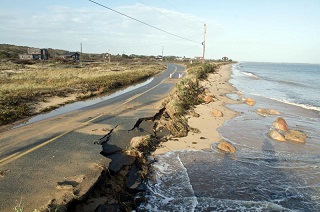
CU Blog - After Irma, the Science of Power Restoration - Photo 2

In general, the good-bad-ugly scale of memories of previous storms tend to be tied to the length of time it took for power to be restored. The peak of the hurricane season is the very hot months of August/September; there is the need for air-conditioning.

The Caribbean is in crisis now; our region has just been devastated by Hurricane Irma; it has wreaked catastrophic havoc in certain destinations: Barbuda, Saint BarthélemySaint MartinAnguilla, Puerto Rico, the Virgin Islands and Florida. Consider the encyclopedic details in Appendix A below and these questions:

  • How long did/will it take for power to be restored now after Hurricane Irma?
  • How can we reform and transform our Caribbean communities to ensure the efficiency of ‘Power Restoration’?

There is an art and science to the subject of ‘Power Restoration’; actually mostly science. The ‘art’ applies to the efficient deliveries of the management of the restoration process. The science considerations are extensive, starting with the entire eco-system of energy deliveries. As related in a previous blog-commentary

… no one doubts that the inventory of basic needs include “food, clothing and shelter”. But modernity has forced us to add another entry: “energy”. In fact, the availability and affordability of energy can impact the deliveries of these order basic needs.

… In our region, energy costs are among the highest in the world. The book Go Lean… Caribbean relates (Page 100) how the Caribbean has among the most expensive energy costs in the world, despite having abundant alternative energy natural resources (solar, wind, tidal, geo-thermal). The Caribbean eco-system focuses on imported petroleum to provide energy options and as a result retail electricity rates in the Caribbean average US$0.35/kWh, when instead it could be down to US$0.088/kWh. …

With such a 75% savings … there is definitely the need to adapt some of the scientific best practices for energy generation and consumption. In a previous blog-commentary, it was confessed that one of the reasons why people flee the Caribbean region, is the discomforts during the summer months … hot weather, and the lack of infrastructure to mitigate and remediate the discomfort, is identified as one of the reasons for the brain drain/societal abandonment.

One motivation of the movement behind the book Go Lean… Caribbean – available to download for free – is to facilitate a turn-around of economic, security and governing engines of the Caribbean region to do better with power generation, distribution and consumption. The Go Lean book serves as a roadmap for the introduction and implementation of the technocratic Caribbean Union Trade Federation (CU). This Go Lean roadmap has 3 prime directives:

This commentary continues the 4-part series – this is 3 of 4 – on the Aftermath of Hurricane Irma. There are a lot of mitigation and remediation efforts that can be done to lessen the impact of this and future storms. There are lessons that we must consider; there are reforms we must make; there are problems we must solve. The full list of the 4 entries of this series are detailed as follows:

  1. Aftermath of Hurricane Irma – America Should Scrap the ‘Jones Act’
  2. Aftermath of Hurricane Irma – Barbuda Becomes a ‘Ghost Town’
  3. Aftermath of Hurricane Irma – The Science of Power Restoration
  4. Aftermath of Hurricane Irma – Failed State Indicators: Destruction and Defection

Despite the manifested threats of Climate Change-fueled hurricanes, we want to make the Caribbean homeland a better place to live, work and play. This is going to take some heavy-lifting to accomplish, but we can be successful. Yes, we can. This quest is detailed early on in the Go Lean book’s Declaration of Interdependence, as follows (Page 11 – 13):

i. Whereas the earth’s climate has undeniably changed resulting in more severe tropical weather storms, it is necessary to prepare to insure the safety and security of life, property and systems of commerce in our geographical region. As nature recognizes no borders in the target of its destruction, we also must set aside border considerations in the preparation and response to these weather challenges.

xi. Whereas all men are entitled to the benefits of good governance in a free society, “new guards” must be enacted to dissuade the emergence of incompetence, corruption, nepotism and cronyism at the peril of the people’s best interest. The Federation must guarantee the executions of a social contract between government and the governed.

xvi. Whereas security of our homeland is inextricably linked to prosperity of the homeland, the economic and security interest of the region needs to be aligned under the same governance. Since economic crimes … can imperil the functioning of the wheels of commerce for all the citizenry, the accedence of this Federation must equip the security apparatus with the tools and techniques for predictive and proactive interdictions.

xix. Whereas our legacy in recent times is one of societal abandonment, it is imperative that incentives and encouragement be put in place to first dissuade the human flight, and then entice and welcome the return of our Diaspora back to our shores. This repatriation should be effected with the appropriate guards so as not to imperil the lives and securities of the repatriated citizens or the communities they inhabit. The right of repatriation is to be extended to any natural born citizens despite any previous naturalization to foreign sovereignties.

The Go Lean book asserts that Caribbean stakeholders must find a Way Forward; they must institute better systems, processes and utilities to deliver electrical power (energy) despite the reality of hurricanes. Though power will go off – electricity and water is a bad combination – ‘Power Restoration’ must be a priority. Therefore Caribbean communities must adopt different community ethos, plus execute key – and different – strategies, tactics, implementations and advocacies to reform and transform.

This Way Forward must therefore fulfill these 2 requirements:

  • Flood Management and Control
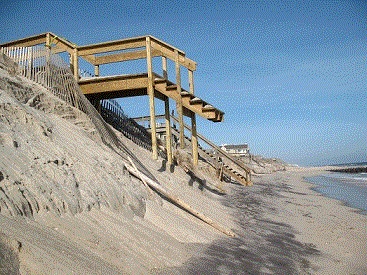
    CU Blog - After Irma, the Science of Power Restoration - Photo 3
    According to a previous blog-commentary: “there is a thesis that flooding could be prevented. Yes, indeed! This is the experience and historicity of the Dutch people, the European country of the Netherlands or Holland.”
    Even in the low-lying American city of New Orleans, Louisiana there is the practice of pumping out excess water to mitigate and remediate flooding; see this depicted in the VIDEO in Appendix B below.
  • Implementation of a Caribbean Regional Power Grid
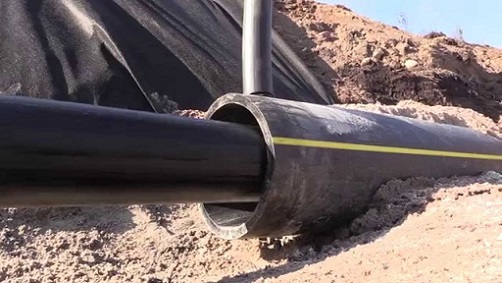
    CU Blog - After Irma, the Science of Power Restoration - Photo 1
    Power distribution is important for any mitigation-remediation plan. The problem with hurricane toppling trees and power lines is unavoidable – it is what it is – a better solution is to deliver electricity underground or underwater, as illustrated in the above photo. The Go Lean roadmap calls for an extensive smart Power Grid and a region-wide Utility Cooperative. This would allow for alternate power generation and electrical distribution. See sample of an underground/underwater “Power Cable” product depicted in the VIDEO in Appendix C below.
Many other communities have done a good job of optimizing their electrical utility grid. They execute strategies, tactics and implementations to mitigate the risk of power outages; then remediate any crises with technocratic deliveries to facilitate ‘Power Restoration’.

Go Green 1

There will be heavy-lifting for our Caribbean region to have this disposition. The Go Lean roadmap details that heavy-lift, describing the community ethos, strategies, tactics, implementations and advocacies to foster progress for Caribbean energy distribution, our own Regional Power Grid. The following list of entries in the Go Lean book highlights this theme:

Community Ethos – Lean Operations Page 24
Community Ethos – Return on Investments Page 24
Community Ethos – Cooperatives Page 25
Community Ethos – Ways to Impact the Future Page 26
Community Ethos – Ways to Improve Negotiations Page 32
Anecdote – Pipeline Transport – Strategies, Tactics & Implementations Page 43
Strategy – Harness the power of the sun/winds Page 46
Tactical – Fostering a Technocracy Page 82
Tactical – Separation of Powers – Energy Commission Page 82
Anecdote – “Lean” in Government – Energy Permits Page 93
Implementation – Regional Grid as Economies-of-Scale benefit Page 97
Anecdote – Caribbean Energy Grid Implementation Page 100
Implementation – Start-up Benefits from the EEZ Page 104
Implementation – Ways to Develop Pipeline Industry Page 107
Implementation – Ways to Improve Energy Usage Page 113
Advocacy – Ways to Impact Public Works Page 175
Advocacy – Ways to Foster Cooperatives Page 176
Advocacy – Ways to Impact Monopolies Page 202
Appendix – Underwater High Intensity Power Lines Page 282

The experience of enduring hurricanes is never pleasant. As such, we do not invite people to fly down from northern locations to pass storms with us. In fact, when there is a Hurricane Watch, the practice is to evacuate tourists and visitors. We evacuate our high-risk residents as well; (kidney dialysis patients, senior citizens, anyone that cannot endure the loss of electronic-based health instruments). This is a best-practice.

Why do we only evacuate just a limited group from the islands?

We assume that everyone else can endure.

Hah, lol …

But actually, with such high post-hurricane abandonment rates, as reported previously, it is obvious that everyone loses patience. So any improvement in the ‘Power Restoration’ experience would be a win-win; it would improve our communities’ endurance and make our Caribbean homeland better places to live, work and play. 🙂

Download the free e-Book of Go Lean … Caribbean – now!

Sign the petition to lean-in for this roadmap for the Caribbean Union Trade Federation.

———–

Appendix A – Hurricane Irma Devastation

  • In Barbuda, Hurricane Irma caused catastrophic damage on the island; it damaged or destroyed 95% of the island’s buildings and infrastructure, leaving Barbuda “barely habitable” according to Prime Minister Gaston Browne. Everyone on the island was evacuated to Antigua, leaving Barbuda uninhabited for the first time in modern history.[3]
  • In St. Martin, on 6 and 7 September 2017 the island was hit by Hurricane Irma (Category 5 at landfall), which caused widespread and significant damage to buildings and infrastructure. A total of 11 deaths had been reported as of 8 September 2017.[12][13] France’s Minister of the InteriorGérard Collomb, said on 8 September 2017 that most of the schools were destroyed on the French half of the island. In addition to damage caused by high winds, there were reports of serious flood damage to businesses in the village of Marigot. Looting was also a serious problem. Both France and the Netherlands sent aid as well as additional police and emergency personnel to the island.[14][15][16] The Washington Post reported that 95% of the structures on the French side and 75% of the structures on the Dutch side were damaged or destroyed.[17][18] Some days after the storm had abated, a survey by the Dutch Red Cross estimated that nearly a third of the buildings in Sint Maarten had been destroyed and that over 90 percent of structures on the island had been damaged.[19] Princess Juliana Airport was extensively damaged but reopened on a partial basis in two days to allow incoming relief flights and for flights that would take evacuees to other islands.[20]
  • In Anguila, the eye of the storm pass over it on September 6. Many homes and schools were destroyed, and the island’s only hospital was badly damaged.[163] The devastation was particularly severe in East End, where the winds uprooted scores of trees and power poles and demolished a number of houses. … One death was reported on the island.[163] According to [sources], Anguilla’s economy could suffer at least $190 million in losses from the hurricane.[129]
  • Puerto Rico avoided a direct hit by the Category 5 Hurricane Irma on September 8, 2017, but high winds caused a loss of electrical power to some one million residents. Almost 50% of hospitals were operating with power provided by generators.[133]
  • Damage in the British Virgin Islands was extensive. Numerous buildings and roads were destroyed on the island of Tortola, which bore the brunt of the hurricane’s core.[172] Irma’s effects in the U.S. Virgin Islands were most profound on Saint Thomas. Due to its normal reliance on electricity from Saint Thomas, the island [of St. John] was left without power.
  • In the Florida Keys, the hurricane caused major damage to buildings, trailer parks, boats, roads, the electricity supply, mobile phone coverage, internet access, sanitation, the water supply and the fuel supply. … As of 6:41 p.m. EDT on September 10 over 2.6 million homes in Florida were without power.[232]
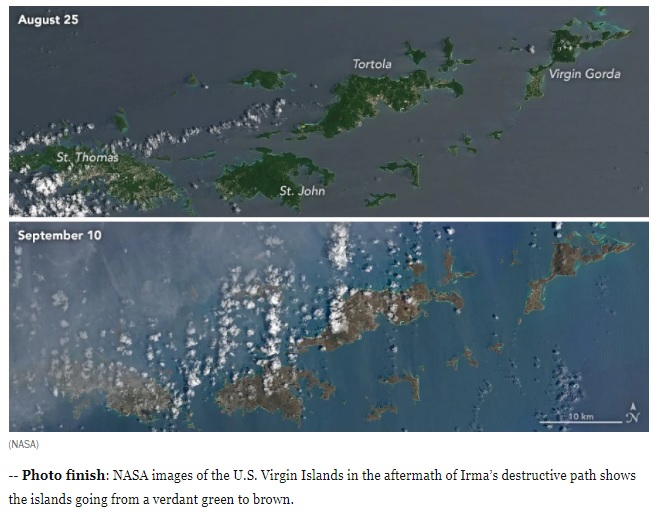
CU Blog - After Irma, Barbuda Becomes a 'Ghost Town' - Photo 2

———–

Appendix B VIDEO – Here’s how the pumps in New Orleans move water out during heavy rainfall – https://youtu.be/hZvGVUZi9FU

Published on Mar 30, 2017 – WDSU News: Pumps Work During Thursday’s Flooding

———–

Appendix C VIDEO – ABB launches world´s most powerful extruded HVDC cable system –

Published on Aug 21, 2014

ABB Power Grids

525 kV voltage (previous highest installed 320 kV) sets world record more than doubling power flow to 2600 MW (from 1000 MW) and extending range to 1500 km for more cost effective, efficient and reliable underground and subsea transmission while keeping losses to below 5 percent. Major breakthrough for applications like underground HVDC transmission, sub-sea interconnections, offshore wind integration etc. More information: http://new.abb.com/systems/high-volta…


Share this post:
, ,

ENCORE: Hurricane Categories – The Science

Go Lean Commentary

Category 5

… that term has become one of the most dreaded phases in modern times in the Western Hemisphere, and especially in the Caribbean.

A Category 5 Hurricane – with its maximum sustained winds in excess of 156 miles per hour – is the Sum of All of Our Fears and a Clear & Present Danger. (See the full list of their historicity in the Appendix below). The most powerful one on record featured 215 mph winds – Hurricane Patricia – was just recently in October 2015 off the coast of Mexico.

Hurricanes – tropical cyclones in the Atlantic Ocean and Eastern Pacific Ocean – are the exclusive brand for the Northern Hemisphere. Considering the rotation of the earth, the majority travel East to West, from Africa over to North America. That’s the majority; but the minority is nothing to ignore either.  These can start in the Caribbean Sea or the Gulf of Mexico and travel at will: north, south, east, or west.

Welcome to our Caribbean, the greatest address on the planet!

Hurricanes are our reality. A hurricane is a meteorological phenomena that cannot be ignored; its science is a marvel.

Hurricanes are scientifically measured by the Saffir–Simpson scale. This scale was developed in 1971 by civil engineer Herbert Saffir and meteorologist Robert Simpson, who at the time was director of the U.S. National Hurricane Center (NHC).[1] The scale was introduced to the general public in 1973,[2] and saw widespread use after a new Director Neil Frank replaced Mr. Simpson in 1974 at the helm of the NHC, as a tribute to Mr. Simpson.[3]

See full details on this hurricane scale here:

Title: Saffir–Simpson Scale
The Saffir–Simpson hurricane wind scale, formerly the Saffir–Simpson hurricane scale (SSHS), classifies hurricanes –Western Hemisphere tropical cyclones that exceed the intensities of tropical depressions, and tropical storms – into five categories distinguished by the intensities of their sustained winds. To be classified as a hurricane,  a tropical cyclone must have maximum sustained winds of:

  • 74–95 mph –  Category 1.
    cu-blog-hurricane-categories-the-science-photo-1
  • 96–110 mph – Category 2.
    cu-blog-hurricane-categories-the-science-photo-2
  • 111–129 mph – Category 3.
    cu-blog-hurricane-categories-the-science-photo-3
  • 130–156 mph – Category 4.
    cu-blog-hurricane-categories-the-science-photo-4
  • ≥ 157 mph – Category 5.
    cu-blog-hurricane-categories-the-science-photo-5

So the highest classification in the scale, Category 5, is reserved for storms with winds exceeding 156 mph (70 m/s; 136 kn; 251 km/h). [There have been a number of these since 1924. See full list in the Appendix below].

The classifications can provide some indication of the potential damage and flooding a hurricane will cause upon landfall.

Officially, the Saffir–Simpson hurricane wind scale is used only to describe hurricanes forming in the Atlantic Ocean and northern Pacific Ocean east of the International Date Line. Other areas use different scales to label these storms, which are called “cyclones” or “typhoons“, depending on the area.

There is some criticism of the SSHS for not taking rain, storm surge, and other important factors into consideration, but SSHS defenders say that part of the goal of SSHS is to be straightforward and simple to understand.
Source: Wikipedia Online Reference – Retrieved October 7, 2016 from: https://en.wikipedia.org/wiki/Saffir%E2%80%93Simpson_scale

We are thankful to these two pioneering scientists, Mr. Saffir and Mr. Simpson; they lived full and impactful lives – R.I.P..

Mr. Simpson died on December 18, 2014 at age 102.

Mr. Saffir died on November 21, 2007 at age 90.

These scientists have given us the numbers 1 through 5 to indicate an extent of our misery. But misery is more than just a number. Misery is an experience; an unpleasant one. See here the VIDEO visually depicting damage along the Saffir-Simpson scale:

VIDEO – Why Hurricane Categories Make a Difference – https://youtu.be/lqfExHpvLRY

Published on Aug 8, 2013 – During a hurricane you usually hear meteorologists refer to its intensity by categories. If you don’t know the difference between a category 1 and a category 5 hurricane, The Weather Channel meteorologist Mark Elliot breaks it down for you.

Hurricanes are reminders that “Crap Happens“. They affect the everyday life for everyday people. This discussion is presented in conjunction with the book Go Lean … Caribbean. It addresses the challenges facing life in the Caribbean and then presents strategies, tactics and implementations for optimizing the regional community.

Hurricanes are a product of ‘Mother Nature’ – natural disasters – but communities can be more efficient and effective in mitigating the risks associated with these natural disasters (hurricanes, earthquakes, volcanoes, floods, forest fires, etc.). In addition, there are bacterial & viral pandemics. Lastly, there are industrial incidents (chemical & oil spills) and other man-made disasters: i.e. terrorism-related events.

The Go Lean book asserts that bad things (and bad actors), like hurricanes, will always emerge to disrupt the peace and harmony in communities. Crap Happens … therefore all Caribbean member-states need to be “on guard” and prepared for this possibility. The Go Lean book (Page 23) prepares the Caribbean for many modes of “bad things/actors” with proactive and reactive mitigations. This point is pronounced early in the book with the opening Declaration of Interdependence (Page 12) that claims:

i. Whereas the earth’s climate has undeniably changed resulting in more severe tropical weather storms, it is necessary to prepare to insure the safety and security of life, property and systems of commerce in our geographical region. As nature recognizes no borders in the target of its destruction, we also must set aside border considerations in the preparation and response to these weather challenges.

ii. Whereas the natural formation of the landmass for our lands constitutes some extreme seismic activity, it is our responsibility and ours alone to provide, protect and promote our society to coexist, prepare and recover from the realities of nature’s occurrences.

x. Whereas we are surrounded and allied to nations of larger proportions in land mass, populations, and treasuries, elements in their societies may have ill-intent in their pursuits, at the expense of the safety and security of our citizens. We must therefore appoint “new guards” to ensure our public safety and threats against our society, both domestic and foreign. The Federation must employ the latest advances and best practices … to assuage continuous threats against public safety.

xii. Whereas the legacy in recent times in individual states may be that of ineffectual governance with no redress to higher authority, the accedence of this Federation will ensure accountability and escalation of the human and civil rights of the people for good governance, justice assurances, due process and the rule of law. As such, any threats of a “failed state” status for any member state must enact emergency measures on behalf of the Federation to protect the human, civil and property rights of the citizens, residents, allies, trading partners, and visitors of the affected member state and the Federation as a whole.

xvi. Whereas security of our homeland is inextricably linked to prosperity of the homeland, the economic and security interest of the region needs to be aligned under the same governance. Since economic crimes, including piracy and other forms of terrorism, can imperil the functioning of the wheels of commerce for all the citizenry, the accedence of this Federation must equip the security apparatus with the tools and techniques for predictive and proactive interdictions.

So the Go Lean book relates that the Caribbean must appoint “new guards”, or a security apparatus, to ensure public safety and to include many strategies, tactics and implementations considered “best-practices” for Emergency Management (Preparation and Response). We must be on a constant vigil against these “bad actors”, man-made or natural. The Go Lean book serves as a roadmap for the introduction and implementation of the technocratic Caribbean Union Trade Federation (CU).

The Go Lean/CU roadmap has a focus of optimizing Caribbean society through economic empowerment, and homeland security. Emergency preparedness and response is paramount for this quest. In fact, the Go Lean roadmap has the following 3 prime directives:

  • Optimization of the economic engines in order to grow the regional economy to $800 Billion & create 2.2 million new jobs.
  • Establishment of a security apparatus – a new guard – to protect the resultant economic engines and the Caribbean homeland.
  • Improvement of Caribbean governance to support these engines.

The CU would serve as the “new guard“, a promoter and facilitator of all the Emergency Management agencies in the region. The strategy is to provide a Unified Command and Control for emergency operations to share, leverage and collaborate the “art and science” of this practice across the whole region.

The regional vision is that all Caribbean member-states empower a CU Homeland Security force to execute a limited scope on their sovereign territories. The legal basis for this empowerment is a Status of Forces Agreement (SOFA), embedded in the CU treaty from Step One/Day One. The CU Trade Federation would lead, fund and facilitate the Emergency Management functionality under the oversight of a regionally elected Commander-in-Chief for the CU.

As cited above, the Caribbean is the “greatest address on the planet”, but there is risk associated with living deep in a tropical zone. With the reality of Climate Change, we must not be caught unprepared.

In our immediate past, the Caribbean region has failed at the need for readiness and response. We have even failed to properly coordinate the “cry for help” and the collection of international-charitable support. We have suffered dire consequences as a result: loss of life, damage to property, disruption to economic systems, corruption … and abandonment. Many of our citizens have fled their Caribbean homeland, as a result, after each natural disaster. We have even created Ghost Towns.

We want something better, something more. We want our people to prosper where they are planted in the Caribbean. So as a community, we must provide assurances. No assurance that there will be no hurricanes, but rather the assurance that we can respond, recover, repair and rebuild:

“Yes, we can … “.

The Go Lean book details the series of community ethos, strategies, tactics, implementations and advocacies to provide the proactive and reactive public safety/security in the Caribbean region:

Community Ethos – Economic Systems Influence Individual Choices Page 21
Community Ethos – Consequences of Choices Lie in Future Page 21
Community Ethos – “Crap” Happens Page 23
Community Ethos – Cooperatives Page 25
Community Ethos – Ways to Impact the Future Page 26
Community Ethos – Ways to Improve Sharing Page 35
Community Ethos – Ways to Promote Happiness Page 36
Community Ethos – Ways to Impact the Greater Good Page 37
Strategy – Vision – Confederating a non-sovereign permanent union Page 45
Strategy – Agents of Change – Climate Change Page 57
Tactical – Fostering a Technocracy Page 64
Tactical – How to Grow the Economy – Recover from Disasters Page 70
Tactical – Separation of Powers – Homeland Security Department Page 75
Tactical – Separation of Powers – Emergency Management Agency Page 76
Tactical – Separation of Powers – Meteorological and Geological Service Page 79
Implementation – Ways to Pay for Change Page 101
Implementation – Start-up Homeland Security Initiatives Page 103
Implementation – Ways to Re-boot Freeport Page 112
Implementation – Ways to Foster International Aid Page 115
Planning – 10 Big Ideas – #3: Consolidated Homeland Security Pact Page 130
Planning – Ways to Make the Caribbean Better Page 131
Planning – Ways to Improve Failed-State Indices – Escalation Role Page 134
Advocacy – Ways to Grow the Economy – Quick Disaster Recovery Page 151
Advocacy – Ways to Improve Governance Page 168
Advocacy – Ways to Better Manage the Social Contract Page 170
Advocacy – Ways to Improve Homeland Security Page 180
Advocacy – Ways to Improve Intelligence Gathering & Analysis Page 182
Advocacy – Ways to Improve for Natural Disasters Page 184
Advocacy – Ways to Improve for Emergency Management Page 196
Advocacy – Ways to Impact Wall Street – Adopt Advanced Recovery Products Page 200

Other subjects related to Emergency Management, Homeland Security and governing empowerments for the region have been blogged in other Go Lean…Caribbean commentaries, as sampled here:

https://goleancaribbean.com/blog/?p=9070 Securing the Homeland – From the Seas
https://goleancaribbean.com/blog/?p=9038 Doing Better with Charity Management
https://goleancaribbean.com/blog/?p=7896 The Logistics of Disaster Relief
https://goleancaribbean.com/blog/?p=7449 The Art and Science of Emergency Management
https://goleancaribbean.com/blog/?p=7327 Zika – An Epidemiology Crisis – A 4-Letter Word
https://goleancaribbean.com/blog/?p=7235 Flint, Michigan – A Cautionary Tale
https://goleancaribbean.com/blog/?p=6893 A Meteorologist’s View On Climate Change
https://goleancaribbean.com/blog/?p=6563 Lessons from Iceland – Model of Recovery
https://goleancaribbean.com/blog/?p=6189 A Lesson in History – Hurricane ‘Katrina’ is helping today’s crises
https://goleancaribbean.com/blog/?p=4741 Vanuatu and Tuvalu Cyclone – Inadequate response to human suffering
https://goleancaribbean.com/blog/?p=2614 The ‘Great ShakeOut’ Earthquake Drill / Planning / Preparations
https://goleancaribbean.com/blog/?p=2397 Stopping a Clear and Present Danger: Ebola
https://goleancaribbean.com/blog/?p=1817 Caribbean grapples with intense new cycles of flooding & drought

The Caribbean is on the frontline of this battle: man versus Climate Change. While we are not the only ones, we have to be accountable and responsible for our own people and property. The book Go Lean…Caribbean posits that this “Agent of Change” is too big for just any one member-state to tackle alone, that there must be a regional solution; and presents this roadmap.

Climate Change has produced winners (consider northern cities with milder than normal winters) and losers. The Caribbean has found itself on the losing side. This means life-and-death for the people and the economic engines of the Caribbean communities.

While hurricanes are our reality, there is a science to these meteorological phenomena, and an art to our response. We can plan, monitor, alert, prepare and recover. We can do it better than in the recent past. We can provide assurances that “no stone” will be unturned in protecting people, property and systems of commerce. The watching world – our trading partners – needs this assurance!

The people and institutions of the region are therefore urged to lean-in to this Go Lean roadmap to make the Caribbean a better, safer, place to live, work and play. This plan is conceivable, believable and achievable. Yes, we can. 🙂

Download the book Go Lean … Caribbean – now!

Sign the petition to lean-in for this roadmap for the Caribbean Union Trade Federation. 


————–

Appendix – List of Category 5 Atlantic Hurricanes

Storm
name

Season

Dates as a
Category 5

Time as a
Category 5 (hours)

Peak one-minute
sustained winds

Pressure

mph

km/h

hPa

inHg

Matthew 2016 September 30 – October 1 6 160 260

934

27.58

Felix 2007 September 3–4† 24 175 280

929

27.43

Dean 2007 August 18–21† 24 175 280

905

26.72

Wilma 2005 October 19 18 185 295

882

26.05

Rita 2005 September 21–22 24 180 285

895

26.43

Katrina 2005 August 28–29 18 175 280

902

26.64

Emily 2005 July 16 6 160 260

929

27.43

Ivan 2004 September 9–14† 60 165 270

910

26.87

Isabel 2003 September 11–14† 42 165 270

915

27.02

Mitch 1998 October 26–28 42 180 285

905

26.72

Andrew 1992 August 23–24† 16 175 280

922

27.23

Hugo 1989 September 15 6 160 260

918

27.11

Gilbert 1988 September 13–14 24 185 295

888

26.22

Allen 1980 August 5–9† 72 190 305

899

26.55

David 1979 August 30–31 42 175 280

924

27.29

Anita 1977 September 2 12 175 280

926

27.34

Edith 1971 September 9 6 160 260

943

27.85

Camille 1969 August 16–18† 30 175 280

900

26.58

Beulah 1967 September 20 18 160 260

923

27.26

Hattie 1961 October 30–31 18 160 260

920

27.17

Carla 1961 September 11 18 175 280

931

27.49

Janet 1955 September 27–28 18 175 280

914

27.0

Carol 1953 September 3 12 160 260

929

27.43

“New England” 1938 September 19–20 18 160 260

940

27.76

“Labor Day” 1935 September 3 18 185 295

892

26.34

“Tampico” 1933 September 21 12 160 260

929

27.43

“Cuba–Brownsville” 1933 August 30 12 160 260

930

27.46

“Cuba” 1932 November 5–8 78 175 280

915

27.02

“Bahamas” 1932 September 5–6 24 160 260

921

27.20

San Felipe II-“Okeechobee” 1928 September 13–14 12 160 260

929

27.43

“Cuba” 1924 October 19 12 165 270

910

26.87

Reference=[1] †= Attained Category 5 status more than once

Source: Retrieved October 7, 2016 from https://en.wikipedia.org/wiki/List_of_Category_5_Atlantic_hurricanes

Share this post:
, , , ,
[Top]

ENCORE: The Logistics of Disaster Relief

There has been a major natural disaster – Hurricane Harvey and subsequent flooding – in the US State of Texas this week. Many individuals and institutions are now scrambling to provide relief to the victims in the area.

“Do unto others as you would have them do unto you” – The Golden Rule

This is very neighborly. Those of you who can give, please give of your “time, talent and treasuries”.

But please be logical in your giving. Certain items would really be inappropriate at this time; think: clothes, toys, etc.. In fact, this previous Go Lean commentary detailed the entire discussion of inappropriate disaster relief gifts. Consider here-now, this Encore of that previous commentary:

—————

Go Lean CommentaryThe Logistics of Disaster Relief

It is during the worst of times that we see the best in people.

This statement needs to be coupled with the age old proverb: “The Road to Hell is Paved with Good Intentions“…

… especially when it comes to disaster relief.

In previous blog-commentaries promoting the book Go Lean…Caribbean, it was established that “bad things happen to good people”; (i.e. ‘Crap Happens’ – So What Now?, Managing a ‘Clear and Present Danger’). Yes, disasters are a reality for modern life. The Go Lean book posits that with the emergence of Climate Change  that natural disasters are more common place.

In addition there are earthquakes …

… these natural phenomena may not be associated with Climate Change, but alas, they too are more common and more destructive nowadays. (People with a Christian religious leanings assert that “an increase of earthquakes is a tell-tale sign that we are living in what the Bible calls the “Last Days” – Matthew 24: 7).

$500 Million In Haiti Relief - Photo 1The motives of the Go Lean book, and accompanying blogs is not to proselytize, but rather to prepare the Caribbean region for “bad actors”, natural or man-made. The book was written in response to the aftermath and deficient regional response following the great earthquake in Haiti on January 12, 2010. Many Non-Government Organizations (NGO) embarked on campaigns to shoulder a response, a relief and rebuilding of Haiti. Many people hold the view that those efforts did a lot of harm, along with some good.

In a previous blog-commentary, it was reported how the fundraising campaign by one group, the American Red Cross, raised almost US$500 million and yet only a “piddling” was spent on the victims and communities themselves.

Now we learn too that many good-intentioned people donated tons of relief supplies that many times turned out to be “more harm than help”. See the story here in this news VIDEO; (and/or the Narration Transcript/photos in the Appendix below):

VIDEO – When disaster relief brings anything but relief – http://www.cbsnews.com/videos/disaster-relief-donations-that-dont-bring-relief

Posted April 24, 2016 – Many of the well-meaning articles Americans donate in times of disaster turn out to be of no use to those in need. Sometimes, they even get in the way. That’s a message relief organizations very much want “us” to heed. This story is reported by Scott Simon, [on loan from] NPR. (VIDEO plays best in Internet Explorer).

This commentary asserts that more is needed in the Caribbean to facilitate good disaster relief, in particular a technocratic administration. This consideration is the focus of the strategies, tactics, implementations and advocacies of the Go Lean…Caribbean book. The declaration is that the Caribbean itself must be agile, lean, and optimized in providing its own solutions for disaster recovery. The alternative, from past experiences like in this foregoing VIDEO, is that others taking the lead for our solution seem to fall short in some way … almost every time!

The Caribbean must now stand up and be counted!

The Go Lean book declares (Page 115) that the “Caribbean should not be perennial beggars, [even though] we do need capital/money to get started”, we need technocratic executions even more.

What is a technocracy?

This is the quest of the Go Lean movement. The movement calls for a treaty to form a technocratic confederation of all the 30 member-states in the Caribbean region. This will form a Single Market of 42 million. The consolidation and integration allows for economies-of-scale and leverage that would not be possible otherwise. “Many hands make a big job … small”. But it is not just size that will define the Caribbean technocracy but quality, efficiency and optimization as well.

According to the Go Lean book (Page 64), the …

“… term technocracy was originally used to designate the application of the scientific method to solving social and economic problems, in counter distinction to the traditional political or philosophic approaches. The CU must start as a technocratic confederation – a Trade Federation – rather than evolving to this eventuality due to some failed-state status or insolvency.”

The book Go Lean…Caribbean serves as a roadmap for the introduction and implementation of the technocratic Caribbean Union Trade Federation (CU) to provide better stewardship for the Caribbean homeland. The foregoing VIDEO describes the efforts of non-governmental organizations (NGO) in shepherding disaster reliefs. These NGO’s are stakeholders in this Caribbean elevation roadmap. Even though many of the 30 member-states are independent nations, the premise of the Go Lean book is that there must be a resolve for interdependence among the governmental and non-governmental entities. This all relates to governance, the need for this new technocratic stewardship of regional Caribbean society. The need for this resolve was pronounced in the opening Declaration of Interdependence (Pages 11 & 14) with these acknowledgements and statements:

i.    Whereas the earth’s climate has undeniably changed resulting in more severe tropical weather storms, it is necessary to prepare to insure the safety and security of life, property and systems of commerce in our geographical region. As nature recognizes no borders in the target of its destruction, we also must set aside border considerations in the preparation and response to these weather challenges.

ii.    Whereas the natural formation of the landmass for our lands constitutes some extreme seismic activity, it is our responsibility and ours alone to provide, protect and promote our society to coexist, prepare and recover from the realities of nature’s occurrences.

x.   Whereas we are surrounded and allied to nations of larger proportions in land mass, populations, and treasuries, elements in their societies may have ill-intent in their pursuits, at the expense of the safety and security of our citizens. We must therefore appoint “new guards” to ensure our public safety and threats against our society, both domestic and foreign. The Federation must employ the latest advances and best practices … to assuage continuous threats against public safety.

xi.   Whereas all men are entitled to the benefits of good governance in a free society, “new guards” must be enacted to dissuade the emergence of incompetence, corruption, nepotism and cronyism at the peril of the people’s best interest. The Federation must guarantee the executions of a social contract between government and the governed.

xii. Whereas the legacy in recent times in individual states may be that of ineffectual governance with no redress to higher authority, the accedence of this Federation will ensure accountability and escalation of the human and civil rights of the people for good governance, justice assurances, due process and the rule of law. As such, any threats of a “failed state” status for any member state must enact emergency measures on behalf of the Federation to protect the human, civil and property rights of the citizens, residents, allies, trading partners, and visitors of the affected member state and the Federation as a whole.

xxxiii.   Whereas lessons can be learned and applied from the study of the recent history of other societies, the Federation must formalize statutes and organizational dimensions to avoid the pitfalls of [other] communities.

This is the quest of CU/Go Lean roadmap: to provide new guards for a more competent Caribbean administration … by governmental organizations and non-governmental organizations. (NGO would also be promoted, audited and overseen by CU administrators). The Caribbean must do better!

Our quest must start “in the calm”, before any storm (or earthquake). We must elevate the societal engines the Caribbean region through economic, security and governance empowerments. In general, the CU will employ better strategies, tactics and implementations to impact its prime directives; identified with the following 3 statements:

  • Optimization of the economic engines in order to grow the regional economy to $800 Billion & create 2.2 million new jobs.
  • Establishment of a security apparatus to protect the resultant economic engines and the Caribbean homeland.
  • Improvement of Caribbean governance to support these engines.

Former US President George W. Bush shares this advocacy!

He narrated this VIDEO here describing the efficiencies of the American logistics company, UPS, in delivering disaster relief:

VIDEO – Report Logistics and Haiti: Points of Light and President Bush – https://youtu.be/8-gmh1QyWTU

Uploaded on Mar 30, 2011 – [In 2009], Transportation Manager Chip Chappelle volunteered to help The UPS Foundation coordinate an ocean shipment of emergency tents from Indiana to Honduras. Since then, he has managed the logistics of humanitarian aid from every corner of the world to help the victims of floods, tsunamis, earthquakes, hurricanes and cyclones.

The Go Lean book stresses our own community ethos, strategies, tactics, implementations and advocacies necessary for the Caribbean to deliver, to provide the proactive and reactive public safety/security provisions in the region. See sample list here:

Community Ethos – Deferred Gratification Page 21
Community Ethos – Economic Principles – Respond to Incentives in Predictable Ways Page 21
Community Ethos – Economic Principles – Economic Systems Influence Individual Choices Page 21
Community Ethos – Economic Principles – Consequences of Choices Lie in the Future Page 21
Community Ethos – Security Principles – Whistleblower Protection Page 23
Community Ethos – Security Principles – Intelligence Gathering Page 23
Community Ethos – Security Principles – “Crap” Happens Page 23
Community Ethos – Governing Principles – Lean Operations Page 24
Community Ethos – Governing Principles – Return on Investments Page 24
Community Ethos – Governing Principles – Cooperatives Page 25
Community Ethos – Ways to Impact the Future Page 26
Community Ethos – Ways to Impact Turn-Arounds Page 33
Community Ethos – Ways to Improve Sharing – Emergency Response Page 35
Community Ethos – Ways to Impact the Greater Good Page 37
Strategy – Vision – Confederate all 30 member-states/ 4 languages into a Single Market Page 45
Strategy – Mission – Prepare for the eventuality of natural disasters Page 45
Strategy – Agents of Change – Climate Change Page 57
Tactical – Ways to Foster a Technocracy Page 64
Tactical – Growing the Economy – Post WW II European Marshall Plan/Recovery Model Page 68
Tactical – Separation-of-Powers – CU Federal Government versus Member-State Governance Page 71
Tactical – Separation-of-Powers – Homeland Security – Emergency Management Page 76
Tactical – Separation-of-Powers – State Department – Liaison/Oversight for NGO’s Page 80
Implementation – Assemble All Regionally-focus Organizations of All Caribbean Communities Page 96
Implementation – Ways to Pay for Change Page 101
Implementation – Ways to Foster International Aid Page 115
Planning – 10 Big Ideas – Homeland Security Pact Page 127
Planning – Ways to Make the Caribbean Better Page 131
Planning – Ways to Improve Failed-State Indices – Governance and the Social Contract Page 134
Advocacy – Ways to Grow the Economy Page 151
Advocacy – Ways to Create Jobs Page 152
Advocacy – Ways to Improve Housing – Hurricane Risk Reinsurance Fund Page 161
Advocacy – Ways to Improve Governance Page 168
Advocacy – Ways to Better Manage the Social Contract Page 170
Advocacy – Ways to Improve Homeland Security Page 180
Advocacy – Ways to Improve for Natural Disasters Page 184
Advocacy – Ways to Develop a Pre-Fab Housing Industry – One solution ideal for Haiti Page 207
Advocacy – Ways to Re-boot Haiti Page 238

The Go Lean roadmap seeks to empower and elevate Caribbean societal engines to be better prepared for the eventual natural disasters. The good intentions of Americans, as depicted in the foregoing VIDEO, is encouraging … but good intentions alone is not enough. We need good management! We need a technocracy! While it is out-of-scope for this roadmap to impact America, we can – and must – exercise good management in our Caribbean region. So what do we want from Americans in our time of need? See VIDEO here:

VIDEO – Donate Responsibly – https://youtu.be/14h9_9sopRA

Published on Nov 2, 2012 – A series of PSAs released by the Ad Council explain why cash is the best way to help. The campaign was launched on November 5, 2012 by the Ad Council and supported by the coalition — which includes CIDI, the U.S. Agency for International Development, InterAction, the UPS Foundation and National Voluntary Organizations Active in Disaster.

The Go Lean book calls on the Caribbean region to be more technocratic: collectively self-reliant, both proactively and reactively. Because of Climate Change or the Last Days, natural disasters (i.e. hurricanes and earthquakes) will occur again and again. Considering that our American neighbors may Pave our Road to Hell with Good Intentions, we need to prepare the right strategies, tactics and implementations ourselves, to make our region a better homeland to live, work and play. 🙂

Download the book Go Lean … Caribbean – now!

——————

Appendix Transcript – When disaster relief brings anything but relief

When Nature grows savage and angry, Americans get generous and kind. That’s admirable. It might also be a problem.

“Generally after a disaster, people with loving intentions donate things that cannot be used in a disaster response, and in fact may actually be harmful,” said Juanita Rilling, director of the Center for International Disaster Information in Washington, D.C. “And they have no idea that they’re doing it.”

Rilling has spent more than a decade trying to tell well-meaning people to think before they give.

In 1998 Hurricane Mitch struck Honduras. More than 11,000 people died. More than a million and a half were left homeless.

And Rilling got a wake-up call: “Got a call from one of our logistics experts who said that a plane full of supplies could not land, because there was clothing on the runway. It’s in boxes and bales. It takes up yards of space. It can’t be moved.’ ‘Whose clothing is it?’ He said, ‘Well, I don’t know whose it is, but there’s a high-heeled shoe, just one, and a bale of winter coats.’ And I thought, winter coats? It’s summer in Honduras.”

Humanitarian workers call the crush of useless, often incomprehensible contributions “the second disaster.”

In 2004, following the Indian Ocean tsunami, a beach in Indonesia was piled with used clothing.

There was no time for disaster workers to sort and clean old clothes. So the contributions just sat and rotted.

CU Blog - Logistics of Disaster Relief - Photo 1“This very quickly went toxic and had to be destroyed,” said Rilling. “And local officials poured gasoline on it and set it on fire. And then it was out to sea.”

“So, rather than clothing somebody, it went up in flames?” asked Simon.

“Correct. The thinking is that these people have lost everything, so they must NEED everything. So people SEND everything. You know, any donation is crazy if it’s not needed. People have donated prom gowns and wigs and tiger costumes and pumpkins, and frostbite cream to Rwanda, and used teabags, ’cause you can always get another cup of tea.”

You may not think that sending bottles of water to devastated people seems crazy. But Rilling points out, “This water, it’s about 100,000 liters, will provide drinking water for 40,000 people for one day. This amount of water to send from the United States, say, to West Africa — and people did this — costs about $300,000. But relief organizations with portable water purification units can produce the same amount, a 100,000 liters of water, for about $300.”

And then there were warm-hearted American women who wanted to send their breast milk to nursing mothers in Haiti after the 2010 earthquake.

“It sounds wonderful, but in the midst of a crisis it’s actually one of the most challenging things,” said Rebecca Gustafson, a humanitarian aid expert who has worked on the ground after many disasters.

“Breast milk doesn’t stay fresh for very long. And the challenge is, what happens if you do give it to an infant who then gets sick?”

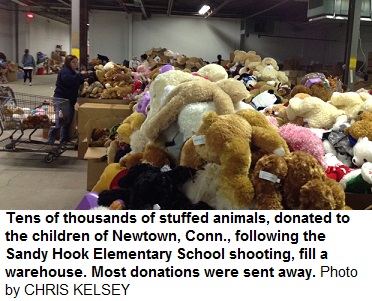
CU Blog - Logistics of Disaster Relief - Photo 2December 2012, Newtown, Connecticut: A gunman killed 20 children and six adults at Sandy Hook Elementary School. Almost instantaneously, stuff start arriving.

Chris Kelsey, who worked for Newtown at the time, said they had to get a warehouse to hold all the teddy bears.

Simon asked, “Was there a need for teddy bears?”

“I think it was a nice gesture,” Kelsey replied. “There was a need to do something for the kids. There was a need to make people feel better. I think the wave of stuff we got was a little overwhelming in the end.”

And how many teddy bear came to Newtown? “I think it was about 67,000,” Kelsey said. “Wasn’t limited to teddy bears. There was also thousands of boxes of school supplies, and thousands of boxes of toys, bicycles, sleds, clothes.”

Newtown had been struck by mass murder, not a tsunami. As Kelsey said, “I think a lot of the stuff that came into the warehouse was more for the people that sent it, than it was for the people in Newtown. At least, that’s the way it felt at the end.”

Every child in Newtown got a few bears. The rest had to be sent away, along with the bikes and blankets.

CU Blog - Logistics of Disaster Relief - Photo 3There are times when giving things works. More than 650,000 homes were destroyed or damaged in Hurricane Sandy in 2012. Thousands of people lost everything.

Tammy Shapiro is one of the organizers of Occupy Sandy, which grew out of the Occupy Wall Street movement.

“We were able to respond in a way that the big, bureaucratic agencies can’t,” Shapiro said.

When the hurricane struck, they had a network of activists, connected and waiting.

“Very quickly, we just stopped taking clothes,” Shapiro said. Instead, they created a “relief supply wedding registry.”

“We put the items that we needed donated on that registry,” said Shapiro. “And then people who wanted to donate could buy the items that were needed. I mean, a lot of what we had on the wedding registry was diapers. They needed flashlights.”

Simon asked, “How transportable is your experience here, following Hurricane Sandy?”

“For me, the network is key. Who has the knowledge? Where are spaces that goods can live if there’s a disaster? Who’s really well-connected on their blocks?”

Juanita Rilling’s album of disaster images shows shot after shot of good intentions just spoiling in warehouses, or rotting on the landscape.

“It is heartbreaking,” Rilling said. “It’s heartbreaking for the donor, it’s heartbreaking for the relief organizations, and it’s heartbreaking for survivors. This is why cash donations are so much more effective. They buy exactly what people need, when they need it.

“And cash donations enable relief organizations to purchase supplies locally, which ensures that they’re fresh and familiar to survivors, purchased in just the right quantities, and delivered quickly. And those local purchases support the local merchants, which strengthens the local economy for the long run.”

Disaster response worker Rebecca Gustafson says that most people want to donate something that is theirs: “Money sometimes doesn’t feel personal enough for people. They don’t feel enough of their heart and soul is in that donation, that check that they would send.

“The reality is, it’s one of the most compassionate things that people can do.”

Share this post:
, , , ,
[Top]

Hurricane Andrew – 25 Years of Hoopla

Go Lean Commentary

Want to rumble? Want a piece of this?

Surely anyone vying for a leadership role in the Caribbean must be prepared for a fight. A fight with “Mother Nature”.

Expect to lose!

CU Blog - Hurricane Andrew - 25 Years of Hoopla - Photo 1

CU Blog - Hurricane Andrew - 25 Years of Hoopla - Photo 2

This was the contention from this previous blog-commentary on August 28, 2015, on the 10th anniversary commemorating 2005’s Hurricane Katrina:

Title: A Lesson in History – ‘Katrina’ is helping today’s crises
Welcome to the Caribbean  …

… the greatest address on the planet?!?!

Why would anyone campaign to assume the stewardship of this archipelago of islands?

This is the “siren song” of the book Go Lean … Caribbean. The publishers … are petitioning for a leadership role in the economic, security and governing engines of the region. Why?

There is no insanity! This is an expression of love for the homeland. The 30 member-states of the Caribbean are home to 42 million people, and a Diaspora of 10 million; plus 80 million visitors annually.

This is the greatest address on the planet!

Plus, everywhere has natural disasters to contend with. This fact relates to rich countries and poor alike. For example, take the United States; they are the richest Single Market economy in the world and yet their coastal city of New Orleans Louisiana (NOLA) was devastated by Hurricane Katrina 10 years ago … to the day (August 29, 2005). Their riches did not spare their devastation, nor did the riches facilitate best-practices in terms of response, relief and rebuilding. New Orleans is marking the anniversary of Katrina’s devastation and the lessons learned from the aftermath.

Remembering Hurricane Andrew

Now it is the time to remember a different, earlier storm, as it is the 25th anniversary of August 24, 1992 when Hurricane Andrew devastated the Caribbean region and the Greater Miami area; think almost $30 Billion in damages after 65 fatalities in the region. (This writer endured Andrew as a Miami resident). There are even more lessons to consider, contemplate and correlate to Caribbean stakeholders. As previously detailed, Miami has a pivotal connection with the Caribbean; as our member-states fail more and more, Miami becomes the beneficiary of our human and capital flight:

Miami’s Success versus Caribbean Failure

The “hoopla“ – historicity and actuality – of storms like Hurricane Andrew and Katrina reminds us …

… that Climate Change cannot be ignored. Even though there are deniers of any man-made causes, the reality of these storms challenge the realities of Caribbean life.

See this theme portrayed here in this current news article from USA Today, an American daily newspaper:

Title: In booming South Florida, another Hurricane Andrew could be a $300 billion catastrophe

CU Blog - Hurricane Andrew - 25 Years of Hoopla - Photo 3MIAMI — Twenty-five years ago this month, Hurricane Andrew unleashed its Category 5 wrath on South Florida, sending a catastrophic reminder about the dangers of living in the heart of “hurricane alley.”

But drive along any coastline in Florida today and you’ll find construction cranes as plentiful as palm trees as developers rush to build high-rises in the most beautiful, and vulnerable, corners of the state.

Florida has improved standards for new construction to prevent the level of damage wrought by hurricanes, but an Andrew-like storm hitting downtown Miami and its ever-growing collection of sparkling skyscrapers could exact a hefty price: $300 billion, according to one insurance underwriter.

“And that number doesn’t include loss of taxes or tourism,” said Monica Ningen, chief property underwriter for the U.S. and Canada for Swiss Re, one of the largest reinsurance companies in the world.

In the 25 years since Andrew made landfall on Aug. 24, 1992, nearly 1 in 10 homes built in the United States were built in Florida, according to an analysis of building permits conducted for USA TODAY by the real estate web site Trulia. That’s second only to Texas.

The trend is even more pronounced for larger condo buildings. Florida accounts for 11.5% of new residential buildings with at least five residences over the past 25 years, trailing only Texas’ 12.7%, according to the Trulia analysis.

“We’re like lemmings going to the sea, except that we build condos, hotels, and houses,” said Richard Olson, director of the International Hurricane Research Center at Florida International University.

The dangers of Florida’s post-Andrew growth is clearly illustrated in a report from Swiss Re that examined Florida’s vulnerability to hurricanes.

Andrew caused $24.5 billion in insured property damage when it hit the working class suburb of Homestead about 20 miles south of downtown Miami, becoming the most expensive catastrophe in U.S. history. Since then, Miami-Dade County’s population has increased by more than a third. Now, if a similar storm hit the same spot, Swiss Re estimates it would cause closer to $60 billion in insured damage.

High-rise condos could be Florida’s weak spot

Part of the reason for those massive numbers is the explosion of high-rise condos throughout the state.

Florida toughened up its building codes after Andrew and saw good results with the spate of four hurricanes that struck the state in 2004. But in 2005, Hurricane Wilma revealed a glaring weakness.

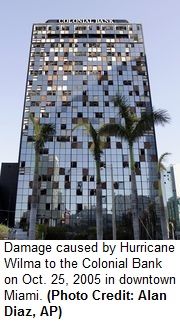
Wilma, as a Category 2 hurricane, was far weaker than Andrew when it crossed over Miami, but its 100 mph winds shattered windows throughout downtown. One reason: Wind speeds grow drastically the higher you go.

Wilma’s 75 mph winds on the ground grew to 115 mph on the 30th floor, according to a hurricane wind model created by Florida International University in Miami. No condos collapsed, but the window failures caused massive damage.

“The structure looks great from the outside, and yet, the building has to be gutted because of the water damage inside,” said Shahid Hamid, director of the Laboratory for Insurance, Financial and Economic Research at FIU.

Price of paradise

So with a catastrophic risk looming, why do Floridians continue to build such high structures right on the coast?

For developers, the answer is simple.

“Anybody that owns a piece of property should be able to do what they like with it, as long as they’re complying with the laws,” said Jeremy Stewart, a Crestview, Fla., developer and chairman of the Florida Home Builders Association.

CU Blog - Hurricane Andrew - 25 Years of Hoopla - Photo 4But developers aren’t just interested in the principles of individual freedom or property rights, says Craig Fugate, the former head of the Federal Emergency Management Agency. It comes down to money, Fugate says.

With each new glass-covered skyscraper that goes up along Florida’s coasts, developers reap a windfall of profits. The money drives businesses and puts taxes into government coffers.

Real estate attorneys, realtors, agents, architects, and contractors all get a piece. Every new condo that goes up in Pensacola or Tampa or Jacksonville means more tax revenues for those city governments. Florida is one of seven states that doesn’t collect personal income tax, so real estate taxes and fees included in every home purchase are critical to keep the state’s finances afloat.

Fugate said that has created a “vicious cycle” of transactions that the state has grown to rely on.

“Our economy is building houses, apparently,” said Fugate, who lives in northern Florida and used to run the state’s emergency management division before heading up FEMA. “Our bias now seems to be to the benefit of the transaction, not the homeowner.”

Some city leaders say it’s not that nefarious. In Miami Beach, the tourist mecca that is at the front line of Florida’s battles against climate change, leaders say the tax revenues from new developments are the only way they can afford to make the long-term improvements to gird the barrier island from rising water.

The city is in the midst of a $500 million project to raise roads, raise seawalls and install 80 pumps to push out floods that occur even on sunny days.

New York and New Jersey received billions in federal funding following Superstorm Sandy, just as New Orleans did following Hurricane Katrina. But since a hurricane hasn’t hit Miami and Miami Beach directly in decades, they are left to improve their infrastructure mostly on their own.

“On the one hand, we have to be responsible with our development,” said Miami Beach City Manager Jimmy Morales. “But on the other hand, we need that revenue. We’ve got to figure out how to pay for all that.”

Then there’s the way residents ponder the question. Ask Floridians why they’re willing to endure the threat of hurricanes and they’ll usually give some version of the same answer: They raise their arms and say, “Look around.”

Maria Lopez, 38, moved out of her home in Little Havana just outside downtown Miami 10 years ago as the rent increased and the neighborhood endured more and more flooding. Lopez said she never even considered leaving the city or the state, opting instead to find a home in nearby Liberty City that was elevated to avoid flooding and built to hurricane-proof building codes.

Lopez, a customs broker with two young sons, loves “the food, the culture, the climate.” But, she says, “You just have to know that a hurricane can hit.”

James Murley, the chief resilience officer for Miami-Dade County, agreed, saying the dangers of hurricanes and sea level rise are simply the price of living in paradise, just as Californians are willing to deal with the occasional earthquake.

“You have to live with the risk,” he said. “Why are they still building in San Francisco? Why are they still building in Los Angeles? They’re on established fault lines. Communities that have a history, they’re going to grow one way or the other.”

Grow smarter or inland?

With no slowdown in sight, experts say Florida has two remaining choices: grow farther from the coast or grow smarter.

Jean-Pierre Bardet, dean of the college of engineering at the University of Miami, said the only way that developers will stop building skyscrapers right along the water will come down to money.

Florida’s building codes have made construction more expensive over the years. And some developers have gone beyond those codes to create safer, and costlier, buildings.

For example, many new high-rises in Florida don’t have a street-level entrance for pedestrians. They begin with several floors of parking on the ground floors, then a lobby higher up, topped off by apartments or offices. That means only cars parked at those levels will be damaged if a hurricane pushes in storm surge or rising sea levels create more regular flooding.

Those kinds of measures are expensive, though, and Bardet said their prices will only increase as the projects become harder to engineer.

“The economic consideration will be what puts the brakes on this expansion,” he said.

Some cities and counties, including St. Petersburg, Palm Beach County and Miami, are taking a “smart growth” approach by hiring “resilience officers” or “sustainability managers” who devise growth plans that account for the potential environmental impacts of climate change.

James Cloar, an urban development consultant and former chairman of the Urban Land Institute Tampa Bay, said the people in those positions need broad power to control how a city grows.

“These offices are being created with good intentions, but I don’t think universally they’re at the level that they need to be,” he said.

Jane Gilbert, who became the city of Miami’s first chief resilience officer in 2015, said it’s been tough to persuade everyone of the value of such planning, but some government officials and private developers do see a long-term benefit.

“Luckily we have some progressively-minded developers, architects and land-use attorneys that get it,” she said. “(They understand) that if we don’t start building with a long term view, their investments are at risk.”

More: As Hurricane Andrew memories fade, Florida weakens building codes

More: ‘Extremely active’ hurricane season now likely, federal forecasters say

Source: Retrieved August 24, 2017 from: https://www.usatoday.com/story/news/2017/08/22/hurricane-cost-florida/560846001/

———-

VIDEO – Hurricane Season is getting more intense – https://usat.ly/2utG8JA

Posted August 22, 2017 – Forecasters at the National Oceanic and Atmospheric Administration have upped their predictions of the number of and severity of upcoming storms during hurricane season. Newslook.

The book Go Lean…Caribbean – available to download for free – serves as a roadmap for the introduction and implementation of the technocratic Caribbean Union Trade Federation (CU), for the elevation of Caribbean society, to better respond, relieve and rebuild from devastating hurricanes in all the 30 member-states in the region.

Remember? We cannot win in a battle with “Mother Nature”; we can only respond, relieve and rebuild.

This CU/Go Lean roadmap therefore has these 3 prime directives:

  • Optimization of the economic engines in order to grow the regional economy to $800 Billion and create 2.2 million new jobs.
  • Establishment of a security apparatus to ensure public safety and protect the resultant economic engines.
  • Improve Caribbean governance to support these engines, including a separation-of-powers between the member-states and CU federal agencies.

The book stresses that the problems of the Caribbean are too big for any one member-state alone to contend with, that reforming and transforming the Caribbean societal engines – to mitigate the risks of disasters – must be a regional pursuit. This was an early motivation for the roadmap, as pronounced in the opening Declaration of Interdependence (Pages 12 – 13):

i.  Whereas the earth’s climate has undeniably changed resulting in more severe tropical weather storms, it is necessary to prepare to insure the safety and security of life, property and systems of commerce in our geographical region. As nature recognizes no borders in the target of its destruction, we also must set aside border considerations in the preparation and response to these weather challenges.

xi. Whereas all men are entitled to the benefits of good governance in a free society, “new guards” must be enacted to dissuade the emergence of incompetence, corruption, nepotism and cronyism at the peril of the people’s best interest. The Federation must guarantee the executions of a social contract between government and the governed.

xvi. Whereas security of our homeland is inextricably linked to prosperity of the homeland, the economic and security interest of the region needs to be aligned under the same governance. Since economic crimes … can imperil the functioning of the wheels of commerce for all the citizenry, the accedence of this Federation must equip the security apparatus with the tools and techniques for predictive and proactive interdictions.

xxiv. Whereas a free market economy can be induced and spurred for continuous progress, the Federation must install the controls to better manage aspects of the economy: jobs, inflation, savings rate, investments and other economic principles. Thereby attracting direct foreign investment because of the stability and vibrancy of our economy.

The Go Lean book provides 370-pages of turn-by-turn instructions on “how” to adopt new community ethos, plus the strategies, tactics, implementations and advocacies to execute so as to reboot, reform and transform the societal engines of Caribbean society. The book details that the CU will implement an optimized Emergency Management scheme to provide better stewardship for the region’s preparation and response to natural disasters; (in addition to hurricanes, there is the need to monitor and manage earthquakesvolcanoes, floods and droughts in the regions).  In addition, the CU will assume jurisdiction for the Caribbean Sea, the 1,063,000 square-mile international waters, as an Exclusive Economic Zone. These preparations and mitigations will allow for better cooperation, collaboration and equalization in the region.

This commentary has previously detailed other discussions related to managing Caribbean society’s preparation and response to hurricanes; see sample here:

https://goleancaribbean.com/blog/?p=12068 Trump Denies ‘Climate Change’ and Ends Federal Abatements
https://goleancaribbean.com/blog/?p=11442 Caribbean Roots: Al Roker – ‘Climate Change’ Defender
https://goleancaribbean.com/blog/?p=9455 Fix ‘Climate Change’ – Yes, We Can
https://goleancaribbean.com/blog/?p=9334 Hurricane Categories – The Science
https://goleancaribbean.com/blog/?p=7896 The Logistics of Disaster Relief
https://goleancaribbean.com/blog/?p=7449 ‘Crap Happens’ – So What Now?
https://goleancaribbean.com/blog/?p=4741 Vanuatu and Tuvalu – Inadequate response to post-storm suffering
https://goleancaribbean.com/blog/?p=2465 Book Review: ‘This Changes Everything: Capitalism vs. the Climate’
https://goleancaribbean.com/blog/?p=1817 Caribbean grapples with intense new cycles of flooding & drought

Hurricane Andrew was not the first, nor the last hurricane to devastate the tropical region. Truth be told, this is a product of Climate Change. Though there are deniers of any man-made causes, the actuality of these storms is the new Caribbean reality.

It is what it is!

Yet still, with better stewardship and shepherding, our communities can be better and do better. We urge all Caribbean stakeholders to lean-in to this Go Lean roadmap to make our homeland a better place to live, work and play. 🙂

Download the free e-Book of Go Lean … Caribbean – now!

Sign the petition to lean-in for this roadmap for the Caribbean Union Trade Federation.

Share this post:
, , , ,
[Top]

Lessons from Colorado: Water Management Arts & Sciences

Go Lean Commentary

CU Blog - Lessons from Colorado - Water Management Art and Science - Photo 4Water is vital for the sustenance of life. So if you’re surrounded by water, then the assumption would be that you have an abundance of life?

Assumption?! The reality in the Caribbean … is just the opposite.

While it should be so easy – 27 of the 30 member-states are islands and the other 3 coastal states are embedded with rainforests – the actuality is the water management in the Caribbean is deficient and dysfunctional.

Say it ain’t so!

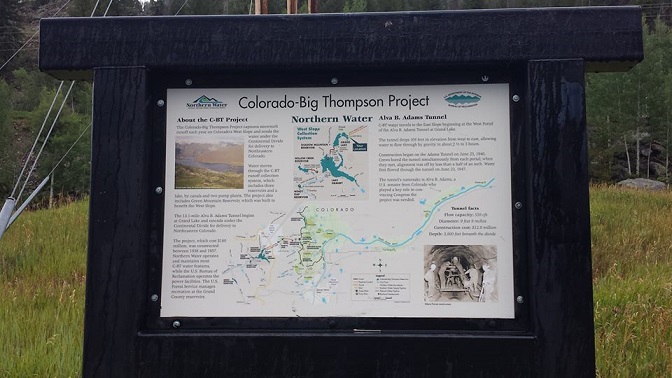
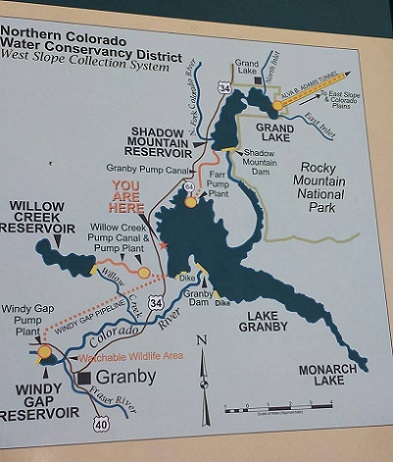
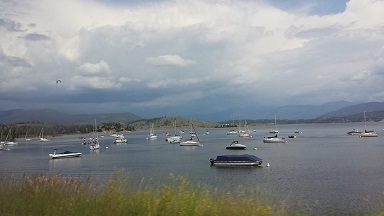
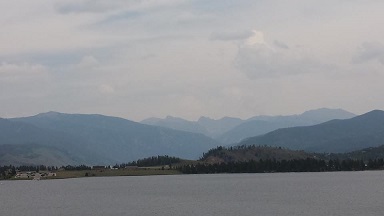
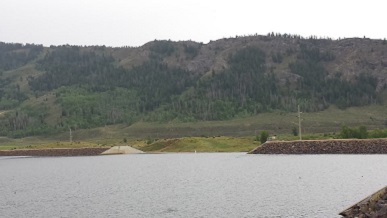
There are lessons to be learned by visiting, observing and reporting on other communities that do water management better. This commentary reflects that activity; some Caribbean stakeholders explored the US State of Colorado and discovered that we have so much to learn about how to facilitate the infrastructure of an optimized society. We have seen how water management is an art and a science. (All non-encyclopedic photos in this commentary were snapped in Colorado by Bahamian student Camille Lorraine).

CU Blog - Lessons from Colorado - Water Management Art and Science - Photo 1a

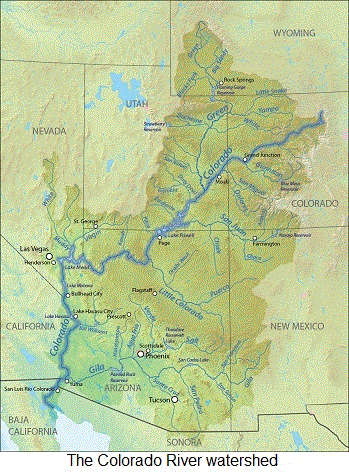
As reported previously, the Caribbean has so much in common and so much in contrast with Colorado. One contrast to consider is how Colorado’s lakes, rivers and waterways are structured to sustain the lives and systems of commerce of that State and … 6 other States plus 2 States in the foreign country of Mexico.

CU Blog - Lessons from Colorado - Water Management Art and Science - Photo 7

The 2013 book Go Lean…Caribbean visited Colorado’s water management. It detailed the strategies, tactics and implementation of the Colorado River Interstate Compact (an agreement between two or more states). This is reported on Page 278 of the book:

The Colorado River Compact is a 1922 agreement among seven US states (upper division: Colorado, New Mexico, Utah and Wyoming; lower division: (Nevada, Arizona and California) in the basin of the Colorado River in the American Southwest governing the allocation of the water rights to the river’s water among the parties of the interstate compact. The agreement was signed at a meeting at Bishop’s Lodge, near Santa Fe, New Mexico, by representatives of the seven states the Colorado river and its tributaries pass through on the way to Mexico.

The compact requires the UpperBasin states not to deplete the flow of the river below 7,500,000 acre feet during any period of ten consecutive years. Based on rainfall patterns observed in the years before the treaty’s signing in 1922, the amount specified in the compact was assumed to allow a roughly equal division of water between the two regions. The states within each basin were required to divide their 7,500,000-acre foot per year share allotment among themselves. In addition to this, 1,500,000-acre-foot per year of Colorado River water is allocated to Mexico, pursuant to the treaty relating to the use of waters of the Colorado and Tijuana rivers and of the Rio Grande, signed February 3, 1944, and its supplementary protocol signed November 14, 1944.

The compact enabled the widespread irrigation of the Southwest, as well as the subsequent development of state and federal water works projects under the United States Bureau of Reclamation. Such projects included the Hoover Dam, Lake Mead and Lake Powell, the 1st and 2nd largest man-made reservoirs in the US.

CU Blog - Lessons from Colorado - Water Management Art and Science - Photo 3

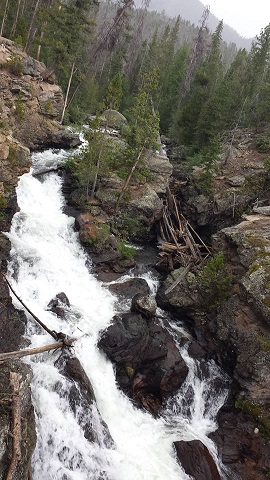
The headwaters of the Colorado River originate … in Colorado. This is the source.

CU Blog - Lessons from Colorado - Water Management Art and Science - Photo 6

CU Blog - Lessons from Colorado - Water Management Art and Science - Photo 5

CU Blog - Lessons from Colorado - Water Management Art and Science - Photo 2

CU Blog - Lessons from Colorado - Water Management Art and Science - Photo 8

This commentary continues the 5-part series – this is 4 of 5 – on the subject of Lessons from Colorado. There are so many lessons that we must consider from this land-locked US State; good ones and bad ones. In fact, the full list of 5 entries are detailed as follows:

  1. Lessons from Colorado – Common Sense of Eco-Tourism
  2. Lessons from Colorado – Legalized Marijuana – Heavy-lifting!
  3. Lessons from Colorado – How the West Was Won
  4. Lessons from Colorado – Water Management Art & Science
  5. Lessons from Colorado – Black Ghost Towns – “Booker T. turning in his grave”

The book Go Lean…Caribbean calls for the elevation of Caribbean society, to re-focus, re-boot, and optimize all the societal engines (economics, security and governance) so as to make the Caribbean a better place to live, work and play.  Water is connected to each of these facets of society. The purpose of Water Management is to ensure that the supply of fresh, clean water is steady and inexpensive.

This is an art and a science.

There is even a designating color that is used to brand this science: Blue. This point was identified and qualified in a previous Go Lean commentary, entitled “Blue is the new Green“. There, it stated:

First we said to “Go Green!” Now we are saying to “Go Blue”, because Blue is the new Green. While ‘Green’ is motivated for all-things-environmental, ‘Blue’ refers specifically to Water Conservation.

There is money in Green; there is money in Blue too! The references to Blue waters apply equally to fresh water and seawater. When we consider all the waterscapes in the Caribbean, (1,063,000 square-miles of the Caribbean seas and thousands of islands in the archipelago – The Bahamas has over 700 alone), we realize how much opportunity exists.

There is the chance to get lucky; where luck is defined as the intersection of preparation and opportunity.

Considering all the opportunities, how can the Caribbean prepare its economic engines to harvest all the fruitage from these Blue market conditions? This is the theme of the book Go Lean…Caribbean, that the world is struggling to contend with monumental changes related to technology, globalization and most importantly Climate Change.

Early in the book, the pressing need to be aware of climate change is pronounced in the Declaration of Interdependence (Page 11), with these words, (the first of many “causes of complaints”):

    i. Whereas the earth’s climate has undeniably changed resulting in more severe tropical weather storms, it is necessary to prepare to insure the safety and security of life, property and systems of commerce in our geographical region. As nature recognizes no borders in the target of its destruction, we also must set aside border considerations in the preparation and response to these weather challenges.

The Caribbean needs Blue Technology solutions to sustain our own lives, liberties and systems of commerce. But the Go Lean book posits that we cannot just consume, we must also create, produce, and foster. So we must foster industrial solutions for the rest of the world. This foregoing [embedded] magazine article summary highlighted the progression in this new Blue Technology industry-space in these areas:

  • Sourcing
  • Treating
  • Storing
  • Conserving
  • Keeping it Clean

So a study of Colorado allows us, in the Caribbean, the opportunity to see Blue Technology solutions at work, in motion and at success in sustaining millions of lives and their dependent systems of commerce. A specific lesson from Colorado is that the responsible parties for the mastery of this “art and science” in Colorado is not Colorado, but rather the US Federal government agency referred to as the United States Bureau of Reclamation (USBR). This agency …

… oversees water resource management, specifically as it applies to the oversight and operation of the diversion, delivery, and storage projects that it has built throughout the western United States for irrigation, water supply, and attendant hydroelectric power generation. Currently the USBR is the largest wholesaler of water in the country, bringing water to more than 31 million people, and providing one in five Western farmers with irrigation water for 10 million acres of farmland, which produce 60% of the nation’s vegetables and 25% of its fruits and nuts. The USBR is also the second largest producer of hydroelectric power in the western United States.[4] – Source: Wikipedia.

CU Blog - Lessons from Colorado - Water Management Art and Science - Photo 1b

The book Go Lean…Caribbean – available to download for free – serves as a roadmap for the introduction and implementation of the technocratic Caribbean Union Trade Federation (CU), for the elevation of Caribbean society – for all member-states. The CU would serve the Caribbean role of the USBR, the “new guards” of Caribbean Common Pool Resources; it would be staffed with water management professionals and scientists with the authority – vested by the CU treaty – to execute a master plan that facilitates water efficiencies in the region.

There are lives involved, as water is essential for life. There are also jobs involved, and societal efficiency. The lack of efficiency in the Caribbean status quo –  “push” and “pull” factors – is what is responsible for so much abandonment. (In fact, it has been reported that the professional classes of people in the region have abandoned their communities at a rate of 70 percent). So this CU/Go Lean roadmap seeks to reform and transform this bad trending; it has these 3 prime directives:

  • Optimization of the economic engines in order to grow the regional economy to $800 Billion and create 2.2 million new jobs.
  • Establishment of a security apparatus to ensure public safety and protect the resultant economic engines.
  • Improve Caribbean governance to support these engines, including a separation-of-powers between the member-states and CU federal agencies.

The book stresses that reforming and transforming the Caribbean societal engines must be a regional pursuit, at a federal level; (CU Federation = federal). This was an early motivation for the roadmap, as pronounced in the opening Declaration of Interdependence (Pages 12 – 13):

iii. Whereas the natural formation of the landmass for our society is that of an archipelago of islands, inherent to this nature is the limitation of terrain and the natural resources there in. We must therefore provide “new guards” and protections to ensure the efficient and effective management of these resources.

v. Whereas the natural formation of our landmass and coastlines entail a large portion of waterscapes, the reality of management of our interior calls for extended oversight of the waterways between the islands. The internationally accepted 12-mile limits for national borders must be extended by International Tribunals to encompass the areas in between islands. The individual states must maintain their 12-mile borders while the sovereignty of this expanded area, the Exclusive Economic Zone, must be vested in the accedence of this Federation.

vi. Whereas the finite nature of the landmass of our lands limits the populations and markets of commerce, by extending the bonds of brotherhood to our geographic neighbors allows for extended opportunities and better execution of the kinetics of our economies through trade. This regional focus must foster and promote diverse economic stimuli.

xi. Whereas all men are entitled to the benefits of good governance in a free society, “new guards” must be enacted to dissuade the emergence of incompetence, corruption, nepotism and cronyism at the peril of the people’s best interest. The Federation must guarantee the executions of a social contract between government and the governed.

xvi. Whereas security of our homeland is inextricably linked to prosperity of the homeland, the economic and security interest of the region needs to be aligned under the same governance. Since economic crimes … can imperil the functioning of the wheels of commerce for all the citizenry, the accedence of this Federation must equip the security apparatus with the tools and techniques for predictive and proactive interdictions.

xxiv. Whereas a free market economy can be induced and spurred for continuous progress, the Federation must install the controls to better manage aspects of the economy: jobs, inflation, savings rate, investments and other economic principles. Thereby attracting direct foreign investment because of the stability and vibrancy of our economy.

The Go Lean book provides 370-pages of turn-by-turn instructions on “how” to adopt new community ethos, plus the strategies, tactics, implementations and advocacies to execute so as to reboot, reform and transform the societal engines of Caribbean society.

Water management is not just vital for basic needs – quenching thirsts – it is also needed to advance the economy. Resorts (tourism) and factories alike, all depend on good water management. Imagine:

As previously detailed, water resources are not cheap. It is only free when it rains. The effort to source, treat, store, conserve and keep water clean takes a big investment on the part of community and governmental institutions.

Thank you Colorado – and your management of this principal river of the Southwestern United States and northern Mexico (the other one is the Rio Grande). This 1,450-mile-long river is the hardest working river in North America, as it sustains an arid watershed – (the western US states are considered desert wilderness) – that encompasses parts of 7 US States and 2 Mexican States (Sonora and Baja California). This great river gets its start in the central Rocky Mountains, in the heart of Colorado. See this VIDEO here:

VIDEO – Colorado River – I Am Red – https://youtu.be/mqYcC7jEe44

Published on Apr 16, 2013 – The Colorado River is a lifeline in the desert, its water sustaining tens of millions of people in seven states, as well as endangered fish and wildlife. However, demand on the river’s water now exceeds its supply, leaving the river so over-tapped that it no longer flows to the sea. (Video by Pete McBride. Flights by Lighthawk, Ecoflight.)

Learn more and be part of the solution: www.AmericanRivers.org/Colorado

Colorado is showing us in the Caribbean how hard work pays off; (all photos in this commentary here are from Colorado, and not the Caribbean, despite any leanings). We now know where we can find “best practices” to model effective and efficient water management. The successful application of this lesson from Colorado can help us to make our Caribbean homelands and waterways better places to live, work and play. 🙂

Download the free e-Book of Go Lean … Caribbean – now!

Sign the petition to lean-in for this roadmap for the Caribbean Union Trade Federation.

Share this post:
, ,
[Top]

Lessons from Colorado: Legalized Marijuana – Heavy-lifting!

Go Lean Commentary

“Rocky Mountain High … Colorado” – Song verbiage from John Denver’s Rocky Mountain High – see Appendix A

CU Blog - Lesson from Colorado - Legalized Marijuana - Photo 1

This is a familiar refrain from a familiar song; a folk rock song written by John Denver and Mike Taylor about Colorado, and is one of the two official state songs of Colorado;[1] recorded by Denver in 1972, it went to #9 on the US Hot 100 in 1973; (source: Wikipedia). The song also made #3 on the Easy Listening chart …

But in 2017, the phrase “Rocky Mountain High” has a total different meaning, because the State of Colorado has since legalized recreational use of marijuana.

This is not an easy topic; this is heavy …

There are so many lessons we can learn from the debate, legalization, implementation, regulation and societal repercussions of this product in this State. All in all, it is heavy-lifting. This is the theme of this series of commentaries of lessons that have been learned by Caribbean stakeholders visiting, observing and reporting on the US State of Colorado. (All non-encyclopedic photos in this commentary were snapped in Colorado by Bahamian student Camille Lorraine).

We have so much in common and so much in contrast. One commonality to consider is how Colorado is now associated with marijuana consumption. See Appendix B VIDEO below.

“Welcome to our club”! This has always been the image of Caribbean people and culture – think: Rasta Man smoking Ganja; (marijuana is called ganja in Sanskrit and other modern Indo-Aryan languages.[173]).

Don’t like the imagery, reputation or sullied practice? Then welcome to societal development 2017; welcome to heavy-lifting.

This commentary continues the 5-part series on the subject of Lessons from Colorado. There are so many lessons that we must consider from this land-locked US State; good ones and bad ones. In fact, the full list of 5 entries are detailed as follows:

  1. Lessons from Colorado – Common Sense of Eco-Tourism
  2. Lessons from Colorado – Legalized Marijuana: Heavy-lifting!
  3. Lessons from Colorado – How the West Was Won
  4. Lessons from Colorado – Water Management Art & Science
  5. Lessons from Colorado – Black Ghost Towns – “Booker T. turning in his grave”

The book Go Lean…Caribbean calls for the elevation of Caribbean society, to re-focus, re-boot, and optimize all the societal engines so as to make the Caribbean a better place to live, work and play.  The movement behind this book wants to do the heavy-lifting to reform and transform Caribbean society. So we must tackle these “heavy” issues that others may just want to brush aside. As goes Colorado, soon the rest of the US – 4 states currently support recreational use of marijuana; many others support medical marijuana; in total 28 states will have some kind of legalization on the books).

“Marijuana legalization is now the norm for 40 percent of the American population.”

It is only a matter of time – considering American tourism, trade and Caribbean students matriculating in the US – when this debate comes to our door in the Caribbean.

Oops, too late!

According to social media sites, there is already an outcry for regional leaders to consider some form of legalization or decriminalization in the Caribbean.

CU Blog - Lesson from Colorado - Legalized Marijuana - Photo 0

This issue has previously been addressed by planners of a new Caribbean stewardship – see here:

https://goleancaribbean.com/blog/?p=9646 ‘Time to Go’ – American Vices, i.e. Marijuana. Don’t Follow!
https://goleancaribbean.com/blog/?p=1386 Puff Peace – The Debate  for Marijuana in Jamaica

The book Go Lean…Caribbean – available to download for free – serves as a roadmap for the introduction and implementation of the technocratic Caribbean Union Trade Federation (CU), for the elevation of Caribbean society – for all member-states. This CU/Go Lean roadmap has these 3 prime directives:

  • Optimization of the economic engines in order to grow the regional economy to $800 Billion and create 2.2 million new jobs.
  • Establishment of a security apparatus to ensure public safety and protect the resultant economic engines.
  • Improve Caribbean governance to support these engines, including a separation-of-powers between the member-states and CU federal agencies.

The book stresses that reforming and transforming the Caribbean societal engines must be a regional pursuit. This was an early motivation for the roadmap, as pronounced in the opening Declaration of Interdependence (Pages 12 – 13):

xi. Whereas all men are entitled to the benefits of good governance in a free society, “new guards” must be enacted to dissuade the emergence of incompetence, corruption, nepotism and cronyism at the peril of the people’s best interest. The Federation must guarantee the executions of a social contract between government and the governed.

xvi. Whereas security of our homeland is inextricably linked to prosperity of the homeland, the economic and security interest of the region needs to be aligned under the same governance. Since economic crimes … can imperil the functioning of the wheels of commerce for all the citizenry, the accedence of this Federation must equip the security apparatus with the tools and techniques for predictive and proactive interdictions.

xxiv. Whereas a free market economy can be induced and spurred for continuous progress, the Federation must install the controls to better manage aspects of the economy: jobs, inflation, savings rate, investments and other economic principles. Thereby attracting direct foreign investment because of the stability and vibrancy of our economy.

The Go Lean book provides 370-pages of turn-by-turn instructions on “how” to adopt new community ethos, plus the strategies, tactics, implementations and advocacies to execute so as to reboot, reform and transform the societal engines of Caribbean society. According to that previous blog-commentary:

There are moral, religious, legal and psychological (treatment) issues associated with this topic; and there is history – good and bad. Any jurisdiction decriminalizing the use of marijuana has to contend with the previous messaging to the community of: “Just say no to drugs”.

The [Go Lean] book asserts that before the strategies, tactics, implementations and advocacies of a roadmap to elevate a society can be deployed, the affected society must first embrace a progressive community ethos. The book defines this “community ethos” as the fundamental character or spirit of a culture; the underlying sentiment that informs the beliefs, customs, or practices of society; dominant assumptions of a people or period. Think of the derivative term: “work ethic”.

Marijuana is a mood-altering drug; it has negative effects, one being preponderance for apathy, to tune out of any active engagement. In the US, even in the states where marijuana is legal, most firms/governments still screen staffers (new hires and veterans) and ban consumption of the drug. The reason is simple: Apathy does not make for industriousness. So this issue/drug presents a conundrum for the CU. The mission to grow the economy, promote industriousness, foster new jobs and new industries is pronounced early in the roadmap, detailed in the Declaration of Interdependence (Page 14) with this statement:

    xxvi. Whereas the Caribbean region must have new jobs to empower the engines of the economy and create the income sources for prosperity, and encourage the next generation to forge their dreams right at home, the Federation must therefore foster the development of new industries … In addition, the Federation must invigorate the enterprises related to existing industries … impacting the region with more jobs.

So to all you Caribbean stakeholders clamoring to follow Colorado’s lead … into the heavy-lifting of legalized marijuana use, we ask this one question:

Are you ready for this?

CU Blog - Lesson from Colorado - Legalized Marijuana - Photo 2

CU Blog - Lesson from Colorado - Legalized Marijuana - Photo 3

Thank you Colorado, for your fine role model. You have provided guidelines and learned-lessons that we can apply in our own jurisdictions. We learn that there are “pros” and “cons” to this controversial issue. Colorado authorities report that for 2016, they transacted over $1.1 Billion in marijuana sales for recreational and medicinal purposes; the State have collected $141 million in taxes, licenses and fees. The repercussions and consequences of legalized marijuana have not just been economic benefits, there have been public safety (security) incidents as well. Consider these headlines:

The Go Lean movement, as stewards of a new Caribbean, must answer the same question:

Are we ready?

No, our communities and societal engines (economics, security and governance) are NOT ready!

Yes, we accept the challenge; we hereby urge all Caribbean stakeholders – governments, law enforcement agencies, social and civic agencies – to lean-in to this Go Lean roadmap for how to make our Caribbean homeland a better place to live, work and play.

Our judgment now is that the Caribbean is not ready to sanction recreational marijuana use, but still …

… it is what it is.

We must be prepared and “on guard” for “bad actors” (and foreigners) to exploit the demand for this activity in our community. We are not trying to be Colorado, or to be America; no, we are trying to be better. 🙂

Download the free e-Book of Go Lean … Caribbean – now!

Sign the petition to lean-in for this roadmap for the Caribbean Union Trade Federation.

—————–

Appendix A – John Denver – Rocky Mountain High – https://youtu.be/eOB4VdlkzO4


Published on Apr 5, 2013 – John Denver’s official audio for ‘Rocky Mountain High’. Click to listen to John Denver on Spotify: http://smarturl.it/JohnDenverSpotify?…

As featured on The Essential John Denver. Click to buy the track or album via iTunes: http://smarturl.it/EssentialJD?IQid=J…
Google Play: http://smarturl.it/RMHGPlay?IQid=John…
Amazon: http://smarturl.it/EJDAmazon?IQid=Joh…

More from John Denver
Take Me Home, Country Roads: https://youtu.be/1vrEljMfXYo
Leaving On A Jet Plane: https://youtu.be/SneCkM0bJq0
Sunshine On My Shoulders: https://youtu.be/diwuu_r6GJE

More great 70s videos here: http://smarturl.it/Ultimate70?IQid=Jo…

Follow John Denver
Website: http://johndenver.com/
Facebook: https://www.facebook.com/JohnDenver
Twitter: https://twitter.com/johndenvermusic
Subscribe to John Denver on YouTube: http://smarturl.it/JohnDenverSub?IQid…
———
Lyrics:
He was born in the summer of his 27th year, coming home to a place he’d never been before.
He left yesterday behind him, you might say he was born again,
you might say he found a key for every door.
When he first came to the mountains, his life was far away on the road and hanging by a song.
But the string’s already broken and he doesn’t really care,
it keeps changing fast, and it don’t last for long.

And the Colorado Rocky Mountain high, I’ve seen it raining fire in the sky.
The shadows from the starlight are softer than a lullaby.
Rocky Mountain high, Colorado. Rocky Mountain high.

  • Category: Music
  • License: Standard YouTube License
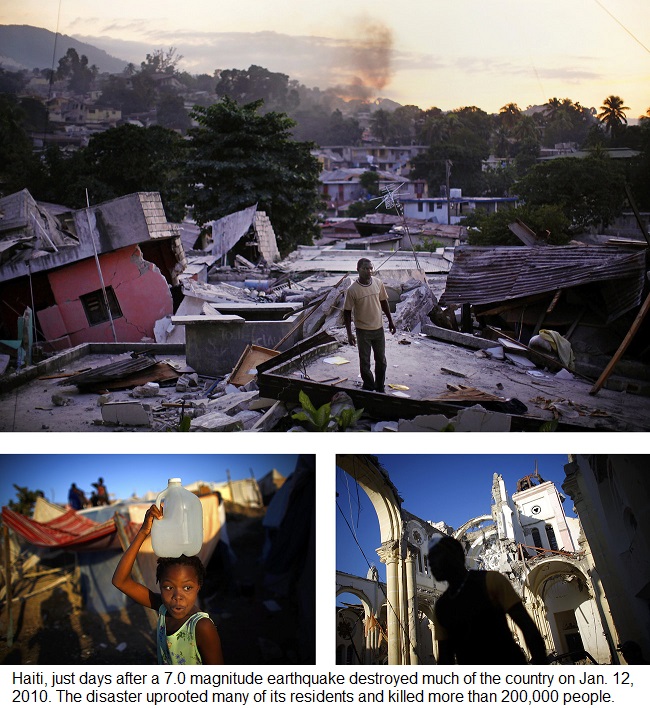
—————–

Appendix B – Legalized: A Year In The Life Of Colorado’s Legal Weed Experiment | NBC News – https://youtu.be/B1cyfObqehI

Published on Nov 9, 2016 – Election night 2016 was a big night for the marijuana legalization movement as multiple states passed measures including recreations initiatives in California and Massachusetts. This piece documented the first year of Colorado’s legal weed experiment.

» Subscribe to NBC News: http://nbcnews.to/SubscribeToNBC
» Watch more NBC video: http://bit.ly/MoreNBCNews

NBC News is a leading source of global news and information. Here you will find clips from NBC Nightly News, Meet The Press, and our original series Debunker, Flashback, Nerdwatch, and Show Me. Subscribe to our channel for news stories, technology, politics, health, entertainment, science, business, and exclusive NBC investigations.

Connect with NBC News Online!
Visit NBCNews.Com: http://nbcnews.to/ReadNBC
Find NBC News on Facebook: http://nbcnews.to/LikeNBC
Follow NBC News on Twitter: http://nbcnews.to/FollowNBC
Follow NBC News on Google+: http://nbcnews.to/PlusNBC
Follow NBC News on Instagram: http://nbcnews.to/InstaNBC
Follow NBC News on Pinterest: http://nbcnews.to/PinNBC

Legalized: A Year In The Life Of Colorado’s Legal Weed Experiment | NBC News

Share this post:
, ,
[Top]

The Wait Ended – This Day Last Year – ENCORE

Time flies … when you’re having fun – Old Adage

This has been the case in the last 12 months. On  this day – July 27 – in 2016, the facility to download the book Go Lean … Caribbean finally became available.

Hip Hip Hooray!

We have not stood still since then. We have re-published the main Go Lean website into all 4 Caribbean languages – Dutch, English, French and Spanish – and published 180 more blog-commentaries.

Here below is an Encore of that original blog-commentary that announced the functionality to download the e-Book.

——————

Go Lean Commentary

“Now I tired waiting”.

Book CoverThe book Go Lean … Caribbean is now available to download as an e-Book … for free.

Get the e-Book here NOW!

What is the big deal?

Well, this book purports to be the answer … for what ails the Caribbean.

The book asserts that the Caribbean is in crisis; that the region of 42 million people in the 30 member-states is dysfunctional … to the point of flirting with Failed-State status. It is that serious!

The book posits that one identifying symptom is the high societal abandonment rate. The countries of the Caribbean region are experiencing a brain drain where 70 percent – on the average – of the tertiary-educated have fled for foreign shores.

70% …
… this is no way to nation-build.

Brain Drain 70 percent ChartThese alarming abandonment rates have been communicated to the governments and leaders of the region and yet still, the problem persists. They have not taken action to curb the problem.

Comes now the book Go Lean…Caribbean. This serves as a roadmap for the introduction and implementation of the technocratic Caribbean Union Trade Federation (CU). This 370-page publication presents the solutions for all the region, all the 4 language groups (Dutch, English, French and Spanish) by describing 144 different missions to elevate the economic, security and governing engines of the region. This is a serious answer to a serious crisis.

This book is published by a community development foundation made up of mostly Caribbean Diaspora. These ones have grown tired of waiting.

“Now I tired waiting”?
I’ve come to fix the …

This familiar refrain in the Caribbean has been repeated time and again, even sang in melody and rhyme. See/listen here, the classic Calypso song from the legendary Mighty Sparrow (and the lyrics in the Appendix below):

VIDEOMighty Sparrow – Mr. Walker – https://youtu.be/i5d9WzncTew

Published on Oct 22, 2012 – This song describes a frustrated man who was promised to marry a  “not so beautiful” woman, but who was more prosperous economically than himself. This is presented here as a metaphor, of the frustration of waiting for change and finally taking positive action to effect the change oneself.
Album : Party Classics. 1986
All ownership belong to the copyright holder. There is no assumption of infringement here.

The Caribbean Diaspora – living abroad in the US, Canada and Western Europe – were always taught to believe that the Caribbean is the greatest address on the planet, and yet it was essential that they leave to forge an existence elsewhere. They have endured in these foreign lands, but they are still only alien residents.  It is not home!

If only there were some solutions for their homeland?

Solutions for the Caribbean are the prime directives of the Go Lean/CU roadmap; just consider these:

  • Optimization of the economic engines in order to grow the regional economy to $800 Billion & create 2.2 million new jobs.
  • Establishment of a security apparatus to ensure public safety and protect the resultant economic engines.
  • Improve Caribbean governance to support these engines.

Puerto Rico Flag

The quest of the Go Lean/CU roadmap is direct: to make the Caribbean a better place to live, work and play. The book presents how this quest is conceivable, believable and achievable. It posits that the foundation is now in place, and we only need some technocratic deliveries to move the Caribbean member-states from the current status quo to the new destination: a better homeland. This presents a solution where our youth will no longer have to leave, and our older generations can relish a return back home.

“Now I tired waiting”, I come to fix … “the situation”. We now present you the “fix”!

🙂

Download the e-Book of Go Lean … Caribbean – free … now!

———–

Appendix – Lyrics: Mighty Sparrow – Mr. Walker

She ugly yes, but she wearing them expensive dress
The People say she ugly, but she father full a money
Oh Lord Mamma, woy woy

Good morning Mister Walker
I come to see your daughter
Oh, Mister Walker!
I come to see your daughter
Sweet Rosemarie, she promise she gone marry me
And now I tired waiting!
I come to fix the wedding

After the wedding day, I don’t care what nobody say
Everytime I take a good look at she face I see a bankbook
Oh Lord Mamma, woy woy

Good morning Mister Walker
I come to see your daughter
Hmm, Mister Walker!
I come to see your daughter
Sweet Rosemarie, she promise she gone marry me
And now I tired waiting!
I come to fix the wedding, woy

Apart from that, they say how she so big and fat
When she dress they tantalize she, saying monkey wearing mini
Oh Lord Mamma, woy woy

Good morning Mister Walker
I come to see your daughter
Oy, Mister Walker!
I come to see your daughter
Sweet Rosemarie, she promise she gone marry me
And now I tired waiting!
I come to fix the wedding, Hmm

All I know, is I don’t intend to let she go
Cause if she was a beauty, nothing like me could get she
Oh Lord Mamma, woy woy

Good morning Mister Walker
I come to see your daughter
Oy, Mister Walker!
I come to see your daughter
Sweet Rosemarie, she promise she gone marry me
And now I tired waiting!
I come to fix the wedding, oh

Source: Retrieved July 27, 2016 from: http://www.lyricsmode.com/lyrics/m/mighty_sparrow/mr_walker.html

Share this post:
, , , ,
[Top]

State of the Union – Annexation: French Guiana

Go Lean Commentary

CU Blog - State of the Union - Annexation - French Guiana - Photo 0

There is the Big Dogthe Alpha – and then there are the other dogs. While this is just nature, it also applies to the societal developments. In the Caribbean region, for example, there is the Big Dog of the United States of America dominating the region? Who is next? The British and …

The French.

This does not refer to just these French Caribbean islands, but rather the whole Republic of France, in which these Caribbean member-states are considered Overseas Departments (administrative sub-sets of the national government); see census numbers here:

Member –State Land Area (Mile2) Population GDP Millions GDP Per Capita
Guadeloupe 1,628 405,000 $6,169 $21,780
Martinique 1,128 402,000 $9,610 $24.118
Saint Barthélemy 21 8,938 $255 $37,000
Saint Martin 53 35,925 $599 $20,600
French Guiana 32,253 250,109 $4,900 $20,000
Republic of France 248,573 66,991,000 $2,833,000 $43,652

There is one French territory in this region that is NOT included in the roadmap for Caribbean confederation, as described in the book Go Lean … Caribbean. This refers to French Guiana, the territory on the mainland of South America, adjacent to Suriname; see photo above.

While the US is Number 1 in the world for Single Market economies, the French is shortly behind; (UK #9; France #10; The Netherlands #28). In the Caribbean, the French structure calls for the administrative designation of an overseas departments that have identical powers to those of the regions of metropolitan France. (This is different than overseas collectivities which is the particular status of Saint Barthélemy and Saint Martin). As integral parts of the French Republic, an overseas department is represented in the National AssemblySenate and Economic and Social Council, elect a Member of the European Parliament (MEP), and use the Euro as their currency.

So nowadays, Guiana is fully integrated in the French central state; they are even a part of the European Union, and its official currency is the Euro. The region is the most prosperous territory in all of South America with the highest GDP per capita.[2] A large part of Guiana’s economy derives from the presence of the Guiana Space Centre, now the European Space Agency‘s primary launch site near the equator. As elsewhere in France, the official language is French, but each ethnic community has its own language, of which Guianan Creole is the most widely spoken.

French Guiana and the European Space Agency were prominently featured in the Go Lean book – Page 105; see Appendix below – as a model for Self-Governing Entities (SGE). The hope – as expressed in the book – was that this territory would someday join the regional neighborhood.

French Guiana is complete administratively, but still features a lot of societal defects – not colonial de jure; but colonial de facto. It is the opinion of this Go Lean commentary, that this homeland needs … its neighbors: regional integration, which is the best strategy for anti-colonialism. See this VIDEO and news article here, highlighting the blatant discord there in that territory:

VIDEO – French Guiana Marches Against Colonialism – https://videosenglish.telesurtv.net/player/653436/french-guiana-marches-against-colonialism/?aspectratio=auto

General Strike and National Protest on March 28, 2017

———-

Opinion Article – How Racism Hampers Health Care in French Guiana
By: Estelle Carde

Limited access to health care is exacerbated by everyday discrimination based on ethnicity and national origin.
Oft-overlooked French Guiana, one of France’s five overseas departments, has suddenly captured international media attention. And the news from this small South American territory is not good.

Crime, overcrowding in schools and hospitals, unemployment, the cost of living and slums have reached alarming levels.

Citizen discontent led to a massive demonstration this March, the most intense such strike since 2009. Demonstrators are asking for a $US2.7 billion emergency aid package from the French government to assist in the territory’s social and economical crisis.

CU Blog - State of the Union - Annexation - French Guiana - Photo 2

Health care is a particular concern in the former penal colony of 276,000 people. Hospitals are under-staffed and technical facilities are lacking. In some areas, the nearest hospital is a two-day canoe trip away.

CU Blog - State of the Union - Annexation - French Guiana - Photo 1

The recent deaths of five premature babies from infection at Cayenne hospital, in the capital, have heightened concerns.

But there’s one critical health care-related issue that almost no one is talking about: racism. In a diverse territory comprised of people of European, African, Asian and Indigenous descent and a growing immigrant population, limited access to health care is exacerbated by everyday discrimination based on ethnicity and national origin.

Too many foreigners?
Foreign-born residents of French Guiana are among those impacted by discrimination in the health-care system.

Though socioeconomically the territory lags severely behind the rest of France, French Guiana constitutes a regional haven of wealth whose attractiveness has grown since the 1960s. Today, more than one in three inhabitants is born abroad. People from Suriname, Brazil and Haiti represent the largest immigrant groups.

This “tidal wave” of immigration is often cited as the main cause of French Guiana’s current socioeconomic crisis, even in some French political circles. The discriminatory behaviours that sometimes result from such widespread immigrant-blaming may be only thinly veiled.

State health office assistants might apply stricter conditions than legally necessary to those seeking medical benefits. Some, for instance might ask the foreign-born applicants to give proof of longer residency than required by law, thinking that it will discourage them from settling in the territory.

The same arguments are, in fact, used to justify similar discriminatory practices against immigrants in mainland France, too. But in Guiana they are more openly displayed.

Ethnic categorizations
Immigrants are not the only group that experiences discrimination in accessing health care in French Guiana. Members of minority populations, whether they are French or not, can also be affected.

This is partly because in French Guiana, people commonly use ethnicity to identify themselves and others. Creole, Maroon, Amerindian, Hmong, Chinese or French Métropolitains (mainlanders) are frequently invoked categories.

Under French law, the government cannot collect data or use it based on ethnicity. But in Guiana such usage goes back to the territory’s early times as a slave colony.

And, of course, each grouping comes with its stock of stereotypes: “Maroons are child-like”, for instance, or “Hmongs are disciplined” and “Amerindians drink their dole money”.

But these assumptions are not set in stone. Because they serve to justify power relations between groups, they tend to change with the ethnic identity of the speaker. This social dynamic plays out in French Guiana’s health-care system.

In Saint-Laurent-du-Maroni, French Guiana’s second largest city, Maroons – the descendants of escaped former slaves – are the majority population and therefore the largest group of health-care users. Health-care professionals, on the other hand, are primarily Creoles or French mainlanders.

CU Blog - State of the Union - Annexation - French Guiana - Photo 3

These professionals often point to the Maroon people’s history to explain certain patient behaviours. In the 18th and 19th centuries, slaves who escaped from plantations would hide in the forest, creating communities that remained more or less isolated from coastal Guianese society for almost 200 years.

In 1969, the large territory they still occupy – mainly tropical forests in the country’s interior – was finally integrated into the Department of Guiana. At that point, they began to gain access to French citizenship and public services such as education and health.

Doctors, nurses and other health professionals readily highlight these facts to explain Maroons’ difficulties in accessing treatment, inferring that they are not yet used to doing things “the Western way.”

‘Them’ and ‘us’
Such references to historical facts are charged with connotations. Some Creole professionals suggest that Maroon people are undeserving of care because they only had to “leave their forest” to access to such services. Contrasting that status with their own position as “Guianese taxpayers” who fund these services, some may use this as justification to refuse Maroon people help in accessing treatment.

This attitude can be better understood considering the Creole people’s own history in French Guiana. Their process of accessing civil rights was slow and gradual. Social empowerment came only at the tail end of a gradual Westernisation process that began with slavery in the 17th century.

After emancipation and the granting of French citizenship in 1848, this population slowly rose to local economic and political power, spurred along by Guiana’s transformation into a French department (1946) and a national policy of decentralisation (1982).

Now hard-won Creole dominance is threatened by Maroon people, who recently obtained the same civil rights as them, and whose numbers have surpassed their own numbers in the Western part of Guiana.

Health professionals from the French mainland, for their part, tend to emphasise the “cultural differences” of these “new citizens”. They cite, for example, the “traditional” way in which Maroons transmit information (watching without asking questions) and their way of “living in the moment” to explain their apparent inability to request health coverage prior to needing treatment.

This tendency to highlight cultural differences can also end up amounting to discrimination because it overshadows systemic failures that do impact access to health care, such as the lack of health coverage offices in the country’s rural inland regions. This tendency is more present among professionals who have been in Guiana for just a few months and who readily admit to being allured by the very different culture of this “exotic” overseas corner of France.

Discriminatory behaviours among health professionals therefore exacerbate the failures of the ailing health-care system now under protest by Guianese demonstrators. Foreigners and Maroon people are the first victims of administrative failures due to their vulnerable socioeconomic status. They are also worst hit by geographical obstacles because they represent a majority of inhabitants in the territory’s remote rural areas.

But this accumulation of racist, economic and geographical inequalities is no accident. It is the result of centuries of history of Guianese society.

Source: TeleSur Media Network – Published April 13, 2017; retrieved July 26, 2017 from: http://www.telesurtv.net/english/opinion/How-Racism-Hampers-Health-Care-in-French-Guiana-20170413-0007.html

——-

Translated from the French by Alice Heathwood for Fast for Word.

Estelle Carde is a professor of Sociology of Health at Université de Montréal.

This article was originally published on The Conversation. Read the original article.

RELATED:
Guiana Workers ‘Toughen Up’ Mobilizations Against French State 

This theme – “All is not well in the Caribbean” – aligns with the movement behind the book Go Lean … Caribbean, where the assertion is that the problems facing the Caribbean region are too big for any one member-state alone. There needs to be a regional solution. The book posits that shifting the help-seeking responsibility to a region-wide, professionally-managed, deputized technocracy will result in greater production and greater accountability. This deputized agency is the Caribbean Union Trade Federation (CU). The Go Lean book serves as a roadmap for the introduction and implementation of the CU.

This commentary is a follow-up to the 5-part series on the subject of the State of the Caribbean Union. Our Caribbean region is unique in that there are 4 different languages and 5 colonial legacies, spread across 30 member-states and 42 million people. The goal is to execute the 5-year plan of the roadmap and then add a 31st member: French Guiana. Based on the dispositions in the foregoing VIDEO and news-opinion article, French Guiana can use the Go Lean empowerments NOW! That land is suffering from many of the same dysfunctions that plague the rest of the Caribbean and the neighboring states of Suriname and Guyana. There might be the need to act NOW to seek refuge and relief.

The other 5 entries in the series are as follows:

Just the phraseology “Caribbean Union” assumes a collective collaboration of all the territories that identify with Caribbean culture; there is the need for better local stewardship. This Go Lean effort is a confederation of sovereign and non-sovereign territories, as is the case for French Guiana. There is no need for independence, as the authority of these territories can still be deputized into the CU as an umbrella intergovernmental organization. In total, the Go Lean/CU roadmap will employ strategies, tactics and implementations to impact its prime directives; identified with the following 3 statements:

  • Optimization of the economic engines in order to grow the regional economy to $800 Billion & create 2.2 million new jobs.
  • Improvement of Caribbean governance to support these engines, including a “Separation-of-Powers between CU federal agencies and Caribbean member-state governments”; so the limitations of national laws in a member-state does not have to override the CU. A CU constitution would apply to the installation – and continuation – of Exclusive Economic Zones (EEZ) and Self-Governing Entities (SGE) that operate in controlled bordered territories like campuses, industrial parks, research labs and industrial plants.

The Go Lean/CU roadmap always anticipated the French Caribbean territories. This theme was detailed in previous Go Lean blog-commentaries; consider this sample:

https://goleancaribbean.com/blog/?p=12466 Managing Volcanoes in the French Caribbean – Martinique and Guadeloupe
https://goleancaribbean.com/blog/?p=10554 Welcoming the French in Formal Integration Efforts
https://goleancaribbean.com/blog/?p=10043 Caribbean Integration Plan for Greater Prosperity
https://goleancaribbean.com/blog/?p=7834 French Caribbean ready for the Martinique Surf Pro
https://goleancaribbean.com/blog/?p=382 Guadeloupe, Martinique, St Maarten Join the Association of Caribbean States

Now the status of the French Caribbean is indistinguishable from colonial status. All authority still rest in Paris. But there is an opportunity for more (and better) autonomous governance in the region. As depicted in these previous commentaries, this opportunity is extended for the French Caribbean to align with the rest of the Caribbean region to adopt strategies, tactics and implementations to assuage the societal dysfunctions … together.

This quest of optimizing the entire Caribbean economic-security-governance eco-system is more than just a dream; this was the motivation for the origins of the Go Lean movement. This vision is defined early in the book (Pages 12 & 13) in the following pronouncements in the Declaration of Interdependence:

ix. Whereas the realities of healthcare and an aging population cannot be ignored and cannot be afforded without some advanced mitigation, the Federation must arrange for health plans to consolidate premiums of both healthy and sickly people across the wider base of the entire Caribbean population. The mitigation should extend further to disease management, wellness, mental health, obesity and smoking cessation programs. …

xi. Whereas all men are entitled to the benefits of good governance in a free society, “new guards” must be enacted to dissuade the emergence of incompetence, corruption, nepotism and cronyism at the peril of the people’s best interest. The Federation must guarantee the executions of a social contract between government and the governed.

xii. Whereas the legacy in recent times in individual states may be that of ineffectual governance with no redress to higher authority, the accedence of this Federation will ensure accountability and escalation of the human and civil rights of the people for good governance, justice assurances, due process and the rule of law. As such, any threats of a “failed state” status for any member state must enact emergency measures on behalf of the Federation to protect the human, civil and property rights of the citizens, residents, allies, trading partners, and visitors of the affected member state and the Federation as a whole.

xxii. Whereas the heritage of our lands share the distinction of cultural tutelage from European and American imperialists that forged their tongues upon our consciousness, it is imperative to form a society that is neutral and tolerant of the mother tongue influences of our people to foster efficient and effective communications among our citizens.

xxiii. Whereas many countries in our region are dependent Overseas Territory of imperial powers, the systems of governance can be instituted on a regional and local basis, rather than requiring oversight or accountability from distant masters far removed from their subjects of administration. The Federation must facilitate success in autonomous rule by sharing tools, systems and teamwork within the geographical region.

xxiv. Whereas a free market economy can be induced and spurred for continuous progress, the Federation must install the controls to better manage aspects of the economy: jobs, inflation, savings rate, investments and other economic principles. Thereby attracting direct foreign investment because of the stability and vibrancy of our economy.

The Go Lean book posits that the inefficient Caribbean communities – French Guiana included – can be reformed and transformed if they adopt the community ethos, strategies, tactics, implementations and advocacies as depicted in the Go Lean roadmap. The book provides 370-pages of turn-by-turn instructions on “how” so as to reboot, reform and transform the societal engines of Caribbean society. For one, the strategy calls for the implementation of Self-Governing Entities like the European Space Agencies and many more industrial sites – i.e. 10 Steps to Implement Self-Governing Entities on Page 105 of the book.

The effort of the Go Lean roadmap is not “stuck” on Caribbean geography; rather we are committed to Caribbean culture. As such we confederate with territories not only in the Caribbean Sea but also those in the Atlantic Ocean (Bahamas, Bermuda and the Turks & Caicos Islands), on the Central American mainland (Belize) and the South American mainland (Guyana, Suriname and now French Guiana). All of this constitutes the Caribbean homeland.

Together, Caribbean stakeholders can succeed in efforts to improve; to end the parasite status with European capitals (and Washington) and instead exert our autonomy as mature democracies. We can be protégés instead of parasites.

Yes, we can … reform and transform our homeland to make it a better place to live, work and play. 🙂

Download the book Go Lean … Caribbean – now!

Sign the petition to lean-in for this roadmap for the Caribbean Union Trade Federation.

———–

Appendix – The Bottom Line on the French Guiana Space Center

The European Space Agency (ESA) is an intergovernmental organization of 20 member states, dedicated to the exploration of space. Established in 1975 and headquartered in Paris, France, ESA has a staff of more than 2,000 with an annual budget of about US$5.51 billion (2013). ESA’s space flight program includes human spaceflight, mainly with the International Space Station program, the launch and operations of unmanned exploration missions to other planets and the Moon, Earth observation, science, telecommunication as well as maintaining a major spaceport, the Guiana Space Center (CSG) at Kourou, French Guiana, and designing launch vehicles. The main European launch vehicle, Ariane 5 is operated through Arianespace with ESA sharing in the costs and further developing this launch vehicle.

The CSG has been operational since 1968; it is particularly suitable as a location for a spaceport as it fulfills the two major geographical requirements:

• it is quite close to the equator, so that the spinning earth can impart some extra velocity to the rockets for free when launched eastward, and

• it has uninhabited territory (in this case, open sea) to the east, so that lower stages of rockets and debris from launch failures cannot fall on human habitations.

CSG is the spaceport used by the ESA to send supplies to the International Space Station using the Automated Transfer Vehicle. Commercial launches are bought also by non-European companies. ESA pays two thirds of the spaceport’s annual budget and has also financed the upgrades made during the development of the Ariane launchers.

Source: Go Lean … Caribbean book (Page 105).

Share this post:
, , , ,
[Top]

State of the Union: Self-Interest of ‘Americana’

Go Lean Commentary

CU Blog - State of the Union - Americana - Photo 0

Question: “Where does an 800-pound gorilla sleep? Answer: Anywhere he wants!”

The United States of America is the “800-pound gorilla” or the BIG DOG of the Western Hemisphere; (in fact, the US is the last Super Power in the world).

  • There are two US Territories in our Caribbean: Puerto Rico and the Virgin Islands.
  • The US is the Number 1 Single Market economy in the world
  • The US is the Number 1 military (in terms of troop size, armament and defense spending).
  • The US is also the Number 1 destination for the Caribbean Diaspora.

We cannot avoid the influence of the American system – Americana – on our Caribbean region…

“Resistance is futile!”

As the 800-pound gorilla, the US can “sleep wherever it wants” and take whatever it wants. They can … and do. Despite the appearance of benevolence and the “rule of law”, the US does at times emerge as a “Bad Actor”. They may at times use their influence and domination of the hemisphere to effectuate policies not always in the Caribbean’s best interest. The influence of Americana affects different aspects of Caribbean society; it affects our …

  • Economics – with the domination of US dollar
  • Security dynamics – with the reality of Pax Americana
  • Governance – the President of the US is considered the Leader of the Free World.

This theme aligns with the movement behind the book Go Lean … Caribbean, where the assertion is that while America is dominant in the hemisphere, we must fight-resist to not be parasites of this BIG DOG American host; rather we must strive to be protégés. The Go Lean book serves as a roadmap for the introduction and implementation of the technocratic Caribbean Union Trade Federation (CU). As a protégé, our quest is not to be America; our goal is to be better!

How?

First we start by recognizing our status quo-disposition and then to recognize American motivation and influences. This – completing our assessment – is an important first step in reforming and transforming our regional society. This is commentary 5 of 5 from the movement behind the Go Lean book on the subject of the State of the Caribbean Union. Our dire disposition has been assessed in the Go Lean book and many technocratic solutions provided there-in. The full entries of all the blog-commentaries in this series is as follows:

The Caribbean has a universal problem with every member-state throughout the region; there is a propensity for our people – especially the youth – to leave the Caribbean homeland; they abandon their ancestral countries and flee to foreign shores; the Number 1 destination is the US.  As related in the first submission in this blog-commentary series, the young people in the region need the vision of “something better” or Hope and Change in order to be inspired to participate in the future of their homeland. We cannot have a future without these young people, so these solutions – strategies, tactics and implementations – are not optional.

These commentaries draw reference to the Go Lean book, as it details the quest to transform the Caribbean; it features a how-to guide and roadmap for elevating the region to be an American protégé rather than a parasite; so as to optimize our societal engines for economics, security and governance. But there are stakeholders in the Caribbean that would like to be more independent and agnostic of the American influence – consider the current Venezuela crisis and the response of the St. Vincent Prime Minister wanting full autonomy separate from the US. This is wishful … and ignorant of history – “those who refuse to learn from history are doomed to repeat it”. This was the case of …

Despite the passage of time, the US will not compromise on being the only BIG DOG-Alpha Male in this hemisphere. This is referred to as the Monroe Doctrine. See more here:

Reference Title – Monroe Doctrine
CU Blog - State of the Union - Americana - Photo 1
The Monroe Doctrine was a United States policy of opposing European colonialism in The Americas beginning in 1823. It stated that further efforts by European nations to take control of any independent state in North or South America would be viewed as “the manifestation of an unfriendly disposition toward the United States.”[1] At the same time, the doctrine noted that the U.S. would recognize and not interfere with existing European colonies nor meddle in the internal concerns of European countries. The Doctrine was issued in 1823 at a time when nearly all Latin American colonies of Spain and Portugal had achieved or were at the point of gaining independence from the Portuguese and Spanish Empires.

President James Monroe first stated the doctrine during his seventh annual State of the Union Address to Congress. The term “Monroe Doctrine” itself was coined in 1850.[2] By the end of the 19th century, Monroe’s declaration was seen as a defining moment in the foreign policy of the United States and one of its longest-standing tenets. It would be invoked by many U.S. statesmen and several U.S. presidents, including Ulysses S. GrantTheodore RooseveltJohn F. Kennedy, and Ronald Reagan. The intent and impact of the Monroe Doctrine persisted with only minor variations for more than a century. Its stated objective was to free the newly independent colonies of Latin America from European intervention and avoid situations which could make the New World a battleground for the Old World powers, so that the U.S. could exert its own influence undisturbed. The doctrine asserted that the New World and the Old World were to remain distinctly separate spheres of influence, for they were composed of entirely separate and independent nations.[3]

After 1898, Latin American lawyers and intellectuals reinterpreted the Monroe doctrine in terms of multilateralism and non-intervention. In 1933, under President Franklin D. Roosevelt, the U.S. went along with the new reinterpretation, especially in terms of the Organization of American States.[4]

Source: Retrieved July 19, 2017 from: https://en.wikipedia.org/wiki/Monroe_Doctrine

——

Reference Title Organization of American States
The Organization of American States (SpanishOrganización de los Estados AmericanosPortugueseOrganização dos Estados AmericanosFrenchOrganisation des États américains), or the OAS or OEA, is a continental organization founded on 30 April 1948, for the purposes of regional solidarity and cooperation among its member states. Headquartered in the US Capital of] Washington, D.C.,[1] the OAS’s members are the 35 independent states of the Americas.

CU Blog - State of the Union - Americana - Photo 2

CU Blog - State of the Union - Americana - Photo 3

As of 26 May 2015, the Secretary General of OAS is Luis Almagro.[2]

The member-states are as follows:

Antigua Argentina Bahamas Barbados Belize
Bolivia Brazil Canada Chile Colombia
Costa Rica Cuba (Suspended) Dominica Dominican Republic Ecuador
El Salvador Grenada Guatemala Guyana Haiti
Honduras Jamaica Mexico Nicaragua Panama
Paraguay Peru St. Kitts St. Lucia St. Vincent
Suriname Trinidad United States Uruguay Venezuela (Withdrew)

Source: Retrieved July 19, 2017 from: https://en.wikipedia.org/wiki/Organization_of_American_States

As depicted in the foregoing, the Monroe Doctrine is alive and well. Today, it is expressed through the American tutelage for the modern expression of multilateralism with the “Organization of the American States” (OAS). Since the purpose of the OAS is regional solidarity and cooperation, it automatically assumes a defensive posture. There is no active cross-border war in the Americas at this time; (there was only a Civil War / Domestic Terrorism campaign in Colombia). The US is using its BIG DOG status to force international peace in this hemisphere. This exercise of the American security mandates is casually referred to as “Pax Americana”.

But, the reality of living in the shadows of America means that we have to be aware of American self-interest and what it means to our hemispheric community – Resistance is Futile. Scanning the landscape of the region’s economic, security and governing engines, we see these obvious expressions of American self-interest … conveyed in previous blog-commentaries:

Economics

According to the Go Lean book, the CU is designed to be a technocratic intergovernmental entity that shepherds the Caribbean region’s economic interest. As the “800-pound gorilla” in the hemisphere, the evidence of American self-interest cannot be ignored. Notice the samples-examples in these scenarios:

Security

Depending on Pax Americana means ignoring many security best practices in the region. The US works to ensure security on their homeland, while ignoring the Caribbean. See how this thesis is presented in these sample blog-commentaries here:

Governance

There are a lot of expressions of American governance that is evident that American self-interest overrides common sense and the Greater Good. Consider these samples-examples:

———-

The movement behind the Go Lean book wants to help reform and transform the Caribbean. But we recognize that there will be no chance for success in the Caribbean region if our efforts go against American economic/security/foreign-policy interest.

The Go Lean/CU roadmap employs a tactic of a “Separation-of-Powers between CU federal agencies and Caribbean member-state governments”; so the limitations of national laws in a member-state does not have to override the CU. The CU constitution would apply to the installation of Exclusive Economic Zones (EEZ) and Self-Governing Entities (SGE) that operate in controlled bordered territories like campuses, industrial parks, research labs and industrial plants. Lastly, there is the power of “peer pressure” where progress by one Caribbean state would incline others to follow suit. In total, the Go Lean/CU roadmap will employ strategies, tactics and implementations to impact its prime directives; identified with the following 3 statements:

The Go Lean roadmap seeks to prepare the Caribbean region to be a protégé of Americana, not a parasite. While this is easier said than done, it is conceivable, believable and achievable. This quest, optimizing the entire Caribbean economic/security/governance eco-system, was the motivation of the Go Lean movement. This vision is defined early in the book (Page 12) in the following pronouncements in the Declaration of Interdependence:

x. Whereas we are surrounded and allied to nations of larger proportions in land mass, populations, and treasuries, elements in their societies may have ill-intent in their pursuits, at the expense of the safety and security of our citizens. We must therefore appoint “new guards” to ensure our public safety and threats against our society, both domestic and foreign. The Federation must employ the latest advances and best practices of criminology and penology to assuage continuous threats against public safety. …

xi. Whereas all men are entitled to the benefits of good governance in a free society, “new guards” must be enacted to dissuade the emergence of incompetence, corruption, nepotism and cronyism at the peril of the people’s best interest. The Federation must guarantee the executions of a social contract between government and the governed.

xii. Whereas the legacy in recent times in individual states may be that of ineffectual governance with no redress to higher authority, the accedence of this Federation will ensure accountability and escalation of the human and civil rights of the people for good governance, justice assurances, due process and the rule of law. As such, any threats of a “failed state” status for any member state must enact emergency measures on behalf of the Federation to protect the human, civil and property rights of the citizens, residents, allies, trading partners, and visitors of the affected member state and the Federation as a whole.

The Go Lean book posits that dysfunctional Caribbean communities can be reformed and transformed if they adopt the community ethos, strategies, tactics, implementations and advocacies as depicted in the Go Lean roadmap. The book provides 370-pages of turn-by-turn instructions on “how” so as to turnaround the societal engines of Caribbean society. For one, the recommendation is to reform and transform Caribbean foreign-policy – i.e. 10 Foreign Policy Initiatives at Start-up on Page 102 of the book. – from parasite to protégé.

The Caribbean can succeed in our efforts to improve our dependence of Americana. Consider this sample of previous blog-commentaries that delve into aspects of transforming the Caribbean region to a protégé status, away from a parasite status:

https://goleancaribbean.com/blog/?p=11759 Understand the Market, Plan the … Change
https://goleancaribbean.com/blog/?p=10216 Waging A Successful War Against Societal Defects – A Series
https://goleancaribbean.com/blog/?p=10043 Integration Plan for Greater Caribbean Prosperity
https://goleancaribbean.com/blog/?p=9595 Vision and Values for a ‘New’ Caribbean
https://goleancaribbean.com/blog/?p=7646 Going from ‘Good to Great’
https://goleancaribbean.com/blog/?p=7628 ‘A Change Is Gonna Come’
https://goleancaribbean.com/blog/?p=6993 Forging Change: ‘Something to Lose’
https://goleancaribbean.com/blog/?p=1596 Transforming to where we can ‘Prosper where Planted’

This commentary completes the 5-part series on the subject of the State of the Caribbean Union, (notwithstanding future sequels). Our region is really hurting! We are near-Failed-State status now. Our societal defects abound, whether we are among the big islands (Cuba, D.R. and/or P.R.) with the big populations, or whether we are among the small volcano islands, waiting for the next eruption. All in all, the Caribbean status quo is not successful and what little societal cohesion we have cannot be sustained, alone … for long. We must act now and seek refuge, but that refuge is not Americana, as our Caribbean interest is not American interest. 🙁

The reality of Americana is that “there will always be winners and losers” … in their society.

This sounds so familiar! This was the lyrics of the Rock-n-Roll song – Pink Houses  – by John Cougar Mellancamp, where he scorched the hypocrisy of the American eco-system – see VIDEO and Song Lyrics in the Appendices below; with this sample here:

And there’s winners and there’s losers
But they ain’t no big deal
‘Cause the simple man, baby
Pays for thrills
The bills the pills that kill

American self-interest dictates making the winners from some American special interest groups, at the expense of the Greater Good. It is hard for the winners to be foreigners, or the Black-and-Brown of the Caribbean. No, the American “game is rigged”; the winners represent the Crony-Capitalists in American society. In the Caribbean, we can … and must do better. We urge all Caribbean stakeholders – governments, citizens, residents and Diaspora – and all those who love the Caribbean region to lean-in to this vision described within this Go Lean roadmap.

The vision for a new Caribbean is one that is not a parasite of the US; but rather a protégé!

Yes, we can … stand tall and make our homeland a better place to live, work and play. 🙂

Download the free e-Book of Go Lean … Caribbean – now!

Sign the petition to lean-in for this roadmap for the Caribbean Union Trade Federation.

————-

Appendix VIDEO  – John Mellencamp – Pink Houses – https://youtu.be/qOfkpu6749w

Published on Oct 5, 2009 – Music video by John Mellencamp performing Pink Houses. (C) 1983 John Mellencamp under exclusive license to the Island Def Jam Music Group.

  • Category: Music
  • License: Standard YouTube License
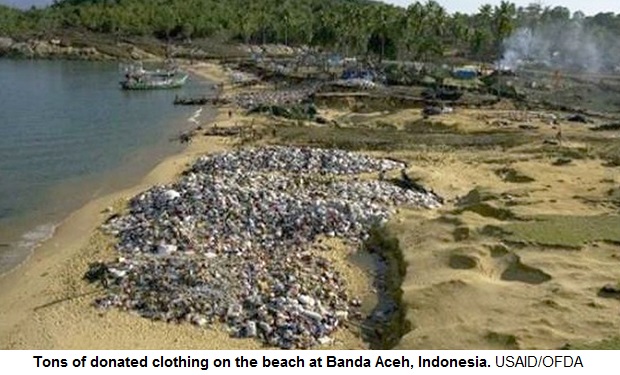
————-

Appendix – John Mellencamp – “Pink Houses” Lyrics

There’s a black man with a black cat
Livin’ in a black neighborhood
He’s got an interstate
Runnin’ through his front yard
You know he thinks that he’s got it so good
And there’s a woman in the kitchen
Cleanin’ up the evenin’ slop
And he looks at her and says, hey darlin’
I can remember when you could stop a clock

CHORUS:
Oh, but ain’t that America
For you and me
Ain’t that America
Something to see, baby
Ain’t that America
Home of the free, yeah
Little pink houses
For you and me
Oooh, yeah
For you and me

Well, there’s a young man in a t-shirt
Listenin’ to a rockin’ rollin’ station
He’s got greasy hair, greasy smile
He says, Lord this must be my destination
‘Cause they told me when I was younger
Said boy, you’re gonna be president
But just like everything else
Those old crazy dreams
Just kinda came and went

[CHORUS]

[Instrumental Interlude]

Well, there’s people and more people
What do they know, know, know
Go to work in some high rise
And vacation down at the Gulf of Mexico
Ooh, yeah
And there’s winners and there’s losers
But they ain’t no big deal
‘Cause the simple man, baby
Pays for thrills
The bills the pills that kill

[CHORUS]
Ooooh, yeah…

Source: Retrieved July 19, 2019 from: http://www.azlyrics.com/lyrics/johnmellencamp/pinkhouses.html

Share this post:
, , ,
[Top]

Commerce of the Seas – Extraction Realities

Go Lean Commentary

According to the book Go Lean…Caribbean, ‘Luck is the destination where opportunity meets preparation’ – Page 252.

Well, opportunity is awaiting the Caribbean … for mineral extraction and oil exploration.

CU Blog - Commerce of the Seas - Extraction Realities - Photo 1The book also alerts the Caribbean region that Climate Change is raging forward, with a lot of repercussions in its wake. Global warming is resulting in higher sea levels, due to the melting of the polar ice craps/icebergs. A repercussion is:

Beach erosion.

Beaches are gravely important for the American East Coast. (They are important to Caribbean communities as well). So many communities depend on beach vacation and traffic during the spring/summer months (think Spring Break and the commercial summer season of Memorial Day to Labor Day). So when oil spills or predictable storms endanger beach sand, it becomes an urgent imperative for communities to assuage the crisis, even replace the sand; consider these recent News Articles/Summaries here:

Title: Beach Erosion on the US East Coast

Extraction - Photo 2

Extraction - Photo 5

Extraction - Photo 4

1.  http://www.sun-sentinel.com/news/florida/sfl-us-has-ok-to-study-bringing-bahamas-sand-to-florida-beaches-20170102-story.html

    January 2, 2017: A possible solution for replacing sand on South Florida beaches is buying it from the Bahamas. The US federal government has now loosened rules to make this possible.

2.  https://www.scientificamerican.com/article/what-causes-beach-erosion/

    The Art-and-Science of beach management is now being challenged – “Unfortunately for beach lovers and owners of high-priced beach-front homes, coastal erosion in any form is usually a one-way trip. Man-made techniques such as beach nourishment—whereby sand is dredged from off-shore sources and deposited along otherwise vanishing beaches—may slow the process, but nothing short of global cooling or some other major geomorphic change will stop it altogether.”

3.  http://abcnews.go.com/US/deepdive/disappearing-beaches-sea-level-rise-39427567

    DISAPPEARING BEACHES – A Line in the Sand – A tragic story of a family that buys a beach house in 1982, but today, they have to abandon it because of the eroding sands, and bedrock under the house.

4.  AUDIO: http://www.npr.org/2014/09/18/348985568/a-coastal-paradise-confronts-its-watery-future

    September 18, 2014 – There is ‘Trouble in Paradise’. Beachfront communities are finding the waters rising more and more due to global warming.


——–

Title: Oil Exploration and Drilling

http://www.npr.org/2015/03/12/392383373/plans-to-explore-for-oil-offshore-worry-east-coast-residents
March 12, 2015

    March 12, 2015 – As the [US federal government] administration opens the door to offshore drilling, the oil industry is promising more jobs and less reliance on foreign oil. … Coastal towns and cities in several states are formally opposing offshore drilling and oil exploration.

——–

Everyone has a price! So if the price goes up high enough, there may be interested parties among Caribbean member-states to take the money for allowing mineral/oil extraction in their offshore vicinity. There is a need to be alarmed at such proposals, as dredging sand or drilling for oil may endanger protected reefs or other underwater marine features.

With greater demand – imagine post hurricanes – the Laws of Supply-and-Demand will mandate that the prices for extracted minerals will only increase.

It will get more and more tempting!

The movement behind the book Go Lean…Caribbean wants to add other types of economic activities to the Caribbean landscape; we urgently want to use the sea as an industrial zone. This is because the Caribbean region is badly in need of jobs. The book urges communities to empower the economic engines of the Caribbean Sea, as in mineral & oil extraction.

The region’s economic driver is tourism. Tourism and “mineral extraction or oil exploration” are incompatible activities. Thus there is the need for the cautions in this commentary. The challenge is to embrace the commerce of mineral extraction for the positives, while avoiding the negatives.

Challenge accepted!

The book Go Lean…Caribbean serves as a roadmap for the introduction and implementation of the Caribbean Union Trade Federation (CU). This would be the governmental entity for a regional Single Market that covers the land territories of the 30 member-states, and their aligning seas; (including the 1,063,000 square miles of the Caribbean Sea). The Go Lean/CU roadmap features this prime directive, as defined by these 3 statements:

  • Optimization of the economic engines to grow the regional economy to $800 Billion & create 2.2 million new jobs.
  • Establishment of a security apparatus to protect public safety and ensure the economic engines of the region, including the seas.
  • Improvement of Caribbean governance to support these engines in local governments and in the Exclusive Economic Zone, including a separation-of-powers between the member-states and CU federal agencies.

This commentary posits that there are opportunities for the Caribbean to better explore the “Commerce of the Seas”, to deploy International Maritime Organisation-compliant offshore mineral/oil extraction and dredging operations. There are so many lessons that we can learn from the Economic History of other communities and their exploitation of extraction on the high seas. This commentary previously identified a series of 4 commentaries considering the Lessons in Economic History related to “Commerce of the Seas”; this entry is a 5th entry. The full series is as follows:

  1. Commerce of the Seas – Stupidity of the Jones Act
  2. Commerce of the Seas – Book Review: ‘Sea Power’
  3. Commerce of the Seas – Shipbuilding Model of Ingalls
  4. Commerce of the Seas – Lessons from Alang (India)
  5. Commerce of the Seas – Extraction Reality

The reference to “Commerce” refers to the economic interest of the 30 member-states in the Caribbean region. There is the need for more commercial opportunities that would impact the community with job and entrepreneurial empowerments.

Mineral extraction and oil exploration could be providential! Consider these foregoing source references.

In a previous blog, Guyana prioritized oil exploration and drilling as an economic activity in their Exclusive Economic Zone…

… the oil industry/eco-system could be a dizzying ride, up and down, complete with exhilaration and anxiety, especially for communities with mono-industrial economic engines. Trinidad is once such community. Now Guyana is entering that fray.

There are other countries seeking to join these ranks: Haiti, Jamaica, and the Bahamas.

A key consideration in this commentary is the concept of Exclusive Economic Zones (EEZ). Every Caribbean nation with no immediate neighbor within the 200 miles has this exclusive territory to exploit; the previously identified blog-commentary from May 25, 2015 detailed the encyclopedic details, shown here again in Appendix A.

The EEZ is factored in for mineral extraction and oil exploration. This is both a simple and a complicated issue. There is a lot of heavy-lifting involved to balance the needs of commerce and environmental protection.

This is the guidance from the book Go Lean … Caribbean. The CU federation is designed to employ best practices for economics, security and governance. The CU/Go Lean roadmap posits that “Extractions” (Oil and minerals like Rare Earths) must be a significant tactic for the Caribbean region to elevate its society.

The implementation of the CU allows for the designation of an enlarged Exclusive Economic Zones – requiring special approval from an United Nations Tribunal – consolidating existing EEZ’s and the technocratic cooperative-administration of Extractions within that space. This vision was embedded in the Go Lean’s book’s opening Declaration of Interdependence. See the need for regional coordination and integration pronounced these sample stanzas (Page 11 – 13):

i. Whereas the earth’s climate has undeniably changed resulting in more severe tropical weather storms, it is necessary to prepare to insure the safety and security of life, property and systems of commerce in our geographical region. As nature recognizes no borders in the target of its destruction, we also must set aside border considerations in the preparation and response to these weather challenges.
v. Whereas the natural formation of our landmass and coastlines entail a large portion of waterscapes, the reality of management of our interior calls for extended oversight of the waterways between the islands. The internationally accepted 12-mile limits for national borders must be extended by International Tribunals to encompass the areas in between islands. The individual states must maintain their 12-mile borders while the sovereignty of this expanded area, the Exclusive Economic Zone, must be vested in the accedence of this Federation.
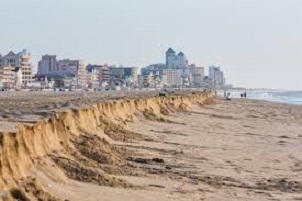
xi. Whereas all men are entitled to the benefits of good governance in a free society, “new guards” must be enacted to dissuade the emergence of incompetence, corruption, nepotism and cronyism at the peril of the people’s best interest. The Federation must guarantee the executions of a social contract between government and the governed.

xxvi. Whereas the Caribbean region must have new jobs to empower the engines of the economy and create the income sources for prosperity, and encourage the next generation to forge their dreams right at home, the Federation must therefore foster the development of new industries, like that of ship-building…. In addition, the Federation must invigorate the enterprises related to existing industries like … fisheries … – impacting the region with more jobs.

The Go Lean book provides a 370-page guide on “how” to optimize the eco-system for mineral extraction and oil exploration in an integrated Caribbean region, for the geographic area of the Caribbean Sea. This is the “Commerce of the Seas”.

The Go Lean/CU roadmap asserts that as the confederation for the region’s 30 member-states, the CU, will be the administrator of this EEZ. Step One / Day One of the roadmap calls for awarding contracts for oil exploration and other extractions in the EEZ – this is one of  the methods for financing the CU; this is how to Pay For Change.

The Go Lean roadmap details a series of community ethos, strategies, tactics, implementations and advocacies to foster development, administration and protections in the Caribbean EEZ. Consider this sample except (headlines) from the book’s Page 195:

10 Ways to Impact Extractions

Case Study: The Bottom Line on the Deepwater Horizon Oil Spill
The disaster (also referred to as the BP Oil spill or the Macondo blowout) was an oil spill in the Gulf of Mexico on the BP operated Macondo Prospect, considered the largest accidental marine oil spill in the history of the petroleum industry. Following the explosion and sinking of the Deepwater Horizon oil rig, which claimed 11 lives, a sea-floor oil gusher flowed for 87 days, until it was finally capped on 15 July 2010. The total discharge is estimated at 4.9 million barrels (210 million gallons), resulting in a massive response ensued to protect beaches, wetlands and estuaries from the spreading oil utilizing skimmer ships, floating booms, controlled burns and 1.84 million gallons of Corexit (a chemical oil dispersant). After several failed efforts to contain the flow, the well was declared sealed on 19 September 2010. Due to the months-long spill, along with adverse effects from the response and cleanup activities, extensive damage to marine and wildlife habitats, fishing and tourism industries, and human health problems have continued through this day, 2013. Three years after the spill, tar balls could still be found on the Mississippi coast. …

[See Trailer of the resultant 2016 Movie-Storytelling in the Appendix B VIDEO below.]

1

Lean-in for Caribbean Integration
The CU treaty unifies the Caribbean region into one single market of 42 million people across 30 member-states, thereby empowering the economic engines in and on behalf of the region, including many public works projects and the emergence of many new industries. The new regional jurisdiction allows for mineral extraction (mines), oil/natural gas exploration in the Exclusive Economic Zone and some federal oversight for domestic mining/drilling/extraction operations, especially where systemic threats or cross-border administration are concerned. One CU mandate is to protect tourism. This is just one of the negative side-effects to be on guard for, see Appendix ZK (Page 334) for other concerns.

2

Oil – Mitigation Plan
The concept of oil exploration is very strategic for the CU, as there are member-states that are oil producers. With energy prices so high, this is a lucrative endeavor. But there is risk, tied to the reward equation; the CU cannot endure a Deepwater Horizon-style disaster. Risk management and disaster mitigation plan must therefore be embedded into every drilling permit. The CU will oversee this governance and provide transparent oversight, accountability & reporting.

3

“Rare Earth” Rush – Minerals Priced higher than Gold (Year 2010: $1,000 a pound; $2,200 per kilogram)
There is a “rush”/quest to harvest rare earth elements. These include lanthanide elements (fifteen metallic chemical elements with atomic numbers 57 through 71, from lanthanum through lutetium) for metals that are ferromagnetic, this means their magnetism only appear at low temperatures. Rare earth magnets are made from these compounds and are ideal in many high-tech products. The CU will foster the regional exploration and extraction of these pricey materials.

4

Pipeline Strategy/Tactical Alignment

5

Emergency Response / Trauma Center
The CU accedence grants authority for federal jurisdiction on oil exploration/drilling projects. This is due to the environmental concerns, systemic threats and the strategic implications for energy security. So CU Emergency (Risk, Disaster, and Medical Trauma) Managers will audit and test shutdown, mitigation and emergency procedures annually.

6

Exclusive Economic Zone Oversight / Research and Exploration

7

State Regulated Mining – Peer Review

8

Precious Metals – Exclusive to Caribbean Dollar

9

Treasure Hunting in EEZ – CU must grant Excavation “Permits”

10

Ferries Schedule for Transport to Offshore Rigs

The CU will foster “Extractions” as an industrial alternative to tourism. We have the natural resources (in the waterscapes), the skills and the passionate work-force. We only need the Commerce of the Seas. The Caribbean people are now ready for this industrial empowerment as mineral/oil extraction is both good … and bad!

The Go Lean roadmap asserts that economic needs are undeniable and tempting. While the region sorely needs the economic empowerments, this roadmap also details the mitigations and security measures to guarantee environmental protection.

There is much at stake when communities get the Art-and-Science of mineral extraction wrong!

This commentary ends this deep, long review of the Commerce of the Seas discussion. We have considered many different industries: Tourism, Cruise Lines, Shipping-Trade, Shipbuilding, Ship-breaking and now, Extractions. That is a lot of details to get right! The optimizations of these areas are the hallmarks of a technocracy. Yes, we can … get this right!

Now is the time for all of the Caribbean, the people, business, institutions and governments, to lean-in for the technocratic deliveries of the Go Lean/CU roadmap. 🙂

Download the free e-book of Go Lean … Caribbean – now!

Sign the petition to lean-in for this roadmap for the Caribbean Union Trade Federation.

———–

Appendix A – Exclusive Economic Zone

An Exclusive Economic Zone (EEZ) is a sea zone prescribed by the United Nations Convention on the Law of the Sea over which a state has special rights regarding the exploration and use of marine resources, including energy production from water and wind.[1] It stretches from the baseline out to 200 nautical miles (nmi) from its coast. In colloquial usage, the term may include the continental shelf. The term does not include either the territorial sea or the continental shelf beyond the 200 nmi limit. The difference between the territorial sea and the exclusive economic zone is that the first confers full sovereignty over the waters, whereas the second is merely a “sovereign right” which refers to the coastal state’s rights below the surface of the sea. The surface waters, as can be seen in the map, are international waters.[2]

Generally, a state’s EEZ extends to a distance of 200 nautical miles (370 km) out from its coastal baseline. The exception to this rule occurs when EEZs would overlap; that is, state coastal baselines are less than 400 nautical miles (740 km) apart. When an overlap occurs, it is up to the states to delineate the actual maritime boundary.[3] Generally, any point within an overlapping area defaults to the nearest state.[4]

A state’s Exclusive Economic Zone starts at the landward edge of its territorial sea and extends outward to a distance of 200 nautical miles (370.4 km) from the baseline. The Exclusive Economic Zone stretches much further into sea than the territorial waters, which end at 12 nmi (22 km) from the coastal baseline (if following the rules set out in the UN Convention on the Law of the Sea).[5] Thus, the EEZ includes the contiguous zone. States also have rights to the seabed of what is called the continental shelf up to 350 nautical miles (648 km) from the coastal baseline, beyond the EEZ, but such areas are not part of their EEZ. The legal definition of the continental shelf does not directly correspond to the geological meaning of the term, as it also includes the continental rise and slope, and the entire seabed within the EEZ.

The following is a list of the largest Exclusive Economic Zones; by country with a few noticeable deviations:

Country EEZ Kilometers2 Additional Details
United States 11,351,000 The American EEZ – the world’s largest – includes the Caribbean overseas territories of Puerto Rico and the US Virgin Islands.
France 11,035,000 The French EEZ includes the Caribbean overseas territories of Guadeloupe, Martinique, Saint Martin, Saint Barthélemy and French Guiana.
Australia 8,505,348 Australia has the third largest exclusive economic zone, behind the United States and France, with the total area actually exceeding that of its land territory. Per the UN convention, Australia’s EEZ generally extends 200 nautical miles (370 km) from the coastline of Australia and its external territories, except where a maritime delimitation agreement exists with another state.[15]The United Nations Commission on the Limits of the Continental Shelf confirmed, in April 2008, Australia’s rights over an additional 2.5 million square kilometres of seabed beyond the limits of Australia’s EEZ.[16][17] Australia also claimed, in its submission to the UN Commission on the Limits of the Continental Shelf, additional Continental Shelf past its EEZ from the Australian Antarctic Territory,[18] but these claims were deferred on Australia’s request. However, Australia’s EEZ from its Antarctic Territory is approximately 2 million square kilometres.[17]
Russia 7,566,673
United Kingdom 6,805,586 The UK includes the Caribbean territories of Anguilla, Bermuda, Cayman Islands, Montserrat, Turks & Caicos and the British Virgin Islands.
Indonesia 6,159,032
Canada 5,599,077 Canada is unusual in that its EEZ, covering 2,755,564 km2, is slightly smaller than its territorial waters.[20] The latter generally extend only 12 nautical miles from the shore, but also include inland marine waters such as Hudson Bay (about 300 nautical miles (560 km; 350 mi) across), the Gulf of Saint Lawrence and the internal waters of the Arctic archipelago.
Japan 4,479,388 In addition to Japan’s recognized EEZ, it also has a joint regime with Republic of (South) Korea and has disputes over other territories it claims but are in dispute with all its Asian neighbors (Russia, Republic of Korea and China).
New Zealand 4,083,744
Chile 3,681,989
Brazil 3,660,955 In 2004, the country submitted its claims to the United Nations Commission on the Limits of the Continental Shelf (CLCS) to extend its maritime continental margin.[19]
Mexico 3,269,386 Mexico’s EEZ comprises half of the Gulf of Mexico, with the other half claimed by the US.[32]
Micronesia 2,996,419 The Federated States of Micronesia comprise around 607 islands (a combined land area of approximately 702 km2 or 271 sq mi) that cover a longitudinal distance of almost 2,700 km (1,678 mi) just north of the equator. They lie northeast of New Guinea, south of Guam and the Marianas, west of Nauru and the Marshall Islands, east of Palau and the Philippines, about 2,900 km (1,802 mi) north of eastern Australia and some 4,000 km (2,485 mi) southwest of the main islands of Hawaii. While the FSM’s total land area is quite small, its EEZ occupies more than 2,900,000 km2 (1,000,000 sq mi) of the Pacific Ocean.
Denmark 2,551,238 The Kingdom of Denmark includes the autonomous province of Greenland and the self-governing province of the Faroe Islands. The EEZs of the latter two do not form part of the EEZ of the European Union. See Photo 4.
Papua New Guinea 2,402,288
China 2,287,969
Marshall Islands 1,990,530 The Republic of the Marshall Islands is an island country located near the equator in the Pacific Ocean, slightly west of the International Date Line. Geographically, the country is part of the larger island group of Micronesia. The country’s population of 68,480 people is spread out over 24 coral atolls, comprising 1,156 individual islands and islets. The land mass amounts to 181 km2 (70 sq mi) but the EEZ is 1,990,000 km2, one of the world’s largest.
Portugal 1,727,408 Portugal has the 10th largest EEZ in the world. Presently, it is divided in three non-contiguous sub-zones:

Portugal submitted a claim to extend its jurisdiction over additional 2.15 million square kilometers of the neighboring continental shelf in May 2009,[44] resulting in an area with a total of more than 3,877,408 km2. The submission, as well as a detailed map, can be found in the Task Group for the extension of the Continental Shelf website.

Spain disputes the EEZ’s southern border, maintaining that it should be drawn halfway between Madeira and the Canary Islands. But Portugal exercises sovereignty over the SavageIslands, a small archipelago north of the Canaries, claiming an EEZ border further south. Spain objects, arguing that the SavageIslands do not have a separate continental shelf,[45] citing article 121 of the United Nations Convention on the Law of the Sea.[46] <<< See Photo 6 >>>

Philippines 1,590,780 The Philippines’ EEZ covers 2,265,684 (135,783) km2[41]. See Photo 5.
Solomon Islands 1,589,477
South Africa 1,535,538
Fiji 1,282,978 Fiji is an archipelago of more than 332 islands, of which 110 are permanently inhabited, and more than 500 islets, amounting to a total land area of about 18,300 square kilometres (7,100 sq mi).
Argentina 1,159,063
Spain 1,039,233
Bahamas 654,715
Cuba 350,751
Jamaica 258,137
Dominican Republic 255,898
Barbados 186,898
Netherlands 154,011 The Kingdom of the Netherlands include the Antilles islands of Aruba. Bonaire, Curacao, Saba, Sint Maarten and Sint Eustatius
Guyana 137,765
Suriname 127,772
Haiti 126,760
Antigua and Barbuda 110,089
Trinidad and Tobago 74,199
St Vincent and the Grenadines 36,302
Belize 35,351
Dominica 28,985
Grenada 27,426
Saint Lucia 15,617
Saint Kitts and Nevis 9,974

(Source: Retrieved May 25, 2017 from: http://en.wikipedia.org/wiki/Exclusive_economic_zone)

———–

Appendix B VIDEO – Deepwater Horizon (2016) Official Movie Trailer – ‘Heroes’ – https://youtu.be/S-UPJyEHmM0

Published on May 26, 2016 – Deepwater Horizon – Now Playing.
#DeepwaterHorizonMovie

CU Blog - Commerce of the Seas - Extraction Realities - Photo 6

Share this post:
, ,
[Top]