Category: Planning

Local Miami Haitian leaders protest Bahamian immigration policy

Go Lean Commentary

“Why’s everybody always pickin’ on me?” – The Coasters – Charlie Brown Song; (see Appendix A).

It would seem that Haitians all around the world can sing the chorus to this above song. The history of Haiti is frequented with hardships in their own country and they have understandingly pursued a better life abroad. However, the Haitian Diaspora have also experienced oppression, discrimination and exclusionary treatment abroad and have had to endure a “hard welcome” in most foreign countries.

The book Go Lean…Caribbean serves as a roadmap for elevating Caribbean society, for all 30 member-states, including Haiti. As such there are direct references in the book regarding Haiti’s historicity; (Pages 238 & 306).

In addition to history, Haiti also has a different geography compared to most Caribbean nations. They share the same island with the Dominican Republic. The oppression, discrimination and exclusionary treatment of Haitians started on that island. Over the years, the governmental administrations of the Dominican Republic have favored “white” immigrant refugees over other races; Dominican troops often forcibly expelled illegal Haitians. Most notably, the 1937 Parsley Massacre of Haitian immigrants, a government-sponsored genocide in October 1937, at the direct order of then President Rafael Trujillo. He ordered the execution of the Haitian population living in the borderlands. The violence resulted in the killing of 20,000 ethnic Haitian civilians during approximately five days. (See Appendix B for additional historic references and inferences).

The US and other countries in the Caribbean neighborhood have also been harsh in their treatment of Haitian refugees. Consider this story of a conflict with the Bahamas, and the protests from the Haitian Diaspora in Miami:

1. News Article Title: Local Miami Haitian leaders protest Bahamian immigration policy
http://www.wsvn.com/story/27344225/local-haitian-leaders-protest-bahamian-immigration-policy – Posted: November 10, 2014

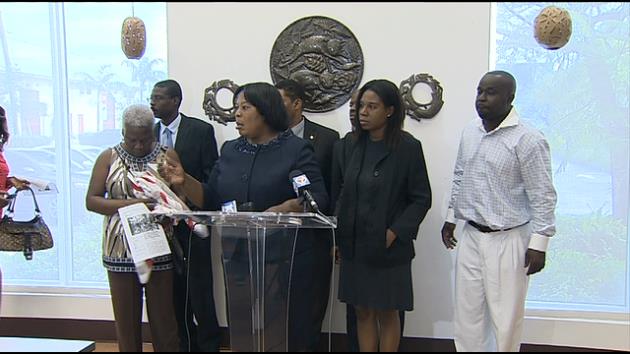
Miami Haitian Protesters 1

MIAMI (WSVN) — Local leaders are stepping up to stop a deportation dilemma regarding an immigration policy.

The policy forces families of Haitian descent out of the Bahamas.

Florida State Representative Daphne Campbell spoke out on the issue at a press conference in Little Haiti Monday morning. “I’m asking all, all cruises and all tourists, to make sure every industry boycotts the Bahamas to end discrimination against Haitian children,” Campbell stated. “Boycott Bahamas! Boycott Bahamas! Boycott Bahamas!”

Activists are now asking for the public’s support in helping to protect the future of Haitian families.
————

Video: WSVN Newscast – http://www.wsvn.com/story/27344225/local-haitian-leaders-protest-bahamian-immigration-policy?autoStart=true&topVideoCatNo=default&clipId=10832494
Though the leader of the accusing team has her detractors/problems, (South Florida state Rep. Daphne Campbell faces IRS investigation and she is already facing a Florida Medicaid fraud probe), the subject of her accusation may still have merit. What are the facts of the case regarding Haitian children in the Bahamas?

The Bahamas does not automatically grant citizenship to people born of foreign parentage in its homeland. There are special provisos even if one parent is a Bahamian citizen; many details of which are gender-biased. (There were attempts to correct these provisos in Parliament this past year, but this legislative reform was stalled).

This citizenship criteria is not standard … compared to the US, Canada, and most western European countries. Ironic as these countries are also the source of most tourists visiting the Bahamas, the #1 economic driver for the country. So any traction in this Boycott Bahamas campaign can potentially have a negative impact – remember “Boycott Apartheid in South Africa”.

What’s worse, the Universal Declaration of Human Rights or UDHR (as related in Go Lean book Page 220) have specific prohibitions against national governments enforcing laws that effectuate discrimination against minority groups.

(The UDHR was adopted by the United Nations General Assembly in 1948, partly in response to the atrocities of World War II, composed by a committee led by former American First Lady Eleanor Roosevelt. Although the UDHR was a non-binding resolution, it is now considered by some to have acquired the force of international customary law which may be invoked in appropriate circumstances by national and other judiciaries. The UDHR urges member nations to promote a number of human, civil, economic and social rights, asserting these rights as part of the “foundation of freedom, justice and peace in the world”).

This means you Bahamas! Are you ready to receive the onslaught of darts from the international community? Economic sanctions, formal or informal, are debilitating!

This is not just a Haitian -versus- Bahamian issue. The same immigration-border-encroaching issues are trending with the US, Dominican Republic and Puerto Rico. This following news article relates this controversy:

2. Title: Haitian Illegal Immigration Through Puerto Rico Is Skyrocketing Too  – http://news.yahoo.com/haitian-illegal-immigration-puerto-rico-skyrocketing-too-021611125.html;_ylt=AwrBJR6DB9dTyzoAHyzQtDMD – Posted: July 26, 2014

Haitians to PRWhile U.S. immigration agencies grapple with a recent surge of tens of thousands of illegal immigrants at the Mexican border, the number of Haitians trying to enter the U.S. illegally through Puerto Rico has skyrocketed as well.

In 2011, only 12 Haitians made the trek through the Dominican Republic to Puerto Rico, a U.S. territory in the Caribbean Sea. That number had ballooned to 1,760 as of last year, according to U.S. Coast Guard statistics, CBS News reports.

“That’s new, and that’s something we’re trying to target,” Capt. Mark Fedor, the Coast Guard’s chief of response for the Southeast and Caribbean, told CBS.

“Organized smugglers in the Dominican Republic are advertising their services to Haitians and saying, ‘We’ll smuggle you through the Dominican Republic, put you on a boat to Puerto Rico or to one of the islands in the Mona Pass – a much shorter journey and we can get you to the United States that way.’ And I think people are responding to that,” he said.

The Dominican smugglers often drop their Haitian charges off at Mona Island, an uninhabited Puerto Rican island 40 miles off of the Dominican coast in the Mona Pass.

“As soon as you’re in Puerto Rico, it’s like you’re in the United States,” Lolo Sterne, coordinator for Haiti’s Office of Migration, told the Associated Press last year.

Once in Puerto Rico, the illegal Haitian immigrants are able to fly to destinations in the U.S. without having to show a passport. All they need is a driver’s license, according to the Associated Press.

The new route through the Mona Pass is seen as more desirable as the U.S. Coast Guard has increased patrols of normal routes taken by immigrants from Haiti and the Dominican Republic. As the AP points out, it has become more difficult to travel directly to the U.S. mainland or through Miami, which has historically served as the choice destination for illegal immigrants from the Caribbean.

Haiti and its 9+ million residents need change. In fact, all of the Caribbean’s 42 million people need change/empowerment.

The purpose of the Go Lean roadmap is to turn-around the downward trends in the Caribbean today, to reverse course and elevate society in the Caribbean as a whole and Haiti in particular. The CU, applying best-practices for community empowerment has these 3 prime directives, pronounced as follows:

  • Optimization of the economic engines in order to grow the regional economy to $800 Billion & create 2.2 million new jobs.
  • Establishment of a security apparatus to protect the resultant economic engines.
  • Improve Caribbean governance, with consideration for minority equalization, to support these engines.

How exactly can the CU impact Haiti to reboot that failing state? The answer can be found in the history of post-war Europe, where the Marshall Plan was instrumental in rebooting that continent. The book Go Lean…Caribbean details a Marshall Plan-like roadmap for Haiti, and all other failing Caribbean institutions.

The related subjects of economic, security and governing dysfunction among European and Caribbean member-states have been a frequent topic for blogging by the Go Lean promoters, as sampled here:

https://goleancaribbean.com/blog/?p=2809 A Lesson in History: Economics of East Berlin
https://goleancaribbean.com/blog/?p=2480 A Lesson in History: Community Ethos of WW II
https://goleancaribbean.com/blog/?p=2330 ‘Raul Castro reforms not enough’, Cuba’s bishops say
https://goleancaribbean.com/blog/?p=1531 A Lesson in History: 100 Years Ago Today – World War I
https://goleancaribbean.com/blog/?p=1433 Caribbean loses over 70% of tertiary educated citizens to the brain drain
https://goleancaribbean.com/blog/?p=1014 All is not well in the sunny Caribbean
https://goleancaribbean.com/blog/?p=623 Only at the precipice, do they change
https://goleancaribbean.com/blog/?p=599 Ailing Puerto Rico open to radical economic fixes
https://goleancaribbean.com/blog/?p=451 CariCom Chairman to deliver address on slavery/colonization reparations

The goal of the Go Lean roadmap is simple: to make Haiti (and by extension the rest of the Caribbean) a better place to live, work and play so that citizens would not feel compelled to risk life-and-limb to flee for foreign shores. The goal extends further in the mission to reverse course and encourage the repatriation of the Haitian/Caribbean Diaspora. To accomplish these goals, the book details a series of community ethos, strategies, tactics, implementations and advocacies to empower all the factions of Haitian life in the Caribbean region and in the Diaspora:

Community Ethos – Economic Systems Influence Choices & Incentives Page 21
Community Ethos – Consequences of Choices Lie in the Future Page 21
Community Ethos – Anti-Bullying and Mitigation Page 23
Community Ethos – Minority Equalization Page 24
Community Ethos – Ways to Impact the Future Page 26
Community Ethos – Ways to Manage Reconciliations Page 34
Community Ethos – Ways to Impact the Greater Good Page 37
Strategy – Vision –  Integrate region into a Single Market Economy Page 45
Strategy – Agents of Change – Globalization Page 57
Tactical – Separation of Powers – Department of Homeland Security Page 75
Implementation – Ways to Foster International Aid Page 115
Planning – 10 Big Ideas … for the Caribbean Region – Haiti & Cuba Page 127
Planning – Ways to Ways to Model the EU Page 130
Planning – Reasons Why the CU Will Succeed – Germany Reconciliation Model Page 132
Planning – Ways to Improve Failed-State Indices – Haiti – first on the region list Page 134
Planning – Lessons from East Germany – European post-war rebuilding Page 139
Planning – Lessons from Canada’s History Page 146
Advocacy – Ways to Grow the Economy Page 151
Advocacy – Ways to Create Jobs Page 152
Advocacy – Ways to Foster Empowering Immigration Page 174
Advocacy – Ways to Impact Justice Page 178
Advocacy – Ways to Enhance Tourism Page 187
Advocacy – Ways to Impact the Diaspora – Haitians in Miami Page 217
Advocacy – Ways to Protect Human Rights Page 220
Advocacy – Ways to Help Women Page 226
Advocacy – Ways to Impact Youth Page 227
Advocacy – Ways to Impact the Dominican Republic Page 237
Advocacy – Ways to Re-boot Haiti Page 238
Advocacy – Ways to Impact US Territories Page 244
Appendix – Dominican Republic – Rafael Trujillo Regime Page 306

The conclusion of the Go Lean book relates the experiences and motivations of the US Supreme Court for the 1954 landmark decision Brown versus Board of Education. The unanimous wisdom of the 9 Justices on the Court should not be ignored, it was strewn from the experiences of modern society waging two world wars; they saw the rampage, devastation of 60 million deaths around the world and appreciated the wisdom that a downtrodden people would not stay down, that they would rise and revolt, that they would risk their lives and that of their children to pursue freedom.

How impactful is the Haitian Diaspora in the Bahamas? With a total national population of 320,000 and one estimate (July 2013) of 50,000 Haitian and/or Haitian-Bahamians, there is an imminent wave of dissent for the Bahamas to contend with. Don’t wait Bahamas, deal with your domestic issues now! Learn from the experiences of your neighbors, as depicted in the Go Lean book:

US: Lessons from the US Constitution (Page 145)
Canada: Reconciliation with First Nations (Page 146)
Guyana: Indo-Guyanese versus Afro-Guyanese (Page 174)
Trinidad: Indo-Trinidadians versus Afro-Trinidadians (Page 240)

Now is the time for all of the Caribbean to learn the lessons from [economic] history of other successful (US & Canada) and unsuccessful societies. The Go Lean book posits that the Caribbean is in a serious crisis, but asserts that this crisis would be a terrible thing to waste. The people and governing institutions of the Bahamas, Haiti and the region as a whole are hereby urged to lean-in for the empowerments described in the book Go Lean … Caribbean. This is a big deal for the region, we can all strive to make our Caribbean homeland a better place to live, work, and play.

Download the free e-book of Go Lean … Caribbean – now!

———–

Appendix A – The song: Charlie Brown by The Coasters – http://youtu.be/_UnPzp2lmNk

———–

Appendix B – Homework for additional credit: better understand the history of Haiti and its consequential impact on the world.

Video Title: Black In Latin America (Episode 1): Haiti and The Dominican Republic- The Roots of Division

This scholarly work was produced and narrated by noted Professor Henry Louis Gates. This was part of a series developed for the Public Broadcasting System (PBS) , a network of public TV stations in the US. The other features in the series, include:

Black In Latin America (Episode 2): Cuba: The Next Revolution
Black In Latin America (Episode 3): Brazil: A Racial Paradise?
Black In Latin America (Episode 4): Mexico & Peru: The Black Grandma in the Closet

 

Share this post:
, , , ,

A Lesson in History – Economics of East Berlin

Go Lean Commentary

The book Go Lean…Caribbean serves as a roadmap for elevating Caribbean society; the book posits that the history of East Germany is a tutorial to the Caribbean effort. As such there are direct references in the book of the failed Communist State (Pages 132 & 139).

On this date 25 years ago, the “walls came tumbling down”, quickening the reunification of the nations of West Germany and East Germany. That is the headline, but beneath the surface, the German Democratic Republic (GDR or East Germany) was also rife with some other ugly truths.

In summary, the City of “East” Berlin was a maximum security prison in the heart of Europe. (This refers to City of East Berlin, not the whole country of East Germany).

Title: 25 Years Ago – The Berlin Wall Crumbled

CU Blog - A Lesson in History - Economics of East Berlin - Photo 1On the night of November 9, 1989, the Berlin Wall came down. East German authorities opened the border between East and West Berlin and the door to the fall of tyranny.

The wall went up in the early morning darkness of August 13, 1961, to keep millions of people from fleeing communist East Germany after World War II. It fell as suddenly as it had been built. For 28 years, Germany was a country divided not only by ideology but by stone, barbed wire and deadly force. The Berlin Wall — die Mauer — stood as a testament to the eternal struggle between open and closed societies. For all its might, the wall could not stop the free flow of news into East Berlin.

The West side of the wall became a stage for politicians and a canvas for artists. The East side grew grimmer, as social and economic problems worsened. In the end, people rose in protest. When the wall finally crumbled, there was dancing and celebration. But the wall’s toll could not be forgotten: Nearly 200 people died trying to escape; more than 30,000 political prisoners were jailed.

Today, the fallen wall is a memorial to their sacrifice, one of the world’s great symbols of the victory of freedom over oppression. The eight, 12-foot-high segments of the Berlin Wall in the Newseum’s Berlin Wall Gallery weigh 2.5 tons each and came from throughout Berlin. The Newseum acquired the pieces in 1993, along with the three-story East German guard tower that stood near Checkpoint Charlie.

Newseum Institute – Archives and Exhibit of News Artifacts
http://www.newseum.org/2014/11/06/25-years-ago-the-berlin-wall-crumbled/

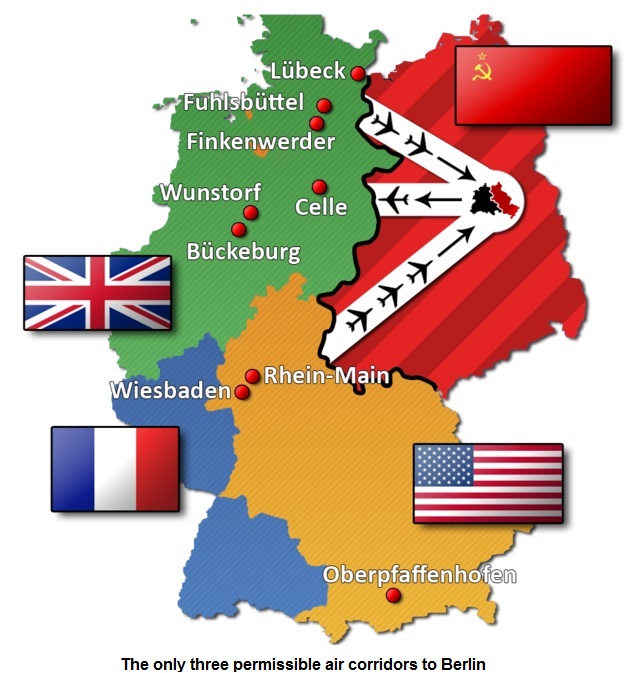
CU Blog - A Lesson in History - Economics of East Berlin - Photo 2This is more than just dry history. No, this is a lesson plan for the Caribbean empowerment effort. That effort is part-and-parcel of the Go Lean…Caribbean movement, this refers to the book and accompanying blog/commentaries. The book posits that the experiences of East Germany and the reunification with the Federal Republic of Germany (FRG or West Germany) provide a fitting example for the Caribbean people and institutions. What most people in the Caribbean may not realize, due to the far distance of a continent away, is that the national border for West and East Germany did not traverse through the City of Berlin, but rather 100 miles to the west of Berlin; (see map here). So the City of Berlin stood as an “island” within the country of East Germany, with that island itself split into West and East territories. (This is so similar to many Caribbean locales). The Western portion of Berlin belonged to West Germany; the residents had travel access via “air bridge” to other ports in the Federal Republic of Germany, while East Berliners were restricted – imprisoned in their own country, despite committing no offenses. This is classic human rights violation.

East Berlin, and by extension East Germany was a definitive Failed-State.

This audio-podcast here relates a practice of East Germany selling prisoners to the West for hard currency, so as to remediate the government’s economic deficiencies:

Video: Public Radio International East Germany Prisoner Ransom … http://youtu.be/FjozYlAlMew

The narratives described in this audio-podcast constitutes state-sponsored human trafficking.

This is abominable!

The German Reunification was not a merger, rather it was a repossession. East Germany was at the precipice of a Failed-State. The Caribbean today is at a similar precipice of dysfunction. This status is not due to the failure of communism (though one Caribbean member-state – Cuba – does feature a failed communist society), but rather the global financial crisis. Cuba also parallels East Germany with a human trafficking crisis; many citizens are desperate to leave the island and families pay huge “ransoms” to extract them.

The review of the historic events of this day regarding the Berlin Wall 25 years ago is more than just an academic discussion, the book Go Lean…Caribbean aspires to economic principles that dictate that “consequences of choices lie in the future”. The book serves as a roadmap for the introduction and implementation of the technocratic Caribbean Union Trade Federation (CU). The people of the Caribbean may not know the intimate details of East Germany, but we do understand societal decline and dysfunction all too well.

What have we learned from the East/West Germany experiences? How will those lessons help us today?

  • Brain Drain is unrecoverable – East Germany learned quickly that they had to keep their talented citizens by any means necessary, and thus the wall. The CU/Go Lean roadmap places priority on the atmosphere for the Caribbean talent to want to stay in the homeland and for the Diaspora to repatriate..
  • Most valuable resource – East German sold their human resources to the West; (over 300,000 people according to the above audio-podcast/VIDEO). This was their best marketable resource. The Go Lean roadmap posits that one person can make a difference and impact the economic engines in the fields of endeavor. Rather than one, the CU/Go Lean effort strives to foster the masses for their collective and individual contributions.
  • Promote opportunities for the Pursuit of Happiness – People in the West were NOT trying to sneak into the East. Basic needs were not fully satisfied there, so higher level needs were rarely pursued. The Go Lean roadmap posits that when the basic needs are in place, only then can the pursuit of happiness be tackled.
  • Consider the Greater Good – Complying with this Greater Good principle would have prevented a lot of the conflict during the 28-year East-West segregation. This philosophy is directly quoted in the book as: “it is the greatest good to the greatest number of people which is the measure of right and wrong”. The CU/Go Lean roadmap calls for a number of measures that strike directly at the Greater Good mandate: accountable justice institutions, economic empowerment for rich and poor, strategic education initiatives, proactive health/wellness, etc.
  • Quit on “failed” policies  – With the Soviet Union and Eastern European trading partners collapsing, the East German currency, the Mark, had become worthless outside of the GDR, creating the acute need to merge the two German economies. The GDR did not try to prop up the failing currency beyond 1989, instead they transferred its financial & monetary policy to the stewards of the stronger West Germany currency. The Go Lean roadmap will employ a technocratic Caribbean Central Bank and Caribbean Dollar so as to shore up the currency and economic engines in the region.
  • Negotiating as partners not competitors – Considering the German reunification models, consolidating millions of people with divergent politics and cultures into one Federation requires toleration and adjustments by all stakeholders. Success is possible only when all sides are willing to negotiate as partners not competitors. The CU requires negotiations and treaty considerations for economics, security and governing solutions. So the Go Lean roadmap adopts negotiations as a community ethos.
  • Reconciliation of issues is not optional, more conflict will emerge otherwise – There was loss of life and many human rights abuses in the history of the East-West schism, and there must be accountability. The CU plans for Truth & Reconciliation Commissions for dealing with a lot of latent issues in the last Caribbean century (i.e. Cuba, Haiti, Dominican Republic, etc).

The related subjects of economic, security and governing dysfunction have been a frequent topic for blogging by the Go Lean promoters, as sampled here:

https://goleancaribbean.com/blog/?p=2585 A Lesson in History: Concorde SST
https://goleancaribbean.com/blog/?p=2480 A Lesson in History: Community Ethos of WW II
https://goleancaribbean.com/blog/?p=2359 CariCom calls for innovative ideas to finance SIDS development
https://goleancaribbean.com/blog/?p=2330 ‘Raul Castro reforms not enough’, Cuba’s bishops say
https://goleancaribbean.com/blog/?p=2297 A Lesson in History: Booker T versus Du Bois
https://goleancaribbean.com/blog/?p=1531 A Lesson in History: 100 Years Ago Today – World War I
https://goleancaribbean.com/blog/?p=1433 Caribbean loses over 70% of tertiary educated citizens to the brain drain
https://goleancaribbean.com/blog/?p=1309 5 Steps of a Bubble – Learning from the past and mitigating negatives
https://goleancaribbean.com/blog/?p=1014 All is not well in the sunny Caribbean
https://goleancaribbean.com/blog/?p=816 The Future of Caribbean Integration and CariCom
https://goleancaribbean.com/blog/?p=782 Open the Time Capsule: The Great Recession of 2008
https://goleancaribbean.com/blog/?p=623 Only at the precipice, do they change
https://goleancaribbean.com/blog/?p=599 Ailing Puerto Rico open to radical economic fixes
https://goleancaribbean.com/blog/?p=451 CariCom Chairman to deliver address on slavery/colonization reparations
https://goleancaribbean.com/blog/?p=353 Book Review: ‘Wrong – Nine Economic Policy Disasters and What We Can Learn…’

The purpose of the Go Lean roadmap is to turn-around the downward trends in the Caribbean today, to reverse course and elevate Caribbean society. This CU/Go Lean roadmap, applying lessons from the last 25 years of German history, has developed these prime directives, pronounced as follows:

  • Optimization of the economic engines in order to grow the regional economy to $800 Billion & create 2.2 million new jobs.
  • Establishment of a security apparatus to protect the resultant economic engines.
  • Improve Caribbean governance to support these engines.

The Go Lean book details a series of assessments, community ethos, strategies, tactics, implementations and advocacies to empower all the factions in the Caribbean region:

Community Ethos – Economic Systems Influence Choices & Incentives Page 21
Community Ethos – Consequences of Choices Lie in the Future Page 21
Community Ethos – Money Multiplier – Control of Local/Regional Currency Page 22
Community Ethos – Anti-Bullying and Mitigation Page 23
Community Ethos – Intelligence Gathering Page 23
Community Ethos – “Crap” Happens Page 23
Community Ethos – Minority Equalization Page 24
Community Ethos – Ways to Impact the Future Page 26
Community Ethos – Ways to Improve Negotiations Page 32
Community Ethos – Ways to Manage Reconciliations Page 34
Community Ethos – Ways to Improve Sharing Page 35
Community Ethos – Ways to Promote Happiness Page 36
Community Ethos – Ways to Impact the Greater Good Page 37
Strategy – Vision –  Integrate Region into a Single Market Economy Page 45
Strategy – Agents of Change – Globalization Page 57
Tactical – Separation of Powers – Department of Homeland Security Page 75
Implementation – Assemble Existing Super-national Institutions Page 96
Implementation – Ways to Pay for Change Page 101
Implementation – Foreign Policy Initiatives at Start-up Page 102
Implementation – Security Initiatives at Start-up Page 103
Implementation – Ways to Deliver Page 109
Planning – Ways to Ways to Model the EU Page 130
Planning – Ways to Make the Caribbean Better Page 131
Planning – Reasons Why the CU Will Succeed – Germany Reunification Model Page 132
Planning – Ways to Improve Failed-State Indices Page 134
Planning – Lessons from East Germany Page 139
Advocacy – Ways to Grow the Economy Page 151
Advocacy – Ways to Create Jobs Page 152
Advocacy – Ways to Better Manage the Social Contract Page 170
Advocacy – Ways to Foster Cooperatives Page 176
Advocacy – Ways to Impact Justice Page 177
Advocacy – Ways to Improve Homeland Security Page 180
Advocacy – Ways to Improve Intelligence Gathering and Analysis Page 182
Advocacy – Ways to Protect Human Rights Page 220

1989 was pivotal in the history of modern Germany. Today the unified country is the Number One Economy in Europe and a role model for the Caribbean.

Now is the time for all of the Caribbean to learn the lessons from East Germany’s failed economy. The book Go Lean … Caribbean posits that the Caribbean is in a serious crisis, but asserts that this crisis would be a terrible thing to waste. The people and governing institutions of the region are hereby urged to lean-in for the empowerments described in the book Go Lean … Caribbean. This is a big deal for the region, the same way 1989 was a big year for Germany. While “impacting Germany” is out-of-scope for this CU roadmap, applying effective turn-around strategies (as in emerging from communism in Cuba) and elevating the Caribbean neighborhood is realistic and plausible. We can make our Caribbean homeland a better place to live, work, and play. 🙂

Download the book Go Lean … Caribbean – now!

Share this post:
, , , ,
[Top]

A Lesson in History – Booker T versus Du Bois

Go Lean Commentary

2008 was a big year …

… in the history of mankind, the United States of America and the lessons learned for application in the Caribbean. This has been a familiar theme for the publishers of the book Go Lean…Caribbean; this theme has been exhausted in the book (Page 136) and in countless blog/commentaries (see list below). 2008 was only 6 years ago; that is considered recent; how inspiring could the lessons be with just a 6-year look-back? In answering, there is the need to go back even further, not to 2008, but back to the America of 1908, even more exacting to 1901; (the year Booker T. Washington was invited to the White House).

This was the strong point made by one of the key players in American history for 2008: John McCain, the Republican Nominee for US President against the eventual winner Barack Obama. In his concession speech on November 4, 2008, he painted a (word) picture of a landscape of America transcending over the past 100 years.

See the VIDEO here, now:

Video: John McCain 2008 Concession Speech
https://www.youtube.com/watch?v=bss6lTP8BJ8


A comment on this VIDEO in February 2014 truly capsulated the significance of this speech:

“One the most gracious and powerful speeches ever made. It deserves to go into the pantheon of great orations made by the likes of Winston Churchill, Martin Luther King, Jawaharlal Nehru and others” – Ravi Rajagopalan.

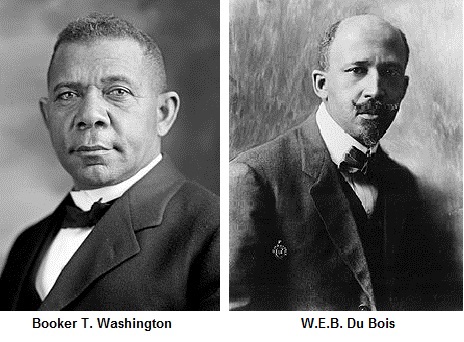
CU Blog - A Lesson in History - Booker T versus DuBois - Photo CombinedThe transcript from this video gives us the platform for the deep appreciation for our lesson in history: Booker T. Washington versus W.E.B. Du Bois. (See Appendix below).

Both men were very important in the history of civil rights for African-Americans. They both wanted the same elevation of their community in American society, but they both had different strategies, tactics and implementations.

Washington’s biggest legacy is the Tuskegee University (Tuskegee Institute in his day). Du Bois’s legacy stems from his co-founding the NAACP (National Association for the Advancement of Colored People).

The conclusion from the above VIDEO, as stated by John McCain is that the journey for full citizenship for African-Americans took 100 years from the time of the Washington / Du Bois chasm. No matter the detailed approach, 100 years is still 100 years.

From the point of view of the Caribbean and the publishers of Go Lean…Caribbean, we side with both civil rights leaders in aspirations, but lean towards Booker T. Washington in strategies. Underlying to Mr. Washington’s advocacy, was for the Black Man to remain in the South, find a way to reconcile with his White neighbors and to prosper where he was planted.

The Caribbean has the same conundrum! Rather than fleeing our southern homes for northern opportunities, we advocate reconciling our conflicts, and managing the crises in our region so as to work out an effective future for all Caribbean people today, and tomorrow for our youth. (We also advocate a reconciliation of the past).

The book Go Lean…Caribbean serves as a roadmap for the introduction and implementation of the Caribbean Union Trade Federation (CU); an initiative to bring change, empowerment, to the Caribbean region; to make the region a better place to live, work and play. This Go Lean roadmap also has these 3 prime directives:

  • Optimization of the economic engines in order to grow the regional economy to $800 Billion & create 2.2 million new jobs.
  • Establishment of a security apparatus to protect the resultant economic engines.
  • Improve Caribbean governance to support these engines.

The book describes the CU as a technocratic administration with 144 different missions to elevate the Caribbean homeland. The underlying goal is stated early in the book with this pronouncement in the opening Declaration of Interdependence (Page 12):

xii. Whereas the legacy in recent times in individual states may be that of ineffectual governance with no redress to higher authority, the accedence of this Federation will ensure accountability and escalation of the human and civil rights of the people for good governance, justice assurances, due process and the rule of law…

Change has come to the Caribbean. But as depicted in the foregoing VIDEO, we will not have to wait 100 years, we will effectuate this change now. The Go Lean book declares that for permanent change to take place, there must first be an adoption of new community ethos, the national spirit that drives the character and identity of its people. This is what was missing in 1908 Black America. This point of community ethos is therefore our biggest lesson in the consideration of this history.

The Go Lean roadmap was constructed with these additional community ethos in mind, plus the execution of strategies, tactics, implementation and advocacies to forge the identified permanent change in the region. The following is a sample of these specific details from the book:

Community Ethos – Deferred Gratification Page 21
Community Ethos – Economic Principles – People Choose Page 21
Community Ethos – Economic Principles – All Choices Involve Costs Page 21
Community Ethos – Economic Principles – People Respond to Incentives in Predictable Ways Page 21
Community Ethos – Economic Principles – Economic Systems Influence Individual Choices Page 21
Community Ethos – Economic Principles – The Consequences of Choices Lie in the Future Page 21
Community Ethos – Security Principles – Anti-Bullying and Mitigation Page 23
Community Ethos – Governing Principles – Minority Equalization Page 24
Community Ethos – Governing Principles – Lean Operations Page 24
Community Ethos – Ways to Impact the Future Page 26
Community Ethos – Ways to Foster Genius Page 27
Community Ethos – Ways to Help Entrepreneurship Page 28
Community Ethos – Ways to Promote Intellectual Property Page 29
Community Ethos – Ways to Impact Research & Development Page 30
Community Ethos – Ways to Manage Reconciliations Page 34
Community Ethos – Ways to Improve Sharing Page 35
Community Ethos – Ways to Promote Happiness Page 36
Community Ethos – Ways to Impact the Greater Good Page 37
Anecdote – LCD versus an Entrepreneurial Ethos Page 39
Strategy – Vision – Confederation   of the 30 Caribbean Member-States into a Single Market Page 45
Strategy – Mission – Celebrate the Music, Sports, Art, People and Culture of the Caribbean Page 46
Tactical – Confederating a Permanent Union Page 63
Tactical – Fostering a Technocracy Page 64
Tactical – Separation of Powers: Federal Administration versus Member-States Governance Page 71
Implementation – Ways to Pay for Change Page 101
Implementation – Ways to Deliver Page 109
Planning – 10 Big Ideas for the Caribbean Region Page 127
Planning – Ways to Make the Caribbean Better Page 131
Planning – Ways to Better Manage Image Page 133
Planning – Lessons Learned from 2008 Page 136
Advocacy – Ways to Grow the Economy Page 151
Advocacy – Ways to Create Jobs Page 152
Advocacy – Ways to Improve Education Page 159
Advocacy – Ways to Improve Governance in the Caribbean Region Page 168
Advocacy – Ways to Better Manage the Social Contract Page 170
Advocacy – Ways to Mitigate Terrorism Page 181
Advocacy – Ways to Improve Communications Page 186
Advocacy – Ways Impact the Diaspora Page 217
Advocacy – Ways to Preserve Caribbean Heritage Page 218
Advocacy – Ways to Improve the Arts Page 230
Advocacy – Ways to Promote Music Page 231

There are other lessons for the Caribbean to learn from this consideration. The “clash and conflict” of the Booker T. Washington camp versus the W.E.B. Du Bois camp caused enmity in Black America since 1908 and continues even today. While some modern labeling may be “Old-School versus Nu School”, “Hip-Hop versus Bourgeois” , “Black Nationalists versus Accommodationists”, even “Thugs versus ‘Acting White'”, the underlying conflict is a  “deep divide”, a consistent reflection of two different approaches competing for dominance in the Black community.

Whereas life imitates art and art imitates life, this conflict was artfully depicted in the 1984 film A Soldier Story, directed by Norman Jewison, based upon playwright Charles Fuller’s Pulitzer Prize-winning Off-Broadway production A Soldier’s Play (1981). The movie was nominated for three Academy Awards (Best Picture, Supporting Actor – Adolph Caesar, and Best Screenplay Adaptation – Charles Fuller). See the VIDEO excerpt here:

A Solider’s Story: “The Day Of The Geechie Is Gone”
https://www.youtube.com/watch?v=CMk_16hT8Tk

A previous Go Lean blog/commentary identified this same conflict as Egalitarianism versus Anarchism.

Other blog/commentaries stressed related issues, such as learning from 2008 and the history of America’s 20th Century race relations. The following sample applies:

https://goleancaribbean.com/blog/?p=2222 Sports Role Model – Playing For Pride … And More
https://goleancaribbean.com/blog/?p=1918 Philadelphia Freedom – Some Restrictions Apply
https://goleancaribbean.com/blog/?p=1596 Book Review: ‘Prosper Where You Are Planted’
https://goleancaribbean.com/blog/?p=1531 A Lesson in History: 100 Years Ago Today – World War I
https://goleancaribbean.com/blog/?p=1037 Humanities & Civil Rights Advocate Maya Angelou – R.I.P.
https://goleancaribbean.com/blog/?p=789 America’s War on the Caribbean
https://goleancaribbean.com/blog/?p=782 Open the Time Capsule: The Great Recession of 2008
https://goleancaribbean.com/blog/?p=378 Fed Releases Transcripts from 2008 Meetings
https://goleancaribbean.com/blog/?p=341 Hypocritical US slams Caribbean human rights practices

Are the issues in this commentary strictly a historic reference? Unfortunately not! The opening VIDEO saw a conciliatory John McCain congratulating the newly elected President Barack Obama. The audience continued to “boo” time and again. This response was indicative of an continuing uneasiness in America’s race relations. This point is effectively made by another commentator, (YouTube Screen Name “eddude08”, posted January 2014) to the above John McCain YouTube VIDEO:

The crowd at John McCain’s concession speech said it all. While the noble Arizona Senator was committed to ending his campaign with grace and dignity, few knew at the time that [his Vice-Presidential Nominee] Sarah Palin had the audacity to prepare her own concession speech that night. Every time the Senator from Arizona would mention the newly elected Black President, the crowd erupted with boos. While mass media portrayed a nation wrapped in joy and celebration, anger and fear was well felt in the Heartland. John McCain, one of the greatest Senators of a generation, would be the sole man responsible for bringing a radical and unstoppable element into American politics. Sarah Palin’s nomination set the stage for political domination by a minority that had long been shunned by the mainstream.

Within Obama’s first year of presidency, the number of anti-government militias quadrupled. Within his first term, the nation witnessed the greatest number of legislative filibusters by any congress in the history of the country. 5 years into his presidency, he presided over the most ineffective Congress in American history. even with the deaths of 20 children in a mass shooting [in Newtown, Connecticut], conspiracy theories flourished and the people became distorted, millions of armed citizens convinced their weapons were needed for an inevitable clash with their government. A grassroots movement called the Tea Party became hijacked, fused with an established political party, what was a movement to stop the emerging fascism in the United States became the main force of recruitment for it. The nations budget and credit standing became fair game to advance political ideologies. America’s politics so radicalized a woman named Christine O’Donnell became a Senate nominee [in Delaware in 2010]. Even victims of hurricanes, even [in] the great states of New York and New Jersey could not be spared in the new age of American politics. Glenn Beck [(Political Commentator on cable channel FOX News)] became a national figure, and corporations were declared citizens.

A truly new America was emerging, and nothing would be able to stop what had become inevitable.

Is it the same America of 1908? Perhaps! The point from a Caribbean perspective is “the more things change, the more they remain the same”. We have problems in the Caribbean to contend with, many of which we are failing miserably. But our biggest crisis stems from the fact that so many of our citizens have fled their Caribbean homelands for foreign (including American) shores.

The purpose of this commentary is not to fix America, it is to fix the Caribbean. But the push-and-pull factors are too strong coming from the US. We must lower the glimmering light, the “pull factors”, that so many Caribbean residents perceive of the “Welcome” sign hanging at American ports-of-entry. A consideration of this commentary helps us to understand the DNA of American society: un-reconciled race relations in which Black-and-Brown are still not respected.

The logical conclusion: stay home in the Caribbean and work toward improving the homeland. The US should not be the panacea of Caribbean hopes and dreams.

Booker T. Washington advocated this strategy: prosper where you’re planted.

After 100 years, and despite an African-American President, we must say to Mr. Booker T. Washington: We concur!

Download the book Go Lean … Caribbean – now!

————————————————–

Appendix – Black America in 1908 – The Way Forward

Conditions were not good for the 4 million Black population in the Southern US after the Civil War. The blatant racism brought oppression, suppression and repression. Mob violence and injustice, even lynchings, became commonplace upon this American population. As lynchings in the South reached a peak in 1895, Booker T. Washington gave a speech in Atlanta that made him nationally famous. The speech called for black progress through education and entrepreneurship. His message was that it was not the time to challenge Jim Crow segregation and the disfranchisement of black voters in the South. Washington mobilized a nationwide coalition of middle-class blacks, church leaders, and white philanthropists and politicians, with a long-term goal of building the community’s economic strength and pride by a focus on self-help and schooling.

Washington’s 1895 Atlanta Exposition address was viewed as a “revolutionary moment”[17] by both African Americans and Whites across the country. At the time W. E. B. Du Bois supported him, but they grew apart as Du Bois sought more action to remedy disfranchisement and improve educational opportunities for Blacks. After their falling out, Du Bois and his supporters referred to Washington’s speech as the “Atlanta Compromise” to express their criticism that Mr. Washington was too accommodating to white interests.

Washington advocated a “go slow” approach to avoid a harsh white backlash.[17] The effect was that many youths in the South had to accept sacrifices of potential political power, civil rights and higher education.[18] His belief was that African Americans should “concentrate all their energies on industrial education, and accumulation of wealth, and the conciliation of the South.”[19] Washington valued the “industrial” education, as it provided critical skills for the jobs then available to the majority of African Americans at the time, as most lived in the South, which was overwhelmingly rural and agricultural. He thought these skills would lay the foundation for the creation of stability that the African-American community required in order to move forward. He believed that in the long term, “blacks would eventually gain full participation in society by showing themselves to be responsible, reliable American citizens.” His approach advocated for an initial step toward equal rights, rather than full equality under the law, gaining economic power to back up black demands for political equality in the future.[20] he believed that such achievements would prove to the deeply prejudiced white America that African Americans were not “‘naturally’ stupid and incompetent.”[21]

Well-educated blacks in the North, [of which Du Bois was most iconic], advocated a different approach, in part due to the differences they perceived in opportunities. Du Bois wanted blacks to have the same “classical” liberal arts education as upscale whites did, along with voting rights and civic equality, the latter two elements granted since 1870 by constitutional amendments after the Civil War. He believed that an elite, which he called the Talented Tenth, would advance to lead the race to a wider variety of occupations.[22] Du Bois and Washington were divided in part by differences in treatment of African Americans in the North versus the South; although both groups suffered discrimination, the mass of blacks in the South were far more constrained by legal segregation and exclusion from the political process. Many in the North rejected to being ‘led’, and authoritatively spoken for, by a Southern accommodationist strategy which they considered to have been “imposed on them [Southern blacks] primarily by Southern whites.”[23] Historian Clarence E. Walker wrote that, for white Southerners:

“Free black people were ‘matter out of place’. Their emancipation was an affront to southern white freedom. Booker T. Washington did not understand that his program was perceived as subversive of a natural order in which black people were to remain forever subordinate or unfree.”[24]

Both Washington and Du Bois sought to define the best means to improve the conditions of the post-Civil War African-American community through education.

Blacks were solidly Republican in this period, having gained emancipation and suffrage with the President Lincoln and his party. Southern states disfranchised most blacks and many poor whites from 1890–1908 through constitutional amendments and statutes that created barriers to voter registration and voting, such as poll taxes and literacy tests. By the late nineteenth century, Southern white Democrats defeated some biracial Populist-Republican coalitions and regained power in the state legislatures of the former Confederacy; they passed laws establishing racial segregation and Jim Crow. In the border states and North, blacks continued to exercise the vote; the well-established Maryland African-American community defeated attempts there to disfranchise them.

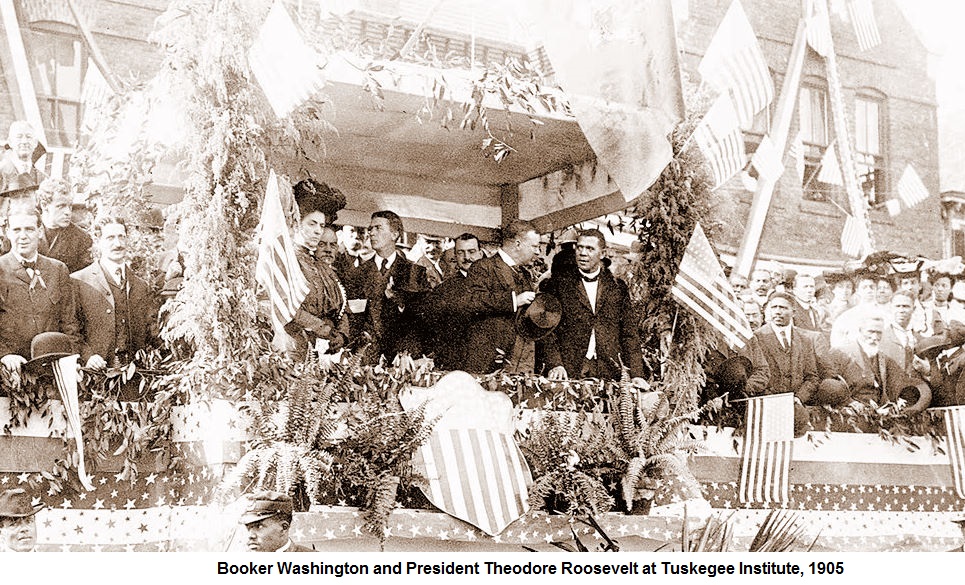
CU Blog - A Lesson in History - Booker T versus DuBois - Photo 3Washington worked and socialized with many national white politicians and industry leaders. He developed the ability to persuade wealthy whites, many of them self-made men, to donate money to black causes by appealing to values they had exercised in their rise to power. He argued that the surest way for blacks to gain equal social rights was to demonstrate “industry, thrift, intelligence and property.”[25] He believed these were key to improved conditions for African Americans in the United States. Because African Americans had only recently been emancipated and most lived in a hostile environment, Washington believed they could not expect too much at once. He said, “I have learned that success is to be measured not so much by the position that one has reached in life as by the obstacles which he has had to overcome while trying to succeed.”[15]

Along with Du Bois, Washington partly organized the “Negro exhibition” at the 1900 Exposition Universelle in Paris, where photos of Hampton Institute’s black students were displayed. These were taken by his friend Frances Benjamin Johnston.[26] The exhibition demonstrated African Americans’ positive contributions to United States’ society.[26]

Washington privately contributed substantial funds for legal challenges to segregation and disfranchisement, such as the case of Giles v. Harris, which was heard before the United States Supreme Court in 1903.[27] Even when such challenges were won at the Supreme Court, southern states quickly responded with new laws to accomplish the same ends, for instance, adding “grandfather clauses” that covered whites and not blacks.
Wikipedia Online Encyclopedia – Retrieved 09/09-2014 from:
http://en.wikipedia.org/wiki/Booker_T._Washington

Cited References:

15. Harlan, Louis R (1972), Booker T. Washington: volume 1: The Making of a Black Leader, 1856–1901 , the major scholarly biography
17.   Bauerlein, Mark (Winter 2004), The Journal of Blacks in Higher Education 46, JSTOR, p. 106.
18.   Pole, JR (Dec 1974), “Review: Of Mr. Booker T. Washington and Others; The Children of Pride”, The Historical Journal 17 (4) , p. 888.
19.   Du Bois, WEB (1903), The Souls of Black Folk, Bartleby ., pp. 41–59.
20.   Pole, JR (Dec 1974), “Review: Of Mr. Booker T. Washington and Others; The Children of Pride”, The Historical Journal 17 (4) , p. 107.
21.   Crouch, Stanley (2005).  The Artificial White Man: Essays on Authenticity, Basic Books, p. 96.
22.   Du Bois, WEB (1903), The Souls of Black Folk, Bartleby ., p. 189.
23.   Pole, JR (Dec 1974), “Review: Of Mr. Booker T. Washington and Others; The Children of Pride”, The Historical Journal 17 (4) , p. 980.
24.   Walker, Clarence E (1991), Deromanticising Black History, The University of Tennessee Press, p. 32 .
25.   Harlan, Louis R (1972), Booker T. Washington: volume 1: The Making of a Black Leader, 1856–1901 , the major scholarly biography, p. 68.
26.   Maxell, Anne (2002), “Montrer l’Autre: Franz Boas et les sœurs Gerhard”, in Bancel, Nicolas; Blanchard, Pascal; Boëtsch, Gilles; Deroo, Eric; Lemaire, Sandrine, Zoos humains. De la Vénus hottentote aux reality shows, La Découverte, pp. 331–39, in part. p. 338
27.   Harlan, Louis R (1971), “The Secret Life of Booker T. Washington”, Journal of Southern History 37 (2). Documents Booker T. Washington’s secret financing and directing of litigation against segregation and disfranchisement.


Share this post:
, , ,
[Top]

Climate Change May Affect Food Supply Within a Decade

Go Lean Commentary

Don’t say you haven’t been warned! The apocalyptic effects of Climate Change may not be so far off, maybe even within the next decade. So says the foregoing article. For those of us on the front line, the Caribbean region, this is our warning siren for us to take immediate actions to “save life and limb”:

Title: Think Climate Change Is a Problem for the Future? Our Food System May Feel the Heat in a Decade
By: Steve Holt

CU Blog - Climate Change May Affect Food Within a Decade - Photo 2The new sci-fi thriller The Collapse of Western Civilization: A View From the Future depicts a world ravaged by climate change. Decades of ignoring signs of global warming have led “to soaring temperatures, rising sea levels, widespread drought,” and the collapse of the West Antarctic ice sheet, a catastrophic global disaster. It’s a terrifying fiction to consider—but one that, even in science fiction, seems far, far off. Collapse takes place in 2393, after all. Similarly, voters and politicians alike are prone to taking a far-off view when talking about climate change—it’s easy for some of us to procrastinate on acting because we believe any effects are 50 or more years away. The incremental changes happen so slowly, it seems: an extra powerful storm here or an inch of ice melt there.

But what if we felt the impact of our collective actions (and inactions) relating to climate change a lot sooner—like, by 2024?

Well, that far-off sci-fi tomorrow may indeed be here before we know it. Recently, a leading climate change observer made the scary prediction that climate change could disrupt the global food supply, endangering billions of humans, within the next decade.

“The challenges from waste to warming, spurred on by a growing population with a rising middle-class hunger for meat, are leading us down a dangerous path,” Rachel Kyte, World Bank Group vice president and special envoy for climate change, recently told the Crawford Fund 2014 annual conference in Canberra, Australia, according to the Sydney Morning Herald. “Unless we chart a new course, we will find ourselves staring volatility and disruption in the food system in the face, not in 2050, not in 2040, but potentially within the next decade.”

While we’re already talking about how climate change could take away our coffee [a] and our chocolate, there’s far more to this problem than higher prices for lattes and candy bars. Yields on staple crops could drop significantly, and meat prices are already on the rise thanks to the prolonged drought in the West. And our failure to stem the tide of human environmental destruction, experts say, will hit Americans hard in the pocketbook. Food shoppers here in the United States should expect a climate-induced rise in food prices as a result of more extreme weather events; crop failures due to weather warming that influences pests, diseases, and weeds; and related effects on fisheries and livestock. But while we’ll all feel the pain at the checkout, food price increases will disproportionately impact the nearly 15 percent of U.S. households that are food insecure [b], says Dr. Linda Berlin, director of the Center for Sustainable Agriculture at the University of Vermont.

“Americans who will be most negatively affected by these changes are those with the least disposable income, i.e., little ability to absorb the extra costs,” she says.

Kyte—who oversees work on climate change adaptation and mitigation and climate finance taking place across World Bank Group institutions—pointed to a number of factors that are exacerbating the oncoming food crisis, including a rising demand for meat worldwide, land clearing and increased greenhouse gas emissions from livestock, and threats to low-lying areas from rising sea levels. Air temperatures could increase 2 degrees by the mid-2030s, she says, which could cut cereal yields by 20 percent worldwide and 50 percent in Africa.

Kyte’s analysis coincides with the draft of an upcoming United Nations report [c], released in August, in which the international panel of scientists expresses 95 to 100 percent certainty that human activity is the primary cause of global warming. Additionally, according to the report, greenhouse gas emissions are increasing, despite far-reaching political efforts to reduce them. Between 2000 and 2010, emissions grew at 2.2 percent annually, up from growth of 1.3 percent yearly between 1970 and 2000.

Food shortages have led to riots in other countries, and that kind of hunger-related violence is always cast as an “over-there” sort of problem. But that’s partly because of our “giant safety net program—SNAP (food stamps)—which most countries don’t have,” as Stanford professor Rosamond Naylor told several hundred scientists and California Gov. Jerry Brown last December [d].

With $8.6 billion cut from the program in the 2014 farm bill [e], that safety net isn’t faring all that well.
—————————————————-
Cited References:
a. http://www.takepart.com/article/2014/05/19/federal-cash-coffee-rust
b. http://www.ers.usda.gov/publications/err-economic-research-report/err155.aspx#.VADQkmRdWa4 c.http://www.nytimes.com/2013/08/20/science/earth/extremely-likely-that-human-activity-is-driving-climate-change-panel-finds.html?pagewanted=all&_r=0
d. http://woods.stanford.edu/news-events/news/climate-change-threatens-food-security-stanford-professor-warns
e. http://www.takepart.com/article/2014/02/05/2014-farm-bill

Yahoo News / Takepart.com e-Zine (Posted 09-02-2014) –
http://news.yahoo.com/think-climate-change-problem-future-food-system-may-000721066.html;_ylt=AwrBEiTNFApULVYAgIbQtDMD

The foregoing article is asserting that Climate Change may not just be our grandchildren’s problem alone; it is an issue for us, and even our parents. The risks and threats associated with this agent-of-change must therefore be mitigated now! The book Go Lean…Caribbean identifies this impending crisis and then declares that “a crisis is a terrible thing to waste”, calling for the establishment of a regional sentinel to monitor, mitigate and manage the effects of Climate Change on the region’s economic, security and governing engines. According to the foregoing article, which considers near-term projections on the world’s food supply systems, this will be a global crisis; the rest of the world will have to contend with these same issues.

This Go Lean book serves as a roadmap for the introduction and implementation of the technocratic Caribbean Union Trade Federation (CU). The prime directives of this agency are described as:

  • Optimize the economic engines of the Caribbean to elevate the regional economy to grow to $800 Billion and create 2.2 million new jobs.
  • Establish a security apparatus to protect the resultant economic engines.
  • Improve Caribbean governance to support these engines.

The Go Lean roadmap calls for the establishment of an Emergency Management agency (subset of the CU’s Homeland Security Department) so as to adopt the professional arts and sciences of Public Safety & Emergency Management. The emergencies within this scope will include natural disasters like hurricanes, flooding, forest fires, and droughts, all which can affect the food supply systems, even fisheries. The Caribbean Emergency Management Agency would therefore need to coordinate and plan with other CU Departments and member-state agencies in a proactive manner to anticipate the needs of the Caribbean region; this will include the CU Departments of Health (Food & Nutrition Administrations), Agriculture & Fisheries.

A lot is at stake with this consideration – life and death – our ability to feed our populations.

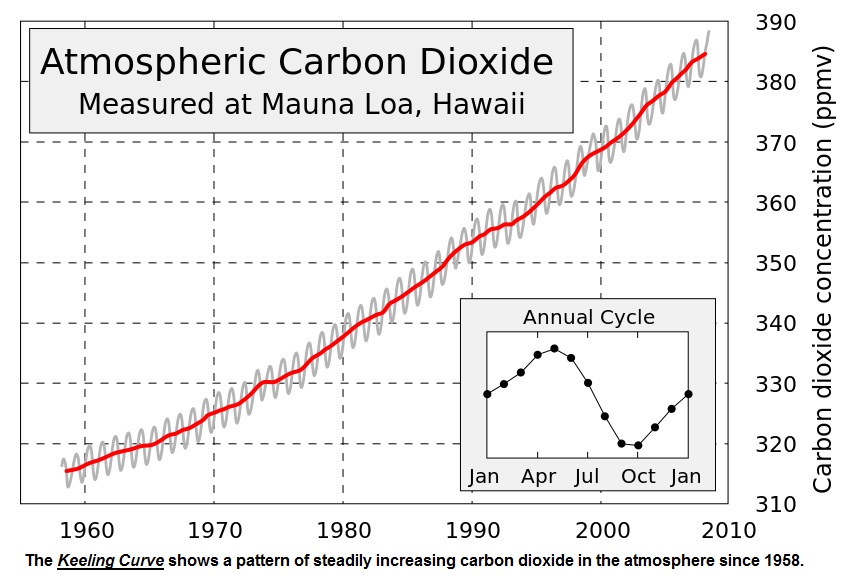
CU Blog - Climate Change May Affect Food Within a Decade - Photo 1Not everyone accepts these precepts – vocal deniers of Climate Change abound! But, recent natural disasters have devastated the region and do not allow us the luxury of dissent in our planning. We can see, hear, touch, taste and feel the effects of Climate Change now in our region. It is an Inconvenient Truth.

The Go Lean book reports that Climate Change is wreaking havoc on Caribbean life now; (the Bahamas 2nd city, Freeport, never fully recovered from Category 4 Hurricane Wilma in 2004, even now). Today, this foregoing news article identifies even more serious risks, this time for the world’s food supply. Due to globalization and the status as Small Island Developing States, today’s story becomes an alarming issue for the Caribbean as our region disproportionally depends on imports for our food supply. These agents-of-change (Climate Change & Globalization) were pronounced early in the book in the Declaration of Interdependence (Page 11 & 14), with these statements:

i.     Whereas the earth’s climate has undeniably changed resulting in more severe tropical weather storms, it is necessary to prepare to insure the safety and security of life, property and systems of commerce in our geographical region. As nature recognizes no borders in the target of its destruction, we also must set aside border considerations in the preparation and response to these weather challenges.

xxx. Whereas the effects of globalization can be felt in every aspect of Caribbean life, from the acquisition of food and clothing, to the ubiquity of ICT, the region cannot only consume, it is imperative that our lands also produce and add to the international community, even if doing so requires some sacrifice and subsidy.

To counteract the changes in nature, the Go Lean book advocates the immediate confederation of the 30 member-states into a Trade Federation with the tools/techniques to bring immediate change to the region to benefit one and all member-states. This includes the monitoring of the dynamics of Climate Change. While the region’s total population is only 42 million, compared to the whole world’s 6 Billion, we can still have an impact. We must still feed ourselves; we can show the world how best to accomplish this as Small Island Developing States. As the world seeks answers, they will have our technocratic example to glean from.

We cannot not expect anyone but ourselves to take the lead for our solutions. Other countries, like the US, have Climate Change deniers-and-detractors in the highest levels of government – this is not a model for us to emulate. Previous Go Lean blogs have cited this trend, as cited in the following sample:

https://goleancaribbean.com/blog/?p=2119 Cooling Effect – Oceans and the Climate
https://goleancaribbean.com/blog/?p=1883 Climate Change May Bring More Kidney Stones
https://goleancaribbean.com/blog/?p=1817 Caribbean grapples with intense new cycles of flooding & drought
https://goleancaribbean.com/blog/?p=926 Conservative heavyweights have solar industry in their sights
https://goleancaribbean.com/blog/?p=915 Go ‘Green’ … Caribbean

The Caribbean does not have the luxury of a laissez-faire attitude – No Problem Mon – towards Climate Change as we are on the frontline of these dilemmas. Instead the Go Lean book declares that we must adopt a community ethos, the appropriate attitude/spirit, to forge change in our region; then details the executions of the following strategies, tactics, implementations and advocacies to better impact the region’s preparation for food resources, especially considering the consequences from Climate Change:

Community Ethos – Deferred Gratification Page 21
Community Ethos – Economic Systems Influence Individual Choices / Incentives Page 21
Community Ethos – The Consequences of Choices Lie in the Future Page 21
Community Ethos – Intelligence Gathering Page 23
Community Ethos – “Crap” Happens Page 23
Community Ethos – Lean Operations Page 24
Community Ethos – Cooperatives Page 24
Community Ethos – Non-Government Organizations Page 25
Community Ethos – Ways to Impact the Future Page 26
Community Ethos – Ways to Improve Sharing Page 35
Community Ethos – Impact the Greater Good Page 37
Strategy – Vision – Confederating 30 Member-States into a Single Market Page 45
Strategy – Vision – Foster Local Economic Engines Food, Clothing &   Shelter Page 45
Strategy – Mission – Prepare   for Natural Disasters Page 45
Strategy – Mission – Exploit   the Benefits and Opportunities of Globalization Page 46
Strategy – Agents of Change – Climate Change Page 57
Strategy – Agents of Change – Globalization Page 57
Tactical – Confederating a Permanent Union Page 63
Tactical – Fostering a Technocracy Page 64
Separation of Powers – Emergency Management Page 76
Separation of Powers – Meteorological & Geological Service Page 79
Separation of Powers – Food & Nutritional Administration Page 87
Separation of Powers – Agriculture and Fisheries Department Page 88
Implementation – Ways to Pay for Change Page 101
Implementation – Security Initiatives at Start-up – Unified Command & Control Page 103
Implementation – Ways to Deliver Page 109
Implementation – Ways to Foster International Aid Page 115
Implementation – Ways to Benefit from Globalization Page 119
Planning – Ways to Make the Caribbean Better Page 131
Advocacy – Ways to Grow the Economy Page 151
Advocacy – Ways to Better Manage Food Page 162
Advocacy – Ways to Improve Governance Page 168
Advocacy – Ways to Better Manage the Social Contract Page 170
Advocacy – Ways to Foster Cooperatives Page 176
Advocacy – Ways to Improve for Natural Disasters Page 184
Advocacy – Ways to Improve Emergency Management Page 196
Advocacy – Ways to Improve Fisheries Page 210
Appendix – History of Puerto Rican Migration to US & Effects of Hurricanes Page 303
Appendix – US Virgin Islands Economic Timeline with Hurricane Impacts Page 305

The foregoing news article discusses the threats of Climate Change on the world’s food supply…soon, within the next decade. We have no time to relax, no time to debate, we must get ready now.

Remember the Bible drama of Joseph interpreting Pharaoh’s dreams as warning of an impending great famine. The shrewd course of action for Joseph and Pharaoh was to plan/prepare the food supplies for the forthcoming lean years – Genesis Chapter 40 – 41.

From the Caribbean perspective, our only observation on this drama can be: Ditto!

Change has come to our region; more devastating change is imminent. There is the need for a permanent union – a sentinel – to provide efficient stewardship for Caribbean economy, security and governing engines. The Go Lean…Caribbean posits that the problems of this region are too big for just any one member-state to tackle, but rather this multi-state technocratic administration may be our best solution.

The people and institutions of the region are hereby urged to lean-in to this Go Lean roadmap, to embrace the mitigations for the impending world changes. Let’s make the Caribbean better; a better place to live-work-play today and even more so tomorrow.

Download the book Go Lean … Caribbean – now!

Share this post:
, ,
[Top]

Sports Role Model – Playing For Pride … And More

Go Lean Commentary

These blog/commentaries started in March 2014. But this source article was published on November 15, 2013. It never seemed appropriate to reach back and feature this article – until now. This marks the occasion of a Black College Football Game (Classic) being staged in Nassau, Bahamas on September 13, 2014 in the new Thomas A. Robinson National Stadium.

CU Blog - Playing For Pride - Photo 3

 CU Blog - Playing For Pride - Photo 2

The foregoing article was adapted from the book by Samuel G. Freedman, Breaking the Line: The Season in Black College Football That Transformed the Sport and Changed the Course of Civil Rights. (It is available at www.samuelfreedman.com and at bookstores nationwide).

Title: Playing for Pride
By: Samuel G. Freedman

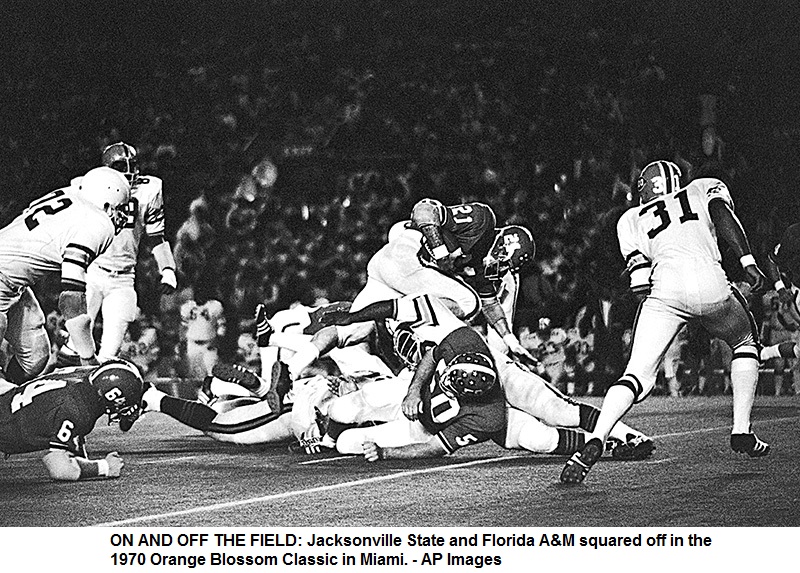
The yearly gridiron matchup known as the ORANGE BLOSSOM CLASSIC helped to even the playing field for black players, coaches and fans. But it was about so much more than football.

The calendar of Black America includes several specific holidays. Juneteenth, celebrated every June 19, honors the day the Union Army liberated slaves in Texas following the end of the Civil War. Kwanzaa, beginning on Dec. 26, is a seven-day festival of African heritage. On Dec. 31, which is called watch night, churches hold worship services to commemorate the way their forebears had stayed up all night awaiting the issuance of the ­Emancipation Proclamation on January 1, 1863.

And for a 30-year heyday beginning in the late 1940s, the Orange ­Blossom Classic football game and festival in Miami was the most important annual sporting event and the largest annual gathering of any kind for black Americans. For most of those years, more than 40,000 spectators attended the game in the Orange Bowl stadium, while tens of thousands more thronged to marching-band parades. Black tourists flocked to the hotels, restaurants and clubs of Miami’s Overtown and Liberty City neighborhoods. Pro-football scouts with binoculars, Ray-Bans and stingy-brim hats elbowed their way along the sidelines to scout prospects.

While the Orange Blossom Classic lives only in memory now — it served as the de facto black college championship until 1978 and was still played sporadically until 2004; it was ultimately the unexpected casualty of racial integration in sports and in society — its spirit persists in the dozens of “Classics” played between football teams from ­historically black colleges and universities (HBCUs). There are 37 on the schedule this season, and several of the most famous are coming up. Florida A&M University plays Bethune-Cookman University on Nov. 23 (2013) in the Florida Classic in Orlando, Fla., and Grambling State University faces Southern University and A&M College in the Bayou Classic on Nov. 30 (2013) in New Orleans. [2014 games are scheduled for the same corresponding weekends].

Football, though, is only part of a Classic. Marching bands, step shows, networking, gospel concerts and shopping excursions are all parts of the experience. These Classics continue to draw crowds as large as 70,000 for the on-field rivalry and a broader sense of affirmation.

“Historically speaking, there were not always so many opportunities for African-Americans to socialize in public,” says Todd Boyd, a University of Southern California professor who specializes in race and popular culture. “So the opportunities that did exist often took on added significance. Yet over time, the events became part of a larger tradition. I think the games now have a nostalgic feel. So it’s all about tradition and ritual once again.”

As sporting event and communal celebration, the Orange Blossom Classic rose as an answer to invisibility, the kind Ralph Ellison famously rendered in his novel, Invisible Man. In 1937, when Miami opened the Orange Bowl stadium, a public facility built with public funds, it excluded blacks from all but one section of the eastern end zone. No integrated football team was permitted onto the gridiron until the Nebraska Cornhuskers played Duke in the 1955 Orange Bowl. Blacks were barred from participating in any of the pageants and events related to the bowl game, much as they were barred from patronizing the resort hotels in Miami Beach. The black maids and janitors and cooks and bellhops who comprised the ­human infrastructure of those establishments had to obtain identification­ cards from the police. Even the black performers who drew the crowds — Sammy Davis Jr., Nat King Cole, Ella Fitzgerald — were forbidden from staying in the hotels where they entertained.

During the 1930s, Miami blacks began their own competitor to the Orange Bowl festivities, which they called the Coconut Festival. It had its own beauty queen, its own parade and its own football game, played in Dorsey Park, a segregated square block named for Miami’s first black millionaire. The Coconut Festival game, though, lacked much football pizzazz. That’s where J.R.E. Lee Jr., the son of Florida A&M University’s president, came in.

Even before Lee, black colleges had sought to create their own version of season-ending bowl games. In the 1920s, Lincoln University and Howard University began playing annually in the self-proclaimed Football Classic of the Year, and Tuskegee University met Wilberforce University yearly at Soldier Field in the Midwest Chicago Football Classic. Inspired by these ­examples, Lee conceived a “Black Rose Bowl,” naming it the Orange Blossom Classic. In the first game, in 1933, Florida A&M beat Howard by a score of 9-6 before 2,000 spectators at a blacks-only ballpark in Jacksonville, Fla. For the next 13 years, the contest migrated among the Florida cities of Jacksonville, Orlando and Tampa, becoming an itinerant attraction that gradually built its audience and reputation.

Then, in 1947, Lee linked the game’s fortunes to the Coconut Festival’s and settled it in Miami. Miami had the largest stadium in Florida. Miami also had the greatest concentration of media anywhere in the state. And Miami, as it entered the postwar boom, was beginning to shake off its rigid segregation, largely owing to the influx of Jews from the North, most of them either tacitly or actively supportive of civil rights.

The very first Classic game in Miami made racial history. For the first time, black fans were permitted to sit in the main stands of the Orange Bowl. And when a Florida A&M Rattler receiver named Nathaniel “Traz” Powell caught a 45-yard pass to break a 0-0 tie with Hampton Institute, he became the first black man to score a touchdown on the Orange Bowl’s previously whites-only gridiron. Powell had grown up in Miami as the son of a laundress and a laborer at the city’s incinerator. For years to come, blacks around the state would speak about his touchdown as if he’d been Rosa Parks refusing to surrender her seat.

The civil rights analogy was apt. Black colleges and their football teams operated in a kind of parallel universe during the segregation era. Even as they sent hundreds of players into the pros, the mainstream media rarely covered the schools. The proliferation of sports-focused talk radio and cable TV was decades away. So Jake Gaither, Florida A&M’s legendary coach, set about raising the Orange Blossom Classic to the status of a de facto black championship. Year in and year out, his Rattlers ranked near the top. And because Florida A&M hosted the Orange Blossom Classic, Gaither invited the strongest possible opponent.

As a result, the Orange Blossom Classic far outdrew the University of Miami’s football games and, later, those of the new National Football League (NFL) franchise, the Miami Dolphins. In Black America, it supplanted the Negro League All-Star game as the biggest single event. Florida A&M’s renowned “Marching 100” band pranced in two parades, one through the black neighborhoods and the other downtown, each drawing thousands upon thousands of spectators.

One year, comedian Nipsey Russell joined the Rattlers on their sideline; another time it was Sammy Davis Jr. All week long, the streets of Overtown and LibertyCity were “crowded like the state fair, music pouring out of doorways,” as one participant remembers. At the Zebra Lounge and the Hampton House, in the Harlem Square Club and the Rockland Palace and all along the stretch of Northwest Second Street called the Great Black Way, stars of jazz, soul and rhythm and blues headlined. Women spent a year’s savings on their Orange Blossom dresses, and beauty salons stayed open all night to handle the demand. When the parties ended near daybreak, people went their ways for breakfast before a sunrise snooze.

“The Classic was bigger than the Fourth of July,” says Marvin Dunn, author of the history book Black Miami in the Twentieth Century. “It was a black thing, and it was well done, and it added to the sense of pride. Even if you didn’t go to the game, you’d have all these people massed along the parade route. And the clothes — you had to get a new suit, a new dress for the Classic. There was not a seat to be had in a barber shop.”

No game brought more luster and historical significance than the 1967 matchup between Florida A&M and Grambling. They were the two greatest black college teams with the two greatest black college coaches (Jake Gaither and Eddie Robinson, respectively) and the two finest quarterbacks to play at each school (Ken Riley and James Harris, respectively). Robinson very deliberately was developing Harris to break the quarterback color line in the pros, to forever lay to rest the canard that no black man was smart enough to play that most intellectual of positions. As Leon Armbrister, the sports columnist of The Miami Times, the city’s weekly black newspaper, exalted, “The selection of Grambling adds Super Bowl status to the Classic.”

In many ways, the Orange Blossom Classic in 1967 also embodied the recent progress in race relations. The Grambling and Florida A&M teams both stayed in integrated hotels on Miami Beach. The P. Ballantine & Sons Brewing Company sponsored a tape-delayed broadcast of the game on television stations in Atlanta, Philadelphia, Washington, D.C., and New York. Buddy Young, the first black executive in the NFL’s front office, provided the on-air commentary. The local publicity for the game was handled by Julian Cole, a transplanted Jew who counted the ritziest Miami Beach hotels among his clients.

The Orange Blossom Classic’s souvenir program featured advertisements from major national companies, including Humble Oil, Prudential Insurance and RC Cola. Coca-Cola sponsored a float carrying the Grambling College queen and her court in the pregame parade. The celebrities in attendance included the first wave of black executives hired by corporations in search of black consumers. Pepsi-Cola, the leader in the field, dispatched its vice president for special markets, Charles Dryden, a bona fide war hero as one of the Tuskegee Airmen. Greyhound sent Joe Black, the former Brooklyn Dodgers pitcher, who recently had been ­appointed the bus company’s vice president of special markets. F.W. Woolworth, a company trying to repair a reputation damaged by its segregated lunch counters in Southern cities, dispatched Aubrey Lewis, a former Notre Dame football star and FBI agent it recently had hired as an executive recruiter.

The competitive tension built as the game approached. As Grambling ran through its practice session at a junior college, two busloads of Florida A&M players arrived. They jogged around the field, chanting, “It’s so hard to be a Rattler,” before haughtily driving off. Grambling’s Eddie Robinson, incensed, told his team, “The peace dove flies out the window tomorrow!” At a pregame banquet, he had to remind his players not to start jawing at the Florida A&M team, saying, “Take it out on the field.”

On the night of Dec. 2, 1967, before more than 40,000 spectators, Grambling and Florida A&M produced a classic for the Classic. The game went down to the final play, with the Tigers holding off a final drive by the Rattlers to win 28-25. Florida A&M compiled 396 yards of total offense, slightly more than Grambling’s 382. James Harris threw for 174 yards, and Ken Riley nearly matched him, with 110 yards passing and 62 more rushing.

CU Blog - Playing For Pride - Photo 1The scouts certainly noticed. Harris, then a junior, would be drafted by the NFL’s Buffalo Bills in January 1969. He went on to become the first black quarterback to regularly start in the NFL, leading the Los Angeles Rams to the conference title game twice in the mid-1970s. Every black quarterback to follow, from Doug Williams and Warren Moon to Russell Wilson and Robert Griffin III, came through the door that James Harris opened. As for Ken Riley, he was moved to cornerback in the NFL and had an illustrious 15-year career with the Cincinnati Bengals. Even now, 30 years after retiring, he ranks fifth in NFL history in career interceptions.

In the aftermath of the 1967 Orange Blossom Classic, Grambling was able to bring black college football to the nation as a whole. The following September, the Tigers played Morgan State before a sold-out crowd in Yankee Stadium in a fundraising game for the National Urban League, a prominent civil-rights organization. That example inspired the dozens of black-college classics being played today, keeping a precious thread of prideful history unbroken.
——
SAMUEL G. FREEDMAN is a professor at Columbia University’s Graduate School of Journalism and a New York Times columnist.

The foregoing article depicts reality for the Black American population for much of the 20th Century. Despite the differences in population, cultural heritage and language, much of the historical experiences were parallel in the Caribbean until majority rule and/or de-colonization came to fruition in these tropical homelands.

This foregoing article therefore relates to more than just sports, but history, culture and civil rights cause-and-effect. The foregoing therefore harmonizes with the book Go Lean…Caribbean which also stresses the need to Transform Sports and Change the Course of Civil Rights but this time for the Caribbean region. The Go Lean book studies the assessment of the 30 Caribbean member-states and posits that the region is in crisis, with the societal engines at the precipice due the an unsustainable rate of human flight. The African-American experience in the US has thusly improved over the last century, the current US President Barack Obama is of African-American descent; the dreaded co-existence (segregation) of Blacks along side Whites is no longer the status quo; their community is more color-blind. This creates strong motivation for Caribbean residents to consider an American migration. In fact 70% of the Caribbean college-educated population, some from American HBCU’s as depicted in the foregoing article, have abandoned their homeland and live abroad, mostly in the US.

The City of Miami, prominently featured in the foregoing article is largely comprised of the Caribbean Diaspora. (In the interest of full disclosure, this Go Lean blogger attended one of the schools prominently featured in this foregoing article, Florida A&M University, and separately lived in Miami for 17 years).

The underlying issue in this consideration is sports and the game of (American) football.  A compelling mission of the Go Lean book is to foster the eco-systems for sports enterprises in the region. The book posits that sports, collegiate sports included, can impact a community’s economics and surely its pride.

An important mission of this Go Lean message is to simply lower the “push and pull” factors that lead many to abandon their Caribbean homeland for American shores. The “pull” factors were miniscule in the mid-20th Century; Caribbean citizens of Black and Brown heritage may not have found the (southern) US so welcoming. But times have changed, and the minority experience in America is different; more enticing and appealing to Caribbean citizens seeking to relocate.

While the Caribbean may not have the sports business eco-system, we do have the underlying assets: athletes. The Caribbean supplies the world, including American colleges (NCAA), with the best-of-the-best in the sports genres of basketball, track-and-field, FIFA-soccer and a few football players (NCAA & NFL). The Go Lean book recognizes and fosters the genius qualifiers of many Caribbean athletes.

The Go Lean goal now is to foster the local eco-system in the homeland so that  those with talent would not have to flee the region to garner successful returns on their athletic investments.

The Go Lean book serves as a roadmap for the introduction and implementation of the Caribbean Union Trade Federation (CU), a technocratic federal government to administer and optimize the economic/security/ governing engines of the region’s 30 member-states. At the outset, the roadmap recognizes our crisis and the value of sports in the roadmap, with these statements in the Declaration of Interdependence (Page 13 & 14):

xix.    Whereas our legacy in recent times is one of societal abandonment, it is imperative that incentives and encouragement be put in place to first dissuade the human flight, and then entice and welcome the return of our Diaspora back to our shores. This repatriation should be effected with the appropriate guards so as not to imperil the lives and securities of the repatriated citizens or the communities they inhabit. The right of repatriation is to be extended to any natural born citizens despite any previous naturalization to foreign sovereignties.

xxvi. Whereas the preparation of our labor force can foster opportunities and dictate economic progress for current and future generations, the Federation must ensure that educational and job training opportunities are fully optimized for all residents of all member-states, with no partiality towards any gender or ethnic group. The Federation must recognize and facilitate excellence in many different fields of endeavor, including sciences, languages, arts, music and sports. This responsibility should be executed without incurring the risks of further human flight, as has been the past history.

xxxi. Whereas sports have been a source of great pride for the Caribbean region, the economic returns from these ventures have not been evenly distributed as in other societies. The Federation must therefore facilitate the eco-systems and vertical industries of sports as a business, recreation, national pastime and even sports tourism – modeling the Olympics.

The Go Lean roadmap calls for the market organizations to better garner the economic benefits of sports. One of the biggest contributions the CU will make is the facilitation of sports venues: arenas and stadia. Sports can be big business! But even when money is not involved, other benefits abound: educational scholarships, fitness/wellness, disciplined activities for the youth, image, and pride. No doubt an intangible yet important benefits is depicted in this Go Lean roadmap, that of less societal abandonment. A mission of the CU is to reduce the brain drain and incentivize repatriation of the Diaspora.

Another area of the Go Lean economic empowerment roadmap that relates to the foregoing article is the strategy is to create a Single (Media) Market to leverage the value of broadcast rights for the region, the resultant consolidated market would cover 30 member-states, 4 languages and 42 million people. The successful execution of this strategy will elevate the art, science and genius of sport enterprises in the region. Now is the time for all of the Caribbean to lean-in to the following community ethos, strategies, tactics, implementations and advocacies detailed in the book Go Lean … Caribbean to re-boot the delivery of the regional solutions to elevate the Caribbean region through sports:

Community Ethos – Deferred Gratification Page 21
Community Ethos – Economic Principle – Consequences of Choices Lie in the Future Page 21
Community Ethos – Return on Investments Page 24
Community Ethos – Ways to Impact the Future Page 26
Community Ethos – Ways to Foster Genius Page 27
Community Ethos – Ways to Impact the Greater Good Page 37
Strategy – Vision – Make Caribbean The Best Place to Live, Work and Play Page 46
Strategic – Staffing – Sporting Events at Fairgrounds Page 55
Tactical – Fostering a Technocracy Page 64
Tactical – Separation of Powers – Sports & Culture Administration Page 81
Tactical – Separation of Powers – Fairgrounds Administration Page 83
Implementation – Steps to Implement Self-Governing Entities (Fairgrounds) Page 105
Implementation – Ways to Deliver Page 109
Planning – Ways to Make the Caribbean Better Page 131
Planning – Ways to Better Manage Caribbean Image Page 133
Advocacy – Ways to Grow the Economy Page 151
Advocacy – Ways to Impact Hollywood Page 203
Advocacy – Ways to Impact the Diaspora Page 217
Advocacy – Ways to Improve Sports Page 229

With some measure of success, we should be able to reduce the “push and pull” factors that lead many to abandon the Caribbean region in the first place. We want our athletes to transform their sports and change our society, not some distant land.

Other subjects related to the sports world and it’s impact on society have been blogged in other Go Lean…Caribbean commentaries, as sampled here:

Date Published Blog Subject / Link
August 24 Sports Role Model – The SEC Network for College Sports Broadcasting
June 23 Caribbean Players Impact on the 2014 World Cup
June 22 Caribbean Crisis: More than 70 Percent of Tertiary- Educated Abandon Region
May 27 Sports Revolution for Advocate Jeffrey Webb
March 24 Collegiate Sports in the Caribbean
March 24 10 Things We Want from the US – #10 Sports Professionalism
March 21 Muhammad Ali and Advocate Kevin Connolly – Changing Society

The Caribbean has the capacity to be the best address on the planet, but there are certain missing features, such as intercollegiate athletics… and jobs. Why else would citizens choose to abandon their beloved homeland if not for the greater economic opportunities abroad. The foregoing article reminds us of the evolutionary nature of change, thereby aligning with this Go Lean…Caribbean roadmap. This effort is bigger than college sports; this is about Caribbean life; we must elevate our own society. The CU is the vehicle for this change, detailed here with the following 3 prime directives:

  • Optimization of the economic engines in order to grow the regional economy to $800 Billion & create 2.2 million new jobs.
  • Establishment of a security apparatus to protect the resultant economic engines.
  • Improve Caribbean governance to support these engines.

With the Go Lean roadmap, the people and institutions of the Caribbean can easily envision major sporting events like the Orange Blossom Classic of bygone days, having similar impact on society beyond the playing field. Sports can have that effect; we must therefore not ignore its significance and contributions.

The purpose of this roadmap is to make the Caribbean homeland, a better place to live, work and play. Sports falls under the “games people play” category. With the CU oversight on the economy, security and governing engines, our community can take time to play. As the Bible book of Ecclesiastes (Chapter 3 verses 1 – 8 of Young’s Literal Translation) relates, there is a right time, a season for “everything under the sun”:

  1. To everything — a season, and a time to every delight under the heavens:
  2. A time to bring forth, And a time to die. A time to plant, And a time to eradicate the planted.
  3. A time to slay, And a time to heal, A time to break down, And a time to build up.
  4. A time to weep, And a time to laugh. A time to mourn, And a time to skip [about].
  5. A time to cast away stones, And a time to heap up stones. A time to embrace, And a time to be far from embracing.
  6. A time to seek, And a time to destroy. A time to keep,  And a time to cast away.
  7. A time to rend, And a time to sew. A time to be silent, And a time to speak.
  8. A time to love, And a time to hate. A time of war, And a time of peace.

There was a time for the Orange Blossom Classic, for its impact on American society; there was also a time for the Classic to pass on, where it would no longer be required to showcase African-American athletic talent. The same applies for the Caribbean. Now is the time for all the Caribbean to lean-in for this roadmap to transform sports and changed the course of Caribbean society. Now is the season to Go Lean.

Download the free e-Book of Go Lean … Caribbean – now!

Share this post:
, , , , , ,
[Top]

Hotels are making billions from added fees

Go Lean Commentary

CU Blog - Hotels are making billions from added fees - Photo 1

The attack on the middle class continues…

The foregoing news article/VIDEO relates to the middle class in the US. Normally this would not be an issue for the Caribbean to consider except this story is relating the pressures on the customer base that the region relies on for its primary economic driver: tourism.

Plus most Caribbean resorts also apply a “resort fee”.

By: NBC News – The Today Show
How hotels are making billions from added fees – http://www.today.com/video/today/55935286#55935286
Hotels are taking a page from the airline industry, and it’s costing consumers a lot more. The fees added up to $2.5 billion just last year. NBC’s Kerry Sanders reports.

This subject is pivotal in the roadmap for elevation of the Caribbean economy, which maintains that tourism will continue to be the primary economic driver in the region for the foreseeable future. The book Go Lean…Caribbean calls for the elevation of Caribbean society, to re-focus, re-boot, and optimize all the engines of commerce so as to make the Caribbean a better place to live, work and play. The Caribbean has become a playground for the US. So we cannot, indeed we must not ignore the middle class.

What is important in this discussion is the functionality of economic planning. Already the attacks on the middle class has shrunk their disposable income, retirement savings and buying power. We need to continue to monitor the progress of this economic group. This effort (the foregoing VIDEO and the Appendix) is an iteration in this monitoring charter.

The Great Recession came and went. The US lost $11 Trillion in the crisis, then gained $13.5 Trillion in the recovery (Go Lean book Page 69). Unfortunately the ones that lost are not the ones that gained. The world has changed; the middle class has shrunk, the poor has expanded, and the One Percent has expanded in affluence and influence.

So the markets that Caribbean tourism planners cater to have now changed. The Great Recession should have been a lesson enough for the Caribbean to develop a more resilient economy, to be nimble in strategies, tactics and implementation. Unfortunately, the experience (and the following list) shows that the planners are repeating the same mistakes and following the same bad American model. The following are resort fees of what are considered the best properties in the Caribbean, according to the US-based cable TV Travel Channel (http://www.travelchannel.com/interests/beaches/articles/top-10-caribbean-resorts):

Preface: Top 10 Caribbean Resorts

Welcome to paradise. We’re counting down Caribbean resorts with crystal-clear waters, powder-soft sands, sumptuous settings and world-class accommodations. These aren’t your average cookie-cutter beachfront hotels either. These Caribbean hot spots rank among the most luxurious and lavish in the world:

Resort Property

Resort Fee

1

Hyatt Regency, Aruba Resort & Casino

– $0.00 –

2

CaneelBay, St. John, US Virgin Island

10% Service Fee

3

Parrot Cay By Como, Providenciales, Turks and Caicos Islands

– $0.00 –

4

Little Dix Bay, Virgin Gorda, British Virgin Islands

$32.00

5

Beaches Turks & Caicos Resort and Spa, Providenciales

All   Inclusive

6

Ritz-Carlton St. Thomas, St. Thomas, US Virgin Islands

$62.00

7

Four Seasons Resort, Pinney’s Beach, Charlestown, Nevis

$33.85 + $20.00

8

Atlantis, ParadiseIsland, Nassau, Bahamas

$20.70 – $65.95

9

Sandy Lane, St. James, Barbados

– $0.00 –

10

Hotel Maroma, Cancun, Mexico St. Regis Bahia Beach Resort, Puerto Rico

$60.00

According to the foregoing VIDEO and article in the Appendix, there are major issues in the acceptance of hotel resort fees. In the US, complaints have been made to the Federal Trade Commission (FTC), the US watchdog for deceptive business practices. Despite some queries, there has been no definitive regulatory action.

CU Blog - Hotels are making billions from added fees - Photo 2We must do better in the Caribbean. The fear is that these practices may lead more to embrace “cruises” as their mode for enjoying Caribbean shores. This may be how the US middle class “plays” in the Caribbean.

What is wrong with cruises? Nothing … per se. We welcome all visitors that come to the region. As it is, the Go Lean book describes 80 million visitors annually. If there is a preference though, we would choose air-hotel packages as opposed to cruise options. The Go Lean book details that cruise passengers average $237/day in spending while on a cruise ship. Unfortunately, the majority (80%) of that money is spent with the foreign-based cruise line, not in the destination; the port cities get trinkets ($20 – $30 per day) in port-side souvenirs and tours.

Resort hotels in the Caribbean generate a lot of economic activities down the line: airports, taxis, restaurants, casinos, shopping, etc. The strategy employed by cruise lines is to embed most of all these activities on the ship. This difference is not ignored in the Go Lean consideration of Caribbean commerce (Page 61).

This book Go Lean… Caribbean, serves as a roadmap for the introduction and implementation of the technocratic Caribbean Union Trade Federation (CU). The CU/Go Lean roadmap has 3 prime directives:

  • Optimization of the economic engines in order to grow the regional economy to $800 Billion and create 2.2 million new jobs.
  • Establishment of a security apparatus to protect the resultant economic engines and marshal against economic crimes.
  • Improve Caribbean governance to support these engines.

Early in the book, the responsibility of monitoring and managing economic trends were identified as a crucial role of the CU; these statements were pronounced in the Declaration of Interdependence (Pages 13) as follows:

xxiv. Whereas a free market economy can be induced and spurred for continuous progress, the Federation must install the controls to better manage aspects of the economy: jobs, inflation, savings rate, investments and other economic principles. Thereby attracting direct foreign investment because of the stability and vibrancy of our economy.

xxv.  Whereas the legacy of international democracies had been imperiled due to a global financial crisis, the structure of the Federation must allow for financial stability and assurance of the Federation’s institutions. To mandate the economic vibrancy of the region, monetary and fiscal controls and policies must be incorporated as proactive and reactive measures. These measures must address threats against the financial integrity of the Federation and of the member-states.

The Caribbean tourism resort properties depend on their resort amenities. This commentary previously related details of the changing macro-economic factors (like demographics) that are currently affecting the region’s resorts, including amenities like golf and casinos:

https://goleancaribbean.com/blog/?p=1984 Casinos Changing/Failing Business Model
https://goleancaribbean.com/blog/?p=1943 The Future of Golf; Vital for   Tourism
https://goleancaribbean.com/blog/?p=782 Open/Review the Time Capsule: The Great Recession of 2008
https://goleancaribbean.com/blog/?p=273 10 Things We Want from the US and 10 Things We Don’t Want from the US – # 2: Tourists
https://goleancaribbean.com/blog/?p=242 The Erosion of the Middle Class
https://goleancaribbean.com/blog/?p=235 Tourism’s changing profile

Accordingly the tourist industry needs to be cognizant of the changing landscape in world economics; they need to minimize the downward pressure on their product. There needs to be a promoter for Caribbean commerce and a Sentinel for Caribbean image.

Who is up for this challenge? Not the FTC; despite having two Caribbean territories within its scope (Puerto Rico & US Virgin Islands), this agency has “fallen asleep at the switch” in its duty to regulate the markets and mandate a level-playing-field. For the Caribbean (region as a whole) we must perform this function on our own.

This roadmap posits that the Caribbean must not allow the US to lead for our own nation-building. We must step up and step forward for ourselves. We have the means and the methods to better ensure a quality experience to our hotel/resort visitors. The roadmap calls for oversight by an Interstate Commerce Administration within the Commerce Department of the CU. But there is no need for Caribbean hoteliers to fear! This agency will be more of a partner/promoter than that of a regulator. The plan is simple: require non-optional resort fee pricing to be fully disclosed as part of the base hotel rate. Then ensure a level-playing-field for all market participants.

This strategy, tactic and implementation features the heavy-lifting of Caribbean economic reform/reboot. Caribbean tourism is in need of this reform/reboot to attract and return visitors to our shores to enjoy our hospitality. But the interest of our visitors must also be protected, they are also stakeholders in the Caribbean reboot effort. The Go Lean… Caribbean book details the community ethos to adopt to proactively mitigate the dire effects of the changed demographic landscape, plus the executions of these additional strategies, tactics, implementations and advocacies:

Community Ethos – Economic Principle – People Respond to Incentives Page 21
Community Ethos – Economic Principle – Economic Systems Influence Individual Choices Page 21
Community Ethos – Job Multiplier Page 22
Community Ethos – Lean Operations Page 24
Community Ethos – Ways to Impact the Greater Good Page 37
Strategy – Vision – Best Address on the Planet Page 45
Tactical – Fostering a Technocracy Page 64
Tactical – Trade and Globalization Page 70
Separation of Powers – Sports and Culture Administration Page 81
Implementation – Ways to Pay for Change Page 101
Implementation – Ways to Deliver Page 109
Implementation – Ways to Impact Social Media Page 111
Implementation – Ways to Benefit from Globalization Page 119
Planning – Ways to Make the Caribbean Better Page 131
Planning – Lessons Learned from 2008 Page 136
Advocacy – Ways to Grow the Economy Page 151
Advocacy – Ways to Create Jobs Page 152
Anecdote – Butch   Stewart – Sandals Resorts Growth in   Tourism – Responding to  Guests Needs Page 189
Advocacy – Ways to Enhance Tourism Page 190
Advocacy – Ways to Impact Cruise Tourism Page 193
Advocacy – Ways to Foster Technology Page 197
Advocacy – Ways to Foster e-Commerce Page 198
Advocacy – Ways to Help the Middle Class Page 223
Advocacy – Ways to Impact the One Percent Page 224

The book Go Lean…Caribbean purports that the Caribbean is the greatest address in the world and sets on a roadmap to extend the invitation of Caribbean hospitality to not just Americans, but also the rest of the world. In order to appeal to the global market, this roadmap, posits that regional tourism stakeholders must traverse the changing landscape, in which some of the agents-of-change are technology and globalization.

The plan also calls for establishing Trade Mission Offices in divergent cities like Spain and Tokyo for outreach to Mid & Far Eastern markets.

The issues in the foregoing news stories emerged mostly because of the different experiences in booking hotel rooms online and then engaging the resort properties at check-in/check-out.  The roadmap advocates the art and science of using Internet & Communications Technologies and Social Media for bookings, and also for the advertising and selling of Caribbean culture and amenities. The plan is also to monitor and track comments/complaints from online postings – many have complained about being “nickeled-and-dimed” in hotels due to various resort/amenity fees.

With this roadmap, the people (and governing institutions) of the Caribbean step up and declare that we have learned from the lessons of the past; we have streamlined our products/services and we are ready to be the best address for the world to visit, even for those among the middle classes. The Caribbean therefore prepares for a better future, one in which the world recognizes that we are the best place to live, work and play.

Download the book Go Lean … Caribbean – now!

—————————————————————————

APPENDIX

Title: News Article: Resort Fees Explained: How to Spot (and Avoid) Them on Your Next Trip
Source: http://www.huffingtonpost.com/shermans-travel/resort-fees_b_4098716.html

Ah, those pesky resort fees. We’ve all encountered them in our travels, lurking on our hotel bills.

They’ve been around since the 1990s when they were generally utilized to pay for the upkeep of high-end facilities at upscale resorts; the beach clubs and tennis courts, for example. However, in the last five years or so, more and more hotels have been tacking on these annoying — and often spendy — extra charges for considerably lower-end facilities. For example, almost every explanation of these fees we’ve encountered includes such uninspiring “perks” as a newspaper and local phone calls.

According to research by Bjorn Hanson, divisional dean of the PrestonRobertTischCenter for Hospitality, Tourism, and Sports Management at New YorkUniversity, the U.S. hotel industry collected approximately $1.55 billion in fees and surcharges in 2009. Not all of which were resort fees, but you can see how fees and extras add up. Here’s a breakdown of these fees, how they work, when they’re charged, and how you can avoid them.

What is a Resort Fee?

A resort fee is a (usually unadvertised) mandatory fee tacked onto a nightly room rate. Fees can be as low as $3.50 per night at the Clarion Inn & Suites at International Drive, Orlando (they call this one a “safe fee”), to as much as $60 per night for the St. Regis Bahia Beach Resort, Puerto Rico.

A resort fee is almost always a fixed rate that is paid per room, per night, however some of the perks that come with the fee are only good for one person; like the one mai tai per day, per room offered by the Waikiki Beach Resort & Spa ($25 a day), or at Bally’s Las Vegas, where rooms sleep up to four people, but the $18 resort fee only allows two people access to the fitness center.

The things included in your fees run the gamut from the sublime ($25 resort fee applied towards some services at The Spa at the Trump Hotel, Las Vegas) to the ridiculous. Notary service at the Mirage Las Vegas ($25), anyone? But generally, the fee includes amenities such as WiFi, shuttle service, a newspaper, and the in-room phone.

Who Charges a Resort Fee?

You’ll find resort fees are most prevalent in a few specific destinations: Las Vegas, the Caribbean, Florida, and Hawaii. In Las Vegas, you’ll be hard pressed to find a hotel that does not charge a resort fee. The few that haven’t charged a fee in the past – such as Ceasar’s, which even launched a Facebook page at one point that asked visitors to “join the fight against Las Vegas resort fees” — are steadily jumping onto the resort fee bandwagon. From the point of view of the hotel, this is understandable. Why miss out on the extra cash that everyone else is already getting?

A few ski resorts also add resort fees, One   Ski Hill Place in Breckenridge, Colorado, for example, charges $30 a night, and the Viceroy Snowmass, also in Colorado, charges $16 a night.

How Do You Know if Your Hotel Charges a Resort Fee?

Read the fine print before you book. Resort fees tend to be hidden from advertised rates – the rationale presumably being that the site can lure guests in with low room rates before hitting them with an extra fee later. Say you’re searching for a hotel in Las Vegas on a third-party web site. You might see a good deal pop up like this one we found: The Palms Casino Resort for $67 on October 22. However, it’s not until you get to the booking page that you see the resort fee listed ($20 per night); bundled together with the taxes.

Several hotels hide the resort fee from their advertised room rates until you are ready to book; and even then they often do not include the fee in the reservation total, instead running a strip of (literally) fine print saying something like “rate and total room rates do not include the daily resort fee of $22 or applicable taxes.” (That’s taken from the Hard Rock Hotel and Casino, Las Vegas). You usually end up handing over the money at check-in or check-out.

While there’s often an element of surprise with resort fees, hotels have at least become more upfront about them since the FTC sent a letter to 22 hotel operators last year warning that their online rates may have been deceptive and in violation of FTC regulations. If you are still unsure, don’t hesitate to call the hotel before booking to ask exactly how much you will be paying, and for what.

Do You Have to Pay It?

The short answer is yes. There are a few resources available if you’re looking for more detail about resort fees. VegasChatter, for example, keeps an up-to-date list of Las Vegas hotels not charging resort fees (it contains only 11 hotels). There’s also no harm in trying to get the fees waived, especially if you advise management that you have no intention of using the facilities, or if you don’t want a newspaper or WiFi. This is more likely to be successful if you have status with the hotel’s loyalty program, which brings us to our final point…

Do You Earn Points on Resort Fees?

No. The extra money you are paying per night does not go toward your loyalty program status – even more reason to read the fine print, and keep yourself informed.

By
Karen Dion.

Share this post:
, , , ,
[Top]

A Textbook Case of Price-gouging

Go Lean Commentary

Its déjà-vu all over again.

Didn’t we see this before? Yes, just recently as the cause of the Great Recession, where the global economy was brought to the precipice (2008) due to a defective eco-system with American home mortgage financing and servicing. Now, the foregoing VIDEO alludes to a similar “fox in charge of the hen house” scenario – this time with college education textbooks.

Why university books in America are so expensive? (Click ad-supported VIDEO here)

The Economist Magazine (Posted 08-20-2014) –
http://www.economist.com/blogs/graphicdetail/2014/08/daily-chart-11

Textbook Price 1The issue in this VIDEO reflects American Capitalism 101 – not free market economics – where public policy is set to benefit private parties. (This is defined by some as Crony Capitalism). Since many college expenses are subsidized by governments (federal and state) by means of grants or low-interest, deferred student loans, the marketplace knows that governmental entities will pay…unconditionally, so of course prices go up … and up.

The book Go Lean…Caribbean asserts that the Caribbean region must not allow the US to take the lead for our own nation-building, that American capitalistic interest tends to highjack policies intended for the Greater Good.

This assessment applies to the mortgage bubble/crisis of the 2000’s, foreign policy in the Latin America and now to college education textbooks. When will we learn?

The Go Lean book, and accompanying blog commentaries, go even deeper and hypothesize that the traditional American college educated career paths has led to disastrous policies for the Caribbean in whole, and for each specific country in particular. This is a conclusion based on a macro focus, not the micro.

From a micro perspective, college education is great for the individual, enabling them to increase their earning potential in society – every additional year of schooling increases their earnings by about 10%. But on the macro, the Caribbean assimilation of an American college education strategy has been one disaster after another – an incontrovertible brain drain, capital flight of unpaid student loans and illegal immigration.

Now we are learning from this VIDEO, that the American Textbook Publishing schema is designed to take even more of the treasuries from the parents of Caribbean students that are paying tuition, plus room-and-board.

This broken system in America does not have to be tolerated in the Caribbean, anymore. Change has now come. The driver of this change is technology and globalization. The Go Lean book posits that the governmental administrations and educational institutions of the region should invest in alternative higher education options and as much technological educational advances (e-Learning) as possible, for its citizens.

This book Go Lean… Caribbean, serves as a roadmap for the introduction and implementation of the Caribbean Union Trade Federation (CU), which represents change for the region. The CU/Go Lean roadmap has 3 prime directives:

  • Optimization of the economic engines in order to grow the regional economy.
  • Establishment of a security apparatus to protect the resultant economic engines.
  • Improve Caribbean governance to support these engines.

The Go Lean roadmap provides turn-by-turn directions on how to forge this change in the region for a reboot of the Caribbean tertiary education systems, economy, governance and Caribbean society as a whole. This roadmap is presented as a planning tool, pronouncing this point early in the Declaration of Interdependence (Page 12 & 14) with these statements:

xix.      Whereas our legacy in recent times is one of societal abandonment, it is imperative that incentives and encouragement be put in place to first dissuade the human flight, and then entice and welcome the return of our Diaspora back to our shores

xxi.      Whereas the preparation of our labor force can foster opportunities and dictate economic progress for current and future generations, the Federation must ensure that educational and job training opportunities are fully optimized for all residents of all member-states, with no partiality towards any gender or ethnic group. The Federation must recognize and facilitate excellence in many different fields of endeavor, including sciences, languages, arts, music and sports. This responsibility should be executed without incurring the risks of further human flight, as has been the past history.

xxvii.      Whereas the region has endured a spectator status during the Industrial Revolution, we cannot stand on the sidelines of this new economy, the Information Revolution. Rather, the Federation must embrace all the tenets of Internet Communications Technology (ICT) to serve as an equalizing element in competition with the rest of the world. The Federation must bridge the digital divide and promote the community ethos that research/development is valuable and must be promoted and incentivized for adoption.

The Go Lean book posits that even though education is a vital ingredient for Caribbean economic empowerment, there has been a lot of flawed decision-making in the past, both individually and community-wise. The vision of the CU is a confederation of the 30 member-states of the Caribbean to do the heavy-lifting of optimizing educational policies. The Go Lean book details those policies; and other ethos to adopt, plus the executions of the following strategies, tactics, implementations and advocacies to impact the tertiary education in the region:

Community Ethos – Deferred Gratification Page 21
Community Ethos – People Respond to Incentives Page 21
Community Ethos – Job Multiplier Page 22
Community Ethos – Lean Operations Page 24
Community Ethos – Return on Investments (ROI) Page 24
Community Ethos – Ways to Impact the Future Page 26
Community Ethos – Ways to Foster Genius Page 27
Community Ethos – Ways to Promote Intellectual Property Page 29
Community Ethos – Ways to Close the Digital Divide Page 31
Community Ethos – Ways to Improve Sharing – Purchasing Cooperatives Page 35
Community Ethos – Ways to Impact the Greater Good Page 37
Strategy – Agents of Change – Technology Page 57
Strategy – Agents of Change – Globalization Page 57
Tactical – Separation of Powers – Education Department Page 85
Tactical – Separation of Powers – Labor Department – On Job Training Page 89
Implementation – Ways to Pay for Change Page 101
Implementation – Ways to Benefit from Globalization Page 119
Planning – Lessons Learned from 2008 Page 136
Advocacy – Ways to Grow the Economy Page 151
Advocacy – Ways to Create Jobs Page 152
Advocacy – Ways to Improve Education Page 159
Advocacy – Ways to Impact Student Loans Page 160
Advocacy – Ways to Improve Governance Page 169
Advocacy – Ways to Foster Cooperatives Page 176
Advocacy – Ways to Improve Libraries Page 187
Appendix – Education and Economic Growth Page 258
Appendix – Measuring Education Page 266
Appendix – New Student Loan Scandal – Rolling Stone Magazine Page 286

The foregoing video relates to topics that are of serious concern for Caribbean planners. While the US is the world’s largest Single Market economy, we want to only model some of the American example. We want to foster an education agenda that propels the Caribbean’s best interest, not some American special interest group. There are many Go Lean blog commentaries that have echoed this point, addressing the subject of Caribbean education decision-making and ramifications. See sample here:

https://goleancaribbean.com/blog/?p=2126 Where the Jobs Are – Computers Reshaping   Global Job Market
https://goleancaribbean.com/blog/?p=1698 STEM Jobs Are Filling Slowly
https://goleancaribbean.com/blog/?p=1596 Book Review: ‘Prosper Where You Are   Planted’
https://goleancaribbean.com/blog/?p=1470 College of the Bahamas Master Plan 2025 – Reach   for the Lamp-Post
https://goleancaribbean.com/blog/?p=1433 Caribbean   loses more than 70 percent of tertiary educated to brain drain
https://goleancaribbean.com/blog/?p=1256 Traditional 4-year Colleges – Terrible   Investment for Region and Jobs
https://goleancaribbean.com/blog/?p=459 CXC and UK   textbook publisher hosting CCSLC workshops in Barbados
https://goleancaribbean.com/blog/?p=398 Self-employment on the rise in the Caribbean
https://goleancaribbean.com/blog/?p=273 10 Things We Don’t Want from the US – American   Self-Interest Policies

The book Go Lean…Caribbean posits that many problems of the region are too big for any one member-state to solve alone, that there is the need for the technocracy of the Caribbean Union Trade Federation. The purpose of this Go Lean/CU roadmap is to make the Caribbean homeland, a better place to live, work, learn and play. This effort is more than academic, this involves some alleviation of the pain and suffering back in the homeland.

We need jobs, and we need an educated labor-force to facilitate the demands of a competitive world. The roadmap posits that to succeed in the global marketplace, the Caribbean region must not only consume but rather also create, produce, and distribute intellectual property. So subjects like prices of textbooks and e-books are germane for our consideration, (see Appendix below). Plus with tactics like Group Purchasing (GPO), there are effective ways to minimize the associated costs of educating the general population, and specific learning needs.

Textbook Price 2

There is the need for specific skills training – we need more STEM enthusiasts (Science, Technology, Engineering, Math). So the issue, as expressed in the foregoing video, and the remediation as expressed in Go Lean…Caribbean is an important reflection of technocratic problem solving being advocated for the CU.

Now is the time for all of the Caribbean, the people and governing institutions, to lean-in for the changes described in the book Go Lean … Caribbean.

Download the book Go Lean…Caribbean now!

—————————————————————————————————————-

APPENDIX

High Textbook Prices Anecdote #1: (http://www.timesheraldonline.com/news/ci_25464834/throwing-book-at-high-costs-college-textbooks)

Former Napa College student Jena Goodman of Vallejo said student higher education leaders from across California are working to find ways to lighten the financial load of buying textbooks.

“For me, I’ve spent up to $150 for a textbook and as much as $500 to $600 per semester on books,” said Goodman.

High Textbook Prices Anecdote #2: (http://www.theatlantic.com/business/archive/2013/01/why-are-college-textbooks-so-absurdly-expensive/266801/)

According to the National Association of College Stores, the average college student reports paying about $655 for textbooks and supplies annually, down a bit from $702 four years ago. The NACS credits that fall to its efforts to promote used books along with programs that let students rent rather than buy their texts.

Proposed Solution: (http://www.vox.com/2014/8/25/6058017/why-are-college-textbooks-so-expensive)

One [option] is to treat college textbooks more like high school textbooks — a college would purchase the textbooks, then rent them out to students for a fee. That spreads out the cost of materials over multiple years and for multiple students, and makes textbooks cheaper. But to be effective, it also has to work in bulk, which means faculty have to agree on texts to use for their classes.

Another alternative is open educational resources, which are open-source materials available for free that can take the place of textbooks. Peter Thorsness, a University of Wyoming professor [and a father of a first time college student], said upper-level science classes are now more likely to use such materials from the National Institutes of Health. And some researchers think that open educational resources and other online materials are poised to disrupt the textbook market.

Share this post:
, ,
[Top]

Cooling Effect – Oceans and the Climate

Go Lean Commentary

Are you smarter than a 5th Grader?

The following is an analysis based on some basic elementary school science. For starters, salt (salinity) has an effect on the absorption of heat – it freezes at a colder temperature (28.4 degrees Fahrenheit) than the 32 degrees for water – salt is thusly the #1 tool for managing snow removal during the winter months in the colder climates. (This dynamic may be unfamiliar to many residents in the Caribbean). When salt is scattered/applied on sidewalks or roads, affected snow would melt … on its own.

Another principle in consideration of this discussion is that Climate Change is mostly associated with Global Warming, and yet, this year (this summer especially in the Northeast US) has been cooler than usual.

So do we have Global Warming or not? Is this a fluke that this summer is cooler than usual? Do we need to prepare for more devastating effects of Climate Change?

Yes, yes and yes!

The book Go Lean…Caribbean calls for the establishment of a regional sentinel to monitor, mitigate and manage the effects of Climate Change on the region’s economic, security and governing engines. This subject is more than just academic for the Caribbean, this affects our life and livelihood. When we get this stewardship wrong, and for 50 years this has been the assessment, we lose out. We have a long track record of losses associated with the perils of Climate Change; consider this sample: Hurricane Andrew (1992 – Bahamas), Hurricane Marilyn (1995 – Virgin Islands), Hurricane Wilma (2005 – Bahamas) and Hurricane Dean (2007 – Belize).

Caribbean losses have not only been property damage and the disruption of commerce. Inevitably, each storm episode created “push” factors for societal abandonment. Then as a community, we lost out on even more economic opportunities associated with the time, talent and treasuries of the Caribbean residents who left – we experienced a brain drain. Today, our “sorry state of affairs” find some regional member-states with an abandonment rate of more than 50% (Puerto Rico and US Virgin Islands) and the absence of more than 70% of college-educated citizens.

While 5th Grade Science is important for this empowerment effort, the book Go Lean … Caribbean is not a book of science; it gleans from scientific concepts in communicating the plan to elevate Caribbean society. The book focuses on economics, and relates that the resultant societal engines can be seriously impacted by climate change-led natural disasters: threats and actual impact. The book thusly serves as a roadmap for the introduction and implementation of the technocratic Caribbean Union Trade Federation (CU). The prime directives of this agency are described as:

  • Optimize the economic engines of the Caribbean to elevate the regional economy to grow to $800 Billion and create 2.2 million new jobs.
  • Establish a security apparatus to protect the resultant economic engines.
  • Improve Caribbean governance to support these engines.

The Go Lean roadmap immediately calls for the establishment of a Homeland Security Department, with an agency to practice the arts and sciences of Emergency Management. The emergencies include natural disasters like hurricanes, earthquakes, tsunamis, volcanoes, flooding, forest fires, and droughts – all now of more frequent occurrences. These types of emergencies should be impacted even further based on the dynamics described in the foregoing article. Emergency Management is not just reactive, it must be proactive as well. This direct correlation of warmer seas and cooling temperatures with the economy, thusly depicts the need for this CU charter and mission:

Title: Davy Jones’s heat locker
Subtitle: The mystery of the pause in global warming may have been solved. The answer seems to lie at the bottom of the sea

CU Blog - Cooling Effect - Oceans and the Climate - Photo 1Over the past few years one of the biggest questions in climate science has been why, since the turn of the century, average surface-air temperatures on Earth have not risen, even though the concentration in the atmosphere of heat-trapping carbon dioxide has continued to go up. This “pause” in global warming has been seized on by those skeptical that humanity needs to act to curb greenhouse-gas emissions or even (in the case of some extreme skeptics) who think that man-made global warming itself is a fantasy. People with a grasp of the law of conservation of energy are, however, skeptical in their turn of these positions and doubt that the pause is such good news. They would rather understand where the missing heat has gone, and why – and thus whether the pause can be expected to continue.

The most likely explanation is that it is hiding in the oceans, which store nine times as much of the sun’s heat as do the atmosphere and land combined. But until this week, descriptions of how the sea might do this have largely come from computer models. Now, thanks to a study published in Science by Chen Xianyao of the Ocean University of China, Qingdao, and Ka-Kit Tung of the University of Washington, Seattle, there are data.

Dr Chen and Dr Tung have shown where exactly in the sea the missing heat is lurking. As the left-hand chart below shows, over the past decade and a bit the ocean depths have been warming faster than the surface. This period corresponds perfectly with the pause, and contrasts with the last two decades of the 20th century, when the surface was warming faster than the deep. The authors calculate that, between 1999 and 2012, 69 zettajoules of heat (that is, 69 x 1011 joules—a huge amount of energy) have been sequestered in the oceans between 300 metres and 1,500 metres down. If it had not been so sequestered, they think, there would have been no pause in warming at the surface.

Hidden depths
The two researchers draw this conclusion from observations collected by 3,000 floats launched by Argo, an international scientific collaboration. These measure the temperature and salinity of the top 2,000 metres of the world’s oceans. In general, their readings match the models’ predictions. But one of the specifics is weird.

Most workers in the field have assumed the Pacific Ocean would be the biggest heat sink, since it is the largest body of water. A study published in Nature in 2013 by Yu Kosaka and Shang-Ping Xie of the Scripps Institution of Oceanography, in San Diego, argued that cooling in the eastern Pacific explained most of the difference between actual temperatures and models of the climate that predict continuous warming. Dr Chen’s and Dr Tung’s research, though, suggests it is the Atlantic (see middle chart) and the Southern Ocean that are doing the sequestering. The Pacific (right-hand chart), and also the Indian Ocean, contribute nothing this way—for surface and deepwater temperatures in both have risen in parallel since 1999.

This has an intriguing implication. Because the Pacific has previously been thought of as the world’s main heat sink, fluctuations affecting it are considered among the most important influences upon the climate. During episodes called El Niño, for example, warm water from its west sloshes eastward over the cooler surface layer there, warming the atmosphere. Kevin Trenberth of America’s National Centre for Atmospheric Research has suggested that a strong Niño could produce a jump in surface-air temperatures and herald the end of the pause. Earlier this summer, a strong Niño was indeed forecast, though the chances of this happening seem to have receded recently.

But if Dr Chen and Dr Tung are right, then the fluctuations in the Atlantic may be more important. In this ocean, saltier tropical water tends to move towards the poles (surface water at the tropics is especially saline because of greater evaporation). As it travels it cools and sinks, carrying its heat into the depths—but not before melting polar ice, which makes the surface water less dense, fresh water being lighter than brine. This fresher water has the effect of slowing the poleward movement of tropical water, moderating heat sequestration. It is not clear precisely how this mechanism is changing so as to send heat farther into the depths. But changing it presumably is.

Understanding that variation is the next task. The process of sequestration must reverse itself at some point, since otherwise the ocean depths would end up hotter than the surface—an unsustainable outcome. And when it does, global warming will resume.

CU Blog - Cooling Effect - Oceans and the Climate - Photo 2

A lot is at stake with this consideration. Our economic drivers in the region – tourism and fisheries – depend on the strength of the Caribbean climate compared to other parts of the world. If change is coming to our climate, then we must be front-and-center in the planning of the mitigations and responses.

The Go Lean book posits that Climate Change is wreaking havoc on Caribbean life now, for the potential for even more harm in the future. This point is pronounced early in the book with this Declaration of Interdependence (Page 11), with this opening statement:

i.     Whereas the earth’s climate has undeniably changed resulting in more severe tropical weather storms, it is necessary to prepare to insure the safety and security of life, property and systems of commerce in our geographical region. As nature recognizes no borders in the target of its destruction, we also must set aside border considerations in the preparation and response to these weather challenges.

To counteract the changes in nature, the Go Lean book advocates the immediate confederation of the 30 member-states into a Trade Federation with the tools/techniques to bring immediate change to the region to benefit one and all member-states. This includes the monitoring/studying of the dynamics of Climate Change. The region’s total population is only 42 million, compared to the whole world’s 6 Billion. We may not be able to change the world’s habits and practices that may exacerbate Climate Change – we must still try – but we can better prepare our homeland for nature’s onslaughts. The empowered CU agencies must therefore liaise with non-governmental organizations (NGOs) and foreign entities with the similar scope to monitor, mitigate and manage the causes-and-effects of oceans warming/cooling trends.

The book details that we must first adopt a community ethos, the appropriate attitude/spirit, to forge change in our region. Go Lean details this and other ethos; plus the executions of the following strategies, tactics, implementations and advocacies to better impact the region’s response (& preparation) for Climate Change:

Community Ethos – Economic Systems Influence Individual Choices Page 21
Community Ethos – “Crap” Happens Page 23
Community Ethos – Lean Operations Page 24
Community Ethos – Cooperatives Page 24
Community Ethos – Non-Government Organizations Page 25
Community Ethos – Ways to Improve Sharing Page 35
Community Ethos – Impact the Greater Good Page 37
Strategy – Vision – Single Market & Economy Page 45
Strategy – Mission – Prepare for Natural Disasters Page 45
Strategy – Agents of Change – Climate Change Page 57
Tactical – Confederating a Permanent Union Page 63
Tactical – Fostering a Technocracy Page 64
Separation of Powers – Emergency Management Page 76
Separation of Powers – Meteorological & Geological Service Page 79
Implementation – Ways to Pay for Change Page 101
Implementation – Security Initiatives at Start-up Page 103
Implementation – Ways to Deliver Page 109
Implementation – Ways to Benefit from Globalization Page 119
Planning – Ways to Measure Progress Page 148
Advocacy – Ways to Grow the Economy Page 151
Advocacy – Ways to Create Jobs Page 152
Advocacy – Ways to Improve Governance Page 168
Advocacy – Ways to Better Manage the Social Contract Page 170
Advocacy – Ways to Foster Cooperatives Page 176
Advocacy – Ways to Improve for Natural Disasters Page 184
Advocacy – Ways to Ways to Enhance Tourism in the Region Page 190
Advocacy – Ways to Improve Emergency Management Page 196
Advocacy – Ways to Improve Fisheries Page 210
Appendix – History of Puerto Rican Migration to US Page 303
Appendix – US Virgin Islands Economic Timeline Page 305

Change has come to the Caribbean.

The foregoing news article discusses the threats of warming oceans and cooler temperatures. This is today’s issue. New issues will emerge tomorrow and the days after. This establishes that there is a need for a permanent union – a sentinel – to provide efficient stewardship for Caribbean economy, security and governing engines.

The Go Lean…Caribbean posits that the problems of the region are too big for just any one member-state to tackle, there is the need for a regional solution, a regional sentinel. The Caribbean Union Trade Federation submits for this job to be the Caribbean sentinel for the issues, conditions and threats of Climate Change. The people and institutions of the region are hereby urged to lean-in to this Go Lean roadmap, to embrace these changes to make the Caribbean a better place to live, work and play.

At the time of this writing, it is 76 degrees in the peak of a mid-summer day in Philadelphia. It should be 96 degrees. The weather forecast for parts of Montana is a winter weather advisory during the next 24 hours, usually it would be 90 degrees. Despite the detractors and naysayers to Climate Change, something is wrong! Even a 5th Grader can discern this.


Share this post:
, ,
[Top]

Recessions and Public Health

Go Lean Commentary

A man needs three things to be happy: something to do, someone to love and something to hope for – declares the book Go Lean… Caribbean (Page 36).

CU Blog - Recessions and Public Health - Photo 1In this vein, there is a whole field of study referred to as Public Health Economics, a subset of Econometrics. One champion of this field is the European Public Health Association or EUPHA; this is an international, multidisciplinary, scientific organization, bringing together around 14,000 public health experts for professional exchange and collaboration throughout Europe. They encourage a multidisciplinary approach to public health. Imagine a group studying the link between a failing economy and increased medical ailments.

While the logical connection of economy-stress-illness may be common sense, the quantification of actual ailments is a science… and art.

The book Go Lean … Caribbean is not a book of science, but gleans from scientific concepts in communicating the plan to elevate Caribbean society. The book focus on economics, and relates that the resultant societal engines can be seriously impacted by public safety/health threats. The book thusly serves as a roadmap for the introduction and implementation of a regional sentinel for public health, the technocratic Caribbean Union Trade Federation (CU). The complete prime directives are described as:

  • Optimize the economic engines of the Caribbean to elevate the regional economy.
  • Establish a security apparatus to protect the resultant economic engines.
  • Improve Caribbean governance to support these engines.

The Go Lean roadmap immediately calls for the establishment of a federal Health Department, with a charter to manage the health care and medical dimensions of the Caribbean, in conjunction with, and on behalf of the member-states. This charter will include mental health in its focus, just as serious as any other areas (cancer, trauma, virus, immunizations). This direct correlation of physical and mental health issues with the economy, in this foregoing article, thusly depicts the need for this charter:

Subtitle: The impact of downturns on physical and mental health

Exam results capture pupils’ achievements but not their enjoyment of learning. Life expectancy does not say anything about quality of life. Similarly, statistics on unemployment rates and wage levels do not tell the full story of recessions. Social scientists are increasingly interested in the effects of downturns on public health.

These effects are unclear. There is some evidence that physical health may actually improve in downturns. One paper by Christopher Ruhm[a], now of the University of Virginia, looking at American data from 1972 to 1991, suggests that a one-percentage-point increase in unemployment reduced mortality by 4.6 deaths per 100,000 people. “With shorter working hours, people spend more time at home with their families and may be less stressed from overwork,” suggests Stephen Bezruchka of the University of Washington.

But there is also evidence that big economic crises are correlated with a deterioration in health. The Depression of the 1930s was associated with increases in malnutrition because people had less money to spend on food. In 1928, 14% of adults over 20 in Philadelphia were deemed to be suffering from malnutrition. By 1932 the figure had risen to 26%.

Social scientists are now scouring public-health data for clues about the impact of the recent crisis. A National Bureau of Economic Research paper [b] found that in America there has been a 4.8% increase in the likelihood of self-reported poor health for every one-percentage-point drop in state employment rates.

Some diseases have become more prevalent. In Greece incidence of HIV has risen, with a 50% increase in new infections in 2011 compared with 2010. The jump has been concentrated among injecting drug-users, and has been linked to large cuts to health services. Needle-exchange projects have been pared back, making transmission more likely.

CU Blog - Recessions and Public Health - Photo 2Mental health does appear to suffer during downturns. Mr Ruhm’s work found that suicide rates rose with unemployment. The East Asian crisis of the late 1990s was marked by a spate of suicides: in Hong Kong, Japan and South Korea the crisis was responsible for 10,400 more suicides in 1998 than might normally have been expected. Research on Spain indicates that in the current crisis the suicide rate has increased by 8%. The rise is concentrated among people who are most likely to have lost their job.

Working out how health is affected by recessions is made harder by time lags. Job insecurity may lead people to the bottle, which will have repercussions later. A recent paper co-authored by Paul Frijters at the University of Queensland[c] found that the latest recessionary period was associated with an almost 20% increase in alcoholism-related Google searches in America. Higher alcohol abuse today will worsen health outcomes over time.

Obesity is another slow-burning health problem. Higher unemployment leads to lower incomes, which can make it more difficult for people to eat well. Research from the University of Nebraska finds that “financial stress”—not being able to pay for essentials such as food or rent—is a strong predictor of obesity. In Australia the risk of being obese in 2010 was 20% higher among individuals who experienced financial stress in 2008 and 2009 than among those who did not experience it in either year. Policymakers should keep an eye on this growing body of research for guidance on how to marshal health-care resources when economies fall ill.

Sources

The effect of the late 2000s financial crisis on suicides in Spain: an interrupted time-series analysis“, by J. A. L. Bernal, A. Gasparrini, C.M. Artundo and M. McKee, The European Journal of Public Health, 2013

More Than 10,000 Suicides Tied To Economic Crisis, Study Says“, by Melanie Haiken, Forbes Magazine, quoting study published in June (2014) in the British Journal of Psychiatry.

Was the economic crisis 1997–1998 responsible for rising suicide rates in East/Southeast Asia? A time–trend analysis for Japan, Hong Kong, South Korea, Taiwan, Singapore and Thailand“, by S.S. Chang, D. Gunnell, J.A. Sterne, T.H. Lu and A.T. Cheng, Social science & medicine, 2009

Decomposing the Relationship between Macroeconomic Conditions and Fatal Car Crashes during the Great Recession: Alcohol-and Non-Alcohol-Related Accidents“, by C. Cotti and N. Tefft, The BE Journal of Economic Analysis & Policy, 2011

Exploring the relationship between macroeconomic conditions and problem drinking as captured by Google searches in the US“, by P. Frijters, D.W. Johnston, G. Lordan and M.A. Shields, Social science & medicine, 2013

Financial crisis and austerity measures in Greece: Their impact on health promotion policies and public health care“, by A.A. Ifanti, A.A. Argyriou, F.H. Kalofonou and H.P. Kalofonos, Health Policy, 2013

Is Malnutrition Increasing?“, by E. Jacobs, American Journal of Public Health and the Nation’s Health, 1933

HIV-1 outbreak among injecting drug users in Greece, 2011: a preliminary report“, by D. Paraskevis, G. Nikolopoulos, C. Tsiara, D. Paraskeva, A. Antoniadou, M. Lazanas, P. Gargalianos, M Psychogiou, M. Malliori, J. Kremastinou and A Hatzakis, Euro Surveill, 2011

Are recessions good for your health?“, by C.J. Ruhm, The Quarterly Journal of Economics, 2000

Prolonged financial stress predicts subsequent obesity: Results from a prospective study of an Australian national sample“, by M. Siahpush, T.T.K. Huang, A. Sikora, M. Tibbits, R.A. Shaikh, G.K. Singh, Obesity, 2013

Health and Health Behaviors during the Worst of Times: Evidence from the Great Recession“, by E. Tekin, C. McClellan and K.J. Minyard, National Bureau of Economic Research, 2013

Appendix – Cited References:
a. Retrieved August 21, 2014 from: http://libres.uncg.edu/ir/uncg/f/C_Ruhm_Are_2000.pdf
b. Retrieved August 21, 2014 from: http://www.nber.org/papers/w19234
c. Retrieved August 21, 2014 from: http://www.york.ac.uk/media/economics/13_02.pdf

The Economist Magazine (Posted 08-24-2013; retrieved 08-21-2014) –
http://www.economist.com/news/finance-and-economics/21584020-impact-downturns-physical-and-mental-health-body-research

Consider these crises:

  • Suicides
  • Alcoholism
  • Drug Abuse (Prescription & Illegal Street Varieties)
  • Rage

No one wants to live in a society where these mental health crises remain unmitigated. But the foregoing article relates that increases in many physical ailments (HIV, malnutrition, obesity, etc) also constitute a crisis. The book declares that “a crisis is a terrible thing to waste”, so the required mitigations start with this Go Lean roadmap.

A lot is at stake – from a declining quality of life all the way to early death.

The Go Lean roadmap immediately calls for the coordination of the region’s healthcare needs. This point is declared early in the Go Lean book, commencing with this opening pronouncement in the Declaration of Interdependence (Page 12), as follows:

ix.  Whereas the realities of healthcare … cannot be ignored and cannot be afforded without some advanced mitigation, the Federation must arrange for health plans to consolidate premiums of both healthy and sickly people across the wider base of the entire Caribbean population. The mitigation should extend further to disease management, wellness, obesity and smoking cessation programs.

There is no doubt that the Great Recession devastated Caribbean economies, but what were the affects on the region’s physical and mental health? If we want to minimize the “push-and-pull” factors that lead people to emigrate, we must answer this question very thoughtfully, then be prepared for the next crisis. This point was also anticipated in a further pronouncement in the Declaration of Interdependence (Page 13), as follows:

xxv.   Whereas the legacy of international democracies had been imperiled due to a global financial crisis, the structure of the Federation must allow for financial stability and assurance of the Federation’s institutions. To mandate the economic vibrancy of the region, monetary and fiscal controls and policies must be incorporated as proactive and reactive measures. These measures must address threats against the financial integrity of the Federation and of the member-states.

Go Lean … Caribbean therefore constitutes a change for the Caribbean. This is a roadmap to consolidate 30 member-states of 4 different languages and 5 colonial legacies (American, British, Dutch, French, Spanish) into a Trade Federation with the tools/techniques to bring immediate change to the region to benefit one and all member-states. This includes the monitoring/tracking/studying the physical and mental health trends. This empowered CU agency will liaison with non-governmental organizations (NGOs) and agencies like EUPHA, plus other foreign entities with the similar scope, like the US’s Center for Disease Control (CDC) and the World Health Organization (WHO).

The book details that there must first be adoption of such a community ethos, the appropriate attitude/spirit to forge change in the region. Go Lean details this and other ethos; plus the executions of the following strategies, tactics, implementations and advocacies to impact the region’s public health:

Community Ethos – Deferred Gratification Page 21
Community Ethos – Economics Influence Choices Page 21
Community Ethos – Privacy versus Public Protection Page 23
Community Ethos – “Crap” Happens Page 23
Community Ethos – Lean Operations Page 24
Community Ethos – Cooperatives Page 24
Community Ethos – Non-Government Organizations Page 25
Community Ethos – Ways to Improve Sharing Page 35
Community Ethos – Ways to Promote Happiness Page 36
Community Ethos – Impact the Greater Good Page 37
Strategy – Vision – Confederate 30 Member-States Page 45
Strategy – Mission – Reform   our Health Care Response Page 47
Strategy – Agents of Change – Aging Diaspora Page 57
Tactical – Fostering a Technocracy Page 64
Separation of Powers – Department of Health Page 86
Implementation – Ways to Deliver Page 109
Planning – Ways to Model the EU Page 130
Planning – Ways to Make the Caribbean Better Page 131
Planning – Ways to Measure Progress Page 148
Advocacy – Ways to Grow the Economy Page 151
Advocacy – Ways to Improve Healthcare Page 156
Advocacy – Ways to Impact Cancer Page 157
Advocacy – Ways to Better Manage the Social Contract Page 170
Advocacy – Ways to Foster Cooperatives Page 176
Advocacy – Ways to Improve Emergency Management Page 196
Appendix – Disease Management – Healthways Model Page 300
Appendix – Trauma Center Definitions Page 336

The foregoing news article links economic downturns to physical and mental health ailments – there is no denying. There is need for a permanent union to provide efficient stewardship for the Caribbean economy, security and governing engines – plus serve as a Health and Medical Sentinel.

Who will be that Sentinel? The Caribbean Union Trade Federation hereby submits for this job. The region’s stakeholders (people and institutions) are hereby urged to lean-in to this Go Lean roadmap, to make the Caribbean a better place to live, work, heal and play.

Share this post:
, , ,
[Top]

Breaking Up – The Port Authority – Is Hard To Do

Go Lean Commentary

The concept of a super-national / multi-state administration to foster development and growth in the Caribbean sounds so revolutionary.  Has such a concept ever been attempted or succeeded before?

Yes … and yes.

The book Go Lean…Caribbean identifies one such winning role model (Page 137): The Port Authority of New York and New Jersey (PANYNJ).

This entity was created in 1921 by an act of the US Congress, an interstate compact, to coordinate the common interest of the two states, even above and beyond the self-interest of each state. The focus is on common interest, not self interest. This charter facilitates trade and transportation. This is a very exacting model for a Caribbean focus, as the Go Lean book serves as a roadmap for the introduction and implementation of the Caribbean Union Trade Federation (CU). Facilitating trade is a parallel objective of both the CU and the PANYNJ. In fact, this Go Lean/CU roadmap has these 3 prime directives:

  • Optimization of the economic engines in order to grow the regional economy to $800 Billion & create 2.2 million new jobs.
  • Establishment of a security apparatus to protect the resultant economic engines.
  • Improve Caribbean governance to support these engines.

The Port Authority of New York and New Jersey operates much of the region’s key transportation infrastructure. But some assets are profitable while others are not; some hubs chew up a lot more cash than they generate. So says the following news article:

By: Aaron Elstein
Subtitle: Why the agency endures despite political interference, scandal and lots of red ink.

PANYNJ 1

It didn’t take long after the George Washington Bridge traffic caper erupted for people to start demanding dramatic change at the Port Authority of New York and New Jersey. By a unanimous vote, the New Jersey state Senate urged Congress to examine the “organizational structure” of the agency, which runs the region’s bridges, tunnels, airports and much else. Others called for more drastic measures.

“I’ve started hearing people say that it’s time to break the Port up,” said Carol Kellermann, president of the Citizens Budget Commission.

A breakup might sound like fair comeuppance for the Port Authority, a massive government body that’s now seen as a jobs bank for Gov. Chris Christie’s friends. Carving up the agency into its New York and New Jersey parts would certainly simplify the chain of command in an unwieldy organization that effectively has two chief executives and a board that reports to two governors, who each have veto power over decisions. Even a consulting firm hired by the authority described management two years ago as “dysfunctional.”

“It could be simpler and cleaner if you separated the different parts of the Port into individual agencies,” said Stephen Berger, a former Port Authority executive director. “It would also be insane.”

PANYNJ 3Dismantling the agency is not a new idea. The idea was first broached in the 1940s and most recently in 1996, when Mayor Rudolph Giuliani unveiled a plan to merge PATH into the Metropolitan Transportation Authority, sell the World Trade Center, fold the Port Authority police into the city’s Police Department and create a new agency called the New York Airport Authority that would have been in charge of rebuilding the city’s airports.

Mr. Giuliani, who didn’t return a call seeking comment, argued at the time that the Port Authority was riddled with inefficiencies and mismanagement. The idea went nowhere.

The agency endures for a simple reason: The economics of a breakup don’t work. Many of the authority’s operations lose substantial sums and couldn’t survive without hefty subsidies from other parts of the organization.

PATH, for instance, devoured $2.3 billion in cash between 2007 and 2011. The harbor ports and midtown bus terminal chewed up $755 million and $537 million, respectively, during the same period. Rebuilding the WorldTradeCenter has cost the agency about $8 billion in the past decade.

Cash Cows

Yet even amid these gushers of red ink, the Port Authority in 2012 managed to generate $1.1 billion in net income on $4 billion in revenue. That gain was all thanks to the huge toll and fee revenue coming from the region’s three major airports and the George Washington  Bridge. Those four hubs generated about $5 billion in operating cash between 2007 and 2011.”One of the most powerful things about the Port is how it moves revenues from one place to another,” Mr. Berger said.

PANYNJ 2The Port Authority’s diverse revenue streams also mean it can borrow more cheaply than the airports or bridges could on their own. That’s an important consideration because the agency has $20 billion in debt obligations and is expected to borrow another $8 billion over the next four years to pay for such projects as completing the World Trade Center, building a new central terminal at LaGuardia Airport and raising the Bayonne Bridge so larger ships going to and coming from the Panama Canal can dock here.

“The Port is different from just about any city or state in that they can go to the market and raise whatever capital they need whenever they want,” said Matt Fabian, a managing director at independent debt-research firm Municipal Market Advisors. “The management team is seen by investors as very sophisticated.”

“Sophisticated” might not be the word preferred by most people to describe the management team behind the Fort Lee traffic jam engineered by aides of Mr. Christie, but interference from elected leaders and their lackeys isn’t new at the agency.

Jameson Doig, a professor of government at DartmouthCollege, dates the first example to 1927, six years after the Port Authority’s creation. That’s when the governor of New Jersey demanded—and won—the right to veto agency decisions because he wanted to help a company get a contract installing wire cables on the GeorgeWashingtonBridge.

Political Interference

Mr. Doig said many of the Port Authority’s current problems stem from an agreement made in 1995, when Gov. George Pataki appointed an investment banker with no experience in transportation to the executive director job. After New Jersey Gov. Christine Todd Whitman objected, the leaders compromised by creating a new deputy executive director position to be filled by the New Jersey side. The executive director and the deputy share the same box on the authority’s organizational chart, and the deputy can’t be fired by the executive director.

At the time, the move was applauded as a sensible division of power, but “that’s when you started seeing the management problems that are blindingly obvious today,” said Mr. Doig, author of a book about the agency called Empire on the Hudson.

He added that Port Authority management suffered further when Mr. Christie rewarded up to 60 political backers with jobs for them or their family members after he was elected in 2010. In the past, governors have appointed no more than five supporters to Port Authority jobs.

“The first thing you change with the Port is eliminate those patronage appointees and put in people who are strong and independent,” Mr. Doig said. “And get rid of that deputy executive director job.”

At least for now, that job is vacant. Bill Baroni, one of the masterminds behind the Fort Lee traffic jam, resigned last month.

See Revenue/Profit Appendix below.

Crains New York Business News Online Site (Posted 01-19-2014; retrieved 08/18/2014) –http://www.crainsnewyork.com/article/20140119/POLITICS/301199988/breaking-up-the-port-authority-is-hard-to-do#

The foregoing article was a published news item; this generated feedback and commentary. As follows is a valid and relevant comment by a regular citizen identified as Roger. His comments are “spot on“, as follows:

Roger wrote on 01/19/14 at 6:44 AM:

Breaking up the Port brings the region back to the bad old days of NY-NJ rivalry and stalemate that necessitated the creation of the bi-state Authority in the first place in 1921.  The Port Authority for most of its history was an incredibly effective, highly professional and often visionary agency of development of the region’s essential trade and transportation infrastructure.  This it did reasonably free of political interference and cronyism, especially considering the political cultures of the two state parents.  Its great fault was a dearth of public accountability and transparency, in response to which the Governors have steadily sought greater oversight which morphed into outright control, ending in the current miasma of political patronage that now afflicts the Port Authority.  What is needed is a new regime of state oversight that provides broad policy direction but keeps hands-off to let the agency do what it once was permitted – as intended – to do so well.

This subject of regional administration is important in the consideration of Caribbean elevation. How do we learn from the successes and failures of PANYNJ and ensure that we do our multi-state compact right. (The CU is a confederation of 30 member-states). Some previous Go Lean blogs, highlighted here in the following samples, showed how the application of the Go Lean roadmap is designed to benefit the region, and glean insights, intelligence and wisdom from other models/examples:

https://goleancaribbean.com/blog/?p=888 Book Review: ‘Citizenville – Take the Town Square Digital and Reinvent Government’
https://goleancaribbean.com/blog/?p=829 Trucks and Trains Play Well Together
https://goleancaribbean.com/blog/?p=798 Lessons Learned from the American Airlines merger
https://goleancaribbean.com/blog/?p=353 Book   Review: ‘Wrong – Nine Economic Policy Disasters and What We Can Learn…’

The people and institutions of the Caribbean must lean-in to the initiatives spelled out in the book Go Lean…Caribbean. Similar to the PANYNJ, there is no need for CU member-states to fund the CU Trade Federation, just the opposite, the CU will generate revenues to remit back to each member-state. This commission involves duplicating a lot of the functions that PANYNJ conduct now, but we must do it better (efficiently and effectively). This point is clearly defined in (Page 12) of the Declaration of Interdependence, with these statements:

xi. Whereas all men are entitled to the benefits of good governance in a free society, “new guards” must be enacted to dissuade the emergence of incompetence, corruption, nepotism and cronyism at the peril of the people’s best interest. The Federation must guarantee the executions of a social contract between government and the governed.

xii. Whereas the legacy in recent times in individual states may be that of ineffectual governance with no redress to higher authority, the accedence of this Federation will ensure accountability and escalation of the human and civil rights of the people for good governance, justice assurances, due process and the rule of law. As such, any threats of a “failed state” status for any member state must enact emergency measures on behalf of the Federation to protect the human, civil and property rights of the citizens, residents, allies, trading partners, and visitors of the affected member state and the Federation as a whole.

xiv. Whereas government services cannot be delivered without the appropriate funding mechanisms, “new guards” must be incorporated to assess, accrue, calculate and collect revenues, fees and other income sources for the Federation and member-states. The Federation can spur government revenues directly through cross-border services and indirectly by fostering industries and economic activities not possible without this Union.

xvi. Whereas security of our homeland is inextricably linked to prosperity of the homeland, the economic and security interest of the region needs to be aligned under the same governance. Since economic crimes, including piracy and other forms of terrorism, can imperil the functioning of the wheels of commerce for all the citizenry, the accedence of this Federation must equip the security apparatus with the tools and techniques for predictive and proactive interdictions.

Enacting a multi-state compact, and the related governance, is “Step One, Day One” in the Go Lean roadmap. Implementing the CU with a heightened regulatory framework compared to PANYNJ as depicted in the foregoing news article, allows the transparency and checks-and-balances that stakeholders deserve, but not to undermine the fundamentals of a technocracy – we must be able to deliver first and foremost on our obligations, irrespective of political maneuvering. The CU emergence would therefore provide the foundation so that the regional society can be elevated, economically and governmentally.

The Go Lean book details samples in this series of community ethos, strategies, tactics, implementations and advocacies to foster progress in regional administration:

Community Ethos – Deferred Gratification Page 21
Community Ethos – Voluntary Trade Creates   Wealth Page 21
Community Ethos – Lean Operations Page 24
Community Ethos – Cooperatives Page 25
Community Ethos – Ways to Impact the Future Page 26
Community Ethos – Impact the Greater Good Page 37
Strategy – Vision – Confederating 30   Member-States Page 45
Strategy – Agents of Change – Globalization Page 57
Tactical – Fostering a Technocracy Page 64
Tactical – Growing the Region’s Economy to   $800 Billion Page 67
Tactical – Separation of Powers – Legislative   Oversight Page 72
Anecdote – “Lean” in Government Page 93
Implementation – Ways to Pay for Change Page 101
Implementation – Start-up Benefits from the   EEZ Page 104
Implementation – Ways to Deliver Page 109
Implementation – Ways   to Re-boot an Existing Port Authority Page 112
Planning – Ways to Improve Trade Page 128
Planning – Lessons from New York City Page 137
Advocacy – Ways to Grow the Economy Page 151
Advocacy – Ways to Improve Governance Page 168
Advocacy – Revenue Sources … for Regional Administration Page 172
Advocacy – Ways to Improve Transportation Page 205
Appendix – Enacting Interstate Compacts Page 278

The Port Authority of New York and New Jersey set out to manage the common waterways (and related trade) of the Hudson River as it empties into the Atlantic Ocean. That was the initiation; it has since over-reached, but still for the providential benefit of the people of States of New York and New Jersey. As a parallel, the Caribbean Union Trade Federation sets out to manage the common waterscapes of the Caribbean Sea, with the built-in “over-reach” mandate from the beginning – the focus is not just limited to port activities. In fact the Go Lean roadmap details 144 different mission/advocacies.

This, the CU, is not for political gain, or to accumulate power and wealth for a few. No, the purpose, planning and execution of the CU is for the Greater Good. In fact, a lot of the executions for the CU is neutral/agnostic of politics. While politicians may have influence on budgets and policies, as a technocracy the Federation is required to just deliver – think postal mail (“neither snow nor rain nor heat nor gloom of night stays these couriers from the swift completion of their appointed rounds”).

Now is the time for all of the Caribbean, the people and governing institutions, to lean-in for the elevations described in the book Go Lean … Caribbean. The benefits are too alluring, a better place to live, work and play.

Download the book Go Lean … Caribbean – now!

—————————————————————————–

APPENDIX – PANYNJ Revenues / Profits

TOTAL AVIATION: +$2.5 BILLION

Airport

Profit

JFK

+$990 million

LaGuardia

+$273 million

Newark

+$1.3 million

Teterboro, Stewart, heliports

-$65 million

TOTAL BRIDGE AND TUNNEL: -$537 MILLION*

Bridge/Tunnel

Profit

GW Bridge

+$1.3 billion

Lincoln Tunnel

+167 million

Holland Tunnel

+$141 million

Port Authority Bus Terminal

-$479 million

PATH

-$2.3 billion

TOTAL PORT COMMERCE: -$755 MILLION*

Port

Profit

Port Newark

-$317 million

Port Jersey

-$184 million

Howland Hook

-$160 million

Brooklyn Marine   Terminal

-$27 million

TOTAL WORLD TRADE CENTER: -$3.1 BILLION

GRAND TOTAL: -$2.5 BILLION

The total shows the authority doesn’t generate enough from tolls, fees and grants to cover its costs. It borrows to cover the shortfall.

*Total includes other entities not listed here.

Source: Phase II report to the special committee of Port Authority’s board, prepared by consulting firm Navigant in September 2012.

Share this post:
, ,
[Top]